
Exercise booklet
PelviStrong – pelvic oor training aid
PT 20

Foreword
Welcome to these training exercises!
By choosing this product, you’ve decided to improve your quality of
life. A strong pelvic oor doesn’t just help with the body’s regeneration
after giving birth, it also strengthens your underlying female
physiology. This strength coming from your core will straighten your
internal alignment, which protects your back and can positively
inuence your overall posture as well as your attitude towards life.
By practising this holistic pelvic oor training, you lay the foundation
for active long-term health care. What’s more, you’ll also gain more
energy and strength for every day.
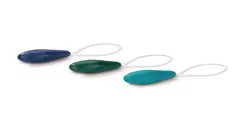
Simply wearing the Beurer pelvic oor training aids as described in
the instructions will make you more aware of your pelvic oor and
strengthen your muscles.
If you combine this with the training programme presented here, you
open the door to even greater benets – and you might even discover
that you enjoy doing the exercises. The pelvic oor consists of three
layers of muscles. If you use just the cones, you primarily exercise the
rst layer – the sphincter – and the second layer, which encloses the
vagina. This is placed under particular strain by giving birth and needs
to be strengthened in a sustainable way. If you then add the training
programme as well, you have an effective way to exercise the third
layer of your pelvic oor. This supports the uterus, bowel and bladder
and plays an important role in maintaining an upright posture.
Once you build up this part of the pelvic oor, you will be stable from
the core of your body. You will not become exhausted so easily and
your movements will become more harmonious and more powerful.
How the training programme is structured
Many women nd it difcult to be aware of the “secret” muscles of
their pelvic oor. This is where the vaginal cones can be a great help.
Besides the training effect you achieve with the cones, they are also
great for making you more aware of your pelvic oor muscles. You will
feel exactly where you have to tense the muscles and you will be able
to train more precisely every time. The training programme starts with
two awareness exercises, followed by two highly effective exercises
to build up strength, and nally two exercises that will help you to
integrate an active pelvic oor into your normal everyday movements.
Training recommendations
If you start with exercises of 15 minutes daily and simply wear the
cones for a further 15 minutes after a few hours in between, you
should be able to notice a distinct improvement after a few weeks. By
integrating the exercises into everyday life, you can even shorten the
active training time.
This programme has been designed so that you can simply carry
out the exercises one after the other as a complete unit. Put on
comfortable clothing and get everything you need ready for the
exercises. Use the same cone for the exercises as the one you currently
wear as per the instructions for use.
Let’s get started:
1. AWARENESS
The better you can feel your pelvic oor, the better
you will carry out the exercise because you will
activate the correct muscles. Women often tense
their abdominal, buttock or thigh muscles sharply,
which unfortunately doesn’t benet the pelvic
oor at all. Tensing the pelvic oor correctly and
intensely is still a comparably small movement – but
it’s enough. The following exercises will help you to
discover your body’s most “secret” muscles in detail
and get acquainted with them.
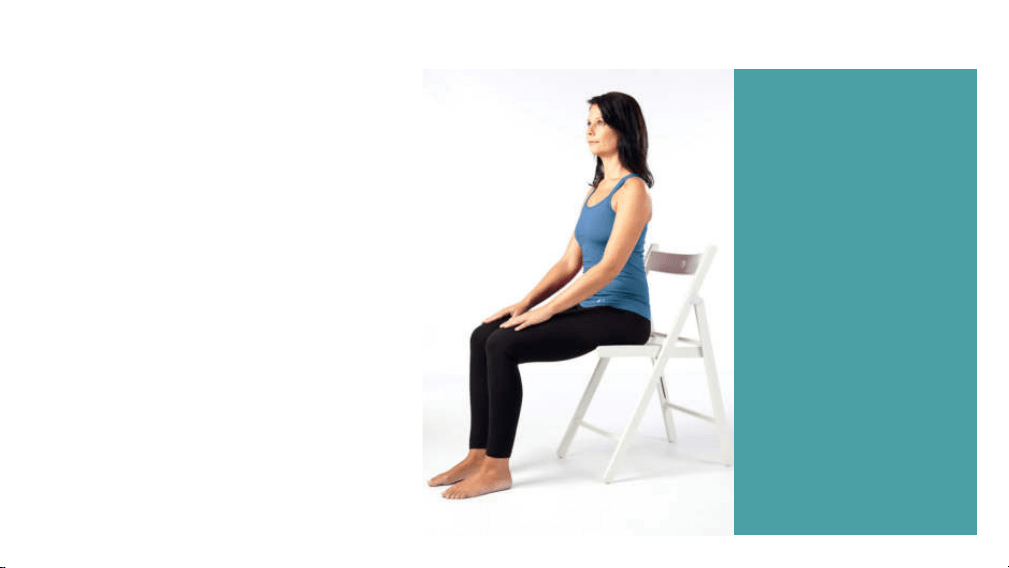
Position:
Sit upright and relaxed
like a queen (don’t slip
into a hollow back) on
the front half of your
chair, with your legs
spread apart at hip
width. You should be
able to clearly feel both
your sit bones against
the chair.
Exercise 1: Fluttering
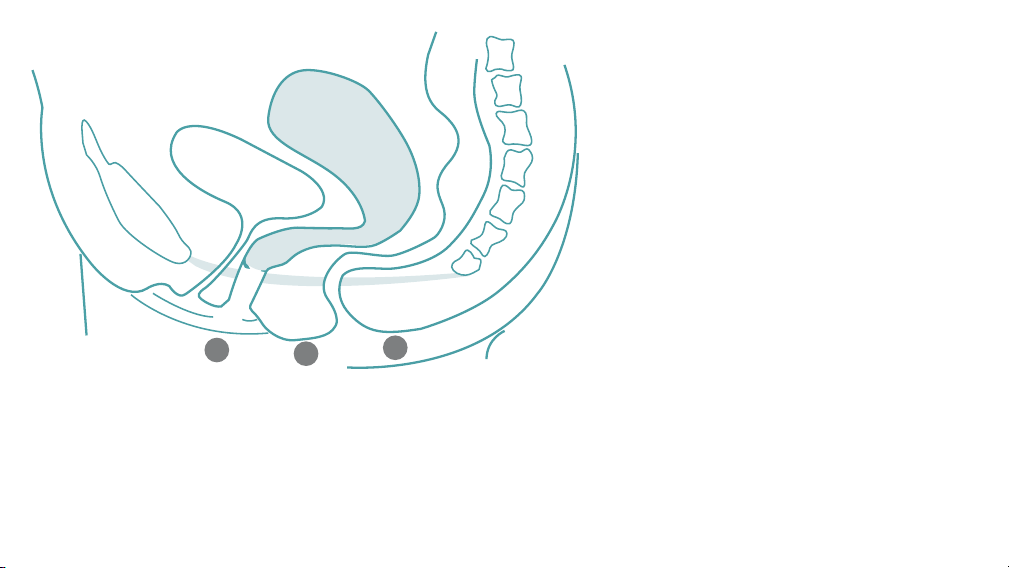
Now position yourself on the cone such that it is
placed at the positions marked in the graphic outside
of your clothing. First, slide it under your vagina (1).
Feel the pressure and utter your muscles on the
cone several times with small movements. This
should be completely invisible from the outside. Does
it feel almost like a gripping motion? That’s exactly
right.
Now slide the cone further back so that it comes to
rest under the perineal area (2). Try and move the
sit bones slightly towards the cone, slightly drawing
them together. Again, the movement is correct if
it is not noticeable from the outside. Finally, push
the cone further back until it rests underneath the
anus (3) and try again to utter your muscles and
grip it gently.
Check your buttock muscles with your hands. If you
can keep them still despite noticing something is
still moving inwards around the cone, then you are
activating your pelvic oor quite expertly already.
2
1
3
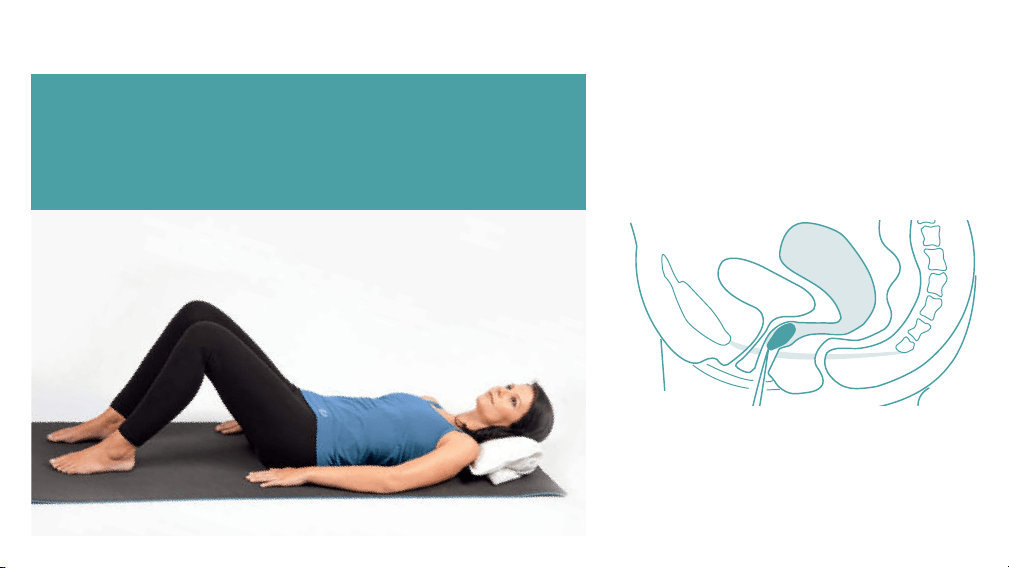
Exercise 2: Gripping
Position:
Lying comfortably on your back, with your upper body slightly
raised, either with a firm cushion or on your sofa, provided
it is not too soft and has a suitable arm rest. Bend your legs
and place them apart at hip width.
When you wear the cone normally, you must slide it
inside until you can no longer feel it, as shown in the
graphic. However, we have deliberately changed this
approach for this awareness exercise. Insert the cone
just enough to make it disappear and keep hold of the
cord. If you now tense your vaginal muscles slightly,
you should be able to feel the cone clearly as it is now
positioned exactly in line with this layer of muscles.
If you tense the muscles a little harder, the cone will
move with the muscle movement; it may even slip out
or be pulled in deeper. Try to enclose and move the
cone as precisely as possible. Play with it by holding it
either tighter or only very lightly. Your buttocks, thighs
and abdomen should remain very still. Above all, take

care not to use your abdomen muscles; the correct movement is very
small and “subtle”.
Once you have familiarised yourself with your “secret” muscles
appropriately, push the cone into your vagina until you cannot feel it
any more and continue with the strength-building exercises. Ideally
you should set aside enough time for the awareness exercises at the
beginning. You should be undisturbed, alert and relaxed to give your
pelvic oor your full attention. Once you have obtained a good idea of
your strength, you can reduce the time for this rst training section.
2. BUILDING UP STRENGTH
Wearing the pelvic oor training aids in the normal manner
encourages you to hold your muscles and thus a more static build-up
of muscles. If you carry out the exercises in this leaet regularly, you will
also add a pulsing dimension by strongly tensing and gently relaxing
your muscles. This achieves a more holistic effect and builds up your
muscles more comprehensively. During the awareness exercises you
uttered your muscles and played around. Now, however, it’s time
to start the real work with the following strength-building exercises.
Allow your breathing to support you. Ideally, tense the muscles when
breathing out and relax them when breathing in. If you don’t get this
rhythm right away, then always make sure you don’t hold your breath
and cramp up. Furthermore, it is recommended not to tense your
muscles abruptly, but rather steadily increase the strength and relax
them slowly – just like a wave comes and goes.
ATTENTION, PLEASE NOTE
If you feel that the exercise is uncomfortable for you and exhausts
you and that “everything is pushing down” when you are tensing
your muscles, then you are pressing too much with your abdominal
muscles. This is not good for you.
Try to relax a little, only use half as much strength as you are able
to, and try and pull the strength “from the pelvis upwards”. You are
doing the exercise correctly if you get a feeling that “something is
being drawn upwards”, that it is strong and yet also light, and that
you feel taller.
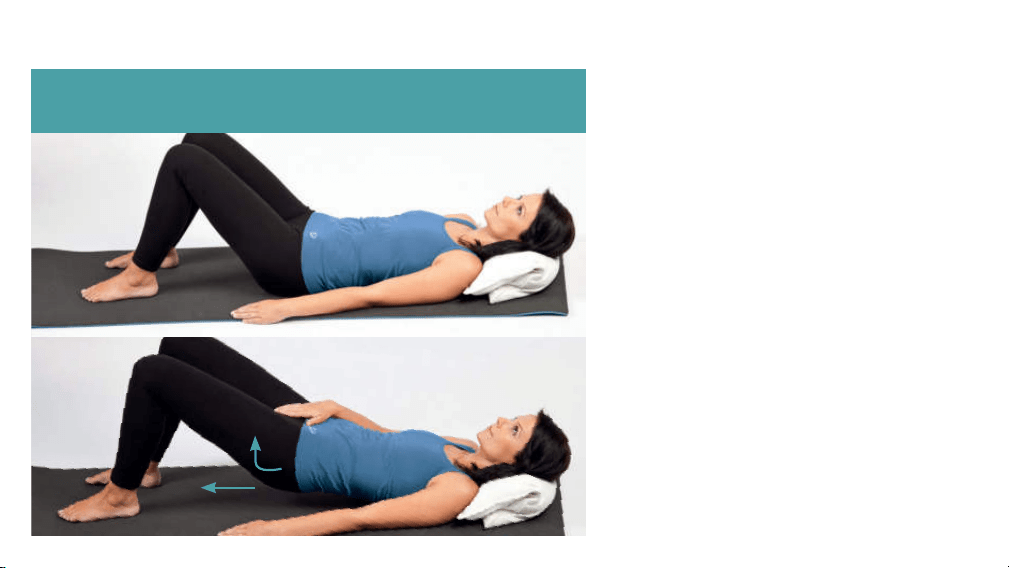
Exercise 3: Rolling the pelvis
Position:
Slightly raised position on your back, as in exercise 2.
a) Gentle rolling of the pelvis:
Keep hold of your trousers in the crotch area. Breathe
in deeply and relaxed. When breathing out, roll your
pelvis upwards – stretch your back as if it wants to
push down towards your heels and pull your pelvis
gently towards you by holding on to your trousers.
While breathing in, your pelvis rolls back into its initial
position. Repeat this rolling movement 10 times in line
with your breathing, without tensing any muscles.
Your back will love this exercise. Always make sure
that your back really only stretches out lengthwise!
During the exercises, you will hardly feel the cones
while lying down.
b) Powerful rolling of the pelvis:
Breathe in deeply and relaxed. While breathing out,
tense your pelvic oor, roll your pelvis upwards and
at the same time press your heels into the oor. Don’t
forget to stretch your back out lengthwise! Release
the tension while breathing in, and let the pelvis sink
back into its initial position.
Repeat 10 times in line with your breathing.
Position:
Slightly raised position on your back, as in exercises 2 and 3.
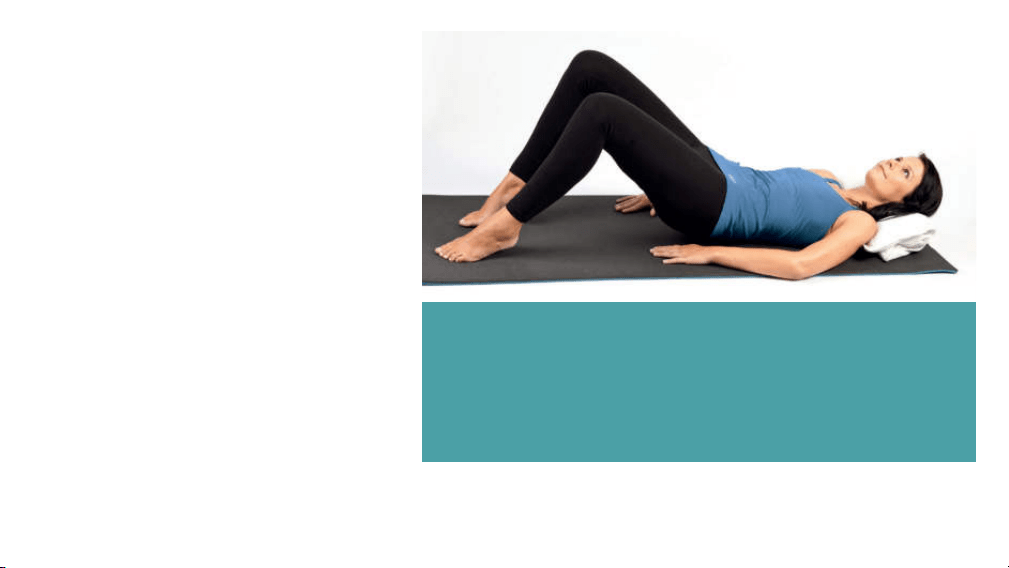
Tip: Always start and finish your strength-building exercises
with a soft rolling of the pelvis. Carry out the powerful rolling
of the pelvis movement 10 times, and press down the balls of
your feet 10 times. In between, gently roll your pelvis 10 times.
The change between powerful tension and gentle rolling
helps to build up the muscles.
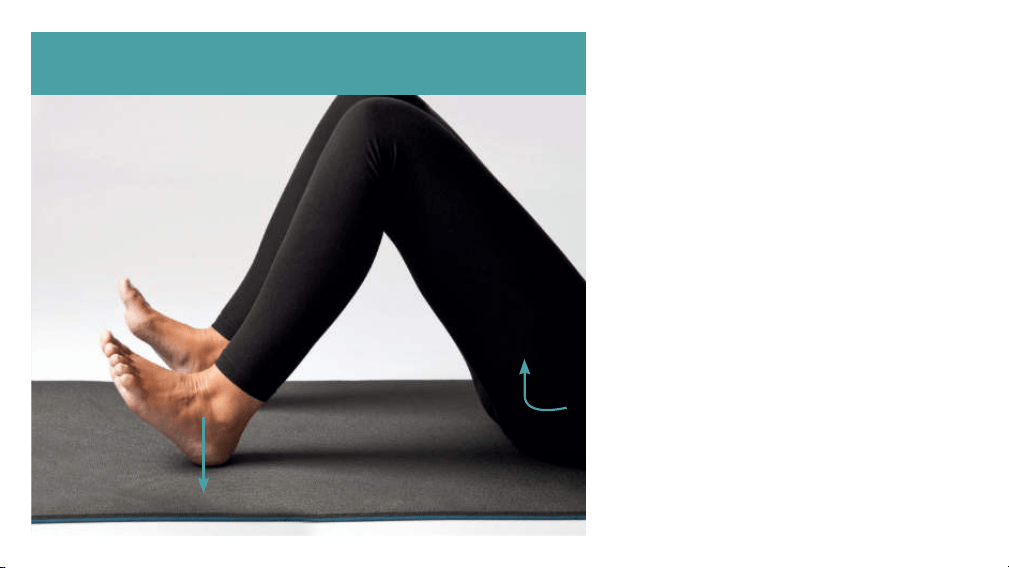
Exercise 4: Pressing down the ball of
the foot
Breathe in deeply and relaxed. Tense your pelvic oor
when breathing out and press down the front part of
your feet. Your heels and pelvis will lift up slightly. Your
heels may be lifted up slightly (as shown in the picture)
or stay on the oor. It is important that you do not fall
into a hollow back. You can use your buttocks to help a
little, but avoid using your abdomen as far as possible.
You may get a feeling that you are rmly enclosing the
cone with your vagina and sit bones. That’s exactly
right. Release the overall tension while breathing in,
and let the pelvis sink back into its initial position.
Repeat 10 times in line with your breathing.
3. INCORPORATING THE
EXERCISES INTO YOUR DAILY
ROUTINE
While you can consider the strength-building
exercises as a type of “weight training” for your pelvic
oor, the following exercises concentrate more on
body coordination. You don’t need to use a lot of
tension; a good rhythm is more important. The pelvic
oor training aids reinforce the training effect.
If you do these exercises regularly, you will learn to
use your pelvic oor more in your normal everyday
movements, such as climbing the stairs. This means
that you can also train it informally without cones and
gain additional elasticity and agility. The pelvic oor
is your body’s energy centre, and if you keep it active
through the right type of movement, you will perform
better and be in a good mood.
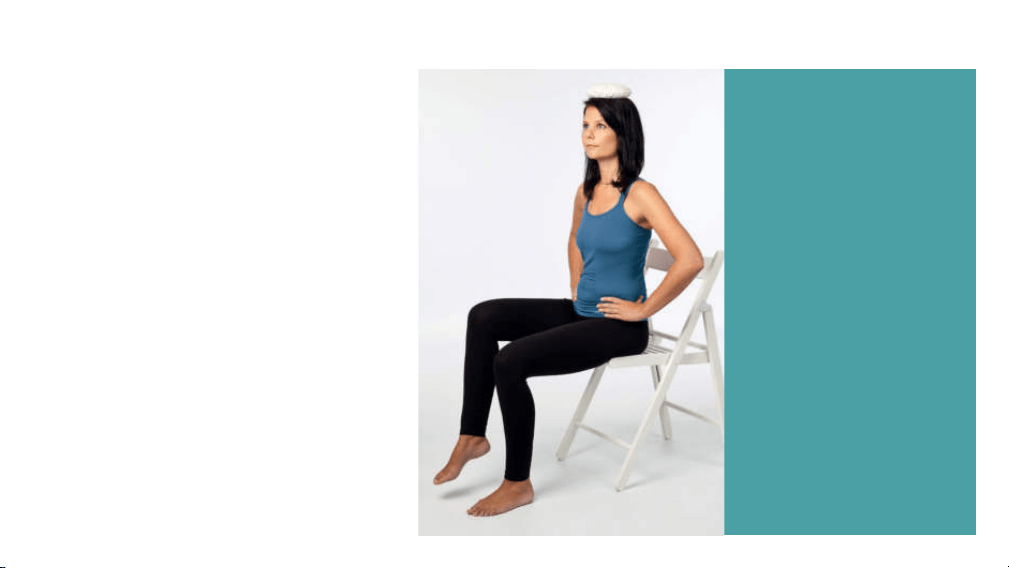
Exercise 5: Dancing on a stool
Position:
Sitting down on a stool or
a chair with a level seat,
not too soft.
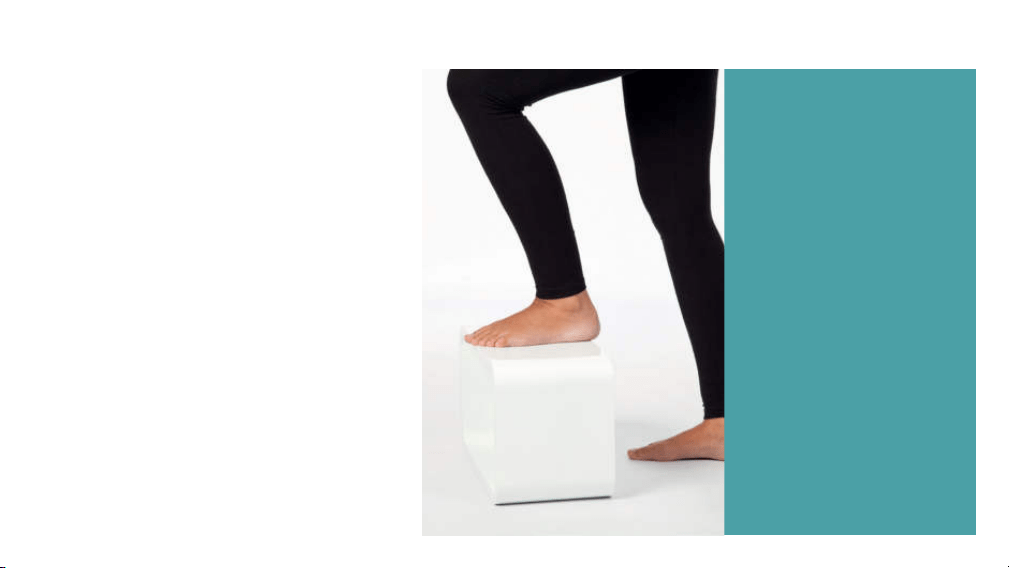
Position:
Standing in front of stairs
or a low, raised object
that provides a secure
footing.
Do this 5 times on the
right and 5 times on the
left. Repeat the whole
sequence 3 times. Then
do it 20 times alternating
between the right and
left.
Place a cushion or, better still, a cherry stone bag on
your head. It will help you to remain upright during
this exercise and to not move your upper body. Tense
your pelvic oor while breathing out and slowly lift
your right leg a little off the oor. It would be easier
to lift your leg by shifting your weight and tilting your
upper body to the left. However, you should resist
this temptation and instead use the strength coming
from your pelvis to lift your leg. It helps if you gently
press your left foot into the oor and turn your left
shoulder slightly forwards. Try and imagine that you
are growing a little every time you tense your pelvic
oor and lift your foot.
While breathing in, concentrate and slowly place
your foot back on the ground.
Exercise 6: Climbing stairs
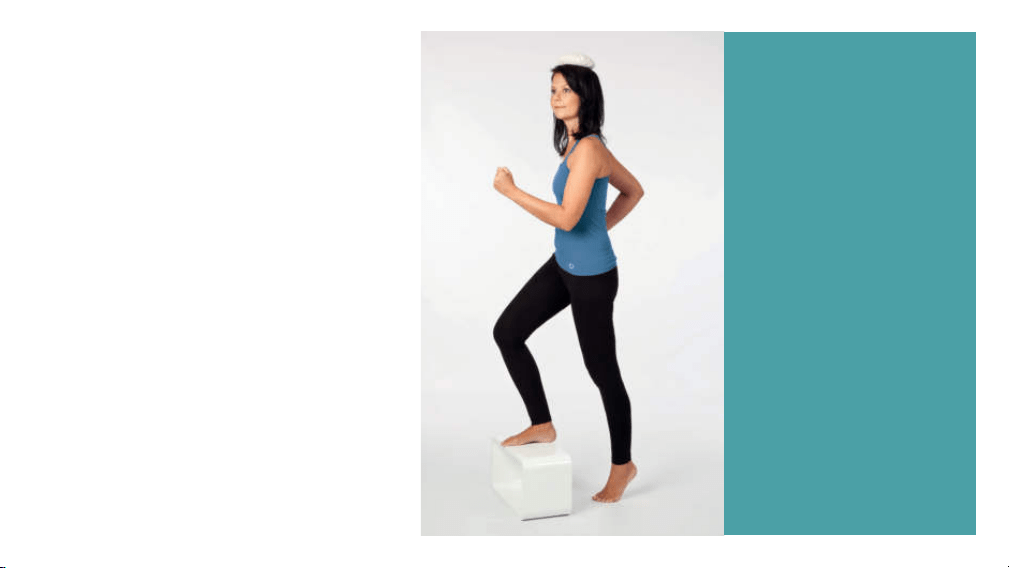
Place the cherry stone bag on your head again so
that you hold yourself upright like a queen and do
not swing your upper body back and forth. Place
your right foot on the stairs.
Tense your pelvic oor while breathing out, and
slowly shift your weight completely onto your right
leg until the toes of your left foot only just about
touch the oor. Draw a lot of strength from your
pelvis – even though you naturally also need your
thigh in this exercise – and rise a little again. While
breathing in, shift your weight back to your left foot
and place it back on the ground.
Do this 5 times on the
right and 5 times on the
left.
Repeat the whole
sequence 3 times.
If you do the exercise on
a staircase, concentrate
and move up the whole
staircase slowly.
Treat yourself!
You’ve earned a moment of well-
being!
4. RELAXATION
This is more important than you might think. In order
for muscles to be built up by the body after they
have been worked, they must have strong blood
circulation to supply them with nutrients. This is done
most effectively by relaxing. Treat yourself!
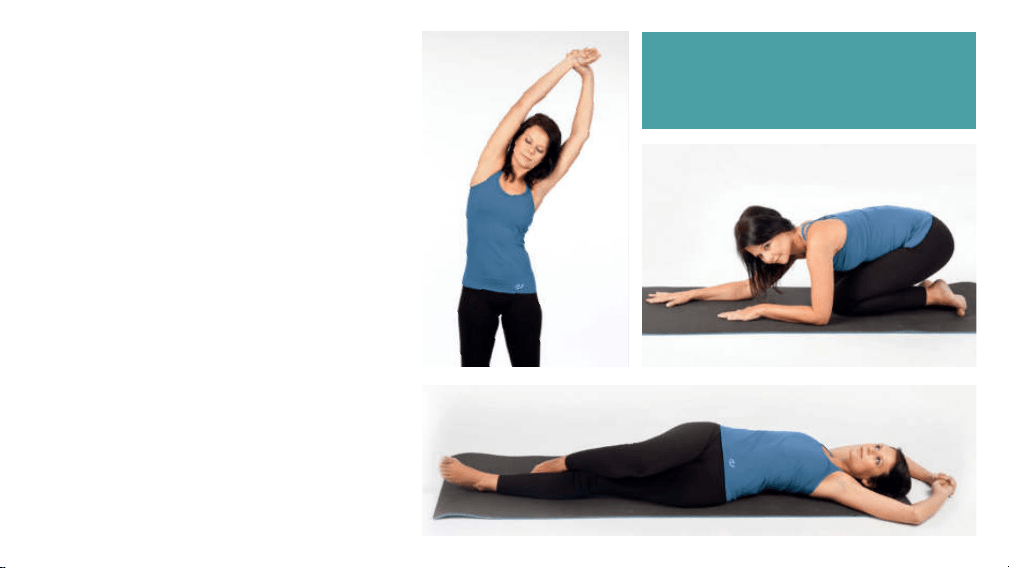
Relaxation exercise 1:
Enjoyable stretching
Just do what dogs and cats love to do:
Extend your arms, legs and back and enjoy stretching
them right out. Let your body decide what’s good
for it.

Relaxation exercise 2:
Inner awareness – feel the difference
Cuddle up in the most comfortable position and place your hands
on your lower abdomen. Picture your pelvic oor and internal organs
as best you can. Did you know? Body awareness has been shown
to make muscle-building training more effective. Imagine that you
are comfortably sinking deep into where you are. Hum a deep tone
quietly or sigh when breathing out. Allow yourself to become lovingly
acquainted with this part of your body. Does it tingle or “buzz” down
there? Perfect!
Relaxation exercise 3: Warming deep relaxation
Place a hot-water bottle or warm cherry stone bag on your lower
abdomen. There’s hardly anything better for letting go deep down –
and you’ve earned this moment of well-being!
Final recommendations
When wearing the Beurer pelvic oor training aids, the more you
move, the more pleasant it will be for you. Unfortunately, the pelvic
oor muscles tend to slacken when standing or sitting. They tense as
a reex when the cones are worn in order to prevent them sliding out,
but this continuous tension can easily lead to cramp. If women do not
feel comfortable with the cones, this is often the reason. But if you move
around, wearing the cones will become like an inner massage. Here
are some recommendations for your everyday life. Your pelvic oor will
always benet from movement and good posture, whether or not you
are wearing the cones.
• If you have to stand up for a long time, whether ironing or any
other activity, it is recommended that you adopt the stepping
position.
• Avoid a round back when bending down. It’s better to adopt the
stepping position by bending your knee, maintaining a straight
upper body.
• Should you have to wait in a queue for a long time, you can shift
your weight slowly and invisibly from one leg to the other, which
will benet your pelvic oor.

Personal background
I’m an alternative practitioner and pelvic oor trainer
and have my own practice in the south of Munich.
I provide individual lessons and courses and train
pelvic oor therapists.
Detailed information and free training tips are
available on my website:
www.beckenboden-in-bewegung.de

My publications
“Beckenboden-Training”
[Pelvic Floor Training]
with exercise CD
Irene Lang-Reeves, publisher: GU
ISBN: 978-38338-4856-8
Simple and fun exercises to improve
your stability and physical well-being
“Beckenboden – wie Sie den
Alltag zum Training nutzen”
[Pelvic Floor – How to Use
Everyday Life for Training]
Irene Lang-Reeves, publisher: Nikol
ISBN: 978-3868203363
The simple way to integrate an active
pelvic oor into everyday life
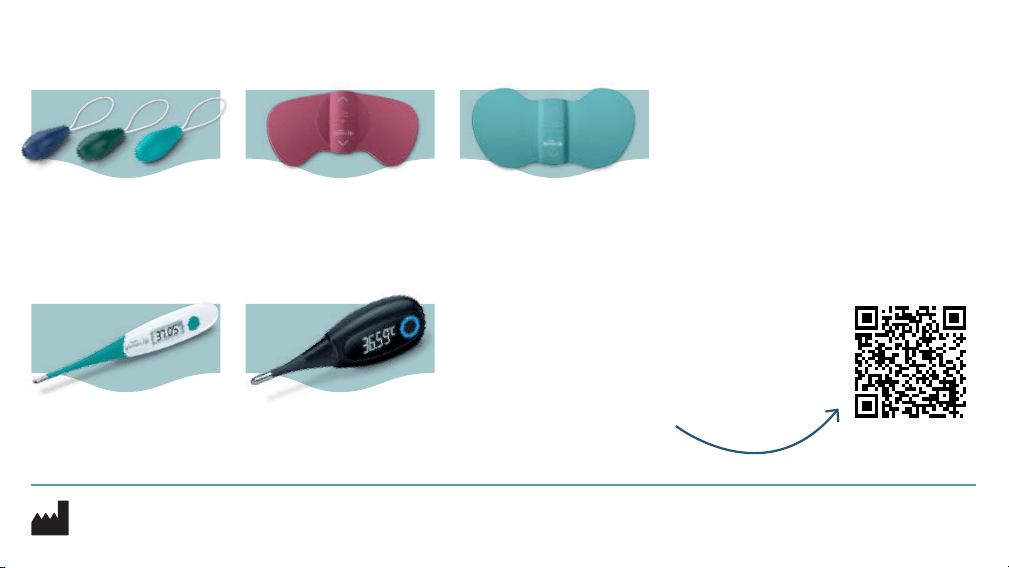
Alongside these pelvic oor training aids,
the Woman‘s Life range also includes many
products for menstruation, pregnancy and
the menopause.
You can nd out more about the range here:
Menstrual Relax+
Menstrual Relax
Period pain pad Period pain padPelvic floor training aids
Ovulation thermometer Ovulation thermometer
PelviStrong
BasalControl Basic
BasalControl Smart
My
body.
My
solutions!
Products for women at all stages of their lives
Beurer GmbH • Söinger Straße 218 • 89077 Ulm, Germany • www.beurer.com
www.beurer-blutdruck.de • www.beurer-gesundheitsratgeber.com • www.beurer-healthguide.com