To reduce the risk of electrical shock, this fan must be
installed with an isolating wall control/switch.
To reduce the risk of fire or electrical shock, this fan
should only be used with fan speed control, Model No.
FR-7861LMA-02, manufactured by Rhine Electric Co.,
Ltd.
This product is designed to use only those parts
supplied with this product and/or any accessories
designated specifically for use with this product.
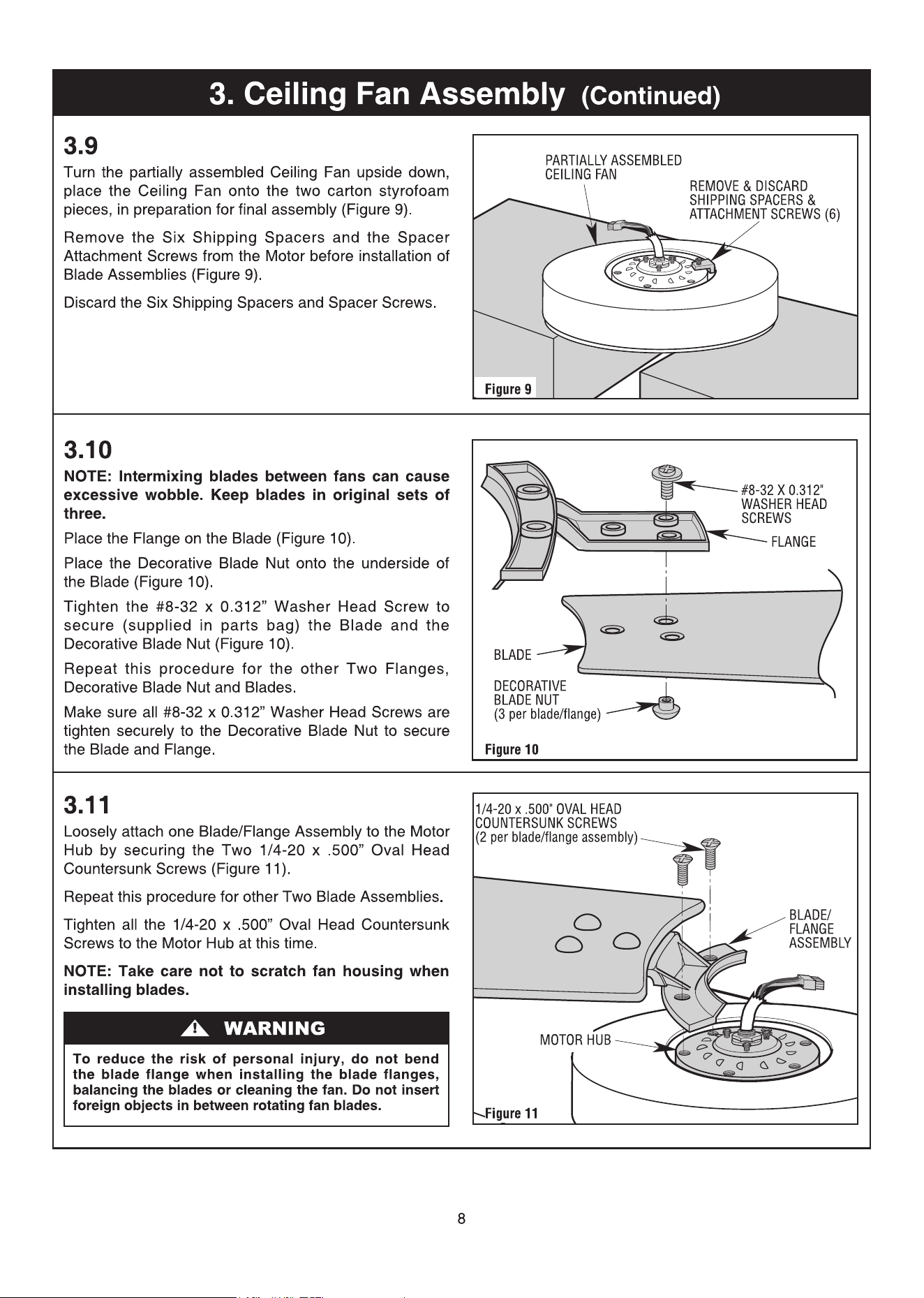
To reduce the risk of personal injury, do not bend
the blade flange when installing the blade flanges,
balancing the blades or cleaning the fan. Do not insert
foreign objects in between rotating fan blades.
This product is designed to use only those parts
supplied with this product and/or any accessories
designated specifically for use with this product.
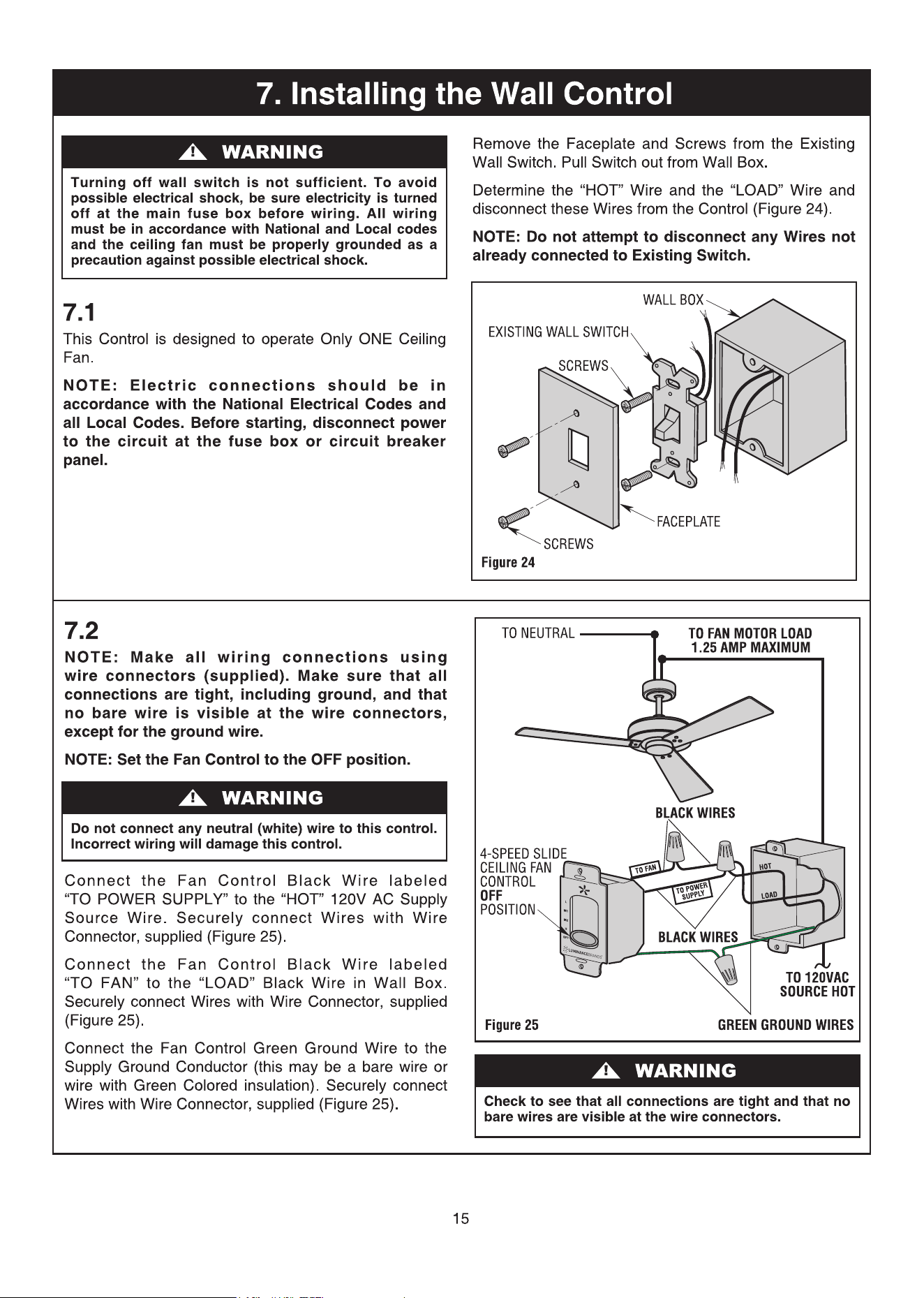
Your Ceiling Fan comes supplied with a Fan Wall
Control. This system allows you to regulate your
Ceiling Fan Speed.
The RFCP Receiver and SR400/ SW405 Remote
Control (sold separately) may be used with this 52”
Keane Ceiling Fan. Controls are recommended for
indoor use only.
This product is designed to use only those parts
supplied with this product and/or any accessories
designated specifically for use with this product.
FOR YOUR OWN SAFETY TURN OFF POWER AT FUSE BOX OR CIRCUIT BREAKER BEFORE
TROUBLESHOOTING YOUR FAN.
WARNING
!
11. Troubleshooting
TROUBLE PROBABLE CAUSE SUGGESTED REMEDY
1. Fan will not start. 1. Fuse or circuit breaker blown. 1. Check main and branch circuit fuses or circuit breakers.
2. Reverse switch in neutral position. 2. Make sure reverse switch position is all the way to one
side.
2. Fan sounds 1. Blades not attached to fan. 1. Attach blades to fan before operating.
noisy.
2. Loose screws in motor housing. 2. Check to make sure all screws in motor housing
are snug (not over-tight).
3. Screws securing flanges to motor hub 3. Check to make sure the screws which attach
are loose. the flanges to the motor hub are tight.
4. Screws holding blades to flanges 4. Tighten screws securely.
are loose.
3. Fan wobbles 1. Set screw in motor coupler is loose. 1. Tighten both set screws securely in the motor coupler.
excessively.
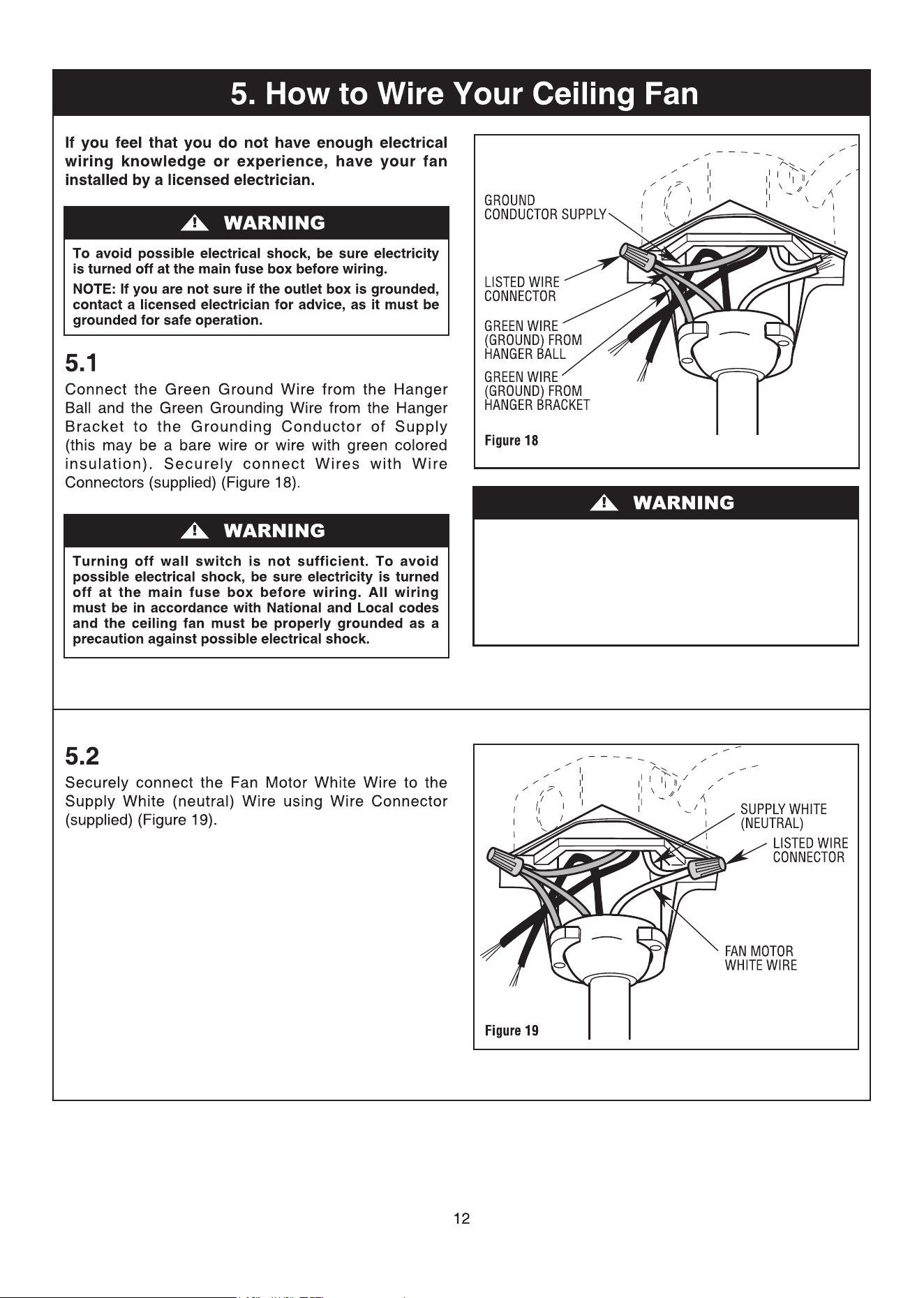
2. Set screw in hanger ball/downrod 2. Tighten the set screw in the hanger ball/downrod
assembly is loose. assembly.
3. Screws securing flanges to motor 3. Check to be sure screws which attach the
are loose. flanges to the motor are tight.
4. Flanges not seated properly. 4. Check to be sure the flanges seat firmly
and uniformly to the surface of the motor.
If flanges are seated incorrectly, loosen the
flange screws and retighten according to the
procedure in the section on “Ceiling Fan Assembly”.
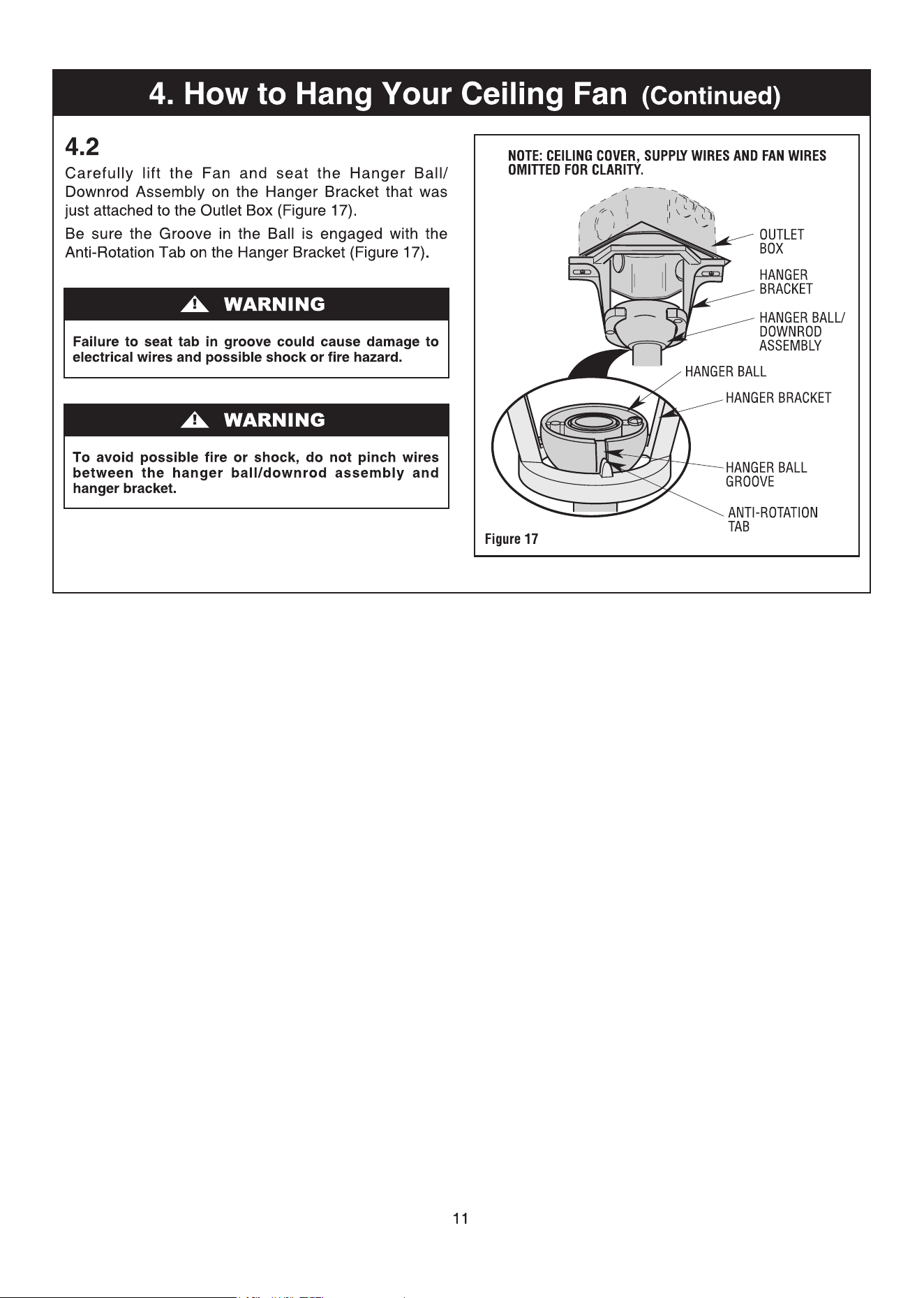
5. Hanger bracket and/or ceiling outlet 5. Tighten the hanger bracket screws to the outlet
box is not securely fastened. box, and/or secure outlet box.
6. Fan blades out of balance. 6. Interchanging an adjacent (side-by-side) blade pair can
redistribute the weight and result in smoother operation.
Make sure main power is turned OFF.
WARNING
!
Ceiling Fan performance and energy savings rely
heavily on the proper installation and use of the
Ceiling Fan. Here are a few tips to ensure quality and
product performance.
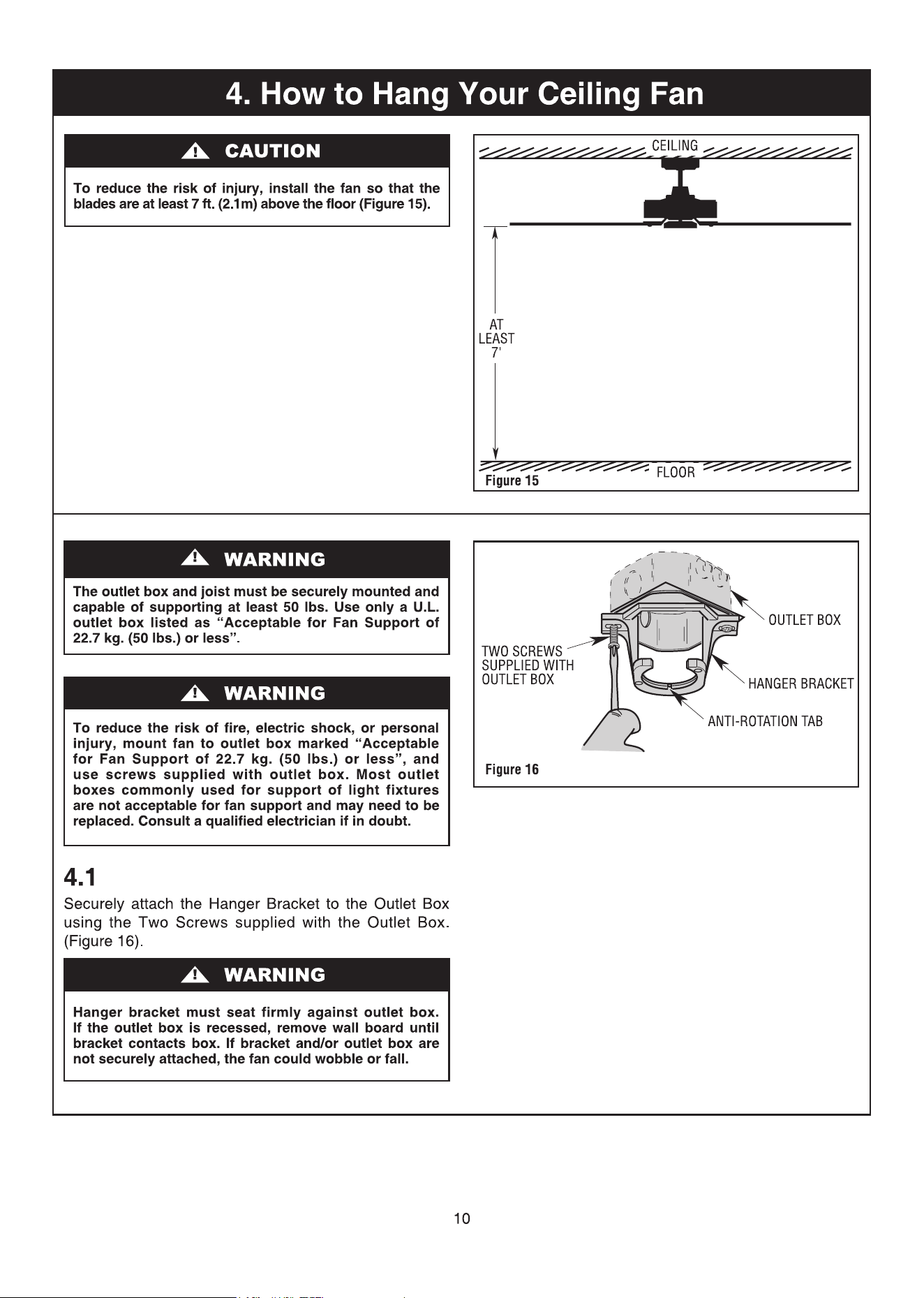
Choosing the Appropriate Mounting Location.
Ceiling Fans should be installed, or mounted, in the
middle of the room and at least 7 feet above the floor
and 18 inches from the walls. If ceiling height allows,
install the fan 8 - 9 feet above the floor for optimal
airflow.
10. Energy Efficient Use of Ceiling Fans
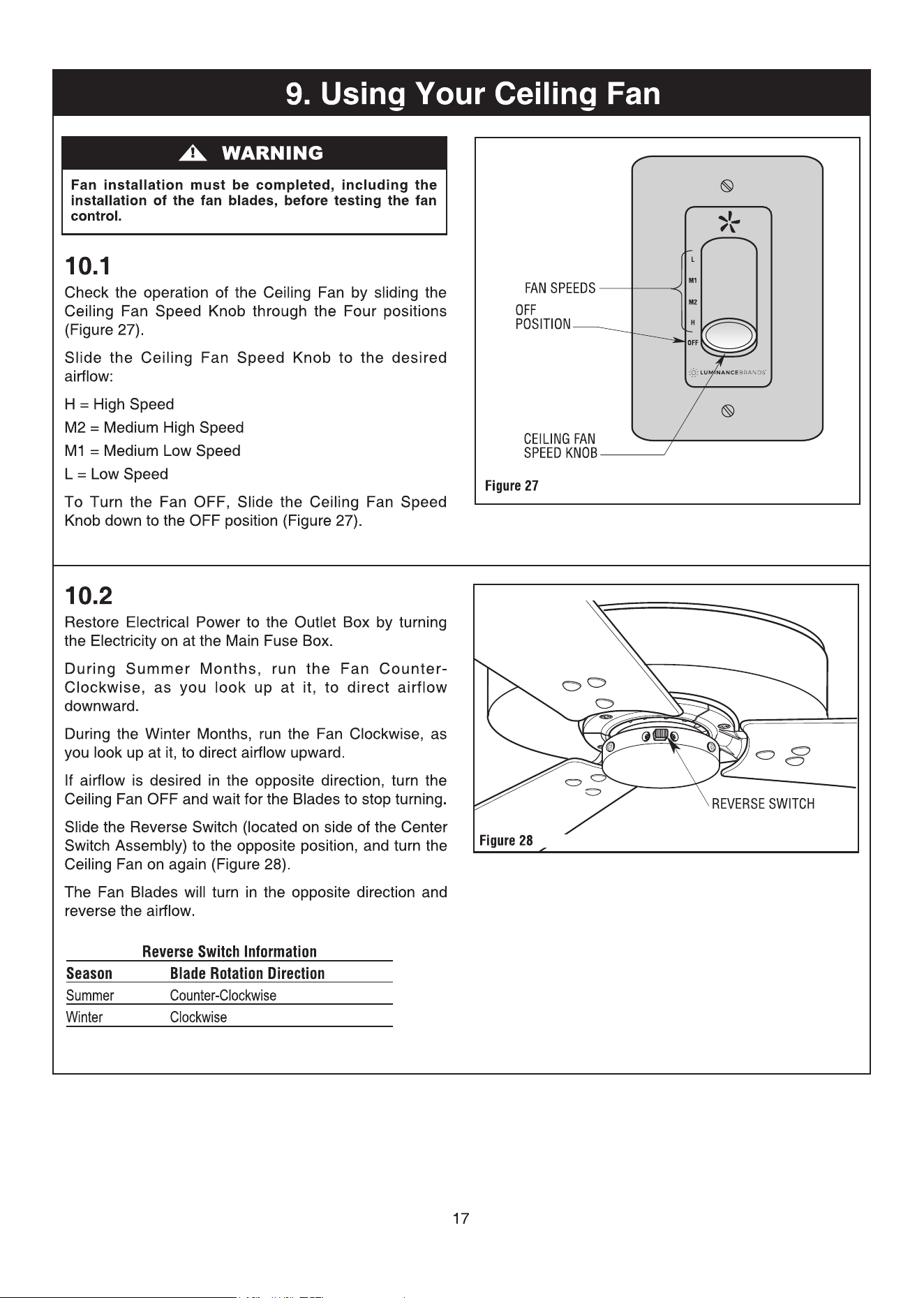
Using the Ceiling Fan Year Round. In the summer,
use the Ceiling Fan in the counter-clockwise direction.
The airflow produced by the Ceiling Fan creates
a wind-chill effect, making you “feel” cooler.
Select a fan speed that provides a comfortable
breeze, lower speeds consume less energy .
In the winter, reverse the motor and operate the
ceiling fan at low speed in the clockwise direction.
This produces a gentle updraft, which forces warm
air near the ceiling down into the occupied space.
Remember to adjust your thermostat when using your
Ceiling Fan - additional energy and dollar savings could
be realized with this simple step!
Turn Off When Not in the Room. Ceiling Fans cool
people, not rooms. If the room is unoccupied, turn off
the Ceiling Fan to save energy.