A8k_QuickGuide
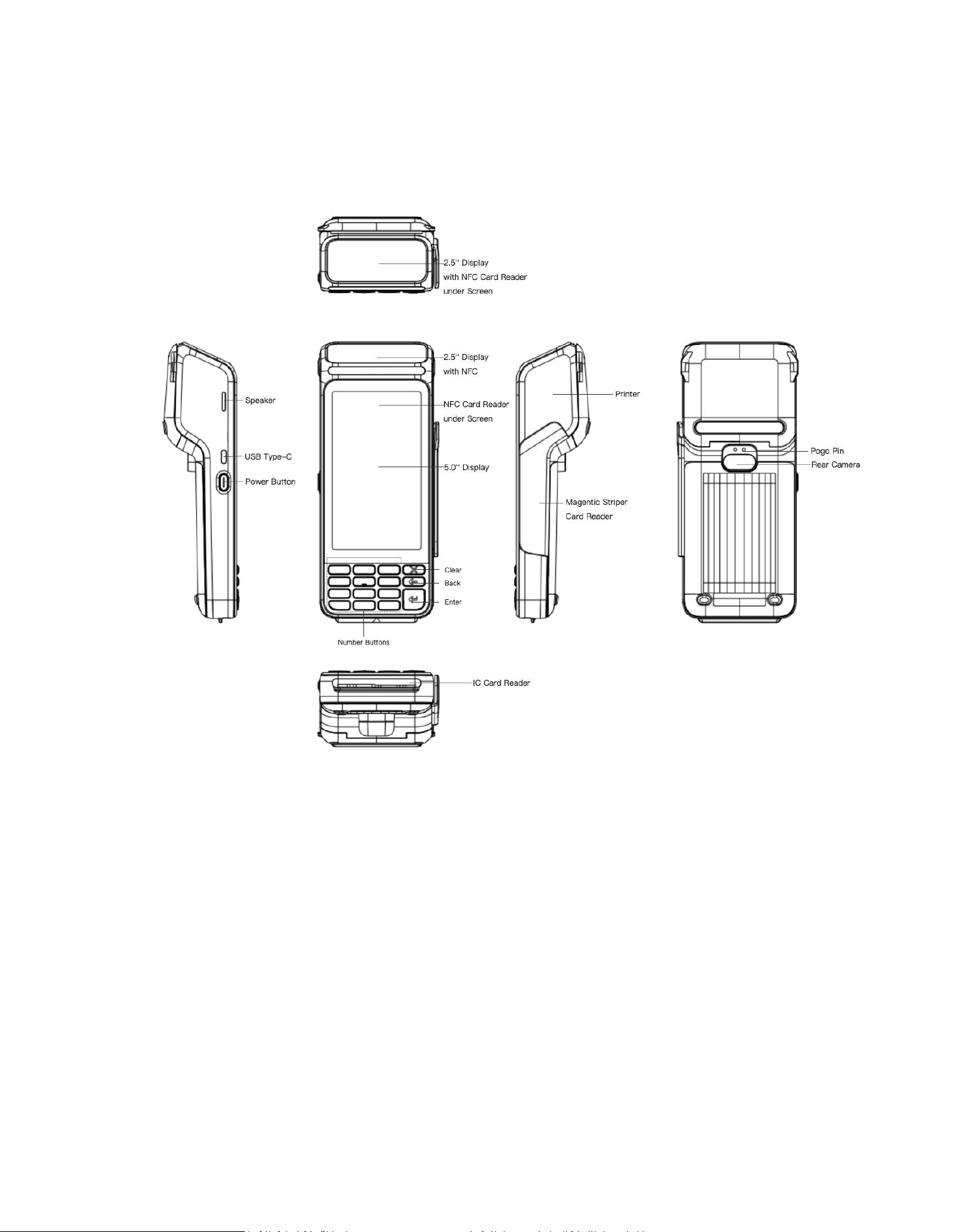
Product Diagram
NFC Card Reader
NFC antenna locates at the bottom of the screen and on the printer cover. It’s used to
sense chip and acquire data through contactless way.
IC Card Reader
Used for inserting the bank chip card and getting information securely.
Magnetic Stripe Card Reader
Used for reading encrypt information stored in corresponding cards.
Camera
Used for taking photos, unlock the device by face recognition and complete intelligent recognition base on it.

Display
Used for APP functions or price display, etc.
Power button
Used for change the running states of device, such as pressing 2~3 seconds to power on/off or screen capture and
pressing 10 seconds to restart automatically when device is crashed.
Keypad
Used for entering password for certain payment usages.
Pogo pin
The POGO-Pins expanded interface is severed as the channel to connect the charging cradle for better power supply or finish data
transmission between different devices.
ATTENTION
Warning
● Read all instructions and safety information before use to avoid injury.
● The limit operating ambient temperature of the device declared by the manufacturer is -10~45°C.
Battery safety
● Charge battery only at ambient temperatures ranging from 0~40°C.
● Dispose of used batteries according to manufacturer’s instructions.
● Danger of explosion if battery is incorrectly replaced. Replace only with the same or equivalent type of battery recommended
by the manufacturer.
● To maintain the integrity of the fire protective enclosure, ensure the device is powered off before removing the
battery compartment cover, and verify the cover is fully seated with all latches securely locked after
replacement. Use of non-original covers or improper installation may compromise fire protection performance
and increase fire risk.
Statement
● The equipment damage caused by natural disasters, falling, self disassembly and non-compliance with the operation
specifications is not covered by the free warranty.
● Some details of this document may be inconsistent with the real object due to the update iteration of the product. Please take
the real object as the standard, and our company reserves the right to interpret this document.

FCC Statement
Any Changes or modifications not expressly approved by the party responsibl e for compliance could void the user’s
authority to operate the equipment. This device complies with part 15 of the FCC Rules. Operation is subject to the
following two conditions:
(1) This device may not cause harmful interference
(2) This device must accept any interference received, including interference that may cause undesired operation.
Note : This equipment has been tested and found to comply with the limits for a Class B digital device, pursuant to part
15 of the FCC Rules. These limits are designed to provide reasonable protection against harmful interference in a
residential installation. This equipment
generates,uses and can radiate radio frequency energy and, if not installed and used in accordance with the
instructions, may cause harmful interference to radio communications. However, there is no guarantee that
interference will not occur in a particular installation. If this equipment does cause harmful interference to radio or
television reception, which can be determined by turning the equipment off and on, the user is encouraged to try to
correct the interference by one or more of the following measures:
—Reorient or relocate the receiving antenna.
—Increase the separation between the equipment and receiver.
—Connect the equipment into an outlet on a circuit different from that to which the receiver is connected.
—Consult the dealer or an experienced radio/TV technician for help.
RF Exposure Information (SAR) :
This device meets the government's requirements for exposure to radio waves. This device is designed and
manufactured not to exceed the emission limits for exposure to radio frequency (RF) energy set by the Federal
Communications Commission of the U.S. Government.
The exposure standard for wireless devices employs a unit of measurement known as the Specific Absorption Rate, or
SAR. The SAR limit set by the FCC is 1.6 W/kg(Body) ,4.0 W/kg(Limbs). *Tests for SAR are conducted using
standard operating positions accepted by the FCC with the device transmitting at its highest certified power level in all
tested frequency bands.
Although the SAR is determined at the highest certified power level, the actual SAR level of the device while operating
can be well below the maximum value. This is because the device is designed to operate at multiple power levels so as
to use only the poser required to reach the network. In general, the closer you are to a wireless base station antenna,
the lower the power output.
The highest SAR value for the device as reported to the FCC when worn on the body, as described in this user guide,
is 0.42 W/kg Body SAR
(Body-worn measurements differ among devices, depending upon available enhancements and FCC requirements.)
The FCC has granted an Equipment Authorization for this device with all reported SAR levels evaluated as in
compliance with the FCC RF exposure guidelines. SAR information on this device is on file with the FCC and can be
found under the Display Grant section of http://www.fcc.gov/oet/fccid after searching on FCC ID: 2A2UU-K1141
For body worn operation, this device has been tested and meets the FCC RF exposure guidelines for use with an
accessory that contains no metal and the positions the device minimum of 10mm from the body . Use of other
enhancements may not ensure compliance with FCC RF exposure guidelines.