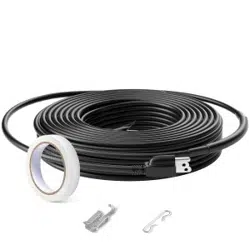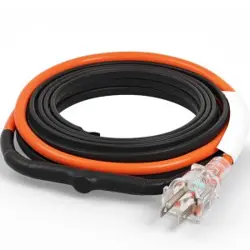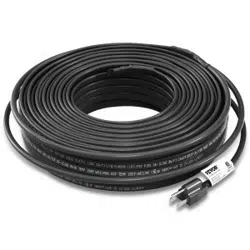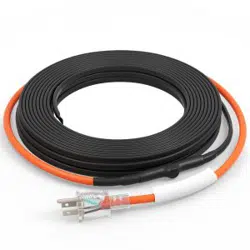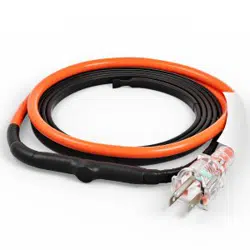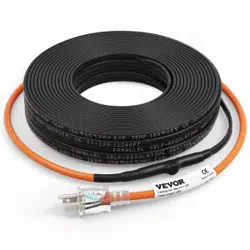

RESIDENTIAL PIPE HEATING CABLE
INSTALLATION INSTRUCTION

NEED HELP? CONTACT US!
Have product questions? Need technical suppo? Please feel free to contact us:
This is the original instruction, please read all manual instructions carefully
before operating. VEVOR resees clear interpretation of our user manual.
The appearance of the product shall be subject to the product you received.
Please forgive us that we won't inform you again if there is any technology
or software updates on our product.
CustomerSe[email protected]
01
RESIDENTIAL
PIPE HEATING CABLE
INSTALLATION INSTRUCTION
MLTV KIT
HOW IT WORKS
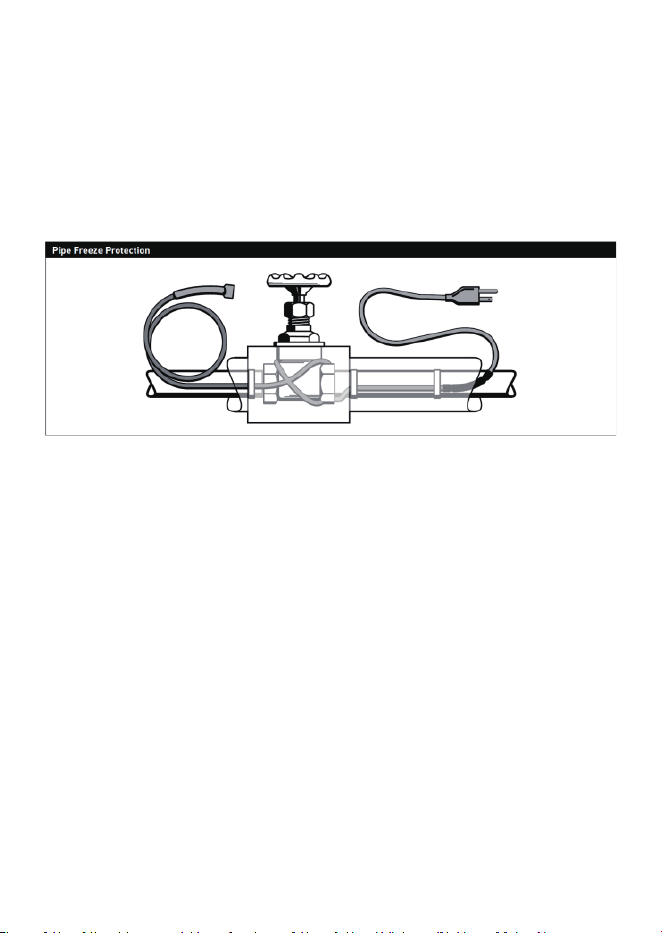
Pipe freeze prevention cable. Pre-terminated and self-regulating with plug.
Nominal 5 Watts/ft at 50℉, 120 VAC.
MLTV Kit is engineered to va its heat output with changes of the surrounding
temperature.
Because of the self-regulating feature of this cable, MLTV Kit can be wrapped
over itself (overlapped), if necessa, when installed on pipes, valves or anges.
Guard Against Unnecessa Frozen or Burst Water and Drain Pipes.
Automatically Regulates Heat Output To Save Your Energy.
Can be Doubled & Overlapped For Easy Application.
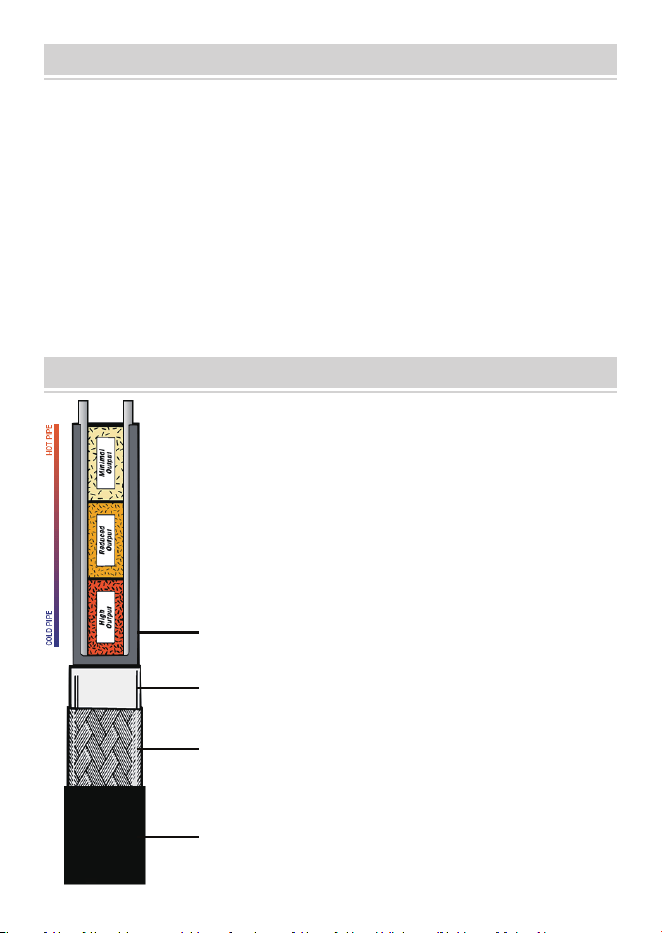
A special self-regulating core is at the center of MLTV Kit.
This core is conductive and adjusts according to the surrounding
temperatures. When it is cold, the cable’s core has many conductive
paths that generate enough heat to keep water owing in the pipe.
Irradiated self-regulating heating core material
TPE inner jacket
As the surrounding temperature goes up, there are fewer conductive
paths and less heat is generated. This self-regulating technology
ensures the right amount of heat is applied, when and where it’s
needed.
02
Copper ground braid
Overjacket
ELECTRIC HEATING CABLE FOR WATER PIPES
Follow these 6 easy steps for a wor-free winter.
1. Collect Application Information
• Determine if your pipe is plastic or metal.
• Measure the diameter of the pipe.
• Measure the length of the pipe.
• Count the valves and spigots.
2. Check Power Supply
• Verify that an electrical outlet is available within 6.5ft of splice location on pipe.
• It is recommended that the circuit supplying the heating cable have ground fault
protection; this is mandato by electrical code for some applications in many
regions. Consult an electrical inspector to determine the specic ground fault
requirements for your application prior to installation. If you are unsure whether
your circuit has ground fault protection or not, consult an electrician.
3. Review Temperature Selection Cha
• Locate the lowest expected temperature
• Selection cha you plan on using.
• Locate the pipe diameter of your plastic or metal pipe in that temperature cha.
4. Select Your Cable Kit
• Refer to the information you collected in Step 1.
• Take the measurement of the length of the pipe.
• Then add one foot (1in) of cable for each valve or spigot you counted.
• Total this information to determine the cable length in feet of MLTV Kit cable
you will need for this project.
• Select the MLTV Kit Pipe Freeze Prevention kit that most closely matches your
cable length in feet per kit selection cha.
5. Additional Items Required
• Pipe/Cable must be covered with 1/2” (0.5in) berglass (or equivalent
non-ammable insulation).
• Use electrical tape to attach the cable to pipe.
6. Thermostat Installation
• The thermostat (the splice of the heating cable) must be placed tightly against
the pipe and secured with good quality electrical tape. The thermostat should be
placed on the coldest end of the pipe and turn the cable on and o to provide
economical operation.
03
PRODUCT INFORMATION
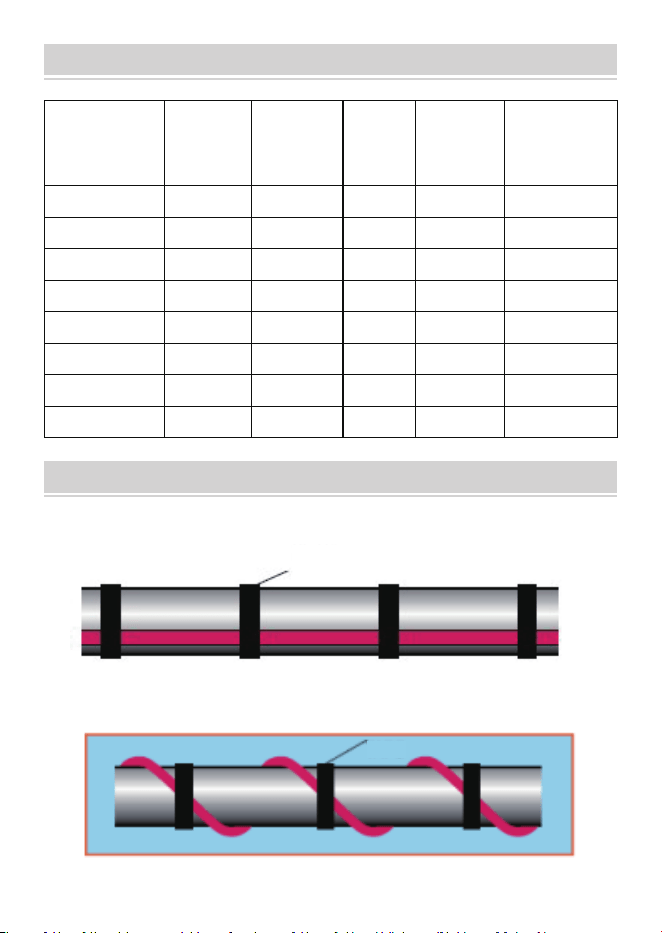
WE MAKE IT EASY TO SELECT YOUR CABLE
Unshaded selections can run straight along the pipe.
Bold shaded selections must be evenly spiraled along pipe.
Catalog
Number
5MLTV1-6
5MLTV1-18
5MLTV1-24
5MLTV1-30
5MLTV1-60
Voltage
(V)
120
120
120
120
Heating
Cable
Length/
ft(±2%)
Watts/
ft 50℉
Power
Cord
Length/
ft(±2%)
Maximum
maintenance
Temperature
℉
6
18
24
30
5
5
5
5
3
3
3
3
150
150
150
150
5MLTV1-80
5MLTV1-100
5MLTV1-120
120
120
120
120
60
80
100
120
5
5
5
5
3
3
3
3
150
150
150
150
04
TAPE
TAPE
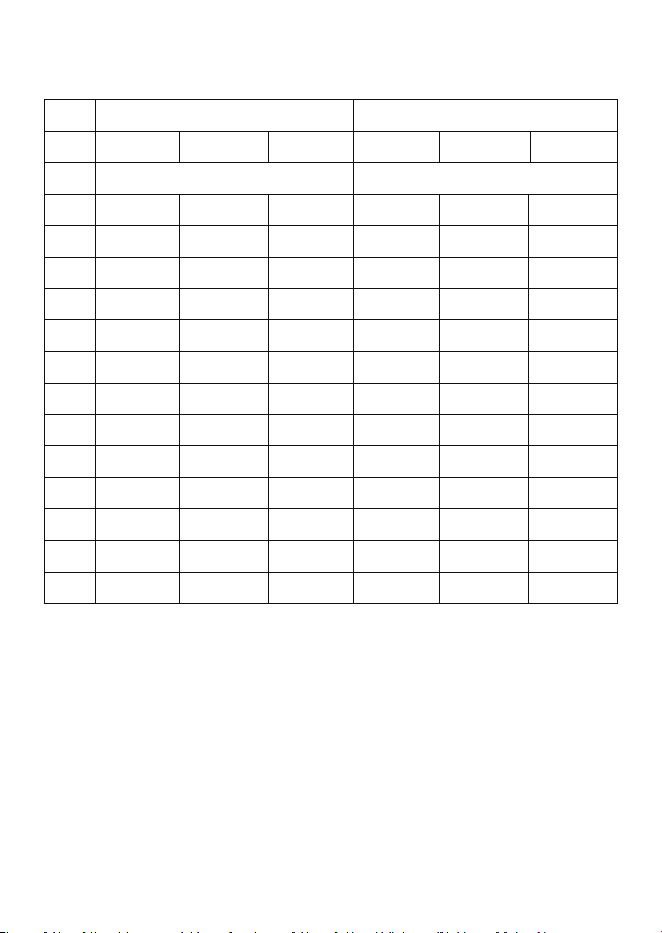
TABLE “A” LOWEST EXPECTED TEMPERATURE: 0 ºF
Metal PipePlastic Pipe
Diameter
Model
1/2" (0.5in) 3/4" (0.75in) 1"(1in) 1/2" (0.5in) 3/4" (0.75in) 1"(1in)
Metal Pipe LengthPlastic Pipe Length
3.0-5.4ft
4.5-8.1ft
8.1-11.4ft
10.2-14.1ft
13.5-17.1ft
16.5-22.8ft
20.7-28.5ft
31.2-44.1ft
39.9-59.1ft
50.1-74.1ft
53.7-79.1ft
66.7-99.2ft
80.1-119.1ft
6ft
9ft
12ft
15ft
18ft
24ft
30ft
45ft
60ft
75ft
80ft
100ft
120ft
3.0-4.8ft
4.5-7.2ft
7.2-9.6ft
9-12ft
11.7-15.3ft
15.3-20.4ft
19.2-25.5ft
28.5-40.5ft
36.9-54.6ft
45.9-68.1ft
50.6-74.5ft
62.9-93.3ft
75.2-112.7ft
2.4-4.2ft
3.6-6.3ft
6.3-8.1ft
8.1-9,9ft
9.9-13.5ft
13.2-18ft
16.5-22.5ft
24-34.2ft
31.2-47.1ft
39-59.1ft
42.9-64.6ft
53.0-80.6ft
63.1-97.9ft
3.0-5.4ft
4.5-8.1ft
8.1-11.4ft
10.2-14.1ft
13.5-17.1ft
16.5-22.8ft
21.3-28.5ft
31.2-44.1ft
39.9-59.1ft
50.1-74.1ft
53.7-79.1ft
66.7-99.2ft
80.1-119.1 ft
3.0-5.4ft
4.5-8.1ft
8.1-11.4ft
10.2-14.1ft
13.5-17.1ft
16.5-22.8ft
21.3-28.5ft
31.2-44.1ft
39.9-59.1ft
50.1-74.1ft
53.7-79.1ft
66.7-99.2ft
80.1-119.1 ft
3.0-5.4ft
4.5-8.1ft
8.1-11.4ft
10.2-14.1ft
13.5-17.1ft
16.5-22.8ft
21.3-28.5ft
31.2-44.1ft
39.9-59.1ft
50.1-74.1ft
53.7-79.1ft
66.7-99.2ft
80.1-110.1ft
05
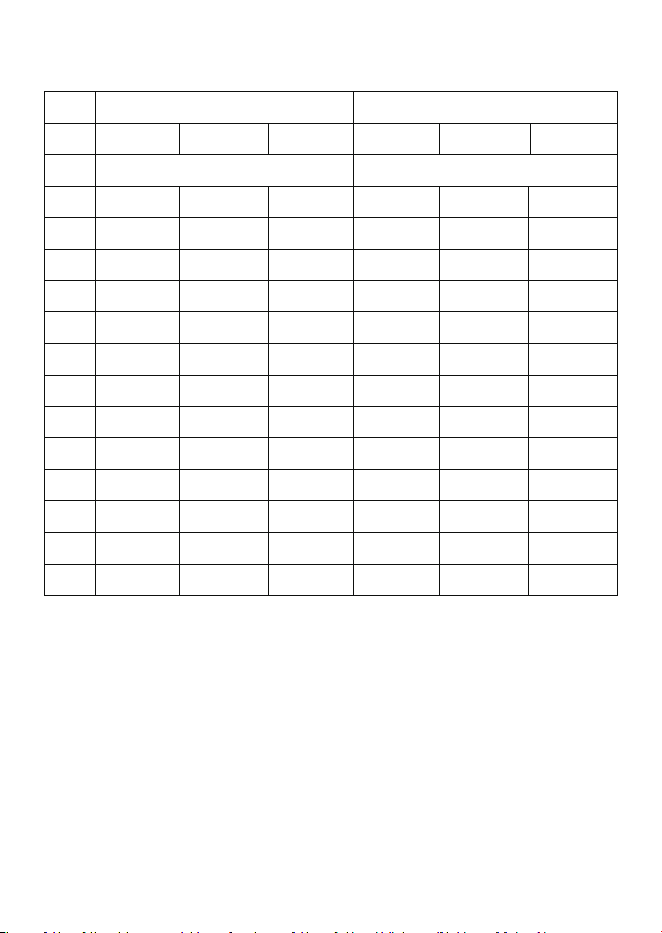
Table “B” Lowest Expected Temperature: -20 ºF
06
This system can be installed with condence that it will operate for years without
requiring seice. All components are made of the highest quality material and are
tested during critical points in the manufacturing process.
The thermostat (the splice of the heating cable) must be placed tightly against the
pipe and secured with good quality electrical tape. The thermostat should be
placed on the coldest end of the pipe and turn the cable on and o to provide
economical operation.
Metal PipePlastic Pipe
Diameter
Model
1/2" (0.5in) 3/4" (0.75in) 1"(1in) 1/2" (0.5in) 3/4" (0.75in) 1"(1in)
Metal Pipe LengthPlastic Pipe Length
2.4-3.6ft
3.6-5.4ft
5.4-7.2ft
7.2-9.0ft
9.0-11.91ft
11.7-15.6ft
15.6-19.8ft
21.9-30.0ft
30.0-40.8ft
40.8-51.3ft
43.5-54.7ft
54.4-68.4ft
64.8-82.1ft
6ft
9ft
12ft
15ft
18ft
24ft
30ft
45ft
60ft
75ft
80ft
100ft
120ft
2.4-3.3ft
3.3-4.5ft
4.5-6.3ft
6.3-8.1ft
8.1-9.9ft
9.9-13.2ft
13.2-17.4ft
19.2-26.4ft
26.4-35.4ft
35.4-44.1ft
37.8-47.0ft
47.1-58.8ft
56.5-70.6ft
2.4-3ft
3-3.6ft
3.6-5.7ft
5.1-7.2ft
7.2-9.0ft
9.0-12.0ft
12.0-15.3ft
16.2-22.8ft
22.8-31.2ft
31.2-39.3ft
33.3-41.9ft
42.1-52.6ft
50.5-63.1ft
3.0-5.4ft
4.5-8.1ft
8.1-11.4ft
10.2-14.1ft
13.5-17.1ft
17.1-22.8ft
22.8-29.4ft
31.8-44.7ft
44.7-59.4ft
59.4-74.4ft
63.4-79.4ft
79.9-99.4ft
95.9-119.3ft
3.0-5.4ft
4.5-7.2ft
7.2-10.5ft
9.3-13.2ft
12.6-16.2ft
16.2-21.6ft
21.6-27.3ft
29.1-41.1ft
41.1-54.6ft
54.6-68.4ft
58.2-73.0ft
72.4-90.7ft
86.9-108.8ft
3.0-5.4ft
3.6-6.3ft
6.3-9.6ft
8.1-12.3ft
11.7-13.5ft
13.5-18ft
18.0-22.8ft
24.6-34.5ft
34.5-46.5ft
46.5-58.5ft
49.6-62.4ft
62.2-77.8ft
74.6-93.4ft
• MLTV heating cables may be used on metal and plastic water pipes but not on
exible vinyl tubing (such as garden hoses).
• MLTV heating cables are not intended to use inside any pipes, or for freeze
protection of liquids other than water, or for use in classied hazardous locations.
• Install with a minimum of 1/2” re-resistant, waterproof thermal insulation.
• Never use on any pipes that may exceed 150°F.
• Do not use an extension cord.
General requirements for pipe freeze protection:
• Install only in accessible locations; do not install behind walls or where the cable
would be hidden.
• Do not run the heating cable through walls, ceilings, or oors.
• Connect only to ground-fault protected outlets that have been installed in
accordance with all prevailing national and local codes and standards and are
protected from rain and other water.
General instructions:
Aicles 422 and 427 of the National Electrical Code (NEC), and Pa 1, Section 62
of the Canadian Electrical Code (CEC), govern the installation of MLTV heating
cable for pipe freeze protection and must be followed.
Impoant: For the VEVOR warranty to be valid, you must comply with all the
requirements outlined in these guidelines.
All thermal and design information provided here is based upon a “standard”
installation with heating cable fastened to an insulated pipe. For any other
application or method of installation, please consult with VEVOR.
Electrical codes
07
Impoant: All thermal and design information provided here is based upon a
“standard installation”: heating cable fastened to a pipe and thermally insulated.
For any other method of installation or application, please consult with VEVOR.
Add 1 foot to your pipe length for each valve or spigot on your pipe system.
Warning Fire and Shock Hazard. This product is an electrical device that must be
installed correctly to ensure proper operation and to prevent shock or re. Read
the following impoant warnings and carefully follow all the installation instructions.
• When used with non-metallic conduit/pipe, the softening temperature of the
non-metallic conduit/pipe shall be above 185℉.
• To minimize the danger of re from sustained electrical arcing if the heating cable
is damaged or improperly installed, and to comply with the requirements of
VEVOR agency ceications, and national electrical codes, ground fault
equipment protection must be used on each heating cable branch circuit.
Arcing may not be stopped by conventional circuit protection.
• For pipe freeze protection applications, use only re-resistant insulation
materials such as preformed foam or berglass.
• Do not damage the heating cable and power cord or plug. Remove any damaged
cables from seice immediately.
• Do not use any wire or metal clamps to attach the cable to the pipe. Use tape
(1/2 inch wide to 1 inch wide) or plastic cable ties.
• Do not install the heating cable underneath any roof covering for roof and
gutter de-icing.
• Leave these installation instructions with the user for future reference.
Determine which MLTV heating cable you need for
pipe freeze protection:
Lowest outside temperature is 0°F, need a minimum of 1/2” thick water
08
1. Prepare for installation.
• Store the heating cable in a clean, d place.
• Complete piping pressure test.
• Prior to installing the cable, remove any sharp suaces on the pipe that might
damage the heating cable.
Heating cable installation
09
2. Position and attach heating cable to pipe.
• Be sure all piping to be traced is d.
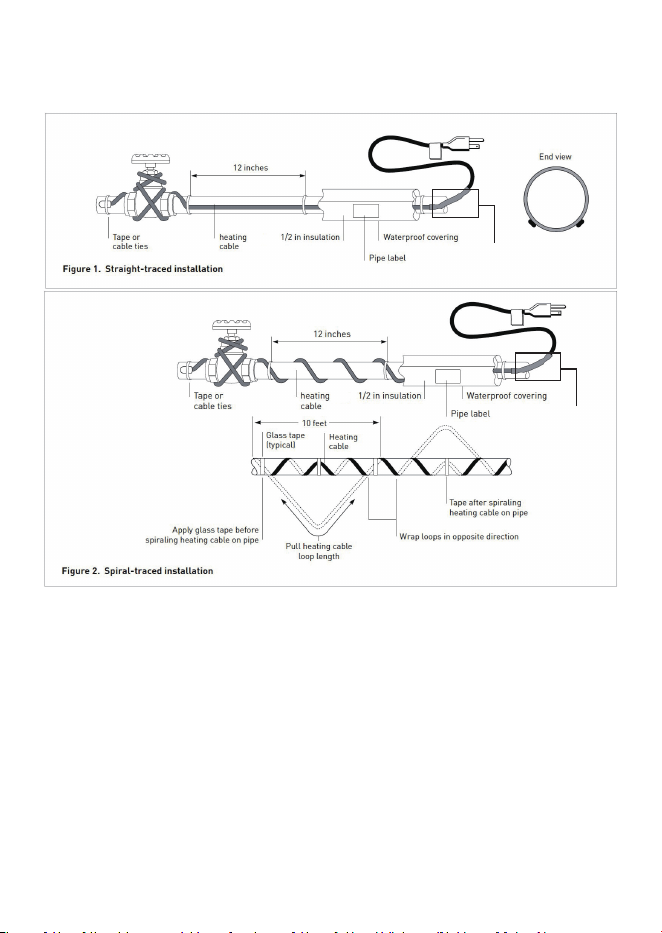
• Install heating cable, using straight tracing Figure 1, or spiraling Figure 2.
• For straight tracing, install the heating cable on a lower half of the pipe;
for example, in the 4 o’clock or 8 o’clock position.
• Be sure to install the additional heating cable required for valves, anges, etc.
as shown in Figures 1 and 2.
• When the design calls for spiraling, begin by suspending a loop eve 10 feet as
shown in Figure 2. To determine the loop length, divide the MLTV length by your
pipe length and multiply by 10. For example, if you are using a 50 ft MLTV on a
40-foot pipe, leave a 12-foot loop of heating cable at eve 10-foot section of
pipe. Grasp the loop in its center and wrap it around the pipe. Even out the
distance between spirals by sliding the wraps along the pipe. Use glass tape to
• Review the MLTV heating cable design and compare to materials received to
verify that you have the proper MLTV heating cable.
• Walk the system and plan the routing of the MLTV heating cable on the pipe.
Thermostat installation
See details in No.6
Thermostat installation
See details in No.6
10
3. Check the installation.
• Prior to installing thermal insulation, make sure the heating cable is free of
mechanical damage (from cuts, clamps, etc.) and thermal damage (from solder,
overheating, etc.).
4. Install thermal insulation.
• A reliable MLTV system depends on properly installed and d, weatherproofed
thermal insulation.
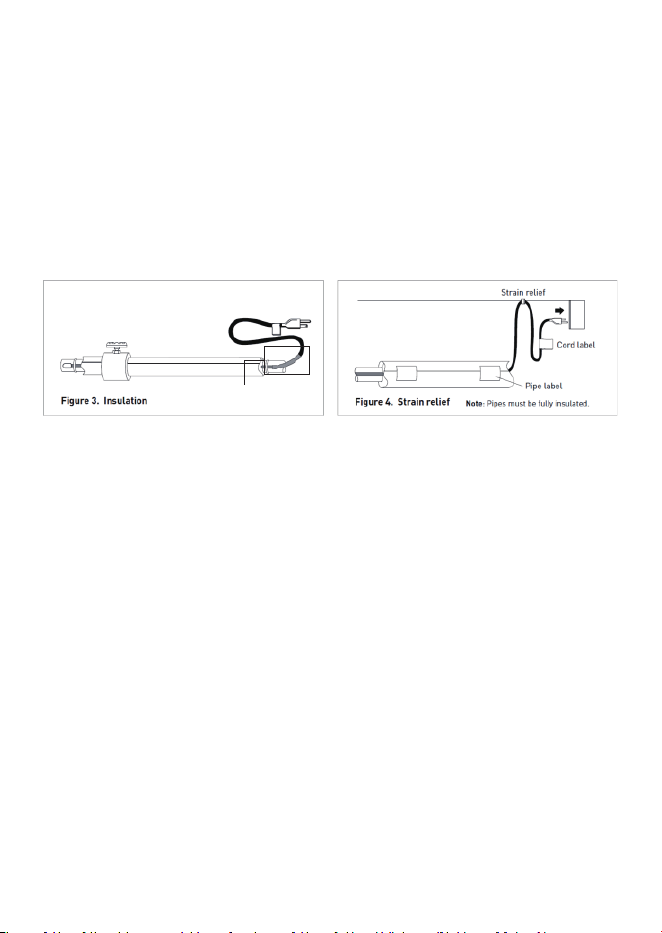
• Ensure that at least 1/2” of preformed foam or equivalent thermal insulation is
used and that all piping, including valves, joints, and wall penetrations, has been
fully insulated as shown in Figure 3.
• For protection to -20°F, use 1” thick insulation.
• Install the insulation on the piping as soon as possible to minimize the potential
for mechanical damage after installation.
• Be sure the MLTV label is visible on the outside of the thermal insulation.
5. Finishing the installation.
• To prevent damage to the heating cable or cord, secure the power cord (cold
lead) with a plastic cable tie, glass cloth tape, or duct tape as shown in Figure 4.
• Two labels indicating the presence of electric pipe heating cable are included
with the heating cable. Attach the two “Electric Traced” labels on the outer
suace of the pipe insulation at suitable inteals to indicate the presence of
MLTV electric heating cable.
secure the center of the loop to the pipe.
• Fasten MLTV heating cable to the pipe at 1-foot inteals using berglass
application tape or nylon cable ties. Do not use vinyl electrical tape, duct tape,
metal bands, or wire.
• If excess cable remains at the end of the pipe, double it back along the pipe.
Thermostat installation
See details in No.6
11
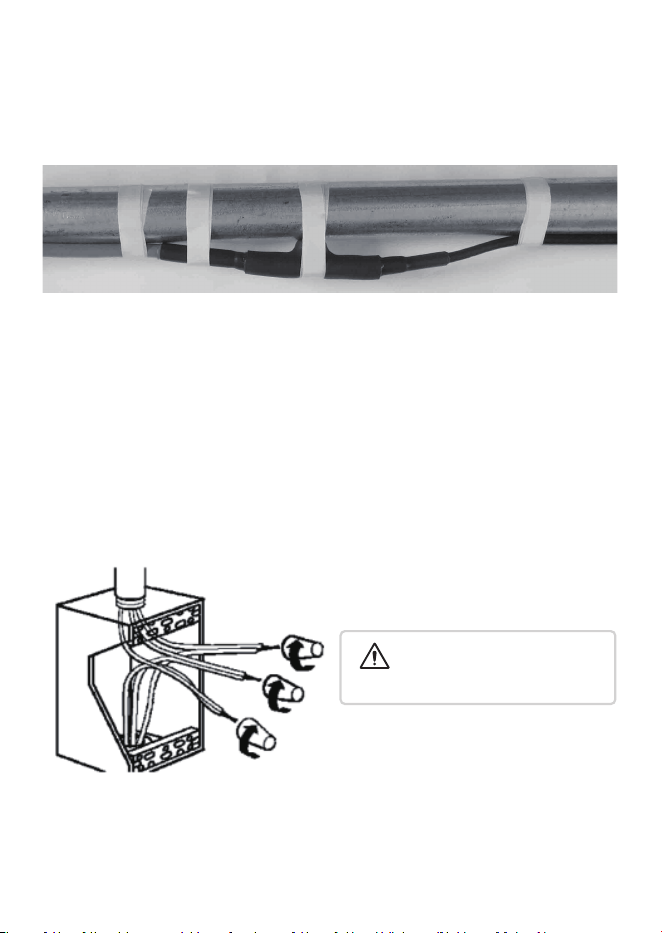
6. Thermostat installation
The thermostat (the splice of the heating cable) must be placed tightly against the
pipe and secured with good-quality electrical tape. The thermostat should be
placed on the coldest end of the pipe and turn the cable on and o to provide
economical operation.
7. Staing the system.
• VEVOR recommends that the system be tested per the “Cable testing and
maintenance” section below.
• Plug the heating cable into a ground-fault protected outlet.
• Check the circuit breaker to verify power to the cable.
• Standing water in the pipe should feel warm within an hour.
• For MLTV with power cord but without plug, using CE ceied or UL Listed
Type 4X junction box and outlet bushing and wire nuts (suitable for 12 to
18AWG wire size), connect the black and white cold leads to both phase wires
and the green cold lead to ground.
• Check the circuit breaker to verify power to the cable.
Pipe
WARNING:
De-energize circuit before seicing.
Thermostat
12
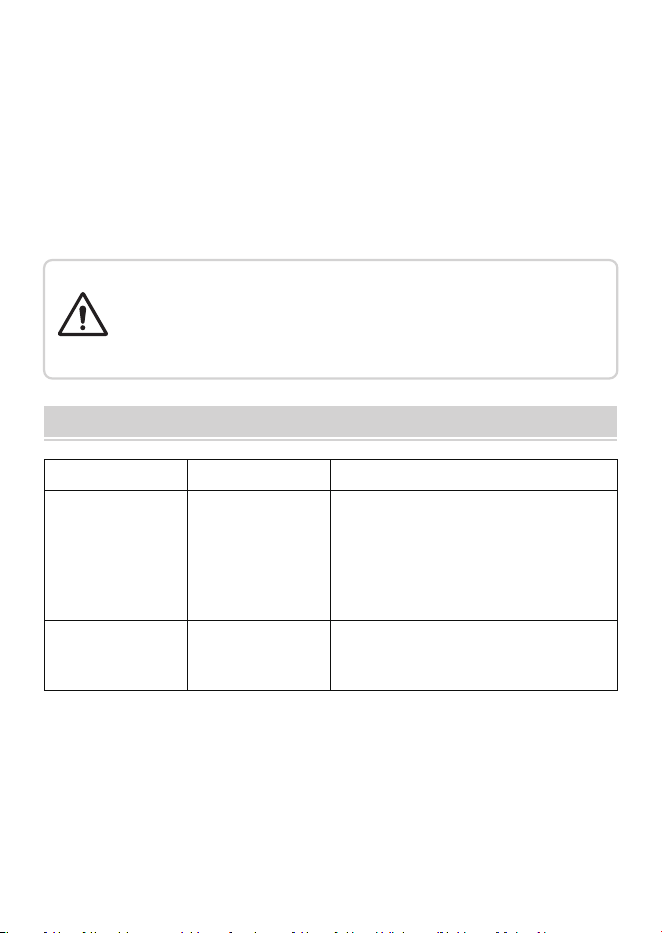
Heating cable
doesn’t work
• No voltage.
• Circuit breaker
tripped
Pipe or roof
freezed
Power on heating
cable too late
Power on heating cable before temp
down to 32℉ and keep it work in low
temp.
• Check circuit breaker.
• Ensure not too many cables or other
appliances are connected on the
same circuit.
• Change a right size of circuit breaker
for the heating cable.
Symptom Probable Causes
Corrective Action
Using a 500-Vdc megohmmeter, check the insulation resistance between both of
the rectangular (power, or black and white wire) prongs on the plug and the
round (ground, or green wire) prong after installing the heating cable. The
minimum reading should be 50 megohms.
Record the original values for each circuit, and compare subsequent readings
taken during regular maintenance schedules to the original values.
If the readings fall below 50 megohms, replace the MLTV cable with a new unit.
Do not attempt to repair the unit.
Cable testing and maintenance
TROUBLESHOOTING
WARNING:
Fire and Shock Hazard.
Damaged heating cable can cause electrical shock, arcing, and re.
Do not attempt to repair or energize damaged heating cable.
Remove it at once and replace with a new length.
Manufacturer: Wuhu Xuhui Electric New Material Co., Ltd
Add: No.3 Eqiao Road, Sanshan Economic Developing Zone,
Wuhu City, Anhui Province, China 241080
Made in China


E-mail: CustomerSeice@vevor.com