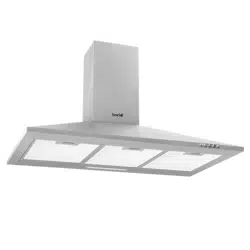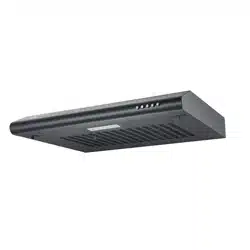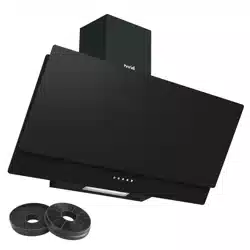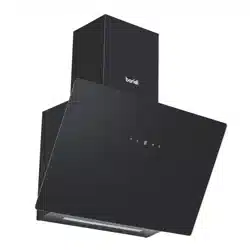
Model No. DH107, DH108
Thank you for purchasing a Dellonda product. Manufactured to a high standard, this product will,
if used according to these instructions, and properly maintained, give you years of trouble free performance.
DH107, DH108 Issue:3 24/10/24
www.dellonda.co.uk
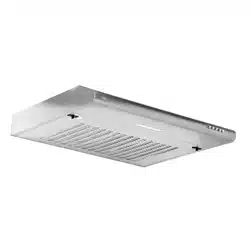
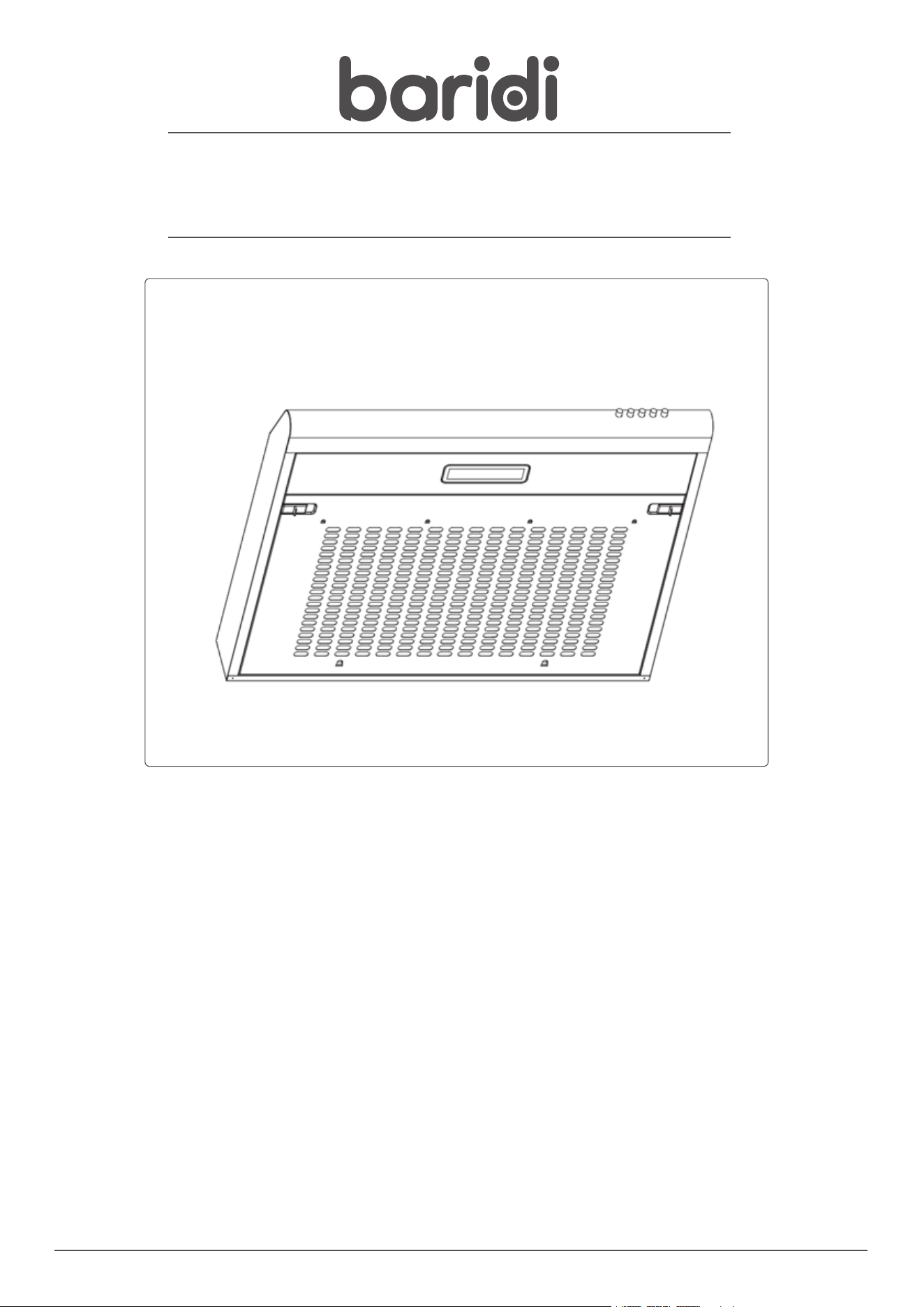
Baridi Visor Cooker Hood Extractor Fan
60cm - DH107 Black / DH108 Stainless
Steel
Important Information
Please read these instructions carefully. Note the safe operational requirements, warnings & cautions. Use the product correctly and with care
for the purpose for which it is intended. Failure to do so may cause damage and/or personal injury and will invalidate the warranty. Keep these
instructions safe for future use.
Refer to
instruction
manual
Warning:
Hot
Surface
Specication
Safety Instructions
• ELECTRICAL SAFETY
• WARNING! It is the user’s responsibility to check the following:
• Check all electrical equipment and appliances to ensure that they are safe before using. Inspect power supply leads, plugs and all electrical
connections for wear and damage recommend that an RCD (Residual Current Device) is used with all electrical products. You may obtain an RCD
by contacting your local domestic stockist. If the product is used in the course of business duties, it must be maintained in a safe condition
and routinely PAT (Portable Appliance Test) tested.
• Electrical safety information: It is important that the following information is read and understood.
• Ensure that the insulation on all cables and on the appliance is safe before connecting it to the power supply.
• Regularly inspect power supply cables and plugs for wear or damage and check all connections to ensure that they are secure.
• Important: Ensure that the voltage rating on the appliance suits the power supply to be used and it is tted with the correct fuse.
• DO NOT pull or carry the appliance by the power cable.
• DO NOT use worn or damaged cables, plugs or connectors.
• Ensure that any faulty item is repaired or replaced immediately by a qualied electrician.
• It is recommend that installation and repairs are carried out by a qualied electrician.
• It is advised that the rated residual operating current does not exceed 30mA.
• GENERAL SAFETY
• This manual explains the proper installation and use of your cooker hood, please read it carefully before using even if you are familiar with the
product. The manual should be kept in a safe place for future reference.
• DO NOT try to use the cooker hood without the grease lters or if the lters are excessively greasy!
• DO NOT install above a cooker with a high level grill.
• DO NOT leave frying pans unattended during use because overheated fats or oils might catch re.
• Never leave naked ames under the cooker hood.
• If the cooker hood is damaged, do not attempt to use it.
• DO NOT ambé under the cooker hood.
• CAUTION: Accessible parts may become hot when used with cooking appliances.
• The minimum distance between the supporting surface for the cooking vessels on the hob and the lowest part of the cooker hood. (When the
cooker hood is located above a gas appliance), this distance shall be at least 65 cm.
• The air must not be discharged into a ue that is used for exhausting fumes from appliances burning gas or other fuels.
• ALWAYS:
• Important! Always switch off the electricity supply at the mains during installation and maintenance such as light bulb replacement.
• The cooker hood must be installed in accordance with the installation instructions and all measurements followed.
• All installation work must be carried out by a competent person or qualied electrician.
• Please dispose of the packing material carefully. Children are vulnerable to it.
• Pay attention to the sharp edges inside the cooker hood especially during installation and cleaning.
• Make sure the ducting has no bends sharper than 90 degrees as this will reduce the efciency of the cooker hood.
• WARNING: Failure to install the screws or xing device in accordance with these instructions may result in electrical hazards.
• WARNING: Before obtaining access to terminals, all supply circuits must be disconnected.
• Always put lids on pots and pans when cooking on a gas cooker.
• When in extraction mode, air in the room is being removed by the cooker hood. Please make sure that proper ventilation measures are being
observed.
• There shall be adequate ventilation of the room when the range hood is used at the same time as appliances burning gas or other fuels.
• The cooker hood removes odours from room but not steam.
• Cooker hood is for domestic use only.
Airow: 220m³/h
Cable Length: 1.5m
Colour: DH107 Black, DH108 Stainless
Control: 3-Speed Push Button
Design: Visor
Electrical Class: Class II
Energy Efciency Class: C
Headroom: 60cm
Lamp Power: 2W
Nett Weight: 5kg
Power: 85W
Product Dimensions: 600 x 492 x 80mm
Supply: 220V~240V 50Hz
Type: Wall Mounted
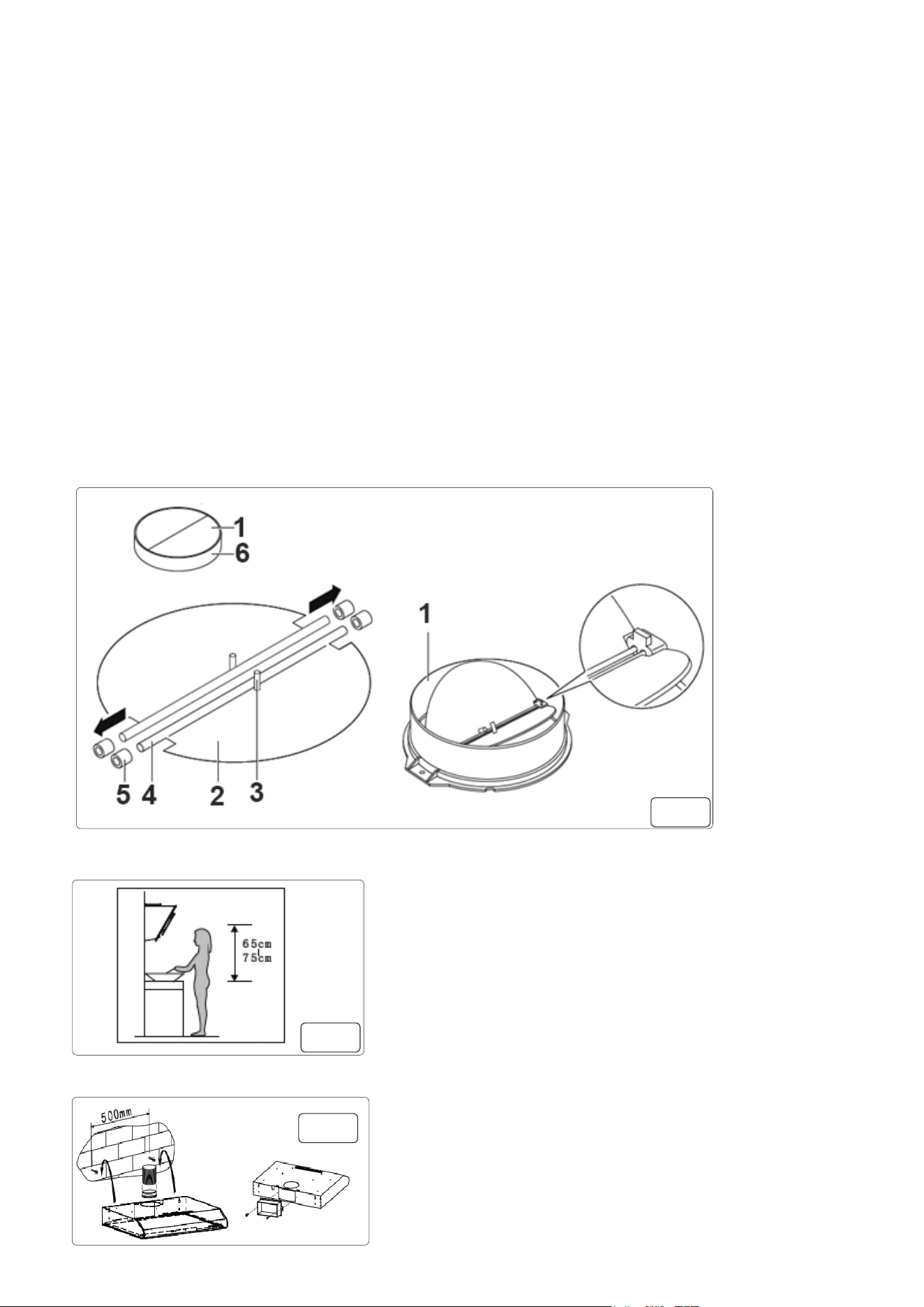
fig.
3
fig.
2
fig.
1
• If the supply cord is damaged, it must be replaced by the manufacturer, its service agent or similarly qualied persons in order to avoid a hazard.
• This appliance can be used by children aged from 8 years and above and persons with reduced physical, sensory or mental capabilities or lack of
experience and knowledge if they have been given supervision or instruction concerning use of the appliance in a safe way and understand the
hazards involved. Children shall not play with the appliance. Cleaning and user maintenance shall not be made by children without supervision.
• WARNING: Before obtaining access to terminals, all supply circuits must be disconnected.
• CAUTION: The appliance and its accessible parts can become hot during operation. Be careful to avoid touching the heating elements. Children
younger than 8 years old should stay away unless they are under permanent supervision.
• There is a re risk if cleaning is not carried out in accordance with the instructions
• Regulations concerning the discharge of air have to be fullled.
• Clean your appliance periodically by following the method given in the chapter MAINTENANCE.
• For safety reason, please use only the same size of xing or mounting screw which are recommended in this instruction manual.
• Regarding the details about the method and frequency of cleaning, please refer to maintenance and cleaning section in the instruction manual.
• Cleaning and user maintenance shall not be made by children without supervision.
• When the cooker hood and appliances supplied with energy other than electricity are simultaneously in operation, the negative pressure in the
room must not exceed 4 Pa (4 x 10⁻⁵ bar).
• WARNING: Danger of re: do not store items on the cooking surfaces.
• A steam cleaner is not to be used.
• NEVER try to extinguish a re with water, but switch off the appliance and then cover ame e.g. with a lid or a re blanket.
• INSTALLATION (VENT OUTSIDE)
• V-FLAP MOUNTING
• If the cooker hood does not have an assembled V-flap 1, you should mount the half-parts to its body. The images only show an example of how to
mount the V-flap, the outlet may be various according to different models and configuration.
• To mount the V-flap 1:
• Mount two half-parts 2 into the body 6
• Pin 3 should be located on the top
• The axle 4 should be inserted in the holes 5 on body
• Repeat all the operations for the 2nd half-part
INSTALLATION
• Before installation, turn the unit off and unplug it from the mains supply.
• The cooker hood should be placed at a distance of 65~75cm above the cooking surface for best performance, g.2.
• Decide the location of the holes for xing the cooker hood. To install onto the wall, drill 2 holes of Ø 8mm on a horizontal plane. See g.3
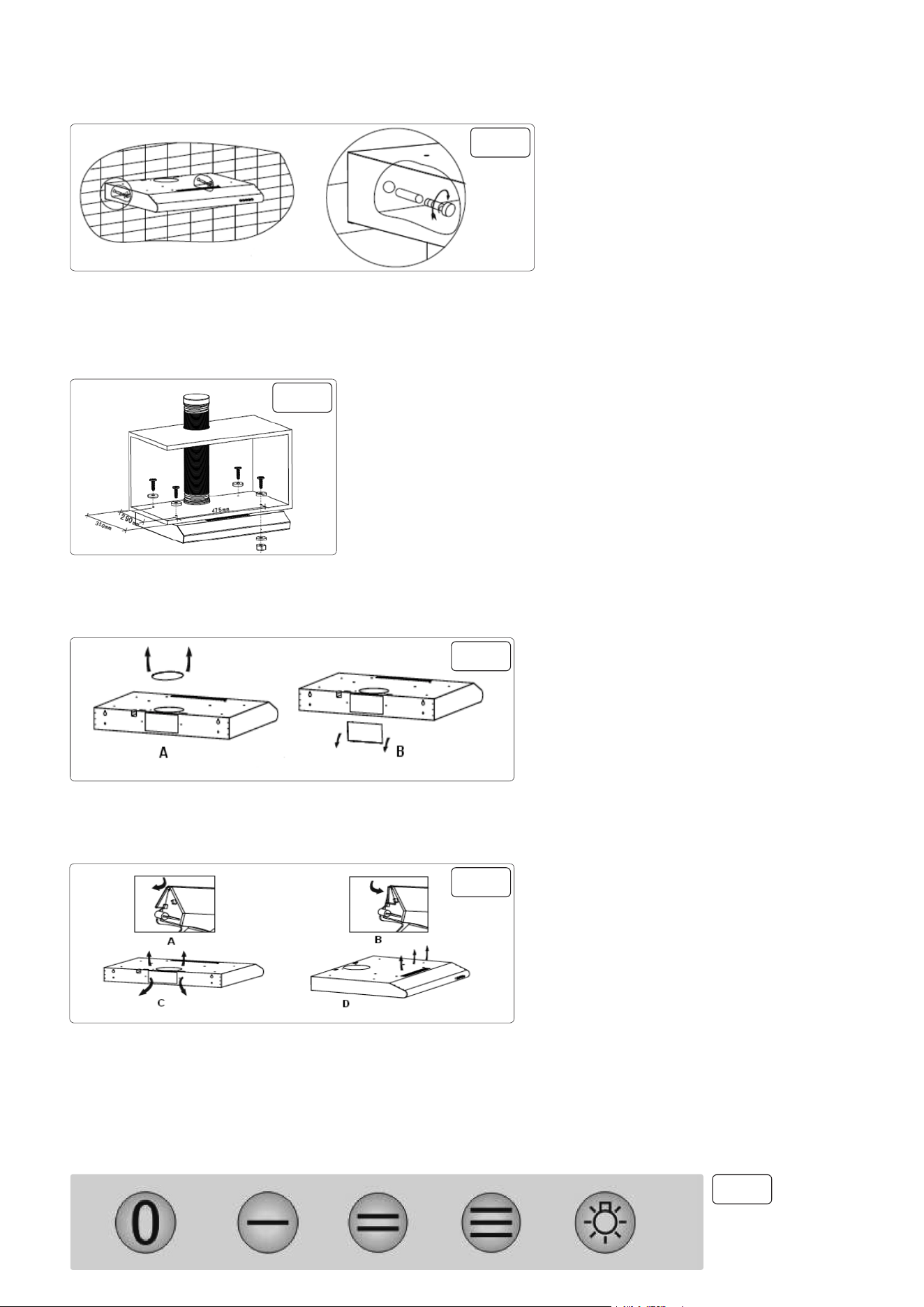
fig.
4
fig.
5
fig.
6
fig.
7
fig.
8
• Insert the plug into the holes.
• Insert the screws into the plugs and tight.
• Put up the cooker hood onto the xed screws.
• Then place the supplied screws into the two holes of inside the hood, then tighten screws to the hood onto the wall.
• Attach the outlet onto the cooker hood. Lay the expansion pipe on the outlet. Lift up the expansion pipe till it out of the wall through the hole
on the wall.
• INSTALLATION (Cabinet Mounting)
• Drill 4 holes of Ø6mm at the bottom of the hanging cupboard. See g.5.
• Put the outlet on the cooker hood, then install the cooker hood on the bottom of the cupboard, tighten the cooker hood with enclosed M4
screws and at washers.
• Lay the expansion pipe on the outlet. Lift up the expansion pipe till it out of the wall through the hole on the wall.
NOTE: There are 2 methods for ventilation, including ‘ horizontal ventilation’ and ‘ vertical ventilation’. Please pay attention to the ventilation
method when installation.
• Vertical ventilation: See g.6A, please use the cover to seal the outlet on the back, then the air can be vented from top.
• Horizontal ventilation: See g.6B, please use the cover to seal the outlet on the top, then the air can be vented from back.
• AIR VENTILATION SETTING
• Outdoor air ventilation: Turn the adjuster to outdoor position(g.6A), install the outlet, turn on the cooker hood, then the air will be vented from the
outside outlet.
• Indoor air ventilation: Turn the adjuster to indoor position (g.6B), install the outlet cover, turn on the cooker hood, then the air can be vented
from the inside outlet.
• WARNING For safety reasons, please use only the same size of xing or mounting screws which are recommended in this instruction manual.
• Failure to install the screws or xing device in accordance with these instructions may result in electrical hazards.
OPERATION
• PUSH BUTTONS (g.8)
• Push the stop button, and the motor will stop.
• Push the low button, and the motor will run at low speed.
• Push the middle button, and the motor will run at mid speed.
• Push the high button, and the motor will run at high speed.
• Push the light button and the two lights will illuminate. Push it again and the light will turn off.
Stop Low Middle High
Light
fig.
9
TROUBLESHOOTING
Any electrical repairs to this appliance must carried out by a certied electrician or a Sealey stockist. Please contact the service centre if in any
doubt before undertaking any of the above. Always disconnect the unit from the mains supply when opening the unit.
MAINTENANCE AND CLEANING
• WARNING• Before maintenance or cleaning is carried out, the cooker hood should be disconnected from the mains power supply. Ensure that the
cooker hood is switched off at the wall socket and the plug removed.
• External surfaces are susceptible to scratches and abrasions, so please follow the cleaning instructions to ensure the best possible result is
achieved without damage.
• GENERAL
• Cleaning and maintenance should be carried out with the appliance cold especially cleaning. Avoid leaving alkaline or acid substances (lemon
juice, vinegar etc.) on the surfaces.
• STAINLESS STEEL
• The stainless steel must be cleaned regularly (e.g. weekly) to ensure long life expectancy. Dry with a clean soft cloth. A specialized stainless steel
cleaning uid may be used.
• NOTE: Ensure that wiping is done along with the grain of the stainless steel to prevent any unsightly criss-cross scratching patterns from
appearing.
• CONTROL PANEL SURFACE
• The control panel can be cleaned using warm soapy water. Ensure the cloth is clean and well wrung before cleaning. Use a dry soft cloth to
remove any excess moisture left after cleaning.
• IMPORTANT
• Use neutral detergents and avoid using harsh cleaning chemicals, strong household detergents or products containing abrasives, as this will
affect the appliance appearance and potentially remove any printing of artwork on the control panel and will void manufacturer’s warranty.
• GREASE MESH FILTERS
• The mesh lters can be cleaned by hand. Soak them for about 3 minutes in water with a grease-loosening detergent then brush it gently with a
soft brush. Do not apply too much pressure, to avoid damage . (Leave to dry naturally out of direct sun light).
• Filters should be washed separately to crockery and kitchen utensils. It is advisable not to use rinse aid.
• REPLACING GREASE MESH FILTERS (g.9, g.10)
• REMOVE GREASE MESH FILTERS
• Push the grease mesh lter catches forward and remove the front of the lter housing.
• Then push the left or right lower side stops of the lter up until the hanging point at one side stop is not hanging in the hood cavity.
• Finally, take the whole mesh lters away.
• Please DO NOT use abrasive detergent for it will damage the hood.
• INSTALLING GREASE MESH FILTERS
• To install lters for the following four steps .
• Angle the lter into slots at the back of the hood.
• Push the button on handle of the lter.
• Release the handle once the lter ts into a resting position.
• Repeat to install all lters.
• CARBON FILTER
• Activated carbon lter can be used to trap odours. Normally the
activated carbon lter should be changed at three or six months
according to your cooking habit. The installation procedure
of carbon lter is as below.
• 1. Remove the grease lter.
• 2. Place the carbon lter onto the grease lter.
• 3. Fix the carbon lter with the small piece of steel wire.
• 4. Reinstall the grease lter.
• 5. Use carbon lters for recirculation mode only
•
Fault Cause Solution
Light on but motor does not work Fan switch turned o Select a fan switch position
Fan switch failed Contact service centre
Motor failed Contact service centre
Light does not work, motor does not work House fuses blown Reset/replace fuses
Mains cable loose or disconnected Ret mains power cable to power outlet.
Switch power on.
Oil leakage One way valve and the outlet are not
tightly sealed
Remove one way valve and seal with
sealant
Leakage from the connection of chimney
and cover
Take chimney down and seal
Lights not working Broken or faulty bulbs Replace bulbs as per instructions in this
manual
Insucient suction Distance between the cooker hood and
the gas hob is too great
Ret the cooker hood to the correct
distance
Cooker hood inclines Fixing screws are not tight enough Tighten the hanging screw and make
horizontal
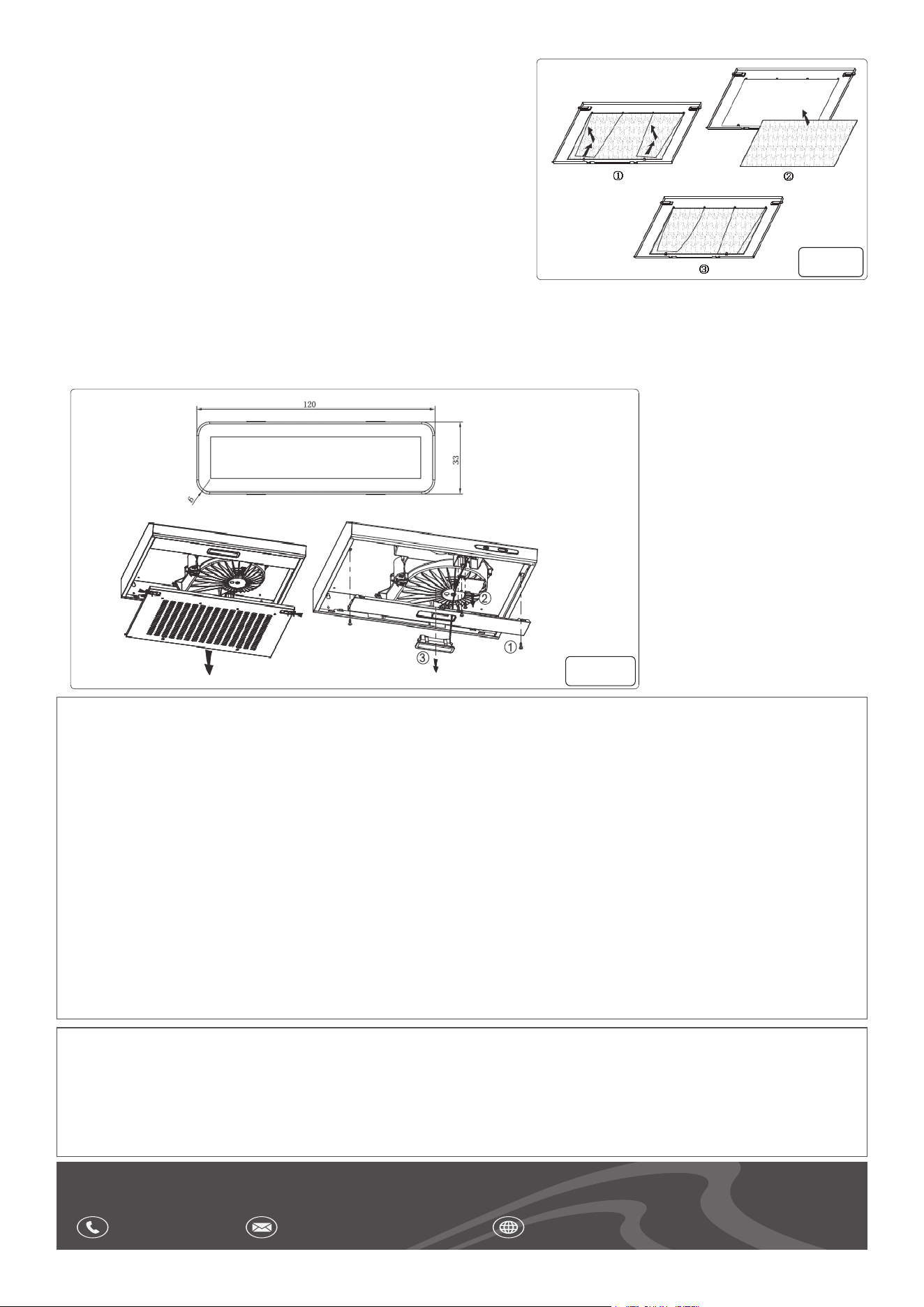
fig.
10
• NOTE: Make sure the lter is securely locked.
• Otherwise, it could loosen and be dangerous.
• When the activated carbon lter is tted, the suction power will be lowered.
• BULB REPLACEMENT
• The bulb must be replaced by the manufacturer, its service agent or similarly
qualied persons.
• WARNING! Always switch off the mains electricity supply before carrying out any
operations on the appliance. When handling bulb, make sure it has completely
cooled.
• When handling bulbs hold with a cloth or gloves to ensure perspiration does not
come in contact with the bulb as this can reduce the life of the bulb.
• Remove the lter.
• Loosen the 2pcs ST4*8mm self-tapping screw from the lighting panel, take out the
lighting xture.
• Disassembly the 3pcs ST3*12mm screws on the terminal box cover and take down the wire cover.
• Pull out the terminal from the PCB terminal block, disconnect the wire connector and replace the lamp.
• ILCOS D code for this lamp is: DBS-2/65-H-120/33.
• LED modules –rectangle LED lamp.
• Max wattage: 1×2 W
• Voltage range: AC 110-240V
• DIMENSIONS
fig.
13
Dellonda Limited
Kempson Way, Suffolk Business Park, Bury St Edmunds, Suffolk. IP32 7AR
01284 757575 [email protected] www.dellonda.co.uk
Environment Protection and Waste Protection and Electrical Equipment Regulations (WEEE)
Recycle unwanted packaging materials. When this product is no longer required, or has reached the end of it’s useful life, please dispose of it in
an environmentally friendly way. Drain any fluids (if applicable) into approved containers, in accordance with local waste regulations. Under the
Waste Batteries and Accumulators Regulations 2009, Dellonda would like to inform the user that this product contains one or more batteries. It
is our policy to continually improve products and we reserve the right to alter data, specifications and parts without prior notice. No liability is
accepted for incorrect use of this product. Guarantee is 12 months from purchase date, proof of which is required for any claim.
ENVIRONMENTAL IMPACT OF THE COOKING PROCESS
When whole life cycles of food products are taken into account, food is estimated to emit up to 37% of global GHG
emissions. Most studies estimate the climate change impact of food only up to the retail/purchase stages of the
food supply chain, thus excluding consumption (here dened as food preparation and cooking). However, the
preparation of meat and vegetables can contribute up to 20% and 36% of total product emissions, respectively,
when recipe recommendations of major cooking methods are followed. Cooking food from scratch at home
can result in lower overall GHG emissions than consuming ready-made meals. Previous studies have indicated
that GHG emissions from home cooking can be reduced by minimizing cooking times and appliance use. Such
a reduction can reach 86% in the case of pasta, and the equivalent of 18–55% less energy use in the case of
roast beef and Yorkshire puddings. However, little is known about actual cooking practices for different foods in
households. Previously recorded cooking practices adopted by university students could indicate how to reduce
GHG emissions due to unsustainable cooking, but are not representative of general consumption patterns across
the population.