
ESSENTIALS FOR LIFE
User
Manual
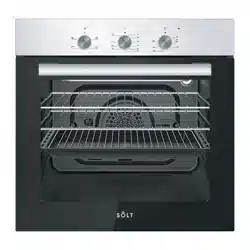
MODEL: SBISO60X
V 1.0 | 1124
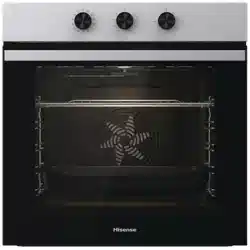
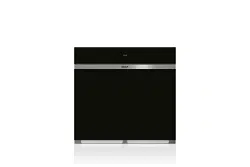
Built in Single Fan Oven
with Minute Minder
Stainless Steel
Welcome Congratulations on purchasing
your new oven!
The Sôlt brand is now also proudly
distributed within the UK.
Please refer to the warranty card at the rear of this manual
for information regarding your product’s parts and labour
warranty, or visit us online at
wwwwww..solt.house
At Sôlt Brand, we are customer obsessed and our Support
Team are there to ensure you get the most out of your
appliance. Should you want to learn more about your
cooker's features, and importantly taking care of your
appliance when cleaning, our Support Team are here to
help.
You can use our online job booking service anytime, by
visiting www.appliancesupport.co.uk/solt or by emailing
It is important that you read through the following use and
care manual thoroughly to familiarise yourself with the
installation and operation requirements of your appliance to
ensure optimum performance.
Again, thank you for choosing an Sôlt appliance and we look
forward to being of service to you.
Kind Regards,
The Solt Team
Sôlt
—
Online Job Booking.
www.appliancesupport.co.uk/solt
_
Instagram.
/solt.house
—
Facebook.
/solt.appliances
3
Table Of Contents
Important warnings 4
Power connection 11
Intended use 12
Appliance introduction 13
Accessories 14
Technical features 17
Cooling fan 18
Setting up the appliance 18
Control panel 25
Operation of the oven 27
Cooking functions and features 33
Cooking recommendations and warnings 34
Cooking charts 36
Maintenance and cleaning 48
Oven lamp replacement 53
Troubleshooting 55
Handling rules 57
Recommendations for energy saving 58
Compliance with WEEE regulations and disposal of waste 59
Packing information 59

4
IMPORTANT WARNINGS
1. Please read these operating instructions carefully.
Only by this way you can use the appliance safely and
in a correct manner.
2. Installation and repair should always be performed
by “AUTHORIZED SERVICE”. Manufacturer shall not
be held responsible for operations performed by unau-
thorised persons.
3. The conguration conditions of this appliance are
specied on the type label or on the data plate.
4. This appliance has been designed for household use
only.
5. WARNING: Fire hazard; do not store the materi-
als on the cooking surface.
6. WARNING: The appliance and its accessible
parts are hot during operation.
7. WARNING: The accessible parts may be hot
when the grill is used. Small children should be kept
away.
8. WARNING: This appliance is intended for cook-
ing. It should not be used for other purposes like
heating a room.

5
9. WARNING: Burning hazard due to superheated
steam! A child’s skin is more sensitive to high tem-
perature than an adult’s. Children should not open
the oven’s door while the oven is operating. Keep the
children away from the appliance until it is cooled
down completely and burning hazard is avoided.
10. WARNING: Never try to put out the re with
water. Only shut down the device circuit and then
cover the ame with a cover or a re blanket.
11. ATTENTION: Cooking process shall be super-
vised. Cooking process shall always be supervised.
12. ATTENTION: If the glass of the appliance is
broken, turn o any heating element immediately
and disconnect the appliance from power source, do
not use the appliance.
13. BURN RISK: As you open the oven door, step back
to avoid the hot vapour coming out from the interior.
14. BURN RISK: Hot surface should be le for cool-
ing down before closing the cover.
15. The appliance is not suitable for use with an exter-
nal timer or a separate remote control system.
16. To prevent overheating, the appliance should not
be installed behind a decorative cover.

6
17. This device can be used by children, who are 8
years old and above, and people with physical, hearing
or mental challenges or people with lack of experience
or knowledge; as long as a supervision is ensured or the
appliance is used safely and information is provided for
understanding the hazards involved.
18. Keep children below the age of 8 and pets away
when operating.
19. Children under 8 years of age should be kept away,
if they cannot be monitored continuously.
20. Children must not play with the appliance. Cleaning
or user maintenance of the appliance shall not be per-
formed by children unless they are older than 8 years
and supervised by adults.
21. Keep the appliance and its power cord away from
children less than 8 years old.
22. The packaging materials are dangerous for chil-
dren. Keep packaging materials away from the reach of
children.
23. Do not place objects that are accessible to children
on the appliance.
24. Touching the heating elements should be avoided.

7
25. Put curtains, tulles, paper or any ammable (ignit-
able) material away from the appliance before starting
to use the appliance. Do not put ignitable or ammable
materials on or in the appliance.
26. Oven handle is not a towel drier. Do not hang tow-
els, etc. on the oven handle.
27. Do not use the product in states like medicated
and/or under inuence of alcohol which may aect your
ability of judgement.
28. After each use, check if the unit is turned o.
29. Do not operate the appliance if it is broken or vis-
ibly damaged.
30. Do not use the product with its front door glass
removed or broken.
31. User should not carry the oven on his/her own.
32. Do not place heavy objects on the oven door when
it is open, risk of toppling.
33. When the door is open, do not place any heavy
object on the door or allow children to sit on it. You
may cause the oven to overturn or the door hinges to
be damaged.

8
34. Oven supply can be disconnected during any con-
struction work at home. After completing the work,
re-connecting the oven shall be done by authorized ser-
vice.
Electrical Safety
1. WARNING: Cut o all supply circuit connections
before accessing the terminals.
2. Plug the product in a grounded socket protected by
a fuse conforming to the values specied in the techni-
cal specications chart.
3. Have an authorised electrician set grounding equip-
ment. Our company shall not be responsible for the
damages that shall be incurred due to using the product
without grounding according to local regulations.
4. The circuit breaker switches of the oven shall be
placed so that end user can reach them when the oven
is installed.
5. Do not touch the plug with wet hands. Do not pull
the cord to plug o, always hold the plug.
6. If you use an electrical appliance, e.g. a hand mixer,
near the oven, make sure that the power cord does not
get caught in the oven door. The insulation of the cable
can be damaged.

9
7. Never wash the product by spraying or pouring wa-
ter on it! There is a risk of electrocution.
8. Do not use cut or damaged cords or extension cords
other than the original cord.
9. Make sure that there is no liquid or humidity in the
outlet where the product plug is installed.
10. The rear surface of the oven also heats up when
the oven is operated. Electrical connections shall not
touch the rear surface, otherwise the connections may
be damaged.
11. Do not tighten the connecting cables to the oven
door and do not run them over hot surfaces. If the cord
melts, this may cause the oven to short circuit and even
a re.
12. Unplug the unit during installation, maintenance,
cleaning and repair.
13. Make sure the plug is inserted rmly into wall sock-
et to avoid sparks.
14. Do not use steam cleaners for cleaning the prod-
uct, otherwise electric shock may occur.

10
15. With a steam oven, the water container must not
be immersed in water or cleaned in the dishwasher. Oth-
erwise, there is a risk of electric shock when the water
container is placed in the steam oven.
16. An omnipolar switch capable to disconnect power
supply is required for installation. Disconnection from
power supply shall be provided with a switch or an in-
tegrated fuse installed on xed power supply according
to building code.
17. The product is equipped with a type ''Y'' cord cable.
18. Cable xing point shall be protected.
19. Fixed connections shall be connected to a power
supply enabling omnipolar disconnection. For applianc-
es with over voltage category below III, disconnection
device shall be connected to xed power supply accord-
ing to wiring code.

11
POWER CONNECTION
This oven should be installed and connected correctly according to
the manufacturer's instructions and by the authorised service.
The appliance shall be installed in an oven housing which provides
high ventilation.
The electrical connections of the appliance shall be made only by
using grounded sockets equipped with a grounding system laid in ac-
cordance with the instructions. If the place where the appliance shall be
installed is not designed for a grounded system, immediately contact
an authorized service. The manufacturer shall never be responsible for
damages caused by non-grounded sockets, to which the appliance has
been plugged.
Your hob conforms to protection class I. Your oven's plug is grounded;
make sure that the outlet you shall connect the plug is grounded, too.
The plug shall be placed so that it can be accessed after installation.
Your oven has been produced in compliance with 220-240 V AC
50-60 Hz. electricity supply and requires a fuse of 16 A. If your power
network does not provide these specications, contact an electrician
or an authorised service.
When you need to replace the fuse, please make sure that the elec-
trical connection is as follows:
• Brown wire to the phase (live end)
• Blue wire to neutral
• Yellow-green wire to ground terminal
The circuit breaker switches of the oven shall be placed so that end
user can reach them when the oven is installed.
WARNING: The power supply cable should not
touch the hot parts of the appliance.
WARNING: If the power supply cord is damaged,
this cord shall be replaced by the manufacturer or
its service agent or an equally qualied personnel to
prevent a hazardous situation.

12
INTENDED USE
1. This product is designed for home use. Commercial use of the
appliance is not permitted.
2. This product may only be used for cooking purposes. It shall not
be used for other purposes like heating a room.
3. This product shall not be used to heat plates under the grill, dry-
ing clothes or towels by hanging them on the handle or for heating
purposes.
4. The manufacturer assumes no responsibility for any damage due
to misuse or mishandling.
5. Oven part of the unit may be used for thawing, roasting, frying
and grilling food.
6. Operational life of the product you have purchased is 10 years.
This is the period for which the spare parts required for the operation
of this product as dened is provided by the manufacturer.
13
APPLIANCE INTRODUCTION
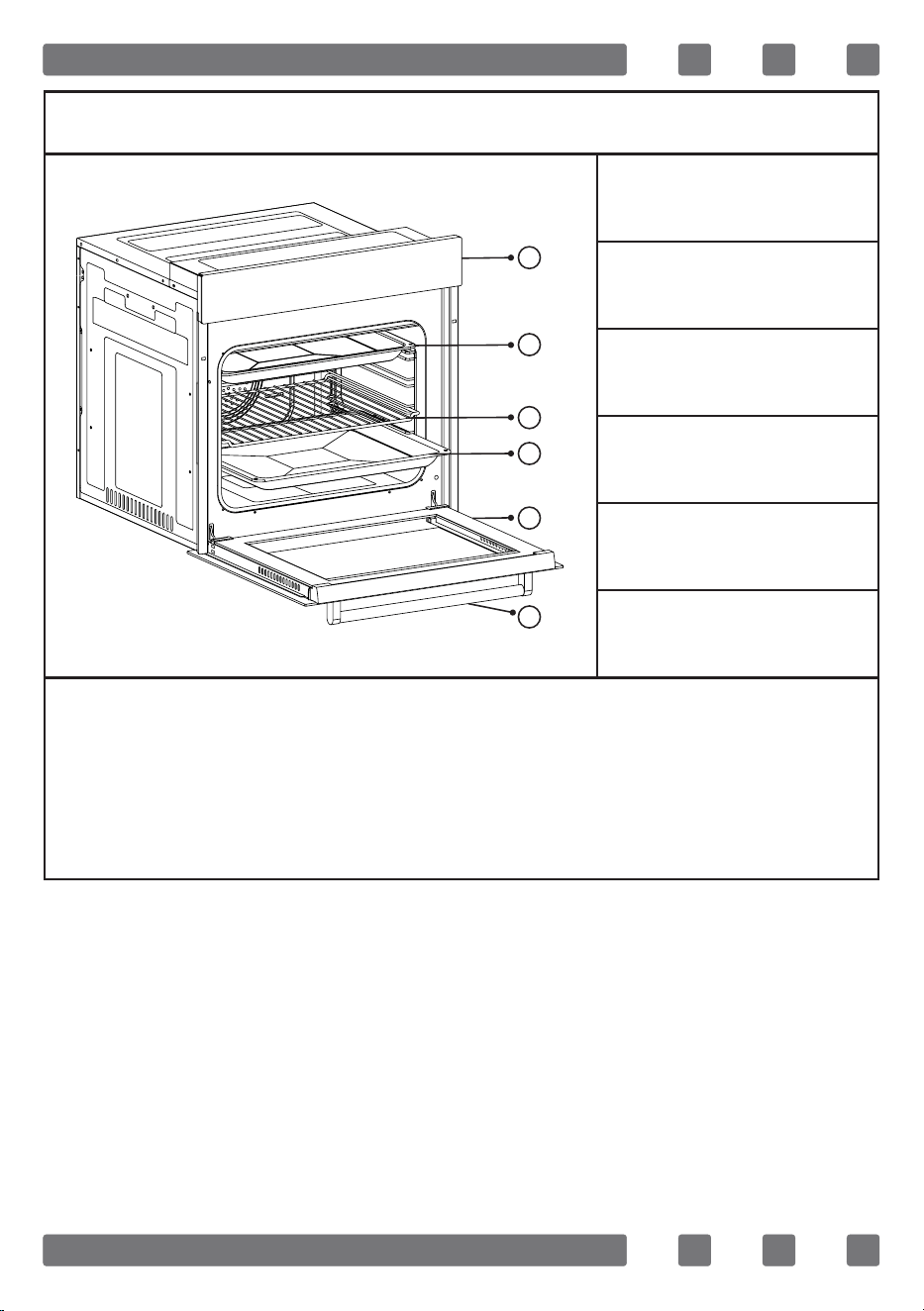
1. Control panel
2. Standard tray
3. Wire rack
* 4. Deep tray
5. Oven door
6. Oven handle
WARNING: The appliance image above is only
provided for illustration purposes. Depending on the
option of the appliance, the image may vary. Only
consider your appliance.
1
2
3
4
5
6
14
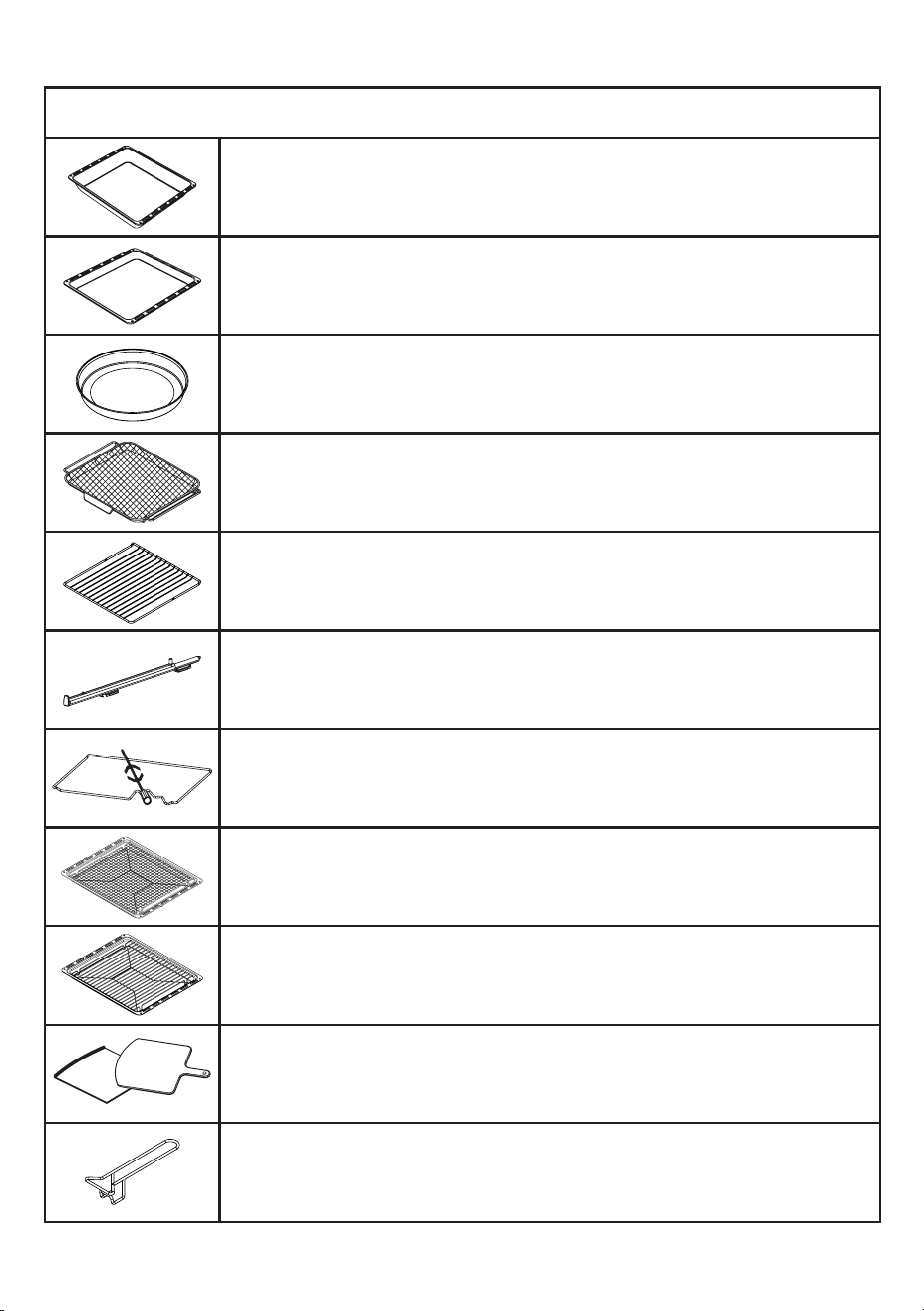
* ACCESSORIES (Optional)
Deep tray
Used for pastries, large roasts, stews. For cakes, frozen dishes and meat dishes; you may also
use it as a container for collecting grease in case of roasting directly on the grill.
Standard tray / Glass tray
Used for pastry (cookies, biscuits, etc.), and frozen foods.
Circular tray
Used for pastry and frozen foods.
Drying / Air fryer tray
Drying function and air fryer is used for foods to be cooked.
Wire rack
Used for roasting or to place the frozen food, or food to be fried or roasted on the desired
rack.
Telescopic rail
Thanks to telescopic rails, trays or wire shelves may be easily attached and removed.
Chicken roast
It is used for foods intended to be cooked by being rotated.
Grilled bacon
Place the bacon on the grill tray. Foods that may stick during cooking are cooked on the ba-
con grill. This prevents food from contacting the tray and sticking into it.
Wire grill inside tray
Place the wire grill inside tray on the tray. Food that may stick while being cooked, like steak,
are placed on the wire grill inside the tray. This prevents food from contacting the tray and
sticking into it.
Pizza stone and peel
They are used for baking pastries such as pizza, bread, pancake and removing baked food
from the oven.
Tray handle
It is used to hold hot trays.
15
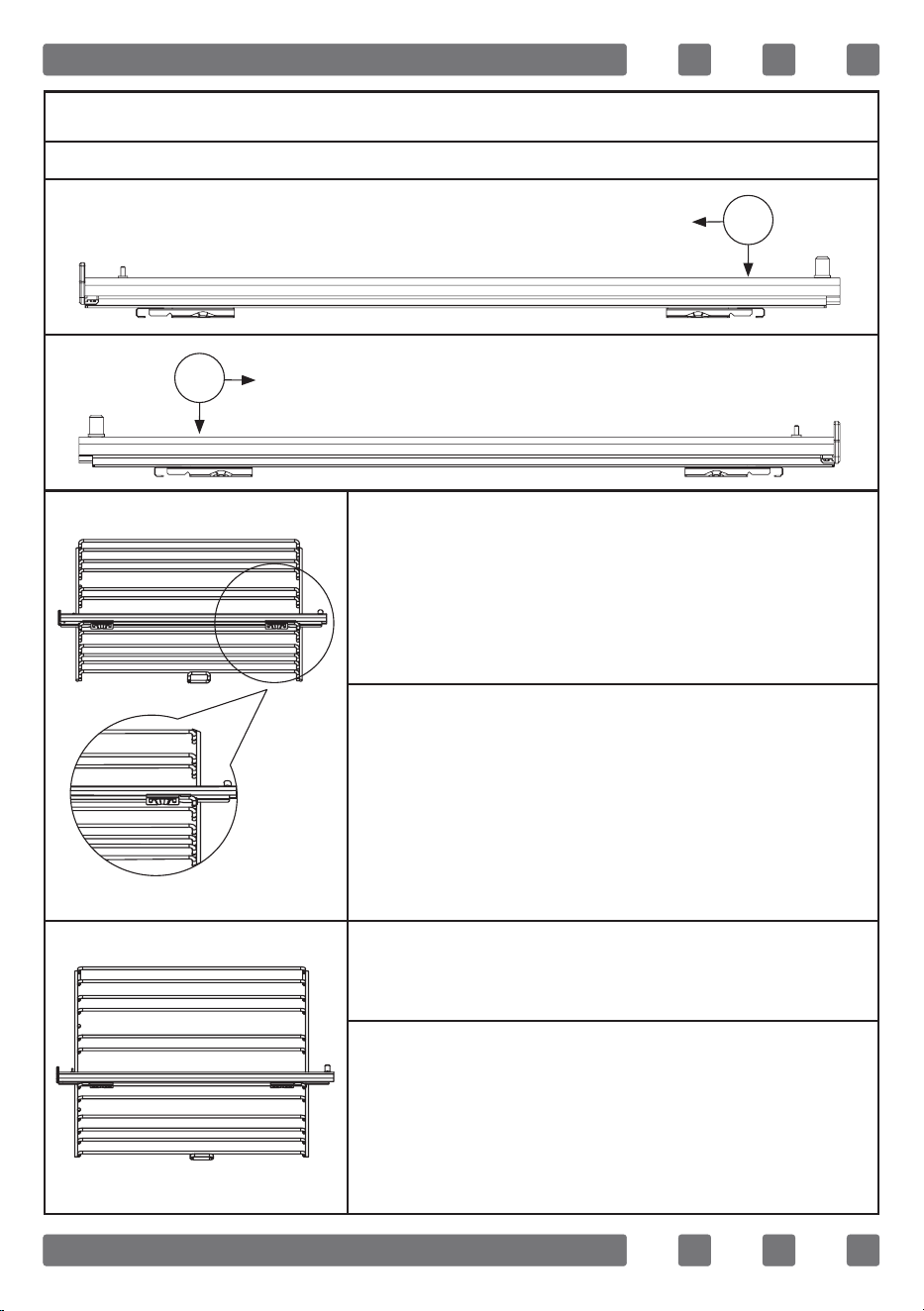
* Telescopic Rails
Telescopic rails allow you to pull tray and internal grill easily.
Telescopic rails, which are provided to you as an
accessory, can be mounted on the side wire racks
easily with two pieces of holding clips. Since there
are right and left rails, make sure that you know
which rail you shall install on which side. Check the
right (R) and left (L) signs on the rails.
Our installation recommendation is that you should
take the side wire racks completely out of the oven
and install the telescopic rails on the side wire racks
on a at surface. Install the telescopic rail on the
upper one among the two racks. The rails can be
easily mounted and demounted. After adjusting the
positions of right and left telescopic rails, press on
them until they are inserted into the side wire racks.
Check whether the rails are seated completely or
not by looking behind the wire rack.
After installing the telescopic rails, mount the wire
racks into the oven again. Do not use the wire grill
just below the rack on which the telescopic rail is
xed.
L
Left
Front
Left telescopic rail
Rear
R
Right
Front
Right telescopic rail
Rear
16
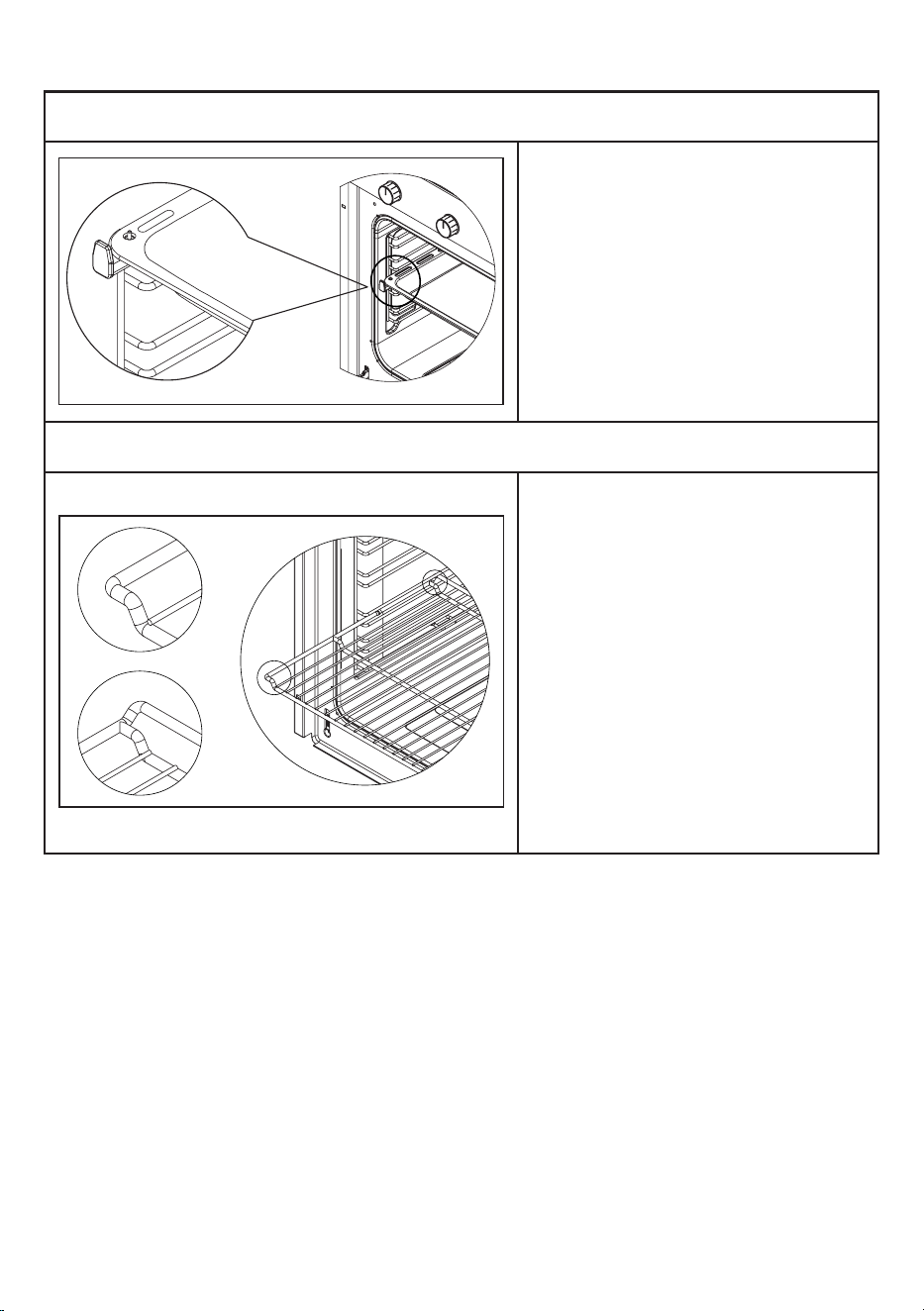
Placing The Tray Or Wire Grill On The Telescopic Rail Appropriately
Thanks to the telescopic shelves,
trays or wire grill may be easily
inserted and removed. When us-
ing the tray or wire grill with the
telescopic rail, make sure that the
pins on the back of the telescopic
rail rest on the back of the tray or
wire grill.
Using The Wire Grill
It is important to place the wire
grill and tray properly on the wire
racks and correctly place the grill
and/or tray on the rack.
Correct placement is shown in the
adjacent gure.
Place the grill or tray between two
rails and make sure it is balanced
before putting food on it.
Note: Do not use the wire grill just
below the rack on which the tele-
scopic rail is xed.
A
B
A
B
17
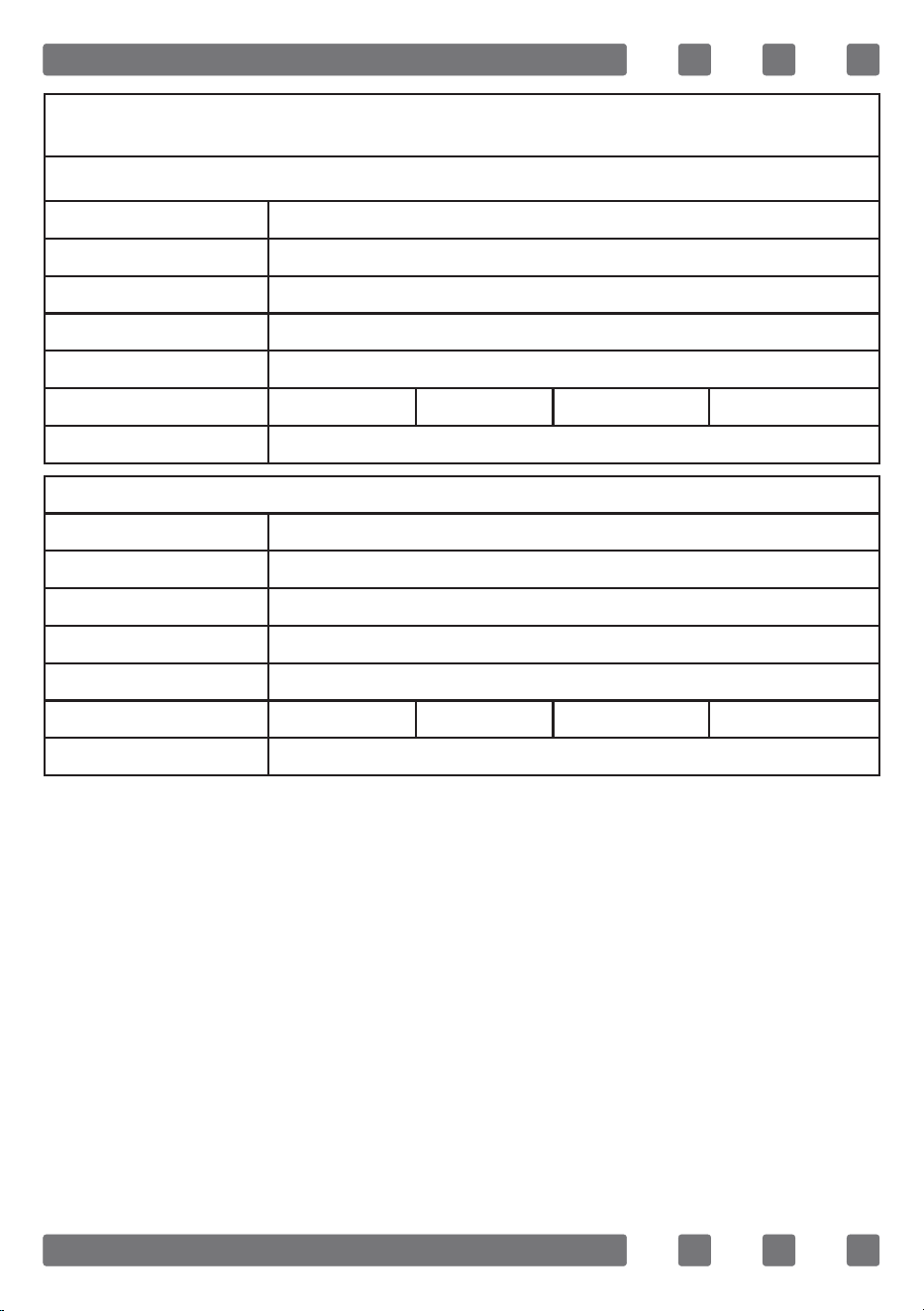
TECHNICAL FEATURES
80 litres
Light power 15-25 W
Thermostat 40-240 / Max °C
Bottom heater 1200 W
Top heater 1200 W
Turbo heater 1800 W
Grill heater Small grill 1200 W Big Grill 2400 W
Supply voltage 220-240 V AC 50-60 Hz.
60 litres
Light power 15-25W
Thermostat 40-240 / Max °C
Bottom heater 1200 W
Top heater 1000 W
Turbo heater 1800 W
Grill heater Small grill 1000 W Big Grill 2000 W
Supply voltage 220-240 V AC 50-60 Hz.
WARNING: In order to increase the product quali-
ty, the technical specications may be changed with-
out prior notice.
WARNING: The values provided with the appliance
or its accompanying documents are laboratory read-
ings in accordance with the respective standards.
These values may dier depending on the use and
ambient conditions.
18
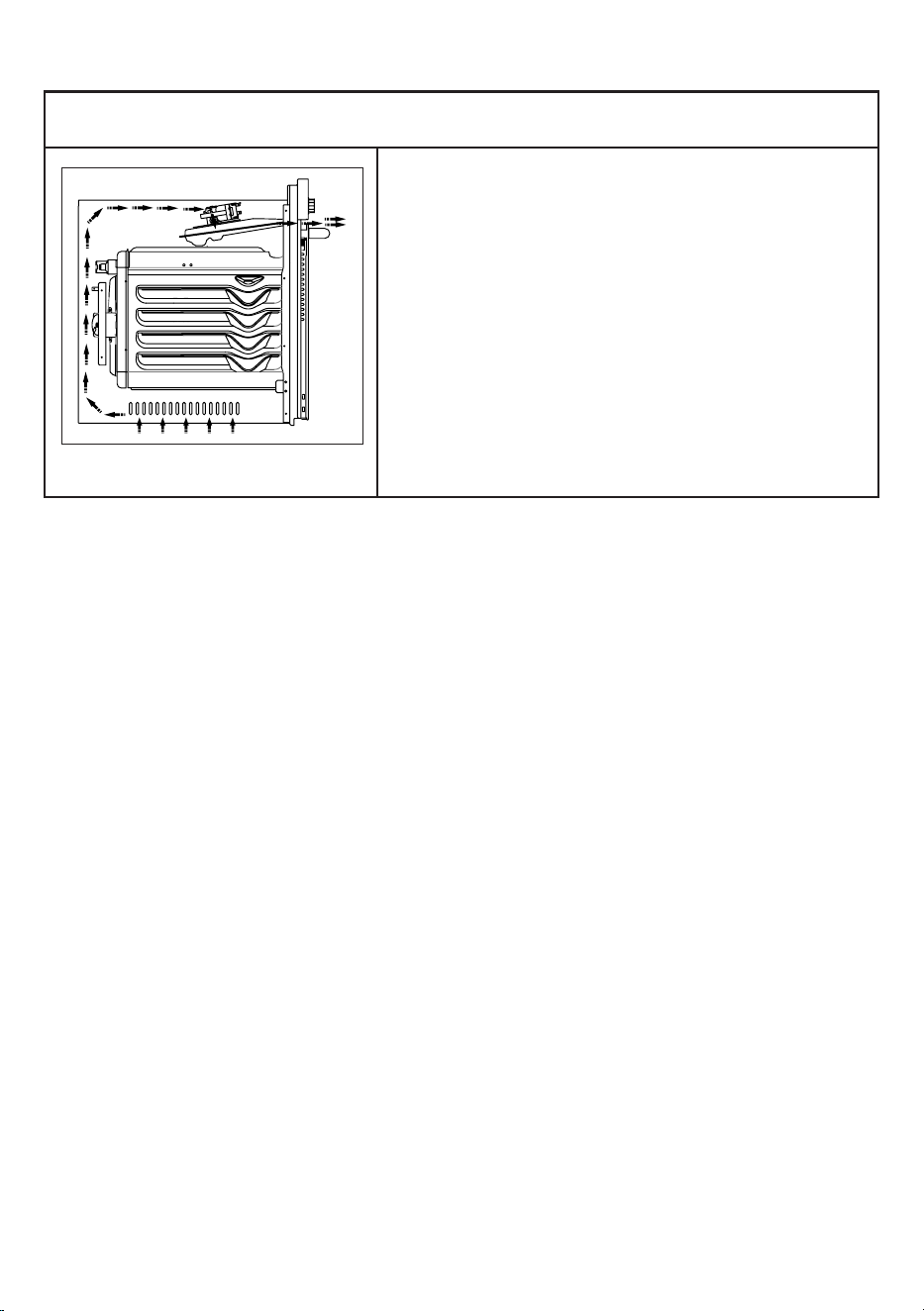
COOLING FAN
During operation of the oven, the cool-
ing fan shall move excess steam out and
prevent the appliance from overheating.
This is necessary for ensuring your appli-
ance to work well and to cook well.
The cooling fan continues to operate
after cooking is nished. After cooling
is complete, the fan shall automatically
turn o.
SETTING UP THE APPLIANCE
Check if the electrical installation is proper to bring the appliance
in operating condition. If electricity installation is not suitable, call an
electrician and plumber to arrange the utilities as necessary. Manufac-
turer shall not be held responsible for damages caused by operations
performed by unauthorized persons.
WARNING: It is customer's responsibility to pre-
pare the location the product shall be placed on and
also to have the electrical installation prepared.
WARNING: The rules in local standards about elec-
trical installations shall be followed during product in-
stallation.
WARNING: Check for any damage on the appliance
before installing it. Do not have the product installed
if it is damaged. Damaged products cause a risk for
your safety.
Figure 1

19
WARNING: Keep the ventilation channels open.
Right Place For Installation
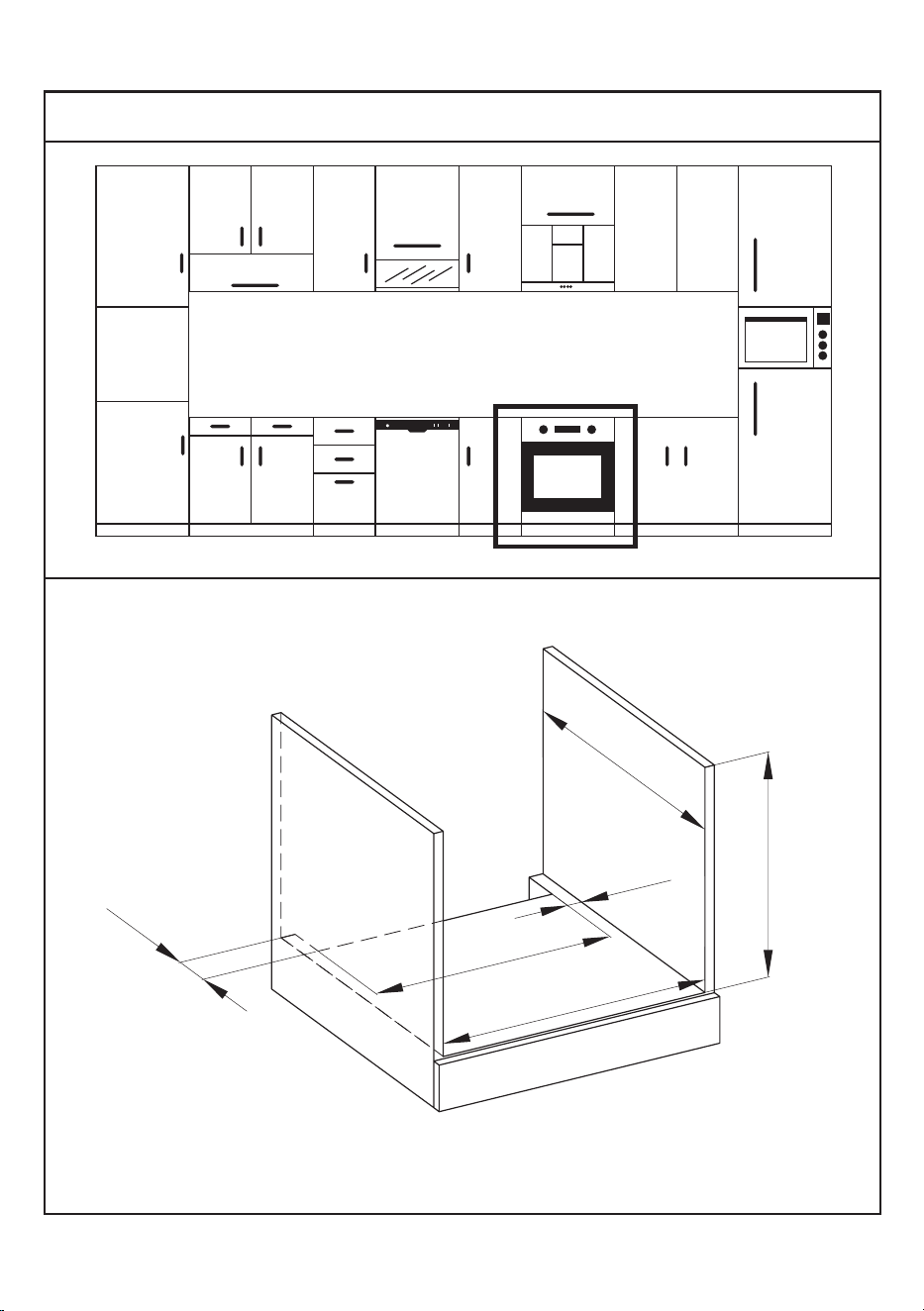
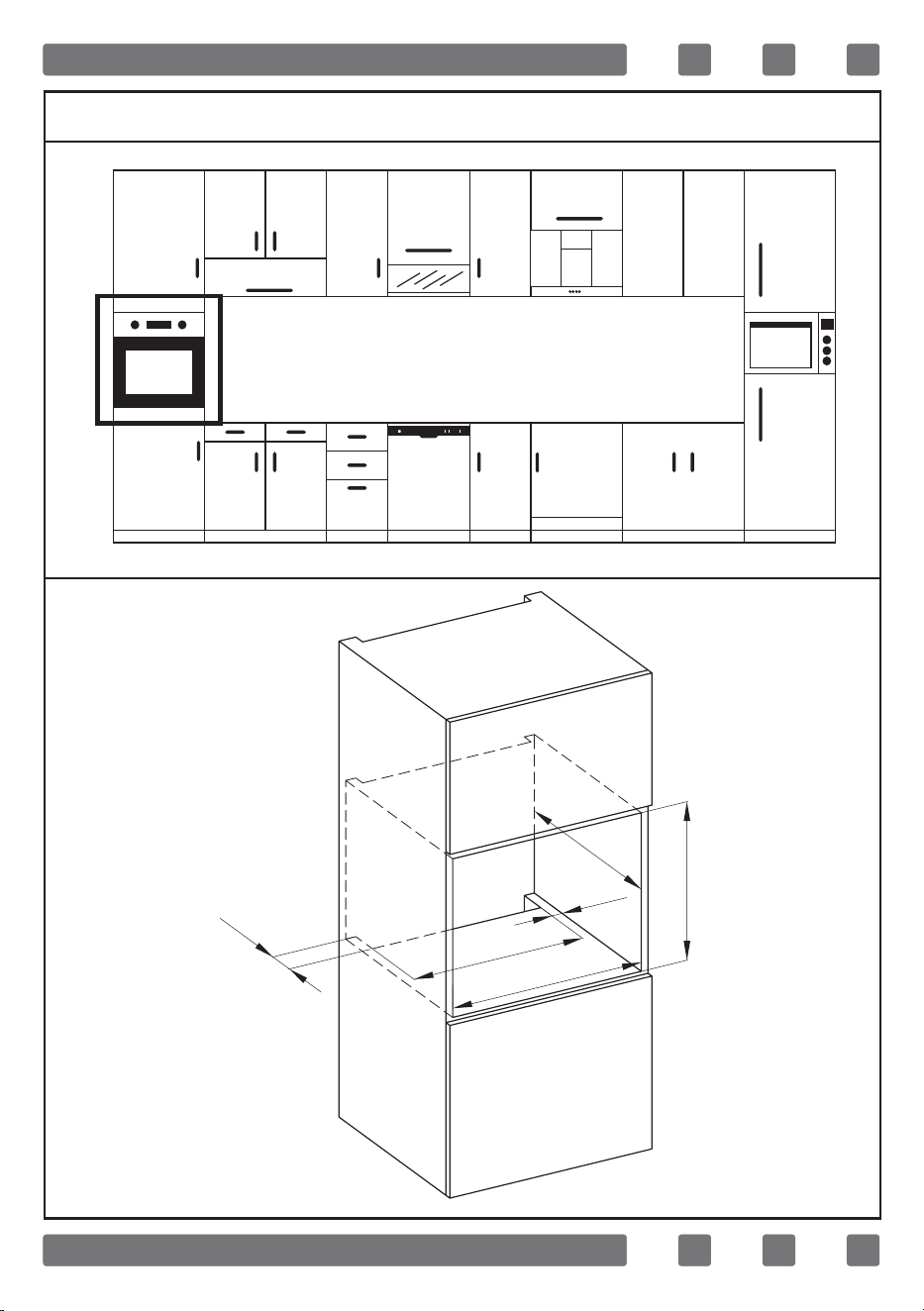
The appliance is designed so that it shall t commercially available
counters. A safe clearance shall be left between the product and kitch-
en walls or furniture. Refer to the drawings for suitable clearances. (see
gure 2,3) (values are in mm)
• Surfaces, synthetic laminates and adhesives used shall be resist-
ant to heat. (minimum 100°C)
• Kitchen cabinets shall be level with the appliance and xed.
• A rack shall be placed between the oven and the shelf if there is
a shelf under the oven.
WARNING: Do not install the appliance beside re-
frigerators or coolers. Heat radiated by the appliance
increases the energy consumption of cooling devices.
WARNING: Do not use the door and/or handle to
carry or move the appliance.

20
Installation And Assembly Of The Built-In Oven
Operating space of the appliance shall be determined before starting
the installation.
Appliance shall not be installed on areas with high ow of air.
Handle the appliance with two persons at least. Do not drag the ap-
pliance to prevent damage to the ground.
Remove all transportation materials inside and outside of the packag-
ing. Remove all materials and documents inside the product.
Installation Under Counter
Cabinet shall conform with dimensions specied in Fig. 2.
A clearance with the dimensions specied in the gure shall be en-
sured at the rear compartment of the cabinet to provide the required
ventilation.
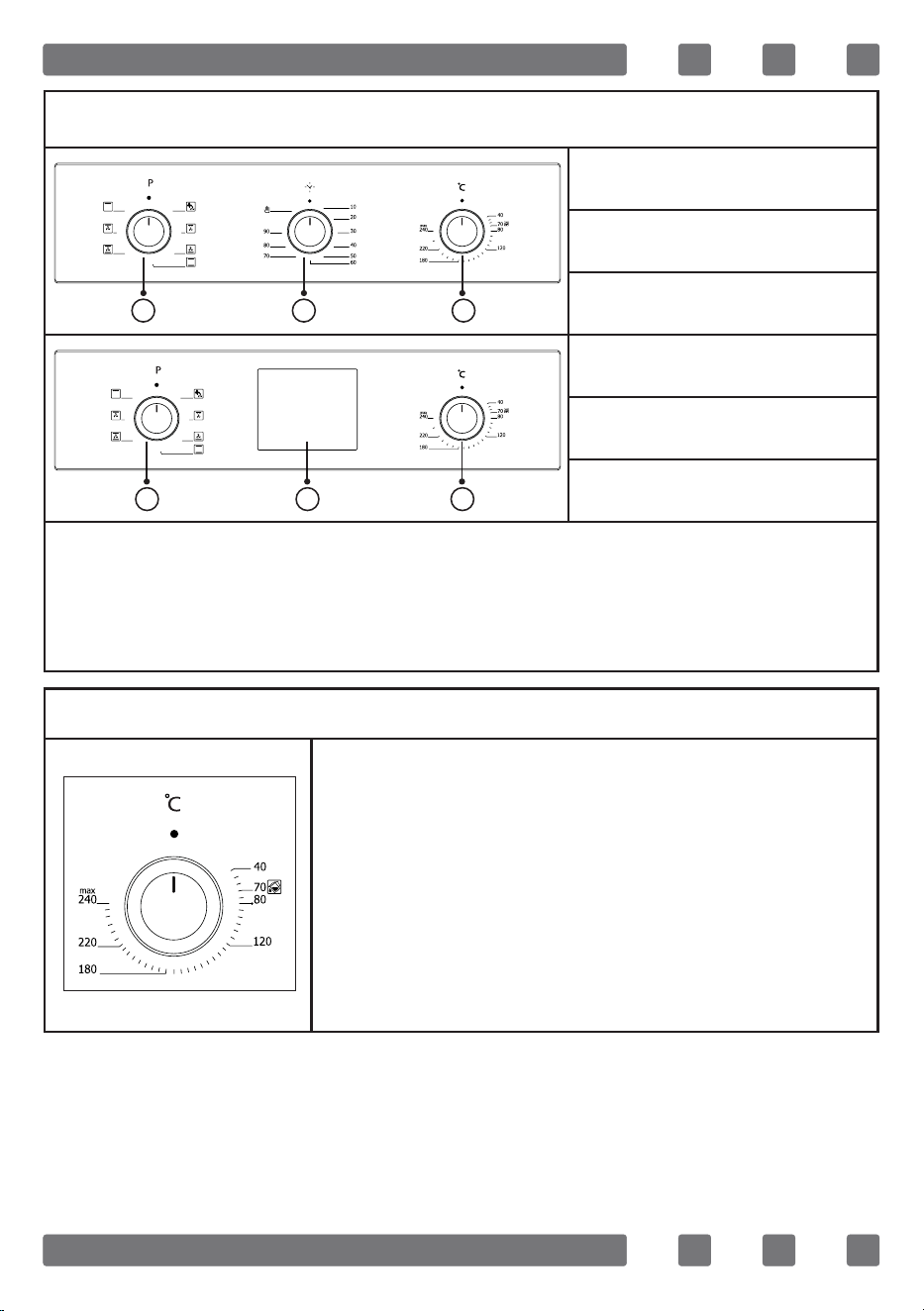
After installation, the clearance that shall be left between the bottom
of the counter and the top of the appliance is indicated by ‘’A’’ in Fig.
5. The clearance is for ventilation and should be closed.
Installation In A High Cabinet
The cabinet shall comply with the dimensions given in Fig. 3.
In the rear part of the cabin, and at the top and bottom, clearances
with the dimensions specied in the gure shall be ensured to provide
the required ventilation.
Installation Conditions
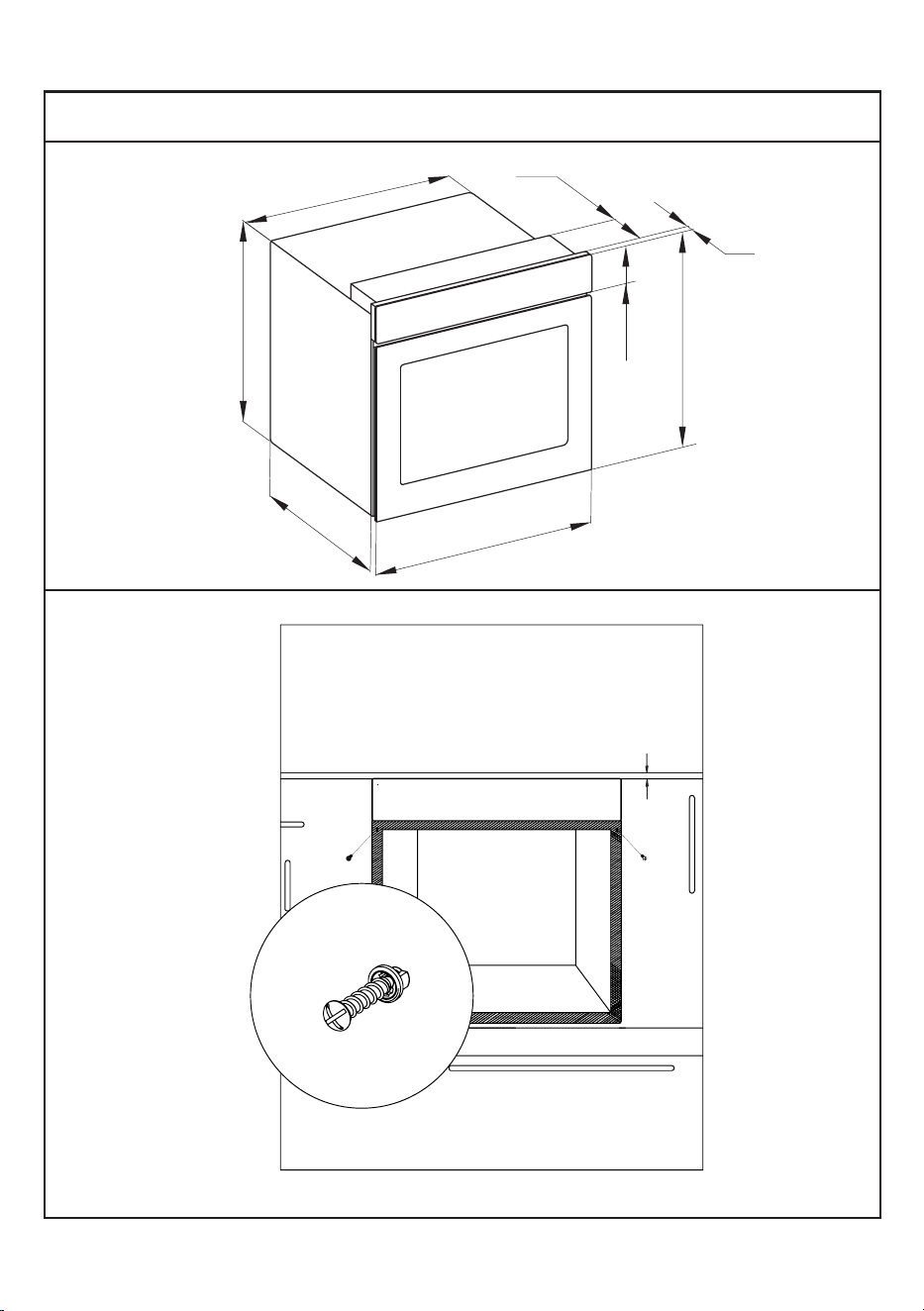
The dimensions of the appliance are given in gure 4.
The furniture surfaces to be installed and the installation materials to
be used shall resist a temperature of at least 100 °C.
To prevent the appliance from turning over, the cabinet to be installed
shall be fixed and the cabinet floor shall be level.
The floor of the cabinet shall be strong enough to withstand a load
of at least 60 kg.

21
Placing And Securing Of The Oven
Place the oven to the cabinet with two or more persons.
Make sure that the frame of the oven and the front of the furniture
are properly aligned.
The supply cord shall not be left under the oven or be stuck or bent
between the oven and the furniture.
Secure the oven to the furniture using the screws supplied with the
appliance. Screws shall be installed by putting them through the plas-
tics attached on the frame of the appliance as shown in Fig. 5. The
screws shall not be tightened too much. Otherwise, the screw holes
may wear out.
Check that the oven does not move after installation. If the oven
has not been installed in accordance with the installation instructions,
there is a risk of overturning during operation.
Electrical Connection
The place where the product shall be installed shall have proper elec-
trical installation.
The mains voltage shall comply with the rating given on the product
type plate.
Connection of appliance shall be made in accordance with local and
national electrical regulations.
Disconnect the mains power before starting to install the product. Do
not connect the product to the mains until the installation is nished.
22
Assembly
Figure 2
Min. 550
600
30
35
500
560
23
Assembly
Min. 550
500
590
560
30
35
Figure 3
24
Assembly
548
596
556
160
545
21
595
100
Figure 4
A
Figure 5
25
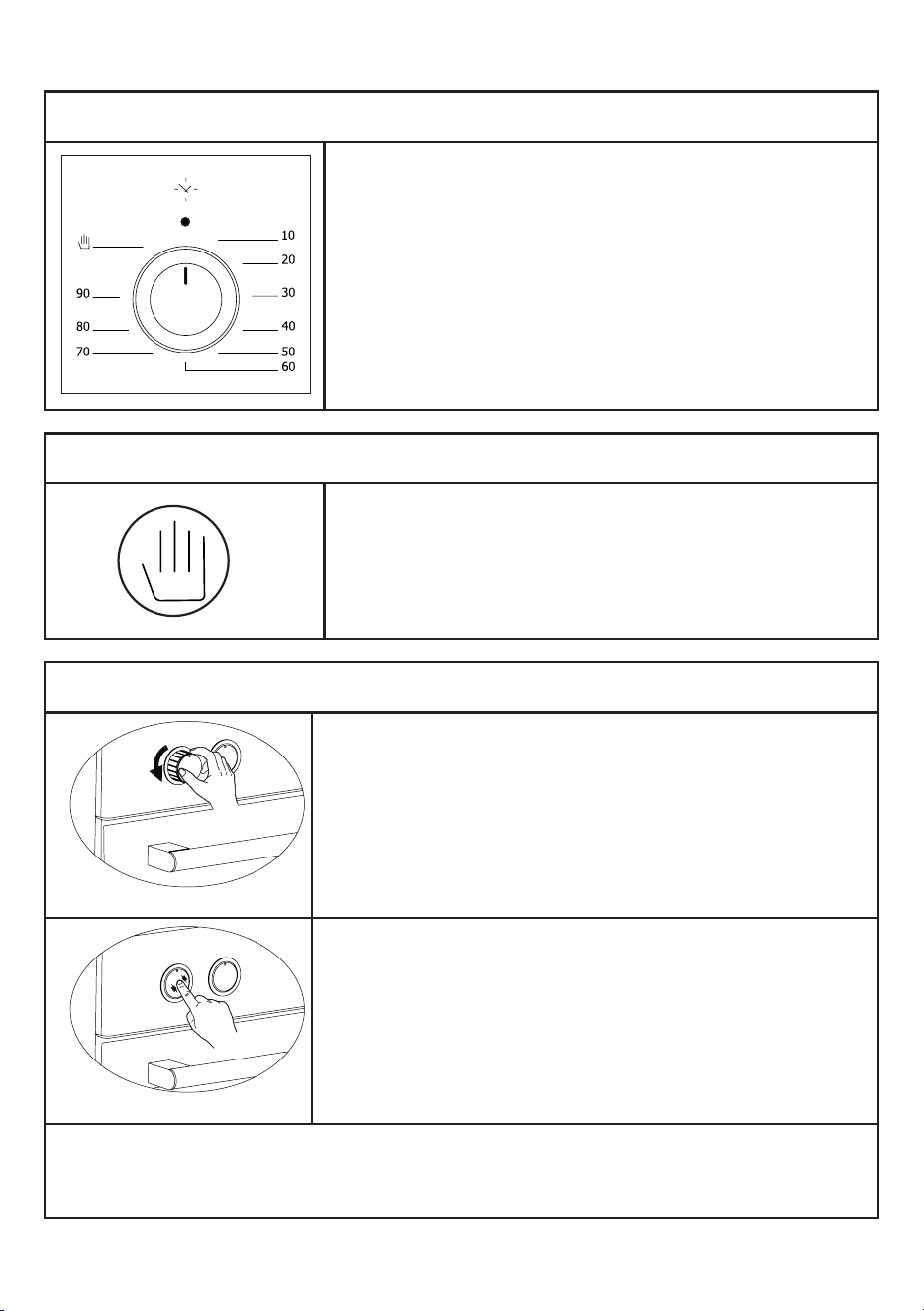
CONTROL PANEL
1. Cooking function button
2. Mechanical timer
3. Temperature adjustment button
(Thermostat)
1. Cooking function button
2. Digital timer
3. Temperature adjustment button
(Thermostat)
WARNING: The control panel above is only for il-
lustration purposes. Consider the control panel on
your device.
Temperature Adjustment Button (Thermostat)
Used for determining the cooking temperature
of the dish to be cooked in the oven. After put-
ting the meal in the oven you can set it to the
desired temperature by turning the button.
See the cooking table for the cooking temper-
atures of the dierent meals. Thermostat light
goes out when the oven reaches the adjusted
temperature.
1 2 3
1 2 3
26
* Mechanical Timer Button
Used for determining the period for cooking
in the oven. When adjusted time is expired,
power to heaters is turned o and an audi-
ble warnig signal is emitted. Mechanical timer
can be adjusted to desired period between
0-90 minutes. For cooking periods, see cook-
ing tables.
Manuel Cooking
WARNING: In manual cooking,
the cooking time is followed by
the user.
* Pop-Out Button Use
As shown in the illustration on the side, press
the button so that it comes out.
When the knob is pulled out far enough, make
the necessary adjustments by turning it to the
right or left.
Note: For models with a pop-up button, the setting can only be
made when the button is pulled out.
Figure 6
Figure 7

27
OPERATION OF THE OVEN
Initial Operation Of The Oven
After you have made the necessary connections of your oven accord-
ing to the instructions, you shall need to do the following in the initial
operation:
1. Take out any labels or accessories that are axed inside the oven.
If there is a protective foil on the front of the appliance, remove it.
2. Wipe the inside of the oven with a wet cloth to remove the dust
and the remains of packaging. Inside of the oven shall be empty. Plug
the appliance.
3. Using the temperature setting button,set the thermostat tempera-
ture up to the highest temperature (240 Max.°C) and operate it for 30
minutes with the appliance door closed. A slight smoke and odour may
arise in the meantime, this is a normal situation.
4. After the oven has cooled down, wipe the inside of the oven with
warm water with mild detergent and dry with a clean cloth. You can
now use your oven.
5. If your oven has a steam-assisted cooking function; remove the
water container from the oven. Shake the water container well before
using detergent.
Normal Operation Of The Oven
1. To start cooking, use the temperature control button to set the
temperature at which you want to cook, depending on the type of
food, and the cooking function control button to set the desired cook-
ing function.
2. You can set cooking time to any desired time by using the button
at models with mechanical timer. Timer will de-energize heaters when
time expired and provide warning beep as ringing.
3. When the cooking time has expired according to the entered in-
formation; the timer turns off the heaters and gives an audible signal.
4. Once the cooking process is complete, the cooling system of the
appliance shall continue to operate. Do not cut off the power of the
appliance, which is necessary for the appliance to cool. After cooling is
complete, the system shall be automatically turned off.

28
Using The Grill
1. When you place the grill on the top rack, the food on the grill shall
not touch the grill.
2. You can preheat for 5 minutes while grilling. If necessary, you may
turn the food upside down.
3. Food shall be in the center of the grill to provide maximum air ow
through the oven.
To Turn On The Grill;
1. Place the function button over the grill symbol.
2. Then, set it to the desired grill temperature.
WARNING: Keep the oven door closed while grilling.
To Turn The Grill O;
Set the function button to the o position.
After the grilling operation, attach the plastic handle in place by ro-
tating it and take it out of the oven. Add some water on the tray for
easy cleaning.
* Booster (Quick Pre-Heating) Operation
This is the quick pre-heating function. After setting the thermostat of
the appliance to the selected temperature, it is ensured that the inter-
nal temperature of the oven is quickly increased by bringing the cook-
ing function to multifunctional cooking mode (3D) ( ). When the
thermostat lamp has turned o, oven is set to the function for cooking.
29
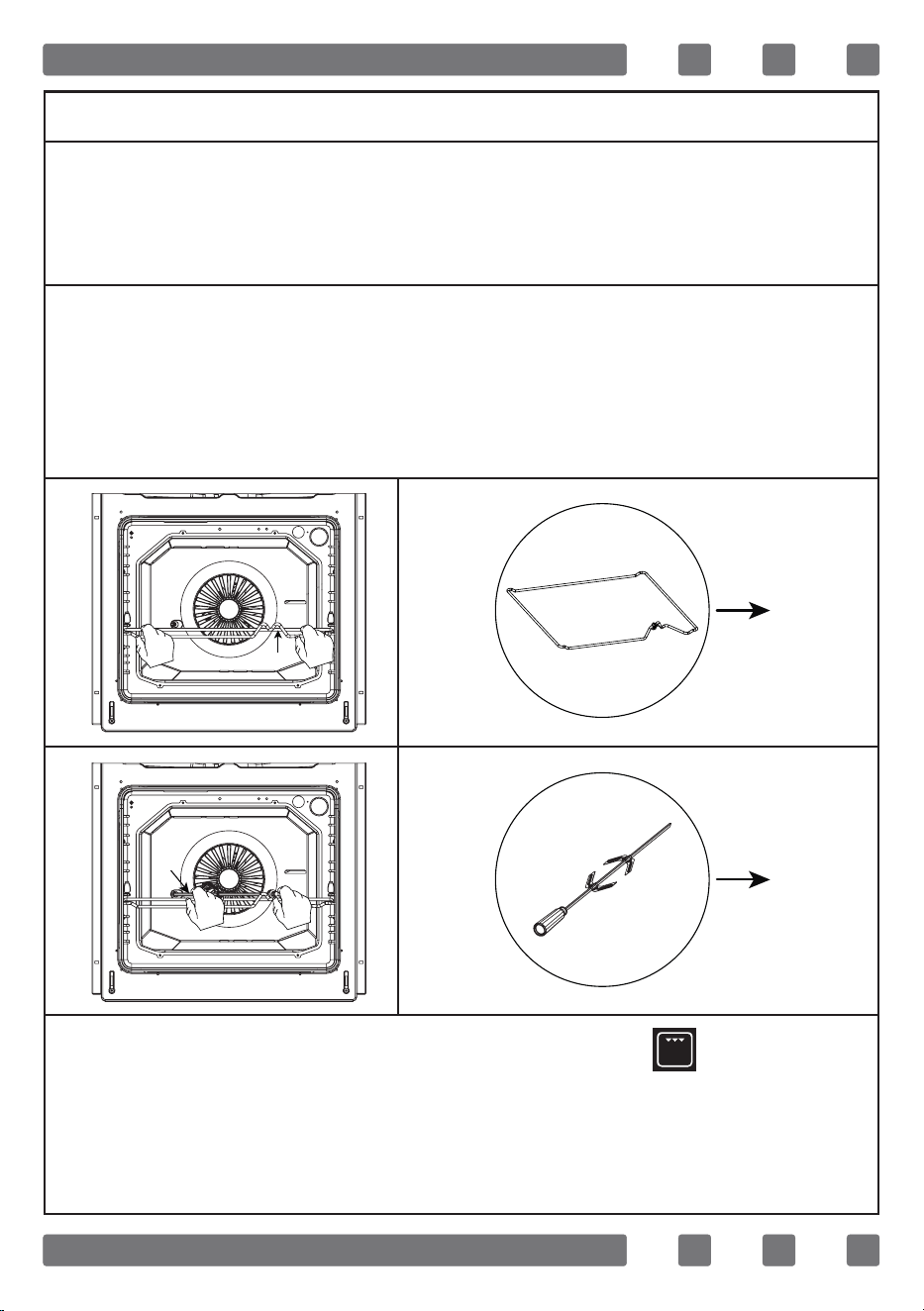
* Use For Chicken Roasting
WARNING: Remember to remove the plastic han-
dle from the skewer by rotating it before closing the
oven’s door.
Skewer the fowl as a whole. In order to grill a fowl healthily, center
and x the fowl on the skewer (b) by the xing hooks located on the
both sides of the skewer (b). Place the skewer (b) on the rotisserie
wire (a) and put it in the oven and make sure that the end of the
skewer (b) is placed in the rotisserie engine chamber.
After closing the door, set the oven to the grill ( ) position and
bring the thermostat temperature up to the maximum temperature
level using the temperature setting button. In order to collect spilled
oil during cooking, place the tray on the base. Add some water on the
tray for easy cleaning.
B
B
A
A
30
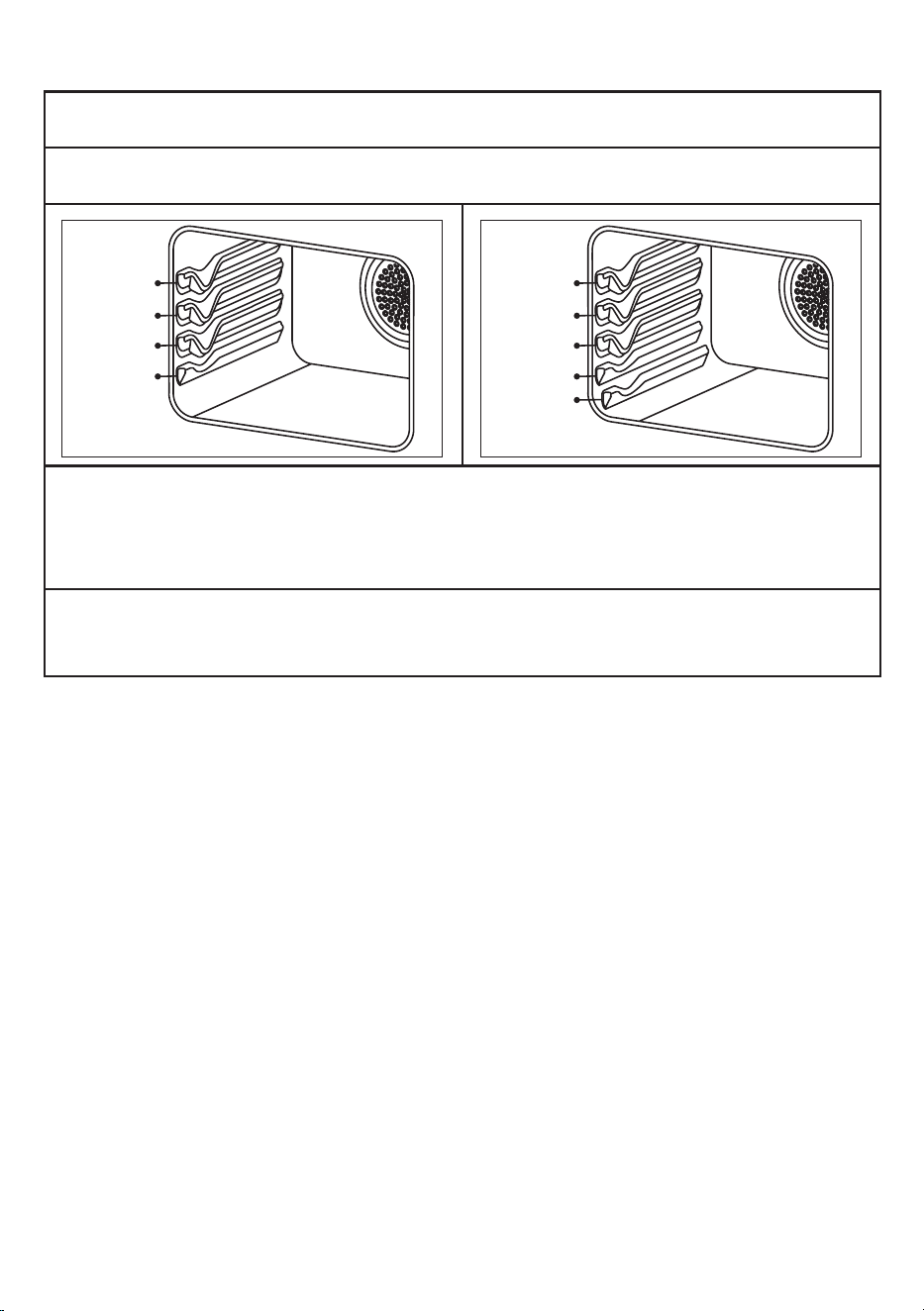
RACK POSITIONS
Standard Rack Positions
Note: The standard racks can be 4 or 5, depending on the congu-
ration of your oven. Only pay attention to the standard racks of your
oven.
Rack positions are shown in the gures above. You may place a
deep tray or a standard tray in the lower and upper racks.
Rack 2
Rack 1
Rack 3
Rack 4
Rack 5
Rack 1
Rack 2
Rack 3
Rack 4
31
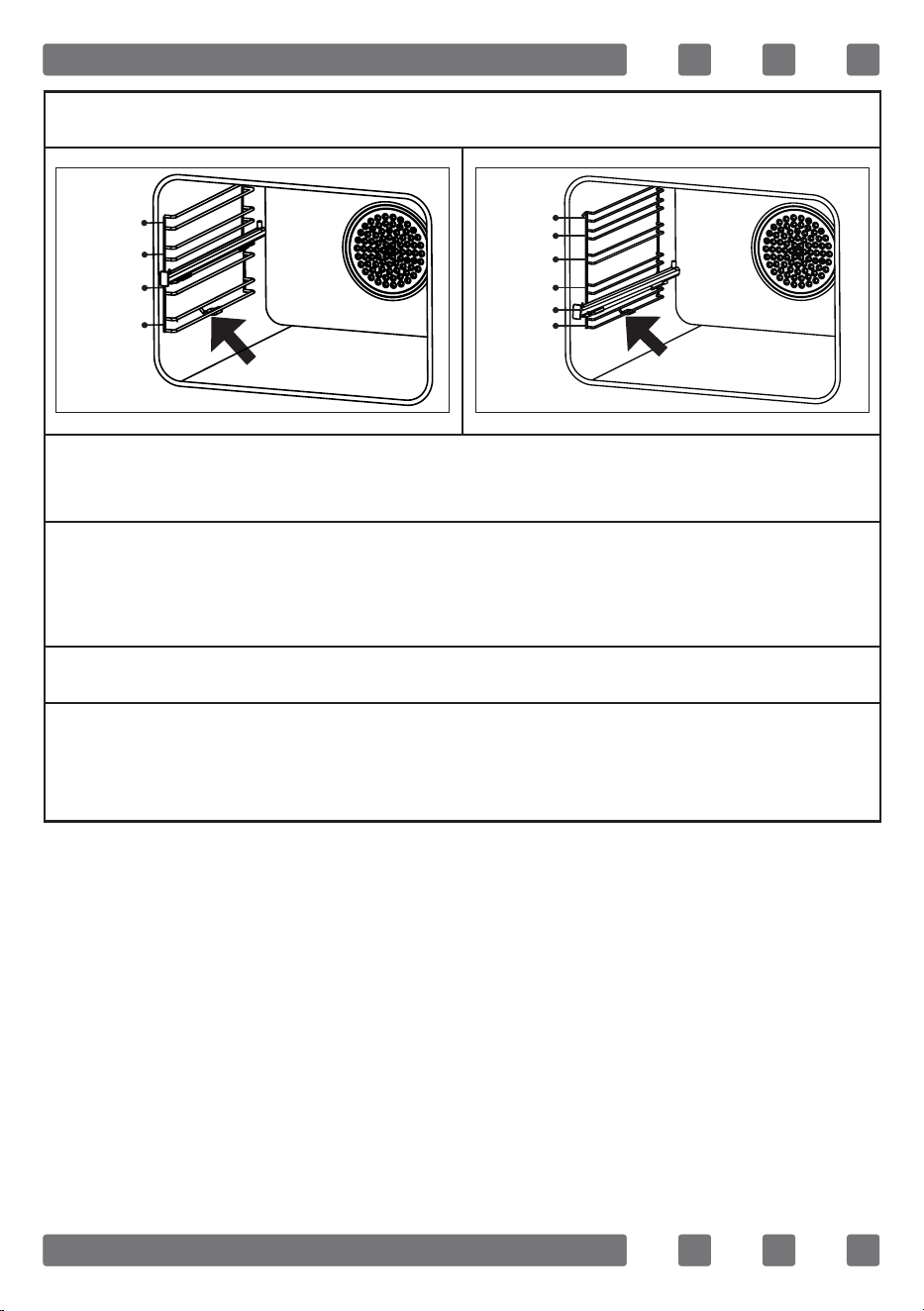
* Wire Rack Positions
Note: Depending on the conguration of your oven, there may be
4 or 6 wire racks. Only pay attention to the wire racks of your oven.
It is important to place the wire rack into the oven properly. Rack
positions are shown in the gures above. You may place a deep tray
or a standard tray in the lower and upper wire racks.
Installing And Removing Wire Racks
Press the clips shown with arrows in the gures above, rst remove
the lower and then the upper side of wire racks. To install wire racks;
reverse the procedure for removing wire rack.
Rack 4
Rack 3
Rack 2
Rack 1
Rack 6
Rack 5
Rack 4
Rack 3
Rack 2
Rack 1
32
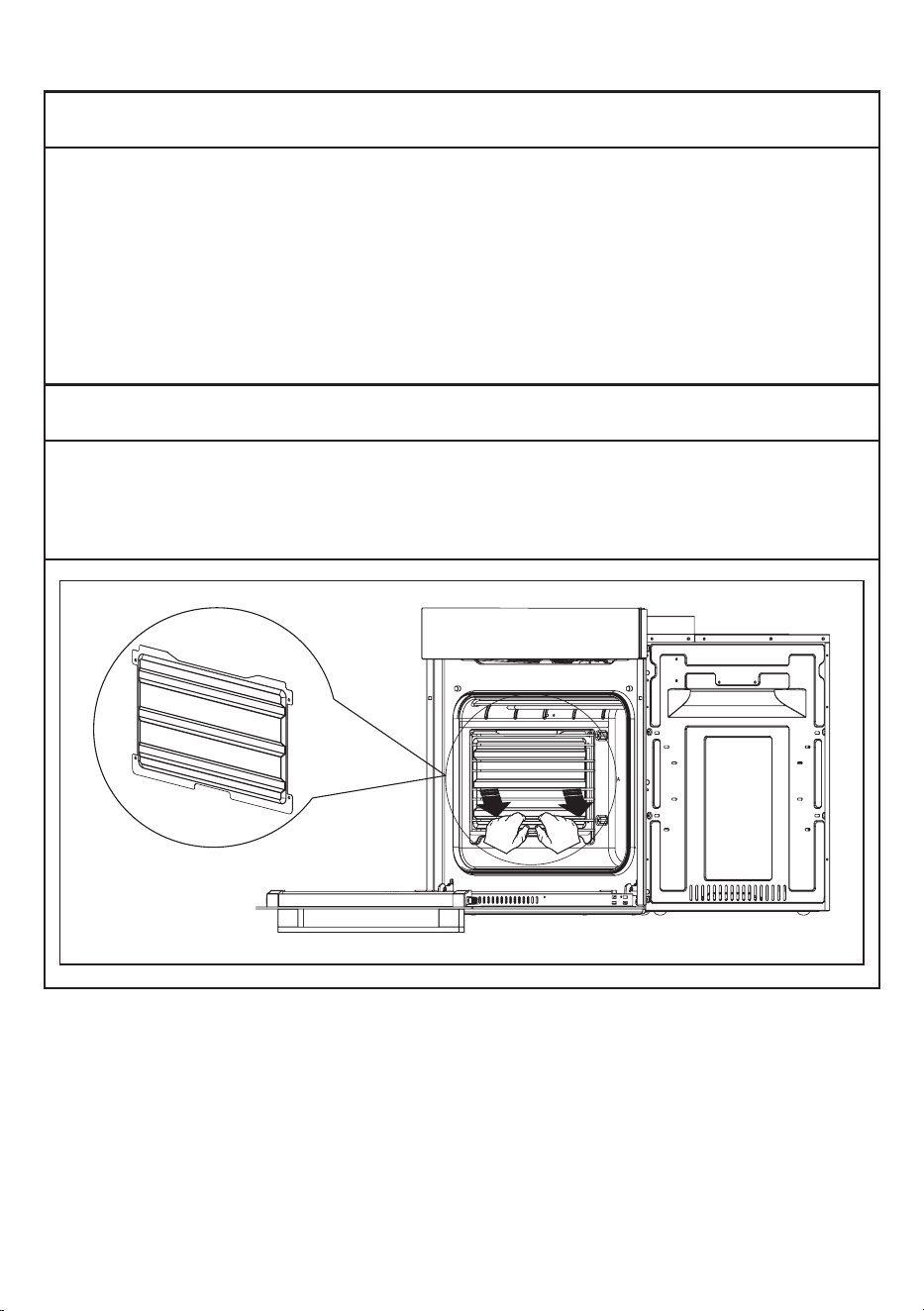
* CATALYTIC PANEL
It is located behind the wire racks of the oven, at the right and left
walls of oven cavity. Catalytic panel removes oensive odour and
provides using your appliance at its best performance. Over time, oil
and food odours permeate into enamelled oven walls and heating
elements. Catalytic panel absorbs any food and oil odours, and burns
them during cooking to clean your oven.
Detaching Catalytic Panel
To remove catalytic panel; rst remove the wire racks. Once wire
racks are removed, catalytic panel will be free. It is advised to replace
the catalytic panel once every 2-3 years
33
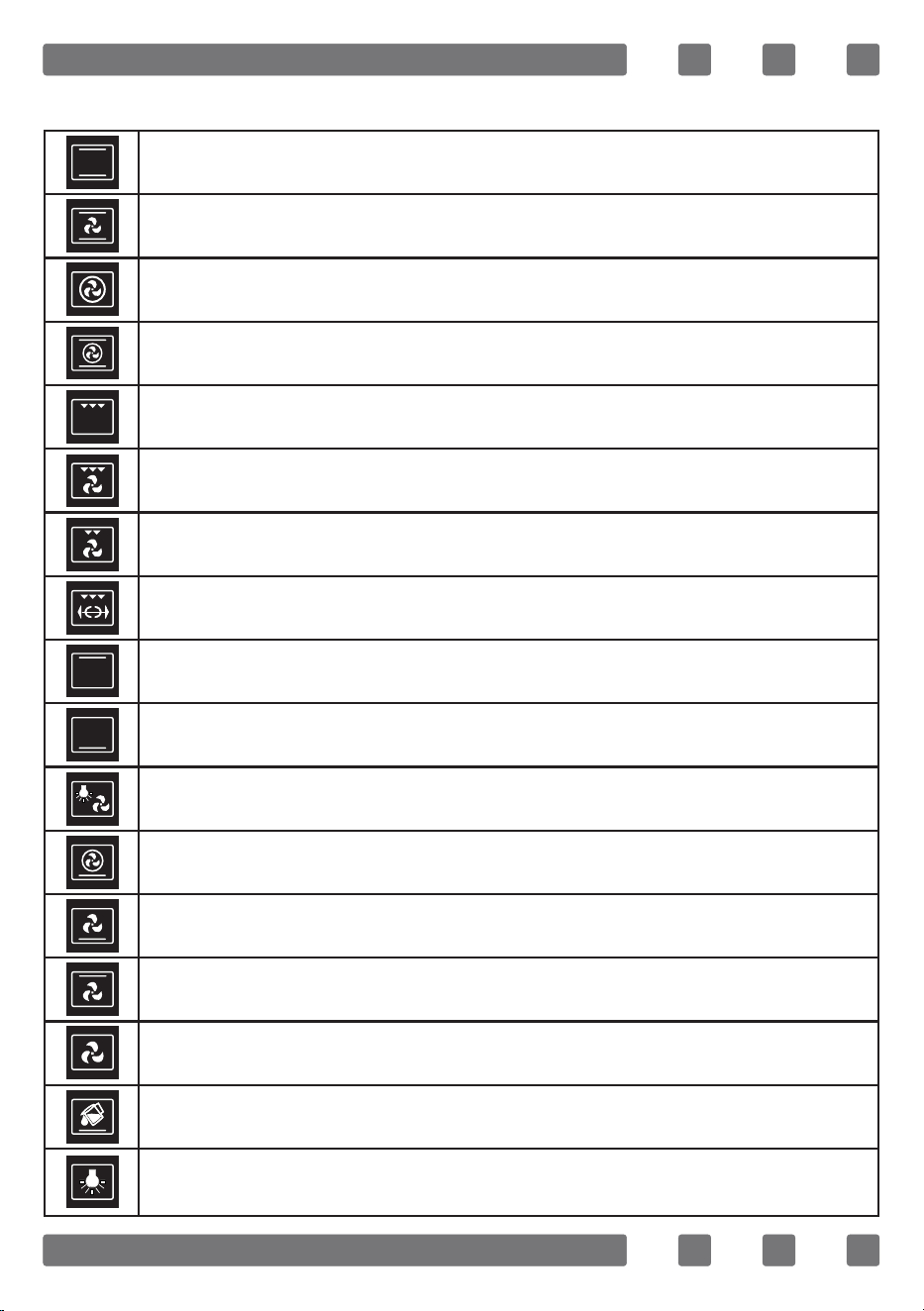
* COOKING FUNCTIONS AND FEATURES
Lower and upper heating work together. The food is heated downwards and upwards at the same time. This
program may be used to cook foods such as cakes, pizza, biscuits and cookies.
Lower heating, upper heating and fan work together. Hot air is distributed equally and rapidly inside the oven
thanks to , the fan. Suitable for cooking foods such as cakes, cookies, lasagne, meat.
Turbo and fan operate together. Suitable for cooking on dierent rack levels.
Multi Functional (3D). Cooking Lower- upper heating, turbo and fan work together. Suitable for cooking and
frying. The hot air is distributed quickly and evenly in the oven by the fan, while the top and bottom heaters work
simultaneously. Suitable for cooking with intense heat. Use a single tray for cooking.
Grill is operated. Used to grill meats such as steaks and sh. To grill, place the food on the grill and the grill on the
top rack (see rack positions). Place tray to the lower rack and put water inside the tray while grilling.
The grill and fan operate together. Hot air is distributed equally and rapidly inside the oven thanks to , the fan.
Used to grill meats such as steaks and sh. To grill, place the food on the grill and the grill on the top rack (see
rack positions). Place tray to the lower rack and put water inside the tray while grilling.
The grill and fan operate together. Hot air is distributed equally and rapidly inside the oven thanks to , the fan.
Used to grill small-portion meats such as steaks and sh. To grill, place the food on the grill and the grill on the
top rack (see rack positions). Place tray to the lower rack and put water inside the tray while grilling.
Upper heating and chicken roast work together. Used for food intended to be cooked by rotating.
Upper heating is operated. Used for heating or roasting very small pieces food.
Lower heating is operated. Select this program towards the end of the cooking time if the bottom of the food
being cooked shall be roasted, too.
The oven is not heated. Only the fan and lamp work. Suitable for defrosting icy food.
Lower heating, fan and turbo work together. Hot air is distributed equally and rapidly inside the oven thanks to ,
the fan. It is convenient for cooking pizza.
Lower heating and fan work together. Hot air is distributed equally and rapidly inside the oven thanks to , the fan.
Use it to cook food like fruit cakes, etc.
Upper heating and fan work together. Hot air is distributed equally and rapidly inside the oven thanks to , the fan.
Used for heating or roasting very small pieces food.
The oven is not heated. Only the fan and lamp work. Suitable for defrosting icy food.
Lower heating is operated. Select this program towards the end of the cooking time if the bottom of the food
being cooked shall be roasted, too. Also this function is used for steam cleaning. (see. steam cleaning)
It is used for lighting the oven. The lamp operates automatically across all cooking functions.

34
WARNING: Cooking functions may not be same in
every model. Only pay attention to cooking functions
of your oven.
COOKING RECOMMENDATIONS AND WARNINGS
You may nd the information about the food types we have tested in
our laboratories and whose cooking values we have determined in the
following tables. Cooking times may vary as per mains voltage, quality,
amount of the ingredients to be cooked, and the temperature. Meals
you cook using these values may not appeal to your tastes. You may
discover dierent values by making experiments to achieve dierent
avours and results that appeal to your taste.
WARNING: Unattended cooking with solid or liquid
oil in the appliance is dangerous, it can cause a re.
WARNING: Ensure that the oven door is complete-
ly closed after putting food inside the oven.
WARNING: Steam may come out when the door is
opened. Step back and wait for the steam to disappear.
WARNING: During usage, the internal and external
surfaces of the oven get hot. As you open the oven
door, step back to avoid the hot vapour coming out
from the interior. There is risk of burning.
WARNING: Your hand may get burnt because of
the internal panels of the oven, spilt meals, accesso-
ries and hot vapour. Wear kitchen gloves while taking
the hot meal out of the oven.
WARNING: While placing food to or removing food
from the oven, etc., always use heat resistant oven gloves.

35
WARNING: Please do not cook the food placing
directly on tray / grill. Place the food into the oven in
a suitable accessory.
WARNING: Be careful when using alcohol in your
foods. Alcohol will evaporate at high temperatures
and may ignite to cause a re if it comes in contact
with hot surfaces.
WARNING: Do not heat closed cans and glass jars.
The pressure may lead jars to explode.
WARNING: Never use it at higher oven tempera-
tures than the maximum usage temperature indicat-
ed on your baking paper. Do not place the baking
paper on the base of the oven.
WARNING: Place the baking paper together with
the food into a pre-heated oven by putting it inside a
cooker or on an oven accessory (tray, wire grill etc.).
WARNING: Against the risk of touching the oven
heater elements, remove excess parts of the baking
paper that hang over from the accessory or container.
WARNING: Do not place the oven trays, plates or
aluminium foils directly on the oven base. The accu-
mulated heat may damage the base of the oven.
WARNING: Plastic dishes may melt at high tem-
peratures and damage the appliance. Do not use
plastic dishes.
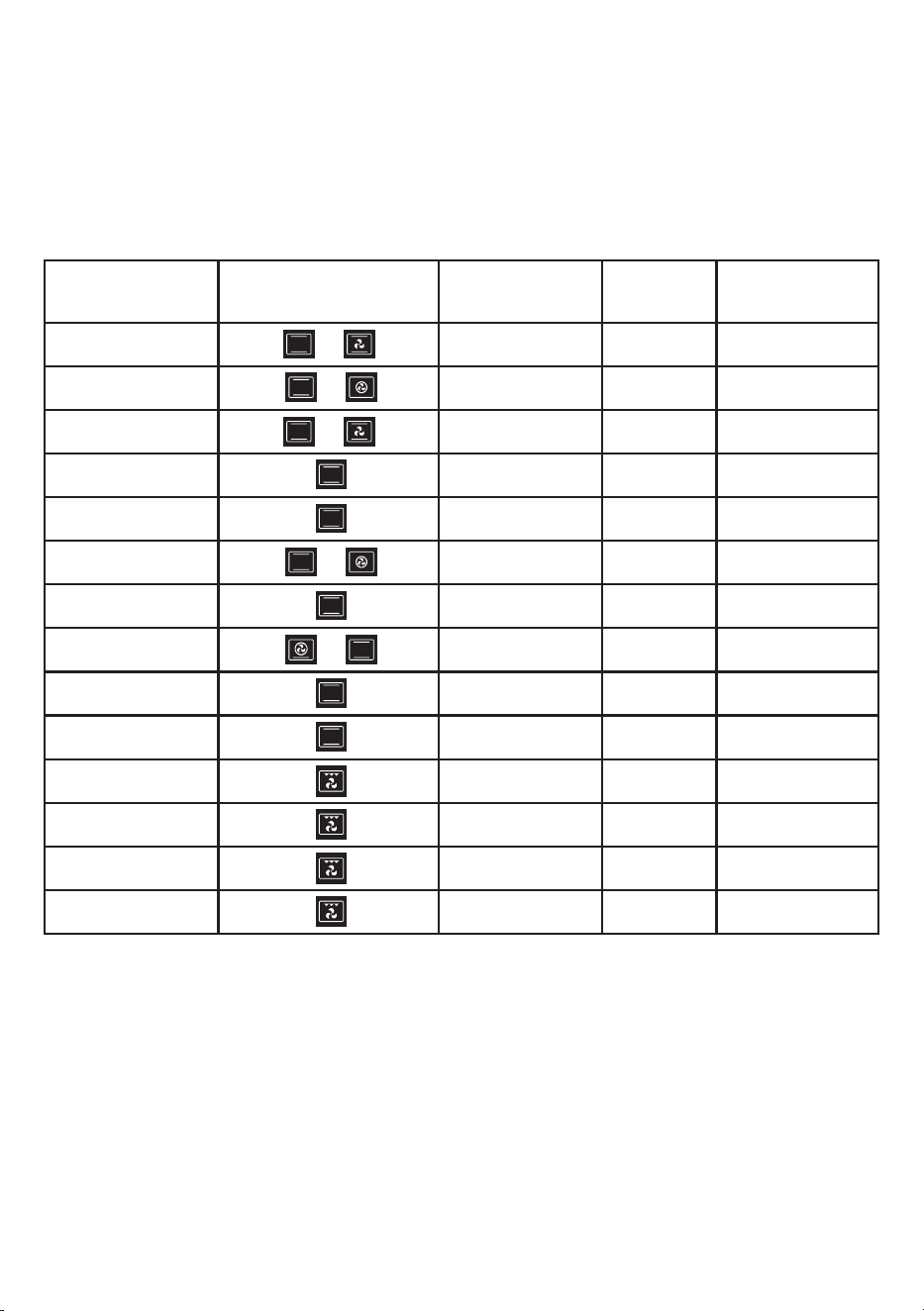
36
COOKING CHARTS
60 litres
WARNING: You should pre-heat the oven for 7-10
minutes before putting the meal in the oven.
Food
Cooking
function
Cooking
temperature (°C)
Cooking
rack
Cooking
time (min.)
Cake / 170-180 2-3 30-35
Small mun / 170-180 2 25-30
Pie / 180-200 2 35-45
Pastry 180-190 2 20-25
Cookie 170-180 2 20-25
Apple pie / 180-190 1-2 50-70
Sponge cake 150/150* 2 20-25
Pizza / 180-200 3 20-30
Lasagna 180-200 2-3 25-40
Macaroon 100 2 50-60
Grilled chicken ** 200-220 3 25-35
Fish grill** 200-220 3 25-35
Roast beef ** Max. 3-4 15-20
Grilled meatballs ** Max. 3-4 20-25
* Do not pre-heat. We recommend you to cook at 200 °C for the rst
half of the cooking period, and at 150 °C for the remaining half.
** Food shall be turned upside down after the half of the cooking
period.
37
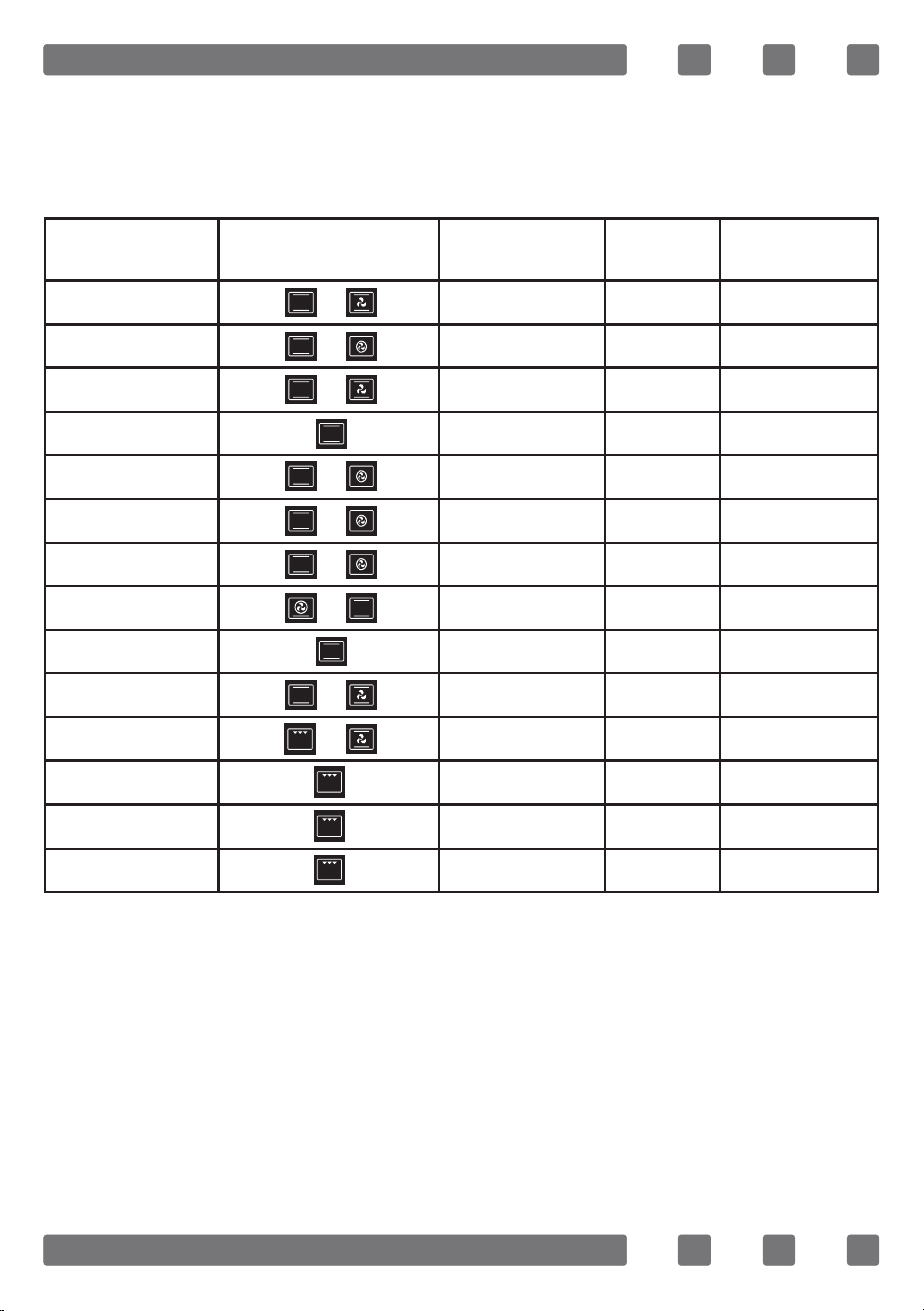
80 litres
WARNING: You should pre-heat the oven for 7-10
minutes before putting the meal in the oven.
Food
Cooking
function
Cooking
temperature (°C)
Cooking
rack
Cooking
time (min.)
Cake / 170-180 2-3 30-35
Small mun / 170-180 2-3 25-30
Pie / 180-200 2-3 35-45
Pastry 180-190 2-3 20-25
Cookie / 170-180 2-3 20-25
Apple pie / 180-190 2-3 50-70
Sponge cake / 200/150* 2-3 20-25
Pizza / 180-200 3 20-30
Lasagna 180-200 2-3 25-40
Macaroon / 100 2-3 50-70
Grilled chicken ** / 200-220 2-3 25-35
Fish grill** 190 -200/-220 3-4 25-35
Roast beef ** Max. 4-5 30-35
Grilled meatballs ** Max. 4-5 25-30
* Do not pre-heat. We recommend you to cook at 200 °C for the rst
half of the cooking period, and at 150 °C for the remaining half.
** Food shall be turned upside down after the half of the cooking
period.

38
* BAKING WITH PIZZA STONE
WARNING: You should pre-heat the oven for 30
minutes before putting the pizza in the oven.
When baking with pizza stone, place pizza stone over wire rack and
pre-heat the oven in pizza mode [turbo +fan + lower resistance ( ) ] at
230°C for 30 minutes. Once pre-heating is completed, without remov-
ing pizza stone put pizza over it with the peel and bake at 180-200°C
for , 20-25 minutes. Once baking is completed, remove the baked pizza
from the oven using the peel.
WARNING: Do not place pizza stone in a pre-heat-
ed oven.
WARNING: Once baking is completed, do not re-
move pizza stone when it is hot and do not place on
cold surfaces. Otherwise, pizza stone can be cracked.
WARNING: Do not expose pizza stone to humidity.
WARNING: Your hand may get burnt because of
the internal panels of the oven, spilt meals, accesso-
ries and hot vapour. Use the pizza peel when remov-
ing the pizza from the oven.

39
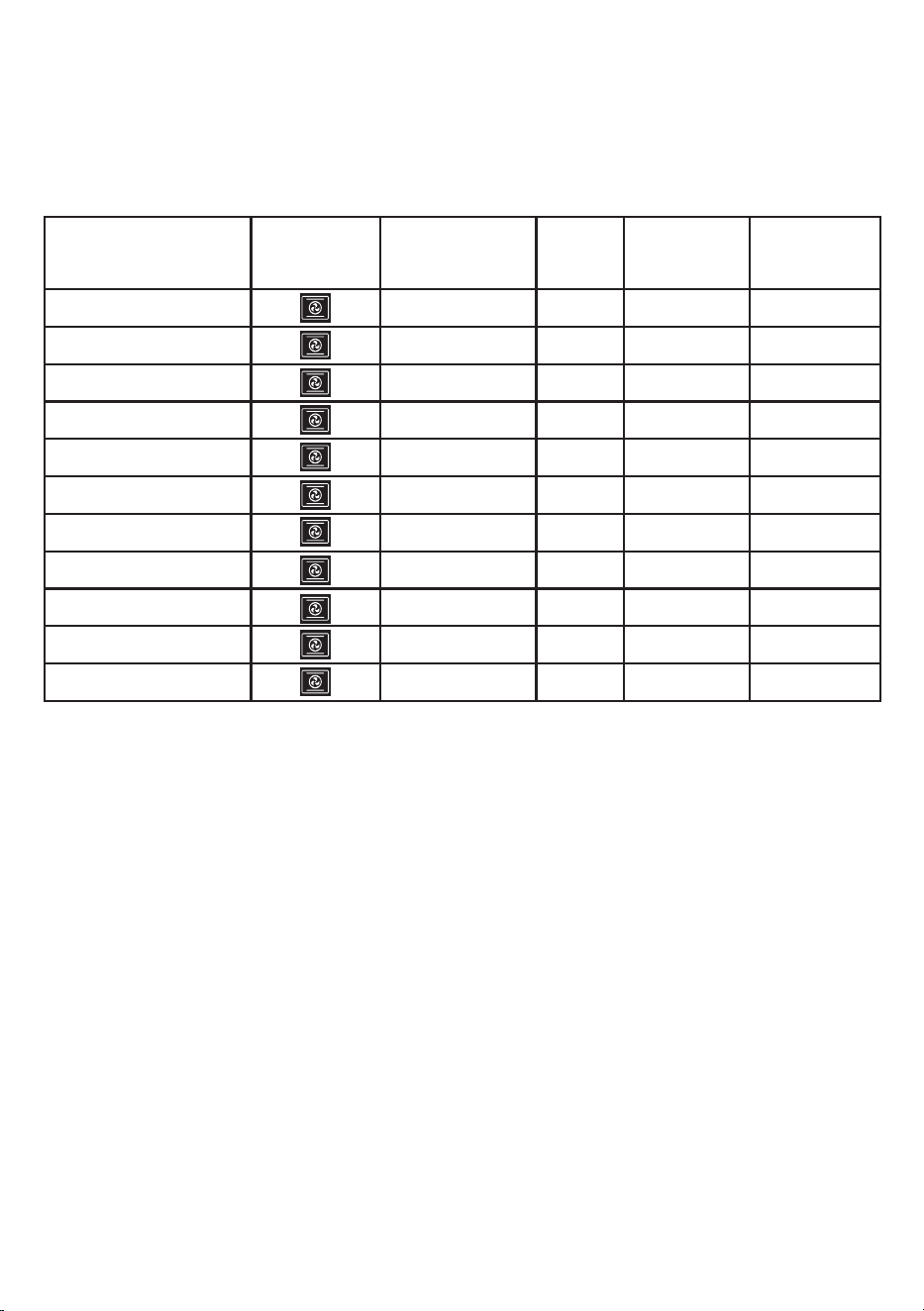
DRYING
WARNING: Do not preheat during drying.
Food
Cooking
Function
Cooking
temperature (°C)
Cooking
Rack
Cooking
duration (hours)
Sliced banana Fan-cooking functions 100 2 4-5
Sliced apple Fan-cooking functions 100 2 4-5
Sliced orange Fan-cooking functions 100 2 4-5
WARNING: Drying should only be carried out in the
drying tray.
WARNING: Do not open the oven door until the
drying process is complete.
WARNING: The thinner the slices, the faster the
drying duration is and the aroma of the food is pre-
served better.
WARNING: Your hand may get burnt because of
the internal panels of the oven, spilt meals, accesso-
ries and hot vapour. Wear kitchen gloves while taking
dried fruits out of the oven.
40
* STEAM SUPPORTED COOKING
Because it is not cooked in water, vitamins and minerals are retained
during steam cooking.
Steam-assisted cooking preserves the avours of the food better
than normal cooking. Also, foods retain their fresh and natural colours
this way.
Water consumption depends on the type of food and the length of
cooking time.
According to the option of the appliance, you can perform steam
supported cooking with two dierent methods.
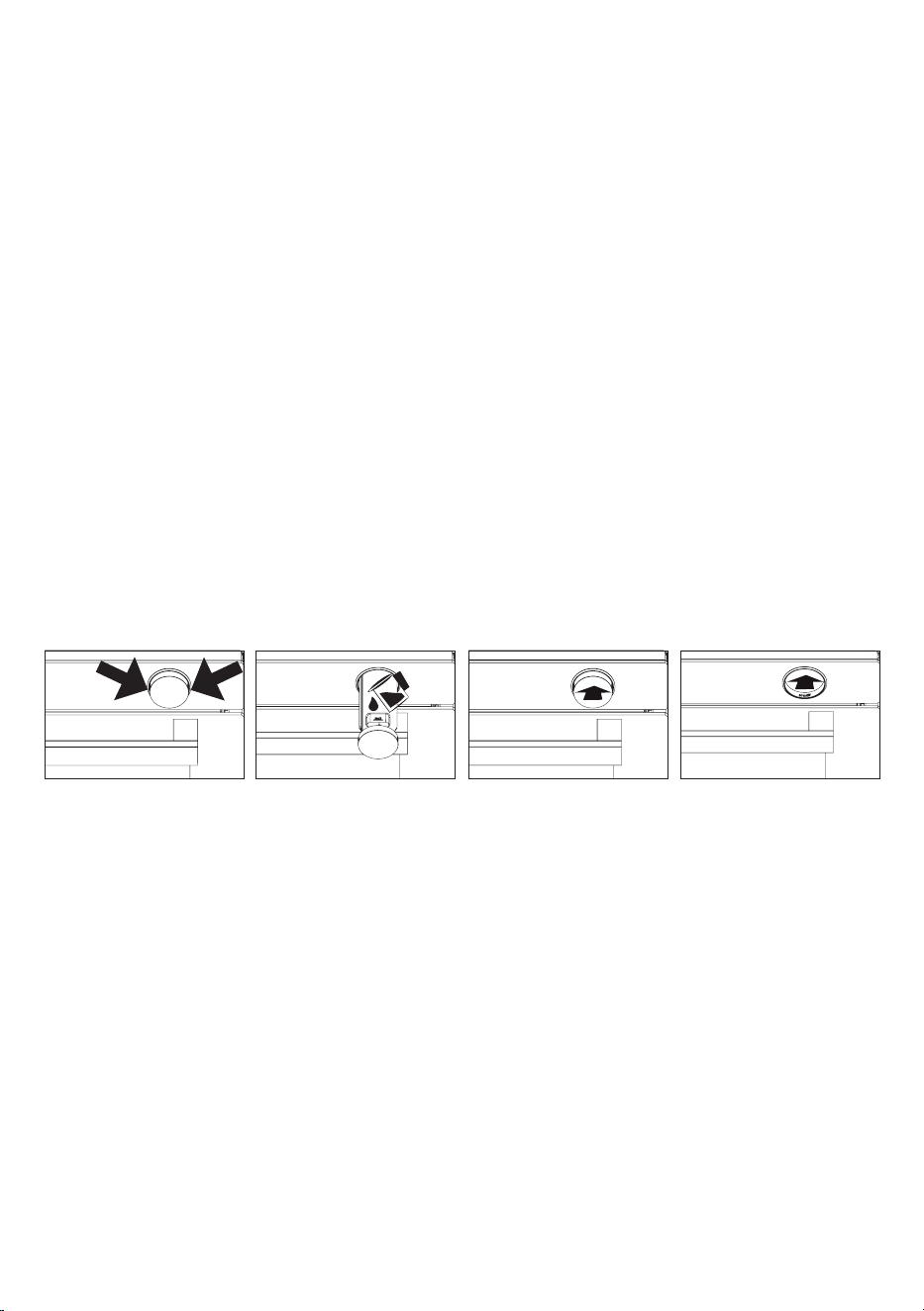
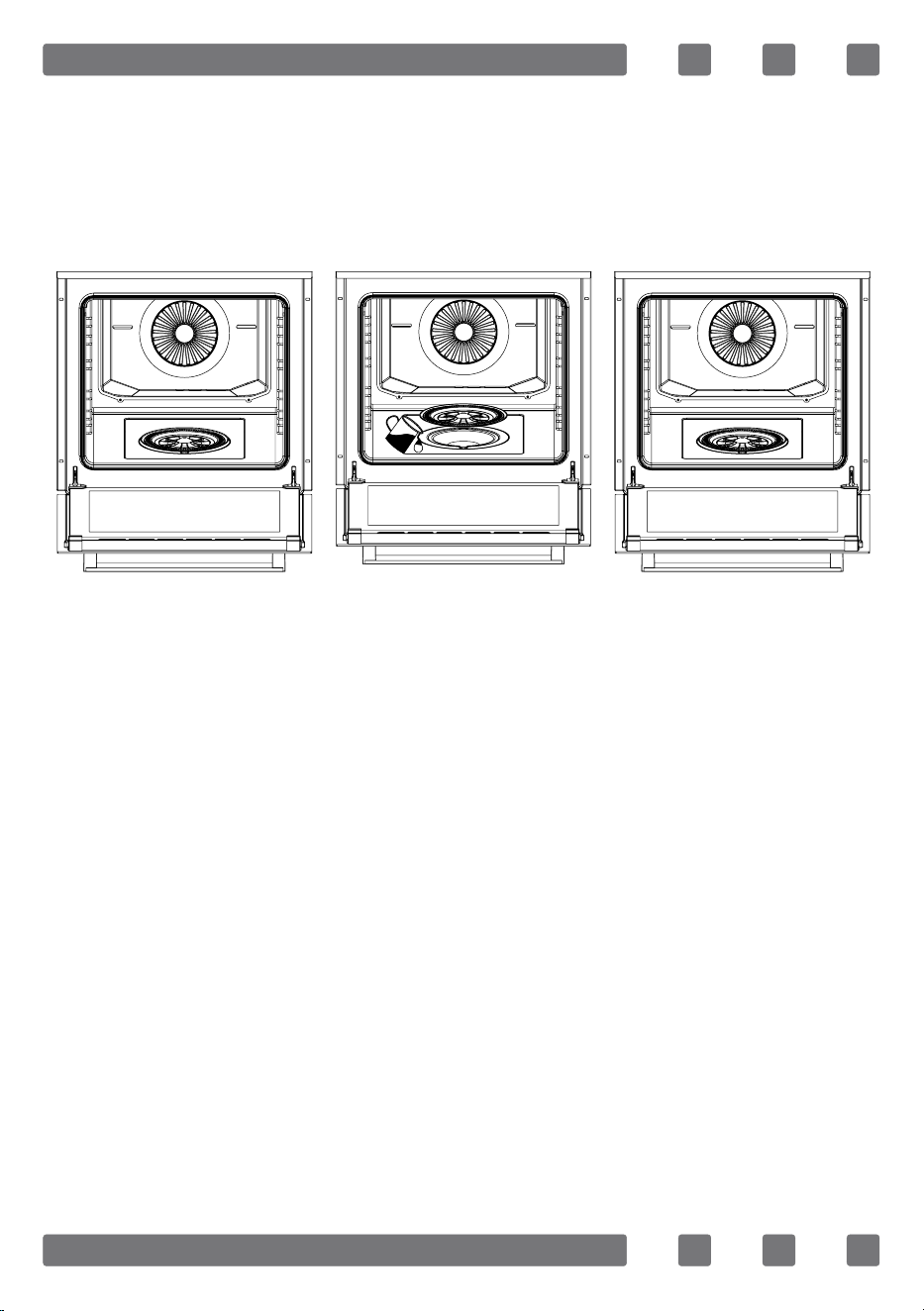
1. Remove the water container by pulling it out at the points indicated
by the arrow. Fill the water container (see gure 8) and slide it in the
direction of the arrow to the starting position to put it in place (see
gure 9). (See Figure 10) After 10 minutes of preheating, slide the wa-
ter container in the direction of the arrow until you hear a "click". (see
gure 11)
WARNING: If the appliance has steam supported
cooking feature; check whether there is water in wa-
ter tanks while taking the appliance to another place.
If there is water in the tanks, you must empty them.
WARNING: Do not use distilled or ltered water. Use
only bottled waters. Water should not be replaced by
solutions that are ammable, alcohol-containing or
with solid particles. Never use mineral water or other
liquids!
Figure 8
Figure 11
Figure 9
Figure 10

41
WARNING: The maximum rell is 250 milliliters and
the minimum rell is 65 milliliters.
WARNING: When lling the water container, never
exceed the maximum marking!
WARNING: For each cooking process, observe
the amount of water for the food as indicated in the
cooking chart.
WARNING: Do not remove the water container
while cooking is in progress.
WARNING: If possible, use dishes with perforated
holes for cooking with steam. This ensures that the
steam reaches the food from all sides and that the
food cooks evenly.
WARNING: Only use containers which are resistant
to heat (up to 100 °C) and steam. If you want to use
plastic containers, check with the manufacturer of
the container to see if it is suitable for the oven.
WARNING: Thick pots such as porcelain, ceramic
or earthenware are not very suitable for steaming.
Because they are thick, they do not conduct heat
well and therefore the cooking times indicated in the
tables may be much longer.
42
Steam Supported Cooking Chart
WARNING: You should pre-heat the oven for 10
minutes before putting the meal in the oven.
Food
Cooking
function
Cooking
temperature
(°C)
Cooking
rack
Cooking
time (min.)
Water
amount (ml.)
Cookie 170 3 20-25 100
Salty cookie 170 3 20-25 100
Pastry 180 3 25-30 100
Bun 180 3 25-30 100
Salmon 180 3 40-45 100
Chicken Drumstick 200 3 40-45 150
Chicken Wings 230 4 40-45 100
Whole chicken 190-230 3 60-70 250
Lamb shank with vegetables
170 3 80-90 250
Rosebeef 190 3 55-60 200
Entrecôte 180 3 35-40 250
WARNING: Make steam-assisted cooking with a
single tray
WARNING: Steam may come out when the door is
opened. Step back and wait for the steam to disap-
pear.
WARNING: Your hand may get burnt because of
the internal panels of the oven, spilt meals, acces-
sories and hot vapour. While removing the hot food
from the oven, use heat resistant oven gloves.
43
2. Open the cover of the appliance (see gure 12). Remove the water
tank cover and ll the tank (see gure 13). Then, close the water tank
cover (see gure 14). Close the cover of the appliance and preheat it
for 10 minutes. After preheating, you can place the food in the appli-
ance.
WARNING: If the appliance has steam supported
cooking feature; check whether there is water in wa-
ter tanks while taking the appliance to another place.
If there is water in the tanks, you must empty them.
WARNING: Do not use distilled or ltered water. Use
only bottled waters. Water should not be replaced by
solutions that are ammable, alcohol-containing or
with solid particles. Never use mineral water or other
liquids!
WARNING: The maximum rell is 200 milliliters and
the minimum rell is 80 milliliters.
WARNING: For each cooking process, observe
the amount of water for the food as indicated in the
cooking chart.
Figure 12 Figure 14Figure 13

44
WARNING: If possible, use dishes with perforated
holes for cooking with steam. This ensures that the
steam reaches the food from all sides and that the
food cooks evenly.
WARNING: Only use containers which are resistant
to heat (up to 100 °C) and steam. If you want to use
plastic containers, check with the manufacturer of
the container to see if it is suitable for the oven.
WARNING: Thick pots such as porcelain, ceramic
or earthenware are not very suitable for steaming.
Because they are thick, they do not conduct heat
well and therefore the cooking times indicated in the
tables may be much longer.
45
Steam Supported Cooking Chart
WARNING: You should pre-heat the oven for 10
minutes before putting the meal in the oven.
Food
Cooking
function
Cooking
temperature
(°C)
Cook-
ing rack
Cooking
time (min.)
Water
amount (ml.)
Bread 200°C 2 20-30 80
Chicken 200°C 2 60-70 150
Salmon with Vegetables 180°C 2 30-40 80
Chicken Drumstick 200°C 2 25-35 100
Pastry 190°C 2 15-25 80
Lamb shank with vegetables
170°C 2 60-70 150
Bun 190°C 2 15-25 80
Entrecôte 180°C 2 40-50 150
Kumpir 190°C 2 90-100 150
WARNING: Make steam-assisted cooking with a
single tray.
WARNING: Steam may come out when the door is
opened. Step back and wait for the steam to disap-
pear.
WARNING: Your hand may get burnt because of
the internal panels of the oven, spilt meals, acces-
sories and hot vapour. While removing the hot food
from the oven, use heat resistant oven gloves.

46
Cleaning Of Water Pool At The Bottom Of The Oven
Depending on the frequency of cooking with steam support-easy
steam cleaning and the hardness of the water used, lime stains may
form in the water pool at the bottom of the oven. After every 2 or 3
uses, to dissolve limes that may form in the water pool on the bottom
of the oven after cooking with steam support-easy steam cleaning
processes:
1. Put 350 cc of white vinegar (Vinegar acid rate should not be
more than 6%) in the water pool at the bottom of the oven.
2. Allow the vinegar to dissolve the lime scale at ambient tempera-
ture for at least 30 minutes.
3. Clean the water pool with a soft wet cloth and dry it with a dry
cloth.
WARNING: Do not use cleaning agents containing
acids or chlorides to clean the water pool at the bot-
tom of the oven. Do not clean by scraping o limes
that may occur in the water pool at the bottom of
the oven. Otherwise, the product gets damaged.
47
* AIR FRYER COOKING
While the air fryer is cooking, you can do the cooking according to
the values specied in the cooking chart by switching the oven to air
fryer mode [bottom-top + fan ( )].
Air Fryer Cooking Chart
WARNING: You should pre-heat the oven for 8-10
minutes before putting the meal in the oven.
Food
Cooking
Function
Cooking
temperature (°C)
Cooking
rack
Cooking
time (min.)
Weight in
grams (g)
Cookie 170 2-3 10-15 -
Frozen chicken nuggets 200 2-3 20-25 750
Frozen fried potatoes 220 2-3 20-25 700
Halloumi fries 200 2-3 10-15 250
Steak 180 2-3 10-15 1000
Meatball 180 2-3 10-15 1000
Pizza 200 2-3 10-15 -
Mushrooms 200 2-3 15-20 1000
Chicken rolls 180 2-3 25-30 1000
Chicken breast 180 2-3 25-30 750
WARNING: Air fryer cooking should only be done
in the air fryer tray.
WARNING: Steam may come out when the door is
opened. Step back and wait for the steam to disap-
pear.
WARNING: Your hand may get burnt because of
the internal panels of the oven, spilt meals, accesso-
ries and hot vapour. Wear kitchen gloves while taking
the hot meal out of the oven.

48
MAINTENANCE AND CLEANING
Periodical cleaning extends the appliance’s life and reduces frequent
problems.
WARNING: Disconnect the electrical connection of
the appliance. There is a danger of electric shock.
WARNING: Wait until the appliance cools down
before cleaning it. Hot surfaces may cause burns.
WARNING: User should not dislocate the resist-
ance during cleaning. It may cause an electric shock.
WARNING: The steam of a steam cleaning device
may inltrate the parts conducting electricity and
cause them to short-circuit. Never use a steam clean-
ing device for cleaning the oven.
WARNING: Never wash any part of the appliance
in the dishwasher! (excluding the accessories)
WARNING: The water container must not be im-
mersed in water and must never be washed in the
dishwasher! Do not use very hard sponges or brushes
when cleaning the water container.
WARNING: Turn o the appliance before removing
the safeguards. After cleaning, install the safeguards
according to instructions.
1. Do not clean the interior parts, panel, trays or other parts of the ap-
pliance with hard tools such as hard brushes, steel sponges, or knives.
Do not use abrasive, scratching agents, or detergents.
2. Wipe the interior parts of the appliance with a soapy cloth, then
rinse and dry it thoroughly with a soft cloth.

49
3. Clean the glass surfaces with special glass cleaning agents.
4. Do not use aliphatic or hydrocarbonated detergents. These may
cause the door gasket of the oven to swell.
5. Never use ammable materials such as acid, thinner, or gas when
cleaning your appliance.
6. Use potassium stearate (soft soap) for dirt and stains.
7. Clean the control panel with a wet cloth and dry it with a dry cloth.
8. The appliance should be thoroughly cleaned after each use. Thus,
food residues are easily cleaned and these residues are prevented from
burning when the product is used again later.
9. Ensure that you completely wipe any remaining liquids after the
cleaning process and that you immediately clean any food that splash-
es around during cooking.
10. Some detergents or cleaning agents may damage the surface.
Do not use abrasive detergents, cleaning powders, cleaning creams, or
sharp objects during cleaning.
11. Clean and dry the oven and its accessories after every use.
12. Close the oven’s door after the inside of the appliance dries completely.
13. The appliance should be cleaned thoroughly to avoid bad odours
if it will not be used for a long time. Leave the oven’s door open after
cleaning.
14. Replace the appliance’s door gasket when pores form or when it
cracks. You can order the door gasket from the authorized service.
15. Clean the wire racks in the dishwasher or with a dishwashing de-
tergent and hot water.
16. Do not use abrasive cleaners or sharp metal scrapers to clean the
glass as the scratches that may occur on the surface of the door glass
may cause the glass to break.
17. Remove the glass cover of the oven lamp (see lamp replacement)
and wipe with a cloth dampened with dishwashing detergent and hot
water. Clean it with a soft cloth.
50
* Steam Cleaning
It allows the removal of softened dirt thanks to the steam that forms
in the oven.
1. Remove all accessories from the oven.
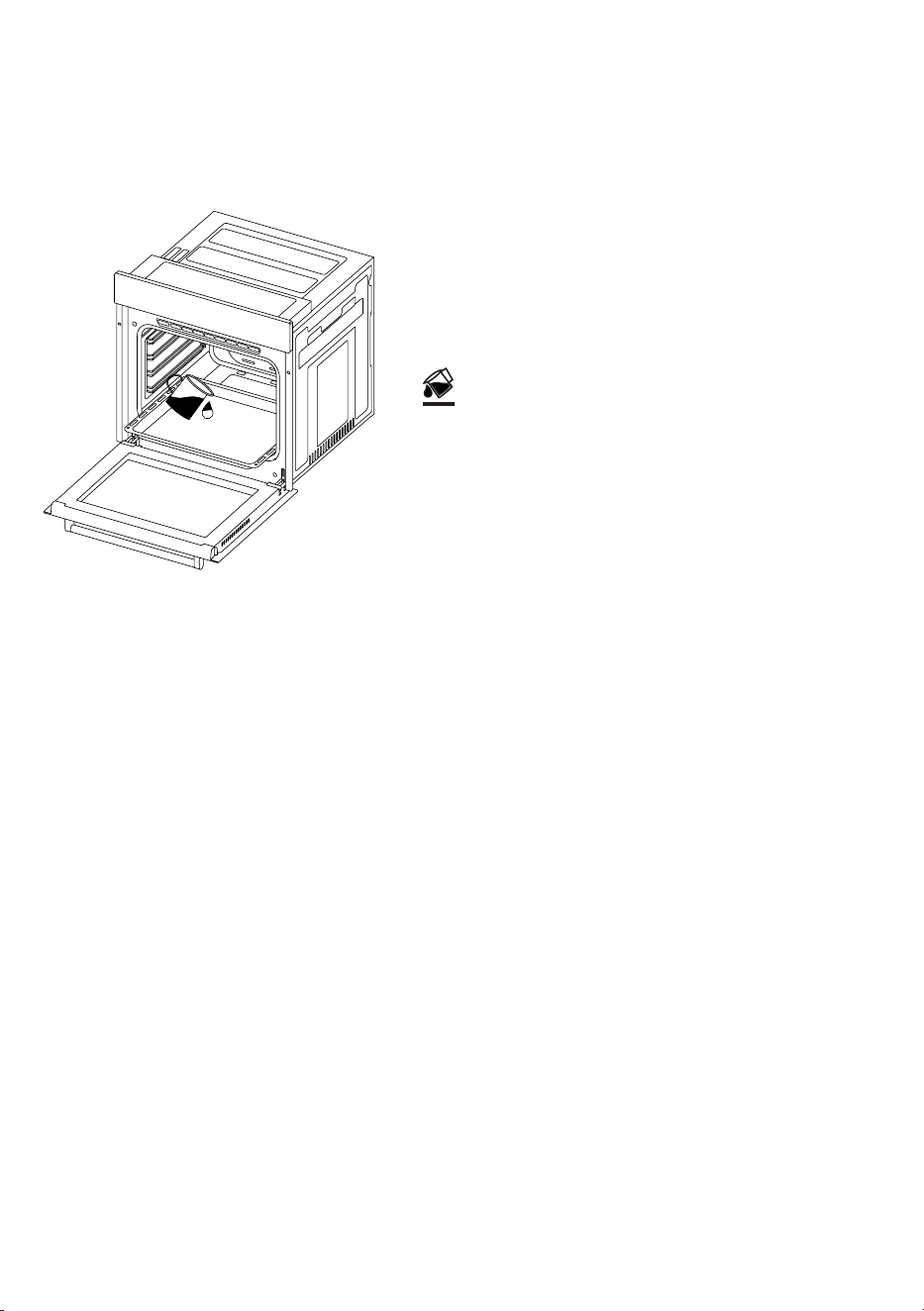
2. Put half a litre of water on the tray
and place the tray at the bottom of the
oven.
3. Bring the switch to steam cleaning
( ) mode.
4. Set the thermostat to 70°C, and oper-
ate the oven for 30 minutes.
5. After operating the oven for 30 min-
utes, open the door and wipe the inner
surfaces of oven with a damp cloth.
6. Clean the oven using dish washing detergent, warm water, and a
soft cloth for dirt that does not come out easily and wipe the area you
have cleaned with a dry cloth.
51
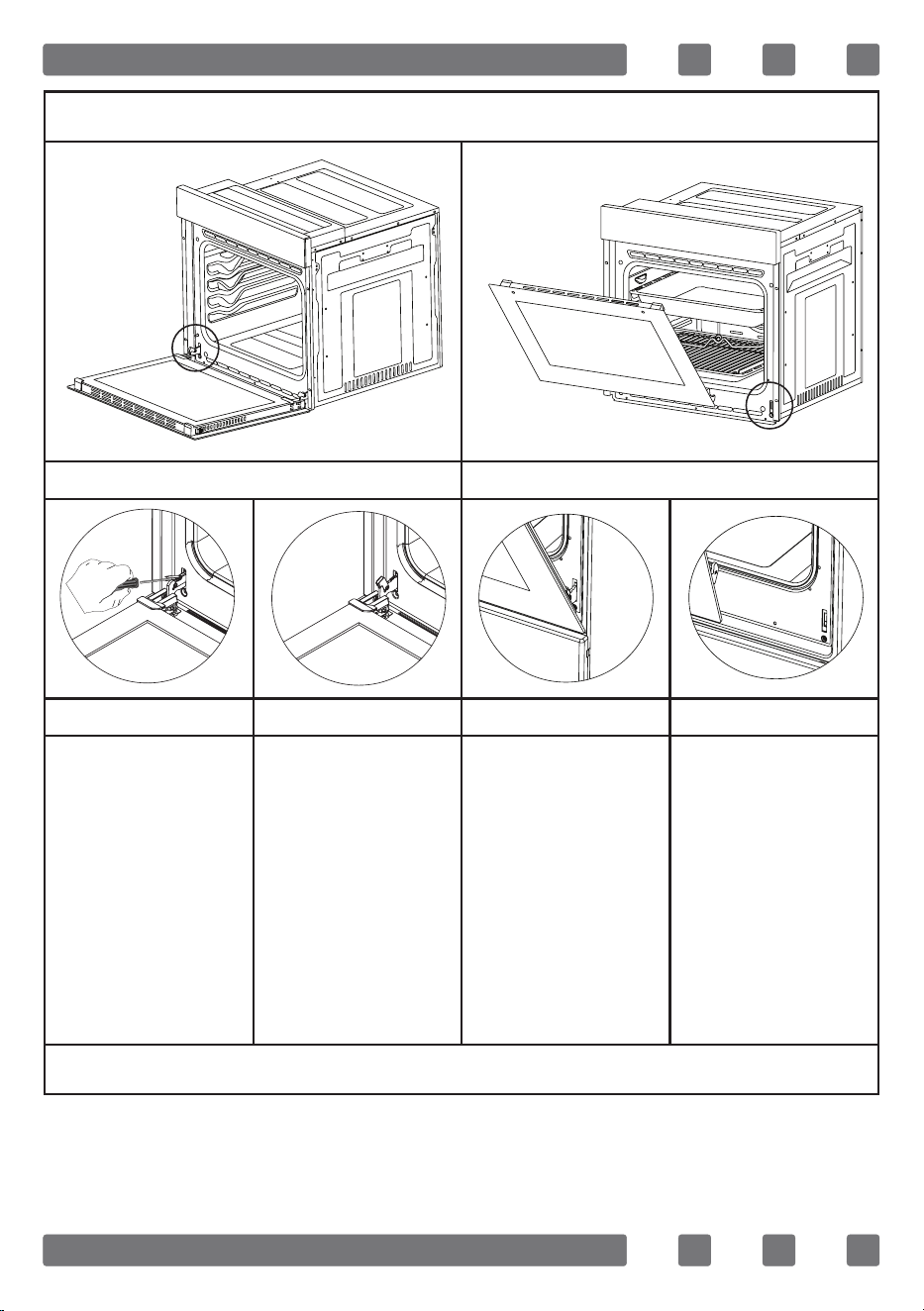
Cleaning And Assembly Of The Oven Door
Figure 15 Figure 16
Figure 15.1 Figure 15.2 Figure 16.1 Figure 16.2
Open the door
completely by pull-
ing the oven door
toward you. Then
unlock the hinge
lock by pulling it
upwards with a
screwdriver. (See
Fig. 15.1)
Set the hinge lock
to the widest an-
gle. (See Fig. 15.2)
Bring both hinges
that connect the
oven door to the
oven to the same
position.
Then close the
oven door until it
rests against the
hinge lock. (See
Fig. 16.1)
To remove the
oven door, hold
the door with both
hands when it is at
a close level to the
closed position,
and pull it up. (See
Fig. 16.2)
To replace the oven door again reverse the procedure for removing the door.
52
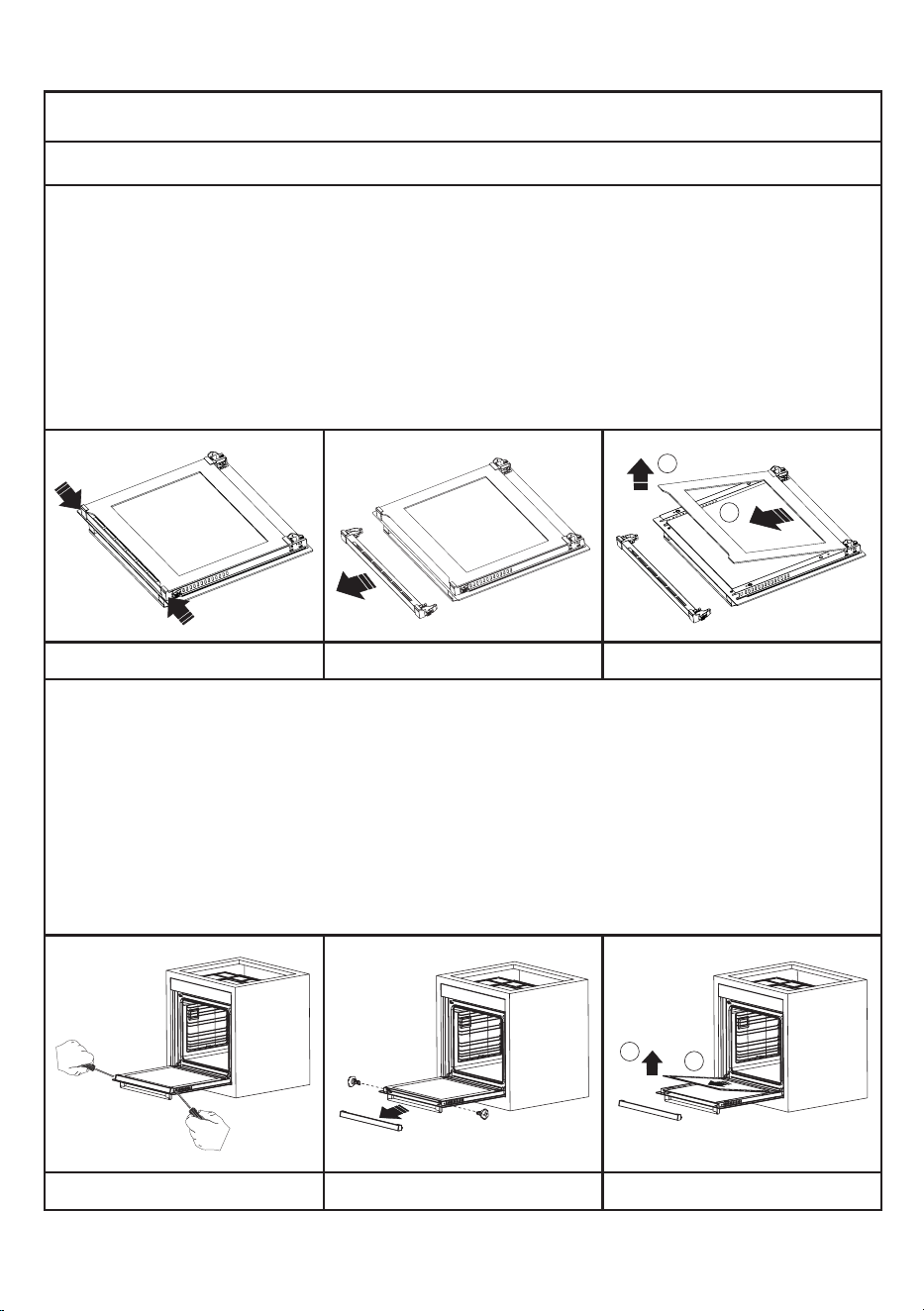
Cleaning Of The Oven Glass
Your oven may be dierent. Follow the appropriate step for your oven.
1. Press the plastic latches on the left and right side as shown in gure 17 and
lift the prole by pulling it towards you as shown in gure 18. Glass is free after the
prole is removed as shown in gure 19. Carefully pull the glass that has become
free toward you. If necessary, the central glass can be removed in the same way.
The outer glass is xed to the oven door prole. You may easily clean the glasses
after they have been separated. Once the cleaning and maintenance is complete,
you may replace the glasses and the prole by performing the removal procedure
in reverse. Make sure that the glass is inserted in the correct direction and that the
prole ts properly.
Figure 17 Figure 18 Figure 19
2. Remove the screws on the left and right side as shown in gure 20. Remove
the prole by pulling it towards you as shown in gure 21. Glass is free after the
prole is removed as shown in gure 22. Carefully pull the glass that has become
free toward you. If necessary, the central glass can be removed in the same way.
The outer glass is xed to the oven door prole. You may easily clean the glass after
it has been separated. Once the cleaning and maintenance is complete, you may
replace the glasses and the prole by performing the removal procedure in reverse.
Make sure that the glass is inserted in the correct direction and that the prole ts
properly.
Figure 20 Figure 21 Figure 22
1
2
1
2

53
OVEN LAMP REPLACEMENT
WARNING: In order to avoid electric shock, turn
o the power connection before replacing the lamp
of the oven!
WARNING: In order to avoid burns, wait for it to
cool down before replacing the lamp of the oven! Hot
surfaces may cause burns!
WARNING: The bulb used in this product is not
suitable for illumination of households. The purpose
of this lamp is to help the user to see the food.
WARNING: The light bulbs used in this product
must be able to withstand extreme physical condi-
tions, e.g. temperatures above 100º C.
WARNING: In devices with halogen lamps; the user
must not look at the halogen lamp.
54
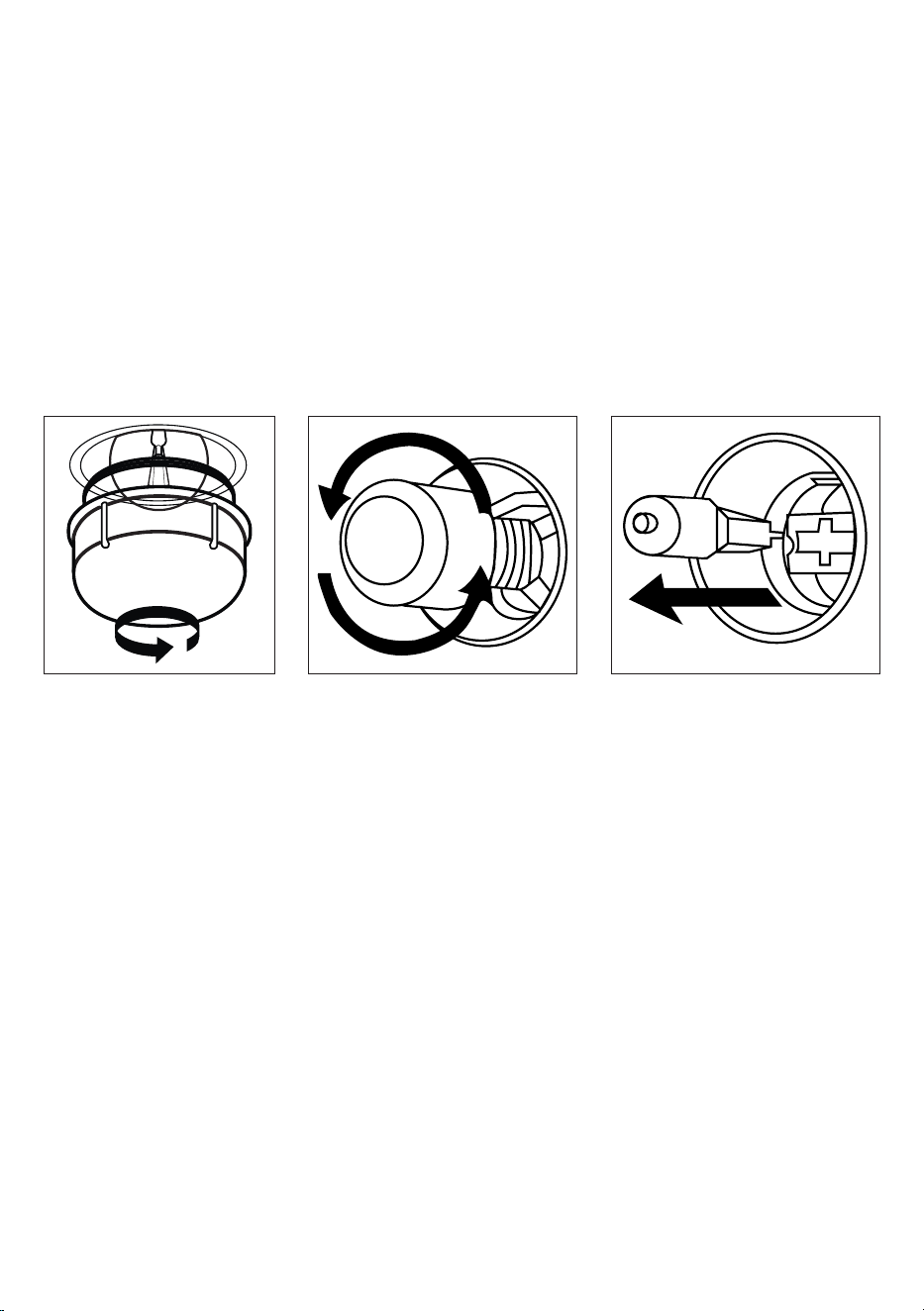
To Change The Lamp;
1. Turn o the electricity.
2. Remove the glass protection by turning it counterclockwise. (See
Fig. 23) Using plastic gloves may help you if you have diculty in ro-
tating it.
3. Then remove the oven lamp by turning it (see g. 24) if it is type
A, or by pulling it (see g. 25) if it is type B.
4. Fit a new lamp with the same features.
5. Replace the protective glass and connect the unit to the mains.
Note: This appliance contains a light source whose energy eciency
class is G.
To Chance The Square Lamp;
1. Turn o the electricity.
2. Remove by pulling the glass protection towards you.
3. Then remove the oven lamp by pulling it out.
4. Fit a new lamp with the same features.
5. Replace the protective glass and connect the unit to the mains.
Figure 23 Figure 24
A
Figure 25
B
55
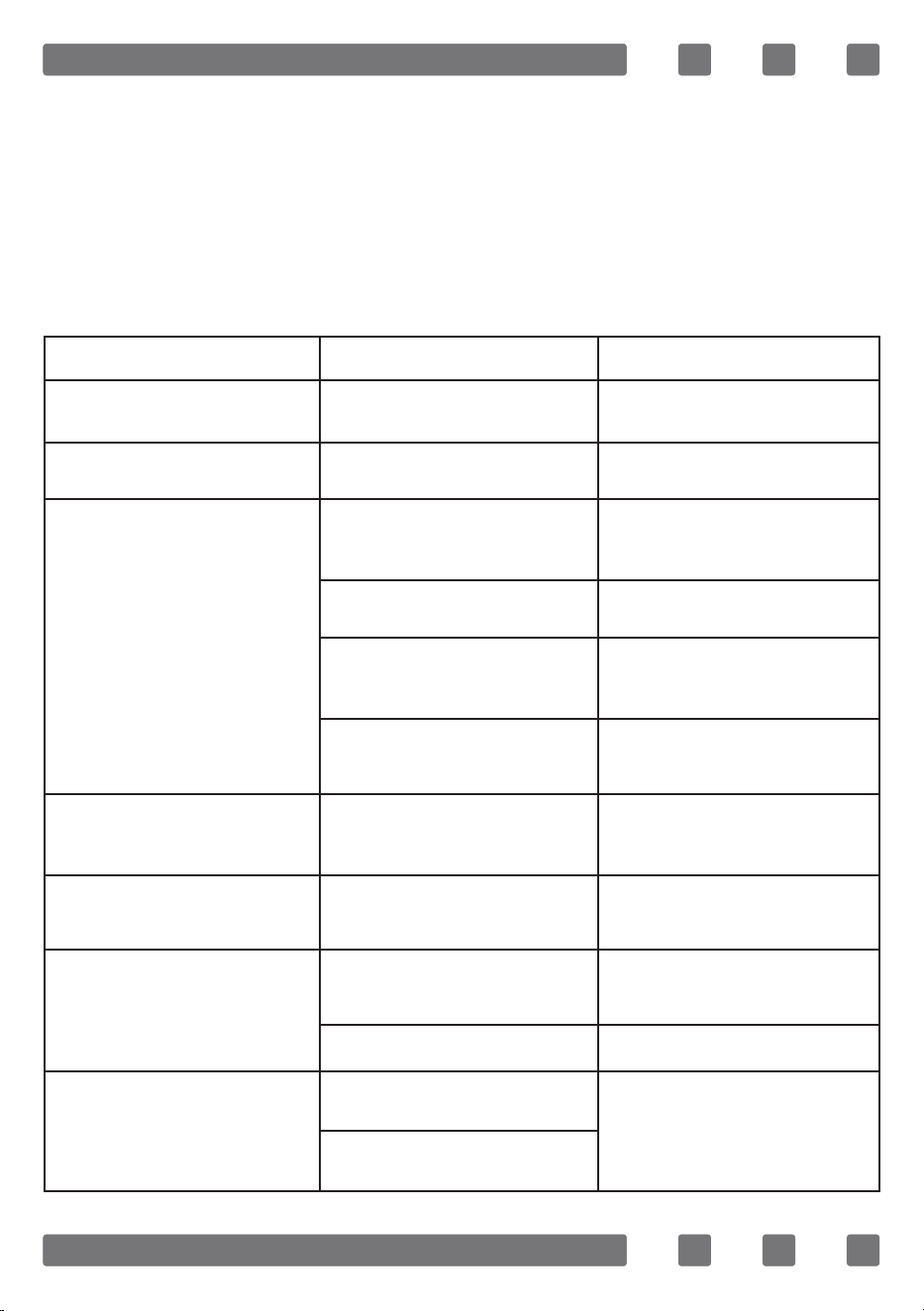
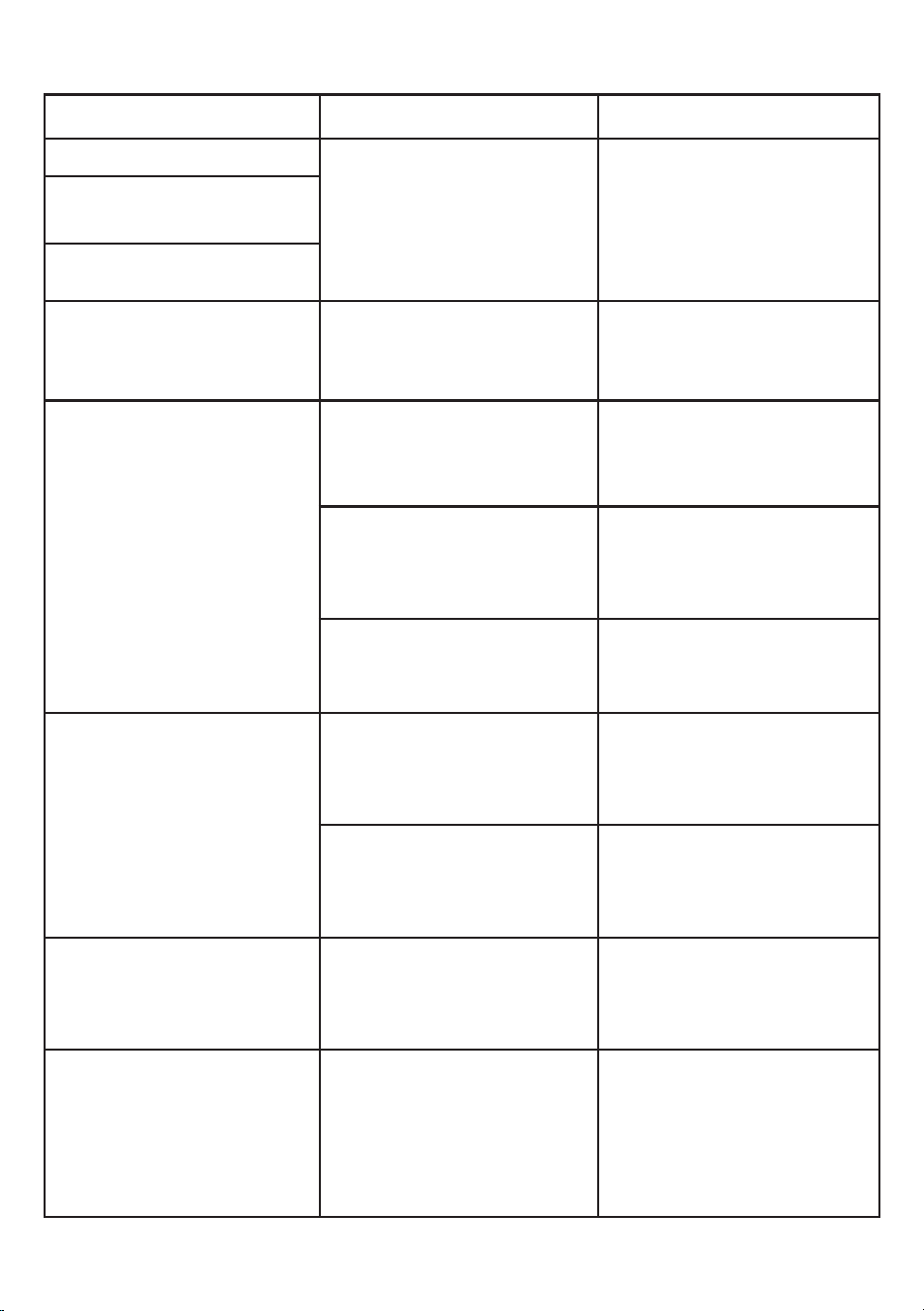
TROUBLESHOOTING
You may solve the problems you may encounter with your product
by checking the following points before calling the technical service.
Check Points
In case you experience a problem about the oven, rst check the
table below and try out the suggestions. If the problem is persisting,
contact the Service Center.
Problem Possible Cause What To Do
Oven does not operate.
Power supply not available.
Check that the power supply is
available.
Oven stops during cooking.
Plug comes out from the wall
socket.
Re-install the plug into wall
socket.
Turns o during cooking.
Too long continuous operation.
Let the oven cool down after long
cooking cycles.
Cooling fan not operating.
Listen the sound from the cooling
fan.
Oven not installed in a location
with good ventilation.
Make sure clearances specied in
operating instructions are main-
tained.
More than one plugs in a wall
socket.
Use only one plug for each wall
socket.
The outside of the oven gets
very hot during operation.
Oven not installed in a location
with good ventilation.
Make sure clearances specied in
operating instructions are main-
tained.
Oven door is not opening prop-
erly.
Food residues jammed between
the door and internal cavity.
Clean the oven well and try to re-
open the door.
Internal light is dim or does not
operate.
Lamp might be failed.
Replace with a lamp having same
specications.
Foreign object covering the lamp
during cooking.
Clean internal surface of the oven
and check again.
Electric shock when touching
the oven.
The power may not be properly
grounded.
Make sure power supply is
grounded properly.
You may be using an ungrounded
socket.
56
Problem Possible Cause What to Do
Water dripping.
Depending on the food, water or
steam may form in some cases.
This is not a fault of the appliance.
Let the oven cool down and than
wipe dry with a dishcloth.
Steam coming out from a crack
on oven door.
Water remaining inside the
oven.
The cooling fan continues to
operate aer cooking is n-
ished.
This fan runs automatically for a
certain period of time to ventilate
the interior of the oven.
This is not a fault of the appliance;
therefore you don’t have to wor-
ry.
The oven does not heat.
Oven door is open. Close the door and restart.
The oven controls may not be set
correctly.
Read the section regarding oper-
ation of the oven and reset the
oven.
The fuse may have blown or the
circuit breaker may have tripped.
Replace the fuse or reset the cir-
cuit breaker. If this is repeating
frequently, call an electrician.
Smoke comes out of the prod-
uct during operation.
When operating the oven for the
rst time.
smoke comes out from the heat-
ers. This is not a fault. After 2-3
cycles, there will be no more
smoke.
Food on heater.
Let the oven to cool down and
clean food residues from the
heater.
There is a smell of burning or
plastic when using the oven.
Plastic or other not heat resistant
accessories are being used inside
the oven.
Use glass containers suitable for
high temperatures.
Oven does not cook well.
The door may be opened too of-
ten during cooking.
Do not open the oven door too of-
ten unless you are cooking some-
thing that needs to be rotated. If
you open the door too often, the
internal temperature will drop,
which may aect the cooking re-
sult.

57
HANDLING RULES
1. Do not use the door and/or handle to carry or move the appliance.
2. Carry out the movement and transportation in the original pack-
aging.
3. Pay maximum attention to the appliance while loading/unloading
and handling.
4. Make sure that the packaging is securely closed during handling
and transportation.
5. Protect from external factors (such as humidity, water, etc.) that
may damage the packaging.
6. Be careful not to damage the appliance due to bumps, crashes,
drops, etc. while handling and transporting and not to break or deform
it during operation.
Future Handling Procedures
The product should be stored and carried in its original box. If the
original box is not available, the product must be wrapped with bubble
wrap or a thick cardboard and tightly taped.
The product cover should be taped to the side walls.
Do not put other items on the product and carry it upright.
Do not drop the product during transport and protect it against im-
pacts.
The product should be kept in normal position during transport.
During handling, the accessories of the product should be xed with
a tape in order not to damage the product.

58
RECOMMENDATIONS FOR ENERGY SAVING
Following details will help you use your product ecologically and eco-
nomically.
1. Use dark coloured and enamel containers that conduct the heat
better in the oven.
2. As you cook your food, if the recipe or the user manual indicates
that pre-heating is required, pre-heat the oven.
3. Do not open the oven door frequently while cooking.
4. Try not to cook multiple dishes simultaneously in the oven. You
may cook at the same time by placing two cookers on the wire rack.
5. Cook multiple dishes successively. The oven will not lose heat.
6. Turn o the oven a few minutes before the expiration time of cook-
ing. In this case, do not open the oven door.
7. Defrost the frozen food before cooking.
59
COMPLIANCE WITH WEEE REGULATIONS AND
DISPOSAL OF WASTE PRODUCT
Dispose of packaging in an environmentally-friendly manner.
This appliance is
labelled in accordance with European Directive
2012/19/EU concerning used electrical and electronic appliances
(waste electrical and electronic equipment - WEEE). The guideline de-
termines the frame work for the return and recycling of used applianc-
es as applicable throughout to the EU.
PACKAGE INFORMATION
This product was manufactured from recyclable and reusable high
quality parts and materials. Therefore, do not dispose of this
product with other domestic wastes at the end of its life cycle. Take it
to a col-lection point for electrical and electronic equipment. You can
ask your local administration about these collection points. Please
help to pro-tect the environment and natural resources by recycling
the used prod-ucts. Before disposing of the product, disconnect the
electrical plug for the safety of children and make it inoperable. The
product's packaging is made of recyclable materials, in accordance
with our national legisla-tion. Do not dispose of the packaging waste
with the household waste or other wastes, dispose it to the
packaging collection areas specified by local authorities.
Product support
If you still require further assistance, call one of our service experts on 01759 48 78 26. To help give us fast
and efficient service, please have the following information ready:
Model Ref
Serial Number
Date of purchase
You can find these on
the
rating plate - a
small information panel
(usually a sticker or metal
plate) on
the
rear of your
appliance
This will be shown on
your receipt
Help and assistance
If you require any technical guidance or find that your tumble dryer is not operating as intended, a simple
solution can often be fou nd in
the
Troubleshooting section of these i nstructions.
60

Declaration of conformance to
product standards
This appliance conforms to all relavant standards
applicable to domestic appliances sold in the UK
Disposal
This appliance/fitting is marked
according to the European directive
2012/19/EU on Waste Electrical
and Electronic Equipment (WEEE).
By ensuring this product is disposed of
correctly, you will help prevent potential
negative consequences for the environment
and human health, which could otherwise be
caused by inappropriate waste handling of
this product.
The symbol on the product, or on the
documents accompanying the product, the
crossed out wheelie bin symbol, indicates
that this appliance/tting may not be treated
as household waste. Instead it shall be
handed over to the applicable collection point
for the recycling of electrical and electronic
equipment.
Disposal must be carried out in accordance
with local environmental regulations for waste
disposal.
For more detailed information about
treatment, recovery and recycling of this
product, please contact your local authority,
your household waste disposal service or the
retailer where you purchased the product.
61

16
T. 01759 48 78 26
E. admin@appliancesupport.co.uk
Online. www.appliancesupport.co.uk/solt
ESSENTIALS FOR LIFE
Solt Service:
www.solt.house