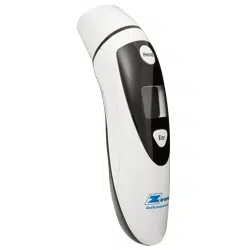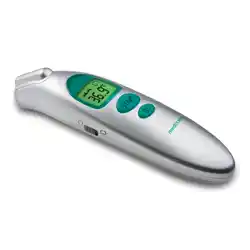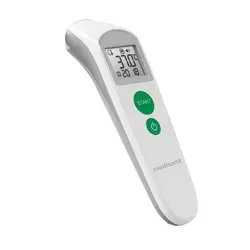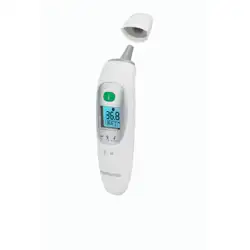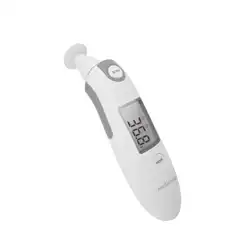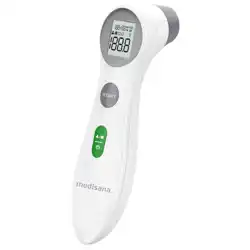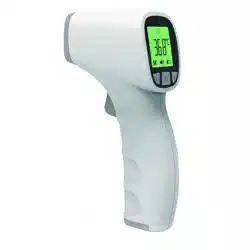

Infrared Thermometer
Instruction Manual
Zewa, Inc
Manual Version: 1.0
Date of Issue: 2020/06/05
0482

Product Information
Product Name: Infrared Thermometer
Model: 11110 (JPD-FR202)
Copyright
Copyright © Zewa, Inc.
All rights reserved.
Statement
All statements, information, and recommendations in this document are
provided "AS IS" without warranties, guarantees or representations of any
kind, either express or implied. The information in this document is
subject to change without notice. Zewa, Inc.. reserves the right of final
interpretation of this document.
Introduction
Thank you for purchasing this Infrared Thermometer. Please read the
Instruction Manual carefully to make sure safe and proper use of this
thermometer.
Please read and fully understand the Safety Precautions before use.
Keep the Instruction Manual with this thermometer for future
reference.

Contents
Unpacking Check.............................................................................................1
Package Contents............................................................................................. 1
Safety Precautions............................................................................................2
Warning.............................................................................................................3
Symbols............................................................................................................ 4
Body Temperature Basics................................................................................5
Product Description......................................................................................... 6
Features.............................................................................................................7
Product Structure..............................................................................................8
Display description.......................................................................................... 8
Sounds and backlight instructions.................................................................. 9
Measurement Process.................................................................................... 15
Replacing Batteries........................................................................................16
Cleaning and Disinfection.............................................................................17
Maintenance................................................................................................... 19
Troubleshooting............................................................................................. 20
Specifications................................................................................................. 21
Security Class.................................................................................................22
Storage and Transportation............................................................................22
EMC Information-Guidance and Manufacture’s Declaration.....................23
Warranty and After-Sale Service...................................................................27

1
Unpacking Check
Please open the package carefully before use, check whether all
accessories are available or not and whether any component is damaged
during transportation, and perform installation and operation following
this user manual. In case of any damage or operation problem, please
contact the dealer or contact Zewa directly. You will need the following
information when making your claim: Device model, serial number,
purchase date, and your contact information and address.
Package Contents
No.
Name
Quantity
1
Infrared Thermometer
1
2
Pouch
1
3
Battery (AAA)
2
4
Instruction Manual
1
2
Safety Precautions
Read the following precautions carefully before using the
thermometer.
Attention
Take care of the temperature probe lens, which is fragile.
Dispose used batteries with care. To protect the environment, you
are recommended to send the used batteries to a designated
collection point.
Remove the batteries if the thermometer will not be used for more
than two months.
Do not immerse the thermometer in water or expose it to direct
sunlight.
Do not subject the thermometer to vibration or impact.
Do not take body temperature readings within 20 minutes after you
do physical exercises or get excited.
Do not use the thermometer for continuous temperature monitoring
purposes.
Do not immerse the thermometer into water or other liquid. Clean
and disinfect the thermometer as described in the "Cleaning and
Disinfection" chapter.
Do not touch the tip of the temperature probe, on which a precise
temperature sensor resides.
The ambient temperature must not be extremely high or low. To
make sure accurate readings, keep the thermometer under room
temperature for more than 30 minutes before use.
Do not use the thermometer under an ambient temperature higher
than 40°C (104°F) or lower than 10°C (50°F), which is beyond the
3
operating temperature range of the thermometer.
Risk of pollution! The user is recommended to send the overdue
thermometer to local garbage disposal site or send it back to us.
2 AAA batteries of 1.5V are the only replaceable accessories of the
thermometer. Please do not use the batteries of other voltages or
specifications.
Warning
Warning
The thermometer is not intended to diagnose or treat any health
problem or disease. The measurement results are for reference
only.
It is dangerous to make a self-diagnosis or self-treatment based on
the obtained measurement results. For such purposes, please
consult a physician or other medical professionals.
Do not charge an alkaline dry-cell battery or throw it in fire.
Otherwise, the battery may explode.
Do not disassemble the thermometer or attempt to repair it.
Otherwise, the thermometer may be damaged permanently.
During measurement, do not use a mobile phone or any other
device that may cause electromagnetic interference.
Do not use the thermometer in an environment where flammable
anesthetic mixture with air or with oxygen, or nitrous oxide is
available.
Please keep the thermometer out of the reach of children.
The result may be inaccurate if you use the overdue thermometer.
4
Symbols
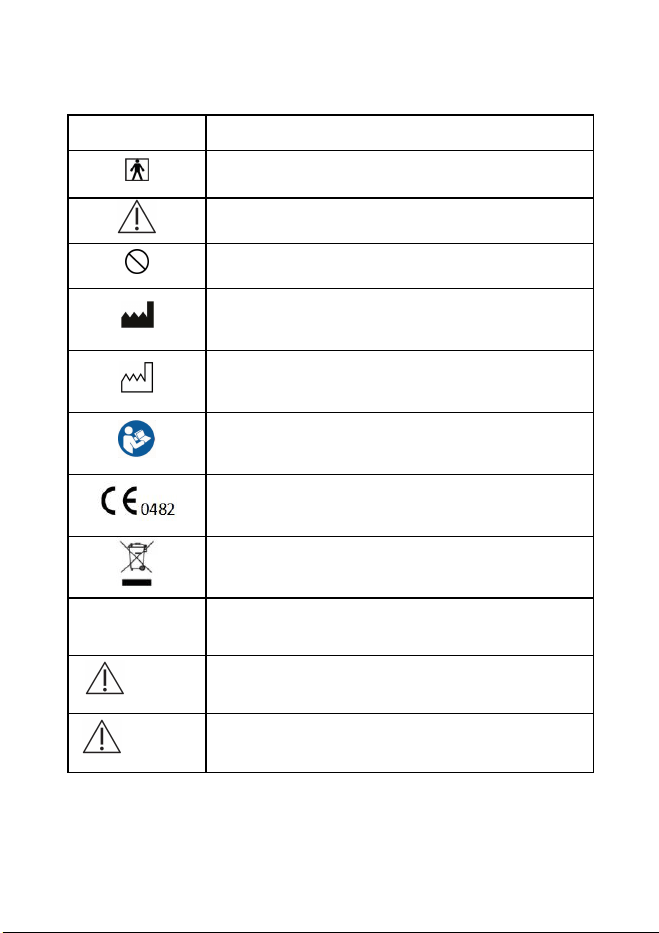
Symbol
Description
Type BF applied part.
Attention must be paid.
The action is prohibited.
Information about the manufacturer.
Date of manufacture.
Consult the instructions for use.
This product complies with the MDD93/42/EEC
requirements.
Waste electrical materials should be sent to a
dedicated collection point for recycling.
IPX0
Degree of protection against the Ingress of water.
Warning
A personal injury or damage to the thermometer may
occur if the thermometer is not used correctly.
Attention
Inaccurate reading or damage to the thermometer may
occur if the thermometer is not used correctly.
5
Body Temperature Basics
You can take a body temperature on the forehead, in the ear canal, under
the armpit, in the mouth, or in the anus. The temperature measured at
different parts of the body may differ slightly.
Body Part
Normal Temperature Range
Forehead
36.1°C–37.5°C / 97.0°F–99.5°F
Ear canal
35.8°C–38.0°C / 96.44°F–100.40°F
Mouth
35.5°C–37.5°C / 95.9°F–99.5°F
Armpit
34.7°C–37.3°C / 94.46°F–99.14°F
Anus
36.6°C–38.0°C / 97.88°F–100.40°F
The normal body temperature range slightly varies with age and gender.
Generally, newborns or children have higher body temperature than adults,
and adults have higher body temperature than the elderly. Women's body
temperature are appropriately 0.3°C higher than men's.
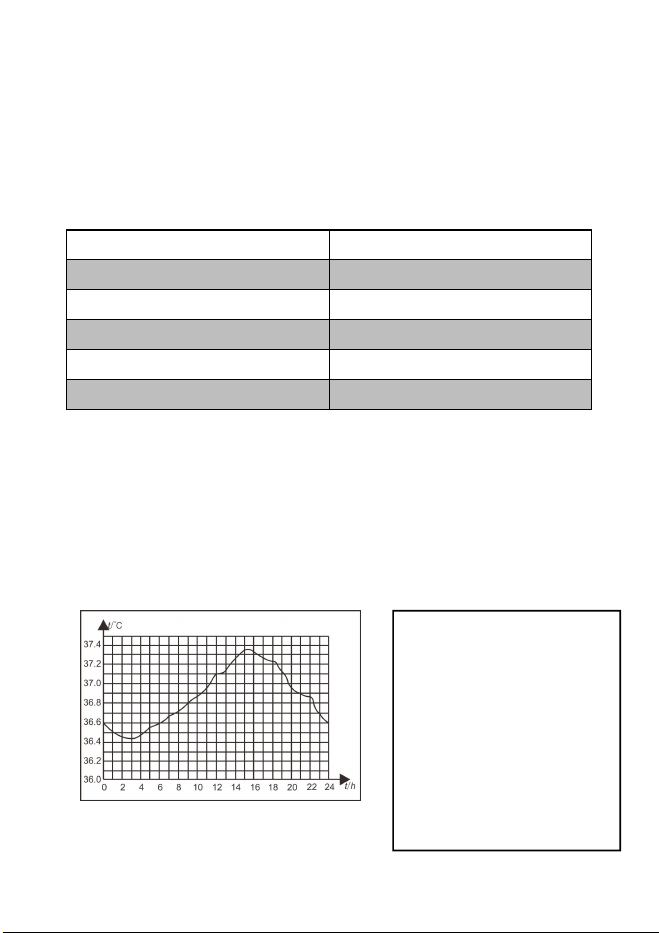
Variation in body temperature
Normal body temperature
varies by the time of day and is
also affected by external
factors.
The body temperature of an
individual is the lowest
between 2:00 a.m. and 4:00
a.m. and the highest between
14:00 p.m. and 20:00 p.m. An
individual's body temperature
typically changes by less than
1°C each day.

6
Product Description
1) Overview
The Infrared Thermometer measures the human body or an object
temperature based on the infrared energy emitted by the forehead or an
object (such as milk and water). You can quickly get measurement results
after pointing the temperature probe to the target.
2) Structure
The thermometer consists of a shell, an LCD, buttons, a beeper, an
infrared temperature sensor, and a Microprocessor.
3) Operating principle
The infrared temperature sensor collects infrared energy emitted by the
forehead. After being focused by a lens, the energy is converted into a
temperature reading by the thermopiles and the measurement circuit.
4) Intended use
The Infrared Thermometer is a non-contact infrared thermometer intended
to obtain the body temperature from the forehead. It may be used by
medical professionals or by consumers in a home environment.
5) Contraindications
None

7
Features
1. Good safety
● Passive infrared receiving technology
● Non-contact measurement, preventing cross-infection
2. Easy operation
● Handheld design, easy operation
● One-click automatic temperature measurement
3. Quick response
1-second measurement
4. High accuracy
● Advanced infrared temperature sensor, with high sensitivity
● Enhanced accuracy with automatic temperature calibration
5. Diverse functions
● 20 temperature readings stored in memory
● Forehead/Object temperature measurement
● Fever alert, with a configurable alert threshold
● Switching between ºC and ºF
● Switching between mute/un-mute mode (measuring sound
notification)
● Automatic power-off, power-saving
6. Extensive application scope
Applicable to all groups of people
8
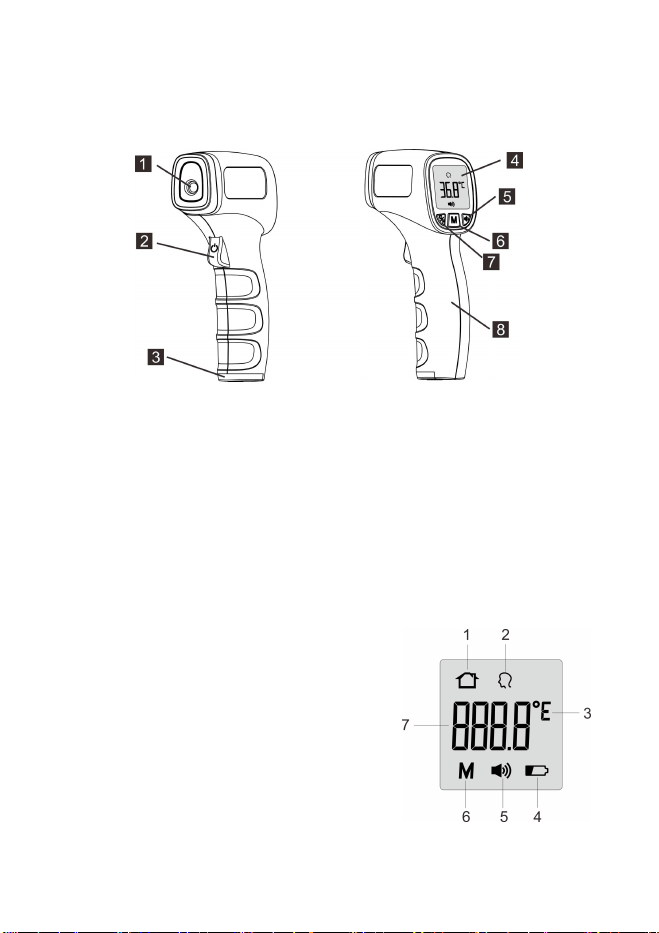
Product Structure
1、IR sensor
2、Power-on button / Measure button
3、Battery cover
4、LCD display
5、Mute / Un-mute button
6、Mode button
7、Celsius / Fahrenheit Switch button
8、Handgrip
Display description
1. Object temperature mode
2. Forehead temperature mode
3. Temperature unit (˚C / ˚F)
4. Low power indicator
5. Mute / un-mute
6. Memory mode
7. Temperature value

9
Sounds and backlight instructions
Range
Sounds
Backlight
Forehead temperature
34.9℃-37.5℃/94.8℉-99.5℉
A long beep
Green
37.6℃-42.2℃/99.6℉-108.0℉
3 short double beeps
Red
Object temperature
0℃-100℃/32.0℉-212.0℉
A long beep
White
Note: When the temperature is between 34.9°C/94.8℉ and 37.5°C/99.5℉,
there will be a long beep and a green backlight.
When the temperature is between 37.6°C/99.6℉ and 42.2°C/108.0℉,
there will be 3 short double beeps and a red backlight. This indicates that
the body temperature is a little high and you may have a fever. Please
consult your doctor if you are not sure.
10
Display and Operating Instructions
Screen Display
Operating Instructions/
Displayed State
Description
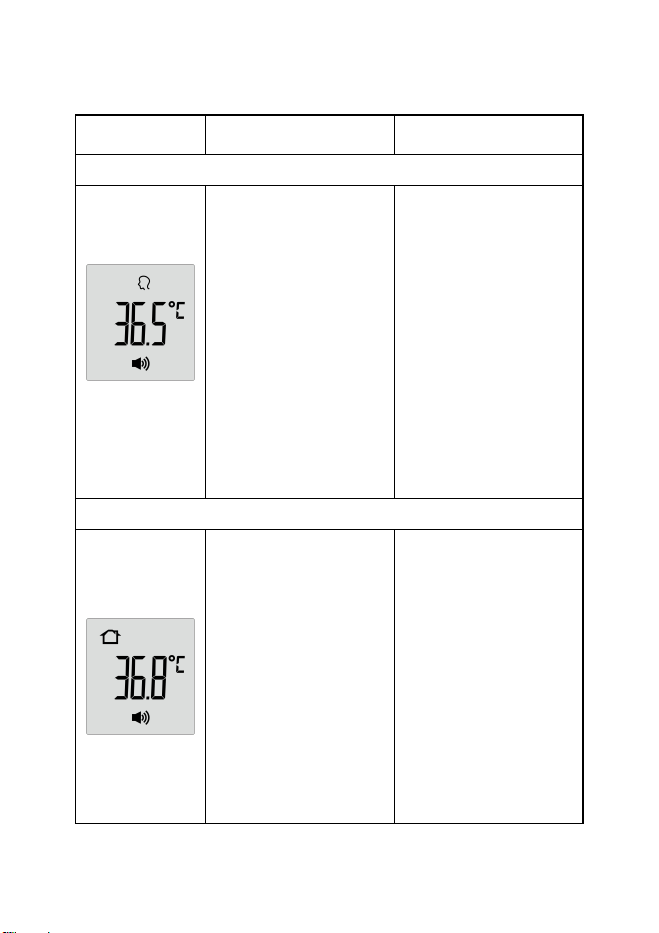
Measuring Forehead temperature
In a power-off state, point
the IR sensor to the center
of the forehead. Move the
thermometer towards the
forehead. For effective
measurement, the distance
between the thermometer
and the forehead must be
½” to 2” (1-5 cm). Press
and release the Measure
button. The forehead
temperature will be
displayed on the screen.
See the table in the
“Sounds and Backlight
Instructions” section
Measuring Object temperature
In a power-on state, press
the “Mode button”, the
thermometer enters the
Object mode.
Point the IR sensor to the
center of the object, then
press and release the
Measure button. the
object temperature will be
displayed on the screen.
See the table in the
“Sounds and Backlight
Instructions” section
11
Screen Display
Operating Instructions/
Displayed State
Description
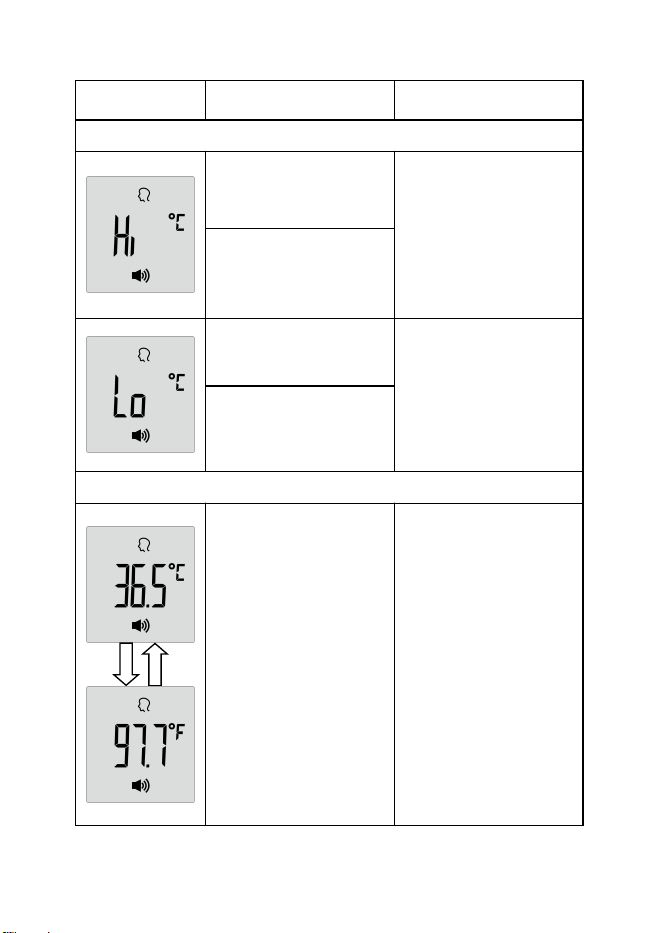
Out of the measuring range display
In Object mode, a
temperature reading of
more than 100ºC (212.0ºF)
A long beep and a green
backlight for 3 seconds.
In Forehead mode, a
temperature reading of
more than 42.2ºC
(108.0ºF)
In Object mode, a
temperature reading of less
than 0ºC (32.0ºF)
A long beep and a green
backlight for 3 seconds.
In Forehead mode, a
temperature reading of less
than 34.9ºC (94.8ºF)
Switching between ºC and ºF
In a power-on state, press
the ºC/ºF button to switch
between ºC and ºF.
Silent
12
Screen Display
Operating Instructions/
Displayed State
Description
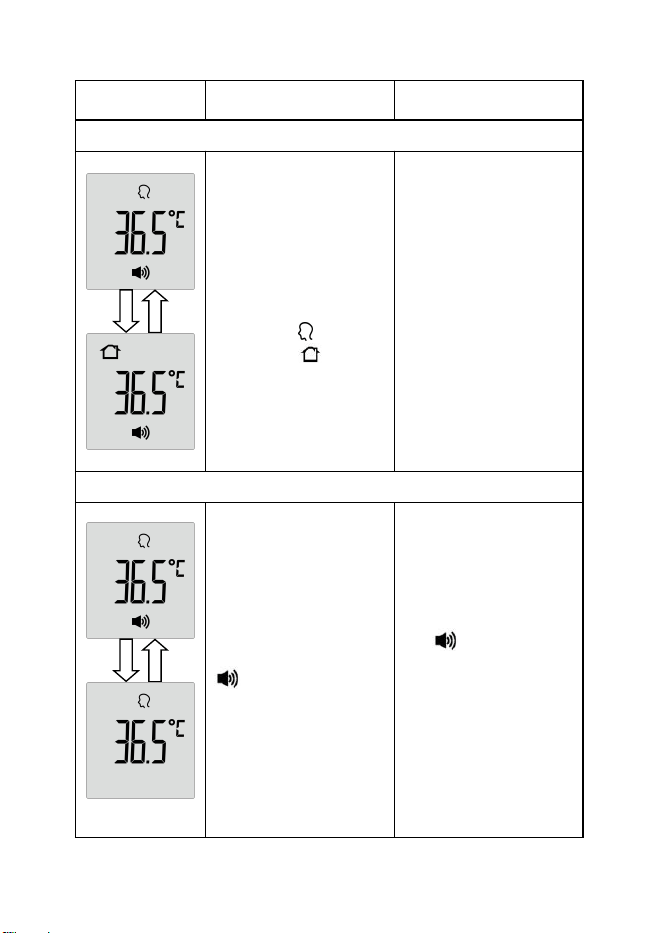
Switching between forehead temperature and object temperature
In a power-on state, press
the Mode button to switch
between forehead
temperature ( ) and object
temperature ( ).
Silent
Switching between mute and un-mute
In a power-on state, press
the Mute/Un-mute button
( ) to switch between
mute and un-mute.
The symbol is
displayed in Un-mute
mode and disappears in
mute mode.
13
Screen Display
Operating Instructions/
Displayed State
Description
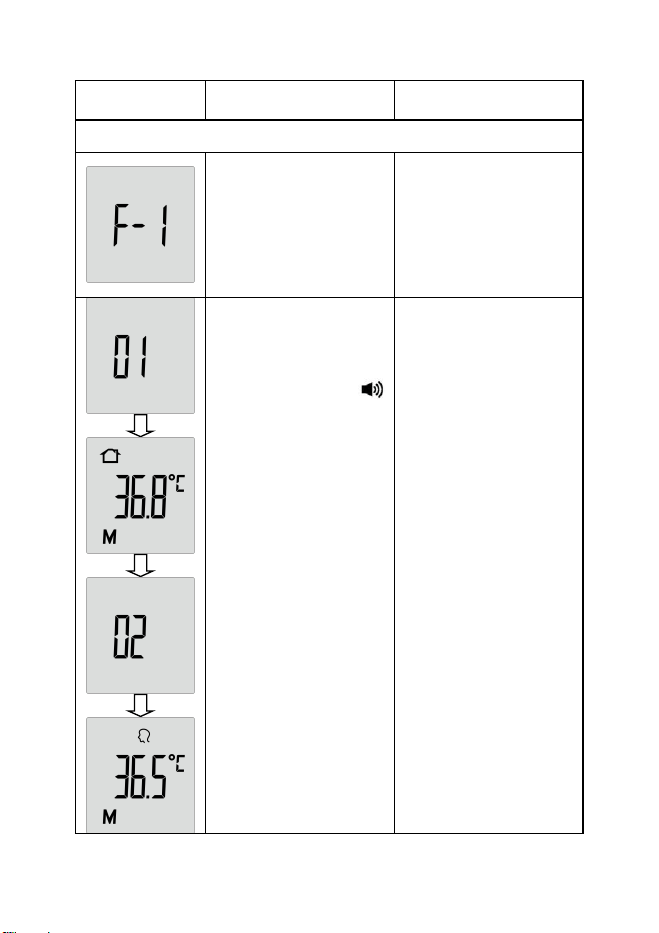
Recall 20 memories
In a power-on state, press
and hold the Mode button
for more than 2 seconds.
"F-1" is displayed.
Press the Measure button
to return to the
measurement interface.
Press the ºC/ºF or the
button, 1 will be shown,
followed by the recorded
reading.
Press the “ºC/ºF button”
again for the next recorded
data. 2 will be shown,
followed by the recorded
reading.
A maximum of 20
temperature readings can
be recalled.
Note:
1 represents the newest
data.
Silent
14
Screen Display
Operating Instructions/
Displayed State
Description
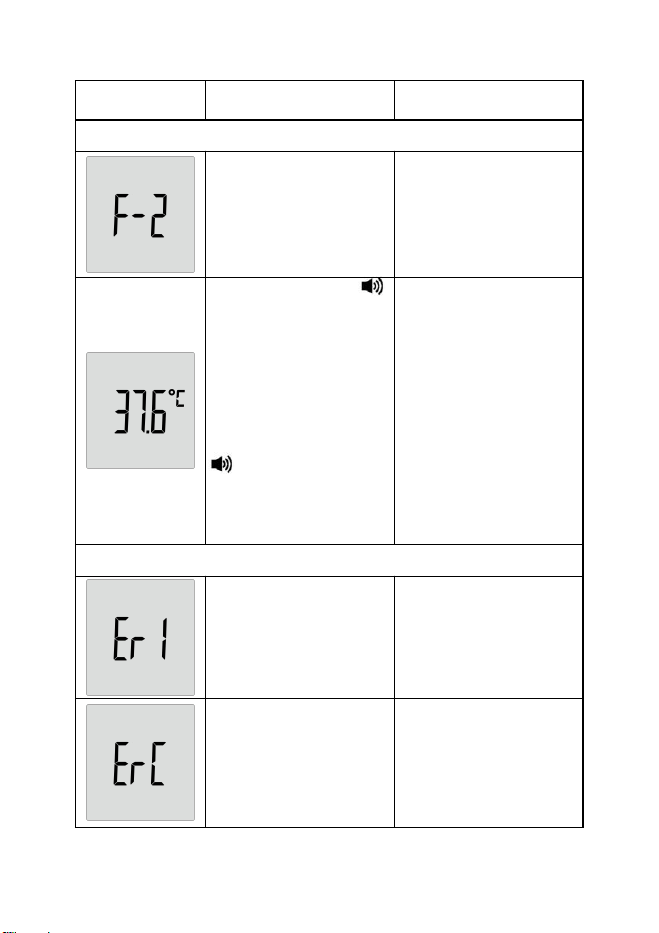
Fever alert threshold settings
When "F-1" is displayed,
press the Mode button.
Then "F-2" is displayed.
Press the Measure button
to return to the
measurement interface.
Press the ºC/ºF or the
button. The fever alert
threshold is displayed. The
threshold value increments
by 0.1ºC/ºF every time the
ºC/ºF button is pressed,
and decrements by
0.1ºC/ºF every time the
button is pressed. The
tunable range is
35.0ºC–42.0ºC
(95.0ºF–107.6ºF).
The default fever alert
threshold is 37.6ºC.
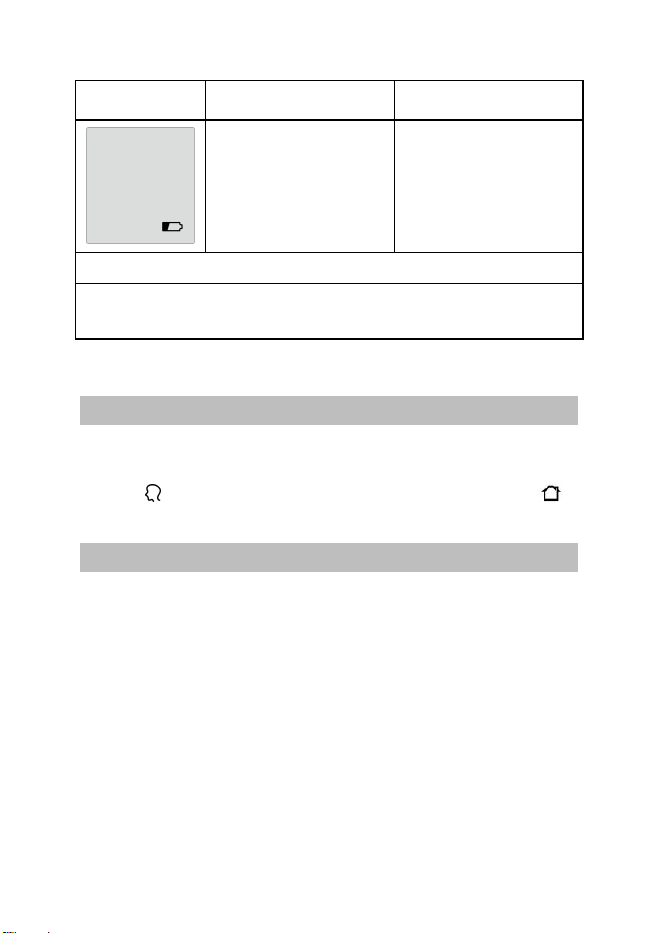
Error information & low battery
The ambient temperature
is higher than 40.0ºC
(104.0ºF) or lower than
10.0ºC (50.0ºF).
A long beep and a red
backlight for 3 seconds.
An error occurs when data
is being read from or
written to the memory, or
the temperature correction
is not complete.
A long beep and a red
backlight for 3 seconds.
15
Screen Display
Operating Instructions/
Displayed State
Description
When the battery voltage
is lower than 2.5V ± 0.1V,
the low battery symbol
will appear on the display.
Please replace the
batteries.
Silent
Power-off
In any mode, if there is no operation in 10 seconds, the thermometer will
power off automatically.
Measurement Process
1. Select the measurement mode.
■ Press the Measure button to power on the thermometer. Select the
measurement mode using the Mode button.
■ The symbol indicates the Forehead temperature mode. The
symbol indicates the Object temperature mode.
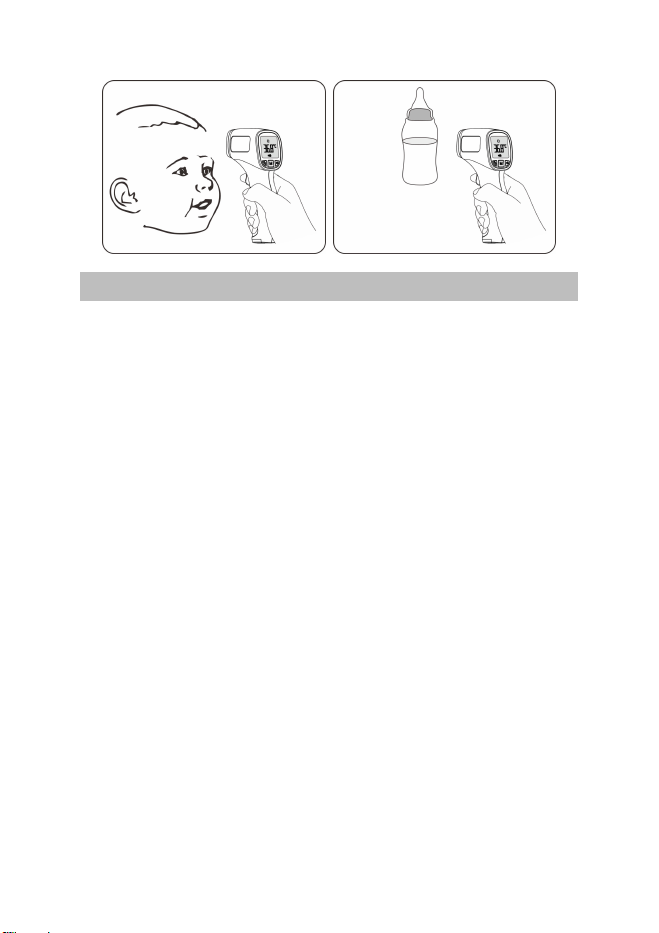
2. Press the Measure button to start a measurement.
■ When taking the forehead temperature, point the IR sensor to the
center of the forehead. Move the thermometer towards the forehead.
the distance between the thermometer and the forehead must be ½” to
2” (1-5 cm). Press and release the Measure button. The forehead
temperature will be displayed on the screen.
■ When taking the object temperature, Point the IR sensor to the center
of the object. The distance between the thermometer and the object
must be ½” to 2” (1-5 cm). Press and release the Measure button.
The object temperature will be displayed on the screen.
16
3. After a measurement
■ After each measurement, clean the thermometer with a dry soft cloth,
and put the thermometer in a dry and well-ventilated place.
■ The thermometer automatically powers off if it is not used in 10
seconds.
Notes:
(1) The thermometer is suitable for an indoor environment without
strong air convection between the thermometer and the target. For
example, winds from a fan, an air-conditioner, or a heater.
(2) Do not hold the thermometer for a long time, because it is sensitive to
the ambient temperature.
(3) Make sure the sense head is free of foreign matters before use;
(4) Make sure the forehead has no sweat and no hairs covered before
measure the forehead temperature; otherwise, the result could be
incorrect;
(5) No intense emotion or strenuous exercises before measuring;
Replacing Batteries
1) Slide the battery cover off along the marked direction. Insert the two
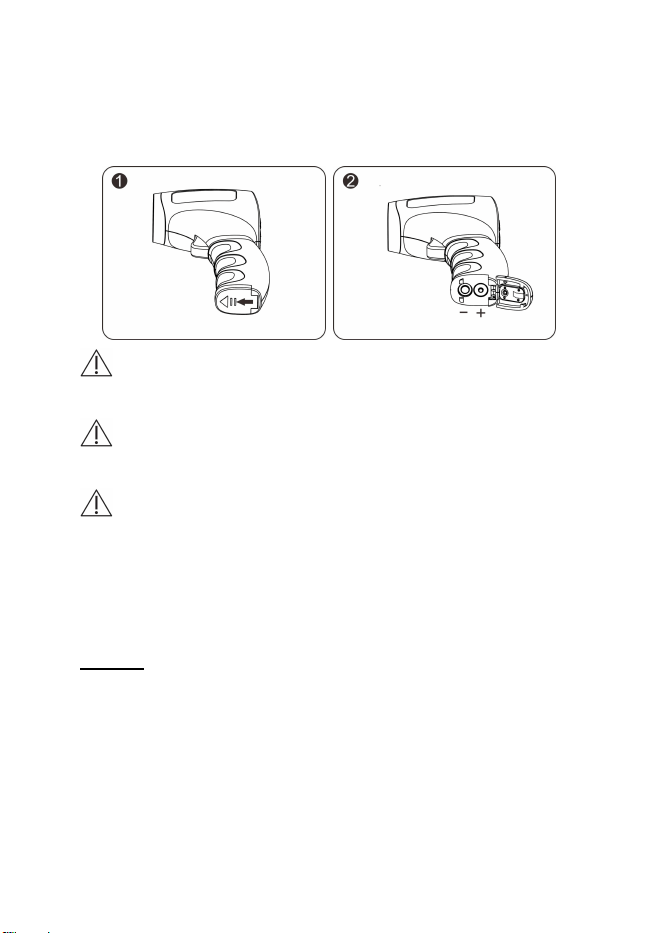
17
AAA batteries into the compartment correctly.
2) If the low-battery symbol is displayed on the screen, replace the
batteries.
Make sure that the batteries are installed correctly. Otherwise, the
thermometer may be damaged.
Batteries of a same type should be used. Dispose the used batteries
in accordance with the local environmental policies.
The thermometer is provided with batteries that were installed in
the factory. When you start to use it in the first time, open the
battery cover, then remove the insulating piece.
Cleaning and Disinfection
Cleaning
Recommended detergents:
* Medical detergents;
* Home use mild detergents;
Cleaning steps:
1) Take the batteries out before cleaning.
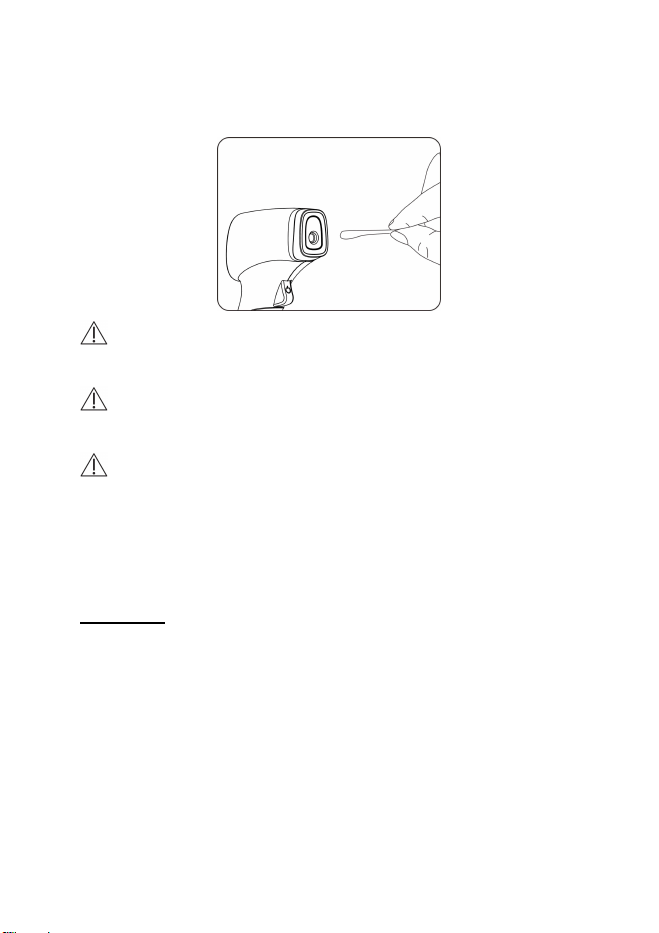
2) Clean the temperature with a soft cloth. Clean the lens of the
18
temperature probe with a cotton swab.
3) Wipe the thermometer body with a slightly damp soft cloth.
Keep water off the lens during the cleaning process. Otherwise, the
lens may be damaged.
The lens may be scratched if it is cleaned with a piece of tissue paper,
which might result in inaccurate readings.
Do not clean the thermometer with corrosive cleansers. During the
cleaning process, do not touch the lens using hard objects, do not immerse
any part of the thermometer into liquid, or allow liquid to penetrate the
thermometer.
Disinfection
Recommended disinfectants:
* Isopropyl alcohol solution (concentration: 70%)
* Medicinal alcohol (concentration: 75%)
* Sodium hypochlorite solution (concentration: 3%)
Disinfecting steps:
1) Wet the clean soft cloth with a small quantity of disinfectant, wipe
the thermometer and quickly dry it.

19
2) Disinfect the thermometer body with a cloth slightly moistened with
75% medical alcohol.
Do not use hot steam or ultraviolet radiation for disinfection.
Otherwise, the thermometer may be damaged or quickly aged.
Clean and disinfect the thermometer under the temperature of
+10℃~+40℃(50℉-104℉), the relative humidity of 15%~85%RH (no
condensation) and the barometric pressure of 86kPa~106kPa.
Maintenance
Preventive inspection & maintenance period
1) Ensure the safety of thermometer, and check whether it has potential
safety hazards in normal use each week, e.g. whether the lens is
broken, the shell has cracks and the sensing head is polluted. Do not
use the thermometer with potential safety hazard. Clean the
thermometer if not used for a long time.
2) Store the thermometer in a dry, dust-free, and well-ventilated place.
Make sure that the thermometer is not exposed to sunlight. Make sure
that the storage and transportation environments meet the
requirements.
3) Remove the batteries if the thermometer will not be used for more
than two months.

20
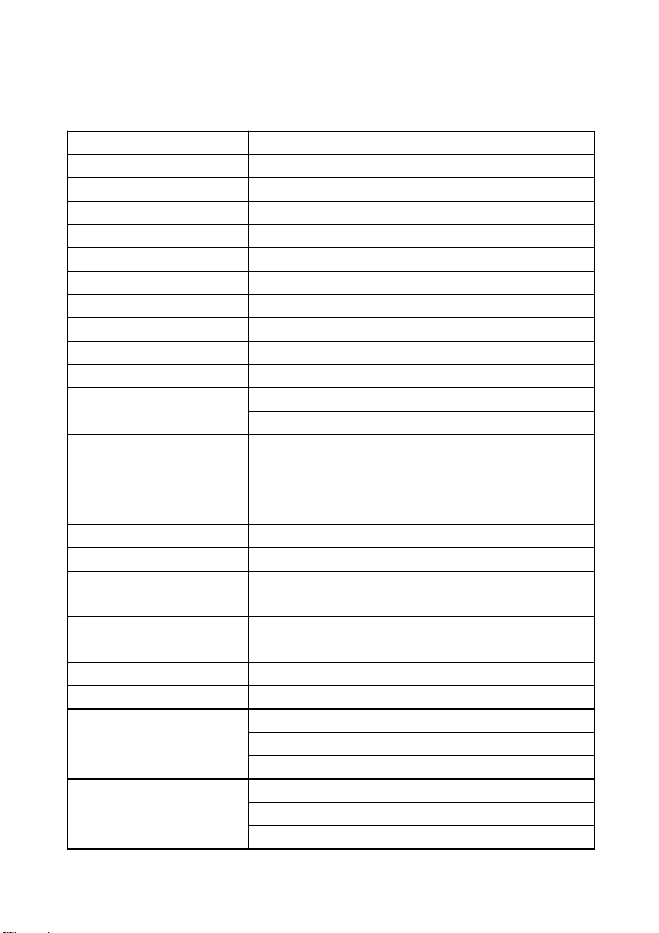
Troubleshooting
Problem
Possible Cause
Solution
The thermometer
fails to power on.
Low battery
Change the batteries.
Polarities of the
batteries are reversed.
Make sure that the
batteries are installed
correctly.
The thermometer is
damaged.
Contact the manufacturer.
"Er1" is displayed.
The ambient
temperature is lower
than 10°C (50.0°F) or
higher than 40°C
(104°F).
Take a measurement
under an ambient
temperature between
10°C (50.0°F) and 40°C
(104°F).
The temperature
reading is lower
than the typical
body temperature
range.
The lens of the
temperature probe is
dirty.
Clean the lens using a
cotton swab.
The distance between
the temperature probe
and the target is too
long.
Move the thermometer
closer to the target.
The thermometer is
used within 30
minutes after being
taken from a cold
environment.
Wait for more than 30
minutes after the
thermometer is moved
into the measurement
environment.
The temperature
reading is higher
than the typical
body temperature
range.
The temperature
probe is damaged.
Contact the manufacturer.
21
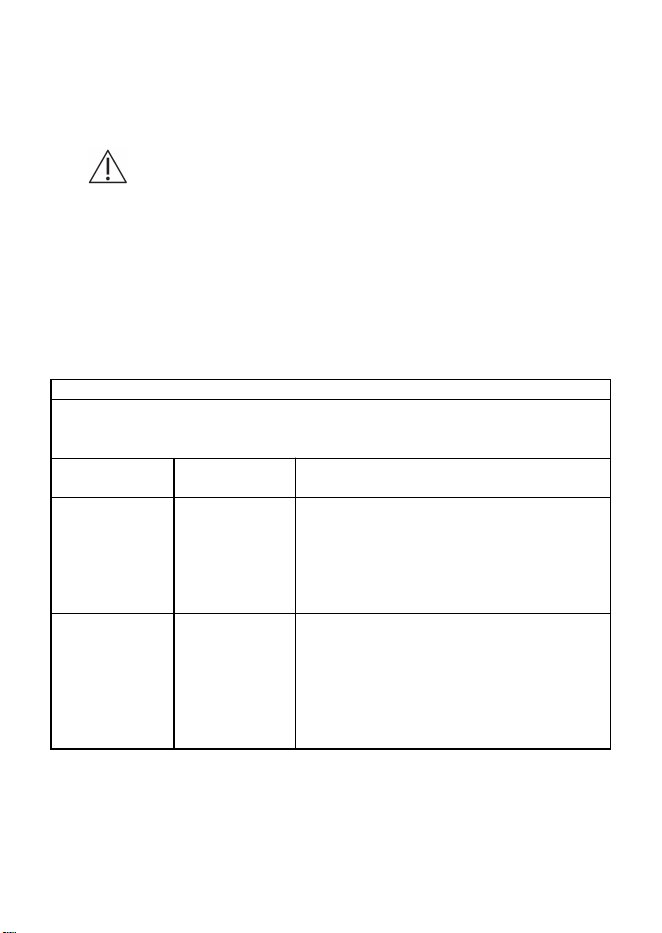
Specifications
Product Name
Infrared Thermometer
Product Model
11110 (JPD-FR202)
Power Supply Mode
Internal power supply
Operating Voltage
DC 3V
Battery Model
AAA x 2
Operating Mode
Continuous operating
Display
Segment LCD
Measure time
About 1 second
Latency Time
About 1 second
Emissivity
0.95
Measuring Distance
½” to 2” (1 to 5 cm)
Measuring Range
Forehead: 34.9°C–42.2°C (94.8°F–108.0°F)
Object: 0.0°C–100.0°C (32.0°F–212.0°F)
Accuracy
(Laboratory)
±0.4°F/±0.2°C from 94.8°F to 108.0°F (34.9°C to
42.2°C)
±0.5°F/±0.3°C, Outside the range of 94.8°F to
108.0°F (34.9°C to 42.2°C)
Resolution
0.1°C (0.1°F)
Memory
20 temperature readings
Low-battery Alert
The low-battery symbol is displayed if the power
voltage is lower than 2.5 V±0.1V.
Automatic Power-off
The thermometer automatically powers off if it is
not used in 10±1 seconds.
Dimensions (mm)
150×88.2×40.6
Weight (g)
109.5 g (with batteries)
Operating Environment
Temperature: 10°C–40°C (50°F–104°F)
Humidity: 15%–95% RH, non-condensing
Atmospheric pressure: 86–106 kPa
Storage and
Transportation
Temperature: -20°C to 55°C (-4°F–131°F)
Humidity:0- 95% RH, non-condensing
Atmospheric pressure: 50–106 kPa

22
The infrared thermometer has been tested and conforms to the standard
ASTM E1965-98. ASTM laboratory accuracy requirements in the display
range of 98°F to102°F (37°C-39°C) for skin IR thermometers is ±0.5°F
(±0.3°C). Note that for mercury-in-glass and electronic thermometers, the
requirement per ASTM Standards E667-86 and E1112-86 is ±0.2°F
(±0.1°C).
Security Class
■ Type of protection against electric shock: internally powered equipment.
■ Degree of protection against electric shock: Type BF applied part.
■ Degree of protection against ingress of water: IPX0
■ Safety degree of using in flammable anesthetic gas blending with air,
oxygen or nitrous oxide: Non-AP/APG
■ No application parts of the thermometer prevents defibrillation charge
effect.
■ No application parts of the thermometer output signal.
■ The thermometer is impermanent installed device.
Storage and Transportation
1) Transportation
The thermometer can be transported using general transportation tools.
Severe vibration, shock, or rain must be avoided during transportation.
2) Storage
The thermometer must be packaged and then stored in a well-ventilated
room without corrosive gas. The ambient temperature must be between
–20°C and +55°C(-4°F–131°F), the relative humidity must be lower than
95% (non-condensing), and the atmospheric pressure must be 50–106 kPa.
23
EMC Information-Guidance and Manufacture’s
Declaration
CAUTION:
●The Infrared Thermometer needs special precautions regarding EMC and
needs to be installed and put into service according to the EMC
information provided for in the ACCOMPANYING DOCUMENTS.
●Portable and mobile RF communications equipment can affect Infrared
Thermometer.
●The Infrared Thermometer should not be used adjacent to or stacked with
other equipment.
Guidance and manufacturer´s declaration – Electromagnetic emission
–for all equipment and systems
Guidance and manufacturer´s declaration – Electromagnetic emission
The Infrared Thermometer is intended for use in the electromagnetic
environment specified below. The customer or the user of the Infrared
Thermometer should assure that it is used in such an environment.
Emissions
test
Compliance
Electromagnetic environment - guidance
RF emissions
CISPR 11
Group 1
The Infrared Thermometer uses RF energy
only for its internal function. Therefore, its
RF emissions are very low and are not
likely to cause any interference in nearby
electronic
equipment.
RF emissions
CISPR 11
Class B
The Infrared Thermometer is suitable for
use in all establishments, including
domestic establishments and those directly
connected to the public low-voltage power
supply network that supplies buildings
used for domestic
purposes.
Guidance and manufacturer's declaration – Electromagnetic
immunity –for all equipment and systems
24
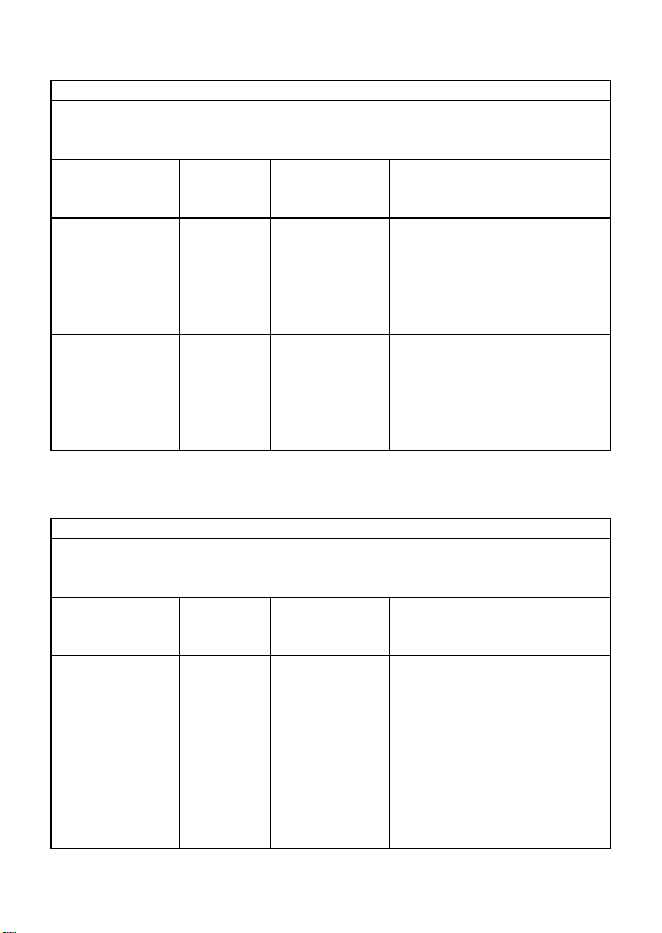
Guidance and manufacturer´s declaration – Electromagnetic immunity
The Infrared Thermometer is intended for use in the electromagnetic
environment specified below. The customer or the user of the Infrared
Thermometer should assure that it is used in such an environment.
Immunity test
IEC
60601
test level
Compliance
level
Electromagnetic
environment- guidance
Electrostatic
discharge
(ESD)
IEC 61000-4-2
±6 kV
contact
±8 kV air
±6 kV contact
±8 kV air
Floors should be wood,
concrete or ceramic tile. If
floors are covered with
synthetic material, the
relative humidity should be
at least 30 %.
Power
frequency
(50/60 Hz)
magnetic
field
IEC 61000-4-8
3 A/m
3 A/m
Power frequency magnetic
fields should be at levels
characteristic of a typical
location in a typical
commercial or hospital
environment.
Guidance and manufacturer´s declaration – Electromagnetic
immunity –for equipment and systems that are not life-supporting
Guidance and manufacturer´s declaration – Electromagnetic immunity
The Infrared Thermometer is intended for use in the electromagnetic
environment specified below. The customer or the user of the Infrared
Thermometer should assure that it is used in such an environment.
Immunity test
IEC
60601
test level
Compliance
level
Electromagnetic
environment -guidance
Radiated RF
IEC 61000-4-3
3 V/m
80 MHz
to 2.5
GHz
3 V/m
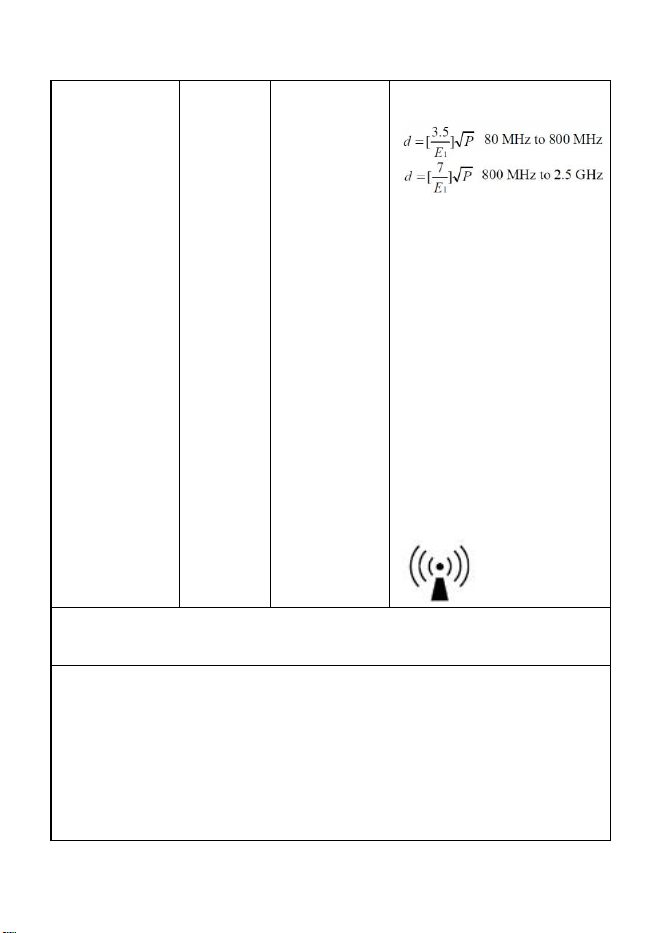
Portable and mobile RF
communications
equipment should be used no
closer to any part of the
thermometer, including
cables, than the
recommended separation
distance calculated from the
equation applicable to the
frequency of the transmitter.
25
Recommended separation
distance
where p is the maximum
output power rating of the
transmitter in watts (W)
according to the transmitter
manufacturer and d is the
recommended separation
distance in metres (m).
b
Field strengths from fixed
RF transmitters, as
determined by an
Electromagnetic site survey,a
should be less than the
compliance level in each
frequency range.
b
Interference may occur in the
vicinity of equipment
marked with the following
symbol:
NOTE 1 At 80 MHz and 800 MHz, the higher frequency range applies.
NOTE 2 These guidelines may not apply in all situations. Electromagnetic is
affected by absorption and reflection from structures, objects and people.
a. Field strengths from fixed transmitters, such as base stations for radio
(cellular/cordless) telephones and land mobile radios, amateur radio, AM and
FM radio broadcast and TV broadcast cannot be predicted theoretically with
accuracy. To assess the electromagnetic environment due to fixed RF
transmitters, an electromagnetic site survey should be considered. If the
measured field strength in the location in which the Thermometer is used
exceeds the applicable RF compliance level above, the Thermometer should be
observed to verify normal operation. If abnormal performance is observed,
additional measures may be necessary, such as re-orienting or relocating the
26
JPD-FR202.
b. Over the frequency range 150 kHz to 80 MHz, field strengths should be less
than 3 V/m.
Recommended separation distances between portable and mobile RF
communications equipment and the EQUIPMENT or SYSTEM -for
EQUIPMENT and SYSTEMS that are not LIFE-SUPPORTING
The Infrared Thermometer is intended for use in an electromagnetic
environment in which radiated RF disturbances are controlled. The customer or
the user of the Infrared Thermometer can help prevent electromagnetic
interference by maintaining a minimum distance between portable and mobile
RF communications equipment (transmitters) and the Infrared Thermometer
as recommended below, according to the maximum output power of the
communications equipment.
Rated
maximum
output
power
of
transmitter
W
Separation distance according to frequency of transmitter
m
80 MHz to 800 MHz
800 MHz to 2,5 GHz
0.01
0.12
0.23
0.1
0.38
0.73
1
1.2
2.3
10
3.8
7.3
100
12
23
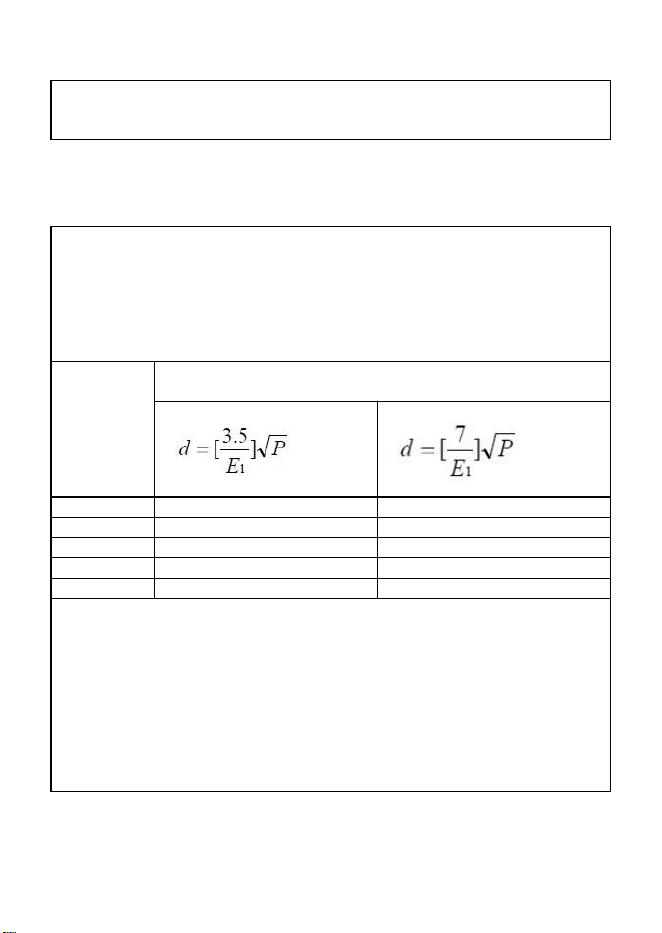
For transmitters rated at a maximum output power not listed above, the
recommended separation distance d in meters (m) can be estimated using the
equation applicable to the frequency of the transmitter, where P is the maximum
output power rating of the transmitter in watts (W) according to the transmitter
manufacturer.
NOTE 1 At 80 MHz and 800 MHz, the separation distance for the higher
frequency range applies.
NOTE 2 These guidelines may not apply in all situations. Electromagnetic
propagation is affected by absorption and reflection from structures, objects and
people.

27
Warranty and After-Sale Service
The device is under warranty for one year from the date of purchase.
The batteries, the packaging, and any damage caused by improper use are
not covered by the warranty.
Excluding the following user-caused failures:
1.Failure resulting from unauthorized disassembly and modification.
2.Failure resulting from an unexpected dropping during application or
transportation.
3.Failure resulting from not following the instructions in the user’s
manual.