Register
your product
www.kaercher.com/welcome
9.807-794.0-E 04/27/22
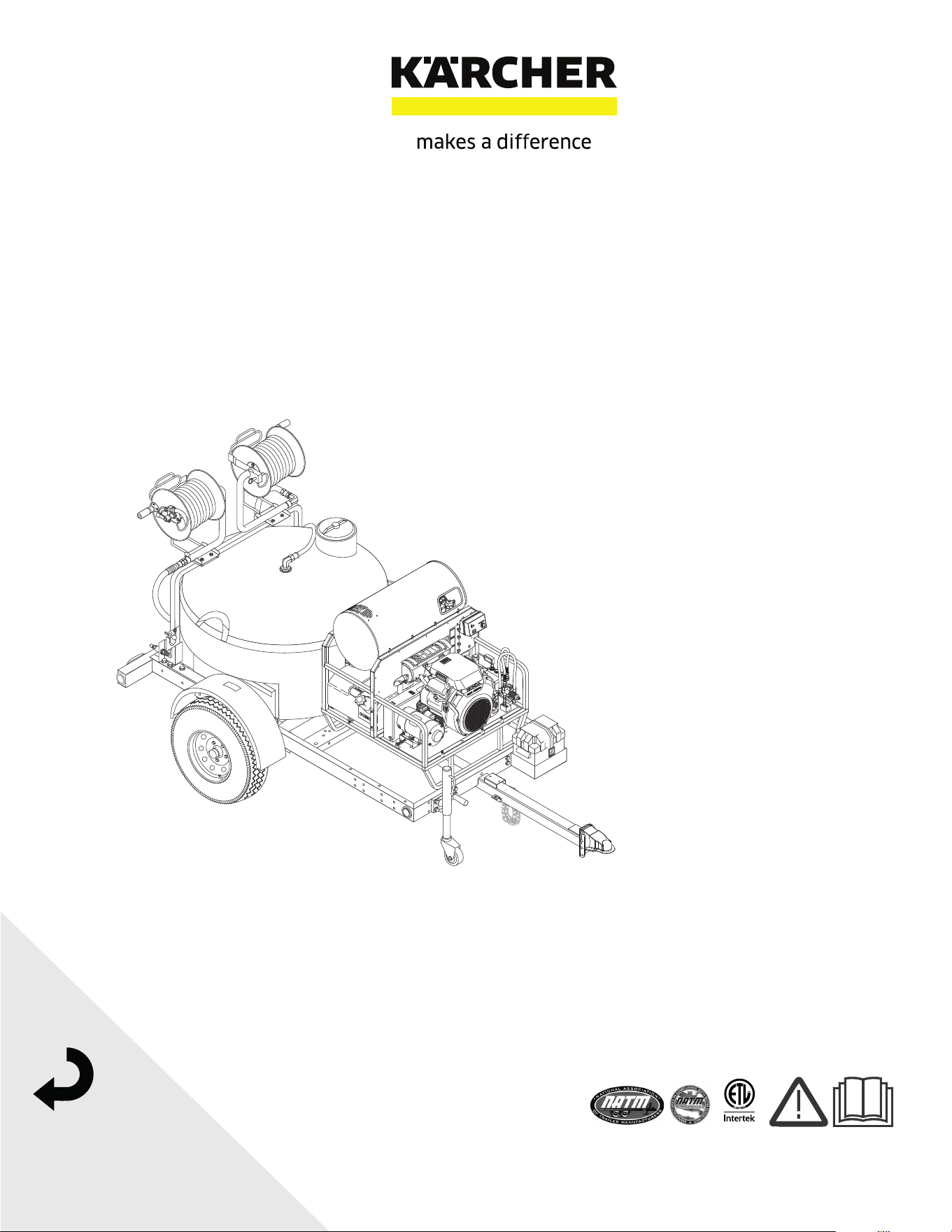
TRK-2500 HDS
English 02
TO
REDUCE
T
H
E
RISK
O
F
I
NJ
U
R
Y
,
RE
A
D
O
P
-
E
R
A
T
I
N
G
I
N
STRU
C
T
I
ON
S
C
A
R
E
F
U
L
L
Y
B
E
FO
R
E
U
S
I
NG
.
T
hi
s
mac
hi
n
e
is
t
o
b
e
u
s
e
d
only
b
y
quali
fi
e
d
o
p
erato
r
s
.
L
I
R
E
L
E
M
A
NU
E
L
DE
L
'
O
PE
R
A
T
EUR
A
V
AN
T
UTI
L
IS
A
TION
.
C
e
t
ap
pa
re
i
l
d
oit
êtr
e
ut
i
l
ise
p
a
r
de
s o
pe
r
a
t
e
ur
s
q
u
a
li
fi
es
.
L
E
A
E
L
M
A
N
U
A
L
O
P
E
RAC
I
O
N
AN
T
E
S
DE
U
S
-
AR
S
E
.
Este
e
q
u
ipo
de
b
e
s
e
r
u
s
ado
s
o
l
a
m
e
n
t
e
po
r
o
p
e
ra
do
r
e
s c
a
li
fi
ca
d
os
.
RISK
O
F
A
S
P
H
Y
XI
A
T
I
ON.
U
s
e
this
p
r
odu
c
t
o
n
ly i
n a
well
ventila
te
d
a
rea.
R
IS
Q
UE
D
'
ASPH
YX
I
E.
Ut
i
liser
d
a
ns
un
en-
d
r
o
i
t
bi
e
n a
é
ré
.
RI
ES
GO
D
E
ASFI
X
IA.
Us
e
el
produc
t
o
e
n
u
n
area
de v
en
t
i
l
ación
adecuada.
RISK
O
F
EXPL
O
S
I
ON.
O
p
e
rat
e
only
where
o
pen
fl
a
m
e
or
torch
i
s
pe
r
-
m
itted
.
Do
n
o
t
sp
r
ay
fl
amm
a
bl
e
l
iquid
s
.
RISK
OF
F
I
R
E
.
Do
not
add
f
ue
l
w
h
en
t
he
m
ach
i
ne
i
s o
per
at
i
n
g
.
R
ISQ
UE
D
'E
X
PLO
S
I
O
N
.
Uti
l
ise
r
a
u
x
e
n
d
r
o
i
t
s
où
u
n
e
fl
amm
e
n
ue
e
s
t
pe
r
-
m
ise.
N
e
p
as
vapo
r
i
s
e
r
d
e
l
iq
u
ides
in
fl
a
mm
abl
e
s.
RISQUE
DE
F
E
U
.
N
e
p
a
s
ajo
u
t
e
r
d
e
c
a
r
b
u
r
a
n
t
d
i
e
s
el
p
e
n
d
a
nt
q
u
e la mac
h
in
e
e
s
t
e
n o
p
é
r
a
t
i
on
.
R
I
E
S
G
O
D
E
E
X
P
L
OS
I
O
N
U
s
e
el
p
ro
d
u
c
to
e
n
á
r
e
a
s
d
on
d
e
e
l
f
u
e
g
o
o
l
l
a
m
a
sea
n
pe
r
m
i
tid
o
s.
N
o
r
o
c
ie
l
iq
ui
d
o
s
i
n
fl
a
m
a
b
l
e
s
.
RIE
S
G
O
DE
F
U
E
G
O
.
N
o
a
ñad
i
r
gaso
l
i
n
a c
u
a
nd
o
l
a
m
á
g
u
i
n
a
e
st
e
tr
a
b
a
j
a
n
do
.
R
I
SK
O
F
I
NJECTION
O
R
SE
VER
E
IN
JU
R
Y
TO
P
E
R
S
ON
S
.
Ke
e
p
cl
ea
r
of
no
z
z
l
e.
HOT
DISCHARGE
FLUI
D
.
D
o
n
o
t
touch
or
direct
dis
c
h
a
rge
stream at persons.
R
IS
QUE
D
E
B
L
E
SS
U
R
ES
.
Se
t
e
n
i
r
l
o
i
n
d
e
s
b
use
s
.
E
A
U
CH
A
UDE
S
O
U
S
PRESSIO
N
A
L
A
S
O
R
T
I
E
.
Ne
p
a
s
d
i
r
i
g
e
r
l
e
j
e
t
d
'
e
au v
e
rs
d
e
s
p
e
r
s
o
n
n
e
s
.
R
I
ESGO
D
E
P
E
N
ET
R
A
C
IÓN
O
L
E
S
I
ON
E
S
SEVE
R
AS
A
PERSONAS.
Man
-
t
é
n
g
ase
fuera
del
a
l
c
a
n
c
e
de
bo
q
uil
l
a.
DES
C
A
R
GA
D
E
A
G
U
A
C
A
LIENTE
A
A
L
T
A
PRESION.
N
o
t
o
que
n
i
di
ri
j
a
el
fl
u
jo
d
e
l
ag
u
a
o
otras
p
erso
na
s
.
RISK
O
F
IN
U
R
Y
.
P
R
O
TEC
T
I
V
E
EYEWEAR
A
N
D
OT
H
E
R
PR
O
T
E
CT
I
V
E
CLOTHING MU
S
T B
E
WO
R
N
w
h
en oper
a
ti
n
g
t
his
mac
h
i
n
e
.
R
IS
QUE
D
E
B
L
E
SSU
R
E
.
Port
e
z
d
e
s
l
u
n
e
ttes
d
e
p
rot
e
cti
o
n
e
t
v
ê
t
e
me
n
t
s
p
r
o
t
e
c
t
e
u
r
s qu
a
n
d
v
o
u
s
u
tilisez cett
e
m
a
chi
n
e
.
R
IE
S
G
O
D
E
L
ESI
O
N
E
S.
Us
e
l
e
n
t
e
s
de
seg
u
r
i
dad
y
p
r
o
t
e
j
a
su
cu
e
r
p
o
a
d
e
c
-
u
a
d
a
m
e
nt
e
c
u
a
n
do
op
e
re est
e
e
qui
p
o
.
W
ARNING /
A
VE
R
TISSEMENT /
P
REC
A
UCION
RI
SK
OF
I
NJ
U
R
Y
.
H
O
T
S
U
R
F
A
C
E
S
CAN
C
A
USE
B
U
RNS
.
Use
only
d
e
si
gn
e
d
gripping
areas
o
f
spra
y
gun
and
w
and.
S
U
R
F
A
C
ES
CHAUD
E
S
.
T
ouch
e
r
s
e
ul
em
e
n
t
l
es
pa
r
t
ie
s
i
s
o
lé
es
d
e
s
po
i
g
n
ée
pi
s
to
l
et
s
e
t
l
a
n
c
e
s
.
SU
P
ERFI
CI
E
S
C
A
L
I
ENTE
S.
U
se
s
o
l
a
m
e
n
te
las
ár
e
as ai
s
ladas d
e
l gat
i
llo
y
l
a lanza.
S
P
R
A
Y
G
U
N
K
I
C
K
S
B
A
C
K
.
H
ol
d
w
i
t
h
b
o
t
h
han
d
s
.
L
A
POI
G
NEE
PISTOL
E
T
R
E
P
O
U
S
SE
.
T
e
n
ir
à
deu
x
mai
ns
.
LA
PIS
T
O
L
A
SE
MU
E
V
E
C
O
N
L
A
PR
E
SI
ÓN
.
So
s
ten
ga
c
o
n
l
a
s dos mano
s
.
RISK
O
F
E
LE
C
T
ROC
UTIO
N.
Ke
e
p
a
ll
conn
e
c
t
ions
d
r
y
an
d
off
the
ground. Keep spray a
w
ay from electri
c
al w
i
r
i
ng
an
d
c
ompone
nt
s.
R
IS
QUE
D'
ELE
C
TROCUTION.
T
o
u
s
l
e
s
fi
ls
d
o
ivent
être
maintenus
s
e
c
s
et
êt
re
s
u
s
p
endus
.
N
e
jamais
pr
o
j
e
t
er
d
'eau
su
r
le
s
c
o
mpo
s
an
t
e
s
et
fi
ls
élec
triques.
RI
E
S
G
O
DE
ELECTRO
C
UC
I
ÓN
.
Man
t
eng
a
todas
las
con
n
ec
c
io
n
es
s
e
-
c
a
s y ar
ri
b
a
del s
u
el
o
. N
o
r
o
c
i
e
compo
n
e
nt
e
s el
é
c
t
ri
cos
.
D
ANGER
8
.923
-
5
60.0
2 Karcher TRK 2500 HDS Operator’s Manual 9.807-794.0 - E
Machine Data Label
Notice
This trailer is equipped to meet applicable U.S. Federal safety standards. Check local and state requirements
regarding brakes and any additional equipment that may be required. Any modifications or additions including
load-equalizing hitches, without written factory consent: usage in an abnormal manner including overloading voids
all manufacturers’ warranties and liability.
WARNING: This Owner's Manual contains safety information and instructions for your
trailer.
You must read this manual before loading or towing your trailer.
You must follow all safety precautions and instructions.
MODEL: 1.103-843.0

3
Table of Contents
Machine Data Label . . . . . . . . . . . . . . . . . . . . . . . . . .2
Table of Contents . . . . . . . . . . . . . . . . . . . . . . . . . . .3
How To Use This Manual . . . . . . . . . . . . . . . . . . . . . 4
Safety
Important Trailer Safety Information . . . . . . . . . . . . .5
Referencing the Utility Trailer in this Manual . . . . . .5
Tire Safety. . . . . . . . . . . . . . . . . . . . . . . . . . . . . . . . .5
Basic Tire Maintenance . . . . . . . . . . . . . . . . . . . . . .5
Understanding Tire Pressure and Load Limits . . . . .5
Maintaining Proper Tire Pressure . . . . . . . . . . . . . . . 5
Never Tow the Trailer Before Checking:. . . . . . . . . .6
Tow Vehicles. . . . . . . . . . . . . . . . . . . . . . . . . . . . . . .6
Trailer Ball & Couplers . . . . . . . . . . . . . . . . . . . . . . . 7
Before Towing. . . . . . . . . . . . . . . . . . . . . . . . . . . . . .7
Variable Height Bracket: . . . . . . . . . . . . . . . . . . . . . .7
Bolting Instructions:. . . . . . . . . . . . . . . . . . . . . . . . . . 7
Hitch Operation . . . . . . . . . . . . . . . . . . . . . . . . . . . . .8
Hitch Coupler Troubleshooting . . . . . . . . . . . . . . . . .8
Coupler & Ball Engagement . . . . . . . . . . . . . . . . . . . 8
Safety Chains . . . . . . . . . . . . . . . . . . . . . . . . . . . . . .8
Load-Carrying Capacity . . . . . . . . . . . . . . . . . . . . . . 9
Proper Weight Distribution & Tongue Weight . . . . .10
Tongue Weight . . . . . . . . . . . . . . . . . . . . . . . . . . . .10
Tire Pressure . . . . . . . . . . . . . . . . . . . . . . . . . . . . . 11
Wheels . . . . . . . . . . . . . . . . . . . . . . . . . . . . . . . . . .11
Wheel Lugs . . . . . . . . . . . . . . . . . . . . . . . . . . . . . . . 11
Ball Coupler Hitches . . . . . . . . . . . . . . . . . . . . . . . . 11
Tires . . . . . . . . . . . . . . . . . . . . . . . . . . . . . . . . . . . . 11
Correct Ball Seating . . . . . . . . . . . . . . . . . . . . . . . .12
Breakaway Switch & D.O.T. Wet Cell Battery. . . . . 12
Breakaway Switch Mounted
on an A-Frame . . . . . . . . . . . . . . . . . . . . . . . . . .13
Brakes. . . . . . . . . . . . . . . . . . . . . . . . . . . . . . . . . . .13
Burnishing the Brakes. . . . . . . . . . . . . . . . . . . . . . .13
Brake Adjustment . . . . . . . . . . . . . . . . . . . . . . . . . .14
Brake Cleaning & Inspection. . . . . . . . . . . . . . . . . .14
Owner/User Responsibility:. . . . . . . . . . . . . . . . . . . 16
Important Safety Information. . . . . . . . . . . . . . . . . . 16
Reporting Safety Defects . . . . . . . . . . . . . . . . . . . .19
Maintenance
Troubleshooting . . . . . . . . . . . . . . . . . . . . . . . . . . .20
Preventative Maintenance . . . . . . . . . . . . . . . . . . . 24
Oil Change Record . . . . . . . . . . . . . . . . . . . . . . . . . 24
Axles, Hubs and Brakes . . . . . . . . . . . . . . . . . . . . .25
Karcher TRK 2500 HDS Operator’s Manual 9.807-794.0 - E
4
How To Use This Manual
This manual contains the following sections:
• How to Use This Manual
•Safety
• Operations
• Maintenance
The HOW TO USE THIS MANUAL section will tell you
how to find important information for ordering correct
repair parts.
Parts may be ordered from authorized dealers. When
placing an order for parts, the machine model and
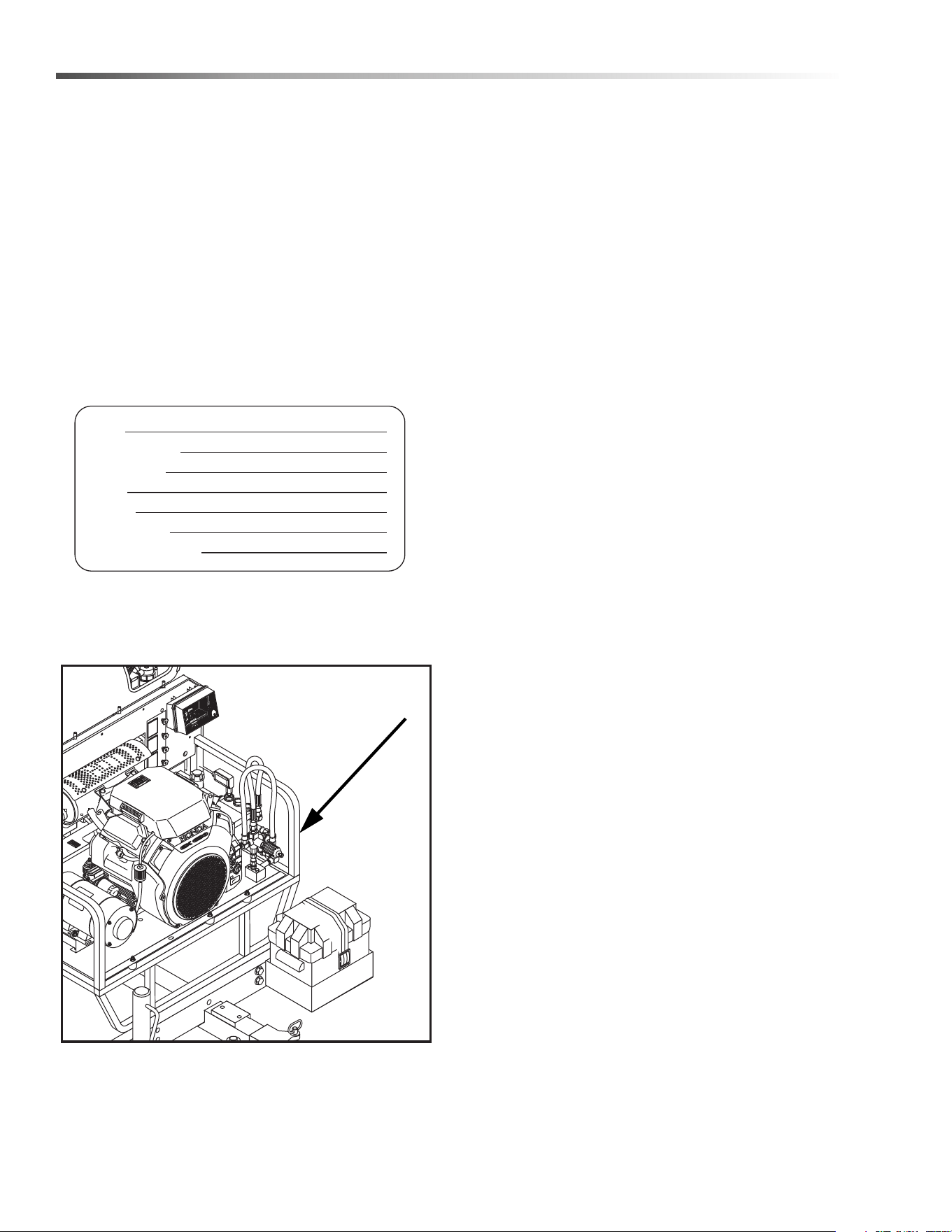
machine serial number are important. Refer to the
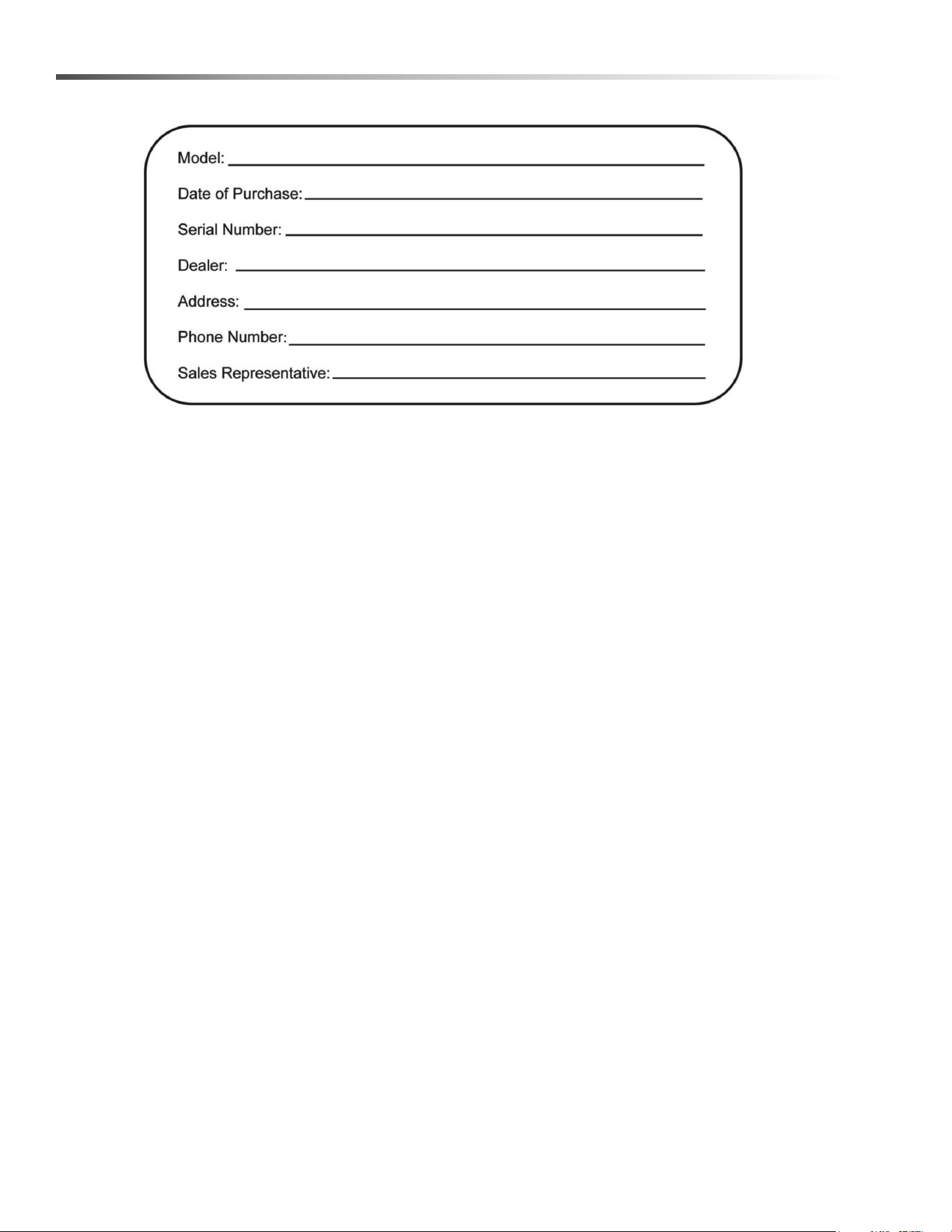
MACHINE DATA box which is filled out during the
installation of your machine. The MACHINE DATA box
is located on the inside of the front cover of this manual.
The model and serial number of your machine is
located on the right side of the machine, facing the
hitch.
The SAFETY section contains important information
regarding hazardous or unsafe practices of the
machine. Levels of hazards are identified that could
result in product damage, personal injury, or severe
injury resulting in death.
The OPERATIONS section is to familiarize the operator
with the operation and function of the machine.
The MAINTENANCE section contains preventive main-
tenance to keep the machine and its components in
good working condition. They are listed in this general
order:
• Troubleshooting
• Preventative Maintenance
NOTE: If a service or option kit is installed on your
machine, be sure to keep the KIT INSTRUCTIONS
which came with the kit. It contains replacement parts
numbers needed for ordering future parts.
NOTE: The manual part number is located on the
lower right corner of the front cover.
Model:
Date of Purchase:
Serial Number:
Dealer:
Address:
Phone Number:
Sales Representative:
Karcher TRK 2500 HDS Operator’s Manual 9.807-794.0 - E

5
Safety
Important Trailer Safety Information
Referencing the Utility Trailer in this
Manual
All references to the trailer or component parts to either
left or right are made with the assumption that you are
standing behind the trailer facing forward. Your left
hand or right hand is the equivalent on the trailer.
Tire Safety
The most common cause of trailer tire failure is under-
inflation. Therefore, it is important that you always
maintain the specified air pressure as indicated by the
tire manufacturer on the tire's side-walls. This
information can also be found on the tire label or the air
pressure molded on the tire side-wall.
The most important things you can do to maintaining
proper tire pressure are observe all tire and trailer
maximum carrying capacities, avoid road hazards, and
inspect the tires for cuts, slashes and other
irregularities. These practices, along with other care
and maintenance, can improve handling, help protect
you and others from avoidable breakdowns and
accidents, improve fuel economy, and increase the life
of your tires.
Make tire safety a regular part of your trailer
maintenance routine. The time you spend is minimal
compared to the amount of time, inconvenience, and
potential safety hazards that can occur from a flat tire
or failure.
Basic Tire Maintenance
Properly maintained tires improve the load-carrying
capability of your trailer. You can help avoid flat tires
and tire failures by maintaining proper tire pressure,
observing tire and trailer capacity limits, avoiding road
hazards, and inspecting your tires regularly.
Identifying Your Recommended Tire
Pressure and Maximum Load Carrying
Capacity for Your Trailer
Both the tire placard and the VIN label are permanently
attached on top of the frame of your trailer and have
the required information printed on them. They also list
the maximum load that can be placed on the trailer
without exceeding the load limits of the tires or the
trailers other components. These labels indicate the
manufacturer’s information including:
• Recommended tire size.
• Recommended tire inflation pressure.
• The maximum weight the trailer is designed to
carry.
• Gross vehicle weight rating of the trailer.
• Gross axle weight rating of the trailer.
Understanding Tire Pressure and Load
Limits
Tire inflation pressure is the level of air in the tire that
provides it with the load-carrying capacity and affects
the overall performance of the trailer. The tire inflation
pressure is a number that indicates the amount of air
pressure that is inside the tire. It is measured in pounds
per square inch (PSI). The tire must be inflated to the
air pressure as designated on the labels. Also listed on
the labels is the air pressure in kilo Pascals (kPa),
which is a metric measurement. Tire manufacturers
determine the air pressure to maximize the amount of
weight the tires can safely carry. The proper tire
pressure for your trailer tires is referred to as the
“recommended cold inflation pressure.” It is difficult to
obtain the recommended tire pressure if your tires are
not cold when the reading is taken because the air will
expand when it is warmed by towing down the road,
thus increasing the air pressure inside. If air is added to
a tire that is low the air pressure should never exceed
the recommended pressure.
It is important to check your trailer’s tire pressure at
least once a month for the following reasons:
Most tires will naturally lose air over time.
Tires can lose air suddenly if driven over an object that
punctures or cuts the tire. Sometimes a sharp blow
from a pothole or curb can knock the tire loose from the
rim causing immediate deflation.
Maintaining Proper Tire Pressure
Locate the recommended tire pressure on the trailer's
tire information placard or owner's manual.
Record the tire pressure of all tires. If the tire pressure
is too high in any of the tires, slowly release air by
gently pressing on the tire valve stem with the edge of
your tire gauge until you get the correct pressure.
If the tire pressure is too low, note the difference
between the measured tire pressure and the correct tire
pressure. These “missing” pounds of pressure are what
you will need to add.
Add the missing pounds of air pressure to each tire that
is under inflated.
Check all tires to make sure they have the same air
pressure.
Karcher TRK 2500 HDS Operator’s Manual 9.807-794.0 - E

6
Safety
If you have been towing your trailer and think that a tire
is under inflated, fill it to the recommended cold inflation
pressure indicated on your trailer's tire label placard or
the VIN label. You can also check the sidewall of the
tire for a correct tire inflation pressure. Your tire will
have a slightly lower air pressure because the tire is
warm when you are inflating it, but it will be much better
than to continue to tow it with the under inflation it may
have had. Once the trailer has been parked long
enough to allow the tires to cool down, recheck the tire
pressure and add additional air to return the tire
pressure to the recommended level.
Tire Size
To maintain the trailer's carrying capacity and safety,
purchase only the same size tires as what were origi-
nally supplied on the trailer.
Safety Tips
Slow down if you have to go over a pothole or other
object in road.
Do not run over curbs and try not to strike the curb
when parking.
For a free brochure visit:
www. nhtsa.dot.gov
FOR SAFETY: Before towing this trailer be sure
to read the instructions and warnings supplied in
this manual. Also read the information supplied
with your tow vehicle so you know and
understand it's limitations.
Never Tow the Trailer Before Checking:
• Coupler and latch assembly show no signs of
wear or damage.
• Coupler hitch and hitch ball are of the same
size.
• Coupler and safety chains are safely secured to
the hitch.
• Check all fasteners for proper tightness.
• Load is securely tied down to the trailer.
• Wheel lug nuts are properly tightened to the
right torque.
• Wheel bearings are properly adjusted and
maintained.
• Load is within the maximum load carrying
capacity of trailer.
• Tires are properly inflated and are road worthy.
• All trailer lighting is working properly.
• Tire pressure and tire condition
• Wheel lugs*
• Bearing lube and tightness
• Hitch
• Safety chains
• 12V running lights
• Distribution and security
• Caster up in travel position
* Check lug nuts for tightness before initial trip, at 10
miles, 25 miles and 50 miles. Recheck every 3 months
or 3000 miles.
NOTE: Checking all of the above steps before every
trip is key for safety.
IMPORTANT: The load must be distributed equally
on the bed of the trailer if possible. Heavy, concen-
trated loads may cause damage or possible failure
of the trailer.
WARNING: Loads placed on the trailer must be
securely tied to the trailer. Always use appropriate
tie downs designed to restrict loads from moving
when properly attached. Failure to do so will allow
shifting of the load causing potential trailer failure
and/or loss of the load and personal injury.
This trailer is equipped to meet all applicable federal
safety standards in effect the day of manufacture.
Check local and state requirements regarding any addi-
tional equipment that may be required.
The addition of optional equipment to your trailer may
in- crease the total weight of your trailer package to
where it now exceeds the maximum load carrying
capacity of the trailer.
Tow Vehicles
WARNING: Serious injury or property damage can
result if the total weight of your loaded trailer
exceeds the capacity of the hitch and/or your tow
vehicle.
It is very important that you know and understand the
towing capabilities of your tow vehicle. This is espe-
cially true with the braking abilities of the tow vehicle.
You should check with your authorized dealer to see
what the capabilities are for the total towing load and
the maximum allowable tongue weight for the vehicle
you plan on using for towing.
It is also important that the lighting system in the tow
vehicle has sufficient capacity support the additional
load the trailer lighting will add to the system. A heavy
duty flasher may be required to make your turn signals
function properly.
Karcher TRK 2500 HDS Operator’s Manual 9.807-794.0 - E
7
Safety
Trailer Ball & Couplers
WARNING: Failure to properly engage the hitch ball
in the coupler ball socket and securely lock the
coupler latch mechanism can cause the trailer to
become detached from the tow vehicle while trav-
eling, which may cause serious injury or property
damage.
Ball diameter for which rating (GVWR) shall not exceed
the gross trailer weight marked on the trailer coupler.
The hitch balls have the rated load they are capable of
towing stamped Into the top of the ball.
Make sure the ball that you use to tow your trailer has
the same capacity rating as the coupler.
Do not use a different size ball than the size the coupler
is designed to use.
Before Towing
Check mounting bracket hardware for wear and proper
tightness. Replace bent, broken, or worn hardware.
Tighten hardware to 75-94 ft. lbs. Use only the
hardware provided with the Trailer. If replacement
hardware is needed, order replacement
kit 8.924-356.0.
Make sure that the trailer safety chains are properly
connected to the towing vehicle and trailer according to
SAE J684. See Safety Chain information in your
manual.
Make sure that all trailer lighting is hooked up and
working properly.
Warning: Failure to follow all installation
instructions could result in coupler failure
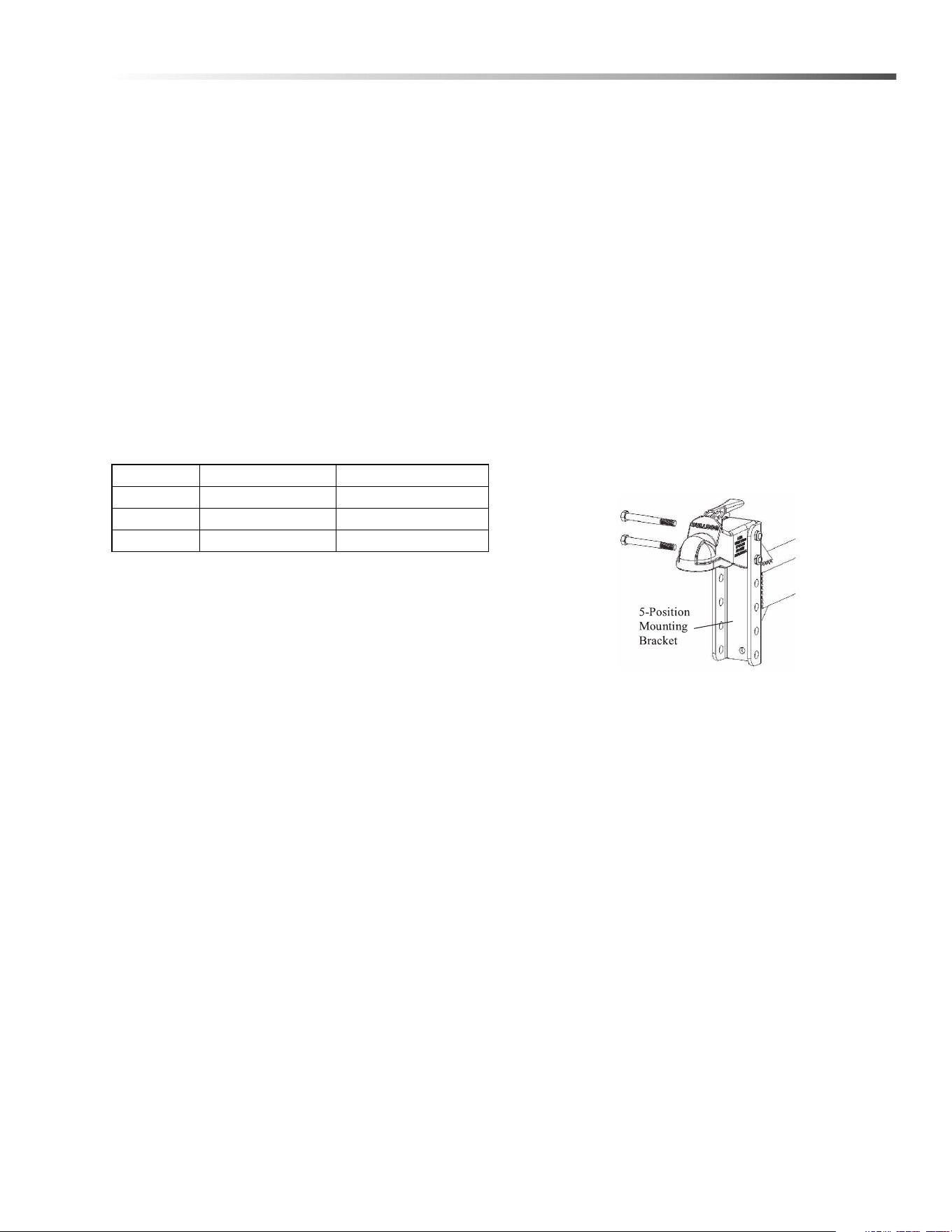
Variable Height Bracket:
Coupler operation must not be impaired in any way. Do
not use if coupler operation is impaired.
Bolting Instructions:
Align holes in coupler and mounting bracket.
NOTE: Coupler must be secured to mounting bracket
using two sets of holes in the mounting bracket.
Insert two (2) 5/8”x4.5”, grade 5 bolts through desired
mounting bracket holes and coupler. For each bolt,
Place one (1) washer at the bolt head side and another
at the bolt thread side before assembling the nuts.
Tighten lock nuts to 90-96 ft. lbs. After installation,
ensure coupler operation is not impaired in any way. Do
not use if coupler operation is impaired. The hardware
provided with the trailer has a self-lubricating coating
which is taken into account for the tightening torque
above, and is lower than standard hardware and also is
more consistent with re-torque specifications to first-
torque than standard hardware. Order replacements
with the 8.924-356.0 replacement kit, or consult your
hardware vendor for applicable, higher, torques for the
application.
Hitch Maintenance
Keep ball pocket and mechanism clean. The following
procedures should be performed at least annually:
• Check set screw torque Grease ball pocket
• Oil pivot points with SAE 30 wt. motor oil
• Inspect retaining pin and replace if necessary
Class Coupler Ball Diameter
II
3,500# GVWR
2”
III
5,000# GVWR
2”
IV 8,000# GVWR 2 5/16”
Karcher TRK 2500 HDS Operator’s Manual 9.807-794.0 - E

8
Safety
Hitch Operation
To Couple:
1. Block trailer wheels.
2. Align hitch ball beneath coupler.
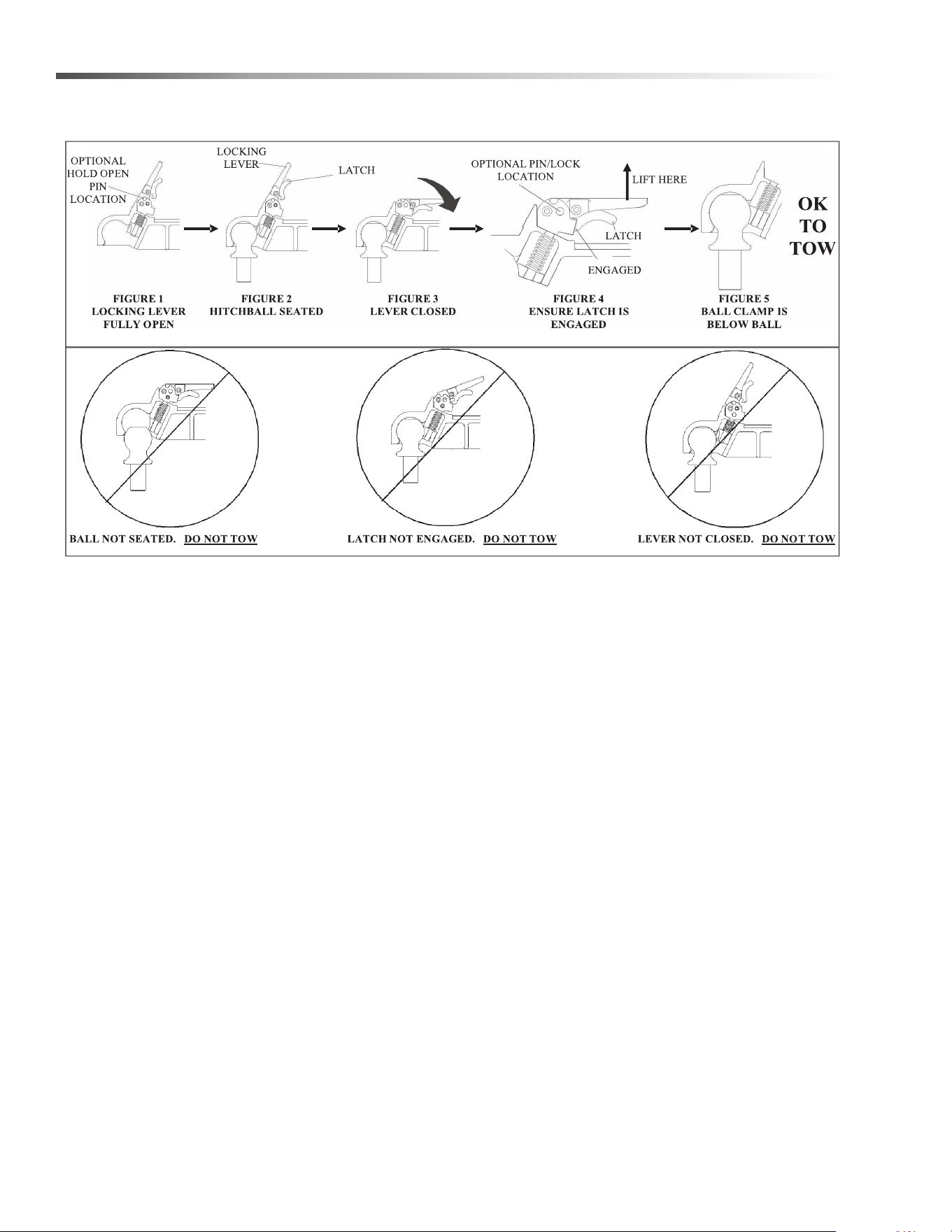
3. Open coupler locking lever. While holding locking
lever open, lower the coupler over the hitch ball
until ball is fully seated into the ball pocket.
4. If locking lever is pinned open, remove pin. Move
locking lever to the closed position. Check that the
latch is engaged by lifting up on back of locking
lever. Also, check that the hitch ball is fully seated
and ball clamp is below the ball. If the ball is not
seated with lever in the closed position and latch
engaged, DO NOT TOW.
Repeat the above steps.
5. OPTIONAL: Place a 5/16” pin or lock in hole shown
To Uncouple:
1. Block trailer wheels.
2. Open locking lever. While holding locking lever fully
open, raise trailer off of hitch ball.
NOTE: A 5/16” diameter pin can be used to hold the
locking lever open.
Hitch Coupler Troubleshooting
If the coupler becomes damaged it must be repaired or
replaced before towing. When the coupler is placed on
the ball, the latch should close firmly. Keep the latch
mechanism lightly oiled and clean. Items to check for
are as follows:
1. Latch does not grasp ball securely:
• Check the ball size. Make sure the ball and
coupler are the same size.
2. Latch does not snap into full latch position:
• Check adjustment. Latch mechanism may be
too tight.
• Check to see that the coupler housing has not
been damaged, keeping the ball hitch from
fitting completely into the housing as designed.
3. Keep the tongue blocked up when not in use so the
coupler and mechanism are not in the ground
being exposed to dirt and moisture.
4. Apply a small amount of an automotive grease to
the ball before hitching coupler to prevent wear of
the two parts during towing.
5. Make sure the latch safety pin is in position before
towing.
Coupler & Ball Engagement
If the coupler and towing ball resist attempts to make
engagement, do not force latch assembly. Instead,
check the ball diameter to verify that it conforms to
Society of Automotive Engineers (SAE) specifications.
Standard two-inch diameter ball should be within the
limits of 2.000-inches to 1.970-inches. Balls larger than
2.000- inches will not readily fit the coupler. A two-piece
coupler ball is not recommended.
If the coupler becomes damaged it must be repaired or
replaced before towing. When the coupler is placed on
the ball, the latch should close firmly. Keep the latch
mechanism lightly oiled and clean.
Improper engagement of the coupler and ball can
cause damage if the vehicles separate in transit, thus,
caution must be exercised to insure a secure hook-up.
Lower the coupler onto the ball with the coupler latch in
the vertical position. Continue to lower the trailer
tongue until the jack clears the ground, then flip the
coupler latch to its locked (horizontal) position. At this
point visually observe that the ball is fully engaged in
the ball hitch. An even better check to make sure the
two are fully engaged is to raise the tongue of the trailer
again using the jack. Raise until the ball hitch connec-
tion starts to raise the rear of the tow vehicle. If the
connection was not properly made, the ball and socket
will separate as the tongue of the trailer is raised.
Safety Chains
Listed in the chart below are the different class sizes of
safety chains and the rated load each chain must be
capable of withstanding. Your trailer is equipped with
safety chains that meet the requirements of D.O.T
Regulation 393.70.
WARNING: Failure to properly attach safety chains
between the trailer and tow vehicle can result in a
runaway trailer.
Trailer
Class
Trailer
Weight
GVWR in LBS
Minimum Braking
Strength in LBS.
I to 2,000 2,000
II
2,000 to
3,500
3,500
III 3,500 to 5,000 5,000
IV 5,000 to 7,000 7,600
Karcher TRK 2500 HDS Operator’s Manual 9.807-794.0 - E
9
Safety
WARNING: To avoid accidents, before trailering:
• Hitch only to ball size marked on coupling.
• Ball clamp must capture ball and lever or hand
wheel is fully clamped.
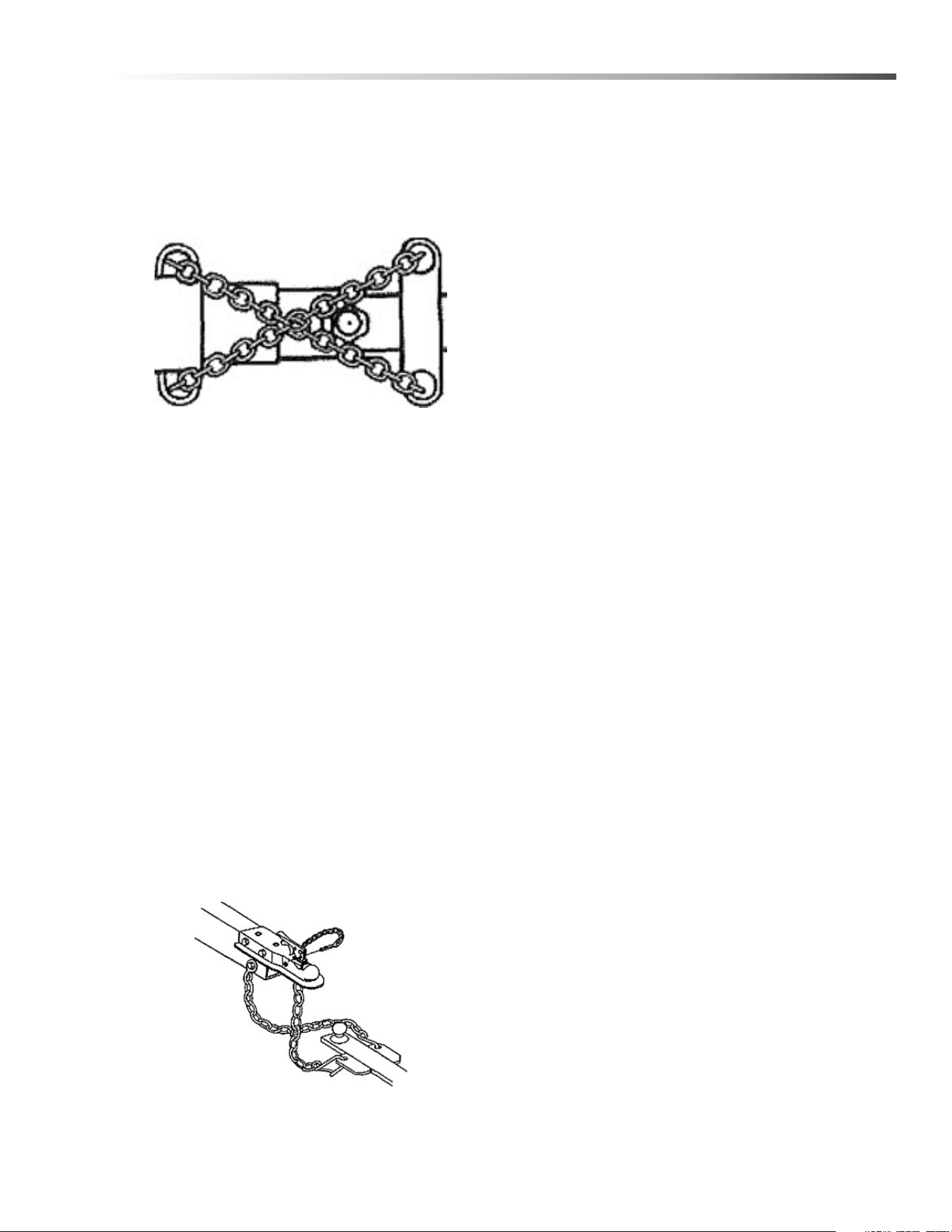
• Cross safety chains under coupling.
• Allow only enough slack for turns.
Bottom View
The safety chains on your trailer are an added
insurance that it will not become detached from the tow
vehicle. All safety chains are provided with an added
clasp to keep them from becoming accidentally
detached from the tow vehicle. Your trailer hitch on the
tow vehicle should have two attaching holes or rings for
attaching the safety chains, preferably one on each
side of the ball hitch. Crisscross the chains under the
tongue, the chain on the left side of the trailer tongue
attached to the right side of the ball hitch, the chain on
the right side of the trailer tongue attached to the left
side of the ball hitch.
This prevents the trailer tongue from dropping to the
road should the coupler or ball hitch fail. The chains
should be rigged as tight as possible with just enough
slack to allow tight turns to be made. This can be
accomplished by twisting the chain hook in a clockwise
or counterclockwise direction thus twisting the link
spacing and making the chain shorter. Also by keeping
your chains as short as possible you prevent them from
dragging on the road and wearing the chain links. If for
any reason you find it necessary to replace a safety
chain, use only original equipment.
Load-Carrying Capacity
Located on the front left-hand side of the frame, (either
the inside or the outside) is the VIN (Vehicle Identifica-
tion Number) tag. It will show the GVWR (Gross Vehicle
Weight Rating) which is the maximum load that can be
applied to the tires on the trailer. The GVWR and the
carrying capacity of the trailer are based on the tire size
installed on the trailer.
The GVWR is the maximum carrying capacity of the
trailer with its respective tires. It may not necessarily
equal the total GVWR of the trailer less the empty
weight of the trailer because there may be another
controlling factor such as frame strength that reduces
the carrying capacity to what is listed on the VIN tag.
The tire label will list the tire size that was installed on
the trailer as original equipment when it was sold to
you, the consumer. It also lists the maximum carrying
capacity of the trailer.
IMPORTANT: The total weight of the load must
never exceed the weight of cargo listed on the tire
label and/or the maximum load carrying capacity
listed on the VIN tag on your trailer. The GVWR
(Gross Vehicle Weight Rating) listed is the
maximum total weight of the trailer with accesso-
ries and all cargo allowable to be carried on the
tires that are installed on the trailer.
WARNING: Fishtailing caused from improper
tongue weight on the tow vehicle hitch ball can
cause loss of control of the tow vehicle and
resulting serious injury or property damage.
CAUTION: The maximum load applied to the trailer
must never exceed the carrying capacity of the
trailer as stated on the VIN label and/or the tire
placard. Doing so may cause failure of one or more
component parts of the trailer causing potential
damage to the trailer and/ or a potential accident.
All concentrated loads must be spread over as
large an area as possible to eliminate potential
damage to the decking.
Karcher TRK 2500 HDS Operator’s Manual 9.807-794.0 - E

10
Safety
Shown below is an example of the tire label that is
placed on your trailer showing the items just discussed
above. Once you have familiarized yourself with the
information supplied on the example tire label and VIN
tag, check the tire size and capacity of your trailer as
shown on the VIN tag on your trailer.
Proper Weight Distribution & Tongue
Weight
Ensuring that your trailer has the proper GVWR is very
important. Once that has been established and you
have the load on the trailer it is equally important that
you have proper weight distribution.
Tongue Weight
The tongue weight on your trailer is 10%-15% of the
total weight of the trailer and all the cargo that it is
carrying. This is the amount of weight that is then
transferred to the tow vehicle through the ball hitch.
Example: The total weight of the trailer with load is
2500 pounds. The tongue weight should not be less
than 250 pounds (10%).
Too light of tongue weight can cause the trailer to “fish-
tail” (sway Weight Rating) as you travel down the
highway. This creates excessive strains on the tow
vehicle, hitch and on the trailer itself. It can very easily
lead to an accident.
To adjust for too light of a tongue weight the load must
be shifted for-ward with respect to the axle. This will
increase the weight that is transferred to the tongue.
Adjustments should be made until the tongue weight
falls within 10% -15% recommended range. Likewise, if
you have too much tongue weight adjust the weight
backwards with respect to the axle until the tongue
weight falls in the recommended range
Tow vehicles vary on how much tongue weight they can
support for proper towing.
TIRE AND LOADING INFORMATION
RENSEIGNEMENTS SUR LES PNEUS ET LE CHARGEMENT
The weight of cargo should never exceed
XXXX kg or XXXX lbs
TIRE SIZE COLD TIRE PRESS.
REAR XXXXXXX XXX KPA (XX PSI)
INTER XXXXXXXXX
FRONT XXXXX
SPARE XXXXX
SEE OWNER’S
MANUAL FOR
ADDITIONAL
INFORMATION
VOIR LE MANUAL
DE L’USAGER
POUR PLUS DE
RENSEIGNEMENTS
MANUFACTURED BY: KARCHER NORTH AMERICA INC. DATE OF MFG.:XX/XXXX
GAWR (EACH AXLE)
V.I.N. : TYPE : TRAILER
TRX-XXXX
WITH TIRES RIMS AT COLD
XXXX KG (XXXX LB) XXXX XXXX XXX KPA (XX PSI) SINGLE
THIS VEHICLE CONFORMS TO ALL APPLICABLE U.S. FEDERAL MOTOR VEHICLE SAFETY STANDARDS
IN EFFECT ON THE DATE OF MANUFACTURE SHOWN ABOVE.
XXXXXXXXXXXXXXXXX
GVWR (XXXX KG (XXXX LB)
Karcher TRK 2500 HDS Operator’s Manual 9.807-794.0 - E
11
Operations
Tire Pressure
Proper air pressure for your tires is printed on the
sidewall. Check pressure while tires are cold. Do not
raise or lower pressure to meet load. Pressure other
than recommended pressure will lead to excessive tire
wear or tire failure. Balancing recommended.
Wheels
Check wheels for hole
elongation or “out of round”.
This condition can be caused by
lug nuts not being tight or being
too tight. Trailer wheels can be
damaged by chuck holes or
curb jumping. You may not be
aware of the road shock to the wheels without periodic
checks. Replace any wheel that is bent. Replace any
wheel if you see elongation of the bolt holes.
Wheel Lugs
Wheel lug nuts must be tightened with a torque wrench.
Refer to the chart below for proper torque.
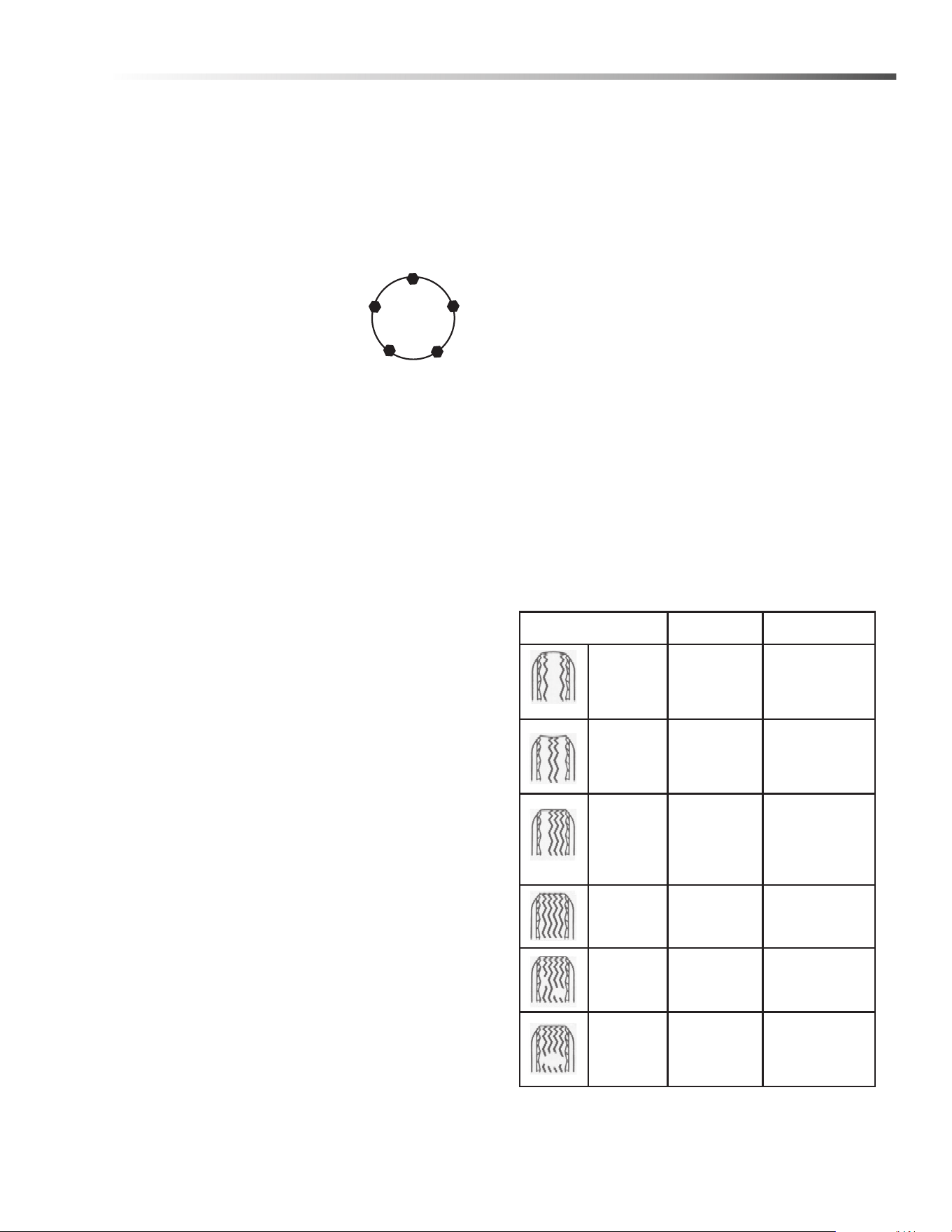
1. Start all bolts or nuts by hand to prevent cross
threading.
2. Tighten bolts or nuts following sequence at right.
3. The tightening of the fasteners should be done in
stages. Following the recommended sequence,
tighten fasteners per wheel torque chart below.
4. Wheel nuts/bolts should be torqued before first
road use and after each wheel removal. Check and
re-torque after the first 10 miles, 25 miles and
again at 50 miles. Check periodically thereafter.
Ball Coupler Hitches
Coupler assembly includes a latch lever and latch lever
safety pin or hitch pin. Be sure the latch lever is locked
and the pin properly secured before moving your trailer.
The pin can be engaged fully only if ball is properly
seated in the coupler.
Tires
Before mounting tires onto wheels make certain that
the rim size and contour is approved for the tire as
shown in the Tire and Rim Association Yearbook or the
tire manufacturer’s catalog. Also make sure the tire will
carry the rated load. If the load is not equal on all tires
due to trailer weight distribution, use the tire rated for
the heaviest wheel position.
Note: The capacity rating molded into the sidewall of
the tire is not always the proper rating for the tire if used
in a trailer application. Use the following guideline:
1. LT and ST tires: use the capacity rating molded into
the tire.
2. Passenger Car Tires: Use the capacity rating
molded into the tire sidewall divided by 1.10.
Use tire mounting procedures as outlined by the
Rubber Manufacturer’s Association or the tire manufac-
turers.
NOTE: Tire wear should be checked frequently
because once a wear pattern becomes firmly
established in a tire it is difficult to stop, even if the
underlying cause is corrected.
Wheel Torque Requirements
Wheel Size
Torque Sequence
1st Stage 2nd Stage 3rd Stage
15” 20-25 50-60 80-90
1
2
3
4
5
WEAR PATTERN CAUSE ACTIONACTION
Center
Wear
Over
Inflation
Adjust pressure
to particular
load per tire
catalog.
Edge
Wear
Under
Inflation
Adjust pressure
to particular
load per tire
catalog.
Side Wear
Loss of
camber or
overloading
Make sure load
doesn't exceed
axle rating.
Align at
alignment shop.
Toe Wear
Incorrect
toe-in
Align at
alignment shop.
Cupping
Out of
balance
Check bearing
adjustment and
balance tires.
Flat
Spots
Wheel
lockup & tire
skidding
Avoid sudden
stops when
possible and
adjust brakes.
Karcher TRK 2500 HDS Operator’s Manual 9.807-794.0 - E
12
Safety
Correct Ball Seating
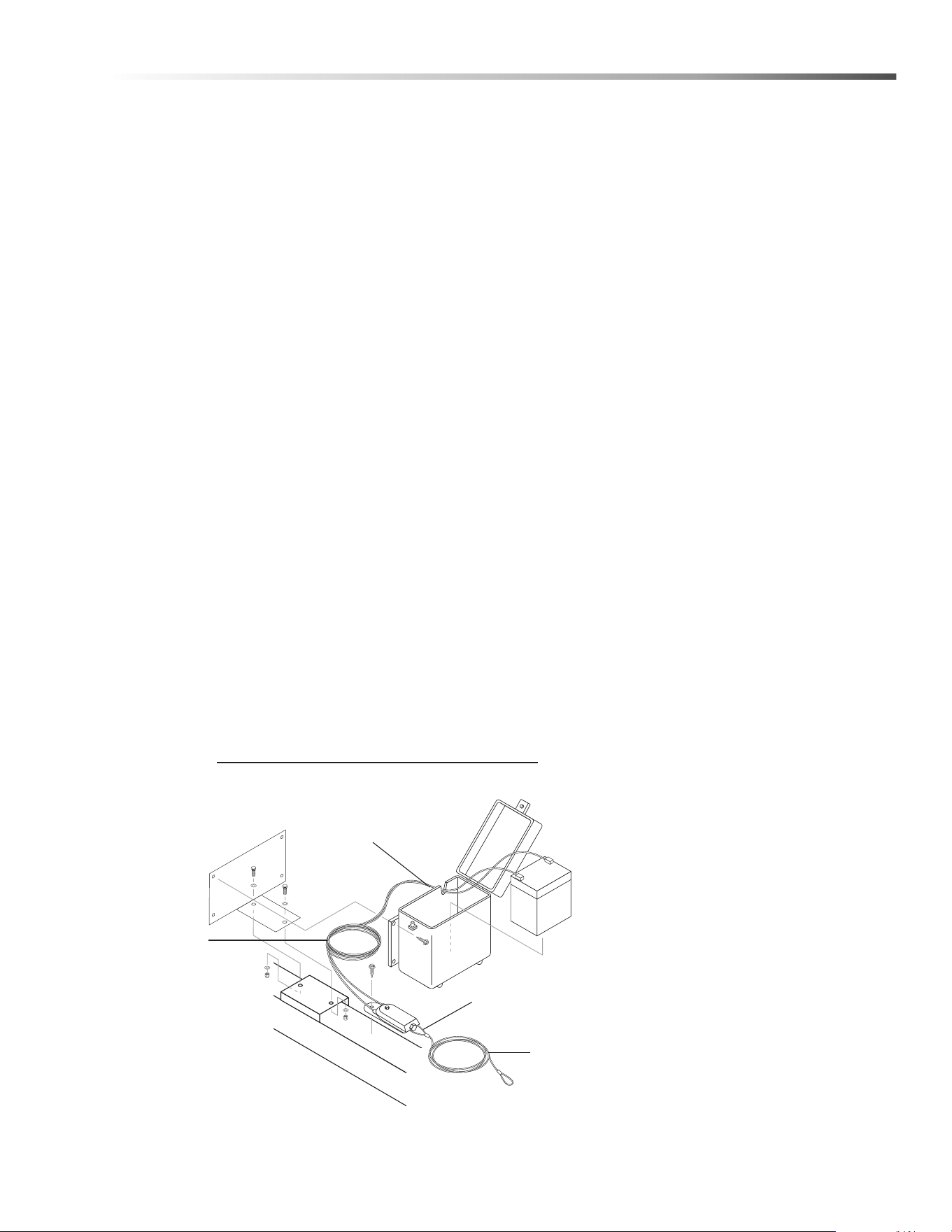
Breakaway Switch & D.O.T. Wet Cell
Battery
After hitching to the tow vehicle, pull the safety pin on
the breakaway switch. Check to see if system is
operational. Push safety pin back in to its original
position.
Check battery fluid level every 60-90 days. Remove
cover. There are two fill caps. Refill with distilled water
only.
Karcher TRK 2500 HDS Operator’s Manual 9.807-794.0 - E
13
Safety
Breakaway Switch Mounted
on an A-Frame
Attach breakaway switch cable securely in a straight
line to the tow vehicle. Locate attachments so little
“slack” is left in the cable, but enough slack to allow for
turning without disengaging the pin. The cable will
activate brakes the instant a trailer becomes disen-
gaged. Brake adjustment is critical to stopping a disen-
gaged trailer.
Check Breakaway System & Brakes Before
Each Trip
1. Disconnect 12V plug from tow vehicle.
2. Pull breakaway pin.
3. While pin is pulled, move tow vehicle forward.
Brake should be on and wheels locked.
4. Replace pin and secure to tow vehicle. Do not loop
over hitch ball.
5. Plug 12V connector into tow vehicle receptacle.
6. Test brakes with brake controller.
NOTE: When disconnecting trailer from tow vehicle,
make sure to replace safety pin.
Brakes
Your trailer is equipped with electric brakes.
Complete service and repair information for the electric
brakes is found in the Axle Break Service Manual that
is furnished with your trailer,
Note: It is important to strictly adhere to the axle break
instructions for brake service and repair. In this way,
you are protecting the validity of all applicable warran-
ties.
Burnishing the Brakes
Brakes on a new trailer may tend to “grab” or pulsate.
This is normal. To correct the situation, pull the trailer
with the trailer brake control slightly engaged a short
distance (about 1000 ft or until trailer does not grab or
pull to one side anymore). This action smooths down
the brake bands.
NOTE: Do not lock up the wheels
Breakaway Battery
(Two fill caps
underneath cover)
P
ower Cable
Breakaway
Pin
Cable to Vehic
le
Breakaway Battery on A-Frame
Karcher TRK 2500 HDS Operator’s Manual 9.807-794.0 - E

14
Safety
Brake Adjustment
Brakes should be adjusted (1) after the first 200 miles
of operation after the brake shoes and drums have
“seated”, (2) at 3000 mile intervals and (3) as use and
performance require. The brakes should be adjusted in
the following manner:
1. Jack up trailer and secure on adequate capacity
jack stands. Check that wheel and drum rotate
freely.
2. Remove adjusting hole cover from adjusting slot on
bottom of brake backing plate.
3. With screwdriver or standard adjusting tool, rotate
the starwheel of the adjuster assembly to expand
the brake shoes. Adjust the brake shoes out until
the pressure of the linings against the drum makes
the wheel very difficult to turn.
NOTE: With drop spindle axles, a modified adjusting
tool with about an 80 degree angle should be used.
4. Then rotate starwheel in opposite direction until
wheel turns freely with slight lining drag.
5. Replace the adjusting hole cover and lower wheel
to ground.
6. Repeat above procedure on all brakes.
Never crawl under your trailer unless it is
resting on properly placed jack stands.
Do not lift or place supports on any part of the
suspension system.
Brake Cleaning & Inspection
Your trailer brakes must be inspected and serviced at
yearly intervals or more often as use and performance
require. Magnets and shoes must be changed when
they become worn or scored thereby preventing inade-
quate vehicle braking.
Clean the backing plate, magnet arm, magnet and
brake shoes. Make certain that all the parts removed
are replaced in the same brake and drum assembly.
Inspect the magnet arm for any loose or worn parts.
Check shoe return springs, hold down springs and
adjuster springs for stretch or deformation and replace
if required.
Asbestos Dust Hazard. Since some brake
shoe friction materials contain asbestos,
certain precautions need to be taken when
servicing brakes:
1. Avoid creating or breathing dust.
2. Avoid machining, filing or grinding the brake
linings.
3. Do not use compressed air or dry brushing for
cleaning. (Dust can be removed with a damp
brush).
Karcher TRK 2500 HDS Operator’s Manual 9.807-794.0 - E

15
Safety
Trailer Storage
Preparation
If your trailer is to be stored for an extended period of
time or over the winter, it is important that the trailer be
prepared properly.
1. Remove the emergency breakaway battery and
store inside, out of the weather. Charge the battery
at least every 90 days.
2. Jack up the trailer and place jack stands under
trailer frame so that the weight will be off the tires.
Never jack up or place jack stands on the axle tube
or on the equalizers.
3. Lubricate mechanical moving parts that are
exposed to weather, such as the hitch and suspen-
sion parts.
NOTE: On oil lubricated hubs the upper part of the
roller bearings are not immersed in oil and are subject
to potential corrosion. For maximum bearing life it is
recommended that you revolve your wheels
periodically (every 2-3 weeks) during periods of
prolonged storage.
After Prolonged Storage — Inspection
Procedures
Before removing trailer from jack stands:
1. Remove all wheels and hubs or brake drums. Note
which spindle and brake that the drum was
removed from so that it can be reinstalled in the
same location.
2. Inspect suspension for wear.
3. Check tightness of hanger bolt, shackle bolt and U-
bolt nuts per recommended torque values.
4. Check brake linings, brake drums and armature
faces for excessive wear or scoring.
5. Check brake magnets with an ohmmeter. The
magnets should check 3.2 ohms. If shorted or worn
excessively, replace.
6. Lubricate all brake moving parts using a high
temperature brake lubricant. (Lubriplate or equiva-
lent).
Do not get grease or oil on brake linings or
magnet face.
7. Remove any rust from braking surface and
armature surface of drums with fine emery paper or
crocus cloth. Protect bearings from contamination
while so doing.
8. Inspect oil or grease seals for wear or nicks.
Replace if necessary.
9. Lubricate hub bearings. Refer to procedure in
manual.
10. Reinstall hubs and adjust bearing per instructions
in manual.
Karcher TRK 2500 HDS Operator’s Manual 9.807-794.0 - E
16
Safety
Thank you for purchasing a Kärcher Pressure Washer.
We reserve the right to make changes at any time
without incurring any obligation.
Owner/User Responsibility:
The owner and/or user must have an understanding of
the manufacturer’s operating instructions and warnings
before using this pressure washer. Warning information
should be emphasized and understood. If the operator
is not fluent in English, the manufacturer’s instructions
and warnings shall be read to and discussed with the
operator in the operator’s native language by the
purchaser/owner, making sure that the operator
comprehends its contents.
Owner and/or user must study and maintain for future
reference the manufacturers’ instructions.
The operator must know how to stop the machine
quickly and understand the operation of all controls.
Never permit anyone to operate the engine without
proper instructions.
Save these Instructions
This manual should be considered a permanent part of
the machine and should remain with it if machine is
resold.
When ordering parts, specify model and serial number.
Use only identical replacement parts.
This machine is to be used only by trained operators.
Important Safety Information
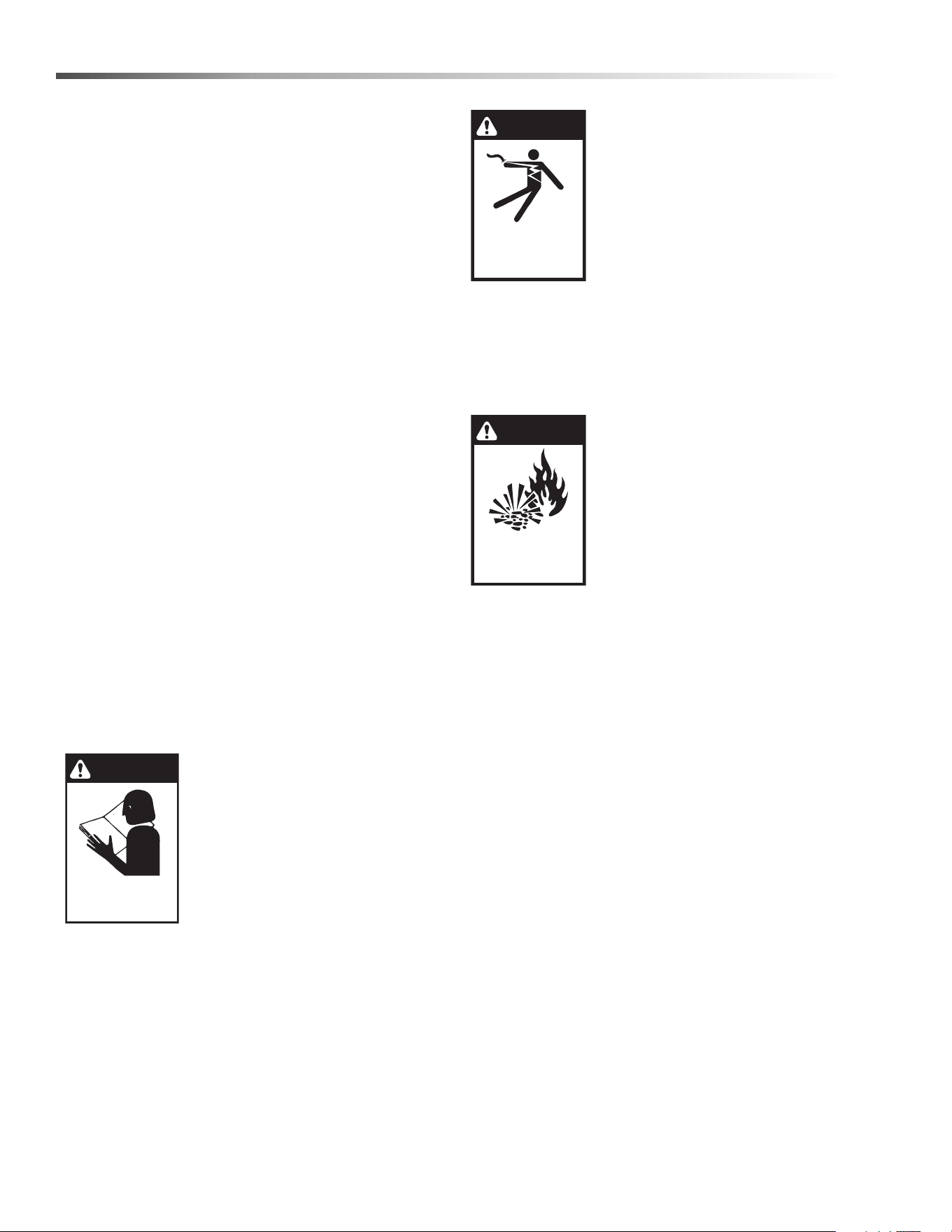
WARNING: To reduce the
risk of injury, read
operating instructions
carefully before using.
1.Read the owner's manual thor-
oughly. Failure to follow instruc-
tions could cause malfunction of
the machine and result in death,
serious bodily injury and/or
property damage.
2. Know how to stop the machine and bleed pressure
quickly. Be thoroughly familiar with the controls.
3. Stay alert — watch what you are doing.
DANGER: Keep wand,
hose, and water spray
away from electric wiring
or fatal electric shock may
result.
4.Follow engine fuel recommen-
dation in the engine manual
provided
WARNING: Flammable liquids can create
fumes which can ignite, causing property
damage or severe injury.
WARNING: Risk of
explosion — Operate only
where open flame or torch
is permitted.
5.Use only kerosene, No. 1 home
heating fuel, or diesel for the hot
water burner. If diesel is used,
add a soot remover to every
tankful.
WARNING: Gasoline is highly flammable
and explosive. You can be seriously
injured when refueling.
• Stop engine and keep heat sparks and flame
away.
• Refuel only outdoors.
• Wipe up spills immediately.
WARNING
READ OPERATOR’S
MANUAL THOROUGHLY
PRIOR TO USE.
OPERATIONS
SAFETY
MAINTENANCE
DANGER
KEEP WATER
SPRAY AWAY FROM
ELECTRICAL WIRING.
WARNING
RISK OF EXPLOSION:
OPERATE ONLY WHERE
OPEN FLAME OR TORCH
IS PERMITTED
Karcher TRK 2500 HDS Operator’s Manual 9.807-794.0 - E
17
Safety
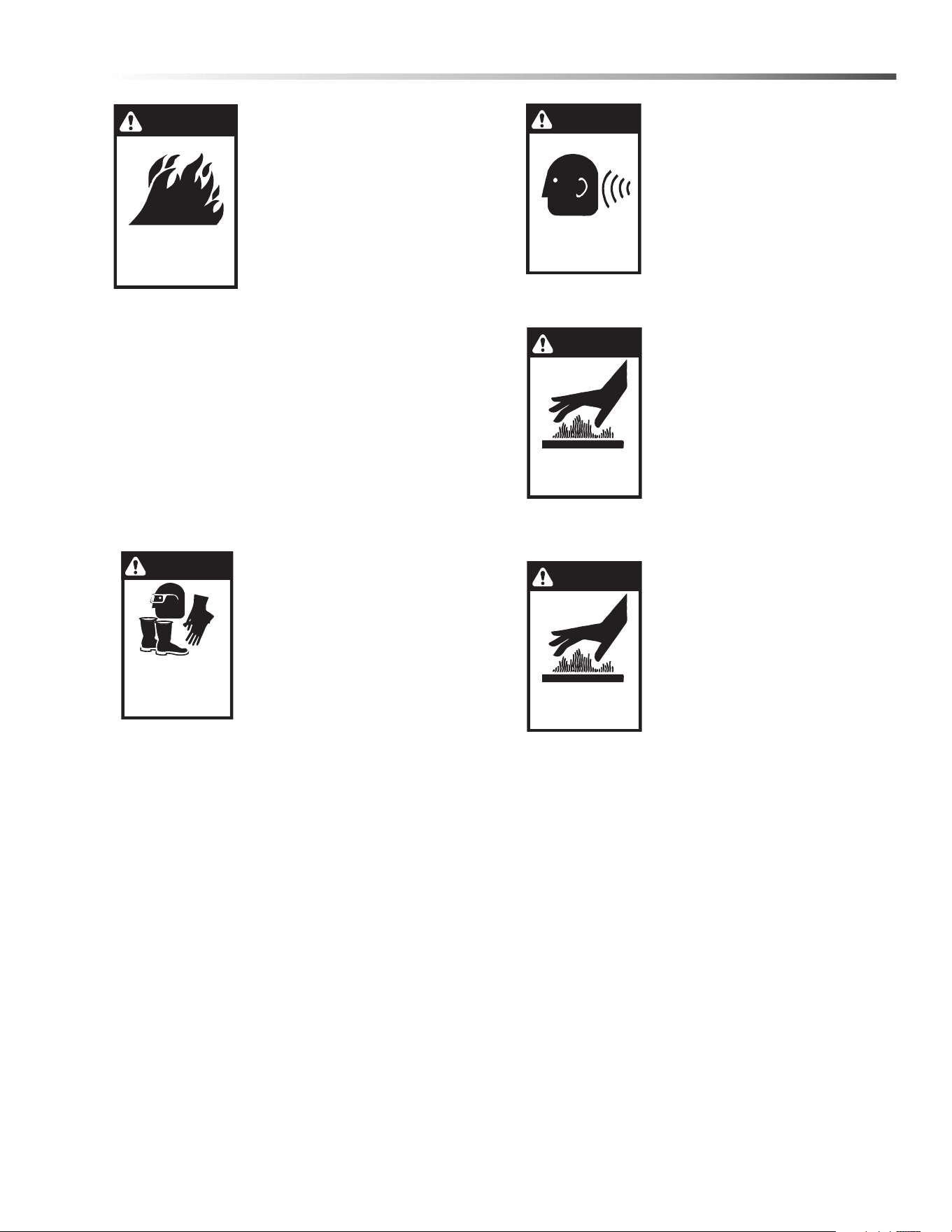
WARNING: Risk of fire —
Do not add fuel when the
product is operating or
still hot.
WARNING: Do not use
gasoline crankcase
draining or oil containing
gasoline, solvents or
alcohol. Doing so will
result in fire and/or explosion.
6. Operate only in locations where combustible dusts
and flammable gases or vapors are not present.
Do not store or use gasoline near this machine.
7. Do not allow acids, caustic or abrasive fluids to
pass through the pump.
8. Never run pump dry or leave spray gun closed
longer than 1-2 minutes.
9. Keep operating area clear of all persons.
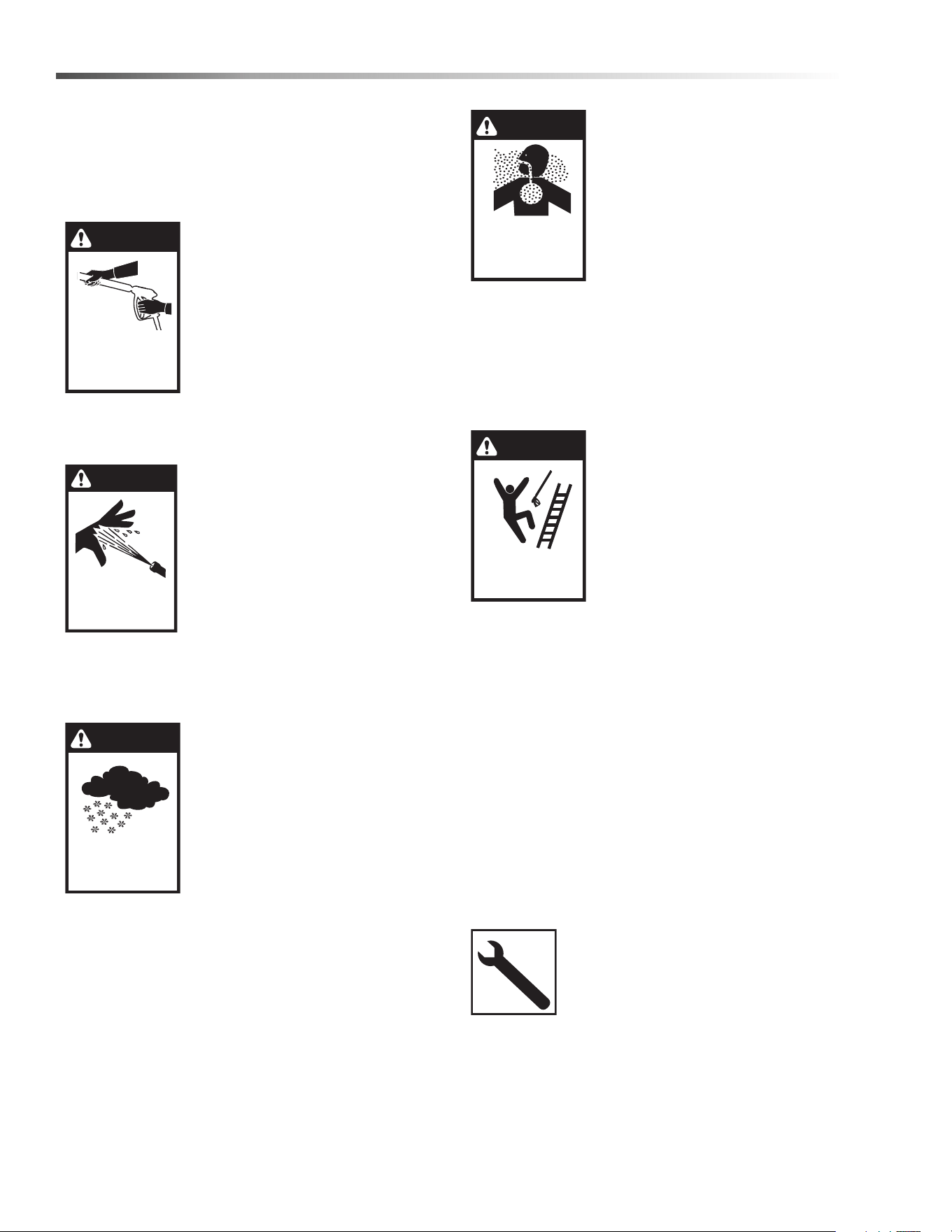
WARNING: High pressure
spray can cause paint
chips or other particles to
become airborne and fly at
high speeds. To avoid
personal injury, eye, hand
and foot safety devices
must be worn.
10.Always wear properly rated eye
protection such as safety goggles or face shield
while spraying. Safety glasses do not provide full
protection.
WARNING: This machine
exceeds 85 dB.
Appropriate ear protection
must be worn.
WARNING: Hot discharge
fluid. Do not touch or
direct discharge stream at
persons.
WARNING: This machine
produces hot water and
must have insulated
components attached to
protect the operator.
WARNING: Risk of injury.
Hot surfaces can cause
burns. Use only
designated gripping areas
of spray gun and wand.
Do not place hands or feet
on non-insulated areas of
the pressure washer.
WARNING
RISK OF FIRE.
DO NOT ADD FUEL
WHEN OPERATING
MACHINE.
WARNING
USE PROTECTIVE
EYE WEAR
AND CLOTHING
WHEN OPERATING
THIS EQUIPMENT.
WARNING
EAR PROCTION
MUST BE WORN
WARNING
HOT DISCHARGE FLUID:
DO NOT TOUCH OR
DIRECT DISCHARGE
STEAM AT PERSONS.
WARNING
RISK OF INJURY.
HOT SURFACES
CAN CAUSE BURNS
Karcher TRK 2500 HDS Operator’s Manual 9.807-794.0 - E
18
Safety
11. To reduce the risk of injury, close supervision is
necessary when a machine is used near children.
Do not allow children to operate the pressure
washer. This machine must be attended during
operation.
WARNING: Grip cleaning
wand securely with both
hands before starting.
Failure to do this could
result in injury from a
whipping wand.
12.Never make adjustments on
machine while in operation.
13.Be certain all quick coupler
fittings are secured before using pressure washer.
WARNING: High pressure
developed by these
machines will cause
personal injury or
equipment damage. Keep
clear of nozzle. Use
caution when operating.
Do not direct discharge
stream at people, or
severe injury or death will
result.
WARNING: Protect
machine from freezing.
14.To keep machine in best
operating conditions, it is
important you protect machine
from freezing. Failure to protect
machine from freezing could
cause malfunction of the machine
and result in death, serious bodily
injury, and/or property damage.
Follow storage instructions specified in this
manual.
15. Inlet water must be clean fresh water and no hotter
then 90°F.
WARNING: Risk of
asphyxiation. Use this
product only in a well
ventilated area.
16.Avoid operating machines in
small areas or near exhaust fans.
Adequate oxygen is needed for
combustion or dangerous carbon
monoxide will result.
17. Manufacturer will not be liable for any changes
made to our standard machines or any compo-
nents not purchased from us.
18. The best insurance against an accident is precau-
tion and knowledge of the machine.
WARNING: Be extremely
careful when using a
ladder, scaffolding or any
other relatively unstable
location. The cleaning
area should have
adequate slopes and
drainage to reduce the
possibility of a fall due to
slippery surfaces.
19. Do not overreach or stand on unstable support.
Keep good footing and balance at all times.
20. Do not operate this machine when fatigued or
under the influence of alcohol, prescription medica-
tions, or drugs.
21. Before disconnecting discharge hose from
water outlet, turn burner off and open spray
gun to allow water to cool below 100° before
stopping the machine. Then open the spray
gun to relieve pressure. Failure to properly
cool down or maintain the heating coil may
result in a steam explosion.
Follow the maintenance
instructions specified in the
manual
WARNING
TRIGGER GUN KICKS
BACK — HOLD WITH
BOTH HANDS
WARNING
RISK OF INJECTION
OR SEVERE INJURY
TO PERSONS. KEEP
CLEAR OF NOZZLE.
WARNING
PROCTECT FROM
FREEZING
WARNING
RISK OF
ASPHYXIATION.
USE THIS PRODUCT
ONLY IN A WELL
VENTILATED AREA.
WARNING
RISK OF INJURY
FROM FALLS WHEN
USING LADDER.
Karcher TRK 2500 HDS Operator’s Manual 9.807-794.0 - E

19
Safety
Reporting Safety Defects
If you believe that your vehicle has a defect which could
cause a crash or could cause injury or death, you
should immediately inform the National Highway Traffic
Safety Administration (NHTSA) in addition to notifying
the trailer manufacturer.
If NHTSA receives similar complaints, it may open an
investigation, and if it finds that a safety defect exists in
a group of vehicles, it may order a recall and remedy
campaign. However, NHTSA cannot become involved
in individual problems between you, your local dealer.
To contact NHTSA, you may either call the Auto Safety
Hotline toll-free at 1-888-327-4236 (TTY: 1-800-424-
9153) or write to:
NHTSA, U.S. Department of Transportation,
1200 New Jersey Avenue SE,
Washington, DC
20590.
You can also obtain other information about motor
vehicle safety from http://www.safercar.gov.
Karcher TRK 2500 HDS Operator’s Manual 9.807-794.0 - E
20
Maintenance
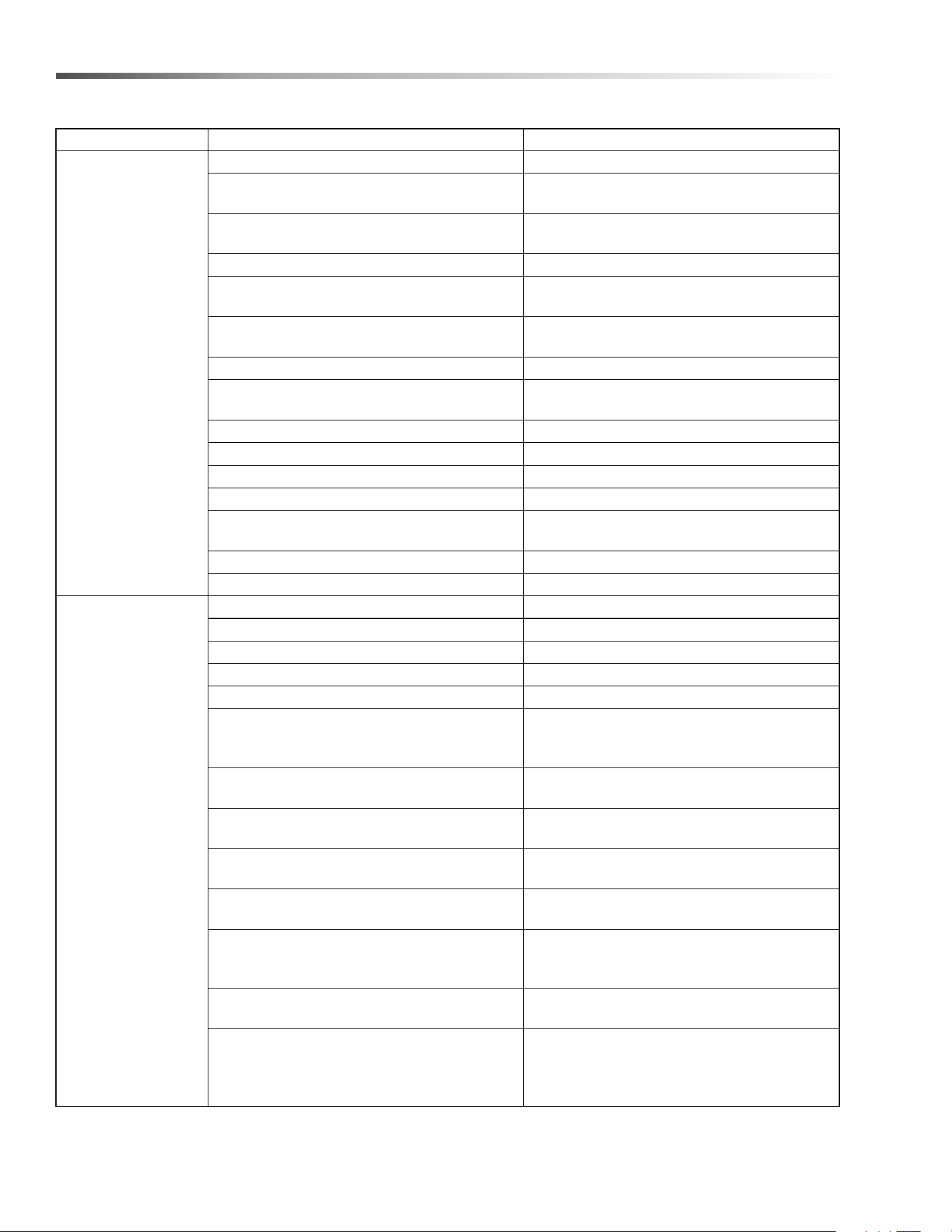
Troubleshooting
Problem Possible Cause Solution
LOW OPERATING
PRESSURE
Faulty pressure gauge Install new gauge.
Insufficient water supply
Use larger supply hose; clean filter at water
inlet.
Old, worn or incorrect spray nozzle
Match nozzle number to machine and/or
replace with new nozzle.
Belt slippage Tighten or replace; use correct belt.
Plumbing or hose leak
Check plumbing system for leaks. Re-tape
leaks with Teflon tape.
Faulty or mis-adjusted unloader valve
Adjust unloader for proper pressure. Install
repair kit when needed.
Worn packing in pump Install new packing kit.
Fouled or dirty inlet or discharge valves in
pump
Clean inlet and discharge valves.
Worn inlet or discharge valves Replace with valve kit.
Obstruction in spray nozzle Remove obstruction.
Leaking pressure control valve Rebuild or replace as needed.
Slow engine RPM Set engine speed at proper specifications.
Pump sucking air
Check water supply and possibility of air
seepage.
Valves sticking Check and clean or replace if necessary.
Unloader valve seat faulty Check and replace if necessary.
BURNER WILL
NOT LIGHT
Little or no fuel Fill tank with fuel.
Improper fuel or water in fuel Drain fuel tank and fill with proper fuel.
Clogged fuel line Clean or replace.
Plugged fuel filter Replace as needed.
Mis-adjusted burner air bands Readjust air bands for clean burn.
Little or no fuel pressure from fuel pump
Increase fuel pressure to specification and/
or replace fuel pump. Test with pressure
gauge.
Faulty burner transformer
Test transformer for proper arc between
contacts. Replace as needed.
Disconnected or short in electrical wiring
All wire contacts should be clean and tight.
No breaks in wire.
Flex coupling slipping on fuel pump shaft or
burner motor shaft
Replace if needed.
On-Off switch defective
Check for electrical current reaching burner
assembly with burner switch on.
Heavy sooting on coil and burner can cause
interruption of air flow and shorting of elec-
trodes
Clean as required.
Improper electrode setting
Check and reset according to diagram in
Operator's Manual.
Fuel not reaching combustion chamber
Check fuel pump for proper flow. Check
solenoid flow switch on machines with spray
gun control, for proper on-off fuel flow
control.
Karcher TRK 2500 HDS Operator’s Manual 9.807-794.0 - E
21
Maintenance
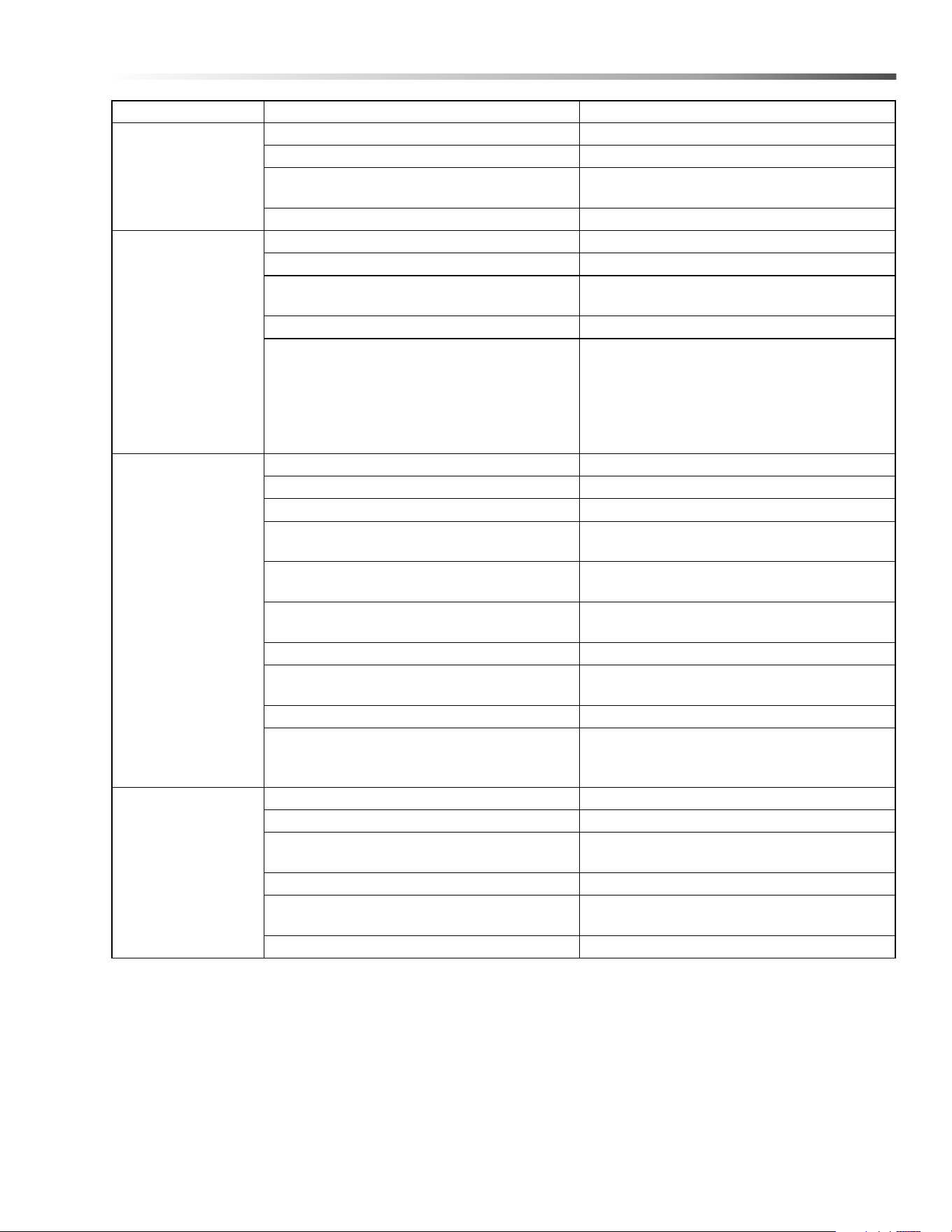
BURNER WILL
NOT LIGHT
Clogged burner nozzle Clean as required.
Thermostat faulty or slow engine speed Increase engine RPM to increase voltage.
Flow switch malfunction
Remove, test for continuity and replace as
needed.
Flow solenoid malfunction Replace if needed.
FLUCTUATING
PRESSURE
Valves worn Check and replace if necessary.
Blockage in valve Check and replace if necessary.
Pump sucking air
Check water supply and air seepage at
joints in suction line.
Worn piston packing Check and replace if necessary.
Gasoline engine altitude
The gasoline engine is preset for operation
at altitudes below 1000 ft above sea level. If
operated at higher altitudes, it may be
necessary to install a high altitude main jet in
the carburetor. Contact your local authorized
engine sales and service center for details.
MACHINE
SMOKES WHILE
BURNER UNIT IS
RUNNING OR UNIT
SMOKES AT
COLD-START
ONLY WHEN
BURNER IS OFF
Improper fuel or water in fuel Drain tank and replace contaminated fuel.
Improper air adjustment Readjust air bands on burner assembly.
Fuel pressure is low <140 psi for burner Adjust fuel pump pressure to specifications.
Burner nozzle is plugged or dirty
Replace nozzle. Check parts breakdown for
nozzle size.
Burner nozzle spray pattern is faulty
Replace nozzle. Check parts breakdown for
nozzle size.
Heavy accumulation of soot on coils and
burner assembly
Remove coils and burner assembly, clean
thoroughly or Call local dealer.
Misaligned electrode setting Realign electrodes to specifications
Obstruction in smoke stack
Check for insulation blockage or other
foreign objects
Low engine RPM Increase RPM
Fuel Pressure is too high for clean burn (fuel
PSI above 140 and below 200) and smokes
when burner is off
Reduce fuel pressure PSI/Increase air band
set for cleaner without max water heat loss
LOW WATER
TEMPERATURE
Improper fuel or water in fuel Replace with clean and proper fuel.
Low fuel pressure Increase fuel pressure.
Weak fuel pump
Check fuel pump pressure. Replace pump if
needed.
Fuel filter partially clogged Replace as needed.
Soot build-up on coils not allowing heat
transfer
Clean coils.
Improper burner nozzle See Burner Specifications.
Problem Possible Cause Solution
Karcher TRK 2500 HDS Operator’s Manual 9.807-794.0 - E
22
Maintenance
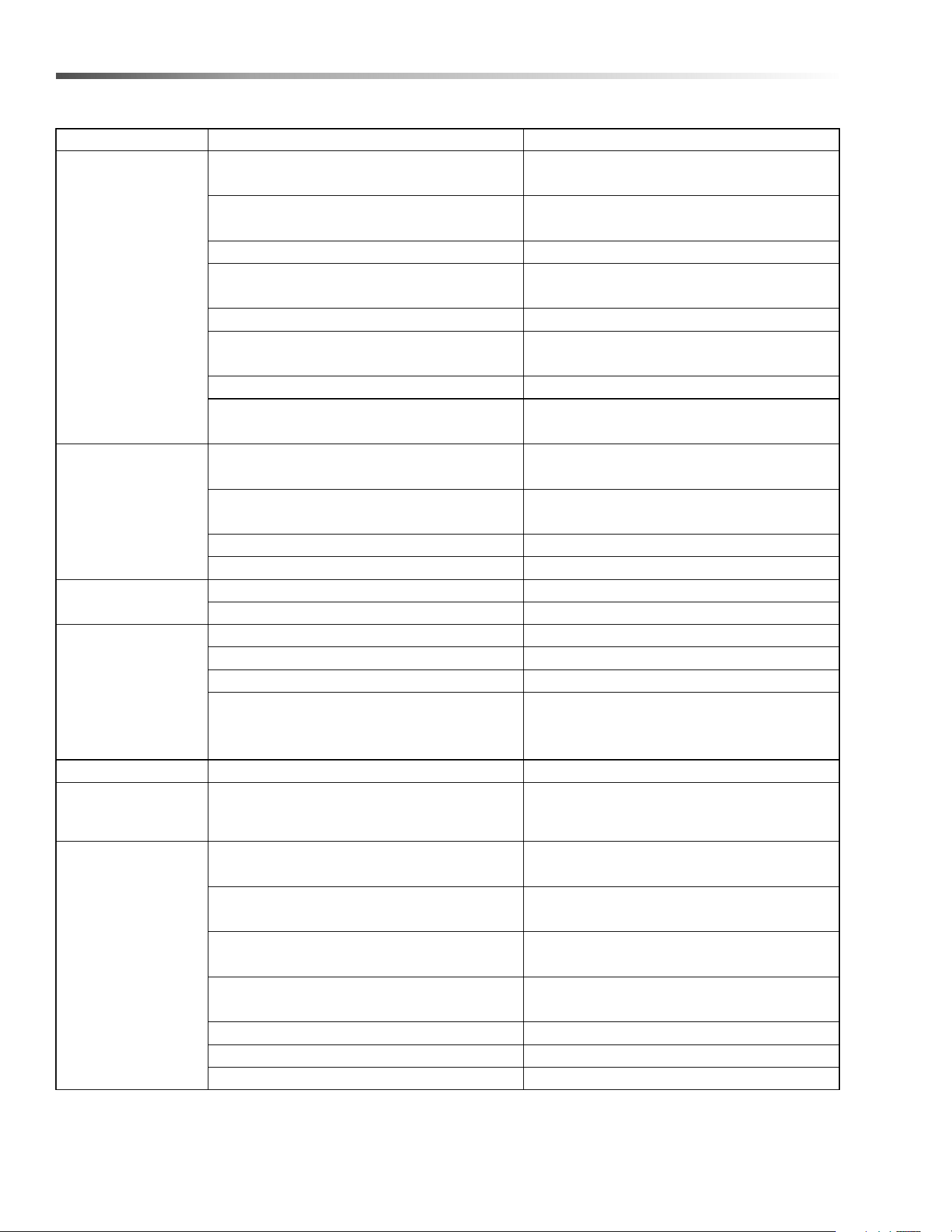
Troubleshooting
Problem Possible Cause Solution
WATER
TEMPERATURE
TOO HOT
Incoming water to machine warm or hot Lower incoming water temperature.
Fuel pump pressure too high See specifications for proper fuel pressure.
Fuel pump defective Replace fuel pump.
Detergent line sucking air
Tighten all clamps. Check detergent lines for
holes.
Defective temperature switch Replace.
Incorrect fuel nozzle size See specifications for proper fuel nozzle.
Insufficient water supplied Check water G.P.M. to machine.
Restricted water flow Check nozzle for obstruction, proper size.
PUMP NOISY
Air in suction line
Check water supply and connections on
suction line.
Broken or weak inlet or discharge valve
springs
Check and replace if necessary.
Excessive matter in valves Check and clean if necessary.
Worn bearings Check and replace if necessary.
PRESENCE OF
WATER IN OIL
Oil seal worn Check and replace if necessary.
High humidity in air Check and change oil twice as often.
WATER DRIPPING
FROM UNDER
PUMP
Piston packing worn Check and replace if necessary.
O-Ring plunger retainer worn Check and replace if necessary.
Cracked piston Check and replace if necessary.
Pump protector
Lower water supply pressure. Do not run
with spray gun closed longer than 2 minutes.
OIL DRIPPING Oil seal worn Check and replace if necessary.
EXCESSIVE
VIBRATION IN
DELIVERY LINE
Irregular functioning of the valves Check and replace if necessary.
DETERGENT NOT
DRAWING
Air leak
Tighten all clamps. Check detergent lines for
holes.
Restrictor in float tank is missing
Replace restrictor. Check for proper orifice
in restrictor.
Filter screen on detergent suction hose
plugged
Clean or replace.
Dried up detergent plugging metering valve Disassemble and clean thoroughly.
High viscosity of detergent Dilute detergent to specifications.
Hole in detergent line(s) Repair hole.
Low detergent level Add detergent, if needed.
Karcher TRK 2500 HDS Operator’s Manual 9.807-794.0 - E
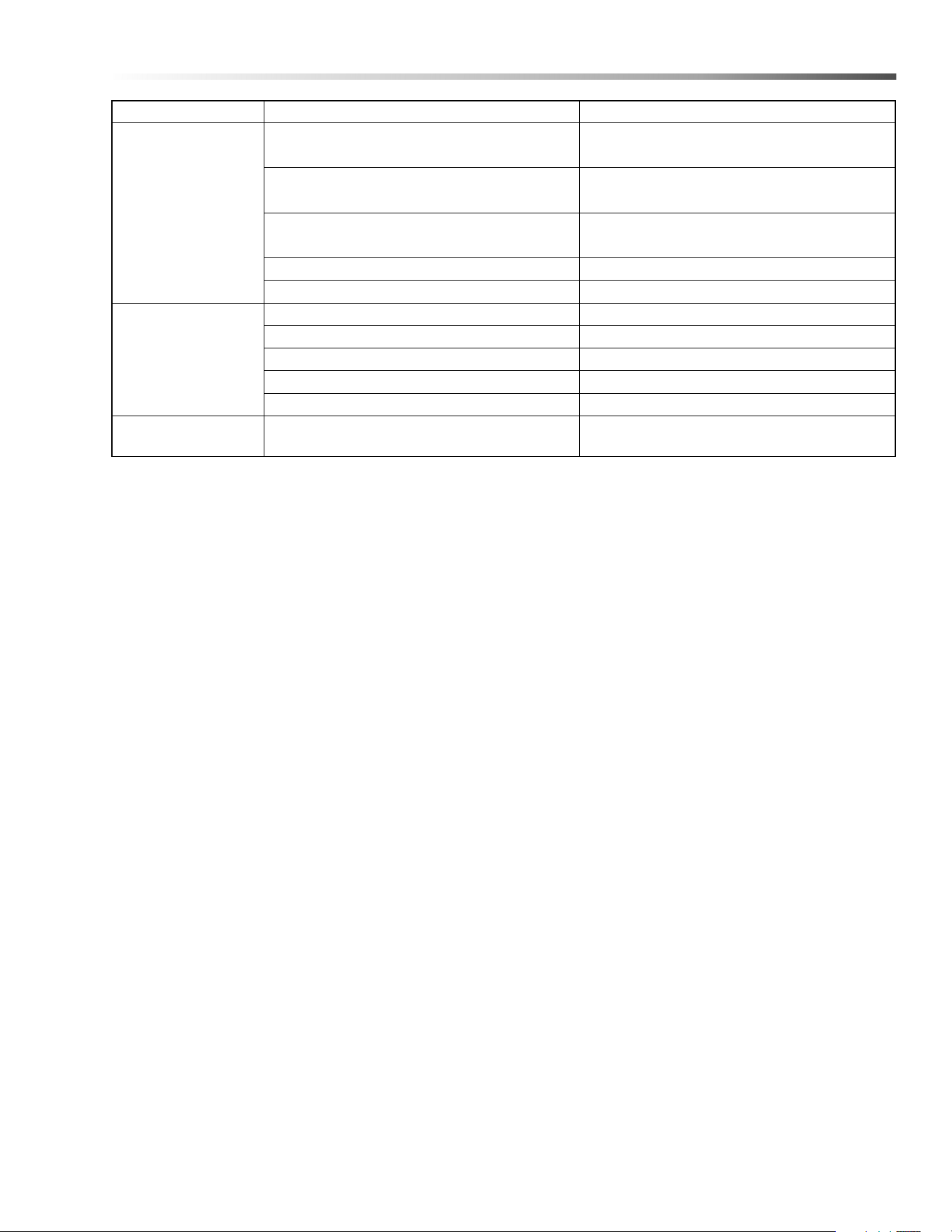
23
Maintenance
PUMP RUNNING
NORMALLY BUT
PRESSURE LOW
ON INSTALLATION
Pump sucking air
Check water supply and possibility of air
seepage.
Valves sticking Check and clean or replace if necessary.
Nozzle incorrectly sized
Check and replace if necessary (See serial
plate for proper size).
Unloader valve seat faulty Check and replace if necessary.
Worn piston packing Check and replace if necessary.
BURNER MOTOR
WILL NOT RUN
Fuel pump seized Replace fuel pump.
Burner fan loose or misaligned Position correctly, tighten set screw.
Defective control switch Replace switch.
Loose wire Check and replace or tighten wiring.
Defective burner motor Replace motor.
RELIEF VALVE
LEAKS WATER
Relief valve defective Replace or repair
Problem Possible Cause Solution
Karcher TRK 2500 HDS Operator’s Manual 9.807-794.0 - E
24
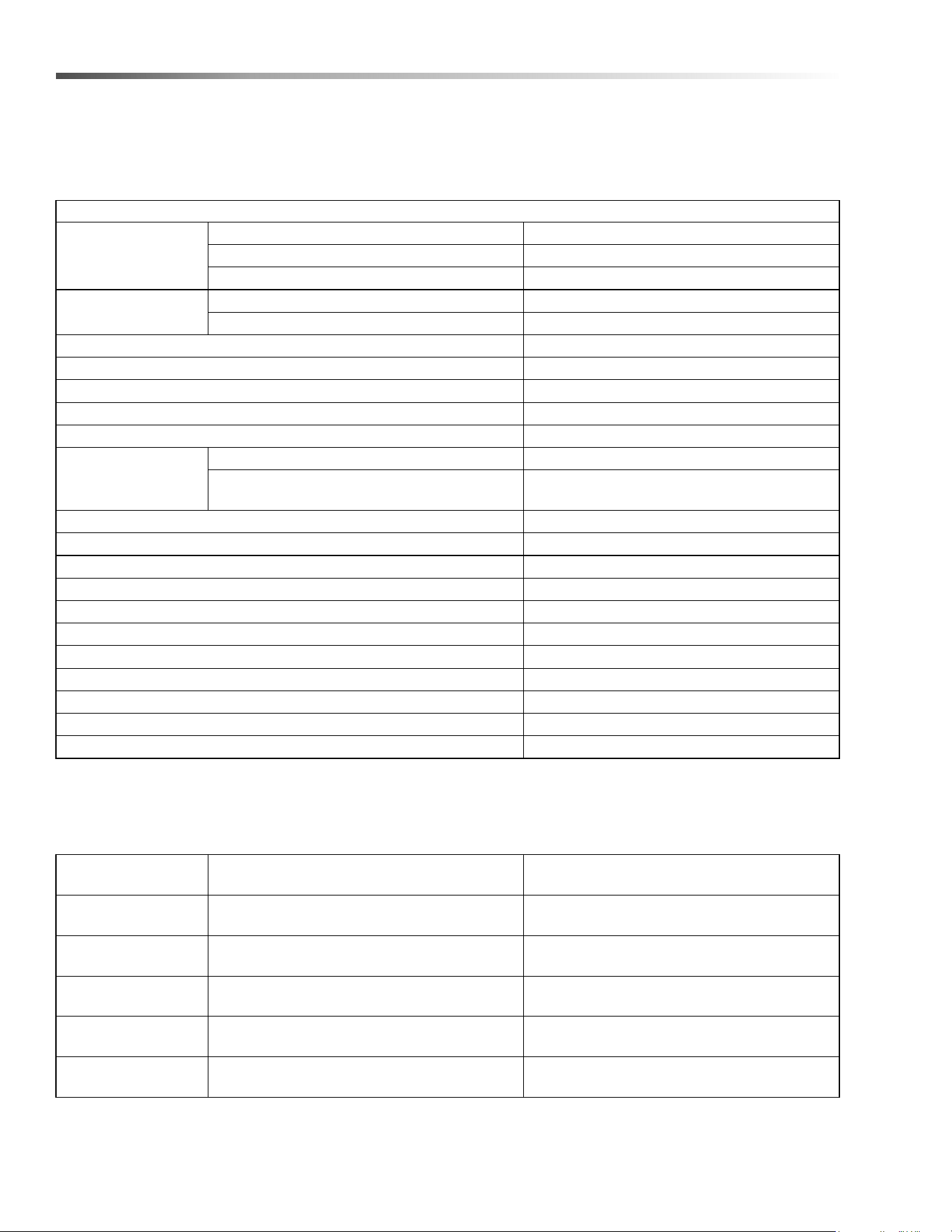
Preventative Maintenance
This pressure washer was produced with the best available materials and quality craftsmanship. However, you as
the owner have certain responsibilities for the correct care of the equipment. Attention to regular preventative
maintenance procedures will assist in preserving the performance of your equipment. Contact your dealer for
maintenance. Regular preventative maintenance will add many hours to the life of your pressure washer. Perform
maintenance more often under severe conditions.
Oil Change Record
Check pump oil level before first use of your new Power Washer. Change pump oil after first 50 hours and every 3
months or 500 hours thereafter. Use SAE 10W-40 weight oil, non-detergent.
Maintenance Schedule
Engine Oil
Inspect Daily
Change Every 25 hours
Filter Every 50 hours
Air Cleaner
Inspect Every 50 hours or monthly
Clean Every 3 months
Battery Level Check monthly
Engine Fuel Filter 500 hours or 6 months
Spark Plug Maintenance 500 hours or 6 months
Clean Fuel Tank(s) Annually
Replace Fuel Lines Annually
Pump Oil (Non-
detergent SAE
10W-40)
Inspect Oil level daily
Change
After first 50 hours, then every 500 hours or
annually
Clean Burner Filter Monthly (More often if fuel quality is poor)
Remove Burner Soot Annually
Burner Adjustment/Cleaning Annually
Replace Burner Nozzle Annually
Descale Coil Annually (More often if required)
Replace High Pressure Nozzle Every 6 months
Replace Quick Connects Annually
Clean Water Screen/Filter Weekly
Replace HP Hose Annually or as needed
Diverter Valve Cable Lube Cable Weekly
Rupture Disk Replace every 2 years
Date Oil Changed
Month/Day/Year
No. of Operating Hours
Since Last Oil Change
Brand Name & Type of Oil (see above)
Karcher TRK 2500 HDS Operator’s Manual 9.807-794.0 - E

25
Preventative Maintenance
This trailer was produced with the best available materials and quality craftsmanship. However, you as the owner,
have certain responsibilities for the correct care of the equipment. Attention to regular preventative maintenance
procedures will assist in preserving the performance of your equipment.
Axles, Hubs and Brakes
Maintenance for axles, hubs and brakes is extremely important for protecting the longevity of your trailer. It is
extremely important for your personal safety and the protection of others.
Never shortcut axle, hub and brake service and maintenance
Maintenance Schedule
Tire Air Pressure
Inflate to proper pressure indicated on
sidewall
Every Trip
Wheel Lugs, Bolts,
Nuts ans Wheel
Mount
Tighten to proper torque specifications Every 3000 mi or 3 mos.*
Wheel Check for damage and or out-of-round Every 6000 mi or 6 mos.
Coupler Ball
Check for sufficient lube.
Check lock mechanism.
Check for unusual wear. Every trip
Safety Chains at
Hitch Ball
Check for abrasion, distortion and general
integrity of links.
Every trip
Coupler
Check for proper fastening & hitch pin in
position and secure.
Every trip
Brakes Check for proper adjustment & operation Every trip
Breakaway Switch Test switch operation and connections Every trip
Breakaway Battery Pull switch pin, check charge indicator light Every trip
Load Distribution Check load distribution & security Every trip
Welds
Check all weld beads for cracks or separa-
tions
Every 6000 mi. or 6 mos.
Electrical: Lights &
Signals
Check to make sure all are working properly.
Replace burned out bulbs.
Every trip
*Check lug nuts for tightness before initial trip, at 10 miles, 25 miles and 50 miles. Recheck at least every 3
months or 3000 miles
Karcher TRK 2500 HDS Operator’s Manual 9.807-794.0 - E
Registrieren Sie Ihr Prudukt und Sie von vielen Vorteilen.
Register your product and benefit from many advantages.
Enregistrez votre produit et bénéficiez de nombreux avantages.
Registre su producto y aproveche de muchas ventajas.
Bewerten Sie Ihr Produkt und sagen Sie uns Ihre Meinung.
Rate your product and tell us your opinion.
Évaluez votre produit et donnez-nous votre opinion.
Reseña su producto y díganos su opinión.
www.kaercher.com/welcome
www.kaercher.com/dealersearch
Kärcher North America
6398 N Kärcher Way
Aurora, CO 80019
Phone: +1 800 444-7654
DANKE!
THANK YOU!
MERCI!
GRACIAS!
!