
1
AD610 Elite ABS & Airbag Reset Tool Manual_English_V1.01
Trademarks
ANCEL is trademark of OBDSPACE TECHNOLOGY CO., LTD
All other marks are trademarks or registered trademarks of their respective holders.
Copyright Information
©OBDSPACE TECHNOLOGY CO., LTD
All rights reserved.
Disclaimer
The information, specifications and illustrations in this manual are based on the latest information
available at the time of printing.
ANCEL reserves the right to make changes at any time without notice.
Visit our website at:
www.anceldirect.com
For Technical Assistance, send us email at
support@anceldirect.com

2
AD610 Elite ABS & Airbag Reset Tool Manual_English_V1.01
One-Year Limited Warranty
Subject to the conditions of this limited warranty, ANCEL warrants its customer that this product is
free of defects in material and workmanship at the time of its original purchase for a subsequent
period of one (1) year.
In the event this product fails to operate under normal use, during the warranty period, due to
defects in materials and workmanship, ANCEL will, at its sole option, either repair or replace the
product in accordance with the terms and conditions stipulated herein.
Terms and Conditions
1 If ANCEL repairs or replaces the product, the repaired or replaced product shall be warranted
for the remaining time of the original warranty period. No charge will be made to the customer for
replacement parts or labor charges incurred by ANCEL in repairing or replacing the defective
parts.
2 The customer shall have no coverage or benefits under this limited warranty if any of the
following conditions are applicable:
a) The product has been subjected to abnormal use, abnormal conditions, improper storage,
exposure to moisture or dampness, unauthorized modifications, unauthorized repair, misuse,
neglect, abuse, accident, alteration, improper installation, or other acts which are not the fault of
ANCEL, including damage caused by shipping.
b) The Product has been damaged from external causes such as collision with an object, or from
fire, flooding, sand, dirt, windstorm, lightning, earthquake or damage from exposure to weather
conditions, an Act of God, or battery leakage, theft, blown fuse, improper use of any electrical
source, or the product was used in combination or connection with other product, attachments,
supplies or consumables not manufactured or distributed by ANCEL.
3 The customer shall bear the cost of shipping the product to ANCEL. And ANCEL shall bear the
cost of shipping the product back to the customer after the completion of service under this limited
warranty.
4 ANCEL does not warrant uninterrupted or error-free operation of the product. If a problem
develops during the limited warranty period, the consumer shall take the following step-by-step
procedure:
a) The customer shall return the product to the place of purchase for repair or replacement
processing, contact your local ANCEL distributor or visit our website www.anceldirect.com to get
further information.
b) The customer shall include a return address, daytime phone number and/or fax number,
complete description of the problem and original invoice specifying date of purchase and serial
number.
c) The customer will be billed for any parts or labor charges not covered by this limited warranty.
d) ANCEL will repair the Product under the limited warranty within 30 days after receipt of the
product. If ANCEL cannot perform repairs covered under this limited warranty within 30 days, or
after a reasonable number of attempts to repair the same defect, ANCEL at its option, will provide
a replacement product or refund the purchase price of the product less a reasonable amount for
usage.
e) If the product is returned during the limited warranty period, but the problem with the product is
not covered under the terms and conditions of this limited warranty, the customer will be notified
and given an estimate of the charges the customer must pay to have the product repaired, with all
shipping charges billed to the customer. If the estimate is refused, the product will be returned
freight collect. If the product is returned after the expiration of the limited warranty period, ANCEL’
normal service policies shall apply and the customer will be responsible for all shipping charges.
5 ANY IMPLIED WARRANTY OF MERCHANTABILITY, OR FITNESS FOR A PARTICULAR
PURPOSE OR USE, SHALL BE LIMITED TO THE DURATION OF THE FOREGOING LIMITED
WRITTEN WARRANTY. OTHERWISE, THE FOREGOING LIMITED WARRANTY IS THE
CONSUMER’S SOLE AND EXCLUSIVE REMEDY AND IS IN LIEU OF ALL OTHER
WARRANTIES, EXPRESS OR IMPLIED. OBDSPACE SHALL NOT BE LIABLE FOR SPECIAL,
INCIDENTAL, PUNITIVE OR CONSEQUENTIAL DAMAGES, INCLUDING BUT NOT LIMITED

3
AD610 Elite ABS & Airbag Reset Tool Manual_English_V1.01
TO LOSS OF ANTICIPATED BENEFITS OR PROFITS, LOSS OF SAVINGS OR REVENUE,
LOSS OF DATA, PUNITIVE DAMAGES, LOSS OF USE OF THE PRODUCT OR ANY
ASSOCIATED EQUIPMENT, COST OF CAPITAL, COST OF ANY SUBSTITUTE EQUIPMENT
OR FACILITIES, DOWNTIME, THE CLAIMS OF ANY THIRD PARTIES, INCLUDING
CUSTOMERS, AND INJURY TO PROPERTY, RESULTING FROM THE PURCHASE OR USE
OF THE PRODUCT OR ARISING FROM BREACH OF THE WARRANTY, BREACH OF
CONTRACT, NEGLIGENCE, STRICT TORT, OR ANY OTHER LEGAL OR EQUITABLE
THEORY, EVEN IF ANCEL KNEW OF THE LIKELIHOOD OF SUCH DAMAGES. ANCEL SHALL
NOT BE LIABLE FOR DELAY IN RENDERING SERVICE UNDER THE LIMITED WARRANTY,
OR LOSS OF USE DURING THE PERIOD THAT THE PRODUCT IS BEING REPAIRED.
6 Some states do not allow limitation of how long an implied warranty lasts, so the one-year
warranty limitation may not apply to you (the Consumer). Some states do not allow the exclusion
or limitation of incidental and consequential damages, so certain of the above limitations or
exclusions may not apply to you (the Consumer). This limited warranty gives the Consumer
specific legal rights and the Consumer may also have other rights which vary from state to state.

4
AD610 Elite ABS & Airbag Reset Tool Manual_English_V1.01
Safety Information
For your own safety and the safety of others, and to prevent damage to the equipment and
vehicles, read this manual thoroughly before operating your scanner. The safety messages
presented below and throughout this user’s manual are reminders to the operator to exercise
extreme care when using this device. Always refer to and follow safety messages and test
procedures provided by vehicle manufacturer. Read, understand and follow all safety messages
and instructions in this manual.
Safety Message Conventions Used
We provide safety messages to help prevent personal injury and equipment damage. Below are
signal words we used to indicate the hazard level in a condition.
Indicates an imminently hazardous situation which, if not avoided, will result in death or serious
injury to the operator or to bystanders.
Indicates a potentially hazardous situation which, if not avoided, could result in death or serious
injury to the operator or to bystanders.
Indicates a potentially hazardous situation which, if not avoided, may result in moderate or minor
injury to the operator or to bystanders.
Important Safety Instructions
And always use your scanner as described in the user’s manual, and follow all safety messages.
● Do not route the test cable in a manner that would interfere with driving controls.
● Do not exceed voltage limits between inputs specified in this user’s manual.
● Always wear ANSI approved goggles to protect your eyes from propelled objects as well as hot
or caustic liquids.
● Fuel, oil vapors, hot steam, hot toxic exhaust gases, acid, refrigerant and other debris produced
by a malfunction engine can cause serious injury or death. Do not use the scanner in areas
where explosive vapor may collect, such as in below-ground pits, confined areas, or areas that
are less than 18 inches (45 cm) above the floor.
● Do not smoke, strike a match, or cause a spark near the vehicle while testing and keep all
sparks, heated items and open flames away from the battery and fuel / fuel vapors as they are
highly flammable.
● Keep a dry chemical fire extinguisher suitable for gasoline, chemical and electrical fires in work
area.
● Always be aware of rotating parts that move at high speed when an engine is running and keep
a safe distance from these parts as well as other potentially moving objects to avoid serious
injury.
● Do not touch engine components that get very hot when an engine is running to avoid severe
burns.
● Block drive wheels before testing with engine running. Put the transmission in park (for
automatic transmission) or neutral (for manual transmission). And never leave a running engine
unattended.
● Do not wear jewelry or loose fitting clothing when working on engine.

5
AD610 Elite ABS & Airbag Reset Tool Manual_English_V1.01
Table of Contents
ONE-YEAR LIMITED WARRANTY.................................................................................................................... 2
SAFETY INFORMATION......................................................................................................................................4
SAFETY MESSAGE CONVENTIONS USED........................................................................................................... 4
IMPORTANT SAFETY INSTRUCTIONS................................................................................................................... 4
1 USING THIS MANUAL......................................................................................................................................7
1.1 BOLD TEXT.................................................................................................................................................... 7
1.2 SYMBOLS AND ICONS....................................................................................................................................7
1.2.1 Solid Spot............................................................................................................................................ 7
1.2.2 Arrow Icon............................................................................................................................................7
1.2.3 Note and Important Message...........................................................................................................7
2 INTRODUCTION.................................................................................................................................................8
2.1 SCANNER DESCRIPTIONS............................................................................................................................. 8
2.2 ACCESSORY DESCRIPTIONS.........................................................................................................................9
2.3 TECHNICAL SPECIFICATIONS........................................................................................................................ 9
3 GETTING STARTED..........................................................................................................................................9
3.1 PROVIDING POWER TO SCANNER................................................................................................................ 9
3.1.1 Connecting to Vehicle Power.........................................................................................................10
3.1.2 Connecting to Personal Computer with USB Cable...................................................................10
3.2 APPLICATION OVERVIEW............................................................................................................................ 10
3.3 INPUT DIALOG BOX.....................................................................................................................................11
4 DIAGNOSTIC OPERATIONS........................................................................................................................ 12
4.1 VEHICLE IDENTIFICATION............................................................................................................................12
4.1.1 Automatic VIN Acquisition.............................................................................................................. 12
4.1.2 Manual VIN Entry.............................................................................................................................14
4.1.3 Manual Vehicle Selection............................................................................................................... 15
4.1.4 Vehicle Data Recorder.................................................................................................................... 15
4.2 SYSTEM SELECTION................................................................................................................................... 17
4.2.1 Auto Scan..........................................................................................................................................17
4.2.2 Control Unit....................................................................................................................................... 19
4.3 DIAGNOSTIC FUNCTION SELECTION.......................................................................................................... 19
4.3.1 Read Codes...................................................................................................................................... 20
4.3.2 Erase Codes..................................................................................................................................... 21
4.3.3 ECU Information...............................................................................................................................21
4.3.4 Live Data........................................................................................................................................... 22
4.3.4.1 Complete Data List.......................................................................................................................22
4.3.4.2 Custom Data List.......................................................................................................................... 24
4.3.5 Special Functions.............................................................................................................................26

6
AD610 Elite ABS & Airbag Reset Tool Manual_English_V1.01
5 OBDII/EOBD OPERATIONS..........................................................................................................................28
5.1 SYSTEM STATUS.........................................................................................................................................28
5.2 READ CODES.............................................................................................................................................. 29
5.3 ERASE CODES............................................................................................................................................ 31
5.4 LIVE DATA................................................................................................................................................... 31
5.4.1 Complete Data List.......................................................................................................................... 32
5.4.2 Custom Data List..............................................................................................................................34
5.5 FREEZE FRAME...........................................................................................................................................35
5.6 READ I/M READINESS STATUS DATA........................................................................................................ 36
5.7 O2 MONITOR TEST.....................................................................................................................................38
5.8 ON-BOARD MONITOR TEST........................................................................................................................39
5.9 COMPONENT TEST......................................................................................................................................41
5.10 REQUEST VEHICLE INFORMATION............................................................................................................42
5.11 MODULES PRESENT................................................................................................................................. 44
5.12 DTC LOOKUP............................................................................................................................................44
6 PLAYBACK DATA...........................................................................................................................................46
7 SYSTEM SETUP.............................................................................................................................................. 47
7.1 SELECT LANGUAGE.....................................................................................................................................47
7.2 CHANGE UNITS........................................................................................................................................... 48
7.3 CONFIGURE BEEPER.................................................................................................................................. 49
7.4TEST KEYPAD...............................................................................................................................................50
7.5 LCD KEYPAD.............................................................................................................................................. 50
7.6 TOOL INFORMATION....................................................................................................................................51
7.7 CONFIGURE SHORTCUT KEYS................................................................................................................... 52
8 UPDATE.............................................................................................................................................................52
8.1 REGISTER THE SCANNER........................................................................................................................... 53
8.2 UPDATE THE SCANNER.............................................................................................................................. 53

7
AD610 Elite ABS & Airbag Reset Tool Manual_English_V1.01
1 Using This Manual
We provide tool usage instructions in this manual. Below is the conventions we used in the
manual.
1.1 Bold Text
Bold text is used to highlight selectable items such as buttons and menu options.
Example:
Press the ENTER button to select.
1.2 Symbols and Icons
1.2.1 Solid Spot
Operation tips and lists that apply to specific tool are introduced by a solid spot ●.
Example:
When System Setup is selected, a menu that lists all available options displays. Menu options
include:
●
Languages
●
Unit
●
Beep
●
Keypad Test
●
LCD Test
●
About
●
Shortcuts
1.2.2 Arrow Icon
An arrow icon indicates a procedure.
Example:
To change menu language:
1. Scroll with the arrow keys to highlight Language on the menu.
2.Press the ENTER button to select.
1.2.3 Note and Important Message
Note
A NOTE provides helpful information such as additional explanations, tips, and comments.
Example:
NOTE
Test results do not necessarily indicate a faulty component or system.
Important
IMPORTANT indicates a situation which, if not avoided, may result in damage to the test
equipment or vehicle.
Example:
IMPORTANT
Do not soak keypad as water might find its way into the scanner.
8
AD610 Elite ABS & Airbag Reset Tool Manual_English_V1.01
2 Introduction
AD610 professional ABS & Airbag Reset Tool works on most vehicles on the road today. It does
not only have extensive coverage of vehicles but also provides accurate and professional
diagnosis of ABS and airbag faults.
With the tool properly connected to the vehicle’s data link connector (DLC), you can use the
scanner to read diagnostic trouble codes and view “live” data readings from ABS and airbags
control systems. You can also save “recordings” of the data readings, and print stored
information.
2.1 Scanner Descriptions
This section illustrates external features, ports and connectors of the scanner.
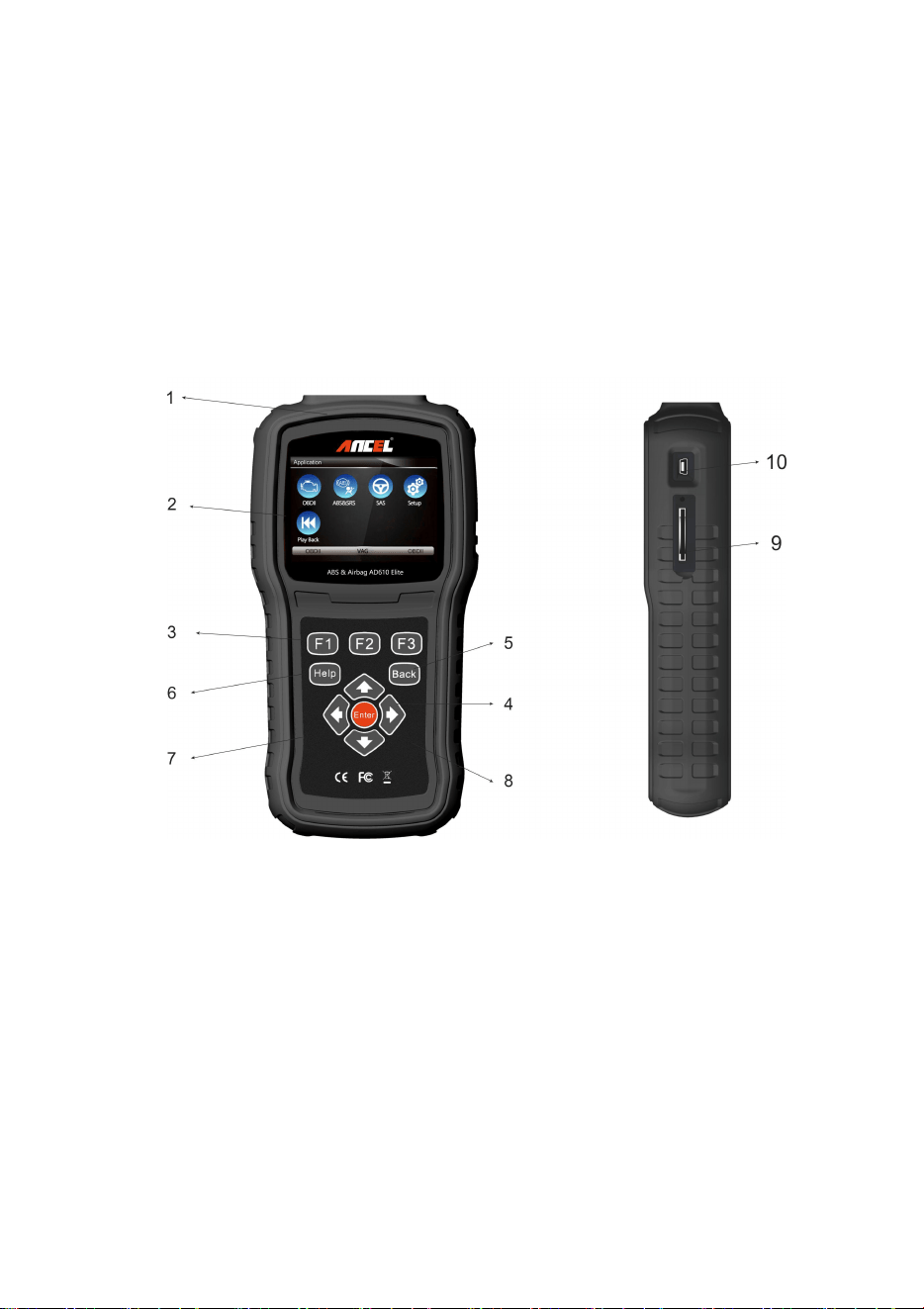
Figure 2-1 front view
1 Diagnostic Port - provides connection between the scan tool and vehicle.
2 LCD Display - shows menus, test results and operation tips.
3 Function Keys / Shortcut keys - three keys that correspond with “buttons” on some screens
for executing special commands or provide quick access to most frequently used applications or
functions.
4 Direction Keys - select an option or scroll through a screen of data or text.
5 ENTER Key – executes a selected option and generally goes to the next screen.
6 BACK Key – exits a screen and generally returns to previous screen.
7 HELP Key – displays helpful information.
8 Power Switch – turns on/off the scanner and press and hold for 5 seconds for emergency
reboots.
9 SD Card Port – holds the SD memory card for data backup and software update.

9
AD610 Elite ABS & Airbag Reset Tool Manual_English_V1.01
IMPORTANT
Do not use solvents such as alcohol to clean keypad or display. Use a mild nonabrasive detergent
and a soft cotton cloth.
2.2 Accessory Descriptions
This section lists the accessories that go with the scanner. If you find any of the following items
missing from your package, contact your local dealer for assistance.
1 User’s Guide - provides operation instructions for the usage of the scanner.
2 USB Cable - provides connection between the scanner and a computer to upgrade the tool.
3 Memory Card - contains the scanner’s operating software and applications.
IMPORTANT
Do not remove the memory card unless performing updates to the card.
4 Diagnostic Cable - provides connection between the scan tool and vehicle.
5 Blower Molding Case - stores the scanner and its accessories.
2.3 Technical Specifications
Display: Backlit, 480*272 TFT color display
Working Temperature: 0 to 60 ℃ (32 to 140℉)
Storage Temperature: -20 to 70℃ (-4 to 158℉)
Power Supply: 8-18V vehicle power, 12V AC/DC power, 3.3V USB power
Dimensions (L*W*H): 200*130*40mm
Gross Weight: 1.8Kg
Protocols: SAE J1850 (VPW and PWM), ISO 9141-2, ISO 14230-2 (KWP 2000), ISO 15765-4
(CAN)
3 Getting Started
This section describes how to provide power to the scanner, provides brief introductions of
applications loaded on the scanner and display screen layout and illustrates how to input text and
numbers with the scan tool.
3.1 Providing Power to Scanner
Before using the scanner, make sure to provide power to the scanner.
The unit operates on any of the following sources:
●
12-volt vehicle power
●
USB connection to personal computer
3.1.1 Connecting to Vehicle Power
The scanner normally powers on whenever it is connected to the data link connector (DLC).
To connect to vehicle power:
10
AD610 Elite ABS & Airbag Reset Tool Manual_English_V1.01
1. Locate the data link connector (DLC). The DLC is generally located under the dash on the
driver side of the vehicle.
2. Attached the diagnostic cable to the scanner and tighten the captive screws to ensure good
connection.
3. Connect a correct adapter to the data cable according to the vehicle being serviced and plug it
into the vehicle DLC.
4. Switch the ignition key to the ON position.
5. The scanner automatically boots up.
IMPORTANT
Never try to provide power for the scan tool from USB connection when the scan tool is
communicating with a vehicle.
3.1.2 Connecting to Personal Computer with an USB Cable
The scan tool also receives power through the USB port when it is connected to a PC for updating
software and transferring saved files.
To connect to PC:
1. Insert the small end of the USB cable to the USB port at the right side of the scanner and the
large end to a computer.
2. Press the power switch of the scan tool to power it on.
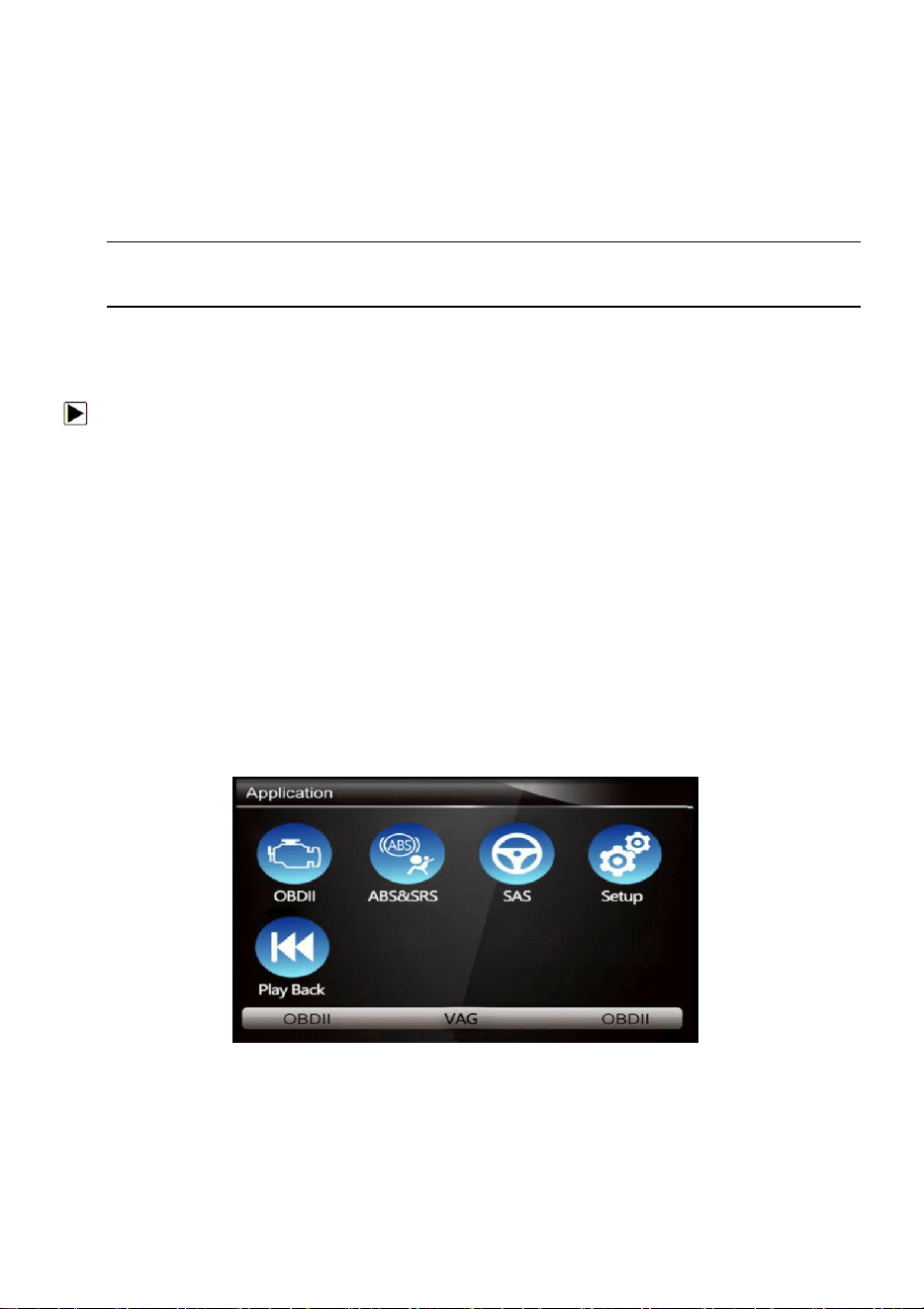
3.2 Application Overview
When the scan tool boots up, the Home screen opens. This screen shows all applications loaded
on the unit.
Following applications are preloaded into the scanner:
●
OBDII/EOBD – leads to OBDII screens for all 9 generic OBD system tests.
●
Scan –leads to screens for diagnostic trouble code information, live data stream, ECU
information, special functions of ABS and airbag systems on 49 vehicle makes sold
worldwide.
●
Setup – leads to screens for adjusting default settings to meet your own preference and view
information about the scanner.
●
Playback – leads to screens for access saved data files.
Figure 3-1 Sample Home Screen
11
AD610 Elite ABS & Airbag Reset Tool Manual_English_V1.01
3.3 Input Dialog Box
This section illustrates how to use the scan tool to input letters and numbers, such as VIN number,
channel number, test values and DTC number. Typically, you may be required to input letters or
numbers when you are doing any of the following operations.
● VIN entry
● input channel number
● set adaptation value
● enter block number
● enter login code
● key matching
● look up DTCs
The scan tool provides 4 different types of keyboard to meet your specific needs. Depending on
the needs of text entry, it automatically shows the most suitable keypad.
● classic QWERTY keyboad for input of texts that contain both letters and numbers
● numeric keyboard for input of numbers
● alphabet keyboard for input of letters
● hexadecimal keyboard for special functions, such as key matching, UDS coding
To input text with the scan tool:
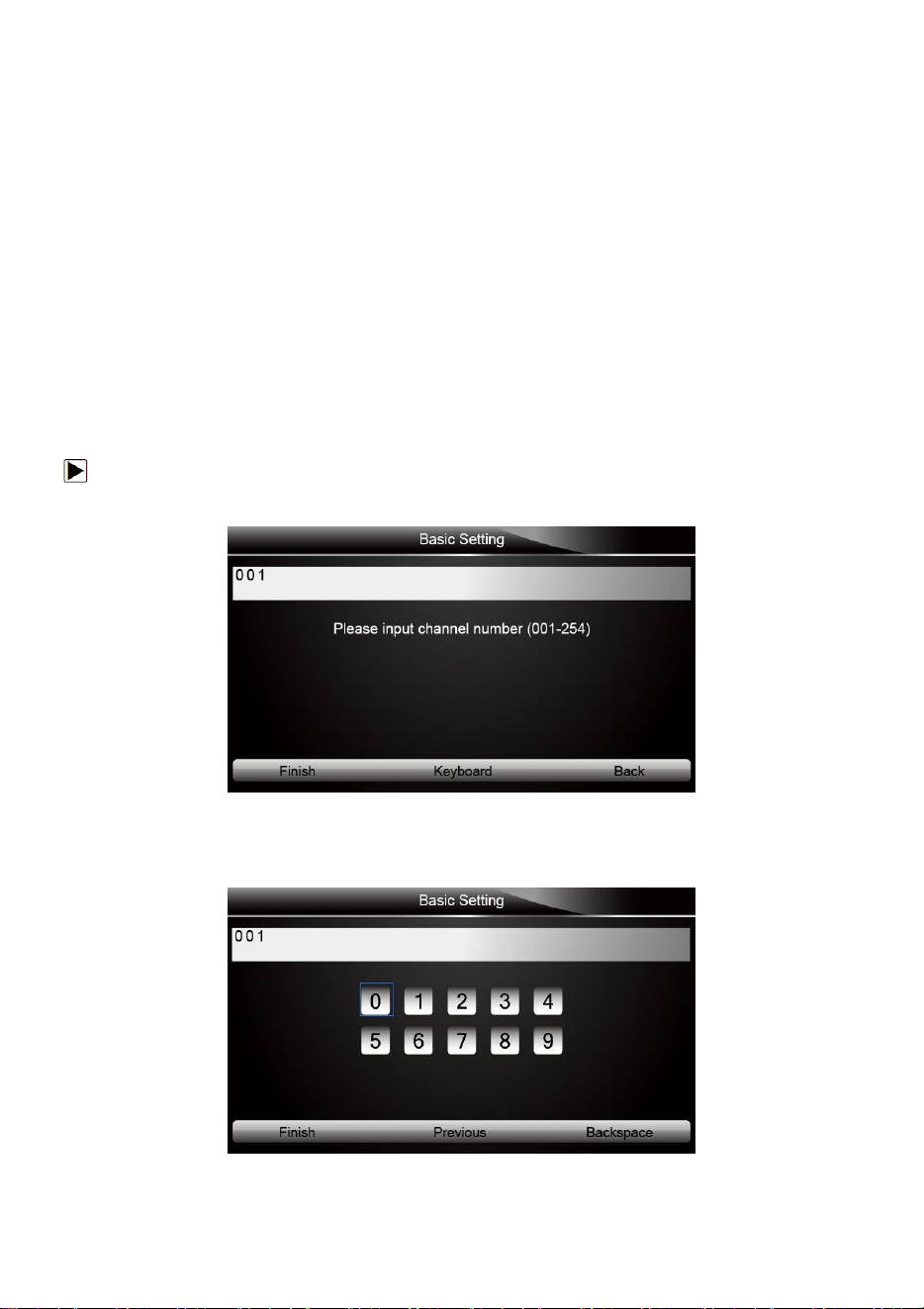
1. When you are requested to input text, press the function key Keyboard, and the keyboard
displays.
Figure 3-2 Sample Input Text Screen
2. Scroll with the arrow keys to highlight your desired letter or number and press the ENTER key
to confirm.
Figure 3-3 Sample Numeric Keyboard Screen
12
AD610 Elite ABS & Airbag Reset Tool Manual_English_V1.01
3. To delete a letter or number, use the function key Previous to move the cursor to it and then
press the Backspace button.
4. When finished the entry, press Finish key to continue.
4 Diagnostic Operations
This section illustrates how to use the scanner to read and clear diagnostic trouble codes, and
view “live” data readings and ECU information on controllers installed on 48 vehicles and also
save “recordings” of the data readings.
4.1 Vehicle Identification
The vehicle identification information presented is provided by the ECM of the vehicle being
tested. Therefore, certain attributes of the test vehicle must be entered into the scan tool to
ensure the data displays correctly. The vehicle identification sequence is menu driven, you simply
follow the screen prompts and make a series of choices. Each selection you make advances you
to the next screen. A Back button in the upper left corner of the screen returns you to the previous
screen. Exact procedures may vary somewhat by vehicle.
It typically identifies a vehicle by any of the following means:
●
Automatic VIN acquisition
●
Manual VIN entry
●
Manual vehicle selection
●
Vehicle data recorder
NOTE
Not all identification options listed above are applicable to all vehicles. Available options may vary
by vehicle manufacturer.
4.1.1 Automatic VIN Acquisition
Automatic VIN Acquisition allows to identifying a vehicle by automatically requesting the vehicle
identification number (VIN).
To identify a vehicle automatic VIN acquisition:
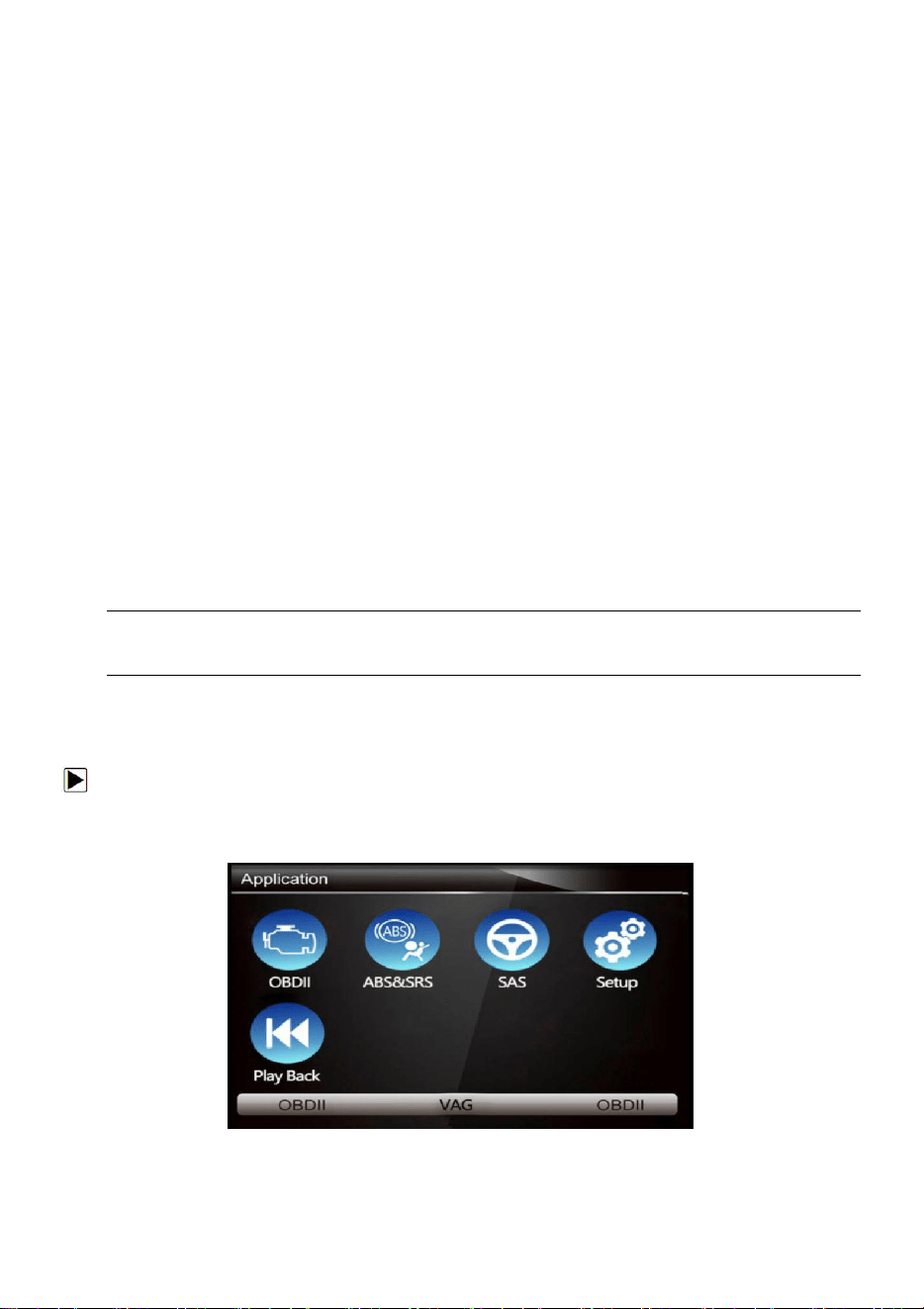
1. Scroll with the arrow keys to highlight ABS&SRS from the Application menu and press the
ENTER key to start. If you have the application assigned to one of the function keys at the
bottom of the screen, you can alternatively press the function key to start the application.
Figure 4-1 Sample Application Menu
13
AD610 Elite ABS & Airbag Reset Tool Manual_English_V1.01
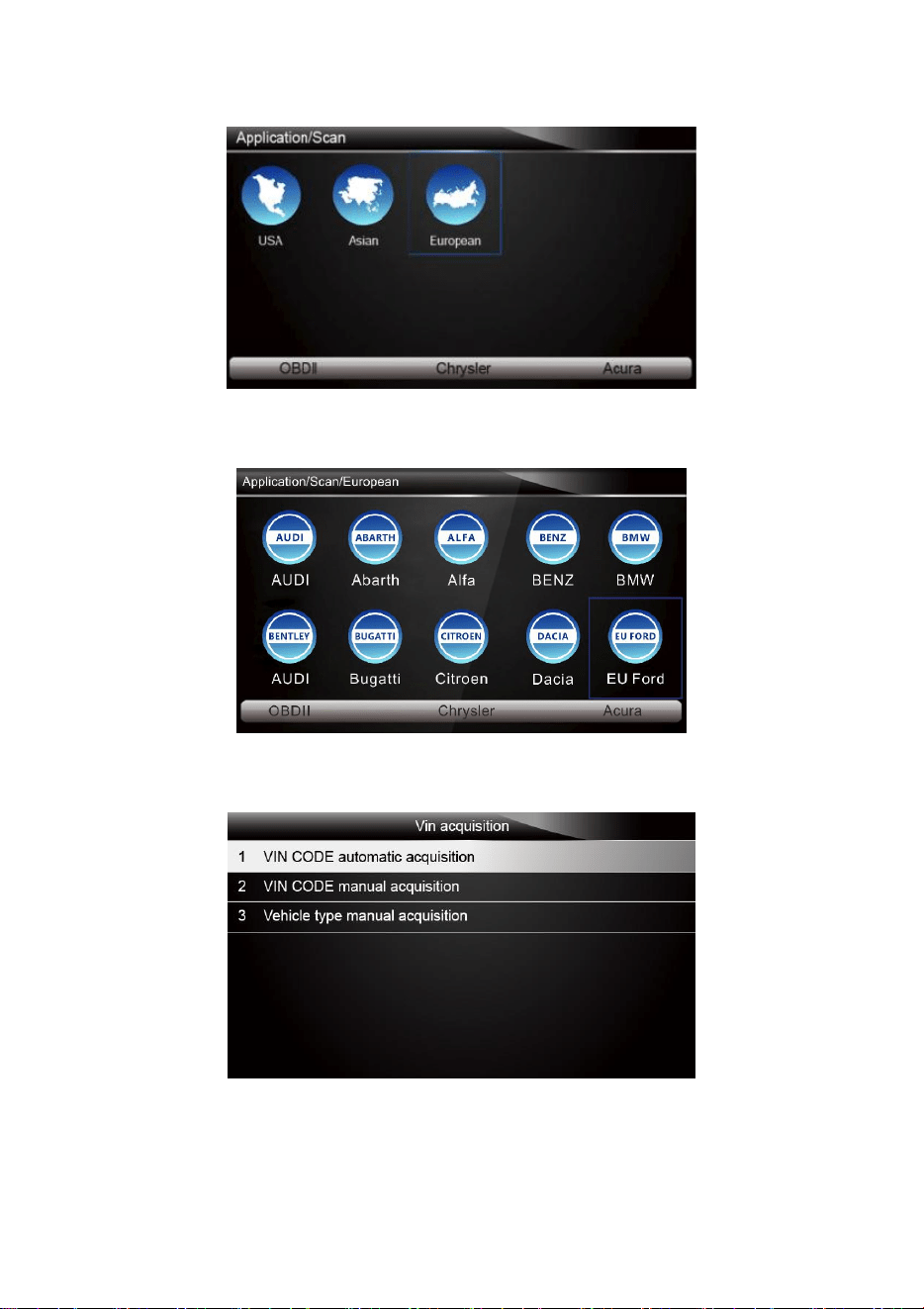
2. A screen with vehicle manufacturer areas displays. Select the area where the vehicle
manufacturer is from. A menu of all vehicle manufacturers from this area displays.
Figure 4-2 Sample Vehicle Manufacturer Area Selection Screen
3. Select the vehicle manufacturer. A list of vehicle identification options displays.
Figure 4-3 Sample Vehicle Manufacturer Selection Screen
4. Select Vin acquisition from the menu, and press the ENTER key.
Figure 4-4 Sample Vin Acquisition Screen
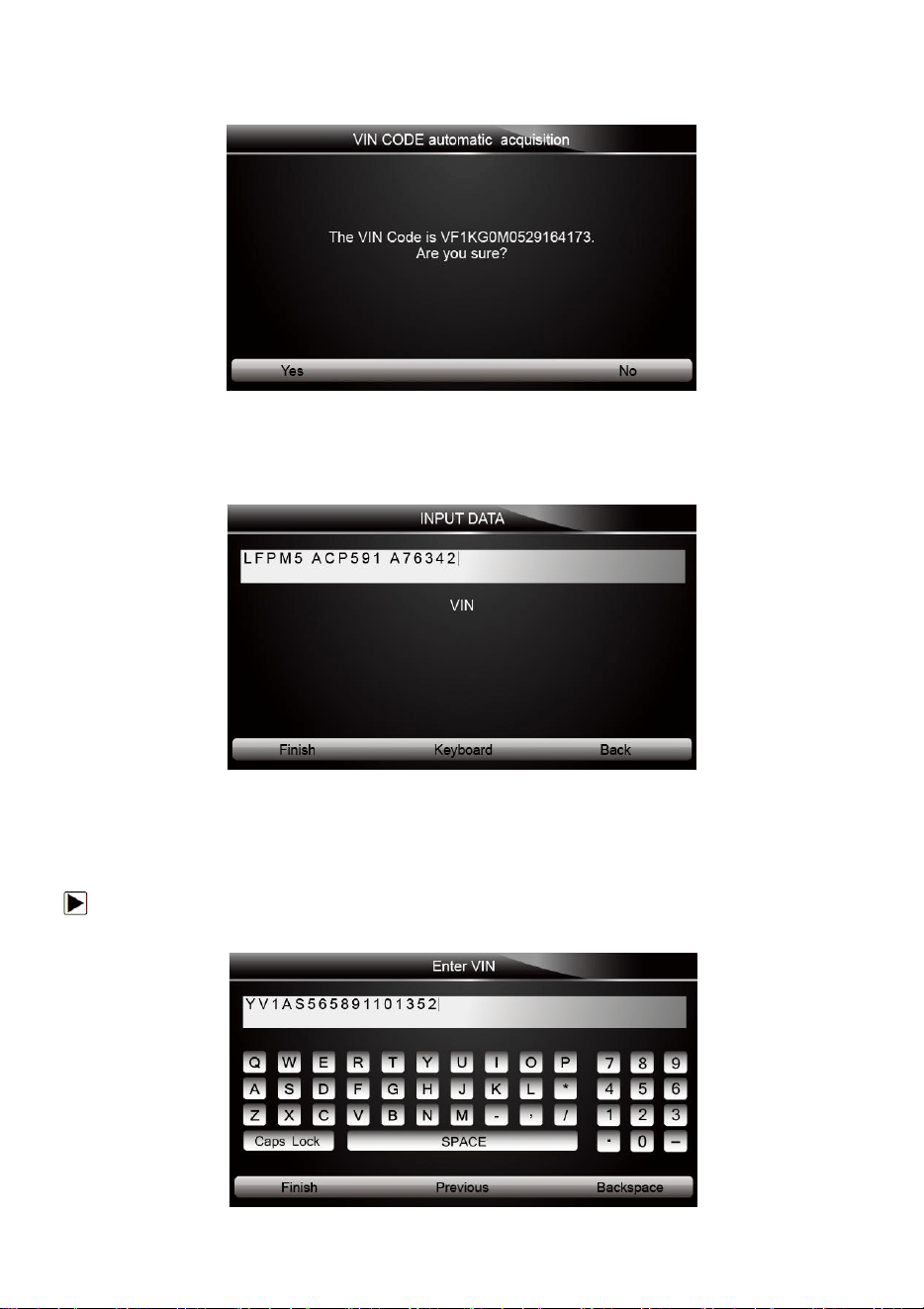
5. The scan tool starts to communicate with the vehicle and read the Vehicle Specification or VIN
Code automatically.
14
AD610 Elite ABS & Airbag Reset Tool Manual_English_V1.01
Figure 4-5 Sample VIN Automatic Acquisition
6. Answer YES if the Vehicle Specification or VIN code is correct and a menu of controller
selection displays. Answer NO if it is incorrect, and you are required to enter the correct VIN
number manually.
Figure 4-6 Sample manual VIN entry screen
4.1.2 Manual VIN Entry
Manual VIN Entry identifies a vehicle by manually inputting a 17-digit VIN code.
To identify a vehicle by manual VIN entry:
1. Refer to Step 1-3 of 4.1.1 Automatic VIN Acquisition.
2. Select an appropriate option from the menu. A virtual keyboard opens for VIN entry.
15
AD610 Elite ABS & Airbag Reset Tool Manual_English_V1.01
Figure 4-7 Sample Manual VIN Entry with Keyboard
3. Input a valid VIN code and use the function key Finish to confirm. The scan tool starts to
identify the vehicle.
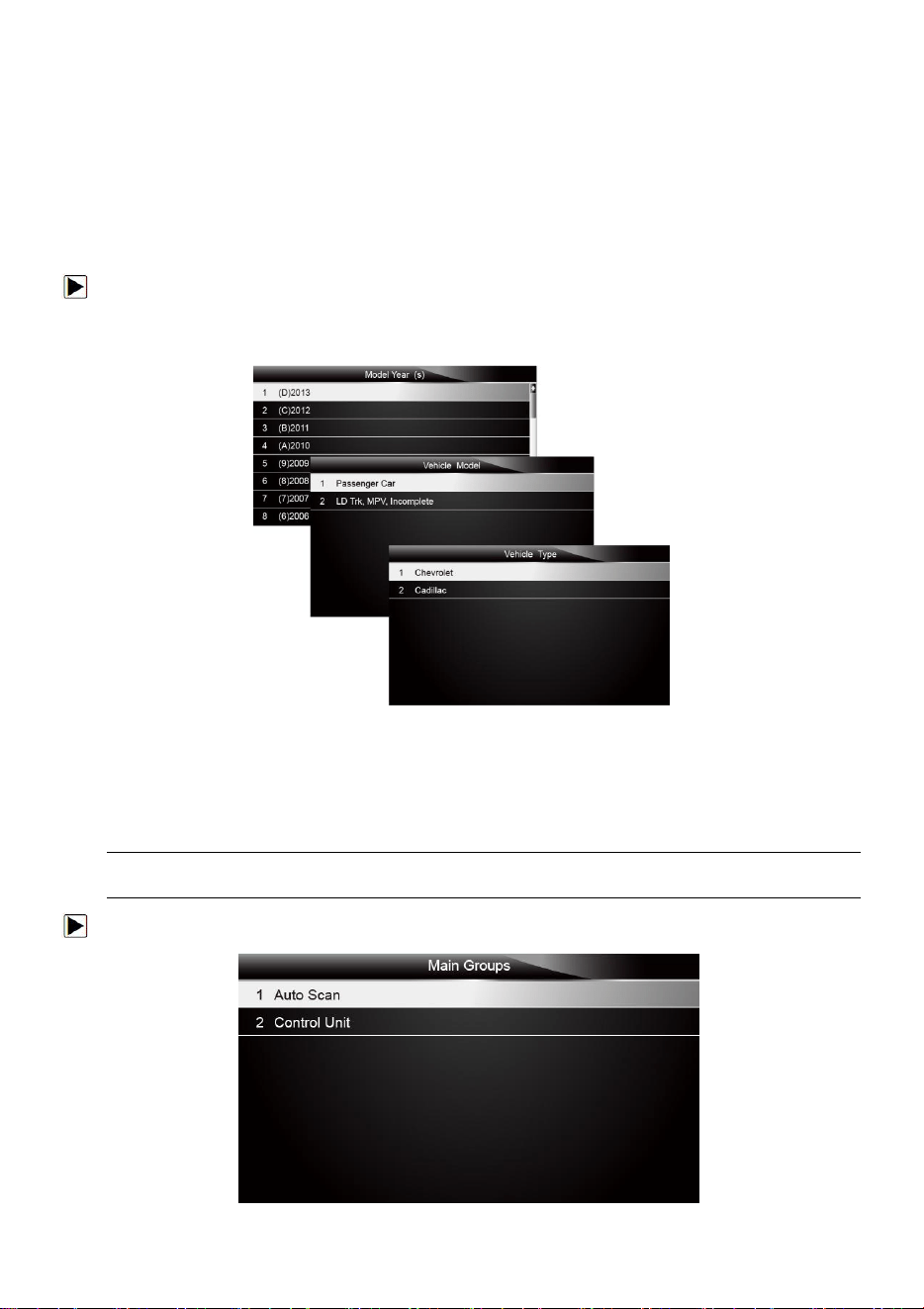
4.1.3 Manual Vehicle Selection
Manual Vehicle Selection identifies a vehicle by making several selections according to certain
VIN characters, such as model year, and engine type.
To identify a vehicle by manual vehicle selection:
1. Refer to Step 1-3 of 4.1.1 Automatic VIN Acquisition.
2. On each screen that appears, select the correct option and then press the ENTER key. Do this
until the complete vehicle information is entered and the menu of controller selection displays.
Figure 4-8 Sample Manual Vehicle Selection Screen
4.1.4 Vehicle Data Recorder
The scan tool is able to save a tested vehicle by creating a Vehicle Record. It provides quick
identification of previously tested vehicle(s).
NOTE
The Vehicle Record option will not show if no record of previously identified vehicle is created.
To create a vehicle record:
1. Identify the vehicle by any of the means above, and run an automatic system test by selecting
Auto Scan.
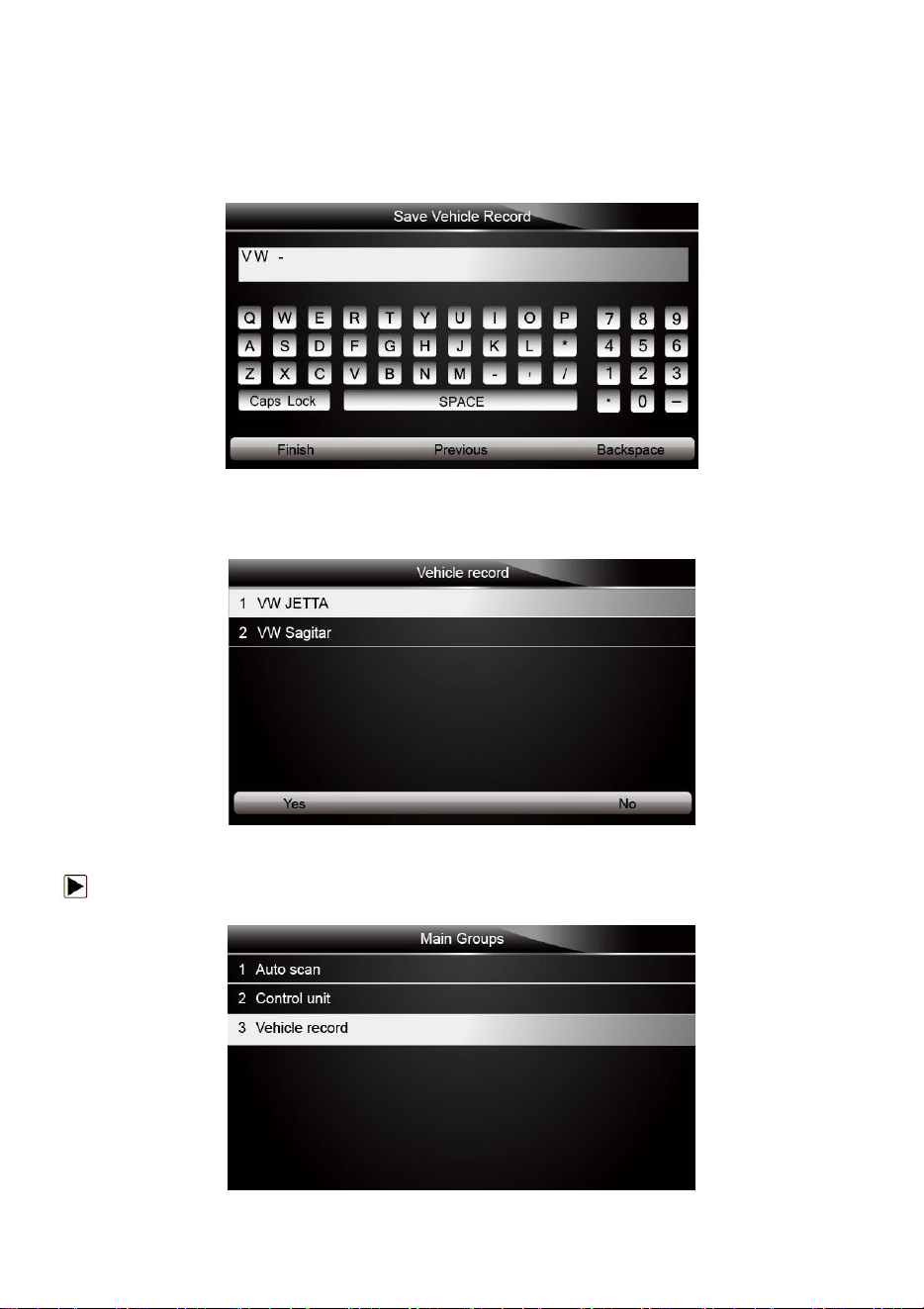
16
AD610 Elite ABS & Airbag Reset Tool Manual_English_V1.01
Figure 4-9 Sample System Menu Screen
2. When the test finished, press the function key Save on the screen, and a screen with a
QWERTY keyboard displays.
Figure 4-10 Sample Save Vehicle Record Screen
3. Enter a unique name for this vehicle and save it, and you will see this new vehicle in Vehicle
Data Recorder menu.
Figure 4-11 Sample Vehicle Record Screen
To identify a previously tested vehicle:
1. Select Vehicle record and press the ENTER key to start.
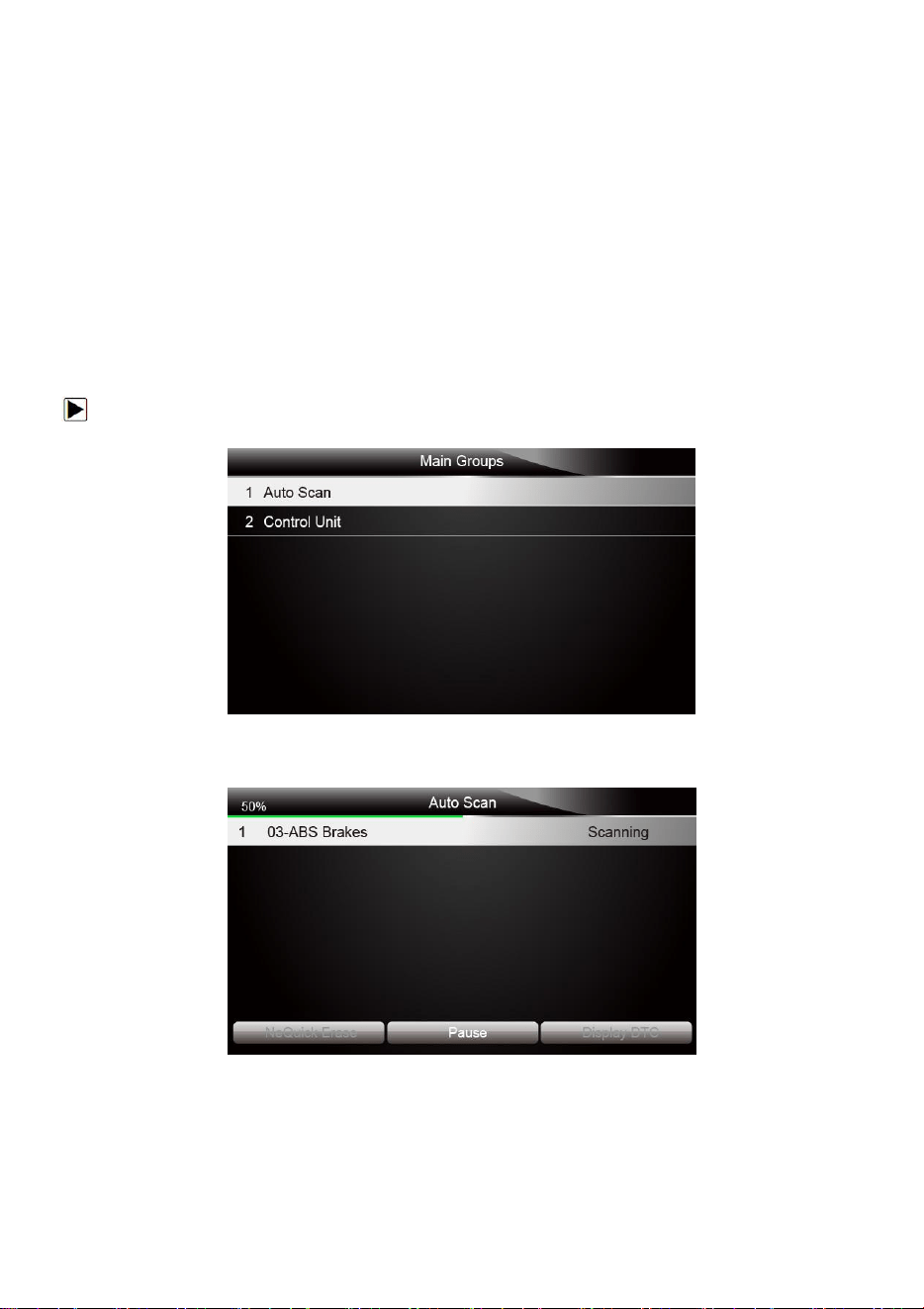
17
AD610 Elite ABS & Airbag Reset Tool Manual_English_V1.01
Figure 4-12 Sample tested vehicle identification screen
2. Select the vehicle under test and press the ENTER key.
4.2 System Selection
When you have completed the identification of vehicle, a menu for selecting system to test
displays. Menu options typically include:
●
Auto Scan
●
Control Unit
4.2.1 Auto Scan
Auto Scan performs an automatic system test to determine which control modules are installed on
the vehicle and obtain diagnostic trouble codes (DTCs) overview. Depending on the number of
control modules, it may take a few minutes to complete the test.
To perform an automatic system scan:
1. Scroll with the arrow keys to highlight Auto Scan from the menu and press ENTER to start.
Figure 4-13 Sample Select System Scan Screen
2. To pause the scan, press the function key corresponding with Pause on the screen.
Figure 4-14 Sample Automatic system scan screen
3. At the end of successful automatic controller scan, a menu with a list of installed controllers
together with their DTC overview displays.
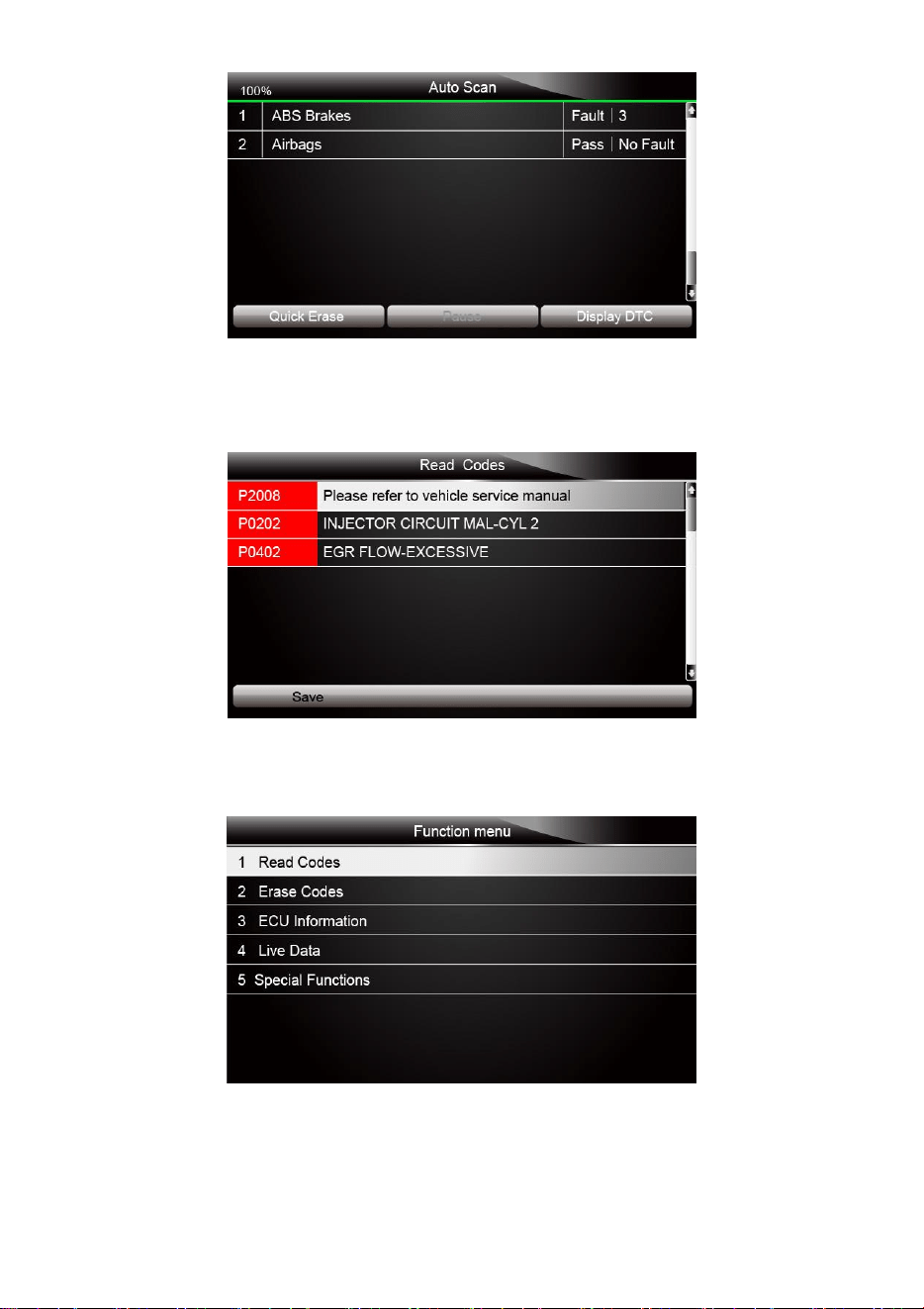
18
AD610 Elite ABS & Airbag Reset Tool Manual_English_V1.01
Figure 4-15 Sample auto scan screen
4. If there is diagnostic trouble code(s) detected in a control unit, press the function key
corresponding with Display DTC on the screen to view details of code information, and press
the function key Quick Erase to clear them.
Figure 4-16 Sample Display DTC screen
5. Select the system you would like to test, and press the ENTER key. When the scanner has
established connection with the vehicle, the Function Menu displays.
Figure 4-17 Sample Function Menu screen
19
AD610 Elite ABS & Airbag Reset Tool Manual_English_V1.01
4.2.2 Control Unit
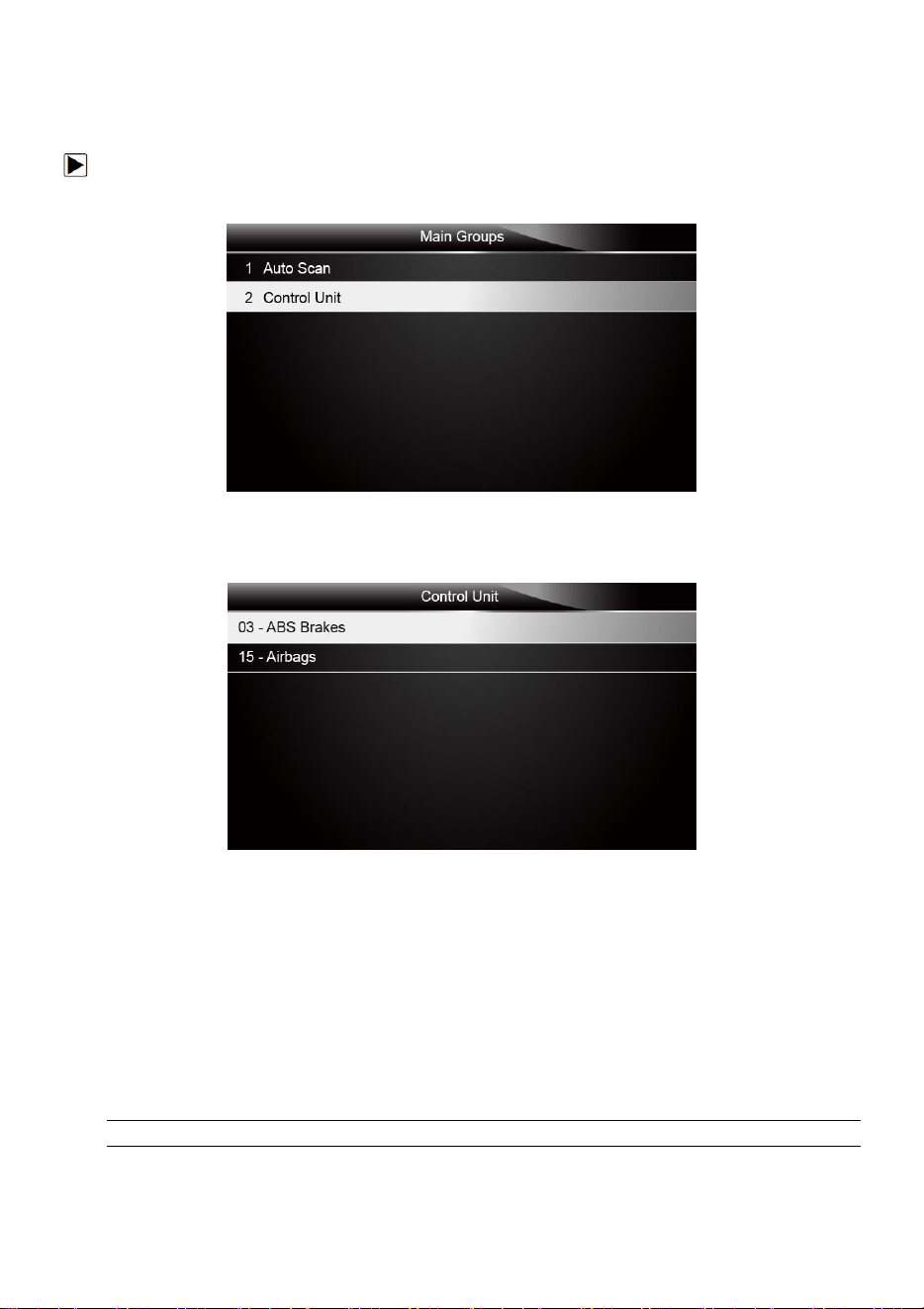
Control Unit screen displays all controllers available of the vehicle manufacturer. The controllers
listed on the menu do not mean that they are installed on the vehicle.
To select a system for testing:
1. Scroll with the arrow keys to highlight Control Unit from the menu and press the ENTER key. A
controller menu displays.
Figure 4-18 Sample Control Unit Menu Screen
2. Select the system you would like to test. When the scanner has established connection with the
vehicle, the Function Menu displays.
Figure 4-19 Sample Common menu screen
4.3 Diagnostic Function Selection
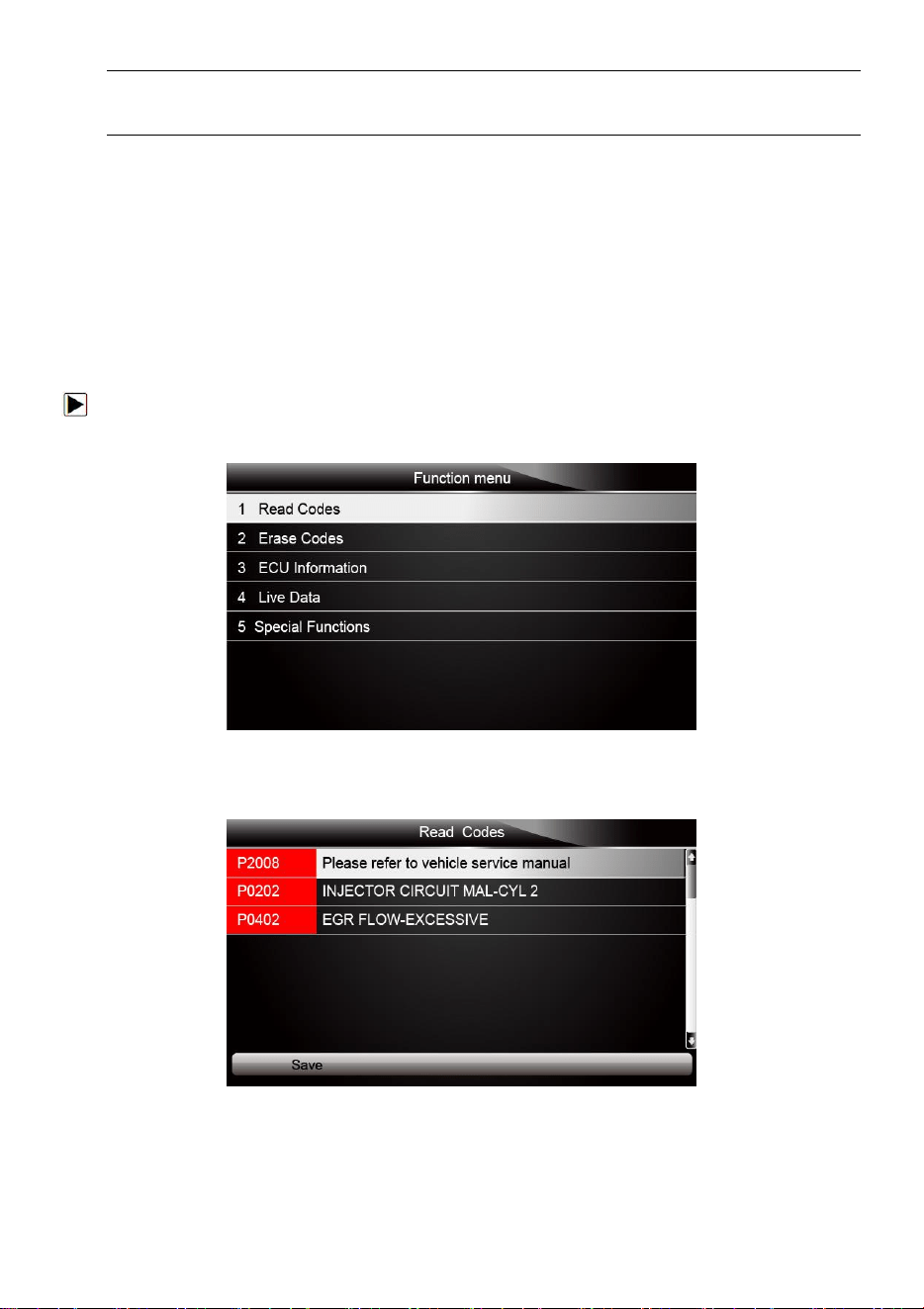
After a system is selected and the scanner establishes communication with the vehicle, the
Function Menu displays. The menu options may include:
● Read Codes
● Erase Codes
● ECU Information
● Live Data
● Special Function
NOTE
20
AD610 Elite ABS & Airbag Reset Tool Manual_English_V1.01
Not all function options listed above are applicable to all vehicles. Available options may vary by
the year, model, and make of the test vehicle. A “The selected mode is not supported!” message
displays if the option is not applicable to the vehicle under test.
4.3.1 Read Codes
Read Codes menu lets you read trouble codes found in the control unit. Typical menu options
include:
●
Present/Permanent/Current Codes
●
History Codes
Present/Permanent/Current codes stored in a control module are used to help identify the cause
of a trouble or troubles with a vehicle. These codes have occurred a specific number of times and
indicate a problem that requires repair.
History codes are also referred to as past codes that indicate intermittent DTCs that are not
currently active.
To read codes from a vehicle:
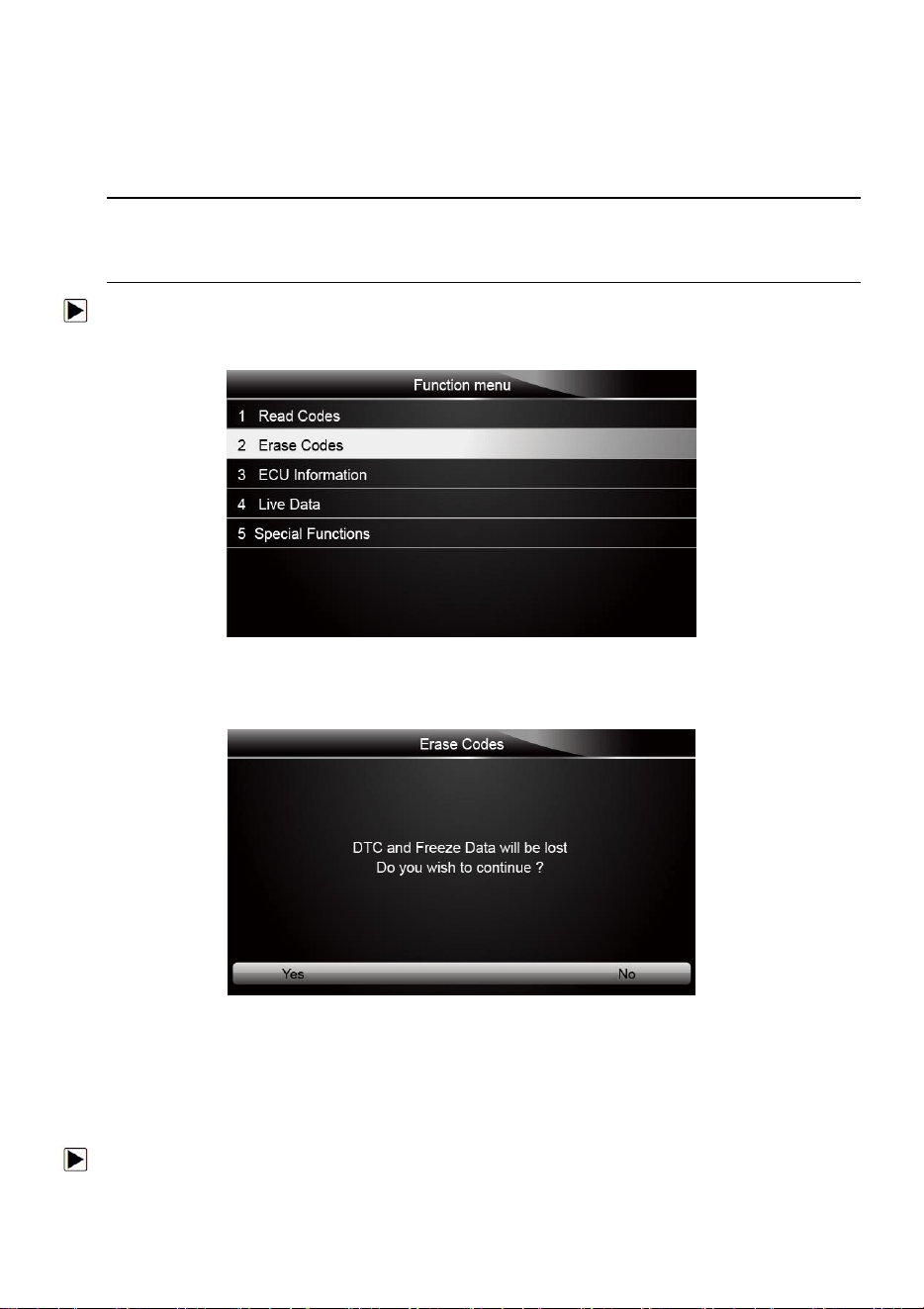
1. Scroll with the arrow keys to highlight Read Codes from Function Menu and press the ENTER
key. A code list including code number and its description displays.
Figure 4-20 Sample Function menu screen
2. Use the up and down arrow keys to scroll through data to select lines, and left and right arrow
keys to scroll back and forth through different screens of data.
Figure 4-21 Sample Code Screen
3. Press function key Save to store DTC information. Or use the BACK key to exit.
21
AD610 Elite ABS & Airbag Reset Tool Manual_English_V1.01
4.3.2 Erase Codes
Erase Codes menu lets you to clear all current and stored DTCs from a selected control module.
Also it erases all temporary ECU information, including freeze frame. So make sure that the
selected system are completely checked and serviced by technicians and no vital information will
be lost before clearing codes.
NOTE
● To clear codes, make sure that the ignition key is switched to ON with the engine off.
● Erase Codes does not fix the problem that caused the fault! DTCs should only be erased after
correcting the condition(s) that caused them.
To clear codes:
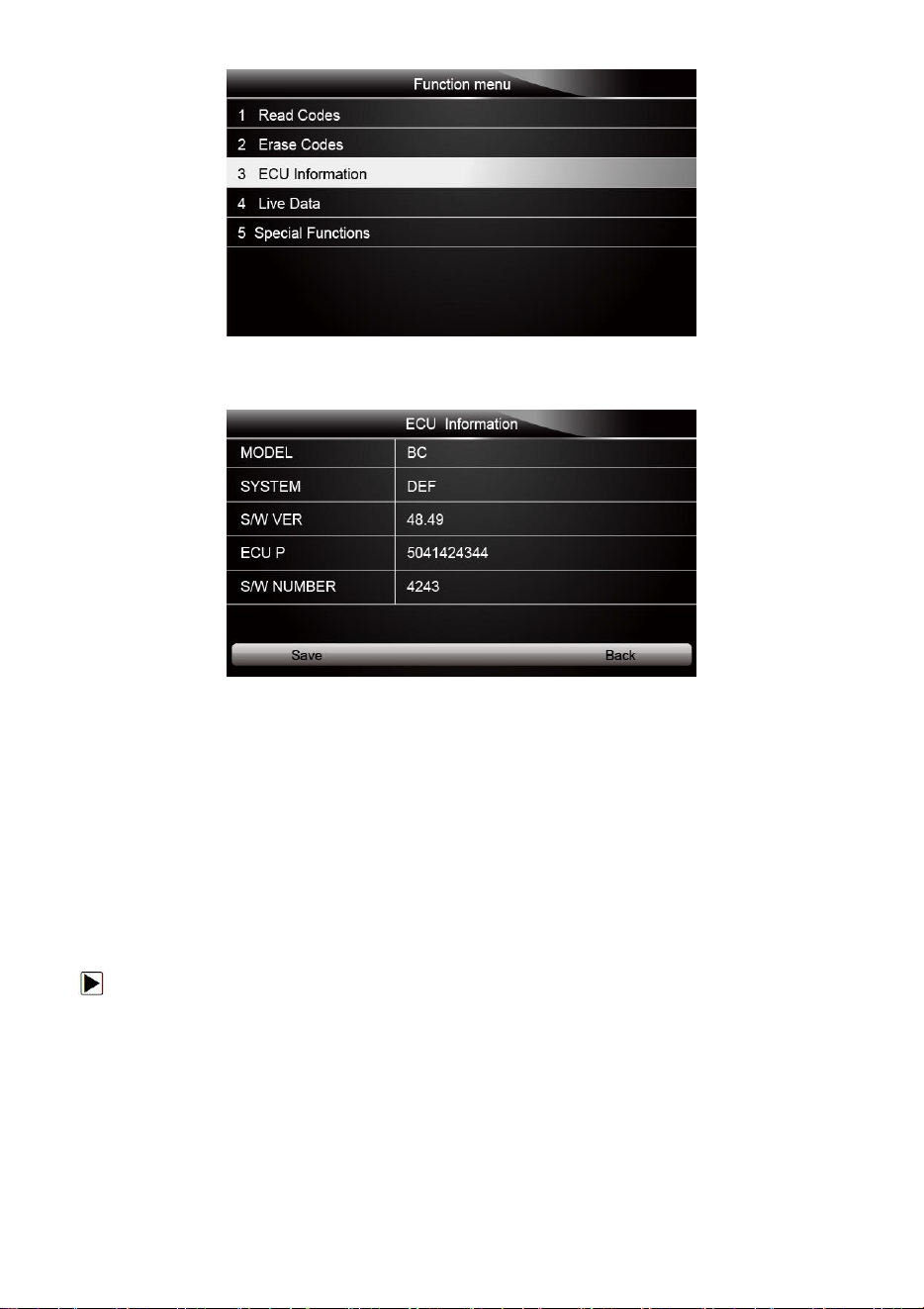
1. Scroll with the arrow keys to highlight Erase Codes from Function Menu and press the ENTER
key.
Figure 4-22 Sample Function Menu Screen
2. Follow the on-screen instructions and answer questions about the vehicle being tested to
complete the procedure.
Figure 4-23 Sample Erase Codes Screen
3. Check the codes again. If any codes remain, repeat the Erase Codes steps.
4.3.3 ECU Information
ECU Information screen displays the identification data of the control module under test, such as
the control module identification string and the control module coding.
To read ECU information:
1. Select ECU Information from the menu and press the ENTER key.
22
AD610 Elite ABS & Airbag Reset Tool Manual_English_V1.01
Figure 4-24 Sample Function Menu Screen
2. A screen with detailed information of the selected control module displays.
Figure 4-25 Sample ECU Information Screen
3. Press function key Save to store ECU information. Or use the BACK key to exit.
4.3.4 Live Data
Live Data menu lets you view and record real time PID data from a selected vehicle electronic
control module.
Menu options typically include:
●
Complete Data List
●
Custom Data List
4.3.4.1 Complete Data List
Complete Data List menu lets you view all live PID data from a selected system.
To view all live PID data
1. Scroll with the arrow keys to highlight Live Data from the menu and press the ENTER key to
display the live data menu.
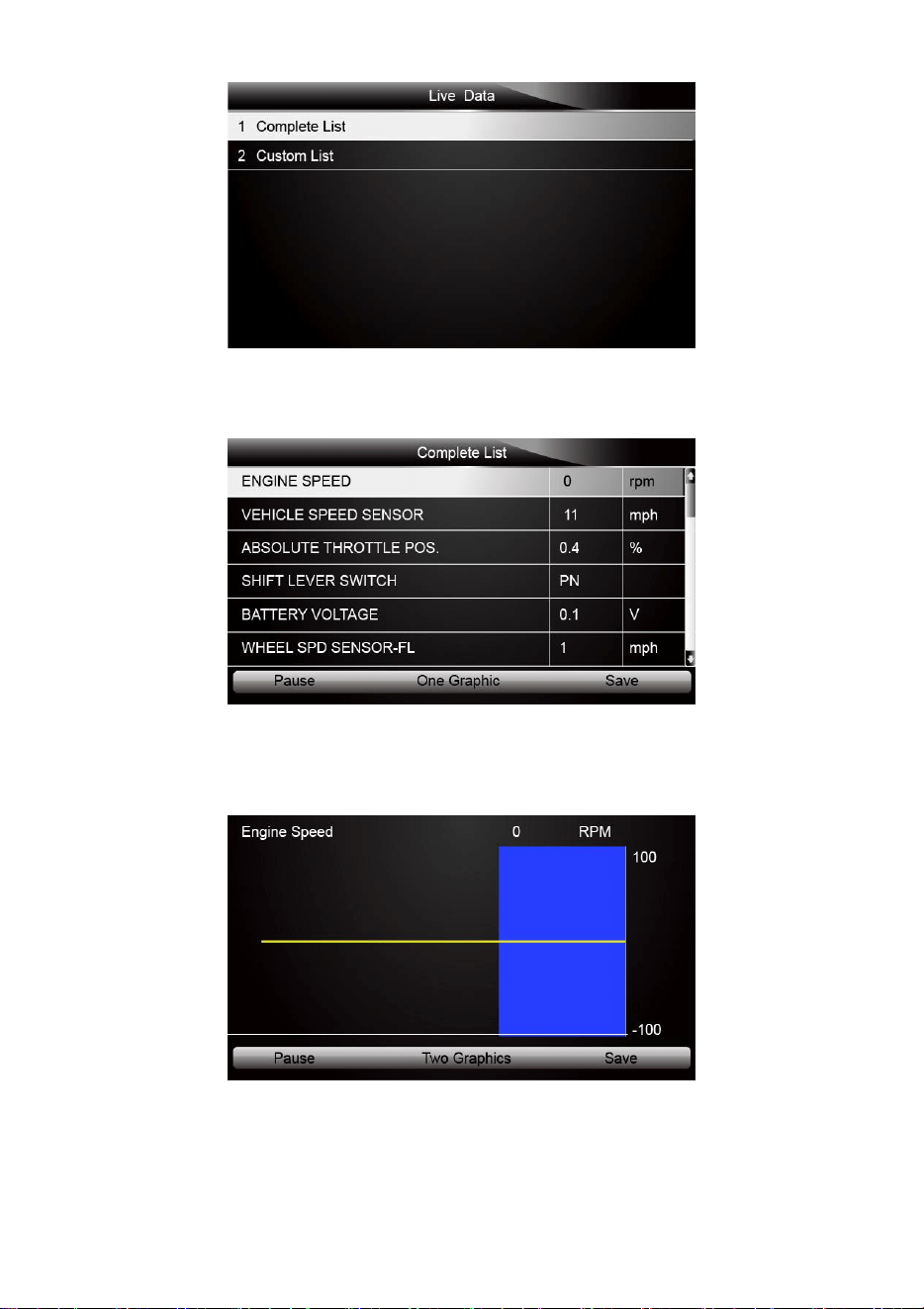
23
AD610 Elite ABS & Airbag Reset Tool Manual_English_V1.01
Figure 4-26 Sample Live Data Selection Screen
2. Select the Complete List from the menu and press the ENTER key to display the datastream
screen.
Figure 4-27 Sample Complete List Screen
3. Scroll with the up and down arrow keys to highlight a line, if the One Graphic on the bottom is
highlighted, it indicates the graphing is available for the selected line. Press the function key
One Graphic to display the PID graph.
Figure 4-28 Sample PID graph Screen
4. Press the function key Two Graphics to display two PID graphs in one screen.
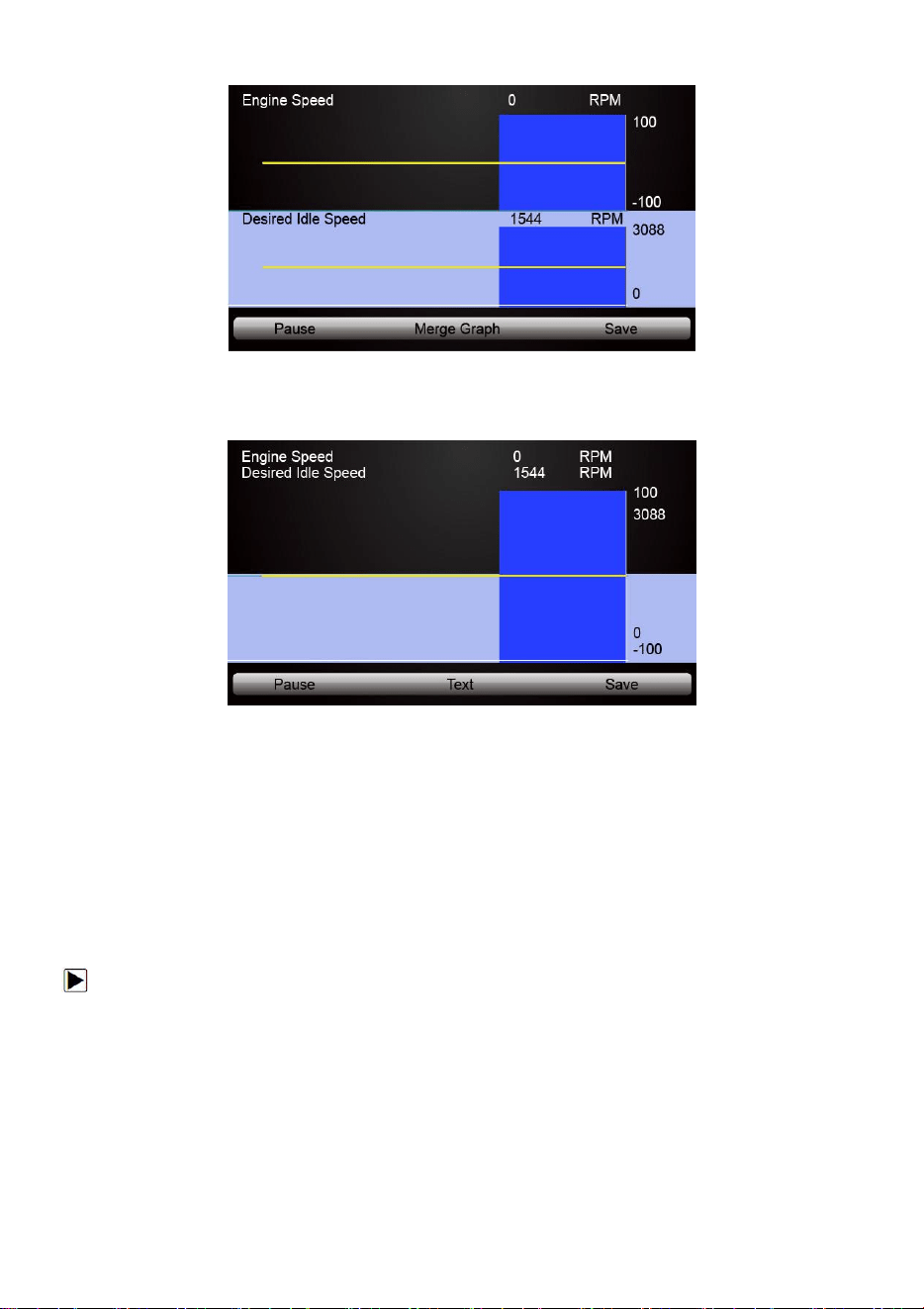
24
AD610 Elite ABS & Airbag Reset Tool Manual_English_V1.01
Figure 4-29 Sample Two PID Graph Screen
5. Press the function key Merge Graph to display two PID plots in one coordinate for easy and
intuitive diagnosis.
Figure 4-30 Sample Merged PID Plots Screen
6. To record the data to memory of the scanner, use the function key SAVE, and press Stop
Saving to stop recording at any time.
7. Press Text to return to text viewing of PID data.
8. Select Pause to suspend collecting data from the scanner and use the Start key to resume
collecting data.
9. Press the Back key to return to the previous menu.
4.3.4.2 Custom Data List
Custom Data List menu lets you to minimize the number of PIDs on the data list and focus on any
suspicious or symptom-specific data parameters.
To create a custom data list:
1. Select Custom List from the menu and press the ENTER key.
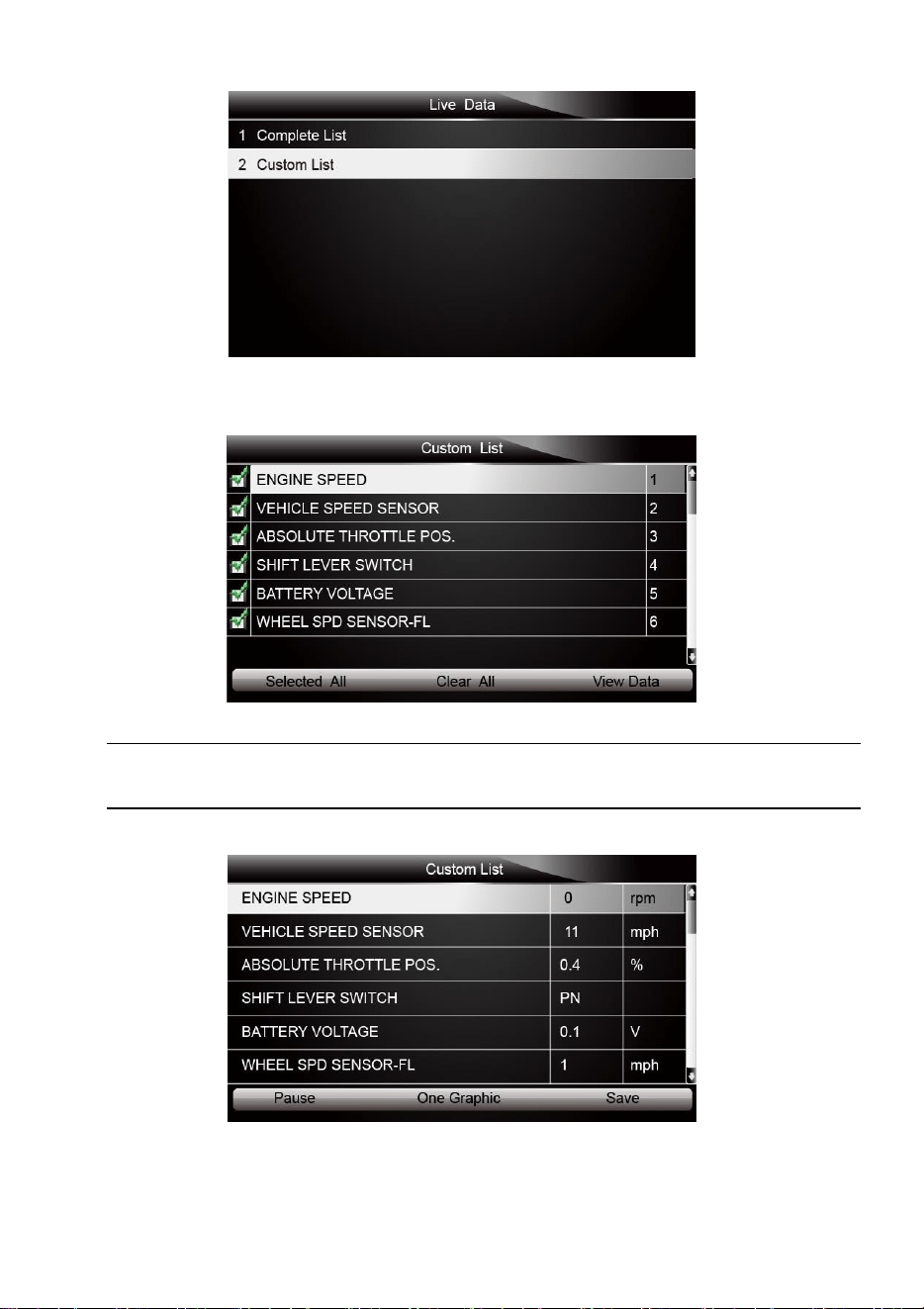
25
AD610 Elite ABS & Airbag Reset Tool Manual_English_V1.01
Figure 4-31 Sample Live Data Screen
2. The custom datastream selection screen displays. Scroll with the up and down arrow keys to
highlight a line, press the ENTER key and then repeat the action to make more selections.
Figure 4-32 Sample Custom List Selection Screen
NOTE
To deselect an item, select it again and then press the ENTER key. Alternatively, use the function
keys SELECT ALL and CLEAR ALL to select or deselect all items at once.
3. When finished selection, use the function key VIEW DATA to display selected items.
Figure 4-33 Sample Datastream Screen

26
AD610 Elite ABS & Airbag Reset Tool Manual_English_V1.01
4.3.5 Special Functions
Special tests are bi-directional diagnostic tests on anti-lock brake systems and air bags. The tests
let you to use the scanner temporarily activate or control a vehicle system or component, and
when you exit the test, the system/component returns to normal operation.
Some tests display a command to the operator. For example, if “Press Brake Pedal” displays, the
operator has to press and hold the brake pedal and then continue. The number, and type of tests
will vary for each vehicle, year and components.
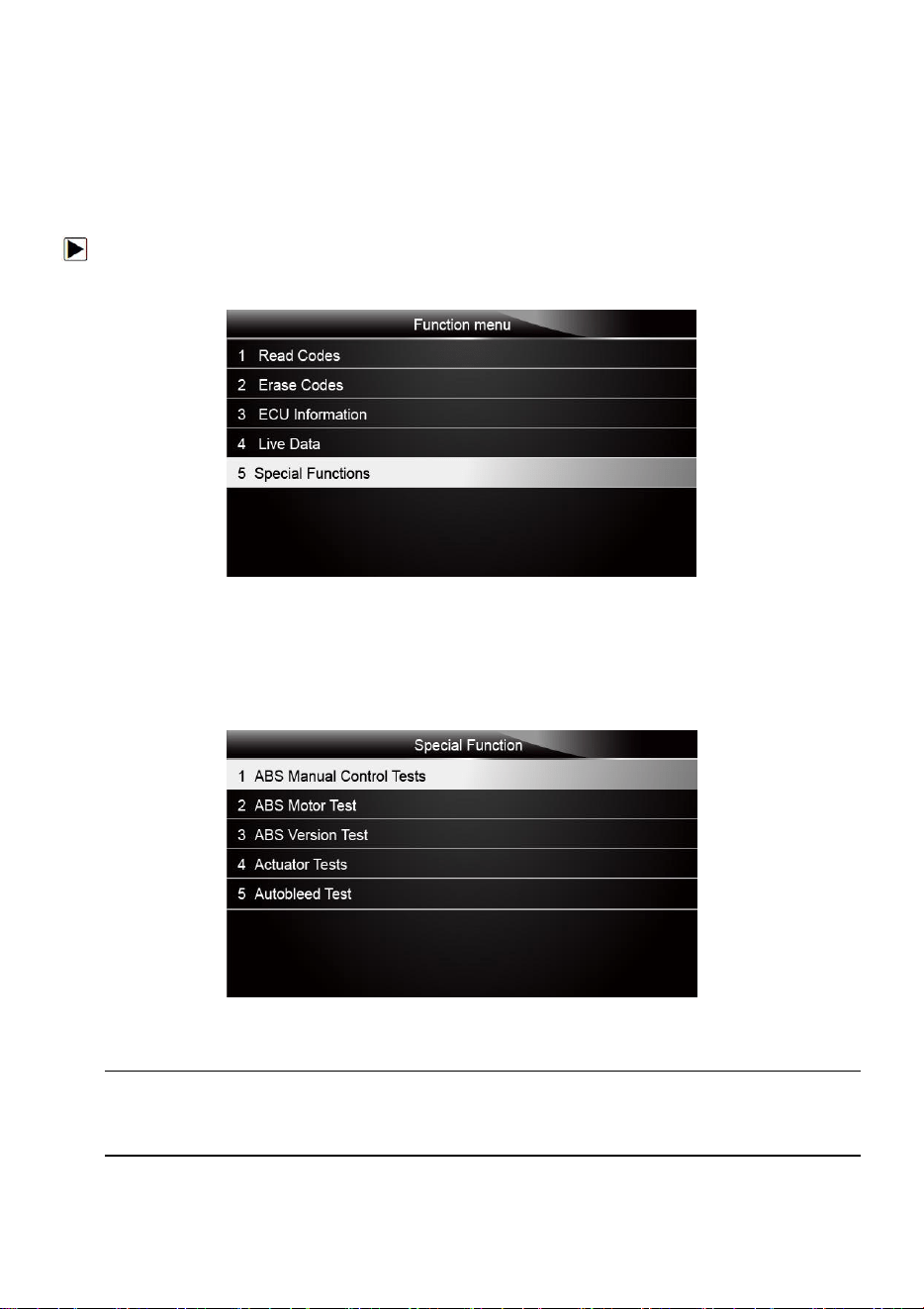
Typical special test options include:
● ABS Manual Control Tests – allows to manually control the actuators in order to test ABS
motors, solenoids, solenoid enable relays, EMBs, and more.
● ABS Motor Test – allows to manually control the ABS pump motor.
● ABS Version Test – displays the name of the brake system and the ABS controller version
number, software ID, and sequence value.
● Actuator Tests – allows to manually control the actuators in order to test AYC valves, inlet
valves, outlet valves, pump motors, and TRACS valves.
● Autobleed Test, Automated Bleed, or Service Bleed – removes air from the internal brake
fluid chambers after servicing the brakes.
IMPORTANT
●
Before bleeding the brake system, make sure no diagnostic codes are present.
●
Do not let the master cylinder run dry during the brake bleeding procedure.
●
Do not allow brake fluid to contact the motor pack or the electrical connectors.
●
Use a recommended brake fluid. Do not use silicone brake fluids in an ABS-equipped vehicle.
After bleeding the brake system, check the brake pedal for excessive travel or a “spongy” feel.
Bleed again if either condition is present.
● Automated Test – automatically commands each solenoid valve and the pump motor on and
off to test for proper operation.
● Brake Bleed Preparation Test – prepares the brake lines for bleeding by clearing air from the
modulator. The test rehomes all the ABS and TCS motors, cycles the TCS motors, and then
returns all motors to the “home” position at the bottom of the bore.
● Function Test – automatically commands the ABS relay, valve solenoids, and pump motor on
and off to test for proper operation.
● Gear Tension Relief Test – relieves tension from the ABS motor gears so you can separate
the ABS motor pack from the ABS hydraulic modulator.
● Hydraulic Control Tests – allows to manually engage and disengage the ABS solenoids for
troubleshooting the hydraulic functions.
● Idle Up Manual Control Test – allows to manually control the idle up actuators.
● Lamp Tests – allows to manually control the ABS or TCS warning or indicator lamps.
● Motor Rehome Test – prepares the brake lines for bleeding by clearing air from the
modulator. The test returns all ABS motors to their “home” positions.
● Pump Motor Tests – allows to manually control the pump motor.
● Relay Test – allows to manually engage and disengage either the ABS or TCS relays in order
to test relay operation.
● Requested Torque Test – allows to manually control the engine torque to test for proper
operation of the traction control system (TCS).
● Setup SDM Serial Number (Air Bag Sensing and Diagnostic Module) – allows to program
a new air bag serial number into the dash integration module (DIM). You use this test after
installing a new air bag; otherwise a diagnostic trouble code will be set when you turn on the
ignition.
● Solenoid Tests – allows to manually control the inlet and output valve solenoids.
27
AD610 Elite ABS & Airbag Reset Tool Manual_English_V1.01
●
System Identification – displays information about the brake system, the vehicle, and the
ABS controller.
●
TCS Test – allows to control the pump motor in order to apply fluid pressure to the front wheel
circuits.
●
Traction Control System (TCS) Manual Control Tests – allows to perform motor tests and
an adjuster assembly control test.
●
Voltage Load Test – “loads” the ABS battery supply circuit to test for adequate battery
capacity.
To perform special tests on a vehicle:
1. Scroll with the arrow keys to highlight the special function test you want to perform from the
menu and press the ENTER key.
Figure 4-34 Sample Function menu screen
2. A group selection screen, test selection screen, several step-by-step instruction screens, or
bi-directional control screen may appear. Read the screens and follow all instructions. If
necessary, use the function keys to perform commands or answer any questions. If more than
3 function keys displays, use the Up/Down arrow keys to select a command and press the
ENTER key to confirm.
Figure 4-35 Sample Special function screen
3. When completed, press the BACK key to return to previous screens.
NOTE
Not all function options listed above are applicable to all vehicles. Available options may vary by
the year, model, and make of the test vehicle. A “The selected mode is not supported!” message
displays if the option is not applicable to the vehicle under test.
28
AD610 Elite ABS & Airbag Reset Tool Manual_English_V1.01
5 OBDII/EOBD Operations
OBD-II/EOBD menu lets you access all OBD service modes. According to ISO 9141-2, ISO
14230-4, and SAE J1850 standards, the OBD application is divided into several sub programs,
called ‘Service $xx’. Below is a list of OBD diagnostic services:
●
Service $01 - request current powertrain diagnostic data
●
Service $02 - request powertrain freeze frame data
●
Service $03 - request emission-related diagnostic trouble codes
●
Service $04 - clear/reset emission-related diagnostic information
●
Service $05 - request oxygen sensor monitoring test results
●
Service $06 - request on-board monitoring test results for specific monitored systems
●
Service $07 - request emission-related diagnostic trouble codes detected during current or
last completed driving cycle
●
Service $08 - request control of on-board system, test or component
●
Service $09 - request Vehicle Information
When OBDII/EOBD application is selected from Home screen, the scanner starts to detect the
communication protocol automatically. Once the connection has established, a menu that lists all
of the tests available on the identified vehicle displays. Menu options typically include:
●
System Status
●
Read Codes
●
Freeze Frame Data
●
Erase Codes
●
Live Data
●
I/M Readiness
●
O2 Sensor Test
●
On-board Monitor Test
●
Component Test
●
Vehicle Information
●
Modules Present
●
Code Lookup
NOTE
Not all function options listed above are applicable to all vehicles. Available options may vary by
the year, model, and make of the test vehicle. A “The selected mode is not supported!” message
displays if the option is not applicable to the vehicle under test.
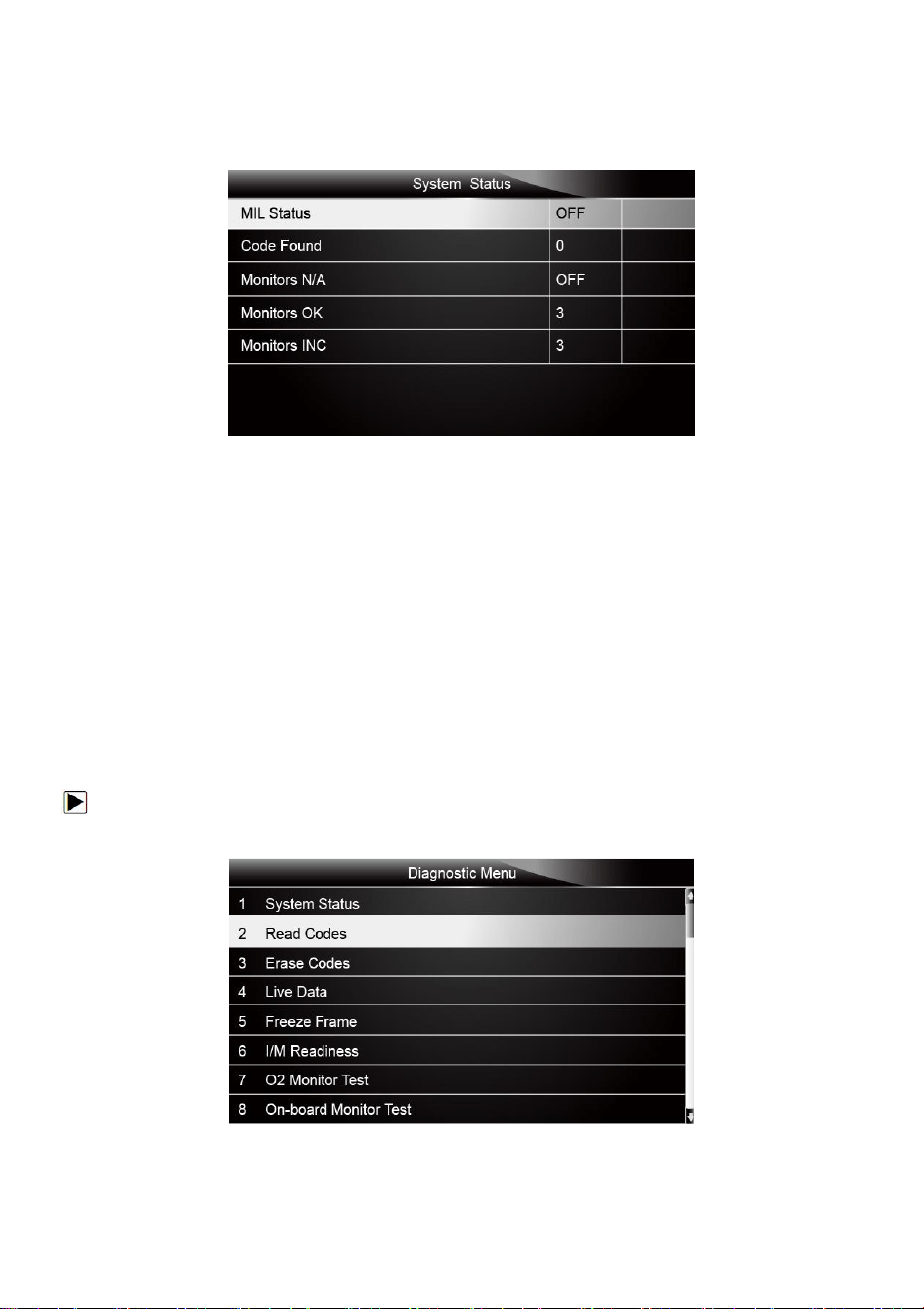
5.1 System Status
System Status option open a screen with a summary of system status of the vehicle under test.
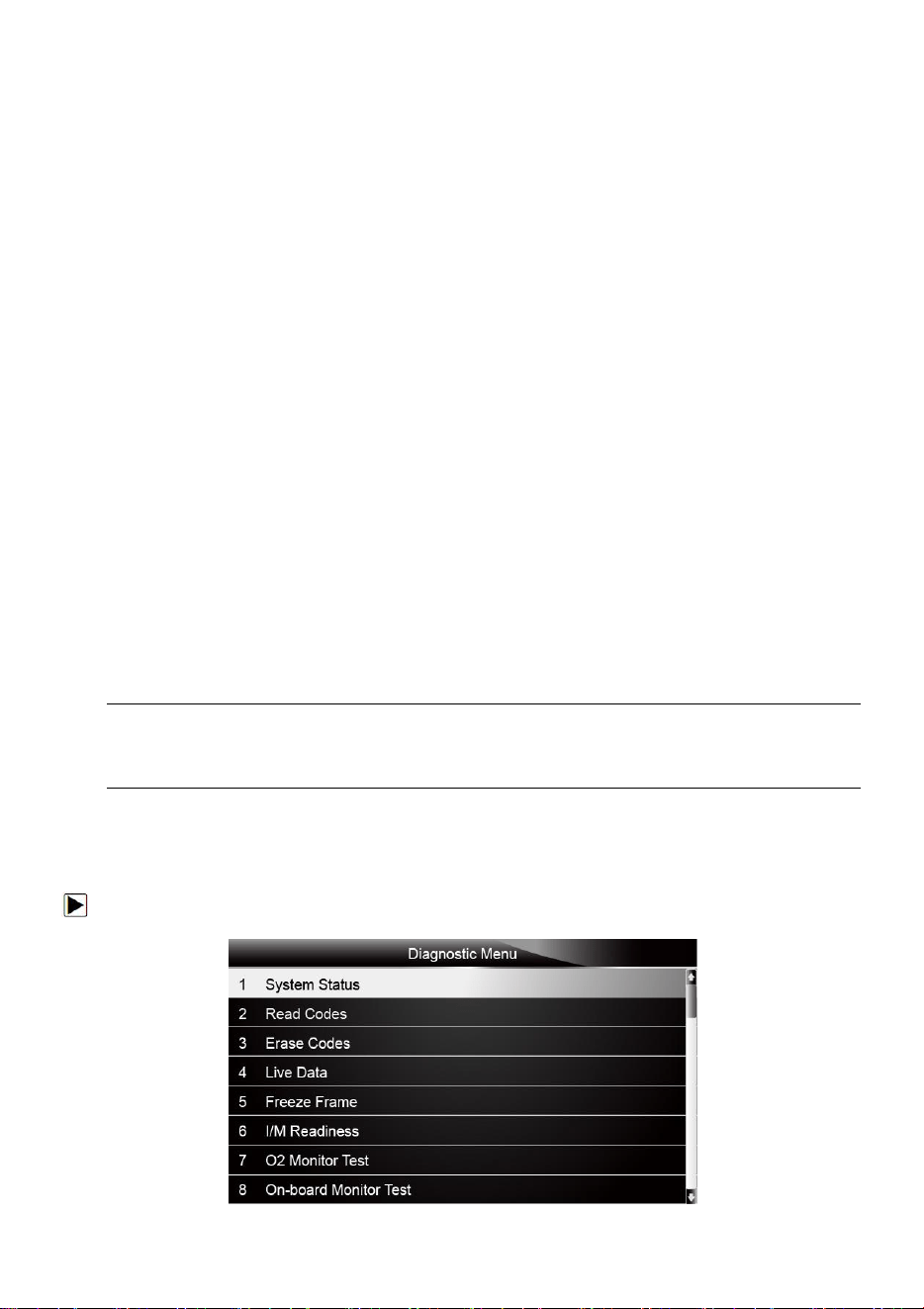
To view summary system status of a vehicle:
1. Scroll with the arrow keys to highlight System Status from Diagnostic Menu and press the
ENTER key.
29
AD610 Elite ABS & Airbag Reset Tool Manual_English_V1.01
Figure 5-1 Sample Diagnostic Menu Screen
2. A screen with detailed information displays.
Figure 5-2 Sample System Status Screen
5.2 Read Codes
Read Codes menu lets you read both stored codes and pending codes found in the control unit.
Typical menu options include:
● Stored Codes
● Pending Codes
Diagnostic trouble codes stored in a control module are used to help identify the cause of a
trouble or troubles with a vehicle. These codes have occurred a specific number of times and
indicate a problem that requires repair.
Pending codes are also referred to as maturing codes that indicate intermittent faults. If the fault
does not occur within a certain number of drive cycles (depending on vehicle), the code clears
from memory. If a fault occurs a specific number of times, the code matures into a DTC and the
MIL illuminates or blinks.
To read codes/pending codes from a vehicle:
1. Scroll with the arrow keys to highlight Read Codes from Diagnostic Menu and press the
ENTER key.
Figure 5-3 Sample Diagnostic Menu Screen
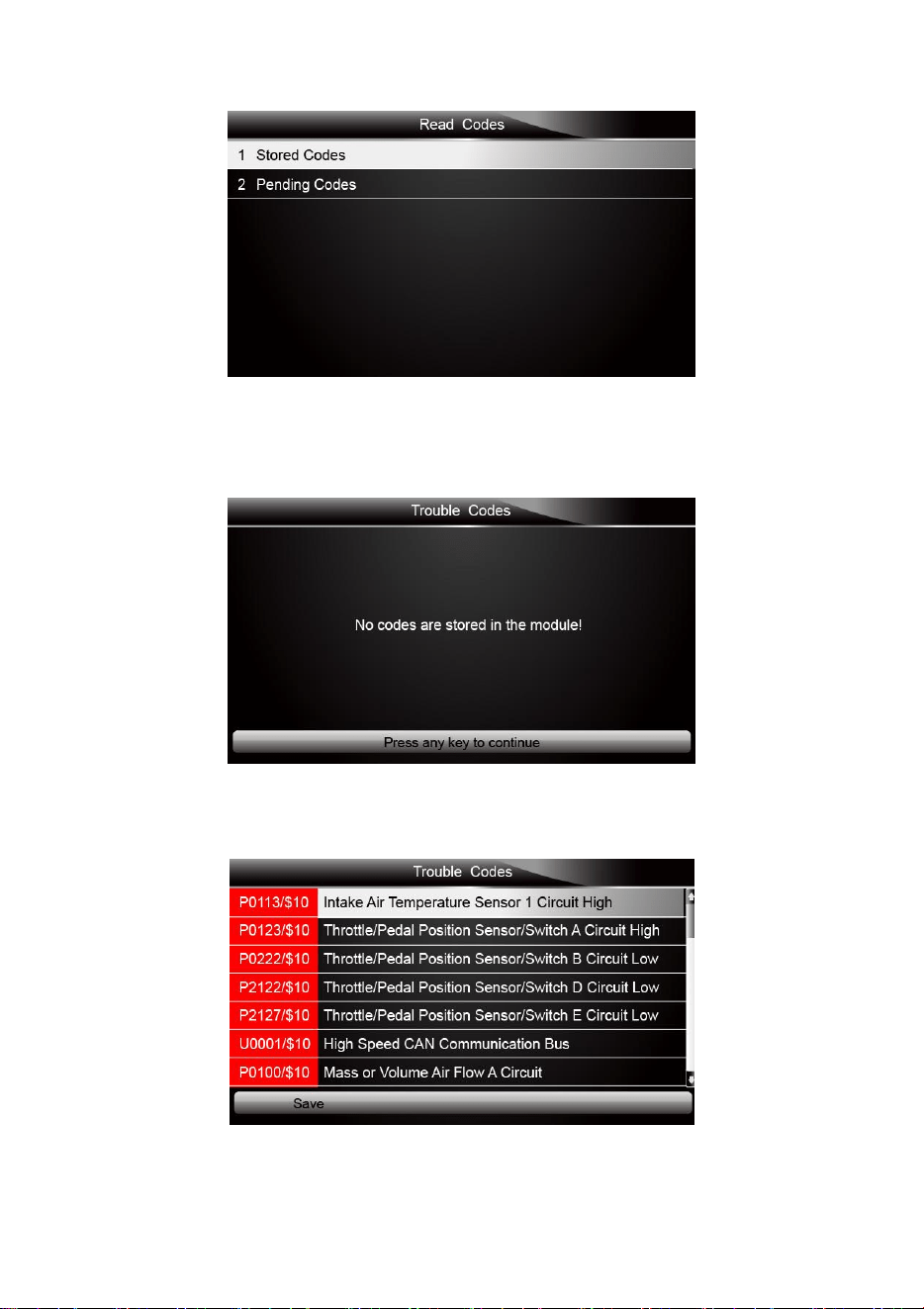
2. Select Stored Codes/Pending Codes and press the ENTER key to confirm. A code list
including code number and its description displays.
30
AD610 Elite ABS & Airbag Reset Tool Manual_English_V1.01
Figure 5-4 Sample Read Codes Screen
If no DTCs are present the message “No (Pending) Codes Found!” is displayed. If any
manufacturer specific or enhanced codes detected, select vehicle a make before viewing DTC
information.
Figure 5-5 Sample No Codes Screen
3. Use the up and down arrow keys to scroll through data to select lines, and left and right arrow
keys to scroll back and forth through different screens of data.
Figure 5-6 Sample Code screen
4. Press function key Save to store DTC information. Or use the BACK key to exit.
31
AD610 Elite ABS & Airbag Reset Tool Manual_English_V1.01
5.3 Erase Codes
Erase Codes menu lets you to clear all current and stored DTCs from the control module. Also it
erases all temporary ECU information, including freeze frame. So make sure that the selected
system are completely checked and serviced by technicians and no vital information will be lost
before clearing codes.
NOTE
●
To clear codes, make sure that the ignition key is switched to ON with the engine off.
●
Erase Codes does not fix the problem that caused the fault! DTCs should only be erased after
correcting the condition(s) that caused them.
To clear codes:
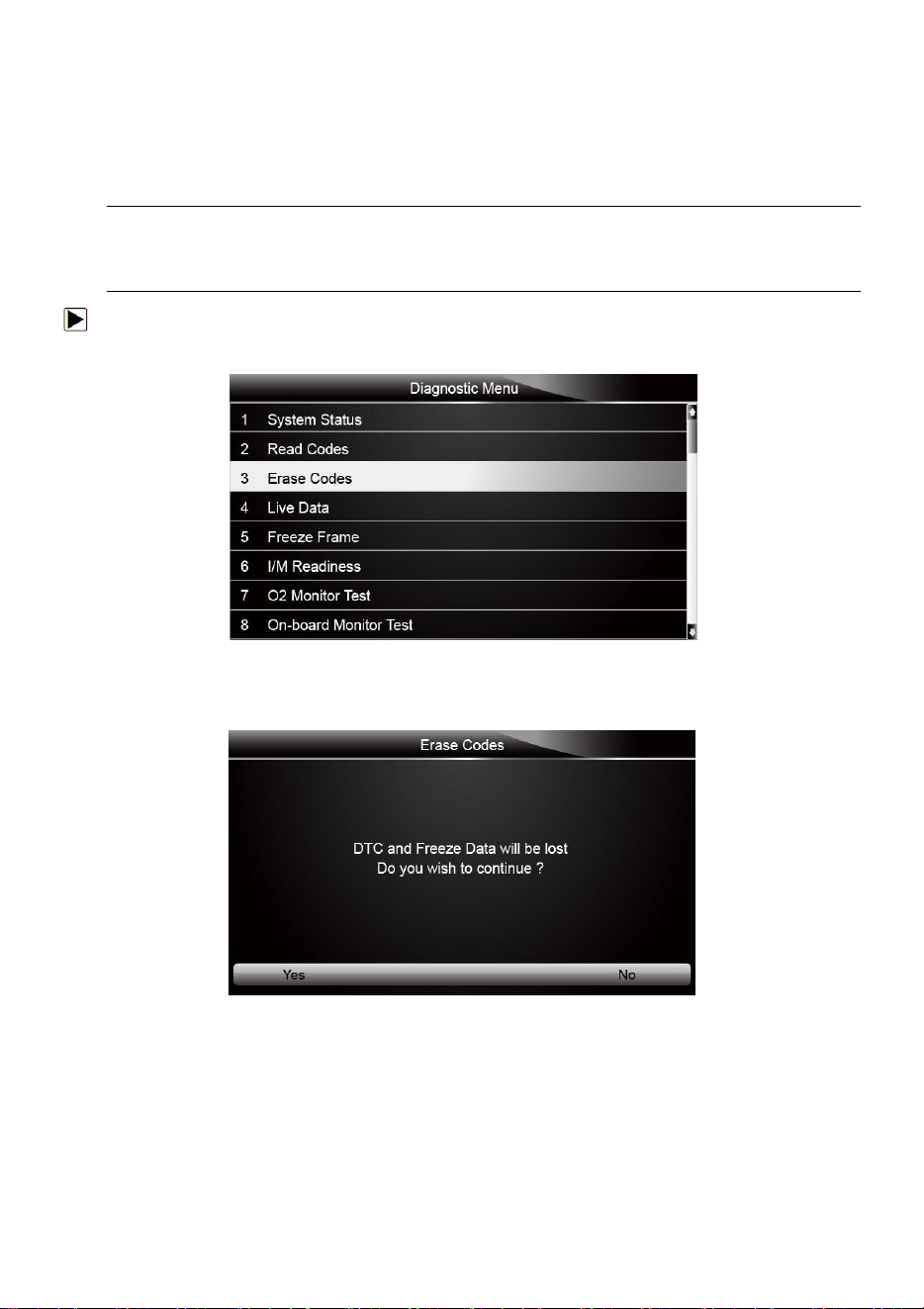
1. Scroll with the arrow keys to highlight Erase Codes from Diagnostic Menu and press the
ENTER key.
Figure 5-7 Sample Diagnostic Menu Screen
2. Follow the on-screen instructions and answer questions about the vehicle being tested to
complete the procedure.
Figure 5-8 Sample Erase Codes Screen
3. Check the codes again. If any codes remain, repeat the Erase Codes steps.
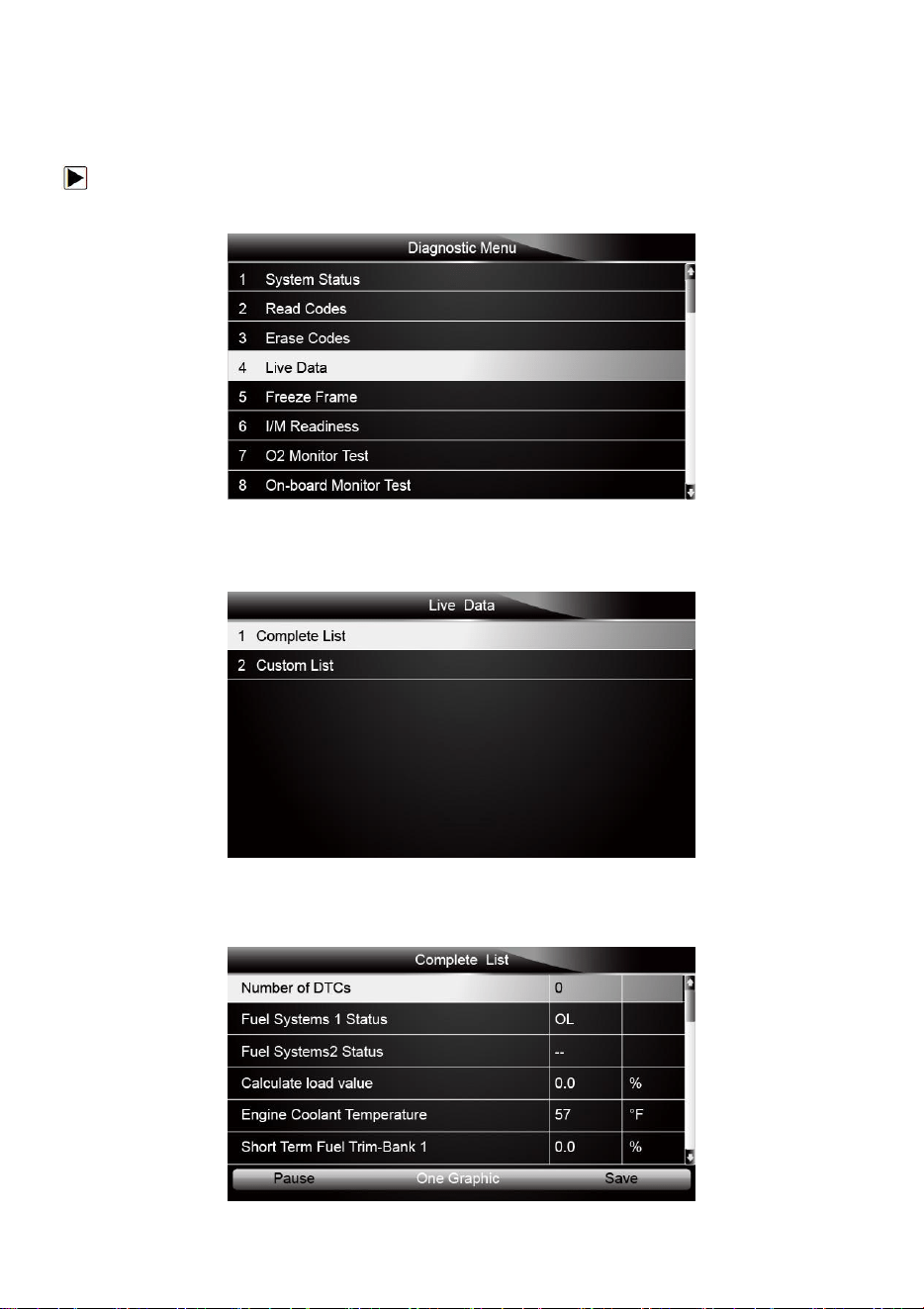
5.4 Live Data
Live Data menu lets you view and record real time PID data from the electronic control module.
Menu options typically include:
● Complete Data List
32
AD610 Elite ABS & Airbag Reset Tool Manual_English_V1.01
●
Custom Data List
5.4.1 Complete Data List
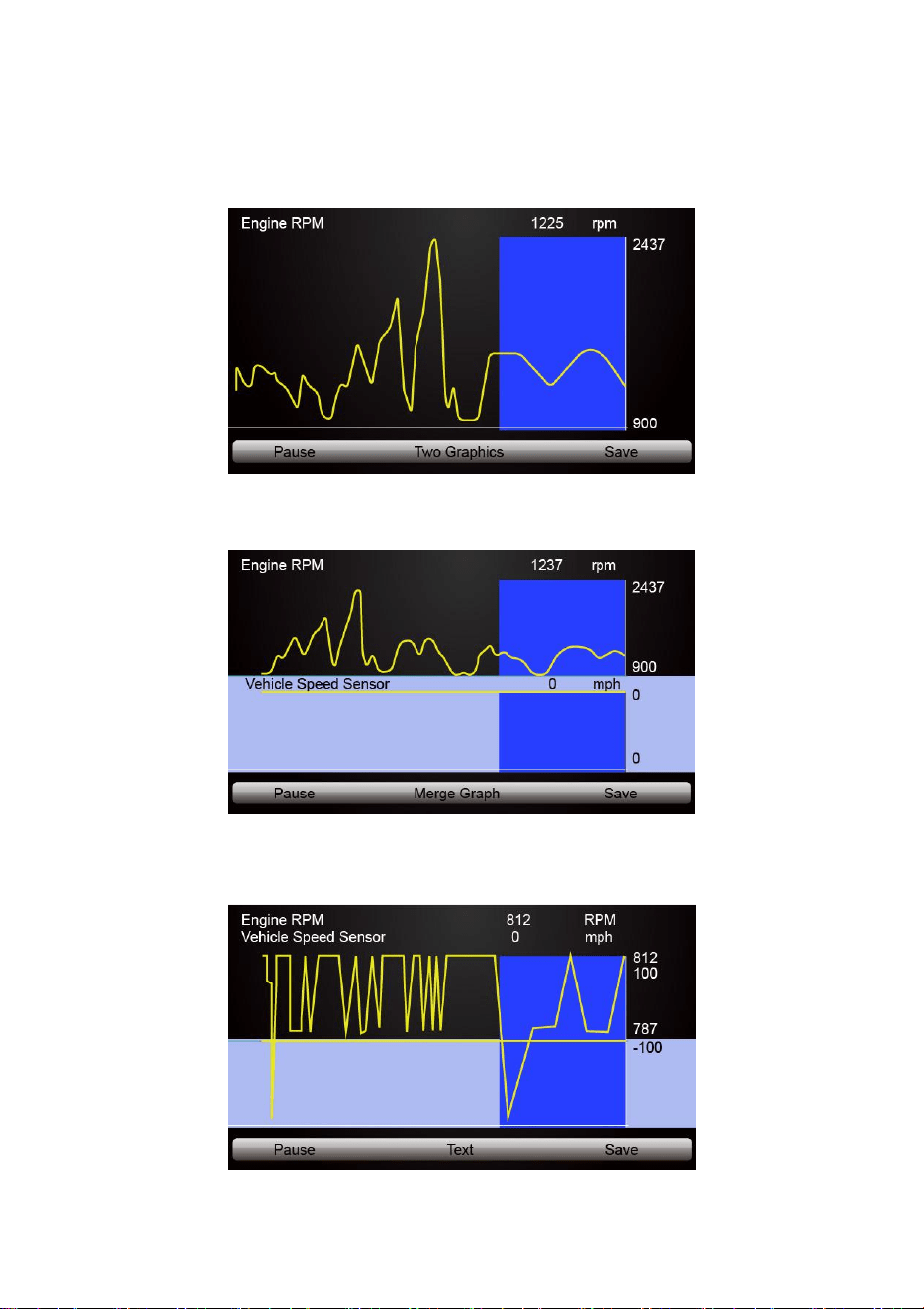
Complete Data List menu lets you view all live PID data from a selected system.
To view all live PID data:
1. Scroll with the arrow keys to highlight Live Data from Diagnostic Menu and press the ENTER
key.
Figure 5-9 Sample Diagnostic Menu Screen
2. Select Complete List from the menu and press the ENTER key to display the datastream
screen
Figure 5-10 Sample Live Data Menu Screen
3. Use the up and down arrow keys to scroll through data to select lines, and left and right arrow
keys to scroll back and forth through different screens of data.
33
AD610 Elite ABS & Airbag Reset Tool Manual_English_V1.01
Figure 5-11 Sample Complete List Screen
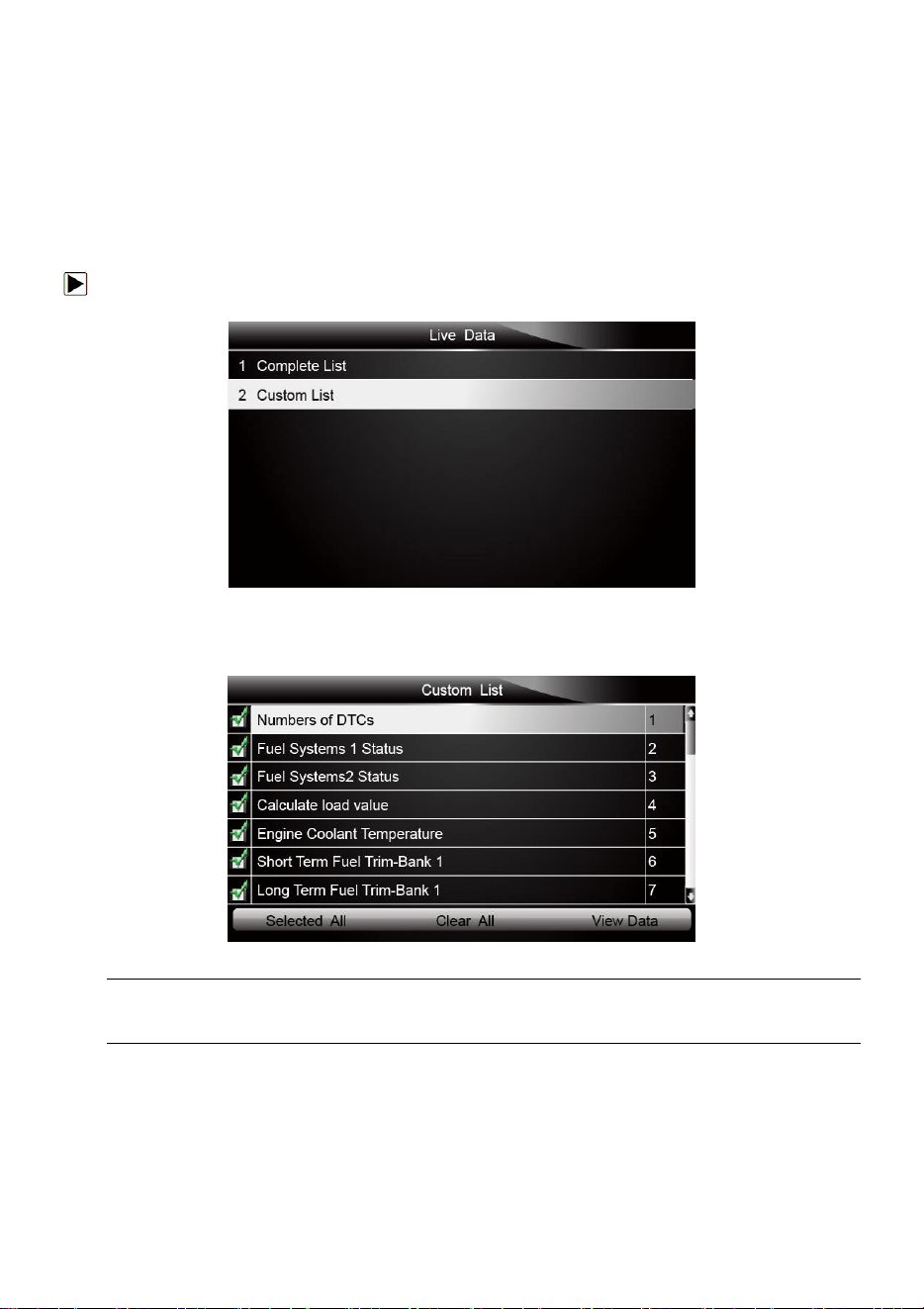
4. Scroll with the up and down arrow keys to highlight a line, if the One Graphic on the bottom is
highlighted, it indicates the graphing is available for the selected line. Press the function key
One Graphic to display the PID graph.
Figure 5-12 Sample PID Graph Screen
5. Press the function key Two Graphics to display two PID graphs in one screen
Figure 5-13 Sample Two PID Graph Screen
6. Press the function key Merge Graph to display two PID plots in one coordinate for easy and
intuitive diagnosis.
Figure 5-14 Sample Merge Graph Screen
34
AD610 Elite ABS & Airbag Reset Tool Manual_English_V1.01
7. To record the data to memory of the scanner, use the function key SAVE, and press Stop
Saving to stop recording at any time.
8. Select Text to return to text viewing of PID data.
9. Press Pause to suspend collecting data and use the Start key to resume collecting data.
10. Use the Back key to return to diagnostic menu.
5.4.2 Custom Data List
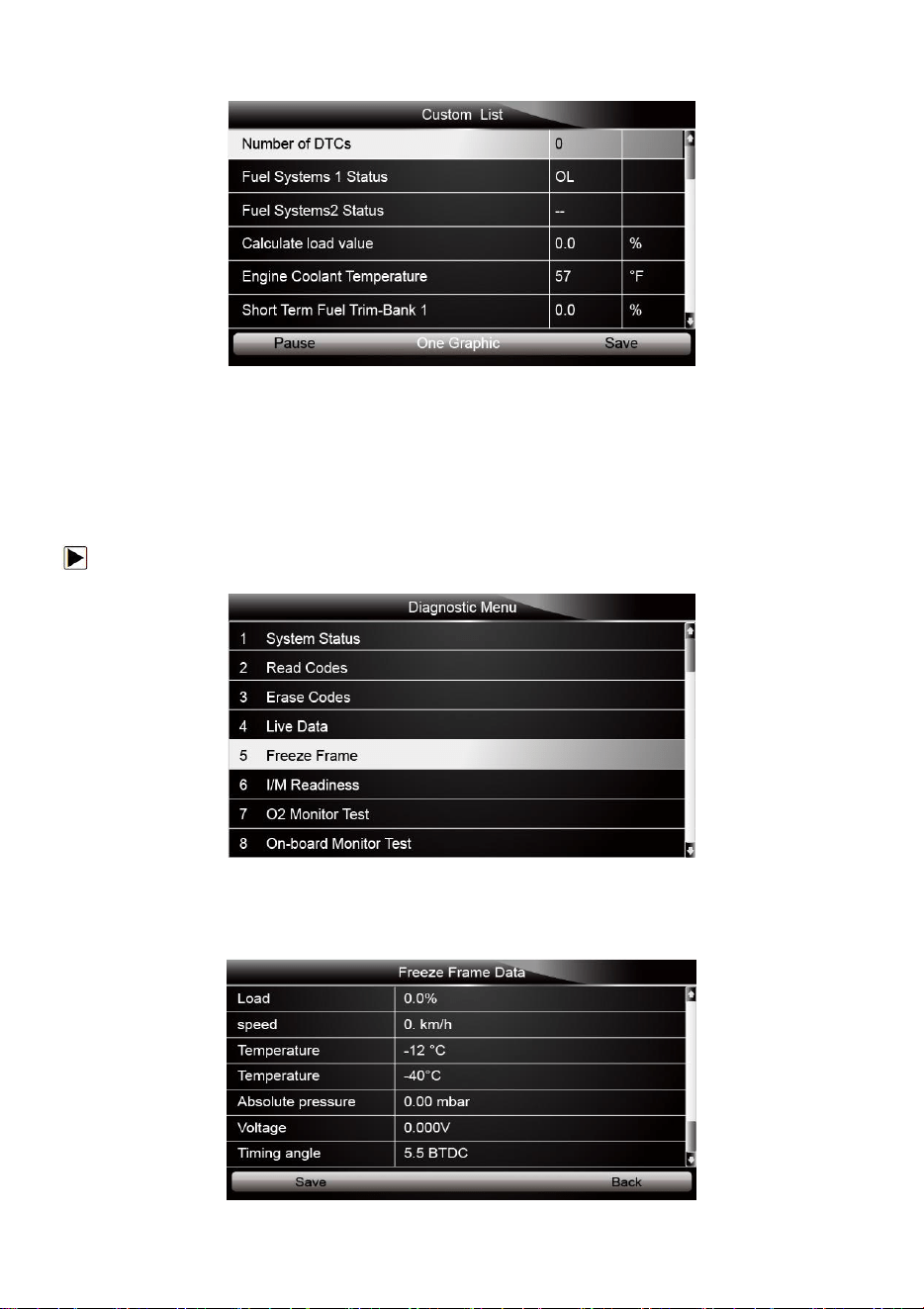
Custom Data List menu lets you to minimize the number of PIDs on the data list and focus on any
suspicious or symptom-specific data parameters.
To create a custom data list:
1. Select Custom List from the menu and press the ENTER key.
Figure 5-15 Sample Live Data Menu Screen
2. The custom datastream selection screen displays. Scroll with the up and down arrow keys to
highlight a line, press the ENTER key and then repeat the action to make more selections.
Figure 5-16 Sample Custom Datastream Selection Screen
NOTE
To deselect an item, select it again and then press the ENTER key. Alternatively, use the function
keys SELECT ALL and CLEAR ALL to select or deselect all items at once.
3. When finished selection, use the function key VIEW DATA to display selected items.
35
AD610 Elite ABS & Airbag Reset Tool Manual_English_V1.01
Figure 5-17 Sample Datastream Screen
5.5 Freeze Frame
Freeze Frame menu displays freeze frame data, a snapshot of critical vehicle operating
conditions automatically recorded by the on-board computer at the time of the DTC set. It is a
good function to help determine what caused the fault.
To view freeze frame data:
1. Select Freeze Frame from the Diagnostic Menu. Details of freeze frame data displays.
Figure 5-18 Sample Diagnostic Menu Screen
2. Use the up and down arrow keys to scroll through data to select lines, and left and right arrow
keys to scroll back and forth through different screens of data. If no freeze frame detected, the
message “No freeze frame data stored!” is displayed.

36
AD610 Elite ABS & Airbag Reset Tool Manual_English_V1.01
Figure 5-19 Sample Freeze Data Screen
3. Press function key Save to store freeze frame information. Or use the BACK key to exit.
5.6 Read I/M Readiness Status Data
I/M Readiness option allows to view a snapshot of the operations for the emission system on
OBDII/EOBD vehicles.
I/M Readiness is a useful function used to check if all monitors are OK or N/A. The vehicle’s
computer performs tests on the emission system during normal driving conditions. After a specific
amount of drive time (each monitor has specific driving conditions and time required), the
computer’s monitors decide if the vehicles emission system is working correctly.
When the monitor’s status is:
●
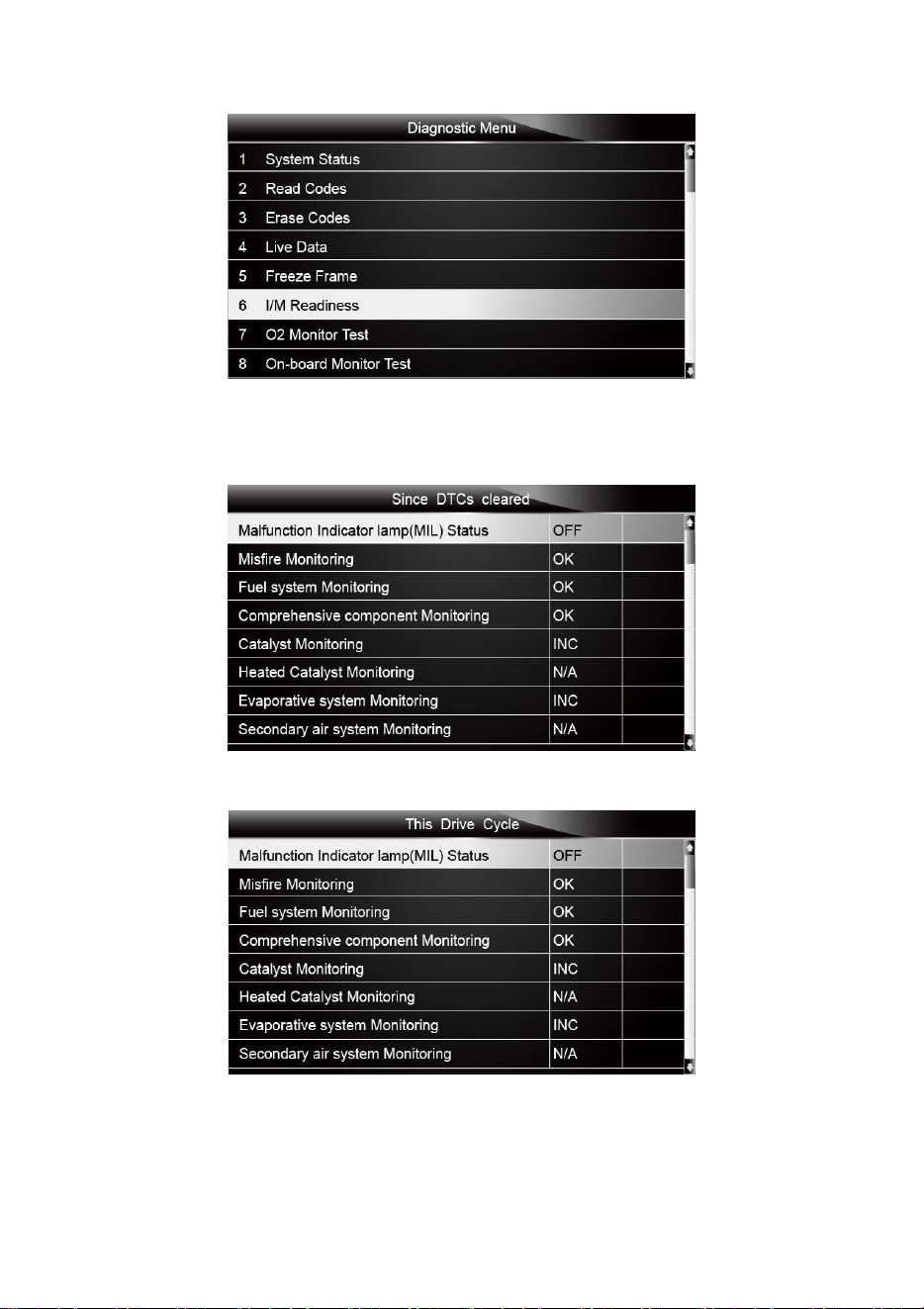
OK - vehicle was driven enough to complete the monitor.
●
INC (Incomplete) - vehicle was not driven enough to complete the monitor.
●
N/A (Not Applicable) - vehicle does not support that monitor.
There are two types of I/M Readiness tests:
●
Since DTCs Cleared - shows status of the monitors since the DTCs were last cleared.
●
This Drive Cycle - shows status of monitors since the start of the current drive cycle.
Below is a list of abbreviations and names of OBD II monitors supported by the scanner.
No.
Abbreviation
Name
1
Misfire Monitor
Misfire Monitor
2
Fuel System Mon
Fuel System Monitor
3
Comp. Component
Comprehensive Components Monitor
4
Catalyst Mon
Catalyst Monitor
5
Htd Catalyst
Heated Catalyst Monitor
6
Evap System Mon
Evaporative System Monitor
7
Sec Air System
Secondary Air System Monitor
8
A/C Refrig Mon
Air Conditioning Refrigerant Monitor
9
Oxygen Sens Mon
Oxygen Sensor Monitor
10
Oxygen Sens Htr
Oxygen Sensor Heater Monitor
11
EGR System Mon
Exhaust Gas Recirculation System
Monitor
NOTE
● To review I/M Readiness status, make sure that the ignition key is switched to ON with the
engine off.
● Not all monitors are supported by all vehicles.
To retrieve I/M Readiness Status data:
1. Scroll with the arrow keys to highlight I/M Readiness from Diagnostic Menu and press the
ENTER key. If vehicle supports both types of monitors, a screen for monitor type selection
displays. Select a monitor type and press the ENTER key.
37
AD610 Elite ABS & Airbag Reset Tool Manual_English_V1.01
Figure 5-20 Sample Diagnostic Menu Screen
2. Depending on readiness test, one of these 2 screens will be present. Use the up and down
arrow keys to scroll through data to select lines, and left and right arrow keys to scroll back and
forth through different screens of data.
Figure 5-21 Sample IM Readiness Screen 1
Or
Figure 5-22 Sample IM readiness screen 2
3. Press the BACK key to exit.
38
AD610 Elite ABS & Airbag Reset Tool Manual_English_V1.01
5.7 O2 Monitor Test
OBD II regulations require certain vehicles monitor and test oxygen (O2) sensors to isolate fuel
and emissions related faults. The O2 Monitor Test function is used to retrieve completed O2
sensors monitor test results.
The O2 Monitor Test is not an on-demand test. O2 sensors are not tested when selected via the
menu but tested when engine operating conditions are within specified limits.
If the vehicle uses a controller area network (CAN) protocol to communicate, this function is not
supported by vehicle. Refer to “On-Board Monitor Tests” on page 38-39 for O2 monitor data of
CAN-equipped vehicles.
To retrieve O2 monitor data:
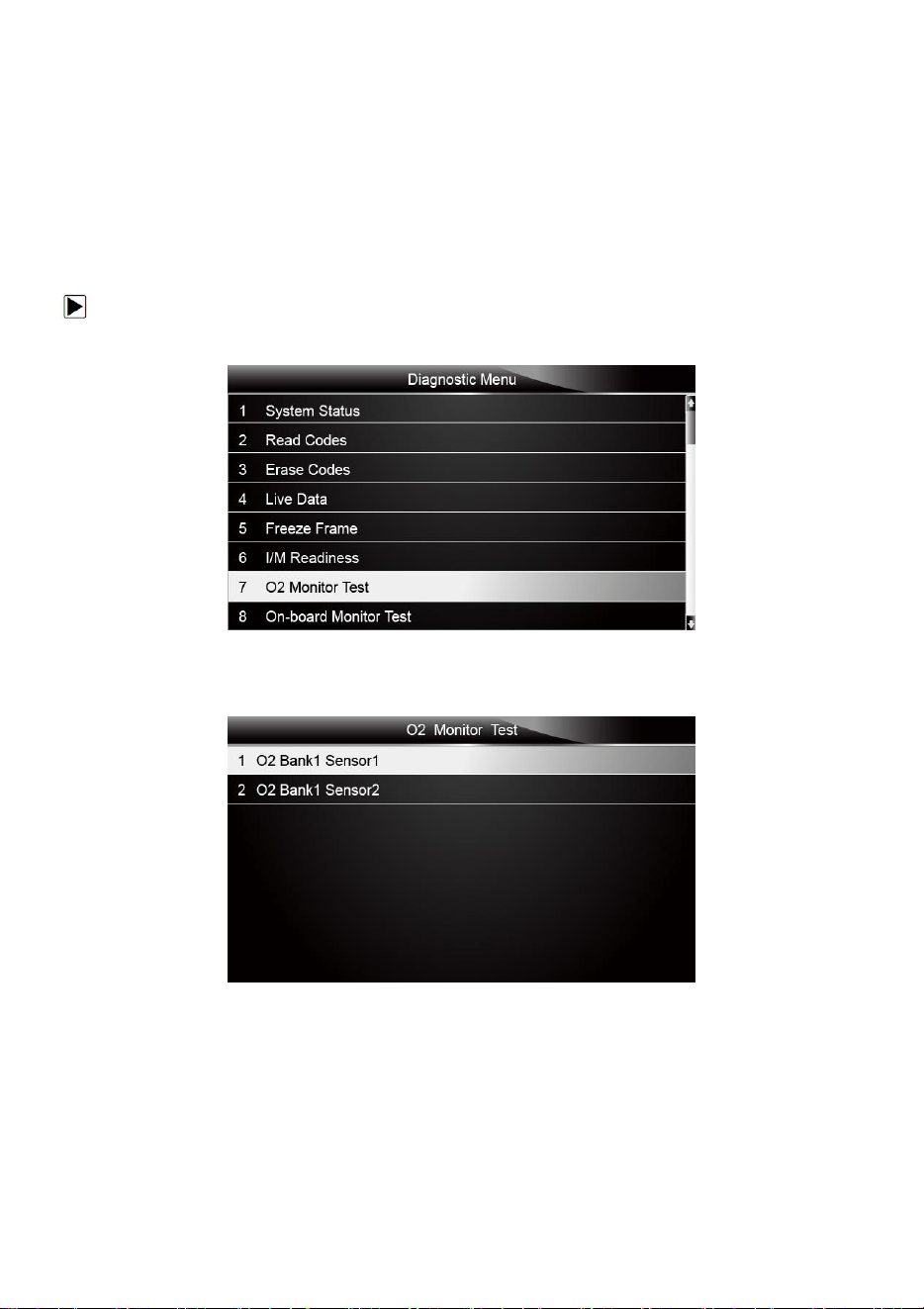
1. Scroll with the arrow keys to highlight O2 Monitor Test from Diagnostic Menu and press the
ENTER key. A screen with a list of available sensors displays.
Figure 5-23 Sample Diagnostic Menu Screen
2. Scroll with the arrow keys to highlight an O2 sensor and press the ENTER key to confirm. A
screen with details of the selected sensor displays.
Figure 5-24 Sample O2 Monitor Test screen
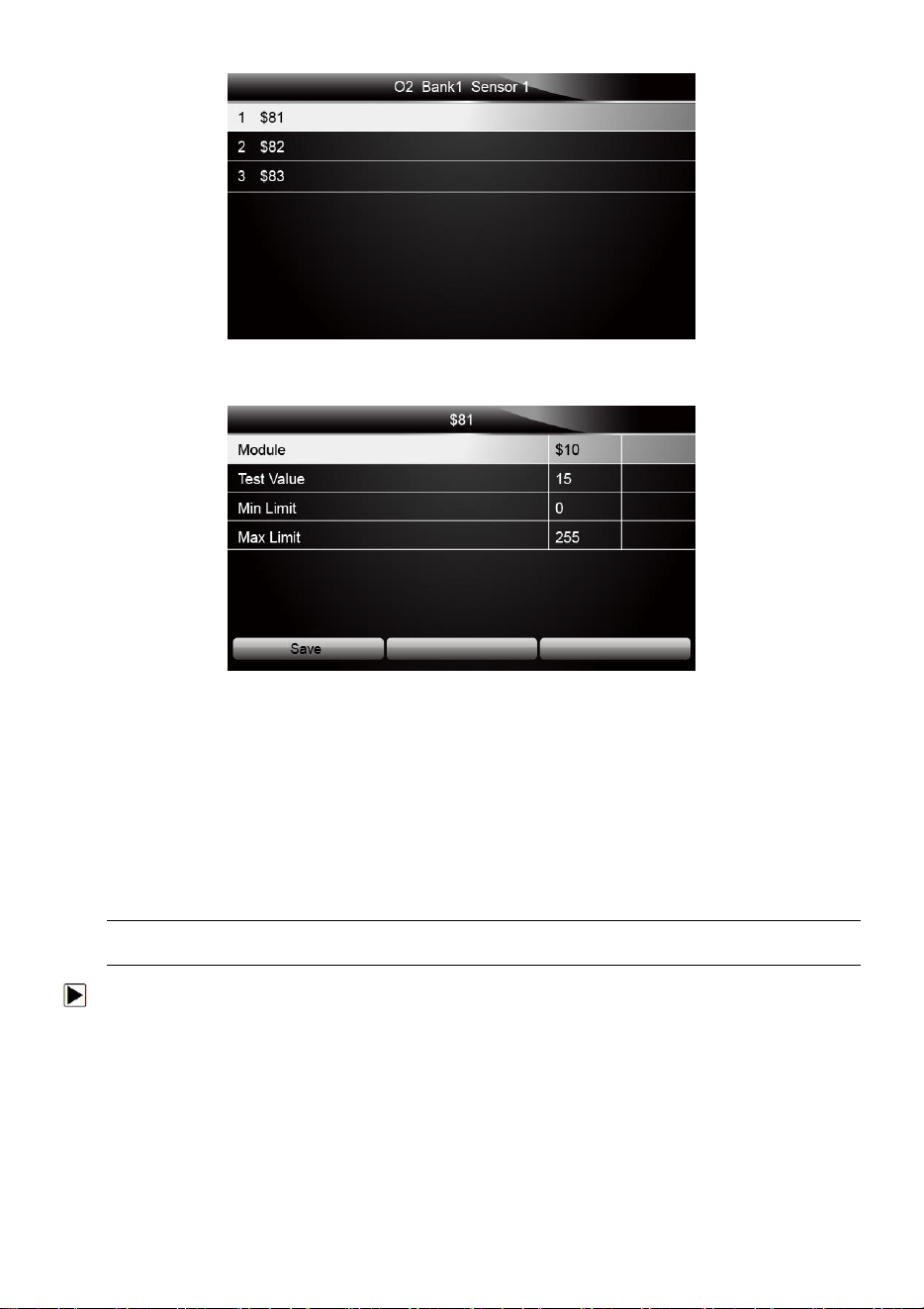
3. Use the up and down arrow keys to scroll through data to select lines, and left and right arrow
keys to scroll back and forth through different screens of data.
39
AD610 Elite ABS & Airbag Reset Tool Manual_English_V1.01
Figure 5-25 Sample O2 Bank1 Sensor 1 Screen
4. Press Enter key to view data of selection.
Figure 5-26 Sample data of $81 screen
5. Press the BACK key to exit and return.
5.8 On-Board Monitor Test
The On-Board Monitor Test function is useful after servicing or after clearing a vehicle ECU’s
memory. It receives test results for emission-related powertrain components and systems that
are not continuously monitored for Non-CAN vehicles. And for CAN vehicles, it receives test data
for emission-related powertrain components and systems that are and are not continuously
monitored. It is vehicle manufacturer who is responsible for assigning test and component IDs.
NOTE
Test results do not necessarily indicate a faulty component or system.
To request on-board monitor test results:
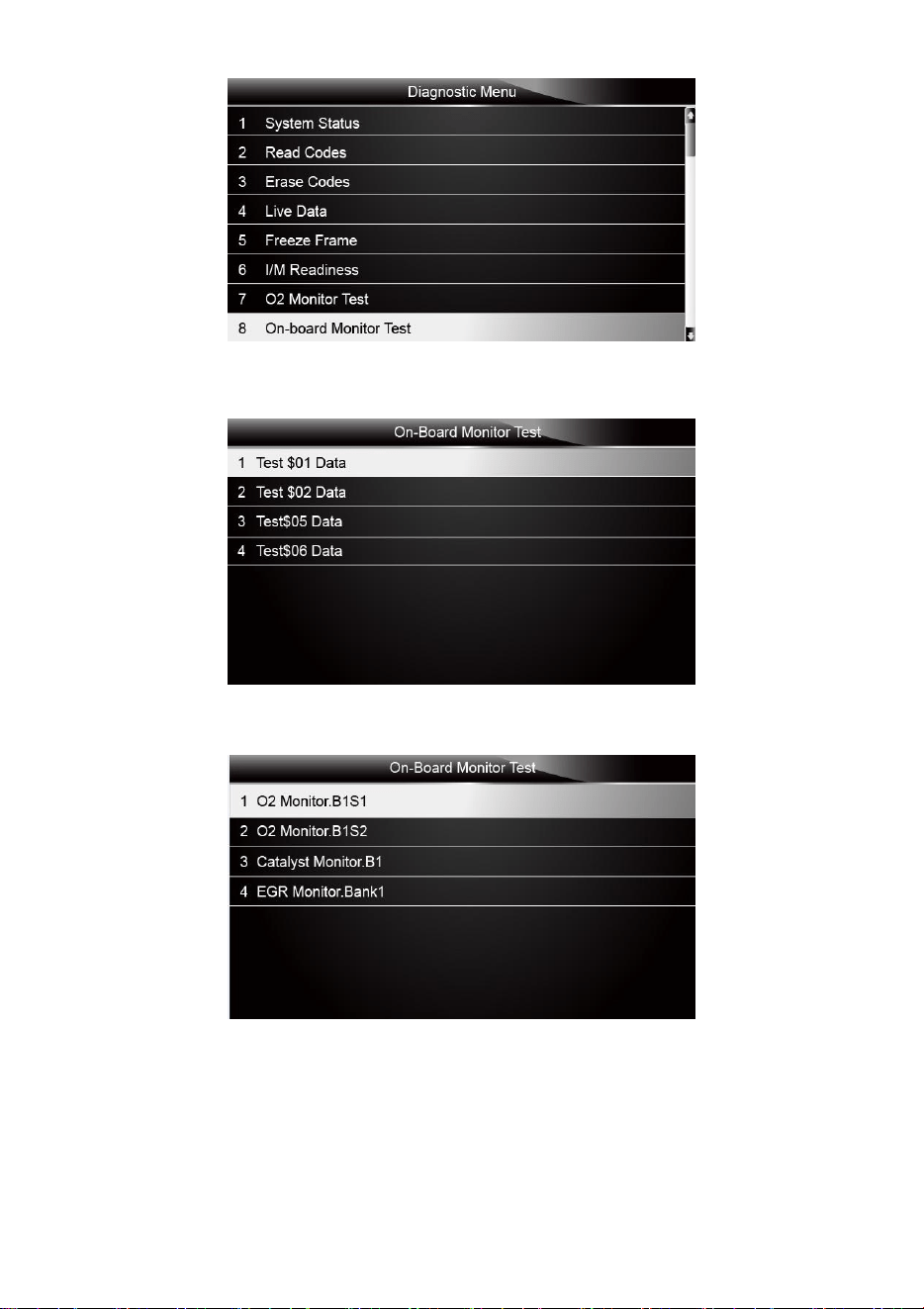
1. Scroll with the arrow keys to highlight On-Board Monitor Test from Diagnostic Menu and
press the ENTER key.
40
AD610 Elite ABS & Airbag Reset Tool Manual_English_V1.01
Figure 5-27 Sample Diagnostic Menu Screen
2. Depending on the protocol the vehicle used, one of these 2 screens shows.
Figure 5-28 Sample Non-CAN Vehicle Test Screen
Or
Figure 5-29 Sample CAN vehicle test screen
3. Scroll with the arrow keys to highlight a test group and press the ENTER key to confirm. A
screen with details of the selected sensor displays. Use the up and down arrow keys to scroll
through data to select lines, and left and right arrow keys to scroll back and forth through
different screens of data.
For non-CAN vehicles, test screen is illustrated as below:
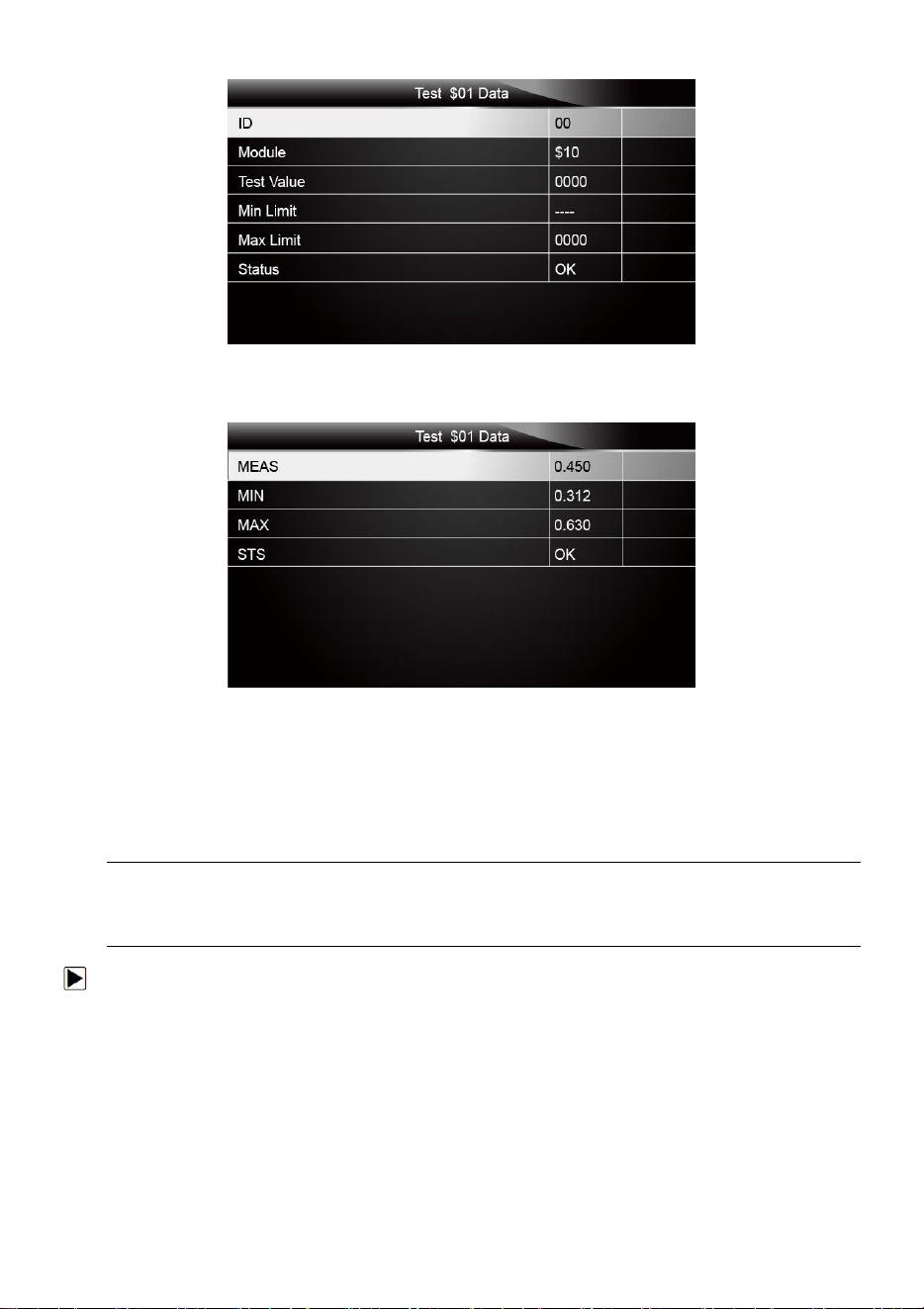
41
AD610 Elite ABS & Airbag Reset Tool Manual_English_V1.01
Figure 5-30 Sample Non-CAN vehicle test screen
For CAN vehicles, test screen is illustrated as below:
Figure 5-31 Sample Can vehicle test screen
4. Press the BACK key to exit and return.
5.9 Component Test
Component Test allows the scanner to control operation of vehicle components, tests or systems.
NOTE
●
Some manufacturers do not allow tools to control vehicle systems.
●
The manufacturer sets the criteria to automatically stop test. Refer to appropriate vehicle service
manual before using this function.
To perform a component test:
1. Scroll with the arrow keys to highlight Component Test from Diagnostic Menu and press the
ENTER key. A screen with a list of available tests displays.
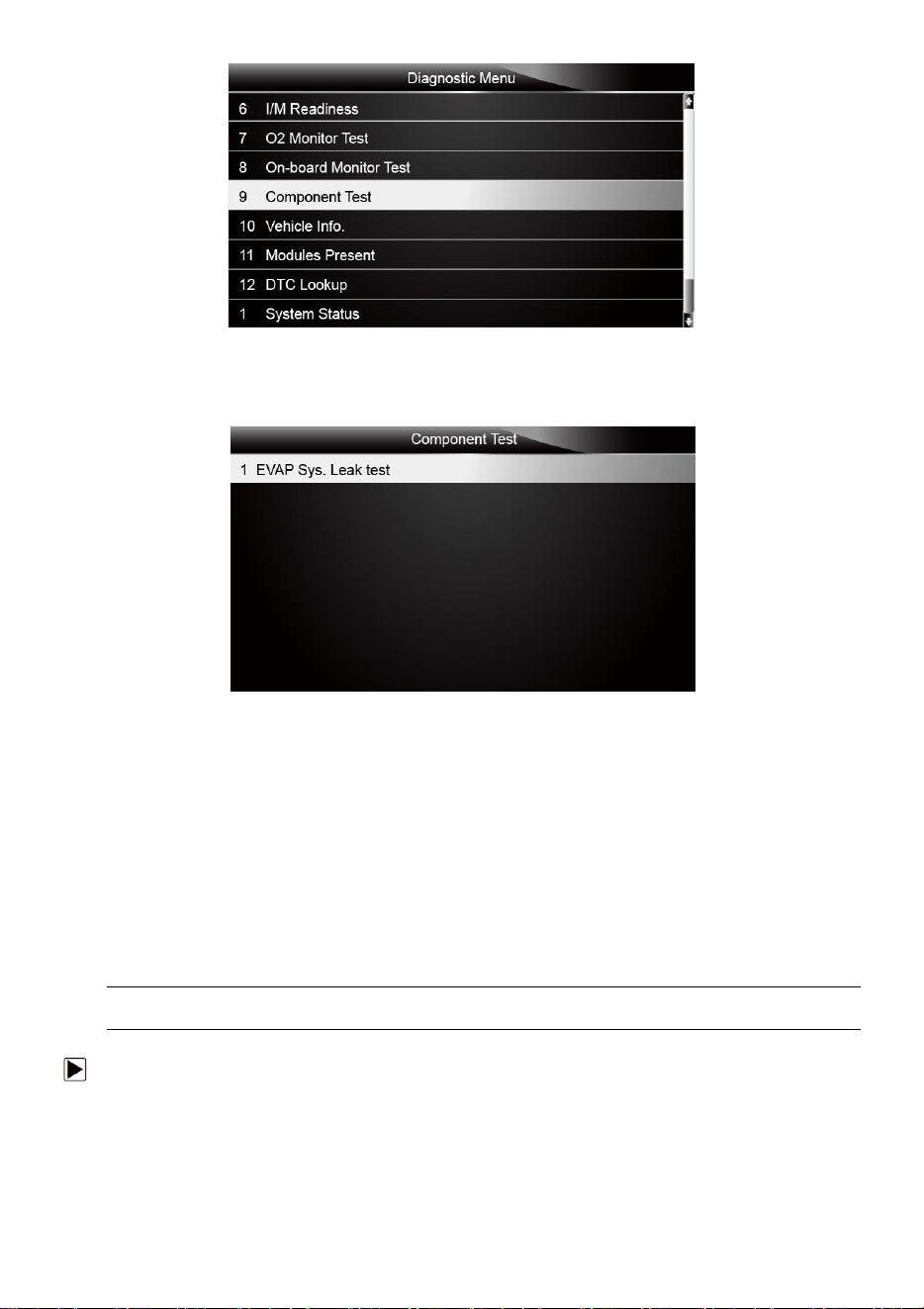
42
AD610 Elite ABS & Airbag Reset Tool Manual_English_V1.01
Figure 5-32 Sample Diagnostic Menu Screen
2. Scroll with the arrow keys to highlight a system or component, press the ENTER key to start
test and the scanner displays the message “Command Sent!”.
Figure 5-33 Sample Component test screen
3. Press the BACK key to exit and return.
5.10 Request Vehicle Information
Vehicle Information allows to request the vehicle’s VIN number, calibration ID(s) which identifies
software version in vehicle control module(s), calibration verification numbers (CVN(s)) and
in-use performance tracking on model year 2000 and newer OBD II compliant vehicles.
CVNs are calculated values required by OBD II regulations. They are reported to check if
emission-related calibrations have been changed. Multiple CVNs may be reported for a control
module. It may take several minutes to do the CVN calculation. In-use performance tracking
tracks performance of key readiness monitors.
NOTE
Available options will vary depending on the vehicle under test.
To request vehicle information:
1. Scroll with the arrow keys to highlight Vehicle Info. from Diagnostic Menu and press the
ENTER key.
43
AD610 Elite ABS & Airbag Reset Tool Manual_English_V1.01
Figure 5-34 Sample Diagnostic Menu Screen
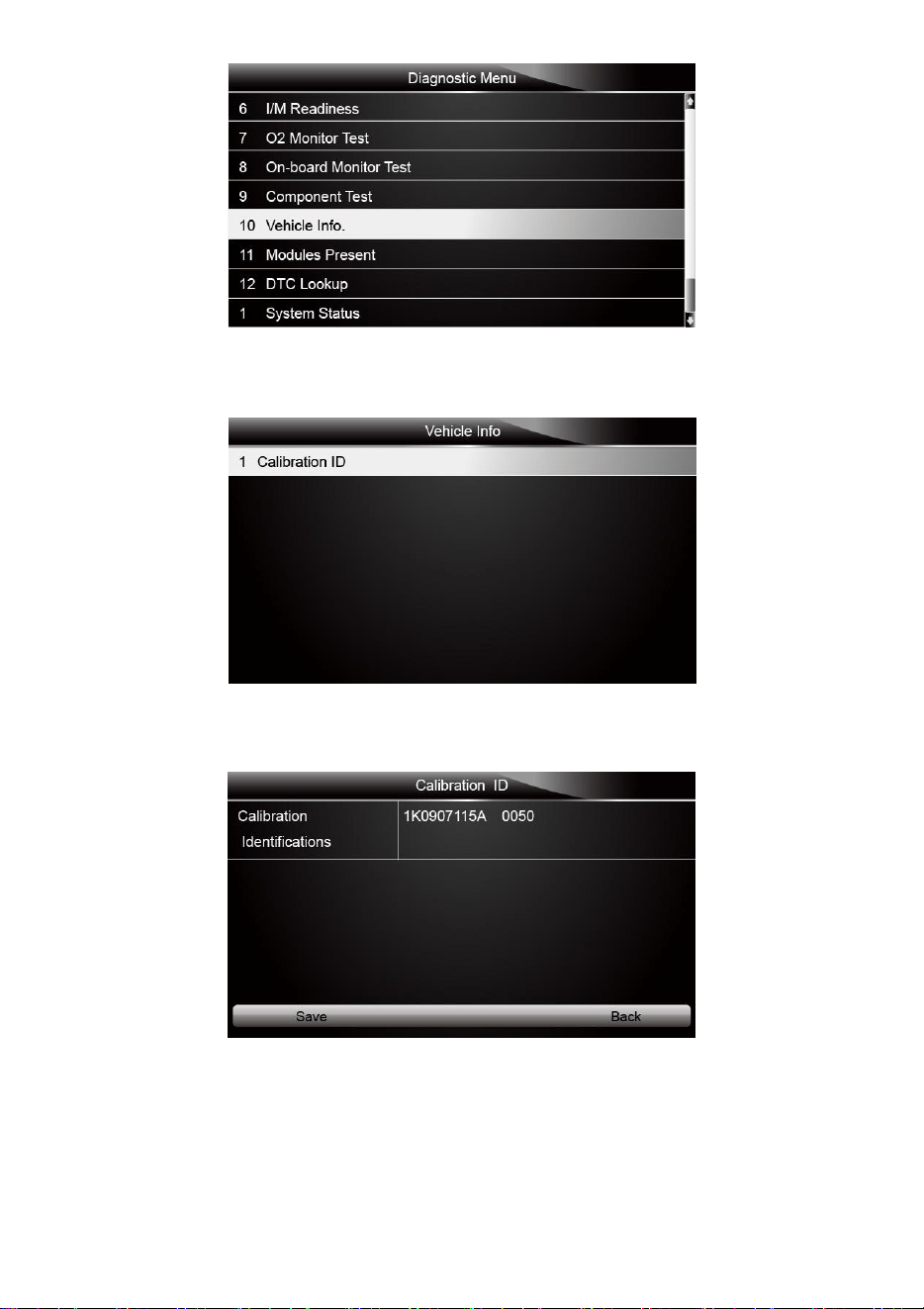
2. Follow on-screen instruction and send the command to read vehicle information. A screen with
a list of available options displays.
Figure 5-35 Sample Vehicle Info Screen
3. Scroll with the arrow keys to highlight an available option and press the ENTER key. A screen
with details of the selected option displays.
Figure 5-36 Sample Calibration ID Screen
4. Press function key Save to store the readiness data. Or use the BACK key to exit and return.
44
AD610 Elite ABS & Airbag Reset Tool Manual_English_V1.01
5.11 Modules Present
The scanner identifies module IDs and communication protocols for OBD2 modules in the
vehicle.
To view module IDs and communication types:
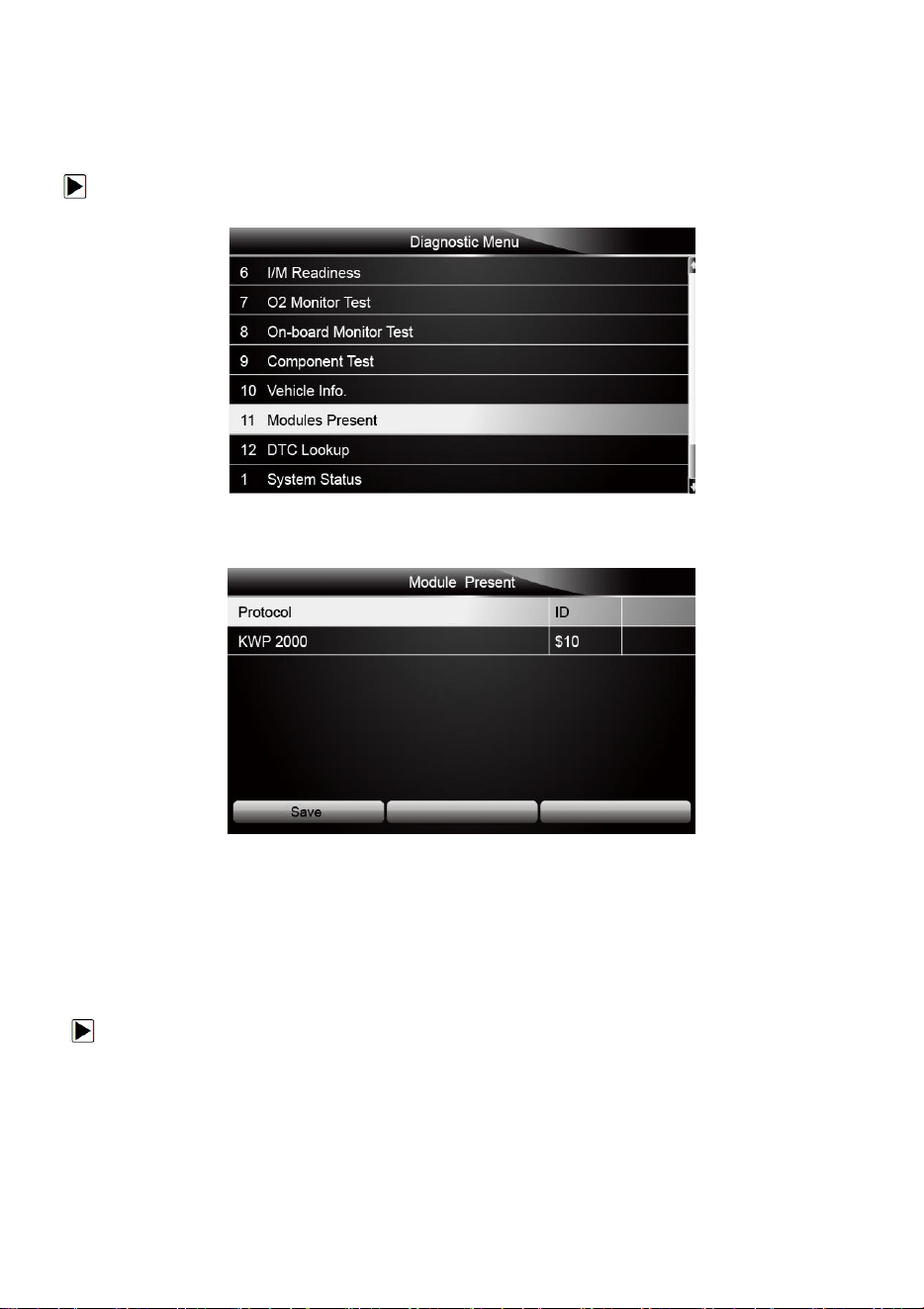
1. Scroll with the arrow keys to highlight Modules Present from Diagnostic Menu and press the
ENTER key.
Figure 5-37 Sample Diagnostic Menu Screen
2. A screen with the module IDs and protocols displays.
Figure 5-38 Sample Module Present Screen
3. Press function key Save to store the readiness data. Or use the BACK key to exit and return.
5.12 DTC Lookup
DTC Lookup menus allows to request DTC definitions stored in the scan tool.
To Look up DTCs:
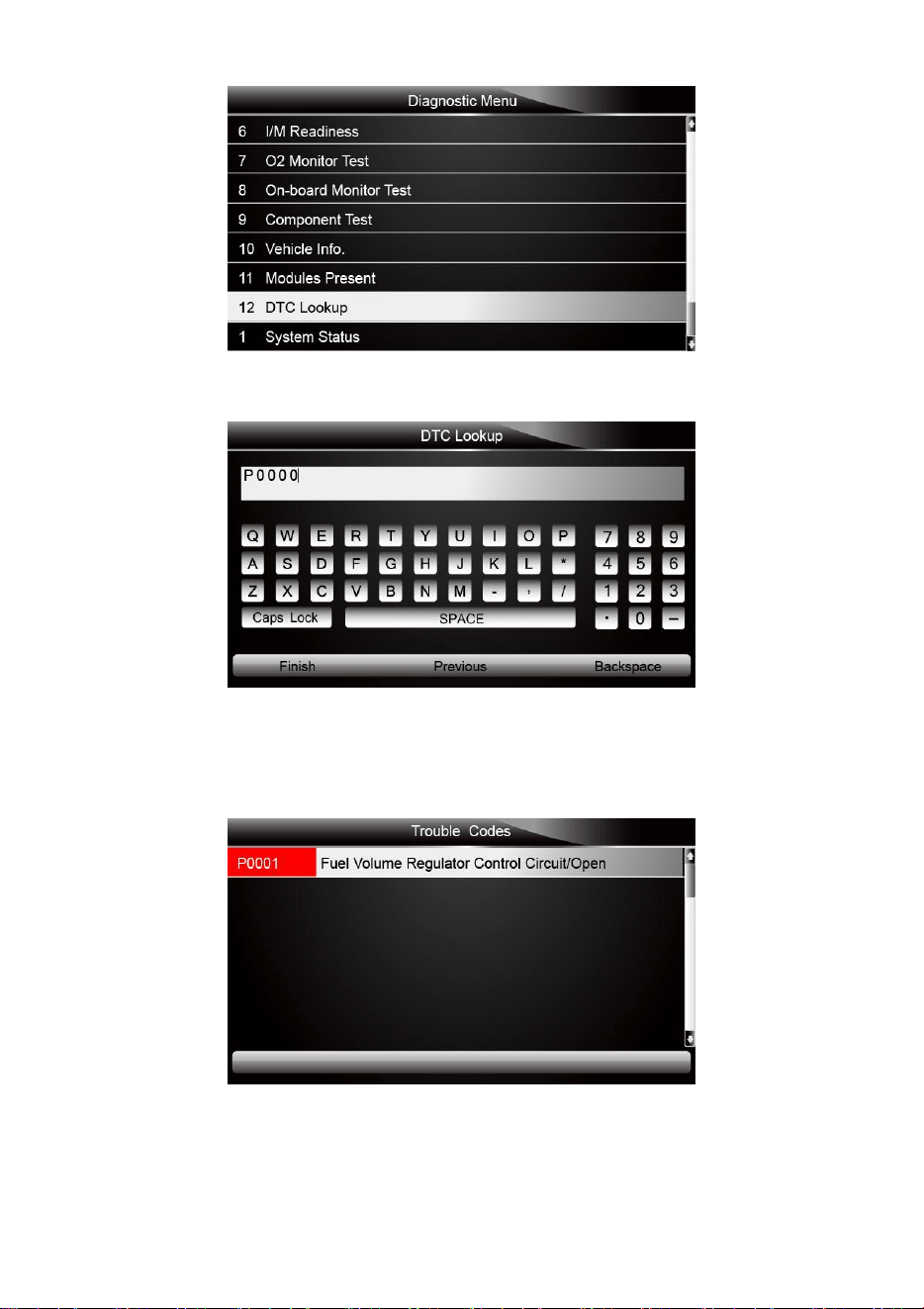
1. Scroll with the arrow keys to highlight DTC Lookup. from Diagnostic Menu and press the
ENTER key.
45
AD610 Elite ABS & Airbag Reset Tool Manual_English_V1.01
Figure 5-39 Sample Diagnostic Menu Screen
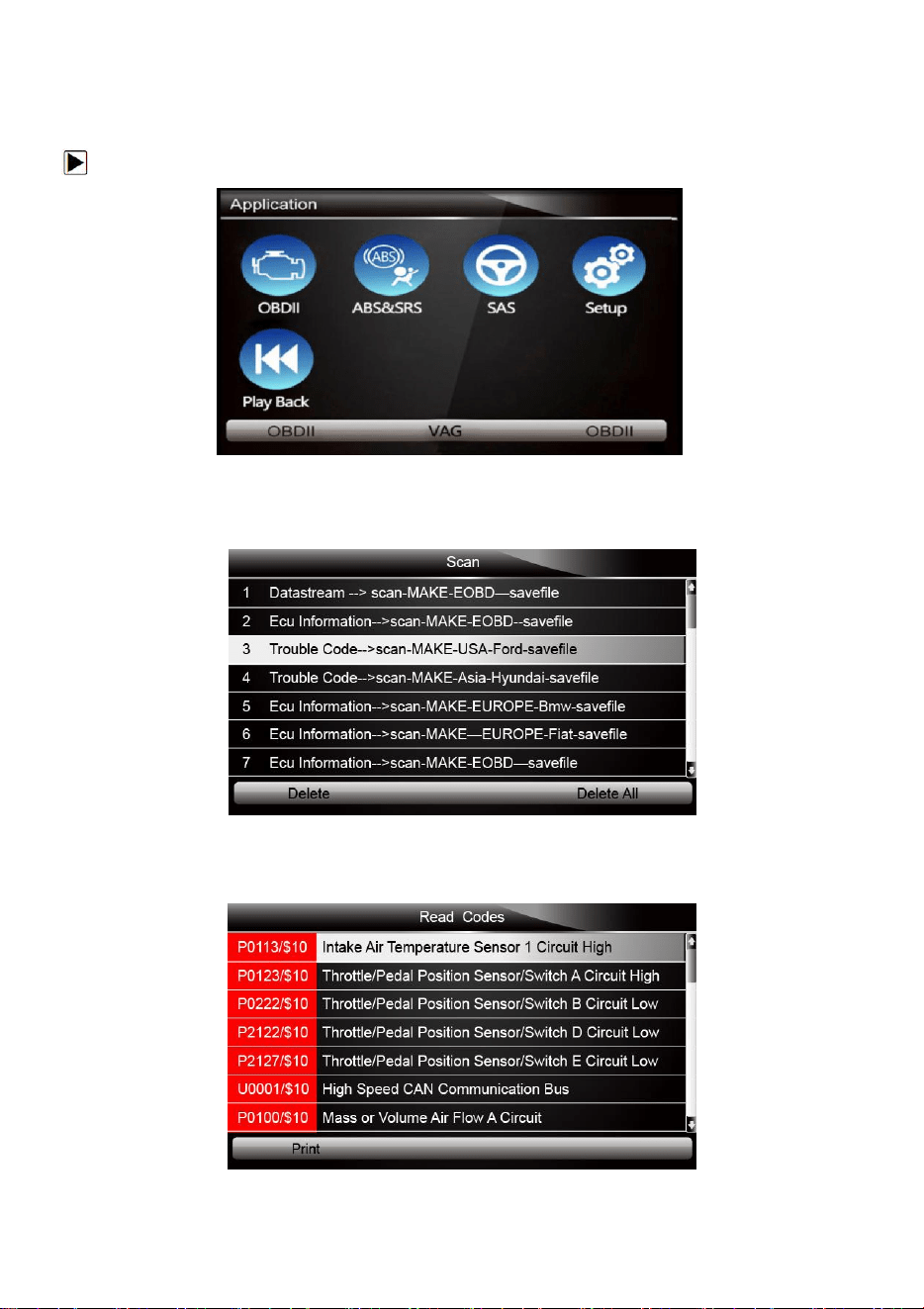
2. Enter a valid code number and press the function key Finish.
Figure 5-40 Sample DTC Lookup Screen
3. A screen with code number and its definition displays. If definition could not be found (SAE or
Manufacturer Specific), the scanner displays “DTC definition not found! Please refer to vehicle
service manual!” If a P1xxx, C1xxx, B1xxx or U1xxx code is entered, select a vehicle make to
look for DTC definitions. Press the Back key to exit.
Figure 5-41 Sample Trouble Codes Screen
46
AD610 Elite ABS & Airbag Reset Tool Manual_English_V1.01
6 Playback Data
The PlayBack option leads to screens for review of recorded test results.
To review recorded data:
1. Scroll with the arrow keys to highlight PlayBack from home screen and press the ENTER key.
Figure 6-1 Sample Home Screen
2. A screen with a list of test records displays. If no data is recorded, the message “No Data
available!” is displayed.
Figure 6-2 Sample Playback Screen
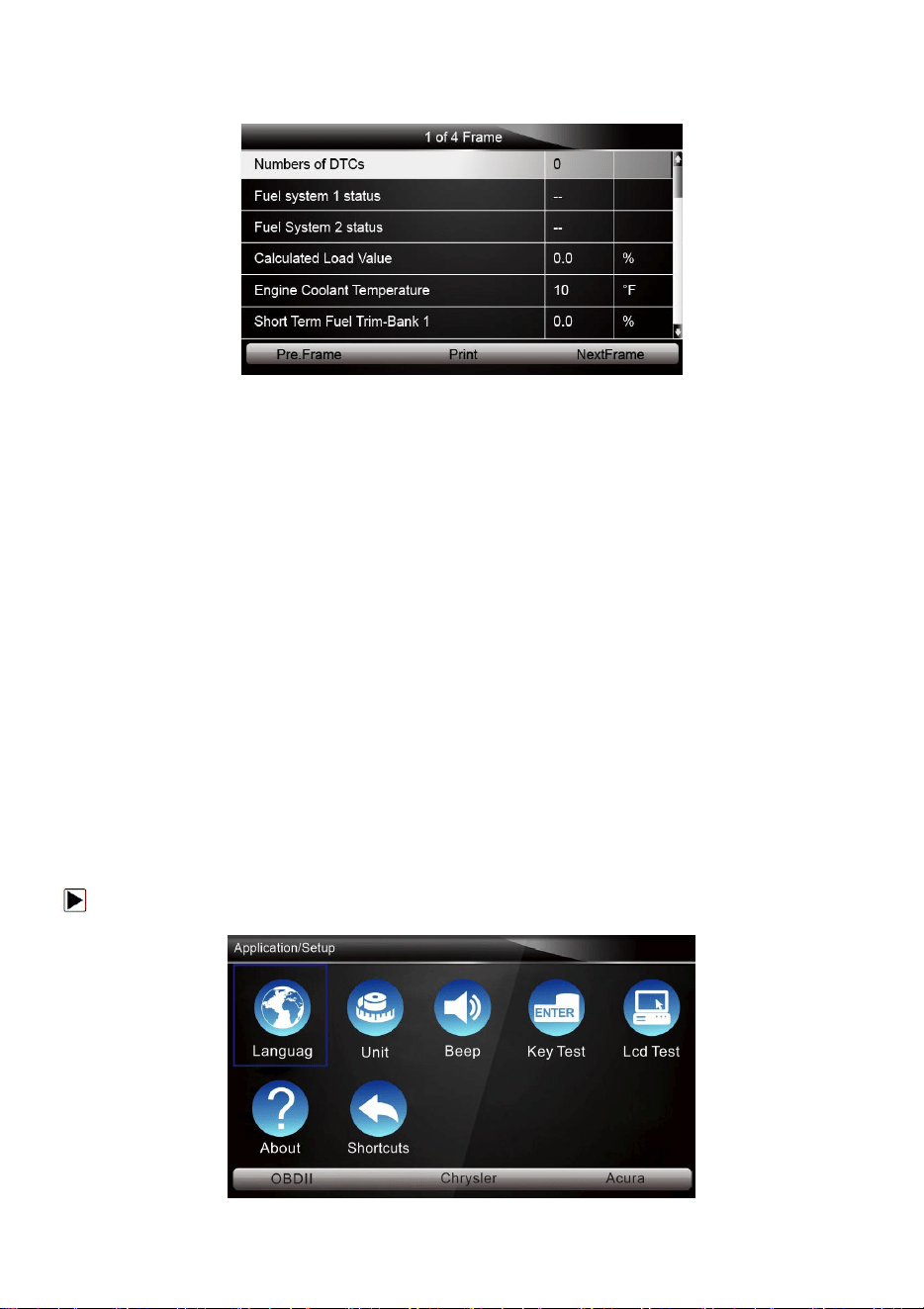
3. Scroll with the arrow keys to highlight a vehicle record and press the ENTER key. Details of the
test record displays. Use the up and down arrow keys to scroll through data to select lines.
Figure 6-3 Sample Test Data Details Screen
47
AD610 Elite ABS & Airbag Reset Tool Manual_English_V1.01
4. If you are reviewing live data or freeze frame data, use the function key Next Frame or Pre.
Frame to scroll through all possible frames when necessary.
Figure 6-4 Sample Test Data Details Screen
5. To erase a record, scroll with the arrow keys to highlight it and press the function key Delete.
To delete all records, press the function key Delete All. Answer Yes to delete and No to quit.
7 System Setup
This section illustrates how to program the scanner to meet your specific needs.
When Setup application is selected, a menu with available service options displays. Menu options
typically include:
● Language
● Unit
● Beep Set
● Key Test
● LCD Test
● About
● Shortcuts
7.1 Select Language
Selecting Language opens a screen that allows you to choose system language. The scan tool is
set to display English menus by default.
To configure system language:
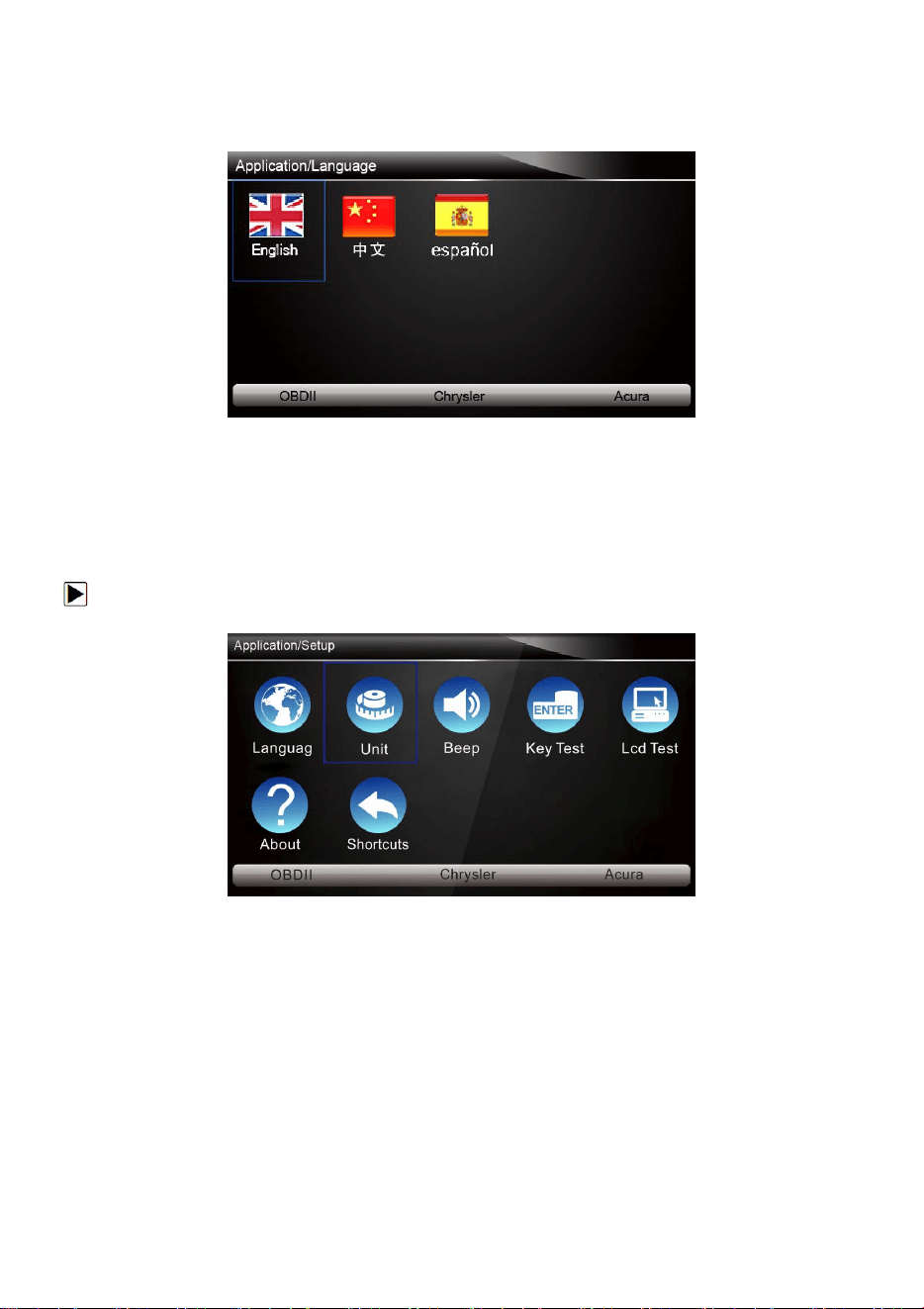
1. Scroll with the arrow keys to highlight Language from Setup menu and press the ENTER key.
48
AD610 Elite ABS & Airbag Reset Tool Manual_English_V1.01
Figure 7-1 Sample Setup Screen
2. Press the LEFT/RIGHT arrow key select a language and press the ENTER key to confirm.
Press the Back key to exit and return.
Figure 7-2 Sample Language Selection Screen
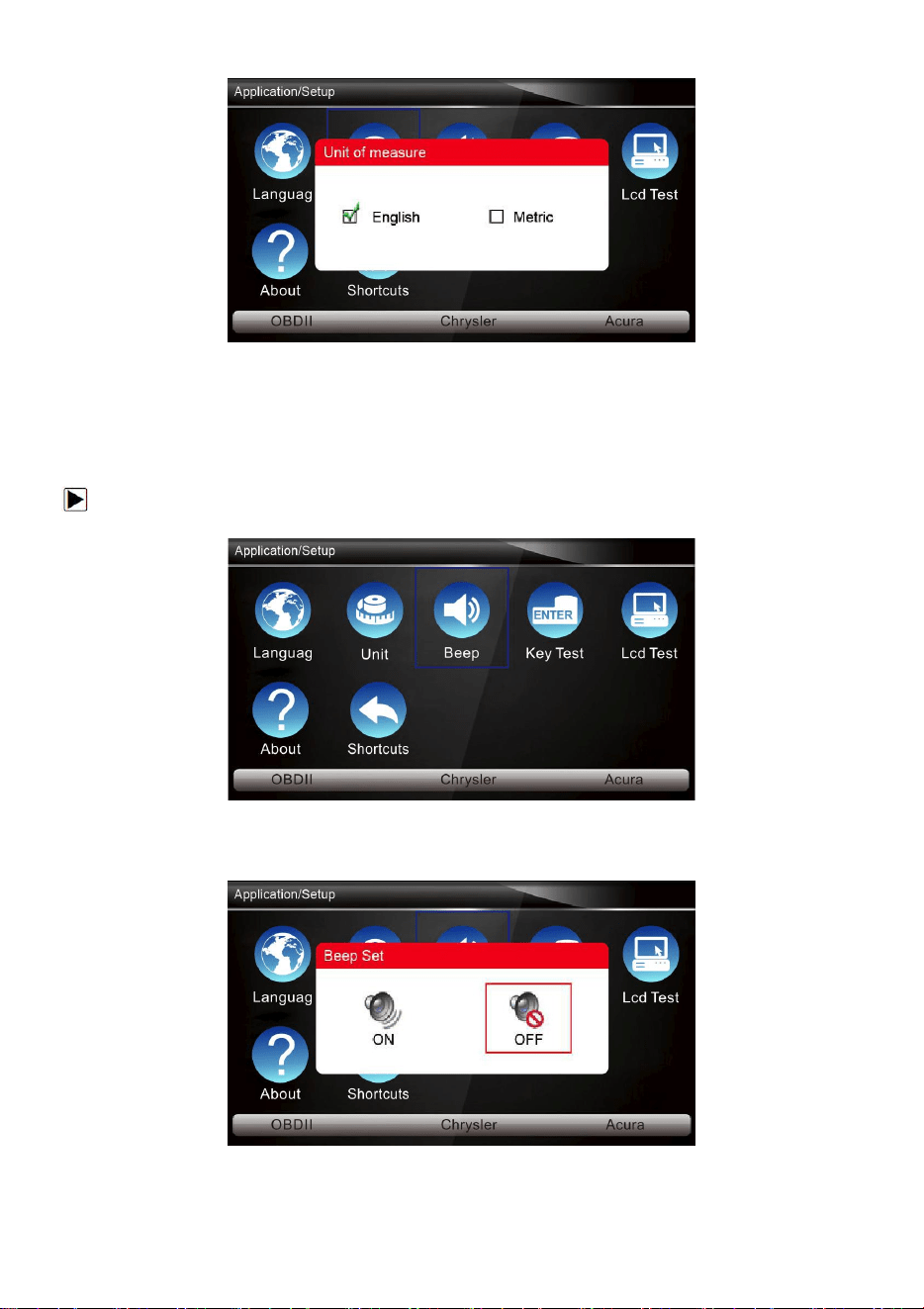
7.2 Change Units
Selecting Unit opens a dialog box that allows you to choose between US customary or metric
units of measure.
To change the unit setup:
1. Scroll with the arrow keys to highlight Units from Setup menu and press the ENTER key.
Figure 7-3 Sample Setup Screen
2. Press the LEFT/RIGHT arrow key select an item and press the ENTER key to save and return.
49
AD610 Elite ABS & Airbag Reset Tool Manual_English_V1.01
Figure 7-4 Sample Language Selection Screen
7.3 Configure Beeper
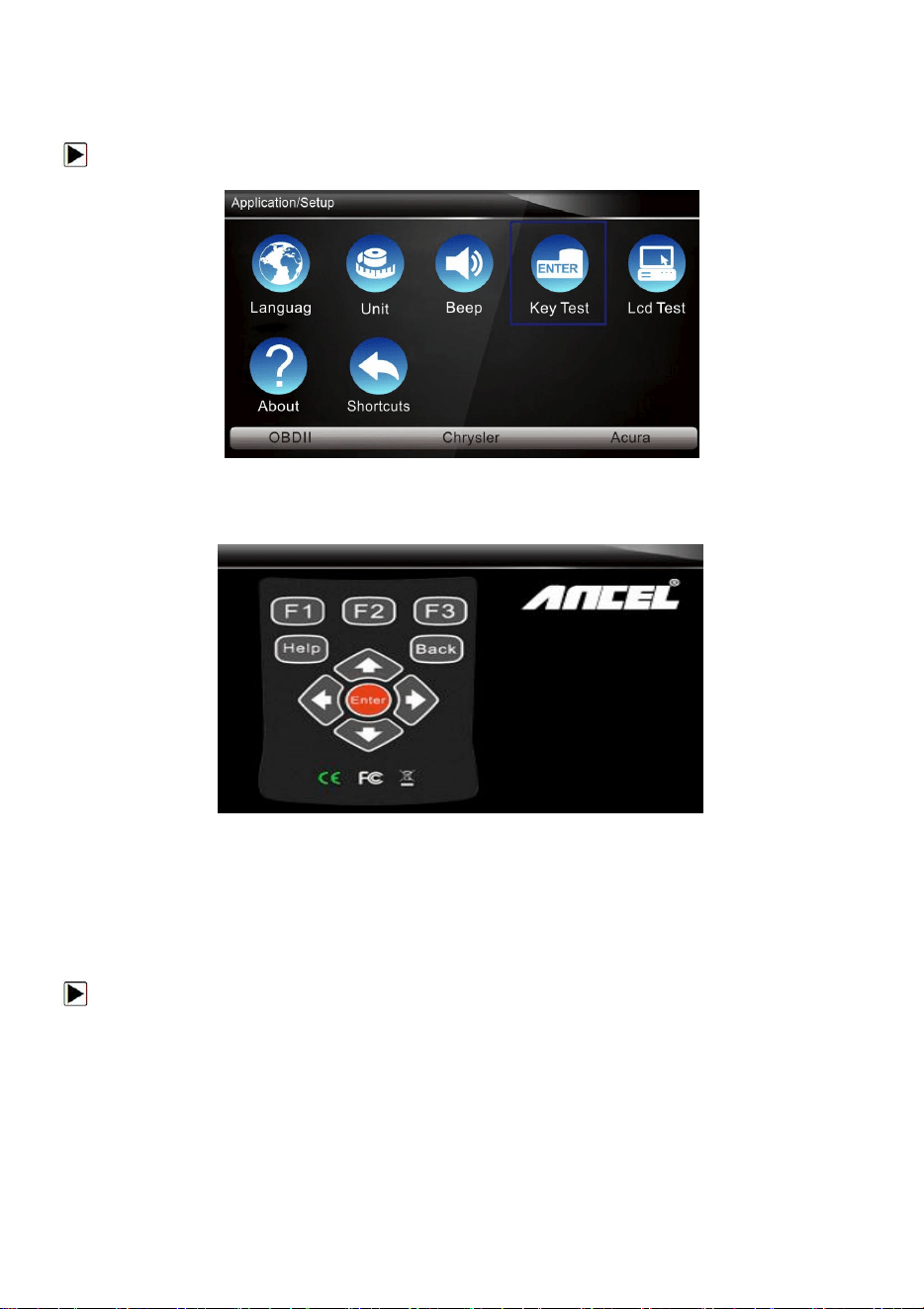
Selecting Beep Set opens a dialog box that allows you to turn on/off the beeper.
To turn on/off the beeper:
1. Scroll with the arrow keys to highlight Beep Set from Setup menu and press the ENTER key.
Figure 7-5 Sample Setup Screen
2. Press the LEFT/RIGHT arrow key select an item and press the ENTER key to save and return.
Figure 7-6 Sample Beeper On/Off Selection Screen
50
AD610 Elite ABS & Airbag Reset Tool Manual_English_V1.01
7.4Test Keypad
Selecting Key Test option opens a screen that allows you to check the functionality of the keypad.
To test the keypad:
1. Scroll with the arrow keys to highlight Key Test from Setup menu and press the ENTER key.
Figure7-7 Sample Setup Screen
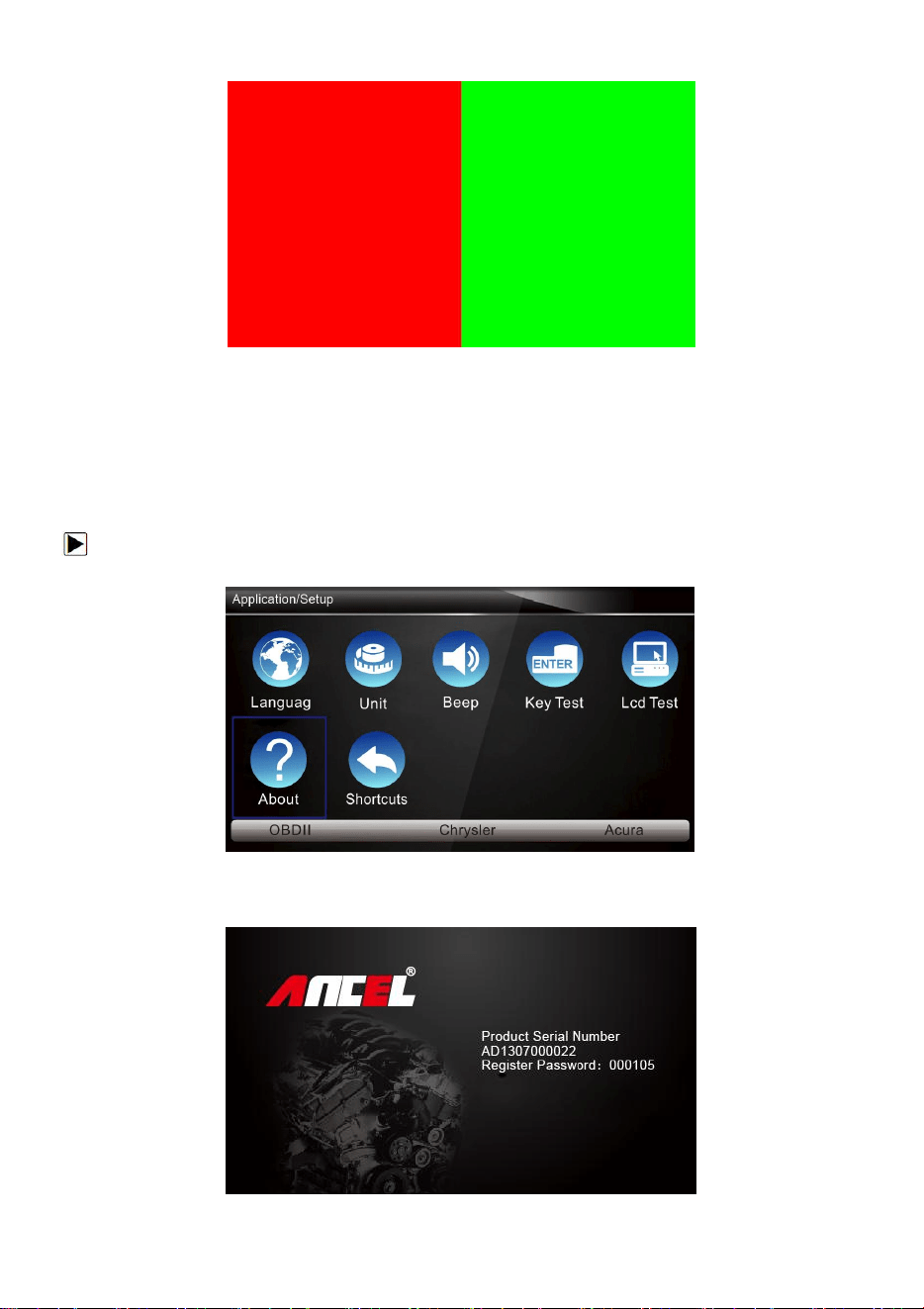
2. Press any key to start test. The virtue key corresponding with the key you pressed will be
highlighted on the screen if it works correctly.
Figure 7-8 Sample Key Test Screen
3. To quit the test, click the F2 function key twice.
7.5 LCD Keypad
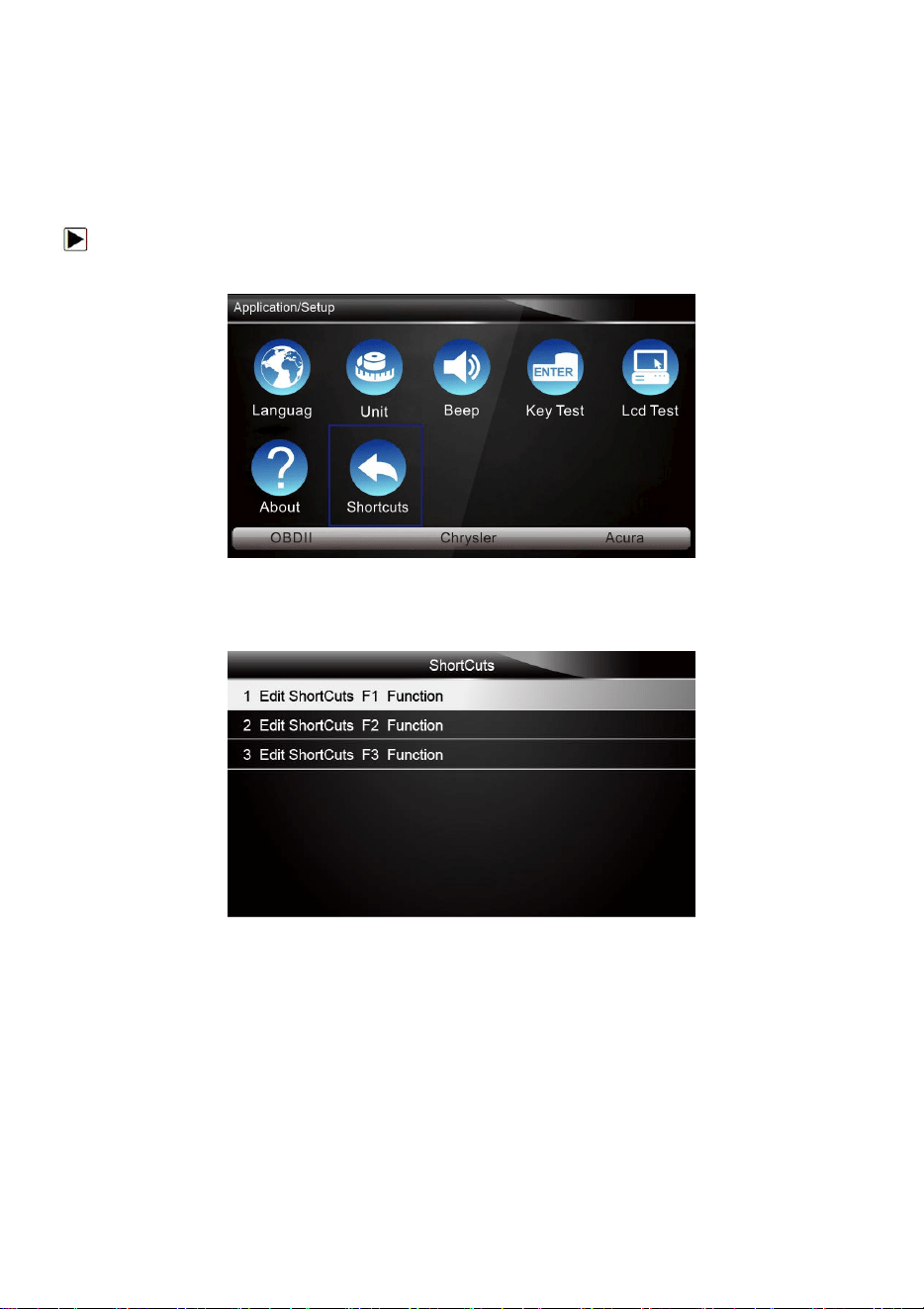
Selecting LCD Test option opens a screen that allows you to check the functionality of the display.
To test the display:
1. Scroll with the arrow keys to highlight LCD Test from Setup menu and press the ENTER key to
start test. Check if there are any missing spots in the LCD screen.
51
AD610 Elite ABS & Airbag Reset Tool Manual_English_V1.01
Figure 7-9 Sample LCD Test Screen
2. To quit the test, press the Back key.
7.6 Tool Information
Selecting About option opens a screen that show information about your scan tool, such as serial
number and register password which may be required for product registration.
To view information of your scan tool:
1. Scroll with the arrow keys to highlight About from Setup menu and press the ENTER key.
Figure 7-10 Sample Setup screen
2. A screen with detailed information of the scanner displays.
52
AD610 Elite ABS & Airbag Reset Tool Manual_English_V1.01
Figure 7-11 Sample Tool Information Screen
3. Press the Back key to exit and return to the Setup menu.
7.7 Configure Shortcut Keys
Selecting Shortcuts option lets you to change the functionality of the shortcut buttons.
To assign a function to a shortcut button:
1. Scroll with the arrow keys to highlight Shortcuts from Setup menu and press the ENTER key.
A screen with available shortcut keys displays.
Figure 7-12 Sample Setup screen
2. Press the UP/DOWN arrow key select an shortcut key and press the ENTER key. A screen with
a list of loaded applications displays.
Figure 7-13 Sample ShortCuts Screen
3. Scroll with the UP/DOWN arrow keys to highlight an application and press the ENTER key to
assign the application to the shortcut key.
4. Press any key to exit and return.
8 Update
The scanner can be updated to keep you stay current with the latest development of diagnosis.
This section illustrates how to register and update your scan tool.

53
AD610 Elite ABS & Airbag Reset Tool Manual_English_V1.01
8.1 Register the Scanner
If you are new to ANCEL, please register the scanner first. All of your scanners can be registered
on one ANCEL ID.
To register the scanner:
1. Visit our site www.anceldirect.com and then select Register to create an ANCEL ID and
register your scan tool. Alternatively, please visit our website and download the update tool
AncelScanner to complete the registration.
2. Select your scanner part number, enter your serial number and initial register password which
can be found by turning on your scan tool and selecting Setup>About, and click Submit to
continue.
3. Read through our Register Information and click Agree to continue.
4. Create a unique user name and password, complete the registration form and then click
Submit to create your ID. When your ID has been created, you are allowed to view all
programs associated with your tool, download updates, edit your profile, leave us feedbacks
and join our community to share your ideas and your stories about our products.
5. A Submit OK message will comes up if it is registered successfully.
NOTE
If the user name is different from the email you filled when registration, please input registered
email rather than your user name to retrieve your password.
8.2 Update the Scanner
To update your scanner, you need following tools:
● the scan tool
● update tool AncelScanner
● PC or laptop with USB ports and Internet explorer
● Internet service
To be able to use update tool, PC or laptop must meet the following minimum requirements:
● Operation System: Win98/NT, Win ME, Win2000, Win XP, VISTA and Windows 7.
● CPU: Intel PⅢ or better
● RAM: 64MB or better
● Hard Disk Space: 30MB or better
● Display: 800*600 pixel, 16 byte true color display or better
● Internet Explorer 4.0 or newer
NOTE
Before updating, please make sure your network works correctly and the SD card has been
identified.
1. Download the update tool AncleScanner from our site www.anceldirect.com and save the
application in computer disk.
2. Unzip the update tool file. Follow instructions on computer screen to install the tool and driver.
3. Double click the desktop icon to launch the application.
4. Remove the memory card from the scanner, put it into the card reader and plug the reader into
the computer.
5. Login with your ANCEL ID and password.
6.Click My Updates, and all updates applicable to your scanner displays.

54
AD610 Elite ABS & Airbag Reset Tool Manual_English_V1.01
7.Click the check box(es) in front of the software(s) you wish to update and then click the Update
button to download and update. When download completed, the downloaded programs start to
update automatically.
8.An Update Complete message displays once the updates completed.
NOTE
If “Update Failed” dialog comes up, it indicates that the software updates failed. Please check the
network connection or SD card. If the problem still exists, please contact with your local dealer for
assistance.
6. To view installed items, click the Installed Software tab.
7. To uninstall a software or all software select them and click the Uninstall button. And the
uninstalled items can be found in the Updates screen.