DB68-07821A-06
QUESTIONS OR COMMENTS?
Samsung, PO Box 12987, Blackrock, Co. Dublin. IE
or Euro QA Lab. Saxony Way, Yateley, Hampshire GU46 6GG, UK
COUNTRY CALL OR VISIT US ONLINE AT
UK 0333 000 0333 www.samsung.com/uk/support
IRELAND (EIRE) 0818 717100 www.samsung.com/ie/support
GERMANY 06196 77 555 77 www.samsung.com/de/support
FRANCE 01 48 63 00 00 www.samsung.com/fr/support
ITALIA 800-SAMSUNG (800.7267864) www.samsung.com/it/support
SPAIN 91 175 00 15 www.samsung.com/es/support
PORTUGAL 808 207 267 www.samsung.com/pt/support
LUXEMBURG 261 03 710 www.samsung.com/be_fr/support
NETHERLANDS 088 90 90 100 www.samsung.com/nl/support
BELGIUM 02-201-24-18
www.samsung.com/be/support (Dutch)
www.samsung.com/be_fr/support (French)
NORWAY 21629099 www.samsung.com/no/support
DENMARK 707 019 70 www.samsung.com/dk/support
FINLAND 030-6227 515 www.samsung.com//support
SWEDEN 0771-400 300 www.samsung.com/se/support
POLAND
801-172-678* lub +48 22 607-93-33*
* (opłata według taryfy operatora)
http://www.samsung.com/pl/support/
HUNGARY 0680SAMSUNG (0680-726-7864) www.samsung.com/hu/support
AUSTRIA 0800 72 67 864 (0800-SAMSUNG) www.samsung.com/at/support
SWITZERLAND 0800 726 786
www.samsung.com/ch/support (German)
www.samsung.com/ch_fr/support (French)
CZECH 800 - SAMSUNG (800-726786) www.samsung.com/cz/support
SLOVAKIA
0800 - SAMSUNG
(0800-726 786)
www.samsung.com/sk/support
CROATIA 072 726 786 www.samsung.com/hr/support
BOSNIA 055 233 999 www.samsung.com/support
MONTENEGRO 020 405 888 www.samsung.com/support
SLOVENIA 080 697 267 (brezplačna številka) www.samsung.com/si/support
SERBIA 011 321 6899 www.samsung.com/rs/support
ALBANIA 045 620 202 www.samsung.com/al/support
BULGARIA
0800 111 31 - Безплатен за всички оператори
*3000 - Цена на един градски разговор или според тарифата на
мобилният оператор
09:00 до 18:00 - Понеделник до Петък
www.samsung.com/bg/support
ROMANIA
0800872678 - Apel gratuit
*8000 - Apel tarifat în reţea
www.samsung.com/ro/support
CYPRUS 8009 4000 only from landline, toll free
www.samsung.com/gr/support
GREECE
80111-SAMSUNG (80111 726 7864) only from land line
(+30) 210 6897691 from mobile and land line
LITHUANIA 8-800-77777 www.samsung.com/lt/support
LATVIA 8000-7267 www.samsung.com/lv/support
ESTONIA 800-7267 www.samsung.com/ee/support
Air conditioner
User manual
AM***NNN*EH***
• Thank you for purchasing this Samsung air conditioner.
• Before operating this unit, please read this user manual carefully and retain it for future reference.
2
English
Contents
Correct Disposal of This Product
(Waste Electrical & Electronic Equipment)
(Applicable in countries with separate collection systems)
This marking on the product, accessories or literature indicates that the product and its electronic accessories (e.g.
charger, headset, USB cable) should not be disposed of with other household waste at the end of their working life. To
prevent possible harm to the environment or human health from uncontrolled waste disposal, please separate these
items from other types of waste and recycle them responsibly to promote the sustainable reuse of material resources.
Household users should contact either the retailer where they purchased this product, or their local government office, for
details of where and how they can take these items for environmentally safe recycling.
Business users should contact their supplier and check the terms and conditions of the purchase contract. This product
and its electronic accessories should not be mixed with other commercial wastes for disposal.
For information on Samsung’s environmental commitments and product regulatory obligations, e.g. REACH, visit our
sustainability page available via www.samsung.com
Safety Information 3
Safety Information 3
At a Glance 10
Indoor Unit Overview 10
Operation Features 11
Operating temperature and humidity • Pairing an indoor unit with a remote control
Cleaning and Maintenance 12
Cleaning and Maintaining 12
Cleaning the indoor unit exterior • Cleaning the outdoor unit heat exchanger •
Cleaning the air filter • Periodical maintenance • Troubleshooting
Technical specifications 19
Information about refrigerant 19
Important information: regulation regarding the refrigerant used
Installation Procedure 20
Installation Procedure 20
3
English
Safety Information
Before using your new air conditioner, please read this manual thoroughly
to ensure that you know how to safely and efficiently operate the extensive
features and functions of your new appliance.
Because the following operating instructions cover various models, the
characteristics of your air conditioner may differ slightly from those described in
this manual. If you have any questions, call your nearest contact centre or find
help and information online at www.samsung.com.
WARNING
Hazards or unsafe practices that may result in severe personal injury or death.
CAUTION
Hazards or unsafe practices that may result in minor personal injury or property
damage.
Follow directions.
Do NOT attempt.
Make sure the machine is grounded to prevent electric shock.
Cut-off the power supply.
Do NOT disassemble.
FOR INSTALLATION
WARNING
Use the power line with the power specifications of the product or higher
and use the power line for this appliance only. In addition, do not use an
extension line.
• Extending the power line may result in electric shock or fire.
• Do not use an electric transformer. This may result in electric shock or
fire.
• If the voltage/frequency/rated current condition is different, it may cause
fire.
Safety Information
Safety Information
Safety Information
4
English
Safety Information
The installation of this appliance must be performed by a qualified
technician or service company.
• Failing to do so may result in electric shock, fire, explosion, problems with
the product, or injury.
Install a switch and circuit breaker dedicated to the air conditioner.
• Failing to do so may result in electric shock or fire.
Fix the outdoor unit firmly so that the electric part of the outdoor unit is
not exposed.
• Failing to do so may result in electric shock or fire.
Do not install this appliance near a heater, inflammable material. Do
not install this appliance in a humid, oily or dusty location, in a location
exposed to direct sunlight and water (rain drops). Do not install this
appliance in a location where gas may leak.
• This may result in electric shock or fire.
Never install the outdoor unit in a location such as on a high external wall
where it could fall.
• If the outdoor unit falls, it may result in injury, death or property damage.
This appliance must be properly grounded. Do not ground the appliance to
a gas pipe, plastic water pipe, or telephone line.
• Failure to do so may result in electric shock, fire, an explosion, or other
problems with the product.
• Never plug the power cord into a socket that is not grounded correctly
and make sure that it is in accordance with local and national codes.
5
English
Safety Information
CAUTION
Install your appliance on a level and hard floor that can support its weight.
• Failing to do so may result in abnormal vibrations, noise, or problems with
the product.
Install the drain hose properly so that water is drained correctly.
• Failing to do so may result in water overflowing and property damage.
Avoid adding drain to waste pipes as odours may arise in the future.
When installing the outdoor unit, make sure to connect the drain hose so
that draining is performed correctly.
• The water generated during the heating operation in the outdoor unit
may overflow and result in property damage.
In particular, in winter, if a block of ice falls, it may result in injury, death
or property damage.
FOR POWER SUPPLY
WARNING
When the circuit breaker is damaged, contact your nearest service centre.
Do not pull or excessively bend the power line. Do not twist or tie the
power line. Do not hook the power line over a metal object, place a heavy
object on the power line, insert the power line between objects, or push
the power line into the space behind the appliance.
• This may result in electric shock or fire.
CAUTION
When not using the air conditioner for a long period of time or during a
thunder/lightning storm, cut the power at the circuit breaker.
• Failing to do so may result in electric shock or fire.
Safety Information
6
English
Safety Information
FOR USING
WARNING
If the appliance is flooded, please contact your nearest service centre.
• Failing to do so may result in electric shock or fire.
If the appliance generates a strange noise, a burning smell or smoke,
unplug the power plug immediately and contact your nearest service
centre.
• Failing to do so may result in electric shock or fire.
In the event of a gas leak (such as propane gas, LP gas, etc.), ventilate
immediately without touching the power line. Do not touch the appliance
or power line.
• Do not use a ventilating fan.
• A spark may result in an explosion or fire.
To reinstall the air conditioner, please contact your nearest service centre.
• Failing to do so may result in problems with the product, water leakage,
electric shock, or fire.
• A delivery service for the product is not provided. If you reinstall the
product in another location, additional construction expenses and an
installation fee will be charged.
• Especially, when you wish to install the product in an unusual location
such as in an industrial area or near the seaside where it is exposed to salt
in the air, please contact your nearest service centre.
Do not touch the circuit breaker with wet hands.
• This may result in electric shock.
Do not turn the air conditioner off with the circuit breaker while it is
operating.
• Turning the air conditioner off and then on again with the circuit breaker
may cause a spark and result in electric shock or fire.
7
English
Safety Information
After unpacking the air conditioner, keep all packaging materials well
out of the reach of children, as packaging materials can be dangerous to
children.
• If a child places a bag over its head, it may result in suffocation.
Do not touch the front panel with your hands or fingers during the heating
operation.
• This may result in electric shock or burns.
Do not insert your fingers or foreign substances into the outlet when the
air conditioner is operating or the front panel is closing.
• Take special care that children do not injure themselves by inserting their
fingers into the product.
Do not insert your fingers or foreign substances into the air inlet/outlet of
the air conditioner.
• Take special care that children do not injure themselves by inserting their
fingers into the product.
Do not strike or pull the air conditioner with excessive force.
• This may result in fire, injury, or problems with the product.
Do not place an object near the outdoor unit that allows children to climb
onto the machine.
• This may result in children seriously injuring themselves.
Do not use this air conditioner for long periods of time in badly ventilated
locations or near infirm people.
• Since this may be dangerous due to a lack of oxygen, open a window at
least once an hour.
If any foreign substance such as water has entered the appliance, cut the
power by unplugging the power plug and turning the circuit breaker off
and then contact your nearest service centre.
• Failing to do so may result in electric shock or fire.
Do not attempt to repair, disassemble, or modify the appliance yourself.
• Do not use any fuse (such as copper, steel wire, etc.)other than the
standard fuse.
• Failing to do so may result in electric shock, fire, problems with the
product, or injury.
Safety Information
8
English
Safety Information
CAUTION
Do not place objects or devices under the indoor unit.
• Water dripping from the indoor unit may result in fire or property damage.
Check that the installation frame of the outdoor unit is not broken at least
once a year.
• Failing to do so may result in injury, death or property damage.
Max current is measured according to IEC standard for safety and current
is measured according to ISO standard for energy efficiency.
Do not stand on top of the appliance or place objects (such as laundry,
lighted candles, lighted cigarettes, dishes, chemicals, metal objects, etc.)
on the appliance.
• This may result in electric shock, fire, problems with the product, or injury.
Do not operate the appliance with wet hands.
• This may result in electric shock.
Do not spray volatile material such as insecticide onto the surface of the
appliance.
• As well as being harmful to humans, it may also result in electric shock,
fire or problems with the product.
Do not drink the water from the air conditioner.
• The water may be harmful to humans.
Do not apply a strong impact to the remote controller and do not
disassemble the remote controller.
Do not touch the pipes connected with the product.
• This may result in burns or injury.
Do not use this air conditioner to preserve precision equipment, food,
animals, plants or cosmetics, or for any other unusual purposes.
• This may result in property damage.
Avoid directly exposing humans, animals or plants to the air flow from the
air conditioner for long periods of time.
• This may result in harm to humans, animals or plants.
9
English
Safety Information
This appliance is not intended for use by persons (including children) with
reduced physical, sensory or mental capabilities, or lack of experience and
knowledge, unless they have been given supervision or instruction concerning
use of the appliance by a person responsible for their safety. Children should
be supervised to ensure that they do not play with the appliance.
For use in Europe: This appliance can be used by children aged from 8 years
and above and persons with reduced physical, sensory or mental capabilities
or lack of experience and knowledge if they have been given supervision or
instruction concerning use of the appliance in a safe way and understand the
hazards involved. Children shall not play with the appliance. Cleaning and
user maintenance shall not be made by children without supervision.
FOR CLEANING
WARNING
Do not clean the appliance by spraying water directly onto it. Do not use
benzene, thinner, alcohol or acetone to clean the appliance.
• This may result in discoloration, deformation, damage, electric shock or
fire.
Before cleaning or performing maintenance, unplug the air conditioner
from the wall socket and wait until the fan stops.
• Failing to do so may result in electric shock or fire.
CAUTION
Take care when cleaning the surface of the heat exchanger of the outdoor
unit since it has sharp edges.
• To avoid cutting your fingers, wear thick cotton gloves when cleaning it.
• This should be done by a qualified technician please contact your installer
or service centre.
Do not clean the inside of the air conditioner by yourself.
• For cleaning inside the appliance, contact your nearest service centre.
• When cleaning the internal filter, refer to the descriptions in the ‘Cleaning
and Maintaining’ section.
• Failure to do may result in damage, electric shock or fire.
10
English
At a Glance
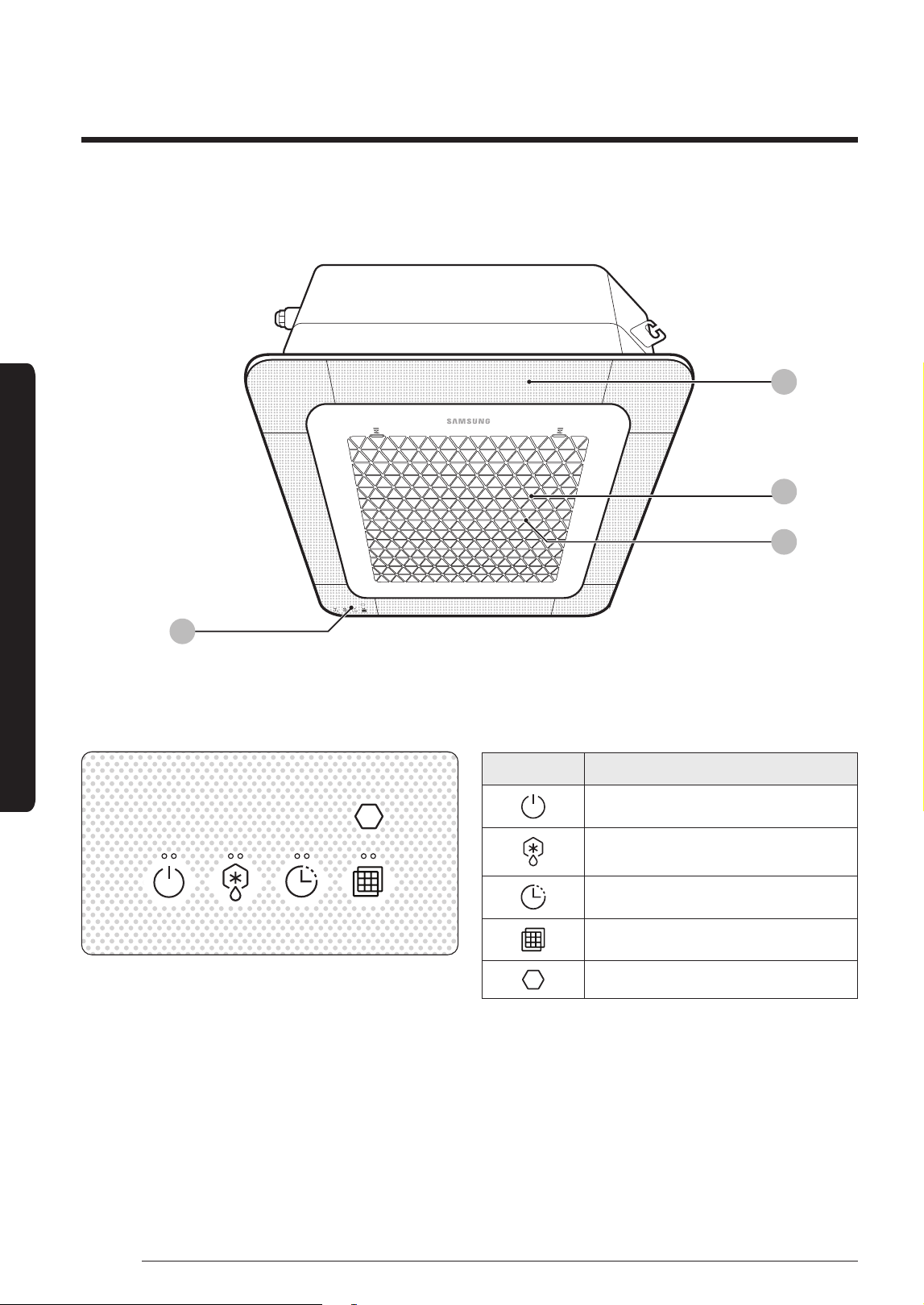
The indoor unit and its display may look slightly different from the illustration shown below,
depending on the model and the panel type.
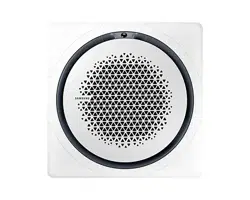
Indoor Unit Overview
02
04
03
01
At a Glance
01 Display
02 Air flow blade/Air outlet (inside) /
Wind-Free panel
(You can use the Wind-Free Cooling function
when the Cool, Dry, or Fan mode is running.)
(Refer to the remote control manual for
product operation.)
03 Air intake
04 Air filter (under the grille)
Indication Function
On/Off operation indicator
Removing frost indicator
Timer indicator
Filter cleaning indicator
Remote control sensor
11
English
At a Glance
Operation Features
Operating temperature and humidity
When using the air conditioner follow the operating temperature and humidity ranges.
Mode Indoor temperature Outdoor temperature Indoor humidity
Cool mode
18~32 °C
Depending on the outdoor
unit specification
80% or lessDry mode
Heat mode 30 °C or less
CAUTION
• If you use the air conditioner at a relative humidity above 80%, it may cause a formation of
condensation and a leakage of water on the floor.
• The rated heating capacity is based on an outdoor temperature of 7°C. If the outdoor temperature
goes down below 0°C, heating efficiencies may decrease depending on the temperature
conditions.
• If the indoor unit is out of the operating temperature and humidity range, the safery device may
operate and the air conditioner may stops.
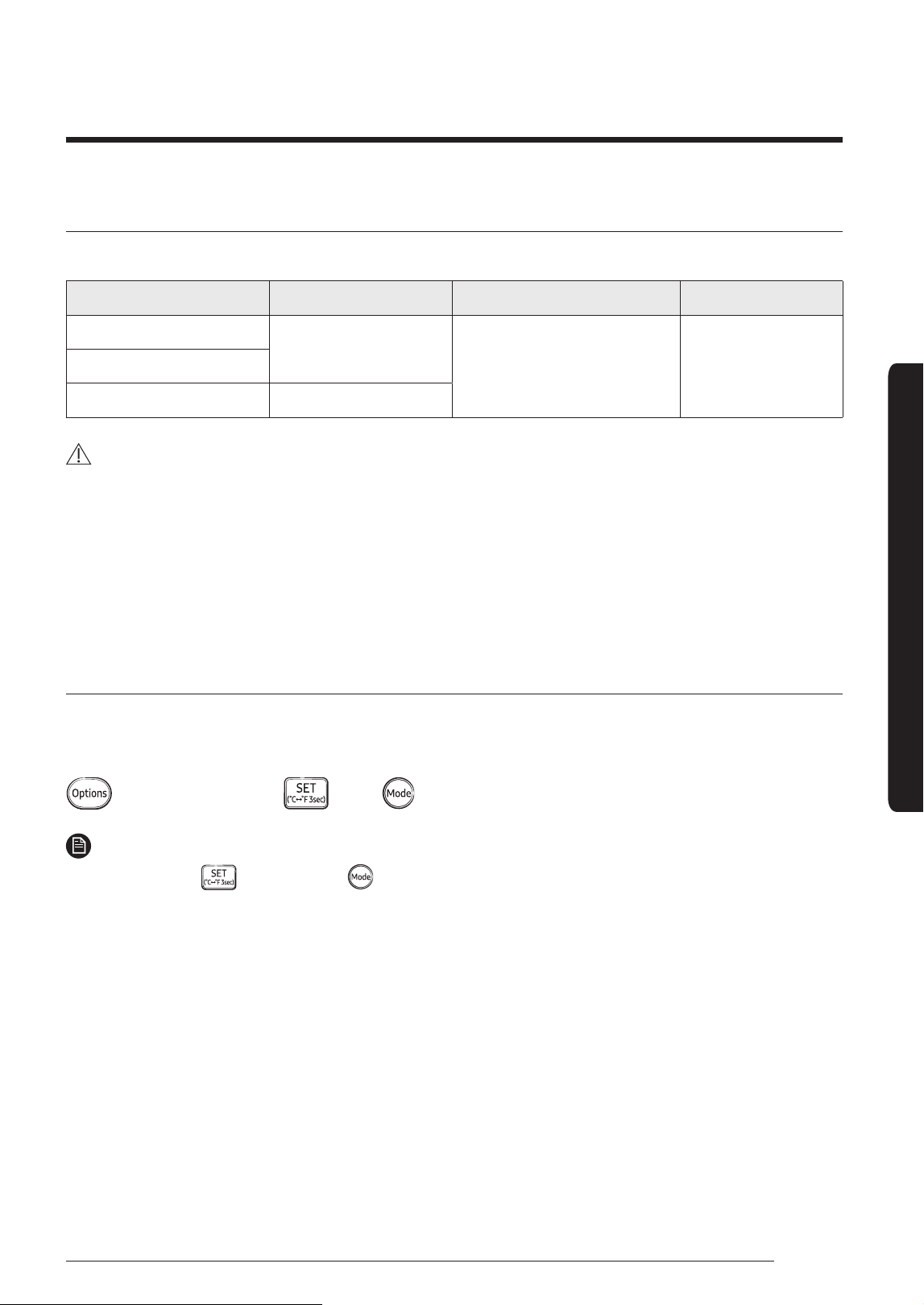
Pairing an indoor unit with a remote control
When using multiple indoor unit, you can control individually pairing remote control and indoor unit.
Set by remote control when the indoor unit is off.
▶ Zone 1~4 ▶ ▶ (5sec)
NOTE
• After push the , have to push within 60 seconds.
• Each indoor unit number setting must be set by the installer when installing. Contact service
centre to reset indoor unit number.
12
English
Cleaning and Maintenance
Before cleaning the indoor unit, be sure to turn off the auxiliary power switch.
Cleaning and Maintaining
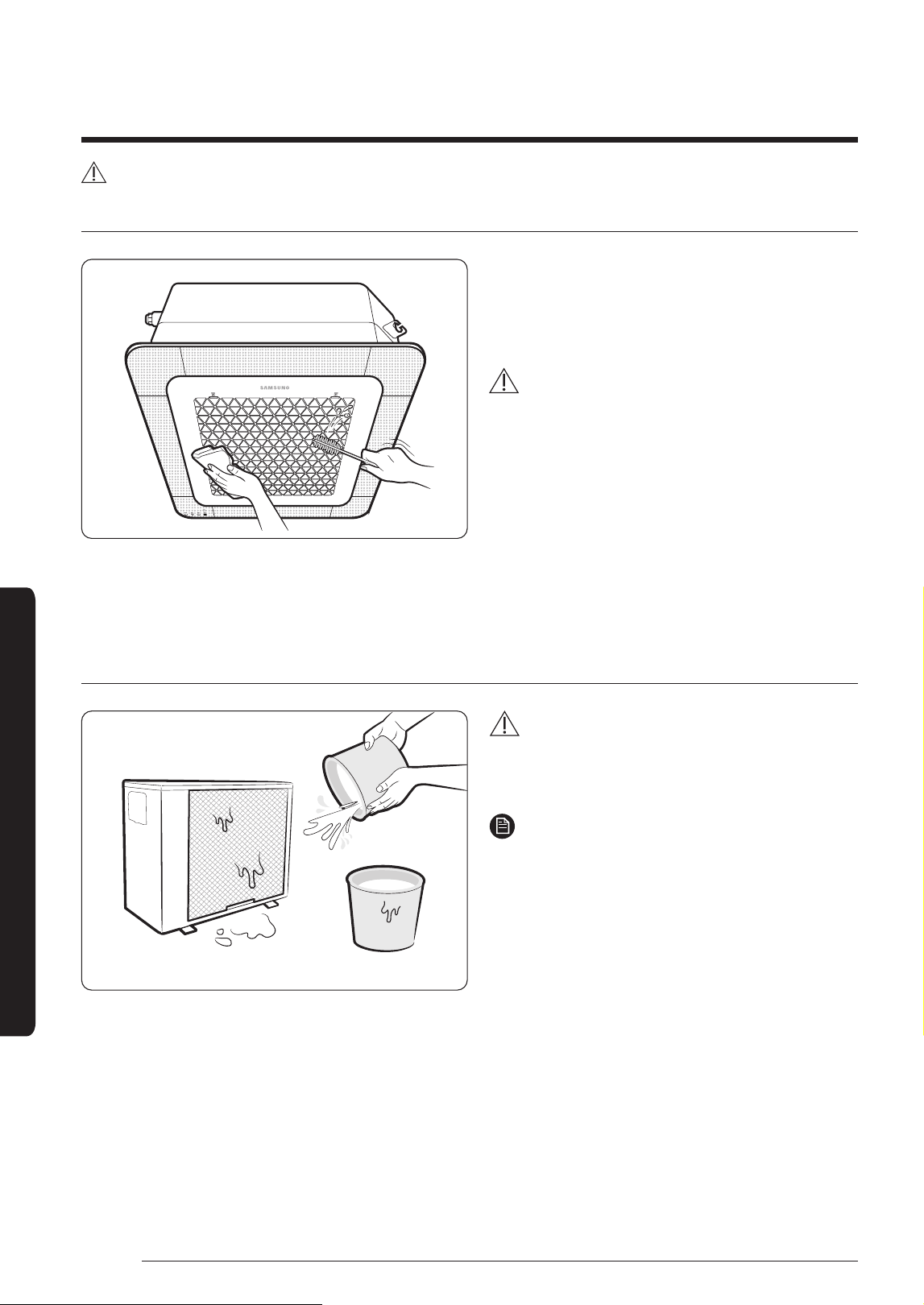
Cleaning the indoor unit exterior
Wipe the surface of the unit with a slightly wet
or dry cloth when needed. Wipe off dirt of odd-
shaped areas by using a soft brush.
CAUTION
• Do not use alkaline detergent, sulphuric
acid, hydrochloric acid, or organic solvents
(such as thinner, kerosene, and acetone) to
clean the surfaces.
• Do not attach any stickers on the surfaces
because this may cause damage.
• When you clean the heat exchanger on the
indoor unit, you need to disassemble the
indoor unit. Therefore, you must contact the
local service center for help.
Cleaning the outdoor unit heat exchanger
Spray water to clean the dust.
CAUTION
• The heat exchanger of the outdoor unit has
sharp edges. Take care when cleaning its
surface.
NOTE
• If it is difficult to clean the heat exchanger
of the outdoor unit, contact the local service
center.
Cleaning and Maintenance
13
English
Cleaning and Maintenance
Cleaning the air filter
CAUTION
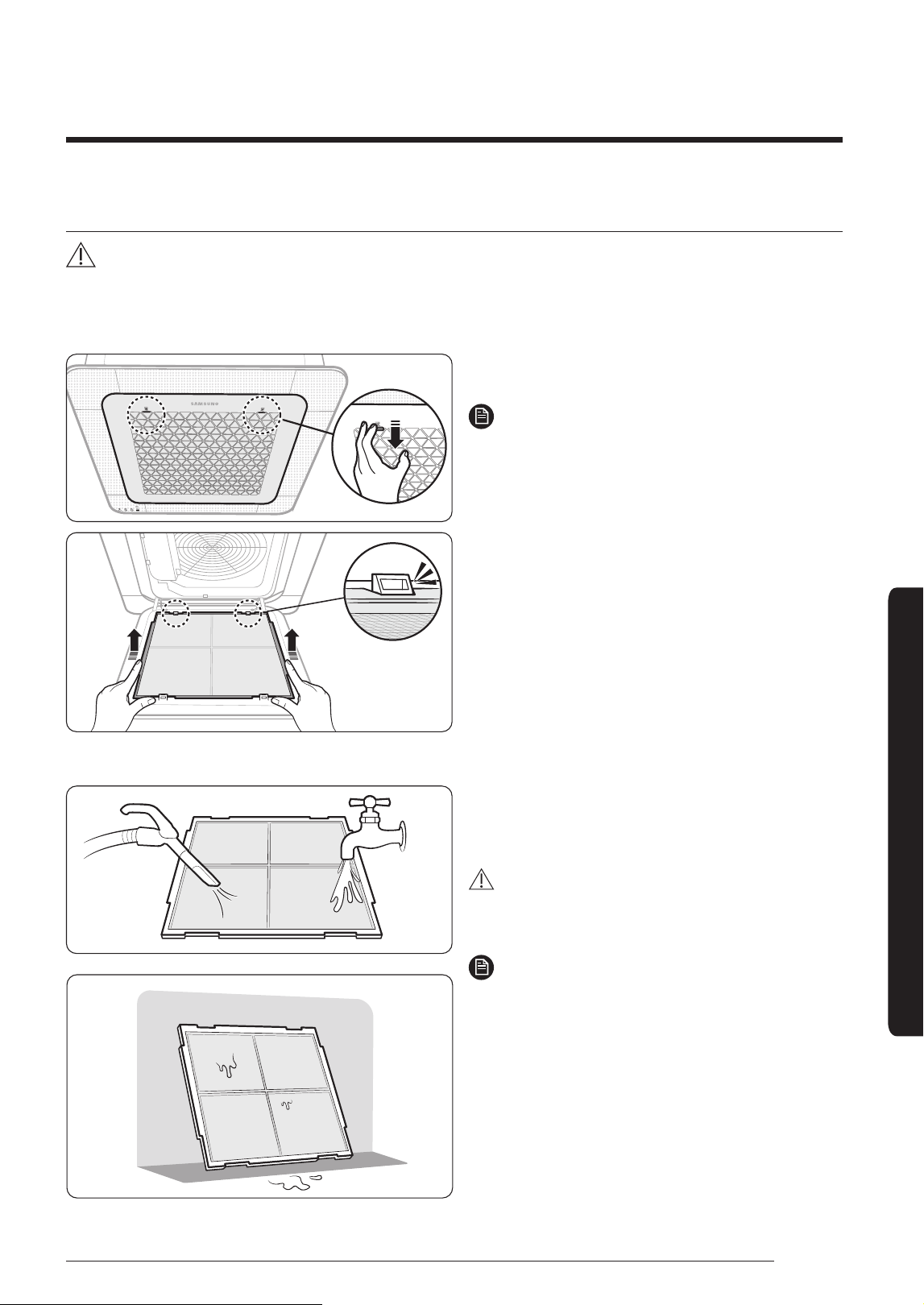
• Be sure to hold the grille with a hand to prevent dropping from the opening of the front grille.
1 Detaching the air filter
Push down the hooks at each side of the front
grille to open the grille.
NOTE
• The hooks are located on both sides of the
front grill with the Samsung logo.
Pull out the air filter from the indoor unit.
2 Cleaning the air filter
Clean the air filter with a vacuum cleaner or soft
brush. If dust is too heavy, then rinse it with
running water and dry it in a ventilated area.
CAUTION
Do not scrub the air filter with a brush or other
cleaning utensil. This may damage the filter.
NOTE
• If the air filter dries in a humid area, it may
produce offensive odours. Clean it again and
dry it in a well-ventilated area.
• The cleaning period may differ depending on
the usage and environmental conditions, so
clean the air filter every week if the indoor
unit is in the dusty area.
14
English
Cleaning and Maintaining
Cleaning and Maintenance
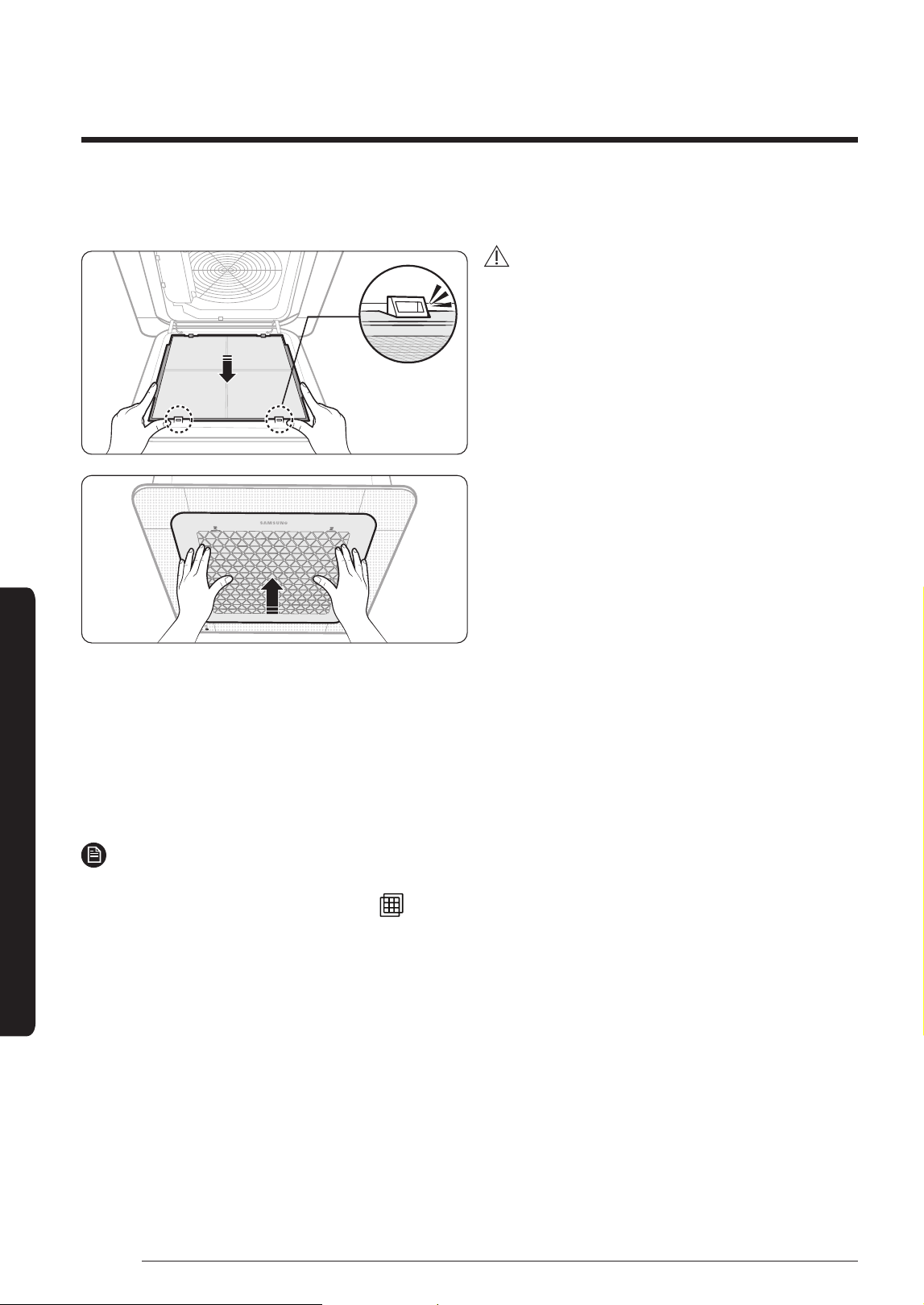
3 Reassembling the air filter
CAUTION
• If the indoor unit is used without the air filter,
the indoor unit may be damaged due to dust.
4 Resetting the air filter
After cleaning and reassembling the air filter, be sure to reset the filter-cleaning reminder as
follows:
• Indoor unit with the wired remote control: Press the Filter Reset button or set Filter Reset in
option.
• Indoor unit with the wireless remote control: Press the Options button → < or > → (Filter Reset)
Blinking → press the SET button.
NOTE
• The filter reset indicator blinks when the air filter should be cleaned.
• Although the filter cleaning indicator ( ) does not light, be sure to press the "Filter Reset" button after
cleaning the dust filter.
• If the angle of the air flow blade is changed by opening the front grille for installation or
maintenance of the indoor unit, be sure to turn off and then on the auxiliary switch before
operating the indoor unit again. If not, the angle of the air flow blade may be changed and the
blades may not be closed after turning off the indoor unit.
15
English
Cleaning and Maintenance
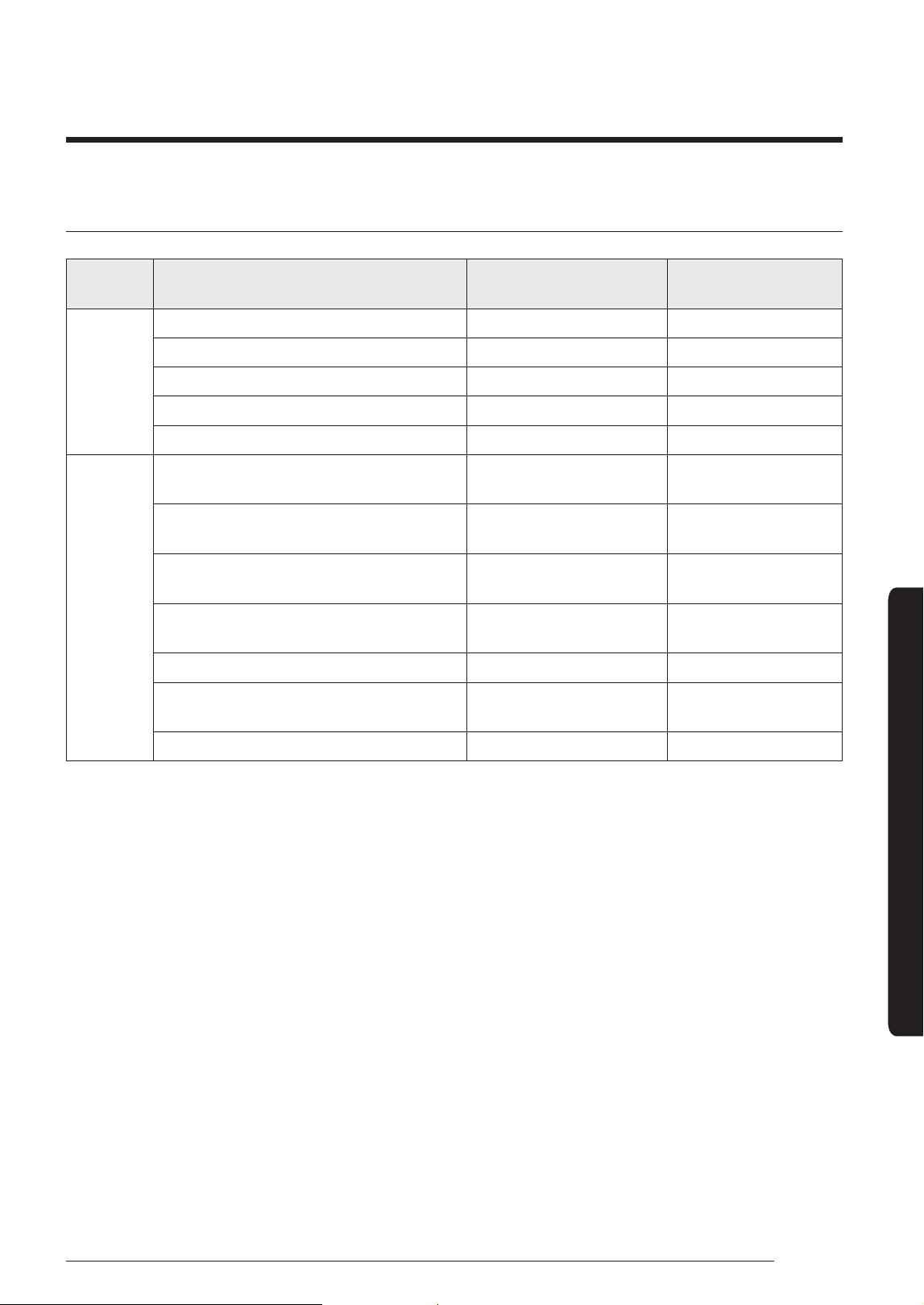
Periodical maintenance
Unit Maintenance item Interval
Requires qualified
technicians
Indoor
unit
Clean the air filter. At least once a month
Clean the condensate drain pan. Once a year Required
Clean up the heat exchange. Once a year Required
Clean the condensate drain pipe. Once every 4 months Required
Replace the remote control batteries. At least once a year
Outdoor
unit
Clean the heat exchanger on the
outside of the unit.
Once every 4 months Required
Clean the heat exchanger on the
inside of the unit.
Once a year Required
Clean the electric components with
jets of air.
Once a year Required
Verify that all the electric
components are firmly tightened.
Once a year Required
Clean the fan. Once a year Required
Verify that the fan assemblies are
firmly tightened.
Once a year Required
Clean the condensate drain pan. Once a year Required
16
English
Cleaning and Maintaining
Cleaning and Maintenance
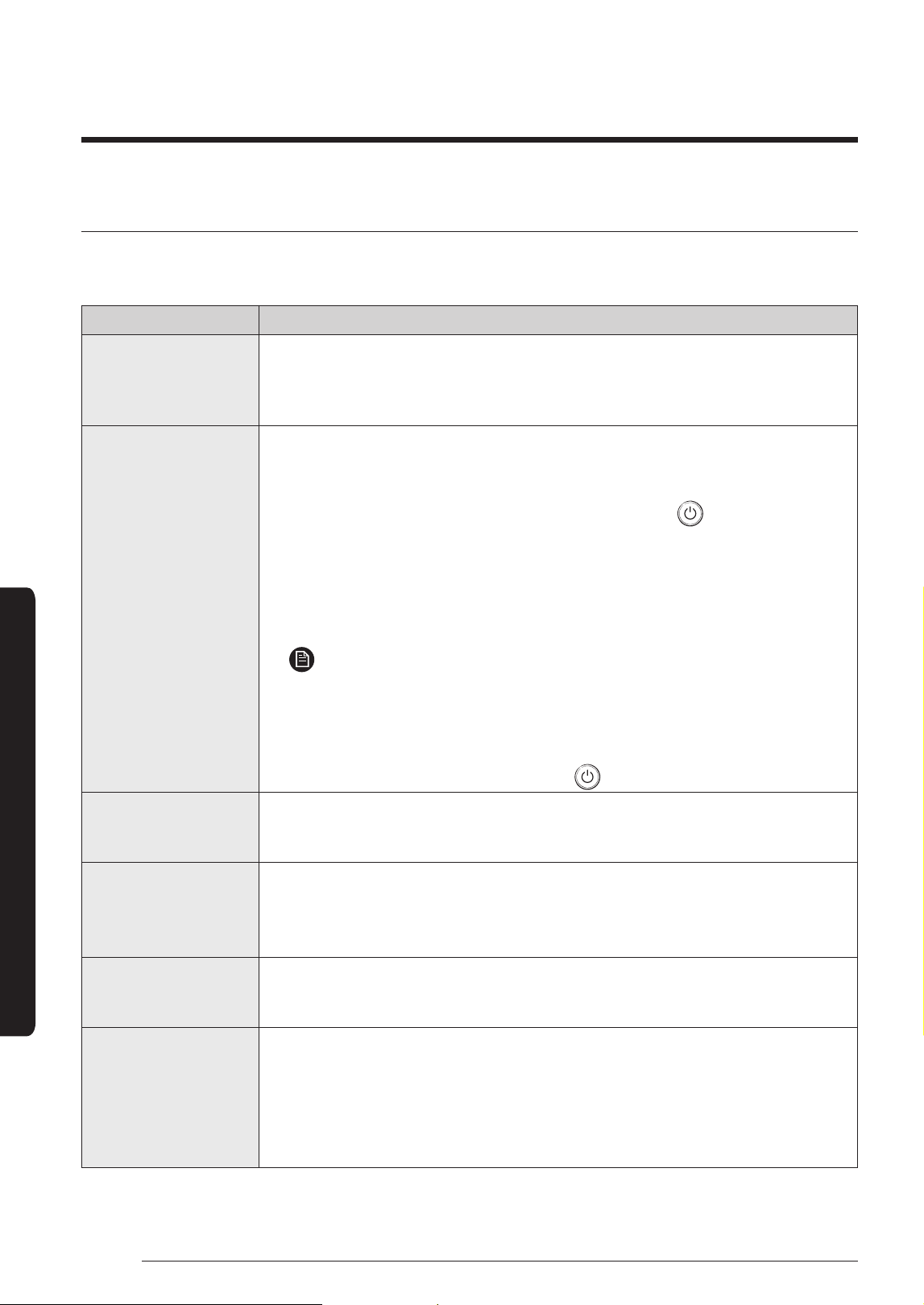
Troubleshooting
Refer to the following chart if the air conditioner operates abnormally. This may save time and
unnecessary expense.
Problem Solution
The air conditioner
does not operate
immediately after it
has been restarted.
• Because of the protective mechanism, the appliance does not start
operating immediately to keep the unit from overloading. The air
conditioner will start in 3 minutes.
The air conditioner
does not operate
at all.
• Check if the power plug is properly connected.
• Check whether the auxiliary power switch (MCCB, ELB) is turned on.
• If the auxiliary power switch (MCCB, ELB) is turned off, the air
conditioner does not work although you press the (Power) button.
• When you clean the air conditioner or do not use it for an extended
period of time, turn off the auxiliary power switch (MCCB, ELB).
• After the air conditioner is not used for an extended period of time, be
sure to turn on the auxiliary power switch (MCCB, ELB) 6 hours before
starting operation.
NOTE
• The auxiliary power switch (MCCB, ELB) is sold separately.
• Make sure that auxiliary power switch (MCCB, ELB) is installed in
the distribution box inside the building.
• If the air conditioner is turned off by the Timed off function, turn on the
air conditioner again by pressing the (Power) button.
The temperature
does not change.
• Check whether the Fan mode is running. In the Fan mode, the air
conditioner controls the set temperature automatically, and you cannot
change the set temperature.
Warm air does not
come out of the air
conditioner.
• Check whether the outdoor unit is designed for cooling only. In this case,
warm air does not come out although you select the Heat mode.
• Check whether the remote control is designed only for cooling only. Use
a remote control that supports both cooling and heating.
The fan speed does
not change.
• Check whether the Auto or Dry mode is running. In these modes, the
air conditioner controls the fan speed automatically, and you cannot
change the fan speed.
The wireless
remote control
does not operate.
• Check whether the batteries are discharged. Replace the batteries with
new ones.
• Make sure that nothing is blocking the remote control sensor.
• Check whether any strong lighting sources are near the air conditioner.
Strong light which comes from fluorescent bulbs or neon signs may
interfere with the remote control.
17
English
Cleaning and Maintenance
Problem Solution
The wired remote
control does not
operate.
• Check whether the indicator is displayed at the bottom right of the
remote control display. In this case, turn off both the air conditioner and
the auxiliary power switch, and then contact a service centre.
The air conditioner
is not turned on or
off immediately
with the wired
remote control.
• Check whether the wired remote control is set for group control. In this
case, the air conditioners connected to the wired remote control are
turned on or off sequentially. This operation takes up to 32 seconds.
The Timed on/off
function does not
operate.
• Check whether you pressed the (SET) button on the remote control
after setting the on/off time. Set the on/off time.
The indoor unit
display blinks
continuously.
• Turn on the air conditioner again by pressing the (Power) button.
• Turn off and then turn on the auxiliary power switch, and then turn on
the conditioner.
• If the indoor unit display is still blinking, contact a service centre.
I want to get cooler
air.
• Operate the air conditioner with a electric fan to save energy and
enhance the cooling efficiency.
The air is not cool or
warm enough.
• In the Cool mode, cool air does not come out if the set temperature is
higher than the current temperature.
– Remote control: Press the Temperature button repeatedly until the
set temperature (minimum: 18°C) is set to lower than the current
temperature.
• In the Heat mode, warm air does not come out if the set temperature is
lower than the current temperature.
– Remote control: Press the Temperature button repeatedly until the
set temperature (maximum: 30°C) is set to higher than the current
temperature.
• Both cooling and heating do not operate in the Fan mode. Select the
Cool, Heat, Auto, or Dry mode.
• Check whether the air filter is blocked with dirt. A dusty filter may
decrease the cooling and heating efficiencies. Clean the air filter
frequently.
• If a cover is on the outdoor unit or any obstacle is present near the
outdoor unit, remove them.
• Install the outdoor unit in a well-ventilated place. Avoiding places
exposed to direct sunlight or close to a heating appliance.
• Place a sunscreen over the outdoor unit to protect it from direct
sunlight.
• If the indoor unit is installed in a place exposed to direct sunlight, pull
the curtains on the windows.
18
English
Cleaning and Maintaining
Cleaning and Maintenance
Problem Solution
The air is not cool or
warm enough.
• Close the windows and doors to maximize the cooling and heating
efficiencies.
• If the Cool mode is stopped and then started immediately, cool air comes
out after about 3 minutes to protect the compressor of the outdoor unit.
• When the Heat mode is started, warm air does not come out
immediately to prevent cool air from coming out at the beginning.
• If the refrigerant pipe is too long, the cooling and heating efficiencies
may be decreased. Avoid exceeding the maximum pipe length.
The air conditioner
makes strange
noises.
• In certain conditions (especially, when the outdoor temperature is
lower than 20°C), a hissing, rumbling, or splashing sound may be heard
while the refrigerant is circulating through the air conditioner. This is a
normal operation.
• When you press the (Power) button on the remote control, noise
may be heard from the drain pump inside the air conditioner. This noise
is a normal sound.
Unpleasant odours
permeate the room.
• If the air conditioner is running in a smoky area or if there is a smell
entering from outside, ventilate the room properly.
• If both indoor temperature and indoor humidity are high, operate the air
conditioner in the Clean or Fan mode for 1 to 2 hours.
• If the air conditioner has not been operated for an extended period
of time, clean the indoor unit and then operate the air conditioner in
the Fan mode for 3 to 4 hours to dry the inside of the indoor unit for
removal of unpleasant odours.
• If the air filter blocked with dirt, clean the air filter.
Steam is produced
on the indoor unit.
• In winter, if the indoor humidity is high, steam may be produced around
the air outlet while the defrost function is running. This is a normal
operation.
The outdoor unit
fan continues to
operate when the
air conditioner is
turned off.
• W hen the air conditioner is turned off, the outdoor unit fan may
continue to operate to reduce noise of the refrigerant gas. This is a
normal operation.
Water drops
from the piping
connections of the
outdoor unit.
• Condensation may develop due to the difference in temperature. This is
a normal condition.
Steam is produced
on the outdoor unit.
• In winter, when the air conditioner runs in the Heat mode, the frost on
the heat exchanger melts and steam may be produced. This is a normal
operation, neither product malfunction nor a fire.
19
English
Cleaning and Maintenance
Technical specifications
Type Model Net weight (kg) Net dimension (W x D X H) (mm)
Indoor unit
AM015NNNDEH* 11.7 575 x 575 x 250
AM022NNNDEH* 12 575 x 575 x 250
AM028NNNDEH* 12 575 x 575 x 250
AM036NNNDEH* 12 575 x 575 x 250
AM045NNNDEH* 12 575 x 575 x 250
AM056NNNDEH* 12 575 x 575 x 250
AM060NNNDEH* 12 575 x 575 x 250
Information about refrigerant
Important information: regulation regarding the refrigerant used
This product contains fluorinated greenhouse gases. Do not vent gases into the atmosphere.
CAUTION
• If the system contains 5 tCO
2
e or more of fluorinated greenhouse gases, it must be checked
for leakage at least once every 12 months, according to regulation No. 517/2014. This activity
must be covered by qualified personnel only. In the case of the situation above, the installer (or
authorized person with responsibility for final check) must provide a maintenance book, with
all the information recorded, according to REGULATION (EU) No. 517/2014 OF THE EUROPEAN
PARLIAMENT AND OF THE COUNCIL of 16 April 2014 on fluorinated greenhouse gases.
Refrigenat type GWP value
R-410A 2088
• GWP: Global Warming Potential
• Calculating tCO
2
e: kg x GWP/1000
20
English
Installation Procedure
Installation Procedure
Installation Procedure
Step 1 Installing the indoor unit
When deciding on the location of the air conditioner the
following restrictions must be taken into account.
1 Place the pattern sheet on the ceiling at the spot
where you want to install the indoor unit.
NOTE
• Since the diagram is made of paper, it may shrink
or stretch slightly due to temperature or humidity.
For this reason, before drilling the holes, be sure
to maintain the correct dimensions between the
markings.
2 Insert bolt anchors, use existing ceiling supports or
construct a suitable support as shown in figure.
Concrete
Hole in anchor
Hole in plug
Suspension bolt (M8) - field supply
Insert
3 Install the suspension bolts, depending on the ceiling
type.
Ceiling support
CAUTION
• Make sure that the ceiling is strong enough to support
the weight of the indoor unit. Before hanging the unit,
test the strength of each attached suspension bolt.
• If the length of the suspension bolt is more than 1.5 m,
you are required to prevent vibration.
4 Screw eight pairs of nuts and washers to the
suspension bolts, making space for hanging the indoor
unit.
CAUTION
• You must install all of the suspension rods.
• It is important to leave sufficient space in the false
ceiling to allow access for maintenance or repairs to
the drainage pipe connection, the refrigerant pipe
connection, or to remove the unit if necessary.
5 Hang the indoor unit to the suspension bolts between
two nuts. Cut a pad stopper and place it on the
suspension bolts to hold the washer. Remove the
stopper and screw the nuts to fix the unit.
1
2
2
6 Check the level of the indoor unit by using a leveler.
• A tilt of the indoor unit may cause malfunction of a
built-in float switch and water leaks.
Level
21
English
Installation Procedure
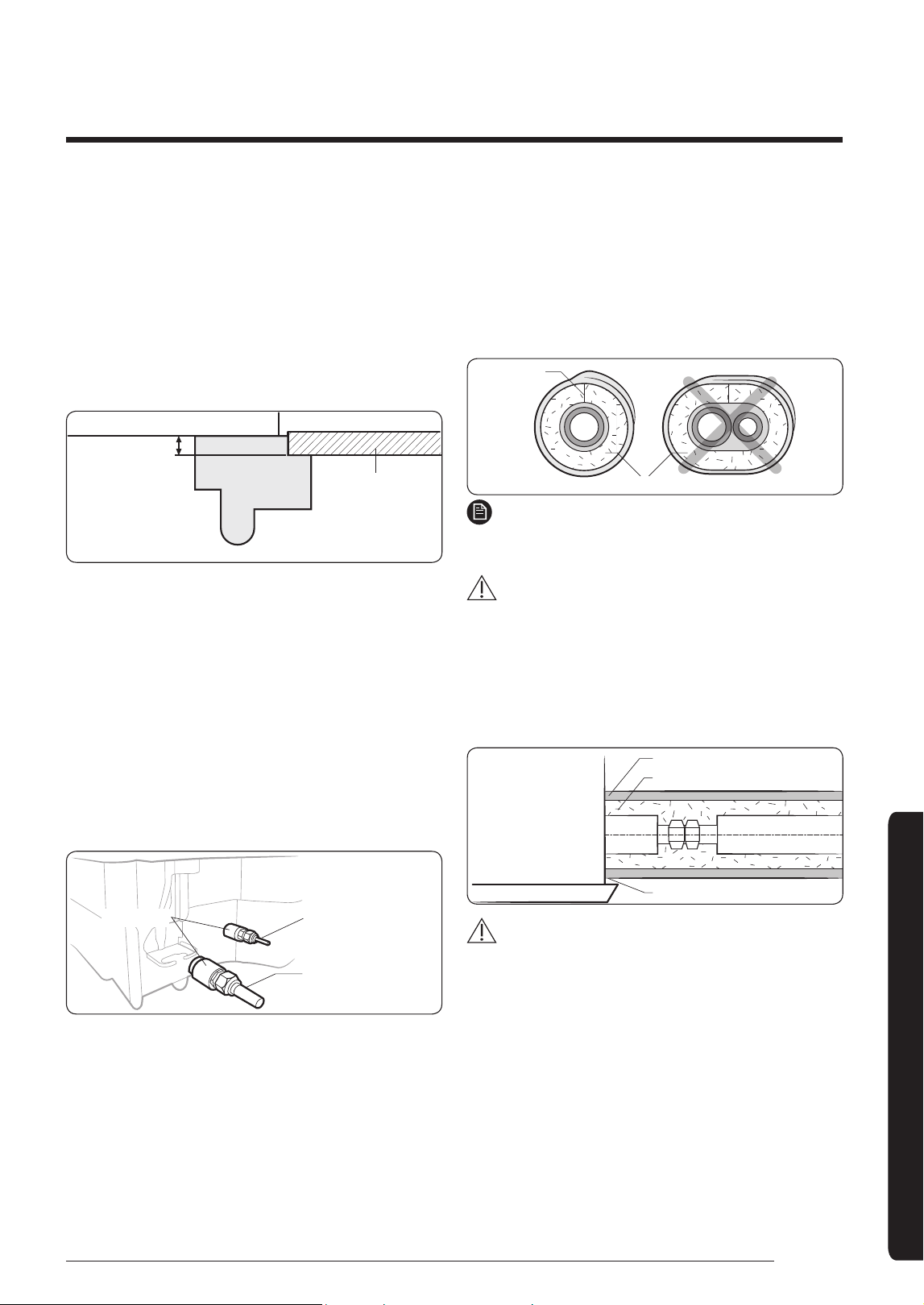
7 Adjust the unit to the appropriate position, taking into
account the installation area for the front panel.
• Place the pattern sheet on the indoor unit.
• Adjust the space between the ceiling and the
indoor unit by using a dimension gauge.
• Fix the indoor unit securely after adjusting the level
of the unit by using a leveller.
• Remove the pattern sheet, connect the other
cables. and install the front panel.
Ceiling
Indoor unit
23 mm
Gauge of dimensions
Step 2 Performing the gas leak test
To identify potential gas leaks on the indoor unit, inspect
the connection area of each refrigerant pipe using a leak
detector for R-410A.
Before recreating the vacuum and recirculating the
refrigerant gas, pressurize the whole system with nitrogen
(using a cylinder with a pressure reducer) at a pressure
above 0.2 MPa, less than 4 MPa (gauge) in order to
immediately detect leaks on the refrigerant fittings.
Made vacuum for 15 minutes and pressurizing system with
nitrogen.
Liquid side
Gas side
Insulator
Step 3 Insulating the refrigerant pipes
Once you have checked that there are no leaks in the
system, you can insulate the piping and hose.
1 To avoid condensation problems, place Acrylonitrile
Butadien Rubber separately around each refrigerant
pipe.
No gap
NBR
NOTE
• Always make the seam of pipes face upwards.
CAUTION
• The insulation has to be produced in full compliance
with European regulation EEC / EU 2037 / 2000
requring the use of sheaths insulation without using
CFC and HCFC gases for heating and the environment.
2 Wind insulating tape around the pipes and drain hose
avoiding compressing the insulation too much.
Insulation cover pipe
Insulation pipe
Be sure to overlap the insulation.
Indoor unit
CAUTION
• Be sure to wrap insulation tightly without any gaps.
3 Finish wrapping insulating tape around the rest of the
pipes leading to the outdoor unit.
4 The pipes and electrical cables connecting the indoor
unit with the outdoor unit must be fixed to the wall
with suitable ducts.
22
Installation Procedure
English
Installation Procedure
Installation Procedure
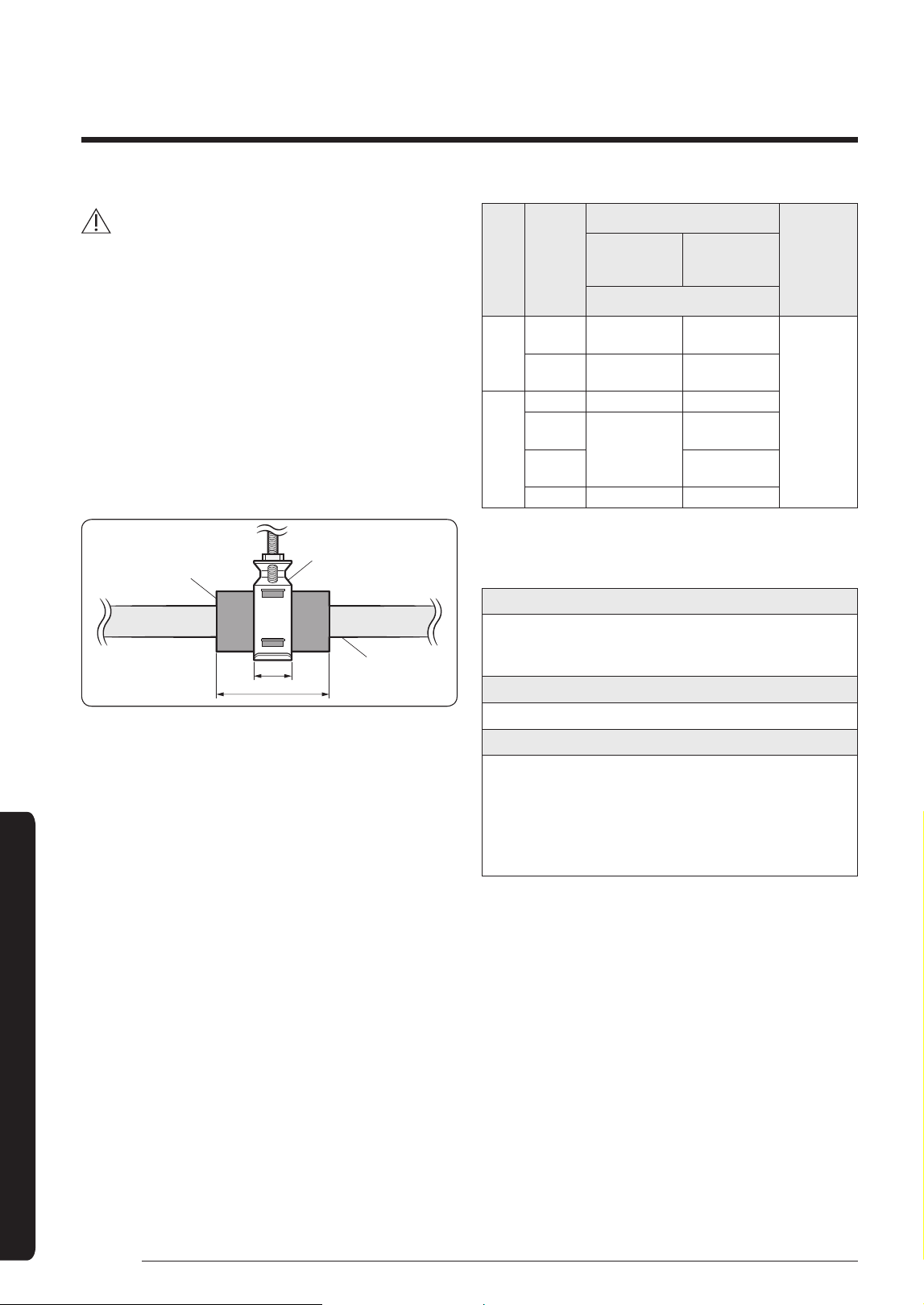
CAUTION
• Must fit tightly against body without any gap.
• Make sure that all refrigerant connection must be
accessible for easy maintenance and detachment.
• Install the insulation not to get wider and use the
adhesives on the connection part of it to prevent
moisture from entering.
• Wind the refrigerant pipe with insulation tape if it is
exposed to outside sunlight.
• Install the refrigerant pipe respecting that the insulation
does not get thinner on the bent part or hanger of pipe.
• Add the additional insulation if the insulation plate
gets thinner.
a x 3
Hanger
Additional insulation
a
Refrigerant pipe
insulation
5 Select the insulation of the refrigerant pipe.
• Insulate the gas side and liquid side pipe, noting
the insulation thickness that must differ according
to the pipe size.
• Standard: Less than an indoor temperature of 30°C,
with humidity at 85%. If installing in a high humidity
environment, use one grade thicker insulator by
referring to the table below. If installing in an
unfavourable environment, use thicker one.
• The heat-resistance temperature of the insulator
must be more than 120°C.
Pipe
Pipe size
(mm)
Insulation Type (Heating/Cooling)
Remarks
Standard
[30°C, 85%]
High humidity
[30°C, over 85%]
EPDM, NBR
Liquid
pipe
Ø6.35 to
Ø9.52
9t
←
Internal
temperature
is higher
than 120°C
Ø12.7 to
Ø50.80
13t
←
Gas
pipe
Ø6.35 13t 19t
Ø9.52 to
Ø25.40
19t
25t
Ø28.58 to
Ø44.45
32t
Ø50.80 25t 38t
• When installing insulation in the places and
conditions below, use the same insulation that is
used for high humidity conditions.
<Geological condition>
High humidity locations such as shorelines, hot springs, lake
or riversides, and ridges (when part of the building is covered
by earth and sand)
<Operation purpose condition>
Restaurant ceiling, sauna, swimming pool etc.
<Building construction condition>
Ceilings frequently exposed to moisture and cooling are
not covered. For example, pipes installed at a corridor of a
dormitory and studio or near an exit that opens and closes
frequently.
Places (where the pipes are installed) that are highly humid
due to a lack of ventilation.
• Refrigerant pipe before EEV kit and MCU or without
EEV kit and MCU
– You can contact the gas side and liquid side
pipes but the pipes should not be pressed.
– When contacting the gas side and liquid side
pipe, use 1 grade thicker insulator.
• Refrigerant pipe after EEV kit and MCU
– Install the gas side and liquid side pipes, leave
10mm of space.
– When contacting the gas side and liquid side
pipe, use 1 grade thicker insulator.
23
English
Installation Procedure
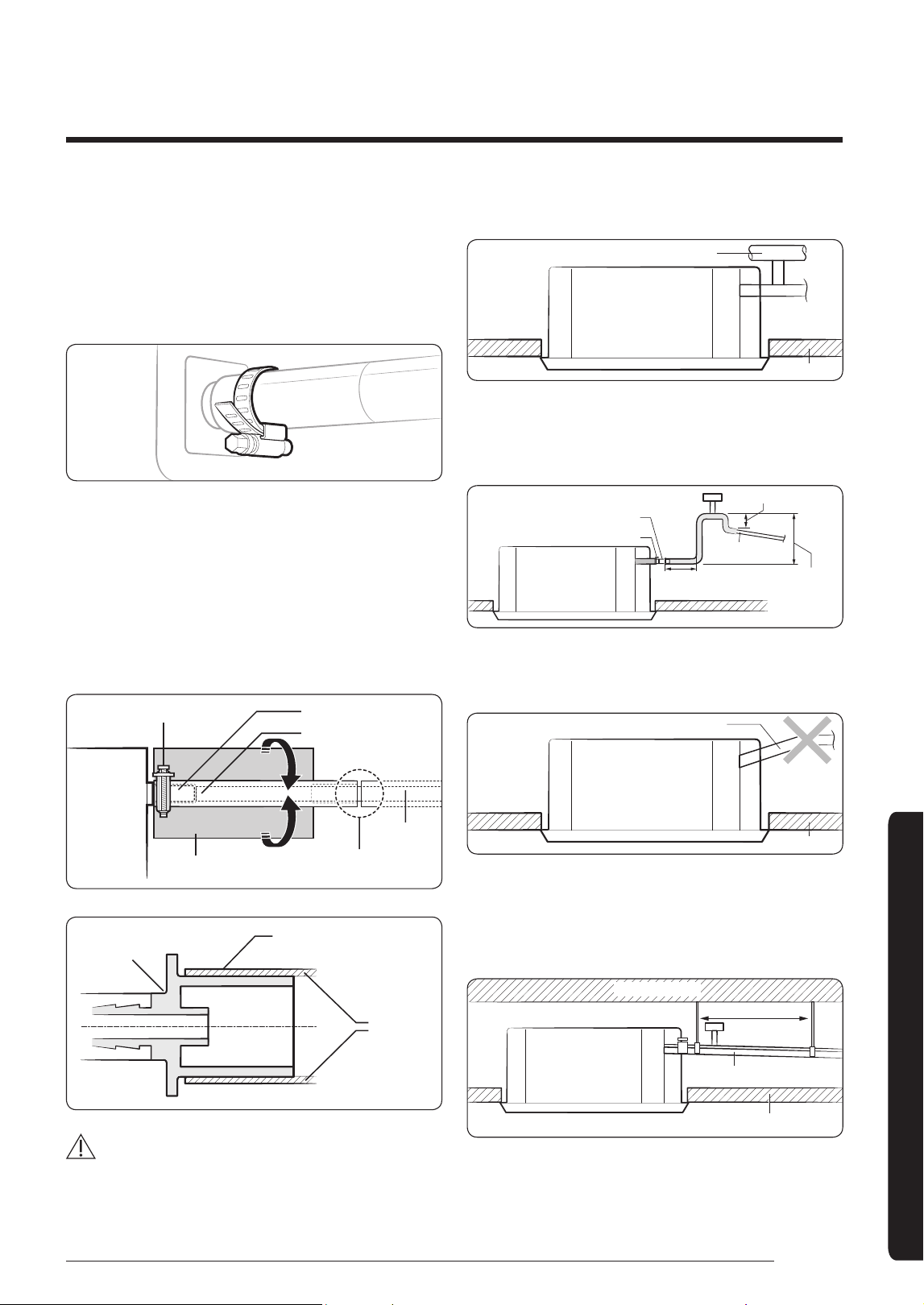
Step 4 Installing the drain hose and
drain pipe
1 Push the supplied drain hose as far as possible over
the drain socket.
2 Tighten the metal clamp as shown in the picture.
3 Wrap the supplied large sealing pad over the metal
clamp and drain hose to insulate and fix it with
clamps.
4 Insulate the complete drain piping inside the building
(field supply).
If the drain hose cannot be sufficiently set on a slope,
fit the hose with drain raising piping (field supply).
5 Push the drain hose up to insulation when connecting
the drain hose to drain socket.
Metal clamp
Drain socket
Drain hose
Large seailng pad
Be sure to bond the drain
hose and the main pipe.
Drain pipe
Drain hose
PVC Tube Joint
+ VP25 (OD: 32 mm, ID: 25 mm)
Drain pipe
CAUTION
Check that the indoor unit is level with the ceiling by
using the leveller.
• Install air ventilation to drain condensation smoothly.
Air ventilation
Ceiling
• If it is necessary to increase the height of the drain
pipe, install the drain pipe straight within 300 mm
from the drain hose port. If it is raised higher than 550
mm, there may be water leaks.
Band joint
300 mm or
less
300 to 550 mm
20 mm or more
1/100 or more
Drain hose
Ceiling
• Do not give the hose an upward gradient beyond the
connection port. This will cause water to flow backwards
when the unit is stopped, resulting in water leaks.
Under gradient
Ceiling
• Do not apply force to the piping on the unit side when
connecting the drain hose. The hose should not be
allowed to hang loose from its connection to the unit.
Fasten the hose to a wall, frame or other support as
close to the unit as possible.
Support pieces
1 to 1.5 m
1/100 or more
Ceiling
24
English
Installation Procedure
Installation Procedure
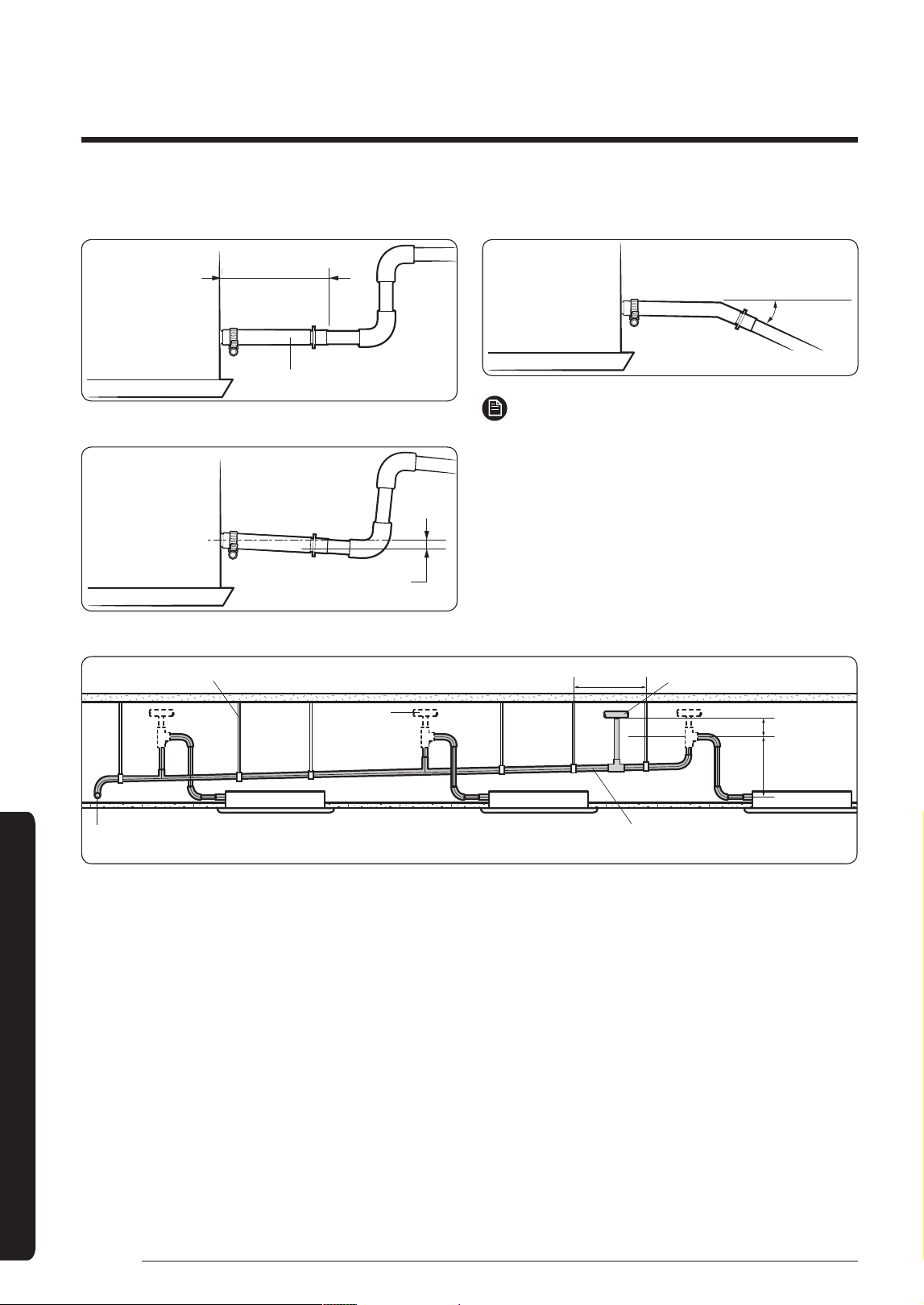
• Install horizontally.
Indoor unit
Be horizontal
Flexible hose
• Max. allowable axis gap.
Indoor unit
Max. 20 mm
• Max. allowable bending angle.
Max. 30˚
Indoor unit
NOTE
• If a concentrated drain pipe is installed, refer to the
figure below.
Main drainpipe
Hanger
Centralized horizontal drainpipe
(more than 1/100 slope)
300 to 550mm
200mm or more
1~1.5m
Main air vent
Individual
air vent
• If 3 or more units are installed, install the main air vent at the front of the farthest indoor unit from the main drain
pipe.
• To prevent water from flowing back to indoor units, install an individual air vent at the top of each indoor unit.
– The air vents should be T or 7 shaped to prevent dust or foreign substances from entering.
– You may not need to install air vent if the horizontal drain pipe is in proper slope.
25
English
Installation Procedure
Step 5 Connecting the power and
communication cables
Power and communication cable connection
• Before wiring work, you must turn off all power source.
• Connect the power and communication cable among
the units within maximum length to set the voltage
drop under 10%.
• The auxiliary circuit breaker (ELCB, MCCB, ELB) should
be considered more capacity if many indoor units are
connected from one breaker.
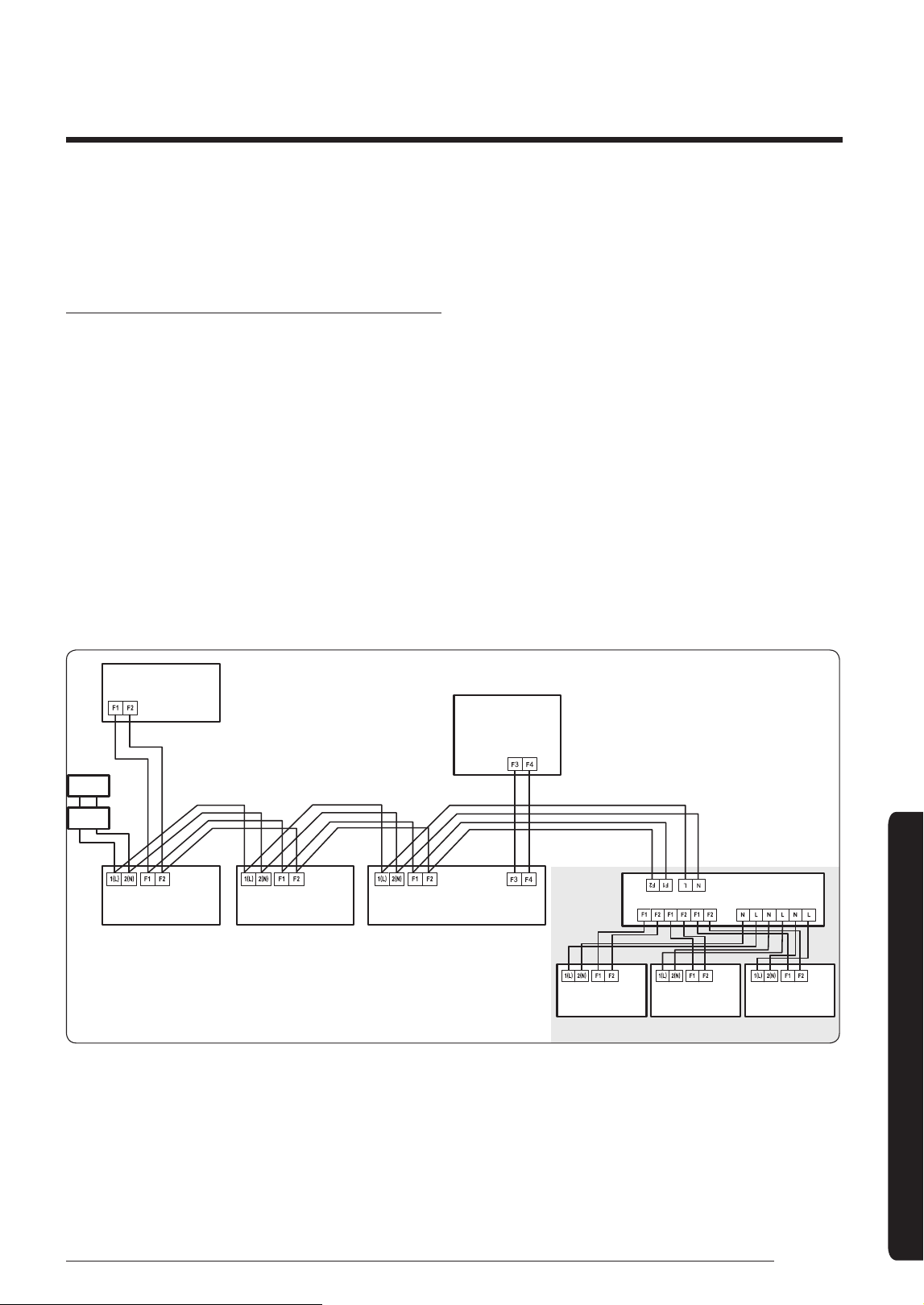
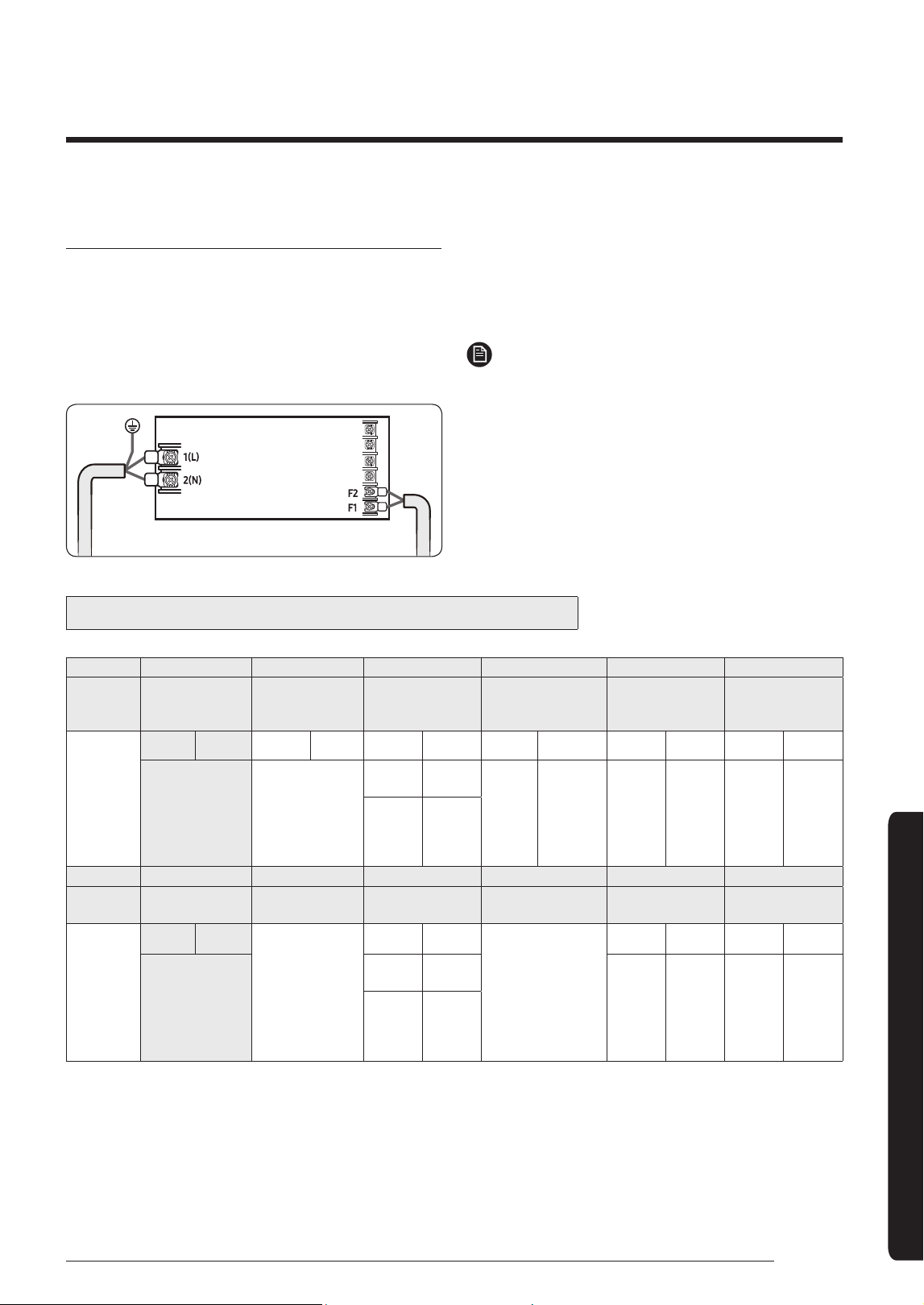
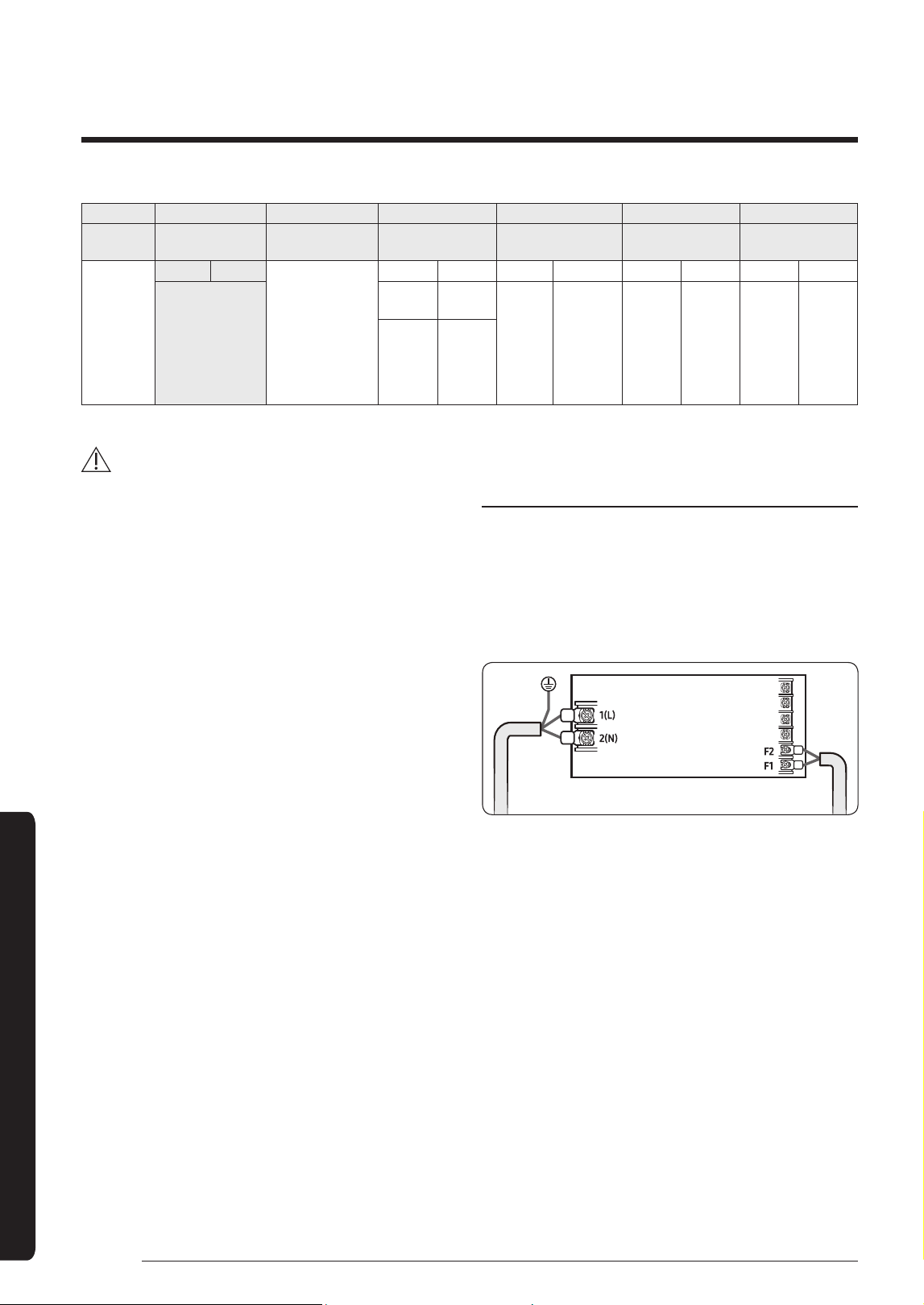
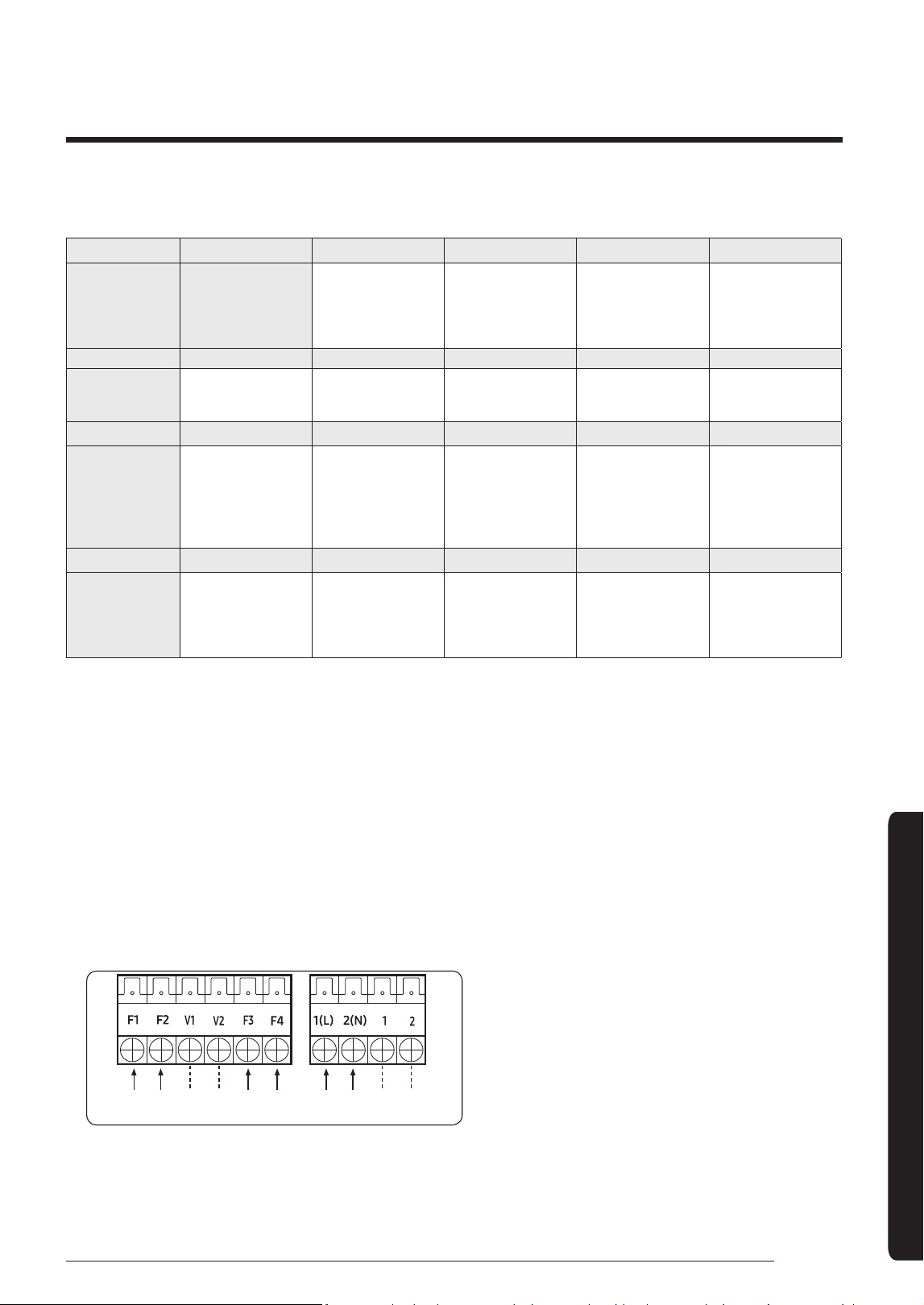
• Connect F3, F4(for communication) to the
communication cable of the wired remote control.
• Tighten the electric wires with a proper tool within the
torque limit to connect and fix them firmly, and then
organize the wires to prevent outside pressure being
exerted on the covers and other parts. Failure to do so
may result in overheating, electric shock, and fire.
• To protect the product from water and possible shock,
you should keep the power and the communication
cables of the indoor and outdoor units in the iron pipe.
• Connect the power cable to the auxiliary circuit
breaker (ELCB, MCCB, ELB).
• Keep distances of 50mm or more between power cable
and communication cables.
• Power supply cords of parts of appliances for outdoor
use shall not be lighter than polychloroprene sheathed
flexible cord. (Code designation IEC:60245 IEC 57 /
CENELEC: H05RN-F or IEC:60245 IEC 66 / CENELEC:
H07RN-F)
• Screws on terminal block must not be unscrewed with
the torque less than 12 kgf•cm.
• When installing the indoor unit in a computer room,
use the double shielded (tape aluminum / polyester
braid + copper) cable of FROHH2R type.
220~240V~
Outdoor Unit
ELB
MCCB
Indoor Unit 1 Indoor Unit 2 Indoor Unit 3
Indoor Unit 4
Indoor Unit 5 Indoor Unit 6
※ ELB : Essential Installation
※ Ceiling, wall-mounted indoor unit.
EEV kit
Wired Remote
Control
26
Installation Procedure
English
Installation Procedure
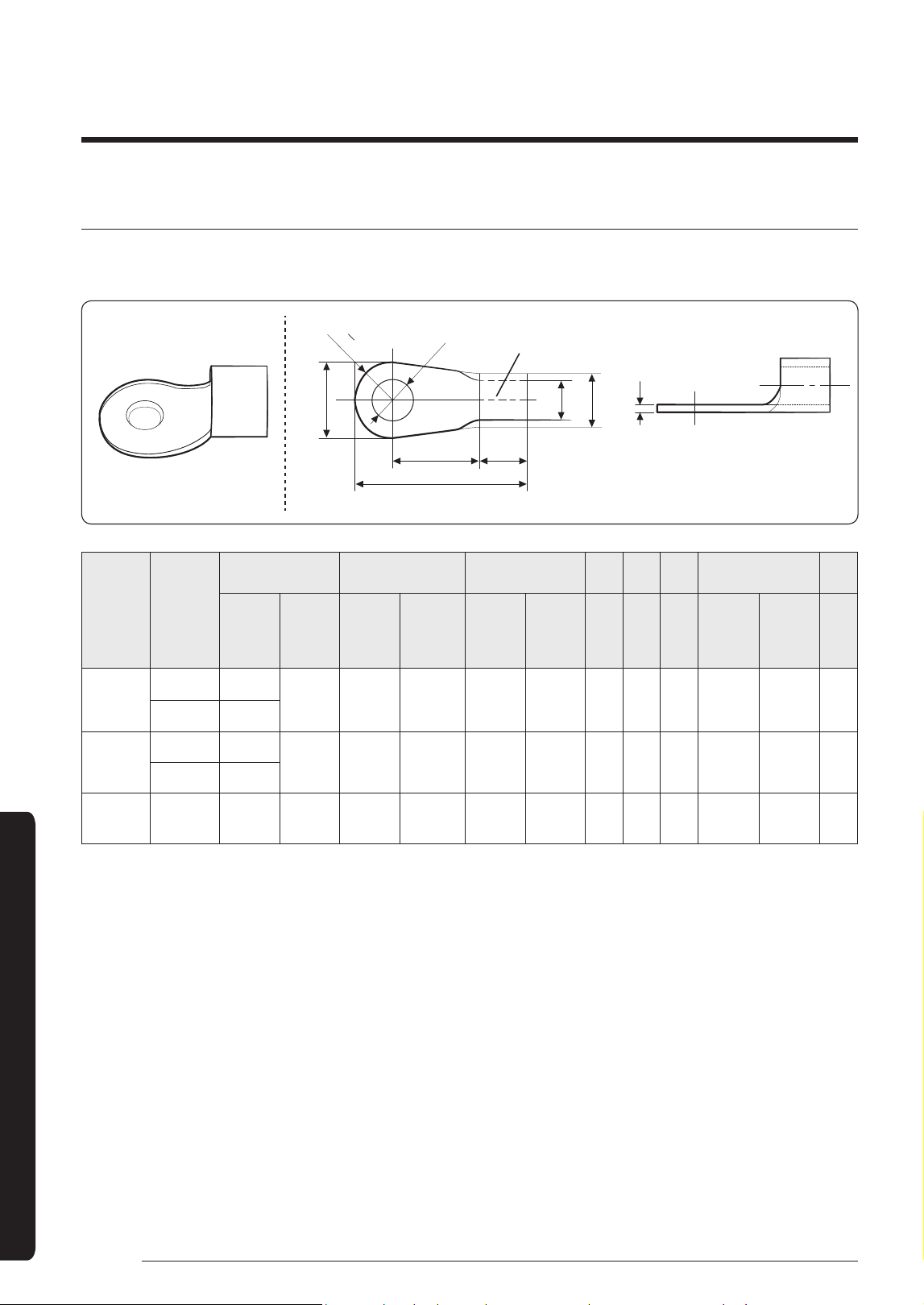
Selecting the crimping terminal lug
1 Select the crimping terminal lug based on the norminal dimension of the power cable.
2 Cover the connection part of the power cable and crimping terminal lug to insulate it.
Silver solder
F E
L
D
d1
B
d2
t
B
2
R
Norminal
dimensions
for cable
(mm²)
Norminal
dimensions
for screw
(mm)
B D d1 E F L d2 t
Standard
dimension
(mm)
Allowance
(mm)
Standard
dimension
(mm)
Allowance
(mm)
Standard
dimension
(mm)
Allowance
(mm)
Min. Min. Max.
Standard
dimension
(mm)
Allowance
(mm)
Min.
1.5
4 6.6
± 0.2 3.4
+0.3
-0.2
1.7 ± 0.2 4.1 6 16 4.3
+0.2
0
0.7
4 8
2.5
4 6.6
± 0.2 4.2
+0.3
-0.2
2.3 ± 0.2 6 6 17. 5 4.3
+0.2
0
0.8
4 8.5
4 4 9.5 ± 0.2 5.6
+0.3
-0.2
3.4 ± 0.2 6 5 20 4.3
+0.2
0
0.9
27
English
Installation Procedure
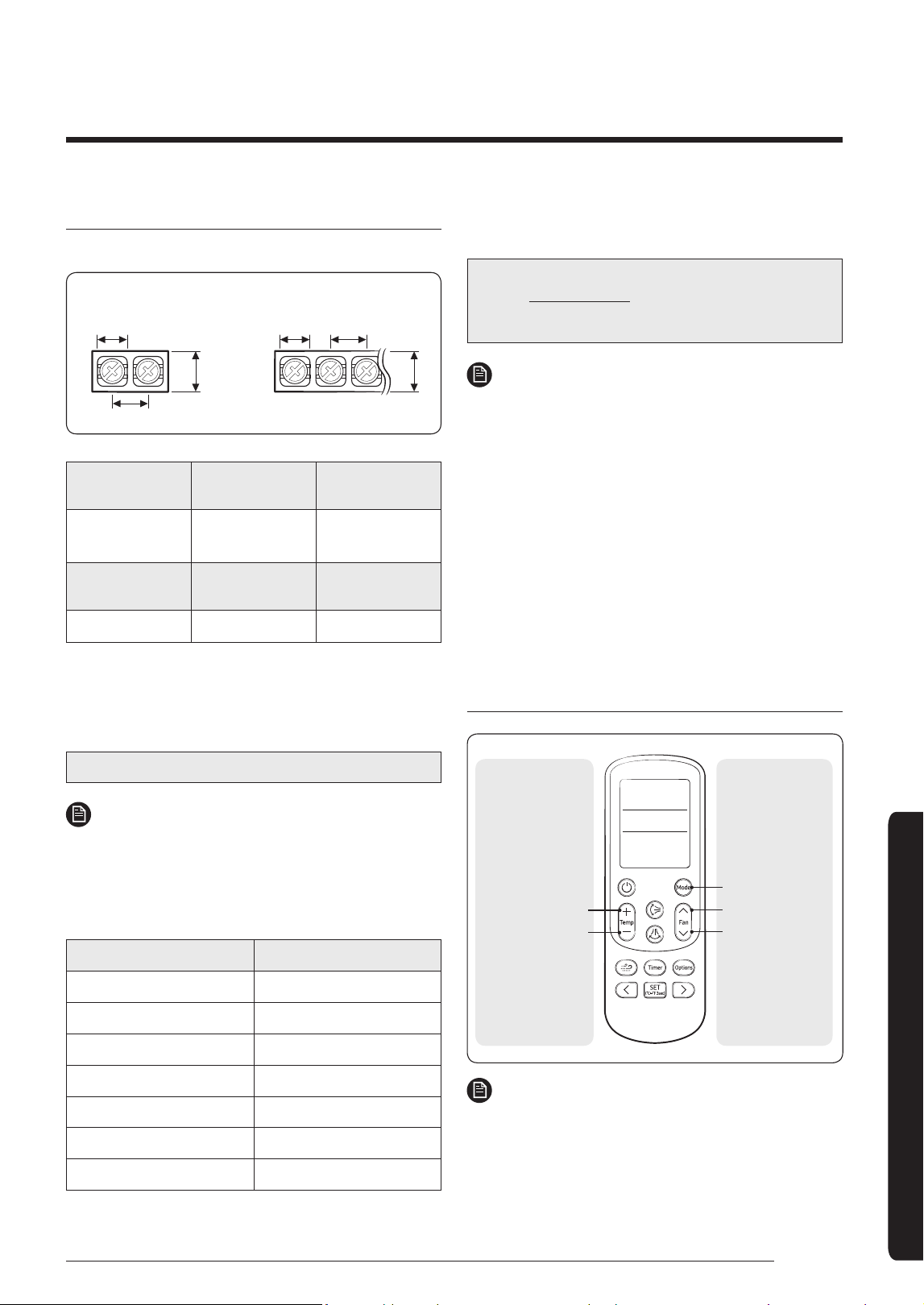
Specifications of the terminal blocks
(Unit: mm)
AC power: M4 screw
Communication: M3.5 screw
11
13
7. 5
9.0
18
13.8
Power supply
(single phase)
MCCB ELB
Min : 198V
Max : 242V
XA
XA, 30 mA
0.1 s
Power cable Earth cable
Communication
cable
2.5 mm² or more 2.5 mm² 0.75 to 1.5 mm²
Decide the power cable specification and maximum
length by formula 2.
1 Decide the capacity of ELB and MCCB by below
formula.
The capacity of ELB, MCCB X[A] = 1.25 X 1.1 X ΣAi
NOTE
• X : The capacity of ELB, MCCB
• ΣAi : Sum of rating currents of each indoor unit.
Rated currents
Model Rating current(A)
AM015NNNDEH* 0.17
AM022NNNDEH* 0.17
AM028NNNDEH* 0.17
AM036NNNDEH* 0.19
AM045NNNDEH* 0.22
AM056NNNDEH* 0.27
AM060NNNDEH* 0.30
2 Decide the power cable specification and maximum
length within 10% voltage drop among indoor units.
n
Coef×35.6×Lk
×
ik)
< 10% of input voltage[V]
∑ (
1000×Ak
k=1
NOTE
• Coef: 1.55
• Lk: Distance among each indoor unit[m], Ak: Power
cable specification[mm
2
]
• ik: Running current of each unit[A]
Step 6 Setting the indoor unit
addresses and the installation options
You cannot set both of the indoor unit addresses and
the installation options in a batch: set both of them
respectively.
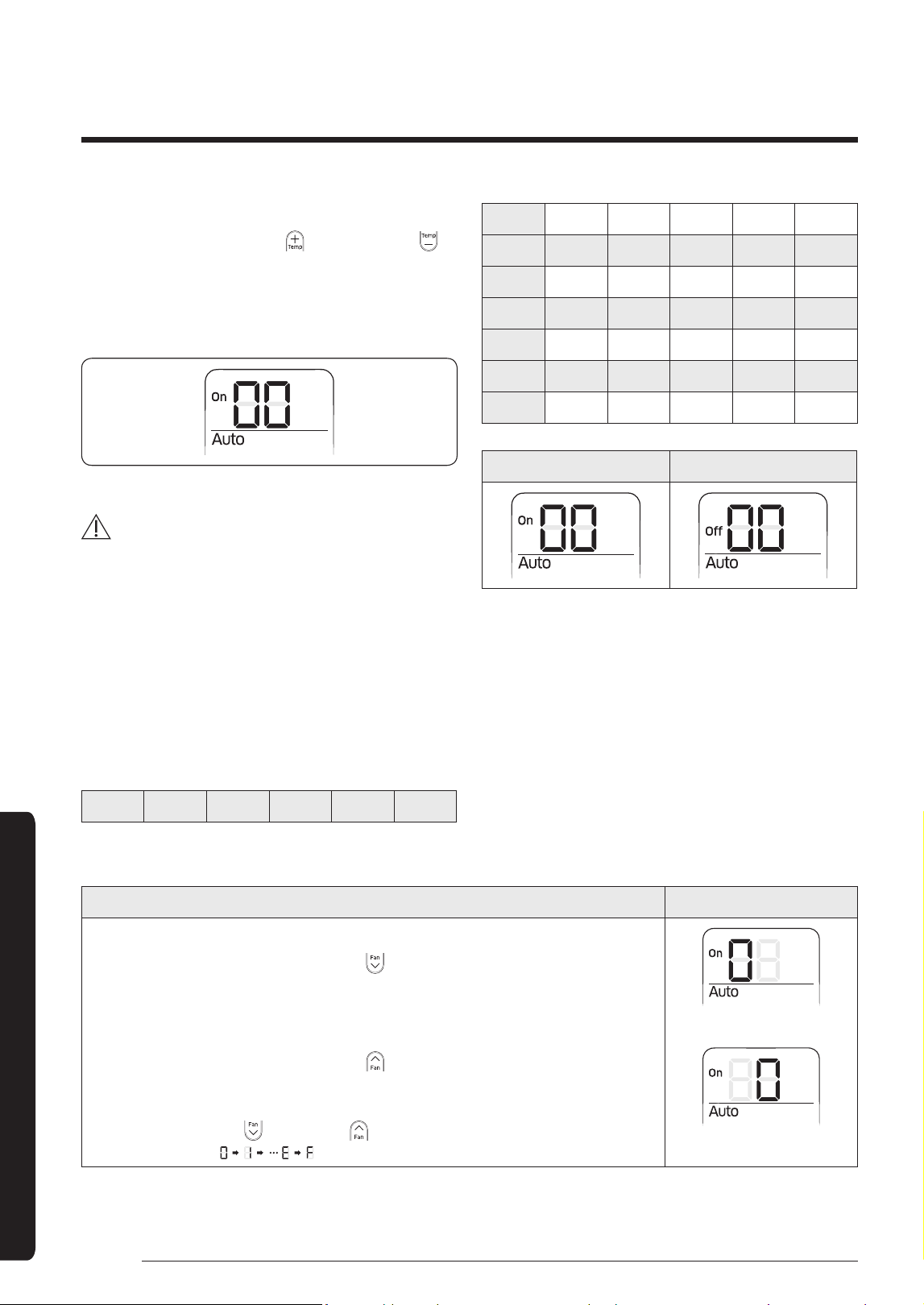
Common steps for setting the addresses and
options
Low Temp button
High Temp button
Mode button
Low Fan button
High Fan button
Setting the
option values
Entering the
mode for setting
the options
NOTE
• The remote control display and buttons may vary
depending on the model.
1 Enter the mode for setting the options:
a Remove the batteries from the remote control,
28
Installation Procedure
English
Installation Procedure
Take the steps presented in the following table:
Steps Remote control display
1 Set the SEG2 and SEG3 values:
a Set the SEG2 value by pressing the (Low Fan) button repeatedly until the
value you want to set appears on the remote control display.
SEG2
b Set the SEG3 value by pressing the (High Fan) button repeatedly until the
value you want to set appears on the remote control display.
When you press the (Low Fan) or (High Fan) button, values appear in the
following order:
SEG3
and then insert them again.
b While holding down the (High Temp) and
(Low Temp) buttons simultaneously, insert the
batteries into the remote control.
c Make sure that you are entered to the mode for
setting the options:
2 Set the option values.
CAUTION
• The total number of available options are 24: SEG1 to
SEG24.
• Because SEG1, SEG7, SEG13, and SEG19 are the page
options used by the previous remote control models,
the modes to set values for these options are skipped
automatically.
• Set a 2-digit value for each option pair in the following
order: SEG2 and SEG3 → SEG4 and SEG5 → SEG6 and
SEG8 → SEG9 and SEG10 → SEG11 and SEG12 → SEG14
and SEG15 → SEG16 and SEG17 → SEG18 and SEG20 →
SEG21 and SEG22 → SEG23 and SEG24
SEG1 SEG2 SEG3 SEG4 SEG5 SEG6
0 X X X X X
SEG7 SEG8 SEG9 SEG10 SEG11 SEG12
1 X X X X X
SEG13 SEG14 SEG15 SEG16 SEG17 SEG18
2 X X X X X
SEG19 SEG20 SEG21 SEG22 SEG23 SEG24
3 X X X X X
On (SEG1 to SEG12) Off (SEG13 to SEG24)
29
English
Installation Procedure
Steps Remote control display
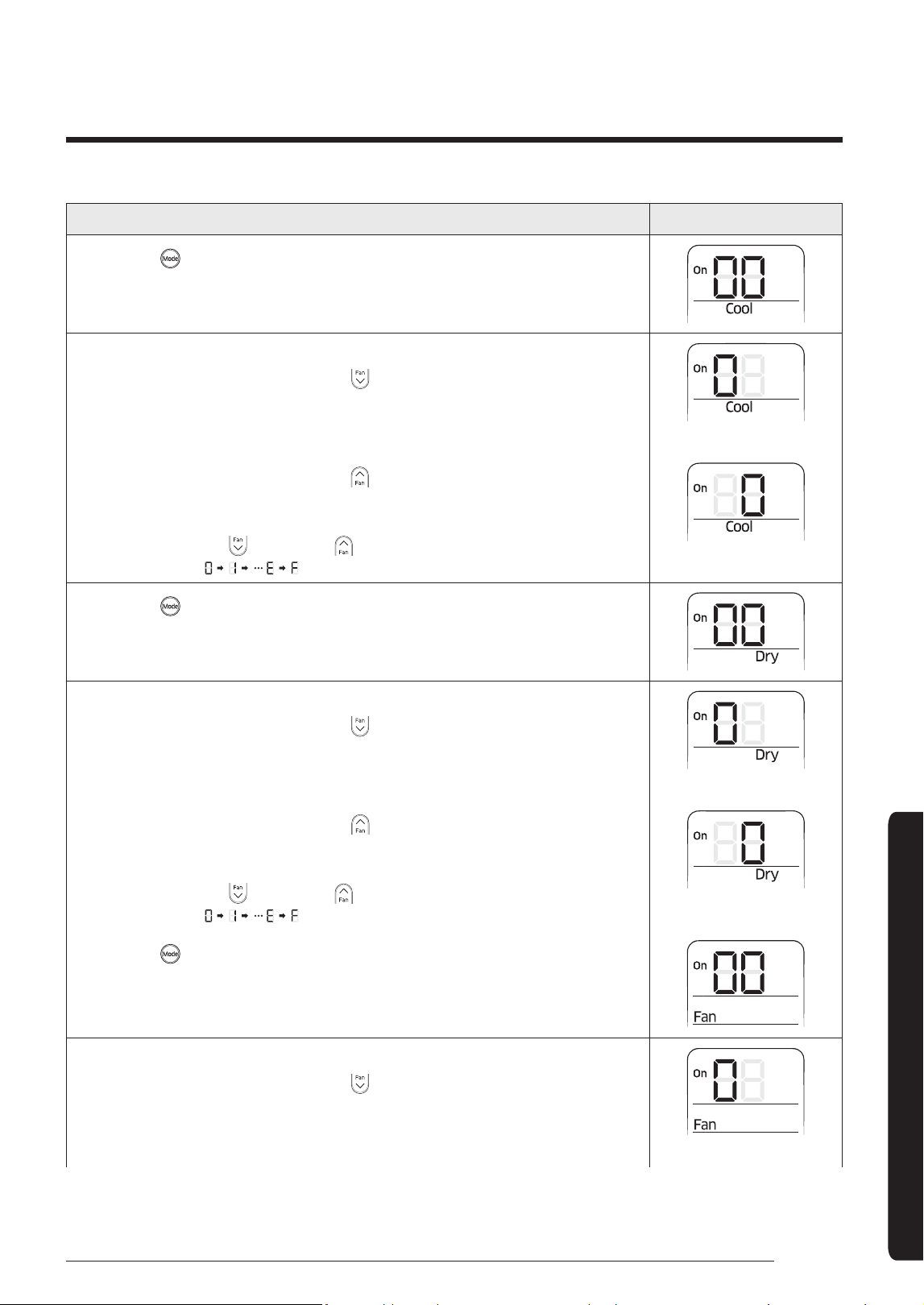
2 Press the (Mode) button. Cool and On appear on the remote control display.
3 Set the SEG4 and SEG5 values:
a Set the SEG4 value by pressing the (Low Fan) button repeatedly until the
value you want to set appears on the remote control display.
SEG4
b Set the SEG5 value by pressing the (High Fan) button repeatedly until the
value you want to set appears on the remote control display.
When you press the (Low Fan) or (High Fan) button, values appear in the
following order:
SEG5
4 Press the (Mode) button. Dry and On appear on the remote control display.
5 Set the SEG6 and SEG8 values:
a Set the SEG6 value by pressing the (Low Fan) button repeatedly until the
value you want to set appears on the remote control display.
SEG6
b Set the SEG8 value by pressing the (High Fan) button repeatedly until the
value you want to set appears on the remote control display.
When you press the (Low Fan) or (High Fan) button, values appear in the
following order:
SEG8
6 Press the (Mode) button. Fan and On appear on the remote control display.
7 Set the SEG9 and SEG10 values:
a Set the SEG9 value by pressing the (Low Fan) button repeatedly until the
value you want to set appears on the remote control display.
SEG9
30
Installation Procedure
English
Installation Procedure
Steps Remote control display
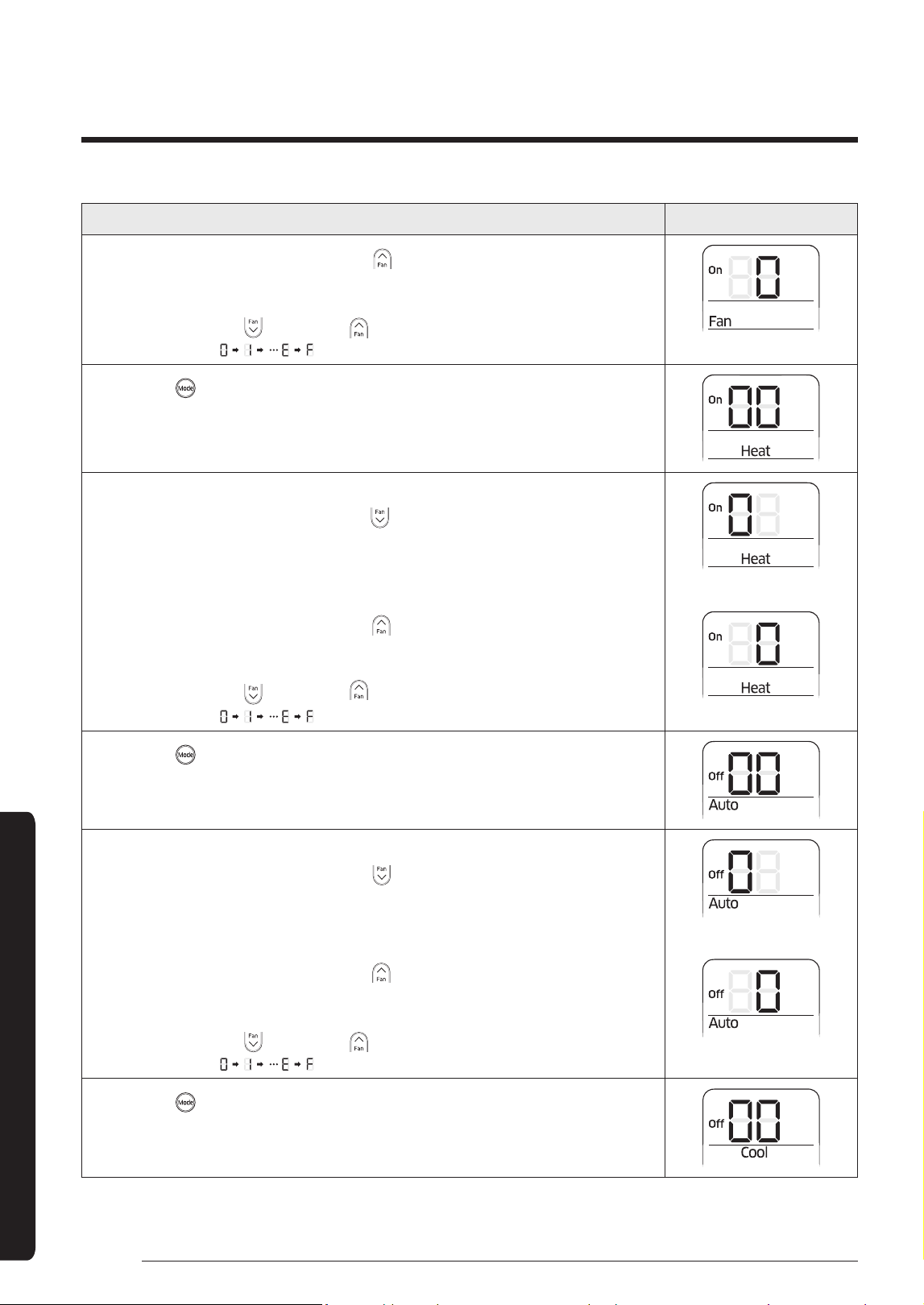
b Set the SEG10 value by pressing the (High Fan) button repeatedly until the
value you want to set appears on the remote control display.
When you press the (Low Fan) or (High Fan) button, values appear in the
following order:
SEG10
8 Press the (Mode) button. Heat and On appear on the remote control display.
9 Set the SEG11 and SEG12 values:
a Set the SEG11 value by pressing the (Low Fan) button repeatedly until the
value you want to set appears on the remote control display.
SEG11
b Set the SEG12 value by pressing the (High Fan) button repeatedly until the
value you want to set appears on the remote control display.
When you press the (Low Fan) or (High Fan) button, values appear in the
following order:
SEG12
10 Press the (Mode) button. Auto and Off appear on the remote control display.
11 Set the SEG14 and SEG15 values:
a Set the SEG14 value by pressing the (Low Fan) button repeatedly until the
value you want to set appears on the remote control display.
SEG14
b Set the SEG15 value by pressing the (High Fan) button repeatedly until the
value you want to set appears on the remote control display.
When you press the (Low Fan) or (High Fan) button, values appear in the
following order:
SEG15
12 Press the (Mode) button. Cool and Off appear on the remote control display.
31
English
Installation Procedure
Steps Remote control display
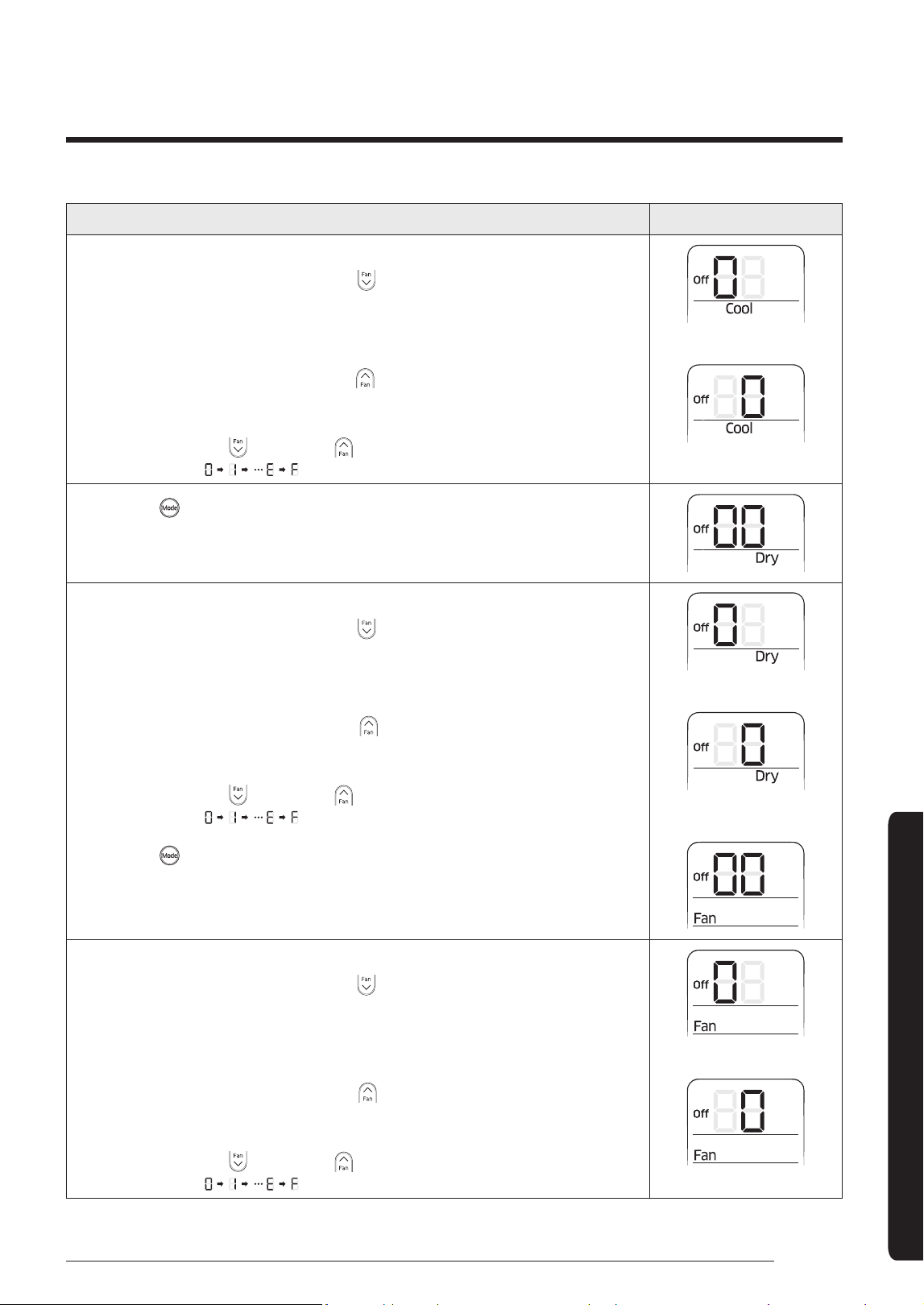
13 Set the SEG16 and SEG17 values:
a Set the SEG16 value by pressing the (Low Fan) button repeatedly until the
value you want to set appears on the remote control display.
SEG16
b Set the SEG17 value by pressing the (High Fan) button repeatedly until the
value you want to set appears on the remote control display.
When you press the (Low Fan) or (High Fan) button, values appear in the
following order:
SEG17
14 Press the (Mode) button. Dry and Off appear on the remote control display.
15 Set the SEG18 and SEG20 values:
a Set the SEG18 value by pressing the (Low Fan) button repeatedly until the
value you want to set appears on the remote control display.
SEG18
b Set the SEG20 value by pressing the (High Fan) button repeatedly until the
value you want to set appears on the remote control display.
When you press the (Low Fan) or (High Fan) button, values appear in the
following order:
SEG20
16 Press the (Mode) button. Fan and Off appear on the remote control display.
17 Set the SEG21 and SEG22 values:
a Set the SEG21 value by pressing the (Low Fan) button repeatedly until the
value you want to set appears on the remote control display.
SEG21
b Set the SEG22 value by pressing the (High Fan) button repeatedly until the
value you want to set appears on the remote control display.
When you press the (Low Fan) or (High Fan) button, values appear in the
following order:
SEG22
32
Installation Procedure
English
Installation Procedure
Steps Remote control display
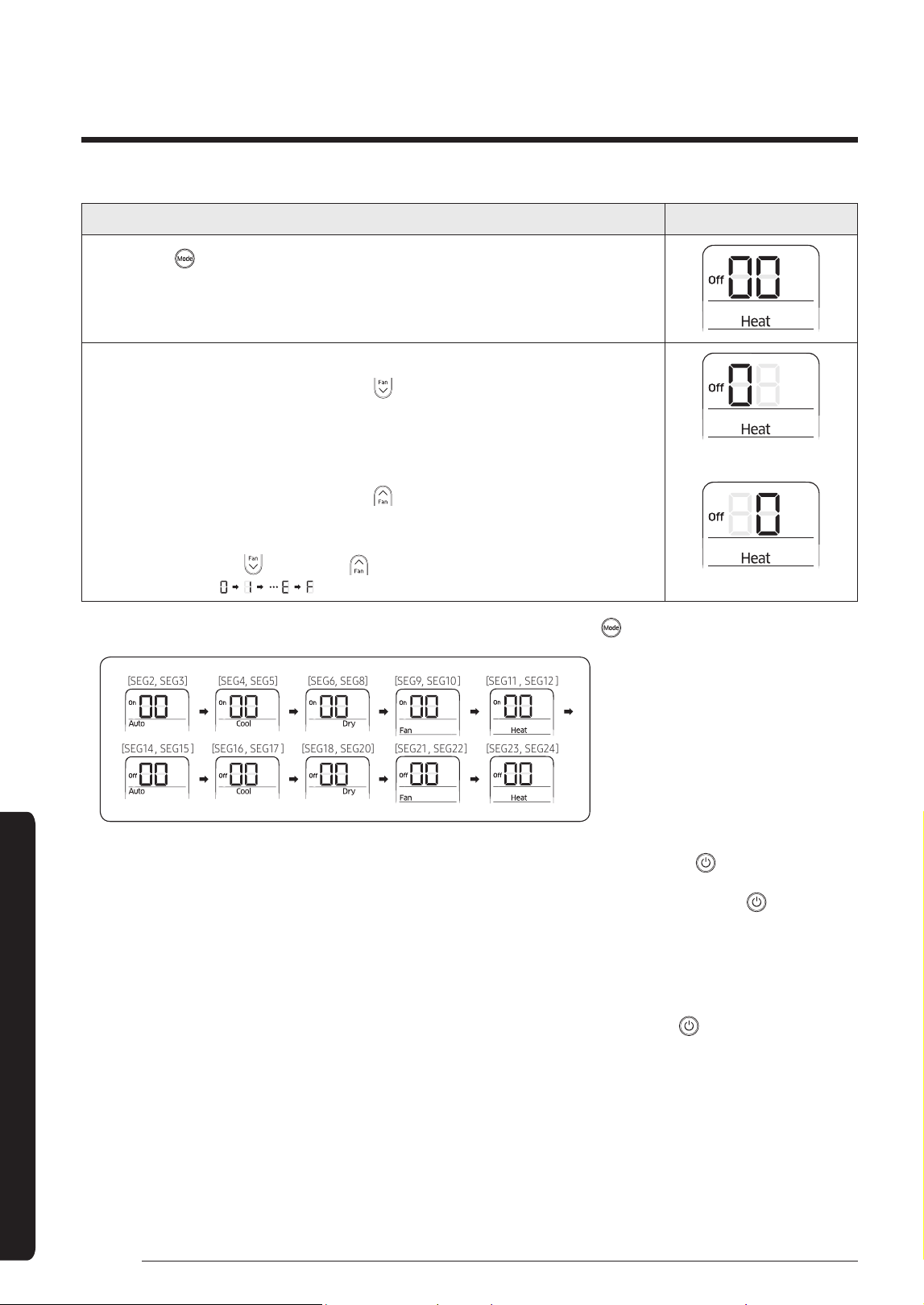
18 Press the (Mode) button. Heat and Off appear on the remote control display.
19 Set the SEG23 and SEG24 values:
a Set the SEG23 value by pressing the (Low Fan) button repeatedly until the
value you want to set appears on the remote control display.
SEG23
b Set the SEG24 value by pressing the (High Fan) button repeatedly until the
value you want to set appears on the remote control display.
When you press the (Low Fan) or (High Fan) button, values appear in the
following order:
SEG24
3 Check whether the option values that you have set are correct by pressing the (Mode) button repeatedly
[SEG21 , SEG22] [SEG23, SEG24]
[SEG2, SEG3] [SEG4, SEG5] [SEG6, SEG8] [SEG9, SEG10] [SEG11 , SEG12 ]
[SEG14, SEG15 ] [SEG16, SEG17 ] [SEG18, SEG20]
4 Save the option values into the indoor unit:
Point the remote control to the remote control sensor on the indoor unit and then press the (Power) button
on the remote control twice. Make sure that this command is received by the indoor unit. When it is successfully
received, you can hear a short sound from the indoor unit. If the command is not received, press the (Power)
button again.
5 Check whether the air conditioner operates in accordance with the option values you have set:
a Reset the indoor unit by disconnecting and then reconnecting the power cable of the indoor unit or by pressing
the RESET button on the outdoor unit.
b Remove the batteries from the remote control, insert them again, and then press the (Power) button on the
remote control.
33
English
Installation Procedure
Setting the indoor unit addresses (MAIN/RMC/
MCU)
1 Make sure that the power is supplied to the indoor
unit.
• If the indoor unit is not plugged in, it must include a
power supply.
2 Make sure that the panel or display is connected to the
indoor unit so that it can receive options.
Indoor unit
3 Set an address (MAIN/RMC/MCU port) for each indoor
unit using the remote control, according to your air
conditioning system plan.
• The indoor unit addresses (MAIN/RMC/MCU port)
are set to 0A0000-100000-200000-300000 by
default.
NOTE
• Also set the MCU and Indoor units address by using
Add-on
→
Change address on S-NET Pro 2.
(For more information, see the S-NET Pro 2 Help.)
• From SEG13 to SEG18 is for setting MCU address.
– MCU models that can set address: MCU-S∗NEK2N,
MCU-S4NEK3N, MCU-S1NEK1N
Option No. for an indoor unit address: 0AXXXX-1XXXXX-2XXXXX-3XXXXX
Option SEG1 SEG2 SEG3 SEG4 SEG5 SEG6
Function Page Mode
Setting main
address
100-digit of
an indoor unit
address
10-digit of an
indoor unit
address
The single digit
of an indoor unit
Indication
and details
Indication
Details
Indication
Details
Indication
Details
Indication
Details
Indication
Details
Indication
Details
0 A
0
No main
address
0 to 9 10-digit 0 to 9
A
single
digit
0 to 3
A single
digit
1
Main
address
setting
mode
Option SEG7 SEG8 SEG9 SEG10 SEG11 SEG12
Function Page -
Setting RMC
address
-
Group channel
(x16)
Group address
Indication
and details
Indication
Details
-
Indication
Details
-
Indication
Details
Indication
Details
1
0
No RMC
address
RMC1 0 to F RMC2 0 to F
1
RMC
address
setting
mode
34
Installation Procedure
English
Installation Procedure
Option SEG13 SEG14 SEG15 SEG16 SEG17 SEG18
Function Page -
Setting MCU PORT
address
10-digit of MCU
address
1-digit of MCU MCU PORT address
Indication
and details
Indication
Details
-
Indication
Details
Indication
Details
Indication
Details
Indication
Details
2
0
No MCU
PORT
0~1 10-digit 0~9 1-digit A~F
PORT
Location
1
MCU
PORT
address
setting
mode
CAUTION
• If you enter A to F to the SEG5 or SEG6, the indoor unit
main address is not changed.
• If you enter 0 to the SEG 3, the indoor unit maintains
the previous main address although you enter the
option value for the SEG5 or SEG 6.
• If you enter 0 to the SEG 9, the indoor unit maintains
previous RMC address although you enter the option
value for the SEG11 or SEG12.
• You cannot set the SEG11 or SEG12 to F value at the
same time.
• If the indoor unit is connected to the MCU, you can set
the SEG 15~18.
Ex.) If you want to set the indoor unit to ‘A’ port of MCU #1.
(0A0000 – 100000 – 20101A -30000)
Setting the indoor unit installation option
(suitable for the condition of each installation
location)
1 Make sure that the power is supplied to the indoor
unit.
• If the indoor unit is not plugged in, it must include a
power supply.
2 Make sure that the panel or display is connected to the
indoor unit so that it can receive options
Indoor unit
3 Set an address for each indoor unit using the remote
control, according to your air conditioning system plan.
• The indoor unit addresses are set to 020010-
100000-200000-300000 by default.
• The SEG20 option, Individual control with remote
control, allows you to control multiple indoor units
individually by using the remote control.
35
English
Installation Procedure
Installation options for the 02 series
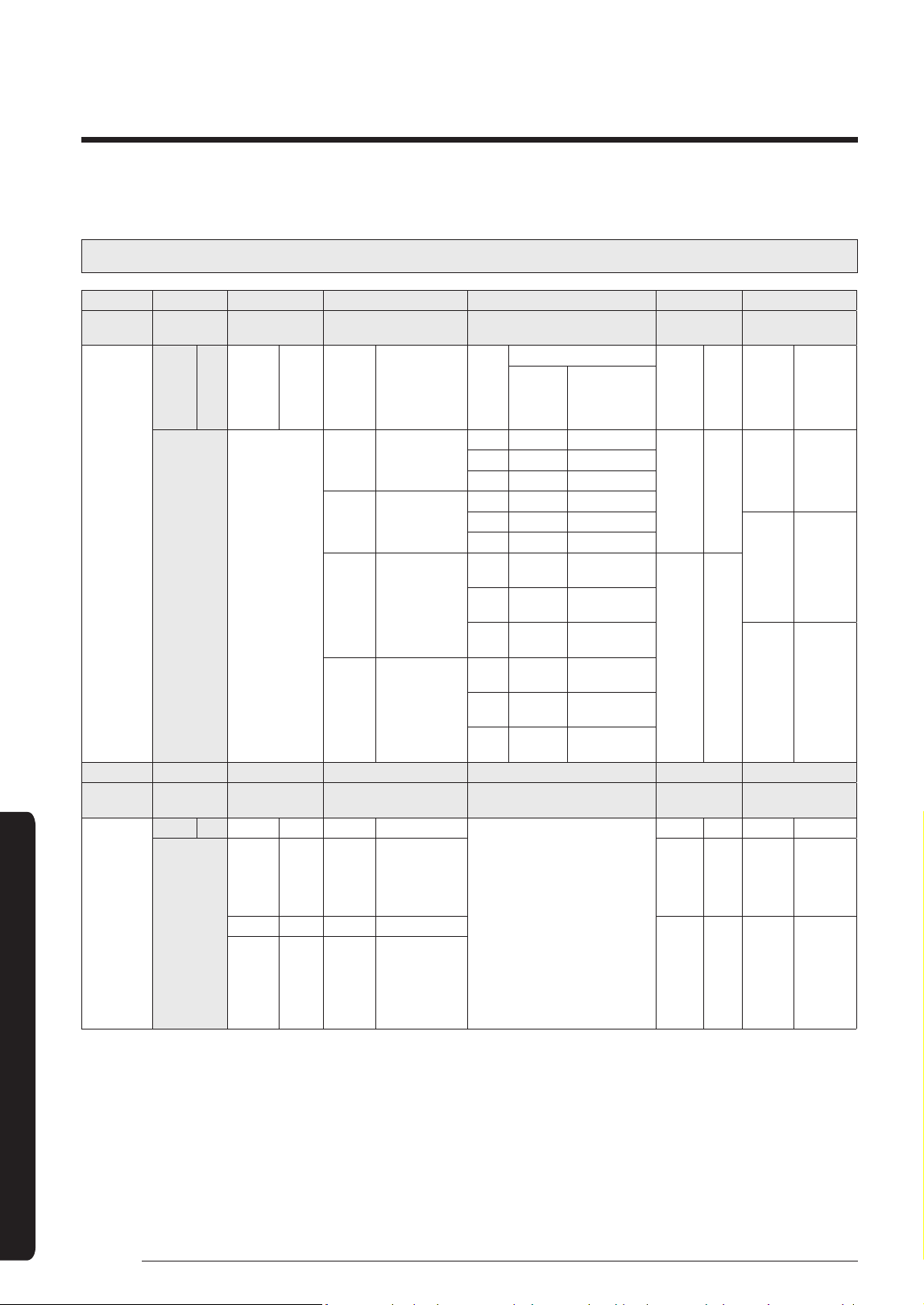
SEG1 SEG2 SEG3 SEG4 SEG5 SEG6
0 2 Evaporator Drying
Use of external
room temperature
sensor / Minimizing
fan operation when
thermostat is off
Use of central control
FAN RPM
compensation
SEG7 SEG8 SEG9 SEG10 SEG11 SEG12
1 Use of drain pump
Use of hot water
heater
-
EEV Step when
heating stops
Dew removal
operation in wind
free mode
SEG13 SEG14 SEG15 SEG16 SEG17 SEG18
2
Use of external
control
Setting the output
of external control /
External heater signal
/ Cooling operation
signal / Free Cooling
control signal
S-Plasma ion Buzzer control Hours of filter usage
SEG19 SEG20 SEG21 SEG22 SEG23 SEG24
3
Individual control of a
remote controller
Heating setting
compensation
/ Removing
condensate water in
heating mode
Adjusted EEV step of
stopped unit during
oil return /defrost
mode.
Motion detect sensor
-
• Even if you set the Use of drain pump (SEG8) option to 0, it is automatically set to 2 (the drain pump is used with 3
minute delay).
• If you set the Maximum filter usage time (SEG18) option to a value other than 2 and 6, it is automatically set to 2
(1000 hours).
• If you set an option to a value that is out of range specified above, the option is automatically set to 0 by default.
• The SEG5 option (Use of central control) is set to 1 (Use) by default. Therefore, you don't need to set the SEG5 option
additionally. Note that even if the central control system is not connected, no errors occur. If you want a specific
indoor unit not to be controlled by the central control system, set the SEG option of that indoor unit to 0 (Disuse).
• The external output of SEG15 is generated via MIM-B14 connection. (Refer to the manual of MIM-B14.)
• If you set the Individual control with remote control (SEG20) option to a value other than 0 to 4, it is automatically set
to 0 (Indoor 1).
• The output of hot water heater in SEG9 is generated from the hot coil part of the terminal board in duct models.
Outdoor
Communication
(+) (-) COM2
DC 12 V
Wire Remote
Controller
AC
POWER
HOT
COIL
L NCOM1
∗ The output of hot coil terminal is AC 220 V / 230 V
(The same as Indoor Unit’s input Power)
36
Installation Procedure
English
Installation Procedure
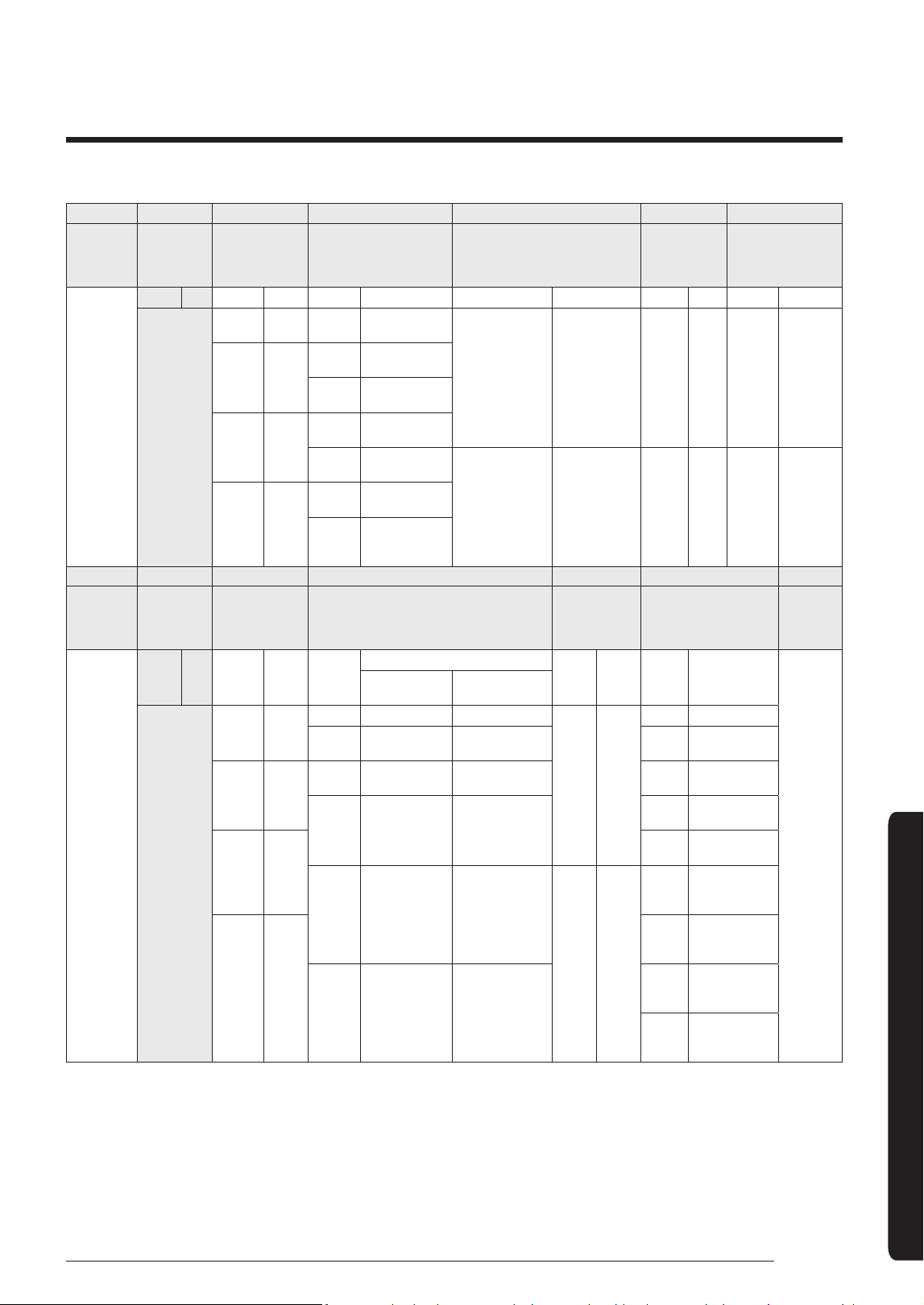
02 series installation option (Detailed)
Option No. : 02XXXX-1XXXXX-2XXXXX-3XXXXX
Option SEG1 SEG2 SEG3 SEG4 SEG5 SEG6
Explanation PAGE MODE Evaporator Drying
Use of external room temperature sensor /
Minimizing fan operation when thermostat is off
Use of central
control
FAN RPM compensation
Indication
and Details
Indication Details Indication Details Indication Details
Indication
Details
Indication Details Indication Details
Use of
External room
temperature
sensor
Minimizing fan
operation when
thermostat is off
0 2
0 Disuse
0 Default Default
0 Disuse
0 Disuse
1 Use Disuse
2 Disuse Use (Heating) (*2)
2 Use (5min) (*1)
3 Use Use (Heating) (*2)
4 Disuse Use (Cooling) (*2)
1
RPM
compensation
5 Use Use (Cooling) (*2)
4 Use (10min) (*1)
6 Disuse
Use (Heating /
Cooling) (*2)
1 Use
7 Use
Use (Heating /
Cooling) (*2)
8 Disuse
Use (Cooling Ultra
Low Fan ) (*2)
2
High ceiling
KIT (4way
model only)
6 Use (30min) (*1)
9 Use
Use (Cooling Ultra
Low Fan ) (*2)
A Disuse
Use (Heating / Cooling
Ultra Low Fan ) (*2)
B Use
Use (Heating / Cooling
Ultra Low Fan ) (*2)
Option SEG7 SEG8 SEG9 SEG10 SEG11 SEG12
Explanation PAGE Use of drain pump Use of hot water heater -
EEV Step when
heating stops
Dew removal operation in
wind free mode
Indication
and Details
Indication Details Indication Details Indication Details
-
Indication Details Indication Details
1
0 Disuse 0 Disuse 0 Default 0
(Default)
Maintain
blade status
in wind free
mode
1 Use 1 Use (*3)
1
Adjusted
EEV Step
setting
1
Cooling
operation by
opening the
blade
2
When an
indoor unit
stops, drain
pump will
operate for
3min
3 Use (*3)
37
English
Installation Procedure
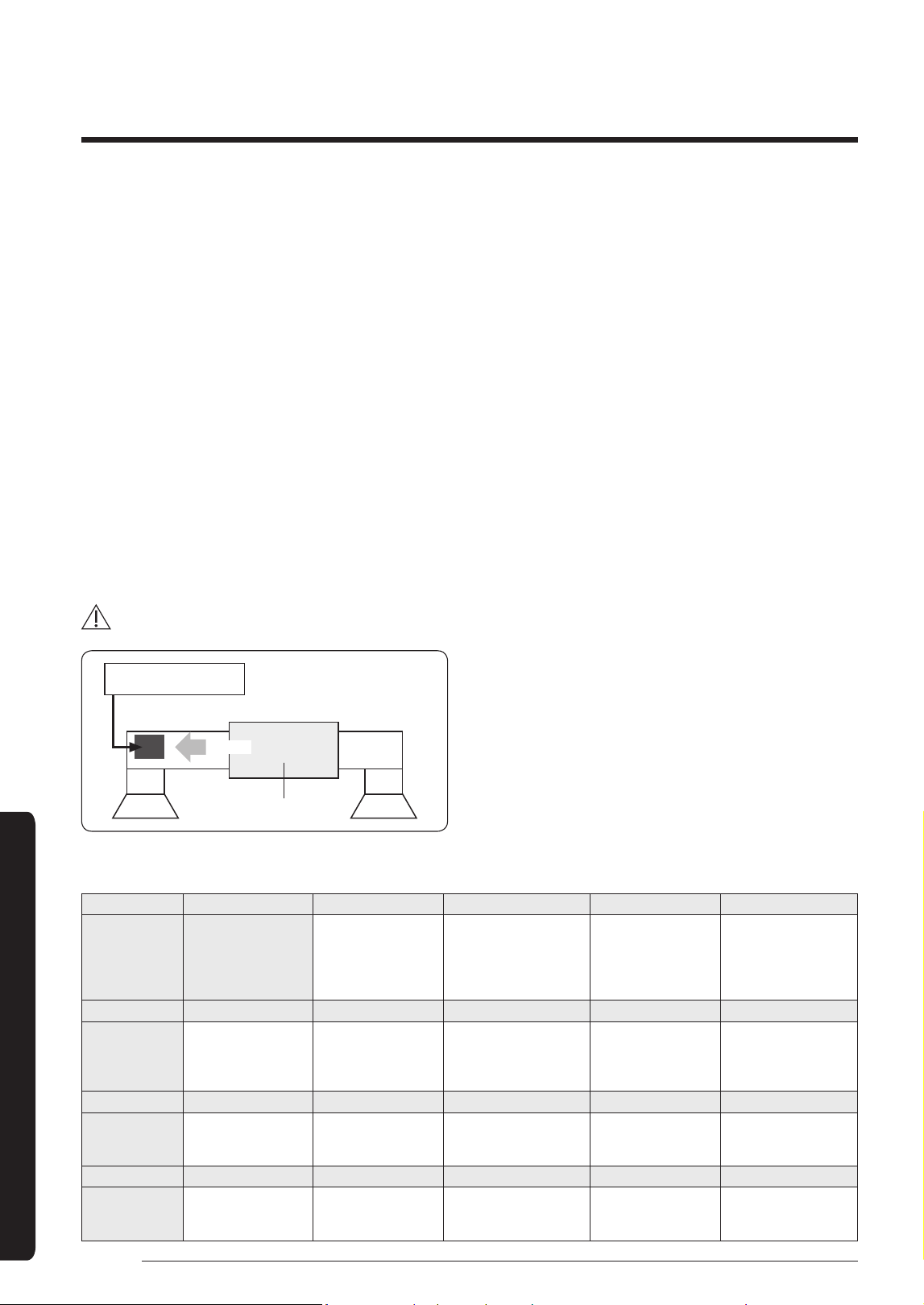
Option SEG13 SEG14 SEG15 SEG16 SEG17 SEG18
Explanation PAGE Use of external control
Setting the output of external
control / External heater signal /
Cooling operation signal /
Free Cooling control signal
S-Plasma ion Buzzer control Hours of filter usage
Indication
and Details
Indication Details Indication Details Indication Details Indication Details Indication Details Indication Details
2
0 Disuse 0
External control
(Thermo On)
0 Disuse 0
Use
buzzer
2 1000 Hour1
ON/OFF
control
1
External control
(Operation On)
2
External heater
signal (*4)
2
OFF
control
3
External heater
signal (*4)
4
Cooling operation
signal (*5)
1 Use 1
Disuse
buzzer
6 2000 Hour
3
Window
ON/OFF
control
5
Free Cooling control
(Cooling Thermo On) (*6)
6
Free Cooling control
(Cooling/Dry Thermo
On) (*6)
Option SEG19 SEG20 SEG21 SEG22 SEG23 SEG24
Explanation PAGE
Individual control of a
remote controller
Heating setting compensation / Removing condensate water
in heating mode
Adjusted EEV step of
stopped unit during
oil return /defrost
mode.
Motion detect sensor -
Indication and
Details
Indication
Details
Indication Details Indication
Details
Indication Details Indication Details
-
Heating Setting
Compensation
Removing Condensate
Water in Heating Mode
3
0 or 1 channel 1
0 Default Disuse
0 Default
0 Disuse
1 2 °C Disuse 1
Turn out in 30min.
without motion
2 channel 2
2 5 °C Disuse 2
Turn out in 60min.
without motion
3 Default Use (*7)
3
Turn out in 120min.
without motion
3 channel 3
4
Turn out in 180min.
without motion
4 2 °C Use (*7)
1
Adjusted
EEV
positon
5
Turn out in 30min.
without motion or
*advanced function
4 channel 4
6
Turn out in 60min.
without motion &
*advanced function
5 5 °C Use (*7)
7
Turn out in 120min.
without motion &
*advanced function
8
Turn out in 180min.
without motion &
*advanced function
* Advanced function: Controlling cooling/heating current or power saving with motion detect.
(*1) When Cooling or dry mode is off. The indoor fan operate in setting minutes.
(*2) Minimizing fan operation when thermostat is off
- Fan operates for 20 seconds at an interval of 5 minutes in heat mode.
- Fan stops or operates Ultra low in Cooling when thermostat is off.
38
Installation Procedure
English
Installation Procedure
(*3) 1: Fan is turned on continually when the hot water heater is turned on,
3: Fan is turned off when the hot water heater is turned on with cooling only indoor unit
Cooling only indoor unit: To use this option, install the Mode Select switch(MCM-C200) on the outdoor unit and fix
it as cool mode.
(*4) When the following 2 or 3 is used as external heater On/Off signal, the signal for monitoring external contact
control will not be output.
2: Fan is turned on continually when the external heater is turned on,
3: Fan is turned off when the external heater is turned on with cooling only indoor unit
Cooling only indoor unit: To use this option, install the Mode Select switch(MCM-C200) on the outdoor unit and fix
it as cool mode.
- If Fan is set to off for cooling only indoor unit by setting the SEG9=3 or SEG15=3, you need to use an external
sensor or wired remote controller sensor to detect indoor temperature exactly.
(*5) When indoor unit is in cooling or Dry mode, The output signal is “ON”
(*6) For free cooling control, Economizer controller is required.
(*7) This function can be applied to 4 Way Cassette and Mini 4 Way Cassette only.
If the air conditioner operates the heating mode immediately after finishing the cooling mode, the condensate
water in the drain pan becomes water vapor by the heat of the indoor unit heat exchanger. Since the water vapor
might be condensed on the indoor unit, which may fall into a living space, use this function to get rid of the water
vapor out of the indoor unit by operating the fan (for maximum 20 minutes) even when the indoor unit is turned off
after cooling mode is turned to heating mode
CAUTION
Duct Indoor unit
Air Flow
Discharge side
Electronic heater should
not be installed
Suction side
• Do not install the electronic heater in the flow channel
of the indoor unit fan.
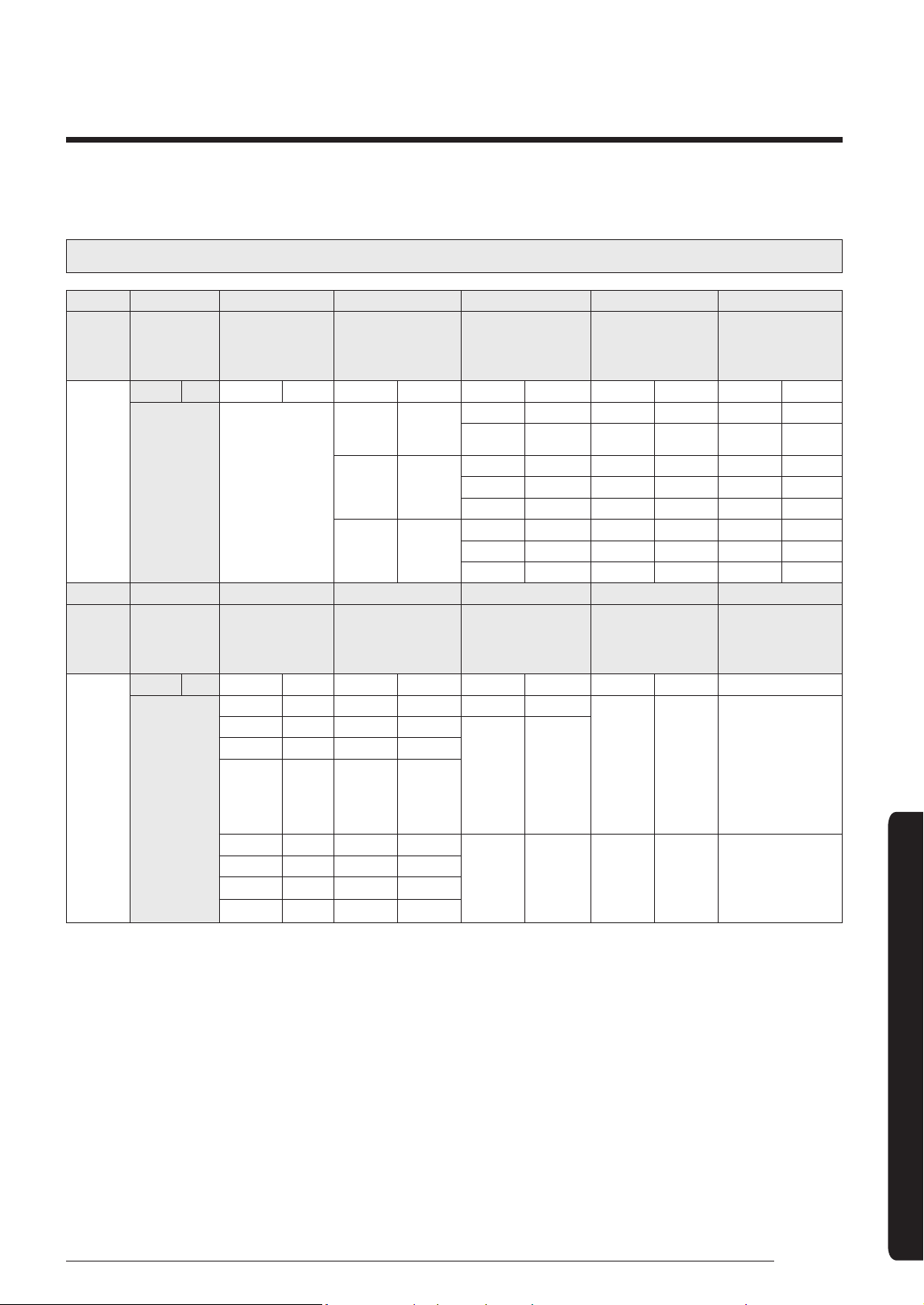
05 series installation option
SEG1 SEG2 SEG3 SEG4 SEG5 SEG6
0 5
Use of Auto Change
Over for HR only in
Auto mode / Use of
Cooling only indoor
unit of HR
(When setting SEG3)
Standard heating temp.
Offset
(When setting SEG3)
Standard cooling
temp. Offset
(When setting SEG3)
Standard for mode
change Heating →
Cooling
SEG7 SEG8 SEG9 SEG10 SEG11 SEG12
1
(When setting SEG3)
Standard for mode
change Cooling →
Heating
(When setting SEG3)
Time required for
mode change
Compensation option
for Long pipe or height
difference between
indoor units
MTFC (*3) -
SEG13 SEG14 SEG15 SEG16 SEG17 SEG18
2 - - - -
Control variables when
using hot water /
external heater (*4)
SEG19 SEG20 SEG21 SEG22 SEG23 SEG24
3 - - -
Forced FAN Operation
for Heating and
Cooling
-
39
English
Installation Procedure
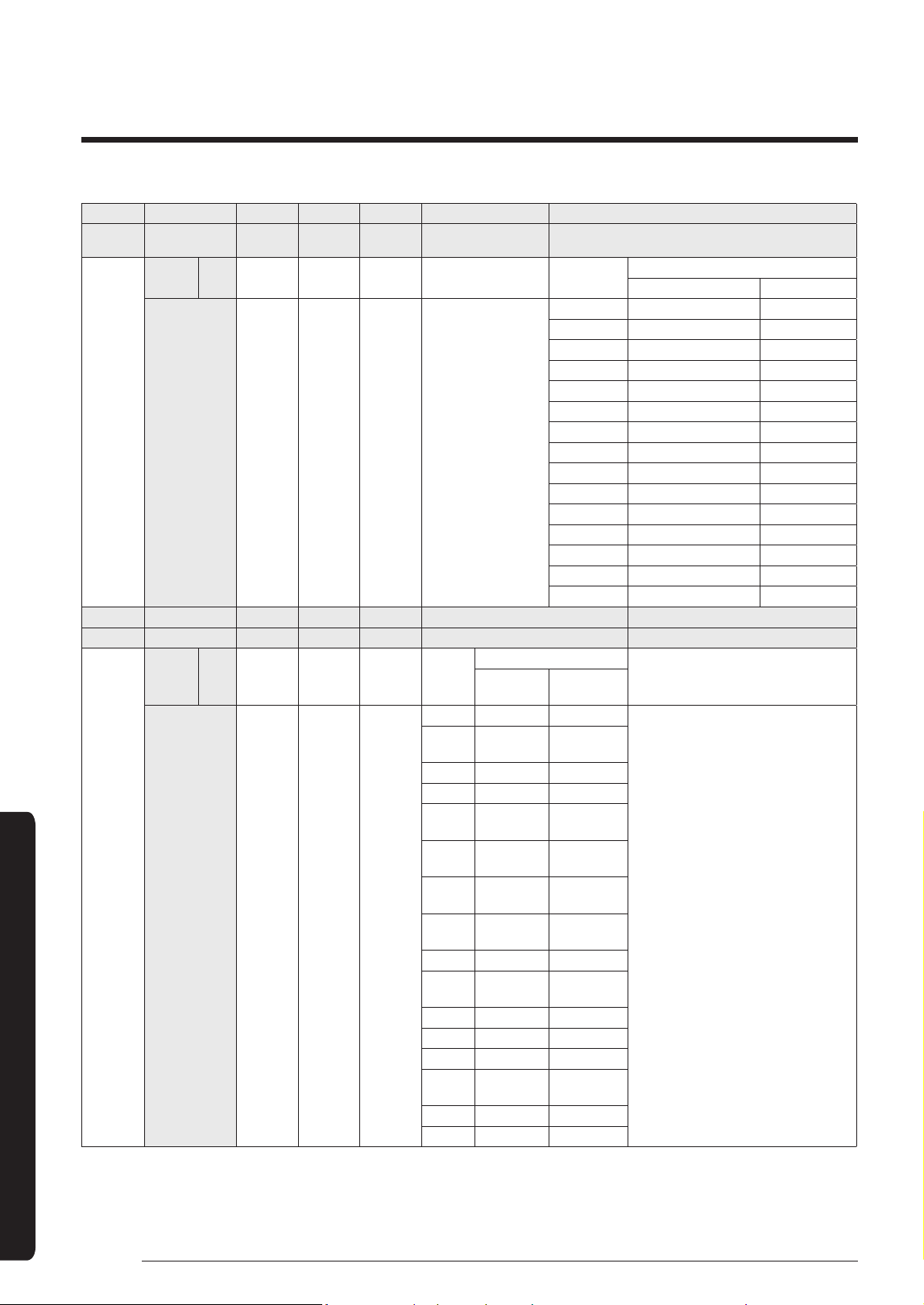
05 series installation option (Detailed)
Option No. : 05XXXX-1XXXXX-2XXXXX-3XXXXX
Option SEG1 SEG2 SEG3 SEG4 SEG5 SEG6
Explanation PAGE MODE
Use of Auto Change Over
for HR only in Auto mode /
Use of Cooling only indoor
unit of HR
(When setting SEG3)
Standard heating temp.
Offset
(When setting SEG3)
Standard cooling temp.
Offset
(When setting SEG3)
Standard for mode change
Heating → Cooling
Indication
and Details
Indication Details Indication Details Indication Details Indication Details Indication Details Indication Details
0 5
0
Follow
product
option
0 0 °C 0 0 °C 0 1 °C
1 0.5 °C 1 0.5 °C 1 1.5 °C
1
Use Auto
Change Over
for HR only
2 1 °C 2 1 °C 2 2 °C
3 1.5 °C 3 1.5 °C 3 2.5 °C
4 2 °C 4 2 °C 4 3 °C
2
Use Cooling
only indoor
unit for HR
5 2.5 °C 5 2.5 °C 5 3.5 °C
6 3 °C 6 3 °C 6 4 °C
7 3.5 °C 7 3.5 °C 7 4.5 °C
Option SEG7 SEG8 SEG9 SEG10 SEG11 SEG12
Explanation PAGE
(When setting SEG3)
Standard for mode
change Cooling →
Heating
(When setting SEG3)
Time required for mode
change
Compensation option
for Long pipe or height
difference between indoor
units
MTFC (*3) -
Indication
and Details
Indication Details Indication Details Indication Details Indication Details Indication Details -
1
0 1 °C 0 5min 0 Default
0 Default -
1 1.5 °C 1 7min
1
(*1) Height
difference is
more than
30m or (*2)
Distance is
longer than
110m
2 2 °C 2 9min
3 2.5 °C 3 11min
4 3 °C 4 13min
2
(*1) Height
difference is
15~30m or
(*2) Distance
is 50~110m
2 Use -
5 3.5 °C 5 15min
6 4 °C 6 20min
7 4.5 °C 7 30min
40
Installation Procedure
English
Installation Procedure
Option SEG13 SEG14 SEG15 SEG16 SEG17 SEG18
Explanation - - - - - Control variables when using hot water / external heater (*4)
Indication
and Details
Indication Details - - - - Indication
Details
Set temp. for heater On/Off
Delay time for heater On
2 - - - -
0 At the same time as thermo on No delay
1 At the same time as thermo on 10 minutes
2 At the same time as thermo on 20 minutes
3 1.5 °C No delay
4 1.5 °C 10 minutes
5 1.5 °C 20 minutes
6 3.0 °C No delay
7 3.0 °C 10 minutes
8 3.0 °C 20 minutes
9 4.5 °C No delay
A 4.5 °C 10 minutes
B 4.5 °C 20 minutes
C 6.0 °C No delay
D 6.0 °C 10 minutes
E 6.0 °C 20 minutes
Option SEG19 SEG20 SEG21 SEG22 SEG23 SEG24
Explanation PAGE - - - Forcing FAN Operation for Heating and Cooling -
Indication
and Details
Indication Details - - - Indication
Details
-
Cooling Fan
Setting
Heating Fan
Setting
3 - - -
0 Disuse Disuse
-
1 Disuse
Use (Fan: User
setting)
2 Disuse Use (Fan: High)
3 Disuse Use (Fan: Low)
4
Use (Fan: User
setting)
Disuse
5
Use (Fan: User
setting)
Use (Fan: User
setting)
6
Use (Fan: User
setting)
Use (Fan: High)
7
Use (Fan: User
setting)
Use (Fan: Low)
8 Use (Fan: High) Disuse
9 Use (Fan: High)
Use (Fan: User
setting)
A Use (Fan: High) Use (Fan: High)
B Use (Fan: High) Use (Fan: Low)
C Use (Fan: Low) Disuse
D Use (Fan: Low)
Use (Fan: User
setting)
E Use (Fan: Low) Use (Fan: High)
F Use (Fan: Low) Use (Fan: Low)
41
English
Installation Procedure
(*1) Height difference : The difference of the height between the corresponding indoor unit and the indoor unit
installed at the lowest place. For example, When the indoor unit is installed 40m higher than the indoor unit
installed at the lowest place, select the option “1”.
(*2) The difference between the pipe length of the indoor unit installed at farthest place from an outdoor unit and the
pipe length of the corresponding indoor unit from an outdoor unit.
For example, when the farthest pipe length is 100 m(328 ft.) and the corresponding indoor unit is 40 m away from
an outdoor unit, select the option “2”. (100 - 40 = 60m)
(*3) For MTFC option, MTFC(Multi Tenant Function Controller) kit is required.
(*4) Heater operation when the SEG9 of 02 series installation option is set to using hot water heater or when SEG15 is
set to using external heater.
Example 1) Setting 02 series SEG9 =”1” / Setting 05 series SEG18 = “0”: The hot water heater is turned on at the
same time as the heating thermostat is on, and turned off when the heating thermostat is off.
Example 2) Setting 02 series SEG15 =”2” / Setting 05 series SEG18 =”A”: Room temp. ≤ set temp. + f (heating
compensation temp.)
– External heater is turned on when the temperature is maintained as 4.5 °C for 10 minutes. Room temp. >
set temp. + f(heating compensation temp.)
– External heater is turned off when the temperature is maintained as 4.5 °C + 1 °C (1 °C is the Hysteresis for On/Off
selection.)
Additional information on SEG 3, 4, 5, 6, 8, 9
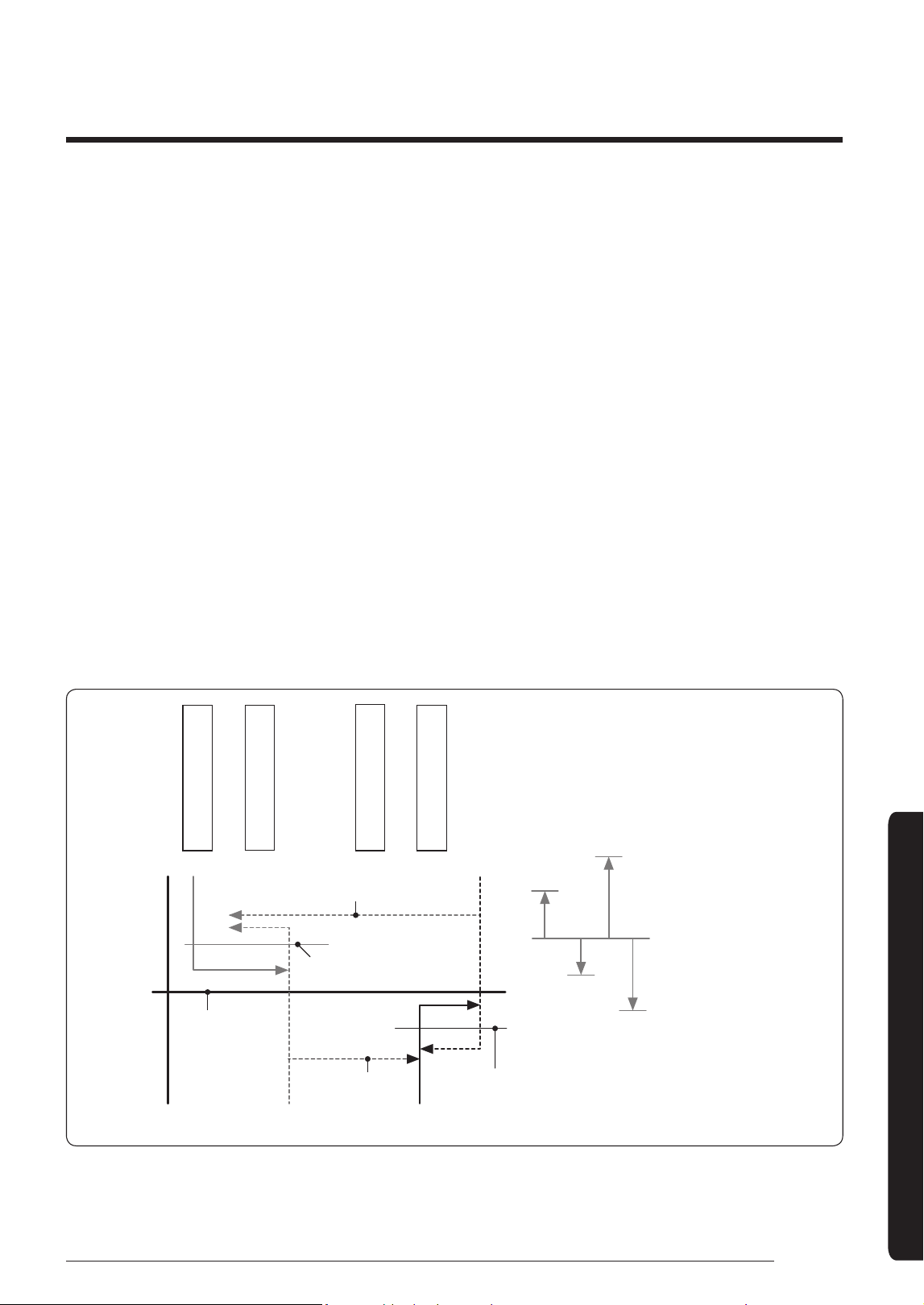
When SEG 3 is set to 1 and the HR-specific auto changeover function is run, the indoor unit operates as shown in the
following figure:
C
Temperature
b
d
c
A
D
B
a
Ts
Set temperature
for Auto mode
Reference
temperature for
cooling
Reference temperature for heating
Reference temperature for change from
heating to cooling
Reference temperature for
cooling
Cooling thermo off
Cooling thermo on
Heating thermo off
Heating thermo on
A: Set with SEG4 (˚C)
B: Set with SEG5 (˚C)
C: Set with SEG6 (˚C)
D: Set with SEG8 (˚C)
The mode change between the Cool and Heat modes is made only when the thermo off state is maintained for the
period of time set with SEG9.
42
Installation Procedure
English
Installation Procedure
Changing the addresses and options individually
When you want to change the value of a specific option, refer to the following table and follow the steps in Common
steps for setting the addresses and options on page 27.
Option SEG1 SEG2 SEG3 SEG4 SEG5 SEG6
Function Page Mode
Type of the
option to change
Tens position
of the option
number
Units position
of the option
number
New value
Indication
and details
Indication
Details
Indication
Details
Indication
Details
Indication
Details
Indication
Details
Indication
Details
0 D
Option
type
0 to F
Tens
position
value
0 to 9
Units
position
value
0 to 9
New
value
0 to F
Example: Changing the Buzzer control (SEG17) option of the installation options to 1 disuse.
Option SEG1 SEG2 SEG3 SEG4 SEG5 SEG6
Function Page Mode
Type of the
option to change
Tens position
of the option
number
Units position
of the option
number
New value
Indication
0 D 2 1 7 1
CAUTION
• If your indoor units support both cooling and heating, the mixed operation (two or more indoor units operate in
different modes simultaneously) is not available when the indoor units are connected to the same outdoor unit. If
you set an indoor unit as the master indoor unit by using the remote control, the outdoor unit automatically operate
in the current mode of the master indoor unit.
43
English
Installation Procedure
Memo