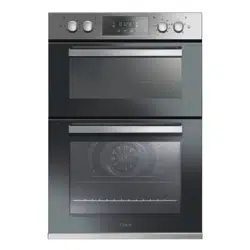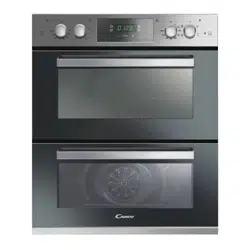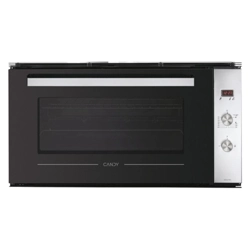

CANDY HOOVER GROUP S.R.L. • Via Comolli 16 • 20861 Brugherio (MB) Italy
BUILT-IN ELECTRIC OVENS
INSTALLATION ADVICES - INSTRUCTIONS FOR THE USE
GB
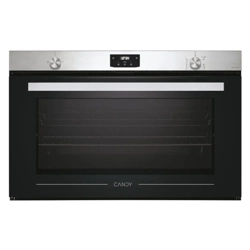
• FCE943LX
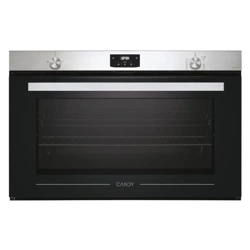
• FCE943LX-19

22
Dear Customer,
Thank you for having purchased and given your preference to
our product.
The safety precautions and recommendations reported below
are for your own safety and that of others. They will also provide
a means by which to make full use of the features oered by your
appliance.
Please preserve this booklet carefully. It may be useful in future,
either to yourself or to others in the event that doubts should
arise relating to its operation.
This appliance must be used only for the task it has
explicitly been designed for, that is for cooking foodstus.
Any other form of usage is to be considered as inappropriate
and therefore dangerous.
The manufacturer declines all responsibility in the event
of damage caused by improper, incorrect or illogical use of
the appliance.

33
IMPORTANT SAFETY PRECAUTIONS AND RECOMMENDATIONS
IMPORTANT: This appliance is designed and manufactured
solely for the cooking of domestic (household) food and is
not suitable for any non domestic application and therefore
should not be used in a commercial environment.
The appliance guarantee will be void if the appliance is used
within a non domestic environment i.e. a semi commercial,
commercial or communal environment.
Read the instructions carefully before installing and using
the appliance.
• This appliance has been designed and manufactured in
compliance with the applicable standards for the household
cooking products and it fullls all the safety requirements shown
in this manual, including those for surface temperatures.
Some people with sensitive skin may have a more pronounced
temperature perception with some components although these
parts are within the limits allowed by the norms.
The complete safety of the appliance also depends on the correct
use, we therefore recommend to always pay a extreme attention
while using the product, especially in the presence of children.
• After having unpacked the appliance, check to ensure that it is
not damaged and that the oven door closes correctly.
In case of doubt, do not use it and consult your supplier or a
professionally qualied technician.
• Packing elements (i.e. plastic bags, polystyrene foam, nails,
packing straps, etc.) should not be left around within easy reach
of children, as these may cause serious injuries.
• Some appliances are supplied with a protective lm on steel and
aluminium parts. This lm must be removed before using the
appliance.
• IMPORTANT: The use of suitable protective clothing/gloves is
recommended when handling or cleaning this appliance.
• Do not attempt to modify the technical characteristics of the
appliance as this may become dangerous to use. The manufacturer
declines all responsibility for any inconvenience resulting from the
inobservance of this condition.

44
• Do not operate your appliance by means of an external timer or
separate remote-control system.
• Do not carry out cleaning or maintenance operations on the
appliance without having previously disconnected it from the
electric power supply.
• WARNING: Ensure that the appliance is switched o before
replacing the oven lamp to avoid the possibility of electric shock.
• Do not use a steam cleaner because the moisture can get into
the appliance therefore making it unsafe.
• Do not touch the appliance with wet or damp hands (or feet).
• Do not use the appliance whilst in bare feet.
• If you should decide not to use this appliance any longer (or
decide to substitute another model), before disposing of it, it
is recommended that it be made inoperative in an appropriate
manner in accordance to health and environmental protection
regulations, ensuring in particular that all potentially hazardous
parts be made harmless, especially in relation to children who
could play with unused appliances.
• The various components of the appliance are recyclable. Dispose
of them in accordance with the regulations in force in your country.
If the appliance is to be scrapped, remove the power cord.
• After use, ensure that the knobs are in the o position.
• Children less than 8 years of age shall be kept away unless
continuously supervised.
• This appliance can be used by children aged from 8 years and
above and persons with reduced physical, sensory or mental
capabilities or lack of experience and knowledge if they have
been given supervision or instruction concerning use of the
appliance in a safe way and understand the hazards involved.
Children shall not play with the appliance. Cleaning and user
maintenance shall not be made by children without supervision.
• The manufacturer declines all liability for injury to persons or
damage to property caused by incorrect or improper use of the
appliance.

55
• WARNING: During use the appliance and its accessible parts
become hot; they remain hot for some time after use.
– Care should be taken to avoid touching heating elements
inside the oven.
– The door is hot, use the handle.
– To avoid burns and scalds, young children should be kept
away.
• Make sure that electrical cables connecting other appliances in
the proximity of the oven cannot become entrapped in the oven
door.
• WARNING: When correctly installed, your product meets all
safety requirements laid down for this type of product category.
However special care should be taken around the rear or the
underneath of the appliance as these areas are not designed or
intended to be touched and may contain sharp or rough edges,
that may cause injury.
• FIRST USE OF THE OVEN - it is advised to follow these
instructions:
– Furnish the interior of the oven as described in the chapter
“CLEANING AND MAINTENANCE”.
– Switch on the empty oven on max to eliminate grease from the
heating elements.
– Disconnect the appliance from the electrical power supply, let
the oven cool down and clean the interior of the oven with a
cloth soaked in water and neutral detergent; then dry carefully.
• CAUTION: Do not use harsh abrasive cleaners or sharp metal
scrapers to clean the oven door glass since they can scratch the
surface, which may result in shattering of the glass.
• Do not line the oven walls or oor with aluminium foil. Do not place
baking trays or the drip tray on the base of the oven chamber.
• FIRE RISK! Do not store ammable material in the oven.
• Always use oven gloves when removing the shelves and food
trays from the oven whilst hot.

66
• Do not hang towels, dishcloths or other items on the appliance or
its handle – as this could be a re hazard.
• Clean the oven regularly and do not allow fat or oils to build up in
the oven base or tray. Remove spillages as soon as they occur.
• Do not stand on the open oven door.
• Always stand back from the appliance when opening the oven
door to allow steam and hot air to escape before removing the
food.
• SAFE FOOD HANDLING: Leave food in the oven for as short
a time as possible before and after cooking. This is to avoid
contamination by organisms which may cause food poisoning.
Take particular care during warmer weather.
• WARNING: Take care NOT to lift the appliance by the door
handle.
• The appliance must not be installed behind a decorative door in
order to avoid overheating.
• The oven accessories (e.g. oven wire rack) must be tted
correctly as indicated at page 38.
• IMPORTANT NOTE: The oven shelves (for some products one
shelf only is provided) have not been designed to place the food
directly on the shelf itself. When cooking, always place the food
in special containers or use specic materials suitable for the
food contact.
• If the power supply cable is damaged, it must be replaced only
by an authorized service agent in order to avoid a hazard.
• If the appliance is not tted with a supply cord and a plug, or with
other means for disconnection from the supply mains having a
contact separation in all poles that provide full disconnection under
overvoltage category III conditions, means for disconnection
must be incorporated in the xed wiring in accordance with the
wiring rules.
• WARNING: The appliance and its accessible parts become hot
during use.
Care should be taken to avoid touching heating elements.
Children less than 8 years of age shall be kept away unless
continuously supervised.

77
88
ADVICEADVICE
for thefor the
INSTALLERINSTALLER

99
INSTALLATION
1
IMPORTANT
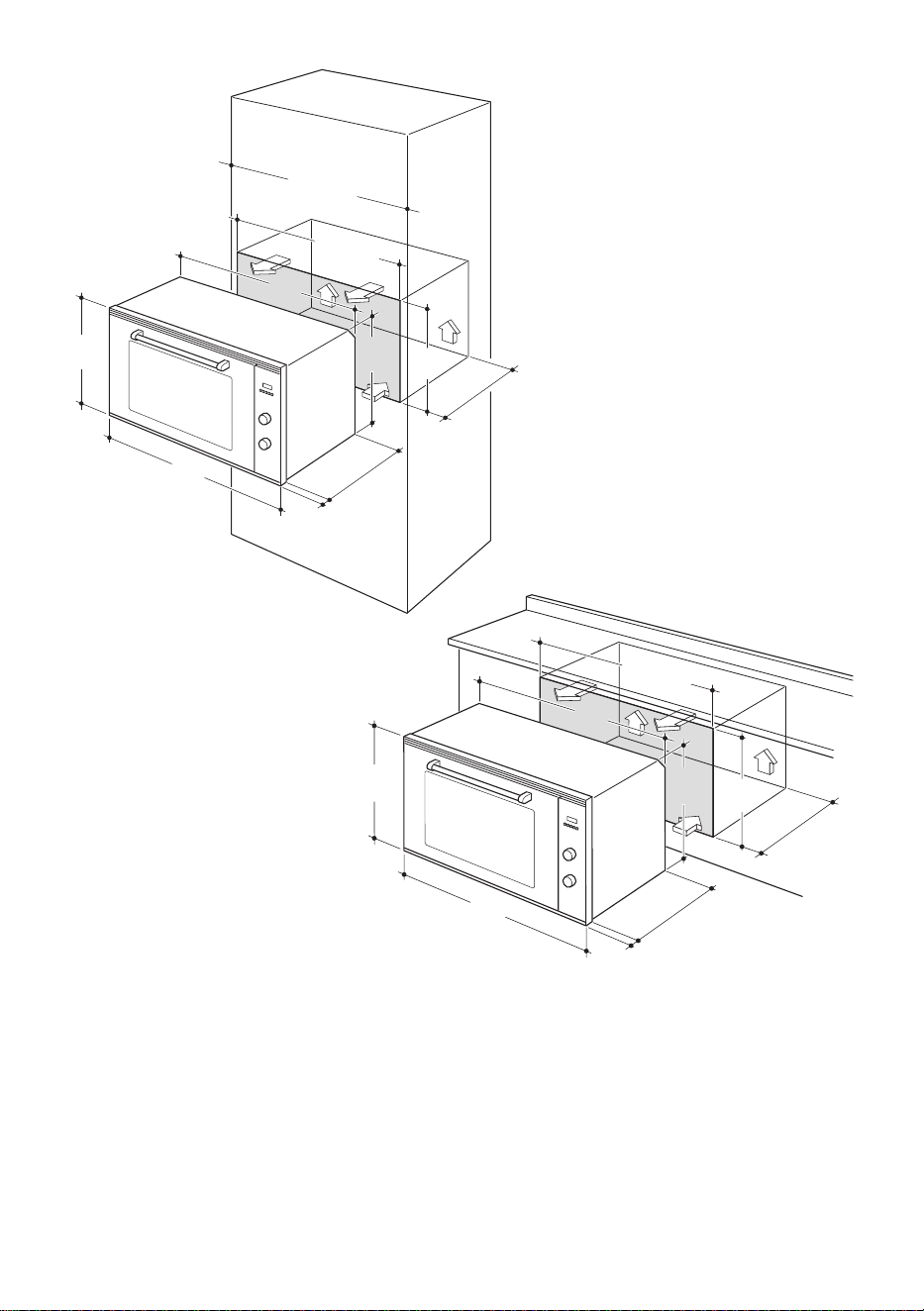
• The oven can be tted in standard units, width 90 cm and depth 60 cm.
• Installation requires a compartment as illustrated in gures 1.1a and 1.1b.
On the lower side, the oven must lay on supports standing the oven weight.
• Remember the housing should not be free standing but be secured to the wall and/or
adjacent ttings.
• Do not seal the oven into the cabinetry with silicone or glue; this makes future
servicing dicult. The manufacturer will not cover the costs of removing the
oven, or of damage caused by this removal.
• Caution! Do not lift this oven by the door handle.
IMPORTANT:
• The appliance is designed and approved for domestic use only and should not be
installed in a commercial, semi commercial or communal environment.
Your product will not be guaranteed if installed in any of the above environments
and could aect any third party or public liability insurances you may have.
• This appliance is to be installed only by an authorised person according to the current
local regulations and in observation of the manufacturer’s instructions.
Failure to comply with this condition will render the guarantee invalid.
• Incorrect installation, for which the manufacturer accepts no responsibility, may cause
personal injury of damage.
• This appliance shall only be serviced by authorized personnel.
• Always disconnect the appliance from mains power supply before carrying out any
maintenance operations or repairs.
• Some appliances are supplied with a protective lm on steel and aluminium parts. This
lm must be removed before using the appliances.
• Important: The use of suitable protective clothing/gloves is recommended when
handling or installing this appliance.
• The appliance must be housed in heat resistant units.
• The walls of the units must be capable of resisting temperatures of 70 °C above
room temperature.
• We would point out that the adhesive which bonds the plastic laminate to the
furniture must withstand temperatures not less than 150 °C to avoid delamination.
• Do not install the appliance near inammable materials (eg. curtains).
WARNING!
When correctly installed, your product meets all safety requirements laid down for
this type of product category.
However special care should be taken around the rear or the underneath of the
appliance as these areas are not designed orintended to be touched and may contain
sharp or rough edges, that may cause injury.
1010
WARNING, VERY IMPORTANT:
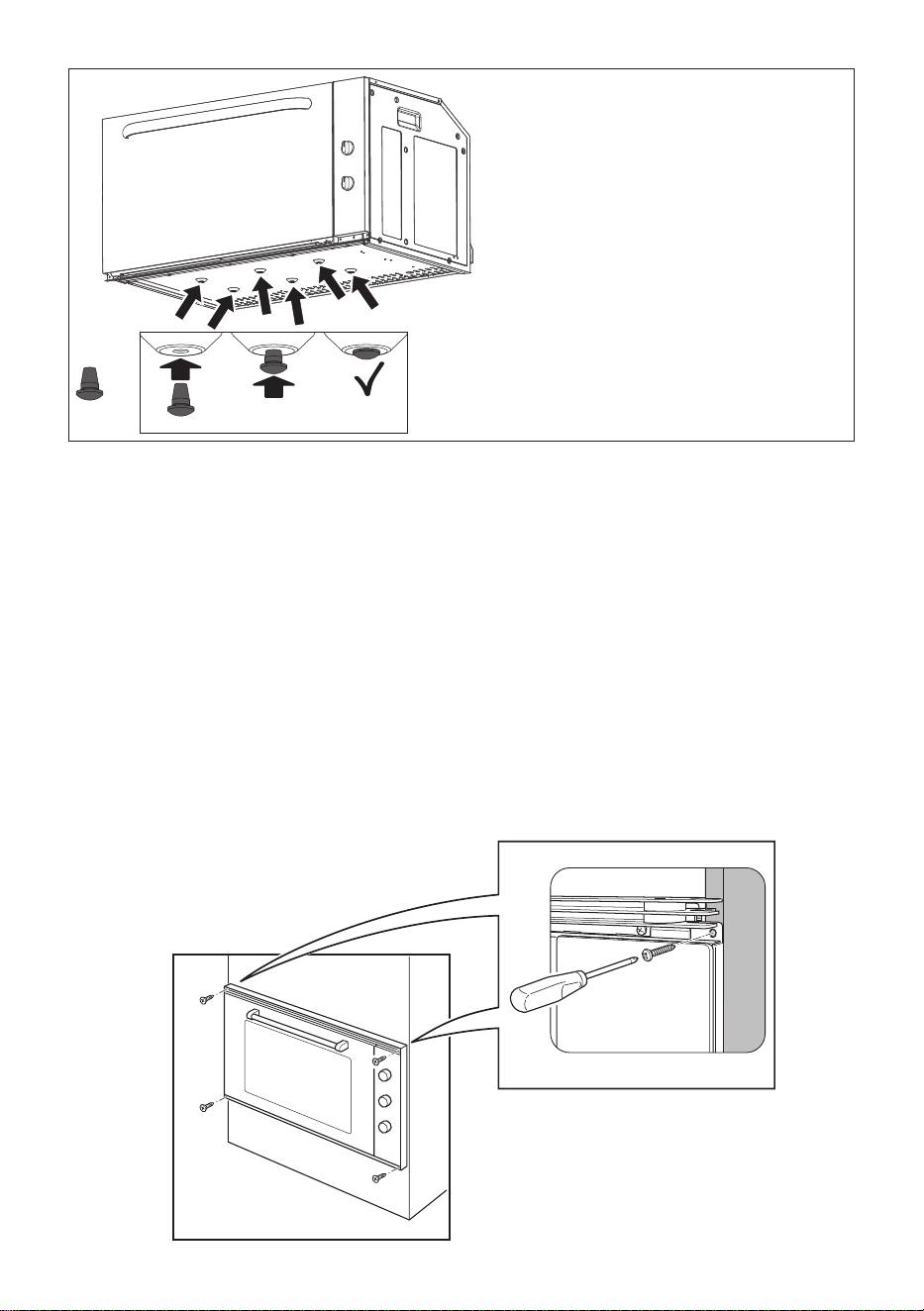
The oven is supplied with no.6 rubber spacers xed at the bottom.
DO NOT install the oven without these spacers correctly in place.
If one or more rubber spacers are missing, please use the ones contained in the
separate kit supplied with this appliance and x them to the bottom of the oven as
indicated in the gure 1.2a on the next page.
Should you require assistance please contact our Customer Service Centre .
853
896
478
544
22
min. 550
480
467
min. 860
min. 900
Fig. 1.1a
853
896
478
544
22
min. 550
480
467
min. 860
Fig. 1.1b
1111
FIXING THE OVEN
Introduce the oven into the furniture opening and x it with 4 screws (not supplied) as gure
1.2b. It is essential that the oven rests on a surface which will support its weight, as the
screw xing is only complementary.
Adjust the hinges of furniture doors adjacent to the oven to allow a 4-5 mm gap between
the furniture door and the oven frame.
Fig. 1.2b
x 6
Fixing the rubber spacers to the
base of the oven (if they are missing)
by using the ones contained in
the separate kit supplied with this
appliance.
Fig. 1.2a
1212
L
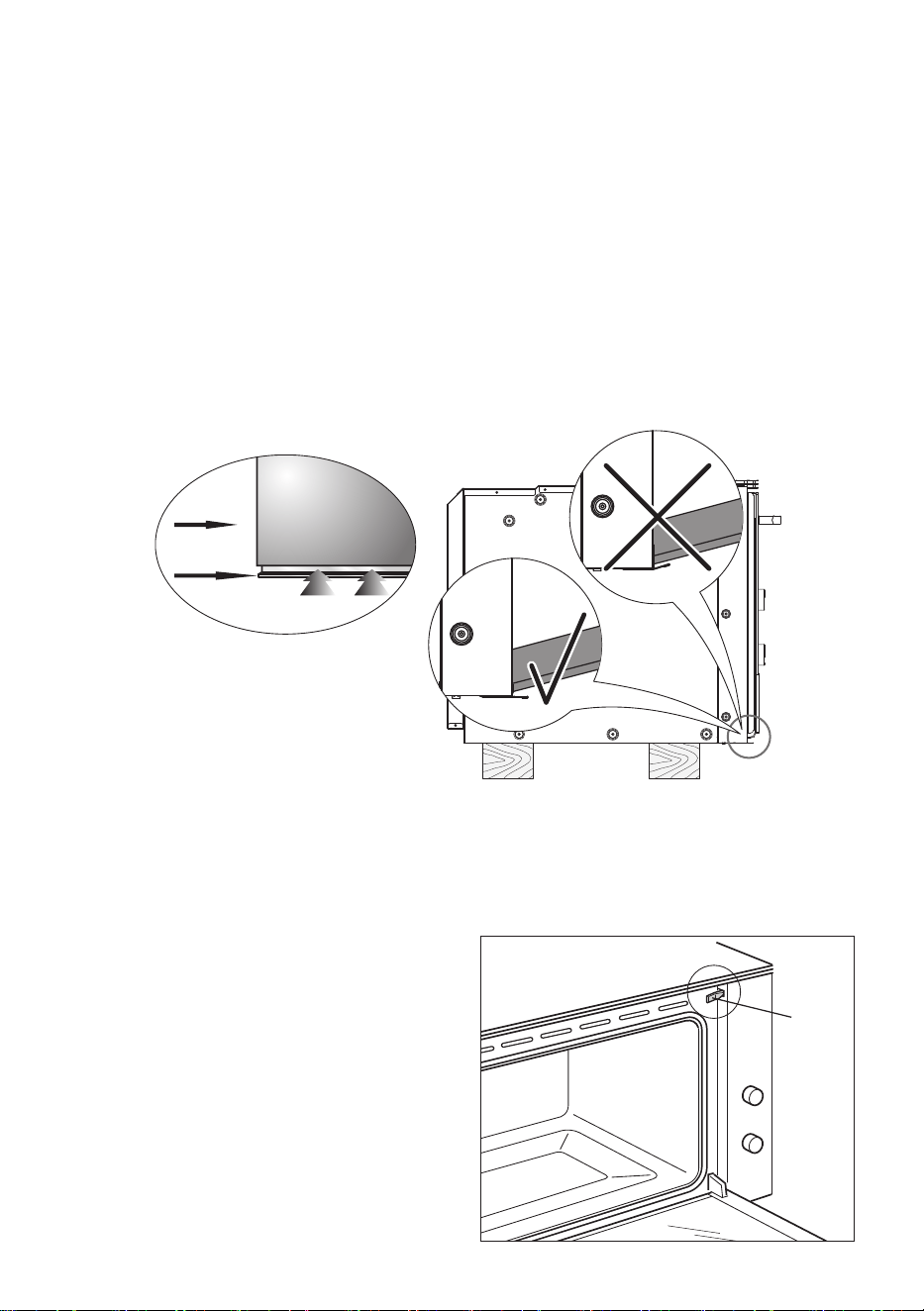
IMPORTANT: (SOME MODELS ONLY)
When handling the oven, take care not
to damage the door sensor lever “L”
(near the top right corner of the oven
seal).
Fig. 1.4
Fig. 1.3
Oven
door
Lower
trim
Air ow
IMPORTANT:
Please take extra care not to damage the lower trim of the oven.
Ensure the oven sits on wooden blocks or similar supports when it is removed from the
carton as shown in above diagram. This will prevent any damage to the lower trim.
Should the lower trim become damaged, straighten the trim and ensure the oven door
opens fully without obstruction from the lower trim.
After installation check the lower trim is still undamaged.
No responsibility for lower trim damage will be accepted if these instructions have
not been followed.

1313
ELECTRICAL SECTION
2
IMPORTANT: The appliance must be
installed by a qualied technician
according with the current local
regulations and in compliance with the
manufacturer instructions. Incorrect
installation might cause harm and
damage to people, animals or objects,
for which the manufacturer accepts no
responsibility.
N.B. For connection to the mains, do
not use adapters, reducers or branching
devices as they can cause overheating
and burning.
If the installation requires alterations to the
domestic electrical system or if the socket
and appliance plug are incompatible, call
an expert.
He should also check that the socket cable
section is suitable for the power absorbed
by the appliance.
GENERAL
• Connection to the mains must be
carried out by qualied personnel in
accordance with current regulations.
• The appliance must be connected to
the mains checking that the voltage
corresponds to the value given in the
rating plate and that the electrical
cable sections can withstand the load
specied on the plate.
• If the appliance is supplied without a
power supply plug and if you are not
connecting directly to the mains, a
standardized plug suitable for the load
must be tted.
• The appliance can be connected
directly to the mains placing an
omnipolar switch with minimum
opening between the contacts of 3 mm
between the appliance and the mains.
• The power supply cable must not touch
the hot parts and must be positioned
so that it does not exceed 50°C at any
point.
• Once the appliance has been installed,
the switch or socket must always be
accessible.
• If the power supply cable is damaged it
must be substituted by a suitable cable
available in the after sales service.
The connection of the appliance to
earth is mandatory.
The manufacturer declines all
responsability for any inconvenience
resulting from the inobservance of this
condition.
Before eecting any intervention on
the electrical parts of the appliance,
the connection to the network must be
interrupted.
1414
FEEDER CABLE SECTION
Type “H05RR-F”
220-240 V 50-60 Hz 3 x 1,5 mm
2
(*) (**)
(*) Connection possible with plug and outlet
(**) Connection with wall box connection.
CONNECTION OF THE POWER SUPPLY CABLE
WARNING: If the power supply cable is damaged, it must be replaced only by an
authorised service agent in order to avoid a hazard.
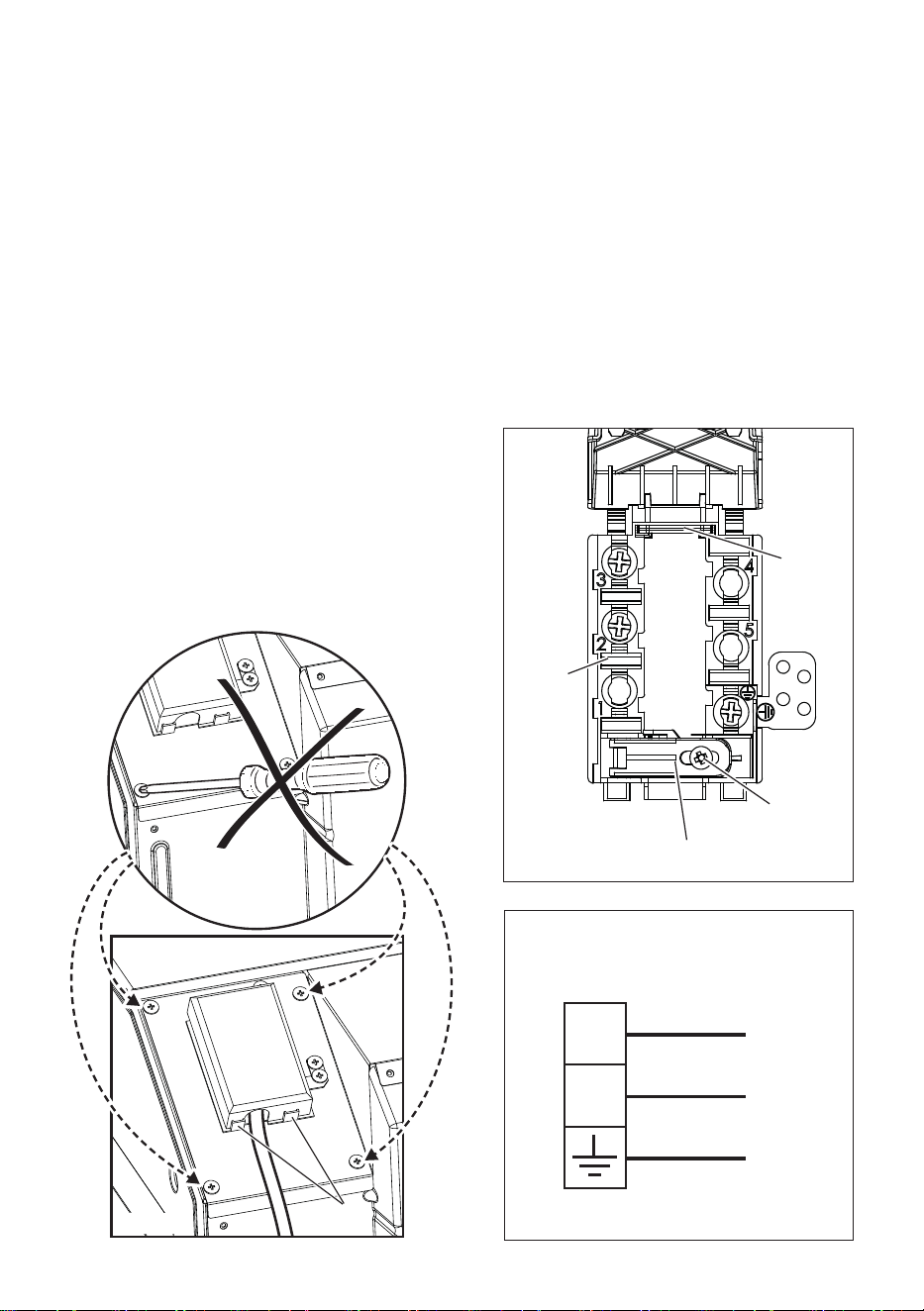
• Unhook the terminal board cover by inserting a screwdriver into the two hooks “A
”
(g.
2.1).
• Unscrew the screw “D” and open completely the cable clamp “E” (g. 2.2).
• Connect the phase, neutral and earth wires to terminal board “G” according to the
diagram in g. 2.3.
• Strain the feeder cable and block it with cable clamp “E” (by screwing screw “D”).
• Close the terminal block cover (check the two hooks “A” are correctly hooked).
IMPORTANT: To connect the power supply cable DO NOT unscrew the screws xing
the cover plate behind the terminal block.
The operations must be executed by a qualied technician.
D
E
F
G
PE
N
L
Fig. 2.3
Fig. 2.2
220-240 V ac
A
Fig. 2.1

1515

1616
ADVICEADVICE
for thefor the
USERSUSERS
1717
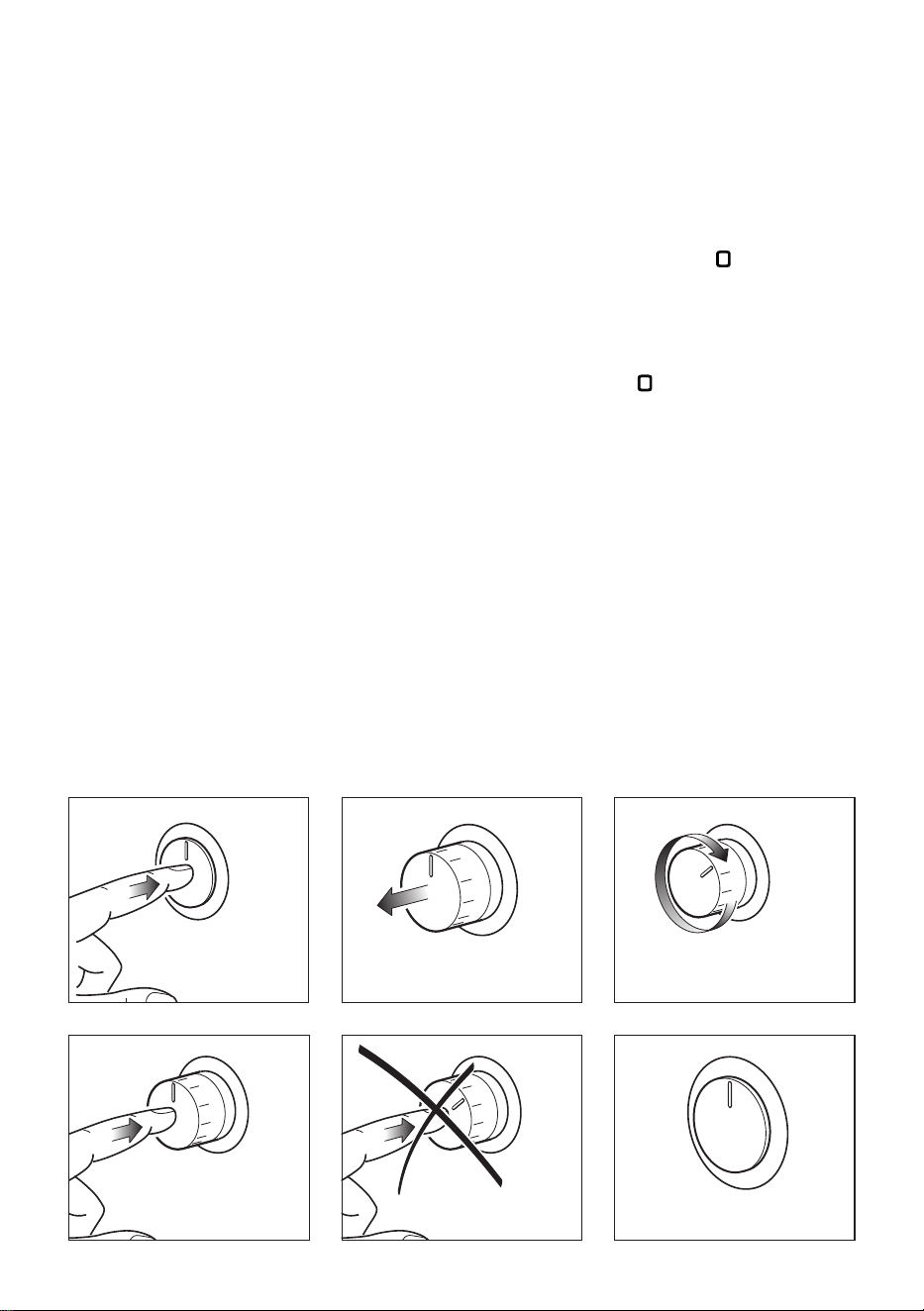
USING THE PRESS-AND-TURN CONTROL KNOBS (SOME MODELS ONLY)
The control knobs are ush-mounted in the control panel.
Use them as follows:
a. Press lightly on the knob (gure A);
b. The knob will extend outwards as illustrated in gure B.
c. Turn the knob to the required position (gure C).
d. When you have nished cooking, turn the knob back to the “0”, “O” or “ ” (o) position
and press it (gure D) so that it stays ush with the control panel again (gure F).
IMPORTANT:
Never press down the knob when it is not in the “0”, “O” or “ ” (o) position (gure
1.8E).
Fig. A Fig. B Fig. C
Fig. D Fig. E Fig. F
Fig. A
Fig. 1 D
Fig. B
Fig. E
Fig. C
Fig. F
1818
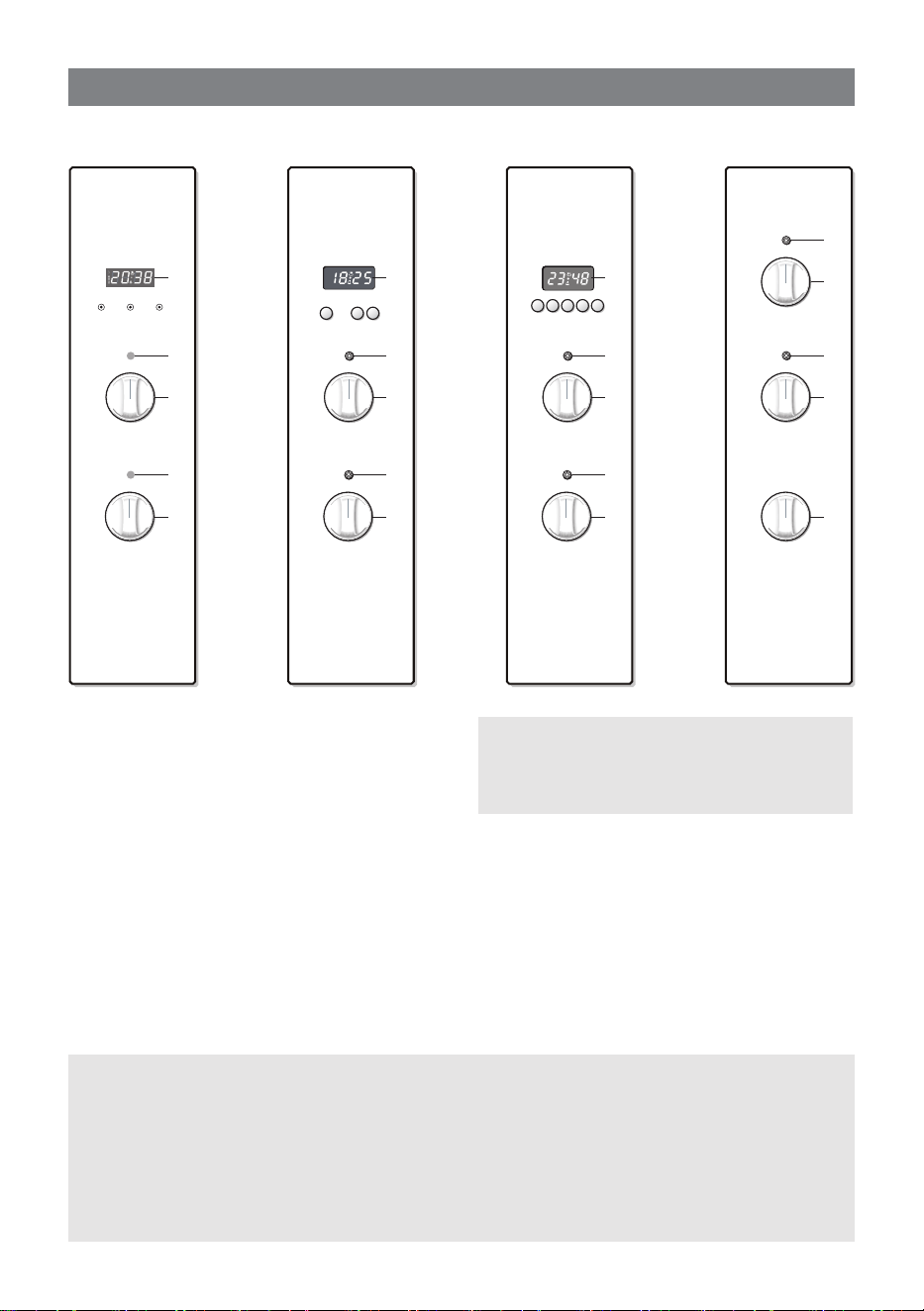
CONTROL PANEL
1
Fig. 1.1
CONTROLS DESCRIPTION
1. Oven thermostat knob
2. Function selector knob
3. Power on indicator lamp
4. Oven temperature indicator lamp
5. Clock and timer with “Touch-Control” keys
6. Electronic clock
7. Electronic clock/end cooking timer
8. Electronic programmer
9. 60’ alarm
10. 120’ alarm
11. Timer (120’ cut-o)
Please note:
Your appliance has been tted with a cooling fan to achieve optimum eciency of the
controls and to ensure lower surface temperatures are maintained.
The cooling fan motor switches ON/OFF depending on temperature.
Depending on cooking temperatures and times, the cooling fan may run on even after
the appliance oven has been switched o.
The duration of this time is dependent on previous cooking temperature and duration.
A
U
T
O
A
5
3
2
4
1
6
7
3
2
4
1
8
3
2
4
1
2
4
1
9
10
11
3
Fig. 1.2 Fig. 1.3 Fig. 1.4
NOTES: The knob and symbols may vary.
The symbols may be printed on the knob
itself.

1919
HOW TO USE THE OVEN
2
Attention: The oven door becomes
very hot during operation.
Keep children away.
GENERAL FEATURES
As its name indicates, this is an oven
that presents particular features from an
operational point of view.
In fact, it is possible to insert 8 dierent
programs to satisfy every cooking need.
The 8 positions, thermostatically controlled,
are obtained by 4 heating elements which
are:
• Bottom element;
• Top element;
• Grill element;
• Circular element.
NOTE:
Upon rst use, it is advisable to operate the
oven for 60 minutes in the position and
for another 15 minutes at the maximum
temperature (thermostat knob on position
250) in the positions and , to
eliminate possible traces of grease on the
heating elements.
Clean the oven and accessories with warm
water and washing-up liquid.
WARNING:
The door is hot, use the handle.
During use the appliance becomes hot. Care should be taken to avoid touching
heating elements inside the oven.
Do not line the oven walls or oor with aluminium foil. Do not place baking trays or
the drip tray on the base of the oven chamber.
OPERATING PRINCIPLES
Heating and cooking in the
MULTIFUNCTION oven are obtained in the
following ways:
a. by normal convection
The heat is produced by the upper and
lower heating elements.
b. by forced convection
A fan sucks in the air contained in the
oven mue, which sends it through
the circular heating element and then
sends it back through the mue.
Before the hot air is sucked back again
by the fan to repeat the described
cycle, it envelops the food in the
oven, provoking a complete and rapid
cooking.
It is possible to cook several dishes
simultaneously.
c. by semi-forced convection
The heat produced by the upper and
lower heating elements is distributed
throughout the oven by the fan.
d. by radiation
The heat is irradiated by the infra red
grill element.
e. by radiation and ventilation
The irradiated heat from the infra red
grill element is distributed throughout
the oven by the fan.
f. by ventilation
The food is defrosted by using the fan
only function without heat.
2020
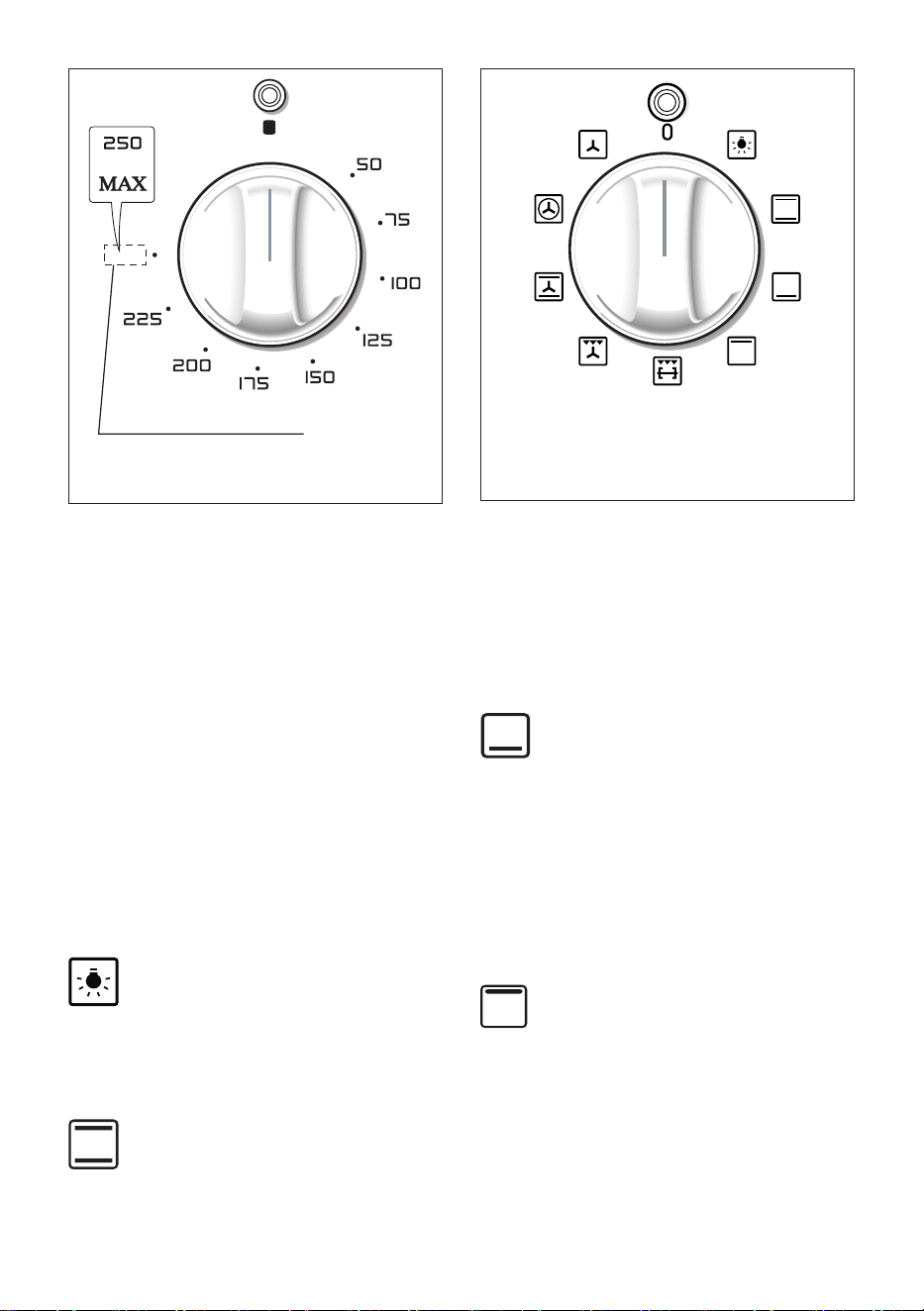
THERMOSTAT CONTROL KNOB
(g. 2.1)
To turn on the heating elements of the
oven, set function selector knob to the
required position and the thermostat knob
to the desired temperature.
To set the temperature, turn the thermostat
control knob indicator mark to the required
temperature.
The elements will turn on or o automatically
which is determined by the thermostat.
The operation of the heating elements is
signalled by a light placed above the knob.
FUNCTION SELECTOR CONTROL
KNOB (g. 2.2)
Rotate the knob clockwise to set the oven
for one of the following functions:
OVEN LIGHT
By turning the knob onto this setting we
light the oven cavity.
The oven remains alight while any of the
functions is on.
TRADITIONAL CONVECTION
COOKING
The upper and lower heating elements are
switched on. The heat is diused by natural
convection and the temperature must be
regulated between 50°C and the maximum
position with the thermostat knob.
It is necessary to preheat the oven before
introducing the foods to be cooked.
Recommended for:
For foods which require the same cooking
temperature both internally and externally,
i. e. roasts, spare ribs, meringue, etc.
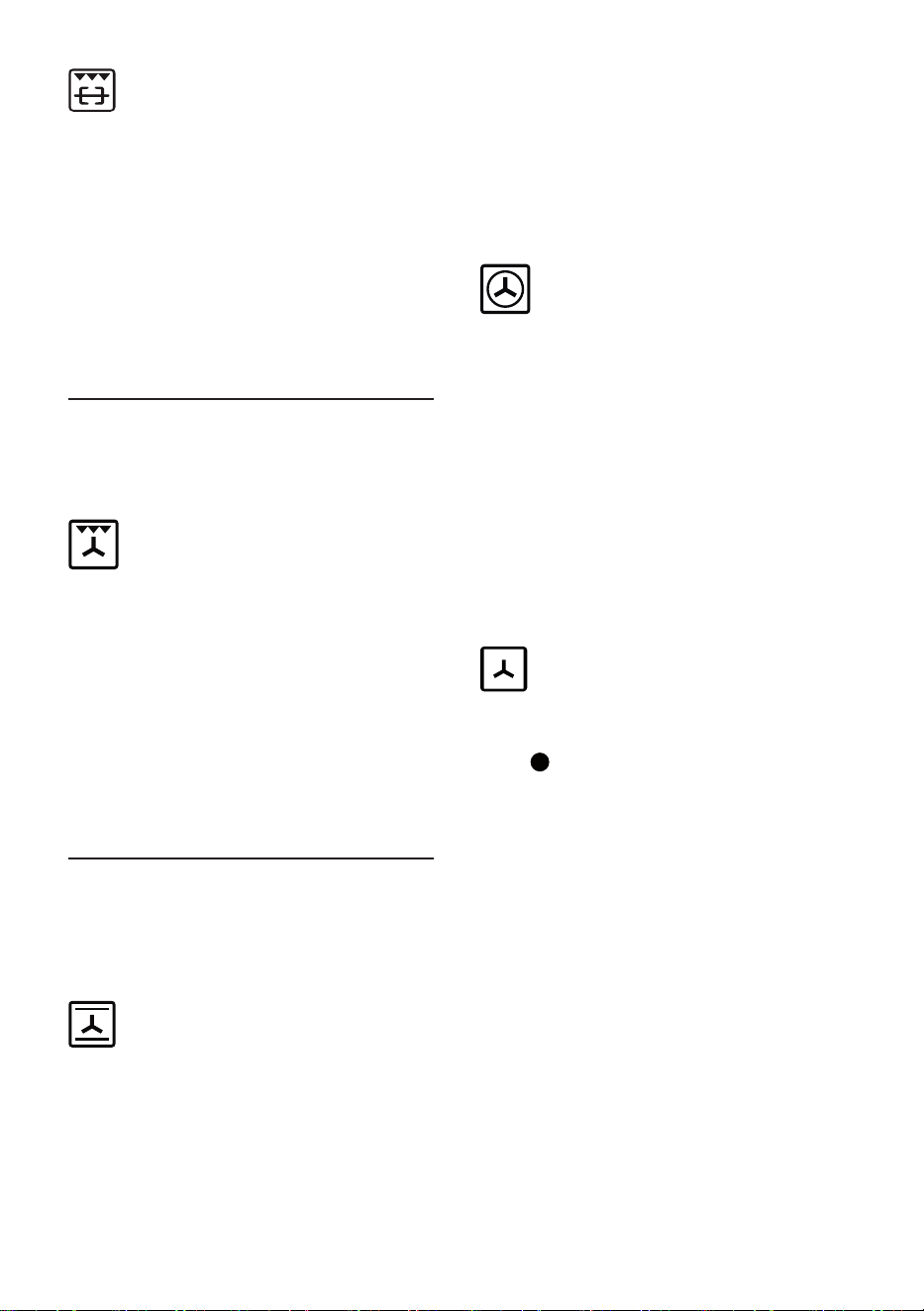
LOWER HEATING ELEMENT
Only the lower element is switched on.
Heat is distributed by natural convection.
The temperature must be regulated
between 50°C and 200°C maximum with
the thermostat knob.
Recommended for:
This mode is particularly suitable to
complete cooking of dishes that require
higher temperature at the bottom.
UPPER HEATING ELEMENT
Only the upper element is switched on.
Heat is distributed by natural convection.
The thermostat can be set between
50°C and the maximum position with the
thermostat knob.
Recommended for:
This mode is particularly suitable to
complete cooking of dishes that require
higher temperature at the top.
or
Some models only
Fig. 2.1
Fig. 2.2
NOTES: The knob and symbols may vary.
The symbols may be printed on the knob
itself.
NOTES: The knob and symbols may vary.
The symbols may be printed on the knob
itself.
2121
GRILLING
The infrared grill element at the top of the
oven and the rotisserie come on.
The heat is dispersed by radiation.
Use with the oven door closed and the
temperature must be regulated between
50°C and 225°C maximum with the
thermostat knob.
For cooking hints, see the chapter “USE
OF THE GRILL”.
For cooking with the rotisserie, see the
chapter “USING THE ROTISSERIE”.
Always grill with the oven door closed.
Recommended for:
Intense grilling, browning, cooking au gratin
and toasting, cooking with the rotisserie, etc.
VENTILATED GRILL
COOKING
The infra-red grill and the fan are on. The
heat is mainly diused by radiation and the
fan then distributes it throughout the oven.
Use with the oven door closed and the
temperature must be regulated between
50°C and 225°C maximum with the
thermostat knob.
It is necessary to preheat the oven for
about 5 minutes.
For correct use see chapter “GRILLING
AND AU GRATIN”.
Always grill with the oven door closed.
Recommended for:
For grill cooking when a fast outside
browning is necessary to keep the juices
in, i. e. veal steak, steak, hamburger, etc.
CONVECTION COOKING
WITH VENTILATION
The upper and lower heating elements and
the fan turn on.
The heat coming from the top and bottom
is diused by forced convection.
The temperature must be regulated
between 50°C and the maximum position
with the thermostat knob.
Recommended for:
For foods of large volume and quantity
which require the same internal and
external
degree of cooking; for ie: rolled roasts,
turkey, legs, cakes, etc.
FAN FORCED
The circular element and the fan are on.
The heat is diused by forced convection
and the temperature must be regulated
between 50°C and the maximum position
with the thermostat knob.
It is not necessary to preheat the oven.
Recommended for:
For foods that must be well done on the
outside and tender or rare on the inside,
i.e. lasagna, lamb, roast beef, whole sh,
etc.
DEFROSTING FROZEN
FOODS
Only the oven fan is switched on.
To be used with the thermostat knob in
the “ ” (o) position because the other
positions have no eect.
The defrosting is done by simple ventilation
without heat.
Recommended for:
To rapidly defrost frozen foods; 1 kilogram
requires about one hour.
The defrosting times vary according to the
quantity and type of foods to be defrosted.

2222
COOKING ADVICE
3
Grilling with the oven door closed.
Do not grill for longer than 30
minutes at any one time.
CAUTION: The oven door becomes
very hot during operation. Keep
children well out of reach.
The external parts of the oven
become hot during operation.
Keep children well out of reach.
STERILIZATION
Sterilization of foods to be conserved, in full
and hermetically sealed jars, is done in the
following way:
a. Set the switch to position ;
b. Set the thermostat knob to position 185
°C and preheat the oven.
c. Fill the dripping pan with hot water.
d. Set the jars onto the dripping pan making
sure they do not touch each other and
the door and set the thermostat knob to
position 135 °C.
When sterilization has begun, that is, when
the contents of the jars start to bubble, turn
o the oven and let cool.
SIMULTANEOUS COOKING OF
DIFFERENT FOODS
The MULTI-FUNCTION oven set on
position or gives simultaneous
heterogeneous cooking of dierent foods.
Dierent foods such as sh, cake and meat
can be cooked together without mixing the
smells and avours.
This is possible since the fats and vapors are
oxidized while passing through the electrical
element and therefore are not deposited
onto the foods.
The only precautions to follow are:
• The cooking temperatures of the
dierent foods must be as close to as
possible, with a maximum dierence of
20° - 25 °C.
• The introduction of the dierent dishes
in the oven must be done at dierent
times in relation to the cooking times of
each one.
The time and energy saved with this type
of cooking is obvious.
REGENERATION
Set the switch to position and the
thermostat knob to position 150° C.
Bread becomes fragrant again if wet
with a few drops of water and put into the
oven for about 10 minutes at the highest
temperature.
ROASTING
To obtain classical roasting, it is necessary
to remember:
• that it is advisable to maintain a
temperature between 180 and 200 °C.
• that the cooking time depends on the
quantity and the type of foods.
USE OF THE GRILL
Preheat the oven for about 5 minutes.
Introduce the food to be cooked, positioning
the rack as close to the grill as possible.
The dripping pan should be placed under the
rack to catch the cooking juices and fats.
GRILLING AND “AU GRATIN”
Set the switch to position .
Set the thermostat to position 225°C and
after having preheated the oven, simply
place the food on the shelf.
Close the door and let the oven operate with
the thermostat on, until grilling is complete.
Adding a few dabs of butter before the end
of the cooking time gives the golden “au
gratin” eect.
Note: It is recommended that you do not grill
for longer than 30 minutes at any one time.

2323
OVEN COOKING
Before introducing the food, preheat the
oven to the desired temperature.
For a correct preheating operation, it is
advisable to remove the tray from the oven
and introduce it together with the food,
when the oven has reached the desired
temperature.
Check the cooking time and turn o the
oven 5 minutes before the theoretical time
to recuperate the stored heat.
COOKING EXAMPLES
Temperatures are approximate as they
vary depending on the quality and amount
of food.
Remember to use ovenproof dishes and to
adjust the oven temperature during cooking
if necessary.
DISHES TEMPERATURE
Cakes 180°C
Doughnuts 180°C
Cheese soué 200°C
Potatoes soué 200°C
Roast veal 200°C
Spinach crepes 200°C
Potatoes in milk 200°C
Chicken breasts in tomato 200°C
Sole sh let 200°C
Whiting 200°C
Cream pus 200°C
Plum pie 200°C
Meat balls 200°C
Veal meatloaf 200°C
Grilled chicken - roast chicken 220°C
Baked lasagna 220°C
Roast beef 220°C
Oven cooked pasta 220°C
Lemon cake 220°C
Rice creol 225°C
Baked onions 225°C
Stued potatoes 225°C
Grilled veal joint 225°C
Marmalade pie 225°C
Pound cake 225°C
Turkish shishkebab 250°C
Pizza with anchovies 250°C
The oven accessories can withstand loads up to 6 kg.
It is recommended to distribute the loads evenly.
2424
ROTISSERIE
(MODELS WITH ROTISSERIE ONLY)
This device is made up of:
• an electrical motor mounted on the
side of the oven;
• stainless steel spit with a removable
stay-cool handle and two adjustable
sets of prongs
• spit support to be inserted in the
central guide of the oven.
The rotisserie motor is operated by a switch
knob (g. 2.2 - position).
L
T
1
2
S
G
Fig. 3.1
Fig. 3.3
USING THE ROTISSERIE
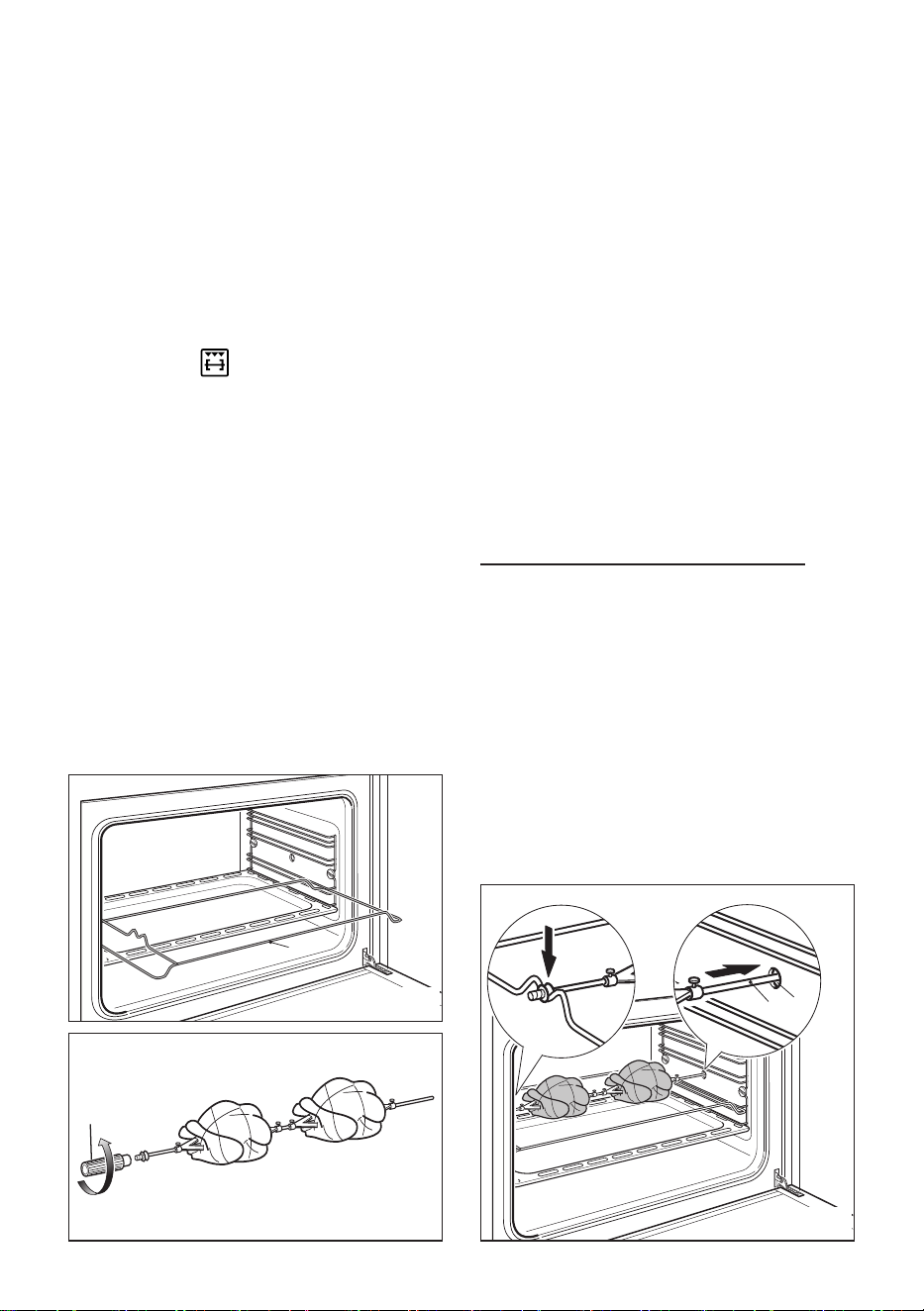
• Insert the tray “L” into the lowest rack
holders of the oven and insert the rod
support “T” into the intermediate rack
holders (g. 3.1).
• Put the meat to be cooked onto the
rod, being careful to secure it in the
center with the special forks (g. 3.2).
• Important!
Take care, the forks are sharp!
• Remove the grip “H” by turning it to the
left (g. 3.2).
• Insert completely the rotisserie
support; the shaft “S” must be inserted
(through the hole cover) in the spit
motor collar “G” (g. 3.3).
The rotation direction of the rotisserie can
be either clockwise or counterclockwise.
Grilling with the oven door closed.
Attention: The oven door becomes very
hot during operation.
Keep children away.
It is recommended that you do not grill
for longer than 30 minutes at any one
time.
H
Fig. 3.2
2525
Illuminated symbols:
AUTO ashing
Automatic
cooking
completed,
oven in
automatic
position but
not set
AUTO
steady
illumination
Oven set for
automatic
cooking,
cooking still
not taking
place
ashing
Timer being
set
steady
illumination
Timer in
operation
steady
illumination
Oven set
for manual
cooking
and
AUTO
AUTO
ashing
Automatic
cooking
being set
and
AUTO
steady
illumination
Oven set for
automatic
cooking,
cooking
taking place
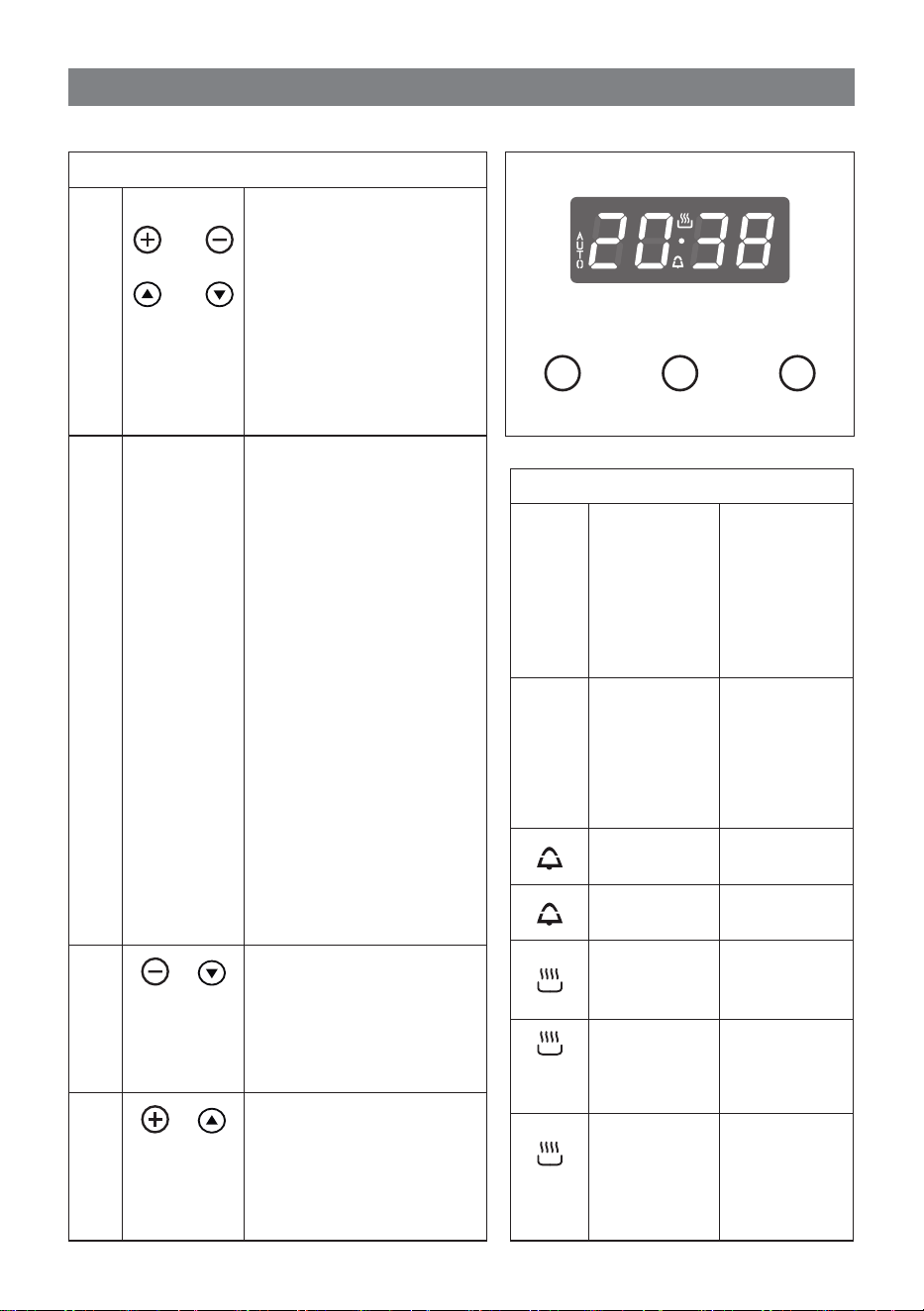
Keys:
A
and
C
and
or
and
or
other
equivalent
symbols
Touched simultaneously
(for more than 2 seconds):
• setting the clock;
• setting the timer
volume (by touching
once, along with the
“B” key);
• to cancel automatic
cooking at any time.
B
MODE
or
other
equivalent
wording /
symbol
Function selection
(touched for more than 2
seconds):
• setting the clock
(only after rst
connection or after a
power failure);
• timer;
• automatic cooking
“dur” (duration) -
how long the food
will take to cook (by
touching the “B” key
again);
• automatic cooking
“End” - the time you
would like the oven
turns o (by touching
the “B” key two more
times).
A
or
or
other
equivalent
symbols
Decreases the number
shown on the display
C
or
or
other
equivalent
symbols
Increases the number
shown on the display
A B C
Fig. 4.1
CLOCK and TIMER with “TOUCH CONTROL” KEYS
4

2626
“TOUCH-CONTROL” KEYS
The “touch-control” keys shall be operated by the ngers (just by touching the key).
When using touch controls it is best to use the ball of your nger rather than the tip.
The keys are automatically deactivated:
• 8 seconds after the last selection; the deactivation is indicated by an acoustic signal
(“beep”).
To reactivate just touch the “B” key or the “A” and “C” keys (simultaneously) for more than
2 seconds.
SETTING THE CLOCK
When rst connected, or after a power failure, the digits and “AUTO” will shown on the
display.
Important: The oven does not operate, in manual cooking, without rst having set
the clock.
To set the clock, touch the “B” key, for more than 2 seconds, and then the “A” or “C” keys.
To set the clock, with the appliance already connected, touch the “A” and “C” keys
simultaneously (for more than 2 seconds), then “A” or “C” keys.
Important:
• changing the time will delete any automatic program;
• after setting the clock, the oven starts to operate in the selected function (manual
cooking). The “ ” symbol is steady illuminated.
USING THE TIMER
You can use the timer at any time, even when the oven is not in use.
The timer does not turn the oven o.
The timer can be set for up to 23 hours and 59 minutes.
• To set the timer, touch the “B” key for more than 2 seconds (the “ ” symbol ashes),
than the “C” or “A” keys.
• After about 8 seconds an acoustic signal (“beep”) will sound conrming the regulation
(“ ” symbol steady illuminated).
• To check the remaining time touch the “B” key for more than 2 seconds. If the remaining
time is more than a minute the display will show hours and minutes; if less than a
minute the display will show seconds.
• When the time is up, the timer will beep. Touch the “B” key , for more then 2 seconds,
to turn it o; or press the “A” or “C” key to stop the beep and than the “B” key, for more
than 2 seconds, to deactivate the “ ” symbol ashing on the display.
• Turn o the oven manually (function and thermostat knobs in the o position) if the
manual cooking has been completed.

2727
SETTING THE TIMER VOLUME
You can select from three volume levels.
• Touch the “A” and “C” keys simultaneously for more than 2 seconds.
• Touch the “B” key; you can read on the display the current timer volume (“ton1”, “ton2”
or “ton3”).
• Touch the “A” key to listen or change the timer volume.
• Timer volume activated: the last displayed.
• After about 8 seconds an acoustic signal (“beep”) will sound conrming the volume
setting; then the time of day will be displayed.
AUTOMATIC COOKING
Use automatic cooking to automatically turn the oven on, cook, and then turn the oven o.
1. Check the clock shows the correct time.
2. Select the function and temperature (function and temperature knobs). The oven will
come on.
3. Decide how long the food will take to cook, allowing time for preheating if necessary.
4. Touch the “B” key for more than 2 seconds and then touch again; “dur” will show
(duration). Using the “C” and “A” keys, set the cooking time.
5. Decide the time you would like the oven to turn o; touch the “B” key for more than
2 seconds and then touch it two times again; “End” will show. Using the “C” and “A”
keys, set the stop time.
Note: while “dur” is displayed you can change to “End” just by touching one time the
“B” key (within 8 seconds from the last selection).
If there is time to wait before cooking starts, the current time of day and “AUTO” will show
in the clock display. The oven will switch o but is now set for automatic cooking.
If you are already at home to turn the oven on and only want the oven to turn o automatically,
start cooking as normal, then follow step 4 or step 5 to set a time to stop the oven.
When automatic cooking starts, “ ” will be displayed and the oven will turn on.
• To see the remaining cook time, follow step 4 up to display “dur” (duration).
• To see the set stop time, follow step 5 up to display “End”.
• To cancel automatic cooking at any time, touch the “A” and “C” keys simultaneously
(for more than 2 seconds) and turn the temperature and function knobs to the o
position.
When the stop time is reached, the oven will turn o, the timer will beep and “AUTO” will
ash:
• Touch any key to stop the beeping.
• Touch the “B” key, for more than 2 seconds, to return the oven to the manual mode
(“ ” symbol steady illuminated on the display).
• Turn the temperature and function knobs to the o position.
Attention: After a power failure any automatic program is deleted. Turn o the oven
manually.
2828
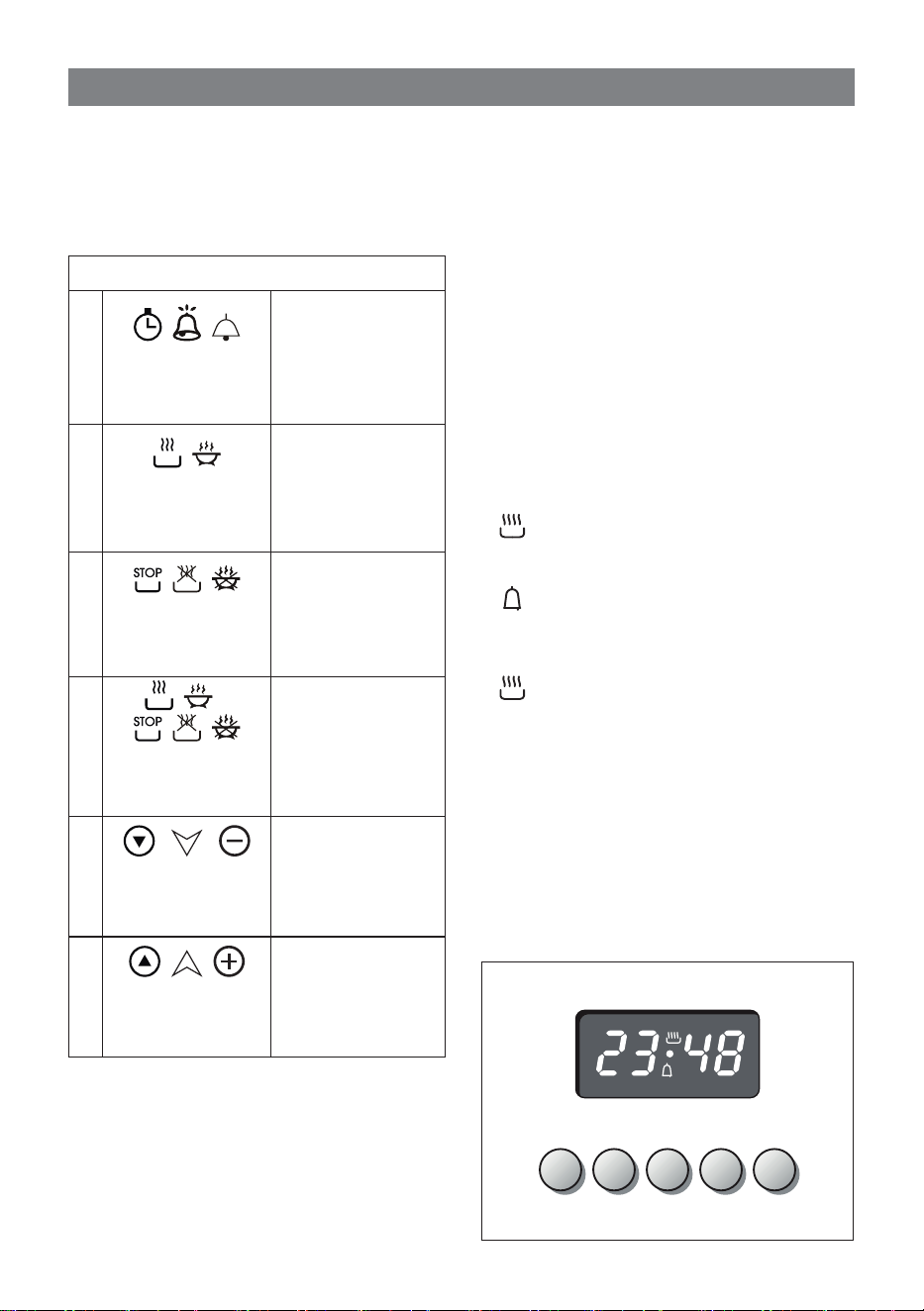
The electronic programmer is a device which groups together the following functions:
• 24 hours clock with illuminated display
• Timer (up to 23 hours and 59 minutes)
• Program for automatic oven cooking
• Program for semi-automatic oven cooking
Description of the illuminated
symbols:
A
ashing - Programmer in
automatic position but not
programmed
A
illuminated - Programmer in
automatic position with program
inserted.
Automatic cooking taking place
Timer in operation
and A - ashing - Program error.
(The time of day lies between the
calculated cooking start and end
time).
Note:
Select a function by the respective button
and, in 5 seconds, set the required time
with the
“D” / “E”
buttons (“one-hand”
operation).
After a power cut the display resets to
zero and cancels the set programs.
Caution: If the electricity supply is cut
o (the display numbers will ash), the
clock will reset and all the programs
entered will be cancelled.
A
Fig. 5.1
ELECTRONIC PROGRAMMER
5
Description of the buttons:
A
, ,
or other
equivalent
symbols
Timer
B
,
or other
equivalent
symbols
Cooking time
C
, ,
or other
equivalent
symbols
End of cooking
time
, et
, ,
or other
equivalent
symbols
Simultaneously:
Switching to
manual and
program reset.
D
, ,
or other
equivalent
symbols
To decrease the
numbers on the
digital display
E
, ,
or other
equivalent
symbols
To increase the
numbers on the
digital display
A B C D E
2929
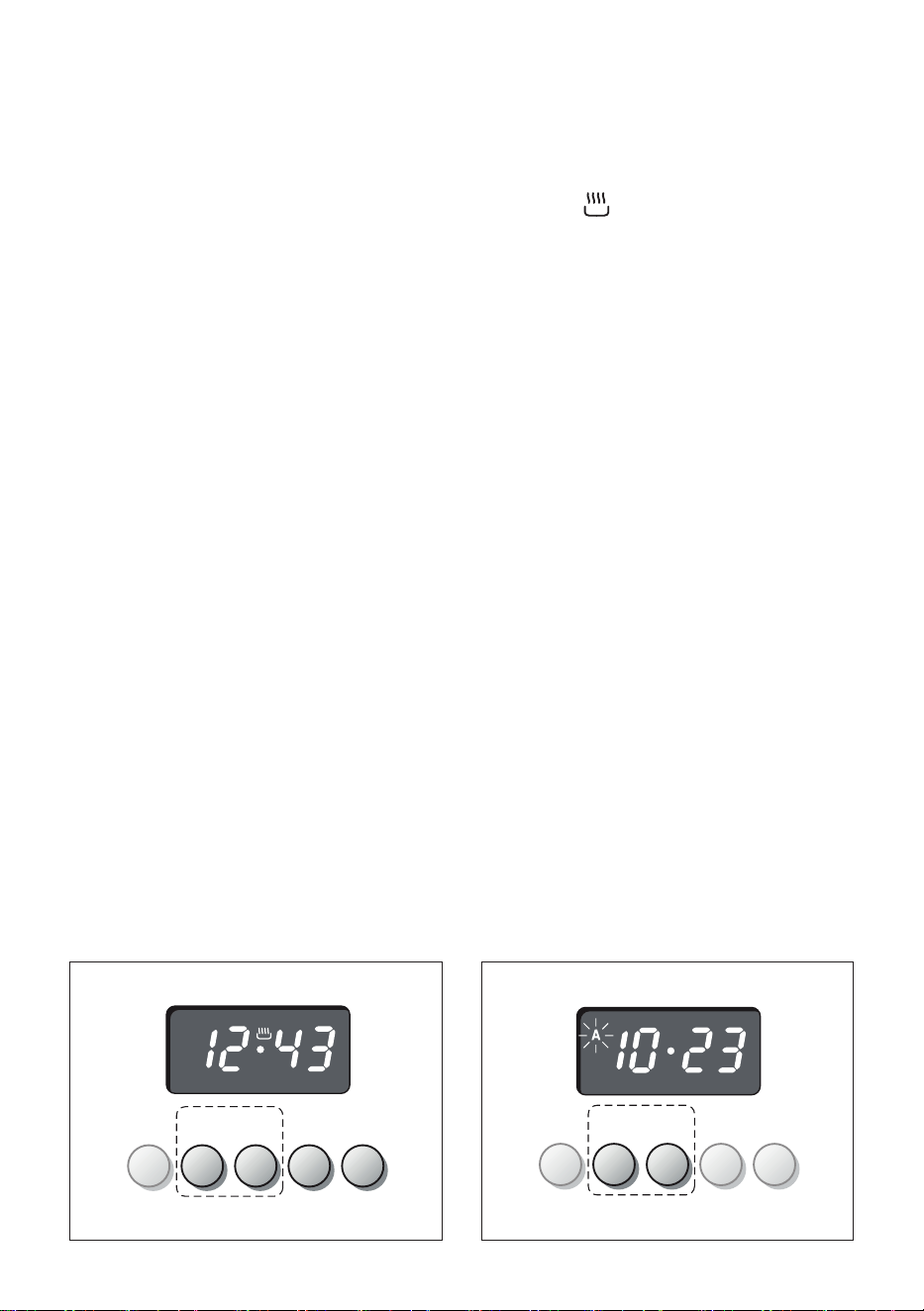
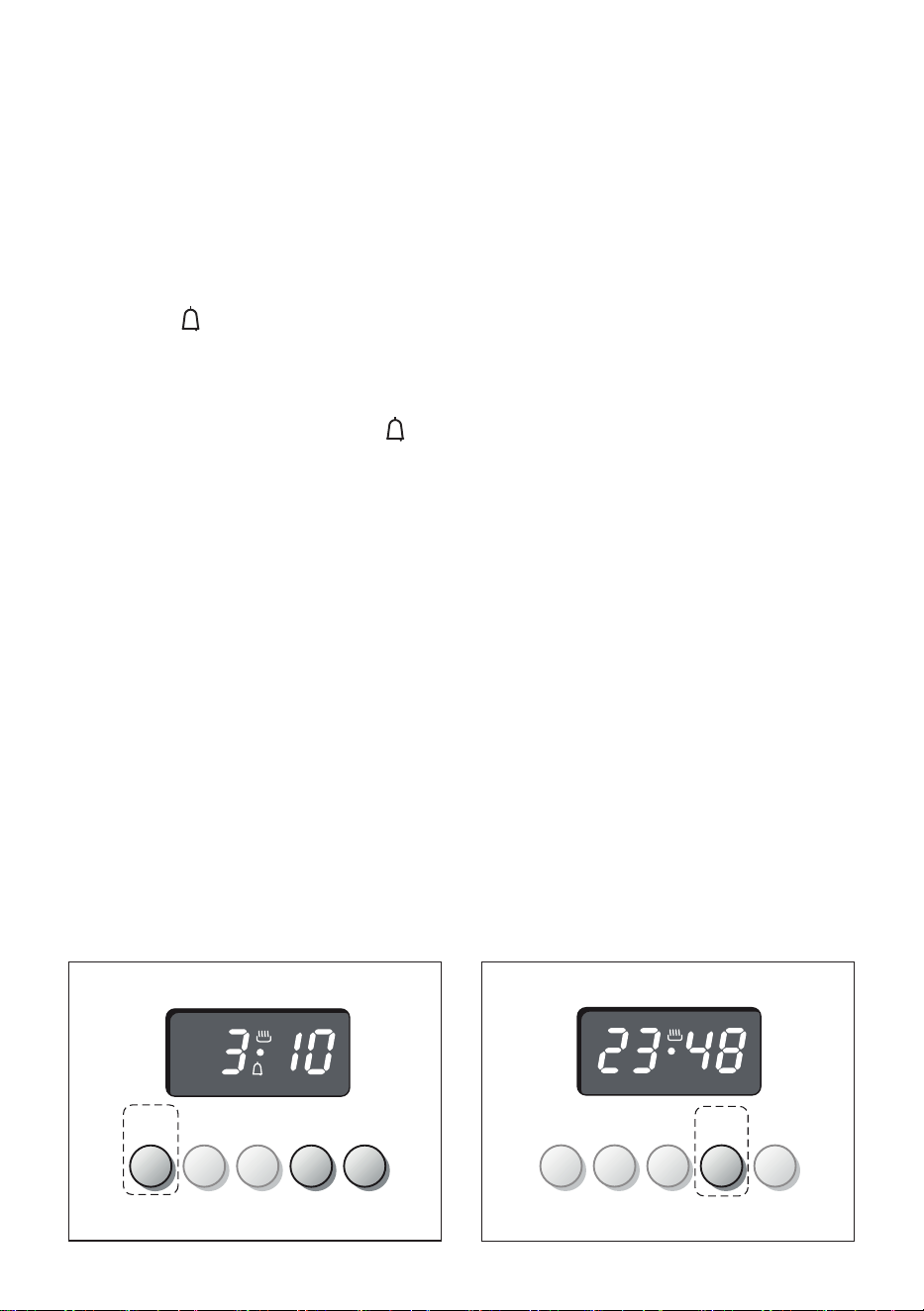
SETTING TIME OF DAY (g. 5.2)
The programmer is provided with an
electronic clock with luminous gures
showing the hour and minutes.
The rst time the oven is connected up to
the electricity supply and after a power cut,
three zeroes will ash on the programmer
display.
To adjust the time, the two buttons
“B”
“C”
must be pressed simultaneously and then
the button
“D”
or
“E”
until the correct time
is set.
Setting speed automatically increases if
you keep the setting buttons pressed.
MANUAL OPERATION
To use the oven manually, i.e. without the
programmer, you must cancel the ashing
A by pressing the two buttons
“B”
“C”
simultaneously (the letter A will go out and
the symbol will come on).
CANCELLING A PROGRAMME
If the letter A is not ashing (which means
that a cooking program has already been
set) by pressing the two buttons
“B”
“C”
simultaneously you will cancel the program
and switch to manual.
If the oven is on, you must switch it o
manually.
Fig. 5.2 Fig. 5.3
A B C D EA B C D E
3030
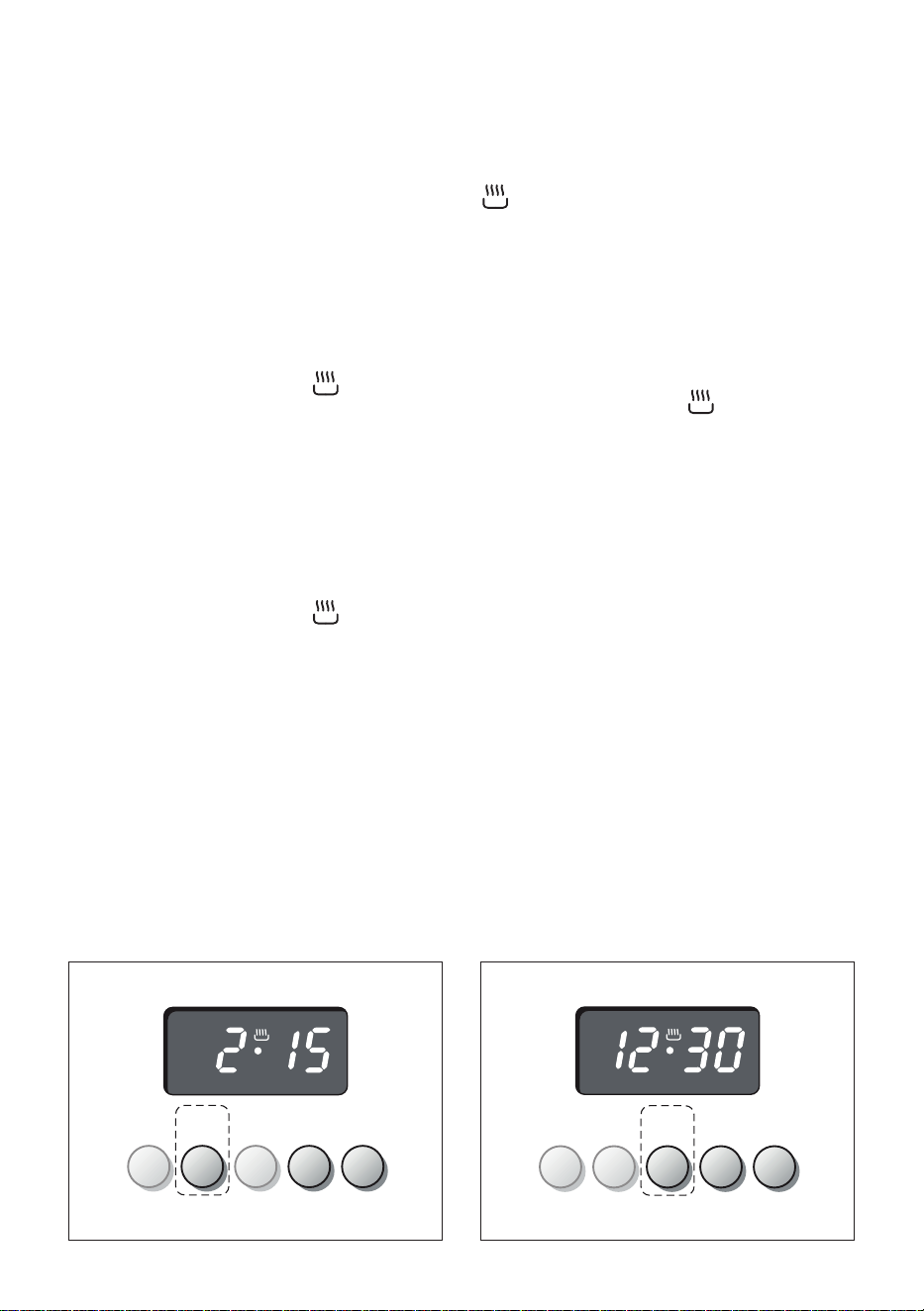
MINUTE MINDER
The minute counter function consists
simply of an acoustic signal which can be
set for a maximum of 23 hours 59 minutes.
If the letter A is ashing, press the two
buttons
“B”
“C”
simultaneously.
To set the time, press button
“A”
and then
button
“D”
or
“E”
until the required time
appears on the display (g. 5.4).
The symbol will come on.
Countdown will begin immediately and
can be seen on the display at any time by
simply pressing button
“A”
.
When the time expires, the symbol will
go out and an intermittent acoustic signal
will come on which can be switched o by
pressing any of the buttons.
AUDIBLE SIGNAL
The audible signal sounds at the end
of a minute minder cycle or of a cooking
programme for a period of 7 minute.
The signal can be cancelled by pressing
any function button.
Pressing the
“D”
button without having
previously selected a function the frequency
of the signal change. You can choose from
three variations.
The selected signal is audible as long as
the button
“D”
is pressed.
Fig. 5.4
Fig. 5.5
A B C D EA B C D E
3131
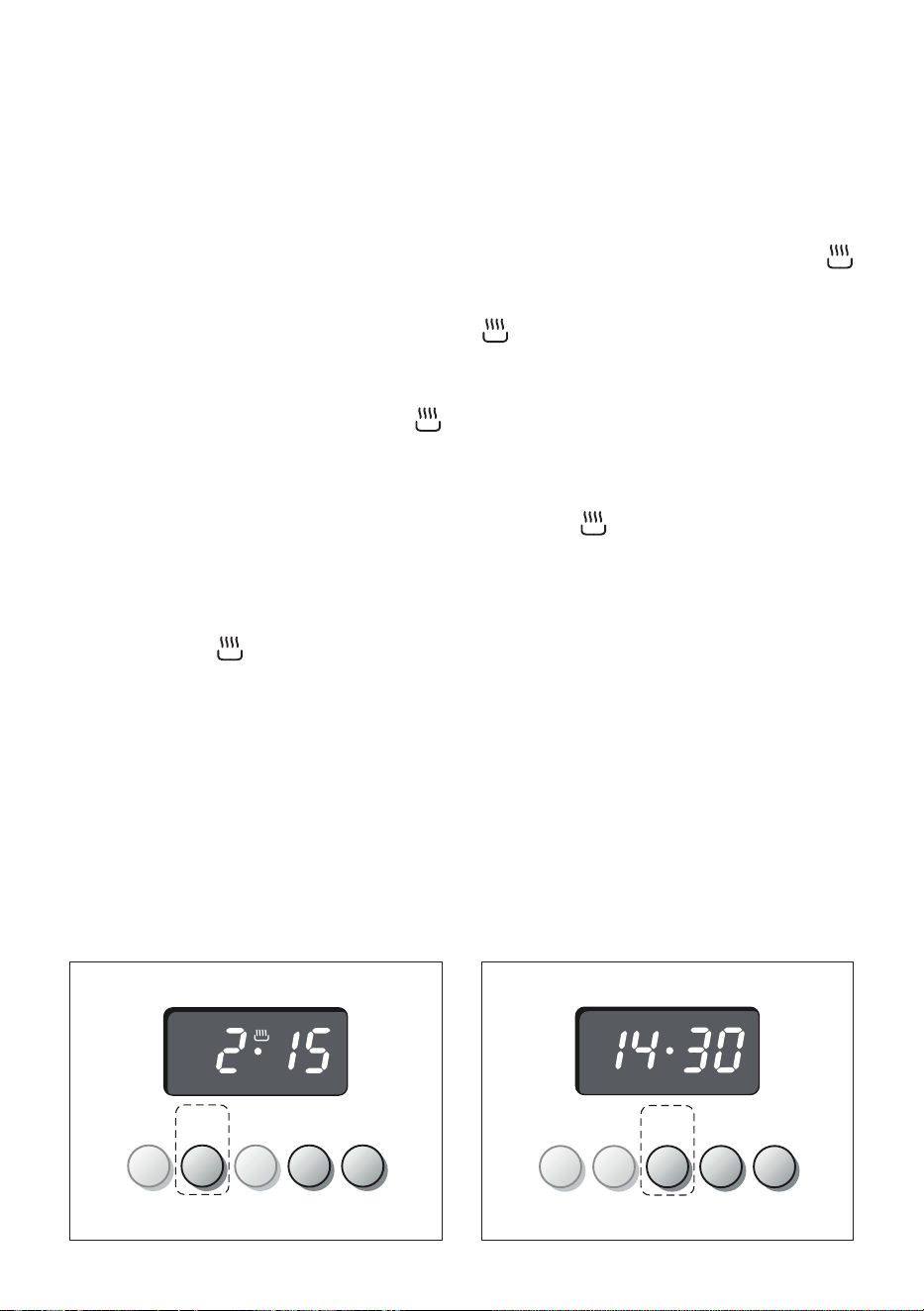
SEMI - AUTOMATIC COOKING
This automatically switches the oven o
after the required cooking time. There are
two methods of semi-automatic cooking:
1° METHOD: Programming the
cooking time (g. 5.6)
• Set the cooking time by pressing
button
“B”
and then button
“E”
to move
forward or
“D”
to move back if you
have gone beyond the required time.
The letter A and the symbol will appear.
2° METHOD: Programming the end of
cooking time (g. 5.7)
• Set the end of cooking time by pressing
button
“C”
and then button
“E”
to move
forward or
“D”
to move back if you
have gone beyond the required time.
The letter A and the symbol will appear.
Having programmed according to one of
the above methods, set the temperature
and function via the function selector and
thermostat knob (see specic chapters).
The oven will come on immediately and
when the set time or programmed end of
cooking time expires, it will automatically
switch o.
During cooking the letter A and the symbol
remains on; press button
“B”
to display
the remaining time until end of cooking
or press button
“B”
to display the end of
cooking time.
The cooking program can be cancelled at
any time by pressing the two buttons
“B”
“C”
simultaneously.
At the end of cooking, turn the oven knob
to the o position the symbol will go
out. The letter A will ash and the acoustic
signal will come on - this can be switched
o by pressing any of the buttons.
Reset the function selector and thermostat
knob and set the programmer to manual
by pressing the two buttons
“B”
“C”
simultaneously.
Important: Also if oven is turned o
automatically by the programmer,
remember to turn to the o position the
function selector and the thermostat knob.
If not, when pressing two buttons
“B”
“C”
simultaneously for manual use, the oven
will start to operate.
Remember to press the two buttons
“B”
“C”
simultaneously to be able to use the oven
in manual setting.
A
A
Fig. 5.6 Fig. 5.7
A B C D EA B C D E
3232
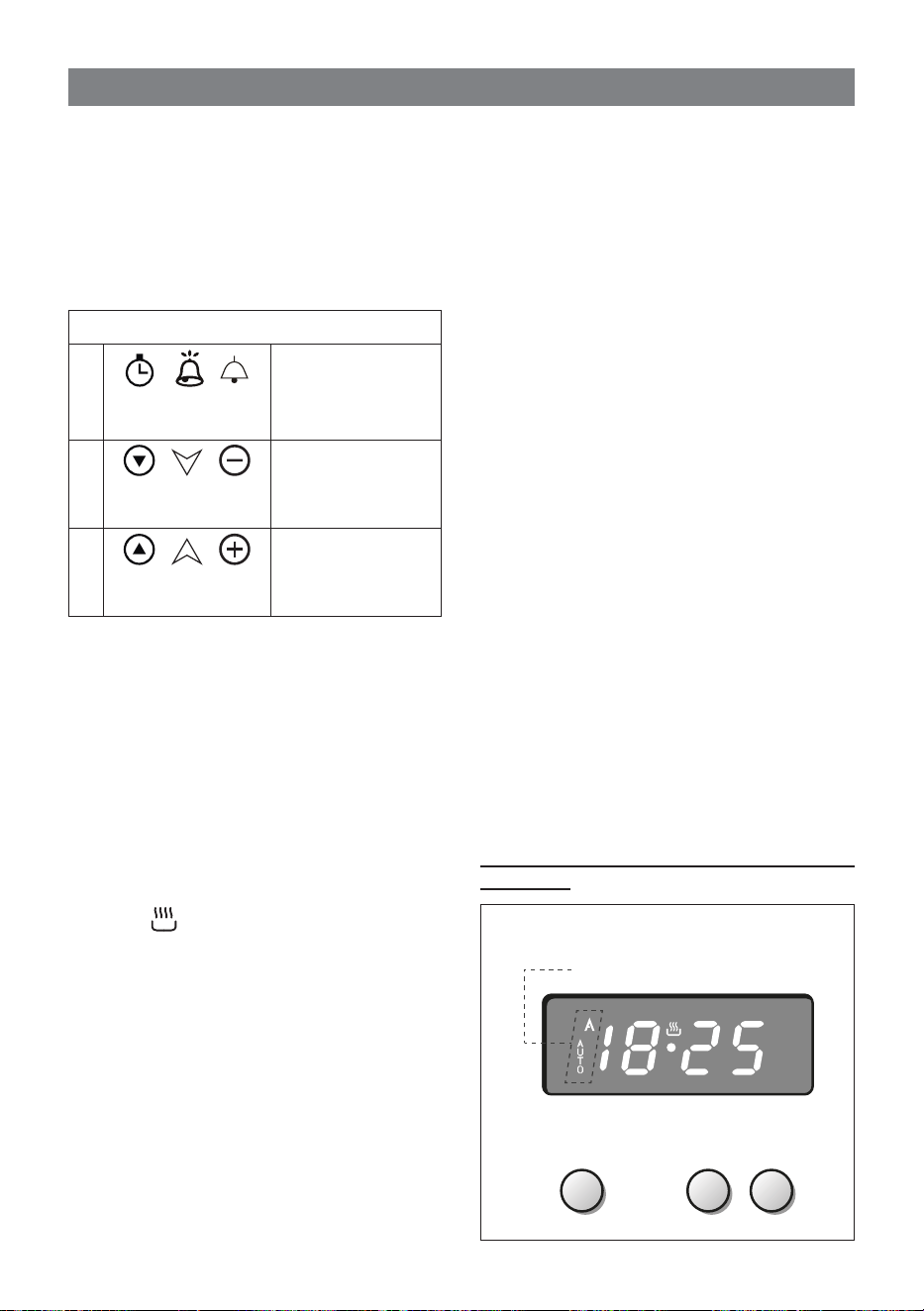
AUTOMATIC COOKING
To cook in the oven in automatic mode
follow the instructions below:
1. Set the cooking time
2. Set the end of cooking time
3. Set the cooking temperature and
function
These operations are carried out as
follows:
1. Set the cooking time by pressing button
“B”
and then
“E”
to move forward or
“D”
to move back if you have gone beyond
the required time (g. 5.8).
The letter A and the symbol
appear.
2. Press button
“C”
; the cooking time
already added to the clock time
appear.
Set the end of cooking time by
pressing button
“E”
if you go beyond
the required time, you can go back by
pressing button
“D”
.
The symbol go out and the letter A
remains on (g. 5.9).
If during the setting the letter A begins
to ash on the display and the acoustic
signal comes on, this indicates a
programming error, i.e. the cooking
cycle has been superimposed on the
clock time. In this case alter the end
of cooking time or the cooking time as
above.
3. Set the cooking temperature and
function via the function selector and
thermostat knob (see specic chapters).
The oven is now programmed and
everything will work automatically; the
oven will come on as required and nish
cooking at the programmed time.
At the start of the cooking the symbol
appear.
During cooking the letter A and the symbol
remains on; press button
“B”
to display
the remaining time until end of cooking
or press button
“B”
to display the end of
cooking time.
The cooking program can be cancelled at
any time by pressing the two buttons
“B”
“C”
simultaneously.
At the end of cooking, the oven switch o,
the symbol go out, the letter A ash and
the acoustic signal come on - this can be
switched o by pressing any of the buttons.
Reset the function selector and thermostat
knob and set the programmer to manual
by pressing the two buttons
“B”
“C”
simultaneously.
Important: Also if oven is turned o
automatically by the programmer, remember
to turn to the o position the function selector
and the thermostat knob. If not, when
pressing two buttons
“B”
“C”
simultaneously
for manual use, the oven will start to operate.
Remember to press the two buttons
“B”
“C”
simultaneously to be able to use the oven in
manual setting.
A
A
Fig. 5.8 Fig. 5.9
A B C D EA B C D E
3333
MODELS WITH ELECTRONIC CLOCK/
END COOKING TIMER (g. 6.1)
The electronic clock/end cooking timer is a
device which groups the following functions:
• 24 hours clock with illuminated display;
• timing of oven cooking with automatic
switch-o (max 99 minutes).
ELECTRONIC CLOCK
Upon immediate connection of the cooker
or after a mains failure, three zeros will
ash on the display.
To set the clock it is necessary to push
the “A” button and then, within 7 seconds,
the “B” or “C” button until you have set the
correct time.
The clock will show zero after a mains failure.
Attention: When the display shows three
zeros the oven cannot be switched on.
The oven can be switched on when the
symbol is shown in the display.
SETTING THE FREQUENCY OF THE
ALARM SOUND
The selection from 3 possibilities of sound
can be made by pressing the “B” button.
COOKING WITH AUTOMATIC
SWITCH-OFF
The aim of this function is to automatically
stop the cooking after a preprogrammed
time, for a maximum period of 99 minutes.
To set the cooking time, push the “B” or “C”
button until you obtain the desired time in the
display. The symbol AUTO (or A) will be shown
in the display. Then set the oven selector and
thermostat knobs according to the cooking
function and temperature required.
The oven will immediately start to operate
and will work for the preprogrammed time.
The display shows the count down.
Clock time can be displayed by pressing the
“A” button. Once the time has elasped, the
oven will switch o automatically, the symbol
AUTO (or A) will go o and an intermittent
buzzer, lasting 7 minutes, will start; this can
be stopped by pressing the “C” button.
Important: Before the buzzer is stopped
switch o the oven manually.
To cancel the cooking program at any time
press the “B” and “C” buttons together and
release the “C” button rst.
ELECTRONIC ALARM
The electronic clock can be used as an alarm
only for a maximum period of 99 minutes.
To set the alarm, push the “B” or “C” button
until you obtain the desired time in the display.
Once the time has elasped, an intermittent
buzzer, lasting 7 minutes, will start; this can
be stopped by pressing the “C” button.
Attention: If the oven is switched
on when the buzzer starts, it will be
automatically switched o. For it to
operate furtherly you have to stop the
buzzer by pressing the “C” button.
Then remember to switch the oven o
manually.
ELECTRONIC CLOCK/END COOKING TIMER
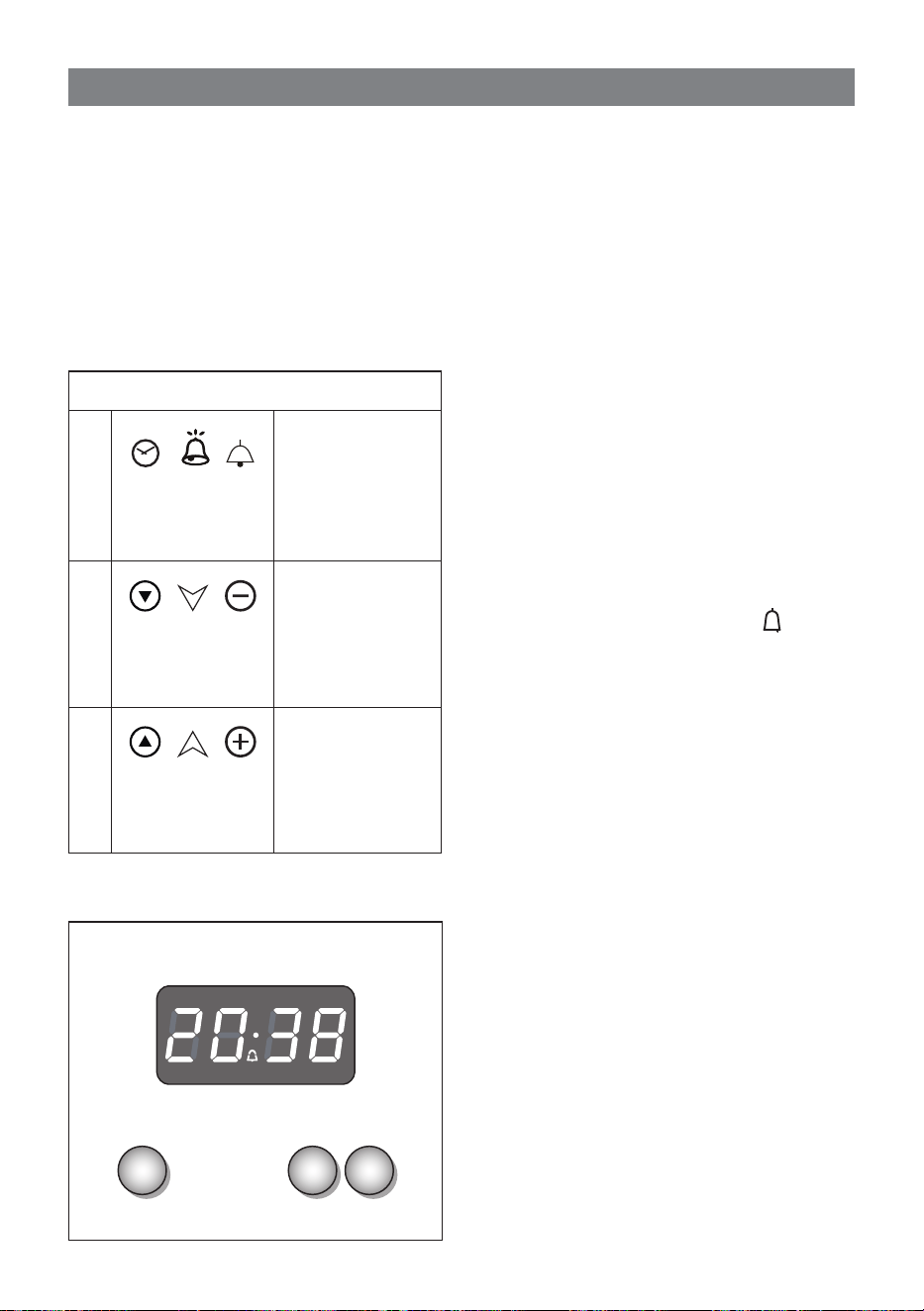
6
Fig. 6.1
symbol AUTO or A
A B C
Description of the buttons:
A
, ,
or other equivalent
symbols
Timer
B
, ,
or other equivalent
symbols
To decrease the
numbers on the
digital display
C
, ,
or other equivalent
symbols
To increase the
numbers on the
digital display
3434
MODELS WITH ELECTRONIC
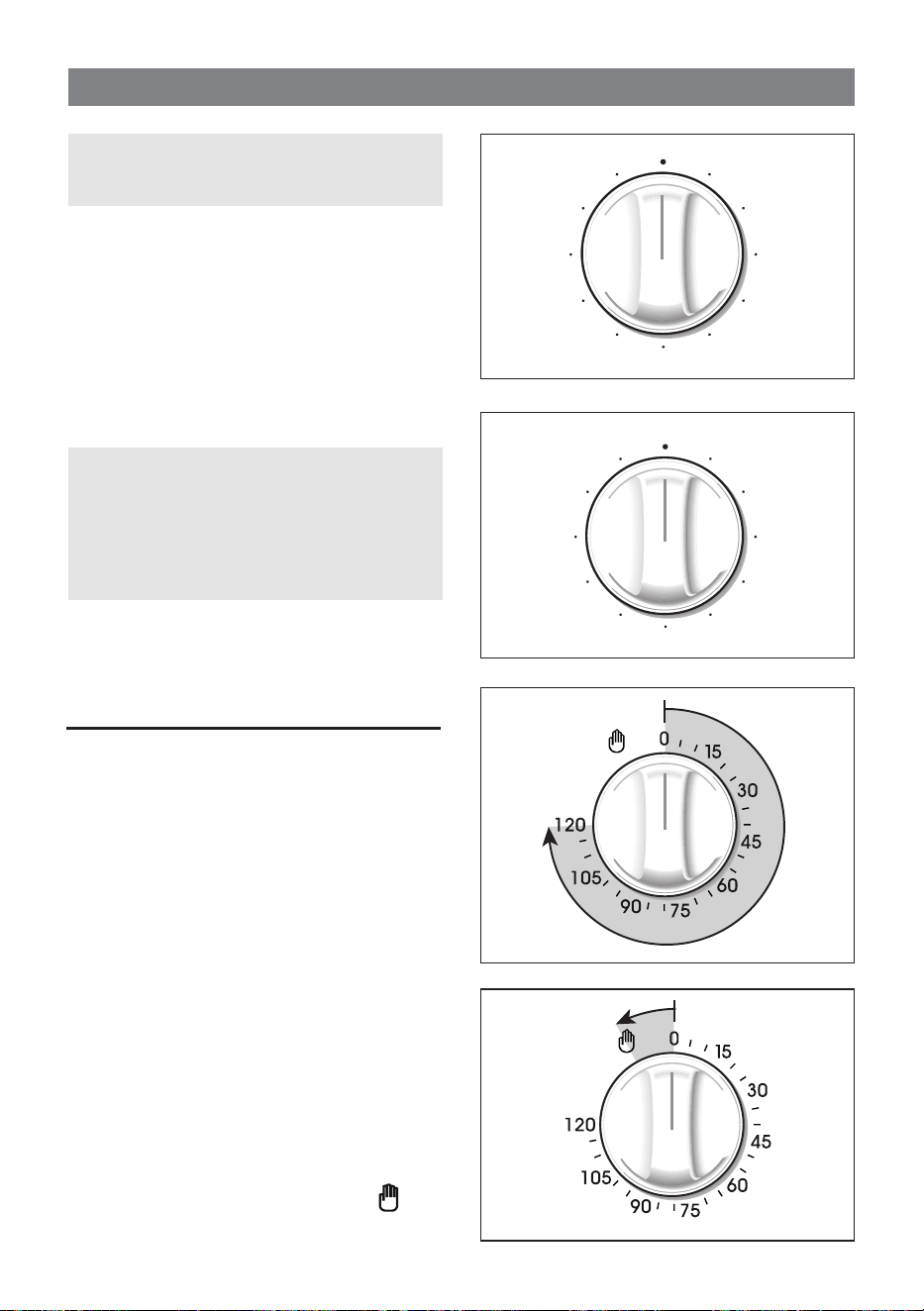
CLOCK WITH ALARM (g. 7.1)
The electronic clock is a device which
groups the following functions:
• 24 hours clock with illuminated display;
• 99 minutes alarm.
Upon immediate connection of the oven or
after a blackout, three zeros will ash on
the display.
To set the hour it is necessary to push the
“A” button and then, within 7 seconds, the
“B” or “C” button until you have set the
exact hour.
An energy black-out makes the clock go
to zero.
ELECTRONIC ALARM
The alarm program consists only of a
buzzer which may be set for a maximum
period of 99 minutes.
To set the time, push the “B” or “C” button
until you obtain the desired time in the
display.
Having nished the setting, the symbol
will be lit and the countdown will start
immediately.
At the end of the time, an intermittent
buzzer, during 7 minutes, will go o; this
can be stopped by pressing the “C” button.
To stop the alarm countdown in any moment
press the “B” and “C”, buttons together and
release the “C” button rst.
SETTING THE FREQUENCY OF THE
ALARM SOUND
The selection from 3 possibilities of sound
can be made by pressing the “B” button.
A B C
Description of the buttons:
A
, ,
or other
equivalent
symbols
Timer
B
, ,
or other
equivalent
symbols
To decrease the
numbers on the
digital display
C
, ,
or other
equivalent
symbols
To increase the
numbers on the
digital display
ELECTRONIC CLOCK WITH ALARM
7
Fig. 7.1
3535
MODELS WITH 60 OR 120 MINUTES
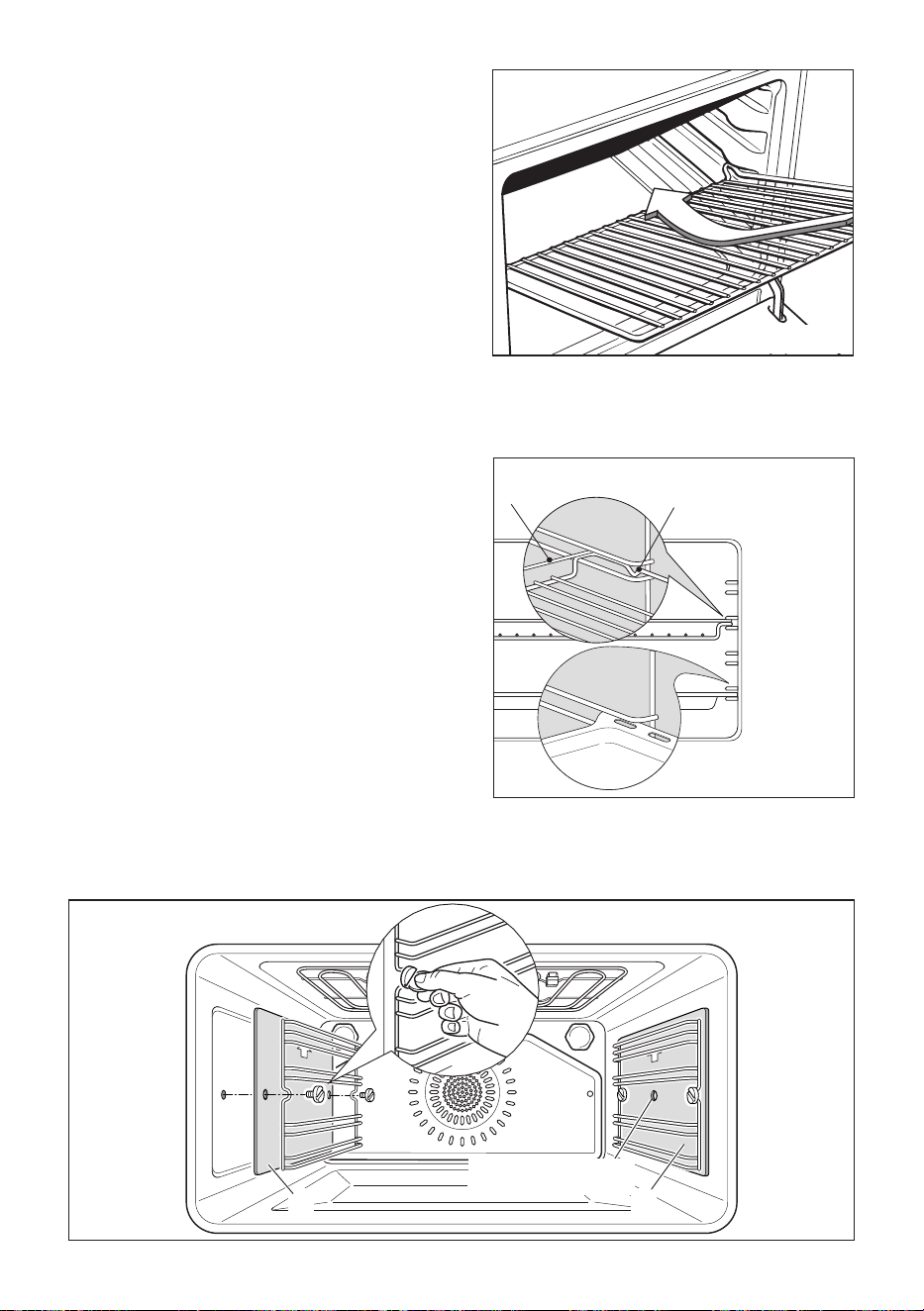
ALARM (g. 8.1)
The minute counter is a timed acoustic
warning device which can be set for a
maximum of 60 ore 120 minutes.
The knob must be rotated clockwise as
far as the 60 or 120 minute position and
then set to the required time by rotating it
anticlockwise.
MODELS WITH 120 MINUTES
CUT-OFF TIMER (g. 8.3a, 8.3b)
The timer runs the oven for a preset time.
1. Starting up.
After setting the function selector and
thermostat to the required mode and
temperature, rotate the timer knob
clockwise until you reach the required
cooking time (max 120 minutes) (g.
8.1a).
Once this time has elapsed, the timer
will return to the “0” position and the
oven will automatically switch o.
2. Manual position.
If the cooking time is longer than
two hours or if you wish to use the
oven manually, switching it o as
required, the knob must be turned
counterclockwise to position (g.
8.1b).
NOTES: The knob and symbols may vary.
The symbols may be printed on the knob
itself.
60’ or 120’ ALARM 120’ CUT-OFF TIMER
8
Fig. 8.3a
Fig. 8.3b
55
50
45
40
35
30
25
20
15
10
5
0
110
100
90
80
70
60
50
40
30
20
10
0
Fig. 8.2
Fig. 8.1
IMPORTANT WARNING: This is only a
mechanical timer.
Remember to turn o the oven/grill
manually.

3636
CLEANING AND MAINTENANCE
9
Important: The manufacturer declines all liability for possible damage caused by
the use of unsuitable products to clean the appliance.
Do not store ammable material in the oven.
Do not use a steam cleaner because the moisture can get into the appliance thus
make it unsafe.
Do not use harsh abrasive cleaners or sharp metal scrapers to clean the oven door
glass since they can scratch the surface, which may result in shattering of the glass.
GENERAL ADVICE
Important:
Before any operation of cleaning and
maintenance disconnect the appliance
from the electrical supply.
• It is advisable to clean when the
appliance is cold and especially for
cleaning the enamelled parts.
• Avoid leaving alkaline or acidic
substances (lemon juice, vinegar, etc.)
on the surfaces.
• Avoid using cleaning products with a
chlorine or acidic base.
• The oven must always be cleaned after
every use, using suitable products.
• Important: The use of suitable
protective clothing/gloves is
recommended when handling or
cleaning of this appliance.
WARNING
When correctly installed, your product
meets all safety requirements laid
down for this type of product category.
However special care should be taken
around the rear or the underneath of
the appliance as these areas are not
designed or intended to be touched and
may contain sharp or rough edges, that
may cause injury.
INSIDE OF OVEN
The oven should always be cleaned after
use when it has cooled down.
The cavity should be cleaned using a mild
detergent solution and warm water.
Suitable proprietary chemical cleaners
may be used after rst consulting with
the manufacturers recommendations and
testing a small sample of the oven cavity.
Abrasive cleaning agents or scouring pads/
cloths should not be used on the cavity
surface.
NOTE: The manufacturers of this appliance
will accept no responsibility for damage
caused by chemical or abrasive cleaning.
Let the oven cool down and pay special
attention no to touch the hot heating
elements inside the oven cavity.

3737
ENAMELLED PARTS
All the enamelled parts must be cleaned with a sponge and soapy water only or other non-
abrasive products.
Dry preferably with a microbre or soft cloth.
STAINLESS STEEL SURFACES (MODELS WITHOUT ANTI-FINGERPRINT
TREATMENT), ALUMINIUM PARTS AND PAINTED OR SILK-SCREEN
PRINTED SURFACES
Clean using an appropriate product. Always dry thoroughly.
IMPORTANT: these parts must be cleaned very carefully to avoid scratching and abrasion.
You are advised to use a soft cloth and neutral soap.
CAUTION: Do not use abrasive substances or non-neutral detergents as these will
irreparably damage the surface.
STAINLESS STEEL SURFACES WITH ANTI-FINGERPRINT TREATMENT
(SOME MODELS ONLY)
CAUTION
The stainless steel front surfaces used in some ovens are protected with a Special Lacquer
to reduce nger-print marks.
To avoid damaging this lacquer, do not clean the stainless steel with abrasive cleaners or
abrasive cloths or scouring pads.
ONLY SOAP/WARM WATER MUST BE USED TO CLEAN THE STAINLESS STEEL
SURFACES.
GLASS CONTROL PANEL (MODELS WITH GLASS CONTROL PANEL)
Clean using an appropriate product.
Always dry thoroughly.
Do not use harsh abrasive cleaners or sharp metal scrapers to clean the control panel
since they can scratch the surface, which may result in shattering of the glass.
3838
OVEN FITTING OUT
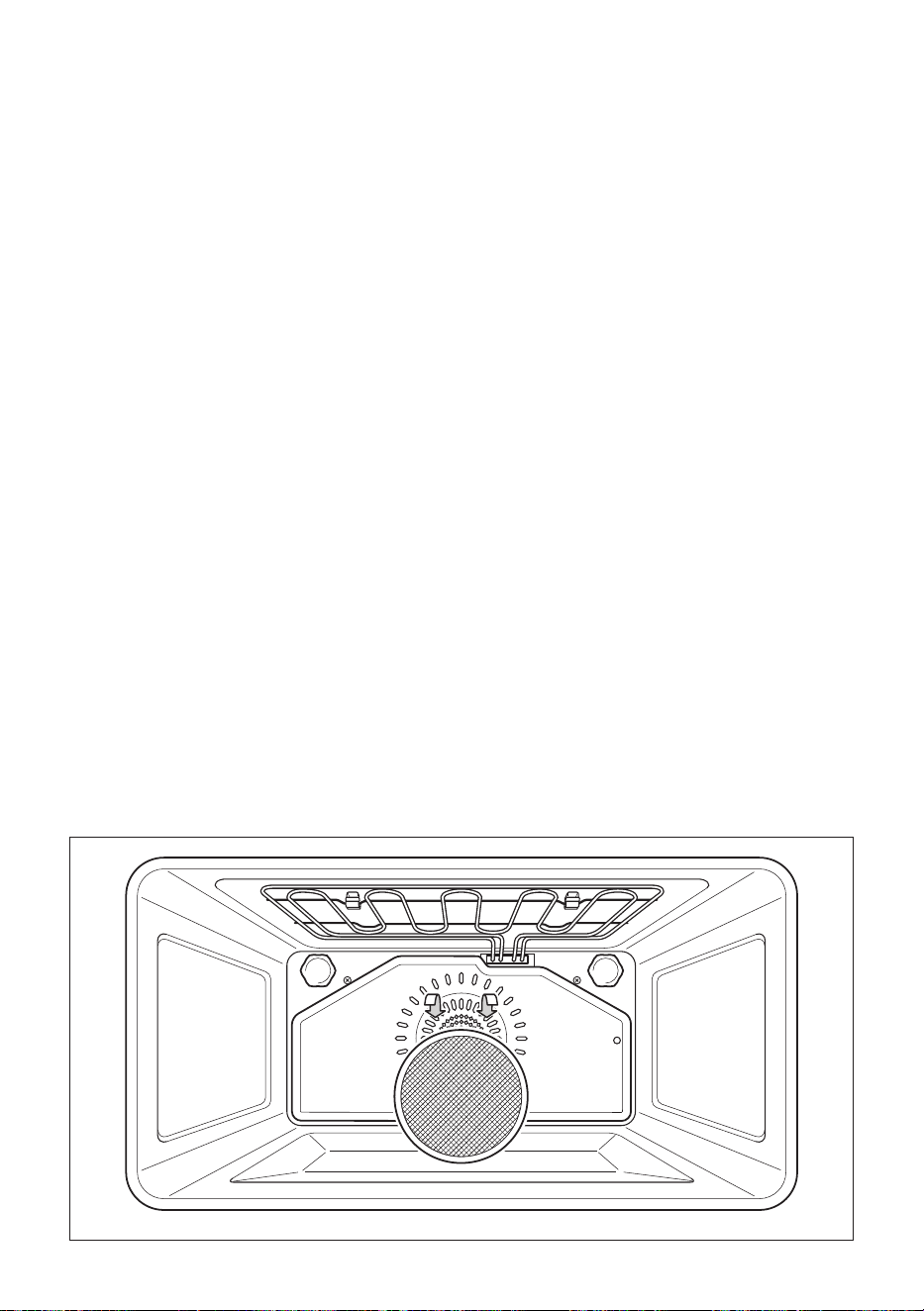
1. MODELS WITH EMBOSSED CAVITY
The oven shelf is provided with a
security block to prevent accidental
extraction. It must be inserted
operating as per gure 9.1. To remove
it, operate in the reverse order.
2. MODELS WITH SIDE WIRE RACKS
• Assemble the wire racks to the oven
walls using the 2 screws (g. 9.2b).
In the models with catalytic panels
supplied, interpose the catalytic
panels “A” with the arrow up (g. 9.2a).
Models with rotisserie: The catalytic
panel with the hole for the rotisserie
must be positioned on the right oven
wall. DO NOT INTERPOSE THE
CATALYTIC PANEL WITHOUT THE
HOLE ON THE RIGHT OVEN WALL.
• Slide the rack into the runners (g.
9.2a).
The rack must be tted so that the
safety notch, which stops it sliding out,
faces the inside of the oven; the guard
rail shall be at the back.
• To dismantle, operate in reverse order.
Fig. 9.2b
Fig. 9.2a
Guard rail
Stop notch
A A
HOLE FOR ROTISSERIE
HOLE FOR ROTISSERIE
(SOME MODELS ONLY)
Fig. 9.1
3939
ADVICE FOR USE AND MAINTENANCE OF CATALYTIC PANELS
(SUPPLIED WITH SOME MODELS ONLY)
The catalytic panels are covered with special microporous enamel which absorbs and does
away with oil and fat splashes during normal baking over 200°C.
If, after cooking very fatty foods, the panels remain dirty, operate the oven “idling” on max
temperature for about 30 minutes.
These panels do not require to be cleaned, however it is advised to periodically remove
them from the oven (at least the side panels) and to wash them with tepid soapy water and
then wipe o with a soft cloth.
DO NOT CLEAN OR WASH THEM WITH ABRASIVE PRODUCTS OR WITH PRODUCTS
CONTAINING ACIDS OR ALKALIS.
The side panels are reversible and when the catalytic microporous enamel degrades, they
can be turned to the other side.
Fig. 9.3
GREASE FILTER (SUPPLIED WITH SOME MODELS ONLY)
A special screen is provided at the back of the oven to catch grease particles, mainly when
meat is being roasted (g. 9.3).
• When baking pastry etc. this lter should be removed.
• Slide in the grease lter on the back of the oven as in g. 9.3.
Clean the lter after any cooking!
• The grease lter can be removed for cleaning and should be washed regularly in hot
soapy water.
• Always clean the lter after cooking as any solid residues on it might adversely aect
the oven performance.
• Always dry the lter properly before tting it back into the oven.
4040
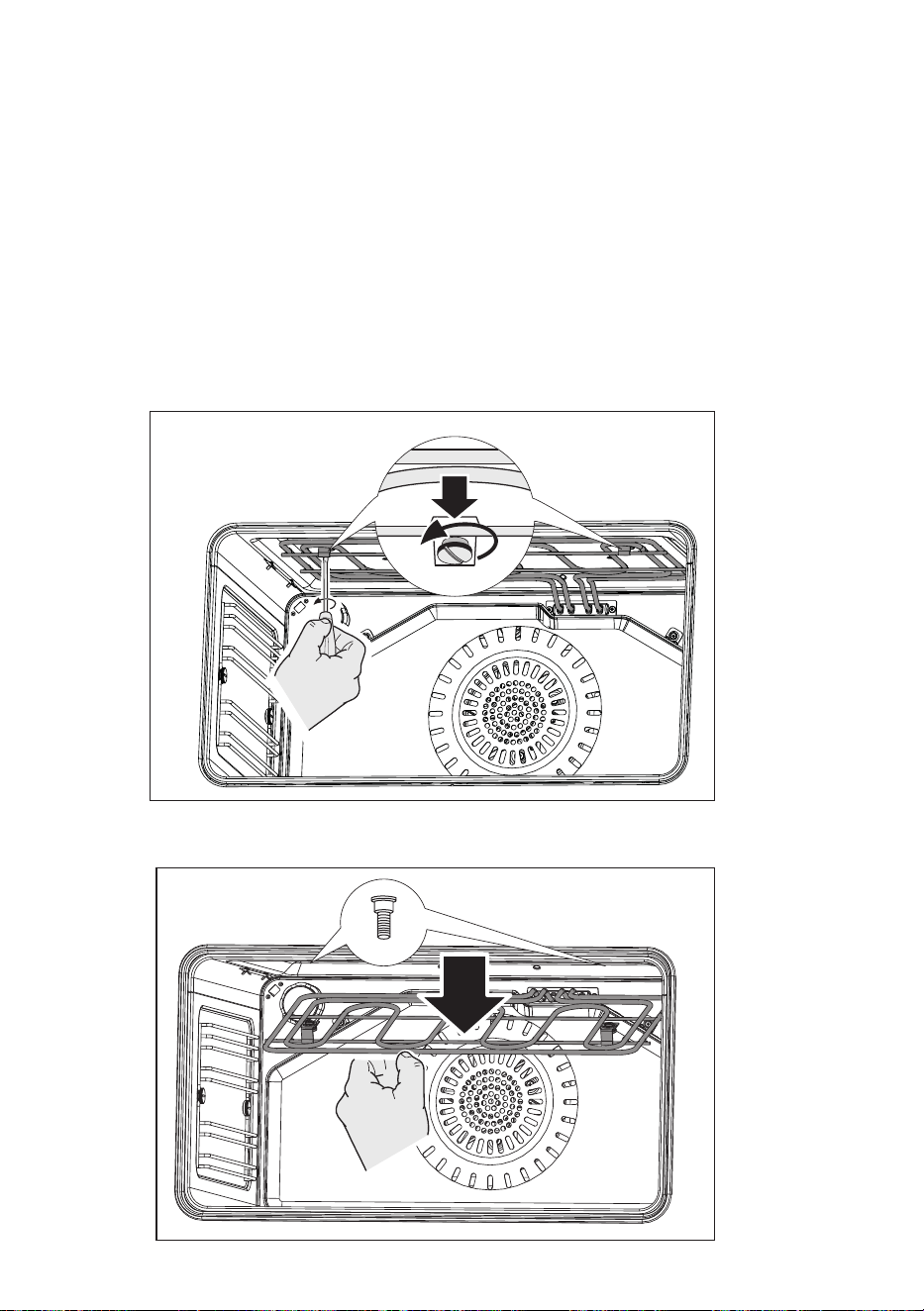
TILTING GRILL (SOME MODELS ONLY)
• The grill is secured to the rear wall of the oven on a hinge system that allows it to be
lowered to allow proper access when cleaning the oven ceiling (g. 9.4).
• To lower the grill element: use a at-head screwdriver or a small coin to loosen the
element xing screws (g. 9.5).
• When you have nished cleaning the oven ceiling, raise the grill element and screw
the element xing screws back onto the studs. Make sure that the xing screws are
tightened and the element is held securely in place.
• The grill element itself is self-cleaning.
Fig. 9.4
Fig. 9.5
4141
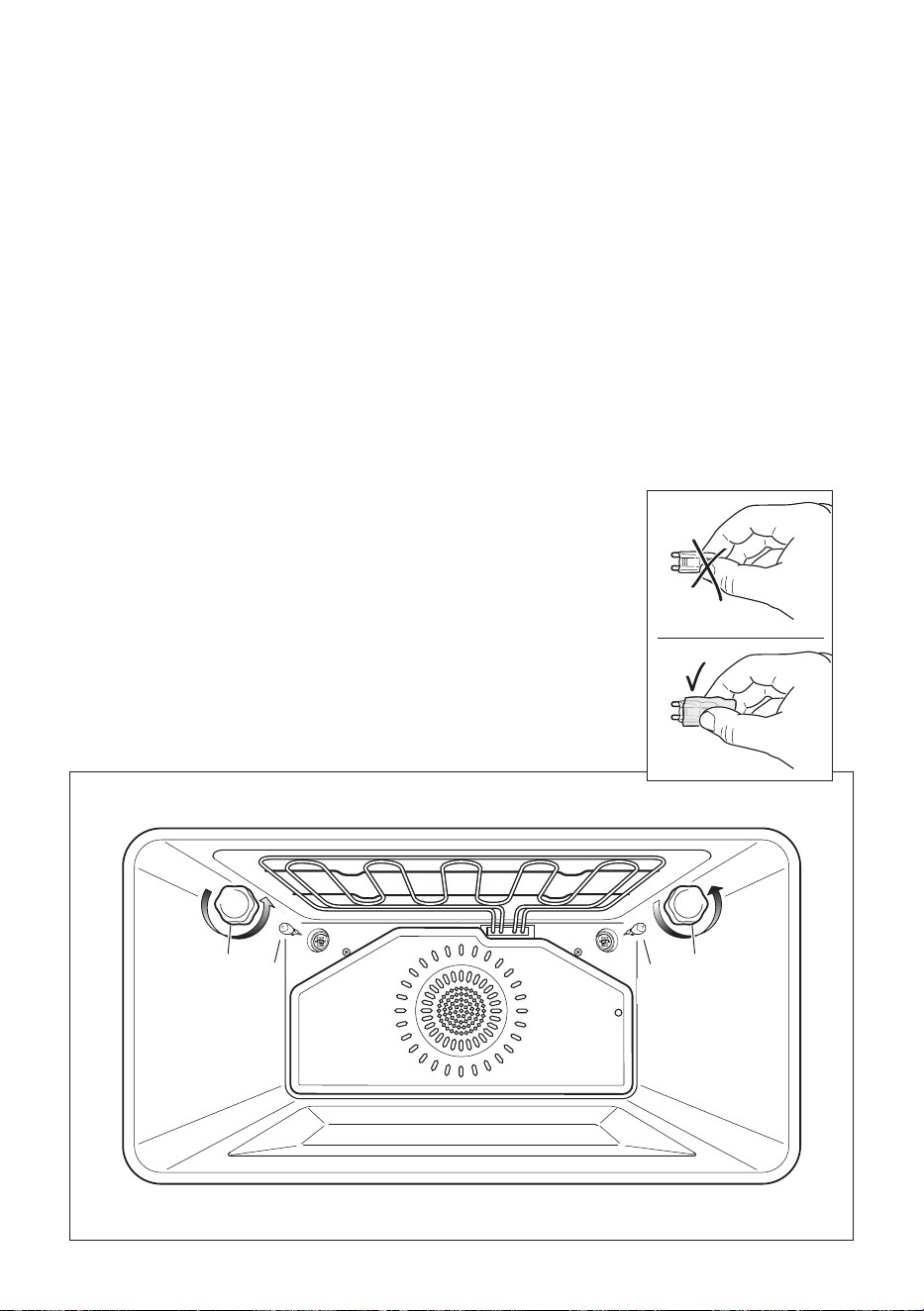
REPLACING THE OVEN LAMPS
WARNING: Ensure the appliance is switched o before replacing the lamp to avoid
the possibility of electric shock.
• Let the oven cavity and the heating elements to cool down;
• Switch o the electrical supply;
• Remove the protective cover “A” (g. 9.6);
• Replace the halogen lamp “B” with a new one suitable for high temperatures (300°C)
having the following specications: 220-240 V, 50-60Hz and same power (check watt
power as stamped in the lamp itself ) of the replaced lamp;
IMPORTANT WARNING: Never replace the bulb with bare hands; contamination from
your ngers can cause premature failure. Always use a clean cloth or gloves;
• Ret the protective cover “A”;
Note: Oven bulb replacement is not covered by your guarantee.
B B
A
A
Fig. 9.6
WRONG
CORRECT
The intended purpose of the lamps, tted on this appliance, is
to illuminate the oven cavity and thus help the user to better
monitor the food while cooking. These lamps are not suitable for
other usage (e.g. environments lighting).
This product contains more than one light source of energy
eciency class G.
4242
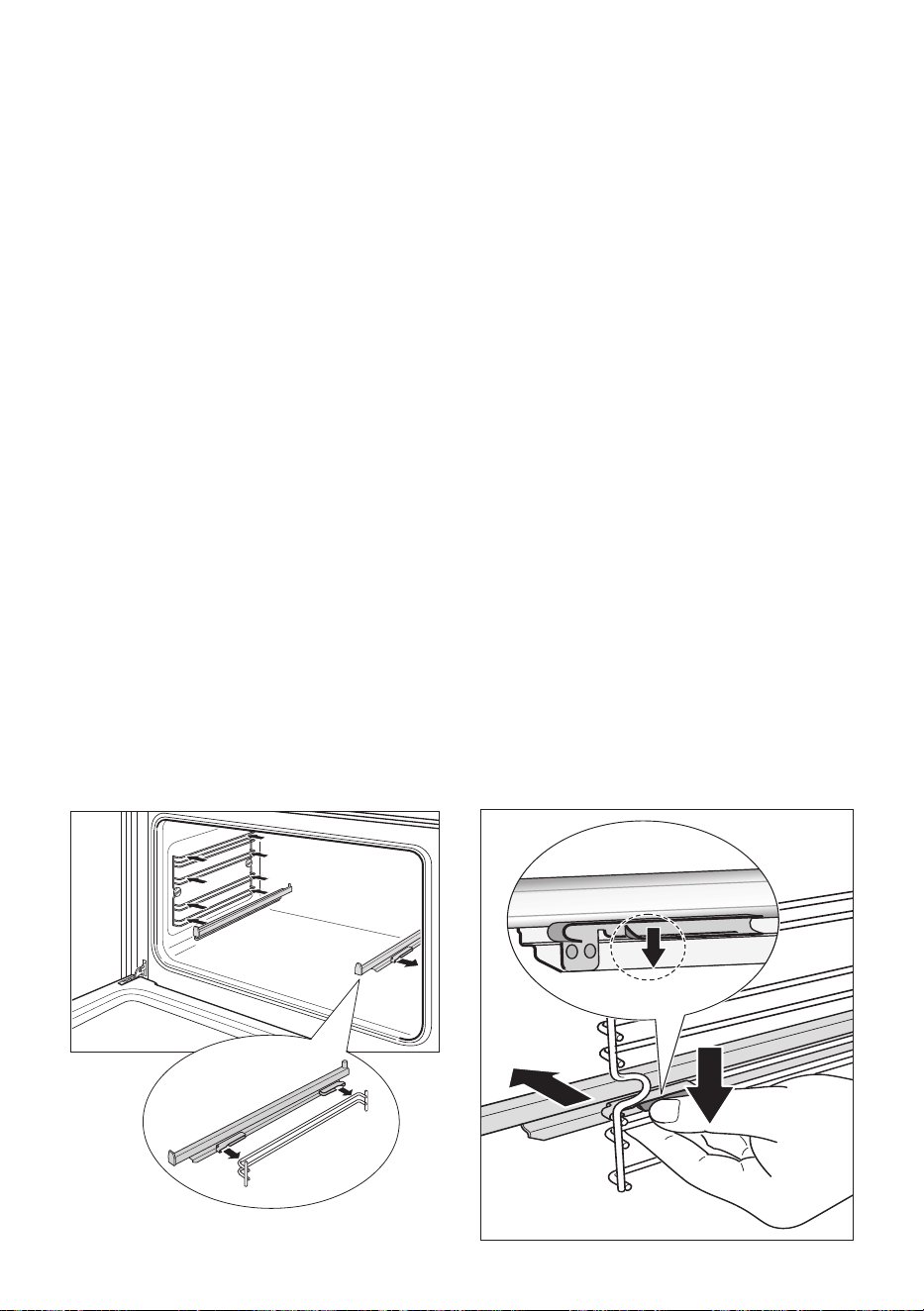
TELESCOPIC SLIDING SHELF SUPPORTS (SOME MODELS ONLY)
The telescopic sliding shelf supports make it safer and easier to insert and remove the
oven shelves and trays. They stop when they are pulled out to the maximum position.
Important! When tting the sliding shelf supports, make sure that you t:
• The slides to the top wire of a rack. They do not t on the lower wire.
• The slides so that they run out towards the oven door.
• Both sides of each pair of shelf slides.
• Both sides on the same level.
To x the sliding shelf supports onto the side racks:
• Screw the side racks onto the oven wall (interposing the catalytic panels if supplied)
(g. 9.2b).
• Fit the sliding shelf supports onto the top wire of a rack and press (g. 9.7). You will
hear a click as the safety locks clip over the wire.
IMPORTANT NOTE: when cooking with the rotisserie DO NOT position the grill
support on the sliding shelf supports.
To remove the telescopic sliding shelf supports:
• Remove the side racks (and the catalytic liners if supplied) by unscrewing the xing
screws (g. 9.2b).
• Lay down the telescopic sliding shelf support and side racks, with the telescopic sliding
shelf support underneath.
• Find the safety locks. These are the tabs that clip over the wire of the side rack (arrow
1 in g. 9.8).
• Pull the safety locks away from the wire to release the wire (arrow 2 in g. 9.8).
Cleaning the sliding shelf supports:
• Wipe the supports with a damp cloth and a mild detergent only.
• Do not wash them in the dishwasher, immerse them in soapy water, or use oven
cleaner on them.
1
2
1
Fig. 9.8
Fig. 9.7
4343
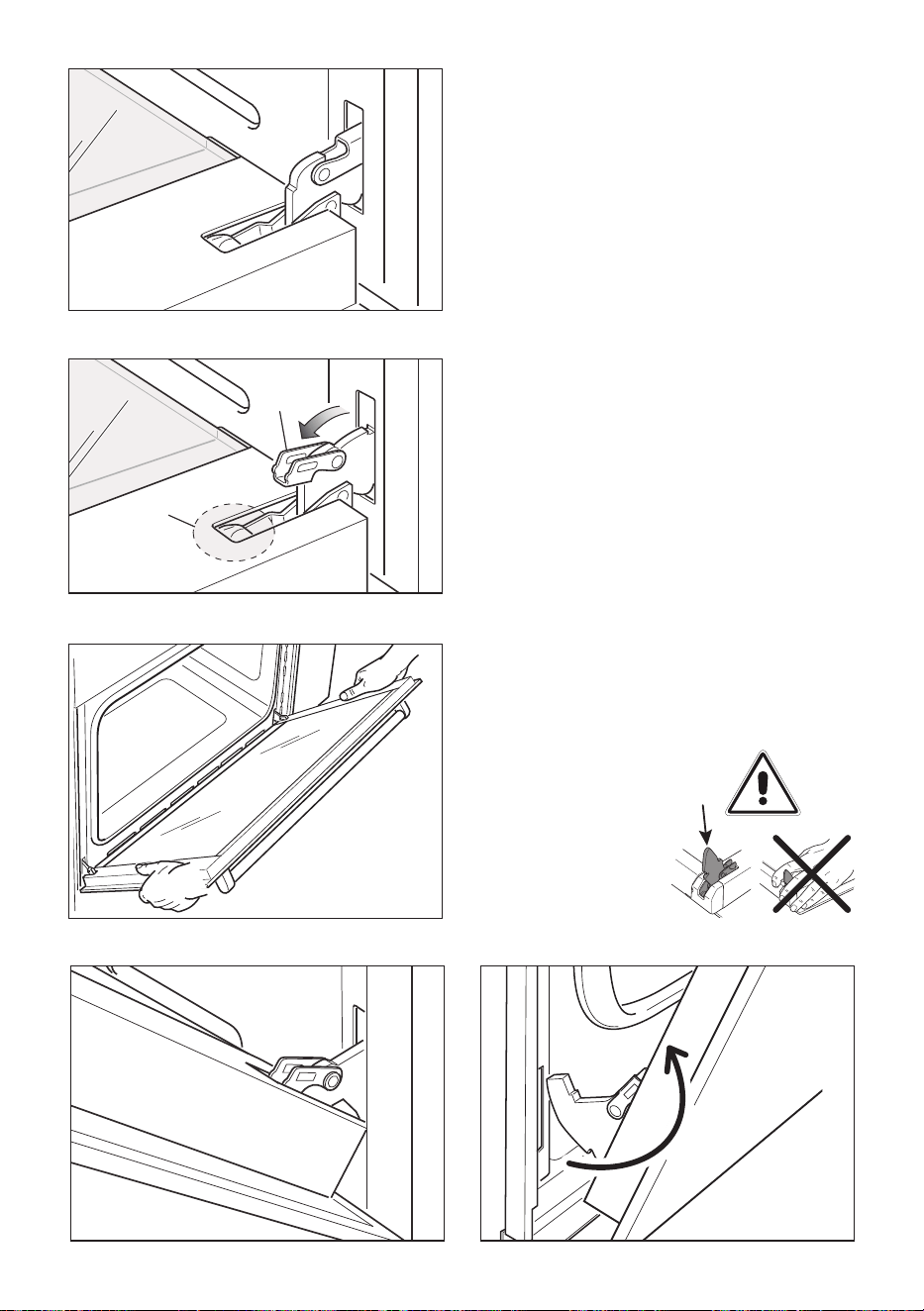
REMOVING THE OVEN DOOR
The oven door can easily be removed as
follows:
• Open the door to the full extent (g.
9.10).
• Open the lever “A
”
completely on the
left and right hinges (g. 9.11).
• Hold the door as shown in g. 9.12.
• Gently close the door until left and right
hinge levers “A
”
are hooked to part “B
”
of the door (gs. 9.11, 9.13).
• Withdraw the hinge hooks from their
location following arrow “C
”
(g. 9.14).
• Rest the door on a soft surface.
B
A
C
Fig. 9.14
Fig. 9.12
Fig. 9.13
Fig. 9.11
Fig. 9.10
Important!
Always keep a safe distance from the door
hinges, paying special attention to position
of your hands.
If the door hinges are
not correctly hooked,
they could unhook
and close suddenly
and unexpectedly
with risk of injury.
4444
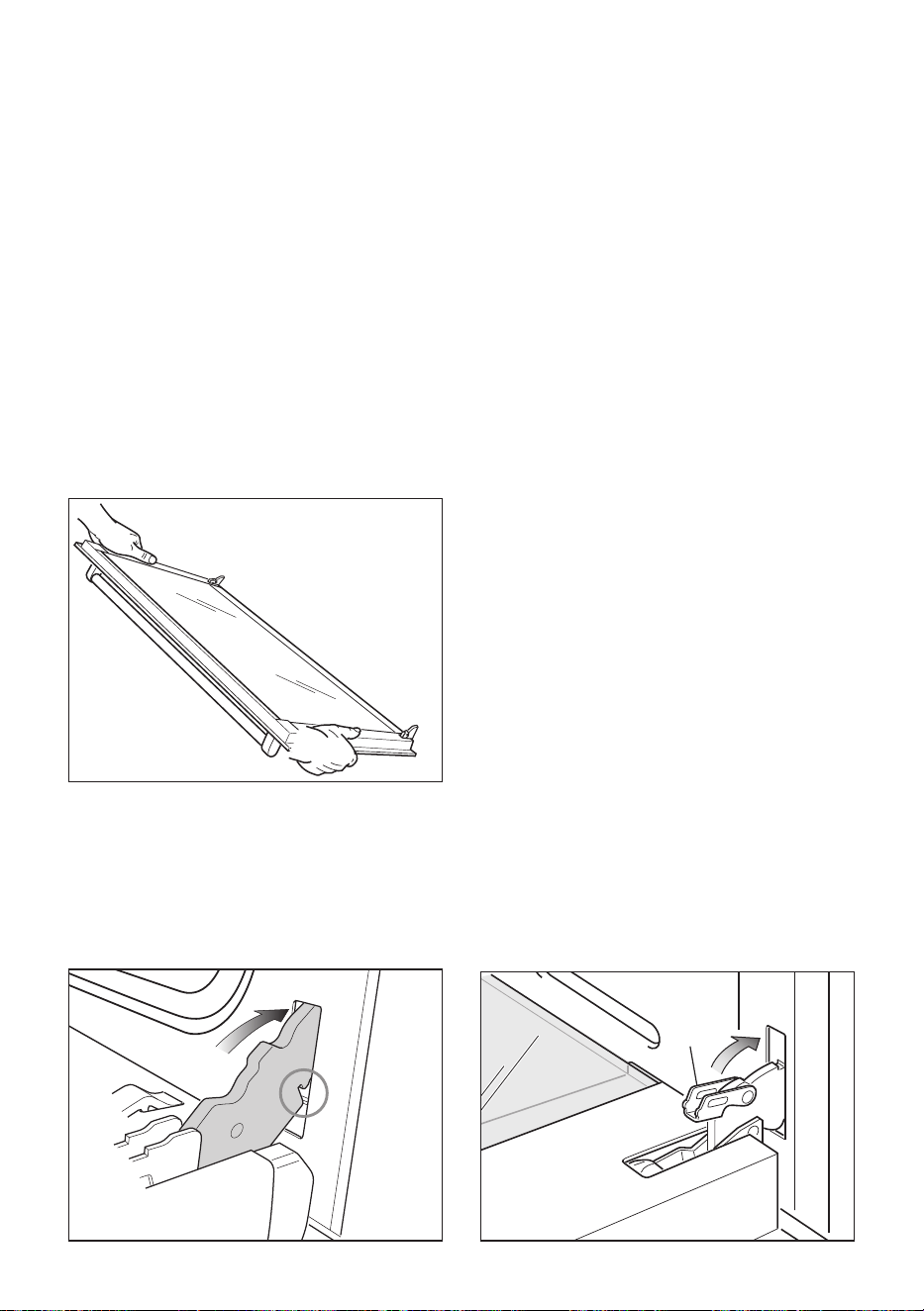
REFIT THE DOOR
1. Hold the door rmly (g. 9.15).
2. Insert the hinge tongues into the slots, making sure that the groove drops into place
as shown in the gure 9.16.
3. Open the door to its full extent.
4. Fully close the levers “A” on the left and right hinges, as shown in the gure 9.17.
5. Close the door and check that it is properly in place.
A
Fig. 9.16
Fig. 9.15
Fig. 9.17

4545

4646

4747

Cod. 1106446/GB - ß2
The manufacturer will not be responsible for any inaccuracy resulting from printing or transcript errors
contained in this brochure. We reserve the right to carry out modications to products as required,
including the interests of consumption, without prejudice to the characteristics relating to safety or
function.
GB