
OWNER’S
MANUAL
Altea
5P0012720BC
Inglés
5P0012720BC (11.14) (GT9)
Altea Inglés (11.14)
SEAT S.A. is permanently concerned about continuous development of its types and models. For this reason we ask you to under-
stand, that at any given time, changes regarding shape, equipment and technique may take place on the car delivered. For this reason
no right at all may derive based on the data, drawings and descriptions in this current handbook.
All texts, illustrations and standards in this handbook are based on the status of information at the time of printing. Except for error
or omission, the information included in the current handbook is valid as of the date of closing print.
Re-printing, copying or translating, whether total or partial is not allowed unless SEAT allows it in written form.
SEAT reserves all rights in accordance with the “Copyright” Act.
All rights on changes are reserved.
❀
This paper has been manufactured using bleached non-chlorine cellulose.
© SEAT S.A. - Reprint: 15.11.14
About this manual
This manual contains a description of the
equipment supplied with the vehicle at the
time this manual was published. Some of the
units described herein will not be available
until a later date or are only available in cer-
tain markets.
Because this is a general manual for the
ALTEA range, some of the equipment and
functions that are described in this manual
are not included in all types or variants of the
model; they may vary or be modified depend-
ing on the technical requirements and on the
market; this is in no way deceptive advertis-
ing.
The illustrations are intended as a general
guide and may vary from the equipment fitted
in your vehicle in some details.
The steering indications (left, right, forward,
reverse) appearing in this manual refer to the
normal driving movements of the vehicle ex-
cept when otherwise indicated.
*
The equipment marked with an aster-
isk* is fitted as standard only in certain
versions, and is only supplied as op-
tional extras for some versions, or are
only offered in certain countries.
® All registered marks are indicated with
®. Although the copyright symbol does
not appear, it is a copyrighted mark.
>> The section is continued on the follow-
ing page.
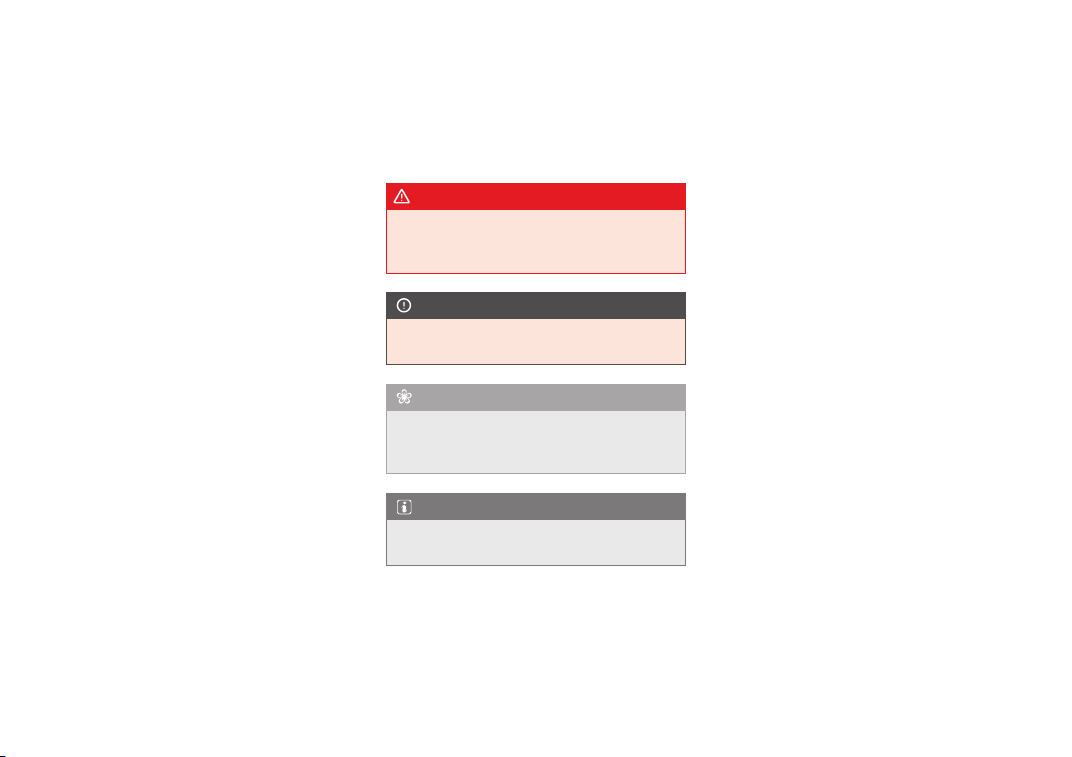
WARNING
Texts preceded by this symbol contain infor-
mation on safety. They warn you about possi-
ble dangers of accident or injury.
CAUTION
Texts with this symbol draw your attention to
potential sources of damage to your vehicle.
For the sake of the environment
Texts preceded by this symbol contain rele-
vant information concerning environmental
protection.
Note
Texts preceded by this symbol contain additio-
nal information.
This manual is divided into five large parts,
which are:
1. Safety
2. Operation
3. Tips
4. Technical data
5. Alphabetical index
At the end of this manual, there is a detailed
alphabetical index that will help you quickly
find the information you require.

Foreword
This Instruction Manual and its correspond-
ing supplements should be read carefully to
familiarise yourself with your vehicle.
Besides the regular care and maintenance of
the vehicle, its correct handling will help pre-
serve its value.
For safety reasons, always note the informa-
tion concerning accessories, modifications
and part replacements.
If selling the vehicle, give all of the on-board
documentation to the new owner, as it
should be kept with the vehicle.
You can access the information in this man-
ual using:
●
Thematic table of contents that follows the
manual’s general chapter structure
●
Alphabetical index with many terms and
synonyms to help you find information.
WARNING
Read and always observe safety informa-
tion concerning the passenger's front air-
bag ››› page 25, Important information
regarding the front passenger's airbag.


Table of Contents
Table of Contents
Safety . . . . . . . . . . . . . . . . . . . . . . . . . . . . . . . . 5
Safe driving . . . . . . . . . . . . . . . . . . . . . . . . . . . . 5
Safety first! . . . . . . . . . . . . . . . . . . . . . . . . . . . . . 5
Advice about driving . . . . . . . . . . . . . . . . . . . . . 5
Proper sitting position for occupants . . . . . . . . 6
Pedal area . . . . . . . . . . . . . . . . . . . . . . . . . . . . . . 11
Seat belts . . . . . . . . . . . . . . . . . . . . . . . . . . . . . . 11
The reason why we should wear seat belts . . . 11
How to properly adjust your seatbelt . . . . . . . . 14
Seat belt tensioners . . . . . . . . . . . . . . . . . . . . . . 16
Airbag system . . . . . . . . . . . . . . . . . . . . . . . . . . 17
Brief introduction . . . . . . . . . . . . . . . . . . . . . . . . 17
Airbag overview . . . . . . . . . . . . . . . . . . . . . . . . . 20
Deactivating airbags . . . . . . . . . . . . . . . . . . . . . 23
Transporting children safety . . . . . . . . . . . . . . . 24
Safety for children . . . . . . . . . . . . . . . . . . . . . . . 24
Child seats . . . . . . . . . . . . . . . . . . . . . . . . . . . . . 26
Operation . . . . . . . . . . . . . . . . . . . . . . . . . . . . . 31
Dash panel . . . . . . . . . . . . . . . . . . . . . . . . . . . . . 31
Overview . . . . . . . . . . . . . . . . . . . . . . . . . . . . . . . 31
Instruments . . . . . . . . . . . . . . . . . . . . . . . . . . . . 32
Warning lamps . . . . . . . . . . . . . . . . . . . . . . . . . . 35
Digital instrument panel display . . . . . . . . . . . . 47
Instrument panel menus* . . . . . . . . . . . . . . . . . 50
Steering wheel controls* . . . . . . . . . . . . . . . . . . 57
General information . . . . . . . . . . . . . . . . . . . . . . 57
Audio system . . . . . . . . . . . . . . . . . . . . . . . . . . . 57
Radio navigation system . . . . . . . . . . . . . . . . . . 61
Opening and closing . . . . . . . . . . . . . . . . . . . . . 63
Central locking . . . . . . . . . . . . . . . . . . . . . . . . . . 63
Keys . . . . . . . . . . . . . . . . . . . . . . . . . . . . . . . . . . . 66
Radio frequency remote control . . . . . . . . . . . . 67
Anti-theft alarm system* . . . . . . . . . . . . . . . . . . 68
Boot hatch . . . . . . . . . . . . . . . . . . . . . . . . . . . . . 71
Electric windows . . . . . . . . . . . . . . . . . . . . . . . . . 72
Sliding/tilting sunroof* . . . . . . . . . . . . . . . . . . . 74
Lights and visibility . . . . . . . . . . . . . . . . . . . . . . 75
Lights . . . . . . . . . . . . . . . . . . . . . . . . . . . . . . . . . 75
Interior lights . . . . . . . . . . . . . . . . . . . . . . . . . . . 82
Visibility . . . . . . . . . . . . . . . . . . . . . . . . . . . . . . . 83
Windscreen wiper and rear window wiper
systems . . . . . . . . . . . . . . . . . . . . . . . . . . . . . . . . 84
Rear vision mirrors . . . . . . . . . . . . . . . . . . . . . . . 86
Seats and head restraints . . . . . . . . . . . . . . . . . 88
Adjusting the seat and head restraints . . . . . . 88
Seat functions . . . . . . . . . . . . . . . . . . . . . . . . . . 91
Rear seats . . . . . . . . . . . . . . . . . . . . . . . . . . . . . . 92
Transport and practical equipment . . . . . . . . . 93
Compartments . . . . . . . . . . . . . . . . . . . . . . . . . . 93
Multi-purpose mobile storage compartment* . 96
Ashtray*, cigarette lighter* and power sockets 98
First-aid kit, warning triangle, fire extinguisher 100
Luggage compartment . . . . . . . . . . . . . . . . . . . . 101
Roof carrier/rack system* . . . . . . . . . . . . . . . . . 104
Air conditioning . . . . . . . . . . . . . . . . . . . . . . . . . 107
Heating . . . . . . . . . . . . . . . . . . . . . . . . . . . . . . . . 107
Climatic* . . . . . . . . . . . . . . . . . . . . . . . . . . . . . . . 109
2C-Climatronic* . . . . . . . . . . . . . . . . . . . . . . . . . 112
General notes . . . . . . . . . . . . . . . . . . . . . . . . . . . 116
Driving . . . . . . . . . . . . . . . . . . . . . . . . . . . . . . . . 117
Power steering (servotronic*) . . . . . . . . . . . . . . 117
All-wheel drive* . . . . . . . . . . . . . . . . . . . . . . . . . 117
Driving with LPG* . . . . . . . . . . . . . . . . . . . . . . . . 118
Journeys abroad . . . . . . . . . . . . . . . . . . . . . . . . . 120
Ignition lock . . . . . . . . . . . . . . . . . . . . . . . . . . . . 120
Braking and parking . . . . . . . . . . . . . . . . . . . . . 123
Manual gearbox . . . . . . . . . . . . . . . . . . . . . . . . . 126
Automatic gearbox/DSG automatic gearbox* . 127
Run-in and economical driving . . . . . . . . . . . . . 130
Driver assistance systems . . . . . . . . . . . . . . . . . 134
Braking and stability systems . . . . . . . . . . . . . . 134
Start-Stop System* . . . . . . . . . . . . . . . . . . . . . . . 138
Parking aid acoustic system* . . . . . . . . . . . . . . 140
Cruise speed* (cruise control system - CCS) . . . 142
Towing bracket device . . . . . . . . . . . . . . . . . . . . 144
Trailer towing . . . . . . . . . . . . . . . . . . . . . . . . . . . 144
Advice . . . . . . . . . . . . . . . . . . . . . . . . . . . . . . . . 147
Care and maintenance . . . . . . . . . . . . . . . . . . . . 147
Accessories and technical modifications . . . . . 147
Care and cleaning . . . . . . . . . . . . . . . . . . . . . . . 148
Care of the vehicle exterior . . . . . . . . . . . . . . . . 149
Caring for the vehicle interior . . . . . . . . . . . . . . 153
Checking and refilling levels . . . . . . . . . . . . . . . 158
Fuel . . . . . . . . . . . . . . . . . . . . . . . . . . . . . . . . . . . 158
Petrol . . . . . . . . . . . . . . . . . . . . . . . . . . . . . . . . . . 159
Diesel . . . . . . . . . . . . . . . . . . . . . . . . . . . . . . . . . 160
LPG system (Liquefied petroleum gas)* . . . . . . 160
Working in the engine compartment . . . . . . . . 163
Engine oil . . . . . . . . . . . . . . . . . . . . . . . . . . . . . . 166
Cooling system . . . . . . . . . . . . . . . . . . . . . . . . . . 169
Windscreen washer reservoir . . . . . . . . . . . . . . 171
Brake fluid . . . . . . . . . . . . . . . . . . . . . . . . . . . . . 172
Vehicle battery . . . . . . . . . . . . . . . . . . . . . . . . . . 173
Wheels . . . . . . . . . . . . . . . . . . . . . . . . . . . . . . . . 175
Wheels and tyres . . . . . . . . . . . . . . . . . . . . . . . . 175
Winter service . . . . . . . . . . . . . . . . . . . . . . . . . . . 180
Emergencies . . . . . . . . . . . . . . . . . . . . . . . . . . . . 181
Vehicle tools, spare wheel . . . . . . . . . . . . . . . . . 181
Wheel change . . . . . . . . . . . . . . . . . . . . . . . . . . . 182
Tyre repair . . . . . . . . . . . . . . . . . . . . . . . . . . . . . . 186
Jump-starting . . . . . . . . . . . . . . . . . . . . . . . . . . . 189
Towing and tow-starting . . . . . . . . . . . . . . . . . . 191
Emergency locking and unlocking . . . . . . . . . . 193
Changing the wiper blades . . . . . . . . . . . . . . . . 194
Fuses and bulbs . . . . . . . . . . . . . . . . . . . . . . . . . 196
Fuses . . . . . . . . . . . . . . . . . . . . . . . . . . . . . . . . . . 196
Changing the lights . . . . . . . . . . . . . . . . . . . . . . 198
3

Table of Contents
Technical specifications . . . . . . . . . . . . . . . 207
Technical features . . . . . . . . . . . . . . . . . . . . . . . 207
Important information . . . . . . . . . . . . . . . . . . . . 207
Information on fuel consumption . . . . . . . . . . . 208
Towing a trailer . . . . . . . . . . . . . . . . . . . . . . . . . . 209
Wheels . . . . . . . . . . . . . . . . . . . . . . . . . . . . . . . . 210
Engine specifications . . . . . . . . . . . . . . . . . . . . . 211
Dimensions and capacities . . . . . . . . . . . . . . . . 221
Index . . . . . . . . . . . . . . . . . . . . . . . . . . . . . . . . . 223
4
Safe driving
Safety
Safe driving
Safety first!
WARNING
●
This manual contains important informa-
tion about the operation of the vehicle, both
for the driver and the passengers. The other
sections of the on-board documentation also
contain further information that you should
be aware of for your own safety and for the
safety of your passengers.
●
Ensure that the onboard documentation is
kept in the vehicle at all times. This is espe-
cially important when lending or selling the
vehicle to another person.
Advice about driving
Before setting off
For your own safety and the safety of your
passengers, always note the following points
before every trip:
–
Make sure that the vehicle's lights and turn
signals are working properly.
–
Check tyre pressure.
–
Ensure that all windows provide a clear and
good view of the surroundings.
–
Make sure all luggage is secured
››› page 101.
–
Make sure that no objects can interfere
with the pedals.
–
Adjust front seat, head restraint and rear vi-
sion mirrors properly according to your
size.
–
Ensure that the passengers in the rear
seats always have the head restraints in
the in-use position ››› page 10.
–
Instruct passengers to adjust the head re-
straints according to their height.
–
Protect children with appropriate child
seats and properly applied seat belts
››› page 24
.
–
As
s
ume the correct sitting position. Instruct
your passengers also to assume a proper
sitting position. ››› page 6.
–
Fasten your seat belt securely. Instruct your
passengers also to fasten their seat belts
properly. ››› page 11.
What affects driving safety?
As a driver, you are responsible for yourself
and your passengers. When your concentra-
tion or driving safety is affected by any cir-
cumstance, you endanger yourself as well as
others on the road ›››
, for this reason:
–
Always pay attention to traffic and do not
get distracted by passengers or telephone
calls.
–
Never drive when your driving ability is im-
paired (e.g. by medication, alcohol, drugs).
–
Observe traffic laws and speed limits.
–
Always reduce your speed as appropriate
for road, traffic and weather conditions.
–
When travelling long distances, take
breaks regularly - at least every two hours.
–
If possible, avoid driving when you are tired
or stressed.
WARNING
When driving safety is impaired during a trip,
the risk of injury and accidents increases.
Safety equipment
Never put your safety or the safety of your
passengers in danger. In the event of an acci-
dent, the safety equipment may reduce the
risk of injury. The following list includes most
of the safety equipment in your SEAT:
●
Three-point seat belts
●
belt tension limiters for the front and rear
side seats,
»
5
Technical specifications
AdviceOperationSafety
Safety
●
Belt tensioners for the front seats
●
Belt height adjustment for the front seats
●
Front airbags
●
Side airbags in the front seat backrests
●
Head-protection airbags
●
Active front head restraints*
●
“ISOFIX” anchorage points for child seats
in the rear side seats with the “ISOFIX” sys-
tem,
●
height-adjustable front head restraints,
●
rear head restraints with in-use position
and non-use position,
●
adjustable steering column.
The safety equipment mentioned above
works together to provide you and your pas-
sengers with the best possible protection in
the event of an accident. However, these
safety systems can only be effective if you
and your passengers are sitting in a correct
position and use this equipment properly.
Safety is everyone's business!
Proper sitting position for
occupants
Correct sitting position for driver
Fig. 1 The proper distance between driver
and steering wheel
Fig. 2 Correct head restraint position for the
driver.
For your own safety and to reduce the risk of
injury in the event of an accident, we recom-
mend the following adjustments for the driv-
er:
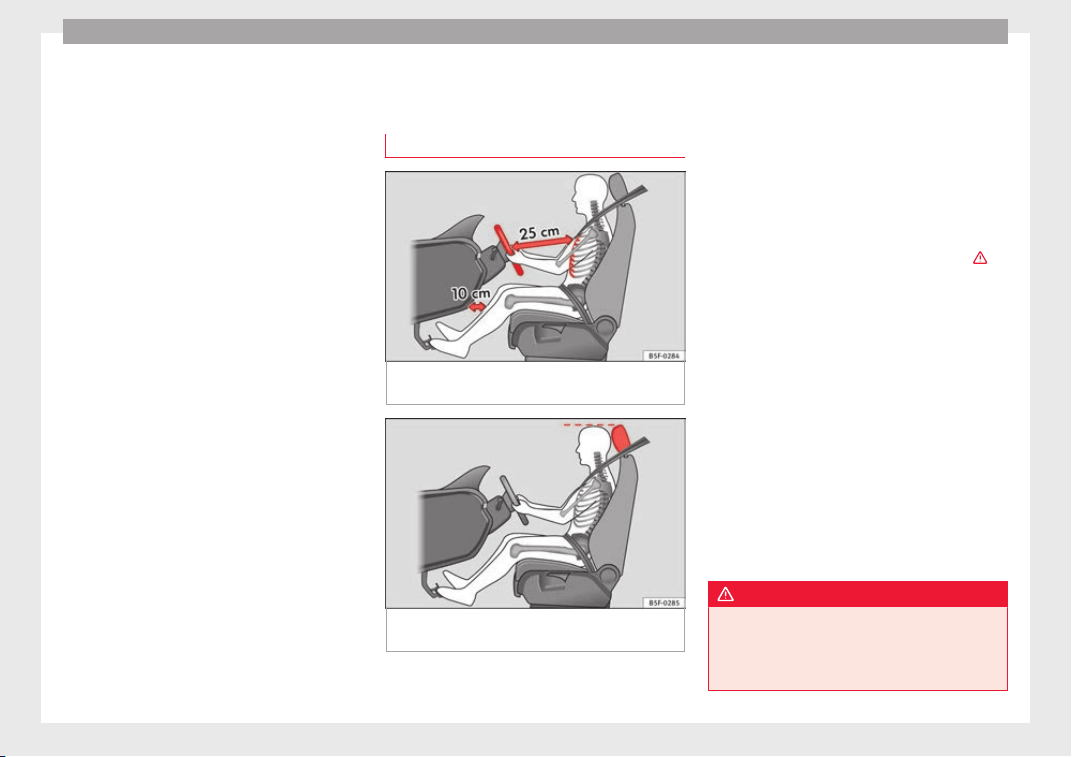
–
Adjust the steering wheel so that there is a
distance of at least 25 cm between the
steering wheel and the centre of your chest
››› Fig. 1
.
–
Mo
v
e the driver seat forwards or backwards
so that you are able to press the accelera-
tor, brake and clutch pedals to the floor
with your knees still slightly angled ›››
.
–
Ensure that you can reach the highest point
of the steering wheel.
–
Adjust the head restraint so that its upper
edge is at the same level as the top of your
head, or as close as possible to the same
level as the top of your head ››› Fig. 2
.
–
Mo
v
e the seat backrest to an upright posi-
tion so that your back rests completely
against it.
–
Fasten your seat belt securely ››› page 11.
–
Keep both feet in the footwell so that you
have the vehicle under control at all times.
Adjustment of the driver seat ››› page 88.
WARNING
●
An incorrect sitting position of the driver
can lead to severe injuries.
●
Adjust the driver seat so that there is at
least 25 cm distance between the centre of
6
Safe driving
the chest and the centre of the steering
wheel ››› Fig. 1. If you are sitting closer than
25 cm, the airb
ag system cannot protect you
properly.
●
If your physical constitution prevents you
from maintaining the minimum distance of 25
cm, contact a specialised workshop. The
workshop will help you decide if special spe-
cific modifications are necessary.
●
When driving, always hold the steering
wheel with both hands on the outside of the
ring at the 9 o'clock and 3 o'clock positions.
This reduces the risk of injury when the driver
airbag is triggered.
●
Never hold the steering wheel at the 12
o'clock position, or in any other manner (e.g.
in the centre of the steering wheel). In such
cases, if the airbag is triggered, you may sus-
tain injuries to the arms, hands and head.
●
To reduce the risk of injury to the driver
during sudden braking manoeuvres or an ac-
cident, never drive with the backrest tilted far
back! The airbag system and seat belts can
only provide optimal protection when the
backrest is in an upright position and the
driver is wearing his or her seat belt correct-
ly.
●
Adjust the head restraint properly to ach-
ieve optimal protection.
Adjusting the steering wheel position
Fig. 3 Adjusting the steering wheel position.
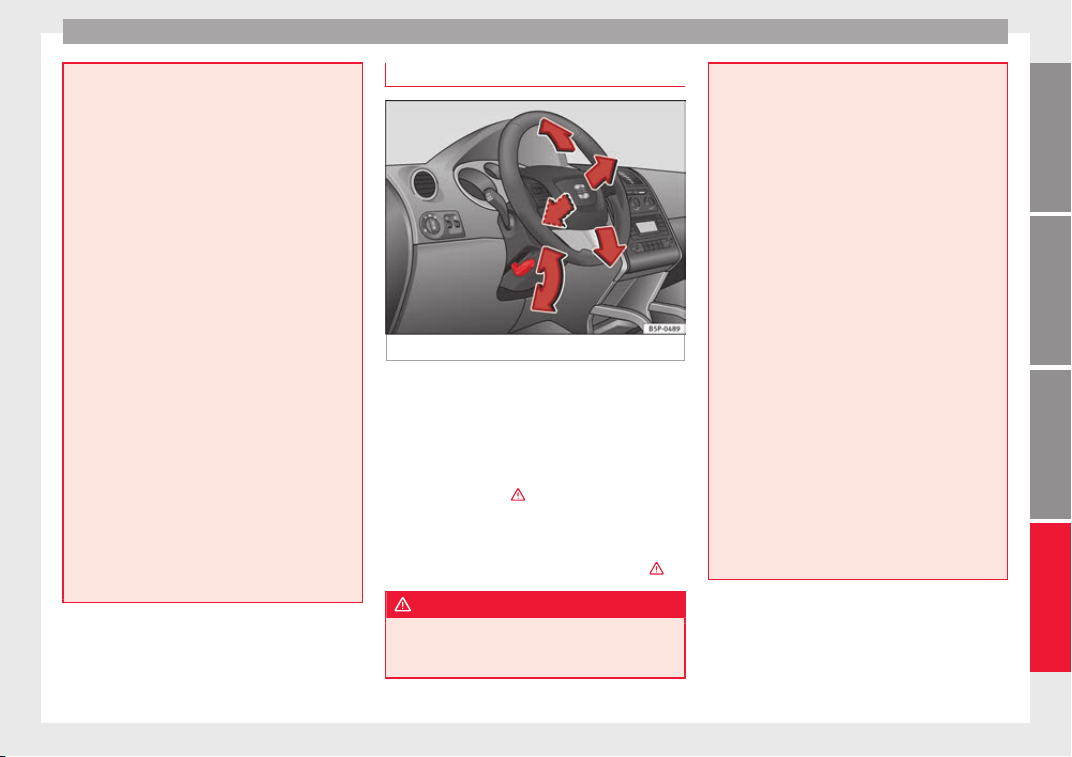
The height and reach of the steering wheel
can be freely adjusted to suit the driver.
–
Adjust the driver seat to the correct posi-
tion.
–
Push the lever under the steering column
››› Fig. 3
down ›
›› .
–
Adjust the steering wheel until the correct
position is set ››› Fig. 1.
–
Then push the lever up again firmly ››› .
WARNING
●
Incorrect use of the steering column adjust-
ment function and an incorrect seating posi-
tion can result in serious injury.
●
To avoid accidents, the steering column
should be adjusted only when the vehicle is
stationary.
●
Adjust the driver seat or steering wheel so
that there is a distance of at least 25 cm be-
tween the steering wheel and your chest
››› Fig. 1. If you fail to observe the minimum
dis
tance, the airbag will not protect you. Risk
of fatal injury.
●
If your physical constitution does not allow
you to maintain the minimum distance of
25 cm, contact a Technical Service. The Tech-
nical Service will help you to decide if certain
specific modifications are necessary.
●
If you adjust the steering wheel so that it
points towards your face, the driver airbag
will not protect you properly in the event of
an accident. Make sure that the steering
wheel points towards your chest.
●
When driving, always hold the steering
wheel with both hands on the outside of the
ring at the 9 o'clock and 3 o'clock positions.
Never hold the steering wheel at the 12
o'clock position, or in any other manner (e.g.
in the centre of the steering wheel, or on the
inside of the rim). In such cases, if the airbag
is triggered, you may sustain injuries to your
arms, hands and head.
7
Technical specifications
AdviceOperationSafety

Safety
Correct sitting position for front
passenger
For your own safety and to reduce the risk of
injury in the event of an accident, we recom-
mend the following adjustments for the front
passenger:
–
Move the front passenger seat back as far
as possible ››› .
–
Move the seat backrest to an upright posi-
tion so that your back rests completely
against it.
–
Adjust the head restraint so that its upper
edge is at the same level as the top of your
head, or as close as possible to the same
level as the top of your head
›››
page 9.
–
Always keep both feet in the footwell in
front of the front passenger seat.
–
Fasten your seat belt securely
›››
page 11.
It is possible to deactivate the front passen-
ger airbag in
exceptional circumstances.
Adju
s
ting the front passenger seat
›››
page 89.
WARNING
●
An incorrect sitting position of the front
passenger can lead to severe injuries.
●
Adjust the front passenger seat so that
there is at least 25 cm between your chest
and the dash panel. If you are sitting closer
than 25 cm, the airbag system cannot protect
you properly.
●
If your physical constitution prevents you
from maintaining the minimum distance of 25
cm, contact a specialised workshop. The
workshop will help you decide if special spe-
cific modifications are necessary.
●
Always keep your feet in the footwell when
the vehicle is moving; never rest them on the
dash panel, out the window or on the seat. An
incorrect sitting position exposes you to an
increased risk of injury in case of a sudden
braking or an accident. If the airbag is trig-
gered, you could sustain severe injuries due
to an incorrect sitting position.
●
To reduce the risk of injury to the front pas-
senger in events such as sudden braking ma-
noeuvres or an accident, never travel with the
backrest tilted far back! The airbag system
and seat belts can only provide optimal pro-
tection when the backrest is in an upright po-
sition and the front passenger is wearing his
or her seat belt properly. The further the seat
backrests are tilted to the rear, the greater
the risk of injury due to incorrect positioning
of the belt web or to the incorrect sitting po-
sition!
●
Adjust the head restraint correctly in order
to achieve maximum protection.
Correct sitting position for passengers
in the rear seats
To reduce the risk of injury in the event of a
sudden braking manoeuvre or an accident,
passengers on the rear seat bench must con-
sider the following:
–
Sit up straight.
–
Adjust the head restraint to the correct po-
sition ››› page 10.
–
Alw
ays keep both feet in the footwell in
front of the rear seat.
–
Fasten your seat belt securely
›››
page 11.
–
Use an appropriate child restraint system
when you take children in the vehicle
›››
page 24.
WARNING
●
If the passengers in the rear seats are not
sitting properly, they could sustain severe in-
juries.
●
Adjust the head restraint correctly in order
to achieve maximum protection.
●
Seat belts can only provide optimal protec-
tion when seat backrests are in an upright
position and the vehicle occupants are wear-
ing their seat belts correctly. If passengers In
the rear seats are not sitting in an upright po-
sition, the risk of injury due to incorrect posi-
tioning of the seat belt increases.
8
Safe driving
Correct adjustment of front seat head
restraints
Fig. 4 Correctly adjusted head restraint as
viewed from the front and the side.
Properly adjusted head restraints are an im-
portant part of passenger protection and can
reduce the risk of injuries in most accident
situations.
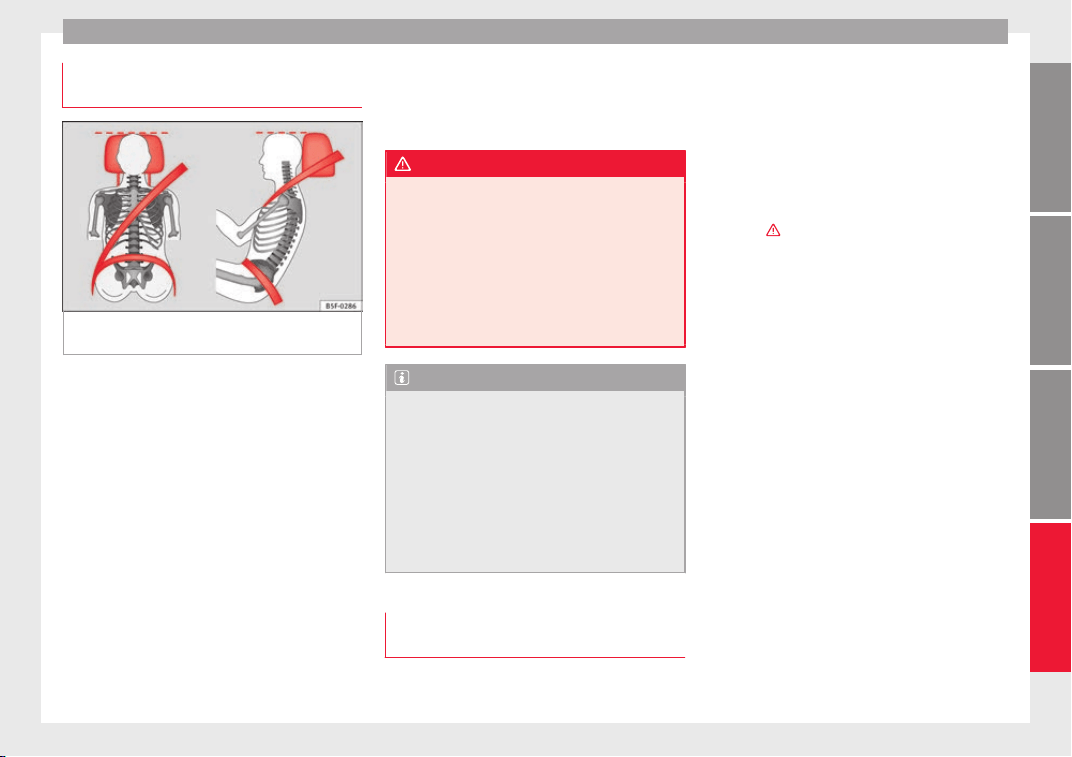
–
Adjust the head restraint so that its upper
edge is, as far as possible, at the same lev-
el as the top of your head, or at the very
least, at eye level ››› Fig. 4
.
Adju
s
ting the head restraints ››› page 88
Active head restraints*
Vehicle occupants are pressed into their
seats during a rear-end collision. The result-
ing body pressure on the seat backrest acti-
vates the active head restraint* on the front
seat, which moves rapidly forward and up-
ward at the same time. This movement re-
duces the distance between the occupant's
head and the head restraint, thus reducing
the risk of injuries such as whiplash.
WARNING
●
Travelling with the head restraints removed
or improperly adjusted increases the risk of
severe injuries. Improper adjustment of the
head restraints may cause death in an acci-
dent and increase the risk of suffering inju-
ries during abrupt breaking actions or unex-
pected manoeuvres.
●
The head restraints must always be adjus-
ted according to the height of the passenger.
Note
The active head restraints* could also be trig-
gered if a vehicle occupant applies a high lev-
el of pressure to the seat backrest (e.g. by
“falling” back into the seat when entering the
vehicle) or if pressure is applied to a front
seat head restraint from the rear. This acci-
dental activation is, however, not dangerous,
as the active head restraints will return to the
original position immediately and are thus
once again ready.
Examples of incorrect sitting
positions
Seat belts can provide optimal protection on-
ly when the belt webs are properly posi-
tioned. Incorrect sitting positions substan-
tially reduce the protective function of seat
belts and increase the risk of injury due to in-
correct seat belt position. As the driver, you
are responsible for all passengers, especially
children.
–
Never allow anyone to assume an incorrect
sitting position in the vehicle while travel-
ling ››› .
The following list contains examples of sit-
ting positions that could be dangerous for ve-
hicle occupants. The list is not complete, but
we would like to make you aware of this is-
sue.
Therefore, whenever the vehicle is in motion:
●
Never stand in the vehicle.
●
Never stand on the seats.
●
Never kneel on the seats.
●
Never tilt your seat backrest far to the rear.
●
Never lean against the dash panel.
●
Never lie on the rear bench.
●
Never sit on the front edge of a seat.
●
Never sit sideways.
●
Never lean out of a window.
●
Never put your feet out of a window.
●
Never put your feet on the dash panel.
●
Never put your feet on the surface of a seat.
»
9
Technical specifications
AdviceOperationSafety
Safety
●
Do not allow anyone to travel in the foot-
well.
●
Never travel without wearing the seat belt.
●
Do not allow anyone to travel in the lug-
gage compartment.
WARNING
●
Any incorrect sitting position increases the
risk of severe injuries.
●
Sitting in an incorrect position exposes the
vehicle occupants to severe injuries if airbags
are triggered, by striking a vehicle occupant
who has assumed an incorrect sitting posi-
tion.
●
Before the vehicle moves, assume the prop-
er sitting position and maintain it throughout
the trip. Before every trip, instruct your pas-
sengers to sit properly and to stay in this po-
sition during the trip ››› page 6, Proper sitting
position for occupants.
Correct adjustment of rear seat head
restraints
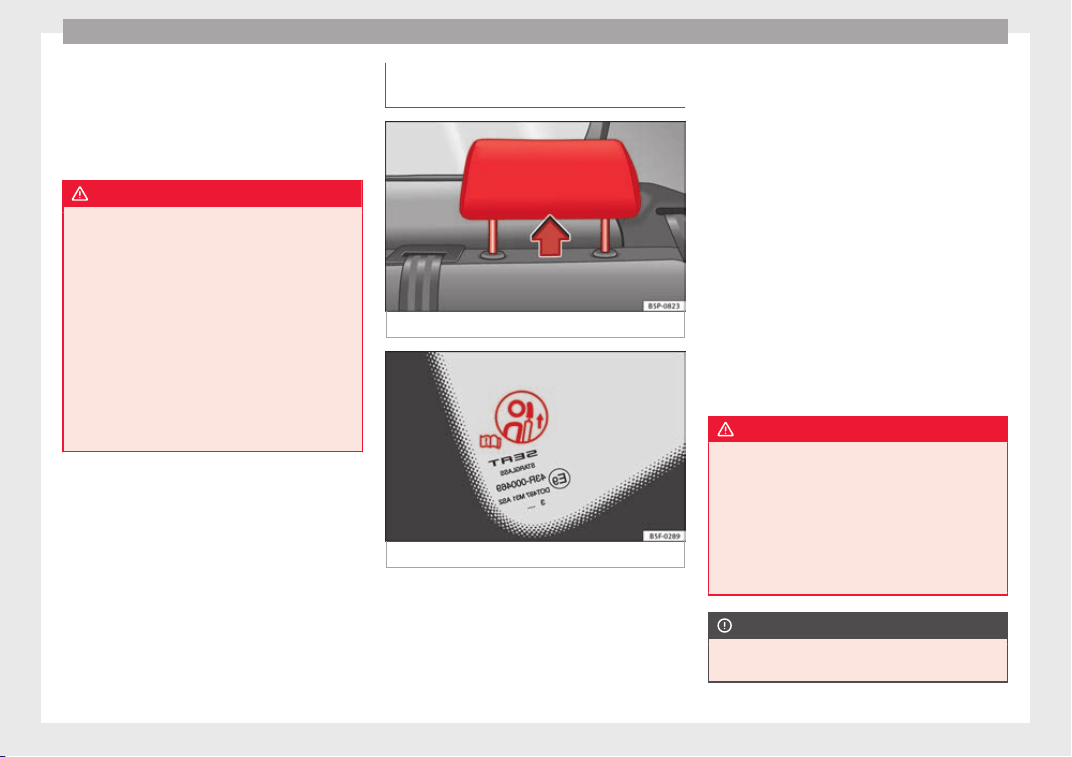
Fig. 5 Head restraints in the correct position.
Fig. 6 Head restraint position warning label.
Properly adjusted head restraints are an im-
portant part of passenger protection and can
reduce the risk of injuries in most accident
situations.
Rear outer seat head restraints
–
The rear outer seat head restraints have 3
positions.
–
Two positions for use
›
›› Fig. 5
. In these po-
sitions, the head restraints are used nor-
mally, and along with the rear seat belts,
protect passengers in the rear seats.
–
And one position for non-use.
–
To fit the head restraints in position for use,
pull on the edges with both hands in the
direction of the arrow.
Centre rear head restraint
–
The centre head restraint only has two posi-
tions, in-use (head restraint up) and non-
use (head restraint down).
WARNING
●
Under no circumstances should the rear
passengers travel while the head restraints
are in the non-use position. See the warning
label located on the rear side fixed window
››› Fig. 6.
●
Do not sw
ap the centre rear head restraint
with either of the outer seat rear head re-
straints. Risk of injury in case of an accident!
CAUTION
Note the instructions on the adjustment of
the head restraints ››› page 90.
10

Seat belts
Pedal area
Pedals
–
Ensure that you can always press the accel-
erator, brake and clutch pedals unimpaired
to the floor.
–
Ensure that the pedals can return unim-
paired to their initial positions.
–
Ensure that the floor mats are securely fas-
tened during the trip and do not obstruct
the pedals
›››
.
Only use floor mats which leave the pedals
clear and which are secured to prevent them
from slipping. You can obtain suitable floor
mats from a specialised dealership. Fasten-
ers* for floor mats are fitted in the footwells.
If a brake circuit fails, the brake pedal must
be pressed down thoroughly in order to stop
the vehicle.
Wearing suitable shoes
Always wear shoes which support your feet
properly and give you a good feeling for the
pedals.
WARNING
●
If the pedals are obstructed, an accident
may occur. Risk of serious injuries.
●
Never lay or fit floor mats or other floor cov-
erings over the original floor mats. This
would reduce the pedal area and could ob-
struct the pedals, leading to a risk of acci-
dent.
●
Never place objects in the driver footwell.
An object could move into the pedal area and
impair pedal operation. In the event of a sud-
den driving or braking manoeuvre, you will
not be able to operate the brake, clutch or ac-
celerator pedal. Risk of accident!
Seat belts
The reason why we should
wear seat belts
Number of seats
Your vehicle has five seats, two in the front
and three in the r
ear. Each seat is equipped
with a three-point seat belt.
In some versions, your vehicle is approved
only for four seats. Two front seats and two
re
ar seats.
WARNING
●
Never transport more than the permitted
amount of people in your vehicle.
●
Every vehicle occupant must properly fas-
ten and wear the seat belt belonging to his or
her seat. Children must be protected with an
appropriate child restraint system.
Seat belt warning lamp*
The control lamp illuminates to remind the
driver to fasten his or her seat belt.
Before starting the vehicle:
–
Fasten your seat belt securely.
»
11
Technical specifications
AdviceOperationSafety
Safety
–
Instruct your passengers to fasten their
seat belts properly before driving off.
–
Protect children by using a child seat ac-
cording to the child's height and weight.
The control lamp on the instrument panel
lights up
1)
if the driver's seat belt is not fas-
tened when the ignition is switched on.
If, when starting to drive, the speed surpass-
es 25 km/h (15 mph) approx. and no seat
belt is worn or it is unfastened during the
drive, a warning sound will be heard for a few
seconds. The warning light will also flash .
The lamp goes out when the seat belt is
fastened with the ignition switched on.
Seat belt protection
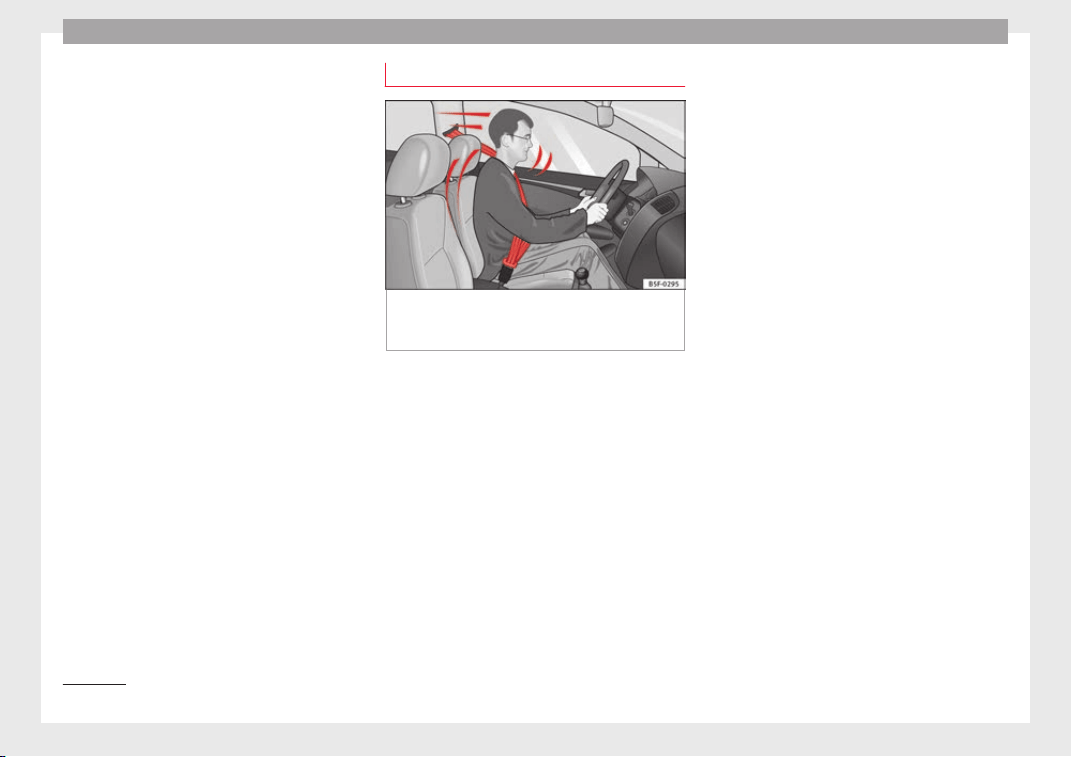
Fig. 7 Drivers with properly worn seat belts
will not be thrown forward in the event of sud-
den braking
Properly worn seat belts hold the occupants
in the proper position. They also help prevent
uncontrolled movements that may result in
serious injury and reduce the risk of being
thrown out of the vehicle in case of an acci-
dent.
Vehicle occupants wearing their seat belts
correctly benefit greatly from the ability of the
belts to absorb kinetic energy. The front part
of your vehicle and other passive safety fea-
tures (such as the airbag system) are also de-
signed to absorb the kinetic energy released
in a collision. Taken together, all these fea-
tures reduce the releasing kinetic energy and
consequently, the risk of injury. This is why it
is so important to fasten seat belts before ev-
ery trip, even when "just driving around the
corner".
Ensure that your passengers wear their seat
belts as well. Accident statistics have shown
that wearing seat belts is an effective means
of substantially reducing the risk of serious
injury and improving the chances of survival
when involved in an accident. Furthermore,
properly worn seat belts improve the protec-
tion provided by airbags in the event of an
accident. For this reason, wearing a seat belt
is required by law in most countries.
Although your vehicle is equipped with air-
bags, the seat belts must be fastened and
worn. The front airbags, for example, are only
triggered in some cases of head-on collision.
The front airbags will not be triggered during
minor frontal or side collisions, rear-end colli-
sions, rollovers or accidents in which the air-
bag trigger threshold value in the control unit
is not exceeded.
Therefore, you should always wear your seat
belt and ensure that all vehicle occupants
have fastened their seat belts properly before
you drive off!
1)
Depending on the model version
12
Seat belts
Safety instructions on using seat
belts
–
Always wear the seat belt as described in
this section.
–
Ensure that the seat belts can be fastened
at all times and are not damaged.
WARNING
●
If the seat belts are worn incorrectly or not
at all, the risk of severe or fatal injuries in-
creases. The optimal protection from seat
belts can be achieved only if you use them
properly.
●
Fasten your seat belt before every trip -
even when driving in town. The other vehicle
occupants must also wear the seat belts at all
times, otherwise they run the risk of being in-
jured.
●
The seat belt cannot offer its full protection
if the seat belt is not positioned correctly.
●
Never allow two passengers (even children)
to share the same seat belt.
●
Always keep both feet in the footwell in
front of your seat as long as the vehicle is in
motion.
●
Never unbuckle a seat belt while the vehi-
cle is in motion. Risk of fatal injury.
●
The seat belt must never be twisted while it
is being worn.
●
The seat belt should never lie on hard or
fragile objects (such as glasses or pens, etc.)
because this could cause injuries in the case
of an accident.
●
Do not allow the seat belt to be damaged or
jammed, or to rub on any sharp edges.
●
Never wear the seat belt under the arm or
in any other incorrect position.
●
Loose, bulky clothing (such as an overcoat
over a jacket) impairs the proper fit and func-
tion of the seat belts, reducing their capacity
to protect.
●
The slot in the seat belt buckle must not be
blocked with paper or other objects, as this
can prevent the latch plate from engaging se-
curely.
●
Never use seat belt clips, fastening rings or
similar items to alter the position of the belt
webbing.
●
Frayed or torn seat belts or damage to the
connections, belt retractors or parts of the
buckle could cause severe injuries in the
event of an accident. Therefore, you must
check the condition of all seat belts at regular
intervals.
●
Seat belts which have been worn in an acci-
dent and stretched must be replaced by a
specialised workshop. Renewal may be nec-
essary even if there is no apparent damage.
The belt anchorage should also be checked.
●
Do not attempt to repair a damaged seat
belt yourself. The seat belts must not be re-
moved or modified in any way.
●
The belts must be kept clean, otherwise the
retractors may not work properly
››› page 157.
Head-on collisions and the laws of
physics
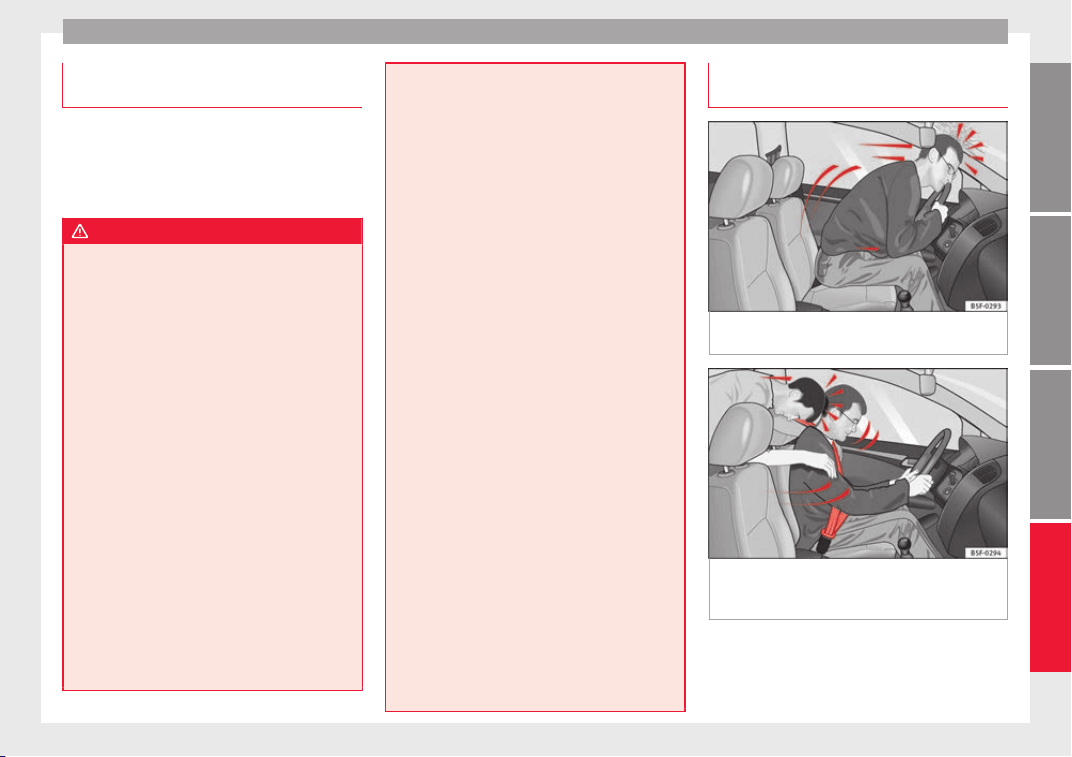
Fig. 8 A driver not wearing a seat belt is
thrown forward violently
Fig. 9 The unbelted passenger in the rear
seat is thrown forward violently, hitting the
driver wearing a seat belt.
It is easy to explain how the laws of physics
work in the case of a head-on collision: When
a vehicle starts moving, a type of energy
»
13
Technical specifications
AdviceOperationSafety
Safety
called “kinetic energy” is created both in the
passengers and inside the vehicle.
The amount of “kinetic energy” depends on
the speed of the vehicle and the weight of
the vehicle and its passengers. The higher
the speed and the greater the weight, the
more energy there is to be “absorbed” in an
accident.
The most significant factor, however, is the
speed of the vehicle. If the speed doubles
from 25 km/h (15 mph) to 50 km/h
(30 mph), for example, the corresponding ki-
netic energy is multiplied by four.
Because the vehicle occupants in our exam-
ple are not restrained by seat belts, in the
event of crashing against a wall, all of the oc-
cupants' kinetic energy will be absorbed
solely by said impact.
Even at speeds of 30 km/h (19 mph) to
50 km/h (30 mph), the forces acting on the
body in a collision can easily exceed one
tonne (1000 kg). At greater speed these
forces are even higher.
Vehicle occupants not wearing seat belts are
not “attached” to the vehicle. In a head-on
collision, they will move forward at the same
speed their vehicle was travelling just before
the impact. This example applies not only to
head-on collisions, but to all accidents and
collisions.
Even at low speeds the forces acting on the
body in a collision are so great that it is not
possible to brace oneself with one's hands.
In a frontal collision, unbelted passengers
are thrown forward and will make violent con-
tact with the steering wheel, dash panel,
windscreen or whatever else is in the way
››› Fig. 8
.
It
i
s also important for the rear passengers to
wear seat belts properly, as they could other-
wise be thrown forward violently through the
vehicle interior in an accident. Passengers in
the rear seats who do not use seat belts en-
danger not only themselves but also the front
occupants ››› Fig. 9.
How to properly adjust your
seatbelt
Fastening and unfastening your seat
belt
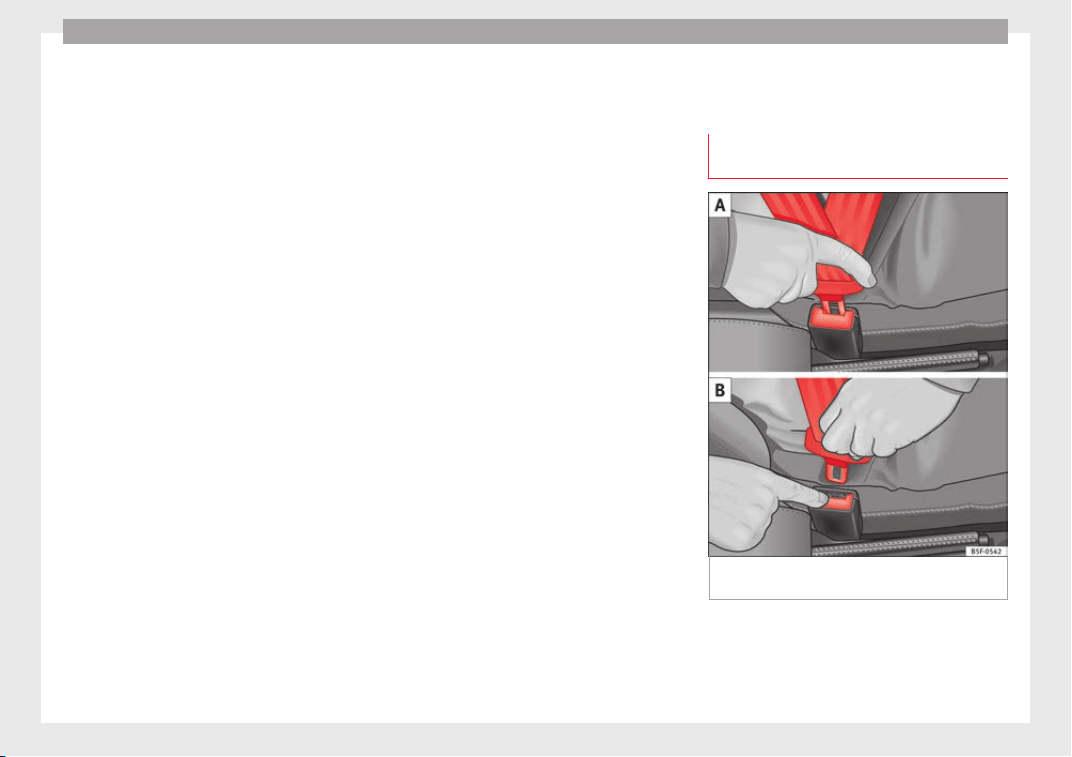
Fig. 10 Positioning and removing the seat
belt buckle.
14
Seat belts
Fig. 11 Placing the seat belt in the shoulder
and pelvis area for pregnant women.
Fastening the seat belt
The seat belt cannot offer its full protection if
the seat belt is not positioned correctly.
●
Adjust the seat and head restraint correctly.
●
To fasten the belt, take hold of the latch
plate and pull it slowly across your chest and
lap.
●
Insert the latch plate into the buckle for the
appropriate seat and push it down until it is
securely locked with an audible click
››› Fig. 10
A
.
●
Pull the belt to ensure that the latch plate is
securely engaged in the buckle.
The seat belts are equipped with an automat-
ic retractor on the shoulder strap. Full free-
dom of movement is permitted when the
shoulder belt is pulled slowly. However, dur-
ing sudden braking, during travel in steep
areas or bends and during acceleration, the
automatic retractor on the shoulder belt is
locked.
The automatic belt retractors on the front
seats are fitted with seat belt tensioners
››› page 16.
Seat belt release
●
Press the red button on the belt buckle
››› Fig. 10 B. The latch plate is released and
springs out ›››
.
●
Guide the belt back by hand so that it rolls
up easily and the trim is not damaged.
Seat belt position
Seat belts offer their maximum protection on-
ly when they are properly positioned.
The following features are available to adjust
the seat belt in the shoulder region:
●
belt height adjustment for the front seats.
●
front seat height adjustment*.
WARNING
●
The seat belts offer best protection only
when the backrests are in an upright position
and the seat belts have been fastened prop-
erly.
●
Never put the latch plate in the buckle of
another seat. If you do this, the seat belt will
not protect you properly and the risk of injury
is increased.
●
Never unbuckle a seat belt while the vehi-
cle is in motion. If you do, you increase the
risk of sustaining severe or fatal injuries.
●
An incorrectly worn seat belt can cause se-
vere injuries in the event of an accident.
●
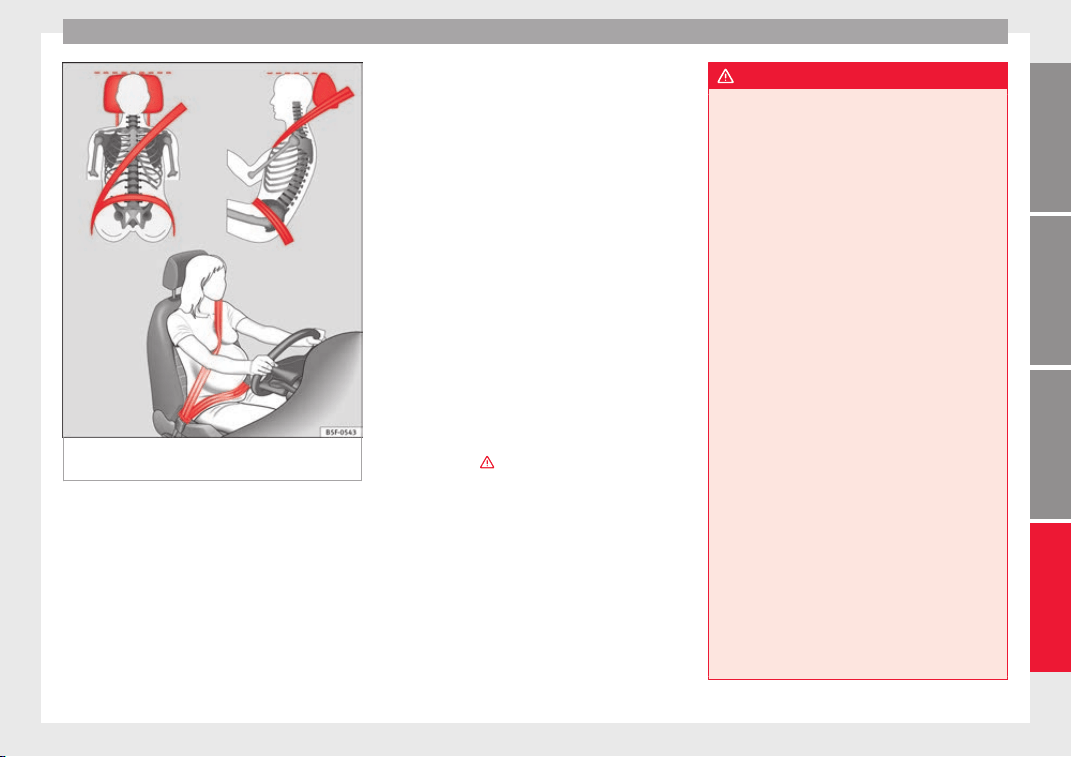
The shoulder part of the seat belt must lie
on the centre of the shoulder, never across
the neck. The seat belt must lie flat and snug-
ly on the torso ››› Fig. 11.
●
The lap p
art of the seat belt must lie across
the pelvis, never across the stomach. The
seat belt must lie flat and snugly on the pel-
vis ››› Fig. 11. Pull the belt tight if necessary
to take up any slack.
●
For pregnant women, the lap part of the
seat belt must lie as low as possible over the
pelvis, never across the stomach, and always
lie flat so that no pressure is exerted on the
abdomen.
●
Always engage the retractor lock when you
are securing a child seat in group 0, 0+ or 1
››› page 24.
●
Read and observe the warnings ››› page 13.
15
Technical specifications
AdviceOperationSafety
Safety
Adjusting the seat belt height
Fig. 12 Location of the belt height adjuster.
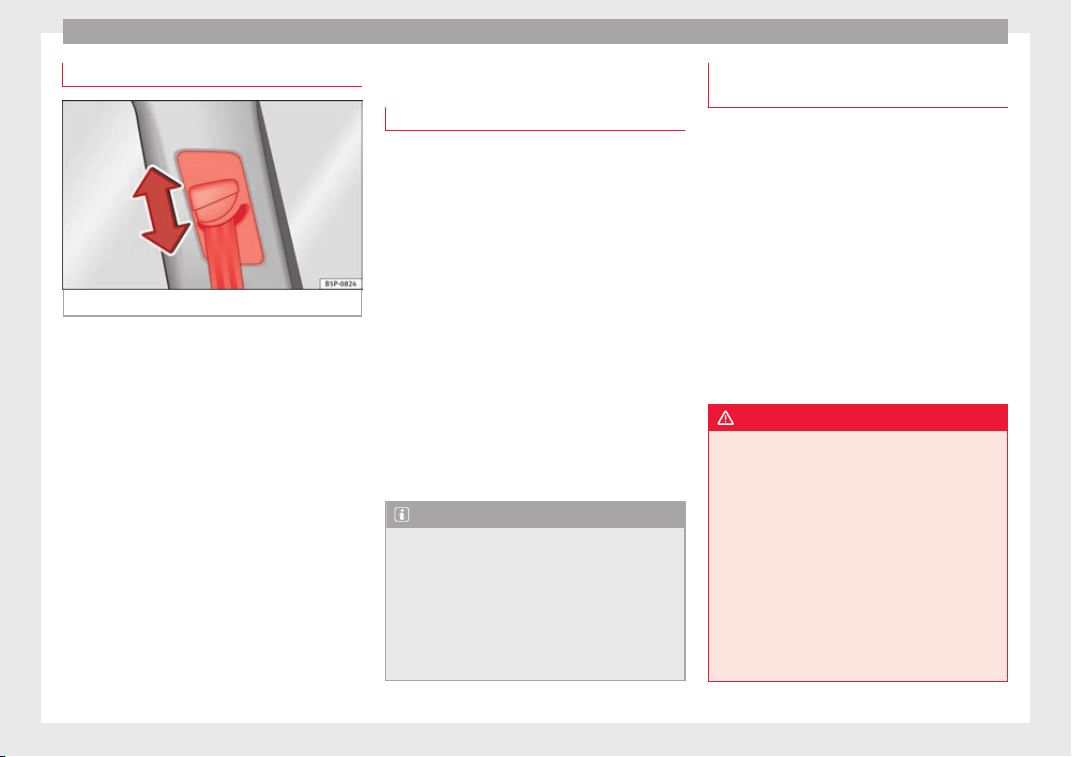
Seat belt height adjusters can be used to ad-
just the position of the seat belt in the front
seats at the shoulder depending on a per-
son's height.
–
Press the upper part of the shoulder belt
guide and hold it in this position ››› Fig. 12
.
–
Mo
v
e the shoulder belt guide up or down
until you have adjusted the seat belt
››› page 14.
–
After adjusting, pull the shoulder belt
sharply to check that the catch on the
shoulder belt guide is engaged securely.
Seat belt tensioners
How the seat belt tensioner works
During a frontal collision, the seat belts on
the front seats are retracted automatically.
The seat belts for the occupants in the front
seats are equipped with belt tensioners. Sen-
sors will trigger the belt tensioners only dur-
ing severe head-on, lateral and rear-end colli-
sions and only if the seat belt is worn. The
tensioners retract and tighten the seat belts,
reducing the forward motion of the occu-
pants.
The seat belt tensioner can be triggered only
once.
The seat belt tensioners will not be triggered
in the event of a light frontal, side or rear col-
lision, if the vehicle overturns or in situations
where no large forces act on the front, side or
rear of the vehicle.
Note
●
If the seat belt tensioners are triggered, a
fine dust is produced. This is normal and it is
not an indication of fire in the vehicle.
●
The relevant safety requirements must be
observed when the vehicle or components of
the system are scrapped. Specialised work-
shops are familiar with these regulations,
which are also available to you.
Service and disposal of belt
tensioners
The belt tensioners are components of the
seat belts that are installed in the seats of
your vehicle. If you work on the belt tension-
ers or remove and install parts of the system
when performing other repair work, the seat
belt may be damaged. The consequence may
be that, in the event of an accident, the belt
tensioners function incorrectly or not at all.
So that the effectiveness of the seat belt ten-
sioner is not reduced and that removed parts
do not cause any injuries or environmental
pollution, regulations, which are known to
the specialised workshops, must be ob-
served.
WARNING
●
Improper use or repairs not carried out by
qualified mechanics increase the risk of se-
vere or fatal injuries. The belt tensioners may
fail to trigger or may trigger in the wrong cir-
cumstances.
●
Never attempt to repair, adjust, remove or
install parts of the belt tensioners or seat
belts.
●
The seat belt tensioner, seat belt and auto-
matic retractor cannot be repaired.
●
Any work on the belt tensioners and seat
belts, including the removal and refitting of
system parts in conjunction with other repair
16
Airbag system
work, must be performed by a specialised
workshop only.
●
The belt tensioners will only provide pro-
tection for one accident and must be changed
if they have been activated.
Airbag system
Brief introduction
Why wear a seat belt and assume the
correct sitting position?
For the inflating airbags to achieve the best
protection, the seat belt must always be worn
properly and the correct sitting position must
be assumed.
The airbag system is not a substitute for seat
belts, but it is an integral part of the vehicle's
overall passive safety system. Please bear in
mind that the airbag system can only work ef-
fectively when the vehicle occupants are
wearing their seat belts correctly and have
adjusted the head restraints properly. There-
fore, it is most important to wear the seat
belts at all times, not only because this is re-
quired by law in most countries, but also for
your safety
›››
page 11, The reason why we
should wear seat belts.
The airbag inflates in a matter of seconds, so
if you are not properly seated when the air-
bag is triggered, you may sustain fatal inju-
ries. Therefore, it is essential that all vehicle
occupants assume a correct sitting position
while travelling.
Sharp braking before an accident may cause
a passenger not wearing a seat belt to be
thrown forward into the area of the deploying
airbag. In this case, the inflating airbag may
inflict critical or fatal injuries on the occu-
pant. This also applies to children.
Always maintain the greatest possible dis-
tance between yourself and the front airbag.
This way, the front airbags can completely
deploy when triggered, providing their maxi-
mum protection.
The most important factors that will trigger
an airbag are: the type of accident, the angle
of collision and the speed of the vehicle.
Whether or not the airbags are triggered de-
pends primarily on the vehicle deceleration
rate resulting from the collision and detected
by the control unit. If the vehicle deceleration
occurring during the collision and measured
by the control unit remains below the speci-
fied reference values, the front, side and/or
curtain airbags will not be triggered. Take in-
to account that the visible damage in a vehi-
cle involved in an accident, no matter how
serious, is not a determining factor for the
airbags to have been triggered.
WARNING
●
Wearing the seat belt incorrectly or assum-
ing an incorrect sitting position can lead to
critical or fatal injuries.
●
All vehicle occupants, including children,
who are not properly belted can sustain criti-
cal or fatal injuries if the airbag is triggered.
»
17
Technical specifications
AdviceOperationSafety

Safety
Children up to 12 years old should always
travel on the rear seat. Never transport chil-
dren in the vehicle if they are not restrained
or the restraint system is not appropriate for
their age, size or weight.
●
If you are not wearing a seat belt, or if you
lean forward or to the side while travelling or
assume an incorrect sitting position, there is
a substantially increased risk of injury. This
increased risk of injury will be further in-
creased if you are struck by an inflating air-
bag.
●
To reduce the risk of injury from an inflating
airbag, always wear the seat belt properly
››› page 11.
●
Alw
ays adjust the front seats properly.
Description of airbag system
The airbag system mainly comprises (as per
vehicle equipment):
●
an electronic control and monitoring sys-
tem (control unit)
●
frontal airbags for driver and passenger,
●
side airbags,
●
curtain (head) airbags,
●
a control lamp on the dash panel
››› page 19
.
●
a k
ey
-operated switch for front passenger
airbag,
●
a control lamp for disabling/enabling the
front passenger airbag.
The airbag system operation is monitored
electronically. The airbag control lamp will il-
luminate for a few seconds every time the ig-
nition is switched on (self-diagnosis).
There is a fault in the system if the control
lamp :
●
does not light up when the ignition is
switched on ››› page 19,
●
turns off after 4 seconds after the ignition
is switched on
●
turns off and then lights up again after the
ignition is switched on
●
illuminates or flashes while the vehicle is
moving.
The airbag system is not triggered if:
●
the ignition is switched off
●
there is a minor frontal collision
●
there is a minor side collision
●
there is a rear-end collision
●
the vehicle turns over.
WARNING
●
The seat belts and airbags can only provide
maximum protection if the occupants are
seated correctly ››› page 6, Proper sitting po-
sition for occupants.
●
If a fault has occurred in the airbag system,
have the system checked immediately by a
specialised workshop. Otherwise, during a
frontal collision the system might not trigger
correctly or may fail to trigger at all.
Airbag activation
The airbags deploy extremely rapidly, within
thousandths of a second, to provide addi-
tional protection in the event of an accident.
A fine dust may develop when the airbag de-
ploys. This is normal and it is not an indica-
tion of fire in the vehicle.
The airbag system is only ready to function
when the ignition is on.
In special cases of an accident, several air-
bags may activate at the same time.
In the event of minor head-on and side colli-
sions, rear-end collisions, overturning or roll-
over of the vehicle, airbags do not activate.
Activation factors
The conditions that lead to the airbag system
activating in each situation cannot be gener-
alised. There are some factors that play an
important role, such as the properties of the
object the vehicle hits (hard/soft), angle of
impact, vehicle speed, etc.
The deceleration trajectory is key for airbag
activation.
18
Airbag system
The control unit analyses the collision trajec-
tory and activates the respective restraint
system.
If the deceleration rate is below the prede-
fined reference value in the control unit the
airbags will not be triggered, even though
the accident may cause extensive damage to
the car.
The following airbags are triggered in
serious head-on collisions
●
Driver airbag.
●
Front passenger front airbag.
The following airbags are triggered in
serious side-on collisions
●
Front side airbag on the side of the acci-
dent.
●
Rear side airbag on the side of the acci-
dent.
●
Curtain airbag on the side of the accident.
In an accident with airbag activation:
●
the interior lights switch on (if the interior
light switch is in the courtesy light position);
●
the hazard warning lights switch on;
●
all doors are unlocked;
●
the fuel supply to the engine is cut.
Control lamp for airbag and seat belt
tensioner
The control lamp monitors all airbags and
seat belt tensioners in the vehicle, including
control units and wiring connections.
Monitoring of airbag and belt tensioner
system
Both the airbag and belt tensioner systems
operation is constantly monitored electroni-
cally. Each time the ignition is switched on,
the control lamp illuminates for several
seconds (self-diagnosis) and the instrument
panel display* shows
AIRBAG/TENSIONER
.
The system must be checked when the
control lamp :
●
does not light up when the ignition is
switched on,
●
turns off after 4 seconds after the ignition
is switched on
●
turns off and then lights up again after the
ignition is switched on
●
illuminates or flashes while the vehicle is
moving.
In the event of a malfunction, the warning
lamp remains on continuously. In addition,
depending on the malfunction, a fault mes-
sage appears on the instrument panel dis-
play for approximately 10 seconds and a
short audible warning is given. In this event,
you should have a specialised workshop
check the system immediately.
If any of the airbags are disabled by a Techni-
cal Service, the warning lamp flashes for sev-
eral more seconds after verification and will
turn off if there is no fault.
WARNING
●
If there is a malfunction, the airbag and
belt tensioner system cannot properly per-
form its protective function.
●
If a malfunction occurs, have the system
checked immediately by a specialised work-
shop. Otherwise, in the event of an accident,
the airbag system and belt tensioners may
not be triggered, or may not be triggered cor-
rectly.
19
Technical specifications
AdviceOperationSafety
Safety
Airbag overview
Front airbags
Fig. 13 Driver airbag in the steering wheel.
Fig. 14 Front passenger airbag in the dash
panel.
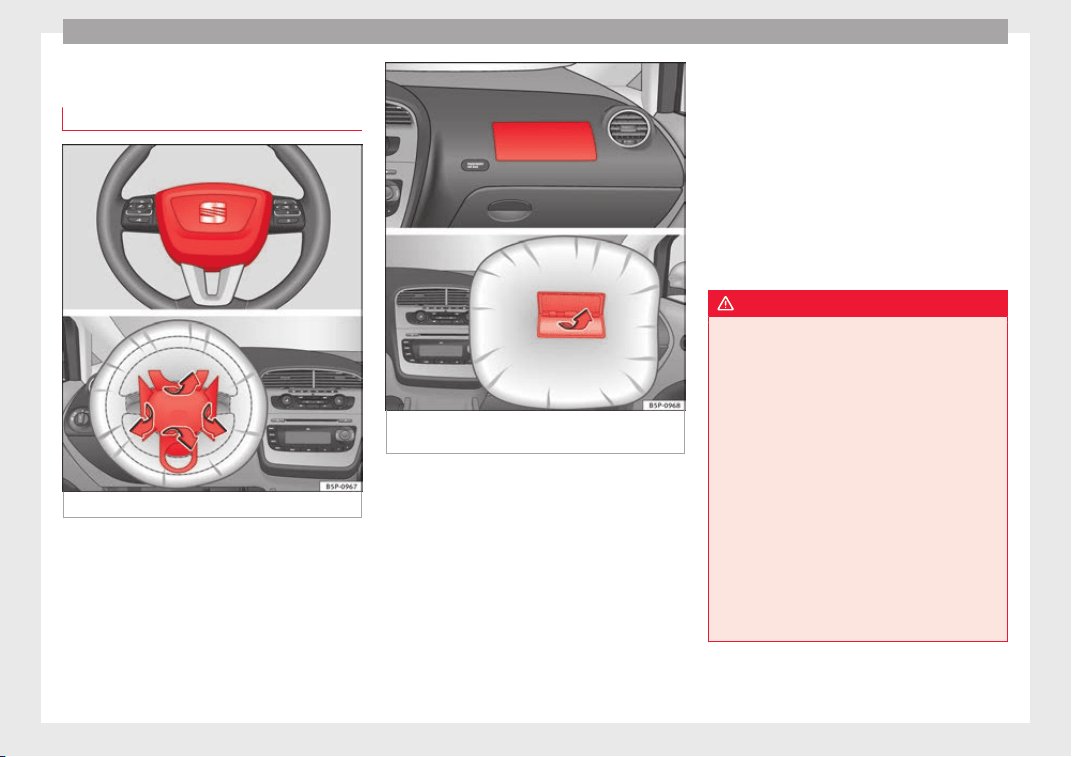
The front airbag for the driver is located in
the steering wheel ››› Fig. 13
and the airbag
f
or the fr
ont passenger is located in the dash
panel ››› Fig. 13. Airbags are identified by the
word “AIRBAG”.
The airbag covers fold out of the steering
wheel and dash panel respectively when the
driver and front passenger airbags are trig-
gered ››› Fig. 14. The airbag covers remain
connected to the steering wheel or the dash
panel.
In conjunction with the seat belts, the front
airbag system gives the driver and the front
passenger additional protection for the head
and chest in the event of a severe frontal col-
lision.
The special design of the airbag allows the
controlled escape of the propellant gas when
an occupant puts pressure on the bag. Thus,
the head and chest are surrounded and pro-
tected by the airbag. After the collision, the
airbag deflates sufficiently to allow visibility.
WARNING
●
The seat belts and airbags can only provide
maximum protection if the occupants are
seated correctly ››› page 6, Proper sitting po-
sition for occupants.
●
The deplo
yment space between the front
passengers and the airbags must not in any
case be occupied by other passenger, pets
and objects.
●
The airbags provide protection for just one
accident; replace them once they have de-
ployed.
●
It is also important not to attach any ob-
jects such as cup holders or telephone
mountings to the surfaces covering the air-
bag units.
●
Do not attempt to modify components of
the airbag system in any way.
20
Airbag system
Side airbags*
Fig. 15 Side airbag in driver seat.
Fig. 16 Inflated side airbag on left side of ve-
hicle.
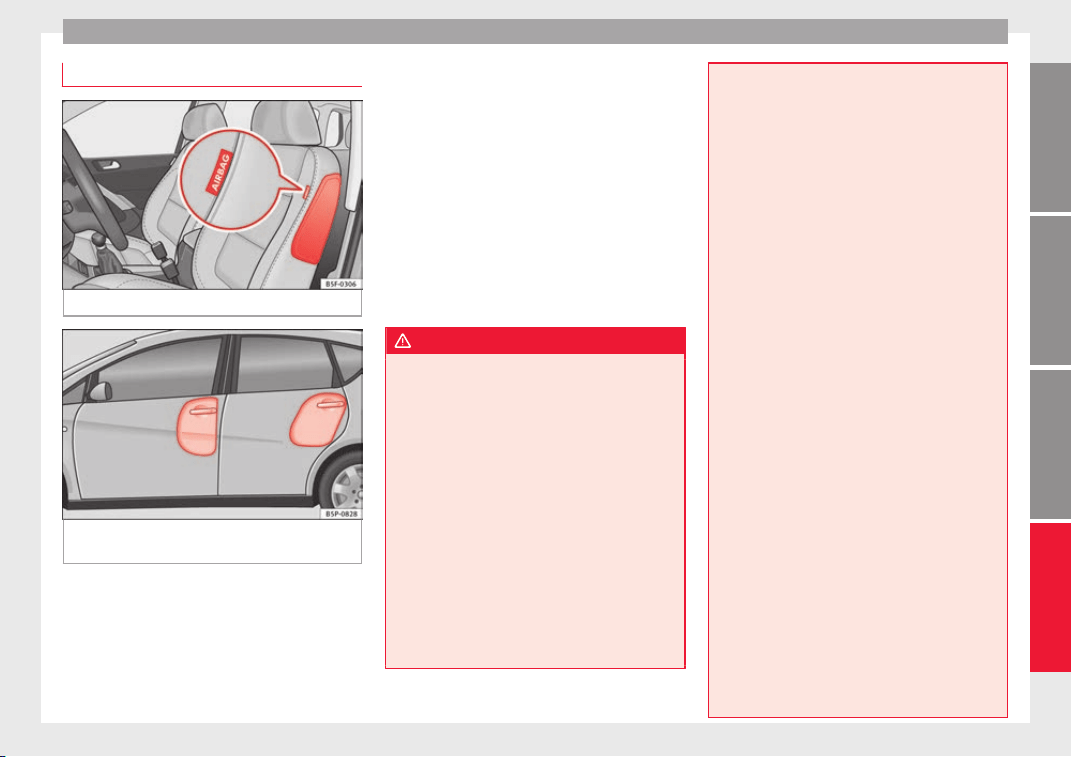
The side airbags are located in the backrest
cushions of the driver seat ››› Fig. 15
and the
fr
ont
passenger seat and the rear side air-
bags are mounted in the rear wheel housing.
The locations are identified by the text “AIR-
BAG” in the upper region of the backrests
and in the rear wheel housing lining.
In conjunction with the seat belts, the side
airbag system gives the front seat occupants
additional protection for the upper body in
the event of a severe side collision.
In a side collision, the side airbags reduce
the risk of injury to passengers on the front
seats to the areas of the body facing the im-
pact. In addition to their normal function of
protecting the occupants in a collision, the
seat belts also hold the passengers in the
front seats and the outer rear seats in a posi-
tion where these airbags can provide maxi-
mum protection.
WARNING
●
If you do not wear a seat belt, if you lean
forward, or are not seated correctly while the
vehicle is in motion, you are at a greater risk
of injury if the side airbag system is triggered
in an accident.
●
In order for the side airbags to provide their
maximum protection, the prescribed sitting
position must always be maintained with
seat belts fastened while travelling.
●
Occupants of the outer seats must never
carry any objects or pets in the deployment
space between them and the airbags, or al-
low children or other passengers to travel in
this position. It is also important not to at-
tach any accessories (such as cup holders) to
the doors. This would impair the protection
offered by the side airbags.
●
The built-in coat hooks should be used only
for lightweight clothing. Do not leave any
heavy or sharp-edged objects in the pockets.
●
Great forces, such as hard blows or kicks,
must not be exerted upon the backrest bol-
ster because the system may be damaged. In
this case, the side airbags would not be trig-
gered.
●
Under no circumstances should protective
covers be fitted over seats with side airbags
unless the covers have been approved for use
in your vehicle. Because the airbag is trig-
gered from the side of the backrest, the use
of non-approved seat covers would obstruct
the side airbag, seriously reducing the air-
bag's effectiveness ››› page 147.
●
Any damage to the original seat upholstery
or around the seams of the side airbag units
must be repaired immediately by a special-
ised workshop.
●
The airbags provide protection for just one
accident; replace them once they have de-
ployed.
●
Any work on the side airbag system or re-
moval and installation of the airbag compo-
nents for other repairs (such as removal of
the front seat) should only be performed by a
specialised workshop. Otherwise, faults may
occur during the airbag system operation.
●
Do not attempt to modify components of
the airbag system in any way.
●
The side and head airbags are managed
through sensors located in the interior of the
front doors. To ensure the correct operation of
the side and curtain (head) airbags neither
»
21
Technical specifications
AdviceOperationSafety
Safety
the doors nor the door panels should be
modified in any way (e.g. fitting loudspeak-
ers). If the front door is damaged, the airbag
system may not work correctly. All work car-
ried out on the front door must be done in a
specialised workshop.
●
In a side collision, the side airbags will not
work, if the sensors do not correctly measure
the pressure increase on the interior of the
doors, due to air escaping through the areas
with holes or openings in the door panel.
●
Never drive the vehicle if the interior panels
have been removed.
●
Never drive if the interior door panels have
been removed or if the panels have not been
correctly fitted.
●
Never drive the vehicle if the loudspeakers
in the door panels have been removed, un-
less the holes left by the loudspeakers have
been closed properly.
●
Always check that the openings are closed
or covered if additional loudspeakers or other
equipment are fitted inside the door panels.
●
Any work carried out to the doors should be
made in an authorised specialised workshop.
Head-protection airbags*
Fig. 17 Location of head-protection airbags
on the left side of the vehicle
Fig. 18 Deployed head-protection airbags.
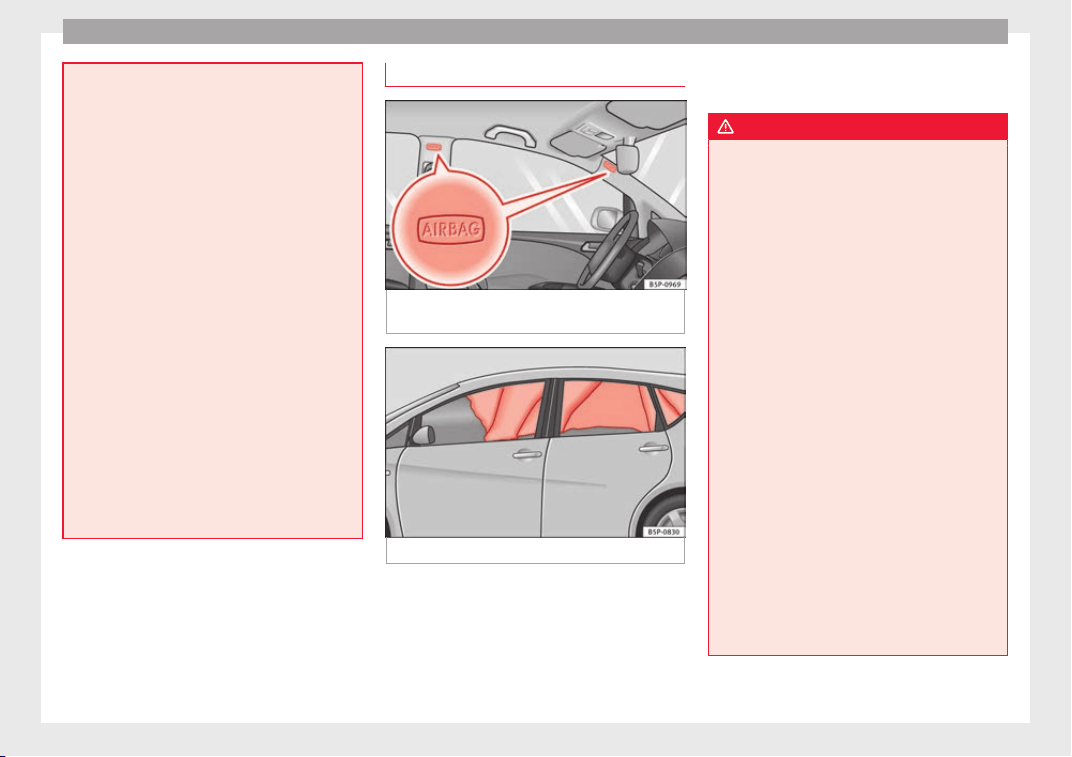
The head-protection airbags are located on
both sides in the interior above the doors
››› Fig. 17
and are identified with the text
“AIRB
AG”.
In c
onjunction with the seat belts, the head-
protection airbag system gives the occupants
additional protection for the head and upper
body in the event of a severe side collision.
WARNING
●
In order for the head-protection airbags to
provide their maximum protection, the pre-
scribed sitting position must always be main-
tained with seat belts fastened while travel-
ling.
●
For safety reasons, the curtain airbag must
be disabled in those vehicles fitted with a
screen dividing the interior of the vehicle.
See a Technical Service to make this adjust-
ment.
●
There must be no other persons, animals or
objects between the occupants of the outer
seats and the deployment space of the head-
protection airbags so that the head-protec-
tion airbag can deploy completely without re-
striction and provide the greatest possible
protection. Therefore, sun blinds which have
not been expressly approved for use in your
vehicle may not be attached to the side win-
dows ››› page 147.
●
The bui
lt-in coat hooks should be used only
for lightweight clothing. Do not leave any
heavy or sharp-edged objects in the pockets.
Please, do not hang the clothes on coat hang-
ers.
●
The airbags provide protection for just one
accident; replace them once they have de-
ployed.
22
Airbag system
●
Any work on the head-protection airbag
system or removal and installation of the air-
bag components for other repairs (such as re-
moval of the roof lining) should only be per-
formed by a specialised workshop. Other-
wise, faults may occur during the airbag sys-
tem operation.
●
Do not attempt to modify components of
the airbag system in any way.
●
The side and head airbags are managed
through sensors located in the interior of the
front doors. To ensure the correct operation of
the side and curtain airbags, neither the
doors nor the door panels should be modified
in any way (e.g. fitting loudspeakers). If the
front door is damaged, the airbag system
may not work correctly. All work carried out
on the front door must be done in a special-
ised workshop.
Deactivating airbags
Front passenger front airbag
deactivation
Fig. 19 In the glove compartment: Switch for
activating and deactivating the front passen-
ger airbag
Fig. 20 Control lamp for deactivated front
passenger airbag.
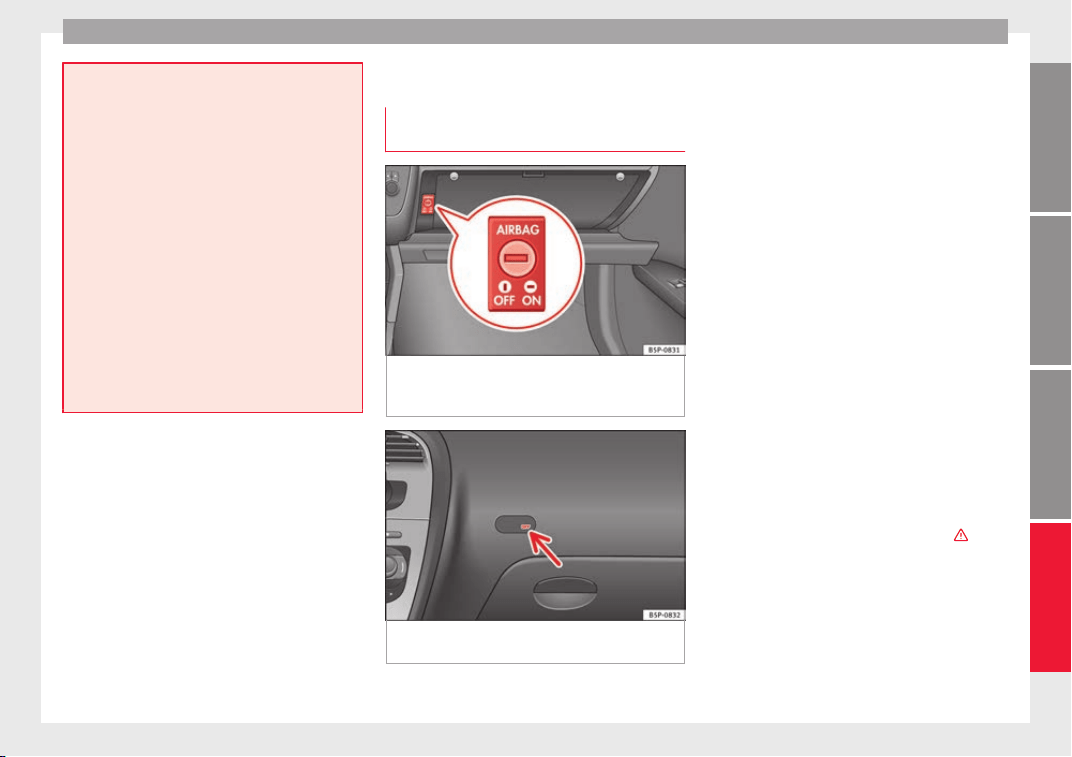
If you fit a rear-facing child seat to the front
passenger seat, the front passenger front air-
bag must be de-activated.
When the front passenger airbag is deactiva-
ted
, only the front airbag is deactivated. All
the other airb
ag
s in the vehicle remain acti-
vated.
Disabling the front passenger front airbag
–
Switch the ignition off.
–
Open the glove compartment on the front
passenger side.
–
Insert the key into the slot of the switch for
deactivating the front passenger airbag
››› Fig. 19. About 3/4 of the key should en-
ter, as far as it will go.
–
Then turn the key gently to the OFF posi-
tion. Do not force it if you feel resistance,
and make sure you have inserted the key
fully.
–
Check that the control lamp, “OFF”, on the
instrument panel ››› Fig. 20 remains lit
when the ignition is switched on ›››
.
Activating the front passenger front airbag
–
Switch the ignition off.
–
Open the glove compartment on the front
passenger side.
–
Insert the key into the slot of the switch for
deactivating the front passenger airbag
»
23
Technical specifications
AdviceOperationSafety

Safety
››› Fig. 19
. About 3/4 of the key should en-
t
er
, as far as it will go.
–
Then turn the key gently to the ON position.
Do not force it if you feel resistance, and
make sure you have inserted the key fully.
–
Check that the control lamp on the instru-
ment panel ››› Fig. 20 does not light up
when the ignition is switched on ›››
.
WARNING
●
It is the driver's responsibility to ensure
that the key-operated switch is set to the cor-
rect position.
●
You should deactivate the front passenger
front airbag only if you have to use a rear-fac-
ing child seat in exceptional cases
››› page 24, Transporting children safety.
●
Never install a child seat facing backwards
on the front passenger seat unless the front
passenger front airbag has been disabled.
Otherwise, there is a risk of death.
●
As soon as the child seat is no longer nee-
ded on the front passenger seat, enable the
front passenger front airbag again.
●
Only deactivate the front passenger front
airbag when the ignition is off, otherwise a
fault may occur in the airbag system, which
could cause the airbag to not deploy properly
or not deploy at all in case of an accident.
●
Never leave the key in the airbag deactiva-
tion switch as it could get damaged or acti-
vate or deactivate the airbag during driving.
●
When the front passenger front airbag is
deactivated, if the control lamp AIRBAG OFF
is not continuously lit up, there may be a
fault in the airbag system:
–
Have the airbag system inspected imme-
diately by a specialised workshop.
–
Do not use a child seat on the front pas-
senger seat! The front passenger front
airbag could be triggered in the event of
an accident, even if there is a fault in the
system and, as a result, a child could sus-
tain serious or fatal injuries.
–
It is unpredictable whether the front pas-
senger airbag will deploy in the event of
an accident. Warn all your passengers of
this.
●
When using the ignition key to activate/de-
activate the front passenger front airbag, on-
ly the front passenger airbag will be activa-
ted/deactivated. The side airbag and head
airbag on the passenger side will remain ac-
tive.
Transporting children safety
Safety for children
Introduction
For safety reasons, as we have learned from
accident statistics, we recommend that chil-
dren under 12 years of age travel in the rear
seats. Depending on their age, height and
weight, children travelling in the rear seat
must use a child seat or a seat belt. For safety
reasons, the child seat should be installed in
the rear seat, behind the front passenger
seat or in the centre back seat.
The physical laws involved and the forces
acting in a collision apply also to children
›››
page 13
. But unlike adults, children do not
h
av
e fully developed muscle and bone struc-
tures. This means that children are subject to
a greater risk of injury.
To reduce the risk of injuries, children must
always use special child restraint systems
when travelling in the vehicle.
We recommend the use of child safety prod-
ucts from the SEAT Original Accessories Pro-
gramme, which includes systems for all ages
made by “Peke” (not for all countries).
These systems have been especially de-
signed and approved, complying with the
ECE-R44. regulation.
24
Transporting children safety
Follow the manufacturer's instructions and
observe any statutory requirements when in-
stalling and using child seats. Always read
and note ››› page 25
.
W
e r
ecommend you always carry the manu-
facturer's Child Seat Instruction Manual to-
gether with the on-board documentation.
Important information regarding the
front passenger's airbag
Fig. 21 Passenger's side sun visor: airbag
sticker.
Fig. 22 On the rear frame of the passenger
side door: airbag sticker.
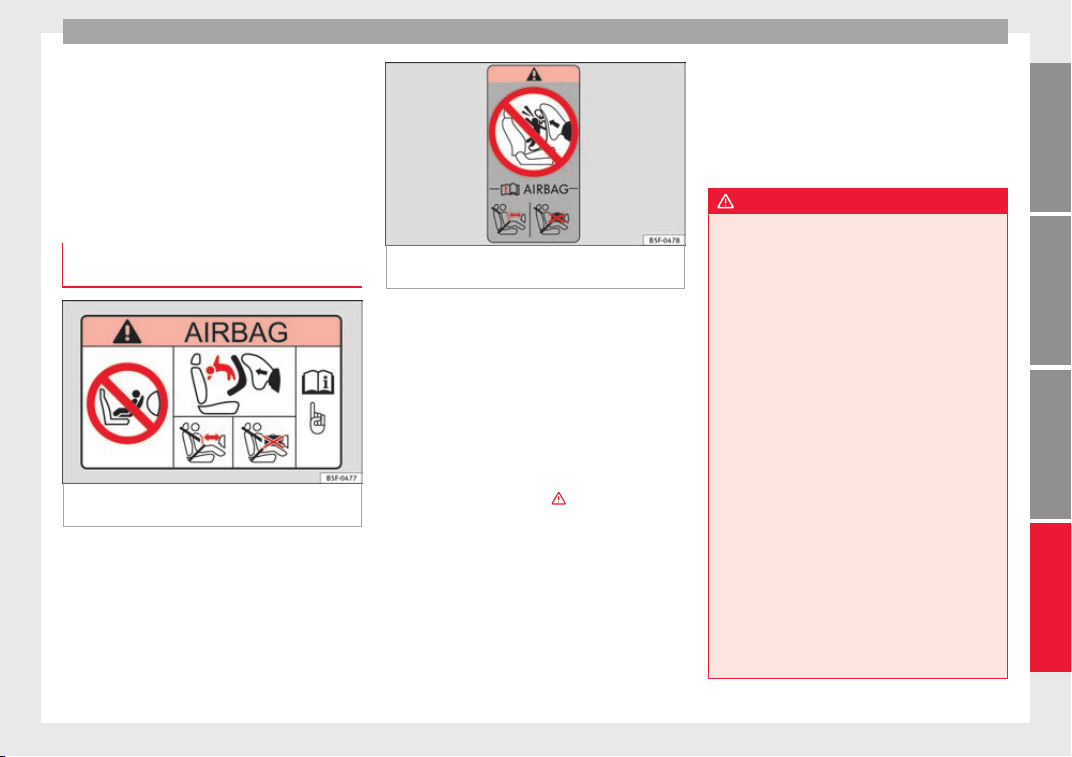
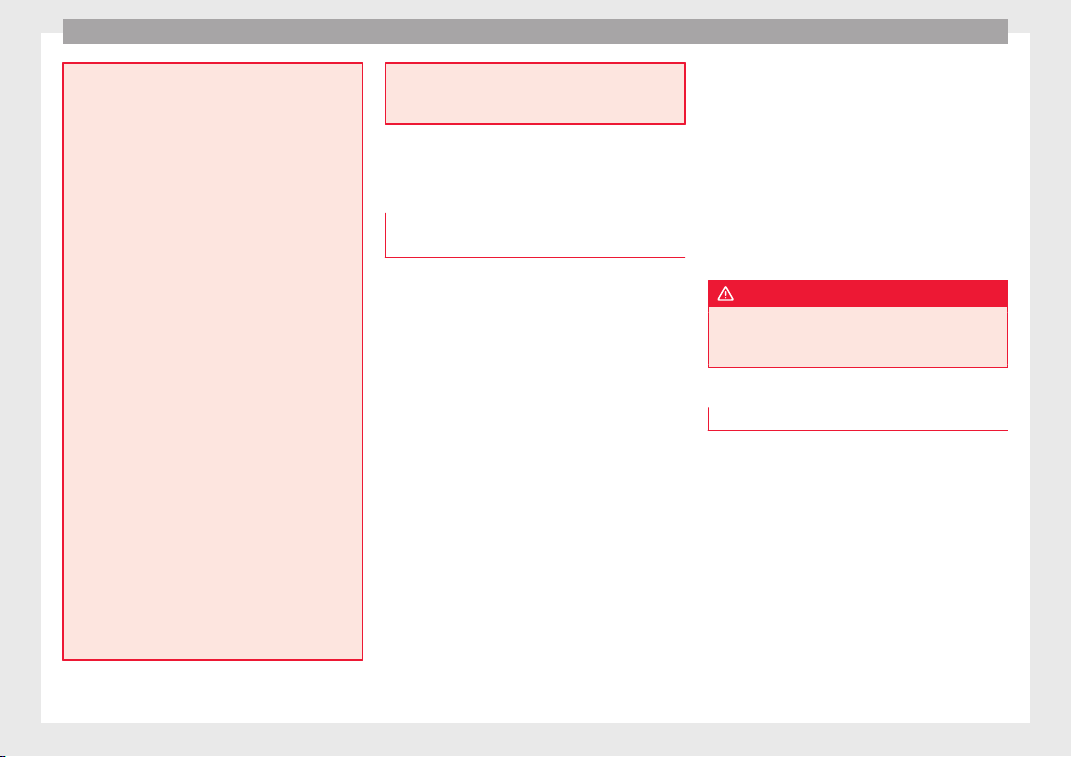
A sticker with important information about
the passenger airbag is located on the pas-
senger's sun visor and/or on the passenger
side door frame. Read and always observe
the safety information included in the follow-
ing chapters:
●
Safety distance with respect to the passen-
ger airbag ››› page 17
.
●
O
b
jects between the passenger and the
passenger side airbag ›››
in Front airbags
on page 20
.
The p
a
ssenger side front airbag, when activa-
ted, is a serious risk for a child who is facing
backward since the airbag can strike the seat
with such force that it can cause serious or
fatal injuries. Children up to 12 years old
should always travel on the rear seat.
Therefore we strongly recommend you to
transport children on the rear seats. This is
the safest location in the vehicle. Alternative-
ly, the front passenger airbag can be disa-
bled with a key-operated switch ››› page 23.
When transporting children, use a child seat
suitable for the age and size of each child
››› page 24.
WARNING
●
If a child seat is secured to the front pas-
senger seat, the risk to the child of sustain-
ing critical or fatal injuries in the event of an
accident increases.
●
An inflating front passenger airbag can
strike the rear-facing child seat and project it
with great force against the door, the roof or
the backrest.
●
Never install a child seat facing backwards
on the front passenger seat unless the front
passenger front airbag has been disabled.
Risk of potentially fatal injuries to the child!
However, if it is necessary, in exceptional ca-
ses, to transport a child in the front passen-
ger seat, the front passenger front airbag
must always be disabled ››› page 23, Front
passenger front airbag deactivation. If the
front passenger seat has a height adjustment
option, move it to the highest position.
●
For those vehicles that do not include a key
lock switch to deactivate the airbag, the vehi-
cle must be taken to a Technical Service.
●
All vehicle occupants, especially children,
must assume the proper sitting position and
be properly belted in while travelling.
»
25
Technical specifications
AdviceOperationSafety
Safety
●
Never hold children or babies on your lap,
this can result in potentially fatal injuries to
the child!
●
Never allow a child to be transported in a
vehicle without being properly secured, or to
stand up or kneel on a seat while travelling.
In an accident, the child could be flung
through the vehicle, causing possibly fatal in-
juries to themselves and to the other vehicle
occupants.
●
If children assume an improper sitting posi-
tion when the vehicle is moving, they expose
themselves to greater risk of injury in the
event of a sudden braking manoeuvre or in an
accident. This is particularly important if the
child is travelling on the front passenger seat
and the airbag system is triggered in an acci-
dent; as this could cause serious injury or
even death.
●
A suitable child seat can protect your child!
●
Never leave a child alone in the child seat
or inside the vehicle because depending on
the season, very high temperatures may be
reached inside a parked vehicle, which could
be fatal.
●
Children who are less than 1.5 metres tall
must not wear a normal seat belt without a
child seat, as this could cause injuries to the
abdominal and neck areas during a sudden
braking manoeuvre or in an accident.
●
Only one child may occupy a child seat
››› page 26, Child seats.
●
When a child seat is mounted in the rear
seats, the door child-proof lock should be ac-
tivated ››› page 66.
Child seats
Categorisation of child seats into
groups
Use only child seats that are officially ap-
proved and suitable for the child.
Child seats are subject to the regulation ECE-
R 44. ECE-R stands for: Economic Commis-
sion for Europe Regulation.
The child seats are grouped into 5 catego-
ries:
Group 0
: Up to 10 kg (up to around 9
months)
Gr
oup 0+
: Up to 13 kg (up to around 18
months)
Group 1: From 9 to 18 kg (up to around 4
years old)
Group 2: From 15 to 25 kg (up to around 7
years old)
Group 3: From 22 to 36 kg (over around 7
years old)
Child seats that have been tested and ap-
proved under the ECE R44 standard bear the
test mark on the seat (the letter E in a circle
with the test number below it).
Follow the manufacturer's instructions and
observe any statutory requirements when in-
stalling and using child seats.
We recommend you to always include the
manufacturer's Child Seat Instruction Manual
together with the on-board documentation.
WARNING
Read and always observe information and
warnings concerning the use of child seats
››› page 25.
Ways to secure a child seat
You can secure a child seat to the rear seat or
front passenger seat in the following ways:
●
Child seats in groups 0 to 3
can be secured
w
ith a se
at belt.
●
Child seats for groups 0, 0+ and 1 can be
fastened without seatbelts, using the “ISO-
FIX” and Top Tether* system, using the “ISO-
FIX” and Top Tether* securing rings
›››
page 27.
26
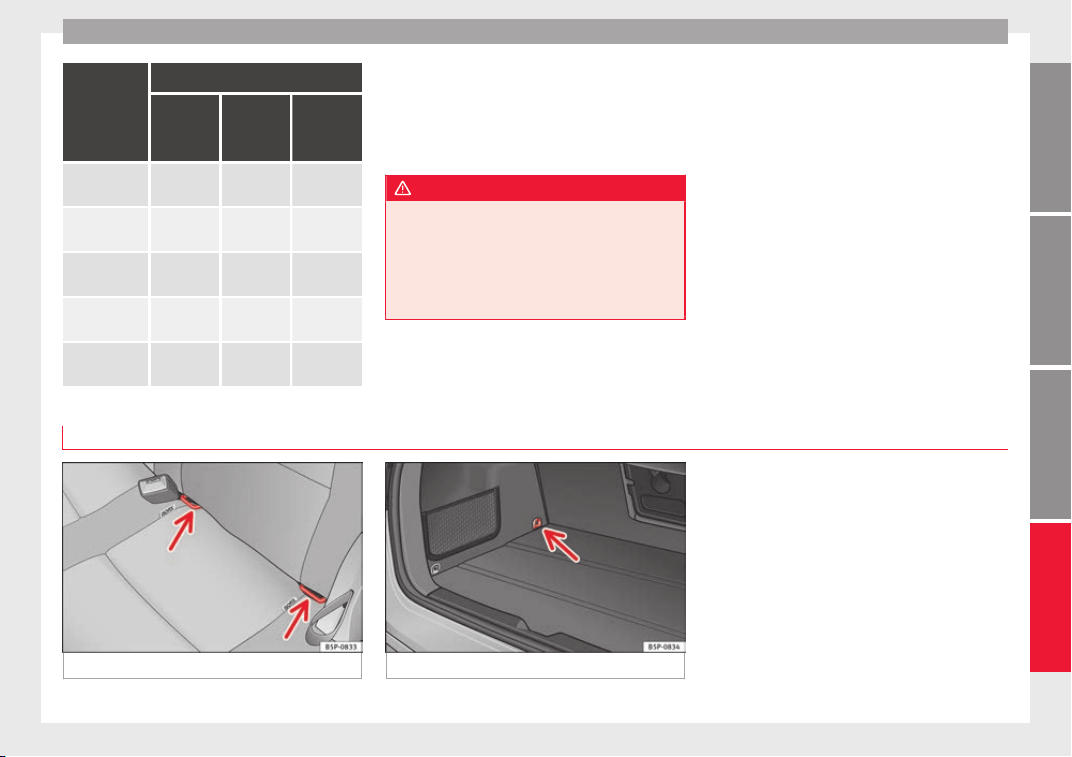
Transporting children safety
Weight
group
Seating position
Front
passen-
ger seat
Rear side
seat
Rear cen-
tral seat
Group 0
to 10 kg
U* U U
Group 0+
to 13 kg
U* U U
Group I
9 to 18 kg
U* U U
Group II
15 to 25 kg
U* U U
Group III
22 to 36 kg
U* U U
Suitable for universal restraint systems
for use in this weight group.
Move the front passenger seat as far
back as possible, as high as possible
and always disable the airbag.
WARNING
●
When travelling, children must be secured
in the vehicle with a restraint system suitable
for age, weight and size.
●
Read and always observe information and
warnings concerning the use of child seats
››› page 25.
U:
*:
Child seats fastened with the “ISOFIX” and Top Tether* system
Fig. 23 ISOFIX securing rings. Fig. 24 Top Tether* securing ring.
»
27
Technical specifications
AdviceOperationSafety

Safety
Child seats with the “ISOFIX” or Top Tether*
system can be secured quickly, easily and
safely on the rear outer seats.
When removing or fitting the child seat,
please be sure to follow the manufacturer's
instructions.
–
Move the rear seat as far to the rear as it
will go.
–
Press the child seat onto the “ISOFIX” re-
taining rings until the child seat can be
heard to engage securely. If the child seat
is equipped with Top Tether* anchor points,
secure it to the correspondent ring
››› Fig. 24
. Follow the manufacturer's in-
s
truction
s.
–
Pull on both sides of the child seat to en-
sure that it is secure.
Two “ISOFIX” retaining rings are fitted on
each rear seat. In some vehicles, the rings
are secured to the seat frame and in others
they are secured to the rear floor. Access to
the “ISOFIX” rings is between the rear seat
backrest and the seat cushioning. The Top
Tether* rings are located at the rear of the
backrests of the rear seats (behind the seat
backrest or in the boot).
Child seats with the “ISOFIX” and Top Tether*
attachment system are available from Techni-
cal Services.
Weight group Size class Electrical equipment Mounting direction
Vehicle Isofix positions
Rear side seats
Baby carrier
F ISO/L1 Backward-facing X
G ISO/L2 Backward-facing X
Group 0 to 10 kg E ISO/R1 Backward-facing IU
Group 0+ to 13 kg
E ISO/R1 Backward-facing IU
D ISO/R2 Backward-facing IU
C ISO/R3 Backward-facing IU
Group I 9 to 18 kg
D ISO/R2 Backward-facing IU
C ISO/R3 Backward-facing IU
B ISO/F2 Forward-facing IU
B1 ISO/F2X Forward-facing IU
A ISO/F3 Forward-facing IU
Group II 15 to 25 kg --- --- Forward-facing ---
28
Transporting children safety
Weight group Size class Electrical equipment Mounting direction
Vehicle Isofix positions
Rear side seats
Group III 22 to 36 kg --- --- Forward-facing ---
Suitable for ISOFIX universal child re-
straint systems approved for use in this
weight group
ISOFIX position not suitable for ISOFIX
child restraint systems for this weight
group or size class.
WARNING
●
The retaining rings are designed only for
use with “ISOFIX” and Top Tether* child
seats.
●
Never secure other child seats without the
“ISOFIX”, Top Tether* system, nor retaining
belts or objects to the fastening rings; other-
wise this can result in potentially fatal inju-
ries to the child.
●
Ensure that the child seat is secured cor-
rectly using the “ISOFIX” and Top Tether* se-
curing rings.
IU:
X:
29
Technical specifications
AdviceOperationSafety
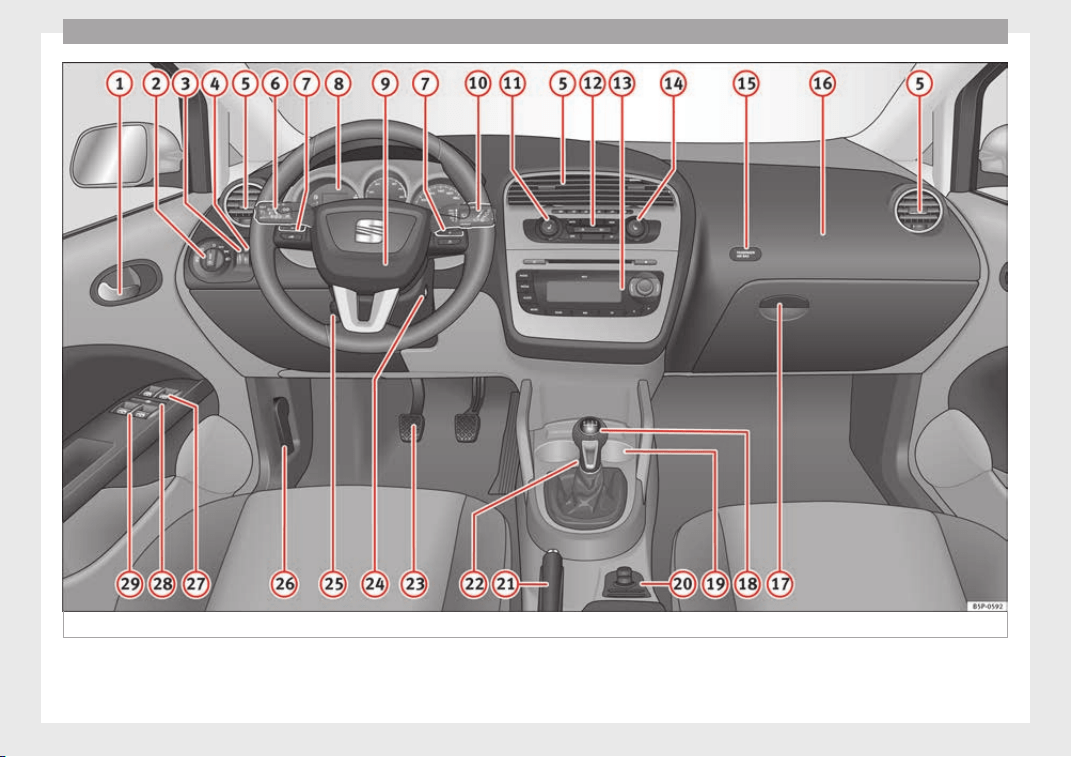
Operation
Fig. 25 Dash panel.
30
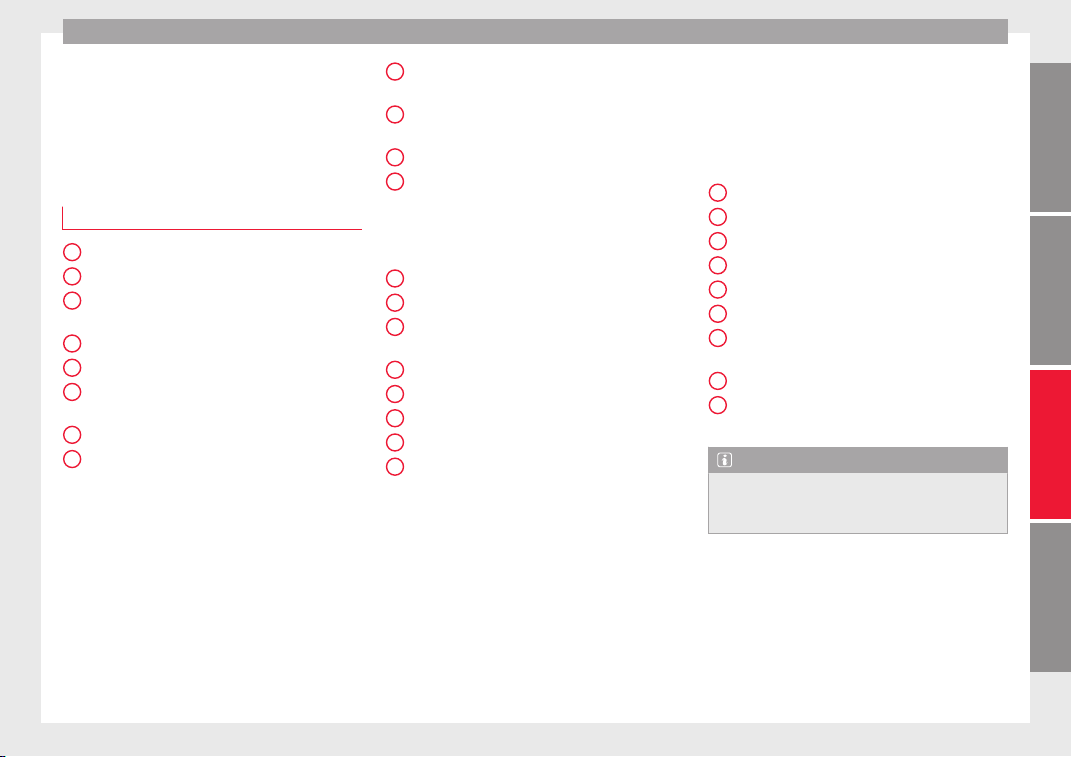
Dash panel
Operation
Dash panel
Overview
Overview of the dash panel
Door release lever
Light switch . . . . . . . . . . . . . . . . . . . . . . 75
Lighting control for instrument and
switch lighting. . . . . . . . . . . . . . . . . . . . 79
Headlight range control . . . . . . . . . . . 79
Air vents
Turn signal and main beam lever
and cruise control system* . . . . . . . .77, 142
Controls on the steering wheel . . . . 57
Instrument panel:
–
Instruments . . . . . . . . . . . . . . . . . . . . 32
–
Display . . . . . . . . . . . . . . . . . . . . . . . . . 47
–
Control and warning lamps . . . . . . 35
1
2
3
4
5
6
7
8
Horn (works only when the ignition
is on)/ Driver front airbag . . . . . . . . . 17
Windscreen wiper lever and opera-
tion of the multi-function display* .84, 52
Left seat heating button . . . . . . . . . . 91
Controls for
–
Heating* and ventilation . . . . . . . . 107
–
Climatic* . . . . . . . . . . . . . . . . . . . . . . . 109
–
Climatronic* . . . . . . . . . . . . . . . . . . . . 112
Radio/Navigator*
Right seat heating button . . . . . . . . . 91
Control lamp for front passenger
airbag deactivated warning lamp . . 23
Front passenger front airbag . . . . . . 17
Glove compartment lever . . . . . . . . . 93
Selector lever . . . . . . . . . . . . . . . . . . . . 127
Cup holder compartment . . . . . . . . . 95
Controls in the centre console:
–
Central locking . . . . . . . . . . . . . . . . . 63
–
ESC . . . . . . . . . . . . . . . . . . . . . . . . . . . . 134
9
10
11
12
13
14
15
16
17
18
19
20
–
Tyre pressure control* . . . . . . . . . . . 43
–
Park Pilot* . . . . . . . . . . . . . . . . . . . . . . 140
–
Cigarette lighter/Power socket . . 98
–
Exterior mirror adjustment . . . . . . 87
–
Start-Stop* . . . . . . . . . . . . . . . . . . . . . 138
Handbrake . . . . . . . . . . . . . . . . . . . . . . . 123
Hazard warning lights switch . . . . . . 81
Pedals
Ignition lock . . . . . . . . . . . . . . . . . . . . . . 120
Steering column control lever* . . . . 7
Handle for releasing the bonnet . . . 163
Button for opening and closing the
front windows . . . . . . . . . . . . . . . . . . . . 72
Safety switch* for the rear windows . . .72
Control* for opening and closing
the rear windows . . . . . . . . . . . . . . . . . 72
Note
Some of the items of equipment listed here
are fitted only on certain model versions or
are optional extras.
21
22
23
24
25
26
27
28
29
31
Technical specifications
AdviceOperationSafety
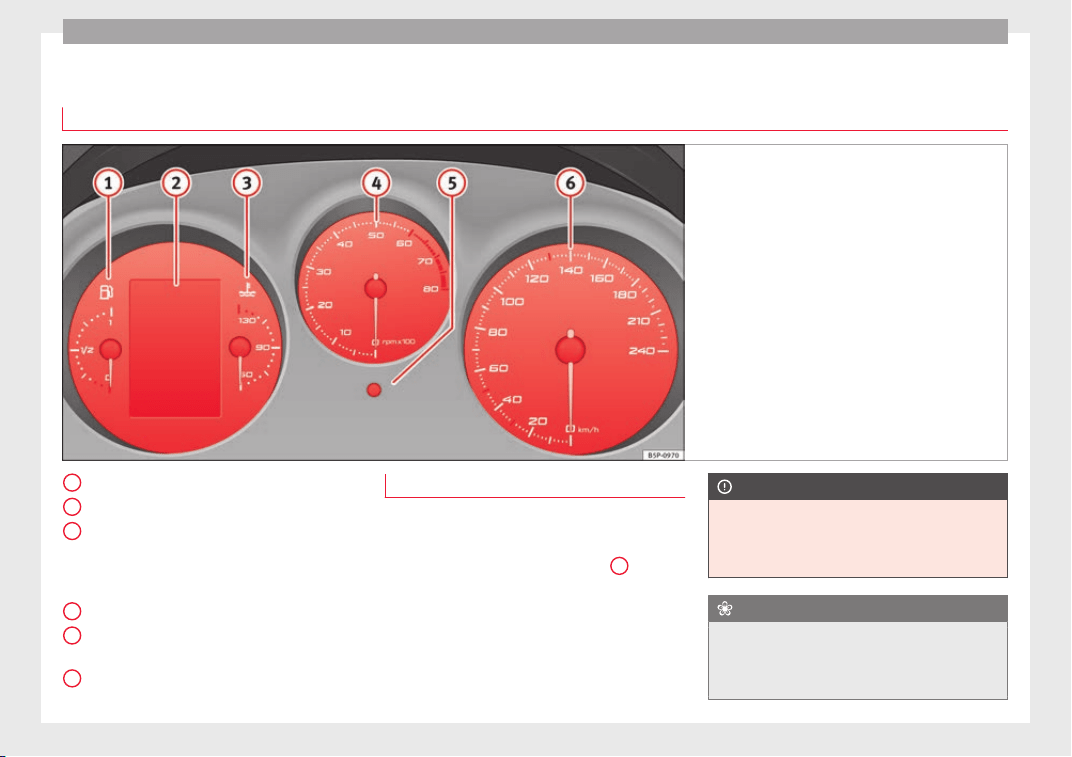
Operation
Instruments
Instrument overview
Fig. 26 Detailed view of the dash panel: Dash
panel.
Fuel gauge ››› page 33
Multifunction display ››› page 47
Engine coolant temperature display
››› page 34
or natural gas level indicator
in
v
ehicles with natural gas engine (LPG)
››› page 33
Rev counter ››› page 32
Time adjustment button / trip recorder re-
set button ››› page 35
Speedometer ››› page 33
1
2
3
4
5
6
Rev counter
The rev counter displays the engine speed in
revolutions per minute.
The start of the red area ››› Fig. 26
4
indi-
cates maximum engine speed working at
service temperature. However, it is advisable
to change up into a higher gear, move the se-
lector lever to D or lift your foot off the accel-
erator before the needle reaches the red
zone.
CAUTION
To prevent possible engine malfunctions, the
rev counter needle should not reach the red
zone. The start of the red zone on the dial is
different for some engine versions.
For the sake of the environment
Changing up into higher gears sooner, follow-
ing the recommended gear indications
››› Fig. 35 will help you to reduce fuel con-
sumption, emi
ssions and also engine noise.
32
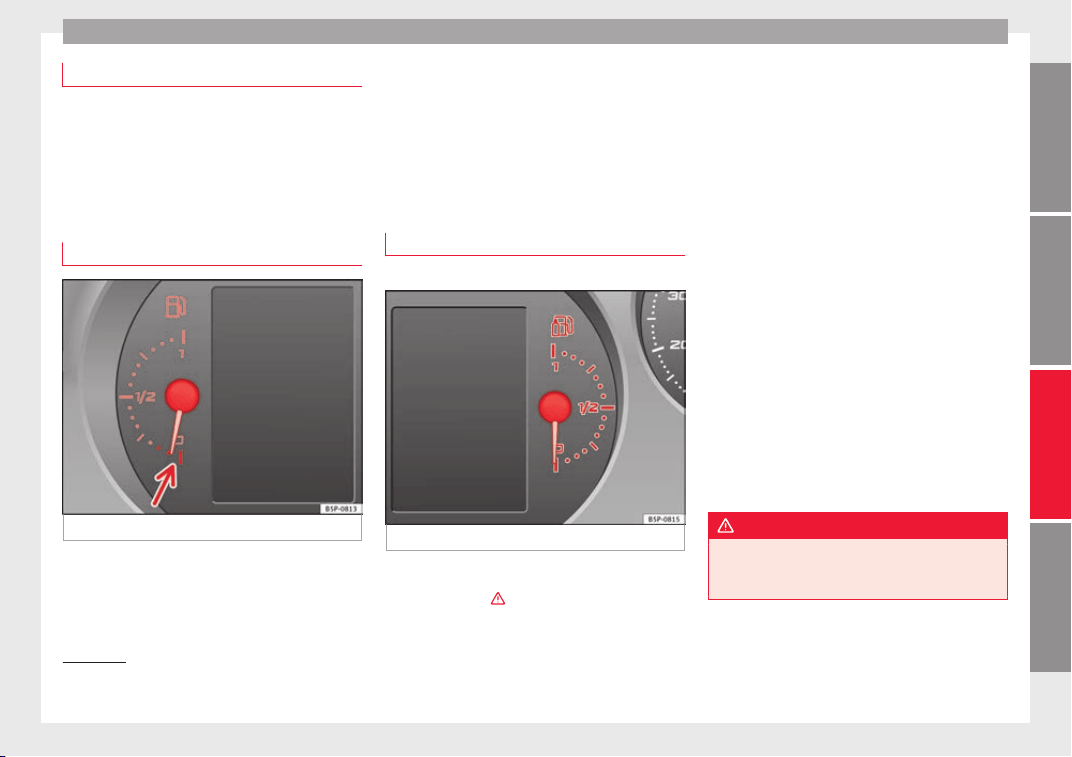
Dash panel
Speedometer
The speedometer is equipped with a digital
odometer and a trip odometer, in addition to
a service intervals display.
During the running-in period, the instructions
shown on ››› page 130 should be followed.
Fuel
gauge and reserve indicator
Fig. 27 Instrument panel: fuel gauge
The fuel tank has a capacity of approx. 55 li-
tres.
When the needle reaches the reserve area
››› Fig. 27
(arrow), the warning lamp will light
up and an audib
l
e warning will sound re-
minding the driver to refuel. At this point
there are still 7 litres of fuel in the tank.
The following text appears in the dash panel
display
1)
:
PLEASE REFUEL [XXX]
LPG gauge*
3 Applies to the model: ALTEA / ALTEA XL
Fig. 28 Instrument panel: gas gauge.
LPG system filler level display
The LPG tank ››› in the spare wheel well
has a capacity of 39 litres at an outside tem-
perature of +15 °C (+59 °F) ››› page 160, Re-
fuelling with LPG
.
The c
h
arge level can be checked on the ana-
logue gas gauge located on the instrument
panel ››› Fig. 28. When the level reaches re-
serve, a notification text is displayed on the
screen. Refill with LPG at the earliest opportu-
nity.
If while driving with LPG a sudden acoustic
warning signal is heard, the on-screen mes-
sage is shown
2)
:
LPG fault, consult Workshop
This means there is a fault in the LPG system.
Take the vehicle to a specialised workshop to
check the system.
Problem: If the vehicle is left parked for a
long time immediately after refuelling, the
natural gas level indicator may not accurately
indicate the same level shown after refuelling
when the vehicle is started up again. This is
not necessarily due to a leak in the system.
WARNING
LPG is a highly explosive and inflammable
substance. It may cause severe burns and
other injury.
»
1)
Depending on the version of the model.
2)
Depending on the model version
33
Technical specifications
AdviceOperationSafety
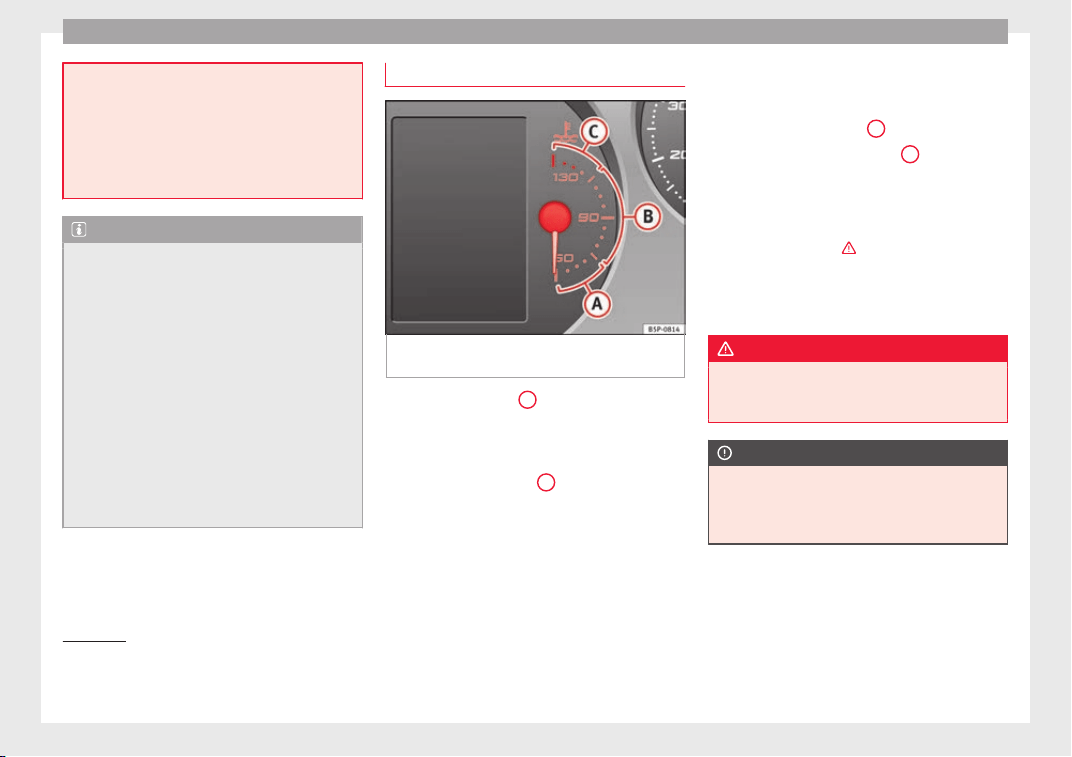
Operation
●
Due care must be taken to avoid any risk of
fire or explosion.
●
When parking the vehicle in a closed area
(e.g. in a garage), make sure that there is ad-
equate ventilation, either natural or mechani-
cal, to neutralise the LPG in the event of a
leak.
Note
●
The values shown in the average fuel con-
sumption and distance to empty indications
on the multifunction display (MFI)
1)
on the in-
strument panel display
2)
are approximate val-
ues only.
●
Two different consumption values are given
on the MFI, depending on whether the vehi-
cle is running in gas or petrol mode.
●
Please check the fuel level on the fuel level
gauge on the instrument panel ››› page 33.
●
If frequent short journeys are made, espe-
cially when the outside temperature is low,
the vehicle will tend to run on petrol more of-
ten than on LPG. Therefore, the petrol tank
may empty before the LPG tank.
Engine coolant temperature gauge
Fig. 29 Instrument panel: Engine coolant
temperature gauge.
Needle in cold zone
A
Avoid high engine speeds and heavy engine
loads ››› Fig. 29
.
Needl
e in norm
al zone
B
In normal driving conditions, the needle
should be in the middle section of the scale.
The temperature may also rise when the en-
gine is working hard, especially at high out-
side temperatures. This is no cause for con-
cern as long as the warning lamp does not
light up and no warning message* appears
on the dash panel display.
Needle in warning zone
C
The warning lamp* ››› Fig. 30
2
will light up
if the needle is in the warning zone. The fol-
lowing warning message appears on the in-
strument panel display
3)
.
Stop the vehicle
and sw
it
ch off the engine. Check the coolant
level ››› page 169 ›››
.
Even if the coolant level is correct do not con-
tinue driving
. You should obtain technical as-
s
i
stance.
WARNING
When working in the engine compartment, al-
ways observe the safety warnings
››› page 163.
CAUTION
Accessories in front of the air inlet reduce the
cooling effect of the coolant. At high outside
temperatures and high engine loads, there is
a risk of the engine overheating.
1)
Optional equipment
2)
Depending on the model version
3)
Depending on the version of the model.
34
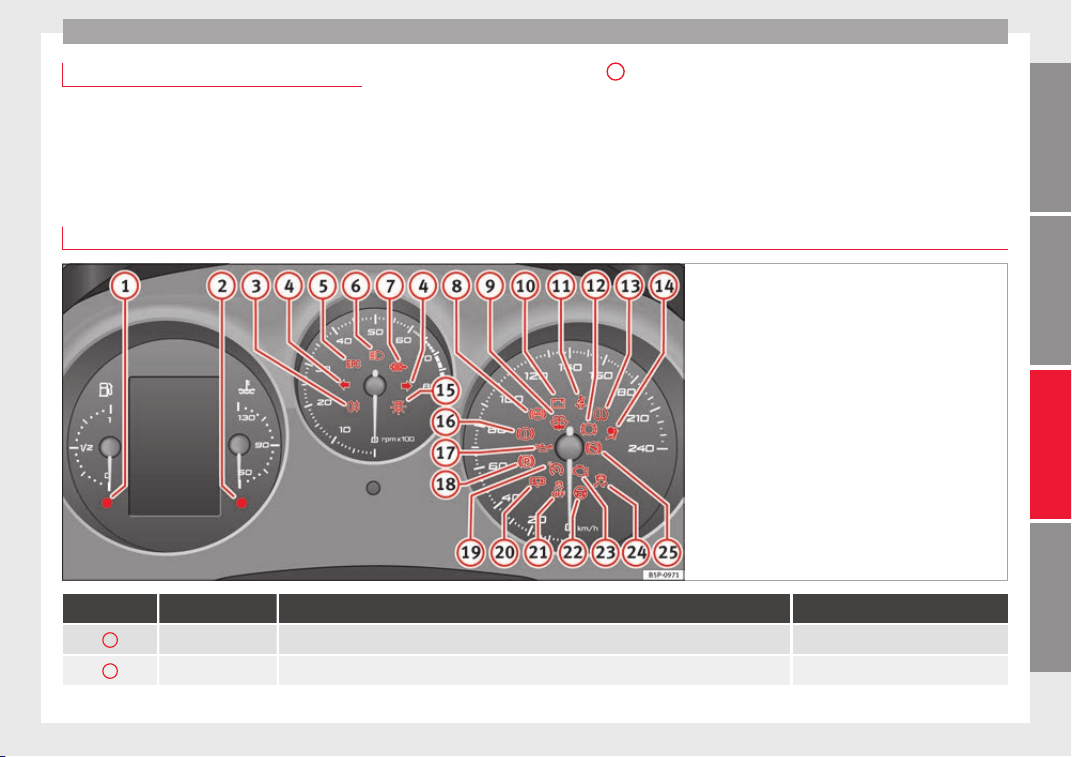
Dash panel
Setting the digital clock*
The digital clock is located in the instrument
panel display.
–
Turn the setting knob ››› Fig. 26
5
clock-
wise until the first “click” to set the hour.
The hour will flash. To change the hour,
press the button.
–
Turn the setting knob clockwise to the sec-
ond “click” to set the minutes. The minutes
will flash. To change the minutes, press the
button.
Warning lamps
Overview of the warning lamps
Fig. 30 Instrument panel warning and control
lamps. Some of the items of equipment listed
here are fitted only on certain model versions or
are optional extras.
Item Symbol Meaning of control and warning lamps Further information
1
Fuel level / reserve ››› page 40
2
Coolant level / coolant temperature ››› page 40
»
35
Technical specifications
AdviceOperationSafety
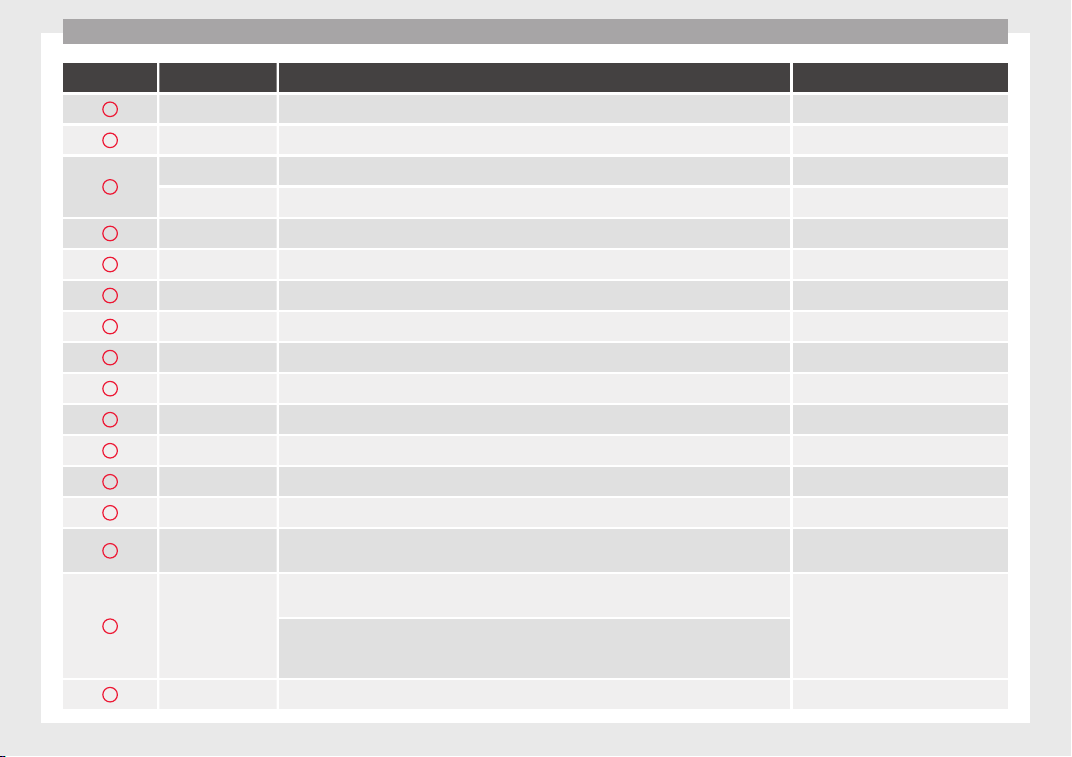
Operation
Item Symbol Meaning of control and warning lamps Further information
3
Rear fog light switched on ››› page 40
4
Turn signals in operation ››› page 41
5
Engine fault (petrol engine) ››› page 41
Glow plug system (diesel engines) ››› page 41
6
Main beam switched on ››› page 41
7
Soot accumulation in the diesel engine particulate filter ››› page 41
8
ABS system fault ››› page 41
9
Windscreen washer fluid level ››› page 42
10
Alternator fault ››› page 42
11
Fasten seat belts! ››› page 11
12
Brake pad worn ››› page 42
13
Tyre pressure ››› page 43
14
Airbag or belt tensioner system fault or airbag disabled ››› page 16 ››› page 19
15
Bulb defective ››› page 44
16
Brake fluid required or
brake system fault
››› page 44
17
Red:
Engine oil pressure
››› page 44
Yellow:
If flashing: engine oil sensor faulty
If it remains lit: insufficient engine oil
18
Handbrake on ››› page 123
36
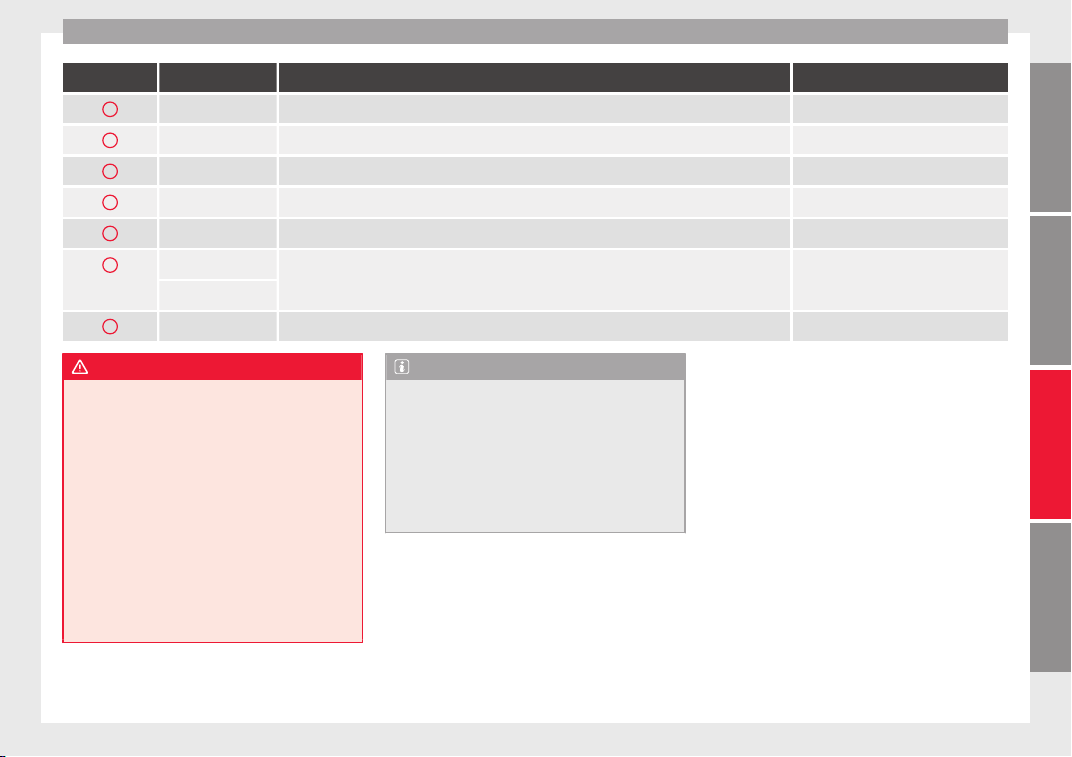
Dash panel
Item Symbol Meaning of control and warning lamps Further information
19
Cruise speed activated (Cruise control) ››› page 45
20
Door open indicator ››› page 45
21
If it stays lit: ASR switched off ››› page 45 ››› page 46 ››› page 134
22
Electromechanical steering ››› page 45
23
Fault in the emission control system ››› page 45
24
If flashing: the Electronic Stability Control (ESC) is working or the ASR is working
If it remains lit: ESC or ASR faulty
››› page 45 ››› page 46 ››› page 134
25
Selector lever lock (automatic gearbox) ››› page 46
WARNING
●
Failure to observe control lamps and warn-
ing messages can result in serious personal
injury or damage to your vehicle.
●
The risk of an accident increases if your ve-
hicle breaks down. Use a warning triangle to
draw the attention of other road users in or-
der to prevent danger to third parties.
●
The engine compartment is a dangerous
area. Before you open the bonnet to work on
the engine or in the engine compartment,
switch the engine off and allow it to cool to
reduce the risk of burns or other injuries.
Read and observe the relevant warnings
››› page 163.
Note
●
The appropriate control lamp for a fault will
light up in vehicles without warning or infor-
mation messages in the display.
●
In vehicles with warning or information
messages on the screen, the appropriate con-
trol lamp for a fault will light up and a warn-
ing or information message will also appear
on the screen.
37
Technical specifications
AdviceOperationSafety
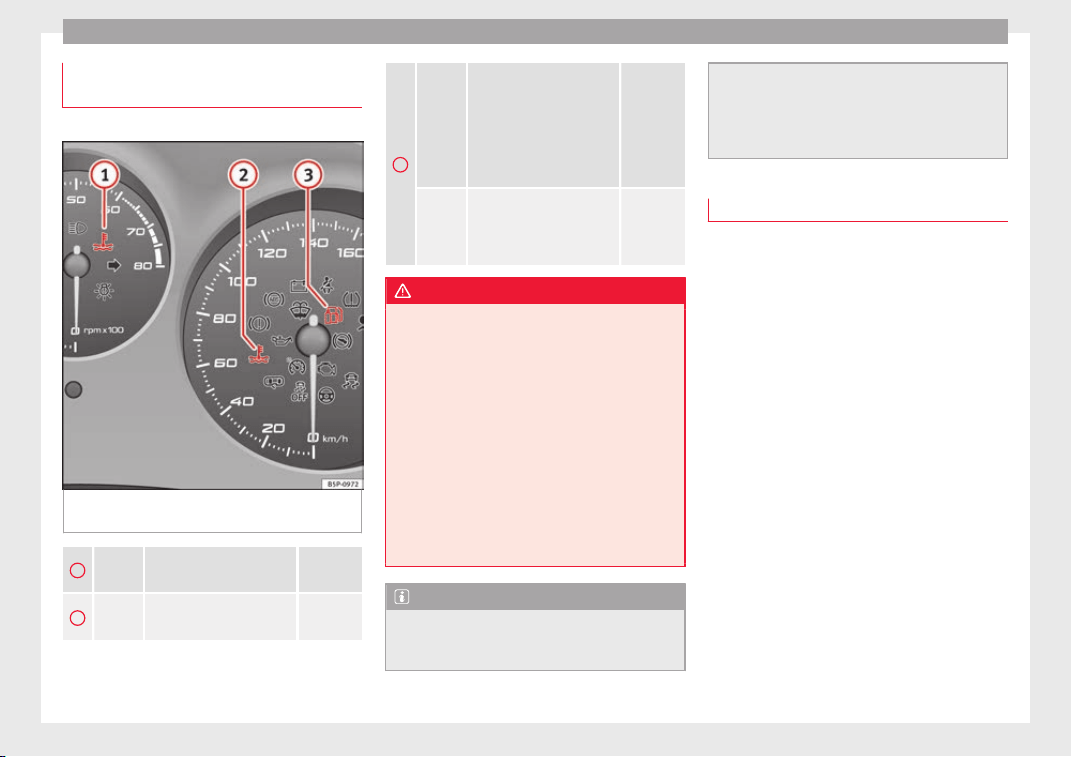
Operation
Overview of control and warning
lamps (vehicles with LPG)
3 Applies to the model: ALTEA / ALTEA XL
Fig. 31 Instrument panel control and warning
lamps in vehicles with LPG
1
Red: coolant level/coolant
temperature
››› page
40
2
Blue: cold engine warning
››› page
40
3
(green
)
The green lamp lights up
when the vehicle is in LPG
mode.
The lamp goes off when
you switch, automatically
or manually, to petrol
mode.
››› page
118
(yel-
low)
The yellow warning lamp
lights up when the petrol
has reached the reserve
level.
WARNING
●
Failure to observe control lamps and warn-
ing messages can result in serious personal
injury or damage to your vehicle.
●
The risk of an accident increases if your ve-
hicle breaks down. Use a warning triangle to
draw the attention of other road users in or-
der to prevent danger to third parties.
●
The engine compartment is a dangerous
area. Before you open the bonnet to work on
the engine or in the engine compartment,
switch the engine off and allow it to cool to
reduce the risk of burns or other injuries.
Read and observe the relevant warnings
››› page 163.
Note
●
The appropriate control lamp for a fault will
light up in vehicles without warning or infor-
mation messages in the display.
●
In vehicles with warning or information
messages on the screen, the appropriate con-
trol lamp for a fault will light up and a warn-
ing or information message will also appear
on the screen.
Warning symbols
There are red warning symbols (priority 1)
and yellow warning symbols (priority 2).
Warning messages, Priority 1 (red)
If one of these faults occurs, the warning
lamp will light up or flash and will be accom-
panied by three audible warnings. This is a
danger
warning. Stop the vehicle and switch
off
the en
gine. Check the fault and correct it.
Obtain professional assistance if necessary.
If several priority 1 faults are detected at the
same time, the symbols will be displayed one
after the other for about 2 seconds at a time
and will continue until the fault is corrected.
No menus will be shown in the display for the
duration of a priority 1 warning message.
Examples of priority 1 warning messages
(red)
●
Brake system symbol with the warning
message STOP BRAKE FLUID INSTRUCTION
MANUAL or STOP BRAKE FAULT INSTRUCTION
MANUAL.
38
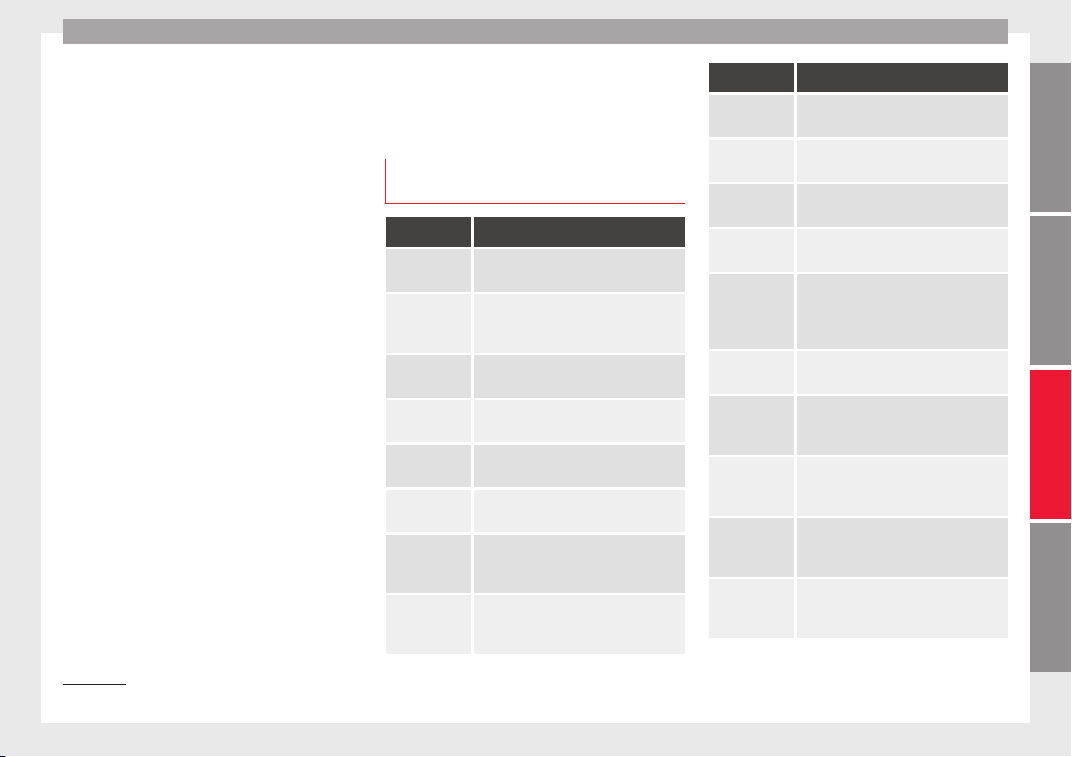
Dash panel
●
Coolant symbol
with the warning mes-
s
ag
e STOP SEE COOLANT INSTRUCTION MAN-
UAL.
●
Engine oil pressure symbol with the
warning message STOP ENGINE OIL PRESSURE
LOW! INSTRUCTION MANUAL.
Warning messages, Priority 2 (yellow)
If one of these faults occurs, the correspond-
ing warning lamp lights up and is accompa-
nied by an audible warning. Check the corre-
sponding function as soon as possible al-
though the vehicle may be used without risk.
If several priority 2 warning messages are de-
tected at the same time, the symbols are dis-
played one after the other for about 2 sec-
onds at a time. After a set time, the informa-
tion text will disappear and the symbol will
be shown as a reminder at the side of the
display.
Priority 2 warning messages will not be
shown until all Priority 1 warning messages
have been dealt with!
Examples of priority 2 warning messages
(yellow):
1)
●
Fuel warning light with the information text
PLEASE REFUEL
.
●
Windscreen washer fluid symbol with the
information text REFILL WINDSCREEN WASHER
FLUID. Top up the washer fluid level.
Information messages displayed on
the screen*
Messages
a)
Description
SERVICE
The service interval has ended. Take
the vehicle to a Technical Service.
IMMOBILISER
Immobiliser system active. The vehicle
will not start. Take the vehicle to a
Technical Service.
ERROR
Instrument panel faulty. Take the vehi-
cle to a Technical Service.
CLEAN AIR FIL-
TER
Warning: The air filter must be cleaned
NO KEY
Warning: Correct key cannot be found
in the vehicle.
KEY BATTERY
Warning: Key battery low. Change the
battery.
CLUTCH
Warning: Press the clutch to start. In
vehicles with manual gearbox and
Start-Stop system.
--> P/N
Warning: Place the selector level in po-
sition P/N to start. Only in vehicles
with automatic gearbox.
Messages
a)
Description
--> P
Warning: Place the selector lever in po-
sition P to stop the engine.
STARTING
Warning: The engine starts automati-
cally. Start-Stop system activated.
START MAN-
UALLY
Warning: The engine must be started
manually. Start-Stop system activated
ERROR START-
STOP
Warning: Start-Stop system error.
START-STOP
IMPOSSIBLE
Warning: Although the Start-Stop sys-
tem is switched on, the engine cannot
be stopped automatically. Not all the
necessary conditions are met
START-STOP
ACTIVE
Warning: Start-Stop system activated.
Vehicle in Stop mode.
SWITCH OFF
Warning: Start-Stop system activated.
Switch off the ignition when you leave
the vehicle.
STOP TRANS-
MISSION TOO
HOT
Warning: Stop the engine. Gearbox
overheated.
BRAKE
Warning: To start the engine, press the
brake pedal. Only in vehicles with au-
tomatic gearbox.
COASTING
FUNCTION
Warning: Coasting mode active. Trans-
mission engaged. Only in vehicles with
automatic gearbox.
»
1)
Depending on the version of the model.
39
Technical specifications
AdviceOperationSafety
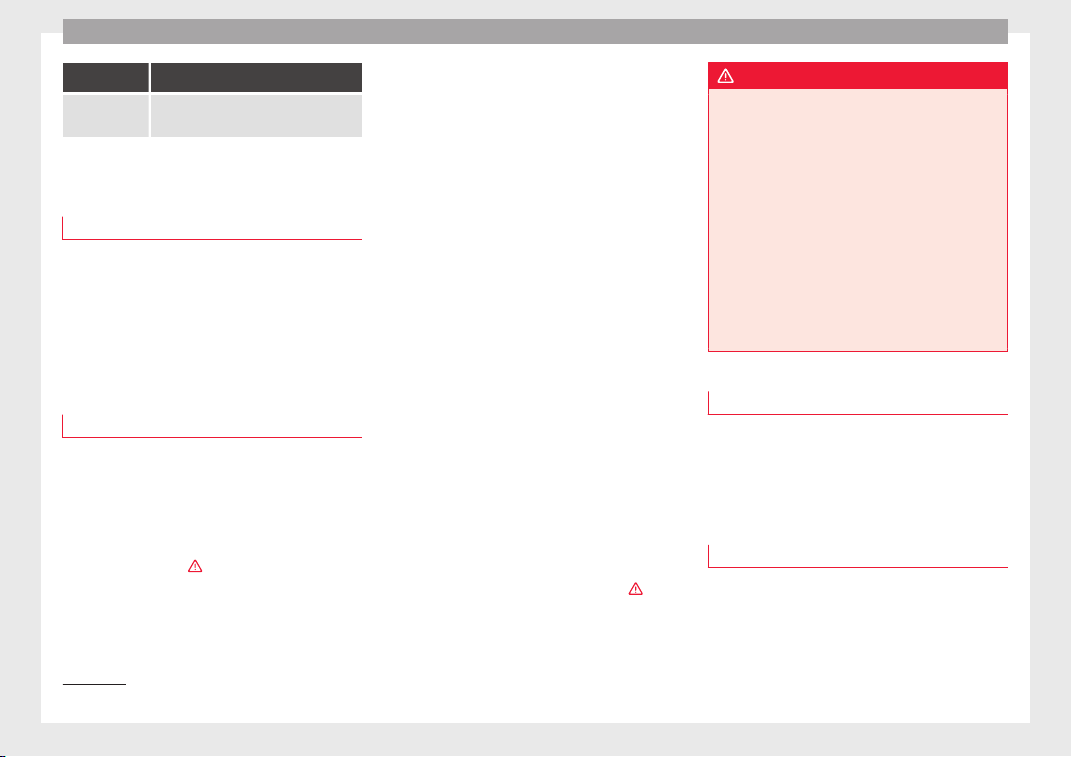
Operation
Messages
a)
Description
CHECK SAFE-
LOCK
Notification of central locking function
activated.
a)
These messages may vary according the version of the vehi-
cle model.
Fuel level/reserve
The light comes on when only 7 litres of fuel
remain in the tank, and an acoustic signal al-
so sound
s. It reminds you to fuel up the fuel
tank as soon as possible
›››
page 158.
The instrument panel displays the following
message
1)
:
PLEASE REFUEL!
.
Coolant level* / temperature (red)
There is a fault if:
●
The warning symbol does not go out again
after a few seconds.
●
The warning lamp lights up or flashes while
the vehicle is moving, and three acoustic
warning signals
›
›
›
are emitted.
This means that either the coolant level is too
low or the coolant temperature is too high.
Coolant temperature too high
The instrument panel displays the following
message
1)
:
CHECK COOLANT INSTRUCTION
MANU
AL
››› page 169.
First look at the coolant temperature gauge.
The coolant temperature is too high if the
needle is over the warning area on the dial.
Stop the vehicle, switch the engine off and
wait for it to cool down. Check the coolant
level.
If the coolant level is correct, the overheating
may be caused by a malfunction of the radia-
tor fan. Check the radiator fan fuse and have
it replaced if necessary ››› page 196.
If the control lamp lights up again after driv-
ing on for a short distance, stop the vehicle
and switch the engine off. Contact a Techni-
cal Service or a specialised workshop.
Coolant level too low
The instrument panel displays the following
message
1)
: STOP CHECK COOLANT INSTRUC-
TION MANUAL.
First look at the coolant temperature gauge. If
the needle is in the normal range, top up with
coolant at the earliest opportunity ›››
.
WARNING
●
If your vehicle is immobilised for technical
reasons, move it to a safe distance from traf-
fic. Turn the engine off, turn the hazard lights
on and place the warning triangle.
●
Never open the bonnet if you can see or
hear steam or coolant escaping from the en-
gine compartment. Risk of scalding. Wait un-
til you can no longer see or hear escaping
steam or coolant.
●
The engine compartment is a dangerous
area. Before carrying out any work in the en-
gine compartment, switch off the engine and
allow it to cool down. Always note the corre-
sponding warnings ››› page 163.
Coolant temperature (blue)
3 Applies to vehicles with LPG
This lamp lights up when the coolant is be-
low approximately +45 °C (+113 °F). When it
exceeds this temperature the lamp turns off.
Rear fog light
The warning lamp lights up when the rear
fog light is switched on. For further informa-
tion see
›››
page 75
.
1)
Depending on the version of the model.
40

Dash panel
Turn signals
Depending on which turn signal is operating,
either the left or right turn signal lamp
fla
shes. Both control lamps will flash at the
same time when the hazard warning lights
are switched on.
If any of both turn signals fails, the warning
lamp will start flashing twice faster than nor-
mal.
For further information on the turn signals,
please see ››› page 77.
Engine management*
This warning lamp monitors the engine man-
agement system for petrol engines.
The warning lamp (Electronic Power Con-
trol) lights up when the ignition is switched
on while system operation is being verified. It
should go out once the engine is started.
If there is a fault in the electronic engine
management system while you are driving,
this warning lamp will light up. Stop the vehi-
cle and seek technical assistance.
Glow plug system / Engine fault
The warning lamp lights up to show that the
glow plugs are preheating the diesel engine.
The control lamp
lights up
If
the c
ontrol lamp lights up when the en-
gine is started it means that the glow plugs
are preheating. When the warning lamp goes
off, the engine should be started straight
away.
Control lamp flashes
If a fault develops in the engine management
system while you are driving, the glow plug
system lamp will flash . Take the vehicle to
a specialised workshop as soon as possible
and have the engine checked.
Main beam headlights
The warning lamp lights up when the main
beams are on or when the headlight flasher
is operated.
For further information see
›››
page 77.
Soot accumulation in the diesel
engine particulate filter
If the control lamp lights up you should
help the filter clean itself by driving in the ap-
propriate manner.
To do this, drive about 15 minutes in fourth
or fifth gear (automatic gearbox: S gear
range) at a minimum speed of 60 km/h
(37 mph), with the engine running at approxi-
mately 2,000 rpm. In this way, the soot build
up in the filter is burned. When cleaning is
successful, the control lamp turns off.
If the lamp
does not turn off, or the three
l
amp
s turn on (particulate filter , fault in
the emission control system and glow
plugs ), drive the vehicle to a specialised
workshop and have the fault repaired at the
earliest opportunity.
WARNING
●
Always drive according to the road weather
conditions, the terrain and traffic. Driving rec-
ommendations should never lead to illegal
manoeuvres in surrounding traffic.
●
The diesel engine particulate filter may
reach extremely high temperatures; in this
case the vehicle should be parked so that it
does not enter into contact with highly flam-
mable materials underneath the vehicle. Oth-
erwise there is a risk of fire.
Anti-lock brake system (ABS)*
The warning lamp lights up for a few sec-
onds when the ignition is switched on. It
goes out again after the system has run
through an automatic test sequence.
»
41
Technical specifications
AdviceOperationSafety

Operation
There is a fault in the ABS if:
●
The warning lamp
does not light up
when the ignition i
s switched on.
●
The control lamp does not go out again af-
ter a few seconds.
●
The control lamp lights up when the vehicle
is moving.
The vehicle can still be braked in the normal
way, without the ABS function. Take the vehi-
cle to a specialised workshop as soon as
possible. For further information on the ABS
see the ››› page 136.
If a fault occurs in the ABS, the ESC* control
lamp will also light up.
Brake system fault
If the ABS warning lamp lights up together
with the brake warning lamp , there is a
fault in the ABS function and in the brake
system ›››
.
WARNING
●
Before opening the bonnet, read and ob-
serve the warnings ››› page 163, Working in
the engine compartment.
●
If the br
ake system warning lamp should
light up together with the ABS warning lamp
, stop the vehicle immediately and check
the brake fluid level in the reservoir
››› page 172, Brake fluid. If the brake fluid
lev
el has dropped below the “MIN” mark you
must not drive on. Risk of accident. Obtain
technical assistance.
●
If the brake fluid level is correct, the fault in
the brake system may have been caused by a
failure of the ABS system. This could cause
the rear wheels to lock quickly when you
brake. This could cause the rear to break
away. Risk of skidding. Stop the vehicle and
seek technical assistance.
Washer fluid*
This warning lamp lights up to indicate that
the windscreen washer level is very low.
This serves as a reminder to fill up the reser-
voir at the earliest opportunity ››› page 171.
The following message is shown on the in-
strument panel display*
1)
: REFILL WIND-
SCREEN WASHER FLUID.
Alternator
This warning lamp signals a fault in the alter-
nator.
The warning lamp
lights up when the igni-
tion i
s switched on. It should go out when the
engine has started running.
If the warning lamp lights up while driv-
ing, the alternator is no longer charging the
battery. You should immediately drive to the
nearest specialised workshop.
You should avoid using electrical equipment
that is not absolutely necessary because this
will drain the battery.
Worn brake pads
If the symbol lights up, have the front
brake pads (and, for safety reasons, the rear
pads as well) inspected by a specialised
workshop.
1)
Depending on the version of the model.
42
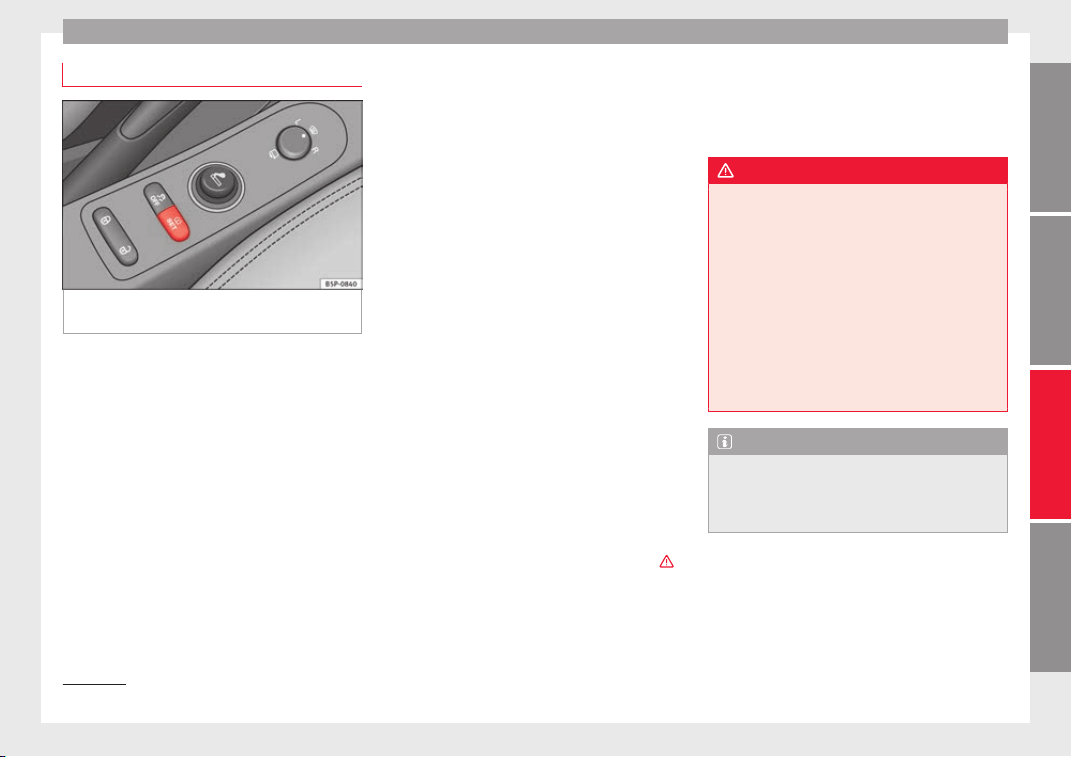
Dash panel
Tyre pressure
Fig. 32 Centre console: tyre monitoring sys-
tem button.
The tyre pressure monitoring system controls
tyre speed and the frequency spectrum of
each tyre.
The tyre monitoring lamp
1)
compares wheel
revolutions and with it, using the ESC, the
wheel diameter of each wheel. If the diame-
ter of a wheel changes, the tyre control lamp
lights up. The wheel diameter changes
when:
●
Tyre pressure is insufficient.
●
The tyre structure is damaged.
●
The vehicle is unbalanced because of a
load.
●
The wheels of one axle are under more
pressure (for example, driving with a trailer or
on steep slopes).
●
The vehicle is fitted with snow chains.
●
The temporary spare wheel is fitted.
●
The wheel on one axle is changed.
Tyre pressure adjustment
Following the modification to tyre pressure or
after changing one or more wheels, the but-
ton ››› Fig. 32
must be pressed down while
the ignition i
s
on until an audible warning is
heard and the warning lamp goes out.
If the wheels are under excessive load (for ex-
ample, driving with a trailer or heavy load),
tyre pressure must be increased to the rec-
ommended value for a full load (see the
sticker on the inside of the fuel flap). If the
tyre monitor system button is pressed down,
the new tyre pressures are confirmed.
The tyre pressure control lamp lights up
If the tyre pressure of one or more wheels is
much lower than the value set by the driver,
the tyre control warning lamp lights up ›››
.
The tyre pressure control lamp
flashes
If
the ty
re pressure control lamp flashes, this
indicates a fault. Go to the nearest special-
ised workshop.
WARNING
●
When the tyre pressure monitoring lamp
lights up, reduce speed immediately and
avoid any sudden manoeuvre or braking.
Stop when possible, and check the tyre pres-
sure and status.
●
The driver is responsible for maintaining
correct tyre pressures. For this reason, tyre
pressure must be regularly checked.
●
Under certain circumstances (e.g. when
driving in a sporty manner, in winter condi-
tions or on a dirt track) the tyre monitoring
lamp may light up or function incorrectly.
Note
If the battery is disconnected, the yellow
warning lamp lights up after turning the
ignition on.
This should turn off after a brief
journey.
1)
Depending on the model version
43
Technical specifications
AdviceOperationSafety

Operation
Brake system*
Situations in which the warning lamp lights
up
●
the brak
e fluid level is too low
››› page 172.
The instrument panel displays the following
message
1)
: STOP BRAKE FLUID INSTRUCTION
MANUAL.
●
there is a fault in the brake system.
The instrument panel displays the following
message
1)
: BRAKE SYSTEM FAULT INSTRUC-
TION MANUAL
.
This warning lamp can light up together with
the ABS system warning lamp.
WARNING
●
Before opening the bonnet, read and ob-
serve the warnings on ››› page 163.
●
If the brake warning lamp does not go out,
or if it lights up when driving, the brake fluid
level in the reservoir ››› page 172, Brake fluid
is too low. Risk of accident. Stop the vehicle
and do not drive on. Obtain technical assis-
tance.
●
If the brake warning lamp lights up to-
gether with the ABS lamp this could be
due to an ABS fault. This could cause the rear
wheels to lock quickly when you brake. This
could cause the rear to break away. Risk of
skidding. Stop the vehicle and seek technical
assistance.
Handbrake
This lamp lights up when the handbrake is
applied.
If you drive faster than 6 km/h (4 mph) with
the handbrake on, the following message will
appear on the instrument panel display
1)
:
HANDBRAKE ON. You will also hear an acous-
tic warning signal ››› page 123.
Bulb defect*
The warning lamp lights up when there is
a fault in the turn signals, headlights, side
lights and fog lights, e.g. in the left head-
light.
The instrument panel displays the following
message
1)
: LEFT FULL BEAM FAULTY.
Engine oil pressure
If this warning lamp is red it indicates that
the engine oil pressure is too low.
If this warning symbol starts to flash, and is
accompanied by three audible warnings,
switch off the engine and check the oil level.
If necessary, add more oil ››› page 166.
The instrument panel displays the following
message
1)
: STOP ENGINE OIL PRESSURE IN-
STRUCTION MANU
AL.
If the warning lamp flashes although the oil
level is correct, stop driving. Do not even run
the engine at
idle speed! Obtain technical as-
sistance.
Checking the oil level
If the warning lamp is yellow the engine
oil level should be checked as soon as possi-
ble. Top up the oil
›››
page 168 at the next
opportunity.
Oil level sensor faulty*
If the yellow warning lamp flashes, take
the vehicle to a specialised workshop to have
the oil level sensor checked. Until then it is
advisable to check the oil level every time
you refuel.
1)
Depending on the version of the model.
44

Dash panel
Cruise speed (cruise control)*
The warning lamp comes on when the
c
ruise control system is switched on. For fur-
ther information on the cruise control system,
see ››› page 142.
Indicator for open doors or boot*
This warning lamp lights up if one of the
doors is open.
The warning light should go off when all
the doors are closed correctly.
The system also works when the ignition is
switched off. It should disappear approxi-
mately 15 seconds after the vehicle has been
locked.
Electromechanical steering*
For vehicles with power steering, the level of
steering assistance depends on the vehicle's
speed and on the steering angle.
The warning lamp should light up for a few
seconds when the ignition is switched on. It
should go out once the engine is started.
If the battery is disconnected, the indicator
remains lit, even with the engine running.
The warning light only goes off after a dis-
tance of approx. 50 m.
There is a fault in the electromechanical
steering system if the lamp does not go out
or lights up while the vehicle is in motion.
The warning lamp may appear in two differ-
ent colours to indicate faults. If the light is
yellow, it indicates a minor fault. If the light is
red, seek assistance from a specialised work-
shop immediately, as the power steering is
not working; in this case you should not keep
driving. Stop the vehicle and seek technical
assistance. The power steering does not work
if the battery is flat or if the engine is off (e.g.
for towing). You should take into account that
you will need considerably more power than
normal to steer the vehicle if the power steer-
ing is not working correctly or at all.
For those vehicles fitted with ESC*, the
“Steering manoeuvre recommendation”
››› page 134
function is included.
Emi
s
sion control system*
Control lamp flashes:
When there is misfiring that can damage the
catalytic converter. Reduce speed and drive
carefully to the nearest specialised workshop
to have the engine checked.
The instrument panel displays the following
message
1)
:
EXHAUST GAS SEE WORKSHOP.
The c
ontr
ol lamp lights up:
If a fault has developed during driving which
has reduced the quality of the exhaust gas
(e.g. lambda probe fault). Reduce speed and
drive carefully to the nearest specialised
workshop to have the engine checked.
The instrument panel displays the following
message: EXHAUST GAS SEE WORKSHOP.
Electronic Stability Control (ESC)*
/.
There are two control lamps for the electronic
stability control. The lamp provides infor-
mation concerning function and disconnec-
tion status.
Both warning lamps light up together when
the ignition is switched on and should turn
off after approximately 2 seconds. This is the
time taken for the function check.
This programme includes the ABS, EDL and
ASR. This also includes the brake assistance
system (BAS), automatic cleaning of the
brake discs and the trailer stability pro-
gramme (TSP).
»
1)
Depending on the version of the model.
45
Technical specifications
AdviceOperationSafety

Operation
The warning lamp
has the following
f
unctions:
●
It flashes whilst driving when the ASR/ESC
is activated.
●
It will light up if there is a fault in the ESC.
●
As the ESC operates in conjunction with the
ABS, the ESC light will also come on if a fault
should occur in the ABS.
If the ESC control lamp stays on after the
engine is started, this may mean that the
control system has temporarily switched off
the ESC. In this case the ESC can be reactiva-
ted by switching the ignition off and then on
again. If the control lamp goes out, this
means the system is fully functional.
The lamp provides information about the
disconnection status of the system:
●
It stays lit when the ASR is disconnected
when pressing the switch.
Differential lock fault (EDL)*
The EDL operates along with the ABS in vehi-
cles equipped with Electronic Stability Con-
trol (ESC)*.
A malfunction in the EDL is indicated by the
ABS control lamp . Take the vehicle to a
specialised workshop as soon as possible.
For further information on the EDL see
››› page 135, Electronic differential lock
(EDL)*
.
T
r
action control system (ASR)* /
The traction control system prevents the driv-
en wheels from spinning when the vehicle is
accelerating.
There are two warning lamps for the traction
control system: and . Both warning lamps
light up together when the ignition is switch-
ed on and should turn off after approximately
2 seconds. This is the time taken for the func-
tion check.
The lamp has the following function:
●
It flashes when the ASR is working if the ve-
hicle is moving.
If the system is deactivated or if it has any
fault, the warning lamp will remain lit. The
warning lamp will also light up if a fault
should occur in the ABS because the ASR op-
erates in conjunction with the ABS. For fur-
ther information, see
›››
page 137.
The
lamp provides information about the
di
sconnection status of the system:
●
It stays lit when the ASR is disconnected
when pressing the ASR OFF switch.
By pressing it again, the ASR function is reac-
tivated and the warning lamp switched off.
Speed selector lever lock
The brake pedal must be depressed when
this warning lamp lights up. This is necessary
when the automatic gearbox* selector lever
is moved out of the positions P
or
N
.
Electronic immobiliser* “Safe”
This warning lamp flashes if an unauthorised
key is used.
Inside the key there is a chip that deactivates
the electronic immobiliser automatically
when the key is inserted into the ignition.
The electronic immobiliser will be activated
again automatically as soon as you pull the
key out of the ignition lock.
The instrument panel displays the following
message
1)
:
IMMOBILISER
. The vehicle cannot
be used in that case
›››
page 121.
1)
Depending on the version of the model.
46
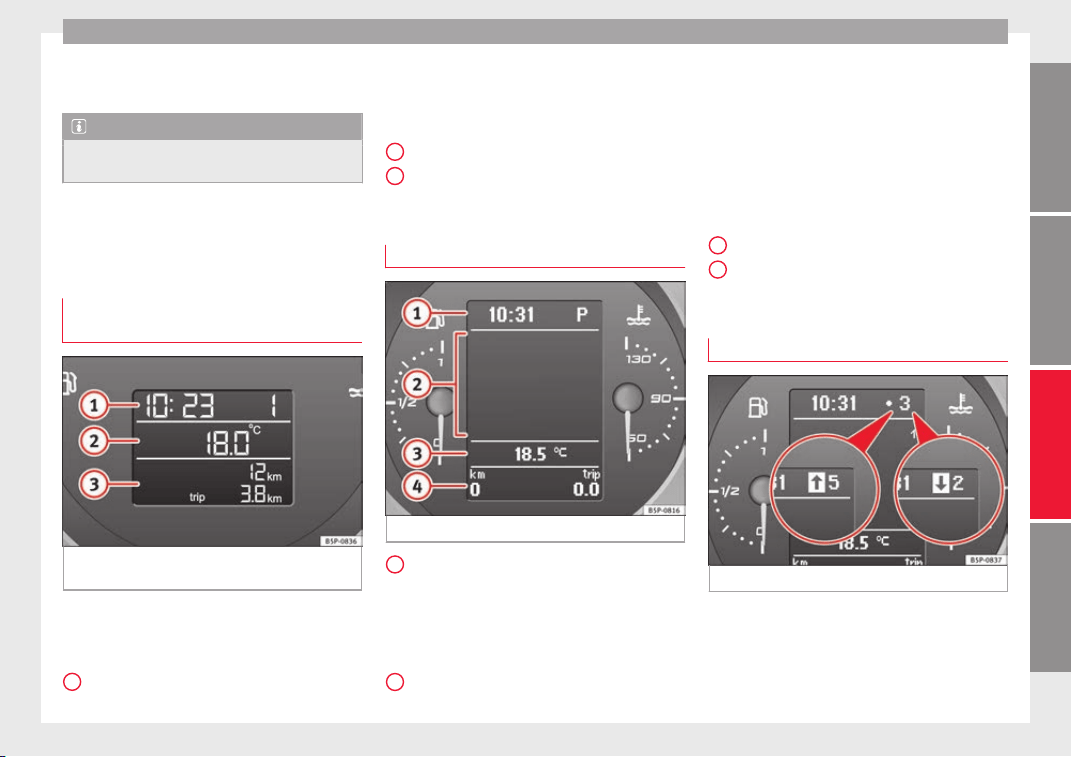
Dash panel
The engine can, however, be started if the
appropriate coded SEAT genuine key is used.
Note
A perfect operation of the vehicle is ensured
if genuine SEAT keys are used.
Digital instrument panel
display
Display (without warning or
information texts)
Fig. 33 Detailed view of the instrument panel:
screen with different indicators.
The display on the dash panel shows the
mileage and trip odometer as well as the se-
lector lever position.
Digital clock display ››› page 35. On the
right of the display: selector lever posi-
1
tion display for the automatic gearbox*.
The current position of the selector lever
or the gear which is engaged (for tiptron-
ic)* is highlighted.
Outside temperature.
Odometer or flexible service interval dis-
play*.
Displayed categories*
Fig. 34 Digital dash panel display.
Clock: “Setting the time”. On the right of
the display: selector lever position dis-
play for the automatic gearbox*. The cur-
rent position of the selector lever or the
gear which is engaged (for Tiptronic) is
highlighted.
There are optional and automatic dis-
plays in this field.
2
3
1
2
Optional indicators: e.g. those on the
multifunction display (MFI).
Automatic indicators: Information and
warning messages.
Menus providing further information and
which can be used to make diverse set-
tings are also shown: “Dash panel me-
nus”.
Outside temperature.
Odometer or flexible service interval dis-
play.
Recommended gear display*
Fig. 35 Gear display.
Use the gear display to save fuel. If you are
driving in the correct gear, a dot will be
shown next to the gear display. If you are not
in the correct gear, an arrow will appear next
»
–
–
–
3
4
47
Technical specifications
AdviceOperationSafety
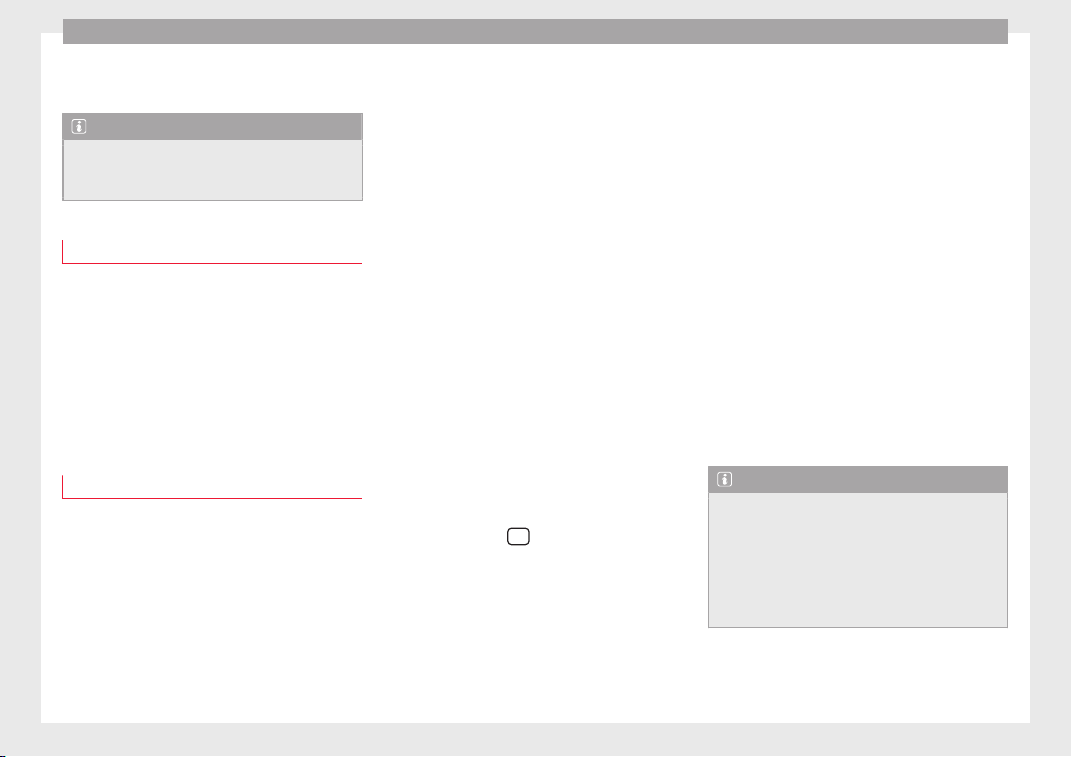
Operation
to the gear display indicating whether you
should change up or down.
Note
The gear change indication should not be tak-
en into account when quick acceleration is re-
quired (for example when overtaking).
Odometer
The left-hand counter in the display registers
the total amount of distance covered by the
vehicle.
The right-hand counter registers the short
journeys. The last digit indicates steps of 100
metres. The trip recorder counter may be re-
set by holding down the reset button for a
few seconds.
Flexible service interval display
Vehicles with Service intervals dependent on
time/distance travelled already have certain
service intervals set. The intervals are calcu-
lated individually in vehicles with LongLife
service
.
The ser
v
ice interval display only indicates the
dates of services that include engine oil
change. The dates of all other services, such
as the Inspection Service or brake fluid
change, appear in the sticker on the door pil-
lar or in the Maintenance Programme.
A Service pre-warning will appear in the od-
ometer if a service is due soon. A “spanner”
symbol appears and the display “km” with
the distance that can be driven until the next
service appointment is due. This signal
changes after around 10 seconds. A “clock
symbol” appears and the number of days un-
til the service appointment should be carried
out. The following message is shown in the
instrument panel display*:
Service in
[XXXX]
km
or
[XXXX]
days
The service message will disappear approxi-
mately 20 seconds after the ignition is
switched on or the engine is running. The
normal display can be resumed by briefly
pressing the reset button on the trip counter
or by pressing the
OK
button on the steering
wheel controls.
With the ignition on, you can check the cur-
rent service message at any moment in the
Vehicle status
menu or turning the reset but-
ton to access the service display.
An
overdue service
is indicated by a minus
s
ign in front of the mileage or day informa-
tion.
Indications for vehicles with LongLife service
Technical progress has made it possible to
considerably reduce servicing requirements.
With the LongLife System, SEAT ensures that
your vehicle only has an Interval Service
when it is necessary. The length of the Inter-
val Services (max. 2 years) is determined by
factors such as conditions under which the
vehicle is used and personal driving style.
The service pre-warning will first appear 20
days before the date on which the service is
due. The distance travelled is rounded off to
the nearest 100 km and the time to full days.
The current service message can only be con-
sulted 500 km after the last service. Until
that time, only dashes are displayed.
Note
●
If you reset the display manually, the next
service interval will be indicated after
15,000 km or one year and will not be calcu-
lated individually.
●
Do not reset the display between service
intervals as the display will otherwise be in-
correct.
48

Dash panel
●
In LongLife Service vehicles, if the battery
is disconnected for a long period, the days re-
maining until the next service cannot be cal-
culated. Therefore, the service message dis-
plays on the instrument panel may be incor-
rect. Take into account the maximum author-
ised service intervals.
Warning or information message in
the display
The system runs a check on certain compo-
nents and functions when the ignition is
switched on and while the vehicle is moving.
Functional faults are indicated by symbols
with warning or information messages in the
display. An audible warning is given in cer-
tain cases.
Warning symbols
There are red warning symbols (priority 1)
and yellow warning symbols (priority 2).
Information text
In addition to warning messages given on a
fault, you will receive information in the dis-
play on procedures or will be asked to carry
out certain tasks.
Note
In the case of screens without warning or in-
formation messages, faults are indicated ex-
clusively by the control lamps.
Warning messages, Priority 1 (red)
If one of these faults occurs, the warning
lamp will light up or flash and will be accom-
panied by three audible warnings. This is a
danger warning. Stop the vehicle and switch
off the en
gine. Check the fault and correct it.
Obtain professional assistance if necessary.
If several priority 1 faults are detected at the
same time, the symbols will be displayed one
after the other for about 2 seconds at a time
and will continue until the fault is corrected.
No menus will be shown in the display for the
duration of a priority 1 warning message.
Examples of priority 1 warning messages
(red)
●
Brake system symbol with the warning
message
STOP BRAKE FLUID INSTRUCTION
MANUAL
or
STOP BRAKE FAULT INSTRUCTION
MANUAL
.
●
Coolant symbol with the warning mes-
sag
e STOP SEE COOLANT INSTRUCTION MAN-
UAL.
●
Engine oil pressure symbol with the
warning message STOP ENGINE OIL PRESSURE
LOW! INSTRUCTION MANUAL.
Warning messages, Priority 2 (yellow)
If one of these faults occurs, the correspond-
ing warning lamp lights up and is accompa-
nied by an audible warning. The function
should be checked as soon as possible.
If several priority 2 warning messages are de-
tected at the same time, the symbols are dis-
played one after the other for about 2 sec-
onds at a time. After a set time, the informa-
tion text will disappear and the symbol will
be shown as a reminder at the side of the
display.
Priority 2 warning messages will not be
shown until all Priority 1 warning messages
have been dealt with!
Examples of priority 2 warning messages
(yellow):
1)
●
Fuel warning light with the information text
PLEASE REFUEL
.
»
1)
Depending on the version of the model.
49
Technical specifications
AdviceOperationSafety
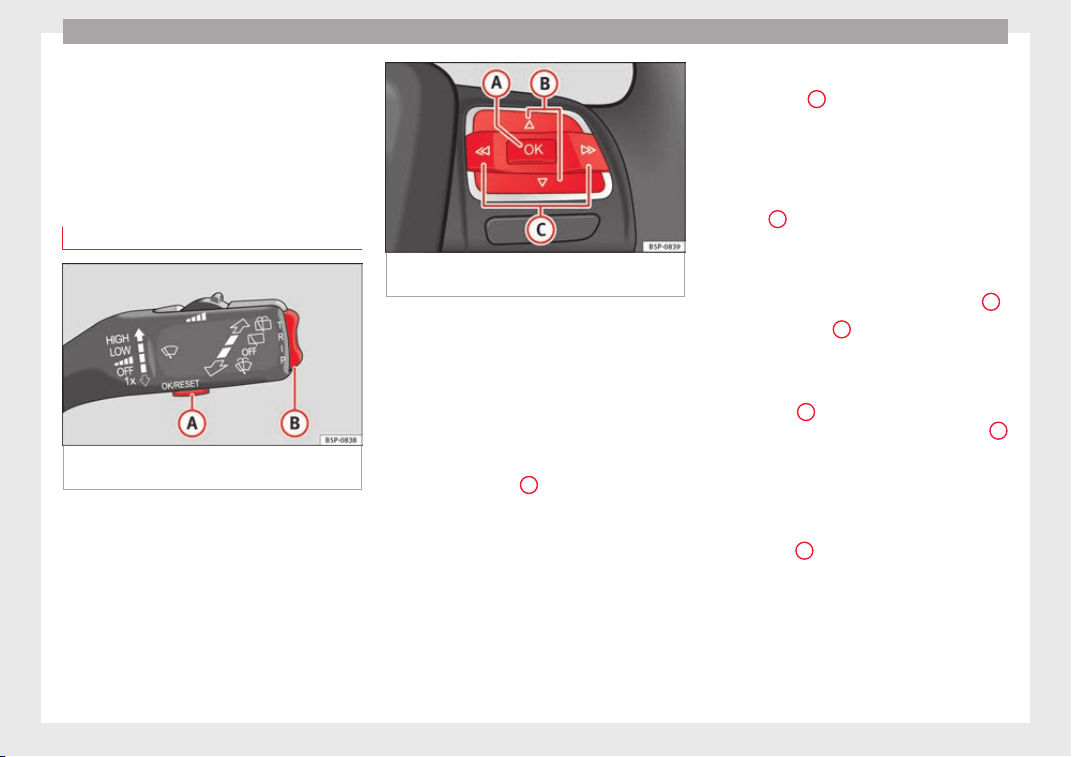
Operation
●
Windscreen washer fluid level symbol
with the information message ADD WIND-
SCREEN WASHER FLUID. Refill the windscreen
washer tank ››› page 171
.
In
s
trument panel menus*
Example of menu use
Fig. 36 Windscreen wiper lever: control but-
tons.
Fig. 37 Controls on the steering wheel: con-
trol buttons.
The setting of a speed warning will be used
as an example of how to use the menus. This
is a good idea if you are, for example, using
winter tyres which are not suited for the top
speed of the vehicle.
1. Open the main menu with the MFI lever
–
Switch the ignition on.
–
Hold down button
B
for 2 seconds to re-
turn to the main menu from another menu.
It may be necessary to repeat this opera-
tion until the main menu is displayed.
2. Open the menu “Configuration” with the
MFI lever
–
To choose an option from the menu, press
the upper or lower end of the rocker switch.
The selected option is displayed between
two lines and there will also be a triangle
on the right.
–
Select menu Configuration
.
–
Pr
e
ss button
A
on the windscreen wiper
lever. The Configuration menu is opened.
2. Access the “Configuration” menu with the
steering wheel controls
–
To access the “Configuration” menu, press
button
C
››› Fig. 37
until the menu is dis-
p
l
ayed. Now you are in this menu.
3. Open the main menu “Winter tyres”
–
Select option Winter tyres using switch
B
.
–
Press the button
A
. The menu Winter tyres
is opened.
4. Program a speed limit warning
–
Use button
B
to select the option
+10 km/h
or
-10 km/h
and press button
B
to either increase or decrease the speed
displayed.
5. To activate and deactivate the speed limit
warning
–
Use switch
B
to select the menu point
On / Off
and press the button to switch the
s
peed w
arning on or off. If the speed warn-
ing is deactivated, three dashes will be dis-
played ---.
6. To close the menu “Winter tyres”
–
In the menu select Back.
50
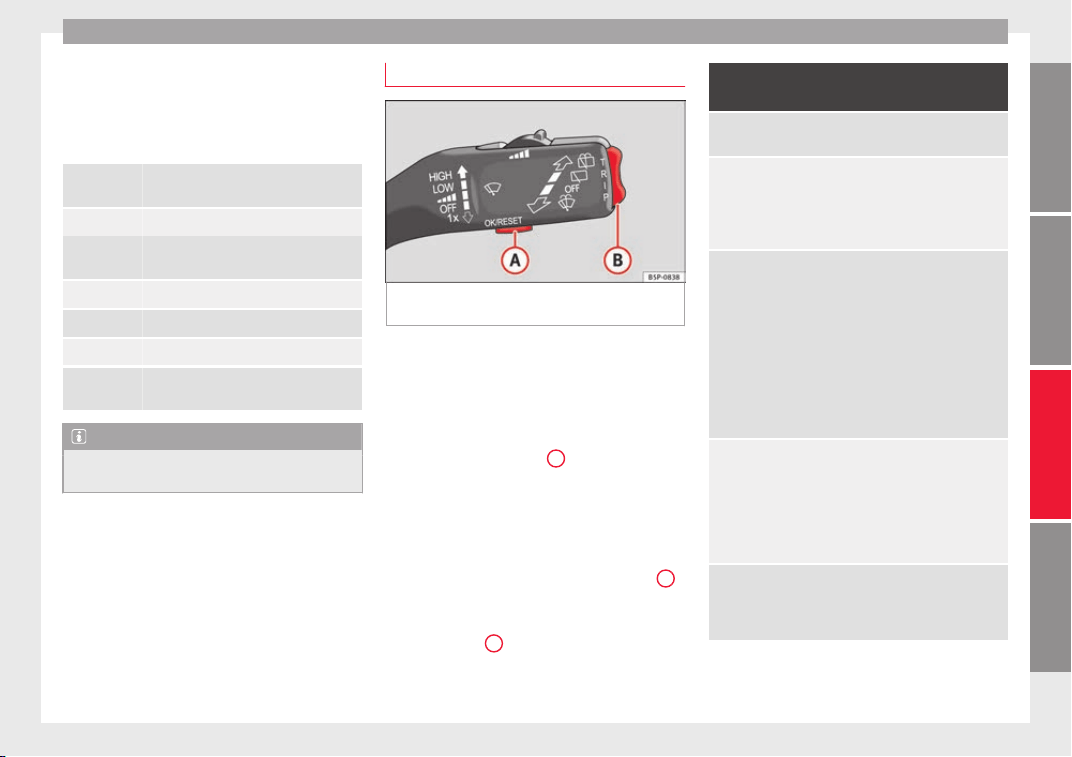
Dash panel
The function “Winter tyres” sends an optical
and an acoustic signal when the vehicle rea-
ches the set speed.
Example menu “Winter tyres”
In the menu
Winter tyres
Function
Name of menu displayed
X km/h The current set speed is displayed
or --- or dashes will appear if the function is
deactivated
On / Off If the function is activated or deactivated
+10 km/h The set value increases by 10 km/h
-10 km/h The set value decreases by 10 km/h
Back The menu “Winter tyres” is closed and
the last displayed menu is shown.
Note
For electronic and vehicle equipment one or
more of these menus will be displayed.
Main menu
Fig. 38 Windscreen wiper lever: control but-
tons.
The menu provides access to the different
display functions (only with the MFI lever).
Open main menu
–
Switch the ignition on.
–
Press and hold button
B
for at least 2 sec-
onds. It may be necessary to repeat this op-
eration until the main menu is displayed.
Select a menu from the main menu
–
To choose an option from the menu, press
the upper or lower end of rocker switch
B
.
The selected option is displayed between
two horizontal lines.
–
Press button
A
to select the entry.
Example of menu use ››› page 50
Main
menu
Function
Multifunc-
tion display
Change to the multifunction display
(MFI): “Multifunction display (MFI)”
Audio This menu displays the available infor-
mation for the active audio source (radio
station, CD audio track / MP3 / USB /
iPod / Bluetooth audio
a)
/ call informa-
tion
a)
.
Navigation This menu is only available if the vehicle
is fitted with a navigation system. The
navigation system must be switched on.
When the route guidance is activated,
the turning arrows and proximity bars are
displayed. The appearance is similar to
the Navigation system.
If the route guidance is not activated, the
direction of travel (compass) and the
name of the street along which you are
driving are shown.
Telephone This menu is only available in vehicles
with a radio unit and if the vehicle is fit-
ted with the telephone function. In vehi-
cles fitted with a radio navigation sys-
tem, this menu is available in the central
unit (navigator) ››› Booklet Navigation
system..
Vehicle con-
dition
This menu displays current warning or in-
formation texts: “Vehicle status menu”
This option flashes when one of these
texts is displayed.
»
51
Technical specifications
AdviceOperationSafety
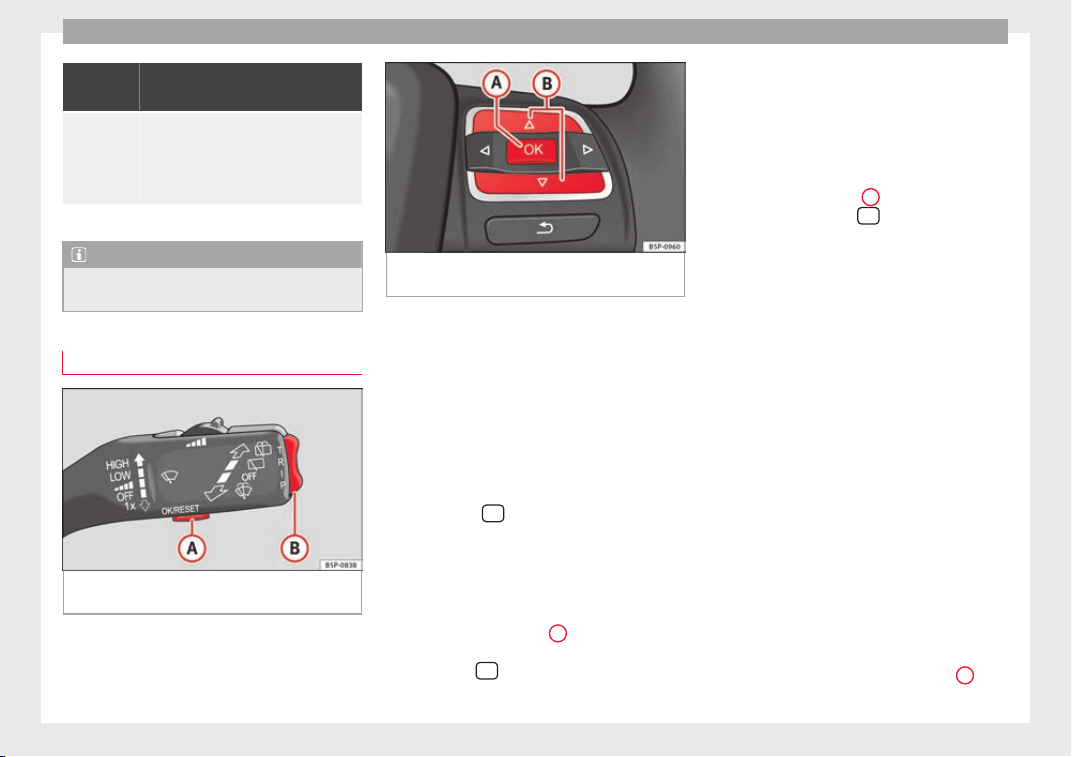
Operation
Main
menu
Function
Configura-
tion
This option allows the time, the speed
warning when using winter tyres, units,
language, independent heating, the
Light and visibility menu and the Conven-
ience menu to be reset.
a)
Only in vehicles fitted with a radio navigation system.
Note
For electronic and vehicle equipment one or
more of these menus will be displayed.
Multifunction display menu (MFI)
Fig. 39 Windscreen wiper lever: control but-
tons.
Fig. 40 Controls on the steering wheel: con-
trol buttons.
The multifunction display (MFI) shows you in-
formation on the journey and fuel consump-
tion. It has two automatic memories: 1 - Trip
memory and 2 - Total memory. The selected
memory is shown on the upper right hand
section of the display at all times.
Open the multifunction display menu
Select the Multifunction display menu
from the main menu ››› page 51 and
press the
OK
button on the windscreen
wiper lever or the multifunction steering
wheel*.
Selecting a memory
To change from one memory to another,
briefly press button
A
››› Fig. 36
››› page 50
on the windscreen wiper lev-
er or the
OK
button on the multifunction
–
–
steering wheel ››› Fig. 37
›
›› p
age 50
while the ignition is switched on.
Resetting a memory
Select the memory where you wish to
erase the values.
Hold down button
A
on the windscreen
wiper lever or the
OK
button on the mul-
tifunction steering wheel* for at least 2
seconds.
The
trip memory 1 c
o
llects the travel and
consumption data from the moment the igni-
tion is switched on until it is switched off. If
the journey is continued within two hours of
switching off the ignition, the new values will
be added to the existing trip recorder memo-
ry. The memory will automatically be deleted
if the journey is interrupted for more than 2
hours.
The total memory 2 collects the journey data
for any number of individual journeys (even if
the ignition is switched off for longer than 2
hours) up to a total of 19 hours and 59 mi-
nutes of travel time or 1,999 km (1,250
miles) of distance travelled. The memory will
automatically be deleted if one of the named
values is reached.
On-screen display
The following data can be viewed on the mul-
tifunction display using rocker switch
B
››› Fig. 36
›
›› p
age 50 on the windscreen wiper
–
–
52

Dash panel
lever or by pressing button
or
››› Fig. 37
on the multifunction steering wheel*:
●
Distance
●
Average speed
●
Driving speed
●
Speed warning at --- km/h
●
Journey duration
●
Current fuel consumption
●
Average fuel consumption
●
Operating range
●
Outside temperature
Distance travelled in km (miles)
The display shows the distance travelled
since the ignition was switched on.
The maximum display value in both memo-
ries is 1,999 km. The memory will automati-
cally be deleted once this value has been
reached.
Average speed in km/h (mph)
After starting the ignition, the average speed
will be shown after a distance of approxi-
mately 100 metres has been travelled. Until
then dashes will appear in the display. The
display will be updated every five seconds
while the vehicle is in motion.
km/h (mph) - Driving speed
Driving speed is digitally shown in the dis-
play.
Speed warning at --- km/h
This function may help you to keep within the
speed limits. Press the
OK
button on the
windscreen wiper lever
A
or the multifunc-
tion steering wheel* to select the current
speed. The instrument panel display gives
the selected speed, for example, Speed
warning 120 km/h
. You have 5 seconds to re-
set
the s
peed to between 30 km/h (18 mph)
and 250 km/h (155 mph) using rocker switch
B
or buttons
or
on the multifunction
steering wheel*. Press the
OK
button or wait
5 seconds until the speed is stored and the
warning is activated. If the set speed is ex-
ceeded, an audible warning is heard and a
warning message is displayed until the
speed is reduced to at least 4 km/h (2 mph)
below the stored speed. The function is
switched off by pressing the
OK
button
again.
Speed warning --- km/h (miles) is now
di
s
played on the instrument panel.
Trip duration in h and min
The display shows the amount of time which
has elapsed since the ignition was switched
on.
The maximum display value in both memo-
ries is 19 hours and 59 minutes. The memory
will automatically be deleted once this value
has been reached.
Current fuel consumption in l/100 km or l/hour
The display will show the current fuel con-
sumption in litres/100 km whilst the vehicle
is in motion or in litres/hour when the vehicle
is in a stationary position with the engine
running.
Using this display you can see how your driv-
ing style affects fuel consumption
››› page 117.
Average fuel consumption in l/100 km
The average fuel consumption will be shown
after a distance of approximately 100 metres
has been travelled. Until then dashes will ap-
pear in the display. The display will be upda-
ted every five seconds while the vehicle is in
motion. The amount of fuel used will not be
shown.
Km (miles) - Fuel range
The fuel range is calculated using the figures
for tank content and current fuel consump-
tion. This shows how far the vehicle can trav-
el using the same conditions as a reference.
Personal selection of display
The driver can establish which displays are
shown on the instrument panel display as re-
quired:
»
53
Technical specifications
AdviceOperationSafety
Operation
●
Select the submenu Multifunction Display
Data from the Configuration menu
››› page 54
.
●
The di
s
plays can be activated or deactiva-
ted individually by marking the required op-
tion and pressing the
OK
button on the wind-
screen wiper lever or the multifunction steer-
ing wheel*.
Outside temperature indicator
The measurement margin ranges from -45 °C
(-49 °F) to +58 °C (+136.4 °F). At tempera-
tures lower than +4°C (+39.2 °F), an “ice crys-
tal symbol” is displayed and a “warning” is
sounded if the vehicle is moving at more
than 20 km/h (12 mph) (ice warning). This
symbol flashes first for around 10 seconds
and remains lit as long as the outside tem-
perature does not rise above +4 °C (+39.2 °F)
or +6 °C (+42.8 °F) if it was already lit.
WARNING
There could be black ice on the road surface
even if the “snowflake symbol” is not shown.
For this reason you should not rely exclusive-
ly on this display - Risk of accident!
Note
●
There are different instrument panels;
therefore the multifunction display may vary.
●
When the vehicle is stationary or travelling
at very low speeds, the temperature dis-
played may be slightly higher than the actual
outside temperature as a result of the heat
radiated from the engine.
●
Vehicles with a multifunction steering
wheel* do not have buttons on the wind-
screen wiper lever. The multifunction display
can only be controlled from the buttons on
the multifunction steering wheel*.
Vehicle status menu
Open Vehicle Condition menu
–
Select the option Vehicle status from the
main menu: “Main menu” and press button
OK
on the windscreen wiper lever
A
››› Fig. 38
.
or
–
Pr
ess button
or
on the multifunction
steering wheel* ››› Fig. 37
until the V
ehicle
St
atus menu is displayed.
Priority 2 warning messages and information
texts: “Information and warning messages on
the screen” will automatically disappear from
the screen after a time and will be stored in
the Vehicle status menu.
The warning and information texts may be
viewed in this menu. If there is no warning or
information message, the option Vehicle sta-
tus is not displayed. If there are several mes-
sages, each one is shown for a few seconds.
Example of menu use ››› page 50.
Note
If there are no warning messages, this menu
is not available.
Configuration menu
Open Configuration menu
–
Select the option Configuration from the
main menu: “Main menu” and press button
OK
A
››› Fig. 36 on the windscreen wiper
lev
er. or
–
Pre
ss button
or
on the multifunction
steering wheel*
›››
Fig. 37
until the C
onfigu-
r
ation menu is displayed.
Example of menu use
›››
page 50.
Displayed on
the screen
Function
Multifunction
display data.
This menu is used to establish the da-
ta in the multifunction display menu
to be displayed on the instrument
panel ››› page 52
Convenience The convenience set-up mode is used
to make the settings for the conven-
ience functions in the vehicle.
Lights and visi-
bility
From this menu it is it possible to alter
the vehicle lighting settings.
54
Dash panel
Displayed on
the screen
Function
Time The hours and minutes of the clock
and the navigation system can be
changed. Choose between 12 and 24-
hour format and change to summer
time.
Winter tyres The menu allows the setting of a
speed at which an optical and acous-
tic warning will be given by the sys-
tem. You can use this function, for ex-
ample, if you have fitted winter tyres
which are not suited for the top speed
of your vehicle. Please see the section
“Wheels and tyres”.
Language The display texts and the navigation
system texts can be seen in different
languages.
Units This option allows you to select the
units for displaying temperature, fuel
consumption values and distances.
sel. speed The instrument panel also displays
the speed in another different unit of
measurement (mph or km/h) to that
given on the speedometer.
Inter. Service Consult service messages and reset
service interval display here.
Factory set-
tings
The manufacturer's predefined values
for the functions of this menu are re-
stored.
Back
a)
This returns to the main menu.
a)
Only if the windscreen wiper lever is used (MFI).
Note
●
For electronic and vehicle equipment one or
more of these menus will be displayed.
●
SEAT dealerships are able to programme
other functions or change the existing func-
tions depending upon the vehicle equipment.
●
The Configuration menu is only accessible
when the vehicle is at a standstill.
Convenience menu
Open menu Convenience
–
Choose the option
Configuration
from the
m
ain menu and press the button
OK
A
›››
Fig. 36
on the windscreen wiper lever.
–
Pr
e
ss button
or
on the multifunction
steering wheel*
›››
Fig. 37
until the C
onfigu-
r
ation menu is displayed.
–
Choose the option Convenience from the
main menu and press the button
A
on the
windscreen wiper lever.
Example of menu use
›››
page 50
Displayed on
the screen
Function
Central lock-
ing.
One door: Individual unlocking activa-
ted.
Auto lock: The doors are automatically
locked when the vehicle is travelling
at more than approx. 15 km/h
(10 mph).
Auto unlock: the doors are unlocked
when the key is removed from the ig-
nition.
Elec. window
control
Opening and closing electric win-
dows: this determines whether to
open or close all the windows when
the vehicle is unlocked or locked. The
open function can also be activated
for the driver door only.
Exterior mirror
adjust.
If synchronised adjustment is selec-
ted, when the driver side exterior mir-
ror is adjusted, the passenger exterior
mirror is also moved.
Factory set-
tings
The predefined factory values for the
functions of this menu are restored.
Back This returns to the Configuration
menu.
Note
For electronic and vehicle equipment one or
more of these menus will be displayed.
55
Technical specifications
AdviceOperationSafety
Operation
Lights and visibility menu
Open Lights and visibility Menu
–
Select the option Configuration from the
main menu: “M
ain menu” and press button
OK
A
››› page 50 on the windscreen wiper
lev
er. or
–
Press button
or
on the multifunction
steering wheel* ››› Fig. 37 until the Configu-
r
ation menu is displayed.
–
Select the option Lights & visibil. from the
menu and press button
A
on the wind-
screen wiper lever.
Example of menu use
›››
page 50.
Displayed on
the screen
Function
Coming Home/
Leaving Home
This option permits the adjustment of
the time during which the headlamps
remain lit after the vehicle is locked,
as well as connecting and disconnect-
ing this function.
Indicator conf. The convenience turn signal function
can be activated or deactivated here.
With convenience mode activated, the
turn signal will blink at least three
times when turned on for a lane
change.
Factory set-
tings
The predefined factory values for the
functions of this menu are restored.
Displayed on
the screen
Function
Back This returns to the Configuration
menu.
Note
For electronic and vehicle equipment one or
more of these menus will be displayed.
56
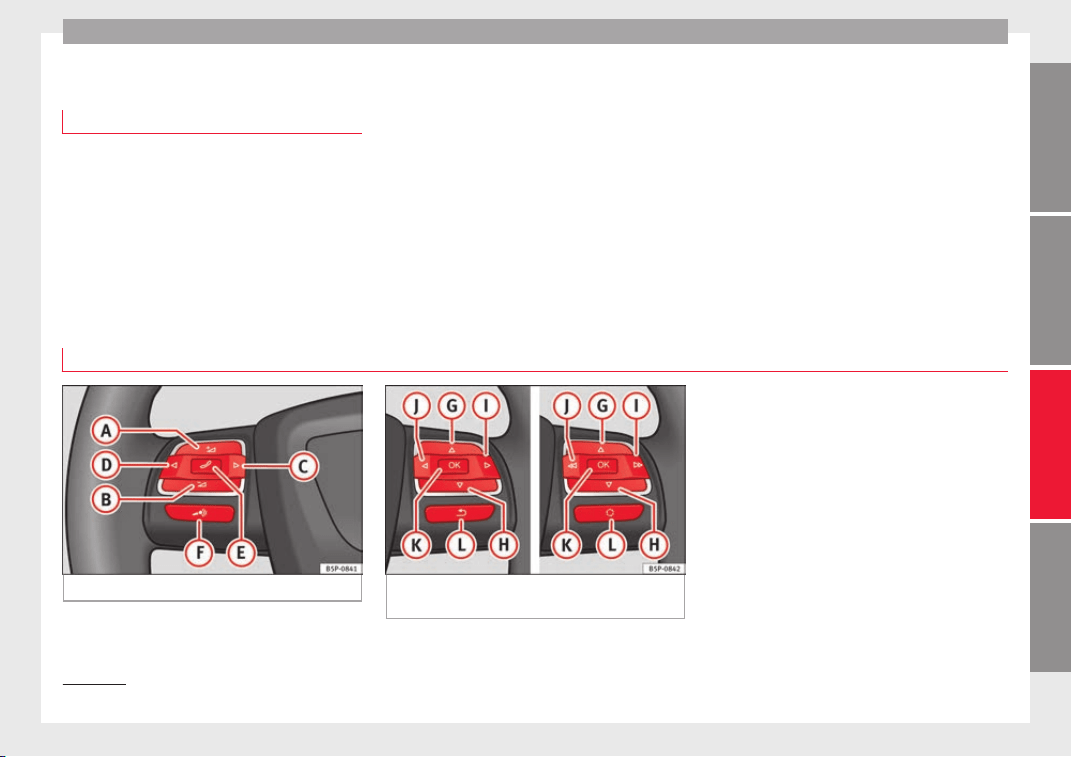
Steering wheel controls*
Steering wheel controls*
General information
The steering wheel includes a multifunction
module from where it is possible to control
the audio, telephone and radio navigation
functions, and the automatic gearbox*, with-
out requiring the driver to be distracted from
driving.
There are three versions of the multifunction
module:
●
Audio version, to control the available au-
dio functions from the steering wheel.
●
Audio + Telephone version, to control the
available audio functions and the telephone
system from the steering wheel.
Both versions may be used to control the au-
dio system (radio, Audio CD, mp3 CD,
iPod
1)
/USB
1)
/SD
1)
) and the radio navigation
system, in which case they also control the
navigation system.
●
Version for automatic gearbox*
››› page 129
.
Audio sy
s
tem
Steering wheel audio version controls
Fig. 41 Steering wheel controls. Fig. 42 Steering wheel controls (depending
on version of model).
»
1)
If fitted in the vehicle.
57
Technical specifications
AdviceOperationSafety
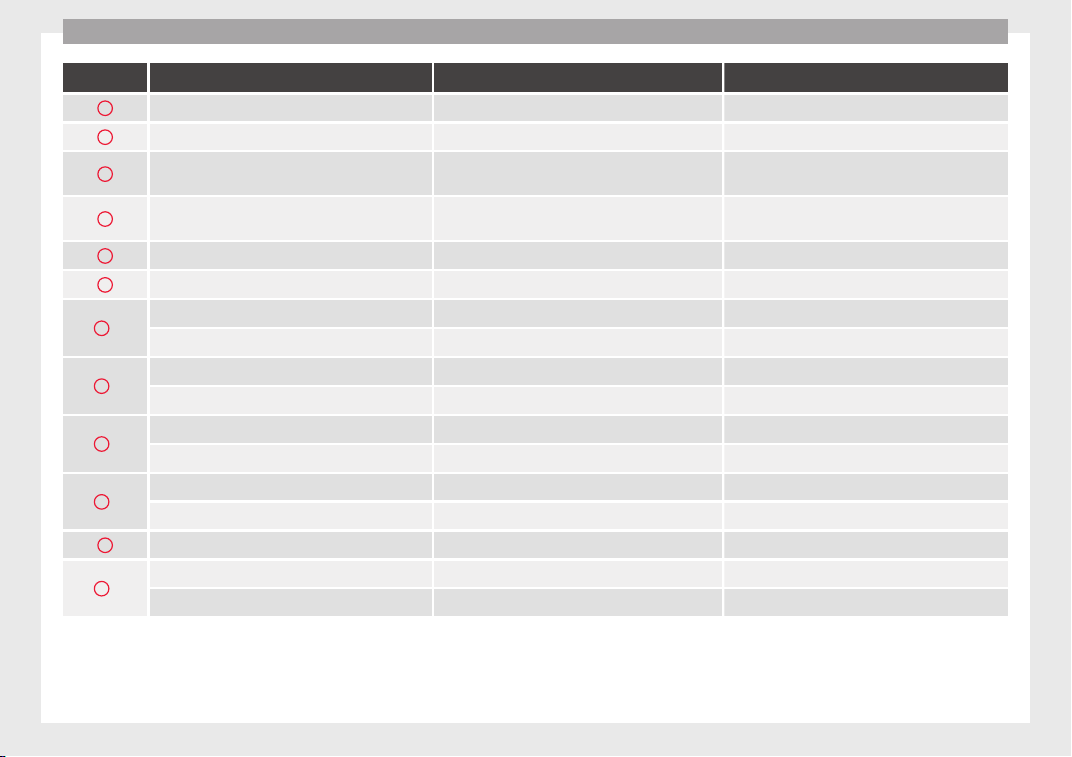
Operation
Button Radio CD/MP3/USB*/iPod* AUX ››› table on page 59
A
Volume up Volume up Volume up
B
Volume down Volume down Volume down
C
Search for next station
Next track
Hold down: fast forward
No function specified
D
Search for last station
Previous track
Hold down: quick rewind
No function specified
E
No function specified No function specified No function specified
F
Mute Pause Mute
G
a)
Operates on instrument panel display Operates on instrument panel display Operates on instrument panel display
Next preset
b)
Next track
b)
No function specified
b)
H
a)
Operates on instrument panel display Operates on instrument panel display Operates on instrument panel display
Previous preset
b)
Previous track
b)
No function specified
b)
I
a)
Next preset Change folder No function specified
Change menu on instrument panel Change menu on instrument panel Change menu on instrument panel
J
a)
Previous preset Change folder No function specified
Change menu on instrument panel Change menu on instrument panel Change menu on instrument panel
K
Operates on instrument panel Operates on instrument panel Operates on instrument panel
L
a)
Change source Change source Change source
Operates on instrument panel Operates on instrument panel Operates on instrument panel
a)
Depending on the model version
b)
Only if the panel is in Audio menu.
58
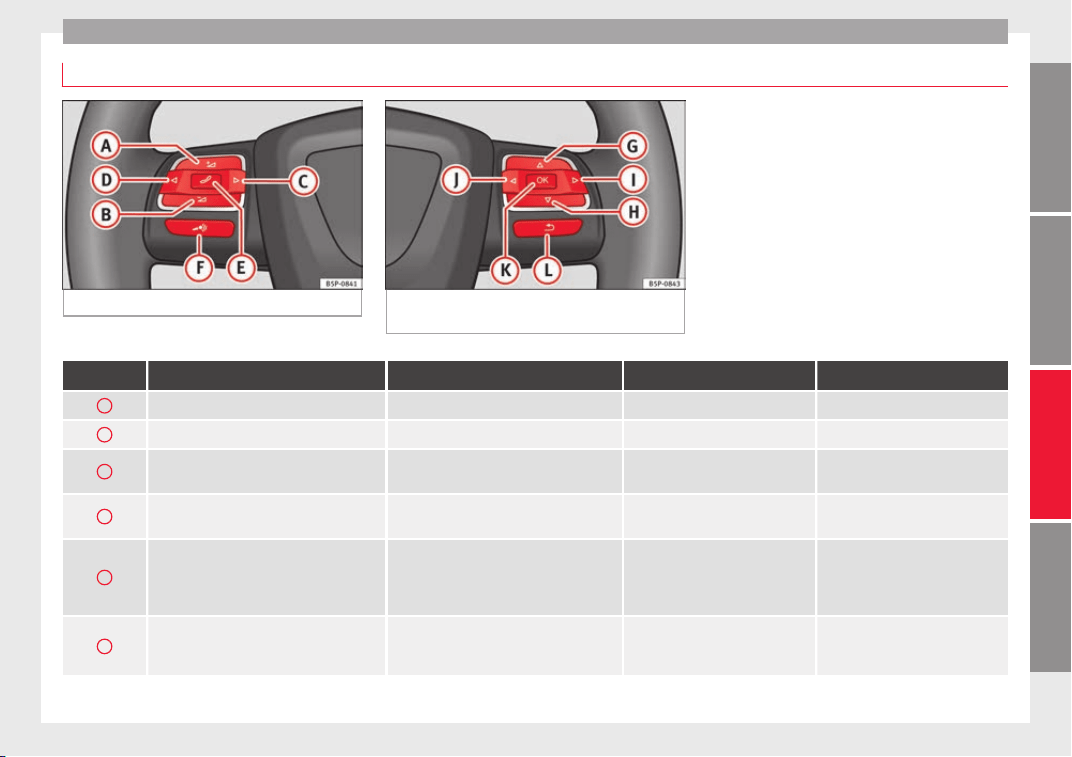
Steering wheel controls*
Steering wheel audio version + telephone controls
Fig. 43 Steering wheel controls. Fig. 44 Steering wheel controls (depending
on version of model).
Button Radio CD/MP3/USB*/iPod* AUX TELEPHONE
A
Volume up Volume up Volume up Volume up
B
Volume down Volume down Volume down Volume down
C
Search for next station
Next track
Hold down: fast forward
No function specified No function specified
D
Search for last station
Previous track
Hold down: quick rewind
No function specified No function specified
E
Access telephone menu on instrument pan-
el
Access telephone menu on instrument pan-
el
Access telephone menu on instru-
ment panel
Make call
Accept incoming call
End call
Hold down: reject incoming call
F
Enable voice recognition Enable voice recognition Enable voice recognition
Activate voice control/
Interrupt current message/
Deactivate voice control
»
59
Technical specifications
AdviceOperationSafety

Operation
Button Radio CD/MP3/USB*/iPod* AUX TELEPHONE
G
Next preset
a)
Next track
a)
No function specified
Previous option in the menu/
list/
selection shown on instrument
panel
b)
H
Previous preset
a)
Previous track
a)
No function specified
Next option in the menu/
list/
selection shown on instrument
panel
b)
I
Change menu on instrument panel Change menu on instrument panel Change menu on instrument panel Change menu on instrument panel
J
Change menu on instrument panel Change menu on instrument panel Change menu on instrument panel Change menu on instrument panel
K
Operates on instrument panel Operates on instrument panel Operates on instrument panel Confirm
L
Operates on instrument panel Operates on instrument panel Operates on instrument panel Back to last-opened menu
a)
Only if the panel is in audio menu.
b)
Only if the instrument panel is in the “TELEPHONE” menu. Examples of use: agenda, call list, select numbers, select letters, main menu.
60
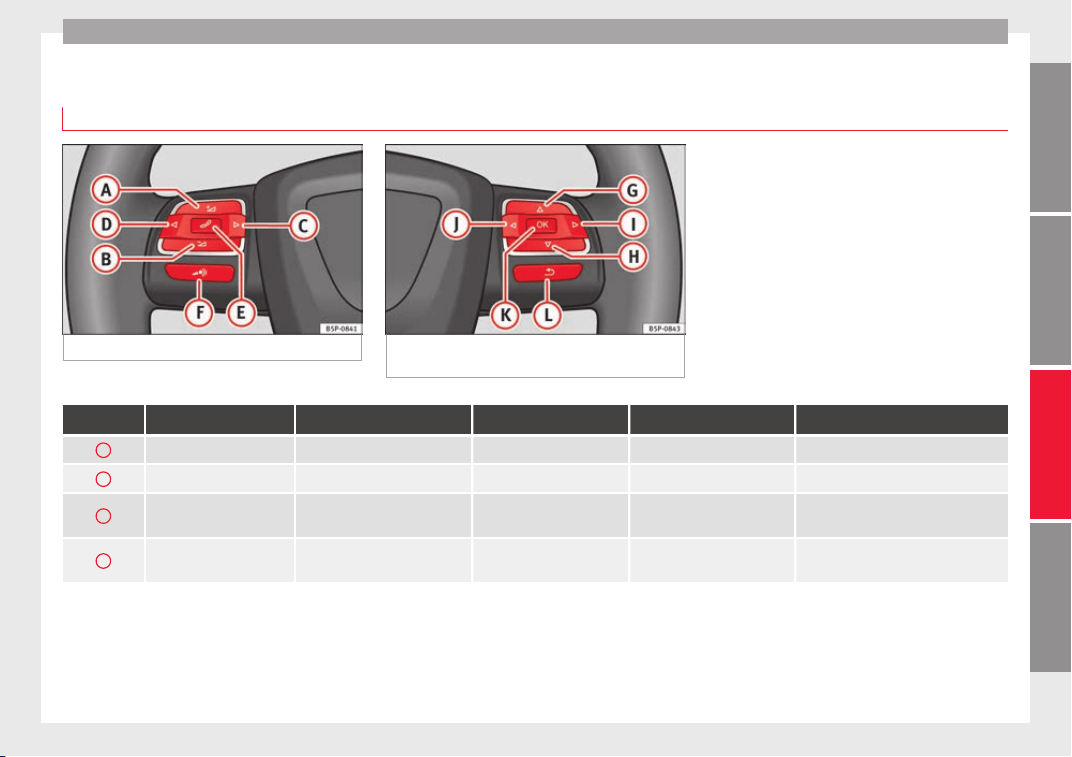
Steering wheel controls*
Radio navigation system
Steering wheel audio version + telephone controls
Fig. 45 Steering wheel controls. Fig. 46 Steering wheel controls (depending
on version of model).
Button Radio CD/MP3/USB*/iPod* AUX NAVIGATOR TELEPHONE
A
Volume up Volume up Volume up Volume up Volume up
B
Volume down Volume down Volume down Volume down Volume down
C
Search for next station
Next track
Hold down: fast forward
No function specified No function specified No function specified
D
Search for last station
Previous track
Hold down: quick rewind
No function specified No function specified No function specified
»
61
Technical specifications
AdviceOperationSafety
Operation
Button Radio CD/MP3/USB*/iPod* AUX NAVIGATOR TELEPHONE
E
No function specified No function specified No function specified No function specified
Accept incoming call (press briefly)
Reject incoming call (press and hold
down)
End ongoing call /establish call (press
briefly)
Switch to private mode (press and hold
down)
Redial last number (press and hold
down)
a)
F
Activation of voice recog-
nition for mobile phone
connected to the system
(if the phone has this
function)* / MUTE
Activation of voice recognition
for mobile phone connected to
the system (if the phone has
this function)* / MUTE
Activation of voice recogni-
tion for mobile phone con-
nected to the system (if the
phone has this function)* /
MUTE
Activation of voice recogni-
tion for mobile phone con-
nected to the system (if the
phone has this function)* /
MUTE
Activation of voice recognition for mo-
bile phone connected to the system (if
the phone has this function)* / MUTE
G
Next preset
b)
Next track
b)
No function specified
Operates on instrument pan-
el
Operates on instrument panel/no func-
tion specified
H
Previous preset
b)
Previous track
b)
No function specified
Operates on instrument pan-
el
Operates on instrument panel/no func-
tion specified
I
Change menu on instru-
ment panel
Change menu on instrument
panel
Change menu on instru-
ment panel
No function specified Change menu on instrument panel
J
Change menu on instru-
ment panel
Change menu on instrument
panel
Change menu on instru-
ment panel
No function specified Change menu on instrument panel
K
Operates on instrument
panel
Operates on instrument panel
Operates on instrument
panel
Operates on instrument pan-
el
Operates on instrument panel/no func-
tion specified
L
Operates on instrument
panel
Operates on instrument panel
Operates on instrument
panel
Operates on instrument pan-
el
Operates on instrument panel/no func-
tion specified
a)
For a more detailed description of how to use this button, please refer to the radio navigation system user handbook (SEAT Media System)
b)
Only if the panel is in audio menu.
62
Opening and closing
Opening and closing
Central locking
Basic functions
The central locking system enables you to
lock and unlock all doors and the rear lid by
just pushing the button.
Description
Central locking can be activated by using any
of the following options:
●
the key
, by inserting it into the driver door
cylinder and r
ot
ating it manually,
●
the central lock button in the vehicle interi-
or
›››
page 65.
●
the radio frequency remote control, using
the buttons on the key
›››
page 67.
Various functions are available to improve
the vehicle safety:
“Safe” locking system
Selective unlocking system*
Automatic speed-dependent locking and
unlocking system*
Self-locking system to prevent involunta-
ry unlocking
Emergency unlocking system
–
–
–
–
–
Unlocking the vehicle*
Press button
››› Fig. 50
on remote
c
ontr
ol to unlock all the doors and rear
lid.
Locking the vehicle*
Press button
››› Fig. 50
on the remote
c
ontr
ol to lock all doors and the rear lid
or turn the key in the door to lock all
doors and the rear lid.
WARNING
●
Never leave children or disabled persons in
the vehicle. In case of emergency, they may
not be able to leave the vehicle or manage on
their own.
●
Never allow children to play in or around
the vehicle. A locked vehicle can be subjected
to extremely high and low temperatures, de-
pending on the time of year, thus causing se-
rious injuries/illness. It could even have fatal
consequences. Close and lock both the rear
lid and all the other doors when you are not
using the vehicle.
●
Always take you car keys with you when
you leave the vehicle. Misuse of the keys, for
example, by children, may result in serious
damage and accident.
–
The engine may accidentally be started
and be out of control.
–
If the ignition is switched on, the electric
equipment could be activated with risk of
–
–
injury, for example, in the electric win-
dows.
–
The doors can be locked using the remote
control key. This could become an obsta-
cle for assistance in an emergency situa-
tion.
–
Always take the key with you when you
leave the vehicle.
●
Never remove the key from the ignition if
the vehicle is in motion. The steering lock
could suddenly engage, and you would not be
able to steer the vehicle.
Note
●
While the driver door is open, the vehicle
cannot be locked with the remote control.
This avoids the user from forgetting his key
inside the vehicle.
●
If the driver door is unlocked with the key
shaft, only the driver door is unlocked, the
rest of the doors remain locked. When the ig-
nition is switched on, the door “deadlock”
function is deactivated (although the doors
remain locked) and the central lock button is
activated. See ››› page 68.
●
If the c
entral locking or anti-theft alarm are
faulty, the driver door control lamp remains
lit for approx. 30 seconds after the vehicle
locks.
●
For anti-theft security, only the driver door
is fitted with a lock cylinder.
63
Technical specifications
AdviceOperationSafety
Operation
“Safe” security system*
This is an anti-theft device which consists of
a double lock for the door locks and a deacti-
vation function for the boot in order to pre-
vent forced entry.
Activating the “deadlock”
–
Press once the locking button
on the re-
mote control. or
–
Turn the k
ey once in the driver door lock to
lock. A warning lamp in the driver door
flashes to indicate the “deadlock” is work-
ing. The warning lamp flashes for approx. 2
seconds at short intervals and then more
slowly.
Deactivating the “deadlock” when the
vehicle is locked
–
Press the lock button
on the remote con-
trol twice
within 2 seconds. The vehicle is
loc
k
ed without activating the “deadlock”.
The driver door warning lamp flashes for
approx. 2 seconds and then goes out. It
flashes again after around 30 seconds.
The doors can be unlocked and opened from
the inside if the “deadlock” has not been ac-
tivated. You will have to pull the door release
lever once. When the “deadlock” is off, the
anti-theft alarm*
›››
page 68 remains active.
The vehicle interior monitoring system* and
the anti-tow system are deactivated*.
WARNING
Nobody should remain in the vehicle if the
“deadlock” system mechanism has been acti-
vated. It is not possible to open the doors
from the inside. Locked doors could delay as-
sistance in an emergency. People could be-
come trapped inside in an emergency.
Selective unlocking system*
This system allows to unlock either just the
driver door or all the vehicle.
Using the remote control, press the unlock
button on the remote
once. The “Safe”
system for all the vehicle is deactivated, only
the driver door is unlocked and both the
alarm and the warning lamp are also turned
off.
Unlocking all doors and the luggage
compartment
The unlock button on the remote control
must be pressed twice
so that all doors
and the luggage compartment can be
opened.
Press twice within 2 seconds to deactivate
the “Safe” system for all vehicle, to unlock all
doors and to use the luggage compartment.
The warning lamp and the alarm (only vehi-
cles fitted with one) are turned off.
Automatic speed-dependent locking
and unlocking system*
This is a safety system which prevents access
to the vehicle from the outside when it is run-
ning (e.g. when stopped at a traffic light).
Locking
The doors and boot will lock automatically if
the speed of 15 km/h (9 mph) is exceeded.
If the vehicle is stopped and one of the doors
is opened, when the vehicle moves off again
and exceeds a speed of 15 km/h (9 mph),
the unlocked door(s) will lock once more.
Unlocking
The driver door automatically unlocks when
the key is removed from the ignition.
Each door can be unlocked and opened inde-
pendently from the inside (for example, when
a passenger gets out). To do it, simply oper-
ate the lever inside the door.
WARNING
The door handles must not be operated when
the vehicle is running: the door would open.
64
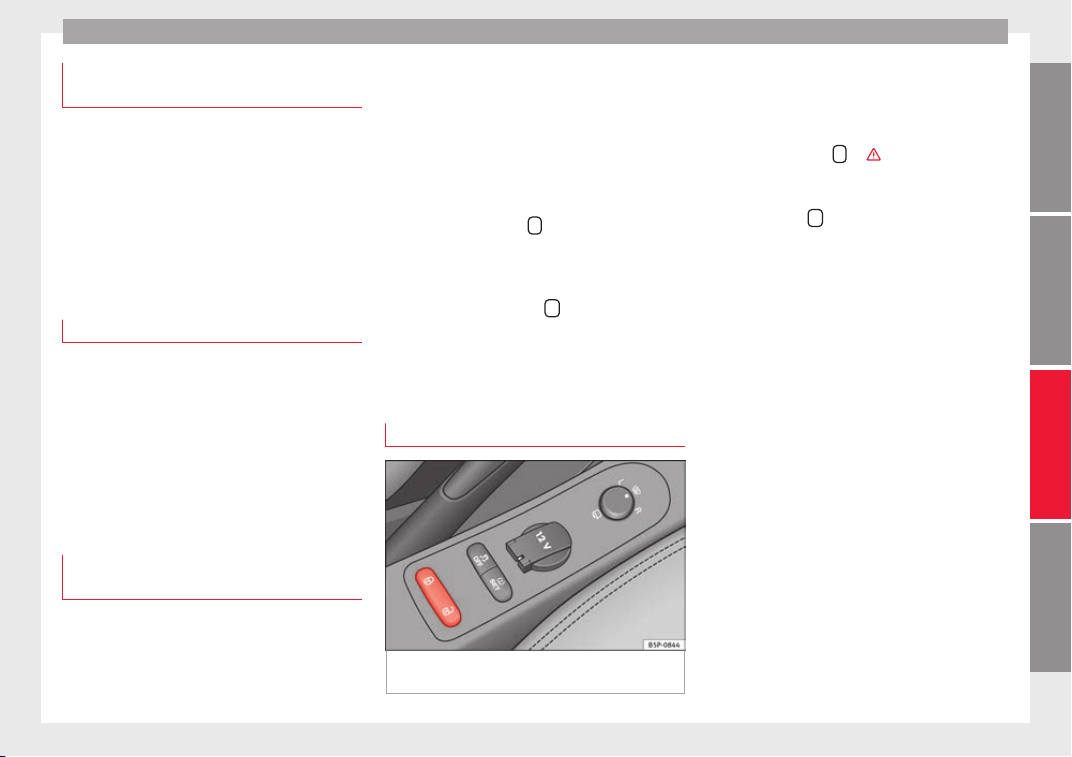
Opening and closing
Automatic locking system for
involuntary unlocking*
It is an anti-theft system and prevents the un-
intentional unlocking of the vehicle.
If the vehicle is unlocked and none of the
doors (including the boot) are opened within
30 seconds, it re-locks automatically. This
function prevents the vehicle from remaining
unlocked if the unlock button is pressed by
mistake.
Emergency unlocking system
If the airbags are triggered during an acci-
dent, the vehicle is unlocked, except for the
luggage compartment. It is possible to lock
the vehicle from inside with the central lock-
ing, after turning the ignition off and back on
again.
If the doors must be locked from the outside,
see “Emergency locking of the doors”.
Unlocking and locking - Manual
personalisation
Activating selective unlocking
With the driver door open, turn the key to un-
lock for approx. 3 seconds.
Deactivating selective unlocking
With the driver door open, turn the key to
lock for approx. 3 seconds.
The turn signal lamps flash to confirm activa-
tion or deactivation.
Activation of automatic locking
Press the lock button
on the central lock-
ing button for 3 seconds.
Deactivation of automatic locking
Press the unlock button
on the central
locking button for 3 seconds.
The lock button lamp flashes to confirm acti-
vation or deactivation.
Central lock button
Fig. 47 Detailed view of the centre console:
central locking button.
The central lock button allows you to lock and
unlock the vehicle from the inside.
Locking the vehicle
–
Press the button
››› .
Unlocking the doors
–
Press button
.
The central lock button also works with the
ignition switched off, except when the “safe”
system is activated.
Please note the following if you lock your ve-
hicle with the central lock button:
●
Locking the doors and rear lid prevents ac-
cess from the outside
(for safety reasons, e.g.
when s
t
opped at a traffic light).
●
The driver door and/or front passenger
door cannot be locked if any of the vehicle
doors (except the boot) are open. This avoids
the user from forgetting his key inside the ve-
hicle.
●
Repeated operation of the central locking
will deactivate the central lock button for 30
seconds. Once this time has passed, the but-
ton if operative again.
●
There is a danger of leaving the key inside
the vehicle if the vehicle is locked by the cen-
tral locking button when the driver door is
closed and any of the rear doors open. On
closing any of the rear doors, the vehicle
locks and the keys remain inside it.
»
65
Technical specifications
AdviceOperationSafety
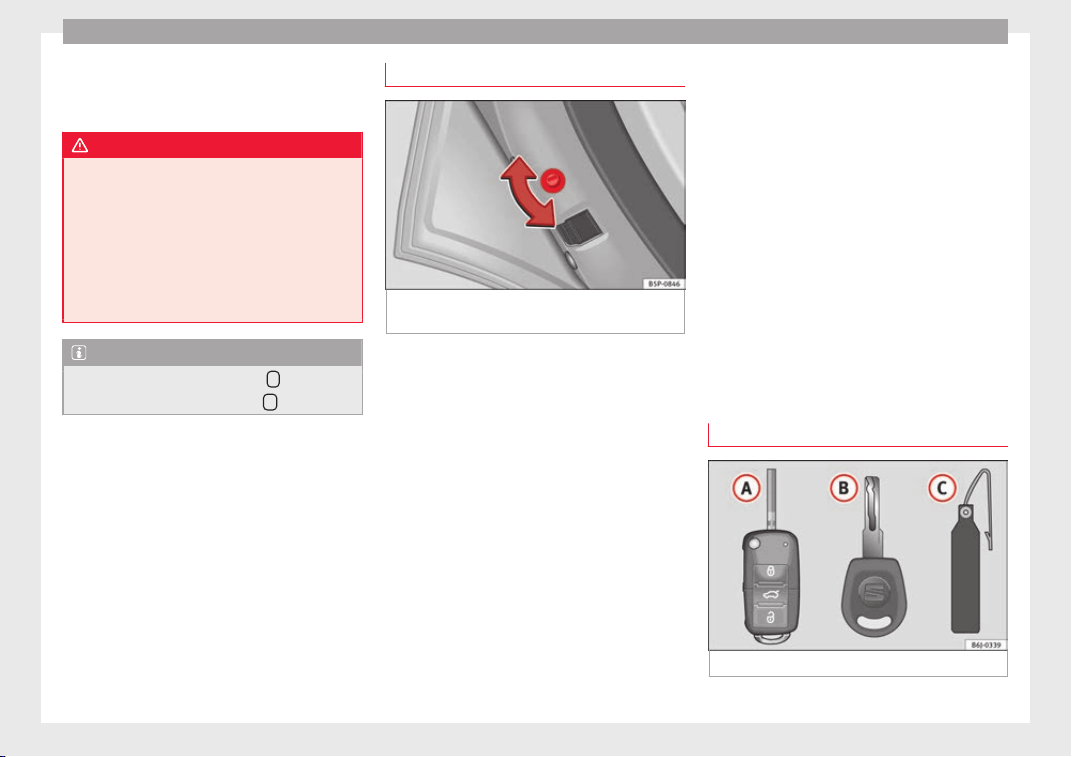
Operation
●
All doors can be unlocked separately from
inside the vehicle. Do this by pulling the door
release lever
once
.
WARNING
●
If the vehicle is locked, children and disa-
bled people may be trapped inside it.
●
The central lock button is not operative in
the following cases:
●
When the vehicle is locked from the outside
(with the remote control or the key).
●
While the ignition is not activated after un-
locking the door lock cylinder with the key.
Note
●
Vehicle locked, amber button
.
●
Vehicle unlocked, red button
.
Childproof lock
Fig. 48 Childproof lock on the left hand side
door.
The childproof lock prevents the rear doors
from being opened from the inside. This sys-
tem prevents minors from opening a door ac-
cidentally while the vehicle is running.
This function is independent of the vehicle
electronic opening and locking systems. It
only affects rear doors. It can only be activa-
ted and deactivated manually, as described
below:
Activating the childproof lock
–
Unlock the vehicle and open the door in
which you wish to activate the childproof
lock.
–
With the door open, rotate the slot in the
door using the ignition key, clockwise for
the left-hand side doors and anti-clockwise
for the right-hand side doors ››› Fig. 48
.
D
e
activating the childproof lock
–
Unlock the vehicle and open the door
whose childproof lock you want to deacti-
vate.
–
With the door open, rotate the slot in the
door using the ignition key, clockwise for
the right-hand side doors, and anti-clock-
wise for the left-hand side doors ››› Fig. 48.
Once the childproof lock is activated, the
door can only be opened from the outside.
The childproof lock can be activated or deac-
tivated by inserting the key in the slot when
the door is open, as described above.
Keys
Set of keys
Fig. 49 Set of keys.
66
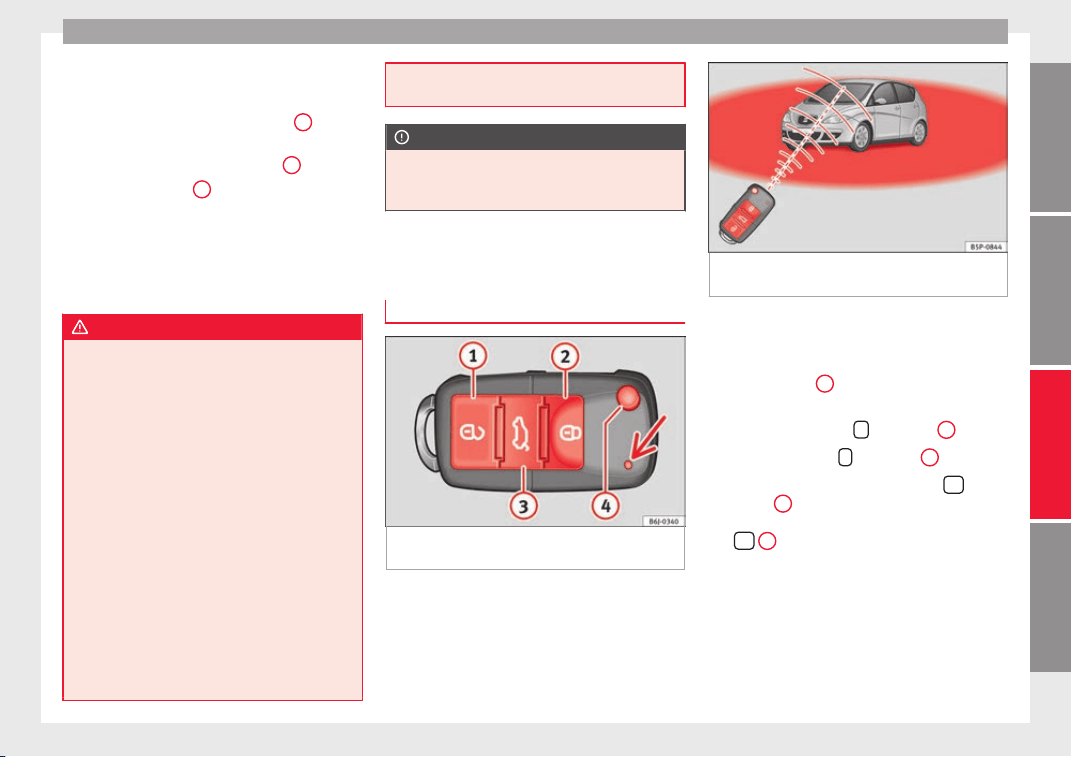
Opening and closing
The set of keys belonging to your vehicle con-
sists of the following items:
●
one remote control key ››› Fig. 49
A
with
folding key bit,
●
one key without remote control
B
,
●
a plastic key tab*
C
.
Duplicate keys
If you need a replacement key, go to a Techni-
cal Service with your vehicle identification
number.
WARNING
●
An incorrect use of the keys can cause seri-
ous injuries.
●
Never leave children or disabled persons in
the vehicle. In case of emergency, they may
not be able to leave the vehicle or manage on
their own.
●
An uncontrolled use of the key could start
the engine or activate any electric equipment
(e.g. electric windows), causing risk of acci-
dent. The doors can be locked using the re-
mote control key. This could become an ob-
stacle for assistance in an emergency situa-
tion.
●
Never forget the keys inside the vehicle. An
unauthorised use of your vehicle could result
in injury, damage or theft. Always take the
key with you when you leave the vehicle.
●
Never remove the key from the ignition if
the vehicle is in motion. Otherwise, the steer-
ing could suddenly block and it would be im-
possible to steer the vehicle.
CAUTION
There are electronic components in the re-
mote control key. Avoid wetting and hitting
the keys.
Radio frequency remote control
Locking and unlocking the vehicle
Fig. 50 Assignment of buttons on the remote
control key.
Fig. 51 Range of the radio frequency remote
control.
The radio frequency remote control key is
used to lock and unlock the vehicle from a
distance.
By using button
4
››› Fig. 50
on the control,
the k
ey
shaft is released.
Unlocking the vehicle
››› Fig. 50
1
.
Locking the vehicle
››› Fig. 50
2
.
Unlocking the rear lid. Press button
››› Fig. 50
3
until all the turn signals on the
vehicle flash briefly. When the unlocking but-
ton
3
is pressed, you have 2 minutes to
open the door. Once this time has passed, it
will lock again.
Moreover, the battery indicator on the key
››› Fig. 50
(arrow), will flash.
The r
emot
e control transmitter and the bat-
teries are integrated in the key. The receiver
»
67
Technical specifications
AdviceOperationSafety
Operation
is inside the vehicle. The maximum range de-
pends on different factors. The range is re-
duced as the batteries start to lose power.
Selective unlocking*
When the button
››› Fig. 50
1
, is pressed
once, the driver door is unlocked, all others
remain locked.
Press the button
››› Fig. 50
1
twice to un-
lock all doors.
WARNING
Read and observe the relevant warnings ›››
in Set of keys on page 67
Note
●
The radio frequency remote control can be
programmed by means of pressing the un-
locking button once; as a result, only the
driver door will unlock. When the button is
pressed once more, all doors and the rear lid
will be unlocked.
●
The radio frequency remote control func-
tions only when you are in range ››› Fig. 51
(red area).
●
If the vehicle is unlocked using the
1
button, it will lock again automatically if any
of the doors or the rear lid are not opened
within 30 seconds after unlocking it. This
function prevents the vehicle from remaining
unlocked if the unlock button is pressed by
mistake.
●
If the vehicle cannot be opened and closed
using the radio frequency remote control, the
remote control key will have to be re-
synchronised ››› page 68.
Changing the battery
If the battery indicator does not flash when
the buttons are pushed, the battery must be
replaced.
CAUTION
The use of inappropriate batteries may dam-
age the radio frequency remote control. For
this reason, always replace the dead battery
with another of the same size and power.
For the sake of the environment
Used batteries must be disposed of at an ap-
propriate waste facility or through an author-
ised service, given that their components can
affect the environment.
Synchronising the remote control key
If it is not possible to unlock or lock the door
with the remote control, it should be re-
synchronised.
–
Press the
›››
Fig. 50
button on the re-
mot
e c
ontrol.
–
Then close the vehicle using the key shaft
within one minute.
It is possible that the vehicle could no longer
be opened and closed with the remote con-
trol if the button
is repeatedly pressed
outside of the effective range of the radio fre-
quency remote control. The remote control
key will have to be resynchronised.
Spare remote control keys are available at
your Technical Service, where they must be
matched to the locking system.
Up to four remote control keys can be used.
Anti-theft alarm system*
Description of anti-theft alarm
system*
The anti-theft alarm makes it more difficult to
break into the vehicle or steal it. Audible and
visible alarms are triggered if the vehicle is
opened using the key, or if unauthorised ac-
cess to the vehicle is forced.
The anti-theft alarm system is automatically
switched on when locking the vehicle. The
system is then primed.
●
The turn signal light will flash twice on
opening and deactivating the alarm.
68
Opening and closing
●
The turn signal light will flash once on clos-
ing and activating the alarm.
When does the system trigger an alarm?
The system triggers an alarm if the following
unauthorised actions are carried out when
the vehicle is locked:
●
Opening the vehicle mechanically using
the key and with the ignition off.
●
A door is opened.
●
Opening the bonnet.
●
The rear lid is opened.
●
Ignition switched on with a non-validated
key.
●
Movements in the driving compartment
(vehicles with interior monitoring).
●
Undue manipulation of the alarm.
●
Battery handling.
The acoustic signals sound and the turn sig-
nals flash for approx. 30 seconds. This cycle
may be repeated up to 10 times depending
on the country.
Opening the doors mechanically (emergency
opening)
If the radio frequency remote control function
fails, you will have to use the key to unlock
the vehicle. This is done as follows:
●
Use the lock on the driver door to unlock
the vehicle. The anti-theft alarm system re-
mains active, but an alarm is not triggered
immediately.
●
Switch on the ignition within 15 seconds.
When the ignition is switched on, the elec-
tronic immobiliser recognises a valid vehicle
key and deactivates the anti-theft alarm sys-
tem. If you do not switch on the ignition with-
in 15 seconds, the alarm is triggered (in cer-
tain markets, such as the Netherlands, there
is no 15-second waiting time and the alarm
is activated immediately after opening the
door).
Opening all the doors in manual mode
In vehicles without an alarm, when opening
the driver door manually, all doors are
opened.
How to switch the alarm off
When the vehicle is unlocked via the unlock-
ing button of the radio frequency remote con-
trol or when the key is inserted in the ignition
lock.
Note
●
After 28 days, the indicator light will be
switched off to prevent the battery from
draining if the vehicle has been left parked
for a long period of time. The alarm system
remains activated.
●
If, after the audible warning turns off, an-
other monitored area is accessed (e.g. the
boot hatch is opened after a door has been
opened), the alarm is triggered again.
●
The anti-theft alarm is not activated when
the vehicle is locked from within using the
central locking button
.
●
If the vehicle battery is run down or flat
then the anti-theft alarm will not operate cor-
rectly.
●
Vehicle monitoring remains active even if
the battery is disconnected or not working for
any reason.
●
The alarm is triggered immediately if one of
the battery cables is disconnected while the
alarm system is active.
Interior monitoring*
This is a monitoring or control function incor-
porated in the anti-theft alarm* which de-
tects unauthorized vehicle entry by means of
ultrasound.
The system consists of 3 sensors, 2 emitters
and a receptor.
Activation
–
It is automatically turned on with the anti-
theft alarm, when the vehicle is locked me-
chanically with the key and when the but-
ton
on the remote control is used.
»
69
Technical specifications
AdviceOperationSafety
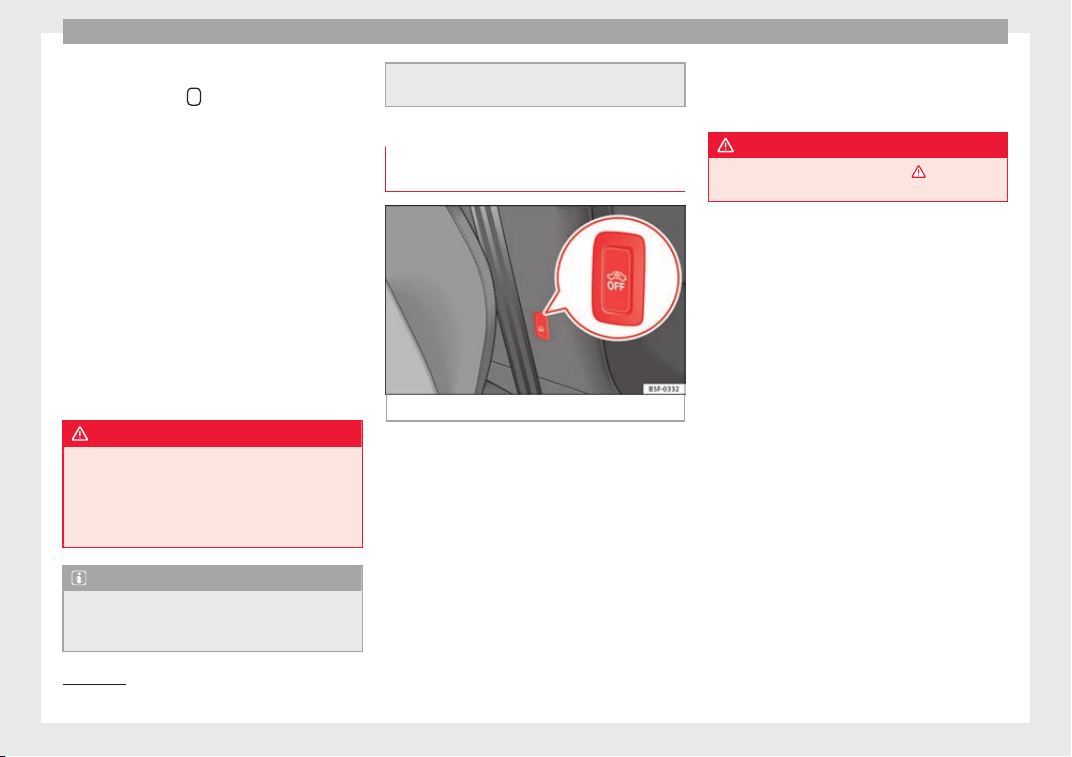
Operation
Deactivation
–
Press the button
on the remote control
twice. It only deactivates the interior moni-
tor. The alarm system remains activated.
False alarms
Interior monitoring will only operate correctly
if the vehicle is completely closed. Please ob-
serve related legal requirements.
The following cases may cause a false alarm:
●
Open windows (partially or fully).
●
Panoramic/tilting sunroof open (partially or
completely).
●
Movement of objects inside the vehicle,
such as loose papers, items hanging from
the rear vision mirror (air fresheners), etc.
WARNING
●
The “deadlock” system remains deactiva-
ted if the interior monitor is deactivated.
●
For those vehicles in which a separation
screen is fitted, the alarm will not function
correctly due to interference with the sensor.
Note
●
If the alarm has been triggered by the inte-
rior monitor, this will be indicated by a flash-
ing of the warning lamp on the driver door
when the vehicle is opened. This flashing will
be different to that for an activated alarm.
Deactivating vehicle interior
monitoring systems
1)
Fig. 52 interior monitor button.
With the vehicle locked, any movement in the
interior (e.g. pets) will set off the alarm. De-
activate interior monitor systems to prevent
the alarm from going off unintentionally.
–
To switch off the vehicle interior monitor,
switch off the ignition and press button
››› Fig. 52
. The indicator on the button will
light
up
.
–
When the vehicle is now locked, the vehicle
interior monitor is switched off until the
next time the door is opened.
If the anti-theft security system “deadlock”*
››› page 64 is switched off, the interior moni-
tor automatically turns off.
WARNING
Observe the safety warnings ››› in “Safe”
security system* on page 64.
1)
Only available in certain markets.
70
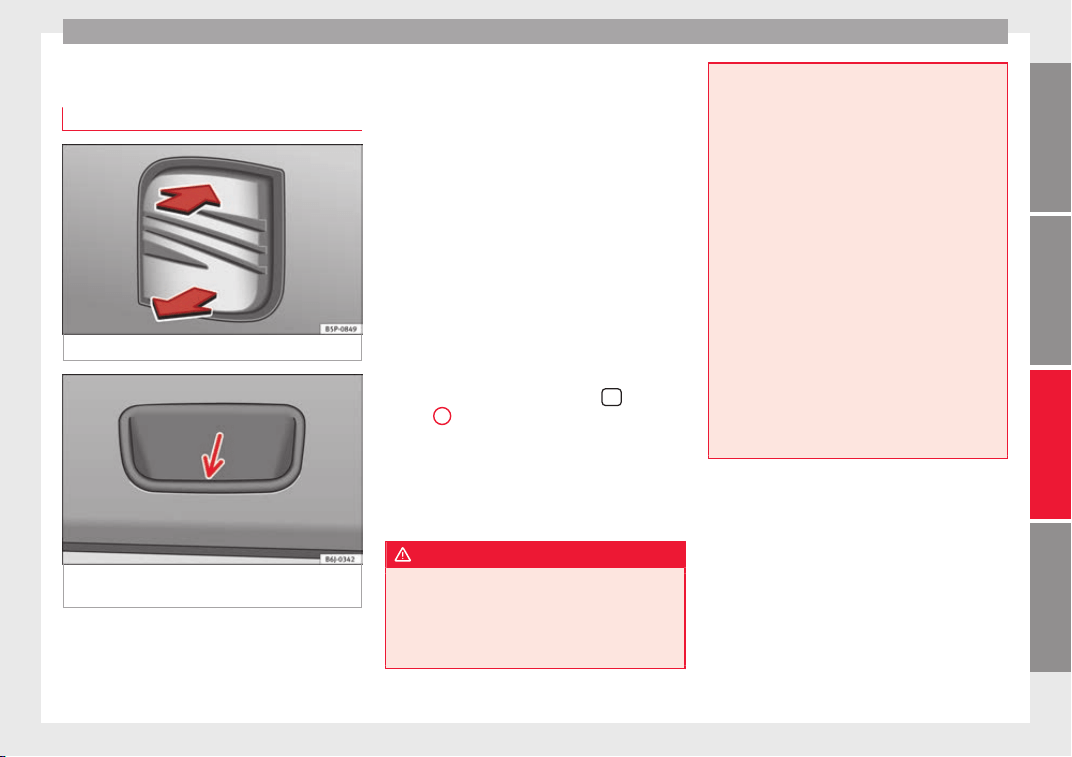
Opening and closing
Boot hatch
Unlocking and locking
Fig. 53 Rear lid: opening from the outside.
Fig. 54 Close-up of the inside trim of the rear
lid: hand grip
The rear lid opening system operates electri-
cally. It is activated by using the handle on
the rear boot lid.
Opening the rear lid
–
Pull on the release lever and lift the rear lid
››› Fig. 53
. The rear lid will automatically
open.
C
lo
sing the rear lid
–
Hold the rear lid by one of the two handles
on the interior lining and close it, pushing
slightly.
This system may or may not be operative, de-
pending on the situation of the vehicle.
If the rear lid is locked then it cannot be
opened, however if it is unlocked then the
opening system is operative and the rear lid
may be opened.
To lock/unlock, press the button
or the
button
1
on the remote control key.
A warning appears on the instrument panel
display if the rear lid is open or not properly
closed.* An audible warning is also given if it
is opened while the vehicle is moving faster
than 6 km/h (4 mph)*.
WARNING
●
Always close the rear lid properly. Risk of
accident or injury.
●
Do not close the rear lid by pushing it down
with your hand on the rear window. The glass
could smash. Risk of injury!
●
Ensure the rear lid is locked after closing it.
If not, it may open unexpectedly while driv-
ing.
●
Never allow children to play in or around
the vehicle. A locked vehicle can be subjected
to extremely high and low temperatures, de-
pending on the time of year, thus causing se-
rious injuries/illness. It could even have fatal
consequences. Close and lock both the rear
lid and all the other doors when you are not
using the vehicle.
●
Closing the rear lid without observing and
ensuring it is clear could cause serious injury
to you and to third parties. Make sure that no
one is in the path of the rear lid.
●
Never drive with the rear lid open or half-
closed, exhaust gases may penetrate into the
interior of the vehicle. Danger of poisoning!
●
If you only open the rear lid, do not leave
the key inside. The vehicle cannot be opened
if the key is left inside.
71
Technical specifications
AdviceOperationSafety
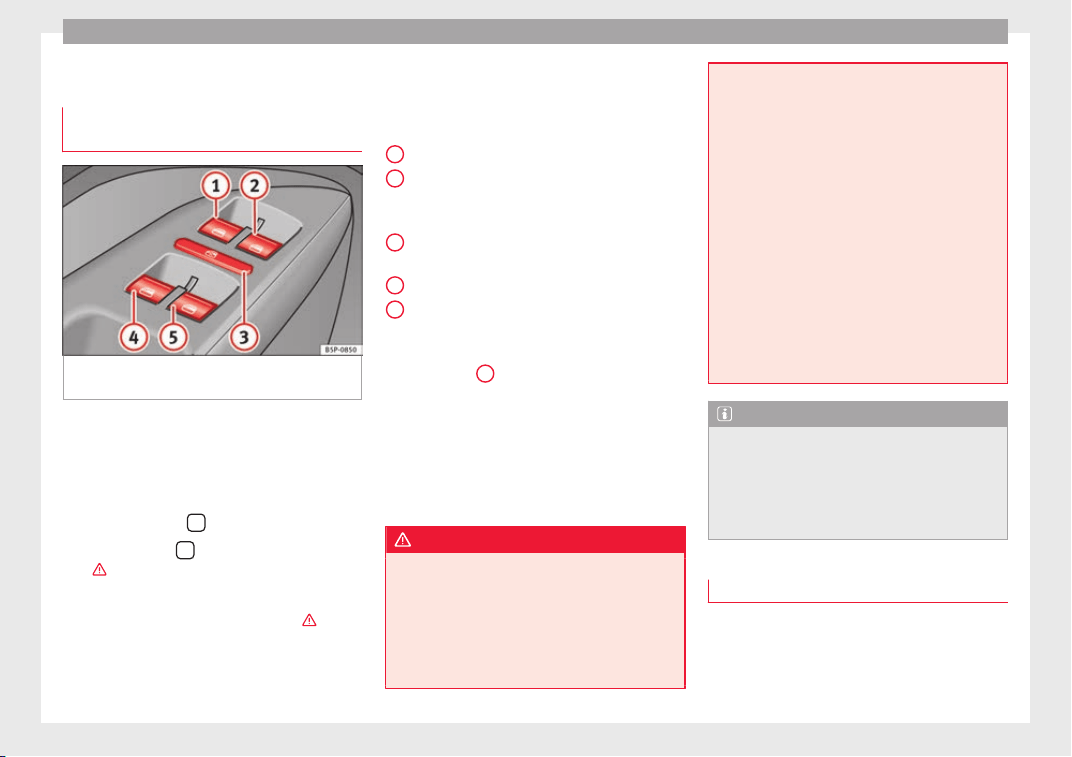
Operation
Electric windows
Opening or closing the electric
windows
Fig. 55 Detail of the driver door: controls for
the front and rear windows.
The front and rear electric windows can be
operated by using the controls on the driver
door.
Opening and closing the windows
–
Press the button
to open the window.
–
Pull the button
to close the window
››› .
Always close the windows fully if you park
the vehicle or leave it unattended ››› .
You can use the electric windows for approx.
10 minutes after switching off the ignition if
neither the driver door nor the front passen-
ger door has been opened and the key has
not been removed from the ignition.
Buttons on the driver door
Button for window in front left door
Button for window in front right door
Buttons for rear windows*
Safety switch for deactivating the electric
window buttons in the rear doors
Button for window in rear left door
Button for window in rear right door
Safety switch *
Safety switch
3
on the driver door can be
used to disable the electric window buttons
in the rear doors.
Safety switch not pressed: buttons on rear
doors are activated.
Safety switch pressed: buttons on rear doors
are deactivated.
WARNING
●
Incorrect use of the electric windows can
result in injury.
●
Never close the rear lid without observing
and ensuring it is clear, to do otherwise could
cause serious injury to you and third parties.
Make sure that no one is in the path of a win-
dow.
1
2
3
4
5
●
Always take the vehicle key with you when
you leave the vehicle.
●
Never leave children or disabled persons in
the vehicle, particularly if they have access to
the keys. An uncontrolled use of the key
could start the engine or activate any electric
equipment (e.g. electric windows), causing
risk of accident. The doors can be locked us-
ing the remote control key. This could be-
come an obstacle for assistance in an emer-
gency situation.
●
The electric windows will work until the key
has been removed from the ignition and one
of the front doors has been opened.
●
If necessary, use the safety switch to disa-
ble the rear electric windows. Make sure that
they have been disabled.
Note
If the window is not able to close because it
is stiff or because of an obstruction, the win-
dow will automatically open again
››› page 73. If this happens, check why the
windo
w could not be closed before attempt-
ing to close it again.
One-touch opening and closing
One-touch opening and closing means you
do not have to hold down the button.
72
Opening and closing
One-touch closing
–
Pull up the window button briefly up to the
second position. The window closes fully.
One-touch opening
–
Push down the window button briefly up to
the second position. The window opens
fully.
Restoring one-touch opening and closing
–
Close all windows.
–
Use the key to lock the vehicle from outside
and hold the key in the lock position for at
least one second. The one-touch function is
now ready for operation.
The buttons ››› Fig. 55
1
and
2
have two
levels for opening the window and two for
closing it. This makes it easier to open and
close windows to the desired position.
One-touch closing does not work when the
ignition has been switched off, even if the
key is in the ignition.
The automatic open and close function will
not work if the battery has been temporarily
disconnected, or if the battery is flat. The
function then has to be reactivated.
The one-touch function and roll-back function
will not work if there is a malfunction in the
electric windows. Contact a specialised work-
shop.
Roll-back function
The roll-back function reduces the risk of in-
jury when the electric windows close.
●
If a window is obstructed when closing au-
tomatically, the window stops at this point
and lowers immediately ››› .
●
If this happens, check immediately (within
10 seconds) why the window could not be
closed before attempting to close it again. Af-
ter 10 seconds the normal automatic func-
tion resumes.
●
If the window is still obstructed, the win-
dow will stop at this point.
●
If there is no obvious reason why the win-
dow cannot be closed, try to close it again
within 5 seconds.
If you wait longer than 10 seconds, the win-
dow will open again fully when you operate
one of the buttons. One-touch closing is reac-
tivated.
The one-touch function and roll-back function
will not work if there is a malfunction in the
electric windows. Contact a specialised work-
shop.
WARNING
●
Incorrect use of the electric windows can
result in injury.
●
Always take the ignition key with you when
leaving the vehicle, even if you only intend to
be gone for a short time. Please ensure that
children are never left alone inside the vehi-
cle.
●
The electric windows will work until the key
has been removed from the ignition and one
of the front doors has been opened.
●
Never close the rear lid without observing
and ensuring it is clear, to do otherwise could
cause serious injury to you and third parties.
Make sure that no one is in the path of a win-
dow.
●
Never allow people to remain in the vehicle
when you close the vehicle from the outside.
The windows cannot be opened even in an
emergency.
Note
The roll-back function is deactivated if the
windows are closed from the outside of the
vehicle using the ignition key for convenience
closing ››› page 73.
Convenience opening and closing*
Using the door lock
–
Hold the key in the door lock of the driver
door in either the locking or the unlocking
position until all windows are either
opened or closed.
–
Release the key to interrupt this function.
»
73
Technical specifications
AdviceOperationSafety
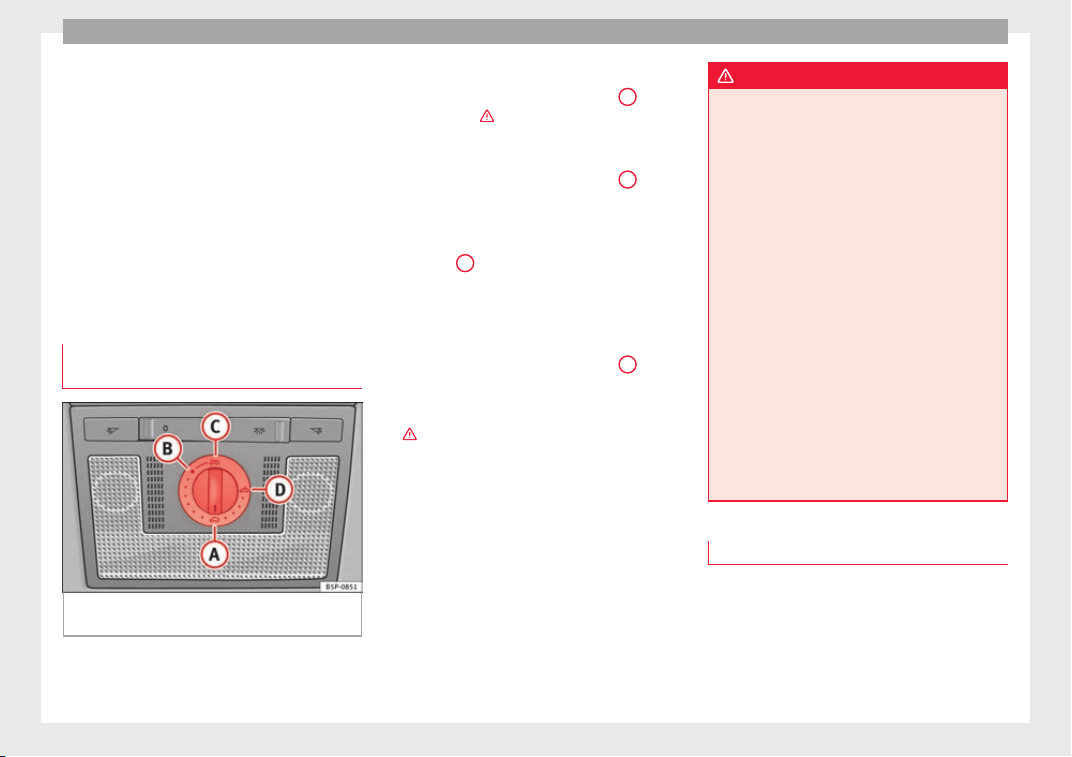
Operation
Using the remote control
–
Push the lock or unlock button on the re-
mote control for approximately 3 seconds.
All windows which function electrically will
be either opened or closed.
–
Release the unlock button to interrupt the
function.
–
Once the windows are completely closed,
the turn signals will flash.
Sliding/tilting sunroof*
Opening and closing the
sliding/tilting roof
Fig. 56 Roof lining description: sliding/tilting
sunroof rotary knob.
The sliding/tilting sunroof is opened and
closed using the rotary knob when the igni-
tion is switched on.
Closing the sliding/tilting sunroof
–
Turn the rotary button to position
A
››› Fig. 56
›
›› .
Opening the sliding/tilting sunroof
–
Turn the rotary button to position
B
. The
sunroof opens to the convenience position
where wind noise is reduced.
–
To open the roof further, turn the switch to
position
C
and hold the switch in this po-
sition until the roof opens to the desired
position.
Tilting the sliding/tilting sunroof
–
Turn the rotary button to position
D
.
Always close the sliding/tilting sunroof fully
if you park the vehicle or leave it unattended
››› .
The sliding/tilting sunroof can be operated
for up to about 10 minutes after the ignition
has been switched off, provided the driver
door and the front passenger door are not
opened.
Sun visor
The sun visor is opened together with the
sliding/tilting sunroof. If required, it can be
closed by hand when the sunroof is closed.
WARNING
●
Incorrect use of the sliding/tilting sunroof
can result in injury.
●
Never close the sliding/tilting sunroof with-
out checking there are no obstructions, to do
otherwise could cause serious injury to you
and others. Make sure that no one is in the
path of the sliding/tilting sunroof.
●
Always take the vehicle key with you when
you leave the vehicle.
●
Never leave children or disabled persons in
the vehicle, particularly if they have access to
the keys. Unsupervised use of a key could
mean that the engine is started or that elec-
trical equipment is used (e.g. electric slid-
ing/tilting sunroof). Risk of accident! The
doors can be locked using the remote control
key. This could become an obstacle for assis-
tance in an emergency situation.
●
The sliding/tilting sunroof continues to
function until one of the front doors is
opened and the key removed from the igni-
tion.
Convenience closing*
Using the door lock
–
Hold the key in the door lock of the driver
door in the locking position until the slid-
ing/tilting sunroof is closed.
–
Release the key to interrupt this function.
74
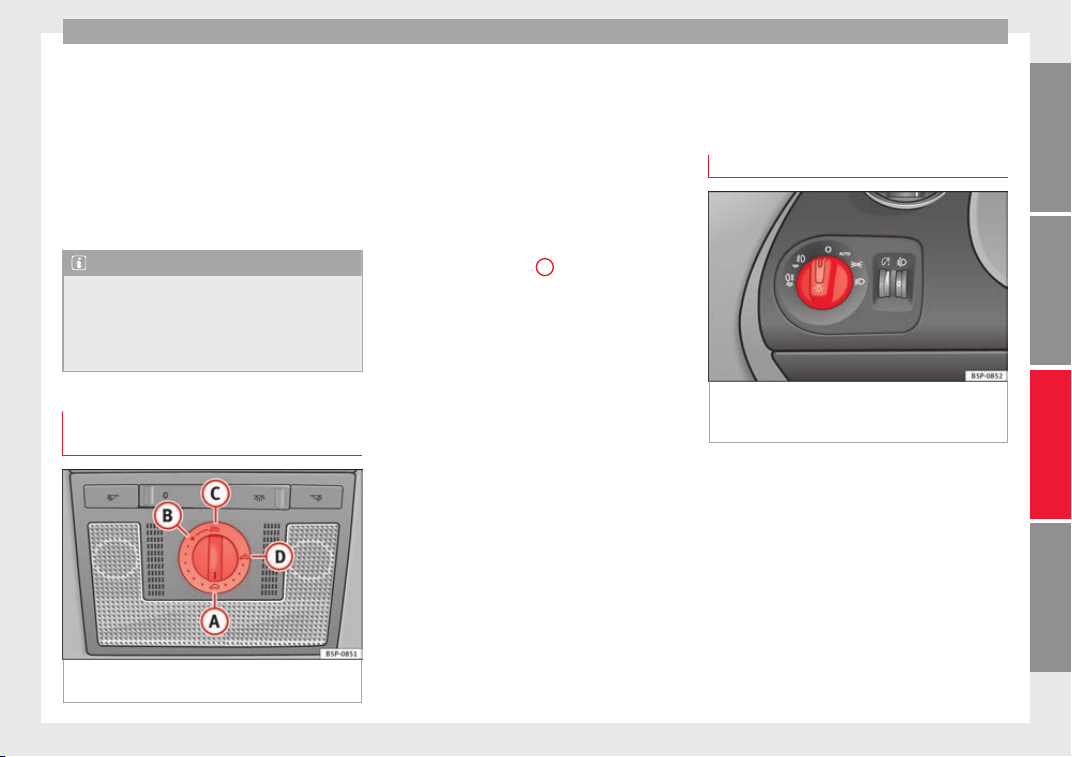
Lights and visibility
Using the remote control
–
Push the lock button on the remote control
for approximately 3 seconds. The slid-
ing/tilting sunroof is closed.
–
Release the unlock button to interrupt the
function.
–
When the sliding/tilting sunroof has closed
completely, the turn signals flash once.
Note
The sliding/tilting sunroof rotary knob re-
mains in the last position selected if the roof
is closed using convenience closing from out-
side the vehicle and will have to be re-posi-
tioned the next time you drive.
Roll-back function of the
sliding/tilting sunroof*
Fig. 57 Roof lining description: sliding/tilting
sunroof rotary knob.
The sliding/tilting sunroof has a roll-back
function
which prevents larger objects get-
tin
g tr
apped when the roof is closed. The roll-
back function does not prevent fingers get-
ting pinched against the roof opening. The
sliding/tilting sunroof stops and opens again
immediately if it is obstructed when closing.
If the sliding/tilting sunroof has been
opened again by the roll-back function, it can
be closed only by pressing the rotary button
at the front in position
A
››› Fig. 57
until the
s
lidin
g/tilting sunroof has closed fully.
Please note that the sunroof will now close
without the roll-back function.
Lights and visibility
Lights
Switching lights on and off
Fig. 58 Detailed view of the dash panel:
lights, front fog lights and rear fog light
switch.
Switching on the side lights
–
Turn the light switch ››› Fig. 58
to position
.
Sw
it
ching on dipped beam headlights
–
Turn the light switch to position .
Switching off the lights
–
Turn the light switch to position 0.
»
75
Technical specifications
AdviceOperationSafety
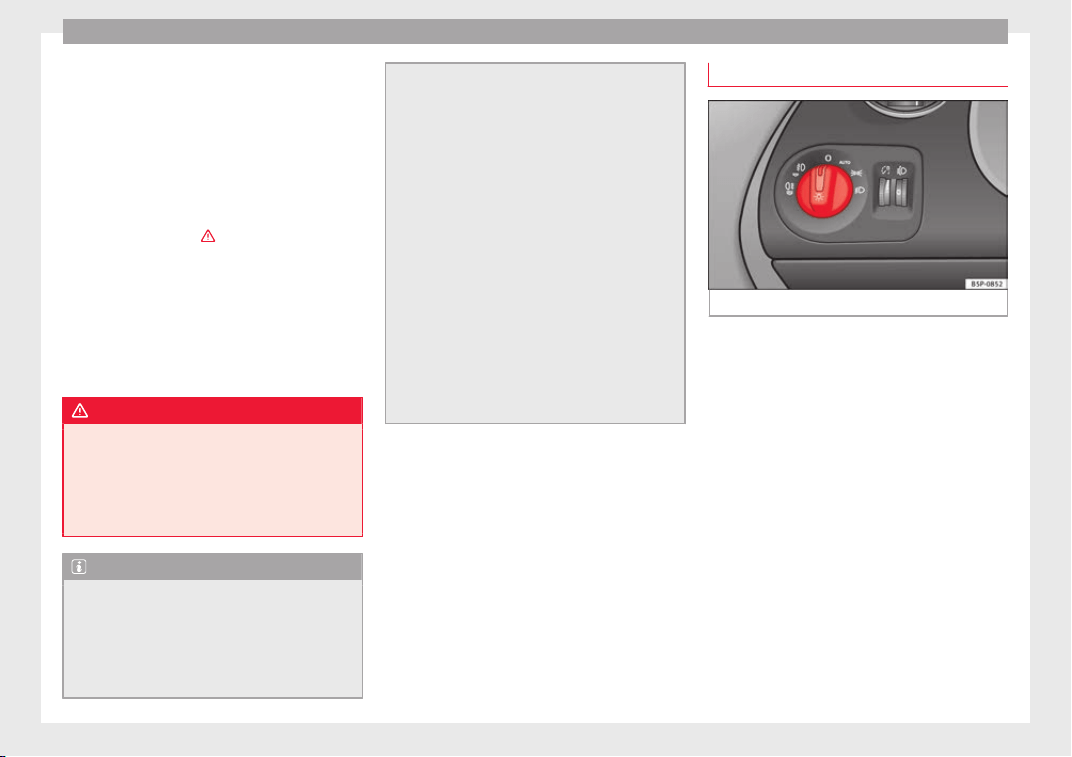
Operation
Switching on front fog lights*
–
Pull the switch out of position
or
to
the first stop. The symbol of the light
control lights up.
Switching on the rear fog lights (vehicles
with front fog lights)
–
Pull the switch out of position or to
the second stop ›››
. A control lamp lights
up on the dash panel.
Switching on the rear fog lights (vehicles
with no front fog lights)
–
Pull the light switch from position to the
last stop. A control lamp lights up in the
dash panel.
WARNING
Never drive with just the side lights on. Risk
of accident. The side lights are not bright
enough to illuminate the road ahead and to
ensure that other road users are able to see
you. Always use your dipped beam head-
lights if it is dark or if visibility is poor.
Note
●
The dipped beam headlights will only work
with the ignition on. The side lights come on
automatically when the ignition is turned off.
●
If the lights are left on after the key has
been taken out of the ignition lock, an audi-
ble warning will sound while the driver door
remains open. This is a reminder to switch
the lights off.
●
The rear fog light is so bright that it can
dazzle drivers behind you. You should use
the rear fog light only when visibility is very
poor.
●
If you are towing a trailer equipped with a
rear fog light on a vehicle with a factory-fitted
towing bracket, the rear fog light on the vehi-
cl
e will automatically be switched off.
●
The use of the lighting described here is
subject to the relevant statutory require-
ments.
●
Depending on weather conditions (very
cold or wet), the front and rear lights and the
indicators may be temporarily misted. This
has no influence on the useful life of the
lighting system. The lights will soon demist
when they are switched on.
Automatic lighting*
Fig. 59 Automatic lighting.
Activation
–
Rotate the switch to the position. It will
light up.
Deactivation
–
Turn the light switch to .
Automatic lighting
If automatic headlight control is switched on,
dipped beam headlights are automatically
switched on by a photosensor if you drive in-
to a tunnel, for example.
The rain sensor switches on the dipped beam
headlights when the windscreen wipers have
been operating continuously for a few sec-
onds and it switches the lights off when the
continuous or interval wipe is switched off for
some minutes ››› page 84.
76
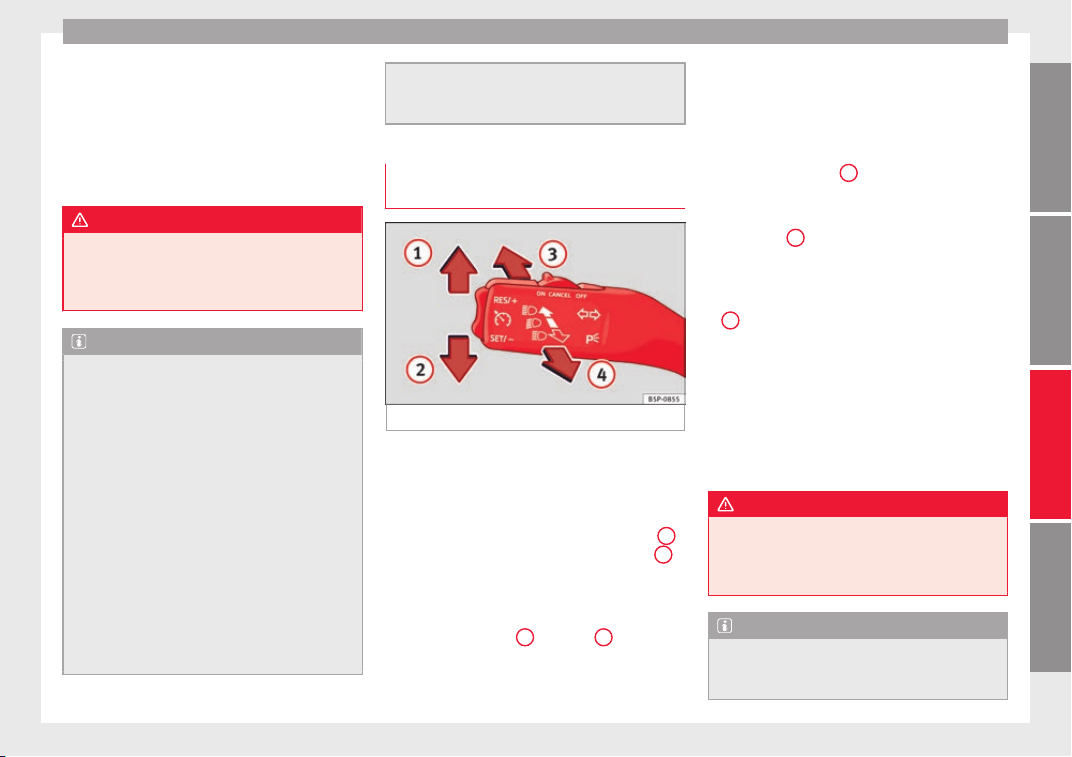
Lights and visibility
When the automatic dipped beam headlight
control is on but the dipped beam headlights
are off, the warning lamp lights up on
the light control ››› Fig. 59. If the automatic
control switches on the dipped lights, the in-
strument and control lighting is also switch-
ed on.
WARNING
●
Even if the automatic headlight control is
switched on, the dipped beam headlights will
not be switched on with fog. Therefore, the
dipped beam must be switched on manually.
Note
●
For those vehicles with the automatic head-
light system, when the key is removed from
the ignition, the audible warning will only
sound if the light control is in the position
or if the vehicle is not fitted with the com-
ing home f
unction.
●
If the daylight driving automatic light func-
tion is switched on, the front fog lights or
rear fog light cannot be switched on in addi-
tion.
●
The use of the lighting described here is
subject to the relevant statutory require-
ments.
●
Do not put stickers on the windscreen in
front of the sensor. This may cause disrup-
tions or faults in the automatic lighting sys-
tem.
●
To avoid damage to the tail lights, the
lights mounted on the rear lid go off when the
rear lid is opened (depending on the country).
Turn signal and main beam headlight
lever
Fig. 60 Turn signal and main beam lever
The turn signal and main beam headlight lev-
er has the following functions:
Switching on the turn signals
–
Move the lever all the way up ››› Fig. 60
1
to indicate
right
, and all the way down
2
to indicate
left
.
Sign
alling a lane change
–
Push the lever up
1
or down
2
to the
point where you incur resistance and then
release it. The turn signal will flash several
times. The corresponding control lamp will
also flash.
Switching main beam on and off
–
If the dipped lights are on, push the lever
forward ››› Fig. 60
3
to switch on the main
beam headlights.
–
Push the lever towards the steering wheel
››› Fig. 60
4
to switch off the main beam.
Headlight flashers
–
Pull the lever towards the steering wheel
4
to operate the flasher.
Switching on parking lights
–
Switch the ignition off and remove the key
from the lock.
–
Move the turn signal lever up or down to
turn the right or left-hand parking lights on,
respectively.
WARNING
The main beam can dazzle other drivers. Risk
of accident! Never use the main beam head-
lights or the headlight flasher if they could
dazzle other drivers.
Note
●
The turn signals only
work when the igni-
tion is switched on. The corresponding warn-
ing lamp or flashes in the instrument
»
77
Technical specifications
AdviceOperationSafety
Operation
panel. The control lamp flashes when the
turn s
ignals are operated, provided a trailer is
correctly attached and connected to the vehi-
cle. If a turn signal bulb is defective, the con-
trol lamp flashes at double speed. If the trail-
er turn signal bulbs are defective, the control
lamp does not light up. Change the bulb.
●
The main beam headlights can only be
switched on if the dipped beam headlights
are already on. The warning lamp then
comes on in the instrument panel.
●
The headlight flasher comes on for as long
as you pull the lever – even if no other lights
are switched on. The warning lamp then
comes on in the instrument panel.
●
When the parking lights are switched on,
the headlight and the tail light on the corre-
sponding side of the vehicle light up. The
parking lights will only work if the key is re-
moved from the ignition. If said light is on, an
audible warning will be emitted while the
driver door is open.
●
If the turn signal lever is left on after the
key has been taken out of the ignition lock,
an acoustic signal sounds when the driver
door is opened. This is intended as a remind-
er to switch off the turn signal, unless you
wish to leave the parking light on.
Daytime driving lights*
Daytime running lights are signalling devices
for improving road safety. The lights are built
into the headlights and come on each time
the ignition is turned on if the light switch is
in position
0 or
. It is automatically
sw
itched off when the side lights are turned
on.
Automatic control of the dipped beam in
combination with the daytime running lights
If the dipped beam control and the daytime
running lights are activated at the same
time, the dipped beams and the instrument
panel lighting will automatically come on as
required (e.g. when entering a tunnel) and
the daytime running lights will switch off.
When the automatic dipped beam control
switches off the dipped beams (e.g. when
coming out of a tunnel), the daytime running
lights come back on.
WARNING
The side lights or daytime driving lights are
not bright enough to illuminate the road
ahead and to ensure that other road users are
able to see you.
●
Always use your dipped beam head lights if
it is raining or if visibility is poor.
●
The rear lights do not come on with the
daytime driving light. A vehicle which does
not have the rear lights on may not be visible
to other drivers in the darkness, if it is rain-
ing or in conditions of poor visibility.
Note
Please observe any relevant legal require-
ments which may apply in your country.
Nordic country solution
3 Only available in certain countries or as an
optional
extra
The so-called “Nordic country solution” is an
alternative solution to daytime running lights
in vehicles without this function. It consists
of simultaneously connecting the dimmed
dipped beams, the sidelights and the licence
plate lights.
The aforementioned lights are switched on
each time the ignition is turned on if the light
switch is in position 0 or . Depending
upon the model, the control lamp on the
light control switch or the instrument panel
lighting will indicate that the lights are on.
Activation of the Nordic country solution
●
Remove the key from the ignition, move the
turn signal lever upward (right turn signal),
press it back to flash position and hold it
there.
●
Insert the key and switch on the ignition,
holding it in this position for 3 seconds.
Then, switch off the ignition. The Nordic
country solution is now activated and the cor-
responding lights can come on.
78
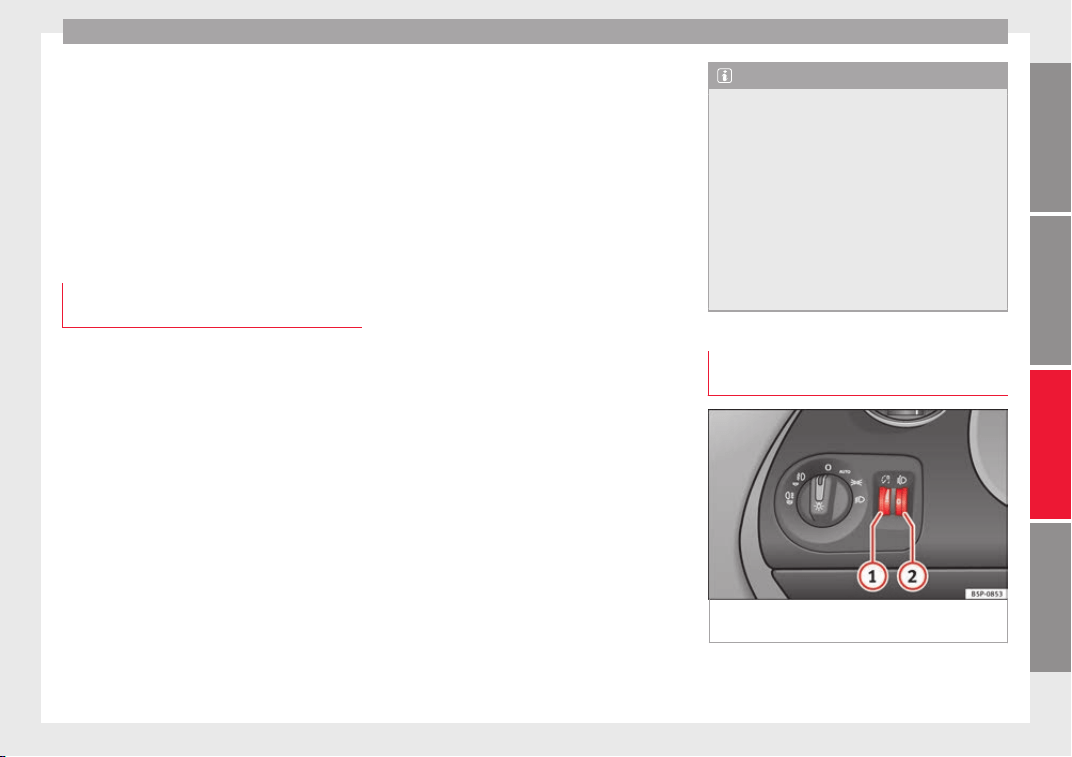
Lights and visibility
Deactivation of the Nordic country solution
●
Remove the key from the ignition, press the
turn signal lever down (left turn signal), press
it back to flash position and hold it here.
●
Insert the key and switch on the ignition,
holding it in this position for 3 seconds.
Then, switch off the ignition. The Nordic
country solution is now deactivated and the
corresponding lights will not come on.
Coming Home/Leaving Home
function*
The Coming Home function is controlled man-
ually. The Leaving Home function is control-
led with a photosensor.
If the Coming Home or Leaving Home func-
tion is connected, the front side and dipped
lights, the tail lights and the number plate
light will light up to provide assistance.
Coming home function
The Coming Home function is activated by
switching off the ignition and briefly flashing
the lights. When the driver door is opened,
the Coming Home lighting comes on. If the
driver door is already open when the lights
are flashed briefly, the Coming Home lighting
comes on immediately
.
When the l
a
st door of the vehicle or the rear
lid is closed, the Coming Home function
starts and the switching off the headlights is
delayed.
The Coming Home lighting switches off in the
following cases:
●
On completion of the time period establish-
ed for the delay in switching off the lights af-
ter all the vehicle doors and the rear lid have
been closed.
●
If, 30 seconds after being connected, any
doors or the rear lid remain open.
●
If the light switch is turned to position .
●
If the ignition is switched on.
Leaving home function
The Leaving Home function is activated when
the vehicle is unlocked if:
●
the light control is in position and
●
the photosensor detects “darkness”.
The Leaving Home lighting switches off in the
following cases:
●
If the time period for the delay in switching
off the headlights has ended
●
If the vehicle is locked again.
●
If the light switch is turned to position .
●
If the ignition is switched on.
Note
The setting for the delay in switching off the
headlights in the Coming Home and Leaving
Home function can be changed or the func-
tion can be connected or disconnected in the
menu Lights and visibility ››
› page 56.
●
If the ignition key is removed while the
lights are on, the lights flash briefly and the
driver door opens, no audible warning is
heard, since with the Coming Home function
on, the lights are automatically switched off
after a period of time (except when the light
switch is in position or .
Instrument and switch lighting /
Headlight range control
Fig. 61 Dash panel: Instrument panel and
control dimmers and headlight range control.
»
79
Technical specifications
AdviceOperationSafety
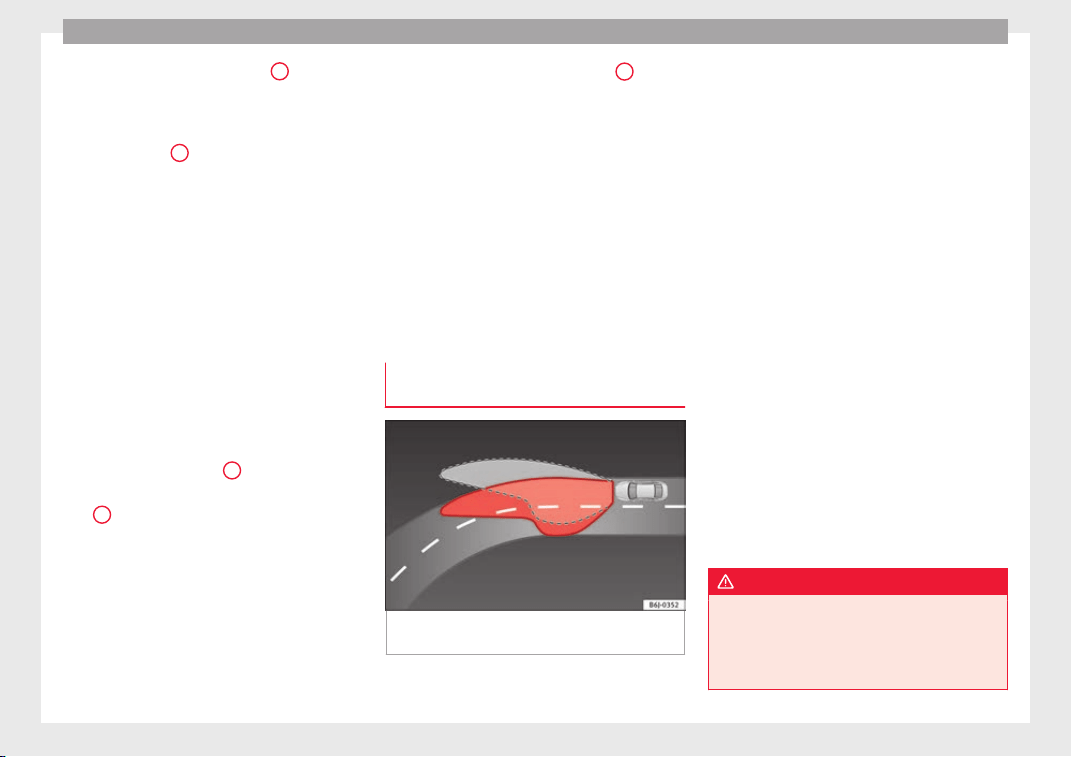
Operation
Instrument and switch lighting
1
When the headlights are switched on, the
brightness of the instrument panel and con-
trols can be adjusted by turning the thumb
wheel ››› Fig. 61
1
.
The instrument lighting (dials and needles),
the centre console illumination and the illu-
mination of the displays are regulated by a
photodiode incorporated in the instrument
panel.
The instrument lighting (dials and needles) is
switched on when the ignition is on and the
vehicle lights are off. The instrument lighting
is dimmed automatically as the daylight
starts to fade. It goes out completely when
ambient light is very low. This function is in-
tended to remind the driver to switch on the
dipped beam headlights in good time when
light conditions become poor.
Headlight range control
2
By using the electrical headlight range con-
trol,
2
you can adjust the headlight range to
the load level that is being carried in the ve-
hicle. This way, it is possible to avoid daz-
zling oncoming traffic more than necessary.
At the same time, by using the correct head-
light settings, the driver has the best possi-
ble lighting for the road ahead.
The headlights can only be adjusted when
the dipped beam is switched on. To lower the
beam, turn the thumb wheel down
2
from
the basic setting 0
.
D
y
namic headlight range control
Vehicles with gas discharge lamps (“xenon
lamps”) are equipped with dynamic head-
light range control. This means that the
headlights will be adjusted to suit the load
level of the vehicle and “nodding move-
ments” when pulling off and braking are au-
tomatically compensated for.
Vehicles with gas discharge bulbs do not
have headlight range control.
Adaptive headlights* (for driving
round bends)
Fig. 62 Cornering lighting using adaptive
headlights.
When driving around bends, the headlights
will light the most important areas of the
road.
Dynamic cornering lights* (AFS)
Dynamic cornering lights only operate if the
vehicle is travelling at more than 10 km/h
(6 mph) and the dipped headlights are on.
When taking a bend, the road is illuminated
better with directional gas discharge bulbs
than with conventional fixed headlights.
A fault in the system is indicated via the
flashing of the control lamp on the instru-
ment panel. At the same time, a text mes-
sage with information or instructions to per-
form necessary operations may appear on
the instrument panel display. Take the vehi-
cle to a specialised workshop and have the
fault repaired.
If the control lamp lights up on the instru-
ment panel but all the bulbs are operating
correctly ››› page 198
, there may still be a
f
au
lt in the dynamic curve lighting system
(AFS). Take the vehicle to a specialised work-
shop and have the fault repaired.
WARNING
If the “automatic dipped beam control” is
switched on, the dipped beam headlights will
not be switched on in fog. They should be
switched on manually using the light switch.
The driver is personally responsible for the
80
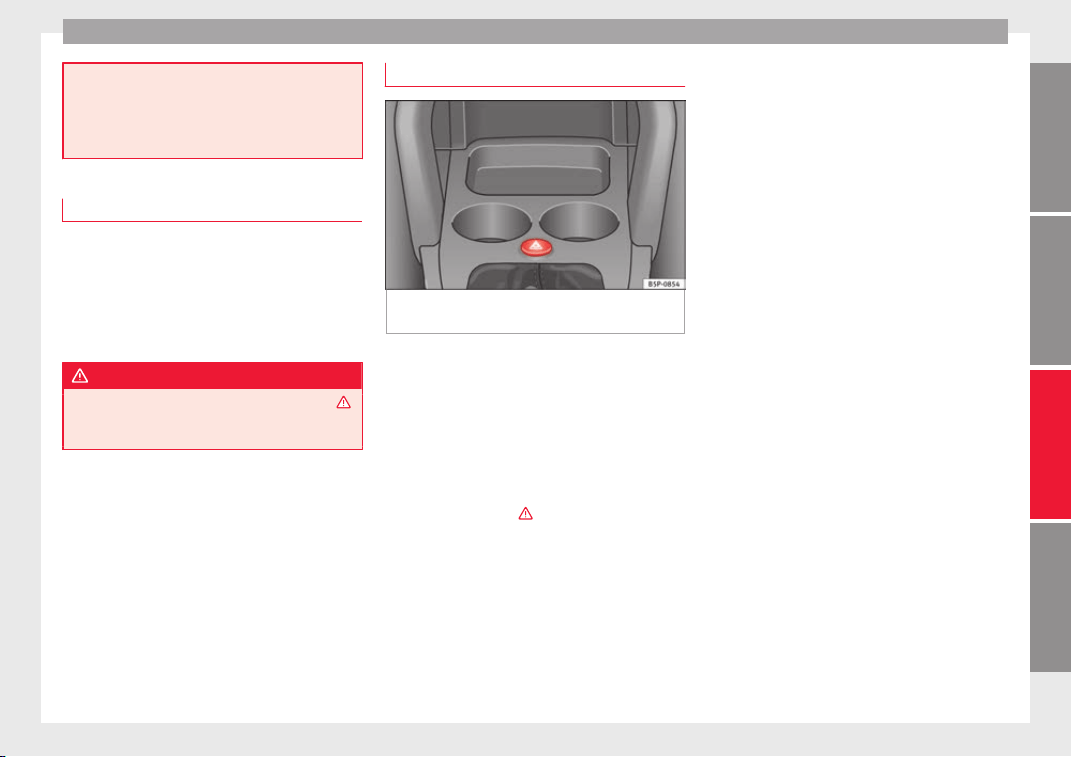
Lights and visibility
correct use of lights in all situations. “Auto-
matic headlight control” is merely a system
to support the driver. Where necessary,
switch on the lights manually using the light
switch.
Fog lights with cornering function*
3 Applies to the model: ALTEA / ALTEA XL
When the turn s
ignal is switched on to turn or
on very tight bends, the right or left fog light
automatically comes on to function as a cor-
nering light. The cornering light only oper-
ate
s if the dipped beam lights are on.
WARNING
Read and observe the relevant warnings ›››
in Adaptive headlights* (for driving round
bends) on page 80
Hazard warning lights
Fig. 63 Dash panel: switch for hazard warn-
ing lights.
The hazard warning lights are used to draw
the attention of other road users to your vehi-
cle in emergencies.
If your vehicle breaks down:
1. Park your vehicle at a safe distance from
moving traffic.
2. Press the button to switch on the hazard
warning lights ››› .
3. Switch the ignition off.
4. Apply the handbrake.
5. For a manual gearbox, engage 1st gear;
for an automatic gearbox, move the gear
lever to
P
.
6.
Use the warning triangle to draw the atten-
tion of other road users to your vehicle.
7. Always take the vehicle key with you when
you leave the vehicle.
Switch on the hazard warning lights to warn
other road users, for example:
●
reaching the tail end of a traffic jam,
●
there is an emergency
●
your vehicle breaks down due to a techni-
cal fault,
●
you are towing another vehicle or your vehi-
cle is being towed.
All turn signals flash simultaneously when
the hazard warning lights are switched on.
The two turn signal turn signal lamps
and the turn signal lamp in the switch will
flash at the same time. The hazard warning
lights also work when the ignition is switch-
ed off.
Emergency braking warning
If the vehicle brakes suddenly and continu-
ously at a speed of more than 80 km/h (50
mph), the brake light flashes several times
per second to warn the vehicles driving be-
hind. If you continue braking, the hazard
warning lights will come on automatically
when the vehicle comes to a standstill. They
switch off automatically when the vehicle
starts to move again.
»
81
Technical specifications
AdviceOperationSafety
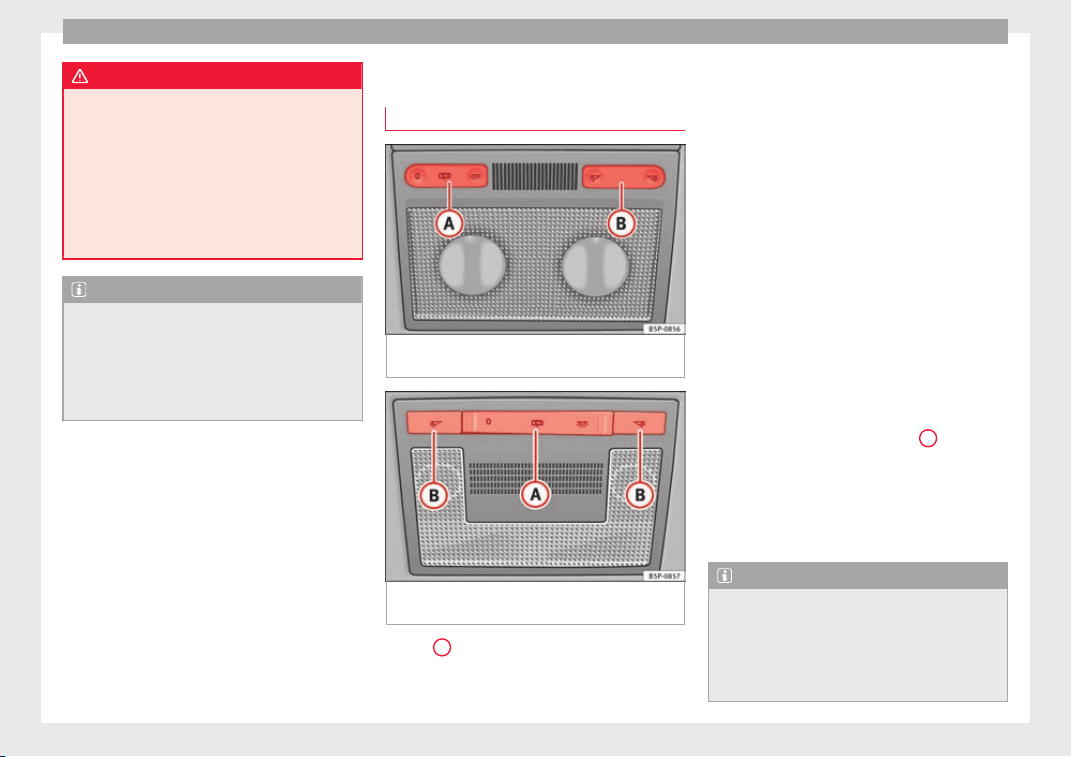
Operation
WARNING
●
The risk of an accident increases if your ve-
hicle breaks down. Always use the hazard
warning lights and a warning triangle to draw
the attention of other road users to your sta-
tionary vehicle.
●
Never park where the catalytic converter
could come into contact with inflammable
materials under the vehicle, for example dry
grass or spilt petrol. This could start a fire!
Note
●
The battery will run down if the hazard
warning lights are left on for a long time,
even if the ignition is switched off.
●
The use of the hazard warning lights de-
scribed here is subject to the relevant statu-
tory requirements.
Interior lights
Front interior lights and reading lights
Fig. 64 Interior roof trim: front interior light-
ing option 1.
Fig. 65 Interior roof trim: front interior light-
ing option 2.
Switch
A
››› Fig. 64
o ›
›› Fig. 65
is used to se-
lect the following positions:
Courtesy light position
Rocker switch in flat position (not activated).
The interior lighting is automatically switched
on when the vehicle is unlocked or the key re-
moved from the ignition. It goes out approxi-
mately 20 seconds after the doors are
closed. The interior lights are switched off
when the vehicle is locked or when the igni-
tion is switched on.
Interior light switched on
Push the switch to the position .
Turning off the interior light 0
Press the switch to position 0 ››› Fig. 64 or
››› Fig. 65.
Switching on the reading light
Press the corresponding button
B
››› Fig. 64
or ››› Fig. 65
to switch on the reading light.
Sw
it
ching the reading lights off
Press the corresponding button to switch the
reading light off.
Note
If not all the vehicle doors are closed, the in-
terior lights will be switched off after approx.
10 minutes, providing the ignition key has
been removed and the courtesy light position
selected. This prevents the battery from dis-
charging.
82
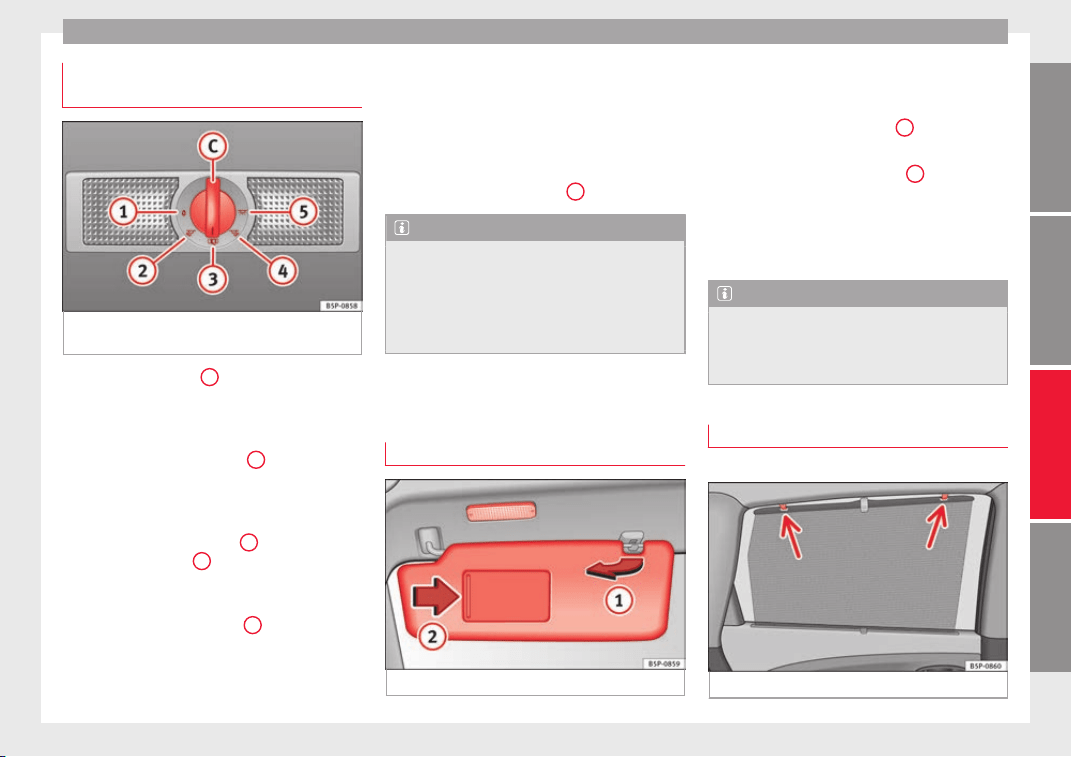
Lights and visibility
Rear interior lights and reading
lights*
Fig. 66 Interior roof trim: rear interior lights
and reading lights.
The switch ››› Fig. 66
C
is used to select the
following positions:
Interior light switched off 0
In switch position ››› Fig. 66
1
, the interior
and reading lights are switched off.
Switching on the reading light
Turn the switch to position
2
(left reading
light) or to position
4
(right reading light).
Courtesy light position
Turn the control to position
3
. The interior
lighting is automatically switched on when
the vehicle is unlocked or the key removed
from the ignition. The light goes out approxi-
mately 20 seconds after the doors are
closed. The interior lights are switched off
when the vehicle is locked or when the igni-
tion is switched on.
Interior lights or both reading lights
switched on
T
urn the c
ontrol to position
5
.
Note
If not all the vehicle doors are closed, the in-
terior lights will be switched off after approx.
10 minutes, providing the ignition key has
been removed and the courtesy light position
selected. This prevents the battery from dis-
charging.
Visibility
Sun visors
Fig. 67 Sun visor on the driver side.
The sun visors for the driver and the front
passenger can be pulled out of their mount-
ings in the centre of the vehicle and turned
towards the doors ››› Fig. 67
1
.
The vanity mirrors in the sun visors have cov-
ers. When you open the cover
2
, a lamp in
the roof lights up.
The light* in the roof lining will go out when
the vanity mirror cover is pushed back or the
sun visor is pushed back up.
Note
The roof lighting will go out approximately
ten minutes after the ignition key has been
removed. This prevents the battery from dis-
charging.
Sun blind*
3 Applies to the model: ALTEA XL/ALTEA FREETRACK
Fig. 68 Rear door blind.
»
83
Technical specifications
AdviceOperationSafety
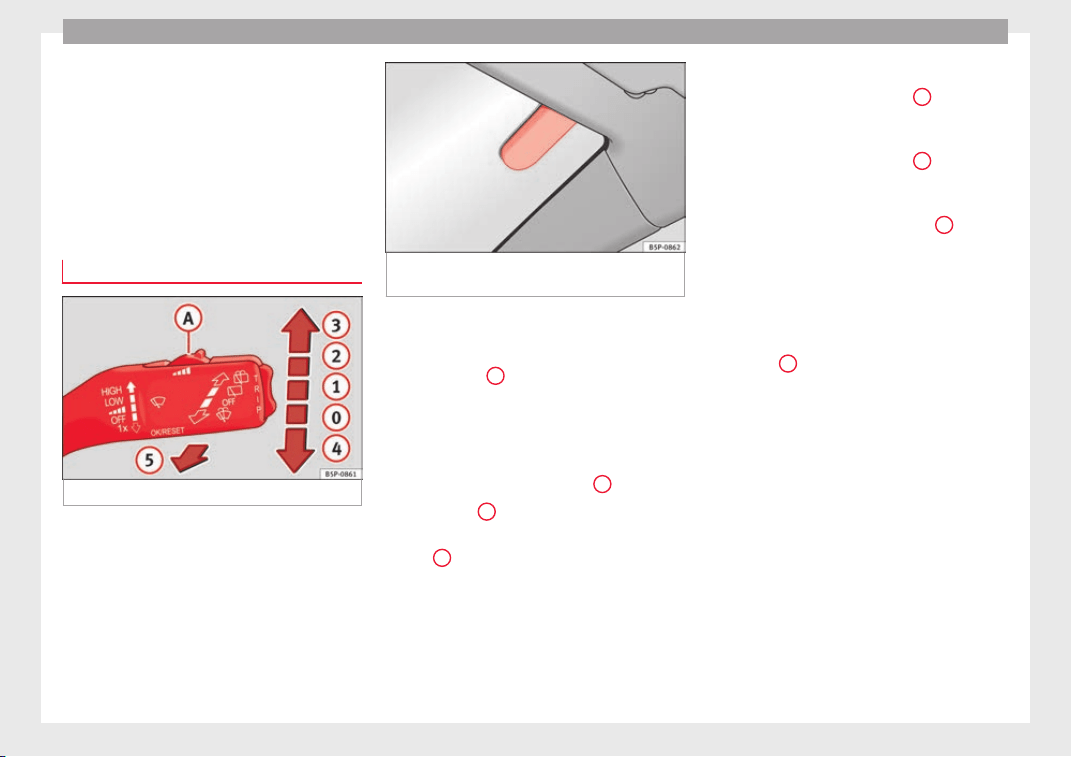
Operation
Rear window sun blind*
–
Pull out the visor and hook it onto the
hooks at the top of the door frame
››› Fig. 68
.
W
ind
screen wiper and rear
window wiper systems
Windscreen wipers
Fig. 69 Windscreen wiper lever.
Fig. 70 Rain sensor on the windscreen seen
from the interior.
The windscreen wiper lever ››› Fig. 69
has the
f
o
llowing positions:
Initial position
0
Rest, windscreen disconnected.
Intermittent wipe / automatic wipe with rain
sensor*
–
Move the lever up to position
1
.
–
With switch
A
adjust the wipe interval or
sensitivity of the rain sensor*.
Switch
A
has 4 positions.
The rain sensor* is part of the intermittent
wipe function. You will have to switch the rain
sensor back on if you switch off the ignition.
This is done by switching the wiper interval
wipe function off and back on.
Slow wipe
–
Push the lever up to position
2
.
Continuous wipe
–
Push the lever up to position
3
.
Short wipe
–
Move the lever down to position
4
to give
the windscreen a
short wipe. The wiper will
s
t
art to move faster if you keep the lever
pressed down for longer than two seconds.
Automatic wash/wipe
–
Pull the lever towards the steering wheel,
position
5
. The wash function will start
immediately and the wipers will start with a
slight delay. The wash and wiper systems
will function at the same time at speeds of
over 120 km/h (75 mph).
–
Release the lever. The wipers will keep run-
ning for approximately 4 seconds.
Heated windscreen in the wiper blade area*
In some countries and in some versions, it is
possible to heat the windscreen in the area
of the windscreen wiper blades in order to
aid de-icing in this area. The function is
switched on by pressing the heated rear win-
dow key .
84
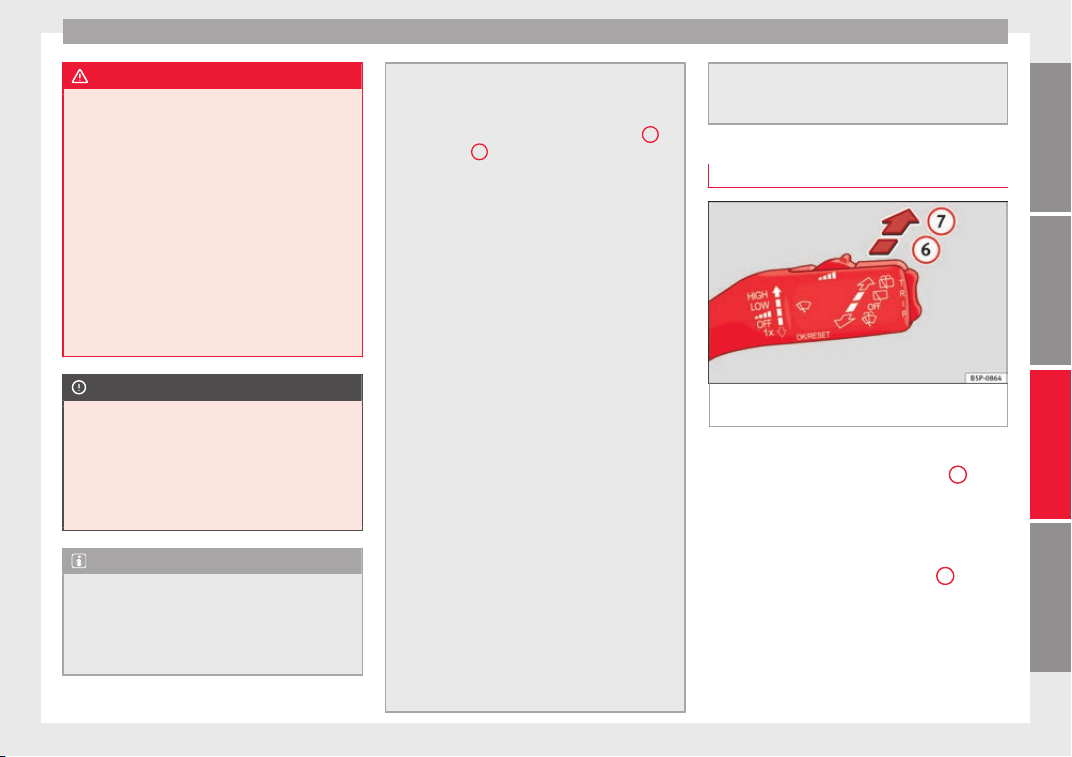
Lights and visibility
WARNING
●
Worn and dirty wiper blades reduce visibili-
ty and safety levels while driving.
●
In cold conditions, you should not use the
wash/wipe system unless you have warmed
the windscreen with the heating and ventila-
tion system. The windscreen washer fluid
could otherwise freeze on the windscreen and
obscure your view of the road.
●
The rain sensor may not detect enough rain
to switch on the wipers. If necessary, switch
on the wipers manually when water on the
windscreen impedes visibility.
●
Always note the corresponding warnings
››› page 194.
CAUTION
In icy conditions, always check that the wiper
blades are not frozen to the glass before us-
ing the wipers for the first time. If you switch
on the windscreen wipers when the wiper
blades are frozen to the windscreen, you
could damage both the wiper blades and the
wiper motor.
Note
●
The windscreen wipers will only work when
the ignition is switched on.
●
In certain versions of vehicles with alarms,
the windscreen wiper will only work when the
ignition is on and the bonnet closed.
●
When in use, the wipers do not go as far as
the rest position. When the lever is moved to
position 0, they are totally hidden.
●
If the vehicle stops when wiper speed
2
››› Fig. 69 or
3
is selected, the next speed
down will be selected automatically. The set
speed will be resumed when the vehicle pulls
away.
●
The windscreen will be wiped again after
approximately five seconds once the “auto-
matic wash/wipe system” has been activa-
ted, provided the vehicle is moving (drip func-
tion). If you activate the wipers less than 3
seconds after the drip function, a new wash
sequence will begin without performing the
last wipe. For the “drip” function to work
again, you have to turn the ignition off and
then on again.
●
When the “interval wipe function” is on,
the intervals are directly proportional to the
speed. This way, the higher the vehicle speed
the shorter the intervals.
●
The wiper will try to wipe away any obsta-
cles that are on the windscreen. The wiper
will stop moving if the obstacle continues to
block its path. Remove the obstacle and
switch the wiper back on again.
●
Before removing any objects that may be
trapped in the side areas of the windscreen,
always move the wiper arms to the service
position (horizontal).
●
The heat output of the heated jets is con-
trolled automatically when the ignition is
switched on, depending upon the outside
temperature.
●
Do not put stickers on the windscreen in
front of the rain sensor*. This may cause sen-
sor disruption or faults.
Rear window wiper
Fig. 71 Windscreen wiper lever: rear window
wiper.
Switching on the interval wipe
–
Press the lever forward to position
6
››› Fig. 71
. The wiper will wipe the window
ap
pr
oximately every 6 seconds.
Switching off the interval wipe function
–
Pull the lever back from position
6
toward
the steering wheel. The wiper will continue
to function for a short period if you switch
off whilst the wipers are in motion.
»
85
Technical specifications
AdviceOperationSafety
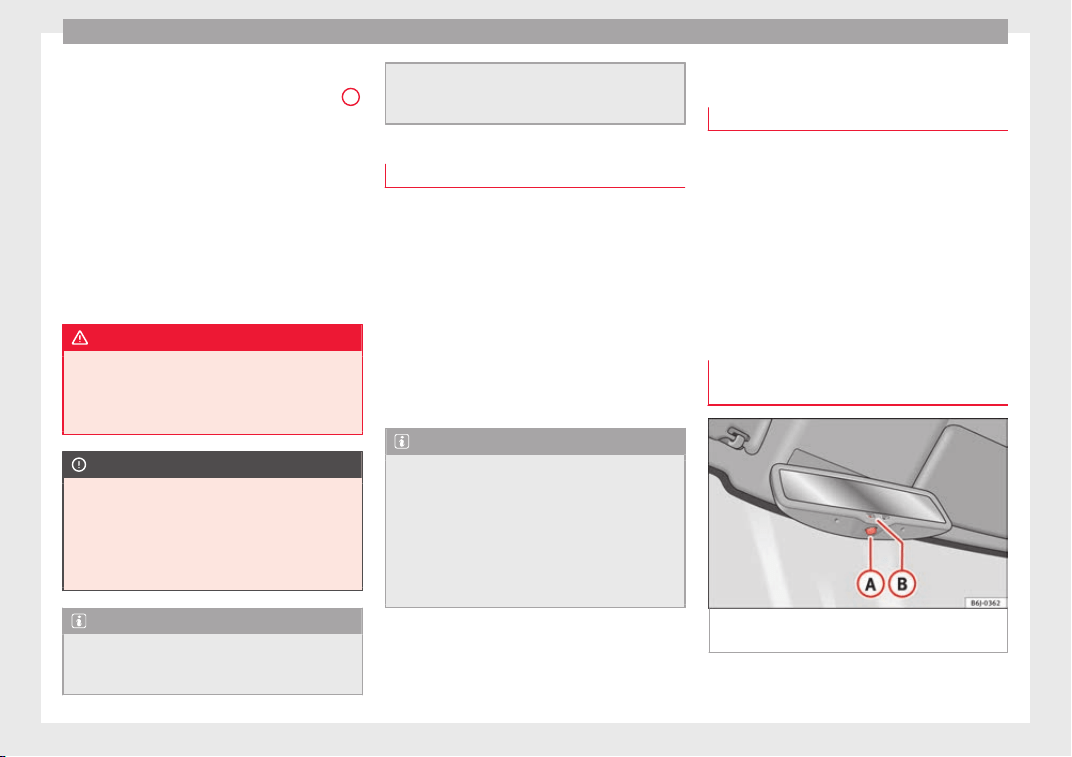
Operation
Switching on automatic wipe
–
Press the lever fully forwards to position
7
››› Fig. 71
. The rear wash function will start
immedi
at
ely and the wiper will start a few
seconds later. The rear window wash sys-
tem will function as long as you hold the
lever in this position.
–
Release the lever. The wiper then wipes for
approximately 4 seconds, and then in inter-
vals again.
–
Release the lever. The washer system stops
and the wipers function.
WARNING
●
Worn and dirty wiper blades reduce visibili-
ty and safety levels while driving.
●
Always note the corresponding warnings
on ››› page 194.
CAUTION
In icy conditions, always check that the wiper
blade is not frozen to the glass before using
the wiper for the first time. If you switch on
the wiper when the wiper blade is frozen to
the glass, this could damage both the wiper
blade and the wiper motor.
Note
●
The windscreen wiper will only function
when the ignition is switched on and the rear
lid is closed.
●
In reverse gear, with the windscreen wipers
switched on, the rear windscreen wiper will
make one wipe.
Headlight washer*
The headlight washers clean the headlight
lenses.
The headlight washers are activated auto-
matically when the windscreen washer is
used and the window wiper lever is pulled to-
wards the steering wheel for at least 1.5 sec-
onds – provided the dipped beam headlights
or main beams are switched on. Clean off
stubborn dirt (insects, etc.) from the head-
lights at regular intervals, for instance, when
filling the fuel tank.
Note
●
To ensure that the headlight washers work
properly in winter, keep the nozzle holders in
the bumper free of snow and remove any ice
with a de-icer spray.
●
To remove water, the windscreen wipers
will be activated from time to time, the head-
light washers will be activated every three cy-
cles.
Rear vision mirrors
Interior rear vision mirror
It is dangerous to drive if you cannot see
clearly through the rear window.
Manual anti-dazzle function for interior rear
vision mirror
In the basic mirror position, the lever at the
bottom edge of the rear vision mirror should
be at the front. Pull the lever to the back to
select the anti-dazzle function.
Automatic anti-dazzle interior rear
vision mirror*
Fig. 72 Automatic anti-dazzle interior rear vi-
sion mirror.
86
Lights and visibility
Switching off the anti-dazzle function
–
Press button
A
››› Fig. 72. Control lamp
B
goes off.
Switching on the anti-dazzle function
–
Press button
A
››› Fig. 72. The control
lamp lights up.
Anti-dazzle function
The anti-dazzle function is activated every
time the ignition is switched on. The green
warning lamp lights up in the rear vision mir-
ror housing.
When the anti-dazzle function is enabled, the
interior rear vision mirror will darken auto-
matically
according to the amount of light it
r
ec
eives. The anti-dazzle function is cancel-
led if reverse gear is engaged.
Note
●
The automatic anti-dazzle function will only
work properly if the sun blind* for the rear
window is retracted and there are no other
objects preventing light from reaching the in-
terior rear vision mirror.
●
If you have to stick any type of sticker on
the windscreen, do not do so in front of the
sensors. Doing so could prevent the anti-daz-
zle function from working well or even from
working at all.
Exterior mirrors
Fig. 73 Exterior mirror controls.
The exterior mirrors can be adjusted using
the rotary knob in the centre console.
Basic setting of exterior mirrors
1. Turn knob ››› Fig. 73
to position L (left ex-
t
erior mirr
or).
2. Turn the rotary knob to position the exteri-
or mirror so that you have a good view to
the rear of the vehicle.
3. Turn the knob to position R (right exterior
mirror).
4. Swivel the rotary knob to position the ex-
terior mirror so that you have a good view
to the rear of the vehicle ›››
.
Heating the exterior mirrors*
–
Turn the knob forward ››› Fig. 73
so that the
he
at
ed rear vision mirrors warm up and the
heated windscreen* in the wiper blade rest
area is activated ››› page 84.
–
Exterior mirror heating is not activated in
temperatures above approximately +20 °C
(+68 °F).
Folding in exterior mirrors*
–
Turn the control ››› Fig. 73 to position to
fold in the exterior mirrors. You should al-
ways fold in the exterior mirrors if you are
driving through an automatic car wash.
This will help prevent damage.
Folding exterior mirrors with convenience
closing*
–
The exterior mirror will fold back automati-
cally with convenience closing (with the re-
mote or the key).
–
To unfold it again, open the door and
switch on the ignition.
Folding exterior mirrors back out to the
extended position*
–
Turn the knob to another position to fold
the exterior mirrors back out ›››
.
Synchronised mirror adjustment
1. Turn the control to the position L
(
left ex-
t
erior mirror).
2. Turn the rotary knob to position the exteri-
or mirror so that you have a good view to
»
87
Technical specifications
AdviceOperationSafety
Operation
the rear of the vehicle. The right exterior
mirror
will be adjusted at the same time
(sy
nc
hronised).
WARNING
●
Convex or spherical mirrors increase the
field of vision however the objects appear
smaller and further away. If you use these
mirrors to estimate the distance to vehicles
behind you when changing lane, you could
make a mistake. Risk of accident.
●
If possible, use the rear vision mirror to es-
timate distances to vehicles behind you.
●
Make sure that you do not get your finger
trapped between the mirror and the mirror
base when folding back the mirrors. Risk of
injury!
For the sake of the environment
The exterior mirror heating should be switch-
ed off when it is no longer needed. Other-
wise, it is an unnecessary fuel waste.
Note
●
If the electrical adjustment ever fails to op-
erate, the mirrors can be adjusted by hand by
lightly pressing the edge of the mirror glass.
●
In vehicles with electric exterior mirrors,
the following points should be observed: if,
due to an external force (e.g. being knocked
while manoeuvring), the adjustment of the
mirror housing is altered, the mirror will have
to be fully folded electrically. Do not readjust
the rear vision mirror housing by hand, as
this will interfere with the mirror adjuster
function.
●
The rear vision mirrors can be adjusted sep-
arately or simultaneously, as described
above.
●
The folding function on the exterior mirrors
is not active at speeds over 40 km/h
(25 mph).
Seats and head restraints
Adjusting the seat and head
restraints
The importance of correct seat
adjustment
Proper seat adjustment optimises the level of
protection offered by seat belts and airbags.
Your vehicle has five
seats, two in the front
and thr
ee in the r
ear. Each seat is equipped
with a three-point seat belt.
The driver seat and the front passenger seat
can be adjusted in many ways to suit the
physical requirements of the vehicle occu-
pants. The correct seat position is very impor-
tant for:
●
a fast and easy operation of all controls on
the instrument panel,
●
a relaxed posture which does not cause
drowsiness,
●
a safe driving
›››
page 5,
●
ensuring that the seat belts and airbag sys-
tem provide maximum protection
›››
page 11.
WARNING
●
If the driver and passengers assume im-
proper sitting positions, they may sustain
critical injuries.
88
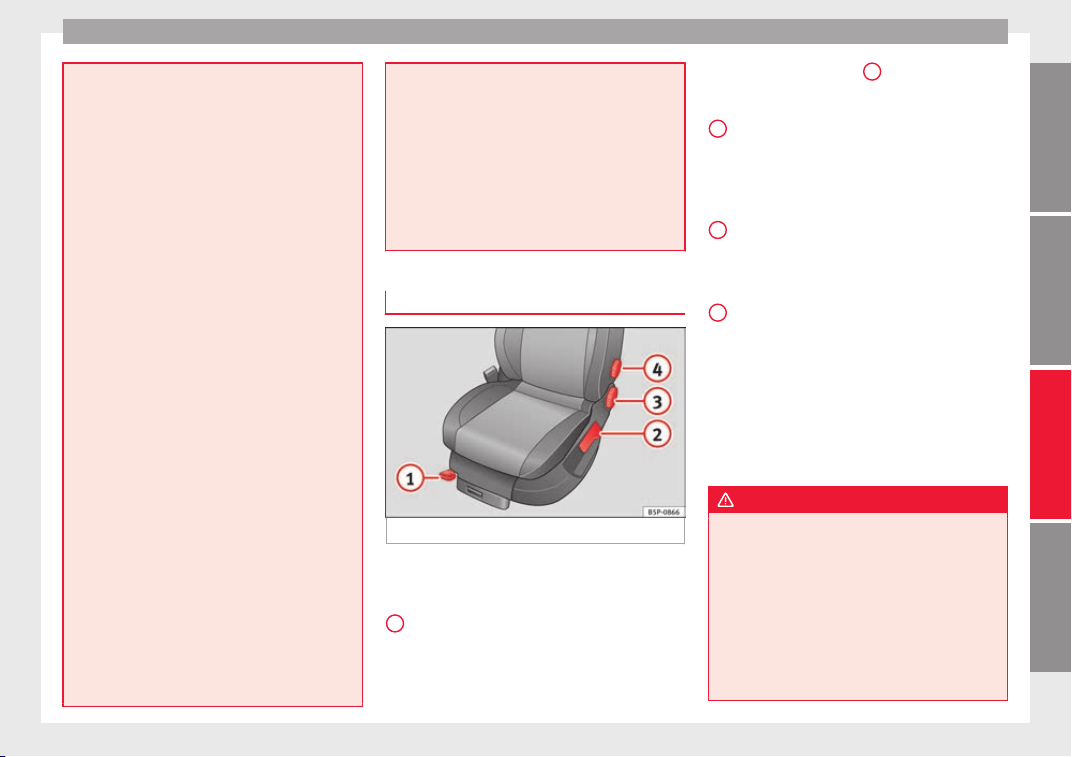
Seats and head restraints
●
Never transport more than the permitted
amount of people in your vehicle.
●
Every vehicle occupant must properly fas-
ten and wear the seat belt belonging to his or
her seat. Children must be protected with an
appropriate child restraint system ››› page 24,
Transporting children safety.
●
The front seats and all head restraints must
always be adjusted to body size and the seat
belt must always be properly adjusted to pro-
vide you and your passengers with optimum
protection.
●
Always keep your feet on the footwell when
the vehicle is moving; never rest them on the
dash panel, out of the window or on the seat.
This is also applied to passengers. An incor-
rect sitting position exposes you to an in-
creased risk of injury in case of a sudden
braking or an accident. If the airbag is trig-
gered, you could sustain severe injuries due
to an incorrect sitting position.
●
It is important for the driver and front pas-
senger to keep a distance of at least 25 cm
from the steering wheel and dash panel. Fail-
ure to respect the minimum distance means
that the airbag will not protect you. Risk of
fatal injury. The distance between the driver
and the steering wheel or between the front
passenger and the dash panel should always
be as great as possible.
●
Adjust the driver or front passenger seat
only when the vehicle is stationary. This also
applies to the forwards/backwards adjust-
ment of the rear seats. Otherwise, your seat
could move unexpectedly while the vehicle is
moving. This could increase the risk of an ac-
cident and therefore, injury. In addition,
while adjusting your seat, you will assume an
incorrect sitting position. Risk of fatal acci-
dents.
●
Special guidelines apply to installing a
child seat on the front passenger seat. When
installing a child seat, please observe the
warnings described in ››› page 24, Transport-
ing children safety.
Adjustment of the front seats
Fig. 74 Front left seat controls
The control elements in ››› Fig. 74
are mir-
r
or
ed for the front right-hand seat.
1
Adjusting the seat forwards and
backwards
–
Pull up the grip and move the seat forwards
or backwards.
–
Then release the grip
1
and move the seat
further until the catch engages.
2
Adjusting the seat height*
–
Pull the lever up or push down (several
times if necessary) from its home position.
This adjusts the seat height in stages.
3
Adjusting the backrest angle
–
Take your weight off the backrest and turn
the hand wheel.
4
Adjusting the lumbar support*
–
Take your weight off the backrest and turn
the hand wheel to adjust the lumbar sup-
port.
As you make the adjustments, the curvature
of the cushioned area of the lumbar region
becomes more or less acute. In this way, it
adapts to the natural curvature of the spine.
WARNING
●
Never adjust the driver or front passenger
seat while the vehicle is in motion. While ad-
justing your seat, you will assume an incor-
rect sitting position. Risk of fatal accidents.
Adjust the driver or front passenger seat only
when the vehicle is stationary.
●
To reduce the risk of injury to the driver and
front passenger in case of a sudden braking
or an accident, never drive with the backrest
tilted towards the rear. The maximum
»
89
Technical specifications
AdviceOperationSafety
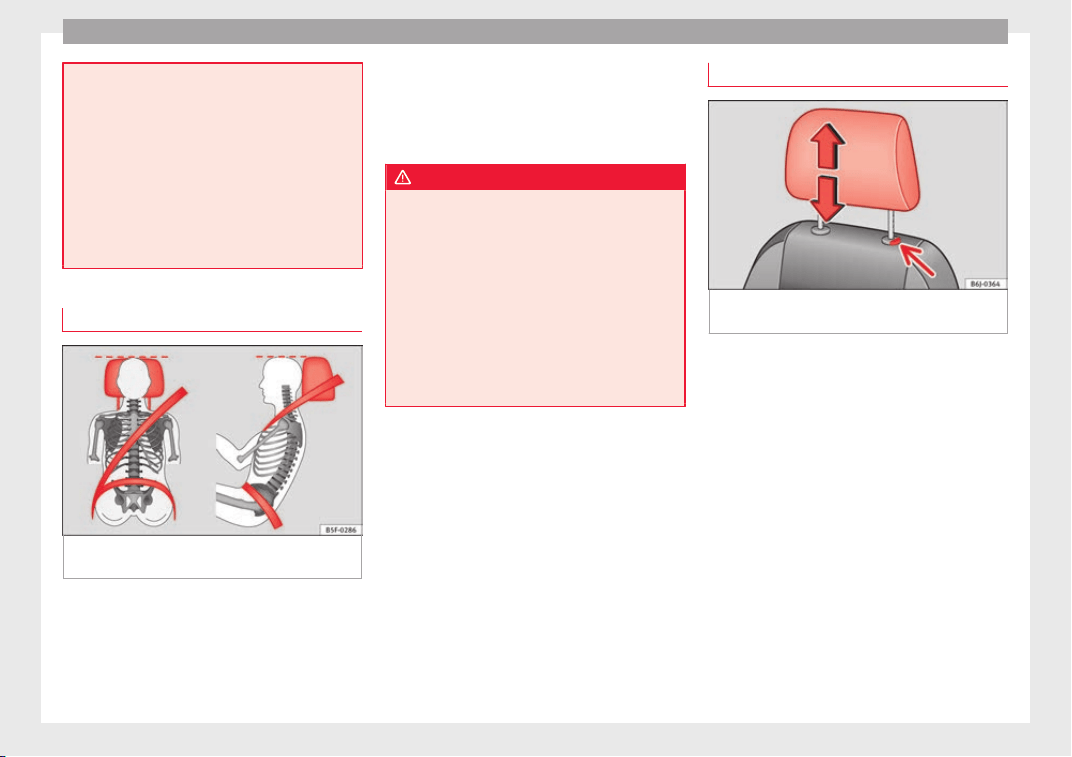
Operation
protection of the seat belt can be achieved
only when the backrests are in an upright po-
sition and the driver and front passenger
have properly adjusted their seat belts. The
further the backrests are tilted to the rear,
the greater the risk of injury due to improper
positioning of the belt web!
●
Exercise caution when securing the seat
height into forwards/backwards position. In-
juries can be caused if the seat height is ad-
justed without due care and attention.
Correct adjustment of head restraints
Fig. 75 Front and side view: head restraints
and seat belts correctly adjusted.
Properly adjusted head restraints are an im-
portant part of passenger protection and can
reduce the risk of injuries in most accident
situations.
–
Adjust the head restraint so that the top is
at the same level as the top of your head,
at the very least, at eye level ››› Fig. 75
.
Adju
s
ting the head restraints ››› page 90
WARNING
●
Travelling with the head restraints removed
or improperly adjusted increases the risk of
severe injuries.
●
Improperly adjusted head restraints could
lead to death in the event of a collision or ac-
cident.
●
Incorrectly adjusted head restraints also in-
crease the risk of injury during sudden or un-
expected driving or braking manoeuvres.
●
The head restraints must always be adjus-
ted according to the height of the passenger.
Removing or adjusting head restraints
Fig. 76 Adjusting and removing the head re-
straints.
Adjusting height (front seats)
–
Press the button on the side and pull up-
wards to the desired position.
–
To lower the head restraint, press the but-
ton and push head restraint downwards.
–
Make sure that it engages securely into one
of its positions.
Adjusting height (rear seats)
–
Press the button on the side and pull up-
wards to the desired position.
–
To lower the head restraint, press the but-
ton and push head restraint downwards.
–
Make sure that the head restraint engages
securely in one of its positions. ››› page 10
90
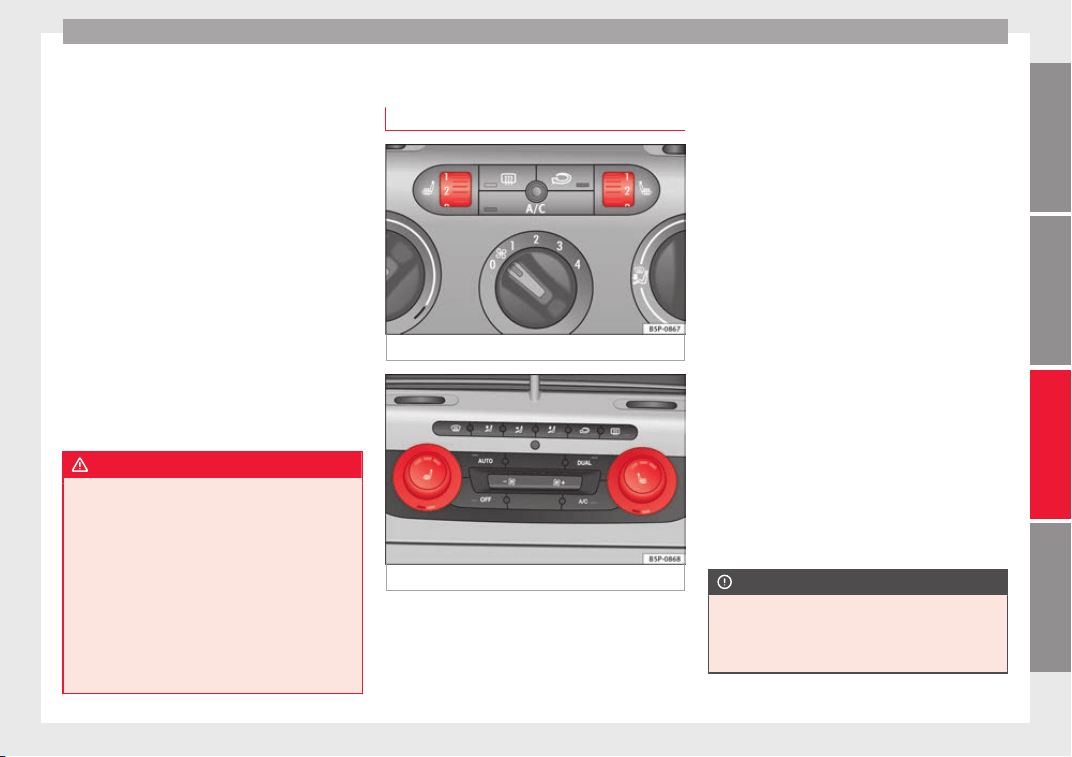
Seats and head restraints
Angle adjustment (front seats)
–
Press the head restraint forward or back to
the required position.
Removing the head restraint
–
Push the head restraint up as far as it will
go.
–
Press the button ››› Fig. 76 (arrow).
–
Pull head restraint out of fitting without re-
leasing the button.
Fitting the head restraint
–
Insert the head restraint into the guides on
the backrest.
–
Push head restraint down.
–
Adjust the head restraint to suit body size
››› page 10
and ›
›› p
age 9.
WARNING
●
Never drive if the head restraints have been
removed. Risk of injury.
●
Never drive if the head restraints are in an
unsuitable position, there is a risk of serious
injury.
●
After refitting the head restraint, you must
always adjust it properly for height to achieve
optimal protection.
●
Please observe the safety warnings in
››› page 90, Correct adjustment of head re-
straints.
Seat functions
Heated seats*
Fig. 77 Thumb wheel for front seat heating.
Fig. 78 Front seat heating with Climatronic.
The front seat cushions and backrests can be
heated electrically.
Front seat heating for vehicles without
Climatronic
–
Turn the appropriate thumb wheel
››› Fig. 77
to switch on the seat heating. The
se
at
heating is switched off in the 0 posi-
tion.
Front seat heating for vehicles with
Climatronic
–
Press the button to switch on seat heating.
–
Press once to set seat heating at maximum
level (level 3).
–
Press twice to set seat heating at medium
level (level 2).
–
Press three times to set seat heating at
minimum level (level 1).
–
When the button is pressed four times, the
heating goes off and the LED goes out (lev-
el 0).
The seat heating only works when the igni-
tion is switched on. The left thumb wheel
controls the left seat and the right thumb
wheel the right seat.
CAUTION
To avoid damaging the heating elements,
please do not kneel on the seat or apply
sharp pressure at a single point to the seat
cushion and backrest.
91
Technical specifications
AdviceOperationSafety
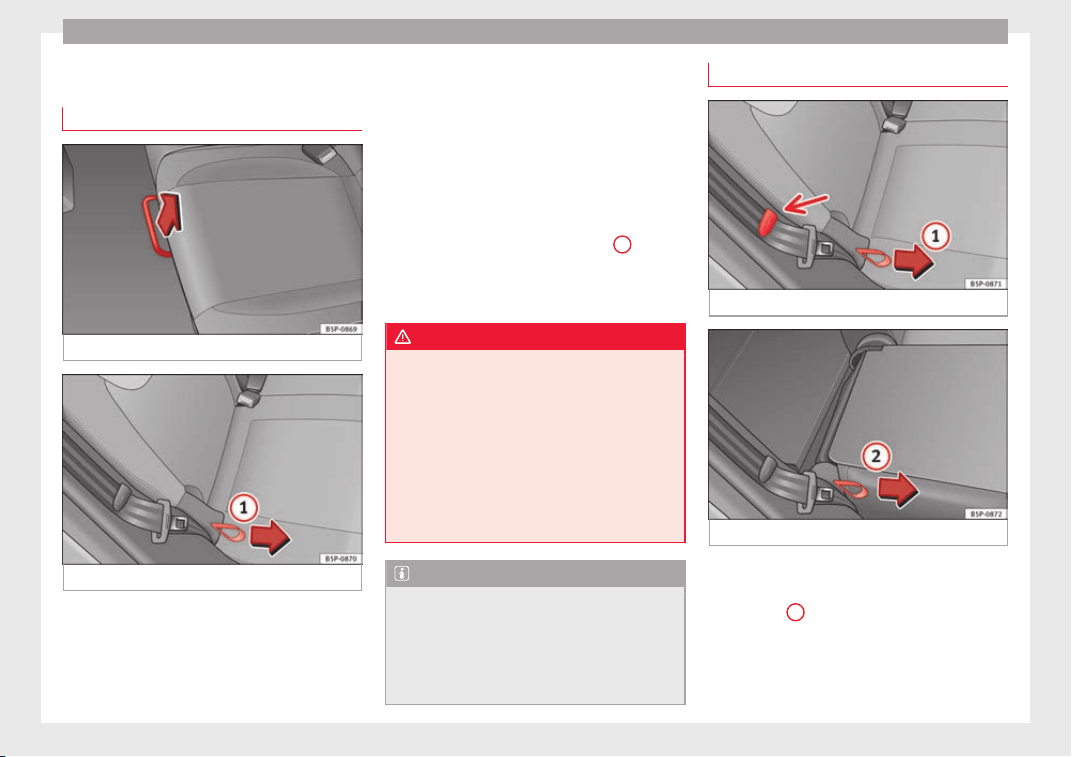
Operation
Rear seats
Seat adjustment
Fig. 79 Unlock bar on rear seat
Fig. 80 Rear seat backrest angle adjustment.
The seats may be moved forwards or back-
wards independently. This movement range
can be 1/3 or 2/3 of the seat. There are vari-
ous possible positions.
Adjusting reach
–
In the seated position, unlock the lever in
the direction of the arrow ››› Fig. 79
.
–
Mo
v
e the seat cushion forwards or back-
wards to the desired position.
Adjusting the backrest angle
–
Hold the backrest at the top. Pull the loop
on the side of the seat ››› Fig. 80
1
in the
direction of the arrow and hold it in this po-
sition. Push the backrest to the required
position and release the loop.
WARNING
●
Adjust the seat only when the vehicle is
stationary. Otherwise, your seat could move
unexpectedly while the vehicle is moving.
This could increase the risk of an accident
and therefore, injury.
●
Do not push the backrests down when the
seat is moved to prevent damage to the cen-
tre console.
●
Ensure that the seat, once moved, is fixed
in position.
Note
●
In order to maintain the maximum luggage
compartment space, put the backrests in po-
sition normal, without moving.
●
In order to maintain the maximum space
without putting the backrests down, move
the seats forward to the desired position.
Folding and lifting the seat backrest
Fig. 81 Folding the rear seat backrests down.
Fig. 82 Lifting the rear seat backrests.
Folding the backrest forwards
–
Pull the loop on the side of the seat
››› Fig. 81
1
.
In this position the backrest is locked.
92
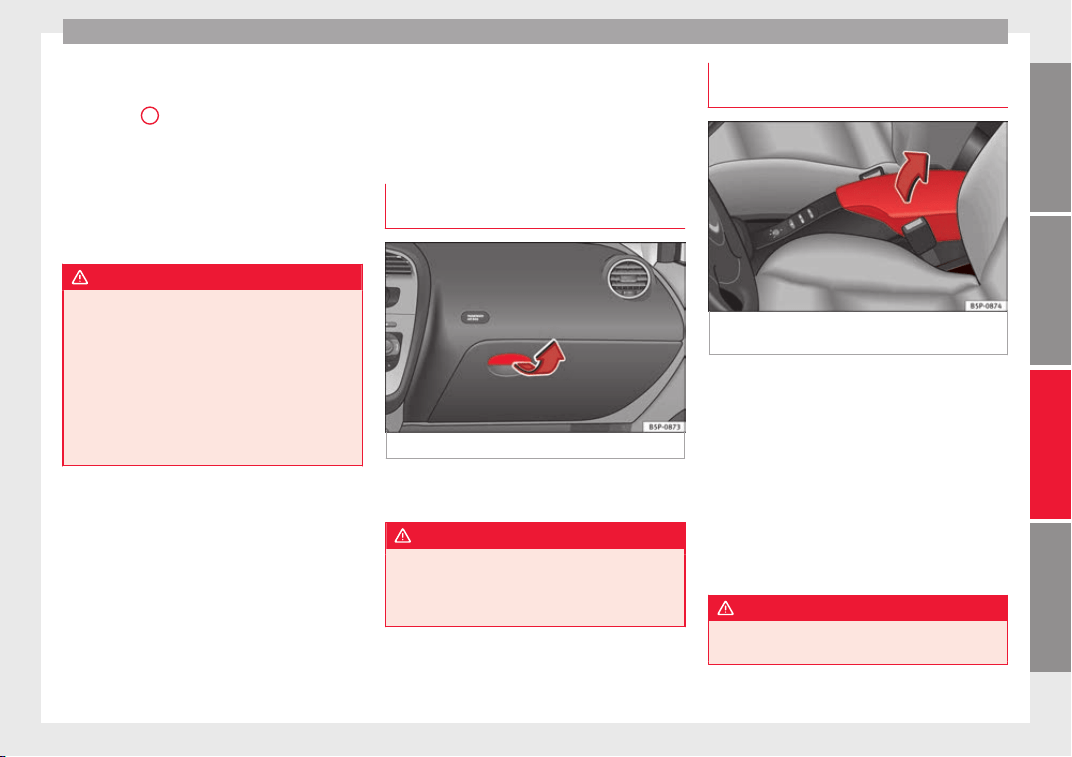
Transport and practical equipment
Converting the table to a seat
–
Pull the loop on the side of the seat
››› Fig. 82
2
in the direction of the arrow
and lift the seat backrest until it is in place.
When folding and lifting the backrest, make
sure to place the side seat belts in the trim
clip ››› Fig. 81
to prevent them from being
d
am
aged by becoming trapped in the back-
rest lock.
WARNING
●
You should check that the backrest has en-
gaged properly in position after the loop is
released.
●
For safety reasons the locking system loops
on the seats may not be used to secure any
items.
●
After locking the seat backrest into position
ensure that the seat belts protrude from the
seat.
Transport and practical
equipment
Compartments
Storage compartment on the front
passenger side
Fig. 83 Passenger side: storage compartment
The compartment can be opened by pulling
the lever ››› Fig. 83
.
WARNING
Always keep the storage compartment cover
closed while the vehicle is in motion in order
to reduce the risk of injury caused by a sud-
den braking or by an accident.
Front centre armrest with storage
compartment
Fig. 84 Front armrest with storage compart-
ment.
There is a storage compartment in the arm-
rest.
–
To open the storage compartment, lift the
armrest up in the direction of the arrow
››› Fig. 84
and then lift the cover.
–
T
o ac
cess the CD changer* or the lower
storage compartment, pull on the armrest
cover without pressing on the button.
–
To close the storage compartment, push
the armrest down.
WARNING
Always keep the storage compartment closed
while the vehicle is in motion to reduce the
»
93
Technical specifications
AdviceOperationSafety
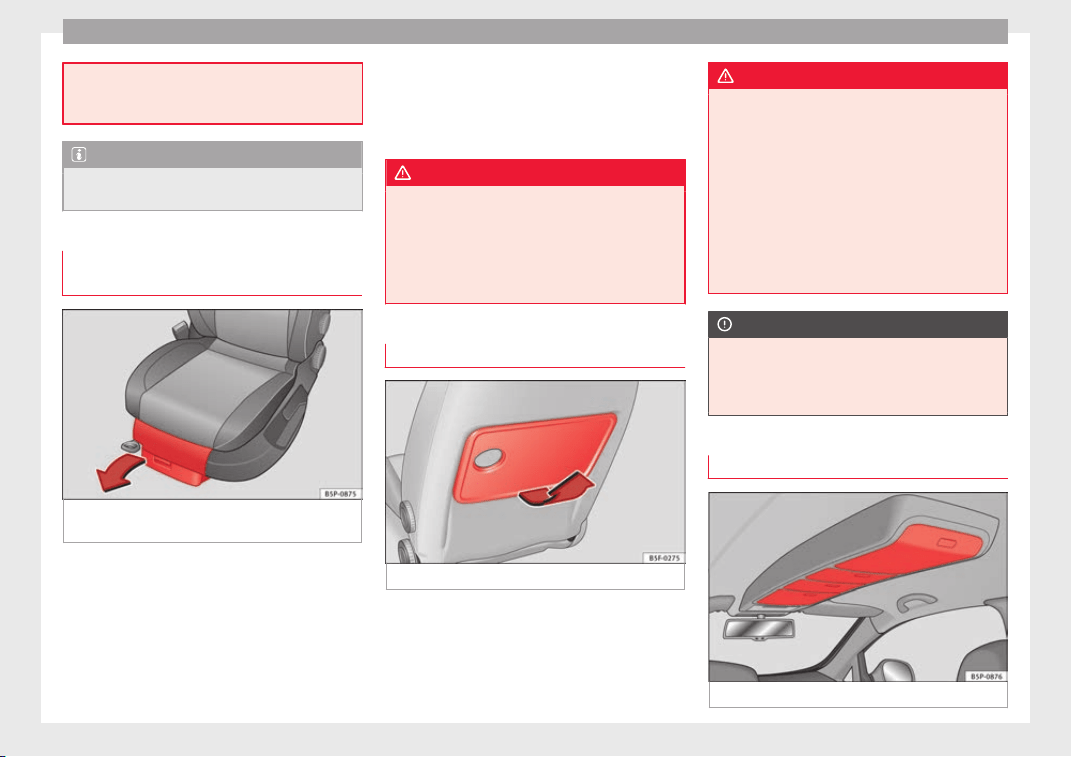
Operation
risk of injury from the armrest during a sud-
den braking manoeuvre or in the event of an
accident.
Note
The CD changer is located in this compart-
ment.
Storage compartment under the front
seats*
Fig. 85 Storage compartment under the front
seats.
There is a storage compartment with a cover
under each front seat.
The drawer* ››› Fig. 85
is opened by pushing
the b
utt
on and moving the cover back.
There are two open positions of 15 and 60
degrees depending on the pressure applied
to the cover. In the 60 degree position, the
cover will collapse if too much pressure is ap-
plied.
To close the drawer, press the cover until it
locks into position.
WARNING
●
The drawers will hold a maximum weight of
1.5 kg.
●
Do not drive with the drawer cover open.
There is an injury risk for passengers if the
cargo is released in case of sudden braking or
an accident.
Folding table*
Fig. 86 Folding tray on the front left seat.
Folding trays are fitted to the rear of the front
seat backrests.
–
To open the tray, open it up in the direction
of the arrow
›››
Fig. 86
.
WARNING
●
The folding trays may not be folded down
whilst the vehicle is in motion and anyone is
seated on the second row of seats. There is a
risk of injury during a sudden braking ma-
noeuvre! The tray must therefore be closed
and properly secured whilst the vehicle is in
motion.
●
Do not put hot drinks in the drink holders.
During normal or sudden driving manoeuvres,
sudden braking or an accident, the hot drink
could be spilled. Danger of scalding.
CAUTION
When driving, do not leave open cans in the
cup holders. The drink might be spilt on brak-
ing, for example, and could damage the vehi-
cle.
Roof storage compartment*
Fig. 87 Roof storage compartments.
94
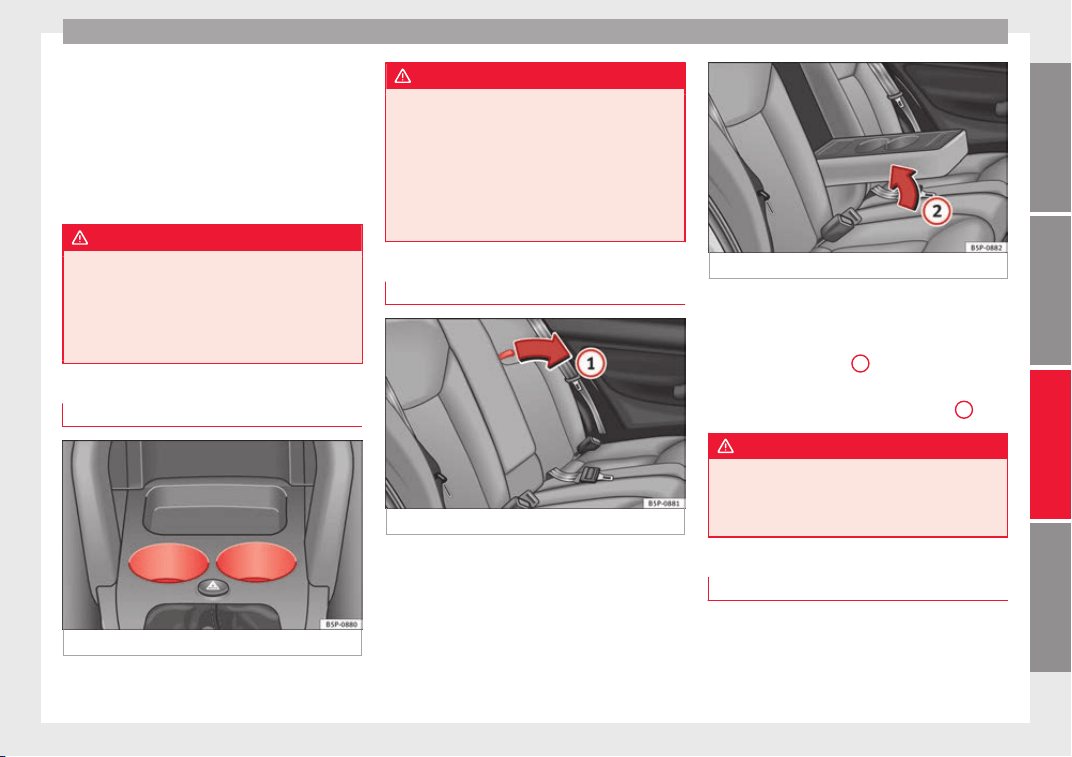
Transport and practical equipment
There are four storage compartments in the
roof.
–
Press the button on the cover to open these
compartments ››› Fig. 87
. The cover will
then open.
–
T
o c
lose the cover, press it up until it en-
gages.
WARNING
Always keep the storage compartment cover
closed while the vehicle is in motion to re-
duce the risk of injury during a sudden brak-
ing manoeuvre or in the event of an accident
and to prevent any items from being thrown
through the vehicle interior.
Front drinks holders
Fig. 88 Front drink holders.
In the centre console, in front of the gear lev-
er, there are two drink holders ››› Fig. 88
.
WARNING
●
Never place hot drinks in the drink holders.
During sudden or normal driving manoeuvres,
when braking suddenly or in case of an acci-
dent, the hot drink could spill. Risk of scald-
ing.
●
Never use rigid cup materials (for example,
glass or ceramic), since they could cause in-
jury in the case of an accident.
Rear cup holder*/armrests*
Fig. 89 Opening the rear cup holder.
Fig. 90 Rear cup holder in the armrest.
Opening and closing the armrest*/drink
holder*
–
To open, pull the loop in the direction of
the arrow ››› Fig. 89
1
.
–
To close, lift the cup holder*/armrest* in
the direction of the arrow ››› Fig. 90
2
.
WARNING
Ensure that the load in the luggage compart-
ment is correctly secured with the net* when
travelling with the armrest down
››› page 104.
Other storage compartments
Other storage compartments can be found:
●
in the centre console,
●
in the door trims (front and rear),
»
95
Technical specifications
AdviceOperationSafety
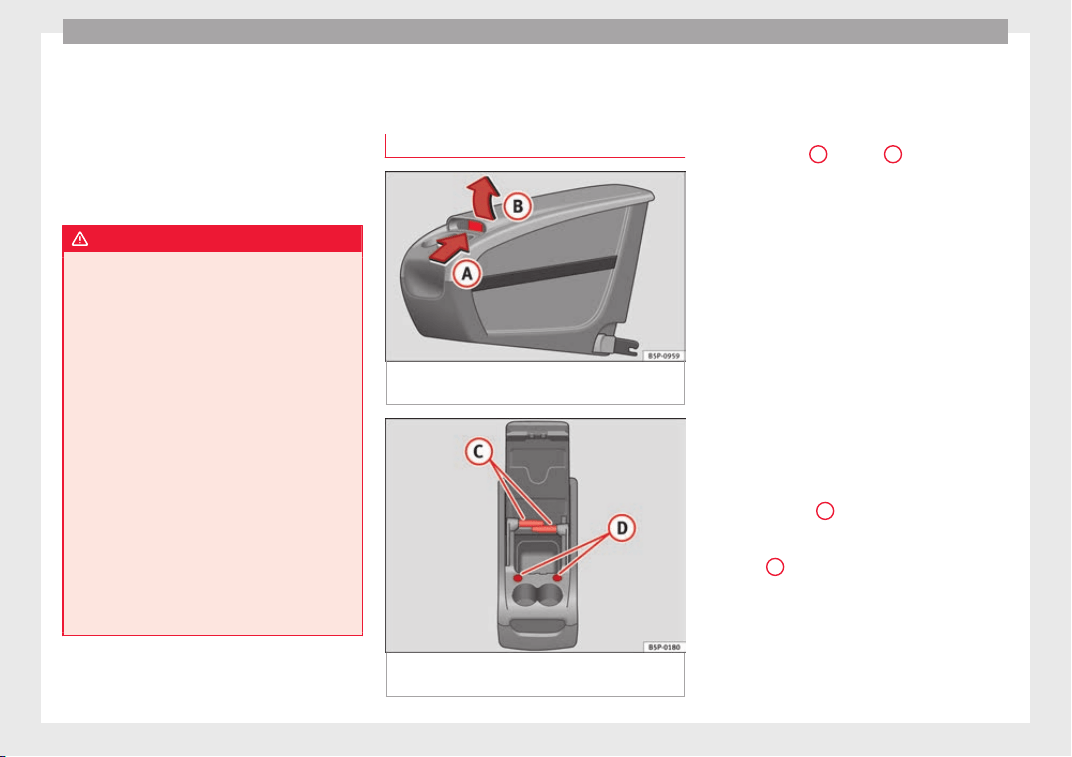
Operation
●
in the side trims of the luggage compart-
ment,
●
in the spare wheel recess in the luggage
compartment (only on vehicles with an op-
tional anti-puncture kit*.
The clothes hooks are located on the rear
roof handles.
WARNING
●
Do not store loose objects on the dash pan-
el. These objects could be flung through the
passenger compartment when the vehicle is
moving (e.g. while accelerating, braking or
cornering) and distract the driver.
●
Ensure that no objects can fall from the
centre console or other storage compart-
ments into the driver footwell while the vehi-
cle is moving. In the event of a sudden brak-
ing manoeuvre, you will not be able to use
the brake, clutch or accelerator. Risk of acci-
dent.
●
Clothing hung on the coat hooks must not
restrict the driver's view. Risk of accident.
The coat hooks are intended only for use with
light articles of clothing. Do not leave any
hard, sharp or heavy objects in hanging arti-
cles of clothing. During sudden braking ma-
noeuvres or accidents, especially those in-
volving airbag deployment, these objects
could injure the vehicle occupants.
Multi-purpose mobile storage
compartment*
General information
Fig. 91 Mobile storage compartment. Open-
ing.
Fig. 92 Mobile storage compartment. Func-
tions.
This storage compartment may only be
placed in the central area of the rear seat.
Opening
–
Lift the cover
B
, in area
A
››› Fig. 91
.
C
lo
sing
–
Push the cover down, until it clips into
place.
Uses of the mobile storage compartment
●
The front open glove compartment may be
used to store small objects that will not dam-
age passengers in the event that the objects
are flung around the interior of the vehicle.
●
The cup holders are used for holding drink
cans or cups.
●
The elastic belt on the side may be used for
keeping papers and magazines.
●
The tables may be used as a support for
writing.
To use the table
C
››› Fig. 92
, it must be re-
mo
v
ed from its compartment in the side of
the mobile storage compartment and fitted
into slot
D
››› Fig. 92
on the front section of
the mo
b
ile storage compartment.
The table in the right-hand compartment is
fitted into the left-hand slot of the front of the
mobile storage compartment and the table in
the left-hand compartment is fitted in the
right-hand slot.
96
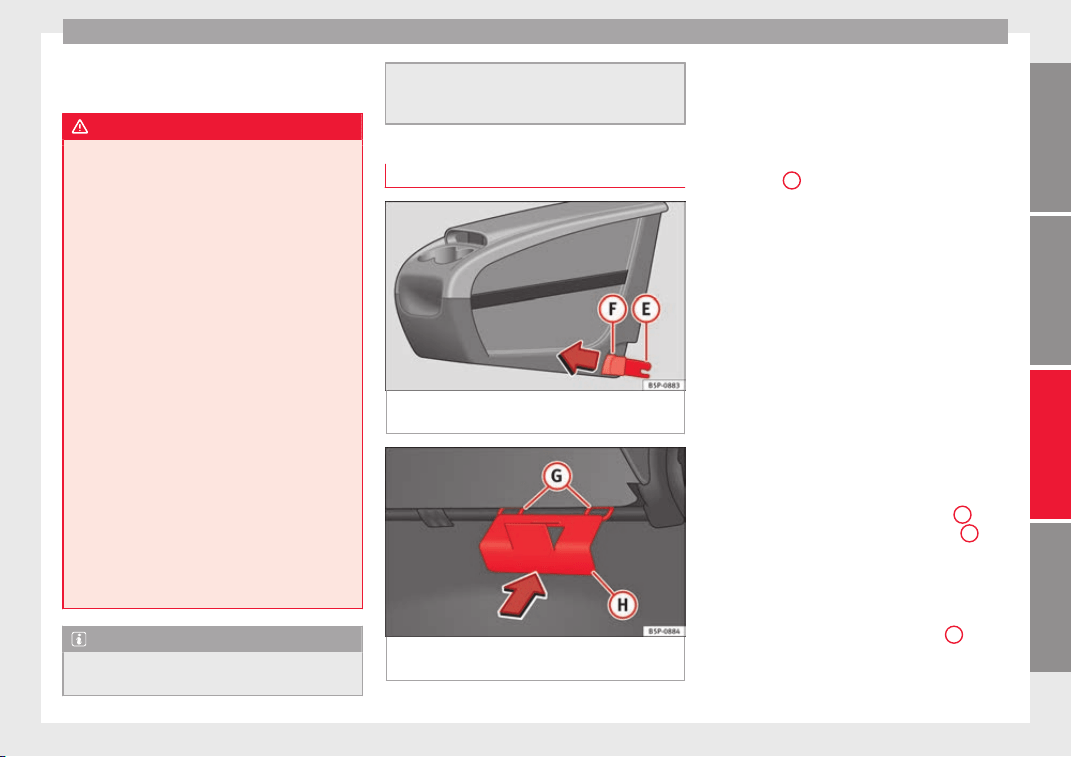
Transport and practical equipment
The tables have two positions for use and
cannot be interchanged.
WARNING
●
The mobile stowage compartment supports
a maximum load of 5 kg. Do not overload.
●
Do not drive when the cover of the mobile
storage compartment is open.
●
Do not drive when the tables are set up for
use.
●
When the vehicle is moving and when the
tables are not in use, keep them stored inside
the mobile storage compartment with the
cover closed.
●
Never place hot drinks in the cup holders.
The drink may spill and cause burns when the
vehicle is moving.
●
Do not leave cans in the cup holders when
the vehicle is in motion, there is a danger
that the can may be flung around the vehicle
and cause injury.
●
Make sure that the mounting plate is prop-
erly fixed onto the cushion frame.
●
When the plate is not in use, store inside
the storage compartment.
●
When the mobile storage compartment is
not in use, it should always be properly fas-
tened using the storage net in the boot.
Note
●
Check that the mobile storage compart-
ment is fitted correctly, pulling it forward by
the front storage compartment and checking
that both safety clips are securely fastened to
both rings.
Mounting and removal
Fig. 93 Mobile storage compartment. Mount-
ing.
Fig. 94 Mobile storage compartment mount-
ing plate.
Mounting the mobile storage compartment
–
Fold down the small section of the rear seat
backrest in order to access the back of the
large backrest.
–
Fit the mobile storage compartment mount-
ing plate
H
››› Fig. 94
from the inside of
the
v
ehicle, through the rear part of the
seat. It should be fitted between the back-
rest and the seat, in the central seat area.
–
Push the plate until it clips the cushion
frame. The rings of the mobile storage com-
partment mounting plate appear at the
front of the seat.
–
If it is difficult to make the plate clip, tilt the
rear backrest of the large section forwards
slightly and then lean the backrest back-
wards to make the fitting of the mobile
storage compartment onto the mounting
plate easier.
–
Place the mobile storage compartment on-
to the foam of the central seat.
–
Set both mounting pieces together
E
››› Fig. 93
, with both mounting rings
G
››› Fig. 94
and press hard until both the
c
lip
s completely connect with the rings.
Removing the mobile storage compartment
–
Pull each of the buttons
›››
Fig. 93
F
on
the clips (red buttons) forwards, until they
snap out of place.
»
97
Technical specifications
AdviceOperationSafety
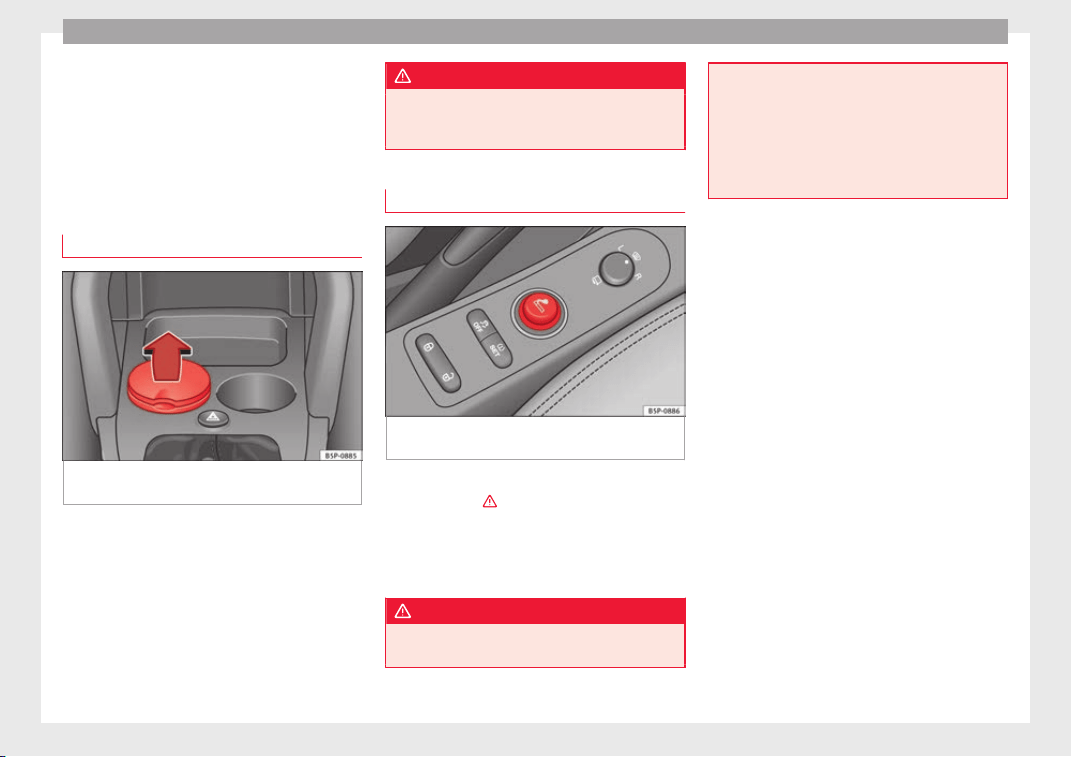
Operation
–
Fold the larger seat down and remove the
mobile storage compartment mounting
plate.
Ashtray*, cigarette lighter* and
power sockets
Front ashtray*
Fig. 95 Ashtray located in the front cup hold-
er.
Opening and closing the ashtray
–
To open the ashtray, lift the cover ››› Fig. 95
.
–
T
o c
lose, push the cover down.
Emptying the ashtray
–
Extract the ashtray and empty it.
WARNING
Never put paper in the ashtray. Hot ash could
ignite the paper in the ashtray and cause a
fire.
Cigarette lighter*
Fig. 96 The cigarette lighter is located in the
power socket of the front centre console.
–
Press on the cigarette lighter ››› Fig. 96
to
activ
at
e it ›››
.
–
Wait for the lighter to spring out.
–
Pull out the cigarette lighter and light the
cigarette on the glowing coil.
WARNING
●
Improper use of the cigarette lighter can
lead to serious injuries or start a fire.
●
Using the lighter carefully. Carelessness or
negligence when using the cigarette lighter
can cause burns and serious injuries.
●
The lighter only works when the ignition is
turned on or the engine is running. To avoid
the risk of fire, never leave children alone in-
side the vehicle.
98
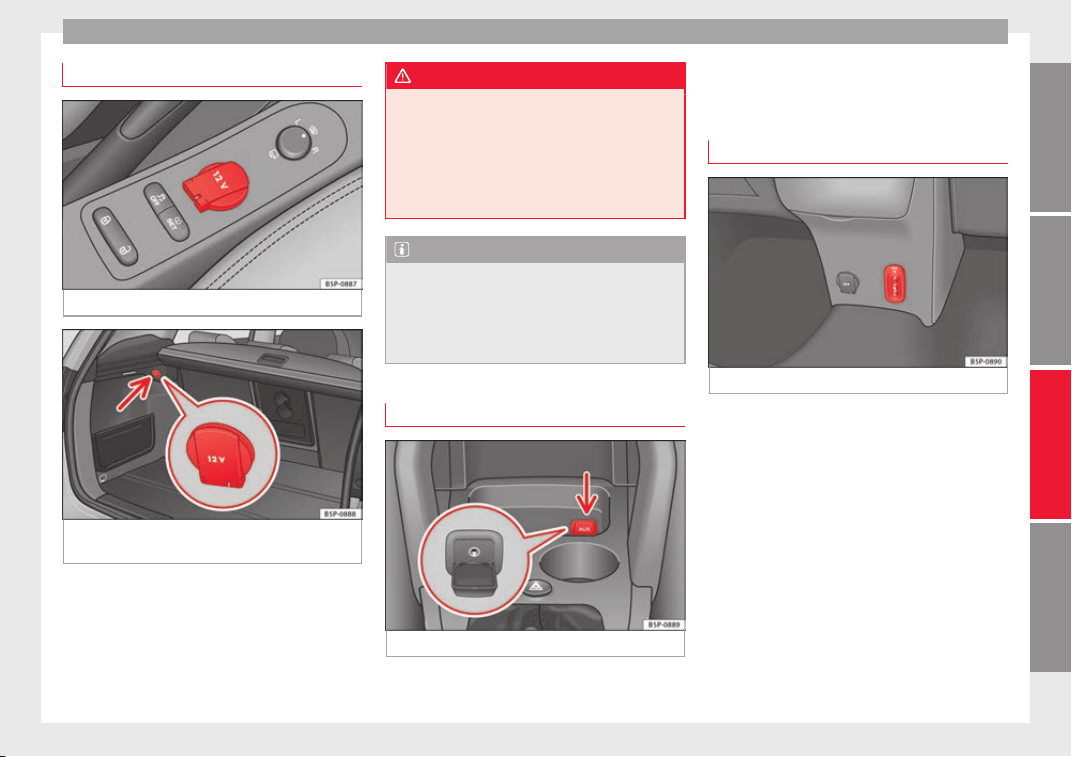
Transport and practical equipment
Power sockets
Fig. 97 Power socket, front centre console.
Fig. 98 Altea XL/Freetrack model: power
socket in boot.
Electrical accessories may be connected to
the 12 volt power socket in the front centre
console ››› Fig. 97
and in the luggage com-
p
ar
tment*. The appliances connected to each
power point must not exceed a power rating
of 120 Watt.
WARNING
The power sockets and the connected acces-
sories will only operate when the ignition is
on or when the engine is running. Improper
use of the sockets or electrical accessories
can lead to serious injuries or cause a fire. To
avoid the risk of injury, never leave children
alone inside the vehicle.
Note
●
The use of electrical appliances with the
engine switched off will cause a battery dis-
charge.
●
Before using any electrical accessories, see
the instructions in ››› page 147.
Auxiliary audio input (AUX-IN)*
Fig. 99 Auxiliary audio connection.
–
Lift the AUX cover ››› Fig. 99
.
–
In
ser
t the plug as far as possible (see Ra-
dio manual).
AUX RSE connection*
Fig. 100 AUX RSE connection.
This connector may be used as an audio in-
put (red and white connectors) or audio and
video connector (red, white and yellow con-
nectors). For more details about the use of
this audio and video source, see the RSE
manual.
99
Technical specifications
AdviceOperationSafety
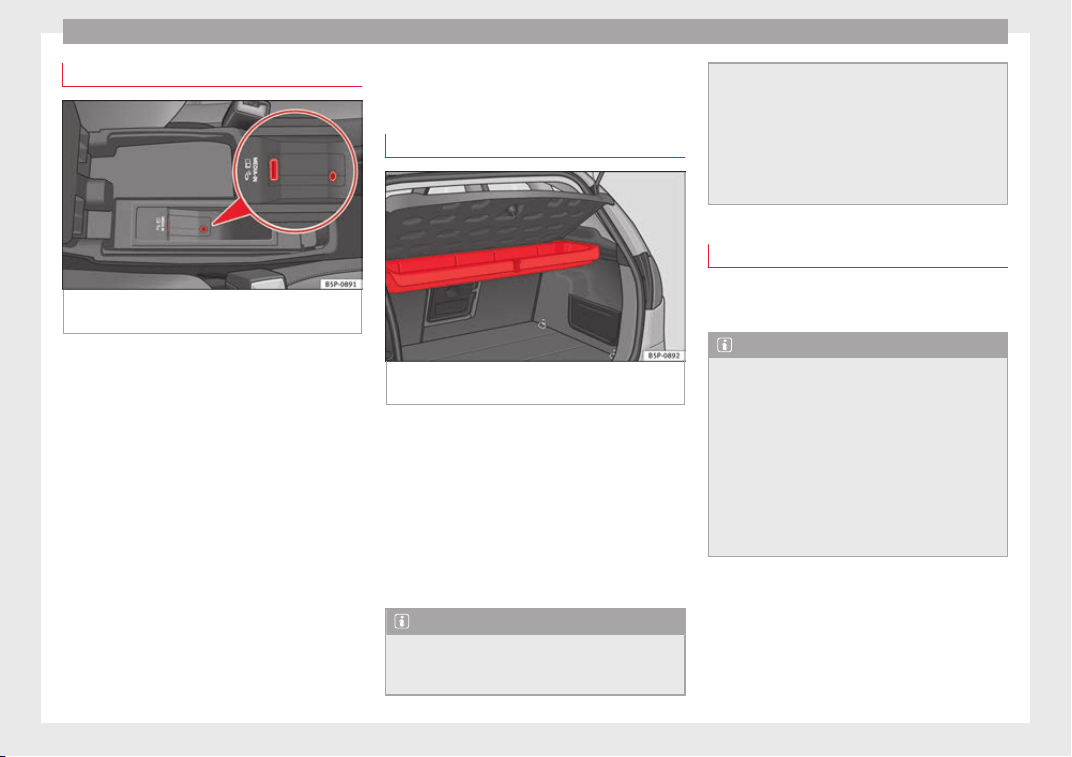
Operation
MEDIA-IN* connector
Fig. 101 Connection in central armrest com-
partment.
For information concerning the use of this
equipment, please see the Radio handbook.
First-aid kit, warning triangle,
fire extinguisher
Warning triangle* and first-aid kit*
Fig. 102 Altea: warning triangle storage un-
der the rear shelf.
The warning triangle* can be stowed under
the rear shelf in a storage compartment
››› Fig. 102
or in the storage compartment lo-
c
at
ed on the boot floor, under the carpet, de-
pending on the version.
The first aid kit can be stowed in the storage
compartment under the carpet on the boot
floor, or in the storage compartment in the
boot side lining, depending on the version.
Note
●
The warning triangle and the first aid kit do
not belong to the standard vehicle equip-
ment.
●
The first aid kit must comply with legal re-
quirements.
●
Observe the expiry date of the contents of
the first aid kit. After it has expired you
should purchase a new one.
●
Before purchasing accessories and spare
parts, see the instructions in ››› page 147.
Fire extinguisher*
The fire extinguisher* can be attached to the
luggage compartment carpet with Velcro.
Note
●
The fire extinguisher does not belong to
the standard vehicle equipment.
●
The fire extinguisher must comply with le-
gal requirements.
●
Make sure the fire extinguisher works.
They should therefore be checked. The stick-
er on the fire extinguisher will inform you of
the next date for checking.
●
Before purchasing accessories and spare
parts, see the instructions in ››› page 147.
100
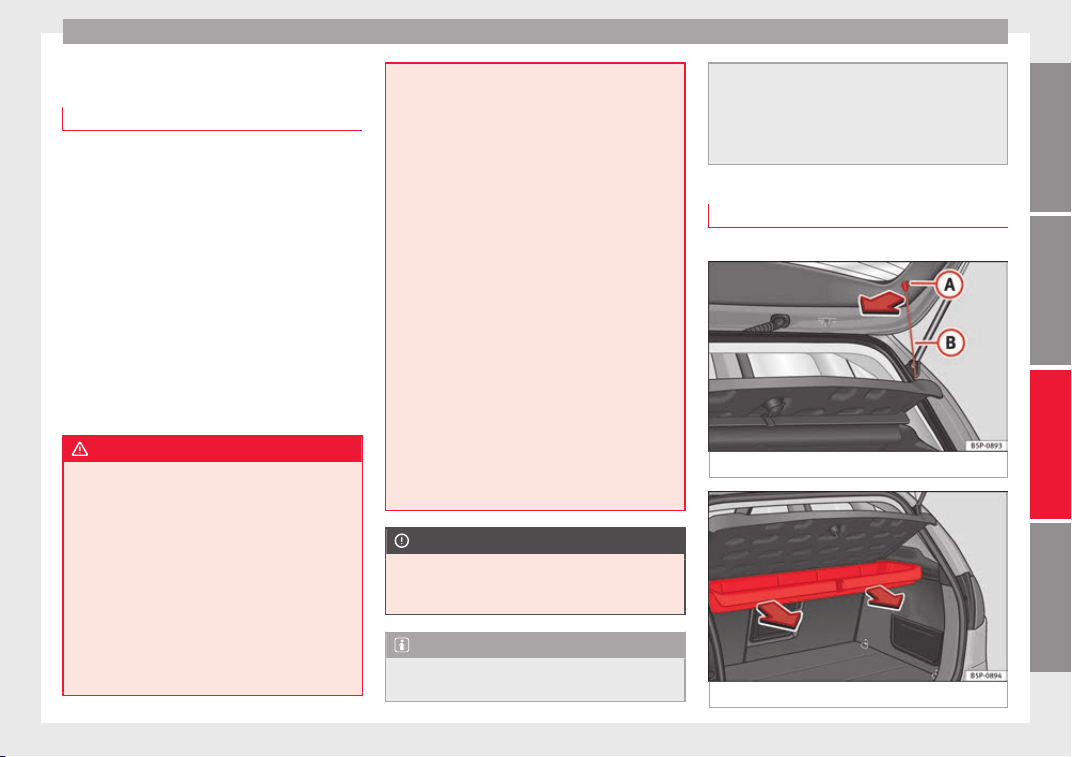
Transport and practical equipment
Luggage compartment
Loading the luggage compartment
All luggage and other loose objects must be
safely secured in the luggage compartment.
Unsecured objects which shift back and forth
could impair the driving safety or driving
characteristics of the vehicle by shifting the
centre of gravity.
–
Distribute the load evenly in the luggage
compartment.
–
Place heavy objects as far forward as possi-
ble in the luggage compartment.
–
Place the heavy objects first.
–
Secure heavy objects to the fitted fastening
rings
›››
page 103
.
WARNING
●
Loose luggage and other objects in the lug-
gage compartment could cause serious inju-
ries.
●
Always stow objects in the luggage com-
partment and secure them on the fastening
rings.
●
Use suitable straps to secure heavy ob-
jects.
●
During sudden manoeuvres or accidents,
loose objects can be thrown forward, injuring
vehicle occupants or passers-by. This in-
creased risk of injury will be further increased
if a loose object is struck by an inflating air-
bag. If this happens, objects can be trans-
formed into “missiles”. Risk of fatal injury.
●
Please note that the centre of gravity may
shift when transporting heavy objects; this
may affect vehicle handling and lead to an ac-
cident. Therefore, it is essential to adjust
your speed and driving style accordingly, to
avoid accidents.
●
Never exceed the allowed axle weights or
allowed maximum weight. If said weights are
exceeded, the driving characteristics of the
vehicle may change, leading to accidents, in-
juries and damage to the vehicle.
●
Never leave your vehicle unattended, espe-
cially when the rear lid is open. Children
could climb into the luggage compartment,
closing the door behind them; they will be
trapped and run the risk of death.
●
Never allow children to play in or around
the vehicle. Close and lock all the doors and
rear lid when you leave the vehicle. Before
you lock the vehicle, make sure that there are
no adults or children in the vehicle.
CAUTION
Hard objects on the boot cover could chafe
against the wires of the heating element in
the rear window and cause damage.
Note
●
Air circulation in the vehicle helps reduce
fogging of the windows. Used air escapes
through ventilation slits in the side trim of
the luggage compartment. Ensure that these
ventilation slits are never covered.
●
Straps for securing the load to the fasten-
ing rings are commercially available.
Rear shelf
3 Applies to the model: ALTEA
Fig. 103 Rear shelf.
Fig. 104 Removing the storage compartment.
»
101
Technical specifications
AdviceOperationSafety
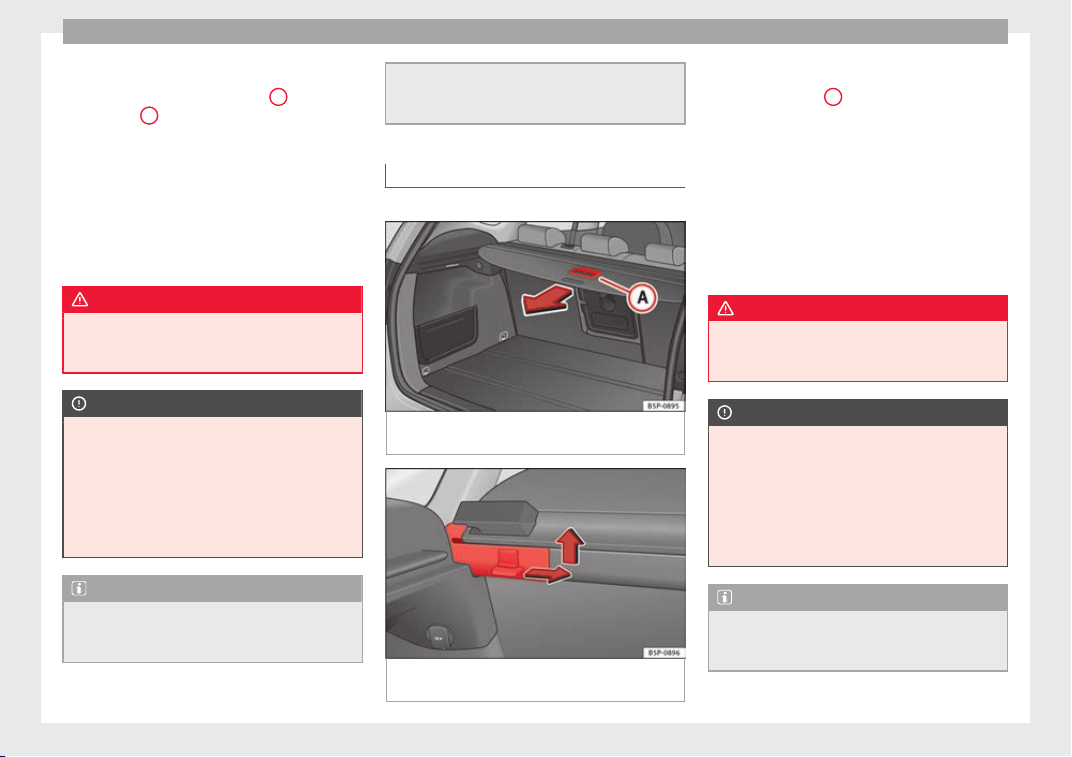
Operation
Removing the shelf
–
Unhook the loops ››› Fig. 103
B
from
housings
A
.
–
Extract the shelf from its slot, in its rest po-
sition and pull outwards. The storage com-
partment should remain closed.
To remove the storage compartment
–
Pull outwards until the compartment is
freed from the pivot point ››› Fig. 104
.
WARNING
Do not place heavy or hard objects on the
rear shelf, because they will endanger the ve-
hicle occupants in case of sudden braking.
CAUTION
●
Before closing the rear lid, ensure that the
rear shelf is correctly fitted.
●
An overloaded luggage compartment could
mean that the rear shelf is not correctly seat-
ed and it may be bent or damaged.
●
If the luggage compartment is overloaded,
remove the tray.
Note
●
Ensure that, when placing items of clothing
on the luggage compartment cover, rear visi-
bility is not reduced.
●
If the vehicle is fitted with a storage com-
partment*, it should only be used to store the
emergency triangles* and light objects.
Retractable rear shelf
3 Applies to the model: ALTEA XL/ALTEA FREETRACK
Fig. 105 Operating the storage compartment
shelf.
Fig. 106 Removing the storage compartment
shelf.
Using the rear shelf
–
Use the handle
A
to pull the shelf back
until you hear a “click” ››› Fig. 105
.
–
Pr
e
ss the area marked “PRESS”, and the
cover is retrieved automatically.
To remove the rear shelf
–
Press the side pin in the direction of the ar-
row, lift the cover and remove it ››› Fig. 106.
–
Installation is done in the reverse order.
WARNING
Do not place heavy or hard objects on the
rear shelf, because they will endanger the ve-
hicle occupants in case of sudden braking.
CAUTION
●
Before closing the rear lid, ensure that the
rear shelf is correctly fitted.
●
An overloaded luggage compartment could
mean that the rear shelf is not correctly seat-
ed and it may be bent or damaged.
●
If the luggage compartment is overloaded,
remove the tray.
Note
●
Ensure that, when placing items of clothing
on the luggage compartment cover, rear visi-
bility is not reduced.
102
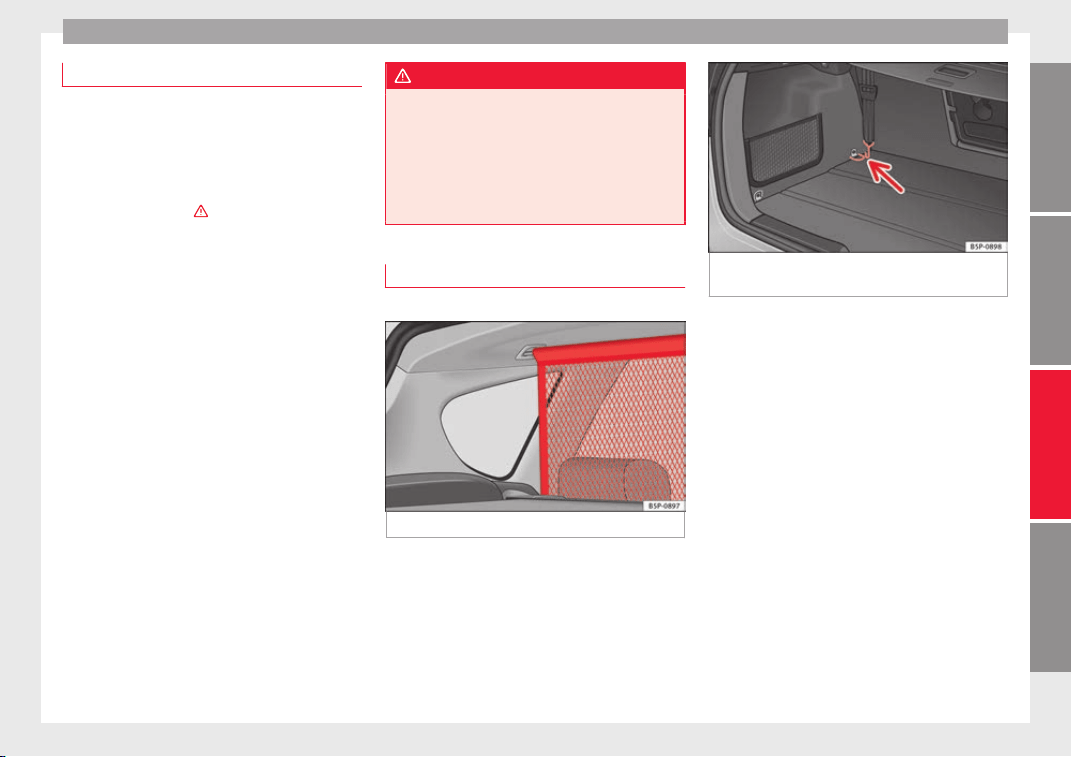
Transport and practical equipment
Fastening rings*
There can be four fastening rings in the lug-
gage compartment for fastening luggage and
other objects.
–
Always use suitable and undamaged straps
to secure luggage and other objects to the
fastening rings ››› in Loading the lug-
gage compartment on page 101.
–
Pull up the fastening rings to attach the
straps.
During a collision or an accident, even small
and light objects can build up so much ener-
gy that they can cause very severe injuries.
The amount of “energy” depends on the
speed of the vehicle and the weight of the
object. The most significant factor, however,
is the speed of the vehicle.
Example: An object weighing 4.5 kg is lying
unsecured in the vehicle. During a frontal col-
lision at a speed of 50 km/h (30 mph), this
object generates a force corresponding to 20
times its weight. This means that the effec-
tive weight of the object increases to about
90 kg. Imagine the injuries that may result
from said “object” if it hits any passenger
when flying through the passenger compart-
ment. This increased risk of injury will be fur-
ther increased if a loose object is struck by
an inflating airbag.
WARNING
●
If pieces of baggage or other objects are se-
cured to the fastening rings with inappropri-
ate or damaged retaining cords, injuries
could result in the event of braking manoeu-
vres or accidents.
●
Never secure a child seat on the fastening
rings.
Cargo separation net*
3 Applies to the model: ALTEA XL/ALTEA FREETRACK
Fig. 107 Separation net.
Fig. 108 Fastening rings for the separation
net.
The separation net prevents loose objects in
the boot from being thrown forward into the
passenger compartment (e.g. when braking
suddenly).
–
Pull the net from underneath between the
backrest and the folding tray and fit it to
the slots in the roof, first the right then the
left ››› Fig. 107
.
–
Hook
the belts
into the front fastening
rings to tense the net ››› Fig. 108.
103
Technical specifications
AdviceOperationSafety
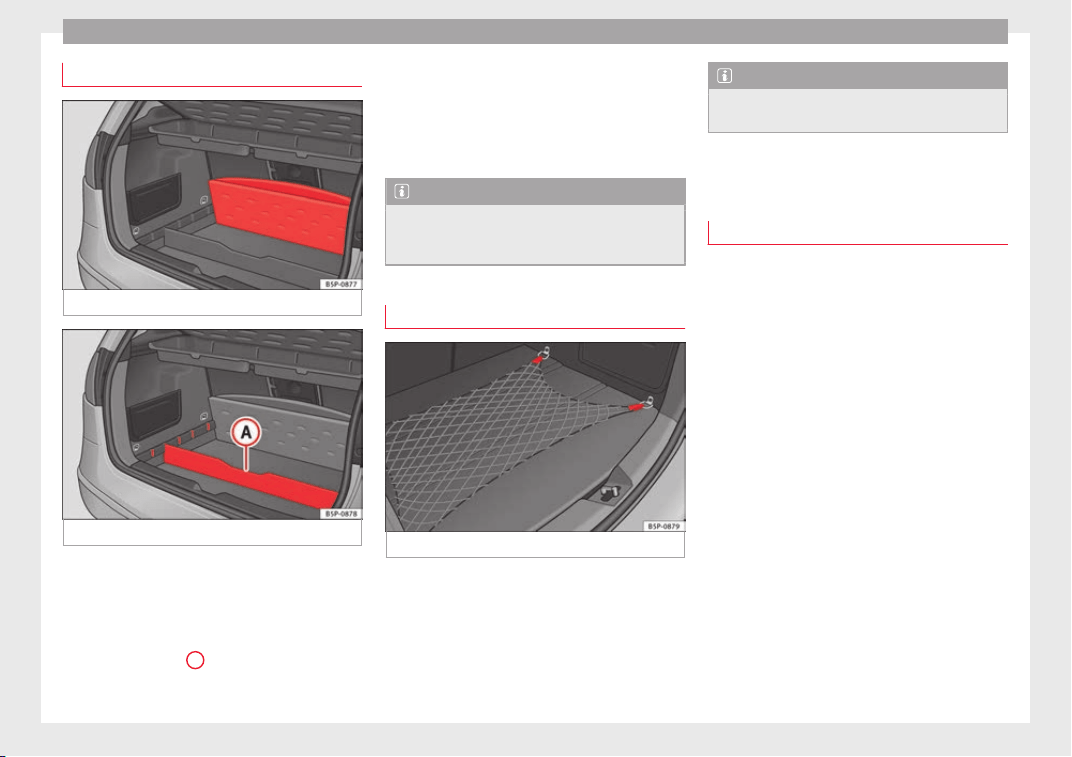
Operation
Storage in the boot floor*
Fig. 109 Variable storage in the boot floor.
Fig. 110 Boot floor partition.
There is a variable storage compartment* in
the boot floor.
–
Lift the boot floor and fold it back all the
way ››› Fig. 109
.
–
Fit
the sep
arator
A
››› Fig. 110
, into the
s
ide gr
ooves depending on the size of the
objects to be transported. The on-board
tool kit and the spare wheel are located un-
derneath the luggage compartment.
–
Secure objects in the luggage compart-
ment with suitable straps on the fastening
rings.
Note
●
The maximum weight capacity of the varia-
ble boot floor is 100 kg distributed evenly
over the whole floor.
Luggage compartment net*
Fig. 111 Boot storage net.
There is a storage net in the luggage com-
partment for securing objects.
–
Use the fastening rings located on the side
of the boot to attach the retaining net
››› Fig. 111
.
Note
●
Do not exceed the maximum authorised
weight for the vehicle ››› page 207.
Roof carrier/rack system*
Introduction
Please observe the following points if you in-
tend to carry loads on the roof:
●
For safety reasons, only luggage racks and
accessories supplied by SEAT official services
are recommended.
●
It is essential that you strictly follow the as-
sembly instructions included with the bars,
being especially careful to position the boot
cover bars on the special housings; you must
also respect their position according to the
direction of travel indicated in the assembly
manual. Not following these instructions may
cause marks on the bodywork and the longi-
tudinal bars.
●
Pay special attention to the tightening tor-
que of the attachment bolts and check them
following a short journey. If necessary, re-
tighten the bolts and check them at regular
intervals.
●
Distribute the load evenly. A maximum load
of 40 kg is permitted for each roof rack sys-
tem support bar, the load must be
104
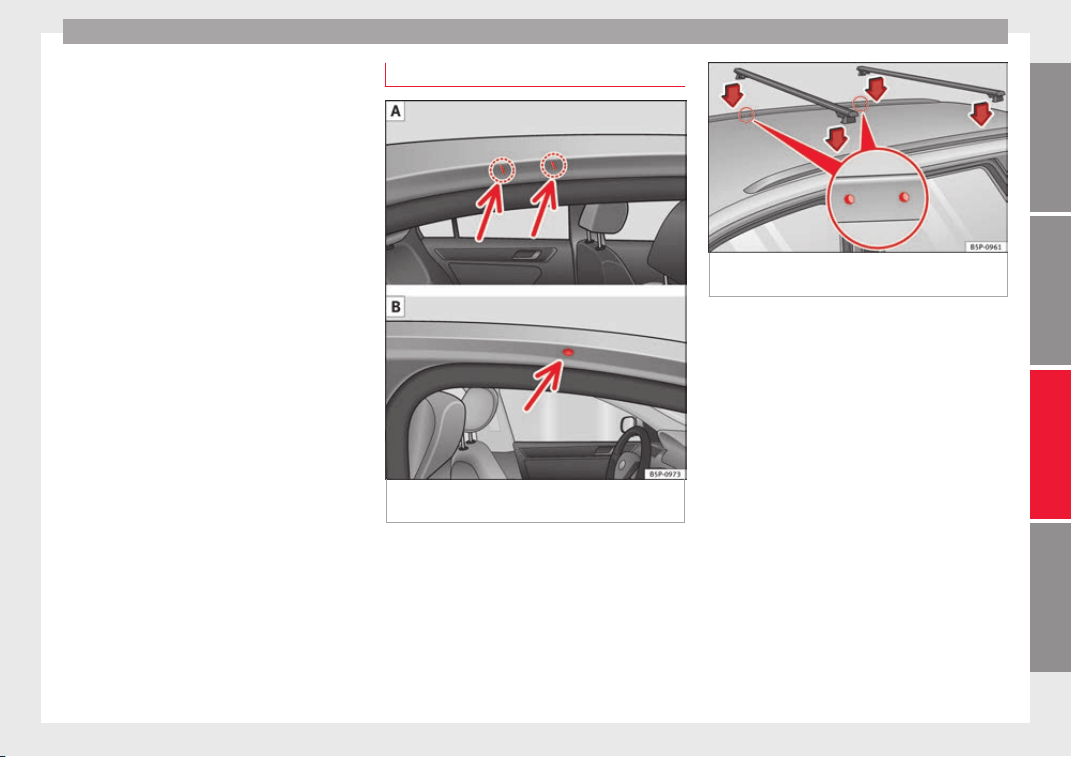
Transport and practical equipment
distributed evenly along the entire length.
However, the maximum load permitted for
the entire roof (including the support system)
of 75 kg must not be exceeded nor the total
weight recommended for the entire vehicle.
See the “Technical Data” ››› page 207 sec-
tion.
●
When transporting heavy or large objects
on the roof, any change in the normal vehicle
behaviour due to a change in the centre of
gravity or an increased wind resistance must
be taken into account. For this reason, a suit-
able speed and driving style must be used.
●
On vehicles fitted with a sliding/tilting sun-
roof*, make sure it does not hit the load on
the roof upon opening.
Attachment points
Fig. 112 Altea model: securing points for the
roof carrier.
Fig. 113 Altea XL/Altea Freetrack model: se-
curing points for the roof carrier.
Install and remove following the instructions
given.
Securing the base supports and roof carrier
system (Altea)
Location of the basic roof carrier attachment
points ››› Fig. 112
.
●
A: marks for securing on the rear section.
●
B
: hole for securing on the front section.
Sec
uring the base supports and roof carrier
system (Altea XL/Altea Freetrack)
Always secure the base supports and roof
carrier system correctly.
The roof carrier system must always be instal-
led exactly according to the instructions pro-
vided.
»
105
Technical specifications
AdviceOperationSafety
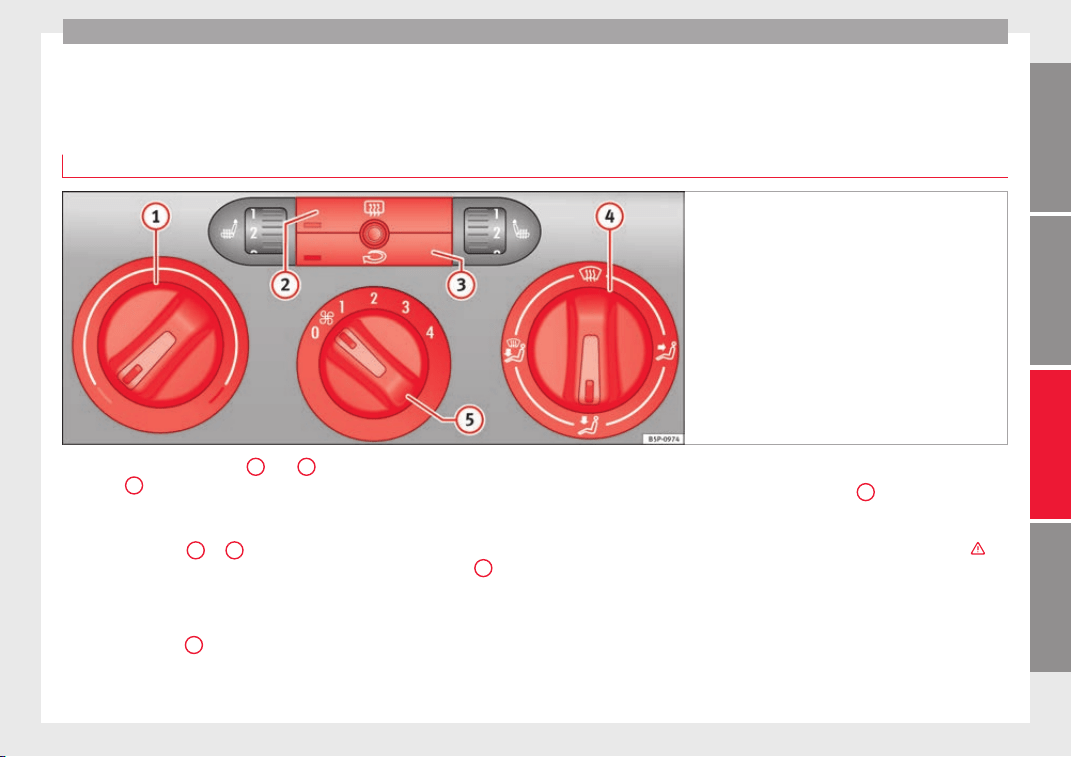
Air conditioning
Air conditioning
Heating
Operating instructions
Fig. 114 Heating controls on the dash panel.
–
Use the knobs ››› Fig. 114
1
and
4
and
control
5
to set the temperature, air distri-
bution and blower speed.
–
To switch a function on or off, press the ap-
propriate button
2
or
3
. When the func-
tion is activated, the display window in the
lower left of the button is lit.
Temperature
With the regulator
1
the heating level is de-
termined. The desired temperature inside the
vehicle cannot be lower than the ambient
temperature. Maximum heat output, which is
needed to defrost the windows quickly, is on-
ly available when the engine has reached its
operating temperature.
Heated rear window
Thi
s
function
2
will be switched off automat-
ically approximately 20 minutes after being
switched on. It can also be switched off soon-
er by pushing the button.
Air recirculation mode
Air recirculation mode
3
prevents strong
odours in the outside air from entering the
vehicle interior, for example when passing
through a tunnel or in queuing traffic ››› .
With low outside temperatures, the air recir-
culation increases the effectiveness of the
heating system by heating the air inside the
vehicle rather than the air from outside.
»
107
Technical specifications
AdviceOperationSafety
Operation
Air distribution
Control
4
for setting the flow of air in the re-
quired direction.
Air distribution towards the windscreen.
If the windscreen air output is on and air
recirculation mode is pressed, it is acti-
vated. When the recirculation mode is
on, if the air distribution towards the
windscreen mode is selected, the recir-
culation mode is deactivated. For safety
reasons, the air recirculation mode
should not be connected.
Air distribution to the upper body
Air distribution towards the footwell
Air distribution towards the windscreen
and the footwell
Blower
The air flow can be set at four speeds with
the control
5
. The air flow should always be
set at the lowest speed when driving slowly.
WARNING
●
For road safety all windows must be clear of
ice, snow, and condensation. This is essential
to ensure good visibility. Please familiarise
yourself with the correct operation of the
heating and ventilation system, including the
anti-fog/defrost functions for the wind-
screens.
●
In air recirculation mode, no cold air from
the outside enters the vehicle interior. The
windows can quickly fog over if the heating is
switched off. Therefore, never leave the air re-
circulation mode switched on for a long time
(risk of accident).
Note
Please observe the general notes
››› page 116.
108
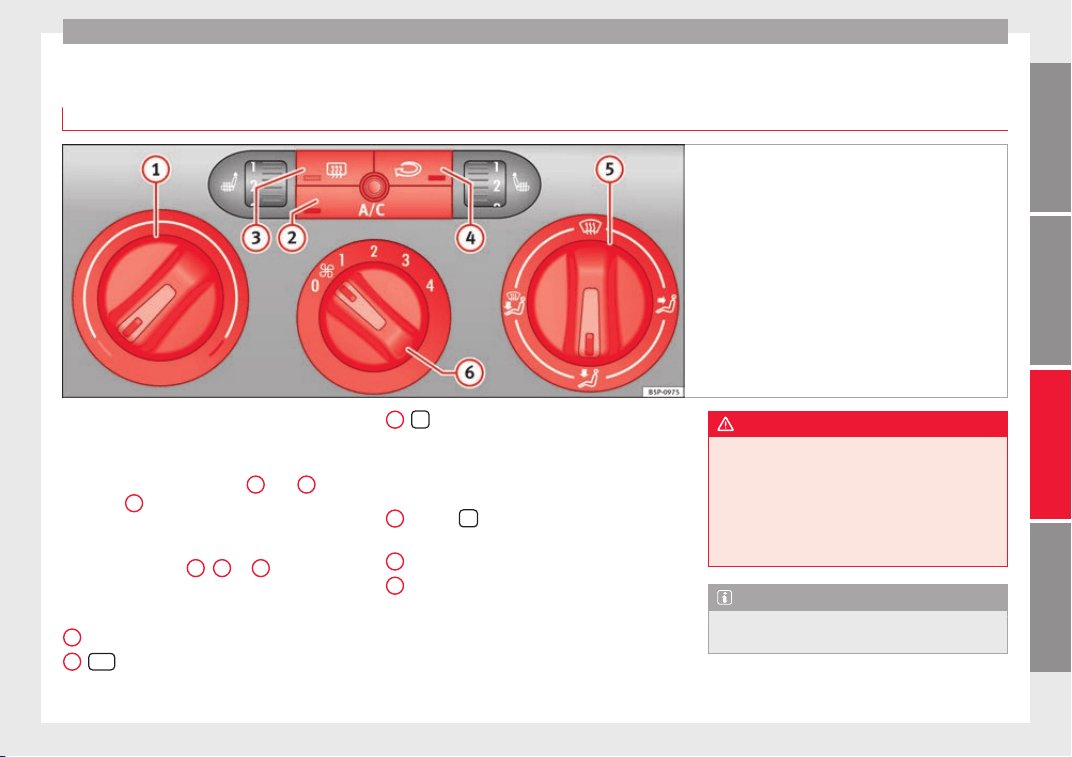
Air conditioning
Climatic*
Controls
Fig. 115 On the dash panel: Climate controls.
The Climatic or semi-automatic air condition-
ing system only works when the engine is
running and the blower is switched on.
–
Use the knobs ››› Fig. 115
1
and
5
and
control
6
to set the temperature, air distri-
bution and blower speed.
–
To switch a function on or off, press the ap-
propriate button
2
,
3
or
4
. When the
function is activated, the display window in
the lower corner of the button is lit.
Temperature selector ››› page 110
A/C
button – Cooling system on/off
››› page 110
1
2
button – Heated rear window The
heating will be switched off automatically
approximately 20 minutes after switching
on. It can also be switched off before-
hand by pushing the button.
Button
– Air recirculation mode
››› page 111
Air distribution control ››› page 110
Blower switch. There are four speed set-
tings for the air flow. The air flow should
always be set at the lowest speed when
driving slowly.
3
4
5
6
WARNING
For road safety all windows must be clear of
ice, snow, and condensation. This is essential
to ensure good visibility. Please familiarise
yourself with the correct operation of the
heating and ventilation system, including the
anti-fog/defrost functions for the wind-
screens.
Note
Please observe the general notes
››› page 116.
109
Technical specifications
AdviceOperationSafety
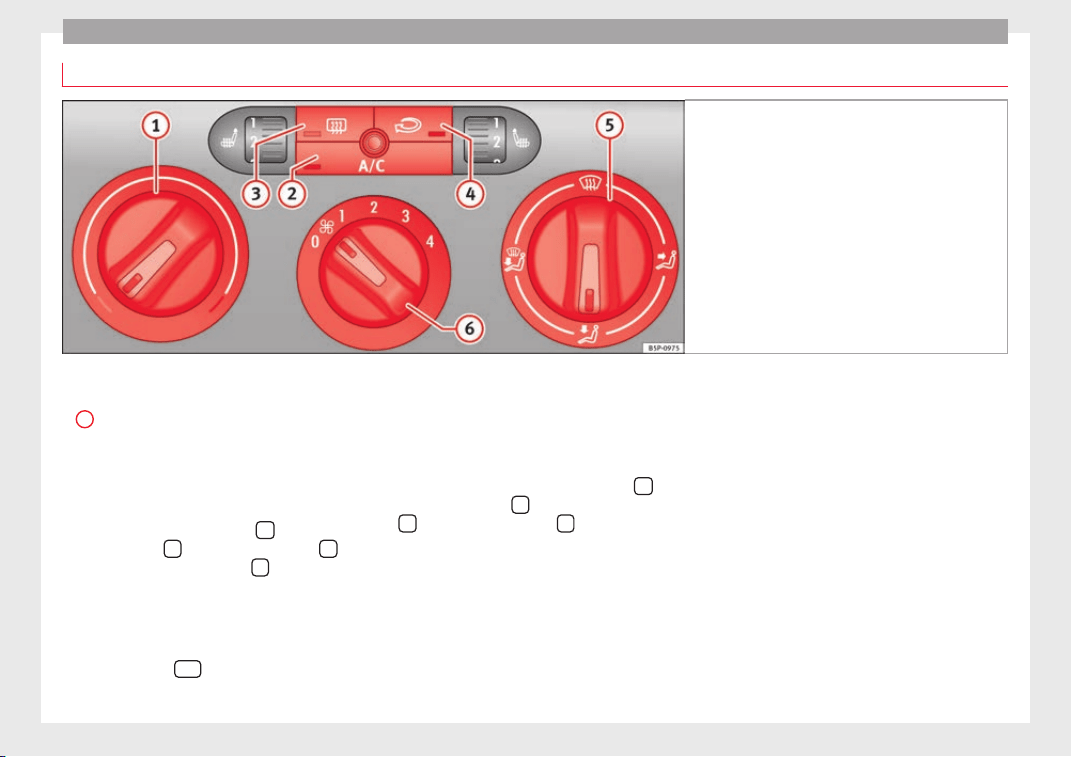
Operation
Heating and cooling the interior
Fig. 116 On the dash panel: Climate controls.
Interior heating
–
Turn the temperature selector ››› Fig. 116
1
clockwise to select the desired tempera-
ture.
–
Turn the blower switch to one of the set-
tings 1-4.
–
Set the air distribution control to the air
flow configuration desired:
(towards the
windscreen),
(towards the chest),
(towards the footwell) and
(towards the
windscreen and footwell areas).
Interior cooling
–
Switch on the air conditioner using the but-
ton ››› Fig. 115
A/C
.
–
Turn the temperature selector anticlockwise
until the desired cooling output is reached.
–
Turn the blower switch to one of the set-
tings 1-4.
–
Use the air distribution regulator to guide
the airflow in the required direction
(to
the windscreen),
(to the upper body),
(to the footwell) and
(to the wind-
screen and to the footwell).
Heating
Maximum heat output, which is needed to
defrost the windows quickly, is only available
when the engine has reached its operating
temperature.
Air conditioner
When the air conditioning system is switched
on, not only the temperature, but also the air
humidity in the vehicle interior is reduced.
This improves comfort for the vehicle occu-
pants and prevents misting of the windows
when the ambient air humidity is high.
If the air conditioning system cannot be
switched on this may be caused by the fol-
lowing reasons:
●
The engine is not running.
●
The blower is switched off.
●
The outside temperature is lower than ap-
proximately +3 °C (+37 °F).
110
Air conditioning
●
The air conditioning system compressor
has been temporarily switched off because
the engine coolant temperature is too high.
●
The air conditioner fuse is faulty.
●
Another fault in the vehicle. Have the air
conditioner checked by a specialised work-
shop.
Air recirculation mode
Air recirculation mode ››› Fig. 116
4
pre-
vents strong odours or contaminated air from
the outside from entering the vehicle, for ex-
ample when passing through a tunnel or in a
traffic jam.
With low temperatures outside, the air recir-
culation increases the effectiveness of the
heating system by warming the air inside the
vehicle rather than the cold air from outside.
With high outside temperatures, the air recir-
culation increases the effectiveness of the air
conditioning system by cooling the air inside
the vehicle rather than the ambient air.
If the windscreen air output is on and air re-
circulation mode is pressed, it is activated.
When the recirculation mode is on, if the air
distribution towards the windscreen mode is
selected, the recirculation mode is deactiva-
ted. For safety reasons, the air recirculation
mode should not be connected.
WARNING
In air recirculation mode, no cold air from the
outside enters the vehicle interior. If the air
conditioning system is switched off, the win-
dows can quickly mist over. Therefore, never
leave the air recirculation mode switched on
for a long time (risk of accident).
111
Technical specifications
AdviceOperationSafety
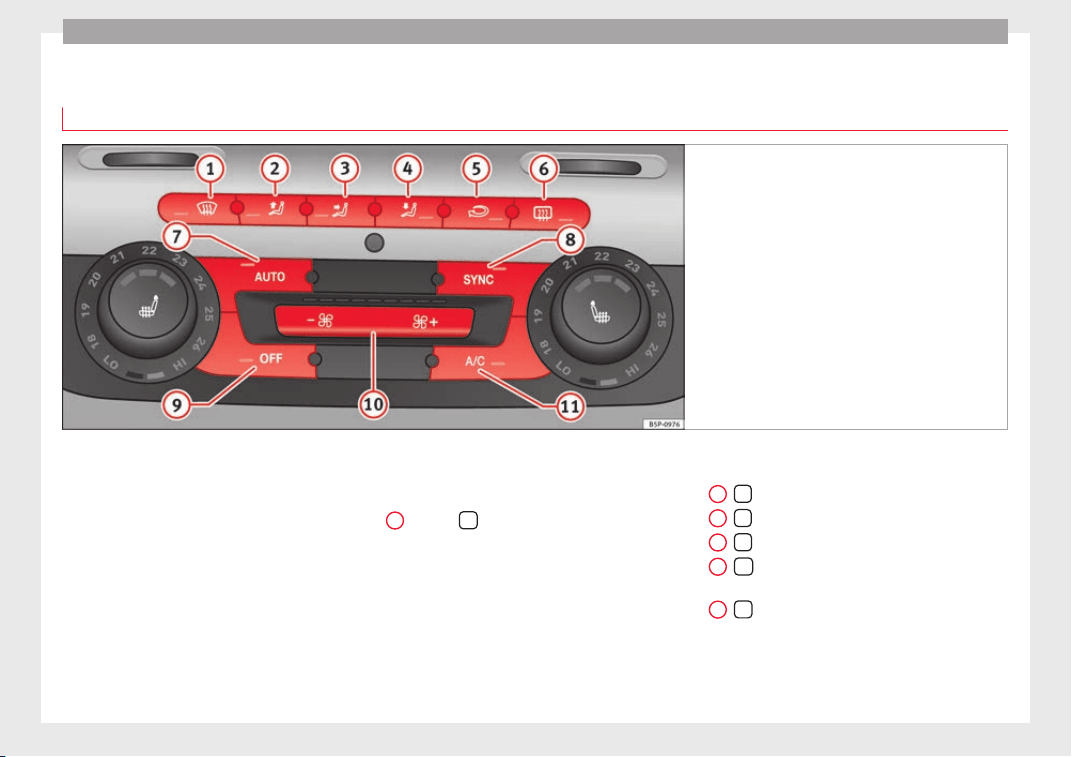
Operation
2C-Climatronic*
Controls
Fig. 117 On the dash panel: 2C Climatronic con-
trols.
The air conditioner controls the temperature
when the engine is running and the blower is
switched on.
–
Turn the temperature control knobs
››› Fig. 117
to adjust the temperature on the
l
ef
t-hand or right-hand side respectively.
–
The functions will be switched on when its
buttons are pressed. When these functions
are activated, they are indicated on the ra-
dio display. In addition, all these functions
are lit with LEDs. Press the button again to
switch off the function.
The temperature can be adjusted separately
for the left and right sides of the vehicle inte-
rior.
Button
– defrost function for the wind-
screen. The air drawn in from outside the
vehicle is directed at the windscreen. The
air recirculation mode, if switched on, will
be switched off as soon as the defrost
function is switched on. At temperatures
over +3 °C (+37 °F), the cooling system
will be switched on automatically in order
to dehumidify the air. The button is lit in
1
yellow and the symbol appears on the ra-
dio or navigator display.
button – Upward air distribution
button – Central air distribution
button – Downward air distribution
button – Manual air recirculation
mode
button – Heated rear window The
heating will be switched off automatically
approximately 20 minutes after switching
on. However, it may be turned off by
pushing the button. The button lights up
2
3
4
5
6
112
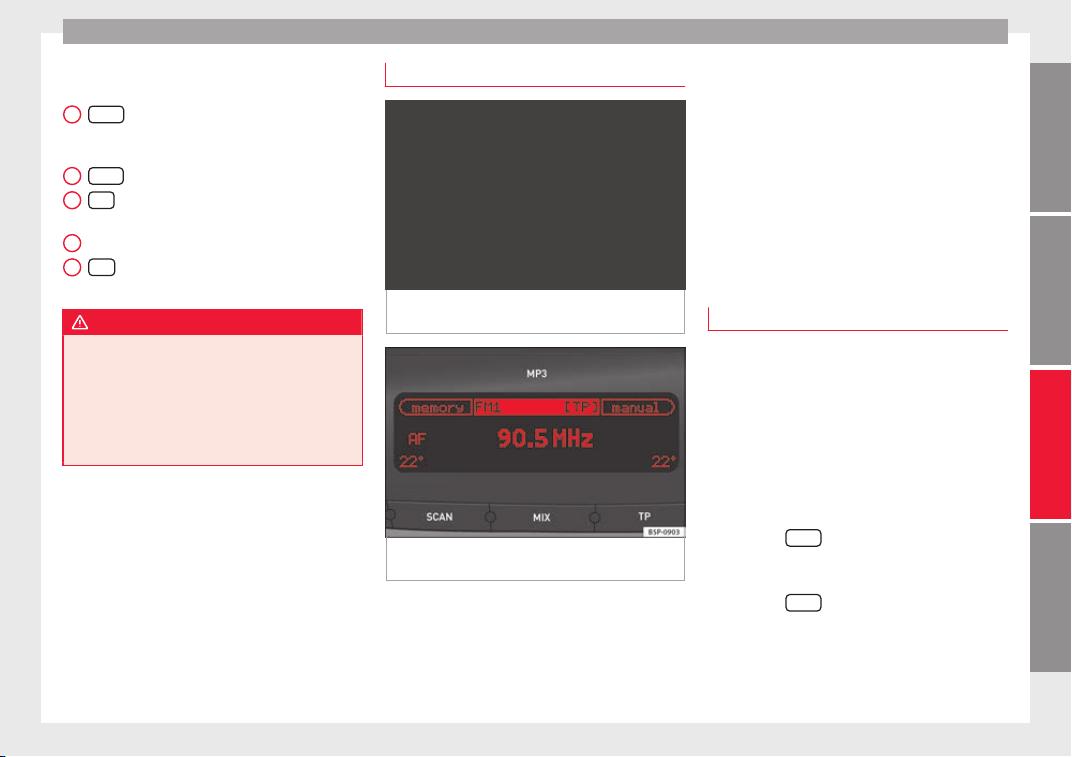
Air conditioning
yellow and the symbol appears in the dis-
play.
AUTO
button – Automatic temperature,
ventilation and air distribution control
››› page 113
SYNC
button – Dual zone synchroniser
OFF
button – Switches the 2C-Climatronic
on and off ››› page 114
Blower control ››› page 114
A/C
button – To switch on the cooling
system
WARNING
For road safety all windows must be clear of
ice, snow, and condensation. This is essential
to ensure good visibility. Please familiarise
yourself with the correct operation of the
heating and ventilation system, including the
anti-fog/defrost functions for the wind-
screens.
7
8
9
10
11
Viewing Climatronic information
Fig. 118 Navigation display with information
about Climatronic.
Fig. 119 Radio display with information about
Climatronic.
Information about the Climatronic system can
be displayed on the radio or radio and navi-
gation screen mounted at factory.
The LEDs on the Climatronic controls indicate
that the selected function has been activa-
ted.
In addition, the radio or radio and navigation
displays mounted at factory briefly display
the current Climatronic settings if any of
them have been modified.
The symbols used on the radio or radio and
navigation displays are the same as the sym-
bols used for the Climatronic controls.
Automatic mode
In automatic mode air temperature, air flow
and distribution are automatically regulated
so that a specified temperature is attained as
quickly as possible and then maintained.
The temperature can be adjusted separately
for the left and right sides of the vehicle inte-
rior.
Switching on automatic mode
–
Press the
AUTO
›››
Fig. 117
button. “AUTO
High” i
s
shown on the radio display (high
fan speed).
–
Press the
AUTO
button again
›››
Fig. 117
.
“A
UT
O Low” is shown on the radio display
(low fan speed).
Depending upon the version and finish, the
vehicle may include:
»
113
Technical specifications
AdviceOperationSafety
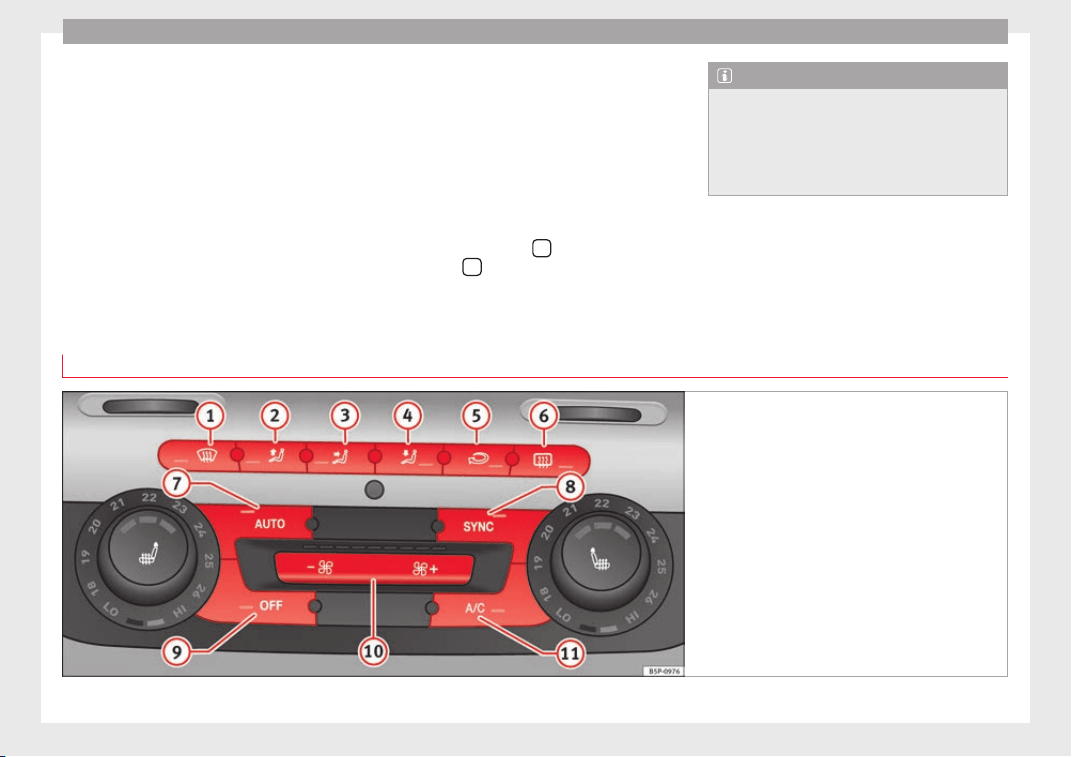
Operation
A pleasant temperature is quickly reached in
automatic mode at a temperature of +22 °C
(+72 °F). Therefore, we recommend you not
to change this adjustment, except as neces-
sary to suit individual preferences or particu-
lar circumstances. It is possible to select inte-
rior temperatures from +18 °C (+64 °F) to
+26 °C (+80 °F). These are approximate tem-
peratures and the actual temperature may be
slightly higher or lower depending on out-
side ambient conditions.
Climatronic maintains a constant tempera-
ture. The temperature of the air supplied to
the interior, the blower speed and the air dis-
tribution are regulated automatically. The
system also considers the sunlight radiation,
so there is no need for manual readjustment.
Therefore,
automatic mode almo
s
t always
provides the best comfort for the vehicle oc-
cupants throughout the year.
Automatic mode is switched off whenever an
adjustment is made using the buttons for the
air distribution, fan or
or the air recircula-
tion button
. The temperature will continue
to be regulated within the parameters man-
ually selected by the user.
Note
There are two automatic modes:
●
Automatic mode LO: this calculates the air
flow for two people.
●
Automatic mode HI: this calculates the air
flow for more than two people.
Manual mode
Fig. 120 On the dash panel: 2C Climatronic con-
trols.
114
Air conditioning
In manual mode you can adjust the air tem-
perature, air flow and distribution as re-
quired.
Switching on manual mode
–
To enter manual mode, press one of the
buttons ››› Fig. 120
1
to
5
or press the
air flow control
10
. The selected function is
shown on the radio or navigator display.
Temperature
There are separate temperature selectors for
the left and right sides of the vehicle interior.
The selected temperature is displayed above
the selector. It is possible to select interior
temperatures from +18 °C (+64 °F) to +26 °C
(+80 °F). These are approximate tempera-
tures and the actual temperature may be
slightly higher or lower depending on the
outside ambient conditions.
If you select temperatures below +18 °C
(+64 °F), the indication: LO will appear on the
screen. In this setting the system runs at
maximum cooling output and the tempera-
ture is not regulated.
If a temperature above +26 °C (+80 °F) is se-
lected, the screen will show HI. In this setting
the system runs at maximum heating output
and the temperature is not regulated.
Blower
The fan may be adjusted freely using the con-
trols
10
. Always have the blower running at a
low setting to ensure a constant flow of fresh
air into the vehicle. Pushing the button
to
the minimum -1, t
urn
s the Climatronic off.
Air distribution
The air distribution is adjusted using the but-
tons
,
and
. It is also possible to
open and close some of the air vents sepa-
rately.
Switching the air conditioning on and off
When the
A/C
button is on (LED lit), the air
conditioning system is on.
When the
A/C
button is off (LED off), the air
conditioning system is off.
When the
A/C
button is off, the air condition-
ing system is switched off to save fuel. The
temperature continues to self-regulate. The
set temperature can only be reached if it is
higher than the outside temperature.
Driver and passenger temperature control
The
SYNC
button controls the synchronisa-
tion of the 2 Climatronic climate zones.
When the
SYNC
button is off (LED off), the Cli-
matronic climate zone is personalised. For
example: driver side temperature +22 °C
(+72 °F) and passenger side temperature +24
℃
(+23.89
℃).
When the
S
YNC
button is on (LED lit), the Cli-
matronic climate zone is synchronised. For
example: driver side temperature +22 °C
(+72 °F) and passenger side temperature +22
℃ (+22.22
℃
).
If
the
SYNC
button is on and the passenger
side temperature is changed, the function is
automatically deactivated.
Air recirculation mode
–
Press the button
››› Fig. 120
5
to
switch air recirculation mode on or off. It is
switched on if the following symbol ap-
pears in the display .
Air recirculation mode prevents strong
odours or contaminated air from the outside
from entering in the vehicle, for example
when passing through a tunnel or in a traffic
jam.
With low outside temperatures, the air recir-
culation increases the effectiveness of the
heating system by heating the air inside the
vehicle rather than the air from outside.
With high outside temperatures, the air recir-
culation increases the effectiveness of the air
conditioning system by cooling the air inside
the vehicle rather than the ambient air.
»
115
Technical specifications
AdviceOperationSafety
Operation
If the windscreen air output is on and air re-
circulation mode is pressed, this remains ac-
tive. When the recirculation mode is on, if the
air distribution towards the windscreen mode
is selected, the recirculation mode is deacti-
vated. For safety reasons, the air recirculation
mode should not be connected.
WARNING
In air recirculation mode, no cold air from the
outside enters the vehicle interior. If the air
conditioning system is switched off, the win-
dows can quickly mist over. Therefore, never
leave the air recirculation mode switched on
for a long time (risk of accident).
General notes
Pollution filter
The pollution filter (a combined particulate
filter and active carbon filter) serves as a bar-
rier against impurities in the outside air, in-
cluding dust and pollen.
For the climate control system to work with
maximum efficiency, the pollution filter must
be replaced at the specified intervals in the
Maintenance Programme.
If the filter loses efficiency prematurely due
to use in areas reaching very high pollution
levels, the pollen filter must be changed
more frequently than stated in the Service
Schedule.
Air conditioner
When the air conditioning system is switched
on, not only the temperature, but also the air
humidity in the vehicle interior is reduced.
This improves comfort for the vehicle occu-
pants and prevents misting of the windows
when the ambient air humidity is high.
If the air conditioning system cannot be
switched on this may be caused by the fol-
lowing reasons:
●
The engine is not running.
●
The
A/C
button is switched off.
●
The outside temperature is lower than ap-
proximately +3 °C (+37 °F).
●
The air conditioning system compressor
has been temporarily switched off because
the engine coolant temperature is too high.
●
The air conditioner fuse is faulty.
●
Another fault in the vehicle. Have the air
conditioner checked by a specialised work-
shop.
CAUTION
●
If you suspect that the air conditioner is
damaged, switch it off with the
A/C
button to
prevent further damage and have it checked
by a specialised workshop.
●
Repairs to the air conditioner require spe-
cialist knowledge and special tools. There-
fore, we recommend you to take the vehicle
to a specialised workshop.
Note
●
If the humidity and temperature outside the
vehicle are high, condensation can drip off
the evaporator in the cooling system and
form a pool underneath the vehicle. This is
normal and does not indicate a leak.
●
Keep the air intake slots in front of the
windscreen free of snow, ice and leaves to en-
sure heating and cooling are not impaired,
and to prevent the windows from misting
over.
●
The air from the vents flows through the ve-
hicle interior and is extracted by slots de-
signed for this purpose. Therefore, do not
cover these slots with items of clothing or
other objects.
●
The air conditioner operates most effective-
ly with the windows and the sliding/tilting
sunroof* closed. However, if the temperature
inside the vehicle is excessive because of the
sun, the air inside can be cooled faster by
opening the windows for a short time.
●
Do not smoke while air recirculation mode
is on, as smoke drawn into the air condition-
ing system leaves residue on the evaporator,
producing a permanent unpleasant odour.
●
It is advisable to turn on the air condition-
ing at least once a month, to lubricate the
system gaskets and prevent leaks. If a de-
crease in the cooling capacity is detected, a
Technical Service should be consulted to
check the system.
116
Driving
Driving
Power steering (servotronic*)
Power steering assists the driver by reducing
the force needed to turn the steering wheel.
In cars equipped with servotronic* power
steering the degree of power assistance is
regulated electronically according to road
s
peed.
The power steering will keep on working even
if the servotronic* device fails. The degree of
pow
er assistance will, however, no longer
adapt to different speeds. If the electronic
regulating system is not working properly,
this is most noticeable when turning the
steering wheel at low speeds (for instance
when parking), as more effort will be required
than usual. The fault should be corrected by
a specialised workshop as soon as possible.
Power steering does not work if the engine is
off. In this case the steering wheel requires
much more force to turn.
Turning the steering to its limit when the ve-
hicle is stationary will place an excessive
load on the power steering system. Turning
the steering wheel to its limit places a load
on the system, which causes noise. It will al-
so reduce the idling speed of the engine.
CAUTION
When the engine is running, do not turn the
steering wheel to its limit for more than 15
seconds. Otherwise, there is a risk of damag-
ing the power steering.
Note
●
If the power steering should fail at any time
or the engine is switched off (for instance
when being towed), the vehicle can still be
steered. However, more effort will be required
to turn the steering wheel.
●
If the system is leaking or malfunctioning,
please take the car to a specialised workshop
immediately.
●
The power steering system requires a spe-
cial hydraulic fluid. The container is located
in the engine compartment (front left). The
correct fluid level in the reservoir is impor-
tant for the power steering to function prop-
erly. The hydraulic fluid level is checked at
the Inspection Service.
All-wheel drive*
On all-wheel drive models, the engine power
is distributed to all four wheels
General notes
The all-wheel drive system operates com-
pletely automatically. The propulsion force is
distributed among the four wheels and adap-
ted to the driving style and the road condi-
tions.
The all-wheel drive is specially designed to
complement the superior engine power. This
combination gives the vehicle exceptional
handling and performance capabilities, both
on normal roads and in more difficult condi-
tions, such as snow and ice.
Winter tyres
Thanks to its all-wheel drive, your vehicle will
have plenty of traction in winter conditions,
even with the standard tyres. Nevertheless,
we still recommend that winter tyres or all-
season tyres should be fitted on all four
wheels when winter road conditions are ex-
pected, mainly because this will give a better
braking response.
Snow chains
On roads where snow chains are mandatory,
this also applies to cars with all-wheel drive.
Changing tyres
On vehicles with all-wheel drive, all four tyres
must have the same rolling circumference
››› page 179
.
WARNING
●
Even with all-wheel drive, you should al-
ways adjust your speed to suit the condi-
tions. Do not let the extra safety features
»
117
Technical specifications
AdviceOperationSafety
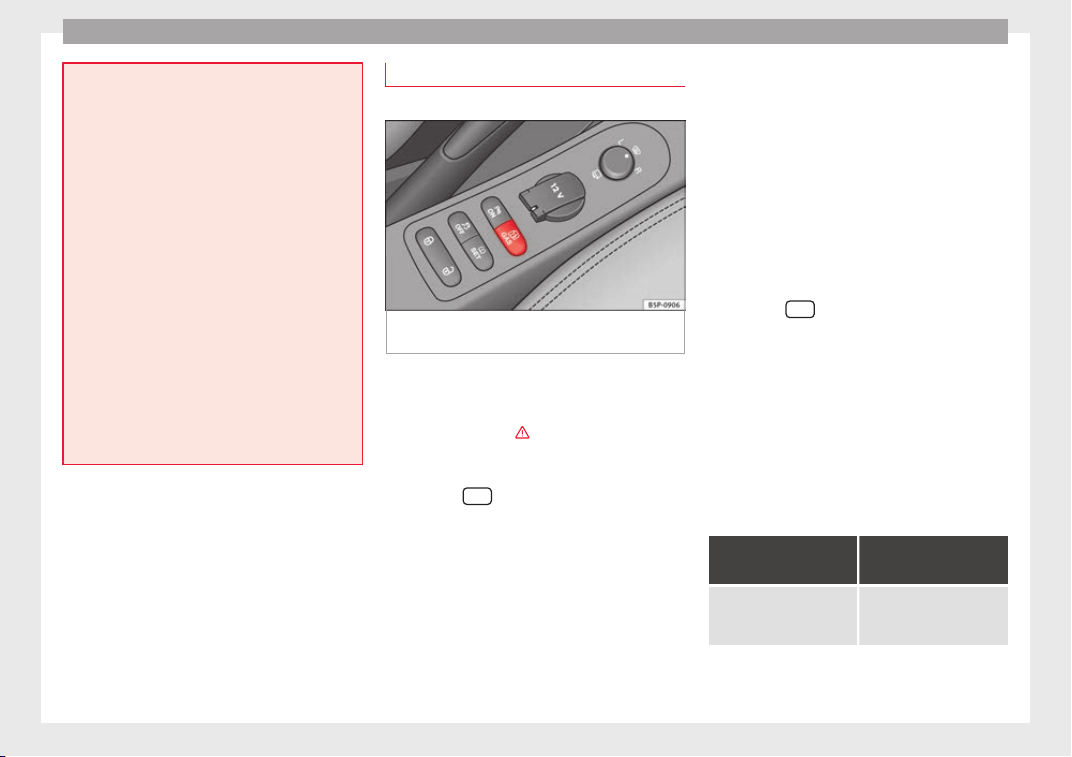
Operation
tempt you into taking any risks when driving.
Failure to follow this instruction could result
in an accident.
●
The braking capability of your vehicle is
limited by the tyres' grip. Vehicle behaviour
is no different from a vehicle without four-
wheel drive. So do not be tempted to drive
too fast on icy or slippery roads just because
the vehicle still has good acceleration in
these conditions. Failure to do so could result
in an accident.
●
On wet roads bear in mind that the front
wheels may lose contact with the road and
start to float (aquaplaning) if the vehicle is
driven too fast. If this should happen, there
will be no sudden increase in engine speed
when aquaplaning begins to warn the driver,
as with a front-wheel drive vehicle. For this
reason and for that mentioned above, always
choose a driving speed suitable for the road
conditions. Failure to follow this instruction
could result in an accident.
Driving with LPG*
3 Applies to the model: ALTEA / ALTEA XL
Fig. 121 Centre console: gas system control
switch.
Your SEAT vehicle has a bivalent engine able
to run on either LPG or petrol. The LPG tank
››› page 160, Refuelling with LPG is in the
spare wheel well ››› .
Connecting LPG operating mode
●
Press the
GAS
button.
After checking the system, the engine auto-
matically switches from petrol to LPG provi-
ded the following conditions are met:
●
There is enough LPG in the tank.
●
The engine coolant has reached the neces-
sary temperature for LPG operation.
●
The outside temperature is suitable for LPG
to work.
●
The engine speed is always above 1,200
rpm.
●
The LPG system check has been completed
and the established waiting time has elapsed
(this operation may take several minutes).
●
No fault was detected during the system
check.
The
green LPG gauge control lamp will
light up.
Connecting petrol operating mode
●
Press the
GAS
button.
The
green
control lamp will go out on the
LPG l
evel indicator.
Petrol operating mode connects automatical-
ly when the engine is started or when any of
the LPG operating mode conditions are not
met. As soon as the necessary conditions are
met again, the LPG operating mode recon-
nects.
LPG system fault
Message in the instru-
ment panel display
How to proceed
Error: LPG Visit the work-
shop!
Have the system checked
immediately by a special-
ised workshop.
118
Driving
Message in the instru-
ment panel display
How to proceed
Gas operating mode cur-
rently impossible See the
manual!
Check that all conditions
for LPG operating mode
have been met
››› page 118. If so, have
the system checked imme-
diately by a specialised
workshop.
Petrol operating mode cur-
rently impossible. See the
manual!
Have the system checked
immediately by a special-
ised workshop.
LPG quality and consumption
Quality requirements for LPG are regulated
for all Europe in DIN EN 589 and permit the
use of LPG throughout Europe without any
problems.
LPG is a mixture of propane and butane.
A difference is drawn between winter gas and
summer gas. Winter gas has a higher propor-
tion of propane gas. As a result, the driving
range of winter gas may be lower (due to in-
creased consumption) than that of summer
gas.
The vehicle's engine management adapts au-
tomatically to the LPG used. Therefore, both
types of LPG can be mixed in the tank, with-
out the need for comprehensive draining be-
fore applying a different quality LPG.
LPG and safety
If you smell gas or suspect that there is a
leak in the LPG system. ›››
●
Stop the vehicle immediately.
●
Switch the ignition off.
●
Open all the doors to properly ventilate the
vehicle.
●
Extinguish cigarettes immediately.
●
Move away from the vehicle or switch off
objects that may cause sparks or a fire.
●
If you continue to smell gas, do not contin-
ue driving!
●
Seek specialist assistance. Have the fault
repaired.
WARNING
LPG is a highly explosive and inflammable
substance. It may cause severe burns and
other injury.
●
Due care must be taken to avoid any risk of
fire or explosion.
●
When parking the vehicle in a closed area
(for example in a garage), make sure that
there is adequate ventilation, either natural
or mechanical, to neutralise the LPG in the
event of a leak.
WARNING
Failure to act when you can smell gas in the
vehicle or when refuelling can cause serious
injuries.
●
Carry out the necessary operations.
●
Leave the danger zone.
●
If necessary, warn the emergency services.
Note
●
The LPG system must be subject to regular
inspections at a specialised workshop in ac-
cordance with the Maintenance Plan.
●
The engine is always started with petrol,
even when LPG was being used when it was
switched off. For this reason the tank should
never be drained of petrol completely.
●
If frequent short journeys are made, espe-
cially when the outside temperature is low,
the vehicle will tend to run on petrol more of-
ten than on LPG. Therefore, the petrol tank
may empty before the LPG tank.
●
If while driving the system switches auto-
matically to petrol operating mode because
the LPG tank is almost empty, the next few
times the engine starts up, and depending on
the outside temperature and driving style, it
may automatically switch briefly to LPG oper-
ating mode to use up what is left in the tank.
●
When the system automatically switches to
petrol operating mode because the LPG tank
is almost empty, you can revert to gas operat-
ing mode by pressing the ››› Fig. 121
GAS
»
119
Technical specifications
AdviceOperationSafety
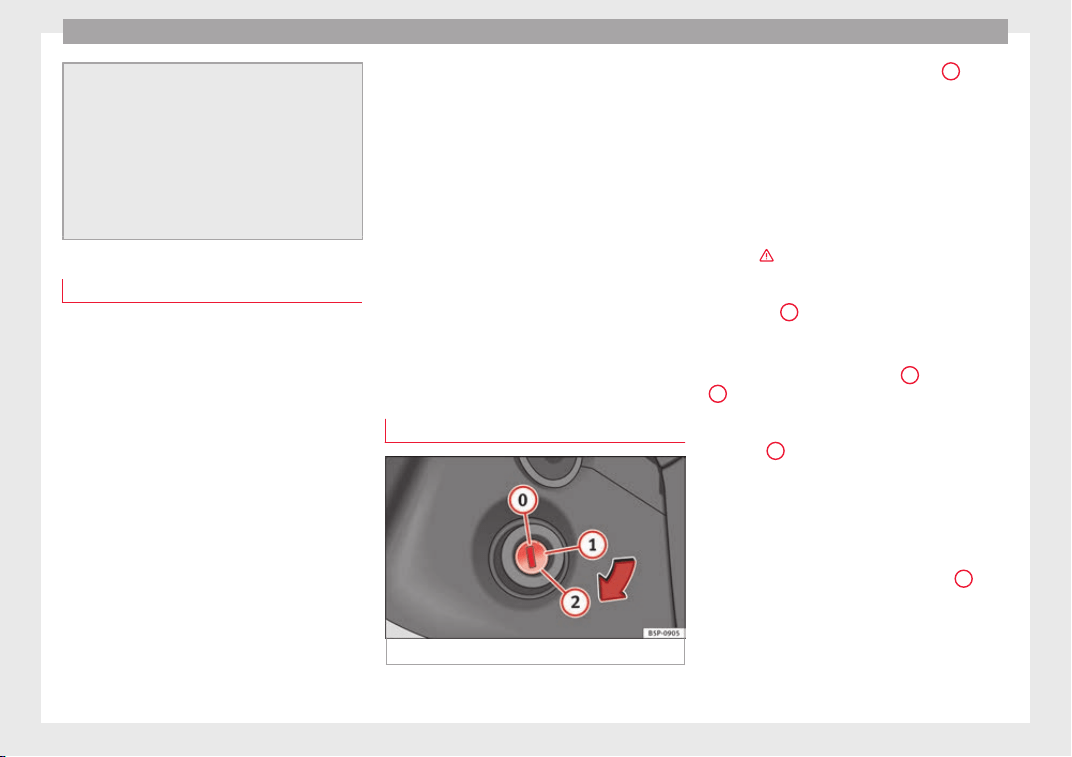
Operation
button while driving slowly and with low ac-
celeration. This procedure can be repeated
several times while driving carefully until all
the LPG left in the tank has been used up.
●
Vehicles that display information or warn-
ing messages on the dash panel may show
information related to LPG operation.
●
The notification LPG mode not possible may
be displayed.
Journeys abroad
To drive abroad, the following must be taken
into consideration:
●
For vehicles fitted with a catalytic converter
ensure that unleaded petrol is available for
the journey. See the chapter “Refuelling”. Au-
tomobile organisations will have information
about service station networks selling unlea-
ded fuel.
●
In some countries, your vehicle model may
not be available, and therefore some spare
parts may not available or technical services
can only carry out limited repairs.
SEAT importers and distributors will gladly
provide information about the technical prep-
aration that your vehicle requires and also
about necessary maintenance and repair
possibilities.
Adhesive strips for headlights
If you have to drive a right-hand drive vehicle
in a left-hand drive country, or vice versa, the
asymmetric dipped beam headlights will daz-
zle oncoming traffic.
To prevent dazzling, you must apply stickers
to certain parts of the headlight lenses. Fur-
ther information is available at any Technical
Service.
In vehicles with adaptive headlights, the ro-
tation system must previously be disconnec-
ted. To do this, please go to a specialised
workshop.
Ignition lock
Ignition key positions
Fig. 122 Ignition key positions.
Ignition switched off, steering lock
0
In this position ››› Fig. 122, the ignition and
the engine are OFF and the steering may be
locked.
For the
Steering lock
to operate without the
ignition k
ey, turn the steering wheel until it
locks with an audible sound. You should al-
ways lock the steering wheel when you leave
your vehicle. This will help prevent vehicle
theft ›››
.
Switching the ignition or the glow plug
system on
1
Turn the ignition key to this position and re-
lease it. If the key cannot be turned or it is
difficult to turn from position
0
to position
1
, move the steering wheel from one side to
the other to release it.
Starting
2
The engine is started when the key is in this
position. Electrical devices with high power
consumption are switched off temporarily at
the same time.
Each time that the vehicle is restarted, the ig-
nition key must be turned to position
0
. The
repetitive start prevention lock of the igni-
tion prevents possible damage to the starter
motor if the engine is already running.
120
Driving
WARNING
●
The ignition key must NOT be removed from
the lock until the vehicle comes to a stand-
still. Otherwise, the steering could be imme-
diately blocked- Risk of accident!
●
Always remove the key from the ignition
when leaving the vehicle, even if only for a
short period. This is especially important if
children or disabled people are left alone in
the vehicle. They could accidentally start the
engine or work electrical equipment such as
the electric windows, resulting in an acci-
dent.
●
Unsupervised use of the key could start the
engine or any electrical system, such as the
electric windows. This could result in serious
injury.
CAUTION
The starter motor will only work when the en-
gine is stopped (ignition key position
2
).
Electronic immobiliser
The electronic immobiliser prevents unau-
thorised persons from driving the vehicle.
Inside the key there is a chip that deactivates
the electronic immobiliser automatically
when the key is inserted into the ignition.
The electronic immobiliser will be activated
again automatically as soon as you pull the
key out of the ignition lock.
The engine can only be started using a genu-
ine SEAT key with its correct code.
Note
A perfect operation of the vehicle is ensured
if genuine SEAT keys are used.
Starting petrol engines
The engine can only be started using a genu-
ine SEAT key with its correct code.
–
Move the gearbox lever to the neutral posi-
tion and depress the clutch pedal thor-
oughly and hold it in this position for the
starter to turn the engine on.
–
Turn the ignition key to the starting posi-
tion
›››
page 120
.
–
L
et
go of the ignition key as soon as the en-
gine starts; the starter motor must not run
on with the engine.
After starting a very hot engine, you may
need to slightly press down the accelerator.
When starting a cold engine, it may be a little
noisy for the first few seconds until oil pres-
sure has built up in the hydraulic valve com-
pensators. This is quite normal, and no cause
for concern.
If the engine does not start immediately,
switch the starter off after 10 seconds and try
again after half a minute. If the engine still
does not start, the fuel pump fuse should be
checked ››› page 196, Fuses.
WARNING
●
Never start or run the engine in unventila-
ted or closed rooms. The exhaust gases con-
tain carbon monoxide, an odourless and col-
ourless poisonous gas. Risk of fatal acci-
dents. Carbon monoxide can cause loss of
consciousness and result in death.
●
Never leave the vehicle unattended if the
engine is running.
●
Never use “cold start sprays”, they could
explode or cause the engine to run at high
revs. Risk of injury.
CAUTION
●
When the engine is cold, you should avoid
high engine speeds, driving at full throttle
and over-loading the engine. Risk of engine
damage.
●
The vehicle should not be pushed or towed
more than 50 metres to start the engine. Un-
burnt fuel could enter the catalytic converter
and damage it.
●
Before attempting to push-start or tow a ve-
hicle in order to start it, you should first try to
start it using the battery of another vehicle.
Note and follow the instructions in
››› page 189, Jump-starting.
»
121
Technical specifications
AdviceOperationSafety
Operation
For the sake of the environment
Do not warm-up the engine by running the
engine with the vehicle stationary. Start off
immediately, driving gently. This helps the
engine reach operating temperature faster
and reduces emissions.
Starting diesel engines
The engine can only be started using a genu-
ine SEAT key with its correct code.
–
Move the gearbox lever to the neutral posi-
tion and depress the clutch pedal thor-
oughly and hold it in this position for the
starter to turn the engine on.
–
Turn the ignition key to position
›››
Fig. 122
1
. The warning lamp will light for en-
gine pre-heating.
–
When the lamp turns off, turn the ignition
key to position
2
to start the engine. Do
not press the accelerator.
–
Release the ignition key as soon as the en-
gine starts. The starter motor should not
turn at the same time.
When starting a cold engine, it may be a little
noisy for the first few seconds until oil pres-
sure has built up in the hydraulic valve com-
pensators. This is quite normal, and no cause
for concern.
If there are problems starting the engine, see
the ››› page 189
.
Glo
w p
lug system for the diesel engine
To avoid unnecessary discharging of the bat-
tery, do not use any other major electrical
equipment while the glow plugs are pre-heat-
ing.
Start the engine as soon as the glow plug
warning lamp ››› page 41 goes out.
Starting a diesel engine after the fuel tank
has been completely run dry
If the fuel tank has been completely run dry,
it may take longer than normal (up to one mi-
nute) to start a diesel engine after refuelling.
This is because the fuel system must elimi-
nate air first.
WARNING
●
Never start or run the engine in unventila-
ted or closed rooms. The exhaust gases con-
tain carbon monoxide, an odourless and col-
ourless poisonous gas. Risk of fatal acci-
dents. Carbon monoxide can cause loss of
consciousness and result in death.
●
Never leave the vehicle unattended if the
engine is running.
●
Never use “cold start sprays”, they could
explode or cause the engine to run at high
revs. Risk of injury.
CAUTION
●
When the engine is cold, you should avoid
high engine speeds, driving at full throttle
and over-loading the engine. Risk of engine
damage.
●
The vehicle should not be pushed or towed
more than 50 metres to start the engine. Un-
burnt fuel could enter the catalytic converter
and damage it.
●
Before attempting to push-start or tow a ve-
hicle in order to start it, you should first try to
start it using the battery of another vehicle.
Note and follow the instructions in
››› page 189, Jump-starting.
For the sake of the environment
Do not warm-up the engine by running the
engine with the vehicle stationary. You
should drive off as soon as you start the en-
gine. This helps the engine reach operating
temperature faster and reduces emissions.
Switching off the engine
–
Stop the vehicle.
–
Turn the ignition key to position
›››
Fig. 122
0
.
After switching the engine off, the radiator
fan may run on for up to 10 minutes. The fan
may also turn on again if coolant temperature
increases from accumulated heat in the
122
Driving
engine compartment or due to its prolonged
exposure to solar radiation.
WARNING
●
Never switch the engine off until the vehi-
cle is completely stationary.
●
The brake servo works only when the en-
gine is running. With the engine switched off,
more strength is needed to brake. As normal
brake operation cannot be performed, risk of
accidents and serious injury may exist.
●
The steering lock can be immediately
blocked once the key is removed from the ig-
nition. The vehicle cannot be steered. Risk of
accident.
CAUTION
When the engine has been running under a
heavy load for a long period, heat can accu-
mulate in the engine compartment and cause
engine damage. For this reason, idle the en-
gine for approximately 2 minutes before
switching it off.
Braking and parking
Braking capacity and distance
The following factors impair braking capacity:
New brake pads
New brake pads do not provide optimal per-
formance during the first 400 km; first they
must be “run in”. However, the reduced brak-
ing capacity may be compensated by press-
ing on the brake pedal a little harder. Avoid
overloading the brakes during run-in.
Wear
The rate of wear on the brake pads depends
a great deal on how you drive and the condi-
tions in which the vehicle is operated. Nega-
tive factors are, for instance, city traffic, fre-
quent short trips or hard driving with abrupt
starts and stops.
Wet roads or road salt
In certain conditions, such as in heavy rain,
or after washing the vehicle or driving
through water, the full braking effect can be
delayed by moisture (or in winter by ice) on
the discs and brake pads. In this case the
brakes should be “dried” by pressing the
brake pedal several times.
The effectiveness of the brakes can also be
temporarily reduced if the vehicle is driven
for some distance without using the brakes
when there is a lot of salt on the road in win-
ter. In this case, the layer of salt on the brake
discs and pads has to wear off before brak-
ing.
Corrosion
There may be a tendency for corrosion to
form on the discs and dirt to build up on the
brake pads if the vehicle is used infrequently
or the brakes are not used very often.
If the brakes are not used frequently, or if
rust has formed on the disks, it is advisable
to clean off the pads and disks by braking
firmly a few times at a moderately high speed
››› .
Faults in the brake system
If the brake pedal travel should ever increase
suddenly
, this may mean that one of the two
br
ak
e circuits has failed. Drive immediately
to the nearest specialised workshop and
have the fault repaired. Drive there slowly
and remember that you will have to apply
more pressure on the brake pedal and allow
for longer stopping distances.
Low brake fluid level
Malfunctions can occur in the brake system if
the brake fluid level is too low. The brake flu-
id level is monitored electronically.
Brake servo
The brake servo increases the pressure you
apply to the brake pedal. It works only when
the engine is running.
»
123
Technical specifications
AdviceOperationSafety
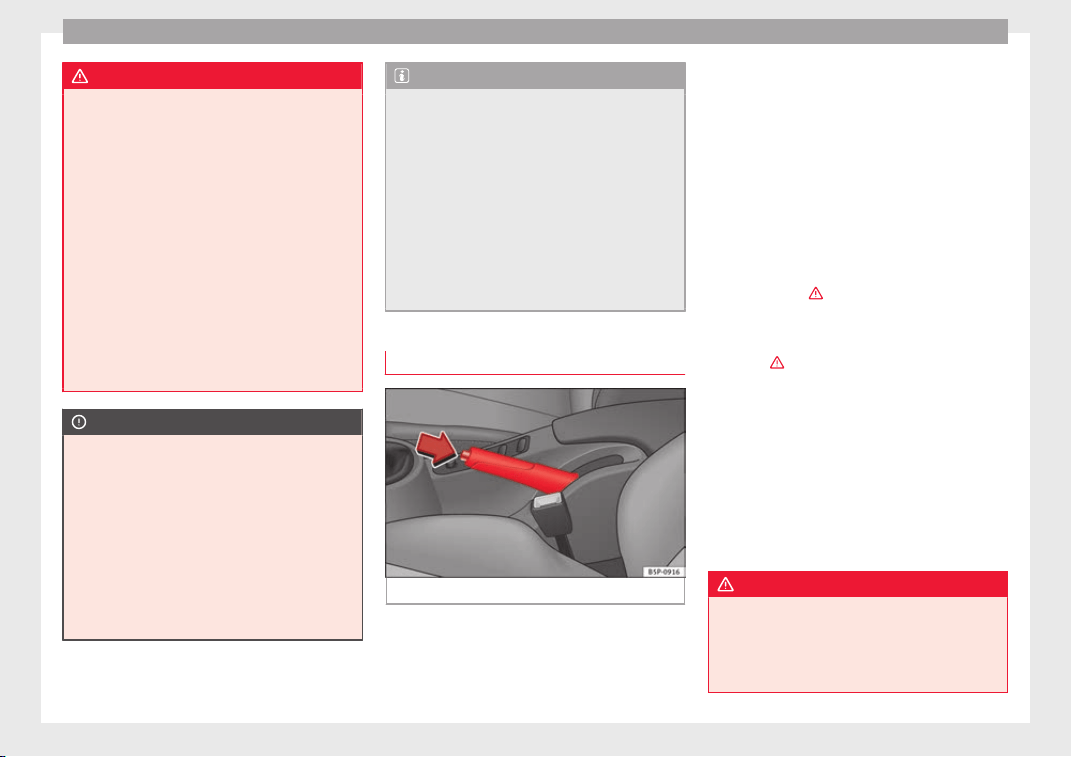
Operation
WARNING
●
Apply the brakes heavily to clean the brake
system only in a suitable traffic situation. Do
not put other road users in danger: there is
risk of causing an accident.
●
Ensure the vehicle does not move while in
neutral, when the engine is stopped. Failure
to follow this instruction could result in an
accident.
●
If the brake fluid loses its viscosity and is
subjected to heavy use, vapour bubbles can
form in the brake system. This reduces the ef-
ficiency of the brakes.
●
If a brake system circuit fails, the braking
distance will be increased considerably. Con-
tact a specialised workshop immediately and
avoid unnecessary journeys.
CAUTION
●
Never let the brakes “drag” by leaving your
foot on the pedal when it is not necessary to
brake. This overheats the brakes, resulting in
longer stopping distances and greater wear.
●
Before driving down a long, steep gradient,
it is advisable to reduce speed and select a
lower gear. This makes use of engine braking
and relieves the brakes. If you still have to
use the brakes, it is better to brake firmly at
intervals than to apply the brakes continu-
ously.
Note
●
If the brake servo is out of action, for exam-
ple when the car is being towed, you will
have to press the brake pedal considerably
harder than normal to make up for the lack of
servo assistance.
●
If you wish to equip the vehicle with acces-
sories such as a front spoiler or wheel covers,
it is important that the flow of air to the front
wheels is not obstructed, otherwise the
brakes can overheat. Before purchasing ac-
cessories please observe the relevant instruc-
tions ››› page 147, Technical modifications.
Operating the handbrake
Fig. 123 Handbrake between the front seats.
The handbrake should be applied firmly to
prevent the vehicle from accidentally rolling
away.
Always apply the handbrake when you leave
your vehicle and when you park.
Applying the handbrake
–
Pull the handbrake lever up firmly
››› Fig. 123
.
R
el
easing the handbrake
–
Pull the lever up slightly and press the re-
lease knob in the direction of the arrow
››› Fig. 123 and guide the handbrake lever
down fully ›››
.
Always pull the handbrake all the way up, so
there is less risk of driving off with it still en-
gaged ››› .
The handbrake warning lamp lights up
when the handbrake is applied and the igni-
tion switched on. The warning lamp turns off
when the handbrake is released.
If you drive faster than 6 km/h (4 mph) with
the handbrake on, the following message*
will appear on the instrument panel: HAND-
BRAKE ON. You will also hear an audible
warning.
WARNING
●
Never use the handbrake to stop the vehi-
cle when it is in motion. The braking distance
is considerably longer, because braking is
only applied to the rear wheels. Risk of acci-
dent!
124
Driving
●
If the handbrake is only partially released,
this will cause the rear brakes to overheat,
which can impair the function of the brake
system and could lead to an accident. This al-
so causes premature wear on the rear brake
pads.
CAUTION
Always apply the handbrake before you leave
the vehicle. Put it in 1st gear as well.
Parking
The handbrake should always be firmly ap-
plied when the vehicle is parked.
Always note the following points when park-
ing the vehicle:
–
Use the brake pedal to stop the vehicle.
–
Apply the handbrake.
–
Put it in 1st gear.
–
Switch the engine off and remove the key
from the ignition. Turn the steering wheel
slightly to engage the steering lock.
–
Always take you keys with you when you
leave the vehicle ››› .
Additional notes on parking the vehicle on
gradients:
Turn the steering wheel so that the vehicle
rolls against the kerb if it started to roll.
●
If the vehicle is parked facing downhill,
turn the front wheels so that they point to-
wards the kerb.
●
If the vehicle is parked facing uphill
, turn
the fr
ont
wheels so that they point away from
the kerb.
●
Secure the vehicle as usual by applying the
handbrake firmly and putting it in 1st gear.
WARNING
●
Take measures to reduce the risk of injury
when you leave your vehicle unattended.
●
Never park where the hot exhaust system
could ignite inflammable materials, such as
dry grass, low bushes, spilt fuel etc.
●
Never allow vehicle occupants to remain in
the vehicle when it is locked. They would be
unable to open the vehicle from the inside,
and could become trapped in the vehicle in
an emergency. In the event of an emergency,
locked doors will delay assistance to vehicle
occupants.
●
Never leave children alone in the vehicle.
They could set the vehicle in motion, for ex-
ample, by releasing the handbrake or the
gearbox lever.
●
Depending on weather conditions, it may
become extremely hot or cold inside the vehi-
cle. This can be fatal.
Hill driving assistant*
This function is only included in vehicles with
ESC.
The hill driving assistant helps the driver to
move off and upward on a hill without rolling
backward.
The system maintains brake pressure for ap-
proximately 2 seconds after the driver takes
his foot off the brake pedal to prevent the ve-
hicle from rolling backward when starting off.
During these 2 seconds, the driver has
enough time to release the clutch pedal and
accelerate without the vehicle moving and
without having to use the handbrake, making
starting off easier, more comfortable and saf-
er.
These are the basic operation conditions:
●
being on a ramp or hill/slope,
●
closed doors,
●
vehicle completely stationary,
●
engine running and foot on the brake,
●
besides having a gear engaged or being in
neutral for manual gear change and with the
selector lever at position S
,
D
or R for an au-
tomatic gearbox.
»
125
Technical specifications
AdviceOperationSafety
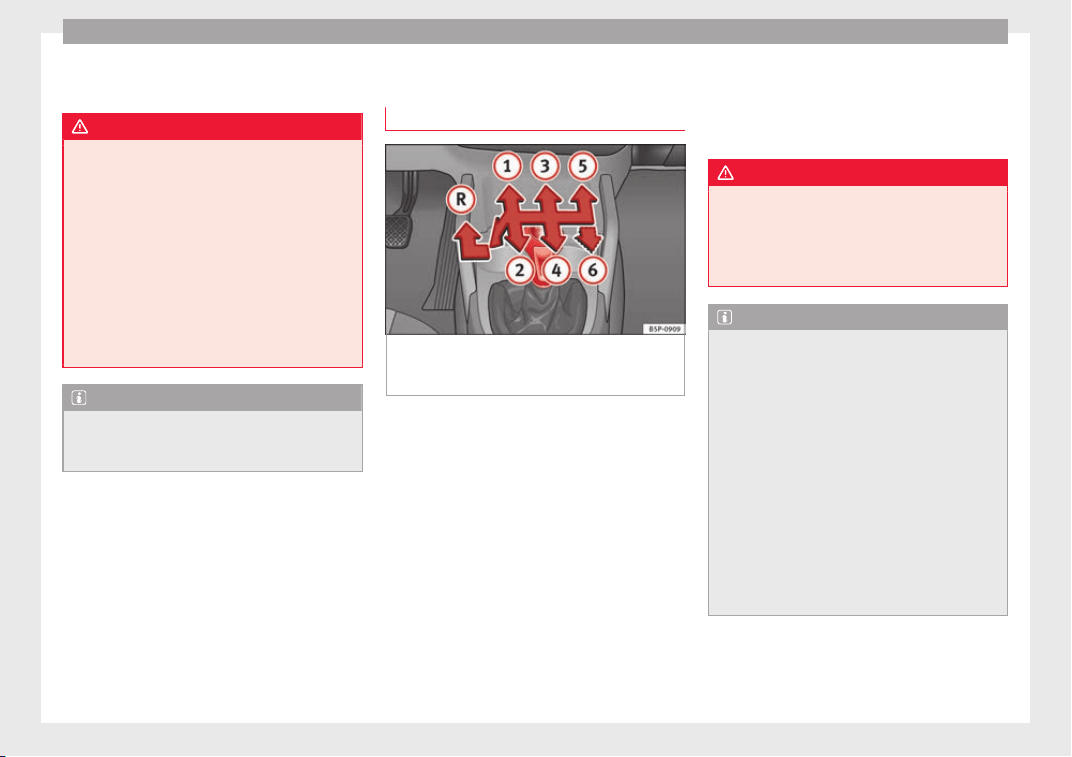
Operation
This system is also active when reversing up-
hill.
WARNING
●
If you do not start the vehicle immediately
after taking your foot off the brake pedal, the
vehicle may start to roll back under certain
conditions. Depress the brake pedal or use
the hand brake immediately.
●
If the engine stalls, depress the brake ped-
al or use the hand brake immediately.
●
When following a line of traffic uphill, if you
want to prevent the vehicle from rolling back
accidentally when starting off, hold the brake
pedal down for a few seconds before starting
to move.
Note
The official service or a specialist workshop
can tell you if your vehicle is equipped with
this system.
Manual gearbox
Driving with a manual gearbox
Fig. 124 Detailed view of the centre console:
gear shift pattern of a 5- or 6-speed manual
gearbox.
Engaging the reverse gear
–
The vehicle should be stationary with the
engine idling. Press the clutch down thor-
oughly.
–
Place the gearbox lever into neutral and
push the lever downwards.
–
Slide the gearbox lever to the left, and then
into the reverse position shown on the lev-
er.
The reverse gear can only be engaged when
the vehicle is stationary. When the engine is
running and before engaging this gear, wait
about 6 seconds with the clutch pressed
down thoroughly in order to protect the gear-
box.
The reverse lights switch on when the reverse
gear is selected and the ignition is on.
WARNING
●
When the engine is running, the vehicle
will start to move as soon as a gear is engag-
ed and the clutch released.
●
Never select the reverse gear when the ve-
hicle is in motion. Risk of accident.
Note
●
Do not rest your hand on the gear lever
while driving. The pressure of your hand
could cause premature wear on the selector
forks in the gearbox.
●
When changing gear, you should always
depress the clutch fully to avoid unnecessary
wear and damage.
●
Do not “slip” the clutch to hold the vehicle
on a hill. This causes premature wear and
damage to the clutch.
●
Do not leave your foot on the clutch pedal;
although the pressure may seem insignifi-
cant, it can cause the premature wear of the
clutch plate. Use the foot rest when you do
not need to change gear.
126
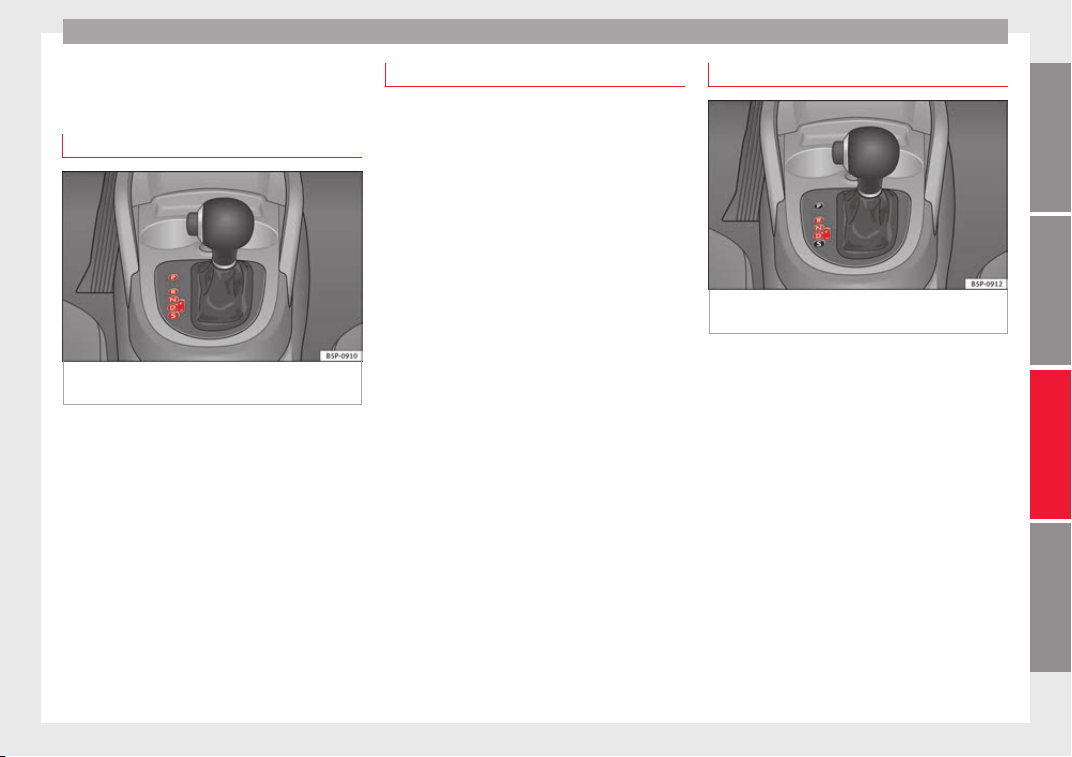
Driving
Automatic gearbox/DSG
automatic gearbox*
Selector lever positions
Fig. 125 Centre console: selector lever for au-
tomatic gearbox/DSG automatic gearbox.
Selector lever positions indicated on the
cover
Parking position (lever locked).
Reverse position.
Neutral position (lever locked). This po-
sition is similar to the neutral position
for manual gearboxes).
Drive position (economic driving pro-
gramme).
Sports driving position.
Tiptronic driving position (this pro-
gramme is similar to the operation of a
manual gearbox).
P
R
N
D
S
+/-
Driving programmes
The automatic gearbox / DSG gearbox has
three programmes.
Selecting the economy programme
–
This programme selects a higher gear earli-
er rather than remain in a lower gear.
–
Put the selector lever into position D to
drive f
orwards.
–
Put the selector lever into position R to re-
verse. This position is shared by all pro-
grammes for reversing.
Selecting the sport programme
–
Move the lever to position S.
If you select sport programme S, the pro-
gramme i
s designed for sport mode, that is,
a programme which changes up at higher en-
gine speeds to use the full power of the en-
gine. This programme is not recommended
for use on the motorway or in the city.
Selecting the manual programme (Tiptronic)
This programme allows driving similar to a
manual gearbox.
This programme may be accessed using the
selector lever or from the steering wheel con-
trols when this option is fitted
›››
page 129.
Selector lever locking
Fig. 126 Centre console: automatic gearbox
selector lever.
The selector lever lock prevents gears from
being engaged inadvertently, which would
cause the vehicle to move.
Releasing the selector lever lock
–
Start the vehicle.
–
Press and release the brake pedal, at the
same time press the button on the selector
lever.
The lock can only be engaged when the vehi-
cle is stationary or at a speed of less than
5 km/h (3 mph). It is automatically switched
off at higher speeds in position N
.
F
or r
apid gear changes (e.g. from R to D) the
lever will not lock. If the lever remains in po-
sition N for more than one second it will lock.
With the automatic lock, the lever is
»
127
Technical specifications
AdviceOperationSafety
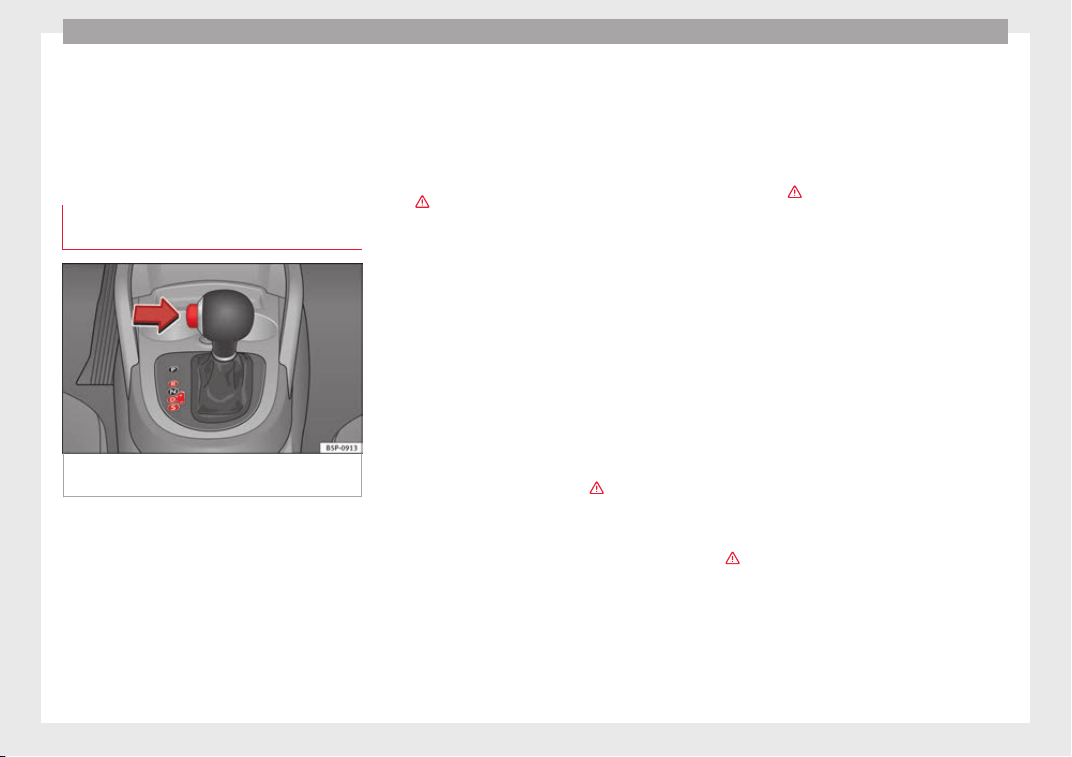
Operation
prevented from passing from
P
and
N to any
other gear without first pressing the brake
pedal.
The selector lever must be put in the position
P in order to remove the key.
Driving with automatic gearbox/DSG
automatic gearbox*
Fig. 127 Centre console: automatic gearbox
selector lever.
The gearbox changes gear ratios automatical-
ly as the vehicle moves.
Starting
–
Start the engine with the selector lever in
position
P
or
N.
Driving
–
Press and hold the brake pedal.
–
Holding down the lock button (button on
the selector lever), select R or D.
–
Release the lever and wait a little for the
gearbox to engage the gear (a slight move-
ment can be felt).
–
Release the brake and press the accelerator
›››
.
Stopping briefly
–
If stopping for a short time, keep the vehi-
cle stationary by pressing the foot brake
hard to prevent the vehicle moving back-
wards on a slope or “creeping” forwards,
e.g. at traffic lights. The selector lever does
not need to be put into the positions P
or N
f
or thi
s.
–
Do not press the accelerator.
Parking
–
Press and hold the brake pedal until the ve-
hicle comes to a standstill ›››
.
–
Apply the handbrake.
–
By pressing the lock button down, move
the selector lever to
P
and release the lock
b
utton.
Driving up and down hills
–
Press the selector lever from position “D”
to the right into the tiptronic selector gate.
–
Lightly press the selector lever back to
change down.
Holding the car on a hill
–
The brake must be always pressed down to
prevent the vehicle from “rolling back-
wards” ›››
. Do not try to prevent the vehi-
cle from “rolling backwards” by increasing
the engine speed while a range of gears is
selected.
Starting the vehicle up hills
–
Apply the handbrake.
–
With a selected gear, accelerate slowly and
at the same time, release the handbrake.
The steeper the slope, the lower the needed
gear. This increases the braking effect of the
engine. For example, when driving down a
very steep slope in third gear. If the engine
brake effect is not enough, the vehicle will
speed up. The automatic gearbox automati-
cally changes up to prevent the engine over-
revving. Use the foot brake to reduce speed
and change into 3rd gear using Tiptronic*
››› .
Your vehicle has an automatic interlock
which prevents the selector lever from being
put into a position for driving forwards or in
reverse from positions P
or N
if the brake
ped
al is not depressed.
128
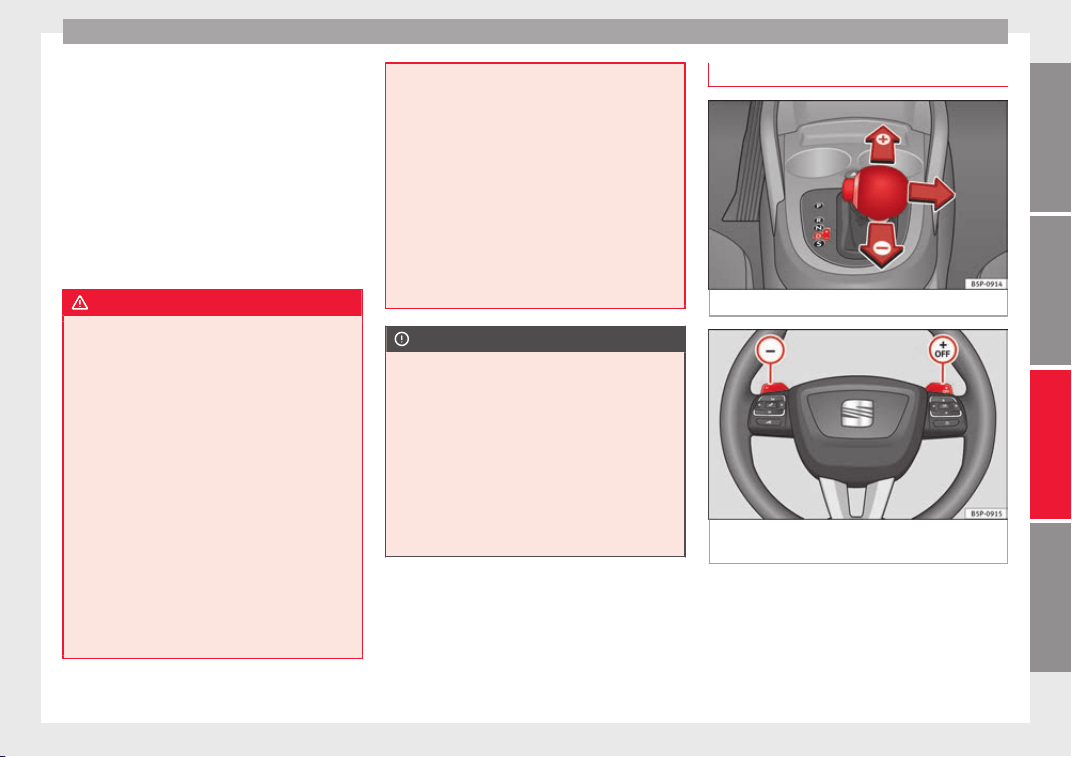
Driving
The ignition key cannot be removed unless
the selector lever is in position P
.
C
ontr
ol lamp “Pressing brake pedal”
When the warning lamp next to the selector
lever lights up, press the brake pedal. This is
necessary when the automatic gearbox selec-
tor lever is moved out of positions P or N. A
text message or instructions to perform nec-
essary operations may appear on the instru-
ment panel.
WARNING
●
As a driver, you should never leave your ve-
hicle if the engine is running and a gear range
is engaged. If you have to leave your vehicle
while the engine is running, you must apply
the parking brake and put the selector lever
in position P.
●
If the engine is running and if D or R is en-
gaged, you will need to hold the car on the
foot brake. The car will creep forward as the
power transmission is not fully interrupted
even when the engine is idling.
●
Never accelerate when moving the selector
lever or you may cause an accident.
●
Never move the selector lever to R or P
when driving. Risk of accident!
●
Before driving down a long, steep slope, it
is advisable to reduce speed and change into
a lower gear.
●
If you stop the vehicle up hill, always hold
the foot brake strongly depressed down to
stop it from rolling back.
●
Never allow the brake to rub and do not use
the brake pedal too often or for long periods.
Constant braking will cause the brakes to
overheat and will considerably reduce the
brake effect. This increases the braking dis-
tance and could cause the brake system to
fail.
●
Never allow the car to roll down a gradient
with the gear in neutral N, or in selector lever
position D, even if the engine is not running.
CAUTION
●
If you stop the vehicle up hills, do not at-
tempt to stop it from rolling back by depress-
ing the accelerator when a gear has been se-
lected. Otherwise, the automatic gearbox
may overheat causing damage. Pull the hand-
brake up or fully depress the brake pedal to
prevent the vehicle from rolling away.
●
If you allow the vehicle to roll when the en-
gine is not running, or with the selector lever
in position N, a lack of lubrication in the auto-
matic gearbox will damage it.
Changing gear in Tiptronic mode*
Fig. 128 Changing gear with Tiptronic.
Fig. 129 Steering wheel with paddle shifters
for automatic gearbox.
The Tiptronic system allows the driver to se-
lect gears manually.
Changing gear with the selector lever
–
Press the selector lever from position D
to
the right
int
o the tiptronic selector gate.
»
129
Technical specifications
AdviceOperationSafety
Operation
–
Lightly press the selector lever forward
››› Fig. 128
+
to change up to a higher
gear.
–
Lightly press the selector lever backward
››› Fig. 128
-
to change down to a lower
gear.
Changing gear with the steering wheel
paddle levers*
–
Press the right paddle lever
+
towards the
steering wheel to change up ››› Fig. 129
.
–
Pr
e
ss the left paddle
–
towards the steer-
ing wheel to change down ››› Fig. 129
.
U
s
ing the paddle levers on the steering
wheel, you can access manual driving mode
regardless of the pre-selected driving mode.
General information about driving in
tiptronic mode
When accelerating, the automatic gearbox /
DSG automatic gearbox goes into a higher
gear a little before the engine reaches its
maximum permitted revolutions.
If a lower gear is selected, the automatic
gearbox / DSG automatic gearbox will only
change down when the engine cannot go
over its maximum permitted revolutions.
If “tiptronic” is selected whilst the vehicle is
in motion and the automatic gearbox / DSG
automatic gearbox is in third gear and selec-
tor lever position D, “tiptronic” mode will
then also be in third gear.
Changing gears in the normal or sport
programme using the steering wheel paddle
levers
If the paddle levers ››› Fig. 129 are used in
the normal or sport programme, the system
switches temporarily to “tiptronic” mode. To
exit “Tiptronic” mode again, press the right
paddle shifter
+OFF
toward the steering
wheel for approximately one second. You will
also leave “Tiptronic” mode if the paddle lev-
ers are not moved for a certain time.
Note
●
The gearbox controls on the steering wheel
can operate with the selector lever in any po-
sition and with the vehicle in motion.
Kick-down feature
This feature allows maximum acceleration.
If you press the accelerator down thoroughly,
the gearbox automatically changes down, de-
pending on speed and engine speed, into a
lower gear to take full advantage of give the
vehicle maximum acceleration.
The gearbox does not change gear until the
engine reaches the maximum determined en-
gine speed for the gear.
WARNING
You could lose control of the vehicle if you ac-
celerate on slippery road surfaces. Risk of se-
rious injury.
●
Be particularly careful when using the kick-
down features on slippery road surfaces. With
a fast acceleration, the vehicle could lose
traction and skid.
●
You should use the kick-down feature only
when traffic and weather conditions allow it
to be used safely.
Run-in and economical driving
Running in a new engine
The engine needs to be run in over the first
1,500 km.
Up to 1,000 kilometres
–
Do not drive at speeds of more than 2/3
the maximum speed.
–
Do not accelerate hard.
–
Avoid high engine revolutions.
–
Do not tow a trailer.
130
Driving
From 1,000 to 1,500 kilometres
–
Speeds can be gradually increased to the
maximum road speed or maximum
permissible engine speed (rpm).
During its first few hours of running, the in-
ternal friction in the engine is greater than
later on, when all the moving parts have bed-
ded in.
For the sake of the environment
If the engine is run in gently, its life will be in-
creased and its oil consumption reduced.
Environmental friendliness
Environmental protection is a top priority in
the design, choice of materials and manufac-
ture of your new SEAT.
Constructive measures to encourage
recycling
●
Joints and connections designed for easy
dismantling
●
Modular construction to facilitate disman-
tling
●
Increased use of single-grade materials.
●
Plastic parts and elastomers are marked in
accordance with ISO 1043, ISO 11469 and
ISO 1629.
Choice of materials
●
Use of recycled materials.
●
Use of compatible plastics in the same part
if its components are not easily separated.
●
Use of recycled materials and/or materials
originating from renewable sources.
●
Reduction of volatile components, includ-
ing odour, in plastic materials.
●
Use of CFC-free coolants.
Ban on heavy metals, with the exceptions
dictated by law (Annex II of ELV Directive
2000/53/EC):
cadmium, lead, mercury, hexa-
v
al
ent chromium.
Manufacturing methods
●
Reduction of the quantity of thinner in the
protective wax for cavities.
●
Use of plastic film as protection during ve-
hicle transport.
●
Use of solvent-free adhesives.
●
Use of CFC-free coolants in cooling sys-
tems.
●
Recycling and energy recovery from resi-
dues (RDF).
●
Improvement in the quality of waste water.
●
Use of systems for the recovery of residual
heat (thermal recovery, enthalpy wheels,
etc.).
●
Use of water-soluble paints.
Catalytic converter
To maintain the useful life of the catalytic
converter
–
Use only unleaded petrol with petrol en-
gines, as lead damages the catalytic con-
verter.
–
Do not let the fuel get too low in the tank.
–
For engine oil changes, do not replenish
with too much engine oil ››› page 168, Top-
ping up engine oil .
–
Never tow the vehicle to start it, use jump
leads if necessary
›››
page 189.
If you notice misfiring, uneven running or
loss of power when the vehicle is moving, re-
duce speed immediately and have the vehi-
cle inspected at the nearest specialised
workshop. In general, the exhaust warning
lamp will light up when any of the described
symptoms occur
›››
page 35
. If this happens,
u
nb
urnt fuel can enter the exhaust system
and escape into the environment. The cata-
lytic converter can also be damaged by over-
heating.
WARNING
The catalytic converter reaches very high
temperatures! Risk of fire!
●
Never park where the catalytic converter
could come into contact with dry grass or
flammable materials under the vehicle.
»
131
Technical specifications
AdviceOperationSafety
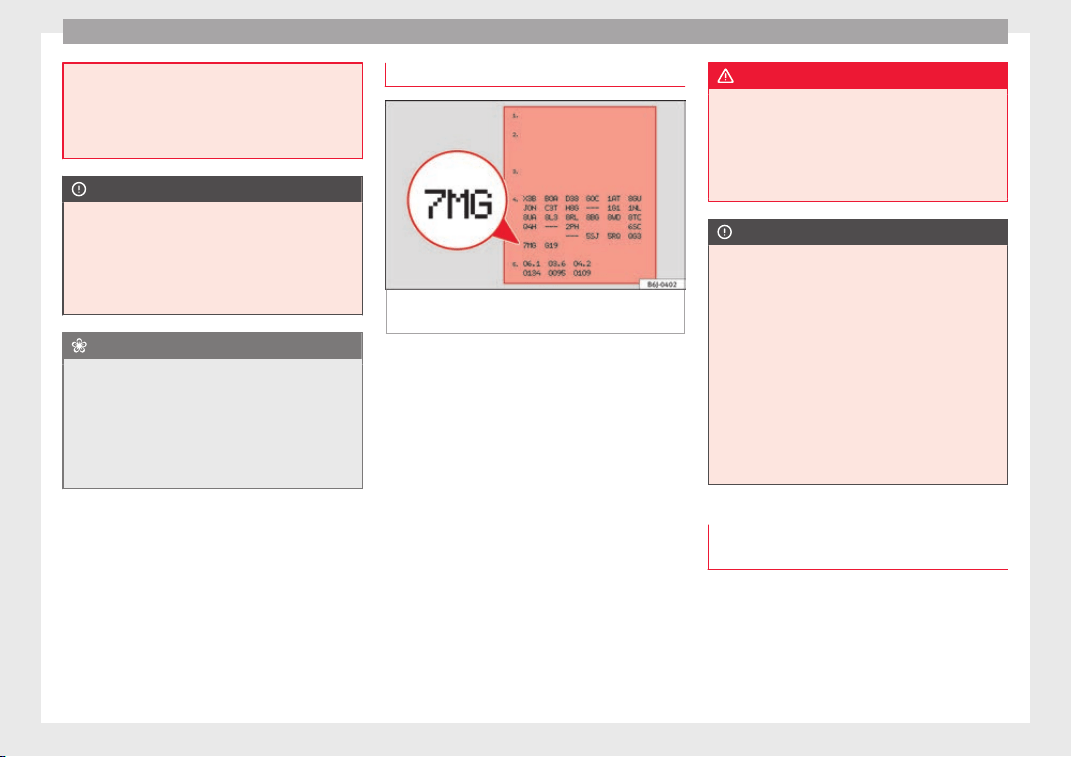
Operation
●
Do not apply additional underseal or anti-
corrosion coatings to the exhaust pipes, cata-
lytic converter or the heat shields on the ex-
haust system. These materials could catch
fire when the vehicle is being driven.
CAUTION
Never run the fuel tank completely dry be-
cause the irregularity of the fuel supply may
cause ignition problems. This allows unburnt
fuel to enter the exhaust system, which could
cause overheating and damage the catalytic
converter.
For the sake of the environment
Even when the emission control system is
working perfectly, there may be a smell of
sulphur from the exhaust gas under some
conditions. This depends on the sulphur con-
tent of the fuel used. Quite often the problem
can be solved by changing to another brand
of fuel.
Diesel engine particulate filter*
Fig. 130 Vehicle data sticker on back cover of
the Maintenance Programme.
Your vehicle is fitted with a DPF (Diesel partic-
ulate filter) if the vehicle data sticker (back
cover of the “Maintenance Programme)” lists
the PR code 7GG or 7MG ››› Fig. 130
.
The die
sel
engine particulate filter eliminates
most of the soot from the exhaust gas sys-
tem. Under normal driving conditions, the fil-
ter cleans itself. If this is not possible (for ex-
ample, multiple short trips) the filter will be
obstructed by soot and the diesel engine
particulate filter warning lamp will light up.
This does not represent a fault, it is a warning
that indicates that the filter has not been
able to regenerate automatically and that you
must perform a cleaning cycle, as indicated
in ››› page 41.
WARNING
●
The diesel engine particulate filter may
reach extremely high temperatures; the vehi-
cle should be parked so that the exhaust pipe
does not come into contact with flammable
materials underneath the vehicle. Otherwise
there is a risk of fire.
CAUTION
●
Your vehicle is not designed to use biodie-
sel fuel. Never, under any circumstances re-
fuel with biodiesel. The use of biodiesel fuel
could damage the engine and the fuel sys-
tem. The addition of biodiesel to diesel by
the diesel producer in accordance with stand-
ard EN 590 is authorised and will not cause
damage to the engine or the fuel system.
●
Using diesel fuel with a high sulphur con-
tent may significantly reduce the useful life of
the diesel particulate filter. Your Technical
Service will be able to tell you which coun-
tries have diesel with a high sulphur content.
Economical and environmentally
friendly driving
Fuel consumption, environmental pollution
and wear to the engine, brakes and tyres de-
pends in large part on your driving style. By
adopting an economical driving style and an-
ticipating the traffic situation ahead, you can
easily reduce fuel consumption by 10-15%.
132

Driving
Some tips on how to help you reduce pollu-
tion while saving money are listed below.
Drive anticipating the traffic situation
A vehicle uses most fuel when accelerating.
When you anticipate situations, you have to
brake less often and, thus, accelerate less. If
it is possible, let the vehicle roll with a gear
engaged
, for example, if you see a red light
ahe
a
d. The braking effect achieved in this
way helps to reduce the wear of brakes and
tyres; emissions and fuel consumption are
reduced to zero (disconnection due to iner-
tia).
Change gear early to save energy
An effective way of saving fuel is to change
up quickly through the gears. Running the
engine at high rpm in the lower gears uses
an unnecessary amount of fuel.
Manual gearbox: shift up from first to second
gear as soon as possible. We recommend
that, whenever possible, you change to a
higher gear upon reaching 2000 rpm. Follow
the “recommended gear” indication that ap-
pears on the instrument panel ››› page 47.
Avoid driving at high speed
We advise you not to drive at the top speed
permitted by the vehicle. Fuel consumption,
exhaust emissions and noise levels all in-
crease very rapidly at higher speeds. Driving
at moderate speeds will help to save fuel.
Avoid idling
It is worthwhile switching off the engine
when waiting in a traffic jam, at level cross-
ings or at traffic lights with a long red phase.
The fuel saved after only 30 - 40 seconds is
greater than the amount of fuel needed to re-
start the engine.
The engine takes a long time to warm up
when it is idling. Mechanical wear and pollu-
tant emissions are also especially high dur-
ing this initial warm-up phase. It is therefore
best to drive off immediately after starting
the engine. Avoid running the engine at high
speed.
Periodic maintenance
Periodic maintenance work guarantees that,
before beginning a journey, you will not con-
sume more than the required amount of fuel.
A well-serviced engine gives you the benefit
of improved fuel efficiency as well as maxi-
mum reliability and an enhanced resale val-
ue.
A badly serviced engine can consume up to
10% more fuel than necessary.
Avoid short journeys
To reduce the consumption and emission of
polluting exhaust gases, the engine and the
exhaust gas filtration systems should reach
the optimum operating temperature.
With the engine cold, fuel consumption is
proportionally higher. The engine does not
warm up and fuel consumption does not nor-
malise until having driven approximately four
kilometres. This is why we recommend avoid-
ing short trips whenever possible.
Maintain the correct tyre pressures
Bear in mind that keeping the tyres at an ad-
equate pressure saves fuel. If the tyre pres-
sure is just one bar (14.5 psi / 100 kPa) too
low, fuel consumption can increase by as
much as 5%. Due to the greater rolling resist-
ance, under-inflation also increases tyre wear
and impairs handling.
The tyre pressures should always be checked
when the tyres are cold.
Do not use winter tyres all year round as they
increase fuel consumption by up to 10%.
Avoid unnecessary weight
Given that every kilo of extra weight will in-
crease the fuel consumption, it is advisable
to always check the luggage compartment to
make sure that no unnecessary loads are be-
ing transported.
A roof rack is often left in place for the sake
of convenience, even when it is no longer
needed. At a speed of 100 km/h (62 mph)
»
133
Technical specifications
AdviceOperationSafety
Operation
and 120 km/h (75 mph) your vehicle will use
about 12% more fuel as a result of the extra
wind resistance caused by the roof rack even
when it is not in use.
Save electricity
The engine activates the alternator, which
produces electricity. With the need for elec-
tricity, fuel consumption is also increased.
Because of this, always turn off electrical de-
vices when you do not need them. Examples
of devices that use a lot of electricity are: the
fan at high speeds, the rear window heating
or the seat heaters*.
Note
●
If you vehicle has Start-Stop, it is not rec-
ommended to sw
itch this function off.
●
It is recommended to close the windows
when driving at more than 60 km/h
●
Do not drive with your foot resting on the
clutch pedal,, as the pressure can make the
plate spin, more fuel will be used and it can
burn the clutch plate lining, causing a serious
fault.
●
Do not hold the vehicle on a hill with the
clutch, use the foot brake or hand brake, us-
ing the latter to start. The fuel consumption
will be lower and you will prevent the clutch
plate from being damaged.
●
On descents, use the engine brake, chang-
ing to the gear that is more suitable for the
slope. Fuel consumption will be “zero” and
the brakes will not suffer.
Driver assistance systems
Braking and stability systems
Electronic Stability Control (ESC)*
Fig. 131 Detailed view of the centre console:
ESC switch.
This Electronic Stability System reduces the
risk of skidding and improves the vehicle's
stability and ability to hold the road.
Electronic Stability Control (ESC) includes the
electronic differential lock (EDL), the traction
control system (TCS), the brake assist system
(BAS) and the trailer stabilisation programme
(TSP). The ESC works together with the ABS.
Both control lamps will light up if the ESC or
ABS systems are faulty.
The ESC system is started automatically
when the engine is started.
134
Driver assistance systems
The ESC system is always active and cannot
be switched off. The ESC switch only switches
the ASR off.
The ASR can be deactivated when wheel spin
is desirable.
For example:
●
When driving with snow chains.
●
When driving in deep snow or on loose sur-
faces.
●
When the vehicle is stuck, to rock it back-
wards and forwards.
Press the button to switch the ASR back on
when you no longer need wheel spin.
Electronic Stability Control (ESC)*
The ESC reduces the risk of skidding by brak-
ing the wheels individually.
The system uses the steering wheel angle
and road speed to calculate the changes of
direction desired by the driver, and constant-
ly compares them with the actual behaviour
of the vehicle. When irregularities occur, for
example, if the vehicle begins to skid, the
ESC brakes the appropriate wheel automati-
cally.
The forces acting on the braked wheel bring
the vehicle back to a stable condition. If the
vehicle tends to oversteer (the rear end
slides out), the system will act on the front
wheel on the outside of the turn.
Steering manoeuvre recommendations
This is a complementary safety function in-
cluded in the ESC. This function aids the driv-
er to better stabilize the vehicle in a critical
situation. For example, in case of sudden
braking on a surface with varied adherence,
the vehicle will tend to destabilise its trajec-
tory to the right or to the left. In this case, the
ESC recognises the situation and assists the
driver with a counter steering manoeuvre
from the power steering.
This function simply provides the driver with
a recommended manoeuvre in critical situa-
tions.
The vehicle does not steer itself with this
function, the driver has full control of the ve-
hicle at all times.
WARNING
●
Remember that not even the ESC can defy
the laws of physics. This should be kept in
mind, particularly on slippery and wet roads
and when towing a trailer.
●
Always adapt your driving style to suit the
condition of the roads and the traffic situa-
tion. The greater safety provided by the ESC
should not encourage you to run any risks.
CAUTION
●
To ensure that the ESC works correctly, all
four wheels must be fitted with the same
tyres. Any differences in the rolling radius of
the tyres can cause the system to reduce en-
gine power when this is not desired.
●
Any modifications made to the vehicle (for
example, to the engine, brake system, run-
ning gear or to the combination of wheels
and tyres) may affect the operation of the
ABS, EDL, ESC and ASR.
Electronic differential lock (EDL)*
EDL helps the vehicle to start moving, accel-
erate and climb a gradient in slippery condi-
tions where this may otherwise be difficult or
even impossible.
It uses the ABS sensors to monitor the speed
of the driven wheels. In case of an EDL fault,
the warning light for ABS lights up
››› page 41
.
At
s
peeds of up to approximately 80 km/h
(50 mph), it is able to balance out differences
in the speed of the driven wheels of approxi-
mately 100 rpm/min caused by a partially
slippery road surface. It does this by braking
the wheel which has lost traction and distrib-
uting more driving force to the other driven
wheel via the differential.
To prevent the disc brake of the braking
wheel from overheating, the EDL cuts out au-
tomatically if subjected to excessive loads.
The vehicle will continue to function normally
»
135
Technical specifications
AdviceOperationSafety
Operation
without EDL. For this reason, the driver is not
informed that the EDL has been switched off.
The EDL will switch on again automatically
when the brake has cooled down.
WARNING
●
When accelerating on a slippery surface,
for example on ice and snow, press the accel-
erator carefully. Despite EDL, the driven
wheels may start to spin. This could impair
the vehicle's stability.
●
Always adapt your driving style to suit road
conditions and the traffic situation. Do not let
the extra safety afforded by EDL tempt you in-
to taking any risks when driving, this can
cause accidents.
CAUTION
Modifications to the vehicle (e.g. to the en-
gine, the brake system, running gear or any
components affecting the wheels and tyres)
could affect the efficiency of the EDL
››› page 147.
Hydraulic Brake Assist (HBA)*
The function (Hydraulic Brake Assist HBA) is
only included in vehicles with ESC.
In an emergency, most drivers brake in time,
but not with maximum force. This results in
unnecessarily long braking distances.
This is when the brake assist system comes
into action. When pressing the brake pedal
rapidly, the assistant interprets it as an emer-
gency. It very quickly builds up the full brake
pressure so that the ABS can be activated
more quickly and efficiently, thus reducing
braking distance.
Do not reduce the pressure on the brake ped-
al, since the brake assist system switches off
automatically as soon as you release the
brake.
Emergency braking warning
If the vehicle is braked suddenly and continu-
ously at a speed of more than 80 km/h, the
brake light flashes several times per second
to warn vehicles driving behind. If you contin-
ue braking, the hazard warning lights will
come on automatically when the vehicle
comes to a standstill. They switch off auto-
matically when the vehicle starts to move
again.
WARNING
●
The risk of accident is higher if you drive
too fast, if you do not keep your distance from
the vehicle in front, and when the road sur-
face is slippery or wet. The increased acci-
dent risk cannot be reduced by the brake as-
sist system.
●
The brake assist system cannot defy the
laws of physics. Slippery and wet roads are
dangerous even with the brake assist system!
Therefore, it is essential that you adjust your
speed to suit the road and traffic conditions.
Do not let the extra safety features tempt you
into taking any risks when driving.
Anti-lock brake system (ABS)
The anti-lock brake (ABS) system prevents
the wheels from locking during braking and
is an important part of the vehicle's active
safety system.
How the ABS works
If one of the wheels turns too slowly in rela-
tion to the vehicle's speed, and is close to
locking, the system will reduce the braking
pressure to this wheel. The driver is made
aware of this control process by a pulsating
of the brake pedal and audible noise. This is
a deliberate warning to the driver that one or
more of the wheels is tending to lock and the
ABS control function has intervened. In this
situation it is important to keep the brake
pedal fully depressed so the ABS can regu-
late the brake application. Do not “pump”.
If you brake hard on a slippery road surface,
the best possible control is retained as the
wheels do not lock.
However, ABS will not necessarily guarantee
shorter braking distances in all
conditions.
Br
ak
ing distance could even be further if you
136
Driver assistance systems
brake on gravel or on fresh snow on a
slippery surface.
WARNING
●
The anti-lock brake system cannot defy the
laws of physics. Slippery and wet roads are
dangerous even with ABS! If you notice that
the ABS is working (to counteract locked
wheels under braking), you should reduce
speed immediately to suit the road and traffic
conditions. Do not let the extra safety fea-
tures tempt you into taking any risks when
driving.
●
The effectiveness of ABS is also determined
by the tyres fitted ››› page 175.
●
If the ru
nning gear or brake system is modi-
fied, the effectiveness of the ABS could be se-
verely limited.
Drive wheel traction control system
(ASR)
The traction control system prevents the driv-
en wheels from spinning when the vehicle is
accelerating.
Description and operation of the traction
control system during acceleration (ASR
On front-wheel drive vehicles, the ASR sys-
tem intervenes, reducing engine power and
preventing the driven wheels from slipping
during acceleration. The system works in the
entire speed range in conjunction with ABS.
If a failure occurs in the ABS, the ASR will al-
so stop working.
TCS helps the car to start moving, accelerate
and climb a gradient in slippery conditions
where this may otherwise be difficult or even
impossible.
The ASR automatically switches on when the
engine is started. If necessary, it may be
turned on or off by briefly pushing the button
on the centre console.
When the ASR is switched off, the
OFF
warning lamp will light up. The ASR should
normally be left on. Only in exceptional cir-
cumstances, when slipping of the wheels is
desired, should it be disconnected.
●
With compact temporary spare wheel.
●
When using the snow chains.
●
When driving in deep snow or on soft ter-
rain.
●
When the vehicle is bogged-down, to free it
by “rocking.”
The ASR should be switched on again as
soon as possible.
WARNING
●
Remember that not even the ASR can defy
the laws of physics. This should be kept in
mind, particularly on slippery and wet roads
and when towing a trailer.
●
Always adapt your driving style to suit the
condition of the roads and the traffic situa-
tion. The greater safety provided by the ASR
should not encourage you to run any risks.
CAUTION
●
To ensure that the ASR works correctly,
identical tyres should be fitted on all four
wheels. Any differences in the rolling radius
of the tyres can cause the system to reduce
engine power when this is not desired.
●
Any modifications made to the vehicle (for
example, to the engine, brake system, run-
ning gear or to the combination of wheels
and tyres) may affect the operation of the
ABS and ASR.
XDS*
When taking a curve, the driveshaft differen-
tial mechanism allows the outer wheel to turn
at a higher speed than the inner wheel. In
this way, the wheel that is turning faster (out-
er wheel) receives less drive torque than the
inner wheel. This may mean that in certain
situations the torque delivered to the inner
wheel is too high, causing the wheels to
spin. On the other hand, the outer wheel is
receiving a lower drive torque than it could
transmit. This causes an overall loss of lateral
grip on the front axle, resulting in understeer
or “lengthening” of the trajectory.
»
137
Technical specifications
AdviceOperationSafety
Operation
The XDS system can detect and correct this
effect via the sensors and signals of the ESC.
Via the ESC, the XDS will brake the inside
wheel and counter the excess driving torque
of that wheel. This means that the driver's
desired trajectory is much more precise,
The XDS system works in combination with
the ESC and is always active, even when ASR
traction control is disconnected.
Brake servo
The brake servo increases the pressure you
apply to the brake pedal. It works only when
the engine is running.
If the brake servo is not functioning, e.g. due
to a malfunction, or if the vehicle is being
towed, you will have to press the brake pedal
considerably harder to make up for the lack
of servo assistance.
WARNING
The braking distance can also be affected by
external factors.
●
Never let the vehicle coast with the engine
switched off. Failure to follow this instruction
could result in an accident. The braking dis-
tance is increased considerably when the
brake servo is not active.
●
If the brake servo is not working, for exam-
ple when the vehicle is being towed, you will
have to press the brake pedal considerably
harder than normal.
Start-Stop System*
Description and operation
The Start-Stop function stops the engine
when the vehicle is stopped and starts it au-
tomatically when required.
–
When the vehicle is stopped, put it in neu-
tral and release the clutch pedal. The en-
gine will stop.
–
When the clutch pedal is pressed, the en-
gine starts again.
–
The instrument panel display shows infor-
mation about the status of the Start-Stop
function ››› Fig. 133
.
St
ar
t-Stop function conditions
●
The driver seat belt must be buckled.
●
The bonnet must be closed.
●
The engine must be at operating tempera-
ture.
●
The steering wheel must be straight.
●
The vehicle must not be on a steep gradi-
ent.
●
The vehicle must not be in reverse.
●
A trailer must not be connected.
●
The temperature of the passenger compart-
ment must be within comfort limits (button
A/C
11
››› Fig. 120
should be selected).
●
The w
ind
screen de-mist function must be
off.
●
If not, it requires an increase in airflow
10
››› Fig. 120
for more than three presses.
●
The t
emper
ature must not be set to HI or
LO.
●
The driver door must be closed.
●
The diesel particulate filter must not be in
regeneration mode, for diesel engines.
●
The battery charge must not be low for the
next start.
●
Battery temperature must be between -1 °C
(+30 °F) and +55 °C (+131 °F).
●
The Parking aid system (Park Assist*) must
not be activated.
Start-Stop function interruption
In the following situations, the Start-Stop
function will be interrupted and the engine
will automatically start:
●
The vehicle starts moving.
●
The brake pedal is pressed several times in
a row.
●
The battery has been discharged excessive-
ly.
●
The Start-Stop System is manually deacti-
vated.
138
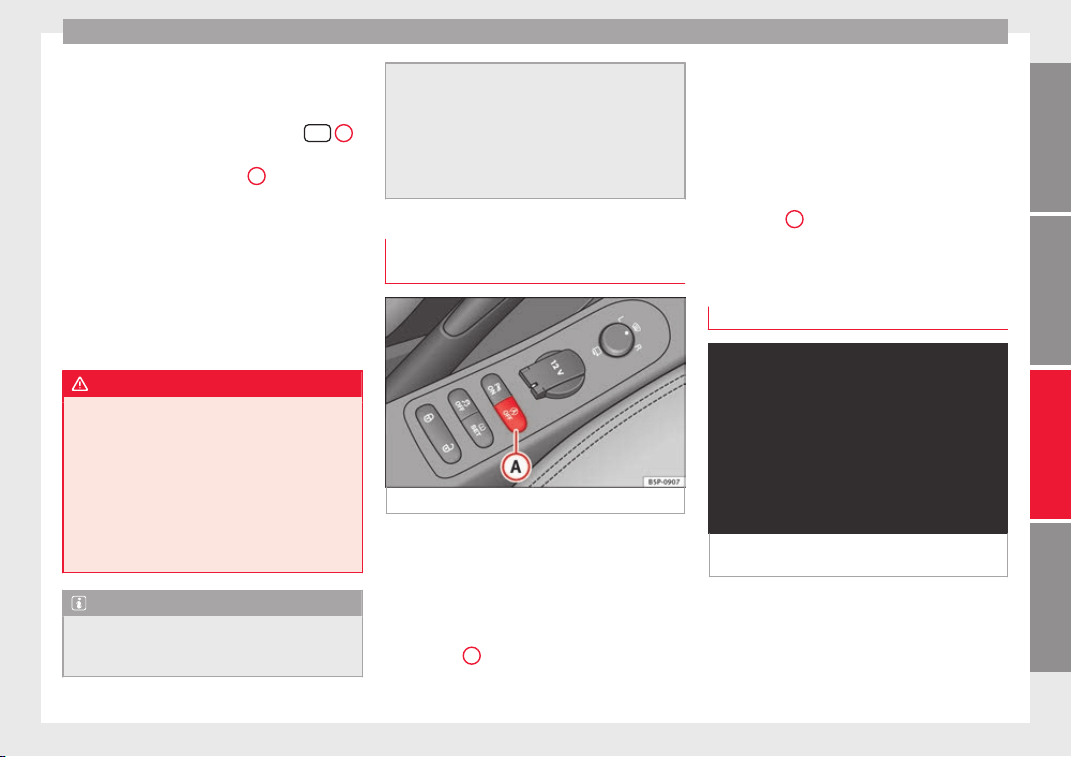
Driver assistance systems
●
The windscreen de-mist function is turned
on.
●
The temperature of the passenger compart-
ment exceeds comfort limits (button
A/C
11
››› Fig. 120
should be selected).
●
If
in an inc
rease in airflow
10
››› Fig. 120
is
r
equir
ed for more than three presses.
●
Temperature setting HI or LO is selected.
●
The engine coolant temperature is insuffi-
cient.
●
The alternator is faulty, for example the V-
belt has ruptured.
●
If any of the conditions described in the
previous section are not fulfilled.
WARNING
Never allow the vehicle to move with the en-
gine off for any reason. You could lose control
of your vehicle. This could cause an accident
and serious injury.
●
Power steering does not work when the en-
gine is not running. That is why it is much
more difficult to turn the steering wheel.
●
Turn off the Start-Stop system when driving
through water (fording streams, etc.).
Note
●
For vehicles with the Start-Stop function
and a manual gearbox, when the engine is
started, the clutch must be pressed.
●
When the conditions for the Start-Stop
function are not fulfilled, the instrument pan-
el displays the Start-Stop indicator dimmed.
●
If the steering wheel is turned more than
270°, Stop will not function; however, the an-
gle of steering wheel turn does not affect
starting the vehicle.
Activating and deactivating the Start-
Stop function
Fig. 132 The Start-Stop function button.
Every time the ignition is switched on, the
Start-Stop function is automatically activa-
ted.
Manually deactivating the Start-Stop
function
–
Press the
A
››› Fig. 132 located in the cen-
tre console. When the Start-Stop function is
deactivated, the pushbutton indicator
lights.
–
If the Start-Stop function is operating then
the engine starts immediately.
Switching the Start-Stop function on
manually
–
Press the
A
››› Fig. 132 located in the cen-
tre console. The indicator on the button will
go out.
Driver messages
Fig. 133 Display on the instrument panel dur-
ing Start-Stop function operation.
When the engine is turned off by the Start-
Stop function, this is displayed on the instru-
ment panel.
»
139
Technical specifications
AdviceOperationSafety
Operation
Note
There are different versions of the dash pan-
el; the display of indications on the screen
may differ.
Parking aid acoustic system*
General notes
Various parking aid systems are available to
help you when parking or manoeuvring in
tight spaces, depending on the equipment
fitted on your vehicle.
The SEAT Parking System* gives an audible
warning if there are any obstacles behind
your vehicle.
When you are parking, the SEAT Parking Sys-
tem Plus* warns you acoustically and optical-
ly
1)
about obstacles “in front of” and “be-
hind” the vehicle.
Note
To ensure the acoustic parking aid works
properly, the sensors must be kept clean and
free of snow and ice.
SEAT Parking System: description
The Parking System is an acoustic parking
aid.
Sensors are located in the rear bumper.
When the sensors detect an obstacle, you are
alerted by audible warnings. The measuring
range of the sensors starts at approximately:
Rear
Side 0.60
Centre 1.60
The audible warnings sound with increasing
frequency as you approach the obstacle.
When the vehicle is less than 0.30 m away
from the obstacle, the warning tone will
sound continuously. Do not drive on!
The volume of the warning beeps will gradu-
ally decrease after about 4 seconds if the ve-
hicle remains at a constant distance from a
detected obstacle (it does not affect the per-
manent acoustic signal).
The parking aid is switched on automatically
when reverse gear is engaged. You will hear a
brief confirmation tone.
WARNING
●
The parking aid is not a replacement for
driver awareness. The driver is personally re-
sponsible for safe parking and other manoeu-
vres.
●
The sensors have blind spots in which ob-
stacles are not registered. Always look out for
small children and animals because the sys-
tem will not always detect them. Always pay
attention when reversing to avoid accidents.
●
Always keep a close eye on the area around
the vehicle and make full use of the rear vi-
sion mirrors.
CAUTION
Please note that low obstacles detected by
the system may no longer be registered by
the sensors as the car moves closer, so the
system will not give any further warning. Cer-
tain kinds of obstacles (such as wire fences,
chains, thin painted posts or trailer draw
bars, etc) may not always be detected by the
system, so take care not to damage the vehi-
cle in such cases.
Note
Please refer to the notes on towing
››› page 141.
1)
Vehicles with a navigation system.
140
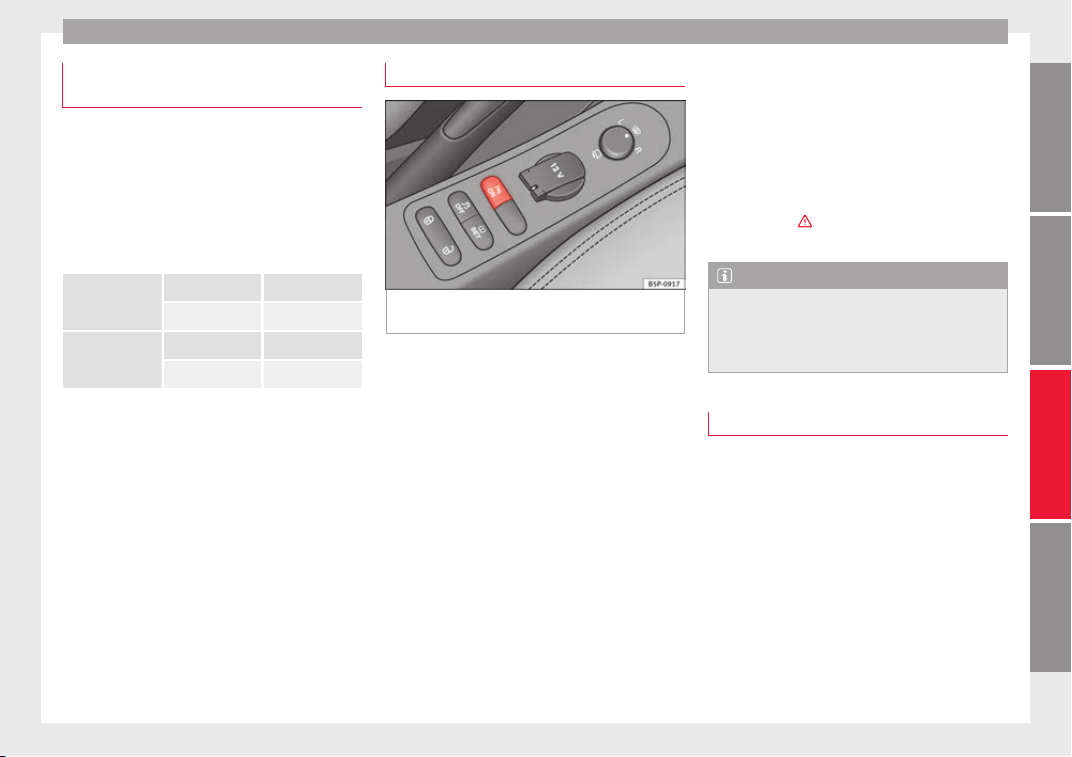
Driver assistance systems
SEAT Parking System Plus*:
description
The Parking System Plus is an acoustic and
optical parking aid.
Sensors are located in the front and rear
bumpers. When the sensors detect an obsta-
cle, you are alerted by audible and optical
warnings. The measuring range of the sen-
sors starts at approximately:
Front
Side 0.90
Centre 1.20
Rear
Side 0.60
Centre 1.60
The audible warnings sound with increasing
frequency as you approach the obstacle.
When the vehicle is less than 0.30 m away
from the obstacle, the warning tone will
sound continuously. Stop moving immediate-
ly!
The volume of the warning beeps will gradu-
ally decrease after about 4 seconds if the ve-
hicle remains at a constant distance from a
detected obstacle (it does not affect the per-
manent acoustic signal).
Activating/deactivating
Fig. 134 Centre console: Switch for parking
aid.
Activate
–
Connects the radio navigator.
–
Press the switch on the centre console
››› Fig. 134
or on the gear indicator. You will
he
ar a brief
confirmation tone and the LED
on the switch will light up.
Deactivating
–
Drive forward faster than 10 km/h (6 mph),
or
–
Press the switch or
–
Switch the ignition off.
Segments in the optical display
Some colour segments in front and behind
and an audible warning enable the driver to
assess the distance with respect to an obsta-
cle. The amber colour segments combined
with a discontinuous beep indicate the pres-
ence of an obstacle. As the vehicle gets clos-
er to the obstacle, the colour of the segment
changes to red and the acoustic signal beeps
continuously. When the penultimate segment
is displayed, this means that the vehicle has
reached the collision zone. Stop moving im-
mediately! ›››
in SEAT Parking System: de-
scription on page 140.
Note
●
Please refer to the notes on towing
››› page 141.
●
There i
s a slight delay in the picture dis-
play.
Towing bracket
In towing mode, the rear parking aid sensors
are not enabled when you select reverse gear
or press the switch . This function may not
be guaranteed on towing brackets that are
not factory fitted. This results in the following
restrictions:
SEAT Parking System*
No warning is given.
SEAT Parking System Plus*
There is no rear distance warning. The system
will still give a warning when obstacles are
»
141
Technical specifications
AdviceOperationSafety
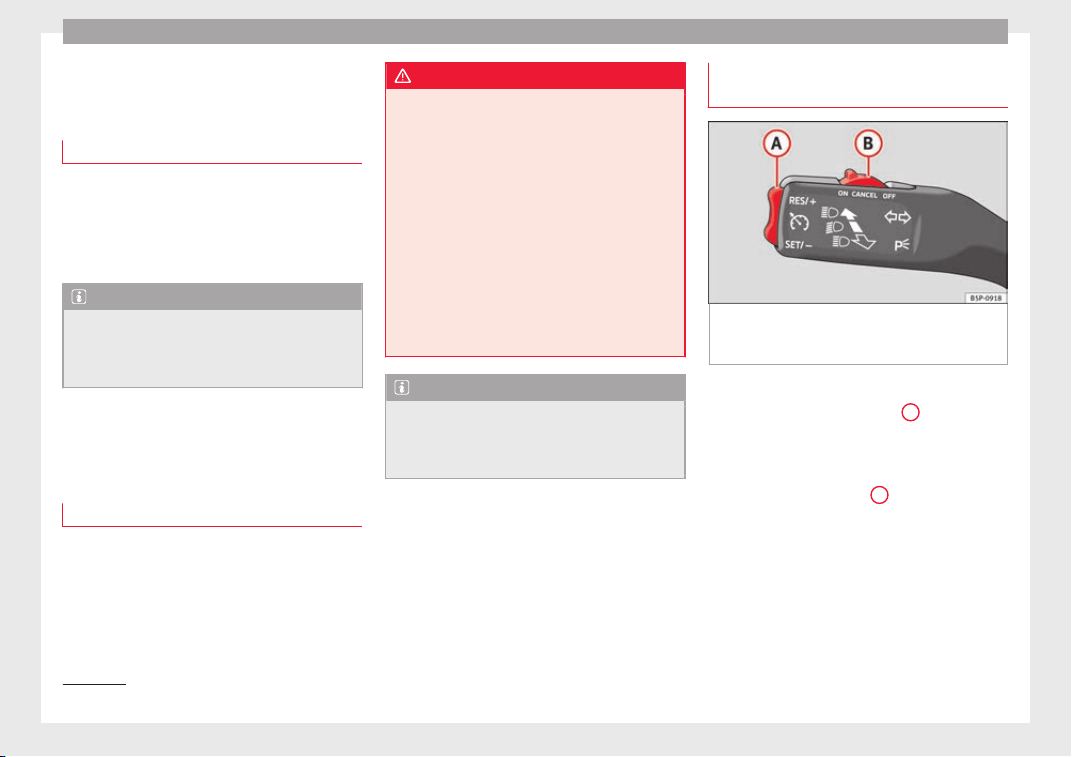
Operation
detected while driving forward. The optical
display changes to towing mode.
Fault messages
If you hear a long beep for a few seconds and
the LED on the switch * starts flashing
when
you switch on the parking aid, a system
fault has occurred. Contact a SEAT official
service or specialised workshop.
Note
If the fault is not corrected before you switch
off the ignition, it will only be indicated by
the flashing LED on the switch the next
time y
ou switch on the parking aid.
Cruise speed* (cruise control
system - CCS)
Description
The CCS is able to maintain the set speed in
the range from approx. 30 km/h (19 mph) to
180 km/h (112 mph).
Once the speed setting has been saved, you
may take your foot off the accelerator.
WARNING
It could be dangerous to use the cruise con-
trol system if it is not possible to drive at con-
stant speed.
●
Do not use the cruise control system when
driving in dense traffic, on roads with lots of
bends or on roads with poor conditions (with
ice, slippery surfaces, loose grit or gravel), as
this could cause an accident.
●
Always switch the cruise control system off
after using it in order to avoid involuntary
use.
●
It is dangerous to use a set speed which is
too high for the current road, traffic or weath-
er conditions. Risk of accident.
Note
The cruise control cannot maintain a constant
speed when descending downhill. It will in-
crease due to its own weight. Use the foot
brake to slow the vehicle.
Switching the cruise control system
on and off
Fig. 135 Turn signal and main beam head-
light lever: switch and rocker switch for the
cruise control.
Switching on the cruise control system
–
Push the switch ››› Fig. 135
B
to the left to
ON.
Switching off the cruise control system
–
Either push the switch
B
to the right to
OFF or turn the ignition off when the vehicle
is stationary.
When cruise control is on and a speed is pro-
grammed, the indicator on the dash panel
is lit.
1)
If the cruise control system is switched off
,
the symbo
l
is switched off. The system will
1)
Depending on the model version
142
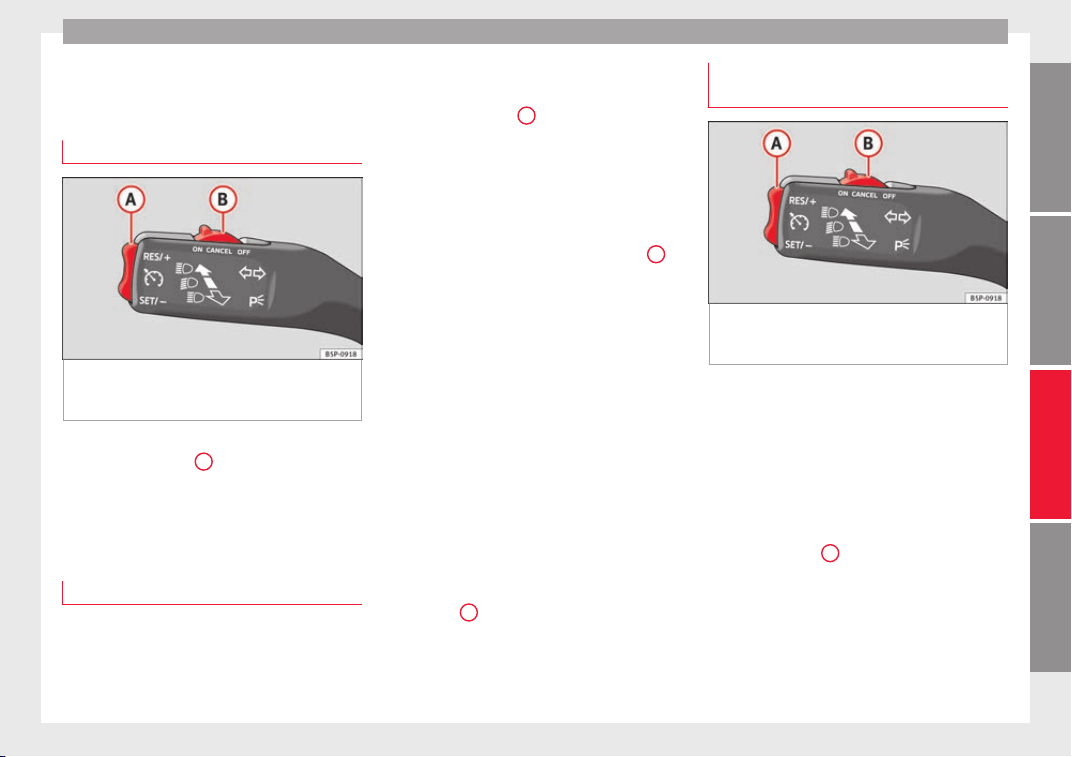
Driver assistance systems
also be switched off fully when the 1st
gear
i
s
engaged.*
Setting speed*
Fig. 136 Turn signal and main beam head-
light lever: switch and rocker switch for the
cruise control.
–
Press the lower part SET/- of the rocker
switch ››› Fig. 136
A
once briefly when you
have reached the speed you wish to set.
When you release the rocker switch, the cur-
rent speed is set and held constant.
Adjusting set speed*
The speed can be altered without touching
the accelerator or the brake.
Setting a higher speed
–
Press the upper part RES/+ of the rocker
switch ››› Fig. 136
A
to increase the speed.
The vehicle will continue to accelerate as
long as you keep the rocker switch pressed.
When you release the switch, the new
speed is stored.
Setting a lower speed
–
Press the lower part SET/– ››› Fig. 136
A
of
the rocker switch to reduce the speed. The
vehicle will automatically reduce its speed
for as long as you keep the switch pressed.
When you release the switch, the new
speed is stored.
When you increase speed with the accelera-
tor and then release the pedal, the system
will automatically restore the set speed. This
will not be the case, however, if the vehicle
speed exceeds the stored speed by more
than 10 km/h (6 mph) for longer than 5 mi-
nutes. The speed will have to be stored
again.
Cruise control is switched off if you reduce
speed by depressing the brake pedal. You
can reactivate the control by pressing once
on the upper part of the rocker switch RES/+
››› Fig. 136
A
.
Switching off cruise control
temporarily*
Fig. 137 Turn signal and main beam head-
light lever: switch and rocker switch for the
cruise control.
The cruise control system will be switched off
in the following situations:
●
if the brake pedal is depressed,
●
if the clutch pedal is depressed,
●
if the vehicle is accelerated to over
180 km/h (112 mph),
●
when the ESC or ASR is used.
●
when the lever
B
is moved to the position
CANCEL without reaching the OFF position.
Once the CANCEL operation is complete,
when the lever is released it returns to its ini-
tial position.
To resume cruise control, release the brake or
clutch pedal or reduce the vehicle speed to
less than 180 km/h (112 mph) and press
»
143
Technical specifications
AdviceOperationSafety

Operation
once on the upper part of the rocker switch
RES/+ ››› Fig. 137
A
.
Complete system deactivation*
Vehicles with a manual gearbox
The system is completely turned off by
mov-
ing the control
B
››› Fig. 137 all the way to
the right (OFF
engaged), or when the vehicle
is stationary, by switching off the ignition.
Vehicles with automatic gearbox/DSG
automatic gearbox
To completely disengage the system, the se-
lector lever must be placed in one of the fol-
lowing positions: P,
N, R or 1 or with the vehi-
cle stopped and the ignition turned off.
Towing bracket device
Trailer towing
Instructions to follow
Your vehicle may be used to tow a trailer
when fitted with the correct equipment.
If the car is supplied with a factory-fitted tow-
ing br
acket it will already have the necessary
technical modifications and meet the statuto-
ry requirements for towing a trailer. If you
wish to retrofit a towing bracket, consult
›
››
page 146.
Connectors
Your vehicle is fitted with a 12-pin connector
for the electrical connection between the
trailer and the vehicle.
If the trailer has a 7-pin plug you will need to
use an adapter cable. It is available at any
Technical Service.
Trailer weight/drawbar load
Never exceed the authorised trailer weight. If
you do not load the trailer up to the maxi-
mum permitted trailer weight, you can then
climb correspondingly steeper slopes.
The maximum trailer weights listed are only
applicable for altitudes up to 1000 m above
sea level. With increasing altitude the engine
power and therefore the vehicle climbing
ability are impaired because of the reduced
air density. The maximum trailer weight has
to be reduced accordingly. The weight of the
vehicle and trailer combination must be re-
duced by 10% for every further 1000 m (or
part thereof). The gross combination weight
is the actual weight of the laden vehicle plus
the actual weight of the laden trailer. When
possible, operate the trailer with the maxi-
mum permitted drawbar load on the ball joint
of the towing bracket, but do not exceed the
specified limit.
The figures for trailer weights and drawbar
loads that are given on the data plate of the
towing bracket are for certification purposes
only. The correct figures for your specific
model, which may be lower than these fig-
ures for the towing bracket, are given in the
vehicle documentation or in ››› chapter Tech-
nical Data.
Distributing the load
Distribute loads in the trailer so that heavy
objects are as near to the axle as possible.
Loads carried in the trailer must be secured
to prevent them moving.
144
Towing bracket device
Tyre pressure
Set tyre pressure to the maximum permissi-
ble pressure shown on the sticker on the in-
side of the fuel tank flap. Set the tyre pres-
sure of the trailer tyres in accordance with the
trailer manufacturer's recommendations.
Exterior mirrors
Check whether you can see enough of the
road behind the trailer with the standard rear
vision mirrors. If this is not the case, you
should have additional exterior mirrors fitted.
Both exterior mirrors should be mounted on
hinged extension brackets. Adjust the mirrors
to give sufficient vision to the rear.
WARNING
Never transport people in a trailer. This could
result in fatal accidents.
Note
●
Towing a trailer places additional demands
on the vehicle. We recommend additional
services between the normal inspection inter-
vals if the vehicle is used frequently for tow-
ing a trailer.
●
Find out whether special regulations apply
to towing a trailer in your country.
Ball coupling of towing bracket*
Depending on the model version, the spheri-
cal head on the trailer hook may be stored in
the tool box.
The ball coupling is provided with instruc-
tions on fitting and removing the ball cou-
pling of the towing bracket.
WARNING
The towing bracket ball coupling must be
stored securely in the luggage compartment
to prevent them being flung through the vehi-
cle and causing injury.
Note
●
By law, the ball coupling must be removed
if a trailer is not being towed if it obscures
the number plate.
Driving tips
Driving with a trailer always requires extra
care.
Weight distribution
The weight distribution of a loaded trailer
with an unladen vehicle is very unfavourable.
However, if this cannot be avoided, drive ex-
tra slowly to allow for the unbalanced weight
distribution.
Speed
The stability of the vehicle and trailer is re-
duced with increasing speed. For this reason,
it is advisable not to drive at the maximum
permissible speed in an unfavourable road,
weather or wind conditions. This applies es-
pecially when driving downhill.
You should always reduce speed immediately
if the trailer shows the slightest sign of snak-
ing
. Never try to stop the “snaking” by in-
c
r
easing speed.
Always brake in due course. If the trailer has
an overrun brake, apply the brakes gently at
first and then, firmly. This will prevent the
jerking that can be caused by locking of trail-
er wheels. Select a low gear in due course
before going down a steep downhill. This en-
ables you to use the engine braking to slow
down the vehicle.
Reheating
At very high temperatures and during pro-
longed slopes, driving in a low gear and high
engine speed, always monitor the coolant
temperature gauge ››› page 31.
Electronic Stability Control*
The ESC* system helps to stabilise the trailer
in case of skidding or rocking.
145
Technical specifications
AdviceOperationSafety
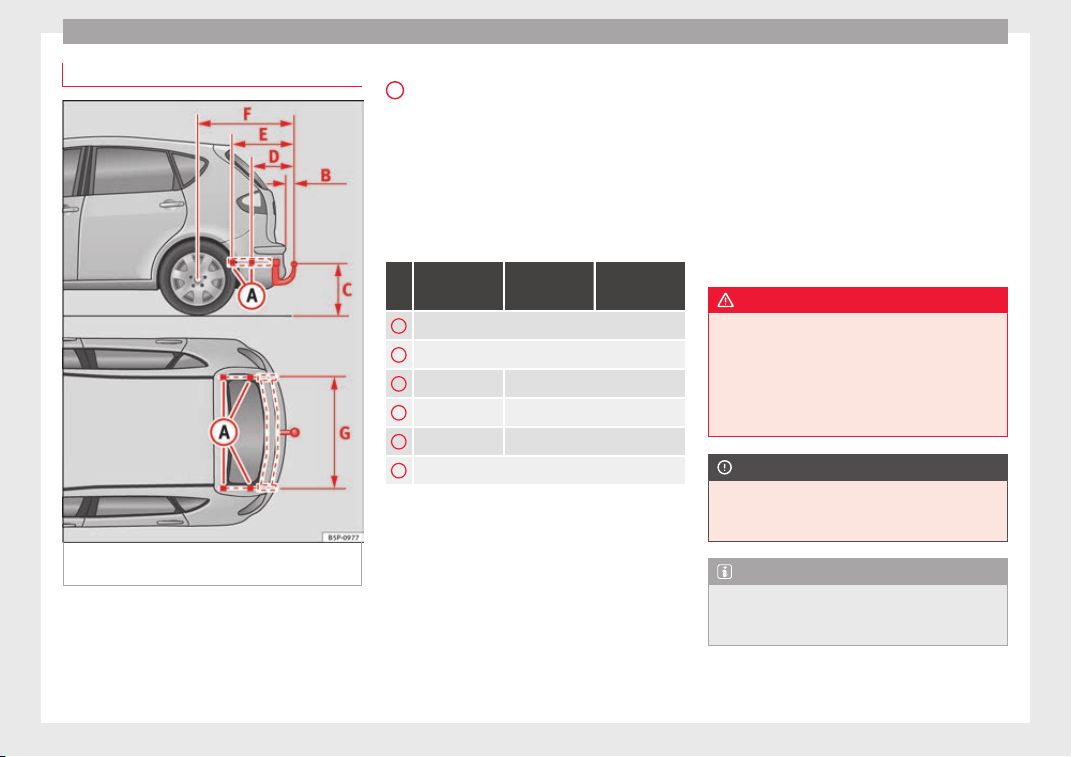
Operation
Fitting a towing bracket*
Fig. 138 Attachment points for towing brack-
et.
If a towing bracket is to be fitted after the ve-
hicle is purchased, this must be completed
according to the instructions of the towing
bracket manufacturer.
The attachment points for the towing bracket
A
are on the lower part of the vehicle.
The distance between the centre of the ball
coupling and the ground should never be
lower than the indicated value, even with a
fully loaded vehicle and including the maxi-
mum drawbar load.
Elevation values for securing the towing
bracket:
ALTEA ALTEA XL
ALTEA FREE-
TRACK
B
65 mm (minimum)
C
350 mm to 420 mm (fully laden vehicle)
D
357 mm 344 mm
E
569 mm 531 mm
F
875 mm 1,044 mm
G
1040 mm
Fitting a towing bracket
●
Driving with a trailer involves an extra effort
for the vehicle. Therefore, before fitting a
towing bracket, please contact a Technical
Service to check whether your cooling system
needs modification.
●
The legal requirements in your country
must be observed (e.g. the fitting of a sepa-
rate control lamp).
●
Certain vehicle components, e.g. the rear
bumper, must be removed and reinstalled.
The towing bracket securing bolts must be
tightened using a torque wrench, and a pow-
er socket must be connected to the vehicle
electrical system. This requires specialised
knowledge and tools.
●
Figures in the illustration show the eleva-
tion value and the attachment points which
must be considered if you are retrofitting a
towing bracket.
WARNING
The towing brackets should be fitted at a spe-
cialised workshop.
●
If the towing bracket is incorrectly instal-
led, there is a serious danger of accident.
●
For your own safety, please observe the tow
bracket manufacturer's instructions.
CAUTION
●
If the power socket is incorrectly installed,
this could cause damage to the vehicle elec-
trical system.
Note
For the sports model (Altea FR), fitting of a
trailer bracket is not recommended due to the
design of the bumpers.
146

Care and maintenance
Advice
Care and maintenance
Accessories and technical
modifications
Accessories, modifications and spare
parts
Your vehicle is designed to offer a high
standard of active and passive safety.
Before purchasing accessories and parts,
and before making technical changes to your
vehicle, we recommend that you consult your
Technical Service.
SEAT dealerships will be happy to provide
you with the latest information about the
use, legal requirements and recommenda-
tions from the manufacturer regarding acces-
sories and spare parts.
We recommend you use only SEAT Approved
Accessories
®
and
SEAT Approved Spare
P
ar
ts
®
. This way, SEAT can guarantee that
the product in question is suitable, reliable
and safe. SEAT Technical Services have the
necessary experience and facilities to ensure
that parts are correctly and professionally in-
stalled.
Despite a continuous observation of the mar-
ket, SEAT is not able to assess the reliability,
safety and suitability of parts that SEAT has
not approved. For this reason, SEAT cannot
assume responsibility for any non-genuine
parts used, even if these parts have been ap-
proved by an official testing agency or are
covered by an official approval certificate.
Any retro-fitted equipment which has a direct
effect on the vehicle and/or the way it is driv-
en, such as a cruise control system or elec-
tronically-controlled suspension), must be
SEAT-approved for use in your vehicle and
bear the e mark (the European Union's au-
thorisation symbol).
If any additional electrical devices are fitted
which do not serve to control the vehicle it-
self (e.g. refrigerator box, laptop or ventilator
fan), these must bear the CE mark (European
Union manufacturer conformity declaration).
WARNING
Accessories, for example telephone holders
or cup holders, should never be fitted on the
covers or within the working range of the air-
bags. Otherwise, there is a danger of injury if
the airbag is triggered in an accident.
Technical modifications
Modifications must always be carried out ac-
cording to our specifications.
Unauthorised modifications to the electronic
components or software in the vehicle may
cause malfunctions. Due to the way the elec-
tronic components are linked together in net-
works, other indirect systems may be affec-
ted by the faults. This can seriously impair
safety, lead to excessive wear of compo-
nents, and also invalidate your vehicle regis-
tration documents.
SEAT Technical Services cannot be held liable
for any damage caused by modifications
and/or work incorrectly performed.
For this reason, we recommend having all
work performed by a SEAT Technical Service
using
SEAT
®
O
riginal Spare Parts.
WARNING
Any type of work or modification performed
incorrectly on your vehicle can lead to mal-
functions and can cause accidents.
Roof aerial*
The vehicle may be fitted with a foldable*
and anti-theft* aerial that may be positioned
parallel to the roof.
To fold down
Unscrew the rod, position parallel to the roof
and tighten once again.
»
147
Technical specifications
AdviceOperationSafety
Advice
To return to working position
Continue in the reverse order to the previous
instruction.
CAUTION
If an automatic car wash tunnel is used, be-
fore entering the tunnel, put the aerial down
parallel to the roof and do not tighten to
avoid damage.
Mobile phones and two-way radios
First consult your Technical Service if you
wish to use a mobile telephone or a two-way
radio with a transmitting power output in ex-
cess of 10 watts. Here you will receive infor-
mation concerning the technical possibilities
for retrofitting this equipment.
Mobile telephones and two-way radios
should be only fitted by a specialised work-
shop, for example a SEAT dealership.
WARNING
●
Always concentrate primarily on driving. If
you are distracted while driving you could
have an accident.
●
Never attach the telephone mountings to
the surfaces covering the airbag units or
within the range of the airbags. There is a
high danger of injury if the airbag is trig-
gered.
Note
Please observe the operating instructions of
your mobile telephone/two-way radio.
Care and cleaning
General information
Vehicle maintenance
Regular care and washing help to maintain
the value of the vehicle. This may also be one
of the requirements for acknowledging war-
ranty claims in the event of bodywork corro-
sion or paint defects.
The best way to protect your vehicle against
the harmful effects of the environment is
through correct maintenance and frequent
washing. The longer substances such as in-
sect remains, bird droppings, resinous tree
sap, road dirt, industrial deposits, tar, soot or
road salt and other aggressive materials re-
main on the vehicle, the more damage they
do to the paintwork. High temperatures, for
instance in strong sunlight, further intensify
the corrosive effect.
After winter, a period when salt is put on the
roads, it is important to have the underside
of the vehicle washed thoroughly.
Products for vehicle maintenance
Car-care products are available in your Tech-
nical Services. Keep the product instructions
until you have used them up.
WARNING
●
Car-care products can be toxic. Because of
this, they must always be kept closed in their
original container. Keep them out of the reach
of children. Failure to comply could result in
poisoning.
●
Always read and observe the instructions
and warnings on the package before using
car-care products. Improper use could cause
health problems or damage the vehicle. The
use of certain products may produce noxious
vapours; they should be used in well ventila-
ted areas.
●
Never use fuel, turpentine, engine oil, nail
varnish remover or other volatile fluids.
These are toxic and highly flammable. Risk of
fire and explosion.
●
Before washing your vehicle, or carrying
out any maintenance, switch the engine off,
apply the handbrake firmly and remove the
key from the ignition.
CAUTION
Never attempt to remove dirt, mud or dust if
the surface of the vehicle is dry. Never use a
dry cloth or sponge for cleaning purposes.
This could damage the paintwork or the win-
dows of your vehicle. Soak dirt, mud or dust
with plenty of water.
148
Care and maintenance
For the sake of the environment
●
When purchasing products for your vehicle
maintenance, select the ones which are not
harmful to the environment.
●
The waste from car-care products should
not be disposed of with ordinary household
waste. Observe the disposal information on
the package.
Care of the vehicle exterior
Automatic car wash tunnel
The vehicle paintwork is so durable that the
vehicle can normally be washed without
problems in an automatic car wash tunnel.
However, the paintwork wear depends to a
large extent on the kind of the car wash tun-
nel, the brushes used, its water filtering and
the type of cleaning and preservative prod-
ucts.
Before going through a vehicle wash, be sure
to take the usual precautions such as closing
the windows and sunroof.
If the vehicle has special accessories such as
spoilers or a roof rack or two-way radio aerial,
etc., it is advisable to consult the car wash
tunnel operator.
After washing,
the brakes
could take some
time t
o respond as the brake discs and pads
could be wet, or even frozen in winter. “Dry”
the brakes by braking several times.
WARNING
Water, ice and salt on the brake system can
reduce braking effectiveness. Risk of acci-
dent.
CAUTION
Before putting the vehicle through the car
wash, do not tighten the aerial if it is folded
because it can be damaged.
Washing by hand
Vehicle washing
–
First soften the dirt and rinse it off with wa-
ter.
–
Clean your vehicle from top to bottom with
a soft sponge, a glove or a brush. Use very
light pressure.
–
Rinse the sponge or glove often with clean
water.
–
Special car shampoo should only be used
for very stubborn dirt.
–
Leave the wheels, sill panels etc. until last,
using a different sponge or glove.
–
Rinse the vehicle thoroughly with water.
–
Dry the vehicle surface gently with a cha-
mois leather.
–
In
cold temperature
, dry the rubber seals
and their s
urfaces to prevent them from
freezing. Apply silicone spray to the rubber
seals.
After washing the vehicle
–
After washing, avoid sudden and sharp
braking. “Dry” the brakes by braking sever-
al times ››› page 123, Braking capacity and
distance.
WARNING
●
Wash your vehicle with the ignition switch-
ed off.
●
Protect your hands and arms from cuts on
sharp metal edges when cleaning the under-
body, the inside of the wheel housings etc.
Risk of injury.
●
Water, ice and salt on the brake system can
reduce braking effectiveness. Risk of acci-
dent.
CAUTION
●
Never remove dirt, mud or dust if the vehi-
cle surface is dry. Never use a dry cloth or
sponge for cleaning purposes. This could
scratch the paintwork or glass on your vehi-
cle.
»
149
Technical specifications
AdviceOperationSafety
Advice
●
Washing the vehicle in low temperatures:
when washing the vehicle with a hose, do not
direct water into the lock cylinders or the
gaps around the doors, rear lid, or sunroof.
Risk of freezing.
For the sake of the environment
To protect the environment, the vehicle
should be washed only in specially provided
wash bays, to prevent toxic, oil-laden waste
water from entering the sewer system. In
some places, washing vehicles outside wash
bays is prohibited.
Note
Do not wash the vehicle in direct sunlight.
Washing the vehicle with a high
pressure cleaner
Be particularly careful when using a high
pressure cleaner!
–
Always observe the instructions for the
high-pressure cleaner, particularly those
concerning the
pressure and the spraying
di
s
tance.
–
Increase the spraying distance for soft ma-
terials and painted bumpers.
–
Do not use a high pressure cleaner to re-
move ice or snow from windows
››› page 151.
–
Never use concentrated jet nozzles (“rotat-
ing jets”) ›››
.
–
After washing, avoid sudden and sharp
braking. “Dry” the brakes by braking sever-
al times ››› page 123
.
WARNING
●
Never wash tyres with a concentrated jet
(“rotating nozzle”). Even at large spraying
distances and short cleaning times, damage
can occur to the tyres. This may cause an ac-
cident.
●
Water, ice and salt on the brake system can
reduce braking effectiveness. Risk of acci-
dent.
CAUTION
●
Do not use water hotter than +60 °C
(+140 °F). This could damage the vehicle.
●
To avoid damage to the vehicle, keep a suf-
ficient distance from sensitive materials such
as flexible hoses, plastic, soundproofing ma-
terial, etc. This also applies to bumpers pain-
ted in the colour of the bodywork. The closer
the nozzle is to the surface, the greater the
wear on the material.
Vehicle paint maintenance
Regular waxing protects the paintwork.
You need to apply wax to your vehicle if water
does not form small drops and run off the
paintwork when it is clean.
Good quality har
d wax products are available
at your Technical Service.
Regular wax applications help to protects the
paintwork from environmental contaminants.
››› page 148. It also protects against minor
scratches.
Even if a wax solution is used regularly in the
vehicle washing tunnel, it is advisable to pro-
tect the paint with a hard wax coating at least
twice a year.
Polishing the paintwork
Polishing is only necessary if the paint has
lost its shine, and the gloss cannot be
brought back by applying wax. Polishing
products can be purchased in your Technical
Service.
The vehicle must be waxed after polishing if
the polish used does not contain wax com-
pounds to seal the paint
›››
page 150, Vehicle
paint maintenance.
150

Care and maintenance
CAUTION
To prevent damage to the paintwork:
●
Do not use polishes and hard wax on pain-
ted parts with a matt finish or on plastic
parts.
●
Do not polish your vehicle in a sandy or
dusty environment.
Caring for plastic parts
If normal washing fails to clean plastic parts,
clean them with approved solvent-free plas-
tic cleaning and care products.
CAUTION
●
The use of liquid air freshener directly over
the air vents of the vehicle may damage plas-
tic parts if the liquid is accidentally spilled.
●
Cleaning products which contain solvents
will damage the material.
Cleaning windows and exterior
mirrors
Cleaning windows
–
Moisten the windows with commercially
available, alcohol based glass cleaner.
–
Dry the windows with a clean chamois
leather or a lint-free cloth.
Removing snow
–
Use a small brush to remove snow from the
windows and mirrors.
Removing ice
–
Use a de-icer spray.
Use a clean cloth or chamois leather to dry
the windows. The chamois leathers used on
painted surfaces are not suitable to clean
windows because they are soiled with wax
deposits which could smear the windows.
If possible, use a de-icing spray to remove
ice. If you use an ice scraper, push it in one
direction only without swinging it.
Use window cleaner or a silicone remover to
clean rubber, oil, grease and silicone depos-
its off.
Wax deposits can only be removed with a
special cleaner available at your Technical
Service. Wax deposits on the windscreen
could cause the wiper blades to judder. Add-
ing a window cleaner that dissolves wax to
the windscreen washer fluid prevents wiper
blades from juddering, but wax deposits are
not removed.
CAUTION
●
Never use warm or hot water to remove
snow and ice from windows and mirrors. This
could cause the glass to crack!
●
The heating element for the rear window is
located on the inner side of the window. To
prevent damage, do not put stickers over the
heating elements on the inside of the win-
dow.
Cleaning windscreen wiper blades
Clean wiper blades improve visibility.
1. Use a soft cloth to remove dust and dirt
from the windscreen wiper blades.
2. Use window cleaner to clean the wind-
screen wiper blades. Use a sponge or a
cloth to remove stubborn dirt.
Care of rubber seals
If rubber seals are well looked after, they will
not freeze so quickly.
1. Use a soft cloth to remove dust and dirt
from the rubber seals.
2. Apply a specialist care product to the rub-
ber seals.
The rubber strips on the doors, windows, etc.
will remain pliable and last longer if they are
treated with a suitable rubber care product
from time to time (for example silicone
spray).
»
151
Technical specifications
AdviceOperationSafety
Advice
Caring for rubber seals will also prevent pre-
mature ageing and leaks. The doors will be
easier to open. If rubber seals are well looked
after, they will not freeze so quickly in winter.
Door lock cylinder
The door lock cylinders can freeze up in win-
ter.
To de-ice the lock cylinders you should only
use spray with lubricating and anti-corrosive
properties.
Cleaning chrome parts
1. Clean chrome parts with a damp cloth.
2. Polish chrome parts with a soft, dry cloth.
If this does not provide satisfying results, use
a specialist chrome cleaning product.
Chrome cleaning products will remove stains
from the surface.
CAUTION
To prevent scratching chrome surfaces:
●
Never use an abrasive cleaning product on
chrome.
●
Do not clean or polish chrome parts in a
sandy or dusty environment.
Steel wheel rims
–
Clean steel wheel rims regularly using a
separate sponge.
Use an industrial cleaner to remove brake
dust. Any damage to the paint on steel wheel
rims should be repaired before starting to
rust.
WARNING
●
Never wash tyres with a cylindrical jet. Even
at large spraying distances and short clean-
ing times, damage can occur to the tyres.
This may cause an accident.
●
Water, ice and salt on the brake system can
reduce braking effectiveness. Risk of acci-
dent. Directly after washing, avoid sudden
and sharp braking. “Dry” the brakes by brak-
ing several times ››› page 123.
Alloy wheel rims
Every two weeks
–
Wash salt and brake dust from alloy
wheels.
–
Use an acid free detergent to clean the
wheel rims.
Every 3 months
–
Apply a hard wax compound to the wheels.
Alloy wheels require regular attention to pre-
serve their appearance. If road salt and brake
dust are not often removed, the aluminium
finish will be impaired.
Always use an acid-free detergent for alloy
wheel rims.
Car polish or other abrasive agents should
not be used for maintaining the rims. If the
protective coating is damaged, e.g. by flying
stones, the damaged area should be re-
paired immediately.
WARNING
●
Never wash tyres with a cylindrical jet. Even
at large spraying distances and short clean-
ing times, damage can occur to the tyres.
This may cause an accident.
●
Water, ice and salt on the brake system can
reduce braking effectiveness. Risk of acci-
dent. Directly after washing, avoid sudden
and sharp braking. “Dry” the brakes by brak-
ing several times ››› page 123.
Underbody protection
The vehicle underbody is coated to protect it
from chemical and mechanical damage.
The protective coating can be damaged when
driving. We recommend that you check the
protective coating under the body and on the
152
Care and maintenance
running gear, and retouch it if necessary,
before and after the winter season.
We recommend that you go to your Technical
Service to carry out repair work and addition-
al anti-corrosion work.
WARNING
Do not apply underseal or anti-corrosion
coatings to the exhaust pipes, catalytic con-
verter or the heat shields on the exhaust sys-
tem. The heat of the exhaust system or the
engine could cause them to ignite. Risk of
fire.
Cleaning the engine compartment
Take special care when cleaning the engine
compartment.
Anti-corrosion treatment
The engine compartment and the surface of
the power unit are given anti-corrosion treat-
ment at the factory.
Good corrosion protection is particularly im-
portant in winter when the vehicle is fre-
quently driven on salted roads. To prevent
the salt corroding the vehicle, the entire en-
gine compartment should be thoroughly
cleaned before and after winter.
Technical Services have the proper products
for cleaning and preservation as well as the
necessary workshop equipment. For this rea-
son, we recommend having this work per-
formed by them.
The anti-corrosion protection is usually re-
moved if the engine compartment is cleaned
with grease removing solutions, or if you
have the engine cleaned. On commissioning
this work, ensure that all surfaces, seams,
joints and components in the engine com-
partment are given anti-corrosion treatment.
WARNING
●
When working in the engine compartment,
always observe the safety warnings
››› page 163.
●
Bef
ore opening the bonnet, switch the en-
gine off, apply the handbrake firmly and al-
ways remove the key from the ignition.
●
Allow the engine to cool before you clean
the engine compartment.
●
Do not clean, for example, the vehicle un-
derbody, wheel arches or wheel trims without
protecting your hands and arms. You may cut
yourself on sharp-edged metal parts. Failure
to comply could result in injury.
●
Moisture, ice and salt on the brake system
may affect braking effectiveness. Risk of acci-
dent. Directly after washing, avoid sudden
and sharp braking.
●
Never touch the radiator fan. It is tempera-
ture-controlled and could start automatically,
even when the key is removed from the igni-
tion!
For the sake of the environment
Fuel, grease and oil deposits can be removed
when the engine is washed. The polluted wa-
ter must be cleaned in an oil separator. For
this reason, engine washing should be car-
ried out only by a specialised workshop or a
petrol station.
Caring for the vehicle interior
Introduction
The dye used in many modern garments, for
example dark jeans, is not always sufficiently
colour-fast. Seat upholstery (material and
leather), especially when light-coloured, may
visibly discolour if the dye comes out of
clothing (even when used correctly). This is
not an upholstery defect but indicates that
the dye in the item of clothing is not suffi-
ciently colour-fast.
The longer stains or dirt remain on the vehi-
cle surfaces, especially the fabrics covering
the padded upholstery, the more difficult it
becomes to clean and maintain them. If
stains and dirt are left for a long time, it may
be that they are impossible to remove.
WARNING
Car-care products may be toxic and hazard-
ous. Using unsuitable car-care products or,
»
153
Technical specifications
AdviceOperationSafety
Advice
using them in the wrong way, may cause acci-
dents, serious injury, burns or intoxication.
●
Keep your car-care products in their origi-
nal containers.
●
Read the instructions.
●
Never keep car-care products in empty food
containers, bottles or other similar contain-
ers. Other people may confuse them.
●
Keep all car-care products out of the reach
of children.
●
Some products may give off harmful va-
pours during use. Therefore, they should be
used outdoors in well-ventilated places.
●
Never use fuel, turpentine, engine oil, nail-
varnish remover or any other volatile product
for washing, maintenance or cleaning. These
are toxic and highly flammable.
WARNING
Unsuitable maintenance and cleaning of vehi-
cle components may impair proper operation
of safety equipment and cause serious injury.
●
Maintain and clean vehicle components ac-
cording to the manufacturer's instructions.
●
Only use approved or recommended clean-
ing products.
CAUTION
●
Cleaning products which contain solvents
have a corrosive effect and may damage the
material irreparably.
●
Stains and dirt containing aggressive sub-
stances or solvents attack the material and
may damage it irreparably, even when they
are cleaned quickly.
●
Dirt and stains should not be allowed to dry
and should be cleaned as quickly as possible.
●
In the case of stubborn stains, take the ve-
hicle to a specialised workshop to avoid dam-
age.
Treating your upholstery
To treat and maintain your seat upholstery,
keep the following in mind ››› :
Before entering the vehicle, close any Velcro
fasteners that might snag on the upholstery
or trim fabric. Any open Velcro fasteners may
damage the trim or upholstery fabrics.
To prevent damage, avoid direct contact be-
tween sharp decorative objects and the up-
holstery and trim fabrics. Decorative objects
include zips, rivets and rhinestones on cloth-
ing and belts.
From time to time, clean the dust that gath-
ers in the perforations, folds and seams so
that the surfaces of the seats are not dam-
aged by its abrasive effect.
Make sure clothes are colour-fast to avoid
them running and staining the upholstery.
This is especially important if the upholstery
is light in colour.
CAUTION
If you ignore this checklist, which is impor-
tant for maintaining your seat upholstery, the
fabric may be damaged or stained.
●
Consult the checklist and carry out the op-
erations it describes.
Note
SEAT recommends you take the vehicle to a
specialised workshop to treat any stains on
the upholstery caused by the discolouration
of clothing.
How to clean the upholstery, trim
fabrics and Alcantara
®
Cleaning the fabric on heated seats and
electrically adjustable seats or seats with
airbag components
There may be important airbag components
and electrical connections inside the driver
seat, passenger seat and possibly the outer
rear seats. If these seats and seat backrests
are damaged, or are cleaned and are treated
incorrectly, or if they get wet, the vehicle
electric system may be destroyed and the air-
bag system damaged
›››
.
Electric and heated seats contain compo-
nents and electrical connections that may be
damaged if the seats are cleaned or incor-
rectly treated
›››
. Similarly, damage may be
154
Care and maintenance
caused at other points in the vehicle's electri-
cal system.
For this reason, bear the following indica-
tions in mind for cleaning:
●
Do not use high-pressure or steam cleaning
equipment or cold aerosols.
●
Do not use cream detergents or detergent-
based solutions for delicate garments.
●
Prevent the fabric from getting wet at all
times.
●
Only use cleaning products approved by
SEAT.
●
If in doubt, take the vehicle to a professio-
nal cleaning company.
Cleaning the fabric on unheated seats, non-
electrically adjustable seats and seats
without airbag components
●
Before using any cleaning products, con-
sult and keep in mind the instructions of use,
indications and warnings on the container.
●
Use a vacuum cleaner (with the brush at-
tachment) on the trim and seat fabrics, the
Alcantara
®
upholstery of the seats and the
carpet.
●
Do not use high-pressure or steam cleaning
equipment or cold aerosols.
●
For general cleaning, use a soft sponge or
an ordinary lint-free microfibre cloth ››› .
●
Clean Alcantara
®
surfaces with a slightly
damp cotton or woollen cloth, or a standard
lint-free microfibre cloth ››› .
If the dirt on the trim and upholstery fabrics
is only superficial, you can use a standard
foam cleaner.
If the upholstery and trim are very dirty, be-
fore cleaning them we recommend you find
out about the most suitable cleaning options
from a professional cleaning company. If nec-
essary, cleaning should be done by a special-
ised firm.
Stain removal
When removing stains, it may be necessary
to clean the whole surface and not just the
stain itself. Especially if the surface has been
dirtied through normal use. If you only clean
the stained area, that part may then look
lighter than the rest. If in doubt, take the ve-
hicle to a professional cleaning company.
WARNING
If there is a fault in the airbag system, it is
likely that the airbag will not deploy correct-
ly, not deploy at all, or do so unexpectedly,
which could cause serious or fatal injuries.
●
Have the system checked immediately by a
specialised workshop.
CAUTION
If the upholstery on electrically operated
seats or seats with airbag components gets
soaked, the vehicle's electric system and cer-
tain other components may be damaged.
●
If the seat gets soaked, take the vehicle im-
mediately to a specialised workshop to be
dried and for the system components to be
inspected.
●
Do not use steam cleaning equipment as
the dirt becomes more encrusted and fixed in
the material.
●
High-pressure cleaning equipment and cold
aerosols may damage the upholstery.
CAUTION
●
Brushes should only be used to clean the
mats and floor mat! Other fabrics may be
damaged if cleaned with a brush.
●
If cream detergents or detergents for deli-
cate garments are applied with a damp cloth
or sponge, they may, for example, leave rings
when dry because of the surfactant compo-
nents they contain. Generally, such rings are
very difficult or almost impossible to remove.
CAUTION
●
Do not let water soak into Alcantara
®
car-
pet under any circumstances.
●
Do not use leather cleaning products, sol-
vents, wax polish, shoe cream, stain remov-
ers or similar products on Alcantara
®
.
»
155
Technical specifications
AdviceOperationSafety
Advice
●
Never use brushes for cleaning damp mate-
rial as they could damage the surface.
Cleaning and maintenance of natural
leather upholstery
Consult a professional cleaning workshop if
you have any doubts on cleaning and main-
taining the leather equipment in your vehicle.
Maintenance and treatment
Nappa natural leather is delicate because it
has no additional protective layer.
●
After cleaning, regularly apply a condition-
er with sun-screen and impregnating action.
These products nourish the leather, soften it
and make it more breathable, as well as re-
hydrating it. They also provide it with a pro-
tective film.
●
Clean the leather every two or three months
and remove stains as they appear.
●
Treat the leather regularly (about twice a
year) with a suitable maintenance product.
●
Apply as few cleaning and maintenance
products as possible, always using a dry, lint-
free cotton or woollen cloth. Do not apply
cleaning and maintenance products directly
to the leather.
●
Remove recent ball-point pen and ink
stains, lipstick, shoe cream and similar
stains as soon as possible.
●
Maintain the colour of the leather. To do
this, use a special cream especially coloured
for leather to achieve the same overall colour,
if necessary.
●
Afterwards, go over it with a soft cloth.
Cleaning the vehicle
SEAT recommends using a slightly damp cot-
ton or woollen cloth for general cleaning pur-
poses.
Generally, the leather should never be
soaked at any point, nor should water pene-
trate the seams.
Before cleaning
the leather upholstery, bear
in mind the f
o
llowing recommendations
››› page 154, Cleaning the fabric on heated
seats and electrically adjustable seats or
seats with airbag components.
CAUTION
●
On no account use solvents, wax polish,
shoe cream, stain removers or similar materi-
als on leather.
●
If the stain remains on the leather for long,
it will soak in and be impossible to remove.
●
In the event of spilt liquids, dry immediate-
ly with an absorbent cloth to prevent the liq-
uid penetrating through the leather or seams.
●
If the vehicle is left standing in the sun for
long periods, the leather should be protected
against direct sunlight to prevent it from fad-
ing.
Note
The leather will usually change colour slight-
ly with use.
Cleaning synthetic leather upholstery
Before cleaning synthetic leather upholstery,
bear in mind the following recommendations
››› page 154, Cleaning the fabric on heated
seats and electrically adjustable seats or
seats with airbag components
Only use water and neutral cleaning products
to clean synthetic leather upholstery.
CAUTION
Do not use solvents, floor wax, shoe cream,
stain removers or similar products on syn-
thetic leather. These will stiffen the material,
causing it to crack prematurely.
Cleaning plastic parts and the
instrument panel
–
Use a clean, damp cloth to clean plastic
parts and the dash panel.
156

Care and maintenance
–
If this does not provide satisfactory results,
use a special solvent-free plastic cleaning
product.
WARNING
Never clean the dash panel and the airbag
module surface with cleaners containing sol-
vents. Solvents cause the surface to become
porous. If the airbag triggered, plastic parts
could become detached and cause injuries.
CAUTION
Cleaning products which contain solvents will
damage the material.
Wooden trim cleaning*
–
Clean the wooden trim with a water-mois-
tened clean cloth.
–
If this does not provide satisfactory results,
use a
gentle
soap solution.
CAUTION
Cleaning products which contain solvents will
damage the material.
Cleaning the radio and climate
controls
To clean the radio and/or climate controls,
use a soft damp cloth. For more resistant dirt,
a neutral soap solution may be used.
Seat belts cleaning
A dirty belt may not work properly. Check all
seat belts regularly and keep them clean.
Seat belts cleaning
–
Pull the dirty seat belt right out and unroll
it.
–
Clean dirty seat belts with a gentle
soap
so
lution.
–
A
llow it to dry.
–
Do not roll the seat belt up until it is dry.
If large stains form on the belts, the automat-
ic belt retractor will not work correctly.
WARNING
●
Do not use chemical cleaning agents on the
seat belts, as this can impair the strength of
the webbing. Ensure that seat belts do not
come into contact with corrosive fluids.
●
Check the condition of the seat belts at reg-
ular intervals. If you notice that the belt web-
bing, fittings, retractor mechanism or buckle
of any of the belts is damaged, the belt must
be replaced by a specialised workshop.
●
Do not attempt to repair a damaged seat
belt yourself. The seat belts must not be re-
moved or modified in any way.
CAUTION
After cleaning, allow seat belts to dry com-
pletely before rolling them up. Otherwise, the
belt retractors could become damaged.
157
Technical specifications
AdviceOperationSafety
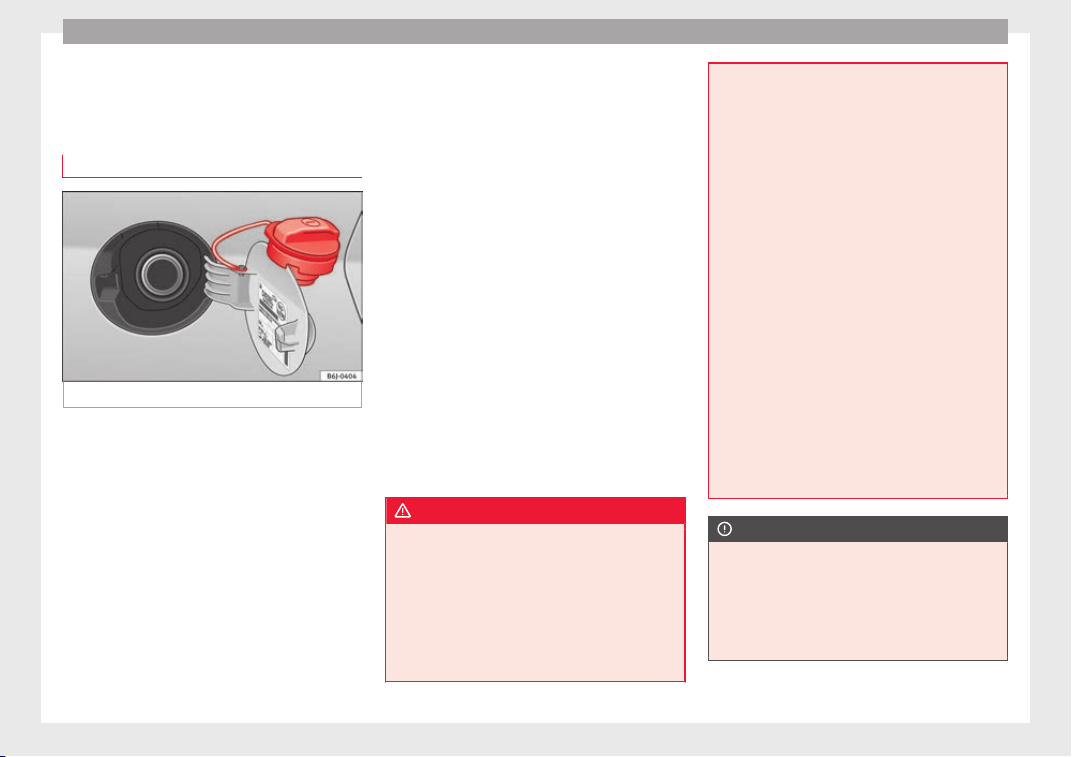
Advice
Checking and refilling levels
Fuel
Refuelling
Fig. 139 Tank flap open.
The tank flap is released manually and is lo-
cated at the rear of the vehicle on the right.
The tank holds approximately 55 litres. For
all-wheel drive vehicles, the tank capacity is
approximately 60 litres.
Vehicles using LPG have two fuel tanks: one
for LPG and another for petrol ››› page 160.
Opening the fuel tank cap
–
Lift the lid.
–
Hold the cap firmly with one hand, then in-
sert the key into the lock and rotate 180° to
the left.
–
Unscrew the cap, turning it anticlockwise.
Closing the fuel tank cap
–
Screw the tank cap to the right until it
“clicks”.
–
Turn the key in the lock, without releasing
the cap, clockwise through 180°.
–
Remove the key and close the flap until it
clicks into place. The tank cap is secured
with an anti-loss attachment
If the automatic filler nozzle is operated cor-
rectly, it will switch itself off as soon as the
tank is full. Never attempt to fill beyond this
point, as this will fill the expansion chamber.
Fuel may leak out if ambient conditions are
warm.
The correct fuel grade for your vehicle is giv-
en on a sticker on the inside of the fuel tank
flap. Here you will find further information on
fuel.
WARNING
●
Fuel is highly flammable and can cause se-
rious burns and other injuries.
–
Never smoke or come into contact with
sparks when filling the fuel tank of the
vehicle or a spare fuel canister with fuel.
This is an explosion hazard.
–
Follow legal requirements for the use of
spare fuel canisters.
–
For safety reasons we do not recommend
carrying a spare fuel canister in the vehi-
cle. The canister could be damaged in an
accident and leak.
●
If, in exceptional circumstances, you have
to carry a spare fuel canister, please observe
the following:
–
Never fill the spare fuel canister inside
the vehicle or on it. An electrostatic
charge could build up during filling, caus-
ing the fuel fumes to ignite. This could
cause an explosion. Always place the
canister on the ground to fill it.
–
Insert the fuel nozzle into the mouth of
the canister as far as possible.
–
If the spare fuel canister is made of met-
al, the filling nozzle must be in contact
with the canister during filling. This
helps prevent an electrostatic charge
building up.
–
Never spill fuel in the vehicle or in the
luggage compartment. Fuel vapours are
explosive. Danger of death.
CAUTION
●
Fuel spills should be removed from the
paintwork immediately.
●
Never run the tank completely dry. Irregular
fuel supply can cause misfiring. As a result,
unburnt fuel could enter the catalytic convert-
er and cause damage.
158
Checking and refilling levels
●
When filling the fuel tank after having run it
completely dry on a vehicle with a diesel en-
gine the ignition must be switched on for at
least 30 seconds before starting the engine.
Subsequently, when you start the engine it
may take longer than normal to start firing
(up to one minute). This is due to the fact that
the fuel system has to purge itself of air be-
fore starting.
For the sake of the environment
Do not try to put in more fuel after the auto-
matic filler nozzle has switched off; this may
cause the fuel to overflow if it becomes warm.
Petrol
Petrol types
The recommended fuel types are listed on a
sticker inside the fuel tank flap.
Only unleaded petrol conforming to standard
DIN EN 228
may be used for vehicles with
c
at
alytic converters (EN = “European Stand-
ard”).
Petrol types are categorised according to
their octane number, e.g. 91, 95, 98 RON
(RON = “research octane number”). You may
use petrol with a higher octane number than
the one recommended for your engine. How-
ever, this has no advantage in terms of fuel
consumption and engine power.
CAUTION
●
Petrol with standard EN 228 may be mixed
with small quantities of ethanol. However,
the so-called “bioethanol fuels” available at
commercial establishments with reference
E50 or E85, which contain a high percentage
of ethanol, may not be used, as they will
damage the fuel system.
●
Even one tankful of leaded fuel would per-
manently impair the efficiency of the catalyt-
ic converter.
●
High engine speed and full throttle can
damage the engine when using petrol with an
octane rating lower than the correct grade for
the engine.
For the sake of the environment
Just one full tank of leaded fuel would seri-
ously impair the efficiency of the catalytic
converter.
Petrol additives
The quality of the fuel influences the behav-
iour, power and service life of the engine.
This is why the petrol you use should carry
suitable additives already included by the
petrol industry, free of metals. These addi-
tives will help to prevent corrosion, keep the
fuel system clean and prevent deposits from
building up in the engine.
If good-quality petrol with metal-free addi-
tives is not available or engine problems
arise, the necessary additives must be added
when refuelling.
Not all petrol additives have been shown to
be effective. The use of unsuitable petrol ad-
ditives may cause significant damage to the
engine and the catalytic converter. Metal ad-
ditives should never be used. Metal additives
may also be contained in petrol additives for
improving anti-detonation ratings or octane
ratings.
SEAT recommends “genuine Volkswagen
Group fuel additives for petrol engines”.
These additives can be bought at SEAT Au-
thorised Services, where information on how
to use them can also be obtained.
CAUTION
Do not refuel if the filler indicates that the
fuel contains metal. LRP (lead replacement
petrol) fuels contain high concentrations of
metal additives. Using them may damage the
engine!
159
Technical specifications
AdviceOperationSafety
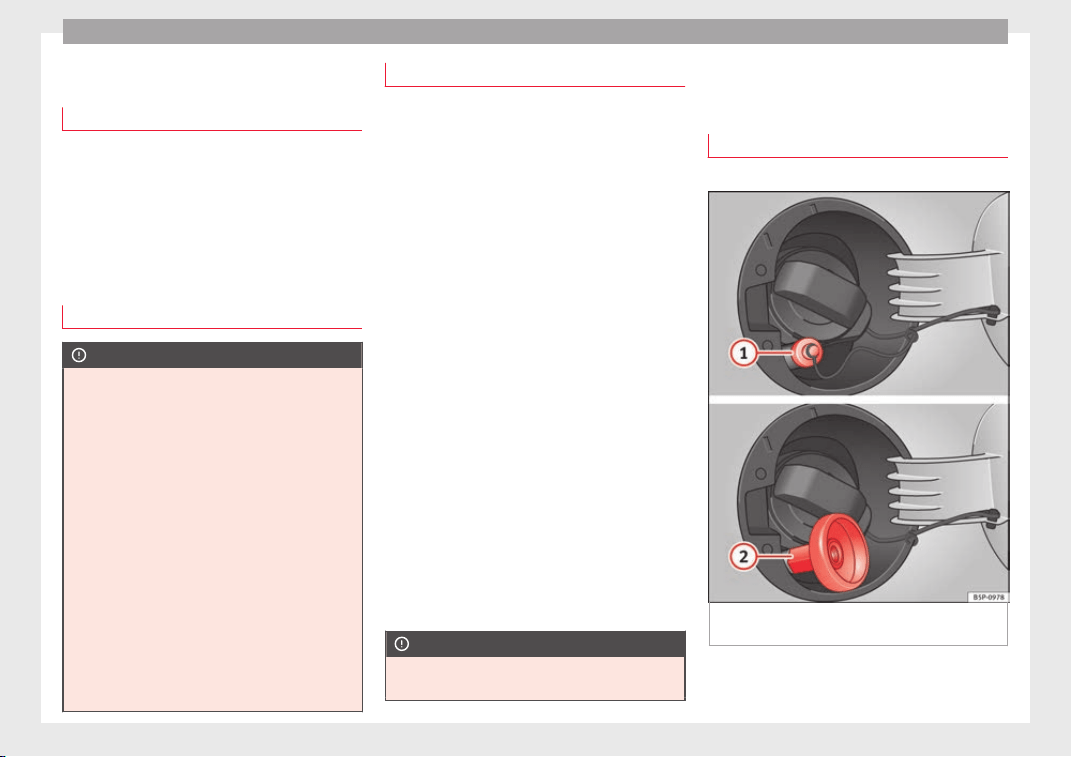
Advice
Diesel
Diesel*
Diesel fuel must conform to DIN EN 590 (EN =
“European Standard”). It must have a cetane
number (CN) of at least 51. The cetane num-
ber indicates the ignition quality of the diesel
fuel.
Notes on refuelling ››› page 158.
Biodiesel*
CAUTION
●
Your vehicle is not designed to use biodie-
sel fuel. Never, under any circumstances re-
fuel with biodiesel. The use of biodiesel fuel
could damage the engine and the fuel sys-
tem. The addition of biodiesel to diesel fuel
by the diesel manufacturer in accordance
with standard EN 590 or DIN 51628 is author-
ised and will not cause damage to the engine
or the fuel system.
●
The diesel engine has been designed to be
used exclusively with diesel fuel conforming
to standard EN 590. Never refuel or use pet-
rol, kerosene, fuel oil or any other type of
fuel. If you accidentally fill up the vehicle
with the wrong type of fuel, do not start the
engine. Seek assistance from specialised per-
sonnel. The composition of these fuels may
severely damage the fuel system and the en-
gine.
Winter operation
Winter-grade diesel
When using “summer-grade diesel fuel”, dif-
ficulties may be experienced at temperatures
below 0 °C (+32 °F) because the fuel thickens
due to wax separation. For this reason, “win-
ter-grade diesel fuel” is available in some
countries during the cold months. It can be
used at temperatures as low as -22 °C (-8 °F).
In countries with different climatic conditions
the diesel fuel generally sold has different
temperature characteristics. Check with the
Technical Services or filling stations in the
country concerned regarding the type of die-
sel fuels available.
Filter pre-heater
Your vehicle is fitted with a fuel filter glow
plug system, making it well equipped for op-
eration in winter. This ensures that the fuel
system remains operational to approx. -24 °C
(-11 °F), provided you use winter-grade diesel
which is safe to -15 °C (+5 °F).
However, if the fuel has waxed to such an ex-
tent that the engine will not start at tempera-
tures of under -24 °C (-11 °F), simply leave
the vehicle in a heated area for a while.
CAUTION
Do not mix fuel additives, the so-called “thin-
ners”, or similar additives with diesel fuel.
LPG system (Liquefied
petroleum gas)*
Refuelling with LPG
3 Applies to the model: ALTEA / ALTEA XL
Fig. 140 Fuel tank open with LPG filler neck
and adapter
160
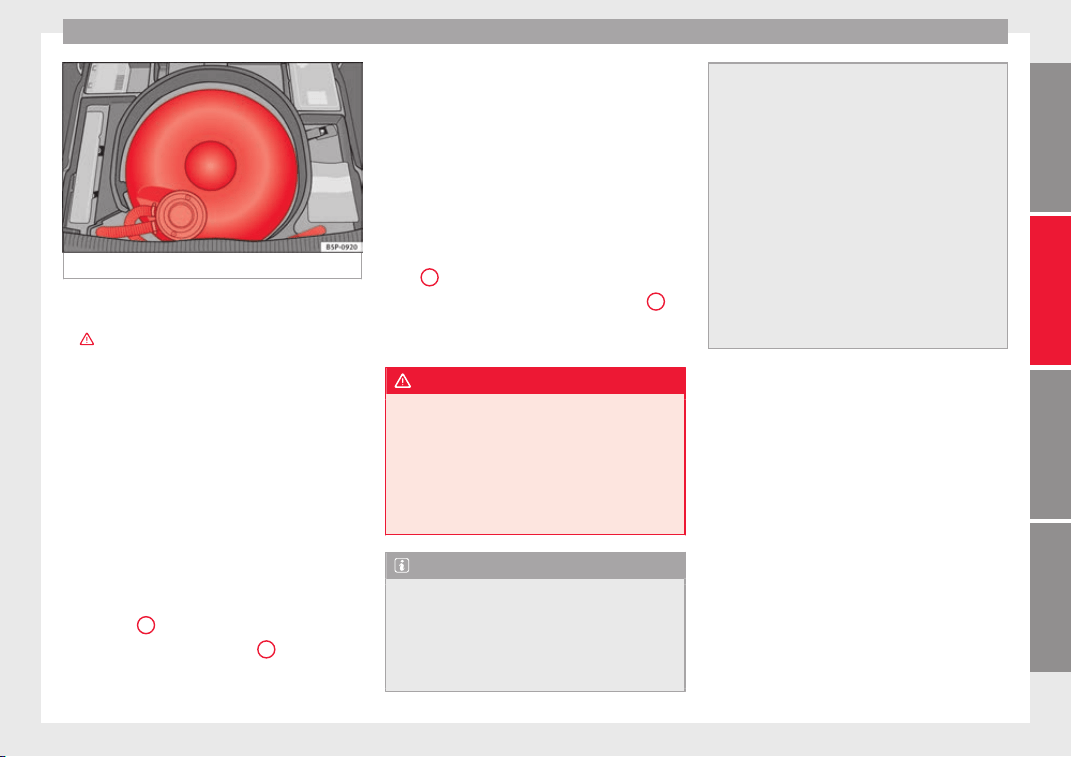
Checking and refilling levels
Fig. 141 LPG tank in spare wheel well
Before refuelling, turn off the engine and
switch off the ignition and mobile telephone
››› .
Read carefully the instructions on how to use
the LPG pump.
Opening the fuel tank cap
The LPG filler neck is behind the fuel cap,
next to the petrol filler neck.
●
The tank flap is located on the rear right-
hand side of the vehicle.
●
Open the fuel tank flap.
Refuelling
●
Remove the plug from the gas filler mouth
››› Fig. 140
1
.
●
Screw the required adapter
2
onto the
LPG gas filler neck.
●
Refuel as indicated in the pump instruc-
tions.
●
The fuel tank will be full
when the pump
c
ompr
essor automatically cuts the supply.
●
If you wish to finish refuelling sooner, re-
lease the button on the pump to stop the
flow.
Closing the fuel tank cap
●
Unscrew the adapter from the gas filler
neck
2
.
●
Screw the cap onto the gas filler neck
1
.
●
Close the fuel tank flap. The cover should
be flush with the bodywork.
WARNING
Incorrect handling of LPG can cause explo-
sions, fire, serious burns and other injuries.
●
LPG is a highly explosive and inflammable
substance.
●
Small quantities of LPG may leak out after
refuelling. If LPG comes into contact with the
skin there is a risk of freezing.
Note
●
The vehicle includes one adapter for the
country in question, the most common one.
We generally recommend that you carry all
the adapters in your vehicle, as some coun-
tries use more than one type of filling sys-
tem.
●
If the outside temperature is very high, the
protection against overheating for the LPG
pump may disconnect automatically.
●
If the outside temperature is very high, the
pressure of the LPG tank may be equal to or
greater than that of the gas tank of the LPG
pump. In this case, refuelling will be physi-
cally impossible.
●
The filling nozzles of LPG pumps can differ
in the way they are operated. If you do not
know, ask a qualified employee at the petrol
station to do the refuelling.
●
Noises heard when refuelling are normal
and do not indicate the presence of a fault in
the system.
161
Technical specifications
AdviceOperationSafety
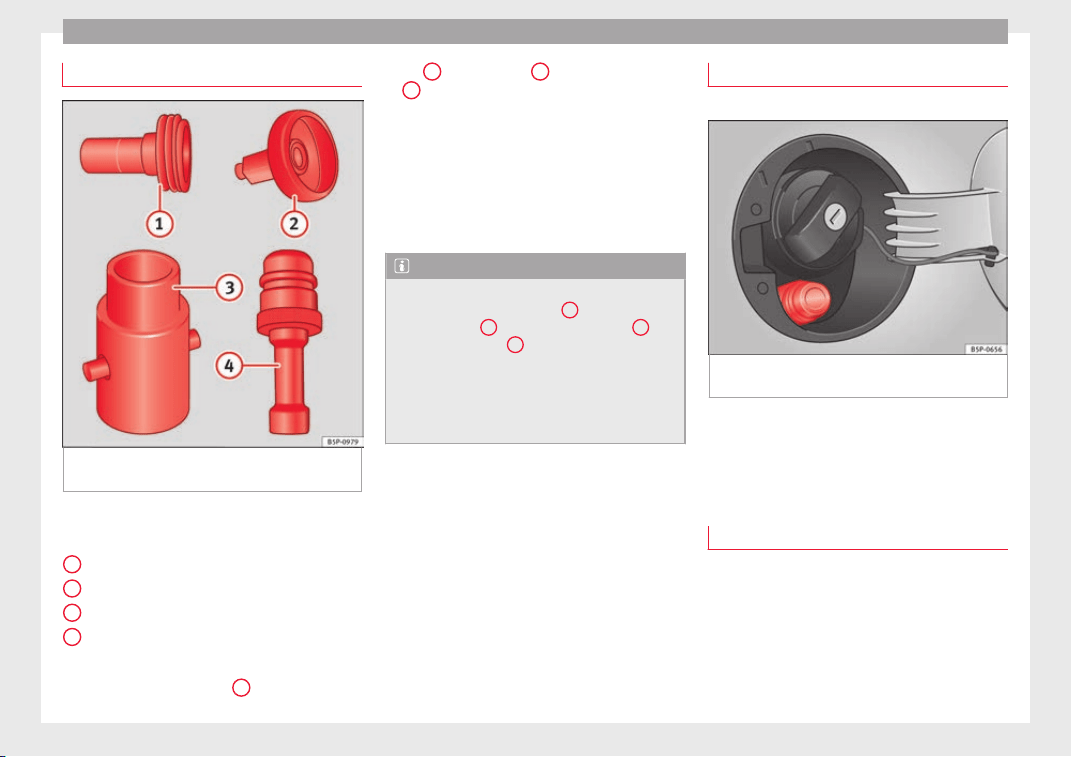
Advice
Adapter for the
Fig. 142 General table of LPG filler neck
adapters
An adapter is required due to the existence of
a range of pumps with different nozzles.
ACME adapter (adapter for Europe)
Dish Coupling Adapter (adapter for Italy)
Bayonet adapter
EURO adapter (adapter for Spain)
The supply includes the adapter for the coun-
try in question, the ACME
1
, the Dish Cou-
1
2
3
4
pling
2
, the bayonet
3
or the EURO adapt-
er
4
.
The filler systems and corresponding adapt-
ers vary according to country. As petrol sta-
tions abroad do not always have the neces-
sary adapters for your LPG system, we recom-
mend you purchase the appropriate adapter
before travelling abroad. Check that the
adapters are suited to your filling system.
Note
The four most common types of adapter in Eu-
rope are the ACME adapter
1
, the Dish Cou-
pling adapter
2
, the bayonet adapter
3
and
the EURO adapter
4
. We generally recom-
mend that you carry all four adapters in your
vehicle, as some countries use more than one
type of filling system. The introduction of a
single system (Euronozzle) throughout Eu-
rope is being studied.
Fixed adapter
3 Applies to the market: Spanish
Fig. 143 Fuel tank flap open with EURO-type
connector.
The end of the filling tube has a EURO-type
connector so that you can refill LPG without
having to use an additional adapter
›››
Fig. 143
.
LPG f
uel
LPG is an alternative vehicle fuel and is a
blend of propane and butane.
The success of LPG is due to the strict regula-
tions concerning exhaust gas emissions.
Compared to other fossil fuels, LPG is charac-
terised by its reduced emissions.
162
Checking and refilling levels
LPG quality and consumption
Quality requirements for LPG are regulated
for all Europe in DIN EN 589 and permit the
use of LPG throughout Europe.
A difference is drawn between winter gas and
summer gas. Winter gas has a higher propor-
tion of propane gas. As a result, the driving
range of winter gas may be lower (due to in-
creased consumption) than that of summer
gas.
LPG supplier network
The number of LPG pumps is constantly in-
creasing.
Lists of existing LPG pumps may be found on
Internet.
LPG safety
A series of collision tests performed on this
vehicle while running with LPG have con-
firmed its high level of safety.
The safety of the LPG system guarantees op-
eration without risk. The following safety
measures have been adopted:
●
The LPG tank has a solenoid valve which
closes automatically when the engine is
switched off (ignition off) or when running on
petrol.
●
A solenoid type main valve disconnects the
supply of gas to the engine compartment
when the engine is switched off or running
on petrol.
●
A safety valve in the LPG tank with pipes to
the outside prevents the gas from entering
the vehicle interior.
●
All anchorage points and materials have
been designed to ensure the maximum pos-
sible levels of safety.
The condition of the LPG system should be
checked regularly to guarantee safe driving
conditions ››› . These checks are included
in the Maintenance Programme.
WARNING
●
If there is a smell of gas or a suspected
leak, stop the vehicle immediately and switch
off the ignition. Open the doors to ventilate
the vehicle. Do not carry on driving! Take the
vehicle to a specialised workshop and have
the fault repaired.
●
Immediately extinguish any cigarettes and
remove from the vehicle any objects which
might produce a spark or cause a fire, and
switch off immediately if gas is smelt or a
leak is detected.
●
LPG tanks are subject to pressure and must
be checked regularly. The owner of the vehi-
cle must check that these services are per-
formed correctly.
●
When parking the vehicle in a closed area
(e.g. in a garage), make sure that there is ad-
equate ventilation, either natural or mechani-
cal, to neutralise the LPG in the event of a
leak.
Note
For any fault in the LPG system, please refer
to the SEAT web page, which lists the work-
shops authorised to repair these faults.
Working in the engine
compartment
Safety instructions on working in the
engine compartment
Before starting any work on the engine or in
the engine compartment:
1. Switch off the engine and remove the key
from the ignition.
2. Apply the handbrake.
3. Move the gear lever to neutral or the selec-
tor lever to position P.
4. Wait for the engine to cool down.
5. Keep children away from the vehicle.
6. Raise the bonnet ››› page 165.
»
163
Technical specifications
AdviceOperationSafety
Advice
You should not do any work in the engine
compartment unless you know exactly how to
carry out the jobs and have the correct tools!
Have the work carried out by a specialised
workshop if you are uncertain.
All service fluids and consumables, e.g. cool-
ant, engine oil, spark plugs and batteries,
are under constant development. SEAT pro-
vides a constant flow of information to Tech-
nical Services concerning modifications. For
this reason, we recommend you have service
fluids and consumables replaced by a Techni-
cal Service. Please observe the relevant in-
structions ››› page 147
. The engine compart-
ment
of
the vehicle is a hazardous area.
›››
.
WARNING
All work on the engine or in the engine com-
partment, e.g. checking and refilling fluids,
involves the danger of injury and burns, acci-
dents and even fire.
●
Never open the bonnet if you see steam,
smoke or coolant escaping from the engine
compartment. Otherwise, there is a risk of
sustaining burns. Wait until no more steam or
coolant is emitted, then allow the engine to
cool before carefully opening the bonnet.
●
Switch off the engine and remove the key
from the ignition.
●
Apply the handbrake and move the gear
lever to neutral or selector lever to position P.
●
Keep children away from the vehicle.
●
Never touch hot engine parts. There is a
risk of burns.
●
Never spill liquids on a hot engine or on a
hot exhaust gas system. This is a fire hazard.
●
Avoid causing short-circuits in the electri-
cal system, particularly at the points where
the jump leads are attached ››› page 190. The
battery could explode.
●
Never touch the radiator fan. It is tempera-
ture controlled and could start automatically,
even when the engine has been switched off
and the key removed from the ignition!
●
Never cover the engine with additional in-
sulating materials such as a blanket. Risk of
fire!
●
Do not unscrew the cap on the coolant ex-
pansion tank when the engine is hot. If the
coolant is hot, the cooling system will be
pressurised!
●
Protect face, hands and arms by covering
the cap with a large, thick cloth to protect
against escaping coolant and steam.
●
Always make sure you have not left any ob-
jects, such as cleaning cloths or tools, in the
engine compartment.
●
If you have to work underneath the vehicle,
you must use suitable stands additionally to
support the vehicle, there is a risk of acci-
dent!. A hydraulic jack is insufficient for se-
curing the vehicle and there is a risk of injury.
●
If any work has to be performed when the
engine is started or with the engine running,
there is an additional, potentially fatal, safety
risk from the rotating parts, such as the drive
belts, alternator, radiator fan, etc., and from
the high-voltage ignition system. You should
also observe the following:
–
Never touch the electrical wiring of the
ignition system.
–
Ensure that jewellery, loose clothing and
long hair do not get trapped in rotating
engine parts. Danger of death. Before
starting any work remove jewellery, tie
back and cover hair, and wear tight-fit-
ting clothes.
–
Never accelerate with a gear engaged
without taking the necessary precau-
tions. The vehicle could move, even if the
handbrake is applied. Danger of death.
●
If work has to be carried out on the fuel
system or on electrical components, you
must observe the following safety notes in
addition to the above warnings:
–
Always disconnect the battery from the
on-board network. The vehicle must be
unlocked when this is done, otherwise
the alarm will be triggered.
–
Do not smoke.
–
Never work near naked flames.
–
Always have a fire extinguisher on hand.
CAUTION
When topping up service fluids, make sure
not to mistake them. Using the wrong fluids
could cause serious malfunctions and engine
damage!
164
Checking and refilling levels
For the sake of the environment
Service fluids leaks are harmful to the envi-
ronment. For this reason you should make
regular checks on the ground underneath
your vehicle. If you find spots of oil or other
fluids, have your vehicle inspected in a speci-
alised workshop.
Opening the bonnet
Fig. 144 Detail of footwell area on driver side:
lever for unlocking the bonnet
Fig. 145 Handle for releasing the bonnet.
The bonnet is released from inside the vehi-
cle.
Before opening the bonnet ensure that the
windscreen wipers are in rest position.
–
To release the bonnet, pull the lever under
the dash panel ››› Fig. 144
in the direction
indic
at
ed (arrow). The bonnet will be re-
leased by a spring action ›››
.
–
Lift the bonnet using the release lever (ar-
row) and open the bonnet.
–
Release the bonnet stay and secure it in
the fixture designed for this in the bonnet.
WARNING
Hot coolant can scald!
●
Never open the bonnet if you see steam,
smoke or coolant escaping from the engine
compartment.
●
Wait until no more steam, smoke or coolant
is emitted from the bonnet, then carefully
open the bonnet.
●
When working in the engine compartment,
always observe the safety warnings
››› page 163.
Closing the bonnet
–
Slightly lift the bonnet.
–
Release the bonnet stay and replace it in its
support.
–
At a height of approximately 30 cm let it fall
so it locks.
If the bonnet does not close, do not press
downwards. Open it once more and let it fall
as before.
WARNING
If the bonnet is not closed properly, it could
open while you are driving and completely
obscure your view of the road. Risk of acci-
dent.
●
After closing the bonnet, always check that
it is properly secured. The bonnet must be
flush with the surrounding body panels.
●
If you notice that the bonnet latch is not se-
cured when the vehicle is moving, stop the
vehicle immediately and close the bonnet
properly. Risk of accident.
165
Technical specifications
AdviceOperationSafety
Advice
Checking fluid levels
Fig. 146 Diagram for the location of the vari-
ous elements.
From time to time, the levels of the different
fluids in the vehicle must be checked. Never
fill with incorrect fluids, otherwise serious
damage to the engine may be caused.
Coolant expansion tank
Windscreen washer reservoir
Engine oil filler cap
Engine oil dipstick
Brake fluid reservoir
Vehicle battery (underneath the cover)
The checking and refilling of service fluids
are carried out on the components men-
tioned above. These operations are descri-
bed in the ››› page 163
.
1
2
3
4
5
6
Overview
You will find further explanations, instruc-
tions and restrictions on the technical speci-
fications as of ››› page 207
.
En
gine oi
l
General notes
The engine comes with a special, multi-grade
oil that can be used all year round.
Because the use of high-quality oil is essen-
tial for the correct operation of the engine
and its long useful life, when topping up or
changing oil, use only those oils that comply
with VW standards.
The specifications (VW standards) set out on
the following page should appear on the con-
tainer of the service oil; when the container
displays the specific standards for petrol and
diesel engines together, it means that the oil
can be used for both types of engines.
We recommend that the oil change indicated
in the Maintenance Programme be performed
by a technical service or a specialised work-
shop.
The correct oil specifications for your engine
are listed in the
›››
page 167, Oil properties.
Service intervals
Service intervals can be flexible (LongLife
service) or fixed (dependent on time/dis-
tance travelled).
If the PR code that appears on the back of the
Maintenance Programme booklet is PR QI6,
this means that your vehicle is programmed
with the LongLife service. If it lists the codes
QI1, QI2, QI3, QI4 or QI7, the interval service
is dependent on time/distance travelled.
Flexible service intervals (LongLife service
intervals*)
Special oils and processes have been devel-
oped which, depending on characteristics
and individual driving profiles, allow for
greater intervals between oil change services
(LongLife service intervals).
Because this oil is essential for extending the
service intervals, it must only be used ob-
serving the following indications:
●
Avoid mixing it with oil for fixed service in-
tervals.
●
Only in exceptional circumstances, if the
engine oil level is too low ››› page 167 and
LongLife oil is not available, it is permitted to
top up (once) with oil for fixed service inter-
vals
›
›
›
page 167 (up to a maximum of 0.5 li-
tres).
166
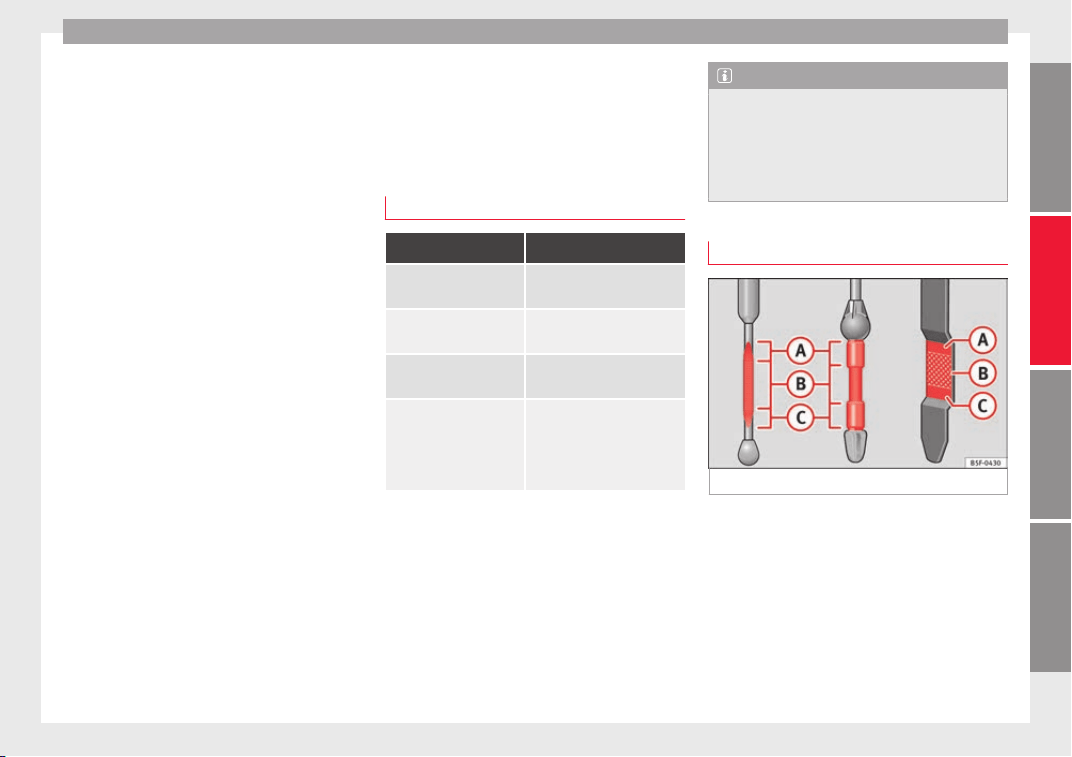
Checking and refilling levels
Fixed service intervals*
If your vehicle does not have the “LongLife
service interval” or it has been disabled (by
request), you may use oils for fixed service
intervals
, which also appear in ›
›
› page 167,
Oil properties. In this case, your vehicle must
be serviced after a fixed interval of 1
year/15 000 km (10 000 miles)(whatever
comes first) ››› Booklet Maintenance Pro-
gramme.
●
In exceptional circumstances, if the engine
oil level is too low ››› page 167 and you can-
not obtain the oil specified for your vehicle,
you can put in a small quantity of oil con-
forming to the specification ACEA A2 or
ACEA A3 (petrol engines) or ACEA B3 or
ACEA B4 (diesel engines) (up to 0.5 l).
Vehicles with a diesel particulate filter*
The Maintenance Programme states whether
your vehicle is fitted with a diesel particulate
filter.
Only VW 507 00 engine oil, with reduced ash
formation, may be used in diesel engines
equipped with particulate filter. Using other
types of oil will cause a higher soot concen-
tration and reduce the life of the DPF. There-
fore:
●
Avoid mixing this oil with other engine oils.
●
Only in exceptional circumstances, if the
engine oil level is too low ››› page 167 and
you cannot obtain the oil specified for your
vehicle, you can use a small quantity of oil
(once) conforming to the VW 506 00,
VW 506 01, VW 505 00, VW 505 01 or
ACEA B3/ACEA B4 specification. (up to 0.5 l).
Oil properties
Engine type Specification
Petrol without flexible
service interval
VW 502 00/VW 504 00
Petrol with flexible serv-
ice interval (LongLife)
VW 504 00
Diesel. Engines without
Particulate filter (DPF)
VW 505 01/VW 506 01/VW
507 00
Diesel. Particulate Filter
Engines (DPF).
With or without flexible
service interval (with
and without LongLife)
a)
VW 507 00
a)
Only use recommended oils, otherwise you may damage the
engine.
Engine oil additives
No type of additive should be mixed with the
engine oil. The deterioration caused by these
additives is not covered by the warranty.
Note
Before a long trip, we recommend finding an
engine oil that conforms to the correspond-
ing VW specifications and recommend keep-
ing it in the vehicle. This way, the correct en-
gine oil will always be available for a top-up if
needed.
Checking the engine oil level
Fig. 147 Engine oil dipstick.
The engine oil dipstick indicates the level of
the oil.
Checking oil level
–
Park the vehicle in a horizontal position.
–
Briefly run the engine at idle speed until
the operating temperature is reached and
then stop.
–
Wait for about two minutes.
»
167
Technical specifications
AdviceOperationSafety
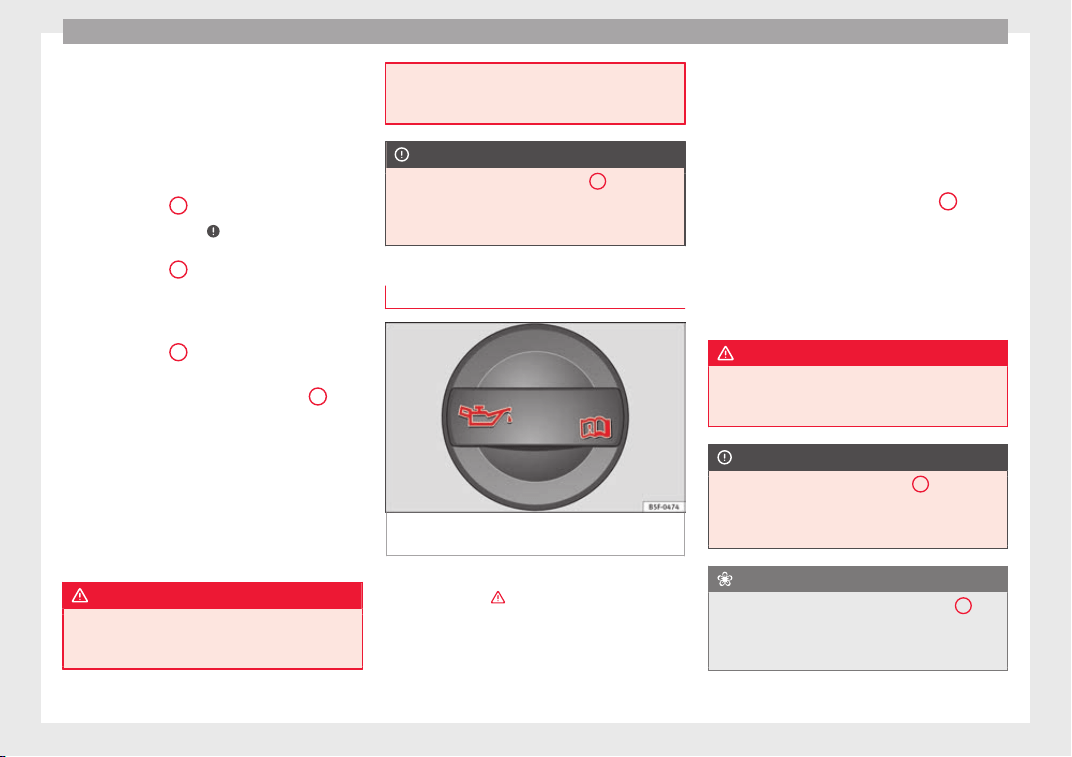
Advice
–
Pull out the dipstick. Wipe the dipstick with
a clean cloth and insert it again, pushing it
in as far as it will go.
–
Then pull it out once more and check the oil
level ››› Fig. 147
. Top up with engine oil if
nec
e
ssary.
Oil level in area
A
Do
not
add oil ›
››
.
Oil level in area
B
You
can
add oil, but keep the level in
thi
s zone.
Oil level in area
C
Oil must
be added.
Afterwards
, the oil
level should be in the lined area
B
.
Depending on how you drive and the condi-
tions in which the vehicle is used, oil con-
sumption can be up to 0.5 l/1000 km. Oil
consumption is likely to be higher for the first
5,000 km. For this reason the engine oil level
must be checked at regular intervals, prefera-
bly when filling the tank and before a jour-
ney.
WARNING
Any work carried out in the engine compart-
ment or on the engine must be carried out
cautiously.
–
–
–
●
When working in the engine compartment,
always observe the safety warnings
››› page 163.
CAUTION
If the oil level is above the area
A
do not
start the engine. This could result in damage
to the engine and catalytic converter. Contact
a Technical Service.
Topping up engine oil
Fig. 148 In the engine compartment: Engine
oil filler cap
Before opening the bonnet, read and observe
the warnings ››› in Safety instructions on
working in the engine compartment on
page 163
.
–
Un
s
crew cap from engine oil filler opening
››› Fig. 148.
–
Top-up oil in small amounts, using the cor-
rect oil.
–
To avoid over-filling with engine oil, you
should top-up using small quantities, wait
a while and check the oil level before add-
ing any more oil.
–
As soon as the oil level is in area
B
, care-
fully close the cap.
The position of the oil filler opening is shown
in the corresponding engine compartment il-
lustration ››› page 166
.
En
gine oi
l specification ››› page 166.
WARNING
Oil is highly inflammable! Ensure that no oil
comes into contact with hot engine compo-
nents when topping up.
CAUTION
If the oil level is above the area
A
do not
start the engine. This could result in damage
to the engine and catalytic converter. Contact
a specialised workshop.
For the sake of the environment
The oil level must never be above area
A
.
Otherwise oil can be drawn in through the
crankcase breather and escape into the at-
mosphere via the exhaust system.
168
Checking and refilling levels
Changing engine oil
The engine oil must be changed at the inter-
vals given in the service schedule.
We recommend that you have the engine oil
changed by a Technical Service.
The oil change intervals are shown in the
Maintenance Programme.
WARNING
Only change the engine oil yourself if you
have the specialist knowledge required!
●
Before opening the bonnet, read and ob-
serve the warnings ››› page 163, Safety in-
structions on working in the engine compart-
ment.
●
Wait
for the engine to cool down. Hot oil
may cause burn injuries.
●
Wear eye protection to avoid injuries, such
as acid burns, caused by splashes of oil.
●
When removing the oil drain plug with your
fingers, keep your arm horizontal to help pre-
vent oil from running down your arm.
●
Wash your skin thoroughly if it comes into
contact with engine oil.
●
Engine oil is poisonous! Used oil must be
stored in a safe place out of the reach of chil-
dren.
CAUTION
No additives should be used with engine oil.
This could result in engine damage. Any dam-
age caused by the use of such additives
would not be covered by the factory warranty.
For the sake of the environment
●
Because of disposal problems and the spe-
cial tools and specialist knowledge required,
we recommend that you have the engine oil
and filter changed by a Technical Service.
●
Never pour oil down drains or into the
ground.
●
Use a suitable container when draining the
used oil. It must be large enough to hold all
the engine oil.
Cooling system
Engine coolant specifications
The engine cooling system is supplied from
the factory with a specially treated mixture of
water and, at least, 40 % of the additive G 13
(TLVW 774 J). The engine coolant additive is
recognisable by its purple colour. This mix-
ture of water and additive gives the necessa-
ry frost protection down to -25°C (-13 F) and
protects the light alloy parts of the cooling
system against corrosion. It also prevents
scaling and considerably raises the boiling
point of the coolant.
To protect the engine cooling system, the
percentage of additive must always
be at
l
e
ast 40 %, even in warm climates where an-
ti-freeze protection is not required.
If greater frost protection is required in very
cold climates, the proportion of additive can
be increased. However, the percentage of ad-
ditive should not exceed 60%, as this would
reduce frost protection and, in turn, decrease
cooling capacity.
When the coolant is topped up, use a mixture
of distilled water and, at least, 40 % of the G
13 or G 12 plus-plus (TL-VW 774 G) additive
(both are purple) to obtain an optimum anti-
corrosion protection ›››
. The mixture of G
13 with G 12 plus (TL-VW 774 F), G 12 (red) or
G 11 (green-blue) engine coolants will signifi-
cantly reduce the anticorrosion protection
and should, therefore be avoided ››› .
WARNING
If there is not enough anti-freeze in the cool-
ant system, the engine may fail leading to se-
rious damage.
●
Please make sure that the percentage of
additive is correct with respect to the lowest
expected ambient temperature in the zone
where the vehicle is to be used.
●
When the outside temperature is very low,
the coolant could freeze and the vehicle
»
169
Technical specifications
AdviceOperationSafety
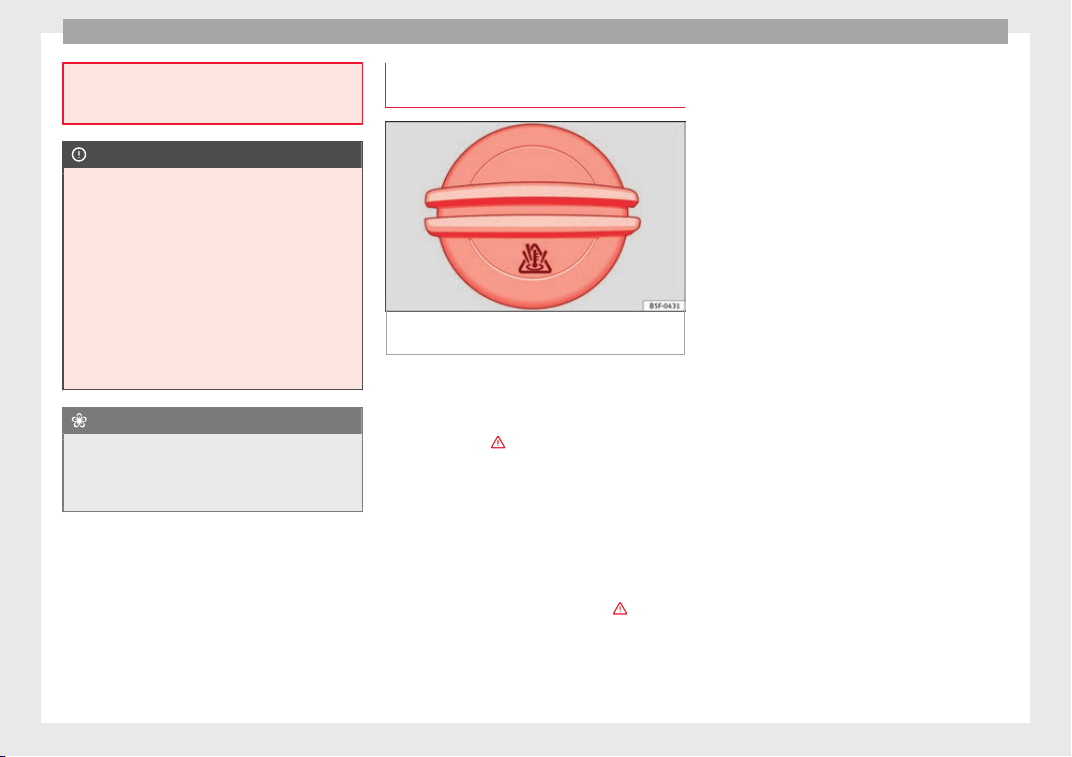
Advice
would be immobilised. In this case, the heat-
ing would not work either and inadequately
dressed passengers could die of cold.
CAUTION
The original additives should never be mixed
with coolants which are not approved by
SEAT. Otherwise, you run the risk of causing
severe damage to the engine and the engine
cooling system.
●
If the fluid in the expansion tank is not pur-
ple but is, for example, brown, this indicates
that the G 13 additive has been mixed with
an inadequate coolant. The coolant must be
changed as soon as possible if this is the
case! This could result in serious faults and
engine damage.
For the sake of the environment
Coolants and additives can contaminate the
environment. If any fluids are spilled, they
should be collected and correctly disposed
of, with respect to the environment.
Checking the coolant level and
topping up
Fig. 149 Engine compartment: coolant expan-
sion tank cap.
Top up coolant when the level is below the
MIN (minimum) mark.
Before opening the bonnet, read and observe
the warnings ››› in Safety instructions on
working in the engine compartment on
page 163
.
Openin
g the c
oolant expansion tank
–
Switch off the engine and allow it to cool.
–
To prevent scalding, cover the cap on the
coolant expansion tank with a thick cloth
and carefully unscrew the cap ›››
.
Checking coolant level
–
Look into the open coolant expansion tank
and read off the coolant level.
–
If the level is below the “MIN” mark, top up
with coolant.
Topping up coolant
–
Only use new
coolant liquid.
–
Do not
fi
ll above the “MAX” mark.
Closing the coolant expansion tank
–
Screw the cap on again tightly.
The position of the coolant expansion reser-
voir is shown in the corresponding engine
compartment illustration ››› page 166.
Make sure that the coolant meets the re-
quired specifications ››› page 169. Do not use
a different type of additive if additive G12+ is
not available. In this case use only water and
bring the coolant concentration back up to
the correct level as soon as possible by put-
ting in the specified additive ››› page 169.
Always top up with new coolant.
Do not fill above the “MAX” mark. Otherwise
the excess coolant will be forced out of the
cooling system when the engine is hot.
The coolant additive G12+ (dyed purple) may
be mixed with G12 (dyed red) and also with G
11.
170
Checking and refilling levels
WARNING
Any work carried out in the engine compart-
ment or on the engine must be carried out
cautiously.
●
When working in the engine compartment,
always observe the safety warnings
››› page 163.
●
When the engine is warm or hot, the cool-
ing system is pressurised! Do not unscrew
the cap on the coolant expansion tank when
the engine is hot. This is a burn injury risk.
CAUTION
●
When mixed with other additives the colour
of G12 will change to brown. If this occurs
you should have the coolant changed imme-
diately. Failure to do so will result in engine
damage!
●
If a lot of coolant fluid has been lost, wait
for the engine to cool. This avoids damaging
the engine. Lar
ge coolant losses are an indi-
cation of leaks in the cooling system. See a
specialised workshop immediately and have
the cooling system checked. Otherwise, there
is a risk of engine damage.
Windscreen washer reservoir
Topping up washer fluid
Fig. 150 In the engine compartment: Cap of
windscreen washer fluid reservoir
The
windscreen washer
and the
headlight
washers are supplied with fluid from the
windscreen washer fluid container in the en-
gine compartment. The container holds ap-
prox. 3 litres; in vehicles with headlight
washers* it holds approx. 5.5 litres.
The reservoir is located on the right-hand
side of the engine compartment.
Plain water is not enough to clean the wind-
screen and headlights. We recommend that
you always add a product to the windscreen
washer fluid. Approved windscreen cleaning
products exist on the market with high deter-
gent and anti-freeze properties, these may be
added all-year-round. Please follow the dilu-
tion instructions on the packaging.
WARNING
Any work carried out in the engine compart-
ment or on the engine must be carried out
cautiously.
●
When working in the engine compartment,
always observe the safety warnings
››› page 163.
CAUTION
●
Never put radiator anti-freeze or other addi-
tives into the windscreen washer fluid.
●
Always use approved windscreen cleansing
products diluted as per instructions. If you
use other washer fluids or soap solutions,
the tiny holes in the fan-shaped nozzles
could become blocked.
171
Technical specifications
AdviceOperationSafety
Advice
Brake fluid
Checking the brake fluid level
Fig. 151 Engine compartment: brake fluid
reservoir cap
–
Read off the fluid level at the transparent
brake fluid reservoir. It should always be
between the “MIN” and “MAX” marks.
The position of the brake fluid reservoir is
shown in the corresponding engine compart-
ment illustration ››› page 166. The brake fluid
reservoir has a black and yellow cap.
The brake fluid level drops slightly when the
vehicle is being used as the brake pads are
automatically adjusted as they wear.
However, if the level goes down noticeably in
a short time, or drops below the “MIN” mark,
there may be a leak in the brake system. A
display on the instrument panel will warn you
if the brake fluid level is too low ››› page 35.
WARNING
Before opening the bonnet to check the brake
fluid level, read and observe the warnings
››› page 163.
Changing the brake fluid
The Maintenance Programme indicates brake
fluid change intervals.
We recommend that you have the brake fluid
changed by a Technical Service.
Before opening the bonnet, please read and
follow the warnings
›››
in Safety instruc-
tions on working in the engine compartment
on page 163
in section “Safety notes for
w
ork
ing in the engine compartment”.
In the course of time, brake fluid becomes
hygroscopic and absorbs water from the am-
bient air. If the water content in the brake flu-
id is too high, the brake system could cor-
rode. This also considerably reduces the boil-
ing point of the brake fluid. Heavy use of the
brakes may then cause a vapour lock which
could impair the braking effect.
Be sure to always use the correct brake fluid.
Only use brake fluid that expressly meets the
VW 501 14 standard.
You can buy VW 501 14 standard brake fluid
at a SEAT dealership or a SEAT Official Serv-
ice. If none is available, use only high-quality
brake fluid that meets DIN ISO 4925 CLASS 4
standards, or USA Standards FMVSS 116 DOT
4.
Using any other kind of brake fluid or one
that is not of a high quality may affect opera-
tion of the brake system and reduce its effec-
tiveness. Never use a brake fluid if the con-
tainer does not state that it complies with VW
501 14, DIN ISO 4925 CLASS 4 standards, or
USA standards FMVSS 116 DOT 4.
WARNING
Brake fluid is poisonous. Old brake fluid im-
pairs the braking effect.
●
Before opening the bonnet to check the
brake fluid level, read and observe the warn-
ings ››› page 163.
●
Brak
e fluid should be stored in the closed
original container in a safe place out of reach
of children. There is a toxic risk.
●
Perform the brake fluid change according to
the Maintenance Programme. Heavy use of
the brakes may cause a vapour lock if the
brake fluid is left in the brake system for too
long. This would seriously affect the effec-
tiveness of the brakes and the safety of the
vehicle. This may cause an accident.
CAUTION
Brake fluid damages the vehicle paintwork.
Wipe off any brake fluid from the paintwork
immediately.
172
Checking and refilling levels
For the sake of the environment
The brake pads and brake fluid must be col-
lected and disposed of according the applica-
ble regulations. The SEAT Technical Service
network has the necessary equipment and
qualified personnel for collecting and dispos-
ing of this waste material.
Vehicle battery
Warnings on handling the battery
Wear eye protection
Battery acid is extremely corrosive. Wear pro-
tective gloves and eye protection!
Fires, sparks, open flames and smoking are
prohibited!
A highly explosive mixture of gases is released
when the battery is under charge.
Keep children away from acid and batteries!
WARNING
Always be aware of the danger of injury and
chemical burns as well as the risk of accident
or fire when working on the battery and the
electrical system:
●
Wear eye protection. Protect your eyes,
skin and clothing from acid and particles con-
taining lead.
●
Battery acid is extremely corrosive. Wear
protective gloves and eye protection. Do not
tilt the batteries. This could spill acid through
the vents. Rinse battery acid from eyes imme-
diately for several minutes with clear water.
Then seek medical care immediately. Neutral-
ise any acid splashes on the skin or clothing
with a soapy solution, and rinse off with plen-
ty of water. If acid is swallowed by mistake,
consult a doctor immediately.
●
Fires, sparks, open flames and smoking are
prohibited. When handling cables and electri-
cal equipment, avoid causing sparks and
electrostatic charge. Never short the battery
terminals. High-energy sparks can cause in-
jury.
●
A highly explosive mixture of gases is re-
leased when the battery is under charge. The
batteries should be charged in a well-ventila-
ted room only.
●
Keep children away from acid and batteries.
●
Before working on the electrical system,
you must switch off the engine, the ignition
and all electrical devices. The negative cable
on the battery must be disconnected. When a
light bulb is changed, you need only switch
off the light.
●
Deactivate the anti-theft alarm by unlock-
ing the vehicle before you disconnect the bat-
tery! The alarm will otherwise be triggered.
●
When disconnecting the battery from the
vehicle on-board network, disconnect first
the negative cable and then the positive ca-
ble.
●
Switch off all electrical devices before re-
connecting the battery. Reconnect first the
positive cable and then the negative cable.
Never reverse the polarity of the connections.
This could cause an electrical fire.
●
Never charge a frozen battery, or one which
has thawed. This could result in explosions
and chemical burns. Always replace a battery
which has frozen. A flat battery can also
freeze at temperatures close to 0 °C (+32 °F).
●
Ensure that the vent hose is always connec-
ted to the battery.
●
Never use a defective battery. This could
cause an explosion. Replace a damaged bat-
tery immediately.
CAUTION
●
Never disconnect the battery if the ignition
is switched on or if the engine is running.
This could damage the electrical system or
electronic components.
●
Do not expose the battery to direct sunlight
over a long period of time, as the intense ul-
traviolet radiation can damage the battery
housing.
●
If the vehicle is left standing in cold condi-
tions for a long period, protect the battery
from “freezing”. If it freezes it will be dam-
aged.
173
Technical specifications
AdviceOperationSafety
Advice
Checking the electrolyte level
The electrolyte level should be checked regu-
larly in high-mileage vehicles, in hot coun-
tries and in older batteries.
–
Open the bonnet and open the battery cov-
er at the front ››› in Safety instructions
on working in the engine compartment on
page 164 ››› in Warnings on handling
the battery on page 173.
–
Check the colour display in the "magic eye"
on the top of the battery.
–
If there are air bubbles in the window, tap
the window gently until they disperse.
The position of the battery is shown in the
corresponding engine compartment diagram
›››
page 166
.
The “m
agic
eye” indicator, located on the top
of the battery changes colour, depending on
the charge state and electrolyte level of the
battery.
There are two different colours:
●
Black: correct charge status.
●
Transparent/clear yellow: the battery must
be replaced. Contact a specialised workshop.
Charging and changing the vehicle
battery
The battery is maintenance-free and is
checked during the inspection service. All
work on the vehicle battery requires special-
ist knowledge.
If you often drive short distances or if the ve-
hicle is not driven for long periods, the bat-
tery should be checked by a specialised
workshop between the scheduled services.
If the battery has discharged and you have
problems starting the vehicle, the battery
might be damaged. If this happens, we rec-
ommend you have the vehicle battery
checked by a Technical Service where it will
be re-charged or replaced.
Charging the battery
The vehicle battery should be charged by a
specialised workshop only, as batteries us-
ing special technology have been installed
and they must be charged in a controlled en-
vironment.
Replacing a vehicle battery
The battery has been developed to suit the
conditions of its location and has special
safety features.
Genuine SEAT batteries meet the mainte-
nance, performance and safety specifications
of your vehicle.
WARNING
●
We recommend you use only maintenance-
free or cycle free leak-proof batteries which
comply with standards T 825 06 and
VW 7 50 73. This standard applies as of
2001.
●
Before starting any work on the batteries,
you must read and observe the warnings
››› in Warnings on handling the battery on
page 173.
For the sake of the environment
Batteries contain toxic substances such as
sulphuric acid and lead. They must be dis-
posed of appropriately and must not be dis-
posed of with ordinary household waste.
174
Wheels
Wheels
Wheels and tyres
General notes
Avoiding damage
–
If you have to drive over a kerb or similar
obstacle, drive very slowly and at a right
angle.
–
Keep grease, oil and fuel off the tyres.
–
Inspect the tyres regularly for damage
(cuts, cracks or blisters, etc.). Remove any
foreign objects embedded in the treads.
Storing tyres
–
When you remove the tyres, mark them in
order to maintain the same direction of ro-
tation when they are installed again.
–
When removed, the wheels and/or tyres
should be stored in a cool, dry and prefera-
bly dark location.
–
Store tyres in a vertical position if they are
not fitted on wheel rims.
New tyres
New tyres must be run in
›››
page 130.
The tread depth of new tyres may vary, ac-
cording to the type and make of tyre and the
tread pattern.
Concealed damage
Damage to tyres and rims is often not readily
visible. If you notice unusual vibrations or the
vehicle pulling to one side, this may indicate
that one of the tyres is damaged. They
should be checked immediately by a Techni-
cal Service.
Tyres with directional tread pattern
An arrow on the tyre sidewall indicates the di-
rection of rotation on tyres with directional
tread. Always observe the direction of rota-
tion indicated when fitting the wheel. This
guarantees optimum grip and helps to avoid
aquaplaning, excessive noise and wear.
WARNING
●
New tyres do not have maximum grip dur-
ing the first 500 km (300 miles). Drive partic-
ularly carefully to avoid possible accidents.
●
Never drive with damaged tyres. This may
cause an accident.
●
If you notice unusual vibrations or if the ve-
hicle pulls to one side when driving, stop the
vehicle immediately and check the tyres for
damage.
Checking tyre pressure
The correct tyre pressure can be seen on the
sticker on the inside of the fuel tank flap.
1. Read the required tyre inflation pressure
from the sticker. The values refer to Sum-
mer tyres. For winter tyres, you must add
0.2 bar (2.9 psi / 20 kPa) to the values
given for summer tyres.
2. The tyre pressures should only be checked
when the tyres are cold. The slightly raised
pressures of warm tyres must not be re-
duced.
3. Adjust the tyre pressure to the load you
are carrying.
Tyre pressure
The correct tyre pressure is especially impor-
tant at high speeds. The pressure should
therefore be checked at least once a month
and before starting a journey.
The sticker with the tyre pressure values can
be found on the inside of the fuel tank flap.
The tyre pressure values given are for cold
tyres. Do not reduce the slightly raised pres-
sures of warm tyres ››› .
WARNING
●
Check the tyre pressure at least once per
month. Checking the tyre pressure is very im-
portant. If the tyre pressure is too high or too
low, there is an increased danger of accidents
- particularly at high speeds.
●
A tyre can easily burst if the pressure is too
low, causing an accident!
»
175
Technical specifications
AdviceOperationSafety
Advice
●
At continuously high speeds, a tyre with in-
sufficient pressure flexes more. In this way it
becomes too hot, and this can cause tread
separation and tyre blow-out. Always observe
the recommended tyre pressures.
●
If the tyre pressure is too low or too high,
the tyres will wear prematurely and the vehi-
cle will not handle well. Risk of accident!
For the sake of the environment
Under-inflated tyres will increase fuel con-
sumption.
Tyre pressure monitoring
The tyre pressure monitoring system con-
stantly checks the pressure of the tyres.
The system uses the speed sensors of the
ABS wheels. It operates by analysing the
speed and frequency spectrum of each
wheel.
For optimum performance, use genuine SEAT
tyres. In addition, check and adjust tyre pres-
sures regularly.
Whenever the tyre pressure is are changed or
one or more tyres are changed, the system
should be reset by pressing the SET button
on the centre console.
The system warns the driver in the event of a
loss of pressure by means of symbols and
messages in the instrument panel display.
The system operates via the ESC ››› page 134.
Note that tyre pressure also depends on tyre
temperature. Said pressure increases around
0.1 bar (2.9 psi/10 kPa) for each +10 °C
(+50 °F) in tyre temperature increase. The tyre
heats up while the vehicle is being driven
and the tyre pressure will rise accordingly.
Therefore, you should only adjust the tyre
pressure when they are cold (i.e. approxi-
mately at ambient temperature).
To ensure that the tyre pressure monitoring
system works reliably, you should check and,
if necessary, adjust the tyre pressures at reg-
ular intervals and store the correct pressures
(reference values) in the system.
A tyre pressure information label is attached
to the inside of the fuel tank flap.
WARNING
●
Never adjust tyre pressure when the tyres
are hot. This may damage or even burst the
tyres. Risk of accident!
●
An insufficiently inflated tyre flexes a lot
more at high speeds and causes significant
heating of the tyre. Under these conditions,
the tyre bead may be released or the tyre may
burst. Risk of accident!
For the sake of the environment
Under-inflated tyres lead to increased fuel
consumption and tyre wear.
Significant tyre pressure loss
The tyre symbol is displayed and indicates
that
the tyre pressure of at least one tyre is
insufficient.
–
Stop the vehicle.
–
Switch the ignition off.
–
Check the tyre(s).
–
Change the wheel if necessary.
176
Wheels
Tyre useful life
Fig. 152 Tyre tread wear indicators.
Fig. 153 Diagram for changing wheels
The useful life of tyres is dependent on tyre
pressure, driving style and fitting.
Wear indicators
The original tyres on your vehicle have
1.6 mm high “tread wear indicators”
›››
Fig. 152
, running across the tread. De-
pendin
g on the m
ake, there will be 6 to 8 of
them evenly spaced around the tyre. Mark-
ings on the tyre sidewall (for instance the let-
ters “TWI” or other symbols) indicate the po-
sitions of the tread wear indicators. The mini-
mum tread depth required by law is 1.6 mm
(measured in the tread grooves next to the
tread wear indicators). Worn tyres must be re-
placed. Different figures may apply in export
countries ›››
.
Tyre pressure
Incorrect tyre pressure causes premature
wear and could cause tyre blow-out. For this
reason, the tyre pressure should be checked
at least once per month ››› page 175.
Driving style
Fast cornering, heavy acceleration and hard
braking all increase tyre wear.
Changing wheels around
If the front tyres are worn considerably more
than the rear ones it is advisable to change
them around as shown ››› Fig. 153
. The use-
f
u
l life of all the tyres will then be about the
same time.
Wheel balance
The wheels on new vehicles are balanced.
However, various factors encountered in nor-
mal driving can cause them to become unbal-
anced, which results in steering vibration.
Unbalanced wheels should be rebalanced, as
they otherwise cause excessive wear on
steering, suspension and tyres. A wheel must
also be rebalanced when a new tyre is fitted.
Incorrect wheel alignment
Incorrect wheel alignment causes excessive
tyre wear, impairing the safety of the vehicle.
If tyres show excessive wear, you should
have the wheel alignment checked by a Tech-
nical Service.
WARNING
There is a serious danger of accidents if a tyre
bursts during driving!
●
The tyres must be replaced at the latest
when the tread wear indicators are worn
››› page 177. Failure to follow this instruction
could result in an accident. Worn tyres do not
grip well at high speeds on wet roads. There
is also a greater risk of “aquaplaning”.
●
At continuously high speeds, a tyre with in-
sufficient pressure flexes more. This causes it
to overheat. This can cause tread separation
and tyre blow-out. Risk of accident. Always
observe the recommended tyre pressures.
●
If tyres show excessive wear, you should
have the running gear checked by a Technical
Service.
●
Keep chemicals such as oil, fuel and brake
fluid away from tyres.
●
Damaged wheels and tyres must be re-
placed immediately!
»
177
Technical specifications
AdviceOperationSafety
Advice
For the sake of the environment
Under-inflated tyres will increase fuel con-
sumption.
Run-flat tyres
Run-flat tyres allow you to continue driving
even with a punctured tyre, in the majority of
cases.
In vehicles that are factory-fitted with run-flat
tyres
1)
the loss of tyre pressure is indicated
on the instrument panel.
Driving with run-flat tyres (emergency
running)
–
Leave the ESC/ASR on (Electronic Stability
Control), or switch it on
›››
page 137.
–
Continue driving carefully and slowly
(80 km/h [50 mph] maximum).
–
Avoid sudden manoeuvres and sharp turns.
–
Avoid driving over obstacles (e.g. kerbs) or
potholes.
–
Pay attention if the ESC/ASR activates of-
ten, if smoke comes from the tyres or there
is a smell of rubber, the vehicle vibrates or
there are clattering noises. If any of these
occur, stop the vehicle.
The run-flat tyres have a tag on the side of
the tyre, with the description: “DSST”, “Eufo-
nia”, “RFT”, “ROF”, “RSC”, “SSR” or “ZP”.
The sides of this type of tyre are reinforced.
When the tyres lose air they are supported on
the sides (emergency driving).
The loss of pressure in the tyre is shown on
the instrument panel. You can then drive a
maximum of 80 km (50 miles) and if the cir-
cumstances are favourable (e.g. low load),
even more.
The damaged tyre should be changed as
soon as possible. The rim should be checked
in a specialised workshop to detect possible
damage and replace it if necessary. We rec-
ommend you contact your technical service.
If more than one tyre is being used under
emergency conditions, this reduces the dis-
tance that can be travelled.
Starting driving in emergency conditions
When loss in tyre pressure is displayed on
the instrument panel, this means that at least
one tyre is being driven in emergency condi-
tions ›››
.
End of emergency operation
Do not drive on if:
●
smoke is coming from one of the tyres,
●
there is a smell of rubber,
●
the vehicle vibrates,
●
there is a rattling noise.
When is it no longer possible to continue
driving even using run-flat tyres?
●
If one of the tyres has been severely dam-
aged in an accident, etc. If a tyre has been
badly damaged there is a risk that parts of
the tread can be thrown off and cause dam-
age to the fuel lines, brake pipes or fuel filler.
●
It is also advisable to stop driving if severe
vibrations occur, or if the wheel starts over-
heating and gives off smoke.
WARNING
When driving in emergency conditions, the
driving quality of the vehicle is considerably
impaired.
●
The maximum permitted speed of 80 km/h
(50 mph) is subject to road and weather con-
ditions. Please observe related legal require-
ments.
●
Avoid sharp turns and rapid manoeuvres,
and brake earlier than usual.
●
Avoid driving over obstacles (e.g. kerbs) or
potholes.
●
If one or more tyres are being driven in
emergency conditions, the driving quality of
1)
Depending upon version and country.
178
Wheels
the vehicle is impaired and there is a risk of
accident.
Note
●
The run-flat tyres do not “deflate” on losing
pressure because they are supported on the
reinforced sides. Therefore defects in the tyre
cannot be detected with a visual inspection.
●
Snow chains must not be used on front
tyres used in emergency conditions.
New tyres and wheels
New tyres and wheels have to be run in.
The tyres and wheel rims are an essential
part of the vehicle's design. Those approved
by SEAT are specially matched to the charac-
teristics of the vehicle and make a major con-
tribution to good road-holding and safe han-
dling ››› .
Note for Italy:
A SEAT Service Centre should
be c
on
sulted whether different sized wheels
or tyres to those originally fitted by SEAT may
be fitted, as well as the combinations al-
lowed between the front axle (axle 1) and
back axle (axle 2).
Tyres should be replaced at least in pairs and
not individually (i.e. both front tyres or both
rear tyres together). A knowledge of tyre des-
ignations makes it easier to choose the cor-
rect tyres. Radial tyres have the tyre designa-
tions marked on the sidewall, for example:
195/65 R15 91T
This contains the following information:
Tyre width in mm
Height/width ratio in %
Tyre construction: Radial
Rim diameter in inches
Load rating code
Speed rating
The tyres could also have the following infor-
mation:
●
A direction of rotation symbol
●
“Reinforced” denotes heavy-duty tyres.
The manufacturing date is also indicated on
the tyre sidewall (possibly only on the inner
side of the wheel).
“DOT... 1103...” means, for example, that the
tyre was produced in the 11th week of 2003.
We recommend that work on tyres and
wheels be carried out by a Technical Service.
They are familiar with the procedure and
have the necessary special tools and spare
parts as well as the proper facilities for dis-
posing of the old tyres.
195
65
R
15
91
T
Any technical service has full information on
the technical requirements when installing or
changing tyres, wheels or wheel trims.
On vehicles with all-wheel drive, all four tyres
must always be fitted with tyres of the same
type, make and tread pattern, as otherwise
the driveline can be damaged by continuous
differences in the wheel speeds. For this rea-
son, the spare wheel should have the same
wheel dimensions as the normal wheels so
that it will fit if there is a puncture. You may
also use the factory-supplied compact tem-
porary spare wheel.
WARNING
●
We recommend that you use only wheels
and tyres which have been approved by SEAT
for your model. Failure to do so could impair
vehicle handling. Risk of accident.
●
Avoid running the vehicle on tyres that are
more than 6 years old. If you have no alterna-
tive, you should drive slowly and with extra
care at all times.
●
Never use old tyres or those with an un-
known “history of use”.
●
If wheel trims are retrofitted, you must en-
sure that the flow of air to the brakes is not
restricted. This could cause the brake system
to overheat.
●
All four wheels must be fitted with radial
tyres of the same type, size (rolling circumfer-
ence) and the same tread pattern.
»
179
Technical specifications
AdviceOperationSafety
Advice
For the sake of the environment
Old tyres must be disposed of according to
the laws in the country concerned.
Note
●
For technical reasons, it is not generally
possible to use the wheels from other vehi-
cles. This can also apply to wheels of the
same model. The use of wheels or tyres
which have not been approved by SEAT for
use with your model may invalidate the vehi-
cle's type approval for use on public roads.
●
If the spare tyre is not the same as the
tyres that are mounted on the vehicle (e.g.
winter tyres) you should only use the spare
tyre for a short period of time and drive with
extra care. Refit the normal road wheel as
soon as possible.
Wheel bolts
The design of wheel bolts is matched to the
rims. If different wheel rims are fitted, the
correct wheel bolts with the right length and
correctly shaped bolt heads must be used.
This ensures that wheels are fitted securely
and that the brake system functions correctly.
In certain circumstances, you should not use
wheel bolts from a different vehicle, even if it
is the same model
›››
page 147.
After the wheels have been changed, the
tightening torque of the wheel bolts should
be checked as soon as possible with a torque
wrench ››› . The tightening torque for steel
and alloy wheels is 120 Nm.
WARNING
If the wheel bolts are not tightened correctly,
the wheel could become loose while driving.
Risk of accident.
●
The wheel bolts must be clean and turn
easily. Never apply grease or oil to them.
●
Use only wheel bolts which belong to the
wheel.
●
If the tightening torque of the wheel bolts
is too low, they could loosen whilst the vehi-
cle is in motion. Risk of accident! If the tight-
ening torque is too high, the wheel bolts and
threads can be damaged.
CAUTION
The prescribed tightening torque for wheel
bolts for steel and alloy wheels is 120 Nm.
Winter service
Winter tyres
In winter conditions winter tyres will consid-
erably improve the vehicle's handling. Sum-
mer tyres (width, rubber compound, tread
pattern) provide less grip on ice and snow.
Winter tyres must be inflated to a pressure of
0.2 bar (2.9 psi/20 kPa) higher than the pres-
sures specified for summer tyres (see sticker
on fuel tank flap).
Winter tyres must be fitted on all four wheels.
Information on permitted winter tyre sizes
can be found in the vehicle's registration
documentation. Use only radial winter tyres.
All tyre sizes listed in the vehicle documenta-
tion also apply to winter tyres.
Winter tyres lose their effectiveness when the
tread is worn down to a depth of 4 mm.
The speed rating code ››› page 179, New
tyres and wheels determines the following
speed limits
for winter tyres: ›
›
›
max. 160 km/h
max. 180 km/h
max. 190 km/h
max. 210 km/h
In some countries, vehicles which can exceed
the speed rating of the fitted tyre must have
an appropriate sticker in the driver's field of
view. These stickers are available from your
technical service. The legal requirements of
each country must be followed.
Do not have winter tyres fitted for unnecessa-
rily long periods. Vehicles with summer tyres
Q
S
T
H
180
Emergencies
handle better when the roads are free of
snow and ice.
If you have a flat tyre, please refer to the
notes on the spare wheel ››› page 179, New
tyres and wheels.
WARNING
The maximum speed for the winter tyres must
not be exceeded. Otherwise, this could lead
to damage and risk of accident.
For the sake of the environment
Fit your summer tyres again as soon as possi-
ble. They are quieter, do not wear so quickly
and reduce fuel consumption.
Snow chains
Snow chains are only permitted on front
wheels and only for tyres 195/65R15 and
205/55R16. These tyres may only be fitted
with fine-pitch link chains which do not pro-
trude more than 15 mm
›››
page 210.
Other tyres may use fine-pitch links which do
not protrude more than 9 mm, including ten-
sion device.
Remove wheel hub covers and trim rings be-
fore fitting snow chains. For safety reasons,
cover caps, available at any technical service,
must then be fitted over the wheel bolts.
All-wheel drive: where snow chains are com-
pulsory, this normally also applies to all-
wheel drive vehicles. Snow chains may only
be fitted to the
front
wheels (also on vehicles
w
ith all-wheel drive).
WARNING
Snow chains should be correctly tightened in
accordance with the manufacturer's instruc-
tions. This will prevent the chains coming in-
to contact with the wheel housing.
CAUTION
Remove the snow chains to drive on roads
without snow. Otherwise they will impair
handling, damage the tyres and wear out very
quickly.
Note
●
In some countries, the maximum permitted
speed with snow chains is 50 km/h (31 mph).
The legal requirements of each country must
be followed.
●
We recommend that you ask your technical
service for information about appropriate
wheel, tyre and snow chain size.
Emergencies
Vehicle tools, spare wheel
Vehicle Tools
The vehicle tools are located under the floor
panel in the luggage compartment.
–
Lift the cover of the luggage compartment,
by pulling it up with a finger in the fitting.
–
Take the vehicle tools out of the vehicle.
The vehicle tool kit includes:
●
Jack.*
●
Hook for removing wheel covers* or wheel
trims*
●
Box spanner for wheel bolts.*
●
Towing ring.
●
Adapter for the anti-theft wheel bolts*
Some of the items listed are only provided in
certain model versions, or are optional ex-
tras.
WARNING
●
The factory-supplied jack is only designed
for changing wheels on this model. On no ac-
count attempt to use it for lifting heavier ve-
hicles or other loads. Risk of injury.
●
Use the jack only on a firm, level ground.
»
181
Technical specifications
AdviceOperationSafety
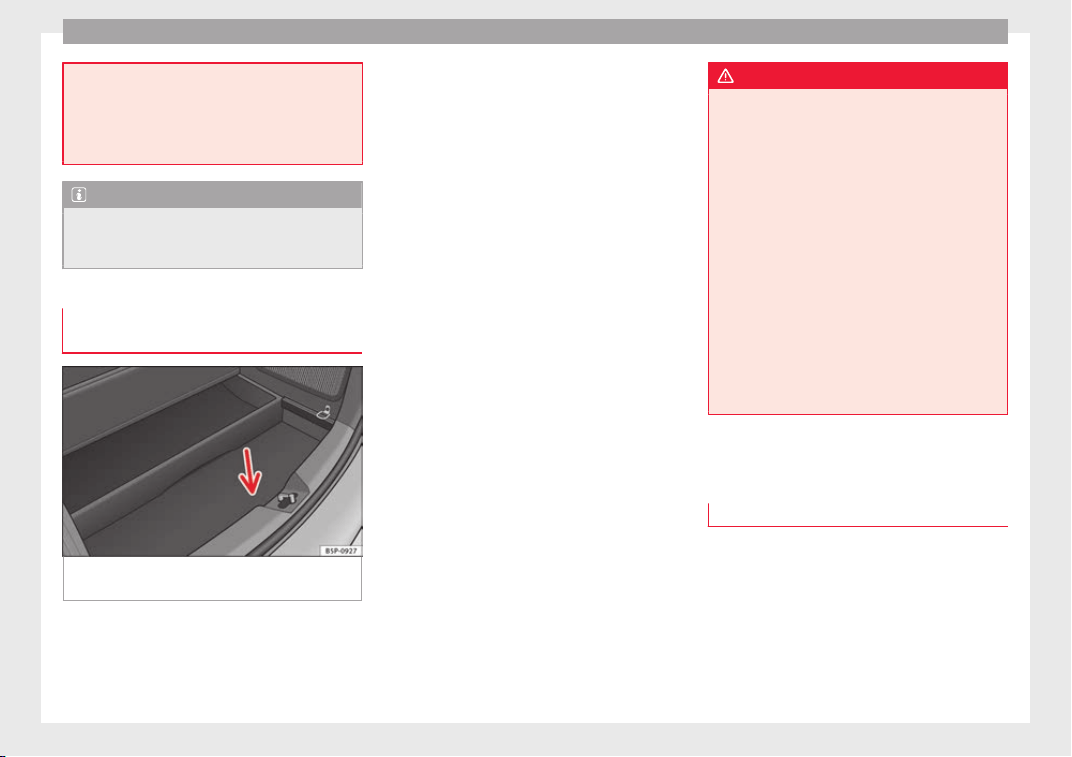
Advice
●
Never start the engine when the vehicle is
on the jack. Risk of accident.
●
If work is to be carried out underneath the
vehicle, this must be secured by suitable
stands. Otherwise, there is a risk of injury.
Note
The jack does not generally require any main-
tenance. If required, it should be greased us-
ing universal-type grease.
Compact spare wheel* (temporary
spare wheel)
Fig. 154 Luggage compartment. Accessing
the spare wheel.
The compact spare wheel (temporary spare
wheel for vehicles without the anti-puncture
kit) should only be used when strictly neces-
sary.
The temporary spare wheel is stored under
the floor panel in the luggage compartment
and is attached by a thumbnut.
How to use the temporary spare wheel
Should you ever have a punctured tyre, the
compact temporary spare wheel is only inten-
ded for temporary use until you can reach a
workshop. The standard-size road wheel
should be replaced as soon as possible.
Please note the following restrictions when
using the temporary spare wheel. This tem-
porary spare wheel has been specially de-
signed for your vehicle, thus, it cannot be re-
placed by a temporary spare wheel from an-
other vehicle.
No other type of tyre (normal summer or win-
ter tyre) may be fitted on the compact tempo-
rary spare wheel rim.
Snow chains
For technical reasons, snow chains must not
be used on the compact temporary spare
wheel.
If you have a puncture on one of the front
wheels
when using snow chains, fit the com-
p
act
temporary spare wheel in place of one of
the rear wheels. You can then attach the
snow chains to the wheel taken from the rear
and use this wheel to replace the punctured
front wheel.
WARNING
●
The tyre pressures must be checked and
corrected as soon as possible after fitting the
temporary spare wheel. The pressure of the
spare wheel sized 125/70R16 125/70R18
135/90R16 should be 4.2 bar
(61 psi/420 kPa). For other sizes, check the
label on the fuel cap. Failure to follow this in-
struction could result in an accident.
●
Do not drive faster than 80 km/h (50 mph),
since higher speeds can cause an accident.
●
Avoid heavy acceleration, hard braking and
fast cornering. Risk of accident.
●
Never use more than one temporary spare
wheel at the same time, risk of accident.
●
No other type of tyre (normal summer or
winter tyre) may be fitted on the compact
temporary spare wheel rim.
Wheel change
Preparation work
–
If you have a flat tyre or puncture, park the
vehicle as far away from the flow of traffic
as possible. Choose a location that is as
level as possible.
–
All vehicle occupants should leave the ve-
hicle. They should wait in a safe area (for
instance behind the roadside crash barri-
er).
182
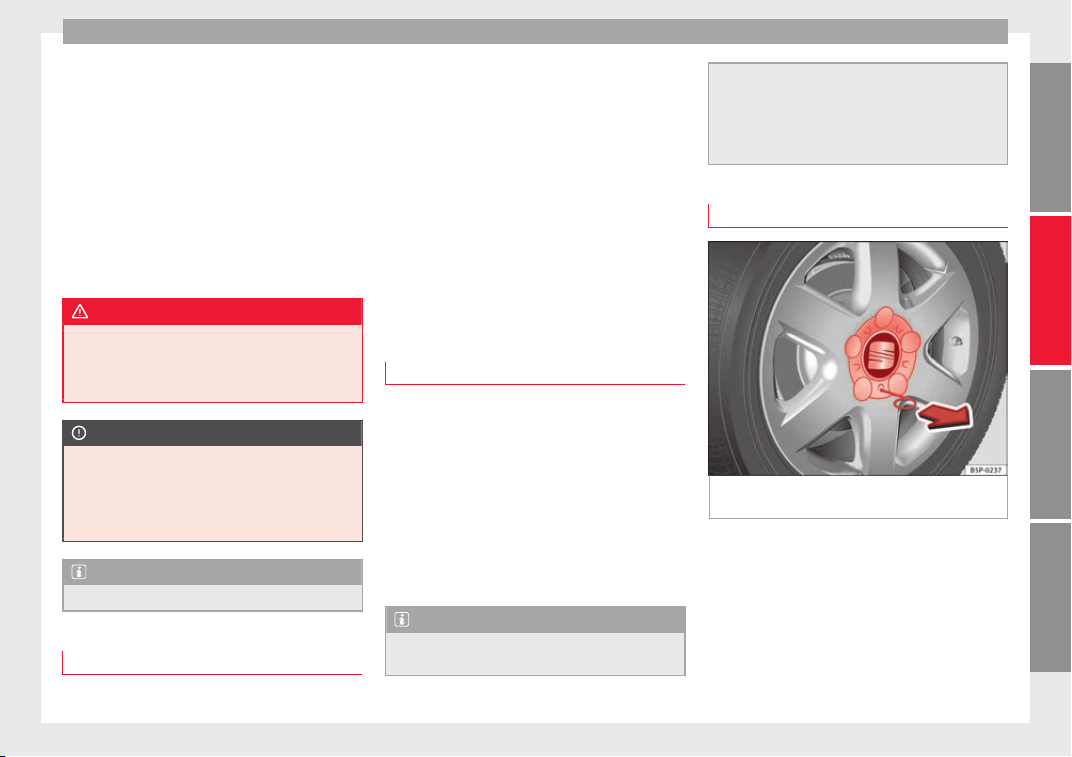
Emergencies
–
Switch off the engine. Switch on the hazard
warning lights.
–
Apply the handbrake
firmly.
–
En
g
age the first gear, or put the selector
lever to position P for those vehicles with
an automatic gearbox.
–
If you are towing a trailer, unhitch it from
your vehicle.
–
Take the vehicle tools and the spare wheel
out of the luggage compartment.
WARNING
Put the hazard warning lights on and place
the warning triangle in position. This is for
your own safety and also warns other road
users.
CAUTION
If you have to change the tyre on a gradient,
block the wheel opposite the wheel being
changed by placing a stone or similar object
under it to prevent the vehicle from rolling
away.
Note
Please observe related legal requirements.
Changing a wheel
Change the wheel as described below:
–
Remove the
wheel cover. A
l
so refer to
››› Fig. 155.
–
Slacken the wheel bolts.
–
Raise the vehicle with the jack at the corre-
sponding area.
–
Remove the wheel and put on the spare
one.
–
Lower the vehicle.
–
Tighten the wheel bolts firmly with the box
spanner.
–
Replace the hub cap.
After changing a wheel
–
Put the tools back in their storage location.
–
Place the wheel with the defective tyre in
the luggage compartment and secure it.
–
Check the tyre pressure of the newly fitted
tyre as soon as possible.
–
Have the tightening torque of the wheel
bolts checked as soon as possible with a
torque wrench. The prescribed torque must
be 120 Nm.
Note
●
If you notice that the wheel bolts are corro-
ded and difficult to turn when changing a
wheel, they must be replaced before having
the wheel bolt tightening torque checked.
●
For safety reasons, drive at moderate
speeds until the wheel bolt tightening torque
has been checked.
Wheel trims
Fig. 155 Changing a wheel: remove the wheel
trim.
The wheel trims must be removed to gain ac-
cess to the wheel bolts.
Removing
–
Insert the extraction hook from the tools in-
to the designated ring, located in one of
the bolt hole covers of the wheel cover
›››
Fig. 155
.
»
183
Technical specifications
AdviceOperationSafety
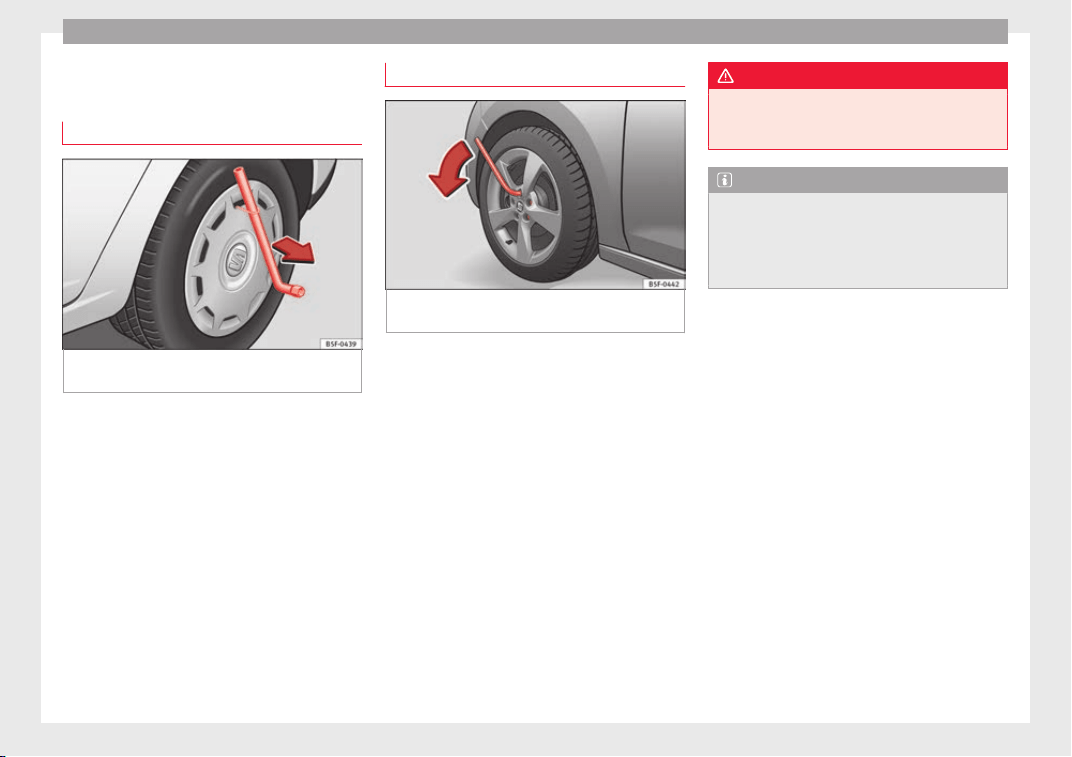
Advice
–
Pull off the hub cap
.
Wheel
c
overs*
Fig. 156 Changing a wheel: remove the wheel
cover.
The wheel covers must be removed for access
to the wheel bolts.
Removing
–
Remove the wheel cover using the wire
hook ››› Fig. 156
.
–
Hook
thi
s into one of the cut-outs of the
wheel cover.
Fitting
–
Fit the wheel cover onto the wheel rim by
pressing it firmly. Put pressure initially on
the point of the cut-out for the valve. Then
press the wheel cover onto the steel rim so
that it engages all round.
Loosening the wheel bolts
Fig. 157 Changing a wheel: loosen the wheel
bolts.
The wheel bolts must be loosened before
raising the vehicle.
Loosening
–
Fit the box spanner as far as it will go over
the wheel bolt.
–
Grasp the box spanner by the end turn it
about one full turn to the left
›
›› Fig. 157
.
Tightening
–
Fit the box spanner as far as it will go over
the wheel bolt.
–
Grasp the box spanner close to the end and
turn the bolt to the right until it is secured.
–
An adapter is required to unscrew or tight-
en the anti-theft wheel bolts.
WARNING
Loosen the wheel bolts (only about one turn)
before raising the vehicle with the jack, oth-
erwise there is a risk of accident.
Note
●
If the wheel bolt is very tight, you may be
able to loosen it by pushing down the end of
the spanner carefully with your foot. Hold on
to the vehicle for support and take care not to
slip.
184
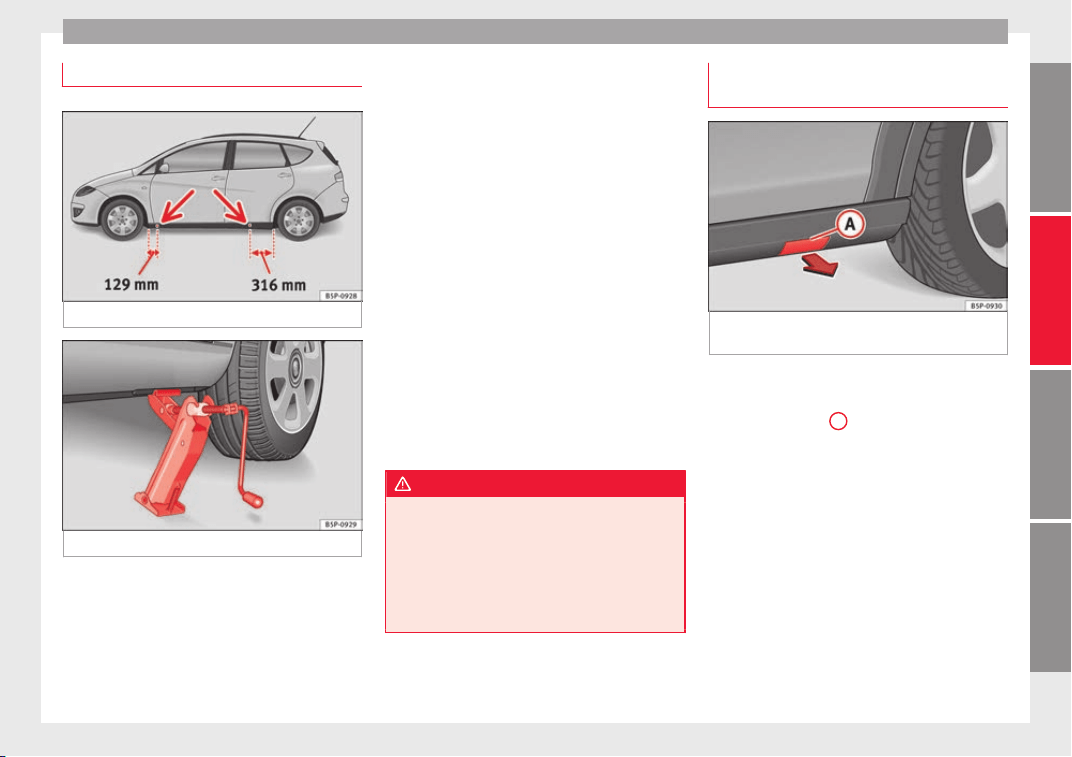
Emergencies
Lifting the vehicle
Fig. 158 Jack position points
Fig. 159 Fitting the jack.
In order to remove the wheel, the vehicle
must be raised with a jack.
–
Locate the jacking point under the door sill
closest to the punctured wheel ››› Fig. 158.
–
Place the jack under the jacking point and
turn the crank until the arm of the jack is di-
rectly below the vertical rib under the door
sill.
–
Align the jack so that the arm of the jack
fits around the rib under the door sill and
the movable base plate of the jack is flat on
the ground ››› Fig. 159
.
–
R
ai
se the vehicle until the defective wheel
is just clear of the ground.
Recesses at the front and rear of the door
sills mark the jacking points ››› Fig. 158.
There is only one jacking point for each
wheel. Do not fit the jack anywhere else.
An unstable surface under the jack may
cause the vehicle to slip off the jack. There-
fore, it must be fitted on solid ground offer-
ing good support. Use a large and stable
base, if necessary. On a hard, slippery sur-
face (such as tile) use a rubber mat or similar
to prevent the jack from slipping.
WARNING
●
Take all precautions so that the base of the
jack does not slip. Failure to follow this in-
struction could result in an accident.
●
The vehicle can be damaged if the jack is
not applied at the correct jacking points.
There is also a risk of injury since the jack can
slip off suddenly if it is not properly engaged.
Jack position points for vehicles with
sill panel trim*
Fig. 160 Plastic sill panel trim with jack an-
chor cover.
Vehicles with plastic sill panel trim, with
cover*
–
Remove the cap
A
to access the anchor
point for the vehicle jack ››› Fig. 160.
–
Pull on the cover and remove it from its al-
lotment in the direction of the arrow
››› Fig. 160
.
–
Onc
e the c
over has been released, it will re-
main connected to its strap so that is not
lost.
185
Technical specifications
AdviceOperationSafety

Advice
Removing and fitting the wheel
Change the wheel as described below after
loosening the wheel bolts and raising the ve-
hicle with the jack.
Removing a wheel
–
Unscrew the wheel bolts using the box
spanner and place them on a clean surface.
Fitting a wheel
–
Screw on the wheel bolts in position and
tighten them loosely with a box spanner.
The wheel bolts should be clean and easily
screwed. Before fitting the spare wheel, in-
spect the wheel condition and hub mounting
surfaces. These surfaces must be clean be-
fore fitting the wheel.
If tyres with a specific direction of rotation
are fitted, note the direction of rotation.
Anti-theft wheel bolts*
Fig. 161 Anti-theft wheel bolt.
A special adapter is required to turn the anti-
theft wheel bolts.
–
Insert the adapter onto the wheel bolt and
push it on as far as it will go ››› Fig. 161
.
–
Fit
the bo
x spanner as far as it will go over
the adapter.
–
Loosen or tighten the wheel bolt as appro-
priate.
Code
The code number of the anti-theft wheel bolt
is stamped onto the front part of the adaptor.
The code number should be noted and kept
in a safe place, as it is only by using the code
number that a duplicate adaptor can be ob-
tained from the SEAT Official Services.
Tyres with directional tread pattern
A directional tread pattern can be identified
by arrows on the sidewall that point in the di-
rection of rotation. Always note the direction
of rotation indicated when fitting the wheel.
This is important so that these tyres can pro-
vide maximum grip and avoid excessive
noise, tread wear and aquaplaning.
If, in an emergency, you have to mount the
spare wheel so it rotates in the wrong direc-
tion, you must drive extremely carefully. The
tyre will not give optimum performance. This
is particularly important when driving on wet
roads.
To benefit from the advantages of tyres with
this type of tread pattern, the defective tyre
should be replaced as soon as possible so
that all tyres again rotate in the correct direc-
tion.
Tyre repair
TMS (Tyre Mobility System)*
The Anti-puncture Kit* (Tyre Mobility System)
will reliably seal punctures caused by the
penetration of a foreign body of up to about
4 mm
in diameter.
Do not remove foreign ob-
j
ects, e.g. screws or nails, from the tyre.
186
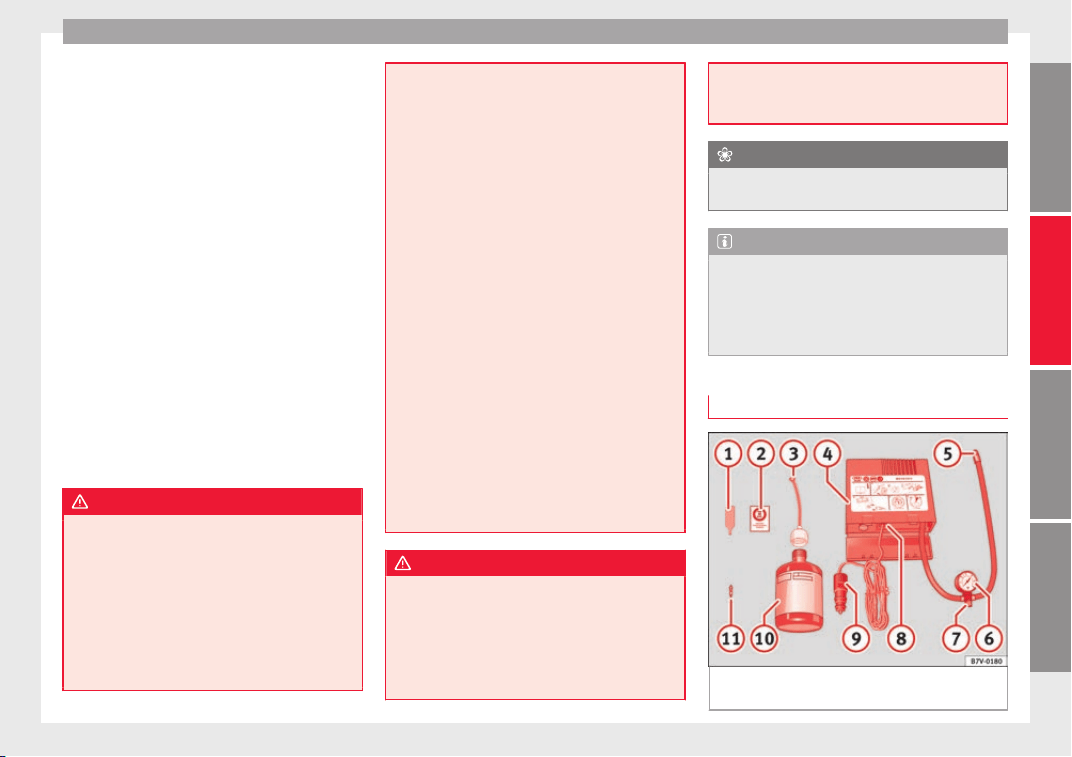
Emergencies
After inserting the sealant residue in the tyre,
you must again check the tyre pressure about
10 minutes after starting the engine.
You should only use the tire mobility set if
the vehicle is parked in a safe place, you are
familiar with the procedure and you have the
necessary tire mobility set! Otherwise, you
should seek professional assistance.
The tyre sealant must not be used in the
following cases:
●
If the wheel rim has been damaged.
●
In outside temperatures below -20 °C
(-4 °F).
●
In the event of cuts or perforations in the
tyre greater than 4 mm.
●
If you have been driving with very low pres-
sure or a completely flat tyre.
●
If the sealant bottle has passed its use by
date.
WARNING
Using the tyre mobility system can be dan-
gerous, especially when filling the tyre at the
roadside. Please observe the following rules
to minimise the risk of injury:
●
Stop the vehicle safely as soon as possible.
Park it at a safe distance from surrounding
traffic to fill the tyre.
●
Ensure the ground on which you park is flat
and solid.
●
All passengers and particularly children
must keep a safe distance from the work area.
●
Turn on the hazard warning lights to warn
other road users.
●
Use the tyre mobility system only if you are
familiar with the necessary procedures. Oth-
erwise, you should seek professional assis-
tance.
●
The tyre mobility set is intended for tempo-
rary emergency use only until you can reach
the nearest specialised workshop.
●
Replace the repaired tyre with the tire mo-
bility set as soon as possible.
●
The sealant is a health hazard and must be
cleaned immediately if it comes into contact
with the skin.
●
Always keep the tire mobility set out of the
reach of small children.
●
Never use an equivalent jack, even if it has
been approved for your vehicle.
●
Always stop the engine, apply the hand-
brake lever firmly and engage gear if using a
manual gearbox, in order to reduce the risk of
vehicle involuntary movement.
WARNING
A tyre filled with sealant does not have the
same performance properties as a conven-
tional tyre.
●
Never drive faster than 80 km/h (50 mph).
●
Avoid heavy acceleration, hard braking and
fast cornering.
●
Drive only during 10 minutes at a maximum
speed of 80 km/h (50 mph) and subsequently
check the tyre.
For the sake of the environment
Dispose of used or expired sealant observing
any legal requirements.
Note
●
A new bottle of sealant can be purchased at
SEAT dealerships.
●
Take into account the separate instruction
manual from the tyre mobility set* manufac-
turer.
Contents of the tyre mobility system*
Fig. 162 Standard representation: contents of
the tyre mobility system.
»
187
Technical specifications
AdviceOperationSafety

Advice
The tyre mobility set is located underneath
the floor covering in the boot. It includes the
following components ››› Fig. 162
:
T
y
re valve remover
Sticker indicating maximum speed “max.
80 km/h” or “max. 50 mph”
Filler tube with cap
Air compressor
Tube for inflating tyres
Warning provided by tyre pressure moni-
toring system
1)
Air bleed screw
2)
ON/OFF switch
12 volt connector
Bottle of sealant
Spare tyre valve
The valve insert remover
1
has a gap at the
lower end for a valve insert. The valve insert
can only be screwed or unscrewed in this
way. This also applies to its replacement part
11
.
1
2
3
4
5
6
7
8
9
10
11
Sealing and inflating a tyre
Sealing a tyre
●
Unscrew the tyre valve cap.
●
Use the enclosed extractor to unscrew the
valve insert ››› Fig. 162
1
and place the
valve insert on a clean surface.
●
Vigorously shake the sealant bottle
››› Fig. 162
10
for several seconds.
●
Screw the inflator tube ››› Fig. 162
3
se-
curely into the sealant bottle in a clockwise
direction. The seal on the mouth of the bottle
moves automatically.
●
Remove the lid from the filling tube
›››
Fig. 162
3
and screw the open end of the
tube into the tyre valve.
●
Hold the tyre sealant can upside down and
fill the complete
contents of the can into the
ty
r
e.
●
Remove the tyre sealant bottle from the
valve.
●
Screw the valve insert into the tyre valve
again with the corresponding tool
›››
Fig. 162
1
.
Inflating the tyre
●
Securely screw the tyre inflator tube
››› Fig. 162
5
of the compressor into the tyre
valve.
●
Check whether the air bleed screw
››› Fig. 162
7
is closed.
●
Start the vehicle engine and leave it run-
ning.
●
Attach the connector ››› Fig. 162
9
to one
of the vehicle's 12 volt sockets ››› page 99.
●
Connect the air compressor with the
ON/OFF switch ››› Fig. 162
8
.
●
Keep the air compressor running until it
reaches 2.0 to 2.5 bar (29-36 psi /
200-250 kPa) ››› .
Maximum operation time
8 minut
e
s ›››
.
●
Disconnect the air compressor.
●
If it is not possible to achieve an air pres-
sure of 2.0 to 2.5 bar (29-36 psi /
200-250 kPa), unscrew the tyre inflator tube
from the tyre valve.
●
Move the vehicle some 10 metres forward
or backward so that the sealant is evenly dis-
tributed in the tyre interior.
●
Securely screw the compressor tyre inflator
tube into the tyre valve and repeat the infla-
tion process.
1)
It can also be integrated in the compressor.
2)
In its place, the compressor may have a button.
188
Emergencies
●
If the indicated pressure still cannot be
reached, the tyre is too badly damaged. The
tyre cannot be sealed with the anti-puncture
kit. Do not continue driving. You should ob-
tain professional assistance ››› .
●
Disconnect the air compressor and unscrew
the flexible inflator tube from the tyre valve.
●
When the tyre pressure is between 2.5 and
2.0 bars, immediately continue driving with-
out exceeding 80 km/h (50 mph).
●
After
10 minutes
, Check the pressure again
›
›› page 189.
WARNING
When inflating the wheel, the air compressor
and the inflator tube may become hot.
●
Protect hands and skin from hot parts.
●
Do not place the hot flexible inflator tube or
hot air compressor on flammable material.
●
Allow them to cool before storing the de-
vice.
●
If it is not possible to inflate the tyre to at
least 2.0 bars (29 psi / 200 kPa), the tyre is
too badly damaged. The sealant is not in a
good condition to seal the tyre. Do not con-
tinue driving. Seek specialist assistance.
CAUTION
Switch off the air compressor after a maxi-
mum of 8 operational minutes to prevent it
from overheating! Before switching on the air
compressor again, let it cool for several mi-
nutes.
Check after 10 minutes of driving
Screw the inflator tube ››› Fig. 162
5
again
and check the pressure on the gauge
6
.
1.3 bar (19 psi / 130 kPa) and lower:
●
Stop the vehicle! The tyre cannot be sealed
sufficiently with the tyre mobility set.
●
You should obtain professional assistance
››› .
1.4 bar (20 psi / 140 kPa) and higher:
●
Set the tyre pressure to the correct value
again.
●
Carefully resume your journey until you
reach the nearest specialised workshop with-
out exceeding 80 km/h (50 mph).
●
Have the damaged tyre replaced.
WARNING
Driving with an unsealed tyre is dangerous
and can cause accidents and serious injury.
●
Do not continue driving if the tyre pressure
is 1.3 bar (19 psi / 130 kPa) and lower.
●
Seek specialist assistance.
Jump-starting
Jump leads
The jump lead must have a sufficient wire
cross section.
If the engine fails to start because of a dis-
charged battery, the battery can be connec-
ted to the battery of another vehicle to start
the engine.
Jump leads
Jump leads must comply with standard DIN
72553
(see cable manufacturer's instruc-
tion
s).
The wire cross section must be at least
25 mm
2
for petrol engines and at least
35 mm
2
for diesel engines.
Note
●
The vehicles must not touch each other,
otherwise electricity could flow as soon as
the positive terminals are connected.
●
The discharged battery must be properly
connected to the on-board network.
189
Technical specifications
AdviceOperationSafety
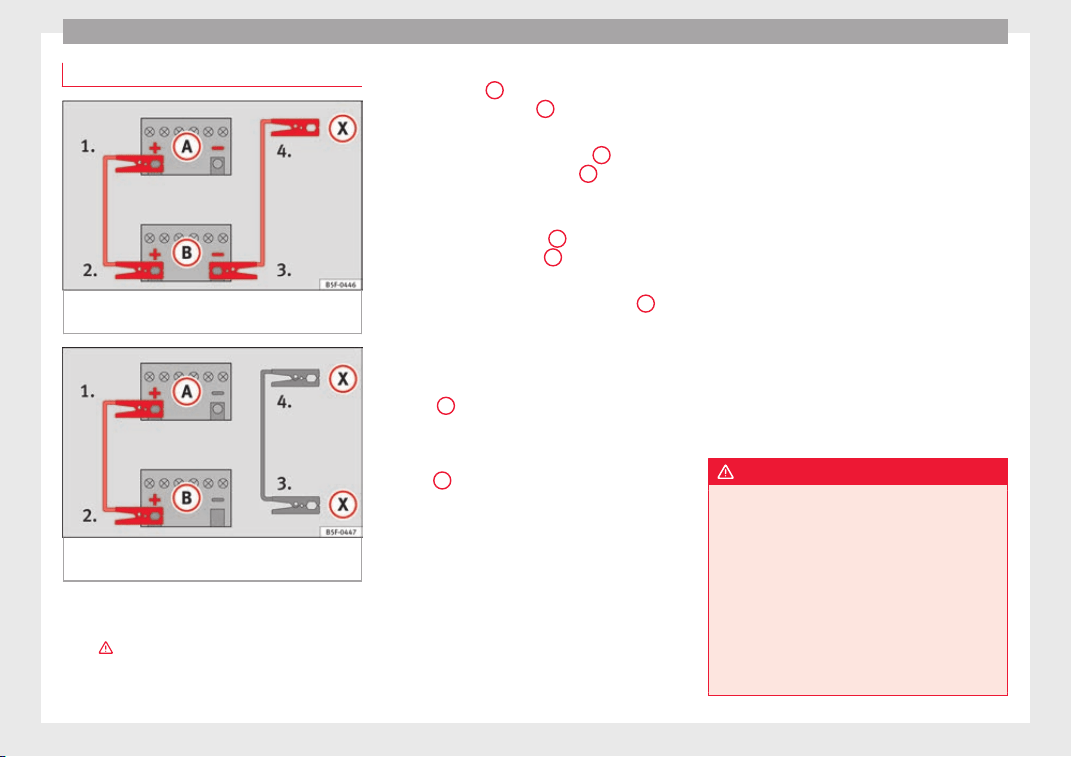
Advice
How to jump start: description
Fig. 163 Diagram of connections for vehicles
without Start-Stop system.
Fig. 164 Diagram of connections for vehicles
with Start-Stop system.
Jump lead terminal connections
1. Switch off the ignition of both vehicles
››› .
2. Connect one end of the red
jump lead to
the po
s
itive
+
terminal of the vehicle
with the flat battery
A
››› Fig. 163
.
3.
C
onnect the other end of the red jump
lead to the positive terminal
+
in the ve-
hicle providing assistance
B
.
4. For vehicles without Start-Stop system:
connect one end of the black jump lead to
the negative terminal
–
in the vehicle
providing assistance
B
››› Fig. 163
.
–
F
or
vehicles with Start-Stop system: Con-
nect one end of the black jump lead
X
to a
suitable ground terminal, a solid piece of
metal in the engine block, or to the engine
block itself ››› Fig. 164.
5. Connect the other end of the black jump
lead
X
to a solid metal component bolted
to the engine block or to the engine block
itself of the vehicle with the flat battery.
Do not connect it to a point near the bat-
tery
A
.
6. Position the leads in such a way that they
cannot come into contact with any moving
parts in the engine compartment.
Starting
7. Start the vehicle's engine with the boost-
ing battery and let it run at idling speed.
8. Start the engine of the vehicle with the flat
battery and wait 2 or 3 minutes until the
engine is “running”.
Removing the jump leads
9. Before you remove the jump leads, switch
off the dipped beam headlights (if they
are switched on).
10.Turn on the heater blower and heated rear
window in the vehicle with the flat battery.
This helps minimise voltage peaks which
are generated when the leads are discon-
nected.
11.
When the engine is running, disconnect
the l
e
ads in reverse order to the details
given above.
Connect the battery clamps so they have
good metal-to-metal contact with the battery
terminals.
If the engine fails to start, switch off the start-
er after about 10 seconds and try again after
about a minute.
WARNING
●
Please note the safety warnings referring to
working in the engine compartment
››› page 163, Working in the engine compart-
ment.
●
The batt
ery providing assistance must have
the same voltage as the flat battery (12 V)
and approximately the same capacity (see
imprint on battery). Failure to comply could
result in an explosion.
●
Never use jump leads when one of the bat-
teries is frozen. Danger of explosion! Even
190
Emergencies
after the battery has thawed, battery acid
could leak and cause chemical burns. If a bat-
tery freezes, it should be replaced.
●
Keep sparks, flames and lighted cigarettes
away from batteries, danger of explosion.
Failure to comply could result in an explo-
sion.
●
Observe the instructions provided by the
manufacturer of the jump leads.
●
Do not connect the negative cable from the
other vehicle directly to the negative terminal
of the flat battery. The gas emitted from the
battery could be ignited by sparks. Danger of
explosion.
●
Do not attach the negative cable from the
other vehicle to parts of the fuel system or to
the brake line.
●
The non-insulated parts of the battery
clamps must not be allowed to touch. The
jump lead attached to the positive battery
terminal must not touch metal parts of the ve-
hicle, this can cause a short circuit.
●
Position the leads in such a way that they
cannot come into contact with any moving
parts in the engine compartment.
●
Do not lean on the batteries. This could re-
sult in chemical burns.
Note
The vehicles must not touch each other, oth-
erwise electricity could flow as soon as the
positive terminals are connected.
Towing and tow-starting
Tow-starting
We recommend that you do not tow-start your
vehic
le. Jump-starting is preferable
››› page 189.
However, if your vehicle has to be tow-
started:
–
Engage 2
nd
or 3
rd
gear.
–
Keep the clutch pressed down.
–
Switch the ignition on.
–
Once both vehicles are moving, release the
clutch.
–
As soon as the engine starts, press the
clutch and move the gear lever into neutral.
This helps to prevent driving into the tow-
ing vehicle.
WARNING
The risk of accidents is high when tow-start-
ing. The vehicle being towed can easily col-
lide with the towing vehicle.
CAUTION
When tow-starting, fuel could enter the cata-
lytic converter and damage it.
General notes
Please observe the following points if you
use a tow rope:
Notes for the driver of the towing vehicle
–
Drive slowly at first until the tow rope is
taut. Then accelerate gradually.
–
Begin and change gears cautiously. If you
are driving an automatic vehicle, accelerate
gently.
–
Remember that the brake servo and power
steering are not working in the vehicle you
are towing. Brake sooner than normal and
pressing the pedal gently.
Notes for the driver of the towed vehicle
–
Ensure that the tow rope remains taut at all
times when towing.
Tow rope or tow bar
It is easier and safer for the vehicle to be tow-
ed using a tow bar. You should only use a
tow-rope if you do not have a tow-bar.
A tow rope should be slightly elastic to re-
duce the loading on both vehicles. It is advis-
able to use a tow rope made of synthetic fi-
bre or similarly elastic material.
Attach the tow rope or the tow bar only to the
towline anchorages provided or a towing
bracket.
»
191
Technical specifications
AdviceOperationSafety
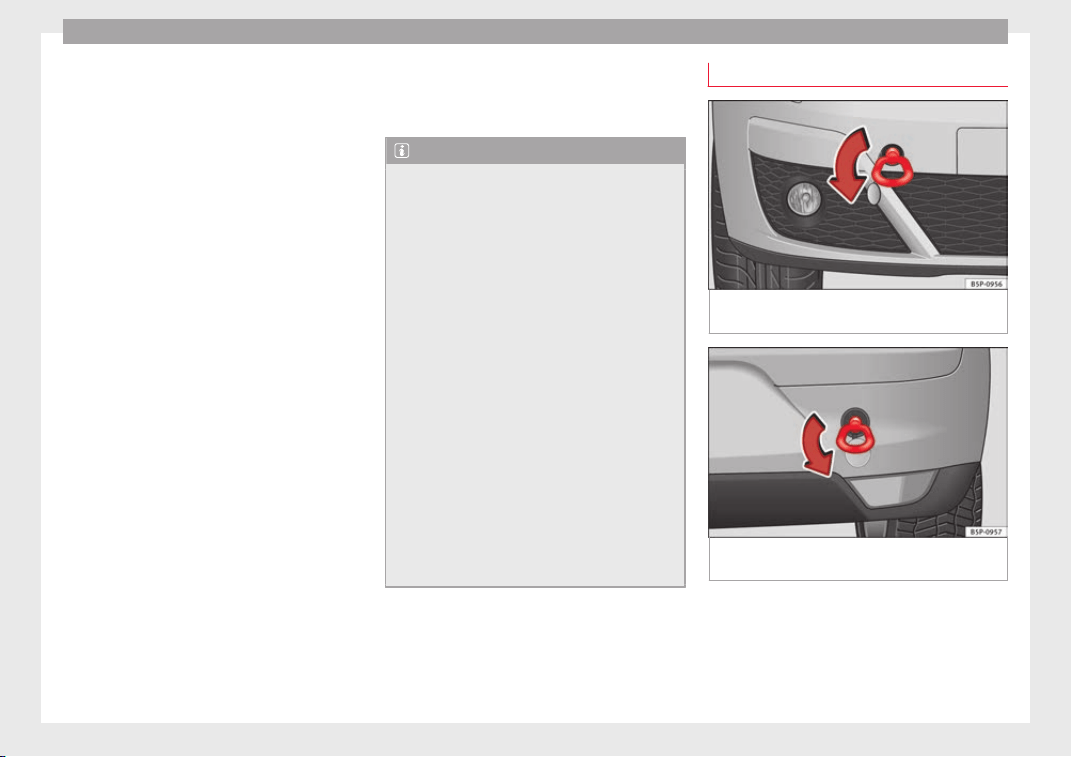
Advice
Driving style
Towing requires some experience, especially
when using a tow rope. Both drivers should
be familiar with the technique required for
towing. Inexperienced drivers should not at-
tempt to tow.
Do not pull too hard with the towing vehicle
and take care to avoid jerking the tow rope.
When towing on an unpaved road, there is al-
ways a risk of overloading and damaging the
anchorage points.
The ignition of the vehicle being towed must
be switched on to prevent the steering wheel
from locking and also to allow the use of the
turn signals, horn, windscreen wipers and
washers.
The brake servo only works when the engine
is running. When not running, you must ap-
ply considerably more pressure to the brake
pedal.
As the power assisted steering does not work
if the engine is not running, you will need
more strength to steer than you normally
would.
●
The vehicle must not be towed faster than
50 km/h (31 mph).
Towing vehicles with an automatic gearbox
●
Put the selector lever into position “N”.
●
Do not drive faster than 50 km/h (31 mph).
●
Do not tow further than 50 km.
●
If a breakdown vehicle is used, the vehicle
must be towed with the front wheels raised.
Note
●
Observe legal requirements when towing or
tow-starting.
●
Switch on the hazard warning lights of both
vehicles. However, observe any regulations
to the contrary.
●
For technical reasons, vehicles with an au-
tomatic gearbox must not be tow-started.
●
If there is no lubricant in the gearbox as the
result of a fault, you must raise the driven
wheels while the vehicle is being towed.
●
If the vehicle has to be towed more than
50 km, the front wheels should be raised dur-
ing towing, and towing should be carried out
by a qualified person.
●
The steering wheel is locked when the vehi-
cle has no electrical power. The vehicle must
then be towed with the front wheels raised.
Towing should be carried out by a qualified
person.
●
The towline anchorage should always be
kept in the vehicle. Please refer to the notes
on ››› page 191, Tow-starting.
Towline anchorages
Fig. 165 Fitting the front towline anchorage
to the front right section of the vehicle.
Fig. 166 Fitting the towline anchorage to the
rear of the vehicle.
Front towline anchorage
–
Take the towline anchorage from the on-
board tool set.
–
Remove the cover by pressing down on its
left-hand side.
192
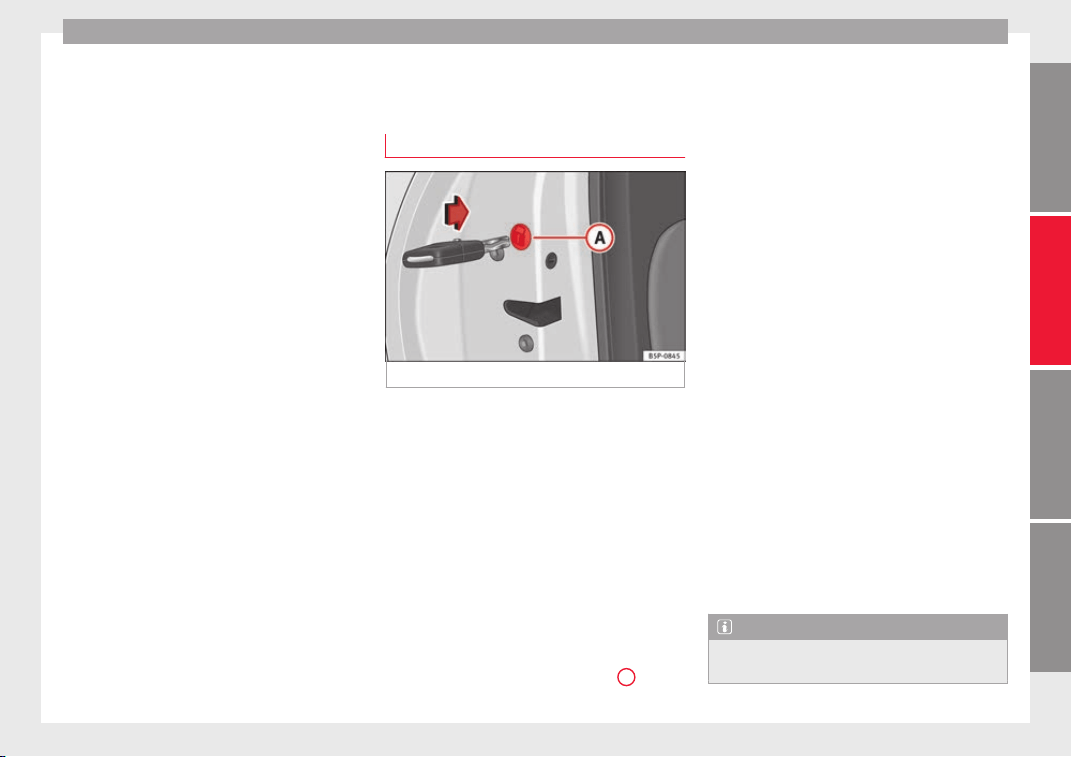
Emergencies
–
Bolt the anchorage to its limit to the left
, in
the dir
ection of
the arrow ››› Fig. 165.
Rear towline anchorage
–
Take the towline anchorage from the on-
board tool set.
–
Remove the cover by pressing down on its
right-hand side.
–
Bolt the anchorage to its limit to the left, in
the direction of the arrow ››› Fig. 166.
After use, unscrew the towline anchorage
and put it back in the vehicle tool kit. Replace
the cover on the bumper. The towline anchor-
age should always be kept in the vehicle.
Emergency locking and
unlocking
Emergency manual locking
Fig. 167 Emergency door locking.
This permits mechanical locking of the doors
in case of central locking system failure.
Locking the driver door manually
Insert the key in the door lock cylinder and
rotate in a clockwise direction for the left
hand side door and anticlockwise for the
right hand side door.
Once the door has been closed it can no lon-
ger be opened from the outside.
Manual (emergency) locking of the
remaining doors
Open the door and remove the cap
A
››› Fig. 167
printed with a lock image. This
w
i
ll expose a circular element with a groove
in the centre. Insert the key into the groove
and rotate the element clockwise for the right
hand side doors and anticlockwise for the
left hand side doors.
Replace the cap and close the door. Once the
door has been locked it can no longer be
opened from the outside.
Unlocking the manually (emergency) locked
driver door
Insert the key in the door lock cylinder and
rotate anticlockwise for the left hand side
doors and clockwise for the right hand side
doors.
The door lock is released and the door may
be opened using the exterior door handle.
Unlocking the remaining manually
(emergency) locked doors
First the driver door must be unlocked to gain
entry to the vehicle. Operate the internal door
handle for the required door. If the childproof
lock is activated on the rear doors, when the
interior door release lever is operated the
door is unlocked but does not open. The door
must be opened from the outside.
Note
Once the vehicle is open, if you wish to lock it
manually, repeat the previous instructions.
193
Technical specifications
AdviceOperationSafety
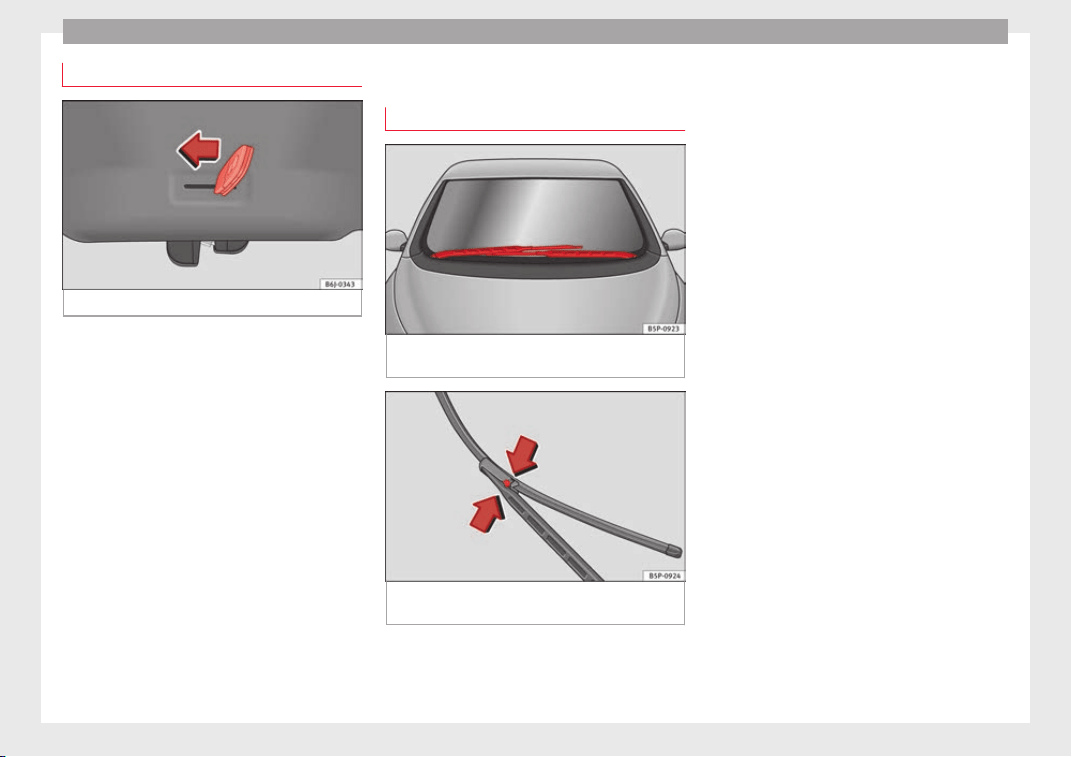
Advice
Emergency boot hatch opening
Fig. 168 Rear lid: emergency opening.
This allows the vehicle to be opened if the
central locking does not work (for example, if
the battery is flat)
There is a groove in the luggage compart-
ment allowing access to the emergency
opening mechanism.
Opening the rear lid from inside the luggage
compartment
–
Insert the key in the groove and unlock the
locking system, turning the key from right
to left, as shown by the arrow ››› Fig. 168
.
Ch
an
ging the wiper blades
Changing windscreen wiper blades
Fig. 169 Windscreen wipers in the service po-
sition.
Fig. 170 Changing the windscreen wiper
blades
Perfect wiper blade condition is essential for
clear vision. Damaged wiper blades should
be replaced immediately.
To change the blades it is necessary to move
the wipers from the rest position into the
service position.
Service position (for changing wiper blades)
–
Ensure that the wiper blades are not frozen.
–
Turn the ignition on and off and then (with-
in approximately 8 seconds), push the
windscreen wiper lever out of the short
wipe position. The windscreen wipers will
move to the service position.
Changing the windscreen wiper blades
–
Lift the wiper arm away from the wind-
screen.
–
Push the side buttons, free the blade and
pull in the direction of the arrow ››› Fig. 170
Fitting the wiper blade
–
Insert a blade of identical length and de-
sign into the wiper arm.
–
Slide the blade until it clicks into position.
–
Push the wiper arms back against the wind-
screen.
The windscreen wiper arms return to their
original position when the ignition is turned
on and the windscreen wiper lever is operat-
ed, or when driving faster than 6 km/h.
194
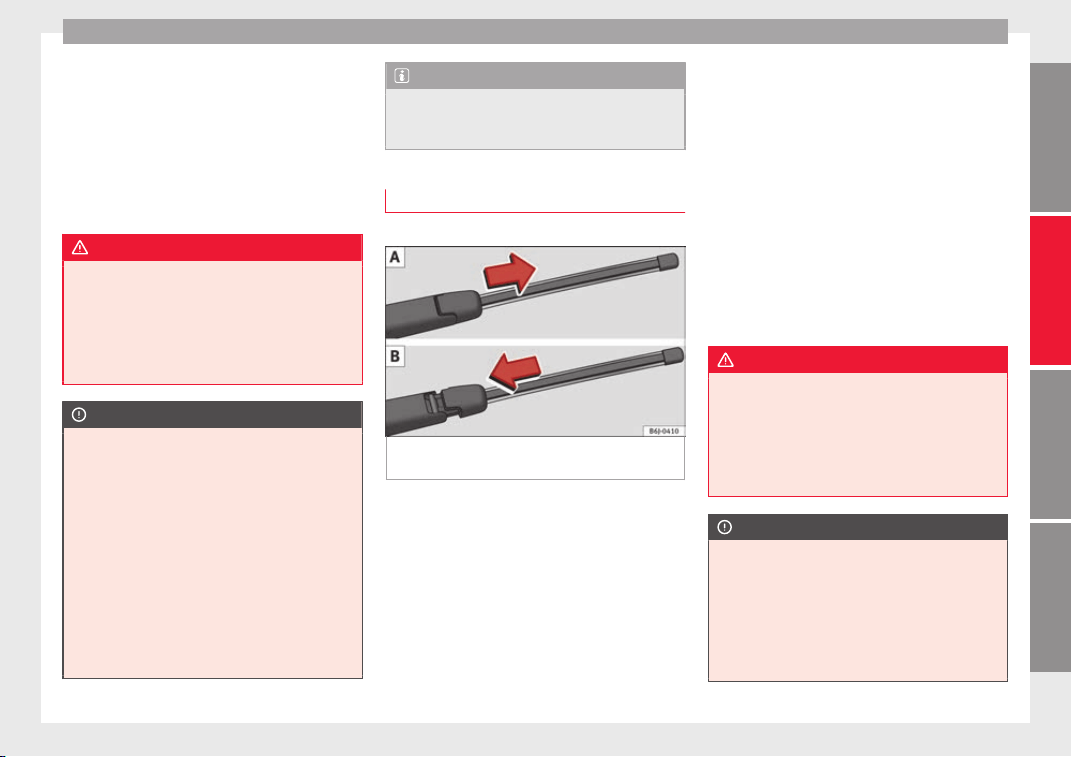
Emergencies
If the windscreen wipers scratch, they should
be replaced if they are damaged, or cleaned
if they are soiled.
If this does not produce the desired results,
the setting angle of the windscreen wiper
arms might be incorrect. They should be
checked by a specialised workshop and cor-
rected if necessary.
WARNING
Do not drive unless you have good visibility
through all windows!
●
Clean the windscreen wiper blades and all
windows regularly.
●
The wiper blades should be changed once
or twice a year.
CAUTION
●
Damaged or dirty windscreen wipers could
scratch the windscreen.
●
Never use fuel, nail varnish remover, paint
thinner or similar products to clean the win-
dows. This could damage the windscreen
wiper blades.
●
Never move the windscreen wiper or wind-
screen wiper arm manually. This could cause
damage.
●
To prevent damage to the bonnet and the
windscreen wiper arms, the latter should only
be lifted off the windscreen when in service
position.
Note
●
The windscreen wiper arms can be moved
to the service position only when the bonnet
is properly closed.
Changing the rear wiper blade
3 Applies to the model: ALTEA
Fig. 171 Changing the rear window wiper
blade.
Perfect rear wiper blade condition is essential
for clear rear vision. Damaged wiper blades
should be replaced immediately.
Removing the wiper blade
–
Lift the wiper arm away from the glass
–
Slide the blade adapter in the direction of
the arrow and remove the blade ››› Fig. 171
A
.
Fittin
g the w
iper blade
–
With one hand, hold the top end of the wip-
er arm.
–
Place the blade as shown in ››› Fig. 171 B
and slide the adapter along until it engag-
es.
Check the condition of the wiper blade regu-
larly. Change as required.
If the windscreen wiper scrapes, it should be
replaced if damaged, or cleaned if soiled.
If this is not sufficient, refer to a specialised
workshop.
WARNING
Do not drive unless you have good visibility
through all windows!
●
Clean the windscreen wiper blades and all
windows regularly.
●
The wiper blades should be changed once
or twice a year.
CAUTION
●
A damaged or dirty window wiper could
scratch the rear window.
●
Never use fuel, nail varnish remover, paint
thinner or similar products to clean the win-
dow as they may damage the blades.
●
Never move the windscreen wiper by hand.
This could cause damage.
195
Technical specifications
AdviceOperationSafety
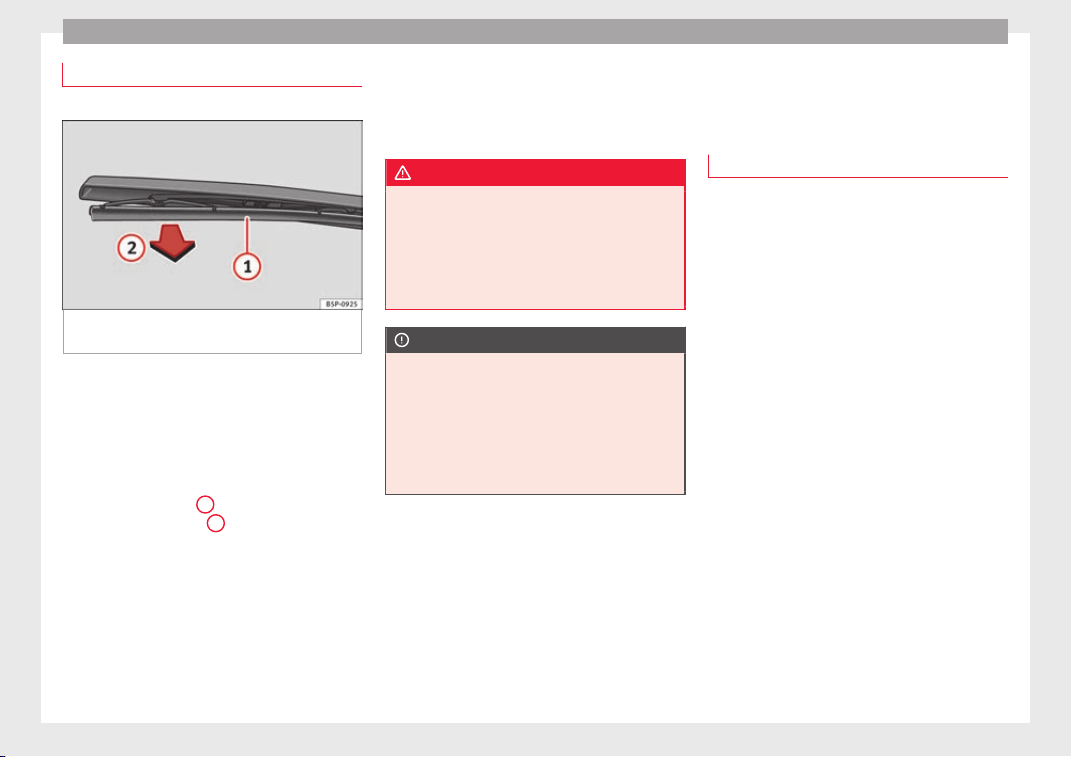
Advice
Changing the rear wiper blade
3 Applies to the model: ALTEA XL/ALTEA FREETRACK
Fig. 172 Changing the rear window wiper
blade.
Perfect rear wiper blade condition is essential
for clear rear vision. Damaged wiper blades
should be replaced immediately.
Removing the wiper blade
–
Lift the rear wiper arm.
–
Release the blade
1
by pulling it in the di-
rection of the arrow
2
.
Fitting the wiper blade
–
Insert the wiper blade onto the windscreen
wiper arm until it clicks into place.
Check the condition of the wiper blade regu-
larly. Change as required.
If the windscreen wiper scrapes, it should be
replaced if damaged, or cleaned if soiled.
If this is not sufficient, refer to a specialised
workshop.
WARNING
Do not drive unless you have good visibility
through all windows!
●
Clean the windscreen wiper blades and all
windows regularly.
●
The wiper blades should be changed once
or twice a year.
CAUTION
●
A damaged or dirty window wiper could
scratch the rear window.
●
Never use fuel, nail varnish remover, paint
thinner or similar products to clean the win-
dow as they may damage the blades.
●
Never move the windscreen wiper by hand.
This could cause damage.
Fuses and bulbs
Fuses
Introduction
Due to the constant updating of vehicles,
fuse assignments based on equipment and
the use of the same fuse for various electrical
components, it is not possible to provide an
up-to-date summary of the fuse positions for
the electrical components at the time this
manual was printed. For detailed information
about the fuse positions, please consult a
technical service.
In general, a fuse can be assigned to various
electrical components. Likewise, an electrical
component can be protected by several
fuses.
Only replace fuses when the cause of the
problem has been solved. If a newly inserted
fuse blows after a short time, you must have
the electrical system checked by a special-
ised workshop as soon as possible.
Additional information and warnings:
●
Working in the engine compartment
›››
page 163
.
196
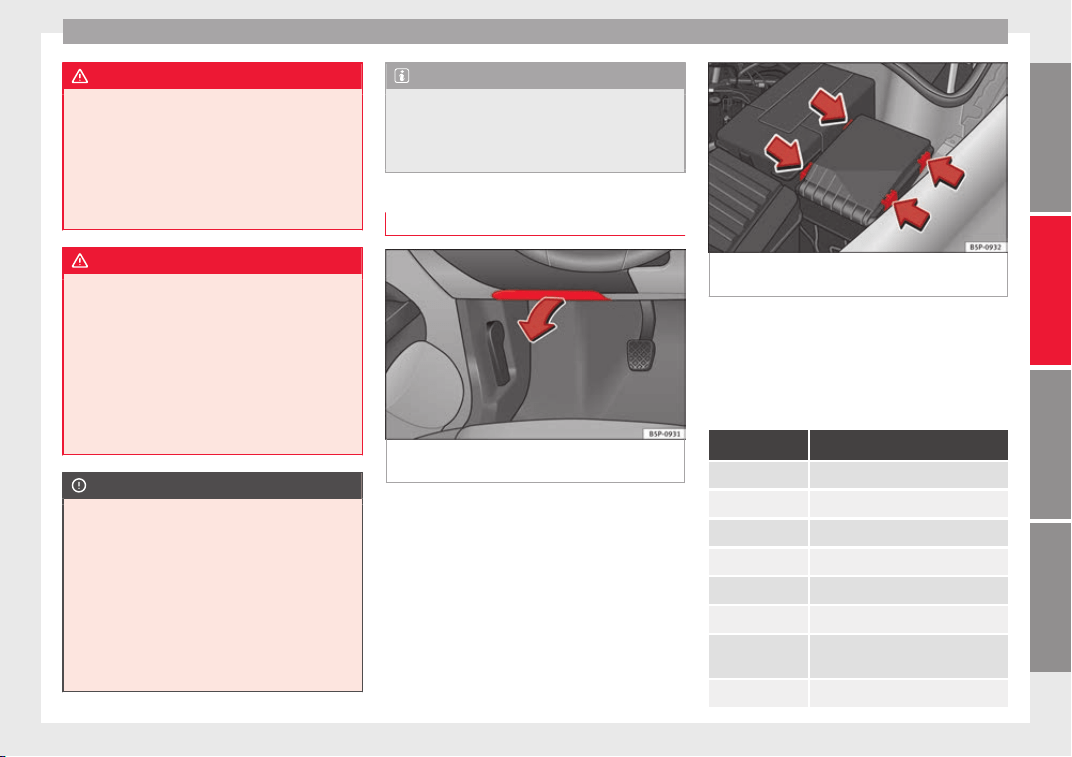
Fuses and bulbs
WARNING
The high voltages in the electrical system can
give serious electrical shocks, causing burns
and even death!
●
Never touch the electrical wiring of the igni-
tion system.
●
Take care not to cause short circuits in the
electrical system.
WARNING
Using unsuitable fuses, repairing fuses or
bridging a current circuit without fuses can
cause a fire and serious injury.
●
Never use a fuse with a higher value. Only
replace fuses with a fuse of the same amper-
age (same colour and markings) and size.
●
Never repair a fuse.
●
Never replace a fuse by a metal strip, staple
or similar.
CAUTION
●
To prevent damage to the vehicle's electric
system, before replacing a fuse turn off the
ignition, the lights and all electrical elements
and remove the key from the ignition.
●
If you replace a fuse with higher-rating
fuse, you could cause damage to another part
of the electrical system.
●
Protect the fuse boxes when open to pre-
vent the entry of dust or humidity as they can
damage the electrical system.
Note
●
One component may have more than one
fuse.
●
Several components may run on a single
fuse.
Vehicle fuses
Fig. 173 Left side of dash panel fuse box cov-
er
Fig. 174 In the engine compartment: fuse box
cover
Only replace fuses with a fuse of the same
amperage (same colour and markings) and
size.
Identifying fuses situated below the driver-
side dash panel by colours
Colour Amp rating
Purple 3
Light brown 5
Brown 7.5
Red 10
Blue 15
Yellow 20
White or trans-
parent
25
Green 30
»
197
Technical specifications
AdviceOperationSafety
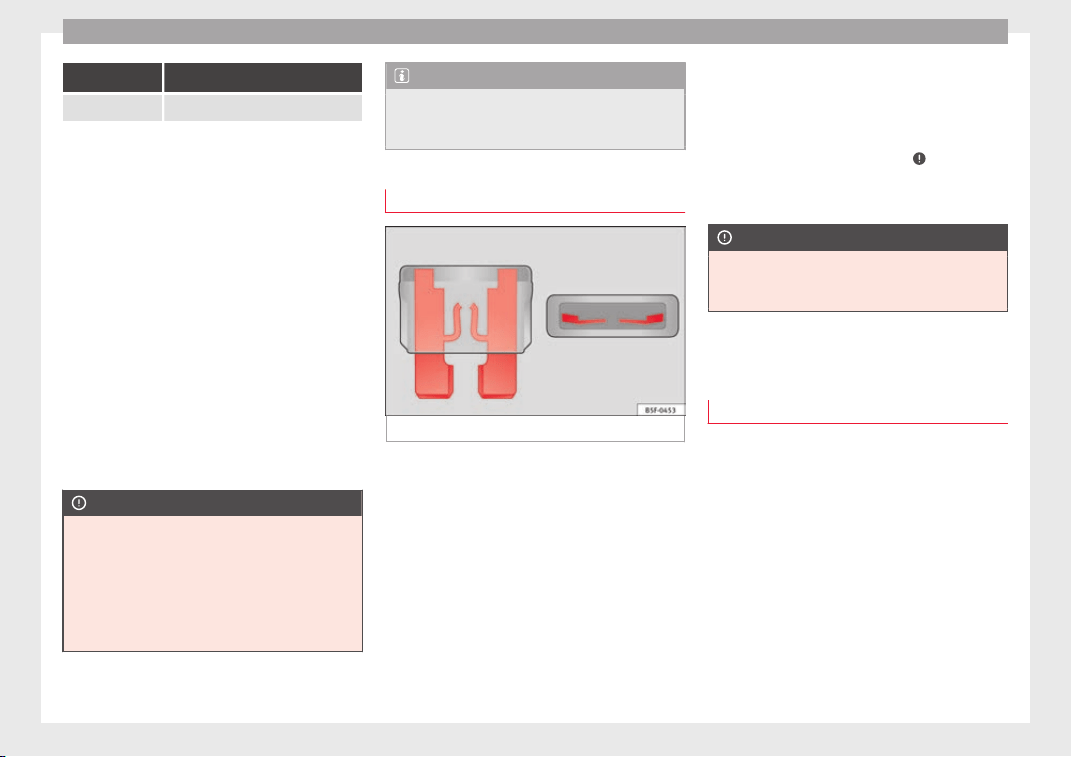
Advice
Colour Amp rating
Orange 40
Opening and closing the fuse box situated
below the dash panel
●
Opening: fold the cover down ››
› Fig. 173.
●
Closing: push back the cover it in until it
clicks into place.
To open the engine compartment fuse box
●
Open the bonnet
›››
page 163.
●
Press the locking tabs in the direction indi-
cated by the arrows to release the fuse box
cover
›››
Fig. 174.
●
Then lift
the cover out.
●
To fit the cover, place it on the fuse box.
Push the locking tabs down, in the opposite
direction to that indicated by the arrows, un-
til you hear them click into place.
CAUTION
●
Always carefully remove the fuse box cov-
ers and refit them correctly to avoid problems
with your vehicle.
●
Protect the fuse boxes when open to avoid
the entry of dust or humidity. Dirt and humid-
ity inside fuse boxes can cause damage to
the electrical system.
Note
In the vehicle, there are more fuses than
those indicated in this chapter. These should
only be changed by a specialised workshop.
Replacing a blown fuse
Fig. 175 Image of a blown fuse
Preparation
●
Switch off the ignition, lights and all elec-
trical equipment.
●
Open the corresponding fuse box
››› page 197
.
Identif
y
ing a blown fuse
A fuse is blown if its metal strip is ruptured
›››
Fig. 175.
Point a lamp at the fuse. This will make it
easier to see if the fuse is blown.
To replace a fuse
●
Remove the fuse.
●
Replace the blown fuse by one with an
identical amperage rating (same colour and
markings) and identical size ›››
.
●
Replace the cover again or close the fuse
box lid.
CAUTION
If you replace a fuse with higher-rating fuse,
you could cause damage to another part of
the electrical system.
Changing the lights
General notes
Before changing any bulb, first turn off the
failed device.
Do not touch the glass part of the bulb with
your bare hands. The fingerprints left on the
glass will vaporise as a result of the heat gen-
erated by the bulb, reducing bulb life and
causing condensation on the reflector sur-
face, thus reducing effectiveness.
A bulb must only be replaced by one of the
same type. The type is indicated on the bulb,
either on the glass part or on the base.
It is highly recommended to keep a box of
spare bulbs in the vehicle. At the very least,
198

Fuses and bulbs
the following spare bulbs, which are essen-
tial for road safety, should be kept in the ve-
hicle.
Main headlights
- H7
- H1
- W5W
- PY21W
Xenon headlights
1)
/adaptive*
- D1S
2)
- P21W SLL
- W5W
- PY21W
Front fog light
- H3
Dipped beam
Main beam
Position
Turn signal
Dipped and full beam
Daylight
Position
Turn signals
Front fog light
Upper tail light (ALTEA)
- P21W
3)
- R10W
Lower tail light (ALTEA)
- P21W
- P21W
Fixed tail light (ALTEA XL / ALTEA FREETRACK)
- P21W
3)
- P21W
Mobile tail light (ALTEA XL / ALTEA
FREETRACK)
- P21W
- P21W
- W5W
Stop/Position
Turn signal
Fog light
Reverse light
Stop/Position
Turn signal
Fog light (driver side)
Reverse (passenger side)
Position
Side turn signal
- W5W
Number plate light
- C5W
Note
●
Depending on weather conditions (cold or
wet), the headlights, the fog lights, the tail
lights and the turn signals may be temporari-
ly misted. This has no influence on the useful
life of the lighting system. By switching on
the lights, the area through which the beam
of light is projected will quickly be demisted.
However, the edges may continue to be mis-
ted.
●
Please check at regular intervals that all
lighting (especially the exterior lighting) on
your vehicle is functioning properly. This is
»
Side turn signal
Number plate light
1)
On this type of headlight, the bulb changes must
be made by the technical service, given that complex
elements must be removed from the vehicle and the
incorporated automatic control system must be re-
set.
2)
The Xenon bulbs discharge 2.5 times the light flux
and have an average lifespan of 5 times more than
that of halogen bulbs, this means that, except due to
unusual circumstances, there is no need to change
the bulbs for the whole life of the vehicle.
3)
Electronically controlled single filament bulb for
Stop/side bulbs. If the bulb blows it will not work in
either position or Stop.
199
Technical specifications
AdviceOperationSafety
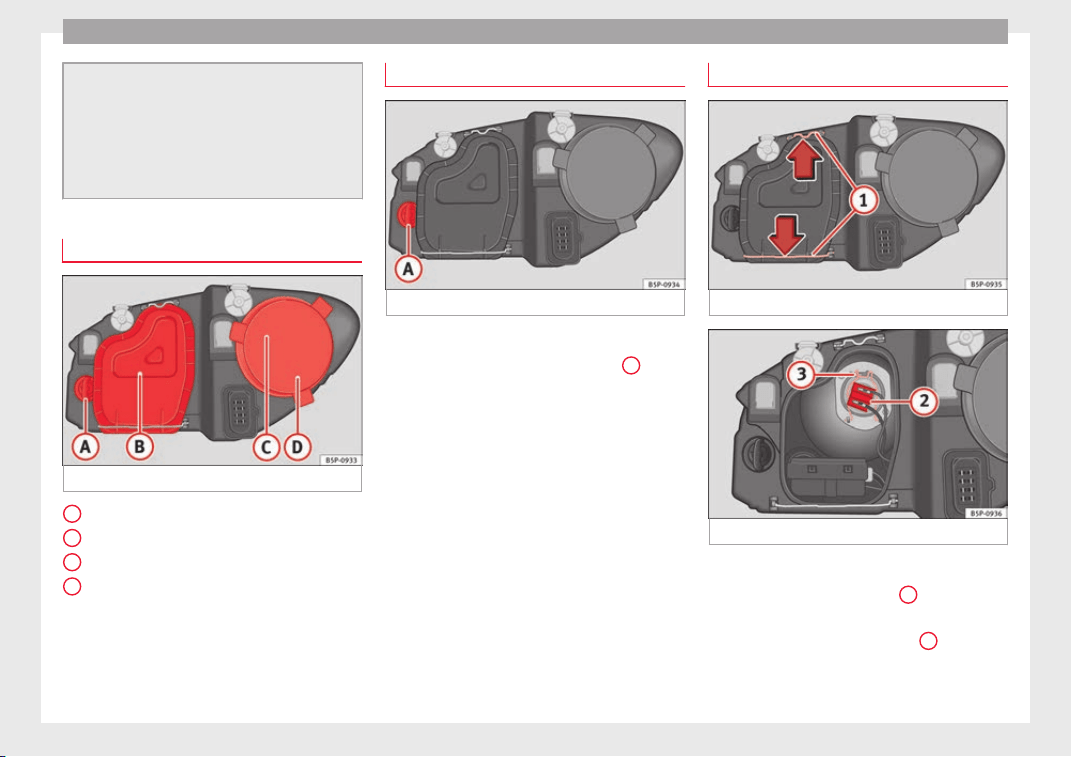
Advice
not only in the interest of your own safety,
but also that of all other road users.
●
Due to difficulty of access to some of the
bulbs, any replacement work should be done
by a technical service. However, the following
is a description of how to change the lamps
except for the fog lights* and interior lamps.
Main headlight bulbs
Fig. 176 Main headlight bulbs.
Turn signal
Dipped beam headlights
Main beam headlights
Side light
A
B
C
D
Turn signal bulbs
Fig. 177 Turn signal bulb.
–
Raise the bonnet.
–
Rotate the bulb holder ››› Fig. 177
A
to the
left and pull.
–
Remove the bulb by pressing on the bulb
holder and turn it anti-clockwise at the
same time.
–
Installation involves all of the above steps
in reverse sequence.
Dipped lights
Fig. 178 Dipped beam headlights.
Fig. 179 Dipped beam headlights.
–
Raise the bonnet.
–
Move the loops ››› Fig. 178
1
in the direc-
tion of the arrow and remove the cover.
–
Remove connector ››› Fig. 179
2
from the
bulb.
200
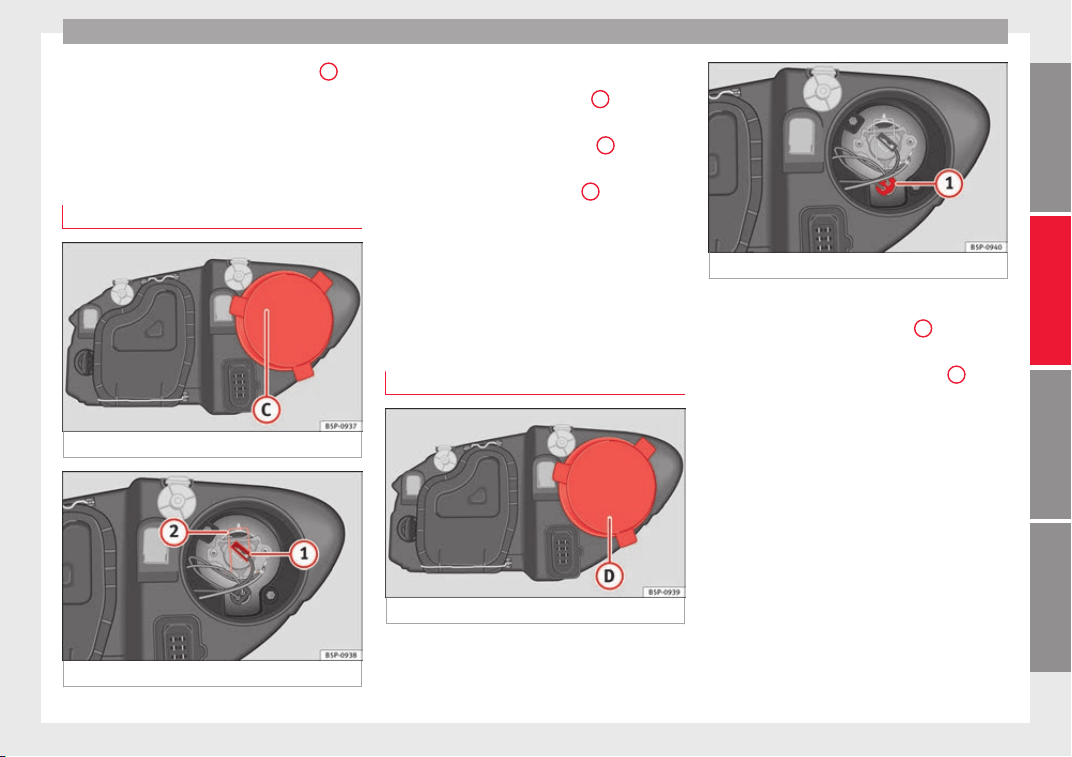
Fuses and bulbs
–
Unclip the retainer spring ››› Fig. 179
3
pressing inwards to the right.
–
Extract the bulb and fit the replacement so
that the lug on the base fits into the recess
on the reflector.
Main beam lights
Fig. 180 Main beam headlight.
Fig. 181 Main beam headlight.
–
Raise the bonnet.
–
Remove the cover ››› Fig. 180
C
by pulling
on this.
–
Remove connector ››› Fig. 181
1
from the
bulb.
–
Press the spring ››› Fig. 181
2
inwards and
to the right.
–
Extract the bulb and fit the replacement so
that it sits correctly into the cut-out on the
reflector.
–
Installation involves all of the above steps
in reverse sequence.
Side lights
Fig. 182 Side light.
Fig. 183 Side light.
–
Raise the bonnet.
–
Remove the cover ››› Fig. 182
D
by pulling
on this.
–
Extract the bulb holder ››› Fig. 183
1
out-
wards.
–
Replace the bulb by pulling it out and in-
serting the replacement.
–
Installation is done in the reverse order.
201
Technical specifications
AdviceOperationSafety
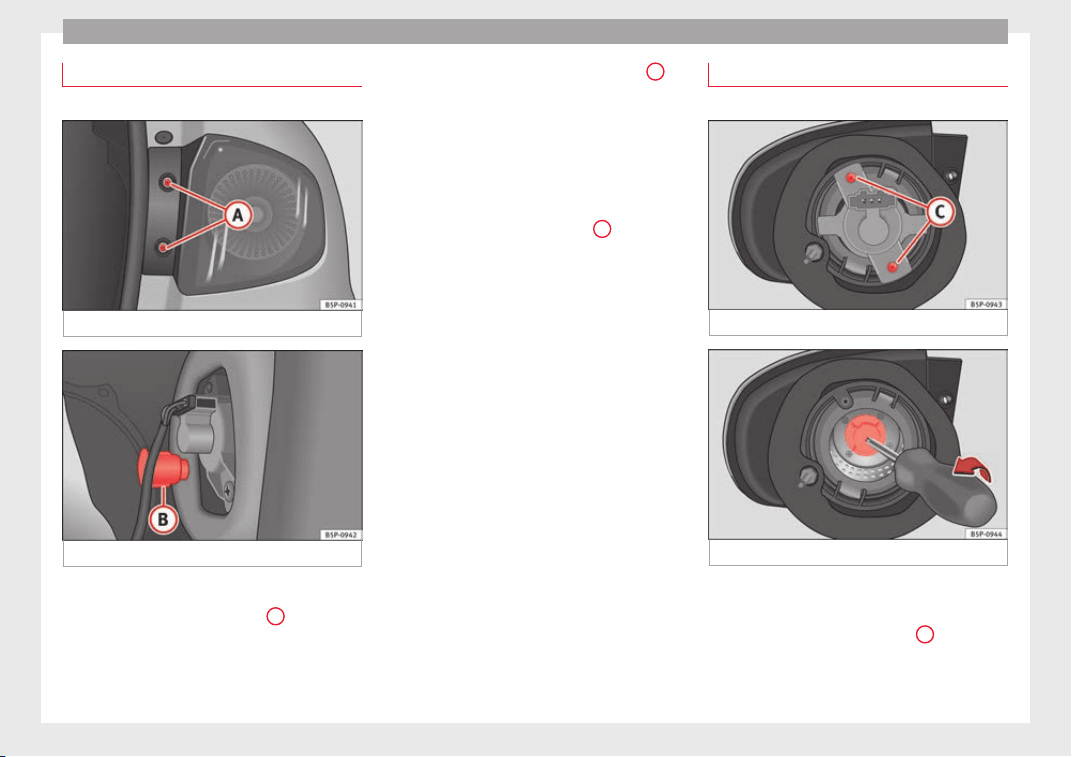
Advice
Side lights/ brake lights
3 Applies to the model: ALTEA
Fig. 184 Side lights and brake lights.
Fig. 185 Side lights and brake lights.
–
Open the rear lid.
–
Remove the bolts ››› Fig. 184
A
.
–
Remove the cover of the luggage compart-
ment lateral panel.
–
Unscrew the plastic fitting ››› Fig. 185
B
securing the tail light. Inserting a screw-
driver under the plastic fitting may help to
loosen it.
–
Partially remove the tail light from its cas-
ing taking care not to pull on the cable.
–
Remove the bulb holder connector.
–
Unscrew the bolts ››› Fig. 186
C
from the
bulb holder and pull on this.
–
Press on the bulb and rotate to the left then
fit the replacement.
–
To refit follow the steps in reverse order,
taking special care when fitting the bulb
holder. The metal contacts of the bulb hold-
er ends should be correctly fitted with re-
spect to the rear light contacts.
Turn signal light
3 Applies to the model: ALTEA
Fig. 186 Turn signal light.
Fig. 187 Turn signal light.
–
Remove the lamp from its housing
››› page 202.
–
Unscrew the bolts ››› Fig. 186
C
from the
bulb holder and pull on this.
202
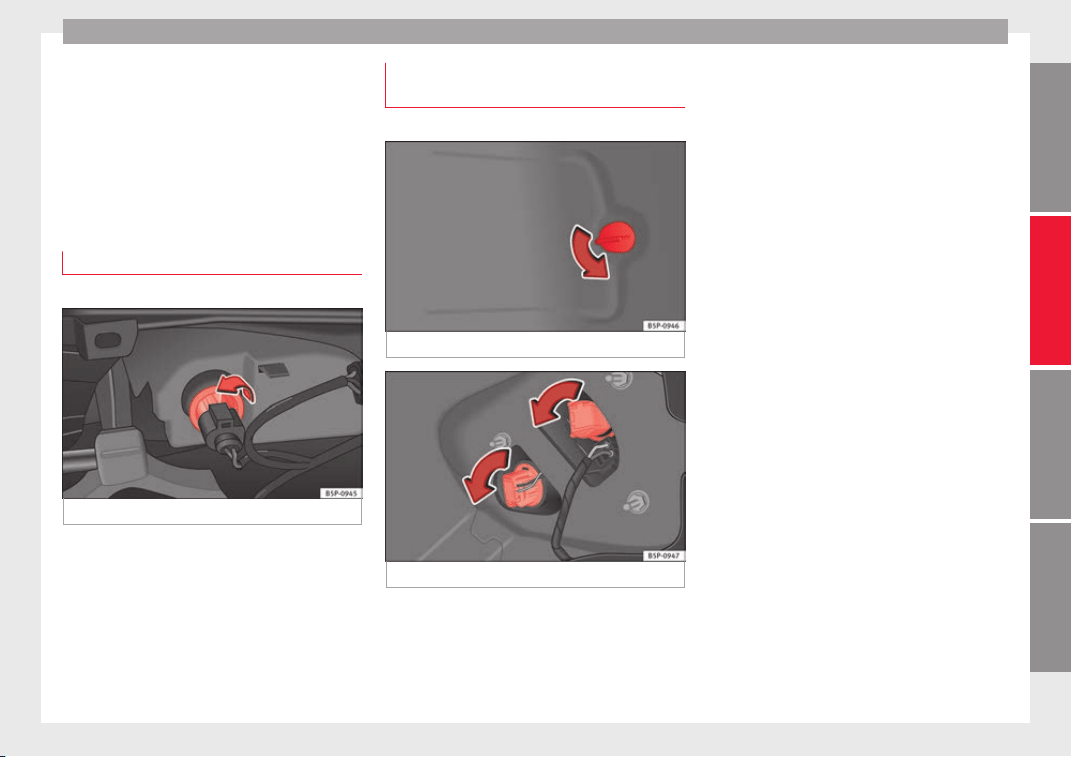
Fuses and bulbs
–
Pull out the turn signal bulb holder using a
screw driver in the direction of the arrow
››› Fig. 187
.
–
Fit
the r
eplacement bulb by pressing it
down and rotating to the left.
–
Installation involves all of the above steps
in reverse sequence.
Reverse light/rear fog light
3 Applies to the model: ALTEA
Fig. 188 Lamp on interior side of bumper.
–
Rotate the bulb holder to the left and re-
move it in the direction of the arrow
››› Fig. 188.
–
Replace the bulb by pressing on it and ro-
tating at the same time to the left
Turn signal, side and brake lights on
the body
3 Applies to the model: ALTEA XL/ALTEA FREETRACK
Fig. 189 Lights on the vehicle body.
Fig. 190 Lights on the vehicle body.
–
Open the cover of the luggage compart-
ment side panel ››› Fig. 189
.
–
T
urn the b
ulb holder to the left ››› Fig. 190.
–
Remove the blown bulb and change it for a
new one.
–
To refit follow the steps in reverse order,
taking special care when fitting the bulb
holder.
203
Technical specifications
AdviceOperationSafety
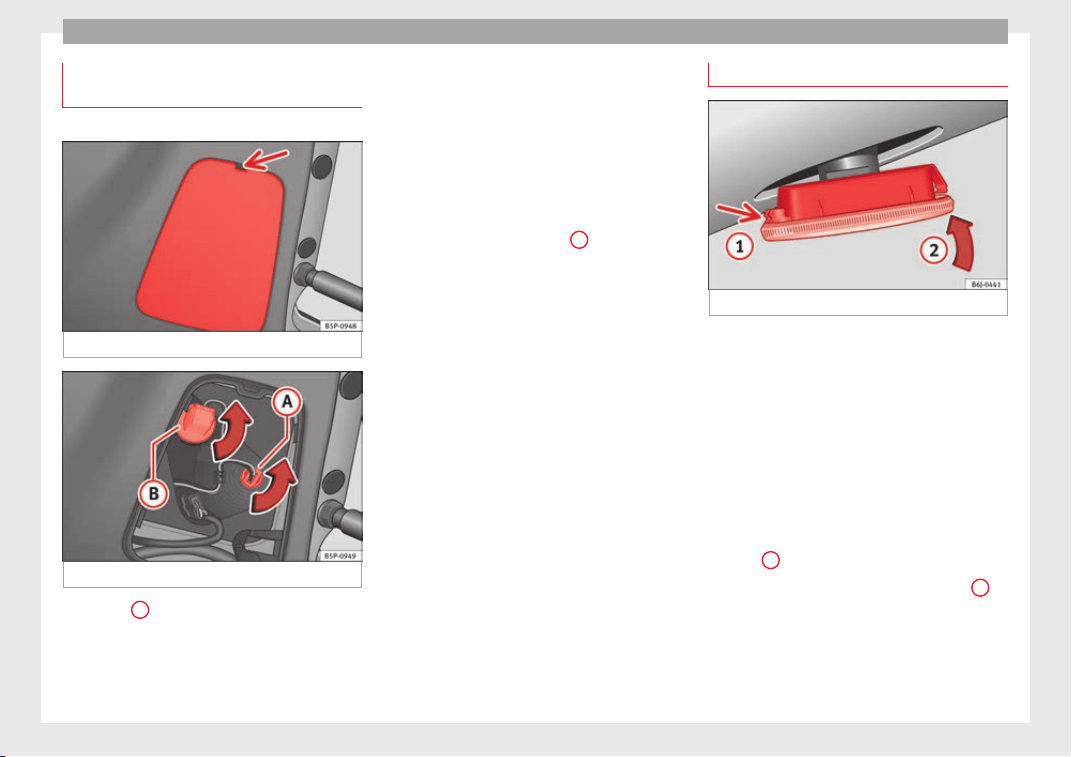
Advice
Position light, fog light and reverse
light on the rear lid
3 Applies to the model: ALTEA XL/ALTEA FREETRACK
Fig. 191 Lights on the boot.
Fig. 192 Side light.
Side light
A
–
Open the rear lid.
–
Pull the cover off.
–
Take the lampholder out pressing on the
securing pins and extract it outwards.
–
Remove the blown bulb and replace it with
another.
–
To refit follow the steps in reverse order,
taking special care when fitting the bulb
holder.
Fog light and reverse lights
B
–
Open the rear lid.
–
Pull the cover off.
–
Turn the bulb holder to the left.
–
Remove the blown bulb and replace it with
another.
–
Installation involves all of the above steps
in reverse sequence.
Side turn signals
Fig. 193 Side turn signal.
–
Press the turn signal to the left or to the
right to remove the bulb.
–
Remove the bulb holder from the turn sig-
nal.
–
Remove the failed glass bulb and replace
with a new bulb.
–
Insert the bulb holder in the turn signal
guide until it clicks into place.
–
First place the turn signal in the opening in
the bodywork, fixing the tabs ››› Fig. 193
,
arr
o
w
1
.
–
Insert the bulb as shown by the arrow
2
››› Fig. 193.
204
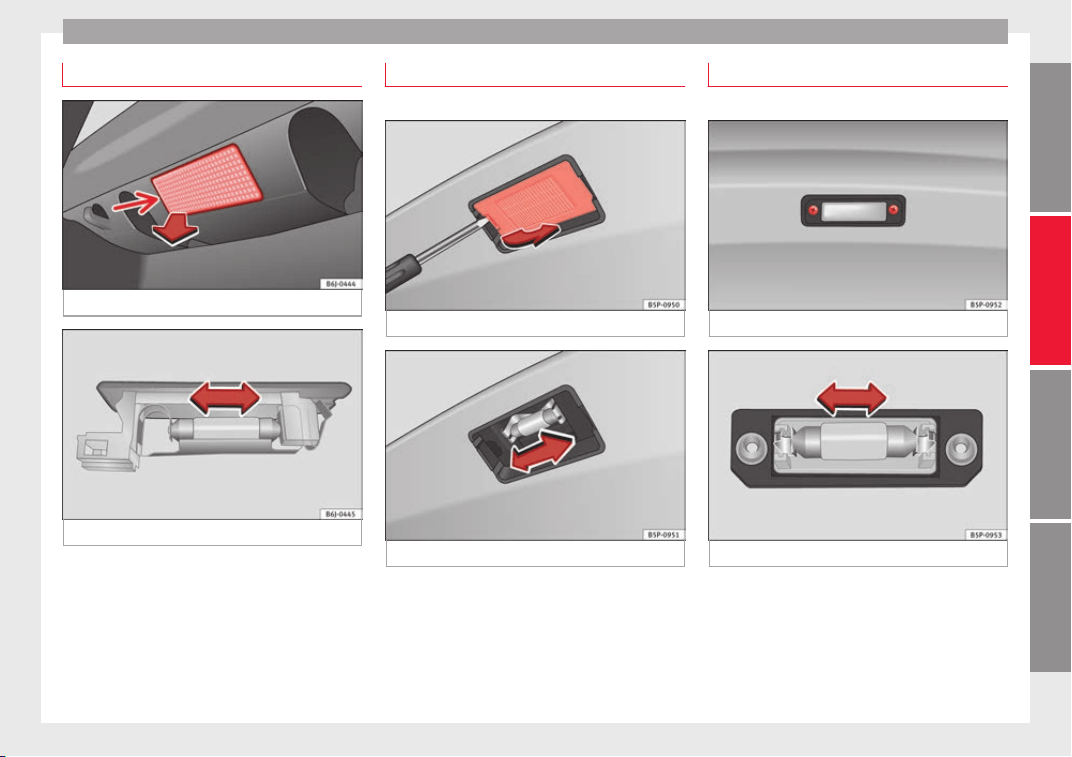
Fuses and bulbs
Luggage compartment lights
Fig. 194 Boot light.
Fig. 195 Boot light.
–
Extract the bulb by pressing on its inside
edge -arrow- using the flat side of a screw-
driver ››› Fig. 194
.
–
Pr
e
ss the bulb sideways and remove it from
its housing ››› Fig. 195.
Registration light
3 Applies to the model: ALTEA
Fig. 196 Number plate light.
Fig. 197 Number plate light.
–
Remove the bulb, carefully using the flat
side of a screwdriver as a lever inserted in
the crack as shown by the arrow
››› Fig. 196
.
–
R
emo
ve the bulb, moving it outward and in
the direction of the arrow ››› Fig. 197.
Registration light
3 Applies to the model: ALTEA XL/ALTEA FREETRACK
Fig. 198 Number plate light.
Fig. 199 Number plate light.
–
Unscrew the screws to remove the bulb
››› Fig. 198
.
–
R
emo
ve the bulb, moving it outward and in
the direction of the arrow ››› Fig. 199.
–
Installation involves all of the above steps
in reverse sequence.
205
Technical specifications
AdviceOperationSafety
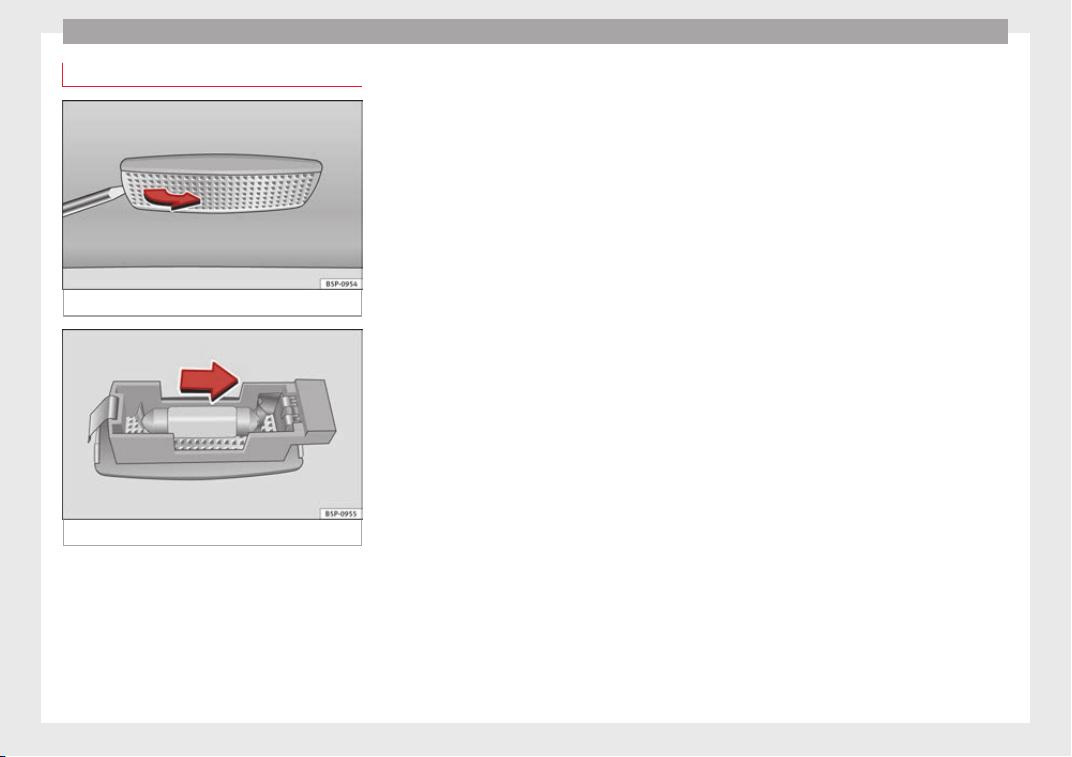

Technical features
Technical specifications
Technical features
Important information
Important
The information in the vehicle documentation
always takes precedence over the informa-
tion in this Instruction Manual.
All technical specifications provided in this
documentation are valid for the standard
model in Spain. The vehicle data card inclu-
ded in the Maintenance Programme or the
vehicle registration documents shows which
engine is installed in the vehicle.
The figures may be different depending
whether additional equipment is fitted, for
different models, for special vehicles and for
other countries.
Abbreviations used in the Technical
Specifications section
Ab-
brevia-
tion
Meaning
kW Kilowatt, engine power measurement.
PS
Pferdestärke (horsepower), formerly used to
denote engine power.
Ab-
brevia-
tion
Meaning
rpm Revolutions per minute - engine speed.
Nm Newton metres, unit of engine torque.
litres
per
100 km
Fuel consumption in litres per 100 km (70
miles).
g/km
Carbon dioxide emissions in grams per km
(mile) travelled.
CO
2
Carbon dioxide
CN
Cetane number, indication of the diesel com-
bustion power.
RON
Research octane number, indication of the
knock resistance of petrol.
207
Technical specifications
AdviceOperationSafety
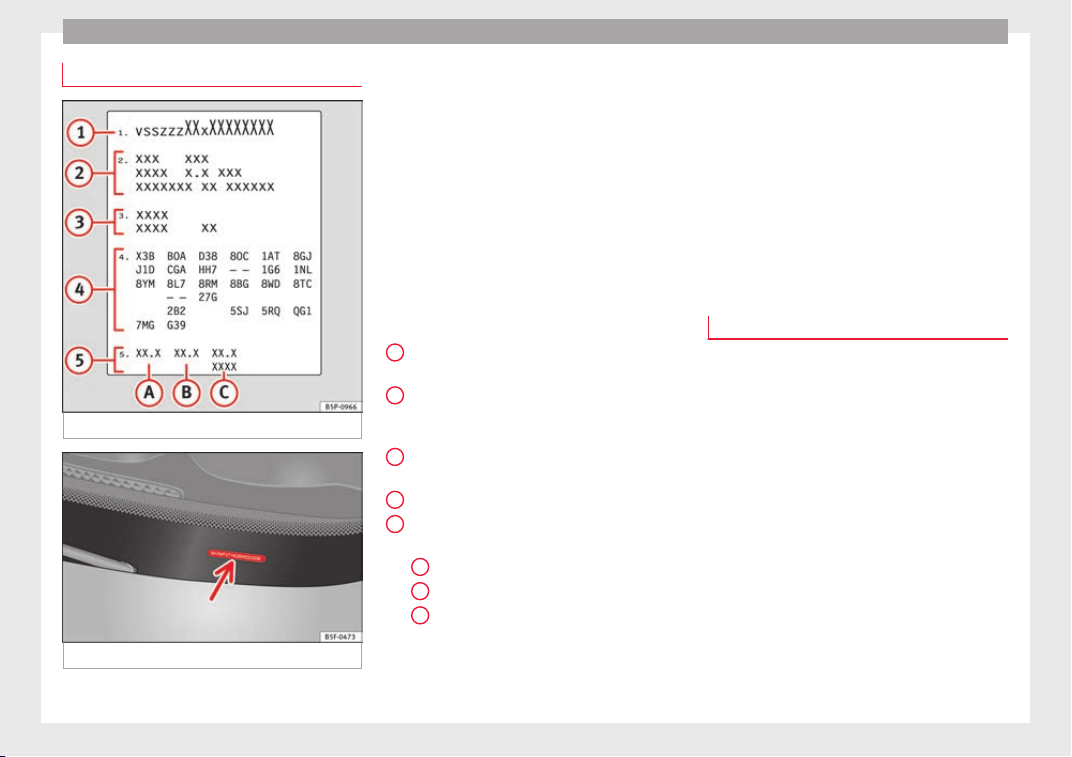
Technical specifications
Vehicle identification data
Fig. 202 Vehicle data sticker (boot).
Fig. 203 Chassis number.
Vehicles for certain export countries do not
have an identification plate.
Identification plate
The identification plate is located on the left
rib inside the engine compartment.
Vehicle data
The data sticker is placed on the inside of the
spare wheel well, in the boot and on the rear
cover of the Maintenance Programme.
The following information is provided on the
vehicle data sticker: ››› Fig. 202
Vehicle identification number (chassis
number)
Vehicle type, model, displacement, en-
gine type, finish, engine power and gear-
box type
Engine code, gearbox code, external
paint code and internal equipment code
Optional extras and PR numbers
Consumption values (l/100 km) and CO
2
emissions (g/km)
A
Urban cycle consumption
B
Out-of-town consumption
C
Combined consumption and CO
2
emissions
1
2
3
4
5
Chassis number
The chassis number can be read from outside
the vehicle through a viewer in the wind-
screen ››› Fig. 203
. This is located on the left-
h
and s
ide of the vehicle in the lower corner
of the windscreen. It is also located on the
right hand side of the engine compartment.
Information on fuel
consumption
Fuel consumption
The consumption and emission details
shown on the vehicle data sticker differ from
one vehicle to another.
Vehicle fuel consumption and CO
2
emissions
can be consulted on the vehicle data sticker
in the spare wheel well, inside the boot and
on the rear cover of the Maintenance Pro-
gramme.
The fuel consumption and CO
2
emission val-
ues refer to the weight category assigned to
your vehicle according to the engine and
gearbox combination, as well as the specific
equipment fitted, and is only used to com-
pare between the different models.
The fuel consumption and CO
2
emissions do
not depend only on the performance of the
208
Technical features
vehicle, they can also differ from the estab-
lished values depending on other factors
such as driving style, road conditions, traffic
conditions, environmental conditions, load
and number of passengers.
Calculation of fuel consumption
The consumption values have been calcula-
ted based on measurements performed or
supervised by certified CE laboratories ac-
cording to the latest version of directives
715/2007/EC and 80/1268/CEE (for more in-
formation consult the European Union Publi-
cations Office at EUR-Lex: © European Union,
http://eur-lex.europa.eu/en/index.htm) and
are valid for the kerb weight indicated for the
vehicle.
Note
In practice, and considering all the factors
mentioned here, consumption values can dif-
fer from those calculated in the current Euro-
pean regulations.
Weights
Kerb weight refers to the basic model with a
fuel tank filled to 90% capacity and without
optional extras. The figure quoted includes
75 kg to allow for the weight of the driver.
For special versions and optional equipment
fittings or for the addition of accessories, the
weight of the vehicle will increase ››› .
WARNING
●
Please note that the centre of gravity may
shift when transporting heavy objects; this
may affect vehicle handling and lead to an ac-
cident. Always adjust your speed and driving
style to suit road conditions and require-
ments.
●
Never exceed the gross axle weight rating
or the gross vehicle weight rating. If the per-
missible axle load or the permissible total
weight is exceeded, the driving characteris-
tics of the vehicle may change, leading to ac-
cidents, injuries and damage to the vehicle.
Towing a trailer
Trailer weights
Trailer weight
The trailer weights and drawbar loads ap-
proved are selected in intensive trials accord-
ing to precisely defined criteria. The ap-
proved trailer weights are valid for vehicles in
the
EU
and generally, for maximum speeds of
80 km/h (50 mph) (in c
ertain circumstances
up to 100 km/h (62 mph)). The figures may
be different in other countries. All data in the
official vehicle documentation takes prece-
dence over these data at all times ›››
.
Drawbar loads
The
maximum
permitted drawbar load on the
b
all joint of the towing bracket must not ex-
ceed 75 kg.
In the interest of road safety, we recommend
that you always tow approaching the maxi-
mum drawbar load. The response of the trail-
er on the road will be poor if the drawbar load
is too small.
If the maximum permissible drawbar load
cannot be met (e.g. with small, empty and
light-weight single axle trailers or tandem
axle trailers with a wheelbase of less than 1
metre), a minimum of 4% of the actual trailer
weight is legally required for the drawbar
load.
WARNING
●
For safety reasons, you should not drive at
speeds above 80 km/h (50 mph) when towing
a trailer. This also applies in countries where
higher speeds are permitted.
●
Never exceed the maximum trailer weights
or the drawbar load. If the permissible axle
load or the permissible total weight is excee-
ded, the driving characteristics of the vehicle
may change, leading to accidents, injuries
and damage to the vehicle.
209
Technical specifications
AdviceOperationSafety
Technical specifications
Wheels
Tyre pressure, snow chains, wheel
bolts
Tyre pressures
The sticker with the tyre pressure values can
be found on the inside of the fuel tank flap.
The tyre pressure values given there are for
cold tyres. Do not reduce the slightly raised
pre
ssures of warm tyres ›››
.
Snow chains
Snow chains may be fitted only to the front
wheels
.
C
on
sult the section “wheels” of this manual.
Wheel bolts
After the wheels have been changed, the
tightening torque of the wheel bolts should
be checked as soon as possible with a torque
wrench
›››
. The tightening torque for steel
and alloy wheels is 120
Nm.
WARNING
●
Check the tyre pressure at least once per
month. Checking the tyre pressure is very im-
portant. If the tyre pressure is too high or too
low, there is an increased danger of accidents
- particularly at high speeds.
●
If the tightening torque of the wheel bolts
is too low, they could loosen while the vehi-
cle is in motion. Risk of accident! If the tight-
ening torque is too high, the wheel bolts and
threads can be damaged.
Note
We recommend that you ask your Technical
Service for information about appropriate
wheel, tyre and snow chain size.
210
Technical features
Engine specifications
Petrol engine 1.6 75 kW (102 PS)
Engine specifications
Power output in kW (PS) at rpm Maximum torque (Nm at rpm)
No. of cylinders/dis-
placement (cm
3
)
Fuel
LPG Petrol LPG Petrol
4/1,595 LPG
Super 95
RON
a)
/Normal 91
RON
b)
72 (98)/5,600 75 (102)/5,600 144/3,800 148/3,800
a)
Research Octane Number = Anti-detonation rating of the petrol.
b)
Slight power loss.
Performance
ALTEA
(LPG)
ALTEA
(Petrol)
ALTEA XL
(LPG)
ALTEA XL
(Petrol)
Top speed (km/h) 178 181 178 181
Acceleration 0-80 km/h (seconds) 9.2 8.9 9.3 9.0
Acceleration 0-100 km/h (seconds) 13.8 13.2 14 13.4
Weights (in kg)
Gross vehicle weight 1,951 1,951 2,039 2,039
Weight in running order (with driver) 1,456 1,456 1,495 1,495
Gross front axle weight 965 967 970 971
Gross rear axle weight 1,000 980 1,085 1,025
Permitted roof load 75 75 75 75
Maximum trailer weights (in kg)
Trailer without brakes 720 720 740 740
»
211
Technical specifications
AdviceOperationSafety

Technical specifications
Performance
ALTEA
(LPG)
ALTEA
(Petrol)
ALTEA XL
(LPG)
ALTEA XL
(Petrol)
Trailer with brakes, gradients up to 8% 1500 1,500 1,500 1,500
Trailer with brakes, gradients up to 12% 1,200 1,200 1,200 1,200
212
Technical features
Petrol engine 1.2 77 kW (105 PS) Start-Stop
Engine specifications
Power output in kW (PS) at rpm Maximum torque (Nm at rpm) No. of cylinders/displacement (cm
3
) Fuel
77 (105)/5,000 175/1,550-4,100 4/1,197 Super 95 RON
a)
/Normal 91 RON
b)
a)
Research Octane Number = Anti-detonation rating of the petrol.
b)
With a slight power loss
Performance ALTEA ALTEA XL
Top speed (km/h) 184 184
Acceleration 0-80 km/h (seconds) 7.3 7.5
Acceleration 0-100 km/h (seconds) 11.3 11.6
Weights (in kg)
Gross vehicle weight 1,880 1,939
Weight in running order (with driver) 1,360 1,395
Gross front axle weight 970 980
Gross rear axle weight 980 1,025
Permitted roof load 75 75
Maximum trailer weights (in kg)
Trailer without brakes 680 690
Trailer with brakes, gradients up to 8% 1,500 1,500
Trailer with brakes, gradients up to 12% 1,200 1,200
213
Technical specifications
AdviceOperationSafety
Technical specifications
Petrol engine 1.4 92 kW (125 PS)
Engine specifications
Power output in kW (PS) at rpm Maximum torque (Nm at rpm) No. of cylinders/displacement (cm
3
) Fuel
92 (125)/5,000 200/1,500-4,000 4/1,390 Super 95 RON
a)
/Normal 91 RON
b)
a)
Research Octane Number = Anti-detonation rating of the petrol.
b)
With a slight power loss
Performance ALTEA ALTEA XL ALTEA FREETRACK
Top speed (km/h) 194 194 188
Acceleration 0-80 km/h (seconds) 6.9 7.0 7.2
Acceleration 0-100 km/h (seconds) 10.3 10.5 10.8
Weights (in kg)
Gross vehicle weight 1,959 2,022 2,032
Weight in running order (with driver) 1,439 1,478 1,488
Gross front axle weight 1,008 1,004 1,010
Gross rear axle weight 987 1,036 1,035
Permitted roof load 75 75 75
Maximum trailer weights (in kg)
Trailer without brakes 710 730 740
Trailer with brakes, gradients up to 8% 1,500 1,500 1,500
Trailer with brakes, gradients up to 12% 1,300 1,300 1,300
214
Technical features
Petrol engine 1.8 118 kW (160 PS)
Engine specifications
Power output in kW (PS) at rpm Maximum torque (Nm at rpm) No. of cylinders/displacement (cm
3
) Fuel
118 (160)/4,500-6,200 250/1,500-4,500 4/1,798 Super 95 RON
a)
/Normal 91 RON
b)
a)
Research Octane Number = Anti-detonation rating of the petrol.
b)
With a slight power loss
Performance ALTEA ALTEA XL
Top speed (km/h) 210 210
Acceleration 0-80 km/h (seconds) 5.8 6.0
Acceleration 0-100 km/h (seconds) 8.4 8.6
Weights (in kg)
Gross vehicle weight 2,015 2,069
Weight in running order (with driver) 1,495 1,525
Gross front axle weight 1,062 1,068
Gross rear axle weight 994 1,043
Permitted roof load 75 75
Maximum trailer weights (in kg)
Trailer without brakes 740 750
Trailer with brakes, gradients up to 8% 1,500 1,500
Trailer with brakes, gradients up to 12% 1,400 1,400
215
Technical specifications
AdviceOperationSafety
Technical specifications
Petrol engine 2.0 155 kW (211 PS)
Engine specifications
Power output in kW (PS) at rpm Maximum torque (Nm at rpm) No. of cylinders/displacement (cm
3
) Fuel
155 (211)/5,300-6,200 280/1,700-5,200 4/1,984 Super 95 RON
a)
/Normal 91 RON
b)
a)
Research Octane Number = Anti-detonation rating of the petrol.
b)
With a slight power loss
Performance
ALTEA FREETRACK
Front-wheel drive
ALTEA FREETRACK
Four-wheel drive
Top speed (km/h) 220 218
Acceleration 0-80 km/h (seconds) 5.5 5.3
Acceleration 0-100 km/h (seconds) 7.7 7.6
Weights (in kg)
Gross vehicle weight 2,150 2,205
Weight in running order (with driver) 1,606 1,661
Gross front axle weight 1,115 1,140
Gross rear axle weight 1,055 1,085
Permitted roof load 75 75
Maximum trailer weights (in kg)
Trailer without brakes 750 750
Trailer with brakes, gradients up to 8% 1,650 1,650
Trailer with brakes, gradients up to 12% 1,400 1,650
216
Technical features
Diesel engine 1.6 TDI CR 66 kW (90 PS) with/without DPF
Engine specifications
Power output in kW (PS) at rpm Maximum torque (Nm at rpm) No. of cylinders/displacement (cm
3
) Fuel
66 (90)/4,200 230/1,500-2,500 4/1,598
Diesel according to standard DIN EN 590,
min. 51 CN
a)
a)
Cetane Number (cetane index) = Measure of the combustion power of the diesel
Performance ALTEA ALTEA XL
Top speed (km/h) 172 172
Acceleration 0-80 km/h (seconds) 9.1 9.3
Acceleration 0-100 km/h (seconds) 13.8 14.1
Weights (in kg)
Gross vehicle weight 1,975 2,029
Weight in running order (with driver) 1,455 1,485
Gross front axle weight 1,045 1,040
Gross rear axle weight 960 1,010
Permitted roof load 75 75
Maximum trailer weights (in kg)
Trailer without brakes 720 740
Trailer with brakes, gradients up to 8% 1,500 1,500
Trailer with brakes, gradients up to 12% 1,400 1,400
217
Technical specifications
AdviceOperationSafety
Technical specifications
Diesel engine 1.6 TDI CR 77 kW (105 PS) with/without DPF
Engine specifications
Power output in kW (PS) at rpm Maximum torque (Nm at rpm) No. of cylinders/displacement (cm
3
) Fuel
77 (105)/4,400 250/1,500-2,500 4/1,598
Diesel according to standard DIN EN 590,
min. 51 CN
a)
a)
Cetane Number (cetane index) = Measure of the diesel combustion power.
Performance
ALTEA
Automatic gearbox
ALTEA XL
Automatic gearbox
Top speed (km/h) 183 183
Acceleration 0-80 km/h (seconds) 8 8.1
Acceleration 0-100 km/h (seconds) 12.4 12.6
Weights (in kg)
Gross vehicle weight 1,995 2,049
Weight in running order (with driver) 1,475 1,505
Gross front axle weight 1,065 1,060
Gross rear axle weight 960 1,010
Permitted roof load 75 75
Maximum trailer weights (in kg)
Trailer without brakes 730 750
Trailer with brakes, gradients up to 8% 1,500 1,500
Trailer with brakes, gradients up to 12% 1,400 1,400
218
Technical features
Diesel engine 1.6 TDI CR 77 kW (105 PS) DPF Start-Stop
Engine specifications
Power output in kW (PS) at rpm Maximum torque (Nm at rpm) No. of cylinders/displacement (cm
3
) Fuel
77 (105)/4,400 250/1,500-2,500 4/1,598
Diesel according to standard DIN EN 590,
min. 51 CN
a)
a)
Cetane Number (cetane index) = Measure of the combustion power of the diesel
Performance ALTEA ALTEA XL
Top speed (km/h) 183 183
Acceleration 0-80 km/h (seconds) 8 8.2
Acceleration 0-100 km/h (seconds) 12.2 12.4
Weights (in kg)
Gross vehicle weight 1,970 2,024
Weight in running order (with driver) 1,450 1,480
Gross front axle weight 1,045 1,040
Gross rear axle weight 960 1,010
Permitted roof load 75 75
Maximum trailer weights (in kg)
Trailer without brakes 720 740
Trailer with brakes, gradients up to 8% 1,500 1,500
Trailer with brakes, gradients up to 12% 1,400 1,400
219
Technical specifications
AdviceOperationSafety
Technical specifications
Diesel engine 2.0 TDI CR 103 kW (140 PS)
Engine specifications
Power output in kW (PS) at rpm Maximum torque (Nm at rpm) No. of cylinders/displacement (cm
3
) Fuel
103 (140)/4,200 320/1,750-2,500 4/1,968
Diesel according to standard DIN EN 590,
min. 51 CN
a)
a)
Cetane Number (cetane index) = Measure of the diesel combustion power.
Performance ALTEA ALTEA XL
ALTEA XL
Four-wheel drive
ALTEA FREETRACK
Four-wheel drive
Top speed (km/h) 201 201 198 193
Acceleration 0-80 km/h (seconds) 6.6 6.7 6.9 6.9
Acceleration 0-100 km/h (seconds) 9.7 9.8 10.1 10.2
Weights (in kg)
Gross vehicle weight 1,985 2,034 2,132 2,159
Weight in running order (with driver) 1,465 1,490 1,588 1,615
Gross front axle weight 1,065 1,070 1,090 1,110
Gross rear axle weight 955 1,020 1,080 1,070
Permitted roof load 75 75 75 75
Maximum trailer weights (in kg)
Trailer without brakes 730 740 750 750
Trailer with brakes, gradients up to 8% 1,500 1,500 1,650 1,650
Trailer with brakes, gradients up to 12% 1,500 1,500 1,650 1,650
220
Technical features
Dimensions and capacities
Dimensions
ALTEA ALTEA XL ALTEA FREETRACK
Length / Width (mm) 4,282/1,768 4,467/1,768 4,493/1,778
Height at kerb weight (mm) 1,546 1,575 1,615
Front and rear projections (mm) 916/788 913/976 940/977
Wheelbase (mm) 2,578 2,578 2,578
Turning radius (m) 10.7 10.7 10.7
Front/rear
a)
track width (mm) 1,525/1,509
1,539/1,523
1,527/1,506
1,541/1,520
1,534/1,519
1,542/1,527
a)
This data will change depending on the type of wheel rim.
Capacities
Fuel tank (I)
Vehicles with front-wheel drive Vehicles with four-wheel drive
55 - Reserve 7 60 - Reserve 8
LPG Fuel tank (I) 39
Windscreen washer fluid container/with headlight washer (I) 3/5.5
Tyre pressure
Summer-grade tyres:
The correct tyre pressure can be seen on the sticker on the inside of the tank flap.
Winter tyres:
The pressure of these tyres is 0.2 bar higher than that of summer tyres (2.9 psi/20 kPa).
221
Technical specifications
AdviceOperationSafety


Index
Index
A
ABS . . . . . . . . . . . . . . . . . . . . . . . . . . . . . . . . . . . . 136
control lamp . . . . . . . . . . . . . . . . . . . . . . . . . . . . 41
Accessories . . . . . . . . . . . . . . . . . . . . . . . . . . . . . . 147
Acoustic warning . . . . . . . . . . . . . . . . . . . . . . . . . 120
Adaptive headlights . . . . . . . . . . . . . . . . . . . . . . . . 80
Adjusting the seat belt height . . . . . . . . . . . . . . . . 16
AFS (cornering lights) . . . . . . . . . . . . . . . . . . . . . . 80
Airbag covers . . . . . . . . . . . . . . . . . . . . . . . . . . . . . 20
Airbags
description . . . . . . . . . . . . . . . . . . . . . . . . . . . . . 18
Airbag system . . . . . . . . . . . . . . . . . . . . . . . . . . 17, 20
activation . . . . . . . . . . . . . . . . . . . . . . . . . . . . . . 18
control lamp . . . . . . . . . . . . . . . . . . . . . . . . . . . . 19
functioning . . . . . . . . . . . . . . . . . . . . . . . . . . . . . 18
head-protection airbags . . . . . . . . . . . . . . . . . . 22
side airbags . . . . . . . . . . . . . . . . . . . . . . . . . . . . 21
Air conditioner
2C-Climatronic . . . . . . . . . . . . . . . . . . . . . . . . . 112
General notes . . . . . . . . . . . . . . . . . . . . . . . . . . 116
Air conditioner automatic mode
2C-Climatronic . . . . . . . . . . . . . . . . . . . . . . . . . 113
Air conditioning . . . . . . . . . . . . . . . . . . . . . . . . . . 109
Air recirculation mode
2C-Climatronic . . . . . . . . . . . . . . . . . . . . . . . . . 115
Manual air conditioner . . . . . . . . . . . . . . . . . . . 111
Alarm system
Switching off . . . . . . . . . . . . . . . . . . . . . . . . . . . . 69
Alcantara . . . . . . . . . . . . . . . . . . . . . . . . . . . . . . . . 154
All-wheel drive . . . . . . . . . . . . . . . . . . . . . . . . . . . 117
Alternator
Warning lamp . . . . . . . . . . . . . . . . . . . . . . . . . . . 42
Anti-lock brake system . . . . . . . . . . . . . . . . . . . . . 136
control lamp . . . . . . . . . . . . . . . . . . . . . . . . . . . . 41
Anti-theft alarm system . . . . . . . . . . . . . . . . . . . . . 68
Interior monitoring . . . . . . . . . . . . . . . . . . . . . . . 70
Switching off . . . . . . . . . . . . . . . . . . . . . . . . . . . . 69
Tow-away protection . . . . . . . . . . . . . . . . . . . . . . 70
Anti-theft wheel bolts . . . . . . . . . . . . . . . . . . . . . 184
Antifreeze . . . . . . . . . . . . . . . . . . . . . . . . . . . . . . . 169
Aquaplaning . . . . . . . . . . . . . . . . . . . . . . . . . . . . . 177
Ashtray . . . . . . . . . . . . . . . . . . . . . . . . . . . . . . . . . . 98
Aspects to note before setting off . . . . . . . . . . . . . . 5
ASR . . . . . . . . . . . . . . . . . . . . . . . . . . . . . . . . . . . . 137
Control lamp . . . . . . . . . . . . . . . . . . . . . . . . . . . . 46
Audible warning . . . . . . . . . . . . . . . . . . . . . . . . . . . 12
Automatic anti-dazzle interior rear vision mirror
Activating the anti-dazzle function . . . . . . . . . . 86
Deactivating the anti-dazzle function . . . . . . . . 86
Automatic car wash tunnel . . . . . . . . . . . . . . . . . 149
Automatic gearbox
Kick-down feature . . . . . . . . . . . . . . . . . . . . . . . 130
Automatic gearbox/DSG automatic gearbox . . . 127
Automatic lighting . . . . . . . . . . . . . . . . . . . . . . . . . 76
Automatic windscreen wiping . . . . . . . . . . . . . . . . 84
Automatic wipe with rain sensor . . . . . . . . . . . . . . 84
Auxiliary audio input: AUX-IN . . . . . . . . . . . . . . . . 99
B
Ball coupling . . . . . . . . . . . . . . . . . . . . . . . . . . . . . 145
Battery . . . . . . . . . . . . . . . . . . . . . . . . . . . . . . . . . . . 68
Changing . . . . . . . . . . . . . . . . . . . . . . . . . . . . . . 174
Charging . . . . . . . . . . . . . . . . . . . . . . . . . . . . . . 174
Winter conditions . . . . . . . . . . . . . . . . . . . . . . . 173
Before setting off . . . . . . . . . . . . . . . . . . . . . . . . . . . 5
Belt tightening . . . . . . . . . . . . . . . . . . . . . . . . . . . . 16
Biodiesel . . . . . . . . . . . . . . . . . . . . . . . . . . . . . . . . 160
Biodiesel fuel . . . . . . . . . . . . . . . . . . . . . . . . . . . . 160
Bonnet . . . . . . . . . . . . . . . . . . . . . . . . . . . . . . . . . 165
Boot hatch . . . . . . . . . . . . . . . . . . . . . . . . . . . . . . . 71
control lamp . . . . . . . . . . . . . . . . . . . . . . . . . . . . 45
Emergency opening . . . . . . . . . . . . . . . . . . . . . 194
Boot lid . . . . . . . . . . . . . . . . . . . . . . . . . . . . . . . . . . 71
Emergency opening . . . . . . . . . . . . . . . . . . . . . 194
Brake fluid . . . . . . . . . . . . . . . . . . . . . . . . . . . . . . 172
Changing . . . . . . . . . . . . . . . . . . . . . . . . . . . . . . 172
control lamp . . . . . . . . . . . . . . . . . . . . . . . . . . . . 49
Brake pads . . . . . . . . . . . . . . . . . . . . . . . . . . . . . . 123
Brake pedal
Control lamp . . . . . . . . . . . . . . . . . . . . . . . . . . . . 46
Brakes . . . . . . . . . . . . . . . . . . . . . . . . . . . . . . . . . . 123
Worn brake pads . . . . . . . . . . . . . . . . . . . . . . . . . 42
Brake servo . . . . . . . . . . . . . . . . . . . . . . . . . 123, 138
Brake system . . . . . . . . . . . . . . . . . . . . . . . . . . . . 172
Brakes . . . . . . . . . . . . . . . . . . . . . . . . . . . . . . . . 123
Brake servo . . . . . . . . . . . . . . . . . . . . . . . . . . . . 123
warning lamp . . . . . . . . . . . . . . . . . . . . . . . . . . . 44
Bulb defect
Control lamp . . . . . . . . . . . . . . . . . . . . . . . . . . . . 44
Buzzer . . . . . . . . . . . . . . . . . . . . . . . . . . . . . . 77, 120
C
Car care
Exterior . . . . . . . . . . . . . . . . . . . . . . . . . . . . . . . 149
Car care products . . . . . . . . . . . . . . . . . . . . . . . . . 148
Catalytic converter . . . . . . . . . . . . . . . . . . . . . . . . 131
CCS . . . . . . . . . . . . . . . . . . . . . . . . . . . . . . . . . . . . 142
CD changer . . . . . . . . . . . . . . . . . . . . . . . . . . . . . . . 93
Central lock button
Locking . . . . . . . . . . . . . . . . . . . . . . . . . . . . . . . . 65
Unlocking . . . . . . . . . . . . . . . . . . . . . . . . . . . . . . 65
Central locking . . . . . . . . . . . . . . . . . . . . . . . . . . . . 63
Automatic locking system for involuntary un-
locking . . . . . . . . . . . . . . . . . . . . . . . . . . . . . . . 65
Automatic speed-dependent locking and un-
locking system . . . . . . . . . . . . . . . . . . . . . . . . 64
223

Index
Emergency unlocking system . . . . . . . . . . . . . . 65
Selective unlocking system . . . . . . . . . . . . . . . . 64
Unlocking system . . . . . . . . . . . . . . . . . . . . . . . . 64
Centre armrest . . . . . . . . . . . . . . . . . . . . . . . . . . . . 93
Cetane number . . . . . . . . . . . . . . . . . . . . . . . . . . . 160
Changing gear
see
Manual gearbox . . . . . . . . . . . . . . . . . . . . . 126
Ch
an
ging gear in Tiptronic mode . . . . . . . . . . . . 129
Changing the bulbs
Main headlight bulbs . . . . . . . . . . . . . . . . . . . . 200
Changing the lights
general remarks . . . . . . . . . . . . . . . . . . . . . . . . 198
Changing the main headlight bulbs
Main beam lights . . . . . . . . . . . . . . . . . . . . . . . 201
Side lights . . . . . . . . . . . . . . . . . . . . . . . . . . . . . 201
Turn signal bulbs . . . . . . . . . . . . . . . . . . . . . . . 200
Changing the main headlight lamps
dipped lights . . . . . . . . . . . . . . . . . . . . . . . . . . 200
Changing the tail light bulbs
Position light, fog light and tail light on the
rear lid . . . . . . . . . . . . . . . . . . . . . . . . . . . . . . 204
Changing the tail lights
Luggage compartment lights . . . . . . . . . . . . . 205
Rear fog light . . . . . . . . . . . . . . . . . . . . . . . . . . 203
Reverse light . . . . . . . . . . . . . . . . . . . . . . . . . . . 203
Side lights . . . . . . . . . . . . . . . . . . . . . . . . . . . . . 202
Turn signal light . . . . . . . . . . . . . . . . . . . . . . . . 202
Turn signal, side and brake lights on the body . . .203
Changing windscreen wiper blades . . . . . . . . . . 194
Chassis number . . . . . . . . . . . . . . . . . . . . . . . . . . 208
Checking . . . . . . . . . . . . . . . . . . . . . . . . . . . . . . . . 174
Checking battery electrolyte level . . . . . . . . . . . . 174
Checking engine oil level . . . . . . . . . . . . . . . . . . . 167
Child safety . . . . . . . . . . . . . . . . . . . . . . . . . . . . . . . 24
Child seat
Categorisation in groups . . . . . . . . . . . . . . . . . . 26
Child seats . . . . . . . . . . . . . . . . . . . . . . . . . . . . . . . 26
ISOFIX system . . . . . . . . . . . . . . . . . . . . . . . . . . . 27
safety instructions . . . . . . . . . . . . . . . . . . . . . . . 25
Top Tether system . . . . . . . . . . . . . . . . . . . . . . . . 27
Cigarette lighter . . . . . . . . . . . . . . . . . . . . . . . . . . . 98
Cleaning alloy wheel rims . . . . . . . . . . . . . . . . . . 152
Cleaning chrome . . . . . . . . . . . . . . . . . . . . . . . . . 152
Cleaning engine compartment . . . . . . . . . . . . . . 153
Cleaning exterior mirrors . . . . . . . . . . . . . . . . . . . 151
Cleaning plastic parts . . . . . . . . . . . . . . . . . . . . . 156
Cleaning steel wheel rims . . . . . . . . . . . . . . . . . . 152
Cleaning the instrument panel . . . . . . . . . . . . . . 156
Cleaning windows . . . . . . . . . . . . . . . . . . . . . . . . 151
Climatic . . . . . . . . . . . . . . . . . . . . . . . . . . . . . . . . . 109
Climatronic
General notes . . . . . . . . . . . . . . . . . . . . . . . . . . 116
Clock . . . . . . . . . . . . . . . . . . . . . . . . . . . . . . . . . . . . 35
Clothes hook . . . . . . . . . . . . . . . . . . . . . . . . . . . . . 95
Coming/Leaving Home function . . . . . . . . . . . . . . 79
Compartment for on-board documentation . . . . . 93
control lamp . . . . . . . . . . . . . . . . . . . . . . . . . . . . . . 19
Control lamps . . . . . . . . . . . . . . . . . . . . . . . . . . . . . 35
Controls
electric windows . . . . . . . . . . . . . . . . . . . . . . . . . 72
Exterior mirrors . . . . . . . . . . . . . . . . . . . . . . . . . . 87
Sliding/tilting sunroof . . . . . . . . . . . . . . . . . . . . 74
Convenience closing
sliding/tilting sunroof . . . . . . . . . . . . . . . . . . . . 74
Windows . . . . . . . . . . . . . . . . . . . . . . . . . . . . . . . 73
Convenience opening
Windows . . . . . . . . . . . . . . . . . . . . . . . . . . . . . . . 73
Coolant . . . . . . . . . . . . . . . . . . . . . . . . . . . . . . . . . 170
control lamp . . . . . . . . . . . . . . . . . . . . . . . . . . . . 49
Coolant fluid . . . . . . . . . . . . . . . . . . . . . . . . . . . . . 169
Coolant level . . . . . . . . . . . . . . . . . . . . . . . . . . . . . 170
control lamp . . . . . . . . . . . . . . . . . . . . . . . . . . . . 40
Coolant loss . . . . . . . . . . . . . . . . . . . . . . . . . . . . . 170
Coolant temperature
control lamp . . . . . . . . . . . . . . . . . . . . . . . . . . . . 40
Gauge . . . . . . . . . . . . . . . . . . . . . . . . . . . . . . . . . 34
Safety instructions . . . . . . . . . . . . . . . . . . . . . . . 40
Cornering lights
Dynamic . . . . . . . . . . . . . . . . . . . . . . . . . . . . . . . 80
Correct adjustment of front seat head restraints . . 9
Correct adjustment of rear seat head restraints
In-use and non-use positions . . . . . . . . . . . . . . 10
Correct sitting position
front passenger . . . . . . . . . . . . . . . . . . . . . . . . . . 8
Incorrect sitting position . . . . . . . . . . . . . . . . . . . 9
passenger . . . . . . . . . . . . . . . . . . . . . . . . . . . . . . . 8
Cruise control
Complete system deactivation . . . . . . . . . . . . 144
Control lamp . . . . . . . . . . . . . . . . . . . . . . . . . . . . 45
Cruise control system . . . . . . . . . . . . . . . . . . . . . . 142
Cruise speed . . . . . . . . . . . . . . . . . . . . . . . . . . . . . 142
Control lamp . . . . . . . . . . . . . . . . . . . . . . . . . . . . 45
D
Dangers in not using the seat belt . . . . . . . . . . . . 13
Dash panel . . . . . . . . . . . . . . . . . . . . . . . . . . . . . . . 31
Daytime driving lights . . . . . . . . . . . . . . . . . . . . . . 78
Daytime running lights
Nordic countries . . . . . . . . . . . . . . . . . . . . . . . . . 78
Deactivating front passenger airbags
safety instructions . . . . . . . . . . . . . . . . . . . . . . . 24
Deactivating the airbag
Front passenger front airbag . . . . . . . . . . . . . . . 23
Diesel . . . . . . . . . . . . . . . . . . . . . . . . . . . . . . . . . . 160
Diesel engine
Winter operation . . . . . . . . . . . . . . . . . . . . . . . . 160
Diesel engine particulate filter . . . . . . . . . . . . . . 132
Differential lock . . . . . . . . . . . . . . . . . . . . . . . . . . 135
Differential lock fault (EDL)
control lamp . . . . . . . . . . . . . . . . . . . . . . . . . . . . 46
224

Index
Digital clock . . . . . . . . . . . . . . . . . . . . . . . . . . . . . . 35
Dipped beam headlights . . . . . . . . . . . . . . . . . . . . 75
Display (without warning or information texts) . . 47
Disposal
Seat belt tensioners . . . . . . . . . . . . . . . . . . . . . . 16
Door lock . . . . . . . . . . . . . . . . . . . . . . . . . . . . . . . . 152
Door lock cylinder . . . . . . . . . . . . . . . . . . . . . . . . 152
Door lock handle . . . . . . . . . . . . . . . . . . . . . . . . . 152
Door release lever . . . . . . . . . . . . . . . . . . . . . . . . . 31
Doors
Childproof locks . . . . . . . . . . . . . . . . . . . . . . . . . 66
control lamp . . . . . . . . . . . . . . . . . . . . . . . . . . . . 45
Drawer . . . . . . . . . . . . . . . . . . . . . . . . . . . . . . . . . . . 94
Driver
see
Correct sitting position . . . . . . . . . . . . . . . 6, 8
Driv
e
shaft differential
XDS . . . . . . . . . . . . . . . . . . . . . . . . . . . . . . . . . . 137
Drive wheel traction control system (ASR) . . . . . 137
Driving
Economically/with Respect for the Environ-
ment . . . . . . . . . . . . . . . . . . . . . . . . . . . . . . . 132
journeys abroad . . . . . . . . . . . . . . . . . . . . . . . . 120
steering lock . . . . . . . . . . . . . . . . . . . . . . . . . . . 120
With a trailer . . . . . . . . . . . . . . . . . . . . . . . . . . . 145
Driving abroad
Headlights . . . . . . . . . . . . . . . . . . . . . . . . . . . . 120
Driving Economically . . . . . . . . . . . . . . . . . . . . . . 132
Driving programmes . . . . . . . . . . . . . . . . . . . . . . 127
Driving safety . . . . . . . . . . . . . . . . . . . . . . . . . . . . . . 5
Driving with automatic gearbox/DSG automatic
gearbox . . . . . . . . . . . . . . . . . . . . . . . . . . . . . . . 128
Driving with Respect for the Environment . . . . . 132
Duplicate keys . . . . . . . . . . . . . . . . . . . . . . . . . . . . 67
Dust filter . . . . . . . . . . . . . . . . . . . . . . . . . . . . . . . 116
Dynamic headlight range control . . . . . . . . . . . . . 79
E
EDL . . . . . . . . . . . . . . . . . . . . . . . . . . . . . . . . . . . . 135
control lamp . . . . . . . . . . . . . . . . . . . . . . . . . . . . 41
Electric power steering
Control lamp . . . . . . . . . . . . . . . . . . . . . . . . . . . . 45
Electric windows . . . . . . . . . . . . . . . . . . . . . . . . . . . 72
Electronic differential lock . . . . . . . . . . . . . . . . . . 135
control lamp . . . . . . . . . . . . . . . . . . . . . . . . . . . . 41
Electronic immobiliser . . . . . . . . . . . . . . . . . 46, 121
Electronic Stability Control . . . . . . . . . . . . . . . . . . 45
description . . . . . . . . . . . . . . . . . . . . . . . . . . . . 134
Emergency braking warning . . . . . . . . . . . . 81, 136
Emergency manual locking . . . . . . . . . . . . . . . . . 193
Emergency opening
Doors . . . . . . . . . . . . . . . . . . . . . . . . . . . . . . . . . . 69
Emission control system
control lamp . . . . . . . . . . . . . . . . . . . . . . . . . . . . 45
Engine
Running in . . . . . . . . . . . . . . . . . . . . . . . . . . . . . 130
Engine compartment . . . . . . . . . . . . . . . . . . . . . . 165
Working in the engine compartment . . . . . . . . 163
Engine coolant
G 12 plus-plus . . . . . . . . . . . . . . . . . . . . . . . . . 169
G 13 . . . . . . . . . . . . . . . . . . . . . . . . . . . . . . . . . . 169
Specifications . . . . . . . . . . . . . . . . . . . . . . . . . . 169
Engine coolant fluid . . . . . . . . . . . . . . . . . . . . . . . 169
Engine fault
Control lamp . . . . . . . . . . . . . . . . . . . . . . . . . . . . 41
Engine management
control lamp . . . . . . . . . . . . . . . . . . . . . . . . . . . . 41
Engine oil . . . . . . . . . . . . . . . . . . . . . . . . . . . . . . . 166
Changing . . . . . . . . . . . . . . . . . . . . . . . . . . . . . . 169
Checking engine oil level . . . . . . . . . . . . . . . . . 167
Oil properties . . . . . . . . . . . . . . . . . . . . . . . . . . 167
Specifications . . . . . . . . . . . . . . . . . . . . . . . . . . 166
Topping up . . . . . . . . . . . . . . . . . . . . . . . . . . . . 168
Engine oil dipstick . . . . . . . . . . . . . . . . . . . . . . . . 167
Engine oil pressure
control lamp . . . . . . . . . . . . . . . . . . . . . . . . . 44, 49
Environment . . . . . . . . . . . . . . . . . . . . . . . . . . . . . 132
Environmental friendliness . . . . . . . . . . . . . . . 131
Environmental tip
Avoiding pollution . . . . . . . . . . . . . . . . . . . . . . 159
Equipment . . . . . . . . . . . . . . . . . . . . . . . . . . . . . . 147
ESC . . . . . . . . . . . . . . . . . . . . . . . . . . . . . . . . 45, 134
see also Electronic Stability Control . . . . . . . . 134
Example of menu use
Open the Configuration menu with the steer-
ing wheel controls . . . . . . . . . . . . . . . . . . . . . 50
Program a speed limit warning . . . . . . . . . . . . . 50
To activate and deactivate the speed limit
warning . . . . . . . . . . . . . . . . . . . . . . . . . . . . . . 50
Example of the use of the menus
Open the Configuration menu with the MFI
lever . . . . . . . . . . . . . . . . . . . . . . . . . . . . . . . . . 50
Examples of menu use
Open the main menu . . . . . . . . . . . . . . . . . . . . . 50
Open the winter tyres menu . . . . . . . . . . . . . . . . 50
To close the winter tyres menu . . . . . . . . . . . . . 50
Exhaust gas emission control system . . . . . . . . . 131
F
Fastening rings . . . . . . . . . . . . . . . . . . . . . . . . . . . 103
Filling the tank . . . . . . . . . . . . . . . . . . . . . . . . . . . 158
Fire extinguisher . . . . . . . . . . . . . . . . . . . . . . . . . . 100
First-aid kit . . . . . . . . . . . . . . . . . . . . . . . . . . . . . . 100
Flexible service interval display . . . . . . . . . . . . . . 48
Floor mats . . . . . . . . . . . . . . . . . . . . . . . . . . . . . . . . 11
Fog lights . . . . . . . . . . . . . . . . . . . . . . . . . . . . . . . . 76
Fog lights with cornering function . . . . . . . . . . . . 81
Folding table . . . . . . . . . . . . . . . . . . . . . . . . . . . . . . 94
Folding the seat backrest . . . . . . . . . . . . . . . . . . . . 92
Front airbags . . . . . . . . . . . . . . . . . . . . . . . . . . . . . 20
safety instructions . . . . . . . . . . . . . . . . . . . . . . . 20
225

Index
Front drinks holders . . . . . . . . . . . . . . . . . . . . . . . . 95
Front interior light
Switch off light . . . . . . . . . . . . . . . . . . . . . . . . . . 82
Switch on light . . . . . . . . . . . . . . . . . . . . . . . . . . 82
Front passenger airbag deactivation . . . . . . . . . . 23
Front reading lights . . . . . . . . . . . . . . . . . . . . . . . . 82
Front seat adjustment
Lumbar support adjustment . . . . . . . . . . . . . . . 89
Fuel
Diesel . . . . . . . . . . . . . . . . . . . . . . . . . . . . . . . . 160
Petrol . . . . . . . . . . . . . . . . . . . . . . . . . . . . . . . . . 159
Fuel consumption . . . . . . . . . . . . . . . . . . . . 132, 208
Fuel level
Indicator . . . . . . . . . . . . . . . . . . . . . . . . . . . . . . . 33
Fuel reserve . . . . . . . . . . . . . . . . . . . . . . . . . . . . . . 40
Warning message . . . . . . . . . . . . . . . . . . . . . . . . 49
Fuel tank
see
Fuel reserve . . . . . . . . . . . . . . . . . . . . . . . . . 40
F
uel
Tank
Opening the fuel tank flap . . . . . . . . . . . . . . . . 158
Fuel: saving . . . . . . . . . . . . . . . . . . . . . . . . . . . . . . 132
Fuses . . . . . . . . . . . . . . . . . . . . . . . . . . . . . . . . . . . 196
Fuse box . . . . . . . . . . . . . . . . . . . . . . . . . . . . . . 197
Identifying blown fuses . . . . . . . . . . . . . . . . . . 198
Identifying by colours . . . . . . . . . . . . . . . . . . . . 197
Preparation before replacing . . . . . . . . . . . . . . 198
Replacement . . . . . . . . . . . . . . . . . . . . . . . . . . . 198
G
Gear shift pattern . . . . . . . . . . . . . . . . . . . . . . . . . 126
General overview of the engine compartment . . 166
Glove compartment . . . . . . . . . . . . . . . . . . . . . . . . 93
Glow plug system . . . . . . . . . . . . . . . . . . . . . . . . . 122
Control lamp . . . . . . . . . . . . . . . . . . . . . . . . . . . . 41
H
Handbrake . . . . . . . . . . . . . . . . . . . . . . . . . . . . . . 124
Control lamp . . . . . . . . . . . . . . . . . . . . . . . . . . . . 44
warning lamp . . . . . . . . . . . . . . . . . . . . . . . . . . 124
Hazard warning lights . . . . . . . . . . . . . . . . . . . . . . 81
HBA . . . . . . . . . . . . . . . . . . . . . . . . . . . . . . . . . . . . 136
Head-on collisions and the laws of physics . . . . . 13
Head-protection airbags . . . . . . . . . . . . . . . . . . . . 22
safety instructions . . . . . . . . . . . . . . . . . . . . . . . 22
Headlight flashers . . . . . . . . . . . . . . . . . . . . . . . . . 77
Headlight range control . . . . . . . . . . . . . . . . . . . . . 79
Headlights
Driving abroad . . . . . . . . . . . . . . . . . . . . . . . . . 120
fog lights . . . . . . . . . . . . . . . . . . . . . . . . . . . . . . . 76
Headlight washer . . . . . . . . . . . . . . . . . . . . . . . . 86
Head restraints
Adjusting . . . . . . . . . . . . . . . . . . . . . . . . . . . . . . . 90
Adjustment of the head restraint angle . . . . . . 90
Correct adjustment . . . . . . . . . . . . . . . . . . . . . . . 90
Removing . . . . . . . . . . . . . . . . . . . . . . . . . . . . . . 90
Heated front seats . . . . . . . . . . . . . . . . . . . . . . . . . 91
Heated rear window
2C-Climatronic . . . . . . . . . . . . . . . . . . . . . . . . . 113
heating element wires . . . . . . . . . . . . . . . . . . . 151
Heating . . . . . . . . . . . . . . . . . . . . . . . . . . . . . . . . . 107
High pressure cleaners . . . . . . . . . . . . . . . . . . . . 150
Hill driving assistant . . . . . . . . . . . . . . . . . . . . . . 125
Horn . . . . . . . . . . . . . . . . . . . . . . . . . . . . . . . . . . . . 31
How to jump start description . . . . . . . . . . . . . . . 190
Hydraulic Brake Assist . . . . . . . . . . . . . . . . . . . . . 136
I
Identification number . . . . . . . . . . . . . . . . . . . . . 208
Identification plate . . . . . . . . . . . . . . . . . . . . . . . . 208
Ignition . . . . . . . . . . . . . . . . . . . . . . . . . . . . . . . . . 120
Ignition lock . . . . . . . . . . . . . . . . . . . . . . . . . . . . . 120
Information messages in the display . . . . . . . . . . 49
Information on the multi-function display
On-screen display . . . . . . . . . . . . . . . . . . . . . . . . 52
Instrument and switch lighting . . . . . . . . . . . . . . . 79
Instrument lighting . . . . . . . . . . . . . . . . . . . . . . . . 31
Instrument panel menu
Lights and visibility menu . . . . . . . . . . . . . . . . . 56
Instrument panel menus
Configuration menu . . . . . . . . . . . . . . . . . . . . . . 54
Example of menu use . . . . . . . . . . . . . . . . . . . . . 50
Main menu . . . . . . . . . . . . . . . . . . . . . . . . . . . . . 50
Vehicle status menu . . . . . . . . . . . . . . . . . . . . . . 54
Instruments . . . . . . . . . . . . . . . . . . . . . . . . . . . . . . 32
Interior lights . . . . . . . . . . . . . . . . . . . . . . . . . . . . . 82
Interior monitoring . . . . . . . . . . . . . . . . . . . . . . . . . 70
Activation . . . . . . . . . . . . . . . . . . . . . . . . . . . . . . 69
Deactivation . . . . . . . . . . . . . . . . . . . . . . . . . . . . 69
Interior rear vision mirror . . . . . . . . . . . . . . . . . . . . 86
Intermittent windscreen wipe . . . . . . . . . . . . . . . . 84
ISOFIX system . . . . . . . . . . . . . . . . . . . . . . . . . . . . . 27
J
Jack position points
Sill panel trim . . . . . . . . . . . . . . . . . . . . . . . . . . 185
Journeys abroad . . . . . . . . . . . . . . . . . . . . . . . . . . 120
Jump-starting . . . . . . . . . . . . . . . . . . . . . . . . . . . . 189
Jump leads . . . . . . . . . . . . . . . . . . . . . . . . . . . . . . 189
K
Keys . . . . . . . . . . . . . . . . . . . . . . . . . . . . . . . . . . . . . 66
L
Lifting the seat backrest . . . . . . . . . . . . . . . . . . . . 92
Lifting the vehicle . . . . . . . . . . . . . . . . . . . . . . . . . 185
Lights . . . . . . . . . . . . . . . . . . . . . . . . . . . . . . . . . . . 75
general remarks . . . . . . . . . . . . . . . . . . . . . . . . 198
Load compartment in the luggage compartment
see Loading the luggage compartment . . . . . 101
226

Index
Loading the luggage compartment . . . . . . . . . . . 101
Locking gear in Tiptronic mode . . . . . . . . . . . . . . 129
LPG . . . . . . . . . . . . . . . . . . . . . . . . . . . . 33, 118, 160
LPG system
Driving . . . . . . . . . . . . . . . . . . . . . . . . . . . . . . . . 118
Gauge . . . . . . . . . . . . . . . . . . . . . . . . . . . . . . . . . 33
Refuelling . . . . . . . . . . . . . . . . . . . . . . . . . . . . . 160
LPG System filler neck
Filler neck adapter . . . . . . . . . . . . . . . . . . . . . . 162
Luggage compartment . . . . . . . . . . . . . . . . . . . . . 101
see also
Loading the luggage compartment . 101
L
ug
gage compartment net . . . . . . . . . . . . . . . . . 104
M
Main beam . . . . . . . . . . . . . . . . . . . . . . . . . . . . 75, 77
Main beam headlights
control lamp . . . . . . . . . . . . . . . . . . . . . . . . . . . . 41
Main headlight bulbs . . . . . . . . . . . . . . . . . . . . . . 200
Maintenance and cleaning . . . . . . . . . . . . . . . . . 147
Manual gearbox . . . . . . . . . . . . . . . . . . . . . . . . . . 126
Manual mode
2C-Climatronic . . . . . . . . . . . . . . . . . . . . . . . . . 114
MEDIA-IN connector . . . . . . . . . . . . . . . . . . . . . . . 100
Mirrors
Exterior mirrors . . . . . . . . . . . . . . . . . . . . . . . . . . 87
Interior rear vision mirror . . . . . . . . . . . . . . . . . . 86
Vanity mirrors . . . . . . . . . . . . . . . . . . . . . . . . . . . 83
Mobile phones and two-way radios . . . . . . . . . . 148
Multi-purpose mobile storage compartment
Closing . . . . . . . . . . . . . . . . . . . . . . . . . . . . . . . . 96
Fitting . . . . . . . . . . . . . . . . . . . . . . . . . . . . . . . . . 97
Functions . . . . . . . . . . . . . . . . . . . . . . . . . . . . . . . 96
Opening . . . . . . . . . . . . . . . . . . . . . . . . . . . . . . . 96
Removal . . . . . . . . . . . . . . . . . . . . . . . . . . . . . . . 97
N
Number of seats . . . . . . . . . . . . . . . . . . . . . . . . . . . 11
O
Octane number . . . . . . . . . . . . . . . . . . . . . . . . . . . 159
Odometer . . . . . . . . . . . . . . . . . . . . . . . . . . . . . . . . 48
Oil . . . . . . . . . . . . . . . . . . . . . . . . . . . . . . . . . . . . . 166
Oil change . . . . . . . . . . . . . . . . . . . . . . . . . . . . . . . 169
Oil properties . . . . . . . . . . . . . . . . . . . . . . . . . . . . 167
One-touch opening and closing
Electric windows . . . . . . . . . . . . . . . . . . . . . . . . . 72
Opening and closing . . . . . . . . . . . . . . . . . . . . . . . 71
Outside temperature indicator . . . . . . . . . . . . . . . 54
Overview . . . . . . . . . . . . . . . . . . . . . . . . . . . . . . . . . 31
control lamps . . . . . . . . . . . . . . . . . . . . . . . . . . . 38
Control lamps . . . . . . . . . . . . . . . . . . . . . . . . . . . 35
Dash panel . . . . . . . . . . . . . . . . . . . . . . . . . . . . . 31
Instruments . . . . . . . . . . . . . . . . . . . . . . . . . . . . . 32
warning lamps . . . . . . . . . . . . . . . . . . . . . . . . . . 38
Warning lamps . . . . . . . . . . . . . . . . . . . . . . . . . . 35
P
Parking . . . . . . . . . . . . . . . . . . . . . . . . . . . . . . . . . 125
Parking aid acoustic system . . . . . . . . . . . . . . . . 140
Parking lights . . . . . . . . . . . . . . . . . . . . . . . . . . . . . 77
Parking system . . . . . . . . . . . . . . . . . . . . . . . . . . . 140
Parking System Plus . . . . . . . . . . . . . . . . . . . . . . . 141
Passenger
see Correct sitting position . . . . . . . . . . . . . . . 6, 8
Pedals . . . . . . . . . . . . . . . . . . . . . . . . . . . . . . . . . . . 11
Petrol . . . . . . . . . . . . . . . . . . . . . . . . . . . . . . . . . . . 159
journeys abroad . . . . . . . . . . . . . . . . . . . . . . . . 120
Petrol additives . . . . . . . . . . . . . . . . . . . . . . . . . . 159
Plastic parts . . . . . . . . . . . . . . . . . . . . . . . . . . . . . 151
Pollen filter . . . . . . . . . . . . . . . . . . . . . . . . . . . . . . 116
Pollution filter . . . . . . . . . . . . . . . . . . . . . . . . . . . . 116
Power . . . . . . . . . . . . . . . . . . . . . . . . . . . . . . . . . . . 99
Power sockets . . . . . . . . . . . . . . . . . . . . . . . . . . . . . 99
Power steering . . . . . . . . . . . . . . . . . . . . . . . . . . . 117
Products for vehicle maintenance . . . . . . . . . . . . 149
Puncture repair . . . . . . . . . . . . . . . . . . . . . . . . . . . 186
R
Rack . . . . . . . . . . . . . . . . . . . . . . . . . . . . . . . . . . . . 104
Radio frequency remote control . . . . . . . . . . . . . . 67
Changing the battery . . . . . . . . . . . . . . . . . . . . . 68
Radio navigation controls on the steering wheel
Audio + telephone version . . . . . . . . . . . . . . . . . 61
Rain sensor . . . . . . . . . . . . . . . . . . . . . . . . . . . . . . . 84
Raising the vehicle . . . . . . . . . . . . . . . . . . . . . . . . 185
Rear cup holder
Armrests . . . . . . . . . . . . . . . . . . . . . . . . . . . . . . . 95
Rear fog light
control lamp . . . . . . . . . . . . . . . . . . . . . . . . . 40, 76
Control lamp . . . . . . . . . . . . . . . . . . . . . . . . . . . . 76
Rear interior lights . . . . . . . . . . . . . . . . . . . . . . . . . 83
Rear reading lights . . . . . . . . . . . . . . . . . . . . . . . . . 83
Rear seats . . . . . . . . . . . . . . . . . . . . . . . . . . . . . . . . 92
Rear shelf . . . . . . . . . . . . . . . . . . . . . . . . . . . . . . . 102
Storage compartment . . . . . . . . . . . . . . . . . . . 101
Rear window automatic wiper/washer . . . . . . . . . 85
Rear window wiper . . . . . . . . . . . . . . . . . . . . . . . . . 85
Recommended gear . . . . . . . . . . . . . . . . . . . . . . . . 47
Recommended gear display . . . . . . . . . . . . . . . . . 47
Refuelling . . . . . . . . . . . . . . . . . . . . . . . . . . . . . . . 158
Registration light . . . . . . . . . . . . . . . . . . . . . . . . . 205
Remote control key
Buttons . . . . . . . . . . . . . . . . . . . . . . . . . . . . . . . . 67
Synchronising . . . . . . . . . . . . . . . . . . . . . . . . . . . 68
Removing and fitting the wheel . . . . . . . . . . . . . 186
Replacement keys . . . . . . . . . . . . . . . . . . . . . . . . . 67
Replacement of parts . . . . . . . . . . . . . . . . . . . . . . 147
Rev counter . . . . . . . . . . . . . . . . . . . . . . . . . . . . . . . 32
Reverse gear
Manual gearbox . . . . . . . . . . . . . . . . . . . . . . . . 126
227

Index
Roll-back function
Sliding/tilting sunroof . . . . . . . . . . . . . . . . . . . . 75
Windows . . . . . . . . . . . . . . . . . . . . . . . . . . . . . . . 73
Roof aerial . . . . . . . . . . . . . . . . . . . . . . . . . . . . . . . 147
Roof carrier
attachment points . . . . . . . . . . . . . . . . . . . . . . 105
Roof carrier system . . . . . . . . . . . . . . . . . . . . . . . . 104
Roof rack . . . . . . . . . . . . . . . . . . . . . . . . . . . . . . . . 104
Roof storage compartment . . . . . . . . . . . . . . . . . . 94
Rubber seals . . . . . . . . . . . . . . . . . . . . . . . . . . . . . 151
Run-flat tyres . . . . . . . . . . . . . . . . . . . . . . . . . . . . 178
Running in
Engine . . . . . . . . . . . . . . . . . . . . . . . . . . . . . . . . 130
S
Safe - security system . . . . . . . . . . . . . . . . . . . . . . 64
Safe driving . . . . . . . . . . . . . . . . . . . . . . . . . . . . . . . 5
Safety . . . . . . . . . . . . . . . . . . . . . . . . . . . . . . . . . . . . 5
child safety . . . . . . . . . . . . . . . . . . . . . . . . . . . . . 24
child seats . . . . . . . . . . . . . . . . . . . . . . . . . . . . . . 24
Safety equipment . . . . . . . . . . . . . . . . . . . . . . . . . . . 5
Safety instructions
Coolant temperature . . . . . . . . . . . . . . . . . . . . . 40
deactivating front passenger airbags . . . . . . . . 24
front airbags . . . . . . . . . . . . . . . . . . . . . . . . . . . . 20
head-protection airbags . . . . . . . . . . . . . . . . . . 22
side airbags . . . . . . . . . . . . . . . . . . . . . . . . . . . . 21
using child seats . . . . . . . . . . . . . . . . . . . . . . . . 25
Safety notes
Seat belt tensioners . . . . . . . . . . . . . . . . . . . . . . 16
Using seat belts . . . . . . . . . . . . . . . . . . . . . . . . . 13
Seals . . . . . . . . . . . . . . . . . . . . . . . . . . . . . . . . . . . 151
Seat adjustment . . . . . . . . . . . . . . . . . . . . 88, 89, 92
Seat belt control lamp . . . . . . . . . . . . . . . . . . . . . . 11
Seat belt position
for pregnant women . . . . . . . . . . . . . . . . . . . . . . 15
Seat belts . . . . . . . . . . . . . . . . . . . . . . . . . . . . . . 15
Seat belt protection . . . . . . . . . . . . . . . . . . . . . . . . 12
Seat belt release . . . . . . . . . . . . . . . . . . . . . . . . . . 15
Seat belts . . . . . . . . . . . . . . . . . . . . . . . . . . . . . . . . 11
Adjustment . . . . . . . . . . . . . . . . . . . . . . . . . . . . . 14
control lamp . . . . . . . . . . . . . . . . . . . . . . . . . . . . 11
Safety notes . . . . . . . . . . . . . . . . . . . . . . . . . . . . 13
unfastened . . . . . . . . . . . . . . . . . . . . . . . . . . . . . 13
Seat belts cleaning . . . . . . . . . . . . . . . . . . . . . . . 157
Seat belt tensioner
control lamp . . . . . . . . . . . . . . . . . . . . . . . . . . . . 19
Seat belt tensioners . . . . . . . . . . . . . . . . . . . . . . . . 16
Seat heating . . . . . . . . . . . . . . . . . . . . . . . . . . . . . . 91
Seat upholstery
Alcantara . . . . . . . . . . . . . . . . . . . . . . . . . . . . . . 154
cleaning Alcantara . . . . . . . . . . . . . . . . . . . . . . 154
Cleaning and maintenance of natural leather 156
cleaning the trim fabric . . . . . . . . . . . . . . . . . . 154
synthetic leather . . . . . . . . . . . . . . . . . . . . . . . . 156
Selecting a gear . . . . . . . . . . . . . . . . . . . . . . . . . . 126
Selective opening . . . . . . . . . . . . . . . . . . . . . . . . . 64
Selector lever locking . . . . . . . . . . . . . . . . . . . . . . 127
Selector lever positions . . . . . . . . . . . . . . . . . . . . 127
servotronic . . . . . . . . . . . . . . . . . . . . . . . . . . . . . . 117
Side airbags . . . . . . . . . . . . . . . . . . . . . . . . . . . . . . 21
safety instructions . . . . . . . . . . . . . . . . . . . . . . . 21
Side lights . . . . . . . . . . . . . . . . . . . . . . . . . . . . . . . . 75
Sitting position
driver . . . . . . . . . . . . . . . . . . . . . . . . . . . . . . . . . . . 6
Sitting position, occupants . . . . . . . . . . . . . . . . . . . 6
Sliding/tilting sunroof . . . . . . . . . . . . . . . . . . . . . . 74
Snow chains . . . . . . . . . . . . . . . . . . . . . . . . 181, 210
Soot accumulation in the diesel engine particu-
late filter
control lamp . . . . . . . . . . . . . . . . . . . . . . . . . . . . 41
Spare parts . . . . . . . . . . . . . . . . . . . . . . . . . . . . . . 147
Spare wheel . . . . . . . . . . . . . . . . . . . . . . . . . . . . . 182
Speed selector lever lock
Control lamp . . . . . . . . . . . . . . . . . . . . . . . . . . . . 46
Start-Stop
Activating and deactivating . . . . . . . . . . . . . . . 139
functioning . . . . . . . . . . . . . . . . . . . . . . . . . . . . 138
Starting petrol engines . . . . . . . . . . . . . . . 121, 122
Starting the engine . . . . . . . . . . . . . . . . . . 121, 122
after the fuel tank has been run dry . . . . . . . . 122
Steam jets . . . . . . . . . . . . . . . . . . . . . . . . . . . . . . . 150
Steering . . . . . . . . . . . . . . . . . . . . . . . . . . . . . . . . . . 7
Steering wheel audio controls
Audio version . . . . . . . . . . . . . . . . . . . . . . . . . . . 57
Audio + telephone version . . . . . . . . . . . . . . . . . 57
Steering wheel height adjustment . . . . . . . . . . . . . 7
Stopping distance . . . . . . . . . . . . . . . . . . . . . . . . 123
Storage compartment
Centre armrest . . . . . . . . . . . . . . . . . . . . . . . . . . 93
Front passenger side . . . . . . . . . . . . . . . . . . . . . 93
Front seats . . . . . . . . . . . . . . . . . . . . . . . . . . . . . 94
Lock . . . . . . . . . . . . . . . . . . . . . . . . . . . . . . . . . . 101
Other storage compartments . . . . . . . . . . . . . . . 95
Storage in the boot floor . . . . . . . . . . . . . . . . . . . 104
Sun blind . . . . . . . . . . . . . . . . . . . . . . . . . . . . . . . . 83
Sun visor
Sliding/tilting sunroof . . . . . . . . . . . . . . . . . . . . 74
Sun visors . . . . . . . . . . . . . . . . . . . . . . . . . . . . . . . . 83
Switch
Hazard warning lights . . . . . . . . . . . . . . . . . . . . 81
Light switch . . . . . . . . . . . . . . . . . . . . . . . . . . . . . 75
Switches
electric windows . . . . . . . . . . . . . . . . . . . . . . . . . 72
Switching off the engine . . . . . . . . . . . . . . . . . . . 122
Switch lighting . . . . . . . . . . . . . . . . . . . . . . . . . . . . 31
T
Tank
Fuel level . . . . . . . . . . . . . . . . . . . . . . . . . . . . . . . 33
Reserve indicator . . . . . . . . . . . . . . . . . . . . . . . . 33
Tank capacity . . . . . . . . . . . . . . . . . . . . . . . . . . . 33
228

Index
Tank flap . . . . . . . . . . . . . . . . . . . . . . . . . . . . . . . . 158
Technical modifications . . . . . . . . . . . . . . . . . . . . 147
Tightening torque of wheel bolts . . . . . . . . . . . . 210
Tilting sunroof . . . . . . . . . . . . . . . . . . . . . . . . . . . . 74
Tire Mobility Set
Check after 10 minutes . . . . . . . . . . . . . . . . . . 189
Do not use . . . . . . . . . . . . . . . . . . . . . . . . . . . . . 187
Inflating a tyre . . . . . . . . . . . . . . . . . . . . . . . . . . 188
Sealing a tyre . . . . . . . . . . . . . . . . . . . . . . . . . . 188
Tools . . . . . . . . . . . . . . . . . . . . . . . . . . . . . . . . . . . 181
Top Tether system . . . . . . . . . . . . . . . . . . . . . . . . . 27
Tow-away protection . . . . . . . . . . . . . . . . . . . . . . . 70
Tow-starting . . . . . . . . . . . . . . . . . . . . . . . . . . . . . 191
Towing . . . . . . . . . . . . . . . . . . . . . . . . . . . . . . . . . . 191
Towing a trailer . . . . . . . . . . . . . . . . . . . . . . . . . . . 209
Towing bracket . . . . . . . . . . . . . . . . . . . . . . 145, 192
Towing bracket, fitting . . . . . . . . . . . . . . . . . . . . . 146
Towing hook . . . . . . . . . . . . . . . . . . . . . . . . . . . . . 191
Towline anchorage . . . . . . . . . . . . . . . . . . . . . . . . 191
Towline anchorages . . . . . . . . . . . . . . . . . . . . . . . 192
Tow starting
General notes . . . . . . . . . . . . . . . . . . . . . . . . . . 191
Traction control system (ASR)
control lamp . . . . . . . . . . . . . . . . . . . . . . . . . . . . 46
Trailer
Trailer towing . . . . . . . . . . . . . . . . . . . . . . . . . . 144
Trailer turn signals
control lamp . . . . . . . . . . . . . . . . . . . . . . . . . . . . 77
Trailer weights . . . . . . . . . . . . . . . . . . . . . . . . . . . 209
Transporting children . . . . . . . . . . . . . . . . . . . . . . . 24
Transporting objects
Roof carrier system . . . . . . . . . . . . . . . . . . . . . . 104
Tread depth . . . . . . . . . . . . . . . . . . . . . . . . . . . . . . 177
Turn signals . . . . . . . . . . . . . . . . . . . . . . . . . . . . . . 77
control lamp . . . . . . . . . . . . . . . . . . . . . . . . . 41, 77
Tyre mobility set
Components . . . . . . . . . . . . . . . . . . . . . . . . . . . 187
Tyre mobility system . . . . . . . . . . . . . . . . . . . . . . . 186
Tyre Mobility System
see tyre mobility system . . . . . . . . . . . . . . . . . 186
Tyre pressure . . . . . . . . . . . . . . . . . . . . . . . . . . . . 175
Loss . . . . . . . . . . . . . . . . . . . . . . . . . . . . . . . . . . 176
Tyre pressure control lamp . . . . . . . . . . . . . . . . . . 43
Tyre pressure monitoring . . . . . . . . . . . . . . . . . . . 176
Tyre pressures . . . . . . . . . . . . . . . . . . . . . . . . . . . . 210
Tyre repair set
see tyre mobility system . . . . . . . . . . . . . . . . . 186
Tyres and wheels
Dimensions . . . . . . . . . . . . . . . . . . . . . . . . . . . . 179
Tyres tread depth . . . . . . . . . . . . . . . . . . . . . . . . . 177
Tyres useful life . . . . . . . . . . . . . . . . . . . . . . . . . . . 177
Tyres with directional tread pattern . . . . . . . . . . 175
U
Underbody protection . . . . . . . . . . . . . . . . . . . . . 152
Unlocking and locking . . . . . . . . . . . . . . . . . . . . . . 71
Personalisation . . . . . . . . . . . . . . . . . . . . . . . . . . 65
Upholstery
Treating your upholstery . . . . . . . . . . . . . . . . . 154
V
Vehicle battery . . . . . . . . . . . . . . . . . . . . . . . . . . . 173
Vehicle care
Treating your upholstery . . . . . . . . . . . . . . . . . 154
Vehicle data . . . . . . . . . . . . . . . . . . . . . . . . . . . . . 208
Vehicle identification data . . . . . . . . . . . . . . . . . . 208
Vehicle identification number . . . . . . . . . . . . . . . 208
Vehicle maintenance
electrically adjustable seats . . . . . . . . . . . . . . 154
heated seats . . . . . . . . . . . . . . . . . . . . . . . . . . . 154
natural leather . . . . . . . . . . . . . . . . . . . . . . . . . 156
non-electrically adjustable seats . . . . . . . . . . 155
seats with airbag components . . . . . . . . . . . . 154
seats without airbag components . . . . . . . . . . 155
synthetic leather . . . . . . . . . . . . . . . . . . . . . . . . 156
trim fabrics . . . . . . . . . . . . . . . . . . . . . . . . . . . . 154
unheated seats . . . . . . . . . . . . . . . . . . . . . . . . . 155
Vehicle modifications . . . . . . . . . . . . . . . . . . . . . 147
Vehicle paintwork
Maintenance . . . . . . . . . . . . . . . . . . . . . . . . . . . 150
polishing . . . . . . . . . . . . . . . . . . . . . . . . . . . . . . 150
Products for vehicle maintenance . . . . . . . . . . 148
Vehicle tools
Storage . . . . . . . . . . . . . . . . . . . . . . . . . . . . . . . 181
Vehicle washing . . . . . . . . . . . . . . . . . . . . . . . . . . 149
Ventilation slits . . . . . . . . . . . . . . . . . . . . . . . . . . 101
W
Warning lamps . . . . . . . . . . . . . . . . . . . . . . . . . . . . 35
Warning messages
Red . . . . . . . . . . . . . . . . . . . . . . . . . . . . . . . . 38, 49
Yellow . . . . . . . . . . . . . . . . . . . . . . . . . . . . . . 39, 49
Warning messages in the display . . . . . . . . . . . . . 49
Warning symbols . . . . . . . . . . . . . . . . . . . . . . . . . . 38
Warning triangle . . . . . . . . . . . . . . . . . . . . . . . . . . 100
Washer fluid . . . . . . . . . . . . . . . . . . . . . . . . . . . . . 171
Washing by hand . . . . . . . . . . . . . . . . . . . . . . . . . 149
Washing the vehicle . . . . . . . . . . . . . . . . . . . . . . . 149
Washing with high pressure cleaners . . . . . . . . . 150
Water
Warning message . . . . . . . . . . . . . . . . . . . . . . . . 50
Water in the windscreen washer tank . . . . . . . . . 171
Wear indicators . . . . . . . . . . . . . . . . . . . . . . . . . . 177
Wearing suitable shoes . . . . . . . . . . . . . . . . . . . . . 11
Wheel bolts . . . . . . . . . . . . . . . . . . . . . . . . . 184, 210
Tightening torque . . . . . . . . . . . . . . . . . . . . . . . 180
Wheel change . . . . . . . . . . . . . . . . . . . . . . . . . . . . 182
Wheels . . . . . . . . . . . . . . . . . . . . . . . . . . . . 175, 210
Wheel trims . . . . . . . . . . . . . . . . . . . . . . . . . . . . . . 183
Why assume the correct sitting position? . . . . . . . 17
Why should head restraints be correctly adjusted? 9
229

Index
Why wear seat belts? . . . . . . . . . . . . . . . . . . . . 11, 17
W
indo
w
s . . . . . . . . . . . . . . . . . . . . . . . . . . . . . . . . . 72
Windscreen washer fluid
Control lamp . . . . . . . . . . . . . . . . . . . . . . . . . . . . 42
Windscreen wiper blades
cleaning . . . . . . . . . . . . . . . . . . . . . . . . . . . . . . 151
Windscreen wipers . . . . . . . . . . . . . . . . . . . . . . . . . 84
Changing blades . . . . . . . . . . . . . . . . . . . . . . . 194
Changing the rear wiper blade . . . . . . . 195, 196
Winter operation
Diesel engine . . . . . . . . . . . . . . . . . . . . . . . . . . 160
Winter tyres . . . . . . . . . . . . . . . . . . . . . . . . . . . . . . 180
Wooden trim cleaning . . . . . . . . . . . . . . . . . . . . . 157
Working in the engine compartment . . . . . . . . . 163
230



SEAT S.A. is permanently concerned about continuous development of its types and models. For this reason we ask you to under-
stand, that at any given time, changes regarding shape, equipment and technique may take place on the car delivered. For this reason
no right at all may derive based on the data, drawings and descriptions in this current handbook.
All texts, illustrations and standards in this handbook are based on the status of information at the time of printing. Except for error
or omission, the information included in the current handbook is valid as of the date of closing print.
Re-printing, copying or translating, whether total or partial is not allowed unless SEAT allows it in written form.
SEAT reserves all rights in accordance with the “Copyright” Act.
All rights on changes are reserved.
❀
This paper has been manufactured using bleached non-chlorine cellulose.
© SEAT S.A. - Reprint: 15.11.14
About this manual
This manual contains a description of the
equipment supplied with the vehicle at the
time this manual was published. Some of the
units described herein will not be available
until a later date or are only available in cer-
tain markets.
Because this is a general manual for the
ALTEA range, some of the equipment and
functions that are described in this manual
are not included in all types or variants of the
model; they may vary or be modified depend-
ing on the technical requirements and on the
market; this is in no way deceptive advertis-
ing.
The illustrations are intended as a general
guide and may vary from the equipment fitted
in your vehicle in some details.
The steering indications (left, right, forward,
reverse) appearing in this manual refer to the
normal driving movements of the vehicle ex-
cept when otherwise indicated.
*
The equipment marked with an aster-
isk* is fitted as standard only in certain
versions, and is only supplied as op-
tional extras for some versions, or are
only offered in certain countries.
® All registered marks are indicated with
®. Although the copyright symbol does
not appear, it is a copyrighted mark.
>> The section is continued on the follow-
ing page.
WARNING
Texts preceded by this symbol contain infor-
mation on safety. They warn you about possi-
ble dangers of accident or injury.
CAUTION
Texts with this symbol draw your attention to
potential sources of damage to your vehicle.
For the sake of the environment
Texts preceded by this symbol contain rele-
vant information concerning environmental
protection.
Note
Texts preceded by this symbol contain additio-
nal information.
This manual is divided into five large parts,
which are:
1. Safety
2. Operation
3. Tips
4. Technical data
5. Alphabetical index
At the end of this manual, there is a detailed
alphabetical index that will help you quickly
find the information you require.
OWNER’S
MANUAL
Altea
5P0012720BC
Inglés
5P0012720BC (11.14) (GT9)
Altea Inglés (11.14)