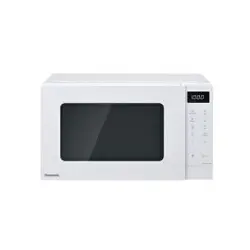
Operating Instructions
Microwave Oven
Household Use Only
Model No. NN-ST23QM
NN-ST22QB
NN-ST21QW
We are glad you have chosen to purchase a PANASONIC microwave oven. Before
operating this oven, please read these instructions carefully and completely, and
keep them for further reference.
If you have never used a microwave oven before, you will realise that a microwave
oven uses a totally different method of converting energy into heat. This requires an
understanding of what exactly happens to food when placed in the oven. This is
explained in the following pages.
After reading the introductory chapter, I am sure you will be able to master the basic
technique and thereby develop a firm understanding of your new oven.
Start experimenting now, and enjoy the first class results you will achieve by using
your new microwave oven.
Panasonic Australia Pty Ltd
1 Innovation Road
Macquarie Park
NSW 2113
PANASONIC NZ LTD
CUSTOMER CARE CENTRE
18 Sir Woolf Fisher Drive
Highbrook, Auckland 2013
Private Bag 14911
Panmure, Auckland
Phone: (09) 272-0178
Fax: (09) 272-0129
Email:
Website:
www.panasonic.co.nz/support
The serial number of this product may
be found on the identification label. You
should note the model number and
serial number of this oven in the space
provided and retain this book as a
permanent record of your purchase for
future reference.
MODEL NUMBER
SERIAL NUMBER
DATE OF PURCHASE

1
Thank you for purchasing a Panasonic appliance.
Important Safety Instructions:
Before operating this oven, please read these instructions and precautions
carefully and keep for future reference.
Contents
Important safety instructions........................................... 2
General guidelines.......................................................... 7
Containers to use ........................................................... 9
Parts of your oven .........................................................11
Control panel ................................................................ 12
Setting the clock ........................................................... 13
Child safety lock ........................................................... 13
Microwave cooking and defrosting ............................... 14
Multi-stage cooking....................................................... 16
Quick 30 feature .......................................................... 17
Add time feature ........................................................... 17
Using the timer ............................................................. 18
Auto programmes ......................................................... 20
Auto defrost .............................................................. 20
Auto menu ................................................................ 22
Defrosting charts .......................................................... 25
Reheating charts .......................................................... 26
Cooking charts.............................................................. 28
Recipes......................................................................... 32
Cooking and reheating guidelines ................................ 42
Questions and answers ................................................ 43
Care of your oven ......................................................... 44
Specifications ............................................................... 45
Panasonic Warranty (Australia) .................................... 46
Panasonic Warranty (New Zealand) ............................. 48

2
WARNING
1.
The door seals and seal areas
should be cleaned with a damp
cloth.
The appliance should be inspected
for damage to the door seals and
door seal areas and if these areas
are damaged the appliance should
not be operated until it has been
repaired by a service technician
trained by the manufacturer.
2.
Liquids and other foods must not
be heated in sealed containers
since they are liable to explode.
3.
WHEN YOUR OVEN REQUIRES
SERVICING, call your local
Panasonic engineer (Customer
Support). It is hazardous for
anyone other than a competent
person to carry out any service
or repair operation which
involves the removal of a cover
which gives protection against
exposure to microwave energy.
CAUTION
1. Do not attempt to tamper with
or make any adjustments or
repairs to the door, control
panel housing, safety interlock
switches or any other part of
the oven. Do not remove the
outer panel from the oven
which gives protection against
exposure to microwave energy.
Repairs should only be done by
a qualified service person.
2.
Do not operate this appliance if it
has a damaged CORD OR PLUG,
if it is not working properly, or if it
has been damaged or dropped. It
is dangerous for anyone other
than a service technician trained
by the manufacturer to perform
repair service.
3. If the supply cord is damaged, it
must be replaced by the
manufacturer, its service agent
or similarly qualified person in
order to avoid a hazard.
4. This appliance is not intended
for use by persons (including
children) with reduced physical,
sensory or mental capabilities,
or lack of experience and
knowledge unless they have
been given supervision or
instruction concerning use of
the appliance by a person
responsible for their safety.
Children should be supervised
to ensure that they do not play
with the appliance.
5. The microwave oven is
intended for heating food and
beverages. Drying of food,
newspaper or clothing and
heating of warming pads,
slippers, sponges, damp cloth
and similar may lead to risk of
injury, ignition or fire.
6. Before use, check that utensils/
containers are suitable for use
in microwave ovens.
7. The oven will only operate with
the door closed.
8. When the oven is not being
used, do not store any objects
other than oven accessories
inside the oven in case it is
accidentally turned on.
9. The appliance shall not be
operated WITHOUT FOOD IN
THE OVEN.
Operation in this manner may
damage the appliance.
Important safety instructions
3
10. If smoke or a fire occurs in the
oven, press Stop/Reset and
leave the door closed in order
to stifle any flames.
Disconnect the power cord, or
shut off the power at the fuse or
the circuit breaker panel.
11.
The oven lamp must be
replaced by a service technician
trained by the manufacturer. Do
not attempt to remove the outer
casing from the oven.
Installation
Examine your microwave oven
Unpack the oven, remove all
packing material, and examine the
oven for any damage such as dents,
broken door latches or cracks in the
door. If you find any damage, notify
your dealer immediately. Do not
install a damaged microwave oven.
Earthing Instructions
IMPORTANT: THIS UNIT HAS TO
BE PROPERLY EARTHED FOR
PERSONAL SAFETY.
If your AC outlet is not earthed, it is
the personal responsibility of the
customer to have it replaced with a
properly earthed wall socket.
Operation Voltage
The voltage has to be the same as
specified on the label on the oven. If a
higher voltage than specified is used,
it may cause a fire or other damages.
WE CERTIFY THAT THIS
MICROWAVE OVEN HAS BEEN
INSPECTED AND COMPLIES
WITH THE REQUIREMENTS OF
REGULATION 3, SUBCLAUSE(2),
OF THE MICROWAVE OVENS
REGULATIONS 1982.
(This statement applicable only to
New Zealand.)
Placement of the oven
This appliance is intended to be
used in household and similar
applications such as:
• staff kitchen areas in shops, offices
and other working environments;
• farm houses;
• by clients in hotels, motels and
other residential environments;
• bed and breakfast type environments.
1. Place the oven on a flat and
stable surface, more than
85 cm above the floor.
The appliance is freestanding
type and shall not be placed in
a cabinet.
2. When this oven is installed, it
should be easy to isolate the
appliance from the electricity
supply by pulling out the plug or
operating a circuit breaker.
3. For proper operation, ensure
sufficient air circulation for the
oven.
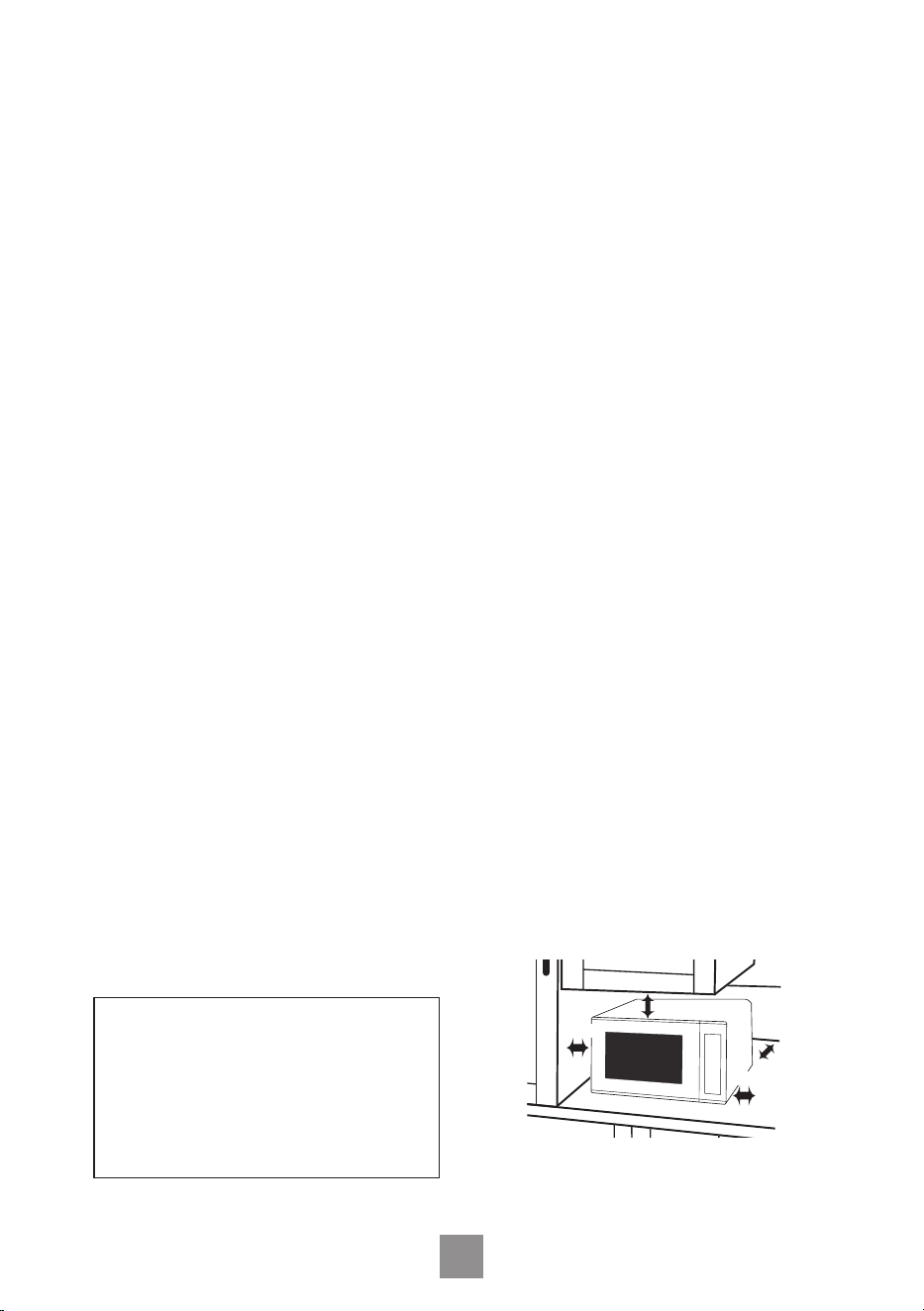
Counter-top use:
a.
Allow 15 cm of space on the
top of the oven, 10 cm at the
back and on 5 cm both sides.
b. If one side of the oven is
placed flush to a wall, the
other side or top must not be
blocked.
10 cm
15 cm
5 cm
5 cm
counter top

4
Important safety instructions
4. Do not place this oven near an
electric or gas cooker range.
5. The feet should not be
removed.
6. This oven is only for household
usage. Do not use outdoors.
7. Avoid using the microwave
oven in high humidity.
8. The power cord should not
touch the outside of the oven.
Keep the cord away from hot
surfaces. Do not let the cord
hang over the edge of a table or
work top. Do not immerse the
cord, plug or oven in water.
9. Do not block the air vents. If
these openings are blocked
during operation the oven may
overheat. In this case the oven
is protected by a thermal safety
device and resumes operation
only after cooling down.
10. When it becomes necessary to
replace the oven light, please
consult your dealer.
Accessories
The oven comes equipped with a
variety of accessories. Always
follow the directions given for use
of the accessories.
Roller ring
The roller ring and the oven floor
should be cleaned frequently to
prevent noise and build-up of
remaining food.
The roller ring must always be
used for cooking together with
the glass tray.
Glass tray
Always operate the oven with the
roller ring and glass tray in place.
Only use the glass tray
specifically designed for this
oven. Do not substitute with any
other glass tray.
If the glass tray is hot, let it cool
before cleaning or placing in
water.
The glass tray can turn in either
direction.
If the food or cooking vessel on
the glass tray touches the oven
walls and stops the tray rotating,
the tray will automatically rotate
in the opposite direction. This is
normal. Open oven door,
reposition the food and restart.
Do not cook foods directly on the
glass tray. Always place food in a
microwave safe dish.
While cooking, the glass tray may
vibrate. This will not affect
cooking performance.
Short cooking time
As microwave cooking time is
much shorter than other cooking
methods, it is essential that
recommended cooking time is not
exceeded without first checking the
food.
Factors that may affect cooking
time are: preferred degree of
cooking, starting temperature,
altitude, volume, size and shape of
foods and utensils used. As you
become familiar with the oven, you
will be able to adjust these factors.

5
It is better to undercook rather than
overcook foods. If food is
undercooked, it can always be
returned to the oven for further
cooking. If food is overcooked,
nothing can be done. Always start
with minimum cooking time.
Important
If the recommended cooking time
is exceeded, the food will be
spoiled and in extreme
circumstances could catch fire
and possibly damage the interior
of the oven.
Small quantities of food
Take care when heating small
quantities of food as these can
easily burn, dry out or catch fire if
cooked too long. Always set short
cooking time and check the food
frequently.
Foods low in moisture
Take care when heating foods low
in moisture, e.g. bread items,
chocolate, popcorn, biscuits and
pastries. These can easily burn,
dry out or catch on fire if cooked
too long. We do not recommend
heating foods low in moisture such
as popcorn.
This oven has been developed for
food use only.
We do not recommend to use for
heating non food items such as
Therapeutic wheat/heat bags or hot
water bottles.
Reheating
It is essential that reheated food is
served “piping hot”.
Remove the food from the oven and
check that it is “piping hot”, i.e. steam
is being emitted from all parts and all
sauce is bubbling. (You may choose
to check the food has reached 72 °C
with a food thermometer – but
remember do not use this
thermometer inside the microwave.)
For foods that cannot be stirred,
e.g. lasagne, shepherds pie, the
centre should be cut with a knife to
test it is well heated through. Even if
a manufacturer’s packet instructions
have been followed always check
the food is piping hot before serving
and if in doubt return your food to
the oven for further heating.
Standing time
Standing time refers to the period
at the end of cooking or reheating
when food is left before being
eaten, i.e. it is a rest time which
allows the heat in the food to
continue to conduct to the centre,
thus eliminating cold spots.
Cleaning
Clean the inside of the oven, door
seals and door seal areas regularly.
When food splatters or spilled
liquids adhere to the oven walls,
door seals and door seal areas
wipe off with a damp cloth.
Failure to maintain the oven in a clean
condition could lead to deterioration of
surfaces that could adversely affect
the life of the appliance and possibly
result in a hazardous situation.
A steam cleaner is not to be used
for cleaning.

6
Important safety instructions
Lids
Always remove the lids of jars and
containers and takeaway food
containers before you microwave the
food. If the lid remains, then steam
and pressure might build up inside
and cause an explosion even after
the microwave cooking has stopped.
Babies bottles and food jars
When reheating babies bottles always
remove top and teat. Liquid at the top
of the bottle will be much hotter than
that at the bottom and must be
shaken thoroughly before checking
the temperature. This should be
carried out before consumption to
avoid burns. See page 42.
Boiled eggs
Eggs in their shell and whole
hard-boiled eggs should not be
heated in microwave ovens since
they may explode even after
microwave heating has ended.
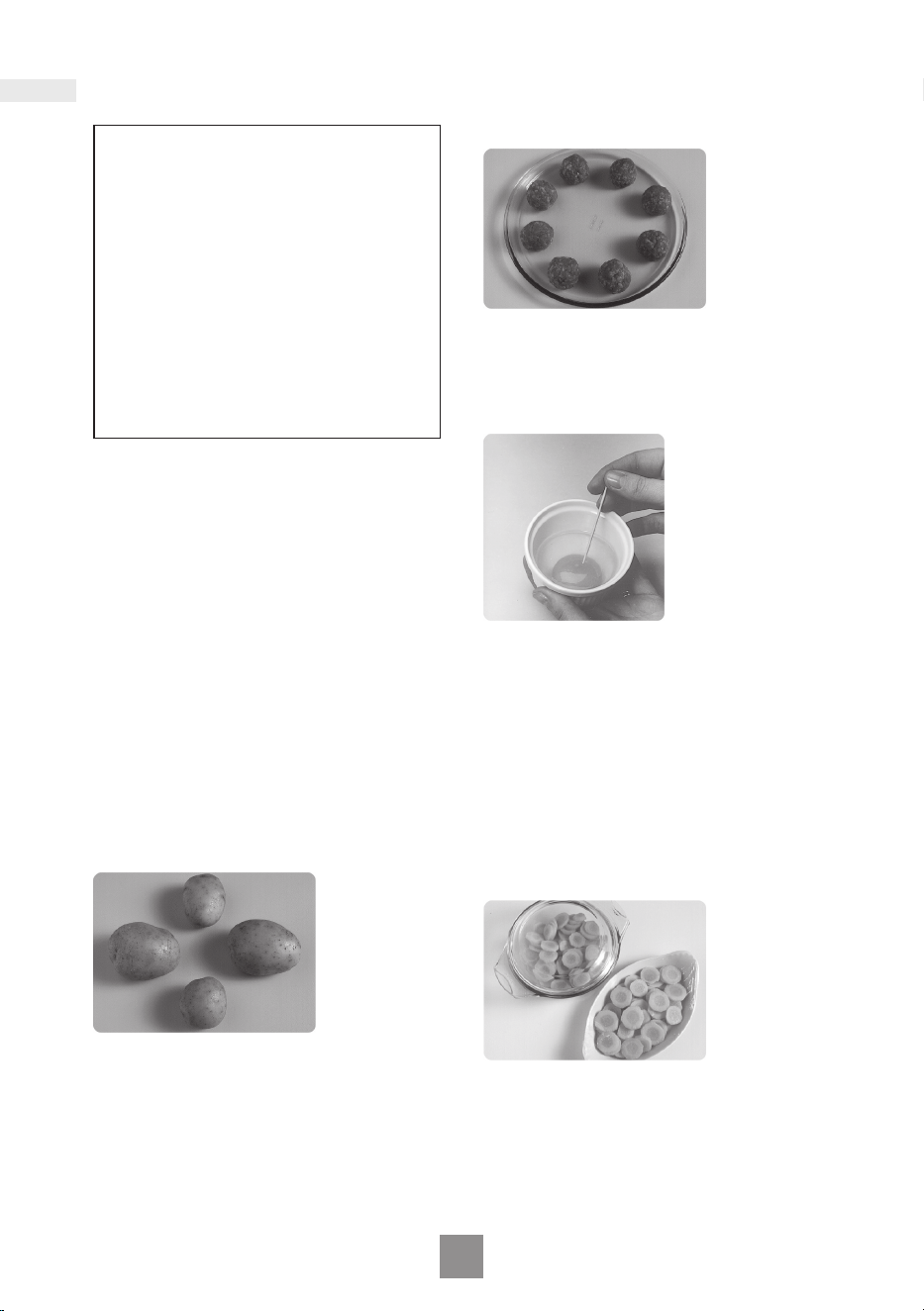
Foods with skins
Potatoes, apples, egg yolk, whole
vegetables and sausages are
examples of food with non porous
skins. These must be pierced using
a fork before cooking to prevent
bursting.
Paper and plastic
When heating food in plastic or paper
containers, keep an eye on the oven
due to the possibility of ignition. Do
not use wire twist-ties with roasting
bags as arcing will occur.
Do not use re-cycled paper products,
e.g. Kitchen roll unless they say they
are specifically designed for use in a
microwave oven. These products
contain impurities which may cause
sparks and/or fires when used.
Liquids
Microwave heating of beverages
can result in delayed eruptive
boiling, therefore care should be
taken when handling the container.
To prevent the possibility of sudden
boil the following steps should be
taken:
a) Avoid using straight-sided
containers with narrow necks.
b) Do not overheat.
c)
Stir the liquid before placing the
container in the oven and again
halfway through the heating time.
d) After heating, allow to stand in
the oven for a short time, stirring
again before carefully removing
the container.
Deep fat frying
Do not attempt to deep fat fry in
your oven.
Arcing
Arcing may occur accidentally if a
metallic container has been used
or the incorrect weight of food is
used. Arcing is flashes of blue light
seen in the microwave oven. If this
occurs, stop the machine
immediately. If the oven is left
unattended and this continues it
can damage the machine.
Meat thermometer
Use a meat thermometer to check the
degree of cooking of joints and poultry
only when meat has been removed
from the microwave. If undercooked,
return to the oven and cook for a few
more minutes at the recommended
power level. Do not leave a
conventional meat thermometer in the
oven when microwaving.
7
General guidelines
CLEANING
As microwaves work on food
particles, keep your oven clean at all
times. Stubborn spots of food can be
removed by using a microwave spray
cleaner, sprayed onto a soft cloth.
Always wipe the oven dry after
cleaning.
Refer to “Care of your oven” on page
44 for details on cleaning.
The warranty only applies if the
product has been used in accordance
with the operating instructions under
normal use and reasonable care.
STANDING TIME
Dense foods e.g. meat, jacket potatoes
and cakes, require standing time
(inside or outside of the oven) after
cooking, to allow heat to finish
conducting to the centre of the food to
cook through completely. Wrap meat
joints and jacket potatoes in aluminium
foil while standing. Meat joints need
approx. 10–15 minutes, jacket potatoes
5 minutes. Other foods such as plated
meals, vegetables, fish etc. require
2–5 minutes standing. If food is not
cooked after standing time, return to
the oven and cook for additional time.
After defrosting food, standing time
should also be allowed.
QUANTITY
Small quantities cook faster than large
quantities, and small meals will reheat
more quickly than large portions.
SPACING
Foods cook more quickly and evenly if
spaced apart. NEVER pile foods on top
of each other.
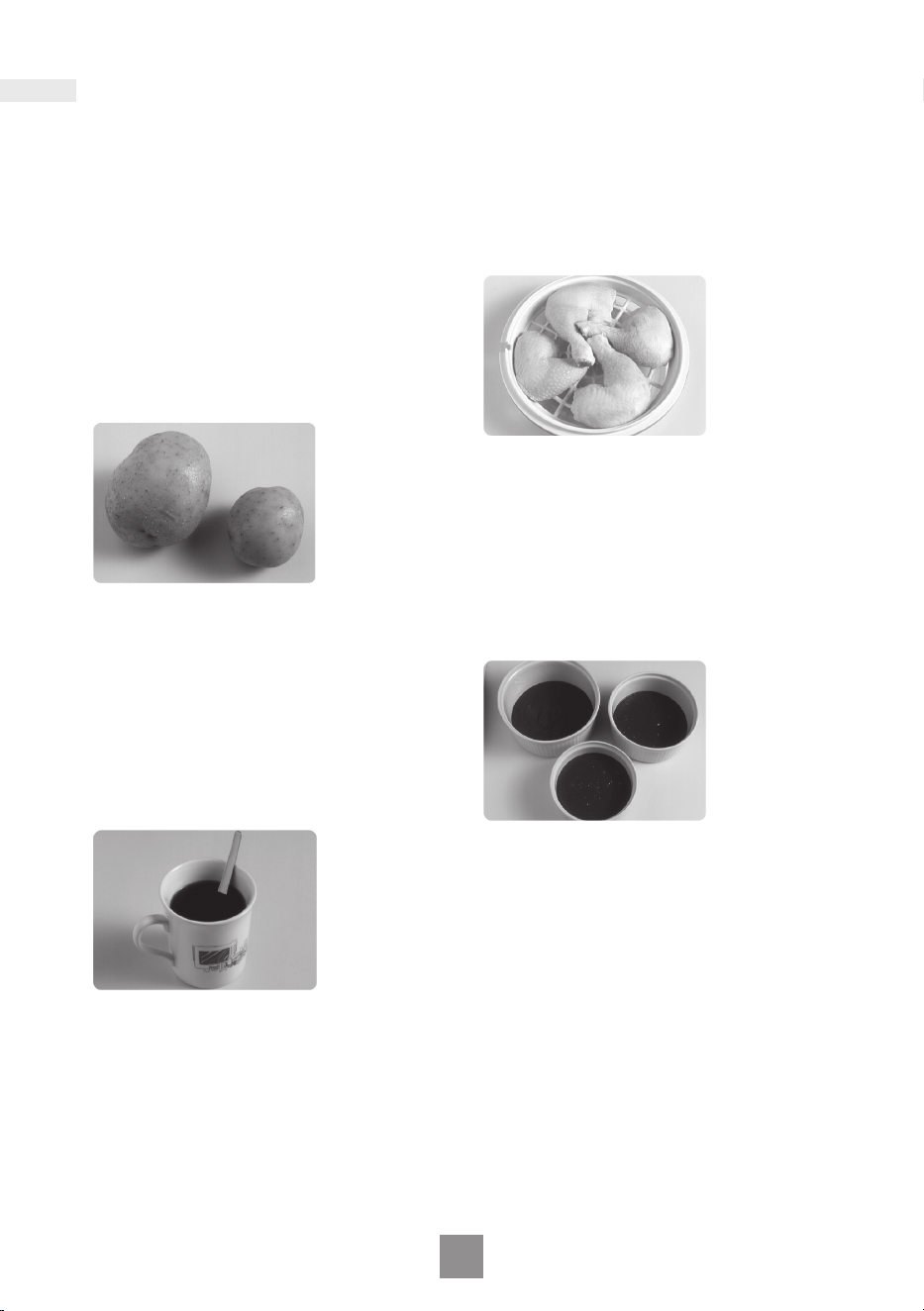
PIERCING
The skin or membrane on some foods
will cause steam to build up during
cooking.
These foods must be pierced or a strip
of skin should be peeled off before
cooking to allow the steam to escape.
Eggs, potatoes, apples, sausages etc,
will all need to be pierced before
cooking. DO NOT ATTEMPT TO BOIL
EGGS IN THEIR SHELLS.
COVERING
Cover foods with microwave cling film
or a lid. Cover fish, vegetables,
casseroles, soups. Do not cover cakes,
sauces, jacket potatoes or pastry
items.
8
General guidelines
MOISTURE CONTENT
Many fresh foods e.g. vegetables and
fruit, vary in their moisture content
throughout the season. For this reason
cooking time may have to be adjusted.
Dry ingredients e.g. rice, pasta, can dry
out during storage so cooking time may
differ.
DENSITY
Porous airy foods heat more quickly
than dense heavy foods.
SHAPE
Even shapes cook evenly. Food cooks
better by microwave when in a round
container rather than square.
STARTING TEMPERATURE
The colder the food, the longer it takes
to heat up. Food from a fridge takes
longer to reheat than food at room
temperature.
LIQUIDS
All liquids must be STIRRED BEFORE,
DURING AND AFTER heating. Water
must be stirred before and during
heating, to avoid eruption.
Do not heat liquids that have previously
been boiled. DO NOT OVERHEAT.
TURNING AND STIRRING
Some foods require stirring during
cooking. Meat and poultry should be
turned after half of the cooking time.
ARRANGING
Individual foods e.g. chicken portions
or chops, should be placed on a dish
so that the thicker parts are towards
the outside.
CHECKING FOOD
It is essential that food is checked
during and after a recommended
cooking time, even if an AUTO
PROGRAMME has been used (just as
you would check food cooked in a
conventional oven). Return the food to
the oven for further cooking if
necessary.
DISH SIZE
Follow the dish sizes given in the
recipes, as these affect the cooking
and reheating times.
A quantity of food spread in a bigger
dish cooks and reheats faster.
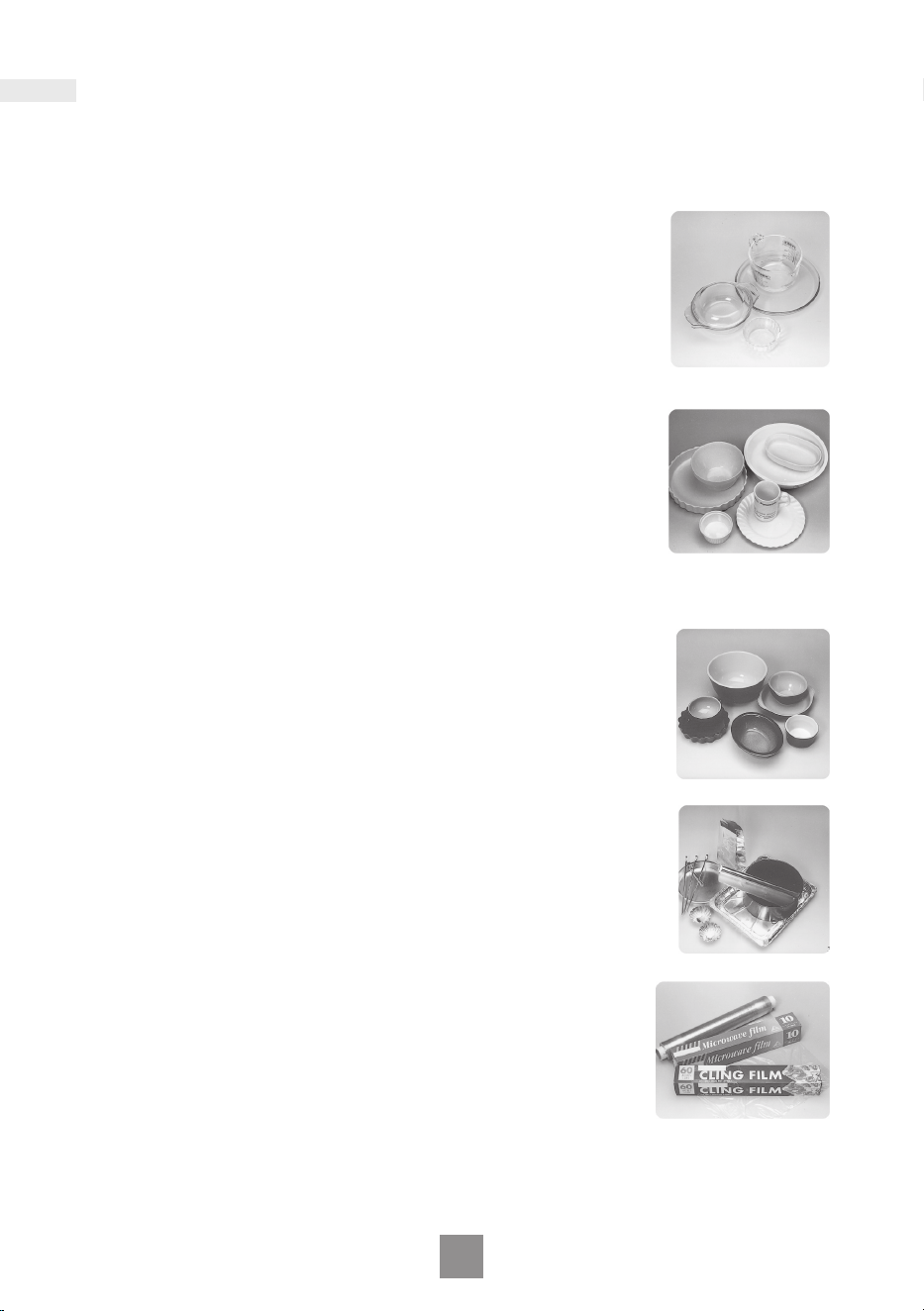
CLING FILM
Cling film helps keep the food moist
and the trapped steam assists in
speeding up cooking time. Pierce
before cooking to allow excess steam
to escape. Always take care when
removing cling film from a dish as the
build-up of steam will be very hot.
9
Containers to use
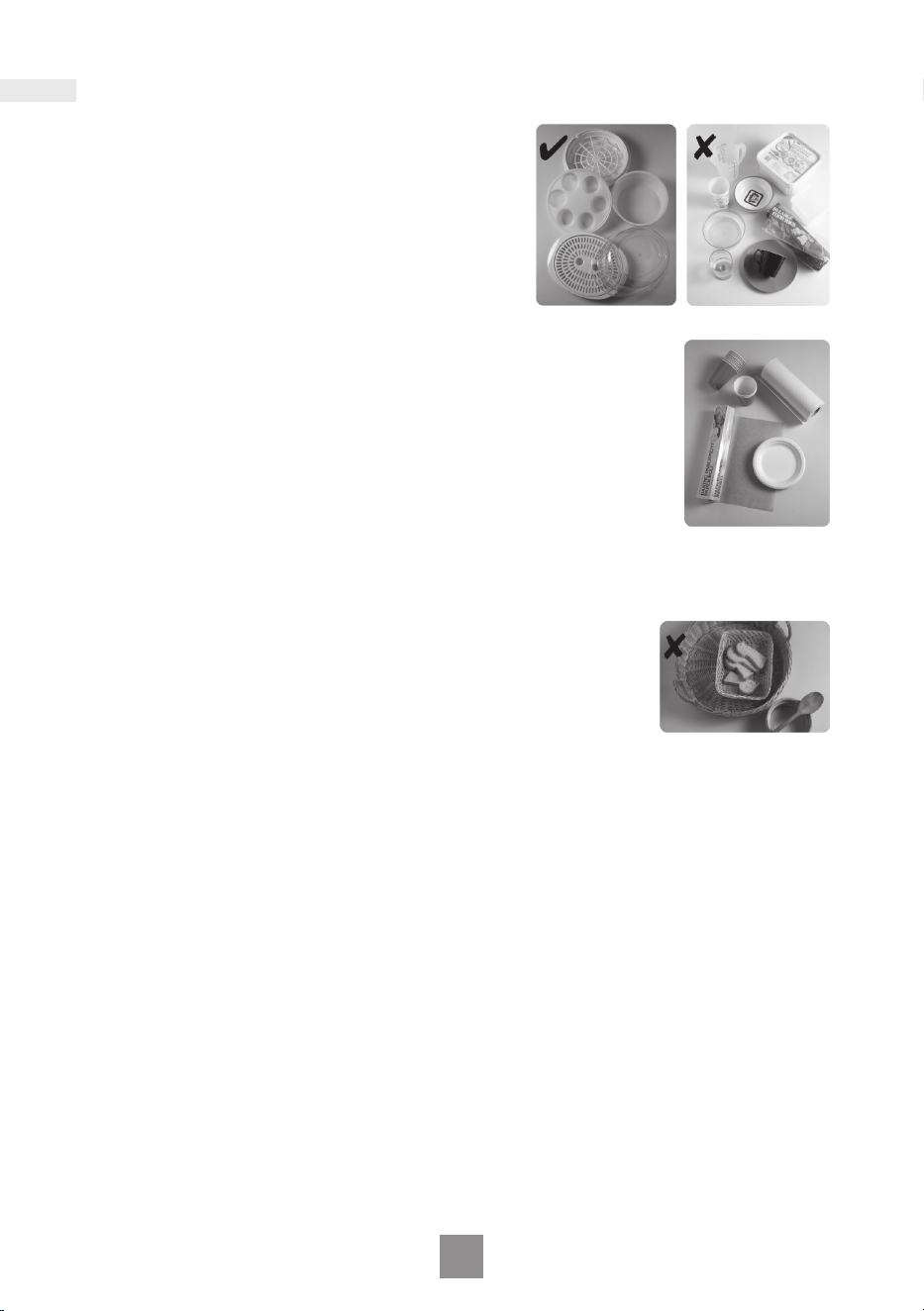
Choosing the correct container is a very important factor in deciding the success or
failure of your cooking.
OVEN GLASS
Glass that is heat resistant e.g. Pyrex
®
, is ideal, and can be
used.
Do not use glass which may crack due to the heat from the
food. Do not use lead crystal which may crack or arc.
CHINA AND CERAMIC
Glazed china plates, saucers, bowls, mugs and cups can be
used if they are heat resistant.
Porcelain and ceramic are also ideal. Fine bone china should
only be used for reheating for short period of time, otherwise
the change in temperature may crack the dish or craze the
finish. Do not use dishes with a metallic rim or pattern. Do not
use jugs or mugs with glued handles, since the glue can melt in
a microwave.
POTTERY, EARTHENWARE, STONEWARE
Only use if completely glazed. Do not use if partially glazed or
unglazed, as they are able to absorb water which will absorb
microwave energy, making the container very hot and slowing
down the cooking of food.
FOIL/METALLIC CONTAINERS
NEVER ATTEMPT TO COOK IN FOIL OR METALLIC containers
– the microwaves cannot pass through and the food will not heat
evenly – this may also damage your oven. Use wooden kebab
sticks instead of metallic skewers.
CLING FILM
Use microwave cling film to cover food that is to be reheated,
or cooked, ON MICROWAVE ONLY taking care to avoid the
film being in direct contact with the food.
10
Containers to use
PLASTIC
Many plastic containers are designed for
microwave use. Only use containers if they are
designed for microwave use. Do not use
Melamine as it will scorch. Do not use plastic for
cooking foods high in sugar or fat or foods that
require long cooking time e.g. brown rice. Never
cook in margarine containers or yogurt pots, as
these will melt with the heat from the food.
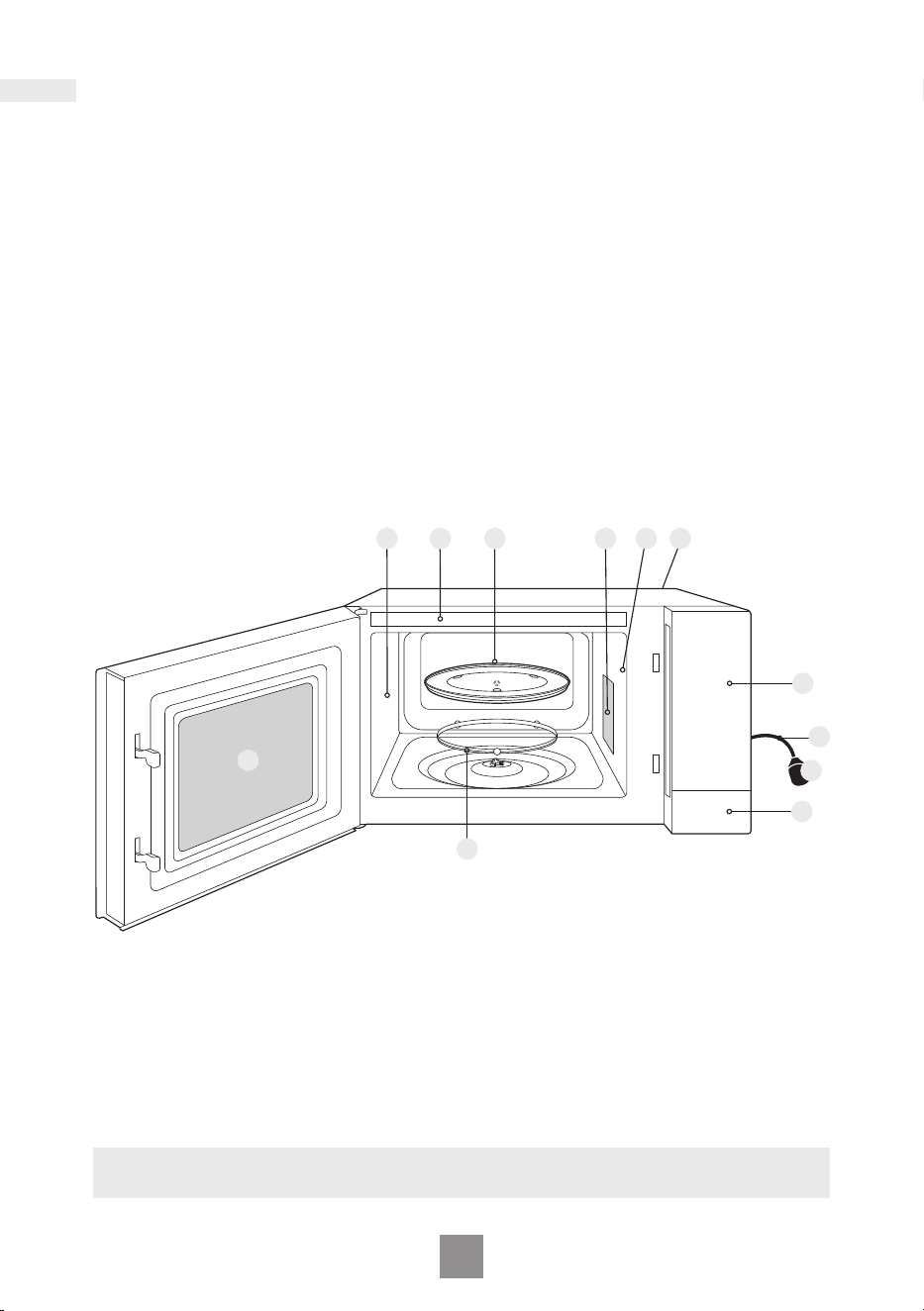
PAPER
Plain white kitchen paper (kitchen towel) can be used for
covering blind pastry cases and for covering bacon to
prevent splattering ONLY USE FOR SHORT COOKING
TIME. NEVER RE-USE A PIECE OF KITCHEN TOWEL.
Avoid kitchen paper containing manmade fibers. Check
that branded re-cycled kitchen towel is recommended for
microwave use. Do not use waxed or plastic coated cups
as the finish may melt in the oven. Greaseproof paper can
be used to line the base of dishes and to cover fatty foods.
White paper plates can be used for SHORT REHEATING
TIMES, ON MICROWAVE ONLY.
WICKER, WOOD, STRAW BASKETS
Do not use these items in your microwave. With
continued use and with prolonged exposure they will
crack and could ignite.
ROASTING BAGS
These are useful when slit up one side to tent a joint of meat
when roasting by power and time. DO NOT USE THE
METALLIC TWISTS SUPPLIED.
11
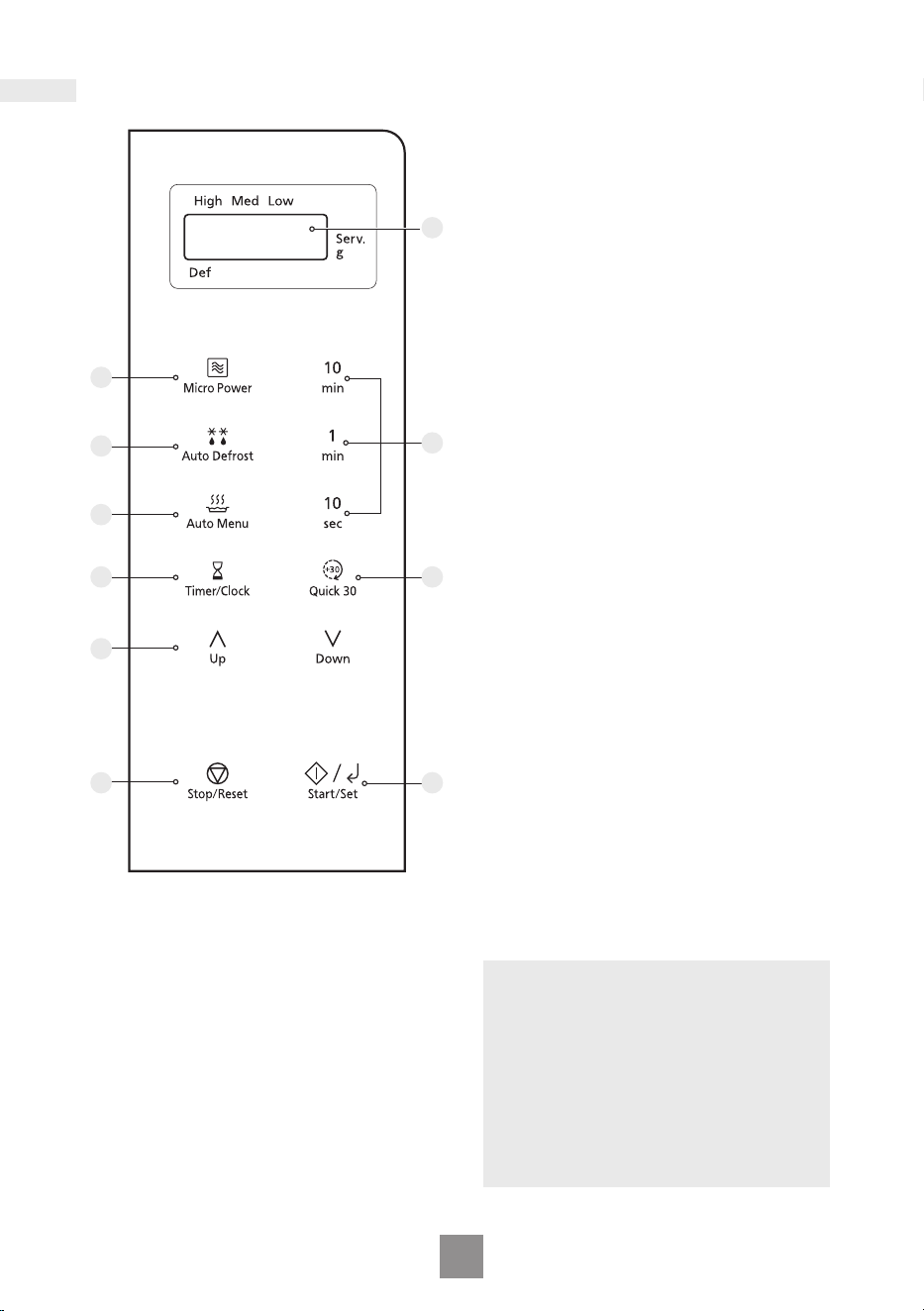
1. Door Release Button
Press to open the door. Opening
the door during cooking will stop
the cooking process without
cancelling the programme. Cooking
resumes after the door is closed
and Start/Set is pressed. It is quite
safe to open the door at any time
during a cooking programme and
there is no risk of microwave
exposure.
2. Oven window
3. Air vent
4. Microwave feed guide
(Do not remove.)
5. External air vents
6. Control panel
7. Power supply cord
8. Plug
9. Glass tray
10. Roller ring
11. Menu label
Parts of your oven
Note
This illustration is for reference only.
Identification and caution labels are attached on the oven.
2
911
10
3
6
8
4 3 5
7
1
12
7
10
2
3
4
6
8
9
1
5
• Your control panel may have
differences in appearance, but the
words on the pads and functionality
will be the same.
Beep sound
When a pad is pressed correctly a
beep will be heard. If a pad is pressed
and no beep is heard, the unit has not
or cannot accept the instruction. The
oven will beep twice between
programmed stages. At the end of any
complete programme, the oven will
beep 5 times.
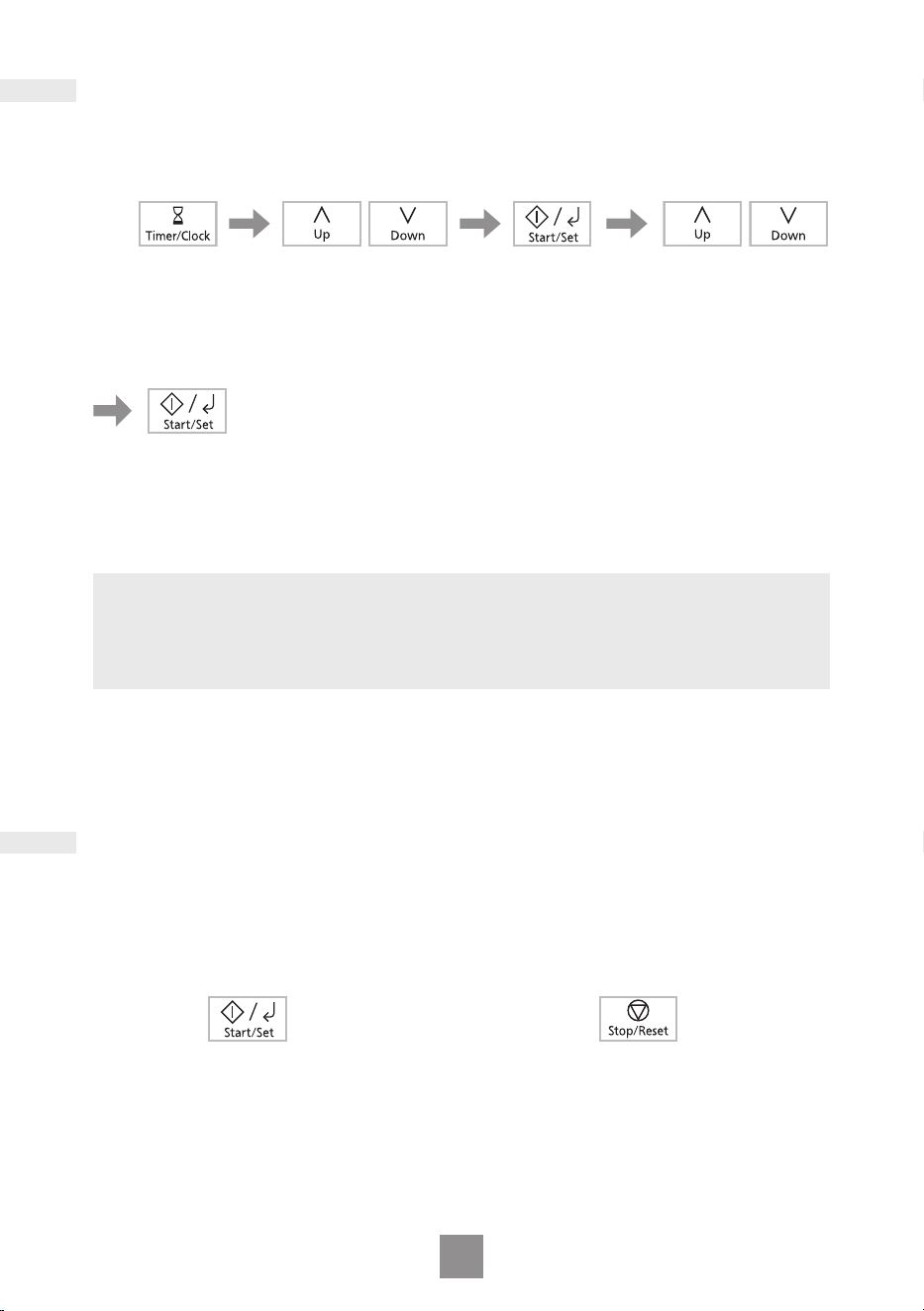
1 Display window
2 Micro Power pad
3 Auto Defrost pad
4 Auto Menu pad
5 Time pads
6 Timer/Clock pad
7 Quick 30 pad
8 Up/Down pads
9 Stop/Reset pad
Before Cooking
One press clears your instructions.
During Cooking
One press temporarily stops the
cooking process. Another press
cancels all your instructions and a
dot or the time of day will appear in
the display.
10 Start/Set pad
One press allows oven to begin
operation. If door is opened or
Stop/Reset is pressed once during
oven operation, Start/Set must be
pressed again to restart oven.
Notes
1. If Start/Set is not pressed for
6 minutes after cooking
programme setting, the oven will
automatically cancel the cooking
programme. The display will revert
back to clock or dot.
2. Place the oven with the display
window no higher than eye level
for optimal viewing experience.
Control panel
13
Setting the clock
When the oven is plugged in for the first time, “88.88” appears in display.
Press Start/Set.
Time of day is now
locked into the
display.
Press Timer/Clock
twice.
Hour starts to blink.
Press Up/Down
to set hours.
Press Start/Set.
Minute starts to
blink.
Press Up/Down
to set minutes.
Notes
1. To reset the clock, repeat the whole step above.
2. The clock will keep the time of day as long as the oven is plugged in and
electricity is supplied.
3. This is a 12 hour clock.
Press Start/Set 3 times within
10 seconds.
The clock will disappear. Actual time
will not be lost. “Child” is indicated in
the display.
To Set:
To Cancel:
Press Stop/Reset 3 times within
10 seconds.
The clock will reappear in the display.
Child safety lock
This feature will make the oven controls inoperable; however, the door can be
opened. Child safety lock can be set when the display shows a dot or the
time.
14
Microwave cooking and defrosting
The glass tray must always be in position when using the oven.
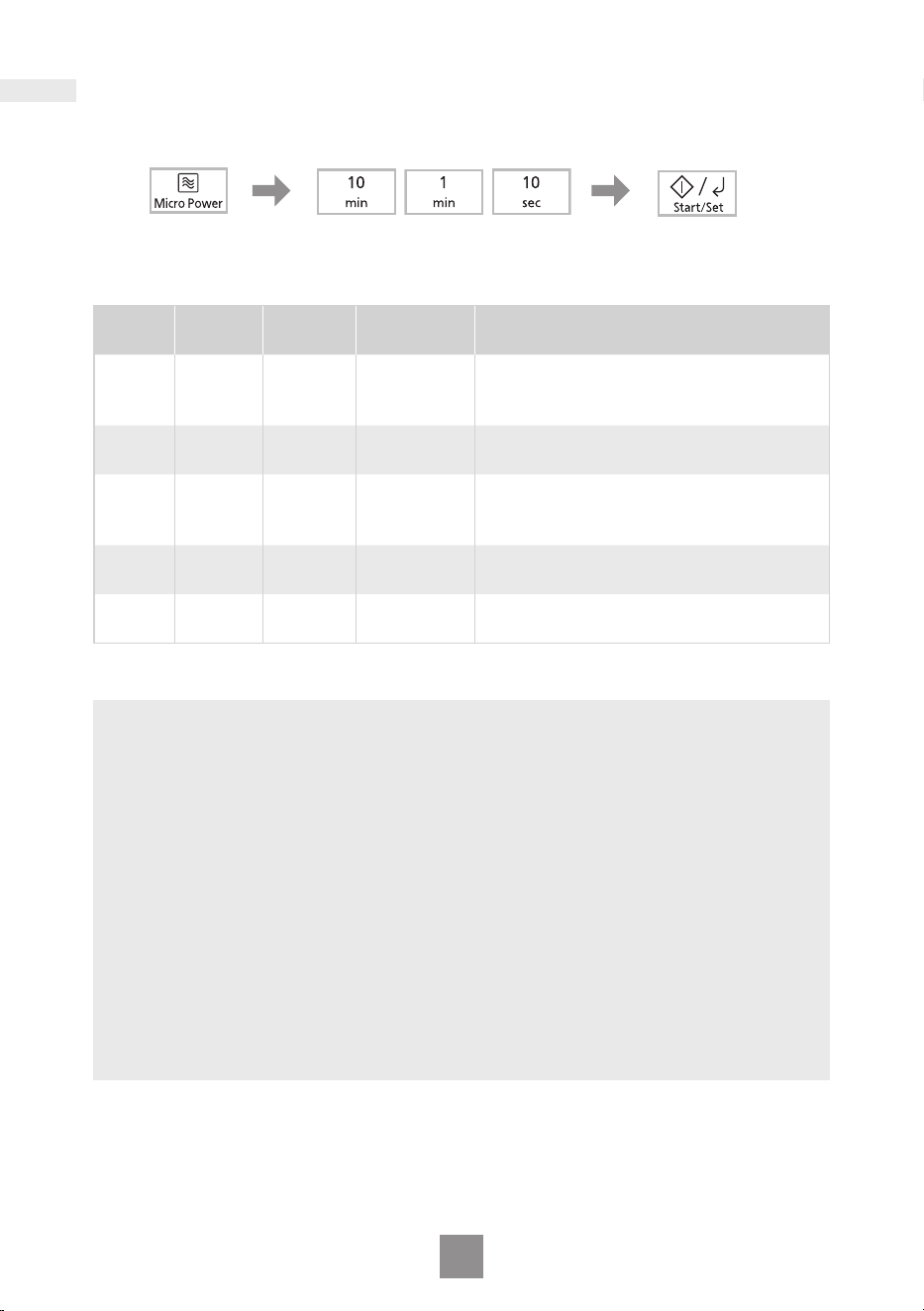
Press Micro Power
to select the desired
power level.
Set the cooking time.
Refer to “Setting the cook
time/timer time” on page 15.
Press Start/Set.
The time counts down
in the display.
Press
Power
Level
Wattage
Max. time
available
Example of Use
once High 800 W 30 minutes
Boil water. Cook fresh fruit,
vegetables, rice, pasta and noodles.
Heat milk.
twice
Med-
High
500 W
99 minutes
50 seconds
Cook poultry, meat, cakes and
desserts.
3 times Medium 400 W
99 minutes
50 seconds
Cook eggs, cheeses, fish, pot roasts,
casseroles and meat loaves. Melt
chocolate.
4 times Defrost 200 W
99 minutes
50 seconds
Thaw foods.
5 times Low 100 W
99 minutes
50 seconds
Keep cooked foods warm, simmer
slowly.
Notes
1. The oven will automatically work on High microwave power if a cooking time is
entered without the power level previously being selected.
2. While cooking, the glass tray may vibrate. This will not affect cooking
performance.
3. For MULTI-STAGE COOKING, refer to page 16.
4. STANDING TIME can be programmed after microwave power and time setting.
Refer to page 18.
5. DO NOT cook with any metallic accessory in the oven.
6. Always check the food during defrosting by opening the door then restarting. It
is not necessary to cover food during defrosting. To ensure an even result, stir,
turn or separate several times during defrosting. For large joints and poultry,
turn halfway through defrosting.
Refer to Defrosting guidelines on page 21 for details.
7. When the microwave oven is operated at High microwave power for long time,
the microwave oven automatically adjust the power to protect the components
of the microwave oven.

15
Setting the cook time/timer time
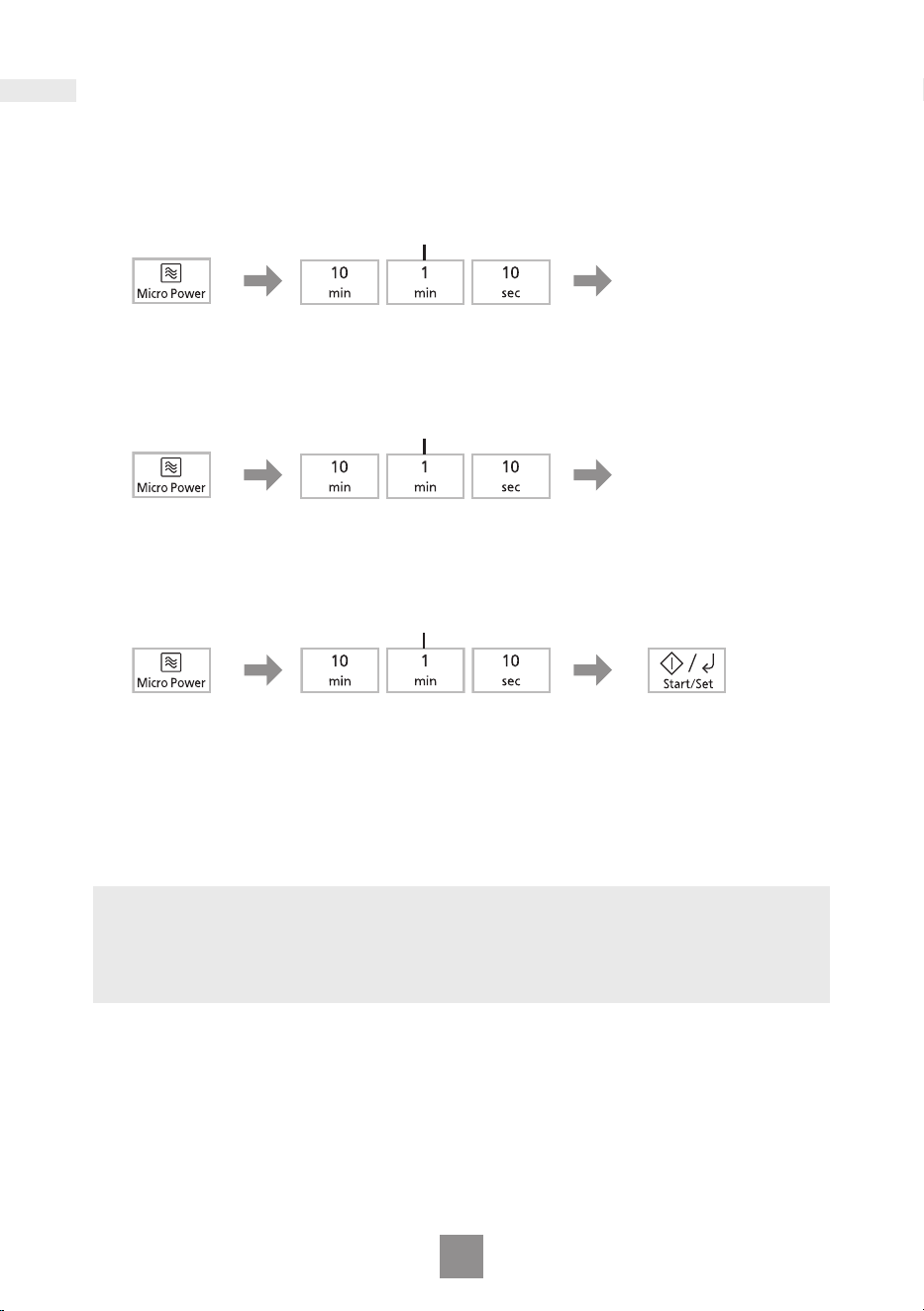
When you set the cook time or the timer time, use following keys according to your
needs.
Press each Time pad repeatedly according
to the time value you want to set.
Press Quick 30 to set cooking time
in 30 seconds increments.
After you enter a time value with each Time pad or Quick 30,
you can adjust the time values with the Up/Down pads.
16
Multi-stage cooking
This feature allows you to programme up to 3 stages of cooking continuously.
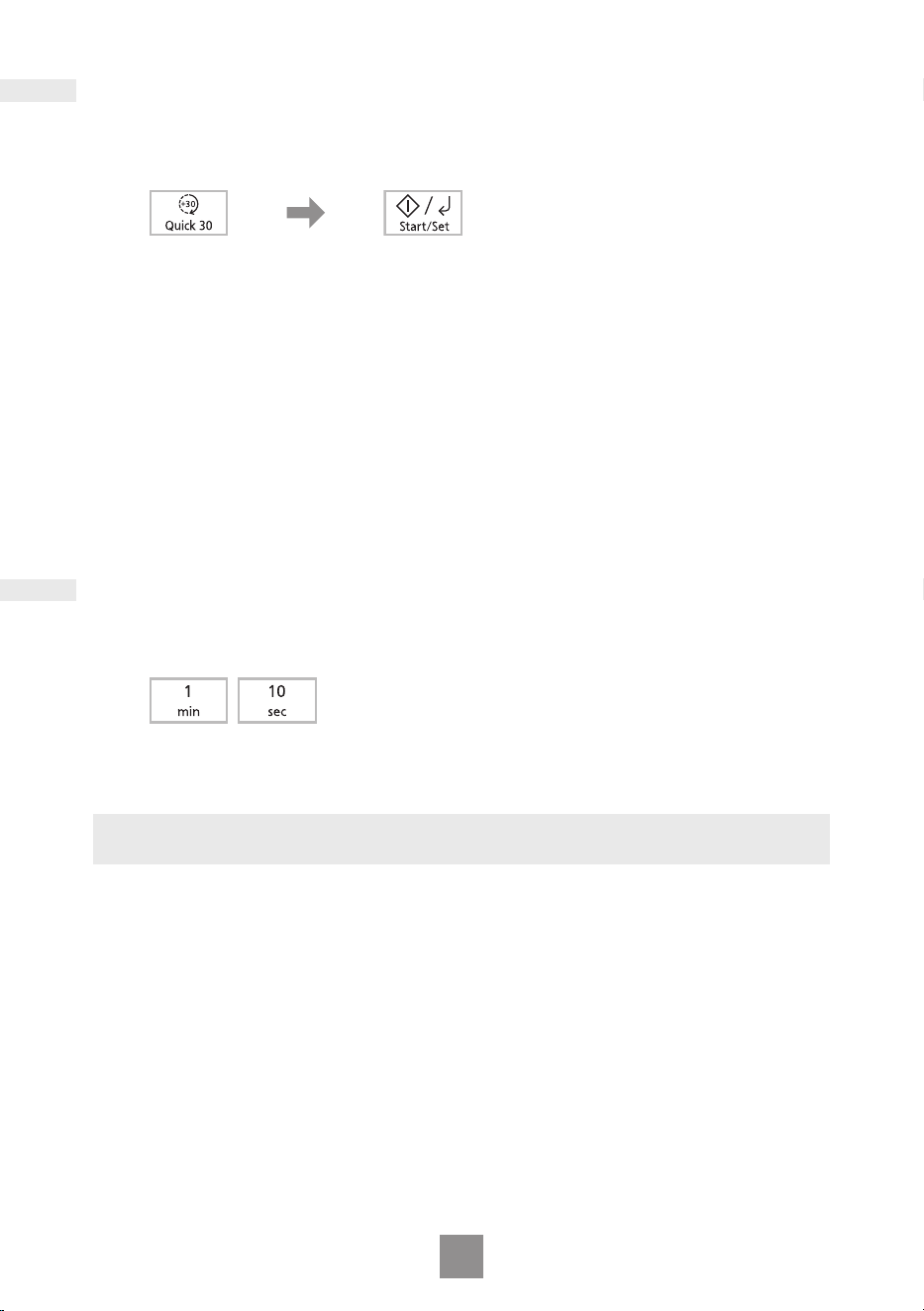
Example: To continually set High power for 2 minutes, Medium power for 3 minutes
and Low power for 2 minutes.
Press Micro
Power once to
select High
power.
Set the cooking time*.
Press twice.
Press Micro
Power twice to
select Medium
power.
Set the cooking time*.
Press 3 times.
Press Micro
Power 4 times to
select Low
power.
Press Start/Set.
The time for the first
stage counts down in
the display.
Set the cooking time*.
Press twice.
* Refer to “Setting the cook time/timer time” on page 15.
Notes
1. AUTO PROGRAMMES cannot be used with MULTI-STAGE COOKING.
2. When operating, 2 beeps will sound between each stage, and 5 beeps will
sound after all stages have finished.
3. High MICROWAVE power can be set only once in MULTI-STAGE COOKING.
17
Quick 30 feature
This feature allows you to set cooking time in 30 seconds increments up to
5 minutes at High power.
Press Quick 30 until
the desired cooking
time appears in the
display.
Press Start/Set.
The time counts
down in the
display.
Add time feature
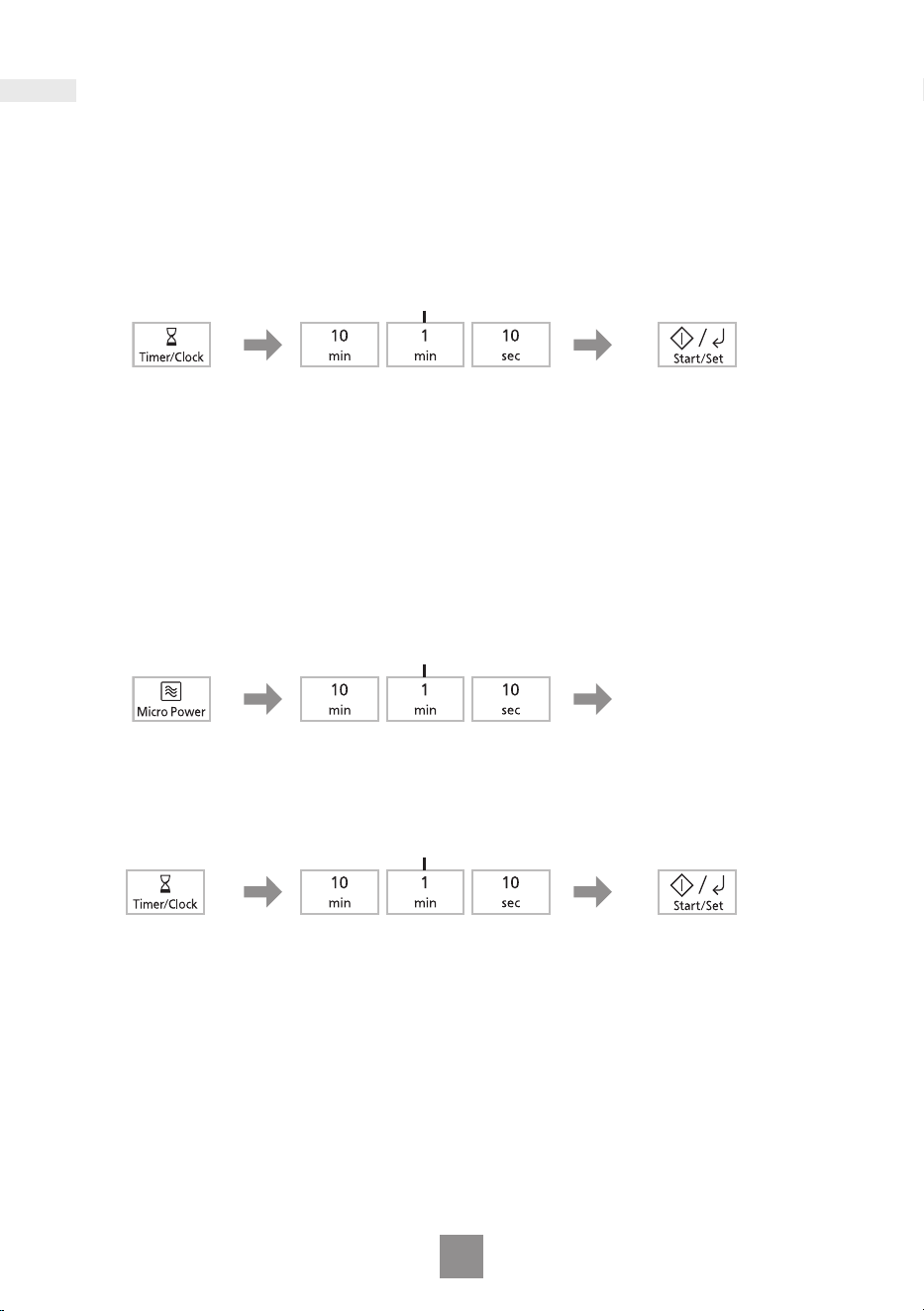
This feature allows you to add cooking time during cooking.
During cooking, press 1 min or 10 sec.
Cooking time will be added up to 5 minutes.
Note
ADD TIME feature is not available for AUTO PROGRAMMES.
18
Using the timer
This feature operates as a KITCHEN TIMER or allows you to programme the
STANDING TIME/DELAY START.
Kitchen timer
Example: To count 5 minutes.
Press Timer/
Clock.
Press Start/Set.
The time counts
down without the
oven operating.
Set the desired time*.
(up to 99 minutes 50 seconds)
Press 5 times.
* Refer to “Setting the cook time/timer time” on page 15.
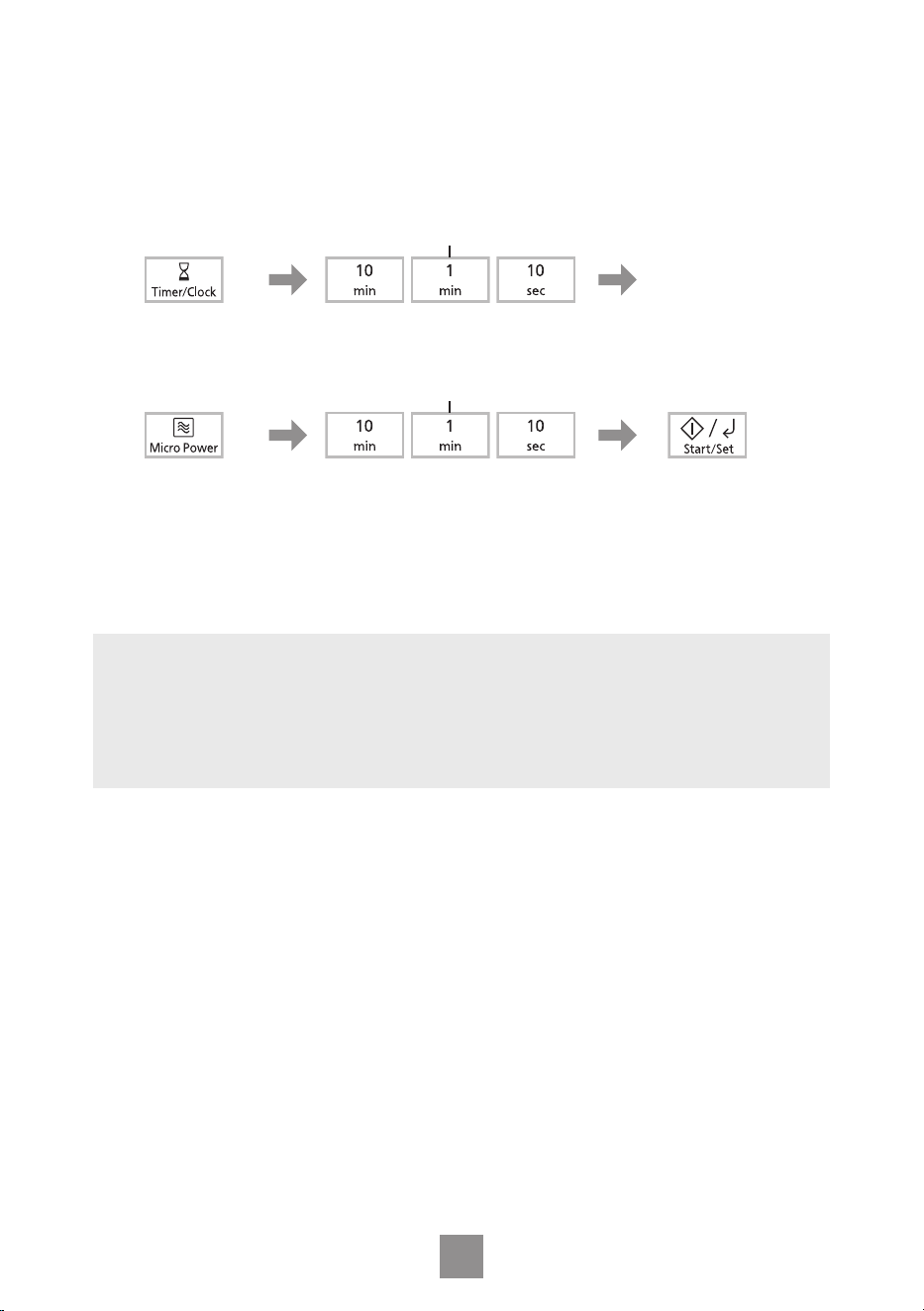
Standing time
Example: To stand for 5 minutes after cooking at Medium power for 3 minutes.
Press Micro
Power 3 times
to select
Medium power.
Set the desired cooking
time*.
Press 3 times.
Press Timer/
Clock.
Press Start/Set.
Cooking starts.
After cooking,
standing time will
count down without
operation.
Set the desired standing
time*.
(up to 99 minutes 50 seconds)
Press 5 times.
* Refer to “Setting the cook time/timer time” on page 15.
19
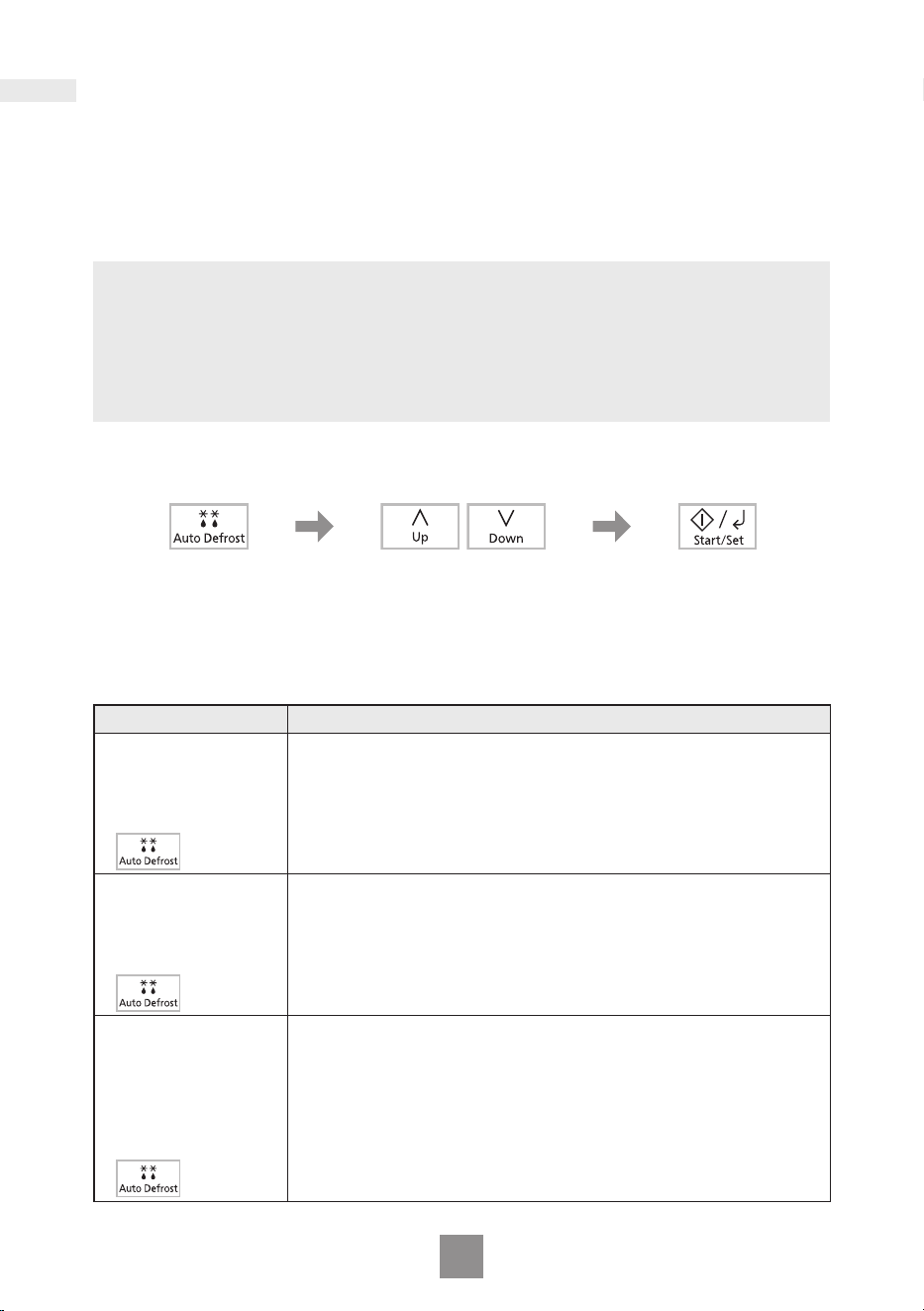
Delay start
Example: To start cooking at Medium power for 3 minutes after 5 minutes of
standing time.
Press Timer/
Clock.
Set the desired delay time*.
(up to 99 minutes 50 seconds)
Press 5 times.
Set the desired cooking
time*.
Press Micro Power
3 times to select
Medium power.
Press 3 times.
Press Start/Set.
Delayed time counts
down, then cooking
will start.
* Refer to “Setting the cook time/timer time” on page 15.
Notes
1. MULTI-STAGE COOKING can be programmed including STANDING TIME or
DELAY START.
2. Even if the oven door is opened during KITCHEN TIMER, STANDING TIME or
DELAY START, the time in the display window will continue to count down.
3. STANDING TIME/DELAY START cannot be programmed before/after any
AUTO PROGRAMME.
20
With this feature you can defrost/reheat/cook food according to the weight.
Select the category and set the weight of the food. The weight is programmed
in grams. The oven determines MICROWAVE power level and cooking time
automatically. For quick selection, the weight starts from the most commonly
used weight for each category. Do not include the weight of any added water
or the container weight.
Notes
1. Always operate the oven with the roller ring and glass tray in place.
2. The AUTO PROGRAMMES must ONLY be used for foods described.
3. Only defrost/cook foods within the weight ranges described.
4. Always weigh the food rather than relying on the package information.
5. Most foods benefit from a STANDING TIME. After cooking with an AUTO
PROGRAMME, allow heat to continue conducting to the centre.
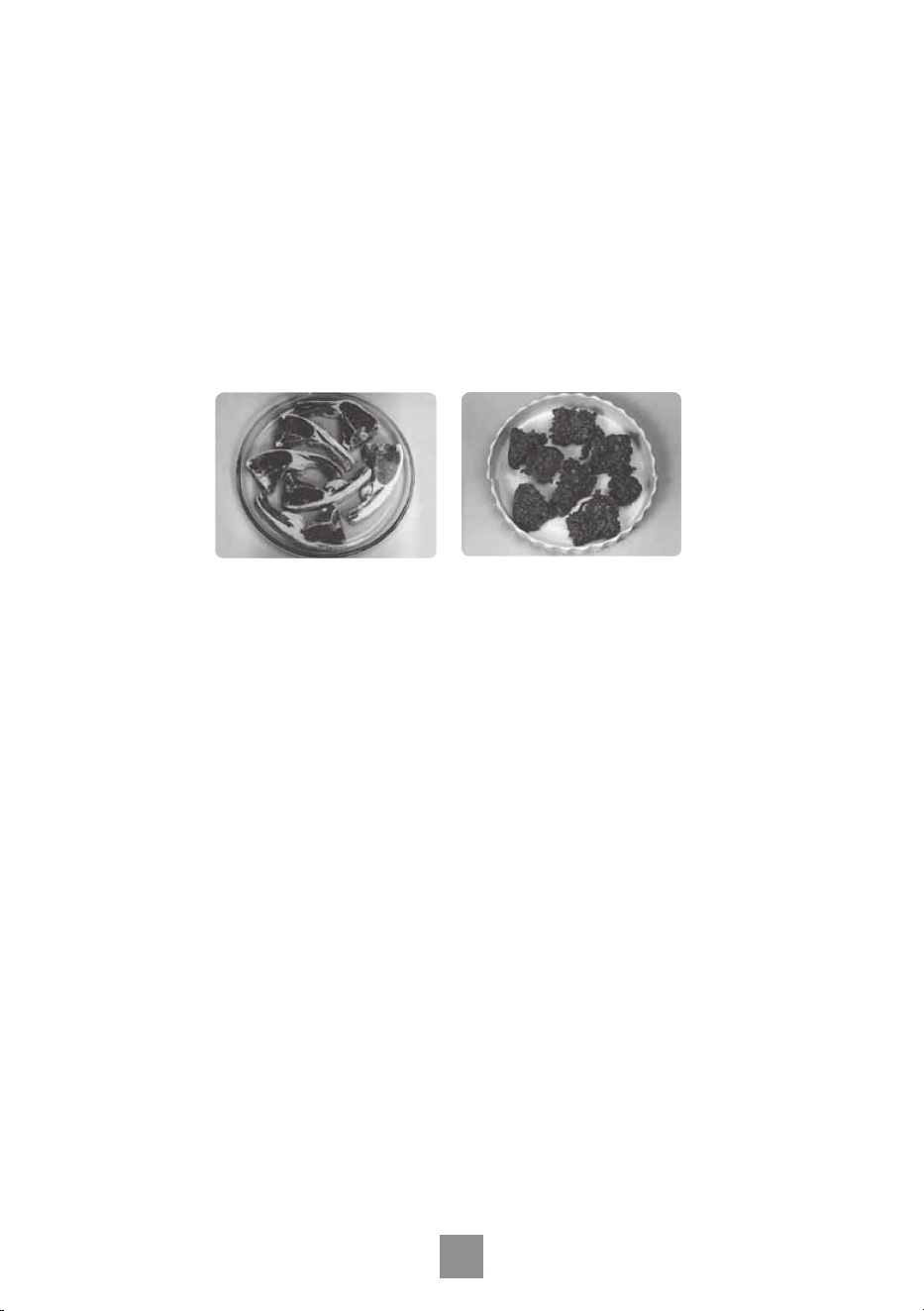
Auto defrost
Press Start/Set.
Remember to stir
or turn the food
during defrosting.
Set the weight of the
frozen food.
The weight counts up/
down in 10 g increments.
Select the desired Auto
Defrost programme.
The AUTO PROGRAMME
number appears in the
display.
Programme Instructions
1. Small Pieces
Weight: 200 - 1000 g
For defrosting small or thin pieces of meat, sausages,
minced meat, steak, chops, fish fillets (each 100 g to 400 g).
Press Auto Defrost once. Set the weight of the food and
press Start/Set. Turn and shield at beeps. Allow to stand for
15 to 30 minutes.
1 press
2. Big Piece
Weight: 600 - 1600 g
For defrosting a big piece of meat, whole chicken, meat
joint. Press Auto Defrost twice. Set the weight of the food
and press Start/Set. Standing time of 1 to 2 hours should be
allowed before cooking, so that the centre of the food thaws
out. Turn at beeps.
2 presses
3. Bread/Cake
Weight: 100 - 600 g
For defrosting bread (whole, slices, rolls) and cakes. Cream
cakes and iced cakes are unsuitable for this programme.
Place the bread or cake on a large plate or shallow dish.
Press Auto Defrost 3 times. Set the weight of the food and
press Start/Set. Turn at beeps. Allow bread to stand for 10
(white light bread) to 30 minutes (dense rye bread). Cut
large loaves in half during standing time.
3 presses
Auto programmes
21
Defrosting guidelines
For best results:
1. Place foods in a suitable container. Meat joints and chicken should be placed on
an upturned saucer.
2. Check food during defrosting, as foods vary in their defrosting speed.
3. It is not necessary to cover the whole food.
4. Always turn or stir the food especially when the oven “beeps”.
5. Minced meat, chops and other small items should be broken up or separated
and placed in a single layer.
6. Allow standing time so that the centre of the food thaws out (minimum of 1 hour
for joints of meat and whole chicken).
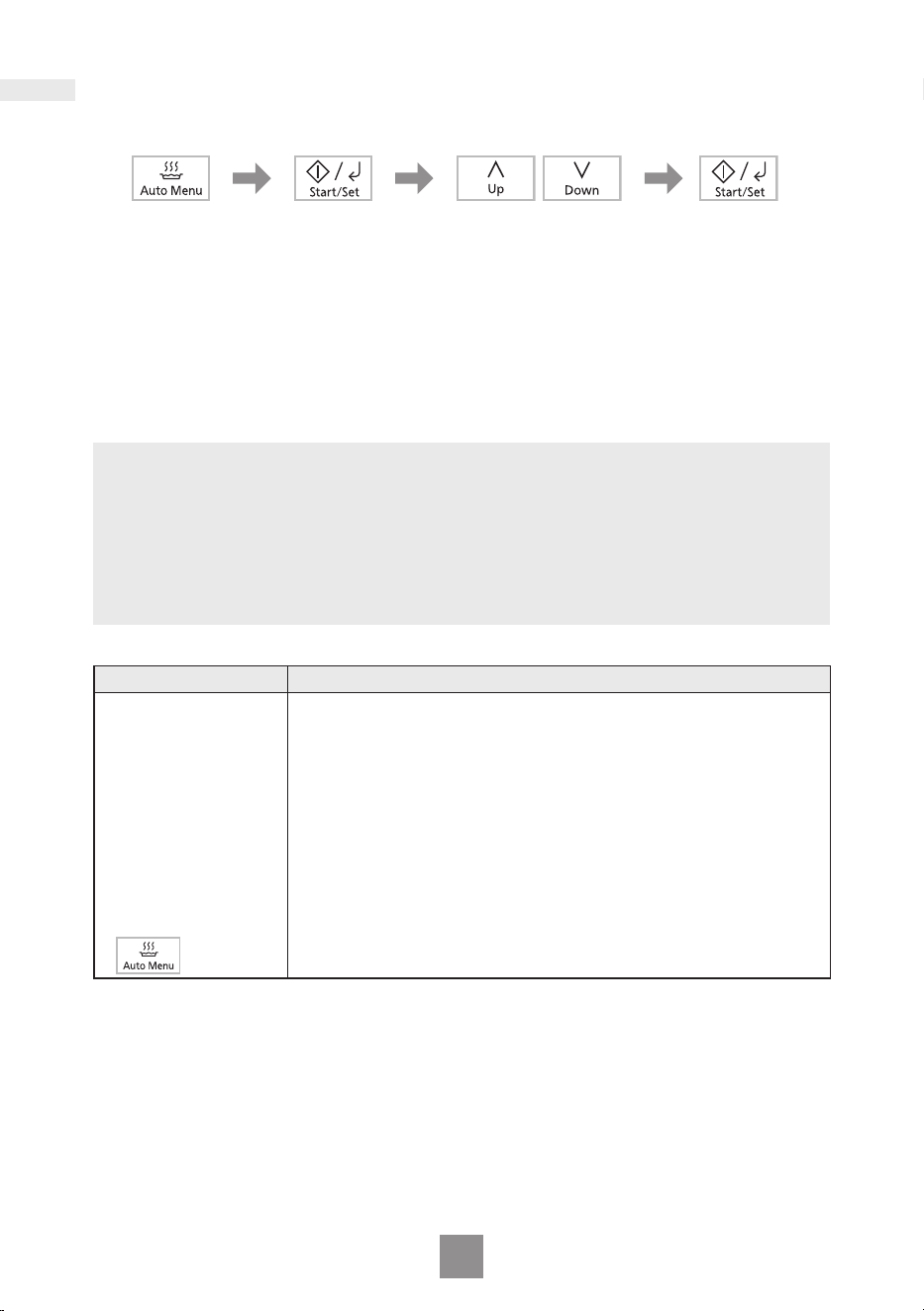
Arrange food in a single
layer.
Turn or break up food as
soon as possible.
22
Auto programmes
Auto menu
Press Start/Set.
The time counts
down in the
display.
Press Start/Set
to confirm the
setting.
Set the weight of
the food.
The weight counts
up/down in 10 g
increments.
Select the desired
Auto Menu
programme*.
The AUTO
PROGRAMME
number appears in
the display.
* After pressing the Auto Menu pad, you can also use the Up/Down pads to select
the Auto Menu programme.
Notes
1. As some variations may occur in food, check that food is thoroughly cooked
and piping hot before serving.
2. Using a casserole with a capacity of 2000 ml or less is recommended.
3. Use a casserole with a width of less than 25 cm (including handle) to avoid
touching the side walls of the oven.
4. Remove a casserole carefully from the oven to avoid hitting the upper side of
the frontage. You can use cling film to cover a casserole.
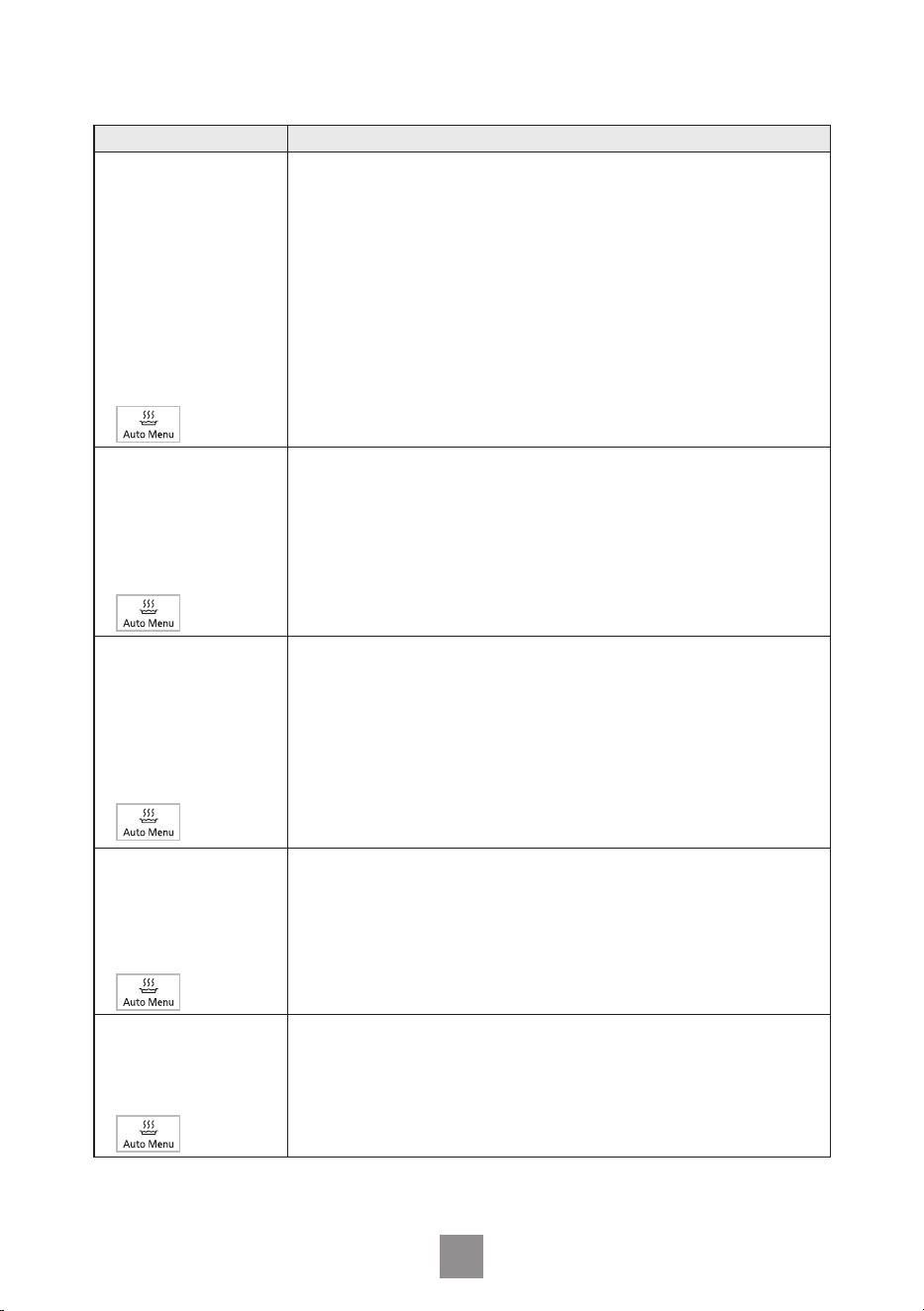
Programme Instructions
1. Chilled Meal
Weight: 200 - 800 g
For reheating a pre-cooked meal. All foods must be pre-
cooked. Foods should be at refrigerator temperature approx.
+5 °C. Reheat in container as purchased. Follow
manufacturer’s directions for preparation. If transferring food
to a dish, cover with pierced cling film. Place container on
glass tray. Press Auto Menu once and press Start/Set. Set
the weight of the food and press Start/Set. Stir at beeps. Stir
again at end of programme and allow a few minutes
standing time. Large pieces of meat/fish in a thin sauce may
require longer cooking. This programme is not suitable for
starchy foods such as rice, noodles or potatoes. Meals in
irregular bowl shaped containers may need longer cooking.
1 press
23
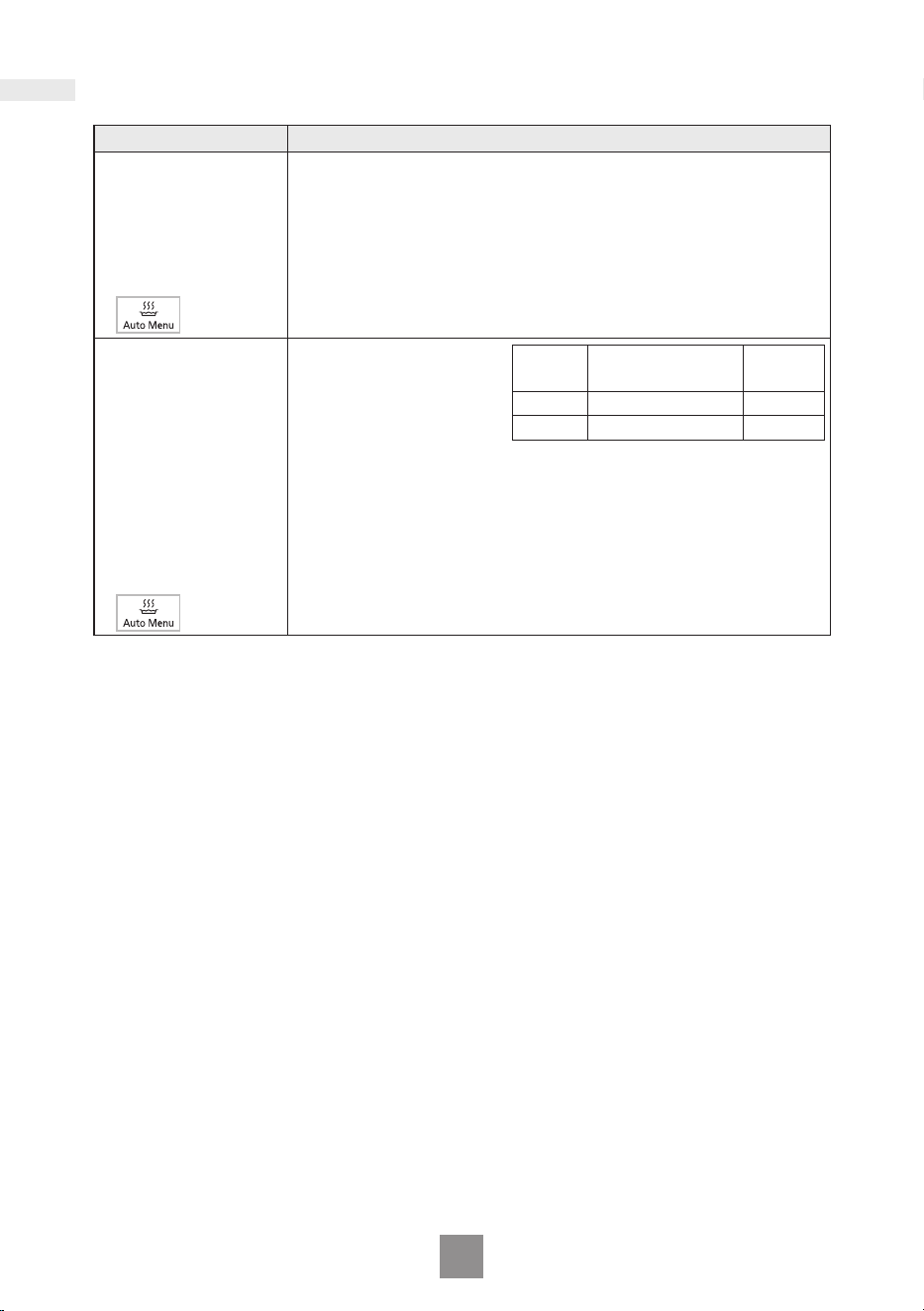
Programme Instructions
2. Frozen Meal
Weight: 300 - 600 g
For reheating a frozen pre-cooked meal. All foods must be
pre-cooked and frozen (-18 °C). Reheat in container as
purchased. Follow manufacturer’s directions for preparation. If
transferring food to a dish, cover with pierced cling film. Place
container on glass tray. Press Auto Menu twice and press
Start/Set. Set the weight of the food and press Start/Set. Stir
at beeps and cut the blocks into pieces. Stir again at end of
programme and allow a few minutes standing time. Large
pieces of meat/fish in a thin sauce may require longer
cooking. This programme is not suitable for starchy foods
such as rice, noodles or potatoes. Meals in irregular bowl
shaped containers may need longer cooking.
2 presses
3. Fresh Vegetables
Weight: 100 - 800 g
For cooking fresh vegetables like carrots, broccoli,
cauliflower and green beans. Place prepared vegetables in
a suitable sized container. Sprinkle with 1 tbsp water per
100 g vegetables. Cover with cling film. Pierce cling film with
a knife once in the centre and 4 times around the edge.
Press Auto Menu 3 times and press Start/Set. Set the
weight of the food and press Start/Set. Stir at beeps.
3 presses
4.
Frozen Vegetables
Weight: 100 - 800 g
For all types of frozen vegetables, like frozen peas,
sweetcorn or mixed vegetables. Place prepared vegetables
into a suitable size microwave safe casserole and add
2-6 tbsp of water if desired. Cover with a well fitting lid. Place
the casserole on glass tray. Press Auto Menu 4 times and
press Start/Set. Set the weight of the food and press Start/
Set. Stir at beeps. At the end of cooking, keep it covered and
stand for 3 to 5 minutes.
4 presses
5. Fresh Fish
Weight: 200 - 500 g
For cooking fresh fish fillets and steaks. Place in a suitable
sized container. Add 1-3 tbsp water or stock. Cover with cling
film. Pierce cling film once in the centre and 4 times around
the edge. Press Auto Menu 5 times and press Start/Set. Set
the weight of the food and press Start/Set. Allow a few
minutes standing time.
5 presses
6. Jacket Potatoes
Weight: 200 - 600 g
For cooking jacket potatoes. Choose medium sized potatoes
200-250 g (7-9 oz). Wash and dry and prick with a fork
several times. Arrange around the edge of glass tray. Press
Auto Menu 6 times and press Start/Set. Set the weight of
the food and press Start/Set. Turn at beeps.
6 presses
24
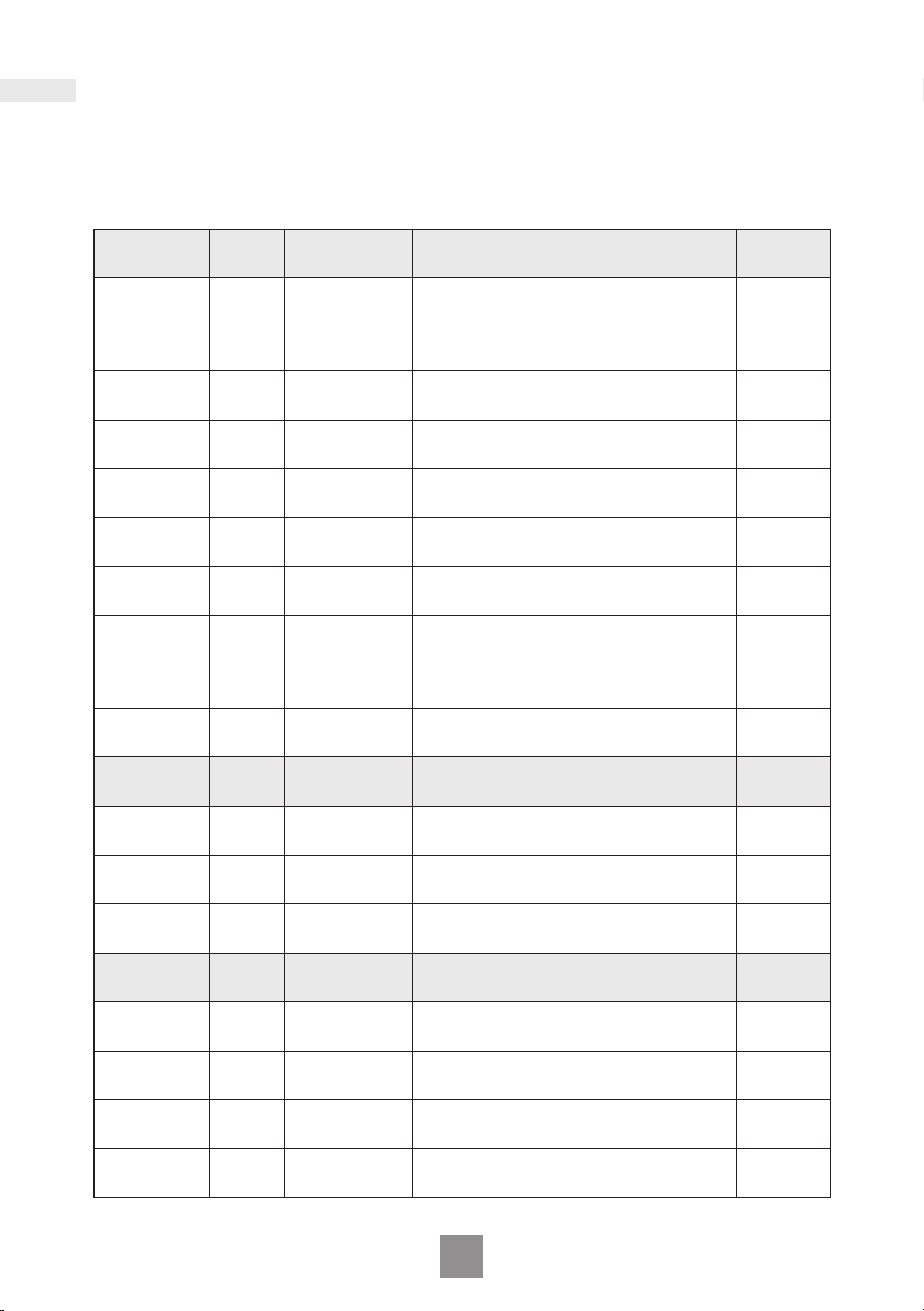
Programme Instructions
7. Fresh Chicken
Pieces
Weight: 200 - 600 g
For cooking chicken pieces such as wings, drumsticks,
thighs, half breasts etc. Pierce the chicken pieces well with a
fork before cooking. Place prepared chicken pieces in a
suitable size microwave safe dish. Add 1-5 tbsp oil if desired.
Cover with cling film pierced twice. Place the dish on glass
tray. Press Auto Menu 7 times and press Start/Set. Set the
weight of the food and press Start/Set. Turn at beeps.
7 presses
8. Casserole Rice
Weight: 100 - 200 g
For cooking white rice including short grain, long grain,
jasmine rice and basmati rice. Place rice in a suitable size
microwave safe casserole. Add recommended water listed
above. Allow at least
1
⁄2 depth of volume for evaporation to
prevent boiling over. Cover with lid. Place the casserole on
glass tray. Press Auto Menu 8 times and press Start/Set. Set
the weight of the food and press Start/Set. Stand 5 minutes
after cooking.
8 presses
Rice
Recommended
Water
Dish
Size
100 g 150 ml 2 litre
200 g 300 ml 2 litre
Auto programmes
25
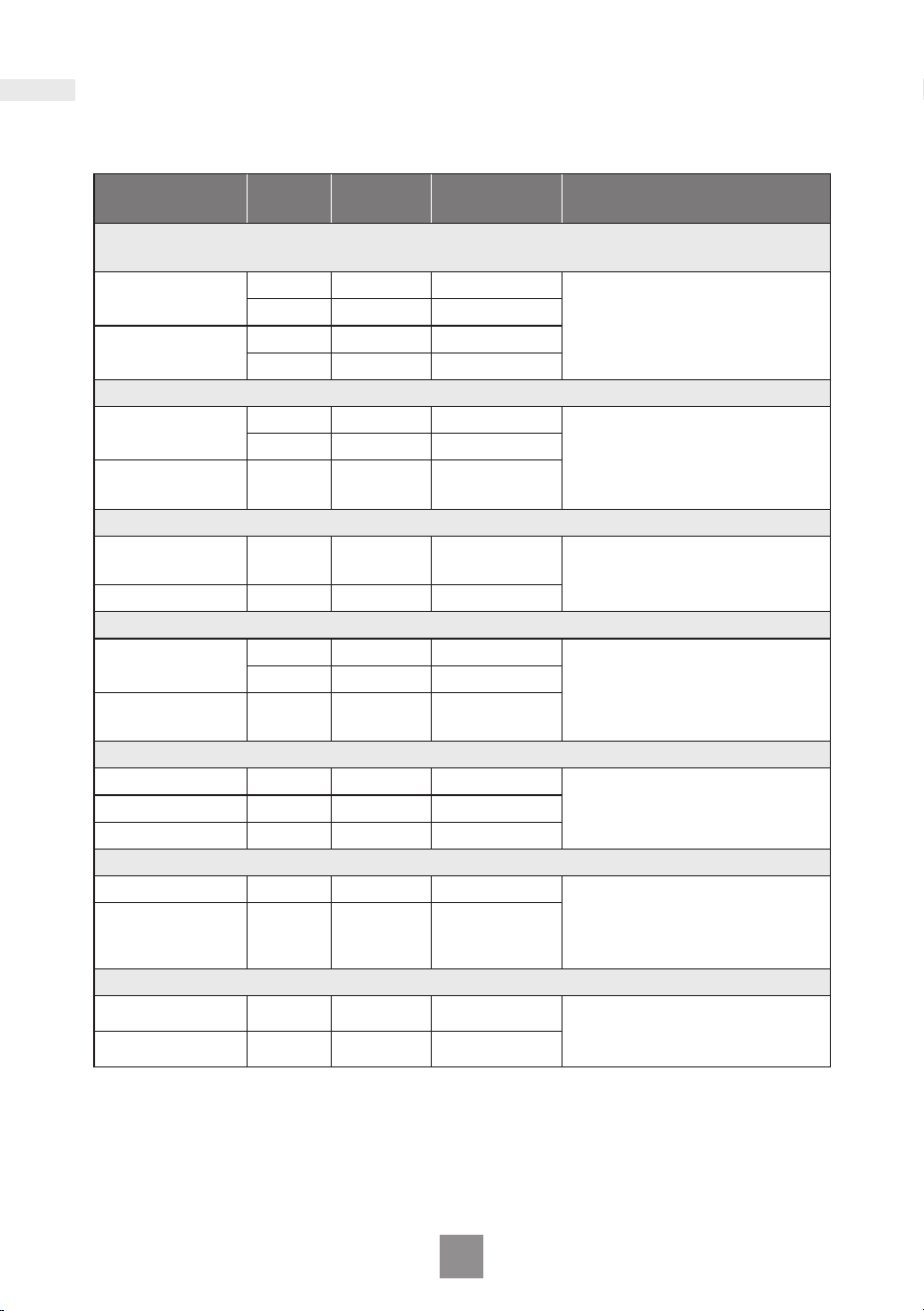
The time given below is a guideline only. Always check the progress of the
food by opening the oven door and then re-starting. For larger quantities
adjust the time accordingly. Food should not be covered during defrosting.
[Microwave power level: 200 W (Defrost)]
Meat
Weight
Defrosting
Time
Instructions
Standing
Time
Beef/Lamb/
Pork Joint
450 g
(1 lb)
7-9 min.
Place in a suitable dish or on an
upturned saucer or use a
microwave safe rack. Turn
3-4 times.
60 min.
Minced
Beef
450 g
(1 lb)
11-13 min.
Place in a suitable dish. Break up
and turn 3-4 times.
15 min.
Chops
450 g
(1 lb)
8-10 min.
Place in a suitable dish in a single
layer. Turn twice.
15 min.
Sausages
450 g
(1 lb)
5-7 min.
Place in a suitable dish in a single
layer. Turn twice
15 min.
Bacon
Rashers
450 g
(1 lb)
7-9 min.
Place in a suitable dish. Turn and
separate twice.
15 min.
Stewing
Steak
450 g
(1 lb)
9-11 min.
Place in a suitable dish. Break up
frequently.
20 min.
Whole
Chicken
450 g
(1 lb)
9-12 min.
Place in a suitable dish on an
upturned saucer or use a
microwave safe rack. Turn
3-4 times.
60 min.
Chicken
Portions
450 g
(1 lb)
8-10 min.
Place in a suitable dish in a single
layer. Turn twice.
30 min.
Fish
Weight
Defrosting
Time
Instructions
Standing
Time
Whole
450 g
(1 lb)
8-9 min. Place in a suitable dish. Turn twice. 15 min.
Fillets/
Steak
450 g
(1 lb)
8-9 min.
Place in a suitable dish. Turn twice,
separate if necessary.
15 min.
Prawns
450 g
(1 lb)
8-9 min.
Place in a suitable dish. Stir twice
during defrosting.
10 min.
General
Weight
Defrosting
Time
Instructions
Standing
Time
Bread
Sliced
400 g
(14 oz)
2-3 min.
Place on the glass tray. Separate
and rearrange during defrosting.
15 min.
Slice of
bread
30 g
(1 oz)
20-30 sec.
Place on the glass tray on a piece
of kitchen paper.
1-2 min.
Pastry
450 g
(1 lb)
4-6 min.
Place on a plate. Turn over after
1 min. resting time.
10-15 min.
Soft Fruit
450 g
(1 lb)
8-10 min.
Place in a suitable dish. Stir twice
during defrosting.
10 min.
Defrosting charts
26
The time given in the charts below is a guideline only, and will vary depending
on STARTING temperature, dish size etc.
Food
Weight/
Quantity
Power
Level
Cooking Time
(approx.)
Instructions
BREAD – Precooked – Fresh – N.B. Breads reheated by Microwave will have a
soft base.
Croissants
2 High 20-30 sec.
Place on microwave safe
plate on glass tray. Do not
cover.
4 High 40-50 sec.
Rolls
1 High 10 sec.
4 High 20 sec.
CANNED BEANS, PASTA
Baked Beans,
Ravioli in sauce
200 g High 2-3 min.
Place in a microwave safe
bowl. Cover and place on
glass tray. Stir halfway.
420 g High 4-5 min.
Spaghetti in
Tomato Sauce
200 g High 2
1
⁄2-3 min.
CANNED SOUPS
Cream of
Tomato
400 g High 3-4 min.
Place in a microwave safe
bowl. Cover and place on
glass tray.
Minestrone 400 g High 2
1
⁄2-3 min.
CANNED PUDDINGS
Creamed Rice
425 g High 3-3
1
⁄2 min.
Place in a microwave safe
bowl. Cover and place on
glass tray.
624 g High 4-5 min.
Sponge
Pudding
300 g High 2
1
⁄2 min.
CHRISTMAS PUDDINGS – Overheating may cause pudding to ignite
Slice 150 g High 20-30 sec.
Place in a microwave safe
dish. Cover and place on
glass tray.
Small 450 g High 1
1
⁄2-2 min.
Medium 900 g High 2
1
⁄2-3 min.
DRINKS – COFFEE
1 mug 235 ml High 2 min. Place in a microwave safe
mug on glass tray. Stir,
before, during and after
reheating.
2 mugs 470 ml High 3
1
⁄2 min.
DRINKS – MILK
1 mug 235 ml High 1-1
1
⁄2 min.
Place in a microwave safe
mug on glass tray. Stir, before,
during and after reheating.
1 jug 600 ml High 5 min.
Note Always check that food is piping hot after reheating in the microwave. If
unsure, return to oven. Foods will still require STANDING TIME, especially if they
cannot be stirred. The denser the food, the longer the standing time.
Reheating charts
27
Food
Weight/
Quantity
Power
Level
Cooking Time
(approx.)
Instructions
PASTRY PRODUCTS – PRECOOKED – N.B. Pastries reheated by microwave
will have a soft base.
Chicken Pie 600 g High 4-4
1
⁄2 min.
Place on microwave safe
plate on glass tray. Do not
cover.
Cornish Pasty
227 g (1)
High 2-2
1
⁄2 min.
Quiche
400 g (1)
High 4
1
⁄2-5 min.
Steak & Kidney
Pie
325 g (1)
High 2-2
1
⁄2 min.
Sausage Rolls
260 g (4)
High 1
1
⁄2-2 min.
Samosas
200 g (4)
High 1
1
⁄2-2 min.
Place on microwave safe
plate on glass tray. Do not
cover. Turn halfway.
Spring Rolls
230 g (4)
High 2-2
1
⁄2 min.
Christmas
Mince Pies
90 g (2) High 5-10 sec.
Place on a microwave safe
plate on glass tray.
PLATED MEALS – HOMEMADE – CHILLED
Child Size 1 High 3-4 min.
Place on a microwave safe
plate on glass tray. Cover
and place on glass tray.
Adult Size 1 High 5
1
⁄2-6 min.
PUDDINGS & DESSERTS N.B. Transfer food from foil containers to a similar
sized microwave safe dish
Bread & Butter
Pudding
395 g High 3-3
1
⁄2 min.
Place in a microwave safe
dish on glass tray. Do not
cover.
Fruit Crumble 600 g High 3
1
⁄2-4 min.
Fruit Pie,
individual
1 High 20-25 sec.
4 High 1-1
1
⁄2 min.
Rice Pudding 400 g High 2-2
1
⁄2 min.
Place in a microwave safe
dish. Cover and place on
glass tray.
PURCHASED CONVENIENCE FOODS – CHILLED N.B. Transfer food from foil
container to a similar sized microwave safe dish. Plastic dishes designed for
microwave and conventional ovens may be used with care.
Cauliflower
Cheese
450 g High 5
1
⁄2-6 min.
Place in microwave safe dish
on glass tray. Do not cover.
Cottage Pie 450 g High 6 min.
Lasagne 400 g High 4
1
⁄2-5 min.
Vegetable Bake 400 g High 5
1
⁄2-6 min.
Note Always check that food is piping hot after reheating in the microwave. If
unsure, return to oven. Foods will still require STANDING TIME, especially if they
cannot be stirred. The denser the food, the longer the standing time.
28
Food
Weight/
Quantity
Power
Level
Cooking Time
(approx.)
Instructions
PURCHASED CONVENIENCE FOODS – FROZEN N.B. Transfer food from foil
container to a similar sized microwave safe dish. Plastic dishes designed for
microwave and conventional ovens may be used with care.
Lasagne 400 g
High 4-6 min.
Place in a microwave safe
dish on glass tray. Do not
cover.
+ Rest. 1 min.
+ High 5-6 min.
Salmon
Crumble
340 g
High 4-6 min.
+ Rest. 1 min.
+ High 4-5 min.
Shepherdʼs Pie 460 g
High 5-6 min.
+ Rest. 1 min.
+ High 4-5 min.
Note Always check that food is piping hot after reheating in the microwave. If
unsure, return to oven. Foods will still require STANDING TIME, especially if they
cannot be stirred. The denser the food, the longer the standing time.
Reheating charts
Food
Weight/
Quantity
Power
Level
Cooking Time
(approx.)
Instructions
BACON – from raw
Rashers
130 g (4)
High
2-3
1
⁄2 min.
(or 40-60 sec.
per rasher)
Place on microwave safe
rack or plate on glass tray.
BEANS & PULSES – should be pre-soaked (except lentils)
Chick Peas 225 g
High 8
1
⁄2 min.
Use 600 ml (1 pt) boiling
water in a large bowl. Cover
and place on glass tray.
+ Med High
35-40 min.
Lentils 225 g Med High 10
1
⁄2-13 min.
Red Kidney
Beans
225 g
High 13 min.
Use 600 ml (1 pt) boiling
water in a large bowl. Cover.
Must boil for at least
12 minutes to destroy
toxic enzymes.
+ Med
High
30-35 min.
Note Always check that food is piping hot after reheating in the microwave. If
unsure, return to oven. Foods will still require STANDING TIME, especially if they
cannot be stirred. The denser the food, the longer the standing time.
Cooking charts
29
Food
Weight/
Quantity
Power
Level
Cooking Time
(approx.)
Instructions
BEEF – Joints from raw – Caution: Hot fat! Remove dish with care.
Medium
per 450 g
(1 lb)
High 6-11 min.
Place on upturned saucer in
microwave safe dish or rack
on glass tray. Cover and turn
halfway. Drain off fat during
cooking.
CHICKEN from raw – Caution: Hot fat! Remove dish with care.
Breasts,
boneless
500 g Med High 10
1
⁄2-12 min.
Place on microwave safe
rack or plate. Cover and
place on glass tray.
Drumsticks
450 g (4)
Med High 10
1
⁄2 min.
Quarters
700 g (2)
Med High 16-17 min.
Whole
per 450 g
(1 lb)
High 8
1
⁄2-9 min.
Place on upturned saucer
breast side down in
microwave safe dish. Cover
and place on glass tray.
EGGS – Poached.
Water 45 ml High 40-50 sec.
•
Place water in a small bowl
and heat for 1st cooking time.
• Add egg (medium sized).
• Pierce yolk and white.
• Cover.
• Cook for 2nd cooking time.
•
Then leave to stand for 1 min.
Egg 1 High 30-40 sec.
Water 90 ml High 50 sec.
Eggs 2 High 40-50 sec.
EGGS – Scrambled.
Egg 1
High 20-30 sec.
• Add 1 tbsp of milk for each
egg used.
• Beat eggs, milk and knob
of butter together.
• Cook for 2nd cooking time
then stand for 1 min.
+ Stir.
+ High 20 sec.
Eggs 2
High 40-50 sec.
+ Stir.
+ High 30-40 sec.
FISH – FRESH from frozen
Haddock Fillets
380 g (4)
High 4
1
⁄2 min.
Place in microwave safe
dish. Add 30 ml of liquid.
Cover and place on glass
tray.
+ High 4-5 min.
Whole
450 g (2)
High 8
1
⁄2-10
1
⁄2 min.
Boil in the Bag
170 g (1)
Defrost
6 min.
Place bag sauce side down
on a microwave safe plate.
Slash top of bag with a knife.
+ rest 2 min.
+
Med High
5
1
⁄2 min.
Note Always check that food is piping hot after reheating in the microwave. If
unsure, return to oven. Foods will still require STANDING TIME, especially if they
cannot be stirred. The denser the food, the longer the standing time.
30
Cooking charts
Food
Weight/
Quantity
Power
Level
Cooking Time
(approx.)
Instructions
FRUIT – Peel, slice, chop into even sized pieces. Place in shallow microwave
safe dish.
Apples, Rhubarb,
stewed
450 g High 4
1
⁄2-8 min.
Only half fill dish. Cover. Stir
halfway.
Plums – stewed 450 g High 7-8 min.
Add 30 ml (2 tbsp) of water.
Only half fill dish. Cover and
place on glass tray.
LAMB – from raw – CAUTION: Hot Fat! Remove dish with care.
Chops, loin
per 450 g
(1 lb)
High 1
1
⁄2-2
1
⁄2 min.
Place on microwaveable
safe dish or rack. Cover and
place on glass tray.
+ Med High
2-3 min.
Joints
per 450 g
(1 lb)
High 3-4 min.
Place on upturned saucer in
microwave safe dish or rack
on glass tray. Cover and turn
joint over halfway. Drain off
fat during cooking.
+ Med
High
6-7 min.
PASTA – Place in a large 3 litre (6 pint) microwave safe bowl.
Macaroni 225 g High 12 min.
Use 1 litre (1
3
⁄4 pint) boiling
water. Cover and place on
glass tray.
Spaghetti,
Tagliatelli
225 g High 7-8
1
⁄2 min.
PIZZA – FRESH CHILLED – N.B. Remove all packaging. Pizzas will have a
soft base.
Thin & Crispy 400 g High 4
1
⁄2-5 min.
Place on heatproof plate on
glass tray. Do not cover.
Deep Pan 475 g High 3
1
⁄2-4
1
⁄2 min.
PORK – from raw – CAUTION: Hot Fat! Remove dish with care.
Chops
360 g (2)
High 2-3 min.
Place in microwave safe dish
or rack on glass tray. Cover
and place on glass tray.
+ Med High
6-7 min.
Joints
per 450 g
(1 lb)
High 5
1
⁄2-6 min.
Place on upturned saucer in
microwave safe dish or rack.
Cover and place on glass
tray. Turn joint over halfway.
Drain off fat during cooking.
+ Med
High
8-9 min.
PORRIDGE – N.B. Use a large bowl.
1 serving
1
⁄2 cup
oats
High 2
1
⁄2-3 min.
Add 1 cup of water or milk.
Stir halfway.
2 servings
1 cup
oats
High 4-5 min.
Add 2 cups of water or milk.
Stir halfway.
Note Always check that food is piping hot after reheating in the microwave. If
unsure, return to oven. Foods will still require STANDING TIME, especially if they
cannot be stirred. The denser the food, the longer the standing time.
31
Food
Weight/
Quantity
Power
Level
Cooking Time
(approx.)
Instructions
RICE – Place in a large microwave safe bowl. 3 litre (6 pint)
Basmati 250 g Med High
10
1
⁄2-11
1
⁄2 min.
Use 600 ml (1 pt) to 800 ml
(1
1
⁄2 pt) boiling water. Cover
and place on glass tray.
SAUSAGES from raw – CAUTION: HOT FAT! Remove dish with care.
Thick
240 g (4)
High 2
1
⁄2-3 min.
Place on microwave safe
plate or microwave rack.
Cover and place on glass tray.
Thin
110 g (4)
High 1
1
⁄2-2 min.
FRESH VEGETABLES – Place in shallow microwave safe dish.
Green Beans 450 g High 6-7 min.
Add 90 ml (6 tbsp) water.
Cover and place on glass
tray.
Beetroot 450 g High 8
1
⁄2-10
1
⁄2 min.
Broccoli +
Cauliflower
– florets
450 g High 7-8
1
⁄2 min.
Brussel Sprouts 450 g High 7-8 min.
Cabbage
– sliced
450 g High 6-8 min.
Carrots, Leeks 450 g High 6-7 min.
Corn on the Cob
450 g High 6-8 min.
Courgettes,
Mange Tout
450 g High 3
1
⁄2-4
1
⁄2 min.
Peas 450 g High 3
1
⁄2-5
1
⁄2 min.
Potatoes
– boiled
450 g High 5
1
⁄2-6 min.
Potatoes
– jacket (225 g /
8 oz each)
1 High 4
1
⁄2 min.
Wash and prick skins. Place
directly on glass tray on outer
edge. After cooking stand for
5 min. wrapped in foil.
2 High 7 min.
FROZEN VEGETABLES – Place in shallow microwave safe dish.
Beans – green,
Carrots
450 g High 8
1
⁄2-10 min.
Add 30 ml (2 tbsp) water.
Cover and place on glass
tray.
Cauliflower 450 g High 10
1
⁄2 min.
Peas 450 g High 7-8 min.
Note Always check that food is piping hot after reheating in the microwave. If
unsure, return to oven. Foods will still require STANDING TIME, especially if they
cannot be stirred. The denser the food, the longer the standing time.

32
Recipes
See notes 2-4 on page 22 for using casserole.
Soup and Snacks
Cream of Mushroom Soup Serves 4
Dish: large bowl
1. Place the butter and chopped onion in a
large bowl. Cover and cook on High power
for 3 min. or until soft.
2. Add the stock, mushrooms and bouquet
garni. Cover and cook on High power for
11-13 min., or until mushrooms are soft.
3. Remove the bouquet garni and blend until
smooth. Mix the cornflour with a little of the
milk, then stir in remaining milk. Add to the
mushroom mixture.
4. Cover and cook on High power for 4
1
⁄2-
5
1
⁄2 min., or until thickened. Season and
serve with cream swirled on top.
Ingredients
25 g (1 oz) butter
1 small onion, chopped
600 ml (1 pt) hot chicken stock
225 g (8 oz) button mushrooms,
sliced
bouquet garni
15 ml (1 tbsp) cornflour
300 ml (
1
⁄2 pt) milk
salt and pepper
60 ml (4 tbsp) single cream
Macaroni Cheese with Courgettes and
Bacon Serves 2
Dish: 20 cm (8) casserole
1. Cover and cook macaroni in 450 ml (
3
⁄4 pt)
boiling water on High power for 8
1
⁄2 min., or
until soft. Drain.
2. Place courgettes and bacon in a bowl. Cover
and cook on High power for 3-4 min., or until
soft. Drain.
3. Place the butter in a large jug. Cook on High
power for 40-50 sec. Stir in the flour and
cook for 30-40 sec., on High power.
Gradually add milk, stir well and cook on
High power for 4-4
1
⁄2 min. or until the sauce
is thick and bubbling. Stir frequently.
4. Add mustard and cheese. Mix in the
macaroni, courgettes and bacon. Season
and pour into a casserole dish, sprinkle over
the topping and cook on High power for 3-4
min. or until the cheese has melted.
Ingredients
100 g (4 oz) quick cook macaroni
225 g (8 oz) courgettes, sliced
100 g (4 oz) bacon, chopped
50 g (2 oz) butter
50 g (2 oz) plain flour
600 ml (1 pt) milk
100 g (4 oz) cheese, grated
5 ml (1 tsp) mustard
salt and pepper
Topping
30 ml (2 tbsp) Parmesan cheese
30 ml (2 tbsp) wholemeal
breadcrumbs

33
Lentil Biryani Serves 2
Dish: large casserole
1. Soak the lentils in cold water for 1 hour then
drain.
2. Place the oil and onion in a large bowl.
Cover and cook on High power for 3-4 min.
or until softened.
3. Add the ginger, garlic, turmeric, chilli and
curry powder. Cover and cook on High
power for 2 min.
4. Add the yoghurt, mushrooms, tomatoes,
water and lentils. Cover and cook on High
power for 13-17 min. or until the lentils are
tender and the liquid has evaporated.
To cook rice: add 350 ml boiling water to
rice in large bowl and cook on High power,
covered, for 13 min. stirring halfway.
5. Add the lentil mixture and cashew nuts to
the cooked rice and mix thoroughly. Reheat
on High power if necessary to ensure food is
piping hot. Garnish and serve.
Ingredients
50 g (2 oz) green lentils
10 ml (2 tsp) oil, 1 small onion,
sliced
3 ml (
1
⁄2 tsp) grated root ginger
1 garlic clove, crushed
3 ml (
1
⁄2 tsp) turmeric
3 ml (
1
⁄2 tsp) chilli powder
5 ml (1 tsp) curry powder
150 ml (
1
⁄4 pt) natural yoghurt
50 g (2 oz) mushrooms, sliced
2 tomatoes, peeled and chopped
150 ml (
1
⁄4 pt) hot water
25 g (1 oz) cashew nuts
225 g (8 oz) cooked basmati rice
Garnish
hard boiled egg slices and
coriander leaves
Meat and Poultry
Lamb in a Spicy Cream and Almond
Sauce Serves 4
Dish: large casserole dish
1. Mix together the garlic, ginger, almonds and
water to make a thick paste.
2. Place the cardamom pods, cloves,
cinnamon, onion and oil in the casserole
dish cook on High power for 3 min.
3. Add the lamb and cook for 4
1
⁄2 min. on High
power or until light brown in colour. Stir
halfway.
4. Stir in the rest of the spices, the almond
mixture, cream, salt and pepper. Cover and
cook on Med High power for about 35-40
min. or until the meat is tender. Stir the
casserole 2-3 times during the cooking time.
5. Remove the whole cardamom pods, cloves
and cinnamon before serving with rice or
other vegetables.
Ingredients
3-4 cloves garlic, crushed
1 cm (
1
⁄4) piece fresh ginger,
grated
50 g (2 oz) ground almonds
45 ml (3 tbsp) water
3 whole cardamom pods
2 cloves
2.5 cm (1) stick of cinnamon
1 onion chopped
30 ml (2 tbsp) oil
450 g (1 lb) boned lamb, trimmed
and cut into cubes
5 ml (1 tsp) ground coriander
5 ml (1 tsp) ground cumin
1.5 ml (
1
⁄4 tsp) garam masala
1.5 ml (
1
⁄4 tsp) cayenne pepper
150 ml (
1
⁄4 pt) single cream
salt and pepper

34
See notes 2-4 on page 22 for using casserole.
Chicken Casserole Serves 4
Dish: 2 litre (4 pt) casserole
1. Place vegetables and butter in dish. Cover
and cook on High power for 4-6 min. or until
soft.
2. Place chicken on top of vegetables, cover
with stock and tomatoes and add salt and
pepper to taste.
3. Cover and cook on High power for 4
1
⁄2 min.
then Med High power for 30-35 min. or until
well cooked through.
4. Mix cornflour with a little water. Remove
chicken from casserole, skim off excess fat
and stir in cornflour paste. Cook on High
power for 2 min. Serve chicken with sauce
poured over.
N.B. If diced boneless breast is used in place
of the quarters, reduce 2nd cooking time
to 10-14 min. on Med High power or until
well cooked through. Stir halfway.
Ingredients
25 g (1 oz) butter
2 medium onions, sliced
2 sticks celery, trimmed and
chopped
100 g (4 oz) mushrooms, sliced
4 chicken quarters, skinned
300 ml (
1
⁄2 pt) hot chicken stock
300 g (11 oz) can tomatoes
salt and pepper
30 ml (2 tbsp) cornflour
Pork with Sweet & Sour Sauce Serves 2
Dish: small casserole
1. Place pork in dish, cover and cook on Med
High power for 7-9 min. or until juices run
clear.
2. Place oil, carrot, onion and green pepper in
a bowl. Cover and cook on High power for
2-3 min. or until vegetables are tender.
3. Mix half the reserved juice with the
remaining ingredients except pineapple.
Cover and cook on High power for 2-3 min.
or until clear and thickened. Stir halfway.
4. Add the sauce to the vegetables. Stir in the
pineapple. Mix well.
5. Cook on High power for 1 min. or until
heated through. Spoon over cooked pork.
Reheat for 1-2 min. on High power or until
piping hot.
Ingredients
225 g (8 oz) pork fillet, diced
Sweet & Sour Sauce:
15 ml (1 tbsp) oil
1 small carrot cut into matchsticks
1 spring onion, thinly sliced
small green pepper, cut into strips
225 g (8 oz) can pineapple
chunks, drained (reserve juice)
10 ml (2 tsp) soft brown sugar
5 ml (1 tsp) cornflour
pinch garlic salt
5 ml (1 tsp) cider vinegar
10 ml (2 tsp) soy sauce
5 ml (1 tsp) tomato ketchup
Recipes

35
Savoury Mince Serves 2
Dish: 1.5 litre (3 pt) casserole dish
1. Place onion, garlic and oil in casserole,
cover and cook on High power for 2-3 min.
or until soft.
2. Place all other ingredients in casserole. Stir
well.
3. Cover and cook on High power for 4
1
⁄2 min.
then Med High power for 15-20 min. or until
the meat is cooked.
Ingredients
1 small onion, diced
1 clove garlic, crushed
5 ml (1 tsp) oil
200 g (7 oz) can chopped
tomatoes
15 ml (1 tbsp) tomato puree
5 ml (1 tsp) mixed herbs
225 g (8 oz) minced beef
salt and pepper
Chicken Satay Serves 2
Dish: 4 wooden skewers + shallow dish
1. For the serving sauce: Crumble 25 g (1 oz)
of creamed coconut into a large jug. Add the
peanut butter, 15 ml (1 tbsp) of the lemon
juice, 15 ml (1 tbsp) of the soy sauce, the
chilli powder and 150 ml (
1
⁄4 pt) water. Cook
on High power for 3-4 min. or until the sauce
boils and thickens, stirring frequently. Turn
into a serving bowl.
2. Cut the chicken into small chunks and place
in a bowl. Put the remaining creamed
coconut, lemon juice and soy sauce into a
blender or food processor. Add the
remaining ingredients and blend until
smooth.
3. Pour over the chicken. Cover and marinate
in the fridge for 2-3 hours or overnight.
4. Thread the chicken onto wooden skewers.
Place in a shallow dish, cover with any
remaining marinade and cook covered on
High power for 5
1
⁄2-7 min. or until cooked,
turn and baste frequently. Serve hot with the
sauce for dipping.
Ingredients
50 g (2 oz) creamed coconut
45 ml (3 tbsp) crunchy peanut
butter
45 ml (3 tbsp) lemon juice
30 ml (2 tbsp) soy sauce
large pinch of chilli powder
150 ml (
1
⁄4 pt) water
2 chicken breast fillets, skinned
15 ml (1 tbsp) vegetable oil
1 garlic clove, crushed
3 ml (
1
⁄2 tsp) ground turmeric
3 ml (
1
⁄2 tsp) five-spice powder
3 ml (
1
⁄2 tsp) coriander seeds
3 ml (
1
⁄2 tsp) cumin seeds

36
See notes 2-4 on page 22 for using casserole.
Fish
Arranging
Thin fillets of fish i.e.
plaice, should be rolled up
prior to cooking to avoid
overcooking on the thinner
outside edge and tail.
Fish steaks should be
arranged in a circle,
thicker part to the outside.
Cover with cling film or lid.
Liquid
Fresh fish should always
be sprinkled with 30 ml
(2 tbsp) of water, lemon
juice or white wine.
When cooking Frozen
fish, add liquid as above
for even cooking.
Do not sprinkle salt onto
fish before cooking as this
may make the fish dry.
Noise
During cooking, popping
sounds may be heard.
This is due to moisture
trapped between the
flesh, particularly with oily
fish such as salmon and
mackerel. This can be
minimised when cooking
the fish if the skin and
flesh is pierced several
times with a cocktail stick.
Fish Curry Serves 2
Dish: casserole dish (1.5 litre (3 pt))
1. Melt the butter in the casserole dish on High
power for 30-40 sec. or until melted.
2. Stir in the garlic and onion and cook covered
on High power for 3 min.
3. Stir in the flour, curry powder, lemon rind and
juice and fish stock. Cover and cook on High
power for 3 min. stirring halfway through the
cooking time.
4. Stir in the remaining ingredients except the
coconut, cover and cook on High power for
4-5 min. or until fish flakes, stirring
occasionally.
5. Break up the coconut with a fork, then stir
into the curry.
Ingredients
25 g (1 oz) butter
1 clove garlic, crushed
1 small onion, finely chopped
15 ml (1 tbsp) plain flour
15 ml (1 tbsp) curry powder
grated rind and juice of
1
⁄2 lemon
300 ml (
1
⁄2 pt) hot fish stock
25 g (1 oz) sultanas
10 ml (2 tsp) tomato puree
30 ml (2 tbsp) sweet chutney
450 g (1 lb) haddock, skinned
and chopped
salt and pepper
75 g (3 oz) creamed coconut
Recipes

37
Family Fish Pie Serves 4
Dish: large casserole
1. Arrange fish in a shallow dish. Add lemon
juice, cover and cook on High power for
3-4 min. or until it flakes easily.
2. Place onion and oil in a bowl. Cover and
cook on High power for 3 min. or until the
onion is soft.
3.
Melt the butter on High power for 30-40 sec.
Stir in the flour and mustard and cook for a
further 20 sec. Add milk and seasoning,
gradually stirring to a smooth paste. Cook on
High power for 5-6 min. or until the sauce is
thick and bubbling. Stir twice during cooking.
Add 75 g (3 oz) of grated cheese to the
sauce and stir well.
4. Flake the fish and arrange in the serving
dish. Add onions and place the sliced
potatoes on top.
5. Pour over the cheese sauce. Sprinkle with
breadcrumbs and remaining cheese.
6. Cook on Med High power for 10-15 min. or
until the mixture has been completely
reheated.
Ingredients
450 g (1 lb) smoked haddock
30 ml (2 tbsp) lemon juice
15 ml (1 tbsp) oil
1 large onion, sliced
600 g (1 lb 5 oz) cooked jacket
potatoes, sliced, see page 23
40 g (1
1
⁄2 oz) butter
40 g (1
1
⁄2 oz) flour
3 ml (
1
⁄2 tsp) mustard
600 ml (1 pt) milk
salt and pepper
100 g (4 oz) Red Leicester
cheese
75 g (3 oz) wholemeal
breadcrumbs
Vegetables
Wild Mushroom and Basil Risotto
Serves 4
Dish: 2 litre (4 pt) casserole dish
1. Soak mushrooms in 300 ml (
1
⁄2 pt) warm
water.
2. Place the butter, garlic and onion in a large
bowl, cover with cling film and cook on High
power for 3-4 min. or until softened. Season
with freshly ground black pepper.
3. Stir the rice into the butter mixture and add
the hot stock and soaking liquid from the
mushrooms. Cover and cook for a further
4
1
⁄2 min. on High power.
4. Stir the mushrooms into the rice mixture.
Cover and cook for a further 4
1
⁄2 min. on
High power.
5. Stir and add the basil. Continue to cook for
the final 4
1
⁄2 min. on High power. Leave to
stand for approx. 10 min. and then stir with a
fork.
Ingredients
40 g (1
1
⁄2 oz) dried Cep
mushrooms
50 g (2 oz) butter
1 clove garlic, finely chopped
1 small onion, finely chopped
freshly ground black pepper
250 g (8 oz) Arborio rice
300 ml (
1
⁄2 pt) hot vegetable
stock
12 basil leaves, torn

38
See notes 2-4 on page 22 for using casserole.
Vegetable Curry Serves 2
Dish: 2 litre (4 pt) casserole
1. Sprinkle the aubergine liberally with salt in a
colander. Stand for 30 min. to remove bitter
juices. Rinse well under cold water and
drain.
2. Combine oil, garlic and spices in the
casserole, cover and cook on High power for
2 min.
3. Add all other ingredients to casserole,
except cashews. Cover and cook on High
power for 4
1
⁄2 min. then Med High power for
25-30 min. or until vegetables are soft. Stir
occasionally.
4. Sprinkle with cashews and serve with boiled
rice.
N.B. This recipe is best cooked in advance,
chilled and then reheated to allow the
flavours to develop.
Ingredients
1 medium aubergine, diced
salt, 15 ml (1 tbsp) oil
1 clove of garlic, chopped
pinch cayenne pepper
5 ml (1 tsp) ground coriander
3 ml (
1
⁄2 tsp) ground cumin
3 ml (
1
⁄2 tsp) turmeric
2.5 cm (1) root ginger, peeled &
sliced
1
⁄2 small cauliflower, divided into
florets
1 medium potato, diced
50 g (2 oz) green beans, sliced
1
⁄2 fresh chilli, deseeded and
sliced
150 ml (
1
⁄4 pt) vegetable stock
200 g (7 oz) can chopped
tomatoes
50 g (2 oz) cashew nuts
Cauliflower Cheese Serves 2
Dish: large bowl + shallow casserole
1. Place cauliflower upside down in a bowl.
Add water. Cover and cook on High power
for 7 min. or until tender. Drain.
2. Melt butter on High power for 30-40 sec. Stir
in flour and mustard. Cook for a further
20-30 sec. Add milk gradually. Stir well and
season. Cook on High power for 2-3 min. or
until sauce is thick and bubbling. Stir once
halfway during cooking.
3. Stir in 50 g (2 oz) grated cheese. Pour the
sauce over the cauliflower. Top with
remaining cheese and breadcrumbs.
4. Cook on High power for 1-2 min. or until
cheese melts.
Ingredients
1 cauliflower, trimmed and cut
into florets
90 ml (6 tbsp) water
25 g (1 oz) butter
25 g (1 oz) flour
3 ml (
1
⁄2 tsp) French mustard
300 ml (
1
⁄2 pt) milk
seasoning to taste
Topping:
75 g (3 oz) grated red cheese
15 ml (1 tbsp) brown
breadcrumbs
Recipes

39
Desserts / Cakes
Steamed Suet Sponge Pudding
Serves 4
Dish: 1 litre (2 pt) pudding basin
1. In a mixing bowl, sift together the flour and
salt. Stir in the sugar and suet.
2. Make a well in the centre and add beaten
egg and milk. Mix to a soft dropping
consistency.
3. Put the jam in the base of the greased
pudding basin and pour pudding mixture
over. Cook on High power for 6-7 min. until
firm.
Ingredients
150 g (5 oz) self-raising flour
pinch of salt
50 g (2 oz) caster sugar
50 g (2 oz) suet
1 egg
150 ml (1
1
⁄4 pt) milk
30 ml (2 tbsp) jam or golden
syrup Optional:
add 1 tbsp of sultanas to dry
ingredients
Individual Pineapple
Upside Down Pudding Serves 2
Dish: 2 ramekin dishes, base lined
1. Put
1
⁄2 tbsp golden syrup in the base of each
ramekin; arrange pineapple slice and cherry
on top of the syrup in the base.
2. Cream together the margarine and sugar
until light and fluffy. Beat in the egg
gradually. Fold in the flour and mix to a soft
consistency with the milk.
3. Spoon the mixture over the pineapple and
cook on High power for 3-4 min. or until
cooked. Leave to cool slightly before turning
upside down onto a serving plate.
Ingredients
15 ml (1 tbsp) golden syrup
2 pineapple slices, drained
2 glacé cherries
50 g (2 oz) margarine
50 g (2 oz) caster sugar
1 egg
50 g (2 oz) self raising flour
15 ml (1 tbsp) milk
Christmas Puddings Serves 4
Dish: 4 deep ramekins, base lined
1. Place all ingredients into a large mixing bowl
and stir until thoroughly mixed.
2. Divide mixture equally between the
ramekins.
3. Place towards outer edge of the glass tray
and cook on High power for 4-5 min. or until
cooked.
Ingredients
75 g (3 oz) self-raising flour
3 ml (
1
⁄2 tsp) baking powder
3 ml (
1
⁄2 tsp) mixed spice
25 g (1 oz) butter
1 egg
30 ml (2 tbsp) treacle
60 ml (4 tbsp) stout
15 ml (1 tbsp) rum or brandy
200 g (7 oz) mincemeat
25 g (1 oz) apple, grated
75 g (3 oz) currants
25 g (1 oz) chopped nuts

40
Date Puddings and Butterscotch Sauce
Serves 6
Dish: 3 pint pudding basin
1. Pour 175 ml (6 fl. oz) boiling water over the
chopped dates and set aside to cool.
2. Sift together flour and baking powder. Add
vanilla and coffee essence to the milk.
3. Cream the butter and sugar until light and
fluffy. Add eggs a little at a time.
4. Fold in the flour and flavoured milk, then
pour in the date mixture.
5. Place in pudding basin. Cook on High power
for 7-8
1
⁄2 min. and leave to stand for 10 min.
Sauce
1. Place butter in a large jug and cook on High
power for 50 sec. to 1 min., or until bubbling.
2. Add sugar and stir until it has dissolved,
cooking for 1 min. at a time on High power.
Continue to cook until liquid is foaming and
bubbling 30 sec. at a time on High power.
3. Slowly pour in the cream and bring to the
boil on High power for 2-3 min. Add
essence. Stir, continue to boil on High power
30 sec. at a time until it starts to thicken.
Ingredients
200 g (7 oz) fresh dates, stoned
and finely chopped
175 g (6 oz) self-raising flour
5 ml (1 tsp) baking powder
5 ml (1 tsp) vanilla essence
15 ml (1 tbsp) Camp coffee
essence
100 ml (3
1
⁄2 fl. oz) milk
75 g (3 oz) butter
150 g (5 oz) caster sugar
2 eggs lightly beaten
Butterscotch sauce
45 g (1
3
⁄4 oz) butter
120 ml (8 tbsp) soft brown sugar
200 ml (7 fl. oz) whipping cream
15 ml (1 tbsp) vanilla essence
Chewy Flapjacks
Dish: 20 cm (8) round dish
1. Place butter, syrup and sugar in a bowl and
cook on High power for 1-2 min. or until
melted.
2. Stir in the oats and raisins. Press into dish.
Cook on High power for 2-3 min. or until the
centre is bubbling. Allow to cool slightly then
cut into 8 pieces.
Ingredients
75 g (3 oz) butter or margarine
30 ml (2 tbsp) golden syrup
75 g (3 oz) light brown sugar
150 g (5 oz) porridge oats
50 g (2 oz) raisins
Recipes

41
Boston Brownies
Dish: 20 cm (8) dish lined with greaseproof
1. Place chocolate and butter in a bowl and
cook on High power for 1-2 min. or until
chocolate has melted.
2. Stir in all other ingredients and beat well.
3. Pour into dish and cook on Med High power
for 8-10 min. or until just slightly sticky. Allow
to cool and then cut.
Ingredients
100 g (4 oz) plain chocolate
100 g (4 oz) butter
100 g (4 oz) soft dark brown
sugar
100 g (4 oz) self-raising flour
10 ml (2 tsp) cocoa powder
pinch salt
2 eggs, beaten
3 ml (
1
⁄2 tsp) vanilla essence
100 g (4 oz) walnuts, chopped
Sauces
Custard
Dish: 1 litre (2 pt) jug
1. Mix together the custard powder, sugar and
a little milk to form a smooth paste.
2. Blend in the remaining milk, whisking well.
3. Cook on High power for 4-5 min. Whisk well
halfway through cooking time and again at
the end.
Ingredients
30 ml (2 tbsp) custard power
15 ml (1 tbsp) sugar
600 ml (1 pt) cold milk
White Pouring Sauce
Dish: 1 litre (2 pt) jug
1. Melt butter in jug on High power for
20-40 sec.
2. Stir in the flour to make a roux.
3. Add the milk gradually stirring continuously
until well combined.
4. Cook for 3 min. on High power. Stir and cook
for a further 4 min. Stir and cook for a further
2 min. Sauce should be smooth and glossy
and coat the back of a spoon.
Ingredients
30 g (1 oz) butter
30 g (1 oz) flour
600 ml (1 pt) milk
Jam
Soft Fruit Jam Makes approx. 1
1
⁄2 lbs jam
Dish: large bowl
1. Place all ingredients in a large bowl and stir.
Cook on High power for 5 min. (10-15 min. if
using frozen fruit), stirring frequently.
Continue to cook in 1 min.intervals until
sugar has dissolved.
2. Wash down any sugar crystals from around
the bowl.
3. Bring mixture to the boil and continue to
cook until setting point is reached – approx.
15-25 min. Test regularly for setting point.
N.B. Do not double this mixture as it will boil
over.
Ingredients
450 g (1 lb) soft fruit, washed
450 g (1 lb) caster sugar
30 ml (2 tbsp) lemon juice
5 ml (1 tsp) butter

42
Cooking and reheating guidelines
Most foods reheat very quickly in your oven by HIGH power. Meals can be brought
back to serving temperature in just minutes.
Always check food is piping hot and return to oven if necessary.
As a general rule, always cover wet foods, e.g. soups, casseroles and plated meals.
Do not cover dry foods e.g. bread rolls, mince pies, sausage rolls, etc.
Remember when cooking or reheating any food that it should be stirred or turned
wherever possible. This ensures even cooking or reheating on the outside and in
the centre.
MINCE PIES - CAUTION
REMEMBER even if the pastry is cold to the touch, the
filling will be piping hot and will warm the pastry through.
Take care not to overheat otherwise burning can occur
due to the high fat and sugar content of the filling. Check
the temperature of the filling before consuming to avoid
burning your mouth.
PUDDINGS AND LIQUIDS - CAUTION
Puddings and other foods high in fats or sugar, e.g. jam,
mince pies, must not be over heated. These foods must
never be left unattended as with over cooking these
foods can ignite. Take great care when reheating these
items.
Do not leave unattended.
Do not add extra alcohol.
BABIES BOTTLES - CAUTION
Milk or formula MUST be shaken thoroughly before
heating and again at the end and tested carefully before
feeding a baby.
For 200-240 ml of milk from fridge temperature, remove
top and teat. Heat on HIGH power for 30–50 sec.
CHECK CAREFULLY BEFORE FEEDING.
For 90 ml of milk from fridge temperature, remove top
and teat. Heat on HIGH power for 15–20 sec.
CHECK CAREFULLY BEFORE FEEDING.
N.B. Liquid at the top of bottle will be much hotter than at
bottom.
The bottle must be shaken thoroughly and tested before
use.
WE DO NOT RECOMMEND THAT YOU USE YOUR
MICROWAVE TO STERILISE BABIES’ BOTTLES.
If you have a special microwave steriliser, we urge
extreme caution, due to the low quantity of water involved.
It is vital to follow the manufacturer’s instructions implicitly.
PLATED MEALS
Everyone’s appetite
varies and reheat times
depend on meal
contents. Dense items
e.g. mashed potato,
should be spread out
well.
If a lot of gravy is
added, extra time may
be required.
Place denser items to
the outside of the plate.
Between 2–4 min. on
HIGH power will reheat
an average portion. Do
not stack meals.
CANNED FOODS
Remove foods from
can and place in a
suitable dish before
heating.
SOUPS
Use a bowl and stir
before heating and at
least once through
reheat time and again
at the end.
CASSEROLES
Stir halfway through
and again at the end of
heating.

43
Questions and answers
Q: Why won’t my oven turn on?
A: When the oven does not turn on,
check the following:
1. Is the oven plugged in securely?
Remove the plug from the outlet,
wait 10 seconds and reinsert.
2. Check the circuit breaker and the
fuse.
Reset the circuit breaker or replace
the fuse if it is tripped or blown.
3. If the circuit breaker or fuse is all
right, plug another appliance into
the outlet. If the other appliance
works, there probably is a problem
with the oven. If the other appliance
does not work, there probably is a
problem with the outlet.
If it seems that there is a problem
with the oven, contact an
authorised Service Centre.
Q: My oven causes interference
with my TV. Is this normal?
A: Some radio and TV interference
might occur when you cook with the
oven. This interference is similar to
the interference caused by small
appliances such as mixers,
vacuums, blow dryers, etc. It does
not indicate a problem with your
oven.
Q: Sometimes warm air comes from
the oven vents. Why?
A: The heat given off from the cooking
food warms the air in the oven
cavity. This warmed air is carried
out of the oven by the air flow
pattern in the oven. There are no
microwaves in the air. The oven
vents should never be blocked
during cooking.
Q: Can I use a conventional oven
thermometer in the oven?
A: The metal in some thermometers
may cause arcing in your oven and
should not be used in a microwave
oven.
Q: The oven won’t accept my
programme. Why?
A: The oven is designed not to accept
an incorrect programme. For
example, the oven will not accept a
4th stage.

44
Care of your oven
1. The oven should be unplugged
before cleaning.
2. Clean the inside of the oven, door
seals and door seal areas regularly.
When food splatters or spilled
liquids adhere to the oven walls,
door seals and door seal areas
wipe off with a damp cloth. Mild
detergent may be used if they get
very dirty. The use of harsh
detergent or abrasive is not
recommended. Avoid cleaning the
microwave feed guide area situated
on the right hand side of the cavity
wall.
DO NOT USE COMMERCIAL
OVEN CLEANERS.
3. Do not use harsh, abrasive
cleaners or sharp metal scrapers to
clean the oven door glass since
they can scratch the surface, which
may result in shattering the glass.
4. The outside oven surface should be
cleaned with a damp cloth. To
prevent damage to the operating
parts inside the oven, water should
not be allowed to seep into the
ventilation openings.
5. If the Control Panel becomes dirty,
clean it with a soft cloth. Do not use
harsh detergents or abrasives on
the Control Panel. When cleaning
the Control Panel leave the oven
door open to prevent the oven from
accidentally turning on. After
cleaning press Stop/Reset to clear
display window.
6. If steam accumulates inside or
around the outside of the oven
door, wipe with a soft cloth. This
may occur when the oven is
operated under high humidity
conditions and in no way indicates
a malfunction of the unit.
7. It is occasionally necessary to
remove the glass tray for cleaning.
Wash the tray in warm soapy water
or in a dishwasher.
8. The roller ring and oven cavity floor
should be cleaned regularly to
avoid excessive noise. Simply wipe
the oven cavity floor with mild
detergent and hot water then dry
with a clean cloth. The roller ring
may be washed in mild soapy
water. Cooking vapours collect
during repeated use but in no way
affect the oven cavity floor or roller
ring wheels. After removing the
roller ring from the oven cavity floor
for cleaning, be sure to replace it in
the proper position.
9. A steam cleaner is not to be used
for cleaning.
10. This oven should only be serviced
by qualified personnel. For
maintenance and repair of the oven
contact the nearest authorised
dealer.
11. Failure to maintain the oven in a
clean condition could lead to
deterioration of surfaces that could
adversely affect the life of the
appliance and possibly result in a
hazardous situation.
12. Keep air vents clean at all times.
Check that no dust or other material
is blocking any of the air vents on
the top, bottom or rear of the oven.
If air vents become blocked this
could cause overheating which
would affect the operation of the
oven and possibly result in a
hazardous situation.

45
Specifications
Power Source 230-240 V 50 Hz
Power Consumption
5.6 A 1250 W
Output 800 W (IEC-60705)
Outside Dimensions
440 (W) × 324 (D) × 258 (H) mm
Oven Cavity Dimensions
306 (W) × 308 (D) × 214 (H) mm
Overall Cavity Volume 20 L
Glass Tray Diameter 255 mm
Operating Frequency
2450 MHz
Net Weight 11 kg
• Weight and Dimensions shown are approximate.
• Specifications subject to change without notice.
• As for the voltage requirement, the production month, country and serial number,
please refer to the identification label on the microwave oven.

46
Panasonic Warranty (Australia)
Small Kitchen Appliances 12 Month Warranty from Date of Purchase
(“Warranty Period”)
Microwave Oven, Rice Cooker, Bread Maker, Benchtop Oven and Stick Blenders
1. This warranty does not exclude, restrict or modify in any way other rights and
remedies under the law which relates to the product, including any
nonexcludable statutory guarantees in Australia.
2. Subject to the conditions of this warranty and during the Warranty Period,
Panasonic or its Authorised Service Centre will perform the necessary service
on the product without charge for parts or labour, if in the opinion of Panasonic,
the product is found to be faulty within the Warranty Period.
3. This warranty only applies to Panasonic products purchased in Australia and
sold by Panasonic Australia or its Authorised Distributors or Dealers and only
where the products are used and serviced within Australia or its territories.
Warranty cover only applies to service carried out by a Panasonic Authorised
Service Centre and only if valid proof of purchase is presented when warranty
service is requested.
4. This warranty only applies if the product has been used in accordance with the
manufacturer’s recommendations (as noted in the Operating Instructions) under
normal use and reasonable care (in the opinion of Panasonic). The warranty
covers normal domestic use only and does not cover damage, malfunction or
failure resulting from:
(a) misuse, abuse, neglect, accidental damage or modifications;
(b) infestation by insects or vermin;
(c) incorrect installation, assembly, improper voltage, or mains supply problems;
(d) natural disaster or acts of God (e.g. lightening, flood, fire, earthquakes etc);
(e) rust or damage caused by exposure to abnormally corrosive conditions;
(f) an accessory, component or other equipment not supplied by Panasonic
Australia;
(g) improper maintenance by the customer (refer to the maintenance section of
the Operating Instructions) which includes but is not limited to the failure to
undertake the following actions:
(i) regular cleaning; and
(ii) where filters are included, regular cleaning and replacement of filters
where necessary.
(h) incorrect operation of the product; and
(i) where no actual fault of the product is determined to have occurred, during a
customer-initiated service call, and where the perceived problem is
explained within the Operating Instructions (including the troubleshooting
section) warranty service is not applicable
5. This warranty does not cover the following items unless the fault or defect
existed at the time of purchase:
(a) Cabinet or Casing Parts
(b) Noise or vibration that is considered normal
(c) User replaceable Batteries (d) Kneader mounting shaft unit and heads,
blades and other accessories
(e) Microwave Oven cook plates

47
6. You will be responsible for costs associated with making the warranty claim
where there are costs associated with shipping or handling or travelling outside
of the area normally serviced by Panasonic or any repair agent authorised by
Panasonic.
7. To the extent permitted by law and subject to your non-excludable statutory
rights and guarantees, Panasonic excludes all warranties and liabilities (other
than those contained in this warranty) including any liability for loss or damage
whether direct or indirect arising from your purchase, use or non-use of the
product.
8. In addition to your rights under this warranty, Panasonic products come with
consumer guarantees that cannot be excluded under the Australian Consumer
Law. You are entitled to a replacement or refund for a major failure and
compensation for any reasonably foreseeable loss or damage. You are also
entitled to have the product repaired or replaced if the product fails to be of an
acceptable quality and the failure does not amount to a major failure.
9. To claim warranty service, when required, you should:
• Contact Panasonic’s Customer Care Centre on 132 600 for Authorised Service
Centre information
• Send or take the product to a Panasonic Authorised Service Centre together
with your purchase receipt as a proof of purchase date.
THIS WARRANTY CARD AND THE PURCHASE DOCKET
(OR SIMILAR PROOF OF PURCHASE)
SHOULD BE RETAINED BY THE CUSTOMER AT ALL TIMES
If you require assistance regarding warranty conditions or any other enquiries,
please visit the Panasonic Australia website www.panasonic.com.au or contact
by phone on 132 600
If phoning in, please ensure you have your operating instructions available.
Panasonic Australia Pty. Limited
ACN 001 592 187 ABN 83 001 592 187
1 Innovation Road, Macquarie Park NSW 2113
www.panasonic.com.au
PRO-031-F01 Issue: 2.0 09.12.2021

48
Panasonic Warranty (New Zealand)
Built In Kitchen Appliance 24 Month from Date of Purchase
Home Appliance 24 Month Warranty from Date of Purchase
1. Subject to the conditions of this warranty Panasonic or it’s Authorised Service
Centre will perform necessary service on the product without charge for parts or
labour, if in the opinion of Panasonic, the product is found to be faulty within the
warranty period. For Line Communications products (i.e. Cordless Phones, etc)
the genuine battery(s) has a 3 month warranty.
2. This warranty only applies to Panasonic products purchased in New Zealand
and sold by Panasonic New Zealand or its authorised Distributors or Dealers
and only where the products are used and serviced within New Zealand or it’s
territories. Warranty cover only applies to service carried out by a Panasonic
Authorised Service Centre and only if valid proof of purchase is presented when
warranty service is requested.
3. This warranty only applies if the product has been installed and used in
accordance with the manufacture’s recommendations (as noted in the operating
instructions) under normal use and reasonable care (in the opinion of
Panasonic). The warranty covers normal domestic use only (also Clip & Trim
Professional use) and does not cover damage, malfunction or failure resulting
from use of incorrect voltages, incorrect installation, accident, misuse, neglect,
build-up of dirt or dust, abuse, maladjustment of customer controls, mains
supply problems, thunderstorm activity, infestation by insects or vermin,
tampering or repair by unauthorised persons (including unauthorised
alterations), exposure to abnormally corrosive conditions or any foreign object or
matter having entered the product.
4. This warranty does not cover the following items unless the fault or defect
existed at the time of purchase:
(a) Cabinet Parts
(b) Microwave Oven cook plates
(c) User replaceable Batteries from wear and tear in normal use
(d) Kneader mounting shaft unit and Heads, Cutters, Foils, Blades and other
accessories
(e) Noise or vibration that is considered normal
(f) Correcting the installation (e.g. removal of transit bolts, levelling and locking
feet)
(g) Damage caused by water pressure exceeding 1MPa
(h) Water on floor due to incorrect loading, excessive suds, foreign matter on
door seals
(i) Blocked pumps and removal filters, removal of foreign objects from the
machine (e.g. bra wires, bread tags, nails, screws, coins, grit etc.)
(j) Replaceable lint filters
(k) Damage to surfaces caused by liquid or solid spillages, impact or lack of
maintenance & cleaning products other than that reccomended in the
operating instructions
(l) Consumables (light bulbs, filters)

49
5. To claim warranty service, when required, you should:
• Telephone Panasonic’s Customer Care Centre on 09 272 0178 or visit our
website referred to below and use the Service Centre Locator for the name/
address of the nearest Authorised Service Centre.
• Send or take the product to a Panasonic Authorised Service Centre together
with your proof of purchase receipt as a proof of purchase date. Please note
that freight and insurance to and / or from your nearest Authorised Service
Centre must be arranged by you.
6. The warranties hereby conferred do not extend to, and exclude, any costs
associated with the installation, de-installation or re-installation of a product,
including costs related to the mounting , de-mounting or remounting of any
screen, (and any other ancillary activities), delivery, handling, freighting,
transportation, or insurance of the product or any part thereof or replacement of
and do not extend to , and exclude, any damage or loss occurring by any reason
of, during, associated with, or related to such installation, de-installation,
re-installation or transit.
Panasonic Authorised Service Centres are located in major metropolitan areas and
most regional centres of New Zealand, however, coverage will vary dependant on
product. For advice on exact Authorised Service Centre locations for your product,
please telephone our customer Care Centre on 09 272 0178 or visit our website
and use the Service Centre locator.
Unless otherwise specified to the consumer the benefits conferred by this express
warranty are additional to all other conditions, warranties, guarantees, rights and
remedies expressed or implied by the Consumer Guarantees Act of New Zealand
and all other obligations and liabilities on the part of the manufacturer or supplier
and nothing contained herein shall restrict or modify such rights, remedies,
obligations and liabilities.
THIS WARRANTY CARD AND THE PURCHASE DOCKET
(OR SIMILAR PROOF OF PURCHASE)
SHOULD BE RETAINED BY THE CUSTOMER AT ALL TIMES
If you require assistance regarding warranty conditions or any other enquiries,
please visit the Panasonic New Zealand website www.panasonic.co.nz or
contact by phone on 09 272 0178
If phoning in, please ensure you have your operating instructions available.
Panasonic New Zealand Customer Care Centre
Phone: 09 272 0178
Fax: 09 272 0129
Email: [email protected]
Website: www.panasonic.co.nz/support

Panasonic Corporation
Website: https://www.panasonic.com
© Panasonic Corporation 2024
PN:
F0524-0
Printed in China