McIntosh Laboratory, Inc. 2 Chambers Street Binghamton, New York 13903-2699 Phone: 607-723-3512 www.mcintoshlabs.com
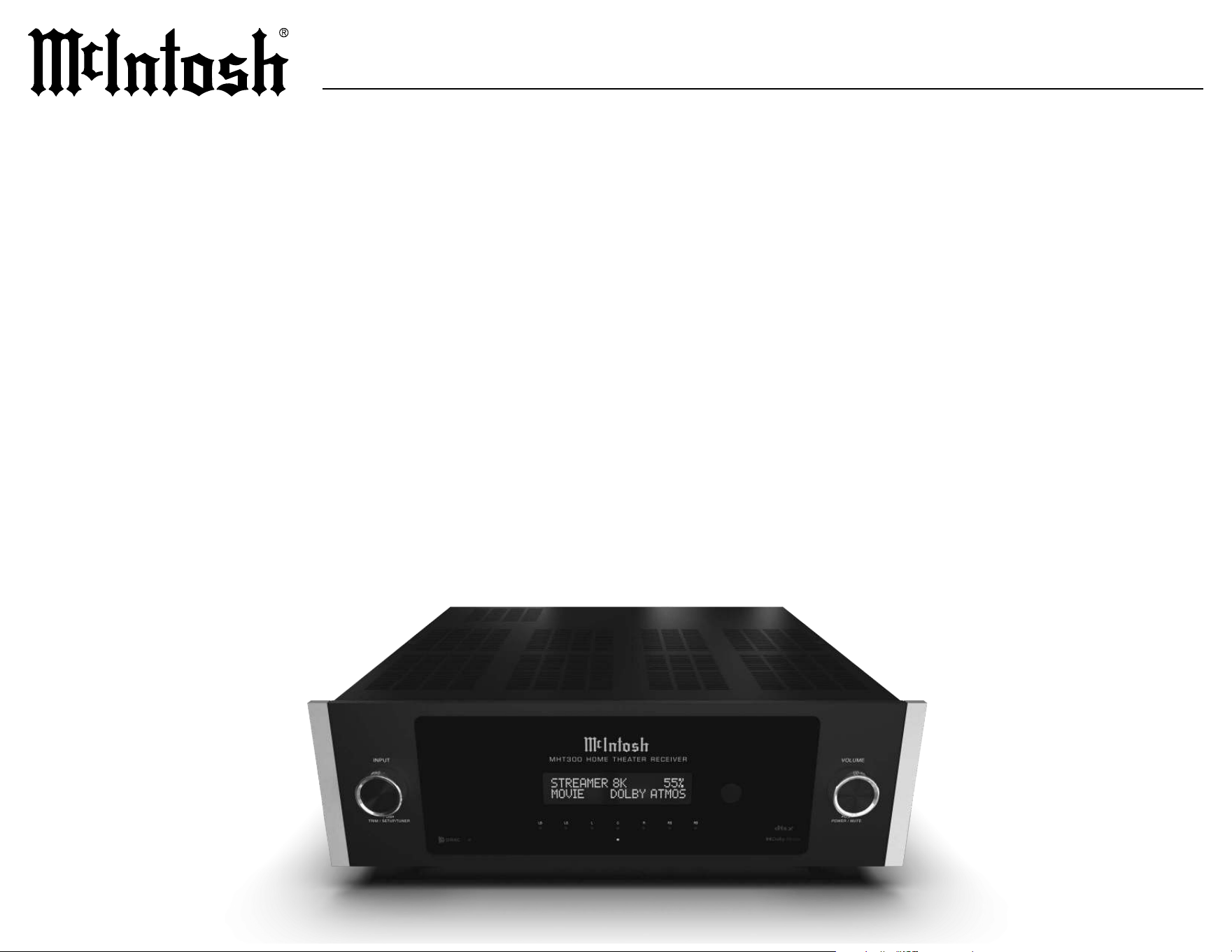
MHT300MHT300
HOME THEATER RECEIVER
OWNER’S MANUAL
2
Thank You from all of us at McIntosh
You have invested in a precision instrument that
will provide you with many years of enjoyment.
Please take a few moments to familiarize yourself
with the features and instructions to get the
maximum performance from your equipment.
If you need further technical assistance, please
contact your dealer who may be more familiar with
your particular setup including other brands. You
can also contact McIntosh with additional questions
or in the unlikely event of needing service.
McIntosh Laboratory, Inc.
2 Chambers Street
Binghamton, New York 13903
Technical Assistance (607) 723-3512
Fax (607) 724-0549
Customer Service (607) 723-3515
Fax (607) 723-1917
Email support@mcintoshlabs.com
www.mcintoshlabs.com
Safety First
Please read the safety instructions included in a
separate document called Important Additional
Operation Information Guide.
Please Take A Moment
For future reference, you can write down your
serial number and purchase information here.
We can identify your purchase from this informa-
tion if the occasion should arise:
Serial Number: __________________________
Purchase Date: ___________________________
Dealer Name: ___________________________
Introduction
Now you can take advantage of traditional McIntosh
standards of excellence in the MHT300. The
MHT300 Home Theater Receiver marries a long
tradition of uncompromising quality with the
latest home theater technologies to bring you an
unsurpassed luxury entertainment experience. The
McIntosh sound is “the sound of the music itself.”
What is in the box
Here is what is in the box besides all the shipping
materials:
• One MHT300 Home Theater Receiver
• One accessory package including:
• Microphone with attached cable
• Microphone stand
• 1/2 inch male to 5/8 inch female adapter
• One hardware package including:
• Two Side Rack Mounting brackets
• Four at head Philips screws 6-32x1/4”
• Four Philips screws 8-32x3/8”
• One manual package including this manual
• One HR085 Remote Control
• One AC power cord
• One
McIntosh wrench
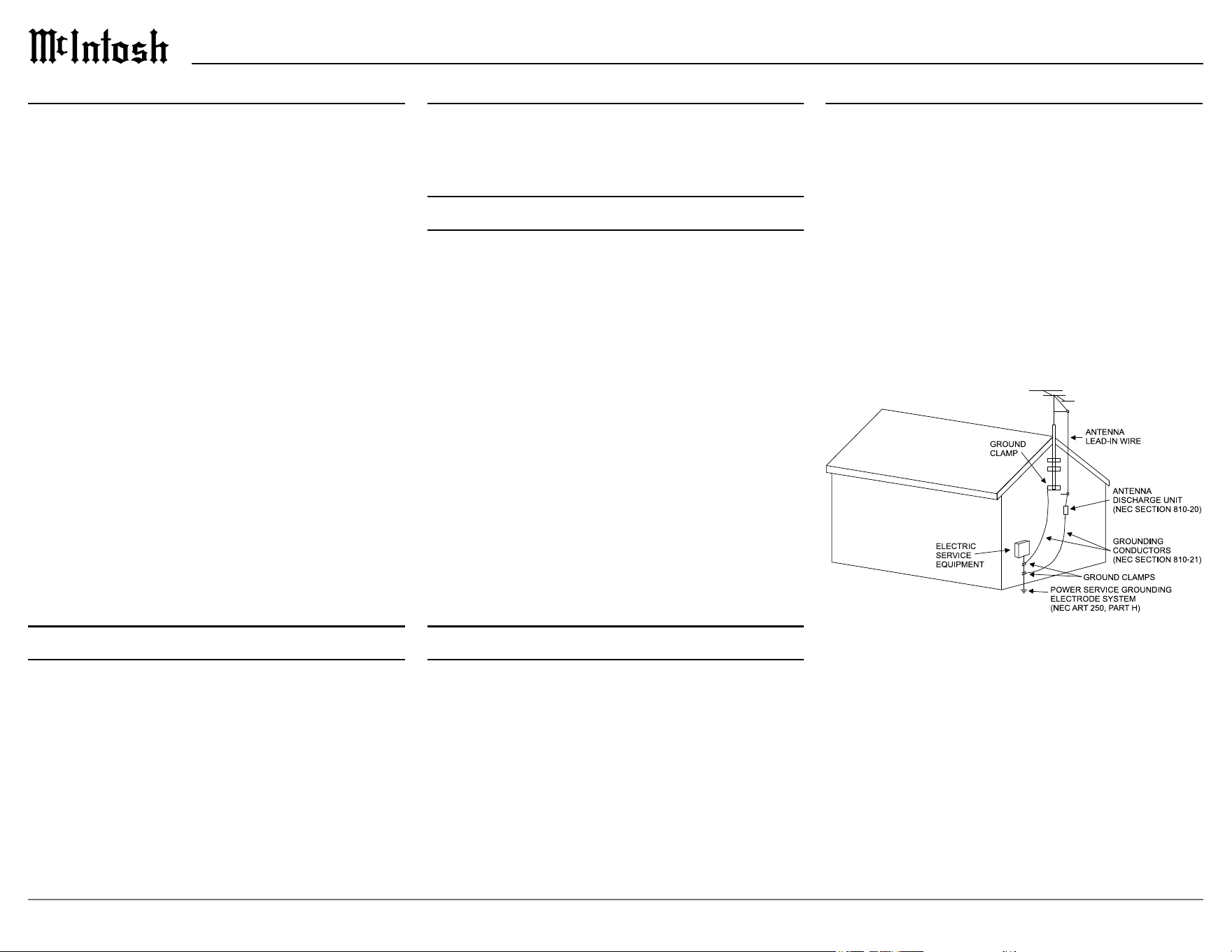
Outdoor Antenna Grounding
If an outside antenna or cable system is connected
to the product, be sure the antenna or cable system
is grounded so as to provide some protection against
voltage surges and built-up static charge.
Article 810 of the National Electrical Code, ANSI/
NFPA 70, provides information with regards to
proper grounding of the mast and supporting struc-
ture, grounding of the lead-in wire to an antenna
discharge unit, and size of ground conductors,
location of antenna-discharge unit, connection to
ground electrodes and requirements for the ground-
ing electrode.
Example of antenna grounding as per
National Electrical Code,
ANSI/NFPA 70

3
MHT300
Performance Features Table of Contents
Introduction . .. .. .. .. .. .. .. .. .. .. .. .. .. 2
Performance Features
.. .. .. .. .. .. .. .. .. 3
Dimensions
.. .. .. .. .. .. .. .. .. .. .. .. .. .. 4
Custom Installation
.. .. .. .. .. .. .. .. .. .. .. 5
Trademark and License Information
. .. .. .. 5
Front Panel
.. .. .. .. .. .. .. .. .. .. .. .. .. .. 6
Rear Panel Inputs
. .. .. .. .. .. .. .. .. .. .. .. 7
Rear Panel Outputs
.. .. .. .. .. .. .. .. .. .. .. 7
Connector and Cable Information
.. .. .. .. .. 8
Connecting a Loudspeaker
.. .. .. .. .. .. .. .. 9
Navigating the Remote Control
.. .. .. .. .. .. 10
How to use the Remote Control
. .. .. .. .. .. 11
Trim Menu
.. .. .. .. .. .. .. .. .. .. .. .. .. ..12
Setup Menu
.. .. .. .. .. .. .. .. .. .. .. .. .. .. 14
Inputs Setup Menu
.. .. .. .. .. .. .. .. .. .. ..15
General Setup Menu
.. .. .. .. .. .. .. .. .. .. 16
Audio Setup Menu
.. .. .. .. .. .. .. .. .. .. ..18
Video Setup Menu
.. .. .. .. .. .. .. .. .. .. ..20
Network Setup Menu
.. .. .. .. .. .. .. .. .. .. 21
Speakers Setup Menu
.. .. .. .. .. .. .. .. .. ..22
Dirac Live
®
Setup. .. .. .. .. .. .. .. .. .. .. ..24
Connection Diagram
.. .. .. .. .. .. .. .. .. ..25
Setting Up Surround Sound
.. .. .. .. .. .. ..26
Tuner Setup Menu
.. .. .. .. .. .. .. .. .. .. ..28
Navigating the Tuner Input
. .. .. .. .. .. .. ..29
Amplifier Audio Specifications
.. .. .. .. .. ..30
Packing Instructions
.. .. .. .. .. .. .. .. .. .. 31
Part List
.. .. .. .. .. .. .. .. .. .. .. .. .. .. .. 31
• Special Power Supply
High speed switching power supply provides
stable high eciency noise free operation.
• McIntosh Custom Binding Posts
McIntosh patent pending gold plated output
terminals deliver high current output. They accept
large diameter wire and spade lugs. Banana plugs
may also be used only in the United States and
Canada.
• Front Panel Illumination
The even illumination of the front panel is
accomplished by the combination of custom
designed light diusers and extra long life
Light Emitting Diodes (LEDs).
• Glass Front Panel Display
The famous McIntosh illuminated glass front
panel display uses a 2 x 20 character vacuum
uorescent display to indicate various operational
setup and status notices
.
• Special FM RF Circuitry
The MHT300 RF circuitry receives strong local
FM station signals without distortion and receives
even the weakest of FM signals with low noise.
•
Remote Control with External Sensor Input
The HR085 Remote Control provides control of the
MHT300 operating functions and other McIntosh
source components. Enjoy your McIntosh system
from other rooms in your home by connecting
external sensors.
• Power Guard
The McIntosh power guard circuit prevents the
amplier from being over driven into clipping,
with its harsh distorted sound that can damage
your valuable loudspeakers.
• Sentry Monitor and Thermal Protection
McIntosh sentry monitor power output stage
protection circuits ensure the MHT300 will
have a long and trouble-free operating life.
Built-in thermal protection circuits guard against
overheating.
4
Dimensions
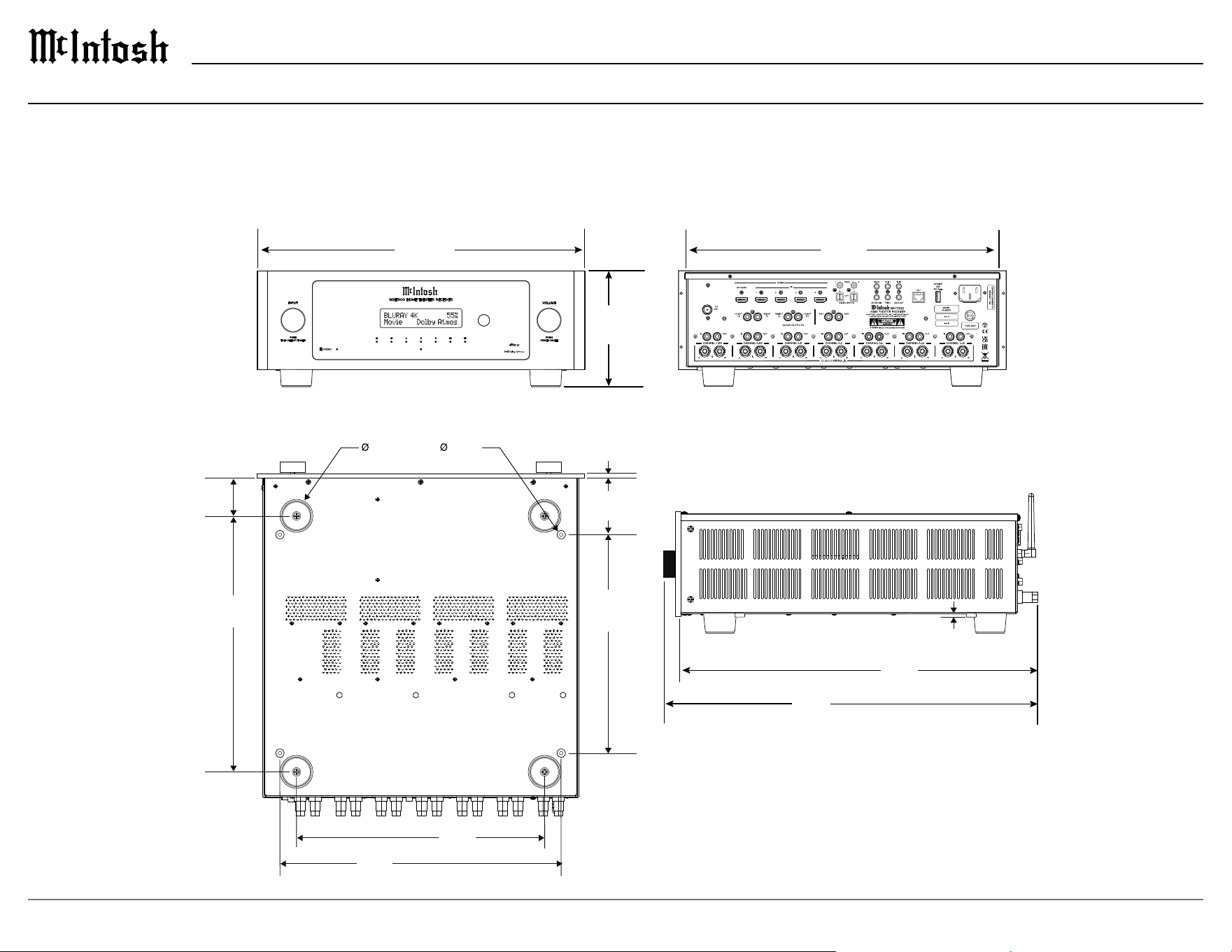
The MHT300 needs to be placed upright on its four feet. It also can be custom installed, see the following page for details.
The following dimensions can assist in determining the best location for your MHT300.
A Note on Placement:
To protect the anodized nish on your MHT300 it is important to limit exposure to certain types of lighting and only use appropriate gentle cleaners. Direct sunlight, other
forms of UV light, high intensity lighting and aggressive cleaners with harsh chemicals can result in discoloration of the anodized nish.
17 ¹/2”
44.5 cm
16 ³/4”
42.5 cm
6 ³/16”
15.7 cm
1 ³⁄4”
4.4 cm
¹⁄2”
1.3 cm
2
”
5.1 cm
13 ¹¹⁄16”
34.8 cm
13 ¹⁄4”
33.7 cm
15
¹⁄4”
38.1 cm
11 ¹¹⁄16”
29.7 cm
3”
7.6 cm
¹⁄4”
.6 cm
¹⁄4”
.6 cm
18”
45.7 cm
18”
⁷⁄8”
47.9 cm
5
MHT300
Custom Installation
Remove the four feet when installing the MHT300 and retain them with the fastening screws
for possible future use. Do not install the MHT300 above heat generating components. When
the MHT300 is installed in a cabinet with other components, use a ventilation fan to provide
cool operating temperature.
• 3 inches (7.6cm) above the top
• 3 inches (7.6cm) below the bottom
• 3 inches (7.6cm) on each side so that airow is not obstructed
• 1 7/16 inch (2.5cm) in front of the mounting panel for knob clearance
Rack Mounting
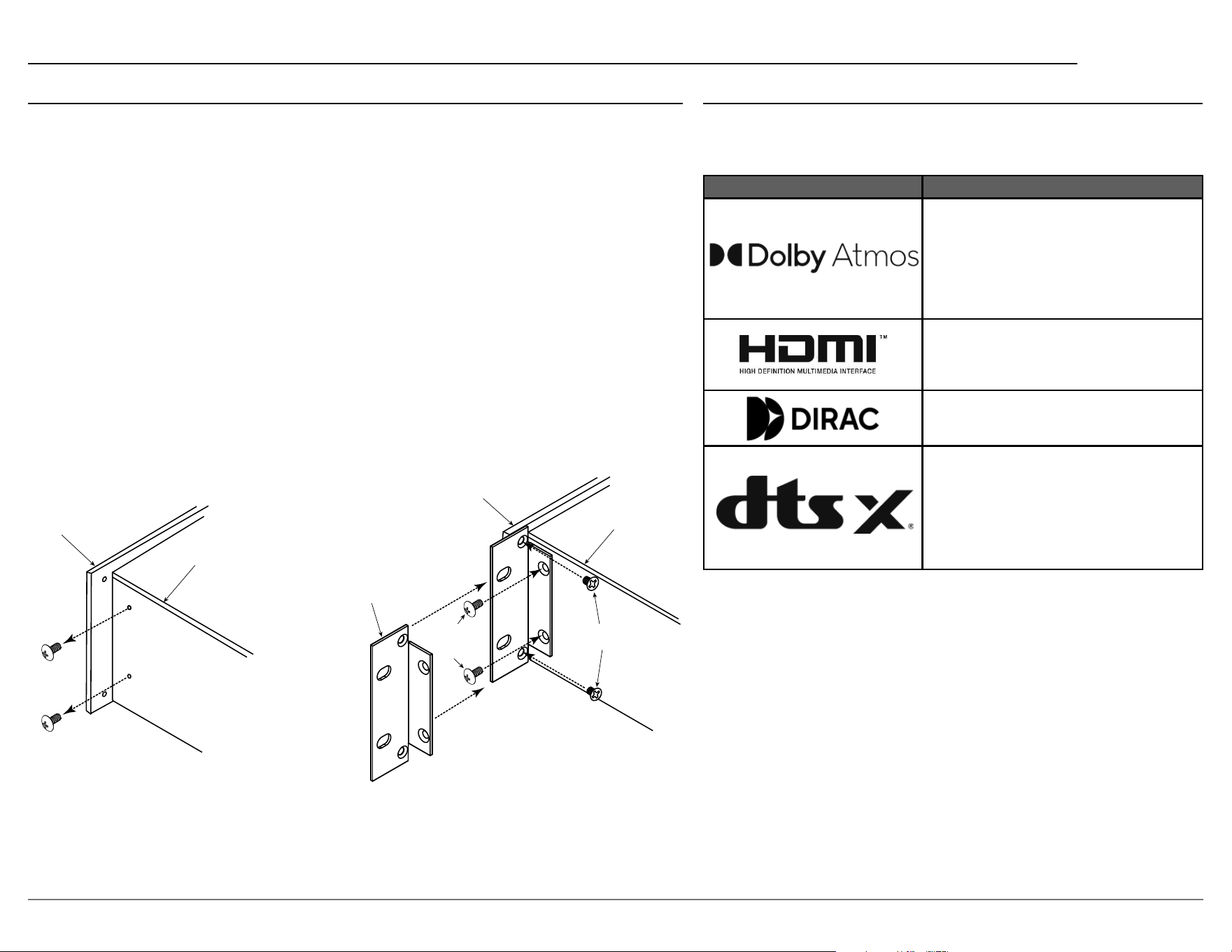
To rack mount the MHT300, the two included side rack mounting brackets should be
installed.
Follow these instructions for each side:
1. Remove the two screws from the front side of the MHT300’s side panel. Save these for
future use if the mounting brackets are removed.
2. Secure the side rack mounting bracket to the MHT300 using the larger supplied screws.
Do not re-use the previously removed screws. Use the smaller supplied screws to secure
the bracket to the front panel.
Trademark and License Information
The McIntosh MHT300 incorporates copyright protected technology
that is protected by U.S. patents and other intellectual property rights.
The MHT300 uses the following technologies:
Trademark Logo License Information
Dolby, Dolby Atmos, and the double-D
symbol are registered trademarks of Dolby
Laboratories Licensing Corporation.
Manufactured under license from Dolby
Laboratories. Condential unpublished
works. Copyright © 2012-2020 Dolby
Laboratories. All rights reserved.
The terms HDMI, HDMI High-Denition
Multimedia Interface, and the HDMI Logo
are trademarks or registered trademarks of
HDMI Licensing Administrator, Inc.
Manufactured under license from Dirac
Live. Dirac Live, Dirac
®
and Dirac Live
®
are
trademarks owned by Dirac Research AB.
For DTS patents, see http://patents.dts.com.
Manufactured under license from DTS
Licensing Limited. DTS, DTS:X, and the
DTS:X logo are registered trademarks or
trademarks of DTS, Inc. in the United States
and other countries. © 2021 DTS, Inc. All
rights reserved.
Front Panel
Side Panel
Side Rack
Mounting
Bracket
Larger
Supplied
Screws
Smaller Supplied
Screws
Front Panel
Side Panel
Trademarks of McIntosh Laboratory, Inc.:
The following are Registered Trademarks of McIntosh Laboratory, Inc. in multiple jurisdic-
tions around the world: the written McIntosh logo; the McIntosh Globe logo; the Mc logo;
Power Guard; Power Guard Screen Grid Sensor; Power Guard SGS; LD/HP; Dynamic
Power Manager; the 4DPM8 logo; HXD; the HXD logo; Behind The Sound; Legendary
Performance.
The following are Trademarks of McIntosh Laboratory, Inc. in multiple jurisdictions around the
world: Autoformer; Sentry Monitor; Solid Cinch; McIntosh Monogrammed Heatsinks; Hybrid
Drive; DualView; TripleView; Made of Sound.
The foregoing trademarks, registered and otherwise, are not to be used, reproduced, or
registered in any way without the express written permission of McIntosh Laboratory, Inc.
6
PUSH
POWER / MU TE
VOLUMEINPUT
PUSH
TRIM / S ET UP / TUNER
BLURAY 4K 55%
Movie Dolby Atmos
M H T 3 0 0 H O M E T H E A T E R R E C E I V E R
Front Panel
Front Panel
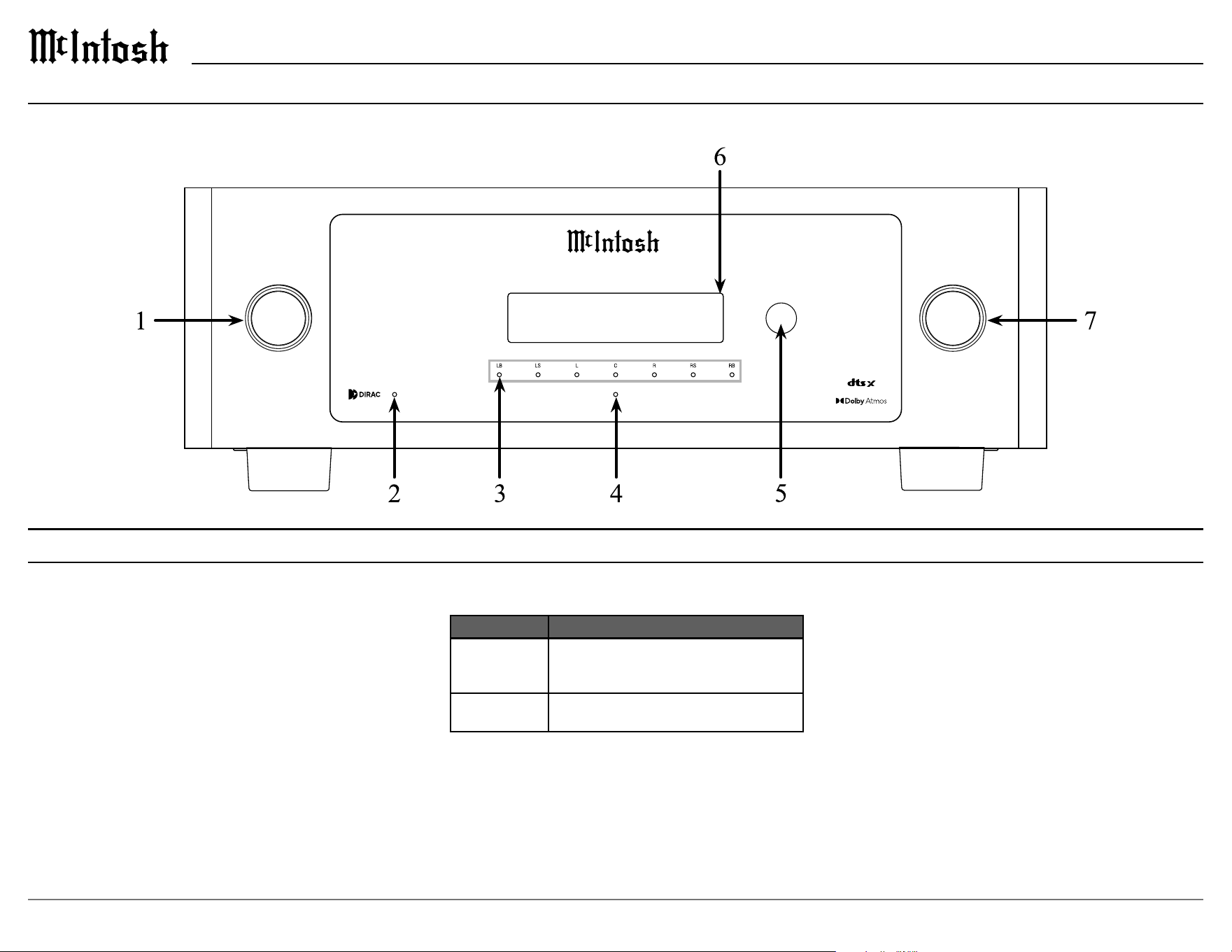
1. INPUT KNOB is used for the following:
• Input Selection: Turn clockwise or counter-
clockwise to scroll through inputs.
• Tuni ng Mo de: With the tuner input selected,
quickly double press to enter Tuning Mode
and rotate the input knob to navigate through
stations.
• Trim Menu: Push and release to enter Trim
Mode and rotate to navigate through options.
• Setup Menu: Push, hold for two seconds, and
release to enter setup mode.
2. Dirac Live LED shows whether Dirac Live EQ
is engaged, LED will be lit, or disengaged, LED
will not be lit.
3. LB, LS, L, C, R, RS, RB LED lights show
fault states for each amplier channel.
LED Color Functional Status
Amber
Indicates when maximum power output for
the channel has occurred with prevention
of audio clipping
Red
Indicates current limit or short circuit for
the channel loudspeaker output connection
4. Standby LED indicates AC connection and
current power status.
5. IR Sensor receives commands from the HR085
remote control.
6. VFD (Vacuum Fluorescent Display) 2 x 20
character screen shows various messages for
setup/trim and playback conditions.
7. VOLUME KNOB is used for the following:
• Power ON: Quick press to power on the
MHT300.
• Adjust Volume: Rotate to adjust the volume.
• Mute: Quick press to toggle mute on or o.
• Setup/Trim: Rotate to adjust Trim options once
the menus are accessed using the INPUT knob.
• Power OFF: Push and hold for 2 seconds to
power down the MHT300. POWER OFF will
appear on the display.
7
MHT300
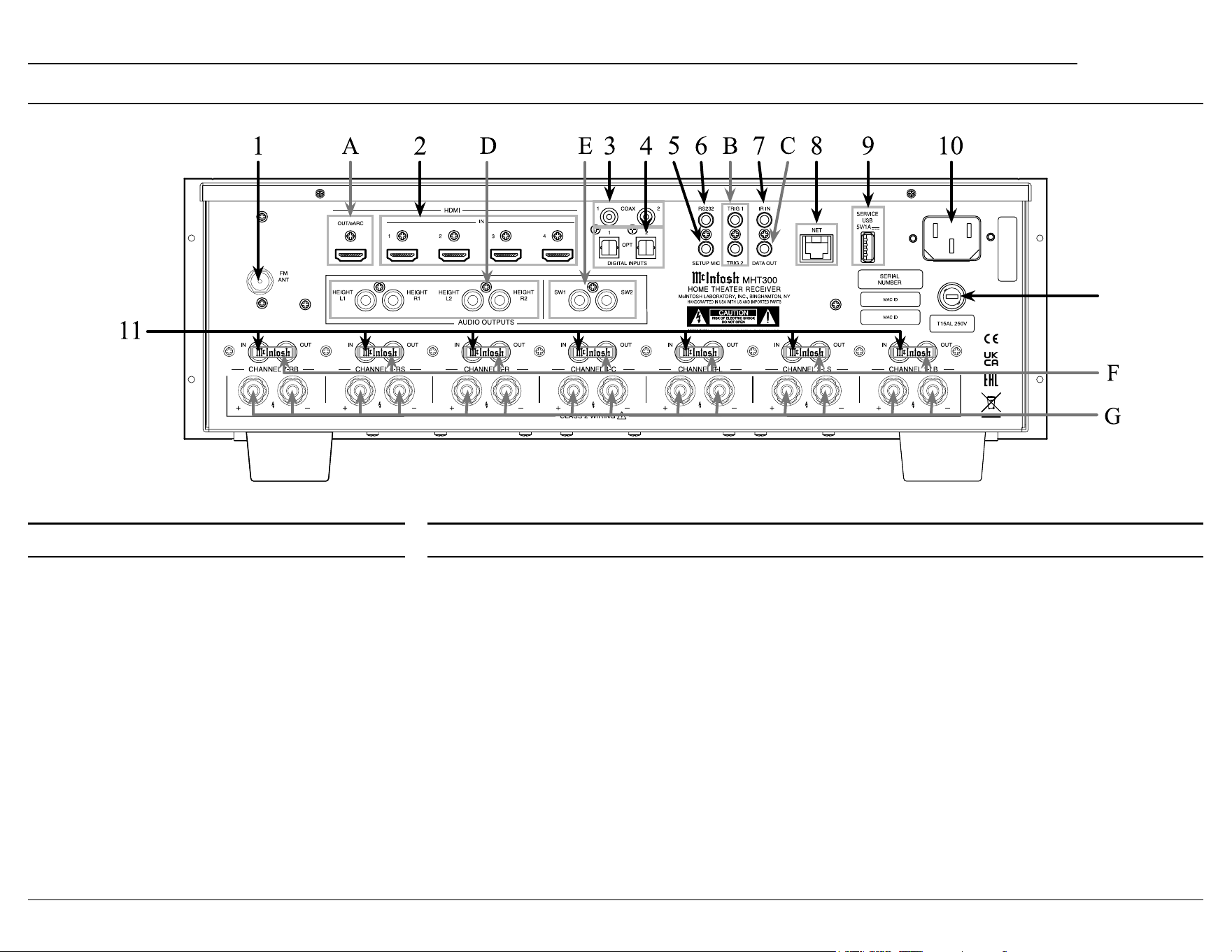
1. One FM Antenna
2. Four HDMI IN
3. Two coaxial digital audio inputs
4. Two Toslink optical inputs
5. One 1/8 inch jack for microphone input
6. One 1/8 inch jack for RS232 connector
7. One 1/8 inch jack for wired IR input
8. One 10baseT LAN connector
9. One USB upgrade service port
10. One AC power connector
11. Seven unbalanced amplier inputs
Rear Panel Connections
Rear Panel Inputs Rear Panel Outputs
A. HDMI Out / eARC
Note: Acts as an audio input when ARC is active.
B. Two 1/8 inch jack power control (trigger) outputs
C. One 1/8 inch DATA OUTput jack
D. Four additional outputs are available for Height
speakers via separate ampliers:
• HR1 (Height Right 1)
• HL1 (Height Left 1)
• HR2 (Height Right 2)
• HL2 (Height Left 2)
Note: HR1 and HL1 should be forward of HR2 and HL2. The
MHT300 support of Height speakers is limited to Top
Front, Top Middle and Top Rear locations.
Fuse
see rear panel for details
E. Two subwoofer outputs are available to connect to
powered subwoofers.
• SW1 (Subwoofer 1)
• SW2 (Subwoofer 2)
F. Seven pre-congured unbalanced connections:
• FR (Front Right)
• FL (Front Left)
• C (Center)
• SR (Surround Right)
• SL (Surround Left)
• SBR (Surround Back Right)
• SBL (Surround Back Left)
G. Speaker outputs
8
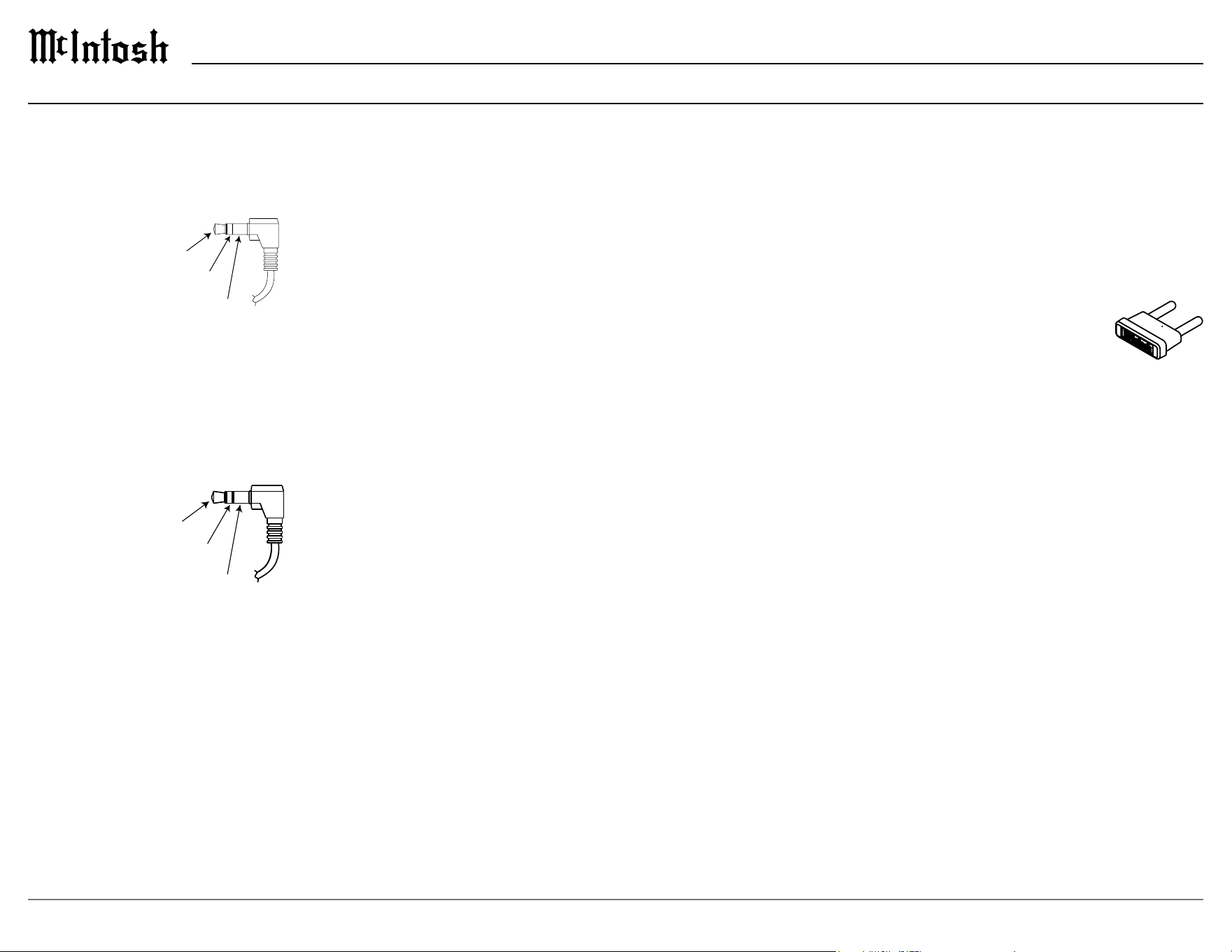
Power Control Connectors
The MHT300 TRIG 1 & 2 outputs on the rear panel
send power on/o signals when connected to other
McIntosh components. A 3.5mm stereo mini plug
is used for connection to the trigger outputs on the
MHT300.
Data Out Connector
The MHT300 will convert IR remote control data to
share with McIntosh components connected to the
DATA OUT port on the rear panel. This will allow
the operation of primary functions of a source to be
operated with the MHT300’s remote control as well
as allow units that are out of range of an IR signal to
receive commands.
NET Port (Ethernet / 10baseT LAN)
Use an Ethernet cable to connect the MHT300 to a
network router. The network connector is located
on the rear panel of the MHT300 to the left of the
CAUTION label. It is labeled NET.
By default, the MHT300 has DHCP set to ON and
will automatically receive an IP address from the
router. This setting can be changed.
Connector and Cable Information
Power
Control
Ground
Lighting
Control
Data
Signal
N/C
Data
Ground
HDMI
The MHT300 has four HDMI inputs capable of 8K
video. To take advantage of this new capability, the
use of certied “Ultra High Speed HDMI” cables
according to the 2.1 HDMI specication is recom-
mended. This would include support for 8K@60Hz,
HDR, Ethernet, and ARC. Although HDMI is
backward compatible, older cables may have issues
with the higher bandwidth.
Use the HDMI OUT/eARC port when connecting to
an ARC (Audio Return Channel) enabled television.
ARC can provide two-way communication between
units allowing for volume control and lip-syncing
functions to ensure audio and video are perfectly
matched. This allows for more intelligent operation
between components as well as less cable clutter.
Make sure the ARC is enabled in your TV’s setup
menu.
The MHT300 supports eARC which allows for even
higher bandwidth and will allow for higher quality
audio including uncompressed 7.1 surround, Dolby
Atmos and DTS:X.
USB
There is a USB type-A port on the rear panel of the
MHT300 which is labeled USB 5V/1A. The USB
port is used for rmware upgrades and to save and
restore MHT300 setup information. The USB port is
not for general USB use or charging devices.
Amplier Jumper Connectors
The MHT300 utilizes 7 phono style jumper
connectors to make a signal connection between the
preamplier outputs of the MHT300 and the built
in power amplier inputs. The McIntosh jumpers
come pre-installed. The jumper connections may be
removed in order to congure other amplier models
with the processor section to further customize your
playback system.
Note: The Jumper Connector is available
from the McIntosh Parts Department:
McIntosh Jumper Connector Part No.
117781
FM Antenna
The MHT300 FM tuner circuitry requires the
connection of an external Antenna for FM recep-
tion. Port (1) accepts a 75 Ohm Coaxial Type F
connection.
Microphone
The SETUP MIC input is for connecting the supplied
MHT300 Microphone using the microphone’s
attached cable and a 3.5mm connector. The
microphone is used in the Dirac Live
®
calibration for
tuning the system to your room. For instructions see
“Dirac Live® Setup” on page 24.
9
MHT300
IR IN Port Connector
The IR input allows an external IR receiver to be
attached to the MHT300. The input is labeled IR
IN. By attaching an IR receiver using a 3.5mm
cable, the remote control can be used in another
location without a line-of-sight to the MHT300’s
front IR sensor. The IR input
is congured for non-McIntosh
IR sensors such as a Xantech
Model DL85K Kit.
Note: The IR receiver must provide
its own power supply.
RS232
The RS232-C Data Cable is a 3.5mm stereo
mini plug used to connect to external third party
controllers.
Typical RS232 settings are:
• -8 data bits, no parity and
one stop bit
• -Baud rate xed at 115,200 bits per second
AC Power
This connection is essential. Plug the supplied power
cord into the AC connector located in the rear right
corner of the MHT300 and into a grounded and
functioning AC outlet.
Connector and Cable Information (continued)
IR Data
Control
Ground
N/C
MHT300 TXD Out
Data being transmitted
MHT300 RXD In
Data being received
Ground
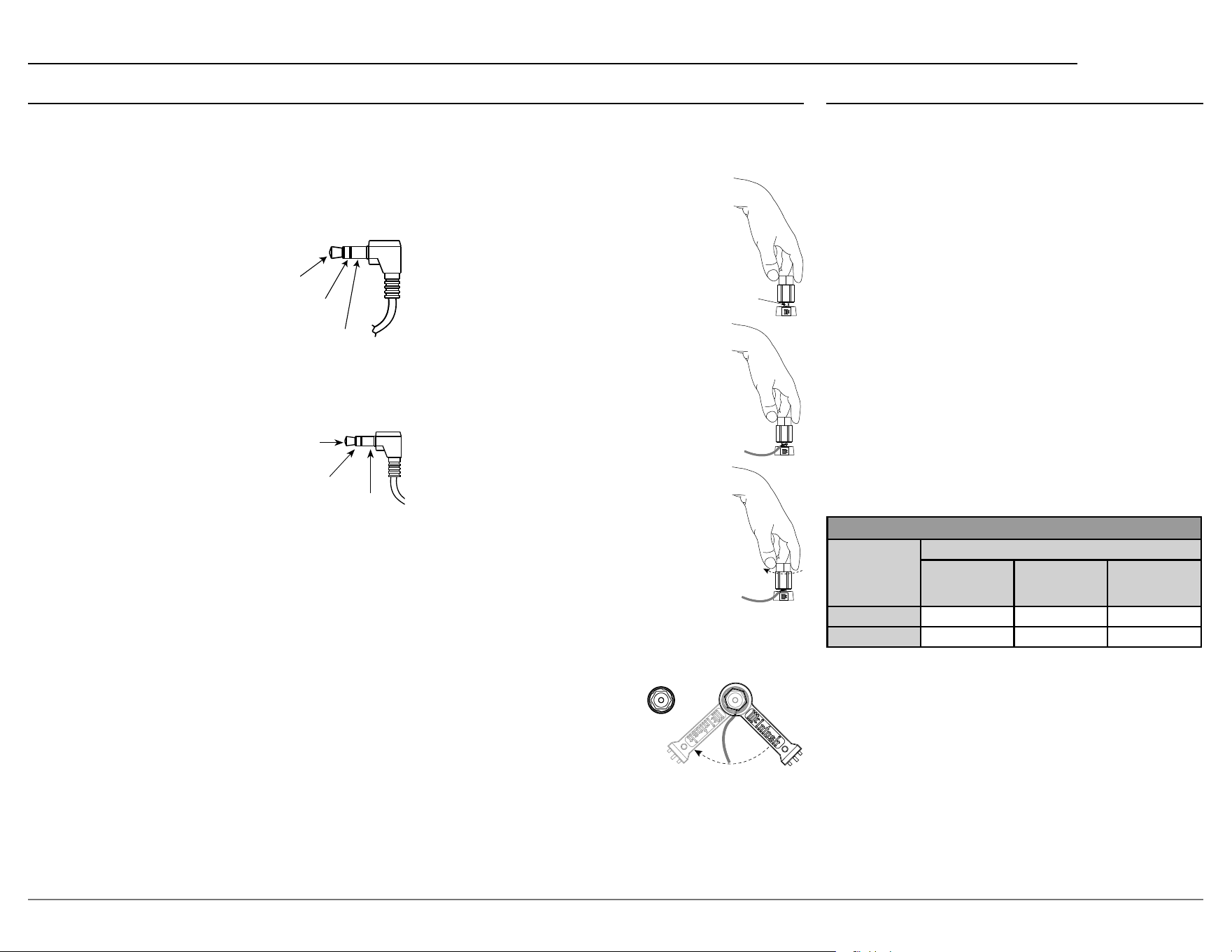
Output Terminals
When connecting the loudspeaker hookup cables to the
MHT300 amplier output terminals please follow the
steps below:
1. Rotate the top of the output terminal
Post counterclockwise until an opening
appears.
Opening
2. Insert the loudspeaker hookup cable
into the output terminal post opening
or the cable spade lug around the
center post of the output terminal.
3. Rotate the top of the output terminal
Post clockwise until it is nger tight.
4. Place the supplied McIntosh wrench over the top
of the output terminal and rotate it one quarter
of a turn (90°) to secure the loudspeaker cable
connection. Do not over tighten. .
Connecting a Loudspeaker
The MHT300 is designed for loudspeakers with
an impedance of 4 or 8 ohms. Connect a single
loudspeaker only to one pair of the seven output
terminals. Take note of how the speaker channels
will be set up, as this will help facilitate any DIRAC/
EQ settings established later on. Please follow the
oor plans shown on page 26 when connecting
specic channels to certain loudspeakers similar to
your existing oor plan.
The seven pre-congured speaker channels come
with jumpers connecting each channel to the pream-
plier section. These jumpers can be removed to
further integrate the seven power amplier channels
or the preamplier channels into other multi-channel
equipment.
When connecting loudspeakers to the MHT300 it
is very important to use cables of adequate size so
there is little to no power loss in the cables. The size
is specied in AWG (American Wire Gauge). The
smaller the gauge number, the larger the wire size.
Loudspeaker Cable Wire Gauge Guide
Loudspeaker
Impedance
Cable Distance
25 feet
(7.62 meters)
or less
50 feet
(15.24 meters)
or less
100 feet
(30.48 meters)
or less
4 ohms 14AWG 12AWG 10AWG
8 ohms 16AWG 14AWG 12AWG
Note: Do not connect the MHT300 amplifier outputs to the
High-level (speaker line) inputs or ‘Speakon’ inputs of
a powered subwoofer product. Doing so could result
in damage to the MHT300 or the powered subwoofer.
The amplifier outputs are not a common-ground type,
and must remain floating and independent of system
grounds and other speaker connections.
10
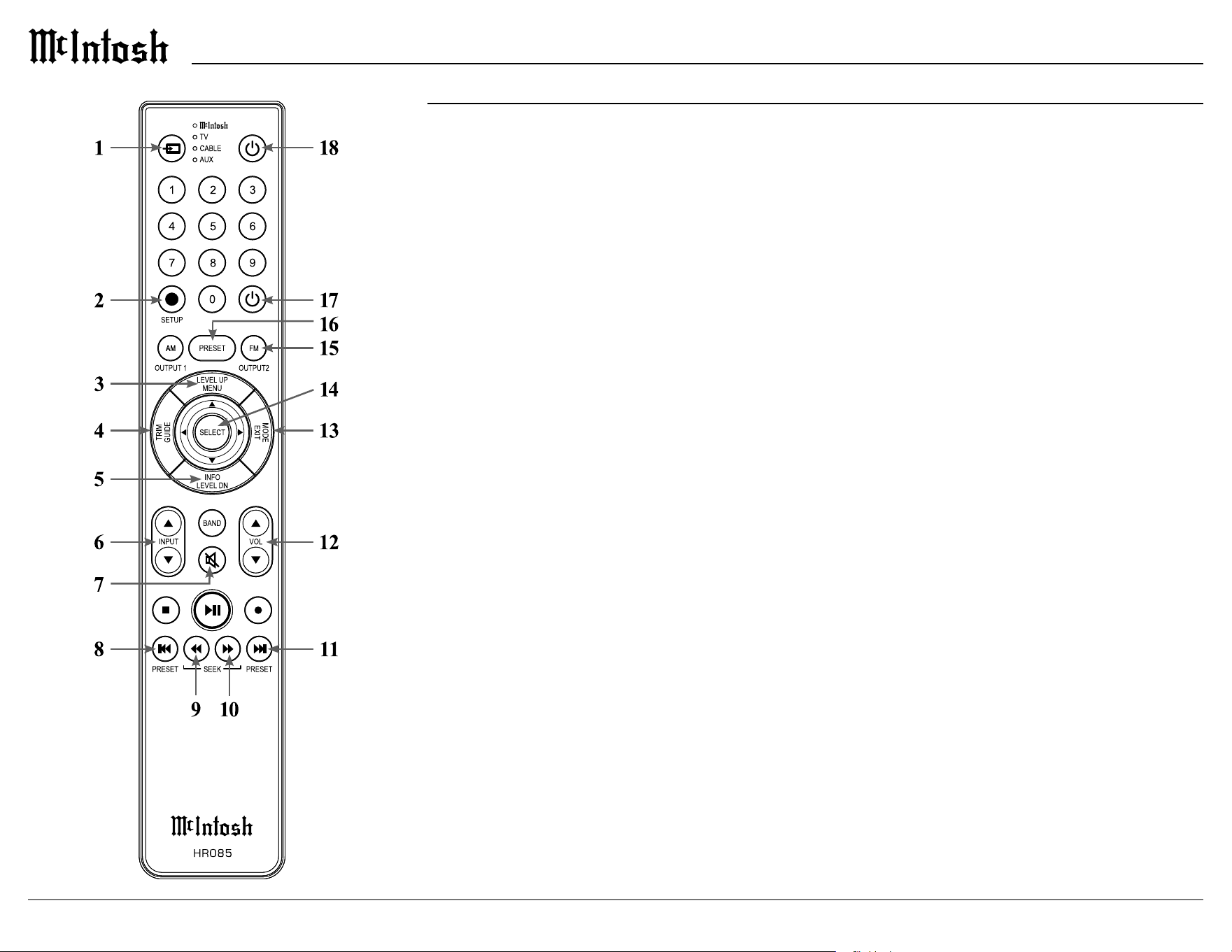
Navigating the Remote Control
1. Switch Device: Select dierent devices for
remote operation. Selected device is indicated
by the LED light.
2. Setup Button: Used to enter setup mode.
3. Level Up/Menu: Adjusts trim functions
settings. Accesses menu on compatible devices.
4. Trim/Guide: Enters trim functions menu.
Opens guide on compatible devices.
5. Info/Level Down: Adjusts trim functions
settings. Accesses info on compatible devices.
6. Input: Changes and selects dierent inputs.
7. Mute: Mutes audio playback.
8. Previous/Previous Preset: Return to your
previous media selection or a previous tuner
preset.
9. Fast Reverse/Seek Down: Navigate
backwards through the current active media
using this button. This is also used to adjust
the tuner downwards.
10. Fast Forward/Seek Up: Navigate forward
through the current active media using this
button. This is also used to adjust the tuner
upwards.
11. Next/Next Preset: Jump to your next media
selection or navigate to the next tuner preset.
12. Volume: Used to adjust the volume.
13. Mode/Exit: This will exit the trim functions
menu. It will also display information or certain
options.
14. Select: Selects the highlighted option.
15. FM/Output 2: Access the FM tuner.
16. Preset: Press this button to store current station
onto the next available preset.
17. Power O: Turns o the selected device shown
by the LED.
18. Power On: Turns on the selected device shown
by the LED.
Note: The HR085 Remote Control has buttons used to control
multiple devices. Buttons whose function are not
described are for use with other McIntosh products.
For more information, refer to the HR085 Owner's
Manual on the McIntosh website at www.mcintoshlabs.
com.

11
MHT300
How to use the Remote Control
Manual Tuning
Press the directional up or down buttons on the
inner ring of the remote to navigate incrementally
through stations.
Automatic Tuning
Press the SEEK 9 down or 10 up to move to the next
station.
Preset Tuni ng
Press the PRESET 8 down or 11 up button and the
MHT300 will stop on the next Station in preset
memor y.
Note: For information on entering a station into memory,
refer to “Presets Edit” on page 28.
Setting a Preset
Once the FM station has been tuned, press the
PRESET button 16 to store this station into memory.
Erasing a Preset
Tune in the station preset and press the PRESET
button 16 to erase from memory.
Remote Control Batteries
The HR085 Remote Control included with the
MHT300 is powered by two AAA batteries. To insert
or remove batteries, open the battery compartment
by removing the cover located on the back of the
remote control. To open, pull the clasp located just
above the opening downward.
Additional Discrete Commands
Additional discrete commands for external control
systems are available:
• OPT1
• OPT2
• COAX1
• COAX2
• TUNER
• HDMI1
• HDMI2
• HDMI3
• HDMI4
• HDMITV
• Power (Cycle)
These additional commands can be accessed using an
optional McIntosh HR093 Service Remote Control.
You can also contact McIntosh Technical Assistance
or your dealer for more information.
12
Trim Menu
The trim menu allows you to make and store adjust-
ments to various settings for all inputs. The trim
menu can be entered using the INPUT knob or the
remote control.
The following table lists the trim options and the
range of values that can be adjusted:
Setting Values
Bass -12dB to +12dB in 1 dB increments
Treble -12dB to +12dB in 1 dB increments
Dirac Live On or O
Voicing EQ Select to apply to current input
Audio Delay
(Lip Sync)
0 to 500 ms in 25 ms increments
Trim Center -10dB to +10dB in 1 dB increments
Trim Surrounds -10dB to +10dB in 1 dB increments
Trim Heights -10dB to +10dB in 1 dB increments
Trim Subwoofer -10dB to +10dB in 1 dB increments
Meter Lights On or O
Display Brightness Max, 75%, 50%, or 25%
Tuner Mode Frequency, Preset
Input Mode Auto, Movie, Music, Game, Through
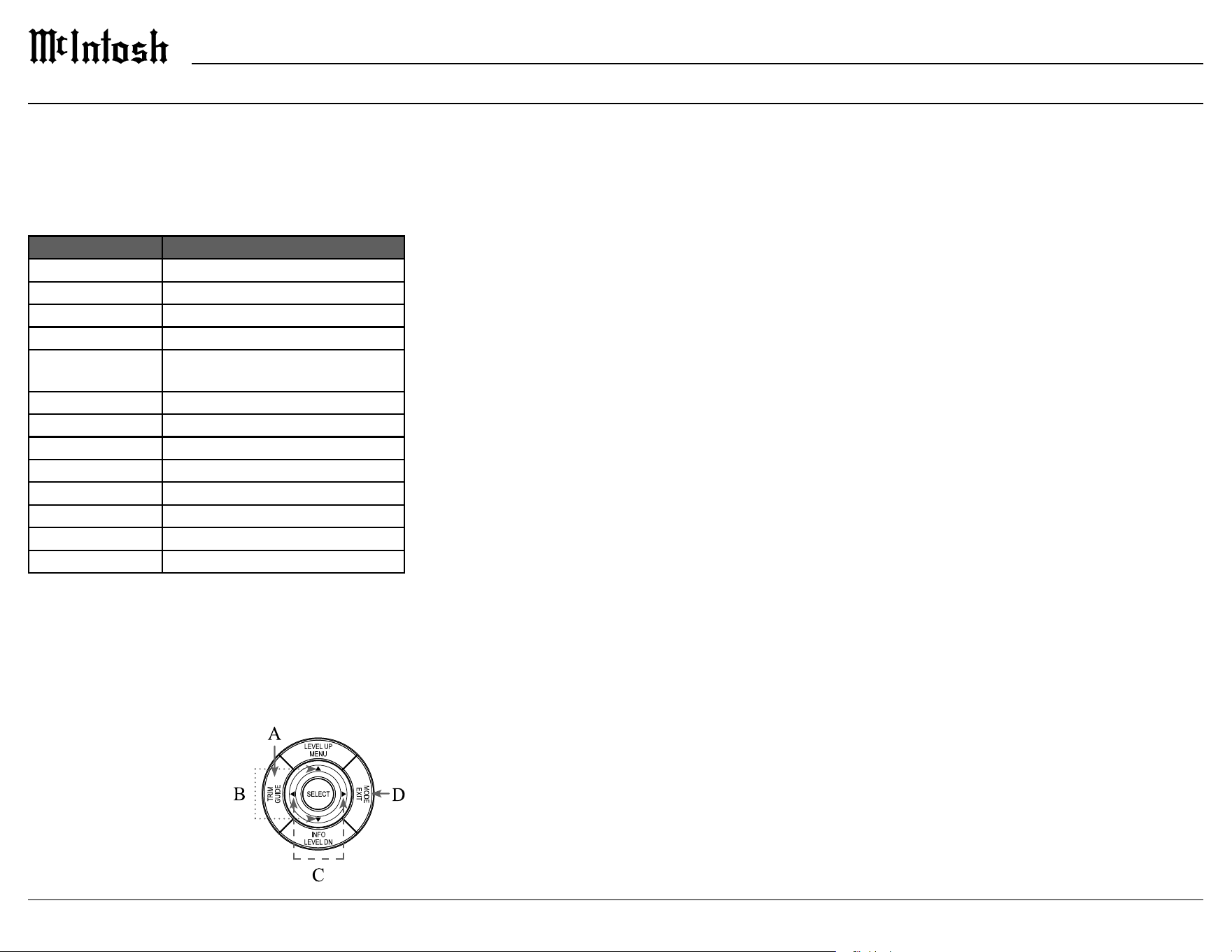
Trim Menu Using the Remote Control
A. Enter the trim menu by pressing the TRIM button.
B. You can scroll through the trim options by press-
ing the up or down arrows on the silver ring.
C. Use the left and right arrows on the silver ring to
change values for the selected trim option.
D. Use the EXIT button to
exit the trim menu or wait
ten seconds for the menu
to close automatically.
Trim Menu Using Knobs
To enter the trim menu, press and release the INPUT
knob. (Holding the knob for two seconds enters the
setup menu instead of the trim menu.)
Scroll through the options by turning the INPUT
knob.
Change the values of the current option by rotating
the VOLUME knob. Turn the INPUT knob to select
another option to edit or press the INPUT knob and
release to exit the menu. Changes will be saved.
Saving Trim Settings
Most trim settings are saved per input. For these
settings, changes to one input will not aect another
input. The following trim inputs are saved by
individual input:
• Bass
• Treble
• Audio Delay
• Trim Center
• Trim Surrounds
• Trim Subwoofer
• Mode
• Voicing EQ
Some trim settings are saved Globally. Making a
change to these settings for any input will make the
same change for all inputs. Global trim settings are:
• Dirac Live EQ
• Meter Lights
• Display Brightness
Input Mode
The following input modes are available:
• AUTO
• THROUGH
• MOVIE
• MUSIC
• GAME
MOVIE, MUSIC and GAME are variables that
are assigned a specic surround mode choice. The
surround modes that are used for MOVIE, MUSIC
and GAME options are assigned in setup. The default
for each option is AUTO. Other options are Dolby
Surround, DTS Neural:X, Multi-Channel Stereo,
Stereo and Through. For more information about
these options see “Setup: Audio > Surround Mode”
on page 18.
A quick way to change the current input’s surround
mode is to use the MODE button on the outer ring
of the remote control. Pressing the MODE button
will cycle through the surround modes. Stop on your
choice. The display will time-out in a few seconds
and your choice will be saved.
Assigning Input Modes
A. Enter the trim menu by pressing the INPUT knob
or the TRIM button on the remote control.
B. Rotate the INPUT knob or press the down arrow on
the remote control until MODE is displayed on the
VFD.
C. Press and release the INPUT knob or the SELECT
button on the remote control.
D. Rotate the INPUT knob or the up and down arrows
on the remote control until the desired input is
displayed.
E. Rotate the VOLUME knob or press the left and
right arrows to scroll through the surround modes.
F. Press and hold the INPUT knob for two seconds or
press the EXIT button to leave the trim menu (or
wait until it times out).
13
MHT300
Voicing EQ
Apply additional voicing preferences to current
input. The general voicing curves are added to the
Dirac Live Room EQ (if implemented) or existing
settings (if Dirac Live not implemented). Custom
Voicing EQ is not available if Dirac Live has not
been implemented.
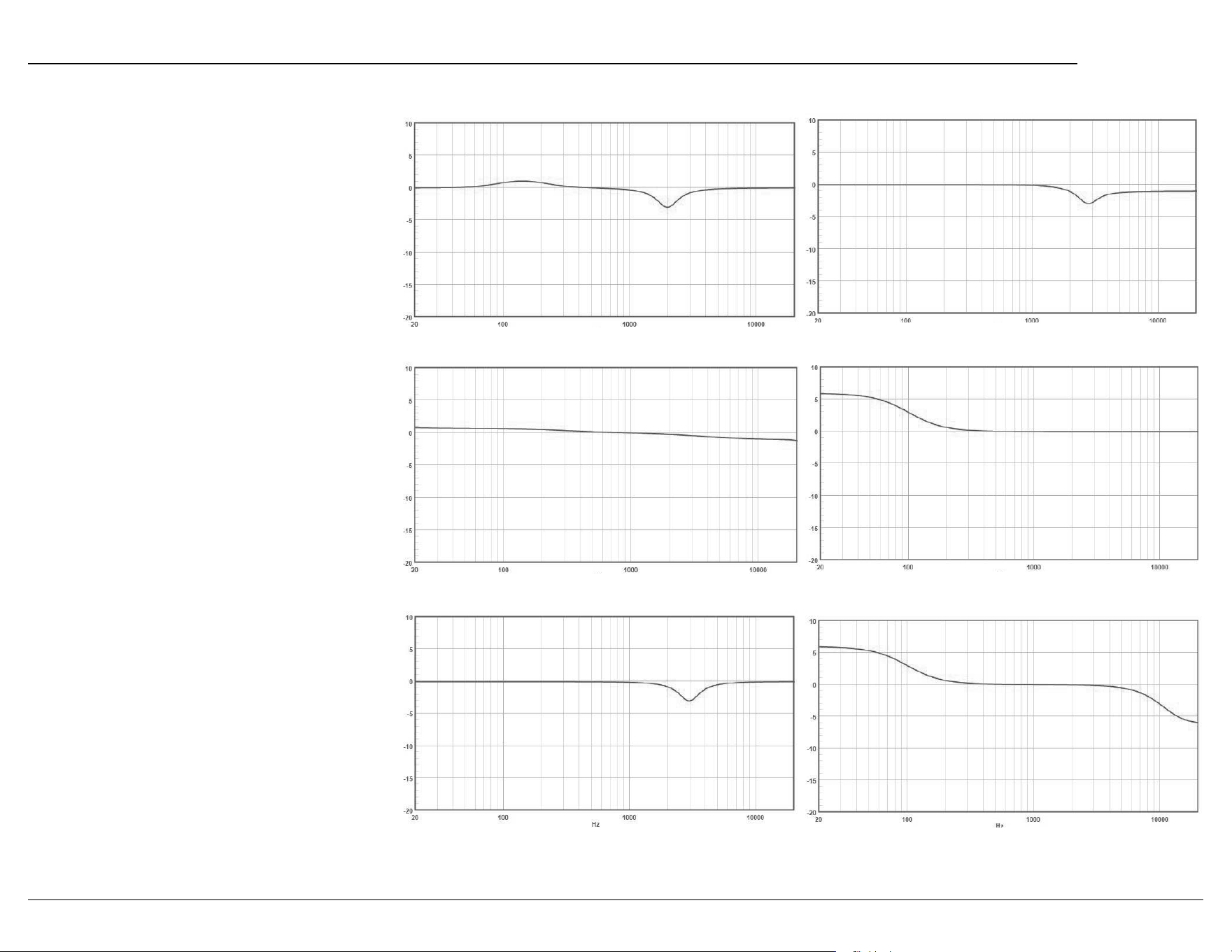
Voicing EQ select sets an easy tonal adjustment to
enhance playback enjoyment. The selection is set
to the current input, and remains active with that
input only until changed. The available Voicing
EQ lters are shown on the right.
Music II – Slightly attenuates high frequencies, especially near 3 kHz.Relaxed - Attenuates frequencies near 3kHz and boosts frequencies near 150Hz
Tilt – Attenuates high frequencies and slightly boosts very low frequencies. Action – Greatly accentuates low frequencies.
Music – Attenuates frequencies near 3 kHz. Action + Movie – Boosts low frequencies and attenuates very high frequencies.
14
Changing Settings
There are two ways to change the settings of the
MHT300.
1. Use the front panel and the Vacuum Fluorescent
Display (VFD) and the INPUT and VOLUME
knobs or the remote control
2. Using a browser on a connected computer
Most will nd it easier to navigate and enter informa-
tion on a computer. If you don’t have a connected
computer or the MHT300 is not connected to your
network, then using the front panel method can
accomplish almost all the same things using some
additional patience.
In this manual, submenus are denoted in the style:
SETUP: VIDEO > HDMI
The title above indicates from the setup menu choose
the video submenu and then HDMI.
Navigating Setup with the Front Panel
To enter setup mode using the front panel press and
hold the INPUT knob for two seconds and then
release. A shorter push of the INPUT knob will bring
up trim settings. See “Setting Up Surround Sound”
on page 26.
Select options using a brief press of the INPUT knob.
A long press of the INPUT knob will close the setup
menu.
To return to a previous menu, scroll down to last
menu choice which will be MENU BACK. On the
top most menu, the last menu choice will be MENU
OFF which will exit setup.
The setup menu will time out after 30 seconds of no
user input.
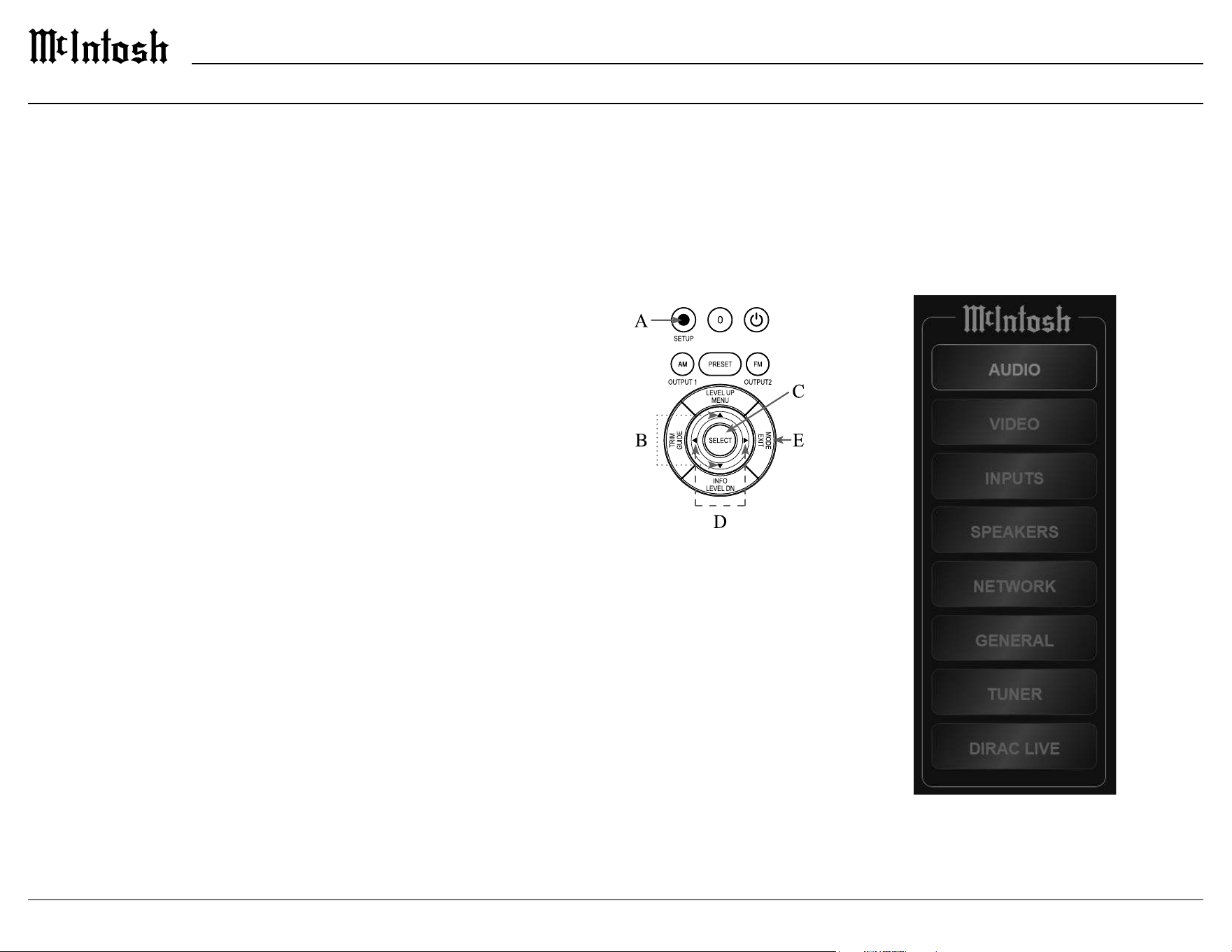
Navigating Setup with the Remote Control
A. Enter the setup menu by pressing the SETUP
button with the blue circle.
B. Use the up and down arrows on the silver ring to
navigate through the options.
C. Push the SELECT button to choose an option to
change.
D. Use the left and right
arrows on the silver ring
to change values for the
selected setup option.
The new value will be
saved automatically.
E. To stop editing a setting
or to close the setup
menu, press the Mode/
Exit button or select
the last option which is
MENU BACK or MENU
OFF.
Setup Menu Options
• Serial Number
• Firmware Version
• Inputs
• Network
• General
• Audio
• Video
• Speakers
• Tune r
• Menu O
Setup from a Browser
Setup is easier from a web browser. Open a browser
window on a computer connected to the same
network as your MHT300. Enter the IP address for
the MHT300 in the address bar of your browser (see
“Setup: Network > Network Information” on page 21).
The setup menu on your browser should look like
this:
Setup Menu
15
MHT300
Inputs Setup Menu
SETUP: INPUTS > HIDE SOURCES
The show/hide sources submenu allows you to hide
unused inputs. Hidden inputs do not appear as input
choices when scrolling through inputs. If you hid
inputs and want to show them again, they can be
restored by selecting “Show” on each or by choosing
“Show all” from your browser to make all inputs
visible.
SETUP: INPUTS > INPUT LEVEL
The input adjust section of the inputs menu allows
you to set a trim level for a source.
The Trim for each input can be individually set from
-12dB to +12dB in 1dB intervals. 0dB is the default.
If using the browser you can type in your desired
level in the box on the right.
Inputs Setup Menu from Browser
Accessing the inputs setup menu from the browser
allows you to customize the name of an input as it
will appear on the display. Unused inputs can also be
hidden so as not to appear as choices. They can also
be easily restored when needed.
Renaming Inputs
To change the name of an input, choose one of the
default options from the drop-down menu or select
Custom and type your name of choice into the
Custom Rename box and press Enter to save.
Note: Custom names have an 11 character limit and will not
save if you type more than 11 characters.
From the Rename submenu, you can choose from a
list of names for the input or chose “default” to keep
the original MHT300 input name or if you wish to
use a custom name.
To use a custom name:
• Select “Custom” in the Rename submenu
• In the Custom Rename box, erase the old name
and type in the new name up to 11 characters
• Push the Enter key on your keyboard to save
Setting Input Options
Hide Sources
Show/Hide*
HDMI 1
HDMI 2
HDMI 3
HDMI 4
HDMI TV
OPT 1
OPT 2
COAX 1
COAX 2
TUNER*
Show, Hide, or Show All*
Input Level
Input Adjust*
HDMI 1
HDMI 2
HDMI 3
HDMI 4
HDMI TV
OPT 1
OPT 2
COAX 1
COAX 2
TUNER
-12.0 to +12.0dB in 1dB intervals
Rename* HDMI 1
HDMI 2
HDMI 3
HDMI 4
HDMI TV
OPT 1
OPT 2
COAX 1
COAX 2
TUNER
TV AUDIO
CBL/SAT
DVD
Blue-Ray
CD
Media Player
Game
AUX 1-4
Default
Custom
Note: Some options and settings are only available on the
browser version of the setup menu these are indicated
with an *.
16
SETUP: GENERAL > FACTORY RESET
Factory Reset will restore the MHT300’s defaults.
Any changes made will be lost. Congurations can
be saved and restored in the “Save and Load” section
of the general setup menu.
SETUP: GENERAL > SAVE AND LOAD > SAVE
MHT300’s Dirac Live information is saved with
conguration backups. Dirac Live should be re-run
anytime a signicant change is made in your system
or its environment.
To save the conguration using the browser
interface, select the save conguration button.
Choose the destination to store the le. A le named
“MHT300_cong.cfgs” will be created. If you
choose, you can rename this le and save dierent
setup congurations.
Note: Configurations created using the browser interface
must be restored using this interface and CANNOT be
restored using the MHT300’s front panel interface or
MHT300’s USB port.
If you wish to store to a USB drive in the MHT300’s
USB port, you must use the front panel interface.
To use the front panel interface to save the
conguration:
• Insert a USB Drive in the MHT300 USB port
• Go to the Save and Load submenu, and select
Save
Two les are created when using the front panel to
save to a USB drive in the rear of the MHT300:
• DIRAC INFO
• MHT300.CFG which contains the custom
MHT300 settings
The general menu contains the following options:
Setting Options
Fi r mware Version Shows current rmware versions
Firmware Update
Yes , No
Factory Reset Yes , No
Save and Load Save, Load
Trigger 1 All, None, Independent
Trigger 2 All, None, Independent
RCLOCK On, O
Auto O On, O
SETUP: GENERAL > FIRMWARE
Firmware is software that controls hardware at a
low level. Occasionally, new versions of rmware
may be issued to address particular issues. If you
are not experiencing any issues, there is no need to
upgrade your MHT300 rmware. If the need should
arise, your McIntosh dealer has access to the latest
rmware.
Firmware Update is used to install new rmware.
The new rmware should be unzipped on the root
directory of a properly formatted USB drive (FAT
or Fat32). The USB drive should be inserted into
the USB port on the rear of the MHT300. Selecting
the Update Now button will begin the process. It
is highly recommended that your McIntosh dealer
perform the update process since failure to properly
install the rmware can leave the MHT300 in an
unusable state.
SETUP: GENERAL > SAVE AND LOAD > LOAD
To load a saved conguration, select the load
conguration button. Choose saved conguration
le from its location either from a folder on your
computer or a USB drive inserted into the computer’s
USB port. Conguration les by default are named
“MHT300_cong.cfgs”. Choose this le or a le you
have custom named. Select open. The interface will
say “Upload Complete” and the MHT300 will power
cycle and the new settings will be loaded.
If you are using the front panel to load a
conguration:
• Insert the USB Drive with the conguration le
stored in the root directory in the MHT300 USB
port.
• Go to the Save and Load submenu and select
Load. Progress will be displayed for loading the
two conguration les.
• The MHT300 will power cycle when complete.
The restored settings will be in eect.
General Setup Menu

17
MHT300
SETUP: GENERAL > TRIGGER
Trigger1 and Trigger2 can each be set to power on/o
components connected via a power control cable (see
“Power Control Connectors” on page 8).
Each Trigger can be set to:
• Independent allows each individual input to be
set to On or O. When an input that is set to On
is selected, connected components will receive a
power control signal to power on until the selected
input is changed (to an input that is set to O) or
the MHT300 is powered O.
• All On sets the power control setting of all inputs
to On. With this selection, any input will generate
a power control signal to be sent for that Trigger.
All On is a quick way to change all the inputs
to On. You can switch to Independent to set any
individual input to O.
• All O sets the power control setting of all inputs
to O. With this selection, no input will generate
an On signal for the Trigger. All O is a quick
way to change all the inputs to O. You can
switch to Independent to set any individual input
to On.
When Independent is selected, you can select On or
O for these inputs:
SETUP: GENERAL > FIRMWARE
Auto O, when Enabled, the MHT300 will power
o after 30 minutes of no input. If you pause a movie
for more than 30 minutes and you do not want to nd
the MHT300 powered o, you would want to Disable
Auto O.
SETUP: GENERAL > RCLOCK
Remote Control lock when enabled (On) will prevent
the front IR sensor from receiving IR commands
from a remote control. The default for remote control
lock is O. To enable the IR sensor to detect a remote
control’s IR data, set remote control lock to OFF (the
default).
SETUP: GENERAL > AUTO OFF
The MHT300 incorporates power save circuitry to
automatically place the MHT300 into the power
saving standby mode approximately 30 minutes after
there has been an absence of an audio input signal on
both channels.
When there is a power control connection between
the MHT300 and a preamplier or source compo-
nent, the auto o function is bypassed.
• HDMI 1
• HDMI 2
• HDMI 3
• HDMI 4
• HDMI TV
• Optical 1
• Optical 2
• Coaxial 1
• Coaxial 2
• Tune r
General Setup Menu (continued)
18
SETUP: AUDIO > SUB LEVEL
Subwoofer level adjust allows for adjusting your
attached subwoofer to be adjusted from -10dB to +
10dB.
SETUP: AUDIO > BASS SYNC
For contents recorded in multi-channel such as
Blu-ray discs, the recorded Low Frequency Eects
(LFE) may be out of sync and delayed. This function
allows you to correct the delay with an adjustment of
0 ms to 16 ms.
SETUP: AUDIO > AUDIO DELAY
Audio delay (Lip Sync) compensates for incorrect
timing between video and audio. When auto lip
sync is set to On, the timing dierence will be
automatically corrected with compatible TVs. The
adjust option allows you to manually adjust the delay
correction from the default of 0 ms up to 500 ms.
SETUP: AUDIO > SURROUND MODE
Audio Setup Menu
The audio setup menu contains the following options:
Setting Options
Sub Level -10.0 through +10.0
Bass Sync
0-16ms
Audio Delay (Lip Sync) 0-500ms
Volu me Scale, Limit
Surround Mode Music, Movie, Game
Dynamic Range Compress* ON, AUTO, OFF
Note: Some options and settings are only available on the
browser version of the setup menu these are indicated
with an *.
Setting Options
Music Through, Auto, Dolby Surround, Neural: X,
Multich Stereo, Stereo
Movie
Through, Auto, Dolby Surround, Neural: X,
Multich Stereo, Stereo
Game Through, Auto, Dolby Surround, Neural: X,
Multich Stereo, Stereo
Volume Submenu Options
Setting Options
Scale Linear, dB Level
Limit
OFF, 60, 70, 80
SETUP: AUDIO > VOLUME > SCALE
There are two choices for how to display the volume.
The default is a volume scale linear which displays
the volume on a scale of 0 (mute) to 99. The second
option is volume scale dB level. This will express
the volume as decibel (dB) level. The decibel scale is
from -103.0dB (mute) to 18dB.
Note: The displayed dB scale increments are not uniform
as they have been designed to give a meaningful level
adjustment depending on the actual level being listened
to.
You can change the volume level of the MHT300
using the slider. Slide towards the right to increase
and to the left to decrease the volume level. The
current volume percentage for the linear scale or dB
for the dB scale will appear in the box to the right.
SETUP: AUDIO > VOLUME > LIMIT
Volume limit can protect equipment and/or ears from
unintended extreme volume by setting an upper
threshold for how high the volume level can be set.
Volume limit can be set to O (the default) or to one
of these three volume limits:
• 60 (-1.5dB)
• 70 (3.5dB)
• 80 (8.5dB)
If volume limit is not O, the MHT300’s volume
level can not be set above the selected volume limit.
In the surround mode setup, you can assign a
surround mode to each of three sound categories:
• Music
• Movie
• Game
These three sound categories can be assigned to an
input using the trim menu, for more information refer
to “Trim Menu” on page 12. Categories make it
easier for someone unfamiliar with DTS or Dolby to
select the proper surround mode by selecting Music,
Movie, or Game which can be assigned to any of the
following choices in setup:
• Through
• AUTO (default)
• Dolby Surround
• DTS Neural:X
• Multi-Channel Stereo
• Stereo
The surround mode represented by the Trim selec-
tions Music, Movie, and Game must be assigned in
setup. If no assignment has been made, the default
for each is Auto.

19
MHT300
Auto will always send audio to all congured speak-
ers no matter the input audio stream type. It will
use Dolby Surround to send audio to all congured
speakers if the incoming audio stream is Dolby
encoded. It will use DTS Neural:X to send audio
to all congured speakers if a DTS encoded audio
stream comes in. If a 2 channel or multi-channel
PCM stream comes in, it will use Dolby Surround to
send audio to all congured speakers.
Dolby Surround will invoke Dolby’s post processor
to always send audio to every congured loudspeaker
no matter the input stream type.
DTS Neural:X will invoke DTS’ post processor to
always send audio to every congured loudspeaker
no matter the input stream type.
Multi-channel stereo will downmix and/or upmix
to send audio to all left and right speakers (plus sub
if congured) no matter the input stream type. This
surround mode is similar to party mode in similar
products. Use this setting to deliver audio to all
channels.
Stereo will downmix to send audio to only the left
and right front speakers (plus sub if congured) no
matter the input stream type.
Through will neither upmix nor downmix. The input
stream will be sent to the congured speakers per the
input le stream with no post processing.
Audio Setup Menu (continued) Audio Setup Menu from Browser
Dynamic Range Compress
Dynamic Range Compress has 3 options: OFF, ON,
and Auto that apply to the HDMI inputs. Dynamic
Range Compression allows reduced volume listening
of video sound while retaining the ability to hear
voices and reduced level sounds.
• OFF retains full dynamic range of the original
signal content.
• AUTO applies a medium level of compression
that may be more enjoyable under overall listen-
ing conditions.
• ON applies maximum compression for dicult
listening conditions.
20
Video Setup Menu
SETUP: VIDEO > HDMI SETUP > ARC
The ARC (Audio Return Channel) feature, when
enabled, will work with the TV Audio input and a
television connected to the HDMI OUT/ARC output
on the back of the MHT300.
ARC can provide two-way communication between
units allowing for volume control and lip-syncing
functions to ensure audio and video are perfectly
matched. This allows for more intelligent operation
between components as well as less cable clutter.
Make sure the ARC is enabled in your TV’s setup
menu as well as on the MHT300.
SETUP: VIDEO > HDMI SETUP > CEC
CEC (Consumer Electronics Control) is an addition
to the HDMI standard which allows control signals
from one device to communicate with another device
via an HDMI cable connection. If you change HDMI
control settings, reset power to connected devices.
Make sure CEC is enabled on all devices you wish to
utilize CEC.
Notes: 1. To use ARC, CEC must also be set to On.
2. To use CEC and the additional commands of TV
audio switching, power off control and power
saving, CEC must be set to on, so your television and
MHT300 can better communicate.
The world of ARC and CEC is not yet perfect. It is
certainly getting better, but not every component in
the world is speaking precisely the same language.
There may be circumstances where you may have
better performances by turning these features o.
These features can be enabled or disabled at any time
on the MHT300.
Remember to enable CEC on your television if you
want to use CEC with the MHT300.
CEC should be set to O, if you are using a third-
party control system so that CEC does compete with
your external controller.
Video Setup Menu from Browser
TV audio switching, power o control and power
saving are only available options if CEC is turned on
and are only accessible through the browser interface
of the setup menu.
TV Audio Switching
TV audio switching, when set to ON, will switch to
TV audio when receiving a command from the TV.
When set to OFF, the MHT300 will not automati-
cally switch to TV audio when receiving a command
from the TV.
Power O Control
Power o control, when set to ALL, the MHT300
will enter sleep mode when the TV is turned o
regardless of input. When power o control is set to
VIDEO, the MHT300 will enter sleep mode when
the TV is turned o and the MHT300’s input is set
to an HDMI input. When set to OFF, the TV’s power
will not eect the MHT300’s standby mode.
Power Saving
Power saving, when to ON, will put the MHT300 in
sleep mode if the audio source is TV and the TV’s
audio output is set as the TV’s speaker. Power saving
will apply when the MHT300 is using an HDMI
input.
The video setup menu has the following options:
Setting Input
HDMI Setup
Submenu described below
ON SCREEN DISP
OFF, BOTTOM, TOP
TV Audio Switching* ON, OFF
Power O Control* ALL, VIDEO, OFF
Power Saving* ON, OFF
Note: Some options and settings are only available on the
browser version of the setup menu these are indicated
with an *.
SETUP: VIDEO > HDMI SETUP
The Video setup menu has one main submenu for
HDMI settings, the options for it are shown below.
Setting Input
PASSTH RU NONE, HDMI 1-4
ARC
ON, OFF
CEC ON, OFF
SETUP: VIDEO > HDMI SETUP > PASS THRU
Pass through (written as HDMI PASSTHRU on the
front display) allows an HDMI input to be assigned
so that when a signal is received by that HDMI input,
while in standby mode, the MHT300 will pass the
complete signal to the HMDI output exactly as it was
received for video and audio playback by a connected
TV or monitor.
Note: CEC should be disabled if you plan to use the pass
through feature to avoid your TV turning on your
MHT300 and other unexpected results.
SETUP: VIDEO > ON SCREEN DISP
On screen display, when On, will display the volume
on an attached TV when the volume is activated. O
will disable this feature.
Bottom and Top refer to the position on the TV
where the volume will be displayed. Both Bottom
and Top enable (on) the on screen display feature.
21
MHT300
Network Setup Menu
SETUP: NETWORK > FRIENDLY NAME
Friendly name provides a more individual way of
identifying your MHT300 on the network with
devices that recognize friendly names.
The default friendly name of “MHT300” can be
changed by selecting an alternative name from the
preset name drop-down list. To create your own
name for the MHT300, choose “Custom” from the
preset name drop-down box and then type the new
name in the friendly name box. Custom names can
only be entered from the browser interface. Preset
names can be chosen using the front panel or your
remote control.
Network Settings
Network settings allows you manually entering
network information. You may do this if you want to
have a static IP address for the MHT300. The default
is for DHCP is On. With DHCP on, all the network
information will be assigned automatically from your
router.
To manually enter network settings, select “O” for
DHCP. This will allow you to enter settings for:
• IP address
• Gateway (typically the IP address of your router)
• Subnet mask (typically 255.255.255.0)
• DNS address (typically the IP address of your
router)
When you have completed making network settings
changes, select the “Apply All Settings” button to
save your changes.
SETUP: NETWORK
Setting Options
Network
Information
Connection Status
Host IP Address
Host Mac Address
Dirac IP Address
Network Identify
OK
Network Control On, O
Friendly Name MHT300, Home Theater, Living Room,
Family Room, Guest Room, Dining
Room, Master Bedroom, Bedroom,
Den, Oce, None, Custom*
Note: Some options and settings are only available on the
browser version of the setup menu these are indicated
with an *.
SETUP: NETWORK > NETWORK INFORMATION
• Connection status will show whether the device
is Connected or Not Connected to the internet.
• Host IP address will display the MHT300’s IP
address.
• Host Mac address will display the MHT300’s
Mac address.
• Dirac IP Address will display the specic IP
Address for the MHT300’s Dirac function.
SETUP: NETWORK > NETWORK CONTROL
Network control has two settings: On or O. The
default is O. When network control is enabled (On),
a control system such as one using RS232 commands
over IP can awaken the MHT300 from a sleep state.
When network control is o, the MHT300 will enter
standby mode when powered o. The monitoring of
network trac with network control On uses slightly
more power when the MHT300 is in sleep mode.
22
Speakers Setup Menu
SETUP: SPEAKERS > SPEAKER CONFIG
The available speaker categories are based on the
settings in Amp Assign (see above).
Speaker Options
Front Large / Small
Center Large / Small / None
Subwoofer (SUB) 1 speaker / 2 speaker / None
Surround (SUR) Large / Small / None
Surround Back (SUR BK)
Large / Small
Front Height (FR HT)
Large / Small
Back Height (BK HT) Large / Small
Top Front* Large / Small
Top Rear* Large / Small
Top Middle* Large / Small
Note: 1. Some settings are only available on the browser
version of
the setup menu these are indicated with an *.
2. Choosing some options will eliminate other options.
Speakers are dened as Large or Small. A Large
Speaker is a full-range speaker able to reproduce
bass frequencies down to 35Hz within -3dB of the
midrange frequencies. If it is not Large, then it is
Small.
SETUP: SPEAKERS > SPEAKER DISTANCES
Setting Options
Front Left 0.0 to 10.0m in 0.1m increments
Front Center 0.0 to 10.0m in 0.1m increments
Front Right
0.0 to 10.0m in 0.1m increments
Surround Right
0.0 to 10.0m in 0.1m increments
Rear Right
0.0 to 10.0m in 0.1m increments
Rear Left
0.0 to 10.0m in 0.1m increments
Surround Left
0.0 to 10.0m in 0.1m increments
Top Front Left*
0.0 to 10.0m in 0.1m increments
Top Front Right*
0.0 to 10.0m in 0.1m increments
Top Rear Left
0.0 to 10.0m in 0.1m increments
Top Rear Right
0.0 to 10.0m in 0.1m increments
Subwoofer 1
0.0 to 10.0m in 0.1m increments
Subwoofer 2
0.0 to 10.0m in 0.1m increments
Note:
Some settings are only available on the browser version
of the setup menu these are indicated with an *.
The input of distances of your speakers can be
entered manually. Distances will be provided
automatically when the Dirac Live setup program
is run, after which they can be edited. Having an
accurate accounting of your speaker speeds the Dirac
Live process by avoiding Dirac Live looking for
phantom speakers.
For each speaker, enter the distance from the main
listening position to the speaker in meters. To convert
feet to meters, multiply the number of feet by 0.3048.
The Dirac Live program will provide more exacting
information. The information entered here provides a
baseline to compare the Dirac Live ndings.
For Dolby enabled speakers, enter the distance to
the speaker. Do not calculate the angled path that the
reected sound will travel. Dirac Live will handle
this.
The speakers setup menu contains the following
submenus:
• Amp Assign
• Speaker Conguration
• Speaker Distances
• Speaker Level
• Crossover
SETUP: SPEAKERS > AMP ASSIGN
Setting Options
Manual Floor 2 channel, 5 channel, 5 channel + SB
Manual Top SP
Top Speaker
None, 2 channel, 4 channel*
Top Layout
Front, Middle, Rear, Front + Rear*,
Front + Middle*, Middle + Rear*
Manual Dolby
None, 2 channel, 4 channel*
Dolby Layout
Front, Surround*, Rear*, Front + Rear*,
Front + Middle*, Middle + Rear*
Note:
1. Some settings are only available on the browser
version of
the setup menu these are indicated with an *.
2. Choosing some options will eliminate others.
In amp assign, you select how to use the preamplier
section of the MHT300. In the amp assign section of
setup, you can tell the MHT300 what speaker setup
scheme you will be using. This assignment is neces-
sary before running Dirac Live.
23
MHT300
SETUP: SPEAKERS > CROSSOVER
Setting Options
Dependence Independent, All
Cross All
40, 60, 80, 90, 100, 110, 120, 150, 200, 250 Hz
Independent
Front, Center, Surround (SUR), Surround
Back (SUR BK), (BK HT)
Bass Type
LFE, LFE + MAIN
Bass LP Filter 40, 60, 80, 90, 100, 110, 120, 150, 200, 250 Hz
Sound below the crossover frequency is ltered from
the output to “small” speakers and is sent to the
subwoofer or front speakers. Most small speakers use a
crossover frequency of 80Hz, but small speakers may
need a crossover set as high as 250Hz. We recommend
setting to a higher frequency when small speakers are
used. For example, set to “250Hz” when the frequency
range of the speakers is 250Hz to 20kHz.
You can choose Independent or All. Cross All
will globally set the crossover frequency to the
chosen value. Independent will allow each available
speaker’s crossover frequency to be set using the
same options as Cross All.
SETUP: SPEAKERS > CROSSOVER > BASS TYPE
When the subwoofer mode is set to LFE (Low
Frequency Eects), the LFE channel plus the low
frequency output below the set crossover frequency
of speakers set to small is sent to the subwoofer
When set to LFE+Main, the LFE channel and low
frequency output, below the set crossover frequency,
of the main channel are sent to the subwoofer.
SETUP: SPEAKERS > CROSSOVER > BASS LP FILTER
The bass low pass lter sets an upper limit for
frequencies that are sent to the subwoofers when
LFE+Main is selected above. Frequencies above the
chosen option will not be sent to the subwoofer. The
LPF setting does not apply to content sent from the
LFE channel to the subwoofers.
SETUP: SPEAKERS > SPEAKER LEVEL
Setting Options
Test Tone On, O
Front Left -10 to +10dB in 1dB increments
Front Center
-10 to +10dB in 1dB increments
Front Right
-10 to +10dB in 1dB increments
Surround Right
-10 to +10dB in 1dB increments
Rear Right
-10 to +10dB in 1dB increments
Rear Left
-10 to +10dB in 1dB increments
Surround Left
-10 to +10dB in 1dB increments
Top Left Front*
-10 to +10dB in 1dB increments
Top Right Front*
-10 to +10dB in 1dB increments
Top Rear Left
-10 to +10dB in 1dB increments
Top Rear Right
-10 to +10dB in 1dB increments
Subwoofer 1
-10 to +10dB in 1dB increments
Subwoofer 2
-10 to +10dB in 1dB increments
Note:
Some settings are only available on the browser version
of the setup menu these are indicated with an *.
The test tones and levels submenu provides the
ability to manually set relative levels for all speaker
types, and may be used to conrm proper wiring.
This does not need to be set if using Dirac Live
calibration.
When test tone is set to On, a tone will play through
the speaker type selected in the levels drop-down
box. Using a sound meter or your ears, you can set
the relative level from -10dB to +10dB. The default is
0dB.
Dirac Live will automatically set levels and will
over-write osets set previously. Likewise, manually
setting test tones will replace Dirac Live settings.
Speaker Placement
Speaker Position
Front The Front Left and Right speakers should
be an equal distance from the main listening
position. The distance between each speaker
and your TV should also be about the same.
Center The Middle speaker should be between the
Front speakers and above or below your TV.
Top Front Mount the Top Front Left and Right speakers
on the ceiling slightly in front of your main
listening position and align with the Left and
Right Front speakers.
Top Middle Mount the Top Middle Left and Right speakers
directly above the main listening position and
align with the Left and Right Front speakers.
Top Rear Mount the Top Rear Left and Right speakers
on the ceiling slightly behind your main
listening position and align with the Left and
Right Front speakers.
Subwoofer Place the Subwoofer at a convenient location
near the Front speakers. If you have two
Subwoofers, place them asymmetrically across
the front of your room.
Front Dolby
speaker
Left/Right
Place the Front Dolby Enabled speakers on
the Front speakers (left and right). For a Dolby
Atmos Enabled speaker integrated with a
Front speaker, place the Dolby Atmos Enabled
speaker instead of the Front speaker.
Surround
Dolby
speaker
Place the Surround Dolby Enabled speaker
on the Surround speaker. For a Dolby Atmos
Enabled speaker integrated with a Surround
speaker, place the Dolby Atmos Enabled
speaker instead of the Surround speaker.
Back Dolby
speaker
Place the Back Dolby Enabled speaker on the
surround back speaker. For a Dolby Atmos
Enabled speaker integrated with a Surround
Back speaker, place the Dolby Atmos Enabled
speaker instead of the Surround Back speaker.
More information about speaker placement can be
found in “Setting Up Surround Sound” on page 26.
Speakers Setup Menu (continued)

24
10. Use the Play Button to test channels individually
to hear if their level is suitable. Slowly raise the
master output level until sound can be heard.
Repeat this step for each speaker.
11. Once each channel is complete, adjust the Master
output to a normal or slightly loud listening level.
Calibration notes:
• A common master volume range is -35db to -25dB.
•
A signal-to-noise ratio error indicates too low of
audio to measure. Master output may need to increase.
• A clipping error indicates too high of an audio level to
measure. Master output may need to decrease.
• If your subwoofer has gain control, this control may
need to be adjusted to assist with the volume
calibration of that channel.
Select Arrangement
12. Dirac oers dierent arrangement settings for
measurements: Tightly Focused, Focused, and
Wide Imaging.
13. Please choose one that matches closest to your
own listening arrangement. A wider listening
arrangement may require more measurement
positions with the microphone
Measure
14. Place the microphone closest to the listening
position shown in arrangement image.
15. Press “Measure selected position.”
16. DIRAC will now send test tones out of the
system’s channels to measure.
Note: While measuring a 7.2.4 system, the test tone will
appear to come from both subwoofers together. This is
normal.
17. When measurement is nished, Dirac will
automatically go to the next position to be
measured.
Dirac Live
®
Setup
Please review the Dirac Live User manual setup and
operation before beginning to calibrate your system.
Information regarding the user manual and other tips
may be found at
https://www.dirac.com/live/faq/
1. Create a DIRAC account and install the app from
https://www.dirac.com/live/downloads
2. Complete amp assign to establish the room’s
layout using either the front panel or the browser
setup menu. This will set up the MHT300 to
know which proper channels to enable to deliver
audio to (“Setup: Speakers > Amp Assign” on
page 20)
Note: After completing “Amp Assign”, press “Next”, and
finally press “Start.” This refreshes NET connection
to DIRAC within the MHT300. Please wait at least 30
seconds to connect to the MHT300 within the Dirac
Live app.
3. Make the room as quiet as possible. Background
noise can disrupt the room measurements. Close
windows and turn o unnecessary electronic
devices (radios, air conditioners, uorescent
lights, etc.).
4. Connect the included measurement microphone
to the MHT300.
Select Device (MHT300)
5. Select recording device (microphone). An icon
with a microphone should appear with a graph.
6. Click the graph to select proper calibration le
7. Select “Use from device.”
Volume Calibration
8. Set the Master output to a low setting to avoid
damage to ears or speakers.
9. Set the microphone gain to +0dB.
18. Relocate the Microphone to match the next
position shown in DIRAC for the next
measurement.
19. Repeat the “Measure selected position’ for each
position in Dirac’s arrangement Image.
Note: Please take the time to SAVE your current project at
this point, as it will allow you to open this measurement
and edit your filter in the future without having to
remeasure your arrangement again.
Filter Design
20. Dirac Live will automatically generate a
suggested target curve based on your speakers’
performance and tune their response to meet the
suggested curve. These curves can be adjusted to
your preferences.
21. To manually adjust the generated curve, follow
the Dirac Live User Manual on Filter Design.
Filter Export
22. Once the desired lter is achieved, the lter may
now be exported and saved onto the MHT300.
23. Dirac will give the opportunity to name and
describe the lter.
• The MHT300 can store up to 4 exported lters.
The Dirac Live process is now complete, and
Dirac may be enabled or disabled with available
lter selections via the trim menu and browser.
Future Filter Edits:
Amp Assignment must be set to the same settings
as when the project was measured with to be able
to open a specic project and speaker arrangement.
For example, if a Dirac Live measurement was taken
with system set to 5.1 – if amp assign is changed to
5.0: the project measured with 5.1 will not be able to
open until the MHT300 is set back to 5.1.
25
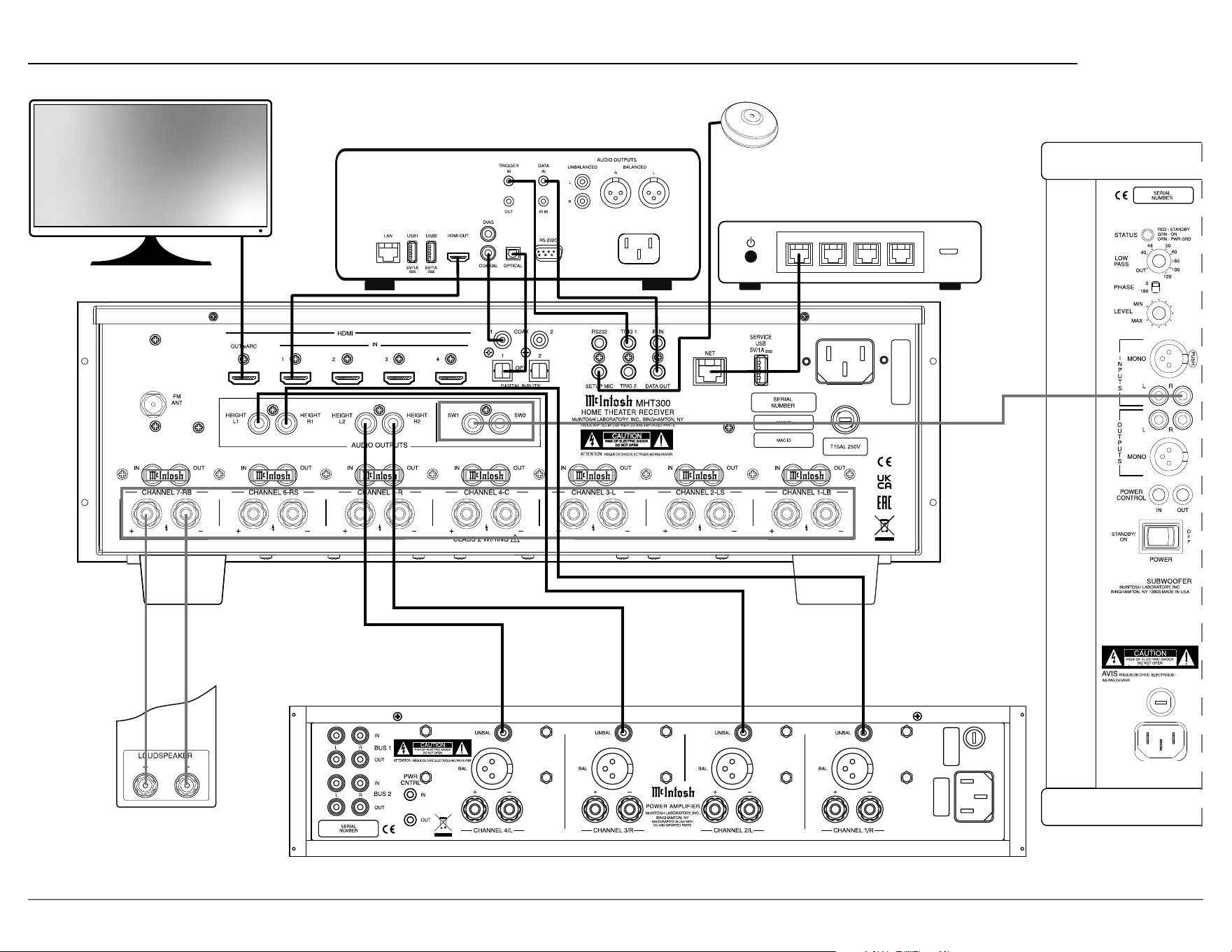
MHT300
NET NET NET NET
NET NET NET NET
BLU-RAY PLAYER
TV
LOUDSPEAKERS
(up to 7)
x7
SUBWOOFER
(up to 2)
ROUTER
MIC
26
Setting Up Surround Sound
Setting up speakers for a surround setup takes
planning, measuring and installation. Depending on
your level of expertise and available time, you may
wish to employ the services of your McIntosh dealer
for expert setup of your system. Professional instal-
lation of in-ceiling speakers is particularly important
due to gravity and the location above your head.
The number, types and locations of speakers are key
elements in setting up the system. There is a multi-
tude of possible congurations, and the MHT300 is
very exible in its setup to adapt to many of these
congurations.
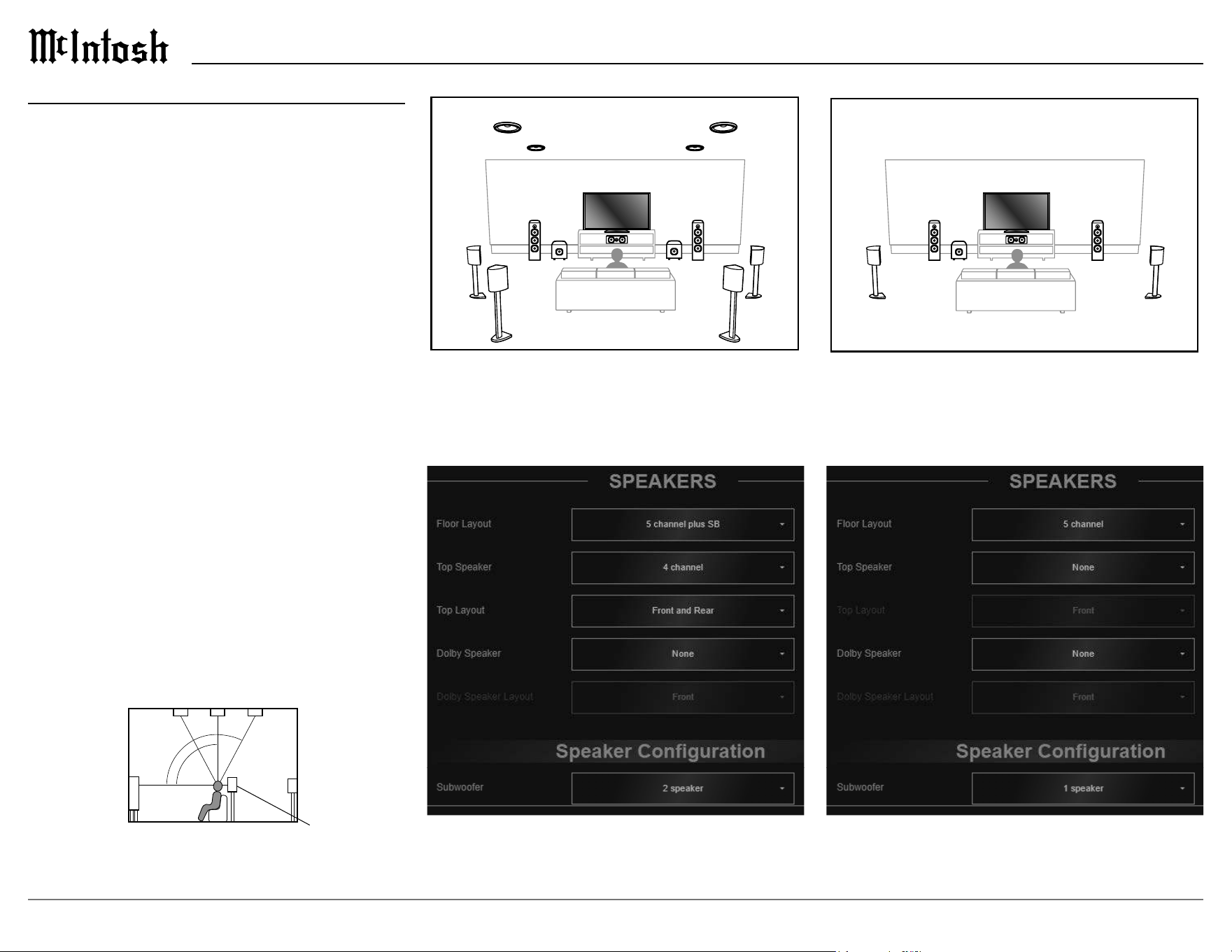
Often surround setups are referred to by numbers
for example 7.2.4. The rst number refers to the
number of traditional “oor” speakers (front, center
and surround). The second number is the number
of subwoofers that can be connected, and the third
number refers to the number of in-ceiling or upward
ring speakers in the setup.
The type of speaker (size and location) will be
entered later during Speaker setup. The distance of
the speaker from the listening location is manually
entered in the Speaker setup, or automatically entered
during the Dirac Live
®
calibration process.
At this stage, the connection from the MHT300
to the various speakers, powered subwoofers, and
auxiliary ampliers should be made with high
quality cables as necessary.
2-LS 6-RS
1-LB 7-RB
3-L 5-R
4-C
SW-1
SW-2
H1-L H1-R
H2-L H2-R
2-LS 6-RS
3-L 5-R
4-C
SW-1
∗2
∗3
∗4
∗4 125° - 150°∗2 30° - 55° ∗3 65° - 100°
(Viewed from the side)
Top middle speaker
Top front speaker Top rear speaker
Front speaker
Surround
speaker
Surround
back speaker
7.2.4 with Front & Rear Tops
The ideal setup for the MHT300 is shown above. It
features two subwoofers, seven oor speakers, and
four ceiling mounted speakers. The settings from the
browser setup menu are shown below.
5.1
Another common setup for the MHT300 is shown
above. It features one subwoofer and 5 oor speakers.
The settings from the browser setup menu are shown
below.
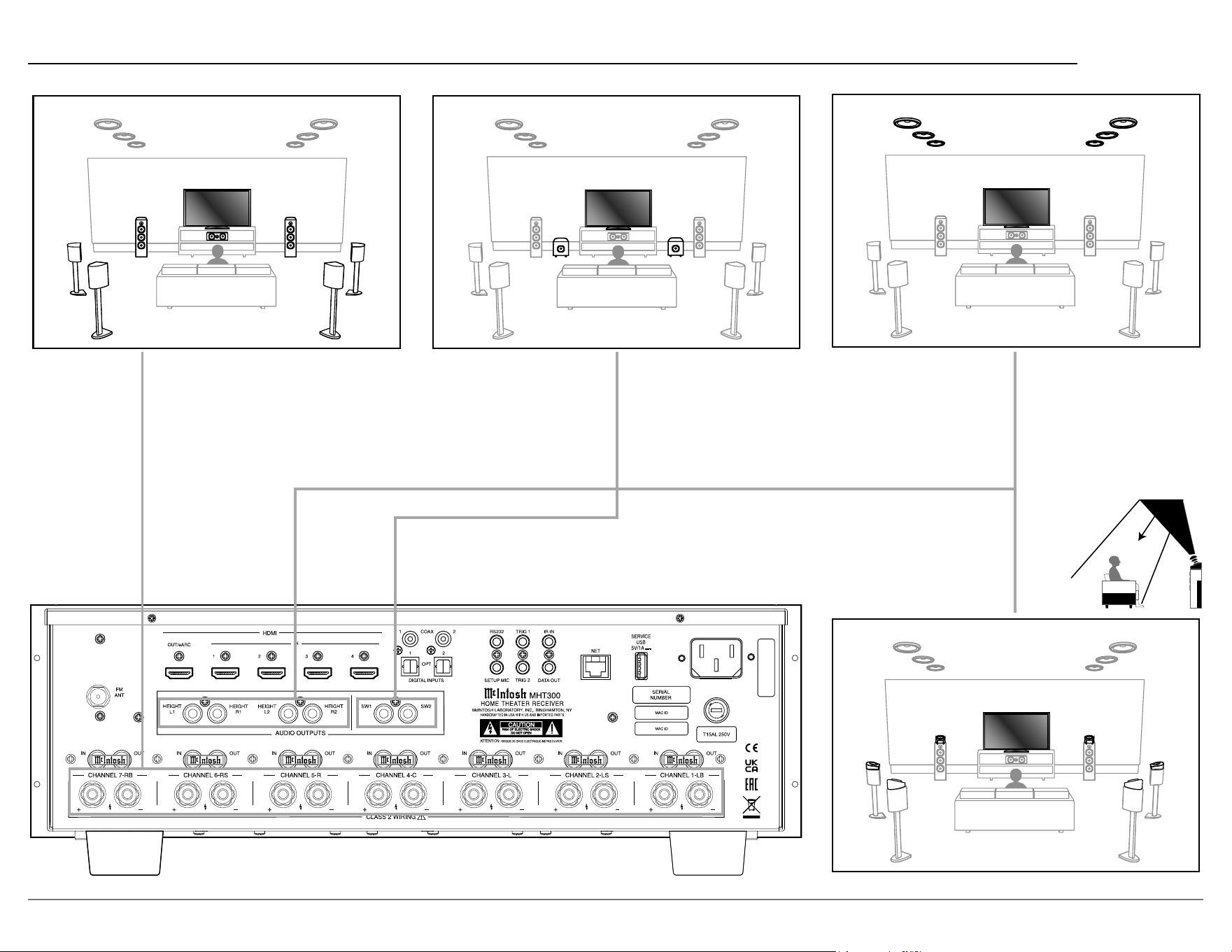
27
MHT300
H1-L H1-R
H2-L H2-R
H1-L H1-R
H2-L H2-R
2-LS 6-RS
1-LB 7-RB
3-L 5-R
4-C
Speakers
The MHT300 has seven speaker outputs to connect
to speakers around the room.
SW-1
SW-2
Subwoofers
Your surround sound setup might include one or two
subwoofers. Use the SW1 and SW2 outputs on the
back of the MHT300 to connect them.
Heights
The MHT300 has four height outputs that can be
connected to a secondary amplier(s) to drive up to
four locations on the ceiling or can be congured
for up to four Dolby Atmos speakers. Dolby Atmos
Enabled speakers reect the sound o the ceiling
to allow the sound to come from over your head by
using a special upward-pointing
speaker that is placed on the oor.
Note: HR1 and HL1 should be forward
of HR2 and HL2.
28
Tuner Setup Menu
SETUP: TUNER
Setting Options
Tun ing Frequency, Preset
Region
North America, Japan, Europe 50kHz,
Europe 100kHz
Reset Presets Yes , No
Presets Edit Erase?
Note: Some options and settings are only available on the
browser version of the setup menu these are discussed
in “Tuner Setup Menu from Browser”.
SETUP: TUNER > TUNING
Change this setting between Frequency and Preset
to dictate tuning type using the INPUT knob.
Frequency will result in the INPUT knob tuning
stations incrementally, while Preset will result
in tuning only between stations stored in preset
memory. See “Navigating the Tuner Input” on page
29 for more information.
SETUP: TUNER > TUNER REGION
In some countries, broadcasters use slightly dierent
standards and the MHT300 accommodates these
dierences. Your McIntosh MHT300 has been
factory congured for the broadcast standards in your
country. If for some reason there is a need to make
a change, follow the steps below for changing the
receiving standards:
Note: Accessing/Changing the current tuner region will
result in clearing of all the stored station presets.
1. Press the INPUT knob until the setup mode is
active. Then rotate the INPUT knob to select
setup menu item “SETUP: MENU TUNER” by
pressing INPUT knob. Rotate the INPUT knob to
select REGION.
2. Rotate the
VOLUME knob
to highlight one of the
four choices and press the INPUT knob to select
the desired region.
Setting FM Band
USA
88.1MHz - 107.9MHz
JA PAN
76MHz - 108MHz
EUR 100
87.5MHz - 108MHz
EUR 50
87.5MHz - 108MHz
SETUP: TUNER > RESET PRESETS
To erase all stored presets, use the INPUT knob to
enter the RESET PRESETS Menu. Then use the
VOLUME knob to select either “NO” or “YES” to
reset all presets.
SETUP: TUNER > PRESETS EDIT
To erase individual preset stations, use the INPUT
control to enter the PRESETS EDIT menu. Continue
to use the INPUT control to rotate and select the
intended preset to edit. Once the desired station is
selected, use the VOLUME knob to either HIDE,
SHOW, or ERASE that specic preset.
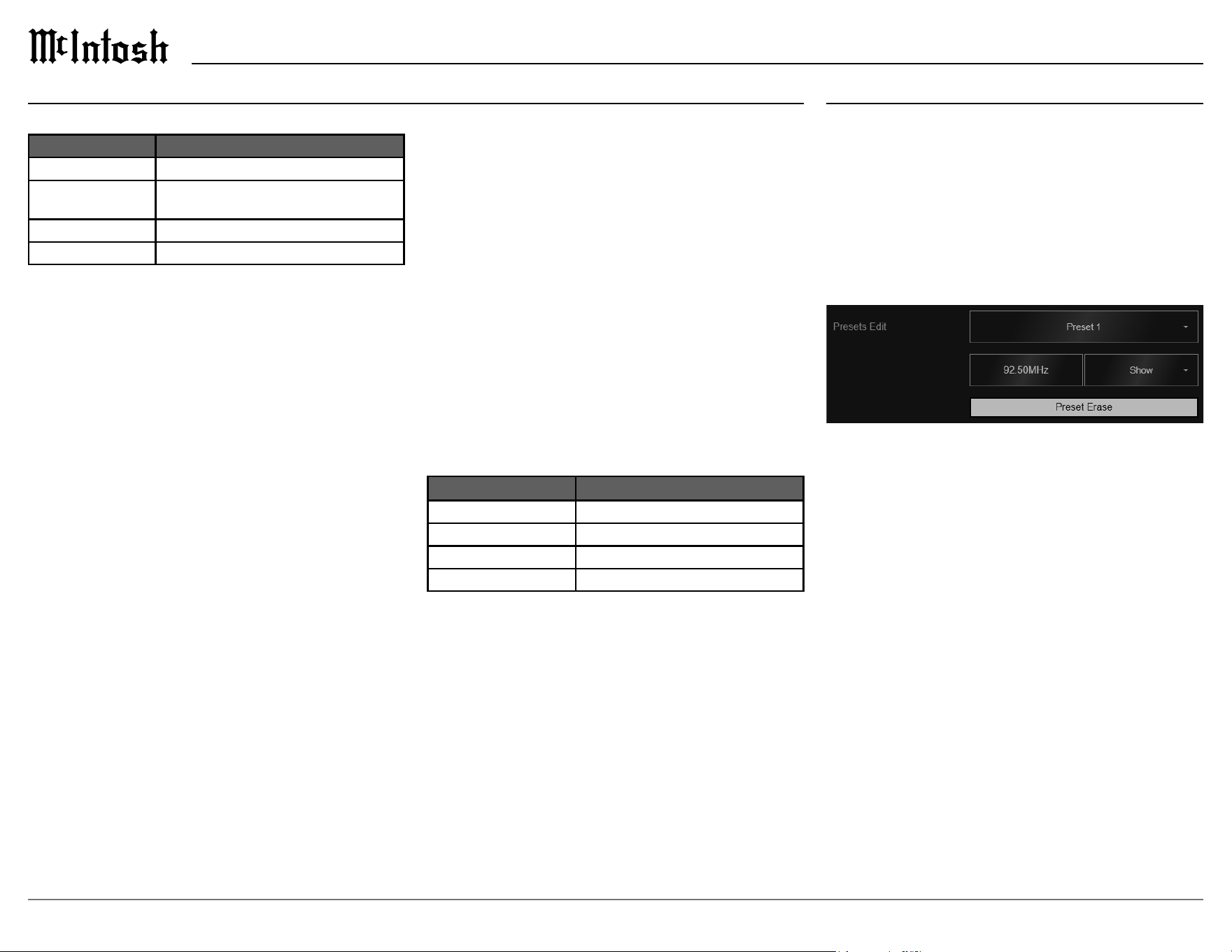
Tuner Setup Menu from Browser
Presets Edit
• At the top use the drop-down menu to select the
preset you would like to edit. It will display as
many as you have stored, which could be up to 30.
• On the left it will display the frequency and on
the right you can choose to Show or Hide the
volume from the drop-down menu.
• Below that is a button to erase the preset if you
no longer want to have it saved.
29
MHT300
Preset Tuni ng
To navigate the MHT300’s stored preset stations, use
either the PRESET REVERSE ( |<< ) or the PRESET
FORWARD ( >>| ) buttons to navigate up and down
the next station stored in preset memory.
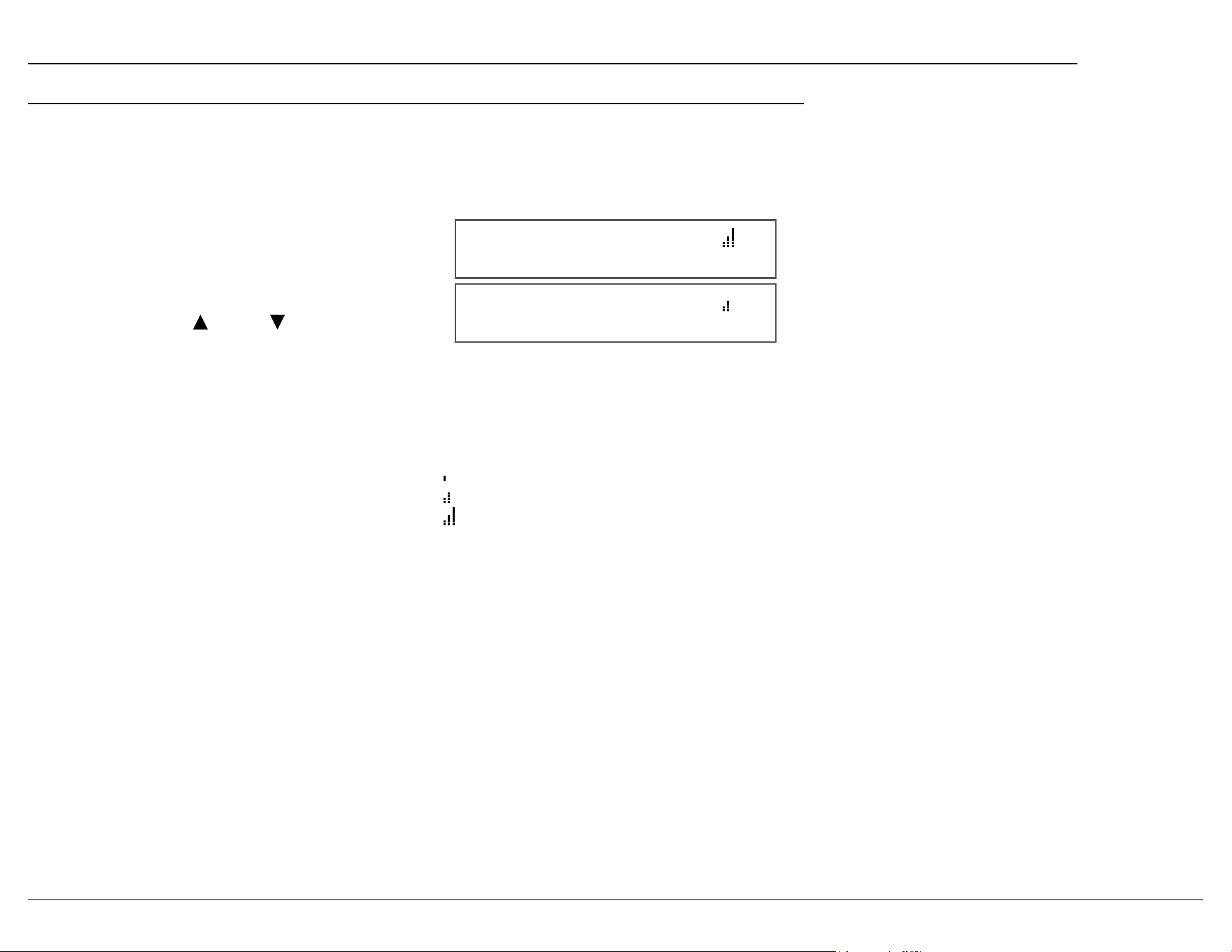
105.70MHz ST
AUTO
-
39.0
P01 105.70MHz ST
AUTO -39.0
P01 = preset stored station #1
1-30 presets available to store
ST = “Stereo” radio signal vs “Mono”
Signal Strength
1 = Weak or none
2 = Medium
3 = Strong
AUTO = Surround mode
-39.0 = Volume
Navigating the Tuner Input
Selecting Tuner Input
The tuner input may be selected using the INPUT
knob or the remote control’s FM button.
Note: If the user selects tuner using the INPUT knob, they
must press it briefly to enter the tuner control mode
that allows the INPUT knob to be used to change
stations. Another brief press and the knob returns to
its previous state. This action is only required for the
tuner input actions.
Manual Tuning
Press the directional up or down buttons on the
inner ring of the remote control to navigate incre-
mentally through stations.
Alternatively, while on the tuner input, Pressing the
INPUT knob will activate and allow for navigation
through FM stations by rotating the INPUT knob.
Automatic Tuning
Press the SEEK forward (>>) or the SEEK reverse
(<<) buttons on the remote control to tune to the next
available station, dependent on signal strength.
Storing Preset Station
To store an FM station in memory, Tune the
MHT300 to the desired station. Using the remote
control, press the PRESET button, the MHT300 will
then store the station onto the next preset available
(1-30). Alternatively, pressing PRESET on a station
that has already been stored will erase that specic
preset.

30
Preamplier Audio Specications
Frequency Response
±0.5dB from 20Hz-20,000Hz
Total Harmonic Distortion
0.005% maximum from 20Hz to 20,000Hz at rated
output
Signal To Noise Ratio - A Weighted
96dB below rated output
Output Impedance
330 Ohms
Maximum Output Voltage
8V Unbalanced
Coaxial/Optical Digital Input Rate and Formats
32kHz to 192kHz, 24-Bit PCM, Multichannel PCM,
Dolby Digital, DTS
HDMI Input Rate and Formats
32kHz to 192kHz – 24-Bit PCM, Multichannel & Stereo
PCM, Dolby Digital, DTS, Dolby
Atmos, Dolby TrueHD, Dolby Digital Plus,
DTS:X, DTS-HD Master Audio, DTS Express
Room Correction
Dirac Live
Amplier Audio Specications
FTC Power Output Rating
120 watts
Power Output
Minimum sine wave continuous average power output
per channel, all channels operating is:
120 watts into a 8 ohm load
150 watts into a 4 ohm load
Output Load Impedance
8 and 4 ohms
Input Impedance
22k ohms
Rated Power Band
20Hz to 20,000Hz
Frequency Response
+0, -0.5dB from 20Hz to 20,000Hz
Total Harmonic Distortion
0.05% maximum harmonic distortion at any power level
from 250 milliwatts to rated power, 20Hz to 20,000Hz
Dynamic Headroom
4dB - 4 and 8 ohm load
Input Sensitivity (for rated output)
1.6 Volt Unbalanced (8 ohm loudspeaker)
1.3 Volt Unbalanced (4 ohm loudspeaker)
Signal To Noise Ratio (A-Weighted)
85dB (95dB below rated output)
Wide Band Damping Factor
Greater than 100, at 8 ohms
Greater than 50, at 4 ohms
Volt age Gain
26dB
Intermodulation Distortion
0.2% maximum, if the instantaneous peak power output
does not exceed twice the rated power output or less per
channel with all channels operating for any combination
of frequencies from 20Hz to 20,000Hz
Video Specications
HDMI (Inputs and Outputs)
Version 2.1, 8K, High Dynamic Range (HDR),
Dolby Vision, HDR10, HLG, 4:4:4 Color,
Rec. 2020, 3D Video pass-through, eARC,
Dynamic Lip-sync
Fixed Rate Link (FRL)
40 Gbps
18 Gbps TMDS
Video Resolution
Up to 1080p 60/50Hz
4K 120/60/50/30/25/24Hz
8K 60/30Hz
HDCP
Version 2.3
General Specications
Note: the MHT300 has been tested and certified for indoor use only.
Power Control Output
12VDC, 50mA maximum total
Power Requirements
100 – 120Volts / 220 – 240Volts
50/60Hz at 10 Amps
Standby: less than 0.5 watt
Overall Dimensions
Width is 17 1/2 inches (44.5cm)
Width with side mount brackets 19 inches(48.3cm)
Height is 6 3/16 inches (15.7cm) including feet
Depth is 20 inches (50.8cm)
Weight
27 pounds (12.2 kg) net
53 pounds (24 kg) in shipping carton
Shipping Carton Dimensions
Width is 26 1/2 inches (67.3cm)
Depth is 24 1/4 inches (61.6cm)
Height is 17 inches (43.2cm)
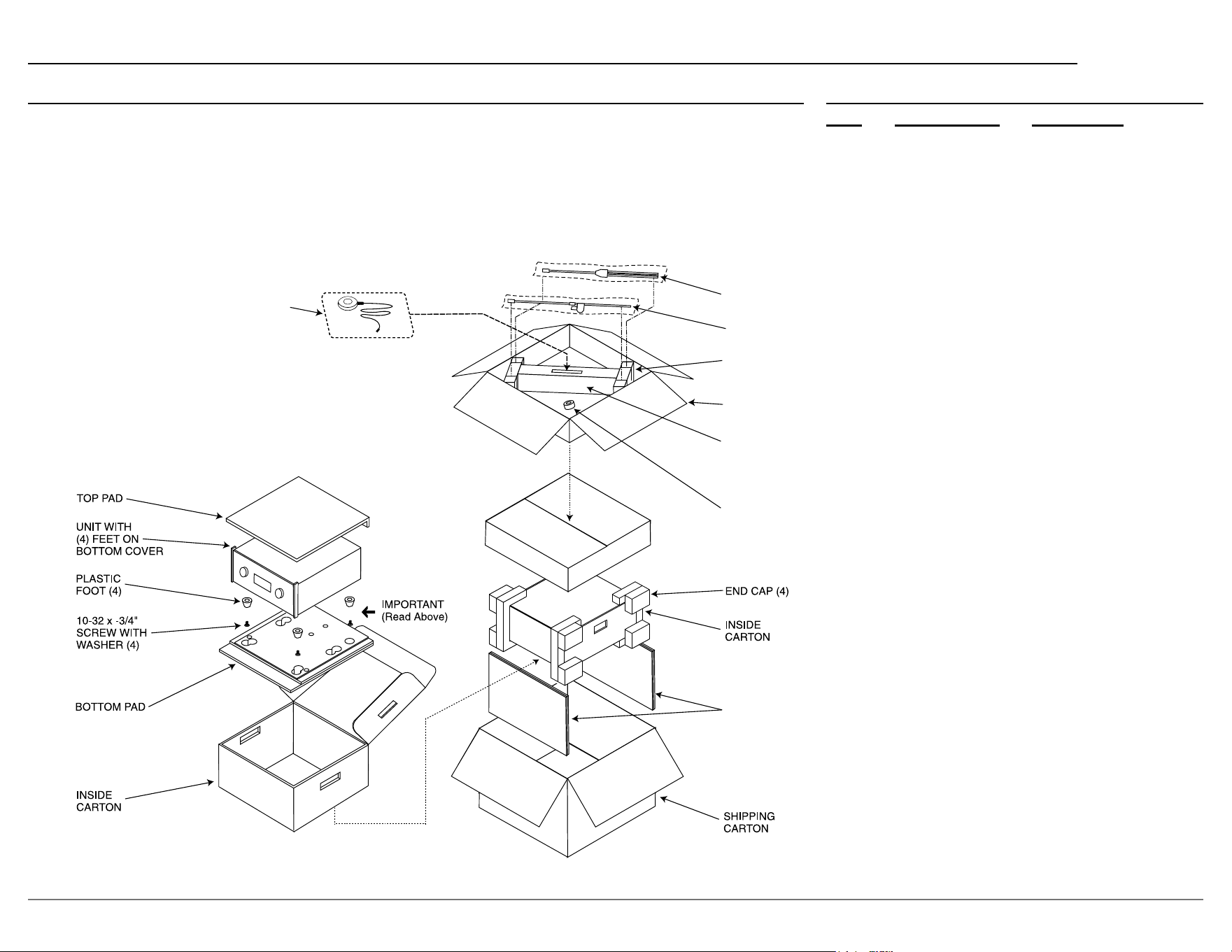
31
MHT300
Packing Instructions Part List
Qty Part Number Description
1 034492 Shipping Carton only
2 034669 End Caps
1 033836 Inside Carton only
1 033725 Top Pad
1 034576 Bottom Pad
4 017937 Plastic Feet
4 400159 #10-32 x 3/4” Screws
4 404080 #10 Flat Washers
1 034499 Accessory Box
2 034500 Slotted Foam
1 034501 Divider Foam
1 320338 Mic Stand Boom
1 320417 Adapter
1 320801 Microphone
In the event it is necessary to repack the equipment
for shipment, the equipment must be packed exactly
as shown below.
It is very important that the four plastic feet
are attached to the bottom of the equipment.
This will ensure the proper equipment location
on the bottom pad. Failure to do this will result in
shipping damage.
Use the original shipping carton and interior parts
only if they are all in good serviceable condition.
If a shipping carton or any of the interior part(s)
are needed, please call or write Customer Service
Department of McIntosh Laboratory. Refer to page 2.
Please see the Part List for the correct part numbers.
SPACER
PADS
SLOTTED
FOAM (2)
DIVIDER
FOAM
ACCESSORY
BOX
MICROPHONE
STAND
MICROPHONE
AND CABLE
MINI BOOM
MICROPHONE
ADAPTER

© 2024 McIntosh Laboratory, Inc.
McIntosh Part No. 24120201
The continuous improvement of its products is the
policy of McIntosh Laboratory Incorporated who
reserve the right to improve design without notice.
Printed in the U.S.A.
McIntosh Laboratory, Inc.
2 Chambers Street
Binghamton, NY 13903
www.mcintoshlabs.com