A RNING
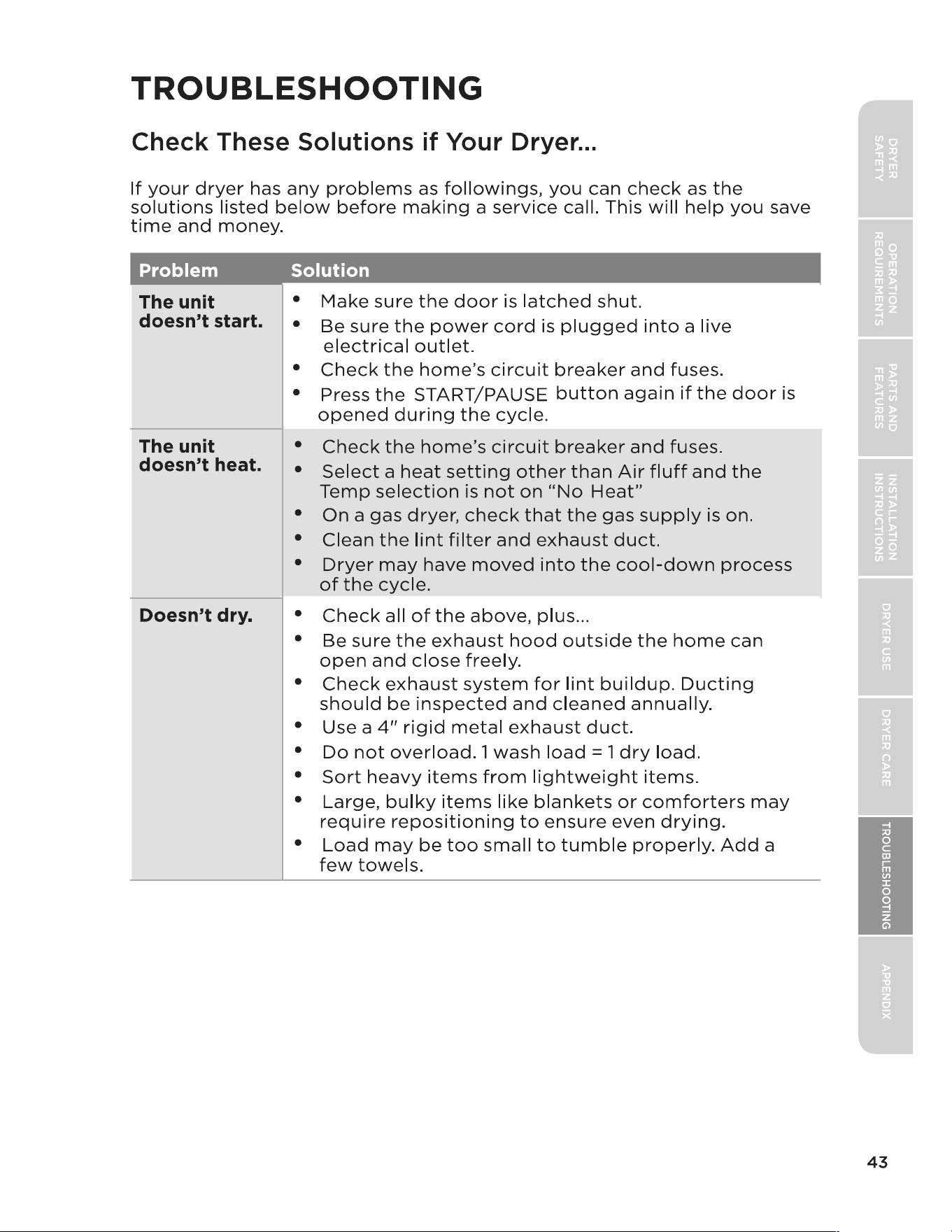
Fire Hazard
•
Failure to follow safety warnings exactly could result
in serious injury, death or property damage.
•
Do not install a booster fan in the exhaust duct.
•
Install all clothes dryers in accordance with the
installation instructions of the manufacturer of the
dryer.
IMPORTANT SAFETY INSTRUCTIONS
A RNING
To reduce the risk of fire, electric shock, or injury to persons when using
your appliance, follow basic precautions ,including the following:
•
Read all instructions before using the appliance.
•
Use this appliance only for its intended purpose as described in this
Owner's Manual.
•
Before use, the dryer must be properly installed as described in this
manual.
•
ALWAYS follow the fabric care instructions supplied by the garment
manufacturer.
•
Do not dry articles that have been previously cleaned in, washed
in, soaked in, or spotted with gasoline, dry-cleaning solvents, other
flammable or explosive substances as they give off vapors that could
ignite or explode.
•
Do not use the dryer to dry clothes which have traces of any
flammable substance, such as vegetable oil, cooking oil, machine
oil, flammable chemicals, thinner, etc., or anything containing
wax or chemicals, such as mops and cleaning clothes. Flammable
substances may cause the fabric to catch fire by itself.
•
Do not store or use combustible materials, gasoline and other
flammable vapors and liquids near this or any other appliance.
•
Do not allow children to play on or in the appliance. Close
supervision of children is necessary when the appliance is used near
children.
•
Before the appliance is removed from service or discarded, remove
the lid of the washing or door of the drying compartment.
•
Do not reach into the appliance if the drum is moving.
•
Do not install or store this appliance where it will be exposed to the
weather or freezing temperatures below 33
°
F.
•
Do not tamper with the controls and latch.
•
Do not install a booster fan in the exhaust duct.
5
6
•
Do not repair or replace any part of the appliance or attempt
any servicing unless it is specifically recommended in the user
maintenance instructions or in published user-repair instructions that
you understand and have the skills to carry out.
•
Keep the area underneath and around your appliances clear and free
from combustible materials (lint, paper, rags, etc.), gasoline, chemicals
and other flammable vapors and liquids.
•
Keep dryer area clear and free from items that would obstruct the
flow of combustion and ventilation air.
•
Do not place items exposed to cooking oils in your dryer. Items
contaminated with cooking oils may contribute to a chemical
reaction that could cause a load to catch fire. To reduce the risk of
fire due to contaminated loads, the final part of a tumble dryer cycle
occurs without heat (cool down period). Avoid stopping a tumble
dryer before the end of the drying cycle unless all items are quickly
removed and spread out so that the heat is dissipated.
•
Unplug the dryer if the machine is to be left for an extended period
of time, such as during vacations.
•
Packaging material can be dangerous for children. There is a risk of
suffocation! Keep all packaging from children.
•
Always check the inside of the dryer for foreign objects before
loading laundry. Keep the door closed when not in use.
•
Do not use fabric softeners or products to eliminate static unless
recommended by the manufacturer of the fabric softener or product
manufacture.
•
Clean the lint screen before or after each load.
•
Keep the area around the exhaust opening and surrounding areas
free from lint, dust, and dirt.
•
The interior of the dryer and exhaust duct should be cleaned
periodically by qualified service personnel.
•
Do not place items exposed to cooking oils in your dryer. Items
contaminated with cooking oils may contribute to a chemical
reaction that could cause a load to catch fire.
•
This appliance must be grounded. See "Electric Requirements" and
"Grounding" in the "OPERION REQUIREMENTS" section.
•
This appliance must be properly grounded. Never plug the power
cord into a receptacle that is not grounded adequately and in
accordance with local and national codes. Refer to installation
instructions for grounding this appliance.
•
Ensure pockets are free from small irregularly shaped hard objects
and foreign material, i.e. coins, knives, pins, etc. These objects could
damage your dryer.
Do not use heat to dry articles containing foam rubber or similarly
textured rubber like - materials.
•
Risk of Suffocation and Injury from Entrapment: Do not allow children to
play on or in the appliance. Close supervision of children is necessary
when the appliance is used near children.
•
Do not use replacement parts that have not been recommended by
the manufacturer (e.g. parts made at home using a 3D printer).

A RNING
To reduce the risk of fire or explosion
•
Do not dry items that have been previously cleaned, washed, soaked,
or spotted with gasoline, dry cleaning solvents, or other flammable or
explosive substances. They emit vapors that could ignite or explode.
Any material that has been in contact with a cleaning solvent or
flammable liquids or solids should not be placed in the dryer until all
traces of these flammable liquids or solids and their fumes have been
removed.
•
There are many highly flammable items used in homes, such
as acetone, denatured alcohol, gasoline, kerosene, some liquid
household cleaners, some spot removers, turpentine, waxes, and wax
removers.
•
Do not dry items containing foam rubber (may be labeled latex
foam) or similarly textured rubber-like materials on a heat setting.
Heated foam rubber materials can, under certain circumstances,
produce fire by spontaneous combustion.
0 CAUTION
•
Do not sit on top of the dryer.
•
Because of continuing product improvements, Midea America
reserves the right of change specifications without notice. For
complete details, see the Installation Instructions packed with your
product before selecting cabinetry, making cutouts, or beginning
installation.
•
Do not dry clothing with large buckles, buttons, or other heavy metal
or solid things.
•
Install and use in accordance with the manufacturer's instructions.
•
Do not place items in your dryer that have been spotted or soaked
with vegetable oil or cooking oil. Even after being washed, these
items may contain significant amounts of these oils.
•
Residual oil on clothing can ignite spontaneously. The potential for
spontaneous combustion increases when items containing vegetable
oil or cooking oil are exposed to heat. Heat source such as your dryer
can warm these items, allowing an oxidation reaction in the oil to
occur.
•
Oxidation creates heat. If this heat cannot escape, the items can
become hot enough to catch fire. Piling, stacking, or storing these
kinds of items may prevent heat from escaping and can create a fire
hazard.
•
Take care that children's fingers are not caught in door when closing
it. This may result in injury.
•
Gas leaks may occur in your system, resulting in a dangerous
situation.
•
Gas leaks may not be detected by smell alone.
•
Gas suppliers recommend you purchase and install a UL approved
gas detector.
7
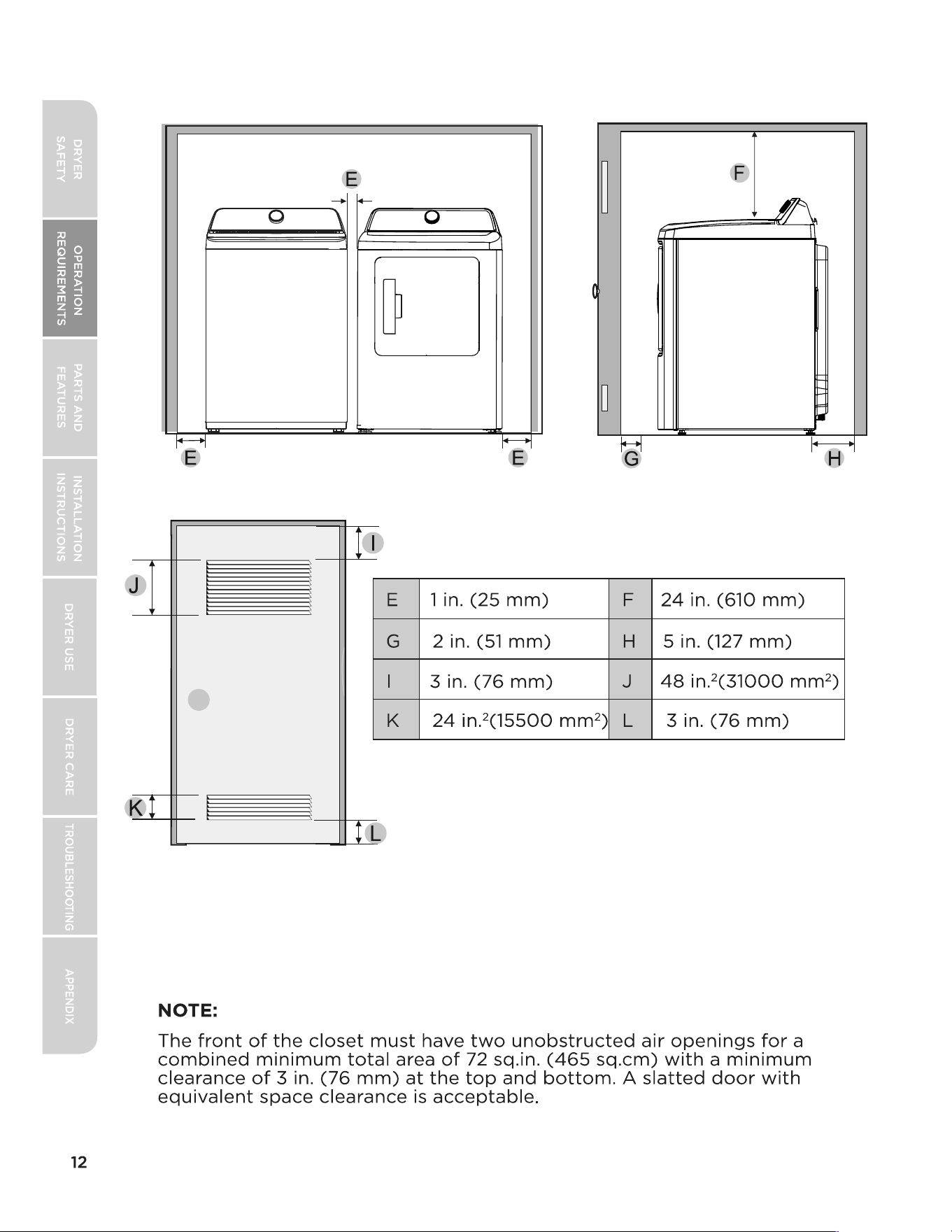
ALCOVE OR CLOSET OR LL INSERT/RECESSED
INSTALLATIONS
A RNING
•
The dryer must be exhausted to the outside to reduce the risk of fire
when installed any place inside the house.
•
No other fuel-burning appliance should be installed in the same
closet as the dryer.
Minimum clearances between the dryer and adjacent walls or other
surfaces:
Sides
1 in. (25 mm)
Rear
5 in. (127 mm)
Top
24 in. (610 mm)
Closet front
2 in. (51 mm)
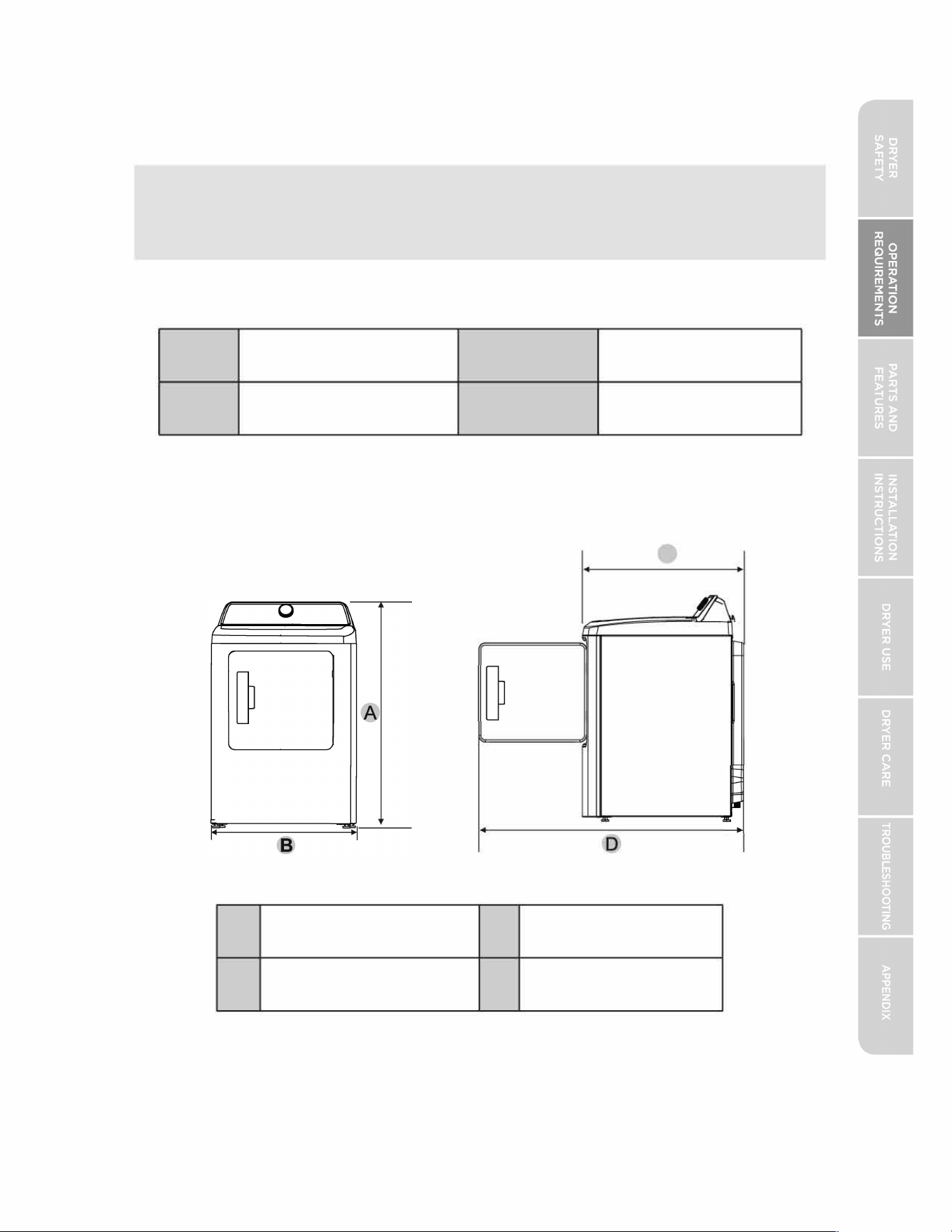
C
A 43.31 in. (1100 mm) B
27 in. (686 mm)
C
30.1 in. (765 mm)
D
50 in. (1270 mm)
11
14
A RNING
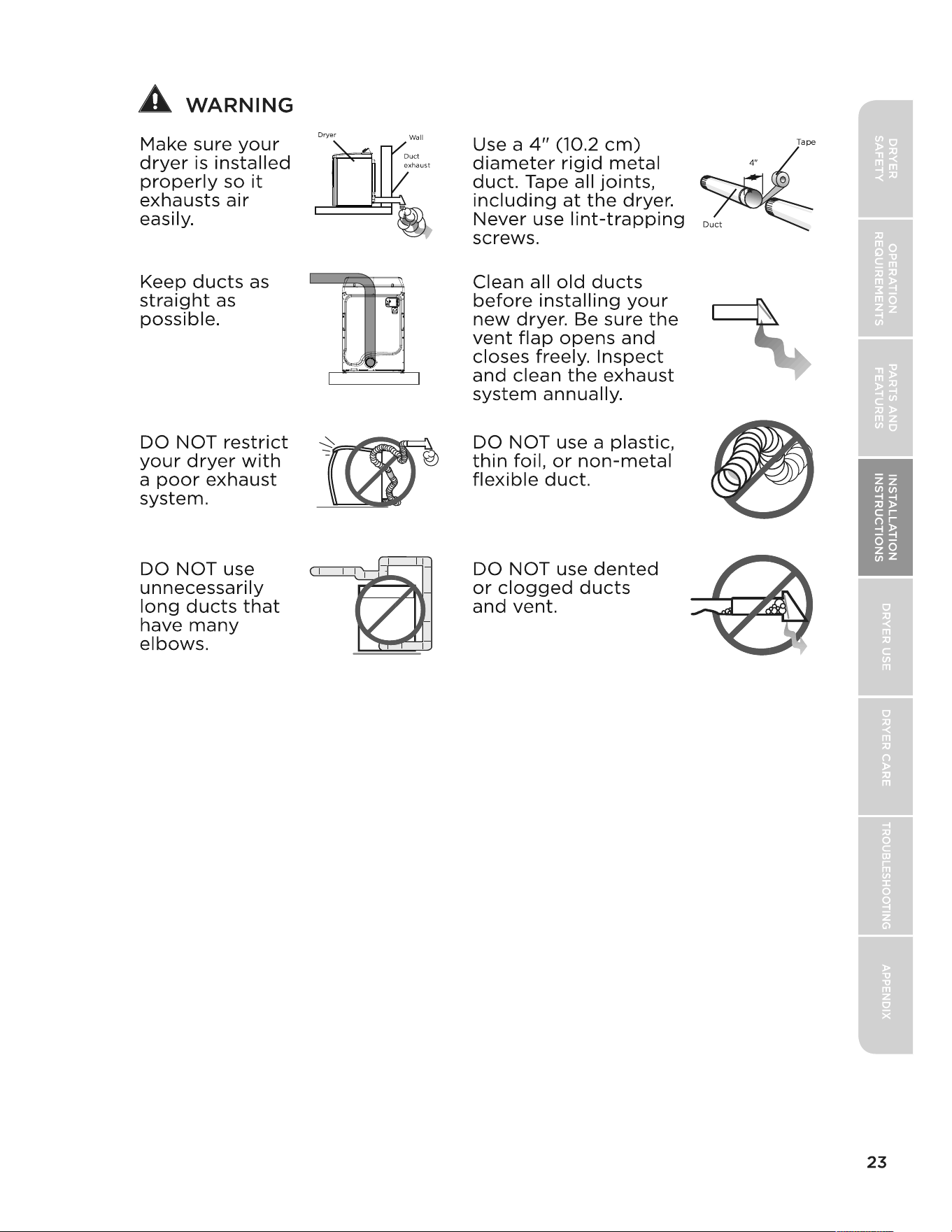
The correct exhaust installation is YOUR RESPONSIBILITY.
•
Use a 4-inch (10.2cm) diameter rigid aluminum or rigid galvanized
steel duct.
•
Do not use smaller diameter than recommended diameter duct.
•
Ducts larger than 4 inches (10.2cm) in diameter can result in
increased accumulation of lint and changes in performance
•
Lint should be removed regularly from internal filter every cycle and
from ducts.
•
If a flexible metal duct must be used, use the type with a stiff sheet
metal wall. Do not use a flexible duct with a thin foil wall. A serious
blockage can result if the flexible metal duct is bent too sharply.
•
Never install any type of flexible duct in walls, ceilings, or other
concealed spaces.
•
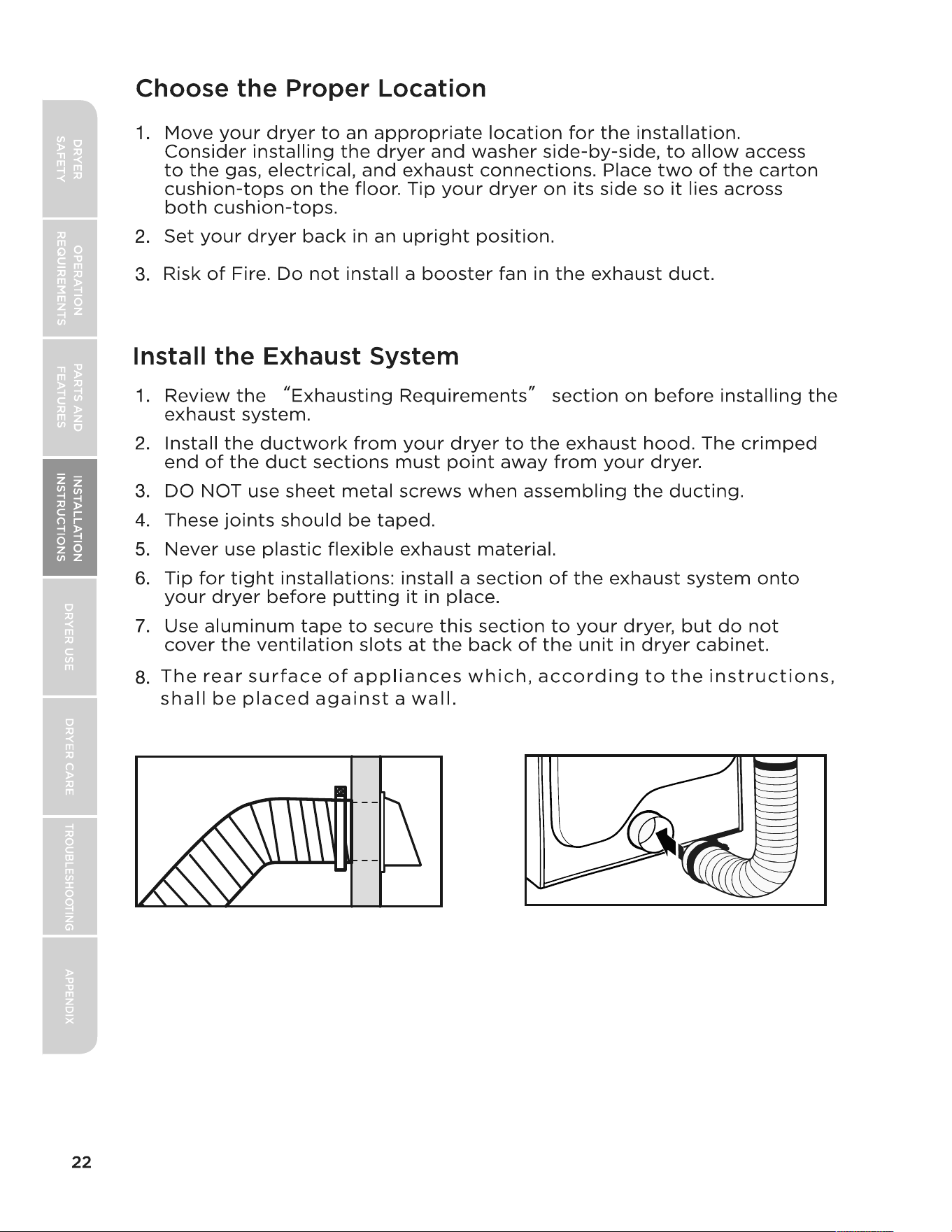
Keep the exhaust duct as straight, short as possible, minimum elbows
•
Secure joints with aluminum tape. Do not use screws.
•
Plastic flexible ducts can kink, sag, be punctured, reduce airflow,
extend drying times, and affect the dryer operation.
•
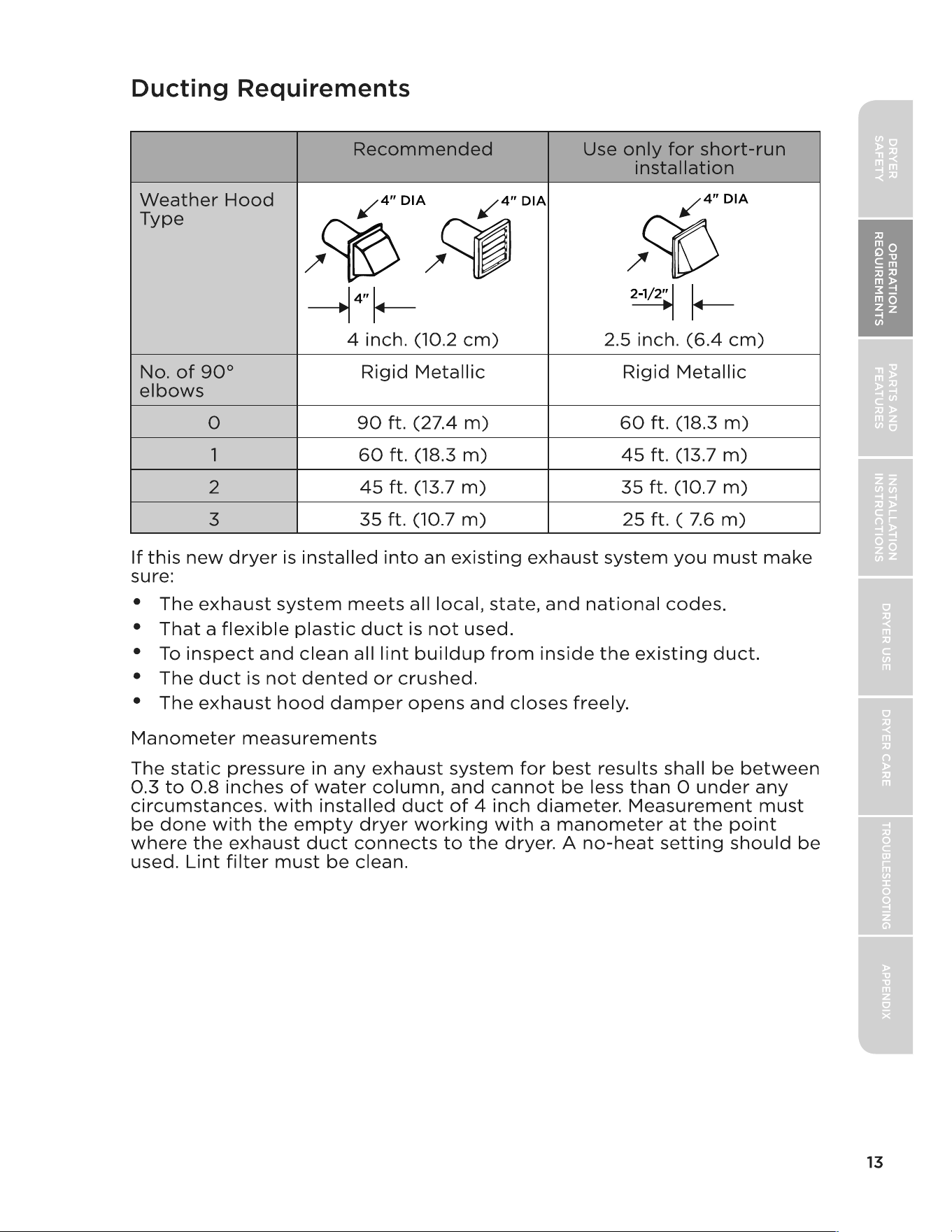
Exhaust systems longer than recommended 90 ft can extend drying
times, affect machine operations, and collect lint.
•
The exhaust duct should end with an exhaust hood with a swing-out
damper to prevent back drafts and entry of wildlife. Never use an
exhaust hood with a magnetic damper.
•
The hood should have at least 12 inches (30.5cm) of clearance
between the bottom of the hood and the ground or other
obstruction. The hood opening should point down.
•
Never install a screen over the exhaust outlet.
•
To avoid lint buildup, do not exhaust the dryer directly into a window
well. Do not exhaust under a house or porch.
•
If the exhaust duct must run through an unheated area, the duct
should be insulated and slope slightly down towards the exhaust
hood to reduce condensation and lint buildup.
•
Inspect and clean the interior of the exhaust system at least once a
year. Unplug the power cord before cleaning.
•
Check frequently to make sure the exhaust hood damper opens and
closes freely.
•
Check once per month, and clean at least once per year. NOTE: If your
clothes are not getting dry, then check the ducting for obstructions.
•
Do not exhaust the dryer into a wall, ceiling, crawl space, or
concealed space of a building, gas vent, or any other common duct
or chimney. This could create a fire hazard from the lint expelled by
the dryer.
•
Do not use non-metallic flexible duct.
•
To reduce the risk of fire, this dryer MUST BE EXHAUSTED
OUTDOORS.
•
Exhaust duct must not be connected or secured with screws or other
fastening devices which extend into the interior of the duct.

Exhausting Requirements
A RNING
•
The dryer shall not be exhausted into a chimney, a wall, a ceiling, an
attic, a crawl space, or a concealed space of a building.
•
The dryer must be exhausted to the outside to reduce the risk of fire
when installed in alcove or closet.
Exhausting the dryer to the outside will prevent large amounts of lint and
moisture from being blown into the room.
A RNING
NEVER USE A PLASTIC OR NON-METAL FLEXIBLE DUCT
If your existing ductwork is plastic, non-metal, or combustible, replace it
with metal before installation this appliance
Use only a metal exhaust duct that is non-flammable to ensure
containment of the exhaust air heat, and lint.
Refer to the "Ducting Requirements" section on page 13 for the
maximum duct length and number of bends.
•
All dryers must be exhausted to the outside.
•
Do not assemble the duct with screws or other fastening means that
extend into the duct and catch lint.
•
The exhaust duct should be 4 inches (102mm) in diameter.
•
The total length of flexible metal duct shall not exceed 7.8 feet
(2.4 meters).
Gas Requirements
Use only natural or LP (liquid propane) gases.
THE INSTALLATION MUST CONFORM WITH LOCAL CODES, OR IN THE
ABSENCE OF LOCAL CODES, WITH THE NIONAL FUEL GAS CODE, ANSI
2223.1/NFPA 54, LATEST REVISION (FOR THE UNITED SES), OR THE
NURAL GAS AND PROPANE INSTALLATION CODE, CSA B149.1, LATEST
REVISION (FOR CANAD.
Gas dryers are equipped with a burner vent for use with natural gas. If you
plan to use your dryer with LP (liquid propane) gas, it must be converted
for safe and proper performance by a qualified service technician.
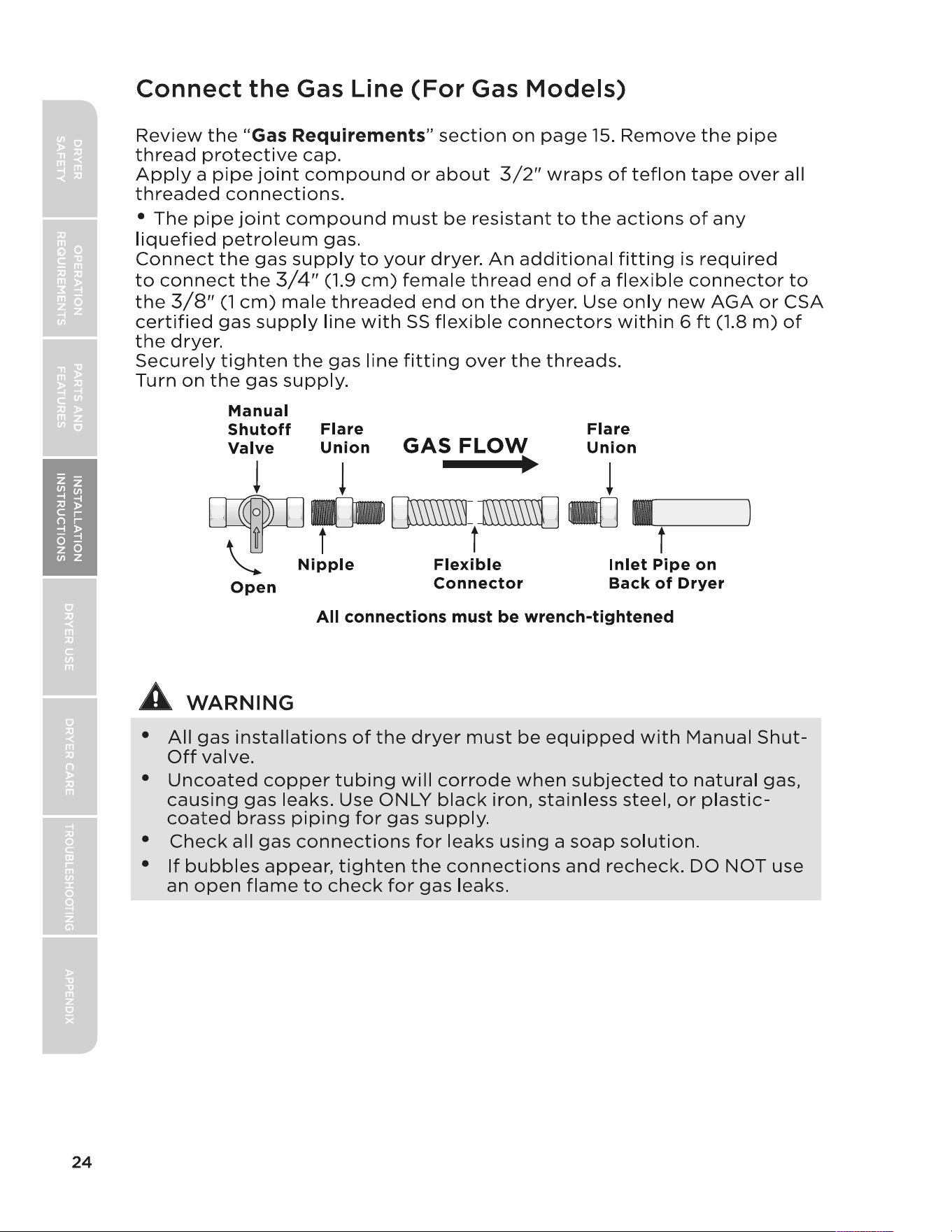
A 1/2" (1.27 cm) gas supply line is recommended and must be reduced to
connect to the 3/8" (1 cm) gas line on your dryer. The National Fuel Gas
Code requires that an accessible, approved manual gas shut-off valve be
installed within 6" (15,24 cm) of your dryer.
Gas dryers installed in residential garages must be raised 18" (46cm)
above the floor.
15
18
A WARNING
Electrical Shock Hazard
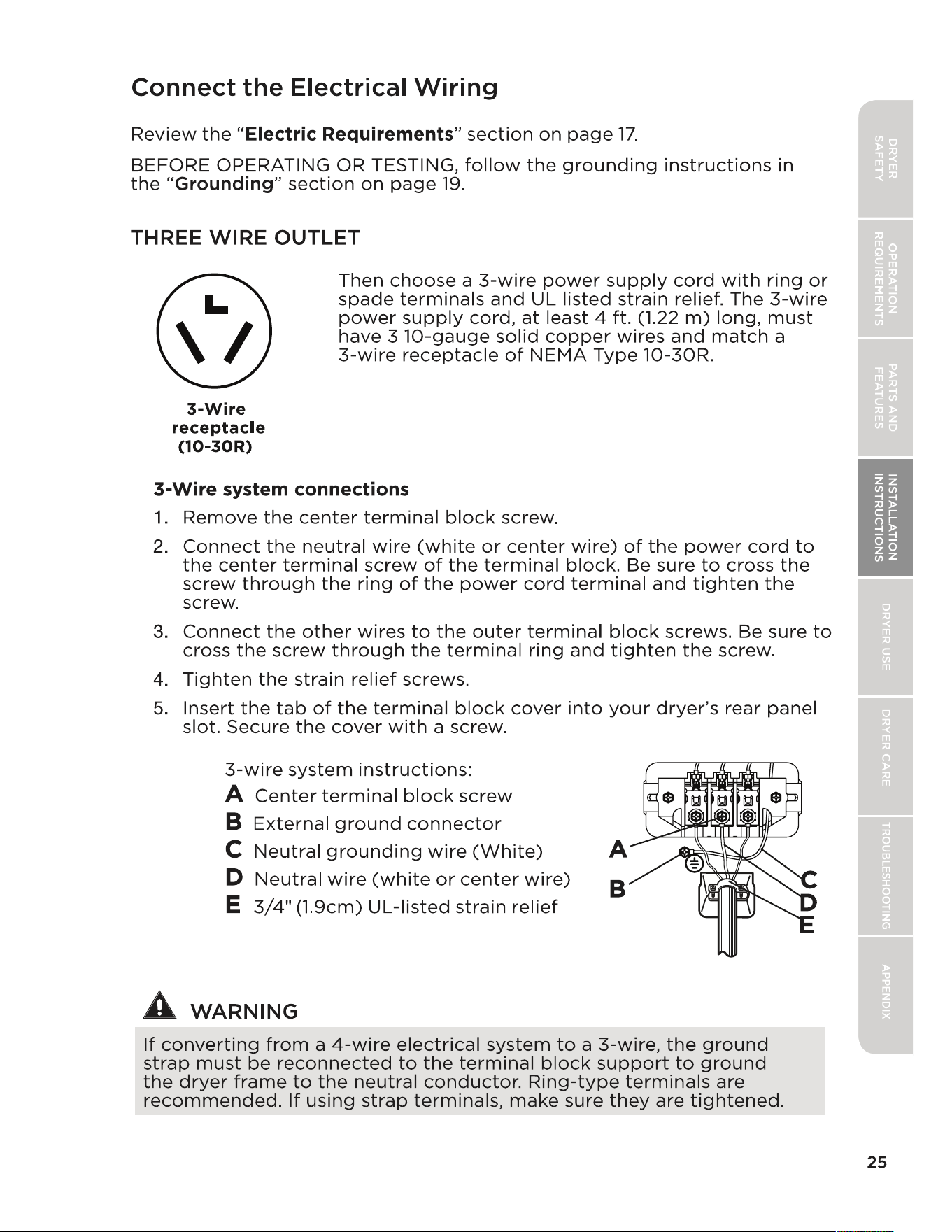
When local codes allow, the electrical supply of the dryer
may be connected by means of a new power supply cord
kit, marked for use with a dryer, that is UL listed and rated
at a minimum of 120
/
240 volts, 30-ampere with three No.
10 copper wire conductors terminated with closed loop
terminals, open-end spade lugs with turned up ends, or
with tinned leads.
•
Do not reuse a power supply cord from an old dryer.
The power cord electric supply wiring must be retained
at the dryer cabinet with a suitable UL-listed strain
relief.
•
Grounding through the neutral conductor is prohibited
for (1) new branch-circuit installations, (2) mobile
homes, (3) recreational vehicles, and (4) areas where
local codes prohibit grounding through the neutral
conductor. (Use a 4-prong plug for 4 wire receptacles,
NEMA type 14-30R.)
Electric models - Canada only
•
A 120
/
240 volt, 60Hz AC approved electrical service fused through a
30-ampere fuse or circuit breaker on both sides of the line is required.
•
All Canadian models are shipped with the power cord attached. The
power cord should be plugged into a 30-ampere receptacle.
26
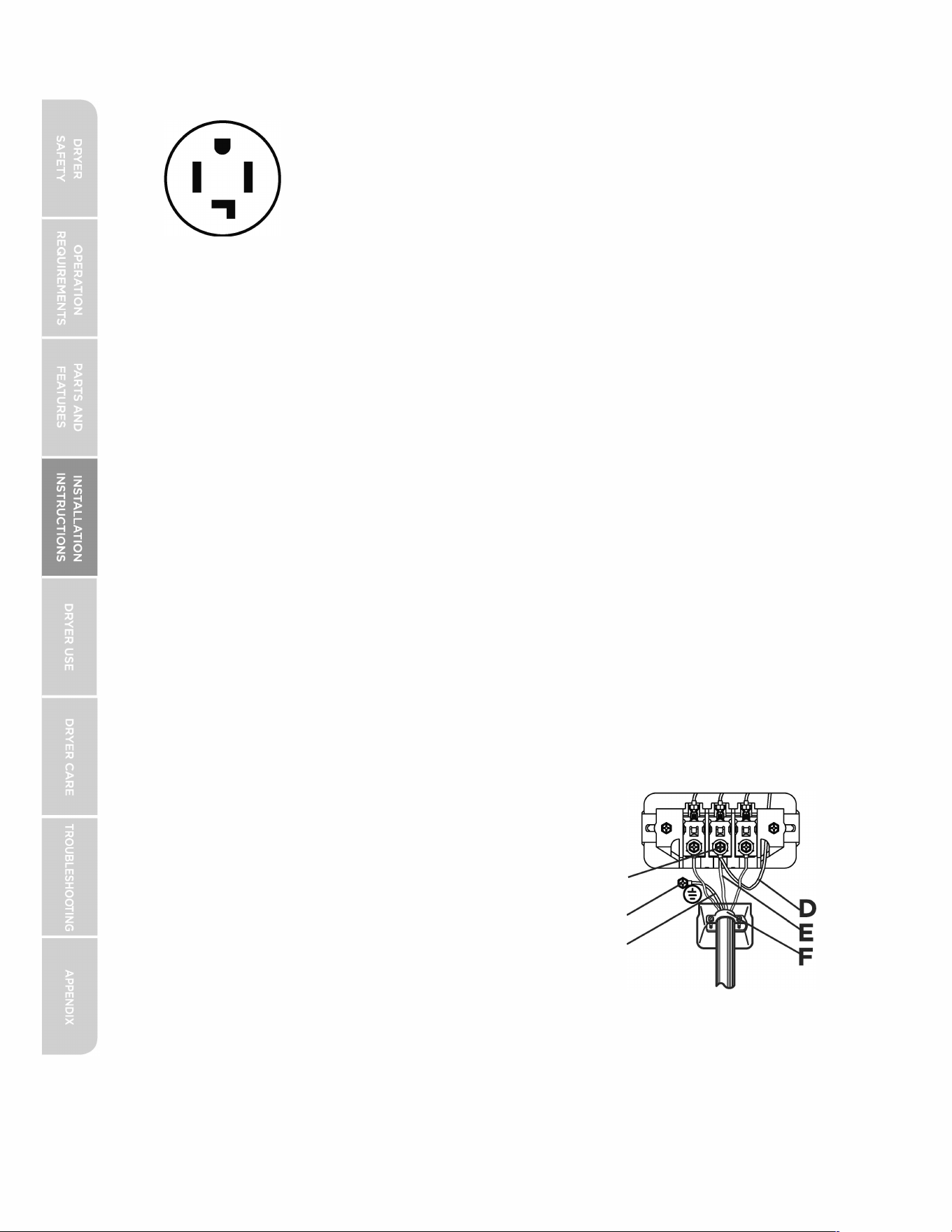
FOUR WIRE OUTLET
4-Wire
receptacle
(14-30R)
Then choose a 4-wire power supply cord with ring
or spade terminals and UL listed strain relief. The
4-wire power supply cord, at least 4 ft. (1.22 m)
long, must have 4 10-gauge solid copper wires
and match a 4-wire receptacle of NEMA Type 14-
30 R. The ground wire (ground conductor) may be
either green or bare. The neutral conductor must
be identified by a white color.
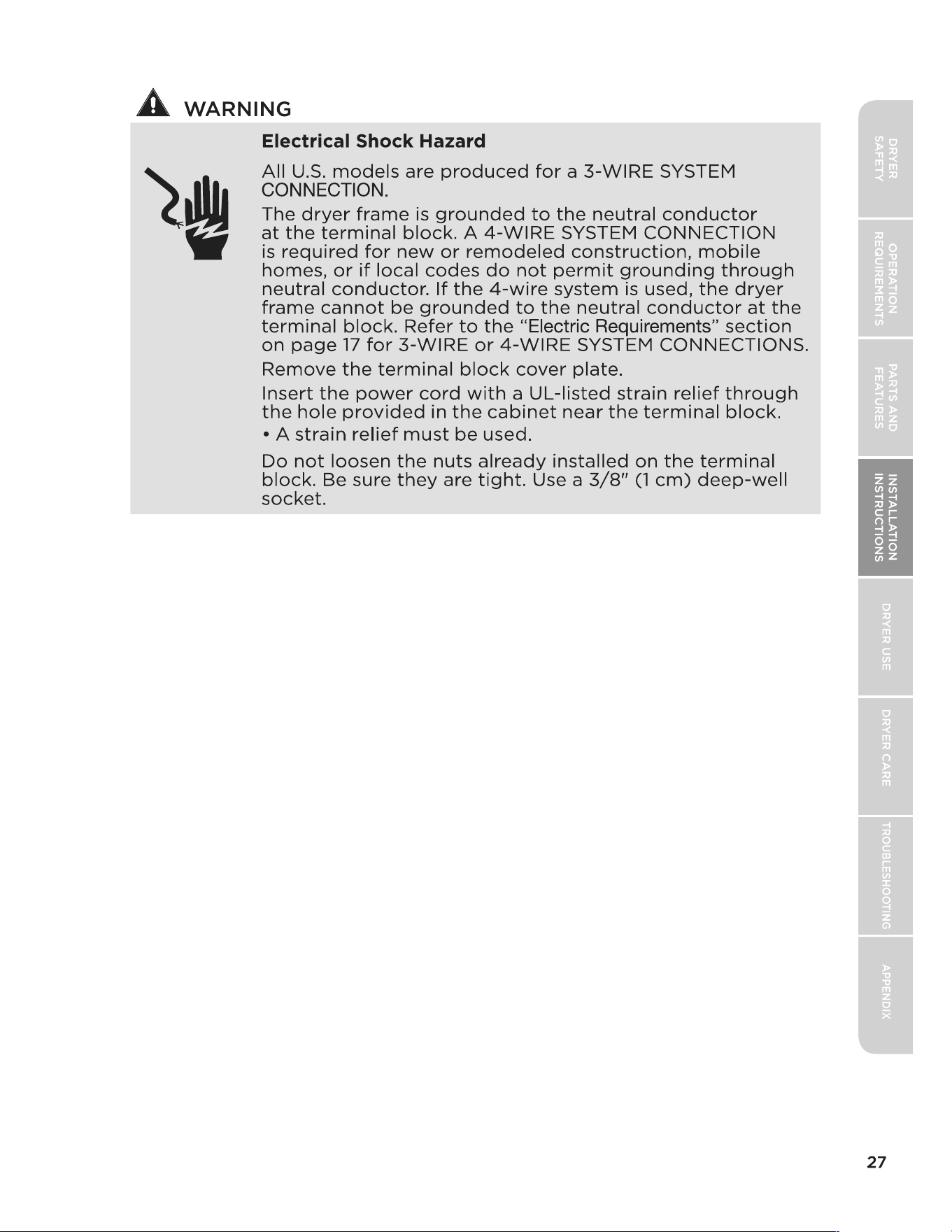
4-Wire system connections
1.
Remove the center terminal block screw.
2.
Connect the ground wire (green or unwrapped) of the power cord
to the external ground conductor screw.
3.
Connect the neutral wire (white or center wire) of the power cord
and the appliance ground wire (white) under the center screw of
the terminal block. Be sure to cross the screw through the ring of
the power cord terminal and tighten the screw.
4.
Connect the other wires to the outer terminal block screws. Be sure
to cross the screw through the terminal ring and tighten the screw.
5. Tighten the strain relief screws.
6.
Insert the tab of the terminal block cover into your dryer's rear
panel slot. Secure the cover with a screw.
4-wire system instructions:
IMPORTANT: Ring-type terminals are recommended. If using
strap terminals, make sure they are tightened.
A Center terminal block screw
B External ground connector
C Green or bare copper wire of the
power cord
A
D Neutral grounding wire (White)
E Neutral wire (white or center wire)
B
F 3/4" (1.9cm) UL-listed strain relief
C
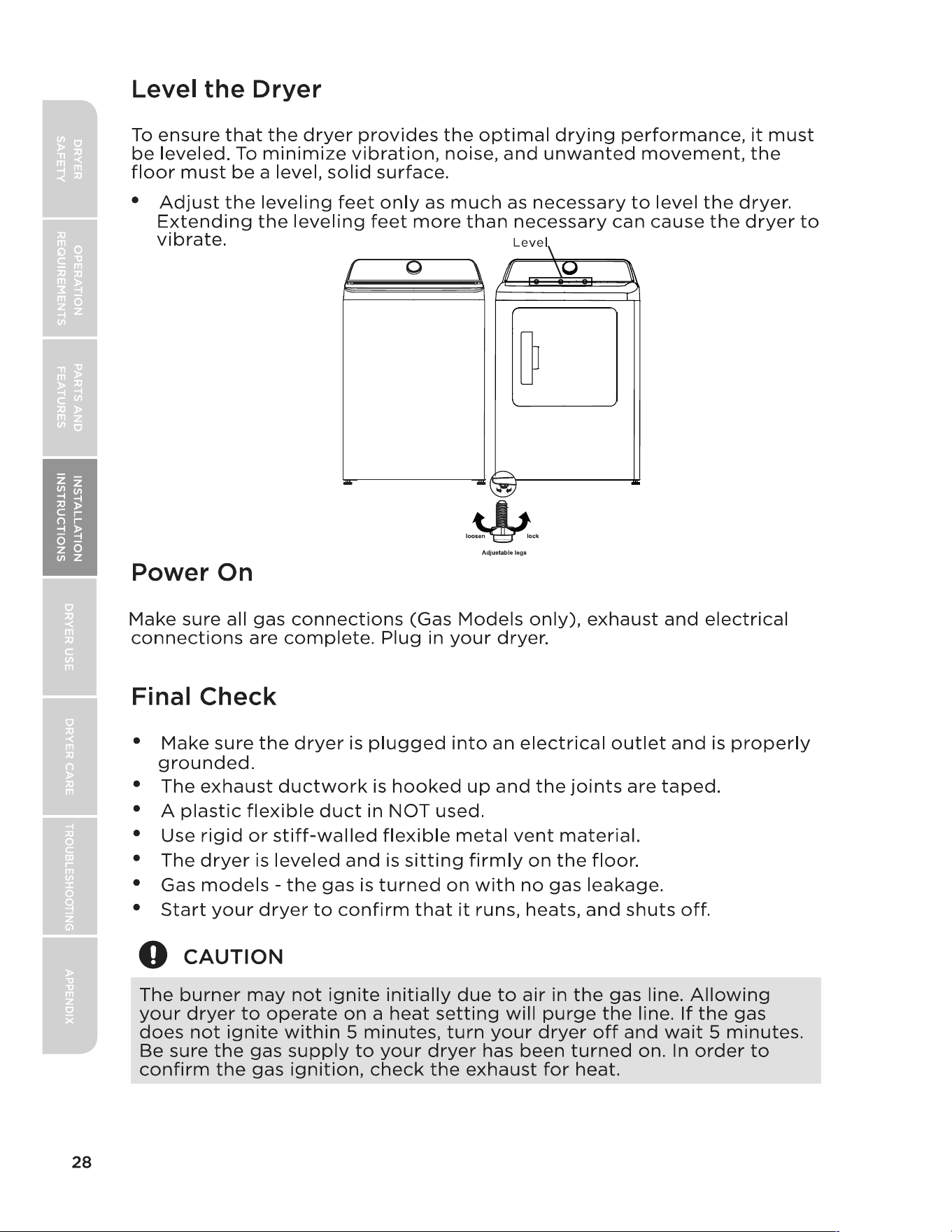
Door Reversal Procedure
1. Make sure that the power cord is unplugged.
2. While supporting the door, remove the four hinge screws from the door,
then lift the door to remove it and set the door aside.
---Remove the two screws
0
--Remove the two screws
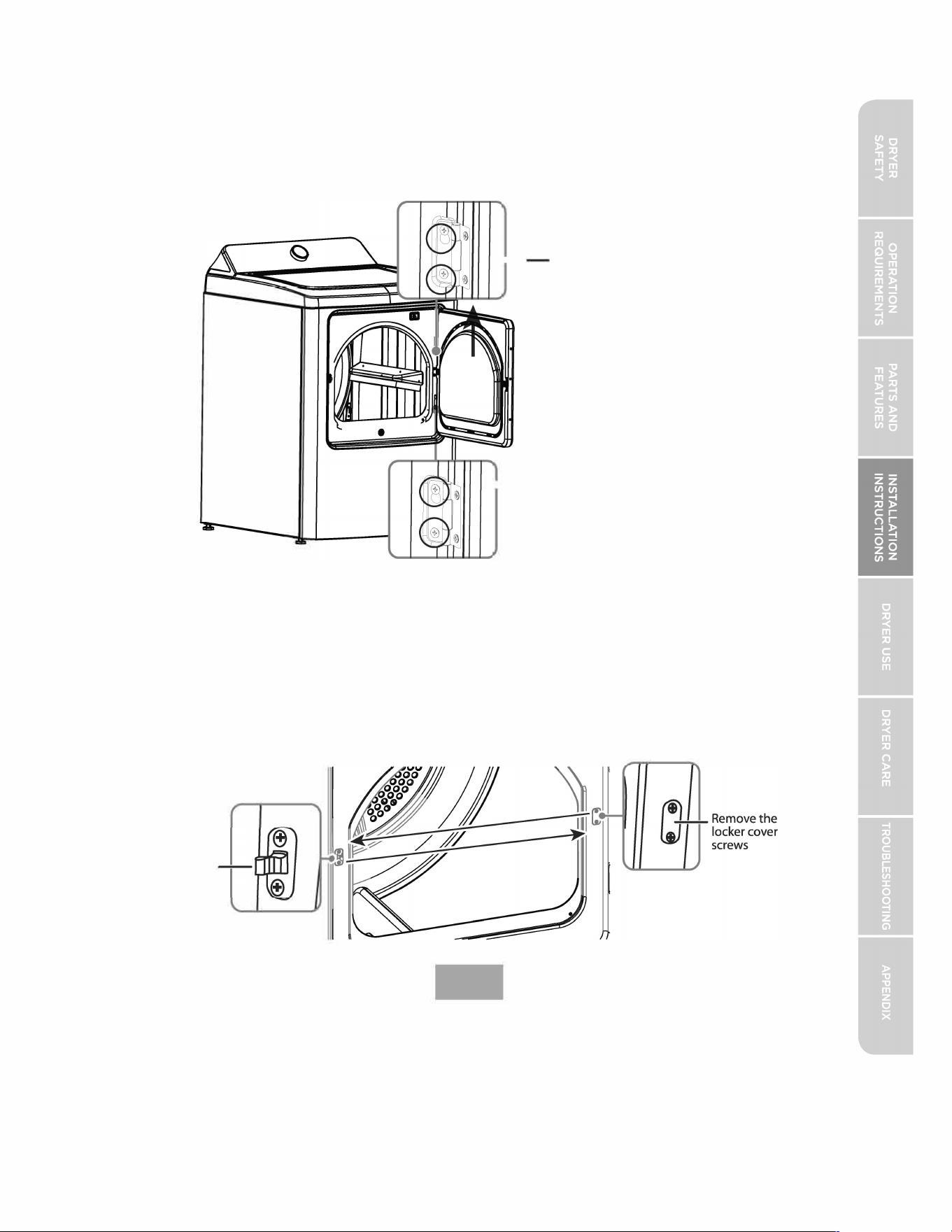
3. Remove the screws for the latch cover on the right side of the dryer
and the screws for the locker cover on the left side of the dryer.
4. Install the latch onto the right side of the dryer with the screws you
just removed, then install the locker cover on the left side of the dryer.
Remove the
locker screws
3-4
29
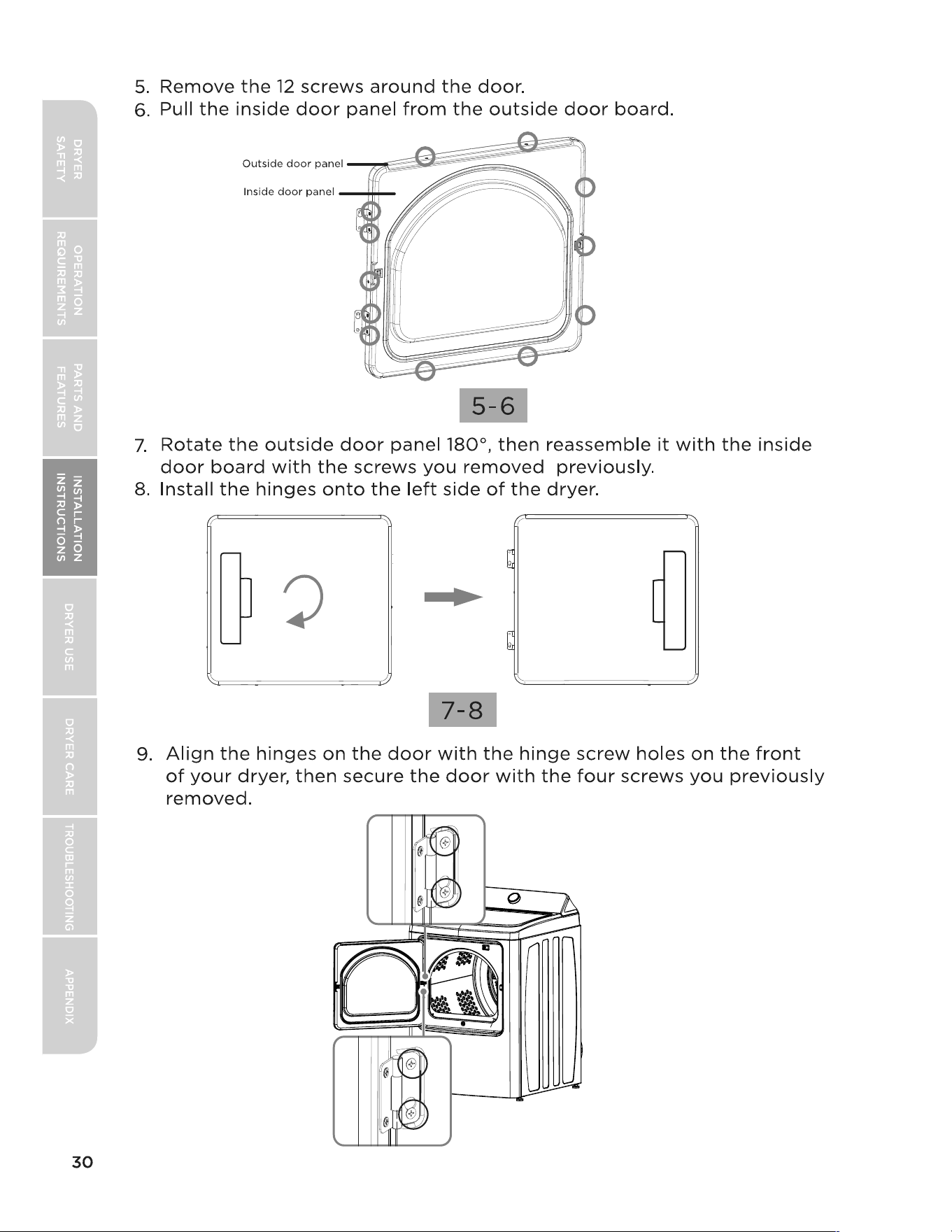
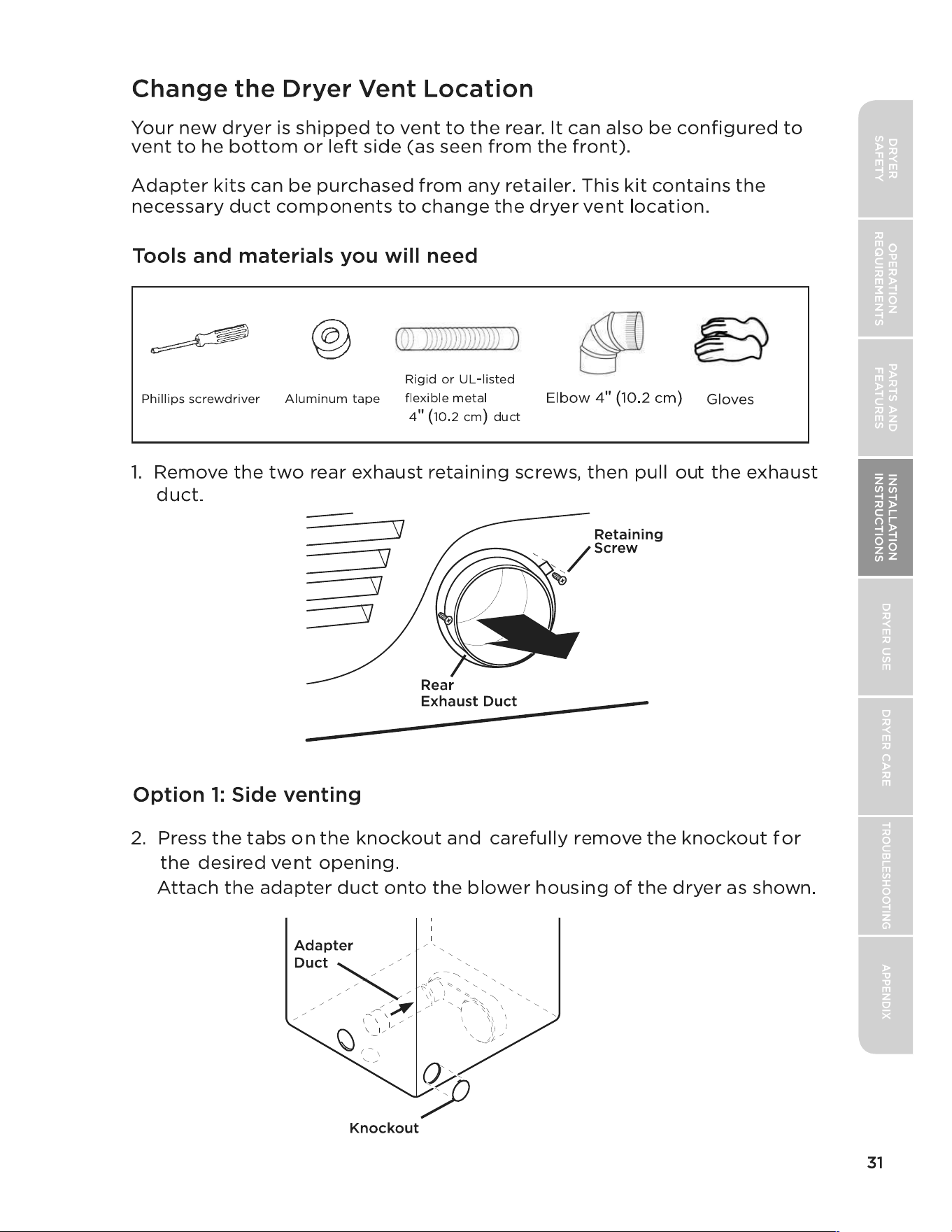
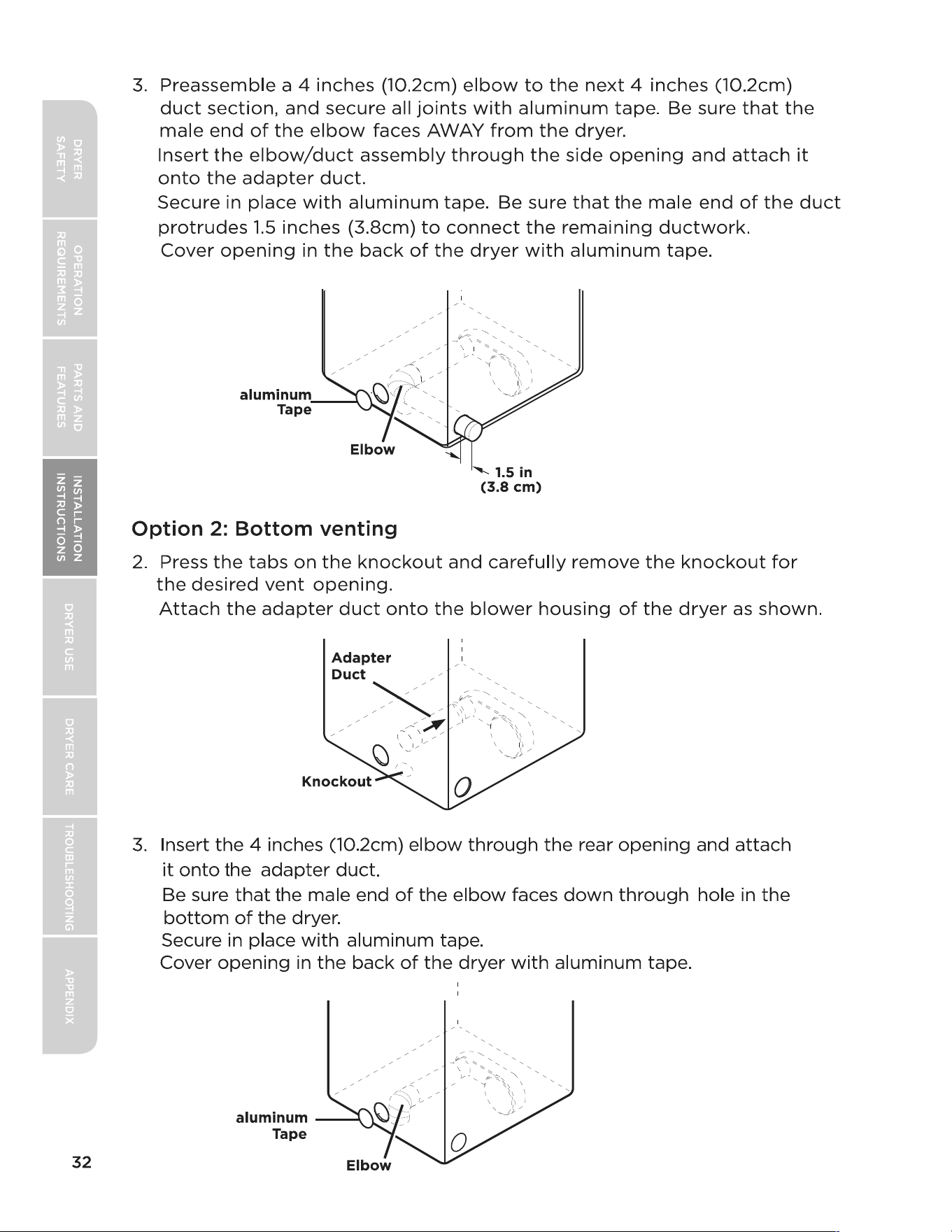
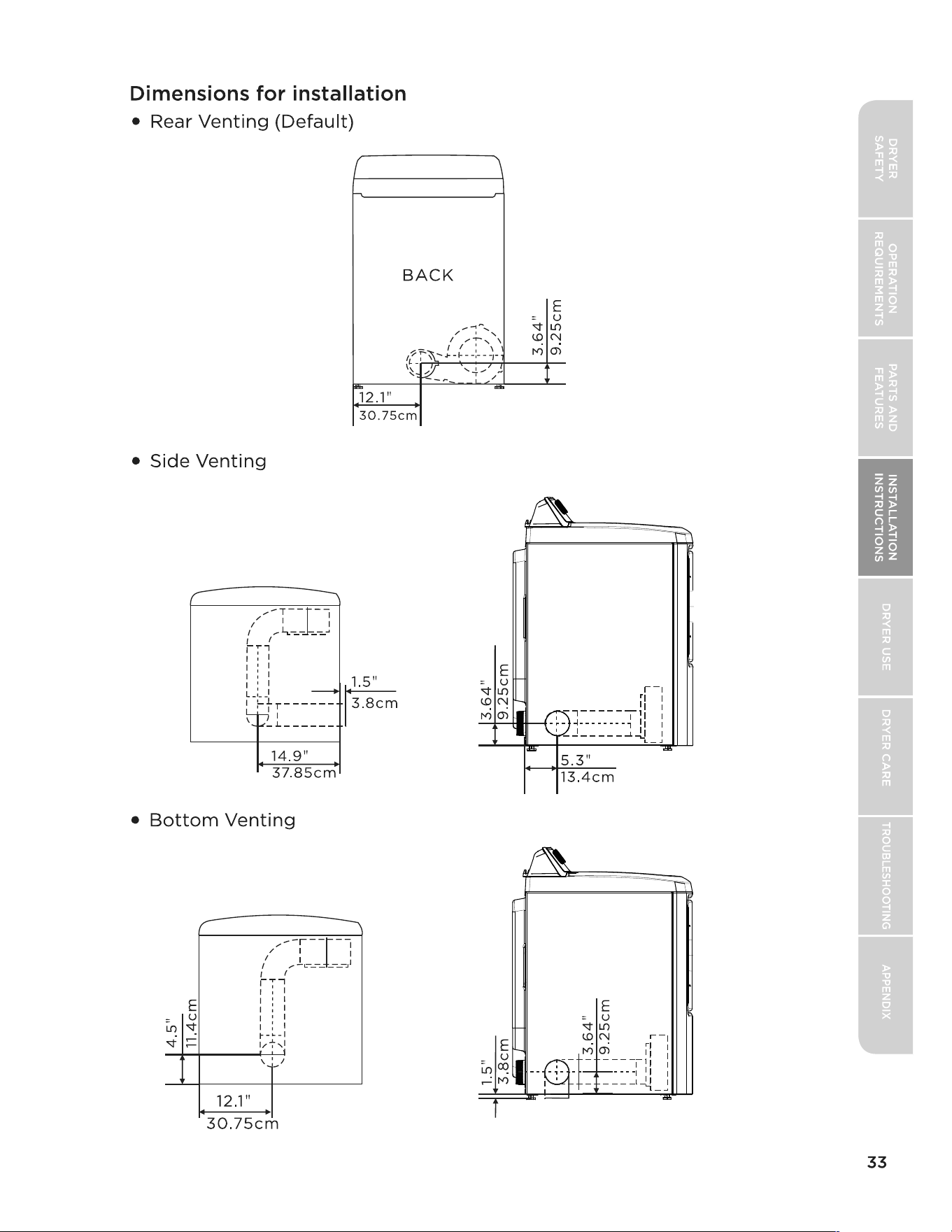
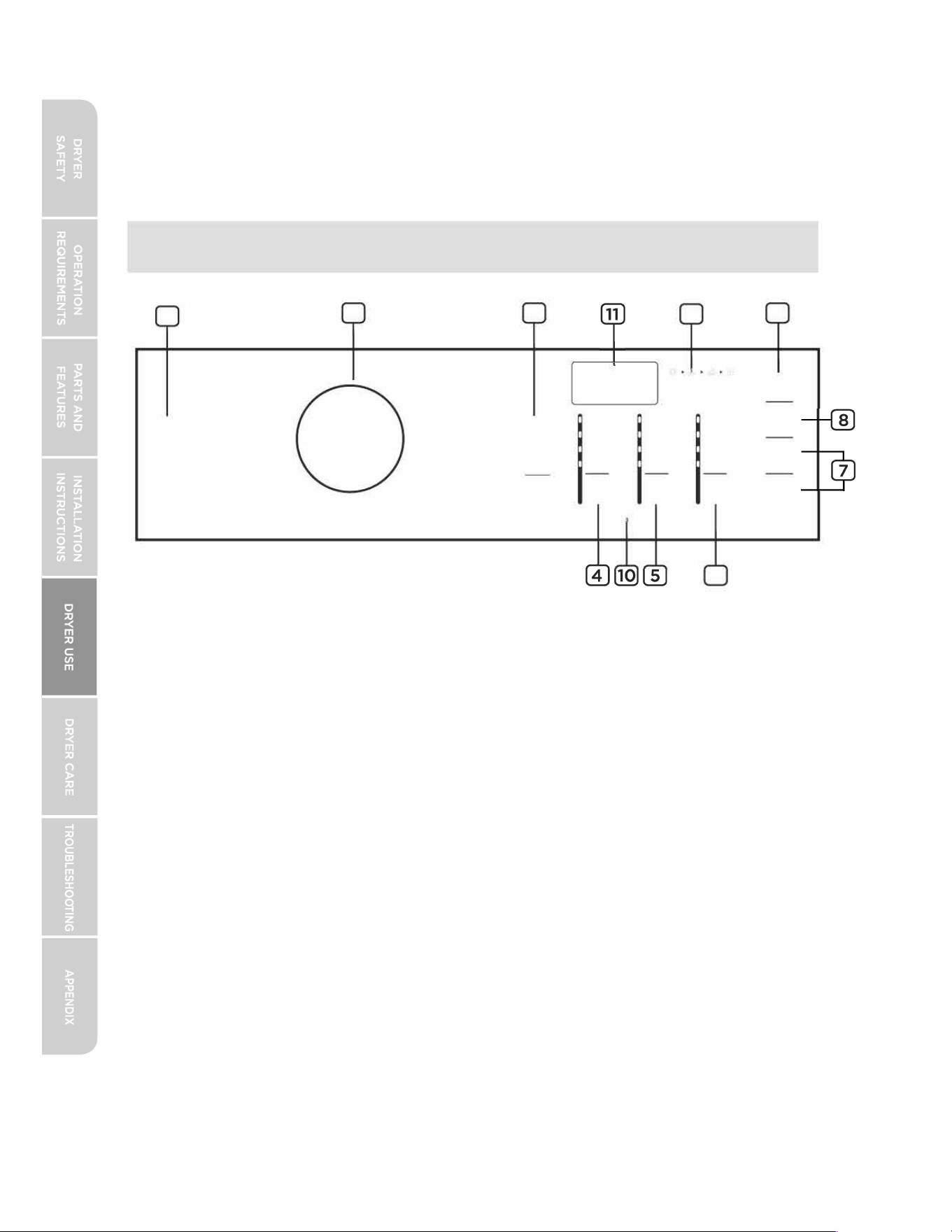
34
DRYER USE
Control Panel
A RNING
To reduce the risk of fire, electric shock, or injury to persons, read the
IMPORTANT SAFETY INSTRUCTIONS before operating the appliance.
1
3
2
12
9
NORMAL 0
0 DELICATES
Ding ling
��
e Done
� WRINKLE
= =
GUARD
HEAVY DUTY 0 0 SANITIZE
Child Lock Clean Filter
High
More
80min
� DAMP
� 8
ALERT
BULKY 0
�
QUICK DRY
Medium
Normal
60min
Low
40min
I TIME+
TOWELS 0
TIME DRY
No H
Damp
20min
POWER
START
PERM PRESS 0
AIR FLUFF
PAUSE
I TIME-
DRY
DRY DRY
MANUAL D
TEMP
LEVEL
TIME
Child Lock
"'" =·
6
POWER
Press to turn your dryer on or off. If your dryer is on for more than 10
minutes without any buttons being pressed, it automatically turns off.
START/PAUSE
Press to start or pause the cycle.
cle Selector
Select your desired cycle for the type of load. The cycle you select
determines the heat control for the cycle. The NORMAL, HEY DUTY,
BULKY, TOWELS, PERM PRESS, DELICES, SANITIZE are Sensor Dry
cycles. The QUICK DRY, TIME DRY AIR FLUFF are Manual Dry cycles.
DTEMP
Press the button to select the drying temperature.
High - For sturdy cottons or those labeled Tumble Dry.
Medium - For permanent press, synthetics, lightweight cottons, or items
labeled Tumble Dry Medium ..
Low - For lower heat than Medium to dry synthetic or washable knit fabrics.
No Heat - For heat sensitive items labeled Tumble Dry Low or Tumble
Dry Warm.
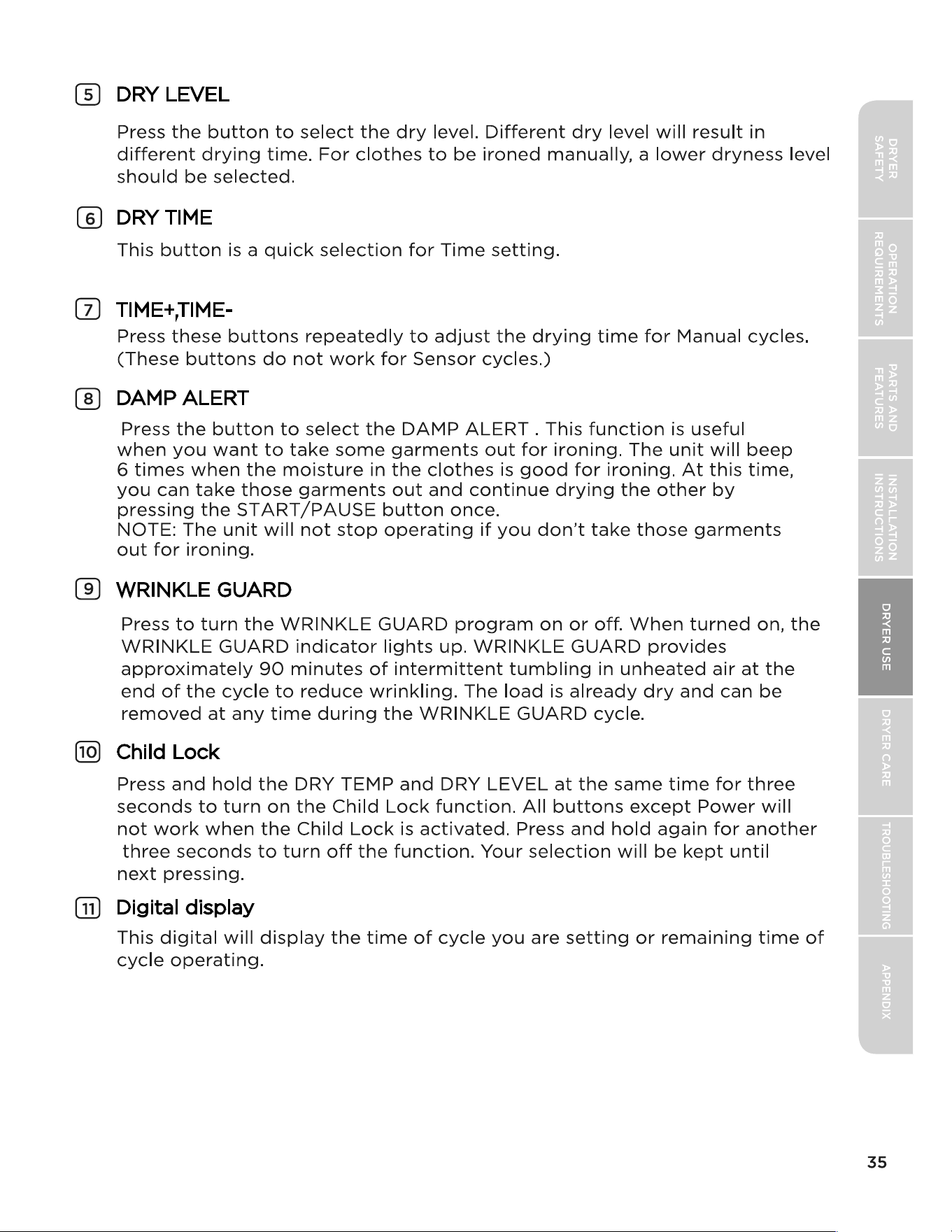
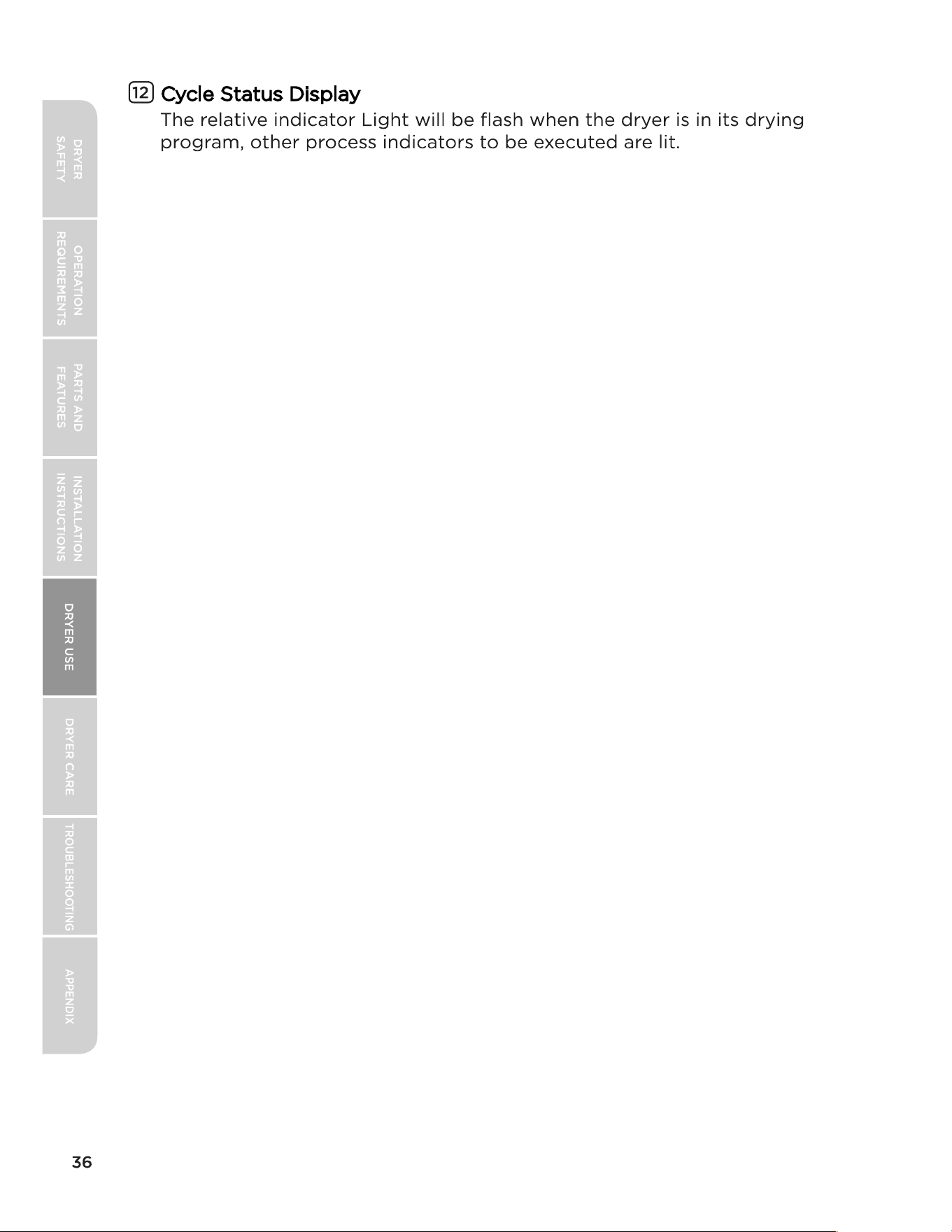
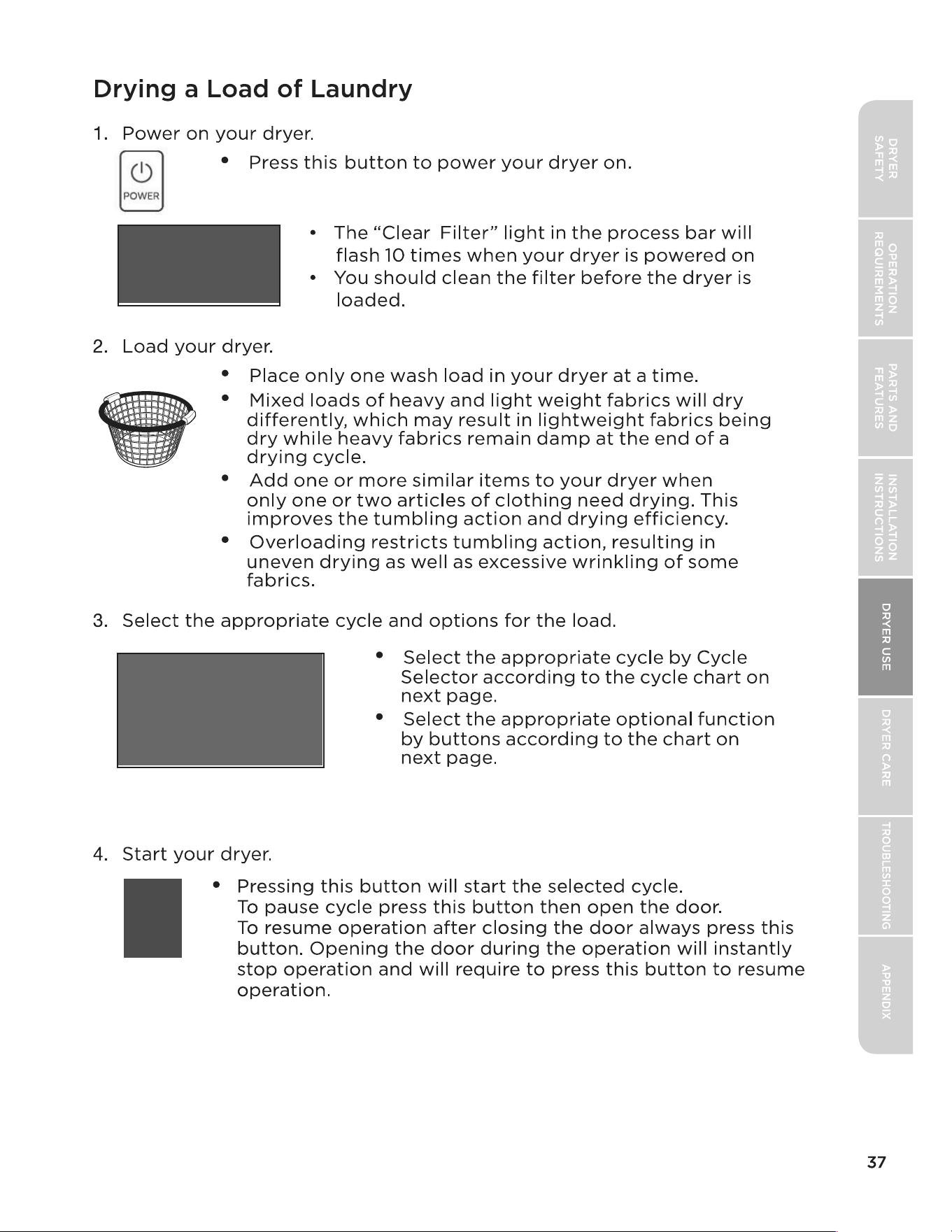
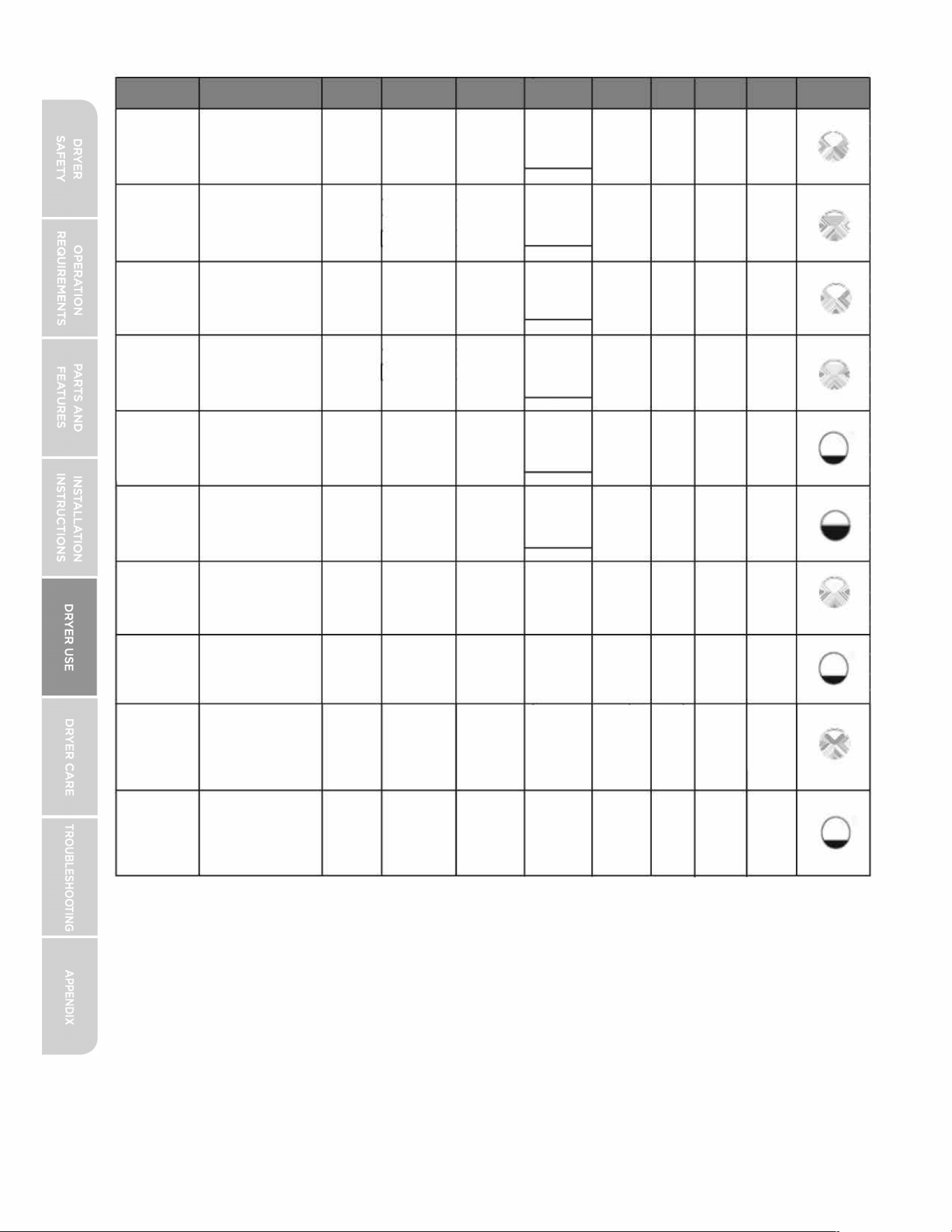
Cycle Fabric type
D
Dry Level
Wrine
DAMP
DRY
Chlld
Tim
Time+
M
:��:��
Temp
Gua
ALERT
TIME
Lock
• Cotton
More
Normal
-
NORMAL
• Underwear
Medium
Less
y
N
y
N N
• Linen
y
Damp
N
• Jeans
More
HEY DUTY
• Corduroys
High
Normal
y N y
N N
•
• Work clothes
Less
y
Damp
N
Gas:
More
BULKY • Quilt
Low
Normal
y N y
N N
•
Electric:
Less
y
Medium
Damp
N
More
• Towels
Normal
-
TOWELS
• Heavy cottons
High
Less
y
N
y
N N
y
Damp
N
• Wrinke-free
More
PERM PRESS
cottons
Medium
Normal
y
N
y
N
N
• Synthetic fabrics
Less
y
• Knits
Damp
N
More
DELICES
• Sensitive items
Low
Normal
y
N
y
N N
Less
Damp
y
N
• Towels
•
SANITIZE
• Bedding
High
More
y
y
N
y
N N
• Children, s
clothing
High
QUICK DRY
I
Medium
N y y y y
Low
N
y
High
•
TIME DRY
I
Medium
N y N y y y y
Low
AIR FLUFF
I
No Heat
N y
N y y y y
38

40
Special Laundry Tips
Please follow the care label or manufacturer's instructions for drying
recommendations. If care label instructions are not available, use the following
information as a guide.
Items Drying guide
Bedspreads &
Comforters
Blankets
Curtains&
Draperies
---�
Cloth Diapers
Down Filled Items
(jackets, sleeping
bags, comforters,
etc.)
•
Follow the care label instructions or dry in Heavy
Duty cycle.
•
Make sure the item is thoroughly dry before
using or storing.
•
May require repositioning to ensure even drying.
•
Use the Normal cycle and dry only one blanket
at a time for best tumbling action.
•
Make sure the item is thoroughly dry before
using or storing.
•
May require repositioning to ensure even drying.
•
Use the Casual cycle, medium temperature and
less dry to help minimize wrinkling.
•
Dry these in small loads for best results and
remove as soon as possible.
•
Use the Normal cycle on High temperature for
soft fluffy diapers.
•
Use the Normal cycle on High temperature.
•
Add a couple of dry towels to shorten drying
time and absorb moisture.
Foam Rubber (rug •
DO NOT dry on a heat setting. Use the Air Fluff
cycle (no heat).
backs, stuffed
toys, shoulder
pads, etc.)
Pillows
Plastics (shower
curtains, outdoor
furniture covers,
etc.)
Items NOT to dry:
RNING: Drying a rubber item with heat may
damage it or create a fire hazard.
•
Use the Normal cycle.
•
Add a couple of dry towels and dryer balls to
help the tumbling action and to fluff the item.
You can dry kapok of foam pillows in the dryer as
long as you use the air fluff cycle.
•
Use the Air fluff cycle or the Time Dry cycle
on the Low or Ultra Low temperature setting
depending on the care label instructions.
•
Fiberglass items (curtains, draperies, etc.)
•
Woolens, unless recommended on the label.
•
Items spotted or soaked with vegetable or cooking oils.
46
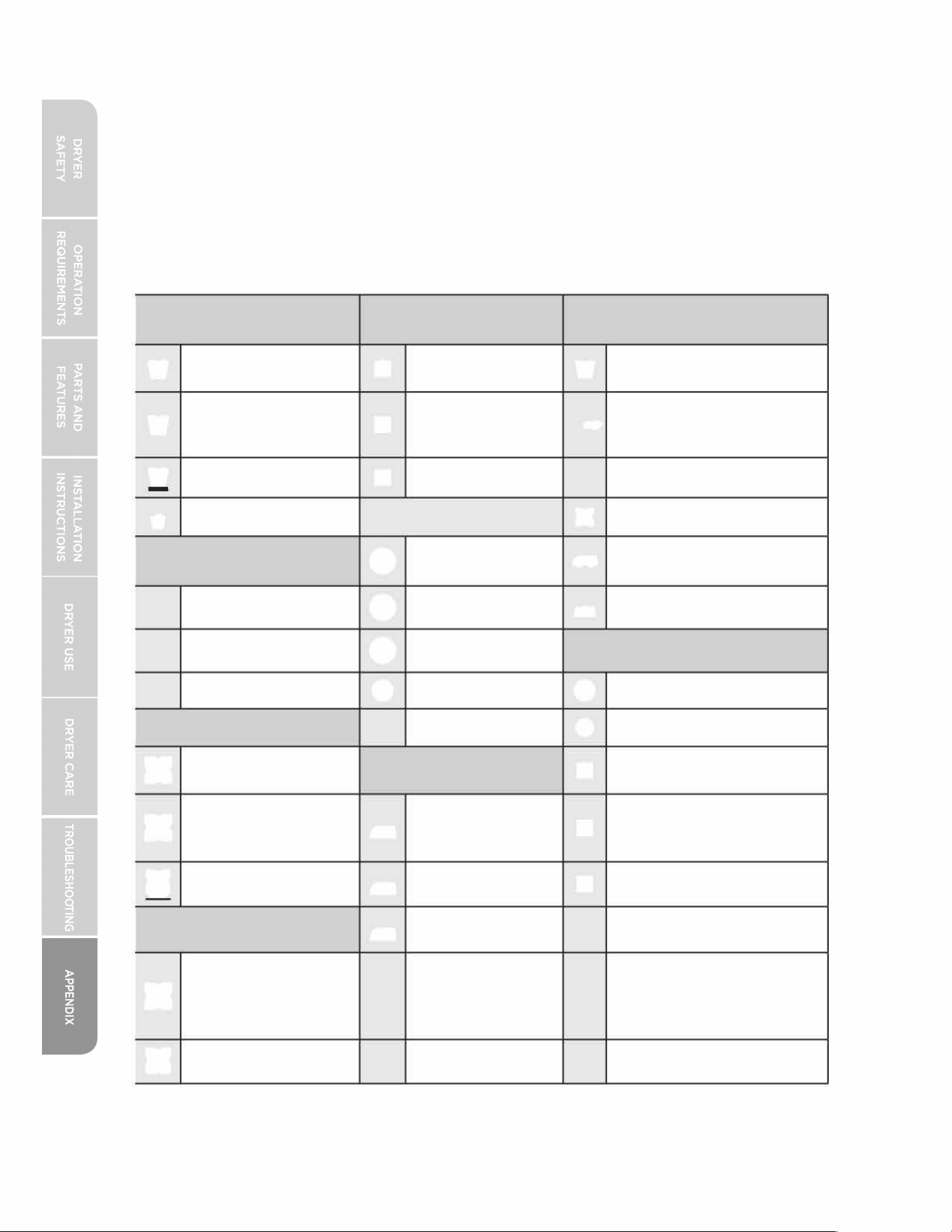
APPENDIX
Fabric Care Chart
The following symbols provide garment care direction. The Clothing care
labels include symbols for washing, bleaching, drying and ironing, or dry
cleaning when necessary. The use of symbols ensures consistency among
garment manufacturers of domestic and imported items. Follow care label
directions to maximize garment life and reduce laundering problems.
Wash Cycle
Special Instructions
Warning Symbols for
Laundering
Normal
□
Line Dry/Hang
g
Do Not Wash
to Dry
Permanent Press I
Wrinkle Resistant /
Drip Dry
Do Not Wring
Wrinkle Control
Gentle/Delicates
Dry Flat
•
Do Not Bleach
�
Hand Wash
Heat Setting
8
Do Not Tumble Dry
Water mperature**
e
High
Q
No Steam (added to
iron)
•••
Hot
0
Medium
�
Do Not Iron
••
Warm
0
Low
Dryclean
•
Cold
0
Any Heat
0
Dry Clean
Bleach
-
No Heat/Air
Do Not Dry Clean
Any Bleach (when
Iron-Dry or Steam
□
Line Dry/ Hang to Dry
needed) Temperatures
Only Non-Chlorine
a
(color-safe) Bleach
High
Drip Dry
(when needed)
Tumble Dry Cycle
a
Medium
Dry Flat
Normal
a
Low
Permanent Press/
For machine-
•
washable wool.
Wrinkle Resistant/
Loads should be
Wrinkle Control
under 8 pounds.
Gentle/ Delicates
**The number of dots represent appropriate wash water temperatures for
various items. The temperature range for Hot is 105-125
°
F/41-52
°
C, for
Warm 85-105
°
F/29-41
°
C and for Cold 60-85
°
F/16-29
°
C.

Criterion
™