User Manual
geprufte
Sicherheit
Read all safety rules and instructions carefully before operating this tool.
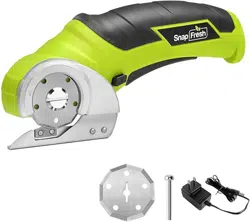
MINI CUTTER
EC0601
www.snapfreshtools.com

Scope of delivery.............................................................................................
3
Component list ........................................................................................
5
General information
.......................................................................................
6
Explanation of symbols
.................................................................................
7
Safety................................................................................................................
8
General power tool safety warnings..........................................................
8
Safety warnings for battery cells inside the tool
......................................
12
General safety warnings for your battery charger.....................................
14
Additional safety instructions for your battery charger..............................
15
Operating instructions...................................................................................
16
Removing and installing the blade............................................................
16
On/off switch.............................................................................................
16
Charging the tool......................................................................................
17
Charging...................................................................................................
17
17
Cutting......................................................................................................
Troubleshooting..............................................................................................
18
Maintenance....................................................................................................
18
Cleaning...........................................................................................................
19
Transport.........................................................................................................
19
Technical data.................................................................................................
20
Noise information.....................................................................................
20
Vibration information................................................................................
20
Environmental protection..............................................................................
21
Warranty..........................................................................................................
22
Table of contents
3
Scope of delivery
A
7
6
2 1
3
4
5
8
4
b
a
B2
C
B1
B3
D
E

5
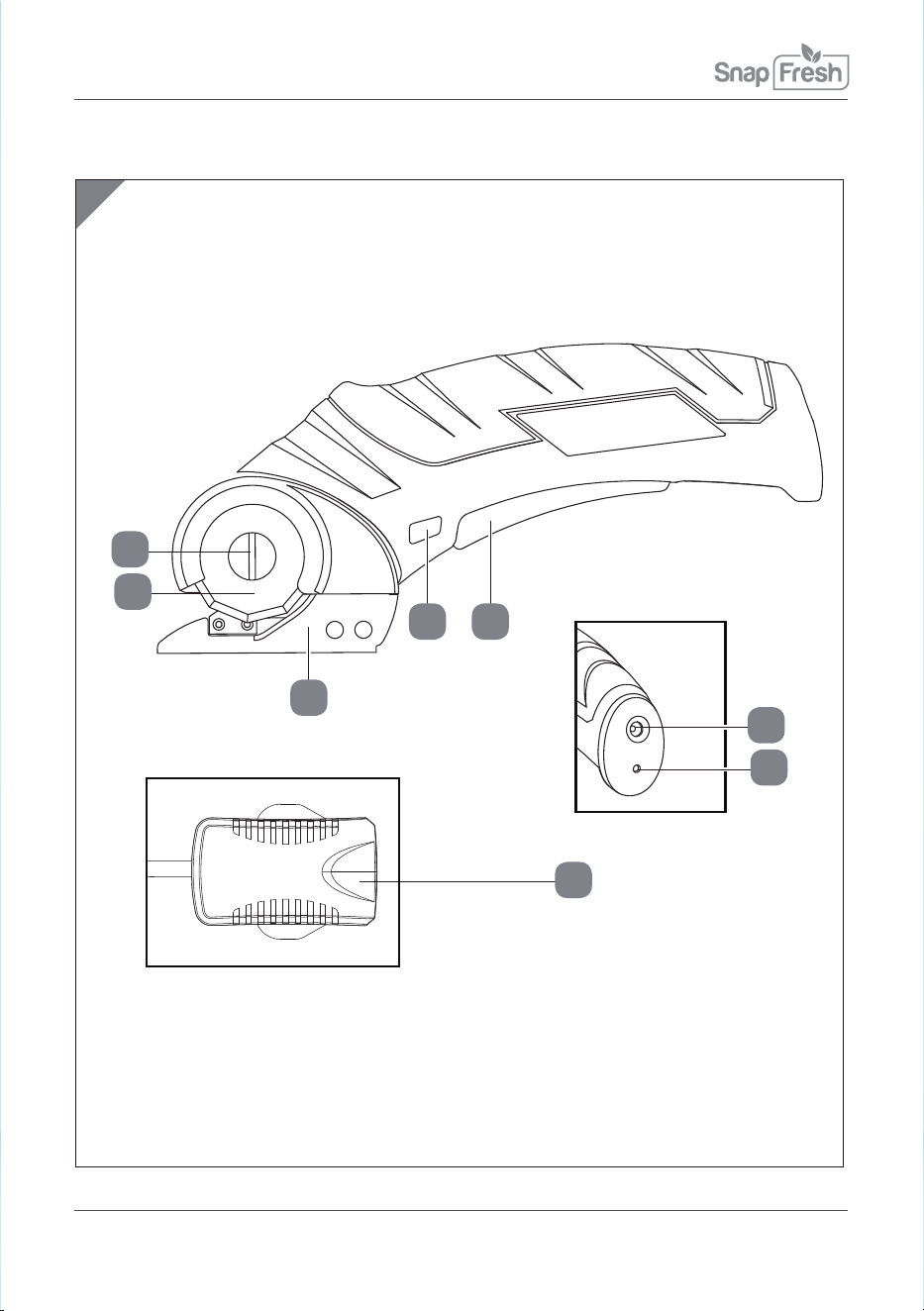
On/off switch
Lock-off button
Blade guard
Blade
Blade screw
Charger socket
Charging indicator light
Charger
Component list

6
General information
Reading and storing the user manual
This user manual contains important information on how to use the
4.0V Mini Cutter. Read this user manual carefully, in particular the
safety instructions, before using the product. Failure to follow this
user manual may lead to severe injuries or product damage.
Keep this user manual for further reference. If you pass this product on to a third
party, you must also supply this user manual.
First time users or inexperienced operators pay particular attention to the
operation of the 4.0V Mini Cutter, including details of starting and stopping and
correct use of the 4.0V Mini Cutter on pages 16-18, as well as the maintenance
instructions on pages18-19.
Intended use
This product is for private domestic DIY use only.
It is not suitable for commercial, industrial or trade use.
The tool is intended for cutting flexible, soft materials of up to 6mm in thickness,
such as carpet, PVC, cardboard, leather, fabrics and similar materials.
Use the tool and accessories only for intended applications.
7
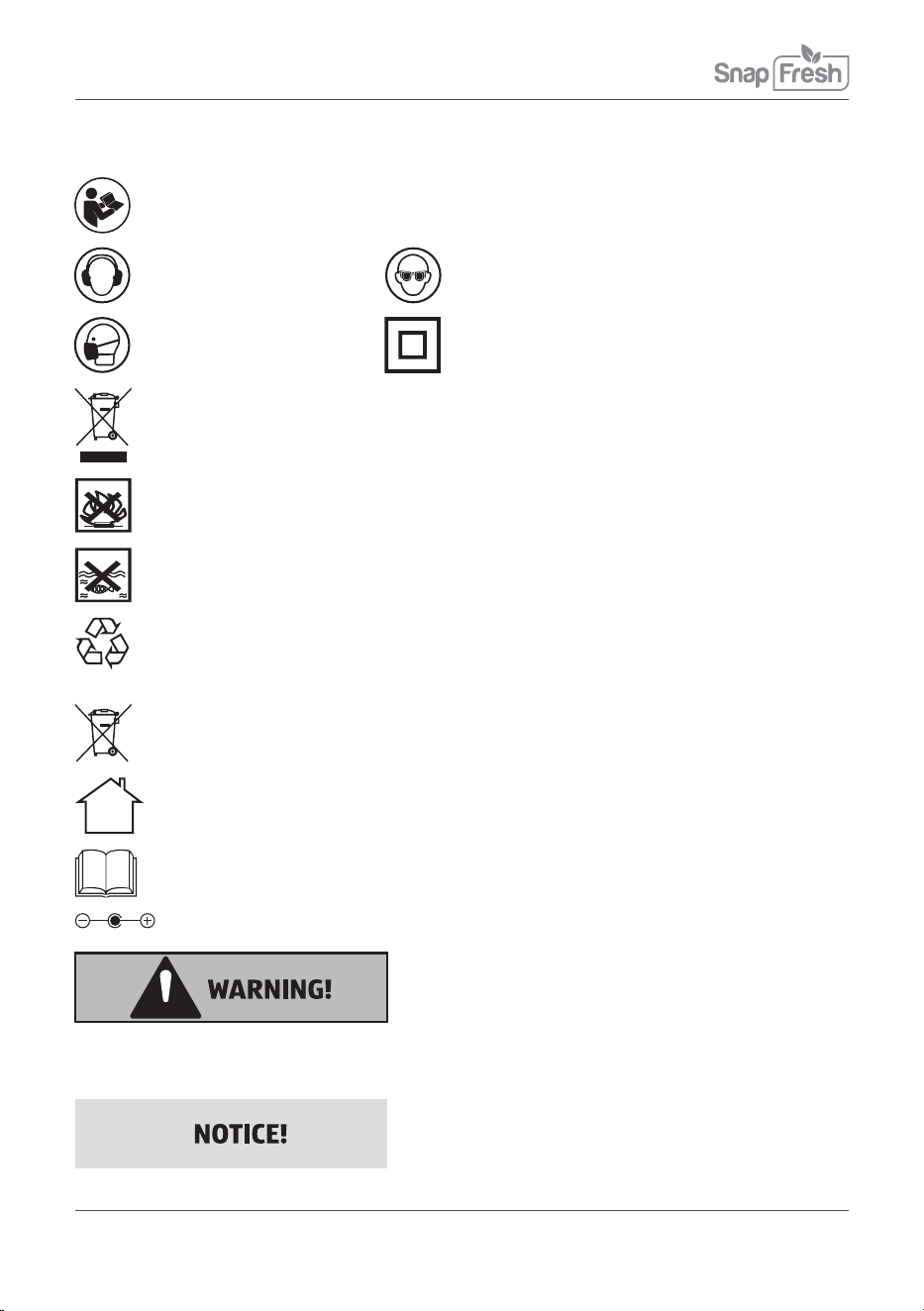
To reduce the risk of injury, user must read instruction manual
Wear ear protection
Wear dust mask
Waste electrical products must not be disposed of with household
waste. Please recycle where facilities exist. Check with your local
authorities or retailer for recycling advice.
Do not burn
Batteries may enter water cycle if disposed improperly, which can be
hazardous for ecosystem. Do not dispose of waste batteries as unsorted
municipal waste.
Li-Ion battery This product has been marked with a symbol relating to
‘separate collection’ for all battery packs and battery pack. It will then be
recycled or dismantled in order to reduce the impact on the environment.
Battery packs can be hazardous for the environment and for human
health since they contain hazardous substances.
For indoor use only(only for charger)
Read the operator’s manual
The output plug is with positive center pole and ne
gative outer pole
This signal symbol/word refers to a hazard with a medium level of risk that,
if not avoided, may result in death or serious injury.
This signal word warns of possible material damage.
Explanation of symbols
Li-Ion
Wear eye protection
Double insulation

8
Safety
General power tool safety warnings
Read all safety warnings, instructions, illustrations and
specifications provided with this power tool.
Failure to follow all
Save all warnings and instructions for future reference.
1) Work area safety
a) Keep work area clean and well lit.
Cluttered or dark areas
b)
Do not operate power tools in explosive atmospheres,
such as in the presence of flammable liquids, gases or dust.
c) Keep children and bystanders away while operating a
power tool.
Distractions can cause you to lose control.
2) Electrical safety
a)
Power tool plugs must match the outlet. Never modify
the plug in any way. Do not use any adapter plugs with
earthed (grounded) power tools.
Unmodified plugs and
b) Avoid body contact with earthed or grounded surfaces,
such as pipes, radiators, ranges and refrigerators.
There is
instructions listed below may result in electric shock, fire and/ or
serious injury.
The term “power tool” in the warnings refers to your mains-
operated (corded) power tool or battery-operated (cordless) power tool.
invite accidents.
Power tools create sparks which may ignite the dust or fumes.
matching outlets will reduce risk of electric shock.
an increased risk of electric shock if your body is earthed or

9
c) Do not expose power tools to rain or wet conditions.
Water
d) Do not abuse the cord. Never use the cord for carrying,
pulling or unplugging the power tool. Keep cord away from
heat, oil, sharp edges or moving parts.
Damaged or
e) When operating a power tool outdoors, use an extension
cord suitable for outdoor use.
Use of a cord suitable for
f)
If operating a power tool in a damp location is unavoidable,
use a residual current device (RCD) protected supply.
Use
of an RCD reduces the risk of electric shock.
3) Personal safety
a) Stay alert, watch what you are doing and use common
sense when operating a power
tool. Do not use a power
tool while you are tired or under the influence of drugs,
alcohol or medication.
A moment of inattention while operating
b) Use personal protective equipment. Always wear eye
protection.
Protective equipment such as dust mask, nonskid
c) Prevent unintentional starting. Ensure the switch is in
the off-position before connecting to power source and/
or battery pack, picking up or carrying the tool.
d) Remove any adjusting key or wrench before turning the
power tool on.
A wrench or a key left attached to a rotating
grounded.
entering a power tool will increase the risk of electric shock.
entangled cords increase the risk of electric shock.
outdoor use reduces the risk of electric shock.
power tools may result in serious personal inju
ry.
safety shoes, hard hat, or hearing protection used for appropriate
conditions will reduce personal injuries.
Carrying power tools with your finger on the switch or energising
power tools that have the switch on invites accidents.

10
e) Do not overreach. Keep proper footing and balance at
all times.
This enables better control of the power tool in
f) Dress properly. Do not wear loose clothing or jewellery.
Keep your hair, clothing and gloves away from moving
parts.
Loose clothes, jewellery or long hair can be caught in
g) If devices are provided for the connection of dust
extraction and collection facilities, ensure these are
connected and properly used.
Use of dust collection can
h) Do not let familiarity gained from frequent use of tools
allow you to become complacent and ignore tool safety
principles.
A careless action can cause severe injury within a
4) Power tool use and care
a) Do not force the power tool. Use the correct power tool
for your application.
The correct power tool will do the job
b) Do not use the power tool if the switch does not turn it on
and off.
Any power tool that cannot be controlled with the
c) Disconnect the plug from the power source and/or the
battery pack from the power tool before making any
adjustments, changing accessories, or storing power
tools.
Such preventive safety measures reduce the risk of
d) Store idle power tools out of the reach of children and do
not allow persons unfamiliar with the power tool or these
instructions to operate
the power tool.
Power tools are
part of the power tool may result in personal injury.
unexpected situations.
moving parts.
reduce dust-related hazards.
fraction of a second.
better and safer at the rate for which it was designed.
switch is dangerous and must be repaired.
starting the power tool accidentally.

11
e) Maintain power tools. Check for misalignment or binding
of moving parts, breakage of parts and any other
condition that may affect the power tool’s operation. If
damaged, have the power tool repaired before use.
Many
f) Keep cutting tools sharp and clean.
Properly maintained
g) Use the power tool, accessories and tool bits etc. in
accordance with these instructions, taking into account
the working conditions and the work to be performed.
h) Keep handles and grasping surfaces dry, clean and free
from oil and grease.
Slippery handles and grasping surfaces
5) Battery tool use and care
a) Recharge only with the charger specified by the
manufacturer.
A charger that is suitable for one type of
b) Use power tools only with specifically designated battery
packs.
Use of any other battery packs may create a risk of
c) When battery pack is not in use, keep it away from other
metal objects, like paper clips, coins, keys, nails, screws
or other small metal objects, that can make a connection
from one terminal to another.
Shorting the battery
dangerous in the hands of untrained users.
accidents are caused by poorly maintained power tools.
cutting tools with sharp cutting edges are less likely to bind
and are easier to control.
Use of the power tool for operations different from those
intended could
result in a hazardous situation.
do not allow for safe handling and control of the tool in
unexpected situations.
battery pack may create a risk of fire when used with another
battery pack.
injury and fire.

12
d) Under abusive conditions, liquid may be ejected from
the battery; avoid contact. If contact accidentally occurs,
flush with water. If liquid contacts eyes, additionally seek
medical help.
Liquid ejected from the battery may cause
e) Do not use a battery pack or tool that is damaged or
modified.
Damaged or modified batteries may exhibit
f) Do not expose a battery pack or tool to fire or excessive
temperature.
Exposure to fire or temperature above 130 °C
g) Follow all charging instructions and do not charge the
battery pack or tool outside the temperature range
specified in the instructions.
Charging improperly or at
6) Service
a) Have your power tool serviced by a qualified repair
person using only identical replacement parts.
This will
b) Never service damaged battery packs.
Service of battery
Safety warnings for battery cells inside the tool
a) Do not dismantle, open or shred cells.
b) Do not short-circuit charging terminal. Do not store power
tool haphazardly in a box or drawer where charging
terminals together may cause burns or a fire.
irritation or burns.
unpredictable behaviour resulting in fire, explosion or risk of
injury.
may cause explosion.
temperatures outside the specified range may damage the
battery and increase the risk of fire.
ensure that the safety of the power tool is maintained.
packs should only be per
formed by the manufacturer or
authorized service providers.

13
terminal may short-circuit each other or be short-circuited
by conductive materials. When power tool is not in use,
keep it away from other metal objects, like paper clips, coins,
keys, nails, screws or other small metal objects, that can make
a connection from one charging terminal to another.
c) Do not expose power tool to heat or fire. Avoid storage in
direct sunlight.
d) Do not subject power tool to mechanical shock.
e) In the event of battery leaking, do not allow the liquid
to come into contact with the skin or eyes. If contact has
been made, wash the affected area with copious amounts
of water and seek medical advice.
f) Seek medical advice immediately if a cell has been
swallowed.
g) Keep power tool clean and dry.
h) Wipe the charging terminals with a clean dry cloth if they
become dirty.
i) Power tool needs to be charged before use. Always refer
to this instruction and use the correct charging procedure.
j) Do not maintain power tool on charge when not in use.
k) After extended periods of storage, it may be necessary
to charge and discharge the power tool several times to
obtain maximum performance.
l) Recharge only with the charger specified by manufacture.
Do not use any charger other than that specifically
provided for use with the equipment.
m) Keep power tool out of the reach of children.
n) Retain the original product literature for future reference.
o) Dispose of properly.
14
p) Do not mix cells of different manufacture, capacity, size or
type within a device.
q)
Do not use any cell which is not designed for use with the
equipment.
General safety warnings for your battery charger
Read all safety warnings and all instructions. Failure to follow
the warnings and instructions may result in electric shock, fire
and/or serious injury.
Save all warnings and instructions for future reference.
- This appliance can be used by children aged from 8 years and
above and persons with reduced physical, sensory or mental
capabilities or lack of experience and knowledge if they have
been given supervision or instruction concerning use of the
appliance in a safe way and understand the hazards involved.
Children shall not play with the appliance. Cleaning and user
maintenance shall not be made by children without supervision.
- If the supply cord is damaged, it must be replaced by the
manufacturer, its service age
nt or similarly qualified persons in
order to avoid a hazard.
Additional safety instructions for your battery charger
- Before charging, read the instructions.
- Do not charge a leaking battery.
- Do not use chargers for works other than those for which they
are designed.
-
Before charging, ensure your charger is matching the local AC

15
supply.
- For indoor use, or do not expose to rain.
- The charging device must be protected from moisture.
- Do not use the charging device in the open.
- Do not short out the contacts of battery or charger.
- Respect the polarity “+/-“ when charging.
- Do not open the unit and keep out of the reach of children.
- Do not charge the batteries of other manufactures or ill-suited
models.
- Ensure that the connection between the battery charger and
battery is correctly positioned and is not obstructed by foreign
bodies.
- Keep battery charger’s slots are free of foreign objects and
protect against dirt and humidity. Store in a dry and frost-free
place.
- When charging batteries, ensure that the battery charger is in
a
well-ventilated area and away from inflammable materials.
Batteries can get hot during charging. Do not overcharge
any batteries. Ensure that batteries and chargers are not left
unsupervised during charging.
- Do not recharge non-rechargeable batteries, as they can
overheat and break.
- Longer life and better performance can be obtained if
the battery pack is charged when the air temperature is
between 18°C and 24°C. Do not charge the battery pack in air
temperatures below 4°C, or above 40°C. This is important as it
can prevent serious damage to the battery pack.
- Charge only battery pack of the same model provided by
manufacture and of models recommended by manufacture.
16
Operating instructions
NOTE:
Before using the tool, read the instruction book carefully.
Removing and installing the blade
1) Always be sure that the tool is switched off and the battery cartridge is
removed before carrying out any work on the tool.
2) When replacing the blade, always wear gloves so that your hands do not
directly contact the blade.
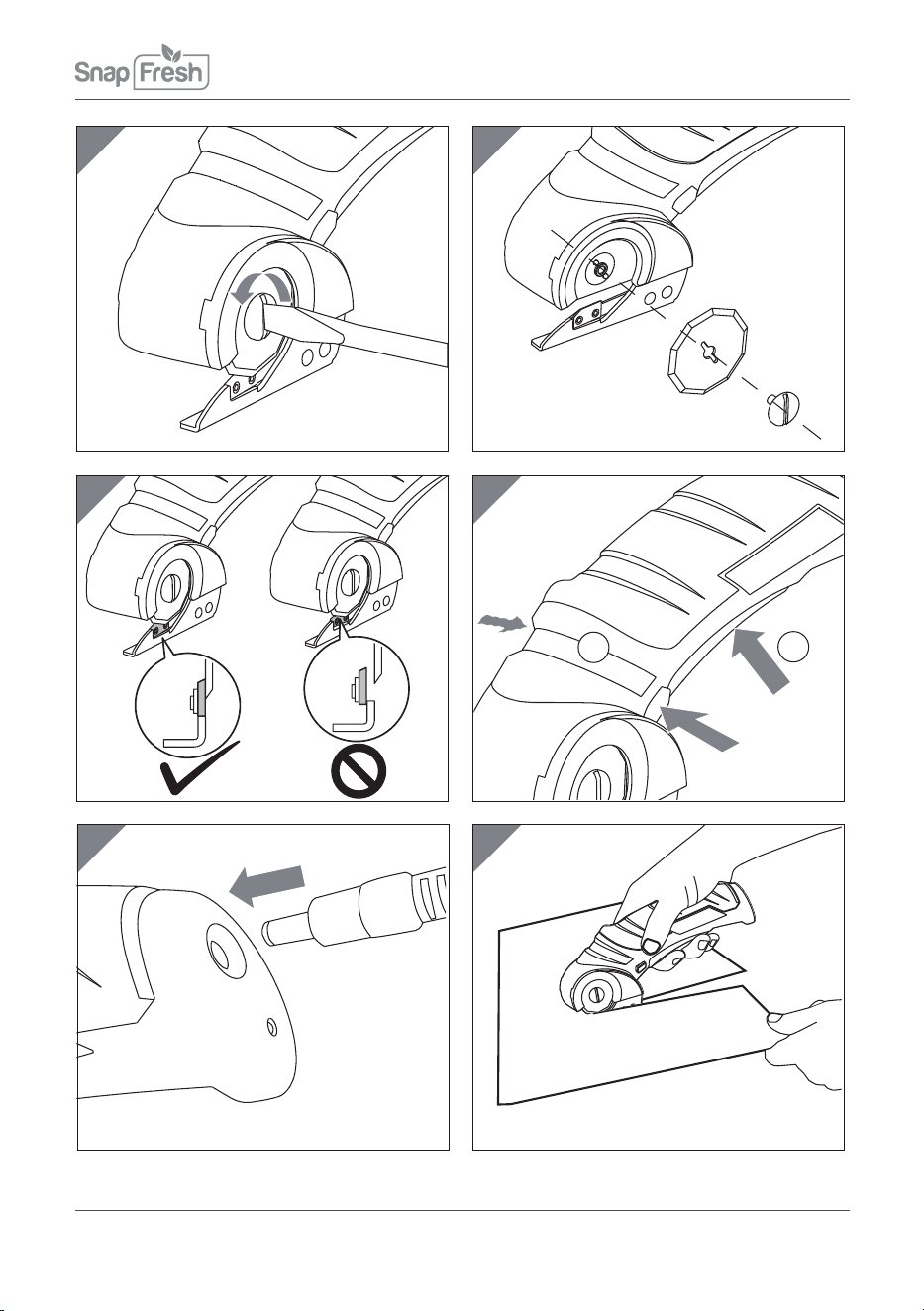
Rotate blade screw
5
counter-clockwise with a slot tip screwdriver (not supplied)
and remove the blade screw
5
.
Slide the blade
4
away from the upper guard and remove blade
4
.
Slide new blade under the upper guard with beveled edges facing you.
Align hole in blade with hole in the blade shaft, replace screw and securely
tighten the blade screw clockwise (See Fig. B1,B2).
Before operating the tool, make sure that the blades are in the right position as
shown in the figure (See Fig. B3).
On/Off switch
Your switch is locked off to prevent accidental starting. Depress lock-off button
2
then on/off switch
1
and release lock-off button
2
. Your tool is now on. To
switch off just release the on/off switch
1
. The lock-off button
2
can be
pressed from either the right or left side.(See Fig. C).
1) For your safety, this tool is equipped with the lock-off button
2
which helps to
reduce the possibility of accidental starting when not in use. If the tool can be
started without pressing the lock-off button
2
, please never use it and consult
the store for repair.
2) Never disable the lock function or tape down the lock-off button.
3) Please do not force to press the on/off switch when the lock-off button is not
pressed, this will damage the machine and even cause an accident.
17
Charging the tool
The battery charger
8
supplied matches to the battery installed in the machine.
Do not use other battery chargers.
The battery is protected against deep discharging.
When the battery is empty, the machine is switched off by means of a protective
circuit: the blade will no longer move.
In a warm environment or after heavy use, the battery pack may become too hot to
permit charging. Allow time for the battery to cool down before recharging.
Charging
Plug charger plug into a suitable power outlet and afterwards plug your tool into
the battery charger. The charging Indicator light
7
on the back of tool will turn red
during charging. When charging is done, it will turn green.
Unplug the charging plug from the wall socket and then remove the tool from the
battery charger(See Fig. D).
During the charging procedure, the handle of the machine warms up. This is
normal. When not using for extended periods, disconnect the battery charger from
the socket. Do not use the machine during the charging procedure.
Cutting
Thin materials, such as fabrics, can be pulled into the tool during cutting and
become wedged. Therefore, do not apply too much pressure with these materials
in order to achieve good cutting results. During cutting, apply sufficient tension
while holding fabrics and cut slowly (See Fig. E).
Do not allow the foot to become wedged during cutting. The foot must be parallel
to the cut.
Do not touch the blade or bring the tool near the hand or face when operating.
When cutting the material, never put the hand in front of the blade.
18
Troubleshooting
Problem Probable cause Suggested remedy
Blade will not run Switch in off position Make sure you depress lock-off
button
2
and on/off switch
1
.
Your tool is now on. Release
lock-off button
2
Battery is powered off
Charge your tool with the supplied
charger
8
Switch broke down
Please contact us via email:
Please contact us via email:
Please contact us via email:
Motor broke down
Your tool is in charging
status
Unplug the charger
8
after
charging is completed
Charging
indicator light
will not on
Charger broke down
Connector pin is not
plugged in the charger
socket
6
completely
Make sure the connection is well.
No electrical power at
wall outlet
Check circuit breaker or fuse at
electrical panel
Maintenance
Your tool requires no additional lubrication or maintenance. There are no user
serviceable parts in your power tool. Never use water or chemical cleaners to
clean your power tool. Wipe clean with a dry cloth. Always store your power tool
in a dry place. Keep the motor ventilation slots clean. Keep all working controls
free of dust. Occasionally you may see sparks through the ventilation slots. This
is normal and will not damage your power tool.
For Battery tools
The ambient temperature range for the use and storage of tool and
battery is 0°C-45°C.
The recommended ambient temperature range for the charging
system during
charging is 4°C-4°0C.
19
Cleaning
To avoid accidents, always disconnect the tool and/or charger from the power supply
before cleaning. The tool may be cleaned most effectively with compressed dry air.
Always wear safety goggles when cleaning tools with compressed air.
When cutting, material residue can accumulate under the upper guard. Remove
blade and clean upper guard regularly using a brush or lightly moistened cloth.
Ventilation openings and switch levers must be kept clean and free of foreign matter.
Do not attempt to clean by inserting pointed objects through opening.
Certain cleaning agents and solvents damage plastic parts. Some of these are:
gasoline, carbon tetrachloride, chlorinated cleaning solvents, ammonia and
household detergents that contain ammonia.
Transport
The tool is installed with battery cells. The Dangerous Goods Regulations can be
relevant when transporting. In this case, it can be necessary to observe special
conditions (e. g. for packaging).

20
Technical data
Model EC0601
Voltage 4.0V
No-load speed 240 /min
Max. cutting size 0.25 in
Blade size 1.58 in
Charging time 3-5 hrs
Charger input 110V-240V AC 50-60HZ
Charger output 6V
400mA
Charger protection class
/II
Battery capacity 1.3Ah Li-ion
Machine weight 0.4 kg
Noise information
A weighted sound pressure L
pA
= 69.49
dB(A)
K
pA
=5 dB(A)
A weighted sound power L
wA
= 80.49 dB(A)
K
wA
=5 dB(A)
Wear ear protection.
Vibration information
Vibration total values (triax vector sum) determined according to EN 62841:
Vibration emission value: a
h
= 0.3987 m/s
2
Uncertainty K=1.500 m/s
2
The declared vibration total value and the declared noise emission value have
been measured in accordance with a standard test method and may be used for
comparing one tool with another.
The declared vibration total value and the declared noise emission value may
also be used in a preliminary assessment of
exposure.
21
The vibration and noise emissions during actual use of the power tool can differ
from the declared value depending on the ways in which the tool is used
especially what kind of workpiece is processed dependant on the following
examples and other variations on how the tool is used:
How the tool is used and the materials being cut or drilled.
The tool being in good condition and well maintained.
The use of the correct accessory for the tool and ensuring it is sharp and in good
condition.
The tightness of the grip on the handles and if any anti vibration and noise
accessories are used.
And the tool is being used as intended by its design and these instructions.
This tool may cause hand-arm vibration syndrome if its use is not adequately
managed.
To be accurate, an estimation of exposure level in the actual conditions of use
should also take account of all parts of the operating cycle such as the times
when the tool is switched off and when it is running idle but not actually doing the
job. This may significantly reduce the exposure level over the total working period.
Helping to minimise your vibration and noise exposure risk.
Always use sharp chisels, drills and blades.
Maintain this tool in accordance with these instructions and keep well lubricated
(where appropriate).
If the tool is to be used regularly then invest in anti vibration and noise
accessories. Plan your work schedule to spread any high vibration tool use
across a number of days.
Environmental protection
Waste electrical products must not be disposed of with household waste.
Please recycle where facilities exist. Check with your local authorities or
retailer for recycling advice.

-
-
-
-
22
Warranty
Ningbo Babytec Technology Co., Ltd (Hereinafter referred to as Babytec) warrants
this product against defects in materials and/or workmanship under normal use for
a period of ONE (1) YEAR from the date of purchase by the original purchaser
(’Warranty Period’).
The following circumstances are excluded from this guarantee:
Repairs and or alterations have been made or attempted to the machine by
unauthorized service centers;
Normal wear and tear;
The tool has been abused, misused or improperly maintained;
Non-original spare parts have been used.
If a defect arises and a valid claim is received within the Warranty Period, at its
option, Babytec will either 1) repair the defect at no charge, using new or
refurbished replacement parts, or 2) replace the product with a new product that
is at least functionally equivalent to the original product, or provide a store credit
in the amount of the purchase price of the original product. A replacement product
or part, including a part installed in accordance with instructions product by
Babytec, assumes the remaining warranty of the original product. When a product
or part is exchanged, any replacement item becomes your property and the
replaced item becomes Babytec’s property. When a store credit is given, the
original product must be returned to Babytec and becomes Babytec’s property.
To obtain warranty service, e-mail Babytec Warranty Service at
[email protected]. Please be prepared to describe the product
that needs service and the nature of the problem.
To extend your warranty, please register at snapfreshpro.vip
All rights reserved by Ningbo Babytec Technology Co.,Ltd
(Monday - Friday 9 a.m. - 5 p.m. EST 6 a.m. - 2 p.m. PST)
+1 833 635 0955