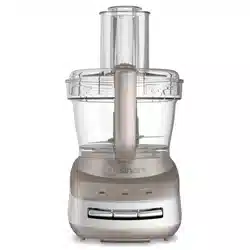
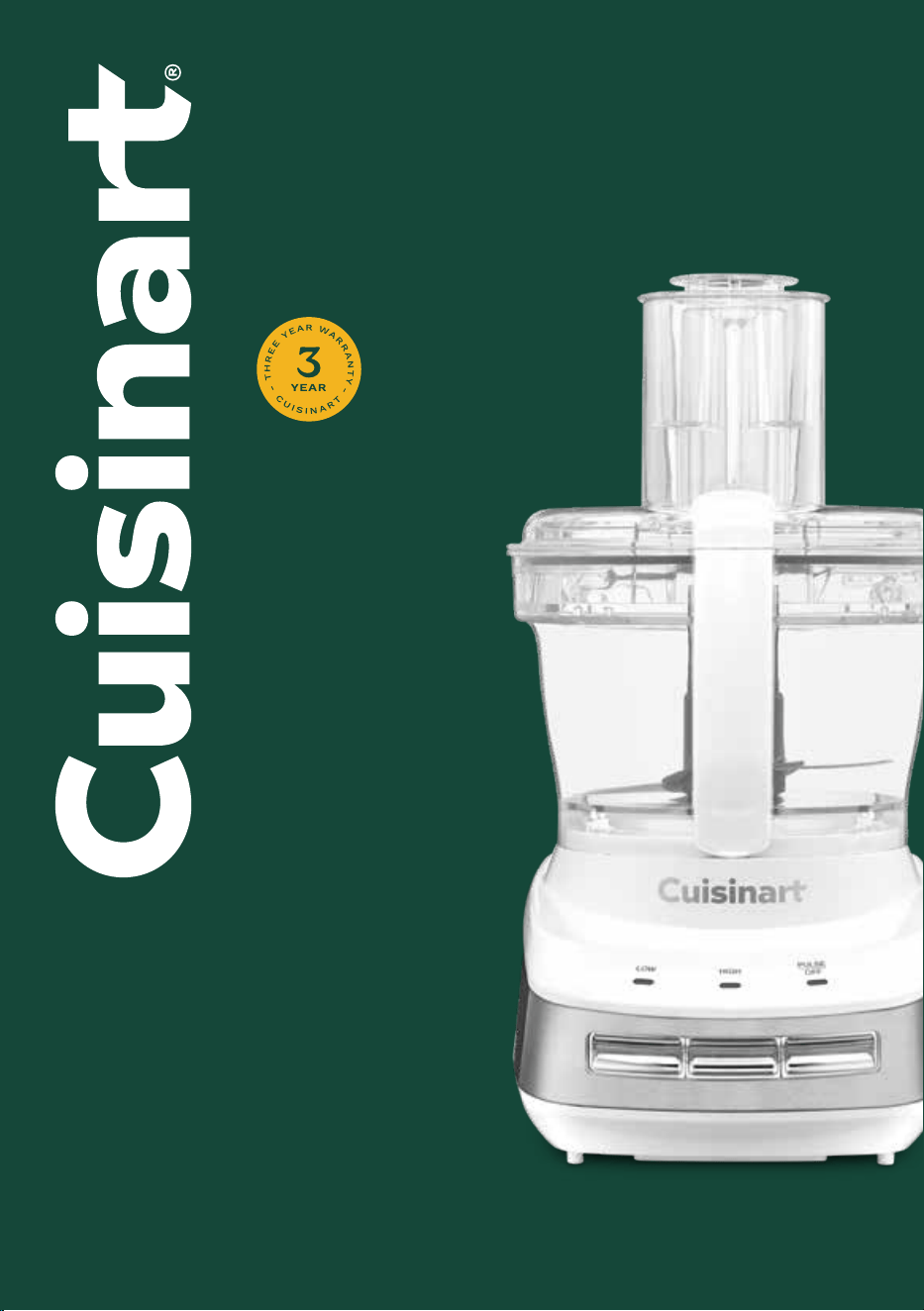
Cuisinart Core
Custom
®
10-Cup
Food Processor
FP-110 SERIES
Instruction
& Recipe
Booklet
For your safety and continued enjoyment of this product, always
read the instruction book carefully before using.

2
IMPORTANT
UNPACKING
INSTRUCTIONS
This package contains a Cuisinart Core Custom
®
10-Cup Food Processor and the accessories for it:
10-cup work bowl, work bowl cover with small and
medium pushers, metal chopping/mixing/dough blade,
reversible slicing/shredding disc medium, reversible
slicing/shredding disc fine, removable stem adapter,
storage hub, base and instruction/recipe book.
CAUTION:
THE CUTTING TOOLS HAVE VERY SHARP EDGES.
To avoid injury when unpacking the parts, please follow
these instructions.
1. Place the box on a low table or on the floor next to
the kitchen counter where you intend to keep the
food processor. Be sure the box is right side up.
2. Open top flaps—there will be a rectangular block
of packing material that holds the processor parts,
each fitted into a cavity.
3. Remove the instruction/recipe book.
4. Lift out the packing material.
5. Remove the base and bowl and place them on the
counter or table. Read the instructions thoroughly
before using the machine.
6. Save the shipping cartons and packing material.
You will find these very useful if you need to repack
the processor for moving or other shipment.
We recommend that you visit our website,
www.cuisinart.com, for a fast, efficient way to
complete your product registration.
IMPORTANT
SAFEGUARDS
Always follow these safety precautions when using
this appliance.
Getting Ready
1. Read all instructions.
2. Blade and discs are sharp. Handle them care-
fully.
3. Always turn off and unplug appliance from
outlet when not in use, before putting on or
taking off parts, before removing food and
before cleaning. To unplug, grasp plug and
pull from electrical outlet. Never pull cord.
4. Do not use outdoors.
5. Do not let cord hang over edge of table or counter,
or touch hot surfaces.
6. Do not operate any appliance that has a dam-
aged cord or plug or after it has been dropped or
damaged in any way. Contact Cuisinart Consumer
Service Center at 1-800-762-0190 for information
on examination, repair, or adjustment.
Operation
1. Keep hands as well as spatulas and other utensils
away from moving blade or discs while processing
food to prevent the possibility of severe personal
injury or damage to food processor. A plastic
scraper may be used, but only when the food pro-
cessor motor is stopped.
2. Avoid coming into contact with moving parts.
Never push food down by hand when slicing or
shredding. Always use pusher.
3. Make sure motor has completely stopped before
removing cover. (If machine does not stop within 4
seconds after you remove the bowl cover assem-
bly, call 1-800-762-0190 for assistance. Do not use
the machine.)
4. Never store any blade or disc on stem adapter.
To reduce the risk of injury, no blade or disc should
be placed on the shaft except when the bowl is
properly locked in place and the processor is in
use. Store blades and discs as you would sharp
knives, out of reach of children.
5. Be sure cover and feed tube are securely locked in
place before operating food processor.
6. Never feed food by hand. Always use the pusher.
7. Never try to override or tamper with cover
interlock mechanism.
Cleaning
To protect against risk of electrical shock, do not put
base in water or other liquids.
General
1. This appliance should not be used by or near chil-
dren or individuals with certain disabilities.
2. Do not operate this, or any other motor-driven
appliance, while under the influence of alcohol or
other substances that affect your reaction time
or perception.
3. This food processor is for household use. Use
it only for food preparation as described in the
accompanying instruction and recipe book. Do not
use this appliance for anything but its intended use.
4. When using an approved Cuisinart Food
Processor accessory, read all instructions included
with that accessory.
5. The use of attachments not recommended or sold
by Cuisinart may cause fire, electrical shock or per-
sonal injury, or damage to your food processor.
3
6. To avoid possible malfunction of work bowl switch,
never store processor with cover assembly in
locked position.
7. Do not operate your appliance in an appliance
garage or under a wall cabinet. When storing in
an appliance garage, always unplug the unit
from the electrical outlet. Not doing so could
create a risk of fire, especially if the appliance
touches the walls of the garage or the door touches
the unit as it closes.
NOTE: This appliance has a polarized plug
(one blade is wider than the other). As a safety
feature, this plug will fit in a polarized outlet only
one way. If the plug does not fit fully in the
outlet, reverse the plug. If it still does not fit,
contact a qualified electrician. Do not attempt to
defeat this safety feature.
NOTE: This appliance is not intended for use by
children or by persons with reduced physical,
sensory, or mental capabilities, or lack of
experience and knowledge. Close supervision is
necessary when any appliance is used near
children. Children should be supervised to
ensure that they do not play with the appliance.
Do not fill the bowl above the marked maximum
fill line (or rated capacity) to avoid risk of injury
due to damage to the cover or bowl.
SAVE THESE
INSTRUCTIONS.
FOR HOUSEHOLD
USE ONLY.
WARNING: RISK OF FIRE OR
ELECTRIC SHOCK
The lightning flash with arrowhead symbol
within an equilateral triangle is intended to
alert the user to the presence of dangerous
uninsulated voltage within the product’s
enclosure that may be of sufficient
magnitude to constitute a risk of fire or
electric shock to persons.
The exclamation point within an equilateral
triangle is intended to alert the user to the
presence of important operating and
maintenance (servicing) instructions in the
literature accompanying appliance.
CONTENTS
Important Unpacking Instructions ................................ 2
Important Safeguards................................................... 2
Parts ............................................................................. 4
Assembly Instructions .................................................. 5
Machine Controls ......................................................... 5
Machine Functions ....................................................... 5
User Guide ................................................................... 7
Cleaning, Storage and Maintenance ............................ 8
For Your Safety ............................................................. 8
Technical Data .............................................................. 8
Troubleshooting ............................................................ 9
Warranty Information .................................................. 10
Recipes ....................................................................... 12
WARNING
RISK OF FIRE OR ELECTRIC SHOCK
DO NOT OPEN
WARNING: TO REDUCE THE RISK OF FIRE OR ELECTRIC SHOCK,
DO NOT REMOVE COVER (OR BACK)
NO USER-SERVICEABLE PARTS INSIDE
REPAIR SHOULD BE DONE BY AUTHORIZED SERVICE PERSONNEL ONLY
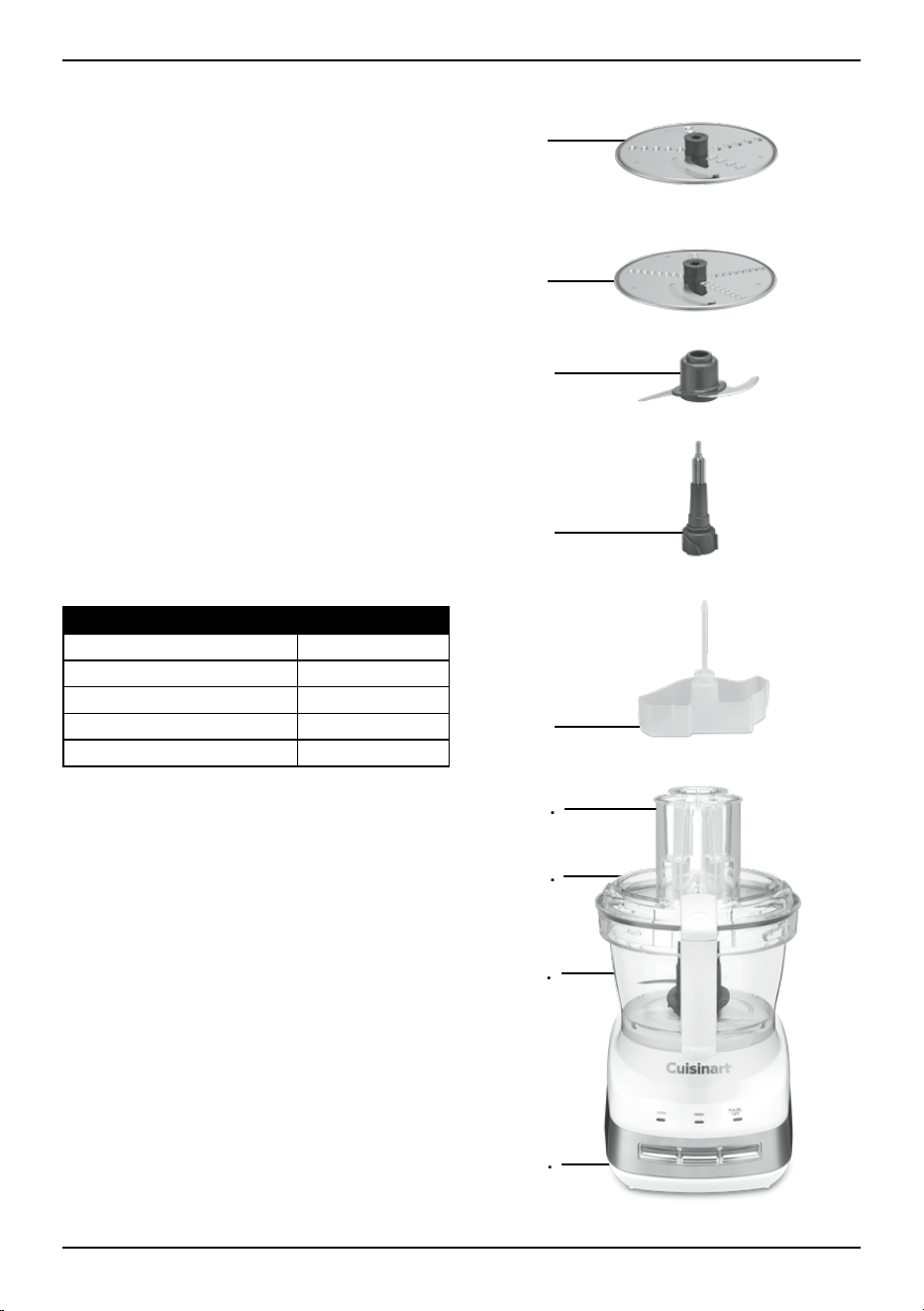
2.
1.
6.
7.
8.
3.
4.
5.
9.
4
PARTS
The machine includes:
1. Housing base - With convenient paddle controls
2. 10-cup removable work bowl
3. Cover with feed tube
4. Small and medium pushers - Slide inside
the feed tube
5. Stem adapter
6. Metal chopping/mixing/dough blade
7. Fine reversible slicing/shredding disc
8. Medium reversible slicing/shredding disc
9. Storage Hub - Stores stem adapter, blade and
discs inside the work bowl (for storage use only)
NOTE: Cuisinart offers Cuisinart Core Custom
®
Accessories, a line of accessories for your food
processor that can be purchased separately.
The selected accessory connects to the food
processor housing base, so you can turn your
food processor into a blender, juicer, dicer
and more!
AVAILABLE ACCESSORIES:
Visit Cuisinart.com to purchase!
ACCESSORY NAME MODEL #
36 oz. Blender Jar MFP-B36
Juicing Center MFP-JC
4-Cup Small Work Bowl MFP-WB4
Dicing Kit FP-DCP1
Multi-functional Disc Set MFD-4

5
ASSEMBLY
INSTRUCTIONS
Before First Use
Before using your Cuisinart Core Custom
®
10-Cup
Food Processor for the first time, wash the work bowl,
work bowl cover, pusher, blade and discs (see cleaning
instructions on page 8).
1. Place the food processor base on a dry, level
countertop with the controls facing you. Do not
plug the unit in until it is fully assembled.
2. With the bowl on the base, use the handle to
turn the work bowl clockwise to lock it onto the
housing base.
CHOPPING/MIXING/
DOUGH BLADE
1. Place the work bowl on top of base, with the
work bowl handle just to the right of center.
Turn the work bowl clockwise to lock it onto the
housing base.
2.
Carefully place the blade onto the stem adapter.
Holding top of stem adapter, lift and place over the
work bowl accessory adapter. Blade should rest on the
bottom of the work bowl.
3. Plug in the housing base.
4. Add desired ingredients to work bowl.
5. Place work bowl cover on work bowl, with the feed
tube just to the right of center. Turn clockwise to
lock onto work bowl.
6. Align pusher with the feed tube opening on the
work bowl cover and slide down to the bottom.
7. You are now ready to operate the machine.
REVERSIBLE SLICING
AND SHREDDING DISCS
1. Place the work bowl on top of the base, with
the work bowl handle just to the right of center.
Turn the work bowl clockwise to lock it onto the
housing base.
2. Insert stem adapter without blade.
3. Choose desired disc.
4. Carefully place disc over stem adapter, with the
side being used facing up.
5. Place work bowl cover onto work bowl, with the
feed tube just to the right of center. Turn clockwise
to lock onto work bowl.
6. Align pusher with the feed tube opening on the
work bowl cover and slide down to the bottom.
7. Plug in the housing base.
8. The machine is now ready for use.
MACHINE CONTROLS
High and Low Control Paddles
The High and Low controls are paddles that allow the
machine to run until Off is selected.
1. Properly assemble and engage the machine.
2. Add ingredients to the work bowl, either through
the feed tube or directly into the bowl.
3. Press the High or Low paddle. The white LED light
will illuminate and the motor will start.
4. Press the Off paddle when finished.
Pulse Paddle
The Pulse control is a paddle that allows the machine
to run only while it is being pressed. This capability
provides more accurate control of the duration and
frequency of processing. Unless otherwise specified, a
pulse should be about one second.
With the machine properly assembled and engaged,
and ingredients in the work bowl, press the Pulse
paddle repeatedly as needed. The white LED light will
illuminate upon activation.
MACHINE FUNCTIONS
Using the Chopping/Mixing/Dough Blade
Chopping
• For raw ingredients: Peel, core and/or remove
seeds and pits. Food should be cut into even,
½- to 1-inch pieces. Foods cut into same size
pieces produce the most even results.
• Pulse food in 1-second increments to chop. For the
finest chop, either hold the Pulse paddle down or
press High or Low to run the machine continuously.
Watch ingredients closely to achieve desired
consistency and scrape the work bowl as neces-
sary. Low speed is recommended for making
doughs and batters. High speed is recommended
for most other chopping, processing and slicing/
shredding tasks.
Puréeing
• To purée fresh fruits or cooked fruits/vegetables:
Ingredients should be cut into 1-inch pieces; a
smooth purée is best achieved when all the pieces
are equal in size. Pulse to initially chop and then
process on High or Low until food is puréed; scrape
the work bowl as necessary. NOTE: Do not use
this method to purée cooked white potatoes.
• To purée solids for a soup or sauce: Strain the
solids from the liquid and process the solids alone.
Add cooking liquid and process as needed.

6
Dough
• Always use Low speed when kneading. Be sure
that the medium pusher lock is in the locked posi-
tion when kneading dough to avoid it from moving
around — some vibration is still normal. Always
start the food processor before adding liquid. First
process the dry ingredients (flour, salt, etc.) and
then add the liquid in a slow, steady stream, or
through the drizzle hole in the pusher, allowing the
dry ingredients to absorb it. If liquid is added too
quickly, wait until ingredients in the work bowl have
mixed, then add remaining liquid slowly (do not turn
off the machine). Never use more than 2½ cups
of white/all-purpose flour when preparing a
yeasted dough.
Using the Reversible Slicing and Shredding Discs
• The slicing side of the discs makes whole slices.
It slices fruits and vegetables, cooked meat and
semi-frozen raw meat. The shredding side of
the discs shreds most firm and hard cheeses.
It also shreds vegetables like potatoes, carrots
and zucchini.
• Always pack food in the feed tube evenly for slicing
and shredding. The food will dictate the amount of
pressure: Use light pressure for soft foods, medium
pressure for medium foods and firm pressure for
harder foods. Always process with even pressure.
• For round fruits or vegetables: Remove a thick
slice on the bottom of the food so that it sits
upright in the feed tube. If food does not fit in the
feed tube, cut in half or quarters to fit. Process with
even pressure.
• For small ingredients like mushrooms, radishes or
strawberries: Trim the ends so the food sits upright
in the feed tube.
• When slicing or shredding cheese, be sure that the
cheese is well chilled.
• To shred leafy vegetables like lettuce or spinach:
Roll leaves together and stand them up in feed
tube. Process with even pressure.
NOTE: Always use the pusher when slicing or
shredding. Never put your hands in the feed
tube while unit is running.
FOOD CAPACITY
Sliced or shredded fruit, vegetables or cheese 10 cups
Chopped fruit or vegetable 6 cups
Chopped cheese 4 cups
Puréed fruit or vegetables 3 cups cooked; 1½ cups puréed
Chopped or puréed meat, fish or seafood 1½ pounds
Thin liquid (e.g., dressings, soups, etc.)
7 cups
Cake batter 8-inch cheesecake batter; 1 box (15.25 ounce) cake mix
Cookie dough
2½ dozen (based on average chocolate
chip cookie recipe)
White bread/pizza dough 2.5 cups (all-purpose or bread flour)
Nuts for nut butter
3 cups
RECOMMENDED MAXIMUM
WORK BOWL CAPACITY

7
FOOD TOOL SPEED DIRECTIONS
Soft Cheeses
(ricotta, cream
cheese, cottage
cheese, etc.)
Chopping/Mixing/
Dough Blade
Low or
High
Bring cheese to room temperature. When applicable, cut into 1-inch pieces.
Process until smooth, stopping to scrape down the sides of the bowl as needed.
Perfect for making cheesecakes, dips, pasta fillings and more.
Firm Cheeses
(Cheddar, Swiss,
Edam, Gouda, etc.)
Slicing or
Shredding Disc
High Cheese should be well chilled before slicing/shredding. Cut to fit feed tube. Use
light to medium pressure when slicing/shredding.
Hard Cheeses
(Parmesan,
Romano, etc.)
Chopping/Mixing/
Dough Blade
Slicing or
Shredding Disc
Low If using the chopping blade, cut into ½-inch pieces. Pulse to break up and then
process until finely grated. This will produce a nicely grated cheese. If slicing or
shredding, cut to fit feed tube. Use light to medium pressure when slicing/
shredding.
Baby Food Chopping/Mixing/
Dough Blade
Pulse
and Low
or High
As for all fruit and vegetable purées, cut ingredients into ½- to 1-inch pieces.
Steam ingredients until completely soft. Pulse to chop, then process until
completely smooth (add steaming liquid through the feed tube when processing if
necessary). To ensure there are no lumps, press mixture through a fine mesh
strainer. Keeps frozen in ice cube trays for individual 1-ounce portions.
Butter Chopping/Mixing/
Dough Blade
Slicing or
Shredding Disc
High For creaming: Bring butter to room temperature. Cut into 1-inch pieces. Process,
scraping bowl as necessary. For compound (flavored) butters, process flavoring
ingredients, such as herbs, zest, vegetables, etc., before adding butter. For
shredding/slicing: Freeze briefly. Use light to medium pressure to shred or slice.
Shredded butter is great for preparing certain pastry doughs. Sliced butter is
great for serving alongside corn on the cob or freshly made rolls.
Crumbs (Bread,
Cookie, Cracker,
Chip)
Chopping/Mixing/
Dough Blade
High Break into pieces. Pulse to break up, and then process until desired consistency.
This will make perfect bread/cracker/chip crumbs for coating meats and fish.
Processed cookies make delicious pie and cake crusts!
Fresh Herbs Chopping/Mixing/
Dough Blade
Pulse Wash and dry herbs VERY well. Pulse to roughly chop. Continue pulsing until
desired consistency is achieved.
Ground Meat Chopping/Mixing/
Dough Blade
Pulse
and High
Cut meat into ½-inch pieces. Pulse to chop — about 14 long pulses or until
desired consistency is achieved. If a purée is desired, continue to process. Never
chop/purée more than 1½ pounds at one time.
Ice Cream Chopping/Mixing/
Dough Blade
High Put frozen fruit cut into 1-inch pieces into the work bowl, with liquid (juice or
milk), any desired sweeteners, such as sugar, honey, simple syrup and other
flavors. Process until smooth.
Milk Shakes/
Smoothies
Chopping/Mixing/
Dough Blade
Low For milk shakes, first add ice cream. While unit is running, add milk through the
feed tube until desired consistency is achieved. For smoothies, add fruit first, then
add the liquid through the feed tube while unit is running.
Nuts Chopping/Mixing/
Dough Blade
Pulse
and High
Pulse to chop to desired consistency. To make a nut butter, pulse to break up, and
then process until smooth, stopping to scrape down as needed.
Superfine Sugar Chopping/Mixing/
Dough Blade
High Process granulated sugar for about 1 minute until finely ground. Excellent for
using in meringues and other baked goods.
Whipped Cream Chopping/Mixing/
Dough Blade
Low Process well-chilled cream until cream begins to thicken. Add sugar as desired;
process continuously until cream reaches desired consistency. This cream is
dense and perfect as a whipped topping for cake or ice cream.
USER GUIDE
You can slice, shred and chop a multitude of vegetables and fruits in the Cuisinart
®
Food Processor. What you may
not know is that the food processor is the perfect tool for a number of other tasks, such as softening butter,
making breadcrumbs, making baby food, etc. Here is a guide that will help you in preparing just about anything!

8
CLEANING, STORAGE
AND MAINTENANCE
• Keep your Cuisinart Core Custom
®
10-Cup
Food Processor ready to use on the kitchen
counter. When not in use, leave it unplugged.
Store accessories in the provided storage hub,
inside the work bowl.
• Keep the blade and discs out of the reach
of children.
• All parts except the housing base are dishwasher
safe but on the top rack only. Due to intense
water heat, washing the work bowl, cover and
accessories on the bottom rack may cause damage
over time. Insert the cover with the feed tube facing
up to ensure proper cleaning. Insert the work bowl
and pushers upside down for drainage. Remember
to unload the dishwasher carefully when removing
sharp blade and discs.
• To simplify cleaning, rinse the work bowl, cover,
pushers and blade or disc immediately after use
so food won’t dry on them. Be sure to position the
pushers and work bowl upside down for drainage.
If food lodges in the pusher, remove it by running
water through it, or use a bottle brush.
• If you wash the blade and discs by hand, do it
carefully. When handling, use the plastic hubs.
Avoid leaving them in soapy water where they may
disappear from sight. If necessary, use a brush.
• The work bowl is made of Tritan
®
plastic with
metal components. It should not be placed in a
microwave oven.
• The housing base may be wiped clean with a
soapy, nonabrasive cloth or sponge. Be sure to dry
it thoroughly.
• If the feet leave spots on the counter, spray them
with a spot remover and wipe with a damp sponge.
• If any trace of the spot remains, repeat the proce-
dure and wipe the area with a damp sponge and
nonabrasive cleaning powder.
IMPORTANT: Always use the provided storage
hub. Never store any blade or disc on the stem
adapter. No blade or disc should be placed on
the shaft except when the processor is about to
be used.
MAINTENANCE: Any other servicing should be
performed by an authorized service representative.
FOR YOUR SAFETY
• Like all powerful electrical appliances, a food
processor should be handled with care. Follow
these guidelines to protect yourself and your family
from misuse that could cause injury.
• Handle and store metal blade and discs carefully
utilizing the provided storage hub. Their cutting
edges are very sharp.
• Never put stem adapter, (blade or discs on the stem
adapter) until the work bowl is locked in place.
• Always be sure that the blade or disc is down on
the stem adapter as far as it will go.
• Always insert the stem adapter with metal blade in
the work bowl before putting ingredients in bowl.
• When slicing or shredding food, always use
the pusher. Never put your fingers or spatula into
feed tube.
• Always wait for the blade or disc to stop spinning
before you remove the pusher assembly or cover
from the work bowl.
• Always unplug the unit before removing food,
cleaning or putting on or taking off parts.
• Always remove work bowl from base of machine
before you remove the chopping/mixing/dough
blade or slicing/shredding disc.
• Be careful to prevent the chopping blade or slicing/
shredding disc from falling out of the work bowl
when emptying the bowl. Remove the stem adapter
with blade before tilting the work bowl.
TECHNICAL DATA
The motor in your food processor operates on a
standard line operating current. The appropriate voltage
and frequency for your machine are shown on a label
on the bottom of the base.
An automatic temperature-controlled circuit breaker in
the motor ensures complete protection against motor
burnout. If the processor runs for an exceptionally long
time when chopping, mixing or kneading a thick or
heavy mixture in successive batches, the motor may
overheat. If this happens, the processor will stop. Turn
it off, unplug the unit and wait for the motor to cool
before proceeding. It will usually cool within 10
minutes. In extreme cases, it could take an hour.
Safety switches prevent the machine from operating
when the work bowl or the cover is not locked into
position. The motor stops within seconds when the
motor is turned off; and when the pusher assembly is
removed, a fast-stop circuit also enables the motor to
stop within seconds.
Cuisinart offers a Limited Three-Year Warranty on the
entire machine.

9
TROUBLESHOOTING
Food Processing
1. Problem: The food is unevenly processed.
Solution:
• The ingredients should be cut evenly into ½- to
1-inch pieces before processing.
• Process in batches to avoid overloading.
2. Problem: Slices are uneven or slanted.
Solution:
• Place evenly cut food, cut side down, into the
feed tube.
• Apply even pressure on the pusher.
3. Problem: Food falls over in feed tube.
Solution:
• Feed tube should be packed full for best results.
4. Problem: Some food remains on top of the disc.
Solution:
• It is normal for small pieces to remain; cut
remaining bits by hand and add to processed
ingredients.
5. Problem: Metal chopping/mixing/dough blade
cannot be removed from the stem adapter.
Solution:
• Place the blade / stem adapter assembly in a
bowl filled with warm tap water. This should help
loosen trapped food particles between the blade
and stem adapter. To see if food has loosened,
remove assembly from water by lifting from the
stem. Holding the stem, place the blade assembly
on counter top and press down on stem. This
should free the blade from the stem. If blade still
cannot removed, return to warm water and repeat
above steps.
Dough Kneading
1. Problem: Motor slows down.
Solution:
• Amount of dough may exceed maximum capacity
of your food processor. Remove half and process
in two batches.
• Dough may be too wet (see number 8). If motor
speeds up, continue processing. If not, add more
flour, 1 tablespoon at a time, until the motor
speeds up. Process until dough cleans the sides
of the work bowl.
2. Problem: Blade doesn’t incorporate ingredients.
Solution:
• Always start the food processor before adding
liquid. Add liquid in a slow, steady stream, or
through the drizzle hole in the pusher, allowing
the dry ingredients to absorb it. If too much liquid
is added, wait until ingredients in the work bowl
have mixed, then add remaining liquid slowly (do
not turn off the machine). Pour liquid onto dough
as it passes under feed tube opening; do not pour
liquid directly onto bottom of the work bowl.
3. Problem: Blade rises in work bowl.
Solution:
• Excessively sticky dough can cause blade to rise.
Carefully reinsert blade and immediately add 2
tablespoons of flour through the feed tube while
the machine is running.
4. Problem: Dough doesn’t clean inside of the
work bowl.
Solution:
• Amount of dough may exceed maximum capacity
of your food processor. Remove half and process
in two batches.
• Dough may be too dry (see number 7).
• Dough may be too wet (see number 8).
5. Problem: Nub of dough forms on top of blade and
does not become uniformly kneaded.
Solution:
• Stop machine, carefully remove dough, divide it
into 3 pieces and redistribute them evenly in the
work bowl.
6. Problem: Dough feels tough after kneading.
Solution:
• Divide dough into 2 or 3 pieces and redistribute
evenly in bowl. Process 10 seconds or until uni-
formly soft and pliable.
7. Problem: Dough is too dry.
Solution:
• While machine is running, add water, 1
tablespoon at a time, until dough cleans the
inside of the bowl.
8. Problem: Dough is too wet.
Solution:
• While machine is running, add flour, 1
tablespoon at a time, until dough cleans the
inside of the bowl.
Technical
1. Problem: The motor does not start.
Solution:
• There is a safety interlock to prevent the motor
from starting if it is not properly assembled. Make
sure the work bowl and work bowl cover are
securely locked into position.
• If the motor still will not start, check the power
cord and outlet.

10
2. Problem: The food processor shuts off
during operation.
Solution:
• The cover may have become unlocked; check to
make sure it is securely in position.
• A safety protector in the motor prevents the motor
from overheating, which is caused by excessive
strain. Press the Off control button, unplug the
unit and wait 20 to 30 minutes to allow the food
processor to cool off before resuming.
3. Problem: The motor slows down during operation.
Solution:
• This is normal as some heavier loads (e.g., slicing/
shredding cheese) may require the motor to work
harder. Simply reposition the food in the feed tube
and try again.
• The maximum load capacity may have been
exceeded. Remove some of the ingredients and
continue processing.
4. Problem: The food processor vibrates/moves
around the countertop during processing.
Solution:
• Make sure the rubber feet at the bottom of the
unit are clean and dry. Also make sure that the
maximum load capacity is not being exceeded.
• This is normal as some heavier loads (e.g., slicing/
shredding cheese) may require the motor to
work harder.
WARRANTY
Limited Three-Year Warranty
This warranty is available only to U.S. consumers who
purchase products directly from Cuisinart or an
authorized Cuisinart
®
reseller. You are a consumer if you
own a Cuisinart Core Custom
®
10-Cup Food Processor
that was purchased at retail for personal, family or
household use. Except as otherwise required under
applicable law, this warranty is not available to retailers
or other commercial purchasers or owners or consumers
who purchase from unauthorized Cuisinart
®
resellers. We
warrant that your Cuisinart Core Custom
®
10-Cup Food
Processor will be free of defects in materials and
workmanship under normal home use for 3 years from
the date of original purchase.
We recommend that you visit our website, https://
cuisinart.registria.com, for a fast, efficient way to
complete your product registration. However, product
registration does not eliminate the need for the
consumer to maintain the original proof of purchase in
order to obtain the warranty benefits. In the event that
you do not have proof of purchase date, the purchase
date for purposes of this warranty will be the date of
manufacture.
CALIFORNIA RESIDENTS ONLY
California law provides that for In-Warranty Service,
California residents have the option of returning a
nonconforming product (A) to the store where it was
purchased or (B) to another retail store that sells
Cuisinart products of the same type. The retail store shall
then, according to its preference, either repair the
product, refer the consumer to an independent repair
facility, replace the product, or refund the purchase price
less the amount directly attributable to the consumer’s
prior usage of the product. If neither of the above two
options results in the appropriate relief to the consumer,
the consumer may then take the product to an
independent repair facility, if service or repair can be
economically accomplished. Cuisinart and not the
consumer will be responsible for the reasonable cost of
such service, repair, replacement, or refund for
nonconforming products under warranty. California
residents may also, according to their preference, return
nonconforming products directly to Cuisinart for repair
or, if necessary, replacement by calling our Consumer
Service Center toll-free at 1-800-726-0190. Cuisinart
will be responsible for the cost of the repair,
replacement, and shipping and handling for such
nonconforming products under warranty.
HASSLE-FREE REPLACEMENT WARRANTY
Your ultimate satisfaction in Cuisinart products is our
goal, so if your Cuisinart Core Custom
®
10-Cup Food
Processor should fail within the generous warranty
period, we will repair it or, if necessary, replace it at no
cost to you. To obtain a return shipping label, please fill
out the product inquiry form at https://www.cuisinart.
com/customer-care/product-assistance/product-
inquiry/. Or call our toll-free Consumer Service Center
at 1-800-726-0190 to speak with a representative.
Your Cuisinart Core Custom
®
10-Cup Food Processor
has been manufactured to the strictest specifications
and has been designed for use only in 120-volt outlets
and only with authorized accessories and replacement
parts. This warranty expressly excludes any defects or
damages caused by attempted use of this unit with a
converter, as well as use with accessories, replacement
parts or repair service other than those authorized by
Cuisinart. This warranty does not cover any damage
caused by accident, misuse, shipment or other than
ordinary household use. This warranty excludes all
incidental or consequential damages. Some states do
not allow the exclusion or limitation of these damages,
so these exclusions may not apply to you. You may also
have other rights, which vary from state to state.
Important: If the nonconforming product is to be
serviced by someone other than Cuisinart’s Authorized
Service Center, please remind the servicer to call our
Consumer Service Center at 1-800-726-0190 to ensure
that the problem is properly diagnosed, the product is
serviced with the correct parts, and the product is still
under warranty.
Cuisinart Core Custom
®
10-Cup Food Processor

Breakfast/Brunch
Cheddar-Chive Biscuits .......................................................................................................................................13
Chocolate Chip Scones .......................................................................................................................................14
Zucchini Chocolate Chip Bread .........................................................................................................................15
Butters/Dips/Dressings/Sauces
Lemon Lavender Butter ......................................................................................................................................16
Maple-Bacon Butter ............................................................................................................................................16
Smoked Salmon Spread ......................................................................................................................................17
Tomato Salsa .........................................................................................................................................................17
Red Chimichurri ....................................................................................................................................................18
Harissa ....................................................................................................................................................................18
Classic Hummus ...................................................................................................................................................19
Mayonnaise .......................................................................................................................................................... 20
Vegan Caesar Dressing ...................................................................................................................................... 20
Lemon Vinaigrette .............................................................................................................................................. 21
Basil Pesto ............................................................................................................................................................ 22
Main Dishes
Falafel .................................................................................................................................................................... 23
Mixed Vegetable and Ricotta Tart ................................................................................................................... 24
Pizza with Ricotta and Pesto .............................................................................................................................. 25
Olive and Mushroom Pizza ................................................................................................................................ 26
Chicken Burgers .................................................................................................................................................. 27
Soup/Salads/Sides
Sliced Asparagus Salad with Pine Nuts ........................................................................................................... 28
Rainbow Vegetable and Apple Slaw ................................................................................................................ 28
Refried Beans ....................................................................................................................................................... 29
Root Vegetable Soup ......................................................................................................................................... 30
Desserts
Carrot Cake with Cream Cheese Frosting ...................................................................................................... 31
Lemon-Poppy Seed Shortbread ....................................................................................................................... 32
Pistachio Olive Oil Cake with Cardamom Cream .......................................................................................... 33
Strawberries and Cream Tart ............................................................................................................................ 34
No-Churn Blackberry Chocolate Chunk Ice Cream ...................................................................................... 34
Bread/Dough
Pita Bread ............................................................................................................................................................. 36
Pizza Dough ......................................................................................................................................................... 37
Pâte Brisée............................................................................................................................................................ 37
Pretzels with Rosemary and Flake Sea Salt ..................................................................................................... 38
Burger Buns .......................................................................................................................................................... 39

13
Breakfast/Brunch
Cheddar-Chive Biscuits
These biscuits have a deeply golden and audibly crackly exterior that is reminiscent of biting into
a salty, buttery cheese wafer that dissolves in your mouth. Onion-y chives cut the richness of the
Cheddar, making these utterly addictive.
Yield: 8 biscuits
INGREDIENTS
4 ounces good-quality Cheddar cheese,
preferably extra-sharp
2 cups unbleached, all-purpose flour,
plus more for shaping the biscuits
2 tablespoons yellow cornmeal
1½ teaspoons granulated sugar
2½ teaspoons baking powder
1¾ teaspoons kosher salt
½ teaspoon freshly ground
black pepper
12 tablespoons (1 ½ sticks) unsalted
butter, cold and cut into ½-inch
cubes, divided
6 tablespoons (about ½ ounce) roughly
chopped chives
¾ cup buttermilk, well shaken
Flake sea salt, for finishing (optional)
INSTRUCTIONS
1. Insert the fine shredding disc into the work bowl of the food processor. Shred the Cheddar on
High. Reserve.
2. Insert the chopping blade into the work bowl of the food processor. Add the flour, cornmeal,
sugar, baking powder, salt, and pepper and process on Low for 10 seconds to sift. Add 10
tablespoons of the cold cubed butter and pulse just until the mixture starts to resemble coarse
crumbs with pea-size bits of butter strewn throughout. Add the reserved shredded Cheddar
and chives and pulse 4 to 5 times to incorporate. Add the buttermilk and pulse a few times
more to form a shaggy dough.
3. Turn the dough out onto a lightly floured surface. With floured hands, pat the dough into an
8-inch x 4-inch rectangle. Fold the dough in thirds, as you would a letter. Start with a short end
and fold a third of the dough down over the center, then fold the other third up to overlap.
Turn the dough a quarter clockwise and pat into another 8-inch x 4-inch rectangle. Fold in
thirds a second time. (The folding process builds structure for tall biscuits with lots of flaky
layers.) Turn the dough a quarter clockwise again and pat into a final 8-inch x 4-inch rectangle,
about 1 inch thick. Square the sides as best you can with your hands or a bench scraper.
4. Use a sharp knife to cut the rectangle into eight 2-inch squares (a 4 x 2 grid). Space out the
biscuits onto a parchment-lined baking sheet and place in the freezer for 30 minutes to chill.
5. While the dough is chilling, set an oven rack in the middle position and preheat the oven to
425°F. Melt the remaining 2 tablespoons of butter.
6. Brush the tops of the chilled biscuits with melted butter and sprinkle with flake sea salt, if
desired. Bake in the preheated oven until the tops are deeply golden brown, 20 to 22 minutes.
Remove from oven and allow to cool slightly on the baking sheet. Serve warm or at room
temperature.
Nutritional information per biscuit:
Calories 343 (58% from fat) • carb. 27 g • pro. 9 g • fat 22 g • sat. fat 14 g • chol. 60 mg • sod. 487 mg
calc. 946 mg • fiber 2 g

14
Breakfast/Brunch
Chocolate Chip Scones
Using mini chocolate chips ensures a little sweet treat in each bite. We love serving these warm
with the Lemon Lavender Butter (page 16).
Yield: 8 scones
INGREDIENTS
1½ cups cake flour
1 cup unbleached, all-purpose flour, plus
more for shaping
2 tablespoons granulated sugar
1½ teaspoons baking powder
¼ teaspoon baking soda
1 teaspoon kosher salt
1 cup buttermilk
1 large egg
6 tablespoons unsalted butter, cold and
cut into ½-inch cubes
¼ cup mini chocolate chips
Egg wash (1 large egg plus
1 teaspoon water, whisked well)
Turbinado sugar, for sprinkling
INSTRUCTIONS
1. Insert the chopping blade into the work bowl of the food processor. Put the flours, sugar,
baking powder, baking soda, and salt into the work bowl and run on Low to fully mix,
about 20 seconds.
2. Put the buttermilk and egg in a liquid measuring cup and mix to fully combine. Reserve.
3. Add the butter to the dry ingredients and pulse until mixture is shaggy. While still pulsing,
slowly add the liquid ingredients, until just combined; do not over-mix.
4. Pour the mixture onto a clean counter/large cutting board and dust lightly with flour. Add the
mini chips and then gently fold the dough over a few times to combine. Form the dough
into a 10-inch cylinder. Using a sharp knife, cut into 8 even rounds. Place on a parchment
lined baking sheet. Cover lightly and transfer to a refrigerator to chill for a minimum of 1 hour,
up to overnight.
5. Once chilled, preheat oven to 400°F with the rack in the middle position. Brush each scone
with egg wash and sprinkle with the turbinado sugar.
7. Bake in preheated oven for about 25 to 30 minutes, or until golden brown. Remove from oven
and allow to cool slightly on the baking sheet. Serve warm or at room temperature.
Nutritional information per scone:
Calories 264 (35% from fat) • carb. 40g • pro. 5g • fat 9g • sat. fat 6g • chol. 47g • sod. 440g • calc. 99 mg • fiber 1g

15
Breakfast/Brunch
Zucchini Chocolate Chip Bread
This moist quick bread is perfect for breakfast or for an afternoon snack. The chocolate chips
are a nice treat, but if a healthier bread is desired, use additional nuts or dried fruit.
Yield: one 2-pound loaf (16 servings)
INGREDIENTS
Nonstick cooking spray
1¾ cups unbleached, all-purpose flour
1½ teaspoons ground cinnamon
¾ teaspoon ground allspice
¼ teaspoon ground nutmeg
1 teaspoon fine sea salt
1½ teaspoons baking powder
½ cup walnuts, lightly toasted
1 large zucchini, approximately
8 to 10 ounces
½ cup vegetable oil
1 cup granulated sugar
2 large eggs
½ cup chocolate chips (or use dried
cranberries or cherries for a
less-sweet flavor)
INSTRUCTIONS
1. Preheat oven to 350ºF. Coat a 9 x 5 x 3-inch loaf pan with cooking spray.
2. Insert the chopping blade into the work bowl of the food processor. Add the flour, spices, salt,
and baking powder and process on Low for 10 seconds to sift. Transfer ingredients to a large
bowl; reserve. Add the walnuts to the work bowl and chop, 2 to 3 pulses. Leaving the nuts in
the work bowl, remove the chopping blade and insert the medium shredding disc. Trim the
zucchini to fit the feed tube and shred. Transfer the walnuts, additional nuts if using, and
zucchini to the bowl and zucchini to the bowl with the dry ingredients. Stir to mix.
3. Reinsert the chopping blade and add the vegetable oil, sugar, and eggs. Process on Low
for 5 to 10 seconds until combined. Add wet ingredients to the mixing bowl with the dry
ingredients, along with the chocolate chips, and stir until just combined.
4. Pour the batter into the prepared pan and bake in the middle of the oven for 1 hour
and 15 minutes, or until a toothpick or cake tester comes out clean.
5. Cool on a wire rack for 5 minutes, and then turn the loaf out onto a wire rack to
cool completely.
Nutritional information per serving:
Calories 194 (37% from fat) • carb. 28g • pro. 3g • fat 8g • sat. fat 1g • chol. 23mg • sod. 183mg • calc. 14mg • fiber 1g

16
Butters/Dips/Dressings/Sauces
Lemon Lavender Butter
This butter is bright tasting and has just the right amount of floral notes. It’s delicious on scones or
spread on pancakes or waffles.
Yield: ½ cup butter, 8 servings
INGREDIENTS
8 tablespoons (1 stick) unsalted
European-style butter, cut into
4 pieces, room temperature
1 to 2 pinches fine sea salt
1 2-inch strip lemon zest
(bitter white pith removed)
1 teaspoon dried culinary lavender
INSTRUCTIONS
1. Insert the chopping blade into the work bowl of the food processor. Put the butter into the
work bowl. Pulse to soften, and then add the remaining ingredients, starting with just 1 pinch of
the salt. Pulse to combine, stopping to scrape down as necessary. Once nicely mixed, then
process on Low for 5 seconds to fully combine. Taste and add additional salt if desired.
2. Remove and transfer to a piece of parchment paper. Form into a log, wrap well in the
parchment, then cover fully with plastic wrap. Chill until firm.
Nutritional information per serving (1 tablespoon):
Calories 71 (38% from fat) • carb. 2g • pro. 2g • fat 3g • sat. fat 0g • chol. 0mg • sod. 159mg • calc. 35mg • fiber 2g
Maple-Bacon Butter
Packed with the best flavors of breakfast, this butter is great for sweet foods such as waffles, or for
savory items such as biscuits or even stirred into a soup like our Root Vegetable Soup (page 30).
Yield: ½ cup, 8 servings
INGREDIENTS
8 tablespoons (1 stick) unsalted
good quality butter, like Plugra or
Kerrygold, room temperature
2 slices bacon, diced and cooked
through (about 2 tablespoons
bacon crumbles)
2 teaspoons pure maple syrup
INSTRUCTIONS
1. Insert the chopping blade into the work bowl of the food processor. Put the butter into the
work bowl. Pulse to soften, and then add the remaining ingredients. Pulse to combine,
stopping to scrape down as necessary. Once nicely mixed, process on Low for 5 seconds to
fully combine.
2. Remove and transfer to a piece of parchment paper. Form into a log, wrap well in the
parchment, then cover fully with plastic wrap. Chill until firm.
Nutritional information per serving (1 tablespoon):
Calories 71 (38% from fat) • carb. 2g • pro. 2g • fat 3g • sat. fat 0g • chol. 0mg • sod. 159mg • calc. 35mg • fiber 2g

17
Butters/Dips/Dressings/Sauces
Smoked Salmon Spread
Spreading this onto a fresh bagel is the obvious choice, but it can also be used in tea sandwiches
or on crackers. We love the addition of dill pickles, but you can use fresh dill instead for a more
traditional flavor.
Yield: about 1 cup
INGREDIENTS
8 ounces (1 standard package) plain
cream cheese, cut into 8 pieces and
room temperature
3 2-inch strips lemon zest (bitter white
pith removed), optional
2 teaspoons drained capers, optional
1 to 2 dill pickle spears, halved
3 sprigs fresh dill, optional (use in place
of the dill pickles, or in addition for a
more intense dill flavor)
2 ounces smoked salmon, cut into
1-inch pieces
1 Pinch freshly ground black pepper
INSTRUCTIONS
1. Insert the chopping blade into the work bowl of the food processor. Add the cream cheese and
lemon zest. Pulse a few times to break up, then process on High until smooth.
2. Scrape down the sides of the bowl. Add the capers if using, pickles, dill, salmon, and pepper
and pulse until fully combined, about 20 times. Taste and adjust seasoning as desired.
Nutritional information per serving (2 tablespoons):
Calories 71 (38% from fat) • carb. 2g • pro. 2g • fat 3g • sat. fat 0g • chol. 0mg • sod. 159mg • calc. 35mg • fiber 2g
Tomato Salsa
Serve warm tortilla chips alongside this fresh and tangy salsa.
Yield: about 1½ cups
INGREDIENTS
1 garlic clove, peeled
1 jalapeño, seeded and cut into
½-inch pieces
½ small onion, cut into 1-inch pieces
2 cups grape tomatoes
2 tablespoons fresh cilantro, stems
removed
1 teaspoon kosher salt
1 teaspoon fresh lime juice
INSTRUCTIONS
1. Insert the chopping blade into the work bowl of the food processor. With the machine running
on High, drop the garlic and jalapeño through the feed tube to finely chop. Add the onion, and
pulse to chop, about 3 times. Add the tomatoes, cilantro, salt, and lime juice and pulse to chop
until desired consistency is reached, about 8 to 10 pulses.
2. Taste and adjust seasoning accordingly. Depending on desired consistency, strain salsa to
remove excess liquid.
Nutritional information per serving (2 tablespoons):
Calories 6 (7% from fat) • carb. 0g • pro. 1g • fat 0g • sat. fat 0g • chol. 0mg • sod. 192mg • calc. 4mg • fiber 0g

18
Butters/Dips/Dressings/Sauces
Red Chimichurri
The paprika is the transformative factor in this lesser-seen variation of chimichurri that has an
intensely red hue and robust smokiness. The perfect sauce to drizzle on grilled meats and crispy
roasted potatoes – it also doubles as a marinade.
Yield: 1¼ cups
4 to 5 garlic cloves, peeled
1 medium shallot, cut into
1-inch pieces
2 tablespoons dried oregano
4 teaspoons smoked paprika
½ teaspoon ground cumin
½ teaspoon crushed red pepper flakes
1 teaspoon kosher salt, or to taste
¼ cup tightly packed fresh parsley
leaves, or a combination of parsley
and cilantro
½ cup red wine vinegar
¾ cup extra virgin olive oil
INSTRUCTIONS
1. Insert the chopping blade into the work bowl of the food processor. With the machine running
on High, drop the garlic down the feed tube to process until finely chopped. Scrape down the
sides of the bowl and add the shallot, dried oregano, paprika, cumin, red pepper flakes, salt,
parsley, and cilantro if using, and pulse until finely chopped. Add the vinegar and process on
Low to fully blend, about 20 seconds. With the food processor still running on Low, add the oil
through the drizzle hole in the pusher until all oil is incorporated and the sauce is emulsified,
about 40 seconds.
2. Taste and add more salt, if needed. Let sit for 30 minutes to allow the flavors to come together
before serving.
Nutritional information per serving (2 tablespoons):
Calories 154 (93% from fat) • carb. 2 g • pro. 0 g • fat 17 g • sat. fat 2 g
chol. 0 mg • sod. 119 mg • calc. 41 mg • fiber 1 g
Harissa
Harissa is a popular North African spicy condiment that is usually paired with meats and vegetables
alike. This is not a truly traditional recipe since we added some sweet roasted red peppers to tame
the heat, but we love it all the same! Try stirring it into our hummus recipe (page 19) or just topping
on a falafel sandwich.
Yield: about 2 cups
INGREDIENTS
3 to 4 ounces dried chiles of your choice
– soak in boiling water for 30 to 40
minutes
1 teaspoon caraway seeds
1 teaspoon coriander seeds
1 teaspoon cumin seeds
2 garlic cloves, peeled
1 teaspoon kosher salt, or to taste
¼ cup roasted red peppers,
preferably fire-roasted
1 teaspoon fresh lemon juice
¼ cup extra virgin olive oil, plus
more for storing

19
Butters/Dips/Dressings/Sauces
INSTRUCTIONS
1. Put the dried chiles into a heatproof bowl and cover with boiling water. Allow to sit for 30 to 40
minutes, or until very soft.
2. While the chiles are soaking, toast the spices. Put the caraway, coriander, and cumin seeds into
a small skillet and set over medium-low heat, stirring constantly. These will toast very quickly, so
do not walk away. Remove from heat once they are just fragrant (if they get too dark they will
taste bitter).
3. Once the chiles have sufficiently soaked, drain and then remove the stems and seeds (this is
best done while wearing gloves to prevent the spicy oils from getting into your hands).
4. Insert the chopping blade into the work bowl of the food processor. Add the seeded chiles and
toasted spices, along with the garlic, and salt. Pulse a few times to break up and then process
on High to blend. While the unit is running, add the olive oil through the drizzle hole in the
food pusher and continue to process until very smooth, stopping to scrape down the sides of
the bowl as necessary. If a thinner consistency is desired, add additional olive oil or water to the
mixture.
5. Transfer to a jar and be sure to top with a little olive oil to help preserve the sauce. Harissa can
be stored in the refrigerator for up to one month, as long as there is oil on top of the sauce.
Nutritional information per serving (2 tablespoons):
Calories 57 (58% from fat) • carb. 5g • pro. 1g • fat 3g • sat. fat 1g • chol. 0mg • sod. 78mg • calc. 14mg • fiber 0g
Classic Hummus
Serve this brightly flavored dip with warm pita for a satisfying snack.
Yield: about 4 cups
INGREDIENTS
2 cans (15½ ounces each) chickpeas,
rinsed and drained
2⁄3 cup tahini
1⁄3 cup cold water, plus more as needed
(more will be necessary if the tahini
being used is on the thicker side)
¼ cup fresh lemon juice
2 garlic cloves, peeled
1 teaspoon kosher salt
½ teaspoon ground cumin
Extra-virgin olive oil, for serving
Pinch za’atar (optional), for serving
INSTRUCTIONS
1. Insert the chopping blade into the work bowl of the food processor. Process all of the
ingredients on High, until smooth and creamy, about 2 minutes. Add additional water through
the feed tube, as needed, until desired consistency has been achieved.
2. Taste and adjust seasoning as desired. To serve, drizzle with olive oil and sprinkle with za’atar,
if using.
Nutritional information per serving (2 tablespoons):
Calories 71 (38% from fat) • carb. 2g • pro. 2g • fat 3g • sat. fat 0g • chol. 0mg • sod. 159mg • calc. 35mg • fiber 2g

20
Butters/Dips/Dressings/Sauces
Mayonnaise
Taste the difference in homemade mayonnaise.
Yield: 1 cup
INGREDIENTS
4 large egg yolks
¾ teaspoon kosher salt
½ teaspoon Dijon mustard
1 teaspoon fresh lemon juice
1 tablespoon water
¾ cup vegetable oil
INSTRUCTIONS
1. Insert the chopping blade into the work bowl of the food processor. Process the egg yolks, salt,
mustard, lemon juice, and water on Low until smooth, about 30 seconds. With the food
processor still running on Low, add the oil through the drizzle hole in the pusher until all oil is
incorporated and the mayonnaise is emulsified and homogeneous.
2. Scrape down sides; taste and adjust seasoning accordingly.
Note: For fresh herb mayonnaise: Process ¹∕
³
cup firmly packed fresh herbs (e.g., parsley,
dill, tarragon, basil, etc.), stems removed, with the yolks before adding the oil. For a bolder-
flavored mayonnaise, increase the salt by ¼ teaspoon, the Dijon by ½ teaspoon and lemon juice
to 1 tablespoon.
Nutritional information per serving (1 tablespoon):
Calories 104 (97% from fat) • carb. 0g • pro. 1g • fat 12g • sat. fat 1g • chol. 46mg • sod. 113mg • calc. 6mg • fiber 0g
Vegan Caesar Dressing
A healthier, and vegan-friendly, alternative to traditional Caesar dressing. This recipe omits the egg
yolks and anchovies and achieves creaminess, thanks to the soaked cashews, and umami flavor,
thanks to the soy sauce.
Yield: about ¾ cup
INGREDIENTS
½ cup raw cashews, soaked in fresh, cold
water overnight
¼ cup water, plus more as needed
1 tablespoon fresh lemon juice
1½ teaspoons Dijon mustard
2 teaspoons soy sauce,
reduced sodium
1 garlic clove
2 teaspoons capers
½ teaspoon freshly ground black pepper
pinch kosher salt, or more to taste
2 tablespoons extra virgin olive oil
INSTRUCTIONS
1. Insert the chopping blade into the work bowl of the food processor.
2. Drain and rinse cashews. Put all ingredients, except for the olive oil, into the work bowl and
process on Low. While the unit is running, gradually add the oil through the drizzle hole in the
food pusher. Once the oil is fully incorporated, switch to High and allow to process for an
additional minute, or until very smooth.

21
Butters/Dips/Dressings/Sauces
3. If the dressing is too thick, add additional water, one tablespoon at a time, and continue to pro-
cess on High.
4. Taste and adjust seasoning if necessary, adding salt if desired.
Nutritional information per serving (2 tablespoons):
Calories 64 (62% from fat) • carb. 5g • pro. 2g • fat 5g • sat. fat 1g
chol. 0mg • sod. 1780mg • calc. 48mg • fiber 2g
Lemon Vinaigrette
This can very easily be your go-to salad dressing for a bowl full of fresh greens and veggies.
We also love it on more composed salads, such as the Sliced Asparagus Salad with Pine Nuts
(page 28).
Yield: about 1 cup
INGREDIENTS
1 garlic clove, peeled
1 lemon (zested)
¼ cup fresh lemon juice
2 teaspoons Dijon mustard
¾ teaspoon kosher salt
¼ teaspoon freshly ground
black pepper
¾ cup extra virgin olive oil
INSTRUCTIONS
1. Fit the chopping blade into the work bowl of the food processor. With the unit running on
High, drop the garlic through the feed tube. Stop and scrape down the sides of the bowl. Add
the lemon zest and juice, Dijon, salt, and pepper. Process on High to fully mix.
2. With the unit running on Low, gradually add the olive oil through the drizzle hole of the food
pusher. Once all of the oil is added, allow to mix an additional 30 to 60 seconds to fully
emulsify.
3. Taste and adjust seasoning as desired.
Nutritional information per serving (1 tablespoon):
Calories 90 (99% from fat) • carb. 0g • pro. 0g • fat 10g • sat. fat 2g • chol. 0mg • sod. 68mg • calc. 3mg • fiber 0g

22
Butters/Dips/Dressings/Sauces
Basil Pesto
Once you taste how vibrant homemade pesto is you will never buy it pre-made again.
Yield: about 1 cup
INGREDIENTS
1 ounce Parmesan or Pecorino cheese,
cut into ½-inch cubes
¼ cup pine nuts, lightly toasted
1 garlic clove, peeled
2 cups tightly packed fresh basil leaves
1 to 2 pinches kosher salt
pinch ground black pepper
½ cup extra virgin olive oil, plus more
as desired
INSTRUCTIONS
1. Insert the chopping blade into the work bowl of the food processor. Add the cheese, nuts, and
garlic and process on High until roughly chopped, about 10 seconds. Add the basil, salt, and
pepper; chop using 10 to 15 pulses. With the machine running on Low, add the olive oil in a
slow and steady stream through the feed tube, processing until combined and an emulsion is
formed, about 1 minute. Scrape down the sides of the work bowl. If a thinner consistency is
desired, process with additional oil or water.
2. To store the pesto, transfer to a glass jar or airtight container; tap to remove air bubbles and
even out the surface. Cover the surface directly with plastic wrap and refrigerate. The pesto will
keep for 5 days in the refrigerator, or it may be frozen for up to 2 months.
Nutritional information per serving (1 tablespoon):
Calories 86 (92% from fat) • carb. 1g • pro. 1g • fat 9g • sat. fat 2g • chol. 2mg • sod. 78mg • calc. 37mg • fiber 0g

23
Main Dishes
Falafel
The food processor makes it possible to whip up this Middle Eastern street food staple in your own
home! Remember to soak the chickpeas the night before.
Yield: 24 falafel
INGREDIENTS
2 garlic cloves, peeled
1 small shallot, cut into 1-inch pieces
1 cup dried chickpeas, soaked overnight,
rinsed and drained
1 teaspoon kosher salt
¹⁄
8
teaspoon freshly ground black pepper
1 teaspoon ground cumin
½ teaspoon ground coriander
¹⁄
8
teaspoon chili powder
²⁄
3
cup packed fresh Italian parsley –
stems and leaves
2 tablespoons plus ½ cup unbleached,
all-purpose flour, divided
½ teaspoon baking soda
2 tablespoons water
Vegetable oil, if frying
Olive oil, if baking
Pita, for serving
Chopped tomatoes, cucumbers, and
lettuce, for serving
Tahini (optional)
INSTRUCTIONS
1. Insert the chopping blade into the work bowl of the food processor. Add the garlic and shallot
and pulse to chop, about 5 times. Scrape down the sides of the bowl and pulse another 2 to 3
times. Add the chickpeas, salt, pepper, spices, parsley, and 2 tablespoons of the flour. Pulse 10
to 12 times to coarsely grind the chickpeas. Scrape down the sides of the bowl and then
process on Low for 10 to 15 seconds until finely ground. Reserve ²∕
³
cup in a separate bowl.
2. Dissolve the baking soda in the water and with the unit running on Low, pour through the feed
tube. Process for 15 to 20 seconds to blend well. Add to bowl with reserved mixture. Stir well
to combine.
3. Using a tablespoon, scoop chickpea mixture and shape into 24 balls (you can also make larger
falafel using a 2-tablespoon scoop for 12 falafel balls). Place the balls on a tray or plate lined
with wax paper and chill in the refrigerator for 30 minutes. Put the remaining ½ cup of flour in a
shallow bowl and set aside.
4. Fill a 3-quart saucepan with enough oil to reach ¼-inch depth and place over medium-high
heat until an inserted thermometer registers 375°F.* Roll the falafel in the flour, shaking off any
excess, and drop into the oil. Cook the falafel in batches, no more than 5 at a time, for about
2½ to 3 minutes, turning halfway through until browned and crisp.
5. Remove to a paper towel-lined sheet tray and repeat with remaining falafel.
6. Serve falafel with sliced pita, veggies and a drizzle of tahini, if desired.
* If choosing to bake instead: Preheat oven to 400°F. Line a baking sheet with parchment and
drizzle with olive oil. Skip the step of coating the falafel in flour and arrange on the parchment.
Drizzle with more oil, turning to coat the balls all over. Bake for 20 to 25 minutes, turning halfway
through until browned and crisp.
Nutritional information per falafel:
Calories 96 (15% from fat) • carb. 16g • pro. 5g • fat 2g • sat. fat 0g • chol. 0mg • sod. 314mg • calc. 34mg • fiber 5g

24
Main Dishes
Mixed Vegetable and Ricotta Tart
This tart is almost too beautiful to eat. It can easily be the centerpiece of a brunch table or be a
lovely lunch or dinner when paired with a salad. Be sure to cut all vegetables so they fit into the
large feed tube horizontally to achieve the longest slices possible.
Yield: 1 tart, about 8 servings
INGREDIENTS
Dough:
Half recipe Pâte Brisée (page 37)
Vegetables:
1 medium sweet potato, peeled, halved
width-wise and cut to fit the feed tube
¼ medium butternut squash, peeled
1 medium to large beet, peeled and cut
to fit the feed tube
1 medium leek, trimmed and cut to fit
the feed tube
4 medium rainbow carrots, peeled and
cut to fit the feed tube
¼ cup halved grape tomatoes
2 tablespoons olive oil
Pinch kosher salt
Pinch freshly ground black pepper
Filling:
2 ounces Gruyère
1 garlic clove, peeled
1 cup ricotta, drained if ricotta
is especially wet
1 large egg
Pinch freshly ground black pepper
½ teaspoon grated lemon zest
Olive oil, for brushing
Kosher salt, for sprinkling
INSTRUCTIONS
1. Roll out the pâte brisée so that it’s between ¹⁄
8
-inch and ¼-inch thick. Fit into a 9- to 10-inch tart
pan with a removable bottom. Chill for a minimum of 1 hour in the refrigerator (or 30 minutes
in the freezer).
2. While the dough is chilling, prepare the vegetables. Preheat an oven to 425°F with racks in the
lower and upper thirds of the oven. Insert the medium slicing disc into the work bowl of the
food processor. Slice all of the vegetables, except for the tomato halves, on High, by laying
them horizontally in the large feed tube to achieve the longest slices. Line two baking pans
with parchment paper and divide the vegetables evenly among the two pans (put the leeks
and carrots on one pan, and the other vegetables on the other). Toss gently with a tablespoon
of olive oil and a pinch each of the salt and pepper per pan of vegetables. Transfer to the
preheated oven and bake until just tender. The carrots and leeks will take 10 minutes to cook
and the others about 20. Remove and allow to cool.
3. Reduce the oven temperature to 375°F. Dock the edges of the tart shell with the tines of a fork
(you want to make indentations but not fully go through to the bottom). Line the chilled tart
shell with parchment paper or foil and then weigh it down with pie weights (or dried rice or
beans). Put the shell into the preheated oven and bake for about 15 minutes, or until the
bottom is no longer wet. Carefully remove the parchment/foil and weights and return to the
oven until the edges of the crust are just browning. Remove and reserve.
4. While the dough is baking, prepare the ricotta filling. Remove the slicing disc and replace with
the fine shredding disc. Shred the Gruyère on High. Keep the Gruyère in the bowl and replace
the shredding disc with the chopping blade. With the unit running on High, drop the garlic into

25
Main Dishes
the work bowl through the feed tube and process until finely chopped. Add the ricotta,
egg, salt, pepper, and lemon zest. Pulse a few times to combine and process on Low until
just combined.
5. Transfer the ricotta mixture to the baked tart shell and then top with the roasted vegetables
and halved tomatoes by making a decorative spiral pattern: a method that works well by
starting in the middle by making a tight spiral with one of the vegetables and then wrapping
the vegetables one by one around it until it fits the entire tart. Brush the top with olive oil and a
sprinkle of salt.
6. Reduce the oven temperature to 350°F and put the prepared tart on the oven rack in the lower
third position. Bake for 15 minutes to fully cook through the ricotta mixture. Remove from the
oven and immediately brush with additional olive oil.
Nutritional information per serving:
Calories 326 (60% from fat) • carb. 24g • pro. 9g • fat 22g • sat. fat 12g • chol. 77mg • sod. 399mg
calc. 224mg • fiber 3g
Pizza with Ricotta and Pesto
Fresh pesto is the perfect ingredient for homemade pizza.
Yield: one 12-inch pizza, 4 servings
INGREDIENTS
1 recipe Pizza Dough (page 37)
Cornmeal, for dusting baking sheet
1 ounce Parmesan, cut into ½-inch cubes
½ cup ricotta
2 ounces ricotta salata
¹⁄
3
cup pesto (page 21)
INSTRUCTIONS
1. Preheat an oven with the rack in the middle of the oven. If you have a pizza stone or steel, put
on the rack and allow to preheat for 30 minutes while preparing the pizza.
2. Stretch pizza dough to a 12-inch round and put on a cornmeal-dusted baking sheet. Cover with
plastic wrap and allow to rest while preparing the toppings.
3. Insert the metal chopping blade into the work bowl. With the unit running on High, drop
the Parmesan through the feed tube and process until finely grated. Add the ricotta and pulse
to combine.
4. Top the pizza dough with the ricotta mixture.
5. Remove the chopping blade and insert the fine slicing disc. Slice the ricotta salata. Evenly
place over the ricotta mixture and then dollop the pesto on top of the cheese.
6. Put into the preheated oven, on top of the baking stone/steel if using, and bake until the
cheese is bubbly, about 12 minutes.
7. Allow to cool for a few minutes prior to slicing and serving.
Nutritional information per serving:
Calories 360 (50% from fat) • carb. 32g • pro. 14g • fat 20g • sat. fat 5g • chol. 23mg • sod. 576mg
calc. 268mg • fiber 3g

26
Main Dishes
Olive and Mushroom Pizza
A winning combination, the slicing function of a food processor makes preparing
this pizza a breeze.
Yield: one 12-inch pizza (4 servings)
INGREDIENTS
1 recipe Pizza Dough (page 37)
Cornmeal, for dusting
2 tablespoons olive oil
1 garlic clove, peeled
¹⁄
3
cup pizza sauce (purchased, or see
Cuisinart.com for a recipe)
½ cup pitted Kalamata olives
½ cup white or cremini mushrooms,
scrubbed
2 ounces mozzarella, well chilled
(medium shred)
Pinch crushed red pepper
Pinch flake sea salt
Fresh basil leaves, torn, for finishing
INSTRUCTIONS
1. Preheat oven with the rack in the middle of the oven. If you have a pizza stone or steel,
put on the rack and allow to preheat for 30 minutes while preparing the pizza.
2. Stretch pizza dough to a 12-inch round and put on a cornmeal-dusted baking sheet.
Cover with plastic wrap and allow to rest while preparing the toppings.
3. Insert the chopping blade into the work bowl. Put the olive oil and garlic into the work
bowl and process on High to chop the garlic. Remove the garlic/oil mixture and brush onto
the pizza crust.
4. Spread the sauce onto the pizza crust, leaving a half-inch border around the edge.
5. Remove the chopping blade and replace with the medium slicing disk. Slice the olives and
mushrooms. Scatter over the sauce. Flip the slicing disc to the medium shredding disc and
shred the mozzarella. Evenly sprinkle over the sliced mushrooms and olives.
6. Put into the hot oven, on top of the baking stone/steel if using, and bake until the cheese is
bubbly, about 12 minutes.
7. Top with a pinch of the crushed red pepper and flake sea salt, and then finish with the
torn basil.
8. Allow to cool for a few minutes prior to slicing and serving.
Nutritional information per serving:
Calories 318 (46% from fat) • carb. 35g • pro. 8g • fat 16g • sat. fat 3g • chol. 10mg • sod. 134mg
calc. 102mg • fiber 2g

27
Main Dishes
Chicken Burgers
Chopping your own meat makes for the freshest-tasting burgers.
Yield: six 4-ounce burgers
INGREDIENTS
1½ pounds boneless, skinless chicken
thighs, cut into 1-inch pieces
2 green onions, trimmed and cut into
1-inch pieces
1½ teaspoons kosher salt
½ teaspoon freshly ground black pepper
1 tablespoon vegetable oil, for cooking
¾ cup Rainbow Vegetable and Apple
Slaw (page 28) or sliced pickles,
for serving
6 burger buns (purchased or page 39)
INSTRUCTIONS
1. Put the chicken pieces in the freezer for about 30 minutes to firm.
2. Insert the chopping blade into the work bowl of the food processor. Add the green onions and
pulse to chop.
3. Once the chicken is firm, add to the work bowl with the salt and pepper.
4. Pulse to chop, about 12 long pulses, pausing between each pulse for meat to drop to the
blade. Scrape the bowl halfway through pulsing. Form into 6 even burgers.
6. Preheat oven to 350°F.
7. Heat the vegetable oil in a large nonstick skillet or grill pan. When oil is hot and shimmers
across the pan, add 3 of the burgers to avoid crowding the pan.
8. Brown each side until a golden crust forms, then transfer to a baking sheet. Repeat with
remaining burgers.
9. Finish cooking burgers in preheated oven until internal temperature of burgers reaches 165°F.
Let rest for 5 minutes before serving.
10. Serve topped with 2 tablespoons of the Root Vegetable and Apple Slaw (or some sliced
pickles) on a burger bun.
Nutritional information per serving (½ cup):
Calories 250 (82% from fat) • carb. 3g • pro. 3g • fat 25g • sat. fat 6g • chol. 5mg • sod. 277mg
calc. 235mg • fiber 2g

28
Soups/Salads/Sides
Sliced Asparagus Salad
This salad is a wonderful way to showcase the great flavor of raw asparagus.
Yield: about 3½ cups
INGREDIENTS
1 bunch (about 1 pound) asparagus,
preferably thin spears
¼ cup toasted pine nuts
Pinch freshly ground black pepper
Pinch crushed red pepper
2 tablespoons Lemon Vinaigrette
(page 21)
1½ ounces Pecorino
INSTRUCTIONS
1. Insert the medium slicing disc into the food processor. Slice the asparagus and then transfer to
a shallow serving bowl. Add the pine nuts, black pepper, crushed red pepper, and vinaigrette.
Toss lightly to combine.
2. Remove the medium slicing disc and replace with the fine slicing disc. Slice the Pecorino and
then add to the bowl with the other ingredients. Stir gently and serve immediately.
Nutritional information per chicken burger (without the bun or slaw):
Calories 199 (25% from fat) • carb. 33g • pro. 5g • fat 6g • sat. fat 1g • chol. 0mg • sod. 429mg • calc. 6mg • fiber 2g
Rainbow Vegetable and Apple Slaw
This slaw is so versatile. As a topping, it adds a nice sharpness to the Chicken Burger, but it also
works well as a complement to the Falafel (page 23).
Yield: about 4 cups
INGREDIENTS
¼ cup packed Italian parsley
1 shallot, trimmed and peeled
2 radishes, trimmed
1 carrot, trimmed and peeled
1 parsnip, trimmed and peeled
1 small Granny Smith apple, peeled,
cored and halved
1 small beet, red or golden,
trimmed and peeled
¼ cup cider vinegar
¹⁄
3
cup water
1 teaspoon kosher salt
¼ teaspoon freshly ground black pepper
1 teaspoon granulated sugar
1 teaspoon Dijon mustard
INSTRUCTIONS
1. Insert the chopping blade into the work bowl of the food processor. Add the parsley and pulse
until finely chopped.
2. Remove the chopping blade and replace with the fine slicing disc. Slice the shallot.
3. Replace with the medium shredding disc and shred the remaining vegetables and apple,
except for the beet. Transfer all of the chopped/sliced/shredded ingredients to large mixing
bowl. Shred the beet and transfer to a separate small mixing bowl.
4. Combine the vinegar, water, salt, pepper, sugar, and Dijon and stir until completely combined.

29
Soups/Salads/Sides
Pour a small amount over the beet and the remaining over the other vegetables/apple. Allow
to rest in the refrigerator for a minimum of 30 minutes, but no more than 2 hours.
5. Once sufficiently chilled, strain both mixtures. Combine immediately before serving. Taste and
adjust seasoning as desired.
Nutritional information per serving (½ cup):
Calories 27 (5% from fat) • carb. 8g • pro. 0g • fat 0g • sat. fat 0g • chol. 0mg • sod. 171mg • calc. 13mg • fiber 1g
Refried Beans
It’s easy enough to buy canned but making your own is just as simple and much more delicious!
Yield: about 1 cup
INGREDIENTS
2 garlic cloves, peeled
½ medium onion, peeled and cut into
1-inch pieces
½ jalapeño, seeded and cut into 1-inch
pieces
2 tablespoons grapeseed or vegetable
oil, divided
1 tablespoon tomato paste
½ teaspoon kosher salt, divided
1 to 2 pinches ground cumin
Pinch cayenne
1 can (15½ ounces) pinto beans, drained
1 to 1½ cups water
INSTRUCTIONS
1. Insert the chopping blade into the work bowl of the food processor. Put the garlic, onion and
jalapeño in the bowl and process to finely chop.
2. Put 1 tablespoon of the oil in a medium nonstick skillet set over medium heat. Once oil is hot,
add the chopped vegetables, tomato paste, a pinch of salt, cumin and cayenne. Sauté until
softened, about 4 minutes. Add the drained beans and cook until hot and to the point where
they and the vegetables are softened a bit more, about 6 to 8 minutes.
3. Transfer all ingredients to the food processor, still fitted with the chopping blade. Pulse until
desired consistency is reached, adding water through the feed tube as you go to achieve a nice
creamy texture. Add salt to taste.
4. Put the remaining 1 tablespoon of oil in the same skillet used previously and set over medium-
high heat. Once hot, add the puréed bean mixture to the pan and cook, stirring frequently,
until slightly darkened in color, no more than 4 minutes. Serve warm.
Nutritional information per serving (¼ cup):
Calories 83 (41% from fat) • carb. 10g • pro. 3g • fat 4g • sat. fat 0g • chol. 0mg • sod. 311mg • calc. 28mg • fiber 3g

30
Soups/Salads/Sides
Root Vegetable Soup
This recipe highlights the best vegetables of late fall and early winter. Stir in a bit of the Maple-
Bacon Butter (page 16) for added flavor.
Yield: about 7 cups
INGREDIENTS
1 to 2 shallots (depending on size and flavor
preference), halved
1 garlic clove, peeled
2 pounds mixed root vegetables,
peeled, trimmed and cut to fit
feed tube
1 tablespoon unsalted butter
1 teaspoon kosher salt, divided, to taste
2 pinches freshly ground black
pepper, divided
2 to 3 sprigs fresh thyme
4 cups chicken broth, low sodium,
divided
2 teaspoons fresh lemon juice,
plus more to taste
Chopped parsley for garnish
Maple-Bacon Butter (page 16),
optional, to stir in per serving
INSTRUCTIONS
1. Insert the chopping blade into the work bowl of the food processor. Add the shallots and garlic
clove and pulse to roughly chop. Remove and reserve
2. Remove the chopping blade and replace with the medium slicing disc. Slice the root
vegetables. Reserve in the bowl
3. Put the butter into a large stock pot and set over medium-low heat. Once the butter is melted,
add the shallots and garlic with a pinch each of the salt and pepper and the thyme sprigs
4. Once the shallots and garlic are fragrant and softened, add the sliced vegetables with the
chicken broth and 1 teaspoon of salt.
5. Increase heat to bring the liquid to a boil, and then reduce to a simmer and allow to cook until
the vegetables are very soft, about 20 to 30 minutes.
6. Remove the thyme sprigs. Using a slotted spoon, transfer the solids to the food processor bowl
fitted with the chopping blade. Add most of the liquid to the bowl, being sure not to exceed
the maximum capacity liquid line (should be about 3 cups of the liquid). Process on Low until
smooth, about 30 seconds, and then switch to High and process an additional minute.
7. Return to the cooking pot and stir in the lemon juice and remaining salt and pepper. Taste and
adjust seasoning as desired.
8. To serve, top each bowl of soup with a sprinkle of chopped chives or parsley and a teaspoon
of the Maple-Bacon Butter.
Nutritional information per serving (1 cup):
Calories 113 (16% from fat) • carb. 17g • pro. 5g • fat 2g • sat. fat 1g • chol. 11mg • sod. 244mg • calc. 144mg • fiber 3g

31
Desserts
Carrot Cake with Cream Cheese Frosting
The food processor makes this classic cake a breeze – it does all the work from shredding
the carrots to making the frosting.
Yield: one 2-layer cake, about 16 servings
INGREDIENTS
Cake:
Nonstick cooking spray
2 cups unbleached, all-purpose flour
2 teaspoons ground cinnamon
1½ teaspoons baking powder
½ teaspoon baking soda
1 teaspoon fine sea salt
1 cup walnuts, toasted
1 pound carrots (6 to 8 medium), peeled
1 cup granulated sugar
1 cup packed light or dark brown sugar
1 cup vegetable oil
4 large eggs
1½ teaspoons pure vanilla extract
Cream Cheese Frosting:
Makes about 3½ cups
8 ounces cream cheese
(1 standard package), cut into
8 pieces, room temperature
8 tablespoons (1 stick) unsalted butter,
cut into 8 pieces, room temperature
2 ounces goat cheese, room
temperature (sour cream or plain
yogurt can be substituted)
²⁄
³
cup confectioners’ sugar
¼ teaspoon fine sea salt
¼ teaspoon pure vanilla extract
INSTRUCTIONS
1. Preheat oven to 350°F with the rack in the middle position. Coat two 9-inch round baking pans
with nonstick cooking spray and line the bottom with parchment; set aside.
2. Insert the chopping blade into the work bowl of the food processor. Add the flour, cinnamon,
baking powder, baking soda, and salt. Process on Low for 10 seconds. Transfer to a large
mixing bowl.
3. Put the walnuts in the work bowl and pulse 2 to 3 times to coarsely chop. Leaving the nuts in
the bowl, remove the chopping blade and replace with the medium shredding disc. Shred the
carrots on High. Add the nuts and carrots to the bowl with the dry ingredients.
4. Remove the shredding disc and replace with the chopping blade. Add the sugars to the work
bowl. In a large measuring cup, combine the oil, eggs, and vanilla. While the unit is running on
Low, gradually add the wet ingredients through the feed tube. Process until well mixed, about
30 to 45 seconds, stopping to scrape down the sides of the bowl as needed. Add the wet
ingredients to the bowl of dry ingredients and stir until just combined.
5. Pour the batter into the prepared pan and bake for 35 minutes or until a cake tester inserted in
the center comes out clean. Cool completely in the pan.
6. Prepare the frosting. Clean the chopping blade and insert into the cleaned work bowl. Add the
cream cheese and butter and process on High until smooth, about 60 seconds, stopping to
scrape down the sides of the bowl. Add the goat cheese; process another 10 to 15 seconds.
Add the sugar, salt, and vanilla and process until completely smooth, another 15 to 20 seconds.

32
Desserts
7. Once the cake has cooled, remove from the pan and turn out onto a serving plate or cake
stand. Frost the entire cake, spreading evenly on the top and sides with an offset spatula. Chill
cake slightly before serving.
Nutritional information per serving:
Calories 428 (53% from fat) • carb. 46g • pro. 6g • fat 26g • sat. fat 5g • chol. 63mg • sod. 319mg
calc. 229mg • fiber 2g
Lemon-Poppy Seed Shortbread
Lemon and poppy seeds are a common combination for good reason. Here they are highlighted in
this very buttery shortbread. Do not skimp on the quality of butter – it really makes a difference.
Yield: 12 shortbread cookies
INGREDIENTS
16 tablespoons (2 sticks) good quality
unsalted butter (preferably European
style), each stick cut into quarters,
room temperature, plus more for
greasing pan
¹⁄
3
cup confectioners’ sugar
¹⁄
3
cup granulated sugar, plus more for
sprinkling
1 tablespoon grated lemon zest
1 teaspoon kosher salt
2 cups unbleached, all-purpose flour
1 teaspoon poppy seeds
INSTRUCTIONS
1. Grease a 9-inch round or square cake pan with butter. Line the bottom with parchment.
2. Insert the chopping blade into the work bowl of the food processor. Add the butter, sugars,
zest, and salt into the work bowl. Pulse a few times, then process on Low until creamy, about 1
minute. Scrape down the sides of the bowl and add the flour and poppy seeds. Pulse to mix,
using about 10 long pulses. Dough will be a bit crumbly, not smooth. Remove dough and
transfer to the prepared cake pan. Press down on the top to smooth, then cover. Chill in a
refrigerator for a minimum of 2 hours, up to overnight (the longer the chilling time the better).
3. Preheat oven to 325°F with the rack in the middle position. Put the pan with the chilled
shortbread dough into the preheated oven and bake until just set and just golden at the edges,
about 25 to 30 minutes.
4. Immediately after removing from the oven, place the pan onto a cooling rack and sprinkle
granulated sugar over the top of the baked shortbread. Cool completely before cutting into
desired shapes and serving.
Nutritional information per cookie:
Calories 243 (57% from fat) • carb. 24g • pro. 2g • fat 15g • sat. fat 9g • chol. 40mg • sod. 93mg • calc. 0mg • fiber 1g

33
Desserts
Pistachio Olive Oil Cake with Cardamom Cream
The healthy fats in the pistachios and olive oil make this cake perfectly moist.
Yield: one 9-inch layer cake, 16 servings
INGREDIENTS
Cake:
1 cup shelled pistachios, plus 2 table-
spoons, finely chopped, for serving
1 cup granulated sugar
1 cup unbleached, all-purpose flour
1 cup almond meal
1½ teaspoons baking powder
½ teaspoon fine sea salt
1 cup olive oil
4 large eggs
1 teaspoon almond extract
Cardamom Cream:
8 tablespoons unsalted butter, room
temperature
4 ounces (half standard package) cream
cheese, room temperature
2 cups powdered sugar, sifted
1 teaspoon vanilla extract
pinch fine sea salt
2 to 4 pinches ground cardamom,
plus more to taste
2 tablespoons plain yogurt
INSTRUCTIONS
2. Grease 9-inch round cake pan and line the bottom with parchment paper. Preheat oven to
350°F with the rack in the middle of the oven.
3. Insert the chopping blade into the work bowl of the food processor. Add the pistachios, sugar,
flour, almond meal, baking powder, and salt to the work bowl. Pulse a few times, then process
on High for 1 minute, to ensure the pistachios are finely chopped and the mixture is completely
combined.
4. While running on Low, slowly add the oil, eggs, and almond extract through the feed tube.
5. Scrape down and then pulse a few more times if necessary. The batter will be very thick.
Scrape it into the prepared cake pan and smooth over the top. Clean the work bowl and
chopping blade.
6. Put the cake into the preheated oven and bake until the cake is just coming away from the
sides of the pan, about 35 to 40 minutes. Cool on rack and then remove from pan to cool
completely before assembling.
7. When the cake is cool, prepare the cream. Insert the chopping blade into the work bowl. Add
all of the Cardamom Cream ingredients, except for the yogurt, to the bowl and process on Low
to combine, then stop to scrape down the sides. Continue to process until very light and fluffy.
Slowly add the yogurt and mix on Low until desired consistency is achieved.
8. Halve the cake to make two layers. Spread some of the Cardamom Cream in the center of the
bottom layer, leaving a half-inch border on the side. Top with the second cake layer and then
put the remaining Cardamom Cream on the top. Spread evenly over the top and sides of the
cake. Put in the refrigerator to chill for 30 minutes.
9. Once chilled decorate with the finely chopped pistachios.
Nutritional information per serving:
Calories 403 (62% from fat) • carb. 33g • pro. 6g • fat 28g • sat. fat 7g • chol. 64mg • sod. 137mg
calc. 101mg • fiber 2g

34
Desserts
Strawberries and Cream Tart
This recipe is definitely for the strawberry lovers, as strawberries are in each element of this
surprisingly light-tasting tart.
Yield: one 9- to 10-inch tart, about 12 servings
INGREDIENTS
Crust:
¼ cup dehydrated strawberries
1 cup unbleached, all-purpose flour
½ teaspoon kosher salt
8 tablespoons (1 stick) unsalted butter,
cold and cut into ½-inch cubes
2 tablespoons ice water
Topping:
1 quart fresh strawberries, hulled
Filling:
¼ cup dehydrated strawberries
½ cup confectioners’ sugar
8 ounces (1 standard package)
cream cheese, cut into 4 pieces,
room temperature
¼ teaspoon pure vanilla extract
¼ teaspoon fine sea salt
¼ cup heavy cream, more if needed
INSTRUCTIONS
1. Prepare the crust. Insert the chopping blade into the work bowl of the food processor. Add the
dehydrated strawberries, flour, and salt, and process on High until the strawberries are finely
ground. Add the cubed butter over the top of the flour mixture. Pulse until the mixture
resembles coarse crumbs, about 8 to 10 pulses. Add the ice water, 1 tablespoon at a time.
Pulse until mixture just forms dough (you may not need all of the water). Dough is ready when
it holds when pinched together. Form the dough into a flat disc. Wrap in plastic wrap and
refrigerate for at least 30 minutes before using.
2. Once the dough is sufficiently chilled, remove and roll out to a ¼-inch to ½-inch thickness.
Fit into a 9- or 10-inch tart pan and put into the freezer to chill for 30 minutes.
3. Preheat oven to 375°F with the rack in the middle position. Once the tart shell has chilled,
remove and dock the bottom of the tart shell using the tines of a fork (you want to make
indentations, but not fully pierce through). Line the shell with parchment paper or foil and
weigh down with pie weights or dried rice or dried beans. Put into the preheated oven and
bake until the bottom is no longer wet. Carefully remove the parchment/foil and weights and
return to the oven until the tart shell is fully baked – it will be nicely browned at the edges and
crisp. Fully cool while preparing the other components of the recipe.
4. Insert the medium slicing disc into the work bowl. Slice the strawberries. Remove and reserve.
5. Prepare the filling. Remove the slicing disc and insert the chopping blade. Add the dehydrated
strawberries and process on High until finely ground. Add the sugar, cream cheese, vanilla, and
salt. Process on Low until combined. Scrape down the sides of the bowl. While processing on
Low again, slowly add the heavy cream until the desired consistency is achieved (it should be
very smooth, but not runny).
6. Spread the strawberry-cream cheese filling into the cooled tart shell and then fan the sliced
strawberries decoratively over the top.
Nutritional information per serving:
Calories 193 (60% from fat) • carb. 17g • pro. 2g • fat 13g sat. fat 8g • chol. 36mg • sod. 103mg • calc. 176mg • fiber
2g

35
Desserts
No-Churn Blackberry Chocolate Chunk Ice Cream
Perhaps the best way to prepare your favorite summer treat without an ice cream maker. Better yet,
this unbelievably creamy no-churn version calls for simple ingredients. Be sure to use ripe black-
berries for the most intense flavor.
Yield: 4 cups
INGREDIENTS
3 cups fresh, ripe blackberries (about 15
ounces), rinsed and patted dry
1 tablespoon fresh lemon juice
¾ cup granulated sugar
2 cups (16 ounces) sour cream
pinch fine sea salt (optional)
4 ounces bittersweet chocolate (60-70%
percent cocoa) bars, broken into
pieces, or wafers
INSTRUCTIONS
1. Insert the chopping blade into the work bowl of the food processor. Add blackberries and
lemon juice and process on High until very smooth, about 30 seconds. Press through a
fine-mesh strainer and return to the work bowl; discard seeds. Add the sour cream and salt
(if using) and pulse until just incorporated; scrape down the sides of the bowl as necessary.
Scrape mixture into a 9-inch square pan. Cover with foil and freeze until solid, 4 to 5 hours.
2. Once the mixture is frozen, insert the chopping blade into the work bowl of the food
processor. Add the chocolate pieces and pulse until roughly chopped, you want some smaller
and larger chunks. Sift to get rid of any dust; reserve. Clean out the work bowl.
3. Insert the chopping blade into the work bowl. Scrape the surface of the frozen mixture with
tines of a fork to break up. Add to the work bowl and pulse 4 to 5 times, and then process on
Low until almost blended. Scrape down the sides of the bowl and blade. Pulse 2 to 3 times and
then process on High until very smooth. Carefully remove the chopping blade and fold in the
reserved chocolate. Scrape mixture into same pan, cover again and freeze until firm enough to
scoop, about 3 hours. If frozen longer, let sit at room temperature for 10 to 15 minutes, to
soften slightly.
4. Consume ice cream within 1 to 2 days for the best flavor and texture.
Nutritional information per serving (½ cup):
Calories 296 (48% from fat) • carb. 33 g • pro. 4 g • fat 15 g • sat. fat 10 g • chol. 40 mg • sod. 49 mg
calc. 197 mg • fiber 5 g

36
Bread/Dough
Pita Bread
The key to achieving the signature pocket in a pita bread is a smooth dough and a very hot oven
and baking pan.
Yield: six 8-inch pita breads
INGREDIENTS
1¾ teaspoons active dry yeast
Pinch granulated sugar
1 cup warm water (105˚F to 110˚F)
2 cups unbleached, all-purpose flour
1 cup whole wheat flour
1½ teaspoons fine sea salt
1 tablespoon olive oil
INSTRUCTIONS
1. Put the yeast, sugar, and water into a liquid measuring cup. Let stand for 5 to 10 minutes
until foamy.
2. Insert the chopping blade into the work bowl of the food processor. Add the flours and the salt
and process on Low to sift. When the yeast is proofed, run the food processor on Low and
slowly add the yeast mixture through the feed tube, following with the olive oil. Knead the
dough for 40 seconds. The dough should be soft, smooth, and slightly tacky.
3. Turn the dough out onto a clean work surface and knead for another minute or for another
minute or two by hand to soften some more. Add additional flour if the dough seems too
sticky, or a little water if it seems too dry.
4. Transfer the dough to a clean bowl and cover with a damp towel or plastic wrap. Let the dough
sit at room temperature for about 1 hour, or until it has doubled in size.
5. Divide the dough into 6 pieces. Lightly flour a clean work surface with flour and shape
each into a ball. Cover the balls with a damp towel or plastic wrap and allow to rise for another
30 minutes.
6. Put a baking sheet in the middle of an oven and preheat to 500°F.
7. While the oven is preheating, roll each round into an 8-inch circle. Starting with 2 or 3 at a time,
transfer the dough circles to the hot pan and bake until lightly golden and puffed, about 4 to 5
minutes. Transfer to a serving plate and loosely cover to keep warm. Repeat with remaining
dough circles.
8. Serve warm, stuffed with your favorite fillings.
Nutritional information per pita:
Calories 199 (25% from fat) • carb. 33g • pro. 5g • fat 6g • sat. fat 1g • chol. 0mg • sod. 429mg • calc. 6mg • fiber 2g

37
Bread/Dough
Pizza Dough
Homemade pizza dough is the perfect start to family pizza night.
Yield: about 1 pound of dough (one 14-inch pizza or two 8-inch pizzas)
INGREDIENTS
1½ teaspoons active dry yeast
1 teaspoon granulated sugar
²⁄
³
cup warm water (105°F to 110°F)
1¾ cups bread or unbleached,
all-purpose flour
¾ teaspoon fine sea salt
2 teaspoons olive oil
INSTRUCTIONS
1. In a liquid measuring cup, dissolve the yeast and sugar in warm water. Let stand until foamy,
about 5 minutes.
2. Insert the chopping blade into the work bowl of the food processor. Add the flour, salt, and
olive oil to the bowl and pulse a few times to combine. With the machine running on Low, pour
the liquid mixture through the feed tube as fast as the flour absorbs it. Process until the dough
cleans the sides of the work bowl and forms a ball. Continue to process for 30 seconds to
knead the dough. Dough should be slightly sticky.
3. Transfer the dough to a clean surface and knead by hand for an additional minute. Put the
dough into a clean bowl and cover with a damp towel or plastic wrap. Let it rise in a warm,
draft-free place for about 1 hour; dough should double in size.
4. Place dough on a lightly floured surface and gently fold over to “punch” down. Form into
desired crust size(s) as directed by recipe.
Nutritional information per serving (based on 8 servings):
Calories 92 (6% from fat) • carb. 19g • pro. 3g • fat 1g • sat. fat 0g • chol. 0mg • sod. 214mg • calc. 1mg • fiber 0g
Pâte Brisée
This flaky pastry is a classic all-butter dough that is very versatile. It can be used for sweet or savory
pies and tarts.
Yield: 2 crusts (2 single pies/tarts or 1 double-crust pie)
INGREDIENTS
2 cups unbleached, all-purpose flour
1 teaspoon fine sea salt
16 tablespoons (2 sticks) unsalted butter,
cold and cut into ½-inch cubes
¼ cup ice water
INSTRUCTIONS
1. Insert the chopping blade into the work bowl of the food processor. Add the flour and salt to
the work bowl and process on Low to sift.
2. Add the cubed butter over the top of the flour mixture. Pulse until the mixture resembles
coarse crumbs, about 8 to 10 pulses. Add the ice water, 1 tablespoon at a time. Pulse until
mixture just forms dough (you may not need all of the water). Dough is ready when it holds
when pinched together.

38
Bread/Dough
3. Divide the dough equally into 2 pieces and form each into a flat disc. Wrap each disc in plastic
wrap and refrigerate for at least 30 minutes before using.
4. Dough keeps for up to a week in the refrigerator or in the freezer for up to 3 months.
Tip: For a sweet pastry dough, add 1½ tablespoons granulated sugar in with the dry ingredients.
Nutritional information per serving:
Calories 100 (66% from fat) • carb. 7g • pro. 1g • fat 7g • sat. fat 5g • Col. 20mg • sod. 98mg • calc. 0mg • fiber 0g
Pretzels with Rosemary and Flake Sea Salt
These buns are a nice cross between a traditional bun and a fluffy brioche bun – an excellent base
for any type of burger.
Yield: 8 soft pretzels
INGREDIENTS
1 cup warm water (105°F to 110°F)
1 tablespoon packed light brown sugar
2¼ teaspoons active dry yeast
2½ cups bread or unbleached,
all-purpose flour
1½ teaspoons kosher salt
Baking soda wash (2 cups warm water
and 1 teaspoon baking soda whisked
together to dissolve baking soda)
Egg wash (1 large egg and 1 teaspoon
water whisked together)
Flake sea salt, for sprinkling
Chopped fresh rosemary, for sprinkling
INSTRUCTIONS
1. Put the water, sugar, and yeast in a liquid measuring cup; stir to dissolve. Let stand 5 to 10
minutes, or until mixture is foamy.
2. While the yeast is proofing, put the flour and salt into the work bowl fitted with the chopping
blade. Process on Low to sift. With the machine running on Low, pour the liquid mixture
through the feed tube as fast as the flour absorbs it. Process until the dough cleans the sides of
the work bowl and forms a ball. Continue to process for 30 seconds to knead the dough.
Dough should be slightly sticky.
3. Transfer the dough to a clean surface and knead by hand for an additional minute. Put the
dough into a clean bowl and cover with a damp towel or plastic wrap. Let it rise in a warm,
draft-free place for about 1 hour; dough should double in size.
4. Gently punch dough down and then roll into a 18-inch rope. Divide dough into 8 equal pieces.
Roll each piece into a thin rope. Twist dough into a pretzel shape by taking the two ends and
crossing them over one another, making sure that the ends hang over the bottom; press firmly
to seal. Place on a baking sheet lined with parchment paper. Repeat with remaining pieces of
dough, being sure to keep all shaped pretzels under plastic or a damp towel.
5. Allow pretzels to rest for about 20 to 30 minutes. While they are resting, stir together the 2
cups of water and baking soda together in a small bowl.
6. Place a 6-quart saucepan filled with water over high heat and bring to a boil. Preheat oven
to 425°F.
7. Once pretzels have rested and water comes to a boil, carefully slide one pretzel into the
boiling water at a time flipping each after 1½ minutes. Boil for 3 minutes total. Allow pretzels

39
Bread/Dough
to drain on a wire cooling rack. Dip each pretzel into the stirred baking soda solution and
place on prepared baking sheet. Lightly brush the pretzels with the egg wash and sprinkle
generously with the salt and rosemary. Bake in the oven until dark and golden, approximately
10 to 12 minutes.
8. When pretzels are finished, transfer to a wire cooling rack.
Nutritional information per pretzel:
Calories 118 (0% from fat) • carb. 25g • pro. 4g • fat 0g • sat. fat 0g • chol. 0mg • sod. 261mg • calc. 1mg • fiber 1g
Burger Buns
These buns are a nice cross between a traditional bun and a fluffy brioche bun – an excellent base
for any type of burger.
Yield: 6 buns
INGREDIENTS
2¼ teaspoons active dry yeast
1 tablespoon granulated sugar
¾ cup warm water (105°F to 110°F)
2½ cups unbleached, all-purpose flour
½ cup whole wheat flour
1¼ teaspoons fine sea salt
2 tablespoons unsalted butter, room
temperature
1 large egg
Egg wash (1 egg whisked with
1 teaspoon water and pinch salt)
INSTRUCTIONS
1. In a liquid measuring cup dissolve the yeast and sugar in warm water. Let stand until foamy,
about 5 minutes.
2. Insert the chopping blade into the work bowl of the food processor. Add the flours and salt to
the bowl and process on Low to sift. Add the butter and egg and then, with the machine
running on Low, pour the liquid mixture through the feed tube as fast as the flour absorbs it.
Process until the dough cleans the sides of the work bowl and forms a ball. Continue to process
for 30 seconds to knead the dough. Dough should be slightly sticky.
3. Transfer the dough to a clean work surface. Knead by hand for about 1 minute to soften.
4. Put the dough into a clean bowl and cover with a damp towel or plastic wrap. Let it rise in a
warm, draft-free place for about 90 minutes; dough should double in size.
5. Divide the dough into 6 pieces. Roll each into a smooth round, transfer to a parchment-lined
pan, and cover again with a damp towel or plastic wrap. Let the rounds rise for an additional 30
to 40 minutes, or until nicely puffed.
6. While the dough is rising, preheat oven to 375°F with the rack in the middle of the oven.
7. Flatten each round slightly, and then brush with the egg wash all over the top and sides.
8. Put the buns into the preheated oven and bake until golden brown, about 15 to 18 minutes.
Transfer to a cooling rack and cool slightly before serving.
Nutritional information per serving:
Calories 100 (66% from fat) • carb. 7g • pro. 1g • fat 7g • sat. fat 5g • Col. 20mg • sod. 98mg • calc. 0mg • fiber 0g

NOTES:

NOTES:

IB-17223-ESP-C
©2025 Cuisinart
Glendale, AZ 85307
Printed in China
23CE087096
Manual de
Instrucciones
& Libro de
Recetas
Para su seguridad y para disfrutar plenamente de este producto,
siempre lea atentamente las instrucciones antes del uso.
Procesadora de alimentos
de 10 tazas (2.35L)
Cuisinart Core Custom
®
SERIE FP-110

2
IMPORTANTES
INSTRUCCIONES
DE DESEMBALAJE
Esta caja incluye la procesadora de alimentos de
10 tazas (2.35 L) Cuisinart Core Custom
®
y sus
accesorios:
un bol de 10 tazas (2.35 L), una tapa con empujadores
pequeño y mediano, una cuchilla picadora/mezcladora/
amasadora de metal, un disco triturador/rallador
reversible medio, un disco triturador/rallador reversible
fino, un adaptador removible, un eje de almacenamiento,
un bloque-motor (base) y un manual de instrucciones/
libro de recetas.
PRECAUCIÓN:
LAS HERRAMIENTAS DE CORTE SON
MUY AFILADAS.
Para evitar el riesgo de lesiones, desembale
con cuidado el aparato, siguiendo las instrucciones
a continuación:
1. Ponga la caja sobre una superficie llana y amplia, tal
como una mesa o una encimera. Compruebe que la
caja está del lado correcto, no de cabeza.
2. En la caja, encontrará un bloque rectangular de
cartón con cavidades que contienen las piezas de
la procesadora.
3. Retire el manual de instrucciones/libro de recetas.
4. Saque el material de embalaje.
5. Retire la base y el bol de la caja y colóquelos en
la encimera o la mesa. Lea atentamente todas las
instrucciones antes de usar el aparato.
6. Se recomienda conservar el material de embalaje;
puede ser útil para volver a empaquetar el aparato
cuando se mude o necesite enviarlo por correo.
Se recomienda llenar el formulario de registro disponible
en www.cuisinart.com a fin de facilitar la verificación
de la fecha de compra original de este producto.
MEDIDAS DE
SEGURIDAD
IMPORTANTES
Al usar aparatos eléctricos, siempre se deben
tomar precauciones básicas de seguridad, entre ellas
las siguientes:
Preparación
1. Lea todas las instrucciones.
2. La cuchilla y los discos son muy afilados;
manipúlelos con sumo cuidado.
3. Siempre apague y desenchufe el aparato
cuando no esté en uso, antes de instalar/
sacar piezas, antes de vaciar el bol y antes de
limpiarlo. Para desenchufar, agarre el enchufe
y jálelo para sacarlo de la toma de corriente;
nunca jale el cable.
4. No lo use en exteriores.
5. No permita que el cable cuelgue del borde de la
encimera o de la mesa, ni que tenga contacto con
superficies calientes.
6. No use este aparato si el cable o el enchufe están
dañados, si no funciona correctamente, si está
dañado o después de una caída/caída al agua.
Llame al nuestro Centro de Servicio al Cliente al
1-800-762-0190 para obtener información sobre
cómo hacer revisar, reparar o ajustar el aparato.
Funcionamiento
1. Para reducir el riesgo de lesiones personales
graves o de daño al aparato, mantenga las manos
y los utensilios alejados de las cuchillas o de los
discos durante el funcionamiento. Se puede usar
una espátula de goma, siempre que el aparato
esté apagado.
2. Evite el contacto con las piezas móviles. Nunca
introduzca la mano en la boca de alimentación;
siempre use el empujador.
3. Espere hasta que el motor se haya detenido por
completo antes de quitar la tapa. Si el motor no se
detiene dentro de 4 segundos después de abrir la
tapa, desenchufe el aparato y llame al 1-800-726-
0190 para asistencia. No use el aparato.
4. No guarde las cuchillas ni los discos en el bol.
Para reducir el riesgo de lesiones personales,
nunca instale la cuchilla o el disco antes de haber
comprobado que el bol está correctamente
instalado. Guarde los accesorios fuera del alcance
de los niños.
5. Compruebe que la tapa está correctamente puesta
y que el empujador está completamente engranado
antes de encender el aparato.
6. Nunca empuje los alimentos con la mano; siempre
use el empujador.
7. No intente forzar/modificar el mecanismo de
enclavamiento/bloqueo de seguridad de la tapa.
Limpieza
Para reducir el riesgo de descarga eléctrica, no coloque
el bloque-motor en agua ni en ningún otro líquido.
Generalidades
1. Este aparato no debe ser usado por o cerca de
niños o personas con ciertas discapacidades.
2. No use este aparato bajo el efecto del alcohol u otra
sustancia que afecte su tiempo de reacción o su
percepción.
3. Este aparato es para uso doméstico. Úselo
solamente para la preparación de alimentos y
como se describe en este manual de instrucciones
y libro de recetas. Use este producto solo para el
uso previsto.
3
4. Antes de usar un accesorio/aditamento
aprobado para uso con esta procesadora de
alimentos, lea todas las instrucciones incluidas con
el accesorio/aditamento.
5. El uso de accesorios no recomendados ni vendidos
por Cuisinart puede provocar un incendio, una
descarga eléctrica o una herida.
6. Nunca guarde el aparato con el juego de
empujadores en la posición de bloqueo.
7. No haga funcionar el aparato debajo o dentro de
un armario/gabinete. Siempre desenchufe el
aparato antes de guardarlo en un armario/
gabinete. Dejar el aparato enchufado representa
un riesgo de incendio, especialmente si este toca
las paredes o la puerta del armario/gabinete cuando
se cierra.
NOTA: El cable de este aparato cuenta con un
enchufe polarizado (una pata es más ancha que
otra). Como medida de seguridad, se podrá
enchufar de una sola manera en la toma de
corriente polarizada. Si no entra en la toma de
corriente, inviértalo. Si aun así no entra
completamente, comuníquese con un
electricista. No intente modificar esta función
de seguridad.
NOTA: Los niños o las personas que carezcan de
la experiencia o de los conocimientos necesarios
para manipular el aparato, o aquellas cuyas
capacidades físicas, sensoriales o mentales
estén limitadas, no deben usar este aparato.
Supervise el uso de este aparato con cuidado
cuando sea usado cerca de niños. No permita
que los niños jueguen con este aparato.
Para evitar el riesgo de lesiones o daños al bol o
a la tapa, no llene el bol por encima de la línea de
llenado máximo, o más allá de su capacidad.
ADVERTENCIA: RIESGO DE
INCENDIO O DESCARGA
ELÉCTRICA
El símbolo de relámpago con punta de flecha
dentro de un triángulo equilátero tiene como
fin alertar al usuario de la presencia de
voltajes peligrosos no aislados en el interior
del aparato, los cuales pueden ser de
suficiente magnitud para constituir un riesgo
de incendio o descarga eléctrica.
El signo de exclamación dentro de un
triángulo equilátero tiene como fin alertar al
usuario de la presencia de instrucciones
importantes de uso y mantenimiento
(servicio) en la documentación que
acompaña al equipo.
ÍNDICE
Importantes instrucciones de desembalaje ................ 2
Medidas de seguridad importantes ............................. 2
Piezas ........................................................................... 4
Instrucciones de ensamblaje ....................................... 5
Controles ..................................................................... 5
Funciones .................................................................... 5
Guía de uso .................................................................. 6
Limpieza, almacenamiento y mantenimiento .............. 8
Para su seguridad ........................................................ 8
Especificaciones técnicas ............................................ 8
Resolución de problemas ............................................ 9
Garantía ..................................................................... 10
Recetas ...................................................................... 12
GUARDE ESTAS
INSTRUCCIONES.
PARA USO DOMÉSTICO
SOLAMENTE.
ADVERTENCIA: PARA REDUCIR EL RIESGO DE DESCARGA ELÉCTRICA,
NO DESARME LA CARCASA DEL APARATO. ESTE APARATO NO
CONTIENE NINGUNA PIEZA QUE PUEDA SER REPARADA/CAMBIADA
POR EL USUARIO. LAS REPARACIONES DEBEN SER EFECTUADAS POR
TÉCNICOS AUTORIZADOS SOLAMENTE.
ADVERTENCIA
RIESGO DE INCENDIO O DESCARGA
ELÉCTRICA;
NO LO ABRA
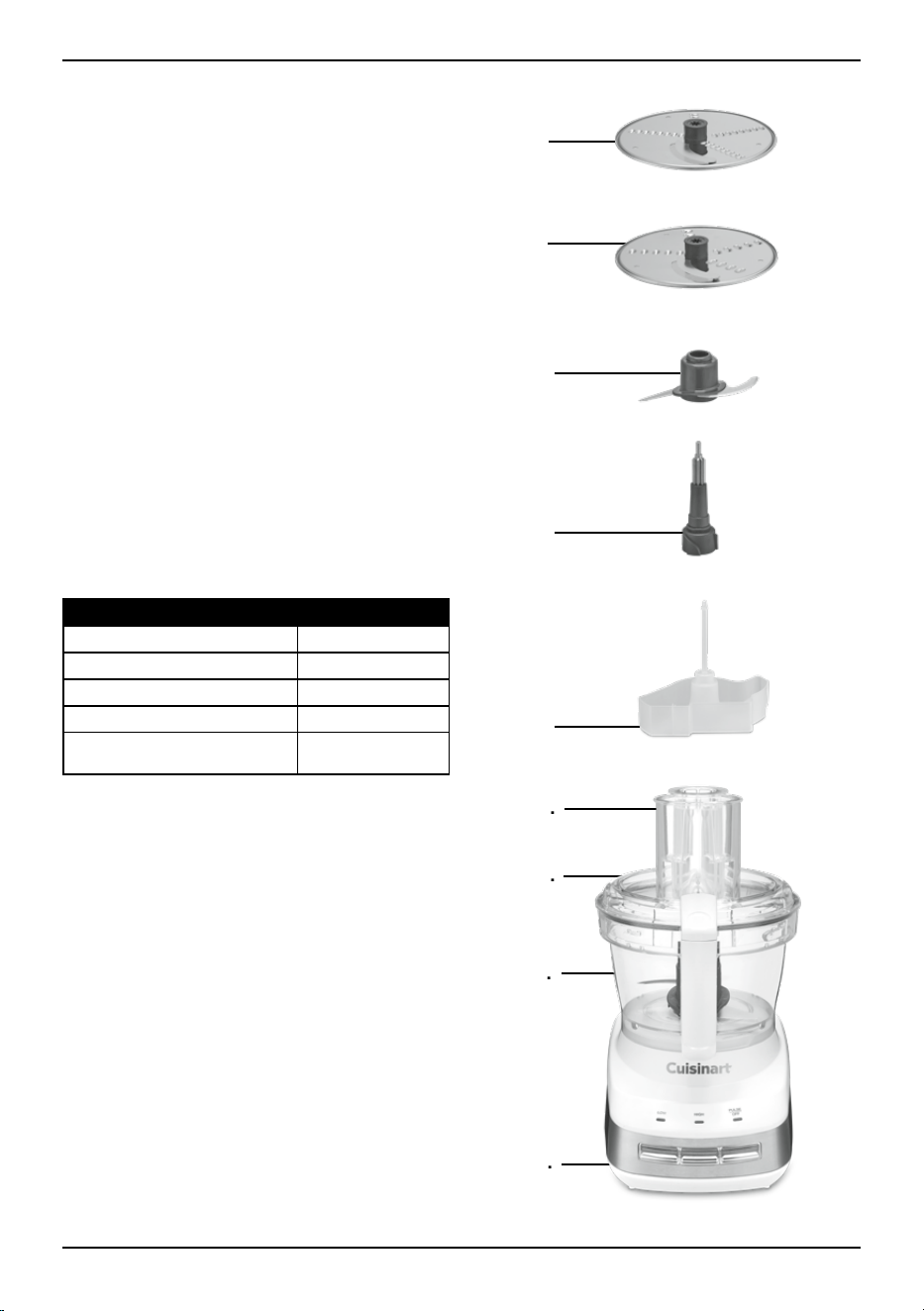
2.
1.
6.
7.
8.
3.
4.
5.
9.
4
PIEZAS
La máquina incluye:
1. Bloque-motor (base) - Con controles mecánicos
fáciles de usar
2. Bol removible de 10 tazas (2.35 L)
3. Tapa con boca de alimentación
4. Empujadores mediano y pequeño - Se deslizan
dentro la boca de alimentación
5. Adaptador removible
6. Cuchilla picadora/mezcladora/amasadora
de metal
7. Disco rebanador/triturador reversible fino
8. Disco rebanador/triturador reversible medio
9. Eje de almacenamiento - Guarda el adaptador
removible, la cuchilla y los discos en el bol
Cuisinart ofrece los accesorios Cuisinart Core
Custom
®
Accessories (vendidos por separados),
compatibles con su procesadora de alimentos.
¡El accesorio seleccionado se conecta directa-
mente a la base para convertir su procesadora
de alimentos en una licuadora, un exprimidor,
un cortador de dados y mucho más!
ACCESORIOS DISPONIBLES:
¡Visite Cuisinart.com para comprarlos!
ACCESORIO MODELO
Jarra licuadora de 36 oz (1 L) MFP-B36
Exprimidor/Extractor de jugo MFP-JC
Bol pequeño de 4 tazas (945 ml) MFP-WB4
Kit para cortar en cubos FP-DCP1
Disco multiusos para las
procesadoras de alimentos
MFD-4

5
INSTRUCCIONES DE
ENSAMBLAJE
Antes del primer uso
Antes de usar el aparato por primera vez, lave todas
las piezas removibles según se describe en las
instrucciones de limpieza.
1. Ponga la procesadora sobre una superficie nivelada
y seca. No enchufe el aparato hasta que esté
completamente ensamblado.
2. Instale el bol sobre la base y gírelo en sentido
antihorario para sujetarlo.
CUCHILLA PICADORA/
MEZCLADORA/AMASADORA
1. Coloque el bol sobre la base, con el asa ligeramente
a la derecha del centro. Gire el bol en sentido horario
para sujetarlo.
2.
Con cuidado, deslice la cuchilla por encima del
adaptador. Sosteniendo el adaptador por la parte
superior, colóquelo en el eje del bol. La cuchilla debe
quedar en el fondo del bol.
3. Enchufe el cable en una toma de corriente.
4. Coloque los ingredientes deseados en el bol.
5. Coloque la tapa sobre el bol, con la boca de
alimentación ligeramente a la derecha del centro.
Gire la tapa en sentido horario para bloquearla.
6. Inserte el empujador en la boca de alimentación.
7. El aparato está listo.
DISCOS REBANADORES/
TRITURADORES REVERSIBLES
1. Coloque el bol sobre la la base, con el asa
ligeramente a la derecha del centro. Gire el bol en
sentido horario para sujetarlo.
2. Instale el adaptador removible (sin la cuchilla).
3. Elija el disco deseado.
4. Con cuidado, coloque el disco deseado sobre el
adaptador, con el lado que desea usar apuntado
hacia arriba.
5. Coloque la tapa sobre el bol, con la boca de
alimentación ligeramente a la derecha del centro.
Gire la tapa en sentido horario para bloquearla.
6. Inserte el empujador en la boca de alimentación.
7. Enchufe el cable en una toma de corriente.
8. El aparato está listo para su uso.
CONTROLES
Botones HIGH y LOW
Hacen funcionar la máquina a velocidad alta (“HIGH”) o
baja (“LOW”), hasta presionar el botón OFF para apagar.
1. Ensamble el aparato según se describió en las
instrucciones de ensamblaje.
2. Coloque los ingredientes en el bol o introdúzcalos en
la boca de alimentación.
3. Presione el botón de velocidad deseado: HIGH (alta)
o LOW (baja); la luz LED blanca correspondiente se
iluminará y el motor se encenderá.
4. Para apagar el aparato, presione el botón OFF.
Función de pulso
El botón PULSE prende el motor momentáneamente al
presionar el botón, y lo apaga al soltarlo. Esta función
permite obtener resultados más homogéneos y evita
procesar excesivamente los ingredientes. Salvo
indicación contraria en la receta, use pulsaciones cortas
de un segundo.
Ensamble el aparato según se describe en las
instrucciones de ensamblaje. Ponga los ingredientes en
el bol. Presione repetidamente el botón PULSE hasta
obtener la consistencia deseada. La luz LED blanca se
encenderá cada vez que presione el botón PULSE.
FUNCIONES
Usos de la cuchilla picadora/
mezcladora/amasadora
Picar
• Alimentos crudos: Pele las frutas y los vegetales
y quite las partes duras (corazón, pepas, semillas,
huesos, etc.). Corte los alimentos en pedazos
uniformes de ½ a 1 in. (1.5 a 2.5cm). Obtendrá
resultados más homogéneos si los pedazos son del
mismo tamaño.
• Procese los alimentos con la función de pulso,
usando pulsaciones de 1 segundo, hasta obtener la
consistencia deseada. Para obtener una textura más
fina, mantenga presionado el botón PULSE o use la
velocidad alta (“HIGH”) o baja (“LOW”). Compruebe
la consistencia de los alimentos a menudo y raspe el
bol con una espátula si es necesario. Se recomienda
usar la velocidad baja (“LOW”) para procesar masas
y mezclas. Se recomienda usar la velocidad alta
(“HIGH”) para picar, procesar, rebanar, rallar,
triturar, etc.
Hacer puré
• Puré de frutas/vegetales crudos o cocinados:
Corte los ingredientes en pedazos de 1 in. (2.5cm);
obtendrá resultados más homogéneos con pedazos
del mismo tamaño. Pulse para picar grueso, y luego
procese continuamente, usando la velocidad alta
(“HIGH”) o baja (“LOW”), hasta obtener puré; raspe
el bol si es necesario. NOTA: NO use este método
para preparar puré de papas.
• Para preparar cremas o salsas de vegetales: Cuele
la sopa, reservando el líquido, y licue solamente los
vegetales. Después, agregue un poco del caldo y
siga procesando.

6
Amasar
• Siempre use la velocidad baja para rebanar.
Cerciórese de bloquear el empujador grande para
amasar; esto evitará que el aparato se mueva. Nota:
es normal que vibre. Siempre ponga el aparato en
marcha antes de agregar líquido. Primero, procese
los ingredientes secos (harina, sal, etc.). Luego,
vierta el líquido lentamente por el orificio en el
empujador, y permita que los ingredientes secos lo
absorban. Si el líquido se añade demasiado rápido,
espere hasta que los ingredientes se mezclen antes
de agregar el líquido restante lentamente (no apague
la máquina). Nunca use más de 2½ tazas (310 g) de
harina común cuando prepare masa de levadura.
Usos de los discos rebanadores/
trituradores reversibles
• El lado rebanador de los discos corta rodajas/
tajadas/rebanadas enteras. Es ideal para cortar en
rodajas/tajadas frutas, vegetales y carne cocinada,
cruda o semicongelada. El lado triturador de
los discos es capaz de triturar la mayoría de los
quesos firmes y duros. También puede usarse para
triturar alimentos tales como papas, zanahorias y
calabacines/calabacitas.
• Para obtener resultados homogéneos, apretuje los
alimentos en la boca de alimentación. La presión
necesaria dependerá de la consistencia de los
alimentos. Use una presión ligera para rebanar
alimentos suaves, presión moderada para
rebanar alimentos firmes, y presión firme para
rebanar ingredientes duros. Siempre ejerza una
presión uniforme.
• Para cortar frutas/vegetales en rodajas: Corte
la extremidad inferior de la fruta o del vegetal, e
introdúzcalo en la boca de alimentación, el lado
cortado primero. Si no cabe, córtelo a la mitad o en
cuartos. Procese, ejerciendo presión uniforme.
• Para rebanar alimentos pequeños, tales como
champiñones, rábanos o fresas: Corte ambos
extremos de las frutas/hortalizas e introdúzcalas
verticalmente en la boca de alimentación.
• Refrigere o congele brevemente el queso antes de
rebanarlo o triturarlo.
• Para rallar col, lechuga y otras hortalizas de
hoja: Forme un rollo de hojas e introduzca este
verticalmente en la boca de alimentación. Procese,
ejerciendo presión uniforme.
NOTA: Siempre use el empujador para
empujar los alimentos; nunca introduzca
los dedos en la boca de alimentación durante
el funcionamiento.
ALIMENTO CAPACIDAD
Frutas/vegetales/queso rebanados o triturados 10 tazas
Frutas/vegetales picados 6 tazas
Quesopicado 4 tazas
Puré de frutas/vegetales 3 tazas (volumen procesado: 1½ tazas)
Carne, pescado o mariscos picados o molidos 1½ lb (680 g)
Líquidos fluidos (p. ej., aderezo, sopa, etc.) 7 tazas (1.65 L)
Mezcla de pastel Mezcla para un pastel de queso de 8 in. (20 cm); 15.25 oz (430 g) de mezcla preparada.
Galletas 2½ docenas (receta de galletas de chispas de chocolate)
Pan blanco/Masa de pizza 2½ tazas (310 g) de harina común o 2½ tazas (335 g) de harina para hacer pan
Mantequilla de fruto seco (p. ej., maní) 3 tazas (700 g)
CAPACIDADES MÁXIMAS
ALIMENTO ACCESORIO VELOCIDAD INSTRUCCIONES
Quesos suaves
(ricota/
requesón,
queso crema,
requesón, etc.)
Cuchilla
picadora/
mezcladora/
amasadora
“LOW” (baja) o
“HIGH” (alta)
Lleve el queso a temperatura ambiente. De ser necesario, corte el queso en
pedazos de 1 in. (2.5 cm). Procese hasta que esté finamente picado, raspando el
bol de vez en cuando. Perfecto para preparar pastel de queso, salsas para mojar,
relleno de pasta, etc.
GUÍA DE USO
Su nueva procesadora de alimentos Cuisinart
®
permite rebanar, triturar y picar una gran variedad de frutas y
vegetales. También es la herramienta perfecta para muchos otros trabajos de preparación, tales como suavizar
mantequilla, rallar pan, preparar papillas y mucho más. ¡A continuación incluimos una guía que le ayudará a preparar
cualquier receta!

7
ALIMENTO ACCESORIO VELOCIDAD INSTRUCCIONES
Quesos firmes
(Cheddar,
suizo, Edam,
Gouda, etc.)
Disco rebanador
o triturador
“HIGH” (alta) Refrigere o congele brevemente el queso antes de procesarlo. Córtelo en pedazos
suficientemente pequeños como para caber en la boca de alimentación. Use una
presión ligera a moderada.
Quesos duros
(Parmesano,
Romano, etc.)
Cuchilla
picadora/
mezcladora/
amasadora
Disco rebanador
o triturador
“LOW” (baja) Si usa la cuchilla picadora, córtelo en pedazos de ½ in. (1.5 cm) para picar. Pulse
varias veces para romperlo en pedazos, y luego procese continuamente hasta que
esté finamente picado; esto producirá resultados finos. Para rebanar o triturar los
alimentos, córtelos en pedazos que quepan en la boca de alimentación. Use una
presión ligera a moderada.
Papillas Cuchilla
picadora/
mezcladora/
amasadora
“PULSE”
(pulso) +
“LOW” (baja) o
“HIGH” (alta)
Cortar las frutas/los vegetales en pedazos de ½ a 1 in. (1.5 a 2.5 cm). Cocine los
ingredientes al vapor hasta que estén muy suaves. Pulse para picar, y luego
procese continuamente hasta obtener la consistencia deseada (agregar líquido por
la boca de alimentación si es necesario). Cuele el puré con un colador de malla
fina. Congele el puré en bandejas de cubitos de hielo para conseguir porciones
individuales de 1 oz (30 g).
Mantequilla Cuchilla
picadora/
mezcladora/
amasadora
Disco rebanador
o triturador
“HIGH” (alta) Para acremar/suavizar: Lleve la mantequilla a temperatura ambiente. Córtela en
pedazos de 1 in. (2.5 cm). Procese, raspando el bol si es necesario. Para preparar
mantequillas aromatizadas, procese los ingredientes aromatizantes (hierbas,
ralladura, vegetales. etc.) primero, antes de agregar la mantequilla. Para triturar/
rebanar: Congélela brevemente. Use una presión ligera a moderada. Triturar la
mantequilla puede resultar útil para preparar ciertos tipos de hojaldres. Rebanar la
mantequilla es perfecto para servir con mazorcas de maíz o pancitos frescos.
Pan rallado o
galletas
molidas
Cuchilla
picadora/
mezcladora/
amasadora
“HIGH” (alta) Rómpalo en pedazos. Pulse para picar, luego procese continuamente hasta
obtener la textura deseada. Esto producirá pan/galletas saladas/chips rallados
perfectos para empanar/rebozar carne o pescado. ¡Las galletas dulces ralladas
son perfectas para preparar corteza de tarta y pastel!
Hierbas
frescas
Cuchilla
picadora/
mezcladora/
amasadora
“PULSE”
(pulso)
Lave y seque MUY BIEN las hierbas. Pulse para picar grueso. Siga pulsando hasta
obtener la consistencia deseada.
Carne molida Cuchilla
picadora/
mezcladora/
amasadora
“PULSE”
(pulso) +
“HIGH” (alta)
Corte la carne en pedazos de ½ in. (1.5 cm). Pulse para picar (aprox. 14
pulsaciones largas), hasta conseguir la consistencia deseada. Para moler, siga
procesando continuamente. No procese más de 1½ lb (680 g) a la vez.
Helado Cuchilla
picadora/
mezcladora/
amasadora
“HIGH” (alta) Coloque pedazos de 1 in. (2.5 cm) de fruta congelada en el bol. Agregue líquido
(jugo o leche), el edulcorante deseado (azúcar, miel, jarabe simple) y otros
sabores. Procese continuamente hasta obtener una mezcla suave.
Batidos y
licuados
(“smoothies”)
Cuchilla
picadora/
mezcladora/
amasadora
“LOW” (baja) Para preparar batidos, agregue el helado primero. Sin apagar la máquina, vierta la
leche por la boca de alimentación y procese continuamente hasta obtener la
consistencia deseada. Para hacer licuados de frutas, procese las frutas primero, y
luego agregue el líquido por la boca de alimentación, sin apagar la máquina.
Nueces Cuchilla
picadora/
mezcladora/
amasadora
“PULSE”
(pulso) +
“HIGH” (alta)
Pulse hasta obtener la consistencia deseada. Para preparar mantequilla de nuez
(como p. ej., mantequilla de maní), pulse para picar y luego procese hasta que
esté suave, raspando el bol de vez en cuando.
Azúcar
superfino
Cuchilla
picadora/
mezcladora/
amasadora
“HIGH” (alta) Procese el azúcar granulado por aprox. 1 minuto, hasta pulverizarlo. El azúcar
superfino es ideal para preparar merengues y otros productos de panadería y
confitería.
Crema batida Cuchilla
picadora/
mezcladora/
amasadora
“LOW” (baja) Procese continuamente la crema fría hasta que se espese. Agregue la cantidad
deseada de azúcar y siga procesando continuamente hasta obtener la
consistencia deseada. La crema batida será densa, perfecta para acompañar
pastel o helado.

8
LIMPIEZA, ALMACENAMIENTO
Y MANTENIMIENTO
• Mantenga su procesadora de alimentos de 10 tazas
(2.35 L) Cuisinart Core Custom
®
sobre la encimera,
para siempre tenerla lista. Desenchúfela cuando
no esté en uso. Guarde los accesorios en el eje de
almacenamiento provisto, en el bol.
• Mantenga la cuchilla y los discos fuera del alcance
de los niños.
• Todas las piezas removibles son aptas para
lavavajillas, pero se recomienda colocarlas en la
bandeja superior del mismo, ya que con el tiempo,
el intenso calor del agua en la bandeja inferior puede
dañar el bol, la tapa y los accesorios. Ponga la tapa
recta, con la boca de alimentación apuntando hacia
arriba, para que se limpie bien. Coloque el bol y los
empujadores al revés. Tenga cuidado al sacar la
cuchilla y los discos del lavavajillas.
• Se recomienda enjuagar todas las piezas removibles
inmediatamente después del uso para evitar que
residuos de alimentos se sequen en ellas, lo que
dificulta la limpieza. Cerciórese de colocar los
empujadores y el bol al revés, para que el agua
se escurra. Si alimentos quedan atrapados en los
empujadores, enjuague estos en agua o límpielos
con un cepillo para biberones.
• Si desea lavar la cuchilla y los discos a mano,
haga esto con mucho cuidado. Sosténgalos por
el eje central. Procure no dejarlos en agua jabonosa,
donde los puede perder de vista. De ser necesario,
use un cepillo.
• El bol está hecho de plástico de tipo SAN
(resinas de estireno acrilonitrilo), pero tiene algunos
componentes de metal. Por lo tanto, no es apto
para microondas
• Limpie la base después de cada uso con un paño
no abrasivo o una esponja humedecidos con agua
jabonosa. Seque bien.
• Si los pies dejan marcas en la encimera, rocíe
producto quitamanchas y restriegue con una
esponja húmeda.
• Si esto no soluciona el problema, vuelva a limpiar la
encimera con un limpiador en polvo no abrasivo.
IMPORTANTE: Siempre use el eje de
almacenamiento provisto. Nunca guarde la
cuchilla ni los discos en el adaptador removible.
Instale la cuchilla o el disco en el momento de
usarlos solamente.
MANTENIMIENTO: Cualquier otro servicio debe
ser realizado por un técnico/representante de
servicio autorizado.
PARA SU SEGURIDAD
• Como todos los electrodomésticos, este aparato
debe usarse con cuidado. Para evitar las lesiones
resultantes de un mal uso, siga estas reglas de
seguridad.
• Manipule la cuchilla de metal y los discos con sumo
cuidado, y guárdelos en el eje de almacenamiento
provisto. Sus filos son muy afilados.
• Compruebe que el bol esté correctamente instalado
y bloqueado antes de instalar el adaptador
removible, la cuchilla o un disco.
• Compruebe que la cuchilla o el disco estén
debidamente asentados en el adaptador removible,
lo más abajo posible.
• Siempre instale la cuchilla antes de colocar los
ingredientes en el bol.
• Siempre use el empujador para empujar los
alimentos; nunca introduzca los dedos ni una
espátula en la boca de alimentación.
• Siempre espere hasta que la cuchilla o el disco
estén totalmente inmóviles antes de abrir la tapa o
quitar el juego de empujadores.
• Siempre desenchufe el aparato antes de vaciar el
bol, limpiar el aparato, instalar o sacar piezas.
• Siempre retire el bol de la base antes de sacar la
cuchilla picadora/mezcladora/amasadora o el disco
rebanador/rallador.
• Tenga cuidado de no dejar caer la cuchilla o el disco
al vaciar el bol. Retire el adaptador removible, junto
con la cuchilla, antes de inclinar el bol.
ESPECIFICACIONES TÉCNICAS
El motor de su procesadora de alimentos funciona
con corriente estándar. Las especificaciones eléctricas
del aparato están indicadas en la etiqueta debajo de
la base.
Un interruptor de seguridad apagará automáticamente
el motor en caso de sobrecalentamiento. Esto puede
ocurrir cuando procesa mezclas espesas por un tiempo
prolongado, o cuando usa el aparato sin interrupción
por un tiempo excesivo. En caso de que esto suceda,
apague y desenchufe el aparato y permita que se enfríe
por 10 minutos o más (hasta una hora en casos
extremos).
Un mecanismo de seguridad impide que el aparato se
ponga en marcha a menos que el bol y la tapa estén
debidamente asegurados. El motor de la procesadora se
apaga muy rápidamente después de apagar el aparato y
se detiene automáticamente al sacar el juego de
empujadores.
Cuisinart ofrece una garantía limitada de tres años en
este aparato.

9
RESOLUCIÓN DE PROBLEMAS
Problemas al picar/rebanar/triturar
1. Problema: Los alimentos picados no son uniformes.
Solución:
• Corte los alimentos en pedazos uniformes de
½ a 1 in. (1.5 a 2.5 cm) antes de procesarlos.
• Procese los alimentos en varias veces para no
sobrellenar el bol.
2. Problema: Las rebanadas no son uniformes
o son sesgadas.
Solución:
• Coloque los alimentos en la boca de alimentación
con el lado cortado apuntando hacia abajo.
• Procese, ejerciendo una presión uniforme en el
empujador.
3. Problema: Los alimentos no se mantienen rectos
en la boca de alimentación.
Solución:
• Apretuje los alimentos en la boca de alimentación.
4. Problema: Quedan pedazos de alimento arriba
del disco.
Solución:
• Esto es normal; corte los pedazos a mano y
agréguelos a los alimentos procesados.
Problemas al amasar
1. Problema: El motor pierde velocidad.
Solución:
• Puede que la cantidad de masa exceda la
capacidad máxima. Divida la masa en dos
porciones y amase cada porción por separado.
• Puede que la masa sea demasiado húmeda
(ver “La masa está demasiado húmeda”
a continuación). Si el motor acelera, siga
procesando. En caso contrario, agregue harina,
una cucharada (5 g) a la vez, hasta que el motor
acelere. Siga procesando hasta que la masa se
despegue de las paredes del bol.
2. Problema: La cuchilla no incorpora los ingredientes.
Solución:
• Siempre ponga la procesadora en marcha antes
de agregar líquido. Vierta el líquido lentamente
por el orificio en el empujador, para permitir que
los ingredientes secos lo absorban. Si el líquido
se añade demasiado rápido, espere hasta que los
ingredientes se mezclen antes de agregar el líquido
restante lentamente (no apague la máquina).
Vierta el líquido por la boca de alimentación en el
momento preciso en que la masa pasa bajo esta;
procure no verter el líquido directamente en el
fondo del bol.
3. Problema: La cuchilla no permanece en el fondo
del bol.
Solución:
• Esto puede pasar si la masa está demasiado
pegajosa. Con cuidado, vuelva a instalar la cuchilla
y, después de encender la máquina, agregue
inmediatamente 2 cucharadas (15 g) de harina por
la boca de alimentación.
4. Problema: La masa no deja el bol limpio.
Solución:
• Puede que la cantidad de masa exceda la
capacidad máxima. Divida la masa en dos
porciones y amase cada porción por separado.
• Puede que la masa sea demasiado seca (ver “La
masa está demasiado seca” a continuación).
• Puede que la masa sea demasiado húmeda
(ver “La masa está demasiado húmeda” a
continuación).
5. Problema: La masa se enreda en la cuchilla y no
está homogénea
Solución:
• Apague la máquina y, con cuidado, retire la
masa del bol. Divida la masa en tres porciones y
disponga estas uniformemente en el fondo del bol;
siga amasando.
6. Problema: La masa parece dura.
Solución:
• Divida la masa en 2 o 3 porciones y disponga
estas uniformemente en el fondo del bol. Amase
por 10 segundos, o hasta obtener una masa suave
y homogénea.
7. Problema: La masa está demasiado seca.
Solución:
• Encienda la máquina y agregue agua, 1 cucharada
a la vez, hasta que la masa deje el bol limpio.
8. Problema: La masa está demasiado húmeda.
Solución:
• Encienda la máquina y agregue harina, 1
cucharada (5 g) a la vez, hasta que la masa deje el
bol limpio.
Problemas técnicos
1. Problema: El motor no se enciende.
Solución:
• Un sistema de seguridad impide que el motor se
encienda a menos que la unidad esté debidamente
ensamblada. Compruebe que el bol y la tapa estén
firmemente asegurados.
• Si esto no soluciona el problema, inspeccione el
cable y la toma de corriente.
2. Problema: El aparato se apaga durante el uso.
Solución:
• Compruebe que la tapa esté bien cerrada.
• Un interruptor de seguridad apaga
automáticamente el motor en caso de
sobrecalentamiento, lo que puede ocurrir
cuando procesa mezclas espesas por un tiempo
prolongado. En caso de que esto suceda, apague
y desenchufe el aparato y permita que se enfríe
por 20 a 30 minutos antes de continuar.

10
3. Problema: El motor pierde velocidad durante el
funcionamiento.
Solución:
• Esto puede ocurrir cuando el motor hace
mucha fuerza (p. ej., al rebanar/triturar queso).
Simplemente reposicione los alimentos en la boca
de alimentación y siga procesando.
• Puede que la cantidad de alimentos exceda la
capacidad máxima del bol. Quite una parte de los
ingredientes y siga procesando.
4. Problema: El aparato vibra/se mueve durante
el uso.
Solución:
• Compruebe que los pies de caucho debajo de la
base estén limpios y secos. También cerciórese
de que la cantidad de alimentos no exceda la
capacidad máxima del bol.
• Esto puede ocurrir cuando el motor hace mucha
fuerza (p. ej., al rebanar/triturar queso).
GARANTÍA
Garantía limitada de tres años
Esta garantía es para los consumidores que residen en
los EE.UU. solamente. Usted es un consumidor si
posee una procesadora de alimentos de 10 tazas
(2.35 L) Cuisinart Core Custom
®
que fue comprada en
una tienda, para uso personal, familiar o casero. A
menos que la ley aplicable exija lo contrario, esta
garantía no es para los minoristas u otros consumidores/
compradores comerciales. Cuisinart garantiza este
producto contra todo defecto de materiales o
fabricación durante 3 años después de la fecha de
compra original, siempre que el aparato haya sido usado
para uso doméstico y según las instrucciones.
Le aconsejamos que llene el formulario de registro
disponible en https://cuisinart.registria.com a fin de
facilitar la verificación de la fecha de compra original de
este producto. Sin embargo, no es necesario registrar el
producto para recibir servicio bajo esta garantía. En
ausencia de prueba de la fecha de compra, el período
de garantía será calculado a partir de la fecha de
fabricación del producto.
RESIDENTES DE CALIFORNIA
La ley del estado de California ofrece dos opciones bajo
el período de garantía. Los residentes del estado de
California pueden regresar el producto defectuoso (A) a
la tienda donde lo compraron o (B) a otra tienda que
venda productos Cuisinart
®
de este tipo. La tienda
podrá, a su elección, reparar el producto, referir al
consumidor a un centro de servicio independiente,
sustituir el producto, o reembolsar al consumidor el
precio de compra menos la cantidad directamente
atribuible al uso anterior del producto por el consumidor.
Si estas dos opciones no satisfacen al consumidor,
podrá llevar el aparato a un centro de servicio
independiente, siempre que se pueda arreglar o reparar
el aparato de manera económica. Cuisinart (no el
consumidor) será responsable por los gastos de
servicio, reparación, sustitución o reembolso de los
productos defectuosos bajo garantía. Los residentes de
California también pueden, si lo desean, mandar el
producto defectuoso directamente a Cuisinart para que
lo reparen o lo cambien. Para esto, se debe llamar a
nuestro servicio posventa al 1-800-726-0190. Cuisinart
será responsable por los gastos de reparación,
reemplazo, manejo y envío de los productos
defectuosos durante el período de garantía.
GARANTÍA DE REEMPLAZO SIN DIFICULTADES
Su máxima satisfacción es nuestra prioridad, así que si
este producto Cuisinart
®
falla dentro del generoso
período de garantía, lo repararemos o, de ser necesario,
lo reemplazaremos, sin costo alguno para usted. Para
obtener una etiqueta de devolución, por favor llene el
formulario de solicitud disponible en https://www.
cuisinart.com/customer-care/product-assistance/
product-inquiry/. O llame sin cargo a nuestro servicio
de atención al cliente, al 1-800-726-0190, para hablar
con un representante.
Este producto satisface las más altas exigencias de
fabricación y ha sido diseñado para uso sobre corriente
de 120 V, usando accesorios y piezas de repuesto
autorizados solamente. Esta garantía excluye
expresamente los defectos o daños causados por
accesorios, piezas o reparaciones no autorizados por
Cuisinart, así como los defectos o daños causados por
el uso de un convertidor de voltaje. Esta garantía no
cubre el uso comercial o industrial del producto, y no es
válida en caso de daños causados por mal uso,
negligencia o accidente. Esta garantía excluye todos los
daños incidentales o consecuentes. Algunos Estados no
permiten la exclusión o limitación de daños incidentales
o consecuentes, de modo que las limitaciones
mencionadas pueden no regir para usted. Usted puede
tener otros derechos que varían de un Estado a otro.
Importante: Si debe llevar el producto defectuoso a un
centro de servicio no autorizado, por favor informe al
personal del centro de servicio que deben llamar al
Centro de Servicio al Cliente de Cuisinart al 1-800-726-
0190 a fin de diagnosticar el problema correctamente,
usar las piezas correctas para repararlo y comprobar
que el producto aún esté bajo garantía.
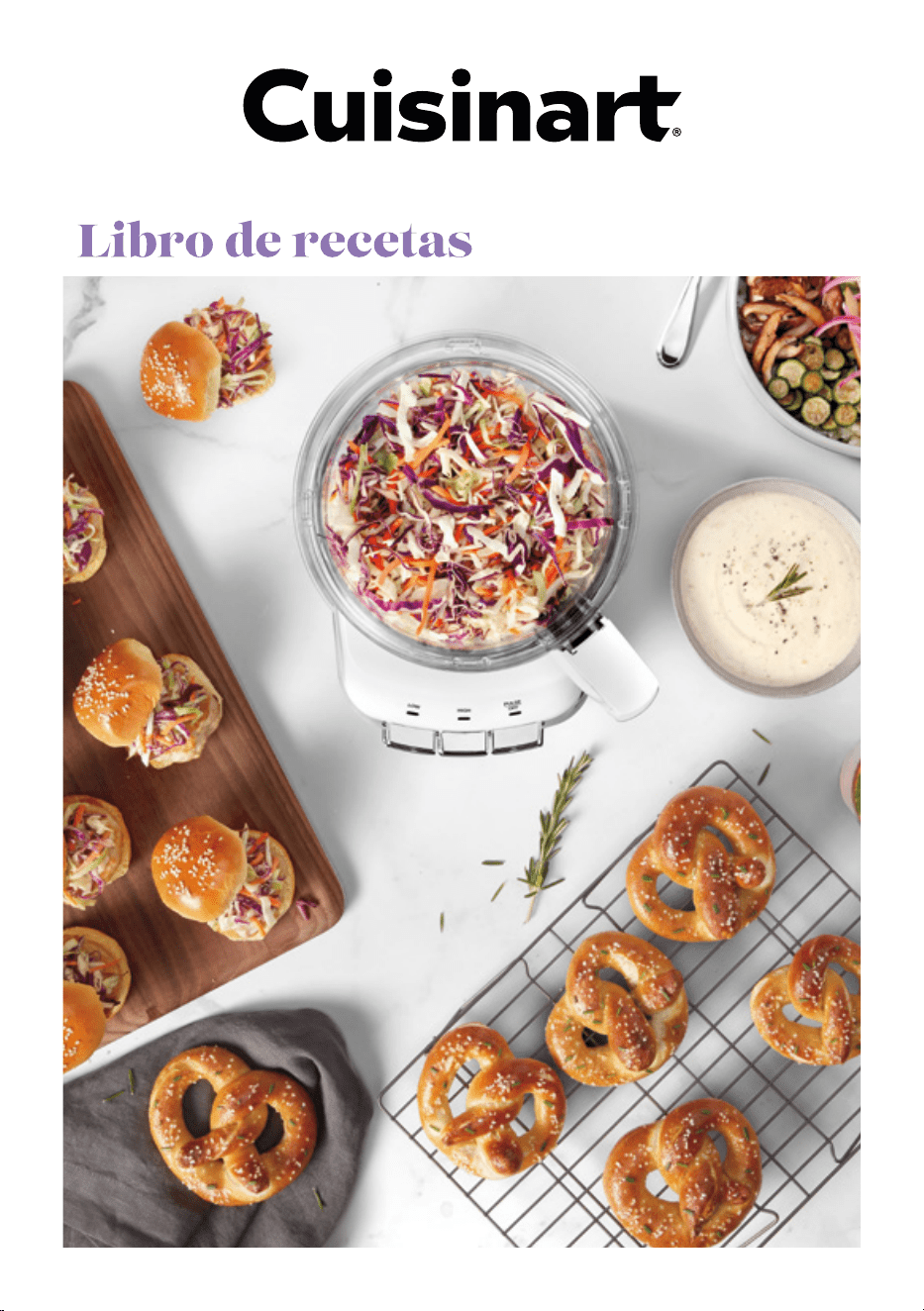
Procesadora de alimentos de 10 tazas (2.35L)
Cuisinart Core Custom
®

Desayunos/Brunches
Panecillos de queso Cheddar y cebollinos....................................................................................................... 13
“Scones” con chispas de chocolate .................................................................................................................. 15
Pan de calabacín con chispas de chocolate ..................................................................................................... 15
Mantequillas/Salsas/Aderezos
Mantequilla de limón y lavanda ......................................................................................................................... 16
Mantequilla tocino y jarabe de arce .................................................................................................................. 16
Crema para untar de salmón ahumado ............................................................................................................ 17
Salsa mexicana ..................................................................................................................................................... 17
Chimichurri rojo .................................................................................................................................................... 18
Harissa ................................................................................................................................................................... 18
Humus clásico ....................................................................................................................................................... 19
Mayonesa .............................................................................................................................................................. 20
Aderezo César vegano ........................................................................................................................................ 20
Vinagreta de limón .............................................................................................................................................. 21
Pesto de albahaca ............................................................................................................................................... 22
Platos principales
Falafels (croquetas de garbanzos) ..................................................................................................................... 23
Tarta de vegetales mixtos con requesón.......................................................................................................... 24
Pizza de requesón y pesto .................................................................................................................................. 25
Pizza con aceitunas y champiñones ................................................................................................................... 26
Hamburguesas de pollo ...................................................................................................................................... 27
Sopas/Ensaladas/Acompañamientos
Ensalada de espárragos rebanados con piñones ............................................................................................ 28
Ensalada de tubérculos arco iris y manzana ..................................................................................................... 28
Frijoles refritos ...................................................................................................................................................... 29
Crema de tubérculos ........................................................................................................................................... 30
Postres
Pastel de zanahoria con cobertura de queso crema ....................................................................................... 31
Pastel de mantequilla de limón y semillas de amapola .................................................................................. 32
Pastel de pistacho con aceite de oliva y crema de cardamomo ................................................................... 33
Tarta de fresas con crema .................................................................................................................................. 34
Helado de moras con trozos de chocolate sin máquina para hacer helado ............................................... 35
Panes/Masa
Pan pita ................................................................................................................................................................. 36
Masa de pizza ....................................................................................................................................................... 37
“Pâte brisée” (masa quebrada) .......................................................................................................................... 37
“Pretzels” con romero y copos de sal marina .................................................................................................. 38
Panecillos para hamburguesas ........................................................................................................................... 39

13
Desayunos/Brunches
Panecillos de queso Cheddar y cebollinos
Estos panecillos tienen un exterior dorado y crujiente que recuerda un bocado de barquillo de
queso salado y mantecoso que se disuelve en la boca. El sabor a cebolla de los cebollinos “corta”
la riqueza del queso Cheddar, haciendo que estos sean totalmente adictivos.
Rinde: 8 panecillos
INGREDIENTES
4 onzas de queso Cheddar; de
preferencia extrafuerte
2 tazas (250 g) de harina común +
un poco más para darle forma a
los panecillos
2 cucharadas de harina de maíz amarilla
1½ cucharaditas de azúcar granulada
2½ cucharaditas de polvo de hornear
1¾ cucharaditas de sal kosher
½ cucharadita de pimienta negra
recién molida
12 cucharadas (175 g) de mantequilla sin
sal, fría, en cubitos de ½ in. (1.5 cm)
6 cucharadas (aprox. ½ onza) de
cebollinos picados gruesos
¾ taza (185 g) de suero de leche
(“buttermilk”), bien agitada
Copos de sal marina (opcional)
INSTRUCCIONES
1. Instalar el disco rallador/triturador fino en el bol, el lado triturador apuntando hacia arriba.
Triturar el queso Cheddar a velocidad alta (“HIGH”). Reservar.
2. Instalar la cuchilla picadora en el bol. Agregar la harina, la harina de maíz, el azúcar, el polvo
de hornear, la sal y la pimienta, y procesar a velocidad baja (“LOW”) por 10 segundos para
tamizar. Agregar 10 cucharadas (145 g) de cubos de mantequilla fría y pulsar hasta que la
mezcla empiece a adquirir la consistencia de migajas gruesas con pedacitos de mantequilla
del tamaño de arvejas. Agregar el queso reservado y los cebollinos, y pulsar 4 a 5 veces para
incorporar. Agregar el suero de leche y pulsar unas cuantas veces hasta conseguir una masa
que se desmigaje.
3. Colocar la masa sobre una superficie ligeramente enharinada. Con las manos enharinadas,
aplastar la masa para formar un rectángulo de 8 x 4 in. (20 x 10 cm). Doblar la masa dos
veces sobre sí misma para conseguir tres capas. Empezando en un costado corto, doblar un
tercio de la masa hacia abajo por encima del centro, luego doblar el otro tercio hacia arriba
para superponerlo. Girar la masa una cuarta parte en sentido horario y aplastar otra vez para
formar otro rectángulo de 8 x 4 in. (20 x 10 cm). Doblar la masa en tercios otra vez. (El
proceso de plegado crea una estructura para galletas altas con muchas capas de hojaldre).
Girar la masa una cuarta parte en sentido horario otra vez, y aplastar otra vez para formar
otro rectángulo de 8 x 4 in. (20 x 10 cm) por aprox. 1 in. (2.5 cm) de espesor. Cuadrar los
costados lo mejor que pueda con sus manos o un raspador de masa.
4. Usar un cuchillo afilado para cortar el rectángulo en 8 cuadros de 2 in. (5 cm) de alto.
Disponer los panecillos en una placa para horno forrada con papel sulfurizado y congelar por
30 minutos para enfriar.
5. Mientras la masa se está enfriando, colocar la rejilla del horno en el medio del mismo y
precalentar el horno a 425 °F (220 °C). Derretir las 2 cucharadas (30 g) de mantequilla
restante.
6. Cepillar la parte superior de cada panecillo con la mantequilla derretida y rociar con copos
de sal marina sin desea. Hornear por 20 a 22 minutos, hasta que la parte superior esté bien

14
Desayunos/Brunches
dorada. Sacar del horno y dejar enfriar ligeramente sobre la placa para horno. Servir tibio o a
temperatura ambiente.
Información nutricional por panecillo:
Calorías 343 (58% de grasa) • Carbohidratos 27g • Proteínas 9g • Grasa 22g • Grasa saturada 14g
Colesterol 60mg • Sodio 487mg • Calcio 946mg • Fibra 2g
“Scones” con chispas de chocolate
El uso de mini chispas de chocolate garantiza una pequeña golosina en cada bocado. Nos encanta
servirlos tibios con nuestra mantequilla de limón y lavanda (página 16).
Rinde: 8 “scones”
INGREDIENTES
1½ tazas (200 g) de harina de repostería
1 taza (125 g) de harina común + un poco
más para dar forma
2 cucharadas (25 g) de azúcar granulada
1½ cucharaditas de polvo de hornear
¼ cucharadita de bicarbonato de sodio
1 cucharadita de sal kosher
1 taza (245 g) de suero de leche
(“buttermilk”)
1 huevo grande
6 cucharadas (85 g) de mantequilla sin sal
fría, en pedacitos
¼ taza (20 g) de mini chispas de chocolate
Huevo para barnizar (1 huevo grande
+ 1 cucharadita de agua, bien batidos)
Azúcar turbinado, para espolvorear
INSTRUCCIONES
1. Instalar la cuchilla picadora en el bol. Colocar las harinas, el azúcar, el polvo de hornear, el
bicarbonato y la sal en el bol de la procesadora; procesar a velocidad baja (“LOW”) por
aprox. 20 segundos para mezclar bien.
2. Colocar el suero de leche y el huevo en una taza medidora para líquidos, y batir para
combinar. Reservar.
3. Agregar la mantequilla a los ingredientes secos, y pulsar hasta que la mezcla adquiera la
textura de una masa que se desmigaje. Sin dejar de pulsar, agregar lentamente los
ingredientes líquidos, hasta solo incorporarlos (no mezclar demasiado).
4. Colocar la masa en la encimera limpia o en una tabla de picar grande, ligeramente
enharinada. Agregar las mini chispas de chocolate y doblar suavemente la masa unas
cuantas veces para combinar. Formar un cilindro de masa de 10 in. (25 cm) de largo. Usando
un cuchillo afilado, cortarlo 8 rodajas uniformes. Colocar las rodajas en una placa para horno
forrada con papel sulfurizado. Cubrir sin apretar con papel film/plástico y refrigerar por un
mínimo de 1 hora, hasta un máximo de una noche.
5. Una vez refrigerado, poner la rejilla del horno en el centro del mismo y precalentar el horno
a 400°F (200°C). Cepillar cada “scone” con barniz de huevo y rociar con azúcar turbinado.
7. Hornear por aprox. 25 a 30 minutos, hasta que estén bien dorados. Sacar del horno y dejar
enfriar ligeramente sobre la placa para horno. Servir tibio o a temperatura ambiente.
Información nutricional por “scone”:
Calorías 264 (35% de grasa) • Carbohidratos 40g • Proteínas 5g • Grasa 9g • Grasa saturada 6g
Colesterol 47g • Sodio 440g • Calcio 99mg • Fibra 1g

15
Desayunos/Brunches
Pan de calabacín con chispas de chocolate
Este pan rápido y jugoso es perfecto para el desayuno o como refrigerio. Las chispas de chocolate
son un agradable detalle, pero si se desea un pan más saludable, use más nueces o frutas secas.
Rinde: 16 porciones; una barra de 2 lb (910 g)
INGREDIENTES
Spray vegetal
1¾ tazas (220 g) de harina común
1½ cucharaditas de canela en polvo
¾ cucharadita de pimienta de Jamaica
en polvo
¼ cucharadita de nuez moscada rallada
1 cucharadita de sal marina fina
1½ cucharaditas de polvo de hornear
½ taza (70 g) de nueces,
ligeramente tostadas
1 calabacín (“zucchini”) grande
½ taza (120 ml) de aceite vegetal
1 taza (200 g) de azúcar granulada
2 huevos grandes
½ taza (40 g) de chispas de
chocolate (puede usar arándanos
agrios secos o cerezas secas para un
sabor menos dulce)
INSTRUCCIONES
1. Precalentar el horno a 350 °F (175 °C). Engrasar un molde de barra de 9 x 5 x 3 in.
(23 x 13 x 8 cm) con spray vegetal.
2. Instalar la cuchilla picadora en el bol. Agregar la harina, las especias, la sal y el polvo de
hornear; procesar a velocidad baja (“LOW”) por 10 segundos para tamizar. Poner la mezcla
en un tazón grande; reservar. Colocar las nueces en el bol de la procesadora y pulsar 2 a 3
veces para picar. Dejando las nueces en el bol, sacar la cuchilla picadora e instalar el disco
rebanador/triturador medio, el lado triturador apuntando hacia arriba. Cortar los calabacines/
calabacitas para que quepan en la boca de alimentación y triturarlas. Añadir la mezcla
(y nueces adicionales, si desea) a los ingredientes secos; revolver para mezclar.
3. Volver a instalar la cuchilla picadora y colocar el aceite vegetal, el azúcar y los huevos en el
bol. Procesar a velocidad baja (“LOW”) por 5 a 10 segundos para combinar. Agregar a la
mezcla de ingredientes secos, junto con las chipas de chocolate; revolver para mezclar.
4. Verter la mezcla en el molde y hornear por 1 hora y 15 minutos, hasta que un probador
salga limpio.
5. Dejar enfriar en el molde por 5 minutos, y luego desmoldar (volteándolo) y dejar enfriar
completamente sobre una rejilla.
Información nutricional por porción:
Calorías 194 (37% de grasa) • Carbohidratos 28g • Proteínas 3 g • Grasa 8g • Grasa saturada 1g
Colesterol 23mg • Sodio 183mg • Calcio 14mg • Fibra 1g

16
Mantequillas/Salsas/Aderezos
Mantequilla de limón y lavanda
Esta mantequilla tiene un sabor brillante y la cantidad justa de notas florales. Es deliciosa en
“scones”, panqueques o waffles/gofres.
Rinde: ½ taza (115 g) de mantequilla; 8 porciones
INGREDIENTES
8 cucharadas (115 g) de mantequilla
europea sin sal a temperatura
ambiente, en 4 pedazos
1 a 2 pizcas de sal marina fina
1 tira de 2 in. (5 cm) de cáscara de limón
(sin la piel blanca)
1 cucharadita de lavanda seca
INSTRUCCIONES
1. Instalar la cuchilla picadora en el bol. Colocar la mantequilla en el bol. Pulsar para suavizar;
luego, agregar los ingredientes restantes, empezando con solamente 1 pizca de sal. Pulsar
para combinar, parando para raspar el bol si es necesario. Luego, procesar a velocidad baja
(“LOW”) por 5 segundos para combinar. Probar y agregar más sal si desea.
2. Colocarla sobre una hoja de papel sulfurizado. Formar un cilindro, envolverlo bien en el
papel sulfurizado, y luego cubrirlo completamente con papel film/plástico. Refrigerar hasta
que esté firme.
Información nutricional por porción (1 cucharada):
Calorías 71 (38% de grasa) • Carbohidratos 2g • Proteínas 2g • Grasa 3g • Grasa saturada 0 g
Colesterol 0mg • Sodio 159mg • Calcio 35mg • Fibra 2g
Mantequilla tocino y jarabe de arce
Repleta de los mejores sabores del desayuno, esta mantequilla es ideal para acompañar alimentos
dulces, tal como waffles/gofres, o algo salado, tales como los bizcochos. Incluso es perfecta para
revolver en sopas como nuestra sopa de tubérculos (página 30).
Rinde: ½ taza (115 g); 8 porciones
INGREDIENTES
8 cucharadas (115 g) de mantequilla sin
sal de buena calidad (p. ej., Plugra o
Kerrygold) a temperatura ambiente
2 lonchas de tocino, picado y cocinado
(aprox. 2 cucharadas)
2 cucharaditas de jarabe de
arce/maple puro
INSTRUCCIONES
1. Instalar la cuchilla picadora en el bol. Colocar la mantequilla en el bol. Pulsar para suavizar;
luego, agregar los ingredientes restantes. Pulsar para combinar, parando para raspar el bol si
es necesario. Luego, procesar a velocidad baja (“LOW”) por 5 segundos para combinar.
2. Colocarla sobre una hoja de papel sulfurizado. Formar un cilindro, envolverlo bien en el
papel sulfurizado, y luego cubrirlo completamente con papel film/plástico. Refrigerar hasta
que esté firme.

17
Mantequillas/Salsas/Aderezos
Información nutricional por porción (1 cucharada):
Calorías 71 (38% de grasa) • Carbohidratos 2g • Proteínas 2g • Grasa 3g • Grasa saturada 0 g
Colesterol 0mg • Sodio 159mg • Calcio 35mg • Fibra 2g
Crema para untar de salmón ahumado
La opción obvia es untarla en un “bagel” fresco, pero también es deliciosa en mini sándwiches o en
galletas saladas. Nos encanta la adición de pepinillos encurtidos con eneldo, pero puede usar eneldo
fresco en su lugar para un sabor más tradicional.
Rinde: Aprox. 1 taza (235 ml)
INGREDIENTES
8 onzas (225 g) de queso crema, a
temperatura ambiente, en 8 pedazos
3 tiras de 2 in. (5 cm) de cáscara de limón
(sin la piel blanca), opcional
2 cucharaditas de alcaparras, escurridas
(opcional)
1 a 2 tajadas de pepinillos encurtidos con
eneldo, cortadas por la mitad
3 ramitas de eneldo fresco, opcional (se
puede usar en lugar de los pepinillos
encurtidos con eneldo, o se puede
añadir para agregar un sabor a eneldo
más intenso)
2 onzas (55 g) de salmón ahumado,
en pedazos
1 pizca de pimienta negra recién molida
INSTRUCCIONES
1. Instalar la cuchilla picadora en el bol. Agregar el queso crema y la ralladura de limón. Pulsar
varias veces para romper, luego procesar a velocidad alta (“HIGH”) hasta obtener una
mezcla suave.
2. Raspar el bol. Agregar las alcaparras (opcional), los pepinillos, el eneldo, el salmón y la
pimienta; pulsar aprox. 20 veces para combinar. Probar y ajustar la sazón al gusto.
Información nutricional por porción (2 cucharadas):
Calorías 71 (38% de grasa) • Carbohidratos 2g • Proteínas 2g • Grasa 3g • Grasa saturada 0 g
Colesterol 0mg • Sodio 159mg • Calcio 35mg • Fibra 2g
Salsa mexicana
Esta salsa fresca y agridulce es perfecta para servir con chips de maíz/totopos tibios.
Rinde: Aprox. 1½ tazas (355 ml)
INGREDIENTES
1 diente de ajo, pelado
1 jalapeño, sin semillas, en trocitos
½ cebolla pequeña, en pedazos
2 tazas (300 g) de tomates de pera
2 cucharadas de cilantro fresco (sin tallos)
1 cucharadita de sal kosher
1 cucharadita de jugo de lima/limón
verde fresco
INSTRUCCIONES
1. Instalar la cuchilla picadora en el bol. Encender la máquina a velocidad alta (“HIGH”) y dejar
caer el ajo y el jalapeño en la boca de alimentación; procesar hasta que estén finamente
picados. Agregar la cebolla y pulsar aprox. 3 veces para picar. Agregar los tomates, el
cilantro, la sal y el jugo de lima; pulsar 8 a 10 veces, hasta obtener la consistencia deseada.

18
Mantequillas/Salsas/Aderezos
2. Probar y ajustar la sazón al gusto. Colar la salsa para eliminar el exceso de líquido si desea.
Información nutricional por porción (2 cucharadas):
Calorías 6 (7% de grasa) • Carbohidratos 0g • Proteínas 1g • Grasa 0g • Grasa saturada 0 g
Colesterol 0mg • Sodio 192mg • Calcio 4mg • Fibra 0g
Chimichurri rojo
El pimentón es el factor transformador en esta variación menos vista del chimichurri que tiene un
tono rojo intenso y un sabor ahumado robusto. Es la salsa perfecta para acompañar carnes a la
parrilla y papas asadas crujientes. También sirve como marinada.
Rinde: 1¼ tazas (295 ml)
INGREDIENTES
4 a 5 dientes de ajo, pelados
1 chalote mediano, cortado en pedazos
2 cucharadas de orégano seco
4 cucharaditas de páprika
(pimentón) ahumada
½ cucharadita de comino en polvo
½ cucharadita de hojuelas de
pimiento rojo
1 cucharadita de sal kosher, o al gusto
¼ taza llena (15 g) de perejil fresco, o una
combinación de perejil y cilantro
½ taza (120 ml) de vinagre de vino tinto
¾ taza (175 ml) de aceite de oliva
virgen extra
INSTRUCCIONES
1. Instalar la cuchilla picadora en el bol. Encender la máquina a velocidad alta (“HIGH”)
y dejar caer el ajo en la boca de alimentación; procesar hasta que esté finamente picado.
Raspar el bol y agregar el chalote, el orégano seco, el pimentón, el comino, las hojuelas de
pimiento rojo, la sal, el perejil y el cilantro (opcional); pulsar para picar finamente. Agregar el
vinagre y procesar a velocidad baja (“LOW”) por aprox. 20 segundos, hasta obtener una
mezcla homogénea. Sin apagar la máquina, agregar lentamente el aceite por el orificio en
el empujador y seguir procesando por aprox. 40 segundos, hasta que la mezcla esté
emulsionada.
2. Probar y agregar más sal si desea. Dejar reposar por 30 minutos para combinar los sabores
antes de servir.
Información nutricional por porción (2 cucharadas):
Calorías 154 (93% de grasa) • Carbohidratos 2g • Proteínas 0g • Grasa 17g • Grasa saturada 2g
Colesterol 0mg • Sodio 119mg • Calcio 41mg • Fibra 1g

19
Mantequillas/Salsas/Aderezos
Harissa
La harissa es un condimento picante muy popular en el norte de África que suele acompañar
tanto las carnes como los vegetales. ¡Esta no es una receta verdaderamente tradicional, ya que
hemos añadido unos pimientos rojos asados dulces para atenuar el picante, pero nos encanta de
todos modos! Intente mezclarla en nuestra receta de humus (página 20) o simplemente úsela en
sándwiches de falafel.
Rinde: Aprox. 2 tazas (475 ml)
INGREDIENTES
3 a 4 onzas (85g a 115g) de chiles secos
de su elección; remojarlos en agua
hirviendo de 30 a 40 minutos
1 cucharadita de semillas de
alcaravea/comino
1 cucharadita de semillas de cilantro
1 cucharadita de semillas de comino
2 dientes de ajo, pelados
1 cucharadita de sal kosher, o al gusto
¼ taza (35 g) de pimientos rojos asados,
de preferencia asados al fuego
1 cucharadita de jugo de limón fresco
¼ taza (60 ml) de aceite de oliva virgen
extra + más para almacenar
INSTRUCCIONES
1. Colocar los chiles secos en un tazón a prueba de calor y cubrirlos con agua hirviendo. Dejar
remojar por 30 a 40 minutos, hasta que estén muy suaves.
2. Mientras los chiles se están remojando, tostar las especias. Colocar las semillas de alcaravea,
cilantro y comino en una sartén pequeña y ponerla a calentar a fuego medio-bajo,
removiendo constantemente. Nota: Se tostarán muy rápido, así que no las descuide.
Cuando se pongan ligeramente fragantes (se pondrán amargas si se tuestan demasiado),
retirar del fuego.
3. Cuando los chiles estén muy suaves, escurrirlos y quitar los tallos y las semillas (se
recomienda usar guantes para hacer esto).
4. Instalar la cuchilla picadora en el bol. Agregar los chiles, las especias tostadas, el ajo y la sal.
Pulsar varias veces para romper, luego procesar a velocidad alta (“HIGH”) para licuar. Sin
apagar la máquina, agregar lentamente el aceite por el orificio en el empujador y seguir
procesando hasta obtener una mezcla muy suave, parando para raspar el bol si es necesario.
Si desea una consistencia menos espesa, agregar un poco más de aceite de oliva o de agua
a la mezcla.
5. Pasar la salsa a un tarro y cubrirla con un poco de aceite de oliva para ayudar a conservarla.
La harissa puede conservarse en el refrigerador hasta un mes, siempre que haya aceite sobre
la salsa.
Información nutricional por porción (2 cucharadas):
Calorías 57 (58% de grasa) • Carbohidratos 5g • Proteínas 1g • Grasa 3g • Grasa saturada 1g
Colesterol 0mg • Sodio 78mg • Calcio 14mg • Fibra 0g

20
Mantequillas/Salsas/Aderezos
Humus clásico
Esta sabrosa salsa para mojar es perfecta para servir con pan pita.
Rinde: Aprox. 4 tazas (945 ml)
INGREDIENTES
2 latas de 15.5 oz (440 g) de garbanzos,
enjuagados y escurridos
²⁄
³
taza (150 g) de Tahini (pasta de sésamo)
¹⁄
³
taza (80 ml) de agua fría; usar más si es
necesario (se necesitará más si el Tahini
que se usa es espeso)
¼ taza (60 ml) de jugo de limón fresco
2 dientes de ajo, pelados
1 cucharadita de sal kosher
½ cucharadita de comino en polvo
Aceite de oliva virgen extra, para servir
1 pizca de “za’atar” (opcional), para servir
INSTRUCCIONES
1. Instalar la cuchilla picadora en el bol. Agregar los ingredientes y procesar a velocidad alta
(“HIGH”) por aprox. 2 minutos, hasta obtener una mezcla suave y cremosa. De ser necesario,
agregar más agua por la boca de alimentación y seguir procesando hasta conseguir la
textura deseada.
2. Probar y ajustar la sazón al gusto. Para servir, rociar con aceite de oliva y salpicar con
“za’atar” (opcional).
Información nutricional por porción (2 cucharadas):
Calorías 71 (38% de grasa) • Carbohidratos 2g • Proteínas 2g • Grasa 3g • Grasa saturada 0 g
Colesterol 0mg • Sodio 159mg • Calcio 35mg • Fibra 2g
Mayonesa
La mayonesa casera es mucho más sabrosa que la comprada.
Rinde: 1 taza (235 ml)
INGREDIENTES
4 yemas de huevo grande
¾ cucharadita de sal kosher
½ cucharadita de mostaza de Dijon
1 cucharadita de jugo de limón fresco
1 cucharada de agua
¾ taza (175 ml) de aceite vegetal
INSTRUCCIONES
1. Instalar la cuchilla picadora en el bol. Agregar las yemas, la sal, la mostaza, el jugo de limón
y el agua; procesar a velocidad baja (“LOW”) por aprox. 30 segundos. Sin apagar la
máquina, agregar lentamente el aceite de oliva por el orificio en el empujador y seguir
procesando hasta que la mezcla esté emulsionada y homogénea.
2. Raspar el bol; probar y ajustar la sazón al gusto.
Nota: Para preparar mayonesa de hierbas frescas, añadir ¹∕
³
de taza llena (10 g) de hierbas
frescas tales como perejil, eneldo, estragón, albahaca, etc. (hojas solamente) a las yemas antes
de agregar el aceite. Para obtener una mayonesa más fuerte, agregar ¼ de cucharadita de sal,
½ cucharadita de mostaza y 1 cucharada de jugo de limón.

21
Mantequillas/Salsas/Aderezos
Información nutricional por porción (1 cucharada):
Calorías 104 (97% de grasa) • Carbohidratos 0g • Proteínas 1g • Grasa 12g • Grasa saturada 1g
Colesterol 46mg • Sodio 113mg • Calcio 6mg • Fibra 0g
Aderezo César vegano
Una alternativa más saludable y vegana al tradicional aderezo del César. Esta receta omite las yemas
y las anchoas, pero consigue su cremosidad gracias a los anacardos remojados, y su sabor “umami”
gracias a la salsa de soja.
Rinde: Aprox. ¾ taza (175 ml)
INGREDIENTES
½ taza (50 g) de anacardos/acajús/
marañones/castañas de cajú crudos,
remojados en agua fría por una noche
¼ taza (60 ml) de agua (usar más si
es necesario)
1 cucharada de jugo de limón fresco
1½ cucharaditas de mostaza de Dijon
2 cucharaditas de salsa de soja baja
en sodio
1 diente de ajo
2 cucharaditas de alcaparras
½ cucharadita de pimienta negra
recién molida
1 pizca de sal kosher (o más, al gusto)
2 cucharadas de aceite de oliva
virgen extra
INSTRUCCIONES
1. Instalar la cuchilla picadora en el bol.
2. Escurrir y enjuagar los anacardos. Colocar todos los ingredientes, excepto el aceite de oliva,
en el bol de la procesadora, y procesar a velocidad baja (“LOW”). Sin apagar la máquina,
agregar lentamente el aceite de oliva por el orificio en el empujador. Después de haber
incorporado todo el aceite, procesar a velocidad alta (“HIGH”) por un minuto adicional,
hasta conseguir una consistencia muy suave.
3. Si el aderezo es demasiado espeso, agregar más agua, una cucharada a la vez, procesando a
velocidad alta (“HIGH”) después de cada adición.
4. Probar y ajustar la sazón al gusto, agregando más sal si desea.
Información nutricional por porción (2 cucharadas):
Calorías 64 (62% de grasa) • Carbohidratos 5g • Proteínas 2g • Grasa 5g • Grasa saturada 1g
Colesterol 0mg • Sodio 1780mg • Calcio 48mg • Fibra 2g

22
Mantequillas/Salsas/Aderezos
Vinagreta de limón
Esta vinagreta puede convertirse fácilmente en su favorita para aderezar ensaladas de verduras y
hortalizas frescas. También nos encanta con las ensaladas mixtas, tal como nuestra ensalada de
espárragos rebanados con piñones (página 28).
Rinde: Aprox. 1 taza (235 ml)
INGREDIENTES
1 diente de ajo, pelado
1 limón (la ralladura de limón)
¼ taza (60 ml) de jugo de limón fresco
2 cucharaditas de mostaza de Dijon
¾ cucharadita de sal kosher
¼ cucharadita de pimienta negra
recién molida
¾ taza (175 ml) de aceite de oliva
virgen extra
INSTRUCCIONES
1. Instalar la cuchilla picadora en el bol. Encender la máquina a velocidad alta (“HIGH”) y dejar
caer el ajo en la boca de alimentación. Parar el aparato y raspar el bol. Agregar la ralladura y
el jugo de limón, la mostaza, la sal y la pimienta. Procesar a velocidad alta (“HIGH”) para
combinar.
2. Sin apagar la máquina, agregar lentamente el aceite de oliva por el orificio en el
empujador. Después de haber añadido todo el aceite, procesar por 30 a 60 segundos
adicionales para emulsionar.
3. Probar y ajustar la sazón al gusto.
Información nutricional por porción (1 cucharada):
Calorías 90 (99% de grasa) • Carbohidratos 0g • Proteínas 0g • Grasa 10g • Grasa saturada 2g
Colesterol 0mg • Sodio 68mg • Calcio 3mg • Fibra 0g
Pesto de albahaca
El pesto casero es tan sabroso que nunca más querrá comprar pesto ya hecho.
Rinde: Aprox. 1 taza (235 ml)
INGREDIENTES
1 onzas (30 g) de queso Parmesano o
Pecorino, en cubitos de ½ in. (1.5 cm)
¼ taza (35 g) de piñones, ligeramente
tostados
1 diente de ajo, pelado
2 tazas llenas (120 g) de hojas de
albahaca fresca
1 a 2 pizcas de sal kosher
1 pizca de pimienta negra recién molida
½ taza (120 ml) o más de aceite de oliva
virgen extra
INSTRUCCIONES
1. Instalar la cuchilla picadora en el bol. Agregar el queso, los piñones y el ajo; procesar a
velocidad alta (“HIGH”) por aprox. 10 segundos para picar grueso. Agregar la albahaca, la
sal y la pimienta; pulsar 10 a 15 veces para picar. Encender la máquina a velocidad baja
(“LOW”) y agregar el aceite lentamente por el orificio en el empujador; procesar por aprox.

23
Platos principales
1 minuto para emulsionar. Raspar el bol. Para conseguir una consistencia menos espesa,
simplemente agregar más aceite o agua.
2. Colocar la mezcla en un recipiente de vidrio o hermético, dar golpecitos al recipiente para
eliminar las burbujas de aire y allanar la superficie del pesto. Cubrir la superficie
directamente con papel film/plástico y refrigerar. El pesto se conservará por hasta 5 días en
el refrigerador, o por hasta 2 meses en el congelador.
Información nutricional por porción (1 cucharada):
Calorías 86 (92% de grasa) • Carbohidratos 1g • Proteínas 1g • Grasa 9g • Grasa saturada 2g
Colesterol 2mg • Sodio 78mg • Calcio 37mg • Fibra 0g
Falafels
¡Preparar esta popular especialidad oriental en casa es muy fácil gracias a su procesadora de
alimentos! Recuerde remojar los garbanzos la noche anterior.
Rinde: 24 falafels
INGREDIENTES
2 dientes de ajo, pelados
1 chalote pequeño, en pedazos
1 taza (120 g) de garbanzos secos,
remojados durante la noche,
enjuagados y escurridos
1 cucharadita de sal kosher
¹⁄
8
cucharadita de pimienta negra
recién molida
1 cucharadita de comino en polvo
½ cucharadita de semillas de cilantro
en polvo
¹∕
8
cucharadita de chile en polvo
²⁄
3
taza llena (60 g) de perejil italiano
fresco (tallos y hojas)
2 cucharadas (15 g) + ½ taza (60 g) de
harina común
½ cucharadita de bicarbonato de sodio
2 cucharadas de agua
Aceite vegetal, si va a freír
Aceite de oliva, si va a hornear
Pan pita, para servir
Tomates, pepinos y lechuga picados,
para servir
Tahini (pasta de sésamo) (opcional)
INSTRUCCIONES
1. Instalar la cuchilla picadora en el bol. Agregar el ajo y el chalote y pulsar aprox. 5 veces para
picar. Raspar el bol y pulsar 2 a 3 veces más. Agregar los garbanzos, la sal, la pimienta, las
especias, el perejil y 2 cucharadas de la harina. Pulsar 10 a 12 veces para moler grueso.
Raspar el bol y procesar a velocidad baja (“LOW”) por 10 a 15 segundos, hasta que estén
finamente molidos. Reserve ²∕
³
de taza (160 ml) de la mezcla en un tazón.
2. Disolver el bicarbonato en una cucharada de agua. Encender la máquina a velocidad baja
(“LOW”) y verter la mezcla en la boca de alimentación. Procesar por 15 a 20 segundos.
Agregar a la mezcla reservada. Revolver bien para combinar.
3. Usando una cucharada, formar 12 o 24 bolas (dependiendo del tamaño de bolas deseado)
con la mezcla de garbanzos. Colocar las bolas en una bandeja o en un plato cubierto con
papel encerado y refrigerar por 30 minutos. Colocar la harina restante en un cuenco bajo y
reservar.
4. Verter ¼ in. (0.5 cm) de aceite en una cacerola mediana y poner a calentar a fuego medio-
alto hasta que el aceite alcance 375°F (190 °C)*. Rebozar los falafels en harina, sacudiendo
el exceso, y colocarlos con cuidado en el aceite. Cocinar los falafels (no más de 5 a la vez)

24
Platos principales
por aprox. 2½ a 3 minutos, dándoles la vuelta a mitad del tiempo, hasta que estén dorados
y crujientes.
5. Colocar los falafels cocinados en una bandeja cubierta con papel absorbente y repetir con
los falafels restantes.
6. Servir los falafels con pedazos de pan pita, vegetales y un chorrito de Tahini si desea.
* Si prefiere hornearlos: Precalentar el horno a 400°F (200°C). Forrar una placa para horno con
papel sulfurizado y rociar con aceite. Disponer los falafels en el papel sulfurizado, sin rebozarlos
en harina. Rociar con más aceite, dando la vuelta a los falafels para cubrirlos con aceite.
Hornear por 20 a 25 minutos, dándoles la vuelta a la mitad del tiempo, hasta que estén
dorados y crujientes.
Información nutricional por falafel:
Calorías 96 (15% de grasa) • Carbohidratos 16g • Proteínas 5g • Grasa 2g • Grasa saturada 0 g
Colesterol 0mg • Sodio 314mg • Calcio 34mg • Fibra 5g
Tarta de vegetales mixtos con requesón
Esta tarta es casi demasiado hermosa para comerla. Puede convertirse fácilmente en la pieza central
de una mesa de brunch o ser una encantadora comida o cena cuando se combina con una ensalada.
Cerciórese de cortar todos los vegetales de manera que quepan horizontalmente en la boca de
alimentación grande, para lograr las rebanadas más largas posibles.
Rinde: 1 tarta; aprox. 8 porciones
Masa:
½ receta de “pâte brisée” (masa
quebrada) (página 38)
Vegetales:
1 batata mediana, pelada, cortada a
la mitad a lo largo y en pedazos que
quepan en la boca de alimentación
¼ calabaza moscada (“butternut squash”)
mediana, pelada
1 remolacha mediana a grande, pelada y
cortada para que quepa en la boca de
alimentación
1 puerro mediano, limpio y cortado para
que quepa en la boca de alimentación
4 zanahorias arcoíris medianas, peladas
y cortadas para que quepan en la boca
de alimentación
¼ taza (40g) de tomates de pera,
cortados a la mitad
2 cucharadas de aceite de oliva
1 pizca de sal kosher
1 pizca de pimienta negra recién molida
Relleno:
2 onzas (55 g) de Gruyère o queso suizo
1 diente de ajo, pelado
1 taza (245 g) de queso ricota/requesón,
escurrido si está muy húmedo
1 huevo grande
1 pizca de pimienta negra recién molida
½ cucharadita de ralladura de limón
Aceite de oliva, para cepillar
Sal kosher, para sazonar
INSTRUCCIONES
1. Estirar la “pâte brisée” (masa quebrada) hasta que tenga entre ¹⁄
8
in. (3 mm) y ¼ in (6 mm) de
espesor. Colocar en un molde de tarta de 9 a 10 in. (23 a 25 cm) con fondo removible.
Refrigerar por un mínimo de 1 hora, hasta que esté firme (o congelar por 30 minutos).
2. Mientras la masa se está enfriando, preparar los vegetales. Poner las rejillas del horno en las
posiciones inferior y superior, y precalentar el horno a 425°F (220 °C). Instalar el disco

25
Platos principales
rebanador/triturador medio en el bol, el lado rebanador apuntando hacia arriba. Colocar los
vegetales (excepto las mitades de tomate) horizontalmente en la boca de alimentación y
rebanarlos a velocidad alta (“HIGH”). Forrar dos bandejas para horno con papel sulfurizado y
dividir los vegetales uniformemente entre ellas (colocar los puerros y las zanahorias en una
bandeja, y los demás vegetales en la otra). Agregar 1 cucharada del aceite de oliva y una
pizca de sal y pimienta a cada bandeja, y revolver para mezclar. Meter al horno y hornear
hasta que estén tiernos (10 minutos para las zanahorias y los puerros, y 20 minutos para los
demás vegetales). Sacar del horno y dejar enfriar.
3. Ajustar la temperatura del horno a 375°F (190°C). Pinche el fondo de la tarta con los
dientes de un tenedor, teniendo cuidado de no perforarlo completamente. Poner una hoja
de papel sulfurizado encima de la masa y llenar parcialmente con bolas de cerámica para
hornear, arroz crudo o frijoles secos. Meter al horno y hornear por aprox. 15 minutos, o hasta
que el fondo esté seco. Con cuidado, quitar el papel sulfurizado y las bolas de cerámica para
hornear y devolver al horno hasta que la orilla empieza a dorarse. Retirar y reservar.
4. Mientras la masa se está horneando, preparar el relleno de requesón: Sacar el disco
rebanador/triturador medio e instalar el disco rebanado/triturador fino, el lado triturador
apuntando hacia arriba; triturar el queso Gruyère a velocidad alta (“HIGH”). Reservar el
queso Gruyère en un tazón. Instalar la cuchilla picadora. Encender la máquina a velocidad
alta (“HIGH”) y dejar caer el ajo en la boca de alimentación; procesar hasta que esté
finamente picado. Agregar el requesón, el huevo, la sal, la pimienta y la ralladura. Pulsar
varias veces para combinar, luego procesar brevemente a velocidad baja (“LOW”) para
combinar ligeramente.
5. Esparcir la mezcla de requesón en el fondo de tarta horneado en blanco y cubrir con los
vegetales asados y las mitades de tomates, formando una espiral decorativa (empezar en el
centro y añadir los vegetales uno por uno en forma de espiral apretado). Cepillar con aceite
de oliva y rociar con sal.
6. Ajustar la temperatura del horno a 350 °F (175°C) y meter la tarta al horno, en el tercio
inferior del mismo. Hornear por 15 minutos para cocinar la mezcla de requesón. Sacar del
horno y cepillar inmediatamente con más aceite de oliva.
Información nutricional por porción:
Calorías 326 (60% de grasa) • Carbohidratos 24g • Proteínas 9g • Grasa 22g • Grasa saturada 12g
Colesterol 77mg • Sodio 399mg • Calcio 224mg • Fibra 3g
Pizza de requesón y pesto
El pesto fresco es el ingrediente perfecto para una pizza casera.
Rinde: Una pizza de 12 in. (30 cm); 4 porciones
INGREDIENTES
1 receta de masa de pizza (página 37)
Harina de maíz, para enharinar la placa
para horno
1 onza (30 g) de queso Parmesano, en
cubos de ½ in. (1.5 cm)
½ taza (120 g) de queso ricota/requesón
2 onzas (55 g) de queso Ricotta Salata
¹⁄
3
taza (75 g) de pesto (receta en la
página 22)

26
Platos principales
INSTRUCCIONES
1. Poner la rejilla del horno en el centro del mismo y precalentar el horno. Si tiene una piedra o
placa para pizza, colocarla en la rejilla y dejar que se precaliente por 30 minutos mientras
prepara la pizza.
2. Estirar la masa de pizza para formar una pizza redonda de 12 in. (30 cm) y colocarla en una
placa para horno ligeramente enharinada con harina de maíz. Cubrir sin apretar con papel
film/plástico y dejar reposar mientras prepara la guarnición.
3. Instalar la cuchilla picadora en el bol. Encender la máquina a velocidad alta (“HIGH”) y dejar
caer el queso Parmesano en la boca de alimentación; procesar hasta que esté finamente
picado. Agregar el requesón y pulsar para combinar.
4. Cubrir la pizza con la mezcla de requesón.
5. Quitar la cuchilla picadora e instalar el disco rebanador/triturador fino, el lado rebanador
apuntando hacia arriba. Rebanar el queso Ricota Salata. Disponer uniformemente sobre la
mezcla de requesón y cubrir con cucharadas de queso.
6. Meter al horno (sobre la piedra/placa para pizza si usa) y hornear aprox. 12 minutos, hasta
que el queso esté burbujeante.
7. Dejar enfriar por unos minutos antes de cortar y servir.
Información nutricional por porción:
Calorías 360 (50% de grasa) • Carbohidratos 32g • Proteínas 14g • Grasa 20g • Grasa saturada 5g
Colesterol 23mg • Sodio 576mg • Calcio 268mg • Fibra 3g
Pizza con aceitunas y champiñones
¡Una combinación ganadora! La función rebanadora de la procesadora de alimentos hace que
preparar pizza sea muy fácil y rápido.
Rinde: Una pizza de 12 in. (30 cm); 4 porciones
INGREDIENTES
1 receta de masa de pizza (página 37)
Harina de maíz, para espolvorear
2 cucharadas de aceite de oliva
1 diente de ajo, pelado
¹⁄
3
taza (80 ml) de salsa de pizza (comprada
o casera; visitar www.cuisinart.com para
la receta)
½ taza (100 g) de aceitunas negras
“Kalamata” deshuesadas
½ taza de champiñones blancos o
comunes, restregados
2 onzas (55 g) de queso Mozzarella, bien
frío (triturado medio)
1 pizca de hojuelas de pimiento rojo
1 pizca de copos de sal marina
Hojas de albahaca fresca, en tiras
INSTRUCCIONES
1. Poner la rejilla del horno en el centro del mismo y precalentar el horno. Si tiene una piedra o
placa para pizza, colocarla en la rejilla y dejar que se precaliente por 30 minutos mientras
prepara la pizza.
2. Estirar la masa de pizza para formar una pizza redonda de 12 in. (30 cm) y colocarla en una
placa para horno ligeramente enharinada con harina de maíz. Cubrir sin apretar con papel
film/plástico y dejar reposar mientras prepara la guarnición.

27
Platos principales
3. Instalar la cuchilla picadora en el bol. Poner el aceite de oliva y el ajo en el bol y procesar a
velocidad alta (“HIGH”) para picar el ajo. Cepillar el fondo de pizza con la mezcla.
4. Esparcir la salsa para pizza en la masa, dejando una orilla de ½ in. (1.5 cm).
5. Sacar la cuchilla picadora e instalar el disco rebanador/triturador medio, el lado rebanador
apuntando hacia arriba. Rebanar las aceitunas y los champiñones. Distribuir por encima de la
salsa. Voltear el disco y triturar la Mozzarella. Rociar uniformemente por encima de las
aceitunas y de los champiñones.
6. Meter al horno (sobre la piedra/placa para pizza si usa) y hornear aprox. 12 minutos, hasta
que el queso esté burbujeante.
7. Rociar con una pizca de hojuelas de pimiento rojo y una pizca de copos de sal marina, luego
cubrir con albahaca.
8. Dejar enfriar por unos minutos antes de cortar y servir.
Información nutricional por porción:
Calorías 318 (46% de grasa) • Carbohidratos 35g • Proteínas 8g • Grasa 16g • Grasa saturada 3g
Colesterol 10mg • Sodio 134mg • Calcio 102mg • Fibra 2g
Hamburguesas de pollo
Moler su propia carne permite conseguir las hamburguesas más frescas.
Rinde: 6 hamburguesas de 4 oz (115 g)
INGREDIENTES
1½ lb (680 g) de muslos de pollo
deshuesados y sin piel, en trozos de
1 in. (2.5cm)
2 cebolletas (“green onions”), en trocitos
1½ cucharaditas de sal kosher
½ cucharadita de pimienta negra
recién molida
1 cucharada de aceite vegetal, para freír
¾ taza de ensalada de tubérculos arco
iris y manzana (receta en la página 28)
o rodajas de pepinillos encurtidos,
para servir
6 panecillos para hamburguesas
(receta en la página 40)
INSTRUCCIONES
1. Congelar los pedazos pollo por aprox. 30 minutos, hasta que estén firmes.
2. Instalar la cuchilla picadora en el bol. Agregar las cebolletas y pulsar para picar.
3. Cuando el pollo esté firme, colocarlo en el bol, junto con la sal y la pimienta.
4. Pulsar 12 veces, usando pulsaciones largas y marcando una pausa después de cada
pulsación para que la carne se caiga de la cuchilla. Raspar el bol después de 6 pulsaciones.
Formar 6 hamburguesas uniformes.
6. Precalentar el horno a 350°F (175°C).
7. Calentar el aceite vegetal en una sartén o sartén asadora antiadherente grande. Cuando el
aceite esté caliente, añadir 3 hamburguesas.
8. Dorar cada lado hasta que se forme una costra dorada y colocarlas en una bandeja para
hornear. Repetir con las hamburguesas restantes.
9. Terminar de cocinar las hamburguesas en el horno precalentado hasta que la temperatura
interna alcance 165°F (74 °C). Dejar reposar por 5 minutos antes de servir.

28
Sopas/Ensaladas/Acompañamientos
10. Servir en pancitos de hamburguesas, con 2 cucharadas de ensalada de tubérculos arco iris y
manzana (o rodajas de pepinillos encurtidos).
Información nutricional por hamburguesa (sin el pancito o la ensalada):
Calorías 250 (82% de grasa) • Carbohidratos 3g • Proteínas 3 g • Grasa 25g • Grasa saturada 6g
Colesterol 5mg • Sodio 277mg • Calcio 235mg • Fibra 2g
Ensalada de espárragos rebanados con piñones
Esta ensalada resalta el gran sabor de los espárragos crudos.
Rinde: Aprox. 3½ tazas
INGREDIENTES
1 libra (455 g) de espárragos, de
preferencia puntas finas
¼ taza (35 g) de piñones tostados
1 pizca de pimienta negra recién molida
1 pizca de hojuelas de pimiento rojo
2 cucharadas de vinagreta de limón
(receta en la página 22)
1½ onzas (40 g) de queso Pecorino
INSTRUCCIONES
1. Instalar el disco rebanador/triturador medio, el lado rebanador apuntando hacia arriba.
Rebanar los espárragos y colocarlos en un bol para servir poco profundo. Agregar los
piñones, la pimienta negra, las hojuelas de pimienta roja y la vinagreta. Revolver suavemente
para combinar.
2. Retirar el disco e instalar el disco rebanador/triturador fino, el lado rebanador apuntando
hacia arriba. Rebanar el queso Pecorino y agregarlo al bol junto con los demás ingredientes.
Revolver suavemente y servir inmediatamente.
Información nutricional por porción de ½ taza:
Calorías 199 (25% de grasa) • Carbohidratos 33g • Proteínas 5g • Grasa 6g • Grasa saturada 1g
Colesterol 0mg • Sodio 429mg • Calcio 6mg • Fibra 2g
Ensalada de tubérculos arco iris y manzana
Esta ensalada es muy versátil. Como cobertura, añade un agradable picor a la hamburguesa de pollo,
pero también acompaña deliciosamente los falafels (página 23).
Rinde: Aprox. 4 tazas
INGREDIENTES
¼ taza (15 g) de perejil italiano fresco
1 chalote, pelado
2 rábanos, limpios
1 zanahoria, pelada
1 chirivía, pelada
1 manzana Granny Smith pequeña,
pelada, descarozada y cortada a
la mitad
1 remolacha pequeña, roja o
amarilla, pelada
¼ taza (60 ml) de vinagre de sidra
de manzana
¹⁄
3
taza (80 ml) de agua
1 cucharadita de sal kosher
¼ cucharadita de pimienta negra
recién molida
1 cucharadita de azúcar granulada
1 cucharadita de mostaza de Dijon

29
Sopas/Ensaladas/Acompañamientos
INSTRUCCIONES
1. Instalar la cuchilla picadora en el bol. Agregar el perejil y pulsar hasta que
esté finamente picado.
2. Quitar la cuchilla picadora e instalar el disco rebanador/triturador fino, el lado rebanador
apuntando hacia arriba. Rebanar el chalote.
3. Reemplazar el disco rebanador/triturador fino por el rebanador/triturador medio, el lado
triturador apuntando hacia arriba, y triturar los vegetales restantes (excepto la remolacha) y
las manzanas. Colocar los ingredientes picados/rebanados/triturados en un tazón grande.
Triturar la remolacha y colocarla en un tazón pequeño.
4. Colocar el vinagre, el agua, la sal, la pimienta, el azúcar y la mostaza en un tazón pequeño;
revolver para combinar. Verter una pequeña cantidad de la mezcla sobre la remolacha y el
resto sobre la mezcla de vegetales/manzana. Refrigerar por un mínimo de 30 minutos, hasta
un máximo de 2 horas.
5. Una vez refrigerado, colar ambas mezclas. Combinar las mezclas y servir inmediatamente.
Probar y ajustar la sazón al gusto.
Información nutricional por porción de ½ taza (120 ml):
Calorías 27 (5% de grasa) • Carbohidratos 8g • Proteínas 0g • Grasa 0g • Grasa saturada 0 g
Colesterol 0mg • Sodio 171mg • Calcio 13mg • Fibra 1g
Frijoles refritos
Es bastante fácil comprarlos enlatados, pero hacerlo uno mismo es igual de sencillo
y mucho más delicioso.
Rinde: Aprox. 1 taza
INGREDIENTES
2 dientes de ajo, pelados
½ cebolla mediana, pelada y cortada en
pedazos de 1 in. (2.5 cm)
½ jalapeño, sin semillas, en trozos de 1 in.
(2.5 cm)
2 cucharaditas de aceite de semilla de
uva o aceite vegetal
1 cucharada de concentrado/pasta
de tomate
½ cucharadita de sal kosher
1 a 2 pizcas de comino en polvo
1 pizca de pimienta de Cayena
1 lata de 15½ oz (440 g) de frijoles
pintos, escurridos
1 a 1½ tazas (235 ml a 355 ml) de agua
INSTRUCCIONES
1. Instalar la cuchilla picadora en el bol. Colocar el ajo, la cebolla y el jalapeño en el bol y
procesar a velocidad alta (“HIGH”) hasta que estén finamente picados.
2. Poner 1 cucharada del aceite a calentar a fuego medio, en una sartén antiadherente grande.
Cuando el aceite esté caliente, agregar los vegetales picados, el concentrado de tomate,
una pizca de sal, el comino y la pimienta de Cayena. Saltear por aprox. 4 minutos, hasta que
esté suave. Agregar los frijoles escurridos y cocinar por aprox. 6 a 8 minutos, revolviendo,
hasta que estén un poco más suaves.

30
Sopas/Ensaladas/Acompañamientos
3. Colocar todos los ingredientes en el bol de la procesadora, equipada con la cuchilla
picadora. Pulsar hasta obtener la consistencia deseada, agregando agua por la boca de
alimentación para obtener una consistencia cremosa. Agregar sal, a su gusto
4. Colocar la cucharada de aceite restante en la sartén y calentar a fuego medio-alto. Cuando
el aceite esté caliente, agregar el puré de frijoles y cocinar, revolviendo frecuentemente,
hasta que la mezcla se oscurezca ligeramente (no más de 4 minutos). Servir tibio.
Información nutricional por porción de ¼ de taza:
Calorías 83 (41% de grasa) • Carbohidratos 10g • Proteínas 3 g • Grasa 4g • Grasa saturada 0 g
Colesterol 0mg • Sodio 311mg • Calcio 28mg • Fibra 3g
Crema de tubérculos
Esta receta destaca los mejores vegetales de finales de otoño y principios de invierno. Agréguele un
poco de mantequilla tocino y jarabe de arce (página 16) para que tenga aún más sabor.
Rinde: Aprox. 7 tazas (1.65 L)
INGREDIENTES
1 a 2 chalotes (dependiendo del tamaño
y preferencia de sabor), cortados a
la mitad
1 diente de ajo, pelado
2 libras (910g) de tubérculos mixtos,
pelados y cortados para que quepan en
la boca de alimentación
1 cucharada (15 g) de mantequilla sin sal
1 cucharadita de sal kosher, al gusto
2 pizcas de pimienta negra recién molida
2 a 3 ramitas de tomillo fresco
4 tazas (945 ml) de caldo de pollo
bajo en sodio
2 cucharaditas de jugo de limón fresco +
más, al gusto
Perejil picado, para decorar
Mantequilla tocino y jarabe de
arce (página 16), opcional, para agregar
al servir
INSTRUCCIONES
1. Instalar la cuchilla picadora en el bol. Agregar los chalotes y el ajo; pulsar varias veces para
picar grueso. Reservar.
2. Quitar la cuchilla picadora e instalar el disco rebanador/triturador fino, el lado rebanador
apuntando hacia arriba. Rebanar los tubérculos. Reservar, en el bol.
3. Derretir la mantequilla a fuego medio-bajo, en una olla grande. Cuando la mantequilla
esté derretida, agregar los chalotes y el ajo picados, una pizca de sal/pimienta y las ramitas
de tomillo.
4. Cuando los chalotes y el ajo estén fragantes y suaves, agregar los vegetales, el caldo de
pollo y 1 cucharadita de sal.
5. Aumentar el fuego para que hierva, luego reducir para que siga hirviendo a fuego lento por
20 a 30 minutos, hasta que los vegetales estén muy suaves.
6. Quitar y tirar la ramita de tomillo. Usando una cuchara calada, colocar los vegetales en el bol
de la procesadora equipada con la cuchilla picadora. Agregar aprox. 3 tazas (710 ml) del
líquido de cocción, sin exceder la capacidad máxima. Procesar a velocidad baja (“LOW”) por
aprox. 30 segundos, hasta obtener una mezcla suave, luego ajustar la velocidad al nivel alto
(“HIGH) y seguir procesando por aprox. 1 minuto.

31
Postres
7. Colocar la mezcla en la olla y agregar el jugo de limón y la sal/pimienta restantes. Probar y
ajustar la sazón al gusto.
8. Servir en cuencos con cebollinos o perejil picado y una cucharadita de mantequilla tocino y
jarabe de arce.
Información nutricional por porción de 1 taza (235 ml):
Calorías 113 (16% de grasa) • Carbohidratos 17g • Proteínas 5g • Grasa 2g • Grasa saturada 1g
Colesterol 11mg • Sodio 244mg • Calcio 144mg • Fibra 3g
Pastel de zanahoria con cobertura de queso crema
La procesadora de alimentos hace que este pastel clásico sea muy fácil de preparar. ¡Hace todo el
trabajo, desde rallar las zanahorias hasta preparar el glaseado!
Rinde: un pastel de dos capas; aprox. 16 porciones
INGREDIENTES
Pastel:
Spray vegetal
2 tazas (250 g) de harina común
2 cucharaditas de canela en polvo
1½ cucharaditas de polvo de hornear
½ cucharadita de bicarbonato de sodio
1 cucharadita de sal marina fina
1 taza (120 g) de nueces, tostadas
1 libra (455g) de zanahorias, peladas
1 taza (200 g) de azúcar granulada
1 taza llena (200 g) de azúcar rubia
(azúcar de caña integral) o morena
1 taza (235 ml) de aceite vegetal
4 huevos grandes
1½ cucharaditas de extracto natural de
vainilla
Cobertura de queso crema:
Rinde aprox. 3½ tazas (830 ml)
8 onzas (225 g) de queso crema, a
temperatura ambiente, en 8 pedazos
8 cucharadas (115 g) de mantequilla
sin sal, a temperatura ambiente, en 8
pedazos
2 onzas (55 g) de queso de cabra, a
temperatura ambiente (también puede
usar crema agria o yogur natural)
²⁄
³
taza (80 g) de azúcar glasé
¼ cucharadita de sal marina fina
¼ cucharadita de extracto natural
de vainilla
INSTRUCCIONES
1. Poner la rejilla del horno en el centro del mismo y precalentar el horno a 350°F (175°C).
Engrasar dos moldes redondos de 9 in. (23 cm) con spray vegetal y forrarlos con papel
sulfurizado; reservar.
2. Instalar la cuchilla picadora en el bol. Agregar la harina, la canela, el polvo de hornear, el
bicarbonato y la sal. Procesar a velocidad baja (“LOW”) por 10 segundos. Reservar, en un
tazón grande.
3. Poner las nueces en el bol y pulsar 2 a 3 veces para picar grueso. Dejando las nueces en el
bol, sacar la cuchilla picadora e instalar el disco rebanador/triturador medio, el lado
triturador apuntando hacia arriba. Triturar las zanahorias a velocidad alta (“HIGH”). Reservar,
junto con los ingredientes secos.
4. Volver a instalar la cuchilla picadora. Colocar los azúcares en el bol. Colocar el aceite, los
huevos y la vainilla en una taza medidora grande; revolver para combinar. Encender la
máquina a velocidad baja (“LOW”) y verter lentamente los ingredientes líquidos por la boca

32
Postres
de alimentación. Procesar por aprox. 30 a 45 segundos, parando para raspar el bol de vez en
cuando si es necesario. Agregar los ingredientes líquidos a la mezcla de ingredientes secos y
revolver para mezclar ligeramente.
5. Verter la mezcla en el molde y hornear por aprox. 35 minutos, hasta que un probador salga
limpio. Sacar del horno y dejar enfriar en el molde.
6. Preparar la cobertura: Instalar la cuchilla picadora (limpia) en el bol (limpio). Agregar el queso
crema y la mantequilla, y procesar a velocidad alta (“HIGH”) por aprox. 60 segundos,
parando para raspar el bol de vez en cuando si es necesario, hasta obtener una mezcla
suave. Agregar el queso de cabra y procesar por 10 a 15 segundos adicionales. Agregar el
azúcar, la sal y la vainilla; procesar a velocidad alta (“HIGH”) por aprox. 15 a 20 segundos,
hasta que la mezcla esté completamente suave.
7. Después de que se haya enfriado el pastel, desmoldarlo sobre un plato para servir o un
soporte para pastel. Cubrir todo el pastel con la cobertura, usando una espátula angulada.
Refrigerar antes de servir.
Información nutricional por porción:
Calorías 428 (53% de grasa) • Carbohidratos 46g • Proteínas 6g • Grasa 26g • Grasa saturada 5g
Colesterol 63mg • Sodio 319mg • Calcio 229mg • Fibra 2g
Pastel de mantequilla de limón y semillas
de amapola
El limón y las semillas de amapola son una combinación común por una buena razón. Se destacan en
este muy rico pastel de mantequilla. Cerciórese de usar mantequilla de primera calidad; realmente
hace la diferencia.
Rinde: Un pastel; aprox. 16 porciones
INGREDIENTES
16 cucharadas (225 g) de mantequilla sin
sal de buena calidad (de preferencia
europea), a temperatura ambiente,
cortada en cuatro pedazos + un poco
más para engrasar el molde
¹⁄
3
taza (40g) de azúcar glasé
¹⁄
3
taza (65 g) de azúcar granulada + un
poco más para espolvorear
1 cucharada de ralladura de limón
1 cucharadita de sal kosher
2 tazas (250 g) de harina común
1 cucharadita de semillas de amapola
INSTRUCCIONES
1. Engrasar un molde redondo o cuadrado de 9 in. (23 cm) con mantequilla. Forrar el fondo del
molde con papel sulfurizado.
2. Instalar la cuchilla picadora en el bol. Agregar la mantequilla, los azúcares, la ralladura
y la sal. Pulsar varias veces, luego procesar a velocidad baja (“LOW”) por aprox. 1 minuto,
hasta conseguir una mezcla cremosa. Raspar el bol y agregar la harina y las semillas de
amapola. Pulsar aprox. 10 veces, usando pulsaciones largas, para mezclar. Nota: La masa se
desmigará ligeramente; no estará suave. Retirar la masa del bol y colocarla en el molde
preparado. Presionar para suavizar la parte superior y cubrir con papel film/plástico.
Refrigerar por un mínimo de 2 horas, hasta un máximo de una noche (cuanto más tiempo
de enfriamiento, mejor).

33
Postres
3. Colocar la rejilla del horno en el centro del mismo y precalentar el horno a 325 °F (160 °C).
Colocar el molde enfriado en el horno precalentado y hornear por aprox. 25 a 30 minutos,
hasta que las orillas estén ligeramente doradas.
4. Retirar del horno, colocar el molde en una rejilla y rociar el pastel con azúcar granulado.
Dejar enfriar completamente antes de cortar y servir.
Información nutricional por porción:
Calorías 243 (57% de grasa) • Carbohidratos 24g • Proteínas 2g • Grasa 15g • Grasa saturada 9g • Colesterol
40mg • Sodio 93mg • Calcio 0mg • Fibra 1g
Pastel de pistacho con aceite de oliva y crema de
cardamomo
Las grasas saludables de los pistachos y del aceite de oliva hacen que este pastel esté
perfectamente húmedo.
Rinde: Un pastel redondo de 9 in. (23 cm) de dos capas; 16 porciones
INGREDIENTES
Pastel:
1 taza (200 g) de pistachos + 2
cucharadas, finamente picados,
para servir
1 taza (200 g) de azúcar granulada
1 taza (125 g) de harina común
1 taza (120 g) de almendras en polvo
1½ cucharaditas de polvo de hornear
½ cucharadita de sal marina fina
1 taza (240 ml) de aceite de oliva
4 huevos grandes
1 cucharadita de extracto de almendra
Crema de cardamomo:
8 cucharadas (115 g) de mantequilla sin
sal, a temperatura ambiente
4 onzas (115 g) de queso crema, a
temperatura ambiente
2 tazas (240 g) de azúcar glasé, tamizado
1 cucharadita de extracto natural de
vainilla
1 pizca de sal marina fina
2 a 4 pizcas de cardamomo rallado + más,
al gusto
2 cucharadas de yogur natural
INSTRUCCIONES
2. Engrasar un molde redondo de 9 in. (23 cm) con mantequilla y forrar el fondo con papel
sulfurizado. Colocar la rejilla del horno en el centro del mismo y precalentar el horno a
350°F (150°C).
3. Instalar la cuchilla picadora en el bol. Agregar los pistachos, el azúcar, la harina, las
almendras en polvo, el polvo de hornear y la sal. Pulsar varias veces, luego procesar a
velocidad alta (“HIGH”) por 1 minuto para picar finamente los pistachos y combinar los
ingredientes.
4. Encender la máquina a velocidad baja (“LOW”) y agregar lentamente el aceite, los huevos y
el extracto de almendra por la boca de alimentación.
5. Raspar el bol y pulsar unas cuantas veces más si es necesario. Nota: La mezcla será muy
espesa. Verter la mezcla en el molde preparado y suavizar la parte superior. Lavar el bol y la
cuchilla picadora.

34
Postres
6. Hornear el pastel por aprox. 35 a 40 minutos, hasta que los lados se despeguen ligeramente
del molde. Sacar del horno y dejar enfriar completamente (en el molde) antes de desmoldar
y armar.
7. Cuando el pastel esté frío, preparar la crema: Instalar la cuchilla picadora en el bol.
Agregar todos los ingredientes de la crema de cardamomo, excepto el yogur, y procesar a
velocidad baja (“LOW”) para combinar. Parar y raspar el bol. Seguir procesando hasta
conseguir una mezcla muy ligera y esponjosa. A continuación, agregar lentamente el yogur y
seguir procesando a velocidad baja (“LOW”) hasta obtener la consistencia deseada.
8. Cortar el pastel horizontalmente a la mitad para obtener dos capas. Esparcir la cantidad
deseada de crema de cardamomo en la primera capa, dejando una orilla de ½ in. (1.5 cm).
Cubrir con la segunda capa de pastel y cubrir con el resto de la crema de cardamomo.
Esparcir la crema en la parte superior y los costados del pastel. Refrigerar por 30 minutos.
9. Una vez frío, decorar con pistachos finamente picados.
Información nutricional por porción:
Calorías 403 (62% de grasa) • Carbohidratos 33g • Proteínas 6g • Grasa 28g • Grasa saturada 7g
Colesterol 64mg • Sodio 137mg • Calcio 101mg • Fibra 2g
Tarta de fresas con crema
Esta receta es definitivamente para los amantes de las fresas, ya que las fresas están en cada
elemento de esta tarta de sabor sorprendentemente ligero.
Rinde: Una tarta de 9 a 10 in. (23 a 25 cm); aprox. 12 porciones
INGREDIENTES
Corteza:
¼ taza de fresas deshidratadas
1 taza (125 g) de harina común
½ cucharadita de sal kosher
8 cucharadas (115 g) de mantequilla sin sal,
fría, en cubitos de ½ in. (1.5 cm)
2 cucharadas (30 ml) de agua helada
Cobertura:
1 cuarto de galón (575 g) de fresas frescas,
limpias, en rodajas
Relleno:
¼ taza de fresas deshidratadas
½ taza (60 g) de azúcar glasé
8 onzas (225 g) de queso crema, a
temperatura ambiente, cortado en
4 pedazos
¼ cucharadita de extracto natural de vainilla
¼ cucharadita de sal marina fina
¼ taza (60 ml) de crema líquida para batir
(“heavy cream”), más si es necesario
INSTRUCCIONES
1. Preparar la corteza: Instalar la cuchilla picadora en el bol de la procesadora de alimentos.
Agregar las fresas deshidratadas, la harina y la sal, y procesar a velocidad alta (“HIGH”) hasta
que las fresas estén finamente molidas. Distribuir uniformemente los cubos de mantequilla
por encima de la harina. Pulsar aprox. 8 a 10 veces hasta obtener una mezcla parecida a
migajas gruesas. Añadir el agua helada, 1 cucharada a la vez. Pulsar hasta que la mezcla
forme una masa (puede que no necesite toda el agua). La masa está lista si se mantiene
cuando se pellizca. Formar un disco de masa plano y envolverlo en papel film/plástico;
refrigerar por un mínimo de 30 minutos antes de usar.

35
Postres
2. Una vez que la masa se haya enfriado lo suficiente, extenderla con un rodillo a un grosor de
¼ a ½ in. (5 a 10 mm). Colocar en un molde de tarta de 9 a 10 in. (23 a 25 cm) y congelar
por 30 minutos.
3. Colocar la rejilla del horno en el centro del mismo y precalentar el horno a 375°F (190 °C).
Una vez enfriado el fondo de tarta, pinchar el fondo con los dientes de un tenedor, teniendo
cuidado de no perforarlo completamente. Poner una hoja de papel sulfurizado encima de la
masa y llenar parcialmente con bolas de cerámica para hornear, arroz crudo o frijoles secos.
Meter al horno y hornear hasta que el fondo esté seco. Con cuidado, quitar el papel
sulfurizado y las bolas de cerámica para hornear y devolver al horno hasta que la orilla esté
bien dorada y crujiente. Mientras tanto, preparar el resto de la receta.
4. Instalar el disco rebanador/triturador medio, el lado rebanador apuntando hacia arriba.
Rebanar las fresas. Retirar y reservar.
5. Preparar el relleno: Retirar el disco e instalar la cuchilla picadora. Agregar las fresas
deshidratadas y procesar a velocidad alta (“HIGH”) para moler finamente. Agregar el azúcar,
el queso crema, la vainilla y la sal. Procesar a velocidad baja (“LOW”) para combinar. Raspar
el bol. Encender la máquina a velocidad baja (“LOW”) y agregar lentamente la crema
líquida. Seguir procesando hasta conseguir la consistencia deseada (la crema debe estar
suave, pero no líquida).
6. Rellenar el fondo de tarta enfriado con el relleno de fresa y decorar con las rodajas
de fresas frescas.
Información nutricional por porción:
Calorías 193 (60% de grasa) • Carbohidratos 17g • Proteínas 2g • Grasa 13g • Grasa saturada 8g
Colesterol 36mg • Sodio 103mg • Calcio 176mg • Fibra 2g
Helado de moras con trozos de chocolate sin
máquina para hacer helado
Tal vez la mejor manera de preparar su delicia de verano favorita sin máquina para hacer helado.
Mejor aún, esta versión increíblemente cremosa requiere ingredientes simples. Cerciórese de usar
moras maduras para obtener el sabor más intenso.
Rinde: 4 tazas (945 ml)
INGREDIENTES
3 tazas de moras frescas maduras, aprox.
15 onzas (425 g), lavadas y secas
1 cucharada de jugo de limón fresco
¾ taza (150 g) de azúcar granulada
2 tazas (475 ml) de crema agria
1 pizca de sal marina fina (opcional)
4 onzas (115 g) de chocolate semiamargo
(60% a 70%); puede usar barra cortada
en trocitos o chispas.
INSTRUCCIONES
1. Instalar la cuchilla picadora en el bol. Agregar las moras y el jugo de limón, y procesar a
velocidad alta (“HIGH”) por aprox. 30 segundos, hasta conseguir una mezcla muy suave.
Colar, presionando la mezcla, con un colador de malla fina y devolverla al bol (desechar las
semillas). Agregar la crema agria y la sal (opcional) y pulsar hasta que se incorpore, parando
para raspar el bol si es necesario. Verter la mezcla en un molde cuadrado de 9 in. (23 cm).
Cubrir con papel de aluminio y congelar por 4 a 5 horas, hasta que esté firme.

36
Panes/Masa
2. Una vez congelada la mezcla, instalar la cuchilla picadora en el bol. Agregar los pedazos de
chocolate y pulsar hasta conseguir trozos pequeños y grandes. Tamizar para eliminar el
polvo y reservar. Limpiar el bol.
3. Instalar la cuchilla picadora en el bol. Raspar la superficie del helado congelado con los
dientes de un tenedor para romper. Colocar el helado en el bol y pulsar 4 o 5 veces. Luego,
procesar a velocidad baja (“LOW”) hasta conseguir una mezcla casi licuada. Raspar el bol y
la cuchilla. Pulsar 2 a 3 veces, y luego procesar a velocidad alta (“HIGH”) hasta conseguir una
mezcla cremosa. Con cuidado, retirar la cuchilla e incorporar el chocolate picado. Devolver la
mezcla al molde, cubrir otra vez con papel de aluminio y congelar por aprox. 3 horas, hasta
que esté firme. Si lo congela por más tiempo, dejarlo entibiar a temperatura ambiente por
10 a 15 minutos antes de servir para que se suavice ligeramente.
4. Comerlo dentro de 1 a 2 días para disfrutar del mejor sabor y la mejor textura.
Información nutricional por porción de ½ taza (120 ml):
Calorías 296 (48% de grasa) • Carbohidratos 33g • Proteínas 4g • Grasa 15g • Grasa saturada 10g
Colesterol 40mg • Sodio 49mg • Calcio 197mg • Fibra 5g
Pan pita
La clave para conseguir el característico “bolso” en el pan pita es una masa lisa y un horno y una
bandeja para hornear muy calientes.
Rinde: 6 panes pita de 8 in. (20 cm)
INGREDIENTES
1¾ cucharaditas de levadura seca activa
1 pizca de azúcar granulada
1 taza (235 ml) de agua tibia
2 tazas (250 g) de harina común
1 taza (120 g) de harina de trigo integral
1½ cucharaditas de sal marina fina
1 cucharada de aceite de oliva
INSTRUCCIONES
1. Poner la levadura, el azúcar y el agua en una taza medidora para líquidos. Dejar reposar por
5 a 10 minutos, hasta que la mezcla se ponga espumosa.
2. Instalar la cuchilla picadora en el bol. Agregar las harinas y la sal y procesar a velocidad baja
(“LOW”) para tamizar. Cuando la mezcla de levadura esté lista, encender la máquina a
velocidad baja (“LOW”), y verter lentamente la mezcla en la boca de alimentación. Luego,
hacer lo mismo con el aceite de oliva. Amasar por aprox. 40 segundos. La masa debe estar
suave, lisa y ligeramente elástica.
3. Colocar la masa en una superficie de trabajo limpia y amasar a mano por 1 a 2 minutos
adicionales para que se ablande un poco más. Si la masa parece demasiado pegajosa,
agregar la harina adicional. Si parece demasiado seca, agregar un poco de agua.
4. Colocar en un tazón limpio y cubrir con papel film/plástico. Dejar reposar a temperatura
ambiente por aprox. 1 hora, hasta que alcance el doble de su volumen.
5. Dividir la masa en 6 porciones. Enharinar ligeramente una superficie de trabajo limpia y
formar una bola con cada pedazo de masa. Cubrir las bolas con una toalla húmeda o con
papel film/plástico y dejar leudar por 30 minutos.
6. Colocar una placa de hornear en el medio del horno y precalentar este a 500 °F (260 °C).

37
Panes/Masa
7. Mientras el horno se está precalentando, forme un círculo plano de 8 in. (20 cm) con cada
bola. Colocar 2 a 3 círculos en la placa caliente y hornear por 4 a 5 minutos, hasta que estén
ligeramente dorados e hinchados. Colocar en un plato y cubrir sin apretar para mantener
caliente. Repetir con el resto de los círculos.
8. Servir tibio con sus rellenos favoritos.
Información nutricional por pan pita:
Calorías 199 (25% de grasa) • Carbohidratos 33g • Proteínas 5g • Grasa 6g • Grasa saturada 1g
Colesterol 0mg • Sodio 429mg • Calcio 6mg • Fibra 2g
Masa de pizza
Masa de pizza casera es el comienzo perfecto para una noche de pizza en familia.
Rinde: Aprox. 1 lb (455 g), lo suficiente como para preparar una pizza de 14 in.
(35 cm) o dos pizzas de 8 in. (20 cm)
INGREDIENTES
1½ cucharaditas de levadura seca activa
1 cucharadita de azúcar granulada
²⁄
³
tazas (80 ml) de agua tibia
1¾ tazas (240 g) de harina para hacer pan o
1¾ tazas (220 g) de harina común
¾ cucharadita de sal marina fina
2 cucharaditas de aceite de oliva
INSTRUCCIONES
1. Disolver la levadura y el azúcar en el agua tibia, en una taza medidora para líquidos. Dejar
reposar la mezcla por aprox. 5 minutos, hasta que se ponga espumosa.
2. Instalar la cuchilla picadora en el bol. Agregar la harina, la sal y el aceite de oliva; pulsar
varias veces para combinar. Encender la máquina a velocidad alta (“HIGH”) y agregar
lentamente la mezcla líquida por la boca de alimentación, cerciorándose de que la harina
absorba el líquido antes de verter más. Cuando la masa llegue a formar una bola, procesar
por 30 segundos adicionales para amasar. La masa estará ligeramente pegajosa.
3. Colocar la masa sobre una superficie enharinada y amasarla a mano por un minuto adicional.
Colocar la masa en un tazón limpio y cubrir con una toalla húmeda o papel film/plástico.
Dejar leudar al doble de su volumen, en un lugar templado, por aprox. 1 hora.
4. Colocar la masa sobre una superficie ligeramente enharinada y aplastar para desinflar. Estirar
y seguir la receta.
Información nutricional por porción (basado en 8 porciones):
Calorías 92 (6% de grasa) • Carbohidratos 19g • Proteínas 3 g • Grasa 1 g • Grasa saturada 0 g
Colesterol 0mg • Sodio 214mg • Calcio 1mg • Fibra 0g

38
Panes/Masa
“Pâte brisée” (masa quebrada)
Este hojaldre es una masa clásica de mantequilla que es muy versátil. Puede usarse para pasteles y
tartas dulces o saladas.
Rinde: 2 fondos de tarta
INGREDIENTES
2 tazas (250 g) de harina común
1 cucharadita de sal marina fina
16 cucharadas (225 g) de mantequilla sin
sal, fría, en cubitos de ½ in. (1.5 cm)
¼ taza (60 ml) de agua helada
INSTRUCCIONES
1. Instalar la cuchilla picadora en el bol. Agregar la harina y la sal, y procesar a velocidad baja
(“LOW”) para tamizar.
2. Distribuir uniformemente los cubos de mantequilla por encima de la harina. Pulsar aprox. 8 a
10 veces hasta obtener una mezcla parecida a migajas gruesas. Añadir el agua helada, 1
cucharada a la vez. Pulsar hasta que la mezcla forme una masa (puede que no necesite toda
el agua). La masa está lista si se mantiene cuando se pellizca.
3. Dividir la masa en 2 porciones iguales y formar un disco con cada porción. Envolver cada
porción en papel film/plástico y refrigerar por al menos 30 minutos.
4. La masa se conservará por hasta una semana en el refrigerador, o hasta tres meses en el
congelador.
Consejo: Para una masa dulce, añadir 1½ cucharadas de azúcar granulada con los ingredientes
secos.
Información nutricional por porción:
Calorías 100 (66% de grasa) • Carbohidratos 7g • Proteínas 1g • Grasa 7g • Grasa saturada 5g
Colesterol 20mg • Sodio 98mg • Calcio 0mg • Fibra 0g
“Pretzels” con romero y copos de sal marina
Estos panecillos son un lindo cruce entre un bollo tradicional y un esponjoso bollo de brioche,
y una excelente base para cualquier tipo de hamburguesa.
Rinde: 8 “pretzels” suaves
INGREDIENTES
1 taza (235 ml) de agua tibia
1 cucharada llena de azúcar rubia (azúcar
de caña integral)
2¼ cucharaditas de levadura seca activa
2½ tazas (340 g) de harina para hacer pan o
2½ tazas (310 g) de harina común
1½ cucharaditas de sal kosher
2 tazas (475 ml) de agua tibia + 1
cucharadita de bicarbonato de sodio,
batidos hasta que el bicarbonato esté
disuelto
Barniz de huevo (1 huevo grande + 1
cucharadita de agua, batidos)
Copos de sal marina, para espolvorear
Romero fresco picado, para rociar

39
Panes/Masa
INSTRUCCIONES
1. Colocar el agua, el azúcar y la levadura en una taza medidora para líquidos y
revolver para disolver. Dejar reposar la mezcla por 5 a 10 minutos, hasta que la mezcla
se ponga espumosa.
2. Colocar la harina y la sal en el bol equipado con la cuchilla picadora. Procesar a velocidad
baja (“LOW”) para tamizar. Encender la máquina a velocidad alta (“HIGH”) y agregar
lentamente la mezcla líquida por la boca de alimentación, cerciorándose de que la harina
absorba el líquido antes de verter más. Cuando la masa llegue a formar una bola, procesar
por 30 segundos adicionales para amasar. La masa estará ligeramente pegajosa.
3. Colocar la masa sobre una superficie enharinada y amasarla a mano por un minuto adicional.
Colocar la masa en un tazón limpio y cubrir con una toalla húmeda o papel film/plástico.
Dejar leudar al doble de su volumen, en un lugar templado, por aprox. 1 hora.
4. Aplastar suavemente la masa para desinflar y formar una “soga” de 18 in. (40 cm). Dividir la
masa en 8 porciones iguales. Formar una “soga” delgada con cada porción. Retorcer la
masa en forma de pretzel, tomando los dos extremos y cruzándolos entre sí, cerciorándose
de que los extremos cuelguen abajo; presionar firmemente para sellar. Disponer en una
placa para horno forrada con papel sulfurizado. Repetir con el resto de la masa,
cerciorándose de mantener los “pretzels” cubiertos con papel film/plástico o una
toalla húmeda.
5. Dejar reposar por 20 a 30 minutos. Mientras tanto, colocar las 2 tazas (475 ml) de agua y el
bicarbonato en un tazón pequeño; revolver.
6. Llenar una cacerola grande con agua y ponerla a calentar a fuego alto hasta que el agua
empiece a hervir. Precalentar el horno a 425°F (220°C).
7. Después del reposo, colocar cuidadosamente los “pretzels” en el agua hirviendo, uno a la
vez. Hervir cada “pretzel” por 3 minutos, dándole la vuelta a la mitad del tiempo. Dejar
escurrir los “pretzels” sobre una rejilla. Mojar cada “pretzel” en la mezcla de agua con
bicarbonato y colocarlos en la placa preparada. Cepillar ligeramente los “pretzels” con el
barniz de huevo y rociar con romero. Hornear por aprox. 10 a 12 minutos, hasta que estén
bien dorados y oscuros.
8. Dejar enfriar sobre una rejilla.
Información nutricional por “pretzel”:
Calorías 118 (0% de grasa) • Carbohidratos 25g • Proteínas 4g • Grasa 0g • Grasa saturada 0 g
Colesterol 0mg • Sodio 261mg • Calcio 1mg • Fibra 1g

Panecillos para hamburguesas
Estos panecillos son un lindo cruce entre un bollo tradicional y un esponjoso bollo de brioche, y una
excelente base para cualquier tipo de hamburguesa.
Rinde: 6 panecillos
INGREDIENTES
2¼ cucharaditas de levadura seca activa
1 cucharada de azúcar granulada
¾ taza (175 ml) de agua tibia
2½ tazas (310 g) de harina común
½ taza (60 g) de harina de trigo integral
1¼ cucharaditas de sal marina fina
2 cucharadas (30 g) de mantequilla sin sal,
a temperatura ambiente
1 huevo grande
Barniz de huevo (1 huevo + 1
cucharadita de agua y 1 pizca sal,
batidos)
INSTRUCCIONES
1. Disolver la levadura y el azúcar en el agua tibia, en una taza medidora para líquidos Dejar
reposar la mezcla por aprox. 5 minutos, hasta que se ponga espumosa.
2. Instalar la cuchilla picadora en el bol. Agregar la harina y la sal, y procesar a velocidad baja
(“LOW”) para tamizar. Agregar la mantequilla y el huevo. A continuación, encender la
máquina a velocidad baja (“LOW”) y agregar lentamente la mezcla líquida por la boca de
alimentación, cerciorándose de que la harina absorba el líquido antes de verter más. Cuando
la masa llegue a formar una bola, procesar por 30 segundos adicionales para amasar. La
masa estará ligeramente pegajosa.
3. Colocar la masa sobre una superficie limpia ligeramente enharinada. Amasar a mano por
aprox. 1 minuto para suavizar.
4. Colocar la masa en un tazón limpio y cubrir con una toalla húmeda o papel film/plástico.
Dejar leudar al doble de su volumen, en un lugar templado, por aprox. 90 minutos.
5. Dividir la masa en 6 porciones. Formar una bola con cada porción y colocarlas en una
bandeja forrada con papel sulfurizado; cubrir otra vez con una toalla húmeda o papel film/
plástico. Dejar leudar por 30 a 40 minutos adicionales.
6. Colocar la rejilla del horno en el centro del mismo y precalentar el horno a 375 °F (190°C).
7. Aplastar cada bola ligeramente, luego cepillar la parte superior y los costados con el barniz
de huevo.
8. Meter al horno y hornear por aprox. 15 a 18 minutos, hasta que estén bien dorados.
Sacar del horno y dejar enfriar ligeramente sobre una rejilla antes de servir.
Información nutricional por porción:
Calorías 100 (66% de grasa) • Carbohidratos 7g • Proteínas 1g • Grasa 7g • Grasa saturada 5g
Colesterol 20mg • Sodio 98mg • Calcio 0mg • Fibra 0g

NOTAS:

IB-17223-ESP-C
©2025 Cuisinart
Glendale, AZ 85307
Impreso en China
23CE087096