For your safety and continued enjoyment of this product, always read the instruction book carefully before using.
DLC-2011N Series
INSTRUCTION AND RECIPE BOOKLET
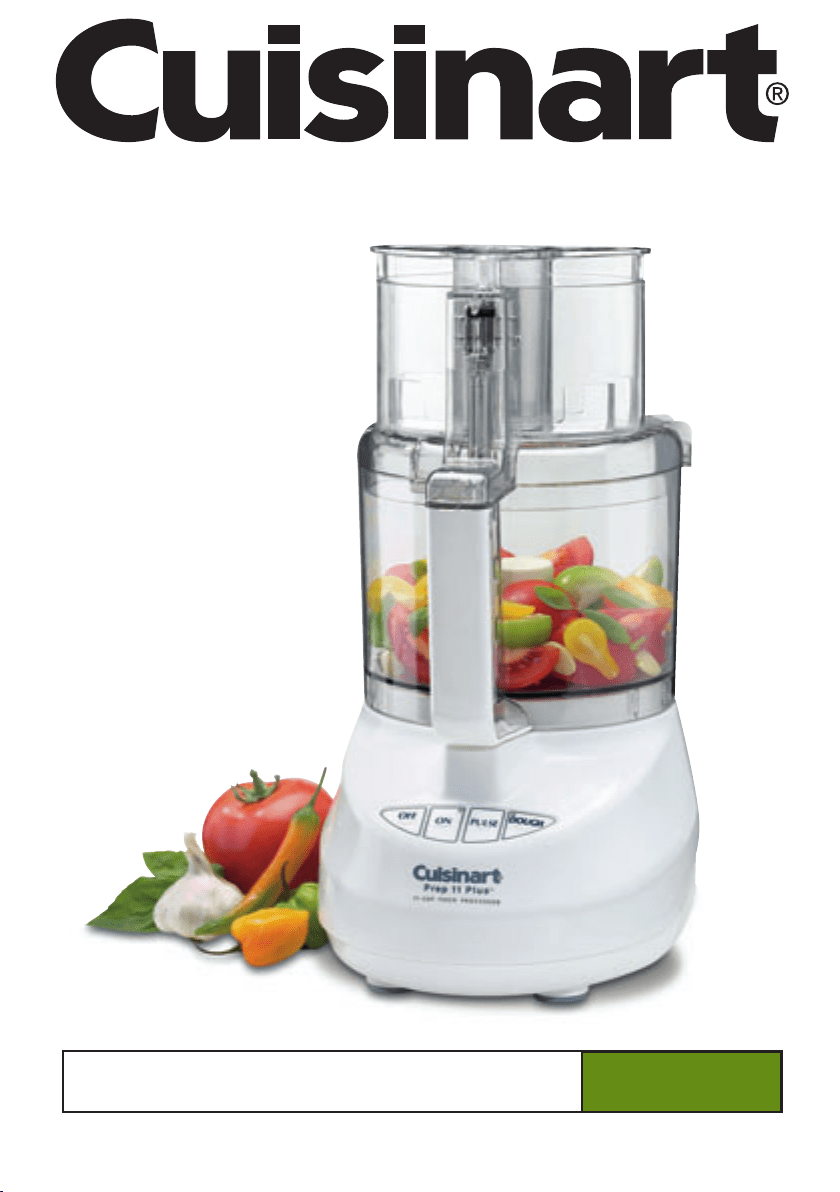
Premier Series 11-Cup Food Processor

1
Recommended work bowl capacity for various foods
FOOD CAPACITY
Chopped Fruits and Vegetables 11 cups processed food
Chopped or Puréed Meat, Poultry,
Fish or Seafood
1¾ pounds meat, cut in 1-inch or smaller cubes, chilled
Bread Dough 5 cups all-purpose flour, yielding two 1¼ pound loaves; 2½ cups
each all-purpose and whole wheat flour, yielding two 1¼ pound
loaves; 2¾ cups whole grain flours (no white flour added) for
custom recipes
Pizza Dough 4½ cups all-purpose flour, yielding 2½ pounds pizza dough
(dough to make up to four 12–14-inch pizzas)
Nuts for Nut Butters 2–4 cups nuts (10–20 ounces)
Sliced or Shredded Cheese, Fruit,
or Vegetables
11 cups (total processed weight varies by food)
Cake Batter 1 standard packaged cake mix (18.5 ounces), or homemade batter
recipe for four 8-inch layers
Thin Liquids (such as custard for
quiche or cheesecake batter)
2¾ cups
Thick Liquids 5–6 cups
Puréed Cooked Fruits and
Vegetables
8 cups cooked, yielding approximately 5½ to
6 cups thick purée
Puréed Soft Fresh Fruits
(berries, kiwis, peaches, etc.)
8 cups fresh, yielding approximately 5 to
6 cups purée
2
IMPORTANT
UNPACKING
INSTRUCTIONS
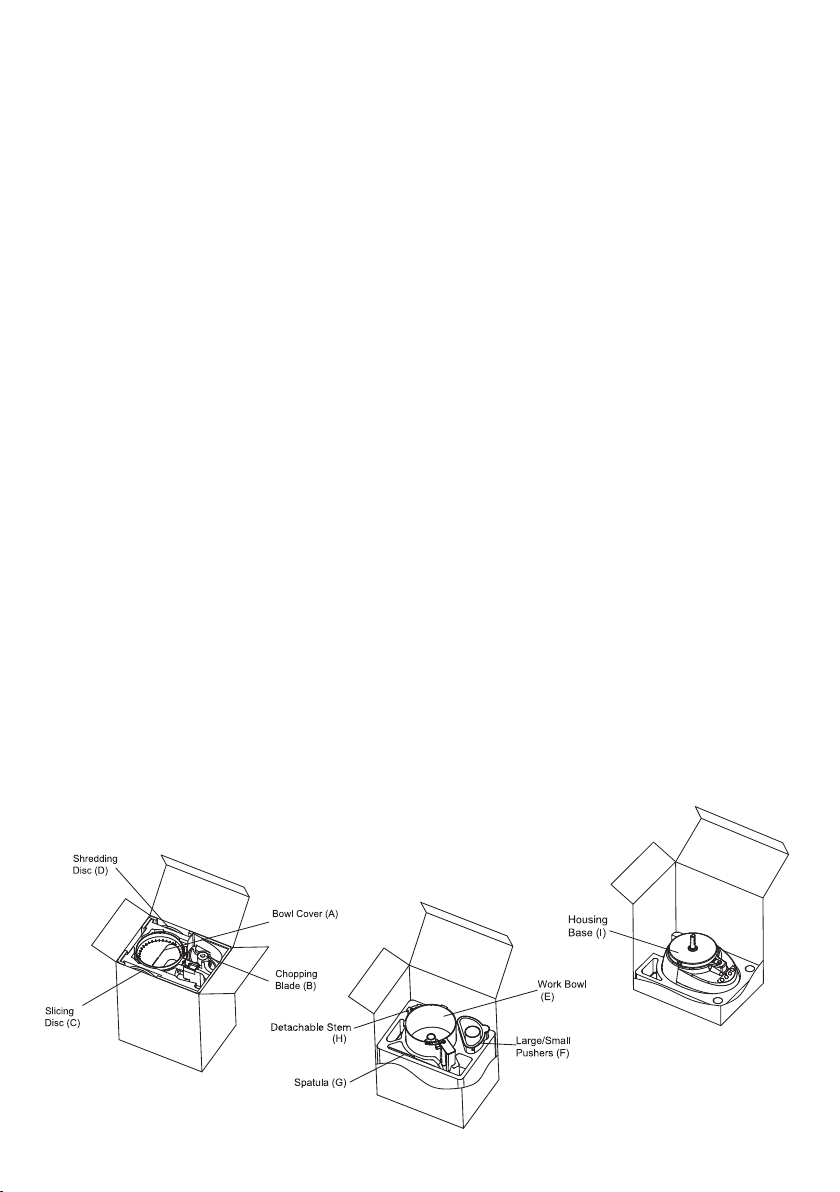
This package contains a Cuisinart
®
Premier Series 11-Cup Food Processor, and
the standard parts for it: work bowl, work
bowl cover, large and small pushers, metal
chopping/mixing blade, slicing disc, shred-
ding disc, detachable disc stem for discs,
spatula, and recipe/instruction book.
CAUTION: THE CUTTING TOOLS HAVE
VERY SHARP EDGES. To avoid injury when
unpacking the parts, please follow these
instructions.
1. Place the box on a low table or on the
oor next to the kitchen counter or
table where you intend to keep the food
processor. Be sure the box is right side
up.
2. Remove the cardboard insert. You will
see a rectangular block of foam that
holds the processor parts, each tted
into a cavity in the foam.
3. The instruction/recipe book sits on the
top of bowl cover. Remove this rst.
4. The bowl cover (A) sits in the center of
the foam block. Remove this next.
5. The metal chopping blade (B) sits in the
cavity. Remove this next.
6. The slicing disc (C) is on the edge
of one of the long sides of the foam
block; the shredding disc (D) is on
the other side. Slide them out WITH
GREAT CARE; THE BLADES ARE VERY
SHARP.
7. Lift out the top foam block.
8. Lift out work bowl (E), large/small push-
ers (F), spatula (G) and detachable stem
(H) from the middle foam block.
9. Lift out the middle foam block.
10. Only the housing base (I) is at the bot-
tom of the box. Use both hands to lift
the base out of the box and place on
the table or counter.
11. Assemble the bowl onto the base by
positioning the handle to the left of
center and turning it counterclock-
wise to lock it into the base. Read the
instructions thoroughly before using the
machine.
12. Save the shipping cartons and foam
blocks. You will nd them very useful if
you need to repack the processor for
moving or other shipment.
NOTE: We recommend that you visit our
website, www.cuisinart.com, for a fast,
ef cient way to complete your product
registration.
WHEN REMOVING BLADE: CAREFULLY
REMOVE THE METAL BLADE BY GRASP-
ING THE CENTER WHITE HUB AND
LIFTING IT STRAIGHT UP. NEVER TOUCH
THE BLADES, AS THEY ARE RAZOR
SHARP.

3
CONTENTS
Recommended Capacities .............................................................................................. 1
Unpacking Instructions ................................................................................................... 2
Important Safeguards ..................................................................................................... 4
Introduction ..................................................................................................................... 5
Machine Includes ............................................................................................................ 6
Assembly Instructions ..................................................................................................... 6
Machine Functions .......................................................................................................... 7
Operating Instructions ..................................................................................................... 7
Techniques for Chopping and Puréeing ........................................................................ 8
Preparing Food for Slicing and Shredding ................................................................... 11
Practicing Slicing and Shredding .................................................................................. 11
Removing Sliced or Shredded Food ............................................................................. 12
Techniques for Slicing and Shredding .......................................................................... 12
Slicing Meat and Poultry ............................................................................................... 12
Slicing and Shredding Cheese ...............................................................................................13
Techniques for Kneading Dough .................................................................................. 14
Typical Bread Dough, Problems and Solutions ............................................................ 15
Typical Sweet Dough, Problems and Solutions ........................................................... 16
Cleaning and Maintenance ........................................................................................... 17
For Your Safety ............................................................................................................. 17
Technical Data............................................................................................................... 18
Warranty ........................................................................................................................ 18
Recipes .......................................................................................................................... 21

4
Carefully read all instructions before using
this appliance.
IMPORTANT
SAFEGUARDS
Always follow these safety precautions when
using this appliance.
Getting Ready
1. Read all instructions.
2. Blades are sharp. Handle them carefully.
3. Always unplug from outlet when not
in use, before putting on or taking off
parts, before removing food and before
cleaning. To unplug, grasp plug and pull
from electrical outlet. Never pull cord.
4. Do not use outdoors.
5. Do not let cord hang over edge of table
or counter, or touch hot surfaces.
6. Do not operate any appliance with
damaged cord or plug, or after appliance
has been dropped or damaged in any way.
Return appliance to the nearest authorized
service facility for examination, repair,
or electrical or mechanical adjustment.
Operation
1. Keep hands as well as spatulas and other
utensils away from moving blades or
discs while processing food, to prevent
the possibility of severe personal injury
or damage to food processor. A plastic
scraper may be used, but only when the
food processor motor is stopped.
2. Avoid contact with moving parts. Never
push food down into feed tube by hand
when slicing or shredding. Always use
pusher.
3. Make sure motor has completely stopped
before removing cover. (If machine does
not stop within 4 seconds after you
remove the pusher assembly, call 1-800-
762-0190 for assistance. Do not use the
machine.)
4. Never store any blade or disc on motor
shaft. To reduce the risk of injury, no blade
or disc should be placed on the shaft
except when the bowl is properly locked
in place and the processor is in use. Store
blades and discs as you would sharp
knives, out of reach of children.
5. Be sure cover and feed tube are securely
locked in place before operating food
processor.
6. Never try to override or tamper with cover
interlock mechanism.
Cleaning
To protect against risk of electrical shock, do
not put base in water or other liquid.
General
1. Close supervision is necessary when any
appliance is used by or near children.
2. Do not operate this, or any other motor-
driven appliance, while under the influence
of alcohol or other substances that affect
your reaction time or perception.
3. This food processor is UL listed for
household use. Use it only for food
preparation as described in the
accompanying recipe and instruction
book.
4. The use of attachments not recommended
or sold by Cuisinart may cause fire,
electrical shock or personal injury, or
damage to your food processor.
5. To avoid possible malfunction of work
bowl switch, never store processor with
pusher assembly completely pushed in.
6. Maximum rating of 5.2 amperes is based
on attachment that draws greatest current.
Other recommended attachments may
draw significantly less current.
7. Do not operate your appliance in an
appliance garage or under a wall cabinet.
When storing in an appliance garage
always unplug the unit from the
electrical outlet. Not doing so could
create a risk of fire, especially if the
appliance touches the walls of the garage
or the door touches the unit as it closes.
NOTICE: This appliance has a polarized plug
(one blade is wider than the other).
As a safety feature, this plug will fit in a
polarized outlet only one way. If the plug
does not fit fully in the outlet, reverse the
plug. If it still does not fit, contact a
qualified electrician. Do not attempt to defeat
this safety feature.
SAVE THESE INSTRUCTIONS
FOR HOUSEHOLD USE ONLY
5
Congratulations on your
purchase of a Cuisinart
®
Premier Series 11-Cup Food
Processor. This product is
the ultimate food preparation
tool, and it comes from the
originator of the American
food processor, Cuisinart.
The Cuisinart
®
Premier Series
11-Cup Food Processor has
all the elements of quality
that Cuisinart is known for,
including a powerful motor,
the Supreme
®
Wide Mouth
Feed Tube, and the longest
warranty in the industry.
• The Cuisinart
®
Supreme
®
Wide Mouth Feed Tube
is perfect for slicing whole
fruits and vegetables without
precutting.
• The Cuisinart
®
Dough
Control Button. We
have engineered a dough
processing speed that will
give you the ability to make
perfect dough in seconds.
These features, plus the
ability to use all your
existing Cuisinart specialty
blades and discs, make the
Premier Series 11-Cup Food
Processor the select choice
in food processors.
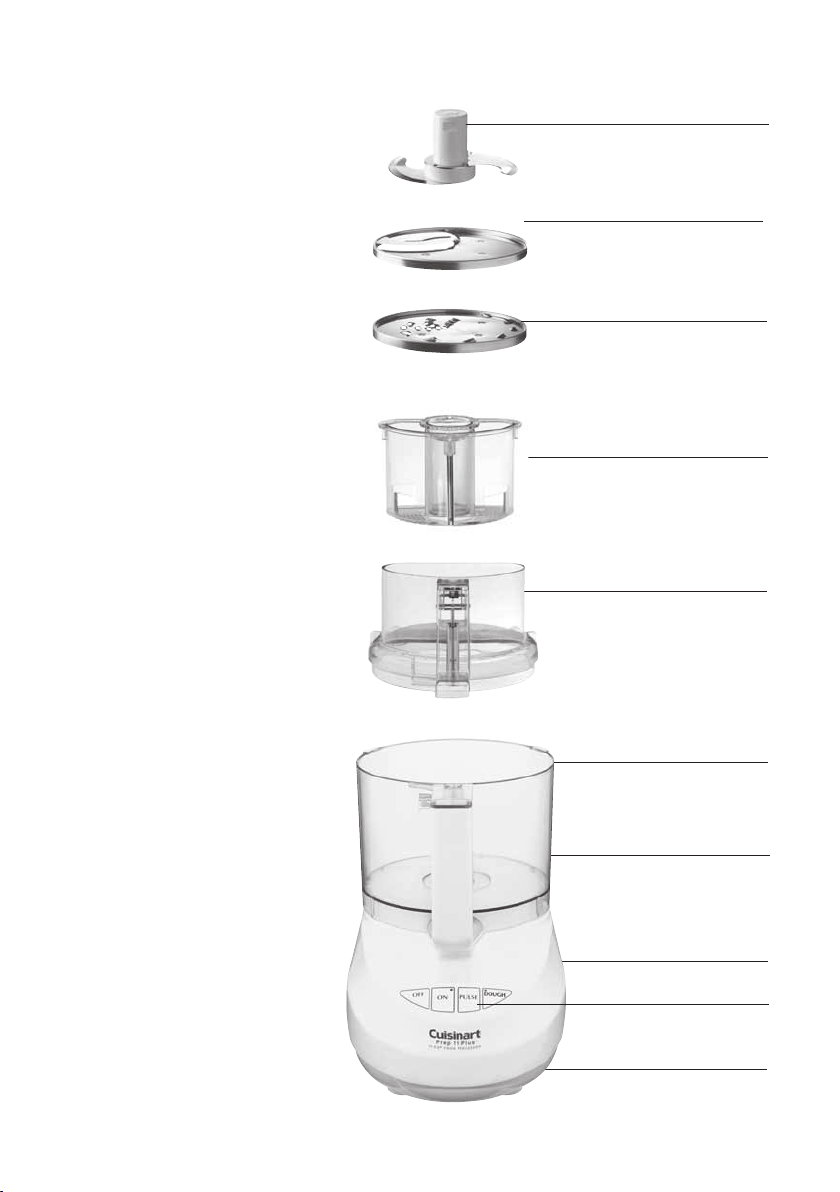
4mm Slicing Disc
Medium
Shredding Disc
Pusher Assembly
(large and small pushers)
Cover with
Cuisinart
®
Supreme
®
Wide Mouth
Feed Tube
Housing Base
Chopping/Mixing/Dough
Blade
Cord Wrap
(not shown)
11-Cup
Work Bowl
Shaft
(not shown)
Touchpad Control
Panel
INTRODUCTION

6
THE MACHINE
INCLUDES:
1 . Housing base with a vertically projecting
shaft and convenient touchpad control
panel.
2. 11-cup work bowl.
3. Cover with extra-large feed tube.
4. Pusher assembly that slides inside the
feed tube.
5.
Sharp metal chopping/mixing/dough blade.
6. Serrated slicing disc.
7. Shredding disc.
8. Detachable stem for discs (not shown).
9. Plastic spatula (not shown).
10.
BPA free (not shown)
All materials that come in contact with
food are BPA free.
The metal chopping blade chops raw and
cooked fruits, vegetables, meat, fish and
cheese to the exact consistency you want,
from coarse to fine, even to a purée. It chops
nuts, makes nut butters, mayonnaise and
sauces, and mixes tender, flaky pastry.
The metal chopping blade also mixes cakes,
frostings, cookies, quick breads, muffins,
and biscuits, and kneads yeast dough.
The slicing disc makes beautiful whole slices
without torn edges. It slices whole fruits and
vegetables, cooked meat, semi-frozen raw meat
and loaves of bread.
The shredding disc processes most firm and
hard cheeses into long, attractive shreds.
It also shreds vegetables like potatoes,
carrots and zucchini, and processes nuts and
chocolate to a grated texture.
The detachable stem fits both discs, making
disc storage compact in limited space.
The pusher assembly has two parts:
1. A small, removable, clear pusher that fits
into a small center-located feed tube. This
tube is for narrow food like carrots, for
adding liquid, and for continuous feeding
of small food like garlic.
2. A large pusher that fits into the Cuisinart
®
Supreme
®
feed tube opening and moves
freely within it.
Upon contact, the large pusher meets an
activating rod in the center of the work bowl
handle, permitting the motor to start.
ASSEMBLY INSTRUCTIONS:
Blade Operation
1. Plug in the housing base and place the
work bowl on top, with the work bowl
handle just to the left of center. Turn the
work bowl counterclockwise to lock it onto
the housing base.
2. CAREFULLY lift and place the chosen
blade over the work bowl center shaft.
Line up the markings on the blade hub
with the motor shaft. It should fit snugly
and rest on the bottom of the work bowl.
3. Add desired ingredients to work bowl.
4. Place work bowl cover onto work bowl,
with the handle area just to the left of
center. Turn counterclockwise to lock
onto work bowl.
5. Align pusher assembly and activating rod
with the feed tube opening on the work
bowl cover and slide the activating rod
down to the bottom.
6. You are now ready to operate the machine.
Disc Operation
1. Plug in the housing base and place the
work bowl on top, with the work bowl
handle just to the left of center. Turn the
work bowl counterclockwise to lock it onto
the housing base.
2. Choose desired disc and place with
underside up on tabletop. Pick up
detachable disc stem and align it with
the raised plastic crescent on the disc
underside. The raised “lock” indicator on
the left corner of the stem should be to
the left of the mounting plate on disc.
3. Turn the stem to the right, so the locking
tabs are covered by the metal supports
and a “click” locks the stem in place.

7
4. With the stem facing down, place the
assembly over the center hub. It should
fit snugly and rest on the bottom of the
work bowl.
5. Place work bowl cover onto work bowl,
with the handle area just to the left of
center. Turn counterclockwise to lock
onto work bowl.
6. Align pusher with the feed tube opening
on the work bowl cover and slide the
activating rod down to the bottom.
7. Use the cord wrap on the housing base
underside to add or remove cord.
8. You are now ready to operate the machine.
MACHINE FUNCTIONS:
PULSE
1. With the machine properly assembled
and engaged, and ingredients in the
work bowl, press the PULSE button
repeatedly as needed.
ON (Continuous)
1. Properly assemble and engage the
machine.
2. To add ingredients through the feed
tube, remove the pusher and fill the
feed tube as directed (see Preparing for
Slicing and Shredding).
3. Engage the pusher and press the ON
button. The button light will turn on and
the motor will start.
4. Press the pusher firmly down until all
ingredients have passed into the
work bowl.
Remove the pusher and refill
ingredients as needed. When you
engage the pusher again, the unit will
automatically turn ON.
5. Press the OFF button when finished.
DOUGH Button
1. Prepare the dough ingredients and place
in work bowl.
2. Properly assemble and engage the work
bowl cover and pusher.
3. Press the DOUGH button and the light
will turn on.
4.
Then press the ON or PULSE buttons as
needed to process dough. The ON light
will turn on
.
NOTE:
The dough mode works in conjunction
with the ON button. The machine will not operate
if only the DOUGH button is pushed. You must
also push the ON button to activate the DOUGH
function.
5. Press the OFF button when finished.
OPERATING
INSTRUCTIONS:
Try chopping some practice foods, such as
zucchini or carrots, before you process food
to eat. First, cut the ingredients into 1-inch
pieces of uniform size and length.
• Place the work bowl over the center stem,
with the handle area just left of center.
Turn counterclockwise to lock in place.
• Insert the metal chopping blade and
put ingredient pieces in the work bowl.
Put on the cover and turn counterclockwise
to lock onto work bowl. Align the pusher
and the pusher’s activating rod with the
corresponding openings on the feed tube,
and push all the way down.
• Press and release the PULSE button two
or three times. Each time the blade stops,
let the pieces drop to the bottom of the
bowl before you pulse again. This puts
them in the path of the blade each time
the motor starts.
• Using the pulse/chopping technique, you
get an even chop without overprocessing.
Check the texture frequently by looking
through the cover. If you want a finer chop,
press and release the PULSE button until
you achieve the desired texture. Onions
and other food with a high water content
will quickly end up as a purée, unless
examined through the work bowl after
each pulse to make sure they are not
overprocessed.
Try chopping other food like meat for
hamburger or sausage. Then make
mayonnaise, pastry or bread, as described
in the following sections. To obtain consistent
results:
• Be sure all the pieces you add to the bowl
are about the same size.
• Be sure the amount you process is no
larger than amount recommended on the
inside
cover of this booklet.
Before you do anything, wait for the blade
to stop spinning. Once it does, turn the cover
clockwise to unlock, and remove by lifting

8
it off.
Remove the bowl from the base of the
machine before removing the blade. This
creates a seal to prevent food from leaking.
Turn the bowl clockwise to unlock from the
base, and lift straight up to remove.
To prevent the blade from falling from the
work bowl onto your hand when emptying
the work bowl, use one of the following
methods.
Be sure your hands are dry. Grab the blade
hub, and remove the metal blade before
tilting the bowl, using a spatula to scrape off
any food. Then carefully lift the blade out of
the work bowl. Or insert your finger through
the hole in the bottom of the work bowl,
gripping the blade from the bottom, and
grip the outside of the work bowl with your
thumb. Or hold the blade in place with your
finger or spatula while pouring out food.
TECHNIQUES FOR
CHOPPING AND PURÉEING
To chop raw fruits and vegetables:
First, cut the food into 1-inch (2.5cm) pieces.
You get a more even chop when all pieces
are about the same size.
Put no more than the recommended amount
of food into the work bowl (see table
inside front cover). Lock the cover in place.
Press the PULSE button at the rate of 1
second on, 1 second off, until the food is
coarsely chopped. For more finely chopped
results, hold the PULSE button, letting the
machine run continuously until the desired
consistency is reached. Check frequently to
avoid overprocessing. Use the spatula
to scrape down the sides of the work bowl
if necessary.
To purée fruits and cooked vegetables:
First, cut the food into 1-inch (2.5cm) pieces.
You get a smoother purée faster when all
pieces are about equal in size.
Put no more than the recommended amount
of food in the work bowl (see table inside
front cover). Lock the cover in place. PULSE
to chop coarsely, then press the ON button
and process continuously until food is
puréed. (NOTE: Cooked potatoes are an
exception to this procedure. They develop
a gluey texture when processed with the
metal blade.)
When making soup, you will want to purée
vegetables that have been cooked in liquid.
Don’t add the liquid to the work bowl, just
the cooked vegetables; remove vegetables
with a slotted spoon. They will purée faster
and smoother without liquid. Then add just
enough liquid to make the purée pourable.
Return to the soup liquid and stir to combine.
To dislodge food:
Occasionally, a piece of food may become
wedged between the blade and the work
bowl. If this happens, unplug the machine,
remove the cover, lift the blade out carefully
and remove the wedged piece. Empty the
bowl, reinsert the blade and lock the cover
and pusher into place. Press the ON button
and drop the food pieces through the small
feed tube opening while the machine is
running. After adding a cupful this way, add
the remaining food to the bowl and process
in the usual manner.
To chop hard foods:
To chop hard foods like garlic and hard
cheese, assemble the unit, remove the small
pusher, press the ON button and drop the
food through the small feed tube while the
machine is running.
Small foods like garlic can be dropped in
whole. Large foods like hard cheese should be
cut into 1-inch (2.5cm) pieces. This method of
processing minces garlic, shallots and onions.
Hard cheese and coconut will have the same
texture as if they had been hand grated.
IMPORTANT: Never try to process cheese
that is too hard to cut with a knife. You may
damage the blade or the machine.
To chop parsley and other fresh herbs:
The herbs, the work bowl and the metal
chopping blade must all be thoroughly clean
and dry. Remove stems from herbs.
Add leaves to bowl and process, using the
PULSE button, until chopped as fine as
desired. The more herbs you chop at a time,
the finer chop you can obtain. If completely
dry when chopped, parsley and other herbs
will keep for at least 4–5 days, stored in an
airtight bag in the refrigerator. They may
be frozen for months, stored in an airtight
container or bag.

9
To chop peel from citrus fruit or to chop
sticky fruit like dates or raisins:
For citrus, remove only the peel with a
vegetable peeler, not the white pith which
is bitter tasting.
Cut the peel into lengths of 2 inches (5cm)
or less and process with
½ cup (125 ml) of
granulated sugar until finely chopped. This
may take 2 minutes or longer.
For sticky fruit like dates, raisins, prunes and
candied fruit, first freeze the fruit for about
10 minutes. Add some of the flour called for
in the recipe to the fruit. Use no more than 1
cup (250 ml) of flour for each cup of fruit.
To chop meat, poultry, fish and seafood:
The food should be very cold, but not frozen.
Cut it into 1-inch (2.5cm) pieces to ensure an
even chop. Using the ON button, process no
more than the recommended amount at one
time (see table inside front cover). Or press
the PULSE button 3 or 4 times at a rate of
1 second on, 1 second off. If the food is not
chopped fine enough, let the processor run
continuously for a few seconds.
Check the texture often to avoid overprocessing
.
Use a spatula to scrape food from the sides
of the bowl as necessary.
To purée meat, poultry, fish and seafood:
Prepare the food as described above. Press
the PULSE button until evenly chopped.
Scrape the bowl with a spatula as needed.
Leave the purée in the work bowl and add
eggs, cream and seasonings as called for by
the recipe. Process to combine thoroughly.
Remember, you control texture by the length
of time you process. By varying the number
of pulses, you can get a range of textures
suitable for hamburgers, hash, stuffed
peppers, or smooth mousses.
To chop nuts:
Chop no more than the recommended
amount at one time. Press and release the
PULSE button and check frequently to avoid
nuts clumping together in a nut butter. When
a recipe calls for flour or sugar, add some to
the nuts before you chop, about ½ cup for
each cup of nuts. This allows you to chop the
nuts as fine as you want without turning them
into a nut butter. You can also chop nuts with
a shredding disc. The optional Fine Shredding
Disc is particularly good.
To make peanut butter and other nut
butters:
Process up to the recommended amount
of nuts. Using the ON button, let the machine
run continuously. After 2 or 3 minutes, the
ground nuts will form a ball that will gradually
smooth out. Scrape the sides of the bowl
and continue processing until drops of oil
are visible. Taste for consistency. The longer
you process, the softer the butter. For chunk
style, add a handful of nuts just after the
ball of nut butter begins to smooth out.
To make cashew butter, add a little bland
vegetable oil. Processor nut butters contain
no preservatives. Store in refrigerator to keep
from separating.
To make flavored butters, spreads and
dips:
Cut room temperature butter into tablespoon-
size pieces. Finely chop flavoring ingredients
first, such as anchovies, cheese, herbs, etc.
Be sure work bowl is clean and dry. Add
small hard ingredients like garlic and hard
cheese through the feed tube while machine
is running. Next, add the butter and process
using the ON button, until smooth. Add any
liquid ingredients last, while the processor
is running, and process just long enough to
blend. Process ingredients for spreads and
dips the same way. All ingredients should
be at room temperature and cut into 1-inch
(2.5cm) cubes, or added by tablespoonfuls
To make mayonnaise:
You can make foolproof homemade
mayonnaise with your Premier Series 11-
Cup Food Processor. The work bowl and
metal blade must be clean and dry. Use the
metal blade to process eggs (for safe food
procedures, we recommend using pasteurized
liquid eggs, or the “cooked egg” recipe on
page 53), salt, vinegar, lemon juice, mustard,
and 1 teaspoon of the oil until smooth, at least
30 seconds. With the machine running, pour
1
⁄4 cup of the oil into the small pusher. After
it drizzles through the pinhole in the bottom,
remove the small pusher and very slowly add
the remaining oil while the machine runs.
Process until all the oil has been added and
the mixture is totally emulsified. Remove from
the processor, cover and keep chilled until
ready to use. Homemade mayonnaise will

10
keep in the refrigerator for 3 to 4 days.
For variation, you may experiment with using
flavored vinegars, or adding chopped fresh
herbs, or even roasted garlic to taste. To
make your mayonnaise a little lighter, you
may add some well-drained nonfat plain
yogurt to taste.
To beat egg whites:
The work bowl must be absolutely clean.
Add 3 or more egg whites (up to 6 large
egg whites) and press the ON button. Add
about 1 teaspoon of lemon juice or vinegar
for every egg white. Vinegar makes stiffer
whites; its flavor is hardly detectable in cakes
or soufflés. Continue processing until the
egg whites hold their shape, about 1½ to 2½
minutes.
To whip cream:
Processor whipped cream holds its shape
very well. It is good for decoration or as a
topping; however, it will not whip to the light,
fluffy consistency obtained by methods that
beat in more air. Chill the cream well before
starting. Process continuously using the
ON button, until cream begins to thicken.
Then add sugar as desired and continue
processing, watching carefully for the desired
consistency. For consistently reliable results,
add 2 tablespoons (30ml) of nonfat dry milk
for every cup of cream before whipping.
To make crumbs and crumb crusts:
Cut or break bread, crackers or cookies into
1-inch pieces and place in work bowl. Press
the ON button and process continuously
until crumbs reach the desired texture. For
seasoned crumbs, chop parsley or other
fresh herbs with the crumbs. For buttered
crumbs, process until the dry crumbs are
of the desired texture, then dribble melted
butter through the small feed tube opening
while the machine is running. For crumb
crusts, process crackers or cookies as
described above. Add sugar, spices and
butter, and cut into pieces as specified by
your recipe. Process until well combined.
To make pastry:
Combine unbleached all-purpose flour,
salt and pieces of very cold butter in the
work bowl. Process to the consistency of
cornmeal. Sprinkle evenly with the minimum
amount of cold liquid in the recipe. PULSE
5 or 6 times. The dough should begin to
hold together when pressed. If it is still dry
and crumbly, add more water – 1 teaspoon
at a time – until the dough holds together
easily. Do not let the dough form a ball in the
processor or it will be overworked and tough.
Form into a round disc, one inch thick, and
wrap in plastic wrap. Refrigerate for 1 hour
before using, or double wrap and freeze for
later use.
To make quick breads and cakes that use
baking powder and/or soda:
The most important rule for success is not to
overmix after adding the flour. If the recipe
calls for chopped ingredients like lemon peel
or nuts, chop them first while the work bowl
is clean and dry, then set aside until needed.
Put dry ingredients like flour, salt and
leavening in the work bowl and process
with the metal blade for 5 seconds to mix.
Remove and reserve the dry ingredients.
Add the eggs and sugar to the work bowl
and, using the ON button, process to mix,
letting the machine run about 1 minute. Next,
add butter, cut into 1-inch pieces and at room
temperature. Run machine continuously for
a minute, until the butter is thoroughly mixed
with the sugar and eggs. Then add flavoring
and liquid – vanilla, spices, cocoa, etc.
Process until mixed. Add the dry ingredients
to the work bowl.
Process by pulsing, inspecting after each
pulse. Stop pulsing as soon as the dry
ingredients have almost disappeared into
the batter. Overprocessing will cause quick
breads and cakes to be tough. (If your recipe
calls for ingredients that are to be coarsely
chopped – like raisins or nuts – add them last
with the mixed dry ingredients.)
To make cake mix:
Your food processor work bowl is large
enough for the preparation of an 18.5-ounce
packaged cake mix.
Insert the metal blade and add the cake mix
to the work bowl. Press the ON button and
while the machine is running, add the eggs
and liquid through the small feed tube and
process for 5 seconds.
Scrape down the sides of the work bowl and
process 1 minute more for maximum volume.
Do not remove the metal blade.

11
Insert a finger into the underside of the blade
from the bottom of the work bowl, to hold the
blade in place while emptying the batter.
Tip:
After emptying cake batter or puréed soup
from the work bowl, replace the bowl on the
motor base and PULSE once. Centrifugal
force will spin the batter off the blade onto
the sides of the work bowl.
Remove the blade, and use the spatula to
scrape any remaining batter from the bowl.
PREPARING FOOD FOR
SLICING AND SHREDDING
For disc assembly instructions, refer to
Assembly Instructions.
Round fruits and vegetables:
Before processing onions, apples and other
large, round fruits and vegetables, cut the
bottom ends flat to make the food lie stable
on the disc.
Place the food in the feed tube, flat side
down, as far left as possible, to prevent it
from tilting when being processed.
Choose fruits that are firm and not too ripe.
Remove large, hard pits and seeds from
fruits before processing. Seeds from citrus
fruits need not be removed. Remove the rind
before slicing or shredding, if desired.
Whole peppers are an exception:
Remove the stem and cut the stem end flat.
Remove the core and scoop out the seeds. Leave
the end opposite the stem
whole, to keep the
structure stiff. This ensures round, even slices.
Large fruits like pineapple:
Cut the ends flat, cut in half, and either core
or remove the seeds. If necessary, cut the
halves into smaller pieces to fit the feed tube.
Cabbage and iceberg lettuce:
Turn the head on its side and slice off the top
and bottom, leaving a center section about
3 inches (8cm) deep. Remove the core, then
cut in wedges to fit the feed tube.
The optional 2mm and 1mm Slicing Discs are
excellent for slicing cabbage for coleslaw.
If the fruit or vegetable doesn’t fit, try
inserting it from the bottom of the feed tube,
where the opening is slightly larger.
Pack the feed tube for desired results:
For long slices or shreds, cut the food in feed
tube widths and pack the pieces horizontally.
For small, round slices or short shreds from
carrots, zucchini and other long vegetables,
cut in feed tube heights and pack tightly
upright.
Food should fit snugly, but not so tightly that it
prevents the pusher from moving.
When slicing or shredding, always use the
pusher.
Never put your fingers or a spatula
into the feed tube.
Never push down hard on the pusher. Use
light pressure for soft fruits and vegetables
like bananas, mushrooms, strawberries and
tomatoes, and for all cheeses. Use medium
pressure for most food: apples, celery,
citrus fruit, potatoes and zucchini. Use firm
pressure for hard vegetables like carrots
and yams.
PRACTICING
SLICING AND SHREDDING
1. Insert a slicing or shredding disc, put
the cover on the work bowl and insert
the food in the feed tube.
2.
Slide the pusher into place, and apply
pressure to the pusher while pressing down
the PULSE button. Release the button as
soon as the food is sliced or shredded.
3. You can load the feed tube repeatedly
without removing work bowl cover. Simply
grasp the pusher and lift up. The pusher
assembly will come off easily, leaving the
cover and feed tube in place. Your other
hand is free to reload the feed tube, and
you do not need to re-press the ON button
if it was previously selected.

12
REMOVING
SLICED OR
SHREDDED FOOD
Before you do anything, wait for the disc to
stop spinning. When it does, unplug the unit,
then hold the work bowl handle and turn it
clockwise. Then lift; the work bowl and cover
will come off together. Turn cover clockwise
to unlock from work bowl. Lift, remove, invert
and place on counter space.
Remove the slicing or shredding disc:
Place two fingers under each side of the disc
and lift it straight up. Place the disc on top
of the inverted work bowl cover to minimize
drips and spills.
TECHNIQUES
FOR SLICING AND
SHREDDING
Small, round fruits and vegetables:
For large berries, radishes and mushrooms,
trim the bottom ends flat with a knife. Insert
the food through the feed tube, standing
each piece on a flat end. You can fill the
tube to about 1 inch (2.5cm) from the top.
The bottom layer gives you perfect slices
for garnish. If you want all the slices to
be perfect, it’s best to process one layer at
a time.
Long fruits and vegetables:
Trim foods like bananas, celery and zucchini
by cutting them into pieces slightly shorter
than the feed tube. Cut both ends flat. (Use
a ruler as a guide, or the pusher assembly.)
Fill the feed tube with the pieces, standing
them vertically and adding enough pieces
so they are solidly packed and cannot tilt
sideways as they are sliced or shredded.
Small amounts of food:
Use the small feed tube and the small pusher.
Remove the small pusher from the pusher
assembly. Place the pusher assembly onto
the feed tube and press the sleeve all the way
down.
Cut the food in lengths slightly shorter than
the feed tube. If slicing one or two long, thin
vegetables like carrots, push them to the far
left. If you are slicing a few vegetables that
are wide at one end and narrow at the other
(carrots, celery or scallions), cut them in half
and pack in pairs, alternating one wide end
up, one narrow end up.
French-cut green beans:
Trim fresh green beans to feed tube widths.
Stack in the feed tube horizontally to about
one inch from the top. Use the slicing disc,
apply light pressure to the pusher and press
the PULSE button until beans are sliced.
To make long, horizontal slices of raw zucchini
or carrots, use the same procedure.
Matchsticks or julienne strips:
Process the food twice – “double slice” it.
Insert large fruits or vegetables (potatoes,
turnips, zucchini, apples) in the feed tube.
Cut pieces to fit the feed tube horizontally
from end to end. Apply pressure to the
pusher while pressing the PULSE button until
the food is sliced. You will get long slices.
Remove the slices from the work bowl and
reassemble. The slices should be assembled
horizontally with the cut edges facing front
and back. Reinsert them in the feed tube,
wedging them in tightly. Slice them again.
You will obtain long julienne strips. With the
optional Square Julienne Disc, you can make
square julienne strips in one operation.
SLICING MEAT
AND POULTRY
Cooked meat and poultry:
The food must be very cold. If possible, use a
piece of food just large enough to fit in the feed
tube. To make julienne strips of ham, bologna
or luncheon meat, stack slices, then roll or
fold them double and stand upright in the feed
tube, wedging in as many rolls as possible.
This technique works better with square or
rectangular pieces than with round ones.

13
Raw meat and poultry:
Cut the food into pieces to fit the feed tube.
Boneless, skinned chicken breasts will usually
fit when cut in half crosswise. Wrap the pieces
in plastic wrap and put them in the freezer.
They are ready to slice when
they are easily
pierced with the tip of a sharp knife, although
semi-frozen and hard to the touch. Remove
plastic wrap. Stand them in the feed tube,
cut side down, and slice them against the
grain, using firm pressure on the pusher. Or
lay them flat in the feed tube, as many as
will fit, and slice with the grain, using firm
pressure.
Salami and other sausages:
If the sausage is soft, freeze it until hard to
the touch, but easily pierced with the tip
of a sharp knife. Hard sausages need not
be frozen. Use the small feed tube if the
sausage is thin enough to fit. Otherwise, cut
the sausage into pieces to fill the large feed
tube completely. Stand the pieces vertically,
packing them tightly so they cannot tilt
sideways.
Firm cheese like Swiss and Cheddar:
Cut the cheese into pieces to fit the feed
tube. Put it in the freezer until semi-frozen,
hard to the touch, but easily pierced with the
tip of a sharp knife. Stand the pieces in the
feed tube and apply light pressure to
the pusher.
IMPORTANT:
Never try to slice soft cheese like mozzarella
or hard cheese like Parmesan. You may
damage the slicing disc or the food
processor itself. You can successfully
shred most cheeses except soft ones.
The exception is mozzarella, which shreds
well if thoroughly chilled. Hard cheeses
like Parmesan shred well only at room
temperature. Therefore, only attempt to shred
mozzarella when well chilled, and Parmesan
when at room temperature.
SLICING AND SHREDDING CHEESE
TYPE OF CHEESE CHOP/PURÉE SHRED SLICE
Soft
Brie, Camembert, room temperature yes no no
Mozzarella, chilled 15–20 min. in freezer no yes no
Ricotta, room temperature yes no no
Cottage cheese, Cream cheese yes no no
Semi-Soft
Blue, chilled yes yes no
Fontina, chilled yes yes no
Semi-Hard
Cheddar, chilled yes yes yes
Monterey Jack, chilled yes yes yes
Swiss, Jarlsberg, chilled yes yes yes
Edam, Gouda, chilled yes yes yes
Provolone, chilled yes yes yes
Hard, at room temperature
Parmesan, Romano yes yes no
Pecorino, Asiago yes yes no
*Soft and semi-soft cheeses will purée; semi-hard and hard cheeses will chop.

14
TECHNIQUES FOR
KNEADING DOUGH
The Premier
Series 11-Cup Food Processor
is designed to mix and knead dough in a
fraction of the time it takes to do it by hand.
You will get perfect results every time if you
follow these directions.
NEVER TRY TO PROCESS DOUGH THAT IS
TOO STIFF TO KNEAD COMFORTABLY BY
HAND.
There are two general types of yeast dough.
Typical bread dough is made with a flour
mix that contains at least 50% white flour. It
is uniformly soft, pliable and slightly sticky
when properly kneaded. It always cleans the
inside of the work bowl completely when
properly kneaded.
Typical sweet dough contains a higher
proportion of sugar, butter and/or eggs than
typical bread dough. It is rich and sticky and
it may not clean the inside of the work bowl.
It requires less kneading after the ingredients
are mixed. Although 30 seconds are usually
sufficient, 60 seconds give better results if
the machine does not slow down. Except for
kneading, described below, the processing
procedures and use of the DOUGH button
are the same for both types of dough.
Machine capacity:
Recommended maximum amount of flour
is 5 cups of all-purpose flour or 2¾ cups of
whole grain flour. If a bread dough calls for
more than the recommended amounts of
flour, mix and knead it in equal batches. Do
the same for sweet doughs that call for more
than 3½ cups of flour.
Measuring the flour:
It’s best to weigh it. If you don’t have a
scale, or the recipe does not specify weight,
measure by the stir, scoop and sweep
method. Use a standard, graduated dry
measure, not a liquid measuring cup.
With a spoon or fork, stir the flour in its
container. Do not measure flour directly
out of the bag; it is too packed to get an
accurate measure. With the dry measure,
scoop up the flour so it overflows. With
a spatula or knife, sweep excess flour back
into the container so the top of the measure
is level. Do not pack flour into the dry
measure.
Proofing the yeast:
The expiration date is marked on the
package. To be sure your yeast is active,
dissolve it in a small amount of warm liquid
(about
1
⁄3 cup [75ml] for one package of
dry yeast). The temperature of liquid used
to dissolve and activate yeast must be
between 105
˚
F and 110
˚
F (40
˚
C and 43
˚
C).
Yeast cells are not activated at temperatures
lower than this and they die when exposed
to temperatures higher than 130
˚
F (54
˚
C). If
the recipe includes a sweetener like sugar or
honey, add a small amount with the yeast.
If no sweetener is called for, add a pinch, or
add a pinch of flour. The yeast proofs better
with it. Let the mixture stand until it foams,
up to 10 minutes.
Processing dry ingredients:
Put the flour in the work bowl with all the
other dry ingredients. If the recipe calls for
herbs, oil or solid fats like butter, add them
with the flour. Turn the machine on and let it
run for about 20 seconds. (Cheese, nuts and
raisins may be added with the dry ingredients
or during the final kneading. To leave them
almost whole, add them 5 seconds before
you stop kneading. For a finer texture, add
them sooner.)
Adding liquids:
All liquid should be added through the small
feed tube while the machine is running. Add
liquid in a slow, steady stream, only as fast
as dry ingredients absorb it. If liquid sloshes
or splatters, stop adding it but do not turn off
the machine. Wait until ingredients in bowl
have mixed, then add remaining liquid slowly.
Pour liquid onto dough as it passes under
feed tube opening. Do not pour liquid
directly
onto bottom of bowl.
Follow the recipe carefully. It is important to
add enough liquid to make the dough soft
enough to knead. Kneading dough that is
too stiff can strain the machine.
All liquid, except that which is used to
activate yeast, should be cold, to minimize
the possibility of overheating the dough.
You must never knead a yeast dough to a
temperature higher than 100
˚
F (37
˚
C). Doing
so will slow or even prevent the action of
the yeast.

15
Kneading bread dough:
Do not try to use the machine to knead
dough that is too stiff to knead comfortably
by hand. Doing so can strain the machine.
After the dough starts to clean the inside of
the work bowl completely and forms a ball,
process it for 60 seconds to knead it. Stop
the machine and test the dough to be sure
it is properly kneaded. Typical bread dough
should have a soft, pliable texture and it
should feel slightly sticky. Stretch the dough
with your hands to test it. If it feels hard,
lumpy or uneven, continue processing until
it feels uniformly soft and pliable. Make sure
that the blade is firmly pressed back into
place after removing the dough to test it.
Kneading sweet dough:
Process dough for at least 30 seconds
after all the ingredients have been
incorporated. It may not clean the inside
of the work bowl. If necessary, scrape the
bowl and process for 5 more seconds.
Rising:
Put the dough in a large, lightly floured
resealable plastic bag. Squeeze out all the
air and close tightly, allowing space for the
dough to rise.
Or put the ball of dough in a large bowl
coated with soft butter or vegetable oil.
Roll the dough around to coat its entire
surface. Cover it with a damp towel or a
piece of oiled plastic wrap.
Let it rise in a warm, draft-free place,
about 80
˚
F (26
˚
C). The rising time is usually
about 1
½ hours, but will vary from 45
minutes to several hours, depending on the
type of flour and the humidity in the air.
To test whether the dough has risen
enough, stick a finger in it. An indentation
should remain. If it doesn’t, let the dough
rise more and test again.
When it has risen enough, punch the
dough down.
Shaping, finishing and baking:
If you shape the dough in loaf pans, fill
pans only half full. Let rise until dough is
just slightly above the top of the pan. If
shaping free-form loaves, let them rise on
an oiled baking sheet until at least doubled
in bulk.
Making consecutive batches:
You can make several batches of bread
dough in a row. The motor in the Premier
Series 11-Cup Food Processor is
extremely efficient.
TYPICAL BREAD DOUGH
PROBLEMS AND
SOLUTIONS
If metal blade doesn’t incorporate
ingredients:
Always start processor before adding
liquid. Add liquid in a slow, steady stream,
only as fast as dry ingredients absorb it.
If you hear liquid sloshing, stop adding
it, but do not turn off machine. Instead,
wait until ingredients in work bowl have
mixed, then add remaining liquid slowly.
Pour liquid onto dough as it passes under
feed tube; do not pour liquid directly onto
bottom of work bowl.
Blade rises in work bowl:
Blade may not have been pushed down as
far as possible before processing started.
Excessively sticky dough can cause blade
to rise even though it cleans inside of work
bowl. If dough feels very sticky, carefully
reinsert blade and immediately add 2
tablespoons (30ml) flour through small
feed tube while machine is running.
Dough doesn’t clean inside of
work bowl:
• Amount of dough may exceed maximum
capacity of your food processor. Remove
half and process in 2 batches.
• Dough may be too dry. If it feels crumbly,
add water, 1 tablespoon
(15ml) at a time, while machine is
running, until dough becomes moist
and cleans inside of work bowl. Wait
10 seconds between additions of water.
• Dough may be too wet. While machine is
running, add 1 tablespoon (9g) of flour. If
necessary, add more, 1 tablespoon (9g)
at a time, until dough cleans inside of
work bowl and forms a ball.

16
Nub of dough forms on top of blade and
does not become uniformly kneaded:
Stop machine, carefully remove dough,
divide into 3 pieces and redistribute evenly
in work bowl. Continue processing until
dough is uniformly soft and pliable.
Dough feels tough after kneading:
Divide dough into 2 or 3 pieces and
redistribute evenly in bowl. Process 10
seconds or until uniformly soft and pliable.
Soft dough or liquid leaks onto base of
food processor:
Always start processor before adding
liquid and add liquid only as fast as dry
ingredients absorb it.
Motor stops:
• Cover may have become unlocked.
• Power cord may have become
unplugged.
• Excessive strain may have caused motor
to overheat and stop. Wait for the motor
to cool, 5–10 minutes. A safety protector
in the motor prevents excessive
overheating. If the motor stops, turn
machine off. After 5–10 minutes, divide
dough into 2 batches and complete
processing. Pinch dough to make
sure that it is not too stiff to knead
comfortably by hand. If it is, add liquid,
1 teaspoon (5ml) at a time, until dough is
sufficiently moist to clean inside of bowl.
Dough doesn’t rise:
We recommend you always test activity
of yeast before using, by stirring it and
adding a small amount of granulated
sugar into about
1
⁄3 cup (75ml) warm liquid
(105
˚
F – 110
˚
F) (40
˚
C – 43
˚
C). Within 10
minutes foam should develop, indicating
yeast is active. Do not use dry yeast after
expiration date on package.
Do not use water that exceeds the given
temperature or overheat dough with
excessive kneading, as it may kill the yeast
cells. All other liquid should be cold.
Do not knead so long that dough becomes
overheated. The ideal temperature for
kneaded dough is 80
˚
F (26
˚
C); it should
never exceed 100
˚
F (37
˚
C).
Let dough rise in draft-free environment of
about 80
˚
F (26
˚
C).
Dough containing whole grain flour will
take longer to rise than dough made of
white flour only.
Baked bread is too heavy:
Next time, feel dough to be sure it is
uniformly soft, pliable and slightly sticky
before setting aside to rise. Let dough fully
double in bulk in bowl or bag, then punch
it down, and let it double again after it is
shaped.
TYPICAL
SWEET DOUGH
PROBLEMS
AND SOLUTIONS
Motor slows down:
• Amount of dough may exceed
maximum capacity. Remove half, and
process in 2 batches.
• Don’t process too long after all
ingredients are incorporated. Rich
doughs will give you good results after
only 30 seconds of kneading.
Blade doesn’t incorporate ingredients:
Butter or margarine, if not melted, must
be cut into tablespoon-size pieces before
being added to work bowl. Make sure
butter or margarine is at room temperature.
Metal blade rises in work bowl:
Blade may not have been pushed down as
far as possible before processing started.
Machine may be overloaded. Carefully
remove half of dough and process in 2
batches.
Motor stops:
See comments under “Typical Bread
Dough Problems and Solutions.”
Dough doesn’t rise:
See comments under “Typical Bread
Dough Problems and Solutions.”

17
CLEANING AND
MAINTENANCE
Keep your food processor ready to use on
a kitchen counter. When not in use, leave it
unplugged.
Store the blade and discs as you
would sharp knives, out of the reach of
children. The disc and blade holders are
optional accessories which offer safe and
convenient storage.
All parts except the housing base are
dishwasher safe, and we recommend
washing them in the dishwasher on the
top rack only.
Due to intense water heat, washing the
work bowl and work bowl cover on the
bottom rack of your dishwasher may cause
damage over time. Insert the work bowl
upside down. Remember to unload the
dishwasher carefully wherever you place the
sharp blade and discs.
To simplify cleaning, rinse the work bowl,
cover, pusher assembly and blade or disc
immediately after use, so food won’t dry on
them. Openings at the bottom of the large
pusher provide drainage and make cleaning
easy. If food lodges in the pusher, remove it
by running water through it, or use a bottle
brush.
If you wash the blade and discs by hand,
do it carefully. Avoid leaving them in soapy
water where they may disappear from sight.
To clean the metal blade, fill the work bowl
with soapy water, hold the blade by its plastic
center and move it rapidly up and down on
the center shaft of the bowl. Use of a spray
attachment is also effective. If necessary, use
a brush.
The work bowl is made of plastic, which
is shatter resistant and heat resistant. It
should not be placed in a microwave oven.
TIP: When preparing a meal, make the
dishes with the least amount of wet
ingredients first. For example, make the
bread first; then you don’t need to wash
the bowl before making the salad. In many
cases, wiping the bowl with a paper towel
between recipes is sufficient.
Chopping certain foods may scratch or
cloud the work bowl. These foods include
ice, whole spices, coffee beans and oils
like wintergreen. If you like to prepare your
own spice blends, you may want to keep a
second bowl just for that purpose.
The housing base is made of a tough
plastic with high-impact resistance. Its
smooth surface will look new for years.
Keep a sponge handy as you work, and
wipe spills from the base.
Four rubber feet on the underside keep
the base from moving on most work
surfaces when the machine is processing
heavy loads. If the feet leave spots on the
counter, spray them with a spot remover
and wipe with a damp sponge. If any trace
of the spot remains, repeat the procedure
and wipe the area with a damp sponge
and nonabrasive cleaning powder. Dry
completely.
To clean the inside of the detachable stem,
slide the stem release button on the side
up as far as it will go and hold it there as
you run water through the stem.
IMPORTANT: Never store the blade or disc
on the motor shaft. No blade or disc should
be placed on the shaft except when the
processor is about to be used.
Maintenance: Any other servicing should
be performed by an authorized service
representative.
FOR YOUR SAFETY
Like all powerful electrical appliances, a
Premier Series 11-Cup Food Processor
should be handled with care. Follow these
guidelines to protect yourself and your
family from misuse that could cause injury.
Handle and store the metal blade and
discs carefully. Their cutting edges are very
sharp.
Always place discs on flat, stable surface
before connecting detachable stem.
Never put the blade or discs on the motor
shaft until the work bowl is locked in place.
Always be sure that the blade or disc is
down on motor shaft as far as it will go.

18
Always insert chopping blade in the work
bowl before putting ingredients in bowl.
When slicing or shredding food, always
use the pusher. Never put your fingers or
spatula into feed tube.
Always wait for the blade or disc to stop
spinning before you remove the pusher
assembly or cover from the work bowl.
Always unplug the unit before removing
food, cleaning, or putting on or taking off
parts.
Always remove work bowl from base of
machine before you remove chopping
blade.
Be careful to prevent the chopping blade
from falling out of the work bowl when
emptying the bowl. Remove blade before
tilting bowl, or hold it in place with your
finger, a spatula or a spoon.
TECHNICAL DATA
The motor in your food processor operates
on standard line operating current. The
appropriate voltage and frequency for your
machine are shown on the lower housing
under the base.
An automatic, temperature-controlled
circuit breaker in the motor ensures
complete protection against motor
burnout. If the processor runs for an
exceptionally long time when chopping,
mixing or kneading a thick or heavy
mixture in successive batches, the
motor may overheat. If this happens, the
processor will stop. Turn it off and wait for
the motor to cool before proceeding. It will
usually cool within 10 minutes. In extreme
cases, it could take an hour.
Safety switches prevent the machine from
operating when the work bowl or the cover
is not locked into position. The motor
stops within seconds when the motor is
turned off, and a fast-stop circuit stops
it instantly when the pusher assembly is
removed.
Cuisinart offers a Limited Three-Year
Warranty on the entire machine.
FULL TEN-YEAR
WARRANTY ON MOTOR
This warranty is available to consumers only.
You are a consumer if you are the owner of
a Cuisinart
®
Premier Series 11-Cup Food
Processor that was purchased at retail for
personal, family or household use. This
warranty is not available to retailers or other
commercial purchasers or owners.
We warrant that your Cuisinart
®
Premier
Series 11-Cup Food Processor will be free
of defects in material or workmanship under
normal home use for three years from the
date of original purchase.
We warrant that the motor for your Cuisinart
®
Premier Series 11-Cup Food Processor will
be free of defects in material or workmanship
under normal home use for ten years from
the date of original purchase. This motor
warranty covers the motor and excludes
all other parts in the motor base assembly
area such as the upper and lower plastic
housings, work bowl and cover, blades
and all electrical components and vertical
projecting motor shaft sheath.
We recommend that you visit our website,
www.cuisinart.com for a fast, efficient way to
complete your product registration. However,
product registration does not elim- inate
the need for the consumer to maintain the
original proof of purchase in order to obtain
the warranty benefits. In the event that you
do not have proof of purchase date, the
purchase date for purposes of this war- ranty
will be the date of manufacture.
If your Cuisinart
®
Premier Series 11-Cup
Food Processor should prove to be defective
within the warranty period, we will repair it,
or if we think necessary, replace it, without
charge to you. To obtain warranty service,
simply call our toll-free number 800-726-
0190 for additional information from our
Consumer Service Representatives or send
the defective product to Consumer Service
at Cuisinart, 7475 North Glen Harbor Blvd.,
Glendale, AZ 85307.
To facilitate the speed and accuracy of your
return, please enclose $10.00 for shipping
and handling of the product.
If the problem with the machine is
determined to be a defect of the motor, and
within the warranty period, all postage and
handling charges will be refunded.
Please pay by check or money order
(California residents need only supply proof

19
of purchase and should call 1-800-726-0190
for shipping instructions).
NOTE: For added protection and secure
handling of any Cuisinart product that
is being returned, we recommend you
use a traceable, insured delivery service.
Cuisinart cannot be held responsible for
in-transit damage or for packages that are
not delivered to us. Lost and/or damaged
products are not covered under warranty.
Please be sure to include your return
address, daytime phone number, description
of the product defect, product serial number,
original date of purchase, and any other
information pertinent to the product’s return.
CALIFORNIA
RESIDENTS ONLY:
California law provides that for In-Warranty
Service, California residents have the
option of returning a nonconforming
product (A) to the store where it was
purchased or (B) to another retail store
which sells Cuisinart products of the same
type. The retail store shall then, at its
discretion, either repair the product, refer
the consumer to an independent repair
facility, replace the product, or refund the
purchase price less the amount directly
attributable to the consumer’s prior usage
of the product. If either of the above two
options does not result in the appropriate
relief to the consumer, the consumer may
then take the product to an independent
repair facility if service or repair can be
economically accomplished. Cuisinart and
not the consumer will be responsible for
the reasonable cost of such service, repair,
replacement, or refund for nonconforming
products under warranty.
California residents may also, according
to their preference, return nonconforming
products directly to Cuisinart for repair, or
if necessary, replacement, by calling our
Consumer Service Center toll-free at 800-
726-0190. Cuisinart will be responsible for
the cost of the repair, replacement, and
shipping and handling for such products
under warranty.
Warning:
Our Premier Series 11-Cup Food Processor,
and other Cuisinart
®
Food Processors and
Accessories have been carefully designed
and manufactured with the highest quality
materials to assure your satisfaction and
safety when you use them.
Although accessories sold by companies
other than Cuisinart may be compatible with
your Cuisinart machine, their use with your
Cuisinart machine may present a risk of
serious injury.
For example, you should not use other brand
accessories, such as juicers, which permit
your machine to operate with exposed
cutting or shredding discs. We also caution
you not to use the large feed tube on this
machine with machines built by other
manufacturers.
If you have any questions about the safety
features of the Cuisinart
®
Premier Series
11-Cup Food Processor or any other
Cuisinart product, please call us at the toll-
free number above.
BEFORE RETURNING YOUR
CUISINART PRODUCT
If your Cuisinart
®
Premier Series 11-Cup
Food Processor should prove to be defective
within the warranty period, we will repair or,
if we think necessary, replace it. To obtain
warranty service, please call our Consumer
Service Center toll-free at 1-800-726-0190 or
write to: Cuisinart, 7475 North Glen Harbor
Blvd. Glendale, AZ 85307. To facilitate the
speed and accuracy of your return, enclose
$10.00 for shipping and handling. (California
residents need only supply a proof of
purchase and should call 1-800-726-0190
for shipping instructions.) Please be sure
to include your return address, daytime
phone number, description of the product’s
defect, product serial number, and any other
information pertinent to the return. Please
pay by check or money order. NOTE: For
added protection and secure handling of any
Cuisinart® product that is being returned,
we recommend you use a traceable,
insured delivery service. Cuisinart cannot
be held responsible for in-transit damage
or for packages that are not delivered to
us. Lost and/or damaged products are not
covered under warranty. Your Cuisinart®
Premier Series 11- Cup Food Processors
has been manufactured to the strictest
specifications and has been designed for
use only in 120 volt outlets and only with
authorized accessories and replacement
parts. This warranty expressly excludes any
defects or damages caused by attempted
use of this unit with a converter, as well as
use with accessories, replacement parts or
repair service other than those authorized
by Cuisinart. This warranty does not cover
any damage caused by accident, misuse,
shipment or other than ordinary household

20
use. This warranty excludes all incidental
or consequential damages. Some states
do not allow the exclusion or limitation of
these damages, so these exclusions may not
apply to you. You may also have other rights,
which vary from state to state.
Important: If the nonconforming product
is to be serviced by someone other than
Cuisinart’s Authorized Service Center, please
remind the servicer to call our Consumer
Service Center at 1-800-726-0190 to ensure
that the problem is properly diagnosed, the
product is serviced with the correct parts,
and to ensure that the product is still under
warranty.

21
Recipes
Appetizers 22
Soups 27
Quick Breads 30
Yeast Breads 33
Artisan Breads 37
Entrées 43
Pizzas 46
Sauces & Dressings 50
Sides 55
Desserts 59

22
1 small onion, cut into 1-inch pieces
(about 1 cup)
1
⁄
3
cup fresh cilantro
1 medium jalapeño, seeded,
cut into 1-inch pieces
3 medium vine-ripened tomatoes,
cut into 1-inch pieces
1½ teaspoons fresh lime juice
2
⁄
3
cup fresh or frozen corn kernels
(frozen kernels do not need to
be thawed)
¾ teaspoon kosher salt
Insert the metal blade. Put onion, cilantro and jalapeño in work bowl. Process until finely
chopped, about 5 seconds. Scrape work bowl. Add tomatoes and lime juice. Pulse until
tomatoes are coarsely chopped, about 5 to 7 times. Add corn and salt; pulse once to just
combine. Let sit for 1 hour before serving to allow flavors to develop.
Appetizers
Nutritional information per tablespoon:
Calories 8 (0% from fat) • carb. 2g • pro. 0g • fat 0g
• sat. fat 0g • chol. 0mg • sod. 56mg • fiber 0g
Fresh Tomato and Corn Salsa
Try this salsa on grilled chicken or seafood.
Makes 2 cups
Preparation: 5–10 minutes, plus 1 hour resting time
1½ large heads of garlic (entire bulb),
cloves peeled
1 teaspoon olive oil
1
1
⁄
3
cups lowfat sour cream
1 medium scallion, trimmed,
cut into 1-inch pieces
1
⁄
3
cup roasted red peppers
(from a jar), drained
1
⁄
8
teaspoon freshly ground black pepper
Preheat oven to 375˚F. Toss the peeled garlic cloves in the olive oil and wrap in foil. Set on
middle oven rack and roast for 1 hour. Remove from oven and cool.
Insert the metal blade. Purée the cooled garlic, 20 seconds. Scrape work bowl. Add remain-
ing ingredients and process for 10 to 15 seconds. Scrape work bowl and process until
smooth, about 10 seconds longer. Let sit in refrigerator to develop flavor, about 1 hour. Serve
with crudités or breadsticks.
Nutritional information per tablespoon:
Calories 30 (60% from fat) • carb. 2mg • pro. 1g • fat 2g
• sat. fat 1g • chol. 5mg • sod. 12mg • fiber 0g
Roasted Garlic and Red Pepper Spread
There is no such thing as too much garlic when it is roasted.
Makes 1¾ cups
Preparation: 5–10 minutes, plus 1 hour to roast the garlic and 1 hour resting time

23
Hummus
This popular Middle Eastern dip may be served with the traditional
pita wedges or with fresh vegetable crudités.
Preparation: 10–15 minutes (plus 1 hour roasting time for shallots or garlic if using),
plus 30 minutes resting time
Makes 2¾ cups / 44 tablespoons
1
⁄
3
cup fresh Italian parsley
2 strips lemon zest, ½ x 2 inches,
bitter white pith removed
¾ teaspoon kosher salt
2 garlic cloves
2 cans (15 oz. each) chickpeas, drained,
rinsed and drained again
¼ cup tahini
¼ cup water
3 tablespoons fresh lemon juice
2¼ teaspoons ground cumin
2 tablespoons extra virgin olive oil
Insert the metal blade. Pulse to chop the parsley, 10 to 15 times. Remove and reserve. Pulse
to chop the lemon zest with the kosher salt, 10 to 15 times. With the machine running, drop
the garlic down the feed tube; process 10 seconds to chop. Add the drained chickpeas, tahi-
ni, water, lemon juice, and cumin to the work bowl. Pulse to chop, 10 times, then process 60
seconds; scrape the work bowl. With the machine running, add the oil in a slow, steady
stream; process until the hummus is smooth and creamy, about 3 minutes. Add half the
chopped parsley; pulse to incorporate, 5 to 10 times. Allow the hummus to sit for 30 min-
utes before serving to allow the flavors to blend. Serve in a shallow bowl, sprinkled with the
remaining chopped parsley. If desired, drizzle with extra virgin olive oil.
Nutritional information per tablespoon:
Calories 30 (49% from fat) • carb. 3g • pro. 2g • fat 2g • sat. fat 1g
• chol. 0mg • sod. 33mg • fiber 1g
Variation:
Roasted Shallot & Herb Hummus
Wrap 8 ounces of peeled and trimmed shallots that have been tossed in ¾ teaspoon olive
oil in heavy-duty foil and roast in a 400ºF oven for 60 minutes. Let cool. Make the hummus
according to the recipe, and add the cooled roasted shallots along with 1 tablespoon Herbes
de Provence when processing the chickpeas. Makes about 3 cups.

24
Jalapeño Jack Wafers
These savory wafers just melt in your mouth.
Preparation: 15–20 minutes,
plus 30 minutes resting time and 30 minutes baking and cooling
Makes 48 wafers
8 ounces Monterey Jack
1 small jalapeño, seeded
4 tablespoons unsalted butter
1 teaspoon fresh cilantro
¼ small onion, cut into 1-inch pieces
1 cup unbleached, all-purpose flour
Insert the shredding disc. Put cheese in large feed tube and shred, using light pressure;
reserve. Remove shredding disc and insert metal blade. Add jalapeño and onion; process
until coarsely chopped, about 5 to 10 seconds. Scrape work bowl. Add shredded cheese,
butter and cilantro. Process until well blended and the mixture forms a ball, about
20 seconds. Scrape work bowl. Add flour and process until dough forms a ball,
about 10 to 15 seconds.
Turn dough out onto plastic wrap and shape into a log approximately 12 inches long. Wrap
in plastic wrap and chill for 30 minutes before using. May be made ahead to this point and
refrigerated up to 3 days before using.
Preheat oven to 350°F. Slice logs into ¼-inch pieces. Arrange on ungreased baking sheet.
Bake until lightly browned on the bottom and edges, about 20 minutes. Cool on wire rack
before serving.
Nutritional information per wafer:
Calories 47 (57% from fat) • carb. 3mg • pro. 2g
• fat 3g • sat. fat 2g • chol. 8mg • sod. 31mg • fiber 0g

25
½ cup toasted walnuts
1½ ounces Asiago, cut into ½-inch pieces
6 sun-dried tomato halves,
reconstituted in ½ cup boiling
water until softened, squeezed dry
1 small shallot halved
½ pound Italian turkey sausage,
roasted and cooled, cut into
¾-inch slices *
12 ounces of cream cheese (1½ stan-
dard 8-ounce packages), regular or
reduced fat, (not nonfat), cut in 1-inch
cubes
2 teaspoons dried basil
½ teaspoon freshly ground black pepper
2 sheets frozen puff pastry, thawed
for 1 hour in the refrigerator
egg wash: 1 egg + 2 tablespoons
water, beaten together
Insert the metal blade. Put the walnuts in the work bowl. Pulse to chop, 5 times; remove
and reserve. With the machine running, drop the cheese cubes down the small feed tube.
Process for 30 seconds until chopped; remove and reserve. Put the sun-dried tomatoes in
the work bowl and pulse 5 times to chop; remove and reserve. With the machine running,
drop the shallot down the small feed tube; process for 5 seconds to chop. Scrape the work
bowl. Add the cream cheese, basil and ground pepper to the bowl. Use the pulse to blend,
about 5 to 10 times. Scrape the work bowl. Add the reserved chopped walnuts, Asiago
cheese and sun-dried tomatoes. Use the pulse to blend, about 5 times. Remove and reserve.
On a lightly floured surface, roll out each sheet of puff pastry to 10 x 12 inches. Arrange the
pastry on the work surface so that the long side is in front of you. Brush the top inch of the
pastry with the egg wash, making a 1-inch edge. Using an offset or palette spatula, spread
one-third of the cream cheese mixture evenly on each of the puff pastry sheets. Roll the pas-
try jelly-roll style, evenly so that you roll into the egg-washed edge. Wrap in plastic wrap and
refrigerate for at least 1 hour and up to 8. Cover and refrigerate the egg wash.
Preheat oven to 400˚F. Slice the puff pastry into 28 slices, each ½ inch thick. (The sliced
pinwheels may be frozen at this time. Freeze the slices on a plastic wrap-lined baking sheet in
a single layer. When frozen solid, transfer to a freezer bag. Double wrap the bag to keep out
freezer odors. May be frozen up to 3 weeks.) Arrange the puff pastry slices on a baking sheet
about 1 inch apart. Lightly brush with the egg wash. Bake for 23 to 28 minutes, until puffed
and golden. Serve hot/warm. If desired, they may be baked ahead. Bake until light golden;
cool, then refrigerate until ready to serve. Reheat in a 300˚F oven for about 5 minutes.
*To roast the turkey sausage, prick the sausage several times with a fork, rub lightly with about ½ teaspoon of olive oil,
then roast on a foil lined pan at 350˚F for 25 to 30 minutes, turning after 15 minutes.
Nutritional information per pinwheel:
Calories 81 (62% from fat) • carb. 5g • pro. 3g • fat 6g
• sat. fat 1g • chol. 11mg • sod. 154 mg • fiber 0g
Turkey Sausage & Sun-Dried Tomato
Puff Pastry Pinwheels
Do-ahead prep makes these perfect for entertaining.
Makes 48
Preparation: 15–20 minutes, plus 1 hour to thaw puff pastry and
roast the sausage, and 30 minutes baking time

26
Spinach, Feta & Artichoke Stuffed Mushrooms
For a savory side dish, use this stuffing in portobellos.
Makes twenty-eight 1½-inch stuffed mushrooms
Preparation: 15–20 minutes, plus 30 minutes baking and cooling
28 1½-inch white button or
cremini mushrooms
1½ ounces French bread,
cut into 1-inch pieces
1½ ounces Asiago, cut into ½-inch pieces
1
⁄
3
cup lightly toasted pine nuts
or walnuts
3 canned artichokes, well drained,
then gently squeezed in paper towels
to remove excess moisture
1 garlic clove
1 small shallot, halved
12 ounces fresh spinach,
well washed and dried,
tough stems removed
¾ teaspoon Herbes de Provence
3 ounces feta cheese,
slightly crumbled
3 ounces cream cheese
(regular, not low- or nonfat),
cut into 1-inch pieces
Insert the metal blade. Put the bread in the work bowl and process for 45 seconds to make
crumbs. Measure out
1
⁄
3
cup of the breadcrumbs and reserve in a small bowl – save the
remainder for another use. With the machine running, drop the Asiago cheese down the
small feed tube and process for 30 seconds until ground. Add the pine nuts; pulse 5 times to
coarsely chop. Transfer this mixture to the bowl with the breadcrumbs. Pulse to chop the
artichokes, about 10 times. Add to the breadcrumb mixture and set aside.
With the machine running, drop the garlic and shallot through the small feed tube; process
5 seconds to chop. Scrape the work bowl. Add the spinach, about 2 ounces at a time; pulse
10 to 12 times to chop after each addition. Add the herbes de Provence, feta and cream
cheese; process for 20 seconds to incorporate. Add the reserved breadcrumb mixture; pulse
about 10 to 12 times to incorporate. The stuffing may be made up to 2 days ahead.
Rinse, but do not soak the mushrooms; dry thoroughly. Remove the stems. (The stems may
be chopped finely using the metal blade and pulse, then sautéed in a tablespoon of unsalted
butter. This mixture may be frozen, then used in soups, stews, savory dressings or pilafs.)
Preheat oven to 425˚F. Stuff each mushroom with a scant tablespoon of the spinach mixture.
Arrange in a shallow baking dish that has been lightly coated with olive oil – do not crowd.
The mushrooms may be stuffed up to 8 hours ahead. If making ahead, cover and refrigerate.
Bake the mushrooms in the preheated oven for 20 to 25 minutes. Allow to rest for 5 minutes
before serving.
Nutritional information per mushroom:
Calories 47 (57% from fat) • carb. 3g • pro. 2g • fat 3g
• sat. fat 1g • chol. 6mg • sod. 97mg • fiber 2 g

27
Nutritional information per serving:
Calories 108 (34% from fat) • carb. 15g • pro. 3g • fat 4g
• sat. fat 2g • chol. 6mg • sod. 138mg • fiber 2g
Soups
12 ounces cremini mushrooms,
stems removed and reserved
1½ tablespoons extra virgin olive oil
1 garlic clove
1 medium onion, cut into 1-inch pieces
2 pounds butternut squash, peeled,
seeded and cut to fit large feed tube
1 medium sweet potato, peeled and cut
to fit large feed tube
1 tablespoon unsalted butter
2 teaspoons curry powder
2 tablespoons white rice
(dry, not cooked)
3 cups chicken or vegetable stock,
low sodium
1½ teaspoons fresh lemon juice
1 tablespoon honey
½ teaspoon kosher salt
¼ teaspoon freshly ground black pepper
½ cup half & half
Butternut Squash Bisque
with Roasted Cremini Mushrooms
Most cream soups are laden with heavy cream and fat.
This soup uses half & half and rice to make it rich and creamy.
Makes eight 7-ounce servings Preparation: 40 to 45 minutes
Preheat the oven to 400˚F. Line a baking sheet with foil. Insert the slicing disc. Arrange the
mushrooms vertically in the large feed tube, packing them snugly in 2 layers. Use medium
pressure to slice. Toss the sliced mushrooms with the olive oil; arrange in a single layer on the
baking sheet. Roast in the preheated oven for 20 to 25 minutes, until well browned and no
longer sitting in liquid. The mushrooms may be roasted ahead.
Insert the metal blade. With the machine running, drop the garlic through the feed tube
and process to chop finely, 5 seconds. Scrape the work bowl. Add the onion and reserved
mushroom stems to the bowl. Pulse to chop coarsely, 10 to 15 times. Remove and reserve.
Insert the shredding disc. Use medium pressure to shred the squash; remove and reserve.
Use medium pressure to shred the sweet potato; remove and reserve.
Melt the butter in a 6-quart stock pot over medium heat. Add the onion, mushroom and garlic
mixture; cook for 2 to 3 minutes. Stir in the curry powder and rice; cook until the curry becomes
aromatic and the rice is opaque, about 5 minutes. Stir in the shredded squash, sweet potato and
chicken stock. Cover loosely and bring to a boil, then reduce the heat and simmer for 20 minutes.
Strain the solids, reserving the cooking liquid. Transfer the cooking liquid to a saucepan over
very low heat and reserve. Insert the metal blade. Add the solids to the food processor, pulse
10 times, then process to purée, 2 to 3 minutes. Scrape the work bowl every 60 seconds.
Return the puréed solids to the cooking liquid and stir to incorporate. Add the lemon juice,
honey, salt and pepper. Stir in the roasted mushrooms and any accumulated juices. Taste and
adjust seasonings if necessary. (The bisque may be done up to a day ahead to this point. If
doing ahead, allow the soup to cool, then cover and refrigerate. Just before serving, reheat the
soup.) Stir in the half & half, heat for 1 minute, then serve.

28
2 garlic cloves
2 medium onions, cut into 1-inch pieces
3 medium red bell peppers, cored,
seeded, and cut into 1-inch pieces
3 ears fresh corn
1 tablespoon olive oil
1½ teaspoons dried thyme
4 tablespoons dry white rice
(dry, not cooked)
4½ cups chicken or vegetable stock, low
sodium
1 jar (12 ounces) roasted red
peppers, drained
1 teaspoon kosher salt
½ teaspoon freshly ground black pepper
3–5 drops hot sauce, to taste
Insert the metal blade. With the machine running, drop the garlic down the small feed tube
and process until finely chopped, about 5 seconds. Scrape the work bowl. Add the onions;
pulse to chop, 15 times. Remove and reserve. Use the pulse to chop the red peppers, 10 to
15 times. Remove and reserve.
Use a thin-bladed knife (a boning knife works well) to remove the corn from the cobs.
Reserve the cobs.
Heat the oil in a 6-quart stockpot over medium heat. Add the chopped onions, garlic, and
red peppers. Allow the vegetables to cook for 2 to 3 minutes – do not brown. Stir in the corn,
cobs, thyme, and rice; cook for 2 to 3 minutes longer. Add the chicken stock and roasted
peppers; raise the heat and bring to a boil. Reduce heat, cover loosely and simmer for 20
minutes.
Remove the corncobs and discard. Strain the solids from the cooking liquid. Reserve the
cooking liquid. Insert the metal blade. Process the solids for 4 minutes to purée, stopping the
machine two or three times to scrape the work bowl. Add the purée into the reserved cook-
ing liquid and stir to combine. Add salt and pepper; stir well to combine. Season with hot
sauce and chill before serving.
Note: This soup may also be served hot.
Nutritional information per serving:
Calories 98 (18% from fat) • carb. 17g • pro. 3g • fat 2g
• sat. fat 0g • chol. 0mg • sod. 186mg • fiber 2g
Chilled Roasted Red
Bell Pepper & Corn Soup
Low in fat and calories, this soup is very refreshing on a hot summer day.
Makes eight 7-ounce servings
Preparation: 30–35 minutes, plus chilling time

29
1 garlic clove
1 medium jalapeño, seeded,
cut into 1-inch pieces
1
⁄
3
cup fresh cilantro
6 small scallions, trimmed and cut into
1-inch pieces
1 small green bell pepper, cored, seeded
and cut into 1-inch pieces
3 medium tomatoes, cut into
1-inch pieces
3 cups tomato juice
1 medium cucumber, peeled, halved
lengthwise, seeds removed
3 tablespoons fresh lime juice
½ teaspoon freshly ground
black pepper
1
⁄
8
teaspoon kosher salt
2 tablespoons reduced fat sour cream
fresh cilantro for garnish, if desired
Insert metal blade and process garlic and jalapeño until finely chopped, about 5 seconds.
Scrape the work bowl. Add cilantro, scallions and green pepper; pulse to coarsely chop,
about 10 to 12 times. Transfer to a large mixing bowl. Put tomatoes in work bowl and pulse
to coarsely chop, about 8 times. Do not overprocess. Transfer to mixing bowl. Add tomato
juice to tomato mixture and stir to combine.
Insert the slicing disc. Put cucumber in feed tube vertically and slice. Add to mixing bowl.
Add lime juice, pepper and salt to mixing bowl and stir to combine. Cover and chill before
serving.
Serve garnished with 1 teaspoon sour cream and a fresh cilantro sprig.
Nutritional information per serving:
Calories 63 (9% from fat) • carb. 13g • pro. 2g • fat 1g
• sat. fat 0g • chol. 1mg • sod. 378mg • fiber 2g
Gazpacho
Always served well chilled, this summertime favorite
has its origins in the Andalusian region of Spain.
Makes six 7-ounce servings
Preparation: 15–20 minutes, plus chilling time

30
Quick Breads
Cranberry-Orange Bread
Apples make this bread very moist – for a breakfast treat, slice and toast.
Makes 1 loaf (16 servings)
Preparation: 10–15 minutes, plus 2 hours baking and cooling
nonstick cooking spray
1½ cups unbleached, all-purpose flour
2 teaspoons baking powder
¼ teaspoon kosher salt
1 cup pecan halves
4 strips orange zest, bitter white pith
removed
¾ cup granulated sugar
1 medium apple, peeled, cored and
cut into 1-inch pieces
2 large eggs
¾ teaspoon pure vanilla extract
1
⁄
3
cup unsalted butter, melted
¼ cup buttermilk
½ cup dried cranberries
Preheat oven to 350˚F. Lightly spray a 9 x 5-inch loaf pan with cooking spray. In a small bowl
combine flour, baking powder and salt. Reserve. Insert metal blade and pulse to coarsely
chop pecans, about 6 times. Reserve.
Process orange zest and sugar until zest is finely chopped, about 45 seconds. Add apples,
eggs and vanilla; process until combined, about 15 to 20 seconds. With machine running,
add butter and buttermilk through the small feed tube. Process until combined, about 10 to
15 seconds. Add cranberries, pecans and dry ingredients. Pulse until flour is just mixed in,
about 5 to 6 times. Do not overprocess.
Transfer batter to prepared pan. Bake until golden brown and a toothpick inserted in the
center comes out clean, about 60 to 65 minutes. Cool in pan on a wire rack. Remove from
pan and cool completely. For best results, wrap in plastic wrap and allow to rest for 24 hours
before slicing.
Nutritional information per serving:
Calories 176 (41% from fat) • carb. 24g • pro. 2g • fat 8g
• sat. fat 3g • chol. 24mg • sod. 103mg • fiber 1g

31
nonstick cooking spray
1
1
⁄
3
cups unbleached, all-purpose flour
¼ cup walnut halves
¾ teaspoon baking powder
¾ teaspoon baking soda
¼ teaspoon kosher salt
1½ ripe bananas peeled, cut into
1-inch pieces
1 large egg
1 large egg white
2
⁄
3
cup granulated sugar
1
⁄
3
cup plain nonfat yogurt
2½ tablespoons unsalted butter,
cut into 1-inch pieces
1¼ teaspoons pure vanilla extract
Preheat oven to 350˚F. Lightly spray a 9 x 5-inch loaf pan with cooking spray. Insert metal
blade. Pulse to combine flour, nuts, baking powder, baking soda and salt, about 5 times.
Reserve.
Process banana until puréed, about 30 seconds. Scrape work bowl and process an addi-
tional 10 seconds. Add egg, egg white, sugar, yogurt, butter and vanilla extract. Process until
well combined, about 10 to 15 seconds. Add dry ingredients. Pulse until flour is just mixed
in, about 5 to 6 times.
Pour into prepared pan. Bake until golden brown and a toothpick inserted in the center
comes out clean, about 50 minutes. Cool in pan on a wire rack for 20 minutes. Remove from
pan and cool completely on wire rack.
Muffin variation:
Lightly spray 12 standard (½-cup) muffin cups with vegetable oil cooking spray. Divide the
batter evenly among the 12 cups. Bake at 350˚F for 16 to 20 minutes. For variety, add
1
⁄
3
cup
chocolate chips when pulsing in the flour mixture.
Nutritional information per serving:
Calories 131 (28% from fat) • carb. 22g • pro. 3g • fat 4g
• sat. fat 0g • chol. 21mg • sod. 125mg • fiber 1g
Banana Nut Bread
Wrap and freeze individual slices for a healthy lunchbox snack.
Makes 1 loaf (14 servings)
Preparation: 10–15 minutes, plus 2 hours baking and cooling

32
Paste:*
¾ cup blanched almonds
½ cup granulated sugar
2 tablespoons, plus 1 teaspoon water
¼ teaspoon pure almond extract
To make paste:
Insert the metal blade. Process blanched almonds and sugar until finely ground, about 60
seconds. With machine running, add water and extract; process until combined, about 45
to 60 seconds longer. Paste can be made ahead and stored in the refrigerator in an airtight
container for up to two weeks.
To make bread:
Preheat oven to 350˚F. Lightly coat one 9 x 5-inch loaf pan with cooking spray. Toast sliced
almonds on a baking sheet until lightly browned, about 8 to 10 minutes. In a small bowl com-
bine flour, baking powder, salt and baking soda; reserve.
Insert metal blade and process pears, eggs, almond paste and butter until combined, about
30 seconds. Scrape bowl and process an additional 30 to 45 seconds. Add toasted almonds
and reserved dry ingredients. Pulse to combine, about 6 to 7 times. Pour into prepared pan
and bake until golden brown on top and a toothpick inserted in the center comes out clean,
about 1 hour. Cool on wire rack for 30 to 40 minutes. Remove from pan and cool completely
on wire rack. For best results, wrap bread in plastic wrap and allow to rest for 24 hours
before slicing. Freezes well.
*Almond paste can also be purchased in the baking section of many grocery or gourmet stores.
Nutritional information per serving:
Calories 237 (49% from fat) • carb. 25g • pro. 5g • fat 13g
• sat. fat 4g • chol. 49mg • sod. 217mg • fiber 1g
Almond-Pear Bread
Almonds and pears combine to make this rich, moist tea bread.
Makes 1 loaf (12 servings)
Preparation: 20–25 minutes, plus 2½ hours baking and cooling
Bread:
nonstick cooking spray
½ cup sliced almonds
1¼ cups unbleached, all-purpose flour
2 teaspoons baking powder
½ teaspoon kosher salt
¼ teaspoon baking soda
¾ pound ripe pears, peeled, cored,
cut into 1-inch pieces
2 large eggs
¾ cup prepared almond paste
1
⁄
3
cup unsalted butter, softened,
cut into 1-inch pieces

33
Yeast Breads
Challah Braid
If you have leftovers, our challah braid slices make the best French toast.
Makes 18 servings (one 2-pound loaf)
Preparation: 15–20 minutes, plus 2½ hours rising and resting,
30 minutes baking and 1 hour or longer cooling
4 tablespoons granulated sugar, divided
1 package active dry yeast
(2¼ teaspoons)
¼ cup warm water (105˚F–115˚F)
4
1
⁄
3
cups unbleached, all-purpose flour
2 teaspoons kosher salt
2
⁄
3
cup cold water
½ cup unsalted butter, melted
1 large egg
1 tablespoon water
nonstick cooking spray
In a 2-cup liquid measure, dissolve 2 teaspoons sugar and yeast in warm water. Let stand
until foamy, about 5 minutes.
Insert the metal blade in the work bowl and add flour, remaining sugar and salt. Pulse on
dough speed to combine, about 2 to 3 times.
Add cold water, melted butter and 1 egg to yeast mixture. With machine running on dough
speed, add liquid through small feed tube in a steady stream as fast as the flour will absorb
it. Once dough forms a ball, continue processing for 45 seconds to knead dough. Put dough
in a floured plastic food storage bag and seal. Let rise in a warm place until doubled in size,
about 1 to 1½ hours.
Put dough on a lightly floured surface and punch down; let rest 5 to 10 minutes. Divide
dough into 3 equal pieces. Use your hands to roll each piece into a cylinder about 1½ x 18
inches. Put the cylinders side by side on a baking sheet coated with cooking spray. Braid
loosely from one end. Gently pull and taper each end to a point, then pinch and tuck under
loaf. Cover with plastic wrap coated with vegetable oil cooking spray and let rise until dou-
bled in size, about 45 minutes. Preheat oven to 375˚F 15 minutes before baking.
Beat egg with water and brush over braid. Bake in lower third of preheated oven for 20 min-
utes. Lower temperature to 350˚F and bake until loaf is browned and sounds hollow when
tapped, about 10 minutes. Cool on wire rack.
Nutritional information per serving:
Calories 174 (31% from fat) • carb. 26g • pro. 4g • fat 6g
• sat. fat 3g • chol. 37mg • sod. 267mg • fiber 1g

34
1 package active dry yeast
(2¼ teaspoons)
1 teaspoon granulated sugar
½ cup warm water (105˚F–110˚F)
4 ounces extra-sharp Cheddar
4½ cups unbleached, all-purpose flour
3 tablespoons unsalted butter,
cut into 1-inch pieces
1½ teaspoons kosher salt
1 cup fat-free milk
nonstick cooking spray
In a 2-cup liquid measure, dissolve yeast and sugar in warm water. Let stand until foamy,
about 5 minutes.
Insert medium shredding disc and shred cheese. Leave in work bowl. Remove shredding
disc and insert metal blade. Add flour, butter and salt; process to combine, about 20 sec-
onds. Add milk to yeast mixture. With machine running on dough speed, pour milk mixture
through small feed tube as fast as the flour will absorb it and process until dough cleans the
sides of the work bowl. Then process for 45 seconds to knead dough. Put dough in a lightly
floured plastic food storage bag and seal top. Let rise in a warm place until doubled in size,
about 1 to 1½ hours.
Spray one 9 x 5-inch loaf pan with cooking spray. Put dough on a lightly floured surface
and punch down. Roll dough into a 9 x 5-inch rectangle. Beginning with short end, roll up
the dough jelly-roll fashion. Pinch the seam and ends tightly to seal. Put in greased loaf pan
and cover with plastic wrap coated with vegetable oil cooking spray. Let rise for 45 minutes.
Preheat oven to 375°F 15 minutes before baking.
Bake until top is well browned and loaf sounds hollow when tapped, about 35 to 40 minutes.
Remove from pan and cool on wire rack.
Nutritional information per serving:
Calories 193 (23% from fat) • carb. 30g • pro. 7g • fat 5g
• sat. fat 3g • chol. 14mg • sod. 289mg • fiber 1g
Cheese Bread
This bread is excellent for sandwiches and makes a delicious accompaniment to
hearty soups.
Makes one 2-pound loaf (15 servings)
Preparation: 10–15 minutes, plus 2¼ hours rising,
40 minutes baking and 1 hour or longer cooling

35
1 package active dry yeast
(2¼ teaspoons)
1 tablespoon granulated sugar
1
⁄3 cup warm water (105°F–110°F)
5 cups unbleached, all-purpose flour
4 tablespoons unsalted butter,
cut into 1-inch pieces
2 teaspoons kosher salt
1
1
⁄3 cups cold water
nonstick cooking spray
In a 2-cup liquid measure, dissolve yeast and sugar in warm water. Let sit until foamy,
about 5 minutes.
Insert metal blade. Process flour, butter and salt on dough speed until combined, about
10 to 15 seconds. Combine yeast mixture and cold water. With machine running on dough
speed, add liquid through small feed tube as fast as flour will absorb it. Once dough cleans
the sides of the work bowl and forms a ball, process for 45 seconds to knead dough. Put
dough in a lightly floured plastic food storage bag and seal the top. Allow to sit in a warm
place until doubled in size, about 1 to 1½ hours.
Spray two 9 x 5-inch loaf pans with cooking spray. Put dough on a lightly floured
surface and punch down. Divide dough in half and roll each half into a 9 x 5-inch rectangle.
Beginning with short end, roll up the dough jelly-roll fashion. Pinch the seam and ends tightly
to seal. Put in greased loaf pans and cover with plastic wrap coated with vegetable oil
cooking spray. Let rise until dough is just above the tops of the pans, about 45 minutes to
1 hour. Preheat oven to 400°F 15 minutes before baking.
Bake until tops are browned and loaf sounds hollow when tapped, about 30 to 35 minutes.
Remove from pans and cool on wire rack.
Variation: To make Classic Wheat Bread, substitute 2½ cups whole wheat flour for 2½ cups
of the unbleached, all-purpose flour.
Nutritional information per serving:
Calories 151 (18% from fat) • carb. 27g • pro. 4g • fat 3g
• sat. fat 2g • chol. 7mg • sod. 260mg • fiber 3g
Classic White Bread
Spoil your family with homemade bread.
Makes 2 loaves, 1¼ pounds each (18 servings)
Preparation: 10–15 minutes, plus 2½ hours rising and resting,
35 minutes baking, and 1 hour or longer cooling

36
2 teaspoons active dry yeast
1 teaspoon granulated sugar
1¼ cups warm water (105˚F–110˚F)
3
1
⁄
3
cups unbleached, all-purpose flour
1½ teaspoons kosher salt
3 teaspoons extra virgin olive oil, divided
In a 2-cup liquid measure, dissolve yeast and sugar in warm water. Let stand until foamy,
about 3 to 5 minutes. Insert metal blade in work bowl and add flour, salt and 2 teaspoons
olive oil.
With machine running on dough speed, pour liquid through small feed tube as fast as flour
will absorb it. Process until dough cleans sides of work bowl and forms a ball. Then process
for 30 seconds to knead dough. Dough may be slightly sticky. Coat dough evenly with
1 teaspoon olive oil; transfer to a plastic food storage bag and seal the top. Let rise in
a warm place for about 45 minutes. While dough is rising, prepare any pizza toppings.
Put dough on a lightly floured surface and punch down. Roll into desired crust sizes.
Follow pizza recipe.
Nutritional information per serving:
Calories 259 (10% from fat) • carb. 49g • pro. 8g • fat 3g
• sat. fat 0g • chol. 0mg • sod. 337mg • fiber 2g
Pizza Dough
Once you see how simple pizzas are to make,
you will never order one to be delivered again.
Makes 1¾ pounds of dough, three 12-inch or six 6–7-inch crusts / 6 servings
Preparation: 5–10 minutes, plus 55 minutes rising and resting,
5 minutes assembly and 10 minutes, baking

37
Artisan Breads
Basic Artisan Bread (Boules)
Adapted from: Charles van Over, The Best Bread Ever:
Great Homemade Bread Using Your Food Processor, Broadway Books, ©1997
Makes two 10-inch round loaves (boules)
Preparation: 30 minutes, plus 2½–3 hours rising time,
40 minutes baking time and 1 hour or longer for cooling
1 pound unbleached bread flour
(3
1
⁄
3
to 4 cups)
2 teaspoons kosher salt
1 teaspoon active dry yeast
1¼ cups water (10 ounces)
cornmeal for the peel or baking sheet
flour for dusting
Insert the metal blade. Combine the flour, salt, and yeast in the work bowl. Test the tempera-
ture of the flour mixture using an instant read thermometer. Adjust the water temperature so
that the temperature of the flour and water when combined equal 145˚F (i.e., if
the flour is 70˚F, then the water must be 75˚F.) This is the base temperature. With the
machine running on dough speed, add the water through the small feed tube and process
for 45 seconds. Transfer the dough to a large ungreased bowl. Cover with plastic wrap and
let rise for about 1½ to 2 hours at room temperature.
Move the uppermost rack of the oven so that it is about 8 inches from the top of the oven
and place a baking stone on the rack. Put a small cast-iron skillet to preheat on the floor or
lower rack of the oven. Preheat the oven to 475˚F.
When risen, scrape the dough onto a lightly floured work surface. Divide into two equal
pieces and shape into rough balls. Let rest, covered, for 15 to 20 minutes. Roll into two balls,
9 inches in diameter. Put on a cornmeal-dusted baking sheet. Cover with plastic wrap and
let rise for 30 to 45 minutes, until the dough increases in size by 50 percent. The dough will
feel soft, but spring back when poked with your finger.
Gently transfer the loaves onto a baker’s peel or the back of a baking sheet that has been
dusted with cornmeal, taking care not to deflate the loaves. Sprinkle top of each loaf with
flour. Using a serrated knife, score each loaf with four slashes to make a tic-tac-toe pattern
on the top of each loaf.
Carefully slide the loaves onto the baking stone, then carefully pour about 1 cup of warm
water into the cast-iron pan. Reduce the heat to 450˚F. Bake the loaves for 30 to 40 min-
utes, until the crust is a deep mahogany color and the loaves sound hollow when tapped
on the bottom. The internal temperature of the bread will be 205˚F–210˚F when tested with
an instant read thermometer. Remove from the oven and place on a rack to cool completely
before slicing or storing.
Nutritional information per 2-ounce serving:
Calories 139 (3% from fat) • pro. 5g • carb. 29g • fat 0g
• sat. fat 0g • chol. 0mg • sod. 377mg • fiber 0g

38
Follow instructions in first 2 paragraphs, preceding recipe. When risen, scrape the dough
onto a lightly floured work surface. Divide the dough into three equal pieces; shape into
rough balls. Let rest, covered with plastic wrap, 15 to 20 minutes. Sprinkle a sheet of canvas
or a heavy linen cloth lightly with flour.
Flatten into 4 x 5-inch rectangles. From the far side, fold a little over
2
⁄
3
of the way toward
you; use the heel of your hand and press the folded edge to seal. Turn the dough 180˚; fold
over the other long edge
2
⁄
3
of the way, then seal with the palm of your hand. Fold the log in
half lengthwise, using your thumbs to create tension on the surface of the log. Use fingertips
to seal the dough into a taut cylinder. Place both hands on the center of the log; with fingers
spread, use light, uniform pressure to roll the dough back and forth to create a long snake,
about 14 inches. Transfer the baguettes, seam-side up, to the floured cloth. Fold the cloth up
to form channels in which each loaf will rise. Cover with plastic wrap and let rise for 30 to 45
minutes, until the dough increases in size by 50 percent.
Gently transfer the loaves seam-side down onto a baker’s peel or the back of a baking sheet
dusted with cornmeal. Sprinkle the tops with flour. Use a serrated knife to score several diag-
onal slices on each loaf. Bake as for the round loaves, 20 to 25 minutes, until the crust is a
deep mahogany color and the loaves sound hollow when tapped on the bottom. The internal
temperature of the bread will be 205˚F–210˚F when tested with an instant read thermometer.
Remove from the oven and place on a rack to cool completely before slicing or storing.
Basic Artisan Bread (Baguettes)
Nutritional information per 2-ounce serving:
Calories 139 (3% from fat) • pro. 5g • carb. 29g • fat 0g
• sat. fat 0g • chol. 0mg • sod. 377mg • fiber 0g
Makes three baguettes, about 14 inches long each

39
10 ounces unbleached bread flour
(2¼ to 2¾ cups)
5 ounces whole wheat flour (1 cup)
1 ounce rye flour (¼ cup)
2 teaspoons kosher salt
1 teaspoon active dry yeast
1 teaspoon extra virgin olive oil
1¼ cups water (10 ounces)
½ cup pitted and coarsely chopped
kalamata olives
1 tablespoon chopped fresh rosemary
whole rosemary sprigs for garnish, cut
into 1-inch lengths
cornmeal for the peel or baking sheet
flour for dusting
Nutritional information per 3-ounce serving:
Calories 249 (20% from fat) • pro. 7g • carb. 42g • fat 5g
• sat. fat 1g • chol. 0mg • sod. 724mg • fiber 4g
Olive and Rosemary Country Loaf
Adapted from: Charles van Over, The Best Bread Ever: Great Homemade Bread Using
Your Food Processor, Broadway Books,
©1997
Salty olives such as kalamata should be rinsed to remove some of their brine; oil-cured olives
will produce a more mellow flavor. Olive lovers may add an additional quarter cup of olives.
Makes one loaf
Preparation: 30 minutes, plus 3 to 3½ hours rising time,
30 minutes baking time, and 1 hour or longer for cooling
Insert the
metal
blade. Combine the flours, salt, yeast and olive oil in the work bowl. Test the
temperature of the flour mixture using an instant read thermometer. Adjust the water temperature
so that the temperature of the flour and water when combined equal 145˚F (i.e., if the flour is 70˚F,
then the water must be 75˚F). This is the base temperature. With the machine running on dough
speed, add the water through the small feed tube and process for 45 seconds. Transfer the dough
to a large ungreased bowl. Cover with plastic wrap and let rise for about 1½ to 2 hours at room
temperature.
Move the uppermost rack of the oven so that it is about 8 inches from the top of the oven and
place a baking stone on the rack. Place a small cast-iron skillet to preheat on the floor or lower
rack of the oven. Preheat the oven to 475˚F.
Scrape the dough onto a lightly floured work surface. Flatten into a 12-inch square using the palms
of your hands. Sprinkle with the chopped olives and chopped rosemary. Fold the dough over onto
itself and knead for 3 to 4 minutes to thoroughly incorporate the olives and rosemary. If the dough
is difficult to knead, cover with a towel and let rest for 10 minutes, then continue kneading.
Form into a round loaf. Sprinkle a cloth-lined basket with flour. Put the dough in the basket, with
the seam showing on top of the loaf. Dust with flour and loosely cover with plastic wrap. Allow
the dough to rise at least 1 hour at room temperature. It will be visibly risen and spring back when
gently pressed with a finger.
Just before baking, gently invert the bread-rising basket onto a baker’s peel or the back of a
baking sheet that has been dusted with cornmeal. Sprinkle the top of the loaf with additional flour.
Using a serrated knife, score the dough in a star pattern – starting from the center, make a short
3-inch slash. Rotate the bread and continue slashing until a star pattern is formed on the top of
the dough. Insert a few sprigs of rosemary into the surface of the dough.
Slide the loaf onto the baking stone, and then carefully pour 1 cup of warm water into the cast-
iron pan in the oven. Reduce the heat to 450˚F. Bake the bread for 30 minutes, and then reduce
the temperature to 425˚F and bake for an additional 15 minutes. The crust will be well browned
and the loaves will sound hollow when tapped on the bottom. The internal temperature of the
bread will be 205˚F to 210˚F when tested with an instant read thermometer. Remove the bread
from the oven and place on a rack to cool completely before slicing or storing.

40
12 ounces unbleached, all-purpose flour,
divided
2 ounces whole wheat flour, divided
2 cups water (16 ounces), divided
¼ teaspoon active dry yeast
Simple Wheat Starter
Adapted from: Charles van Over, The Best Bread Ever: Great Homemade Bread
Using Your Food Processor, Broadway Books, ©1997
Makes about 5 cups
Preparation: 20 minutes, plus 3 to 4 days for fermentation
Nutritional information per half cup:
Calories 165 (3% from fat) • pro. 5g • carb. 34g • fat 0g
• sat. fat 0g • chol. 0mg • sod. 2mg • fiber 1g
A starter is a type of natural yeast that makes bread rise and gives it a full, rich
flavor. For best results, make this starter in a large, clear glass or plastic container
(2-quart) with graduated markings. Mark the level of your beginning starter with a
piece of tape and watch the gas bubbles develop as the yeast activates. Once the
starter has developed, store it in the refrigerator until you are ready to use it. The
starter must be fed once a week to keep it alive. Always feed a starter 2 to 4 hours
prior to using it. To feed the starter, remove it from the refrigerator; stir in 1 cup of
flour and ½ cup of water. The consistency should be like light pancake batter. After
feeding, leave the starter out at room temperature before using or refrigerating it.
SAF yeast is highly recommended for this and the other artisan bread recipes. The
starter process takes 42 to 56 hours before starter is ready to use.
In a small bowl, combine ½ cup of each flour with 1 cup of the water and the yeast.
Stir well to blend; the mixture will be sticky and have the texture of wallpaper paste. Transfer
to a 2-quart container and cover with plastic wrap. Mark the level of the starter and the
time mixed on the side of the container with masking tape. Let sit at room temperature
(70˚F–72°F) for 18 to 24 hours.
Uncover the starter; it will have almost doubled in bulk. Add ¾ cup of the all-purpose flour
and ½ cup of the water. Mark again with the level and time. Let sit at room temperature for
18 to 24 hours.
Uncover the starter; it will be doubled in bulk and full of bubbles. Discard half or give to a
friend with directions. Add the remaining flours and water. Mix well. The mixture will have the
consistency of thick pancake batter. If it is too thick, add more water – too thin, add more
flour. Cover with plastic wrap. Mark the level and time, and let sit at room temperature for
another 6 to 8 hours. The basic starter is now ready to use.

41
½ cup active simple wheat starter
(previous recipe) measured after
feeding and resting
8 ounces unbleached bread flour
(1¾ to 2¼ cups)
2 ounces whole wheat flour (½ cup)
1 ounce rye flour (¼ cup)
1 ounce graham flour (¼ cup)
2 ounces 7-grain cereal (½ cup)
1½ teaspoons kosher salt
½ teaspoon active dry yeast
1 cup water, divided
vegetable oil for the pan
Multi-Grain Sandwich Loaf
Adapted from: Charles van Over, The Best Bread Ever: Great Homemade Bread
Using Your Food Processor, Broadway Books, ©1997
A mountainous loaf full of the nutty taste of whole grains,
the Multi-Grain Sandwich Loaf may also be shaped into a plump round loaf.
Makes one 1
½
pound loaf
Preparation: 30 to 35 minutes, plus 2 hours to activate the simple wheat starter,
3 to 3½ hours rising time, 40 minutes baking time, and 1 hour or longer for cooling
Two to four hours before mixing this dough, feed your simple wheat starter. Allow the starter to sit
at room temperature until it is frothy, bubbly and visibly active.
Insert the
metal
blade. Add the flours, 7-grain cereal, salt, yeast and starter to the work bowl. Test
the temperature of this mixture with an instant read thermometer. Adjust the water temperature so
that the individual temperatures of the flour mixture and water when combined equal 145°F (i.e., if
the flour mixture is 70°F, then the water temperature must be 75°F). This is the base temperature.
With the machine running, pour all but 3 tablespoons of water through the small feed tube; pro-
cess for 15 seconds. The dough should come together and form a visible ball. Add the reserved
water if the dough seems dry and crumbly. If the dough is wet and sticking to the shaft and sides
of the bowl, sprinkle in a few spoonfuls of bread flour. Process for 30 seconds, so that the dough
mixes a total of 45 seconds. This dough will be soft, moist and somewhat sticky.
Scrape the dough onto a lightly floured work surface. Lightly flour the dough, shape into a rough
ball and place in a large ungreased bowl. Cover the bowl with plastic wrap. Allow the dough to
ferment for about 2 to 3 hours at room temperature. The dough will double in volume.
Brush an 8 x 4-inch loaf pan with vegetable oil. Turn the dough onto a generously floured work sur-
face. Use your fingertips to lightly pat the dough into a rectangle about 10 inches long and 2 inches
thick. Roll the dough into a log. Tuck in the ends and place the dough in the pan, seam-side down.
Lightly dust the dough with flour and loosely cover with plastic wrap or a kitchen towel. Let the
dough rise for about 1 to 1½ hours at room temperature. Arrange the oven rack on the second shelf
from the bottom of the oven; place a baking stone on the rack. Preheat the oven to 475°F.
Dust the proofed loaf with flour. Make a ¼-inch slash down the center of the loaf with a serrated
knife. Slide the loaf pan into the oven onto the baking stone. Turn the heat down to 425°F. Bake
the bread for 20 minutes, then rotate the pan in the oven for even baking and bake another 15 to
20 minutes, until the crust is deep brown. Take the loaf out of the pan and place directly on the
baking stone; bake for another 5 to 10 minutes. The loaf is ready when it sounds hollow when
tapped on the bottom and the internal temperature is 205°F to 210°F when tested with an instant
read thermometer. Remove from the oven and place on a wire rack to cool before slicing or stor-
ing. Store under a towel or in a paper bag at room temperature. The Multi-Grain Sandwich Loaf
will stay fresh for three days.
Nutritional information per 2-ounce serving:
Calories 137 (5% from fat) • pro. 5g • carb. 28g • fat 1g
• sat. fat 0g • chol. 0mg • sod. 302mg • fiber 2g

42
½ cup active Simple Wheat Starter
(page 41) measured after feeding
and resting
12 ounces unbleached bread flour
(3¼ to 4 cups)
1 ounce stone-ground whole wheat
flour
1½ teaspoons kosher salt
scant ½ teaspoon active dry yeast
1 cup water (8 ounces)
cornmeal for the peel or baking
sheet
flour for dusting
Farmhouse Bread
“Long Cool Rise” Adapted from: Charles van Over, The Best Bread Ever: Great
Home Made Bread Using Your Food Processor, Broadway Books, ©1997
The two long rising periods – one at room temperature and a second in the refrigerator
– give this bread a rich and subtle sour flavor in the tradition of the great breads made in
European farmhouse kitchens in the past. This dough is very forgiving; you can mix it in
the morning and bake at night or mix late in the day to bake early the next morning.
Makes 2 long loaves
Preparation: 30 minutes, plus 2 hours to activate the simple wheat starter,
10 to 18 hours rising time, 25 minutes baking time, and 1 hour or longer for cooling
Two to four hours before mixing this dough, feed your simple wheat starter. Allow the starter to sit at
room temperature until it is frothy, bubbly and visibly active.
Insert the
metal
blade. Combine the flours, salt, yeast, and starter in the work bowl. Test the
temperature of the flour mixture using an instant read thermometer. Adjust the water temperature so
that the individual temperatures of the flour mixture and water when combined equal 145°F (i.e., if the
flour is 75°F, then the water must be 70°F). This is the base temperature. With the machine running,
add the water through the small feed tube and process for 45 seconds. Transfer the dough to a large
ungreased bowl. Cover with plastic wrap and let rise for about 3 to 5 hours at room temperature.
Put the bowl of risen bread dough in the refrigerator for 6 to 12 hours to extend the fermentation and
develop the flavor in the dough.
Remove the dough from the refrigerator. Scrape it onto a lightly floured work surface. Divide into
two equal pieces and shape into rough balls. Let rest, covered for about an hour, until the dough
comes up to room temperature. Roll each piece of dough into a thin log shape about 12 inches long.
Arrange a floured canvas or towel to form two channels. Tuck the loaves into the channels with the
seam up; cover with plastic wrap and let rise for 30 to 45 minutes, until the dough increases in size
by 50 percent. The dough will feel soft, but will spring back when poked with your finger.
Move the uppermost rack of the oven so that it is about 8 inches from the top of the oven and place
a baking stone on the rack. Place a small cast-iron skillet to preheat on the floor or lower rack of the
oven. Preheat the oven to 475°F.
Gently transfer the loaves with the seam down onto a baker’s peel or the back of a baking sheet that
has been dusted with cornmeal. Sprinkle the top of each loaf with flour. Use a serrated knife to cut
4 long parallel slashes along the length of each loaf at a 45° angle. Slide the loaves directly onto the
preheated baking stone. Carefully pour 1 cup of warm water into the cast-iron pan on the oven floor.
Reduce the heat to 450°F. Bake the loaves for 20 to 25 minutes, until the crust is golden and the
loaves sound hollow when tapped on the bottom. Remove the loaves from the oven and place on a
rack to cool completely before slicing or storing.
Nutritional information per serving:
Calories 123 (1% from fat) • pro. 5g • carb. 27g • fat 0g
• sat. fat 0g • chol. 0mg • sod. 323mg • fiber 2g

43
Entrées
East-West Chicken and Vegetable Stir-Fry
with Pasta
Asian flavors blend with Parmigiano-Reggiano and pasta
in this colorful and delicious stir-fry.
Makes 6 servings Preparation: 40–45 minutes
4 boneless, skinless chicken breast
halves (about 1¼ pounds in total)
12 ounces dry pasta shapes such as fusil-
li, radiatore, penne, or double elbows
1½ ounces Parmigiano-Reggiano cheese,
cut into ½-inch cubes
1 garlic clove
5 slices peeled ginger, each about the
size of a quarter
1 red bell pepper, cored, cut to fit the
feed tube
½ yellow bell pepper, cored, cut to fit the
feed tube
2 large carrots, peeled and cut into
1½-inch lengths
2 broccoli stalks, florets cut to serving-
size pieces, stems reserved
3½ tablespoons sesame oil, divided
2½ teaspoons cornstarch
½ cup chicken stock
3 tablespoons tamari or soy sauce
(may use low sodium)
½ cup sherry
½ cup slivered almonds, lightly toasted
Nutritional information per serving:
Calories 570 (30% from fat) • pro. 41g • carb. 59 • fat 19g
• sat. fat 2g • chol. 64mg • sod. 677mg • fiber 4g
Trim the chicken of all visible fat. Cut in half crosswise; place on a baking sheet lined with plastic
wrap and freeze for 25 minutes. Clean the work surface and wash hands thoroughly. Using a pasta
cooking pot with insert, cook the pasta al dente in lightly salted water according to package instruc-
tions. Drain the pasta and set aside; keep the water simmering.
Insert the metal blade. With the machine running, drop the cheese cubes through the small feed
tube and process until finely chopped, about 30 seconds. Remove and reserve. Add the garlic and
ginger; process until finely chopped, about 5 seconds. Remove and reserve.
Insert the slicing disc. Use medium pressure to slice the red and yellow peppers. Place the carrots
horizontally in the large feed tube. Use medium pressure to slice. Remove and reserve. Using a veg-
etable peeler, peel the broccoli stems, then trim to fit the small feed tube. Use medium pressure to
slice. Remove and reserve.
Remove the chicken from the freezer; place in the large feed tube cut side down. Use medium pres-
sure to slice. Toss with 1½ tablespoons of the sesame oil and set aside on a plate separate from the
vegetables. Clean the work surface thoroughly, and wash hands with hot, soapy water. Combine the
cornstarch and chicken stock in a small bowl; set aside.
Heat a large nonstick stir-fry pan over high heat. When hot enough to make water droplets dance,
add the chicken and stir-fry until opaque, about 2 minutes. Remove to a clean plate and reserve.
Add the remaining sesame oil to the pan. When hot, add the garlic and ginger; stir-fry 10 seconds.
Add the sliced broccoli stems and carrots. Stir-fry for 45 seconds. Add the broccoli florets and sliced
red bell pepper; stir-fry for another 30 seconds. Return the cooked chicken to the pan along with the
tamari sauce and sherry, and cook for 30 seconds. Stir in the cornstarch mixture, and bring to a boil.
Return the pasta to the simmering pasta water to reheat. Drain and add to the stir-fry pan; toss to
combine. Remove from the heat, add half the cheese and toss to coat with the sauce.
Transfer the stir-fry to a warmed serving bowl. Top with the remaining cheese and the toasted
almonds. Serve immediately.

44
Nutritional information per teaspoon:
Calories 43 (82% from fat) • carb. 1g • pro. 1g • fat 4g
• sat. fat 1g • chol. 2mg • sod. 71mg • fib. 0g
1 tablespoon olive oil
6 small Yukon Gold or similar potatoes,
well scrubbed, opposite ends trimmed
flat with a knife
6 teaspoons prepared Pesto
(recipe follows)
2 pounds skinless salmon fillet,
cut into 6 equal portions
¾ teaspoon kosher salt
½ teaspoon freshly ground black pepper
6 fresh basil leaves
Nutritional information per serving:
Calories 390 (46% from fat) • pro. 32g • carb. 21g • fat 20g
• sat. fat 4g • chol. 85mg • sod. 379mg • fiber 2g
Salmon and Pesto Potatoes en Papillote
Just add a simple green salad for a quick and easy dinner.
Makes 6 servings
Preparation: 10–15 minutes, plus 18 minutes baking time
Preheat the oven to 400°F. Cut 6 pieces of aluminum foil, each 16 inches long.
Brush a 6 x 4-inch area in the center of each rectangle with olive oil. Set aside.
Insert the slicing disc. Slice the potatoes, one at a time. Remove each potato; restack and
reserve separately.
Season each salmon fillet with salt and pepper. Fan out the slices of one potato on the oiled portion
of a sheet of foil. Spread one teaspoon of the pesto on the fanned slices. Top with a salmon fillet.
Bring the two cut sides of the foil together over the center of the salmon; fold over 1 inch, then fold
over 2 more times. Fold the ends in twice, in ½-inch folds, to complete the seal. Repeat until all the
salmon and potatoes have been prepared and wrapped. Bake in the preheated oven for 22 minutes.
While the salmon is in the oven, stack the basil leaves and roll. Slice in
1
⁄
8
-inch intervals to create
a chiffonade. When done, the packets will be puffed. Prick with the tip of a sharp knife to vent the
steam, then carefully open. Serve immediately on warmed plates sprinkled with the basil chiffonade.
2 ounces
Parmigiano-Reggiano
,
cut into ½-inch pieces
2 garlic cloves
3 cups packed fresh basil leaves
4 to 6 tablespoons extra virgin olive oil
5 tablespoons lightly toasted pine
nuts or walnuts
¼ teaspoon kosher salt
Pesto
Our pesto is lower in fat than traditional pestos, and just as flavorful.
Makes 1
1
⁄3 cups
Preparation: 5–10 minutes
Insert the metal blade. With the machine running, drop the cheese down the small feed tube and
process to chop, about 10 seconds. With the machine running, drop the garlic down the small feed
tube; process to chop, about 5 seconds. Scrape the work bowl. Add the basil to the work bowl.
Pulse to chop, 20 to 30 times. Scrape the work bowl. With the machine running, add 4 tablespoons
of the olive oil in a slow drizzle through the hole in the pusher; add the remaining olive oil to taste.
Scrape the work bowl; add the pine nuts and salt, and pulse to incorporate and chop the nuts.
Transfer to a jar to store. Let rest for about 30 minutes before using, to allow the flavors to blend.
Refrigerate to store, with a layer of olive oil poured over the top to prevent discoloration. Keeps 5
days in the refrigerator, or may be frozen.

45
1¼ pounds large shrimp (16–20 count),
peeled and deveined
2 bunches fresh chives
1
⁄
3
cup fresh Italian parsley
1 2-inch piece of fresh ginger, peeled,
cut into ½-inch pieces
6 scallions, trimmed to 5 inches,
then cut into 1-inch lengths
6 ounces French bread, cut into
1-inch cubes
2 tablespoons unsalted butter
1½ tablespoons tamari or soy sauce,
low sodium
¾ teaspoon freshly ground black pepper
6 4-ounce fillets of sole, skinless
(1½ pounds total)
¾ cup white wine or dry vermouth
¾ cup heavy cream
Nutritional information per serving:
Calories 444 (39% from fat) • pro. 44g • carb. 20g • fat 18g
• sat. fat 8g • chol. 232mg • sod. 598mg • fiber 1g
Shrimp & Ginger Stuffed Sole
Pleasing to the palate and to the eye, this dish is mostly do-ahead,
making it perfect for entertaining.
Makes 6 servings
Preparation: 30 minutes, plus 20 minutes baking and 10 minutes for the sauce
Cut along the vein line to within ½ inch of the tail to butterfly 6 of the shrimp; reserve and
refrigerate. Lay the remaining shrimp in a single layer on a sheet of plastic wrap on a baking sheet
and freeze for 20 minutes.
Reserve 20 of the longest, most flexible chives. Cut 16 of the remaining chives into 1-inch lengths;
refrigerate any remaining chives for another use. Insert the metal blade. Pulse to chop the 16
chives. Remove and reserve. Pulse to chop the parsley, 10 times; leave in work bowl. With the
machine running, drop the ginger down the small feed tube and process 10 seconds to chop.
Add the green onions; pulse to chop, 10 times. Remove and reserve the parsley, ginger and green
onion mixture. Process the bread until it becomes medium coarse crumbs, 1 minute. Remove and
reserve. Pulse to chop the partially frozen shrimp, 20 to 30 times. There should be no piece of
shrimp larger than half an inch. Remove and refrigerate.
In a 3½ quart sauté pan, melt the butter over medium heat. Add the parsley, ginger and green
onion mixture; cook until tender, about 2 to 3 minutes. Stir in the breadcrumbs, tamari and pepper;
toss to combine and cook for 2 minutes longer. Transfer to a bowl and let cool completely. Stir in
the reserved chopped shrimp and just enough water to help the mixture hold together. Lightly but-
ter a 13 x 9 x 2-inch baking dish. Cut a sheet of waxed paper or parchment 15 inches long; lightly
butter the paper.
Lay the sole fillets on the work surface, skin side up. Divide the stuffing mixture into 6 equal por-
tions. Loosely pack each portion and place one portion in the center of each fillet. Fold the two
long ends of the fillet up over the filling and overlap; turn over. Tie the cut ends of 2 chives togeth-
er, using a double knot. Slip the knotted portion under the stuffed and rolled sole; bring the 2 ends
together over the top and tie. Put in prepared baking dish. Repeat with the remaining sole and
stuffing. The dish may be done ahead to this point, 8 hours ahead, covered with plastic wrap and
refrigerated. If refrigerated, let sit at room temperature for 15 minutes before continuing. Preheat
the oven to 400°F.
Add the wine to the baking dish; cover with the buttered paper, butter side down, and bake for
20 minutes. After 16 minutes, lay one of the reserved butterflied shrimp, cut side down, on each
sole bundle. Re-cover and continue to bake for an additional 5 minutes. Transfer the sole to a
warmed serving platter and cover loosely. Strain the cooking liquid into a 2-quart sauce pan, and
reduce by half over high heat. Add the heavy cream, and reduce by half again. To serve, nap the
sauce over and around the sole, then sprinkle with the reserved chopped chives.

46
Pizzas
Pesto, Cheese & Fresh Tomato Pizza
Homemade pesto and fresh, ripe tomatoes from the garden
make this a great summertime pizza.
Makes two 12–14 inch pizzas or four 8–9 inch pizzas, to serve 6
Preparation: 1 hour for the pizza dough;
20 minutes plus 12 minutes baking and resting time
1 recipe Pizza Dough
(page 36)
12 ounces firm, but ripe plum
tomatoes
½ ounce Parmesan, cut into
½-inch cubes
3 ounces fresh mozzarella, well chilled
2 ounces fontina
4 tablespoons prepared Pesto
(page 44)
2 teaspoons extra virgin olive oil
cornmeal for dusting the peel or pan
Prepare the pizza dough and allow to rise. Position the top rack of the oven about 8 inches
from the top. If using a baking stone, place it on the rack. Preheat the oven to 500°F.
Bring 6 cups of water to a boil in medium saucepan. Cut a shallow “x” in the bottom of each
tomato. Blanch the tomatoes in the boiling water for 30 seconds, then immediately plunge
them into a bowl of iced water. When cool, slip the skins off. Slice the stem end off each
tomato; set aside.
Insert the metal blade. With the machine running, drop the Parmesan cubes down the small
feed tube; process 15 seconds and leave in bowl. Insert the shredding disc and shred the
mozzarella and fontina. Remove the cheese to a bowl; toss to combine, and reserve. Insert
the slicing disc. Put the tomatoes in the small feed tube one at a time, and slice, using light
pressure. Put the sliced tomatoes on a triple thick layer of paper towels to drain.
When the dough has risen, punch down and divide into 2 or 4 equal balls. Let rest 10 min-
utes. Roll the dough out to size. Put on a baker’s peel that has been sprinkled with
cornmeal. Brush the edges with the olive oil. Using an offset spatula, spread the pizza with
the pesto sauce to ¾-inch of the edges, using 3 tablespoons on each 14-inch pizza or 1½
tablespoons on each 9-inch pizza. Divide the shredded cheeses evenly and sprinkle on the
pizzas. Top with the drained sliced tomatoes.
Carefully slide the pizza onto the stone (position the peel over the back edge of the stone,
and use a rocking motion to shake and slide the pizza off the peel onto the stone), or put the
pan in the hot oven. Bake the pizza for 5 minutes, then rotate it front to back for even bak-
ing. Bake for another 3 to 6 minutes until the pizza is bubbly, and the edges of the dough
are golden brown, puffed and crispy. Remove from the oven and let rest on a rack for 2 to 3
minutes before slicing.
Nutritional information per serving:
Calories 367 (35% from fat) • pro. 14g • carb. 45g • fat 15g
• sat. fat 6g • chol. 25mg • sod. 723mg • fiber 3g

47
Five Cheese Pizza Bianco
A blend of 5 cheeses, shallots, garlic and herbs makes our Pizza Bianco.
Preparation: 1 hour for the pizza dough; 20 minutes, plus 12 minutes’ baking
and resting time
Makes three 11- to 12-inch pizzas or six 6-inch pizzas, to serve 6
1 recipe Pizza Dough
(page 36)
2 tablespoons fresh Italian parsley
5 large basil leaves
2½ teaspoons fresh thyme leaves
10 chives, cut into 1-inch lengths
1 small shallot
1 garlic clove
¾ ounce Parmesan, cut into
½-inch pieces
6 ounces fresh mozzarella, well chilled
3 ounces fontina, well chilled
2 ounces Gruyère, well chilled
1 ounce Gorgonzola or blue cheese,
well chilled
cornmeal for dusting the pan
Prepare the pizza dough and allow to rise. Position the top rack of the oven about 8
inches from the top. If using a baking stone, place it on the rack. Preheat the oven
to 500°F while preparing the pizza.
Insert the metal blade. Process to chop the herbs, 10 seconds. Remove and
reserve. With the machine running, drop the shallot and garlic down the small feed
tube and process to chop, 5 seconds. Scrape the work bowl. Do not empty. With
the machine running, drop the Parmesan cubes down the small feed tube and
process to chop finely, 10 seconds. Do not empty the work bowl. Insert the shred-
ding disc. Use medium pressure to shred the mozzarella, fontina, Gruyère, and
Gorgonzola. Transfer the cheese mixture to a large bowl and toss well to
combine evenly. Keep chilled until ready to use.
When the dough has risen, punch down and divide into 3 or 6 equal balls. Let rest
10 minutes. Roll the dough out to size. Put on a baker’s peel that has been sprin-
kled with cornmeal, or on a perforated pizza pan, a pizza screen or baking sheet
without sides that has been sprinkled with cornmeal. Brush the edges with the olive
oil. Divide the cheese mixture into 3 or 6 equal amounts. Sprinkle the cheese mix-
ture evenly over the pizzas.
Carefully slide the pizza onto the stone (position the peel over the back edge of the
stone, and use a rocking motion to shake and slide the pizza off the peel onto the
stone), or put the pan in the hot oven. Bake the pizza for 5 minutes, then rotate it
front to back for even baking. Bake for another 3 to 6 minutes, until the cheese is
bubbly, and the edges of the dough are golden brown, puffed and crispy. Remove
from the oven, sprinkle with the reserved chopped fresh herbs, and let rest on a
rack for 3 to 4 minutes before slicing.
Nutritional information per serving:
Calories 362 (35% from fat) • pro. 16g • carb. 43g • fat 14g
• sat. fat 7g • chol. 38mg • sod. 658mg • fiber 2g

48
Prepare the pizza dough and allow to rise. Position the top rack of the oven about 8 inches
from the top. If using a baking stone, place it on the rack. Preheat the oven to 500°F.
Insert the shredding disc. Use medium pressure to shred the mozzarella. Remove and
reserve. Stack 12 basil leaves; roll, use a knife to thinly slice. Repeat with the remaining
leaves. (This is called a chiffonade.) Reserve.
When the dough has risen, punch down and divide into 3 equal balls. Allow to rest 10
minutes. Roll each dough ball to size. Put on a baker’s peel that has been sprinkled with
cornmeal, or on a perforated pizza pan, a pizza screen or baking sheet without sides that has
been sprinkled with cornmeal. Brush edges with the olive oil. Using an offset spatula, spread
1
⁄
3
cup of the reduced Simple Tomato Sauce evenly over each 12-inch pizza, or spread 2½
tablespoons of the sauce on each 6-inch pizza. Sprinkle each pizza with one-quarter of the
basil chiffonade, then sprinkle each pizza evenly with the shredded mozzarella.
Carefully slide one pizza onto the stone (position the peel over the back edge of the stone,
and use a rocking motion to shake and slide the pizza off the peel onto the stone), or put the
pan into the hot oven. Bake the pizza for 5 minutes, then rotate it front to back for even bak-
ing. Bake for another 3 to 6 minutes, until the pizza is bubbly, and the edges of the dough
are golden brown, puffed and crispy. Remove from the oven, sprinkle with the remaining
fresh basil chiffonade, and let rest on a rack for 2 to 3 minutes before slicing. Repeat with
remaining two pizzas.
1 recipe Pizza Dough
(page 36)
9 ounces fresh mozzarella, well chilled
½ cup fresh basil leaves
1 cup Simple Tomato Sauce (page 50),
reduced version for pizza
1½ tablespoons extra virgin olive oil
Nutritional information per serving:
Calories 313 (28% from fat) • pro. 12g • carb. 44g • fat 9g
• sat. fat 4g • chol. 22mg • sod. 727mg • fiber 2g
Pizza Margherita
Some of the best things in life are the simplest.
Makes three 12–14 inch pizzas
Preparation: 1 hour for the pizza dough; 20 minutes plus
12 minutes baking and resting time

49
2½ red bell peppers, halved and cored
1½ yellow bell peppers, halved and
cored
1 teaspoon olive oil
2½ teaspoons balsamic vinegar
1 recipe Pizza Dough
(page 36)
cornmeal for sprinkling
3 tablespoons fresh Italian parsley
6 large fresh basil leaves
1 ounce Parmesan, cut into
½-inch cubes
8 ounces fresh mozzarella,
well chilled
8 ounces chèvre or goat cheese
2 ounces ricotta salata, crumbled
Roasted Pepper, Chèvre & Mozzarella Calzone
Make ahead for a picnic or tailgating party.
Makes 4 large or 8 small calzones, 8 servings
Preparation: 1 hour for the pizza dough; 25 minutes, plus about
30 minutes baking and resting time
Preheat the oven to 400°F. Line a shallow baking sheet with foil. Insert the slicing disc.
Use medium pressure to slice the red and yellow peppers. Remove and toss with the olive
oil. Spread in a single layer on the baking sheet. Roast for 20 to 25 minutes, until tender and
beginning to brown. Transfer to a small bowl; toss with the balsamic vinegar and let cool.
Prepare the pizza dough and let rise. Position the rack in the middle of the oven. If using a
baking stone, place it on the rack. Raise the oven temperature to 450°F. Sprinkle a nonstick
baking sheet (not “air-bake” type) or baker’s peel with cornmeal.
Insert the metal blade. Pulse to chop the parsley and basil, 10 times. Remove and reserve.
With the machine running, drop the Parmesan cubes down the small feed tube and process
to chop, 10 seconds. Insert the shredding disc and shred the mozzarella. Leave in the work
bowl. Insert the metal blade. Sprinkle the crumbled chèvre, ricotta salata and reserved herbs
over the mozzarella. Pulse to combine, 12 to 15 times. Remove and refrigerate until ready to
assemble the calzones.
Divide the dough into 4 or 8 equal balls, depending on size of calzones desired.
Cover loosely with plastic wrap and let rest for 10 minutes. Lightly flour the work surface.
Roll into rounds, 9 to 10 inches each in diameter for 4 balls, and 5 to 6 inches in diameter
for 8 balls. Spread the cheese mixture over half the dough, leaving a 1-inch border. Use ½
cup for the larger calzones and ¼ cup for the smaller calzones. Drain the peppers. Sprinkle
the peppers over the cheese mixture – ¼ cup for the larger calzones, 2 tablespoons for the
smaller calzones.
Brush the border of the dough lightly with water. Fold the dough over the filling and press
firmly to seal the edges. Then make overlapping folds around the edges of the calzones. Use
a serrated knife to make three 1-inch slashes on the top of each calzone for the steam to
escape. Put on a cornmeal-dusted baker’s peel and slide onto the preheated baking stone,
or onto a cornmeal-dusted baking sheet. Bake for 20 to 25 minutes, until the dough is baked
through and is a deep golden brown. Transfer to a rack to cool for 10 minutes before serving.
Calzones may be served hot or at room temperature. Leftover calzones should be wrapped
in foil or plastic wrap and refrigerated. Reheat in a 375°F oven before serving. Microwaving is
not recommended.
Nutritional information per serving:
Calories 244 (57% from fat) • pro. 15g • carb. 12g • fat 16g
• sat. fat 10g • chol. 41mg • sod. 318mg • fiber 2g

50
Sauces & Dressings
Simple Tomato Sauce
A simple marinara sauce for pasta,
or when reduced, a tasty topping for homemade pizzas.
Makes 3 cups tomato sauce for pasta / 1¾ cups tomato sauce for pizza
Preparation: 5–10 minutes, plus 1 hour cooking and cooling time
(add an additional 40–50 minutes to make the reduced pizza sauce)
1 small onion, cut into 1-inch pieces
4 garlic cloves
¾ teaspoon dried oregano
1 teaspoon extra virgin olive oil
1 can (28 ounces) plum tomatoes,
with juices
10–12 fresh basil leaves
3 tablespoons dry white wine
or vermouth
½ teaspoon kosher salt
¼ teaspoon freshly ground black pepper
¼–¾ teaspoon crushed red pepper flakes
(optional, for a spicier sauce)
Insert the metal blade. Pulse to chop the onion and garlic with the oregano, about 10 times.
Heat the oil over medium heat in a 2¾-quart saucepan; add the onion, garlic, and oregano.
Cook, stirring for 2 to 3 minutes, until the onions begin to soften and the oregano becomes
fragrant. Add the tomatoes with their juices, basil, wine and salt. Bring to a boil, then reduce
the heat to low, cover loosely and simmer for 45 to 50 minutes. Turn off the heat and let cool
in the pan for 10 minutes. Stir in the black pepper and red pepper flakes if using.
Using the metal blade, pulse the sauce 15 times for a rustic, chunky sauce, or process for 2
minutes for a smooth sauce. The sauce is now ready to use for pasta. If you want a sauce
for pizza, return the sauce to the pan. Simmer, uncovered, for 40 to 50 minutes to reduce,
stirring now and then. Transfer the reduced sauce to a bowl to cool before using as a pizza
topping. The sauce freezes well.
Nutritional information per half-cup tomato sauce:
Calories 47 (20% from fat) • carb. 6g • pro. 2g • fat 1g
• sat. fat 0g • chol. 0mg • sod. 519mg • fiber 1g
Nutritional information per quarter-cup reduced for pizza sauce:
Calories 40 (20% from fat) • carb. 6g • pro. 2g • fat 1g
• sat. fat 0g • chol. 0mg • sod. 445mg • fiber 2g

51
Nutritional information per tablespoon:
Calories 47 (81% from fat) • carb. 1g • pro. 1g • fat 4g
• sat. fat 1g • chol. 3mg • sod. 22mg • fiber 0g
¾ cup walnut halves
¾ cup granulated sugar
8 strips orange zest, bitter white
pith removed
3 cups fresh or frozen cranberries
(do not thaw if using frozen berries)
¾ navel orange, peeled and quartered
Nutritional information per 2 tablespoons:
Calories 58 (31% from fat) • carb. 9g • pro. 1g • fat 2g
• sat. fat 0g • chol. 0mg • sod. 0mg
Cranberry Relish with Toasted Walnuts
Fast and fresh, delicious with roast turkey, chicken, pork or ham.
Makes 3 cups
Preparation: 5–10 minutes, plus 10 minutes to toast the walnuts
Preheat oven to 350°F. Put walnuts in a baking pan and toast until golden brown and
fragrant, about 8 to 10 minutes. Cool slightly.
Insert metal blade. Process sugar and zest until finely chopped, about 45 seconds. Add
cranberries, orange and reserved nuts; pulse until coarsely chopped, about 10 to 12 times.
Pulse several more times if a finer consistency is desired.
This relish may be made in advance and stored in the refrigerator until ready to use.
Creamy Chèvre & Peppercorn Dressing
Creamy and tangy, perfect for crisp romaine.
Makes 1¾ cups
Preparation: 10 minutes, plus 30 minutes resting time
Insert the metal blade. With the machine running, drop the shallots down the small feed tube;
process 5 seconds to chop. Add the drained green peppercorns; chop 10 seconds. Remove
and reserve. Process the ch
è
vre, sour cream, lemon juice, white wine vinegar and water until
smooth, 30 seconds. Scrape the work bowl. Return the shallot and peppercorn mixture to
the work bowl; add the salt. With the machine running, add the olive oil through the hole in the
small pusher, processing until completely incorporated and emulsified. Let sit for 30 minutes
before using, to allow the flavors to blend. The dressing will keep for a week in the refrigerator.
1 small shallot, halved
1 tablespoon drained green pepper-
corns, rinsed and drained again
6 ounces chèvre
1
⁄3 cup lowfat sour cream
1½ tablespoons fresh lemon juice
1½ tablespoons white wine vinegar
1½ tablespoons water
kosher salt, to taste
1
⁄3 cup extra virgin olive oil

52
1 garlic clove
¼ cup fresh Italian parsley
1 tablespoon dried basil
1 teaspoon dried oregano
½ teaspoon kosher salt
½ teaspoon freshly ground black pepper
6 tablespoons balsamic vinegar
2 teaspoons Dijon mustard
2
⁄
3
cup extra virgin olive oil
Insert the metal blade. With the machine running, drop the garlic down the small feed tube;
process 5 seconds to chop. Add the parsley, basil, oregano, salt, pepper, vinegar and mus-
tard; process 10 seconds to blend. With the machine running, add the olive oil
1
⁄
3
cup at a
time through the hole in the small feed tube pusher. Process 1 minute longer until totally
emulsified.
Adjust seasonings to taste. Allow the dressing to rest for 30 minutes before using, to allow
the flavors to blend. Refrigerate unused portions – bring to room temperature (30 minutes)
before using, and reprocess to emulsify, using the metal blade if necessary.
Variation: For an Herbed Vinaigrette, use red or white wine vinegar in place of balsamic
vinegar.
Herbed Balsamic Vinaigrette
Drizzle over sliced summer tomatoes for a quick and easy salad.
Preparation: 10 minutes, plus 30 minutes resting time
Makes about 1 cup
Nutritional information per tablespoon:
Calories 81 (95% from fat) • carb. 1g • pro.1g • fat 8g
• sat. fat 1g • chol. 0mg • sod. 67mg • fiber 0g

53
Nutritional information per tablespoon:
Calories 108 (98% from fat) • carb. 0g • pro. 0g • fat 12g
• sat. fat 1g • chol. 15mg • sod. 70mg • fiber 0g
Basic Mayonnaise
The American Egg Board recommends using the freshest eggs
and then heating them to kill salmonella bacteria.
This recipe uses a procedure suggested by cookbook author and food scientist
Shirley Corriher for heating the eggs to sanitize them.
The results are definitely worth the effort.
Proper refrigeration and storage are necessary.
Makes 1¾ cups
Preparation: 15–20 minutes
1 large egg
1 large egg yolk
1 tablespoon fresh lemon juice
1 tablespoon white wine vinegar
1½ tablespoons water
½ teaspoon granulated sugar
½ teaspoon unbleached, all-purpose
flour
2½ teaspoons dry mustard
1 teaspoon kosher salt
pinch cayenne
2 tablespoons extra virgin olive oil
1
1
⁄3 cups vegetable oil
Insert the metal blade. Process the egg, egg yolk, lemon juice, wine vinegar, water, sugar
and flour until smooth, about 20 seconds. Transfer the egg mixture to a small (7- or 8-inch)
nonstick skillet, and heat over very low heat while gently stirring and scraping the bottom of
the pan with a spatula. When the mixture begins to thicken and resemble a custard sauce,
remove from the heat while still stirring and set in a pan of ice and water to stop the cooking.
Stir until the egg mixture has cooled; let rest for 5 minutes. Wash the work bowl, metal blade
and lid in hot, soapy water and dry thoroughly.
Insert the metal blade. Process the cooled egg mixture with the dry mustard, salt, and cay-
enne until blended, 1 minute. Scrape the work bowl. With the machine running, add the
olive oil through the hole in the small feed tube very slowly. Scrape the work bowl. With the
machine running, add the vegetable oil through the hole in the small pusher, one-quarter cup
at a time, and allow the oil to drip through the hole slowly into the emulsion. The
mayonnaise will thicken as the oil is added. Taste and adjust seasonings as necessary.
Remove to a container, cover and keep refrigerated. Keeps 3 to 4 days refrigerated.

54
4 garlic cloves
1¼ teaspoons kosher salt
1
⁄
3
cup fresh Italian parsley
1
⁄
3
cup mint leaves
1½ tablespoons oregano leaves
(or 2 teaspoons dried)
2 teaspoons marjoram leaves
(or 1 teaspoon dried)
2 cucumbers, 7 inches in length, peeled,
halved, seeded and cut into 1-inch
pieces, set over a strainer to drain for
30 minutes
3 cups nonfat plain yogurt, drained
overnight to yield 1½ cups*
(or 1½ cups plain Greek yogurt, not
drained)
Nutritional information per tablespoon:
Calories 9 (3% from fat) • carb. 1g • pro.1g • fat 0g
• sat. fat 0g • chol. 0mg • sod. 60mg • fiber 0g
Tzatziki Sauce
Low in fat yet full of flavor, this sauce is great as a sandwich spread,
or as a dipping sauce for crudités.
Makes 3 cups
Preparation: 10 minutes (plus 8 hours or overnight to drain yogurt),
30 minutes resting time
Insert the metal blade. With the machine running, drop the garlic down the small feed tube;
process 5 seconds to chop. Add the kosher salt, parsley, mint, oregano, and marjoram; pulse
to chop, 15 to 20 times. Add the drained cucumber pieces; pulse to chop, 15 to 20 times.
Add the drained yogurt; pulse to combine. Do not overprocess, or the sauce will become
runny. Allow the sauce to sit for 30 minutes for the flavors to blend. Refrigerate until ready to
use. Keeps 3 to 4 days in the refrigerator; do not freeze.
* To drain yogurt: Line a sieve with a double layer of cheesecloth or a paper coffee filter
and set over a bowl. Spoon yogurt into lined sieve, cover with plastic wrap and refriger-
ate overnight (8 hours minimum). You may need to drain water from the bowl occasionally.
Refrigerate thickened yogurt in an airtight container for up to one week.

55
Sides
French Cut Green Beans with Shallots
The time-consuming “French cut” takes just seconds
with a Cuisinart
®
food processor.
Makes 6 servings
Preparation: 15–20 minutes
1½ pounds fresh green beans, trimmed,
cut to fit feed tube horizontally
3 large shallots, cut into 1-inch pieces
1½ tablespoons olive oil
6 tablespoons water
2¼ teaspoons balsamic vinegar*
¼ teaspoon ground white pepper
¼ teaspoon kosher salt
Insert the slicing disc. Place beans horizontally in large feed tube and process, using light
pressure. Remove and reserve.
Insert metal blade. Process shallots until finely chopped, about 5 seconds.
Warm oil in a 3½-quart sauté pan over medium heat. Add chopped shallots and sauté until
soft, but not browned, about 2 minutes. Add green beans and sauté for 3 to 4 minutes. Add
water and reduce heat to low. Cover pan and cook until crisp tender, about 8 to 10 minutes.
Remove from heat and add vinegar. Season with pepper and salt. Serve warm.
* Substitute a fruit-flavored vinegar for a change of flavor.
Nutritional information per serving:
Calories 80 (45% from fat) • carb. 9g • pro. 2g • fat 4g
• sat. fat 0g • chol. 0mg • sod. 81 mg • fiber 0g

56
½ cup toasted unsalted peanuts
2 garlic cloves
6 slices fresh ginger, peeled, each about
the size of a quarter
4 tablespoons natural-style peanut butter
1
⁄
3
cup + 1 tablespoon rice vinegar
3 teaspoons granulated sugar
2 tablespoons + 1 teaspoon hoisin sauce
2 teaspoons sesame oil
2 teaspoons tamari or soy sauce,
low sodium
2½ tablespoons vegetable oil
2 large carrots, trimmed to fit
the feed tube horizontally
2 small red radishes, ends cut flat
1 broccoli stalk, florets trimmed and
reserved, stem peeled
3 scallions, trimmed, cut to 4-inch lengths,
including green tops
1 red bell pepper, cored, and cut into 1½ x
3-inch pieces
1 yellow bell pepper, cored, and cut into
1½ x 3-inch pieces
8 ounces Napa cabbage, cut into 3-inch
lengths to fit feed tube
6 ounces bok choy, cut to fit feed tube
4 ounces snow peas, trimmed
Insert the metal blade. Pulse to chop the peanuts, about 10 times. Remove and reserve. With the
machine running, drop the garlic and ginger down the small feed tube to chop, about 5 seconds.
Scrape the work bowl; process 5 seconds longer. Add the peanut butter, rice vinegar, sugar, hoisin
sauce, sesame oil, and tamari. Process until smooth, about 10 seconds. Scrape the work bowl.
With the machine running, add the vegetableoil in a steady stream through the small feed tube.
Process until emulsified, about 10 to 15 seconds. Remove and reserve. The dressing may be
made up to several days ahead. Cover well and refrigerate. Allow to sit for 30 minutes at room
temperature before using.
Clean the work bowl. Insert the shredding disc. Arrange the radishes in the large feed tube, cut
side down, and shred. Arrange the carrots horizontally in the large feed tube and shred. Insert the
trimmed and peeled broccoli stem in the small feed tube and shred. Transfer the shredded
vegetables to a large bowl.
Insert the slicing disc. Arrange the scallions in the small feed tube and slice. Arrange the
peppers in the large feed tube, cut side down, and slice. Arrange the Napa cabbage in the feed
tube, cut side down, and slice. Arrange the bok choy in the feed tube and slice. Transfer the sliced
vegetables to the bowl with the other vegetables. Add the broccoli florets and snow peas; toss the
vegetables to combine. Pour the dressing over the vegetables and toss to coat well. Transfer to a
serving bowl and garnish with the reserved chopped peanuts.
Note: You may turn this into an Asian pasta salad by doubling the dressing ingredients and adding
cooked pasta (8 ounces dry, cooked according to package directions).
Nutritional information per serving:
Calories 212 (60% from fat) • carb. 15g • pro. 7g • fat 15g
• sat. fat 2g • chol. 1mg • sod. 171g • fiber 4g
Asian Slaw with Peanut Dressing
Add cooked pasta and turn this salad into a meal.
Makes 1 cup dressing
Makes eight 1-cup servings
Preparation: 10 minutes, plus 30 minutes resting time for the dressing;
10–15 minutes for the vegetables

57
8 garlic cloves
olive oil
6 large baking potatoes
(about 8 ounces each), pricked with
the tines of a fork
3 ounces Parmesan, cut into
½
-inch pieces
3 scallions, trimmed,
cut into 1-inch pieces
¾ cup evaporated skim milk
3 tablespoons unsalted butter,
cut into 1-inch pieces
¼ teaspoon ground white pepper
¼ teaspoon kosher salt
Nutritional information per serving:
Calories 322 (28% from fat) • carb. 46g • pro. 12g • fat 10g
• sat. fat 6g • chol. 23mg • sod. 425mg • fiber 4g
Roasted Garlic and Parmesan
Twice Baked Potatoes
Do these potatoes ahead to serve with grilled fillets or London broil.
Makes 6 servings
Preparation: 15–20 minutes, plus 1 hour to prebake the potatoes,
and 25 minutes to twice bake
Preheat oven to 400°F. Place garlic cloves in a small ovenproof ramekin and drizzle with olive
oil. Cover with aluminum foil. Lightly brush potatoes with olive oil. Place garlic and potatoes
in preheated oven; roast garlic for 30 to 40 minutes and bake potatoes until fork tender,
about 1 hour. When potatoes are cool enough to handle, cut off part of top and scoop out
flesh, leaving a ¼-inch thick shell. Reserve flesh and skins.
Insert metal blade. With machine running, drop cheese through small feed tube and process
until finely grated, about 30 seconds; remove and reserve. Put scallions in work bowl and
process until finely chopped, about 5 to 10 seconds. Scrape work bowl. Add milk,
butter, reserved cheese, reserved garlic, pepper and salt. Process until combined, about
12 seconds. Add potato flesh; pulse in very short quick pulses until just combined, about
10 to 12 times. Scrape bowl and pulse a few more times if needed. Do not overprocess or
the potatoes will be gluey. Generously fill skins with potato-garlic mixture. Potatoes may be
made ahead to this point and refrigerated until ready to bake.
Preheat oven to 350°F. Put potatoes in a 10-inch round baking pan and bake, uncovered,
until tops are golden brown and potatoes are hot, about 20 to 25 minutes.

58
nonstick cooking spray
2 ounces fresh white or wheat bread
1 tablespoon unsalted butter,
at room temperature
6 medium sweet potatoes (about 3
pounds), peeled, ends cut flat
3 medium yellow onions (about 1
pound), peeled and halved lengthwise
zest of ½ orange, removed with a
vegetable peeler, bitter white pith
removed
1
⁄
3
cup fresh orange juice
1
⁄
3
cup pure maple syrup
1½ teaspoons Herbes de Provence
½ teaspoon kosher salt
½ teaspoon freshly ground black pepper
2½ tablespoons unsalted butter,
at room temperature
½ cup dried currants
Nutritional information per serving:
Calories 356 (15% from fat) • carb. 74g • pro. 4g • fat 6g
• sat. fat 1g • chol. 13mg • sod. 170mg • fiber 10g
Savory Sweet Potatoes with Onions & Currants
A lowfat alternative to traditional, rich sweet potato casseroles.
Makes 8 servings
Preparation: 15–20 minutes, plus 85 minutes baking and resting
Preheat the oven to 350˚F. Spray a 3-quart baking dish with cooking spray. Set aside.
Insert the metal blade. Process the bread until it becomes coarse crumbs, 15 to 20 seconds.
With the machine running, drop the butter down the small feed tube and process 10 seconds
to blend with the crumbs. Remove and reserve.
Insert the slicing disc. Arrange the sweet potatoes in the feed tube cut side down and slice.
Remove and reserve. Slice onions; remove and reserve. Wipe the work bowl dry with a paper
towel. Insert the metal blade. Use the pulse to chop the orange zest, about 15 to 20 times.
Scrape the work bowl. Add the orange juice, maple syrup, Herbes de Provence, salt, pepper,
and unsalted butter. Process to combine, 5 seconds.
Arrange one-third of the sliced sweet potatoes in a layer in the prepared pan. Top with half
the onions and half the currants. Make another layer of the sweet potatoes, then top with
onions and currants, and end with a layer of the remaining sweet potatoes. Drizzle the orange
juice mixture evenly over the entire casserole. Cover loosely with a sheet of foil that has been
sprayed with vegetable oil cooking spray. Bake in the preheated oven for 65 to 75 minutes,
until the potatoes are tender. Remove the foil, top with the reserved breadcrumb mixture and
bake 10 minutes longer. Let rest 10 minutes before serving.

59
Desserts
Hazelnut Butter Cookies
Melt-in-your-mouth delicious – keep this cookie dough
on hand in the freezer to bake when unexpected guests drop in.
Makes about 80 cookies
Preparation: 15–20 minutes, plus 40 minutes chilling time
and 25 minutes baking and cooling time
1¾ cups + 2 tablespoons unbleached,
all-purpose flour
1¼ cups lightly toasted hazelnuts
3
⁄
8
teaspoon kosher salt
3 sticks (¾ pound) unsalted butter,
room temperature
1 cup + 2 tablespoons confectioners’
sugar
1½ tablespoons pure vanilla extract
Insert the metal blade. Pulse to combine the flour, hazelnuts, and salt, about 20 pulses.
Remove and reserve.
Process the butter, powdered sugar and vanilla until smooth and creamy. Add the reserved
flour mixture and process until the dry ingredients are just incorporated. Turn out onto a
lightly floured surface and shape into 2 equal balls. Refrigerate for about 30 minutes, until
stiff enough to shape into logs. Shape into logs 10 inches long and 1¼ inches in diameter.
Wrap well in plastic wrap, and refrigerate until firm, or double wrap and freeze.
When ready to bake, preheat the oven to 350˚F. Slice ¼-inch thick and place 2 inches apart
on ungreased baking sheets. (For ease in slicing, let frozen logs sit at room temperature for
10 minutes.) Bake in the preheated oven for 8 to 12 minutes, until the edges just begin to turn
brown. Let cool on the baking sheets for 1 minute, then transfer to a rack to cool completely.
Nutritional information per cookie:
Calories 33 (44% from fat) • carb. 4g • pro.1g
• fat 2g • sat. fat 1g • chol. 1g • sod. 4mg • fiber 1g

60
5 ounces milk chocolate, chilled,
broken into 1-inch pieces
5 ounces white chocolate, chilled,
broken into 1-inch pieces
1
1
⁄
3
cups less 1 tablespoon, unbleached,
all-purpose flour
½ cup pecan halves
½ teaspoon baking soda
¼ teaspoon kosher salt
1 large egg
½ cup packed light brown sugar
½ cup granulated sugar
2 tablespoons reduced-fat milk
6 tablespoons unsalted butter, softened
1 tablespoon pure vanilla extract
Preheat oven to 375°F.
Insert metal blade and add chocolates. Use quick pulses to coarsely chop, about 10 to 12
times. Remove and reserve. Add flour, pecans, baking soda and salt; process to combine,
about 5 seconds. Remove and reserve.
Process egg, sugars and milk for 1 minute. Scrape work bowl. Add butter and vanilla;
process for 1 minute. Scrape work bowl. Add reserved chocolate and dry ingredients.
Pulse until combined, about 5 times.
Drop by rounded tablespoons, about 1 inch apart, onto ungreased baking sheets. Bake until
golden brown, about 10 to 12 minutes. Allow to cool on baking sheet for 10 minutes, then
transfer to a wire rack to finish cooling.
Nutritional information per cookie:
Calories 101 (53% from fat) • carb. 10g • pro. 1g • fat 6g
• sat. fat 1g • chol. 12mg • sod. 38mg • fiber 0g
Double Chocolate Chunk Cookies
Chocolate heaven!
Makes 36 cookies
Preparation: 15–20 minutes, plus 20–25 minutes baking and cooling

61
3 ounces white chocolate, chilled,
broken into 1-inch pieces
2 ounces crystallized ginger
2½ cups unbleached, all-purpose flour
2 teaspoons baking powder
¼ teaspoon kosher salt
zest of 3 lemons, bitter white
pith removed
¾ cup granulated sugar, divided
1 stick (8 tablespoons) unsalted butter,
room temperature
2 large eggs, room temperature
1 tablespoon brandy
1 tablespoon pure vanilla extract
Nutritional information per biscotto:
Calories 48 (46% from fat) • carb. 6g • pro.1g • fat 2g
• sat. fat 1g • chol. 11mg • sod. 21g • fiber 1g
Lemon Ginger Biscotti
Delicious with coffee or tea.
Makes about 60 biscotti
Preparation: 15–20 minutes, plus 40 minutes chilling time and
25 minutes baking and cooling time
Preheat the oven to 325˚F. Insert the metal blade. Pulse to chop the white chocolate, about
5 to 10 times. There should be no piece larger than ½ inch. Remove and reserve. Pulse to
chop the crystallized ginger, 10 to 15 times. There should be no piece larger than ½ inch.
Remove and reserve.
Pulse the flour, baking powder and salt to quick sift, 5 short pulses. Remove and reserve.
Process the zest with ¼ cup of the sugar until finely chopped, about 20 to 30 seconds.
Add the remaining sugar and the butter; process until smooth. The mixture may look curdled;
do not worry. With the machine running, add the eggs one at a time. Add the brandy and
vanilla. Scrape the work bowl. Add the flour mixture, chopped white chocolate and chopped
ginger. Process to incorporate, about 10 seconds. Turn out onto a lightly floured surface and
gather into a ball. Divide into 3 equal portions. Shape into flat logs, about 12 inches long and
1½ inches wide. Arrange on ungreased baking sheets and bake in a preheated 325˚F oven
for about 22 minutes.
Remove from the oven and let cool on the baking sheets for 10 minutes. Using a serrated
knife, slice the logs at ½-inch intervals. Arrange slices on the baking sheet, so that the cut
sides are exposed. Return to the oven and bake for another 20 to 25 minutes, until the
biscotti are just beginning to turn golden and crispy. Allow to cool completely to finish the
drying process. Store in an airtight container. If desired, baked and cooled Lemon Ginger
Biscotti may be drizzled with melted white or bittersweet chocolate.

62
4 lowfat honey graham cracker sheets,
broken into 1-inch pieces
1½ tablespoons granulated sugar
1½ tablespoons unsalted butter,
room temperature
4 standard packages (8 ounces each)
lowfat cream cheese, room temperature
1 cup granulated sugar
1½ tablespoons pure vanilla extract
4 large eggs, room temperature
Preheat the oven to 325°F.
Wrap the bottom and sides of an 8 x 3-inch springform or cheesecake pan in a sheet of oversized
heavy-duty aluminum foil. There should be no seams in the foil, and it should come up to the top of
the pan. Cut off any excess. Insert the metal blade. Process the graham crackers until they are fine
crumbs; add the sugar and the butter through the small feed tube and process until the butter can
no longer be seen. Press into the bottom of the prepared pan. Put in the freezer until ready to fill.
Wipe out the work bowl with a paper towel. Insert the metal blade. Process the cream cheese until
smooth on dough speed, about 45 seconds. Scrape the work bowl. Add the sugar and vanilla;
process until smooth, about 30 seconds. Scrape the work bowl. With the machine running, add the
eggs, one at a time, processing for 10 seconds after each addition. Scrape the bottom and sides of
the work bowl after adding the second egg, and then after adding the last egg. Do not overprocess.
Carefully pour the cream cheese mixture into the prepared pan. Place in a roasting pan, and set on
the rack of the oven. Carefully add hot water to the roasting pan until it reaches halfway up the sides
of the springform pan. This is called a bain marie or water bath. Bake the cheesecake in the preheat-
ed oven for 70 minutes. The cheesecake will still be jiggly in the center. Do not worry.
Remove the cheesecake from the bain marie; remove the foil and place cake on a rack. Cool com-
pletely on rack, then cover and refrigerate for at least 8 hours.
The cheesecake is best made a day ahead. If desired, garnish with fresh fruit.
Double Chocolate Variation:
Before making the cheesecake, chop 7 ounces of good quality bittersweet or semisweet chocolate
(that has been broken up) and, using the metal blade and the pulse, pulse 20 to 30 times until rough-
ly chopped and the chunks are not bigger than ½ inch. Melt 4 ounces of the chopped chocolate in a
double boiler set over barely simmering water; reserve the rest. Prepare the cheesecake batter, and
pour 2
2
⁄
3
cups into a bowl. Cover and refrigerate. Add the melted chocolate to the batter in the work
bowl and process just to incorporate. Pour into the prepared pan and freeze until just firm, 2 to 3
hours. Stir the remaining chocolate chunks into the reserved batter. Pour over the frozen chocolate
layer. Bake as instructed, but increase the baking time to 85 minutes.
Nutritional information per serving:
Basic:
Calories 278 (50% from fat) • carb. 36g • pro. 10g • fat 21g
• sat. fat 9g • chol. 66mg • sod. 467 • fiber 1g
Chocolate variation:
Calories 360 (50% from fat) • carb. 36g • pro. 10g • fat 21g
• sat. fat 8g • chol. 66mg • sod. 467 • fiber 1g
Basic Cheesecake
Creamy, smooth and simple to prepare.
“Chocoholics” will love the Double Chocolate variation.
Makes 12 servings
Preparation: 10–15 minutes, plus 1½ hours baking and cooling time

63
nonstick cooking spray
1¼ pounds carrots (about 5 large), peeled
2½ cups unbleached, all-purpose flour
1¼ teaspoons baking powder
3
⁄
8
teaspoon baking soda
¼ teaspoon kosher salt
1¼ teaspoons ground cinnamon
1 teaspoon ground ginger
½ teaspoon ground nutmeg
1¼ cups packed light brown sugar
1
⁄
3
cup vegetable oil
3 large eggs, room temperature
2½ tablespoons pure vanilla extract
1¼ cups pecans or walnuts, lightly toasted
¾ cup golden raisins
1¼ cups well-drained pineapple chunks
1
⁄
3
cup shredded coconut
1¼
pounds (2
½
standard packages)
lowfat cream cheese, room temperature
6 ounces white chocolate,
broken into
1-inch pieces
16 toasted pecan or walnut halves,
for garnish
Preheat the oven to 350°F. Spray two 9 x 2-inch round cake pans (8 cups each) with
vegetable oil cooking spray; line the bottoms with rounds of waxed paper or parchment
paper and spray again. Set aside.
Insert the slicing disc; slice half the carrots. Steam until tender, about 6 to 8 minutes.
Set aside to cool. Insert the shredding disc. Shred the remaining carrots; remove and reserve.
Insert the metal blade. Pulse the flour, baking powder, baking soda, salt, cinnamon, ginger
and nutmeg to quick sift. Remove and reserve. Process the steamed carrots until puréed,
10 to 15 seconds. Add the brown sugar and oil; process until smooth, 10 seconds. Add the
eggs one at a time, processing 10 seconds after each addition. Add the vanilla. Add the flour
mixture; pulse to incorporate, about 10 times. Add the pecans; pulse to incorporate, 5 times.
Add the raisins, pineapple, and coconut; pulse to incorporate, 10 times.
Divide the batter evenly between the two prepared pans. Bake in the preheated oven for 55
to 60 minutes, until a cake tester comes out clean when inserted in the center. Cool in the
pans for 10 minutes, then invert onto a wire cooling rack and remove the waxed or parch-
ment paper. Cool completely before frosting. This cake is actually better when made a day
ahead. The layers may also be well wrapped and frozen. Frost with the White Chocolate
Cream Cheese Frosting and garnish with toasted nuts.
White Chocolate Cream Cheese Frosting:
Insert the metal blade. Process the cream cheese until smooth. In a double boiler over hot
water, carefully melt the white chocolate – do not stir, or the chocolate will seize. With the
machine running, pour the melted chocolate down the feed tube and process until smooth.
This will make enough frosting to frost the layers and sides of the carrot cake. For ease, use
an offset spatula to frost the cake. Refrigerate before serving.
Nutritional information per serving:
Calories 610 (48% from fat) • carb. 71g • pro. 12g • fat 34g
sat. fat 7g • chol. 70mg • sod. 448mg • fiber 3g
Carrot Cake
Wonderful as a 2-layer cake, but try it as a single layer cake,
freezing the second layer for another time.
Makes 12 servings
Preparation: 20–25 minutes, plus 2 hours baking and cooling, and
45 to 50 minutes for preparing the frosting and assembling and chilling the cake

64
For a one-crust pie:
1½ cups unbleached, all-purpose flour
¼ teaspoon kosher salt
1
⁄
8
teaspoon baking powder
8 tablespoons unsalted butter, cut into
½-inch pieces, well chilled
2 tablespoons shortening, cut into
½-inch pieces, well chilled
2 to 4 tablespoons ice water
For a two-crust pie:
3 cups unbleached all-purpose flour
½ teaspoon kosher salt
¼ teaspoon baking powder
16 tablespoons unsalted butter, cut into
½-inch pieces, well chilled
4 tablespoons shortening, cut in
½-inch pieces, well chilled
5 to 8 tablespoons ice water
Insert the metal blade. Process the flour, salt and baking powder to sift, 10 seconds.
Add the well-chilled butter and shortening. Use short, rapid pulses until the mixture resem-
bles coarse cornmeal and no pieces of butter larger than a “pea” remain visible, 15 to 20
pulses. Sprinkle half the maximum ice water on the flour and butter mixture, then pulse 5 or
6 times. The dough will be crumbly, but should begin to hold together when a small amount
is picked up and pressed together. Sprinkle on more water, a teaspoon (two for the two-crust
recipe) at a time, with 2 to 3 quick pulses after each addition, adding just enough water for
the dough to hold together easily when pressed into a ball. (Do not allow the dough to form
a ball in the processor!) Add the liquid sparingly so that the dough is not sticky. Do not
overprocess or the pastry will be tough, not tender and flaky.
Turn the dough out onto a lightly floured surface. Press together into a ball, then flatten into a
disc about 6 inches in diameter (two discs for the two-crust recipe). Wrap in plastic wrap and
refrigerate for 1 hour before continuing to allow the glutens in the flour to rest.
The dough will keep refrigerated for up to 3 days, or may be frozen (double wrapped) for
up to a month. Thaw at room temperature for an hour before using.
To prebake the pastry (bake blind) for a single-crust filled pie or tart, roll out pastry
1
⁄
8
-inch
thick to fit pan; crimp and seal edges. Prick bottom all over with a fork. Chill for 30 minutes.
Preheat the oven to 400˚F. Line pie pan with a sheet of aluminum foil or parchment paper and
fill with pie weights, dry rice or beans. Bake for 15 minutes.
Nutritional information based on 12 servings per 1-crust pie:
Calories 138 (65% from fat) • pro. 1g • carb. 11g • fat 10g
• sat. fat 1g • chol. 20mg • sod. 48mg • fiber 0g
Nutritional information based on 12 servings per 2-crust pie:
Calories 277 (65% from fat) • pro. 3g • carb. 22g • fat 20g
• sat. fat 1g • chol. 40mg • sod. 104mg • fiber 0g
Basic Flaky Pastry Dough
Leftover pastry may be rolled out and cut into shapes to garnish the pie,
or brushed with milk, sprinkled with sugar or cinnamon and sugar, and baked
until lightly browned.
Makes ample crust for a 9- to 11-inch regular or deep-dish pie or tart
Preparation: 10 minutes, plus 30 minutes resting time

65
1 recipe single-crust Basic Flaky
Pastry Dough (page 64)
½ cup packed light brown sugar
½ cup walnuts, pecans or almonds
¼ cup rolled oats (not quick cooking)
¼ cup unbleached, all-purpose flour
¼ cup (½ stick) unsalted butter,
room temperature
3 large apples, peeled, cored and cut
into eighths (1 Granny Smith + 2
Golden Delicious, or 3 Winesaps
or Pippins)
3 large eggs
¾ cup lowfat sour cream
½ cup granulated sugar
¼ cup unbleached, all-purpose flour
1½ tablespoons pure vanilla extract
¼ teaspoon kosher salt
Preheat the oven to 375°F.
On a lightly floured surface, roll out the pastry
1
⁄
8
-inch thick, about 3 inches larger than the
diameter of a 10-inch deep-dish-pie plate. Lift carefully, using a dough scraper to help lift the
pastry. Loosely fold in half, then into quarters to form a wedge shape. Position the point of
the wedge in the center of the pie plate and carefully unfold the dough into the pan. Make
sure there are no air pockets between the dough and the pan. (If any tears in the crust occur,
mend them by brushing lightly with water and pinching together, or patching with a scrap of
rolled dough.) Trim evenly, leaving a 1-inch overhang. Lightly brush the edge of the pastry
with water and fold over. Seal and crimp or flute decoratively. Refrigerate until ready to use.
Roll the trimmings into a flat disc, wrap, refrigerate and reserve for another use or discard.
Insert the metal blade. Use the pulse to combine the brown sugar, nuts, oats, flour and
butter. Pulse until the nuts are roughly chopped. Transfer to a bowl; knead with your fingers
until the mixture resembles coarse crumbs. Refrigerate while continuing.
Insert the slicing disc. Arrange the apples in the large feed tube and slice. Transfer the apples
to the piecrust; spread evenly in the crust. Insert the metal blade. Process the eggs, sour
cream, sugar, flour, vanilla, and salt until smooth, about 10 seconds. Scrape the work bowl
and process 5 seconds longer. Pour this mixture over the apples. Top with the reserved
crumb mixture and bake in the bottom third of the preheated oven for 50 to 60 minutes, until
golden, a little bubbly and slightly puffed. Check the pie after 30 minutes – if the crust begins
to brown too much, cover with foil strips or commercially available piecrust shield strips for
the duration of the baking time. Cool on a rack at least 1 hour before serving.
Nutritional information per serving:
Calories 356 (48% from fat) • pro. 6g • carb. 41g • fat 19g
• sat. fat 2g • chol. 86mg • sod. 150mg • fiber 1g
Old World Apple Crumb Pie
A creamy apple pie with crunchy, crumb topping.
Makes one 10-inch pie, 12 servings
Preparation: 15–20 minutes, plus 40 minutes to prepare the
pastry and 2 hours baking and cooling

66
Basic Flaky Pastry Dough for a
2-crust pie (page 64)
3 ripe, but firm pears, about 8 ounces,
peeled, cored and quartered
3 Granny Smith apples, peeled, cored
and quartered
juice of 1 lemon, divided
¼ cup pure maple syrup
1½ teaspoons pure vanilla extract
4 tablespoons unbleached,
all-purpose flour
¾ cup dried cranberries
1 tablespoon fresh lemon juice
Preheat the oven to 400˚F.
On a lightly floured surface, roll out half the pastry to fit a 10-inch deep-dish pie plate, leav-
ing a ½-inch overhang. Lift carefully, using a dough scraper to help lift the pastry. Loosely
fold the dough in half, then into quarters to form a wedge shape. Position the point of the
wedge in the center of the pie plate and carefully unfold the dough into the pan. Make sure
there are no air pockets between the dough and the pan. (If any tears in the crust occur,
mend them by brushing lightly with water and pinching together, or patching with a scrap of
rolled dough.) Trim evenly, leaving a ½-inch overhang. Refrigerate until ready to use.
Insert the slicing disc. Arrange the pear quarters in the large feed tube and slice. Repeat
until all the pears are sliced. Transfer to a bowl and toss gently with the juice of ½ lemon.
Reserve. Arrange the apple quarters in the feed tube. Use medium pressure to slice. Transfer
to a bowl and toss with the juice of ½ lemon. Insert the metal blade. Process the remaining
lemon juice, maple syrup and vanilla to combine.
Layer half of the apples in the prepared piecrust. Sprinkle with 1 tablespoon of the flour and
3 tablespoons of the dried cranberries. Top this with a layer of the pears sprinkled with
1 tablespoon of the flour and 3 tablespoons of the dried cranberries. Repeat both layers.
Drizzle the maple syrup mixture evenly over the top of the fruit.
Roll out the remaining dough about
1
/8
-inch thick and about 2 inches larger than the
diameter of the top of the pie plate. Brush the edges of the bottom crust with a little water.
Carefully lay the top crust on the pie. Press gently to seal. Trim to the edge of the pie plate;
crimp or flute decoratively. Make about 10 to 12 slits in the top crust decoratively with the tip
of a very sharp knife. If desired, roll out some of the leftover crust and cut with small decora-
tive cookie cutters. For this pie, you could make pears, apples and leaves. Brush the bot-
toms of the shapes with a little water and arrange decoratively on the top crust.
Bake the pie in the bottom third of the preheated oven for 60 to 70 minutes, covering the
edges with foil if they begin to get too browned after about 35 to 40 minutes. Let the pie rest
on a cooling rack for at least an hour before serving.
Nutritional information per serving:
Calories 399 (45% from fat) • pro. 4g • carb. 53g • fat 21g
• sat. fat 1g • chol. 40mg • sod. 106mg • fiber 3g
Deep-Dish Pear & Apple Pie
Pears and apples combine to make a delightful taste combination.
If you want, you may use all pears or all apples.
Makes a 10-inch deep-dish pie – 12 servings
Preparation: 15–20 minutes, plus 40 minutes for preparing the pastry
and 2¼ hours baking and cooling
©2014 Cuisinart
150 Milford Road, East Windsor, NJ 08520
Printed in China
14CE006921
Trademarks or service marks of third parties used herein are
the trademarks or service marks of their respective owners.
G IB-5054D
Cuisinart offers an extensive assortment of top quality products to make life in the
kitchen easier than ever. Try some of our other countertop appliances, cookware,
tools and gadgets.
www.cuisinart.com
Coffeemakers
Blenders
Juicers
Cookware
Tools and
Gadgets
Hugo Description
IB-5054D
(0.0) BOOK
SMT0283IB-1-1
AUG-15-2014
(Cover):
Quality request(1)
4C(CMYK)+
1C(
Black
)
Gloss varnishing in cover
IB-5054D
210X148MM
1C(Black)+
1C(
Black
)
Co-ordinator :
Operator :
IRP :
Linda
ZHANG
BBJ
Version no :
Fold Size :
Material :
Coating :
Color(Cover) :
(Inside) :
Date :
PDF version :
Hugo Code :
Color Series :
Hugo Diecut :
Remark :
(Inside):
Cyan Magenta Yellow Black
105gsm gloss art paper for whole book
105gsm gloss art paper for whole book
Number of pages:68PP