E-mail: [email protected]
Website: www.ai-mfg.com
1419 N. Thierman Road
Spokane Valley, WA 99212
Tel: 800-644-2730 • 509-244-2730
Fax: 509-244-2721
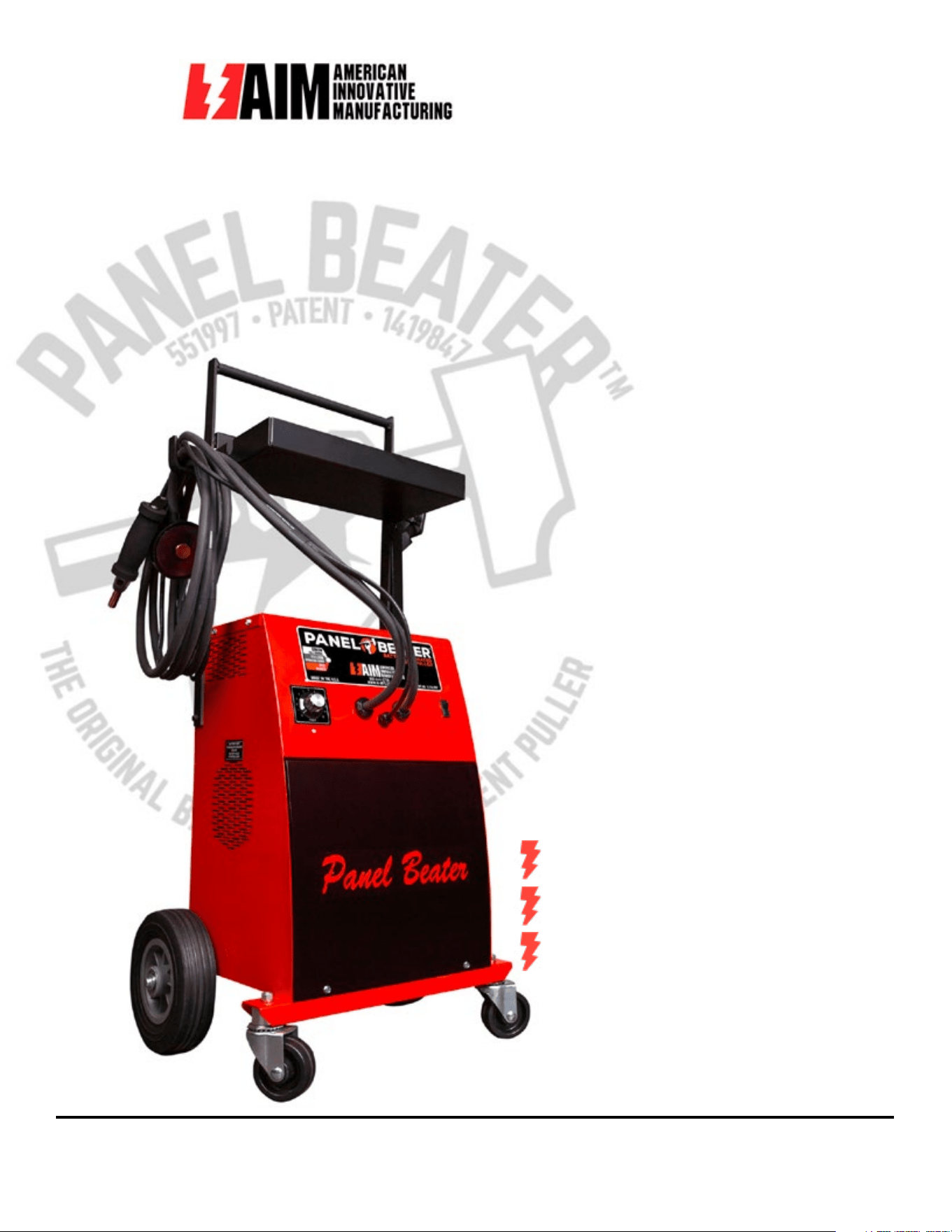
PANEL BEATER
TM
DENT-PULLING MACHINE
Operating Instructions
Warranty
Parts List

PB-1000 PANEL BEATER
TM
PRODUCT MANUAL PAGE 2
PANEL
BEATER
TM
PB-1000 & PB-1100 PRODUCT MANUAL
CONTENTS
Shipping Packaging Inspection
Service & Assistance
Shipped Components
Safety Instructions
Parts List
Battery Charging Information
Indicator Light Notification
Charging the Unit
Indicator Light Operation
Operating Instructions
Video Demo Links
Preparation
Connect to Outlet
Electrode Attachment
Control Handle
Electrode Operation
Shrink Tool
Ground Magnet
Puller Bar
Battery
Battery Charger
Automatic Timer
Pulling a Dent with Panel Beater™
Maintenance
Troubleshooting
Limited Warranty
Safety Data Sheet
3
3
3
4
5
7
7
8
8
9
9
9
9
10
10
11
11
11
12
12
12
12
13
14
15
16
17
THANK YOU for purchasing an American Innovative Manufacturing Panel Beater
TM
. AIM designs and manufactures the highest quality
tools for the Auto Body Industry. To ensure that you enjoy many years of trouble-free operation, we have developed this Operating
Manual.
It contains valuable information concerning how to safely operate and properly maintain your new equipment. Please read it carefully.
Always follow vehicle manufacturer’s recommendations for collision repairs.
Downloading this manual completes warranty registration of your Panel Beater. The warranty period begins 30 days after the unit left the
factory or at the date of registration whichever occurs first.
THANK YOU
PB-1000 PANEL BEATER
TM
PRODUCT MANUAL PAGE 3
Prior to opening and removing your Panel Beater™ it is important that you inspect the packaging for any
signs of damage.
If damage is observed, contact the delivery company and AIM before proceeding.
INSPECT PACKAGING:
For assistance or service call toll free
800-644-2730
(US and Canada)
SERVICE:
If you need assistance or service, first see the “Troubleshooting” section of this book. When calling – you will need your model and serial
number (found on the back the unit).
Model: PB-1000
Model: PB-1100 (Shipped from the factory without Battery)
Serial Number:
Purchase Date:
COMPONENTS:
Your AIM PANEL BEATER™ Dent Pulling Machine includes the following components:
A. Control handle and power lead
B. Power Switch
C. Electrode Holder (on handle)
D. Magnetic ground & 10’ lead
E. Puller Bar
Please check your package to make sure all parts listed above have been included with your
machine. Call 800-644-2730 immediately upon receiving your Panel Beater if you have any questions.
F. Battery (PB-1000)
G. Battery Charger
H. Automatic Timer Control
I. Pack of 5 Electrodes & Lock Nuts
PB-1000 PANEL BEATER
TM
PRODUCT MANUAL PAGE 4
When operating this equipment, follow basic precautions, including the following:
IMPORTANT SAFETY INSTRUCTIONS
Read all instructions before using this machine and its attachments. Use this equipment
only for its intended use.
Contact Factory Authorized Service Personnel for all repairs or service to unit.
Do not operate equipment unless all enclosure panels are properly in place.
Before using this equipment consult your physician if you have a pacemaker or similar
device
WARNING! Risk for electrical shock. Unplug the welder from the wall outlet before ser-
vicing, cleaning, or maintenance.
WARNING! All electrical connections must be made by a qualified electrician. Risk for
electrical shock.
Do not touch the copper connectors or electrodes during or immediately after use,
these components will be HOT!
WARNING! Make sure to use proper PPE when operating. Sparks and debris might
injure the eyes.
WARNING! Sparks could start a fire. Risk for injuries.
WARNING! Always wear protective face shield and gloves when working with batter-
ies.
IMPORTANT! The tool may only be used by qualified personnel. Failure to take basic
safety precautions can result in serious injury or material loss.
WARNING! Risk for damage to property in the vicinity of operation: Take proper pre-
cautions.
WARNING! Follow battery manufacturer’s recommendations for Battery service and
maintenance.
WARNING! Make sure to use proper eye protection when operating.
WARNING! Select the location for the Panel Beater™ carefully to maintain stability,
otherwise the unit might tip causing personal injuries or serious damage to the Panel
Beater™. Maintain machine in upright position.
PB-1000 PANEL BEATER
TM
PRODUCT MANUAL PAGE 5
SHEET 1 OF 2
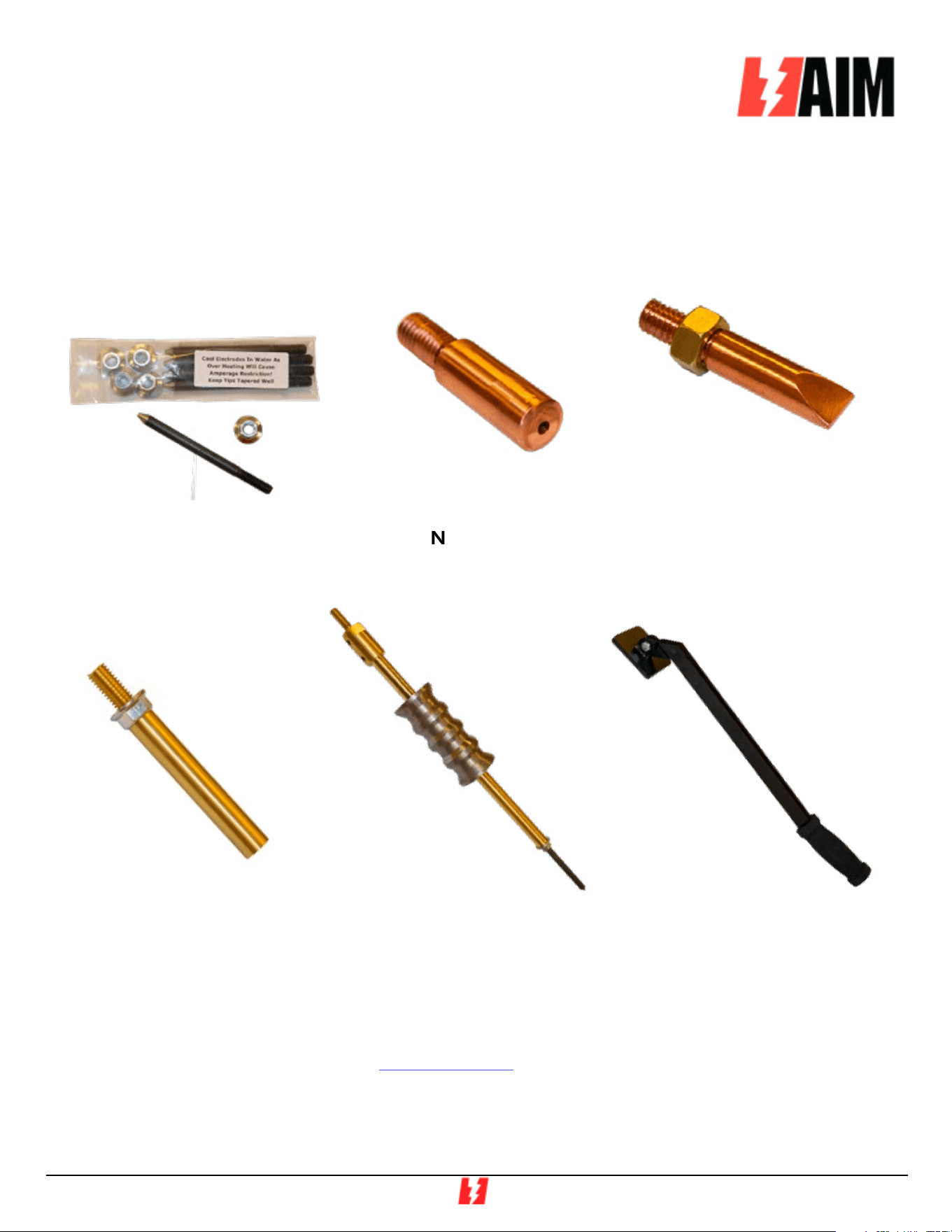
PB-104 ELECTRODES
(PACK OF 5)
PB-113 COPPER SHRINK
TOOL (CONTROL HANDLE)
SA-140 WAVE WIRE TIP
PB-201 ELECTRODE HOLDER PB-244 SLIDE HAMMER PB-207 PULLER BAR
If the item, you are looking for is not listed above
Visit our website, www.ai-mfg.com or call 1-800-644-2730
PARTS LIST
PANEL
BEATER
TM
PB-1000 PANEL BEATER
TM
PRODUCT MANUAL PAGE 6
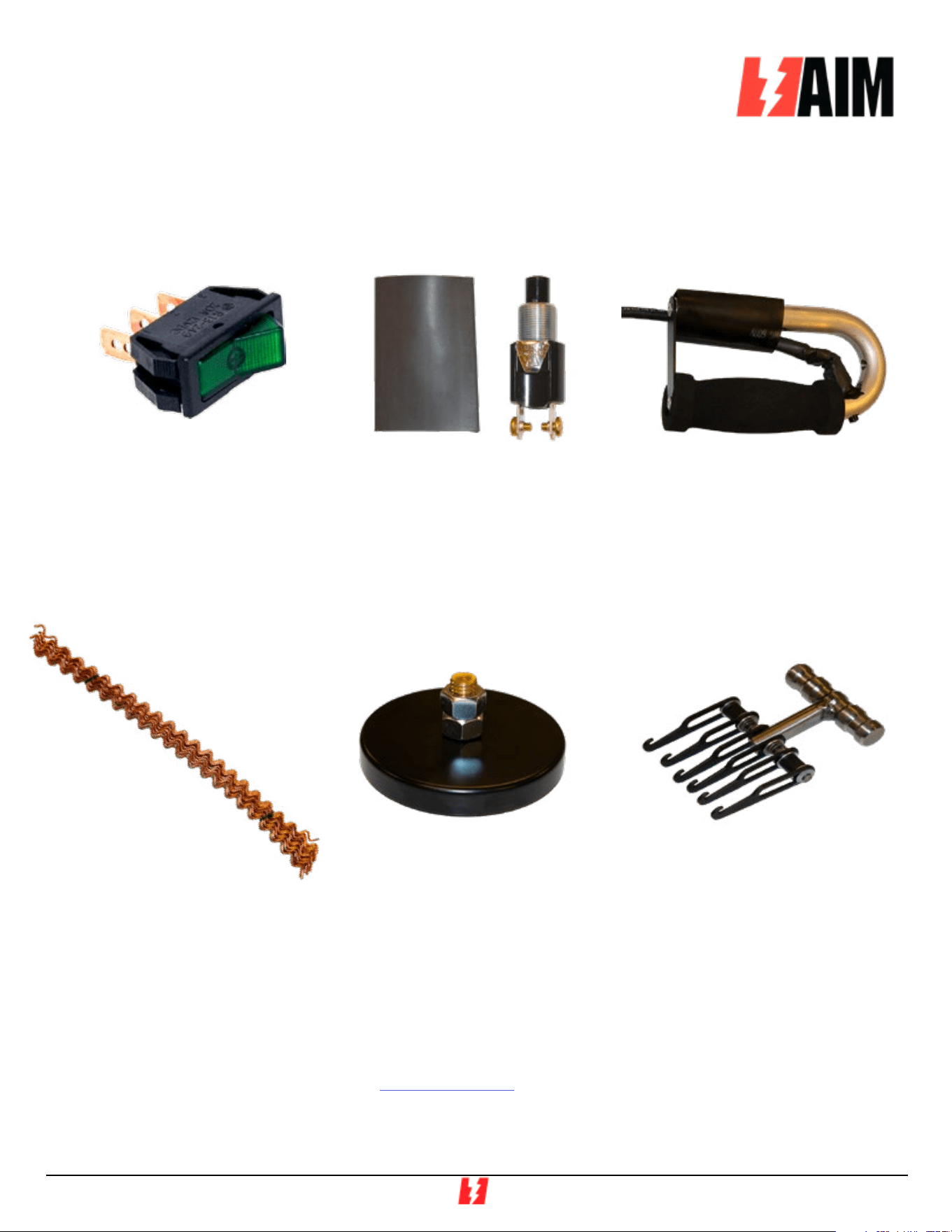
PB-251 ON/OFF ROCKER
SWITCH
PB- 226 Push Button PB-200 CONTROL HANDLE
SA-133 1LB WAVE WIRE PB-205 MAGNET ASSEMBLY SA-131 6 FINGER
“T” HANDLE CLAW
SHEET 2 OF 2
PARTS LIST
PANEL
BEATER
TM
If the item, you are looking for is not listed above
Visit our website, www.ai-mfg.com or call 1-800-644-2730
PB-1000 PANEL BEATER
TM
PRODUCT MANUAL PAGE 7
CHARGING
INFORMATION
BATTERY CHARGE INDICATOR LIGHT.
Please read the following information about the internal charger and indicator light system installed in Panel
Beater
TM
Dent Pullers produced after December 1, 2017.
The charger installed after 12/1/2017 is a robust and sophisticated 10-Amp electronic charging system
that offers:
• Compliance with new/current regulations for this type of hardware
• Sealed unit for safety and longevity
• Sealed for moisture resistance.
• Sensing of battery status and health
• Multiple charging modes automatically started by sensing battery status
• Different Charging Modes for:
• Charge maintenance/float
• Extremely low battery
• Desulfation cycle
• Battery type (AGM, FLA, etc.)
• Other parameters
The charge indicator light on the front of the Panel Beater is a general indicator of battery charge status.
• Because of the sensitivity of the Indicator Light and the multiple charger modes, the indicator
light may not switch to green at full charge in every situation. The lack of a green indication
does not mean the system is not working properly.
• The charger will reset to other modes that will go to green, with a reconnect to the power
supply and/or during normal use.

PB-1000 PANEL BEATER
TM
PRODUCT MANUAL PAGE 8
CHARGING THE UNIT
Upon receiving your AIM equipment; you must charge the unit before operating.
• All AIM battery-operated equipment comes with a specially designed battery charger to en-
sure the power needed to operate the machine.
• The AIM charger is designed to automatically regulate the battery voltage level. The battery
must be fully charged before use.
INDICATOR LIGHT
There is an indicator light displayed on the front panel of the machine.
• SOLID green light indicates the battery is fully charged.
• YELLOW light indicates the battery is in operating range.
• RED light indicates DANGER: Disconnect from power source and correct problem before proceeding,
also indicates the battery charge is low and recharging may be required.
Charger Power Supply:
• 110 / 120 Volt 60 HZ
Other power options are available on special order. Please contact factory.
NOTE: BATTERY MUST BE FULLY CHARGED BEFORE USING MACHINE.
CHARGING
INFORMATION
PB-1000 PANEL BEATER
TM
PRODUCT MANUAL PAGE 9
OPERATING
INSTRUCTIONS
VIDEO DEMONSTRATION
Video Demonstration of the Panel Beater™ In Action can be found with the following links:
Panel Beater Demonstration Video: http://bit.ly/2YBhWaG
Panel Beater Benefits Video: http://bit.ly/2YyayNi
UNPACK PANEL BEATER™
READ THESE OPERATING INSTRUCTIONS
PLUG IN PANEL BEATER™
Plug power cord into appropriate outlet to charge the Battery, the “smart” charger will not over charge the bat-
tery.
NOTE: The Panel Beater
TM
is designed for 110/120 volt 60 Hz power sources. The power requirement for
your machine is indicated on the back of your machine.
NOTE: If battery is below 12.5 volts it must be recharged.
This machine is equipped with AGM lead-acid storage batteries. Each battery
is liquid tight when kept in the upright position. However, in the event the
battery is tipped over and some acid spillage does occur, neutralize the acid
with baking soda.
WARNING! Follow battery manufacturer’s instructions contained in the
MSDS for your battery in case of spill or contact with battery contents.
Review the MSDS for additional recommendations. Report all injuries &
seek appropriate medical attention!!
WARNING!
PB-1000 PANEL BEATER
TM
PRODUCT MANUAL PAGE 10
OPERATING
INSTRUCTIONS
ATTACHING ELECTRODES
Attach an electrode onto the electrode holder by first screwing a lock nut (provided) onto the electrode and then
screwing the electrode into the end of the electrode holder. Tighten the nut against the electrode holder to pre-
vent loosening.
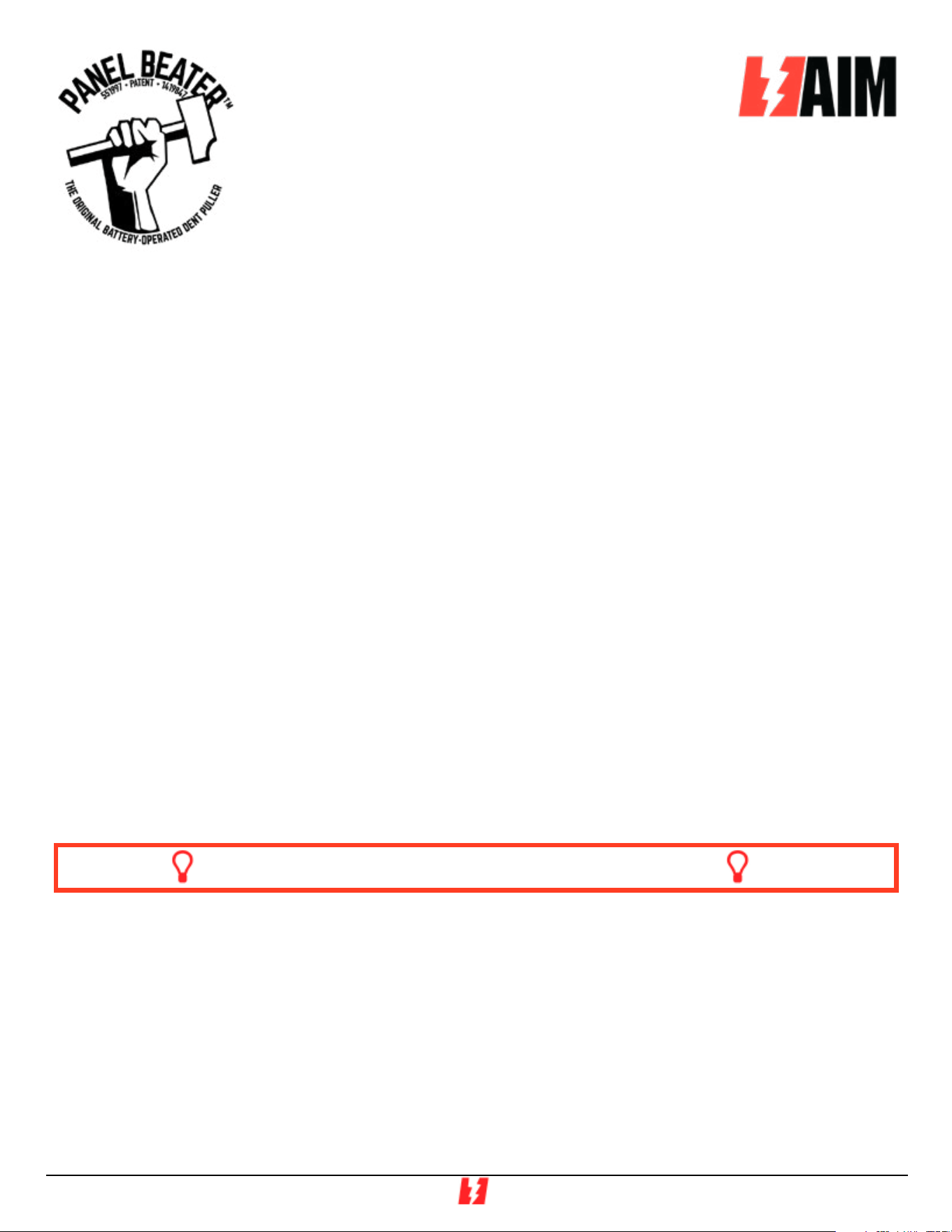
AIM CONTROL HANDLE
The key component of your AIM Dent Puller is the Control Handle. In operating the machine you will weld the
electrode to the dented metal and pull out the dent as described in the following instructions. You can also shrink
bulges and dimples by using the shrink tool at the center of the Control Handle.
Control Switch
Control Handle
Control Cable
Shrink
Tool
Electrode Holder
PB-1000 PANEL BEATER
TM
PRODUCT MANUAL PAGE 11
OPERATING
INSTRUCTIONS
ELECTRODES
IMPORTANT NOTES:
Always keep all foreign materials off the surface of the electrode while shrinking.
KEEP ELECTRODES SHARP: Keep your electrodes sharpened to 1/8” diameter flat tip for optimum operation.
You can easily grind it or file it to its original shape.
KEEP ELECTRODES COOL: During heavy usage periodic cooling of electrodes may be required. Keeping the
electrode cool will also prolong the life of the electrode. Improperly maintained electrodes will reduce or impair
performance.
SHRINK TOOL:
The Shrink Tool feature can be used to work areas of stretched or bulged metal. Simply push the Shrink Tool (lo-
cated at the center of the handle) firmly against the panel, then activate the thumb switch. Repeat as necessary.
When shrinking:
• Set the timer to the desired setting, start with a moderate setting, 2-4.
• Hold the shrinking tip against the panel and depress and hold the control button.
• Do not remove the shrink tip from the panel until the operation cycle ends.
• Adjust the timer as needed to get the desired result.
Keep all foreign materials off the surface of the electrode while shrinking.
A hole at the end of the shrink tool is provided for applying “nails” to a panel. Simply insert the “nail” or “draw
pin” into the hole, hold against the base metal and push the control switch momentarily.
GROUND MAGNET:
The ground magnet is placed on the cleaned and sanded area near dent to be repaired when ready to pull
dents. Make sure the area is clean and the magnet has solid contact.
If the ground magnet sparks during operation you have a poor magnet ground contact.
NOTE: PB-204 Ground Clamp Adapter Cable is available to allow use of a clamp ground in lieu of the
magnet ground.
DO NOT MOVE TOOL WHILE SHRINKING
PB-1000 PANEL BEATER
TM
PRODUCT MANUAL PAGE 12
OPERATING
INSTRUCTIONS
PULLER BAR:
If the damage is severe, the technician my want to use the “Puller Bar” PB-207 (provided) for additional lever-
age. Simply put the electrode through the slot in the puller bar and repeat the procedure. Many Technicians pre-
fer the Puller Bar for pulling dents because of the ease of use and fine control of dent pulling effort find it easier
to use the puller bar for pulling dents. It requires less effort and gives better control while pulling.
BATTERY
When supplied from the AIM factory the installed battery is a commercial grade AGM battery. If you purchase
your machine without a battery or a replacement is needed, the recommended replacement battery is a 12V,
Group 65 or 31, SAE (Top Post) AGM Battery with Cold Cranking Amp (CCA) rating of 950 amps or more and a
reserve capacity of at least 140 minutes. Deep cycle and Marine batteries are not recommended.
BATTERY CHARGER
The Battery Charger incorporates a number of advanced electronic features designed to prevent over charging
the battery and extending battery life. The AIM Battery Charger can be operated at the same time the Panel
Beater dent pulling machine is in operation, however charger life will be extended if not charging during dent
pulling. For best operation, maintain the battery at full charge as much as possible.
AUTOMATIC TIMER
The AIM Panel Beater™ is equipped with an automatic timer which limits the actual welding time. Start by turning
the timer knob all the way counter clockwise to “0”. Then set the minimum timer setting that is appropriate for
your project. Once the timer is set for the metal to be worked, the timer will automatically repeat the cycle each
time the switch on the operating handle is pushed.
• For warranty information on the battery please contact the manufacturer of the
battery.
• Consult the battery MSDS if contact with battery contents should occur. Seek
appropriate Medical attention and properly report all injuries. For reference the
MSDS document for the battery currently being installed at the factory is at-
tached to this manual, update periodically with the battery currently installed in
you Panel Beater™.
IMPORTANT!
PB-1000 PANEL BEATER
TM
PRODUCT MANUAL PAGE 13
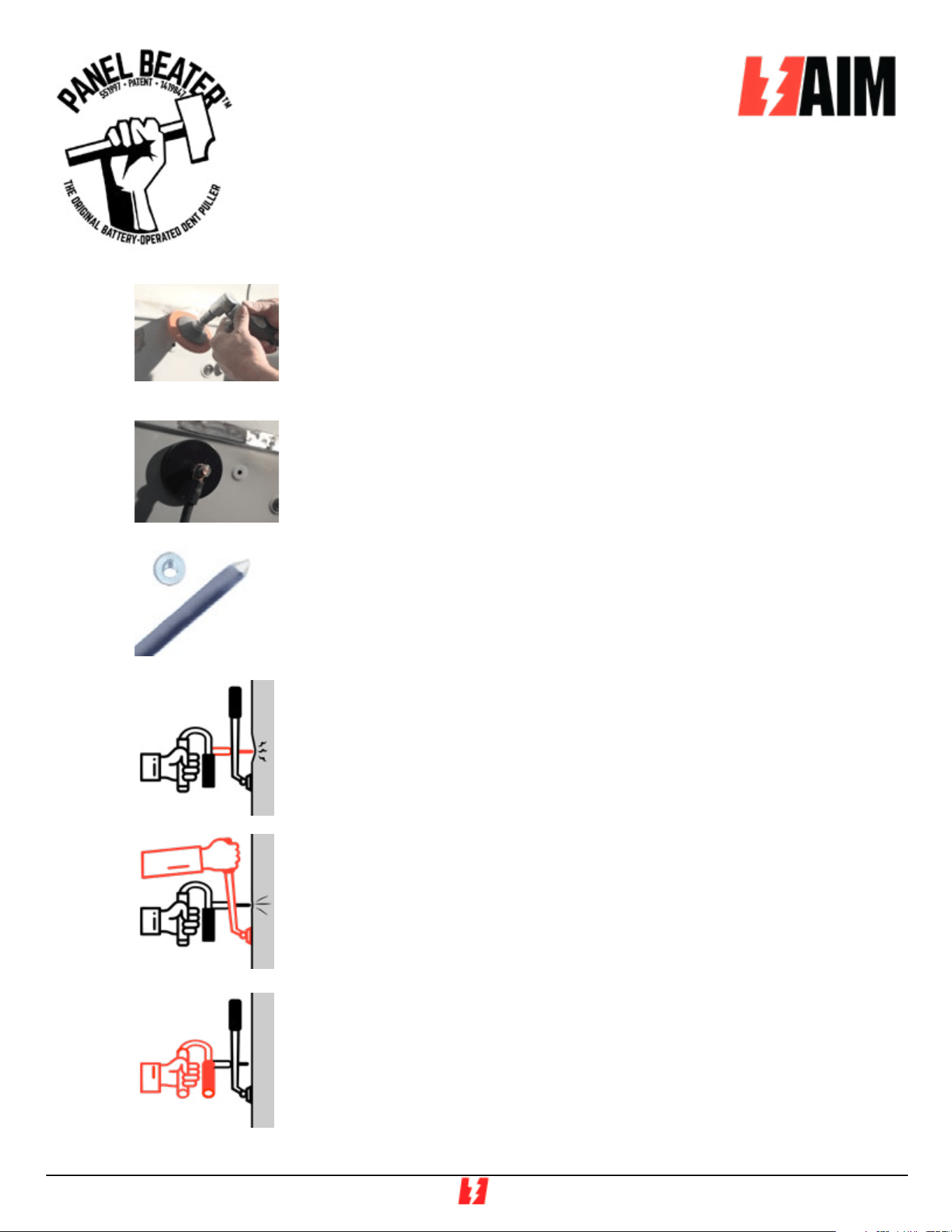
PULLING A
DENT
1. SAND:
Sand paint from dent area.
3. ATTACH ELECTRODE:
Screw an electrode PB-104 into the electrode holder.
• Set timer to desired setting or metal thickness.
• It is recommended to start at a low setting (e.g. “0”) and in-
crease as needed.
4. STICK:
• Firmly push the electrode tip against the spot to be pulled and
push the thumb switch (on the electrode handle) until it sticks.
• Release after 1-2 seconds.
5. PULL:
• Pull straight out firmly on the handle being careful not to twist
or tilt.
• It may be useful to use a body hammer to work the metal.
6. TWIST:
• To release the electrode, give the handle a clockwise twist.
2. GROUND:
Place magnet (ground) on sanded area near dent to be repaired.
DENT PULLING
REPEAT AS NECESSARY.

PB-1000 PANEL BEATER
TM
PRODUCT MANUAL PAGE 14
MAINTENANCE
PANEL
BEATER
TM
RECOMMENDED MAINTENANCE
DAILY: PROPERLY MAINTAIN BATTERY CHARGE LEVEL (CONSULT BATTERY MANUFACTURER
RECOMMENDATIONS IF PLANNING TO STORE THE PANEL BEATER FOR EXTENDED
PERIODS, I.E. A MONTH OR MORE)
MONTHLY: INSPECT CABLES FOR CUTS OR DAMAGE.
USE FINE STEEL WOOL ON COPPER CONNECTIONS. CLEAN MAGNET INSERT WITH
FINE SANDPAPER.
1 YEAR REMOVE DUST FROM CHARGER.
2 YEAR INSPECT BATTERY TERMINAL CONNECTIONS. CLEAN IF NEEDED.
HELPFUL HINTS
• Not keeping your battery fully charged after use will decrease the life of your battery.
• When dent pulling or shrinking, the limiting factor is heat, not battery power.
• Gases from battery vent out of the machine.
• Baking soda should be used to neutralize battery acid in the event of a spill.
• Keep tip tapered to a pencil like 1/8” diameter flat tip.
• A deterioration of dent pulling performance can be noticed if dent pulling electrodes are over heated.
Cool electrodes by dipping the electrode in cool water or by pausing dent pulling to air cool.

PB-1000 PANEL BEATER
TM
PRODUCT MANUAL PAGE 15
TROUBLESHOOTING
PROBLEM
Unit does not charge
Green light not on
Power appears to be weak:
Welds are not holding
CHECK THE FOLLOWING
Check power supply and connection
Unit may need longer charge time
Battery needs service – see warning inside cover.
• Check battery terminals for clean, tight connections.
• Are all accessory connections clean and tight?
• Are electrodes being cooled in water?
• Was green light on before operating? (See CHARGING
THE UNIT)
• Are electrodes properly shaped?
• Is the grounding magnet attached to the proper panel?
• Is the magnet ground clean?
• Is timer adjusted appropriately for the metal being
worked?
• Was green light on before operating? (See CHARGING
THE UNIT)
• Does grounding need to be placed in a different location?
• Is paint removed from surface?
• Is the electrode touching the metal?
• Check battery with load tester for adequate cold cranking
amps.
• Are electrodes shaped properly? VERY IMPORTANT!
PANEL
BEATER
TM
Electrode breaks loose too easily
• Be sure electrode and electrode holder are screwed in
tightly.
• The tip of the electrode may become coated with metal or
galvanizing and may need to be removed.
• Electrode tip is blunt. Keep tip tapered back 1/2” with
1/8” diameter point.
• Do not overheat the electrode. A hot electrode will not
give a strong weld. Cool with water.
• A poor ground. Re-grind your work surface to bare met-
al. Paint residue or galvanizing can cause a poor ground
connection.
• A low battery will not produce a strong stick. Charge the
battery until the green charge light comes on indicating a
full charge.

PB-1000 PANEL BEATER
TM
PRODUCT MANUAL PAGE 16
LIMITED WARRANTY
PANEL
BEATER
TM
American Innovative Manufacturing LLC (AIM) of Spokane, WA, subject to the terms and conditions described below, warrants to
its original retail purchaser that new AIM equipment sold aer the eective date of this limited warranty is free of defects in material
and workmanship at the time it is shipped by AIM. THIS WARRANTY IS EXPRESSLY IN LIEU OF ALL OTHER WARRANTIES,
EXPRESS OR IMPLIED, INCLUDING THE WARRANTIES OF MERCHANTABILITY AND FITNESS.
AIM PRODUCTS ARE INTENDED FOR PURCHASE AND USE BY COMMERCIAL/INDUSTRIAL USERS AND PERSONS
TRAINED AND EXPERIENCED IN THE USE AND MAINTENANCE OF THE EQUIPMENT.
AIM shall honor valid warranty claims on warranted equipment for a period of ONE YEAR in the event of such a failure within the
warranty time period. All warranty time periods start on the Ship Date date of the equipment to the original purchaser, and not to
exceed one year aer the equipment is shipped to a distributor or retail customer.
Within the applicable warranty period AIM will repair or replace any warranted parts or components that fail due to such defects in
material or workmanship. AIM must be notied in writing within thirty (30) days of such defect or failure, at which time AIM will
provide instructions on the warranty claim procedures to be followed.
AIM’s Limited Warranty shall NOT apply to:
1. Consumable components or parts that fail due to normal wear or misuse.
2. Items furnished by AIM, but manufactured by others. ese items are covered by the manufacturer’s warranty, if any.
3. Equipment that has been modied by any party other than AIM, or equipment that has been improperly installed, improperly
operated or misused based upon industry standards, or equipment which has not had reasonable and necessary maintenance, or
equipment which has been used for operation outside of the specications for the equipment.
In the event of a warranty claim covered by this warranty, the exclusive remedies shall be, at AIM’s option:
1. Repair,
2. Replacement,
3. e reasonable cost of repair or replacement by an authorized AIM service representative (where authorized in writing by AIM in
appropriate cases), or
4. Payment of or credit for the purchase price (less reasonable depreciation based upon actual use) upon return of the goods at cus-
tomer’s risk and expense. AIM’s option of repair or replacement will be F.O.B., Factory at Spokane, WA. erefore no compensa-
tion or reimbursement for transportation costs of any kind will be allowed.
Some states in the U.S.A. do not allow limitations of how long an implied warranty lasts, or the exclusion of incidental, indirect, special
or consequential damages, so the above limitation or exclusion may not apply to you. is warranty provides specic legal rights, and
other rights may be available, but may vary from state to state.
In Canada, legislation in some provinces provides for certain additional warranties or remedies other than as stated herein, and to the
extent that they may not be waived, the limitations and exclusions set out above may not apply. is Limited Warranty provides specic
legal rights, and other rights may be available, but may vary from province to province.
TO THE EXTENT PERMITTED BY LAW, THE REMEDIES PROVIDED HEREIN ARE THE SOLE AND EXCLUSIVE REMEDIES.
IN NO EVENT SHALL AIM BE LIABLE FOR DIRECT, INDIRECT, SPECIAL, INCIDENTAL OR CONSEQUENTIAL DAMAGES
(INCLUDING LOSS OF PROFIT), WHETHER BASED ON CONTRACT, TORT OR ANY OTHER LEGAL THEORY.
ANY EXPRESS WARRANTY NOT PROVIDED HEREIN AND ANY IMPLIED WARRANTY, GUARANTY OR REPRESENTA-
TION AS TO PERFORMANCE, AND ANY REMEDY FOR BREACH OF CONTRACT TORT OR ANY OTHER LEGAL THEORY
WHICH, BUT FOR THIS PROVISION, MIGHT ARISE BY IMPLICATION, OPERATION OF LAW, CUSTOM OF TRADE OR
COURSE OF DEALING, INCLUDING ANY IMPLIED WARRANTY OF MERCHANTABILITY OR FITNESS FOR PARTICULAR
PURPOSE, WITH RESPECT TO ANY AND ALL EQUIPMENT FURNISHED BY AIM IS EXCLUDED AND DISCLAIMED BY
AIM.
WARRANTY QUESTIONS?
Call Customer Service 1-800-644-2730
The Panel Beater is a Registered Trademark of American Innovative Manufacturing
US Patent Nos. 5,516,997 / 5,917,394 & Other Patents Pending SECTION I
PB-1000 PANEL BEATER
TM
PRODUCT MANUAL PAGE 17
SAFETY DATA SHEET
HEALTH PHYSICAL
Acute Toxicity Aquatic Chronic 1
(Oral/Dermal/Inhalation) Aquatic Acute 1
HEALTH ENVIRONMENTAL PHYSICAL
CAS Number Components
Lead 45 - 60
Lead Dioxide 15 - 25
Tin 0.1 - 0.2
Sulf uric Acid Electrolyte (Sulfuric Acid/Water)
15 - 20
Absorbent Glass Mat 1-2
Inorganic lead and sulfuric acid electrolyte are the primary components of every battery manufactured by EnerSys Energy Products.
There are no mercury or cadmium containing products present in batteries manufactured by EnerSys Energy Products.
Category 1B
Carcinogenicity (lead compounds)
Explosive, fire, blast, or projection hazard.
Polyphenylene Oxide
25134-01-4
Polycarbonate/Polyester Alloy
--
Other:
--
Styrene Butadiene
9003-55-8
Polyvinylchloride
9002-86-2
Polycarbonate, Hard Rubber, Polyethylene
9002-88-4
Polystyrene
9003-53-6
Styrene Acrylonitrile
9003-54-7
Acrylonitrile Butadiene Styrene
9003-56-9
7440-31-5
7664-93-9
Case Material:
5-10
Polypropylene
9003-07-0
III. HAZARDOUS INGREDIENTS/IDENTIFY INFORMATION
Approximate % by Weight
Inorganic Lead Com pound:
7439-92-1
1309-60-0
May form explosive air/gas mixture during charging.
Contact with internal components may cause irritation or severe burns. Avoid contact with internal
Extremely flammable gas (hydrogen).
Irritating to eyes, respiratory system, and skin.
May damage fertility or the unborn child if ingested or inhaled.
Avoid breathing dust/fume/gas/mist/vapors/spray.
May cause cancer if ingested or inhaled.
Use only outdoors or in a well-ventilated area.
Causes damage to central nervous system, blood and kidneys through prolonged or
rep eated exp o su re.
Causes skin irritation, serious eye damage.
DANGER!
Wash thoroughly after handling.
Causes severe skin b urn s and eye d am age.
Do not eat, drink or smoke when using this product.
Causes seri ous eye d amage.
Wear protective gloves/protective clo thing, eye protection/face protection.
(rep eated exp osu re)
Category 2
GHS LABEL:
Hazard Statements
Precautionary Statements
Reproductive
Category 1A
Carcinogenicity (acid mist)
Category 1A
Specific Target Organ Toxicity
ENVIRONMENTAL
Explosive Chemical, Division 1.3
Category 4
Skin Corrosion/Irritation
Category 1A
Eye Damage
Category 1
EnerSys Energy Products Inc.
617 N. Ridgeview Drive
24-Hour Em ergency Response Contact:
Warrensburg, MO 64093-9301
CHEMTREC DOMESTIC: 800-424-9300 CHEMTREC INT'L: 703-527-3877
II GHS HAZRDS IDENTFICATION
Synonyms:
Sealed L ead A cid Battery, VR LA Battery
Telephone: Environmental, Health & Safety Dept. at 660-429-2165
For information and emergencies, contact EnerSys Energy Products
Manufacturer's Nam e/Address:
SAFETY DATA SHEET
I. PRODUCT IDENTIFICATION
Chemical Trade Name (as used on label):
Chemical Family/Classification: Seal ed Lead Battery
Cyclon®, Genesis®, SBS, SBS J, Hawker XE™, Odyssey®, Trolling Thunder™, NexSys™,
OptiGrid™ or XFC

PB-1000 PANEL BEATER
TM
PRODUCT MANUAL PAGE 18
SAFETY DATA SHEET
Inhalation:
Sulfuric Acid: Remove to fresh air immediately. If breathing is difcult, give oxygen. Consult a physician
Lead: Remove from exposure, gargle, wash nose and lips; consult physician.
Ingestion:
Sulfuric Acid: Give large quantities of water; do not induce vomiting or aspiration into the lungs may occur and can cause permanent injury or death; consult a physician
Lead: Consult physician immediately.
Skin:
Sulfuric Acid: Flush with large amounts of water for at least 15 minutes; remove contaminated clothing completely, including shoes.
If symptoms persist, seek medical attention. Wash contaminated clothing before reuse. Discard contaminated shoes.
Lead: Wash immediately with soap and water.
Eyes:
Sulfuric Acid and Lead: Flush immediately with large amounts of water for at least 15 minutes while lifting lids
Seek immediate medical attention if eyes have been exposed directly to acid.
V. FIRE FIGHTING MEASURES
Flash Point: N/A Flammable Limits: LEL = 4.1% (Hydrogen Gas) UEL = 74.2% (Hydrogen Gas)
Extinguishing Media: Carbon dioxide; foam; dry chemical. Avoid breathing vapors. Use appropriate media for surrounding fire.
Special Fire Fighting Procedures:
If batteries are on charge, shut off power. Use positive pressure, self-contained breathing apparatus. Water applied to electrolyte generates heat and causes it to spatter.
Wear acid-resistant clothing, gloves, face and eye protection.
Note that strings of series connected batteries may still pose risk of electric shock even when charging equipment is shut down.
Unusual Fire and Explosion Hazards:
Highly ammable hydrogen gas is generated during charging and operation of batteries. To avoid risk of re or explosion, keep sparks or other sources of ignition away
from batteries. Do not allow metallic materials to simultaneously contact negative and positive terminals of cells and batteries. Follow manufacturer’s instructions for
installation and service.
VI. PRECAUTIONS FOR SAFE HANDLING AND USE
Spill or Leak Procedures:
Stop ow of material, contain/absorb small spills with dry sand, earth, and vermiculite. Do not use combustible materials. If possible, carefully neutralize spilled electro-
lyte with soda ash, sodium bicarbonate, lime, etc. Wear acid-resistant clothing, boots, gloves, and face shield. Do not allow discharge of unneutralized acid to sewer. Acid
must be managed in accordance with local, state, and federal requirements.
Consult state environmental agency and/or federal EPA.
VII. HANDLING AND STORAGE
Handling:
• Unless involved in recycling operations, do not breach the casing or empty the contents of the battery.
• There may be increasing risk of electric shock from strings of connected batteries.
• Keep containers tightly closed when not in use. If battery case is broken, avoid contact with internal components.
• Keep vent caps on and cover terminals to prevent short circuits. Place cardboard between layers of stacked automotive batteries to avoid damage and short circuits.
• Keep away from combustible materials, organic chemicals, reducing substances, metals, strong oxidizers and water. Use banding or stretch wrap to secure items for
shipping.
Storage:
Store batteries in cool, dry, well-ventilated areas with impervious surfaces and adequate containment in the event of spills. Batteries should also be stored under roof
for protection against adverse weather conditions. Separate from incompatible materials. Store and handle only in areas with adequate water supply and spill control.
Avoid damage to containers. Keep away from re, sparks and heat. Keep away from metallic objects which could bridge the terminals on a battery and create a dangerous
short-circuit.
Charging:
There is a possible risk of electric shock from charging equipment and from strings of series connected batteries, whether or not being charged. Shut-off power to chargers
whenever not in use and before detachment of any circuit connections. Batteries being charged will generate and release ammable hydrogen gas.
Charging space should be ventilated. Keep battery vent caps in position. Prohibit smoking and avoid creation of ames and sparks nearby.
Wear face and eye protection when near batteries being charged.
PB-1000 PANEL BEATER
TM
PRODUCT MANUAL PAGE 19
SAFETY DATA SHEET
VVIII. EXPOSURE CONTROLS/PERSONAL PROTECTION
Exposure Limits (mg/m3) Note: N.E.= Not Established
OSHA PEL ACGIH US NIOSH Quebec PEV Ontario OEL EU OEL
INGREDIENTS
(Chemical/Common Names)
0.05 0.05 0.05 0.05 0.05 0.15 (b) Lead and Lead Compounds(inorganic)
2 2 2 2 2 N.E Tin
1 0.2 1 1 0.2 0.05 (c) Sulfuric Acid Electrolyte
N.E N.E N.E N.E N.E N.E Polypropylene
N.E N.E N.E N.E N.E N.E Polystyrene
N.E N.E N.E N.E N.E N.E Styrene Acrylonitrile
N.E N.E N.E N.E N.E N.E Acrylonitrile Butadiene Styrene
N.E N.E N.E N.E N.E N.E Styrene Butadiene
N.E N.E N.E N.E 1 N.E Polyvinylchloride
N.E N.E N.E N.E N.E N.E Polycarbonate, HardRubber, Polyethylene
N.E N.E N.E N.E N.E N.E Polyphenylene Oxide
N.E N.E N.E N.E N.E N.E
Polycarbonate/Polyester AlloyRubber,
Polyethylene
N.E N.E N.E N.E N.E N.E Absorbent Glass Mat
NOTES:
(b) As inhalable aerosol
(c) Thoracic fraction
Engineering Controls (Ventilation):
Store and handle in well-ventilated area. If mechanical ventilation is used, components must be acid-resistant.
Handle batteries cautiously to avoid spills. Make certain vent caps are on securely. Avoid contact with internal components. Wear protective clothing, eye and face protection when lling,
charging or handling batteries. Do not allow metallic materials to simultaneously contact both the positive and negative terminals of the batteries. Charge the batteries in areas with adequate
ventilation. General dilution ventilation is acceptable.
Respiratory Protection (NIOSH/MSHA approved):
None required under normal conditions. When concentrations of sulfuric acid mist are known to exceed the PEL, use NIOSH or MSHA-approved respiratory protection.
Skin Protection:
If battery case is damaged, use rubber or plastic acid-resistant gloves with elbow-length gauntlet, acid-resistant apron, clothing and boots.
Eye Protection:
If battery case is damaged, use chemical goggles or face shield.
Other Protection:
Under severe exposure emergency conditions, wear acid-resistant clothing and boots.
IX. PHYSICAL AND CHEMICAL PROPERTIES
Boiling Point:
203 - 240° F
Specific Gravity (H2O = 1):
1.215 to 1.350
Melting Point:
N/A
Vapor Pressure (mm Hg):
10
Solubility in Water:
100%
Vapor Density (AIR = 1):
Greater than 1
Evaporation Rate:
(Butyl Acetate = 1)
Less than 1
% Volatile by Weight:
N/A
pH:
~1 to 2 Below room temperature (as hydrogen gas)
Flash Point:
4.1% (Hydrogen) 74.2% (Hydrogen)
UEL (Upper Explosive Limit) LEL (Lower Explosive Limit)
Appearance and Odor:
Properties Listed Below are for Electrolyte:
Manufactured article; no apparent odor. Electrolyte is a clear liquid with a sharp,
penetrating, pungent odor.

PB-1000 PANEL BEATER
TM
PRODUCT MANUAL PAGE 20
X. REACTIVITY DATA
Stability: Stable X Unstable ___
This product is stable under normal conditions at ambient temperature.
Conditions To Avoid: Prolonged overcharge; sources of ignition
Incompatibility: (Materials to avoid)
Sulfuric Acid: Contact with combustibles and organic materials may cause re and explosion. Also reacts violently with strong reducing agents, metals, sulfur trioxide gas,
strong oxidizers and water. Contact with metals may produce toxic sulfur dioxide fumes and may release ammable hydrogen gas.
Lead Compounds: Avoid contact with strong acids, bases, halides, halogenates, potassium nitrate, permanganate, peroxides, nascent hydrogen and reducing agents.
Hazardous Decomposition Products:
Sulfuric Acid: Sulfur trioxide, carbon monoxide, sulfuric acid mist, sulfur dioxide, and hydrogen sulde.
Lead Compounds: High temperatures likely to produce toxic metal fume, vapor, or dust; contact with strong acid or base or presence of nascent hydrogen may generate
highly toxic arsine gas.
Hazardous Polymerization:
Will not occur
XI. TOXICOLOGICAL INFORMATION
Routes of Entry:
Sulfuric Acid: Harmful by all routes of entry.
Lead Compounds: Hazardous exposure can occur only when product is heated, oxidized or otherwise processed or damaged to create dust, vapor or fume. The presence of nascent hydrogen
may generate highly toxic arsine gas.
Inhalation:
Sulfuric Acid: Breathing of sulfuric acid vapors or mists may cause severe respiratory irritation.
Lead Compounds: Inhalation of lead dust or fumes may cause irritation of upper respiratory tract and lungs.
Ingestion:
Sulfuric Acid: May cause severe irritation of mouth, throat, esophagus and stomach.
Lead Compounds: Acute ingestion may cause abdominal pain, nausea, vomiting, diarrhea and severe cramping. This may lead rapidly to systemic toxicity and must be treated by a physician.
Skin Contact:
Sulfuric Acid: Severe irritation, burns and ulceration.
Lead Compounds: Not absorbed through the skin.
Eye Contact:
Sulfuric Acid: Severe irritation , burns, cornea damage, and blindness.
Lead Components: May cause eye irritation.
Effects of Overexposure - Acute:
Sulfuric Acid: Severe skin irritation, damage to cornea, upper respiratory irritation.
Lead Compounds: Symptoms of toxicity include headache, fatigue, abdominal pain, loss of appetite, muscle aches and weakness, sleep disturbances and irritability.
Effects of Overexposure - Chronic:
Sulfuric Acid: Possible erosion of tooth enamel, inammation of nose, throat and bronchial tubes.
Lead Compounds: Anemia; neuropathy, particularly of the motor nerves, with wrist drop; kidney damage; reproductive changes in males and females. Repeated exposure to lead and lead
compounds in the workplace may result in nervous system toxicity. Some toxicologists report abnormal conduction velocities in persons with blood lead levels of 50mcg/100 ml or higher.
Heavy lead exposure may result in central nervous system damage, encephalopathy and damage to the blood-forming (hematopoietic) tissues.
Carcinogenicity:
Sulfuric Acid: The International Agency for Research on Cancer (IARC) has classied “strong inorganic acid mist containing sulfuric acid” as a Group 1 carcinogen, a substance that is carcinogen-
ic to humans. This classication does not apply to liquid forms of sulfuric acid or sulfuric acid solutions contained within a battery. Inorganic acid mist (sulfuric acid mist) is not generated under
normal use of this product. Misuse of the product, such as overcharging, may result in the generation of sulfuric acid mist.
Lead Compounds: Lead is listed as a Group 2A carcinogen, likely in animals at extreme doses. Per the guidance found in OSHA 29 CFR 1910.1200
Appendix F, this is approximately equivalent to GHS Category 1B. Proof of carcinogenicity in humans is lacking at present.
Medical Conditions Generally Aggravated by Exposure:
Overexposure to sulfuric acid mist may cause lung damage and aggravate pulmonary conditions. Contact of sulfuric acid with skin may aggravate diseases such as eczema and contact derma-
titis. Lead and its compounds can aggravate some forms of kidney, liver and neurologic diseases.
Inhalation LD50:
Electrolyte: LC50 rat: 375 mg/m3; LC50: guinea pig: 510 mg/m3
Elemental Lead: Acute Toxicity Point Estimate = 4500 ppmV (based on lead bullion)
Oral LD50:
Electrolyte: rat: 2140 mg/kg
Elemental lead: Acute Toxicity Estimate (ATE) = 500 mg/kg body weight (based on lead bullion)
Additional Health Data:
All heavy metals, including the hazardous ingredients in this product, are taken into the body primarily by inhalation and ingestion.
Most inhalation problems can be avoided by adequate precautions such as ventilation and respiratory protection covered in Section 8.
Follow good personal hygiene to avoid inhalation and ingestion: wash hands, face, neck and arms thoroughly before eating, smoking or leaving the worksite. Keep contaminated clothing
out of non-contaminated areas, or wear cover clothing when in such areas. Restrict the use and presence of food, tobacco and cosmetics to non-contaminated areas. Work clothes and work
equipment used in contaminated areas must remain in designated areas and never taken home or laundered with personal non-contaminated clothing. This product is intended for industrial
use only and should be isolated from children and their environment.
The 19th Amendment to EC Directive 67/548/EEC classied lead compounds, but not lead in metal form, as possibly toxic to reproduction.
Risk phrase 61: May cause harm to the unborn child, applies to lead compounds, especially soluble forms.
SAFETY DATA SHEET

PB-1000 PANEL BEATER
TM
PRODUCT MANUAL PAGE 21
XII. ECOLOGICAL INFORMATION
Environmental Fate:
Lead is very persistent in soil and sediments. No data on environmental degradation. Mobility of metallic lead between ecological compartments is slow.
Bioaccumulation of lead occurs in aquatic and terrestrial animals and plants but little bioaccumulation occurs through the food chain.
Most studies include lead compounds and not elemental lead.
Environmental Toxicity: Aquatic Toxicity:
Sulfuric acid: 24-hr LC50, freshwater sh (Brachydanio rerio): 82 mg/L
96 hr- LOEC, freshwater sh (Cyprinus carpio): 22 mg/L
Lead: 48 hr LC50 (modeled for aquatic invertebrates): <1 mg/L, based on lead bullion
Additional Information:
· No known effects on stratospheric ozone depletion.
· Volatile organic compounds: 0% (by Volume)
· Water Endangering Class (WGK): NA
XIII. DISPOSAL CONSIDERATIONS (UNITED STATES)
Spent batteries:
Send to secondary lead smelter for recycling. Spent lead-acid batteries are not regulated as hazardous waste when the requirements of
40 CFR Section 266.80 are met. This should be managed in accordance with approved local, state and federal requirements. Consult state environ-
mental agency and/or federal EPA.
Electrolyte:
Place neutralized slurry into sealed containers and handle as applicable with state and federal regulations. Large water-diluted spills, after
neutralization and testing, should be managed in accordance with approved local, state and federal requirements. Consult state environmental
agency and/or federal EPA.
Following local, State/Provincial, and Federal/National regulations applicable to end-of-life characteristics will be the responsibility of the end-user.
XIV. TRANSPORT INFORMATION
U.S. DOT:
Excepted from the hazardous materials regulations ( HMR) because the batteries meet the requirements of 49 CFR 173.159(f) and 49 CFR 173.159a of the U.S. Department of Transportation’s
HMR. Battery and outer package must be marked “ NONSPILLABLE” or “NONSPILLABLE BATTERY” Battery terminals must be protected against short circuits.
IATA Dangerous Goods Regulations DGR:
Excepted from the dangerous goods regulations because the batteries meet the requirements of Packing Instruction 872 and Special Provisions A67 of
the International Air Transportation Association (IATA) Dangerous goods Regulations and International Civil Aviation Organization (ICAO) Technical
Instructions. Battery Terminals must be protected against short circuits.
The words “ NOT RESTRICTED” , SPECIAL PROVISION A67” must be provided when the air waybill is issued.
IMDG:
Excepted from the dangerous goods regulations for transport by sea because the batteries meet the requirements of Special Provision 238 of the International Maritime Dangerous Goods(
IMDG CODE). Battery terminals must be protected against short circuits.
Requirements for Safe Shipping and Handling of Cyclon Cells:
Warning – Electrical Fire Hazard – Protect against shorting. Terminals can short and cause a re if not insulated during shipping. Cyclon product must be labeled “NONSPILLABLE” during
shipping. Follow all federal shipping regulations. See section IX of this sheet and CFR 49 Parts 171 through 180, available online at wwww.gpoaccess.gov.
Requirements for Shipping Cyclon Product as Single Cells:
Protective caps or other durable inert material must be used to insulate each terminal of each cell unless cells are shipping in the original packaging from EnerSys, in full box quantities.
Protective caps are available for all cell sizes by contacting EnerSys Customer Service at 1-800-964-2837.
Requirements for Shipping Cyclon Product Assembled Into Multicell Batteries:
Assembled batteries must have short circuit protection during shipping. Exposed terminals, connectors, or lead wires must be insulated with a durable inert material to prevent exposure
during shipping.
SAFETY DATA SHEET

PB-1000 PANEL BEATER
TM
PRODUCT MANUAL PAGE 22
XV. REGULATORY INFORMATION
UNITED STATES:
EPA SARA Title III:
Section 302 EPCRA Extremely Hazardous Substances (EHS):
Sulfuric acid is a listed “Extremely Hazardous Substance” under EPCRA, with a Threshold Planning Quantity (TPQ) of 1,000 lbs.
EPCRA Section 302 notication is required if 1000 lbs or more of sulfuric acid is present at one site (40 CFR 370.10). For more information consult 40 CFR Part 355. The quantity of sulfuric acid
will vary by battery type. Contact your EnerSys representative for additional information.
Section 304 CERCLA Hazardous Substances:
Reportable Quantity (RQ) for spilled 100% sulfuric acid under CERCLA (Superfund) and EPCRA (Emergency Planning and Community Right to Know Act) is 1,000 lbs. State and local reportable
quantities for spilled sulfuric acid may vary.
Section 311/312 Hazard Categorization:
EPCRA Section 312 Tier Two reporting is required for non-automotive batteries if sulfuric acid is present in quantities of 500 lbs or more and/or if lead is present in quantities of 10,000 lbs or
more. For more information consult 40 CFR 370.10 and 40 CFR 370.40.
Section 313 EPCRA Toxic Substances:
40 CFR section 372.38 (b) states: If a toxic chemical is present in an article at a covered facility, a person is not required to consider the quantity of the toxic chemical present in such article
when determining whether an applicable threshold has been met under § 372.25, § 372.27, or § 372.28 or determining the amount of release to be reported under § 372.30. This exemp-
tion applies whether the person received the article from another person or the person produced the article. However, this exemption applies only to the quantity of the toxic chemical present
in the article.
Supplier Notification:
This product contains toxic chemicals, which may be reportable under EPCRA Section 313 Toxic Chemical Release Inventory (Form R) requirements.
If you are a manufacturing facility under SIC codes 20 through 39, the following information is provided to enable you to complete the required reports:
Toxic Chemical CAS Number Approximate % by Wt.
Lead 7439-92-1 45 - 60
Sulfuric Acid Electrolyte(Sulfuric Acid/Water) 7664-93-9 15 - 20
Tin 7440-31-5 0.1 - 0.2
See 40 CFR Part 370 for more details.
If you distribute this product to other manufacturers in SIC Codes 20 through 39, this information must be provided with the rst shipment of each calendar year.
The Section 313 supplier notication requirement does not apply to batteries, which are “consumer products”.
TSCA:
TSCA Section 8b – Inventory Status: All chemicals comprising this product are either exempt or listed on the TSCA Inventory.
TSCA Section 12b (40 CFR Part 707.60(b)) No notice of export will be required for articles, except PCB articles, unless the Agency so requires in the context of individual section 5, 6, or 7 actions.
TSCA Section 13 (40 CFR Part 707.20): No import certication required (EPA 305-B-99-001, June 1999, Introduction to the Chemical Import Requirements of the Toxic Substances Control Act,
Section IV.A).
RCRA:
Spent Lead Acid Batteries are subject to streamlined handling requirements when managed in compliance with 40 CFR section 266.80 or 40 CFR part 273.
Waste sulfuric acid is a characteristic hazardous waste; EPA hazardous waste number D002 (corrosivity) and D008 (lead).
CAA:
EnerSys supports preventative actions concerning ozone depletion in the atmosphere due to emissions of CFC’s and other ozone depleting chemicals (ODC’s), dened by the USEPA as Class I
substances. Pursuant to Section 611of the Clean Air Act Amendments (CAAA) of 1990, nalized on January 19, 1993, EnerSys established a policy to eliminate the use of Class I ODC’s prior to the
May 15, 1993 deadline.
STATE REGULATIONS (US):
Proposition 65:
Warning: Battery posts, terminals and related accessories contain lead and lead compounds, chemicals known to the State of California to cause cancer and reproductive harm. Batteries also
contain other chemicals known to the State of California to cause cancer. Wash hands after handling.
INTERNATIONAL REGULATIONS:
Distribution into Quebec to follow Canadian Controlled Product Regulations (CPR) 24(1) and 24(2).
Distribution into the EU to follow applicable Directives to the Use, Import/Export of the product as-sold.
XVI. OTHER INFORMATION
Revised: 05/14/2015
NFPA Hazard Rating for Sulfuric Acid:
Flammability (Red) = 0 Reactivity (Yellow) = 2
Health (Blue) = 3 Sulfuric acid is water-reactive if concentrated.
SAFETY DATA SHEET