CUB CADET LLC, P.O. BOX 361131 CLEVELAND, OHIO 44136-0019
Printed In USA
Op e r a t O r ’s Ma n u a l
Safe Operation Practices • Set-Up • Operation • Maintenance • Service • Troubleshooting • Warranty
WARNING
READ AND FOLLOW ALL SAFETY RULES AND INSTRUCTIONS IN THIS MANUAL
BEFORE ATTEMPTING TO OPERATE THIS MACHINE.
FAILURE TO COMPLY WITH THESE INSTRUCTIONS MAY RESULT IN PERSONAL INJURY.
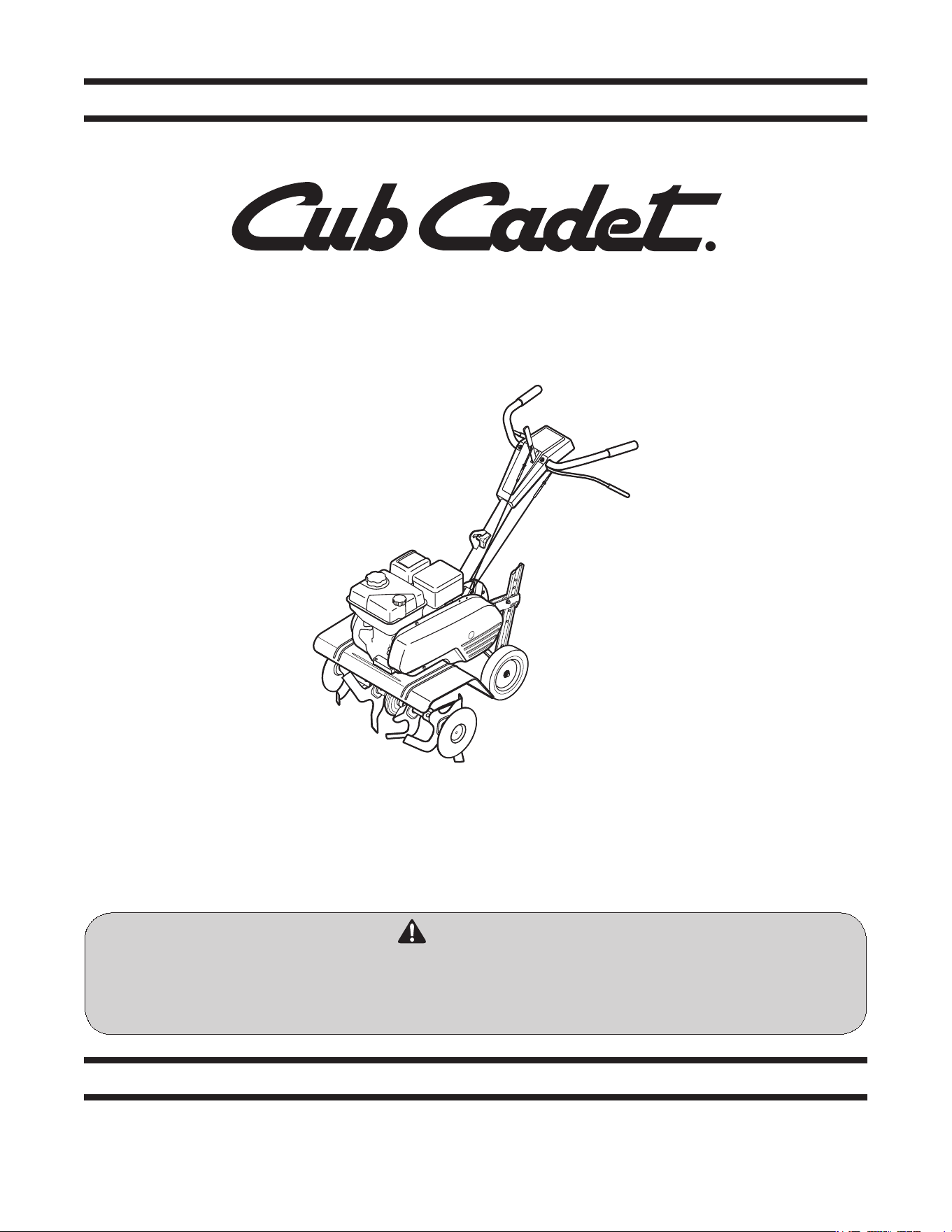
Front Tine Tiller — Model FT24
Form No. 769-05497
(October 27, 2009)

Customer Support
If you have difficulty assembling this product or have any questions regarding the controls, operation, or maintenance of
this machine, you can seek help from the experts. Choose from the options below:
Visit us on the web at www.cubcadet.com◊
Locate your nearest Cub Cadet Dealer at (877) 282-8684◊
Write to Cub Cadet LLC • P.O. Box 361131 • Cleveland, OH • 44136-0019◊
Thank you for purchasing a Cub Cadet Garden Tiller. It was
carefully engineered to provide excellent performance when
properly operated and maintained.
Please read this entire manual prior to operating the equipment.
It instructs you how to safely and easily set up, operate and
maintain your machine. Please be sure that you, and any other
persons who will operate the machine, carefully follow the
recommended safety practices at all times. Failure to do so could
result in personal injury or property damage.
All information in this manual is relative to the most recent
product information available at the time of printing. Review
this manual frequently to familiarize yourself with the machine,
its features and operation. Please be aware that this Operator’s
Manual may cover a range of product specifications for various
models. Characteristics and features discussed and/or illustrated
in this manual may not be applicable to all models. We reserve
the right to change product specifications, designs and
equipment without notice and without incurring obligation.
If you have any problems or questions concerning the machine,
phone your local Cub Cadet dealer or contact us directly. Cub
Cadet’s Customer Support telephone numbers, website address
and mailing address can be found on this page. We want to
ensure your complete satisfaction at all times.
Throughout this manual, all references to right and left side of the
machine are observed from the operating position.
Thank You
Record Product Information
Before setting up and operating your new equipment, please
locate the model plate on the equipment and record the
information in the provided area to the right. You can locate the
model plate by standing at the operator’s position and looking
down at the rear of the deck. This information will be necessary,
should you seek technical support via our web site or with your
local Cub Cadet dealer.
MO d e l nu M b e r
se r i a l nu M b e r
To The Owner
1
2
Safe Operation Practices ........................................ 3
Assembly & Set-Up .................................................. 7
Controls ...................................................................10
Operation ................................................................11
Maintenance & Adjustment..................................14
Engine Maintenance ..............................................17
Service .....................................................................21
Troubleshooting .................................................... 23
Replacement Parts ................................................ 20
Warranty ..................................................Back Cover
Table of Contents
Important Safe Operation Practices
2
3
Training
Read, understand, and follow all instructions on the 1.
machine and in the manual(s) before attempting to
assemble and operate. Keep this manual in a safe place for
future and regular reference and for ordering replacement
parts.
Be familiar with all controls and their proper operation. 2.
Know how to stop the machine and disengage them
quickly.
Never allow children under 14 years of age to operate this 3.
machine. Children 14 and over should read and understand
the instructions and safe operation practices in this manual
and on the machine and be trained and supervised by an
adult.
Never allow adults to operate this machine without proper 4.
instruction.
Keep the area of operation clear of all persons, particularly 5.
small children and pets. Stop machine if anyone enters the
area.
Preparation
Thoroughly inspect the area where the equipment is to 1.
be used. Remove all stones, sticks, wire, and other foreign
objects which could be tripped over and cause personal
injury.
Wear sturdy, rough-soled work shoes and close fitting 2.
slacks and shirt. Loose fitting clothes or jewelry can be
caught in moving parts. Never operate this machine in bare
feet or sandals.
Disengage clutch levers and shift (if provided) into neutral 3.
(“N”) before starting the engine.
Never leave this machine unattended with the engine 4.
running.
Never attempt to make any adjustments while engine is 5.
running, except where specifically recommended in the
operator’s manual.
Safe Handling of Gasoline:
To avoid personal injury or property damage use extreme care
in handling gasoline. Gasoline is extremely flammable and the
vapors are explosive. Serious personal injury can occur when
gasoline is spilled on yourself or your clothes which can ignite.
Wash your skin and change clothes immediately.
Use only an approved gasoline container.a.
Never fill containers inside a vehicle or on a truck b.
or trailer bed with a plastic liner. Always place
containers on the ground away from your vehicle
before filling.
WARNING! This symbol points out important safety instructions which, if not followed,
could endanger the personal safety and/or property of yourself and others. Read and follow
all instructions in this manual before attempting to operate this machine. Failure to comply
with these instructions may result in personal injury.
When you see this symbol. HEED ITS WARNING!
DANGER! This machine was built to be operated according to the safe operation practices in
this manual. As with any type of power equipment, carelessness or error on the part of the
operator can result in serious injury. This machine is capable of amputating fingers, hands,
toes and feet. Failure to observe the following safety instructions could result in serious
injury or death.
CALIFORNIA PROPOSITION 65
WARNING! Engine Exhaust, some of its constituents, and certain vehicle components
contain or emit chemicals known to State of California to cause cancer and birth defects
or other reproductive harm.
WARNING! Battery posts, terminals, and related accessories contain lead and lead
compounds, chemicals known to the State of California to cause cancer and reproductive
harm. Wash hands after handling

4 se c t i O n 2 — iM p O r t a n t sa f e Op e r a t i O n pr a c t i c e s
After striking a foreign object, stop the engine, disconnect 11.
the spark plug wire and ground against the engine.
Thoroughly inspect the machine for any damage. Repair
the damage before starting and operating.
Disengage all clutch levers (if fitted) and stop engine 12.
before you leave the operating position (behind the
handles). Wait until the tines come to a complete stop
before unclogging the tines, making any adjustments, or
inspections.
Never run an engine indoors or in a poorly ventilated area. 13.
Engine exhaust contains carbon monoxide, an odorless
and deadly gas.
Muffler and engine become hot and can cause a burn. Do 14.
not touch.
Use caution when tilling near fences, buildings and 15.
underground utilities. Rotating tines can cause property
damage or personal injury.
Do not overload machine capacity by attempting to till soil 16.
too deep at too fast of a rate.
If the machine should start making an unusual noise or 17.
vibration, stop the engine, disconnect the spark plug wire
and ground it against the engine. Inspect thoroughly for
damage. Repair any damage before starting and operating.
Keep all shields, guards, and safety devices in place and 18.
operating properly.
Never pick up or carry machine while the engine is running.19.
Use only attachments and accessories approved by the 20.
manufacturer. Failure to do so can result in personal injury.
If situations occur which are not covered in this manual, use 21.
care and good judgement. Contact Customer Support for
assistance and the name of you nearest servicing dealer..
Maintenance & Storage
Keep machine, attachments and accessories in safe 1.
working order.
Allow a machine to cool at least five minutes before 2.
storing. Never tamper with safety devices. Check their
proper operation regularly.
Check bolts and screws for proper tightness at frequent 3.
intervals to keep the machine in safe working condition.
Also, visually inspect machine for any damage.
Before cleaning, repairing, or inspecting, stop the engine 4.
and make certain the tines and all moving parts have
stopped. Disconnect the spark plug wire and ground it
against the engine to prevent unintended starting.
Do not change the engine governor settings or over-speed 5.
the engine. The governor controls the maximum safe
operating speed of engine.
Maintain or replace safety and instruction labels, as 6.
necessary.
Follow this manual for safe loading, unloading, 7.
transporting, and storage of this machine.
Always refer to the operator’s manual for important details 8.
if the machine is to be stored for an extended period.
When practical, remove gas-powered equipment c.
from the truck or trailer and refuel it on the ground.
If this is not possible, then refuel such equipment on
a trailer with a portable container, rather than from a
gasoline dispenser nozzle.
Keep the nozzle in contact with the rim of the fuel d.
tank or container opening at all times until fueling is
complete. Do not use a nozzle lock-open device.
Extinguish all cigarettes, cigars, pipes and other e.
sources of ignition.
Never fuel machine indoors.f.
Never remove gas cap or add fuel while the engine g.
is hot or running. Allow engine to cool at least two
minutes before refueling.
Never over fill fuel tank. Fill tank to no more than ½ h.
inch below bottom of filler neck to allow space for
fuel expansion.
Replace gasoline cap and tighten securely.i.
If gasoline is spilled, wipe it off the engine and j.
equipment. Move unit to another area. Wait 5
minutes before starting the engine.
To reduce fire hazards, keep machine free of grass, k.
leaves, or other debris build-up. Clean up oil or fuel
spillage and remove any fuel soaked debris.
Never store the machine or fuel container inside l.
where there is an open flame, spark or pilot light
as on a water heater, space heater, furnace, clothes
dryer or other gas appliances.
Operation
Do not put hands or feet near rotating parts. Contact with 1.
the rotating parts can amputate hands and feet.
Do not operate machine while under the influence of 2.
alcohol or drugs.
Never operate this machine without good visibility or light. 3.
Always be sure of your footing and keep a firm hold on the
handles.
Keep bystanders away from the machine while it is in 4.
operation. Stop the machine if anyone enters the area.
Be careful when tilling in hard ground. The tines may catch 5.
in the ground and propel the tiller forward. If this occurs,
let go of the handle bars and do not restrain the machine.
Exercise extreme caution when operating on or crossing 6.
gravel surfaces. Stay alert for hidden hazards or traffic. Do
not carry passengers.
Never operate the machine at high transport speeds on 7.
hard or slippery surfaces.
Exercise caution to avoid slipping or falling.8.
Look down and behind and use care when in reverse or 9.
pulling machine towards you.
Start the engine according to the instructions found in this 10.
manual and keep feet well away from the tines at all times.

5se c t i O n 2 — iM p O r t a n t sa f e Op e r a t i O n pr a c t i c e s
If the fuel tank has to be drained, do this outdoors.9.
Observe proper disposal laws and regulations for gas, oil, 10.
etc. to protect the environment.
According to the Consumer Products Safety Commission 11.
(CPSC) and the U.S. Environmental Protection Agency (EPA),
this product has an Average Useful Life of seven (7) years,
or 130 hours of operation. At the end of the Average Useful
Life have the machine inspected annually by an authorized
service dealer to ensure that all mechanical and safety
systems are working properly and not worn excessively.
Failure to do so can result in accidents, injuries or death.
Notice Regarding Emissions
Engines which are certified to comply with California and federal
EPA emission regulations for SORE (Small Off Road Equipment)
are certified to operate on regular unleaded gasoline, and
may include the following emission control systems: Engine
Modification (EM), Oxidizing Catalyst (OC), Secondary Air
Injection (SAI) and Three Way Catalyst (TWC) if so equipped.
Spark Arrester
WARNING! This machine is equipped with an
internal combustion engine and should not be used
on or near any unimproved forest-covered,
brushcovered or grass-covered land unless the
engine’s exhaust system is equipped with a spark
arrester meeting applicable local or state laws (if
any).
If a spark arrester is used, it should be maintained in effective
working order by the operator. In the State of California the
above is required by law (Section 4442 of the California Public
Resources Code). Other states may have similar laws. Federal laws
apply on federal lands.
A spark arrester for the muffler is available through your
nearest engine authorized service dealer or contact the service
department, P.O. Box 361131 Cleveland, Ohio 44136-0019.
6 se c t i O n 2 — iM p O r t a n t sa f e Op e r a t i O n pr a c t i c e s
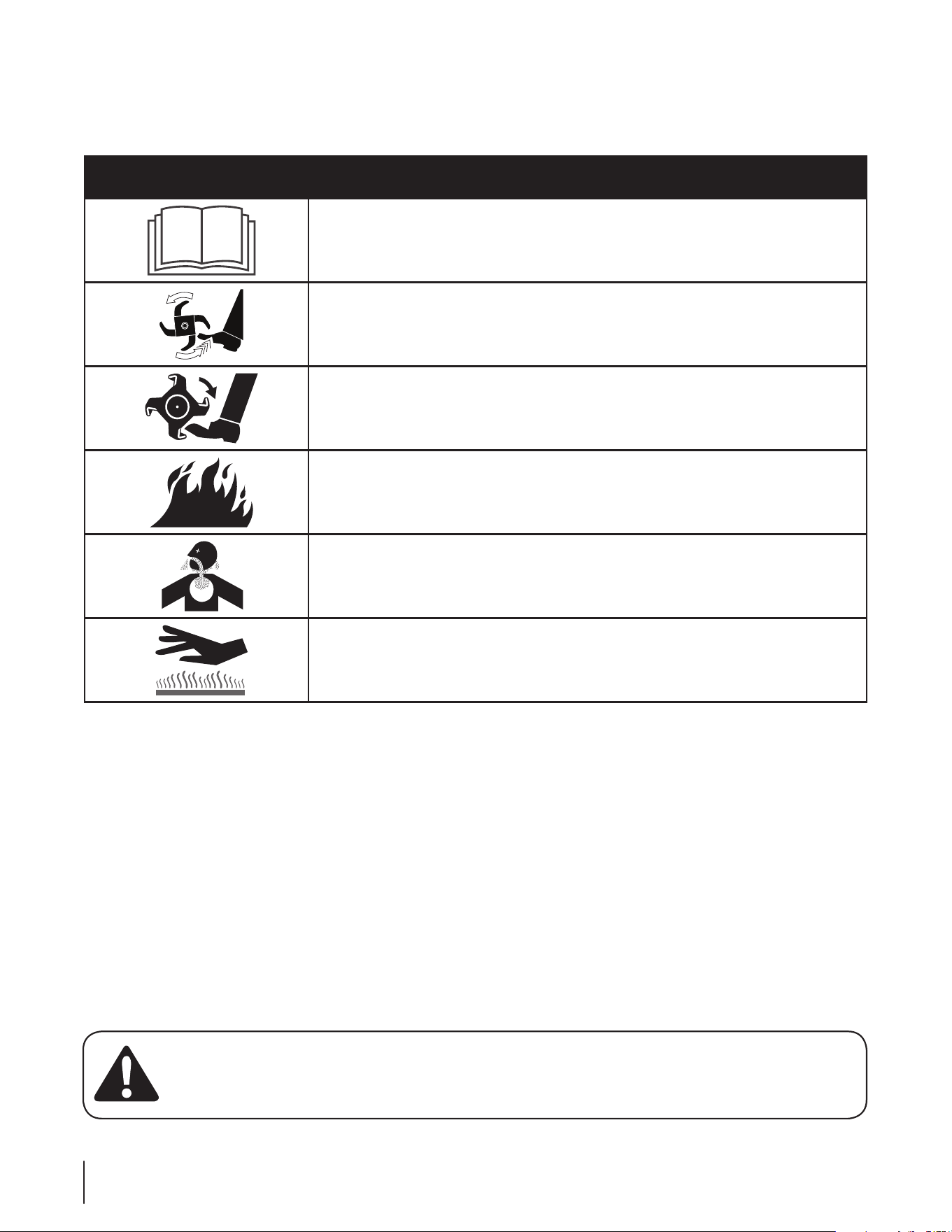
Safety Symbols
This page depicts and describes safety symbols that may appear on this product. Read, understand, and follow all instructions on the
machine before attempting to assemble and operate.
Symbol Description
READ THE OPERATOR’S MANUAL(S)
Read, understand, and follow all instructions in the manual(s) before attempting to
assemble and operate
WARNING— ROTATING TINES
Do not put hands or feet near rotating parts. Contact with the rotating parts can amputate
hands and feet.
WARNING— ROTATING TINES
Do not put hands or feet near rotating parts. Contact with the rotating parts can amputate
hands and feet.
WARNING—GASOLINE IS FLAMMABLE
Allow the engine to cool at least two minutes before refueling.
WARNING— CARBON MONOXIDE
Never run an engine indoors or in a poorly ventilated area. Engine exhaust contains carbon
monoxide, an odorless and deadly gas.
WARNING— HOT SURFACE
Engine parts, especially the muffler, become extremely hot during operation. Allow engine
and muffler to cool before touching.
WARNING! Your Responsibility—Restrict the use of this power machine to persons who read, understand and
follow the warnings and instructions in this manual and on the machine.
SAVE THESE INSTRUCTIONS!
Assembly
References to the right and left side of tiller are determined from
behind the equipment in the operating position.
Handle
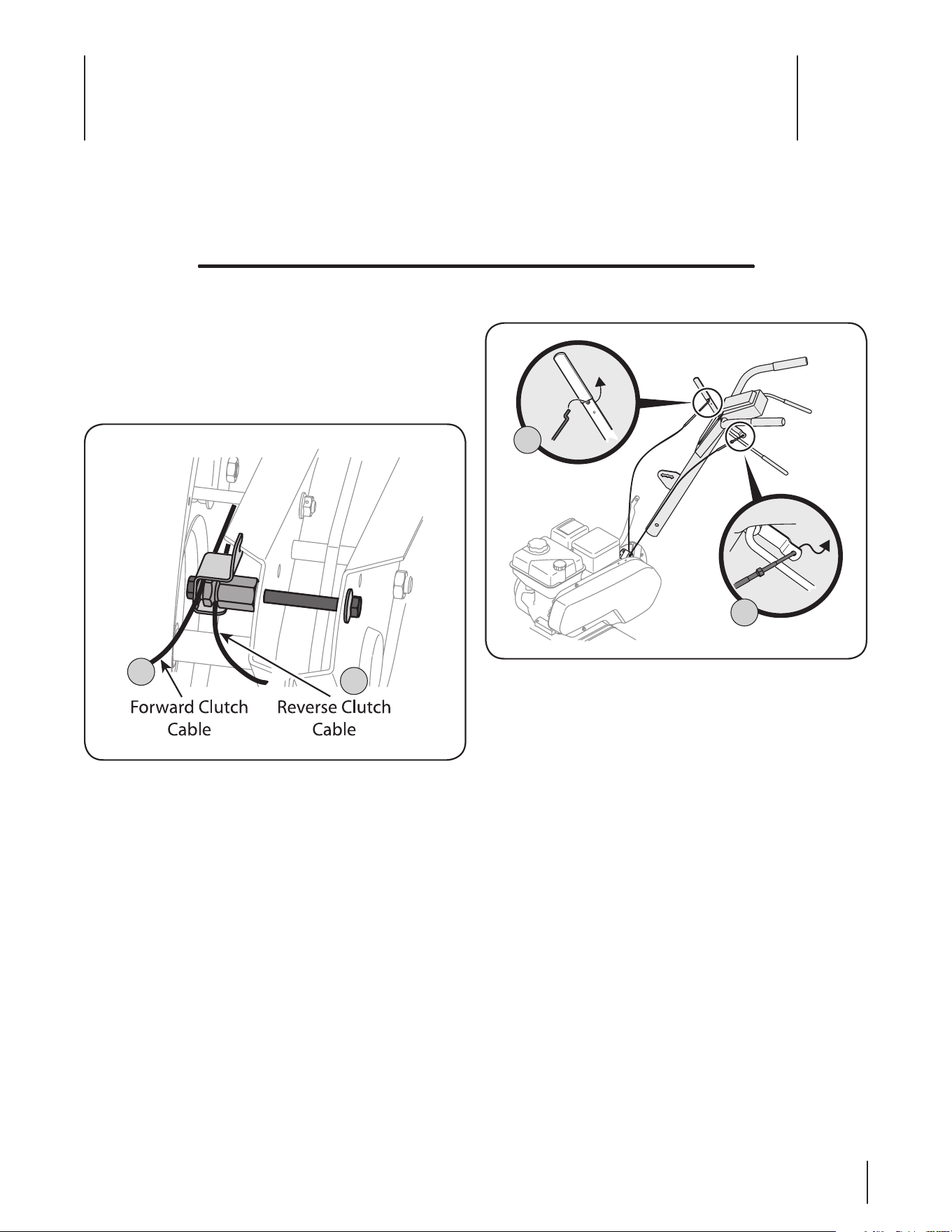
Identify the forward clutch cable and reverse clutch cables. 1.
Fig. 3–1.
NOTE: Be sure not to kink cables while attaching.
Hook the “Z” end of the forward clutch cable (A) into the 2.
forward tine engagement lever Fig. 3–2.
Hook the “Z” end of the reverse clutch cable (B) into the 3.
reverse tine engagement lever Fig. 3–2.
Contents of Carton
One Tiller • One Handlebar Assembly• One Depth Gage Assembly•
One Operator’s Manual• One Engine Operator’s Manual•
B
A
Figure 3-1
B
A
Figure 3-2
Assembly & Set-Up
3
7
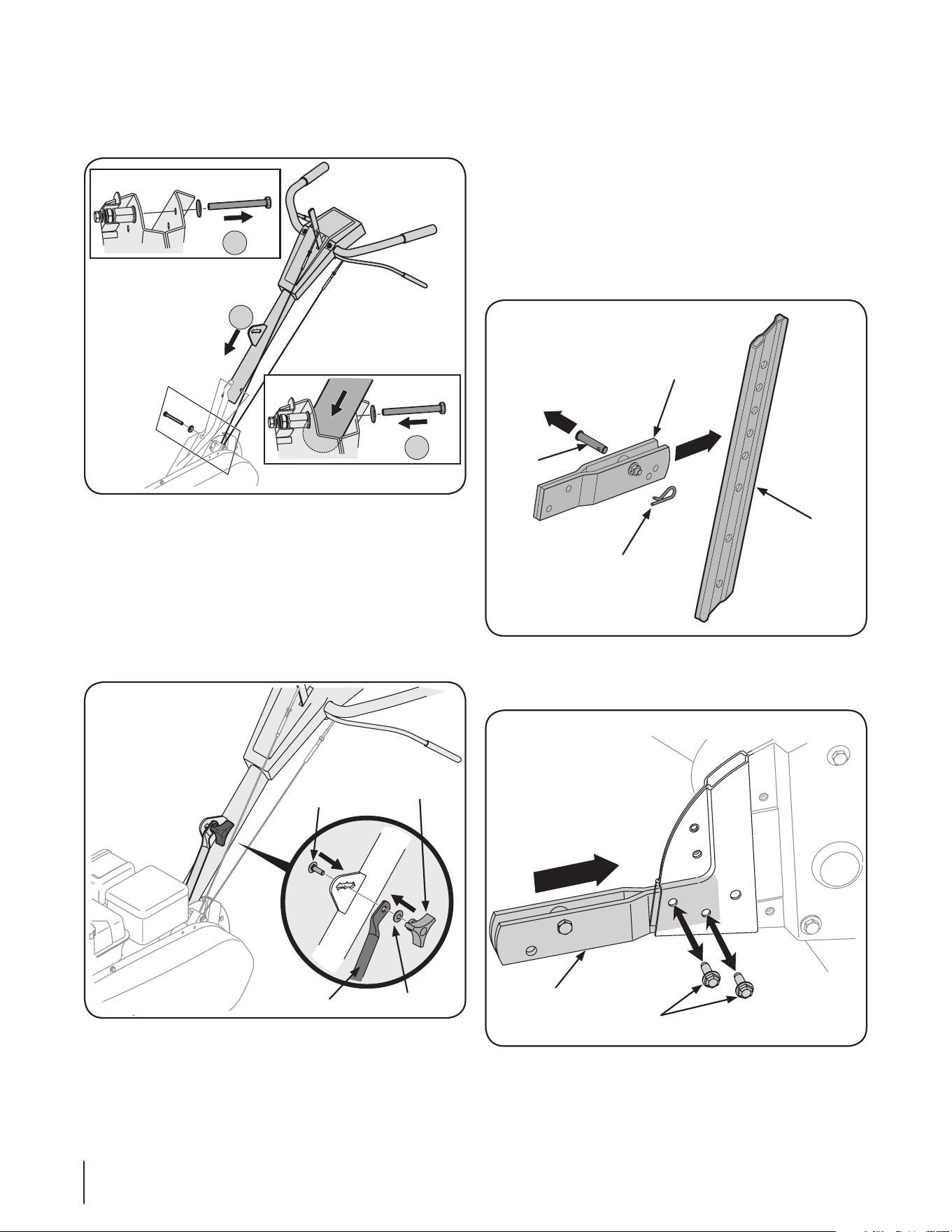
Insert the carriage bolt through the welded bracket on the 9.
handle, bell washer, handle brace and into the hand knob.
See Fig. 3–4.
Select one of the three handle height positions (three 10.
notches in the welded handle bracket) and tighten the
hand knob to secure the handle in the desired position. See
Fig. 3–4. Return to the lower handle and tighten the hex
bolt securely.
Depth Gage
Disassemble the depth gage assembly as seen in Fig. 3–5. 1.
Retain the pin and clip for later reassembly.
Remove the two screws from the tail bracket as shown in 2.
Fig. 3–6.
Insert the depth gage bracket into the frame and reinstall 3.
the two screws removed earlier. Tighten the hex bolts
securely. See Fig. 3–6.
Remove the hex bolt and cupped washer from the right 4.
side of the frame. Hold the cable guide bracket on the left
side of frame as it will fall when the bolt is removed. Step 1
in Fig. 3–3.
Insert the handle into tiller frame as shown. Step 2 in Fig. 5.
3–3.
Insert the bolt through the cupped washer, frame, handle 6.
and into the cable guide bracket (note the notch in the
cable guide bracket goes over the flange on the frame.)
Step 3 in Fig. 3–3.
Tighten the bolt securely after securing the handle brace as 7.
seen in Fig. 3–4.
Locate the carriage bolt, bell washer and hand knob 8.
packed with your tiller.
Carriage Bolt
Handle Brace
Bell Washer
Hand Knob
Figure 3-4
Cotter
Pin
Clevis
Pin
Depth
Stake
Tail Bracket
Figure 3-5
Screws
Tail Bracket
Figure 3-6
2
1
3
Figure 3-3
8 se c t i O n 3— as s e M b l y & se t -up
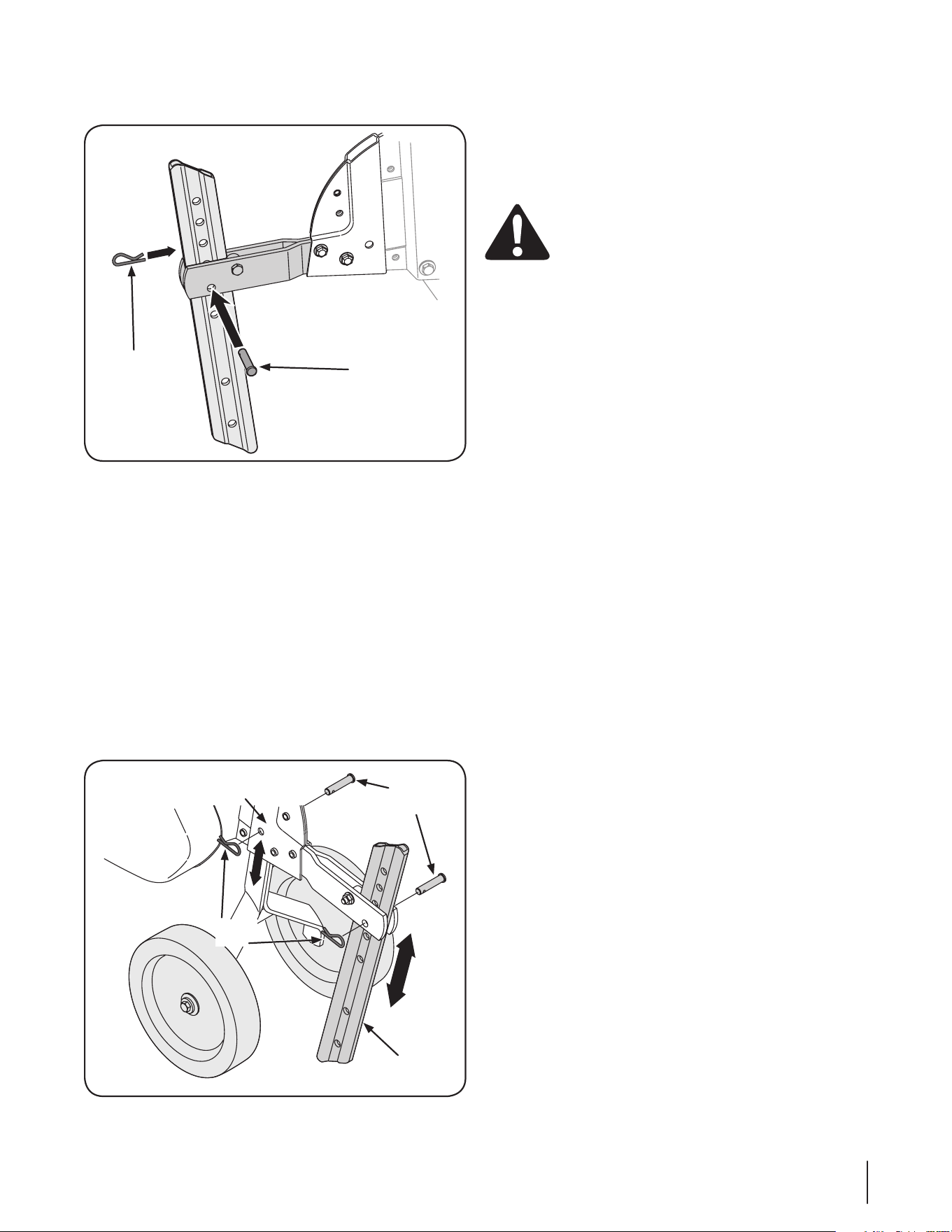
Insert the depth stake into the depth gage bracket 4.
assembly as seen in Fig. 3–7.
Secure the pin with the clip removed earlier. The depth 5.
stake can be placed at various positions. For setup
purposes it is suggested that the depth stake be assembled
with the stake just above or level with the ground surface.
For further instructions on the Depth Stake refer to the
Maintenance & Adjustments Section of this manual.
Adjustments
Wheels
The tiller is shipped with the wheels adjusted so that the
machine sits level. The wheels need to be adjusted to meet
your tilling needs before operation. This adjustment is made
by removing the clevis pin from the wheel yoke and raising the
wheels to the desired height. See Fig. 3-8.
Set-Up
Gas & Oil Fill-Up
Service the Engine with gasoline and oil as instructed in the
separate Engine Operator’s Manual packed with your tiller. Read
the instructions carefully.
WARNING! Use extreme care when handling
gasoline. Gasoline is extremely flammable and the
vapors are explosive. Never fuel the machine
indoors or while the engine is hot or running.
Cotter
Pin
Clevis Pin
Figure 3-7
Clevis
Pin
Cotter
Pin
Wheel Yoke
Depth
Stake
Figure 3-8
9se c t i O n 3 — as s e M b l y & se t -up
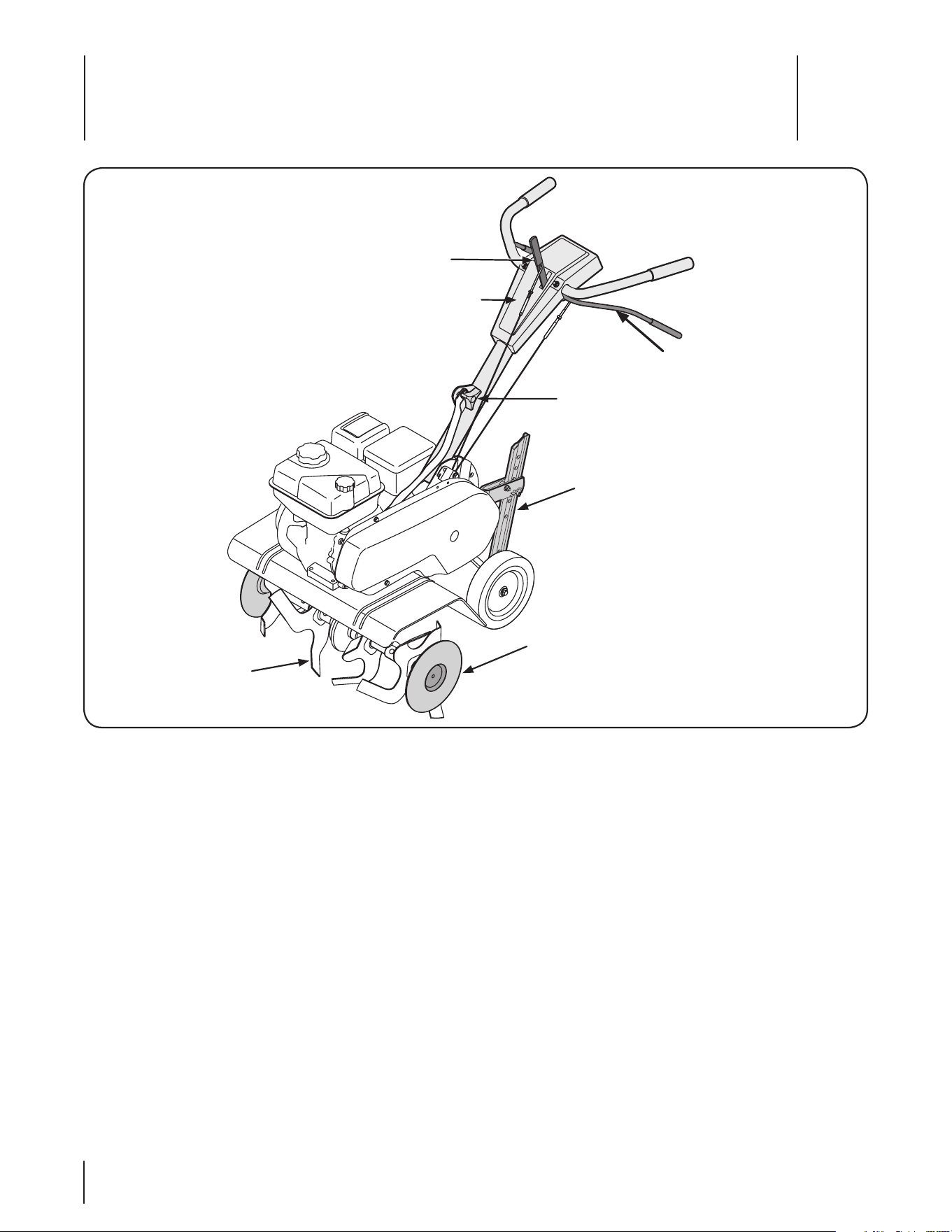
Engine Controls
See the separate Engine Operator’s Manual for additional
information and functions of the engine controls.
Forward Tine Engagement Lever
The forward tine control lever is located beneath the upper
section of the handle. Squeezing the lever against the handle
engages the tine drive. Release the lever to stop the tines.
Reverse Tine Engagement Lever
The reverse tine control lever is located on top of the upper
section of the handle. Pulling the lever toward operator engages
the tines in reverse. Release the lever to stop the tines.
NOTE: Never engage both the forward and reverse tine drives at
the same time. Engaging both forward and reverse tine drives
at the same time could damage the belt drives and cause the
engine to stall.
Depth Stake
The depth stake controls the tilling depth.
Tines and End Caps
Tilling tines and end caps are used to cultivate, furrow and
prepare your garden for seeding. End caps are used to avoid
tilled soil from overflowing onto unwanted areas.
Handle Knob
The handle height may be adjusted. Loosen the knob to change
the position. Tighten hardware when complete.
Throttle Control
The throttle controls the engine’s speed. Use maximum engine
speed when tilling. Stop the engine when transporting the tiller.
Choke Lever
The Choke lever is located next to the throttle lever. It is used to
enrich the fuel mixture when starting a cold engine.
Recoil Starter
The recoil starter is located on the right side of the engine and is
used to manually start the engine.
Reverse Tine
Engagement Lever
Handle
Tiller Tines
End Cap
Depth Stake
Handle Knob
Forward Tine
Engagement Lever
Figure 4-1
Controls and Features
4
10
Starting the Engine
WARNING! Read, understand, and follow all the
instructions and warnings posted on the machine
and in this manual before operating.
WARNING! Be sure no one is standing in front of
the tiller while the engine is running or being
started.
Attach the spark plug wire to the spark plug. Make sure the 1.
metal cap on the end of the spark plug is fastened securely
over the metal tip on the spark plug.
Make sure that the tine clutch control is disengaged.2.
Move the throttle control 3. 1⁄3 of the way toward the FAST
position.
Move/pull out the choke lever to CHOKE position when 4.
starting cold a engine.
Pull the rope out slowly until the engine reaches the 5.
beginning of its compression cycle. The rope will pull
slightly harder at this point.
Pull the rope with a rapid, continuous, full arm stroke. Keep 6.
a firm grip on the handle. Let the rope rewind slowly. Do
not let the recoil starter snap back against the engine.
Repeat until the engine starts.
Move/push in the choke lever once the engine warms up 7.
enough to run smoothly.
Move the throttle to FAST position for tilling.8.
Stopping the Engine
Move the control lever to STOP or OFF position.1.
Disconnect the spark plug wire and ground it to prevent 2.
accidentally starting the tiller while it is unattended.
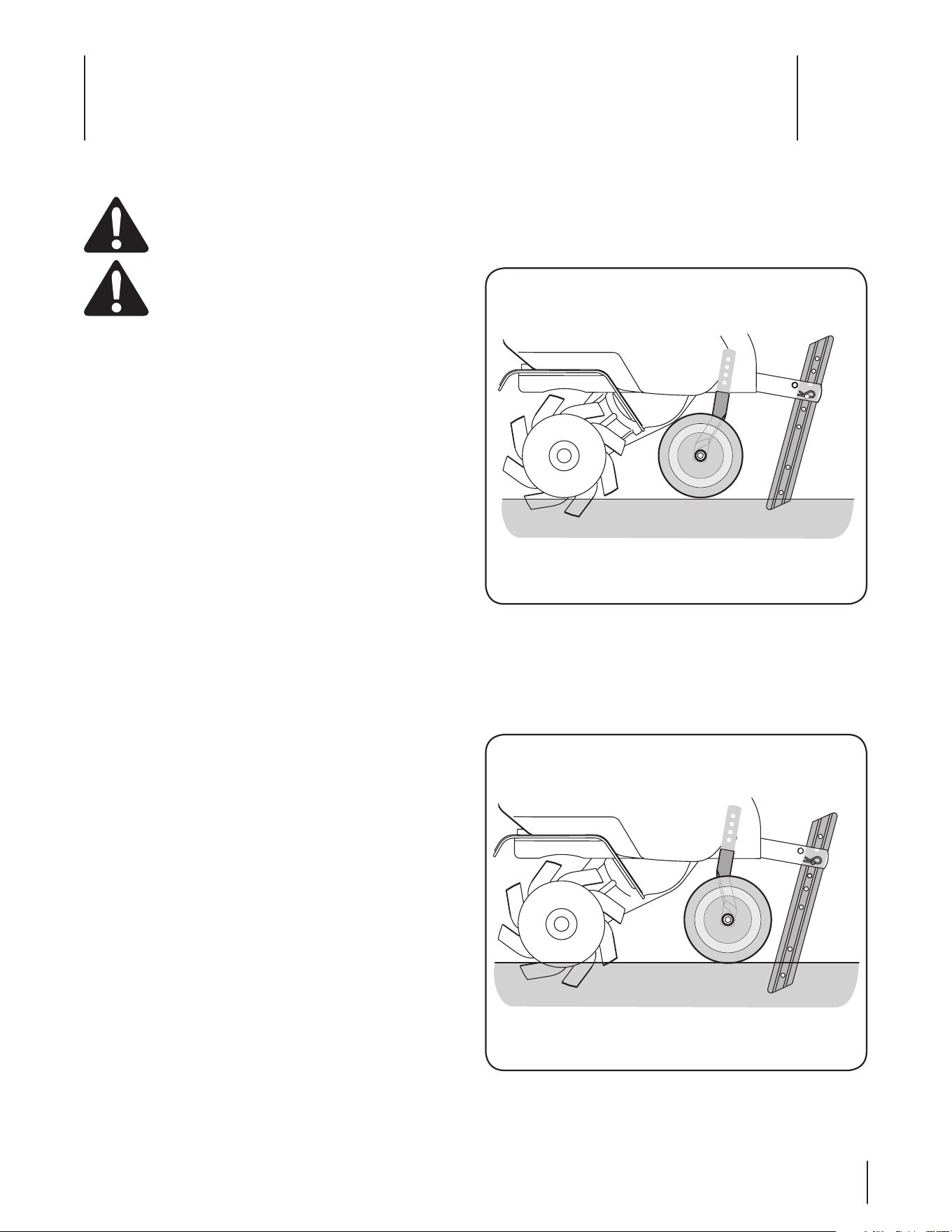
Setting the Depth
Yoke Forward
Place the wheel yoke so that wheels are forward (nearest to tines)
for shallow tilling, cultivating and transport. See Fig. 5-1.
Yoke to Back
Place the wheel yoke so that wheels are toward the rear —
closest to depth stake — for deep tilling and cultivating. See Fig.
5-2.
Figure 5-1
Figure 5-2
Operation
5
11
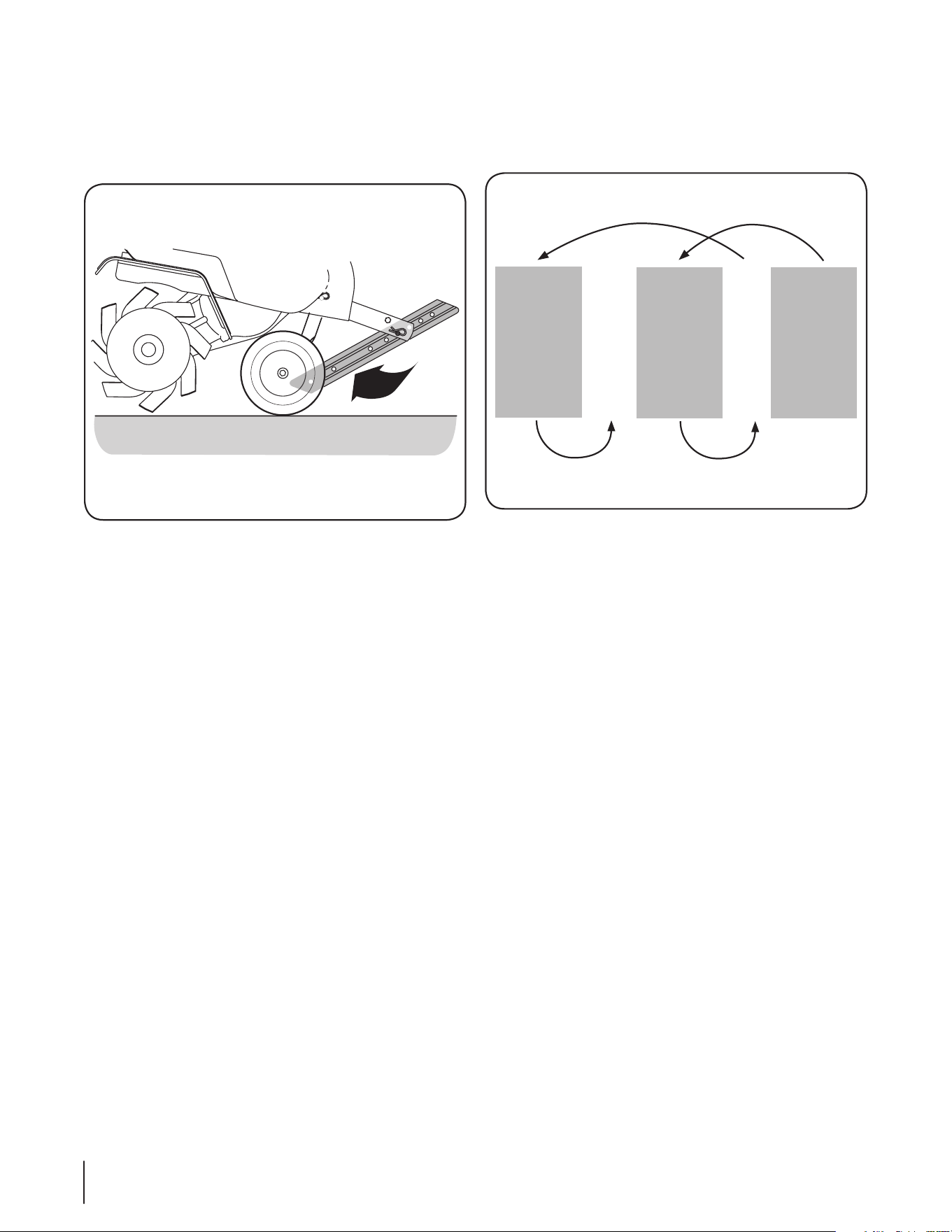
Depth Stake
The depth stake acts as a brake for the tiller and controls the
depth and speed at which the machine will operate. Remove the
clevis pin and hairpin clip to raise or lower depth stake. See Fig.
5-3.
Handle Pressure
Further control of the tilling depth and travel speed can be
obtained by variation of pressure on the handles.
A downward pressure on the handles will reduce the working
depth and increase the forward speed. An upward pressure on
the handles will increase the working depth and reduce the
forward speed.
The type of soil and working conditions will determine the actual
setting of the depth stake and the handle pressure required.
Transporting and Storing the Tiller
To transport and store the tiller move the throttle to the stop
position. Pivot the depth stake away from ground up between
wheels. See Fig. 5-3.
Using Your Tiller
Your tiller is designed for seed bed preparation, cultivating,
furrowing and mulching.
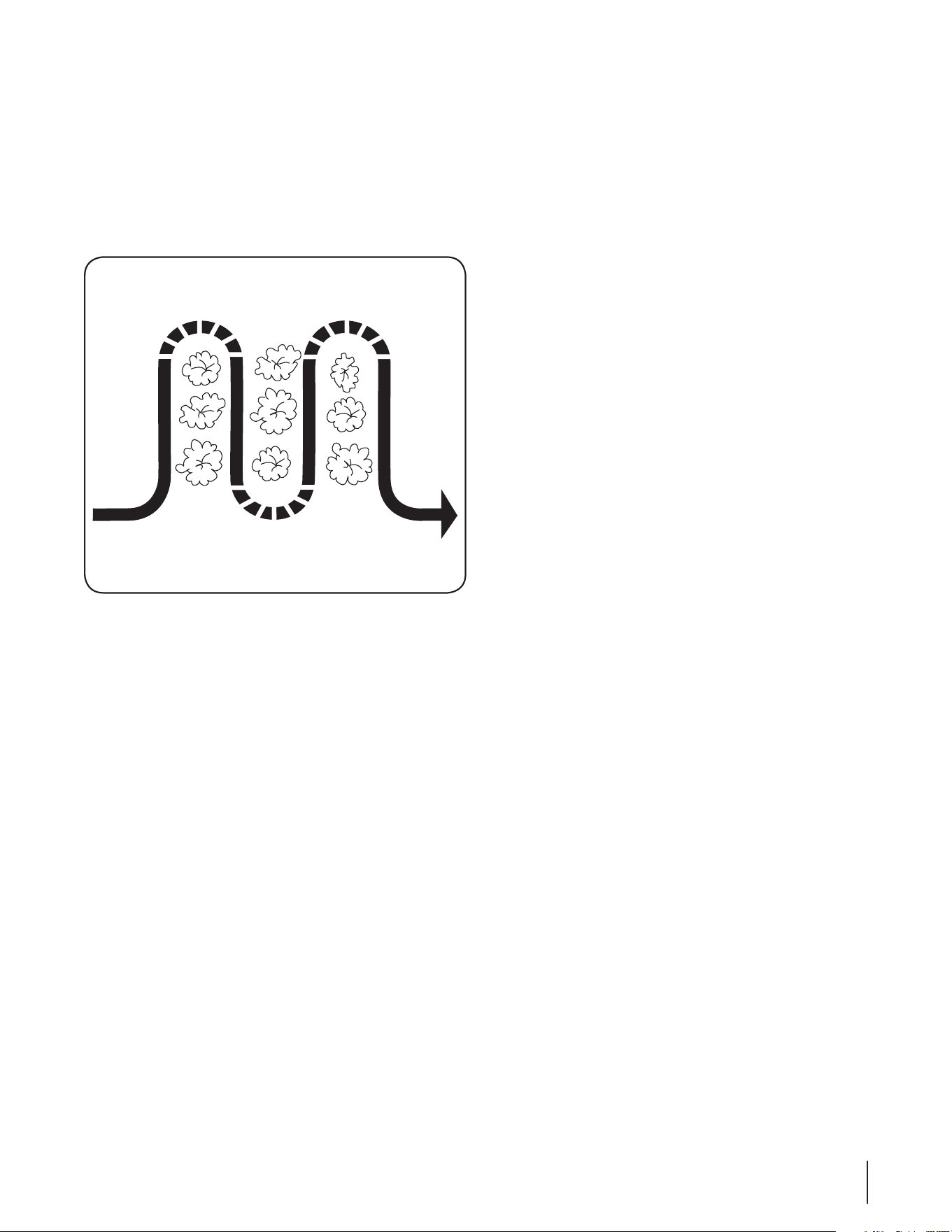
Tilling Procedure
When tilling, leave approximately eight inches of untilled soil
between the first and second tilling paths, then make the third
path between the first and second, Fig. 5-4.
In some soils, the desired depth is obtained the first time over
the garden. In other soils, the desired depth is obtained by going
over the garden two or three times. Passes should be made
across the length and width of the garden alternately. Rocks
which are turned up should be removed from the garden area.
Figure 5-3
12 34 5
Figure 5-4
12 se c t i O n 5— Op e r a t i O n
Cultivating Procedures
For cultivating, a two to three inch depth is desirable. The tine
width can be reduced to 13 inches by removing the outer tines
completely from the tiller. See the Maintenance & Adjustments
Section for instructions on removing the tines.
When laying out plant rows, be sure to allow enough width to
permit cultivation between the rows. In growing corn or similar
crops, check-row planting will permit cross cultivation and
practically eliminate hand hoeing. See Fig. 5-5.
Other Uses
The tiller has many uses other than tilling and cultivating a
garden. One of these is the preparation of lawn area for seeding.
The tiller will prepare a deep seed bed which will be free of hard
untilled spots, allowing a better stand of grass to grow. The tiller
is very useful for loosening hard soil for excavation with a shovel;
No tedious handwork will be necessary. Your tiller may be used
for mixing compost in the pile or for mixing it with the soil in
your garden. This should be done after the soil has been broken
to the full working depth. The compost should be worked in
to a depth of six to seven inches. This may be done by working
the length of the garden and then by making separate passes
across its width. The addition of decayed organic matter will
substantially increase the fertility of your garden. For proper
decaying action, fertilizer should be applied and worked in with
the mulch materials. Breaking up leaves and straw and mixing it
with several inches of soil allows proper aeration of the plant root
system and retards the growth of weeds.
Figure 5-5
13se c t i O n 5 — Op e r a t i O n
WARNING! Disconnect the spark plug wire and
ground it against the engine before performing any
repairs.
Maintenance
Engine
Refer to the separate Engine Operator’s Manual for engine
maintenance instructions.
Air Cleaner
Service the air cleaner every 10 hours under normal operating
conditions. Clean it every hour under extremely dusty conditions.
Poor engine performance and flooding usually indicate that the
air cleaner should be serviced. To service the air cleaner, refer to
the Separate Engine Operator’s Manual packed with your tiller.
Tines
Clean the underside of the tine shield after each use. The dirt
washes off the tines easier if rinsed off immediately instead of
after it dries. Always towel dry the tiller afterwards and apply a
light coat of oil or silicone to prevent rusting or water damage.
NOTE: Never use a “pressure washer” to clean your tiller. Water
can penetrate tight areas of the tiller and its chain case and cause
serious damage to machine.
Lubrication
Pivot Points
Remove the belt cover and lubricate all the pivot points and
linkages at least once a season with light oil. Keep the belts free
of lubrication.
Tine Shafts
Remove the tine assemblies and lubricate the tine shafts at least
once a season.
Wheel Shafts
Remove the wheel assemblies and lubricate the axle shafts at
least once a season.
Chain Drive
The chain drive is pre-lubricated and sealed at factory.
Adjustments
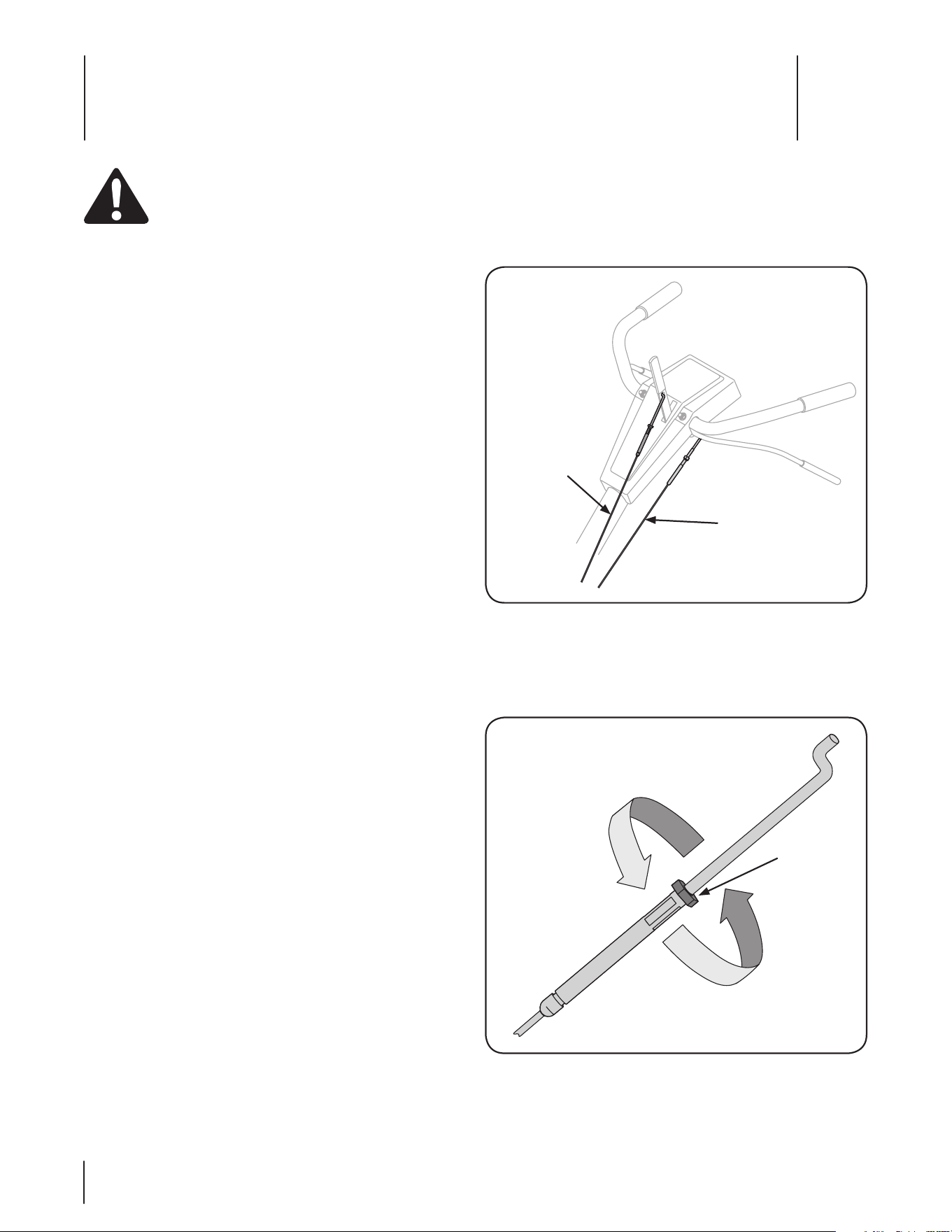
Cable Adjustment
From time to time you may need to adjust the tension on the
forward and reverse tine engagement cables. See Fig. 6-1.
Disconnect and ground the spark plug wire against the 1.
engine.
Adjust either the forward or reverse clutch cable by 2.
loosening the hex nut. See Fig. 6-2.
Reverse Tine
Engagement
Cable
Forward Tine
Engagement
Cable
Figure 6-1
Hex Nut
Figure 6-2
Maintenance & Adjustments
6
14
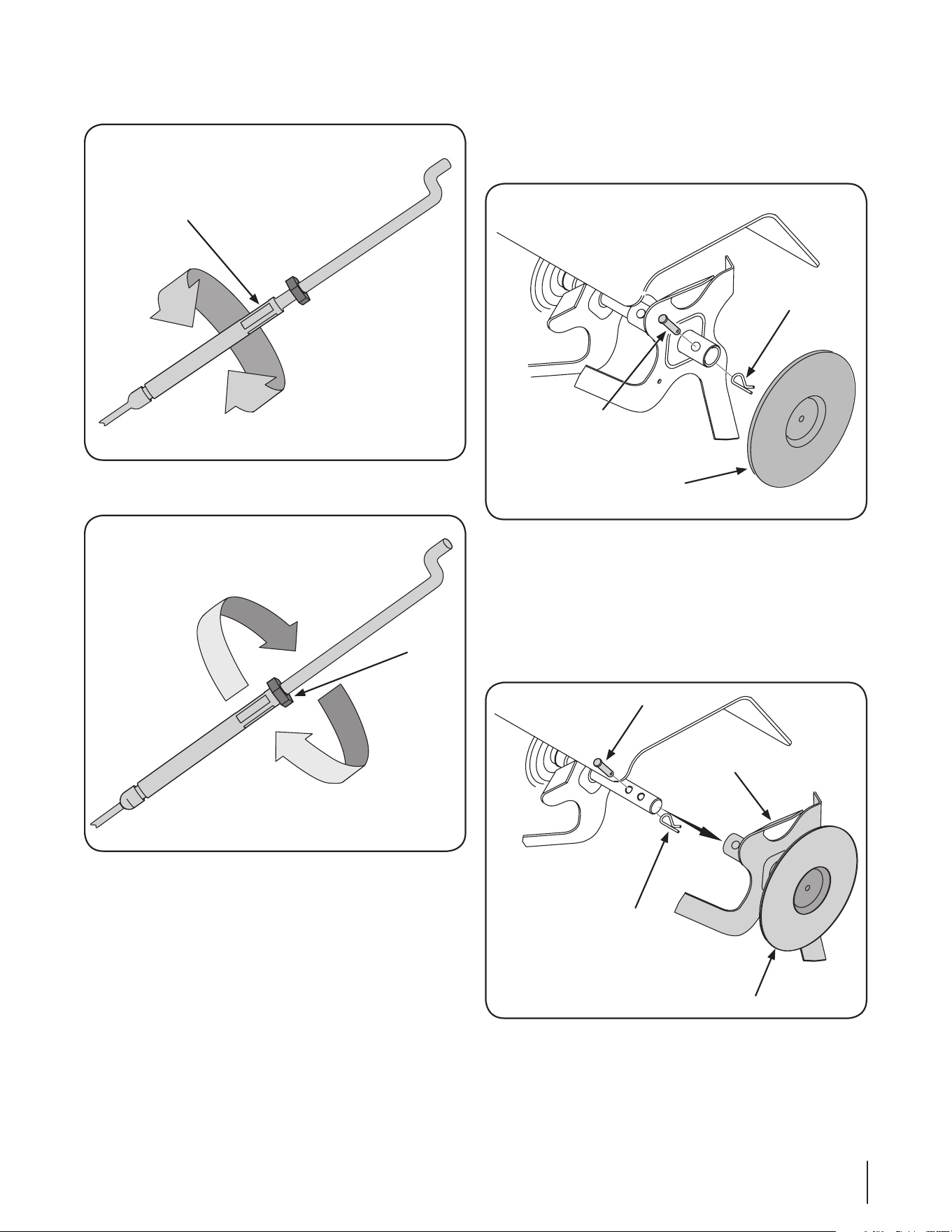
Turn the cable collar section one or two turns to increase or 3.
decrease tension on the cable. See Fig. 6-3.
Retighten the lock nut against the cable collar. See Fig. 6-4.4.
With the forward and reverse tine engagement handles in 5.
neutral — released — position, pull the starter rope several
times. The tines should not turn.
If they turn forward, adjust the forward tine engagement 6.
cable to release tension using the previous steps in this
section. If the tines turn toward rear, adjust the reverse tine
engagement cable to lesson the tension as with previous
steps.
Check again for correct tension on cables.7.
End Caps
The end cap, which is used to prevent tilled soil from overflowing
onto unwanted areas, are removable from the axle. Remove the
hairpin clip and clevis pin that secure each end cap and slide the
end caps off the axle. See Fig. 6-5.
Tines
With the outer tines installed, the working width of the machine
is 24 inches. This width may be expanded to 26 inches by
removing the clevis and cotter pins, sliding each outer tine
outward away from the center of the tiller and resecuring the
pins in the holes provided. See Fig. 6-6.
Cable Collar
Figure 6-3
Hex Nut
Figure 6-4
Clevis Pin
End Cap
Cotter Pin
Figure 6-5
Cotter Pin
Clevis Pin
End Cap
Outer Tine
Figure 6-6
15se c t i O n 6 — Ma i n t e n a n c e & ad j u s t M e n t s

Off-Season Storage
If the tiller will not be used for a period longer than 30 days, the
following steps should be taken to prepare the tiller for storage.
Clean the exterior of the engine and the entire tiller 1.
thoroughly. Lubricate the tiller as described in the
lubrication instructions.
The use of pressure washers is not recommended for 2.
cleaning your tiller. They may cause damage to electric
components, spindles, pulleys, bearings or the engine. The
use of pressure washers will result in shortened life and
reduce serviceability.
Refer to the engine manual for correct engine storage 3.
instructions.
Wipe tines with oiled rag to prevent rust.4.
Store tiller in a clean, dry area. Do not store next to 5.
corrosive materials, such as fertilizer.
NOTE: When storing any type of power equipment in
an unventilated area or metal storage shed, care should
be taken to rustproof the equipment. Using a light oil or
silicone, coat the equipment and especially any springs,
bearings, and cables.
16 se c t i O n 6— Ma i n t e n a n c e & ad j u s t M e n t s
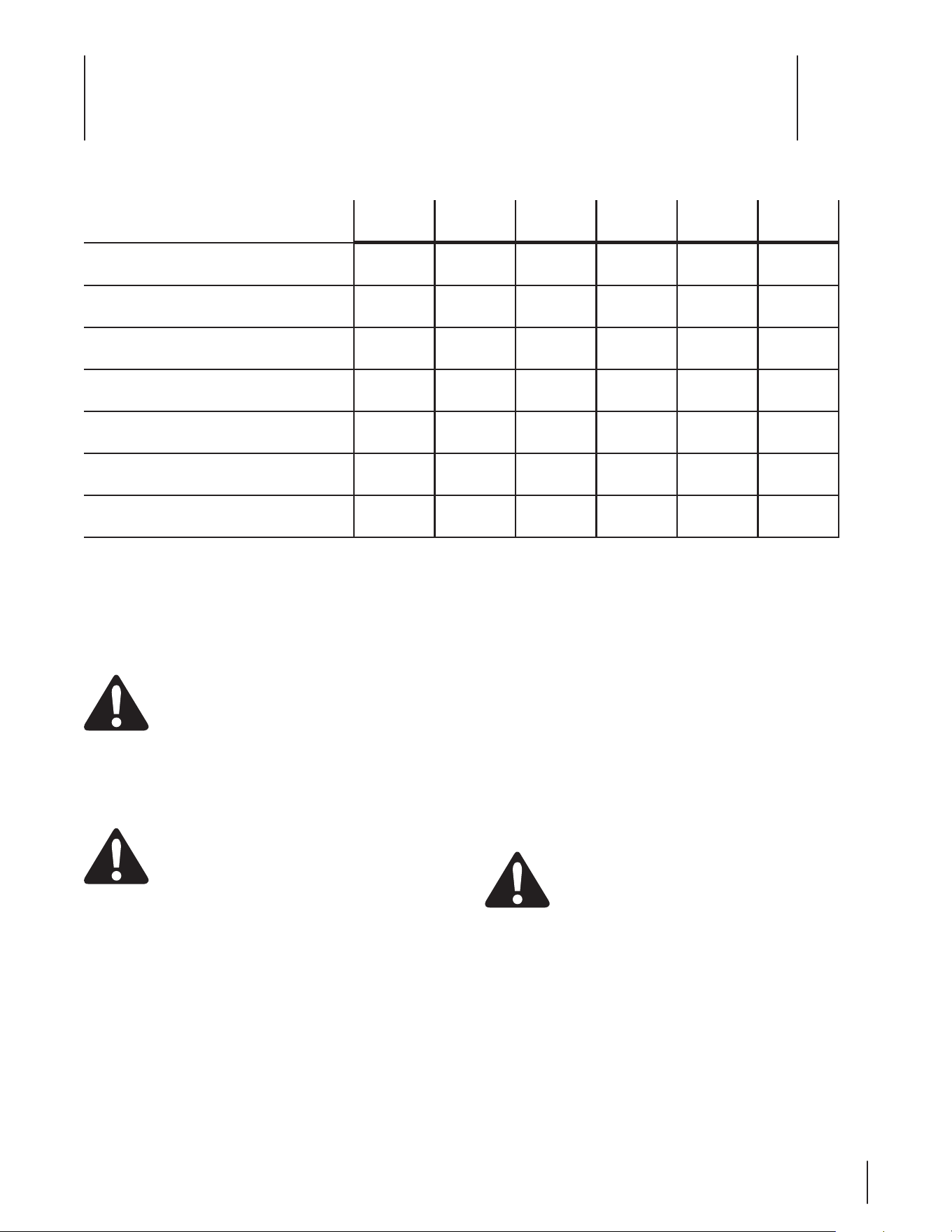
Maintenance Schedule
First 5 Hours
Each Use or
Every 5 Hrs.
Every Season
or 25 Hours
Every Season
or 50 Hours
Every Season
or 100 Hours
Service
Dates
Check Engine Oil Level
P
Change Engine Oil
P P
Check Air Cleaner
P
Service Air Cleaner
P
Check Spark Plug
P
Replace Spark Plug
P
Clean around muer
P
Periodic inspection and adjustment of the engine is essential
if high level performance is to be maintained. Regular
maintenance will also ensure a long service life. The required
service intervals and the kind of maintenance to be performed
are described in the table above. Follow the hourly or calendar
intervals, whichever occur first. More frequent service is required
when operating in adverse conditions.
WARNING! Shut off the engine before performing
any maintenance. To prevent accidental start-up,
disconnect the spark plug boot.
NOTE: If engine must be tipped to transport equipment or to
inspect or remove grass, keep spark plug side of engine up.
Transporting or tipping engine spark plug down may cause
smoking, hard starting, spark plug fouling, or oil saturation of air
cleaner.
WARNING! If the engine has been running, the
muffler will be very hot. Be careful not to touch the
muffler.
Oil
NOTE: Check the oil level before each use and after every five
hours of operation to be sure correct oil level is maintained.
Check oil level regularly.•
See the Assembly & Set-Up Section for instructions on how •
to properly check the oil.
Changing the Oil
NOTE: Be sure to check engine on a level surface with the engine
stopped. Drain the oil while the engine is still warm to assure
rapid and complete draining.
Drain fuel from tank by running engine until the fuel tank is 1.
empty. Be sure fuel fill cap is secure.
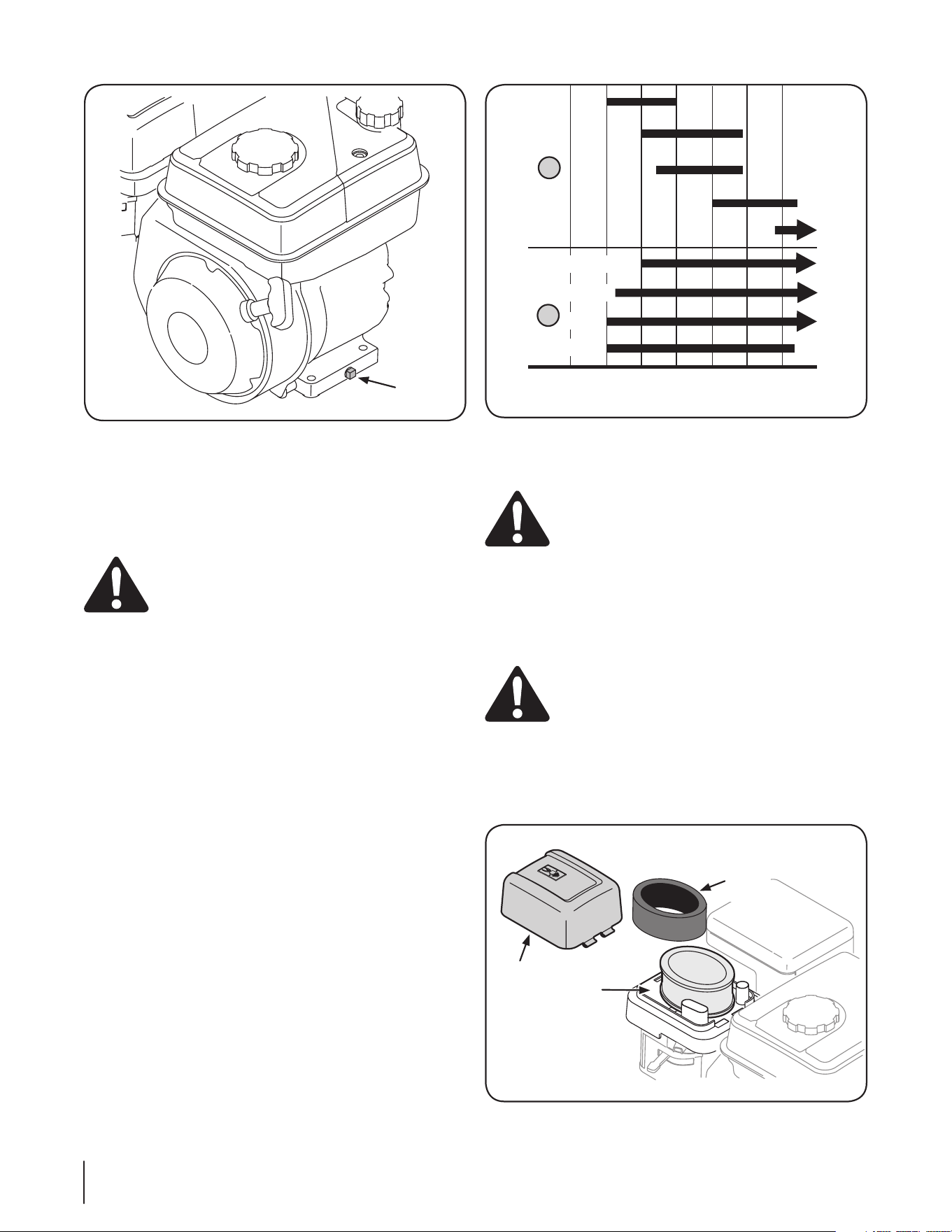
Remove drain plug and allow oil to drain into a suitable 2.
container. See Fig. 6-1.
WARNING! Before tipping engine or equipment to
drain oil, drain fuel from tank by running engine
until fuel tank is empty.
Engine Maintenance
7
17
Reinstall the drain plug and tighten it securely.3.
Refill with the recommended oil and check the oil level. 4.
Refer to the Assembly & Set-up section for instructions on
how to properly check the oil level.
Reinstall the oil fill cap securely.5.
WARNING! Used motor oil may cause skin cancer if
repeatedly left in contact with the skin for prolonged
periods. Although this is unlikely unless you handle
used oil on a daily basis, it is still advisable to
thoroughly wash your hands with soap and water as
soon as possible after handling used oil.
NOTE: Please dispose of used motor oil in a manner that is
compatible with the environment. We suggest you take it in a
sealed container to your local service station for reclamation. Do
not throw it in the trash or pour it on the ground.
Oil Recommendations
SAE 10W-30 is recommended for general, all temperature use.
When adding oil to the engine, refer to the viscosity chart shown
on this page. Engine oil capacity is 600 ml (approximately 20 oz.).
Do not over-fill. Use a 4-stroke, or an equivalent high detergent,
premium quality motor oil certified to meet or exceed U.S.
automobile manufacturer’s requirements for service classification
SG, SF. Motor oils classified SG, SF will show this designation on the
container.
Single Viscosity1.
Multi Viscosity2.
CAUTION! DO NOT use non-detergent oil or
2-stroke engine oil. It could shorten the engine’s
service life.
Air Filter
Paper filters cannot be cleaned and must be replaced once a year
or every 100 operating hours; more often if used in extremely
dusty conditions.
WARNING! Never use gasoline or low flash point
solvents for cleaning the air cleaner element. A fire
or explosion could result.
NOTE: Never run the engine without the air cleaner. Rapid
engine wear will result.
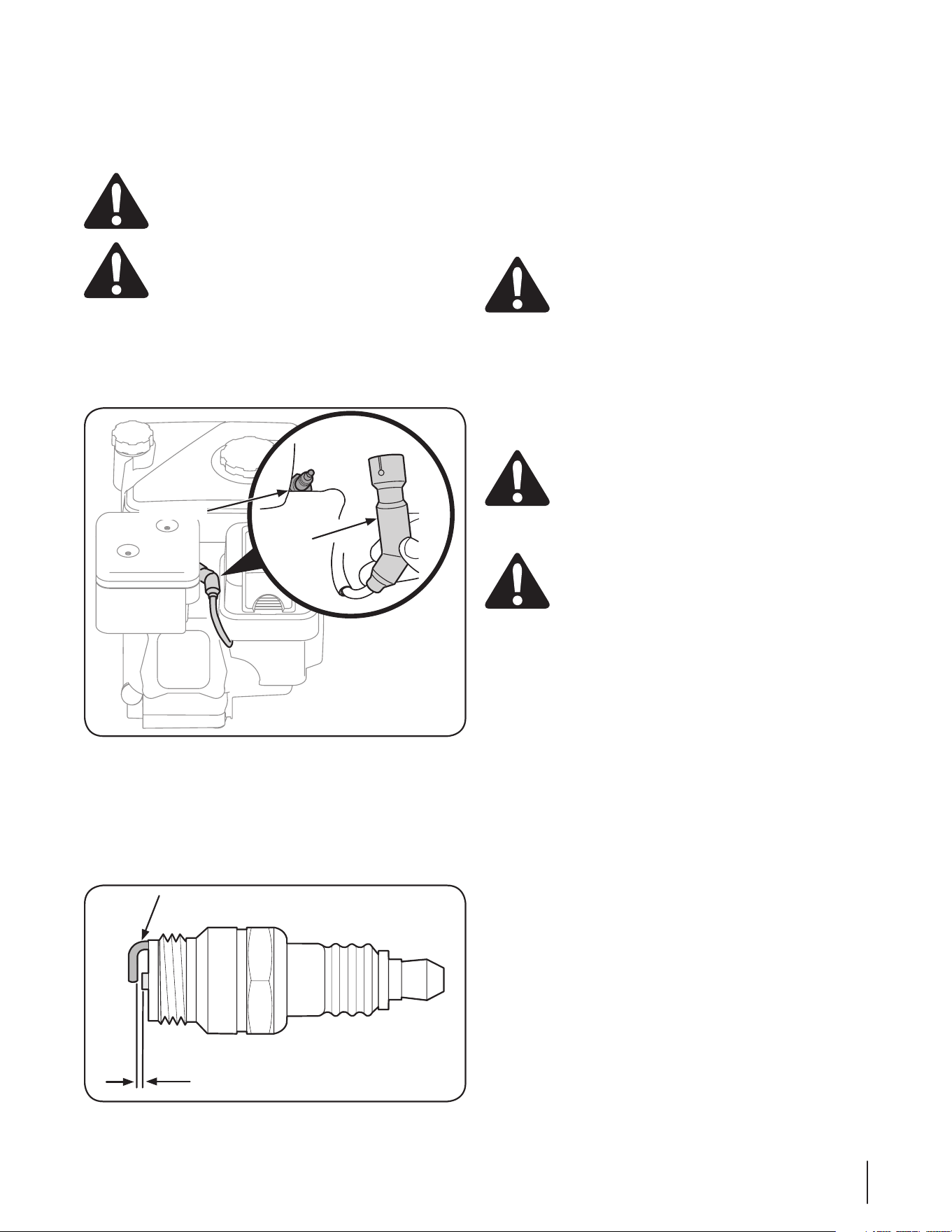
Press the tab on the air filter cover and lift the cover. See 1.
Fig. 6-2. Replace paper element when dirty or damaged.
Clean foam element or replace when damaged.
Oil
Drain
Figure 6-1
Air
Filter
Air Filter
Cover
Foam
Element
Figure 6-2
-30º -20º
10w
20w
20
30
40
20w40, 20w50
15w40, 15w50
10w40
10w30
-10º 0º
0º 20º 40º 60º 80º 100º
10º 20º 30º 40º
-20º
(ºC)
(ºF)
1
2
Ambient Temperature
18 se c t i O n 7 — en g i n e Ma i n t e n a n c e
To clean foam element, separate it from the paper element 2.
and wash in liquid detergent and water. Allow to dry
thoroughly before using. Do not oil the foam element.
Spark Plug Service
WARNING! DO NOT check for spark with spark
plug removed. DO NOT crank engine with spark
plug removed.
WARNING! If the engine has been running, the
muffler will be very hot. Be careful not to touch the
muffler.
To ensure proper engine operation, the spark plug must be
properly gapped and free of deposits.
Remove the spark plug boot and use a spark plug wrench 1.
to remove the plug. See Fig. 6-3.
2. Visually inspect the spark plug. Discard the spark plug if there
is apparent wear, or if the insulator is cracked or chipped.
Clean the spark plug with a wire brush if it is to be reused.
3. Measure the plug gap with a feeler gauge. Correct as
necessary by bending side electrode. See Fig. 6-4. The gap
should be set to 0.030 in.
4. Check that the spark plug washer is in good condition
and thread the spark plug in by hand to prevent cross-
threading.
5. After the spark plug is seated, tighten with a spark plug
wrench to compress the washer.
NOTE: When installing a new spark plug, tighten 1⁄2 turn
after the spark plug seats to compress the washer. When
reinstalling a used spark plug, tighten 1⁄8-1⁄4 turn after the
spark plug seats to compress the washer.
CAUTION! The spark plug must be securely
tightened. An improperly tightened spark plug can
become very hot and may damage the engine.
Cleaning the Engine
If the engine has been running, allow it to cool for at least half
an hour before cleaning. Periodically remove dirt build-up from
the engine. Clean around the muffler. Clean with a brush or
compressed air.
CAUTION! Do not spray engine with water to clean
because water could contaminate fuel. Using a
garden hose or pressure washing equipment can
also force water into the muffler opening. Water that
passes through the muffler can enter the cylinder,
causing damage.
WARNING! Accumulation of debris around muffler
could cause a fire. Inspect and clean before every
use.
0.02-0.03 in.
0.60-0.80 mm
Electrode
Figure 6-4
Spark Plug
Spark Plug
Boot
Figure 6-3
19se c t i O n 7 — en g i n e Ma i n t e n a n c e

Off-Season Storage
Engines stored between 30 and 90 days need to be treated with
a gasoline stabilizer and engines stored over 90 days need to be
drained of fuel to prevent deterioration and gum from forming
in fuel system or on essential carburetor parts. If the gasoline in
your engine deteriorates during storage, you may need to have
the carburetor, and other fuel system components, serviced or
replaced.
Remove all fuel from tank by running engine until it stops 1.
from lack of fuel.
WARNING! Never leave engine unattended while it
is running.
Change the oil. See Changing the Oil earlier in this section.2.
Remove spark plug and pour about a 3. 1⁄2 ounce of engine oil
into the cylinder. Replace spark plug and crank it slowly to
distribute oil.
Clean debris from around the engine and the muffler. 4.
Touch up any damaged paint, and coat other areas that
may rust with a light film of oil.
Store in a clean, dry and well ventilated area away from any 5.
appliance that operates with a flame or pilot light, such
as a furnace, water heater, or clothes dryer. Also avoid any
area with a spark producing electric motor, or where power
tools are operated.
If possible, also avoid storage areas with high humidity, 6.
because that promotes rust and corrosion.
Keep the engine level in storage. Tilting can cause fuel or 7.
oil leakage.
20 se c t i O n 7 — en g i n e Ma i n t e n a n c e
Belt Replacement
Reverse Drive Belt
Your tiller has been engineered with a belt made of special
material (Kevlar Tensile) for longer life and better performance. It
should not be replaced with an off-the-shelf belt. Order all belts
through you authorized service dealer.
Disconnect and ground the spark plug wire against the 1.
engine.
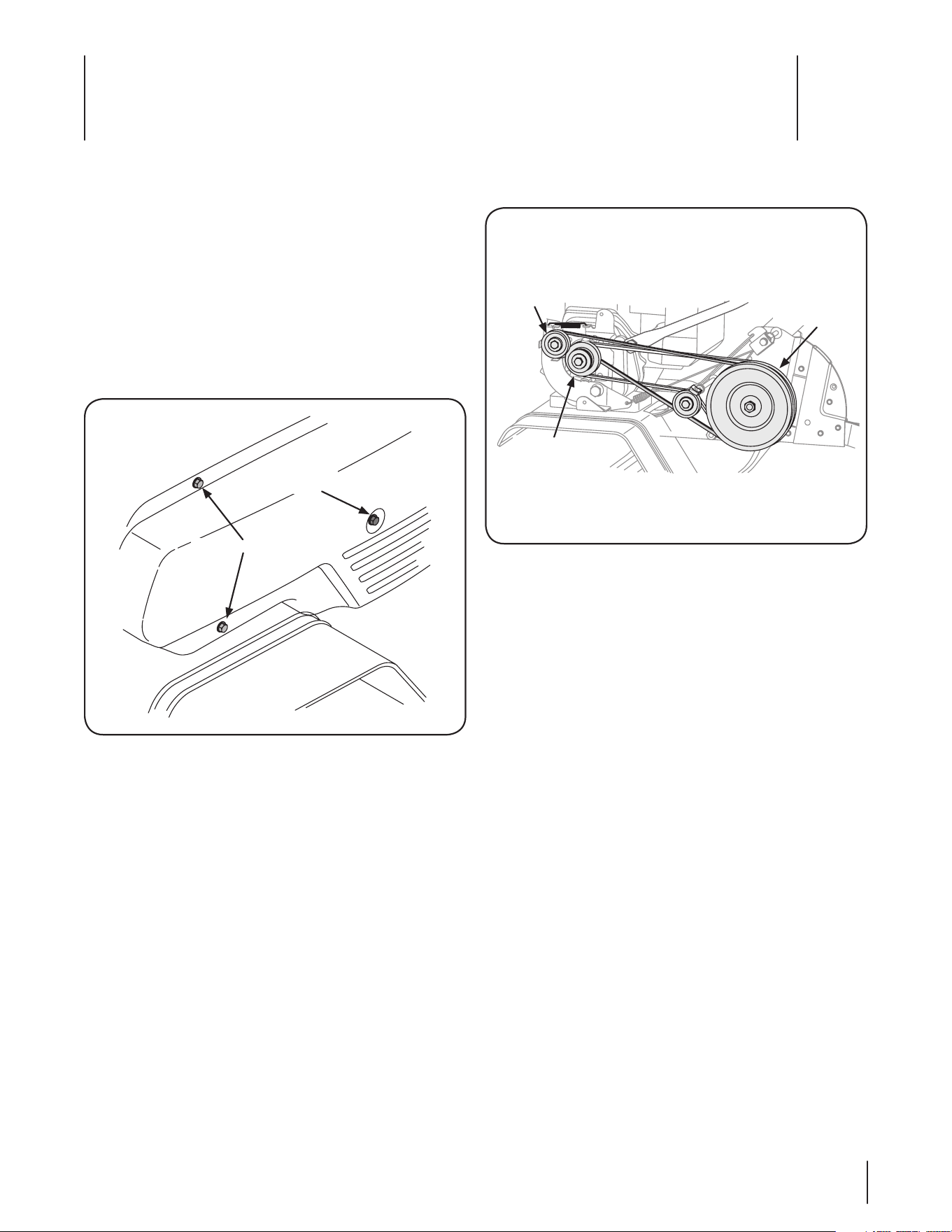
Remove the belt cover from the left side of the tiller by 2.
removing the two self-tapping screws and hex stop nut
and washer. See Fig. 7–1.
Remove belt from transmission pulley and then from 3.
around the reverse idler pulley. See Fig. 7–2.
To reassemble the new belt, follow the instructions in 4.
reverse order. Be sure to place the wider side of the belt
against transmission and idler pulley while slimmer side
goes over the engine pulley. See Fig. 7–2.
NOTE: Upon reassembly, make certain the belt is routed
over the idler pulley and inside of belt keepers by engine
pulley. See Fig. 7–2.
Self-tapping Screws
Hex Stop Nut
& Washer
Figure 7-1
Transmission
Pulley
Reverse Idler
Pulley
Engine Pulley
Figure 7-2
Service
8
21
Forward Drive Belt
Remove the reverse drive belt as instructed in the previous 1.
section.
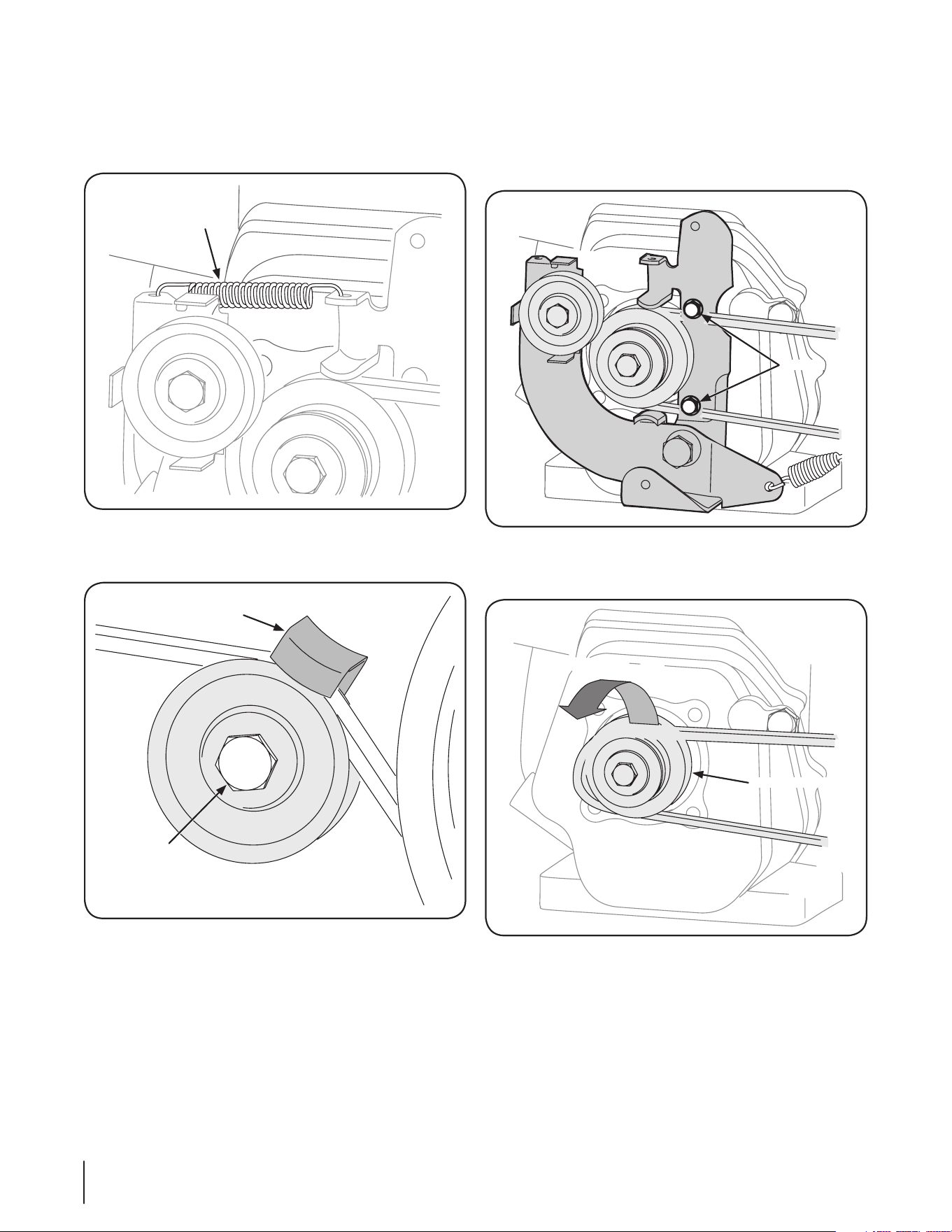
Remove the return spring. See Fig. 7–3.2.
Remove the idler pulley bolt and move the belt from under 3.
the idler pulley keeper. See Fig. 7–4.
The forward idler belt will not clear the belt keepers near 4.
the engine pulley. You must remove the reverse idler
bracket to allow the belt to move off of the engine pulley.
Remove the two securing screws and move the bracket
toward the transmission pulley. Retain the screws for
reassembly. See Fig. 7–5.
Remove the belt from the reverse idler pulley and then 5.
from around the transmission pulley. See Fig. 7–6.
To reassemble the new belt, follow the instructions in 6.
reverse order. Be sure to place the wider side of the belt
away from the engine and transmission pulleys.
NOTE: Upon reassembly, make certain that the idler pulley
keeper is as shown in Fig. 7–4. Take note of the notch
on the bottom of the keeper and the alignment when
reassembling with the replacement belt.
Return Spring
Figure 7-3
Idler Pulley Keeper
Idler Pulley
Bolt
Figure 7-4
Screws
Figure 7-5
Engine Pulley
Figure 7-6
22 se c t i O n 8— se r v i c e

Problem Cause Remedy
Engine fails to start Fuel tank empty or stale fuel1.
Throttle control lever not in correct starting 2.
position (if equipped)
Blocked fuel line3.
Dirty air cleaner4.
Choke not in ON position5.
Spark plug wire disconnected6.
Faulty spark plug7.
Engine flooded8.
Fill tank with clean, fresh gasoline1.
Move throttle lever to start position 2.
Clean fuel line3.
Refer to the Engine Operator’s Manual4.
Move switch to ON position5.
Connect wire to spark plug6.
Clean, adjust gap or replace7.
Refer to the Engine Operator’s Manual8.
Engine runs erratic Tiller running on CHOKE1.
Spark plug wire loose2.
Blocked fuel line or stale fuel 3.
Vent in gas cap plugged4.
Water or dirt in fuel system5.
Dirty air cleaner6.
Carburetor out of adjustment7.
Move choke lever to OFF position1.
Connect and tighten spark plug wire2.
Clean fuel line; fill tank with clean, fresh 3.
gasoline
Clear vent4.
Drain fuel tank, refill with fresh fuel5.
Refer to the Engine Operator’s Manual6.
Refer to the Engine Operator’s Manual7.
Engine overheats Engine oil level low1.
Dirty air cleaner2.
Air flow restricted3.
Carburetor not adjusted properly4.
Fill crankcase with proper oil1.
Refer to the Engine Operator’s Manual2.
Refer to the Engine Operator’s Manual3.
Adjust carburetor as instructed in separate 4.
engine manual.
Tines do not engage Foreign object lodged in tines1.
Tine clevis pin(s) missing2.
Pulley and idler not in correct adjustment3.
Not shifting properly 4.
Control cable not adjusted properly5.
Belt worn and/or stretched6.
Dislodge foreign object1.
Replace tine clevis pin(s)2.
Take tiller to authorized service dealer3.
Refer to the Controls & Features Section for 4.
proper shifting procedures
Adjust control cable5.
Replace belt6.
Tines skip over ground Improper rotation.1. Forward rotation should only be used on soil 1.
that has already been tilled, not on virgin soil.
Wheels do not engage Clevis pin missing1.
Tiller is not being shifted properly 2.
Control cable not adjusted properly3.
Belt worn and/or stretched4.
Replace clevis pin1.
Refer to Controls & Features Section for 2.
proper shifting procedures
Adjust control cable3.
Replace belt4.
Troubleshooting
9
23
Component Part Number and Description
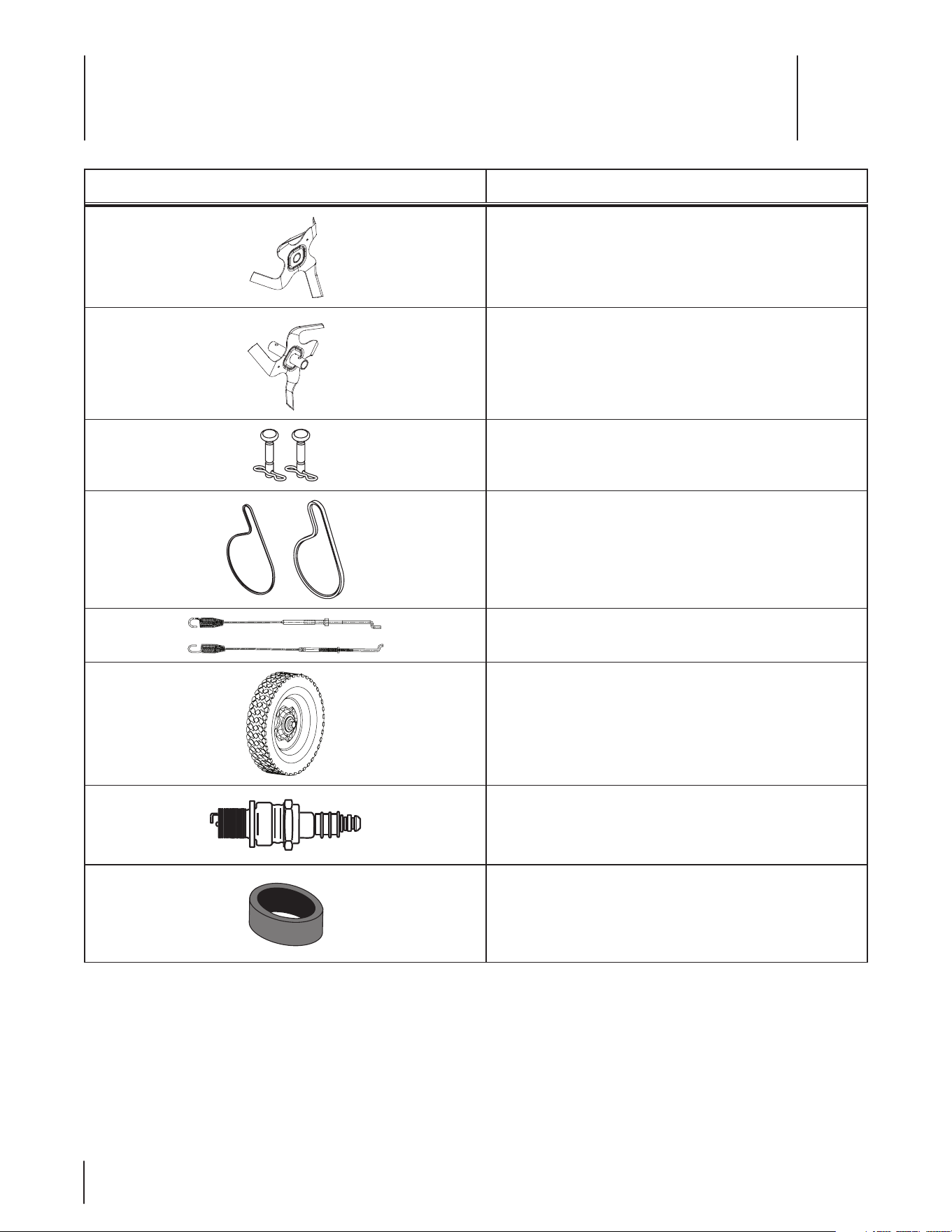
642-0002 Inner Right Hand Tine
642-0003 Inner Left Hand Tine
642-0023 Outer Left Hand Tine
642-0024 Outer Right Hand Tine
714-04043 Cotter Pin
911-0415 Clevis Pin
754-0428 Forward V-Belt,
754-0429 Reverse V-Belt
946-0918 Forward Cable
746-0953 Reverse Cable
734-1268 Wheels, 8” x 1.75”
951-10292 Spark Plug
951-10794 Air Filter
Phone (800) 965-4CUB to order replacement parts or a complete Parts Manual (have your full model number and serial number
ready). Parts Manual downloads are also available free of charge at www.cubcadet.com.
Replacement Parts
10
24

Notes
11
25

26 se c t i O n 11— nO t e s

27se c t i O n 11 — nO t e s

The limited warranty set forth below is given by Cub Cadet LLC with
respect to new merchandise purchased and used in the United States,
its possessions and territories, and by MTD Products Limited with
respect to new merchandise purchased and used in Canada and/or its
territories and possessions.
“Cub Cadet” warrants this product (excluding its Normal Wear Parts
as described below) against defects in material and workmanship
for a period of three (3) years commencing on the date of original
purchase and will, at its option, repair or replace, free of charge, any
part found to be defective in materials or workmanship. This limited
warranty shall only apply if this product has been operated and
maintained in accordance with the Operator’s Manual furnished with
the product, and has not been subject to misuse, abuse, commercial
use, neglect, accident, improper maintenance, alteration, vandalism,
theft, fire, water, or damage because of other peril or natural disaster.
Damage resulting from the installation or use of any part, accessory
or attachment not approved by Cub Cadet for use with the product(s)
covered by this manual will void your warranty as to any resulting
damage.
Normal Wear Parts are warranted to be free from defects in material
and workmanship for a period of thirty (30) days from the date of
purchase. Normal wear parts include, but are not limited to items
such as: batteries, belts, blades, tines, wheels and tires.
HOW TO OBTAIN SERVICE: Warranty service is available, WITH
PROOF OF PURCHASE, through your local authorized service
dealer. To locate the dealer in your area:
In the U.S.A.
To locate the dealer in your area, check your Yellow Pages, or contact
Cub Cadet LLC at P.O. Box 361131, Cleveland, Ohio 44136-0019, or
call 1-877-282-8684, or log on to our Web site at www.cubcadet.
com.
In Canada
Contact MTD Products Limited, Kitchener, ON N2G 4J1, or call
1-800-668-1238 or log on to our Web site at www.mtdcanada.
com.
This limited warranty does not provide coverage in the following
cases:
a. The engine or component parts thereof. These items may
carry a separate manufacturer’s warranty. Refer to applicable
manufacturer’s warranty for terms and conditions.
b. Routine maintenance items such as lubricants, filters, blade
sharpening, tune-ups, brake adjustments, clutch adjustments,
deck adjustments, and normal deterioration of the exterior finish
due to use or exposure.
c. Cub Cadet does not extend any warranty for products sold or
exported outside of the United States and/or Canada, and their
respective possessions and territories, except those sold through
Cub Cadet’s authorized channels of export distribution.
d. Replacement parts that are not genuine Cub Cadet parts.
e. Service completed by someone other than an authorized service
dealer.
f. Transportation charges and service calls.
g. Cub Cadet does not warrant this product for commercial use.
No implied warranty, including any implied warranty of
merchantability of fitness for a particular purpose, applies after
the applicable period of express written warranty above as to the
parts as identified. No other express warranty, whether written or
oral, except as mentioned above, given by any person or entity,
including a dealer or retailer, with respect to any product, shall
bind Cub Cadet. During the period of the warranty, the exclusive
remedy is repair or replacement of the product as set forth above.
The provisions as set forth in this warranty provide the sole and
exclusive remedy arising from the sale. Cub Cadet shall not be
liable for incidental or consequential loss or damage including,
without limitation, expenses incurred for substitute or replacement
lawn care services or for rental expenses to temporarily replace a
warranted product.
Some states do not allow the exclusion or limitation of incidental
or consequential damages, or limitations on how long an implied
warranty lasts, so the above exclusions or limitations may not apply
to you.
In no event shall recovery of any kind be greater than the amount of
the purchase price of the product sold. Alteration of safety features of
the product shall void this warranty. You assume the risk and liability
for loss, damage, or injury to you and your property and/or to others
and their property arising out of the misuse or inability to use the
product.
This limited warranty shall not extend to anyone other than the
original purchaser or to the person for whom it was purchased as a
gift.
HOW STATE LAW RELATES TO THIS WARRANTY: This limited
warranty gives you specific legal rights, and you may also have other
rights that vary in different jurisdictions.
IMPORTANT: Owner must present Original Proof of Purchase to
obtain warranty coverage.
Cub Cadet LLC, P.O. BOX 361131 CLEVELAND, OHIO 44136-0019; Phone: 1-877-282-8684
MTD Canada Limited - KITCHENER, ON N2G 4J1; Phone 1-800-668-1238
GDOC-100087 REV. A
CUB CADET LLC
MANUFACTURER’S LIMITED WARRANTY FOR
EDGERS, STRING TRIMMERS & TILLERS

