DIGITAL CAMERA
User's Manual
• Read this document thoroughly before using the camera.
•
To ensure proper use of the camera, be sure to read “For
your safety” (page 11).
• After reading this document, keep it readily accessible for
future reference.
Scan for detailed operating instructions.
nikon download center Z fc
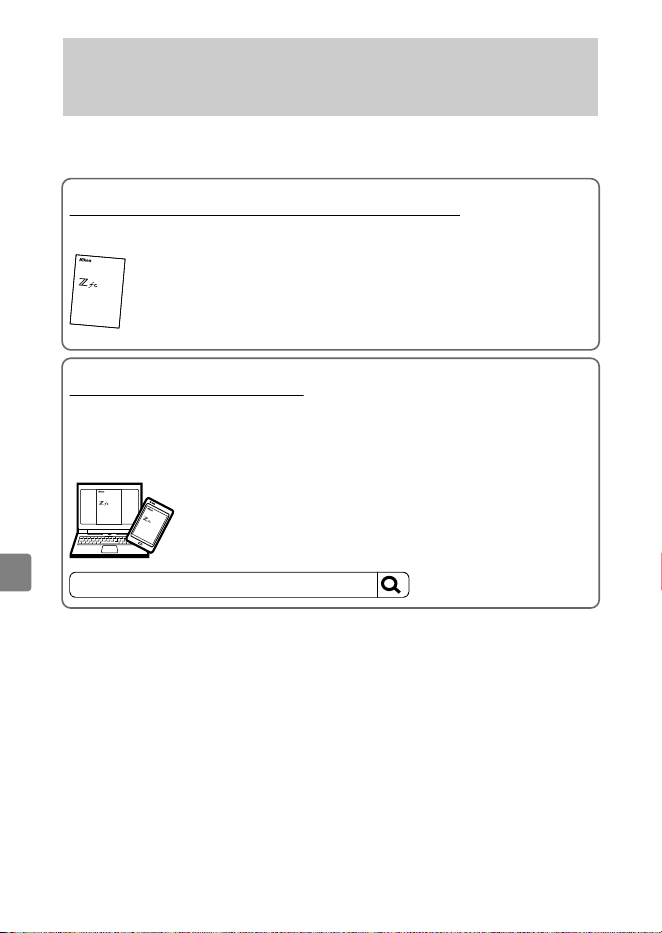
2 The Z fc User’s Manual and Reference Guide
The Z fc
User’s Manual
and
Reference
Guide
In addition to this
User’s Manual
, a
Reference Guide
is available for your
camera.
The
User’s Manual
(this document)
The
User’s Manual
describes basic camera operations.
The
Reference Guide
Camera features and operations are detailed in a
Reference Guide
, a
supplement to the
User’s Manual
. The
Reference Guide
can be viewed
on computers, smartphones, and tablets.
nikon download center Z fc
Z fc Model Name: N2016
The Z fc User’s Manual and Reference Guide 3
D Lens kit lenses
For information on lenses supplied as part of a lens kit, see the lens
documen
tation available for download from the Nikon Download Center.
D The Nikon Download Center
Visit the Nikon download center to download r
mware updates, NX Studio
and other Nikon software, and documentation for Nikon products including
cameras, NIKKOR lenses, and ash units.
https://downloadcenter.nikonimglib.com/
D Genuine Nikon software
Nikon computer software such as NX Studio is available from the Nikon
D
ownload Center. For more information, see the “
Reference Guide
”.
4 When your rst photo can’t wait
When your rst phot
o can’t wait
Getting ready
❚❚
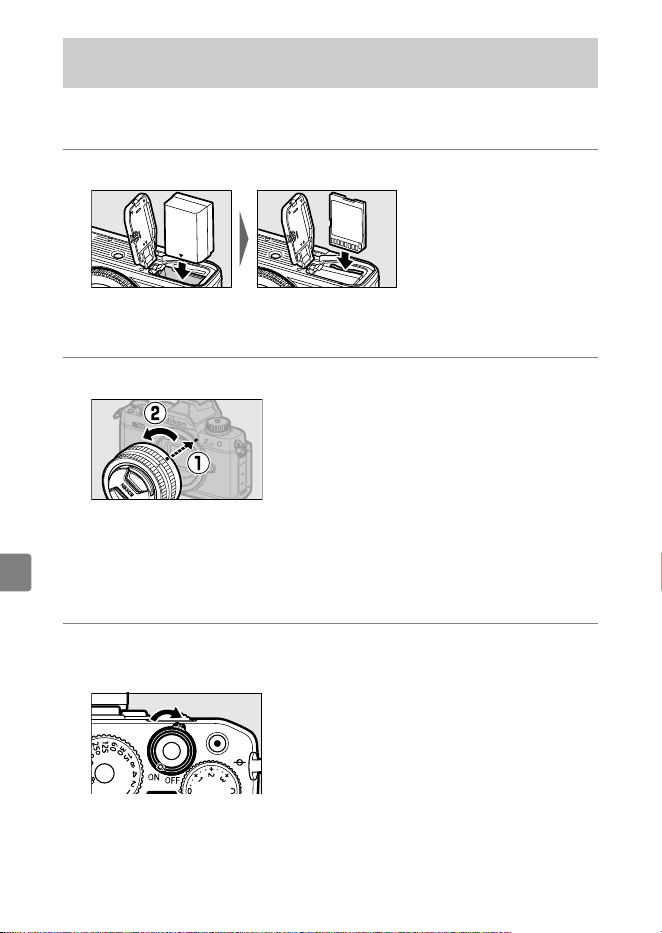
1
I
nsert the battery and memory card (024).
For information on charging the battery, see “Charging the battery”
(023).
2
Attach a lens (027).
・ A
lign the indicator on the camera body with the indicator on the
lens (
q
) and rotate the lens in the direction shown (
w
).
・ A strap can be attached to the camera. For more information, see
“Attaching the strap” (022).
3 T
urn the camera on and then choose a language and set the
clock (030).
When your rst photo can’t wait 5
Take (033) and vie
w (041) pictures
❚❚
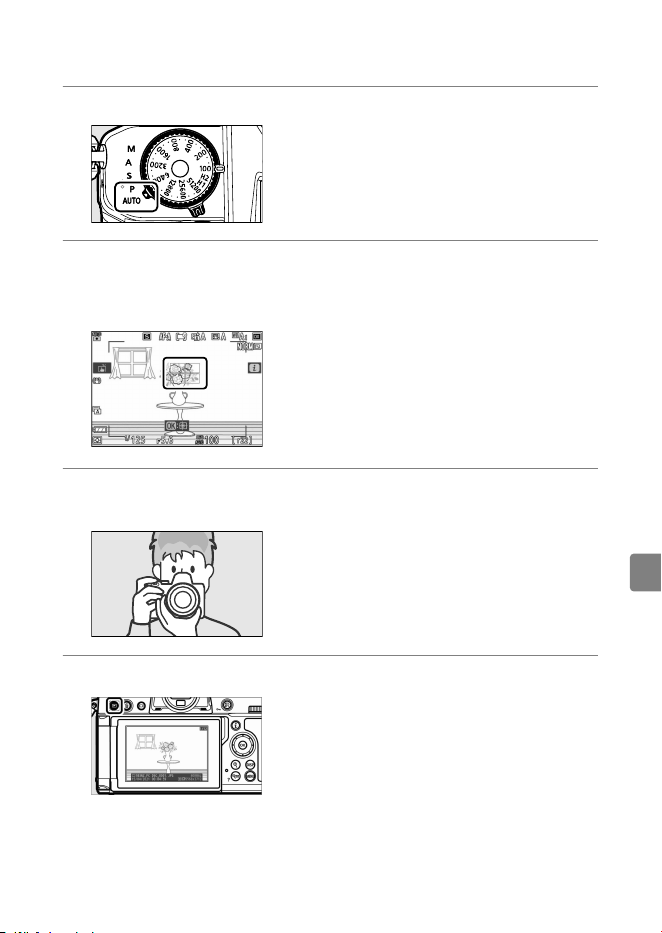
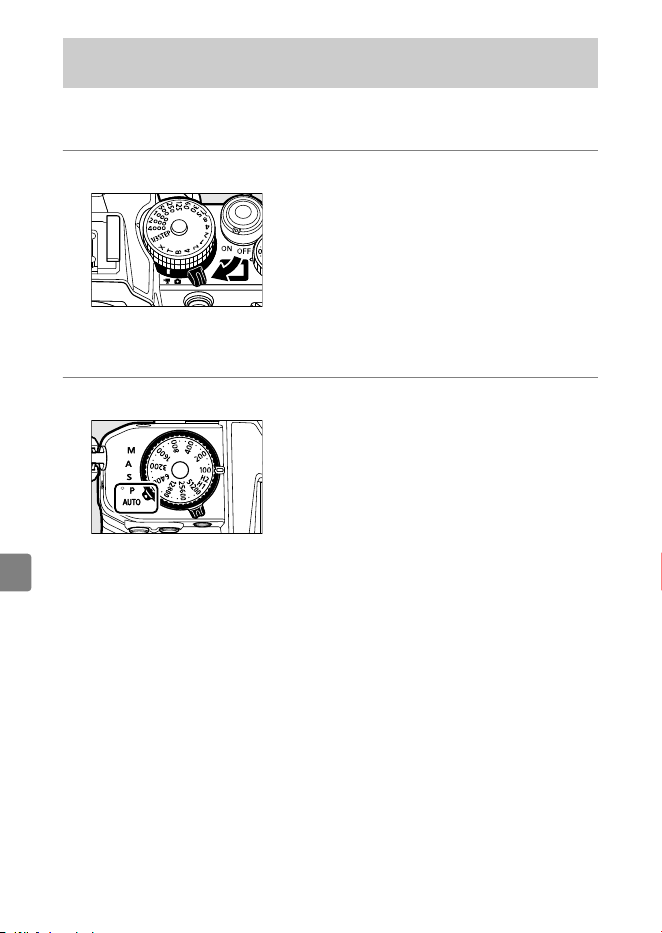
1 Rotat
e the mode selector to AUTO (
b
).
2 T
o focus, press the shutter-release button halfway (i.e, lightly
press the shutter-release button, stopping when it is pressed
halfway).
3 W
ithout lifting your nger from the shutter-release button,
press the button the rest of the way down to take the picture.
4 V
iew the picture.
6 Package contents
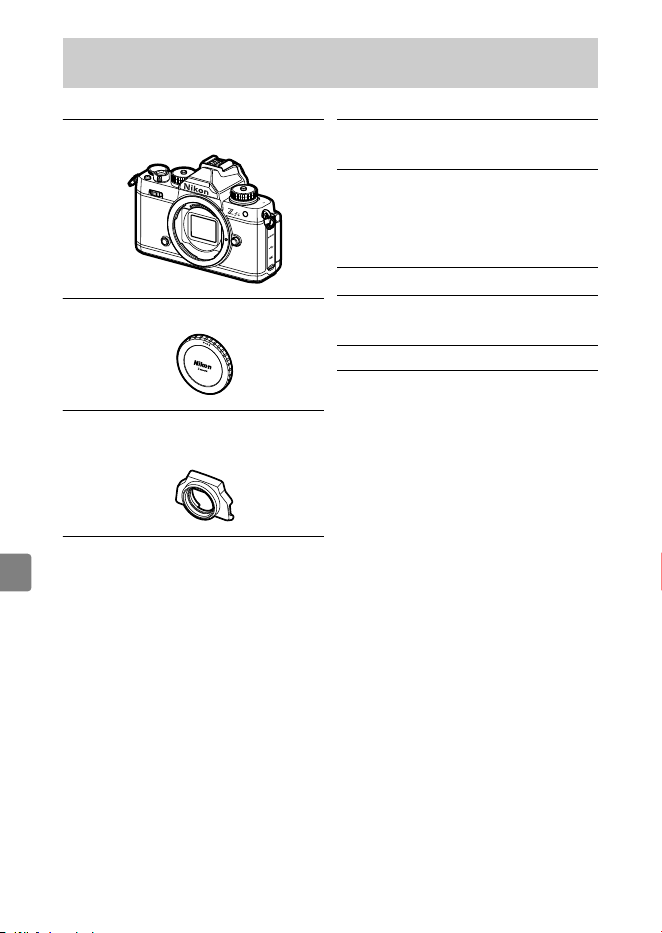
Package contents
Be sure all items listed here were included with your camera.
❏
C
amera
❏
BF-N1 body cap
❏
DK
-32 rubber eyecup (comes
attached to camera)
❏
EN-EL25 r
echargeable Li-ion
battery
❏
MH-32 battery charger (plug
adapter supplied in countries or
regions where required; shape
depends on country of sale)
❏
Strap (022)
❏
Warranty (printed on the back
cover of this document)
❏
User’s Manual
・ Memory cards are sold separately.
・ Purchasers of the lens kit option should conrm that the package
also includes a lens.
About this document 7
About this document
Symbols
❚❚
This document employs the following symbols and conventions. Use
them t
o help locate the information you need.
D
This icon marks notes, information that should be read before using
this pr
oduct.
A
This icon marks tips, additional information you may nd helpful
when using this product.
0
This icon marks references to other sections in this document.
Conventions
❚❚
・ T
his camera uses SD, SDHC, and SDXC memory cards, referred to
throughout this document as “memory cards”. SD, SDHC, and SDXC
may also on occasion be referred to as “SD memory cards”.
・ Throughout this document, battery chargers are referred to as
“battery chargers” or “chargers”.
・ Throughout this document, the display in camera monitor and
viewnder during shooting is referred to as the “shooting display”; in
most cases, the illustrations show the monitor.
・ Throughout this document, smartphones and tablets are referred to
as “smart devices”.
・ Throughout this document, the term “default settings” is used to
refer to the settings in eect at shipment. The explanations in this
document assume that default settings are used.

8 About this document
Nikon user support
❚❚
Should you need technical support, we oer a number of options
.
・ For users in the U.S.A.: https://www.nikonusa.com/
・ F
or users in Canada: https://www.nikon.ca/
・ F
or users in Mexico: https://www.nikon.com.mx/
・ F
or users in Latin America:
https://www.nikonamericalatina.com/
・ F
or users in Europe: https://www.europe-nikon.com/support
・ F
or users in Asia, Oceania, the Middle East, and Africa:
https://www.nikon-asia.com/
Table of contents 9
Table of contents
T
he Z fc
User’s Manual
and
Reference Guide
...................................................2
When your rst photo can’t wait .......................................................................... 4
Package contents ....................................................................................................... 6
About this document ............................................................................................... 7
For your safety .......................................................................................................... 11
Notices .........................................................................................................................16
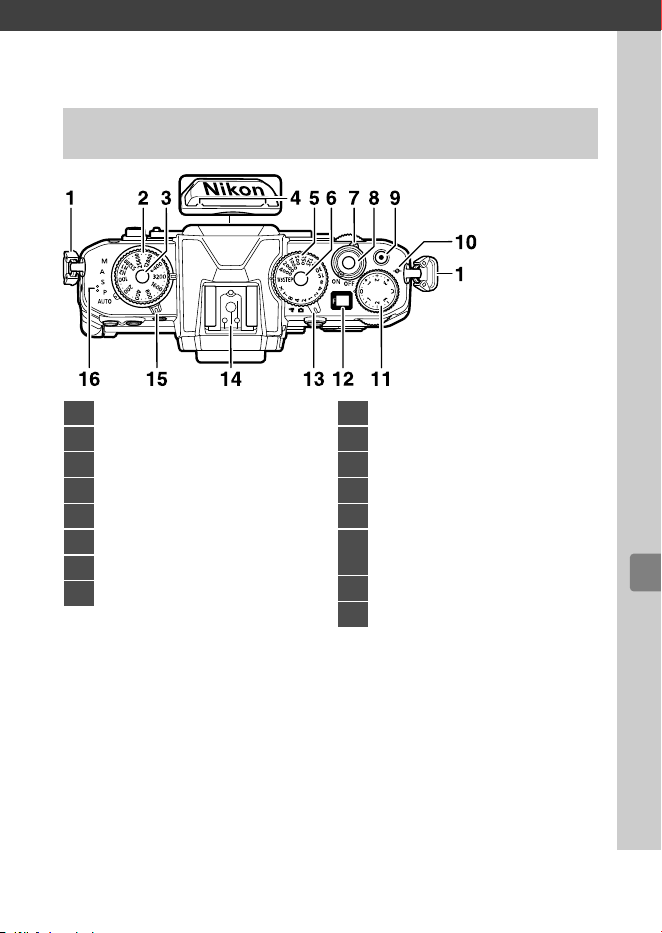
Parts of the camera 19
Camera body ............................................................................................................. 19
F
irst steps 22
Attaching the strap................................................................................................. 22
Charging the battery ..............................................................................................23
Inserting the battery and a memory card .......................................................24
Attaching a lens ........................................................................................................27
Opening the monitor ............................................................................................. 29
Turning on the camera .......................................................................................... 30
Basic photography and playback 33
Taking photographs (
b
auto) ............................................................................. 33
R
ecording videos (
b
auto) ...................................................................................38
Viewing photos.........................................................................................................41
Troubleshooting 42
Before contacting customer support ............................................................... 42
T
echnical notes 43
Caring for the camera.............................................................................................43
Caring for the camera and battery: Cautions ................................................ 44
Trademarks and licenses....................................................................................... 51
Notices .........................................................................................................................53
Bluetooth and Wi-Fi (wireless LAN)...................................................................56

For your safety 11
For your safety
To prevent damage to property or injury to yourself or to others, read
“F
or your safety” in its entirety before using this product.
After reading these safety instructions, keep them readily accessible for
future reference.
D
ANGER: Failure to observe the precautions marked with this icon
carries a high risk of death or severe injury.
W
ARNING: Failure to observe the precautions marked with this icon
could result in death or severe injury.
C
AUTION: Failure to observe the precautions marked with this icon
could result in injury or property damage.
WARNING
Do not use while walking or operating a vehicle.
F
ailure to observe this precaution could result in accidents or other injury.
Do not disassemble or modify this product. Do not touch internal
par
ts that become exposed as the result of a fall or other accident.
Failure to observe these precautions could result in electric shock or other
injury.
Should you notice any abnormalities such as the product producing
smok
e, heat, or unusual odors, immediately disconnect the battery or
power source.
Continued operation could result in re, burns or other injury.
Keep dry. Do not handle with wet hands. Do not handle the plug with
w
et hands.
Failure to observe these precautions could result in re or electric shock.
Do not let your skin remain in prolonged contact with this product
while it is on or plugged in.
F
ailure to observe this precaution could result in low-temperature burns.
12 For your safety
Do not use this product in the presence of ammable dust or gas such
as pr
opane, gasoline or aerosols.
Failure to observe this precaution could result in explosion or re.
Do not directly view the sun or other bright light source through the
lens
.
Failure to observe this precaution could result in visual impairment.
Do not aim the ash or AF-assist illuminat
or at the operator of a
motor vehicle.
Failure to observe this precaution could result in accidents.
Keep this product out of reach of children.
F
ailure to observe this precaution could result in injury or product
malfunction. In addition, note that small parts constitute a choking hazard.
Should a child swallow any part of this product, seek immediate medical
attention.
Do not entangle, wrap or twist the straps around your neck.
F
ailure to observe this precaution could result in accidents.
Do not use batteries, chargers, AC adapters, or USB cables not
sp
ecically designated for use with this product. When using
batteries, chargers, AC adapters, and USB cables designated for use
with this product, do not:
・ Damage, modify, forcibly tug or bend the cords or cables, place
them under heavy objects, or expose them to heat or ame.
・ Use travel converters or adapters designed to convert from one
voltage to another or with DC-to-AC inverters.
Failure to observe these precautions could result in re or electric shock.
Do not handle the plug when charging the product or using the AC
adapt
er during thunderstorms.
Failure to observe this precaution could result in electric shock.
For your safety 13
Do not handle with bare hands in locations exposed to extremely high
or lo
w temperatures.
Failure to observe this precaution could result in burns, or frostbite.
CAUTION
Do not leave the lens pointed at the sun or other strong light sources.
Ligh
t focused by the lens could cause re or damage to product’s internal
parts. When shooting backlit subjects, keep the sun well out of the frame.
Sunlight focused into the camera when the sun is close to the frame could
cause re.
Turn this product o when its use is pr
ohibited. Disable wireless
features when the use of wireless equipment is prohibited.
The radio-frequency emissions produced by this product could interfere
with equipment onboard aircraft or in hospitals or other medical facilities.
Remove the battery and disconnect the AC adapter if this product will
not b
e used for an extended period.
Failure to observe this precaution could result in re or product
malfunction.
Do not r
e the ash in contact with or in close proximity to the skin or
objects.
Failure to observe this precaution could result in burns or re.
Do not leave the product where it will be exposed to extremely high
t
emperatures, for an extended period such as in an enclosed
automobile or in direct sunlight.
Failure to observe this precaution could result in re or product
malfunction.
Do not look directly at the AF-assist illuminator.
F
ailure to observe this precaution could have adverse eects on vision.
14 For your safety
Do not transport cameras or lenses with tripods or similar accessories
attached
.
Failure to observe this precaution could result in injury or product
malfunction.
DANGER (Batteries)
Do not mishandle batteries.
F
ailure to observe the following precautions could result in the batteries
leaking, overheating, rupturing, or catching re:
・ Use only rechargeable batteries approved for use in this product.
・ Do not expose batteries to ame or excessive heat.
・ Do not disassemble.
・ Do not short-circuit the terminals by touching them to necklaces,
hairpins, or other metal objects.
・ Do not expose batteries or the products in which they are inserted
to powerful physical shocks.
・ Do not step on batteries, pierce them with nails, or strike them with
hammers.
Charge only as indicated.
F
ailure to observe this precaution could result in the batteries leaking,
overheating, rupturing, or catching re.
If battery liquid comes into contact with the eyes, rinse with plenty of
clean w
ater and seek immediate medical attention.
Delaying action could result in eye injuries.
Follow the instructions of airline personnel.
Batt
eries left unattended at high altitudes in an unpressurized
environment may leak, overheat, rupture, or catch re.
For your safety 15
WARNING (Batteries)
Keep batteries out of reach of children.
Should a child sw
allow a battery, seek immediate medical attention.
Keep batteries out of reach of household pets and other animals.
T
he batteries could leak, overheat, rupture, or catch re if bitten, chewed,
or otherwise damaged by animals.
Do not immerse batteries in water or expose to rain.
F
ailure to observe this precaution could result in re or product
malfunction. Immediately dry the product with a towel or similar object
should it become wet.
Discontinue use immediately should you notice any changes in the
batt
eries, such as discoloration or deformation. Cease charging EN-
EL25 rechargeable batteries if they do not charge in the specied
period of time.
Failure to observe these precautions could result in the batteries leaking,
overheating, rupturing, or catching re.
When batteries are no longer needed, insulate the terminals with
tap
e.
Overheating, rupture, or re may result should metal objects come into
contact with the terminals.
If battery liquid comes into contact with a person’s skin or clothing,
immediat
ely rinse the aected area with plenty of clean water.
Failure to observe this precaution could result in skin irritation.

16 Notices
Notices
・ No par
t of the documentation included with this product may be
reproduced, transmitted, transcribed, stored in a retrieval system, or
translated into any language in any form, by any means, without
Nikon’s prior written permission.
・ Nikon reserves the right to change the appearance and specications
of the hardware and software described in this documentation at any
time and without prior notice.
・ Nikon will not be held liable for any damages resulting from the use
of this product.
・ While every eort has been made to ensure that the information in
this documentation is accurate and complete, we would appreciate it
were you to bring any errors or omissions to the attention of the
Nikon representative in your area (address provided separately).
Notice concerning prohibition of copying or reproduction●
Note that simply being in possession of material that has been digitally
copied or reproduced by means of a scanner, digital camera, or other device
may be punishable by law.
・ Items prohibited by law from being copied or reproduced
Do not copy or reproduce paper money, coins, securities, government
bonds, or local government bonds, even if such copies or reproductions are
stamped “Sample”.
The copying or reproduction of paper money, coins, or securities which are
circulated in a foreign country is prohibited.
Unless the prior permission of the government has been obtained, the
copying or reproduction of unused postage stamps or post cards issued by
the government is prohibited.
The copying or reproduction of stamps issued by the government and of
certied documents stipulated by law is prohibited.
・ Cautions on certain copies and reproductions
The government has issued cautions on copies or reproductions of
securities issued by private companies (shares, bills, checks, gift certicates,

Notices 17
etc.), commuter passes, or coupon tickets, except when a minimum of
nec
essary copies are to be provided for business use by a company. Also,
do not copy or reproduce passports issued by the government, licenses
issued by public agencies and private groups, ID cards, and tickets, such as
passes and meal coupons.
・ Comply with copyright notices
Under copyright law, photographs or recordings of copyrighted works
made with the camera cannot be used without the permission of the
copyright holder. Exceptions apply to personal use, but note that even
personal use may be restricted in the case of photographs or recordings of
exhibits or live performances.
Use only Nikon brand electronic accessories●
Nikon cameras are designed to the highest standards and include complex
electronic circuitry. Only Nikon brand electronic accessories (including lenses,
chargers, batteries, AC adapters, and ash accessories) certied by Nikon
specically for use with this Nikon digital camera are engineered and proven
to operate within the operational and safety requirements of this electronic
circuitry.
The use of non-Nikon electronic accessories could damage the camera and
may void your Nikon warranty. The use of third-party rechargeable Li-ion
batteries not bearing the Nikon holographic seal shown below could
interfere with normal operation of the camera or result in the batteries
overheating, igniting, rupturing, or leaking.
For more information about Nikon brand accessories, contact a local
author
ized Nikon dealer.
Memory cards●
・ Memory cards may be hot after use. Observe due caution when
removing memory cards from the camera.
・ Do not perform the following operations during formatting or while
data are being recorded, deleted, or copied to a computer or other
18 Notices
device. Failure to observe these precautions could result in loss of
data or in damage t
o the camera or card.
- Do not remove or insert memory cards
- Do not turn the camera o
- Do not remove the battery
・ Do not touch the card terminals with your ngers or metal objects.
・ Do not use excessive force when handling memory cards. Failure to
observe this precaution could damage the card.
・ Do not bend or drop memory cards or subject them to strong
physical shocks.
・ Do not expose memory cards to water, heat, or direct sunlight.
・ Do not format memory cards in a computer.
D Before taking important pictures
Before taking pictures on important occasions (such as at weddings or before
tak
ing the camera on a trip), take a test shot to ensure that the camera is
functioning normally. Nikon will not be held liable for damages or lost prots
that may result from product malfunction.
D Life-long learning
As part of Nikon’s “Life-long learning” commitment to ongoing product
suppor
t and education, continually-updated information is available on-line
at the following sites:
・ For users in the U.S.A.: https://www.nikonusa.com/
・ F
or users in Europe and Africa: https://www.europe-nikon.com/
support/
・ F
or users in Asia, Oceania, and the Middle East: https://www.nikon-
asia.com/
Visit these sites to keep up-to-date with the latest product information, tips,
answ
ers to frequently-asked questions (FAQs), and general advice on digital
imaging and photography. Additional information may be available from the
Nikon representative in your area. See the following URL for contact
information: https://imaging.nikon.com/
Camera body 19
Parts of the camera
Camera body
1
Eyelet for camera strap
2
ISO sensitivity dial
3
ISO sensitivity dial lock release
4
Stereo microphone
5
Shutter-speed dial
6
Shutter-speed dial lock release
7
Power switch
8
Shutter-release button
9
Video-record button
10
E
(focal plane mark)
11
Exposure compensation dial
12
Control panel
13
Photo/video selector
14
Accessory shoe (for optional
ash unit)
15
Mode selector
16
Speaker
20 Camera body
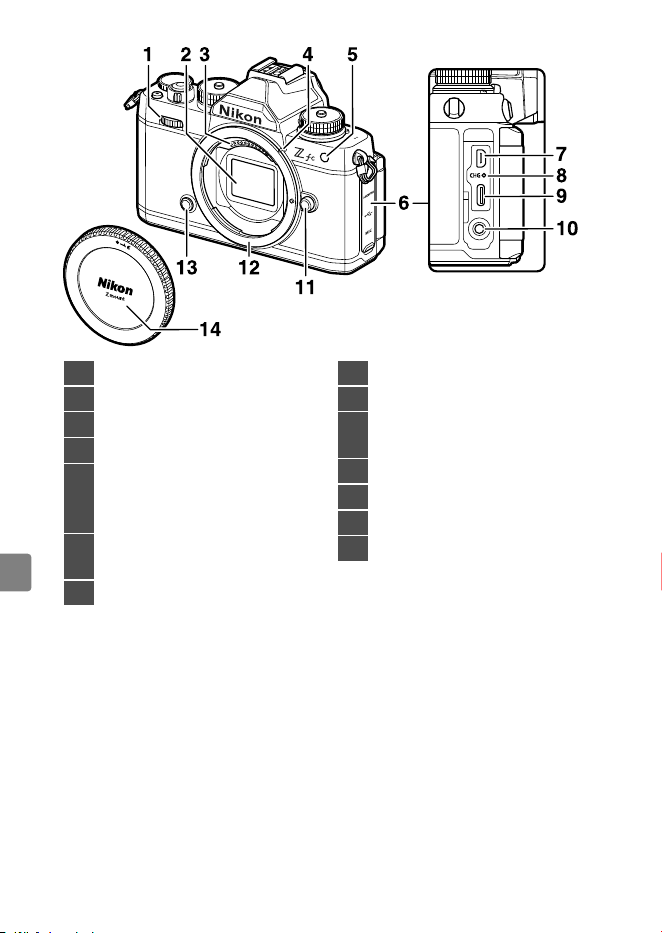
1
Sub-command dial
2
Image sensor
3
CPU contacts
4
Lens mounting mark
5
AF-assist illuminator
R
ed-eye reduction lamp
Self-timer lamp
6
Cover for HDMI, USB, and
microphone connectors
7
HDMI connector
8
Charge lamp
9
USB connector
10
Connector for external
micr
ophone
11
Lens release button
12
Lens mount
13
Fn button
14
Body cap
Camera body 21
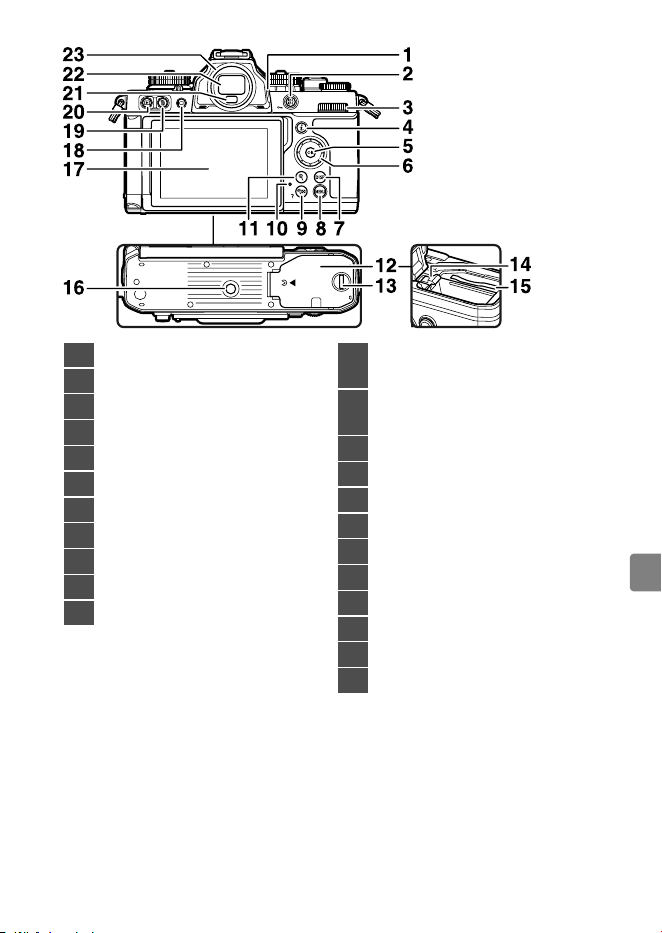
1
Diopter adjustment control
2
A
(
g
) button
3
Main command dial
4
i
button
5
J
button
6
Multi selector
7
DISP butt
on
8
G
button
9
W
(
Q
) button
10
Memory card access lamp
11
X
button
12
Battery-chamber/memory card
slot c
over
13
Battery-chamber/memory card
slot cover latch
14
Battery latch
15
Memory card slot
16
Tripod socket
17
Monitor
18
M
button
19
O
button
20
K
button
21
Eye sensor
22
Viewnder
23
Rubber eyecup
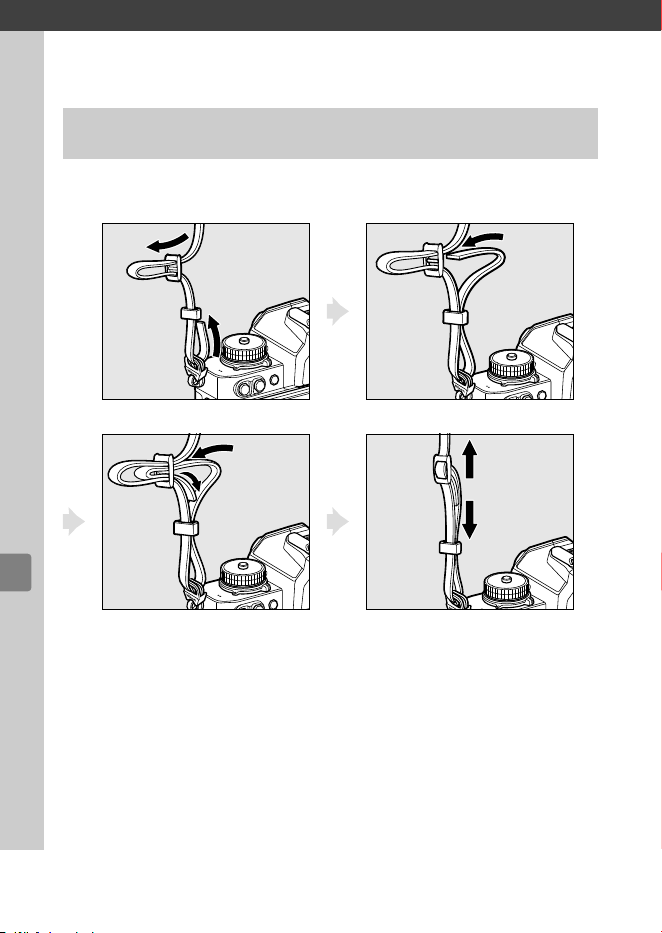
22 Attaching the strap
First steps
Attaching the strap
To attach a strap (whether the supplied strap or one that has been
pur
chased separately):
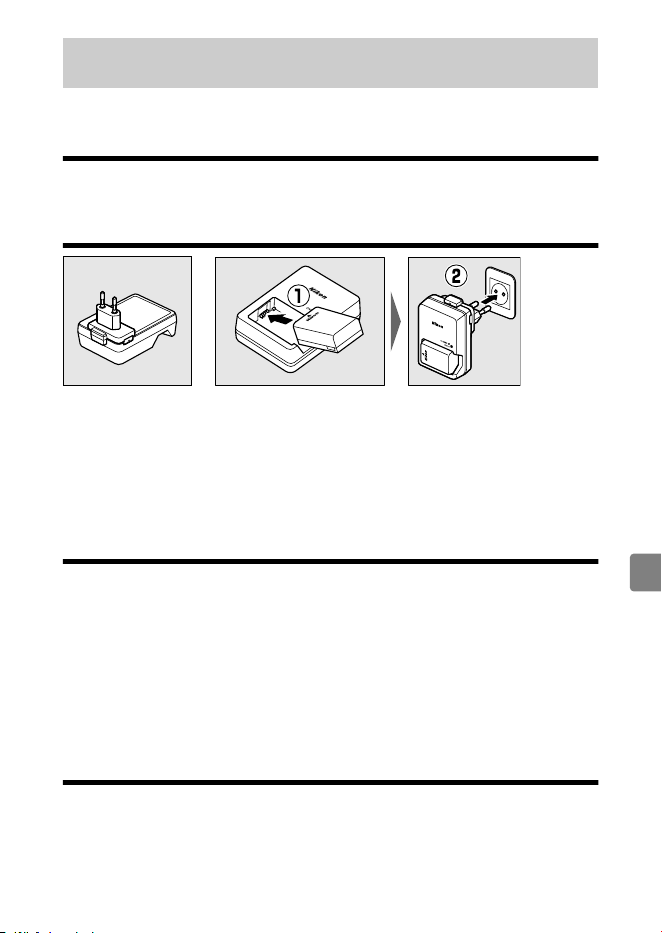
Charging the battery 23
Charging the battery
Charge the supplied EN-EL25 battery in the supplied MH-32 battery
char
ger before use.
D The battery and charger
Read and follow the warnings and cautions in “For your safety” (011) and
“
Caring for the camera and battery: Cautions” (044).
・ P
lug the charger into a household outlet to charge it. In some
countries or regions, the charger may be supplied with the adapter
connected. The charger lamp ashes while charging, and lights up
when charging is complete.
・ An exhausted battery will fully charge in about 2 hours and 30
minutes.
D If the CHARGE lamp ashes r
apidly
If the CHARGE lamp ashes rapidly (8 times a second):
・ A battery charging error has occurred: Unplug the charger and remove
and reinsert the battery.
・ The ambient temperature is too hot or too cold: Use the battery
charger at temperatures within the designated temperature range (0–40
°C/+32–104 °F).
If the problem persists, unplug the charger and end charging. Bring the
battery and charger to a Nikon-authorized service representative.
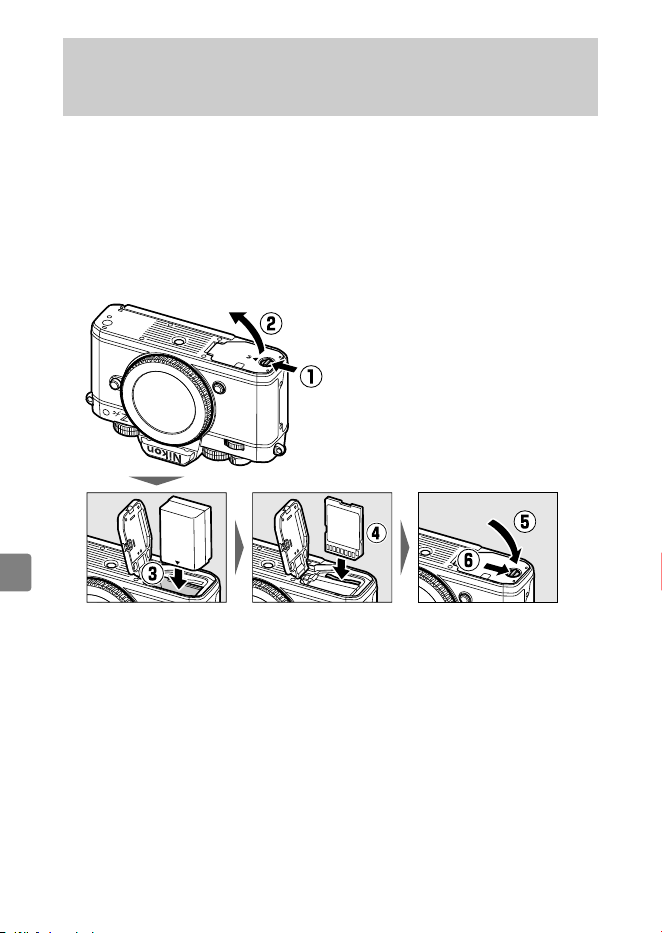
24 Inserting the battery and a memory card
Inserting the battery and a memory
c
ard
・ Turn the camera o before inserting or removing the battery and
memory card.
・ Using the battery to keep the orange battery latch pressed to one
side, slide the battery into the battery chamber until the latch locks it
in place.
・ Holding the memory card in the orientation shown, slide it straight
into the slot until it clicks into place.
Inserting the battery and a memory card 25
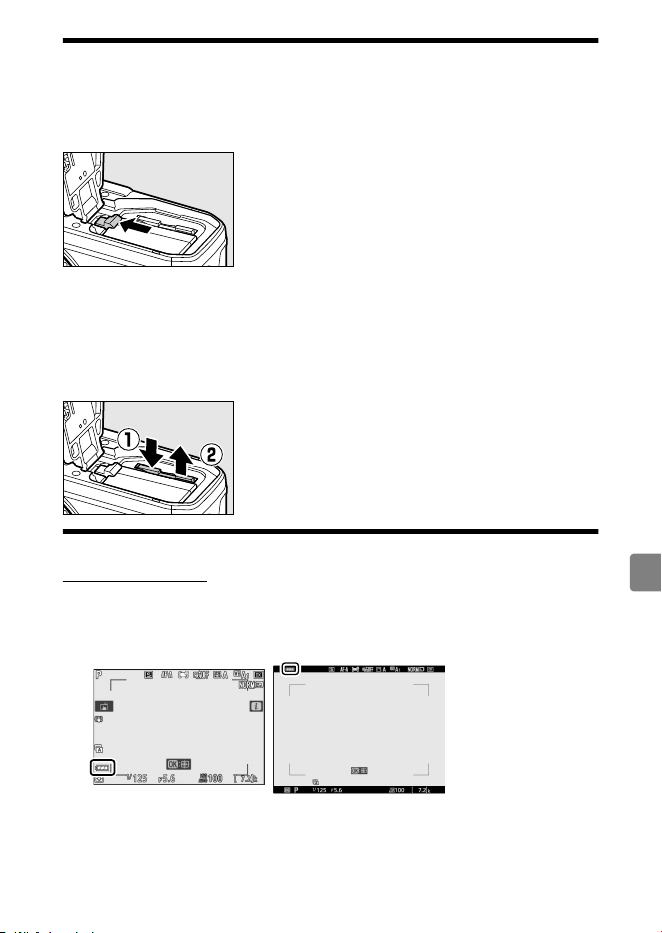
D Removing the battery
To remove the battery, turn the camera o and open the batt
ery-chamber/
memory card slot cover. Press the battery latch in the direction shown by the
arrow to release the battery and then remove the battery by hand.
D Removing the memory card
After c
onrming that the memory card access lamp is o, turn the camera o
and open the battery-chamber/memory card slot cover. Press the memory
card in to eject it (
q
), and pull it out to remove it (
w
).
Battery level
・ T
he battery level is shown in the shooting display while the camera is
on.
Monitor Viewnder

26 Inserting the battery and a memory card
・ T
he battery level display changes as the battery level diminishes,
from
L
through
K
, and
H
. When the battery level falls to
H
,
suspend shooting and charge the battery or ready a spare battery.
・ If the message [Shutter release disabled. Recharge battery.] is
displayed, charge or exchange the battery.
D The standby timer
The camera uses a standby timer to help reduce the drain on the battery. If
no oper
ations are performed for about 30 seconds, the standby timer will
expire and the monitor, viewnder, and control panel will turn o. A few
seconds prior to turning o, the displays will dim. They can be reactivated by
pressing the shutter-release button halfway. The length of time before the
standby timer expires automatically can be selected using Custom Setting c3
[Power o delay] > [Standby timer].
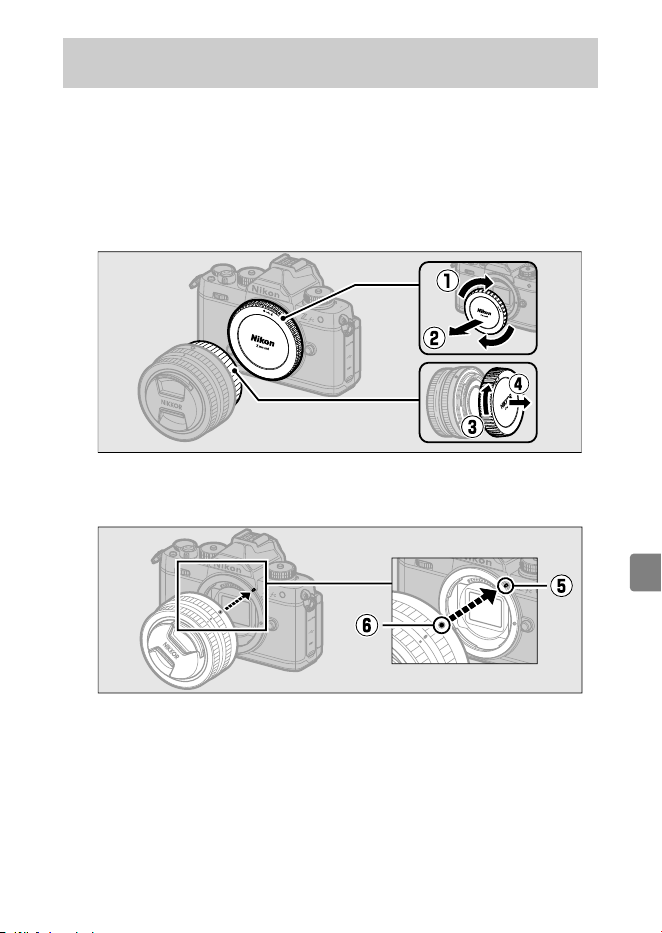
Attaching a lens 27
Attaching a lens
・ T
he camera can be used with Z mount lenses. The lens generally used
in this document for illustrative purposes is a NIKKOR Z DX 16–50mm
f/3.5–6.3 VR.
・ Be careful to prevent dust entering the camera.
・ Conrm that the camera is o before attaching the lens.
- Remove the camera body cap (
q
,
w
) and rear lens cap (
e
,
r
).
- Align the mounting marks on the camera (
t
) and lens (
y
). Do not
touch the image sensor or lens contacts.
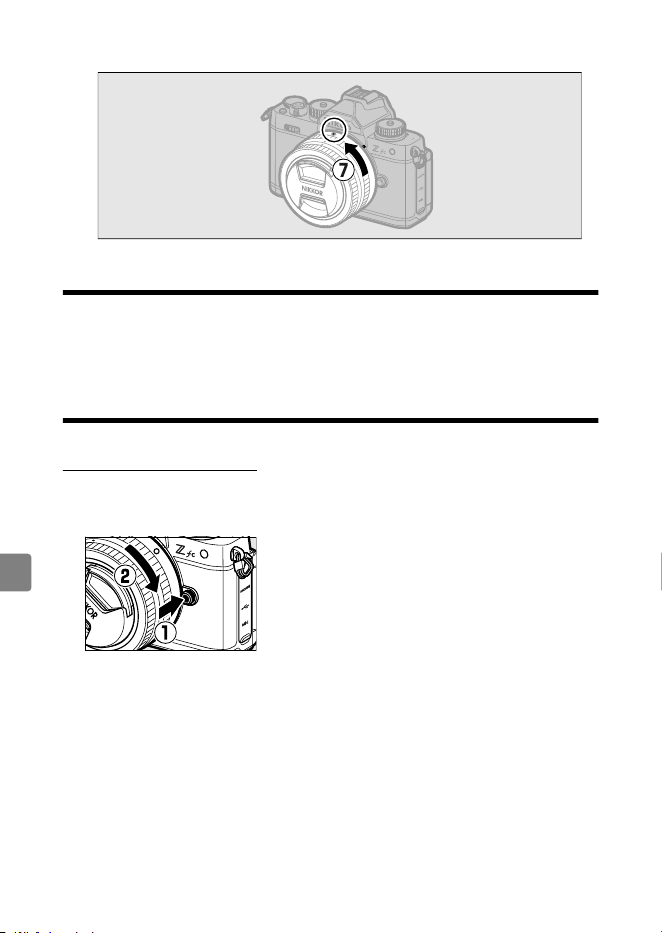
28 Attaching a lens
- Rotate the lens as shown until it clicks into place (
u
).
・ R
emove the front lens cap before taking pictures.
D F mount lenses
・ B
e sure to attach the FTZ mount adapter (available separately) before
using F mount lenses.
・ Attempting to attach F mount lenses directly to the camera could damage
the lens or image sensor.
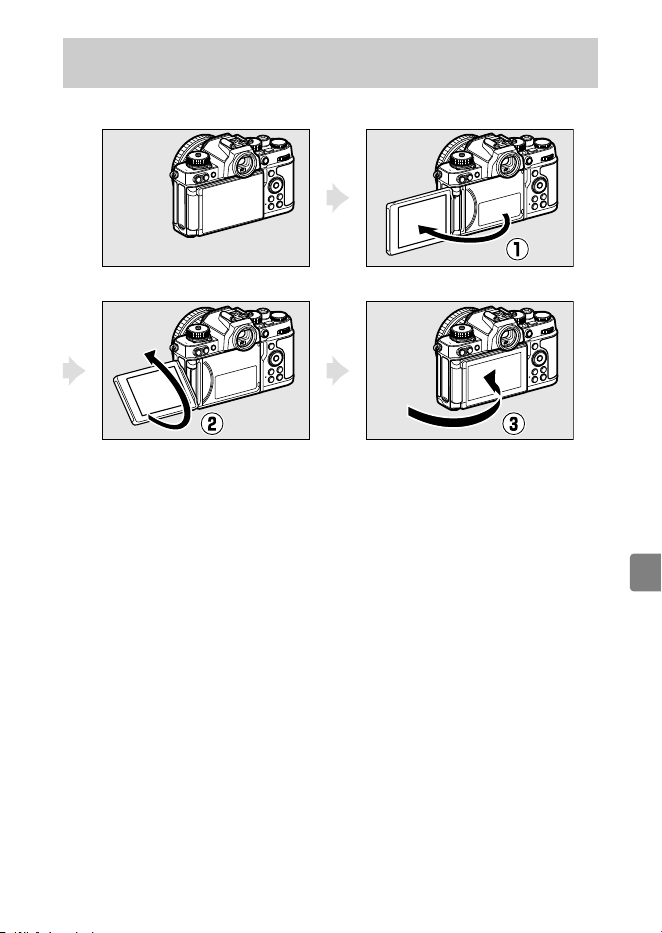
Detaching lenses
・ A
fter turning the camera o, press and hold the lens release button
(
q
) while turning the lens in the direction shown (
w
).
・ A
fter removing the lens, replace the lens caps and camera body cap.
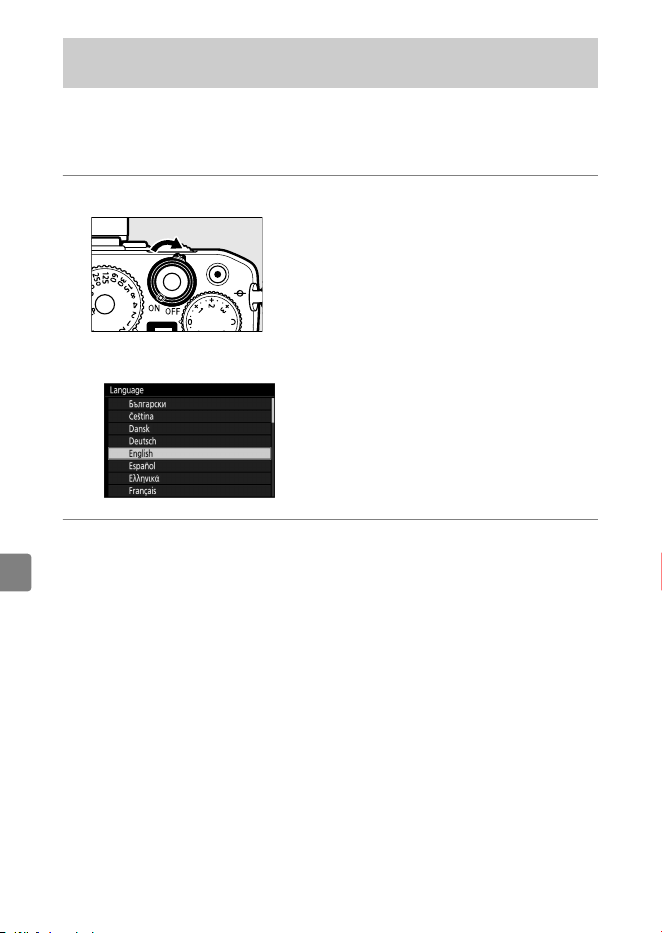
Opening the monitor 29
Opening the monitor
Slowly rotate the monitor without using excessive force.
30 Turning on the camera
Turning on the camera
When the camera is turned on for the rst time
, the language selection
screen is displayed. Choose a language and then set the camera clock
(no other operations can be performed until the clock is set).
1 Turn the camera on.
・ T
he [Language] selection screen will be displayed.
2 S
elect a language.
・ Press
1
or
3
to highlight the desired language and press
J
(the
languages available vary with the country or region in which the
camera was originally purchased).
・ The [Time zone] screen will be displayed.
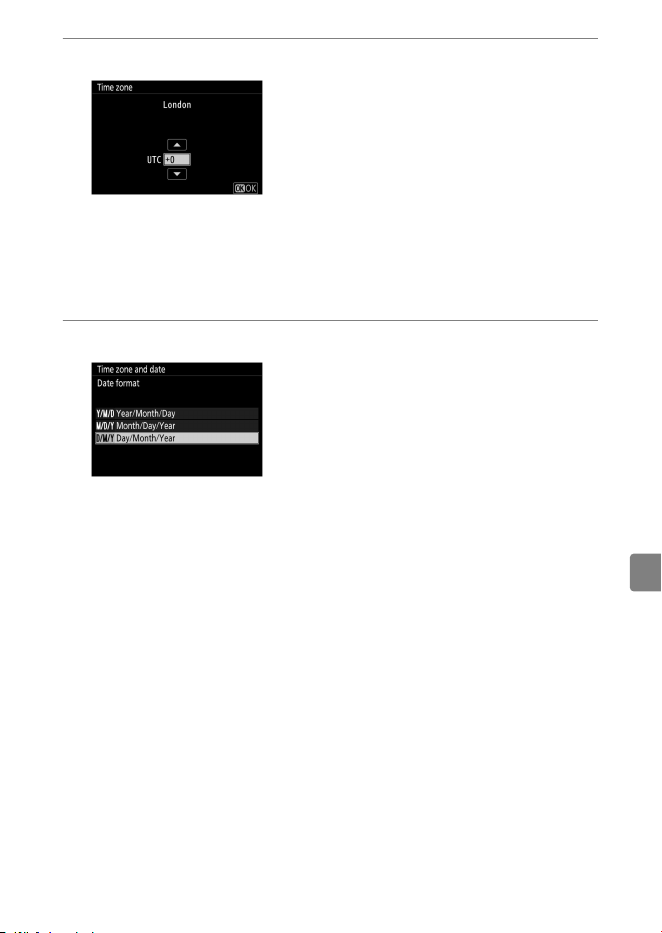
Turning on the camera 31
3 C
hoose a time zone.
・ Press
1
or
3
to choose a time zone and press
J
.
・ The display shows the selected cities in the chosen zone and the
dierence between the time in the chosen zone and UTC.
・ The [Date format] screen will be displayed.
4 C
hoose a date format.
・ H
ighlight the desired date (year, month, and day) display order
and press
J
.
・ The [Daylight saving time] screen will be displayed.
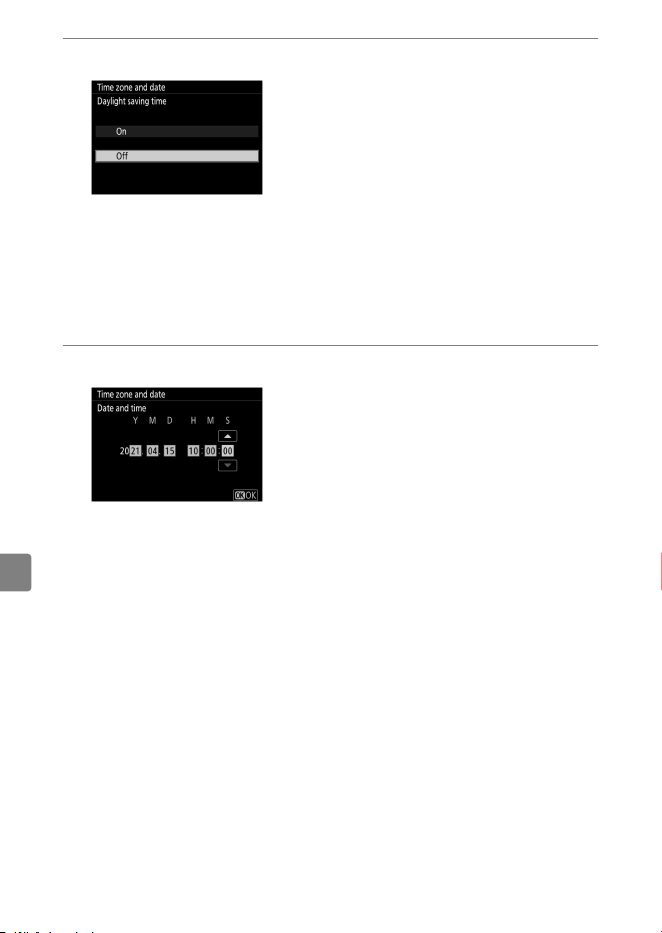
32 Turning on the camera
5 T
urn daylight saving time on or o.
・ Highlight [On] (daylight saving time on) or [O] (daylight saving
time o) and press
J
.
・ Selecting [On] advances the clock one hour; to undo the eect,
select [O].
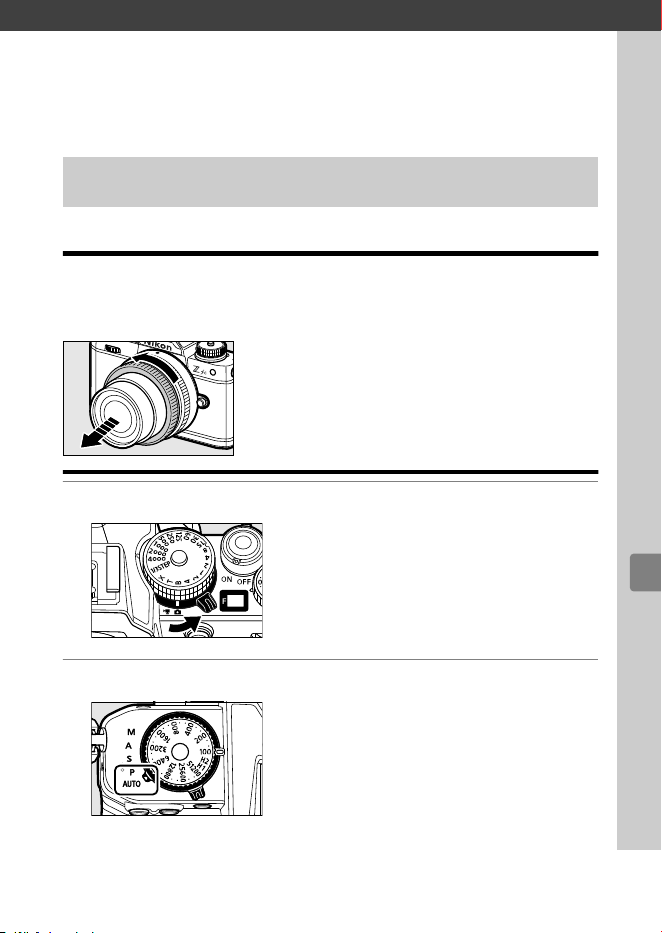
・ The [Date and time] screen will be displayed.
6 S
et the clock.
・ P
ress
4
or
2
to highlight date and time items and press
1
or
3
to
change them.
・ Press
J
to conrm the date and time setting.
・ The message [Done.] will be displayed and the camera switches to
shooting mode.
Taking photographs (
b
auto) 33
Basic photography and
playback
Taking photographs (
b
auto)
Select
b
(auto) mode for simple “point-and-shoot” photography.
D Lenses with retractable barrels
Lenses with retractable barrels must be extended before use. Rotate the
zoom ring as shown until the lens clicks into the extended position.
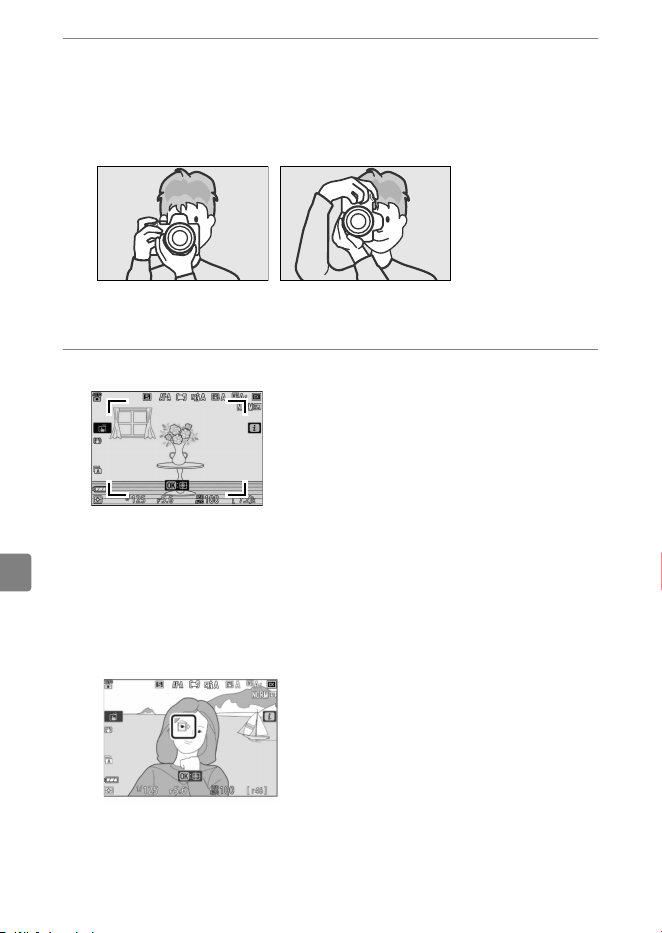
1 S
elect photo mode by rotating the photo/video selector to
C
.
2 Rotat
e the mode selector to AUTO (
b
).
34 Taking photographs (
b
auto)
3 Ready the c
amera.
Holding the handgrip in your right hand and cradling the camera
body or lens with your left, bring your elbows in against the sides of
your chest.
Landscape (wide)
or
ientation
Portrait (tall) orientation
4 F
rame the photograph.
Position the main subject in the AF-area brackets (
5
).
・ T
he AF-area brackets will disappear and a yellow border indicating
the focus point appears around the faces of human subjects
detected by the camera. If the camera detects the subject’s eyes,
the yellow focus point will instead appear over one or the other of
their eyes.
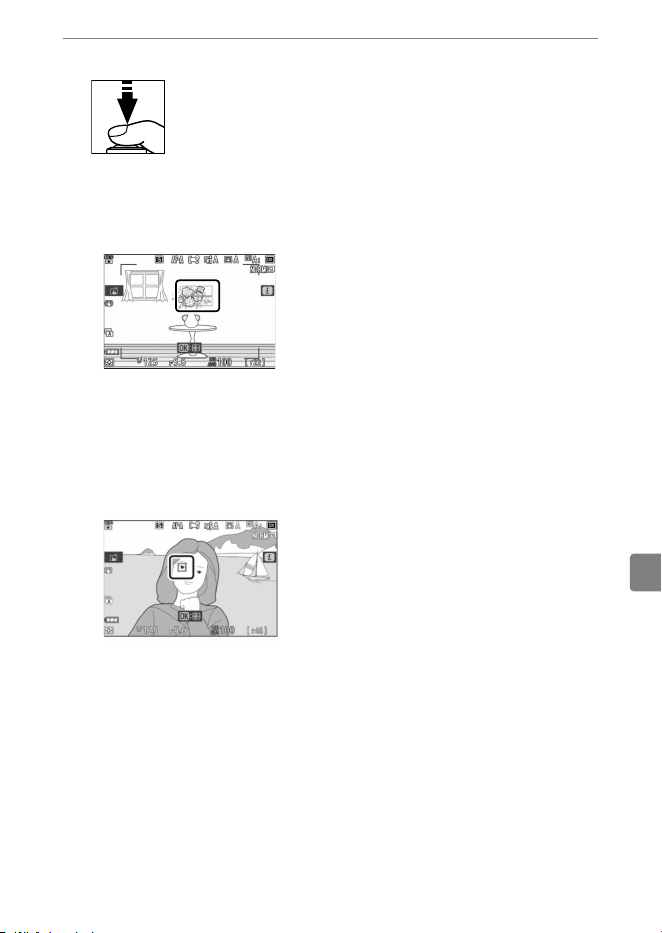
Taking photographs (
b
auto) 35
5 P
ress the shutter-release button halfway to focus.
・ T
he focus point will be displayed in green when the camera
focuses. If the camera is unable to focus, the AF-area brackets will
ash.
・ T
he AF-assist illuminator may light to assist the focus operation if
the subject is poorly lit.
・ If the camera detects human faces or eyes, the focus point will
light green when the subject is in focus. The focus point will ash
in red when the camera does not focus.
36 Taking photographs (
b
auto)
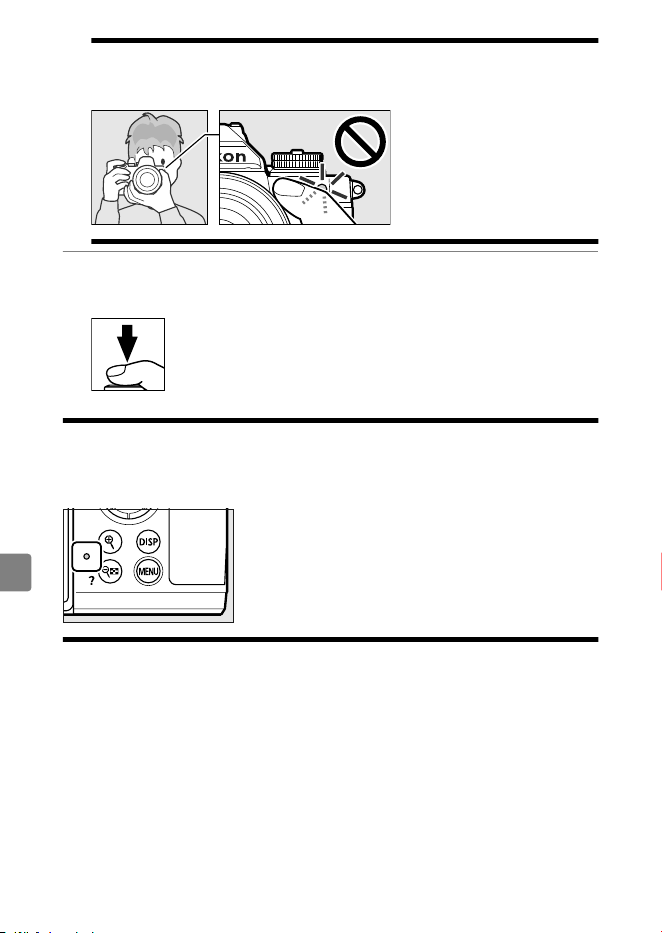
D The AF-assist illuminator
Do not obstruct the AF-assist illuminator while it is lit.
6 Smo
othly press the shutter-release button the rest of the way
down to take the photograph.
D The memory card access lamp
The memory card access lamp will light while the photograph is being
r
ecorded. Do not remove the memory card or battery.
Taking photographs (
b
auto) 37
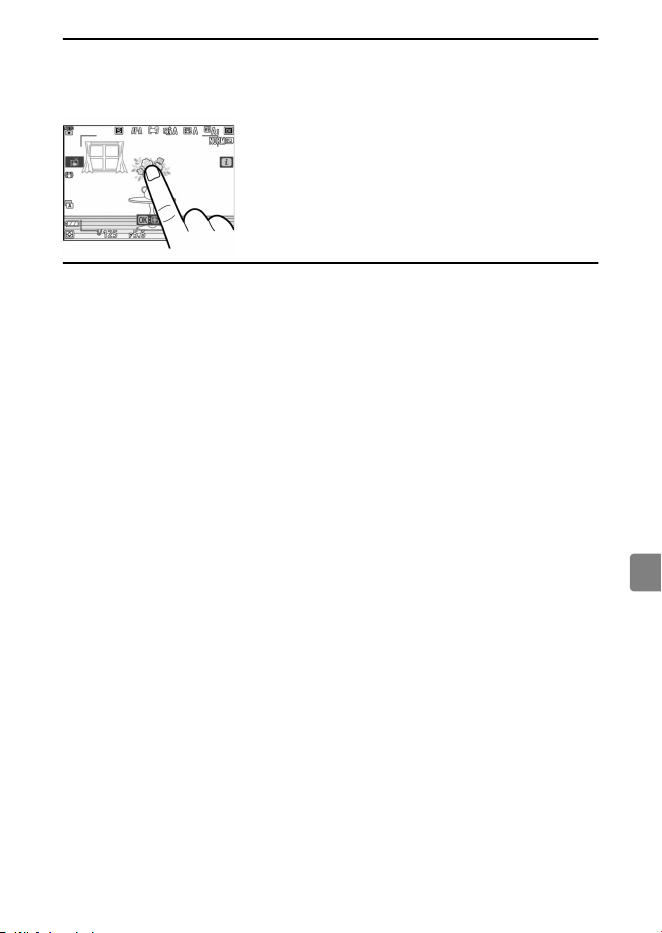
A The touch shutter
You can also take a photograph by touching the monitor. Touch your subject
t
o focus and lift your nger to release the shutter.
38 Recording videos (
b
auto)
Recording videos (
b
auto)
b
(auto) mode can also be used for simple, “point-and-shoot” video
r
ecording.
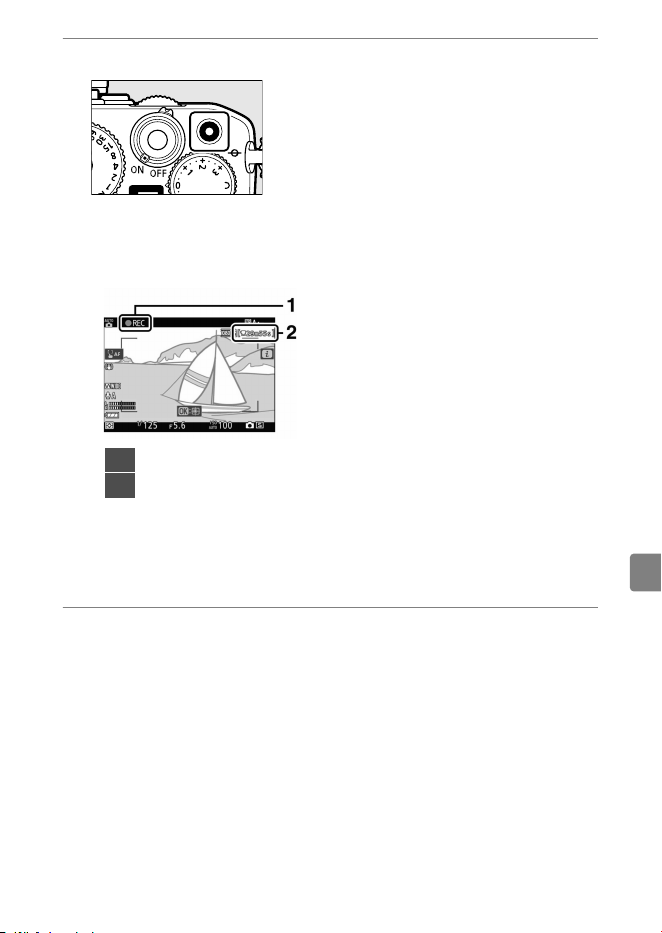
1 Select video mode by rotating the photo/video selector to
1
.
Note that optional ash units cannot be used when the camer
a is in
video mode.
2 Rotat
e the mode selector to AUTO (
b
).
Recording videos (
b
auto) 39
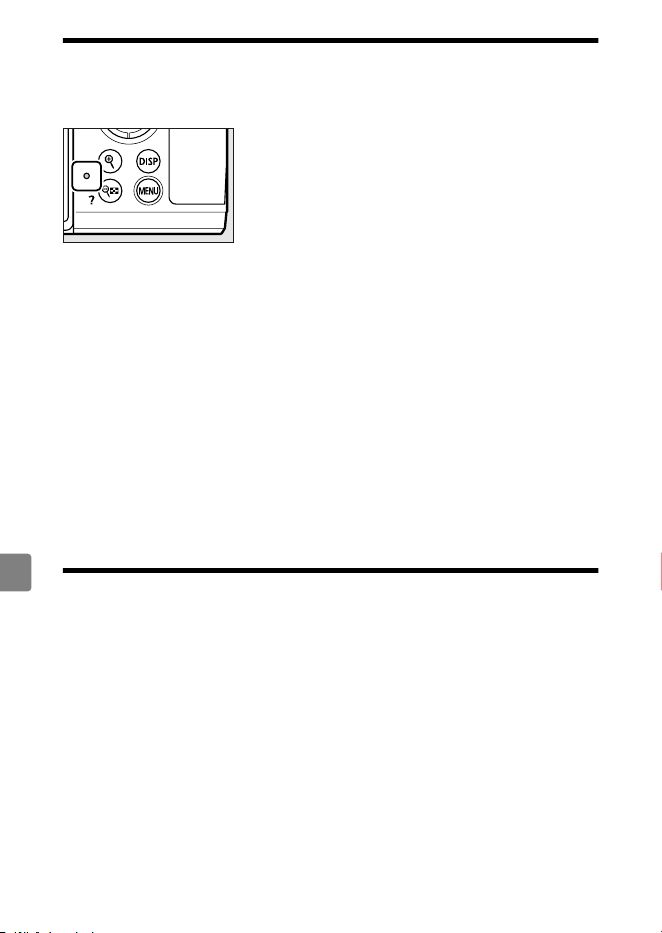
3 P
ress the video-record button to start recording.
・ A r
ecording indicator will be displayed in the monitor. The monitor
also shows the time remaining, or in other words the approximate
amount of new footage that can be recorded to the memory card.
1
Recording indicator
2
Time remaining
・ S
ound is recorded via the built-in microphone. Do not cover the
microphone during recording.
・ If you tap your subject in the monitor during recording, the focus
point will track the subject as it moves through the frame.
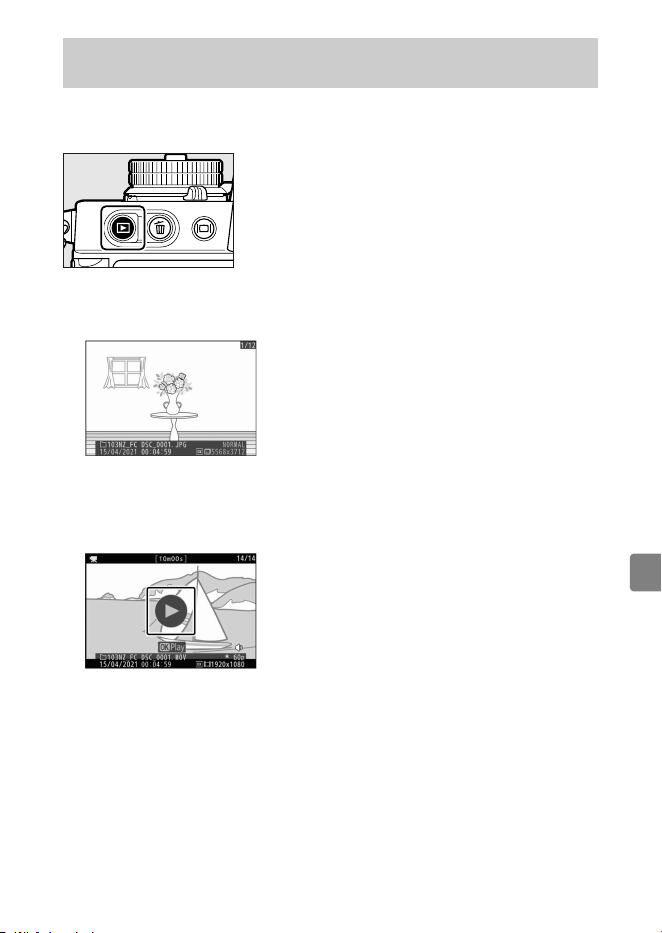
4 P
ress the video-record button again to end recording.
40 Recording videos (
b
auto)
D The memory card access lamp
The memory card access lamp will light while the video is being recorded. Do
not r
emove the memory card or battery.
D The
0
icon
A
0
icon indicates that videos cannot be recorded.
D Recording videos
・ V
ideo recording will end automatically if:
- The maximum length is reached
- Another mode is selected
- The photo/video selector is rotated to
C
- The lens is removed
・ Sounds made by the camera may be audible in footage recorded:
- During autofocus
- During vibration reduction
- When power aperture is used
Viewing photos 41
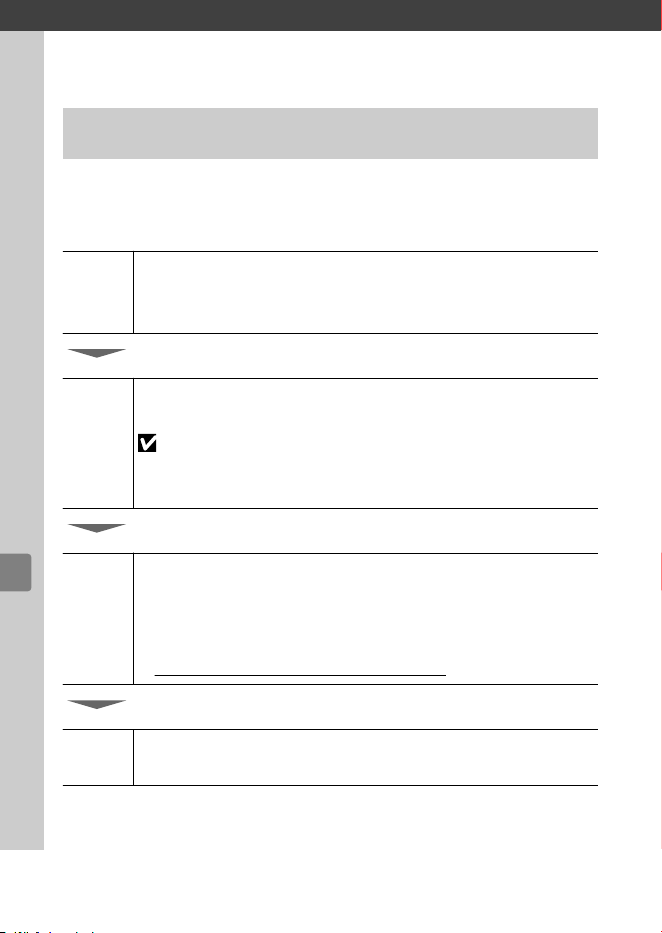
Viewing photos
Press the
K
button to view photos and videos recorded with the
camer
a in the monitor or viewnder.
・ P
ress
4
or
2
, or ick left or right on the monitor to view other
images.
・ V
ideos are indicated by a
1
icon at the upper left of the monitor.
Press the
J
button, or tap the
a
icon in the monitor to play back
videos.
・ T
o end playback and return to shooting mode, press the shutter-
release button halfway.
42 Before contacting customer support
Troubleshooting
Before contacting customer support
You may be able to resolve any issues with the camera by following the
st
eps below. Check this list before consulting your retailer or Nikon-
authorized service representative.
STEP 1
Check the list of common problems.
C
ommon problems and solutions are listed in the
troubleshooting section of the
Reference Guide
.
STEP 2
Turn the camera o and r
emove the battery, then wait about
a minute, re-insert the battery and turn the camera on.
The camera may continue to write data to the memory card
af
ter shooting. Wait at least a minute before removing the
battery.
STEP 3
Search Nikon websites.
・ F
or support information and answers to frequently asked
questions, visit the website for your country or region (018).
・ To download the latest rmware for your camera, visit:
https://downloadcenter.nikonimglib.com/
STEP 4
Consult a Nikon-authorized service representative.

Caring for the camera 43
Technical notes
Caring for the camera
Storage
When the camera will not be used for an extended period, remove the
batt
ery. Before removing the battery, conrm that the camera is o. Do
not store the camera in locations that:
・ are poorly ventilated or subject to humidities of over 60%
・ are next to equipment that produces strong electromagnetic elds,
such as televisions or radios
・ are exposed to temperatures above 50 °C (122 °F) or below −10 °C (14
°F)

44 Caring for the camera and battery: Cautions
Caring for the camera and battery:
C
autions
Camera care
Do not drop●
Do not drop the camera or lens or subject them to blows. The product may
malfunc
tion if subjected to strong shocks or vibration.
Keep dry●
Keep the camera dry. Rusting of the internal mechanism caused by water
inside the camera can not only be expensive to repair but can in fact cause
irreparable damage.
Avoid sudden changes in temperature●
If you bring the camera from a cold place to a warm place, or from a warm
place to a cold place, water droplets may form inside and outside the camera
and cause damage. When you bring the camera to a place with a
temperature dierence, place the camera in a carrying case or plastic bag
and seal it beforehand. When the camera has adapted to the ambient
temperature, take it out from the bag and use it.
Keep away from strong magnetic elds●
Static charges or the magnetic elds produced by equipment such as radio
transmitters could interfere with the monitor, corrupt data stored on the
memory card, or aect the product’s internal circuitry.
Do not leave the lens pointed at the sun●
Do not leave the lens pointed at the sun or other strong light source for
extended periods. Intense light may damage the image sensor or cause
fading or “burn in”. Photographs taken with the camera may exhibit a white
blur eect.
Caring for the camera and battery: Cautions 45
Lasers and other bright light sources●
Do not direct lasers or other extremely bright light sources toward the lens,
as this c
ould damage the camera’s image sensor.
Cleaning●
When cleaning the camera body, use a blower to gently remove dust and lint,
then wipe gently with a soft, dry cloth. After using the camera at the beach or
seaside, wipe o any sand or salt using a cloth lightly dampened in fresh
water and then dry the camera thoroughly.
Cleaning the lens and viewnder●
These glass elements are easily damaged: remove dust and lint with a blower.
If using an aerosol blower, keep the can vertical to prevent the discharge of
liquid that could damage glass elements. To remove ngerprints and other
stains from the lens, apply a small amount of lens cleaner to a soft cloth and
wipe the lens carefully.
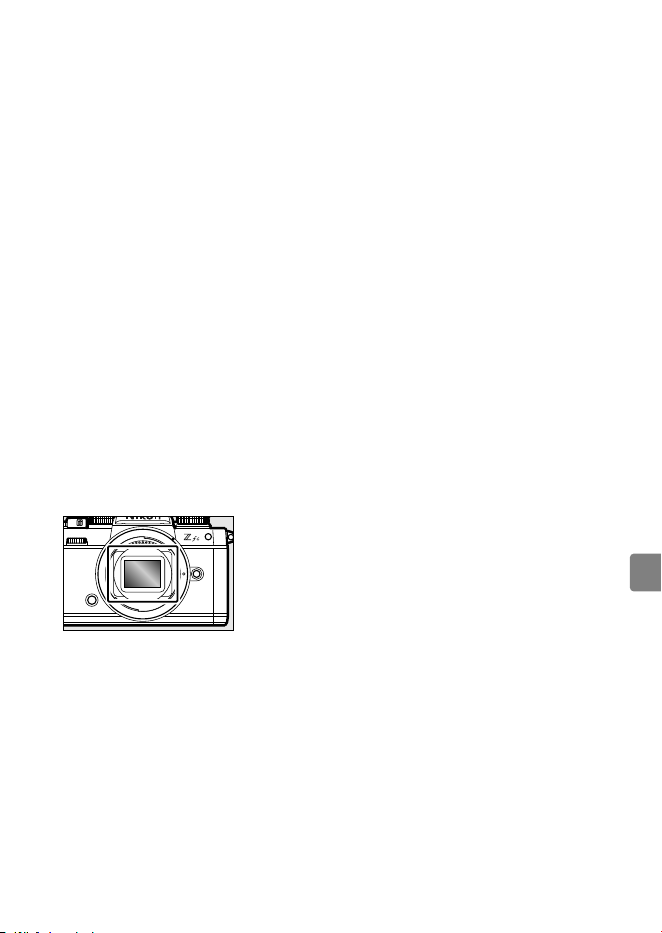
Do not touch the image sensor●
Under no circumstances should you exert pressure on the image sensor, poke
it with cleaning tools, or subject it to powerful air currents from a blower.
These actions could scratch or otherwise damage the sensor.
The lens contacts●
Keep the lens contacts clean. Avoid touching them with your ngers
.
Store in a well-ventilated area●
To prevent mold or mildew, store the camera in a dry, well-ventilated area. Do
not store the camera with naphtha or camphor moth balls, next to
equipment that produces strong electromagnetic, or where it will be
exposed to extremely high temperatures, for example near a heater or in an

46 Caring for the camera and battery: Cautions
enclosed vehicle on a hot day. Failure to observe these precautions could
r
esult in product malfunction.
Long-term storage●
To prevent damage caused by, for example, leaking battery uid, remove the
battery if the product will not be used for an extended period. Store the
camera in a plastic bag containing a desiccant. Do not, however, store the
leather camera case in a plastic bag, as this may cause the material to
deteriorate. Store the battery in a cool, dry place. Note that desiccant
gradually loses its capacity to absorb moisture and should be replaced at
regular intervals. To prevent mold or mildew, take the camera out of storage
at least once a month, insert the battery, and release the shutter a few times.
Turn the product o before removing the battery.●
Removing the battery while the camera is on could damage the product.
Particular care should be taken not to remove or disconnect the power
source while images are being recorded or deleted.
Monitor/viewnder●
・ The monitors (including viewnder) are constructed with extremely high
precision; at least 99.99% of pixels are eective, with no more than 0.01%
being missing or defective. Hence while these displays may contain pixels
that are always lit (white, red, blue, or green) or always o (black), this is not
a malfunction. Images recorded with the device are unaected. Your
understanding is requested.
・ Images in the monitor may be dicult to see in a bright light.
・ Do not apply pressure to the monitor. The monitor could malfunction or
suer damage. Dust or lint on the monitor can be removed with a blower.
Stains can be removed by wiping the monitor lightly with a soft cloth or
chamois leather. Should the monitor break, care should be taken to avoid
injury from broken glass. Be careful that liquid crystal from the monitor
does not touch the skin or enter the eyes or mouth.
・ Should you experience any of the following symptoms while framing shots
in the viewnder, discontinue use until your condition improves:
- nausea, eye pain, eye fatigue,

Caring for the camera and battery: Cautions 47
- dizziness, headache, stiness in y
our neck or shoulders,
- queasiness or loss of hand-eye coordination, or
- motion sickness.
・ The display may rapidly icker on and o during burst photography.
Watching the ickering display could cause you to feel unwell. Discontinue
use until your condition improves.
Bright lights and back-lit subjects●
Noise in the form of lines may in rare cases appear in pictures that include
bright lights or back-lit subjects.
D Disposing of data storage devices
Please note that deleting images or formatting memory cards or other data
st
orage devices does not completely erase the original image data. Deleted
les can sometimes be recovered from discarded storage devices using
commercially available software, potentially resulting in the malicious use of
personal image data. Ensuring the privacy of such data is the user’s
responsibility.
Before discarding a data storage device or transferring ownership to another
person, erase all data using commercial deletion software, or format the
device and then completely rell it with images containing no private
information (for example, pictures of empty sky). Care should be taken to
avoid injury when physically destroying data storage devices. Before
discarding the camera or transferring ownership to another person, you
should also use the [Reset all settings] item in the camera setup menu to
delete network settings and other personal information.
Battery care
Precautions for use●
・ I
f improperly handled, batteries may rupture or leak, causing the product to
corrode. Observe the following precautions when handling batteries:
- Turn the product o before replacing the battery.
- Batteries may be hot after extended use.
- Keep the battery terminals clean.

48 Caring for the camera and battery: Cautions
- Use only batteries approved for use in this equipment.
-
Do not short or disassemble batteries or expose them to ame or
excessive heat.
- When the battery is not inserted in the camera or charger, keep it in a
plastic bag or other non-conductive container so that the terminals are
insulated.
・ If the battery is hot, for example immediately after use, wait for it to cool
before charging. Attempting to charge the battery while its internal
temperature is elevated will impair battery performance, and the battery
may not charge or charge only partially.
・ If the battery will not be used for some time, insert it in the camera and run
it at before removing it from the camera for storage. The battery should
be stored in a cool, dry location with an ambient temperature of 15 °C to 25
°C (59 °F to 77 °F). Avoid hot or extremely cold locations.
・ Batteries should be charged within six months of use. During long periods
of disuse, charge the battery and use the camera to run it at once every six
months before returning it to a cool location for storage.
・ Remove the battery from the camera or charger when not in use. The
camera and charger draw minute amounts of charge even when o and
could draw the battery down to the point that it will no longer function.
・ Do not use the battery at ambient temperatures below 0 °C (32 °F) or above
40 °C (104 °F). Failure to observe this precaution could damage the battery
or impair its performance. Charge the battery indoors at ambient
temperatures of 5 °C–35 °C (41 °F–95 °F). The battery will not charge if its
temperature is below 0 °C (32 °F) or above 60 °C (140 °F).
・ Capacity may be reduced and charging times increase at battery
temperatures from 0 °C (32 °F) to 15 °C (59 °F) and from 45 °C (113 °F) to 60
°C (140 °F).
・ Batteries in general exhibit a drop in charging capacity at low ambient
temperatures.
・ Batteries in general exhibit a drop in available capacity at low ambient
temperatures. The change in capacity with temperature is reected in the
camera battery-level display. As a result, the battery display may show a

Caring for the camera and battery: Cautions 49
drop in capacity as the temperature drops, even if the battery is fully
char
ged.
・ Batteries may be hot after use. Observe due caution when removing
batteries from the camera.
Charge batteries before use●
Charge the battery before use. The supplied battery is not fully charged at
shipment.
Ready spare batteries●
Before taking photographs, ready a spare battery and keep it fully charged.
Depending on your location, it may be dicult to purchase replacement
batteries on short notice.
Have fully-charged spare batteries ready on cold days●
Partially-charged batteries may not function on cold days. In cold weather,
charge one battery before use and keep another in a warm place, ready to be
exchanged as necessary. Once warmed, a cold battery may recover some of
its charge.
Battery level●
・ Turning the camera on or o repeatedly when the battery is fully
discharged will shorten battery life. Batteries that have been fully
discharged must be charged before use.
・ A marked drop in the time a fully charged battery retains its charge when
used at room temperature indicates that it requires replacement. Purchase
a new rechargeable battery.
Do not attempt to charge fully-charged batteries●
Continuing to charge the battery after it is fully charged can impair battery
performance.
Recycling used batteries●
Recycle rechargeable batteries in accord with local regulations, being sure to
rst insulate the terminals with tape.

50 Caring for the camera and battery: Cautions
Using the charger
・ D
o not move the charger or touch the battery during charging; failure to
observe this precaution could in very rare instances result in the charger
showing that charging is complete when the battery is only partially
charged. Remove and reinsert the battery to begin charging again.
・ Do not short the charger terminals. Failure to observe this precaution could
result in overheating and damage to the charger.
・ Unplug the charger when it is not in use.
・ Use the MH-32 Battery Charger with compatible batteries only.
・ Do not use chargers with damage that leaves the interior exposed or that
produce unusual sounds when used.
・ The symbols on this product represent the following:
m
AC,
p
DC,
q
Class II equipment (the construction of the product
is double-insulated)
Using the charging AC adapter
・ D
o not move the camera or touch the battery during charging. Failure to
observe this precaution could in very rare instances result in the camera
showing that charging is complete when the battery is only partially
charged. Disconnect and reconnect the adapter to begin charging again.
・ Do not short the adapter terminals. Failure to observe this precaution could
result in overheating and damage to the charger.
・ Unplug the adapter when it is not in use.
・ Do not use adapters with damage that leaves the interior exposed or that
produce unusual sounds when used.
・ The symbols on this product represent the following:
m
AC,
p
DC,
q
Class II equipment (the construction of the product
is double-insulated)
Trademarks and licenses 51
Trademarks and licenses
・ T
he SD, SDHC, and SDXC logos are trademarks of SD-3C, LLC.
・ Windows is either a registered trademark or a trademark of Microsoft
Corporation in the United States and/or other countries.
・ Apple
®
, App Store
®
, the Apple logos, iPhone
®
, iPad
®
, Mac, and macOS
are trademarks of Apple Inc. registered in the U.S. and/or other
countries.
・ Android, Google Play and the Google Play logo are trademarks of
Google LLC. The Android robot is reproduced or modied from work
created and shared by Google and used according to terms
described in the Creative Commons 3.0 Attribution License.
・ IOS is a trademark or registered trademark of Cisco Systems, Inc., in
the United States and/or other countries and is used under license.
・ HDMI, the HDMI logo and High-Denition Multimedia Interface are
trademarks or registered trademarks of HDMI Licensing, LLC.
・ T
he Bluetooth
®
word mark and logo are registered trademarks owned
by Bluetooth SIG, Inc., and any use of such marks by Nikon is under
license.
・ Wi-Fi and the Wi-Fi logo are trademarks or registered trademarks of
the Wi-Fi Alliance.
・ All other trade names mentioned in this document or the other
documentation provided with your Nikon product are trademarks or
registered trademarks of their respective holders.
・ Use of the Made for Apple badge means that an accessory has been
designed to connect specically to the Apple products identied in
the badge, and has been certied by the developer to meet Apple
performance standards. Apple is not responsible for the operation of
this device or its compliance with safety and regulatory standards.
Please note that the use of this accessory with an Apple product may
aect wireless performance.

52 Trademarks and licenses
・ T
he software for this product includes open-source software
copyrighted by third parties. The terms of the licenses for this open-
source software may be found in the
Reference Guide
.
https://downloadcenter.nikonimglib.com/
Notices 53
Notices
Notices for customers in the U.S.A.●
The battery charger
IMPORT
ANT SAFETY INSTRUCTIONS—SAVE THESE INSTRUCTIONS
DANGER—TO REDUCE THE RISK OF FIRE OR ELECTRIC SHOCK,
CAREFULLY FOLLOW THESE INSTRUCTIONS
For connection to a supply not in the U.S.A., use an attachment plug
adapter of the proper conguration for the power outlet if needed. This
power unit is intended to be correctly oriented in a vertical or oor mount
position.
Federal Communications Commission (FCC) Radio Frequency
I
nterference Statement
Z fc
This equipment has been tested and found to comply with the limits for
a Class B dig
ital device, pursuant to Part 15 of the FCC rules. These limits
are designed to provide reasonable protection against harmful
interference in a residential installation. This equipment generates, uses,
and can radiate radio frequency energy and, if not installed and used in
accordance with the instructions, may cause harmful interference to
radio communications. However, there is no guarantee that interference
will not occur in a particular installation. If this equipment does cause
harmful interference to radio or television reception, which can be
determined by turning the equipment o and on, the user is
encouraged to try to correct the interference by one or more of the
following measures:
・ Reorient or relocate the receiving antenna.
・ Increase the separation between the equipment and receiver.
54 Notices
・ C
onnect the equipment into an outlet on a circuit dierent from that
to which the receiver is connected.
・ Consult the dealer or an experienced radio/television technician for
help.
CAUTIONS
Modications
The FCC requires the user to be notied that any changes or
modications made to this device that are not expressly approved by
Nikon Corporation may void the user’s authority to operate the
equipment.
Interface cables
Use the interface cables sold or provided by Nikon for your equipment.
Using other interface cables may exceed the limits of Class B Part 15 of
the FCC rules.
Nikon Inc., 1300 Walt Whitman Road, Melville, New York 11747-3064,
U.S.A.
Tel.: 631-547-4200
Notice for customers in Canada●
CAN ICES-3 B / NMB-3 B
Notices for customers in Europe●
CAUTION: RISK OF EXPL
OSION IF BATTERY IS REPLACED BY AN INCORRECT
TYPE. DISPOSE OF USED BATTERIES ACCORDING TO THE INSTRUCTIONS.
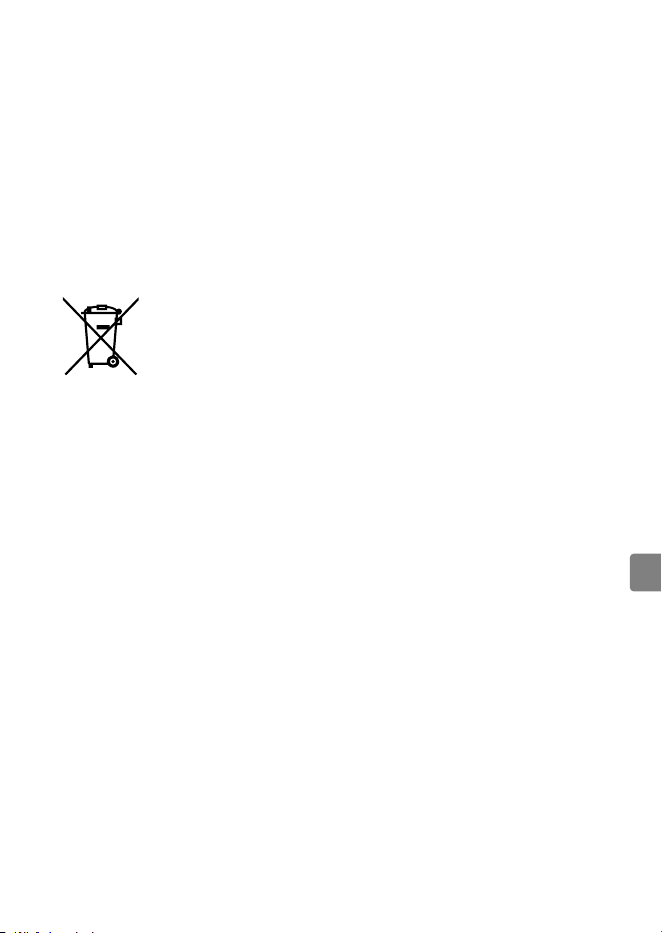
This symbol indicates that electrical and electronic equipment is to be
c
ollected separately.
The following apply only to users in European countries:
Notices 55
・ T
his product is designated for separate collection at an appropriate
collection point. Do not dispose of as household waste.
・ Separate collection and recycling helps conserve natural resources
and prevent negative consequences for human health and the
environment that might result from incorrect disposal.
・ For more information, contact the retailer or the local authorities in
charge of waste management.
This symbol on the battery indicates that the battery is to be collected
separately.
The following apply only to users in European countries:
・ A
ll batteries, whether marked with this symbol or not, are designated
for separate collection at an appropriate collection point. Do not
dispose of as household waste.
・ For more information, contact the retailer or the local authorities in
charge of waste management.

56 Bluetooth and Wi-Fi (wireless LAN)
Bluetooth and Wi-Fi (wireless LAN)
This product is controlled by the United States Export Administration
R
egulations (EAR). The permission of the United States government is
not required for export to countries other than the following, which as
of this writing are subject to embargo or special controls: Cuba, Iran,
North Korea, Sudan, and Syria (list subject to change).
The use of wireless devices may be prohibited in some countries or
regions. Contact a Nikon-authorized service representative before using
the wireless features of this product outside the country of purchase.
The Bluetooth transmitter in this device operates in the 2.4 GHz band.
Notice for customers in the U.S.A. and Canada●
This device complies with part 15 of FCC Rules and Innovation, Science
and Economic Development Canada’s licence-exempt RSSs. Operation is
subject to the following two conditions: (1) this device may not cause
harmful interference, and (2) this device must accept any interference
received, including interference that may cause undesired operation.
FCC WARNING
The FCC requires the user to be notied that any changes or
modications made to this device that are not expressly approved by
Nikon Corporation may void the user’s authority to operate the
equipment.
Compliance with FCC requirement 15.407(c)
Data transmission is always initiated by software, which is the passed
down through the MAC, through the digital and analog baseband, and
nally to the RF chip. Several special packets are initiated by the MAC.
These are the only ways the digital baseband portion will turn on the RF
transmitter, which it then turns o at the end of the packet. Therefore,
the transmitter will be on only while one of the aforementioned packets
is being transmitted. In other words, this device automatically

Bluetooth and Wi-Fi (wireless LAN) 57
discontinue transmission in case of either absence of information to
tr
ansmit or operational failure.
Frequency Tolerance: ±20 ppm
There are models that support only 2.4GHz or models that support
2.4GHz / 5GHz. The Guam sales model is only compatible with 2.4GHz.
FCC Radio Frequency Interference Statement
Note: This equipment has been tested and found to comply with the
limits for a Class B digital device, pursuant to part 15 of the FCC Rules.
These limits are designed to provide reasonable protection against
harmful interference in a residential installation. This equipment
generates, uses and can radiate radio frequency energy and, if not
installed and used in accordance with the instructions, may cause
harmful interference to radio communications. However, there is no
guarantee that interference will not occur in a particular installation. If
this equipment does cause harmful interference to radio or television
reception, which can be determined by turning the equipment o and
on, the user is encouraged to try to correct the interference by one or
more of the following measures:
・ Reorient or relocate the receiving antenna.
・ Increase the separation between the equipment and receiver.
・ Connect the equipment into an outlet on a circuit dierent from that
to which the receiver is connected.
・ Consult the dealer or an experienced radio/TV technician for help.
Co-location
This transmitter must not be co-located or operated in conjunction with
any other antenna or transmitter.
Nikon Inc., 1300 Walt Whitman Road, Melville, New York 11747-3064,
U.S.A.
Tel.: 631-547-4200
FCC/ISED RF Exposure Statement
The available scientic evidence does not show that any health
problems are associated with using low power wireless devices. There is
58 Bluetooth and Wi-Fi (wireless LAN)
no proof, however, that these low power wireless devices are absolutely
saf
e. Low power Wireless devices emit low levels of radio frequency
energy (RF) in the microwave range while being used. Whereas high
levels of RF can produce health eects (by heating tissue), exposure of
low-level RF that does not produce heating eects causes no known
adverse health eects. Many studies of low-level RF exposures have not
found any biological eects. Some studies have suggested that some
biological eects might occur, but such ndings have not been
conrmed by additional research. This product has been tested and
found to comply with FCC/ISED radiation exposure limits set forth for an
uncontrolled environment and meets the FCC radio frequency (RF)
Exposure Guidelines and RSS-102 of the ISED radio frequency (RF)
Exposure rules. Please refer to the SAR test report that was uploaded to
FCC website.
Compliance with RSS-247 Issue 2 §6.4
Data transmission is always initiated by software, which is the passed
down through the MAC, through the digital and analog baseband, and
nally to the RF chip. Several special packets are initiated by the MAC.
These are the only ways the digital baseband portion will turn on the RF
transmitter, which it then turns o at the end of the packet. Therefore,
the transmitter will be on only while one of the aforementioned packets
is being transmitted. In other words, this device automatically
discontinue transmission in case of either absence of information to
transmit or operational failure.
Notice for customers in Canada●
For indoor use only (5150-5350MHz).
Notice for customers in Singapore●
Bluetooth and Wi-Fi (wireless LAN) 59
This device complies with radio-frequency regulations. The content of
c
ertication labels not axed to the device is given below.
Notice for customers in Nigeria●
Notice for customers in Thailand●
Notice for customers in Europe and in countries complying with
the R
adio Equipment Directive
●
Hereby, Nikon Corporation declares that the radio equipment type Z fc
is in compliance with Directive 2014/53/EU.
The full texts of the EU declarations of conformity are available at the
f
ollowing internet addresses:
https://imaging.nikon.com/support/pdf/DoC_N2016.pdf
Wi-Fi
・ O
perating frequency:
- 2412–2462 MHz (channel 11; Africa, Asia, Bolivia, Europe, and
Oceania)
- 2412–2462 MHz (channel 11), 5180–5825 MHz (5180–5580 MHz,
5660–5700 MHz, and 5745–5825 MHz) (U.S.A., Canada, Mexico)
- 2412–2462 MHz (channel 11), 5180–5805 MHz (5180–5320 MHz
and 5745–5805 MHz) (other countries in the Americas)
60 Bluetooth and Wi-Fi (wireless LAN)
・ M
aximum output power (EIRP):
- 2.4 GHz band: 8.1 dBm
- 5 GHz band: 7.9 dBm (countries in the Americas)
Bluetooth
・ Operating frequency:
- Bluetooth: 2402–2480 MHz
- Bluetooth Low Energy: 2402–2480 MHz
・ Maximum output power (EIRP):
- Bluetooth: 2.6 dBm
- Bluetooth Low Energy: 1.1 dBm
Notice for customers in the UK●
Hereby, Nikon Corporation declares that the radio equipment type Z fc
is in compliance with Radio Equipment Regulations 2017.
The full text of the UKCA declaration of conformity is available at the
f
ollowing internet address:
https://imaging.nikon.com/support/pdf/UKCA_DoC_N2016.pdf
Wi-Fi
・ O
perating frequency:
- 2412–2462 MHz (channel 11)
・ Maximum output power (EIRP):
- 2.4 GHz band: 8.1 dBm
Bluetooth
・ Operating frequency:
- Bluetooth: 2402–2480 MHz
- Bluetooth Low Energy: 2402–2480 MHz
・ Maximum output power (EIRP):
- Bluetooth: 2.6 dBm
- Bluetooth Low Energy: 1.1 dBm
Bluetooth and Wi-Fi (wireless LAN) 61
This product complies with the UK PSTI Act 2022 and the statement of
c
ompliance and security update period is available at the following
internet address:
https://www.nikonimgsupport.com/eu/BV_article?
lang=en_GB&articleNo=000066765
A Conformity marking
Some of the information related to standards with which the camera
c
omplies can be viewed using the [Conformity marking] option in the setup
menu.
A Certicates

62 Warranty terms - Nikon Europe service warranty
Warranty terms
Warranty terms - Nikon Europe service
w
arranty
Dear Nikon customer,
We thank you for your purchasing this Nikon product. Should your Nikon
product require warranty service, please contact the dealer from whom it
was purchased or a member of our authorized service network within the
sales territory of Nikon Europe B.V. (e.g. Europe/Russia/others). See details
under:
https://www.europe-nikon.com/support
In order to avoid any unnecessary inconvenience, we advise you to read the
user manuals car
efully before contacting the dealer or our authorized service
network.
Your Nikon equipment is guaranteed against any manufacturing defects for
one full year from the date of original purchase. If during this period of
guarantee the product proves defective due to improper material or
workmanship, our authorized service network within the sales territory of
Nikon Europe B.V. will, without charge for labor and parts, repair the product
in the terms and conditions set as below. Nikon reserves the right (at its sole
discretion) to replace or repair the product.
1. This warranty is only provided upon presentation of the completed
warranty card and original invoice or purchase receipt indicating the date
of purchase, product type and dealer’s name, together with the product.
Nikon reserves the right to refuse free-of-charge warranty service if the
above documents cannot be presented or if the information contained in
it is incomplete or illegible.
2. This warranty will not cover:
・ necessary maintenance and repair or replacement of parts due to normal
wear and tear.
・ modications to upgrade the product from its normal purpose as described
in user manuals, without the prior written consent of Nikon.

Warranty terms - Nikon Europe service warranty 63
・ tr
ansport costs and all risks of transport relating directly or indirectly to the
warranty of the products.
・ any damage resulting from modications or adjustments which may be
made to the product, without the prior written consent of Nikon, in order to
comply with local or national technical standards in force in any other
country than the ones for which the product was originally designed and/or
manufactured.
3. The warranty will not be applicable in the case of:
・ damage caused by misuse including but not limited to failure to use the
product for its normal purpose or according to the user instructions on the
proper use and maintenance, and to installation or use of the product
inconsistent with the safety standards in force in the country where it is
used.
・ damage caused by accidents including but not limited to lightning, water,
re, misuse or neglect.
・ defacing, illegibility or removal of the model or serial number on the
product.
・ damage resulting from repairs or adjustments which have been conducted
by unauthorized service organizations or persons.
・ defects in any system into which the product is incorporated or with which
it is used.
4. This service warranty does not aect the consumer’s statutory rights
under applicable national laws in force, nor the consumer’s right against
the dealer arising from their sales/purchase contract.
Notice: An overview of all authorized Nikon Service Stations can be found
online by following this Link
(URL =
https://www.europe-nikon.com/service/
).

CT4E05(11)
6MOA9411-05