
Table of Contents
When Your First Phot
o Can’t Wait. . . . . . . . . . . . . . . . . . . . . . . . . . . . . . . . . . . . . . . . . . . . . . . . . . . 24
Getting Ready. . . . . . . . . . . . . . . . . . . . . . . . . . . . . . . . . . . . . . . . . . . . . . . . . . . . . . . . . . . . . . . . . . . . . . . . . . 24
Taking and Viewing Pictures. . . . . . . . . . . . . . . . . . . . . . . . . . . . . . . . . . . . . . . . . . . . . . . . . . . . . . . . . . . . . . 26
Content by Nikon to Enjoy Photos. . . . . . . . . . . . . . . . . . . . . . . . . . . . . . . . . . . . . . . . . . . . . . . . . . . 27
About Content Provided by Nikon. . . . . . . . . . . . . . . . . . . . . . . . . . . . . . . . . . . . . . . . . . . . . . . . . . . . . . . . 27
Cloud Service. . . . . . . . . . . . . . . . . . . . . . . . . . . . . . . . . . . . . . . . . . . . . . . . . . . . . . . . . . . . . . . . . . . . . . . . . . 28
Nikon Imaging Cloud. . . . . . . . . . . . . . . . . . . . . . . . . . . . . . . . . . . . . . . . . . . . . . . . . . . . . . . . . . . . . . . . . 28
Computer Software. . . . . . . . . . . . . . . . . . . . . . . . . . . . . . . . . . . . . . . . . . . . . . . . . . . . . . . . . . . . . . . . . . . . . 29
NX Tether. . . . . . . . . . . . . . . . . . . . . . . . . . . . . . . . . . . . . . . . . . . . . . . . . . . . . . . . . . . . . . . . . . . . . . . . . . . 29
NXStudio. . . . . . . . . . . . . . . . . . . . . . . . . . . . . . . . . . . . . . . . . . . . . . . . . . . . . . . . . . . . . . . . . . . . . . . . . . . 29
Wireless Transmitter Utility. . . . . . . . . . . . . . . . . . . . . . . . . . . . . . . . . . . . . . . . . . . . . . . . . . . . . . . . . . . . 30
Smartphone (Tablet) Apps. . . . . . . . . . . . . . . . . . . . . . . . . . . . . . . . . . . . . . . . . . . . . . . . . . . . . . . . . . . . . . . 31
SnapBridge. . . . . . . . . . . . . . . . . . . . . . . . . . . . . . . . . . . . . . . . . . . . . . . . . . . . . . . . . . . . . . . . . . . . . . . . . . 31
NX MobileAir. . . . . . . . . . . . . . . . . . . . . . . . . . . . . . . . . . . . . . . . . . . . . . . . . . . . . . . . . . . . . . . . . . . . . . . . 31
Before You Begin. . . . . . . . . . . . . . . . . . . . . . . . . . . . . . . . . . . . . . . . . . . . . . . . . . . . . . . . . . . . . . . . . 32
Package Contents. . . . . . . . . . . . . . . . . . . . . . . . . . . . . . . . . . . . . . . . . . . . . . . . . . . . . . . . . . . . . . . . . . . . . . . 32
About This Document. . . . . . . . . . . . . . . . . . . . . . . . . . . . . . . . . . . . . . . . . . . . . . . . . . . . . . . . . . . . . . . . . . . 33
Symbols. . . . . . . . . . . . . . . . . . . . . . . . . . . . . . . . . . . . . . . . . . . . . . . . . . . . . . . . . . . . . . . . . . . . . . . . . . . . . 33
Conventions. . . . . . . . . . . . . . . . . . . . . . . . . . . . . . . . . . . . . . . . . . . . . . . . . . . . . . . . . . . . . . . . . . . . . . . . . 33
ForYourSafety. . . . . . . . . . . . . . . . . . . . . . . . . . . . . . . . . . . . . . . . . . . . . . . . . . . . . . . . . . . . . . . . . . . . . . . . . 34
Notices. . . . . . . . . . . . . . . . . . . . . . . . . . . . . . . . . . . . . . . . . . . . . . . . . . . . . . . . . . . . . . . . . . . . . . . . . . . . . . . . 41
Parts of the Camera. . . . . . . . . . . . . . . . . . . . . . . . . . . . . . . . . . . . . . . . . . . . . . . . . . . . . . . . . . . . . . . 44
Camera Body. . . . . . . . . . . . . . . . . . . . . . . . . . . . . . . . . . . . . . . . . . . . . . . . . . . . . . . . . . . . . . . . . . . . . . . . . . . 44
The Monitor. . . . . . . . . . . . . . . . . . . . . . . . . . . . . . . . . . . . . . . . . . . . . . . . . . . . . . . . . . . . . . . . . . . . . . . . . . . . 49
Photo Mode. . . . . . . . . . . . . . . . . . . . . . . . . . . . . . . . . . . . . . . . . . . . . . . . . . . . . . . . . . . . . . . . . . . . . . . . . 49
Video Mode. . . . . . . . . . . . . . . . . . . . . . . . . . . . . . . . . . . . . . . . . . . . . . . . . . . . . . . . . . . . . . . . . . . . . . . . . 52
Angling the Monitor. . . . . . . . . . . . . . . . . . . . . . . . . . . . . . . . . . . . . . . . . . . . . . . . . . . . . . . . . . . . . . . . . . 54
TheViewfinder. . . . . . . . . . . . . . . . . . . . . . . . . . . . . . . . . . . . . . . . . . . . . . . . . . . . . . . . . . . . . . . . . . . . . . . . . 58
Photo Mode. . . . . . . . . . . . . . . . . . . . . . . . . . . . . . . . . . . . . . . . . . . . . . . . . . . . . . . . . . . . . . . . . . . . . . . . . 58
Video Mode. . . . . . . . . . . . . . . . . . . . . . . . . . . . . . . . . . . . . . . . . . . . . . . . . . . . . . . . . . . . . . . . . . . . . . . . . 61
2
Table of Contents

The Monitor Mode Button and the Eye Sensor. . . . . . . . . . . . . . . . . . . . . . . . . . . . . . . . . . . . . . . . . . . 63
Touch Controls
. . . . . . . . . . . . . . . . . . . . . . . . . . . . . . . . . . . . . . . . . . . . . . . . . . . . . . . . . . . . . . . . . . . . . . . . . 66
Focusing and Releasing the Shutter. . . . . . . . . . . . . . . . . . . . . . . . . . . . . . . . . . . . . . . . . . . . . . . . . . . . 66
Adjusting Settings. . . . . . . . . . . . . . . . . . . . . . . . . . . . . . . . . . . . . . . . . . . . . . . . . . . . . . . . . . . . . . . . . . . . 67
Playback. . . . . . . . . . . . . . . . . . . . . . . . . . . . . . . . . . . . . . . . . . . . . . . . . . . . . . . . . . . . . . . . . . . . . . . . . . . . 68
Viewing Videos. . . . . . . . . . . . . . . . . . . . . . . . . . . . . . . . . . . . . . . . . . . . . . . . . . . . . . . . . . . . . . . . . . . . . . 69
The i Menu. . . . . . . . . . . . . . . . . . . . . . . . . . . . . . . . . . . . . . . . . . . . . . . . . . . . . . . . . . . . . . . . . . . . . . . . . 69
Text Entry. . . . . . . . . . . . . . . . . . . . . . . . . . . . . . . . . . . . . . . . . . . . . . . . . . . . . . . . . . . . . . . . . . . . . . . . . . . 69
Navigating the Menus. . . . . . . . . . . . . . . . . . . . . . . . . . . . . . . . . . . . . . . . . . . . . . . . . . . . . . . . . . . . . . . . 70
The h (Picture Control) Button. . . . . . . . . . . . . . . . . . . . . . . . . . . . . . . . . . . . . . . . . . . . . . . . . . . . . . . . . . . 72
The Fn1 and Fn2 Buttons. . . . . . . . . . . . . . . . . . . . . . . . . . . . . . . . . . . . . . . . . . . . . . . . . . . . . . . . . . . . . . . . 73
Using the Menus. . . . . . . . . . . . . . . . . . . . . . . . . . . . . . . . . . . . . . . . . . . . . . . . . . . . . . . . . . . . . . . . . 74
The MENU Button. . . . . . . . . . . . . . . . . . . . . . . . . . . . . . . . . . . . . . . . . . . . . . . . . . . . . . . . . . . . . . . . . . . . . . 74
Using the Menus. . . . . . . . . . . . . . . . . . . . . . . . . . . . . . . . . . . . . . . . . . . . . . . . . . . . . . . . . . . . . . . . . . . . . 75
The i Button (i Menu). . . . . . . . . . . . . . . . . . . . . . . . . . . . . . . . . . . . . . . . . . . . . . . . . . . . . . . . . . . . . . . . . . 80
i Menu. . . . . . . . . . . . . . . . . . . . . . . . . . . . . . . . . . . . . . . . . . . . . . . . . . . . . . . . . . . . . . . . . . . . . . . . . . . . . 80
The Still Photography i Menu. . . . . . . . . . . . . . . . . . . . . . . . . . . . . . . . . . . . . . . . . . . . . . . . . . . . . . . . . 82
The Video i Menu. . . . . . . . . . . . . . . . . . . . . . . . . . . . . . . . . . . . . . . . . . . . . . . . . . . . . . . . . . . . . . . . . . . 83
The Playback i Menu. . . . . . . . . . . . . . . . . . . . . . . . . . . . . . . . . . . . . . . . . . . . . . . . . . . . . . . . . . . . . . . . . 84
Customizing the i Menu. . . . . . . . . . . . . . . . . . . . . . . . . . . . . . . . . . . . . . . . . . . . . . . . . . . . . . . . . . . . . . 85
First Steps. . . . . . . . . . . . . . . . . . . . . . . . . . . . . . . . . . . . . . . . . . . . . . . . . . . . . . . . . . . . . . . . . . . . . . . 86
Attaching the Strap. . . . . . . . . . . . . . . . . . . . . . . . . . . . . . . . . . . . . . . . . . . . . . . . . . . . . . . . . . . . . . . . . . . . . 86
Inserting the Battery. . . . . . . . . . . . . . . . . . . . . . . . . . . . . . . . . . . . . . . . . . . . . . . . . . . . . . . . . . . . . . . . . . . . 87
Removing the Battery. . . . . . . . . . . . . . . . . . . . . . . . . . . . . . . . . . . . . . . . . . . . . . . . . . . . . . . . . . . . . . . . . 87
Battery Level. . . . . . . . . . . . . . . . . . . . . . . . . . . . . . . . . . . . . . . . . . . . . . . . . . . . . . . . . . . . . . . . . . . . . . . . . 88
Charging the Battery. . . . . . . . . . . . . . . . . . . . . . . . . . . . . . . . . . . . . . . . . . . . . . . . . . . . . . . . . . . . . . . . . . . . 89
InsertingMemoryCards. . . . . . . . . . . . . . . . . . . . . . . . . . . . . . . . . . . . . . . . . . . . . . . . . . . . . . . . . . . . . . . . . 92
Number of Exposures Remaining. . . . . . . . . . . . . . . . . . . . . . . . . . . . . . . . . . . . . . . . . . . . . . . . . . . . . . . 93
Removing Memory Cards. . . . . . . . . . . . . . . . . . . . . . . . . . . . . . . . . . . . . . . . . . . . . . . . . . . . . . . . . . . . . 95
Attaching a Lens. . . . . . . . . . . . . . . . . . . . . . . . . . . . . . . . . . . . . . . . . . . . . . . . . . . . . . . . . . . . . . . . . . . . . . . . 96
Detaching Lenses. . . . . . . . . . . . . . . . . . . . . . . . . . . . . . . . . . . . . . . . . . . . . . . . . . . . . . . . . . . . . . . . . . . . 97
Opening the Monitor. . . . . . . . . . . . . . . . . . . . . . . . . . . . . . . . . . . . . . . . . . . . . . . . . . . . . . . . . . . . . . . . . . . . 98
3
Table of Contents

Camera Setup. . . . . . . . . . . . . . . . . . . . . . . . . . . . . . . . . . . . . . . . . . . . . . . . . . . . . . . . . . . . . . . . . . . . . . . . . . 99
Basic Photography and Playback
. . . . . . . . . . . . . . . . . . . . . . . . . . . . . . . . . . . . . . . . . . . . . . . . . . . 101
Taking Photographs (b Mode). . . . . . . . . . . . . . . . . . . . . . . . . . . . . . . . . . . . . . . . . . . . . . . . . . . . . . . . . . 101
Recording Videos (b Mode). . . . . . . . . . . . . . . . . . . . . . . . . . . . . . . . . . . . . . . . . . . . . . . . . . . . . . . . . . . . 106
Playback. . . . . . . . . . . . . . . . . . . . . . . . . . . . . . . . . . . . . . . . . . . . . . . . . . . . . . . . . . . . . . . . . . . . . . . . . . . . . . 110
Viewing Videos. . . . . . . . . . . . . . . . . . . . . . . . . . . . . . . . . . . . . . . . . . . . . . . . . . . . . . . . . . . . . . . . . . . . . 111
Deleting Unwanted Pictures. . . . . . . . . . . . . . . . . . . . . . . . . . . . . . . . . . . . . . . . . . . . . . . . . . . . . . . . . . 113
Shooting Settings. . . . . . . . . . . . . . . . . . . . . . . . . . . . . . . . . . . . . . . . . . . . . . . . . . . . . . . . . . . . . . . 114
Image Recording Options (Image Area, Quality, and Size). . . . . . . . . . . . . . . . . . . . . . . . . . . . . . . . . . . 114
Adjusting Image Area Settings. . . . . . . . . . . . . . . . . . . . . . . . . . . . . . . . . . . . . . . . . . . . . . . . . . . . . . . . 114
Adjusting Image Quality. . . . . . . . . . . . . . . . . . . . . . . . . . . . . . . . . . . . . . . . . . . . . . . . . . . . . . . . . . . . . 116
Choosing an Image Size. . . . . . . . . . . . . . . . . . . . . . . . . . . . . . . . . . . . . . . . . . . . . . . . . . . . . . . . . . . . . 118
Focus. . . . . . . . . . . . . . . . . . . . . . . . . . . . . . . . . . . . . . . . . . . . . . . . . . . . . . . . . . . . . . . . . . . . . . . . . . . . . . . . 120
Focus Mode. . . . . . . . . . . . . . . . . . . . . . . . . . . . . . . . . . . . . . . . . . . . . . . . . . . . . . . . . . . . . . . . . . . . . . . . 120
AF-Area Mode. . . . . . . . . . . . . . . . . . . . . . . . . . . . . . . . . . . . . . . . . . . . . . . . . . . . . . . . . . . . . . . . . . . . . . 122
Subject Detection. . . . . . . . . . . . . . . . . . . . . . . . . . . . . . . . . . . . . . . . . . . . . . . . . . . . . . . . . . . . . . . . . . . 126
Focus-Point Selection. . . . . . . . . . . . . . . . . . . . . . . . . . . . . . . . . . . . . . . . . . . . . . . . . . . . . . . . . . . . . . . . 130
The Touch Shutter. . . . . . . . . . . . . . . . . . . . . . . . . . . . . . . . . . . . . . . . . . . . . . . . . . . . . . . . . . . . . . . . . . . 131
Focus Lock. . . . . . . . . . . . . . . . . . . . . . . . . . . . . . . . . . . . . . . . . . . . . . . . . . . . . . . . . . . . . . . . . . . . . . . . . 133
Manual Focus. . . . . . . . . . . . . . . . . . . . . . . . . . . . . . . . . . . . . . . . . . . . . . . . . . . . . . . . . . . . . . . . . . . . . . . 135
Exposure. . . . . . . . . . . . . . . . . . . . . . . . . . . . . . . . . . . . . . . . . . . . . . . . . . . . . . . . . . . . . . . . . . . . . . . . . . . . . 137
Choosing a Shooting Mode. . . . . . . . . . . . . . . . . . . . . . . . . . . . . . . . . . . . . . . . . . . . . . . . . . . . . . . . . . 137
U1, U2, and U3 (User Setting Mode). . . . . . . . . . . . . . . . . . . . . . . . . . . . . . . . . . . . . . . . . . . . . . . . . . . 143
Long Time-Exposures (Mode M Only). . . . . . . . . . . . . . . . . . . . . . . . . . . . . . . . . . . . . . . . . . . . . . . . . . 145
Autoexposure (AE) Lock. . . . . . . . . . . . . . . . . . . . . . . . . . . . . . . . . . . . . . . . . . . . . . . . . . . . . . . . . . . . . . 148
Exposure Compensation. . . . . . . . . . . . . . . . . . . . . . . . . . . . . . . . . . . . . . . . . . . . . . . . . . . . . . . . . . . . . 150
Release Mode. . . . . . . . . . . . . . . . . . . . . . . . . . . . . . . . . . . . . . . . . . . . . . . . . . . . . . . . . . . . . . . . . . . . . . . . . 152
Choosing a Release Mode. . . . . . . . . . . . . . . . . . . . . . . . . . . . . . . . . . . . . . . . . . . . . . . . . . . . . . . . . . . . 152
Burst Photography. . . . . . . . . . . . . . . . . . . . . . . . . . . . . . . . . . . . . . . . . . . . . . . . . . . . . . . . . . . . . . . . . . 154
High-Speed Frame Capture + (C15/C30). . . . . . . . . . . . . . . . . . . . . . . . . . . . . . . . . . . . . . . . . . . . . . . 156
Using the Self-Timer (E). . . . . . . . . . . . . . . . . . . . . . . . . . . . . . . . . . . . . . . . . . . . . . . . . . . . . . . . . . . . . 158
ISO Sensitivity. . . . . . . . . . . . . . . . . . . . . . . . . . . . . . . . . . . . . . . . . . . . . . . . . . . . . . . . . . . . . . . . . . . . . . . . . 160
4
Table of Contents

About ISO Sensitivity. . . . . . . . . . . . . . . . . . . . . . . . . . . . . . . . . . . . . . . . . . . . . . . . . . . . . . . . . . . . . . . . 160
Auto ISO Sensitivity Control. . . . . . . . . . . . . . . . . . . . . . . . . . . . . . . . . . . . . . . . . . . . . . . . . . . . . . . . . . 162
Pictur
e Controls. . . . . . . . . . . . . . . . . . . . . . . . . . . . . . . . . . . . . . . . . . . . . . . . . . . . . . . . . . . . . . . . . . . . . . . 164
Types of Picture Controls. . . . . . . . . . . . . . . . . . . . . . . . . . . . . . . . . . . . . . . . . . . . . . . . . . . . . . . . . . . . . 164
Selecting Picture Controls. . . . . . . . . . . . . . . . . . . . . . . . . . . . . . . . . . . . . . . . . . . . . . . . . . . . . . . . . . . . 166
Limiting Picture Control Selection. . . . . . . . . . . . . . . . . . . . . . . . . . . . . . . . . . . . . . . . . . . . . . . . . . . . . 169
Modifying Picture Controls. . . . . . . . . . . . . . . . . . . . . . . . . . . . . . . . . . . . . . . . . . . . . . . . . . . . . . . . . . . 171
Custom Picture Controls. . . . . . . . . . . . . . . . . . . . . . . . . . . . . . . . . . . . . . . . . . . . . . . . . . . . . . . . . . . . . 177
Cloud Picture Controls. . . . . . . . . . . . . . . . . . . . . . . . . . . . . . . . . . . . . . . . . . . . . . . . . . . . . . . . . . . . . . . 181
White Balance. . . . . . . . . . . . . . . . . . . . . . . . . . . . . . . . . . . . . . . . . . . . . . . . . . . . . . . . . . . . . . . . . . . . . . . . . 182
About White Balance. . . . . . . . . . . . . . . . . . . . . . . . . . . . . . . . . . . . . . . . . . . . . . . . . . . . . . . . . . . . . . . . 182
Fine-Tuning White Balance. . . . . . . . . . . . . . . . . . . . . . . . . . . . . . . . . . . . . . . . . . . . . . . . . . . . . . . . . . . 187
Choosing a Color Temperature. . . . . . . . . . . . . . . . . . . . . . . . . . . . . . . . . . . . . . . . . . . . . . . . . . . . . . . . 191
Preset Manual. . . . . . . . . . . . . . . . . . . . . . . . . . . . . . . . . . . . . . . . . . . . . . . . . . . . . . . . . . . . . . . . . . . . . . 195
Video Recording. . . . . . . . . . . . . . . . . . . . . . . . . . . . . . . . . . . . . . . . . . . . . . . . . . . . . . . . . . . . . . . . . 200
Video File Types. . . . . . . . . . . . . . . . . . . . . . . . . . . . . . . . . . . . . . . . . . . . . . . . . . . . . . . . . . . . . . . . . . . . . . . 200
Tone Mode. . . . . . . . . . . . . . . . . . . . . . . . . . . . . . . . . . . . . . . . . . . . . . . . . . . . . . . . . . . . . . . . . . . . . . . . . 201
Video Frame Size and Rate Options. . . . . . . . . . . . . . . . . . . . . . . . . . . . . . . . . . . . . . . . . . . . . . . . . . . . . . 202
Frame Size and Rate Options. . . . . . . . . . . . . . . . . . . . . . . . . . . . . . . . . . . . . . . . . . . . . . . . . . . . . . . . . 202
Bit Rate. . . . . . . . . . . . . . . . . . . . . . . . . . . . . . . . . . . . . . . . . . . . . . . . . . . . . . . . . . . . . . . . . . . . . . . . . . . . 206
Video Recording: Shooting Mode. . . . . . . . . . . . . . . . . . . . . . . . . . . . . . . . . . . . . . . . . . . . . . . . . . . . . . . . 208
Video Image Area Options. . . . . . . . . . . . . . . . . . . . . . . . . . . . . . . . . . . . . . . . . . . . . . . . . . . . . . . . . . . . . . 209
Video Self-Timer. . . . . . . . . . . . . . . . . . . . . . . . . . . . . . . . . . . . . . . . . . . . . . . . . . . . . . . . . . . . . . . . . . . . . . . 211
Product Review Mode. . . . . . . . . . . . . . . . . . . . . . . . . . . . . . . . . . . . . . . . . . . . . . . . . . . . . . . . . . . . . . . . . . 212
Hi-Res Zoom. . . . . . . . . . . . . . . . . . . . . . . . . . . . . . . . . . . . . . . . . . . . . . . . . . . . . . . . . . . . . . . . . . . . . . . . . . 213
Using Hi-Res Zoom. . . . . . . . . . . . . . . . . . . . . . . . . . . . . . . . . . . . . . . . . . . . . . . . . . . . . . . . . . . . . . . . . . 213
Live Streaming (USB Streaming (UVC/UAC)). . . . . . . . . . . . . . . . . . . . . . . . . . . . . . . . . . . . . . . . . . . . . . . 215
Live Streaming. . . . . . . . . . . . . . . . . . . . . . . . . . . . . . . . . . . . . . . . . . . . . . . . . . . . . . . . . . . . . . . . . . . . . . 215
Points to Note When Filming Videos. . . . . . . . . . . . . . . . . . . . . . . . . . . . . . . . . . . . . . . . . . . . . . . . . . . . . 217
RAW Video. . . . . . . . . . . . . . . . . . . . . . . . . . . . . . . . . . . . . . . . . . . . . . . . . . . . . . . . . . . . . . . . . . . . . . . . . . . 219
Recording HLG Video. . . . . . . . . . . . . . . . . . . . . . . . . . . . . . . . . . . . . . . . . . . . . . . . . . . . . . . . . . . . . . . . . . 220
Recording N-Log Video. . . . . . . . . . . . . . . . . . . . . . . . . . . . . . . . . . . . . . . . . . . . . . . . . . . . . . . . . . . . . . . . 222
5
Table of Contents

View Assist. . . . . . . . . . . . . . . . . . . . . . . . . . . . . . . . . . . . . . . . . . . . . . . . . . . . . . . . . . . . . . . . . . . . . . . . . 223
Viewing Pictures. . . . . . . . . . . . . . . . . . . . . . . . . . . . . . . . . . . . . . . . . . . . . . . . . . . . . . . . . . . . . . . . 224
Viewing Pictur
es. . . . . . . . . . . . . . . . . . . . . . . . . . . . . . . . . . . . . . . . . . . . . . . . . . . . . . . . . . . . . . . . . . . . . . . 224
Full-Frame Playback. . . . . . . . . . . . . . . . . . . . . . . . . . . . . . . . . . . . . . . . . . . . . . . . . . . . . . . . . . . . . . . . . 224
Thumbnail Playback. . . . . . . . . . . . . . . . . . . . . . . . . . . . . . . . . . . . . . . . . . . . . . . . . . . . . . . . . . . . . . . . . 224
Photo Information. . . . . . . . . . . . . . . . . . . . . . . . . . . . . . . . . . . . . . . . . . . . . . . . . . . . . . . . . . . . . . . . . . . . . 226
Basic Information. . . . . . . . . . . . . . . . . . . . . . . . . . . . . . . . . . . . . . . . . . . . . . . . . . . . . . . . . . . . . . . . . . . 227
Exposure Data. . . . . . . . . . . . . . . . . . . . . . . . . . . . . . . . . . . . . . . . . . . . . . . . . . . . . . . . . . . . . . . . . . . . . . 228
Highlight Display. . . . . . . . . . . . . . . . . . . . . . . . . . . . . . . . . . . . . . . . . . . . . . . . . . . . . . . . . . . . . . . . . . . . 228
RGB Histogram. . . . . . . . . . . . . . . . . . . . . . . . . . . . . . . . . . . . . . . . . . . . . . . . . . . . . . . . . . . . . . . . . . . . . 229
Shooting Data. . . . . . . . . . . . . . . . . . . . . . . . . . . . . . . . . . . . . . . . . . . . . . . . . . . . . . . . . . . . . . . . . . . . . . 231
Overview. . . . . . . . . . . . . . . . . . . . . . . . . . . . . . . . . . . . . . . . . . . . . . . . . . . . . . . . . . . . . . . . . . . . . . . . . . . 236
File Info. . . . . . . . . . . . . . . . . . . . . . . . . . . . . . . . . . . . . . . . . . . . . . . . . . . . . . . . . . . . . . . . . . . . . . . . . . . . 238
The i Button (Playback Mode). . . . . . . . . . . . . . . . . . . . . . . . . . . . . . . . . . . . . . . . . . . . . . . . . . . . . . . . . . 239
Photos. . . . . . . . . . . . . . . . . . . . . . . . . . . . . . . . . . . . . . . . . . . . . . . . . . . . . . . . . . . . . . . . . . . . . . . . . . . . . 239
Videos. . . . . . . . . . . . . . . . . . . . . . . . . . . . . . . . . . . . . . . . . . . . . . . . . . . . . . . . . . . . . . . . . . . . . . . . . . . . . 243
Videos (Playback Paused). . . . . . . . . . . . . . . . . . . . . . . . . . . . . . . . . . . . . . . . . . . . . . . . . . . . . . . . . . . . 245
Playback Zoom. . . . . . . . . . . . . . . . . . . . . . . . . . . . . . . . . . . . . . . . . . . . . . . . . . . . . . . . . . . . . . . . . . . . . . . . 246
Using Playback Zoom. . . . . . . . . . . . . . . . . . . . . . . . . . . . . . . . . . . . . . . . . . . . . . . . . . . . . . . . . . . . . . . . 246
Protecting Pictures from Deletion. . . . . . . . . . . . . . . . . . . . . . . . . . . . . . . . . . . . . . . . . . . . . . . . . . . . . . . . 248
Rating Pictures. . . . . . . . . . . . . . . . . . . . . . . . . . . . . . . . . . . . . . . . . . . . . . . . . . . . . . . . . . . . . . . . . . . . . . . . 249
Selecting Pictures for Upload. . . . . . . . . . . . . . . . . . . . . . . . . . . . . . . . . . . . . . . . . . . . . . . . . . . . . . . . . . . . 250
Filtered Playback. . . . . . . . . . . . . . . . . . . . . . . . . . . . . . . . . . . . . . . . . . . . . . . . . . . . . . . . . . . . . . . . . . . . . . 252
[Filtered playback criteria]. . . . . . . . . . . . . . . . . . . . . . . . . . . . . . . . . . . . . . . . . . . . . . . . . . . . . . . . . . 252
Recording/Playing Voice Memos. . . . . . . . . . . . . . . . . . . . . . . . . . . . . . . . . . . . . . . . . . . . . . . . . . . . . . . . 254
Recording Voice Memos. . . . . . . . . . . . . . . . . . . . . . . . . . . . . . . . . . . . . . . . . . . . . . . . . . . . . . . . . . . . . 254
Playing Voice Memos. . . . . . . . . . . . . . . . . . . . . . . . . . . . . . . . . . . . . . . . . . . . . . . . . . . . . . . . . . . . . . . . 256
Viewing Slide Shows. . . . . . . . . . . . . . . . . . . . . . . . . . . . . . . . . . . . . . . . . . . . . . . . . . . . . . . . . . . . . . . . . . . 257
During the Show. . . . . . . . . . . . . . . . . . . . . . . . . . . . . . . . . . . . . . . . . . . . . . . . . . . . . . . . . . . . . . . . . . . . 258
Deleting Pictures. . . . . . . . . . . . . . . . . . . . . . . . . . . . . . . . . . . . . . . . . . . . . . . . . . . . . . . . . . . . . . . . . . . . . . 259
Using the Delete Button. . . . . . . . . . . . . . . . . . . . . . . . . . . . . . . . . . . . . . . . . . . . . . . . . . . . . . . . . . . . . 259
Deleting Multiple Pictures. . . . . . . . . . . . . . . . . . . . . . . . . . . . . . . . . . . . . . . . . . . . . . . . . . . . . . . . . . . . 260
6
Table of Contents

Retouching Photographs. . . . . . . . . . . . . . . . . . . . . . . . . . . . . . . . . . . . . . . . . . . . . . . . . . . . . . . . . 263
Retouching Phot
ographs. . . . . . . . . . . . . . . . . . . . . . . . . . . . . . . . . . . . . . . . . . . . . . . . . . . . . . . . . . . . . . . 263
RAW Processing. . . . . . . . . . . . . . . . . . . . . . . . . . . . . . . . . . . . . . . . . . . . . . . . . . . . . . . . . . . . . . . . . . . . . . . 266
Processing Photos Shot Using the [SDR] Tone Mode. . . . . . . . . . . . . . . . . . . . . . . . . . . . . . . . . . . . 266
Processing Photos Shot Using the [HLG] Tone Mode. . . . . . . . . . . . . . . . . . . . . . . . . . . . . . . . . . . . 271
Trim. . . . . . . . . . . . . . . . . . . . . . . . . . . . . . . . . . . . . . . . . . . . . . . . . . . . . . . . . . . . . . . . . . . . . . . . . . . . . . . . . . 277
Resize. . . . . . . . . . . . . . . . . . . . . . . . . . . . . . . . . . . . . . . . . . . . . . . . . . . . . . . . . . . . . . . . . . . . . . . . . . . . . . . . 278
Resizing the Current Picture. . . . . . . . . . . . . . . . . . . . . . . . . . . . . . . . . . . . . . . . . . . . . . . . . . . . . . . . . . 278
Resizing Multiple Pictures. . . . . . . . . . . . . . . . . . . . . . . . . . . . . . . . . . . . . . . . . . . . . . . . . . . . . . . . . . . . 279
D-Lighting. . . . . . . . . . . . . . . . . . . . . . . . . . . . . . . . . . . . . . . . . . . . . . . . . . . . . . . . . . . . . . . . . . . . . . . . . . . . 281
Straighten. . . . . . . . . . . . . . . . . . . . . . . . . . . . . . . . . . . . . . . . . . . . . . . . . . . . . . . . . . . . . . . . . . . . . . . . . . . . 282
Distortion Control. . . . . . . . . . . . . . . . . . . . . . . . . . . . . . . . . . . . . . . . . . . . . . . . . . . . . . . . . . . . . . . . . . . . . 283
Perspective Control. . . . . . . . . . . . . . . . . . . . . . . . . . . . . . . . . . . . . . . . . . . . . . . . . . . . . . . . . . . . . . . . . . . . 284
Monochrome. . . . . . . . . . . . . . . . . . . . . . . . . . . . . . . . . . . . . . . . . . . . . . . . . . . . . . . . . . . . . . . . . . . . . . . . . 285
Overlay (Add). . . . . . . . . . . . . . . . . . . . . . . . . . . . . . . . . . . . . . . . . . . . . . . . . . . . . . . . . . . . . . . . . . . . . . . . . 286
“Lighten” and “Darken”. . . . . . . . . . . . . . . . . . . . . . . . . . . . . . . . . . . . . . . . . . . . . . . . . . . . . . . . . . . . . . . . . 288
Motion Blend. . . . . . . . . . . . . . . . . . . . . . . . . . . . . . . . . . . . . . . . . . . . . . . . . . . . . . . . . . . . . . . . . . . . . . . . . 291
Editing Videos. . . . . . . . . . . . . . . . . . . . . . . . . . . . . . . . . . . . . . . . . . . . . . . . . . . . . . . . . . . . . . . . . . 293
Editing Videos. . . . . . . . . . . . . . . . . . . . . . . . . . . . . . . . . . . . . . . . . . . . . . . . . . . . . . . . . . . . . . . . . . . . . . . . . 293
Trimming Videos. . . . . . . . . . . . . . . . . . . . . . . . . . . . . . . . . . . . . . . . . . . . . . . . . . . . . . . . . . . . . . . . . . . . . . 294
Saving the Current Frame as a JPEG Still. . . . . . . . . . . . . . . . . . . . . . . . . . . . . . . . . . . . . . . . . . . . . . . . . . 297
Creating Stills from a Selected Length of Footage. . . . . . . . . . . . . . . . . . . . . . . . . . . . . . . . . . . . . . . . . . 298
Connecting to HDMI TVs and Recorders. . . . . . . . . . . . . . . . . . . . . . . . . . . . . . . . . . . . . . . . . . . . . 300
Connecting to HDMI Devices. . . . . . . . . . . . . . . . . . . . . . . . . . . . . . . . . . . . . . . . . . . . . . . . . . . . . . . . . . . . 300
TVs. . . . . . . . . . . . . . . . . . . . . . . . . . . . . . . . . . . . . . . . . . . . . . . . . . . . . . . . . . . . . . . . . . . . . . . . . . . . . . . . . . 301
Recorders. . . . . . . . . . . . . . . . . . . . . . . . . . . . . . . . . . . . . . . . . . . . . . . . . . . . . . . . . . . . . . . . . . . . . . . . . . . . . 302
Adjusting Settings. . . . . . . . . . . . . . . . . . . . . . . . . . . . . . . . . . . . . . . . . . . . . . . . . . . . . . . . . . . . . . . . . . . 302
YCbCr and Bit Depth. . . . . . . . . . . . . . . . . . . . . . . . . . . . . . . . . . . . . . . . . . . . . . . . . . . . . . . . . . . . . . . . . 305
HDMI Output and Tone Mode. . . . . . . . . . . . . . . . . . . . . . . . . . . . . . . . . . . . . . . . . . . . . . . . . . . . . . . . 305
External Recording Control. . . . . . . . . . . . . . . . . . . . . . . . . . . . . . . . . . . . . . . . . . . . . . . . . . . . . . . . . . . 305
Including the Camera File Name When Saving Videos to External Recorders. . . . . . . . . . . . . . . . 306
Connecting to Nikon Imaging Cloud. . . . . . . . . . . . . . . . . . . . . . . . . . . . . . . . . . . . . . . . . . . . . . . . 307
7
Table of Contents

About Nikon Imaging Cloud. . . . . . . . . . . . . . . . . . . . . . . . . . . . . . . . . . . . . . . . . . . . . . . . . . . . . . . . . . . . 307
Connecting the Camera to Nikon Imaging Cloud
. . . . . . . . . . . . . . . . . . . . . . . . . . . . . . . . . . . . . . . . . . 308
Error Codes. . . . . . . . . . . . . . . . . . . . . . . . . . . . . . . . . . . . . . . . . . . . . . . . . . . . . . . . . . . . . . . . . . . . . . . . . . . 315
Connecting to Smart Devices. . . . . . . . . . . . . . . . . . . . . . . . . . . . . . . . . . . . . . . . . . . . . . . . . . . . . . 318
The SnapBridge App. . . . . . . . . . . . . . . . . . . . . . . . . . . . . . . . . . . . . . . . . . . . . . . . . . . . . . . . . . . . . . . . . . . 318
What SnapBridge Can Do for You. . . . . . . . . . . . . . . . . . . . . . . . . . . . . . . . . . . . . . . . . . . . . . . . . . . . . 318
Wireless Connections. . . . . . . . . . . . . . . . . . . . . . . . . . . . . . . . . . . . . . . . . . . . . . . . . . . . . . . . . . . . . . . . . . 319
Connecting via Bluetooth (Pairing). . . . . . . . . . . . . . . . . . . . . . . . . . . . . . . . . . . . . . . . . . . . . . . . . . . . 319
Connecting via Wi-Fi. . . . . . . . . . . . . . . . . . . . . . . . . . . . . . . . . . . . . . . . . . . . . . . . . . . . . . . . . . . . . . . . 322
Connecting to Computers or FTP Servers. . . . . . . . . . . . . . . . . . . . . . . . . . . . . . . . . . . . . . . . . . . . 330
Making the Connection. . . . . . . . . . . . . . . . . . . . . . . . . . . . . . . . . . . . . . . . . . . . . . . . . . . . . . . . . . . . . . . . 330
Computers: Connecting via USB. . . . . . . . . . . . . . . . . . . . . . . . . . . . . . . . . . . . . . . . . . . . . . . . . . . . . . . 330
Computers: Connecting via Wireless LAN. . . . . . . . . . . . . . . . . . . . . . . . . . . . . . . . . . . . . . . . . . . . . . 330
FTP Servers: Connecting via Wireless LAN. . . . . . . . . . . . . . . . . . . . . . . . . . . . . . . . . . . . . . . . . . . . . . 330
Computers: Connecting via USB. . . . . . . . . . . . . . . . . . . . . . . . . . . . . . . . . . . . . . . . . . . . . . . . . . . . . . . . . 331
Installing NX Studio. . . . . . . . . . . . . . . . . . . . . . . . . . . . . . . . . . . . . . . . . . . . . . . . . . . . . . . . . . . . . . . . . 331
Copying Pictures to a Computer Using NXStudio. . . . . . . . . . . . . . . . . . . . . . . . . . . . . . . . . . . . . . . 332
Computers: Connecting via Wireless LAN. . . . . . . . . . . . . . . . . . . . . . . . . . . . . . . . . . . . . . . . . . . . . . . . . 335
The Wireless Transmitter Utility. . . . . . . . . . . . . . . . . . . . . . . . . . . . . . . . . . . . . . . . . . . . . . . . . . . . . . . 335
Connecting to Computers via Wireless LAN. . . . . . . . . . . . . . . . . . . . . . . . . . . . . . . . . . . . . . . . . . . . 336
Ending the Connection to the Computer. . . . . . . . . . . . . . . . . . . . . . . . . . . . . . . . . . . . . . . . . . . . . . . 348
FTP Servers: Connecting via Wireless LAN. . . . . . . . . . . . . . . . . . . . . . . . . . . . . . . . . . . . . . . . . . . . . . . . 349
Connecting to FTP Servers via Wireless LAN. . . . . . . . . . . . . . . . . . . . . . . . . . . . . . . . . . . . . . . . . . . . 350
Ending the Connection to the FTP Server. . . . . . . . . . . . . . . . . . . . . . . . . . . . . . . . . . . . . . . . . . . . . . . 365
What You Can Do When the Camera Is Connected to a Computer or FTP Server. . . . . . . . . . . . . . . 366
Uploading Pictures. . . . . . . . . . . . . . . . . . . . . . . . . . . . . . . . . . . . . . . . . . . . . . . . . . . . . . . . . . . . . . . . . . 366
Camera Control. . . . . . . . . . . . . . . . . . . . . . . . . . . . . . . . . . . . . . . . . . . . . . . . . . . . . . . . . . . . . . . . . . . . . 372
Troubleshooting Wireless LAN Connections. . . . . . . . . . . . . . . . . . . . . . . . . . . . . . . . . . . . . . . . . . . . . . . 374
Problems and Solutions. . . . . . . . . . . . . . . . . . . . . . . . . . . . . . . . . . . . . . . . . . . . . . . . . . . . . . . . . . . . . . 374
Error Codes. . . . . . . . . . . . . . . . . . . . . . . . . . . . . . . . . . . . . . . . . . . . . . . . . . . . . . . . . . . . . . . . . . . . . . . . . 375
Connecting to Other Cameras. . . . . . . . . . . . . . . . . . . . . . . . . . . . . . . . . . . . . . . . . . . . . . . . . . . . . 377
What Inter-camera Connections Can Do for You. . . . . . . . . . . . . . . . . . . . . . . . . . . . . . . . . . . . . . . . . . . 377
8
Table of Contents

Camera-Based Remote Photography (Synchronized Release). . . . . . . . . . . . . . . . . . . . . . . . . . . . . 377
Clock Synchronization (S
ynchronize Date and Time). . . . . . . . . . . . . . . . . . . . . . . . . . . . . . . . . . . . . 377
Synchronized Release. . . . . . . . . . . . . . . . . . . . . . . . . . . . . . . . . . . . . . . . . . . . . . . . . . . . . . . . . . . . . . . . . . 378
Configuring and Using Synchronized Release. . . . . . . . . . . . . . . . . . . . . . . . . . . . . . . . . . . . . . . . . . . 378
Synchronizing Camera Clocks. . . . . . . . . . . . . . . . . . . . . . . . . . . . . . . . . . . . . . . . . . . . . . . . . . . . . . . . . . . 389
Flash Photography. . . . . . . . . . . . . . . . . . . . . . . . . . . . . . . . . . . . . . . . . . . . . . . . . . . . . . . . . . . . . . . 390
“On-Camera” Versus “Remote”. . . . . . . . . . . . . . . . . . . . . . . . . . . . . . . . . . . . . . . . . . . . . . . . . . . . . . . . . . 390
Camera-Mounted Flash Units. . . . . . . . . . . . . . . . . . . . . . . . . . . . . . . . . . . . . . . . . . . . . . . . . . . . . . . . . 390
Remote Flash Photography. . . . . . . . . . . . . . . . . . . . . . . . . . . . . . . . . . . . . . . . . . . . . . . . . . . . . . . . . . . 390
Using an On-Camera Flash. . . . . . . . . . . . . . . . . . . . . . . . . . . . . . . . . . . . . . . . . . . . . . . . . . . . . . . . . . . . . . 391
Flash Control Mode. . . . . . . . . . . . . . . . . . . . . . . . . . . . . . . . . . . . . . . . . . . . . . . . . . . . . . . . . . . . . . . . . . . . 394
Flash Modes. . . . . . . . . . . . . . . . . . . . . . . . . . . . . . . . . . . . . . . . . . . . . . . . . . . . . . . . . . . . . . . . . . . . . . . . . . 395
Flash Compensation. . . . . . . . . . . . . . . . . . . . . . . . . . . . . . . . . . . . . . . . . . . . . . . . . . . . . . . . . . . . . . . . . . . 397
Adjusting Flash Compensation. . . . . . . . . . . . . . . . . . . . . . . . . . . . . . . . . . . . . . . . . . . . . . . . . . . . . . . . 397
FV Lock. . . . . . . . . . . . . . . . . . . . . . . . . . . . . . . . . . . . . . . . . . . . . . . . . . . . . . . . . . . . . . . . . . . . . . . . . . . . . . . 398
Remote Flash Photography. . . . . . . . . . . . . . . . . . . . . . . . . . . . . . . . . . . . . . . . . . . . . . . . . . . . . . . . 400
What Is Remote Flash Photography?. . . . . . . . . . . . . . . . . . . . . . . . . . . . . . . . . . . . . . . . . . . . . . . . . . . . . 400
Controlling Remote Flash Units. . . . . . . . . . . . . . . . . . . . . . . . . . . . . . . . . . . . . . . . . . . . . . . . . . . . . . . . . . 401
Using Optical AWL with the SB‑500. . . . . . . . . . . . . . . . . . . . . . . . . . . . . . . . . . . . . . . . . . . . . . . . . . . 401
The Photo Shooting Menu. . . . . . . . . . . . . . . . . . . . . . . . . . . . . . . . . . . . . . . . . . . . . . . . . . . . . . . . 404
The Photo Shooting Menu. . . . . . . . . . . . . . . . . . . . . . . . . . . . . . . . . . . . . . . . . . . . . . . . . . . . . . . . . . . . . . 404
Reset photo shooting menu. . . . . . . . . . . . . . . . . . . . . . . . . . . . . . . . . . . . . . . . . . . . . . . . . . . . . . . . . . . . . 406
Storage folder. . . . . . . . . . . . . . . . . . . . . . . . . . . . . . . . . . . . . . . . . . . . . . . . . . . . . . . . . . . . . . . . . . . . . . . . . 407
Rename. . . . . . . . . . . . . . . . . . . . . . . . . . . . . . . . . . . . . . . . . . . . . . . . . . . . . . . . . . . . . . . . . . . . . . . . . . . . 407
Select folder by number. . . . . . . . . . . . . . . . . . . . . . . . . . . . . . . . . . . . . . . . . . . . . . . . . . . . . . . . . . . . . 408
Select folder from list. . . . . . . . . . . . . . . . . . . . . . . . . . . . . . . . . . . . . . . . . . . . . . . . . . . . . . . . . . . . . . . . 409
File naming. . . . . . . . . . . . . . . . . . . . . . . . . . . . . . . . . . . . . . . . . . . . . . . . . . . . . . . . . . . . . . . . . . . . . . . . . . . 411
Role played by card in Slot 2. . . . . . . . . . . . . . . . . . . . . . . . . . . . . . . . . . . . . . . . . . . . . . . . . . . . . . . . . . . . 412
Deleting Copies. . . . . . . . . . . . . . . . . . . . . . . . . . . . . . . . . . . . . . . . . . . . . . . . . . . . . . . . . . . . . . . . . . . . . 415
Image area. . . . . . . . . . . . . . . . . . . . . . . . . . . . . . . . . . . . . . . . . . . . . . . . . . . . . . . . . . . . . . . . . . . . . . . . . . . . 416
Tone mode. . . . . . . . . . . . . . . . . . . . . . . . . . . . . . . . . . . . . . . . . . . . . . . . . . . . . . . . . . . . . . . . . . . . . . . . . . . 417
Image quality. . . . . . . . . . . . . . . . . . . . . . . . . . . . . . . . . . . . . . . . . . . . . . . . . . . . . . . . . . . . . . . . . . . . . . . . . 419
9
Table of Contents

Image size settings. . . . . . . . . . . . . . . . . . . . . . . . . . . . . . . . . . . . . . . . . . . . . . . . . . . . . . . . . . . . . . . . . . . . 420
RAW recor
ding. . . . . . . . . . . . . . . . . . . . . . . . . . . . . . . . . . . . . . . . . . . . . . . . . . . . . . . . . . . . . . . . . . . . . . . . 421
ISO sensitivity settings. . . . . . . . . . . . . . . . . . . . . . . . . . . . . . . . . . . . . . . . . . . . . . . . . . . . . . . . . . . . . . . . . 422
White balance. . . . . . . . . . . . . . . . . . . . . . . . . . . . . . . . . . . . . . . . . . . . . . . . . . . . . . . . . . . . . . . . . . . . . . . . . 423
Set Picture Control. . . . . . . . . . . . . . . . . . . . . . . . . . . . . . . . . . . . . . . . . . . . . . . . . . . . . . . . . . . . . . . . . . . . . 424
Add Cloud Picture Control Files. . . . . . . . . . . . . . . . . . . . . . . . . . . . . . . . . . . . . . . . . . . . . . . . . . . . . . . 424
Manage Picture Control. . . . . . . . . . . . . . . . . . . . . . . . . . . . . . . . . . . . . . . . . . . . . . . . . . . . . . . . . . . . . . . . 425
Set Picture Control (HLG). . . . . . . . . . . . . . . . . . . . . . . . . . . . . . . . . . . . . . . . . . . . . . . . . . . . . . . . . . . . . . . 426
Color space. . . . . . . . . . . . . . . . . . . . . . . . . . . . . . . . . . . . . . . . . . . . . . . . . . . . . . . . . . . . . . . . . . . . . . . . . . . 427
Active D-Lighting. . . . . . . . . . . . . . . . . . . . . . . . . . . . . . . . . . . . . . . . . . . . . . . . . . . . . . . . . . . . . . . . . . . . . . 428
Long exposure NR. . . . . . . . . . . . . . . . . . . . . . . . . . . . . . . . . . . . . . . . . . . . . . . . . . . . . . . . . . . . . . . . . . . . . 430
High ISO NR. . . . . . . . . . . . . . . . . . . . . . . . . . . . . . . . . . . . . . . . . . . . . . . . . . . . . . . . . . . . . . . . . . . . . . . . . . 431
Vignette control. . . . . . . . . . . . . . . . . . . . . . . . . . . . . . . . . . . . . . . . . . . . . . . . . . . . . . . . . . . . . . . . . . . . . . . 432
Diffraction compensation. . . . . . . . . . . . . . . . . . . . . . . . . . . . . . . . . . . . . . . . . . . . . . . . . . . . . . . . . . . . . . . 433
Auto distortion control. . . . . . . . . . . . . . . . . . . . . . . . . . . . . . . . . . . . . . . . . . . . . . . . . . . . . . . . . . . . . . . . . 434
Skin softening. . . . . . . . . . . . . . . . . . . . . . . . . . . . . . . . . . . . . . . . . . . . . . . . . . . . . . . . . . . . . . . . . . . . . . . . . 435
Portrait impression balance. . . . . . . . . . . . . . . . . . . . . . . . . . . . . . . . . . . . . . . . . . . . . . . . . . . . . . . . . . . . . 436
Creating Portrait Impression Balance Modes. . . . . . . . . . . . . . . . . . . . . . . . . . . . . . . . . . . . . . . . . . . . 436
Applying Saved Modes. . . . . . . . . . . . . . . . . . . . . . . . . . . . . . . . . . . . . . . . . . . . . . . . . . . . . . . . . . . . . . 437
Photo flicker reduction. . . . . . . . . . . . . . . . . . . . . . . . . . . . . . . . . . . . . . . . . . . . . . . . . . . . . . . . . . . . . . . . . 438
High-frequency flicker reduction. . . . . . . . . . . . . . . . . . . . . . . . . . . . . . . . . . . . . . . . . . . . . . . . . . . . . . . . . 439
Metering. . . . . . . . . . . . . . . . . . . . . . . . . . . . . . . . . . . . . . . . . . . . . . . . . . . . . . . . . . . . . . . . . . . . . . . . . . . . . 441
Flash control. . . . . . . . . . . . . . . . . . . . . . . . . . . . . . . . . . . . . . . . . . . . . . . . . . . . . . . . . . . . . . . . . . . . . . . . . . 442
Flash control mode. . . . . . . . . . . . . . . . . . . . . . . . . . . . . . . . . . . . . . . . . . . . . . . . . . . . . . . . . . . . . . . . . . 442
Wireless flash options. . . . . . . . . . . . . . . . . . . . . . . . . . . . . . . . . . . . . . . . . . . . . . . . . . . . . . . . . . . . . . . 443
Group flash options. . . . . . . . . . . . . . . . . . . . . . . . . . . . . . . . . . . . . . . . . . . . . . . . . . . . . . . . . . . . . . . . . 443
Flash mode. . . . . . . . . . . . . . . . . . . . . . . . . . . . . . . . . . . . . . . . . . . . . . . . . . . . . . . . . . . . . . . . . . . . . . . . . . . 444
Flash compensation. . . . . . . . . . . . . . . . . . . . . . . . . . . . . . . . . . . . . . . . . . . . . . . . . . . . . . . . . . . . . . . . . . . . 445
Release mode. . . . . . . . . . . . . . . . . . . . . . . . . . . . . . . . . . . . . . . . . . . . . . . . . . . . . . . . . . . . . . . . . . . . . . . . . 446
Focus mode. . . . . . . . . . . . . . . . . . . . . . . . . . . . . . . . . . . . . . . . . . . . . . . . . . . . . . . . . . . . . . . . . . . . . . . . . . . 447
AF-area mode. . . . . . . . . . . . . . . . . . . . . . . . . . . . . . . . . . . . . . . . . . . . . . . . . . . . . . . . . . . . . . . . . . . . . . . . . 448
AF/MF subject detection options. . . . . . . . . . . . . . . . . . . . . . . . . . . . . . . . . . . . . . . . . . . . . . . . . . . . . . . . 449
10
Table of Contents

MF subject detection area. . . . . . . . . . . . . . . . . . . . . . . . . . . . . . . . . . . . . . . . . . . . . . . . . . . . . . . . . . . . . . 450
Vibration reduction. . . . . . . . . . . . . . . . . . . . . . . . . . . . . . . . . . . . . . . . . . . . . . . . . . . . . . . . . . . . . . . . . . . . 451
Link VR t
o focus point. . . . . . . . . . . . . . . . . . . . . . . . . . . . . . . . . . . . . . . . . . . . . . . . . . . . . . . . . . . . . . . . . . 452
Auto bracketing. . . . . . . . . . . . . . . . . . . . . . . . . . . . . . . . . . . . . . . . . . . . . . . . . . . . . . . . . . . . . . . . . . . . . . . 453
Exposure and Flash Bracketing. . . . . . . . . . . . . . . . . . . . . . . . . . . . . . . . . . . . . . . . . . . . . . . . . . . . . . . . 454
White Balance Bracketing. . . . . . . . . . . . . . . . . . . . . . . . . . . . . . . . . . . . . . . . . . . . . . . . . . . . . . . . . . . . 458
ADL Bracketing. . . . . . . . . . . . . . . . . . . . . . . . . . . . . . . . . . . . . . . . . . . . . . . . . . . . . . . . . . . . . . . . . . . . . 461
Multiple exposure. . . . . . . . . . . . . . . . . . . . . . . . . . . . . . . . . . . . . . . . . . . . . . . . . . . . . . . . . . . . . . . . . . . . . 464
Creating a Multiple Exposure. . . . . . . . . . . . . . . . . . . . . . . . . . . . . . . . . . . . . . . . . . . . . . . . . . . . . . . . . 465
HDR overlay. . . . . . . . . . . . . . . . . . . . . . . . . . . . . . . . . . . . . . . . . . . . . . . . . . . . . . . . . . . . . . . . . . . . . . . . . . 471
Taking HDR Photographs. . . . . . . . . . . . . . . . . . . . . . . . . . . . . . . . . . . . . . . . . . . . . . . . . . . . . . . . . . . . 472
Interval timer shooting. . . . . . . . . . . . . . . . . . . . . . . . . . . . . . . . . . . . . . . . . . . . . . . . . . . . . . . . . . . . . . . . . 475
Interval Timer Shooting. . . . . . . . . . . . . . . . . . . . . . . . . . . . . . . . . . . . . . . . . . . . . . . . . . . . . . . . . . . . . . 477
Time-lapse video. . . . . . . . . . . . . . . . . . . . . . . . . . . . . . . . . . . . . . . . . . . . . . . . . . . . . . . . . . . . . . . . . . . . . . 485
Recording Time-Lapse Videos. . . . . . . . . . . . . . . . . . . . . . . . . . . . . . . . . . . . . . . . . . . . . . . . . . . . . . . . 487
Focus shift shooting. . . . . . . . . . . . . . . . . . . . . . . . . . . . . . . . . . . . . . . . . . . . . . . . . . . . . . . . . . . . . . . . . . . 494
Focus Shift Photography. . . . . . . . . . . . . . . . . . . . . . . . . . . . . . . . . . . . . . . . . . . . . . . . . . . . . . . . . . . . . 496
Pixel shift shooting. . . . . . . . . . . . . . . . . . . . . . . . . . . . . . . . . . . . . . . . . . . . . . . . . . . . . . . . . . . . . . . . . . . . 503
Taking Photos Using Pixel Shift. . . . . . . . . . . . . . . . . . . . . . . . . . . . . . . . . . . . . . . . . . . . . . . . . . . . . . . 504
The Video Recording Menu. . . . . . . . . . . . . . . . . . . . . . . . . . . . . . . . . . . . . . . . . . . . . . . . . . . . . . . 508
The Video Recording Menu. . . . . . . . . . . . . . . . . . . . . . . . . . . . . . . . . . . . . . . . . . . . . . . . . . . . . . . . . . . . . 508
Reset video recording menu. . . . . . . . . . . . . . . . . . . . . . . . . . . . . . . . . . . . . . . . . . . . . . . . . . . . . . . . . . . . 510
Storage folder. . . . . . . . . . . . . . . . . . . . . . . . . . . . . . . . . . . . . . . . . . . . . . . . . . . . . . . . . . . . . . . . . . . . . . . . . 511
File naming. . . . . . . . . . . . . . . . . . . . . . . . . . . . . . . . . . . . . . . . . . . . . . . . . . . . . . . . . . . . . . . . . . . . . . . . . . . 512
Destination. . . . . . . . . . . . . . . . . . . . . . . . . . . . . . . . . . . . . . . . . . . . . . . . . . . . . . . . . . . . . . . . . . . . . . . . . . . 513
Video file type. . . . . . . . . . . . . . . . . . . . . . . . . . . . . . . . . . . . . . . . . . . . . . . . . . . . . . . . . . . . . . . . . . . . . . . . . 514
Frame size/frame rate. . . . . . . . . . . . . . . . . . . . . . . . . . . . . . . . . . . . . . . . . . . . . . . . . . . . . . . . . . . . . . . . . . 515
Image area. . . . . . . . . . . . . . . . . . . . . . . . . . . . . . . . . . . . . . . . . . . . . . . . . . . . . . . . . . . . . . . . . . . . . . . . . . . . 516
ISO sensitivity settings. . . . . . . . . . . . . . . . . . . . . . . . . . . . . . . . . . . . . . . . . . . . . . . . . . . . . . . . . . . . . . . . . 517
White balance. . . . . . . . . . . . . . . . . . . . . . . . . . . . . . . . . . . . . . . . . . . . . . . . . . . . . . . . . . . . . . . . . . . . . . . . . 518
Set Picture Control. . . . . . . . . . . . . . . . . . . . . . . . . . . . . . . . . . . . . . . . . . . . . . . . . . . . . . . . . . . . . . . . . . . . . 519
Manage Picture Control. . . . . . . . . . . . . . . . . . . . . . . . . . . . . . . . . . . . . . . . . . . . . . . . . . . . . . . . . . . . . . . . 520
11
Table of Contents

HLG quality. . . . . . . . . . . . . . . . . . . . . . . . . . . . . . . . . . . . . . . . . . . . . . . . . . . . . . . . . . . . . . . . . . . . . . . . . . . 521
Active D-Lighting. . . . . . . . . . . . . . . . . . . . . . . . . . . . . . . . . . . . . . . . . . . . . . . . . . . . . . . . . . . . . . . . . . . . . . 522
High ISO NR. . . . . . . . . . . . . . . . . . . . . . . . . . . . . . . . . . . . . . . . . . . . . . . . . . . . . . . . . . . . . . . . . . . . . . . . . . 523
Vignette contr
ol. . . . . . . . . . . . . . . . . . . . . . . . . . . . . . . . . . . . . . . . . . . . . . . . . . . . . . . . . . . . . . . . . . . . . . . 524
Diffraction compensation. . . . . . . . . . . . . . . . . . . . . . . . . . . . . . . . . . . . . . . . . . . . . . . . . . . . . . . . . . . . . . . 525
Auto distortion control. . . . . . . . . . . . . . . . . . . . . . . . . . . . . . . . . . . . . . . . . . . . . . . . . . . . . . . . . . . . . . . . . 526
Skin softening. . . . . . . . . . . . . . . . . . . . . . . . . . . . . . . . . . . . . . . . . . . . . . . . . . . . . . . . . . . . . . . . . . . . . . . . . 527
Portrait impression balance. . . . . . . . . . . . . . . . . . . . . . . . . . . . . . . . . . . . . . . . . . . . . . . . . . . . . . . . . . . . . 528
Video flicker reduction. . . . . . . . . . . . . . . . . . . . . . . . . . . . . . . . . . . . . . . . . . . . . . . . . . . . . . . . . . . . . . . . . 529
High-frequency flicker reduction. . . . . . . . . . . . . . . . . . . . . . . . . . . . . . . . . . . . . . . . . . . . . . . . . . . . . . . . . 530
Metering. . . . . . . . . . . . . . . . . . . . . . . . . . . . . . . . . . . . . . . . . . . . . . . . . . . . . . . . . . . . . . . . . . . . . . . . . . . . . 531
Focus mode. . . . . . . . . . . . . . . . . . . . . . . . . . . . . . . . . . . . . . . . . . . . . . . . . . . . . . . . . . . . . . . . . . . . . . . . . . . 532
AF-area mode. . . . . . . . . . . . . . . . . . . . . . . . . . . . . . . . . . . . . . . . . . . . . . . . . . . . . . . . . . . . . . . . . . . . . . . . . 533
AF/MF subject detection options. . . . . . . . . . . . . . . . . . . . . . . . . . . . . . . . . . . . . . . . . . . . . . . . . . . . . . . . 534
Subject detection. . . . . . . . . . . . . . . . . . . . . . . . . . . . . . . . . . . . . . . . . . . . . . . . . . . . . . . . . . . . . . . . . . . 534
AF when subject not detected. . . . . . . . . . . . . . . . . . . . . . . . . . . . . . . . . . . . . . . . . . . . . . . . . . . . . . . . 534
Product review mode. . . . . . . . . . . . . . . . . . . . . . . . . . . . . . . . . . . . . . . . . . . . . . . . . . . . . . . . . . . . . . . . . . 535
MF subject detection area. . . . . . . . . . . . . . . . . . . . . . . . . . . . . . . . . . . . . . . . . . . . . . . . . . . . . . . . . . . . . . 536
Video self-timer. . . . . . . . . . . . . . . . . . . . . . . . . . . . . . . . . . . . . . . . . . . . . . . . . . . . . . . . . . . . . . . . . . . . . . . 537
Vibration reduction. . . . . . . . . . . . . . . . . . . . . . . . . . . . . . . . . . . . . . . . . . . . . . . . . . . . . . . . . . . . . . . . . . . . 538
Electronic VR. . . . . . . . . . . . . . . . . . . . . . . . . . . . . . . . . . . . . . . . . . . . . . . . . . . . . . . . . . . . . . . . . . . . . . . . . . 539
Microphone sensitivity. . . . . . . . . . . . . . . . . . . . . . . . . . . . . . . . . . . . . . . . . . . . . . . . . . . . . . . . . . . . . . . . . 540
Attenuator. . . . . . . . . . . . . . . . . . . . . . . . . . . . . . . . . . . . . . . . . . . . . . . . . . . . . . . . . . . . . . . . . . . . . . . . . . . . 541
Frequency response. . . . . . . . . . . . . . . . . . . . . . . . . . . . . . . . . . . . . . . . . . . . . . . . . . . . . . . . . . . . . . . . . . . . 542
Wind noise reduction. . . . . . . . . . . . . . . . . . . . . . . . . . . . . . . . . . . . . . . . . . . . . . . . . . . . . . . . . . . . . . . . . . 543
Mic jack plug-in power. . . . . . . . . . . . . . . . . . . . . . . . . . . . . . . . . . . . . . . . . . . . . . . . . . . . . . . . . . . . . . . . . 544
Headphone volume. . . . . . . . . . . . . . . . . . . . . . . . . . . . . . . . . . . . . . . . . . . . . . . . . . . . . . . . . . . . . . . . . . . . 545
Timecode. . . . . . . . . . . . . . . . . . . . . . . . . . . . . . . . . . . . . . . . . . . . . . . . . . . . . . . . . . . . . . . . . . . . . . . . . . . . . 546
External rec. cntrl (HDMI). . . . . . . . . . . . . . . . . . . . . . . . . . . . . . . . . . . . . . . . . . . . . . . . . . . . . . . . . . . . . . . 547
Hi-Res Zoom. . . . . . . . . . . . . . . . . . . . . . . . . . . . . . . . . . . . . . . . . . . . . . . . . . . . . . . . . . . . . . . . . . . . . . . . . . 548
The Custom Settings Menu. . . . . . . . . . . . . . . . . . . . . . . . . . . . . . . . . . . . . . . . . . . . . . . . . . . . . . . . 549
The Custom Settings Menu. . . . . . . . . . . . . . . . . . . . . . . . . . . . . . . . . . . . . . . . . . . . . . . . . . . . . . . . . . . . . 549
12
Table of Contents

Reset custom settings. . . . . . . . . . . . . . . . . . . . . . . . . . . . . . . . . . . . . . . . . . . . . . . . . . . . . . . . . . . . . . . . . . 553
a1: AF-C priority selection. . . . . . . . . . . . . . . . . . . . . . . . . . . . . . . . . . . . . . . . . . . . . . . . . . . . . . . . . . . . . . 554
a2: AF-S priority selection. . . . . . . . . . . . . . . . . . . . . . . . . . . . . . . . . . . . . . . . . . . . . . . . . . . . . . . . . . . . . . . 555
a3: Focus tracking with lock
-on. . . . . . . . . . . . . . . . . . . . . . . . . . . . . . . . . . . . . . . . . . . . . . . . . . . . . . . . . . 556
Blocked shot AF response. . . . . . . . . . . . . . . . . . . . . . . . . . . . . . . . . . . . . . . . . . . . . . . . . . . . . . . . . . . . 556
a4: Focus points used. . . . . . . . . . . . . . . . . . . . . . . . . . . . . . . . . . . . . . . . . . . . . . . . . . . . . . . . . . . . . . . . . . 557
a5: Store points by orientation. . . . . . . . . . . . . . . . . . . . . . . . . . . . . . . . . . . . . . . . . . . . . . . . . . . . . . . . . . 558
a6: AF activation. . . . . . . . . . . . . . . . . . . . . . . . . . . . . . . . . . . . . . . . . . . . . . . . . . . . . . . . . . . . . . . . . . . . . . . 560
a7: Focus point persistence. . . . . . . . . . . . . . . . . . . . . . . . . . . . . . . . . . . . . . . . . . . . . . . . . . . . . . . . . . . . . 561
a8: Limit AF-area mode selection. . . . . . . . . . . . . . . . . . . . . . . . . . . . . . . . . . . . . . . . . . . . . . . . . . . . . . . . 562
a9: Focus point wrap-around. . . . . . . . . . . . . . . . . . . . . . . . . . . . . . . . . . . . . . . . . . . . . . . . . . . . . . . . . . . . 563
a10: Focus point display. . . . . . . . . . . . . . . . . . . . . . . . . . . . . . . . . . . . . . . . . . . . . . . . . . . . . . . . . . . . . . . . 564
Manual focus mode. . . . . . . . . . . . . . . . . . . . . . . . . . . . . . . . . . . . . . . . . . . . . . . . . . . . . . . . . . . . . . . . . 564
Dynamic-area AF assist. . . . . . . . . . . . . . . . . . . . . . . . . . . . . . . . . . . . . . . . . . . . . . . . . . . . . . . . . . . . . . 564
AF-C in-focus display. . . . . . . . . . . . . . . . . . . . . . . . . . . . . . . . . . . . . . . . . . . . . . . . . . . . . . . . . . . . . . . . 565
3D-tracking focus point color. . . . . . . . . . . . . . . . . . . . . . . . . . . . . . . . . . . . . . . . . . . . . . . . . . . . . . . . . 565
Focus point border width. . . . . . . . . . . . . . . . . . . . . . . . . . . . . . . . . . . . . . . . . . . . . . . . . . . . . . . . . . . . 565
a11: Built-in AF-assist illuminator. . . . . . . . . . . . . . . . . . . . . . . . . . . . . . . . . . . . . . . . . . . . . . . . . . . . . . . . 566
a12: Focus peaking. . . . . . . . . . . . . . . . . . . . . . . . . . . . . . . . . . . . . . . . . . . . . . . . . . . . . . . . . . . . . . . . . . . . 567
Focus peaking display. . . . . . . . . . . . . . . . . . . . . . . . . . . . . . . . . . . . . . . . . . . . . . . . . . . . . . . . . . . . . . . 567
Focus peaking sensitivity. . . . . . . . . . . . . . . . . . . . . . . . . . . . . . . . . . . . . . . . . . . . . . . . . . . . . . . . . . . . . 567
Focus peaking highlight color. . . . . . . . . . . . . . . . . . . . . . . . . . . . . . . . . . . . . . . . . . . . . . . . . . . . . . . . 567
a13: Focus point selection speed. . . . . . . . . . . . . . . . . . . . . . . . . . . . . . . . . . . . . . . . . . . . . . . . . . . . . . . . 568
a14: Manual focus ring in AF mode. . . . . . . . . . . . . . . . . . . . . . . . . . . . . . . . . . . . . . . . . . . . . . . . . . . . . . 569
b1: ISO sensitivity step value. . . . . . . . . . . . . . . . . . . . . . . . . . . . . . . . . . . . . . . . . . . . . . . . . . . . . . . . . . . . 570
b2: EV steps for exposure cntrl. . . . . . . . . . . . . . . . . . . . . . . . . . . . . . . . . . . . . . . . . . . . . . . . . . . . . . . . . . 571
b3: Easy exposure compensation. . . . . . . . . . . . . . . . . . . . . . . . . . . . . . . . . . . . . . . . . . . . . . . . . . . . . . . . 572
b4: Matrix metering face detection. . . . . . . . . . . . . . . . . . . . . . . . . . . . . . . . . . . . . . . . . . . . . . . . . . . . . . . 573
b5: Center-weighted area. . . . . . . . . . . . . . . . . . . . . . . . . . . . . . . . . . . . . . . . . . . . . . . . . . . . . . . . . . . . . . . 574
b6: Fine-tune optimal exposure. . . . . . . . . . . . . . . . . . . . . . . . . . . . . . . . . . . . . . . . . . . . . . . . . . . . . . . . . . 575
c1: Shutter-release button AE-L. . . . . . . . . . . . . . . . . . . . . . . . . . . . . . . . . . . . . . . . . . . . . . . . . . . . . . . . . . 576
c2: Self-timer. . . . . . . . . . . . . . . . . . . . . . . . . . . . . . . . . . . . . . . . . . . . . . . . . . . . . . . . . . . . . . . . . . . . . . . . . . 577
13
Table of Contents

c3: Power off delay. . . . . . . . . . . . . . . . . . . . . . . . . . . . . . . . . . . . . . . . . . . . . . . . . . . . . . . . . . . . . . . . . . . . . 578
d1: CL mode shooting speed. . . . . . . . . . . . . . . . . . . . . . . . . . . . . . . . . . . . . . . . . . . . . . . . . . . . . . . . . . . . 579
d2: Maximum shots per burst
. . . . . . . . . . . . . . . . . . . . . . . . . . . . . . . . . . . . . . . . . . . . . . . . . . . . . . . . . . . 580
d3: Pre-Release Capture options. . . . . . . . . . . . . . . . . . . . . . . . . . . . . . . . . . . . . . . . . . . . . . . . . . . . . . . . . 581
d4: Sync. release mode options. . . . . . . . . . . . . . . . . . . . . . . . . . . . . . . . . . . . . . . . . . . . . . . . . . . . . . . . . . 583
d5: Exposure delay mode. . . . . . . . . . . . . . . . . . . . . . . . . . . . . . . . . . . . . . . . . . . . . . . . . . . . . . . . . . . . . . . 584
d6: Shutter type. . . . . . . . . . . . . . . . . . . . . . . . . . . . . . . . . . . . . . . . . . . . . . . . . . . . . . . . . . . . . . . . . . . . . . . 585
d7: Extended shutter speeds (M). . . . . . . . . . . . . . . . . . . . . . . . . . . . . . . . . . . . . . . . . . . . . . . . . . . . . . . . . 586
d8: Limit selectable image area. . . . . . . . . . . . . . . . . . . . . . . . . . . . . . . . . . . . . . . . . . . . . . . . . . . . . . . . . . 587
d9: File number sequence. . . . . . . . . . . . . . . . . . . . . . . . . . . . . . . . . . . . . . . . . . . . . . . . . . . . . . . . . . . . . . . 588
d10: View mode (photo Lv). . . . . . . . . . . . . . . . . . . . . . . . . . . . . . . . . . . . . . . . . . . . . . . . . . . . . . . . . . . . . 590
d11: Starlight view (photo Lv). . . . . . . . . . . . . . . . . . . . . . . . . . . . . . . . . . . . . . . . . . . . . . . . . . . . . . . . . . . 592
d12: Warm display colors. . . . . . . . . . . . . . . . . . . . . . . . . . . . . . . . . . . . . . . . . . . . . . . . . . . . . . . . . . . . . . . 593
d13: View all in continuous mode. . . . . . . . . . . . . . . . . . . . . . . . . . . . . . . . . . . . . . . . . . . . . . . . . . . . . . . . 594
d14: Release timing indicator. . . . . . . . . . . . . . . . . . . . . . . . . . . . . . . . . . . . . . . . . . . . . . . . . . . . . . . . . . . . 595
d15: Image frame. . . . . . . . . . . . . . . . . . . . . . . . . . . . . . . . . . . . . . . . . . . . . . . . . . . . . . . . . . . . . . . . . . . . . . 596
d16: Grid type. . . . . . . . . . . . . . . . . . . . . . . . . . . . . . . . . . . . . . . . . . . . . . . . . . . . . . . . . . . . . . . . . . . . . . . . . 597
d17: Virtual horizon type. . . . . . . . . . . . . . . . . . . . . . . . . . . . . . . . . . . . . . . . . . . . . . . . . . . . . . . . . . . . . . . 598
Roll. . . . . . . . . . . . . . . . . . . . . . . . . . . . . . . . . . . . . . . . . . . . . . . . . . . . . . . . . . . . . . . . . . . . . . . . . . . . . . . . 599
Pitch. . . . . . . . . . . . . . . . . . . . . . . . . . . . . . . . . . . . . . . . . . . . . . . . . . . . . . . . . . . . . . . . . . . . . . . . . . . . . . . 600
d18: Half-press to cancel zoom (MF). . . . . . . . . . . . . . . . . . . . . . . . . . . . . . . . . . . . . . . . . . . . . . . . . . . . . 601
d19: Custom monitor shooting display. . . . . . . . . . . . . . . . . . . . . . . . . . . . . . . . . . . . . . . . . . . . . . . . . . . 602
d20: Custom viewfinder shooting display. . . . . . . . . . . . . . . . . . . . . . . . . . . . . . . . . . . . . . . . . . . . . . . . . 604
e1: Flash sync speed. . . . . . . . . . . . . . . . . . . . . . . . . . . . . . . . . . . . . . . . . . . . . . . . . . . . . . . . . . . . . . . . . . . 605
e2: Flash shutter speed. . . . . . . . . . . . . . . . . . . . . . . . . . . . . . . . . . . . . . . . . . . . . . . . . . . . . . . . . . . . . . . . . 607
e3: Exposure comp. for flash. . . . . . . . . . . . . . . . . . . . . . . . . . . . . . . . . . . . . . . . . . . . . . . . . . . . . . . . . . . . 608
e4: Auto cISO sensitivity control. . . . . . . . . . . . . . . . . . . . . . . . . . . . . . . . . . . . . . . . . . . . . . . . . . . . . . . . 609
e5: Modeling flash. . . . . . . . . . . . . . . . . . . . . . . . . . . . . . . . . . . . . . . . . . . . . . . . . . . . . . . . . . . . . . . . . . . . . 610
e6: Auto bracketing (mode M). . . . . . . . . . . . . . . . . . . . . . . . . . . . . . . . . . . . . . . . . . . . . . . . . . . . . . . . . . . 611
e7: Bracketing order. . . . . . . . . . . . . . . . . . . . . . . . . . . . . . . . . . . . . . . . . . . . . . . . . . . . . . . . . . . . . . . . . . . . 612
e8: Flash burst priority. . . . . . . . . . . . . . . . . . . . . . . . . . . . . . . . . . . . . . . . . . . . . . . . . . . . . . . . . . . . . . . . . . 613
f1: Customize imenu. . . . . . . . . . . . . . . . . . . . . . . . . . . . . . . . . . . . . . . . . . . . . . . . . . . . . . . . . . . . . . . . . 614
14
Table of Contents

View memory card info. . . . . . . . . . . . . . . . . . . . . . . . . . . . . . . . . . . . . . . . . . . . . . . . . . . . . . . . . . . . . . 616
Split-screen display zoom. . . . . . . . . . . . . . . . . . . . . . . . . . . . . . . . . . . . . . . . . . . . . . . . . . . . . . . . . . . . 617
P
ower battery pack info. . . . . . . . . . . . . . . . . . . . . . . . . . . . . . . . . . . . . . . . . . . . . . . . . . . . . . . . . . . . . . 617
f2: Custom controls (shooting). . . . . . . . . . . . . . . . . . . . . . . . . . . . . . . . . . . . . . . . . . . . . . . . . . . . . . . . . . 618
Command Dials. . . . . . . . . . . . . . . . . . . . . . . . . . . . . . . . . . . . . . . . . . . . . . . . . . . . . . . . . . . . . . . . . . . . . 630
Restoring Default Settings. . . . . . . . . . . . . . . . . . . . . . . . . . . . . . . . . . . . . . . . . . . . . . . . . . . . . . . . . . . . 631
Saving and Recalling Focus Positions. . . . . . . . . . . . . . . . . . . . . . . . . . . . . . . . . . . . . . . . . . . . . . . . . . 632
f3: Custom controls (playback). . . . . . . . . . . . . . . . . . . . . . . . . . . . . . . . . . . . . . . . . . . . . . . . . . . . . . . . . . 636
Command Dials. . . . . . . . . . . . . . . . . . . . . . . . . . . . . . . . . . . . . . . . . . . . . . . . . . . . . . . . . . . . . . . . . . . . . 640
Restoring Default Settings. . . . . . . . . . . . . . . . . . . . . . . . . . . . . . . . . . . . . . . . . . . . . . . . . . . . . . . . . . . . 643
f4: Touch Fn. . . . . . . . . . . . . . . . . . . . . . . . . . . . . . . . . . . . . . . . . . . . . . . . . . . . . . . . . . . . . . . . . . . . . . . . . . . 644
Enable/disable touch Fn. . . . . . . . . . . . . . . . . . . . . . . . . . . . . . . . . . . . . . . . . . . . . . . . . . . . . . . . . . . . . 644
Assign touch Fn. . . . . . . . . . . . . . . . . . . . . . . . . . . . . . . . . . . . . . . . . . . . . . . . . . . . . . . . . . . . . . . . . . . . . 644
Touch Fn area. . . . . . . . . . . . . . . . . . . . . . . . . . . . . . . . . . . . . . . . . . . . . . . . . . . . . . . . . . . . . . . . . . . . . . . 645
f5: Control lock. . . . . . . . . . . . . . . . . . . . . . . . . . . . . . . . . . . . . . . . . . . . . . . . . . . . . . . . . . . . . . . . . . . . . . . . 646
f6: Reverse dial rotation. . . . . . . . . . . . . . . . . . . . . . . . . . . . . . . . . . . . . . . . . . . . . . . . . . . . . . . . . . . . . . . . 647
f7: Release button to use dial. . . . . . . . . . . . . . . . . . . . . . . . . . . . . . . . . . . . . . . . . . . . . . . . . . . . . . . . . . . . 648
f8: Reverse indicators. . . . . . . . . . . . . . . . . . . . . . . . . . . . . . . . . . . . . . . . . . . . . . . . . . . . . . . . . . . . . . . . . . . 649
f9: Reverse ring for focus. . . . . . . . . . . . . . . . . . . . . . . . . . . . . . . . . . . . . . . . . . . . . . . . . . . . . . . . . . . . . . . 650
f10: Focus ring rotation range. . . . . . . . . . . . . . . . . . . . . . . . . . . . . . . . . . . . . . . . . . . . . . . . . . . . . . . . . . . 651
f11: Control ring response. . . . . . . . . . . . . . . . . . . . . . . . . . . . . . . . . . . . . . . . . . . . . . . . . . . . . . . . . . . . . . 652
f12: Switch focus/control ring roles. . . . . . . . . . . . . . . . . . . . . . . . . . . . . . . . . . . . . . . . . . . . . . . . . . . . . . 653
f13: Power zoom (PZ) button options. . . . . . . . . . . . . . . . . . . . . . . . . . . . . . . . . . . . . . . . . . . . . . . . . . . . . 654
f14: Full-frame playback flicks. . . . . . . . . . . . . . . . . . . . . . . . . . . . . . . . . . . . . . . . . . . . . . . . . . . . . . . . . . . 655
Flick up/Flick down. . . . . . . . . . . . . . . . . . . . . . . . . . . . . . . . . . . . . . . . . . . . . . . . . . . . . . . . . . . . . . . . . . 655
Flick advance direction. . . . . . . . . . . . . . . . . . . . . . . . . . . . . . . . . . . . . . . . . . . . . . . . . . . . . . . . . . . . . . . 656
f15: Prefer sub-selector center. . . . . . . . . . . . . . . . . . . . . . . . . . . . . . . . . . . . . . . . . . . . . . . . . . . . . . . . . . . 657
g1: Customize imenu. . . . . . . . . . . . . . . . . . . . . . . . . . . . . . . . . . . . . . . . . . . . . . . . . . . . . . . . . . . . . . . . . 658
Multi-selector power aperture. . . . . . . . . . . . . . . . . . . . . . . . . . . . . . . . . . . . . . . . . . . . . . . . . . . . . . . . 660
Multi selector exposure comp.. . . . . . . . . . . . . . . . . . . . . . . . . . . . . . . . . . . . . . . . . . . . . . . . . . . . . . . . 660
View video info. . . . . . . . . . . . . . . . . . . . . . . . . . . . . . . . . . . . . . . . . . . . . . . . . . . . . . . . . . . . . . . . . . . . . 660
g2: Custom controls. . . . . . . . . . . . . . . . . . . . . . . . . . . . . . . . . . . . . . . . . . . . . . . . . . . . . . . . . . . . . . . . . . . . 661
15
Table of Contents

Command Dials. . . . . . . . . . . . . . . . . . . . . . . . . . . . . . . . . . . . . . . . . . . . . . . . . . . . . . . . . . . . . . . . . . . . . 670
Restoring Default Settings. . . . . . . . . . . . . . . . . . . . . . . . . . . . . . . . . . . . . . . . . . . . . . . . . . . . . . . . . . . . 671
g3: Contr
ol lock. . . . . . . . . . . . . . . . . . . . . . . . . . . . . . . . . . . . . . . . . . . . . . . . . . . . . . . . . . . . . . . . . . . . . . . 672
g4: Limit AF-area mode selection. . . . . . . . . . . . . . . . . . . . . . . . . . . . . . . . . . . . . . . . . . . . . . . . . . . . . . . . 673
g5: AF speed. . . . . . . . . . . . . . . . . . . . . . . . . . . . . . . . . . . . . . . . . . . . . . . . . . . . . . . . . . . . . . . . . . . . . . . . . . 674
g6: AF tracking sensitivity. . . . . . . . . . . . . . . . . . . . . . . . . . . . . . . . . . . . . . . . . . . . . . . . . . . . . . . . . . . . . . . 675
g7: Hi-Res Zoom speed. . . . . . . . . . . . . . . . . . . . . . . . . . . . . . . . . . . . . . . . . . . . . . . . . . . . . . . . . . . . . . . . . 676
g8: Power zoom (PZ) button options. . . . . . . . . . . . . . . . . . . . . . . . . . . . . . . . . . . . . . . . . . . . . . . . . . . . . 677
g9: Fine ISO control (mode M). . . . . . . . . . . . . . . . . . . . . . . . . . . . . . . . . . . . . . . . . . . . . . . . . . . . . . . . . . 678
g10: Extended shutter speeds (S/M). . . . . . . . . . . . . . . . . . . . . . . . . . . . . . . . . . . . . . . . . . . . . . . . . . . . . . 679
g11: View assist. . . . . . . . . . . . . . . . . . . . . . . . . . . . . . . . . . . . . . . . . . . . . . . . . . . . . . . . . . . . . . . . . . . . . . . 680
g12: Zebra pattern. . . . . . . . . . . . . . . . . . . . . . . . . . . . . . . . . . . . . . . . . . . . . . . . . . . . . . . . . . . . . . . . . . . . . 681
Pattern tone range. . . . . . . . . . . . . . . . . . . . . . . . . . . . . . . . . . . . . . . . . . . . . . . . . . . . . . . . . . . . . . . . . . 681
Pattern. . . . . . . . . . . . . . . . . . . . . . . . . . . . . . . . . . . . . . . . . . . . . . . . . . . . . . . . . . . . . . . . . . . . . . . . . . . . . 681
Highlight threshold. . . . . . . . . . . . . . . . . . . . . . . . . . . . . . . . . . . . . . . . . . . . . . . . . . . . . . . . . . . . . . . . . . 681
Mid-tone range. . . . . . . . . . . . . . . . . . . . . . . . . . . . . . . . . . . . . . . . . . . . . . . . . . . . . . . . . . . . . . . . . . . . . 682
g13: Limit zebra pattern tone range. . . . . . . . . . . . . . . . . . . . . . . . . . . . . . . . . . . . . . . . . . . . . . . . . . . . . . 683
g14: Grid type. . . . . . . . . . . . . . . . . . . . . . . . . . . . . . . . . . . . . . . . . . . . . . . . . . . . . . . . . . . . . . . . . . . . . . . . . 684
g15: Brightness information display. . . . . . . . . . . . . . . . . . . . . . . . . . . . . . . . . . . . . . . . . . . . . . . . . . . . . . 685
g16: Half-press to cancel zoom (MF). . . . . . . . . . . . . . . . . . . . . . . . . . . . . . . . . . . . . . . . . . . . . . . . . . . . . 686
g17: Custom monitor shooting display. . . . . . . . . . . . . . . . . . . . . . . . . . . . . . . . . . . . . . . . . . . . . . . . . . . 687
g18: Custom viewfinder shooting display. . . . . . . . . . . . . . . . . . . . . . . . . . . . . . . . . . . . . . . . . . . . . . . . . 689
g19: Red REC frame indicator. . . . . . . . . . . . . . . . . . . . . . . . . . . . . . . . . . . . . . . . . . . . . . . . . . . . . . . . . . . 690
The Playback Menu. . . . . . . . . . . . . . . . . . . . . . . . . . . . . . . . . . . . . . . . . . . . . . . . . . . . . . . . . . . . . . 691
The Playback Menu. . . . . . . . . . . . . . . . . . . . . . . . . . . . . . . . . . . . . . . . . . . . . . . . . . . . . . . . . . . . . . . . . . . . 691
Delete. . . . . . . . . . . . . . . . . . . . . . . . . . . . . . . . . . . . . . . . . . . . . . . . . . . . . . . . . . . . . . . . . . . . . . . . . . . . . . . . 692
Playback folder. . . . . . . . . . . . . . . . . . . . . . . . . . . . . . . . . . . . . . . . . . . . . . . . . . . . . . . . . . . . . . . . . . . . . . . . 693
Playback display options. . . . . . . . . . . . . . . . . . . . . . . . . . . . . . . . . . . . . . . . . . . . . . . . . . . . . . . . . . . . . . . . 694
Delete pictures from both slots. . . . . . . . . . . . . . . . . . . . . . . . . . . . . . . . . . . . . . . . . . . . . . . . . . . . . . . . . . 696
Dual-format recording PB slot. . . . . . . . . . . . . . . . . . . . . . . . . . . . . . . . . . . . . . . . . . . . . . . . . . . . . . . . . . . 697
Filtered playback criteria. . . . . . . . . . . . . . . . . . . . . . . . . . . . . . . . . . . . . . . . . . . . . . . . . . . . . . . . . . . . . . . . 698
Series playback. . . . . . . . . . . . . . . . . . . . . . . . . . . . . . . . . . . . . . . . . . . . . . . . . . . . . . . . . . . . . . . . . . . . . . . . 699
16
Table of Contents

Sub-selector displays first shot. . . . . . . . . . . . . . . . . . . . . . . . . . . . . . . . . . . . . . . . . . . . . . . . . . . . . . . . 699
Auto series playback
. . . . . . . . . . . . . . . . . . . . . . . . . . . . . . . . . . . . . . . . . . . . . . . . . . . . . . . . . . . . . . . . . 699
Auto series playback options. . . . . . . . . . . . . . . . . . . . . . . . . . . . . . . . . . . . . . . . . . . . . . . . . . . . . . . . . 699
List series as single thumbnails. . . . . . . . . . . . . . . . . . . . . . . . . . . . . . . . . . . . . . . . . . . . . . . . . . . . . . . . 700
Picture review. . . . . . . . . . . . . . . . . . . . . . . . . . . . . . . . . . . . . . . . . . . . . . . . . . . . . . . . . . . . . . . . . . . . . . . . . 701
After delete. . . . . . . . . . . . . . . . . . . . . . . . . . . . . . . . . . . . . . . . . . . . . . . . . . . . . . . . . . . . . . . . . . . . . . . . . . . 702
After burst, show. . . . . . . . . . . . . . . . . . . . . . . . . . . . . . . . . . . . . . . . . . . . . . . . . . . . . . . . . . . . . . . . . . . . . . 703
Record camera orientation. . . . . . . . . . . . . . . . . . . . . . . . . . . . . . . . . . . . . . . . . . . . . . . . . . . . . . . . . . . . . . 704
Auto-rotate pictures. . . . . . . . . . . . . . . . . . . . . . . . . . . . . . . . . . . . . . . . . . . . . . . . . . . . . . . . . . . . . . . . . . . 705
Copy image(s). . . . . . . . . . . . . . . . . . . . . . . . . . . . . . . . . . . . . . . . . . . . . . . . . . . . . . . . . . . . . . . . . . . . . . . . . 706
Copying Pictures. . . . . . . . . . . . . . . . . . . . . . . . . . . . . . . . . . . . . . . . . . . . . . . . . . . . . . . . . . . . . . . . . . . . 706
The Setup Menu. . . . . . . . . . . . . . . . . . . . . . . . . . . . . . . . . . . . . . . . . . . . . . . . . . . . . . . . . . . . . . . . . 711
The Setup Menu. . . . . . . . . . . . . . . . . . . . . . . . . . . . . . . . . . . . . . . . . . . . . . . . . . . . . . . . . . . . . . . . . . . . . . . 711
Format memory card. . . . . . . . . . . . . . . . . . . . . . . . . . . . . . . . . . . . . . . . . . . . . . . . . . . . . . . . . . . . . . . . . . . 713
Save user settings. . . . . . . . . . . . . . . . . . . . . . . . . . . . . . . . . . . . . . . . . . . . . . . . . . . . . . . . . . . . . . . . . . . . . 714
Reset user settings. . . . . . . . . . . . . . . . . . . . . . . . . . . . . . . . . . . . . . . . . . . . . . . . . . . . . . . . . . . . . . . . . . . . . 715
Language. . . . . . . . . . . . . . . . . . . . . . . . . . . . . . . . . . . . . . . . . . . . . . . . . . . . . . . . . . . . . . . . . . . . . . . . . . . . . 716
Time zone and date. . . . . . . . . . . . . . . . . . . . . . . . . . . . . . . . . . . . . . . . . . . . . . . . . . . . . . . . . . . . . . . . . . . . 717
Monitor brightness. . . . . . . . . . . . . . . . . . . . . . . . . . . . . . . . . . . . . . . . . . . . . . . . . . . . . . . . . . . . . . . . . . . . 718
Monitor color balance. . . . . . . . . . . . . . . . . . . . . . . . . . . . . . . . . . . . . . . . . . . . . . . . . . . . . . . . . . . . . . . . . . 719
Viewfinder brightness. . . . . . . . . . . . . . . . . . . . . . . . . . . . . . . . . . . . . . . . . . . . . . . . . . . . . . . . . . . . . . . . . . 720
Viewfinder color balance. . . . . . . . . . . . . . . . . . . . . . . . . . . . . . . . . . . . . . . . . . . . . . . . . . . . . . . . . . . . . . . 721
Viewfinder display size. . . . . . . . . . . . . . . . . . . . . . . . . . . . . . . . . . . . . . . . . . . . . . . . . . . . . . . . . . . . . . . . . 722
Limit monitor mode selection. . . . . . . . . . . . . . . . . . . . . . . . . . . . . . . . . . . . . . . . . . . . . . . . . . . . . . . . . . . 723
Auto rotate info display. . . . . . . . . . . . . . . . . . . . . . . . . . . . . . . . . . . . . . . . . . . . . . . . . . . . . . . . . . . . . . . . 724
AF fine-tuning options. . . . . . . . . . . . . . . . . . . . . . . . . . . . . . . . . . . . . . . . . . . . . . . . . . . . . . . . . . . . . . . . . 725
Creating and Saving Fine-Tuning Values. . . . . . . . . . . . . . . . . . . . . . . . . . . . . . . . . . . . . . . . . . . . . . . . 726
Choosing a Default Fine-Tuning Value. . . . . . . . . . . . . . . . . . . . . . . . . . . . . . . . . . . . . . . . . . . . . . . . . 728
Non-CPU lens data. . . . . . . . . . . . . . . . . . . . . . . . . . . . . . . . . . . . . . . . . . . . . . . . . . . . . . . . . . . . . . . . . . . . 729
Distance units. . . . . . . . . . . . . . . . . . . . . . . . . . . . . . . . . . . . . . . . . . . . . . . . . . . . . . . . . . . . . . . . . . . . . . . . . 730
Save focus position. . . . . . . . . . . . . . . . . . . . . . . . . . . . . . . . . . . . . . . . . . . . . . . . . . . . . . . . . . . . . . . . . . . . 731
Save zoom position (PZ lenses). . . . . . . . . . . . . . . . . . . . . . . . . . . . . . . . . . . . . . . . . . . . . . . . . . . . . . . . . . 732
17
Table of Contents

Auto temperature cutout. . . . . . . . . . . . . . . . . . . . . . . . . . . . . . . . . . . . . . . . . . . . . . . . . . . . . . . . . . . . . . . 733
Clean image sensor. . . . . . . . . . . . . . . . . . . . . . . . . . . . . . . . . . . . . . . . . . . . . . . . . . . . . . . . . . . . . . . . . . . . 734
Image Dust Off ref phot
o. . . . . . . . . . . . . . . . . . . . . . . . . . . . . . . . . . . . . . . . . . . . . . . . . . . . . . . . . . . . . . . 735
Acquiring Image Dust Off Reference Data. . . . . . . . . . . . . . . . . . . . . . . . . . . . . . . . . . . . . . . . . . . . . . 735
Pixel mapping. . . . . . . . . . . . . . . . . . . . . . . . . . . . . . . . . . . . . . . . . . . . . . . . . . . . . . . . . . . . . . . . . . . . . . . . . 737
Image comment. . . . . . . . . . . . . . . . . . . . . . . . . . . . . . . . . . . . . . . . . . . . . . . . . . . . . . . . . . . . . . . . . . . . . . . 738
Input comment. . . . . . . . . . . . . . . . . . . . . . . . . . . . . . . . . . . . . . . . . . . . . . . . . . . . . . . . . . . . . . . . . . . . . 738
Attach comment. . . . . . . . . . . . . . . . . . . . . . . . . . . . . . . . . . . . . . . . . . . . . . . . . . . . . . . . . . . . . . . . . . . . 738
Copyright information. . . . . . . . . . . . . . . . . . . . . . . . . . . . . . . . . . . . . . . . . . . . . . . . . . . . . . . . . . . . . . . . . . 739
Artist/Copyright. . . . . . . . . . . . . . . . . . . . . . . . . . . . . . . . . . . . . . . . . . . . . . . . . . . . . . . . . . . . . . . . . . . . 739
Attach copyright information. . . . . . . . . . . . . . . . . . . . . . . . . . . . . . . . . . . . . . . . . . . . . . . . . . . . . . . . . 739
IPTC. . . . . . . . . . . . . . . . . . . . . . . . . . . . . . . . . . . . . . . . . . . . . . . . . . . . . . . . . . . . . . . . . . . . . . . . . . . . . . . . . . 740
Creating, Renaming, Editing, and Copying Presets. . . . . . . . . . . . . . . . . . . . . . . . . . . . . . . . . . . . . . . 740
Deleting Presets. . . . . . . . . . . . . . . . . . . . . . . . . . . . . . . . . . . . . . . . . . . . . . . . . . . . . . . . . . . . . . . . . . . . 740
Embedding Presets. . . . . . . . . . . . . . . . . . . . . . . . . . . . . . . . . . . . . . . . . . . . . . . . . . . . . . . . . . . . . . . . . . 741
Copying Presets to a Memory Card. . . . . . . . . . . . . . . . . . . . . . . . . . . . . . . . . . . . . . . . . . . . . . . . . . . . 741
Copying Presets to the Camera. . . . . . . . . . . . . . . . . . . . . . . . . . . . . . . . . . . . . . . . . . . . . . . . . . . . . . . 742
Z Connector Function (Headphone/Remote Cord Connector Function). . . . . . . . . . . . . . . . . . . . 745
Voice memo options. . . . . . . . . . . . . . . . . . . . . . . . . . . . . . . . . . . . . . . . . . . . . . . . . . . . . . . . . . . . . . . . . . . 746
Voice memo control. . . . . . . . . . . . . . . . . . . . . . . . . . . . . . . . . . . . . . . . . . . . . . . . . . . . . . . . . . . . . . . . . 746
Audio output (playback). . . . . . . . . . . . . . . . . . . . . . . . . . . . . . . . . . . . . . . . . . . . . . . . . . . . . . . . . . . . . 747
Camera sounds. . . . . . . . . . . . . . . . . . . . . . . . . . . . . . . . . . . . . . . . . . . . . . . . . . . . . . . . . . . . . . . . . . . . . . . . 748
Beep on/off. . . . . . . . . . . . . . . . . . . . . . . . . . . . . . . . . . . . . . . . . . . . . . . . . . . . . . . . . . . . . . . . . . . . . . . . 748
Volume. . . . . . . . . . . . . . . . . . . . . . . . . . . . . . . . . . . . . . . . . . . . . . . . . . . . . . . . . . . . . . . . . . . . . . . . . . . . 748
Pitch. . . . . . . . . . . . . . . . . . . . . . . . . . . . . . . . . . . . . . . . . . . . . . . . . . . . . . . . . . . . . . . . . . . . . . . . . . . . . . . 748
Silent mode. . . . . . . . . . . . . . . . . . . . . . . . . . . . . . . . . . . . . . . . . . . . . . . . . . . . . . . . . . . . . . . . . . . . . . . . . . . 749
Touch controls. . . . . . . . . . . . . . . . . . . . . . . . . . . . . . . . . . . . . . . . . . . . . . . . . . . . . . . . . . . . . . . . . . . . . . . . 750
Enable/disable touch controls. . . . . . . . . . . . . . . . . . . . . . . . . . . . . . . . . . . . . . . . . . . . . . . . . . . . . . . . 750
Glove mode. . . . . . . . . . . . . . . . . . . . . . . . . . . . . . . . . . . . . . . . . . . . . . . . . . . . . . . . . . . . . . . . . . . . . . . . 750
Self-portrait mode. . . . . . . . . . . . . . . . . . . . . . . . . . . . . . . . . . . . . . . . . . . . . . . . . . . . . . . . . . . . . . . . . . . . . 751
HDMI. . . . . . . . . . . . . . . . . . . . . . . . . . . . . . . . . . . . . . . . . . . . . . . . . . . . . . . . . . . . . . . . . . . . . . . . . . . . . . . . 752
USB connection priority. . . . . . . . . . . . . . . . . . . . . . . . . . . . . . . . . . . . . . . . . . . . . . . . . . . . . . . . . . . . . . . . 753
18
Table of Contents

Conformity marking. . . . . . . . . . . . . . . . . . . . . . . . . . . . . . . . . . . . . . . . . . . . . . . . . . . . . . . . . . . . . . . . . . . . 754
Battery info
. . . . . . . . . . . . . . . . . . . . . . . . . . . . . . . . . . . . . . . . . . . . . . . . . . . . . . . . . . . . . . . . . . . . . . . . . . . 755
USB power delivery. . . . . . . . . . . . . . . . . . . . . . . . . . . . . . . . . . . . . . . . . . . . . . . . . . . . . . . . . . . . . . . . . . . . 756
Energy saving (photo mode). . . . . . . . . . . . . . . . . . . . . . . . . . . . . . . . . . . . . . . . . . . . . . . . . . . . . . . . . . . . 758
Slot empty release lock. . . . . . . . . . . . . . . . . . . . . . . . . . . . . . . . . . . . . . . . . . . . . . . . . . . . . . . . . . . . . . . . . 759
Save/load menu settings. . . . . . . . . . . . . . . . . . . . . . . . . . . . . . . . . . . . . . . . . . . . . . . . . . . . . . . . . . . . . . . 760
Settings That Can Be Saved and Loaded. . . . . . . . . . . . . . . . . . . . . . . . . . . . . . . . . . . . . . . . . . . . . . . 760
Save menu settings. . . . . . . . . . . . . . . . . . . . . . . . . . . . . . . . . . . . . . . . . . . . . . . . . . . . . . . . . . . . . . . . . . 763
Load menu settings. . . . . . . . . . . . . . . . . . . . . . . . . . . . . . . . . . . . . . . . . . . . . . . . . . . . . . . . . . . . . . . . . 763
Reset all settings. . . . . . . . . . . . . . . . . . . . . . . . . . . . . . . . . . . . . . . . . . . . . . . . . . . . . . . . . . . . . . . . . . . . . . . 764
Firmware version. . . . . . . . . . . . . . . . . . . . . . . . . . . . . . . . . . . . . . . . . . . . . . . . . . . . . . . . . . . . . . . . . . . . . . 765
Auto update. . . . . . . . . . . . . . . . . . . . . . . . . . . . . . . . . . . . . . . . . . . . . . . . . . . . . . . . . . . . . . . . . . . . . . . . 766
The Network Menu. . . . . . . . . . . . . . . . . . . . . . . . . . . . . . . . . . . . . . . . . . . . . . . . . . . . . . . . . . . . . . 767
The Network Menu. . . . . . . . . . . . . . . . . . . . . . . . . . . . . . . . . . . . . . . . . . . . . . . . . . . . . . . . . . . . . . . . . . . . 767
Airplane mode. . . . . . . . . . . . . . . . . . . . . . . . . . . . . . . . . . . . . . . . . . . . . . . . . . . . . . . . . . . . . . . . . . . . . . . . 769
Nikon Imaging Cloud. . . . . . . . . . . . . . . . . . . . . . . . . . . . . . . . . . . . . . . . . . . . . . . . . . . . . . . . . . . . . . . . . . 770
Connect to Nikon Imaging Cloud. . . . . . . . . . . . . . . . . . . . . . . . . . . . . . . . . . . . . . . . . . . . . . . . . . . . . 770
Wi-Fi settings. . . . . . . . . . . . . . . . . . . . . . . . . . . . . . . . . . . . . . . . . . . . . . . . . . . . . . . . . . . . . . . . . . . . . . . 770
Connection options. . . . . . . . . . . . . . . . . . . . . . . . . . . . . . . . . . . . . . . . . . . . . . . . . . . . . . . . . . . . . . . . . 771
Photo upload. . . . . . . . . . . . . . . . . . . . . . . . . . . . . . . . . . . . . . . . . . . . . . . . . . . . . . . . . . . . . . . . . . . . . . . 771
Photo upload options. . . . . . . . . . . . . . . . . . . . . . . . . . . . . . . . . . . . . . . . . . . . . . . . . . . . . . . . . . . . . . . 771
View errors. . . . . . . . . . . . . . . . . . . . . . . . . . . . . . . . . . . . . . . . . . . . . . . . . . . . . . . . . . . . . . . . . . . . . . . . . 772
About Nikon Imaging Cloud. . . . . . . . . . . . . . . . . . . . . . . . . . . . . . . . . . . . . . . . . . . . . . . . . . . . . . . . . . 772
Unlink Nikon Imaging Cloud. . . . . . . . . . . . . . . . . . . . . . . . . . . . . . . . . . . . . . . . . . . . . . . . . . . . . . . . . . 773
Connect to smart device. . . . . . . . . . . . . . . . . . . . . . . . . . . . . . . . . . . . . . . . . . . . . . . . . . . . . . . . . . . . . . . . 774
Pairing (Bluetooth). . . . . . . . . . . . . . . . . . . . . . . . . . . . . . . . . . . . . . . . . . . . . . . . . . . . . . . . . . . . . . . . . . 774
Select pictures for upload. . . . . . . . . . . . . . . . . . . . . . . . . . . . . . . . . . . . . . . . . . . . . . . . . . . . . . . . . . . . 775
Wi-Fi connection (AP mode). . . . . . . . . . . . . . . . . . . . . . . . . . . . . . . . . . . . . . . . . . . . . . . . . . . . . . . . . . 775
Wi-Fi connection (STA mode). . . . . . . . . . . . . . . . . . . . . . . . . . . . . . . . . . . . . . . . . . . . . . . . . . . . . . . . . 776
Upload while off. . . . . . . . . . . . . . . . . . . . . . . . . . . . . . . . . . . . . . . . . . . . . . . . . . . . . . . . . . . . . . . . . . . . 777
Location data (smart device). . . . . . . . . . . . . . . . . . . . . . . . . . . . . . . . . . . . . . . . . . . . . . . . . . . . . . . . . . 777
Wireless remote (ML-L7) options. . . . . . . . . . . . . . . . . . . . . . . . . . . . . . . . . . . . . . . . . . . . . . . . . . . . . . . . 778
19
Table of Contents

Wireless remote connection (ML-L7). . . . . . . . . . . . . . . . . . . . . . . . . . . . . . . . . . . . . . . . . . . . . . . . . . . 778
Save wireless r
emote controller. . . . . . . . . . . . . . . . . . . . . . . . . . . . . . . . . . . . . . . . . . . . . . . . . . . . . . . 778
Delete wireless remote controller. . . . . . . . . . . . . . . . . . . . . . . . . . . . . . . . . . . . . . . . . . . . . . . . . . . . . 778
Assign Fn1 button/Assign Fn2 button. . . . . . . . . . . . . . . . . . . . . . . . . . . . . . . . . . . . . . . . . . . . . . . . . . 779
Bluetooth remote cntrl options. . . . . . . . . . . . . . . . . . . . . . . . . . . . . . . . . . . . . . . . . . . . . . . . . . . . . . . . . . 780
Bluetooth remote cntrl connection. . . . . . . . . . . . . . . . . . . . . . . . . . . . . . . . . . . . . . . . . . . . . . . . . . . . 780
Save wireless remote controller. . . . . . . . . . . . . . . . . . . . . . . . . . . . . . . . . . . . . . . . . . . . . . . . . . . . . . . 780
Delete wireless remote controller. . . . . . . . . . . . . . . . . . . . . . . . . . . . . . . . . . . . . . . . . . . . . . . . . . . . . 781
Connect to computer. . . . . . . . . . . . . . . . . . . . . . . . . . . . . . . . . . . . . . . . . . . . . . . . . . . . . . . . . . . . . . . . . . 782
Network settings. . . . . . . . . . . . . . . . . . . . . . . . . . . . . . . . . . . . . . . . . . . . . . . . . . . . . . . . . . . . . . . . . . . . 782
Connection type. . . . . . . . . . . . . . . . . . . . . . . . . . . . . . . . . . . . . . . . . . . . . . . . . . . . . . . . . . . . . . . . . . . . 785
Options. . . . . . . . . . . . . . . . . . . . . . . . . . . . . . . . . . . . . . . . . . . . . . . . . . . . . . . . . . . . . . . . . . . . . . . . . . . . 785
Connect to FTP server. . . . . . . . . . . . . . . . . . . . . . . . . . . . . . . . . . . . . . . . . . . . . . . . . . . . . . . . . . . . . . . . . . 787
Network settings. . . . . . . . . . . . . . . . . . . . . . . . . . . . . . . . . . . . . . . . . . . . . . . . . . . . . . . . . . . . . . . . . . . . 787
Options. . . . . . . . . . . . . . . . . . . . . . . . . . . . . . . . . . . . . . . . . . . . . . . . . . . . . . . . . . . . . . . . . . . . . . . . . . . . 790
Connect to other cameras. . . . . . . . . . . . . . . . . . . . . . . . . . . . . . . . . . . . . . . . . . . . . . . . . . . . . . . . . . . . . . 793
Synchronized release. . . . . . . . . . . . . . . . . . . . . . . . . . . . . . . . . . . . . . . . . . . . . . . . . . . . . . . . . . . . . . . . 793
Network settings. . . . . . . . . . . . . . . . . . . . . . . . . . . . . . . . . . . . . . . . . . . . . . . . . . . . . . . . . . . . . . . . . . . . 793
Master/remote. . . . . . . . . . . . . . . . . . . . . . . . . . . . . . . . . . . . . . . . . . . . . . . . . . . . . . . . . . . . . . . . . . . . . . 794
Group settings. . . . . . . . . . . . . . . . . . . . . . . . . . . . . . . . . . . . . . . . . . . . . . . . . . . . . . . . . . . . . . . . . . . . . . 794
Group name. . . . . . . . . . . . . . . . . . . . . . . . . . . . . . . . . . . . . . . . . . . . . . . . . . . . . . . . . . . . . . . . . . . . . . . . 795
Synchronize date and time. . . . . . . . . . . . . . . . . . . . . . . . . . . . . . . . . . . . . . . . . . . . . . . . . . . . . . . . . . . 795
Overwrite copyright info. . . . . . . . . . . . . . . . . . . . . . . . . . . . . . . . . . . . . . . . . . . . . . . . . . . . . . . . . . . . . 796
ATOMOS AirGlu BT options. . . . . . . . . . . . . . . . . . . . . . . . . . . . . . . . . . . . . . . . . . . . . . . . . . . . . . . . . . . . . 797
USB. . . . . . . . . . . . . . . . . . . . . . . . . . . . . . . . . . . . . . . . . . . . . . . . . . . . . . . . . . . . . . . . . . . . . . . . . . . . . . . . . . 799
Router frequency band. . . . . . . . . . . . . . . . . . . . . . . . . . . . . . . . . . . . . . . . . . . . . . . . . . . . . . . . . . . . . . . . . 800
MAC address. . . . . . . . . . . . . . . . . . . . . . . . . . . . . . . . . . . . . . . . . . . . . . . . . . . . . . . . . . . . . . . . . . . . . . . . . . 801
My Menu/Recent Settings. . . . . . . . . . . . . . . . . . . . . . . . . . . . . . . . . . . . . . . . . . . . . . . . . . . . . . . . 802
My Menu/Recent Settings. . . . . . . . . . . . . . . . . . . . . . . . . . . . . . . . . . . . . . . . . . . . . . . . . . . . . . . . . . . . . . 802
My Menu: Creating a Custom Menu. . . . . . . . . . . . . . . . . . . . . . . . . . . . . . . . . . . . . . . . . . . . . . . . . . . . . . 803
Adding Items to My Menu. . . . . . . . . . . . . . . . . . . . . . . . . . . . . . . . . . . . . . . . . . . . . . . . . . . . . . . . . . . 803
Removing Items from My Menu. . . . . . . . . . . . . . . . . . . . . . . . . . . . . . . . . . . . . . . . . . . . . . . . . . . . . . . 805
20
Table of Contents

Reordering Items in My Menu. . . . . . . . . . . . . . . . . . . . . . . . . . . . . . . . . . . . . . . . . . . . . . . . . . . . . . . . 806
Displaying [RECENT SETTINGS]. . . . . . . . . . . . . . . . . . . . . . . . . . . . . . . . . . . . . . . . . . . . . . . . . . . . . .
807
Recent Settings: Accessing Recently-Used Settings. . . . . . . . . . . . . . . . . . . . . . . . . . . . . . . . . . . . . . . . . 808
How Items Are Added to [RECENT SETTINGS]. . . . . . . . . . . . . . . . . . . . . . . . . . . . . . . . . . . . . . . . . 808
Troubleshooting. . . . . . . . . . . . . . . . . . . . . . . . . . . . . . . . . . . . . . . . . . . . . . . . . . . . . . . . . . . . . . . . . 809
Before Contacting Customer Support. . . . . . . . . . . . . . . . . . . . . . . . . . . . . . . . . . . . . . . . . . . . . . . . . . . . 809
Problems and Solutions. . . . . . . . . . . . . . . . . . . . . . . . . . . . . . . . . . . . . . . . . . . . . . . . . . . . . . . . . . . . . . . . 811
Battery/Display. . . . . . . . . . . . . . . . . . . . . . . . . . . . . . . . . . . . . . . . . . . . . . . . . . . . . . . . . . . . . . . . . . . . . 811
Shooting. . . . . . . . . . . . . . . . . . . . . . . . . . . . . . . . . . . . . . . . . . . . . . . . . . . . . . . . . . . . . . . . . . . . . . . . . . . 812
Playback. . . . . . . . . . . . . . . . . . . . . . . . . . . . . . . . . . . . . . . . . . . . . . . . . . . . . . . . . . . . . . . . . . . . . . . . . . . 816
Bluetooth and Wi-Fi (Wireless Networks). . . . . . . . . . . . . . . . . . . . . . . . . . . . . . . . . . . . . . . . . . . . . . . 818
Miscellaneous. . . . . . . . . . . . . . . . . . . . . . . . . . . . . . . . . . . . . . . . . . . . . . . . . . . . . . . . . . . . . . . . . . . . . . 820
Alerts and Error Messages. . . . . . . . . . . . . . . . . . . . . . . . . . . . . . . . . . . . . . . . . . . . . . . . . . . . . . . . . . . . . . 822
Alerts. . . . . . . . . . . . . . . . . . . . . . . . . . . . . . . . . . . . . . . . . . . . . . . . . . . . . . . . . . . . . . . . . . . . . . . . . . . . . . 822
Error Messages. . . . . . . . . . . . . . . . . . . . . . . . . . . . . . . . . . . . . . . . . . . . . . . . . . . . . . . . . . . . . . . . . . . . . 824
Technical Notes. . . . . . . . . . . . . . . . . . . . . . . . . . . . . . . . . . . . . . . . . . . . . . . . . . . . . . . . . . . . . . . . . 826
Compatible Lenses and Accessories. . . . . . . . . . . . . . . . . . . . . . . . . . . . . . . . . . . . . . . . . . . . . . . . . . . . . . 826
CameraDisplays. . . . . . . . . . . . . . . . . . . . . . . . . . . . . . . . . . . . . . . . . . . . . . . . . . . . . . . . . . . . . . . . . . . . . . . 827
The Monitor. . . . . . . . . . . . . . . . . . . . . . . . . . . . . . . . . . . . . . . . . . . . . . . . . . . . . . . . . . . . . . . . . . . . . . . . 827
The Viewfinder. . . . . . . . . . . . . . . . . . . . . . . . . . . . . . . . . . . . . . . . . . . . . . . . . . . . . . . . . . . . . . . . . . . . . . 835
Compatible Flash Units. . . . . . . . . . . . . . . . . . . . . . . . . . . . . . . . . . . . . . . . . . . . . . . . . . . . . . . . . . . . . . . . . 839
The Nikon Creative Lighting System (CLS). . . . . . . . . . . . . . . . . . . . . . . . . . . . . . . . . . . . . . . . . . . . . . 839
Features Available with CLS-Compatible Flash Units. . . . . . . . . . . . . . . . . . . . . . . . . . . . . . . . . . . . . 839
Notes on Optional Flash Units. . . . . . . . . . . . . . . . . . . . . . . . . . . . . . . . . . . . . . . . . . . . . . . . . . . . . . . . 859
Other Compatible Accessories. . . . . . . . . . . . . . . . . . . . . . . . . . . . . . . . . . . . . . . . . . . . . . . . . . . . . . . . . . . 863
Charging the Battery with an Optional MH-34 Battery Charger. . . . . . . . . . . . . . . . . . . . . . . . . . . 868
MC-DC3 Remote Cords. . . . . . . . . . . . . . . . . . . . . . . . . . . . . . . . . . . . . . . . . . . . . . . . . . . . . . . . . . . . . . 870
ML‑L7 Remote Controls. . . . . . . . . . . . . . . . . . . . . . . . . . . . . . . . . . . . . . . . . . . . . . . . . . . . . . . . . . . . . . 872
Attaching an EP‑5B Power Connector and EH‑5d, EH‑5c, or EH‑5b AC Adapter. . . . . . . . . . . . . . . . 878
Caring for the Camera. . . . . . . . . . . . . . . . . . . . . . . . . . . . . . . . . . . . . . . . . . . . . . . . . . . . . . . . . . . . . . . . . . 880
Long-Term Storage. . . . . . . . . . . . . . . . . . . . . . . . . . . . . . . . . . . . . . . . . . . . . . . . . . . . . . . . . . . . . . . . . . 880
Cleaning. . . . . . . . . . . . . . . . . . . . . . . . . . . . . . . . . . . . . . . . . . . . . . . . . . . . . . . . . . . . . . . . . . . . . . . . . . . 880
21
Table of Contents

Image Sensor Cleaning. . . . . . . . . . . . . . . . . . . . . . . . . . . . . . . . . . . . . . . . . . . . . . . . . . . . . . . . . . . . . . 881
Manual Cleaning. . . . . . . . . . . . . . . . . . . . . . . . . . . . . . . . . . . . . . . . . . . . . . . . . . . . . . . . . . . . . . . . . . . . 883
Caring for the Camera and Batter
y: Cautions. . . . . . . . . . . . . . . . . . . . . . . . . . . . . . . . . . . . . . . . . . . . . . 885
Cautions: Using the Camera. . . . . . . . . . . . . . . . . . . . . . . . . . . . . . . . . . . . . . . . . . . . . . . . . . . . . . . . . . 885
Cautions: Using Batteries. . . . . . . . . . . . . . . . . . . . . . . . . . . . . . . . . . . . . . . . . . . . . . . . . . . . . . . . . . . . . 889
Specifications. . . . . . . . . . . . . . . . . . . . . . . . . . . . . . . . . . . . . . . . . . . . . . . . . . . . . . . . . . . . . . . . . . . . . . . . . 891
Nikon Z5II Digital Camera. . . . . . . . . . . . . . . . . . . . . . . . . . . . . . . . . . . . . . . . . . . . . . . . . . . . . . . . . . . . 891
Approved Memory Cards. . . . . . . . . . . . . . . . . . . . . . . . . . . . . . . . . . . . . . . . . . . . . . . . . . . . . . . . . . . . . . . 905
Memory Card Capacity. . . . . . . . . . . . . . . . . . . . . . . . . . . . . . . . . . . . . . . . . . . . . . . . . . . . . . . . . . . . . . . . . 906
Memory Card Capacity (Videos). . . . . . . . . . . . . . . . . . . . . . . . . . . . . . . . . . . . . . . . . . . . . . . . . . . . . . . . . 908
Battery Endurance. . . . . . . . . . . . . . . . . . . . . . . . . . . . . . . . . . . . . . . . . . . . . . . . . . . . . . . . . . . . . . . . . . . . . 909
Trademarks and Licenses. . . . . . . . . . . . . . . . . . . . . . . . . . . . . . . . . . . . . . . . . . . . . . . . . . . . . . . . . . . . . . . 911
Compliance information. . . . . . . . . . . . . . . . . . . . . . . . . . . . . . . . . . . . . . . . . . . . . . . . . . . . . . . . . . . . . . . . 915
Notes about wireless communication function. . . . . . . . . . . . . . . . . . . . . . . . . . . . . . . . . . . . . . . . . . 915
Notice for customers in the U.S.A.. . . . . . . . . . . . . . . . . . . . . . . . . . . . . . . . . . . . . . . . . . . . . . . . . . . . . 916
Notice for customers in Canada. . . . . . . . . . . . . . . . . . . . . . . . . . . . . . . . . . . . . . . . . . . . . . . . . . . . . . . 918
Notice for customers in Europe and in countries complying with the EU legislation. . . . . . . . . . 919
Notice for customers in UK. . . . . . . . . . . . . . . . . . . . . . . . . . . . . . . . . . . . . . . . . . . . . . . . . . . . . . . . . . . 922
Notice for customers in Singapore. . . . . . . . . . . . . . . . . . . . . . . . . . . . . . . . . . . . . . . . . . . . . . . . . . . . 922
Notice for customers in Thailand. . . . . . . . . . . . . . . . . . . . . . . . . . . . . . . . . . . . . . . . . . . . . . . . . . . . . . 923
Notice for customers in Oman. . . . . . . . . . . . . . . . . . . . . . . . . . . . . . . . . . . . . . . . . . . . . . . . . . . . . . . . 923
Conformity marking. . . . . . . . . . . . . . . . . . . . . . . . . . . . . . . . . . . . . . . . . . . . . . . . . . . . . . . . . . . . . . . . . 923
Index. . . . . . . . . . . . . . . . . . . . . . . . . . . . . . . . . . . . . . . . . . . . . . . . . . . . . . . . . . . . . . . . . . . . . . . . . . 924
Index. . . . . . . . . . . . . . . . . . . . . . . . . . . . . . . . . . . . . . . . . . . . . . . . . . . . . . . . . . . . . . . . . . . . . . . . . . . . . . . . . 924
Symbols, Numerics. . . . . . . . . . . . . . . . . . . . . . . . . . . . . . . . . . . . . . . . . . . . . . . . . . . . . . . . . . . . . . . . . . 924
A. . . . . . . . . . . . . . . . . . . . . . . . . . . . . . . . . . . . . . . . . . . . . . . . . . . . . . . . . . . . . . . . . . . . . . . . . . . . . . . . . . 924
B. . . . . . . . . . . . . . . . . . . . . . . . . . . . . . . . . . . . . . . . . . . . . . . . . . . . . . . . . . . . . . . . . . . . . . . . . . . . . . . . . . 924
C. . . . . . . . . . . . . . . . . . . . . . . . . . . . . . . . . . . . . . . . . . . . . . . . . . . . . . . . . . . . . . . . . . . . . . . . . . . . . . . . . . 925
D. . . . . . . . . . . . . . . . . . . . . . . . . . . . . . . . . . . . . . . . . . . . . . . . . . . . . . . . . . . . . . . . . . . . . . . . . . . . . . . . . . 925
E. . . . . . . . . . . . . . . . . . . . . . . . . . . . . . . . . . . . . . . . . . . . . . . . . . . . . . . . . . . . . . . . . . . . . . . . . . . . . . . . . . 925
F. . . . . . . . . . . . . . . . . . . . . . . . . . . . . . . . . . . . . . . . . . . . . . . . . . . . . . . . . . . . . . . . . . . . . . . . . . . . . . . . . . 925
H. . . . . . . . . . . . . . . . . . . . . . . . . . . . . . . . . . . . . . . . . . . . . . . . . . . . . . . . . . . . . . . . . . . . . . . . . . . . . . . . . . 925
22
Table of Contents

I. . . . . . . . . . . . . . . . . . . . . . . . . . . . . . . . . . . . . . . . . . . . . . . . . . . . . . . . . . . . . . . . . . . . . . . . . . . . . . . . . . 925
L. . . . . . . . . . . . . . . . . . . . . . . . . . . . . . . . . . . . . . . . . . . . . . . . . . . . . . . . . . . . . . . . . . . . . . . . . . . . . . . . . . 926
M. . . . . . . . . . . . . . . . . . . . . . . . . . . . . . . . . . . . . . . . . . . . . . . . . . . . . . . . . . . . . . . . . . . . . . . . . . . . . . . . . 926
N. . . . . . . . . . . . . . . . . . . . . . . . . . . . . . . . . . . . . . . . . . . . . . . . . . . . . . . . . . . . . . . . . . . . . . . . . . . . . . . . . 926
O. . . . . . . . . . . . . . . . . . . . . . . . . . . . . . . . . . . . . . . . . . . . . . . . . . . . . . . . . . . . . . . . . . . . . . . . . . . . . . . . . 926
P. . . . . . . . . . . . . . . . . . . . . . . . . . . . . . . . . . . . . . . . . . . . . . . . . . . . . . . . . . . . . . . . . . . . . . . . . . . . . . . . . . 926
R. . . . . . . . . . . . . . . . . . . . . . . . . . . . . . . . . . . . . . . . . . . . . . . . . . . . . . . . . . . . . . . . . . . . . . . . . . . . . . . . . . 926
S. . . . . . . . . . . . . . . . . . . . . . . . . . . . . . . . . . . . . . . . . . . . . . . . . . . . . . . . . . . . . . . . . . . . . . . . . . . . . . . . . . 926
T. . . . . . . . . . . . . . . . . . . . . . . . . . . . . . . . . . . . . . . . . . . . . . . . . . . . . . . . . . . . . . . . . . . . . . . . . . . . . . . . . . 927
U. . . . . . . . . . . . . . . . . . . . . . . . . . . . . . . . . . . . . . . . . . . . . . . . . . . . . . . . . . . . . . . . . . . . . . . . . . . . . . . . . . 927
V. . . . . . . . . . . . . . . . . . . . . . . . . . . . . . . . . . . . . . . . . . . . . . . . . . . . . . . . . . . . . . . . . . . . . . . . . . . . . . . . . . 927
W. . . . . . . . . . . . . . . . . . . . . . . . . . . . . . . . . . . . . . . . . . . . . . . . . . . . . . . . . . . . . . . . . . . . . . . . . . . . . . . . . 927
23
Table o
f Contents
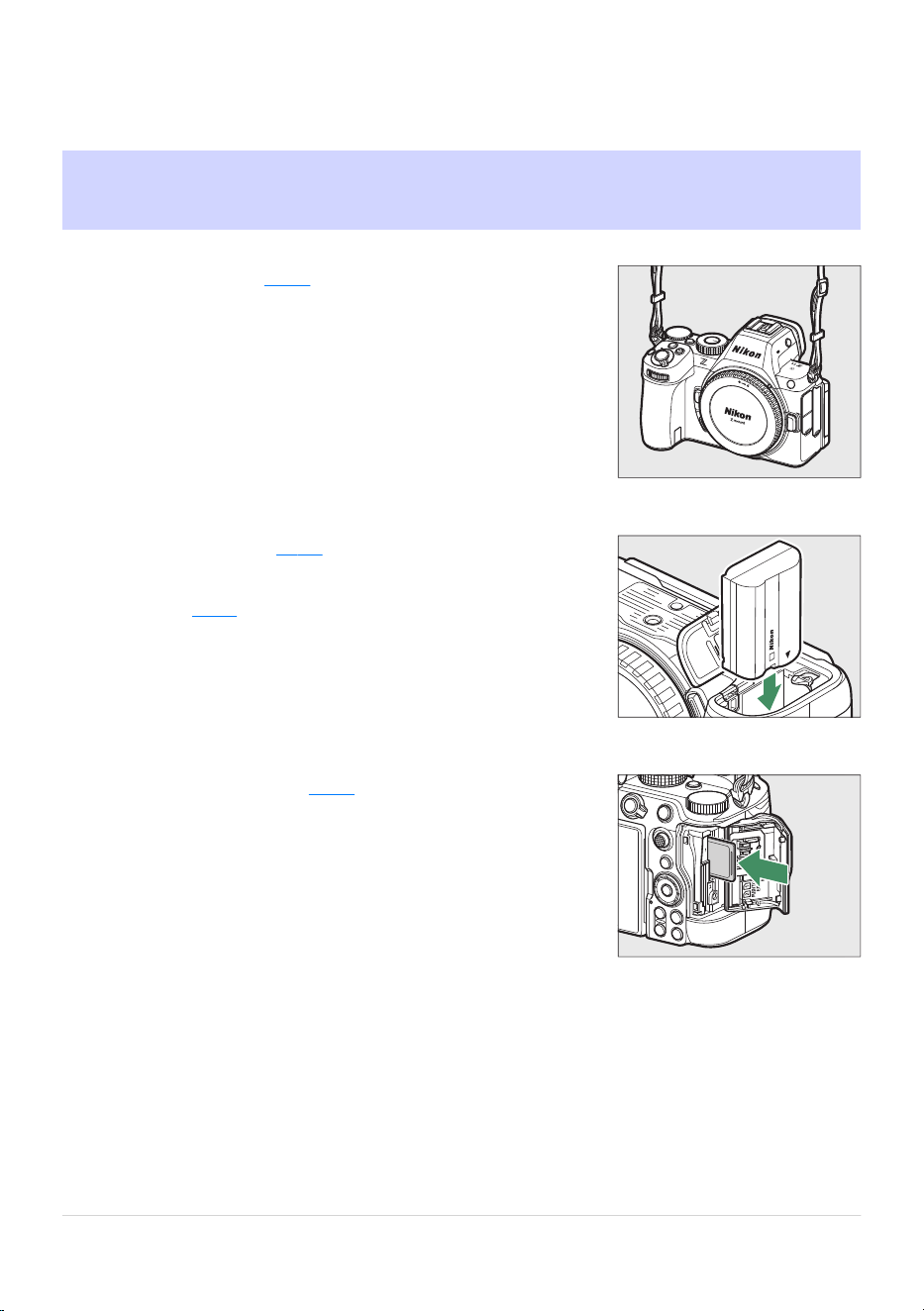
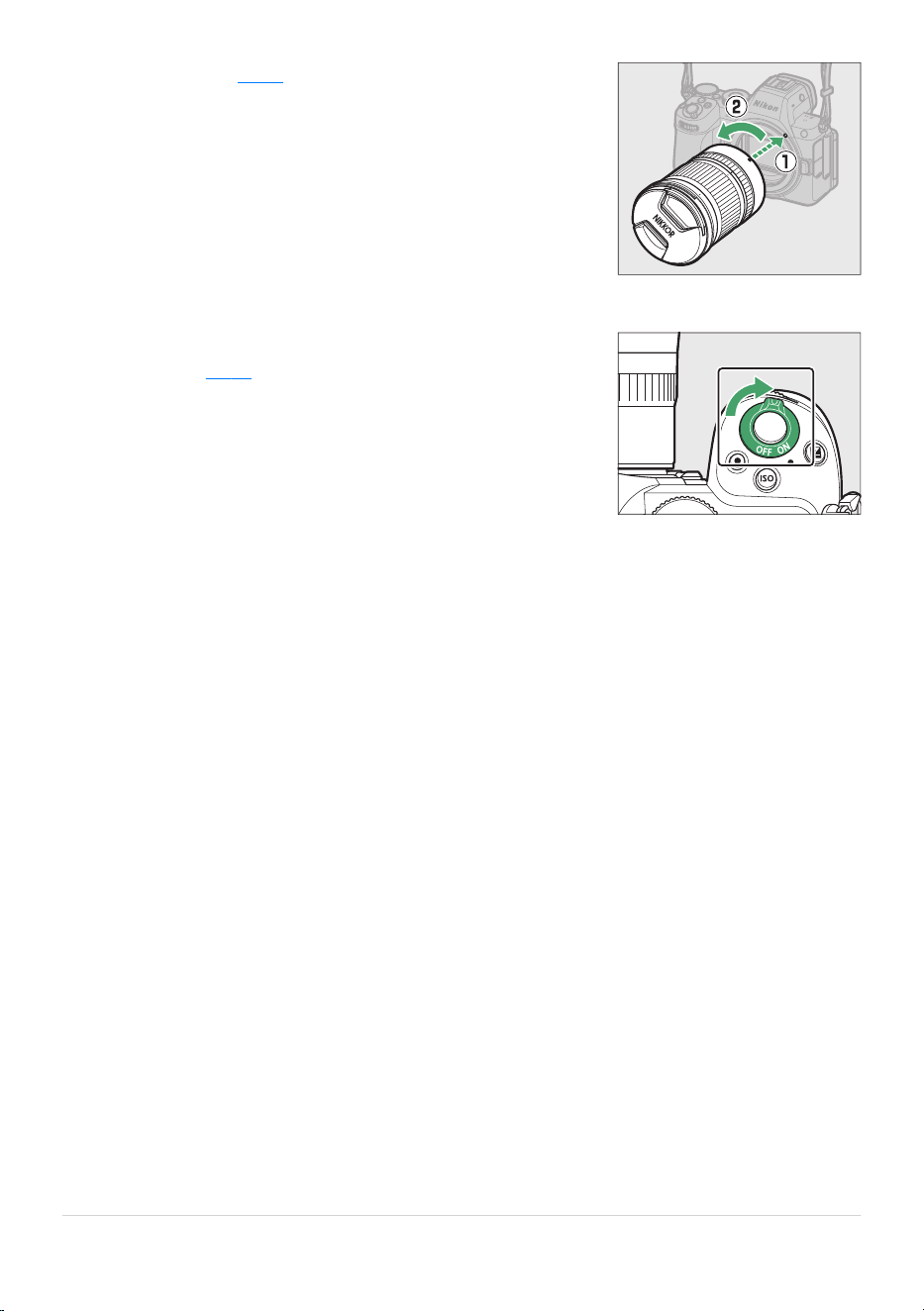
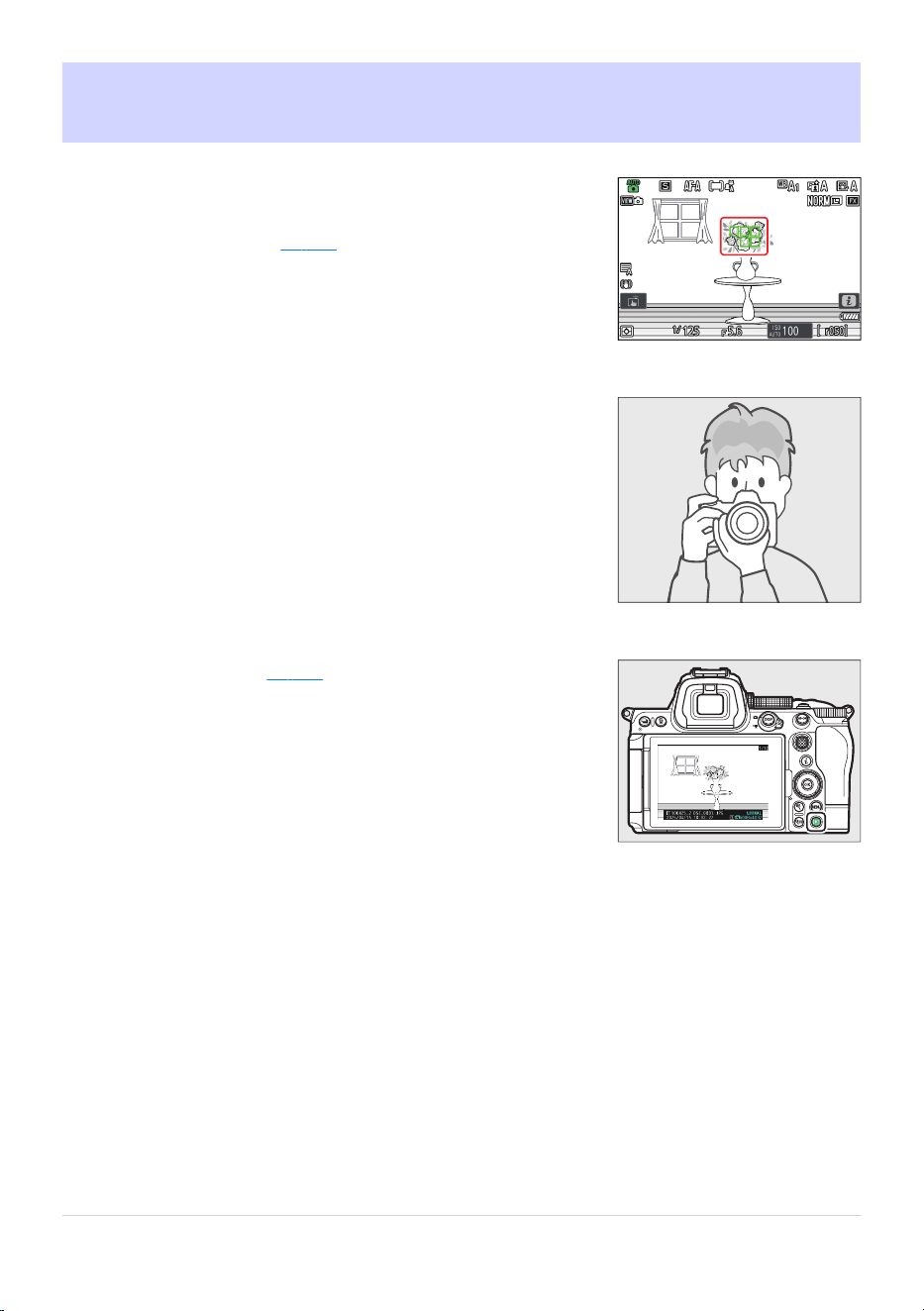
To focus, press the shutter-release button halfway (i.e.,
lightly press the shutter
-release button, stopping when it
is pressed halfway;
0 101).
Without lifting your finger from the shutter-release
button, press the butt
on the rest of the way down to take
the picture.
View the picture (0 110).
Taking and Viewing Pictures
26
Taking and Viewing Pictures
1
2
3
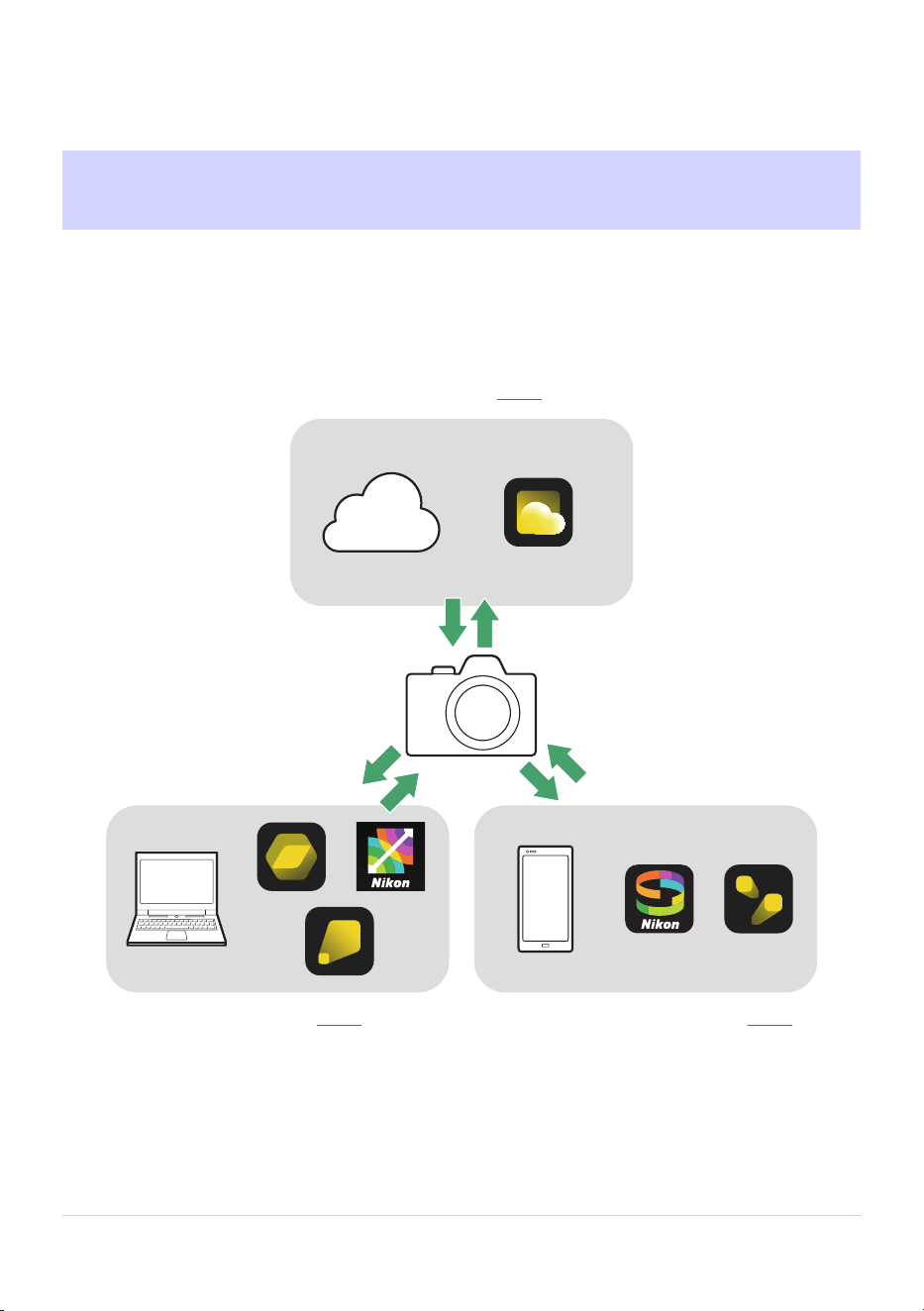
Computer Software ( 0 29) Smartphone (Tablet) Apps ( 0 31)
Content by Nikon to Enjoy Photos
About Cont
ent Provided by Nik
on
Nikon has prepared a cloud service, computer software, smart device apps, and other content for you
to further enjoy photos. By using this content, you can share camera settings related to finishing of
photos you want to take, adjust and process photos you have taken, transfer photos to computers and
smart devices automatically, and more.
Cloud Service (
0 28)
27
About Content Provided by Nikon
NikonImagingCloud is Nikon’s cloud service that can be used in
a web browser o
f the computer or smart device. Nikon Imaging
Cloud provides following services.
Image transfer: Upload images shot with the camera to Nikon
Imaging Cloud and send them to external online storage.
Imaging recipe: Save image shooting data as a recipe. Create
your own recipes or select from “public recipes.”
Providing Picture Controls: Download Picture Controls from
Nikon Imaging Cloud and import them to the camera.
Firmware update: Download firmware directly to the camera
from Nikon Imaging Cloud.
To access Nikon Imaging Cloud from a computer or smart device,
either scan the QR code or enter the following URL into a w
eb
browser. We recommend bookmarking the site.
https://imagingcloud.nikon.com
Cloud Service
This introduces Nikon
's cloud service. For the latest information, visit the Nikon website.
Nikon Imaging Cloud
You can also check the access QR code and URL by [Nikon Imaging Cloud] > [
About Nikon
Imaging Cloud] in the camera’s network menu.
Read all license agreements, etc. displayed when you use the service for the first time and only
proceed if you are willing to accept them.
For the latest information on Nikon Imaging Cloud, visit the Nikon website.
28
Cloud Service
Use for tethered photography when the camera is connected to a
computer. Exposur
e, white balance, and other camera settings can
be adjusted remotely using controls in the computer display.
View and edit photos and videos shot with Nikon digital cameras.
Computer Software
This introduces Nikon
's main computer software applications. For the latest information, visit the Nikon
website.
Nikon computer software is available from the Nikon Download Center. Check the version and
system requirements and be sure to download the latest version.
https://downloadcenter.nikonimglib.com/
NX Tether
NXStudio
Use NX S
tudio
’
s Nikon Transfer 2 component to transfer pictures to a computer.
You can use NX Studio to convert Nikon’s unique NEF/NRW (RAW) pictures to another image
format (NEF/RAW processing).
You can use NX Studio to adjust the brightness and contrast of pictures taken with Nikon digital
cameras.
You can use NX Studio to adjust and manage Custom Picture Controls.
You can adjust [Flexible Color] Picture Controls. [Flexible Color] allows for a wider variety of
Picture Control adjustments with Color Blender and Color Grading. You can save the Picture
Controls adjusted using [Flexible Color] as Custom Picture Controls and export them to a file
and import it to the camera (
0 180).
Be sure to downlo
ad the latest version, as earlier versions may be unable to download pictures from
the camera or open NEF (RAW) pictures.
29
Computer Software

The Wireless Transmitter Utility is required if the camera is to be
connected to a netw
ork. Pair the camera with the computer and
upload pictures over a wireless network.
Wireless Transmitter Utility
30
Computer Software
SnapBridge is an app that connects a smart device and camera
wirelessly to enable featur
es such as downloading pictures to the
smart device and remote shooting.
If you connect the camera to your smart device via a USB cable
or Wi-Fi, pictures will be imported from the camera to the smart
device. Then, the imported pictures can be uploaded wirelessly
from the smart device to an FTP server.
Additional functions can be used after in-app purchases.
Supported features and operating systems vary with country or
region.
Smartphone (Tablet) Apps
This introduces Nikon
's smart device apps. For the latest information, visit the Nikon website.
Smartphone (tablet) apps are available from the Apple App Store
®
and Google Play
TM
.
SnapBridge
NX MobileAir
31
Smartphone (Tablet) Apps
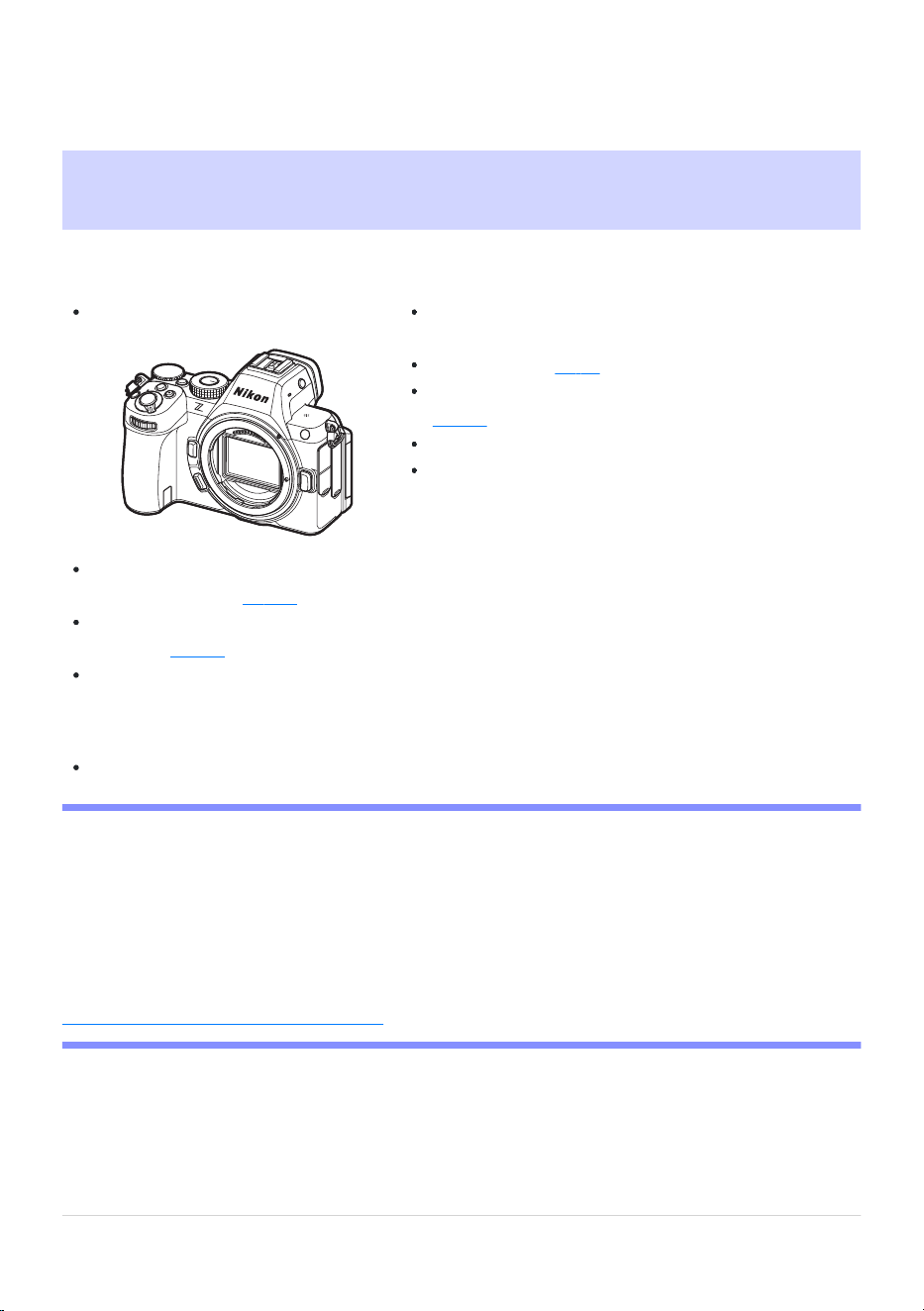
Camera body
BS‑1 accessory shoe cover (comes
attached to camera; 0 867)
DK‑29 rubber eyecup (comes attached
to camera; 0 865)
BF‑N1 body cap
EN‑EL15c rechargeable Li-ion battery with terminal
cover
AN‑DC26 strap ( 0 86)
USB cable with Type-C connector
s at both ends
(
0 331)
User’
s Manual
Warranty
Before You Begin
Package Contents
Be sur
e all items listed here were included with your camera.
Memory cards are sold separately.
D The Lenses Supplied with Lens Kits
Documentation for the lenses supplied with lens kits is available from the Nikon Download Center.
D The Nikon Download Center
Visit the Nikon Download Center to download firmware updates, NX Studio and other Nikon software,
and documentation for Nikon products including cameras, NIKKOR lenses, and flash units.
https://downloadcenter.nikonimglib.com/
32
Package Contents

About This Document
Symbols
This document employs the following symbols. Use them to help locate the infor
mation you need.
D
This icon marks notes, information that should be read before using this product.
Tip This icon marks tips, additional information you may find helpful when using this product.
0
This icon marks references to other sections in this document.
Conventions
This camera uses SD, SDHC, and SDX
C memory cards. Throughout this document, memory cards of
all types are referred to as “memory cards,” “SD memory cards,” or “SD cards”.
Throughout this document, battery chargers are referred to as “battery chargers” or “chargers”.
Throughout this document, the display in camera monitor and viewfinder during shooting is
referred to as the “shooting display”. In most cases, the illustrations show the monitor.
Throughout this document, smartphones and tablets are referred to as “smart devices”.
Throughout this document, “FX format” and “FX” are used in reference to an angle of view
equivalent to that of a 35 mm format (“full frame”) camera and “DX format” and “DX” to an angle of
view equivalent to that of an APS-C camera.
Throughout this document, the term “default settings” is used to refer to the settings in effect at
shipment. The explanations in this document assume that default settings are used.
33
About This Document
ForYourSafety
To prev
ent damage to property or injury to yourself or to others, read “For Your Safety” in its entirety
before using this product.
After reading these safety instructions, keep them readily accessible for future reference.
DANGER: Failure t
o observe the precautions marked with this icon carries a high
risk of death or severe injury.
WARNING: Failure t
o observe the precautions marked with this icon could result
in death or severe injury.
CAUTION: Failure t
o observe the precautions marked with this icon could result in
injury or property damage.
WARNING
Do not use while walking or operating a vehicle.
Failure t
o observe this precaution could result in accidents or other injury.
Do not disassemble or modify this product. Do not touch internal parts that become exposed
as the result of a fall or other accident.
Failure to observe these precautions could result in electric shock or other injury.
Should you notice any abnormalities such as the product producing smoke, heat, or unusual
odors, immediately remove the battery or disconnect the power source.
Continued operation could result in fire, burns or other injury.
Keep dry. Do not handle with wet hands. Do not handle the plug with wet hands.
Failure to observe these precautions could result in fire or electric shock.
Do not let your skin remain in prolonged contact with this product while it is on or plugged
in.
Failure to observe this precaution could result in low‑temperature burns.
34
ForYourSafety
WARNING
Do not use this product in the presence of flammable dust or gas such as propane, gasoline
or aerosols.
Failur
e to observe this precaution could result in explosion or fire.
Do not directly view the sun or other bright light source through the lens.
Failure to observe this precaution could result in visual impairment.
Do not aim the flash or AF‑assist illuminator at the operator of a motor vehicle.
Failure to observe this precaution could result in accidents.
Keep this product out of reach of children.
Failure to observe this precaution could result in injury or product malfunction. In addition, note
that small parts constitute a choking hazard.
Should a child swallow any part of this product, seek
immediate medical attention.
Do not entangle, wrap or twist the straps around your neck.
Failure t
o observe this precaution could result in accidents.
Do not use batteries, chargers, AC adapters, or USB cables not specifically designated for use
with this product.
When using batteries, chargers, AC adapters, and USB cables designated for use with this
product, do not:
Damage, modify, forcibly tug or bend the cords or cables, place them under heavy objects,
or expose them to heat or flame.
Use travel converters or adapters designed to convert from one voltage to another or with
DC-to-AC inverters.
Failure to observe these precautions could result in fire or electric shock.
Do not handle the plug when charging the product or using the AC adapter during
thunderstorms.
Failure to observe this precaution could result in electric shock.
Dust on or near the metal parts of the plug should be removed with a dry cloth.
Continued use could result in fire.
Do not handle with bare hands in locations exposed to extremely high or low temperatures.
Failure to observe this precaution could result in burns or frostbite.
35
ForYourSafety
CAUTION
Do not leave the lens pointed at the sun or other strong light sources.
Light focused by the lens could cause fire or damage to pr
oduct’s internal parts. When shooting
backlit subjects, keep the sun well out of the frame. Sunlight focused into the camera when the sun
is close to the frame could cause fire.
Turn this product off when its use is prohibited. Disable wireless features when the use of
wireless equipment is prohibited.
The radio-frequency emissions produced by this product could interfere with equipment onboard
aircraft or in hospitals or other medical facilities.
Remove the battery and disconnect the AC adapter if this product will not be used for an
extended period.
Failure to observe this precaution could result in fire or product malfunction.
Do not fire the flash in contact with or in close proximity to the skin or objects.
Failure to observe this precaution could result in burns or fire.
Do not leave the product where it will be exposed to extremely high temperatures for an
extended period, such as in an enclosed automobile or in direct sunlight.
Failure to observe this precaution could result in fire or product malfunction.
Do not look directly at the AF‑assist illuminator.
Failure to observe this precaution could have adverse effects on vision.
Do not transport cameras or lenses with tripods or similar accessories attached.
Failure to observe this precaution could result in injury or product malfunction.
Keep the product at least 5 cm (2.0 in.) from pacemakers and other medical devices.
Medical devices in close proximity could be affected by the magnet or magnets in the product.
36
ForYourSafety
DANGER (Batteries)
Do not mishandle batteries.
Failure t
o observe the following precautions could result in the batteries leaking, overheating,
rupturing, or catching fire:
Use only rechargeable batteries approved for use in this product.
Do not expose batteries to flame or excessive heat.
Do not disassemble.
Do not short‑circuit the terminals by touching them to necklaces, hairpins, or other metal
objects.
Do not expose batteries or the products in which they are inserted to powerful physical shocks.
Do not step on batteries, pierce them with nails, or strike them with hammers.
Charge only as indicated.
Failure to observe this precaution could result in the batteries leaking, overheating, rupturing, or
catching fire.
If battery liquid comes into contact with the eyes, rinse with plenty of clean water and seek
immediate medical attention.
Delaying action could result in eye injuries.
Follow the instructions of airline personnel.
Batteries left unattended at high altitudes in an unpressurized environment may leak, overheat,
rupture, or catch fire.
WARNING (Batteries)
Keep batteries out of reach of children.
Should a child swallow a battery, seek immediate medical attention.
Keep batteries out of reach of household pets and other animals.
The batteries could leak
, overheat, rupture, or catch fire if bitten, chewed, or otherwise damaged by
animals.
Do not immerse batteries in water or expose to rain.
Failure to observe this precaution could result in fire or product malfunction. Immediately dry the
product with a towel or similar object should it become wet.
37
ForYourSafety
WARNING (Batteries)
Discontinue use immediately should you notice any changes in the batteries, such as
discoloration or deformation. Cease charging EN‑EL15c r
echargeable batteries if they do not
charge in the specified period of time.
Failure to observe these precautions could result in the batteries leaking, overheating, rupturing, or
catching fire.
When batteries are no longer needed, insulate the terminals with tape.
Overheating, rupture, or fire may result should metal objects come into contact with the terminals.
If battery liquid comes into contact with a person's skin or clothing, immediately rinse the
affected area with plenty of clean water.
Failure to observe this precaution could result in skin irritation.
38
ForYourSafety
This product contains a non-replaceable button
cell or coin batter
y inside. Recycle or dispose of
this product in accordance with local regulations.
Never attempt to disassemble the product to
remove the battery.
● WARNING for Customers in the U.S.A.
WARNING
INGESTION HAZARD: This product contains a
button cell or coin b
attery.
DEATH or serious injury can occur if ingested.
A swallowed button cell or coin battery can cause
Internal Chemical Burns in as little as 2 hours.
KEEP new and used batteries OUT OF REACH of
CHILDREN
Seek immediate medical attention if a battery is
suspected to be swallowed or inserted inside any
part of the body.
39
ForYourSafety

Remove and immediately recycle or dispose of used
batteries accor
ding to local regulations and keep away
from children. Do NOT dispose of batteries in household
trash or incinerate.
Even used batteries may cause severe injury or death.
Call a local poison control center for treatment
information.
Battery type: Manganese lithium rechargeable coin battery
Nominal voltage: 3.0V
Non-rechargeable batteries are not to be recharged.
Do not force discharge, recharge, disassemble, heat above
60 °C (140 °F) or incinerate.
Doing so may result in injury due to venting, leakage or
explosion resulting in chemical burns.
40
ForYourSafety

Notices
No part o
f the documentation included with this product may be reproduced, transmitted,
transcribed, stored in a retrieval system, or translated into any language in any form, by any means,
without Nikon’s prior written permission.
Nikon reserves the right to change the appearance and specifications of the hardware and software
described in this documentation at any time and without prior notice.
Nikon will not be held liable for any damages resulting from the use of this product.
While every effort has been made to ensure that the information in this documentation is accurate
and complete, we would appreciate it were you to bring any errors or omissions to the attention of
the Nikon representative in your area (address provided separately).
● Notice Concerning Prohibition of Copying or Reproduction
Note that simply being in possession of material that has been digitally copied or reproduced by
means of a scanner, digital camera, or other device may be punishable by law.
Items prohibited by law from being copied or reproduced
Do not copy or reproduce paper money, coins, securities, government bonds, or local
government bonds, even if such copies or reproductions are stamped “Sample”.
The copying or reproduction of paper money, coins, or securities which are circulated in a foreign
country is prohibited.
Unless the prior permission of the government has been obtained, the copying or reproduction
of unused postage stamps or post cards issued by the government is prohibited.
The copying or reproduction of stamps issued by the government and of certified documents
stipulated by law is prohibited.
Cautions on certain copies and reproductions
The government has issued cautions on copies or reproductions of securities issued by private
companies (shares, bills, checks, gift certificates, etc.), commuter passes, or coupon tickets, except
when a minimum of necessary copies are to be provided for business use by a company. Also, do
not copy or reproduce passports issued by the government, licenses issued by public agencies
and private groups, ID cards, and tickets, such as passes and meal coupons.
Comply with copyright notices
Under copyright law, photographs or recordings of copyrighted works made with the camera
cannot be used without the permission of the copyright holder. Exceptions apply to personal use,
but note that even personal use may be restricted in the case of photographs or recordings of
exhibits or live performances.
41
Notices
An EN‑EL15c rechargeable Li-ion battery bears a Nikon holographic seal
indicating that it is a genuine Nikon product.
● Nikon Brand Accessories
This product is designed to be used with Nik
on brand accessories. Nikon is not responsible for any
damage caused by accidents such as malfunctions or ignition that are clearly attributable to the use
of non-Nikon accessories. In these cases, repair of Nikon products is not covered under your Nikon
warranty. Please understand this in advance.
● Batteries
EN‑EL15c rechargeable Li-ion batteries are dedicated for use only with Nikon products. Nikon is not
responsible for any malfunctions or accidents resulting from use with chargers or other products
that are not compatible with the EN-EL15c.
Beware of counterfeit batteries. Such batteries do not allow the camera to perform to its full
potential and may cause the batteries to overheat, ignite, rupture or leak.
● Memory Cards
Memory cards may be hot after use. Observe due caution when removing memory cards from
the camera.
Do not perform the following operations during formatting or while data are being recorded,
deleted, or copied to a computer or other device. Failure to observe these precautions could
result in loss of data or in damage to the camera or card.
Do not remove or insert memory cards.
Do not turn the camera off.
Do not remove the battery.
Do not disconnect AC adapters.
Do not touch the card terminals with your fingers or metal objects.
Do not use excessive force when handling memory cards. Failure to observe this precaution
could damage the card.
Do not bend or drop memory cards or subject them to strong physical shocks.
Do not expose memory cards to water, heat, or direct sunlight.
Do not format memory cards in a computer.
42
Notices
-
-
-
-

D Before Taking Important Pictures
Before taking pictur
es on important occasions (such as at weddings or before taking the camera on a
trip), take a test shot to ensure that the camera is functioning normally. Nikon will not be held liable for
damages or lost profits that may result from product malfunction.
D Life‑Long Learning
As part of Nikon’s “Life‑Long Learning” commitment to ongoing product support and education,
continually‑updated information is available on‑line at the following sites:
For users in the U.S.A.:
https://www.nikonusa.com/
For users in Canada: https://www.nikon.ca/
For users in Mexico: https://www.nikon.com.mx/
For users in Latin America: https://www.nikonamericalatina.com/
For users in Europe: https://www.nikoneurope.com/
For users in Asia, Oceania, the Middle East, and Africa: https://www.nikon-asia.com/
Visit these sites to k
eep up‑to‑date with the latest product information, tips, answers to
frequently‑asked questions (FAQs), and general advice on digital imaging and photography. Additional
information may be available from the Nikon representative in your area. See the following URL for
contact information:
https://imaging.nikon.com/
43
Notices
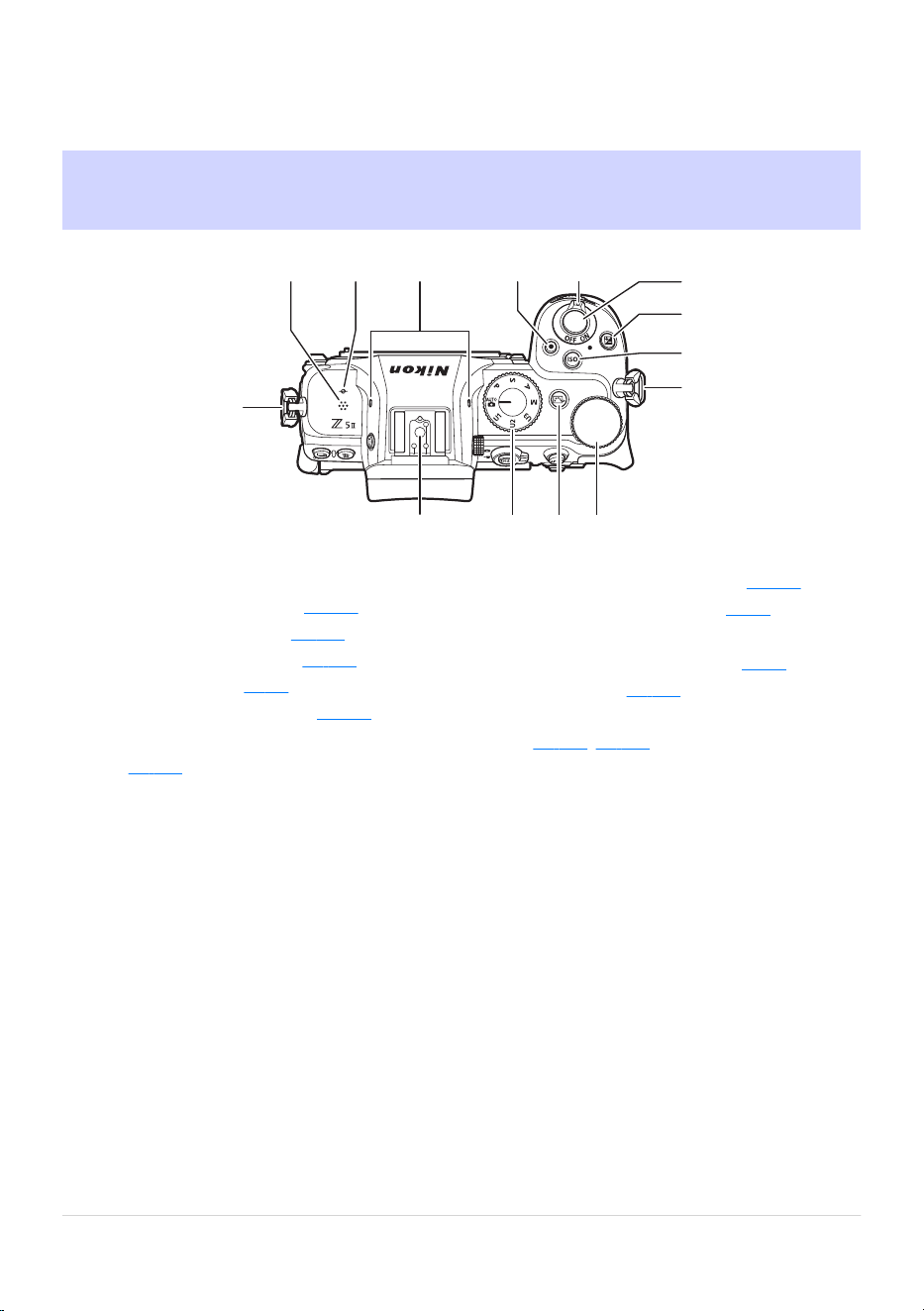
Speaker
Focal plane mark (E; 0 136)
Ster
eo microphone (
0 106)
Video-record butt
on (
0 106)
Power swit
ch (
0 99)
Shutter-r
elease button (
0 101)
Exposure compensation button (E
;
0 150)
1
2
3
4
5
6
7
ISO sensitivity button (S;
0 160)
Eyelet for camera strap ( 0 86)
Main command dial
Picture Control butt
on (h;
0 72)
Mode dial (0 137)
Accessory shoe (for optional flash unit;
0 391, 0 839)
8
9
10
11
12
13
Parts of the Camera
Camera Body
7
6
9
8
9
11
1012
13
41 2 3 5
44
Camera Body
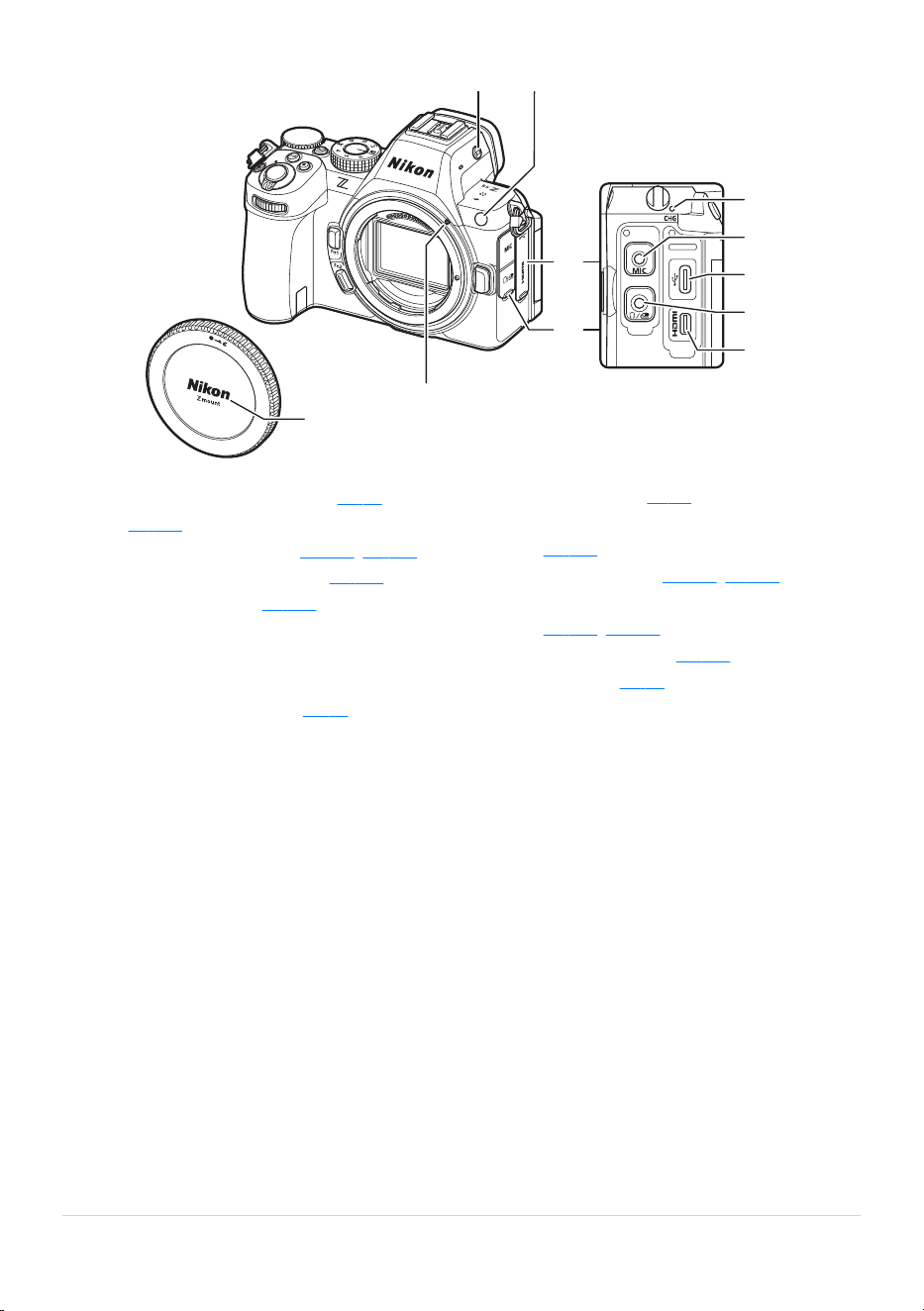
Monitor mode button (M; 0 63,
0 723)
AF-assist illuminator (0 104, 0 566)
Red-eye r
eduction lamp (
0 395)
Self-timer lamp (0 158)
Cover for USB and HDMI connector
s
Cover for microphone and headphone/
remote cord connectors
Lens mounting mark (
0 96)
1
2
3
4
5
Charge lamp ( 0 89)
Connector for exter
nal microphone
(
0 866)
USB connector (0 331, 0 756)
Headphone/remote cor
d connector
(
0 545, 0 745)
HDMI connector ( 0 300)
Body cap ( 0 96)
6
7
8
9
10
11
9
6
7
10
8
1 2
3
4
5
11
45
Camera Body
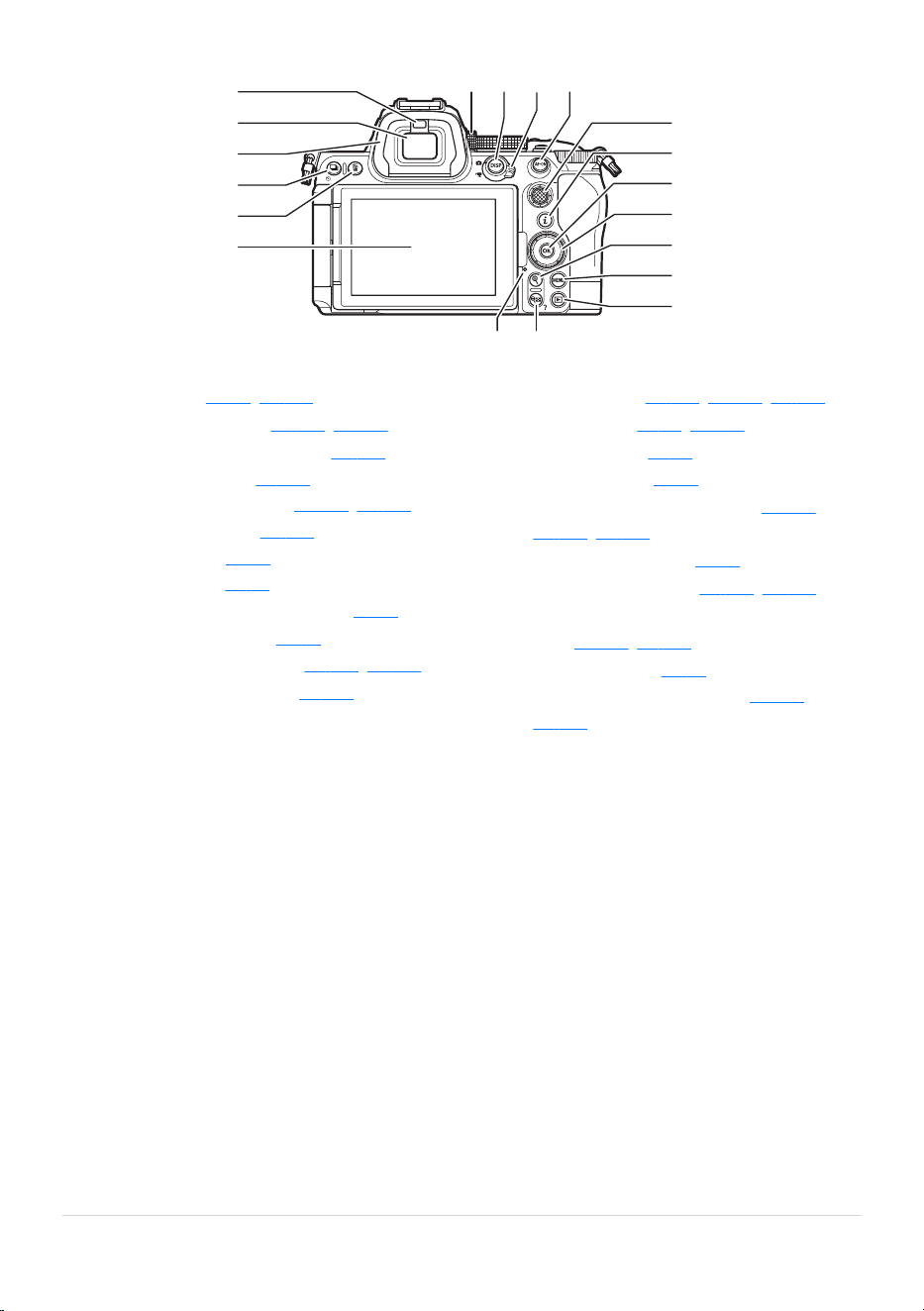
Monitor ( 0 66, 0 131)
Delete button (O
;
0 113, 0 259)
Release mode button (c
;
0 152)
Protect butt
on (
0 248)
Self-timer button (E
;
0 158, 0 211)
Rubber eyecup ( 0 865)
Viewfinder (0 58)
Eye sensor (0 63)
Diopter adjustment control ( 0 65)
DISP button (d; 0 51)
Photo/video selector (
0 101, 0 106)
AF-ON button (B; 0 134)
1
2
3
4
5
6
7
8
9
10
Sub-selector (
0 130, 0 133, 0 148)
“i” button (i; 0 80, 0 239)
OK button (J; 0 75)
Multi selector ( 0 75)
Playback zoom in button (X
;
0 135,
0 224, 0 246)
MENU button (G; 0 74)
Playback button (K; 0 110, 0 224)
Playback zoom out/thumbnails button
(W; 0 224, 0 246)
Help button (Q; 0 78)
Memory card access lamp (
0 104,
0 107)
11
12
13
14
15
16
17
18
19
6
5
2
4
3
1
12
11
13
1819
15
16
17
14
987 10
46
Camera Body
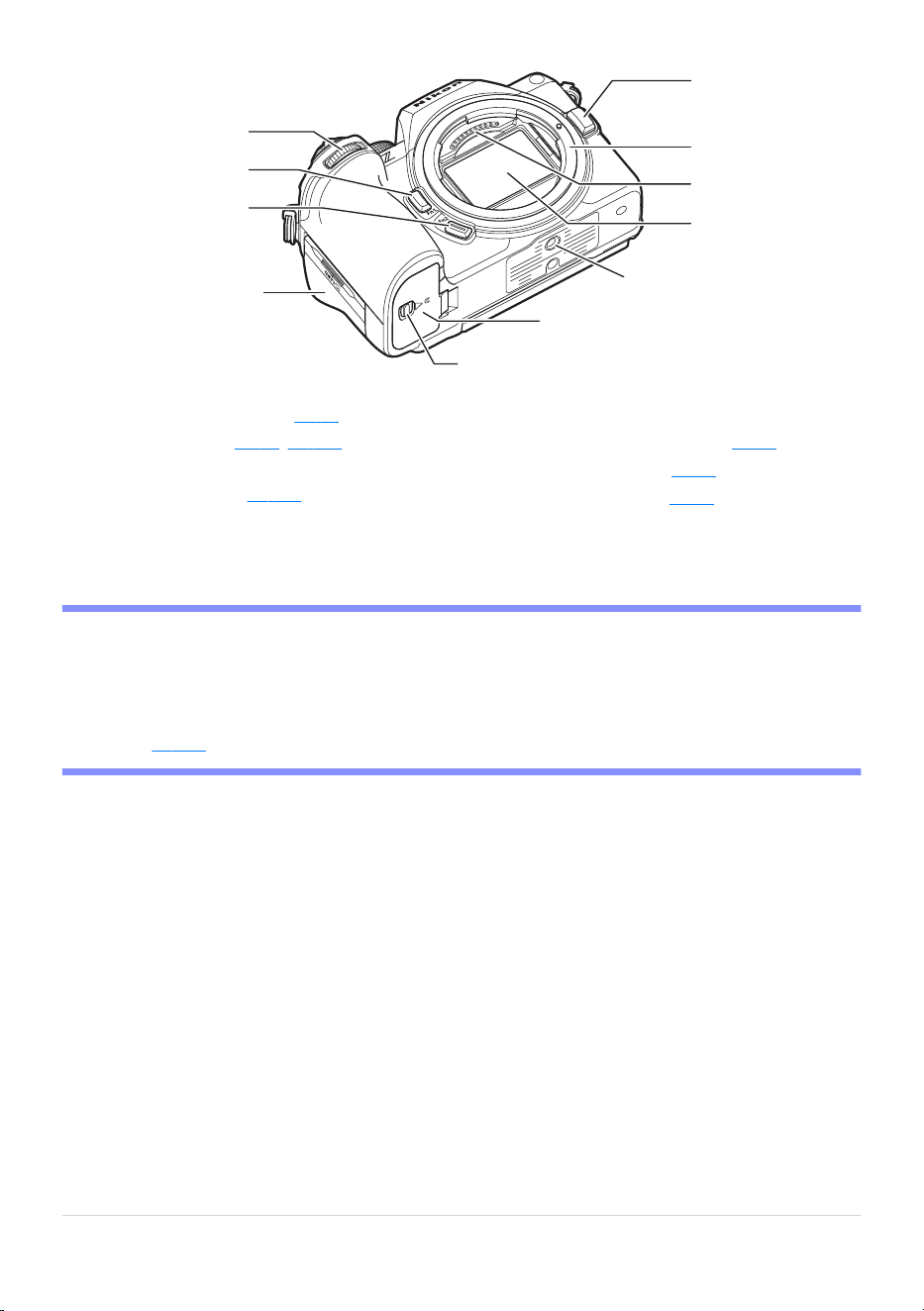
Lens release button ( 0 97)
Lens mount (0 96, 0 136)
CPU contacts
Image sensor (0 881)
Tripod socket
Battery chamber cover
1
2
3
4
5
6
Battery chamber cover latch
Memory card slot cover ( 0 92)
Fn2 button (k; 0 73)
Fn1 button (j; 0 73)
Sub-command dial
7
8
9
10
11
8
11
10
9
7
4
3
5
6
1
2
D Do Not Touch the Image Sensor
Under no circumstances should y
ou exert pressure on the image sensor, poke it with cleaning tools,
or subject it to powerful air currents from a blower. Failure to observe this precaution could scratch
or otherwise damage the sensor. For information on cleaning the image sensor, see “Image Sensor
Cleaning” (
0 881).
47
Camera Body
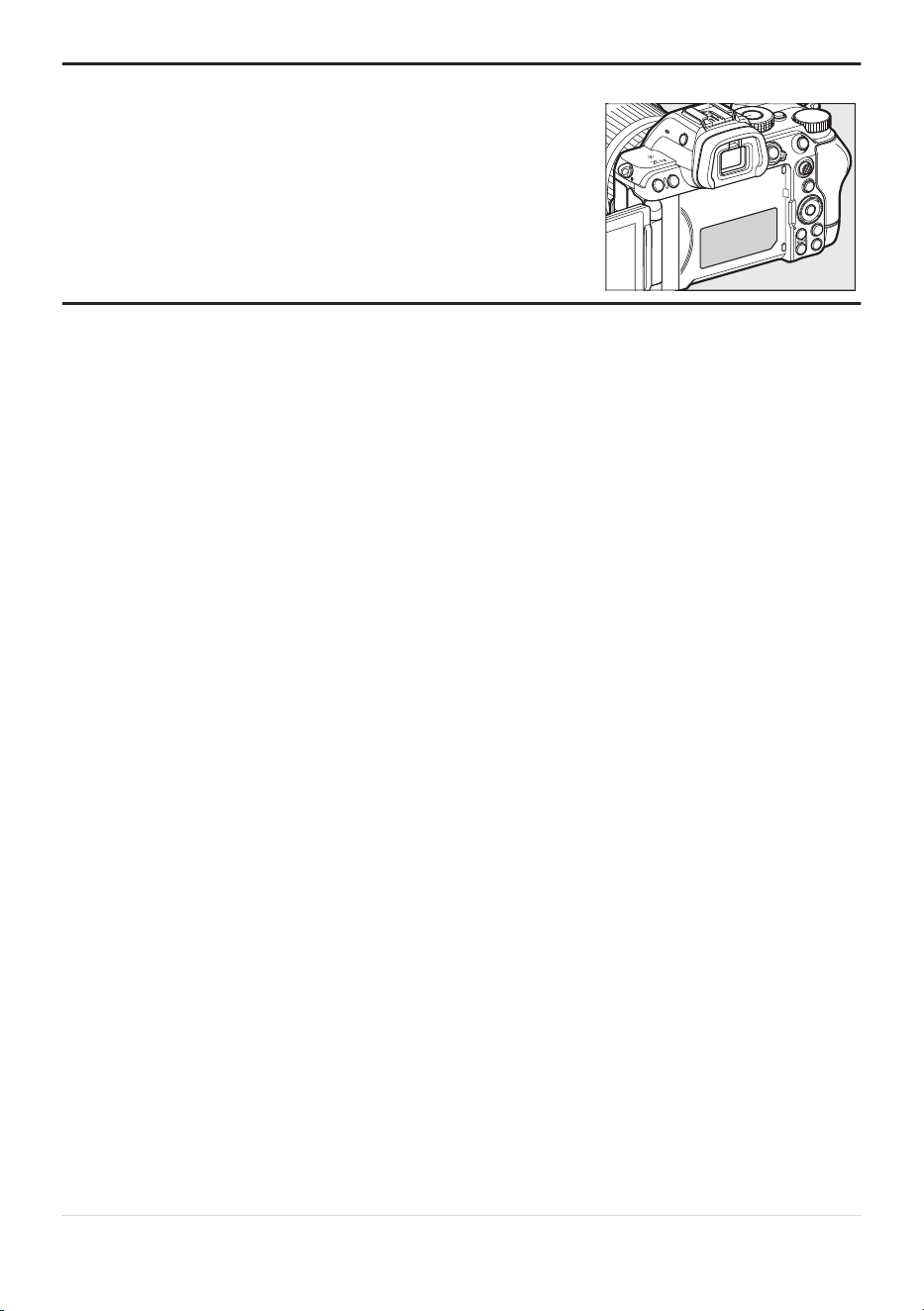
The serial number for this product can be found by opening the
monitor.
Tip: Product Serial Number
48
Camera Body
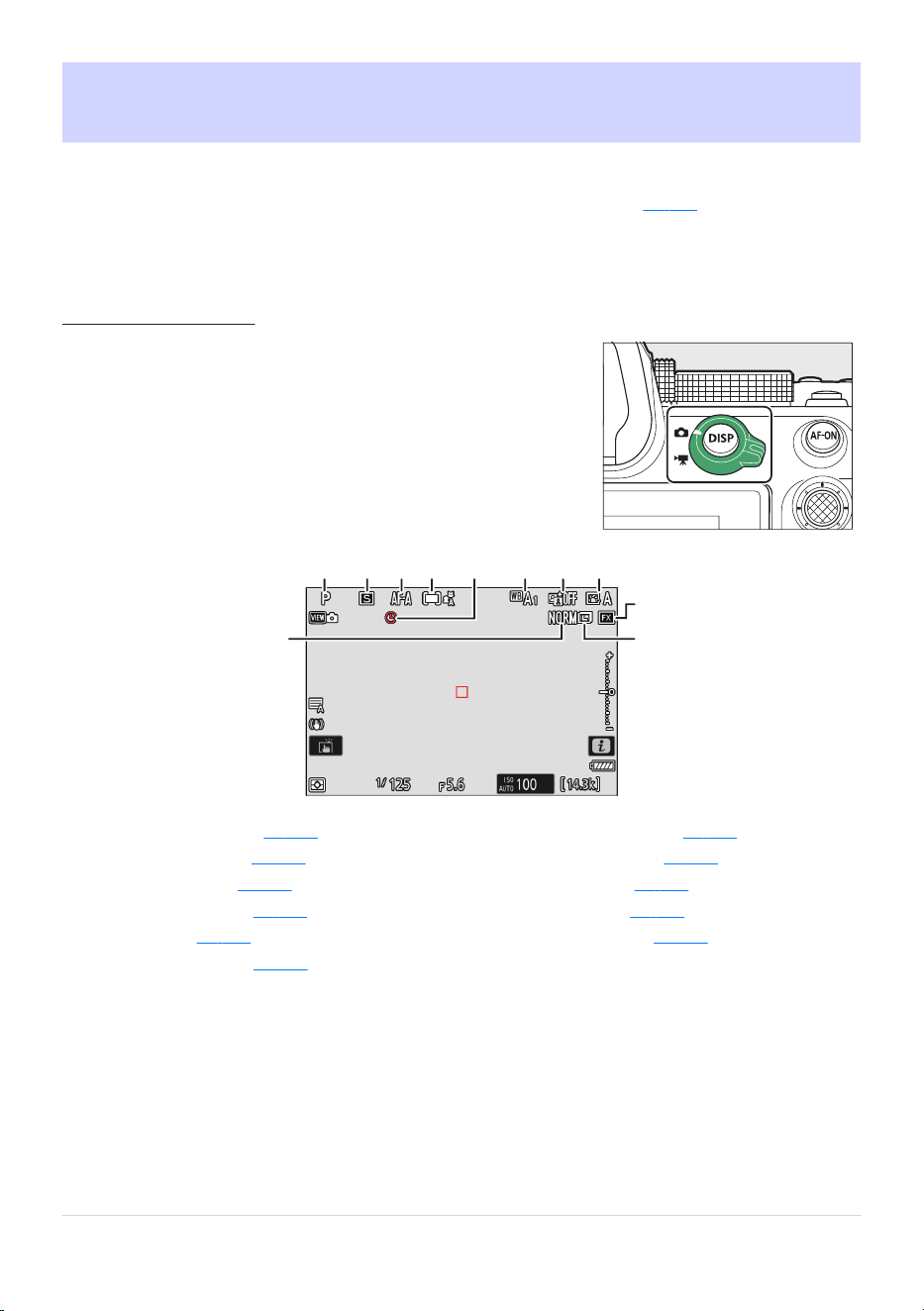
Shooting mode (0 137)
R
elease mode (
0 152)
Focus mode (0 120)
AF-ar
ea mode (
0 122)
g
icon (
0 100)
Whit
e b
alance (
0 182)
1
2
3
4
5
6
Active D-Lighting (0 428)
Pictur
e Contr
ol (
0 164)
Image ar
ea (
0 114)
Image size (0 118)
Image quality (
0 116)
7
8
9
10
11
The Monitor
At default settings, the following indicator
s appear in the monitor. For a full list of the indicators that
may be displayed, see “The Monitor” in the section on “Camera Displays” (
0 827) in the “Technical
Not
es” chapter.
Photo Mode
1
10
2 3 4 5 6 7 8
9
11
49
The Monitor
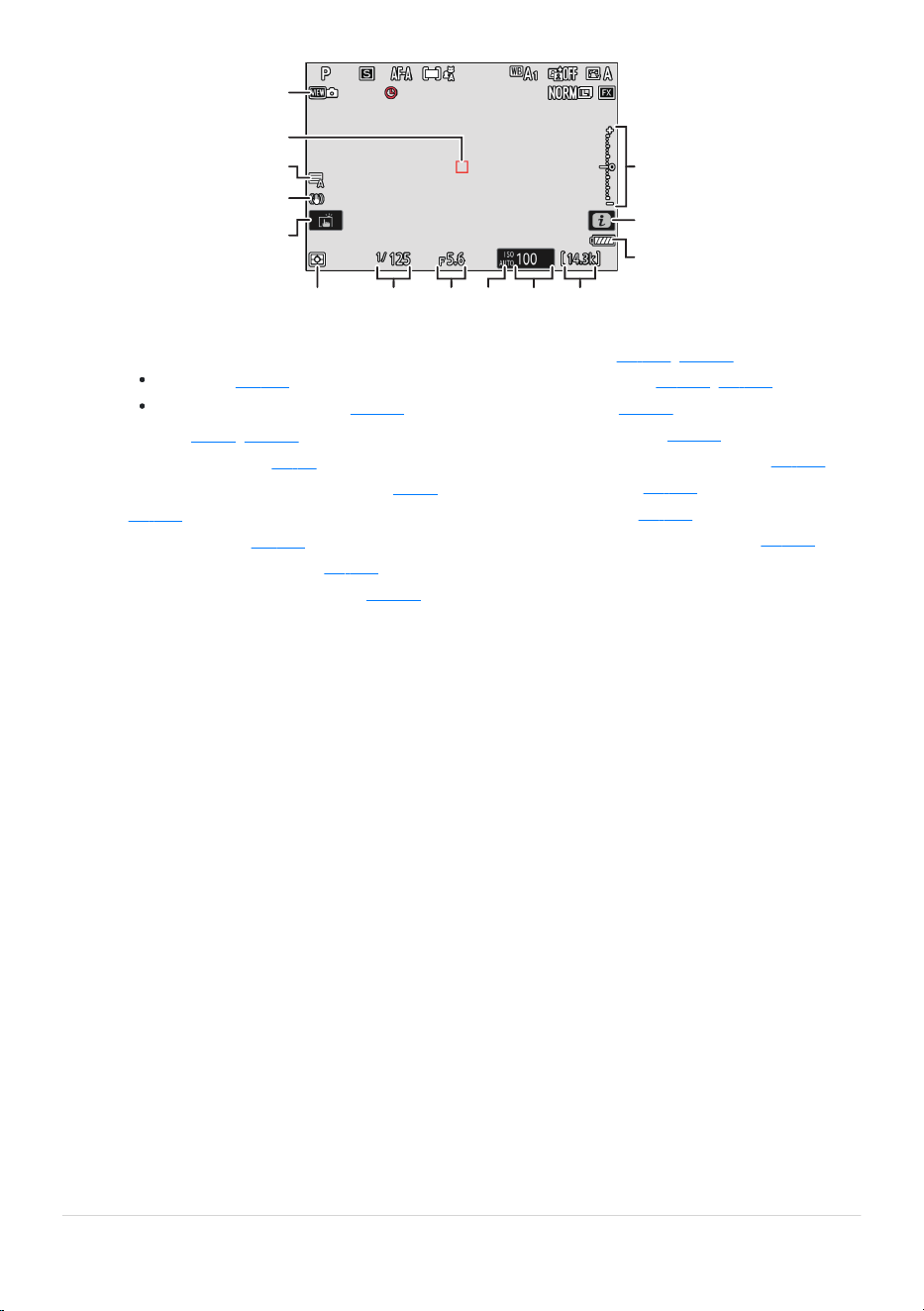
Exposure indicator
Exposure (0 142)
Exposure compensation (0 150)
i icon (0 80, 0 239)
Battery indicat
or (
0 88)
Number of exposures r
emaining (
0 93,
0 906)
ISO sensitivity (0 160)
ISO sensitivity indicator (0 160)
Auto ISO sensitivity indicator ( 0 162)
1
2
3
4
5
6
Aperture (0 140, 0 141)
Shutter speed (0 139, 0 141)
Metering (0 441)
Touch shooting (0 131)
Vibration reduction indicator (
0 451)
Shutter type (0 585)
Focus point (0 130)
View mode (photo live view;
0 590)
7
8
9
10
11
12
13
14
4
3
11
57
69
8
14
12
13
10
1
2
50
The Monitor
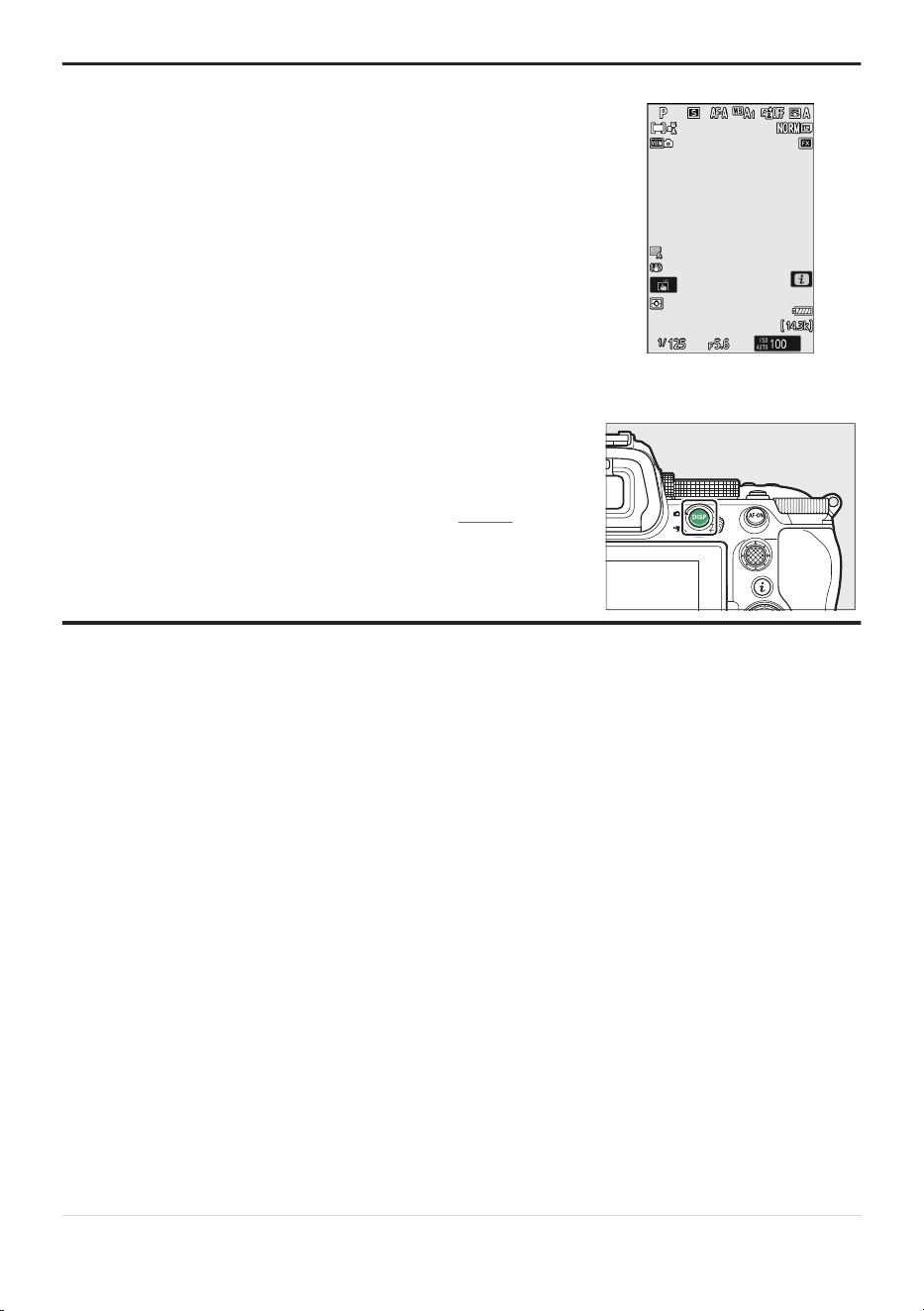
In photo mode, the playback, i menu, and shooting displays rotate
t
o match camera orientation.
Press the DISP button t
o cycle the shooting display. Choose from
up to five displays, each with a customizable selection of icons
and indicators. The items displayed can be selected using Custom
Setting d19 [Custom monitor shooting display] (
0 602).
Tip: Using the Monitor with the Camera in “Tall” Orientation
Tip: Choosing a Display
51
The Monitor
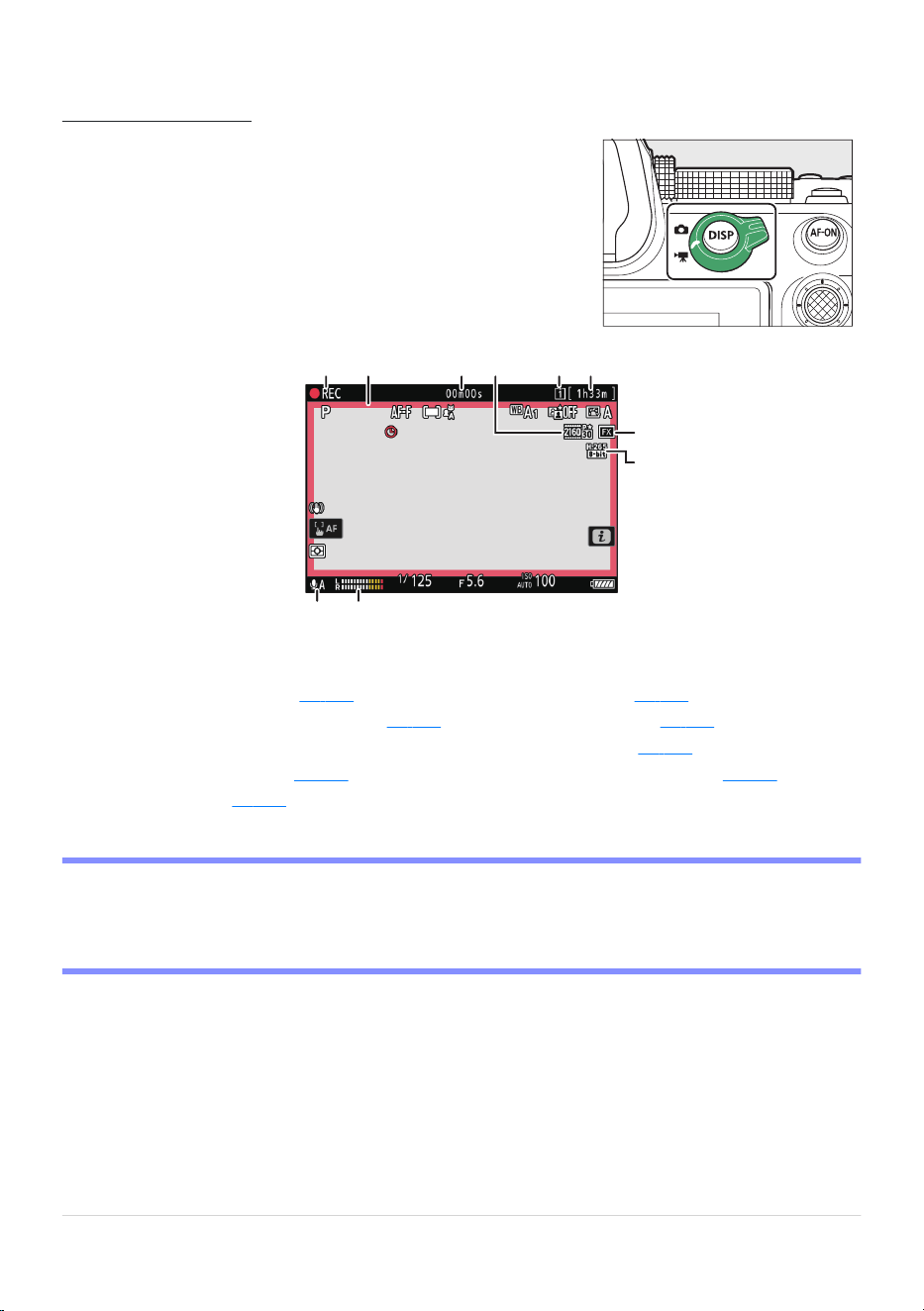
Recording indicator
“No video
” indicat
or (
0 107)
R
ecor
ding indicat
or (red border;
0 690)
Length o
f footage r
ecor
ded
Frame size and rate (
0 202)
Destination (0 513)
1
2
3
4
5
Available recording time
Image ar
ea (
0 209)
Video file type (
0 200)
Sound lev
el (
0 540)
Micr
ophone sensitivity (
0 540)
6
7
8
9
10
Video Mode
1 2 3 5 64
9
7
8
10
D High-Temperature Warnings
If the camera becomes hot, a high-temperatur
e warning (K) may appear in the shooting display. Note
that the camera body and battery may be hot while the high-temperature warning (K) is displayed.
52
The Monitor
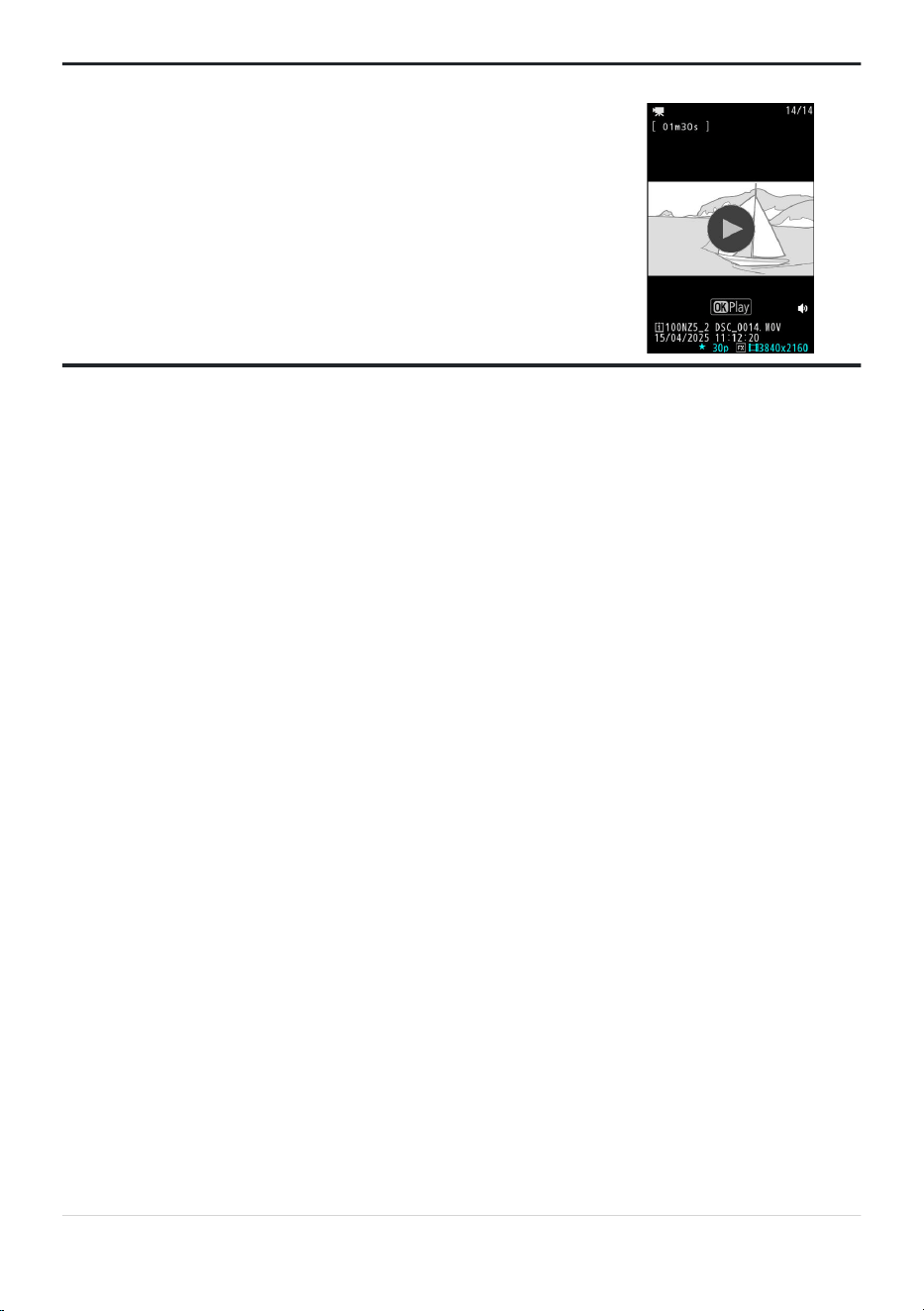
In video mode, the playback and playback i menu displays rotate
t
o match camera orientation. Note that videos are always viewed in
landscape (wide) orientation.
Tip: Using the Monitor with the Camera in “Tall” Orientation
53
The Monitor
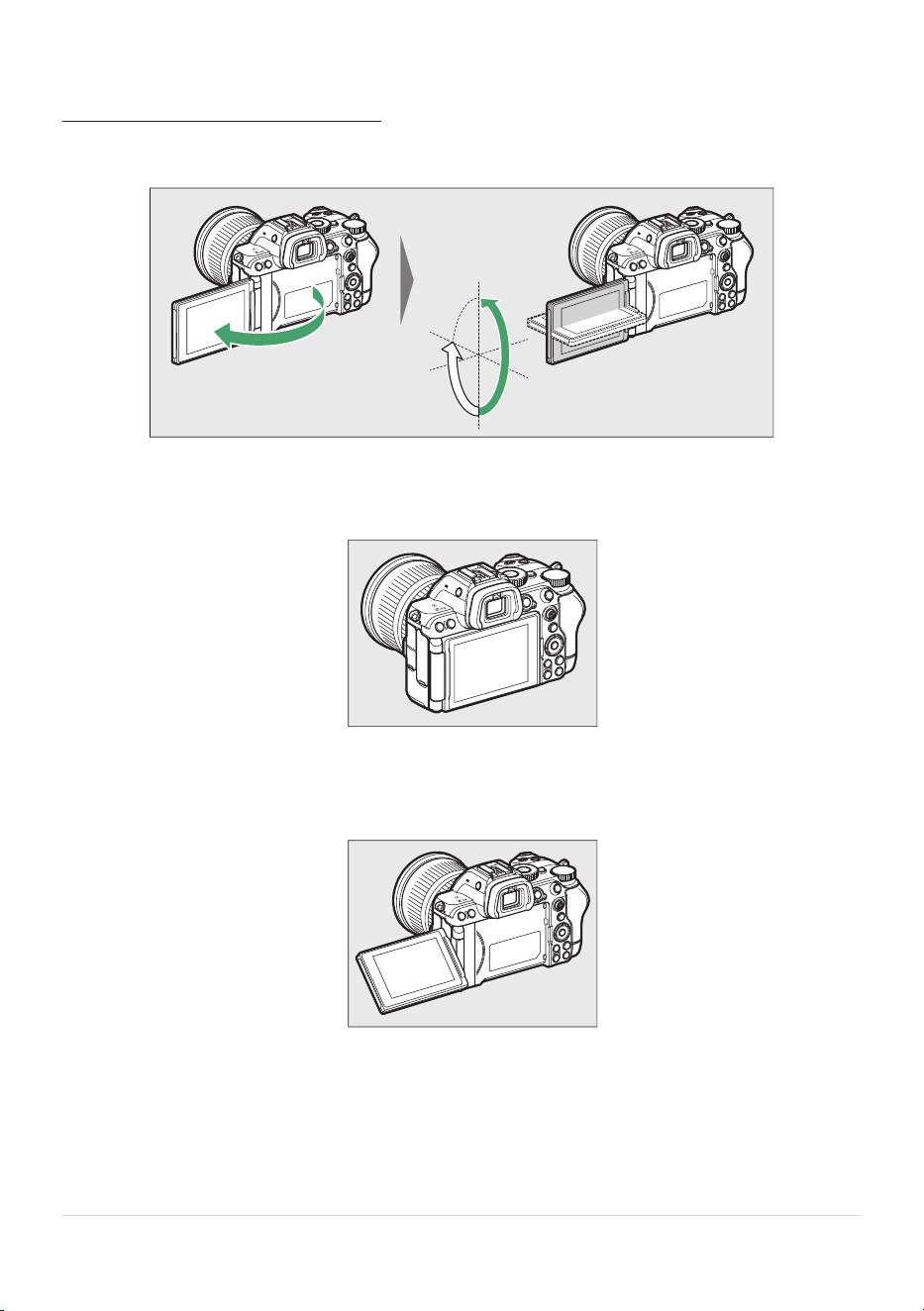
Angling the Monitor
The monitor can be angled and rotat
ed.
90°
180°
175°
Normal use:
The monitor is normally used in storage position with the screen facing outward.
Low-angle shots:
Tilt the monitor up to tak
e shots with the camera held low.
54
The Monitor
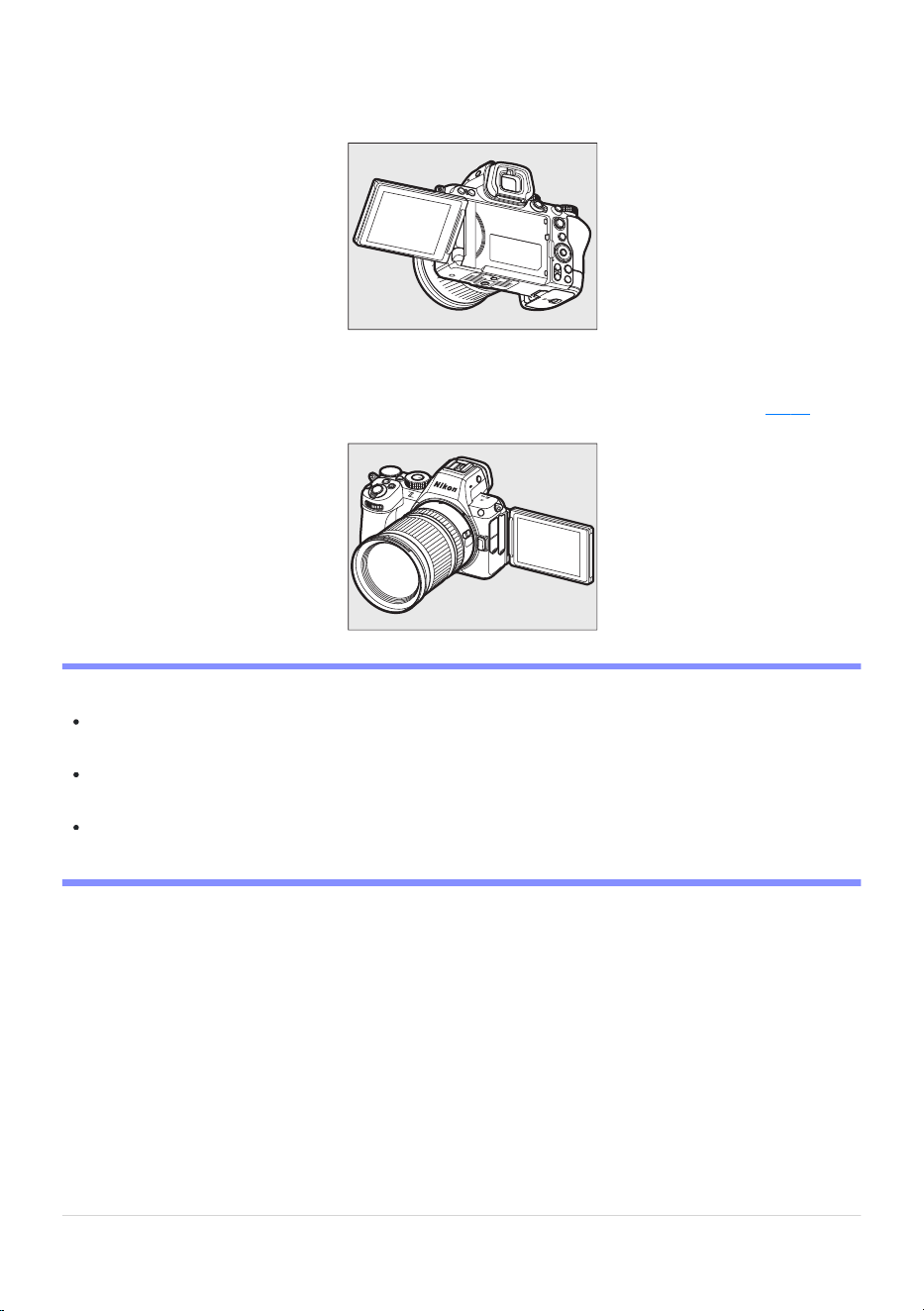
High-angle shots:
Tilt the monitor down to tak
e shots with the camera held high.
Self-portraits:
Rotating the monitor t
o face the same direction as the lens enables self-portrait mode (
0 56).
D Cautions: Using the Monitor
Rotat
e the monitor gently within the limits of its hinges. Using excessive force could damage the
camera or monitor.
We recommend returning the monitor to the storage position with the screen facing inward to keep
it free of dust and scratches when not in use.
Do not lift or carry the camera by the monitor. Failure to observe this precaution could result in
damage to the camera.
55
The Monitor
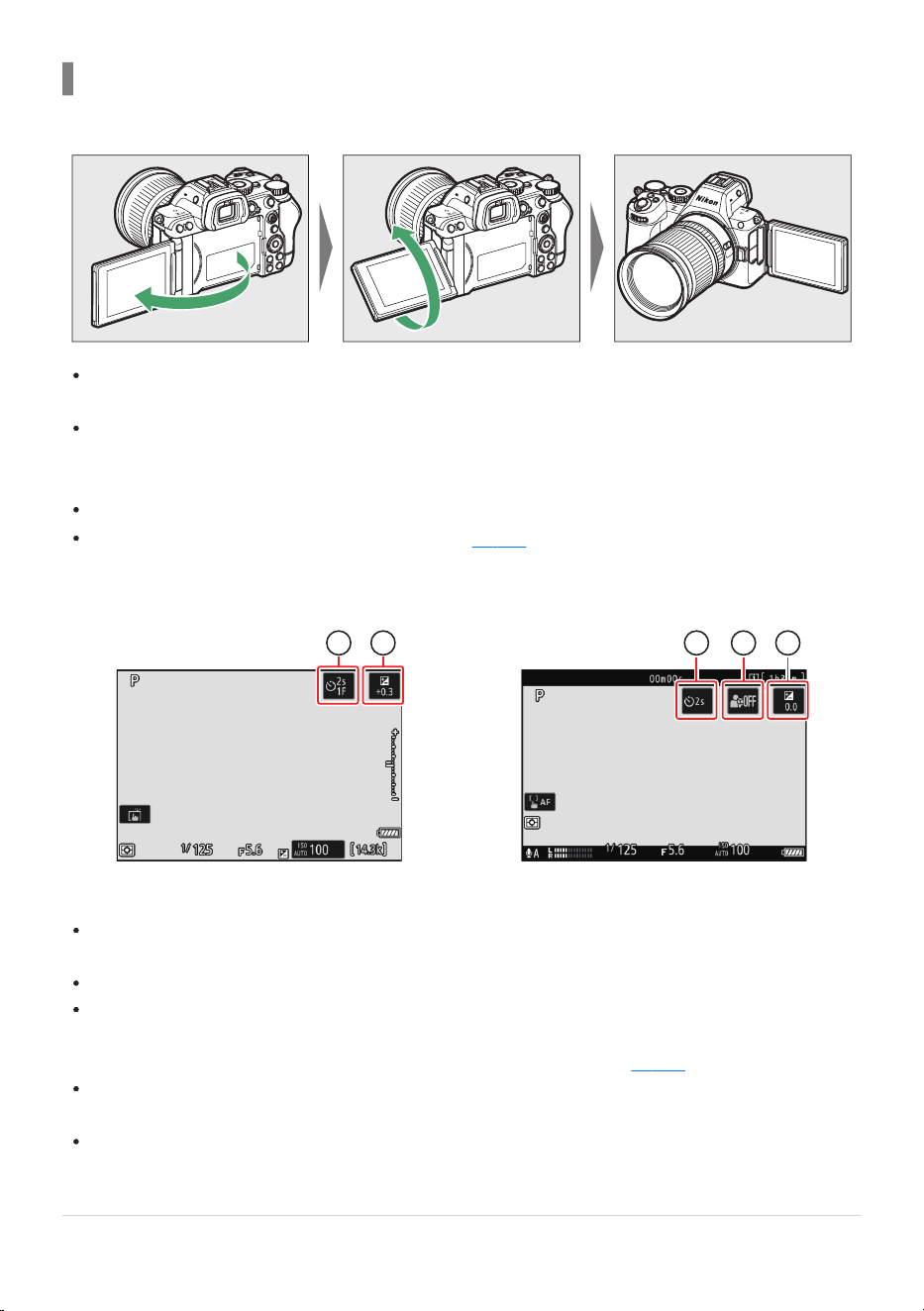
1
2
Photo mode
1
2
3
Video mode
Self-Portrait Mode
Rotating the monitor t
o the self-portrait position triggers self-portrait mode.
The monitor shows a mirror image of the view through the lens, but pictures recorded by the
camera are not mirror
ed.
In photo mode, tap the self-timer icon (q) in the monitor to set the self-timer delay and select the
number of shots to be taken when the timer expires. In video mode, set the self-timer delay for
video recording.
You can also adjust exposure by tapping the exposure compensation icon (w).
In video mode, enable the product review mode (
0 212) by tapping the pr
oduct r
eview mode icon
(
e). Use this mode to focus on nearby subjects when shooting product review videos. Tap the icon
to cycle through options.
Press the shutter-release button halfway to focus. Press it the rest of the way down to take a
photograph.
You can also use the monitor for touch AF and take pictures via the touch shutter.
If the self-timer is enabled, press the shutter-release button all the way down or tap the monitor.
The monitor will display a countdown timer and the shutter will release when it reaches zero.
The camera will focus about a second before releasing the shutter (
0 159).
Pressing the video-recor
d button will take a photograph in photo mode. In video mode, the camera
starts recording video.
Self-portrait mode ends when the monitor is moved to another position.
56
The Monitor
-
-

D Notes on Self-Portrait Mode
Note the following points when using the camera in self
-portrait mode:
Self-portrait mode disables all controls other than the power switch, the shutter-release and video-
record buttons, the photo/video selector, and the mode dial.
The standby timer will expire if no operations are performed for either one minute or the time
selected for Custom Setting c3 [Power off delay]> [Standby timer], whichever is longer.
The following settings are fixed at the values below.
[Release mode]: [Self-timer]
[Focus mode] in the video recording menu: [Full-time AF]
[Touch controls]> [Enable/disable touch controls]: [Enable]
The viewfinder cannot be used.
The following features are disabled:
[Long exposure NR]
[Auto bracketing]
[HDR overlay]
[Exposure delay mode]
You cannot change the dimensions of the focus areas when [Product review mode] is set to [On
(customize focus area)] in self-portrait mode.
Rotating the monitor to the self-portrait position will not trigger self-portrait mode when [OFF] is
selected for [Self-portrait mode] in the setup menu (
0 751).
57
The Monitor
-
-
-
-
-
-
-
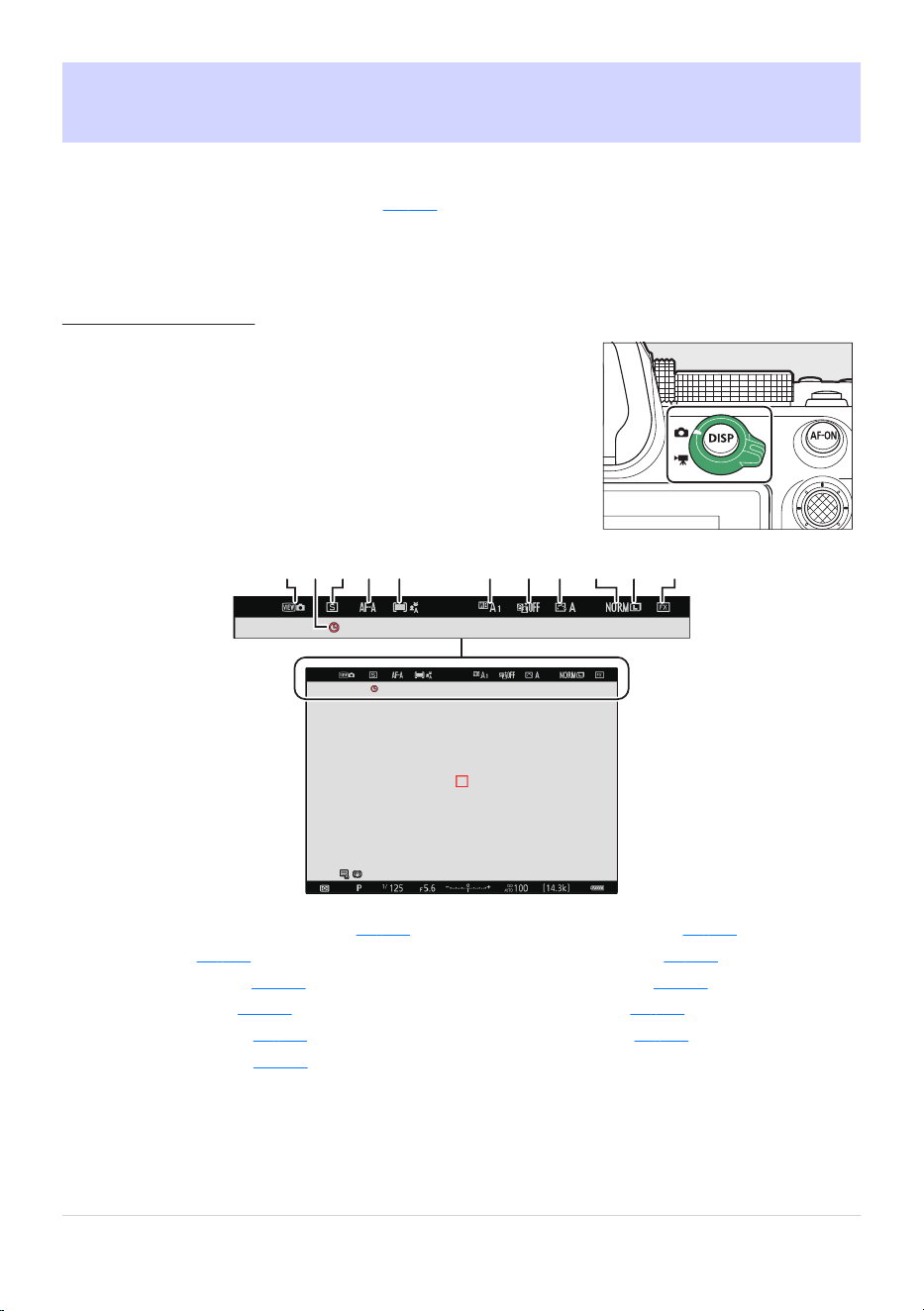
View mode (photo live view; 0 590)
g icon (0 100)
Release mode (0 152)
Focus mode (0 120)
AF-area mode (0 122)
White balance (
0 182)
1
2
3
4
5
6
Active D-Lighting (
0 428)
Picture Control ( 0 164)
Image quality (0 116)
Image size (0 118)
Image area (0 114)
7
8
9
10
11
TheViewfinder
At default settings, the following indicator
s appear in the viewfinder. For a full list of the indicators that
may be displayed, see “The Viewfinder” (
0 835) in the section on “Camera Displays” in the “Technical
Not
es” chapter.
Photo Mode
2 4 5 7 8 961 3 1110
58
TheViewfinder
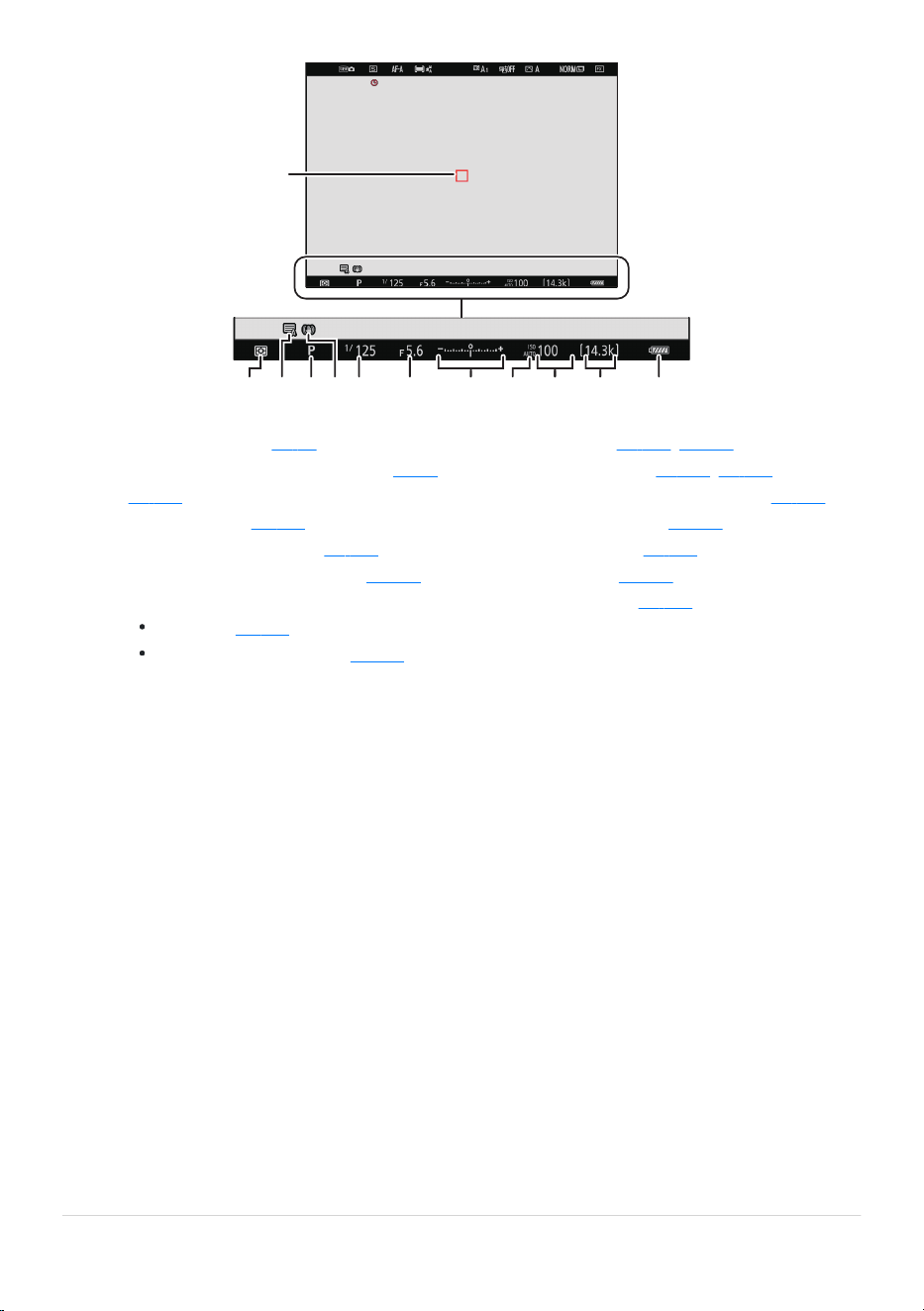
Battery indicator (0 88)
Number of exposures r
emaining (
0 93,
0 906)
ISO sensitivity (0 160)
ISO sensitivity indicator (0 160)
Auto ISO sensitivity indicator ( 0 162)
Exposure indicator
Exposur
e (
0 142)
Exposure compensation (0 150)
1
2
3
4
5
Aperture (0 140, 0 141)
Shutter speed (0 139, 0 141)
Vibration reduction indicator (
0 451)
Shooting mode (0 137)
Shutter type (0 585)
Metering (0 441)
Focus point (0 130)
6
7
8
9
10
11
12
3 25 410 811 79 6 1
12
59
TheViewfinder
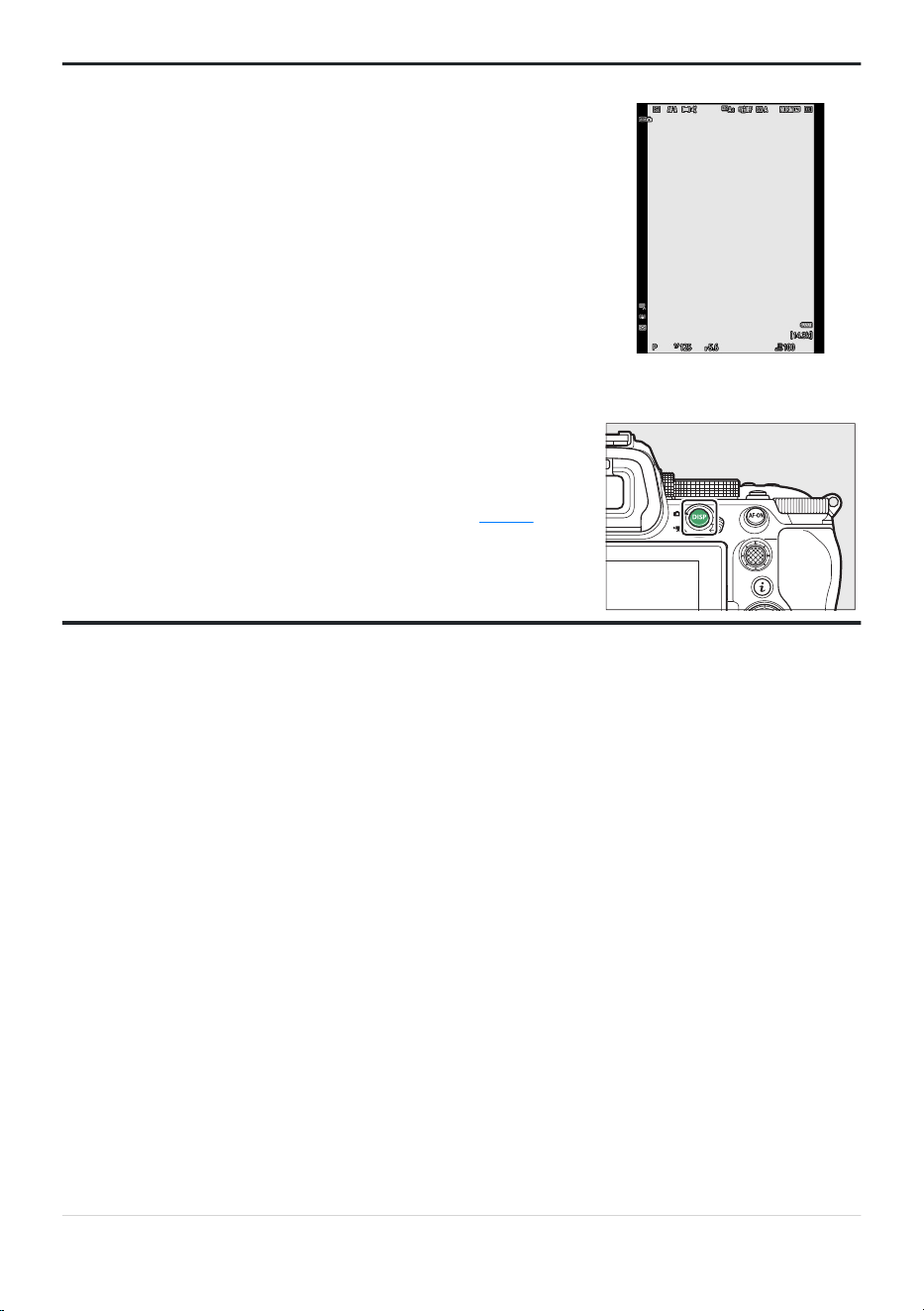
In photo mode, the playback, i menu, and shooting displays rotate
t
o match camera orientation.
Press the DISP button t
o cycle the shooting display. Choose from
up to four displays, each with a customizable selection of icons
and indicators. The items displayed can be selected using Custom
Setting d20 [Custom viewfinder shooting display] (
0 604).
Tip: Using the Viewfinder with the Camera in “Tall” Orientation
Tip: Choosing a Display
60
TheViewfinder
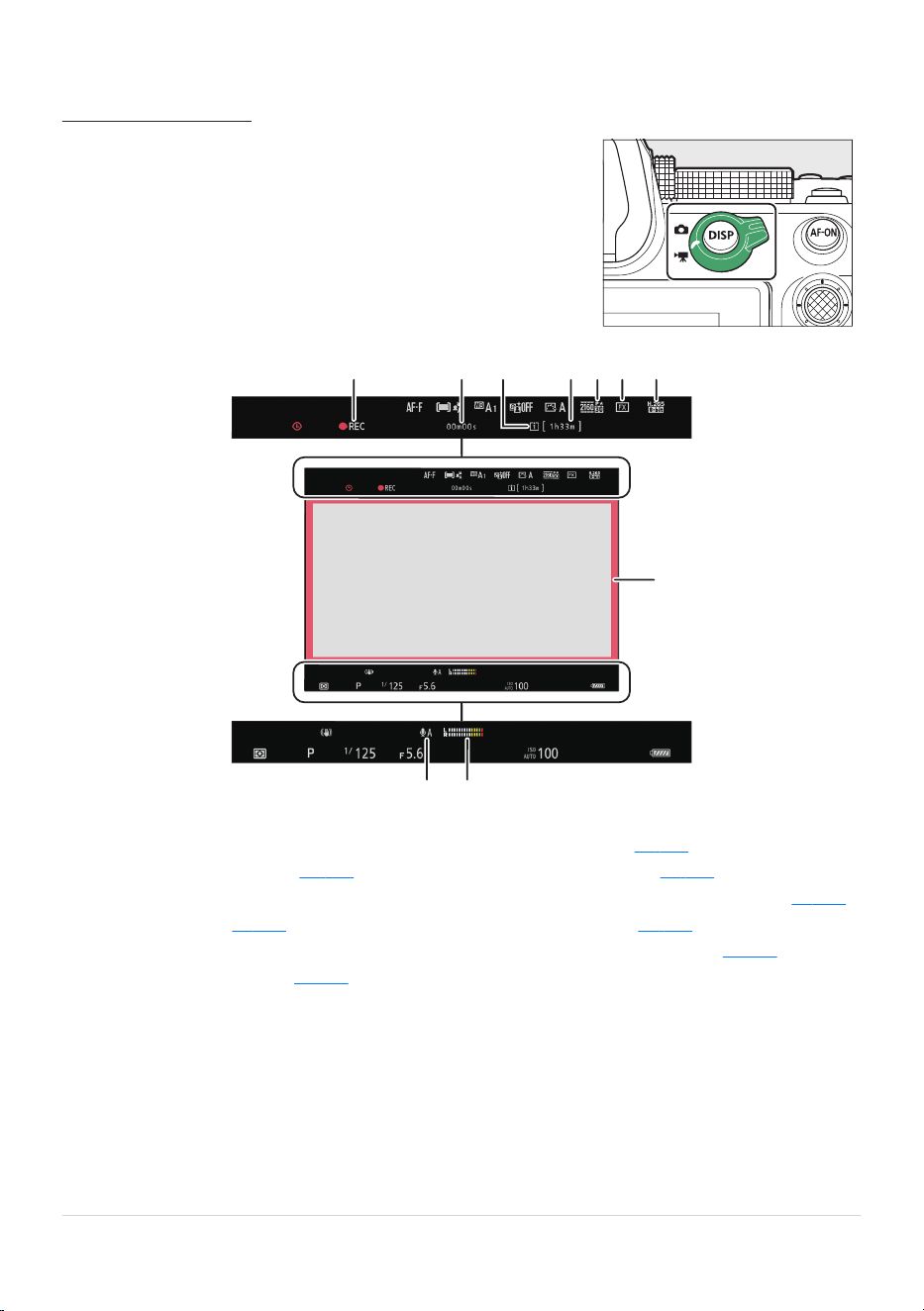
Recording indicator
“No video” indicator (
0 107)
Length of footage recor
ded
Destination (
0 513)
Available r
ecording time
Frame size and rate (
0 202)
1
2
3
4
5
Image area (0 209)
Video file type (0 200)
Recording indicat
or (red border;
0 690)
Sound level ( 0 540)
Microphone sensitivity (0 540)
6
7
8
9
10
Video Mode
2
1
3
5
6
4
7
8
9
1
0
61
TheViewfinder
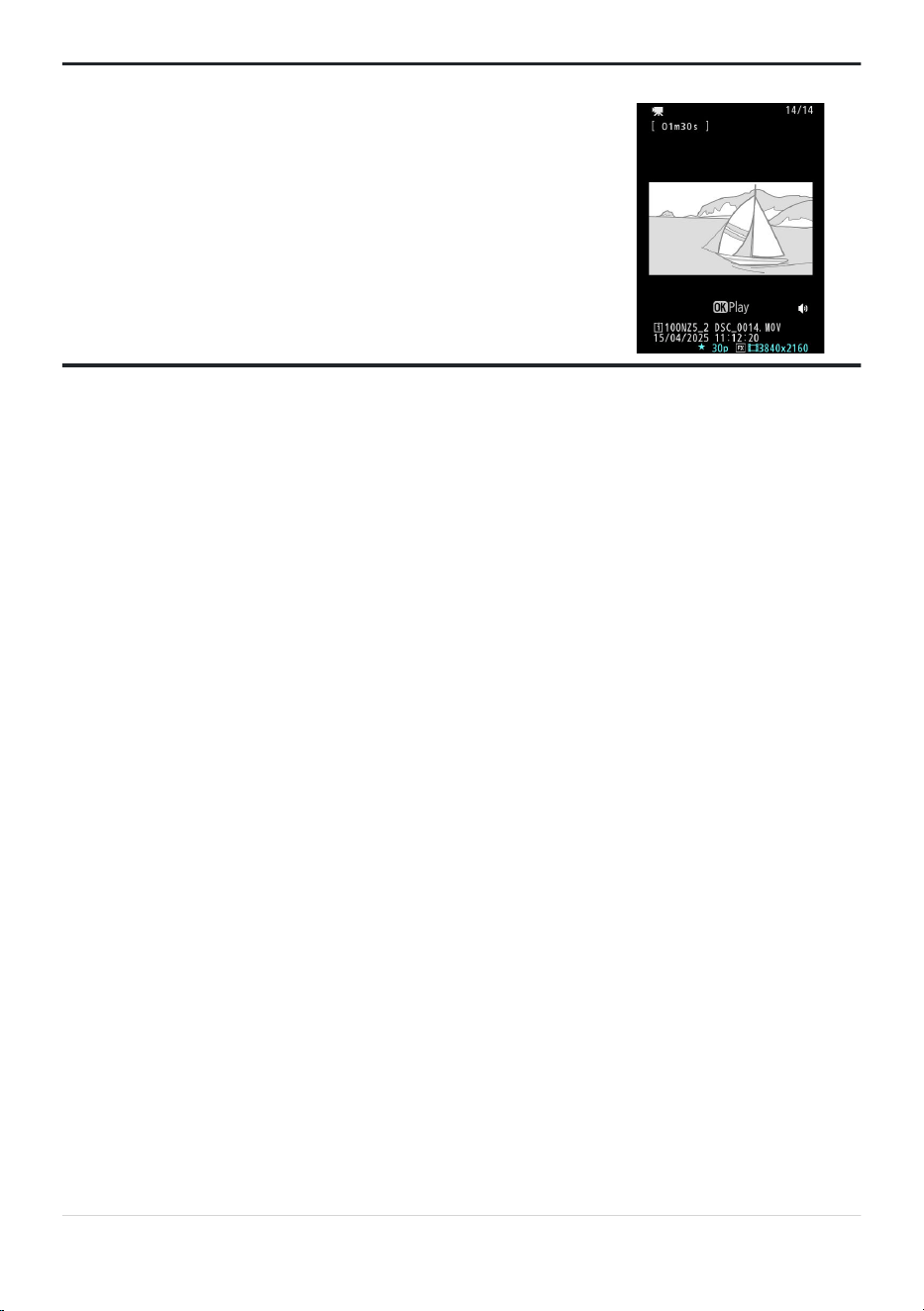
In video mode, the playback and playback i menu displays rotate
t
o match camera orientation.
Tip: Using the Viewfinder with the Camera in “Tall” Orientation
62
TheViewfinder
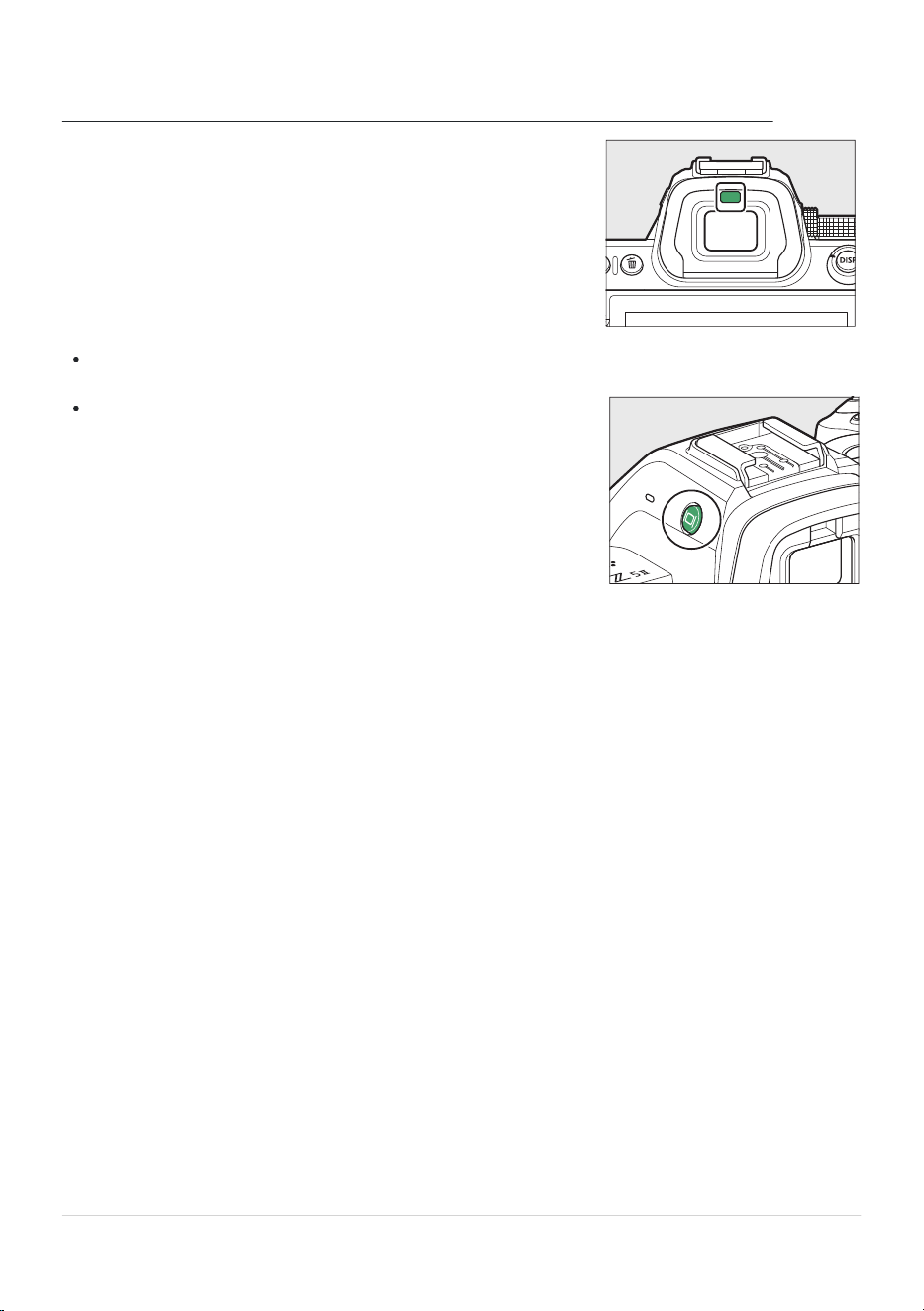
Placing your eye to the viewfinder activates the eye sensor,
switching the display from the monit
or to the viewfinder. Note that
the eye sensor will also respond to other objects, such as your
fingers.
Press the M (monit
or mode) butt
on t
o cycle between viewfinder
and monitor displays.
The Monitor Mode Button and the Eye Sensor
The viewfinder can be used for menus and playback if desired.
63
TheViewfinder
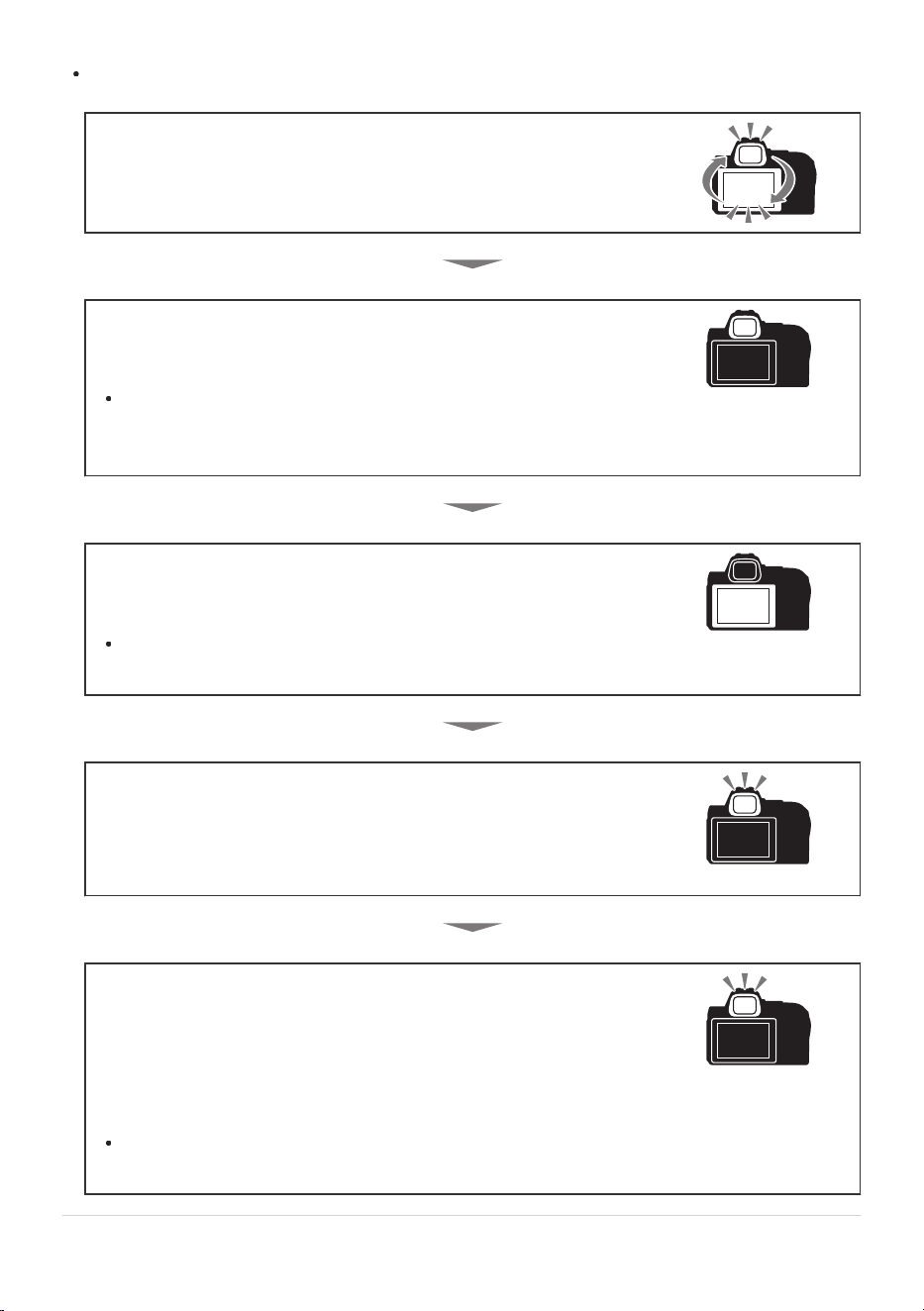
[Automatic display switch]: The camera automatically swit
ches
between the viewfinder and monitor displays based on information
from the eye sensor.
[Viewfinder only]: The monitor remains blank
. The viewfinder is used
for shooting, menus, and playback.
[Monit
or only]: The monit
or is used for shooting, menus, and playb
ack.
The viewfinder display will remain blank even if you put your eye to the
viewfinder.
[Pr
ioritize viewfinder (1)]: Placing y
our ey
e to the viewfinder turns the
viewfinder on; the monitor remains off after you take your eye away. In
video mode, the displays function as per [Automatic display switch].
[Prioritize viewfinder (2)]: In photo mode, in addition t
o when you
look through it, the viewfinder turns on for a few seconds after the
camera is turned on, the shutter-release button is pressed halfway, or
the AF-ON button is pressed regardless of whether placing your eye to
the viewfinder. In video mode, the displays function as per [Automatic
display switch].
The shooting display appears in the viewfinder if you put your eye to
it while the monitor is used for menus or playback.
Press the M button to cy
cle through the displays as follows.
In photo mode, the viewfinder turns on for a few seconds after the camera is turned on,
the shutt
er
-r
elease button is pressed halfway, or the AF-ON button is pressed, regardless of
whether placing your eye to the viewfinder.
The viewfinder turns on if you put your eye to it while the monitor is in storage position with
the scr
een facing inwar
d.
64
TheViewfinder
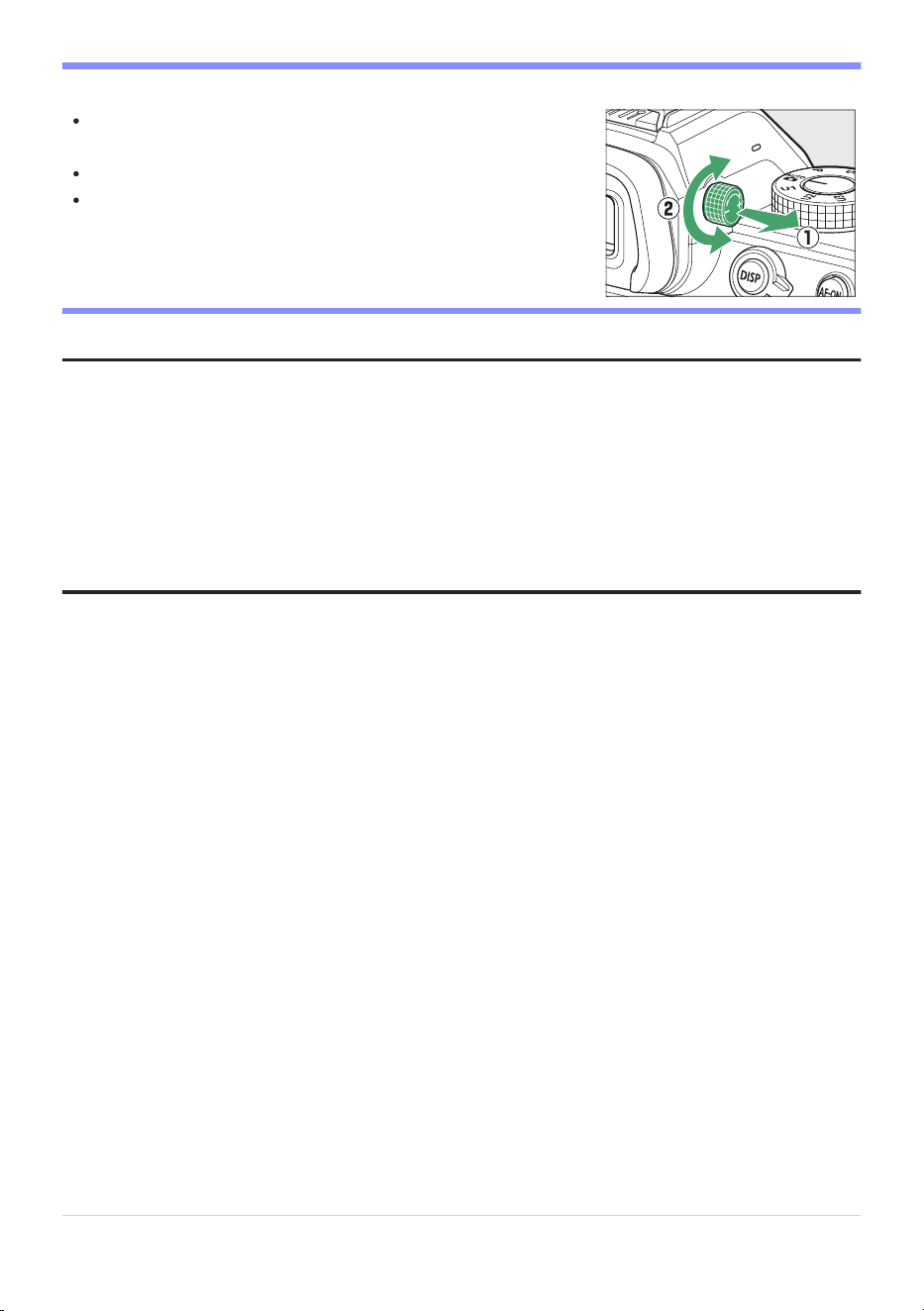
The viewfinder can be focused by lifting and rotating the diopter
adjustment control.
Be careful not t
o put your fingers or fingernails in your eye.
After adjusting diopter, push the diopter adjustment control back
into its original position.
D The Diopter Adjustment Control
Tip: Ext
ended Use
When using the viewfinder for extended periods, you can select [Adjust for ease of viewing] for
Custom Setting d10 [View mode (photo Lv)] to ensure that viewfinder brightness and hue are
adjusted for ease of viewing.
Tip: Limit Monitor Mode Selection
You can limit the choice of monitor modes available using the [Limit monitor mode selection] item in
the setup menu.
65
TheViewfinder
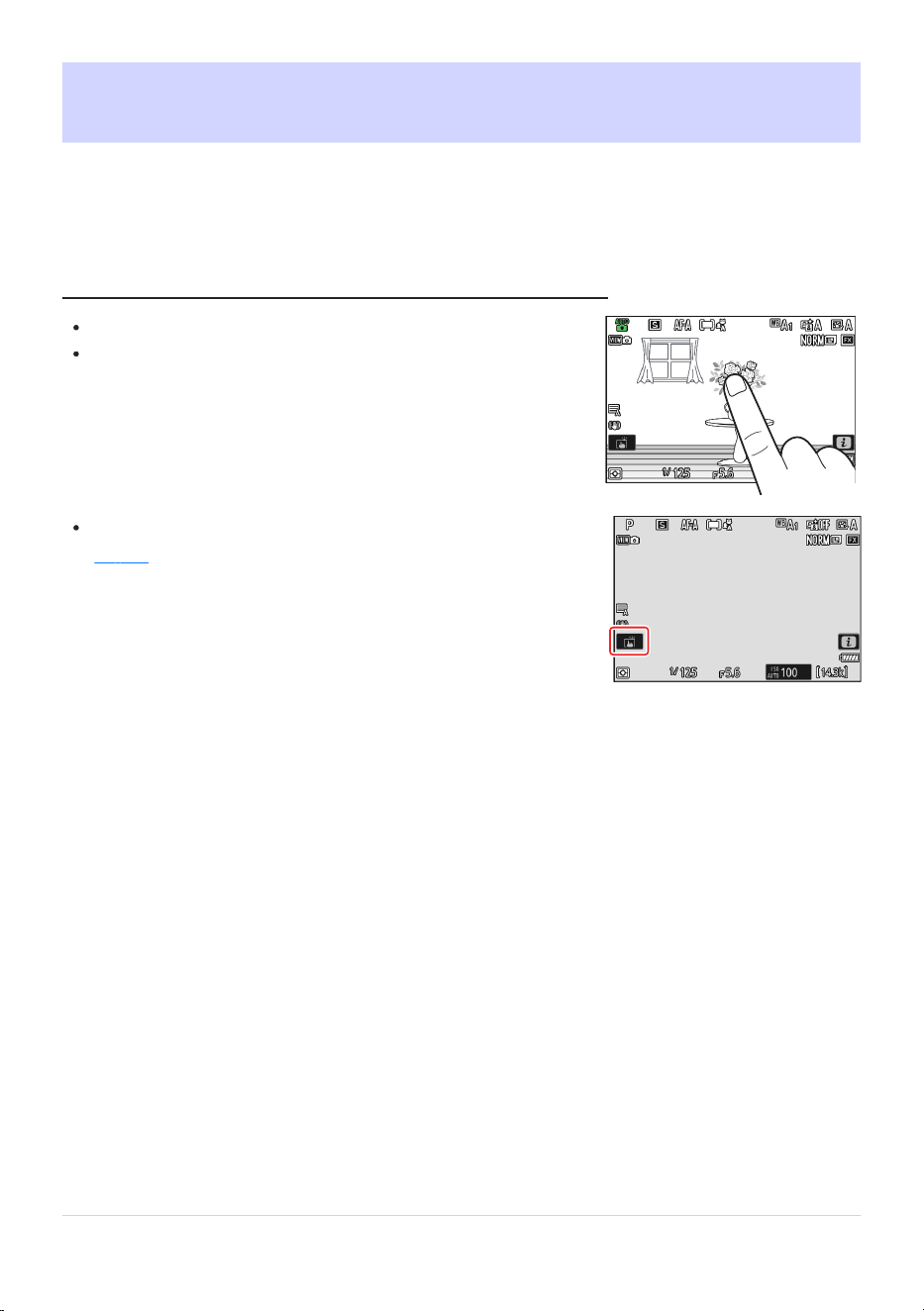
Touch the monitor to focus on the selected point (touch AF).
In photo mode, the shutter will be r
eleased when you lift your
finger from the display (touch shutter).
Touch shutter/AF settings can be adjusted by tapping the W icon
(0 131).
Touch Controls
The touch-sensitiv
e monitor offers a variety of controls that can be operated by touching the display
with your fingers.
Focusing and Releasing the Shutter
66
Touch Controls
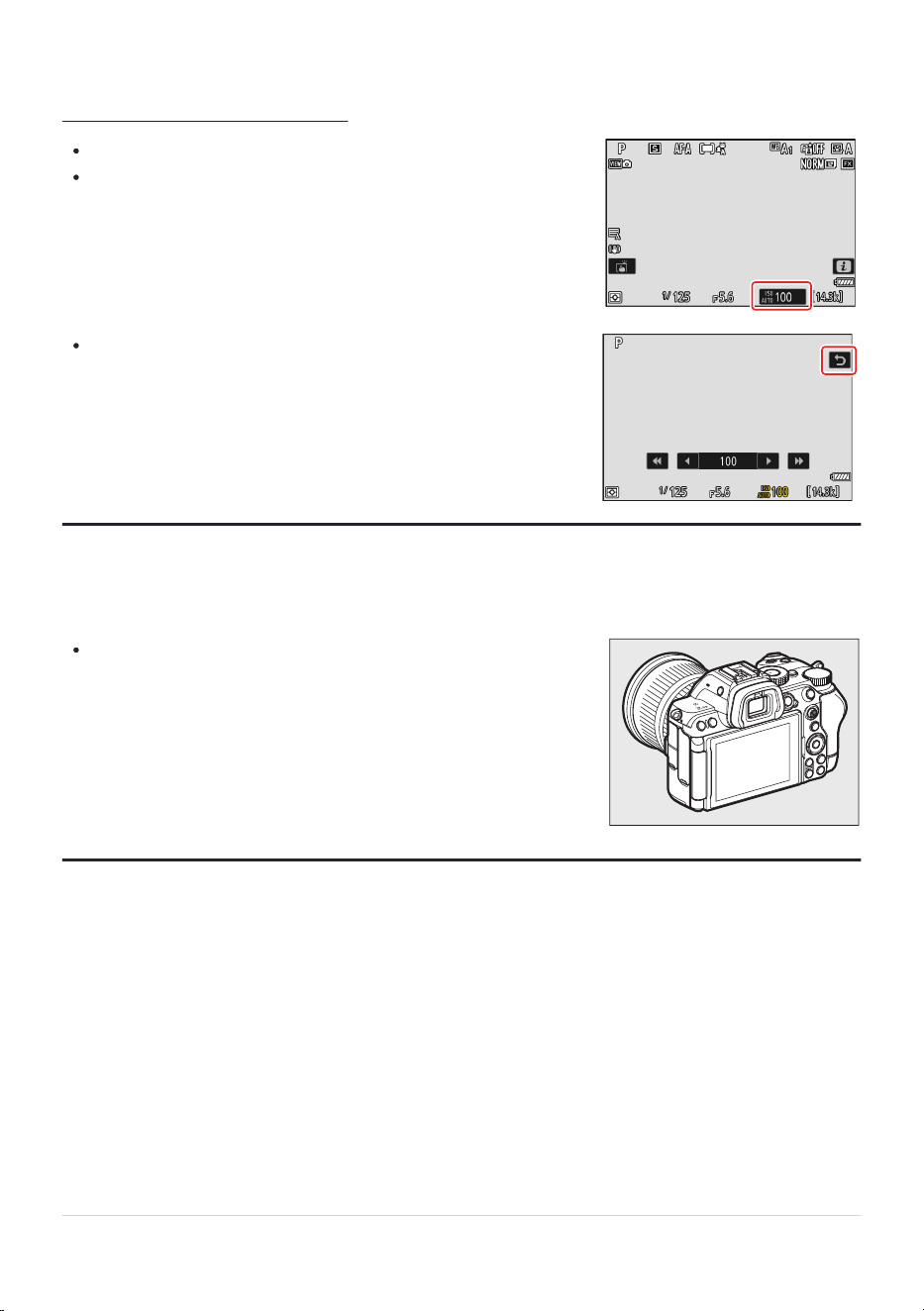
Tap highlighted settings in the display.
You can then choose the desired option by tapping icons or
slider
s.
Tap Z or press J to select the chosen option and return to the
previous display.
Touch Fn is available only when the monitor is in storage position
with the screen facing outward.
Adjusting Settings
Tip: Touch Fn
When [ON
] is selected for Custom Setting f4 [Touch Fn]> [Enable/disable touch Fn], you can use
monitor touch controls to adjust settings while framing pictures in the viewfinder.
67
Touch Controls
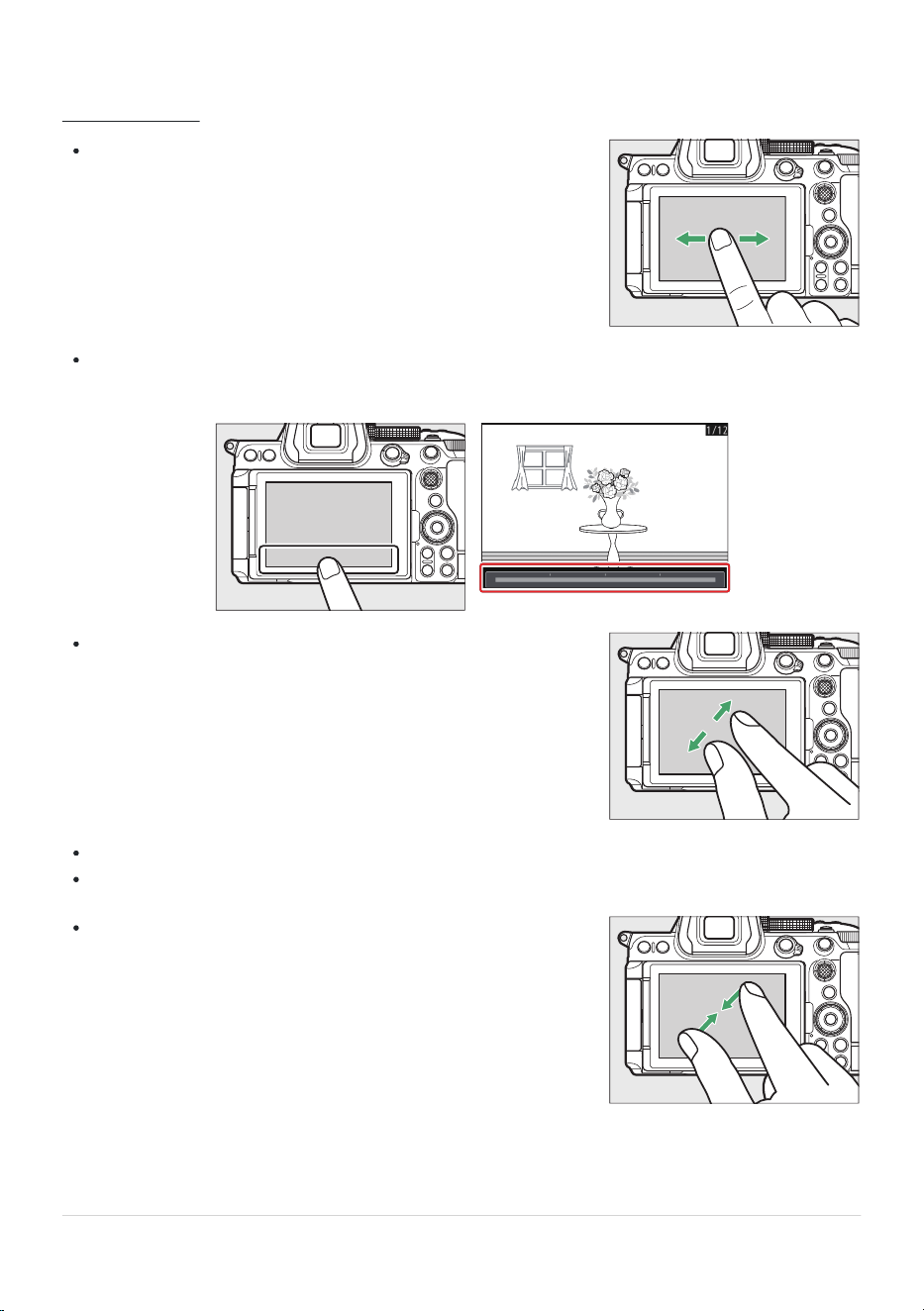
Flick left or right to view other pictures during full-frame
playback.
To zoom in on a picture displayed during full-frame playback,
use a stretch gestur
e or give the display two quick taps. You can
adjust the zoom ratio using stretch gestures to zoom in and pinch
gestures to zoom out.
To “zoom out” to a thumbnail view, use a pinch gesture during
full-frame playback. Use pinch and str
etch to choose the number
of pictures displayed from 4, 9, and 72 frames.
Playback
In full-frame playback, t
ouching the bottom of the display brings up a frame-advance bar. Slide your
finger left or right over the bar to scroll rapidly to other pictures.
Use slide gestures to view other parts of the picture during zoom.
Giving the display two quick taps while zoom is in effect cancels zoom.
68
Touch Controls
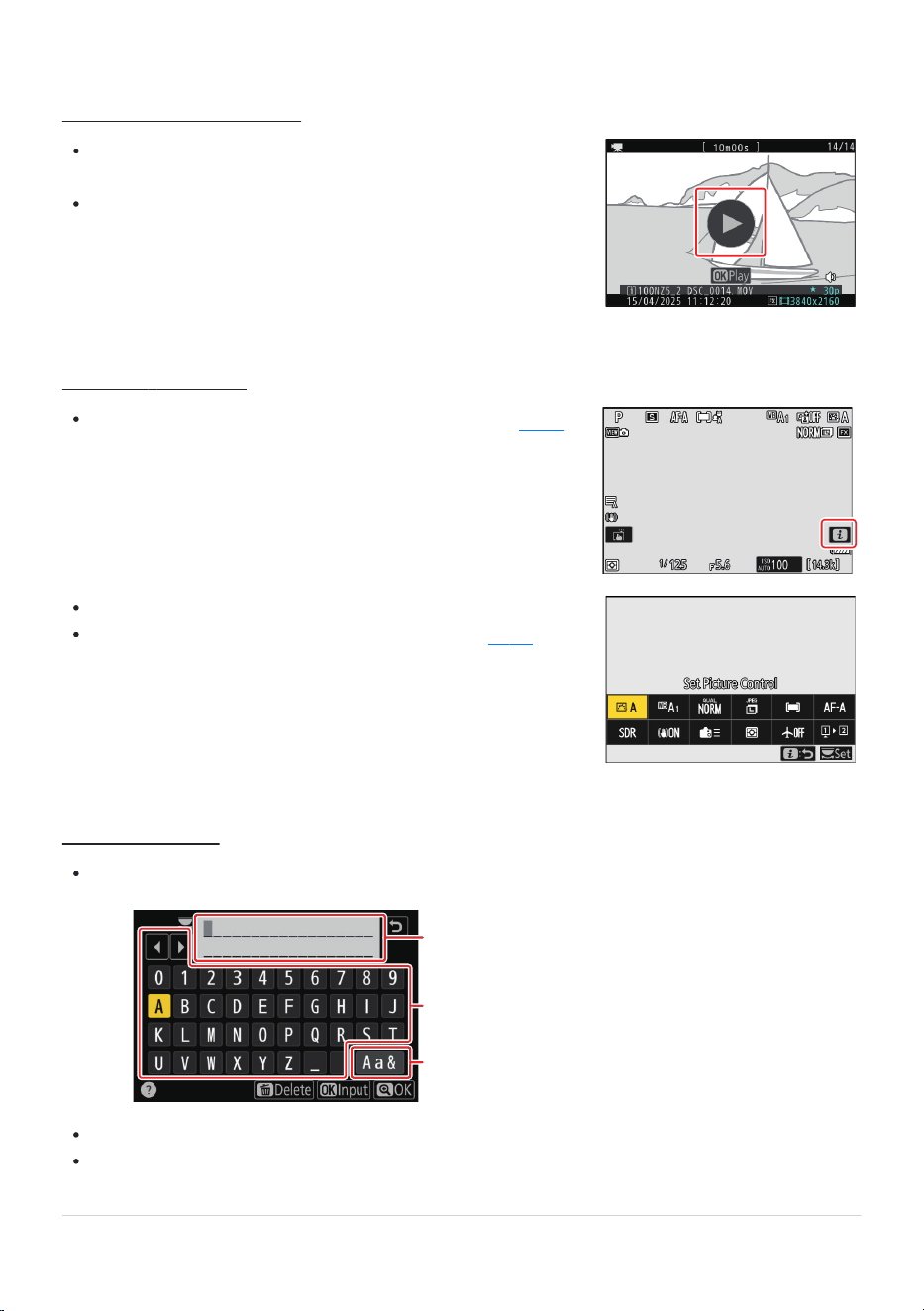
Videos are indicated by a 1 icon; t
o star
t playb
ack, tap the a
icon.
Tap Z to exit to full-frame playback.
Tap the i icon to display the i menu during shooting (
0 80).
Tap items to view and change options.
You can choose the items display
ed in the imenu (
0 85).
1
2
3
Text display area
Keyboard area
Keyboard selection
1
2
3
Viewing Videos
The i Menu
Text Entry
When a k
eybo
ar
d is displayed, you can enter text by tapping the keys.
To position the cursor, tap e or f or tap directly in the text display area.
To cycle through the upper- and lower-case and symbol keyboards, tap the keyboard selection
button.
69
Touch Controls
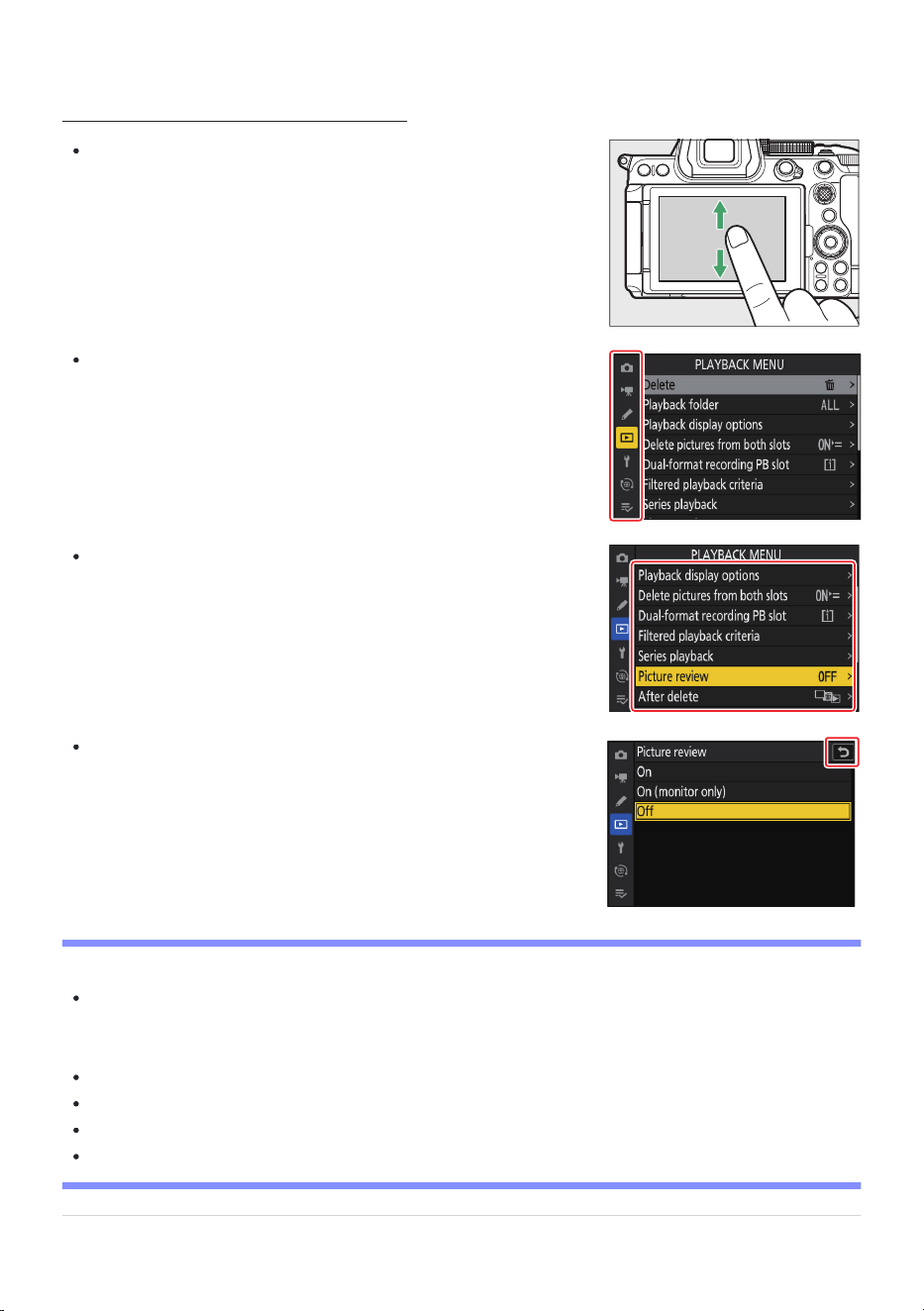
Slide up or down to scroll.
Tap a menu icon to choose a menu.
Tap menu items to display options. You can then choose the
desired option by tapping icons or sliders.
To exit without changing settings, tap Z.
Navigating the Menus
D Cautions: The Touch Screen
The t
ouch screen responds to static electricity. It may not respond when touched with fingernails
or gloved hands. For improved response when using the touch screen with gloves, select [ON] for
[Touch controls]> [Glove mode] in the setup menu.
Do not touch the screen with sharp objects.
Do not use excessive force.
The screen may not respond when covered with third-party protective films.
The screen may not respond when touched simultaneously in multiple locations.
70
Touch Controls

Tip: Enabling or Disabling Touch Controls
Touch controls can be enabled or disabled using [T
ouch controls]> [Enable/disable touch
controls] in the setup menu.
Touch Fn is available when [ON] is selected for Custom Setting f4 [Touch Fn]> [Enable/disable
touch Fn], even if [Disable] is selected for [Touch controls]> [Enable/disable touch controls] in
the setup menu.
71
Touch Controls
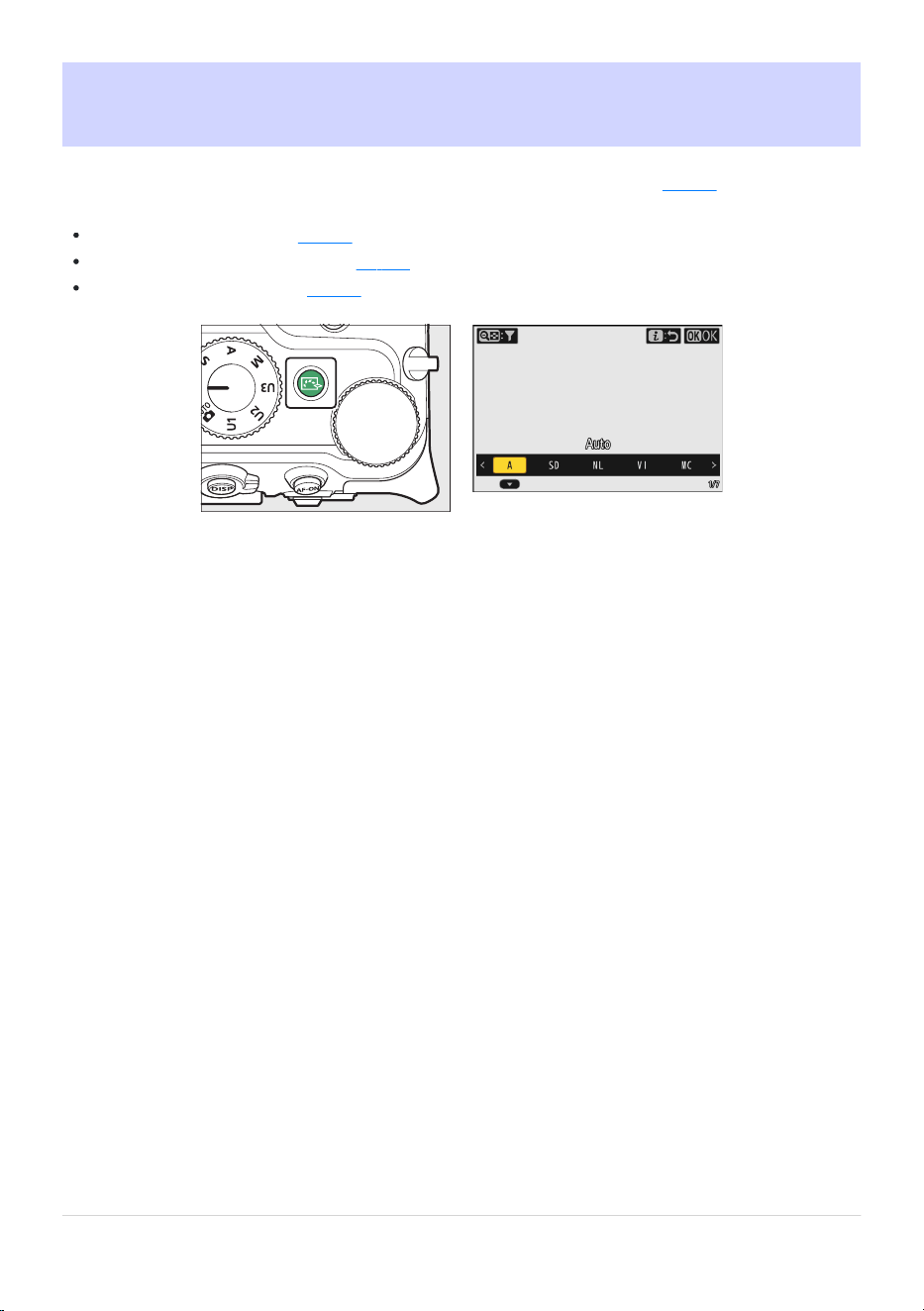
The h (Picture Control) Button
Pressing the h (Picture Control) button displays the Picture Control options (0 164) in the shooting
display. The following operations are av
ailable:
Selecting Picture Controls (
0 166)
Limiting Picture Control selection (
0 169)
Modifying Picture Contr
ols (
0 171)
72
The h (Picture Control) Butt
on

Use the Fn1 or Fn2 button for quick access to select
ed settings.
The Fn1 and Fn2 Buttons
The default setting for the Fn1 button is white b
alance (
0 182) and the Fn2 butt
on is focus
mode/AF-ar
ea mode (
0 120).
The assigned setting can be adjust
ed by holding the Fn1 or Fn2
butt
on and rotating the command
dials. In some cases, adjustments can be made using both the main and sub-command dials.
The roles played by these and other controls can be chosen in the Custom Settings menu. Controls
can be assigned a variety of different roles for still photography (
0 618), video r
ecor
ding (
0 661),
and playb
ack (
0 636).
73
The Fn1 and Fn2 Buttons
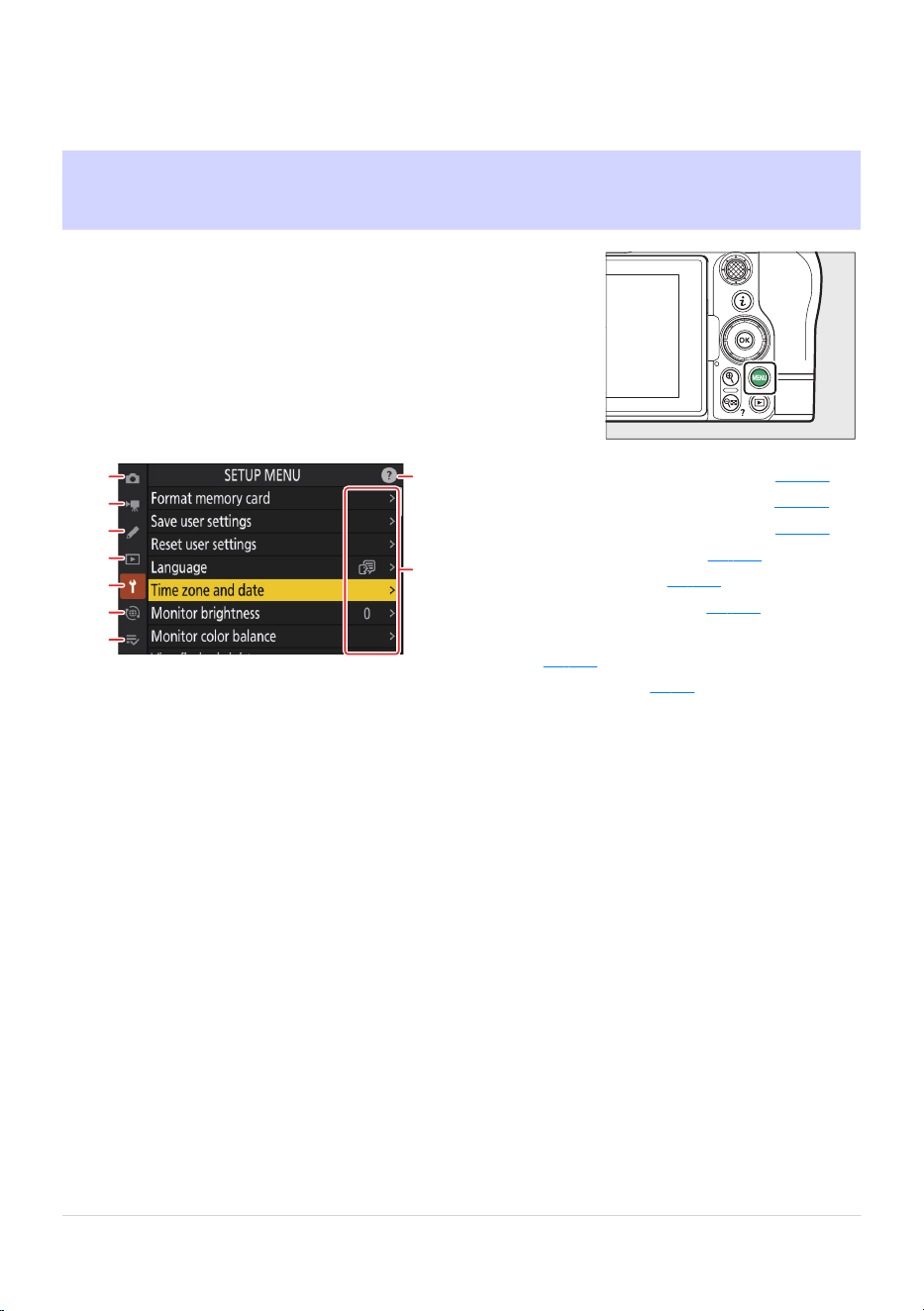
Press the G button to view the menus.
9
8
1
2
3
4
5
6
7
CPHOTO SHOOTING MENU (0 404)
1VIDEO RECORDING MENU (0 508)
ACUSTOM SET
TINGS MENU (
0 549)
DPLAYBA
CK MENU (
0 691)
B SETUP MENU (
0 711)
F NETWORK MENU (0 767)
OMY MENU/mRECENT SETTINGS
*
(0 802)
d (help) icon (0 78)
Current settings
1
2
3
4
5
6
7
8
9
Using the Menus
The MENU Butt
on
You can choose the menu display
ed. The default is [MY MENU].
74
The MENU Button
*
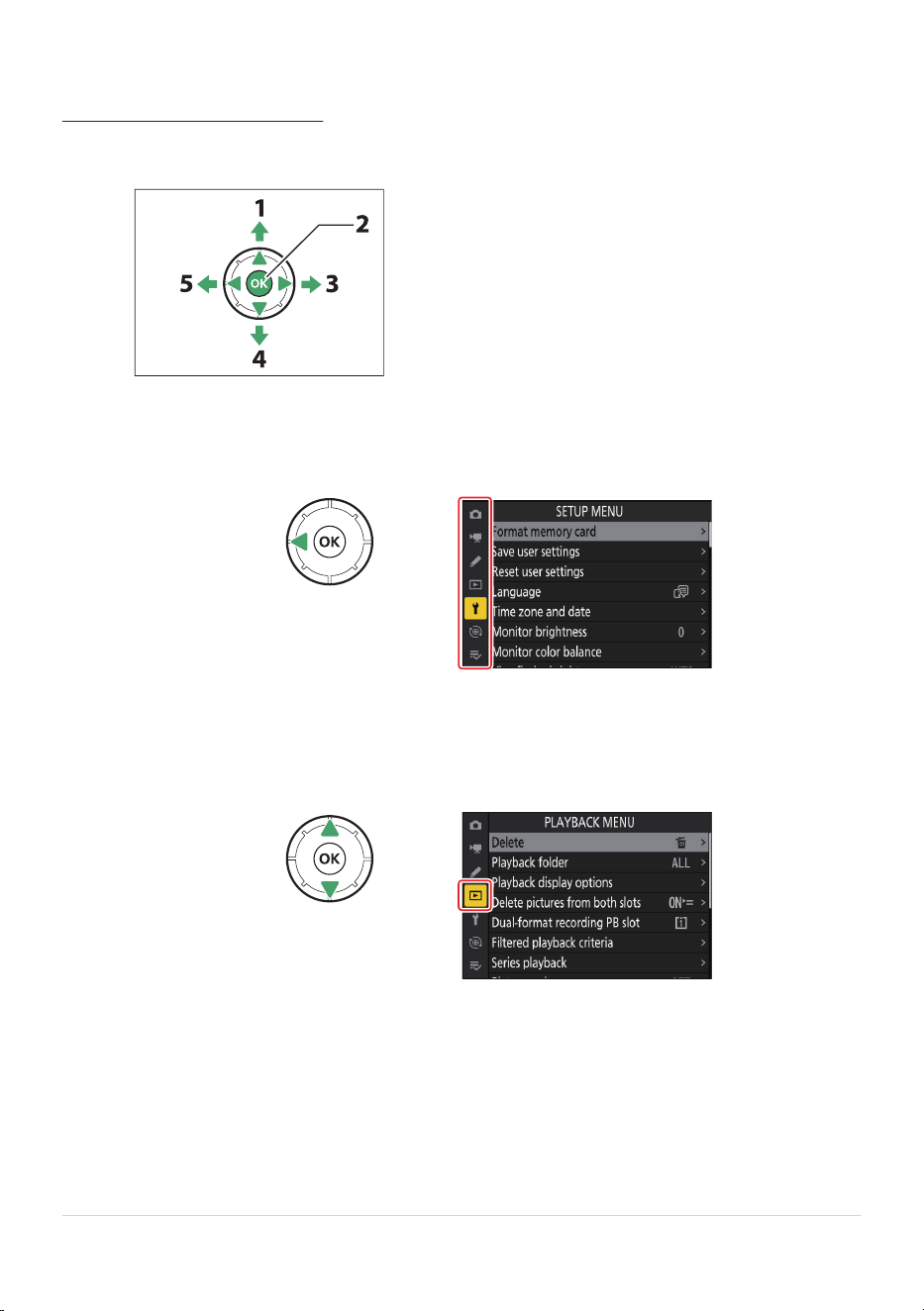
Move cursor up
Select the highlighted item
Display sub-menu, select highlight
ed
item, or move cursor right
Move cursor down
Cancel and return to previous menu, or
move cursor left
1
2
3
4
5
Using the Menus
You can navigate the menus using the multi select
or and J button.
Highlight the icon for the current menu.
Press 4 to place the cursor in the menu-selection area.
Select a menu.
Press 1 or 3 to select the desired menu.
75
The MENU Button
1
2
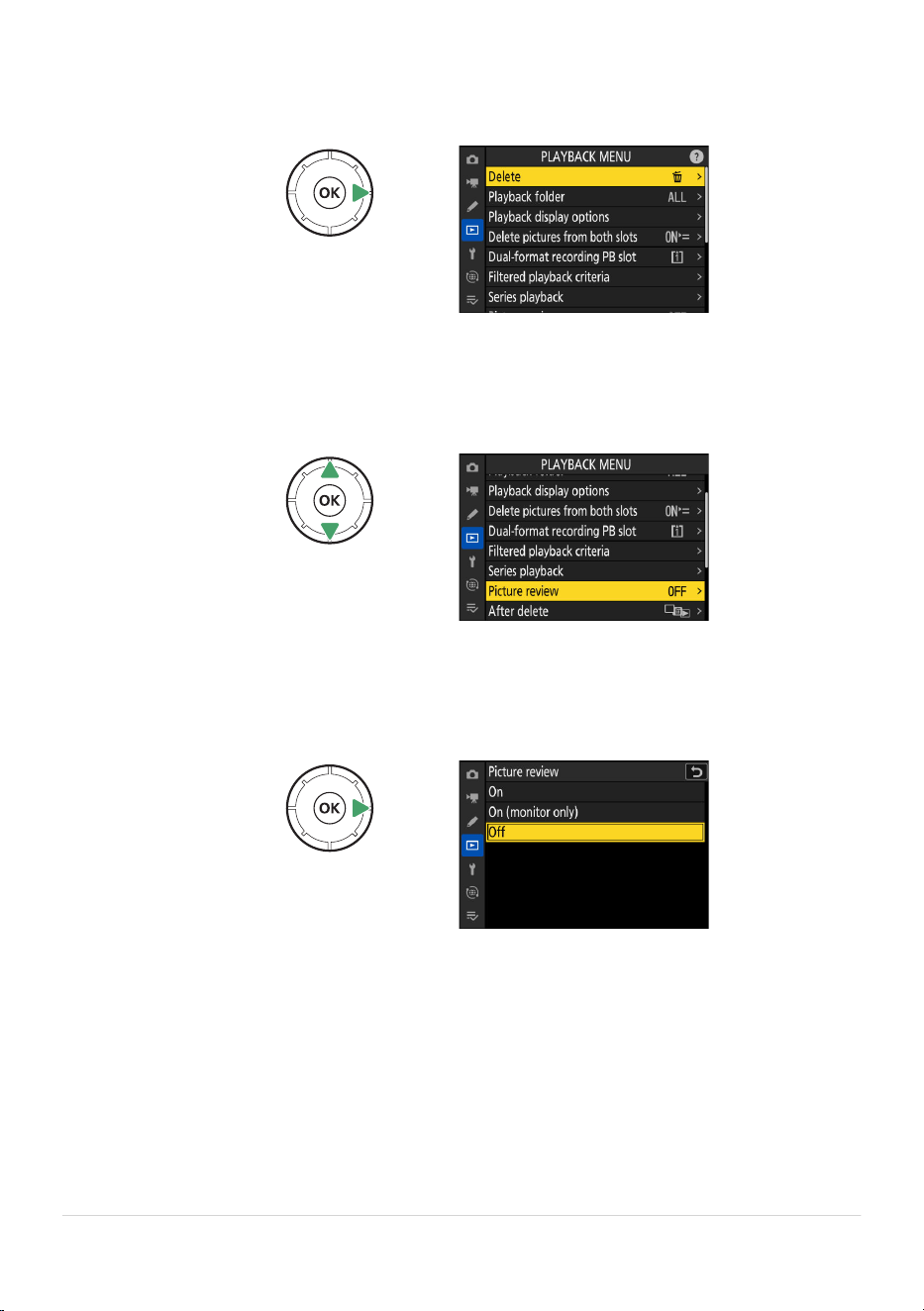
Position the cursor in the selected menu.
Press 2
to position the cursor in the selected menu.
Highlight a menu item.
Press 1 or 3 to highlight a menu item.
Display options.
Press 2 to display options for the selected menu item.
76
The MENU Button
3
4
5
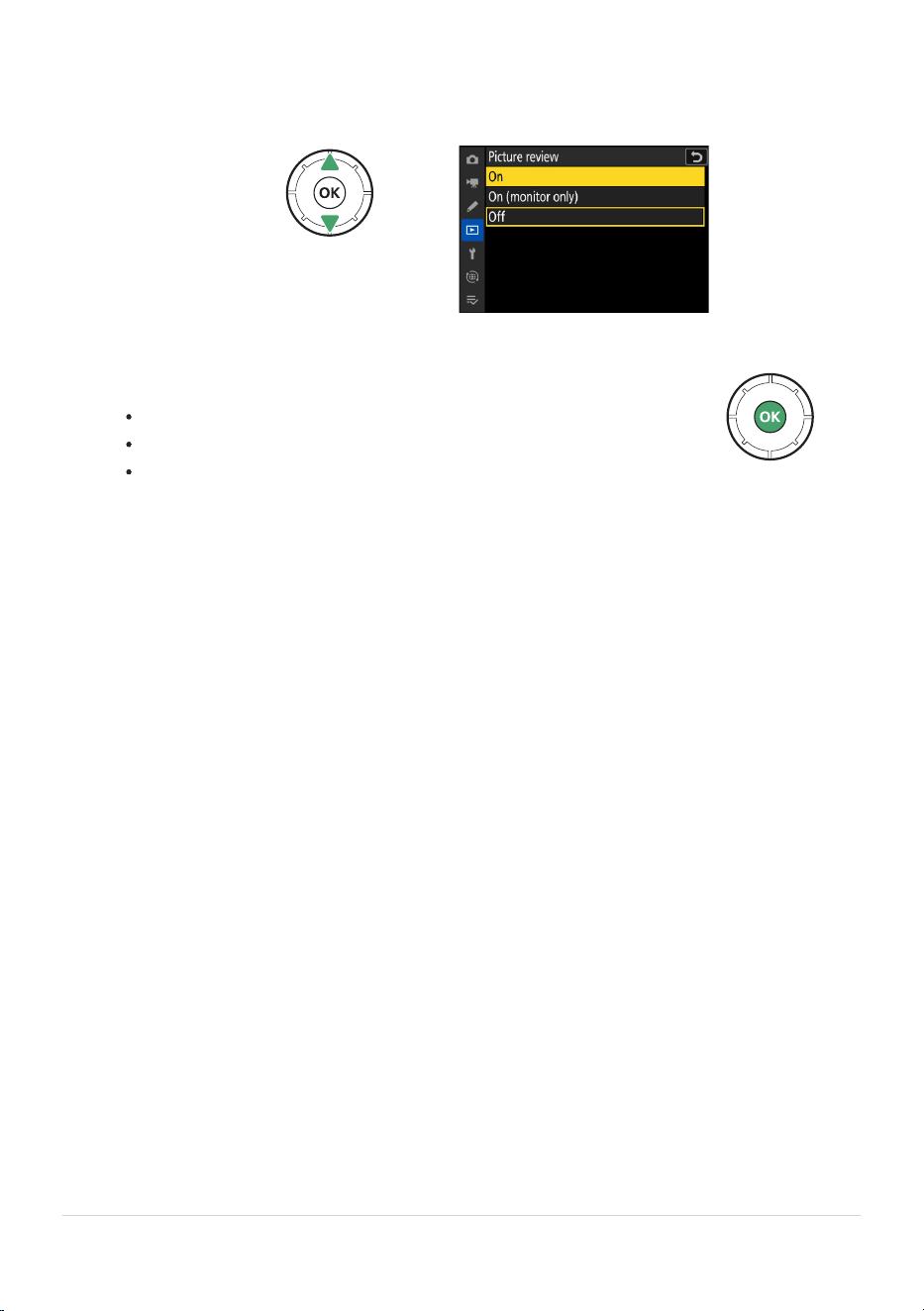
Select the highlighted option.
Press J
to save changes and exit.
To exit without making a selection, press the G button.
To exit the menus and return to shooting mode, press the shutter-
release button halfway.
Highlight an option.
Press 1
or 3 to highlight an option.
77
The MENU Button
6
7
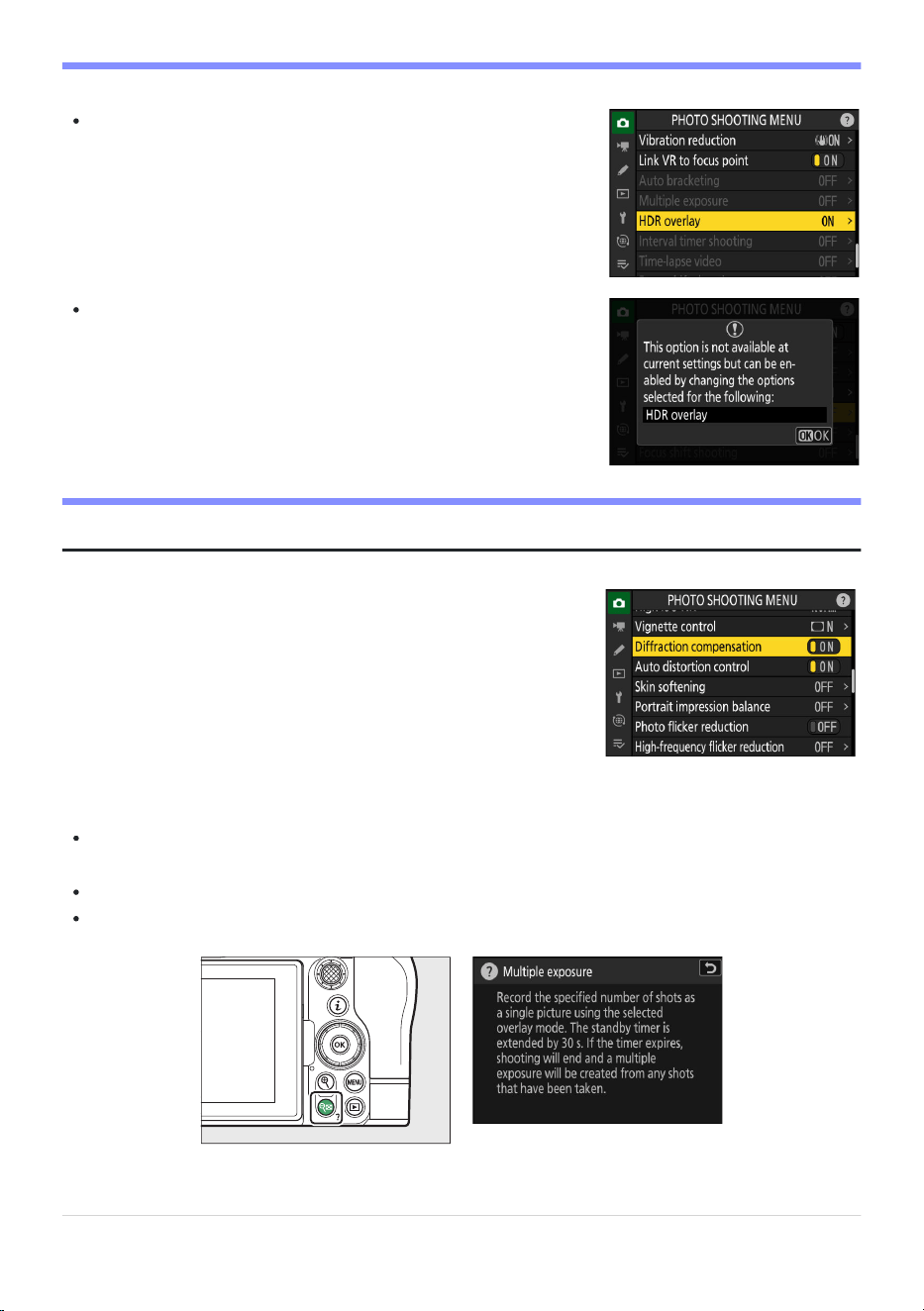
Some items and menu options may be unavailable depending on
camera status. Unavailable items ar
e displayed in gray.
In some cases, pressing J when a grayed-out item is highlight
ed
will display a message explaining why the item is unavailable.
If the only options available for the current item are [ON] and [OFF],
you can switch from [ON] to [OFF] or vice versa simply by pressing
J, pressing the multi selector right (2), or tapping the item in the
display.
D Grayed-Out Items
Tip: ON/OFF Only Items
Tip: The
d (Help) Icon
Where available, a description of the currently-selected item can be viewed by pressing the W (Q)
button.
Press 1 or 3 to scroll.
Press W (Q) again to return to the menus.
78
The MENU Button
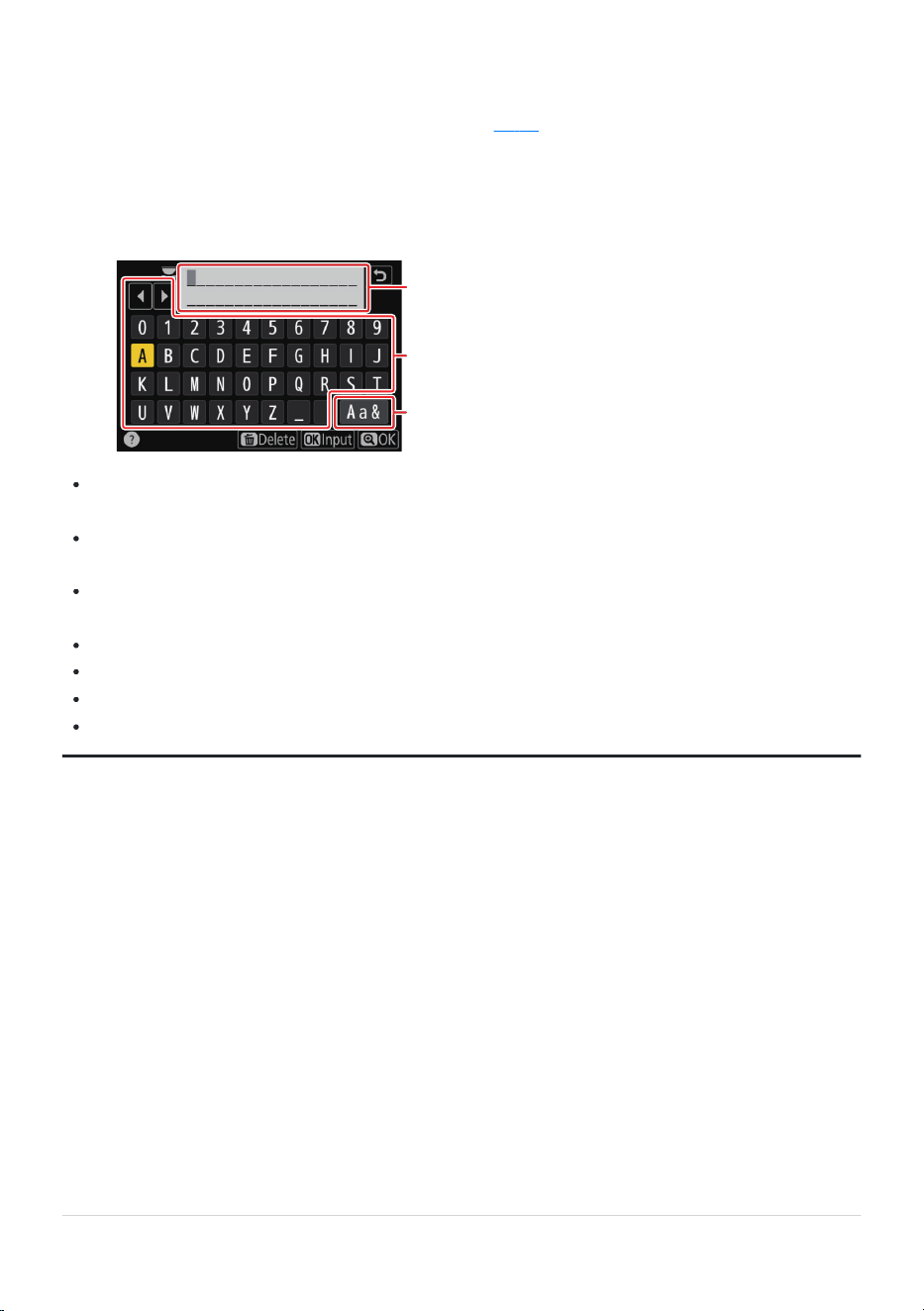
1
2
3
Text display area
Keyboar
d area
Keyboard selection
1
2
3
Tip: Touch Controls
You can also navigate the menus using touch controls (
0 66).
Tip: Text Entry
A k
eyboard is displayed when text entry is required, for example if you are called on to enter a file
name or the like. Enter text as described below.
Enter characters at the current cursor position by highlighting them with the multi selector arrow
keys and then pressing J.
The cursor can be moved left or right in the text display area by rotating either of the command
dials.
To cycle through the upper- and lower-case and symbol keyboards, highlight the keyboard selection
icon and press J. The keyboard selection icon may not be available in some cases.
If a character is entered when the text display area is full, the rightmost character will be deleted.
To delete the character under the cursor, press the O button.
To complete entry, press X.
To exit without completing text entry, press G.
79
The MENU Button
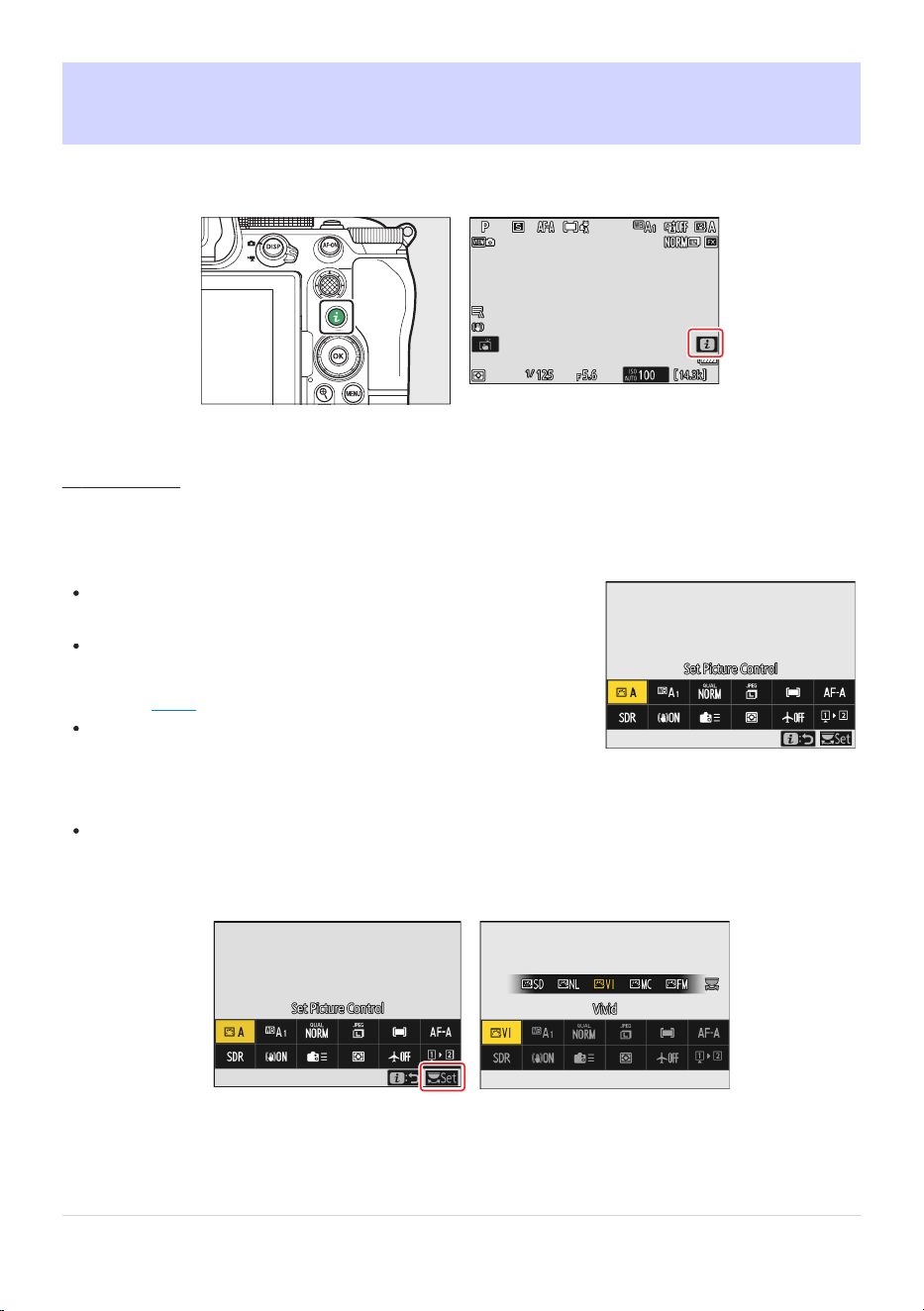
Different menus are displayed in photo, video, and playback
modes.
The items displayed in the
i menu in the photo or video mode
can be changed by using Custom Setting f1 or g1 [Customize i
menu] (
0 85).
Options can be viewed by tapping items in the display or by
highlighting it
ems and pressing J; selections can then be made
using the multi selector.
The i Button (i Menu)
For quick access t
o frequently-used settings, press the i button or tap the i icon to view the i menu.
i Menu
The i menu offers a list o
f the main function settings of the camera so you can change the setting
details.
Items for which the camera displays a command dial guide can be adjusted by highlighting them in
the i menu and rotating a command dial. In some cases, adjustments can be made using both the
main and sub-command dials.
80
The i Button (i Menu)
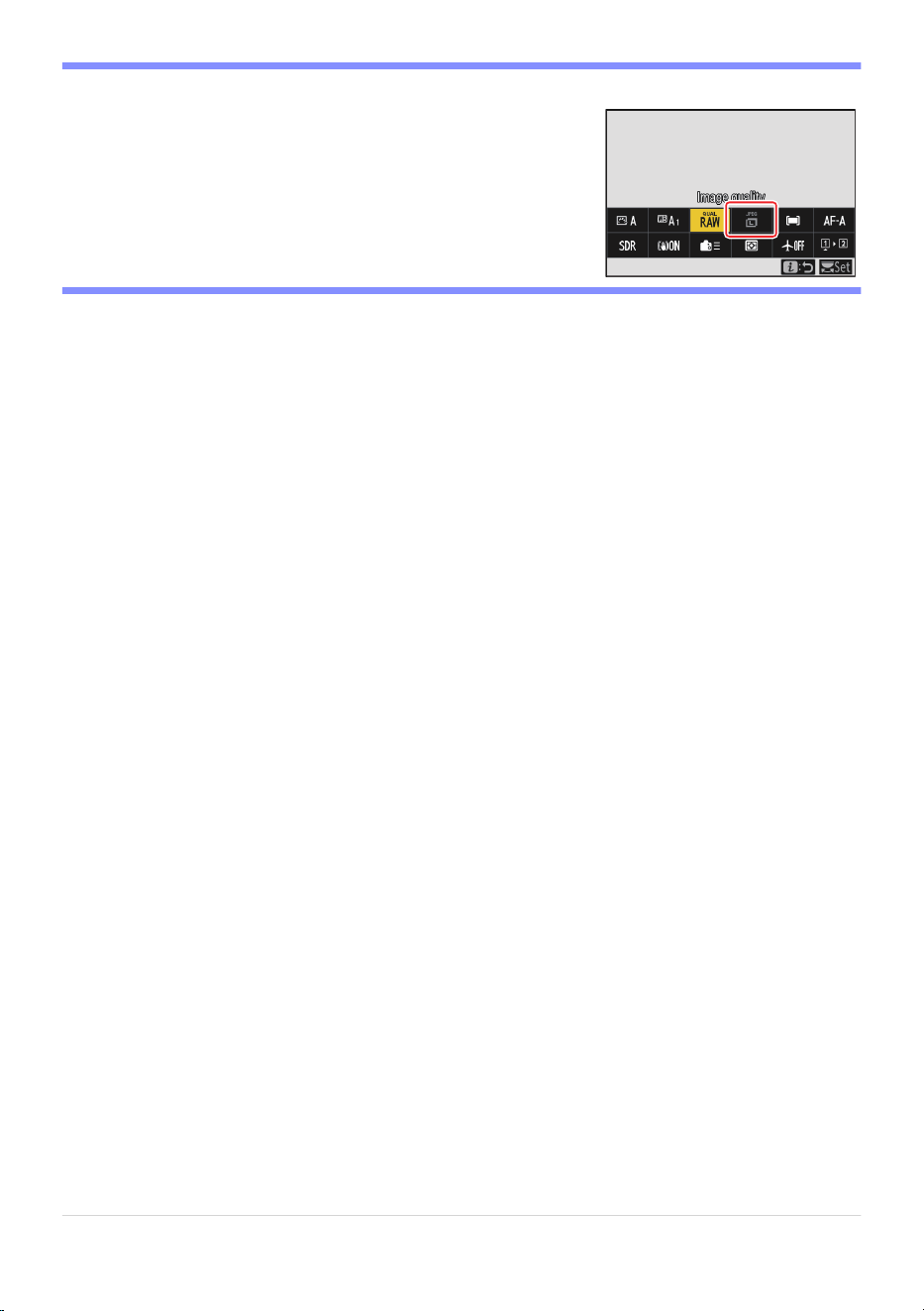
Some items and menu options may be unavailable depending on
camera status. Unavailable items ar
e displayed in gray.
D Grayed-Out Items
81
The i
Butt
on (i Menu)
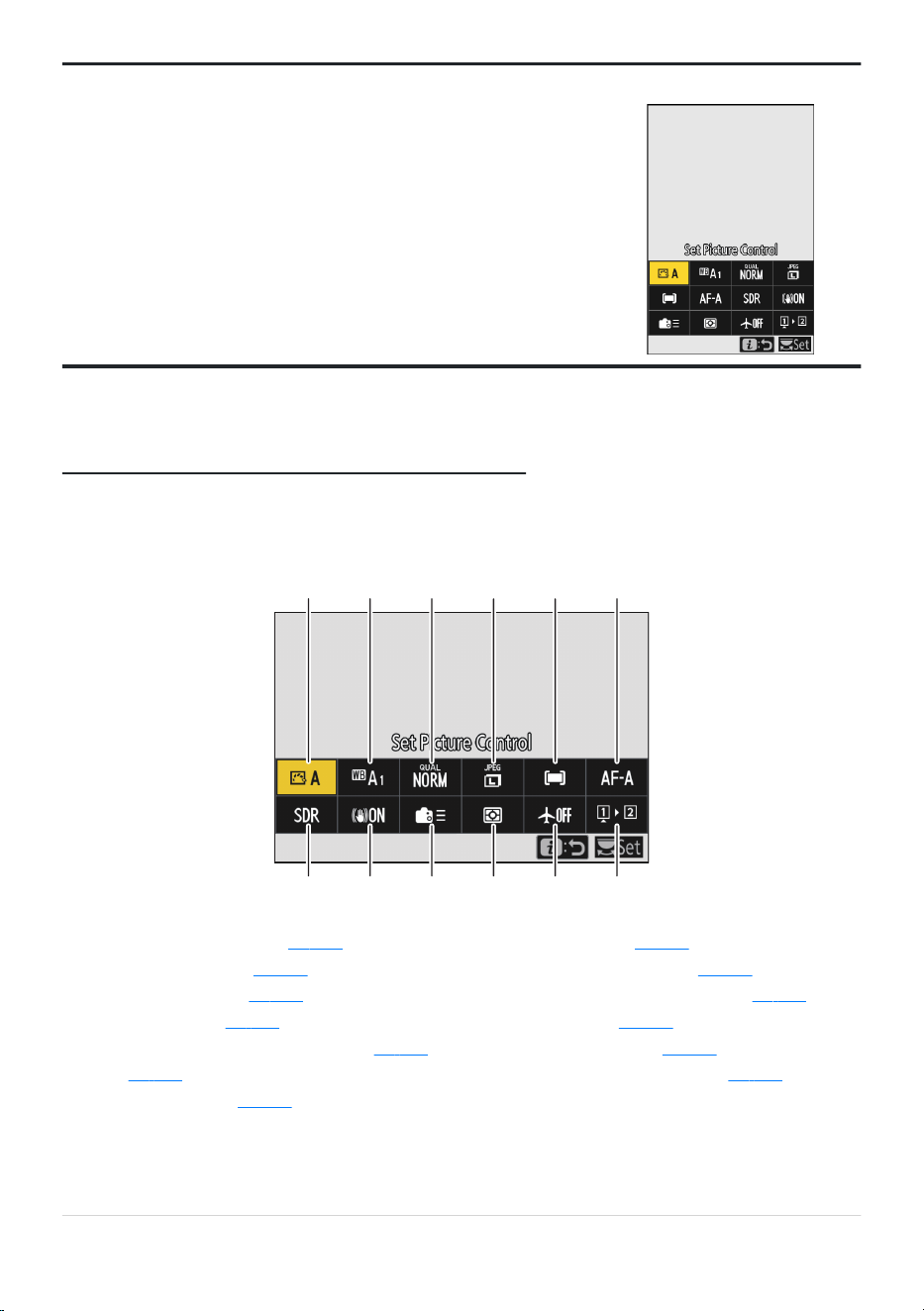
When the camera is rotated to take or view pictures in “tall”
(portrait) orientation, the i
menu displays rotate to match. In
video mode, only the playback i menu rotates to match camera
orientation.
Set Picture Control ( 0 164)
White balance (0 182)
Image quality (0 116)
Image size (0 118)
AF-area mode/subj. detection (0 122,
0 126)
Focus mode (0 120)
1
2
3
4
5
6
Tone mode ( 0 417)
Vibration reduction (0 451)
Custom controls (shooting; 0 618)
Metering (0 441)
Airplane mode (0 769)
View memory card info (0 616)
7
8
9
10
11
12
Tip: Using the i Menu with the Camera in “
Tall” Or
ientation
The Still Photography i Menu
Pr
essing the
i
button in photo mode displays the items listed below. Highlight the desired item using
the multi selector and press J to view options.
1 2 3 4 5 6
87 9 10 11 12
82
The i Button (i Menu)
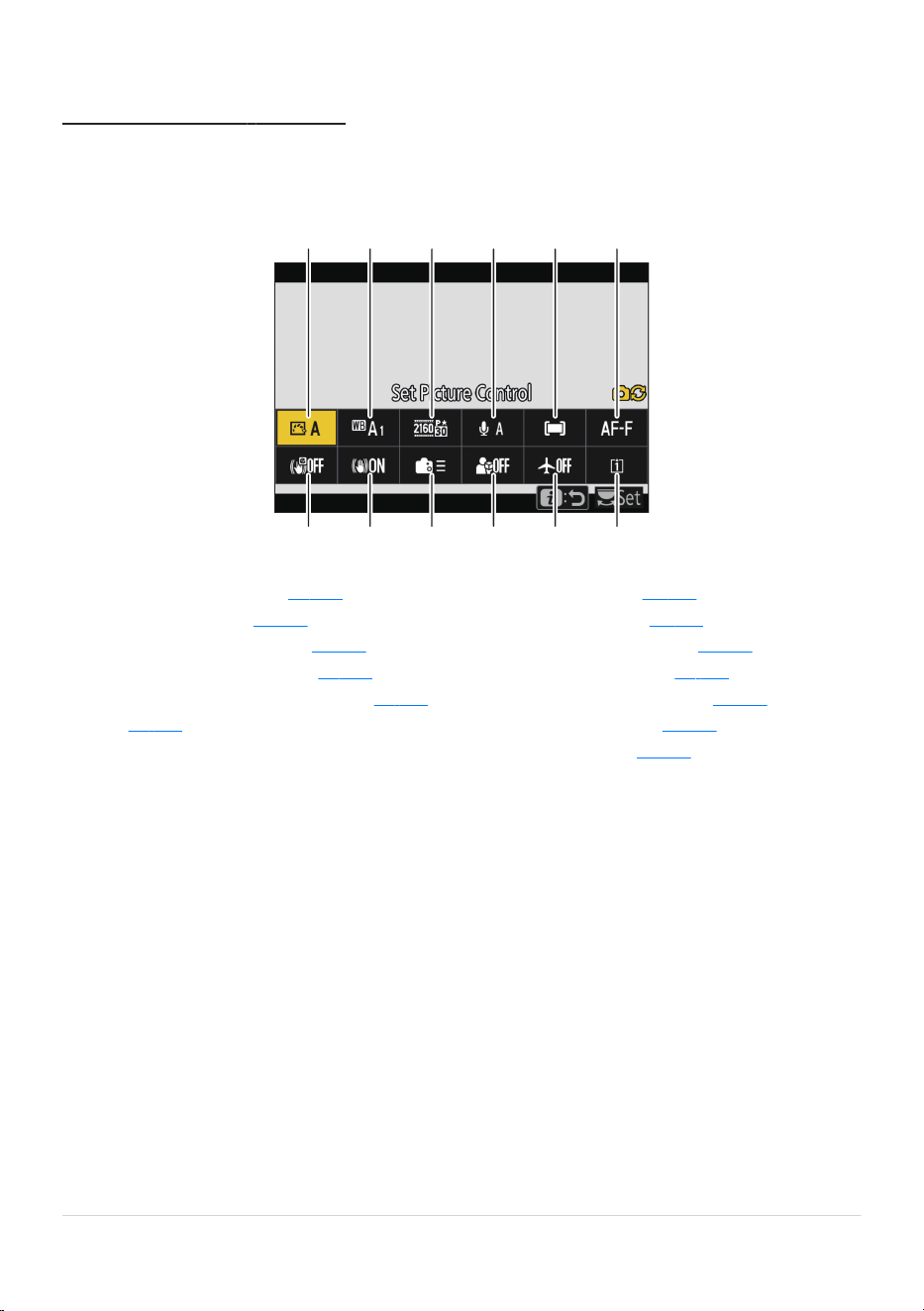
Set Picture Control ( 0 164)
White balance (
0 182)
Frame size/frame rate (0 202)
Microphone sensitivity (0 540)
AF-area mode/subj. detection (
0 122,
0 126)
1
2
3
4
5
Focus mode (0 120)
Electronic VR (0 539)
Vibration reduction (0 538)
Custom controls (
0 661)
Product review mode (
0 535)
Airplane mode (0 769)
Destination (0 513)
6
7
8
9
10
11
12
The Video i Menu
Pressing the i
button in video mode displays the items listed below. Highlight the desired item using
the multi selector and press J to view options.
1 2 3 4 5 6
87 9 10 11 12
83
The i Button (i Menu)
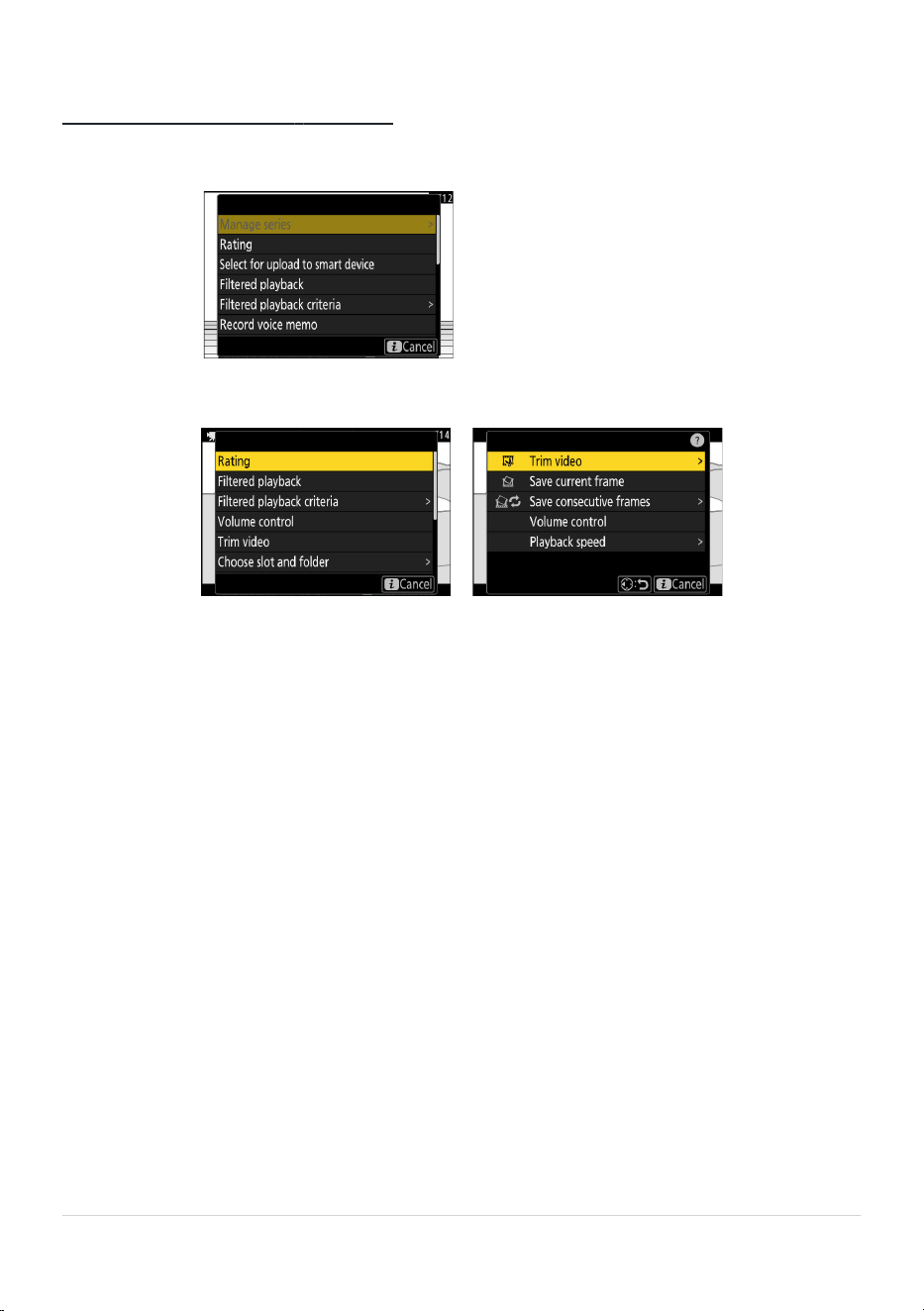
Photos
Videos Videos (playback paused)
The Playback i Menu
Pressing the i
button during playback displays a context-sensitive imenu of playback options.
84
The i Button (i Menu)
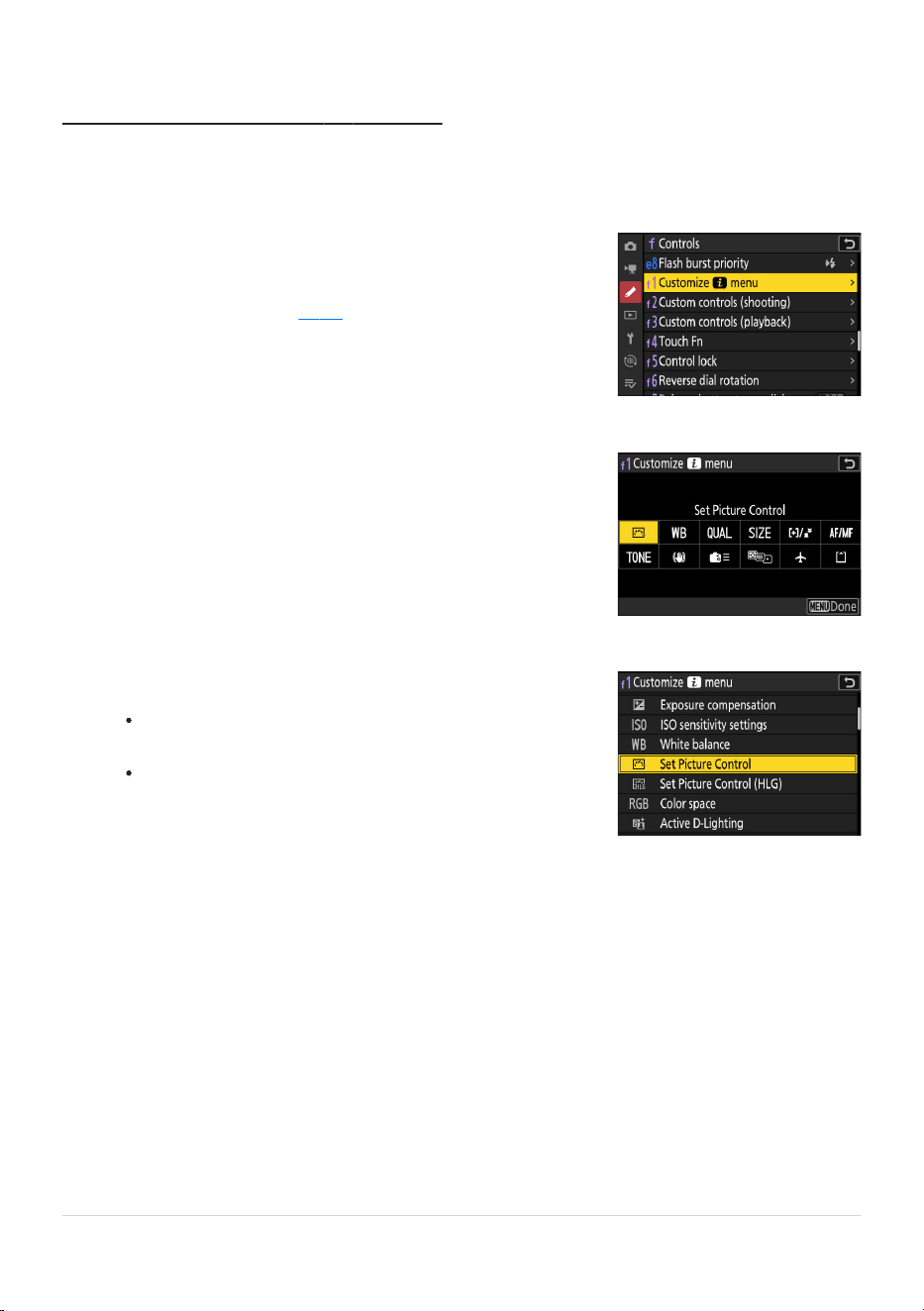
Highlight Custom Setting f1 or g1 [Customize i menu]
and press J.
See “The G Button” (0 74) for information on using the
menus.
Highlight the position you want to change and press J.
A list o
f the it
ems av
ailable for the selected position will be
displayed.
Highlight the desired item and press J.
The it
em will be assigned t
o the select
ed position and the
options shown in Step 2 will be displayed.
Repeat Steps2 and 3 as desired.
Customizing the i Menu
The items displayed in the
i menu during shooting can be chosen using Custom Setting f1 or g1
[Customize i menu].
Press the G button.
Changes will be saved and the Custom Settings menu will be displayed.
85
The i Button (i Menu)
1
2
3
4
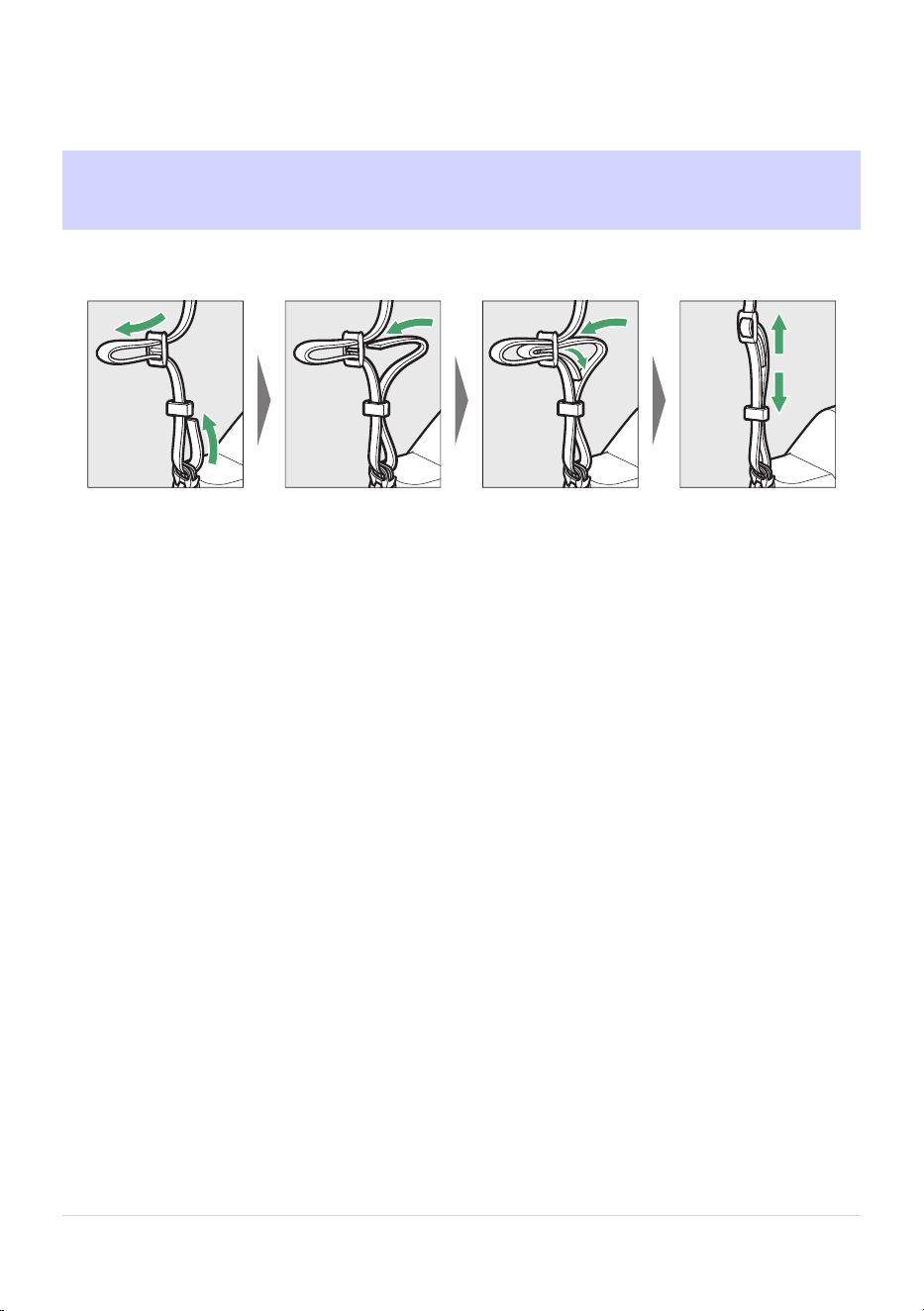
First Steps
Attaching the Strap
T
o attach a strap, follow the steps below.
86
Attaching the Strap
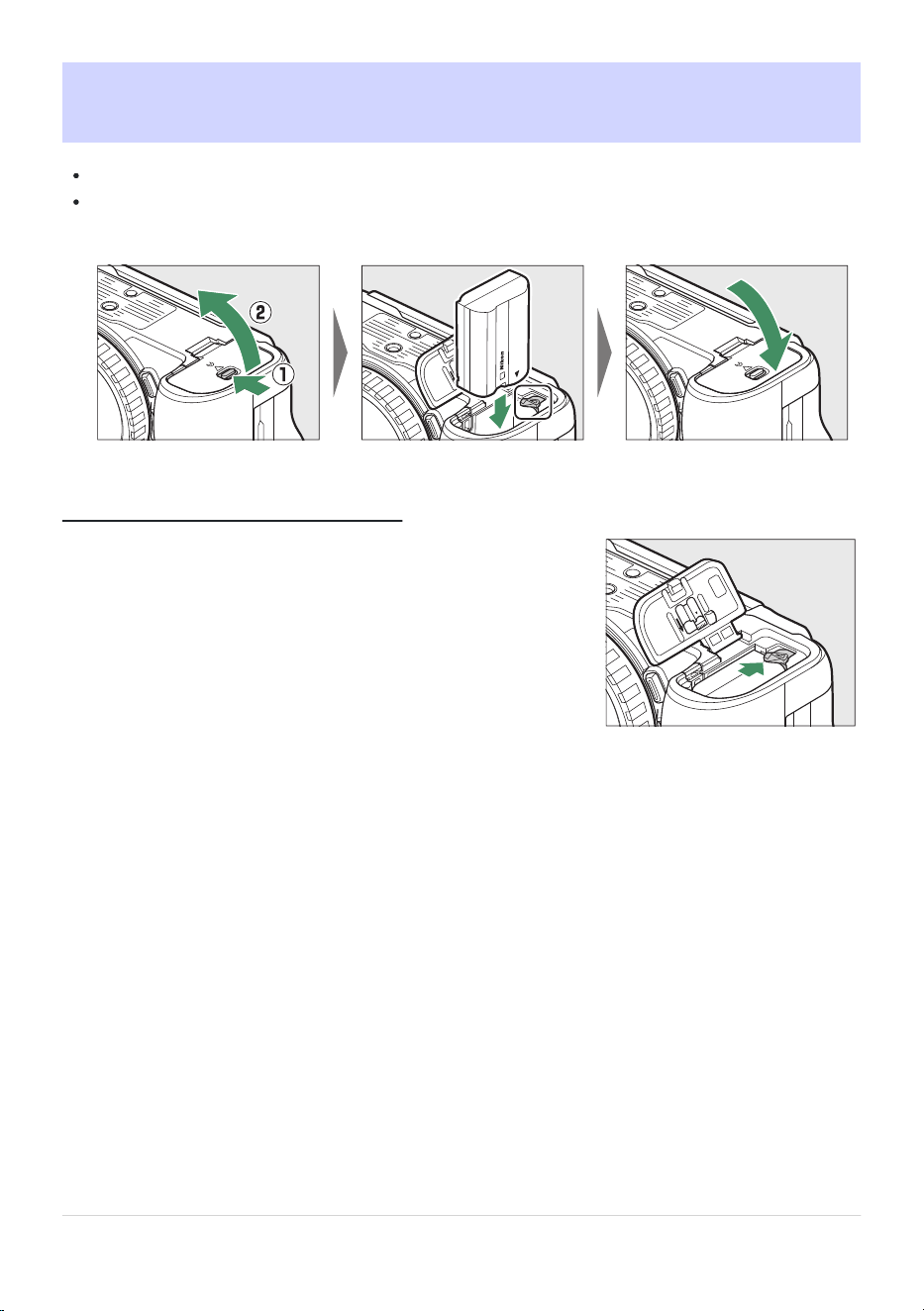
To remove the battery, turn the camera off and open the battery
chamber cover. Pr
ess the battery latch in the direction shown by the
arrow to release the battery and then remove the battery by hand.
Inserting the Battery
Turn the camera o
ff before inserting or removing the battery.
Using the battery to keep the orange battery latch pressed to one side, slide the battery into the
battery chamber until the latch locks it in place.
Removing the Battery
87
Inserting the Battery
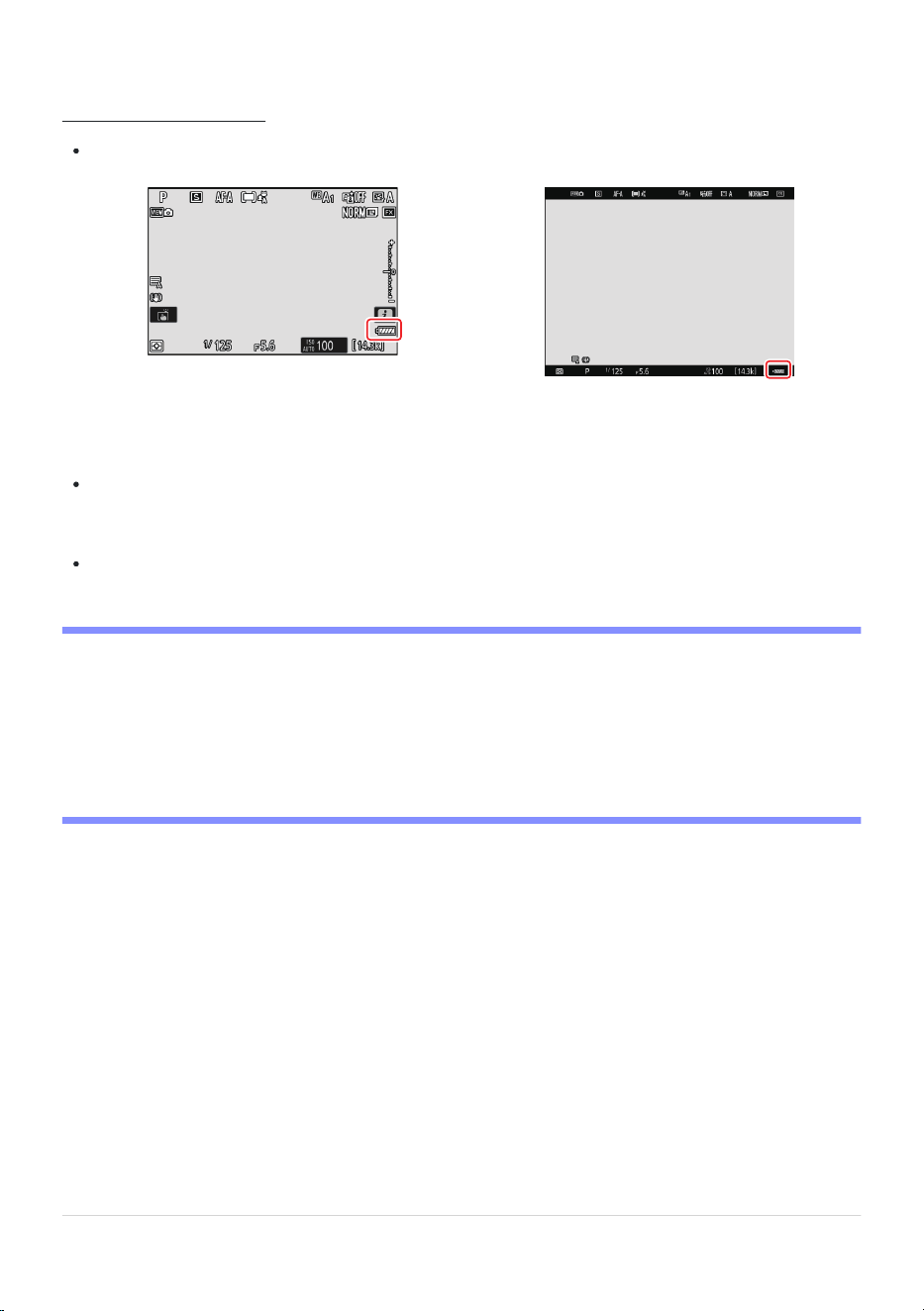
Monitor
Viewfinder
Battery Level
The batter
y level is shown in the shooting display while the camera is on.
The battery level display changes as the battery level diminishes, from L through K, J, I, and
H. When the battery level falls to H, suspend shooting and charge the battery or ready a spare
battery.
If the message [Shutter release disabled. Recharge battery.] is displayed, charge or exchange the
battery.
D The Standby Timer
The camera uses a standby timer to help reduce the drain on the battery. If no operations are
performed for about 30 seconds, the standby timer will expire and the monitor and viewfinder will turn
off. A few seconds prior to turning off, the monitor and viewfinder will dim. They can be reactivated
by pressing the shutter-release button halfway. The length of time before the standby timer expires
automatically can be selected using Custom Setting c3 [Power off delay]> [Standby timer].
88
Inserting the Battery
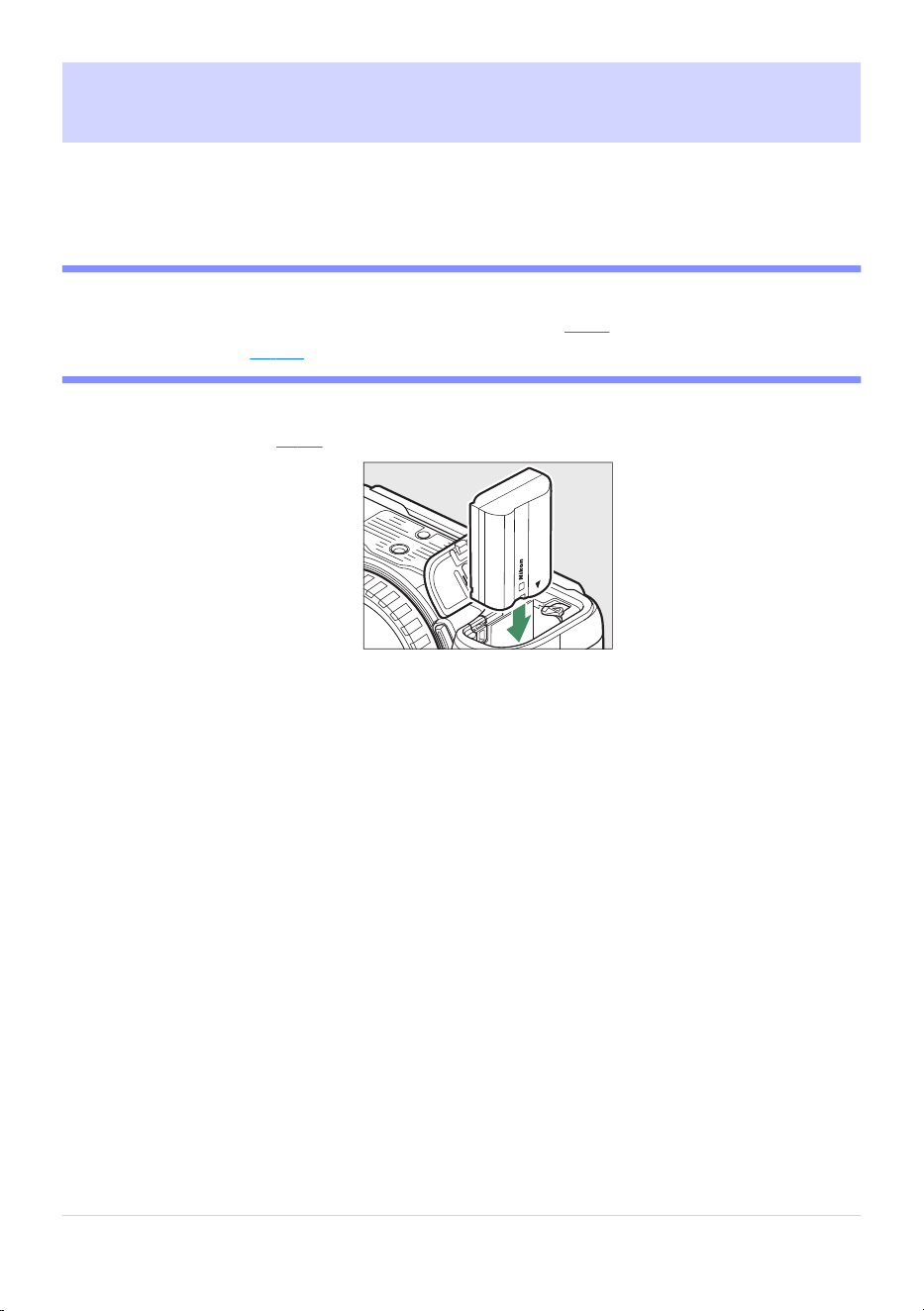
Charging the Battery
Charge the supplied EN‑EL15c rechar
geable Li-ion battery before use. The battery can be charged
while inserted in the camera by connecting the camera to an optional EH-8P AC adapter using the
supplied USB cable.
D Cautions: Using Batteries
Read and follow the warnings and cautions in “For Your Safety” (
0 34) and “Caring for the Camera
and Battery: Cautions” (
0 885).
Insert the batt
ery (
0 87).
89
Charging the Battery
1
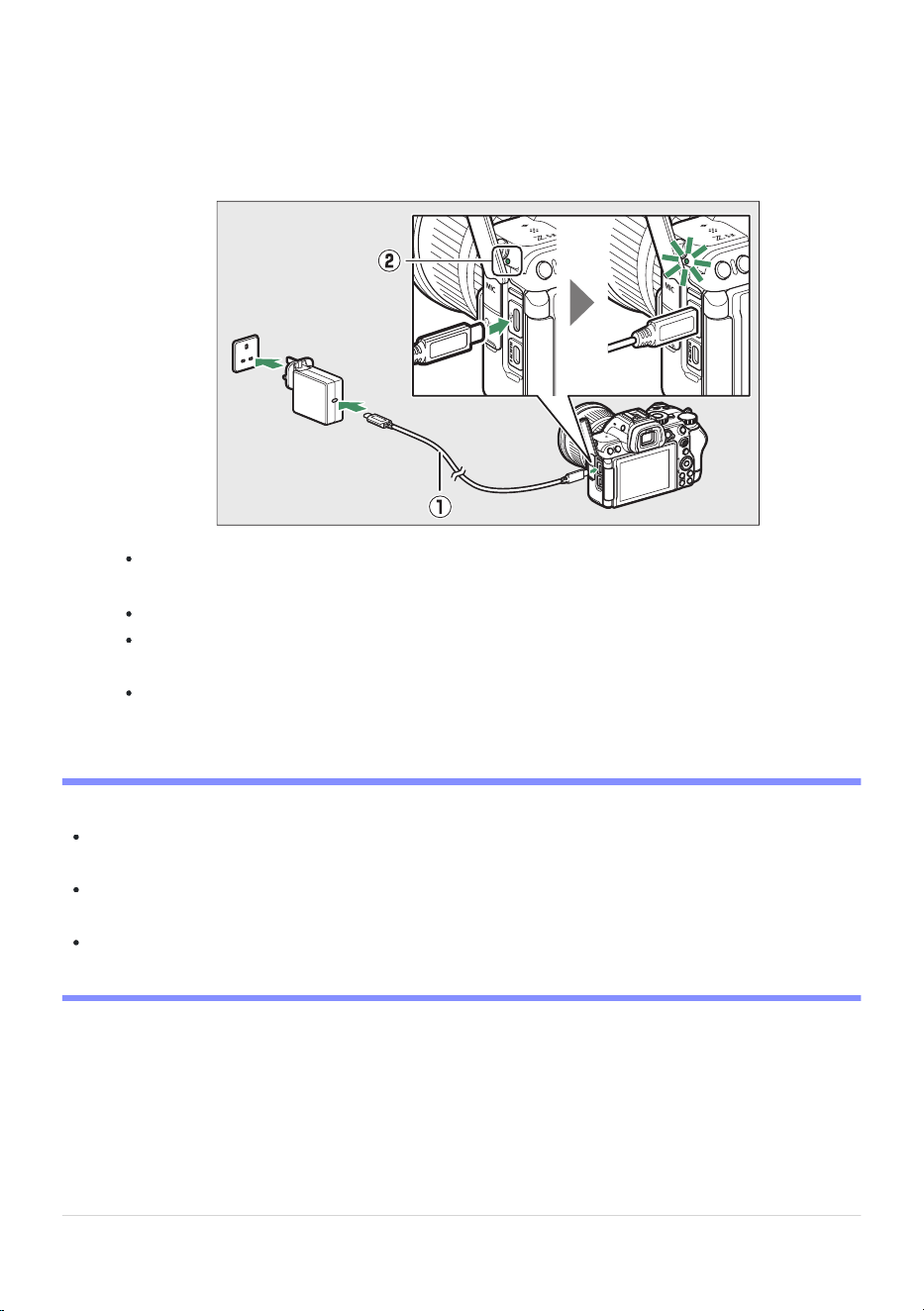
After confirming that the camera is off, connect it to an optional EH-8P AC adapter using
the supplied USB cable (q).
Plug the AC adapter int
o a household power outlet. The battery will charge while the camera is
off. Keep the plug straight during insertion and removal.
The camera charge lamp (w) lights amber while charging is in progr
ess. The lamp turns off
when charging is complete.
An exhausted battery will fully charge in about 2 hours and 30 minutes.
Disconnect the USB cable when charging is complete. Keep the connector straight when
disconnecting it from the camera.
The shape of the plug varies with the country or region of purchase.
D Cautions: Charging
Only EN‑EL15c and EN‑EL15b batteries can be charged while inserted in the camera. EN‑EL15a
batteries can be charged using an optional MH‑25a battery charger.
Charging errors caused by, for example, elevated camera temperatures or attempts to charge an
EN‑EL15a are indicated by the charge lamp flashing rapidly for about 30 seconds before turning off.
After the charge lamp turns off, we recommend that you turn the camera on (or activate the standby
timer) and confirm that the battery is charged.
90
Charging the Battery
2

Tip: Powering the Camera
If [ON] is selected for [USB pow
er delivery] in the setup menu when the camera is connected to an
optional EH-8P AC adapter, power will be supplied to the camera when the camera is on.
Power will only be supplied to the camera when the battery is inserted.
The battery will not charge while the camera is powered by an outside power source.
For more information, see “‘Power Delivery’ Versus ‘Charging’” (
0 757).
Tip: Charging with Thir
d-Party USB Type-C and PD (Power Delivery) Compatible AC Adapters
You can use third-party AC adapters to charge the camera battery. Use an AC adapter equipped
with USB Type-C connectors that supports USB PD (power delivery).
Use an AC adapter with a minimum output of 27 W (9 V/3 A).
Use a USB cable that has Type-C connectors on both ends to connect to the camera.
We do not guarantee that all third-party AC adapters and USB cables will be able to charge the
camera battery.
Tip: Charging with Third-Party USB Type-C and PD (Power Delivery) Compatible Portable
Chargers
You can use third-party portable chargers to charge the camera battery and power the camera. Use
a portable charger equipped with USB Type-C connectors that supports USB PD (power delivery).
Use a portable charger with a minimum output of 27 W (9 V/3 A).
Use a USB cable that has Type-C connectors on both ends to connect to the camera.
We do not guarantee that all third-party portable chargers and USB cables will be able to charge
the camera battery or power the camera.
Tip: Computer USB Power Delivery and Battery Charging
Computers connected via USB can supply current to power the camera or charge the battery.
The computer supplies power only while on. Charging will be suspended while the computer is in
sleep mode. It will resume when sleep mode ends.
Do not connect the computer via a USB hub or keyboard during charging. Connect it directly to the
camera.
Actual charging times may be longer depending on the computer USB connector type and
specifications.
Depending on the model and product specifications, some computers will not supply current to
power the camera or charge the battery.
91
Charging the Battery
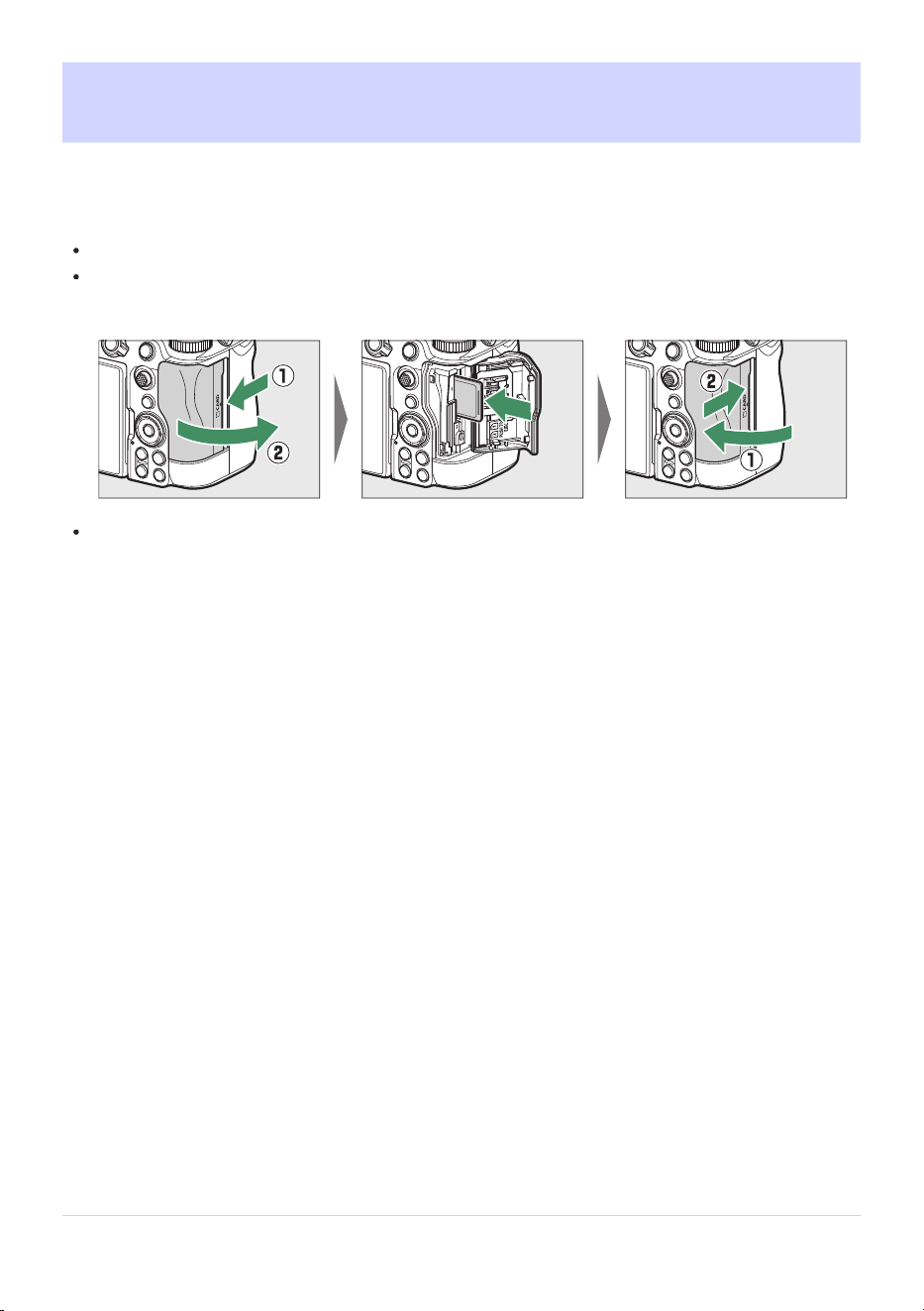
InsertingMemoryCards
The camera is equipped with two memory car
d slots (Slots 1 and 2), allowing simultaneous use of two
memory cards.
Turn the camera off before inserting or removing memory cards.
Holding the memory card in the orientation shown, slide it straight into the slot until it clicks into
place.
128
GB
If this is the first time the card will be used in the camera, format it using [Format memory car
d] in
the setup menu.
92
InsertingMemoryCards

Values over 1000 are rounded down to the nearest hundred. For
example, values between 1500 and 1599 ar
e shown as 1.5 k.
Number of Exposures Remaining
The shooting display shows the number of photographs that can be tak
en at current settings.
If no memory cards are inserted, an [–E–] indicator will be displayed.
If two memory cards are inserted, the camera displays only the number of exposures remaining
on one card. The display of exposures remaining on either memory card depends on the camera
settings below.
When [Overflow] is selected for [Role played by card in Slot 2] in the photo shooting menu,
the number of exposures remaining on the card on which the image is recorded is displayed
(
0 412).
When an option other than [Ov
er
f
low] is selected for [Role played by card in Slot 2] in the
photo shooting menu, the number of exposures remaining on the card with the least amount of
space available is displayed (
0 412).
While the shutt
er
-r
elease button is pressed halfway, the frame-count display will show the number
of pictures that can be stored in the memory buffer as “rXXX” (
0 155).
93
InsertingMemoryCards
-
-
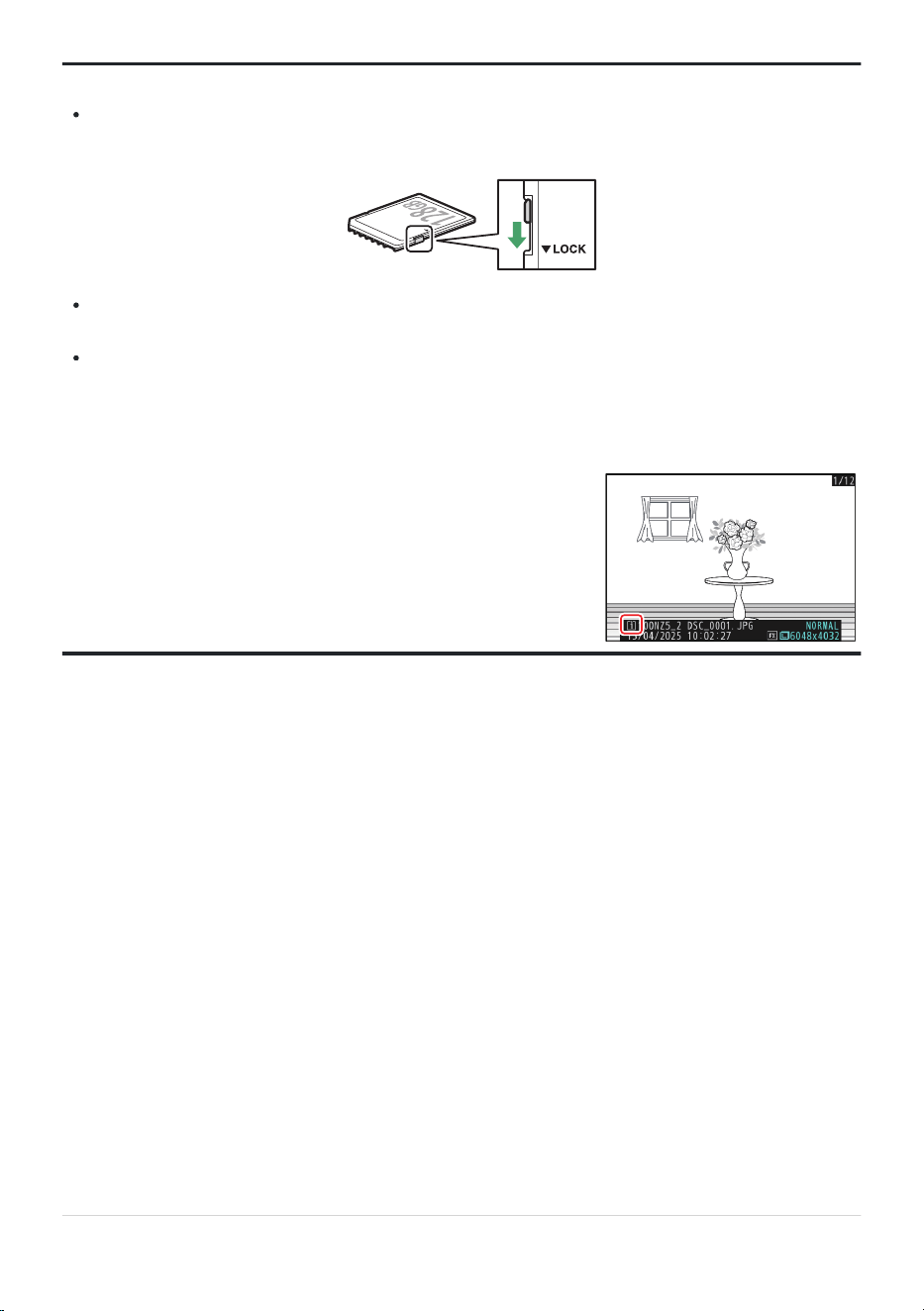
The location of the current picture is shown by an icon at the
bottom left cor
ner of the playback display.
Tip: The Write Protect Switch
SD memory cards ar
e equipped with a write-protect switch. Sliding the switch to the “lock” position
write-protects the card, protecting the data it contains.
128
A “– – –” indicator and a [Card
] warning appear in the shooting display when a write-protected card
is inserted.
If you attempt to release the shutter while a write-protected card is inserted, a warning will be
displayed and no picture will be recorded. Unlock the memory card before attempting to take or
delete pictures.
Tip: Slot Icons
94
InsertingMemoryCards
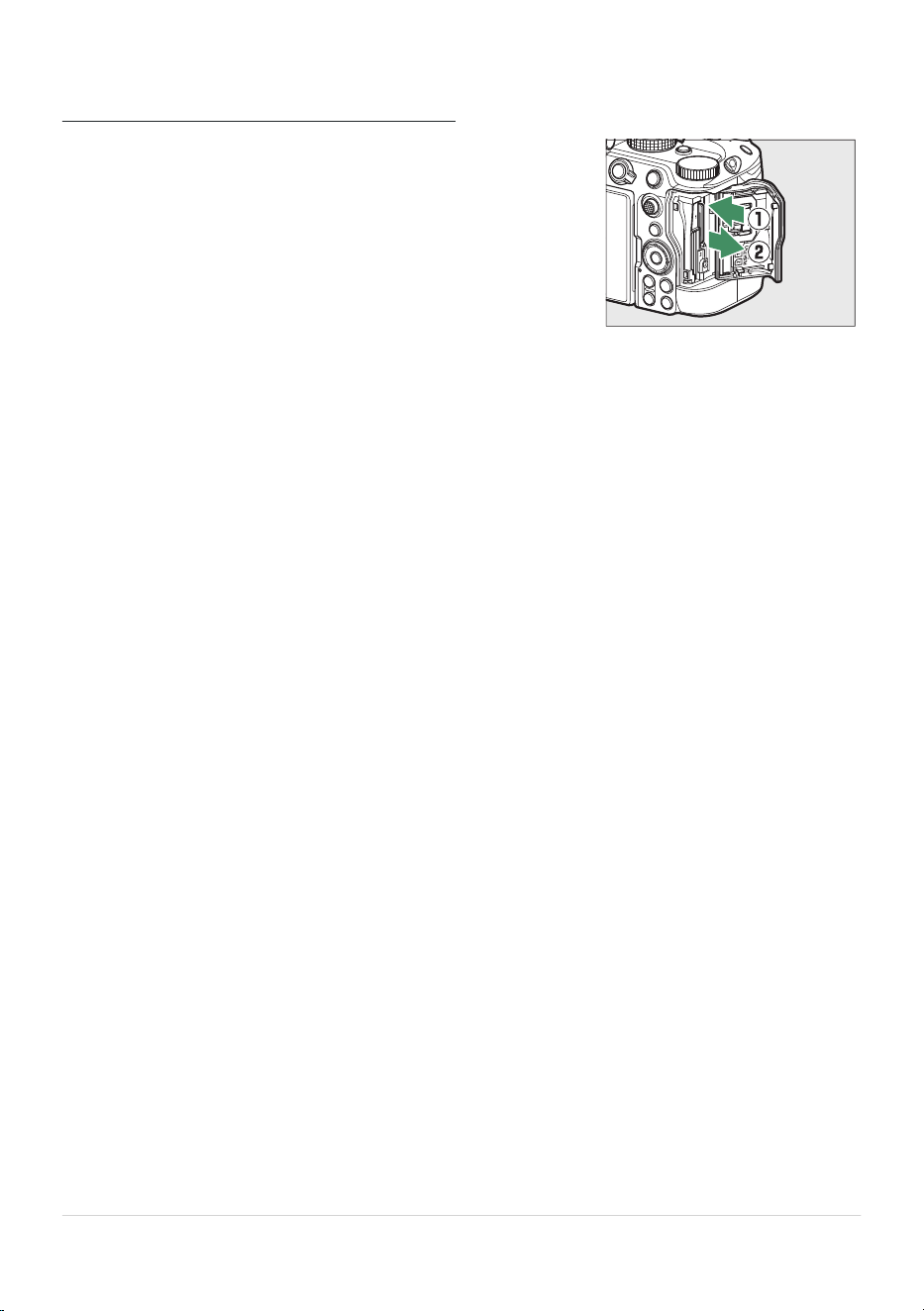
After confirming that the memory card access lamp is off, turn the
camera off, open the memor
y card slot cover, and press the card in
to eject it (q). The card can then be removed by hand (w).
128
GB
Removing Memory Cards
95
InsertingMemoryCards
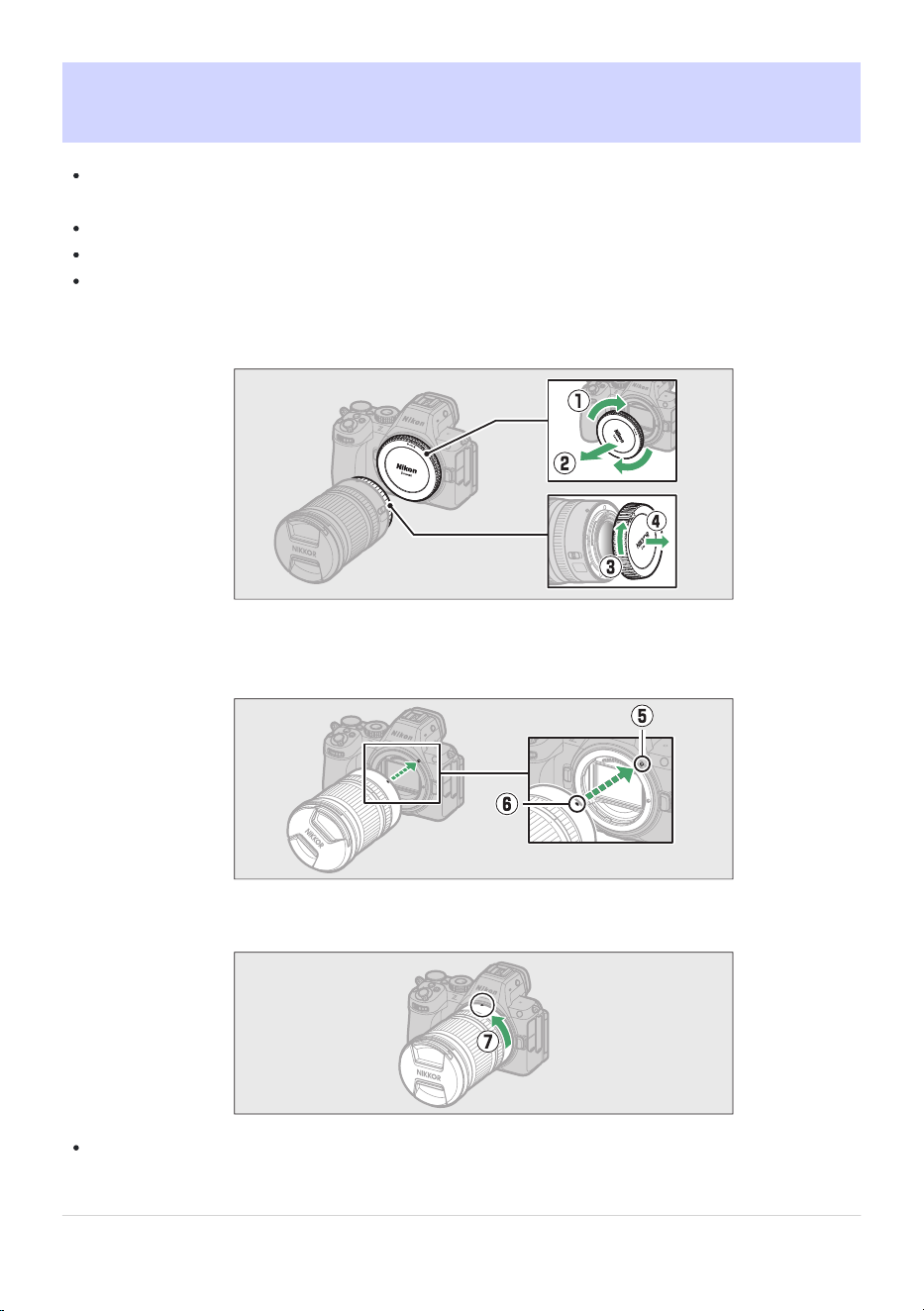
Attaching a Lens
The camera can be used with Z mount lenses. For more information on lenses, see the lens
documentation av
ailable from the Nikon Download Center.
The lens generally used in this document for illustrative purposes is a NIKKOR Z 24-70mm f/4 S.
Be careful to prevent dust entering the camera.
Confirm that the camera is off before attaching the lens.
Remove the camera body cap (q, w) and rear lens cap (e, r).
Align the mounting marks on the camera (t) and lens (y). Do not touch the image sensor or
lens contacts.
Rotate the lens as shown until it clicks into place (u).
Remove the front lens cap before taking pictures.
96
Attaching a Lens
-
-
-
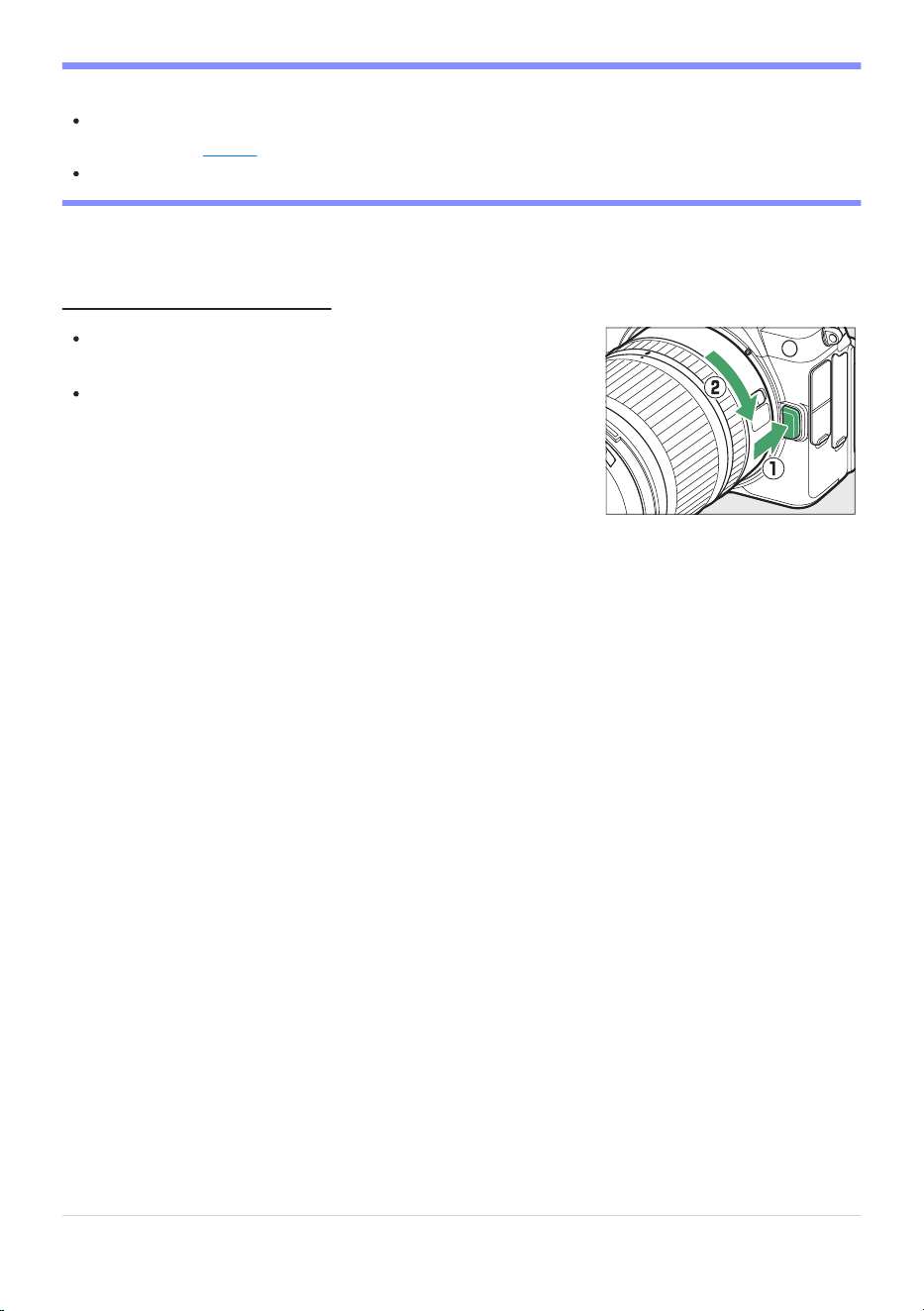
After turning the camera off, press and hold the lens release
button (q) while tur
ning the lens in the direction shown (w).
After removing the lens, reattach the lens caps and camera body
cap.
D F Mount Lenses
Be sure to attach an F
TZII or FTZ mount adapter (available separately) to the camera before using F
mount lenses (
0 865).
Attempting t
o attach F mount lenses directly to the camera could damage the lens or image sensor.
Detaching Lenses
97
Attaching a Lens
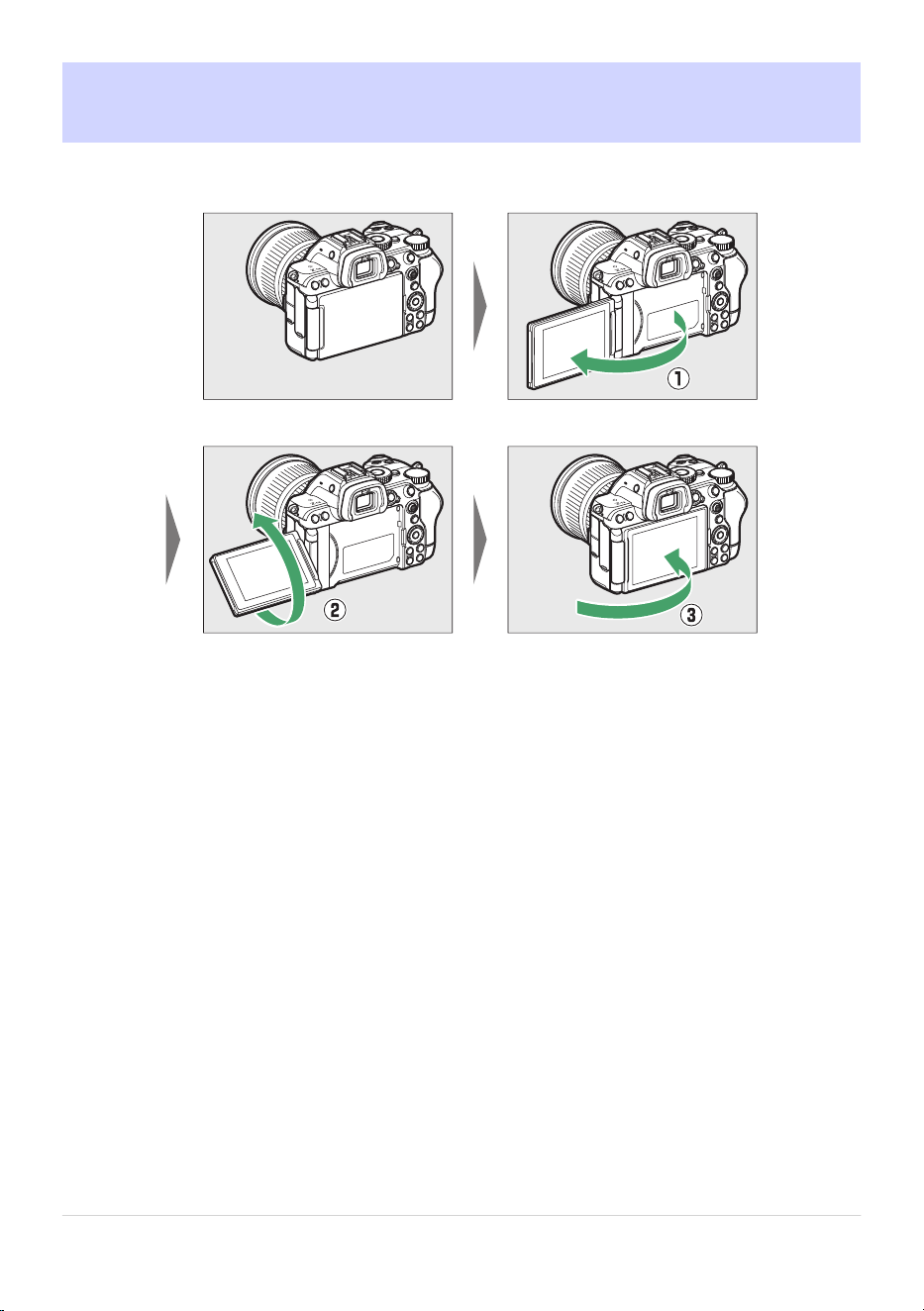
Opening the Monitor
Rotate the
monitor gently; do not use force.
98
Opening the Monitor
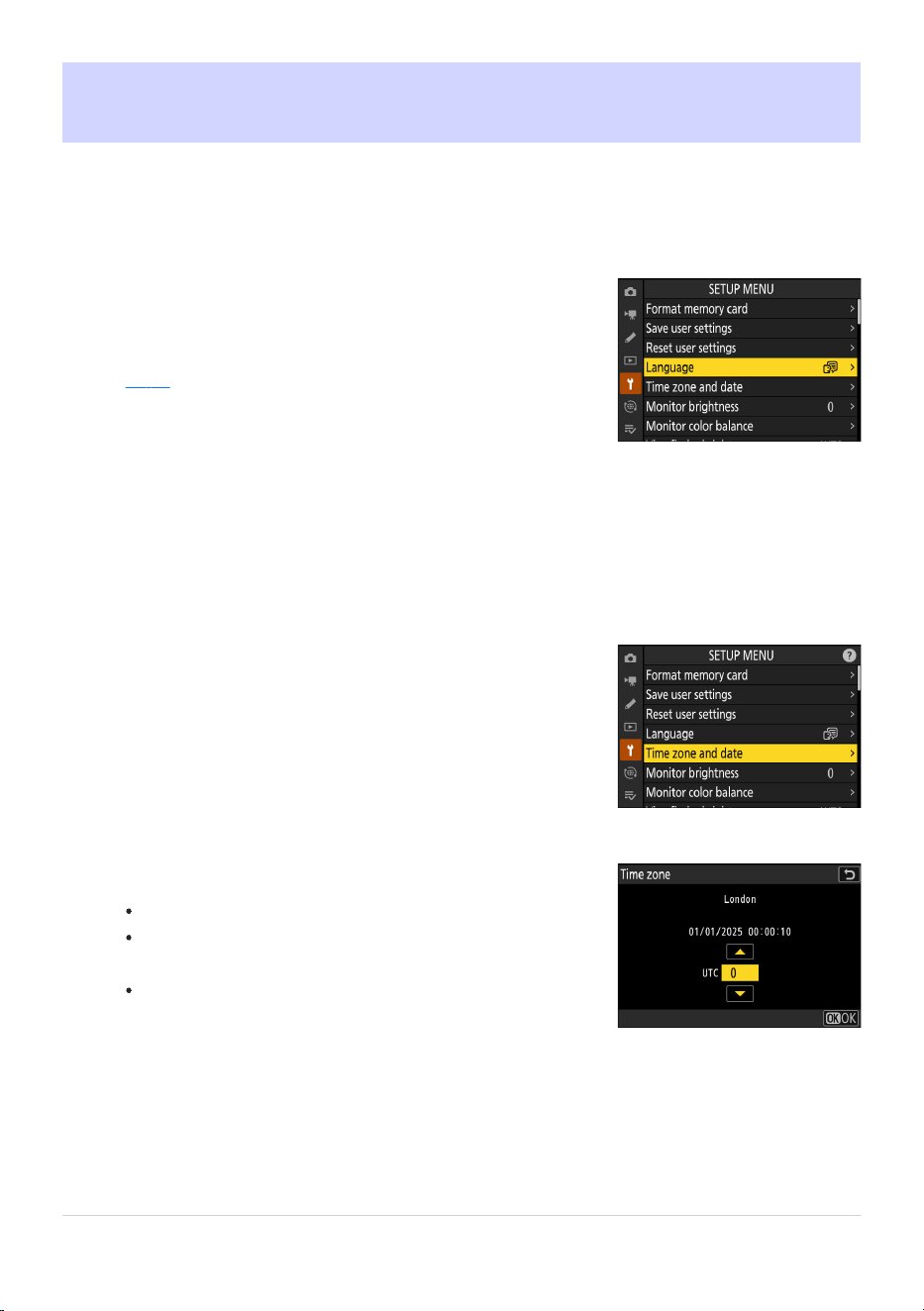
Press G, and in the setup menu highlight [Language] and
press 2
.
For information on using the menus, see “Using the Menus”
(
0 75).
Highlight [Time zone and date] and press 2.
Choose a time zone.
Select [Time zone] in the [Time zone and date] display.
The display lists select
ed cities in the chosen zone and the
difference between the time in the chosen zone and UTC.
Highlight a time zone in the [Time zone] display and press
J.
Camera Setup
Turn the camera on, choose a language, and set the clock
. Before using the camera for the first time,
follow the steps below to choose a language and time zone and set the clock so that the correct time
and date will be recorded with any pictures you take.
Select a language.
Press 1 or 3 to highlight the desired language and press J (the languages available vary with
the country or region in which the camera was originally purchased).
99
Camera Setup
1
2
3
4
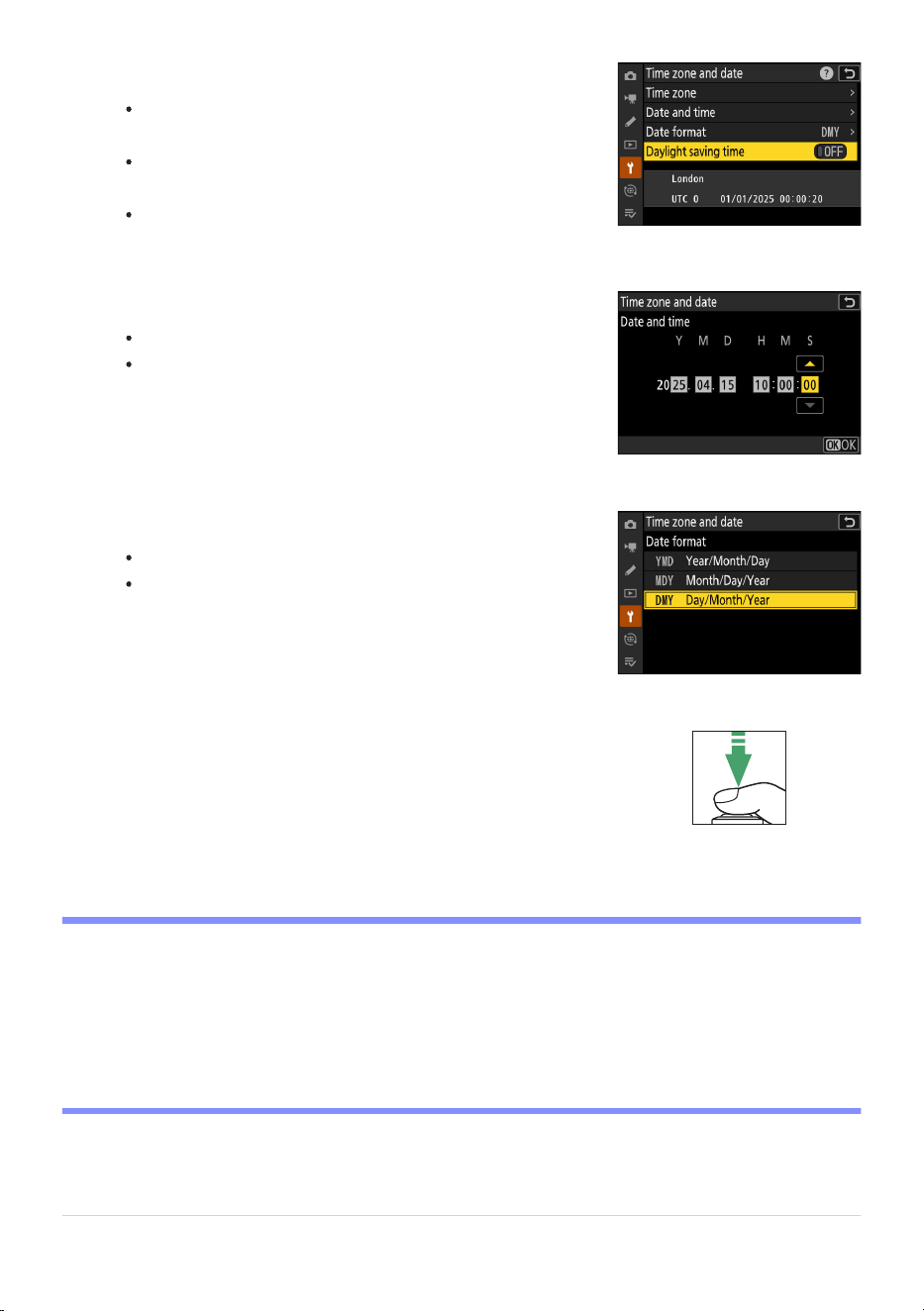
Turn daylight saving time on or off.
Select [Daylight saving time] in the [Time zone and date]
display
.
Select [ON] (daylight saving time on) or [OFF] (daylight
saving time off).
Selecting [ON] advances the clock one hour; to undo the
effect, select [OFF].
Set the clock.
Select [Date and time] in the [Time zone and date] display
.
Press J after using the multi selector to set the clock to the
date and time in the selected time zone in the [Date and
time] display (note that the camera uses a 24-hour clock).
Choose a date format.
Select [Date format] in the [Time zone and dat
e] display.
Highlight the desired date (year, month, and day) display
order and press J.
Exit the menus.
Lightly press the shutter
-release button halfway to exit to
shooting mode.
D The g Icon
A flashing g icon in the shooting display indicates that the camera clock has been reset. The date
and time recorded with new photographs will not be correct; use the [Time zone and date]> [Date
and time] option in the setup menu to set the clock to the correct time and date. The camera clock is
powered by an independent clock battery. The clock battery charges when the main battery is inserted
in the camera. It takes about 2 days to charge. Once charged, it will power the clock for about a month.
100
Camera Setup
5
6
7
8
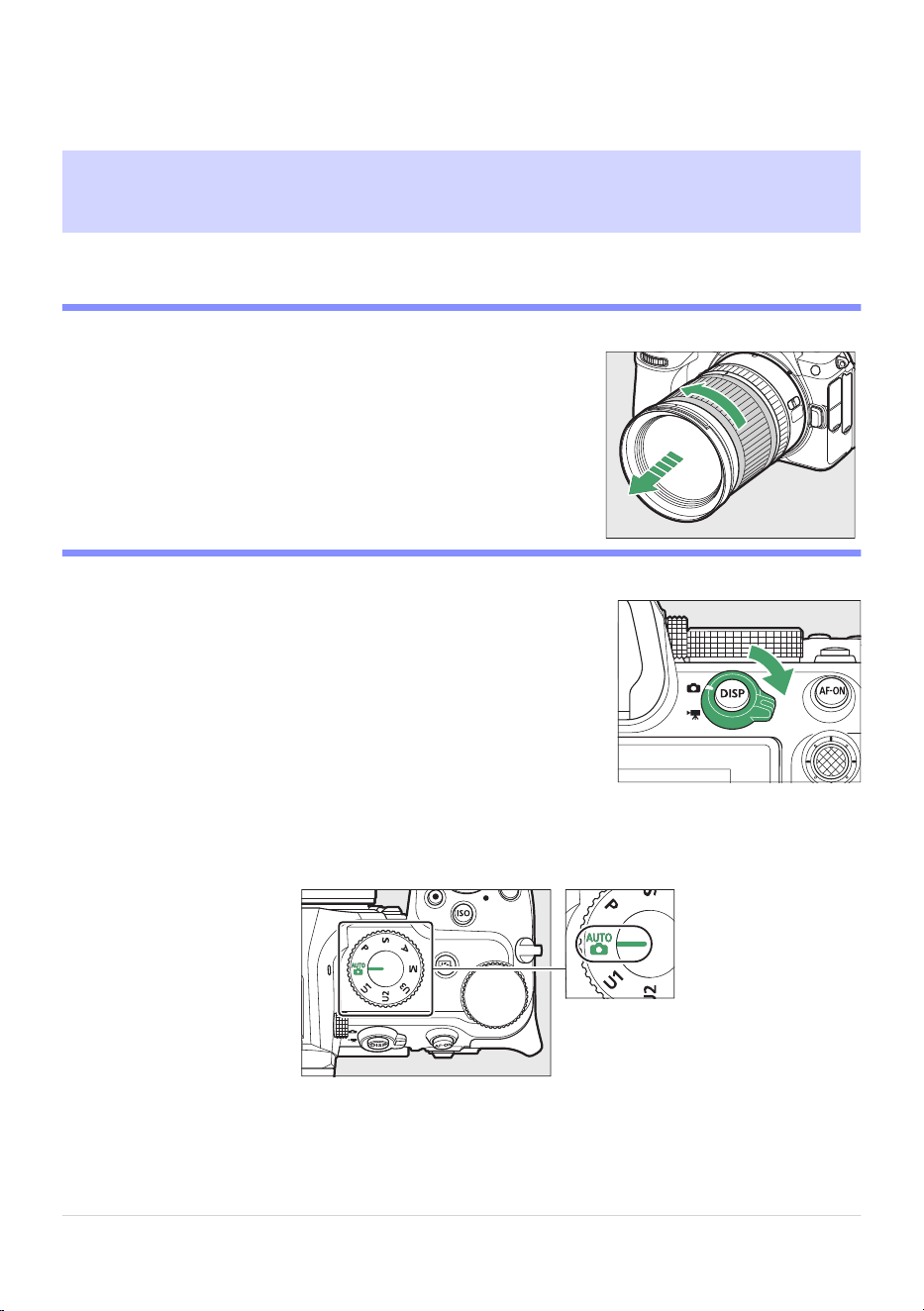
Lenses with retractable barrels must be extended before use. Rotate
the zoom ring as shown until the lens clicks into place in the
extended position.
Select photo mode by rotating the photo/video selector to
C.
Basic Photography and Playback
Taking Photographs (b
Mode)
b (auto) mode can be used for simple, “point-and-shoot” photography.
D Lenses with Retractable Barrels
Rotate the mode dial to AUTO (b).
101
Taking Photographs (b Mode)
1
2
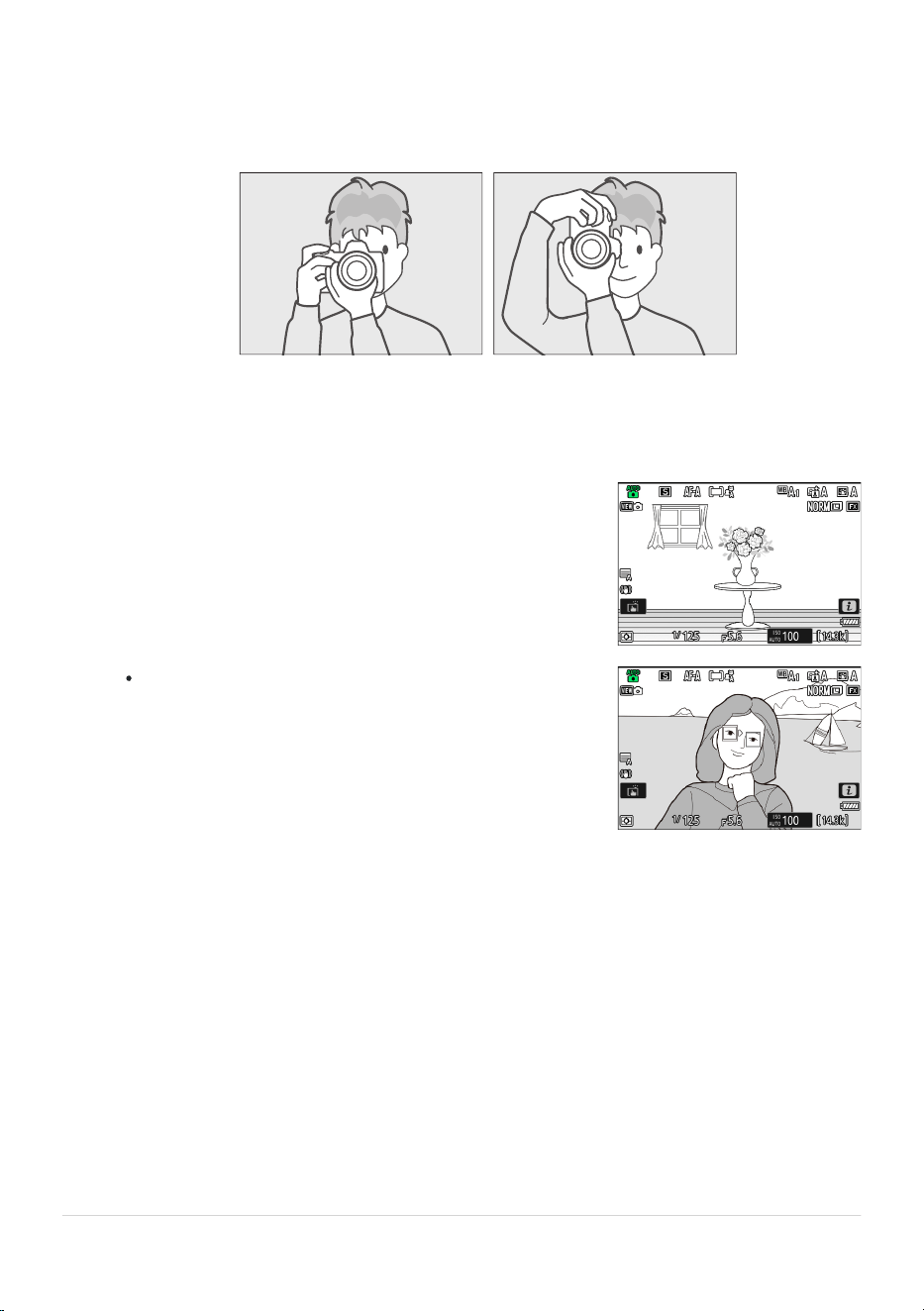
Landscape (wide) orientation Portrait (tall) orientation
Frame the photograph.
Frame your subject in the shooting display.
Human faces detected by the camera are identified by
a white border indicating the focus point. If the camera
det
ects the subject’s eyes, the focus point will instead
appear over one or the other of their eyes.
Ready the camera.
Holding the handgrip in your right hand and cradling the camera body or lens with your lef
t,
bring your elbows in against the sides of your chest.
102
Taking Photographs (b Mode)
3
4
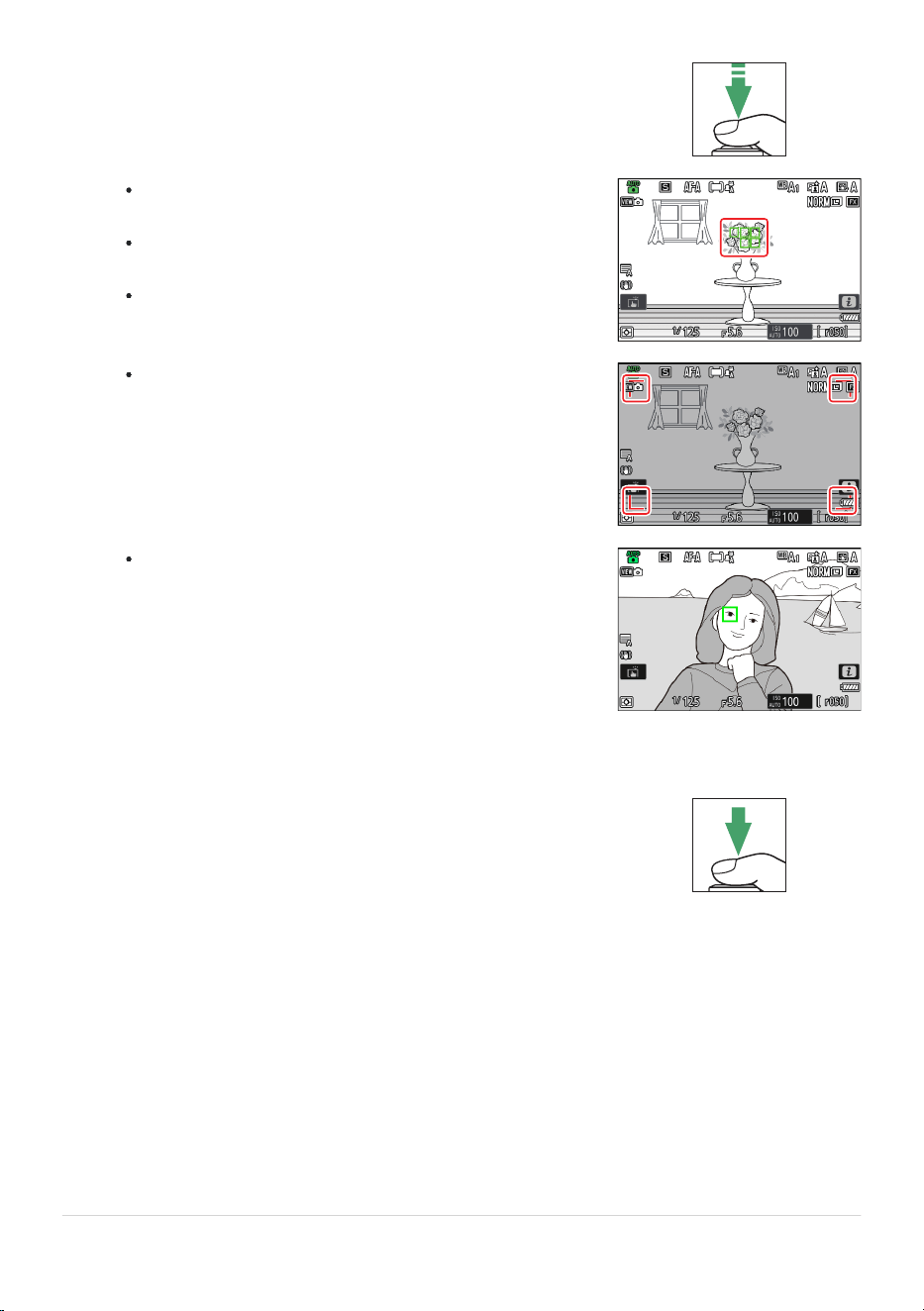
To focus, press the shutter-release button halfway (i.e.,
lightly press the shutter
-release button, stopping when it
is pressed halfway).
The focus point will be displayed in green when the subject
is in focus.
The AF-assist illuminator may light to assist the focus
operation if the subject is poorly lit.
Y
ou can also focus by pressing the AF-ON button.
If the camera is unable to focus, the out-of-focus indicator
will flash red.
The focus point will turn green if the camera is able to focus
after det
ecting the face or eyes of a human portrait subject.
If the camera is unable to focus, the focus point will flash
red.
Without lifting your finger from the shutter-release
butt
on,
pr
ess the button the rest of the way down to take
the picture.
103
Taking Photographs (b Mode)
5
6
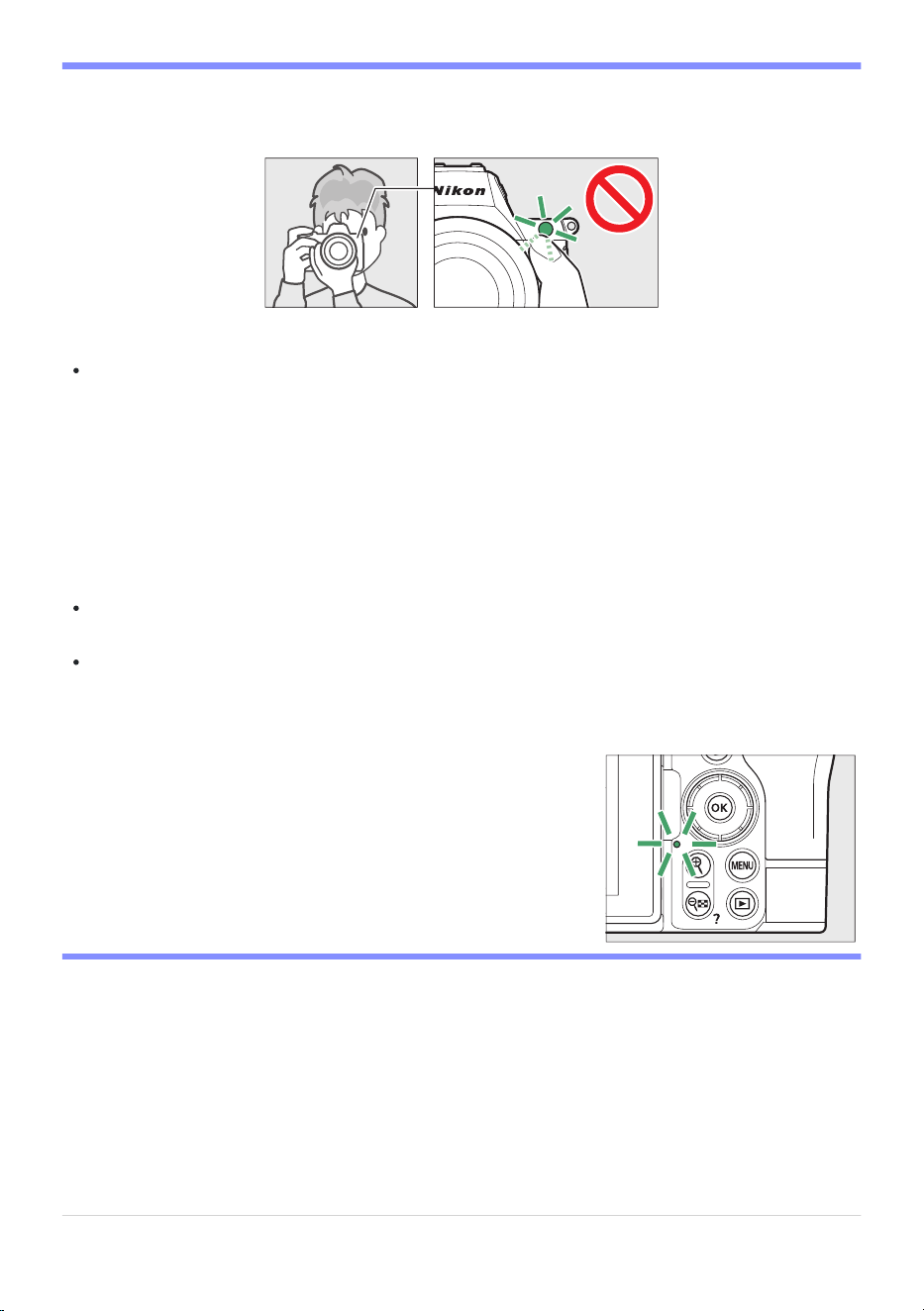
The memory card access lamp will light while the photograph is
being recorded. Do not r
emove the memory card or battery.
D The AF-Assist Illuminator
Do not obstruct the AF-assist illuminator while it is lit.
D Cautions: Taking Photographs
Y
ou may notice the following in the shooting display. These phenomena will also be visible in any
photos taken with the camera:
flicker or banding in scenes lit by such sources as fluorescent, mercury vapor, or sodium lamps,
distortion during motion (individual subjects such as trains or cars moving at high speed through
the frame may be distorted, or the entire frame may appear distorted when the camera is
panned horizontally),
jagged edges, color fringing, moiré, or bright spots, or
bright regions or bands in scenes lit by flashing signs and other intermittent light sources or
when the subject is briefly illuminated by a strobe or other bright, momentary light source.
Note that noise (randomly-spaced bright pixels, fog, or lines) and unexpected colors may appear if
you use the X button to zoom in on the view through the lens.
Avoid pointing the camera at the sun or other powerful light sources during shooting. Failure to
observe this precaution could result in damage to the camera’s internal circuitry.
D The Memory Card Access Lamp
104
Taking Photographs (b Mode)
-
-
-
-
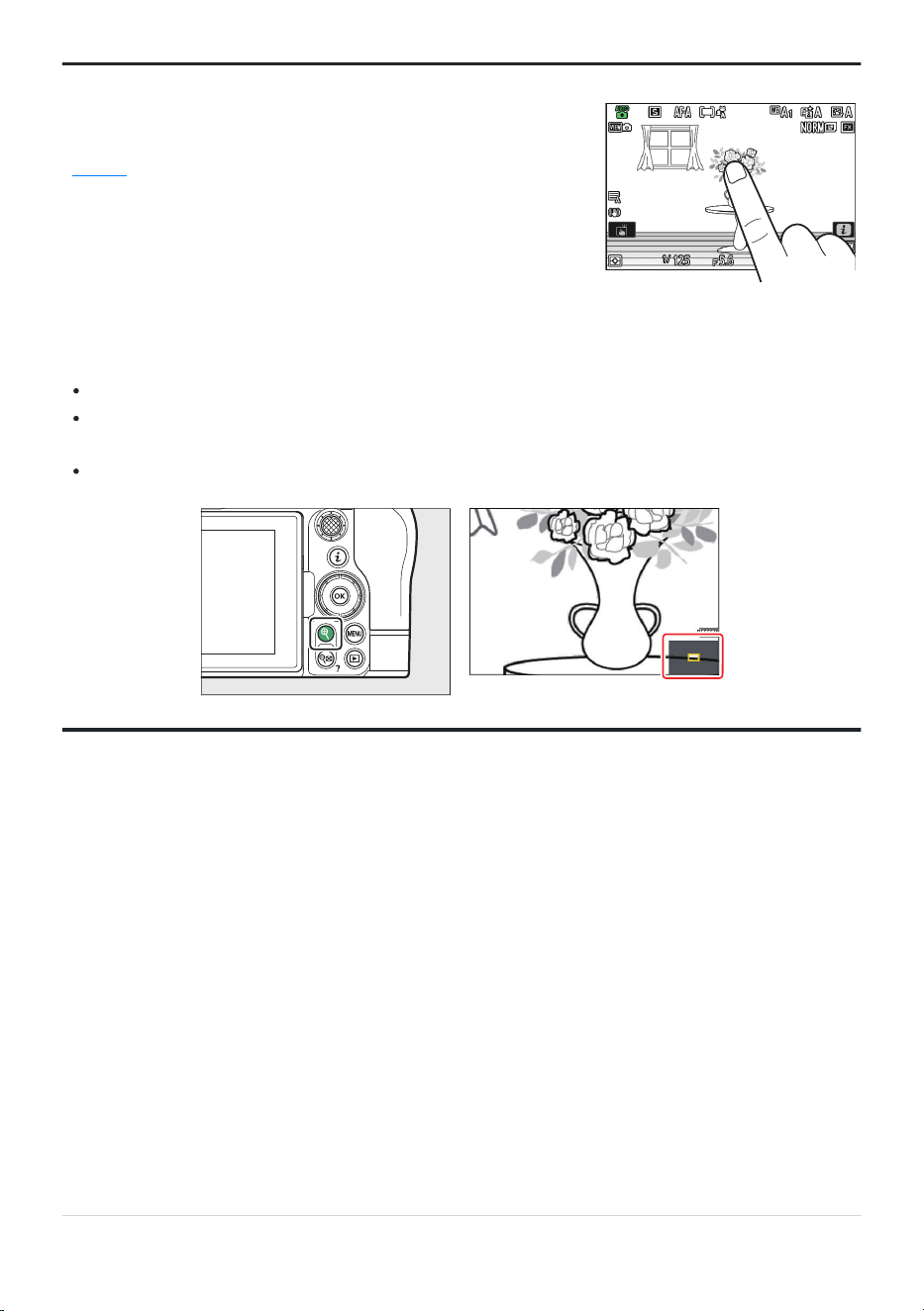
You can also take a photograph by touching the monitor. Touch
your subject to focus and lif
t your finger to release the shutter
(
0 131).
Tip: The Touch Shutter
Tip: Using Zoom in Photo Mode
T
o zoom in on the display in photo mode (to a maximum of approximately 16×), press the X button.
Use the X and W (Q) buttons to zoom in and out.
A navigation window showing the area currently visible will appear at the bottom right corner of the
display.
Use the multi selector to scroll to areas of the frame not visible in the monitor.
105
Taking Photographs (b
Mode)
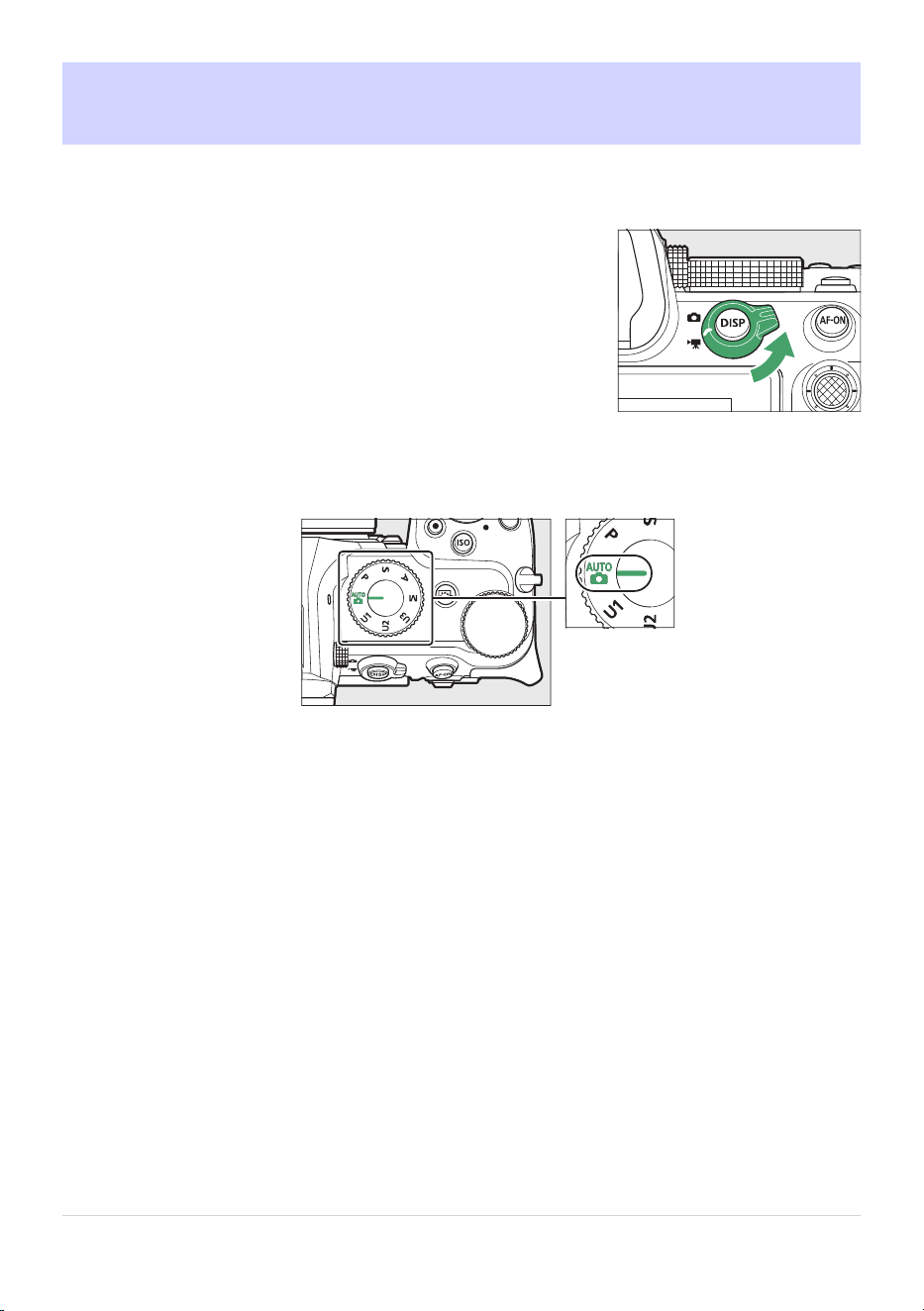
Select video mode by rotating the photo/video selector to
1.
Note that optional flash units cannot be used when the camera
is in video mode.
Recording Videos (b Mode)
b (auto) mode can be used for simple, “point
-and-shoot” video recording.
Rotate the mode dial to AUTO (b).
106
Recording Videos (b Mode)
1
2
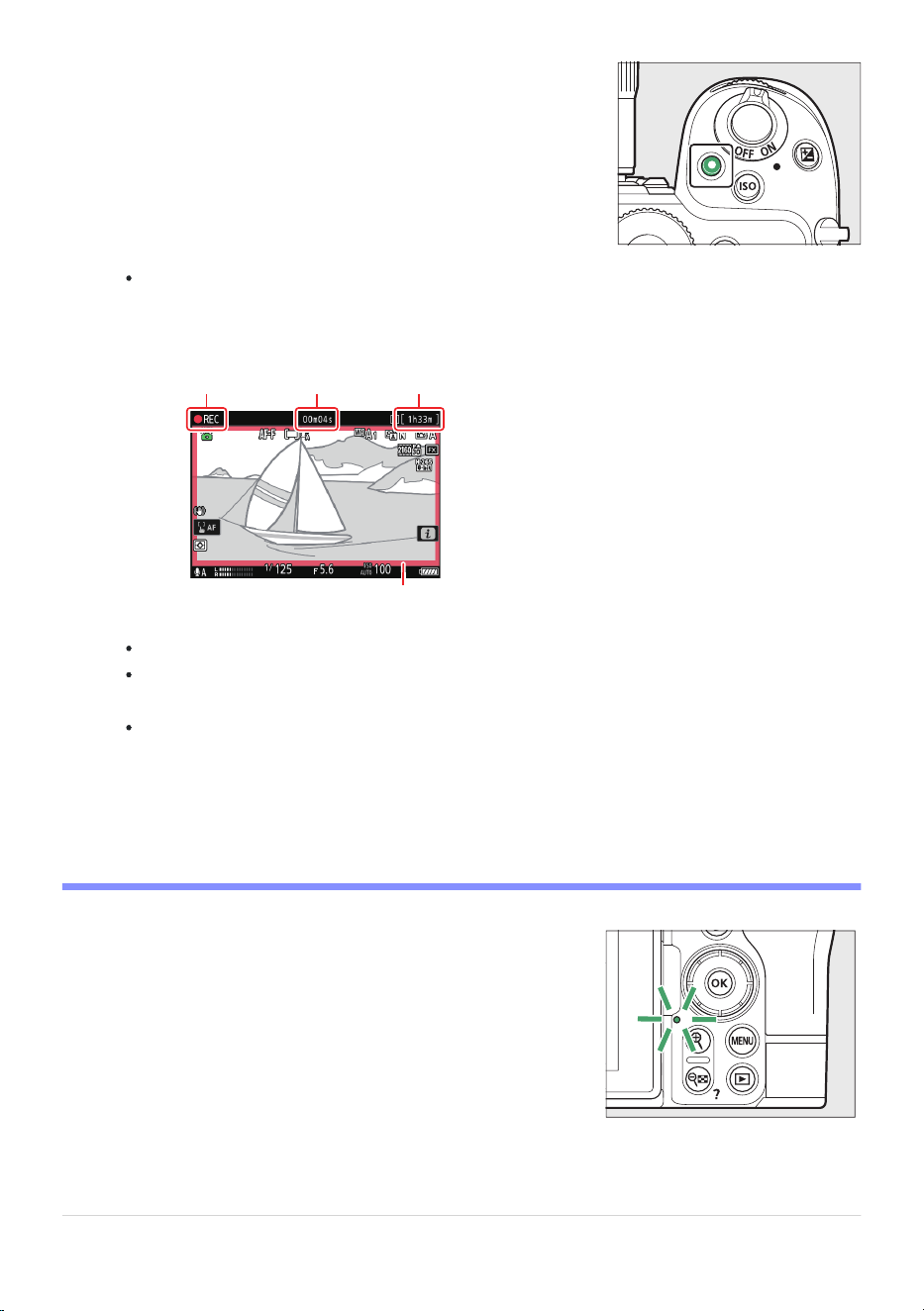
Press the video-record button to start recording.
1 2
4
3
Recording indicator
Video recording time (length o
f
footage recorded)
Available recording time
Recording indicator (red border)
1
2
3
4
The memory card access lamp will light while the video is being
recorded. Do not r
emove the memory card or battery.
A recording indicator will be displayed and the borders of the shooting display will turn red.
The display also shows the time remaining, or in other wor
ds the approximate amount of
new footage that can be recorded to the memory card.
The camera can be refocused during recording by pressing the AF-ON button.
Sound is recorded via the built-in microphone. Do not cover the microphone during
recording.
You can also focus by tapping your subject in the monitor.
Press the video-record button again to end recording.
D The Memory Card Access Lamp
D The 0 Icon
A 0 icon indicates that videos cannot be recorded.
107
Recording Videos (b Mode)
3
4

D Cautions: Recording Videos
Video r
ecording will end automatically if:
the maximum length is reached,
the battery is exhausted,
you choose a different shooting mode,
you switch modes using the photo/video selector,
the lens is removed, or
the camera’s internal temperature rises.
Sounds made by the camera may be audible in footage recorded:
during autofocus,
during vibration reduction,
when power aperture is used, or
when power zoom is used.
D High-Temperature Warnings
If the camera becomes hot, a high-temperature warning (K) may appear in the shooting display. Note
that the camera body and battery may be hot while the high-temperature warning (K) is displayed.
D Cautions: Video Recording
You may notice the following in the shooting display. These phenomena will also be visible in any
footage recorded with the camera:
flicker or banding in scenes lit by such sources as fluorescent, mercury vapor, or sodium lamps,
distortion during motion (individual subjects such as trains or cars moving at high speed through
the frame may be distorted, or the entire frame may appear distorted when the camera is
panned horizontally),
jagged edges, color fringing, moiré, or bright spots,
bright regions or bands in scenes lit by flashing signs and other intermittent light sources or
when the subject is briefly illuminated by a strobe or other bright, momentary light source, or
flicker when power aperture is used during video recording.
Note that noise (randomly-spaced bright pixels, fog, or lines) and unexpected colors may appear if
you use the X button to zoom in on the view through the lens.
When recording, avoid pointing the camera at the sun or other powerful light sources. Failure to
observe this precaution could result in damage to the camera’s internal circuitry.
108
Recording Videos (b Mode)
-
-
-
-
-
-
-
-
-
-
-
-
-
-
-

Tip: Using Display Zoom in Video Mode
The X button can also be used to zoom in on the display in video mode (
0 105).
Press X during recor
ding to zoom in 50%, 100% (1 : 1), 200%, or 400%. To zoom out, press W (Q).
Note, however, that 50% zoom is not available at a frame size of 1920× 1080.
Zoom is not available during RAW recording (
0 219).
When viewing videos, you can zoom in on the current frame when playb
ack is paused.
109
Recording Videos (b Mode)

Press the K button t
o view photos and videos in the monitor or
viewfinder after shooting.
Press 4 or 2 or flick lef
t or right t
o view additional pictur
es.
Videos are indicated by a 1 icon at the top left cor
ner of the
display. Tap the a icon in the display or press J to start playback.
Playback
To end playback and r
eturn to shooting mode, press the shutter-release button halfway.
110
Playback
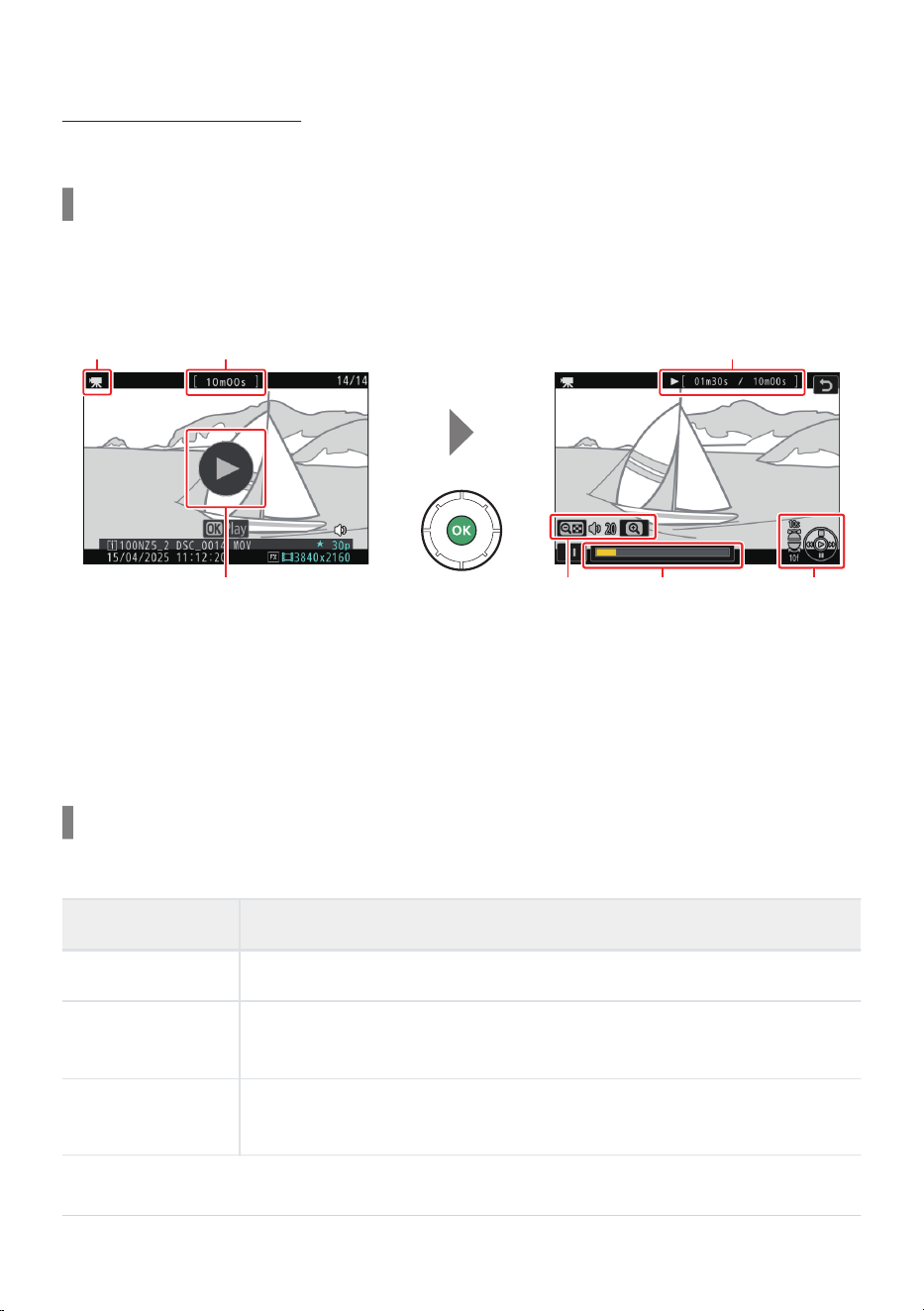
1 2
3
4
5 76
1 icon
Length
a icon
1
2
3
Current position/t
otal
length
Volume
Progr
ess bar
Guide
4
5
6
7
Viewing Videos
The video playback display and controls ar
e described below.
The Video Playback Display
During video playback, the display shows the length of the video, the current playback position, and
the other indicators listed below. Your approximate position in the video can also be ascertained from
the video progress bar.
Video Playback Controls
The following operations can be performed while playback is in progress:
Operation Description
Pause
Press 3 t
o pause playback.
Resume
Pr
ess J t
o resume playback when playback is paused or during rewind/
advance.
R
ewind/
advance
Press 4 to r
ewind, 2 t
o advance. Speed increases with each press, from 2×
to 4× to 8× to 16×.
111
Playback

Operation Description
Start slow-motion
playback
Press
3 while the video is paused to star
t slow-motion playback.
Jog rewind/
advance
Press
4 or 2 while the video is paused to r
ewind or advance one frame at
a time.
Keep 4 or 2 pressed for continuous rewind or advance.
Skip 10 s Rotate the sub-command dial one stop to skip ahead or back 10s.
Skip 10 frames Rotate the main command dial one stop to skip ahead or back 10 frames.
Skip to first or last
frame
Keep 4 or 2 pr
essed t
o skip r
espectively to the first frame or last frame.
The first frame is indicated by a h in the top right corner of the display,
the last frame by a i.
Zoom in
Press X t
o zoom in on the current frame while playback is paused.
Adjust volume
Pr
ess X t
o increase volume, W (Q) to decrease.
Edit video
To display the video i menu, p
ause playback and pr
ess the i button.
Exit
Press 1 to exit to full-frame playback.
112
Playback
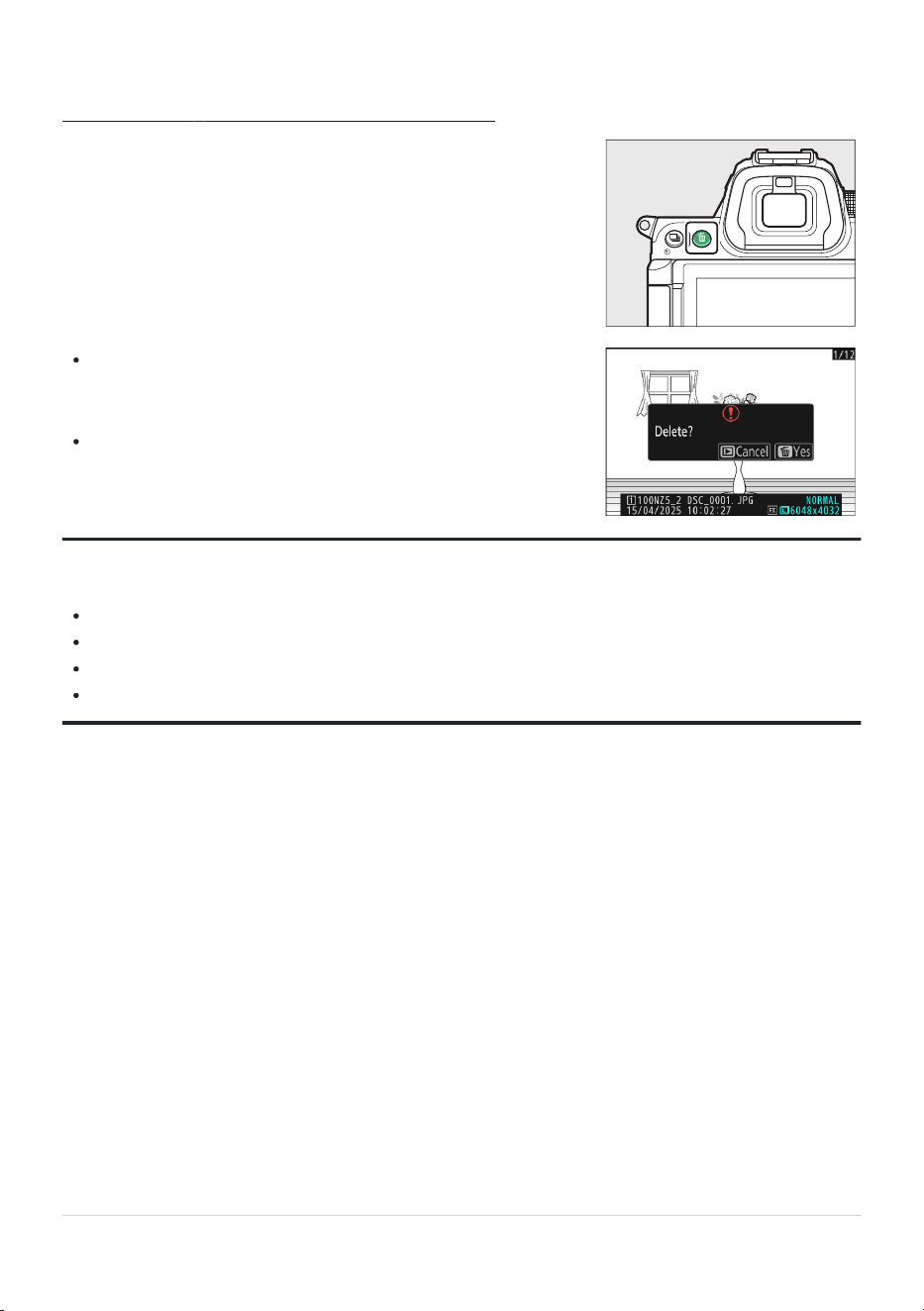
Press the O button to delet
e the current picture. Note that pictures
cannot be recovered once deleted.
Display a picture you want to delete and press the O
butt
on t
o
display a confirmation dialog. Press the O button again to delete
the picture and return to playback.
To exit without deleting the picture, press K.
Deleting Unwanted Pictures
Tip: The Playback Menu [Delet
e] Item
Use [Delete] in the playback menu to:
delete multiple pictures,
delete all pictures currently rated d (candidate for deletion),
delete all pictures taken on selected dates, or
delete all pictures in selected folders.
113
Playback
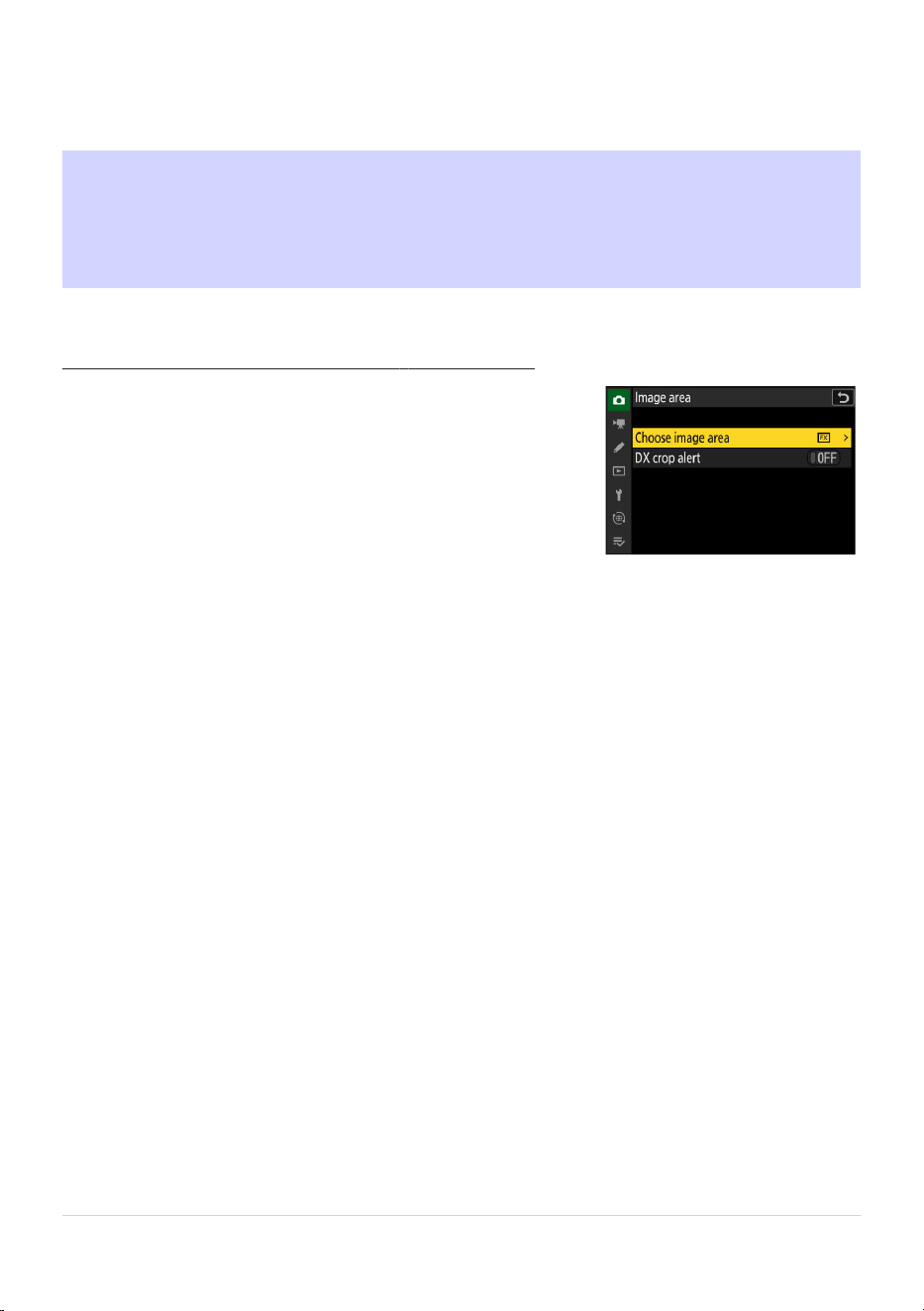
Image area settings can be displayed by selecting [Image area] in
the phot
o shooting menu.
Shooting Settings
Image Recording Options (Image Ar
ea,
Quality, and Size)
Adjusting Image Area Settings
114
Image Recording Options (Image Area, Quality,
and Size)
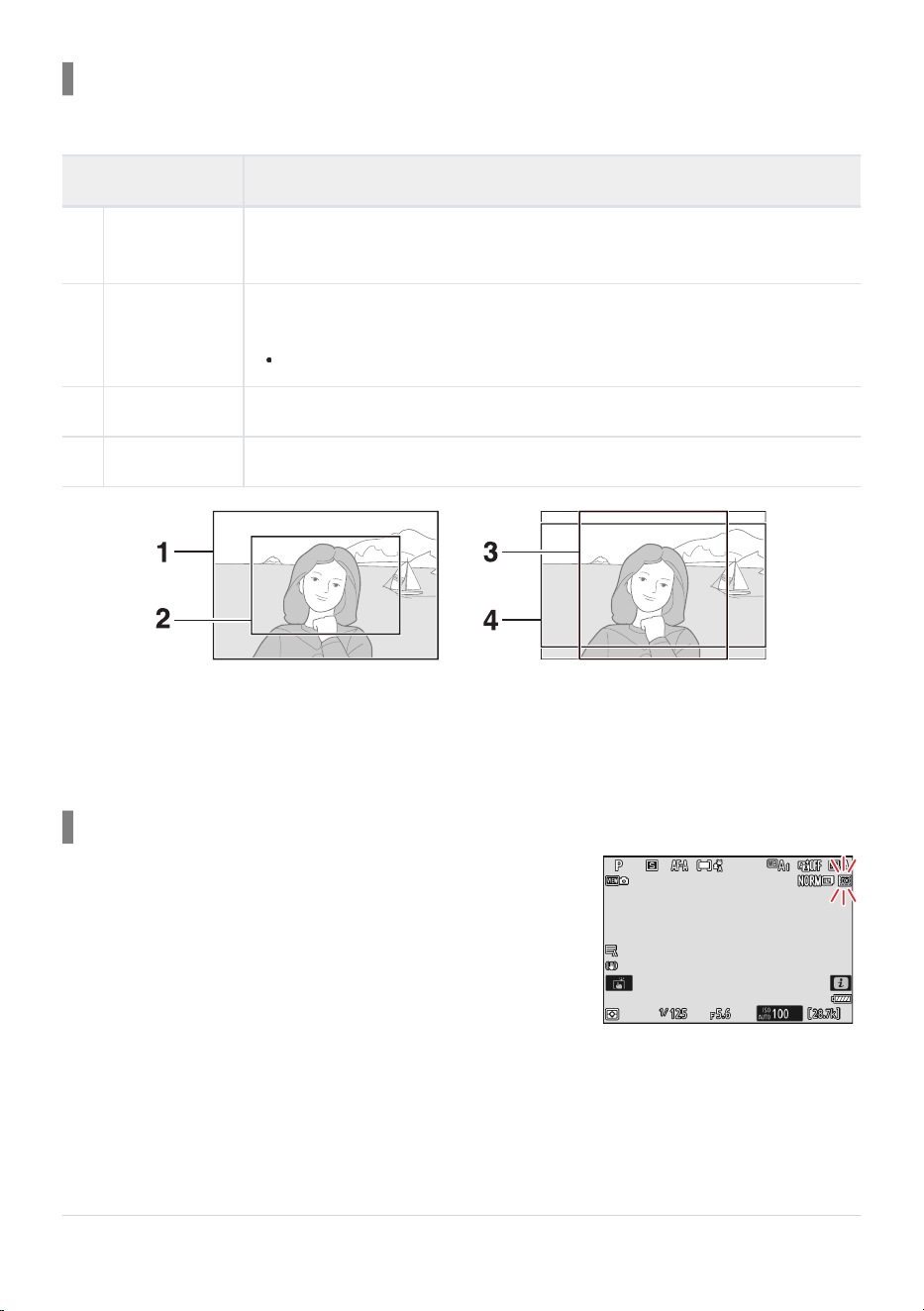
FX (36× 24)
DX (24× 16)
1 : 1 (24× 24)
16 : 9 (36× 20)
1
2
3
4
If [ON
] is selected for this option in the camera menus, the image
area icon in the shooting display will flash when “DX (24×16)” is
selected.
Choose image area
Choose the image area. The following options are av
ailable:
Option Description
c
[FX (36×24)]
Record pictures in FX format with an angle of view equivalent to a 35mm
format camera.
a
[D
X (24×16)]
Pictures are recorded in DX format. To calculate the approximate focal length
of the lens in 35mm format, multiply by 1.5.
Image-area selection is fixed at [DX (24×16)] when a DX lens is attached.
m
[1:1 (24×24)] Pictures are recorded with an aspect ratio of 1 : 1.
Z
[16:9 (36×20)] Pictures are recorded with an aspect ratio of 16 : 9.
DX crop alert
115
Image Recording Options (Image Area, Quality,
and Size)
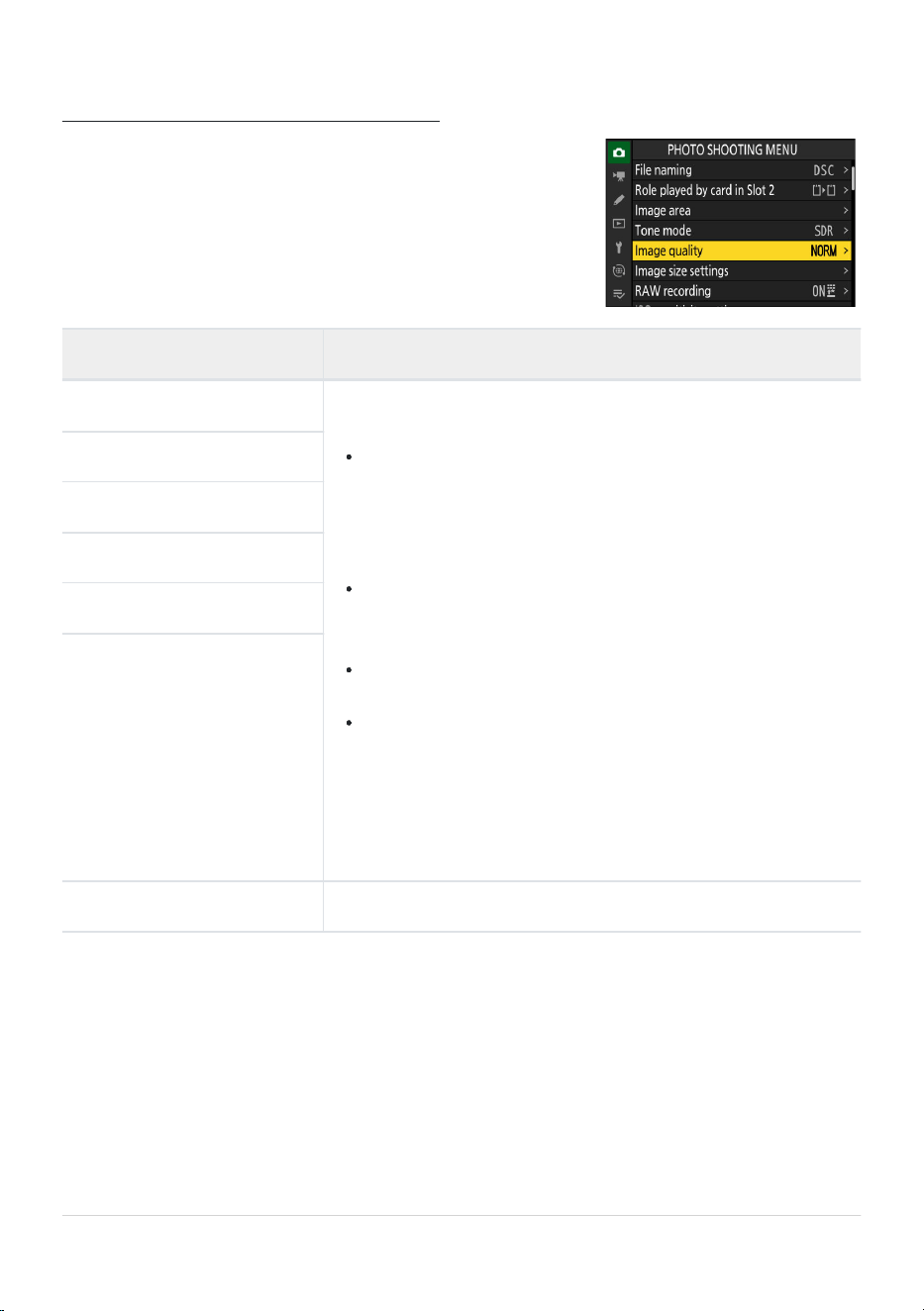
Use the [Image quality] item in the photo shooting menu t
o
choose the image quality option employed when photographs are
recorded.
Adjusting Image Quality
Option Description
[RA
W+ JPEG/HEIF finem]
R
ecord two copies of each photo: an NEF (RAW) picture and either
a JPEG or HEIF copy.
When [SDR] is select
ed for [Tone mode] in the photo shooting
menu, the camera will record an NEF (RAW) picture and a JPEG
copy. When [HLG] is selected for [Tone mode] in the photo
shooting menu, the camera will record an NEF (RAW) picture
and an HEIF copy.
The highest-quality JPEG and HEIF copies are produced by
options ending in “fine m”, with quality progressively declining
through “fine”, “normal m”, “normal”, “basic m”, and “basic”.
The camera displays only the JPEG or HEIF copy of dual-format
pictures taken with one memory card inserted.
Deleting the JPEG or HEIF copy on the camera will also delete
the NEF (RAW) picture if the photo was taken when:
Only one memory card was inserted, or
Two memory cards were inserted and [Overflow] or
[Backup] was selected for [Role played by card in Slot 2] in
the photo shooting menu.
[RAW + JPEG/HEIF fine]
[RAW+ JPEG/HEIF nor
malm]
[
RAW + JPEG/HEIF normal]
[RAW+ JPEG/HEIF basicm]
[
RAW + JPEG/HEIF basic]
[RAW
] Recor
d photos in NEF (RAW) format.
116
Image Recording Options (Image Area, Quality,
and Size)
-
-

Option Description
[JPEG/HEIF finem]
Record photos in JPEG or HEIF format. The highest-quality
pictures are produced by [JPEG/HEIF finem], with quality
progressively declining through [JPEG/HEIF fine], [JPEG/HEIF
normalm], [JPEG/HEIF normal], [JPEG/HEIF basicm], and [JPEG/
HEIF basic].
Photos are recorded in JPEG format when [SDR] is selected for
[Tone mode] in the photo shooting menu. Photos are recorded
in HEIF when [HLG] is selected for [Tone mode] in the photo
shooting menu.
[JPEG/HEIF fine]
[JPEG/HEIF nor
malm
]
[
JPEG/HEIF normal]
[JPEG/HEIF basicm]
[
JPEG/HEIF basic]
Tip: NEF (RAW)
NEF (RAW) files have the extension “*.nef”.
The process of converting NEF (RAW) pictures to other highly-portable formats such as JPEG is
referred to as “NEF (RAW) processing”. During this process, Picture Controls and settings such as
exposure compensation and white balance can be freely adjusted.
The RAW data themselves are unaffected by NEF (RAW) processing and their quality will remain
intact even if the pictures are processed multiple times at different settings.
NEF (RAW) processing can be performed using [Retouch]> [RAW processing (current picture)]
or [RAW processing (multiple pictures)] in the playback i menu or on a computer using Nikon’s
NX Studio software. NX Studio is available free-of-charge from the Nikon Download Center.
Tip: “NEF (RAW)+ JPEG/HEIF”
If [RAW Slot 1 - JPEG Slot 2] or [RAW Slot 1 - HEIF Slot 2] is selected for [Role played by card in
Slot 2] in the photo shooting menu, the NEF (RAW) copies will be recorded to the card in Slot 1 and
the JPEG or HEIF copies to the card in Slot 2 (
0 412).
117
Image Recording Options (Image Area, Quality,
and Size)
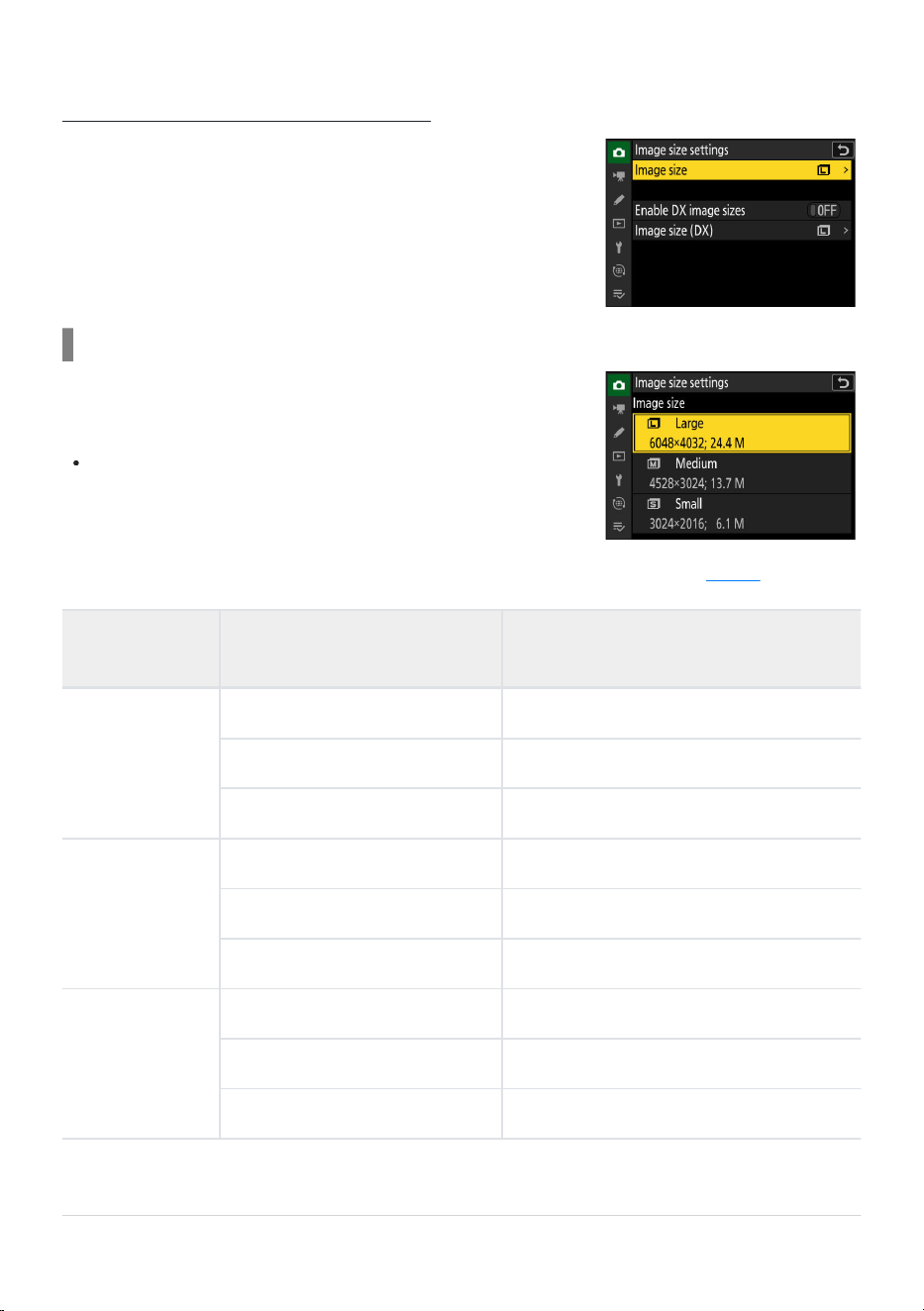
Use [Image size settings] in the photo shooting menu to choose a
size for new phot
ographs.
Choose a size for new JPEG and HEIF pictures. The size for
photographs recor
ded in formats other than NEF (RAW) can be
chosen from [Large], [Medium], and [Small].
NEF (RAW) pictures are recorded at a size of [Large].
Choosing an Image Size
Image size
The number of pixels in the pictur
e varies with the option selected for image area (
0 114).
Image area Image size
Size
when printed at 300 dpi
[FX (36×24)]
Large (6048× 4032 pix
els) Approx. 51.2× 34.1cm/20.2× 13.4in.
Medium (4528× 3024 pixels) Approx. 38.3× 25.6cm/15.1× 10.1in.
Small (3024× 2016 pixels) Approx. 25.6× 17.1cm/10.1× 6.7in.
[DX (24×16)]
Large (3984× 2656 pixels) Approx. 33.7× 22.5cm/13.3 × 8.9 in.
Medium (2976× 1992 pixels) Approx. 25.2× 16.9cm/9.9 × 6.6 in.
Small (1984× 1328 pixels) Approx. 16.8× 11.2cm/6.6 × 4.4 in.
[1:1 (24×24)]
Large (4032× 4032 pixels) Approx. 34.1× 34.1cm/13.4 × 13.4 in.
Medium (3024× 3024 pixels) Approx. 25.6× 25.6cm/10.1 × 10.1 in.
Small (2016× 2016 pixels) Approx. 17.1× 17.1cm/6.7 × 6.7 in.
118
Image Recording Options (Image Area, Quality,
and Size)
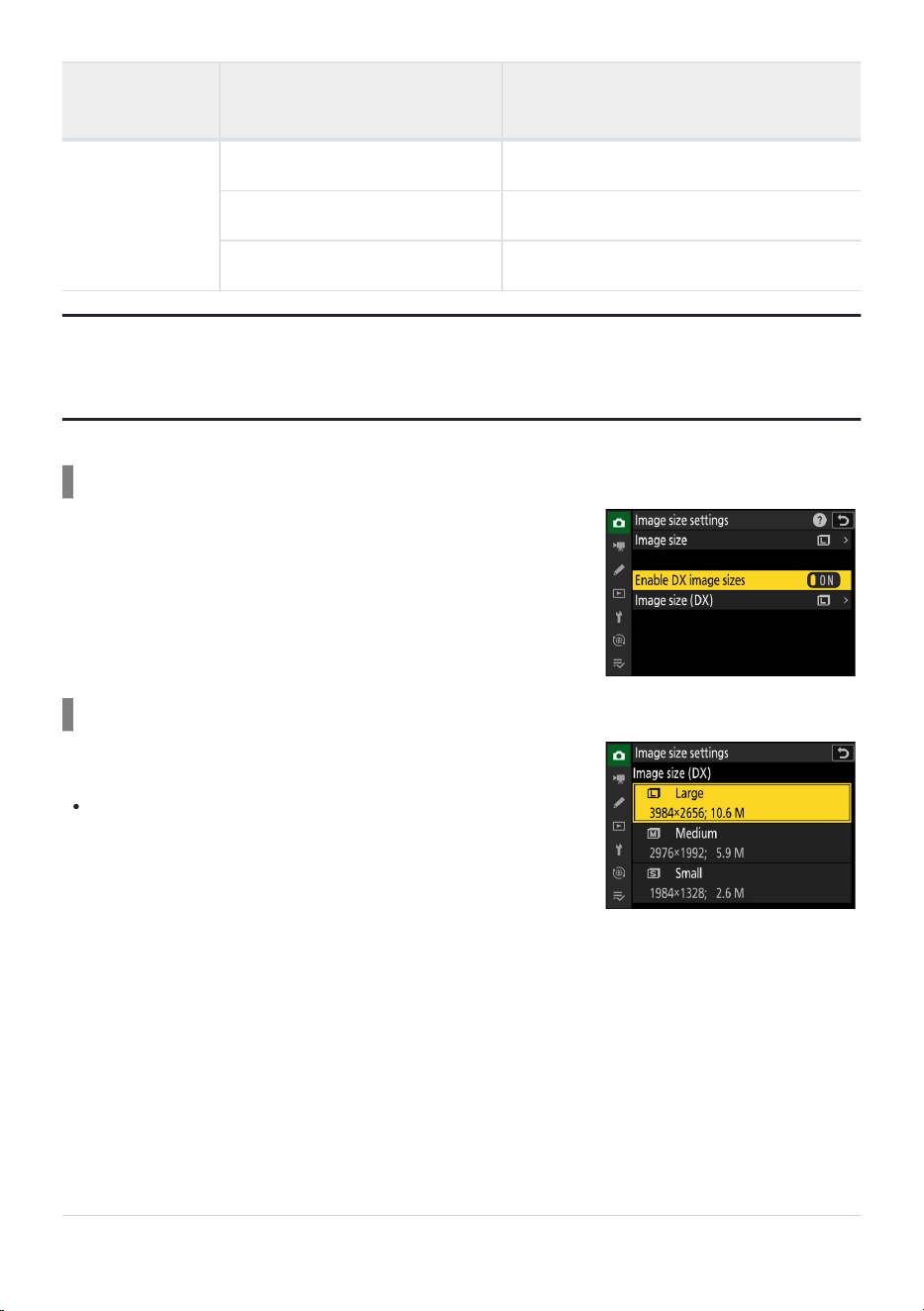
Selecting [ON] allows the size for photos taken using the [D
X
(24×16)] image area to be chosen separately from that for pictures
taken using other image areas. The size for photos taken using the
[DX (24×16)] image area can be chosen using [Image size (DX)].
Choose the size of photographs taken using the [DX (24×16)]
image area when [ON
] is selected for [Enable DX image sizes].
Regardless of the option selected, NEF (RAW) pictures will be
recorded at a size of [Large].
Image area Image size
Size
when printed at 300 dpi
[16:9 (36×20)]
Lar
ge (6048× 3400 pixels) Approx. 51.2× 28.8cm/20.2× 11.3 in.
Medium (4528× 2544 pixels) Approx. 38.3× 21.5cm/15.1× 8.5 in.
Small (3024× 1696 pixels) Approx. 25.6× 14.4cm/10.1× 5.7 in.
Tip: Print Size
Print size in inches equals image size in pixels divided by printer resolution in dots per inch (dpi; 1
inch= 2.54 cm).
Enable DX image sizes
Image size (DX)
119
Image Recording Options (Image Area, Quality,
and Size)
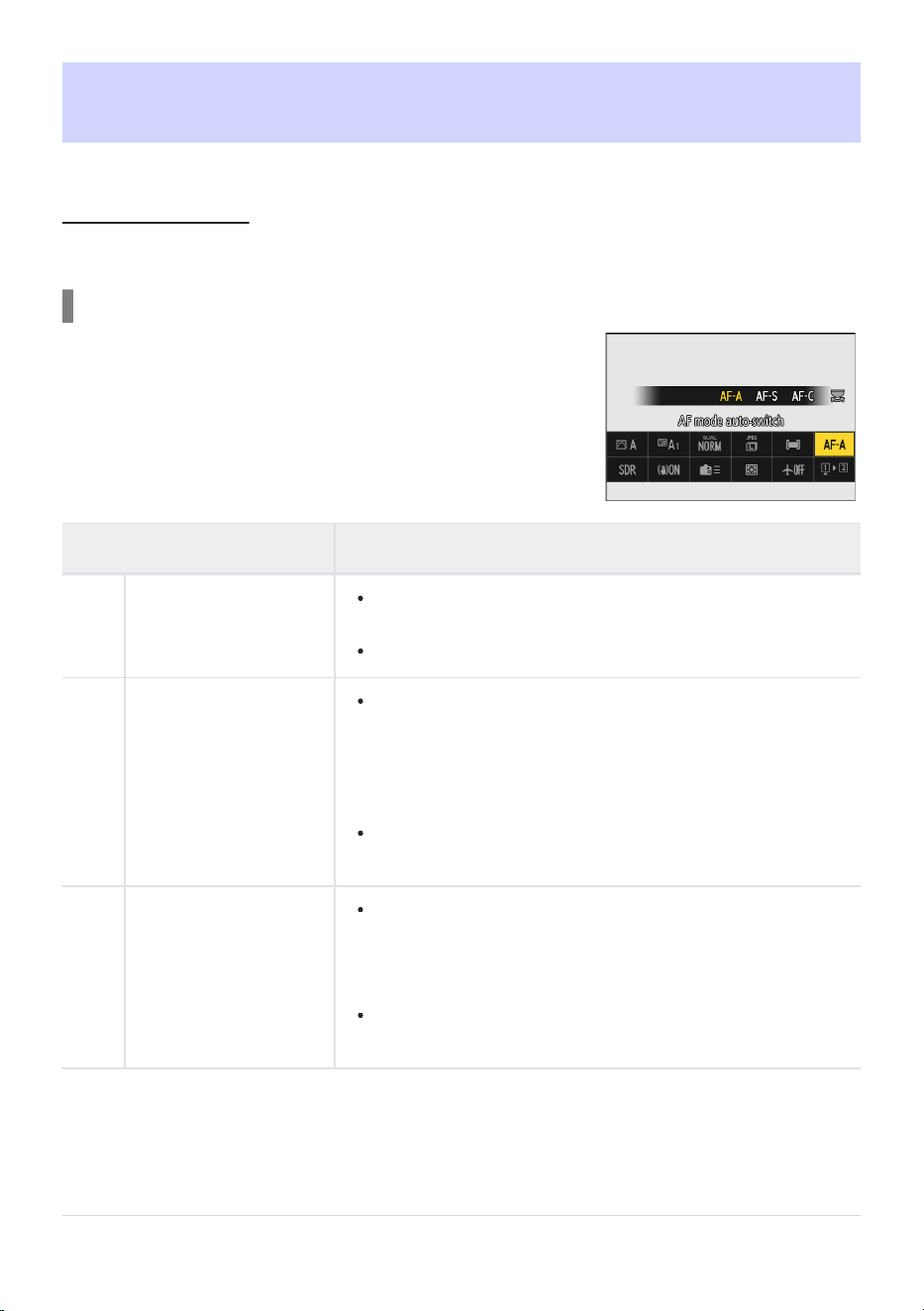
The focus mode can be selected using the [Focus mode] items in
the i
menu, photo shooting menu, or video recording menu.
Focus
Focus Mode
Control how the camera focuses.
Choosing a Focus Mode
Option Description
AF-A [AF mode auto-switch]
The camera uses
AF-S for stationary subjects, AF-C for
subjects that are in motion.
This option is only available in photo mode.
AF‑S [Single AF]
Use with stationary subjects. When you press the shutter-
release button halfway to focus, the focus point will turn from
red to green and focus will lock. If the camera fails to focus,
the focus point will flash red and the shutter release will be
disabled.
At default settings, the shutter can only be released if the
camera is able to focus (focus priority).
AF‑C [Continuous AF]
Use for shots of athletes and other moving subjects. The
camera adjusts focus continuously in response to changes in
the distance to the subject while the shutter-release button is
pressed halfway.
At default settings, the shutter can be released whether or not
the subject is in focus (release priority).
120
Focus
Option Description
AF‑F [Full-time AF]
The camera adjusts focus continuously in response to subject
movement or changes in composition.
When you pr
ess the shutter-release button halfway to focus,
the focus point will turn from red to green and focus will lock.
This option is only available in video mode.
MF [Manual focus]
Focus manually (
0 135). The shutter can be released whether
or not the subject is in focus.
D Cautions: Autofocus
The camera may be unable t
o focus if:
the subject contains lines parallel to the long edge of the frame,
the subject lacks contrast,
the subject in the focus point contains areas of sharply contrasting brightness,
the focus point includes night-time spot lighting or a neon sign or other light source that
changes in brightness,
flicker or banding appears under fluorescent, mercury-vapor, sodium-vapor, or similar lighting,
a cross (star) filter or other special filter is used,
the subject appears smaller than the focus point, or
the subject is dominated by regular geometric patterns (e.g., blinds or a row of windows in a
skyscraper).
The display may brighten or darken while the camera focuses.
The focus point may sometimes be displayed in green when the camera is unable to focus.
The camera may take longer to focus when lighting is poor.
The camera may have trouble focusing using autofocus if the focus point is at the edge of the
shooting display.
Tip: Low-Light AF
For improved focus when shooting under low light, select [ON] for Custom Setting d11 [Starlight view
(photo Lv)]. This option takes effect only in photo mode.
121
Focus
-
-
-
-
-
-
-
-
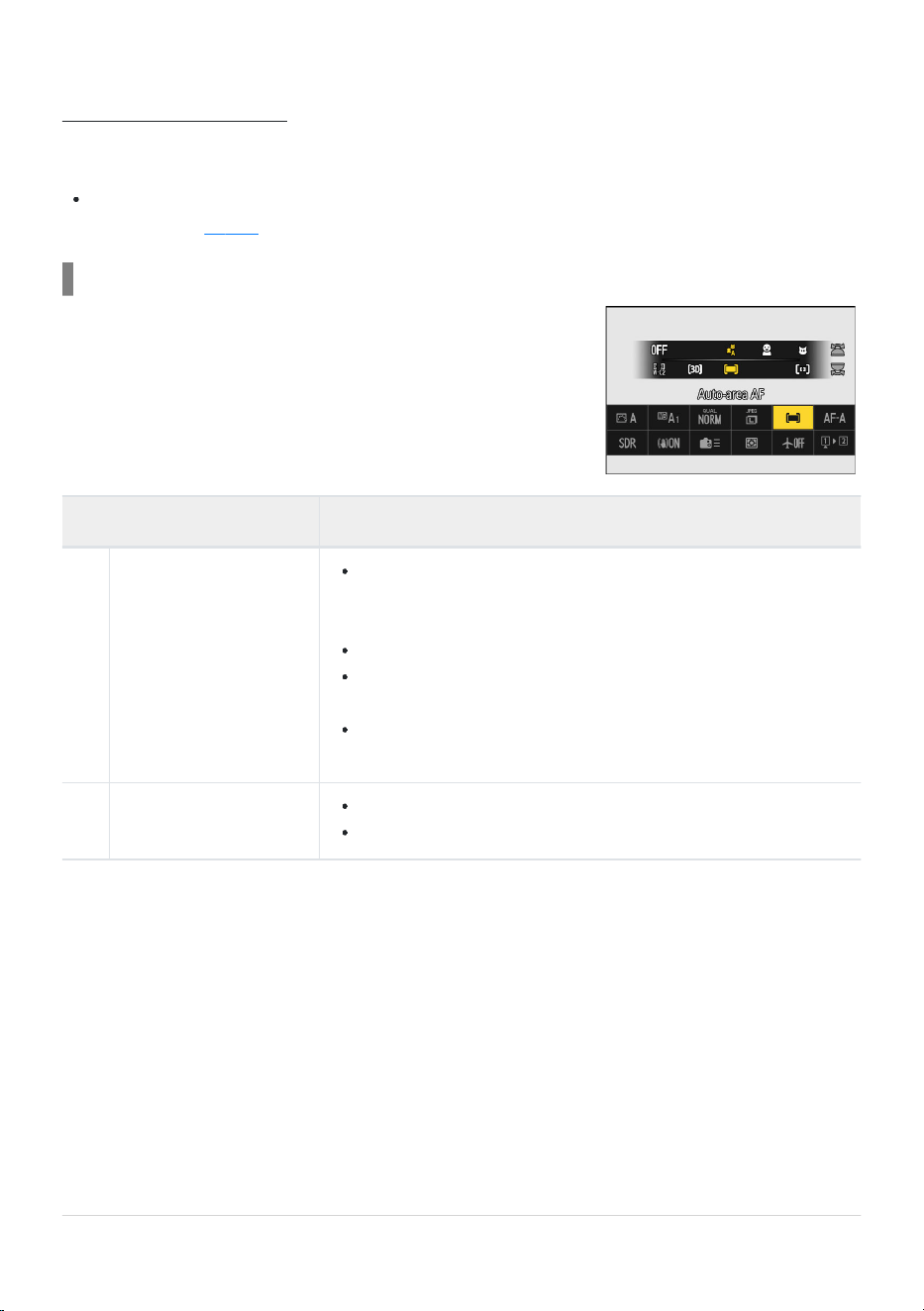
The AF-area mode can be selected using the [AF-area mode/subj.
detection] it
em in the i menu or the [AF-area mode] items in the
photo shooting and video recording menus.
AF-Area Mode
Choose how the camera selects the focus point for autofocus.
In modes other than [Aut
o-area AF], the focus point can be positioned using the sub-selector or
multi selector (
0 130).
Choosing an AF-Area Mode
Option Description
3
[Pinpoint AF]
With a focus point smaller than that employ
ed for single-point
AF
, pinpoint AF is used for pinpoint focus on a selected spot in
the frame.
Focusing may be slow
er than with single-point AF.
Recommended for shots involving static subjects, such as
buildings, in-studio product photography, or close-ups.
This option is only available when photo mode is selected and
[Single AF] is chosen for focus mode.
d
[Single-point AF]
The camera focuses on a point selected by the user.
Use with stationary subjects.
122
Focus

Option Description
d
[Dynamic-area AF (S)] The camera focuses on a point selected by the user
. If the
subject briefly leaves the selected point, the camera will focus
based on information from surrounding focus points.
This option is only available when photo mode is selected and
[AF mode auto-switch] or [Continuous AF] is chosen for focus
mode.
Use for photographs of athletes and other active subjects that
are hard to frame using single-point AF.
The size of the area used for focus can be selected from S
(small), M (medium), and L (large). S is the smallest and L the
largest.
[Dynamic-area AF (S)]: Choose when there is time to compose
the photograph or when photographing subjects that are
moving predictably (e.g., runners or race cars on a track).
[Dynamic-area AF (M)]: Choose when photographing subjects
that are moving unpredictably (e.g., players at a football game).
[Dynamic-area AF (L)]: Choose when photographing subjects
that are moving quickly and cannot be easily framed in the
selected focus point (e.g., birds).
e
[Dynamic-area AF (M)]
f
[Dynamic-area AF (L)]
f
[Wide-area AF (S)] As for single-point AF except that the camera focuses on a
wider area.
Choose for snapshots, subjects that are in motion, and other
subjects that are difficult to photograph using single-point AF.
During video recording, wide-area AF can be used for smooth
focus when making panning or tilting shots or filming moving
subjects.
If the selected focus point contains subjects at different
distances from the camera, the camera will assign priority to
the closest subject.
The focus points for [Wide-area AF (L)] are larger than those
for [Wide-area AF (S)].
g
[Wide-area AF (L)]
123
Focus

Option Description
8
[Wide-area AF (C1)] Choose the dimensions (measured in focus points) o
f the focus
areas used for the selected AF-area.
This can be used, for example, if the size and shape of the area
employed for focus can be determined in advance with a fair
degree of accuracy.
On selecting [Wide-area AF (C1)] or [Wide-area AF (C2)] and
pressing and holding the J button, you will be prompted to
choose the AF-area size. Use 1 and 3 to choose the height and
4 and 2 to choose the width.
The sizes available vary with the option selected for image area.
When [FX (36×24)] is selected, the photo shooting menu
offers a choice of 77 options ranging from [1×1] to [21×13].
Similarly, when [FX] is selected, the video recording menu
offers a choice of 66 options ranging from [1×1] to [21×11].
9
[Wide-ar
ea AF (C2)]
u
[3D-tracking]
T
rack focus on a selected subject.
Position the focus point over y
our subject and start tracking
by pressing AF‑ON or by pressing the shutter-release button
halfway; focus will then track the selected subject as it moves
through the frame. Release the button to end tracking and
restore the previously-selected focus point.
If the subject leaves the frame, remove your finger from the
shutter-release button and recompose the photograph with the
subject in the selected focus point.
This option is only available when photo mode is selected and
[AF mode auto-switch] or [Continuous AF] is chosen for focus
mode.
n
[Subject-tracking AF]
Track focus on a select
ed subject.
Position the focus point over y
our subject and start tracking by
pressing J or AF‑ON or by pressing the shutter-release button
halfway; focus will then track the selected subject as it moves
through the frame. To end tracking and select the center focus
point, press J.
This option is only available in video mode.
124
Focus
-
-
Option Description
h
[Auto-area AF]
The camera automatically det
ects the subject and selects the
focus point. You cannot select the focus point manually.
Use on occasions when you don’t have time to select the focus
point yourself, for portraits, or for snapshots and other spur-of-
the-moment photos.
D Caution: 3D-Tracking and Subject Tracking
The camera may be unable t
o track subjects that:
are similar in color, brightness, or pattern to the background,
change visibly in size, color, or brightness,
are too large or too small,
too bright or too dark,
move quickly, or
are obscured by other objects or leave the frame.
Tip: s: The Center Focus Point
In all AF-area modes except [Auto-area AF], [3D-tracking], and [Subject-tracking AF], a dot appears
in the focus point when it is in the center of the frame.
125
Focus
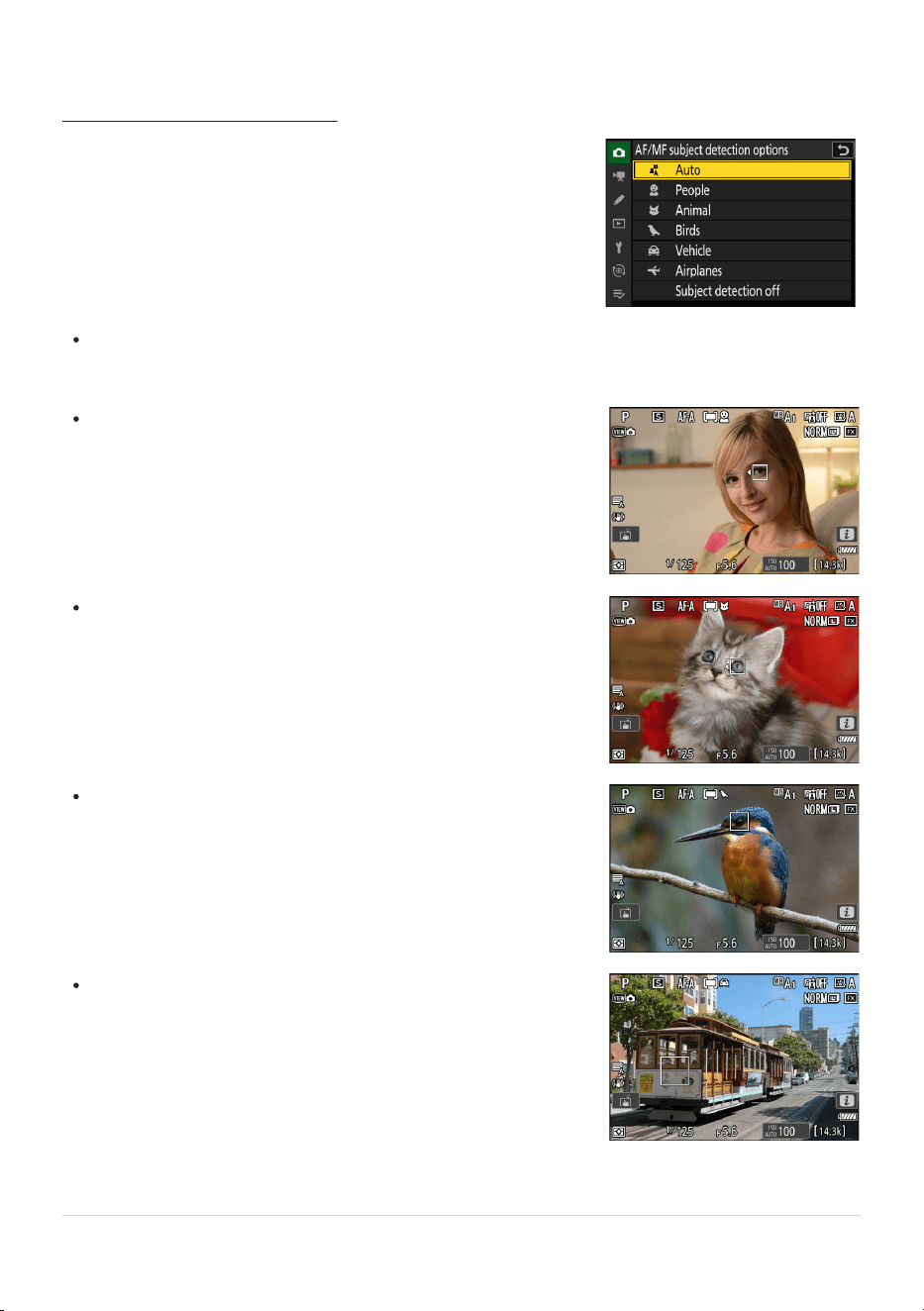
The class of subjects given priority during autofocus and electronic
rangefinding can be chosen using the [AF/MF subject detection
options] items in the phot
o shooting and video recording
menus, which offer a choice of [Auto], [People], [Animal], [Birds],
[Vehicle], [Airplanes], and [Subject detection off]. The subject
detected by the camera is indicated by a focus point.
Human faces detected by the camera when [People] is selected
ar
e identified by a border indicating the focus point. If the camera
detects the subject’s eyes, the focus point will instead appear over
one or the other of their eyes. If the subject looks away after their
face is detected, the focus point will move to track their motion.
If a dog, cat, or bird is detected when [Animal] is selected, the
focus point will appear over the face o
f the animal in question. If
the camera detects the subject’s eyes, the focus point will instead
appear over one or the other of their eyes. If the camera can
detect neither face nor eyes, it will display a focus point over the
detected animal.
If a bird is detected when [Birds] is selected, the focus point will
appear ov
er the face of the bird in question. If the camera detects
the subject’s eyes, the focus point will instead appear over one or
the other of their eyes. If the camera can detect neither face nor
eyes, it will display a focus point over the detected bird.
If a car, motorcycle, train, airplane, or bicycle is detected when
[Vehicle] is select
ed, the focus point will appear over the vehicle
in question. In the case of trains, the camera will detect only the
front end. With planes, the camera will detect the body, nose, or
cockpit depending on the aircraft’s size.
Subject Detection
In the case of the video recor
ding menu, the choice of subject is made via [AF/MF subject
detection options]> [Subject detection]. Separate subject types can be selected for photo and
video modes.
126
Focus
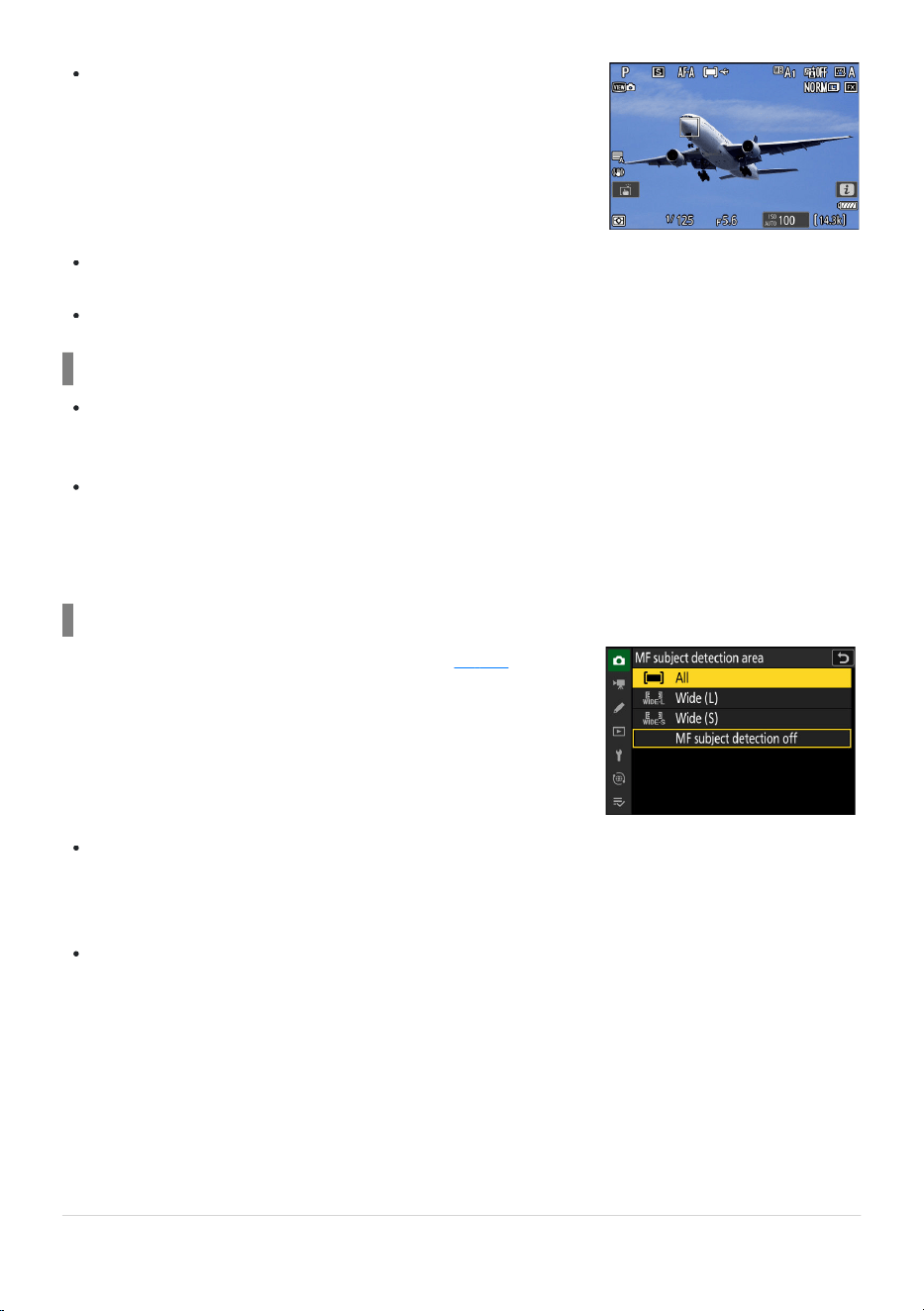
If an aircraft is detected when [Airplanes] is selected, the focus
point will appear over the air
craft in question. The camera will
detect the body, nose, or cockpit depending on the aircraft’s size.
To enable subject detection during manual focus ( 0 135), select
an option other than [MF subject det
ection o
ff] for [MF subject
det
ection area] in the photo shooting or video recording menu.
If [Aut
o] is select
ed, the camera will det
ect humans, animals, and vehicles and choose a subject for
focus automatically.
To disable subject detection altogether, choose [Subject detection off].
Using Subject Detection During Autofocus
Subject detection is available during autofocus when [Wide-area AF (S)], [Wide-area AF (L)],
[Wide-area AF (C1)], [Wide-area AF (C2)], [3D-tracking], [Subject-tracking AF], or [Auto-area
AF] is selected for [AF-area mode].
If more than one subject of the selected type is detected, a gray focus point will appear over each
of the subjects detected. If [Auto-area AF] is selected for [AF-area mode], e and f icons will
appear on the focus point selected by the camera. The focus point can be positioned over the other
subjects by pressing 4 or 2.
Using Subject Detection with Manual Focus
Select [All] to enable subject detection in all areas of the frame. If more than one subject of the
selected type is detected, a gray focus point will appear over each of the subjects detected and the
initial subject selected by the camera will be indicated with e and f icons. The focus point can be
positioned over the other subjects by pressing 4 or 2.
Select [Wide (L)] or [Wide (S)] to limit subject detection to the current focus area.
127
Focus

D Caution: Subject Detection Using [P
eople]
Subject detection may not perform as expected if:
the subject’s face is too large or small relative to the frame,
the subject’s face is too brightly or dimly lit,
the subject is wearing glasses or sunglasses,
the subject’s face or eyes are obscured by hair or other objects, or
the subject moves excessively during shooting.
D Caution: Subject Detection Using [Animal]
Subject detection may not perform as expected if:
the subject’s face is too large or small relative to the frame,
the subject’s face is too brightly or dimly lit,
the subject’s face or eyes are obscured by fur or the like,
the subject’s face and eyes are of similar colors, or
the subject moves excessively during shooting.
The camera may display a border around subjects that are not dogs, cats, or birds but which
resemble these animals.
The light from the AF-assist illuminator may adversely affect the eyes of some animals; when using
autofocus, select [OFF] for Custom Setting a11 [Built-in AF-assist illuminator].
D Cautions: Subject Detection Using [Birds]
Subject detection may not perform as expected if:
the subject’s face is too large or small relative to the frame,
the subject’s face is too brightly or dimly lit,
the subject’s face or eyes are obscured by feathers or the like,
the subject’s face and eyes are of similar colors, or
the subject moves excessively during shooting.
The camera may display a border around subjects that are not birds but which resemble them. If the
camera often mistakenly detects the subjects other than birds, changing to an AF-area mode with
smaller focus points may improve focus performance.
Flickering is more likely to occur if photos are taken under fluorescent, mercury-vapor, or similar
lighting, compared to other environments.
Selecting [ON] for [Photo flicker reduction] in the photo shooting menu reduces flickering
effects.
We recommend selecting [OFF] for [Photo flicker reduction] in the photo shooting menu if
there is no flickering.
The light from the AF-assist illuminator may adversely affect the eyes of birds; when using
autofocus, select [OFF] for Custom Setting a11 [Built-in AF-assist illuminator].
128
Focus
-
-
-
-
-
-
-
-
-
-
-
-

D Caution: Subject Detection Using [V
ehicle] and [Airplanes]
Subject detection may not perform as expected with subjects that are:
too large or small relative to the frame,
too bright or too dark,
partially hidden,
similar in color to surrounding objects, or
moving excessively.
The camera may fail to detect vehicles of some shapes and colors. Alternatively, it may display a
border around subjects that are not of the selected type.
D Subject Detection
The performance of subject-detection may drop:
during high-speed frame capture +,
if [HLG] is selected for [Tone mode] in the photo shooting menu, or
if either [HLG] or [N-Log] is selected as the tone mode for [Video file type]> [H.265 10-bit
(MOV)] in the video recording menu.
129
Focus
-
-
-
-
-
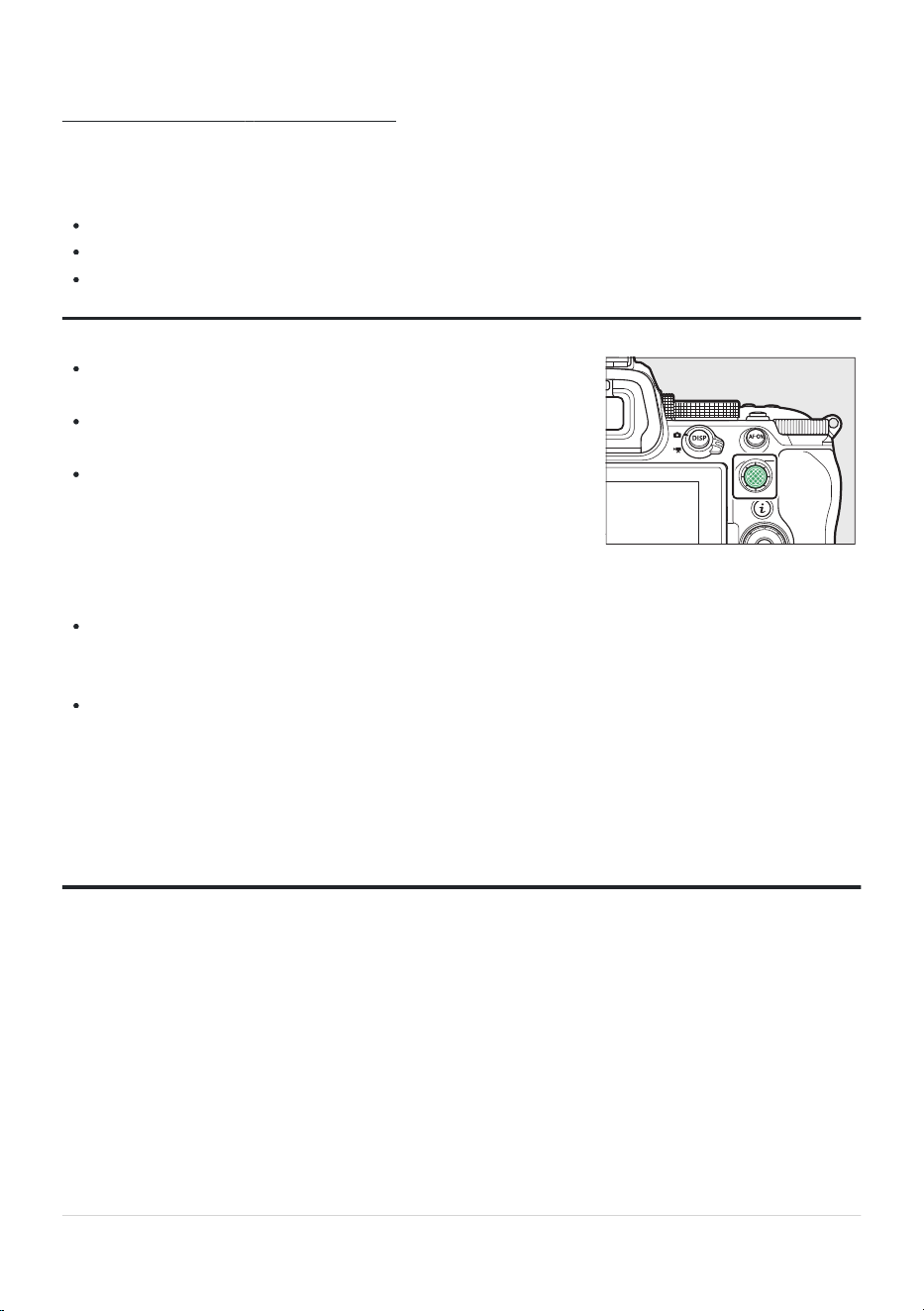
The sub-selector can be used for focus-point selection in place
of the multi selector
.
Exposure and focus lock while the center of the sub-selector is
pressed.
Be careful not to put your fingers in your eye while using the
sub-selector with your eye to the viewfinder.
Focus-Point Selection
The focus point can be selected manually, allowing phot
ographs to be composed with the subject
positioned almost anywhere in the frame.
Use the multi selector to select the focus point while the standby timer is on.
Pressing J selects the center focus point.
Focus-point selection is not available when [Auto-area AF] is selected for AF-area mode.
Tip: The Sub-Selector
Tip: Quick Focus-Point Selection
For quicker focus-point selection, choose [Alternating points] for Custom Setting a4 [Focus points
used] to use only a quarter of the available focus points. Selecting [Alternating points] does not
affect the number of points available for [Pinpoint AF].
If you prefer to use the sub-selector for focus-point selection, you can choose [Select center focus
point] for Custom Setting f2 [Custom controls (shooting)]> [Sub-selector center] to allow the
center of the sub-selector to be used to quickly select the center focus point.
Tip: Focus-Point Lock
Focus-point selection can be locked by choosing [ON] for Custom Setting f5 or g3 [Control lock]>
[Focus-point lock].
130
Focus
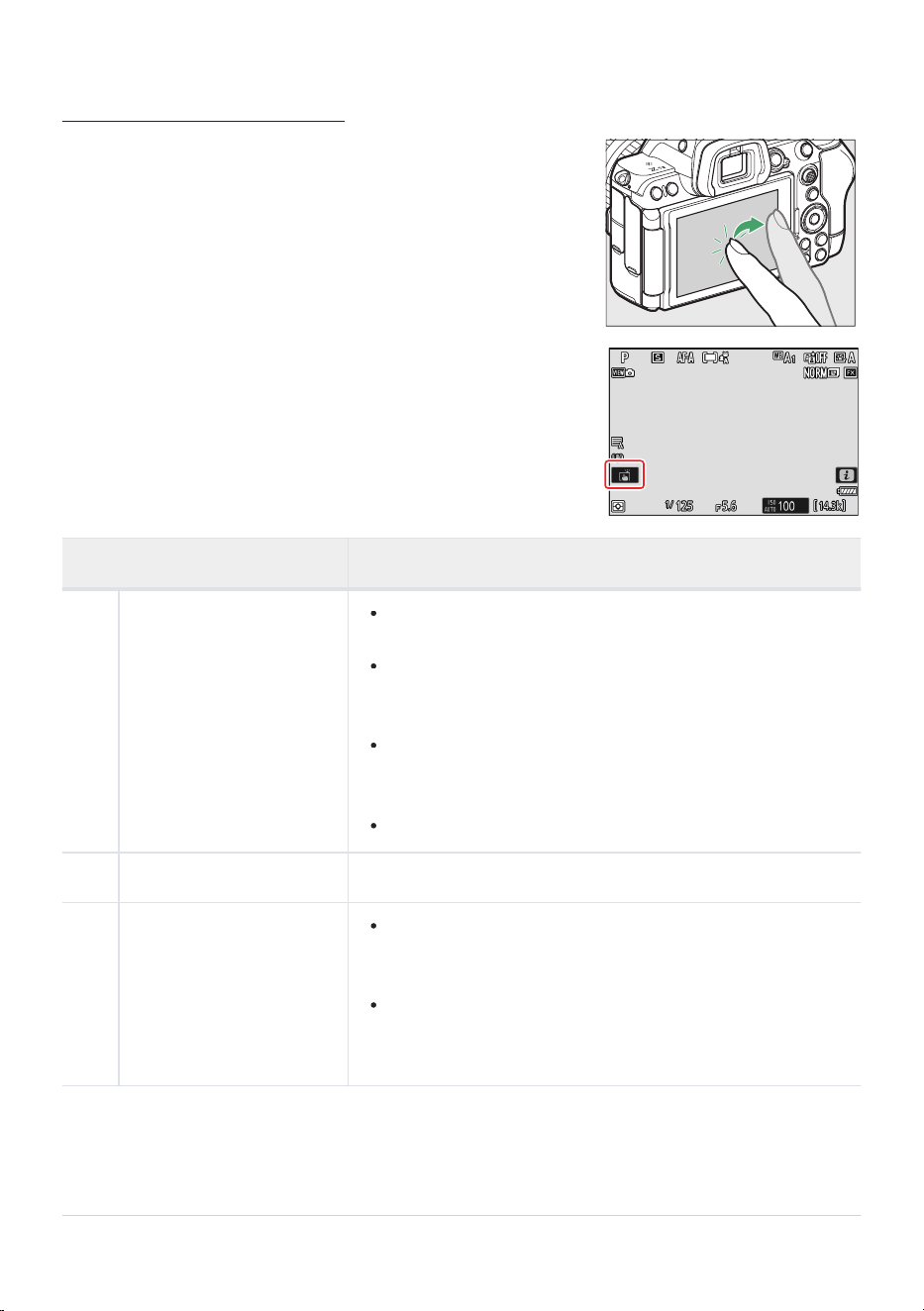
Touch the display to focus on the selected point. The shutter will be
released when you lif
t your finger from the display.
Tap the icon shown in the illustration to choose the operation
per
for
med by tapping the display
.
The Touch Shutter
Option Description
W
[T
ouch shutter/touch AF]
Touch the display t
o focus on the selected point and lift
your finger to r
elease the shutter.
When choosing an eye using touch controls, note that the
camera may not focus on the eye on the side you intend.
Use the multi selector to choose the desired eye.
If [Auto-area AF] is selected for AF-area mode, the camera
will focus on the chosen point, release the shutter, and track
the selected subject. Press J to end subject tracking.
Available only in photo mode.
X
[Off] Touch shutter disabled.
f
[Mov
e focus point]
Touch the display t
o position the focus point. The camera
will not focus and lif
ting y
our finger fr
om the display will
not release the shutter.
If [Subject-tracking AF] or [Auto-area AF] is selected for
AF-area mode, focus will track the subject at the chosen
point. Press J to end subject tracking.
131
Focus

Option Description
V
[Touch AF]
Touch the display t
o focus on the selected point. Lifting
y
our finger fr
om the display does not r
elease the shutter.
If [Subject-tracking AF] or [Auto-area AF] is selected for
AF-area mode, the camera will focus on and track the
subject at the chosen point. Press J to end subject tracking.
D Cautions: Taking Pictures Using T
ouch Shooting Options
Touch controls cannot be used for manual focus.
The shutter-release button can be used to take pictures when the W icon is displayed.
During burst photography, touch controls can be used only to take one picture at a time. Use the
shutter-release button for burst photography.
In self-timer mode, focus locks on the selected subject when you touch the monitor and the shutter
is released about 10 seconds after you lift your finger from the display. If the number of shots
selected is greater than 1, the remaining shots will be taken in a single burst.
132
Focus
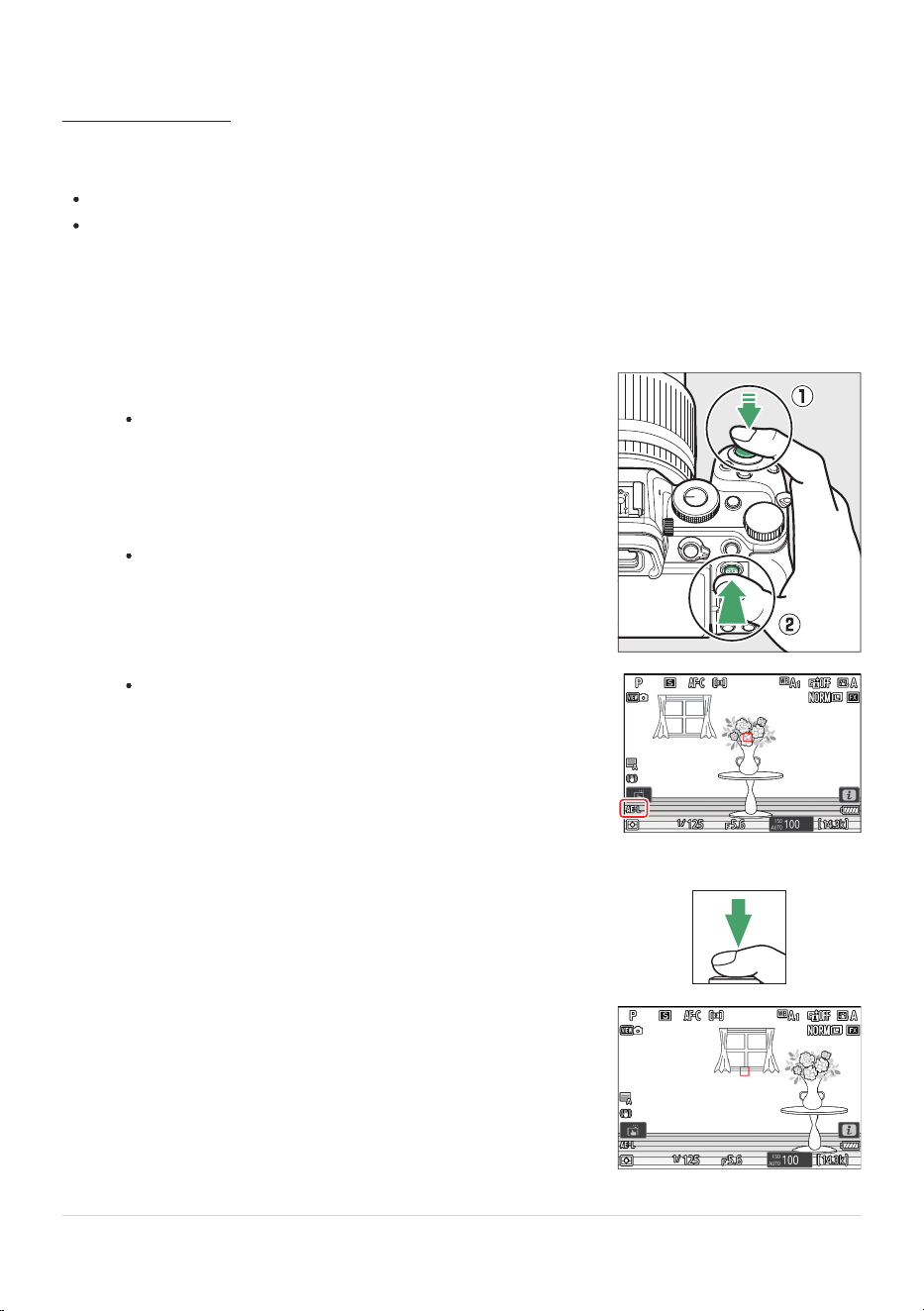
Press the center of the sub-selector.
Keeping the shutter
-release button pressed halfway (q),
press the center of the sub-selector (w) to lock focus. Focus
will remain locked while the center of the sub-selector is
pressed, even if you lift your finger from the shutter-release
button.
Exposure will also lock.
AE‑L icons will appear in the displays.
Keeping the center of the sub-selector pressed, recompose
the photograph and shoot.
Do not change the distance between the camera and the
subject. If the distance to the subject changes, release the lock
and focus again at the new distance.
Focus Lock
Use focus lock in cases in which the camera has trouble focusing with auto
focus.
Use focus lock to lock focus on the current subject when AF‑C is selected for focus mode.
When using focus lock, choose an AF-area mode other than [Auto-area AF].
Position the subject in the selected focus point and press the shutter-release button
halfway.
133
Focus
1
2
3

D Focusing in AF-S or When Selecting AF-S in AF-A
Focus locks while the shutter-r
elease button is pressed halfway. You can also lock focus by pressing the
center of the sub-selector.
D Taking Multiple Shots at the Same Focus Distance
If you locked focus by pressing the center of the sub-selector, focus will remain locked between
shots if you keep the center of the sub-selector pressed.
If you locked focus by pressing the shutter-release button halfway, focus will remain locked if you
keep the button pressed halfway between shots.
Tip: Locking Focus with the AF‑ON Button
The AF‑ON button can be used for focus in place of the shutter-release button.
When [AF-ON only] is selected for Custom Setting a6 [AF activation], focus can be initiated only
by pressing the AF‑ON button; the camera will not focus when the shutter-release button is pressed
halfway. Focus locks after the AF‑ON button is released. To end focus lock, press the AF‑ON button
again.
134
Focus
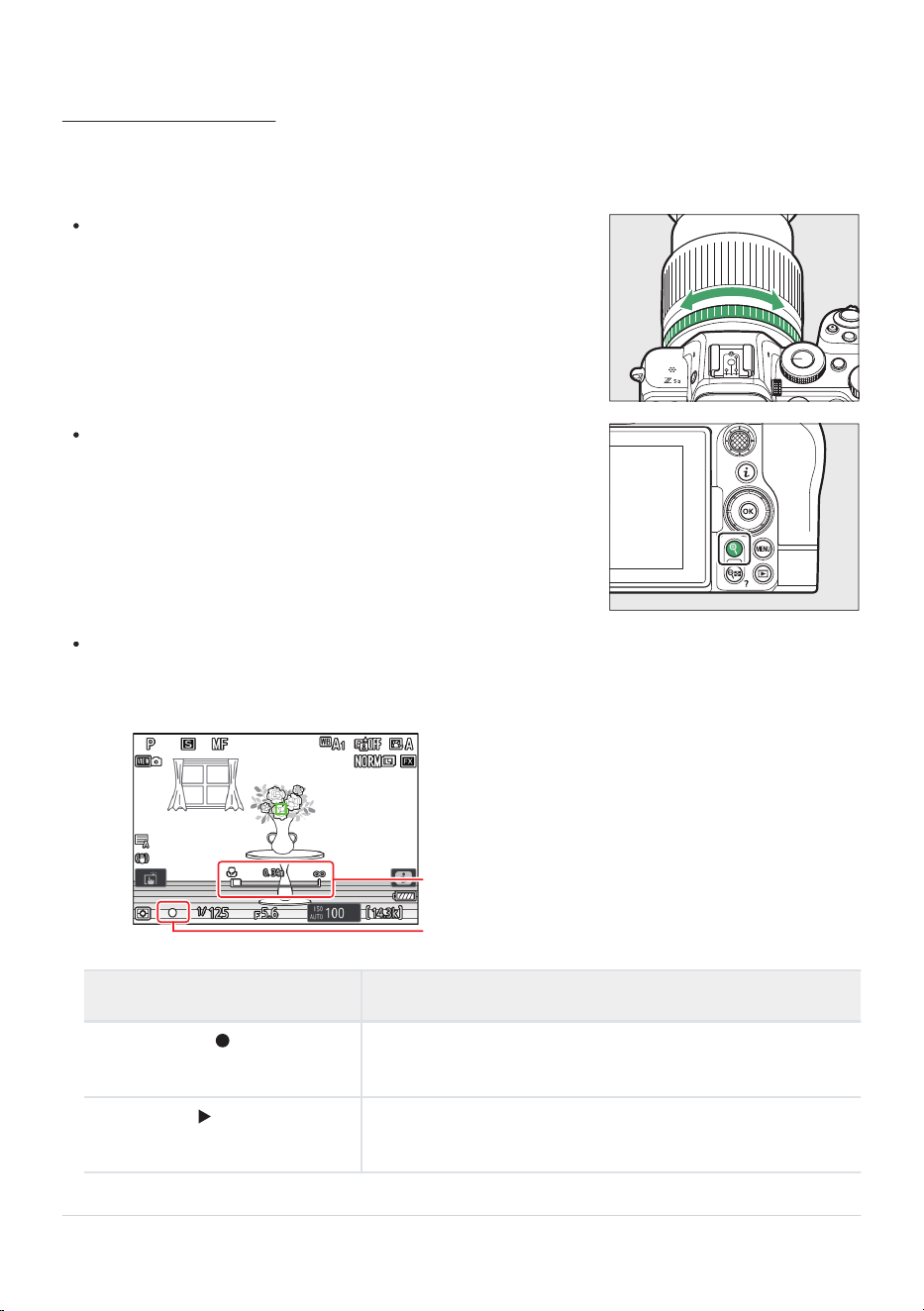
Position the focus point over your subject and rotate the focus or
control ring until the subject is in focus.
For greater precision, press the X butt
on t
o zoom in on the view
thr
ough the lens.
1
2
Focus distance indicator/distance
between the camera and the focus
position
Focus indicator
1
2
Manual Focus
Manual focus is available in manual focus mode. Use manual focus when, for example, autofocus does
not pr
oduce the desired results.
The focus indicator (I) in the shooting display can be used to confirm whether the subject in the
selected focus point is in focus (electronic rangefinding). The focus point will also light green when
the subject is in focus.
Focus indicator Description
(steady)
The subject is in focus.
(steady)
Focus is in front of the subject.
135
Focus
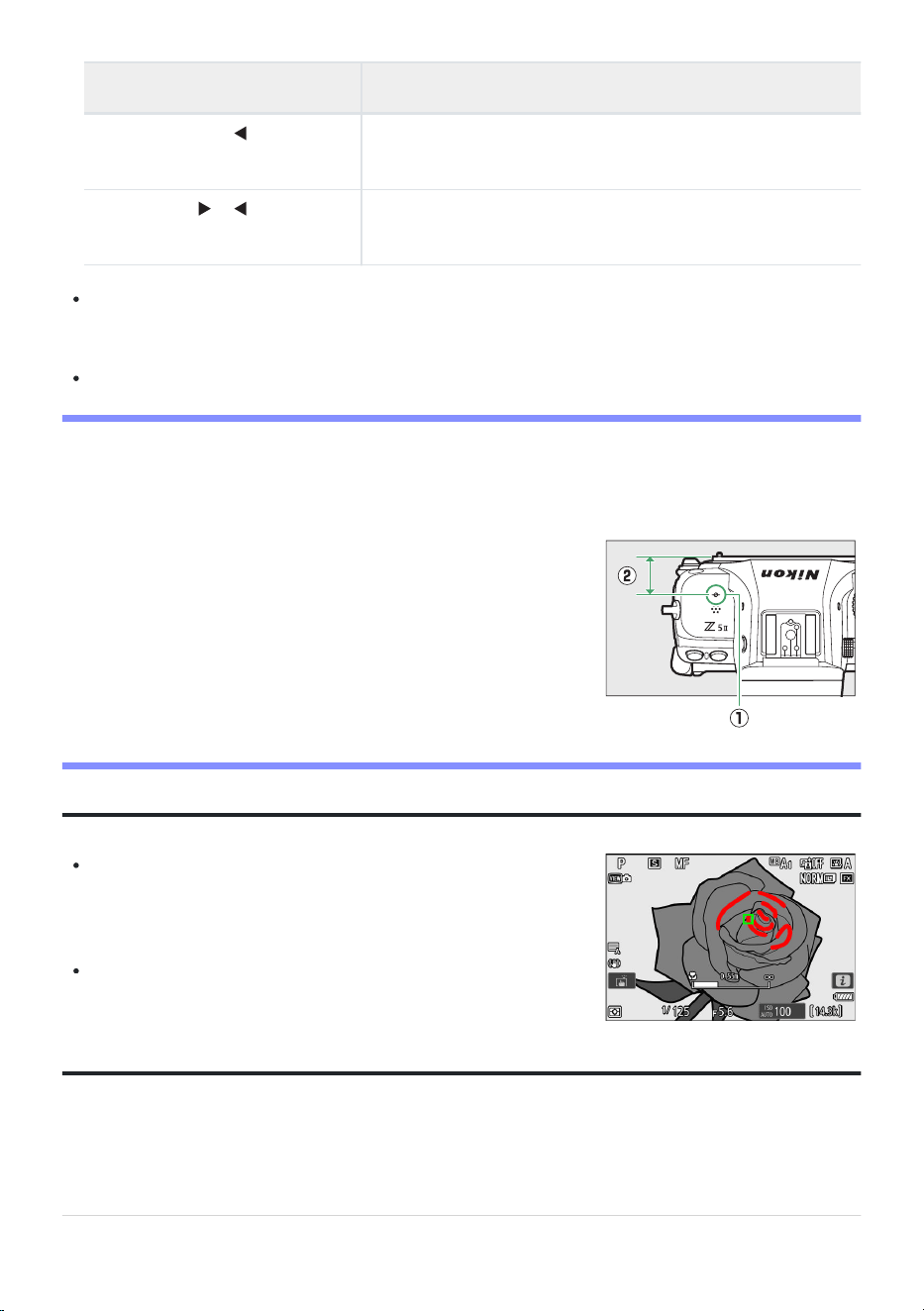
Focus distance is measured from the focal plane mark (E) on the
camera body, which shows the position of the focal plane inside
the camera (q
). Use this mark when measuring the distance to
your subject for manual focus or macro photography. The distance
between the focal plane and the lens mounting flange is known
as the “flange-back distance” (w). On this camera, the flange-back
distance is 16mm (0.63in.).
If [ON] is selected for Custom Setting a12 [
Focus peaking]>
[Focus peaking display], objects that are in focus will be
indicated by colored outlines that appear when focus is adjusted
manually (focus peaking).
Note that the focus peaking display may not appear if the
camera is unable to detect outlines. Check focus in the shooting
display.
Focus indicator Description
(steady)
Focus is behind the subject.
(flashes)
The camera is unable to focus.
The focus distance indicator displays the distance between the camera’s focal plane mark and the
focus position. The focus distance shown is intended as a guide only. It may v
ary from the actual
distance, depending on the lens used.
The electronic rangefinder may flicker if the focus point is at the edge of the shooting display.
D Lenses with Focus-Mode Selection
Manual focus mode can be chosen using focus-mode selection controls on the lens (where available).
D The Focal Plane Mark and Flange-Back Distance
Tip: Focus Peaking
136
Focus
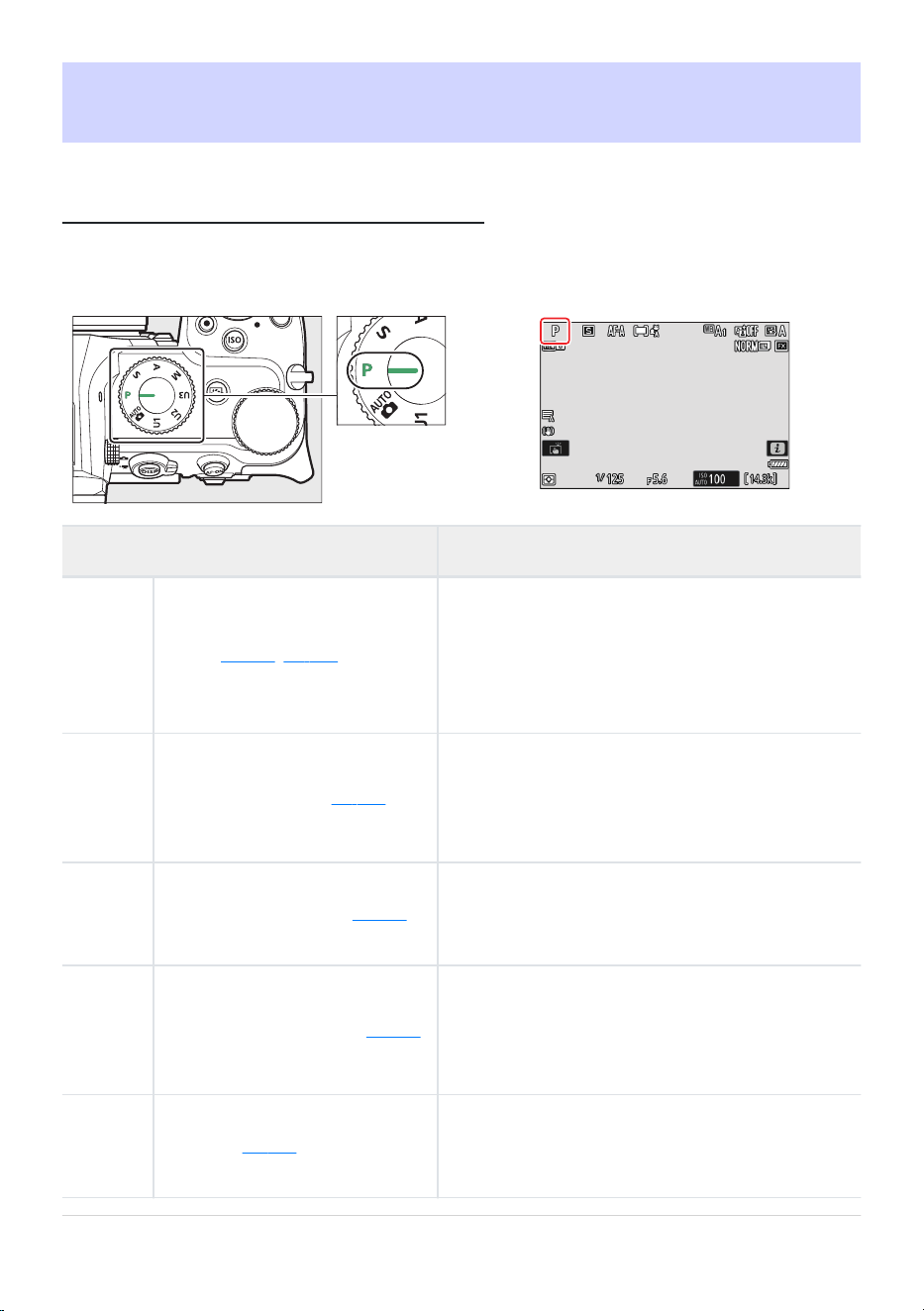
Exposure
Choosing a Shooting Mode
To choose a shooting mode, rotat
e the mode dial. The shooting mode is shown in the shooting
display.
Mode Description
AUTO
(b)
Auto (
0 101, 0 106)
A simple “point-and-shoot” mode that leaves the
camera in char
ge o
f settings. In addition t
o the
shutter speed and aperture, the camera also
automatically controls white balance and other
items.
P Programmed auto (
0 138)
Use for snapshots and in other situations in which
ther
e is little time t
o adjust camera settings. The
camera chooses both shutt
er speed and aperture
automatically.
S Shutter-priority auto (
0 139)
Use to freeze or blur motion. You choose
the shutt
er speed; the camera adjusts aper
tur
e
automatically.
A Aperture-priority auto (
0 140)
Use to blur backgrounds or bring both foreground
and b
ack
gr
ound into focus. You choose the
aperture; the camera adjusts shutter speed
automatically.
M Manual (
0 141)
You control both shutter speed and aperture.
Choose a shutt
er speed o
f “Bulb” or “
Time” for long
time-exposures.
137
Exposure
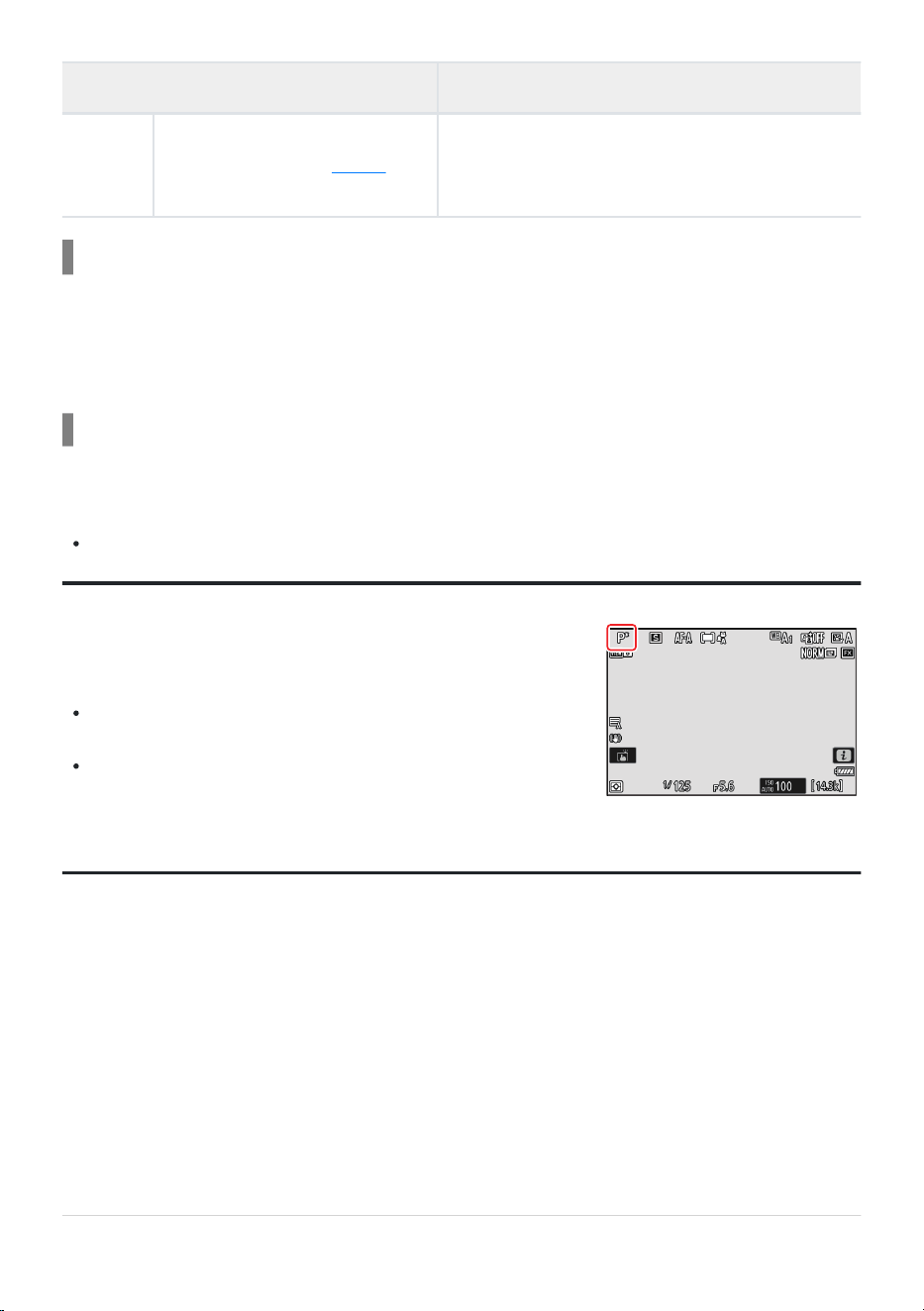
Different combinations of shutter speed and aperture that produce
the same exposur
e can be select
ed by r
otating the main command
dial (“flexible program”) in mode P.
While flexible program is in effect, a flexible program indicator
(U) is displayed.
To restore default shutter speed and aperture settings, rotate the
main command dial until the indicator is no longer displayed.
Flexible program can also be ended by choosing another
shooting mode or turning the camera off.
Mode Description
U1
U2
U3
User setting mode ( 0 143)
Assign frequently-used settings to these positions.
The settings can be recalled simply by rotating the
mode dial.
b (Aut
o)
In addition to the shutter speed and aperture, the camera also automatically controls white balance
and other items. Of the functions that can be configured by the menu, those controlled by the camera
automatically are grayed out and unavailable. To change the settings of grayed-out menu functions,
change the shooting mode to P, S, A, or M.
P (Programmed Auto)
In this mode, the camera automatically adjusts shutter speed and aperture according to a built-in
program to ensure optimal exposure in most situations.
You can set white balance and other items that would be controlled automatically in b (auto).
Tip: Flexible Program
138
Exposure
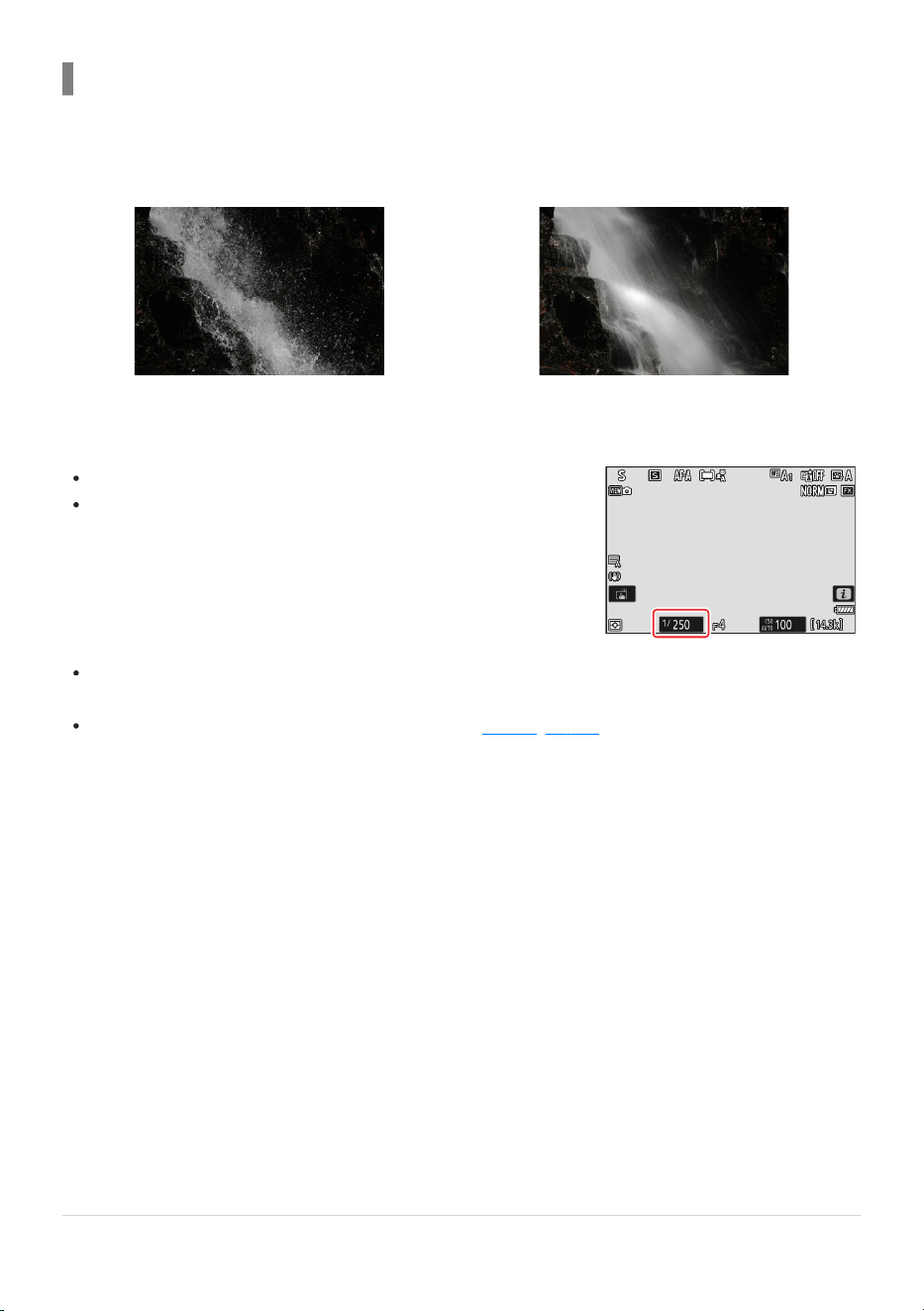
Fast shutter speed (¹/₁₆₀₀ s) Slow shutter speed (1 s)
Rotate the main command dial to set the shutter speed.
Shutter speed can be set to v
alues between ¹⁄₈₀₀₀s and 30s.
S (Shutter-Priority Auto)
In shutter-priority aut
o, you choose the shutter speed while the camera automatically adjusts aperture
for optimal exposure. Choose fast shutter speeds to “freeze” motion, slow shutter speeds to suggest
motion by blurring moving objects.
When [Electronic front-curtain shutter] is selected for Custom Setting d6 [Shutter type], shutter
speed is limited to ¹⁄₂₀₀₀ s, even when it is set faster.
Shutter speed can be locked at the selected value (
0 646, 0 672).
139
Exposure
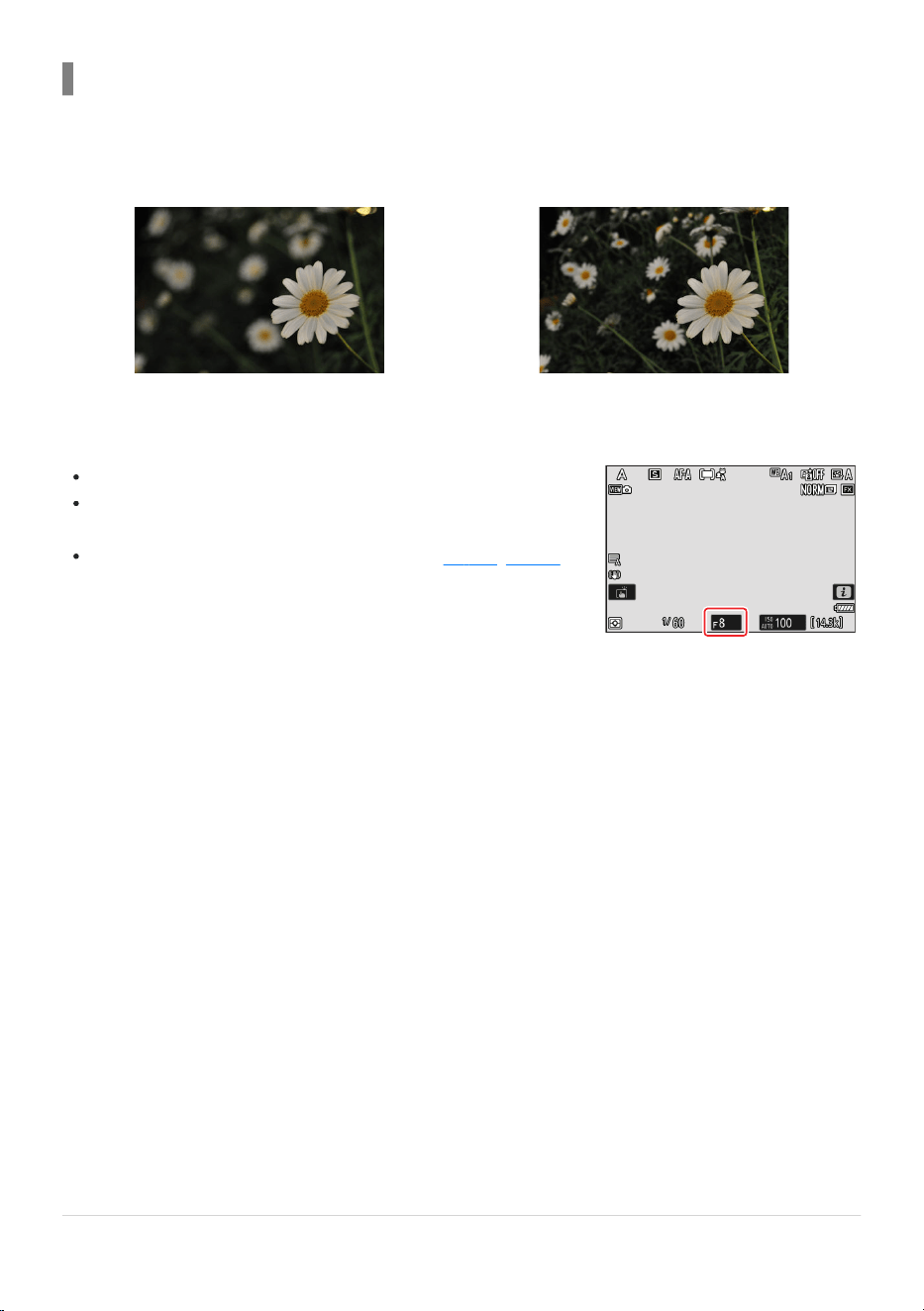
Large aperture (f/5.6) Small aperture (f/22)
Aperture can be adjusted by rotating the sub-command dial.
The minimum and maximum values for aperture vary with the
lens.
Aperture can be locked at the selected value ( 0 646, 0 672).
A (Aperture-Priority Auto)
In aperture-priority aut
o, you choose the aperture while the camera automatically adjusts shutter
speed for optimal exposure. This mode is suitable when you want to blur the background and bring
out the details in the main subject or bring out details in the background and foreground.
140
Exposure
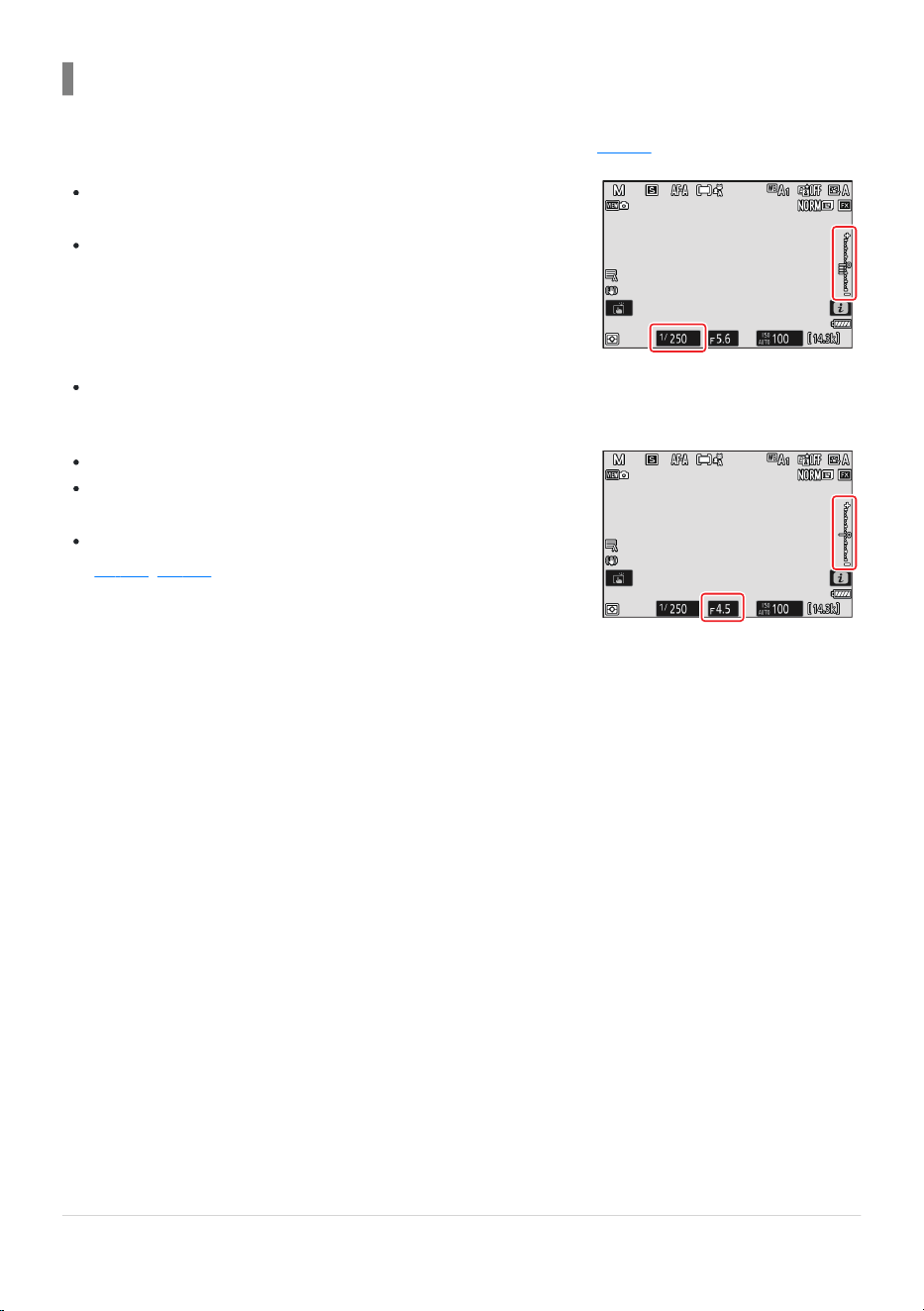
Shutter speed and aperture can be adjusted with reference to
the exposure indicator
s by rotating the command dials.
Rotate the main command dial to choose the shutter speed.
Shutter speed can be set to values between ¹⁄₈₀₀₀s and 30s or to
Bulb or Time.
Aperture can be adjusted by rotating the sub-command dial.
The minimum and maximum values for apertur
e vary with the
lens.
Shutter speed and aperture can be locked at the selected values
(
0 646, 0 672).
M (Manual)
You control both
shutter speed and aperture. Choose this mode also for long time-exposures of such
subjects as fireworks or the night sky (“Bulb” or “Time” photography,
0 145).
When [Electronic front
-curtain shutter] is selected for Custom Setting d6 [Shutter type], shutter
speed is limited to ¹⁄₂₀₀₀ s, even when it is set faster.
141
Exposure
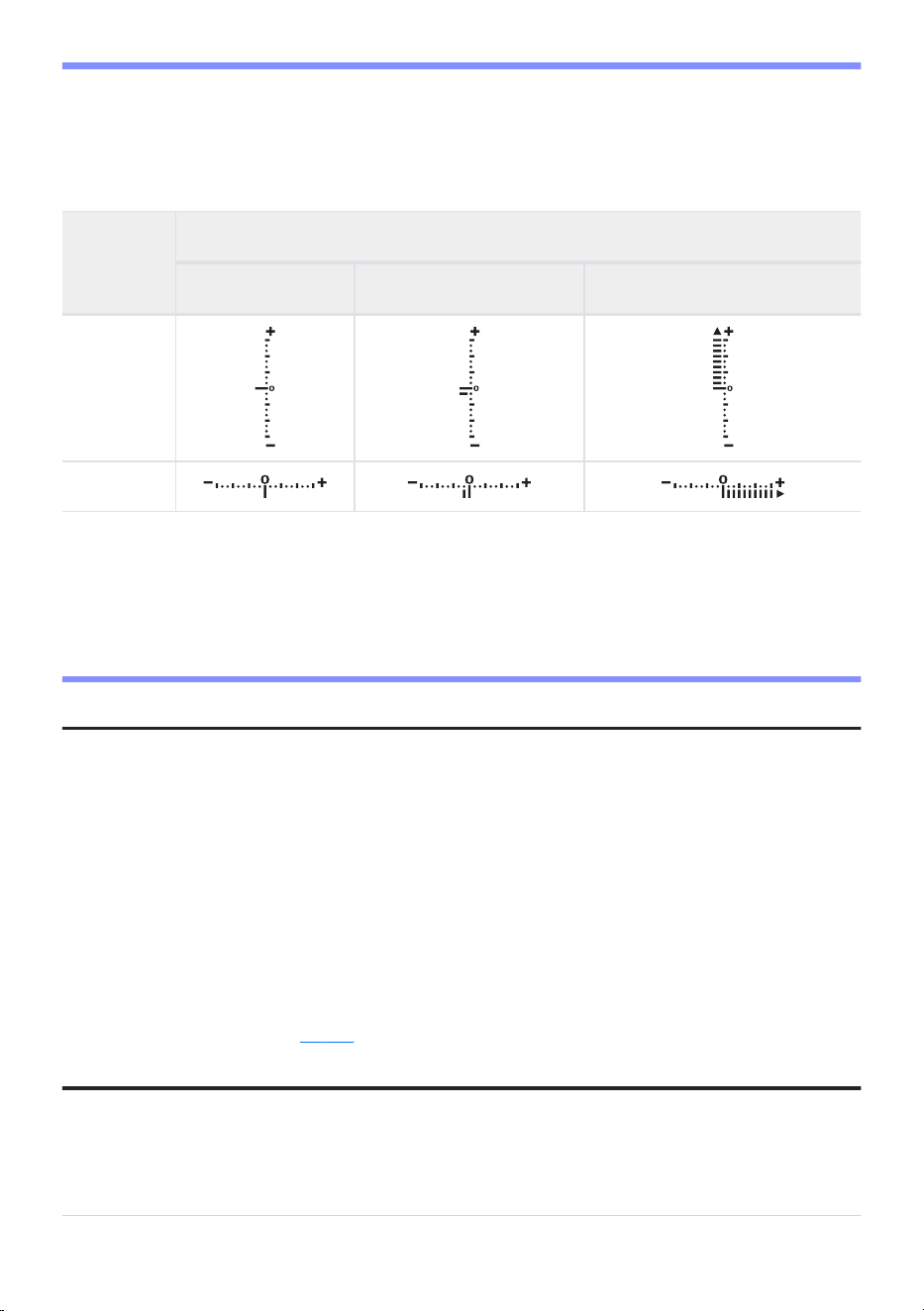
D Exposure Indicator
s
The exposure indicators in the monitor and viewfinder show whether the photograph would be under-
or over-exposed at current settings. The exposure indicators can be read as follows (the display varies
with the option selected for Custom Setting b2 [EV steps for exposure cntrl]):
Display
[1/3 EV steps (comp. 1/3 EV)] selected for [EV steps for exposure cntrl]
Optimal exposure Underexposed by
1
/
3
EV Overexposed by over 3
1
/
3
EV
Monitor
Viewfinder
The orientation of the exposure indicators can be reversed using Custom Setting f8 [Rever
se
indicators].
D Exposure Warning
The displays will flash if the selected settings exceed the limits of the exposure metering system.
Tip: Extended Shutter Speeds
For shutter speeds as slow as 900 s (15 minutes) in mode M, select [ON] for Custom Setting d7
[Extended shutter speeds (M)].
Tip: Long Exposures
At speeds slower than 1s, the shutter speed displayed by the camera may differ from the actual
exposure time. The actual exposure times at shutter speeds of 15 and 30 seconds, for example, are
respectively 16 and 32 seconds. The exposure time will again match the selected shutter speed at
speeds of 60 seconds and slower.
Tip: Auto ISO Sensitivity Control (Mode M)
If auto ISO sensitivity control (
0 162) is enabled, ISO sensitivity will automatically be adjusted for
optimal exposur
e at the selected shutter speed and aperture.
142
Exposure
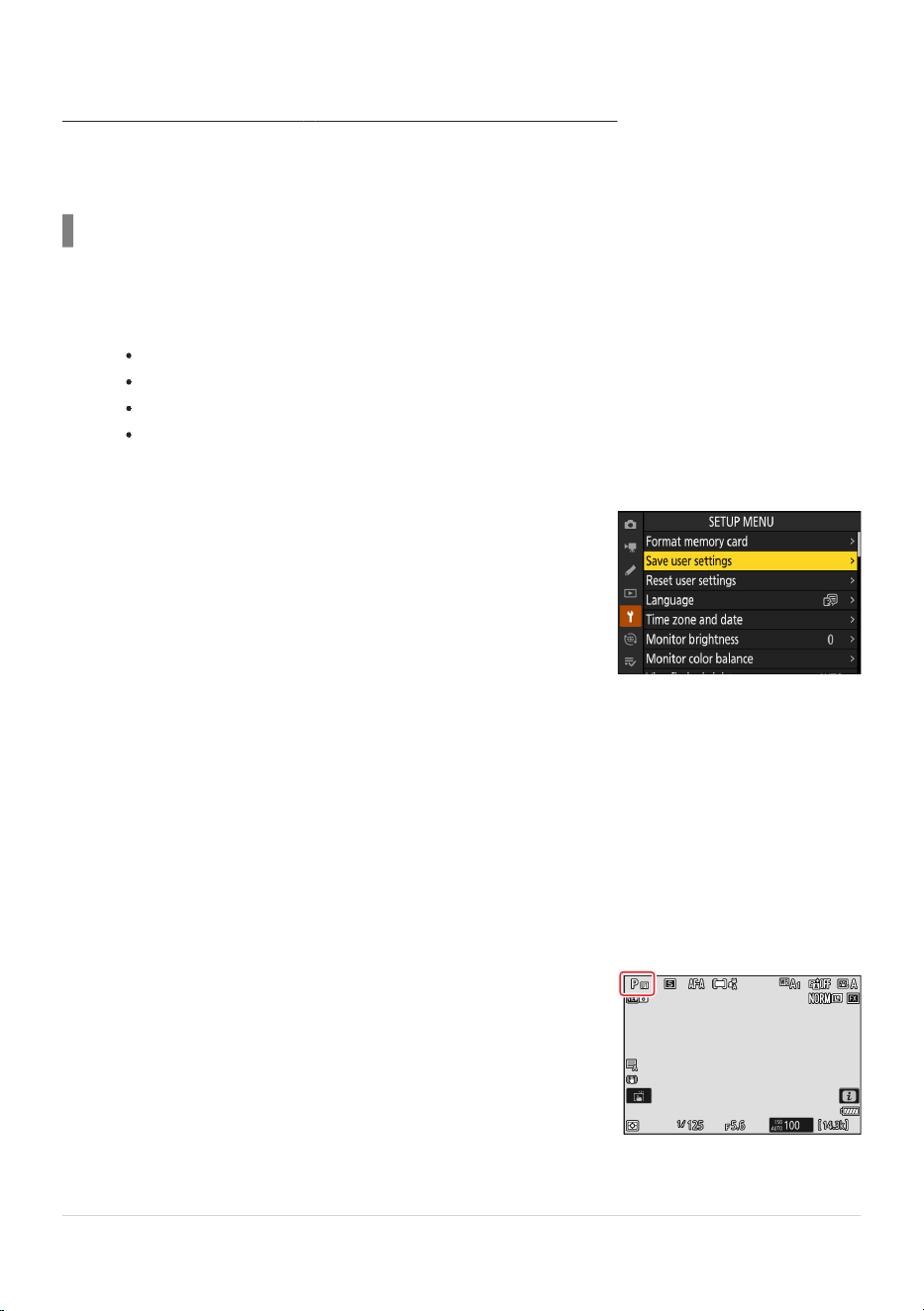
Highlight [Save user settings] in the setup menu and press
2.
Take pictures using the saved settings.
You can rotat
e the mode dial to U1, U2, or U3 to enable
shooting with the settings assigned to that position.
U1, U2, and U3 (User Setting Mode)
Frequently-used settings can be assigned to user setting positions U1
through U3 and later recalled
simply by rotating the mode dial.
Saving User Settings
Adjust settings.
The settings that can be saved include:
photo shooting menu options,
video recording menu options,
Custom Settings, and
Shooting mode, shutter speed (modes S and M), aperture (modes A and M), flexible
program (mode P), exposure compensation, etc.
Select the user settings position to assign settings.
Select [Save to U1], [Save to U2], or [Save to U3], and then press 2.
Save user settings.
Highlight [Save settings], and press J to assign current settings to the selected position.
143
Exposure
1
2
3
4
5
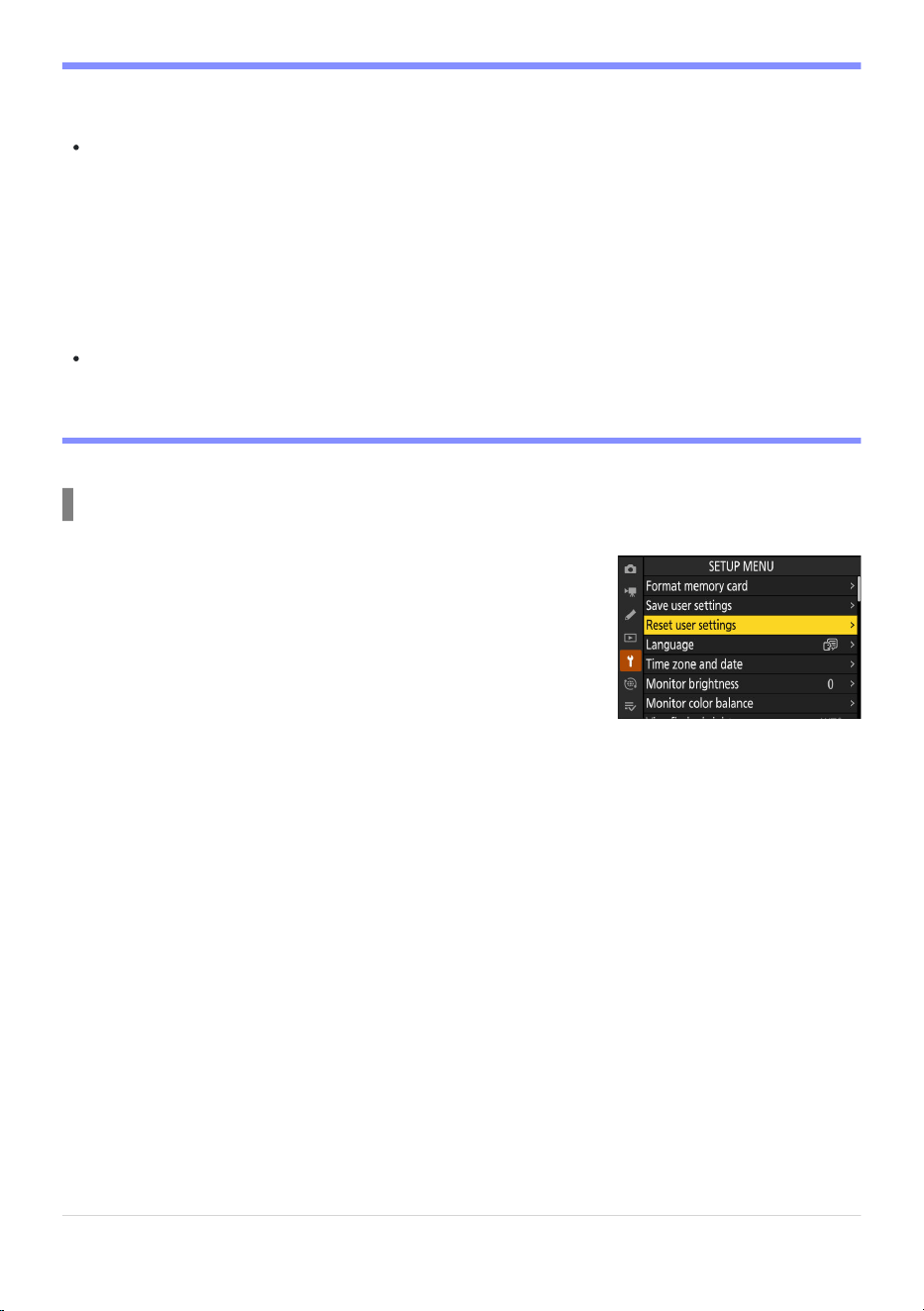
Highlight [Reset user settings] in the setup menu and press
2.
D Items That Cannot Be Assigned to U1, U2, and U3
The following menu items ar
e not saved.
PHOTO SHOOTING MENU
[Storage folder]
[Manage Picture Control]
[Multiple exposure]
[Interval timer shooting]
[Time-lapse video]
[Focus shift shooting]
[Pixel shift shooting]
VIDEO RECORDING MENU
[Storage folder]
[Manage Picture Control]
Resetting User Settings
Select a user settings position to reset.
Select [Reset U1], [Reset U2], or [Reset U3], and then press 2.
Reset user settings.
Highlight [Reset] and press the J button to restore default settings for the selected position
(the camera will function in mode P).
144
Exposure
-
-
-
-
-
-
-
-
-
1
2
3
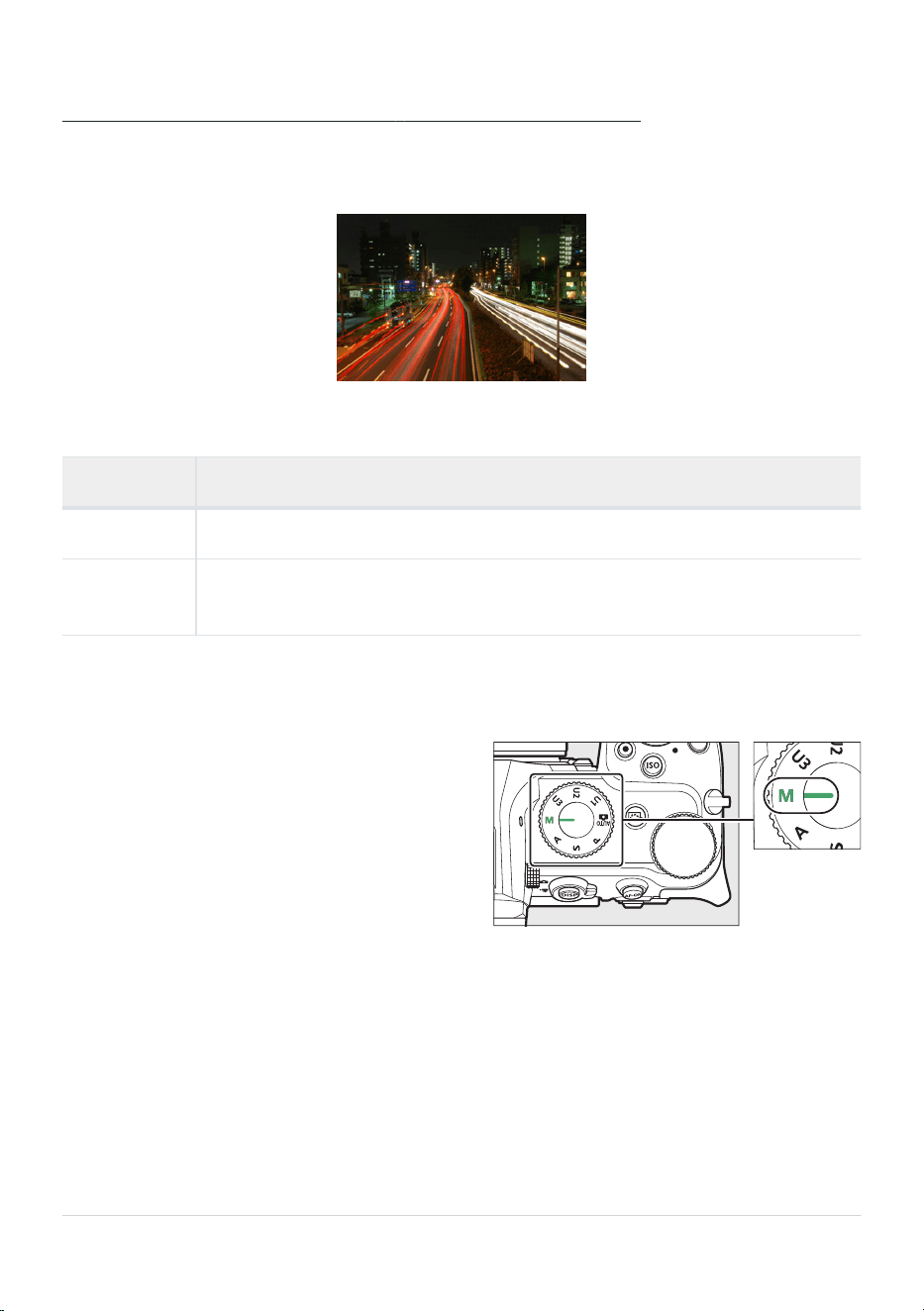
Rotate the mode dial to M.
Long Time-Exposures (Mode M Only)
The camera offers tw
o options for long time-exposures: “Bulb” and “Time”. Long time-exposures can
be used for pictures of fireworks, night scenery, the stars, or moving lights.
A 35-second exposure shot at a shutter speed of “Bulb” and an aperture o
f f/25
Shutter speed Description
Bulb The shutter remains open while the shutter-release button is held down.
Time
The exposure starts when the shutter-release button is pressed and ends when the
button is pressed a second time.
Keep the camera steady, for example by using a tripod.
145
Exposure
1
2
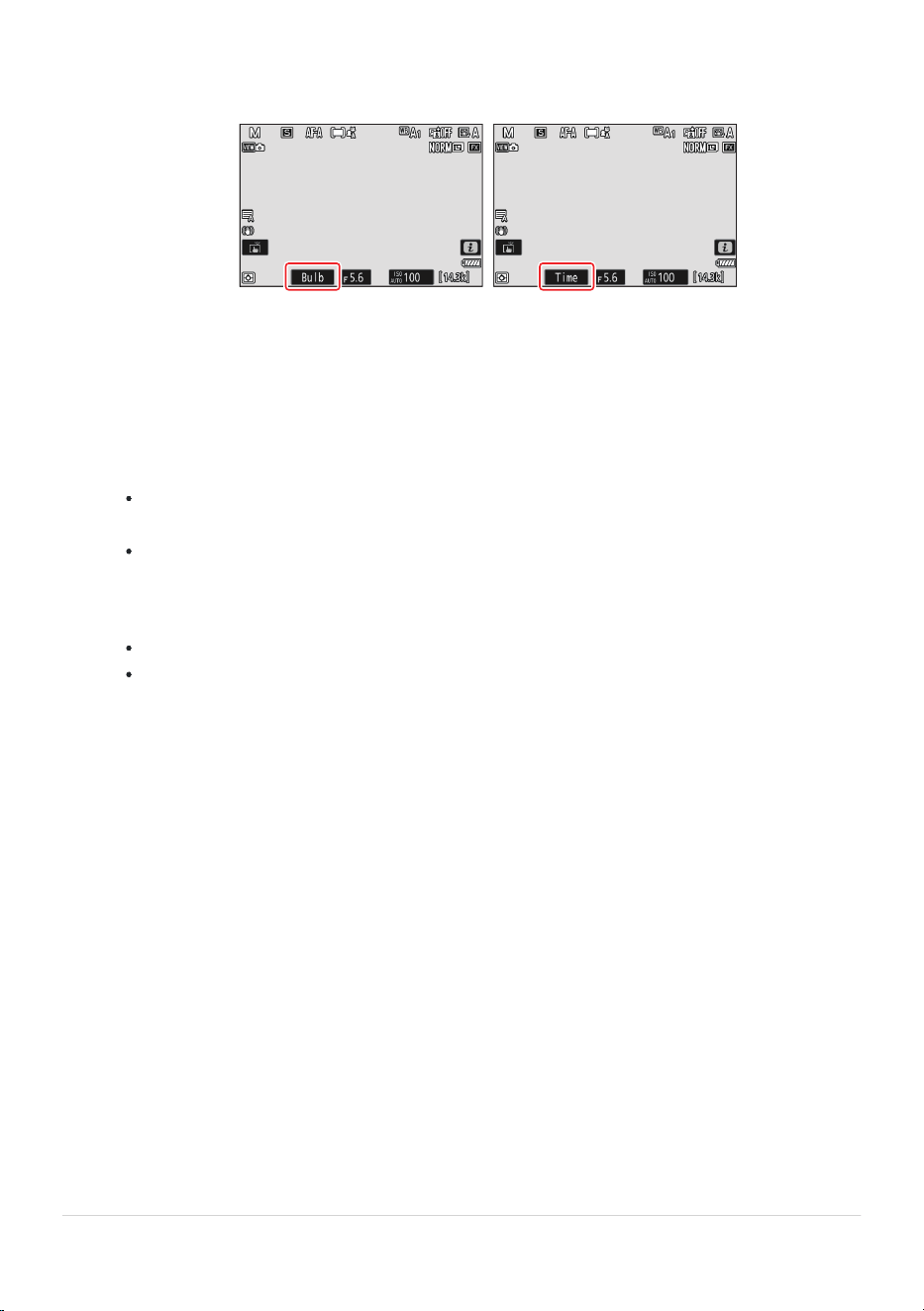
Bulb Time
Rotate the main command dial to choose a shutter speed of Bulb (“Bulb”) or Time
(“Time”).
Note that the exposur
e indicators are not displayed at a shutter speed of Bulb or Time.
Focus and start the exposure.
“Bulb”: Press the shutter-release button all the way down to start the exposure. Keep the
shutter-release button pressed during the exposure.
“Time”: Press the shutter-release button all the way down to start the exposure.
End the exposure.
“Bulb”: Lift your finger from the shutter-release button.
“Time”: Press the shutter-release button all the way down a second time.
146
Exposure
3
4
5

D Long Time-Exposures
Note that “noise” (bright spots, randomly-sp
aced bright pixels or fog) may be present in long
exposures.
Bright spots and fog can be reduced by choosing [ON] for [Long exposure NR] in the photo
shooting menu.
We recommend using one of the following power sources to prevent loss of power during long
exposures:
A fully-charged battery
An optional EH-8P AC adapter connected using the supplied USB cable (featuring Type-C
connectors at both ends)
An optional EP‑5B power connector with an EH‑5d, EH‑5c, or EH‑5b AC adapter
A third-party portable charger (power bank)
To prevent blur, use of a tripod or a device such as an optional remote cord is recommended.
Note that optional ML‑L7 remote controls function in “Time” mode even when a shutter speed of
Bulb is selected.
147
Exposure
-
-
-
-
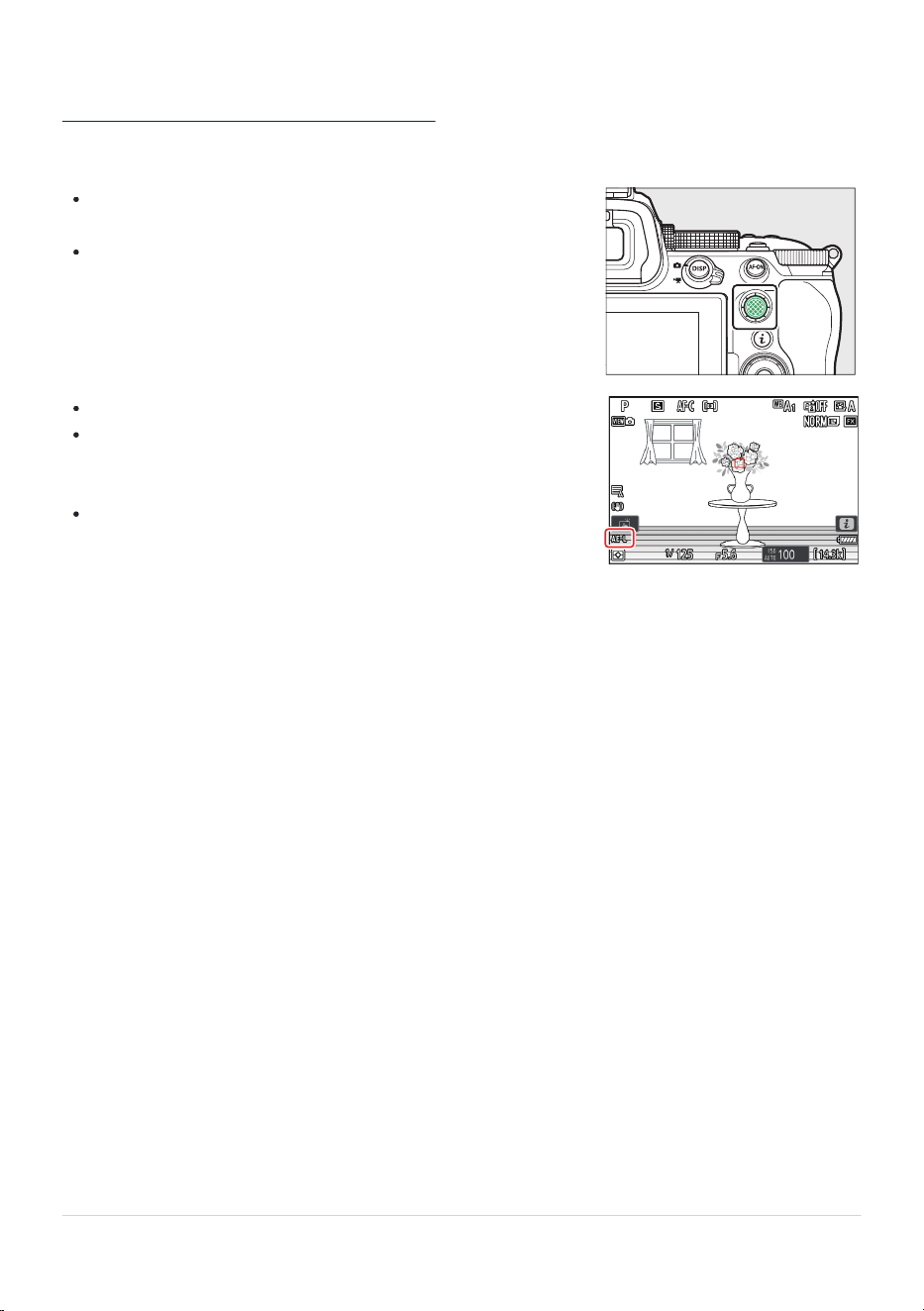
To set the autoexposure lock, press the center of the sub-
selector.
Keeping the cent
er of the sub-selector pressed locks exposure,
preventing it changing in response to changes in composition or
subject brightness.
An AE-L icon will appear in the shooting display
.
If aut
o
focus is enabled, press the shutter-release button halfway
to focus before pressing the center of the sub-selector. This locks
both focus and exposure.
While keeping the center of the sub-selector pressed, recompose
the photograph and shoot.
Autoexposure (AE) Lock
Use autoexposure lock t
o lock exposure, preventing the camera adjusting exposure automatically.
148
Exposure
Tip: Locking Exposure with the Shutter-Release Button
If [On (half press)] is selected for Cust
om Setting c1 [Shutter-release button AE-L], exposure will lock
while the shutter-release button is pressed halfway.
Tip: Metered Area
With [Spot metering], exposure will be locked at the value metered in a circle centered on the
current focus point.
With [Center-weighted metering], exposure will be locked at a value weighted toward a 12-mm
circle in the center of the display.
Tip: Adjusting Shutter Speed and Aperture
The following settings can be adjusted while the center of the sub-selector is pressed:
Shooting mode Setting
P Shutter speed and aperture (flexible program;
0 138)
S Shutter speed
A Aperture
The new values can be confirmed in the shooting display.
149
Exposure
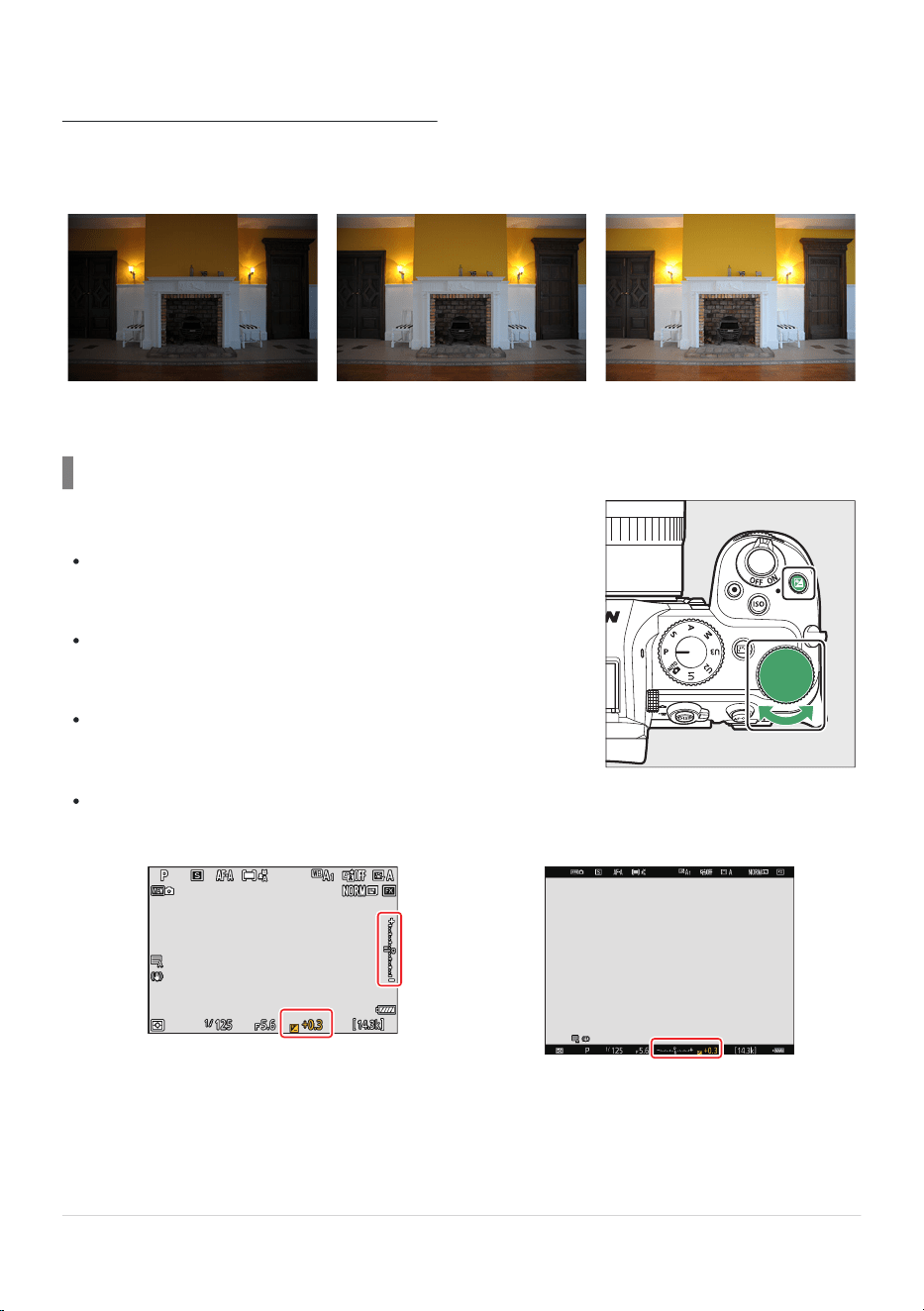
−1EV No exposure compensation +1EV
Hold the E button and rotat
e a command dial.
Choose from values between –5 EV (underexposure) and +5 EV
(overexposure). Values between –3 EV and +3 EV are available in
video mode.
At default settings, changes to exposure compensation are made
in increments of ¹⁄₃EV. The size of the increments can be
changed using Custom Setting b2 [EV steps for exposure cntrl].
Higher values make the subject brighter, lower values darker.
Monitor
Viewfinder
Exposure Compensation
Exposure compensation is used to alt
er exposure from the value suggested by the camera. It can be
used to make pictures brighter or darker.
Adjusting Exposure Compensation
The shooting display shows the E icon and indicators in photo mode and the E icon in video mode.
The current exposure compensation value can be confirmed by pressing the E button.
150
Exposure

Normal exposure can be restored by setting exposure compensation to ±0.0. Exposure
compensation does not reset when the camera is turned o
ff (note that the camera still resets
exposure compensation in b mode when it is turned off).
Tip: Mode M
In mode M, exposure compensation affects only the exposure indicator; shutter speed, aperture,
and ISO sensitivity do not change. Actual exposure does not change.
Press the E button to confirm the compensation amount by value and indicator.
When auto ISO sensitivity control (
0 162) is in effect, ISO sensitivity is automatically adjusted
accor
ding to the value selected for exposure compensation, changing overall exposure.
Tip: Using a Flash
When an optional flash is used, exposure compensation affects both flash level and exposure, altering
the brightness of both the main subject and the background; if desired, the effect can be restricted to
the background using Custom Setting e3 [Exposure comp. for flash].
151
Exposure
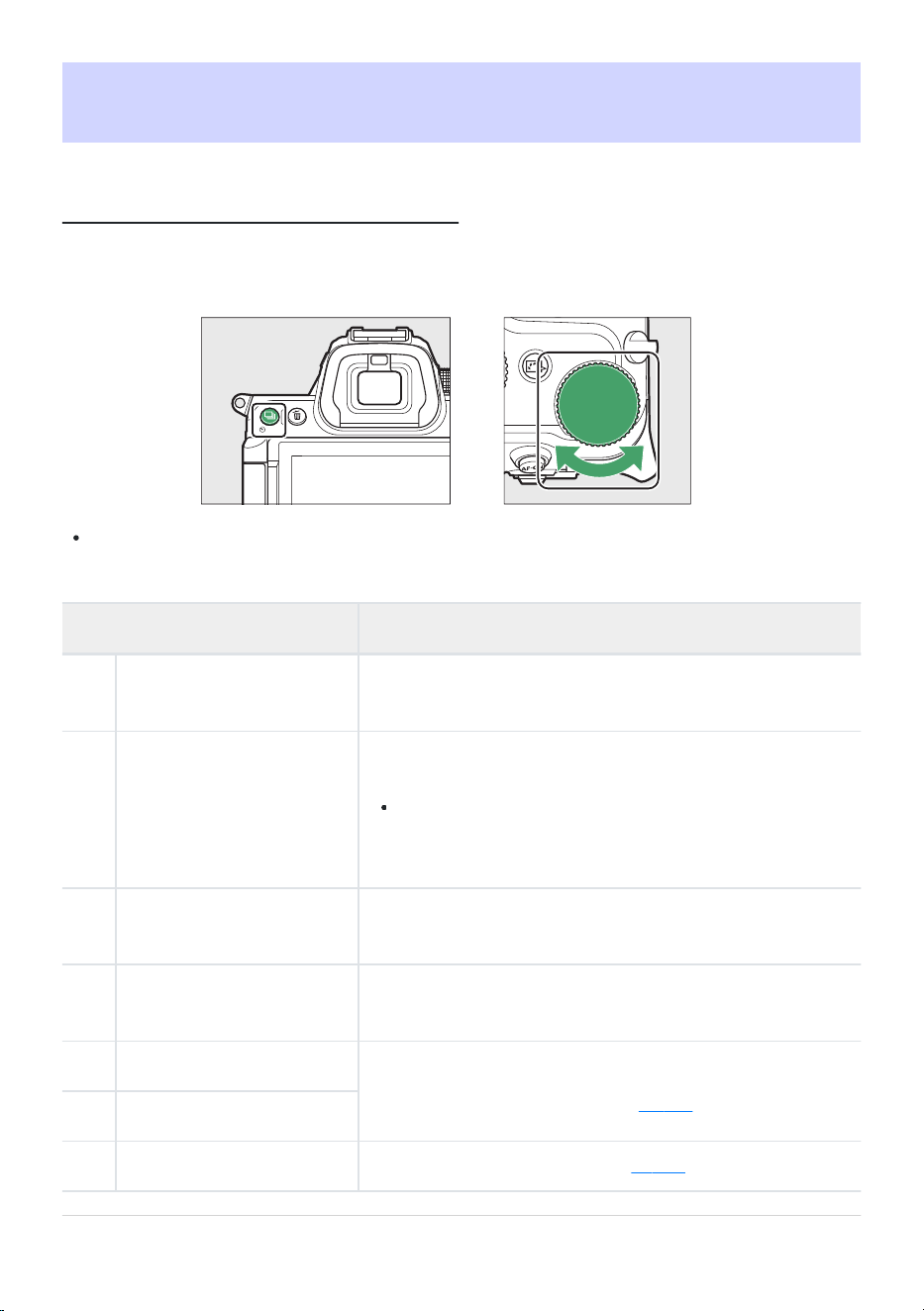
Release Mode
Choosing a Release Mode
To choose the operation perfor
med when the shutter-release button is pressed all the way down, hold
the c (E) button and rotate the main command dial.
Options for the selected setting, if any, can be chosen by holding the c (E) button and rotating the
sub-command dial.
Mode Description
U
[Single frame]
The camera takes one photograph each time the shutter-
r
elease button is pr
essed.
V
[Continuous L]
The camera takes photographs at a selected rate while the
shutter-release button is pressed.
Choose from rates of from 1 to 7fps. To choose the frame
rate, hold the c (E) button and rotate the sub-command
dial.
W
[Continuous H]
The camera takes photographs at up to 9.4fps (up to 10 fps
in silent mode) while the shutter-release button is pressed.
X
[Continuous H (extended)]
The camera takes photographs at up to 14fps (up to 15 fps
in silent mode) while the shutter-release button is pressed.
A
[C15]
The camera takes photographs at 15 or 30 fps while the
shutter-r
elease button is pressed (
0 156).
A
[C30]
E
[Self-timer] Tak
e pictures with the self-timer (
0 158).
152
Release Mode

Tip: Series
Each series of shots taken during bur
st photography or high-speed frame capture + can be treated
as a group. Use [Series playback] in the playback menu to choose how bursts are handled during
playback.
153
Release Mode
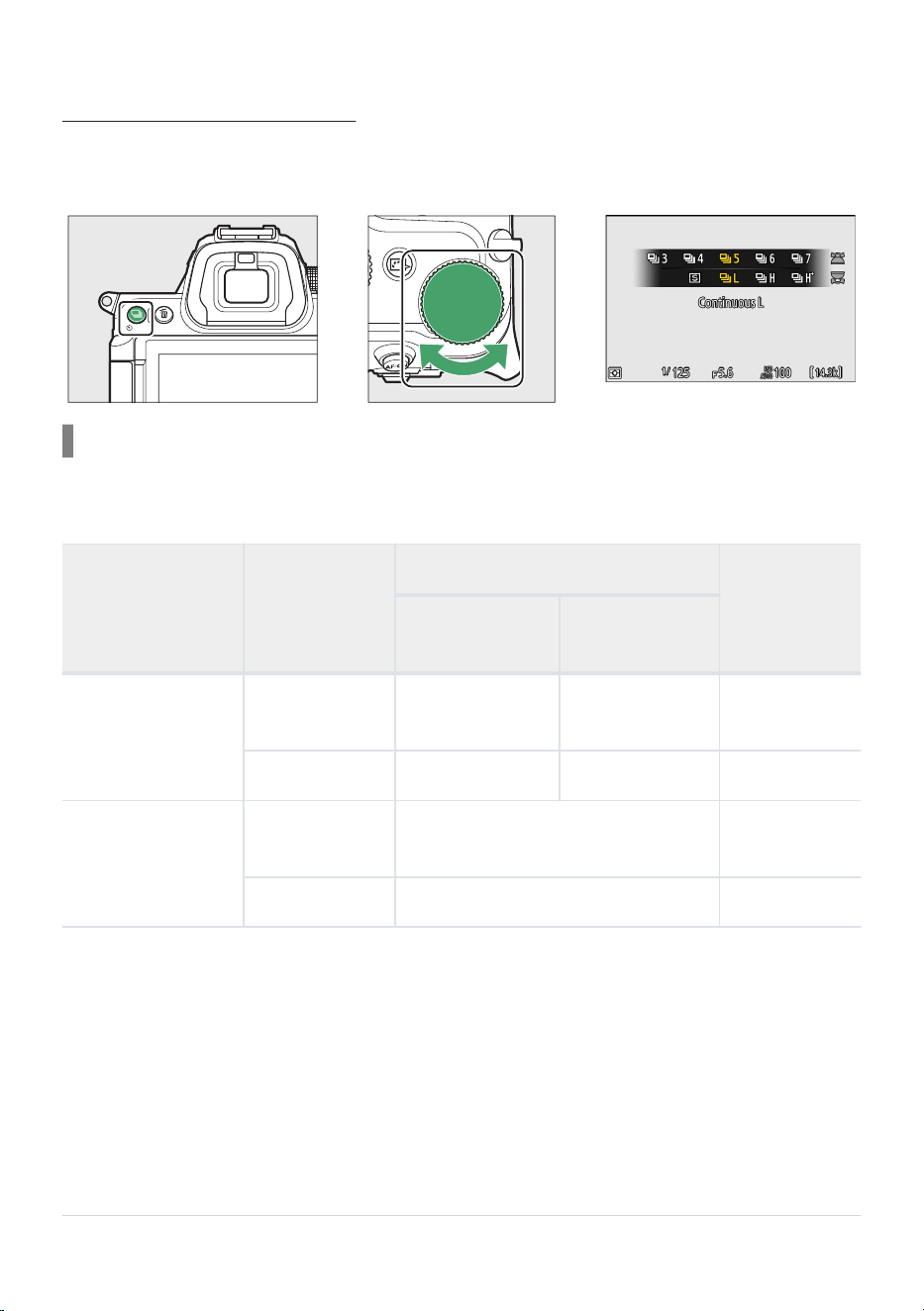
Burst Photography
For burst photography
, hold the c (E) button and rotate the main command dial to select
[Continuous L], [Continuous H], or [Continuous H (extended)].
Frame Advance Rate
The maximum frame advance rates for [Continuous H] and [Continuous H (extended)] vary by
camera settings. The maximum frame advance rates for each setting are as follows:
Release mode Image quality
Shutter type
[Silent mode]:
[ON]
Mechanical
shutt
er
Electronic fr
ont-
curtain shutter
[Continuous H]
NEF (RAW)/NEF
(RAW)+
Approx. 6.9fps Approx. 8.2fps Approx. 6.5fps
JPEG/HEIF Approx. 7.8fps Approx. 9.4fps Approx. 10fps
[Continuous H
(extended)]
NEF (RAW)/NEF
(RAW)+
Approx. 11fps Approx. 8.3fps
JPEG Approx. 14fps Approx. 15fps
154
Release Mode

While the shutter-release button is pressed halfway, the frame-
count display will show the number of pictures that can be st
ored
in the memory buffer as “rXXX.” “XXX” indicates the number of
pictures that can be taken in a burst with the current camera
settings. For example, if “r050” is displayed, the camera can hold
50 pictures in the memory buffer with the current settings.
The number shown is an approximate. The actual number of
photos that can be stored in the memory buffer varies by camera
settings and shooting conditions.
The buffer capacity is also displayed while the shutter-release
button is pressed all the way down.
The camera temporarily stores the pictures taken in the memory
buffer before saving them to the memory card. The number of
pictures that can be taken in the current burst will be displayed
according to the available space in the memory buffer.
When the display shows “r000,” the frame rate will drop.
The number of photos that can be stored in the memory
buffer also appears while the single frame or self-timer mode
is selected.
The Memory Buffer
D Continuous H (Extended)
The camera may be unable to maintain consist
ent exposure across each burst at some settings. For
consistent exposure across all the shots in each burst, use autoexposure lock (
0 148).
The frame advance rate for [Continuous H (ext
ended)] drops to that for [Continuous H] when
[HLG] is selected for [Tone mode] in the photo shooting menu.
D Cautions: Burst Photography
Depending on shooting conditions and memory card performance, the memory card access lamp
may light for anywhere from a few tens of seconds to around a minute. Do not remove the memory
card while the memory card access lamp is lit. Not only could any unrecorded pictures be lost, but
the camera or memory card could be damaged.
If the camera is switched off while the memory card access lamp is lit, it will not power off until all
pictures in the buffer have been recorded.
If the battery is exhausted while pictures remain in the buffer, the shutter release will be disabled
and the pictures transferred to the memory card.
155
Release Mode
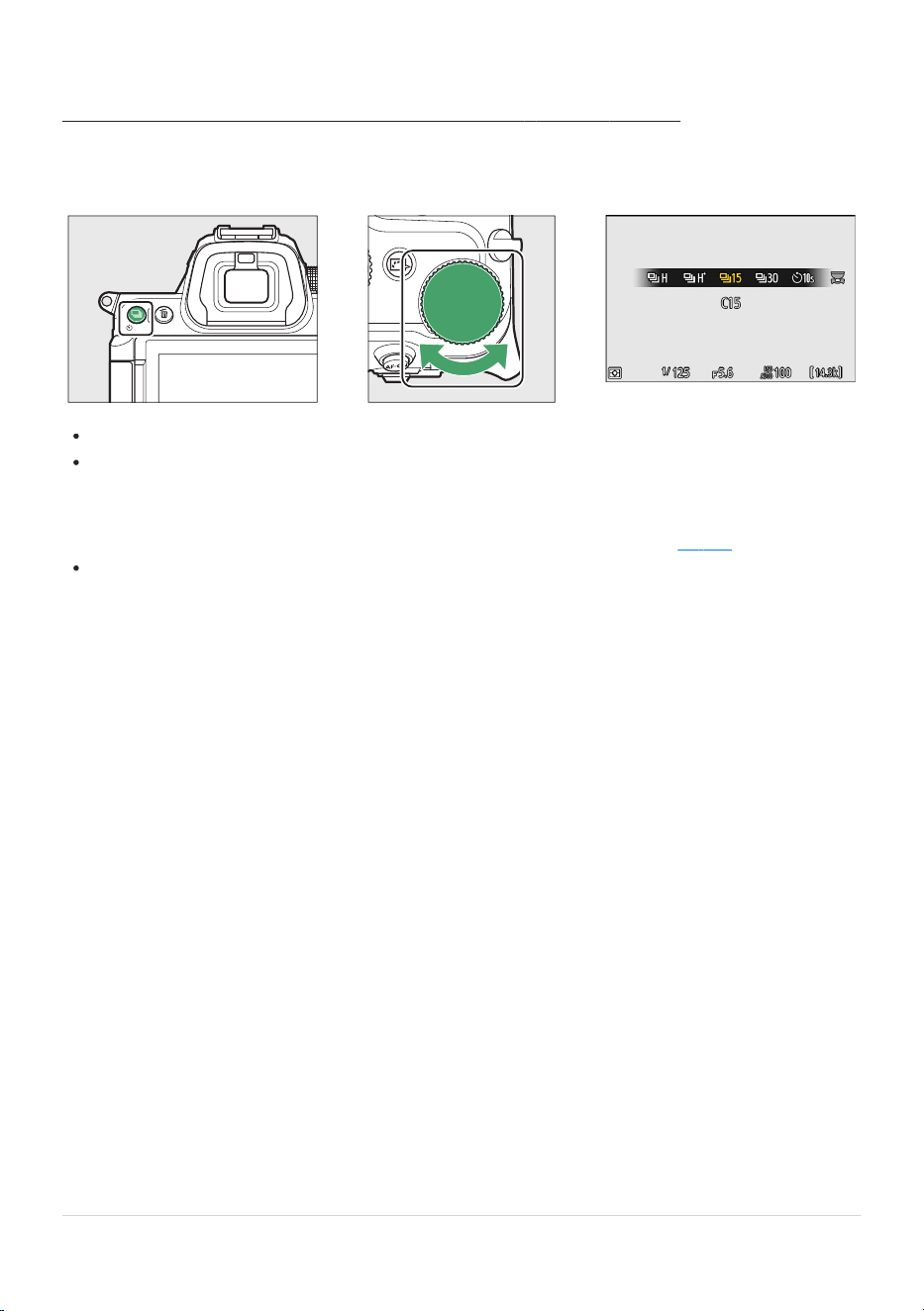
High-Speed Frame Capture + (C15/C30)
For high-speed burst photography at frame rat
es of 15 or 30 fps (high-speed frame capture +), hold
the c (E) button and rotate the main command dial to choose [C15] or [C30].
The maximum length of bursts taken using high-speed frame capture + varies with the frame rate.
The photos recorded may also include the final pictures from frames buffered while the shutter-
release button is pressed halfway (“Pre-Release Capture”); to choose how much of the buffer is
saved, use Custom Setting d3 [Pre-Release Capture options]. You can also limit the length of the
burst recorded after the shutter-release button is pressed all the way down (
0 581).
The t
ouch shutt
er can be used only t
o take one picture at a time. Use the shutter-release button for
high-speed frame capture +.
156
Release Mode

D High-Speed Frame Capture +: Restr
ictions
Only the [FX (36×24)] and [DX (24×16)] image area options are available.
Image quality is fixed at [JPEG/HEIF normal] and pictures are recorded in JPEG format.
Image size is fixed at [Large].
Shutter speed can only be set to values between ¹⁄₈₀₀₀s and ¹/₆₀ s.
Exposure compensation is restricted to values between −3 and +3EV, although settings between −5
and +5EV can be selected.
The upper limit for ISO sensitivity is ISO 64000, even when higher values (Hi 0.3 through Hi 1.7) are
selected.
The option chosen for [Minimum shutter speed] will not apply if [ON] is selected for [ISO
sensitivity settings] > [Auto ISO sensitivity control] in the photo shooting menu.
High-speed frame capture + cannot be combined with some camera features, including:
flexible program,
HLG tone mode,
photo flicker reduction,
flash photography,
bracketing,
multiple exposures,
HDR overlay,
interval-timer photography,
time-lapse video recording,
focus shift, and
pixel shift.
Tip: High-Speed Frame Capture +
Memory cards with a high write speed are recommended (
0 905).
157
Release Mode
-
-
-
-
-
-
-
-
-
-
-
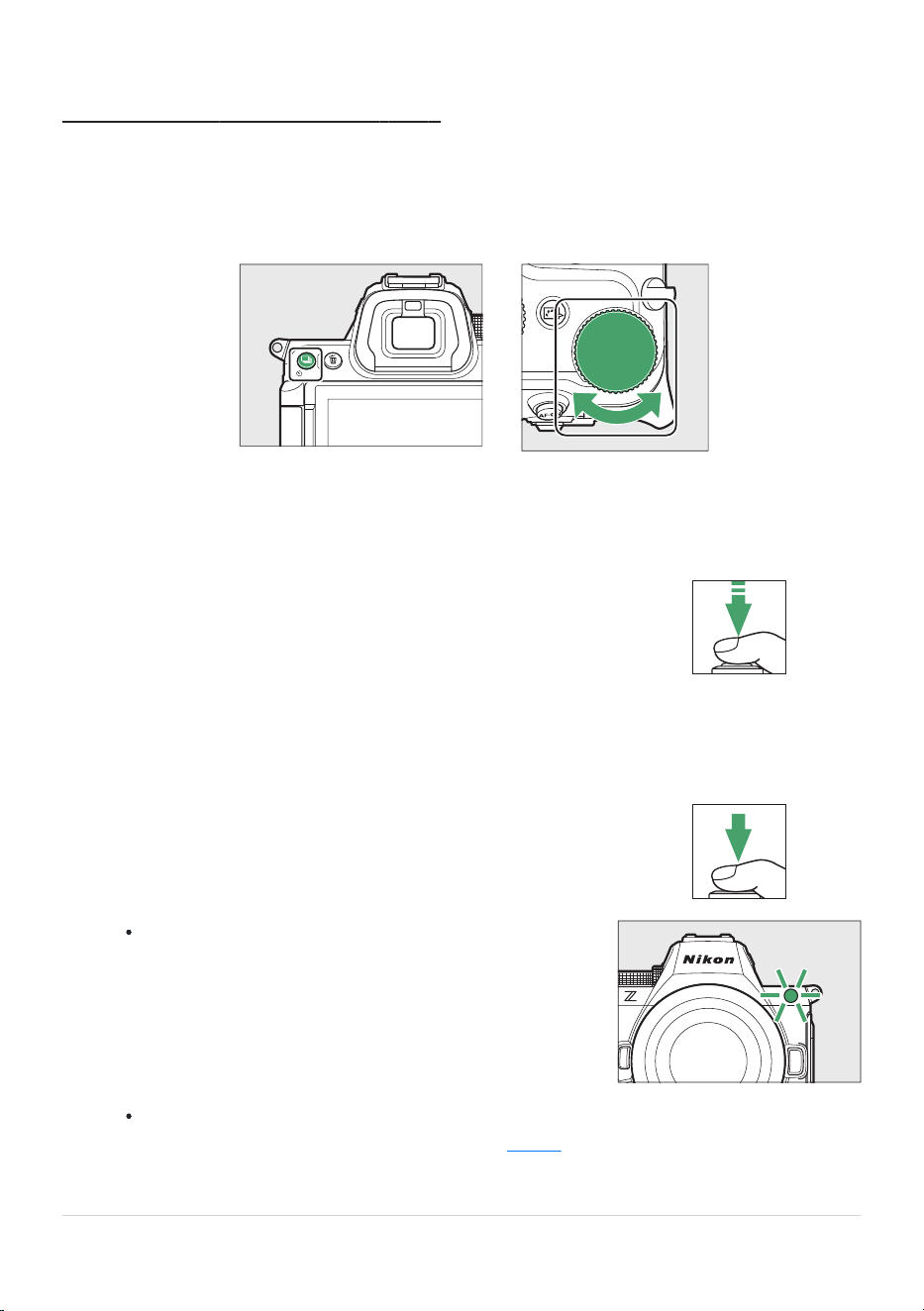
To focus, press the shutter-release button halfway (i.e.,
lightly press the shutter
-release button, stopping when it
is pressed halfway).
The timer will not start if the shutter cannot be released, as
may be the case, for example, if the camera is unable to focus
when AF‑S is selected for focus mode.
Without lifting your finger from the shutter-release
button, press the butt
on the rest of the way down to start
self-timer shooting.
The self-timer lamp will begin flashing when the shutter-
release button is pr
essed. The lamp stops flashing two
seconds before the timer expires and the camera releases
the shutter.
Using the Self-Timer (E)
In self-timer mode, pressing the shutt
er-release button all the way down starts a timer, and a photo is
taken when the timer expires.
Hold the c (E) button and rotate the main command dial to select E.
Hold the c (E) button and rotate the sub-command dial to choose the self-timer delay.
The timer duration, the number of shots taken, and the interval between shots can be
selected using Custom Setting c2 [Self-timer] (
0 577).
158
Release Mode
1
2
3
4

Tip: The Focus Position in Self-Timer
In self-timer photography
, the shutter releases at the selected focus position when the shutter-
release button is pressed halfway in Step 3. The subject’s motion will not affect the focus position.
In self-portrait mode, the camera will focus about a second before releasing the shutter when using
the self-timer.
159
Release Mode
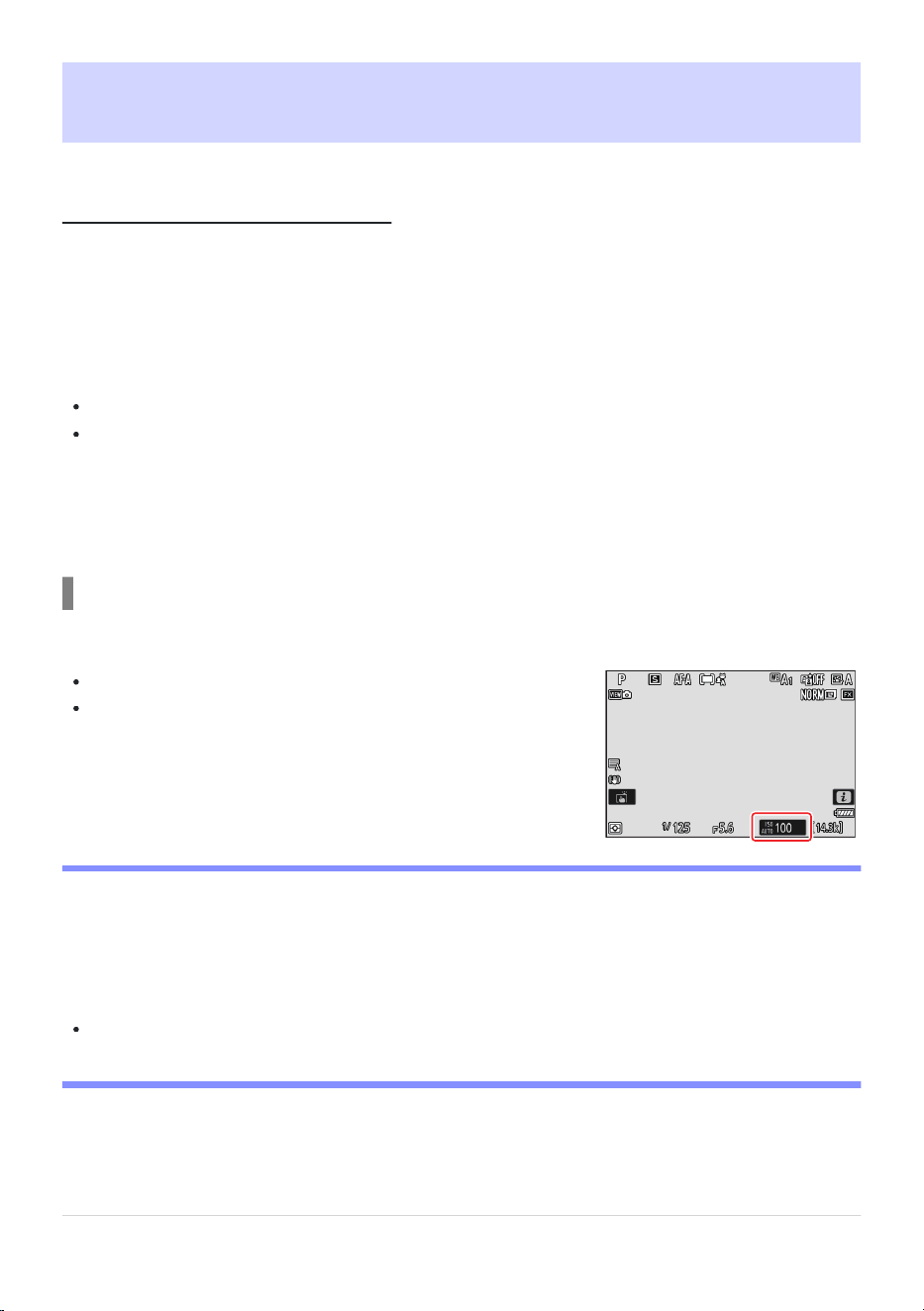
Your selection is shown in the shooting display.
At default settings, changes to ISO sensitivity ar
e made in
increments of ¹⁄₃EV. The size of the increments can be changed
using Custom Setting b1 [ISO sensitivity step value].
ISO Sensitivity
About ISO Sensitivity
The camera’s sensitivity to light (ISO sensitivity) can be adjust
ed according to the amount of light
available. In general, choosing higher values allows faster shutter speeds at the same aperture. Choose
from settings of from ISO 100 to 64000. Extended settings of about 0.3, 0.7, and 1 EV (ISO 50
equivalent) below ISO 100 and 0.3, 0.7, 1, and 1.7 EV (ISO 204800 equivalent) above ISO 64000 are also
available.
An [Auto] option is available in b mode.
Manual ISO sensitivity selection is available in video mode only when [OFF] is selected for [ISO
sensitivity settings]> [Auto ISO control (mode M)] in mode M. Otherwise ISO sensitivity for
video recording will be set automatically by the camera. ISO sensitivity for video recording can be
set to values of from ISO 100 to 51200 and extended settings of about 0.3, 0.7, 1, and 2 EV (ISO
204800 equivalent) above ISO 51200 are also available.
Adjusting ISO Sensitivity
Hold the S button and rotate the main command dial.
D High ISO Sensitivities
The higher the ISO sensitivity, the less light needed to make an exposure, allowing pictures to be
taken when lighting is poor and helping prevent blur when the subject is in motion. Note, however,
that the higher the sensitivity, the more likely the picture is to be affected by “noise” in the form of
randomly-spaced bright pixels, fog, or lines.
“Noise” can be reduced by enabling high ISO noise reduction. High ISO noise reduction can be
enabled using the [High ISO NR] items in the photo shooting and video recording menus.
160
ISO Sensitivity
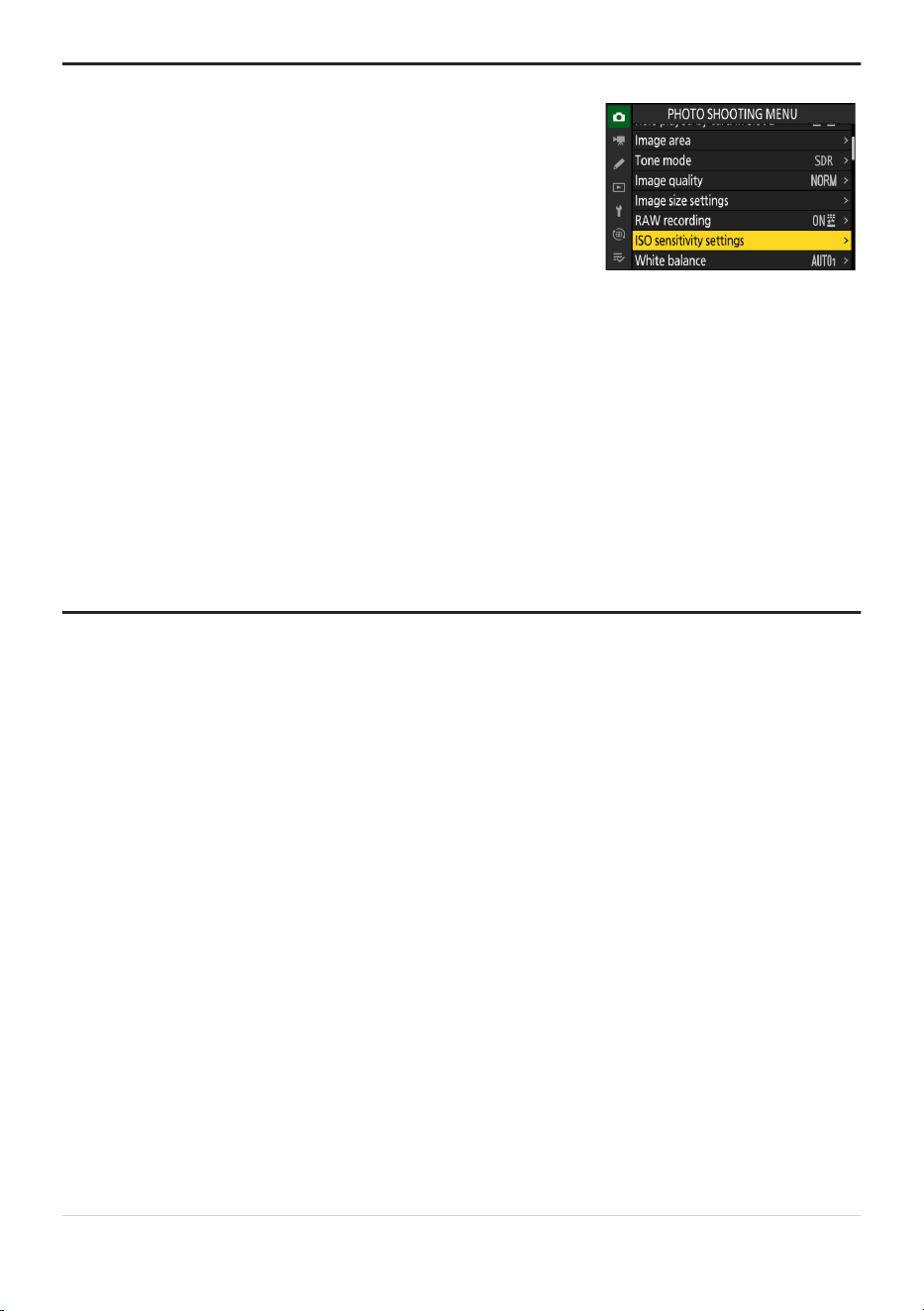
ISO sensitivity can also be adjusted using the [ISO sensitivity
settings] item in the photo shooting menu.
Tip: The Photo Shooting Menu [ISO sensitivity settings] Option
Tip: Hi 0.3–Hi 1.7
A setting of [Hi 0.3] corr
esponds to an ISO sensitivity approximately 0.3EV higher than ISO 64000
(ISO 80000 equivalent) and [Hi 1.7] to an ISO sensitivity approximately 1.7EV higher (ISO 204800
equivalent). Note that pictures taken at these settings are particularly prone to “noise” in the form of
randomly-spaced bright pixels, fog, or lines.
Tip: Lo 0.3–Lo 1.0
[Lo 0.3] corresponds to an ISO sensitivity about 0.3EV below ISO 100 (ISO 80 equivalent). [Lo 1.0]
is roughly 1EV below ISO 100 (ISO 50 equivalent). Use for larger apertures or slower shutter speeds
when lighting is bright. Highlights may be overexposed. In most cases, ISO sensitivities of ISO [100] or
above are recommended.
161
ISO Sensitivity
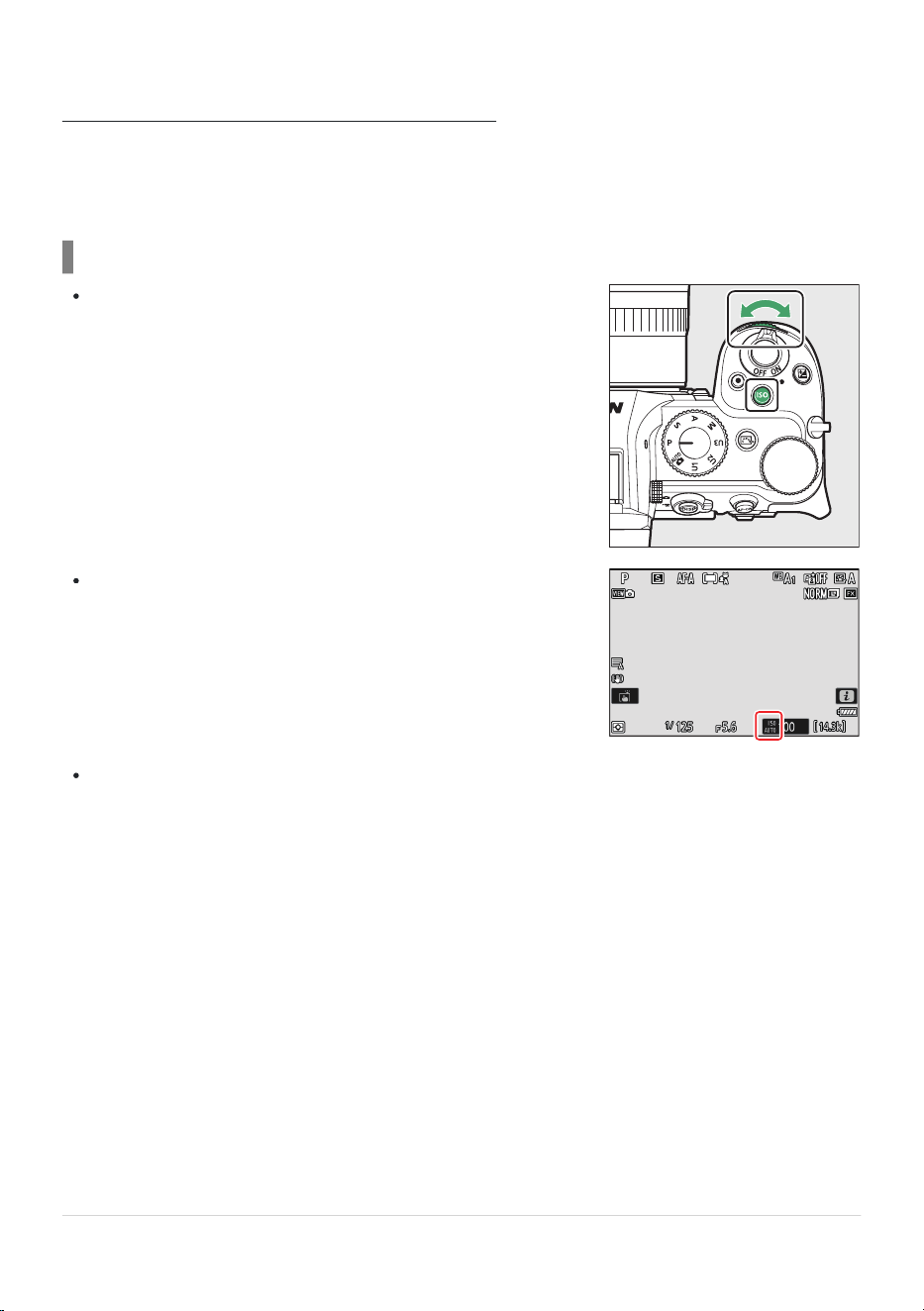
Hold the S button and rotat
e the sub-command dial to select
from ISO AUTO (auto ISO sensitivity control enabled) and ISO
(auto ISO sensitivity control disabled).
When auto ISO sensitivity control is enabled, the shooting display
will show ISO AUTO
. When sensitivity is altered from the value
selected by the user, the adjusted value will be shown in the
displays.
Auto ISO Sensitivity Control
Auto ISO sensitivity control aut
omatically adjusts ISO sensitivity if optimal exposure cannot be
achieved at the value selected by the user. You can select an upper limit for auto ISO sensitivity control
(200–Hi 1.7) to prevent ISO sensitivity being raised too high.
Enabling Auto ISO Sensitivity Control
Maximum sensitivity can be adjusted using the [ISO sensitivity settings] item in the photo
shooting menu.
162
ISO Sensitivity

D Cautions: Auto ISO Sensitivity Control
If the v
alue currently selected for [ISO sensitivity] is higher than that chosen for [Maximum
sensitivity], the value chosen for [ISO sensitivity] will serve as the upper limit for auto ISO
sensitivity control.
During flash photography, shutter speed is limited to the range defined by the values selected for
Custom Settings e1 [Flash sync speed] and e2 [Flash shutter speed]. If the value selected for
[Minimum shutter speed] is not in this range, the value selected for Custom Setting e2 [Flash
shutter speed] becomes the effective minimum shutter speed.
Except in mode M, videos are recorded using auto ISO sensitivity control. Auto ISO sensitivity
control can be enabled for video recording in mode M by selecting [ON] for [ISO sensitivity
settings]> [Auto ISO control (mode M)] in the video recording menu.
163
ISO Sensitivity

Picture Controls
Types of Picture Controls
Nikon’s unique Pictur
e Control system makes it possible to share image processing settings, including
sharpening, contrast, brightness, saturation, and hue, among compatible devices and software. The
following Picture Controls are available.
Picture Control: Picture Controls provided with the camera. Basic Picture Controls, including [Auto]
and [Standard] modes (
0 167).
Creative Pictur
e Control: Picture Controls provided with the camera. These controls offer unique
combinations of hue, tone, saturation, and other settings tuned for particular effects (
0 167).
Picture Control (HL
G): Picture Controls provided with the camera. They are selected via [Set
Picture Control (HLG)] in the photo shooting menu when [Tone mode] in the photo shooting
menu is set to [HLG] in photo mode (
0 168).
164
Picture Controls
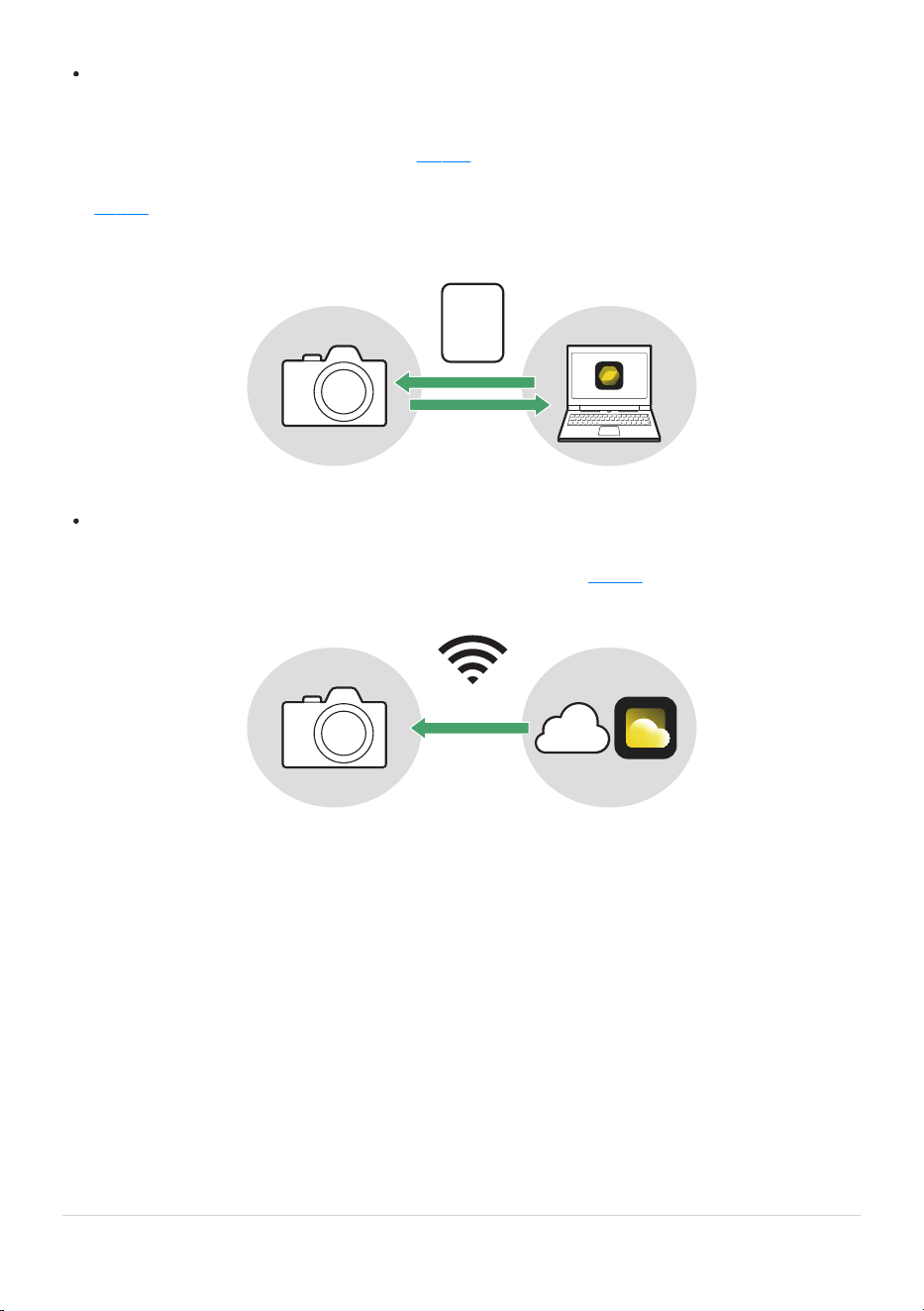
Custom Picture Control: Picture Controls cr
eated with the camera or NX Studio computer software.
These can be added to the camera separately based on the Picture Controls provided with the
camera. To create Custom Picture Controls with the camera, use [Manage Picture Control] in the
photo shooting or video recording menu (
0 177). If using NX Studio, creat
e a Custom Picture
Control on the software, export it as a file, copy to a memory card, and import it to the camera
(
0 180). For details on using NX Studio to cr
eate and export Custom Picture Controls, see the
NX Studio online help.
MEMORY
CARD
NX S
tudio
Cloud Picture Control: Picture Controls pr
ovided by the NikonImagingCloud cloud service. They
can be downloaded and imported to the camera as Picture Controls. These Picture Controls can be
adjusted once added to the camera as Custom Picture Controls (
0 181).
Nikon Imaging Cloud
165
Picture Controls
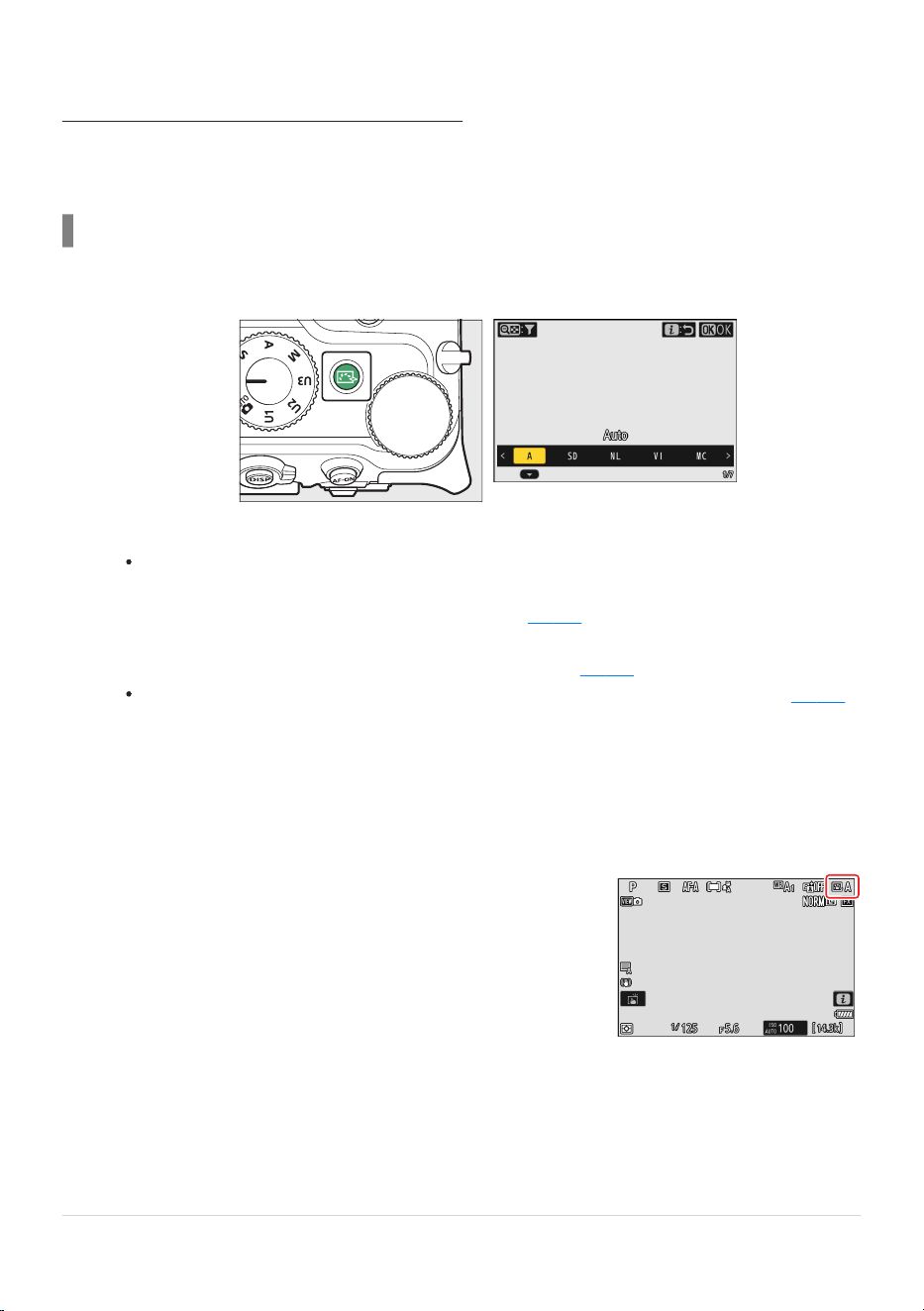
The selected option is shown by an icon in the shooting
display.
Selecting Picture Controls
Choose image processing (“Picture Contr
ol”) options for new photos according to the scene or your
creative intent.
Choosing a Picture Control
Press the h button.
The displayed items vary with the following camera settings.
In photo mode:
When [Tone mode] is set to [SDR] in the photo shooting menu: The same as for [Set
Picture Control] in the photo shooting menu (
0 167)
When [Tone mode] is set t
o [HLG] in the photo shooting menu: The same as for [Set
Picture Control (HLG)] in the photo shooting menu (
0 168)
In video mode: The same as for [Set Picture Control] in the video r
ecording menu (
0 167)
Press 4
or 2 to highlight a Picture Control.
Press J to select.
166
Picture Controls
1
-
-
2
3
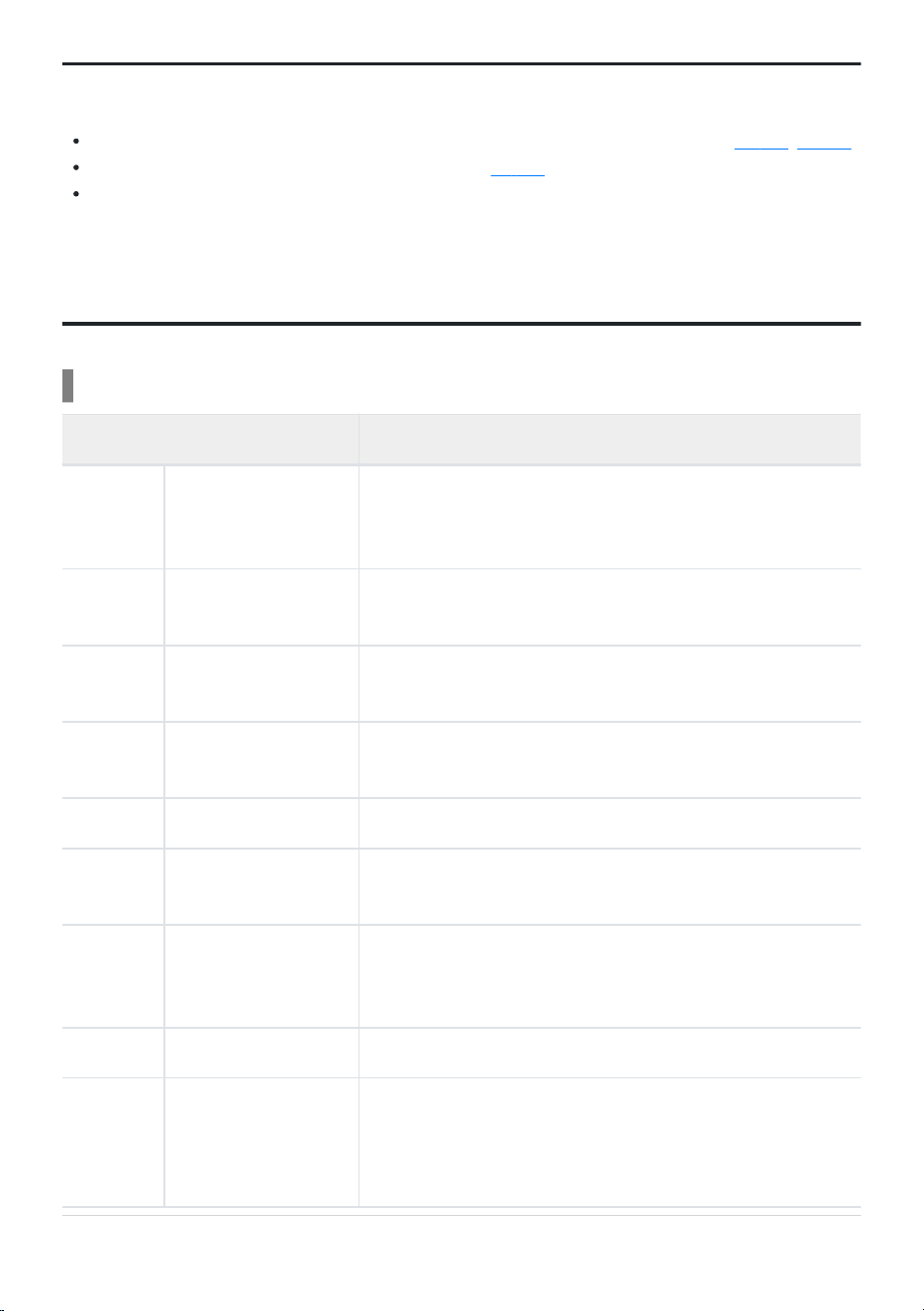
Tip: Set Picture Controls in the Menus
Picture Controls can also be set in the following menus.
[
Set Picture Control] or [Set Picture Control (HLG)] in the photo shooting menu (
0 424, 0 426)
[Set Picture Control] in the video r
ecording menu (
0 519)
[Set Picture Control] or [Set Pictur
e Control (HLG)] in the i menu
Tip: “Same as Photo Settings”
Selecting the [Same as photo settings] option for [Set Picture Control] in the video recording menu
automatically sets the Picture Control for videos to the same as that used for photographs.
[Set Picture Control]
Option Description
n
[Auto]
The camera automatically adjusts hues and tones based on
the [Standard] (photo mode) or [Neutral] (video mode)
Picture Control.
Q
[Standard]
Standard processing for balanced results. Recommended for
most situations.
R
[Neutral]
Minimal processing for natural results. Choose for pictures
that will later be processed or retouched.
S
[Vivid]
Pictures are enhanced for a vivid, photoprint effect. Choose
for pictures that emphasize primary colors.
T
[Monochrome] Take monochrome pictures.
2
[Flat Monochrome]
Features gentle gradations from highlights to shadows,
producing soft monochrome pictures.
3
[Deep Tone
Monochrome]
Choose for slightly darker tones in the range from shadows
to mid-tones, with brightness rapidly increasing as tones
progress from mid-tones to highlights.
o
[Portrait] Smooth complexions for natural-looking portraits.
4
[Rich Tone Portrait]
Produces more vivid results than [Portrait] while capturing
details of the subject’s complexion and avoiding loss of detail
in highlights. Choose for pictures that will later be processed
or retouched.
167
Picture Controls
Option Description
p
[Landscape]
Shoot vibrant landscapes and cityscapes. Choose for pictures
that emphasize blues and greens.
q
[Flat
]
Details are preserved over a wide tone range, from highlights
to shadows. Choose for pictures that will later be extensively
processed or retouched.
k01–
k20
[Creative Picture
Control]
(Creative Picture
Control)
Creative Picture Controls offer unique combinations of hue,
tone, saturation, and other settings tuned for particular
effects. Choose from a total of 20 options, including [Dream]
and [Morning].
h C-1–h
C-9
[Custom Picture
Control]
(Custom Picture
Control)
Displayed if a modified Picture Control is saved as a Custom
Picture Control to the camera (
0 177). The default name
is the name of the existing Picture Contr
ol with a two-digit
number appended. This can be changed as desired.
n–o
[Cloud Picture
Control]
(Cloud Picture
Control)
Displayed if Picture Controls are downloaded from Nikon
Imaging Cloud cloud service and imported to the camera
(
0 181).
[Set Picture Control (HLG)]
Option Description
c
[Standard]
Standar
d processing for balanced results. Recommended for most
situations.
d
[Monochrome] Take monochrome photographs.
e
[Flat]
Choose for photographs that will later be extensively processed or
retouched.
168
Picture Controls
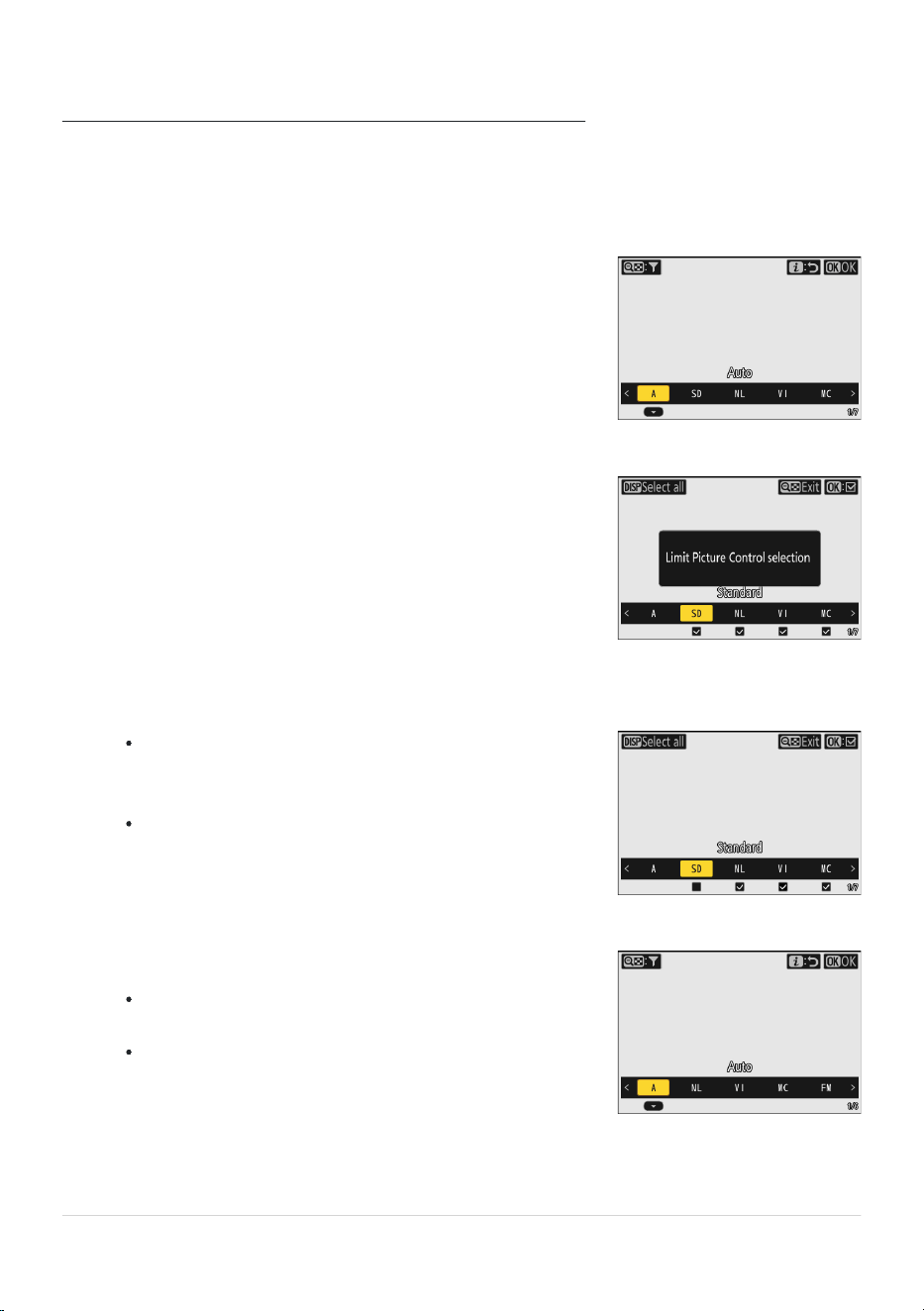
Press the h button or select [Set Pictur
e Control] in the i
menu and press the J button.
This will display a Picture Control list.
Press the W (Q) butt
on.
This will display the Pictur
e Contr
ol selection screen.
Highlight a Picture Control using 4 or 2 and press J t
o
select (M) or deselect (U). Only Picture Controls marked with
a check (M) will be displayed.
Press the d button to select (M) all Picture Controls. Press
d again to deselect (U) all Picture Controls except [Auto].
Press the W (Q) button again to exit.
This will sav
e the changes and display the Picture Control
list.
This only displays the Picture Controls selected in Step 3.
Limiting Picture Control Selection
In video mode or when [SDR] is selected for [Tone mode] in the phot
o shooting menu in photo mode,
you can limit the Picture Controls available with the h button or the [Set Picture Control] item in the
i menu.
Select the Picture Controls that will be displayed.
169
Picture Controls
1
2
3
4

D Limiting Picture Control Selection
When [
Same as photo settings] is selected for [Set Picture Control] in the video recording menu,
limits set to Picture Control selection in video mode will also be applied to the Picture Control
selection in photo mode.
Limiting Picture Control selection does not apply to the Picture Controls displayed in the [Set
Picture Control] items in the photo shooting and video recording menus.
Limiting Picture Control selection is not available when [HLG] is selected for [Tone mode] in the
photo shooting menu in photo mode.
170
Picture Controls
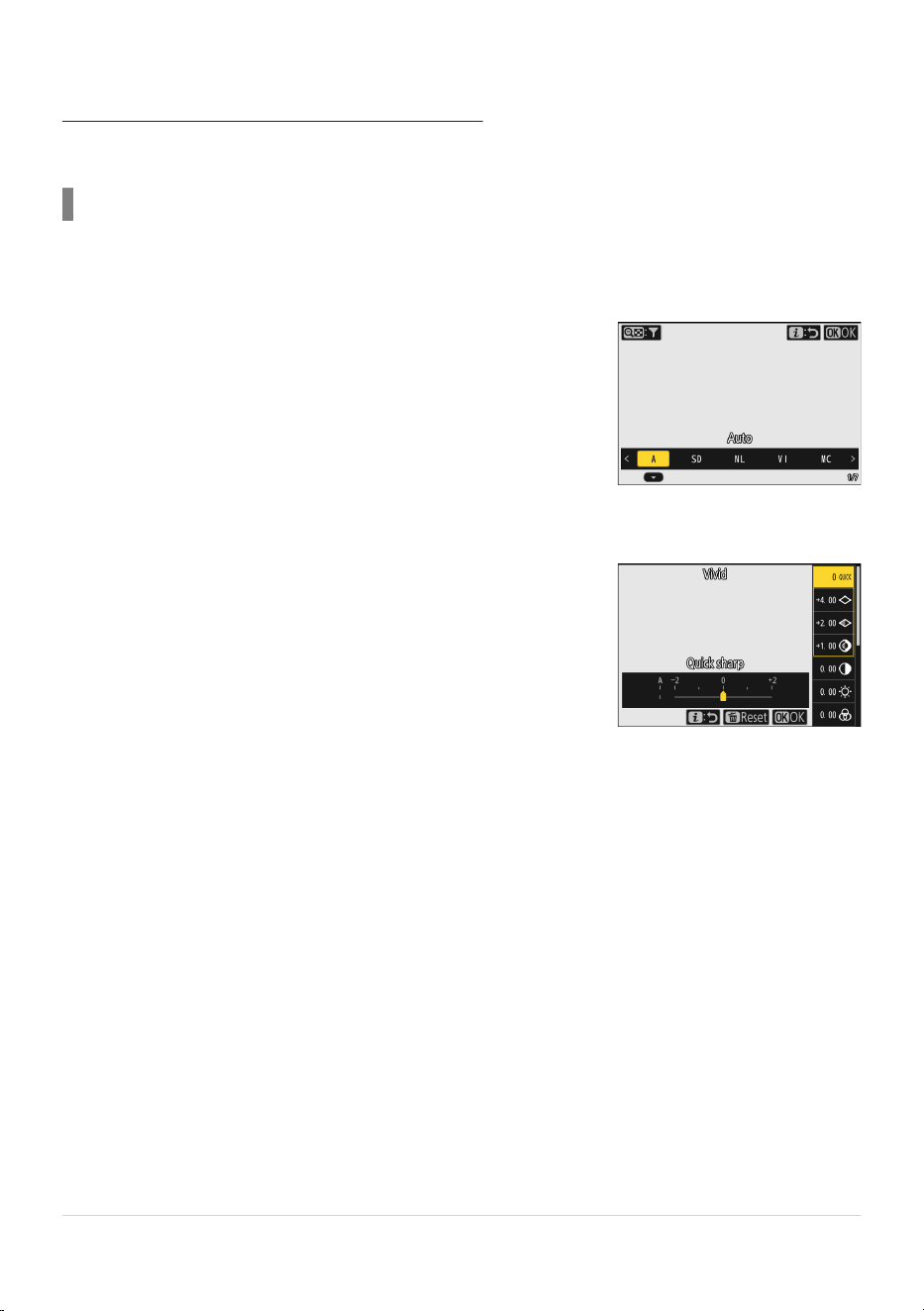
Press the h button or select [Set Picture Control] in the i
menu and press the J button.
This will display a Picture Control list.
Press 4 or 2 t
o select a Pictur
e Contr
ol, then press 3.
Modifying Picture Controls
Picture Controls can be adapt
ed to suit the scene or the photographer’s creative intent.
In the Shooting Display
Press the h button or select [Set Picture Control] in the i menu and select a Picture Control to edit
settings while previewing the effect in the shooting display.
171
Picture Controls
1
2
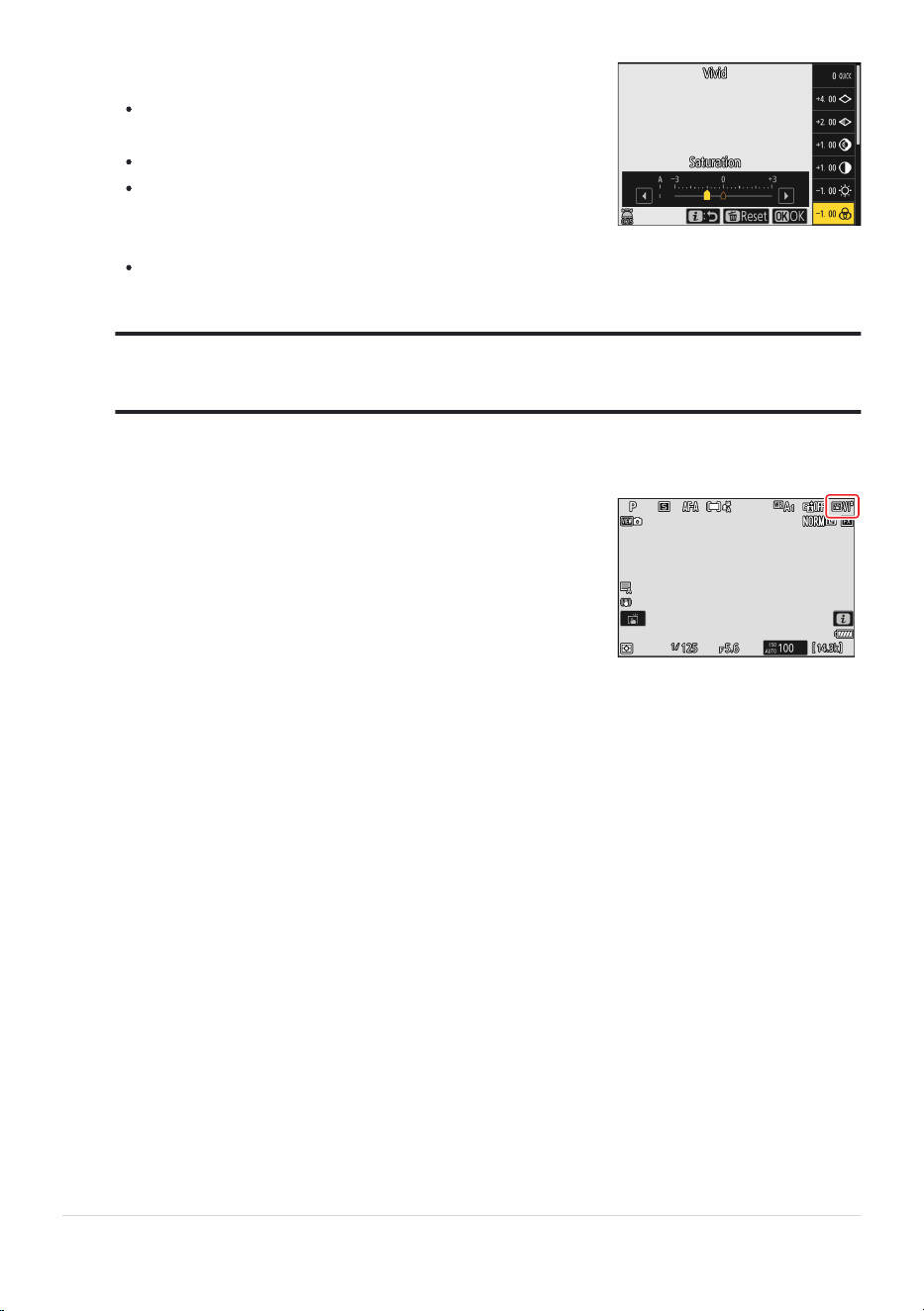
Adjust settings.
Press 1
or 3 to highlight settings and 4 or 2 to choose a
value. Each press increments the highlighted value by 1.
The options available vary with the Picture Control selected.
To quickly adjust levels for balanced [Sharpening], [Mid-
range sharpening], and [Clarity], highlight [Quick sharp]
and press 4 or 2.
To abandon any changes and start over from default
settings, press the O button.
Save changes and exit.
Press J
to save changes. Picture Controls that have been
modified from default settings are indicated by an asterisk
(“U”).
Tip: The Sub-command Dial
T
o adjust the highlight
ed v
alue in increments of 0.25, rotate the sub-command dial.
172
Picture Controls
3
4
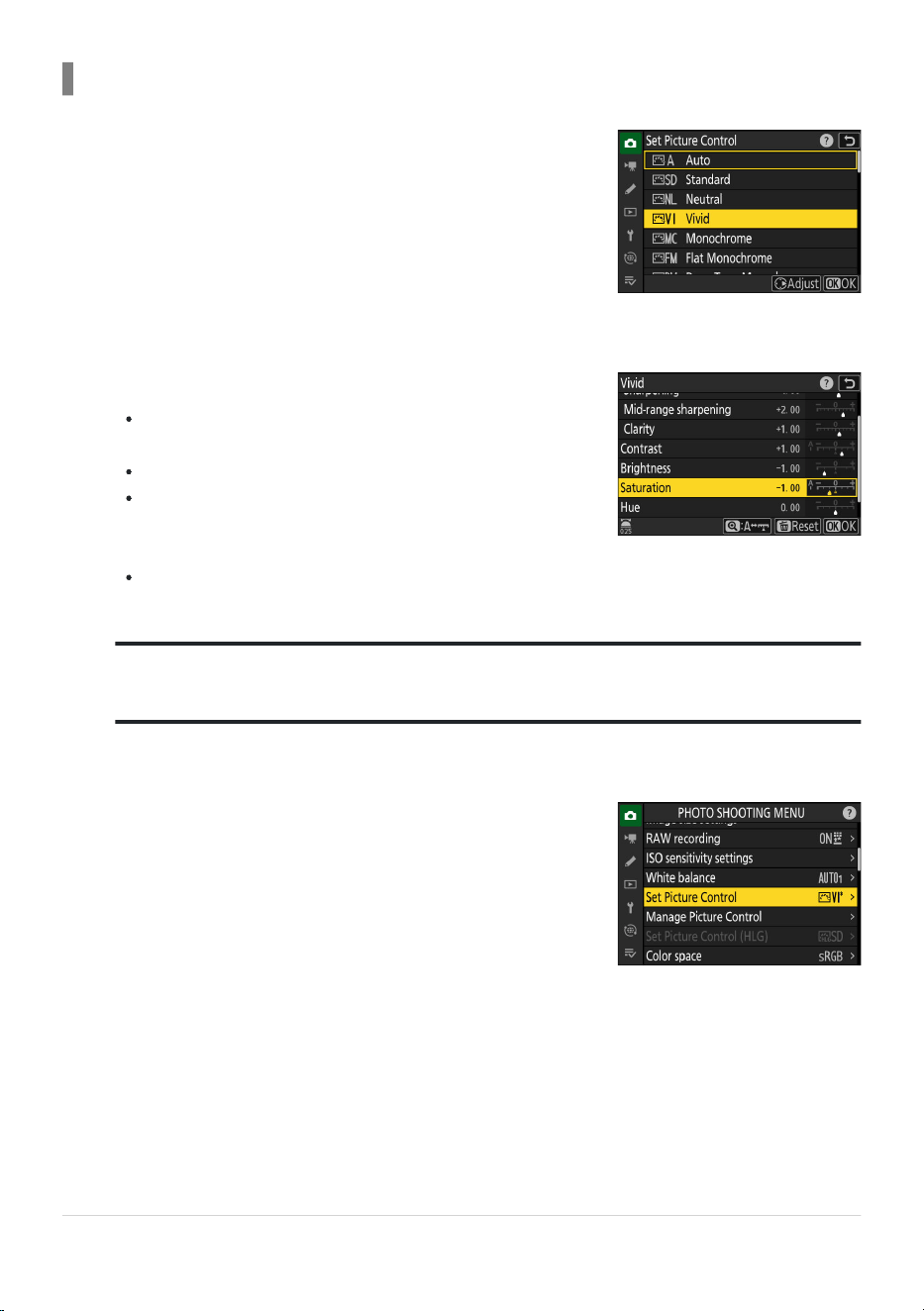
Select a Picture Control.
Select [Set Picture Control] in the phot
o shooting or video
recording menu or [Set Picture Control (HLG)] in the photo
shooting menu, and then highlight the desired Picture Control
and press 2.
Adjust settings.
Press 1
or 3 to highlight settings and 4 or 2 to choose a
value. Each press increments the highlighted value by 1.
The options available vary with the Picture Control selected.
To quickly adjust levels for balanced [Sharpening], [Mid-
range sharpening], and [Clarity], highlight [Quick sharp]
and press 4 or 2.
To abandon any changes and start over from default
settings, press the O button.
Save changes and exit.
Pr
ess
J
to save changes. Picture Controls that have been
modified from default settings are indicated by an asterisk
(“U”).
Using the Menus
Tip: The Sub-command Dial
To adjust the highlighted v
alue in increments of 0.25, rotate the sub-command dial.
173
Picture Controls
1
2
3
Picture Control Settings
Option Description
[Effect level]
Displayed only when a Cr
eative Picture Control is selected.
Mute or heighten the effect of the selected Picture Control.
[Quick sharp]
Apply sharpening to areas of contrast within the picture.
Adjusting [Quick sharp] simultaneously adjusts
[Sharpening], [Mid-range sharpening], and [Clarity] for
well-balanced results. Choose higher values for heightened
sharpness. Choose lower values for greater softness.
[Sharpening], [Mid-range sharpening], and [Clarity]
each apply to different areas within the picture. These
parameters can also be adjusted individually.
[Sharpening] Apply sharpening to small areas of contrast.
[Mid-range sharpening]
Apply sharpening to areas of contrast larger than those
affected by [Sharpening] and smaller those affected by
[Clarity].
[Clarity]
Apply sharpening to large areas of contrast.
Fine outlines and the brightness and contrast of the
picture as a whole are unaffected.
[Contrast] Adjust overall contrast.
[Highlights]
Displayed only for [Set Picture Control (HLG)]. Adjust
highlights. Choose higher values to make highlights brighter.
[Shadows]
Displayed only for [Set Picture Control (HLG)]. Adjust
shadows. Choose higher values to make shadows brighter.
[Brightness]
Brighten or darken mid-tones (tones that fall in the range
between highlights and shadows). The effect does not extend
to highlights and shadows, ensuring that details in these
areas of the image are preserved.
Not available when [Auto] or a Creative Picture Control is
selected, or in [Set Picture Control (HLG)].
174
Picture Controls

Option Description
[Saturation]
Control the vividness of colors.
Not available with [Monochrome], [Flat Monochr
ome],
[Deep Tone Monochrome], or certain Creative Picture
Controls.
[Hue]
Adjust hue.
Not available with [Auto], [Monochrome], [Flat
Monochrome], [Deep Tone Monochrome], or certain
Creative Picture Controls.
[Filter effects]
Displayed only with [Monochrome], [Flat Monochrome],
[Deep Tone Monochrome], and certain Creative Picture
Controls. Simulate the effect of color filters on monochrome
pictures.
[Toning]
Displayed only with [Monochrome], [Flat Monochrome],
[Deep Tone Monochrome], and certain Creative Picture
Controls. Choose a tint for monochrome pictures. Choose
from 9 different tints, including cyanotype and old-fashioned
sepia.
Pressing 3 when an option other than [B&W] (black-and-
white) is selected displays saturation options.
[Toning] (Creative Picture Controls)
Displayed only with cer
tain Creative Picture Controls. Choose
the shade of color used.
175
Picture Controls
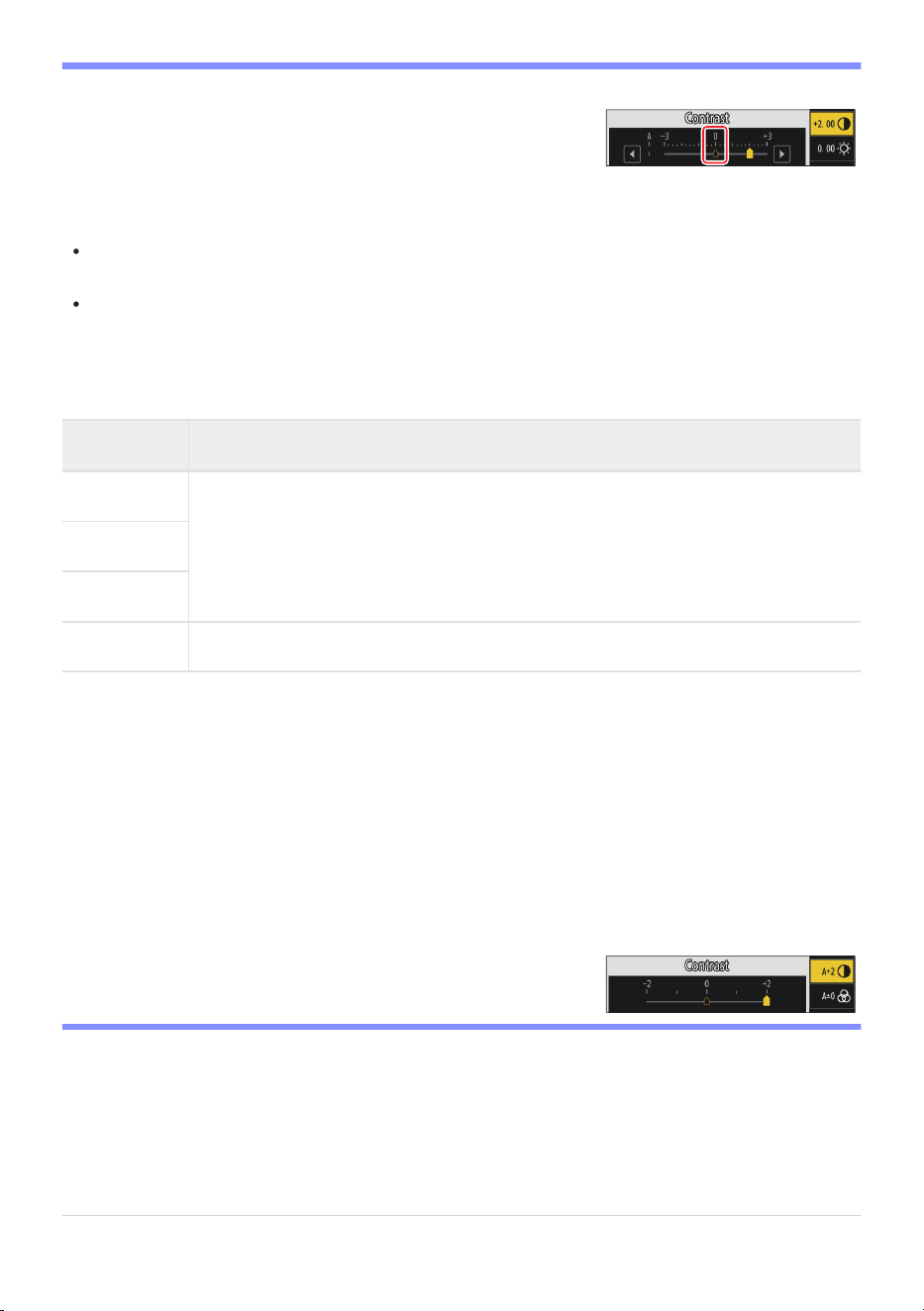
The o indicator under the value display in the Pictur
e Control
setting menu indicates the value saved in the camera.
Settings can be adjusted in the range [A-2] to [A
+ 2].
D The o Indicator
D [A] (Auto)
Selecting the [A] (aut
o) option available for some settings lets the camera adjust the setting
automatically.
Results vary with exposure and the position of the subject in the frame.
D [Filter effects]
Choose from the following [Filter effects]:
Option Description
[Y] (yellow)
*
These options enhance contrast and can be used to t
one down the brightness of
the sky in landscape photographs. Orange [O] produces more contrast than yellow
[Y], red [R] more contrast than orange.
[O] (orange)
*
[R] (red)
*
[G] (green)
*
Green softens skin tones. Use for portraits and the like.
The term in parentheses is the name of the corresponding third-party color filter for black-and-
white photography.
D Using [Filter effects] with [Deep Tone Monochrome]
[Deep Tone Monochrome] features a strong built-in red filter effect that applies even when [OFF] is
selected for [Filter effects]. Because [Filter effects] cannot be applied more than once, selecting an
option other than [OFF] will disable the built-in red filter effect. Contrast can be reduced by enabling
[Y], [O], and [R].
D The [Auto] Picture Control
176
Picture Controls
*
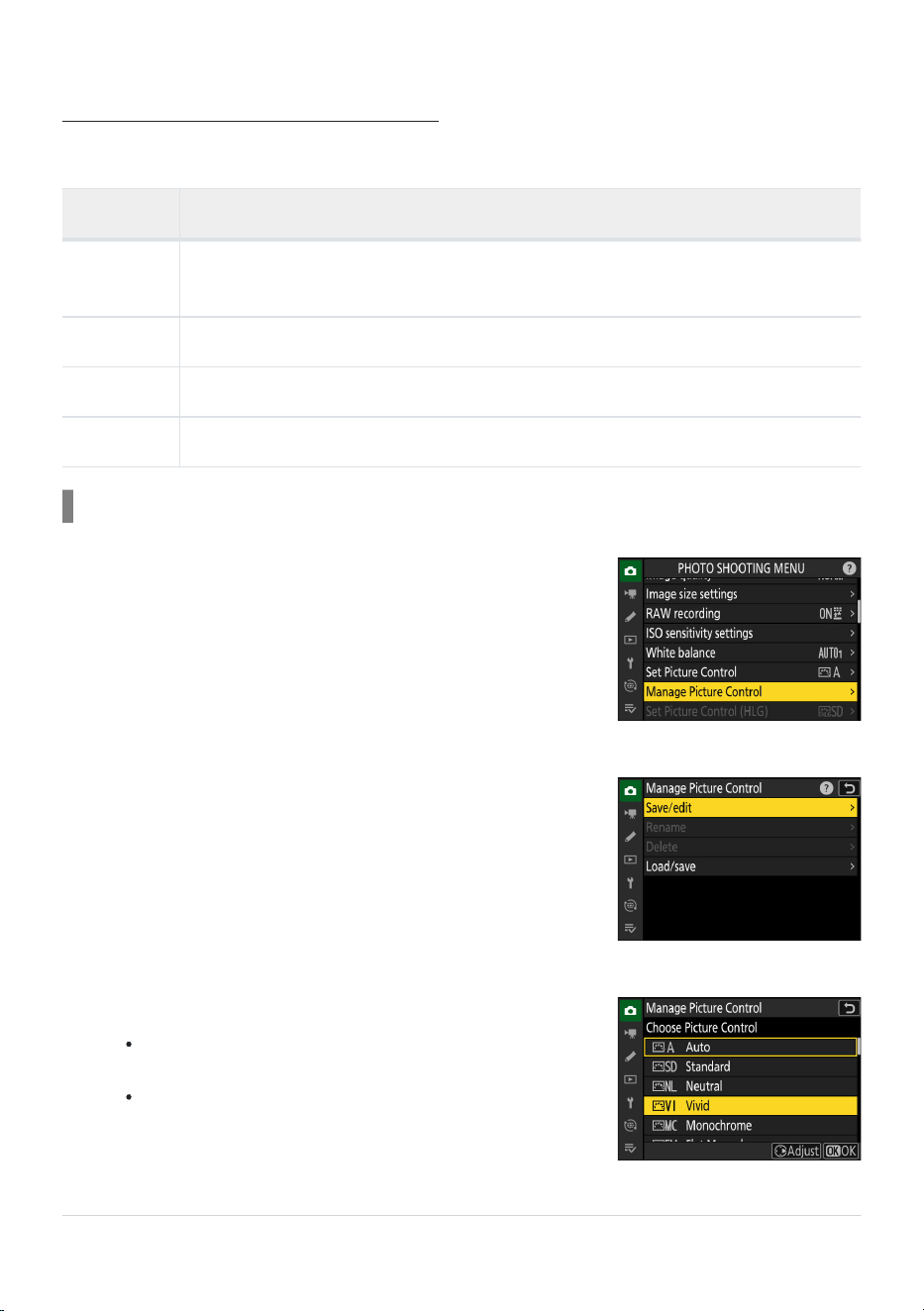
Highlight [Manage Picture Control] in the photo shooting
or video recording menu and pr
ess 2.
Select [Save/edit].
Highlight [Save/edit] and pr
ess 2 to view [Choose Picture
Control] options.
Select a Picture Control.
Highlight an existing Picture Control and pr
ess 2 to display
edit options.
To save a copy of the highlighted Picture Control without
further modification, press J. [Save as] options will be
displayed; proceed to Step 5.
Custom Picture Controls
Save modified Picture Contr
ols as Custom Picture Controls.
Option Description
[Save/edit]
Creat
e a new Custom Picture Control based on an existing preset or Custom Picture
Control, or edit existing Custom Picture Controls.
[Rename] Rename Custom Picture Controls.
[Delete] Delete Custom Picture Controls.
[Load/save] Copy Custom Picture Controls to and from a memory card.
Creating Custom Picture Controls
177
Picture Controls
1
2
3
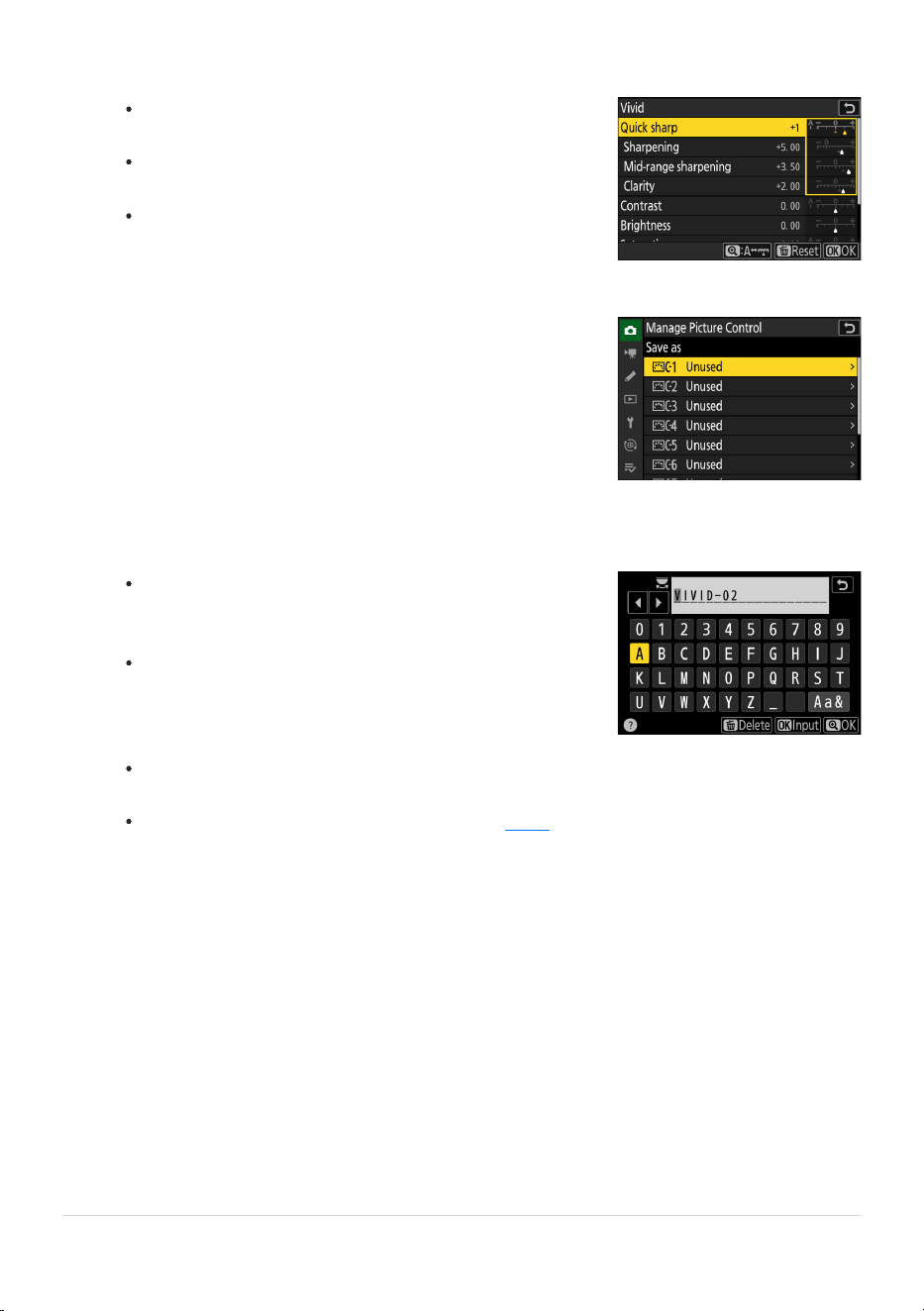
The options and procedure are the same as for [Set Picture
Control].
Pr
ess J to display [Save as] options when settings are
complete.
To abandon any changes and start over from default
settings, press the O button.
Select a destination.
Choose a destination for the Custom Picture Contr
ol (C-1
through C-9).
Pressing 2 while highlighting a destination in the previous
step displays the t
ext-entry dialog to rename the Picture
Control.
The default name, created by adding a two-digit number
to the name of the existing Picture Control, appears in
the text display area. The two-digit number is generated
automatically by the camera.
Custom Picture Control names can be up to nineteen
characters long.
For information on text entry, see “Text Entry” (
0 79).
Adjust settings.
Name the Picture Control.
178
Pictur
e Controls
4
5
6
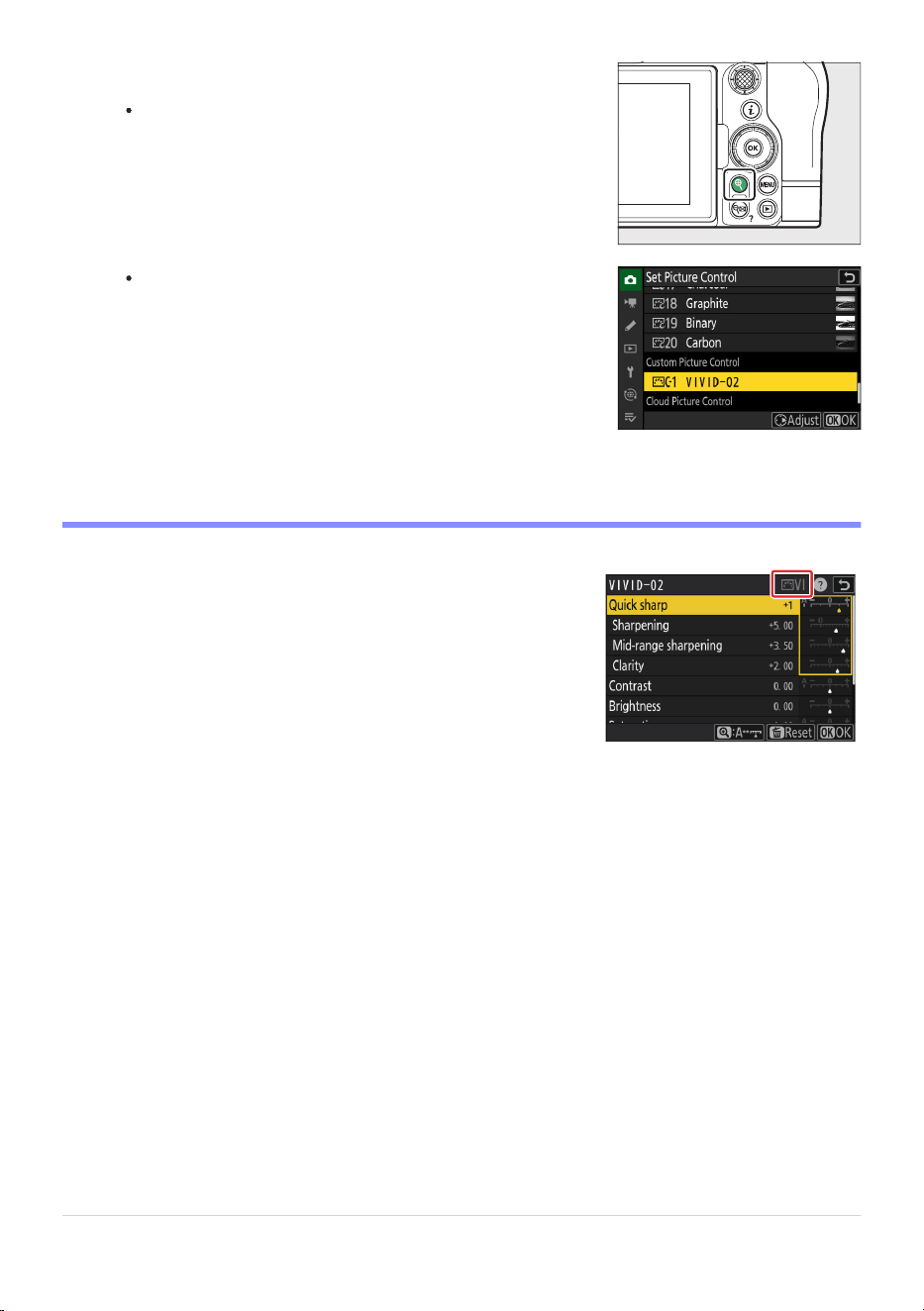
Press the X button.
Text entr
y will end.
The new Picture Control will be added to the Picture Control
list.
The original preset Picture Control on which the Custom Picture
Control is based is indicat
ed by an icon in the edit display.
D The Original Picture Control Icon
D Custom Pictur
e Control Options
The options available with Custom Picture Controls are the same as those on which the Custom Picture
Control was based.
179
Picture Controls
7

The [Load/save] item in the [
Manage Picture Control] menu can
be used to copy Custom Picture Controls from the camera to a
memory card. You can also delete Custom Picture Controls or copy
them from a memory card to the camera. The memory card must
be inserted in Slot 1, as memory cards inserted in Slot 2 will not be
detected.
D Copy Custom Picture Contr
ols to and from a Memory Card
[Copy to camera]: Copy (import) Custom Picture Controls from the memory card to the camera.
The Picture Controls are copied to Custom Picture Controls C-1 through C-9 on the camera and can
be named as desired.
[Delete from card]: Delete selected Custom Picture Controls from the memory card.
[Copy to card]: Copy (export) a Custom Picture Control from the camera to a memory card.
Highlight a destination (1 through 99) for the selected Custom Picture Control and press J to
export it to a “CUSTOMPC” sub-folder, which will automatically be created under the “NIKON” folder
on the memory card.
Exported Custom Picture Controls can be copied to another memory card using a computer. When
copying Picture Controls to a memory card for import to the camera, be sure to save them to the
card’s root (top) directory or to the “CUSTOMPC” folder under the “NIKON” folder.
Tip: “Flexible Color”
When adjusting Picture Controls with the NX Studio computer software, selecting [Flexible Color] for
the Picture Control option allows for a wider variety of Picture Control adjustments with Color Blender
and Color Grading, in addition to other adjustment parameters. You can save Picture Controls adjusted
using [Flexible Color] as Custom Picture Controls and export them to a file and import it to the
camera.
Custom Picture Controls based on [Flexible Color] cannot be adjusted or renamed on the camera.
180
Picture Controls
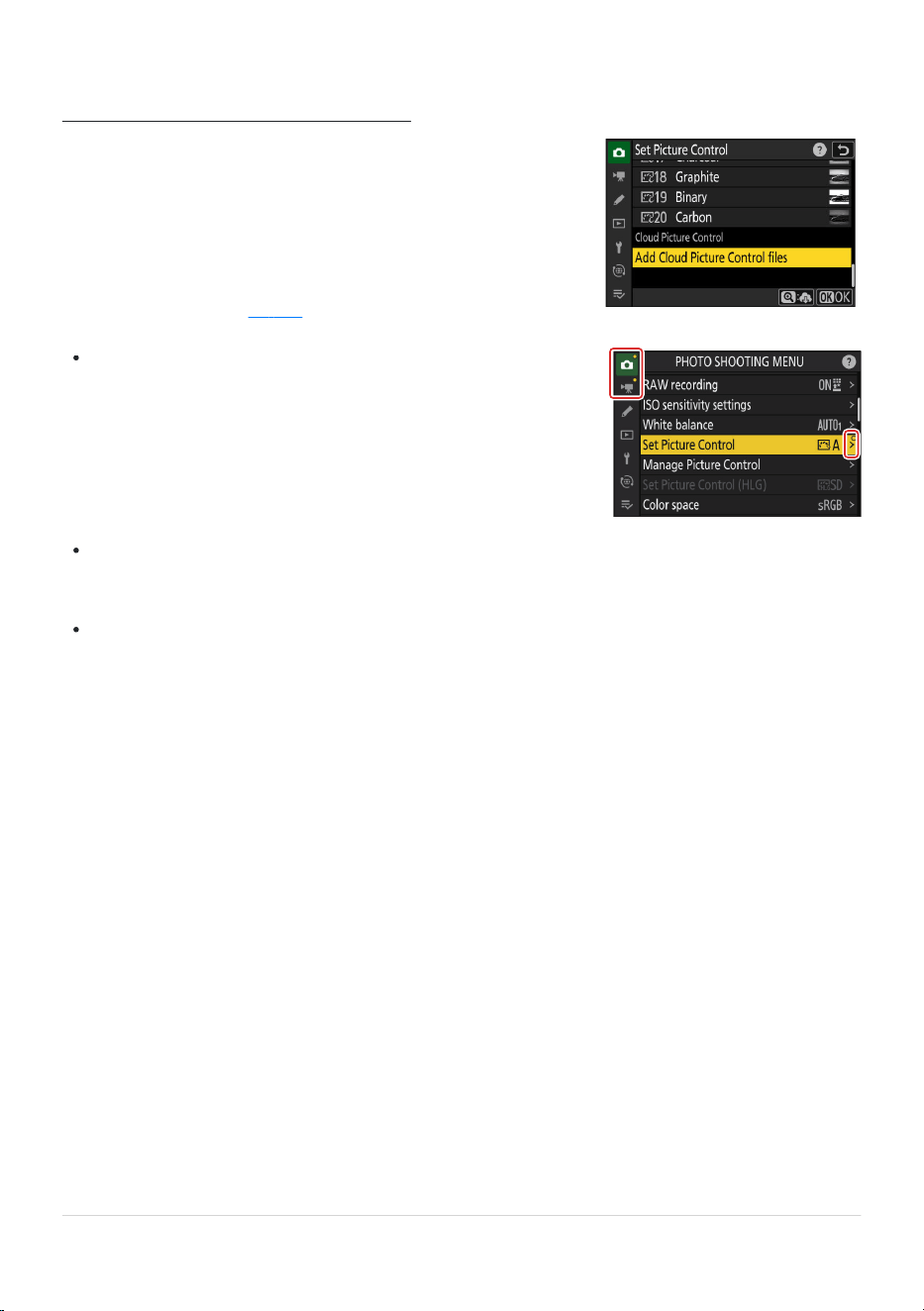
If Picture Controls are transferred to the camera from
NikonImagingCloud, they can be downloaded and r
ead to the
camera by [Set Picture Control] > [Add Cloud Picture Control
files] in the camera photo shooting or video recording menu. These
Picture Controls can be adjusted once selected and added to the
camera via [Manage Picture Control] in the photo shooting or
video recording menu (
0 177).
If there are Picture Controls in NikonImagingCloud that have
not been imported t
o the camera, notification marks will appear
on the photo shooting and video recording menu tabs and [Set
Picture Control] item in the camera menu.
Cloud Picture Controls
The camera and NikonImagingCloud must be connected via Wi-Fi t
o download and import Picture
Controls. In the camera network menu, set [Nikon Imaging Cloud] > [Connect to Nikon Imaging
Cloud] to [ON], and then turn on the NikonImagingCloud camera sign-in setting.
See the Nikon Imaging Cloud online help for how to transfer Picture Controls to the camera and
how to turn on the camera sign-in setting in Nikon Imaging Cloud.
181
Picture Controls
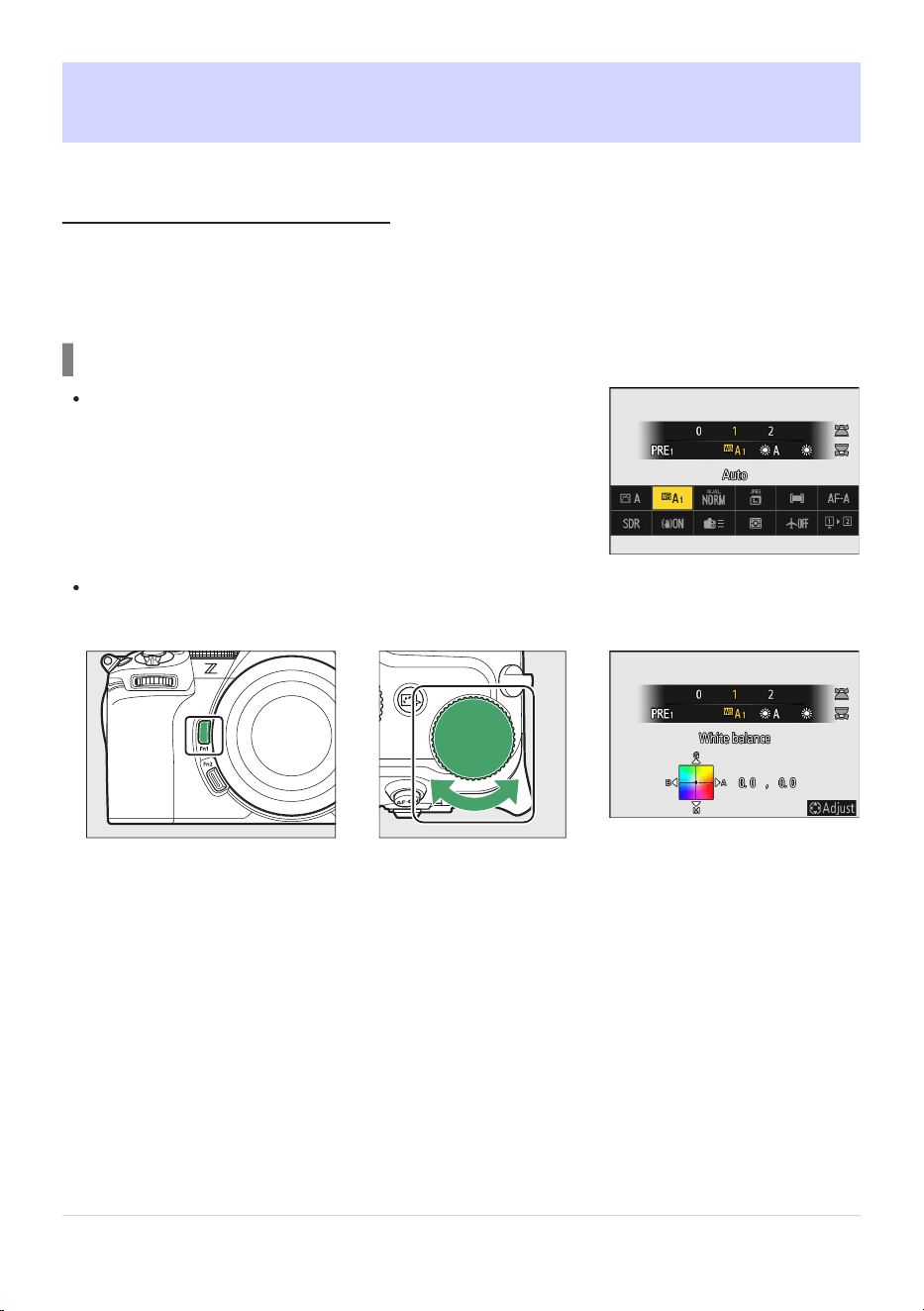
White balance can be adjusted using the [White balance] it
ems
in the i menu, photo shooting menu, or video recording menu.
White Balance
About White Balance
White balance ensur
es that colors appear natural regardless of the color of the light source. The
default setting (4) is suitable for use with most light sources, but if it fails to produce the desired
results, other settings can be selected according to the weather or light source.
Adjusting White Balance
At default settings, white balance can also be selected by holding Fn1 button and rotating the main
command dial. The selected option is shown by an icon in the shooting display.
Options for the selected setting, if any, can be chosen by holding the Fn1 button and rotating the
sub-command dial.
182
White Balance

Option
Color
temperature
*
Description
4
[Auto]
The camera adjusts white
balance for optimal results
with most light sources. If an
optional flash unit is used, white
balance will be adjusted in
accord with the conditions in
effect when the flash fires.
i [K
eep white (reduce warm colors)]
Appr
o
x. 3500–
8000K
Eliminate the warm color
cast pr
oduced by incandescent
lighting.
j [
K
eep ov
erall atmosphere]
Appr
o
x. 3500–
8000K
Partially preserve the warm
color cast pr
oduced by
incandescent lighting.
k [
K
eep war
m lighting colors]
Appr
o
x. 3500–
8000K
Preserve the warm color cast
pr
oduced by incandescent
lighting.
D
[Natural light auto]
Appro
x. 4500–
8000K
White balance is adjusted
for non-artificial light sources,
pr
oducing more life-like colors
than does [Auto] when used
under natural light.
H [Direct sunlight]
Appro
x. 5200K
Use with subjects lit by direct
sunlight.
G [Cloudy]
Approx. 6000K
Use in daylight under overcast
skies.
M [Shade]
Approx. 8000K
Use in daylight with subjects in
shade.
J [Incandescent]
Approx. 3000K
Use under incandescent
lighting.
183
White Balance
Option
Color
temperature
*
Description
I
[Fluorescent]
Use under fluorescent lighting;
choose a bulb type according to
the light sour
ce.
m [Cool-white fluorescent]
Approx. 4200K
n [Day white fluor
escent]
Approx. 5000K
o[Daylight fluorescent]
Appr
ox. 6500K
5 [Flash]
Approx. 5400K Use for flash photography.
K [Choose color t
emperatur
e]
Appr
ox. 2500–
10000K
Direct color-temperature
selection.
To choose a color
temperatur
e, hold the Fn1
button and rotate the sub-
command dial.
L [Preset manual]
Measure whit
e balance directly
from a subject or light source
or copy whit
e balance from an
existing photograph.
To choose a white balance
preset, hold the Fn1 button
and rotate the sub-command
dial.
To enter direct measurement
mode, press and hold the
Fn1 button (
0 195).
Values when fine-tuning is set to 0.
184
White Balance
*

D D[Natural light auto]
D
[Natural light auto] may not produce the desired results under artificial light. Choose 4[Auto]
or an option that matches the light source.
D Studio Flash Lighting
4[Auto] may not produce the desired results with large studio flash units. Use preset manual white
balance or set white balance to 5[Flash] and use fine-tuning to adjust white balance.
185
White Balance
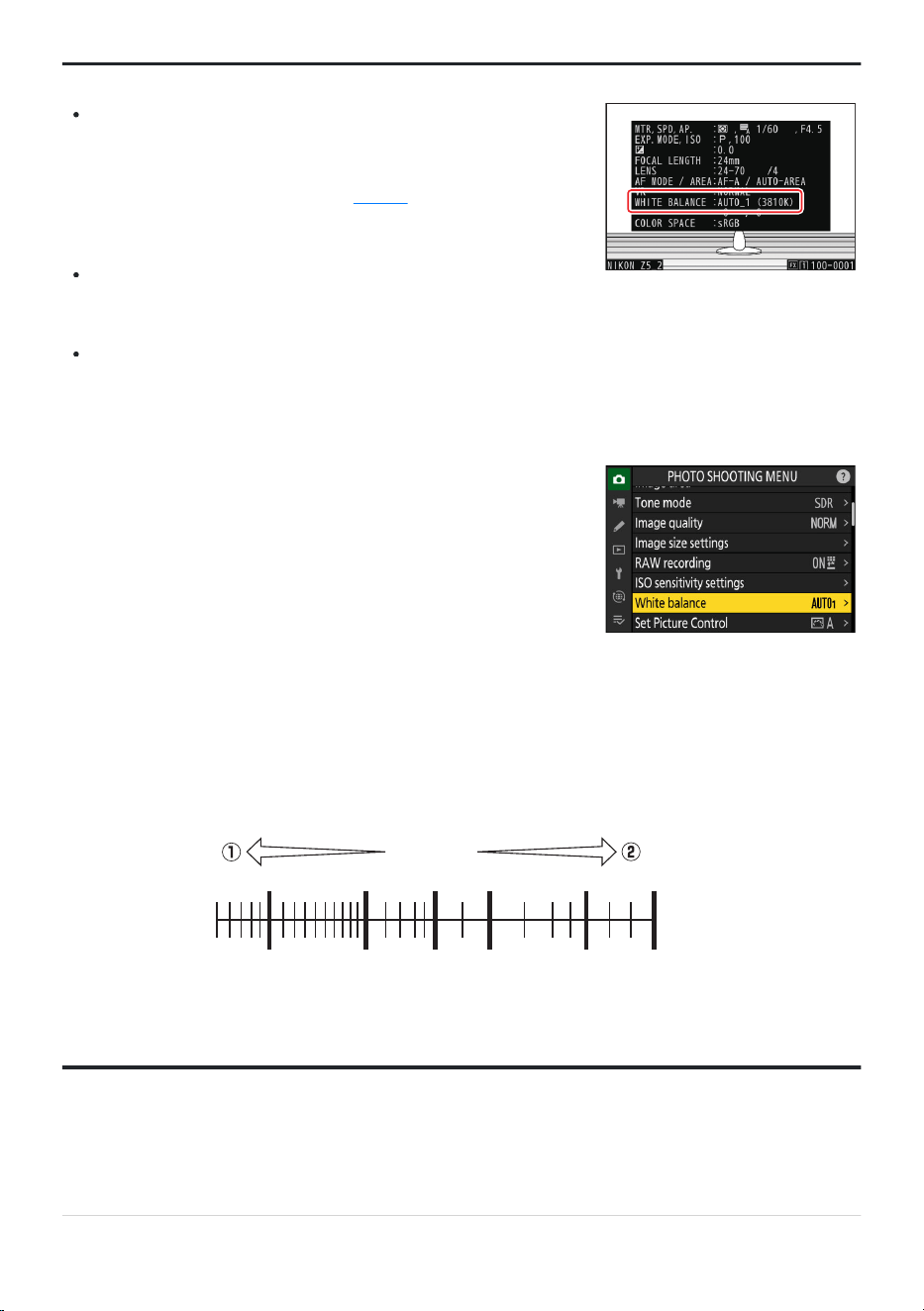
The photo info [Basic shooting data] page for pictures shot with
4
[Auto], D[Natural light auto], or L[Preset manual]
selected for white balance lists the color temperature in effect
at the time the picture was taken (
0 231). You can use
this as refer
ence when choosing a value for K[Choose color
temperature].
To view the [Basic shooting data] page during playback, go
to [Playback display options] in the playback menu and place
checks (M) next to [Shooting data] and [Basic shooting data].
Color temperature is not shown for pictures taken using high-
speed frame capture +.
White balance can also be adjusted from the photo shooting and
video recording menus.
Tip: Auto
Tip: The [White b
alance] Options
Tip: Color Temperature
The perceived color of a light source varies with the viewer; some may have a red cast while others
appear blue. Color temperature is an objective measure of the color of a light source, expressed in
Kelvins (K). The lower the color temperature, the redder the cast (q); the higher the temperature, the
bluer the cast (w).
3000 4000 5000 6000 8000 10000 [
K
]
Tip: Choosing a Color Temperature
In general, choose lower values if y
our pictures have a red cast or to intentionally make pictures bluer,
higher values if your pictures are tinged blue or to intentionally make pictures redder.
186
White Balance
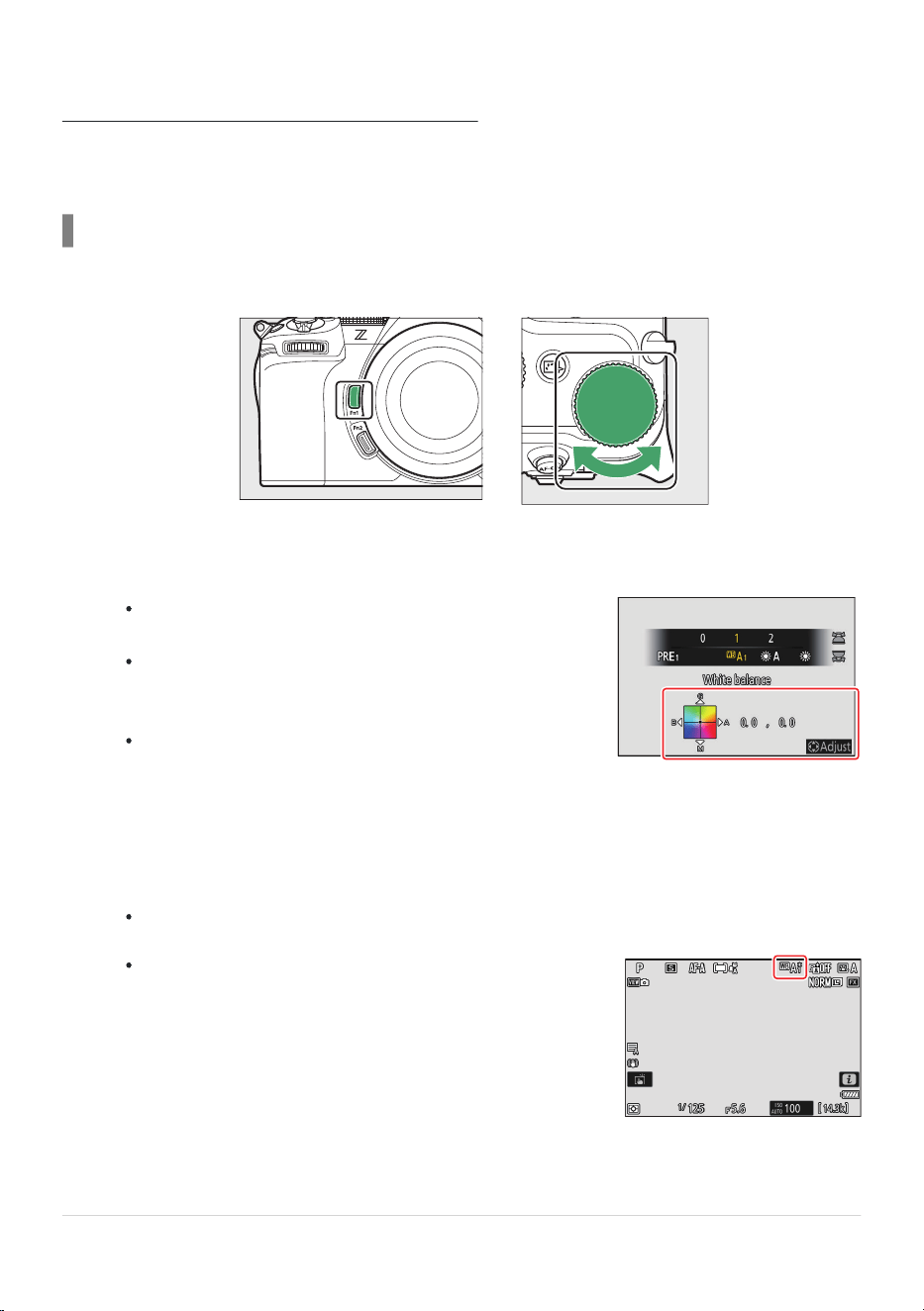
Use the multi selector to position the cursor on the grid. The
select
ed v
alue is display
ed to the right of the grid.
The A (amber)–B (blue) axis corresponds to color
temperature and is ruled in increments of 0.5. A change of 1
is equivalent to approximately 5 mired.
The G (green)–M (magenta) axis has effects similar to color
compensation filters and is ruled in increments of 0.25.
A change of 1 is equivalent to approximately 0.05 diffuse
density units.
If white balance has been fine-tuned, an asterisk (“U”) will
appear in the whit
e b
alance icon.
Fine-Tuning White Balance
Each white balance option can be fine-tuned by up t
o six steps in either direction from the center
along both the A (amber)–B (blue) and G (green)–M (magenta) axes.
Using Buttons
Choose a white balance option by holding the Fn1 button and rotating a command dial.
Keeping the Fn1 button pressed, fine-tune white balance using the multi selector.
Save changes.
The selected setting takes effect when the Fn1 button is released.
187
White Balance
1
2
3
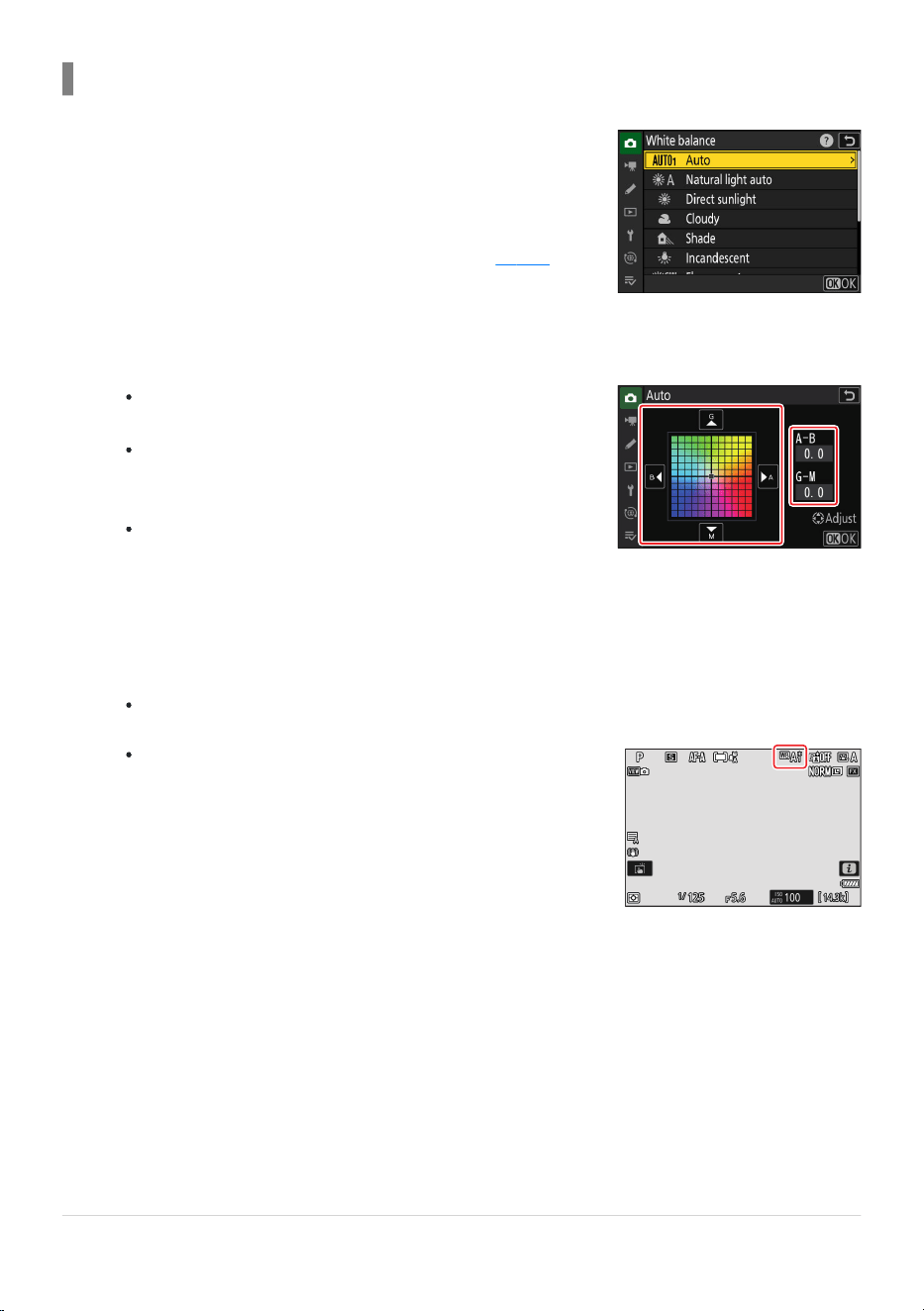
Select [White balance] in the photo shooting or video
recording menu, highlight the desir
ed option, and press 2
as often as necessary to display fine-tuning options.
For information on fine-tuning [Preset manual] white balance,
see “Fine-Tuning Preset Manual White Balance” (
0 199).
Use the multi selector to position the cursor on the grid. The
selected value is display
ed to the right of the grid.
The A (amber)–B (blue) axis corresponds to color
temperature and is ruled in increments of 0.5. A change of 1
is equivalent to approximately 5 mired.
The G (green)–M (magenta) axis has effects similar to color
compensation filters and is ruled in increments of 0.25.
A change of 1 is equivalent to approximately 0.05 diffuse
density units.
If white balance has been fine-tuned, an asterisk (“U”) will
appear in the white balance icon.
Using the Menus
Fine-tune white balance.
Sav
e changes.
Press J to save changes and exit to the menus.
188
White Balance
1
2
3
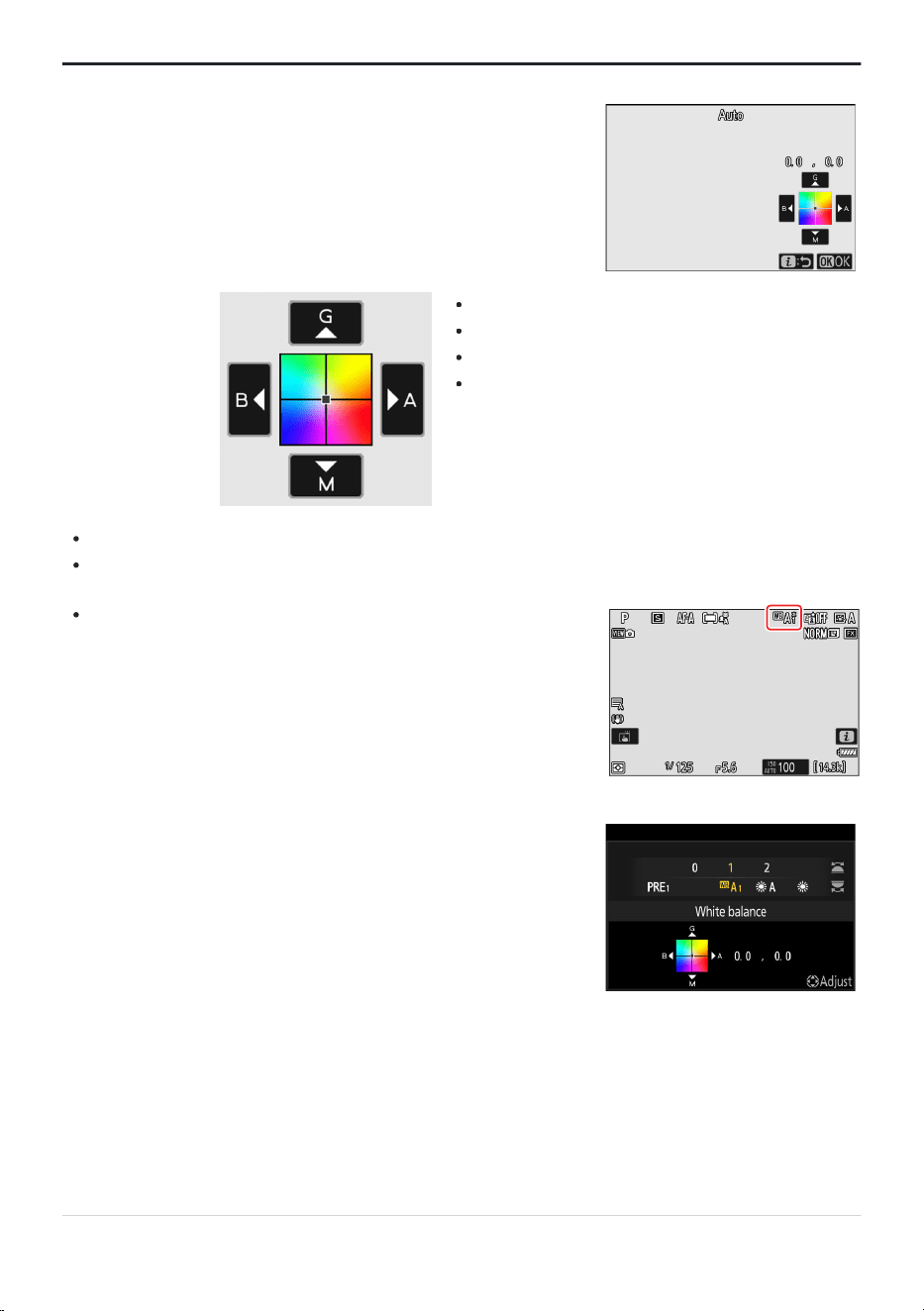
Pressing J when [Whit
e balance] is highlighted in the i menu
displays a list of white balance options. If an option other than
K[Choose color temperature] is highlighted, fine-tuning options
can be displayed by pressing 3. Any changes to fine-tuning
options can be previewed in the display.
G: Increase green
B: Incr
ease blue
A: Increase amber
M: Increase magenta
If white balance has been fine-tuned, an asterisk (“U”) will appear
in the white balance icon.
To choose a white balance setting using the command dials,
press the Fn1
button while shooting information is displayed. The
selected setting can be fine-tuned using the multi selector while the
Fn1 button is pressed.
Tip: The i Menu
Tap the arrows in the display or use the multi select
or to fine-tune white balance.
Press J to save changes and return to the i menu.
Tip: The Information Display
189
White Balance

Tip: White Balance Fine-Tuning
The colors on the fine-tuning axes ar
e relative, not absolute. Selecting more of a color on a given axis
does not necessarily result in that color appearing in pictures. For example, moving the cursor to “B”
(blue) when a “warm” setting such as J[Incandescent] is selected will make pictures slightly “colder”
but will not actually make them blue.
Tip: “Mired”
Values in mired are calculated by multiplying the inverse of the color temperature by 10
6
. Any given
change in color temperature produces a greater difference in color at low color temperatures than it
would at higher color temperatures. For example, a change of 1000K produces a much greater change
in color at 3000K than at 6000K. Mired is a measure of color temperature that takes such variation
into account, and as such is the unit used in color-temperature compensation filters.
E.g.: Change in color temperature (in Kelvin): Value in mired
4000K – 3000K = 1000K: 83 mired
7000K – 6000K = 1000K: 24 mired
190
White Balance
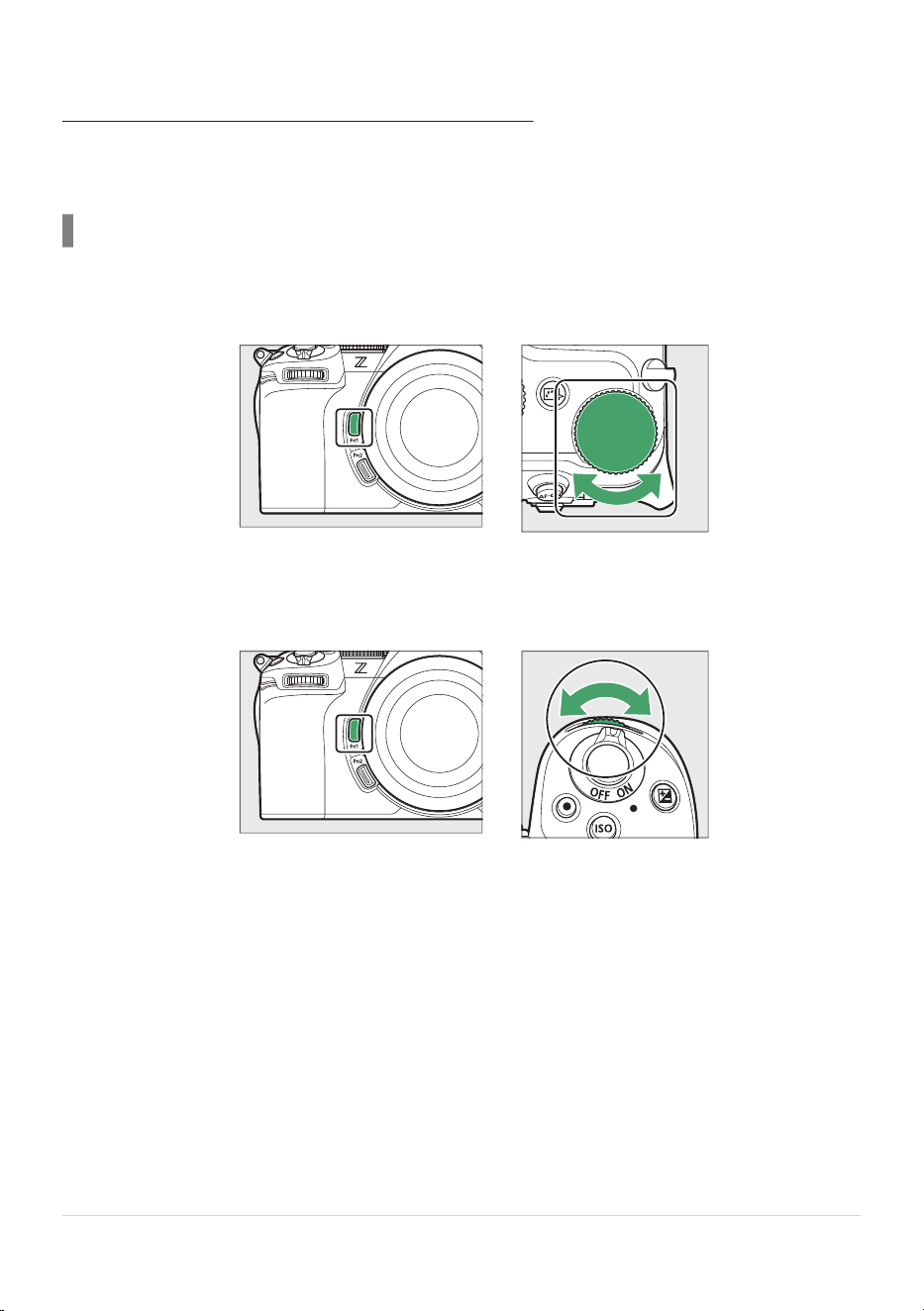
Choosing a Color Temperature
Choose a color temperature by ent
ering values for the A (amber)–B (blue) and G (green)–M (magenta)
axes.
Using Buttons
Hold the Fn1 button and rotate the main command dial to select K[Choose color
temperature].
Keeping the Fn1 button pressed, rotate the sub-command dial to choose a color
temperature.
Color temperature will change in increments of 1 mired.
191
White Balance
1
2
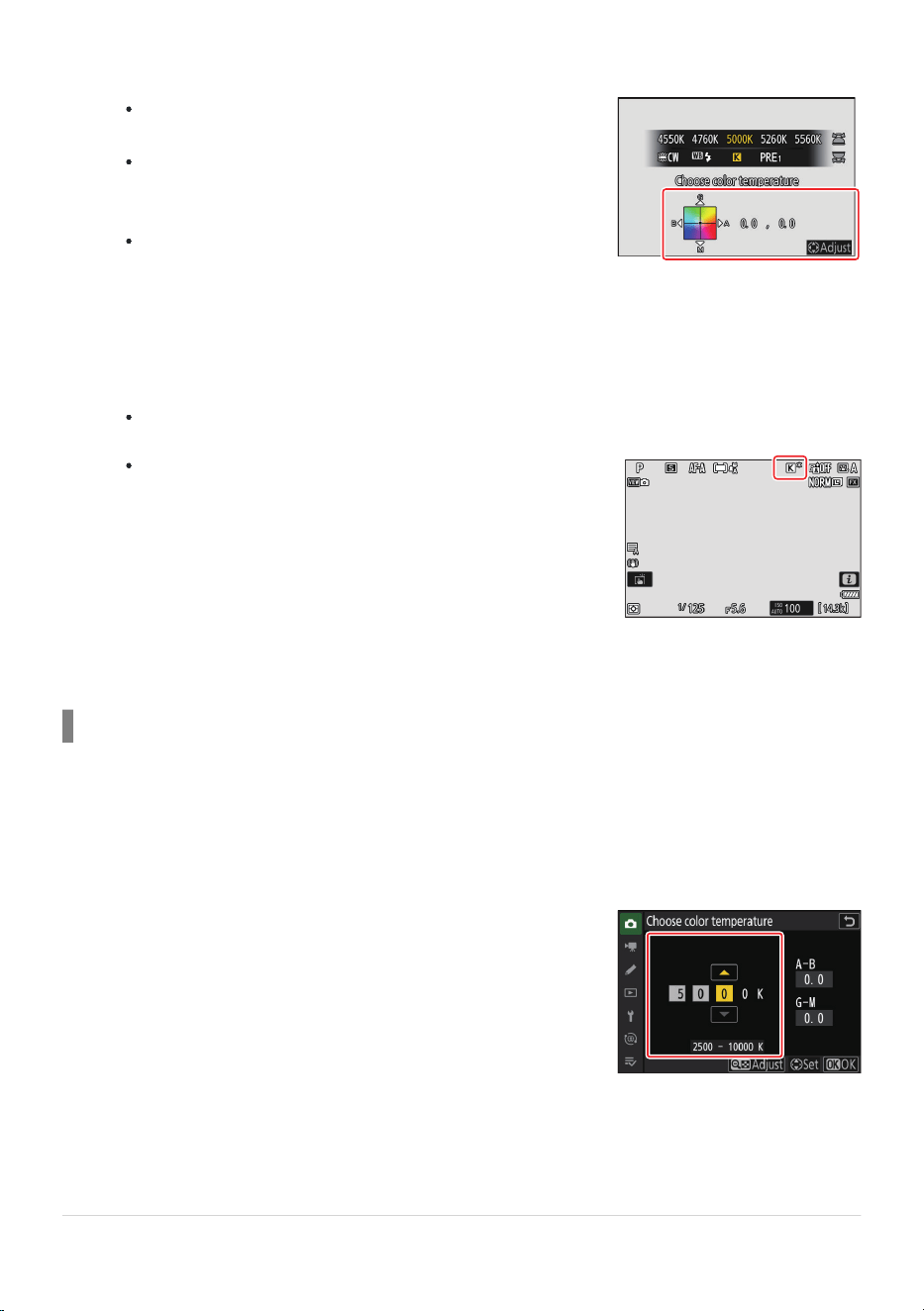
Use the multi selector to position the cursor on the grid. The
selected value is display
ed to the right of the grid.
The A (amber)–B (blue) axis corresponds to color
temperature and is ruled in increments of 0.5. A change of 1
is equivalent to approximately 5 mired.
The G (green)–M (magenta) axis has effects similar to color
compensation filters and is ruled in increments of 0.25.
A change of 1 is equivalent to approximately 0.05 diffuse
density units.
If color temperature has been fine-tuned, an asterisk (“U”) will
appear in the white balance icon.
Press 4 or 2 to highlight digits and press 1
or 3 to change.
Keeping the Fn1 button pressed, fine-tune white balance using the multi selector.
Save changes.
The selected setting tak
es effect when the Fn1 button is released.
Using the Menus
Select [White balance] in the photo shooting or video recording menu, then highlight
K[Choose color temperature] and press 2.
Choose a color temperature.
192
White Balance
3
4
1
2
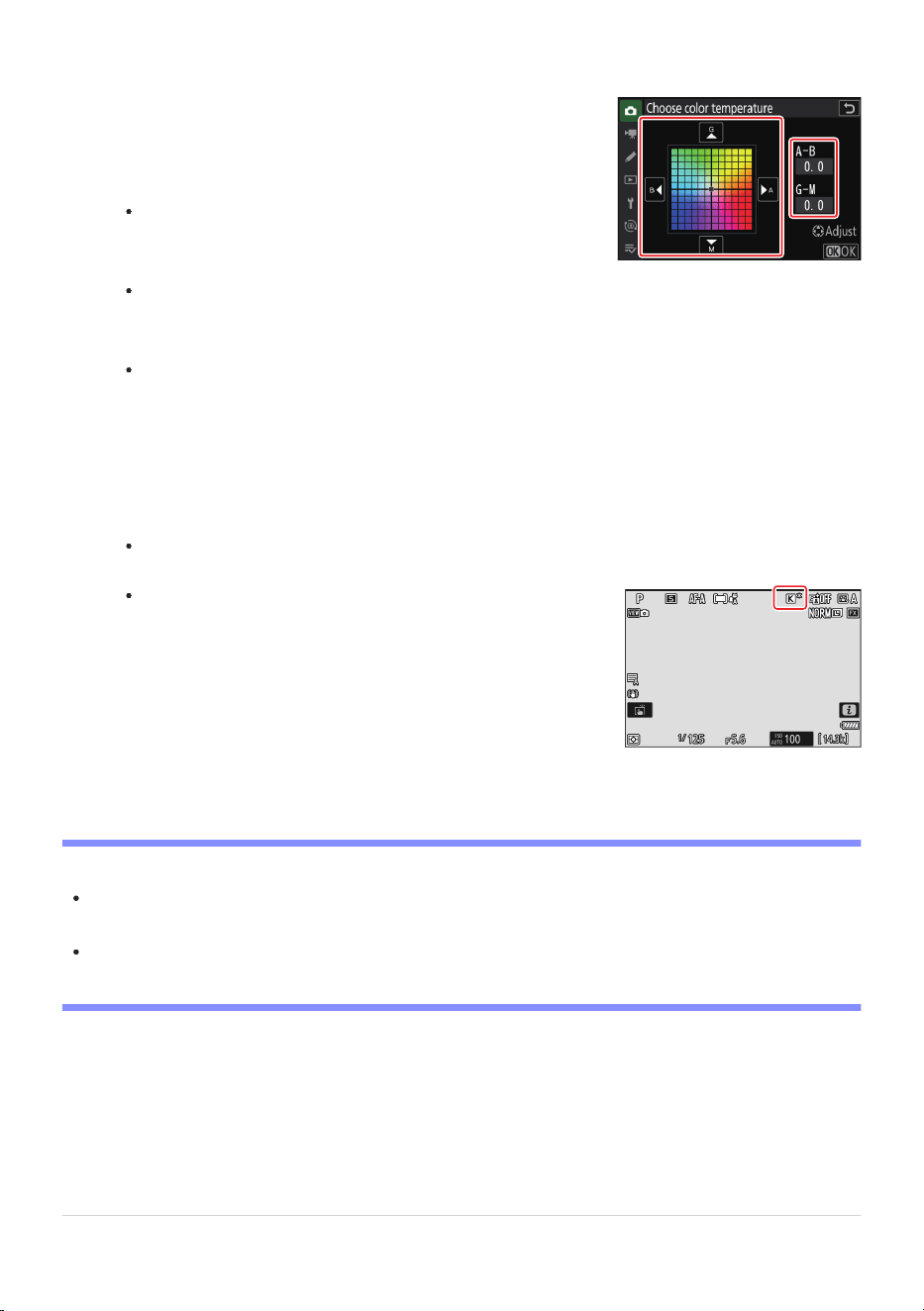
After choosing a color temperature, press the W (Q) button to
display fine-tuning options. Use the multi select
or to position
the cursor on the grid.
The cursor can be moved up to six steps from the center
along either axis. The selected value is displayed to the right
of the grid.
The A (amber)–B (blue) axis corresponds to color
temperature and is ruled in increments of 0.5. A change of 1
is equivalent to approximately 5 mired.
The G (green)–M (magenta) axis has effects similar to color
compensation filters and is ruled in increments of 0.25.
A change of 1 is equivalent to approximately 0.05 diffuse
density units.
If color temperature has been fine-tuned, an asterisk (“U”) will
appear in the white balance icon.
Fine-tune white balance.
Save changes.
Press
J to save changes and exit to the menus.
D Cautions: Color-Temperature Selection
Do not use color-temperature selection with fluorescent light sources; instead, use the
I[Fluorescent] option.
When using color-temperature selection with other light sources, take a test shot to determine if the
selected value is appropriate.
193
White Balance
3
4
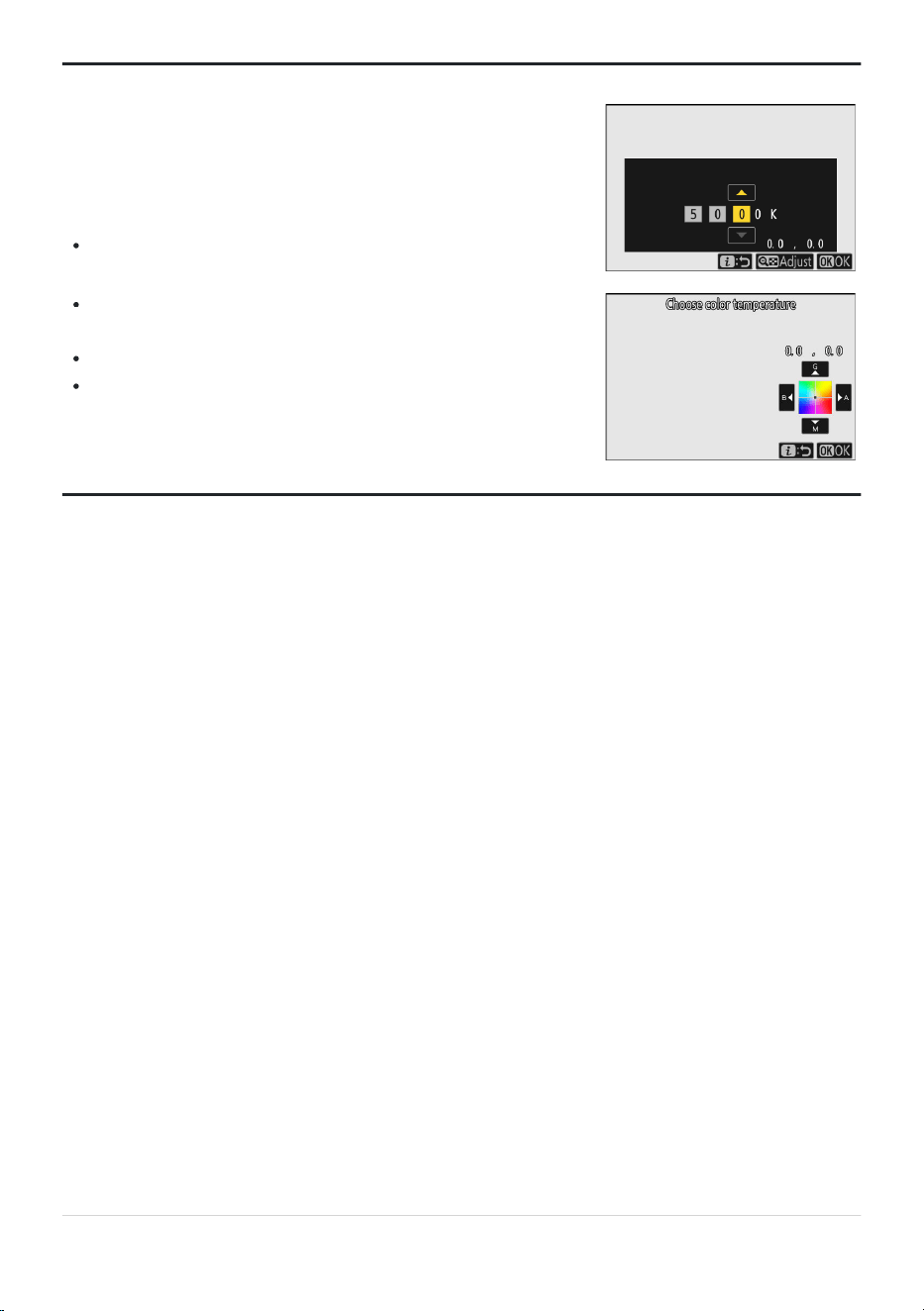
Pressing J when [Whit
e balance] is highlighted in the i menu
displays a list of white balance options. When K[Choose color
temperature] is highlighted, color temperature options can be
viewed by pressing 3.
Press 4 or 2 to highlight digits and press 1 or 3 to change.
To fine-tune the currently-selected value, press the W (Q
)
button.
Press J to save changes and return to the i menu.
If color temperature has been fine-tuned, an asterisk (“U”) will
appear in the white balance icon.
Tip: The i Menu
194
White Balance
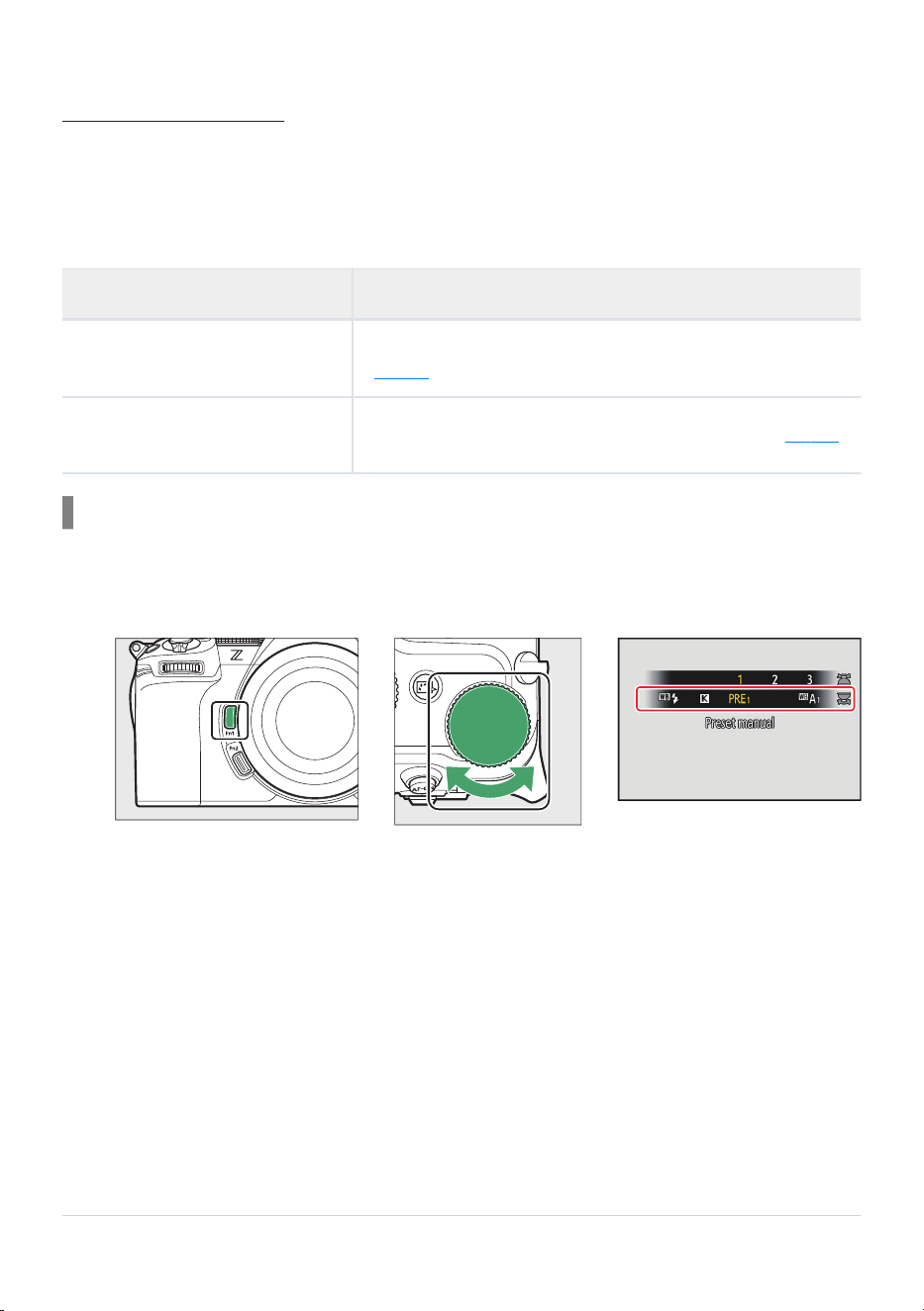
Preset Manual
White balance settings such as
4[Auto], J[Incandescent], and K[Choose color temperature]
may fail to produce the desired results under mixed lighting or lighting with a strong color cast. Should
this occur, white balance can be set to a value measured under the light source used in the final
photograph. Two methods are available for setting preset white balance:
Method Description
Direct measurement
Measure white balance in a selected area of the frame
(
0 195).
Copying a value from existing
photograph
Copy white b
alance from a photo on a memory card (
0 198).
Direct Measurement
The camera can st
ore up t
o six values for preset manual white balance.
Hold the Fn1 button and rotate the main command dial to select L.
195
White Balance
1
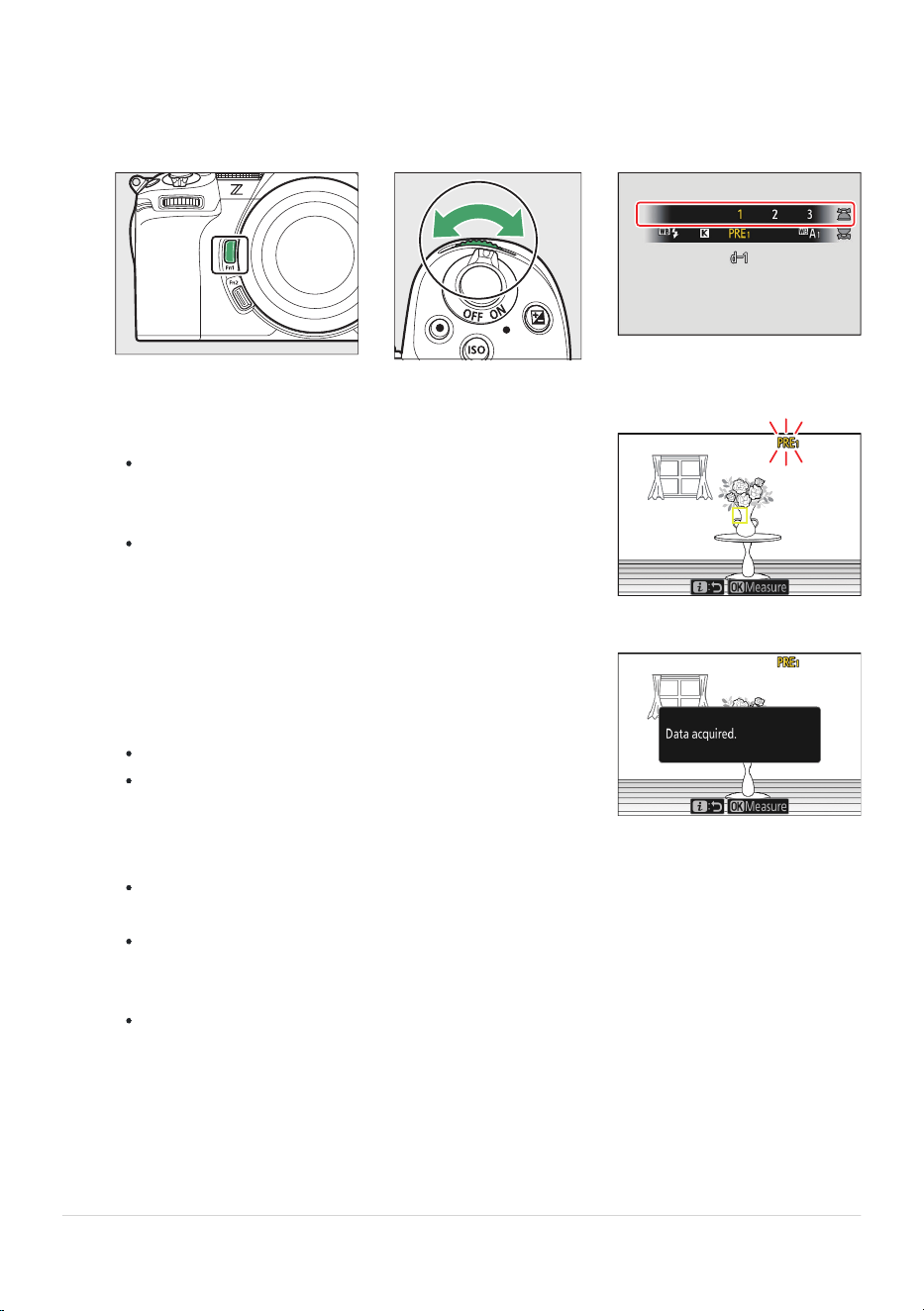
Select direct measurement mode.
R
elease the
Fn1
button briefly and then press it again
to enter direct measurement mode. L will flash in the
shooting display.
A white balance target (r) will appear in the center of the
frame.
Position the white balance target (r) over a white or
gray object and measure a value for preset manual white
balance.
Position the target (r) using the multi selector.
To measure white balance, press the shutter-release button
all the way down or press J. White balance can be
measured multiple times while direct measurement mode
is in effect.
You can also position the target (r) and measure white
balance by tapping the display.
Target selection will not be available if an optional flash
unit is attached. Frame the shot so that the white or gray
reference object is in the center of the display.
If the camera is unable to measure white balance, a message
will be displayed and the camera will return to direct
measurement mode. Try measuring white balance again, for
example with the target (r) positioned over a different area
of the subject.
Select a preset.
Hold the Fn1 button and rotat
e the sub-command dial until the desired white balance preset
(d-1 to d-6) is displayed.
196
White Balance
2
3
4
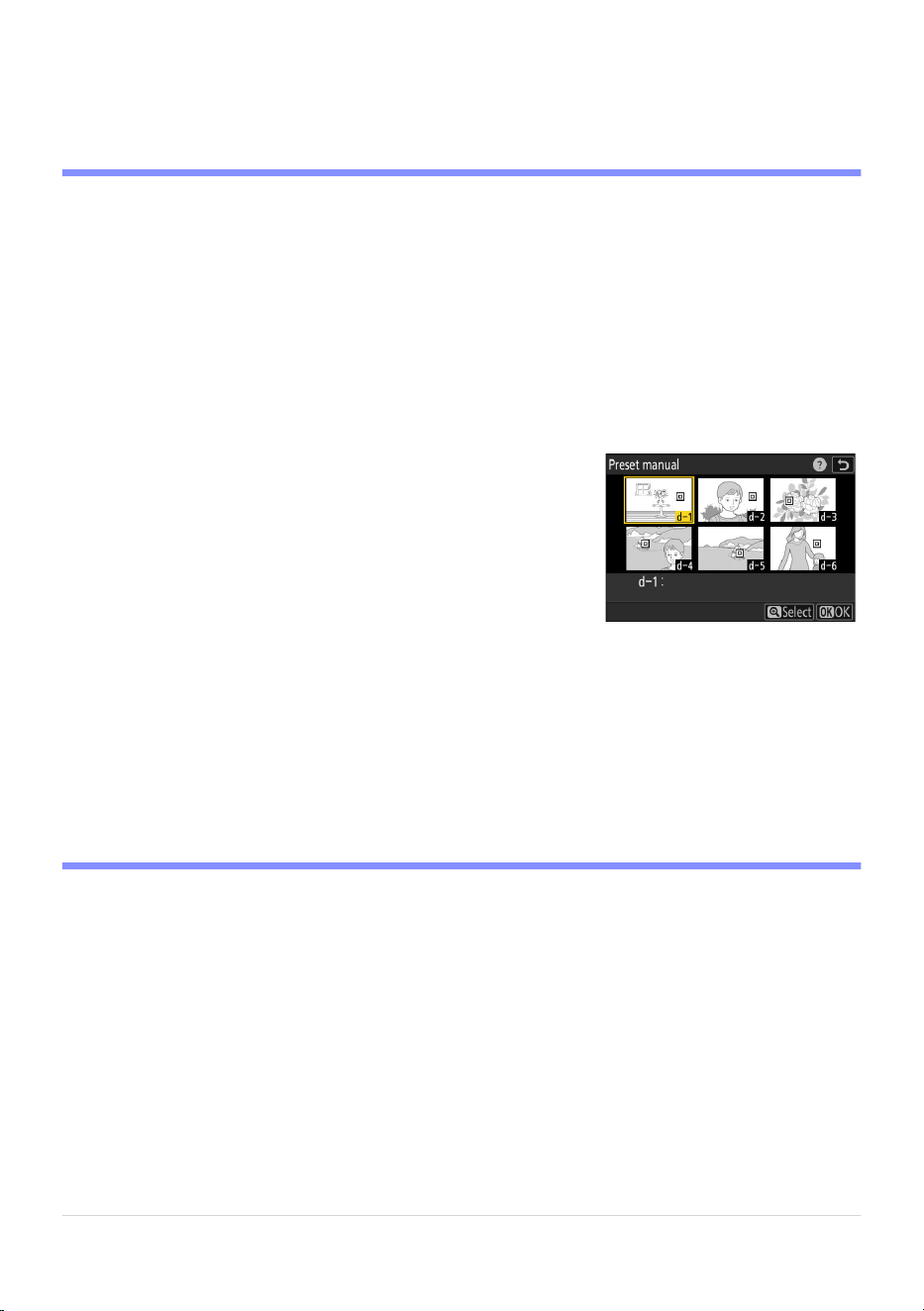
White balance presets can be viewed by selecting [White
balance]> L
[Preset manual] in the photo shooting menu. To
recall a stored value, highlight a preset using the multi selector and
press J.
Press the i button to exit dir
ect measurement mode.
D The Preset Manual White Balance Menu
The preset manual white balance menu can be accessed by selecting [White balance]> L[Preset
manual] in the photo shooting menu. The preset manual white balance menu offers options for
copying values for preset manual white balance from an existing photograph or adding comments to
or protecting white balance presets.
D Protected Presets
White balance presets indicated by g icons are protected and cannot be changed.
D Preset Manual: Selecting a Preset
D Direct Measurement Mode
Direct measurement mode will end if no operations are performed in the time selected for Custom
Setting c3 [Power off delay]> [Standby timer].
D Measuring White Balance
Preset manual white balance cannot be measured during high-speed frame capture + or multiple
exposures.
197
White Balance
5
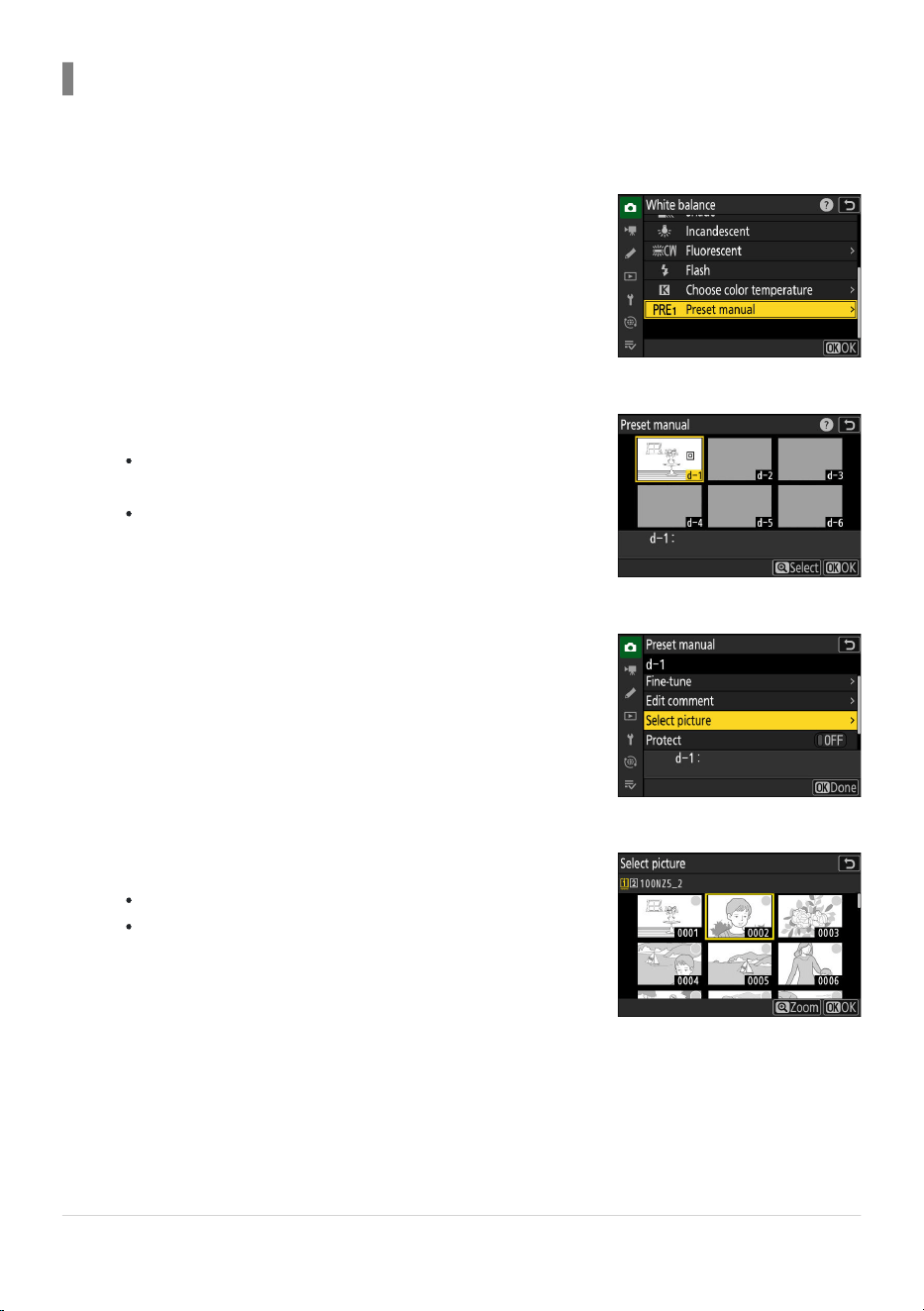
Select [White balance] in the photo shooting or video
recording menu, then highlight [
Preset manual] and press
2.
Select a destination.
Using the multi selector, highlight the destination pr
eset
(d-1 to d-6).
Press X to view the preset manual white balance menu.
Choose [Select picture].
Highlight [Select picture] and pr
ess 2 to view the pictures on
the current memory card.
Highlight the source picture.
Highlight the desired picture using the multi select
or.
To view the highlighted picture full frame, press and hold
the X button.
Copying White Balance from a Photograph
Follow the steps below to copy a v
alue for white balance from an existing photograph to a selected
preset.
198
White Balance
1
2
3
4
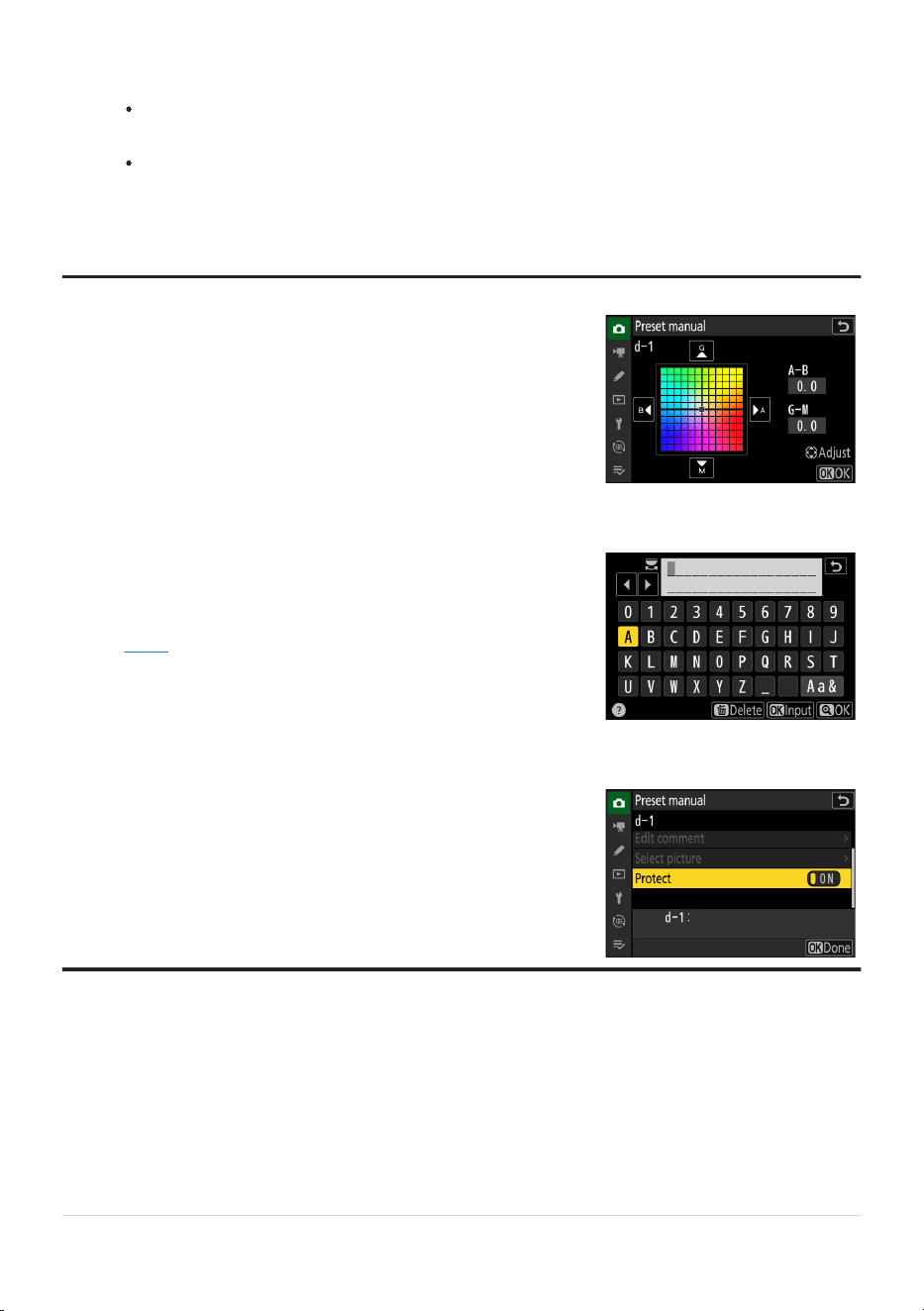
The selected preset can be fine-tuned by selecting [Fine-tune] in
the preset manual white b
alance menu.
To enter a descriptive comment of up to 36 characters for the
current white b
alance preset, select [Edit comment] in the preset
manual white balance menu. Enter a comment as described in “Text
Entry” (
0 79).
To protect the current white balance preset, select [ON] for
[Protect] in the pr
eset manual white balance menu. The preset
cannot be modified as long as [ON] is selected for [Protect].
Copy white balance.
Press J to copy the whit
e balance value for the highlighted photograph to the selected
preset.
If the highlighted photograph has a comment, the comment will be copied to the comment
for the selected preset.
Tip: Fine-Tuning Preset Manual White Balance
Tip: “Edit Comment”
Tip: “Protect”
199
White Balance
5
Video Recording
Video File Types
Use [Video file type] in the video r
ecording menu to choose the video file type.
You have a choice of NEV, MOV, and MP4 formats.
Option Description
YCbCr/
Bay
er
[
N-RA
W 12-bit (NEV)]
This option assumes the footage will later undergo
RAW processing and editing using a professional high-
performance computer system of the type typically
employed for editing video (
0 219).
The camera simultaneously records an H.264 8-bit MP4
video (pr
oxy video) at a frame size of 1920× 1080 for
playback on the camera.
You have a choice of two tone modes: [SDR] and [N-
Log].
Audio is recorded in Linear PCM format.
Bayer
[H.265 10-bit (MOV)]
This option assumes the footage will later undergo editing
using a professional high-performance computer system of
the type typically employed for editing video.
You have a choice of three tone modes: [SDR], [HLG],
and [N-Log].
Footage is recorded using long GOP inter-frame
compression.
Audio is recorded in Linear PCM format.
YCbCr (4 :
2 : 0)
[H.265 8-bit (MOV)]
This format offers superior compression.
Footage is recorded using long GOP inter-frame
compression.
Audio is recorded in Linear PCM format.
[H.264 8-bit (MP4)]
A widely-supported file type.
Footage is recorded using long GOP inter-frame
compression.
Audio is recorded in AAC format.
200
Video File Types
Tone Mode
To choose the tone mode, highlight [N-RA
W 12-bit (NEV)] or [H.265 10-bit (MOV)] and press 2.
Videos shot using [H.265 8-bit (MOV)] and [H.264 8-bit (MP4)] use [SDR]; tone-mode selection is
not available.
Option Description
[SDR] This mode supports a normal range of brightnesses (dynamic range).
[HLG]
This mode supports HDR (high dynamic range;
0 220). It has a wider dynamic range
than SDR.
It is available only when [H.265 10-bit (MOV)] is selected for [Video file type].
[N-Log]
This mode uses Nik
on’s unique log curve. Choose for pictures with a wide dynamic
range. 3D LUTs for use with N-Log curves can be applied post-production for pictures
that display beautifully on monitors that support Rec. 709 (
0 222).
Color Space
The color sp
aces for videos recor
ded with [H.265 10-bit (MOV)], [H.265 8-bit (MOV)], or [H.264
8-bit (MP4)] selected for [Video file type] are as follows:
[SDR]: BT.709
[HLG]: BT.2100
[N-Log]: BT.2020
201
Video File Types

Video Frame Size and Rate Options
Video frame size (in pixels) and frame rate
can be selected using [Frame size/frame rate] in the video
recording menu.
Frame Size and Rate Options
The options available for [Frame size/frame rate] v
ary with the settings chosen for [Video file type]
in the video recording menu.
Option
1
Video file type
N-RAW 12-bit H.265 10-bit/8-bit H.264 8-bit
[[FX] 4032×2268; 30p]
2, 3, 4
4
— —
[[FX] 4032×2268; 25p]
2, 3, 4
4
— —
[[FX] 4032×2268; 24p]
2, 3,
4
4
— —
[[DX] 3984×2240; 30p]
2, 3, 4
4
— —
[[DX] 3984×2240; 25p]
2, 3, 4
4
— —
[[DX] 3984×2240; 24p]
2, 3, 4
4
— —
[3840×2160; 60p]
5
—
4
—
[3840×2160; 50p]
5
—
4
—
[3840×2160; 30p]
5
—
4
—
[3840×2160; 25p]
5
—
4
—
[3840×2160; 24p]
5
—
4
—
[1920×1080; 120p]
4
—
4
—
[1920×1080; 100p]
4
—
4
—
[1920×1080; 60p] —
4 4
202
Video Frame Size and Rate Options

Option
1
Video file type
N-RAW 12-bit H.265 10-bit/8-bit H.264 8-bit
[1920×1080; 50p] —
4 4
[1920×1080; 30p] —
4 4
[1920×1080; 25p] —
4 4
[1920×1080; 24p] —
4 4
[1920×1080; 30p ×4 (slow-motion)]
4
— —
4
[1920×1080; 25p ×4 (slow-motion)]
4
— —
4
[1920×1080; 24p ×5 (slow-motion)]
4
— —
4
The frame rates for 120p, 100p, 60p, 50p, 30p, 25p, and 24p are respectively 119.88 fps, 100 fps,
59.94 fps, 50 fps, 29.97 fps, 25 fps, and 23.976 fps.
Regardless o
f the setting chosen for [Image area]> [Choose image area] in the video recording
menu, “FX” options will be recorded using the [FX] image area and “DX” options using the [DX]
image area.
DX-based video format is selected automatically when a DX lens is attached. “FX” options cannot
be selected.
[Electronic VR] in the video recording menu is fixed at [OFF].
Videos are recorded in 4K UHD.
203
Video Frame Size and Rate Options
1
2
3
4
5
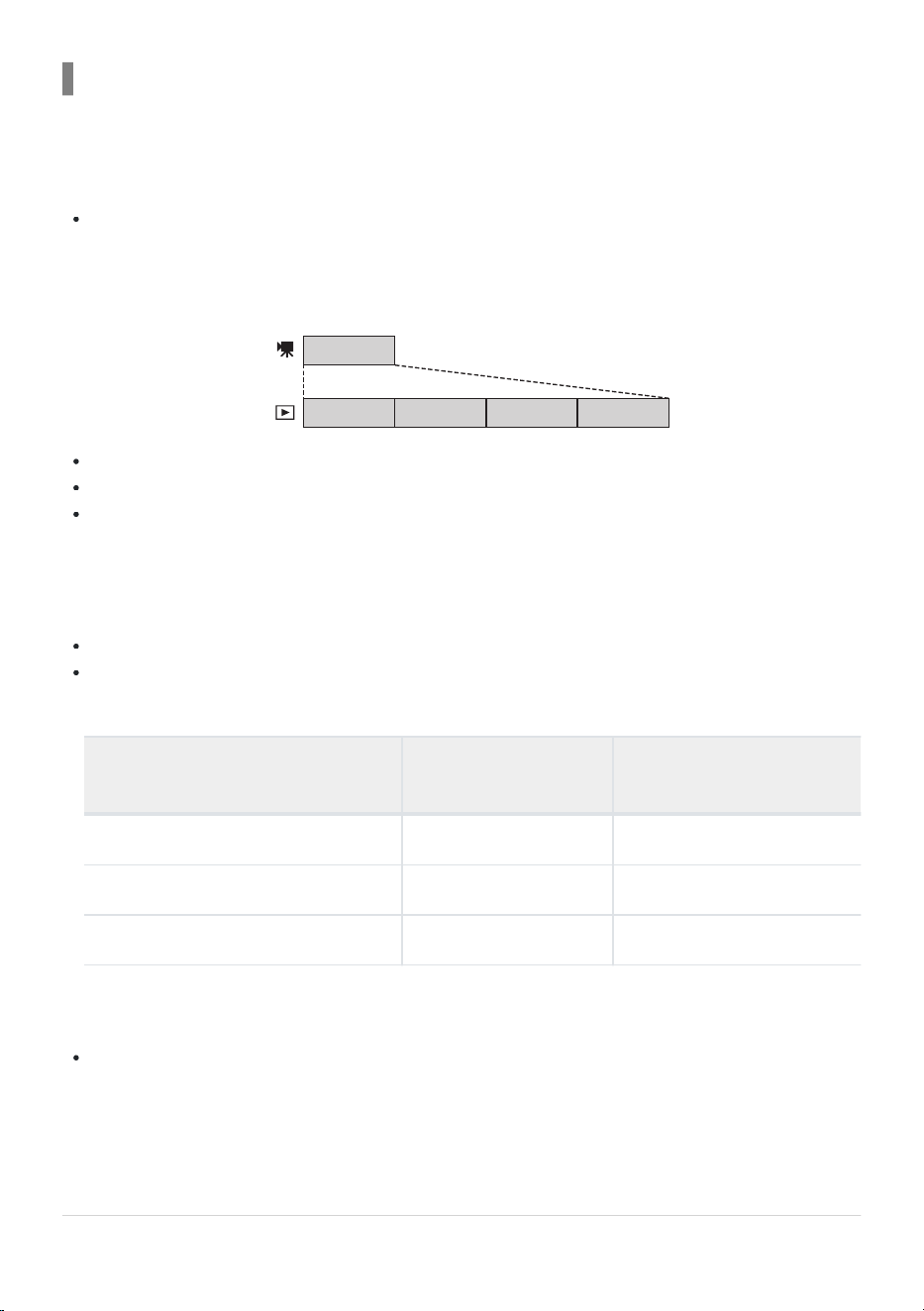
Slow-Motion Videos
To recor
d slow-motion videos, select [1920×1080; 30p ×4 (slow-motion)], [1920×1080; 25p ×4
(slow-motion)], or [1920×1080; 24p ×5 (slow-motion)] for [Frame size/frame rate] in the video
recording menu.
In the case of [1920×1080; 30p ×4 (slow-motion)], images read out at a frame rate of 120p are
recorded as a 30p video. Video recorded for approximately 10 seconds will play for approximately
40 seconds. Slow-motion videos can be used to view events of brief duration, such as a bat striking
a ball, in slow motion.
Sound is not recorded.
The image area is fixed at [FX
].
Slow-motion videos shot when a DX lens is mounted will be recorded at the following frame sizes
and rates:
[1920×1080; 30p ×4 (slow-motion)] → [1920×1080; 60p]
[1920×1080; 25p ×4 (slow-motion)] → [1920×1080; 50p]
[1920×1080; 24p ×5 (slow-motion)] → [1920×1080; 60p]
Custom Setting g10 [Extended shutter speeds (S/M)] is disabled.
The frame rates when images are read out and when videos are recorded and played back are as
follows.
Frame size/frame rate
Frame rate when
images are read out
*
Frame rate when videos are
recorded and played back
*
[1920×1080; 30p ×4 (slow-motion)] 120p 30p
[1920×1080; 25p ×4 (slow-motion)] 100p 25p
[1920×1080; 24p ×5 (slow-motion)] 120p 24p
The frame rates for 120p, 100p, 30p, 25p, and 24p are respectively 119.88 fps, 100 fps, 29.97 fps,
25 fps, and 23.976 fps.
The maximum recording time is about three minutes.
204
Video Frame Size and Rate Options
-
-
-
*

D Cautions: Recording Slow-Motion Videos
Featur
es that cannot be used during slow-motion video recording include:
video flicker reduction,
electronic VR,
time code output, and
Hi-Res Zoom.
When recording via HDMI output to an external recorder, video will be recorded at original speed,
not in slow motion.
205
Video Frame Size and Rate Options
-
-
-
-
Bit Rate
Bit rates var
y with the settings chosen for [Video file type] in the video recording menu.
N-RAW 12-Bit
The average bit rates for NEV videos and for the MP4 videos recorded for playback purposes are as
follows.
Option NEV MP4
[[FX] 4032×2268; 30p] Approx. 420Mbps
Approx. 30Mbps[[FX] 4032×2268; 25p] Approx. 350Mbps
[[FX] 4032×2268; 24p] Approx. 340Mbps
[[DX] 3984×2240; 30p] Appro
x. 410Mbps
Approx. 30Mbps[[DX] 3984×2240; 25p] Approx. 340Mbps
[[DX] 3984×2240; 24p] Approx. 330Mbps
H.265 10-Bit, H.265 8-Bit, and H.264 8-Bit
The average bit rate for each option is shown below
.
Option
Video file type
H.265 10-bit H.265 8-bit H.264 8-bit
[3840×2160; 60p]
Approx. 340Mbps Approx. 300Mbps
—
[3840×2160; 50p] —
[3840×2160; 30p]
Approx. 190Mbps Approx. 150 Mbps
—
[3840×2160; 25p] —
[3840×2160; 24p] —
206
Video Frame Size and Rate Options

Option
Video file type
H.265 10-bit H.265 8-bit H.264 8-bit
[1920×1080; 120p]
Approx. 190Mbps Approx. 150 Mbps
—
[1920×1080; 100p] —
[1920×1080; 60p]
Approx. 100Mbps Approx. 80Mbps Approx. 50Mbps
[1920×1080; 50p]
[1920×1080; 30p]
Approx. 50Mbps Approx. 40Mbps Approx. 30Mbps[1920×1080; 25p]
[1920×1080; 24p]
[1920×1080; 30p ×4 (slow-
motion)]
— —
Approx. 30Mbps
[1920×1080; 25p ×4 (slow-
motion)]
— —
[1920×1080; 24p ×5 (slow-
motion)]
— —
207
Video Frame Size and Rate Options

Video Recording: Shooting Mode
The exposure settings that can be adjusted during filming v
ary with the shooting mode:
Shooting mode Aperture Shutter speed ISO sensitivity
1
AUTO (b)
— — —
P (pr
ogrammed auto) — — —
2
S (shutter-priority auto) —
4
3
—
2
A
(apertur
e-priority auto)
4
— —
2
M (manual)
4
4
3
4
4
The maximum ISO sensitivity for videos r
ecorded with [ON] selected for [Electronic VR] in the
video r
ecording menu is ISO 51200.
The upper limit for ISO sensitivity can be selected using the [ISO sensitivity settings]>
[Maximum sensitivity] item in the video recording menu.
Shutter speed can be set to values between ¹⁄₂₅s and ¹⁄₈₀₀₀ s. The slowest available shutter speed
varies with the frame rate.
If [ON] is selected for [ISO sensitivity settings]> [Auto ISO control (mode M)] in the video
recording menu, the upper limit for ISO sensitivity can be selected using [Maximum sensitivity].
208
Video Recording: Shooting Mode
1
2
3
4
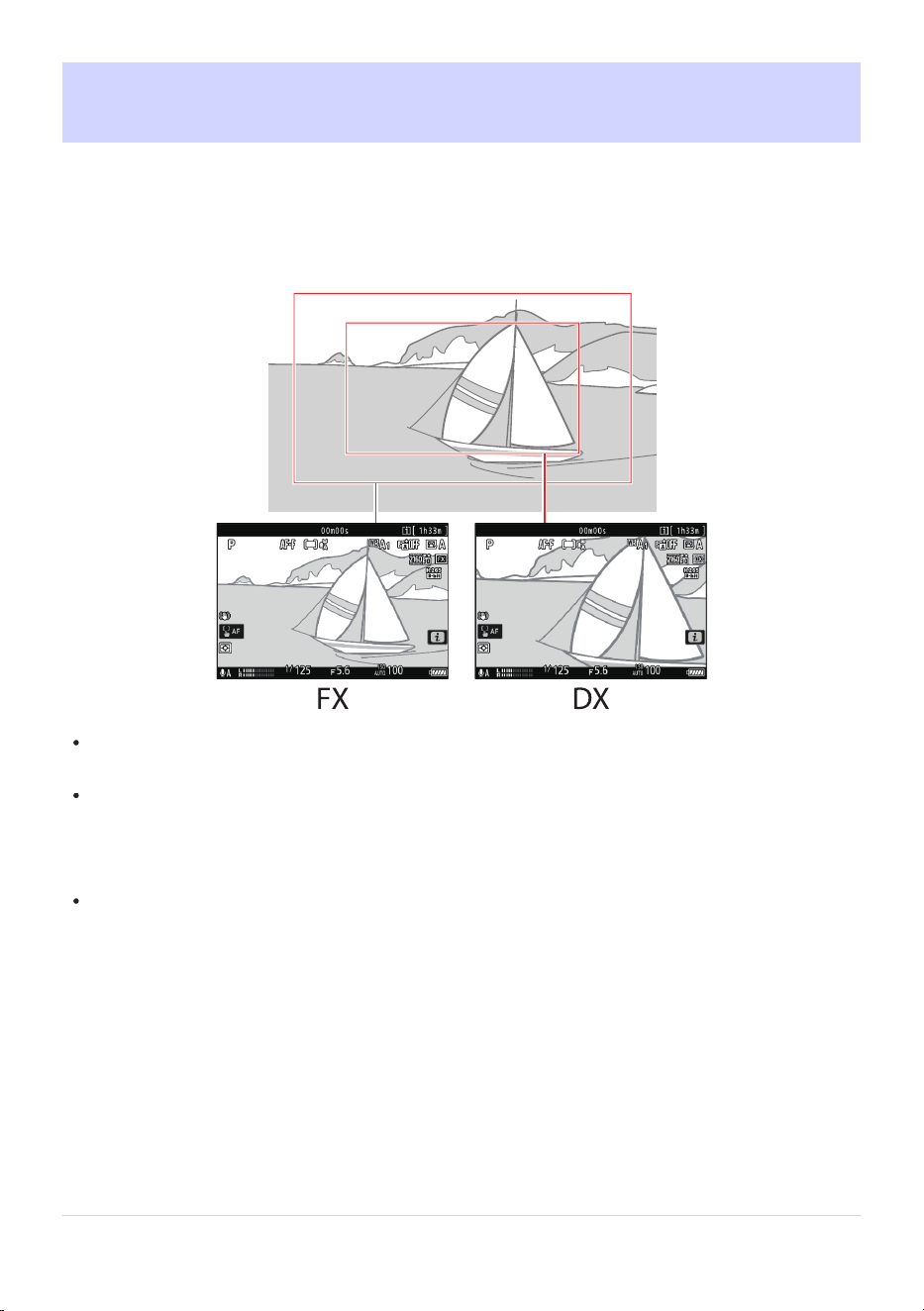
Video Image Area Options
The image area for videos can be select
ed using [Image area]> [Choose image area] in the video
recording menu. The crop used for filming video varies with the option selected. Regardless of the
option selected, the aspect ratio is 16 : 9.
Select [FX] to shoot videos in what is referr
ed to as “FX-based video format”, [DX] to shoot in
“DX-based video format”.
The image area for videos recorded with [N-RAW 12-bit (NEV)] selected for [Video file type] in
the video recording menu is determined by the option chosen for [Frame size/frame rate]. The
option selected for [Image area]> [Choose image area] in the video recording menu does not
apply.
When [1920×1080; 120p], [1920×1080; 100p], [1920×1080; 30p ×4 (slow-motion)],
[1920×1080; 25p ×4 (slow-motion)], or [1920×1080; 24p ×5 (slow-motion)] is selected for
[Frame size/frame rate], following restrictions may apply depending on the lens.
The image area is fixed at [FX] when using an FX lens.
When using a DX lens, the [Frame size/frame rate] settings will change to the following:
[1920×1080; 120p] → [1920×1080; 60p]
[1920×1080; 100p] → [1920×1080; 50p]
[1920×1080; 30p ×4 (slow-motion)] → [1920×1080; 60p]
[1920×1080; 25p ×4 (slow-motion)] → [1920×1080; 50p]
[1920×1080; 24p ×5 (slow-motion)] → [1920×1080; 60p]
209
Video Image Area Options
-
-
-
-
-
-
-
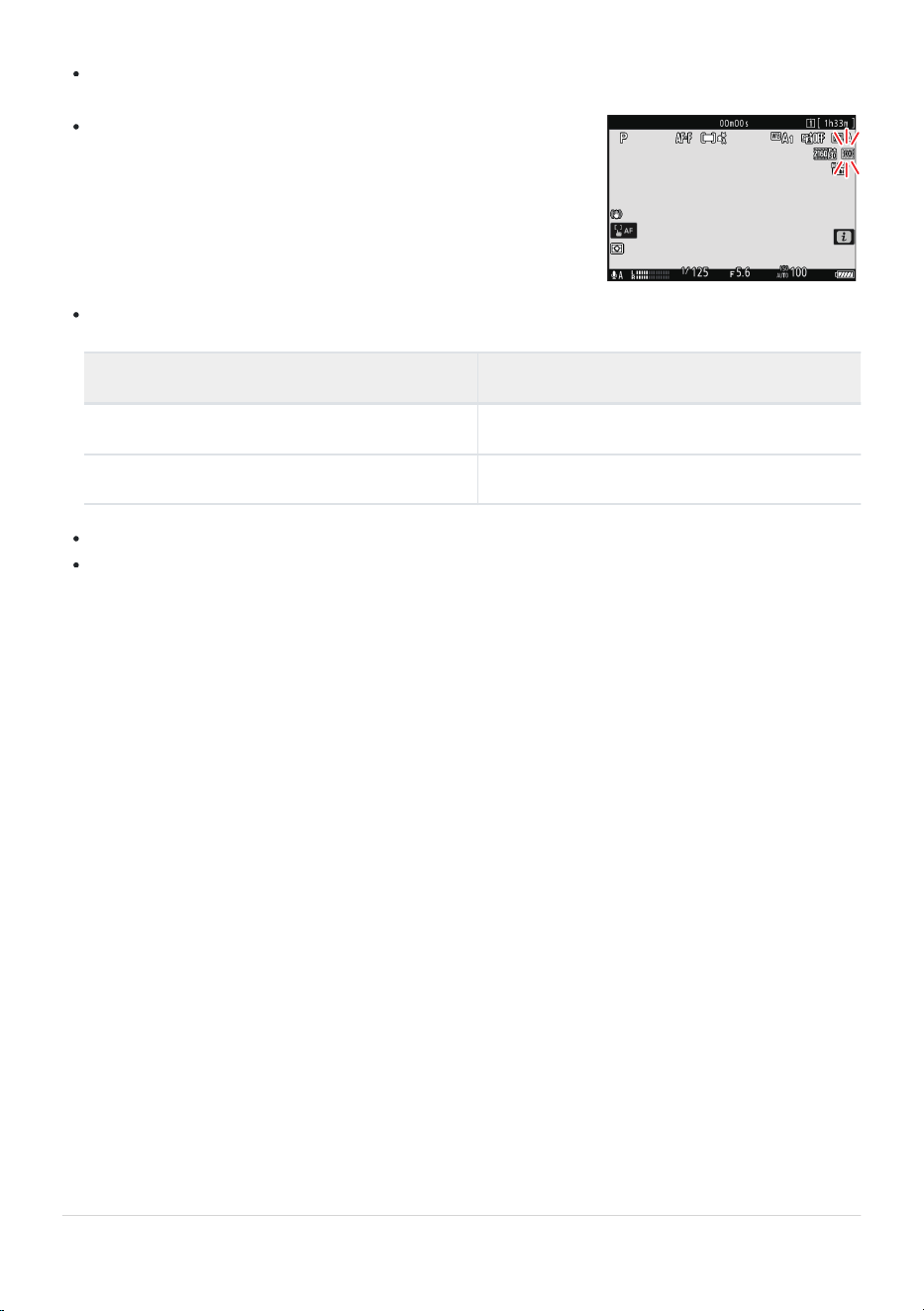
The option currently selected is shown by an icon in the display.
If [ON] is chosen for [Image area]> [DX cr
op alert] in the video
recording menu, an image-area icon will flash in the shooting
display when the DX crop is selected.
When [3840×2160; 60p] or [3840×2160; 50p] is selected for [Frame size/frame rate], image ar
ea
is fixed at [DX].
The sizes of the different crops are shown below.
Format Size
FX-based video format Approx. 35.9 × 20.2 mm
DX-based video format Approx. 23.7 × 13.3 mm
DX-based video format is selected automatically when a DX lens is attached.
Selecting [ON] for [Electronic VR] in the video recor
ding menu reduces the size of the crop.
210
Video Image Area Options
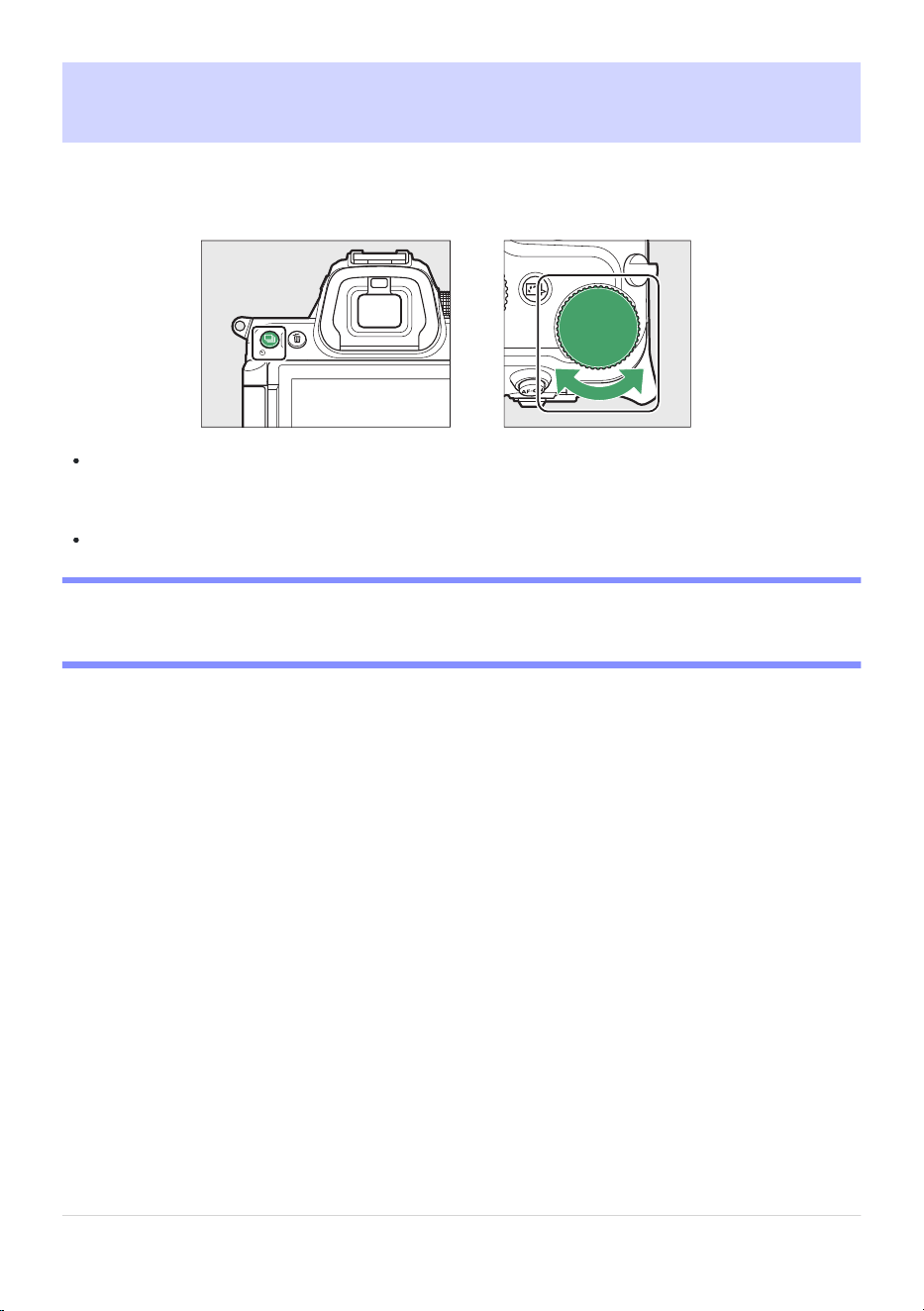
Video Self-Timer
Hold the c (E) button and rotat
e the main command dial to set the video self-timer. Pressing the
video-record button starts a timer and video recording automatically starts when the set time expires.
Set the self-timer to an option other than [Off] and press the video-record button to start the timer;
a count-down timer will appear on the shooting screen and the self-timer lamp will begin to flash.
The lamp stops flashing two seconds before the timer expires.
The video self-timer can also be set from [Video self-timer] in the video recording menu.
D Video Self-Timer
The self-timer will not operate when videos cannot be recorded, such as when a 0 icon is displayed.
211
Video Self-Timer

Product Review Mode
Setting [Product review mode] in the video r
ecording menu to [On] or [On (customize focus area)],
the camera will quickly switch the subject in focus when the subject appears closer to the camera. For
example, when shooting a video with a person in focus, if a product is brought in front of the camera,
the focus will quickly switch from the person's face to the product. This makes it useful when shooting
product review videos.
Select [On] to set the focus on the foremost subject in the entire shooting area.
Select [On (customize focus area)] to choose the dimensions (measured in focus points) of the AF
areas. Highlight [On (customize focus area)] and press 2, then use 1 and 3 to choose the height
and 4 and 2 to choose the width of the AF area.
D Product Review Mode
When [On] or [On (customize focus area)] is selected, some items (including focus mode and AF-area
mode) are fixed to settings that suit product review shooting and cannot be changed.
Tip: Using Custom Controls to Set the AF Area Size for [On (customize focus area)]
When [On (customize focus area)] is selected, the AF-area size can also be set using the multi
selector while holding the control to which [Focus mode/AF-area mode] has been assigned via
Custom Setting g2 [Custom controls].
212
Product Review Mode
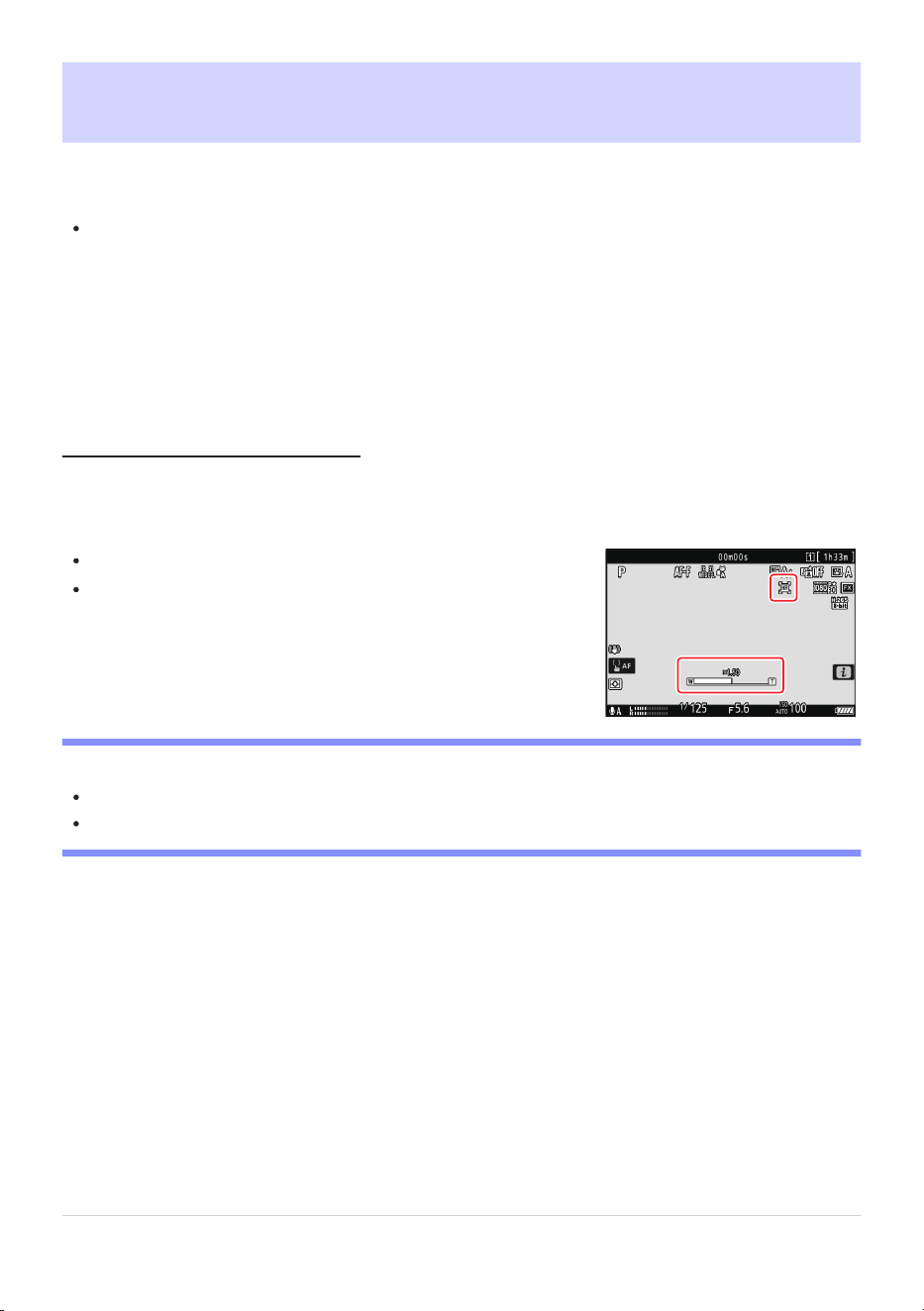
A H icon appear
s in the display when Hi-R
es Zoom is enabled.
The zoom position is shown by a b
ar as you zoom in or out. You
can zoom in to a maximum of 2.0×.
Hi-Res Zoom
Selecting [ON] for [Hi-Res Zoom] in the video recor
ding menu lets you zoom in on your subject with
no loss in resolution, even without a zoom lens.
Hi-Res Zoom is available when all the following conditions are met:
[FX] is selected for [Image area] > [Choose image area] in the video recording menu,
[H.265 10-bit (MOV)], [H.265 8-bit (MOV)], or [H.264 8-bit (MP4)] is selected for [Video file
type] in the video recording menu, and
a frame size and rate of [1920×1080; 30p], [1920×1080; 25p], or [1920×1080; 24p] is selected
for [Frame size/frame rate] in the video recording menu.
Using Hi-Res Zoom
Select [ON] for [Hi-Res Zoom] in the video recor
ding menu and press 4 or 2 to zoom in or out using
Hi-Res Zoom.
D Cautions: Hi-Res Zoom
AF-area mode is fixed at [Wide-area AF (L)]. The focus point is not displayed.
[Electronic VR] in the video recording menu is fixed at [OFF].
213
Hi-Res Zoom
-
-
-

Tip: Custom Controls for Hi-Res Zoom
The zoom position for Hi-Res Zoom can also be adjusted using contr
ols to which [Hi-Res Zoom +]
and [Hi-Res Zoom −] have been assigned via Custom Setting g2 [Custom controls].
Zoom control for Hi-Res Zoom can be assigned to the camera [Fn1 button] and [Fn2 button], to
the lens Fn ring via [Lens Fn ring (clockwise)] and [Lens Fn ring (counterclockwise)], and via
[Lens control ring] to the lens control ring.
When Hi-Res Zoom is assigned to the [Fn1 button], [Fn2 button], [Lens Fn ring (clockwise)],
or [Lens Fn ring (counterclockwise)], you can choose the zoom speed using Custom Setting g7
[Hi-Res Zoom speed].
When Hi-Res Zoom is assigned to [Lens control ring], the control ring response can be adjusted
using Custom Setting f11 [Control ring response].
Instead of using the control ring, users of compatible lenses can employ the focus ring for Hi-Res
Zoom by selecting [ON] for Custom Setting f12 [Switch focus/control ring roles].
214
Hi-Res Zoom
-
-
-
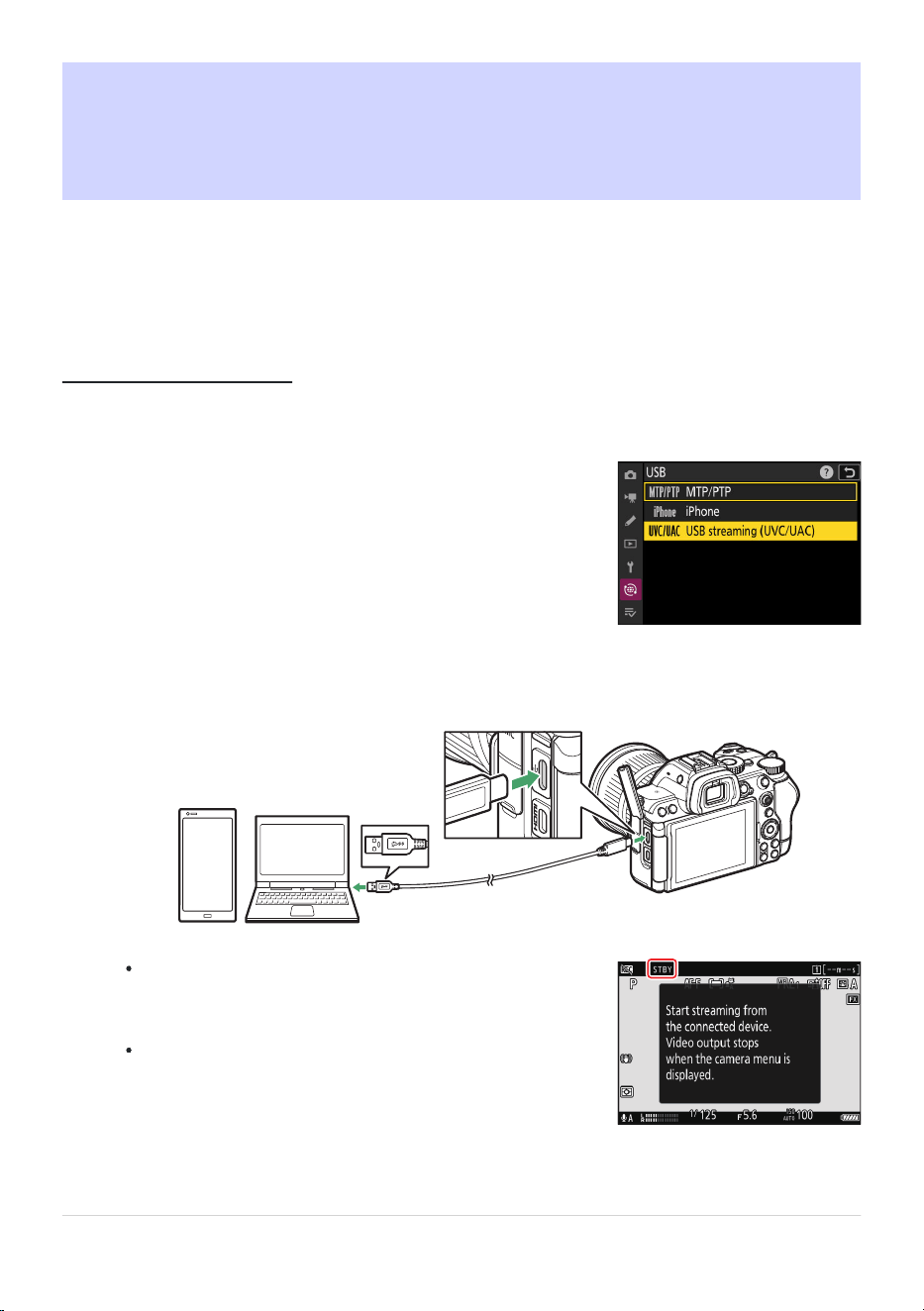
Camera: Select [USB] in the network menu, highlight [USB
streaming (UVC/U
AC)], and press J.
The camera will enter streaming standby mode, and a
message prompting you t
o start streaming and an u icon
will be displayed in the shooting display.
The video mode shooting display will appear regardless of
the photo/video selector setting. The video mode settings
including white balance and Picture Control will be applied
to the streaming image.
Live Streaming (USB Streaming (UVC/
UAC))
Y
ou can use live streaming software and web conferencing applications on the computer or smart
device connected to the camera via the supplied USB cable to live stream the video and audio
recorded with the camera.
Live Streaming
The steps for live str
eaming are as follows.
Connect the camera and computer/smart device using the supplied USB cable.
215
Live Streaming (USB Streaming (UVC/UAC))
1
2

The camera will start streaming and a w icon will be
displayed in the shooting display.
Computer/smart device: Start streaming via a live streaming application.
Streaming video is generat
ed as follows.
Frame size/frame rate: 1080/60p, 1080/30p, 720/60p, 720/30p (settings available in the
application/software vary depending on the model and specifications of the computer or
smart device)
Video format: MJPEG
Audio format: PCM, 16-bit, stereo
D Cautions: Live Streaming
Install live streaming software or web conferencing applications on your computer/smart device in
advance.
Streaming will end automatically if:
[USB] in the network menu changes from [USB streaming (UVC/UAC)],
the USB cable is removed to terminate the connection, or
the camera is turned off.
Some functions and settings cannot be used while streaming, including:
video recording,
display zoom,
HDMI connection, and
communications with the computer/smart device other than the streaming software (for
example, using software such as NX Studio).
Some menus can be set while streaming, but a gray image will be streamed while operating the
menu.
Depending on the operating system or model of the computer or smart device, you may need a
connection application/software in addition to the application/software used for streaming.
We do not guarantee that streaming is available with all computers/smart devices.
216
Live Streaming (USB Streaming (UVC/UAC))
3
-
-
-
-
-
-
-
-
-
-

Points to Note When Filming Videos
Note the following points when recor
ding videos:
Each video can be up to 125 minutes in length.
When recording to a memory card with a capacity of 32 GB or less:
Each video can be saved across a maximum of 8 files. Each of these files will be a maximum of
4GB in size. The number of files and the length of each file will vary with the options selected for
[Frame size/frame rate] in the video recording menu.
Videos cannot be recorded if [N-RAW 12-bit (NEV)] is selected for [Video file type] in the video
recording menu.
Depending on memory card write speed, shooting may end before the maximum length is reached.
A 0 icon (
0 107) indicates that videos cannot be recorded.
[Spot metering] is not available during video recording.
Flash lighting (0 391) cannot be used.
217
Points to Note When Filming Videos
-
-

Tip: Adjusting White Balance During Video Recording
White balance can be adjust
ed during video recording by holding the Fn1button and rotating a
command dial.
Tip: Using a Fixed Shutter Speed
In modes S and M, shutter speed can be set to values between ¹⁄₂₅s and ¹/₈₀₀₀s (the slowest available
shutter speed varies with the frame rate).
Tip: Remote Cords
If [Record videos] is selected for Custom Setting g2 [Custom controls] > [Shutter-release button],
the shutter-release button on an optional MC-DC3 remote cord can be pressed halfway to focus or
pressed all the way down to start and end video recording.
Tip: Using an External Microphone
You can use a third-party microphone with 3.5 mm mini-jack plug to record audio by connecting it to
the external microphone connector.
Use [Mic jack plug-in power] in the video recording menu to choose whether the power for the
external microphone is supplied by the camera (
0 544).
218
Points to Note When Filming Videos

RAW Video
“RAW video” refer
s to video recorded with [N-RAW 12-bit (NEV)] selected for [Video file type] in the
video recording menu.
D Cautions: Recording RAW Video
ISO sensitivities of Hi 0.3 through Hi 2.0 are not available.
[Active D-Lighting], [High ISO NR], [Diffraction compensation], [Skin softening], and
[Electronic VR] are not available in the video recording menu.
RAW videos cannot be edited on the camera.
Regardless of the option selected for [HDMI]> [Output resolution] in the setup menu, the
maximum output resolution is 1920× 1080.
For information on the cautions that apply when [N-Log] is selected for tone mode, see “Recording
N‑Log Video” (
0 222).
D Viewing and Editing RAW Videos
RAW videos can only be view
ed and edited using computer software that supports the RAW video
format. Nikon’s NX Studio software supports only the display of the MP4 proxy videos recorded
alongside RAW videos.
219
RAW Video

Recording HLG Video
Video recorded in Hybrid Log Gamma (
HLG) format can be used for HDR broadcasting and the like. To
record HLG video, select [H.265 10-bit (MOV)] for [Video file type] in the video recording menu and
choose the [HLG] tone mode.
o will appear in the shooting display.
For optimal color reproduction when viewing HLG footage, use monitors, computers, operating
systems, applications, and other equipment compatible with HLG.
D Cautions: HLG Video
Pictures taken with [HLG] selected for tone mode may exhibit more “noise” in the form of
randomly-spaced bright pixels, fog, or lines than pictures taken using [SDR] or [N-Log].
ISO sensitivities of Hi 0.3 through Hi 2.0 are not available.
The lowest value available for the [ISO sensitivity settings]> [Maximum sensitivity] item in the
video recording menu is ISO 800.
The lowest value available for the [ISO sensitivity settings]> [ISO sensitivity (mode M)] item in
the video recording menu is ISO 400.
Picture Control settings cannot be adjusted using the [Set Picture Control] item in the video
recording menu. You can control the appearance of HLG videos using [HLG quality] in the video
recording menu.
The [Active D-Lighting] item in the video recording menu is set to [Off] and cannot be changed.
The display in the monitor may flicker or appear grainy.
The camera may have trouble focusing using autofocus but this does not indicate a malfunction.
D HDR (HLG) Output
Optimal color reproduction in HDR (HLG) footage output via HDMI can only be achieved if your
storage device, monitor, and other equipment support HDR (HLG). If a signal is received from the
connected device indicating that it supports HDR (HLG), the camera will respond with a “gamma: HLG”
identifier.
D Camera Shooting and Playback Displays
When [HLG] is selected for tone mode, the shooting and playback displays in the camera monitor and
viewfinder may include “noise” in the form of randomly-spaced bright pixels, fog, or lines or may fail
to accurately reproduce highlights and highly-saturated colors. For accurate tone reproduction, use
monitors, computers, operating systems, applications, and other equipment compatible with HLG.
220
Recording HLG Video

D Viewing and Editing HLG Videos
HLG videos can only be view
ed and edited using computer software that supports the HLG video
format. Nikon’s NX Studio software shows HLG videos in the thumbnail list but cannot be used to view
or edit them.
221
Recording HLG Video

Recording N-Log Video
Log recording
uses light levels digitized via a log function. To enable log recording using Nikon’s
unique “N-Log” log function, select [N-RAW 12-bit (NEV)] or [H.265 10-bit (MOV)] for [Video file
type] in the video recording menu and choose [N-Log] as the tone mode. Choose N‑Log to preserve
details in highlights and shadows and avoid over-saturated colors when recording videos.
n will appear in the shooting display.
The dynamic range for videos shot with [H.265 10-bit (MOV)] selected for [Video file type] and
ISO sensitivity set as low as possible (ISO 800) is 13+ stops (1300%).
N-Log recording is intended for footage that will be processed using color grading post-production.
Color grading can be used to achieve multiple effects from a single sequence by processing it in
different ways.
Compatible third-party software is required for color grading.
Applying N-Log 3D LUTs during color grading produces video that displays beautifully on monitors
compatible with Rec. 709.
N-Log 3D LUTs are available from the Nikon Download Center.
https://downloadcenter.nikonimglib.com/
D Cautions: N-Log Video
V
alues fr
om ISO 1600 t
o 51200 are available for [ISO sensitivity settings] > [Maximum sensitivity]
item in the video recording menu.
Values from Lo 0.3 to Lo 2.0 and ISO 800 to 51200 are available for [ISO sensitivity settings] > [ISO
sensitivity (mode M)] item in the video recording menu.
The maximum output level for videos recorded at low ISO sensitivities (Lo 0.3–Lo 2.0) drops due
to decrease in highlight data. We recommend that you select a low value for Custom Setting
g12 [Zebra pattern]> [Highlight threshold] when using the zebra pattern feature. A highlight
threshold around [230] is recommended for Lo0.3 to 1.0 and [200] for Lo2.0.
[Set Picture Control], [Active D-Lighting], [High ISO NR], [Skin softening], and [Portrait
impression balance] are not available in the video recording menu.
The display in the monitor may flicker or appear grainy.
The camera may have trouble focusing using autofocus but this does not indicate a malfunction.
222
Recording N-Log Video
-
-

View Assist
You may find that the preview in the shooting display during N-Log r
ecording lacks contrast. Selecting
[ON] for Custom Setting g11 [View assist] simplifies colors for enhanced contrast.
p will appear in the shooting display.
Colors in the actual recorded footage are unaffected.
Contrast is also enhanced when N-Log footage is viewed on the camera.
223
Recording N-Log Video
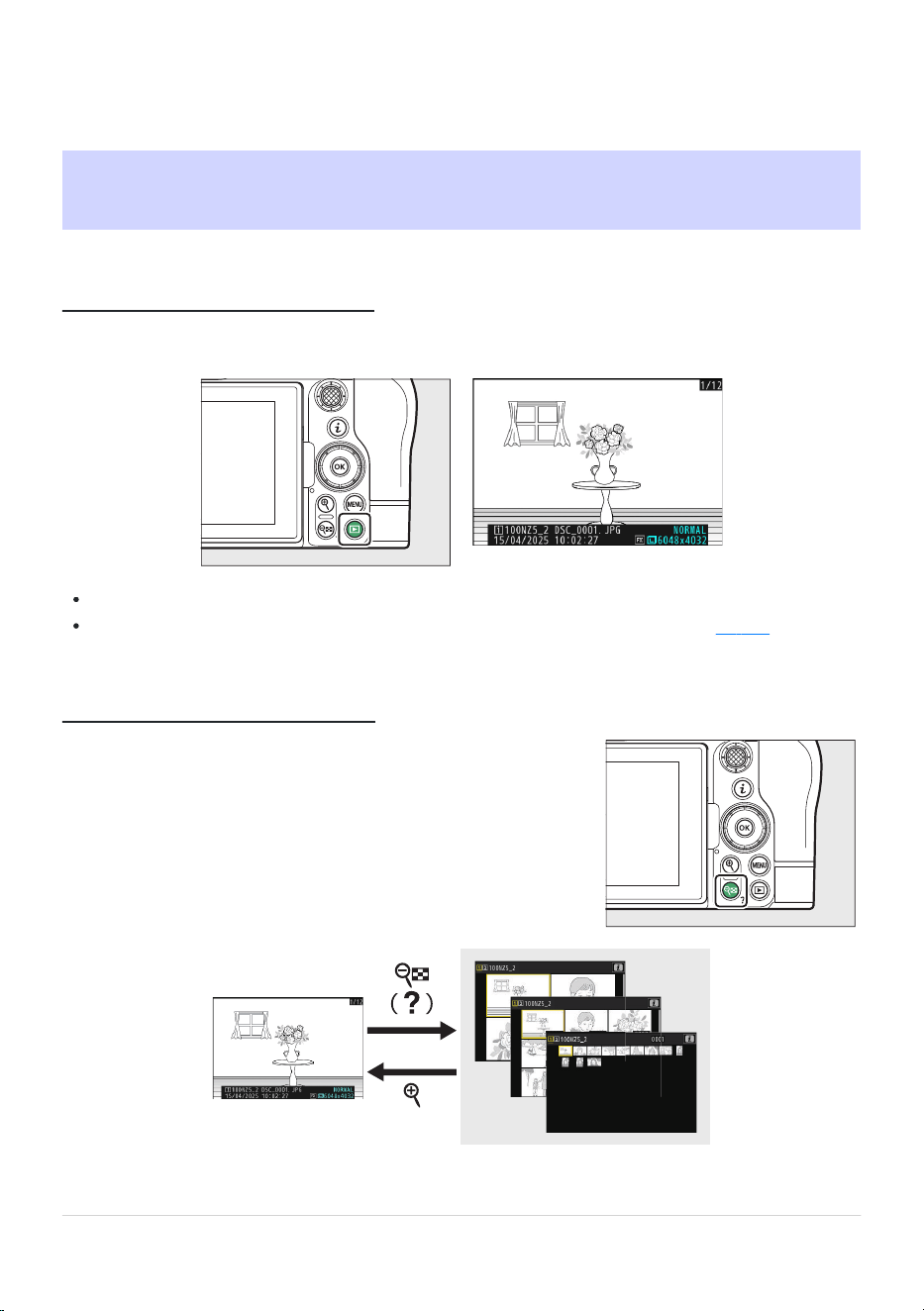
To view multiple pictures, press the W (Q
) button when a picture is
displayed full frame.
Viewing Pictures
Viewing Pictures
Full-Frame Playback
Press the K
button to view the most recent picture full frame in the display.
Press 4 to return to the previous frame, 2 to skip to the next frame.
Press 1, 3, or the DISP button to view more information on the current picture (
0 226).
Thumbnail Playback
224
Viewing Pictures
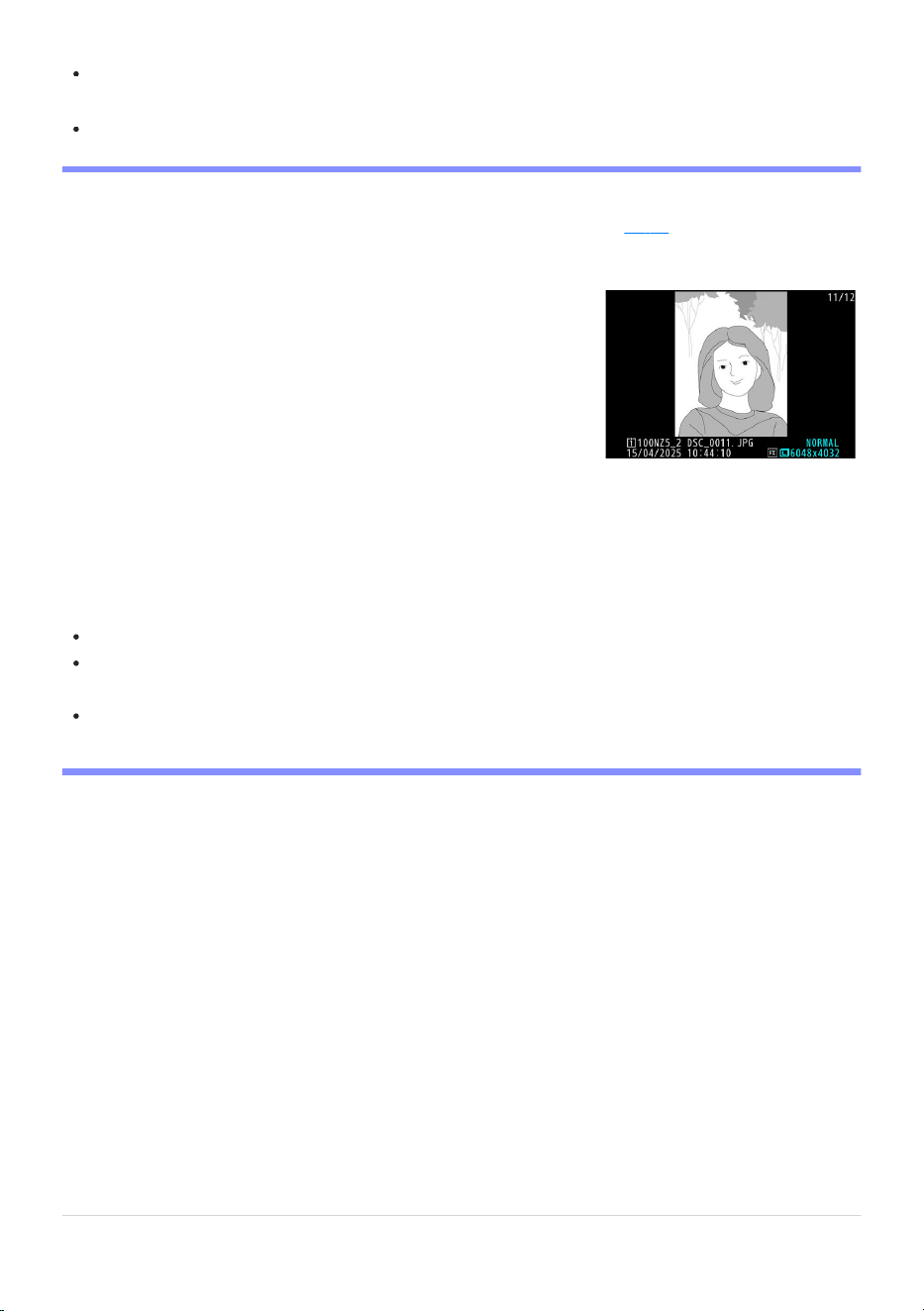
Select [ON] for [Auto-rotat
e pictures] in the playback menu
to automatically rotate “tall” (portrait) and “wide” (landscape)
orientation pictures according to how the camera is held during
playback: tall pictures will be rotated to display in tall orientation
when the camera is held in wide orientation, while wide pictures will
be rotated to display in wide orientation when the camera is held in
tall orientation.
The number of pictures displayed increases from 4 to 9 to 72 each time the W (Q) button is
pressed, and decr
eases with each press of the X button.
Highlight pictures using 1, 3, 4, or 2.
D Touch Controls
Touch controls can be used when pictures are displayed in the monitor (
0 68).
D [Auto-rotate pictures]
D Picture Review
When [On] is selected for [Picture review] in the playback menu, photographs are automatically
displayed after shooting; there is no need for you to press the K button.
If [On (monitor only)] is selected, photos will not be displayed in the viewfinder.
In continuous release modes, display begins when shooting ends, with the first photograph in the
current series displayed.
Pictures are not rotated automatically during picture review even when [ON] is selected for [Auto-
rotate pictures] in the playback menu.
225
Viewing Pictures
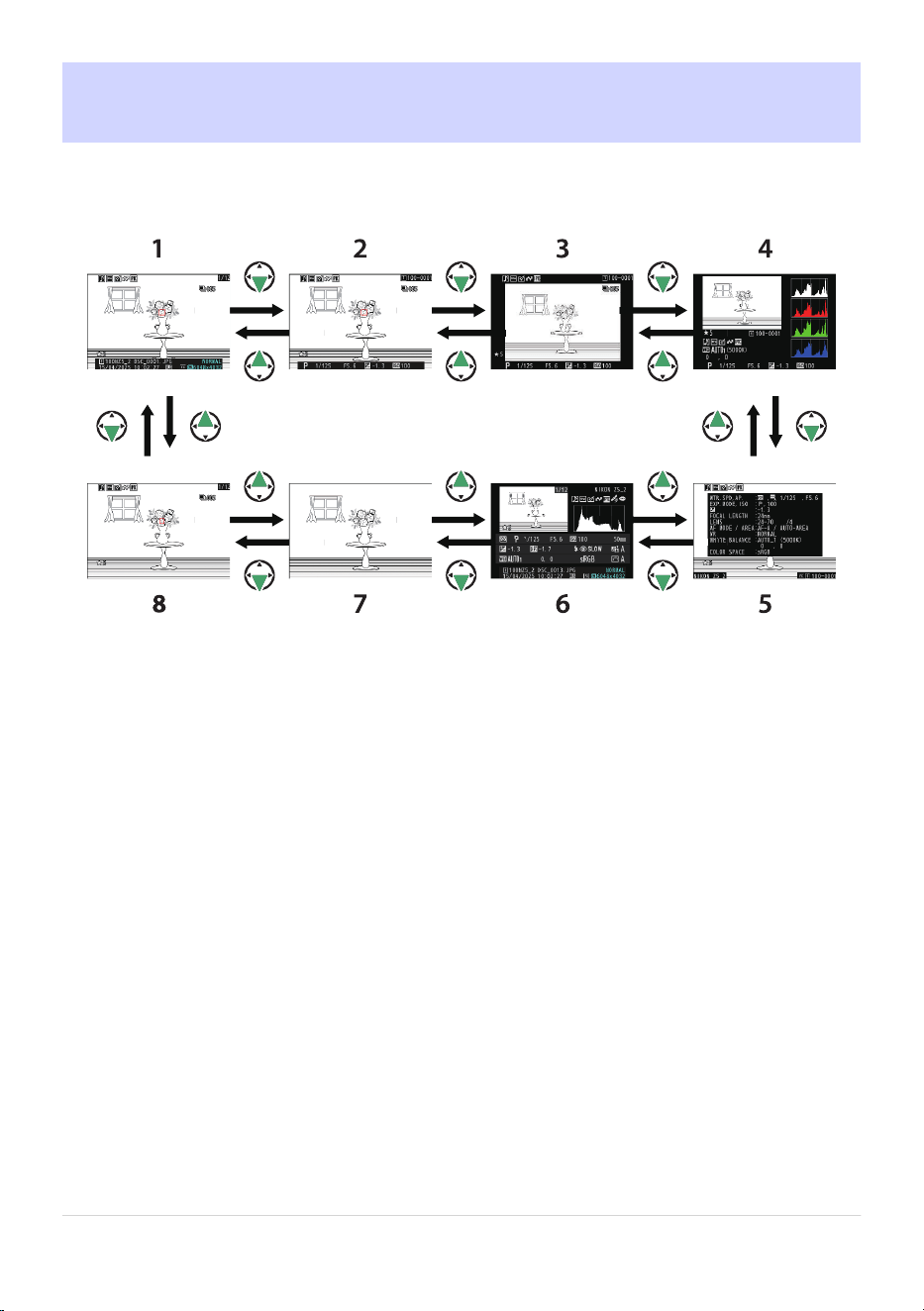
Basic information
Exposure data
*
Highlight display
*
RGB hist
ogram
*
1
2
3
4
Shooting data
*
Overview data
*
None (picture only)
*
File info
*
5
6
7
8
Photo Information
Photo information is superimposed on pictur
es displayed in full-frame playback. Press 1, 3, or the
DISP button to cycle through photo information as shown below.
Displayed only if the corresponding option is selected for [Playback display options] in the
playback menu.
226
Phot
o Information
*
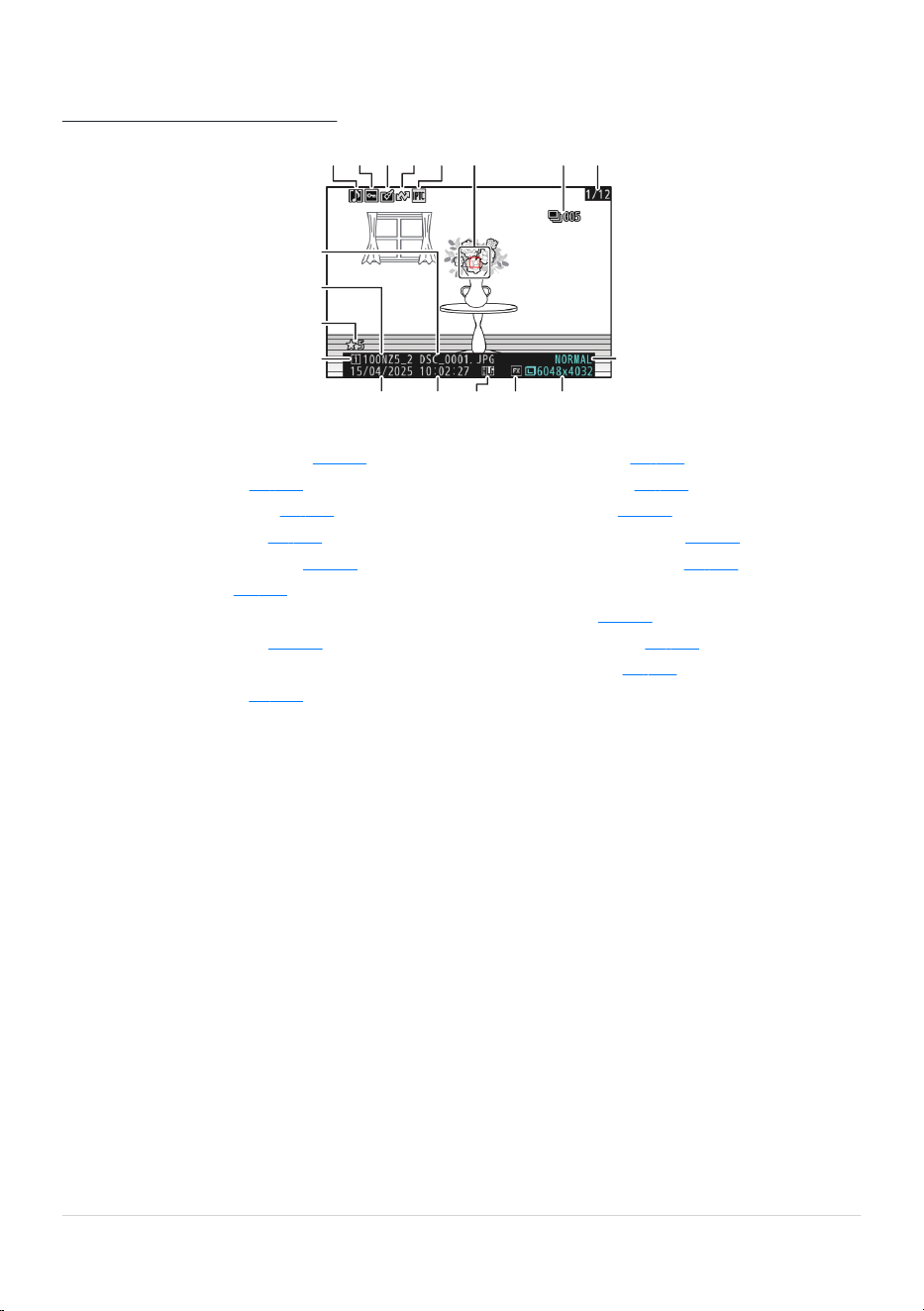
Voice memo indicator (0 254)
Protect status (
0 248)
Retouch indicat
or (
0 263)
Upload marking (0 250)
IPTC preset indicat
or (
0 740)
Focus point (0 130)
1
First picture in bur
st/total number of
pictures in burst (
0 699)
2
Frame number/total number of frames
Image quality (
0 116)
1
2
3
4
5
6
7
8
9
Image size (0 118)
Image area (0 114)
HLG icon (0 418)
Time of recor
ding (
0 717)
Date of r
ecording (
0 717)
Current card slot
Rating (0 249)
Folder name (0 407)
File name (0 411)
10
11
12
13
14
15
16
17
18
Basic Information
1 3 6 87
9
13 1214 11 10
2 54
17
15
16
18
Displayed only if [Focus point] is selected for [Playb
ack display options] in the playback menu.
Displayed on the first picture in each burst when [Mark first shot in series] is selected for
[Playback display options] in the playback menu.
227
Photo Information
1
2
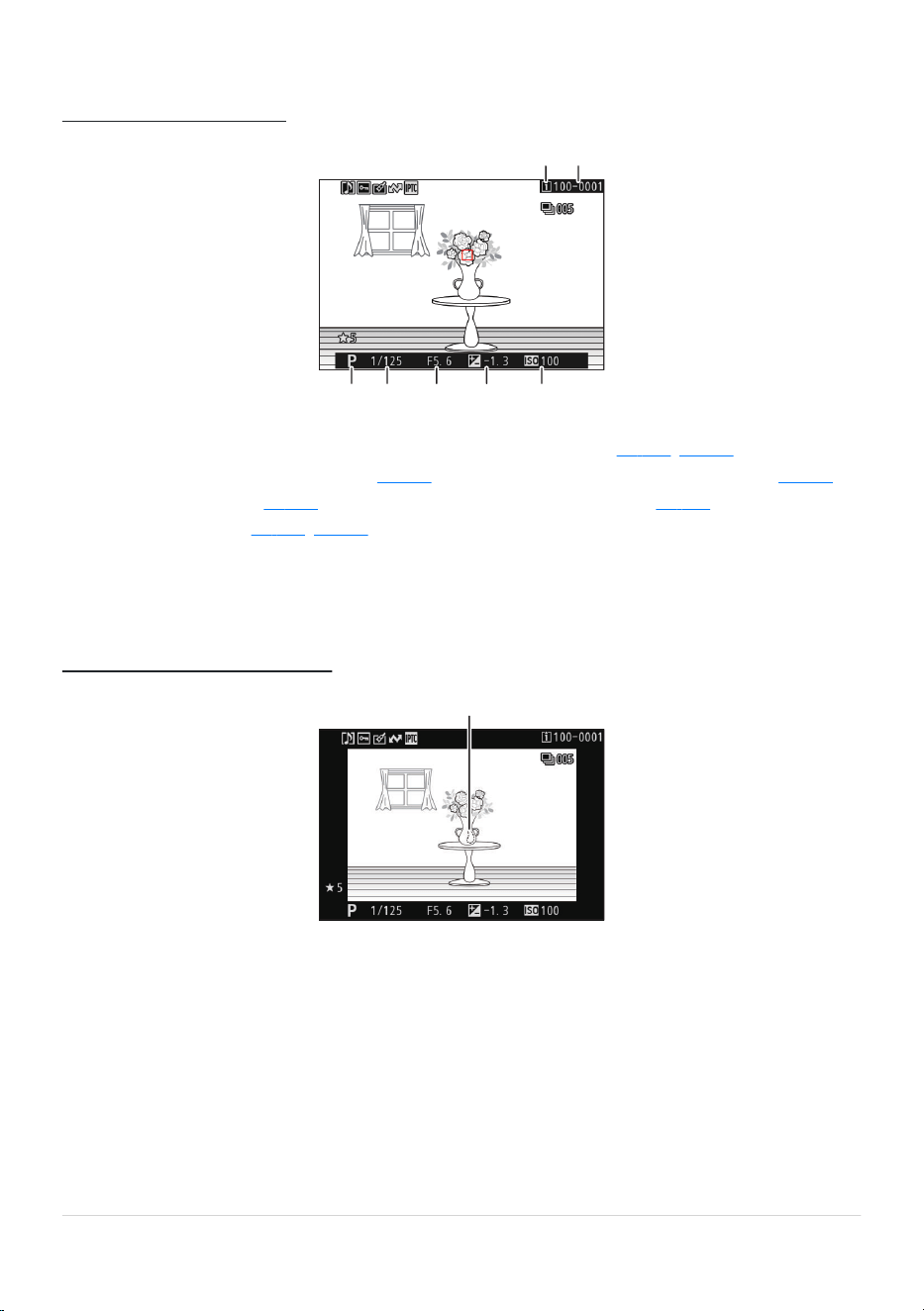
Current card slot
Folder number–frame number (0 407)
Shooting mode (0 137)
Shutter speed (0 139, 0 141)
1
2
3
4
Aperture (0 140, 0 141)
Exposure compensation value (
0 150)
ISO sensitivity (0 160)
*
5
6
7
Exposure Data
543 6 7
21
Displayed in red if the picture was taken with auto ISO sensitivity control enabled.
Highlight Display
1
Highlights (areas that may be overexposed) flash in the display.
228
Photo Information
*
1
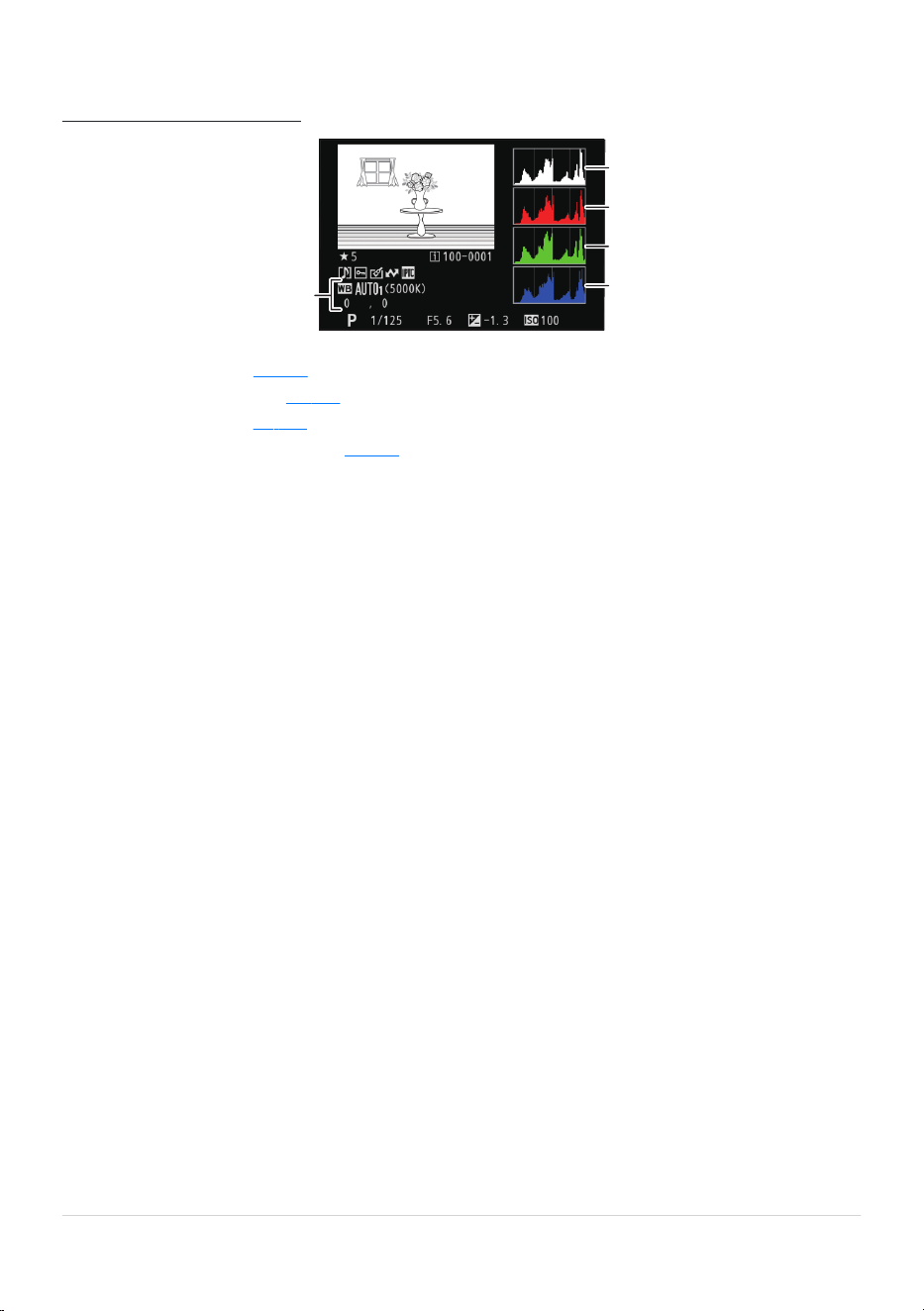
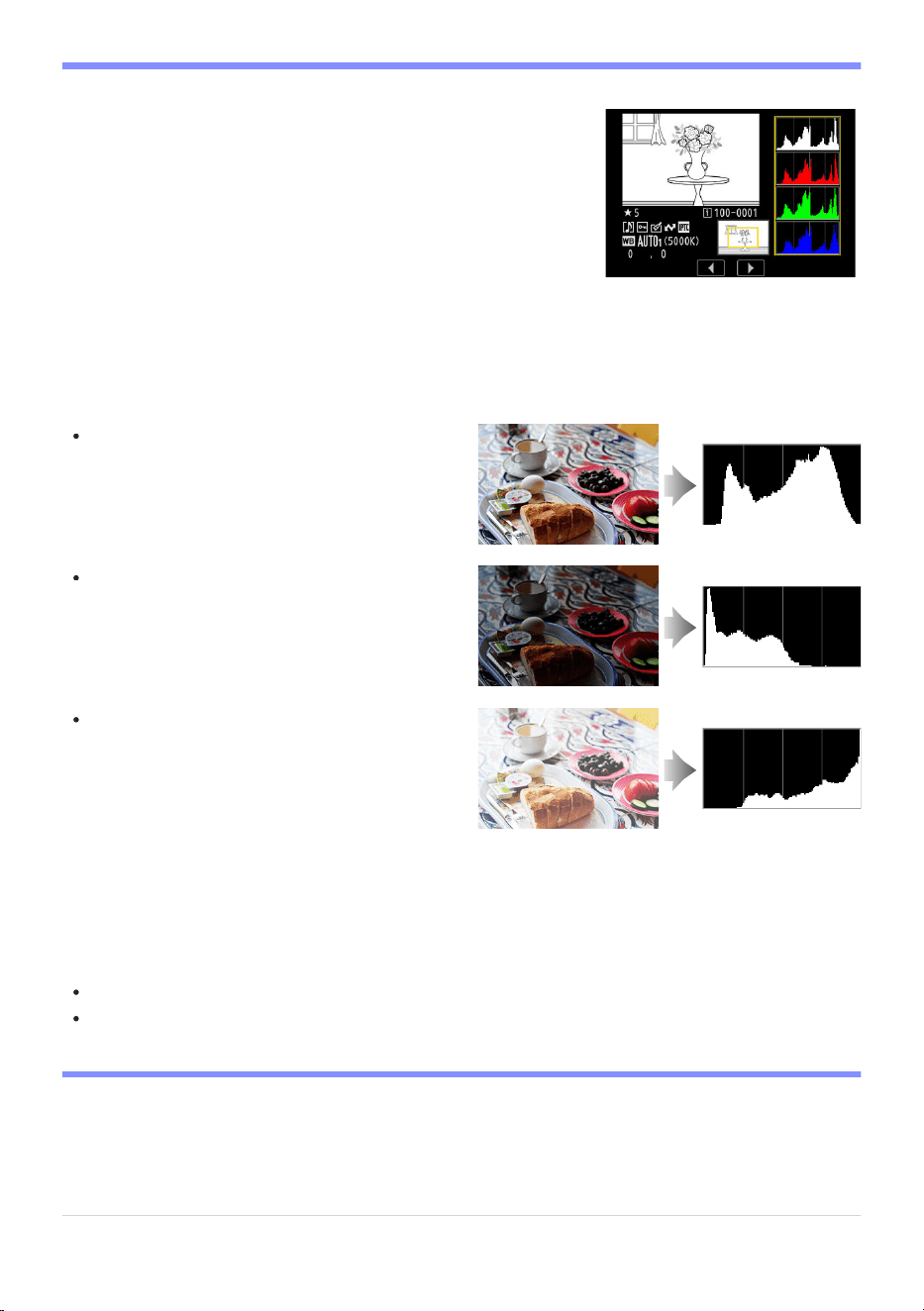
To zoom in on the picture in the histogram display, press X. The
histogram will be updated t
o show only the data for the portion of
the picture visible in the display. Use the multi selector to scroll to
areas of the frame not visible in the monitor. Press W (Q) to zoom
out.
If the picture contains objects with a wide range
of brightnesses, the distribution of t
ones will be
relatively even.
If the picture is dark, the distribution will be
shifted t
o the left.
If the picture is bright, the distribution will be
shifted t
o the right.
D Playback Zoom
D Histograms
Hist
ograms show tone distribution. Pixel brightness (tone) is plotted on the horizontal axis and the
number of pixels on the vertical axis.
Increasing exposure compensation shifts the distribution of tones to the right, while decreasing
exposure compensation shifts the distribution to the left. Histograms can provide a rough idea of
overall exposure when bright ambient lighting makes it difficult to see pictures in the monitor.
D The Histogram Display
RGB histograms show tone distribution.
Camera histograms may differ from those displayed in imaging applications. Use them as a guide to
actual tone distribution.
230
Photo Information
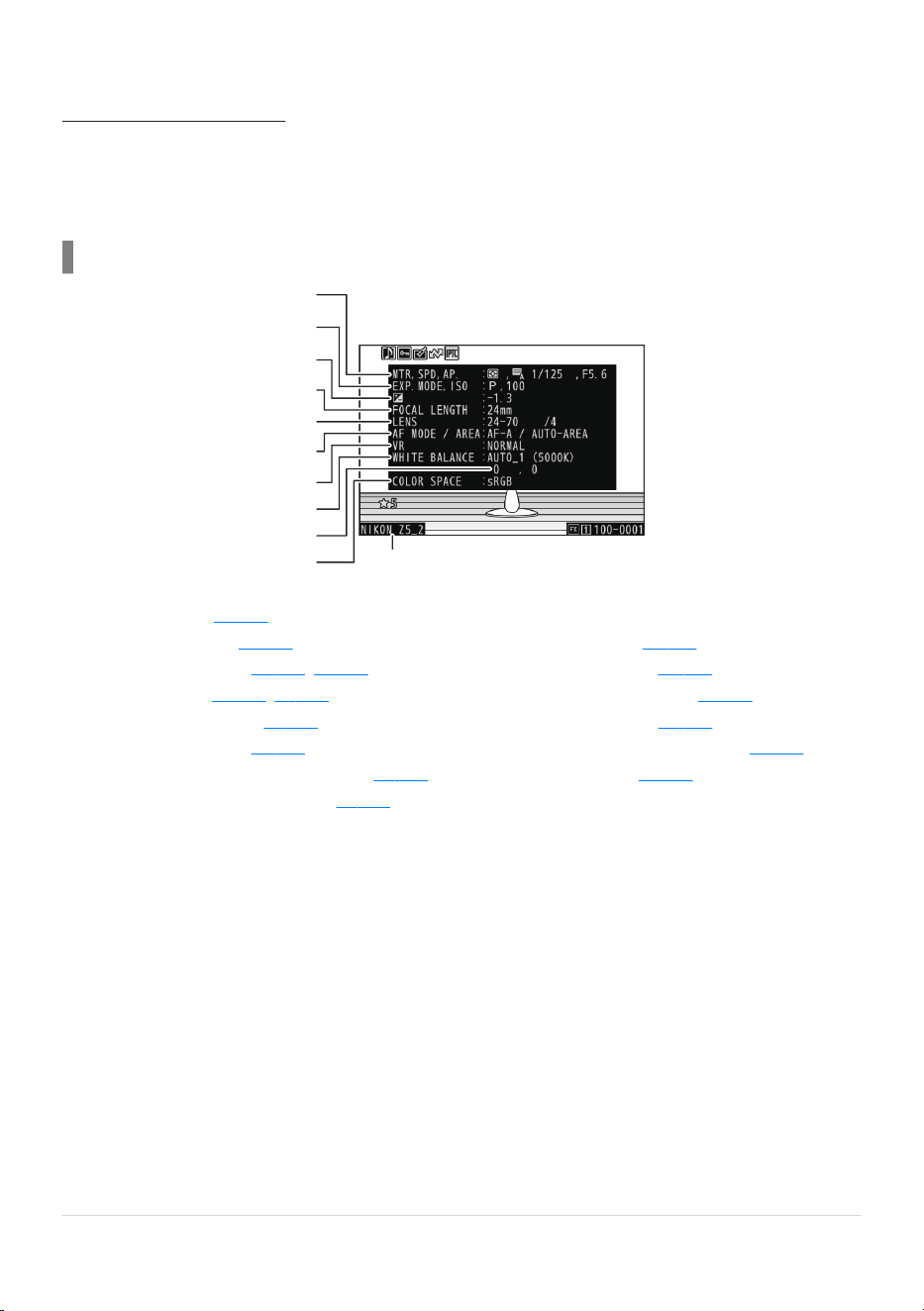
Metering (0 441)
Shutter type (0 585)
Shutter speed (0 139, 0 141)
Aperture (0 140, 0 141)
Shooting mode (0 137)
ISO sensitivity (0 160)
1
Exposure compensation value (0 150)
Optimal exposure tuning (0 575)
2
Focal length
1
2
3
4
Lens data
Focus mode (0 120)
AF-area mode (0 122)
Vibration reduction (0 451)
White balance (0 182)
3
White balance fine-tuning (0 187)
Color space (0 427)
Camera name
5
6
7
8
9
10
11
Shooting Data
View the settings in effect at the time the picture was taken. The shooting data list has multiple p
ages,
which can be viewed by pressing 1 or 3. The information displayed can be selected using [Playback
display options]> [Detailed shooting data] in the playback menu.
Basic Shooting Data
6
5
4
3
2
1
7
8
9
10
11
Displayed in red if the picture was taken with auto ISO sensitivity control enabled.
Displayed if Custom Setting b6 [
Fine-tune optimal exposure] has been set to a value other than
zero.
Also includes the color temperature for pictures taken using 4[Auto], D[Natural light auto],
or L [Preset manual].
231
Photo Information
1
2
3
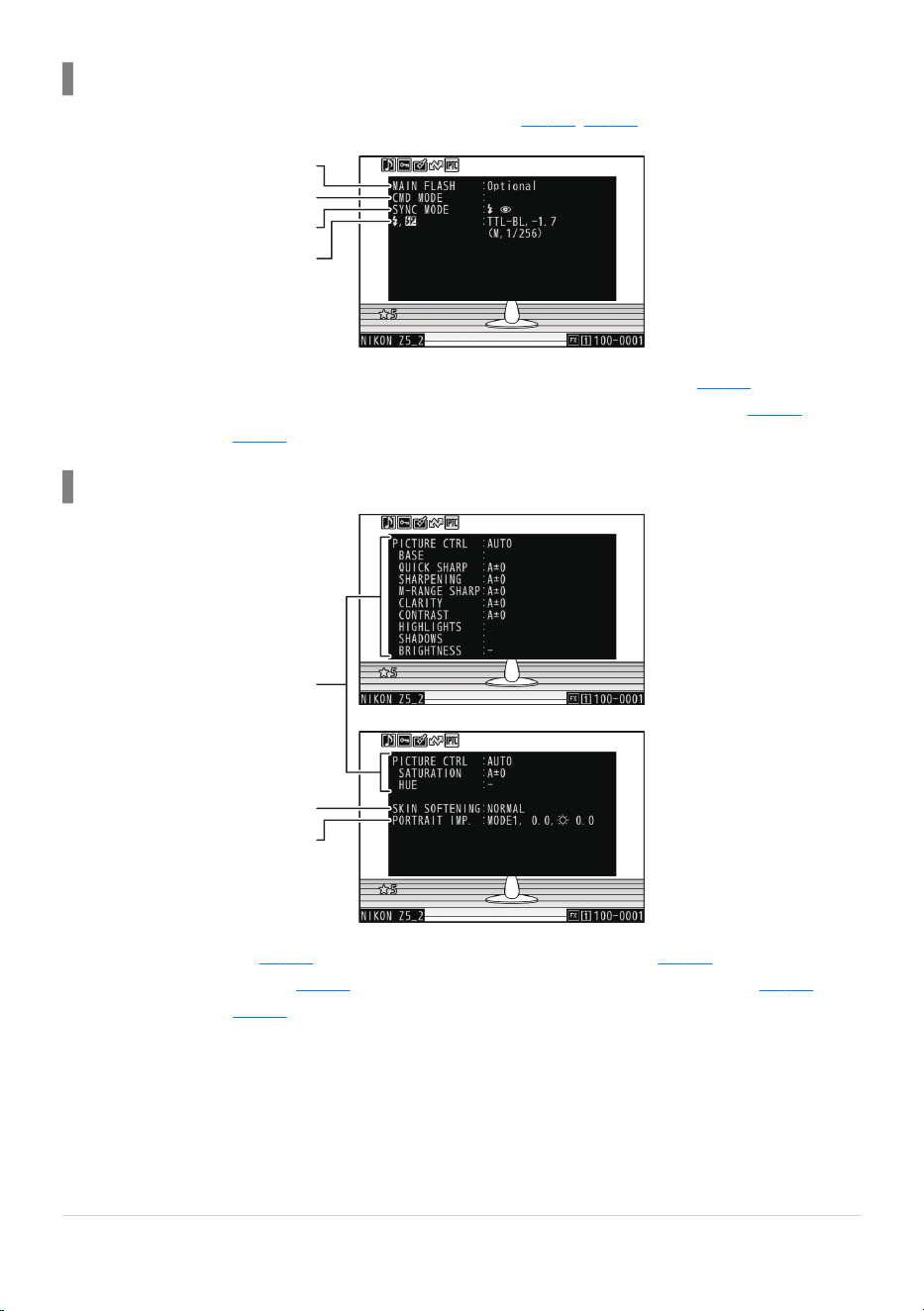
Flash type
Remote flash contr
ol
Flash mode (
0 395)
1
2
3
Flash control mode (0 394)
Flash compensation value (0 397)
4
Picture Control (0 164)
1
HLG Picture Contr
ol (
0 426)
1
HLG quality (0 521)
1
Skin softening (0 435)
Portrait impr
ession balance (
0 436)
2
2
3
Flash Data
Displayed only if photo was tak
en with optional flash unit (
0 390, 0 400).
3
2
1
4
Picture Control/HLG data
3
2
1
The items displayed vary with the Picture Control in effect when the picture was taken.
Shows the selected mode and fine-tuning value.
232
Phot
o Information
1
2
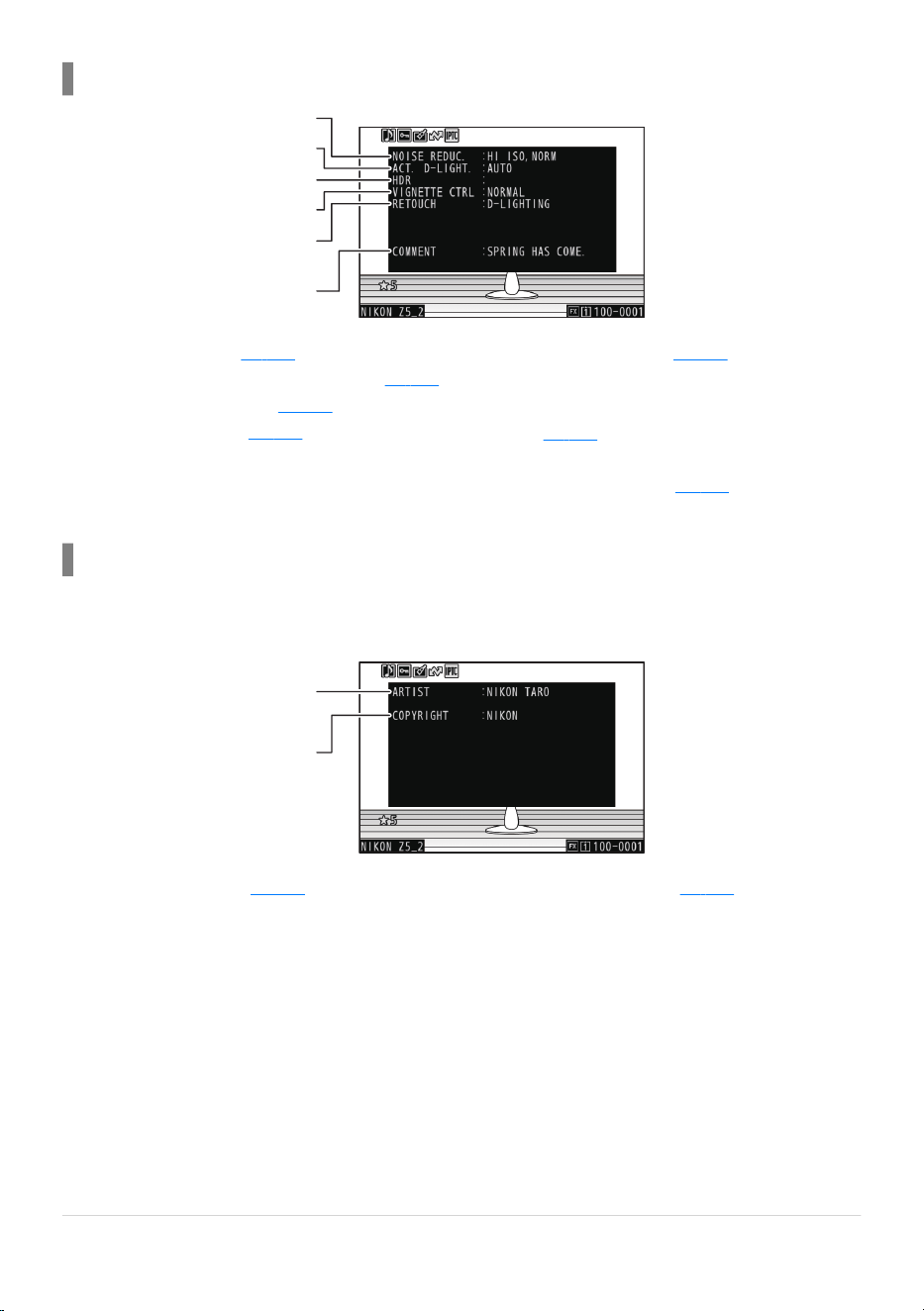
High ISO NR (0 431)
Long-exposure noise reduction (0 430)
Active D-Lighting (0 428)
HDR strength (0 471)
1
2
3
Vignette control (0 432)
History of retouches made using
[Retouch] option in playback i menu
(0 263). Changes are listed in the order
applied.
Image comment (0 738)
4
5
6
Photographer (
0 739)
1
Copyright holder (0 739)
2
Other Shooting Data
4
3
2
1
5
6
Copyright Information
Copyright information is only displayed if r
ecorded using the [Copyright information] item in the
setup menu at the time the picture was taken.
1
2
233
Photo Information

Location Data
Location data including the latitude and longitude must be downloaded from a smar
t device and is
displayed only if embedded in the picture when it is taken.
The items listed vary with the smart device from which the data were acquired.
The location data recorded with videos are those reported at the start of recording.
Note that the camera may be unable to download or display location data from smart devices
depending on the version of the device operating system and/or SnapBridge app used.
234
Photo Information
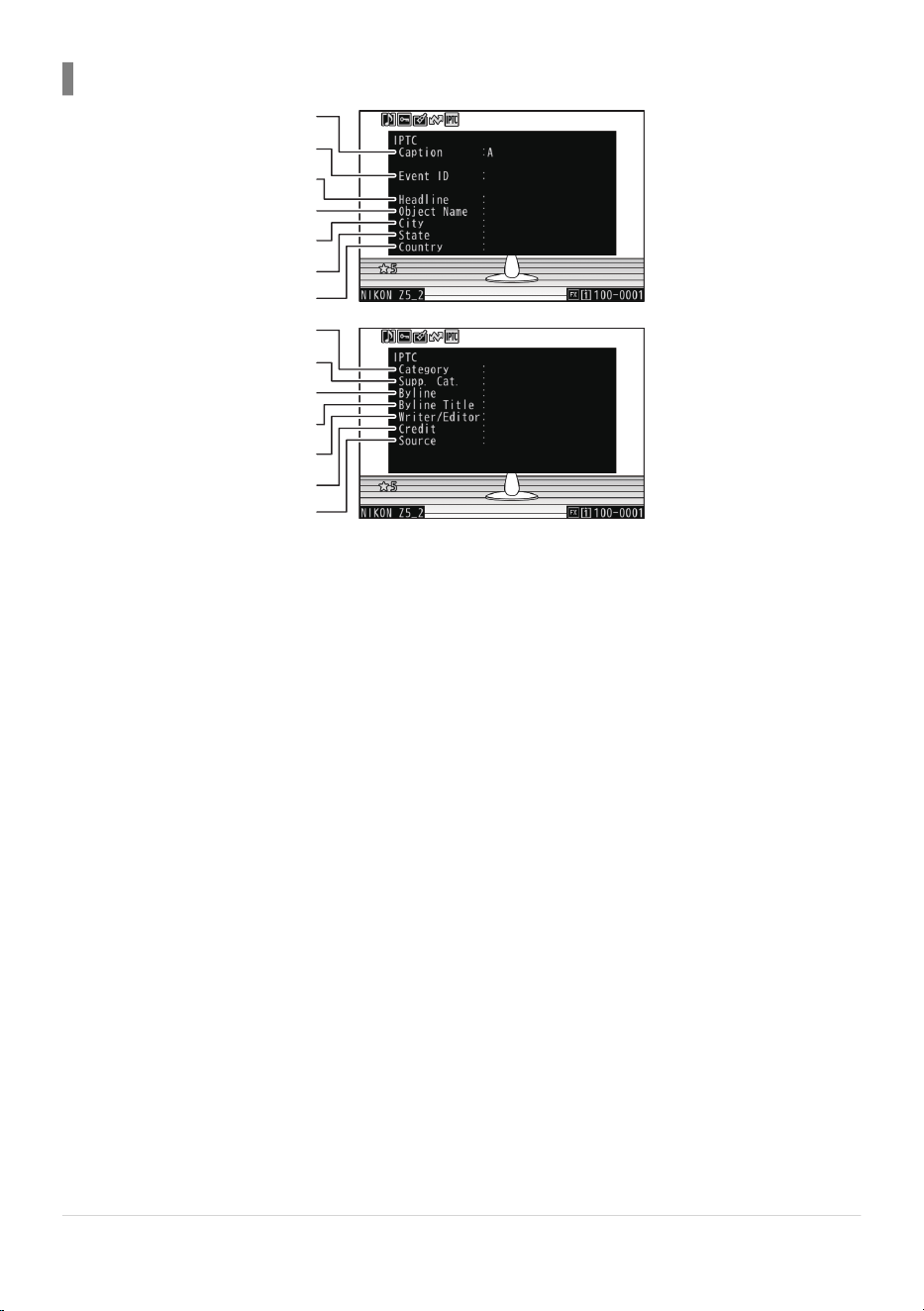
Caption
Ev
ent ID
Headline
Object name
City
S
tat
e
Country
1
2
3
4
5
6
7
Category
Supp. Cat. (supplemental categories)
Byline
Byline title
Writer/Editor
Credit
Source
8
9
10
11
12
13
14
IPTC Data
12
11
10
9
8
13
14
5
4
3
2
1
6
7
235
Photo Information
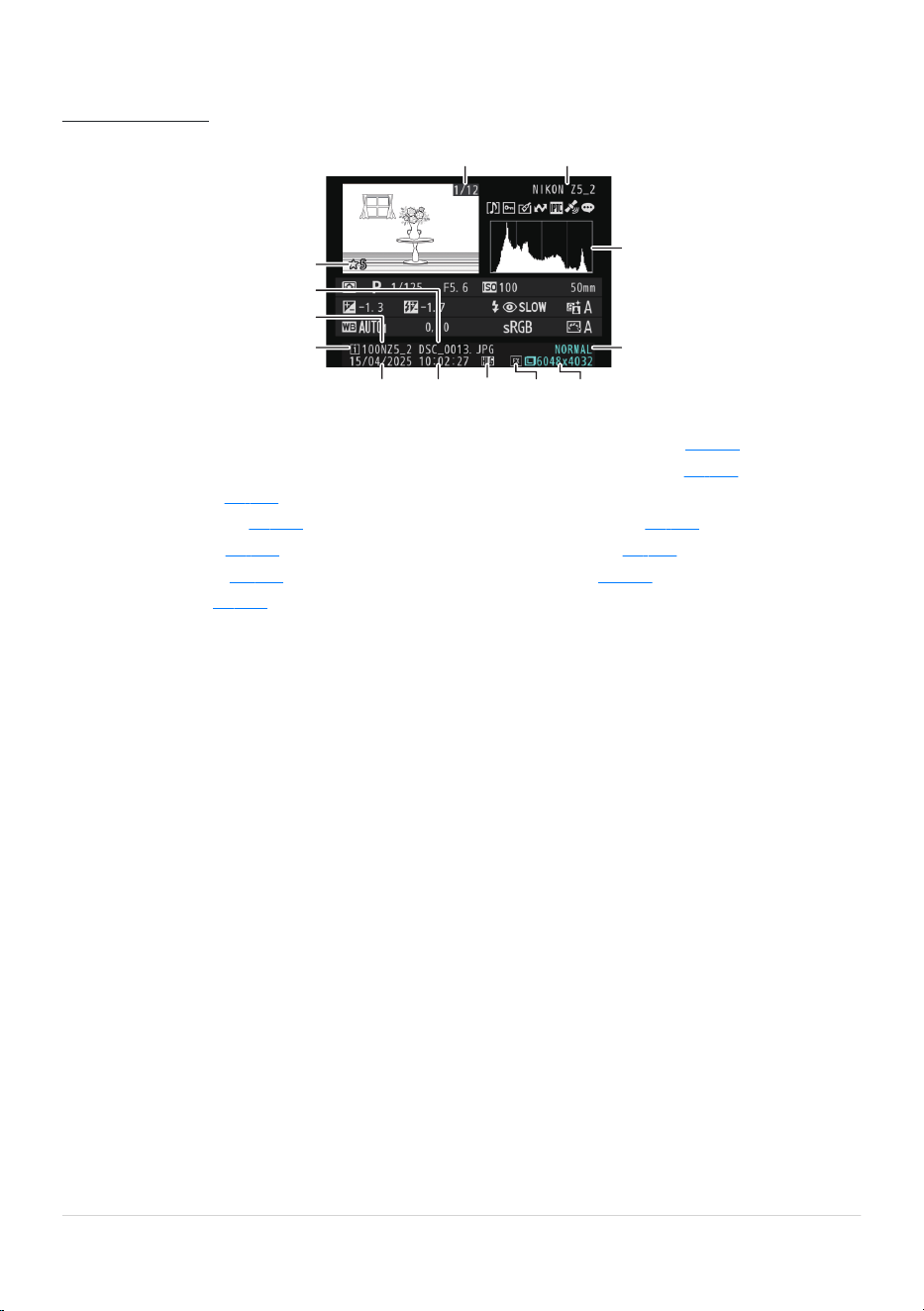
Frame number/total number of frames
Camera name
Histogram (0 230)
Image quality (0 116)
Image size (0 118)
Image area (0 114)
HLG icon (0 418)
1
2
3
4
5
6
7
Time of recording (0 717)
Date of r
ecording (
0 717)
Current card slot
Folder name (
0 407)
File name (0 411)
Rating (0 249)
8
9
10
11
12
13
Overview
2
3
4
9 8 7 6
13
1
5
11
12
10
236
Photo Information
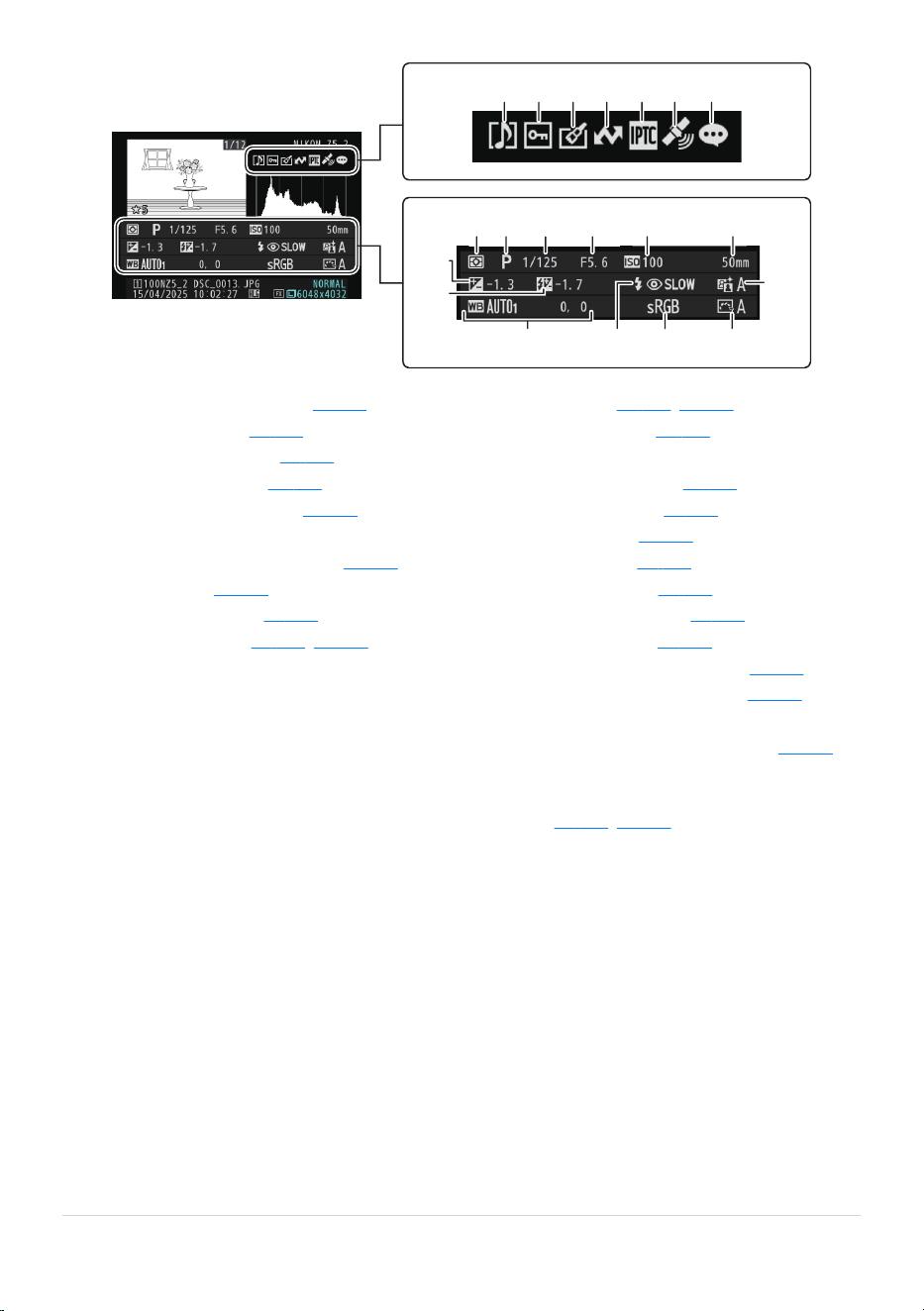
Voice memo indicator (0 254)
Protect status (
0 248)
Retouch indicat
or (
0 263)
Upload marking (0 250)
IPTC preset indicat
or (
0 740)
Location data indicator
Image comment indicator (
0 738)
Metering (0 441)
Shooting mode (0 137)
Shutter speed (0 139, 0 141)
1
2
3
4
5
6
7
8
9
10
Aperture (0 140, 0 141)
ISO sensitivity (0 160)
1
Focal length
Active D-Lighting (0 428)
Picture Control (
0 164)
Color space (0 427)
Flash mode (0 395)
2
White balance (
0 182)
Color temperature (
0 191)
Preset manual (0 195)
White balance fine-tuning (
0 187)
Flash compensation value (0 397)
2
Commander mode
2
Exposure compensation value (
0 150)
11
12
13
14
15
16
17
18
19
20
14
19
20
8 9 10 11 12 13
1 2 3 4 5 6 7
17 16 1518
Displayed in red if the picture was taken with auto ISO sensitivity control enabled.
Displayed only if photo was tak
en with optional flash unit (
0 390, 0 400).
237
Photo Information
1
2
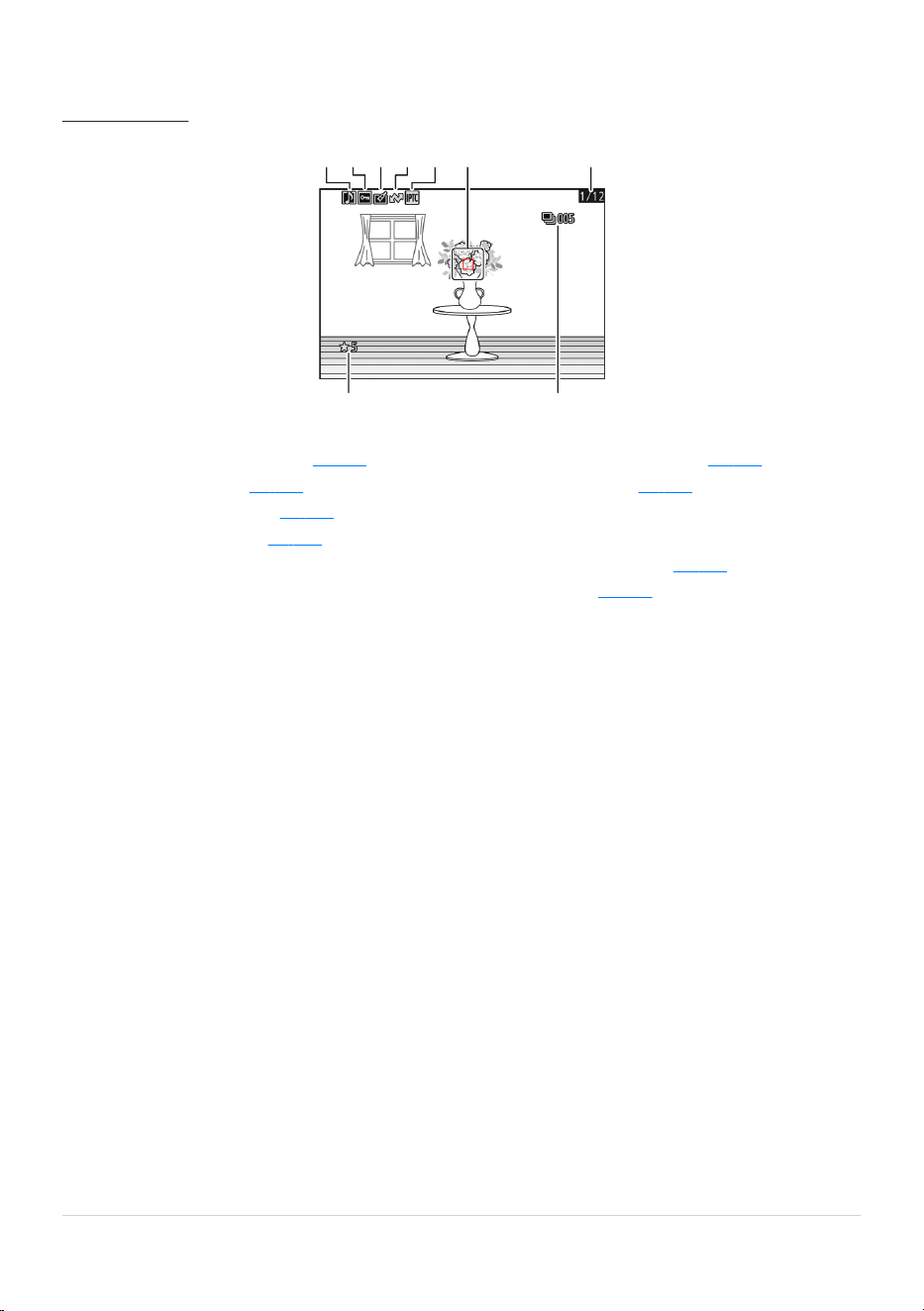
Voice memo indicator (0 254)
Protect status (
0 248)
Retouch indicat
or (
0 263)
Upload marking (0 250)
1
2
3
4
IPTC preset indicator (0 740)
Focus point (0 130)
1
Frame number/total number of frames
Fir
st picture in burst/total number of
pictures in burst (
0 699)
2
Rating (0 249)
5
6
7
8
9
File Info
1 3 6 7
9 8
2 54
Displayed only if [Focus point] is selected for [Playback display options] in the playb
ack menu.
Displayed on the first picture in each burst when [Mark first shot in series] is selected for
[Playback display options] in the playback menu.
238
Photo Information
1
2
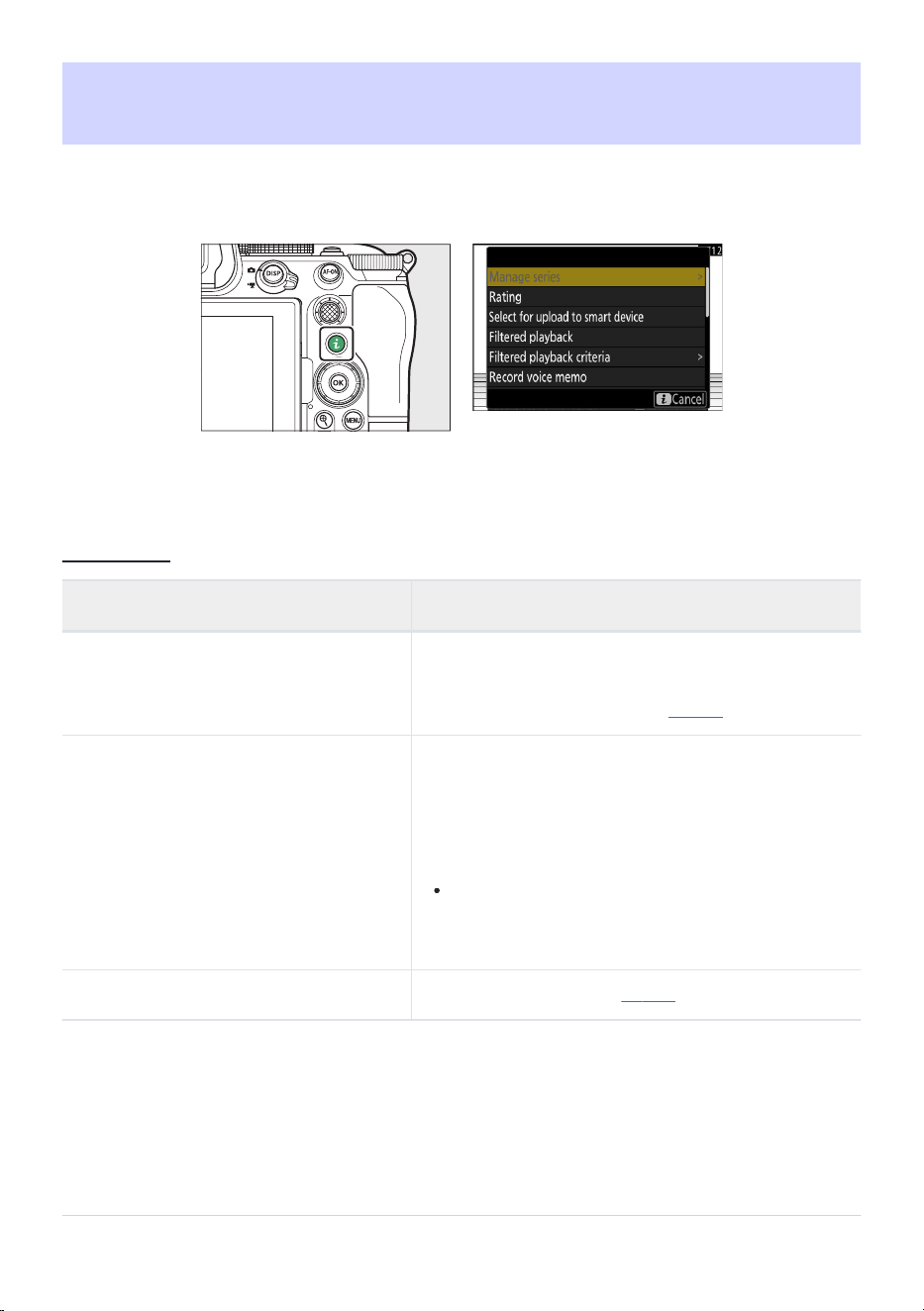
The i Button (Playback Mode)
Pressing the
i button during playback zoom or full-frame or thumbnail playback displays the i menu
for playback mode. Highlight items and press J or 2 to select.
Press the i button again to return to playback.
Photos
Option Description
[Quick cr
op]
1
Save a copy o
f the current picture cropped to the area
visible in the display. This option is not available when
RGB histograms are displayed (
0 229).
[Manage series]
If [ON] is selected for [Series playb
ack] > [List series
as single thumbnails] in the playback menu, you can
use this option to delete, protect, or mark for upload
the current picture and all other pictures in the same
burst.
Note that the pictures can be marked for upload to
NikonImagingCloud, a computer, or an FTP server
only.
[Rating] Rate the current picture (
0 249).
239
The i Button (Playback Mode)
Option Description
[Select for upload to The Cloud]
Select the curr
ent picture for upload (
0 250).
The option displayed varies with the destination
curr
ently selected for upload.
[Select for upload to smart device]
[Select for upload to computer]
[Select for upload (FTP)]
[Select for priority upload to computer] Select the current picture for priority upload (
0 250).
Pictures marked for priority uplo
ad will be uploaded
before other pictures marked for upload.
These options are displayed only if the camera is
connected to a computer or FTP server.
[Select for priority upload (FTP)]
[Select all for upload to The Cloud] Mark for upload all pictures meeting the current filter
criteria (
0 252).
These options are displayed only if the camera is
connect
ed to NikonImagingCloud, a computer, or
an FTP server.
[Select all for upload to The Cloud]: videos cannot
be selected for upload.
[Select all for computer upload] and [Select all
for upload (FTP)]: videos over 4GB in size cannot
be selected for upload.
[Select all for computer upload]
[Select all for upload (FTP)]
[Filtered playback]
View only pictures that match selected criteria
(
0 252).
[Filtered playback criteria] Choose filter crit
eria.
[Record voice memo] Add a voice memo to the current picture (
0 254).
[Play voice memo] Play the voice memo for the curr
ent picture (
0 254).
[Retouch]
Creat
e a retouched copy of the current picture
(
0 263).
240
The i Button (Playback Mode)
Option Description
[Jump to copy on other card]
If the current pictur
e is one of a pair created with
[Backup], [RAW Slot 1 - JPEG Slot 2], [JPEG Slot 1
- JPEG Slot 2], [RAW Slot 1 - HEIF Slot 2], or [HEIF
Slot 1 - HEIF Slot 2] selected for [Role played by
card in Slot 2] in the photo shooting menu, choosing
this option displays the copy on the card in the other
slot.
[Choose slot and folder]
Choose a slot and folder for playback. Highlight a
slot and press 2 to display a list of the folders on
the memory card in the selected slot. You can then
highlight a folder and press J to view the pictures it
contains.
[Protect]
Add prot
ection to or remove protection from the
current picture (
0 248).
[Unprotect all]
2
Remov
e protection from all pictures in the folder
currently selected for [Playback folder] in the
playback menu.
[IPTC]
Embed a selected IPTC preset in the current photo
(
0 740).
[Side-by-side comparison]
3
Comp
are retouched copies to the originals.
[Slide show]
View a slide show; the current picture and all following
pictures are displayed one at a time in the order
recorded (
0 257).
Available only during playback zoom.
Not available during playback zoom.
A
vailable only when a retouched copy (indicated by a p icon) or the source picture for a retouched
copy is selected.
241
The i Button (Playback Mode)
1
2
3
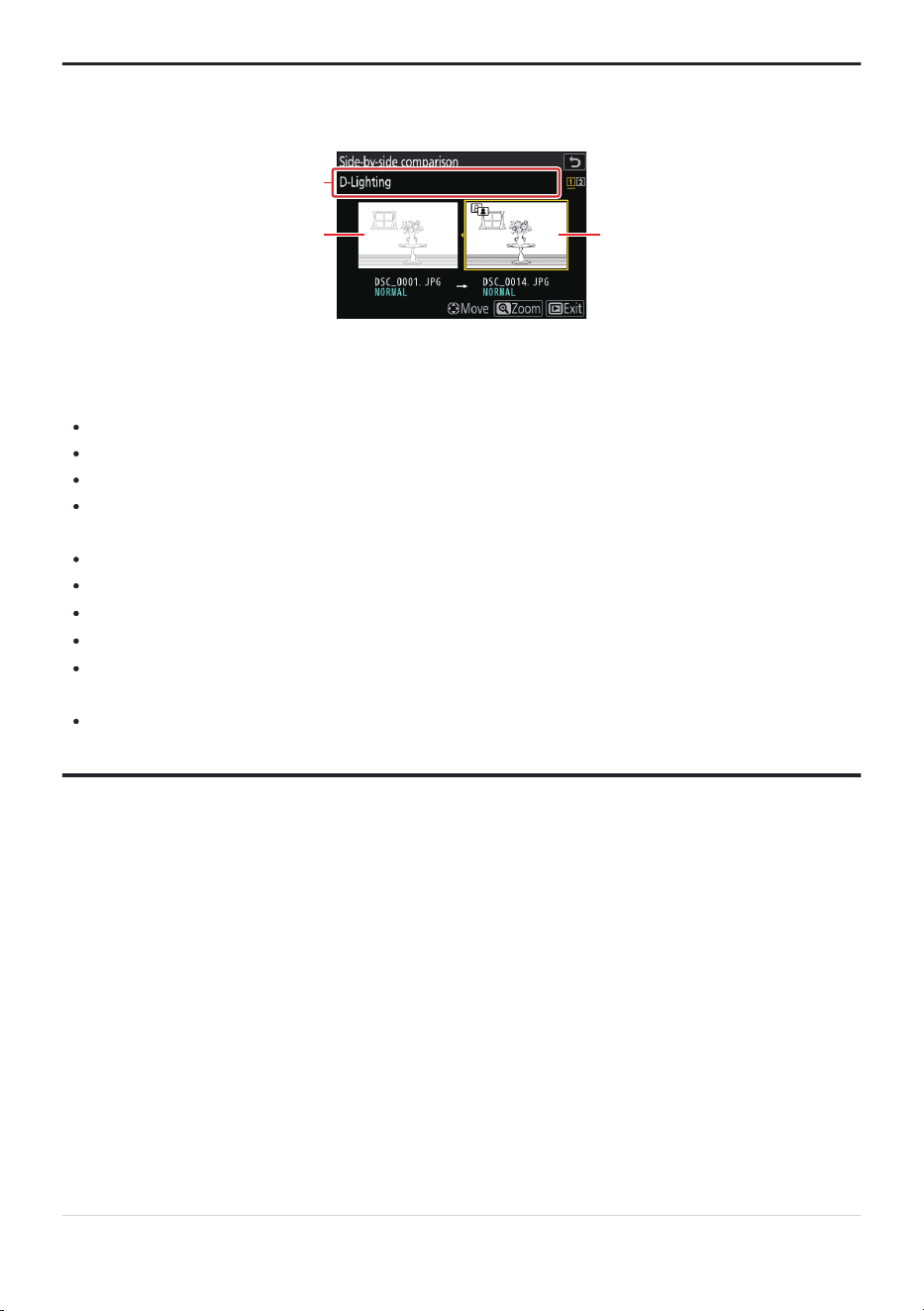
Options used to create copy
Source picture
1
2
Retouched copy
3
Tip: [Side-by-side comparison]
Choose [Side-by-side comp
arison] t
o compare retouched copies with the unretouched originals.
1
2 3
The source picture is displayed on the left, the retouched copy on the right.
The options used to create the copy listed at the top of the display.
Press 4 or 2 to switch between the source picture and the retouched copy.
If the copy is an overlay created from multiple source pictures, press 1 or 3 to view the other
pictures.
If the source has been copied multiple times, press 1 or 3 to view the other copies.
To view the highlighted picture full screen, press and hold the X button.
Press J to return to playback with the highlighted picture displayed full frame.
To exit to playback, press the K button.
The source picture will not be displayed if the copy was created from a photograph that is now
protected.
The source picture will not be displayed if the copy was created from a photograph that has since
been deleted.
242
The i Butt
on (Playback Mode)
Videos
Option Description
[Rating] Rate the current picture (0 249).
[Select for upload to comput
er] Select the current picture for upload (
0 250).
These options are displayed only if the camera is
connect
ed to a computer or FTP server.
[Select for upload (FTP)]
[Select for priority upload to computer] Select the current picture for priority upload (
0 250).
Pictures marked for priority uplo
ad will be uploaded
before other pictures marked for upload.
These options are displayed only if the camera is
connected to a computer or FTP server.
[Select for priority upload (FTP)]
[Select all for upload to The Cloud] Mark for upload all pictures meeting the current filter
criteria (
0 252).
These options are displayed only if the camera is
connect
ed to NikonImagingCloud, a computer, or
an FTP server.
[Select all for upload to The Cloud]: videos cannot
be selected for upload.
[Select all for computer upload] and [Select all
for upload (FTP)]: videos over 4GB in size cannot
be selected for upload.
[Select all for computer upload]
[Select all for upload (FTP)]
[Filtered playback]
View only pictures that match selected criteria
(
0 252).
[Filtered playback criteria] Choose filter crit
eria.
[Volume control] Adjust playback volume.
[Trim video]
Trim footage from the current video and save the
edited copy in a new file (
0 294).
[Choose slot and folder]
Choose a slot and folder for playback. Highlight a
slot and press 2
to display a list of the folders on
the memory card in the selected slot. You can then
highlight a folder and press J to view the pictures it
contains.
243
The i Butt
on (Playback Mode)
Option Description
[Protect]
Add prot
ection to or remove protection from the
current picture (
0 248).
[Unprotect all]
Remov
e protection from all pictures in the folder
currently selected for [Playback folder] in the
playback menu.
[Slide show]
View a slide show; the current picture and all following
pictures are displayed one at a time in the order
recorded (
0 257).
[Playback speed]
Select the video playback speed fr
om [Original
speed], [1/2× speed], and [1/4× speed]. Selecting
[1/2× speed] or [1/4× speed] will slow video playback
at ¹/₂× or ¹/₄× the speed. The playback speed selection
will be applied to all video playback.
244
The i Butt
on (Playback Mode)
Videos (Playback Paused)
Option Description
9
[Trim video] Trim unwant
ed footage (
0 294).
4
[Save current frame] Save a select
ed frame as a JPEG still (
0 297).
1
[Save consecutive frames]
Save the frames in a select
ed length of footage as a series of
individual JPEG images (
0 298).
[Volume control] Adjust playback v
olume.
[Playback speed]
Select the video playback speed from [Original speed], [1/2×
speed], and [1/4× speed]. Selecting [1/2× speed] or [1/4×
speed] will slow video playback at ¹/₂× or ¹/₄× the speed. The
playback speed selection will be applied to all video playback.
245
The i Butt
on (Playback Mode)
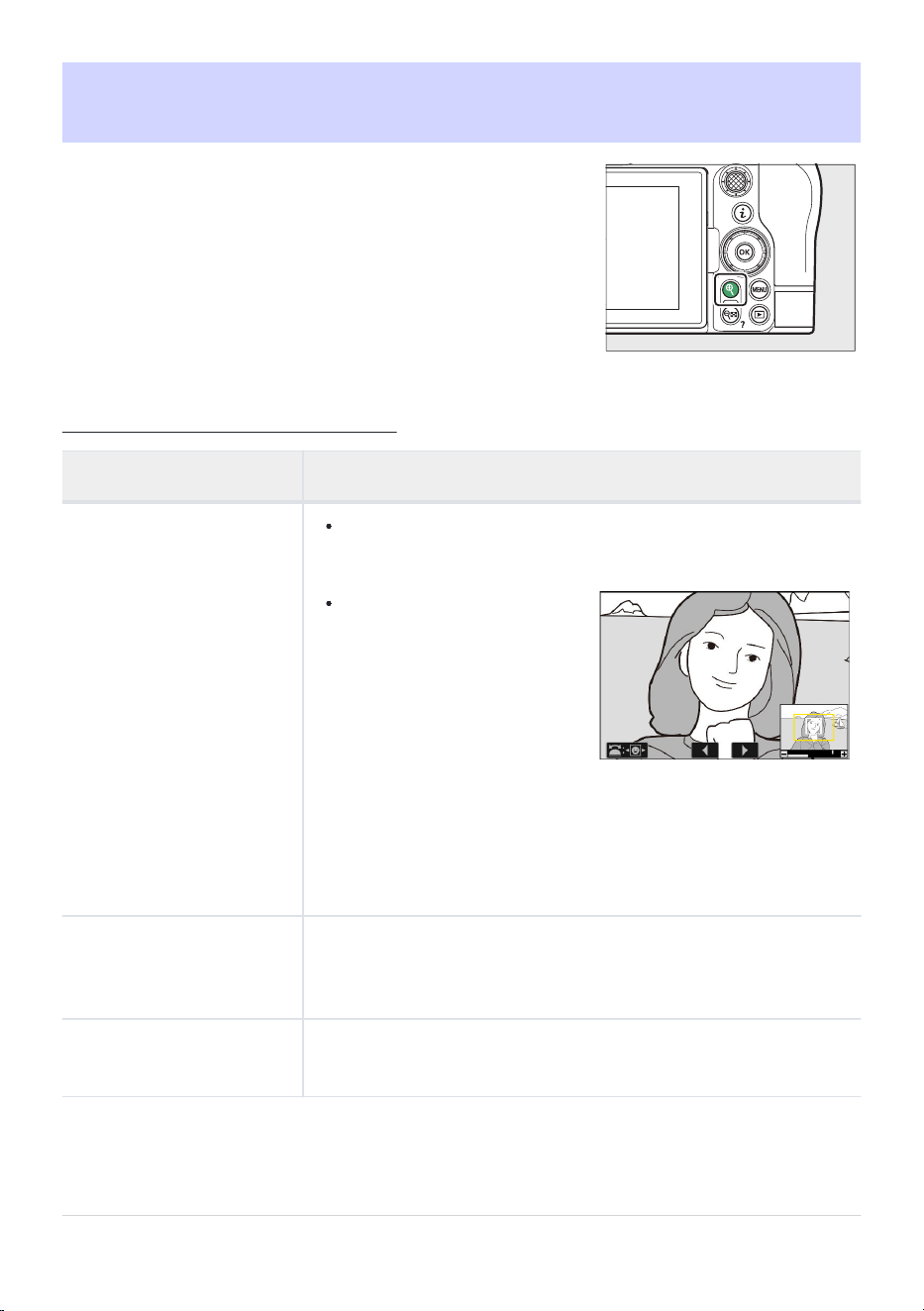
To zoom in on a photo displayed in full-frame playback, press
X or J or give the display two quick taps. Lar
ge, medium, and
small [FX (36×24)]-format photos can respectively be zoomed
in to maximums of approximately 32×, 24×, and 16×. Faces
detected during zoom are indicated by white borders; rotate the
sub-command dial to view other faces.
A navigation window appears
at the bott
om right cor
ner o
f
the display when the zoom
ratio is altered, with the area
currently visible indicated by a
yellow border. A bar below the
navigation window shows the
zoom ratio, turning green at 1 : 1
(100%). The navigation window
clears from the display after a
few seconds.
Playback Zoom
Using Playback Zoom
Operation Description
Zoom in/zoom out
Press the X butt
on or use str
et
ch gestures to zoom in. To zoom
out, press W (Q) or use pinch gestures.
View other areas of
picture
Use the multi selector or glide gestures to view areas of the picture
not visible in the monitor. Keep the multi selector pressed to scroll
rapidly to other areas of frame.
Crop picture
To crop the picture to the area currently visible in the monitor, press
i and select [Quick crop].
246
Playback Zoom
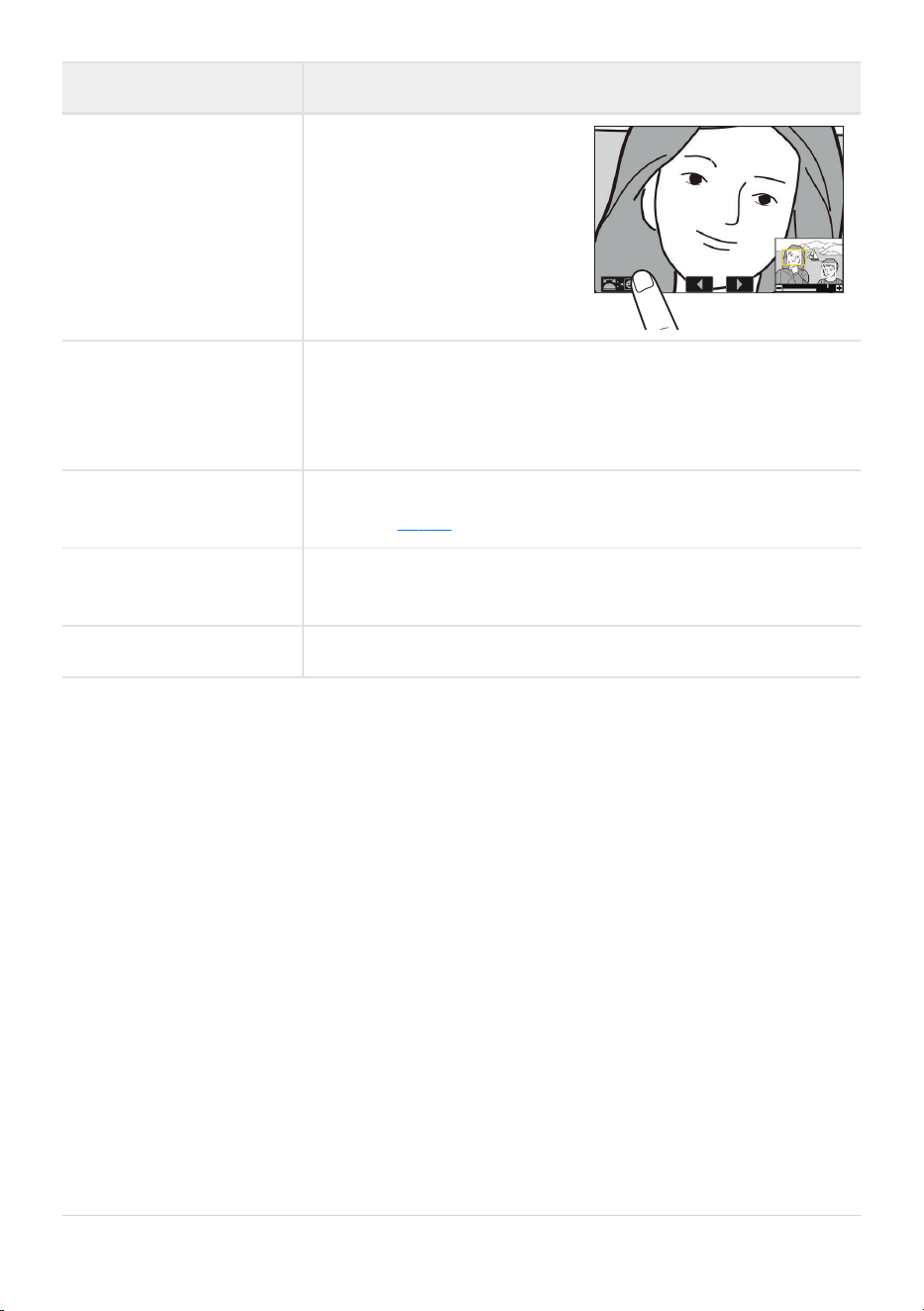
Faces detected during zoom are
indicated by white bor
ders in the
navigation window. Rotate the
sub-command dial or tap the on-
screen guide to view other faces.
Operation Description
Select faces
View other pictures
Rotate the main command dial to view the same location in other
photos without changing the zoom ratio (selecting a video cancels
zoom). You can also view other phot
os by tapping the e or f icon
at the bottom of the display.
Protect pictures
Press the c (E) butt
on to t
oggle protection for the current picture
on or off (
0 248).
Exit to shooting mode
Press the shutter-release button halfway or press the K butt
on to
exit.
View menus
Pr
ess the G butt
on to view the menus.
247
Playback Zoom
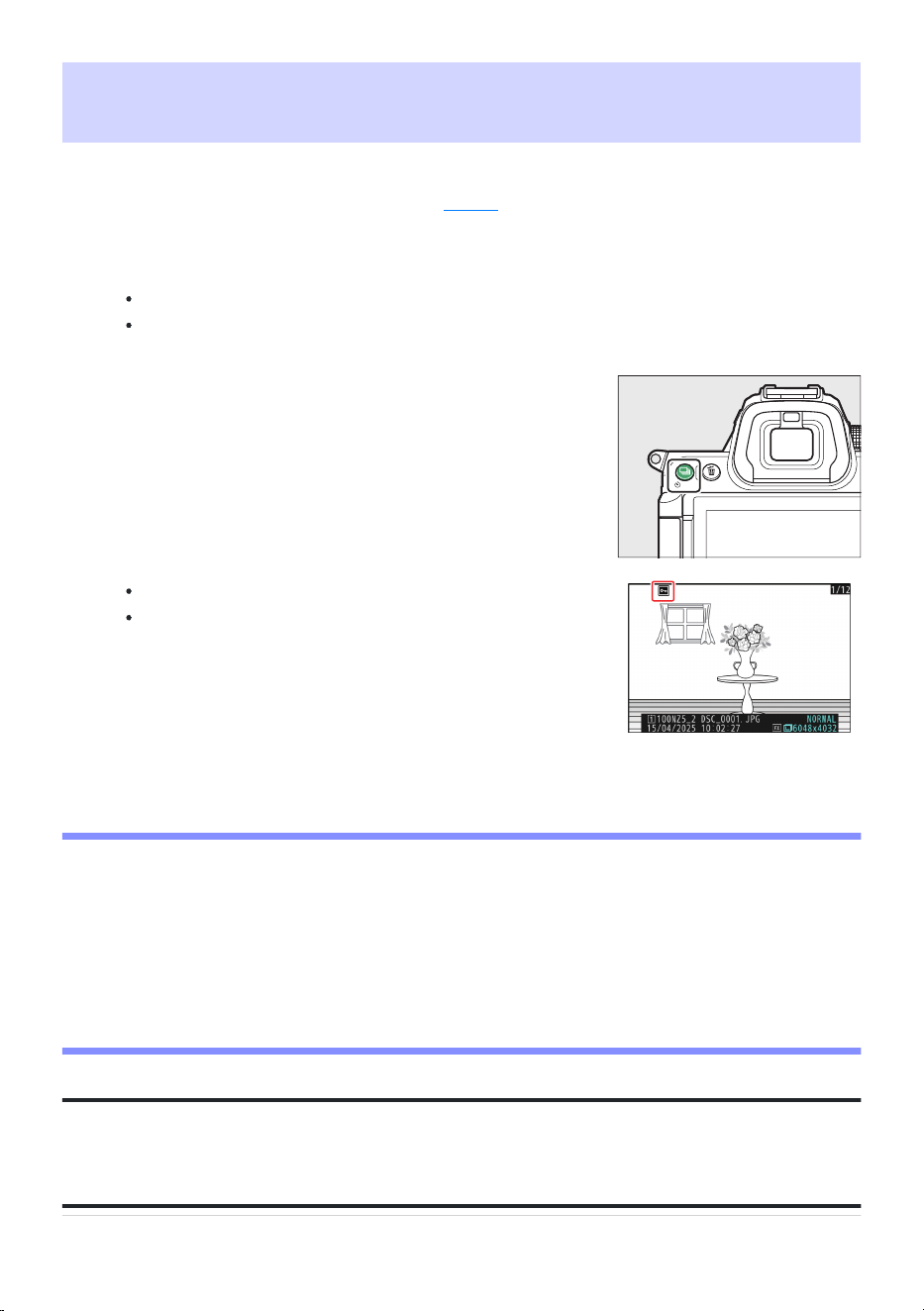
Press the c (E) button.
Protected pictures are marked with a P icon.
To remov
e protection, display the picture or highlight it in
the thumbnail list and press c (E) again.
Protecting Pictures from Deletion
Pictures can be pr
otected to prevent their being deleted accidentally. Protected pictures will however
be deleted when the memory card is formatted (
0 713).
Select a picture.
Display the picture in full-frame playb
ack or playback zoom.
Alternatively, you can highlight the picture in the thumbnail list using the multi selector.
D Voice Memos
Protecting photos also protects any voice memos recorded with the pictures. Voice memos cannot be
protected separately.
D Caution: Uploading Protected Pictures via FTP
The copies on the FTP server will not be protected even if the originals are. Markings can be added
using ratings.
Tip: Removing Protection from All Pictures
To remove protection from all pictures in the folder or folders currently selected for [Playback folder]
in the playback menu, press the c (E) and O buttons for about two seconds during playback.
248
Protecting Pictures from Deletion
1
2
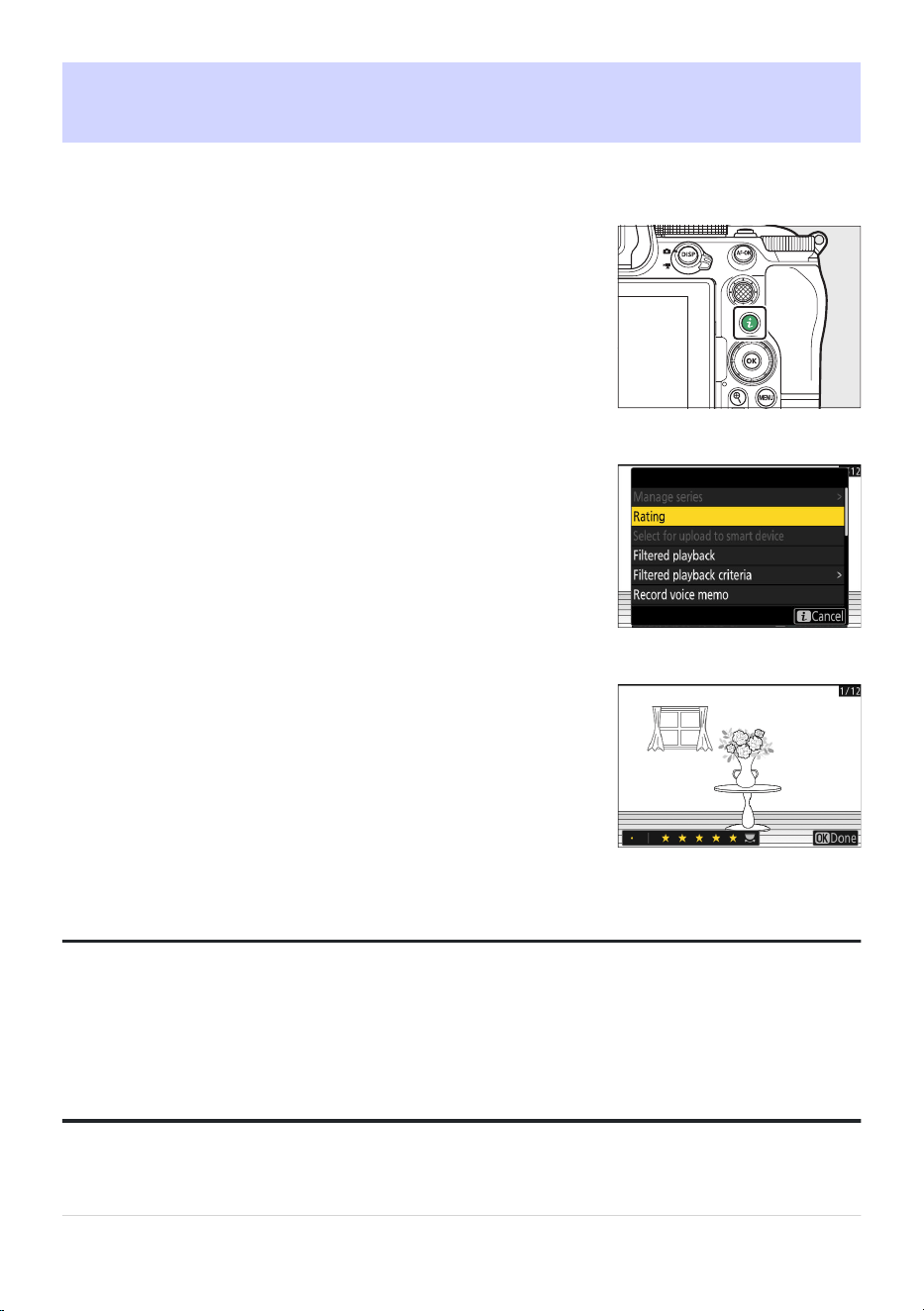
Select the desired picture with the multi selector and press
the i button.
Highlight [Rating] and press 2.
Choose a rating.
Rotate the main command dial t
o highlight the desired rating
and press J to select. Choose from ratings of from zero to five
stars, or select d to mark the picture as a candidate for later
deletion.
Rating Pictures
Rate pictures.
Tip: Ratings
Ratings can also be view
ed in NX Studio.
Tip: Rating Pictures Using Camera Controls
If [Rating] has been assigned to a control using Custom Setting f3 [Custom controls (playback)],
pictures can be rated by holding the control and rotating the main command dial.
249
Rating Pictures
1
2
3
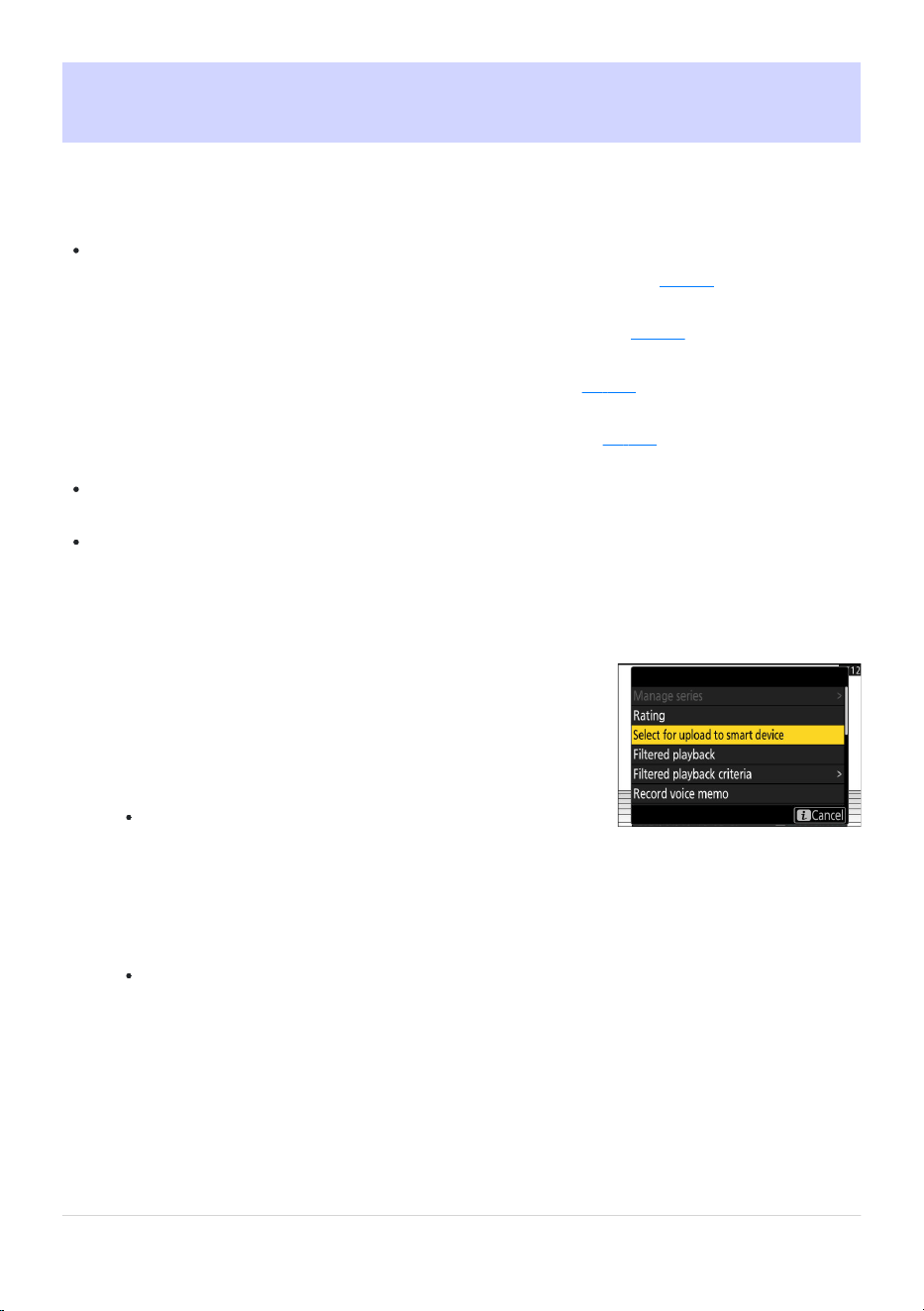
Highlight [Select for upload to The Cloud], [Select for
upload to smar
t device], [Select for upload to computer],
[Select for upload (FTP)], [Select for priority upload to
computer], or [Select for priority upload (FTP)] and press
J.
To upload pictures in the specified order, select [Select
for upload to The Cloud], [Select for upload to smart
device], [Select for upload to computer], or [Select for
upload (FTP)]. The pictures will be added to the end of the
upload queue and will not begin uploading until all other
pictures have uploaded.
To upload pictures immediately (even if pictures marked
for upload are already in the upload queue), select [Select
for priority upload to computer] or [Select for priority
upload (FTP)].
Selecting Pictures for Upload
Follow the steps below to select the curr
ent picture for upload to a smart device, computer, or FTP
server.
The i menu items used to select pictures for upload vary with the type of device connected.
When connected to NikonImagingCloud by [Nikon Imaging Cloud] (
0 770) in the network
menu: [Select for upload t
o The Cloud]
When connected to a smart device by [Connect to smart device] (
0 774) in the network menu:
[Select for uplo
ad to smart device]
When connected to a computer by [Connect to computer] (
0 782) in the network menu:
[Select for uplo
ad to computer], [Select for priority upload to computer]
When connected to an FTP server by [Connect to FTP server] (
0 787) in the network menu:
[Select for uplo
ad (FTP)], [Select for priority upload (FTP)]
Videos cannot be selected for upload when the camera is connected to a smart device via the
SnapBridge app, or to Nikon Imaging Cloud.
Videos over 4GB in size cannot be selected for upload.
Select the desired picture and press the i button.
250
Selecting Pictures for Upload
-
-
-
-
1
2
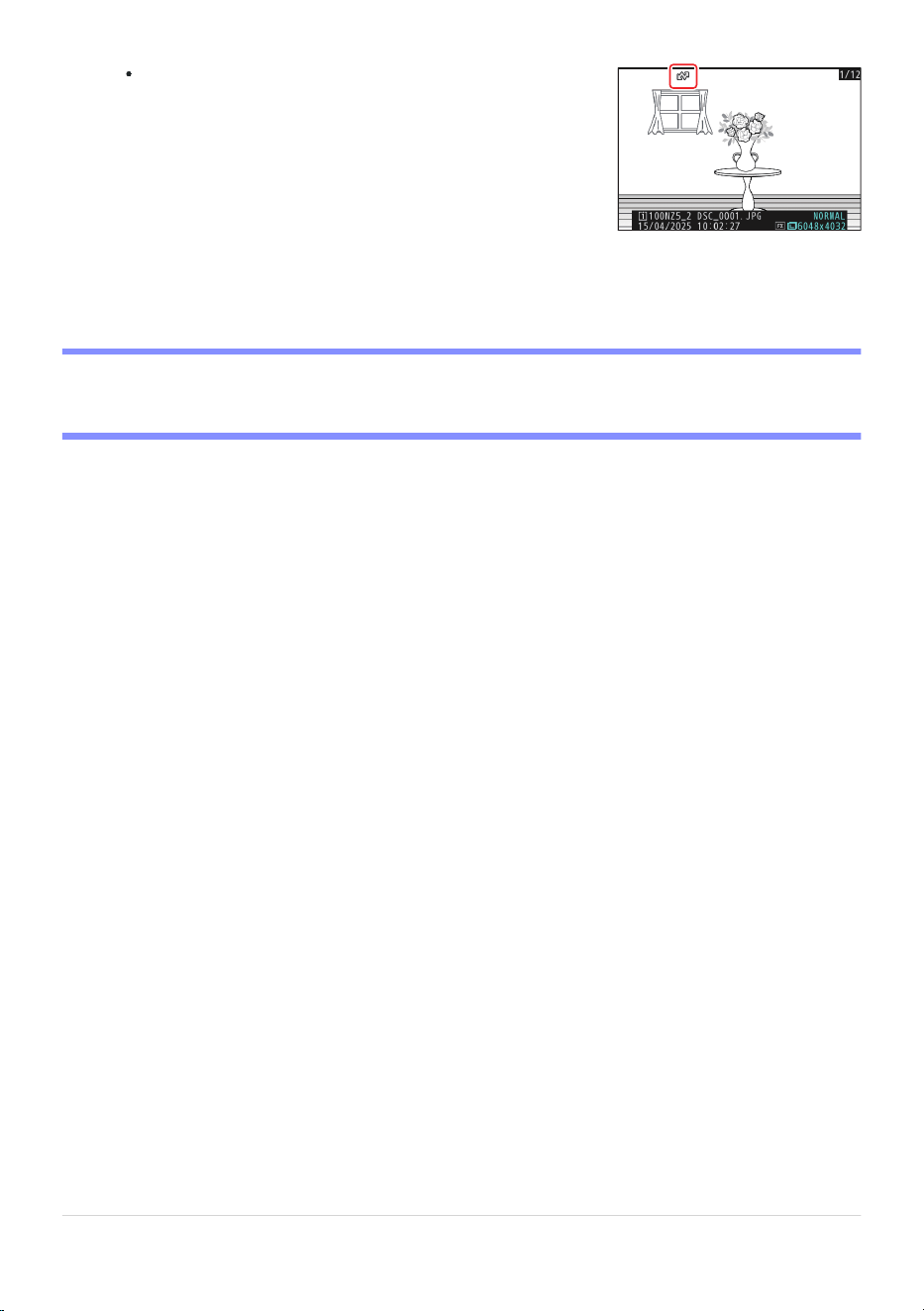
An icon will appear on the pictures selected for upload. The
icon varies depending on the selected i menu it
em.
When [Select for upload to The Cloud] is selected: p
When [Select for upload to smart device], [Select for
upload to computer], or [Select for upload (FTP)] is
selected: W
When [Select for priority upload to computer] or
[Select for priority upload (FTP)] is selected: s
-
-
-
D Removing Upload Marking
Repeat S
teps1–2 to remove upload marking from selected pictures.
251
Selecting Pictures for Upload
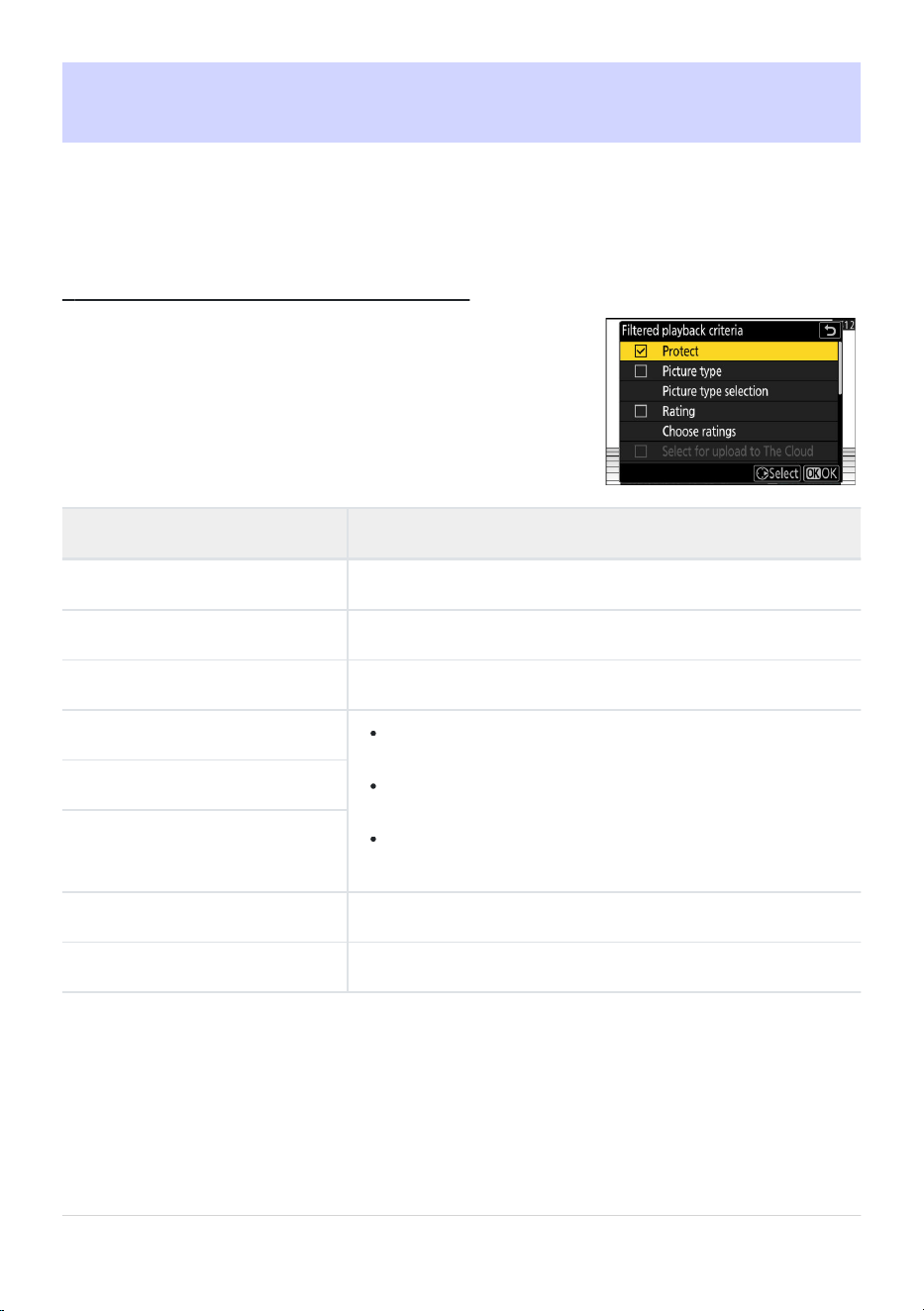
Highlight options and press J to select (M) or deselect (U). During
filtered playback, only pictures that meet all criteria marked with a
check (M) will be displayed.
Filtered Playback
Select [Filtered playb
ack] in the i menu to view only pictures that meet the criteria chosen for
[Filtered playback criteria] in the playback menu or playback i menu.
[Filtered playback criteria]
Option Description
[Pr
otect]
M: Include protect
ed pictures.
[Picture type]
M: Include pictures of the select
ed types.
[Rating]
M: Include pictures with selected ratings.
[
Select for upload to The Cloud]
Select (M) [Uploaded pictures] t
o include uploaded
pictures.
Select (M) [Pictures not uploaded] to include pictures that
have yet to be uploaded.
Select (M) both options to include both pictures that have
and pictures that have yet to be uploaded.
[Select for uplo
ad to comput
er]
[Select for upload (FTP)]
[
V
oice memo]
M
: Include pictures with voice memos.
[
Retouched pictures]
M: Include retouched pictur
es.
252
Filtered Playback
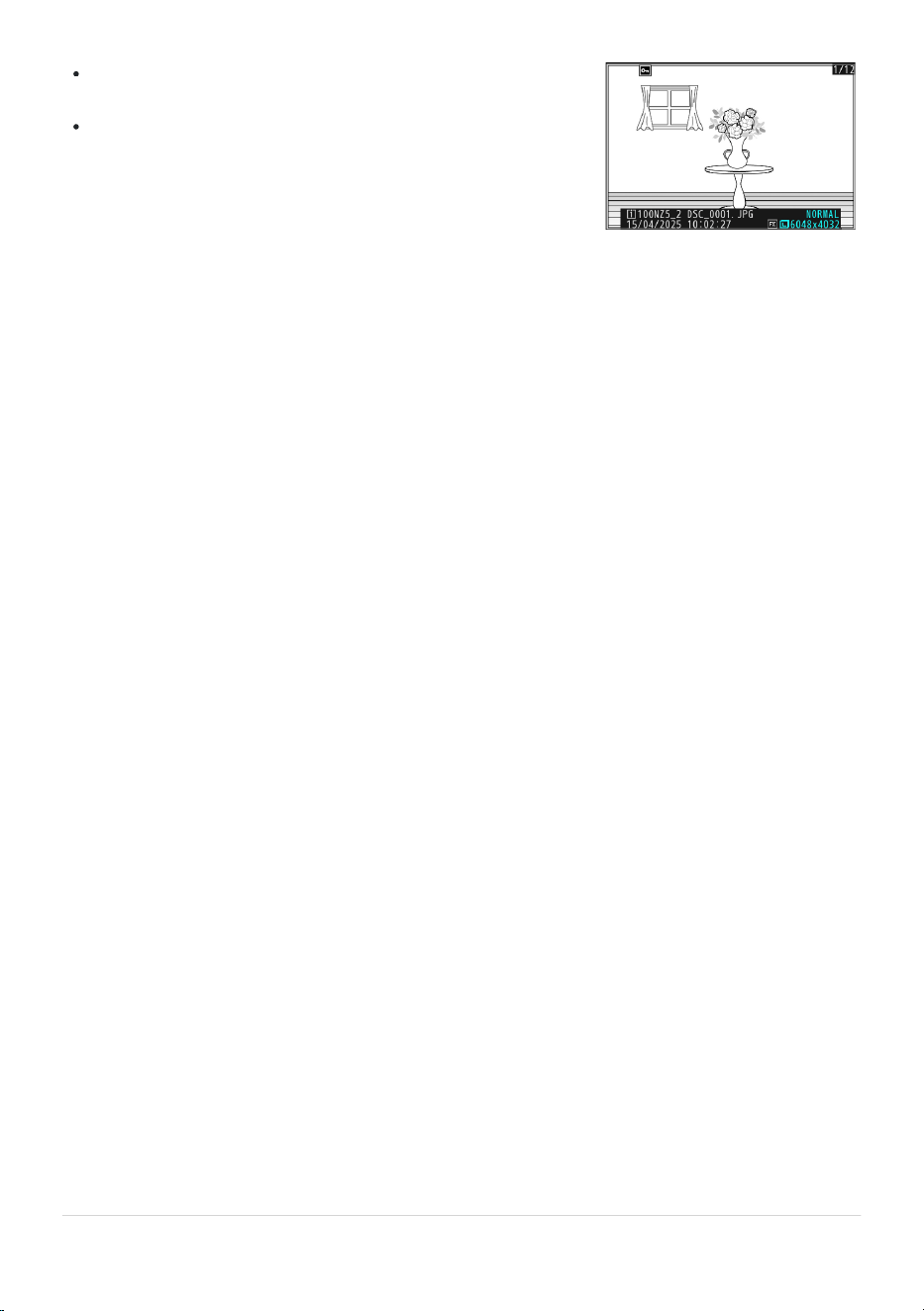
During filtered playback, a white border appears around the
display.
To end filt
ered playback, select [Filtered playback] again.
253
Filtered Playback
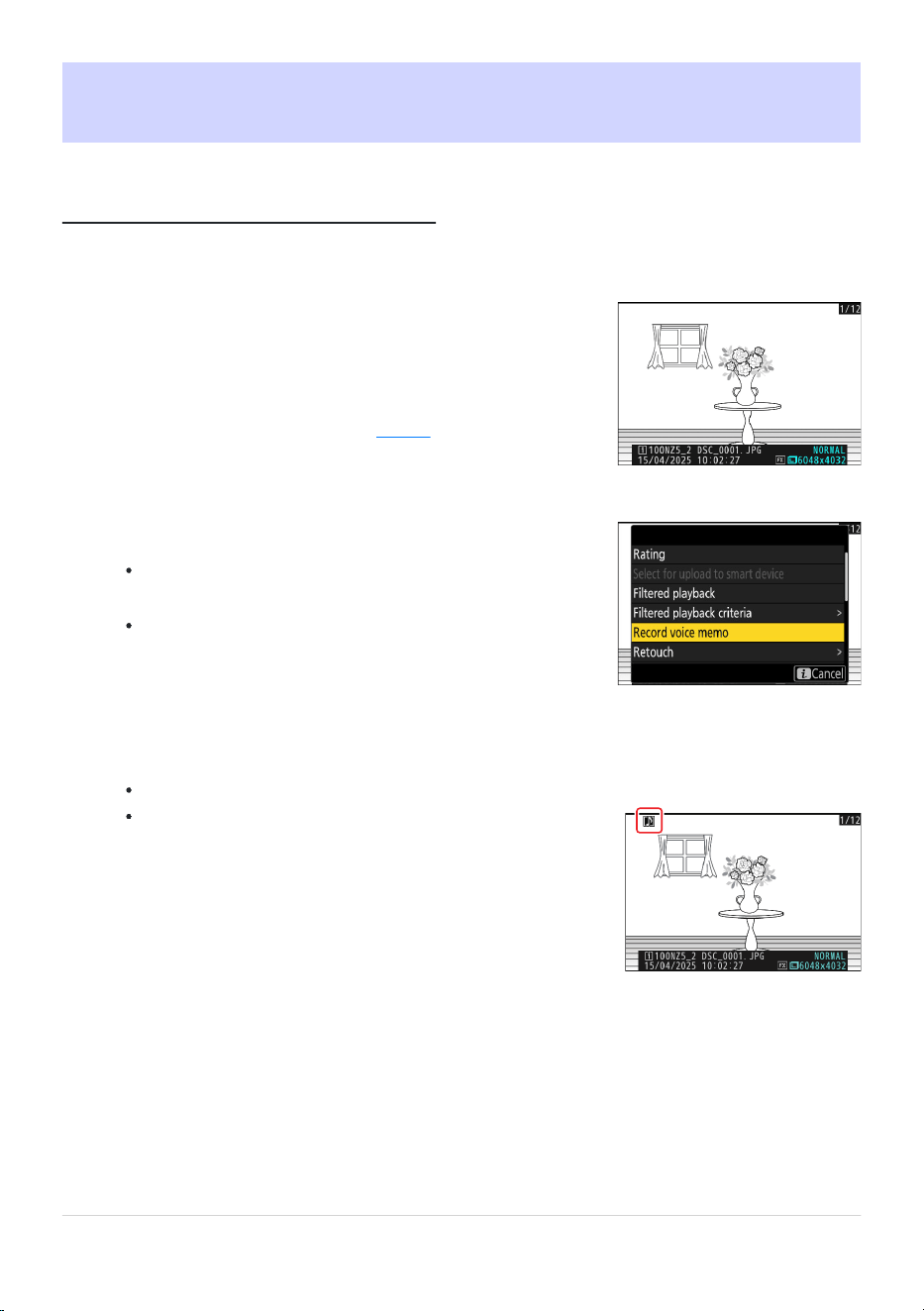
Select the photograph.
Only one voice memo can be recor
ded per picture; additional
voice memos cannot be recorded for pictures already marked
with a h icon. The existing voice memo must be deleted
before another can be recorded (
0 256).
Select [Record voice memo] in the i menu.
To start r
ecording, press the i button, highlight [Record
voice memo], and press J.
During recording, the camera displays a b icon and a
countdown of the remaining recording time, in seconds.
Pictures with voice memos are indicated by h icons.
Recording/Playing Voice Memos
Recording Voice Memos
Voice memos
up to 60 seconds long can be added to photographs.
Press J.
Recording will end.
254
Recording/Playing Voice Memos
1
2
3

D Recording Not Available
Voice memos cannot be added t
o videos or Image Dust Off reference data.
D Recording Restrictions
Voice memos cannot be recorded if:
the photo/video selector is rotated to 1 or
a multiple exposure is in progress.
D Caution: Recording Voice Memos
Touch controls are disabled and other pictures cannot be displayed while recording is in progress.
D Interrupting Recording
Pressing the shutter-release button or operating other camera controls may end recording. During
interval-timer photography, recording ends about two seconds before the next shot is taken; recording
also ends when the camera is turned off.
D Storage Location
Voice memos for pictures taken with two memory cards inserted and [Backup], [RAW Slot 1 - JPEG
Slot 2], [JPEG Slot 1 - JPEG Slot 2], [RAW Slot 1 - HEIF Slot 2], or [HEIF Slot 1 - HEIF Slot 2]
selected for [Role played by card in Slot 2] in the photo shooting menu are recorded with the copies
on both cards.
D Voice Memo File Names
Voice memo file names have the form “DSC_nnnn.WAV”. The voice memo has the same file number
(“nnnn”) as the picture with which it is associated. For example, the voice memo for the picture
“DSC_0002.JPG” would have the file name “DSC_0002.WAV”. Voice memo file names can be viewed on
a computer.
Voice memos for photos recorded with [Adobe RGB] selected for [Color space] in the photo
shooting menu have names of the form “_DSCnnnn.WAV”.
Voice memos for photos recorded with a prefix other than “DSC” selected for [File naming] in the
photo shooting menu will be recorded with the selected prefix in place of “DSC”.
Tip: Using Controls to Record Voice Memos
With the following operations, voice memos can be recorded without using the i menu.
Press the button to which [Voice memo] is assigned using Custom Setting f3 [Custom controls
(playback)].
Assign [Voice memo] to [Flick up] or [Flick down] in Custom Setting f14 [Full-frame playback
flicks] and flick up or down on the monitor.
255
Recording/Playing Voice Memos
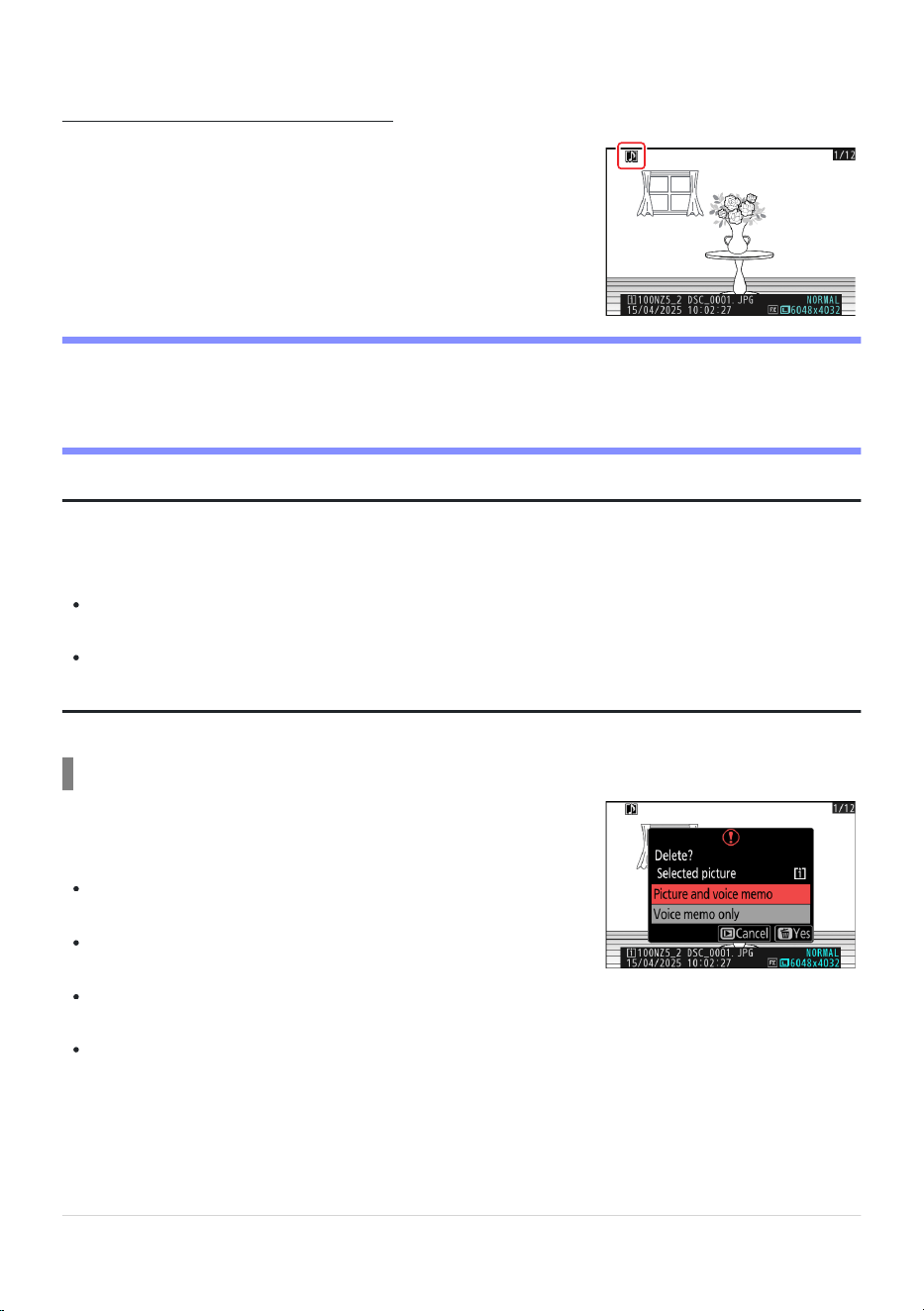
To play voice memos when viewing photographs marked with h
icons, press the i button, highlight [Play voice memo], and press
J.
To delete the voice memo from the current photo, press the O
button; a confirmation dialog will be display
ed as shown.
To delete both the photo and the voice memo, highlight [Picture
and voice memo] and press O.
To delete only the voice memo, highlight [Voice memo only]
and press O.
To exit without deleting either the photo or the voice memo,
press D.
You can delete only voice memos from dual-format pictures on
the card in the slot currently being played back by choosing
[Selected picture] in the confirmation dialog and then selecting
[Voice memo only].
Playing Voice Memos
D Interrupting Playb
ack
Pressing the shutter-release button or operating other camera controls may end playback. Playback
ends automatically when another picture is selected or the camera is turned off.
Tip: Using Controls to Play Back Voice Memos
With the following operations, voice memos playback can be started or ended without using the i
menu.
Press the button to which [Voice memo] is assigned using Custom Setting f3 [Custom controls
(playback)].
Assign [Voice memo] to [Flick up] or [Flick down] in Custom Setting f14 [Full-frame playback
flicks] and flick up or down on the monitor.
Deleting Voice Memos
256
Recording/Playing Voice Memos
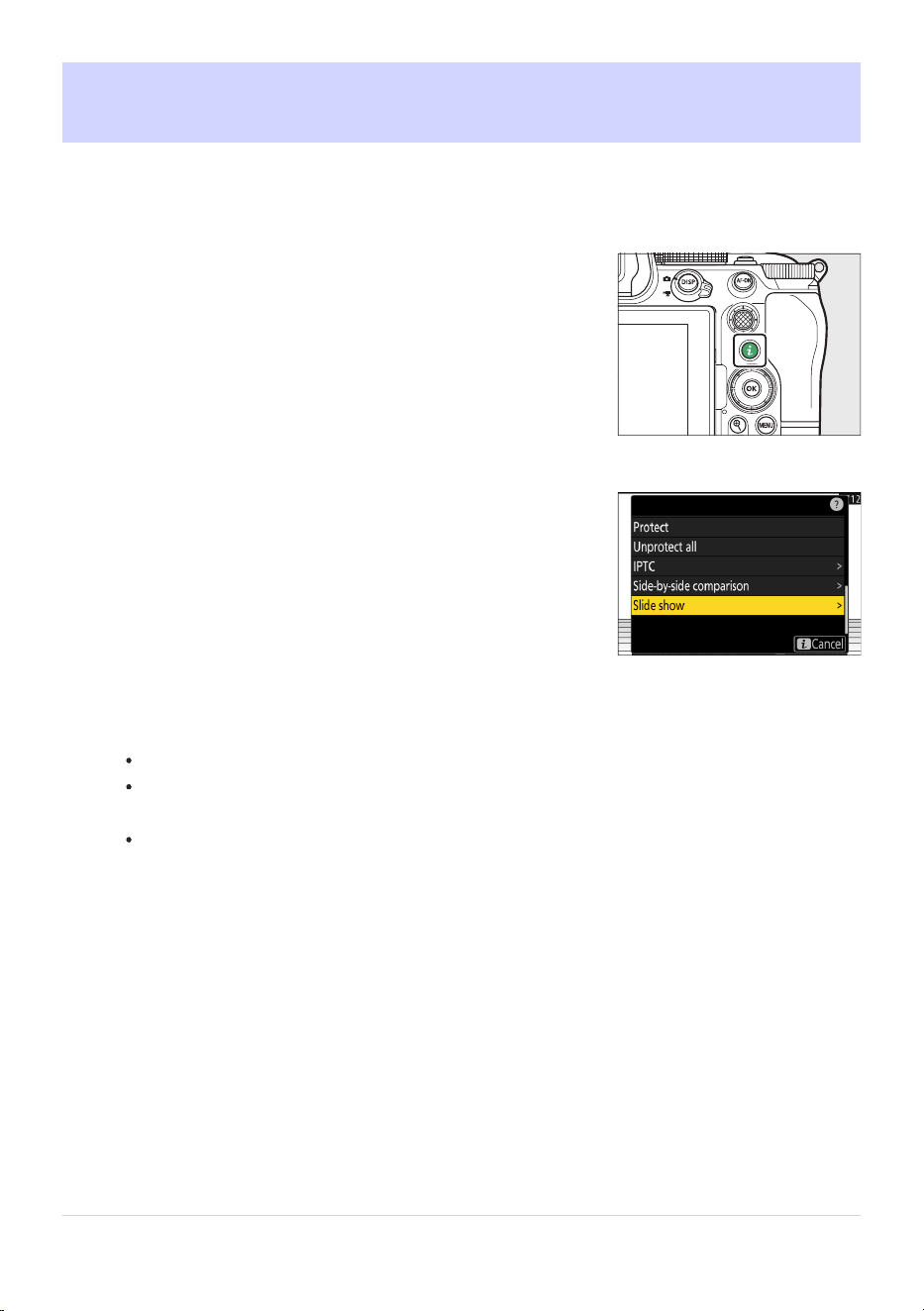
Select the starting picture using the multi selector and
press the i
button.
The slide show starts with the selected picture and continues
through all the pictures recorded after it.
Highlight [Slide show] and press 2.
To choose how long photos ar
e displayed, highlight [Frame
interval] and press 2.
Viewing Slide Shows
To view a slide show in which pictures ar
e played back one at a time in the order recorded, select [Slide
show] in the i menu. You can also choose how long any photos in the show are displayed.
Highlight [Start] and press J.
The slide show will start.
In the case of videos, the option selected for [Frame interval] is ignored; instead, the starting
frame will be displayed for short time before video playback begins.
When the show ends, a message will be displayed before normal playback resumes.
257
Viewing Slide Shows
1
2
3
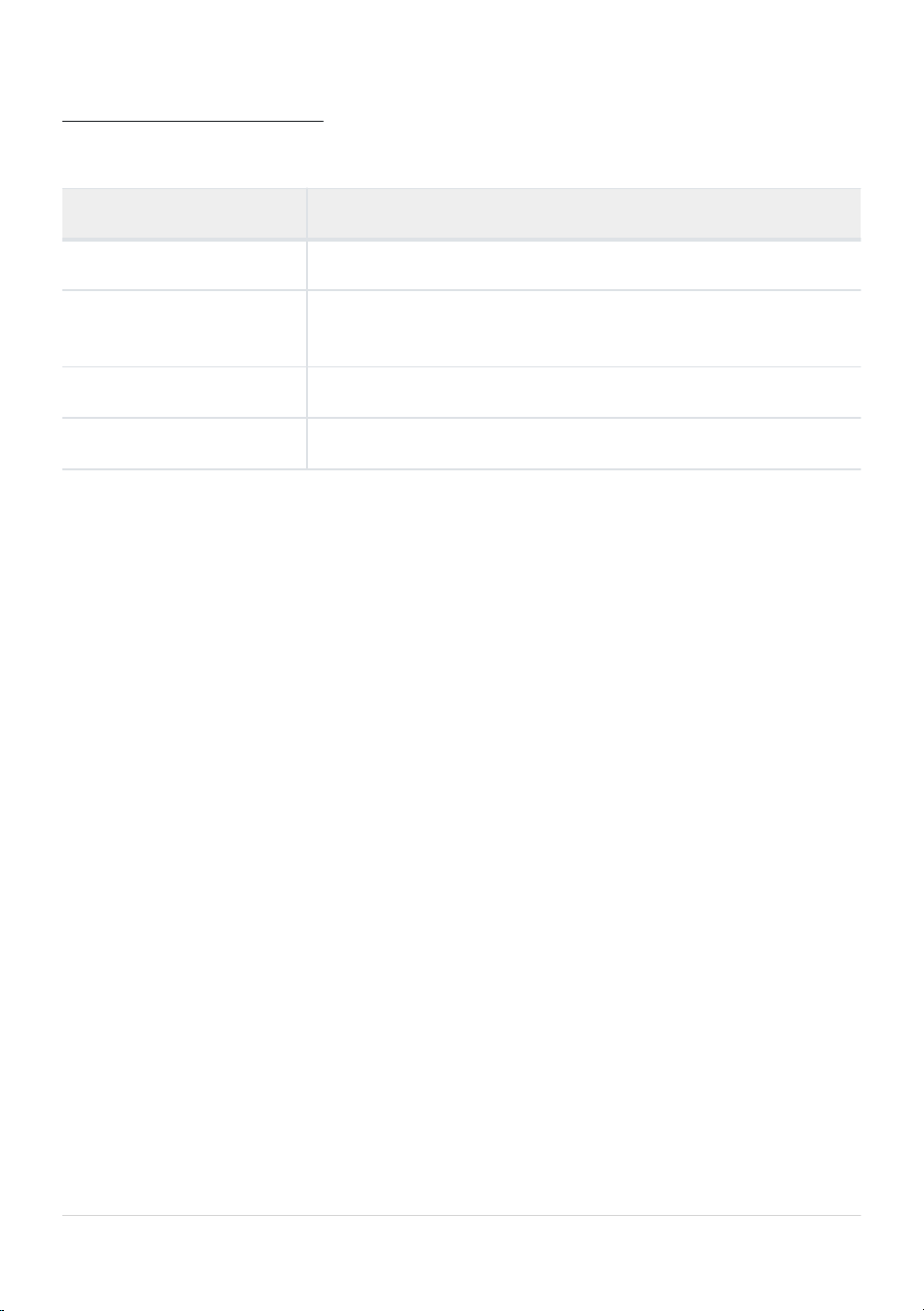
During the Show
The following operations can be performed while the show is in pr
ogress:
Operation Description
Skip back/skip ahead
Press 4 to return to the previous frame, 2 t
o skip to the next frame.
View additional photo info
Press 1, 3, or DISP to choose the phot
o info displayed. To hide
photo info, select [None (picture only)].
Adjust volume
Press X t
o increase volume, W (Q
) to decrease.
Exit to playback mode
Press J t
o end the slide show and return to the playback display.
258
Viewing Slide Shows
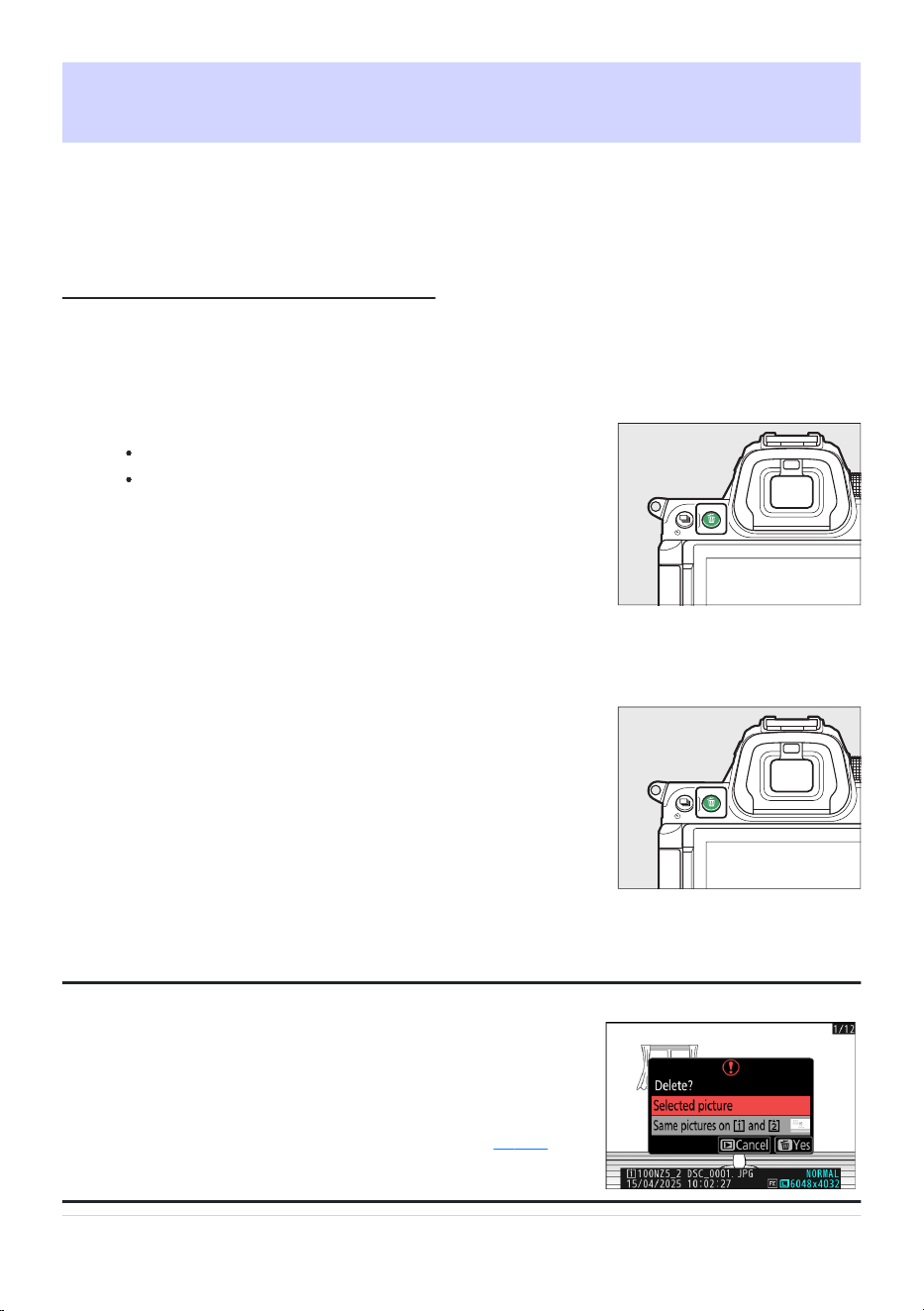
Select the desired picture with the multi selector and press
the O button.
A confirmation dialog will be display
ed.
To exit without deleting the picture, press K.
Press O again.
The picture will be deleted.
If the picture selected in the playback display when the O button
is pressed was r
ecorded with two memory cards inserted and an
option other than [Overflow] selected for [Role played by card in
Slot 2], you will be prompted to choose whether to delete both
copies or only the copy on the card in the current slot (
0 412).
Deleting Pictures
Follow the steps below to
delete pictures from memory cards. Note that pictures cannot be recovered
once deleted. Pictures that are protected, however, cannot be deleted.
Using the Delete Button
Press the O
button to delete the current picture.
Tip: Deleting Copies
259
Deleting Pictures
1
2
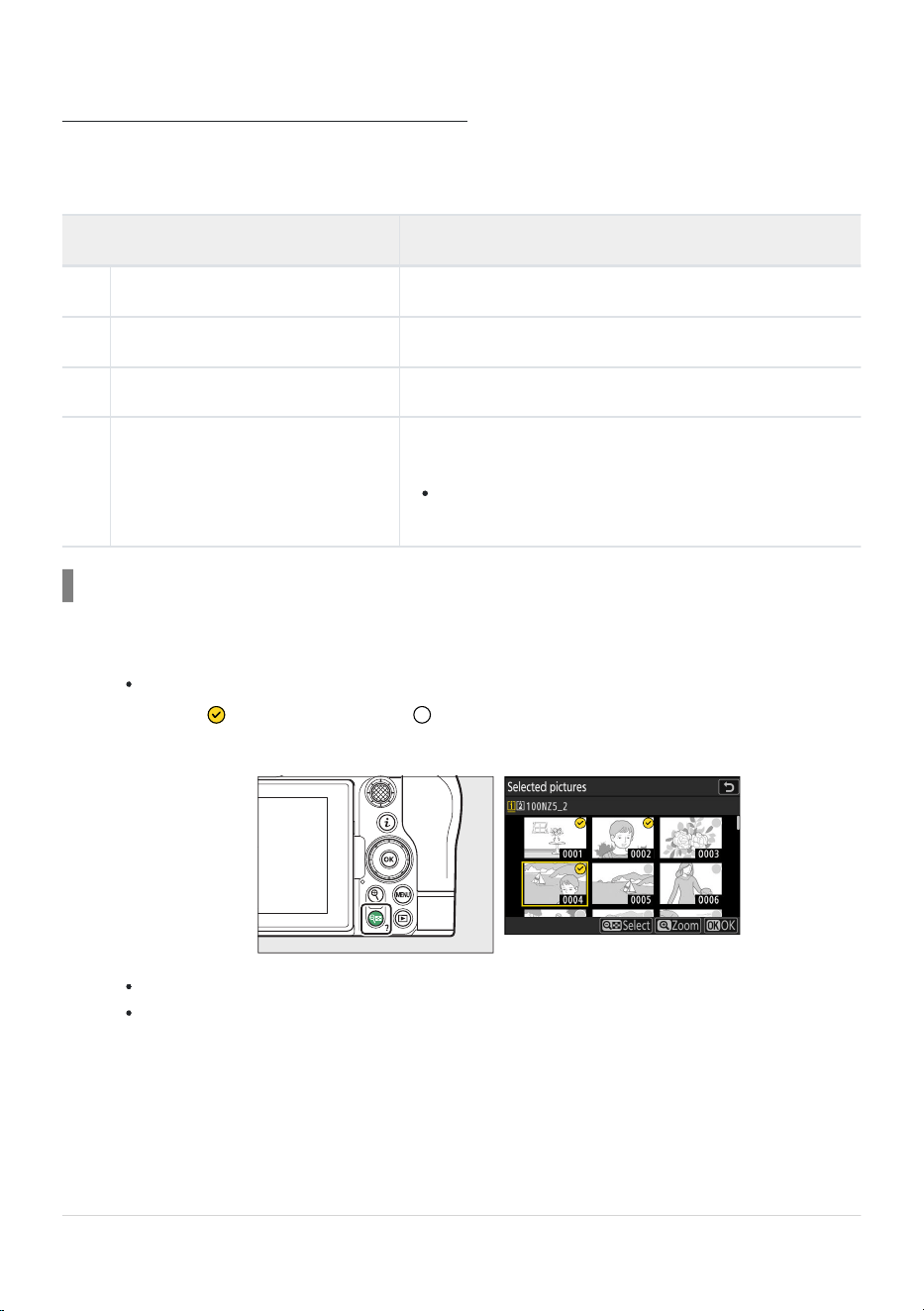
Deleting Multiple Pictures
Use [Delete] in the playback menu t
o delete multiple pictures at once. Note that depending on the
number of pictures, some time may be required for deletion.
Option Description
Q
[Selected pictures] Delete select
ed pictures.
d
[Candidates for deletion]
Delete pictur
es rated d (candidate for deletion).
i
[Pictur
es shot on selected dates] Delete all pictures taken on selected dates.
R
[All pictures]
Delete all pictures in the folder currently selected for
[Playback folder] in the playback menu.
If two memory cards are inserted, you can select the
card from which pictures will be deleted.
Deleting Selected Pictures
Select pictures.
Highlight pictures and pr
ess the W (Q) button to select; selected pictures are marked with
a check (
). To remove the check ( ) and deselect the current picture, press the W (Q)
butt
on again.
R
epeat until all the desir
ed pictures are selected.
To view the highlighted picture full screen, press and hold the X button.
260
Deleting Pictures
1
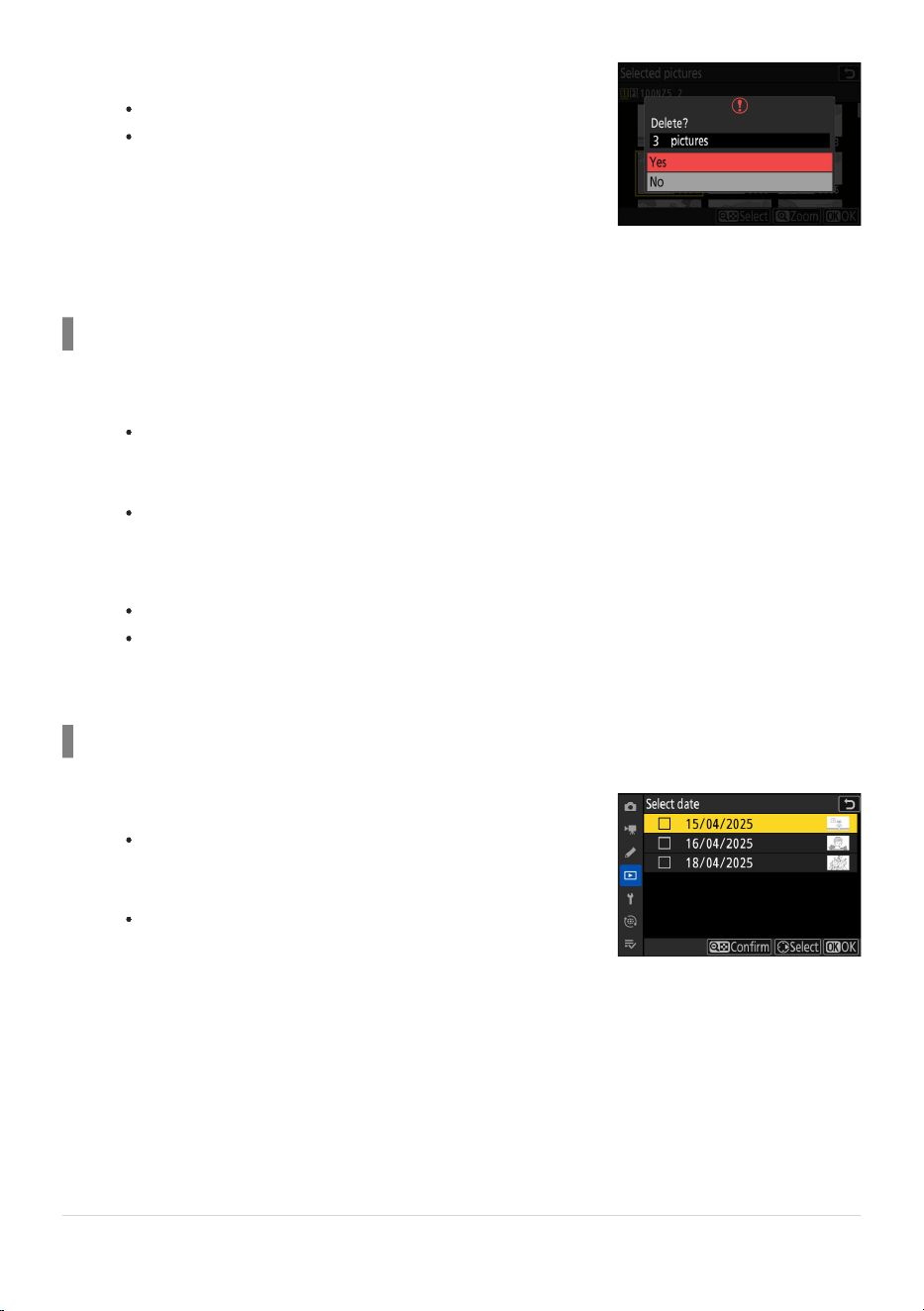
Delete the pictures.
Press J
; a confirmation dialog will be displayed.
Highlight [Yes] and press J to delete the selected pictures.
Select dates.
Highlight dates using the multi selector and pr
ess 2 to
select; selected dates are marked with M icons. Selected
dates can be deselected by pressing 2 again.
Repeat until you have selected all the desired dates.
Candidates for Deletion
Select pictures.
The camera will list all pictures rat
ed d (candidate for deletion). Pictures you do not currently
wish to delete can be deselected by highlighting them using the multi selector and pressing
W (Q).
To view the highlighted picture full screen, press and hold the X button.
Delete the pictures.
Press J; a confirmation dialog will be displayed.
Highlight [Yes] and press J to delete the selected pictures.
Pictures Shot on Selected Dates
261
Deleting Pictures
2
1
2
1
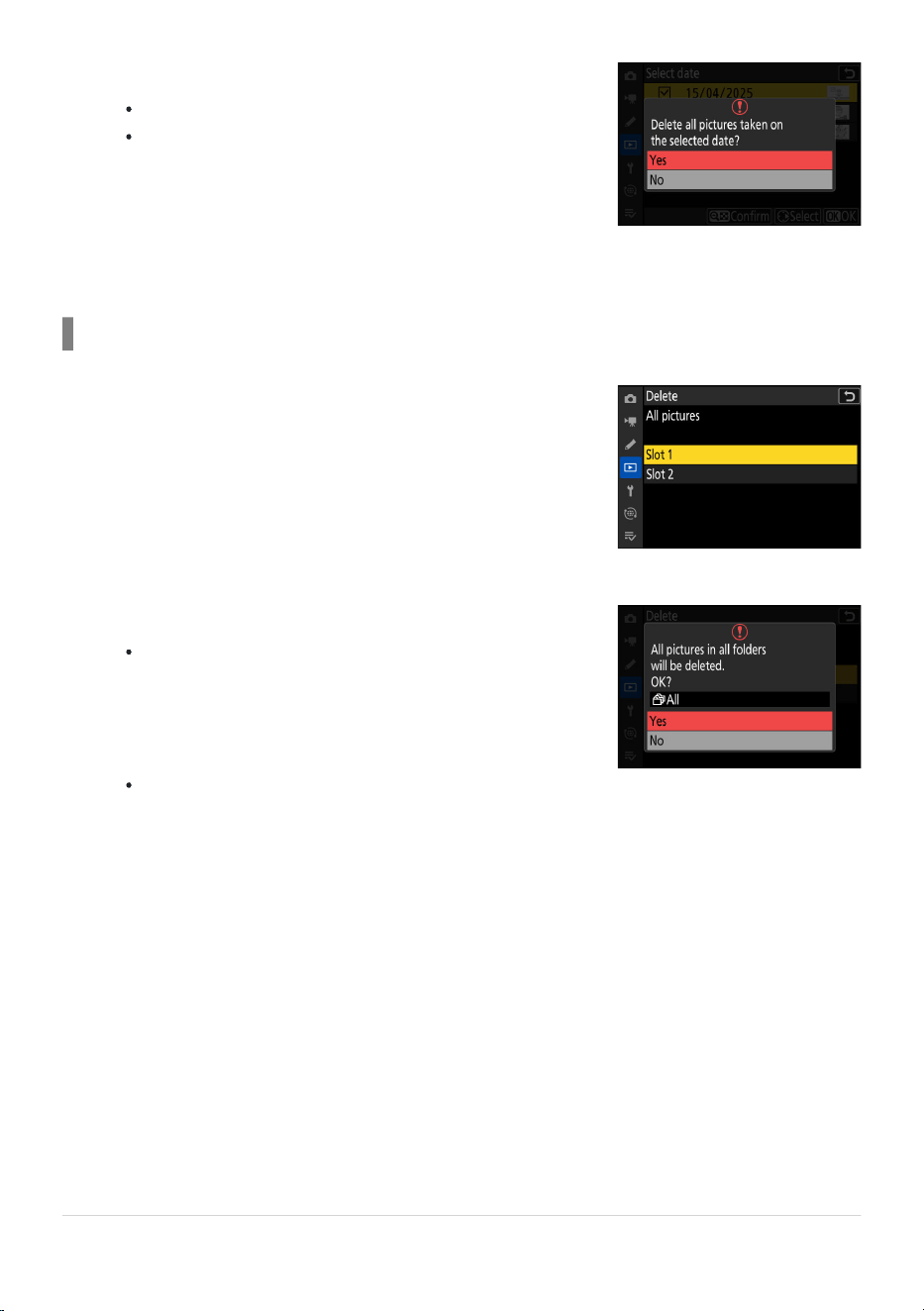
Delete the pictures.
Press J
; a confirmation dialog will be displayed.
Highlight [Yes] and press J to delete all the pictures taken
on the selected dates.
Choose a memory card.
Press 1
or 3 to highlight the slot containing the memory card
from which the pictures will be deleted and press J.
Delete the pictures.
A confirmation dialog will be displayed showing the name
o
f the folder containing the photos to be deleted. Highlight
[Yes] and press J to delete all pictures from the folder. The
folder is that previously selected via [Playback folder] in the
playback menu.
Note that depending on the number of pictures, some time
may be required for deletion.
Deleting All Pictures
262
Deleting Pictures
2
1
2
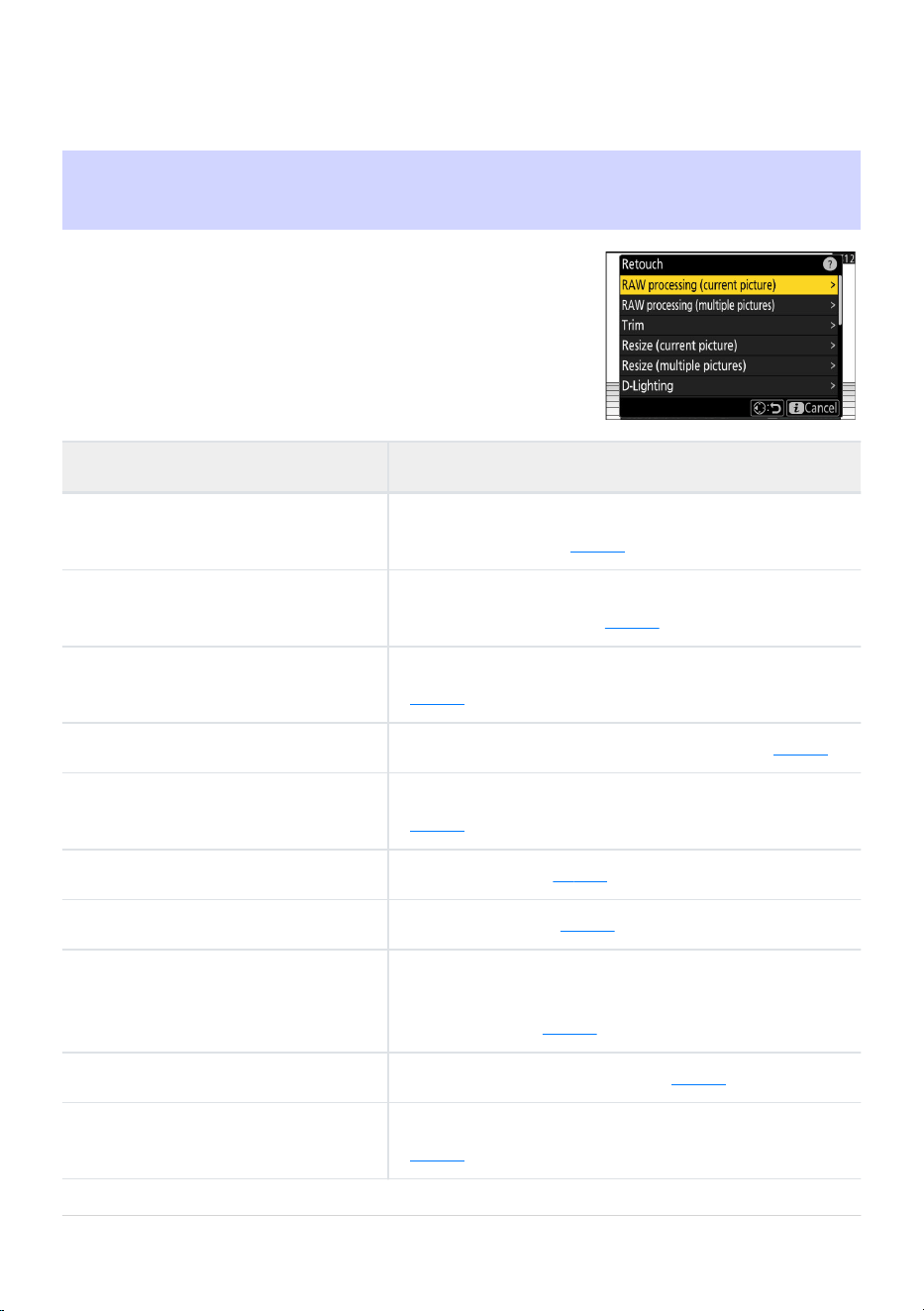
Retouched copies can be created from existing pictures. Retouched
copies are saved t
o new files, separate from the original pictures.
Retouching Photographs
Retouching Phot
ographs
Option Description
[RAW processing (current picture)]
Save a copy o
f the current NEF (RAW) picture in another
format such as JPEG (
0 266).
[RAW processing (multiple pictures)]
Select multiple existing NEF (RAW) pictur
es for conversion
to JPEG or other formats (
0 266).
[Trim]
Creat
e a cropped copy of the current photograph
(
0 277).
[Resize (current picture)] Creat
e a small copy of the current photograph (
0 278).
[Resize (multiple pictures)]
Creat
e small copies from one or more existing photos
(
0 278).
[D-Lighting] Brighten shadows (0 281).
[Straighten] Straight
en pictures (
0 282).
[Distortion control]
Reduce b
arrel distortion in pictures taken with wide-angle
lenses or pin-cushion distortion in pictures taken with
telephoto lenses (
0 283).
[Perspective control] Reduce the effects o
f perspective (
0 284).
[Monochrome]
Creat
e a monochrome copy of the current photograph
(
0 285).
263
Retouching Photographs
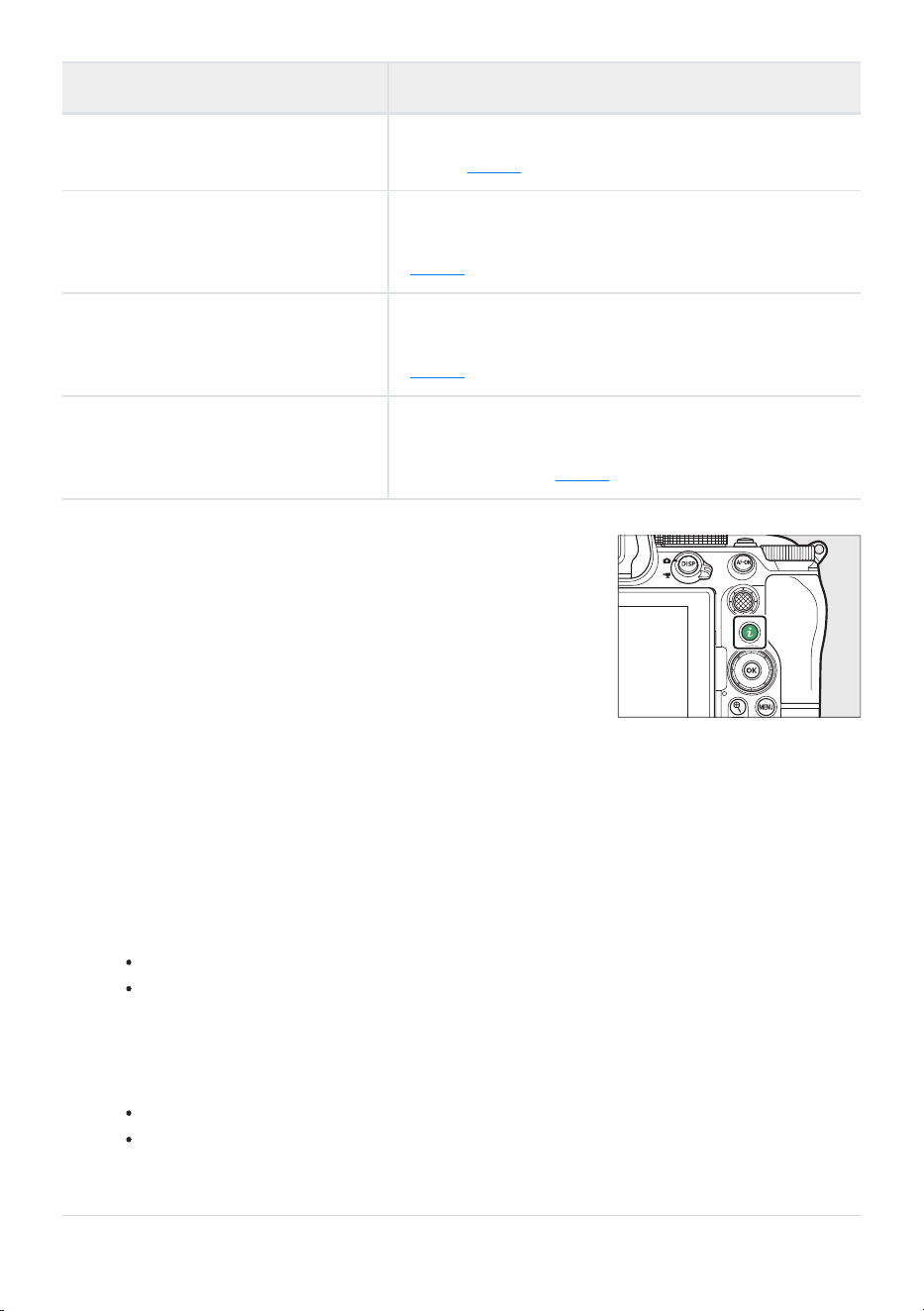
Select the desired picture with the multi selector and press
the i button.
You will not need t
o select a picture if you are using
[RAW processing (multiple pictures)] or [Resize (multiple
pictures)], as you will be prompted to choose the pictures
later.
Option Description
[Overlay (add)]
Overlay tw
o pictures to create a new picture in JPEG
format (
0 286).
[Lighten]
Compar
e the pixels at each point in multiple pictures and
select the brightest to create a new picture in JPEG format
(
0 288).
[Darken]
Compar
e the pixels at each point in multiple pictures and
select the darkest to create a new picture in JPEG format
(
0 288).
[Motion blend]
The camera examines a selected burst of pictures to
detect moving subjects and overlays them t
o create a
single JPEG image (
0 291).
Highlight [Retouch] and press 2.
Highlight the desired option and press 2.
Select r
etouch options.
For more information, see the section for the selected item.
To exit without creating a retouched copy, press K. This will return you to the playback
display.
Create a retouched copy.
For more information, see the section for the selected item.
Retouched copies are indicated by a p icon.
264
Retouching Photographs
1
2
3
4
5

D Cautions: Retouch
The camera may not be able t
o display or retouch images that were taken or retouched using other
cameras or that have been retouched on a computer.
If no actions are performed for a brief period, the display will turn off and any unsaved changes
will be lost. To increase the time the display remains on, choose a longer menu display time using
Custom Setting c3 [Power off delay]> [Menus].
D Cautions: Retouching Copies
Most items can be applied to copies created using other retouch options, although multiple edits
may result in reduced image quality or unnatural colors.
The effect produced may vary with the order in which edits are performed.
Some items may be unavailable depending on the items used to create the copy.
[Retouch] items in the i menu that cannot be applied to the current picture are grayed out and
unavailable.
D Image Quality
Copies created from NEF (RAW) pictures will be saved in JPEG or HEIF at an [Image quality] of
[JPEG/HEIF finem].
Copies created from JPEG and HEIF pictures are the same quality as the original.
In the case of dual-format pictures recorded to the same memory card at image-quality settings of
RAW+ JPEG/HEIF, only the NEF (RAW) copy will be retouched.
D Image Size
Except in the case of copies created with [RAW processing (current picture)], [RAW processing
(multiple pictures)], [Trim], [Resize (current picture)], and [Resize (multiple pictures)], copies are
the same size as the original.
265
Retouching Photographs
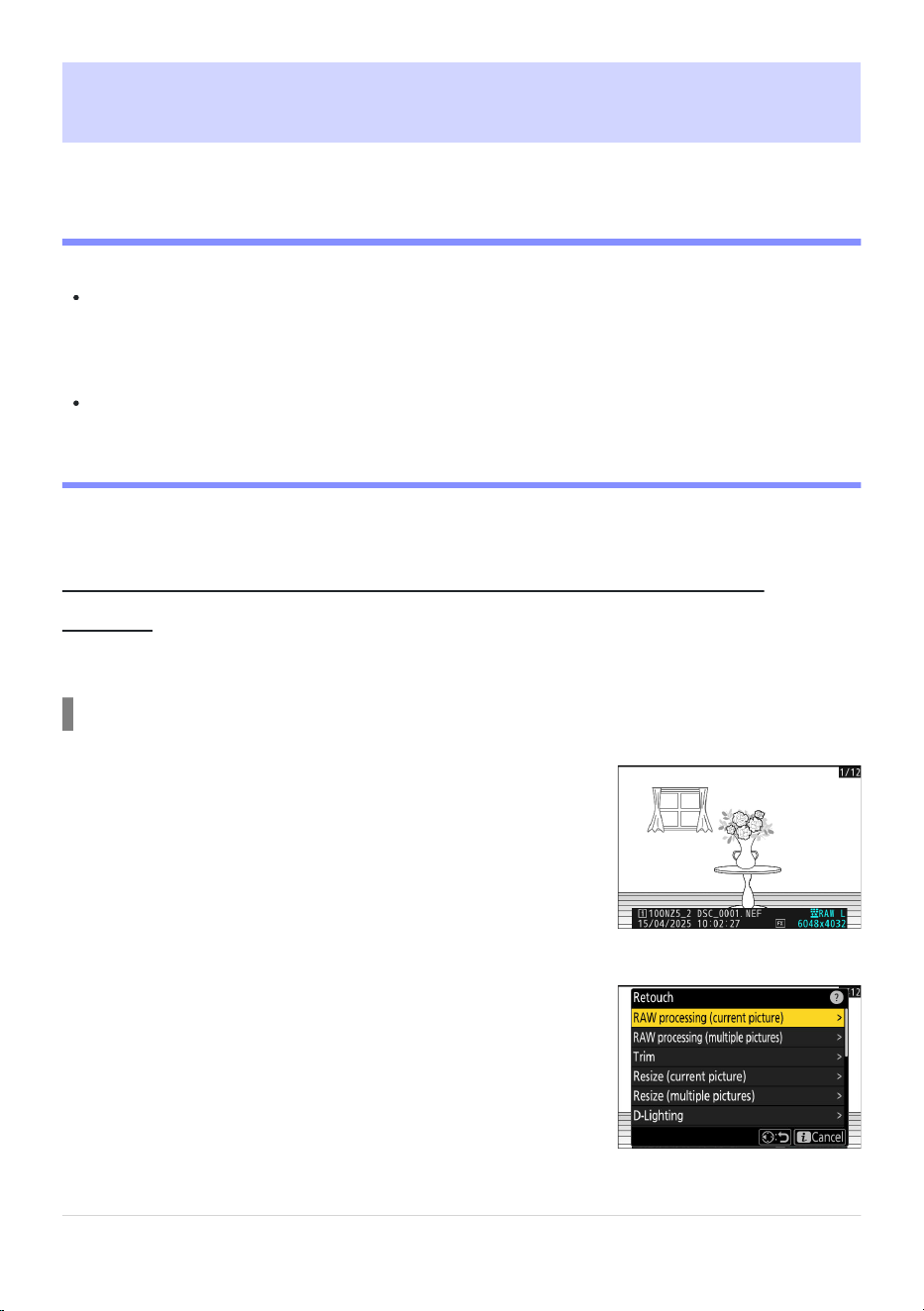
Display an NEF (RAW) picture shot with [SDR] selected for
tone mode and then press the i
button.
Select [Retouch] in the i menu, then highlight [RAW
pr
ocessing (current picture)] and press 2.
RAW Processing
RAW processing is used t
o save NEF (RAW) pictures in other formats, such as JPEG. Depending on the
tone mode selected when the picture was taken, copies can be saved in either JPEG or HEIF format.
D Caution: RAW Processing
RAW processing is not available on this camera with following images:
NEF (RAW) images shot with a different camera model,
NEF (RAW) images shot using NX Tether and saved on a computer, or
Images shot in image quality settings other than RAW.
If NEF (RAW) pictures are converted to JPEG or HEIF format via RAW processing, the hues of
resulting images may differ from the JPEG or HEIF pictures shot with the camera, even if the same
shooting settings were applied during RAW processing.
Processing Photos Shot Using the [SDR] Tone
Mode
Applying RAW processing t
o photos shot with [SDR] selected for tone mode creates JPEG copies.
Processing the Current Picture
266
RAW Processing
-
-
-
1
2
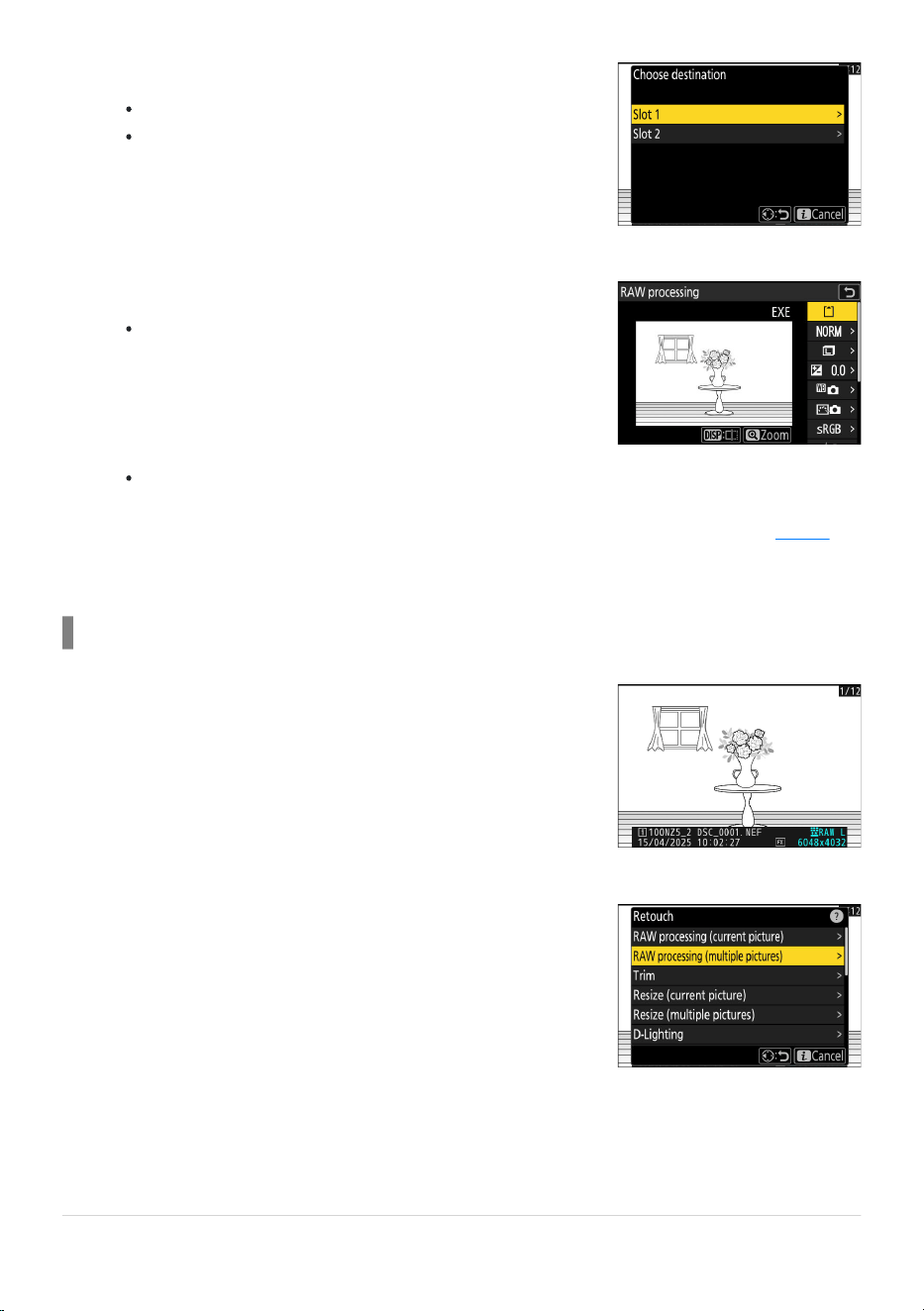
Choose a destination.
Press 1
or 3 to highlight a card slot and press J.
You will not be prompted to select the slot if only one
memory card is inserted.
Copy the photograph.
Highlight [EXE] and pr
ess J to create a JPEG copy of the
selected photograph.
Display an NEF (RAW) picture shot with [SDR] selected for
tone mode and then press the i
button.
Select [Retouch] in the i menu, then highlight [RAW
processing (multiple pictures)] and press 2.
Adjust settings such as white balance and Picture Control before processing. If necessary,
change from the settings that wer
e in effect when the photograph was taken. For items that
can be configured, see “Configuration Items during SDR Image RAW Processing” (
0 270).
Processing Multiple Pictures
267
RA
W Processing
3
4
1
2
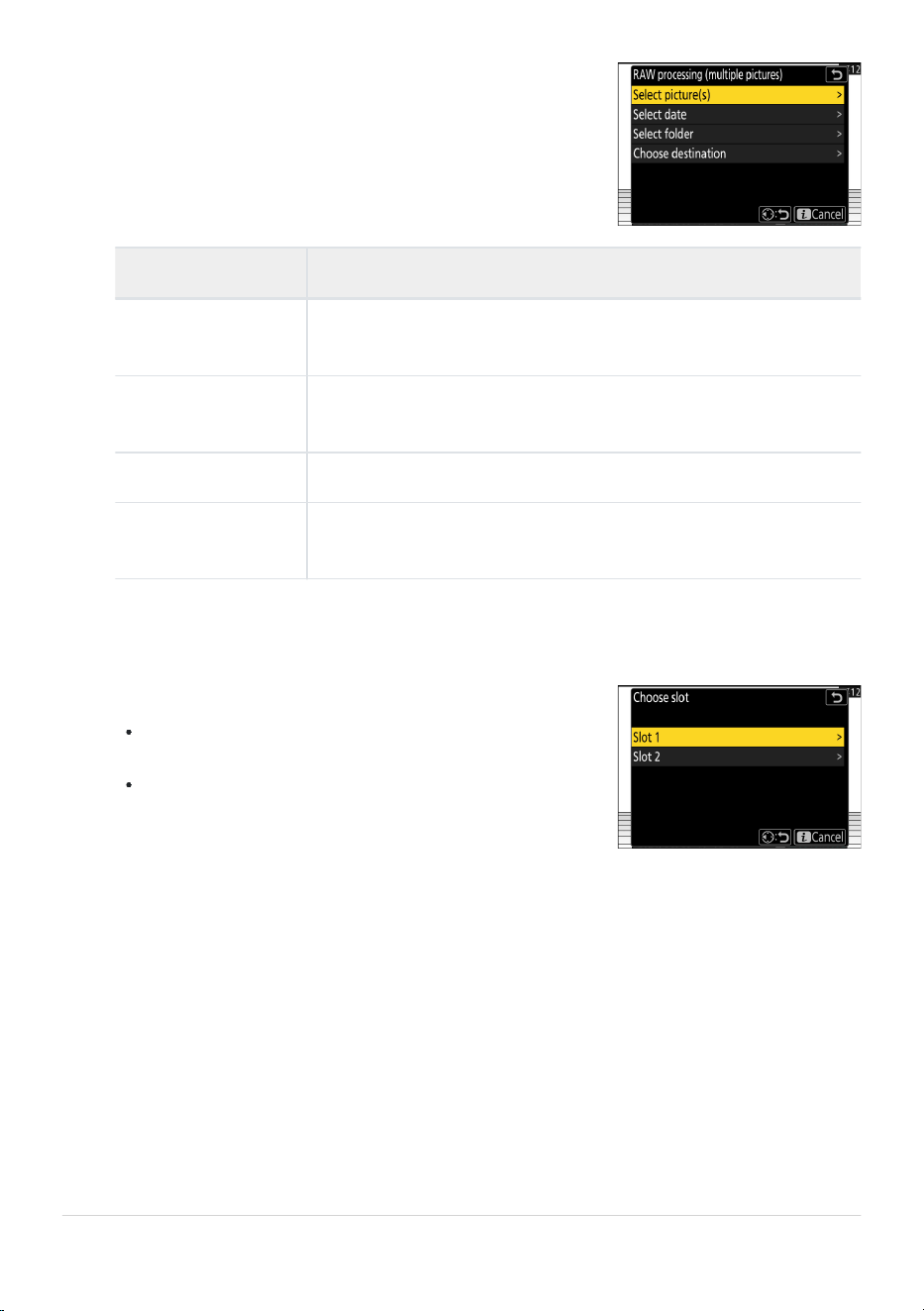
Choose how pictures will be selected and where the copies
will be saved.
Select the source slot.
Highlight the slot with the card containing the NEF (RAW)
images and pr
ess 2.
You will not be prompted to select the slot if only one
memory card is inserted.
Option Description
[Select picture(s)]
Cr
eate JPEG copies of selected NEF (RAW) pictures. Multiple NEF
(RAW) pictures can be selected.
[Select date]
Create JPEG copies of all NEF (RAW) pictures taken on selected
dates.
[Select folder] Create JPEG copies of all NEF (RAW) pictures in a selected folder.
[Choose destination]
Choose the destination for the JPEG copies. You will not be
prompted to select the slot if only one memory card is inserted.
If you chose [Select picture(s)], proceed to Step5.
268
RAW Processing
3
4
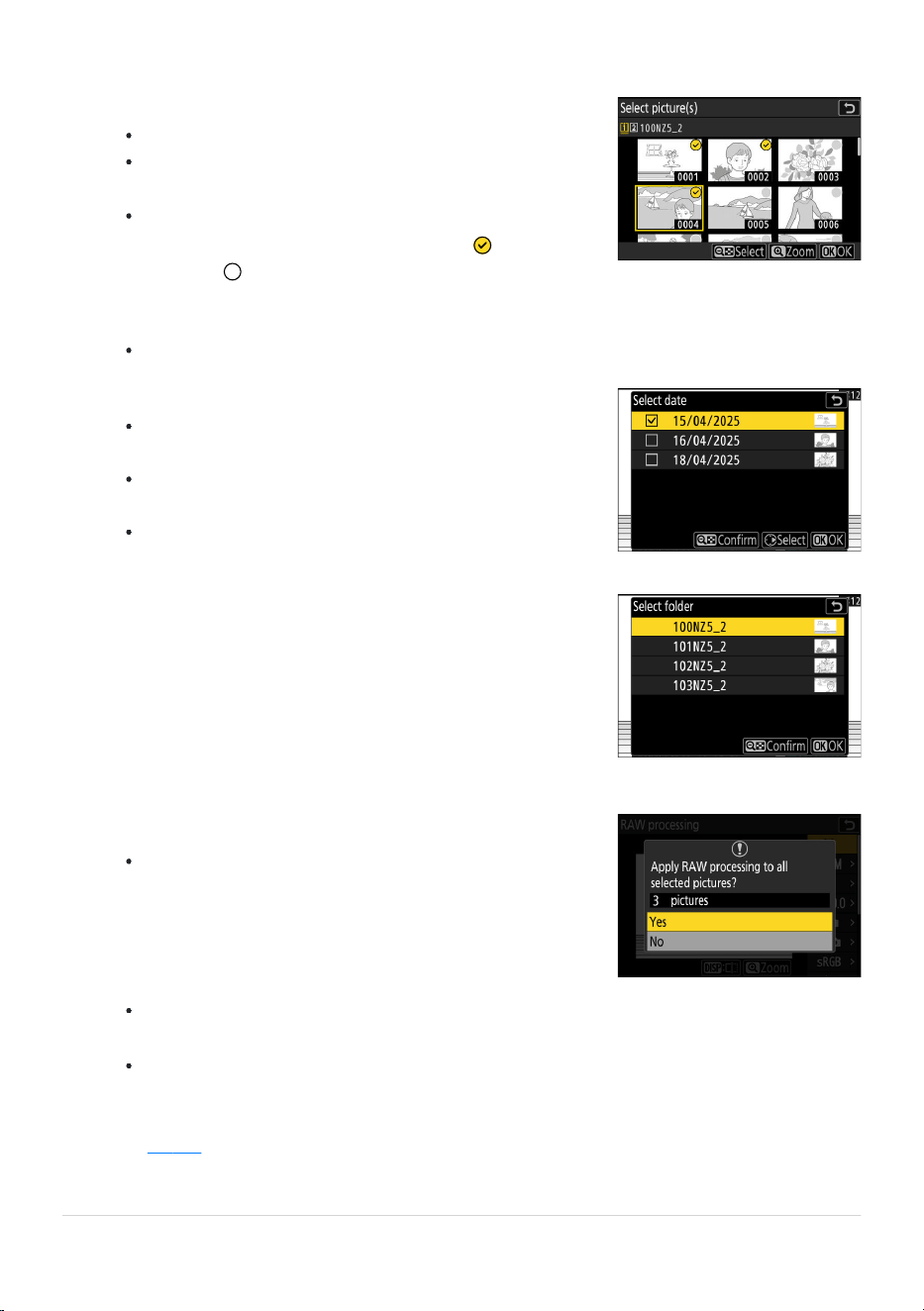
If you chose [Select picture(s)]:
Highlight pictures using the multi selector
.
To view the highlighted picture full screen, press and hold
the X button.
To select the highlighted picture, press the W (Q) button.
Selected pictures are marked with a check (
). To remove
the check ( ) and deselect the current picture, press the
W (Q) button again. All pictures will be pr
ocessed using the
same settings.
Press J to proceed once selection is complete.
If you chose [Select date]:
Highlight dates using the multi selector and press 2 to
select (M) or deselect (U).
All eligible images taken on dates marked with a check (M)
will be processed using the same settings.
Press J to proceed once selection is complete.
If you chose [Select folder]:
Highlight a folder and press J to select; all images in the
selected folder will be processed using the same settings.
Copy the photographs.
Highlight [EXE] and press J to display a confirmation dialog
and then highlight [Yes] and press J to create JPEG copies
of the selected photos.
Select photographs.
To cancel the operation before all copies hav
e been created, press the G button; when a
confirmation dialog is displayed, highlight [Yes] and press J.
Adjust settings such as white balance and Picture Control before processing. If necessary,
change from the settings that were in effect when the photographs were taken. For items
that can be configured, see “Configuration Items during SDR Image RAW Processing”
(
0 270).
269
RAW Processing
5
6
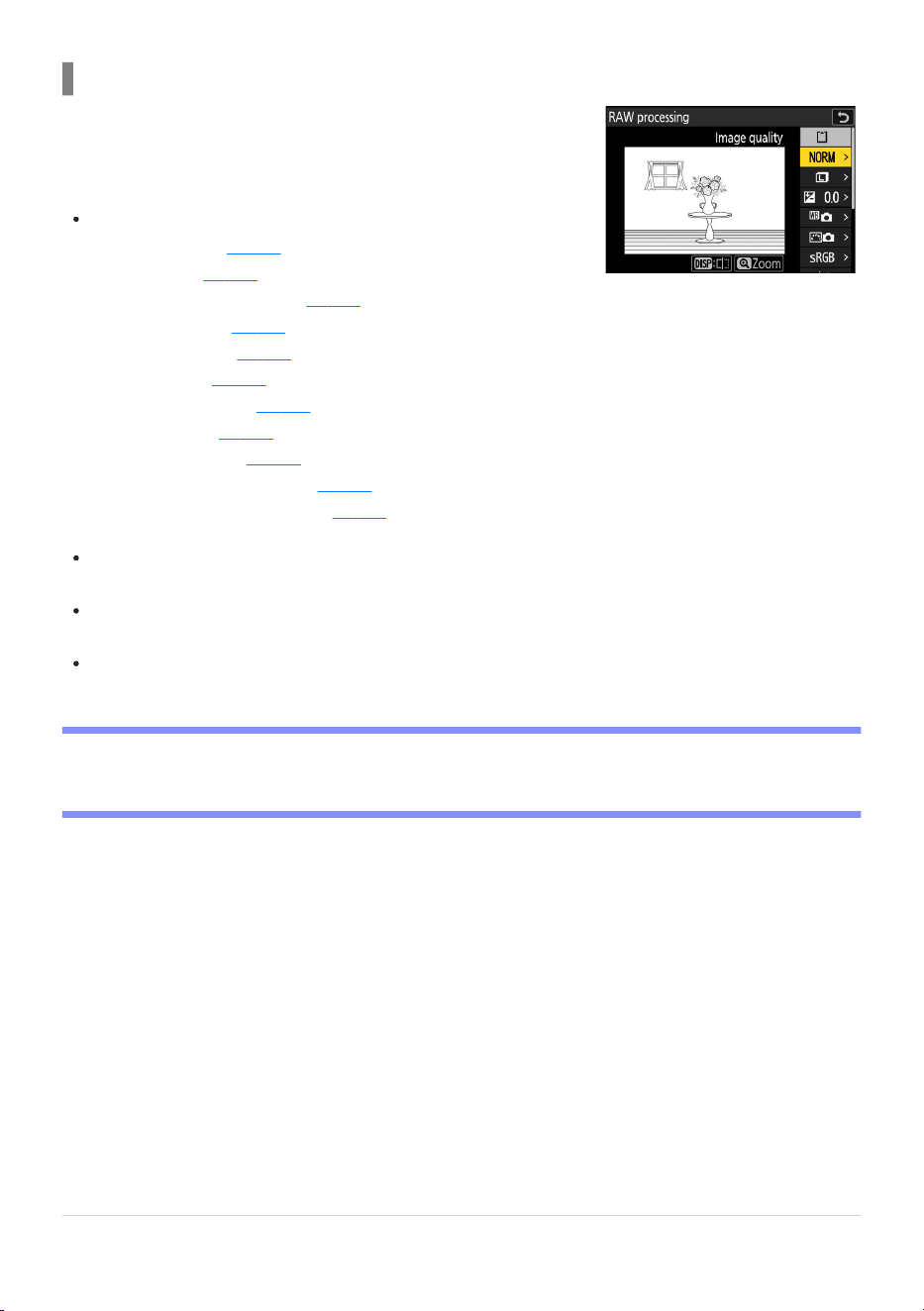
Image settings can be changed before performing RAW processing
from the settings that wer
e in effect when the photographs were
taken.
The items that can be configured are as follows.
Image quality (
0 116)
Image size (0 118)
Exposure compensation (0 150)
White balance (0 182)
Picture Control (
0 164)
Color space (0 427)
Active D-Lighting (0 428)
High ISO NR (0 431)
Vignette control (
0 432)
Diffraction compensation (0 433)
Portrait impr
ession balance (
0 436)
-
-
-
-
-
-
-
-
-
-
-
Configuration Items during SDR Image RAW Processing
The settings in effect when the photographs wer
e taken will in some cases appear below the
preview.
To use the settings in effect when the photographs were taken, if applicable, select [Original] for
each item.
The effects can be previewed in the edit display. To view the unedited picture, press and hold the
DISP button.
D Caution: RAW Processing with SDR Tone Mode
[Exposure compensation] can only be set to values between –2 and +2EV.
270
RAW Processing
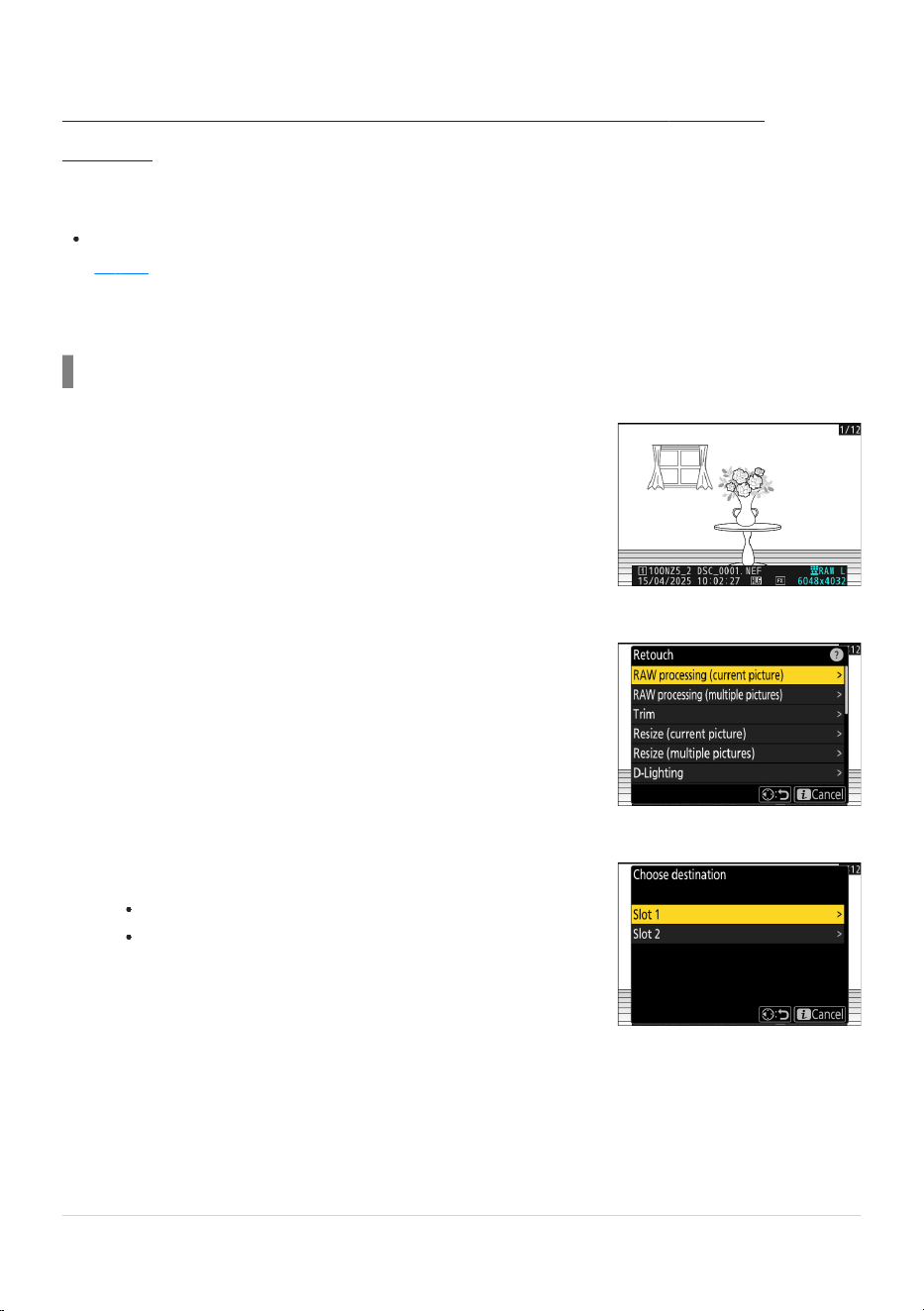
Display an NEF (RAW) picture shot with [HLG] selected for
tone mode and then press the i
button.
Choose a picture marked with the HLG icon.
Select [Retouch] in the i menu, then highlight [RAW
pr
ocessing (current picture)] and press 2.
Choose a destination.
Press 1
or 3 to highlight a card slot and press J.
You will not be prompted to select the slot if only one
memory card is inserted.
Processing Photos Shot Using the [HLG] Tone
Mode
Applying RAW processing t
o photos shot with [HLG] selected for tone mode creates HEIF copies.
NEF (RAW) pictures taken with [HLG] selected for tone mode can also be saved in JPEG format
(
0 276). Note, however, that the JPEG copies may exhibit more “noise” in the form of randomly-
spaced bright pix
els, fog, or lines than do JPEG copies created from NEF (RAW) pictures taken with
[SDR] selected for tone mode.
Processing the Current Picture
271
RAW Processing
1
2
3
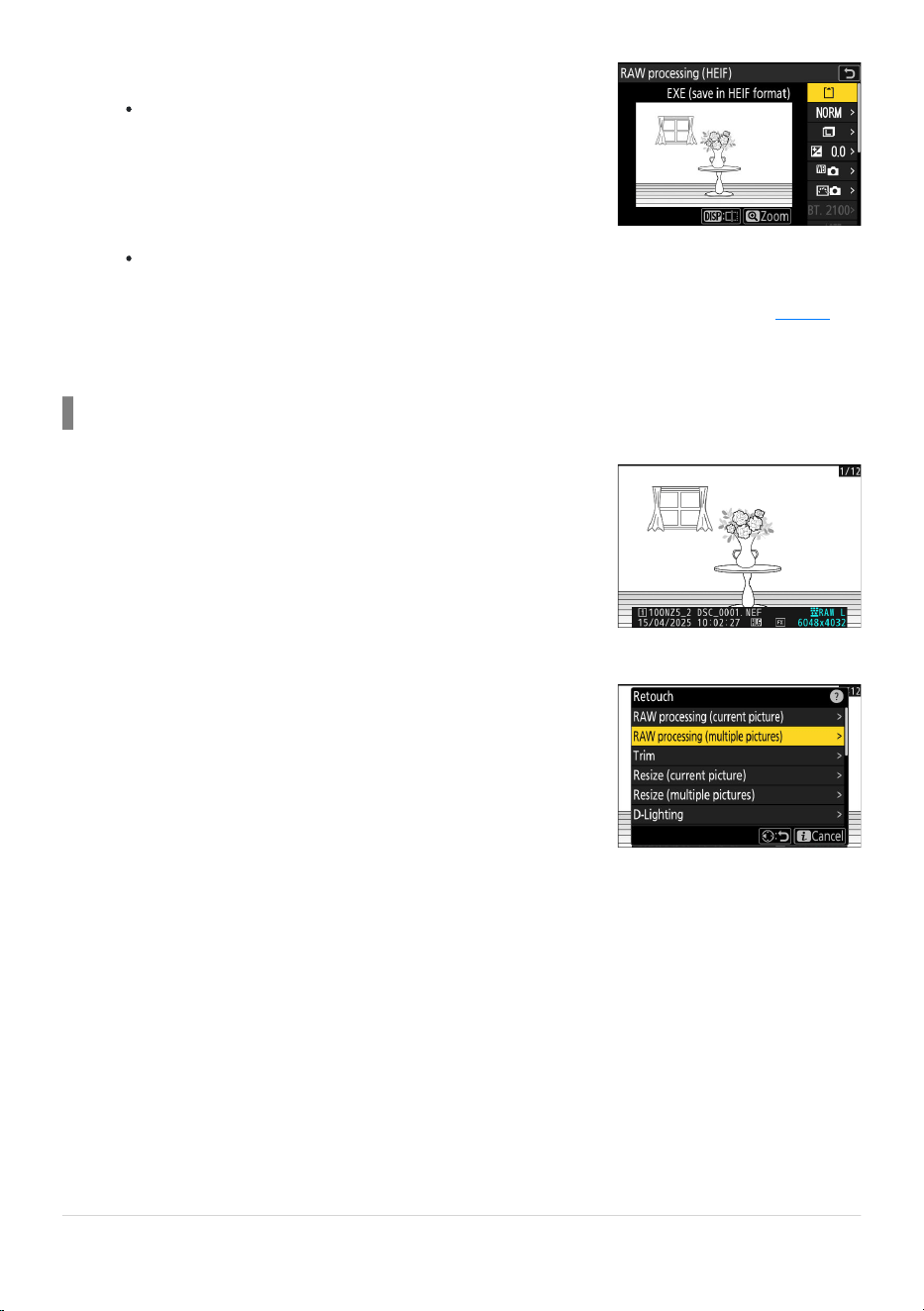
Copy the photograph.
Highlight [EXE (save in HEIF for
mat)] and press J to create
an HEIF copy of the current photograph.
Display an NEF (RAW) picture shot with [HLG] selected for
tone mode and then press the i
button.
Choose a picture marked with the HLG icon.
Select [Retouch] in the i menu, then highlight [RAW
pr
ocessing (multiple pictures)] and press 2.
Adjust settings such as white balance and Picture Control before processing. If necessary,
change from the settings that wer
e in effect when the photograph was taken. For items that
can be configured, see “Configuration Items during HLG Image RAW Processing” (
0 275).
Processing Multiple Pictures
272
RA
W Processing
4
1
2
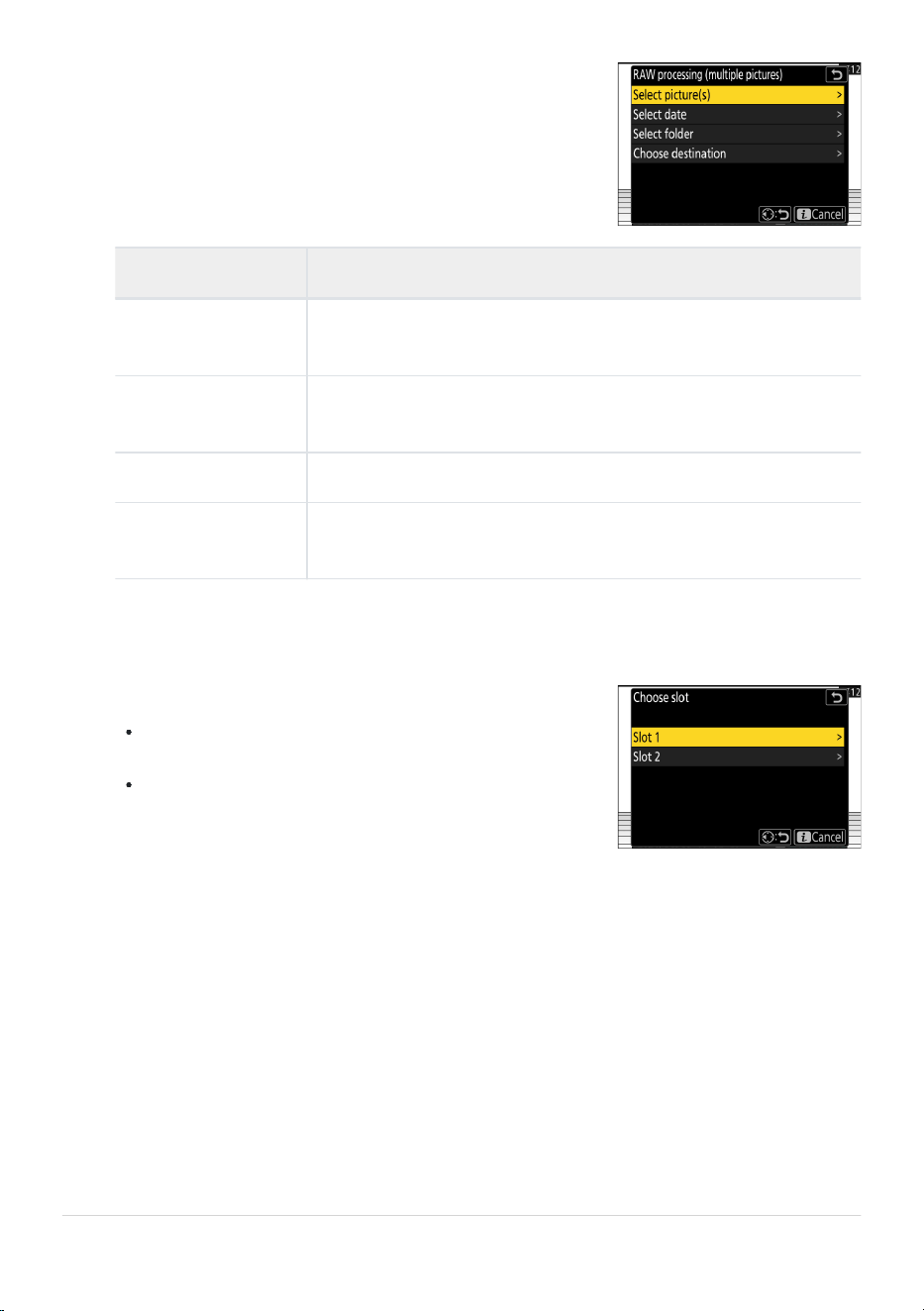
Choose how pictures will be selected and where the copies
will be saved.
Select the source slot.
Highlight the slot with the card containing the NEF (RAW)
images and pr
ess 2.
You will not be prompted to select the slot if only one
memory card is inserted.
Option Description
[Select picture(s)]
Cr
eate HEIF copies of selected NEF (RAW) pictures. Multiple NEF
(RAW) pictures can be selected.
[Select date]
Create HEIF copies of all NEF (RAW) pictures taken on selected
dates.
[Select folder] Create HEIF copies of all NEF (RAW) pictures in a selected folder.
[Choose destination]
Choose the destination for the HEIF copies. You will not be
prompted to select the slot if only one memory card is inserted.
If you chose [Select picture(s)], proceed to Step5.
273
RAW Processing
3
4
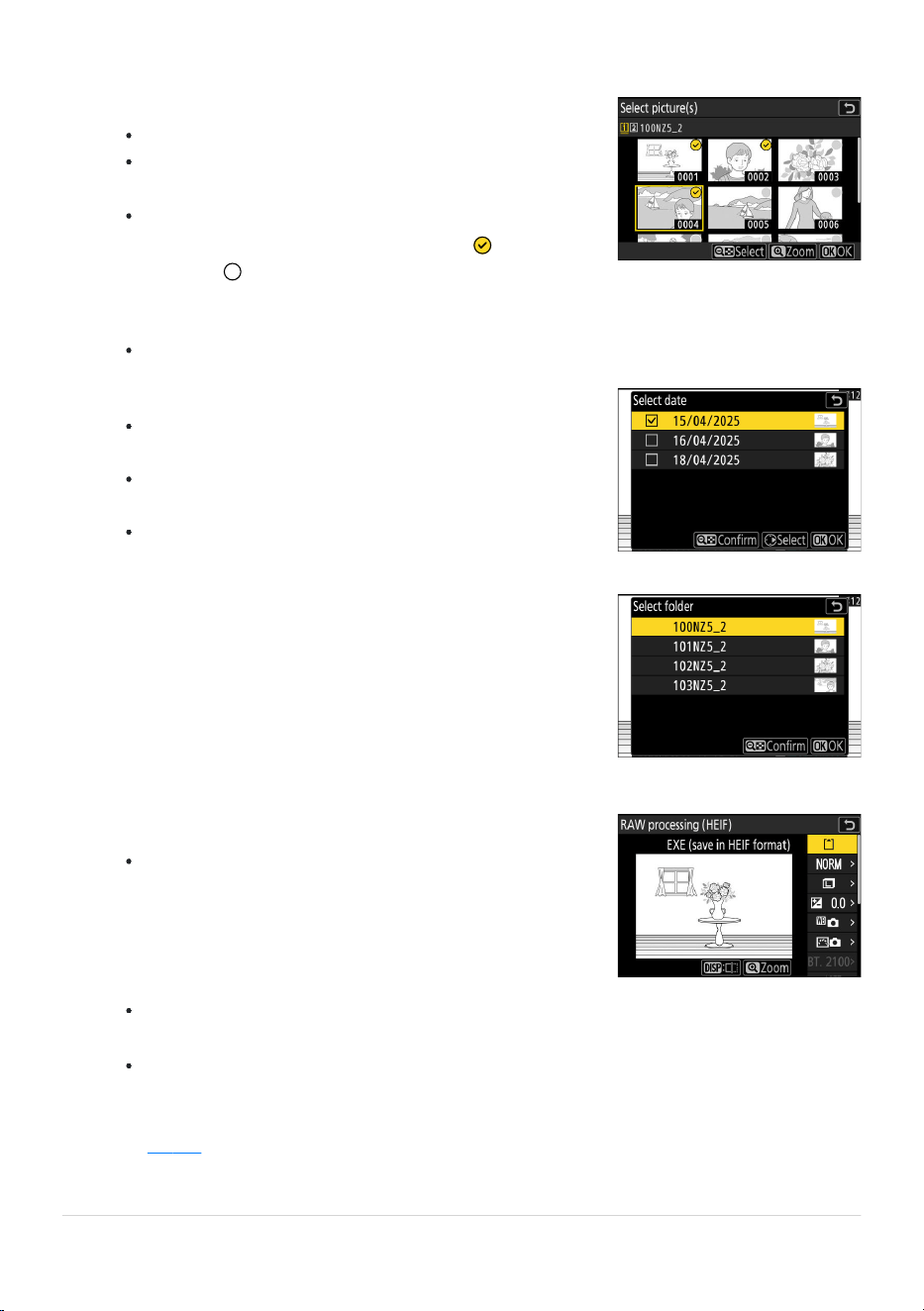
If you chose [Select picture(s)]:
Highlight pictures using the multi selector
.
To view the highlighted picture full screen, press and hold
the X button.
To select the highlighted picture, press the W (Q) button.
Selected pictures are marked with a check (
). To remove
the check ( ) and deselect the current picture, press the
W (Q) button again. All pictures will be pr
ocessed using the
same settings.
Press J to proceed once selection is complete.
If you chose [Select date]:
Highlight dates using the multi selector and press 2 to
select (M) or deselect (U).
All eligible images taken on dates marked with a check (M)
will be processed using the same settings.
Press J to proceed once selection is complete.
If you chose [Select folder]:
Highlight a folder and press J to select; all images in the
selected folder will be processed using the same settings.
Copy the photographs.
Highlight [EXE (save in HEIF format)] and press J to create
HEIF copies of the selected photos.
Select photographs.
To cancel the operation before all copies hav
e been created, press the G button; when a
confirmation dialog is displayed, highlight [Yes] and press J.
Adjust settings such as white balance and Picture Control before processing. If necessary,
change from the settings that were in effect when the photographs were taken. For items
that can be configured, see “Configuration Items during HLG Image RAW Processing”
(
0 275).
274
RAW Processing
5
6
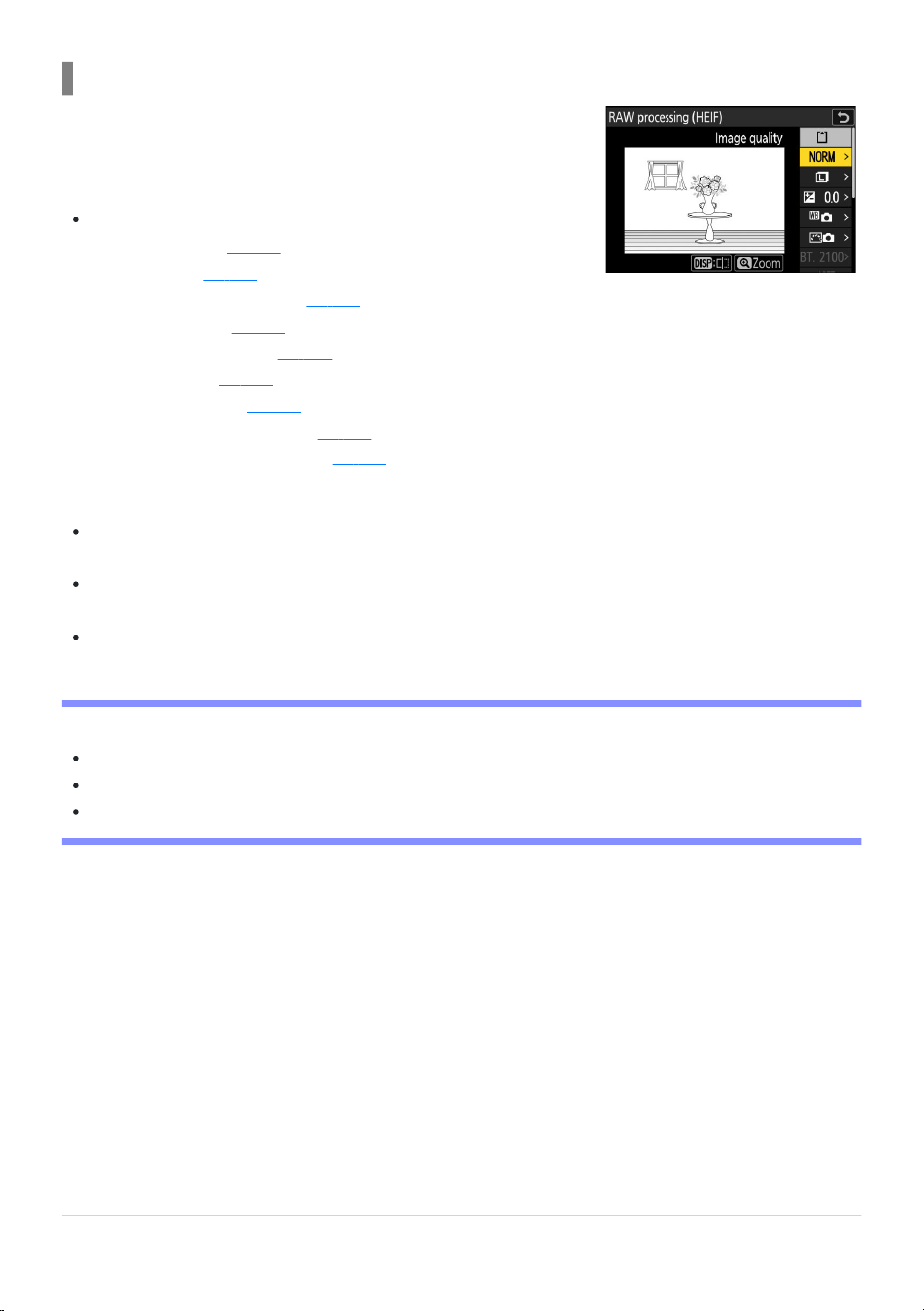
Image settings can be changed before performing RAW processing
from the settings that wer
e in effect when the photographs were
taken.
The items that can be configured are as follows.
Image quality (
0 116)
Image size (0 118)
Exposure compensation (0 150)
White balance (0 182)
Picture Control (HL
G;
0 426)
High ISO NR (0 431)
Vignette control (
0 432)
Diffraction compensation (0 433)
Portrait impr
ession balance (
0 436)
To RAW pr
ocessing (JPEG)
-
-
-
-
-
-
-
-
-
-
Configuration Items during HLG Image RAW Processing
The settings in effect when the photographs wer
e taken will in some cases appear below the
preview.
To use the settings in effect when the photographs were taken, if applicable, select [Original] for
each item.
The effects can be previewed in the edit display. To view the unedited picture, press and hold the
DISP button.
D Cautions: RAW Processing with HLG Tone Mode
[Exposure compensation] can only be set to values between –2 and +2EV.
[Color space] is fixed at “BT.2100“.
[Active D-Lighting] cannot be adjusted.
275
RAW Processing

Tip: Creating JPEG Copies from RAW Photos Shot Using the HLG Tone Mode
Selecting [To RAW pr
ocessing (JPEG)] in the [RAW processing (HEIF)] dialog displays the [RAW
processing (JPEG)] dialog, where you can adjust settings for saving the copies in JPEG format. To save
the JPEG copies, highlight [EXE (save in JPEG format)] and press J.
Exposure for JPEG copies created by applying [RAW processing (JPEG)] to RAW photos shot in
HLG will be around 2 EV lower than that of JPEG copies created from RAW photos shot with [SDR]
selected for tone mode. Exposure can be corrected as desired using the [Exposure compensation]
option in the [RAW processing (JPEG)] dialog.
[Set Picture Control] appears in the [RAW processing (JPEG)] display in place of [Set Picture
Control (HLG)]. [Original] cannot be selected.
You will be able to choose options for [Color space] and [Active D-Lighting]. Note, however, that
choosing an option for [Active D-Lighting] may result in “noise” in the form of randomly-spaced
bright pixels, fog, or lines.
To return to the [RAW processing (HEIF)] display, select [To RAW processing (HEIF)] in the [RAW
processing (JPEG)] dialog.
The values selected in the [RAW processing (HEIF)] and [RAW processing (JPEG)] displays are
stored separately and are not reset after processing or when you switch from one display to another
using [To RAW processing (JPEG)] or [To RAW processing (HEIF)].
276
RAW Processing
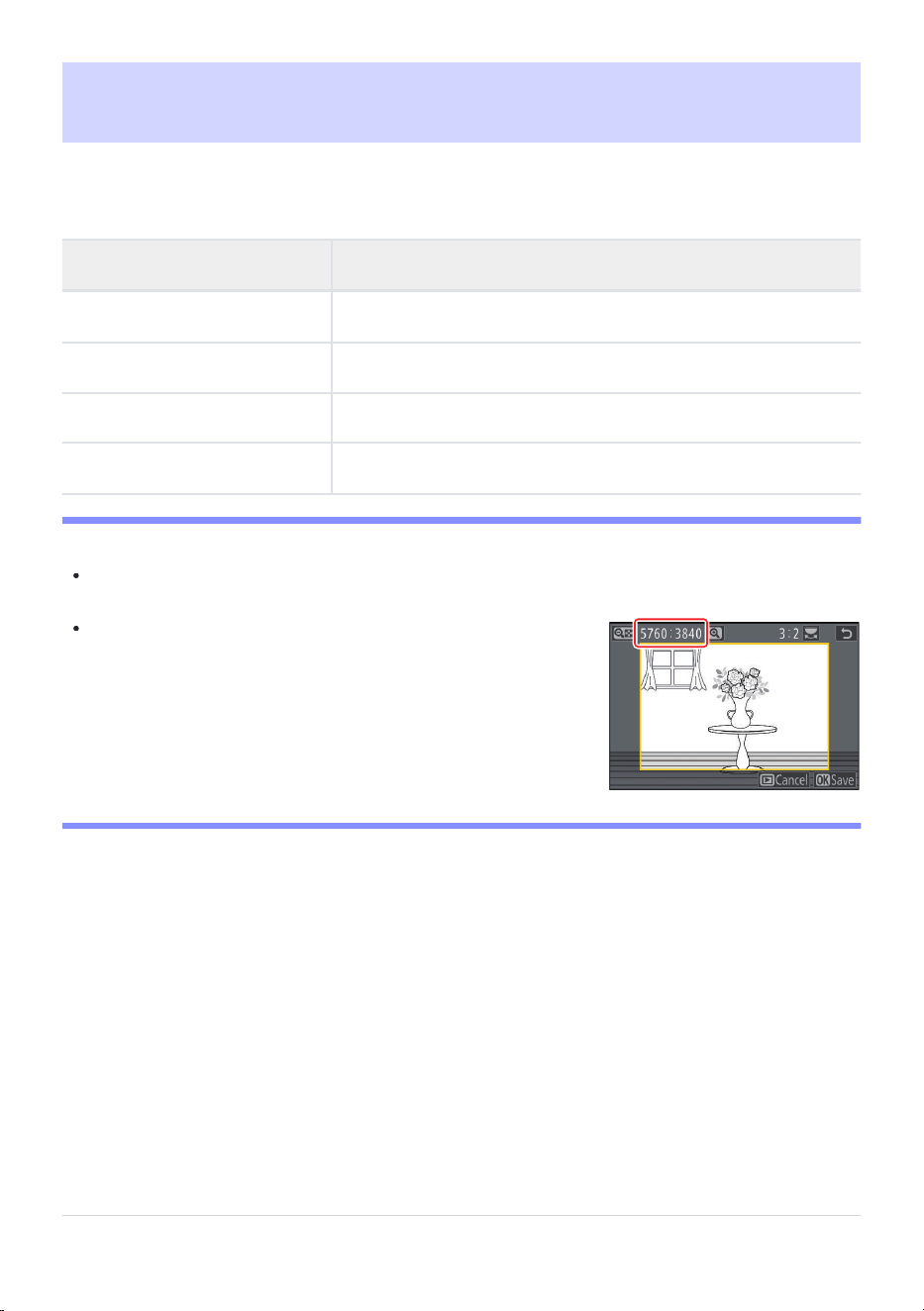
The crop size appears at upper left in the crop display. The size of
the copy varies with crop size and aspect ratio.
Trim
Create a cr
opped copy of the current photograph. The photograph is displayed with the selected crop
shown in yellow; create a cropped copy as described below.
Operation Description
Size the crop
Press X or W (Q) t
o choose the cr
op size.
Change the cr
op aspect ratio Rotate the main command dial to choose the crop aspect ratio.
Position the crop Use the multi selector to position the crop.
Save the crop
Press J t
o save the current crop as a separate file.
D Cautions: Cropped Pictures
Depending on the size o
f the cropped copy, playback zoom may not be available when cropped
copies are displayed.
277
Trim
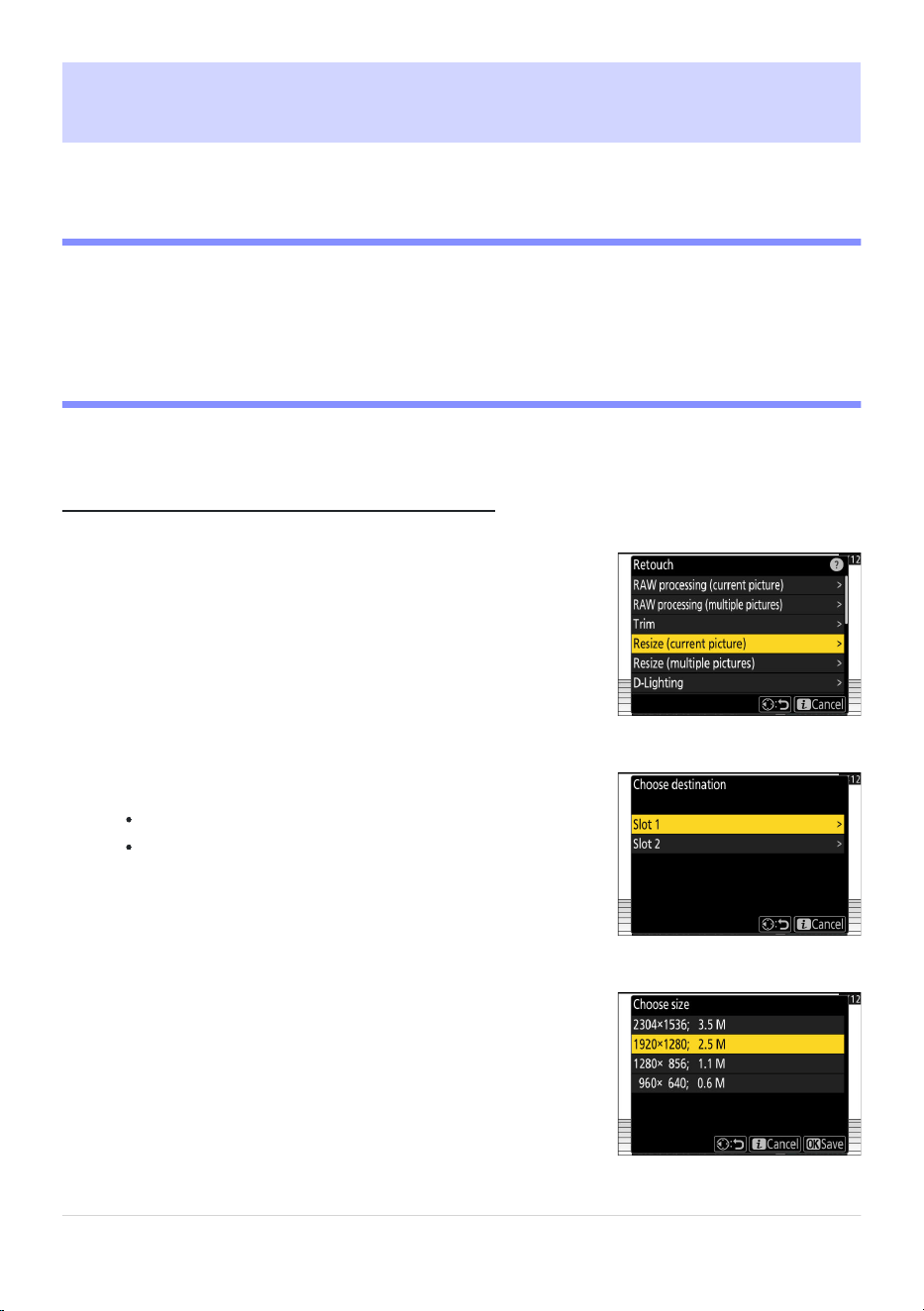
Select [Retouch] in the i menu, then highlight [Resize
(curr
ent picture)] and press 2.
Choose a destination.
Press 1
or 3 to highlight a card slot and press J.
You will not be prompted to select the slot if only one
memory card is inserted.
Highlight the desired size and press J.
A copy will be saved at the selected size.
Resize
Create small copies o
f selected photographs. Use [Resize (current picture)] to resize the current
picture, or [Resize (multiple pictures)] to resize multiple pictures.
D Caution: Resize
Depending on the copy size, playback zoom may not be available when resized copies are displayed.
D Resizing Cropped Pictures
Pictures cropped to aspect ratios of 4 : 3 or 3 : 4 cannot be resized.
Resizing the Current Picture
278
Resize
1
2
3
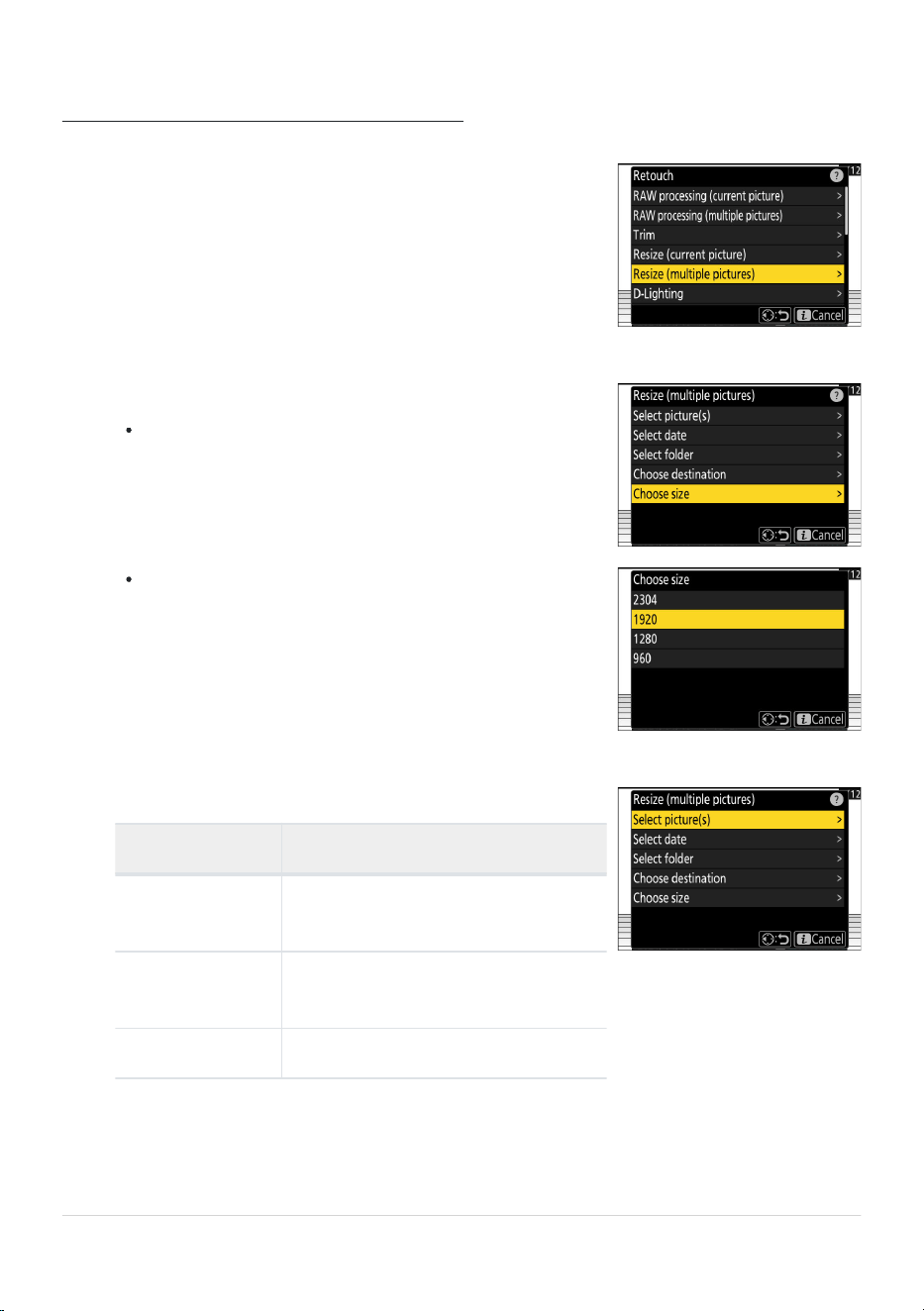
Select [Retouch] in the i menu, then highlight [Resize
(multiple pictur
es)] and press 2.
Choose a size.
Highlight [Choose size] and press 2.
Highlight the desired size (length in pixels) using 1 and 3
and press J.
Choose how pictures are selected.
Option Description
[Select picture(s)]
R
esize selected pictures. Multiple
pictures can be selected.
[Select date]
Resize all pictures taken on selected
dates.
[Select folder] Resize all pictures in a selected folder.
If you chose [Select picture(s)], proceed to Step5.
Resizing Multiple Pictures
279
Resize
1
2
3
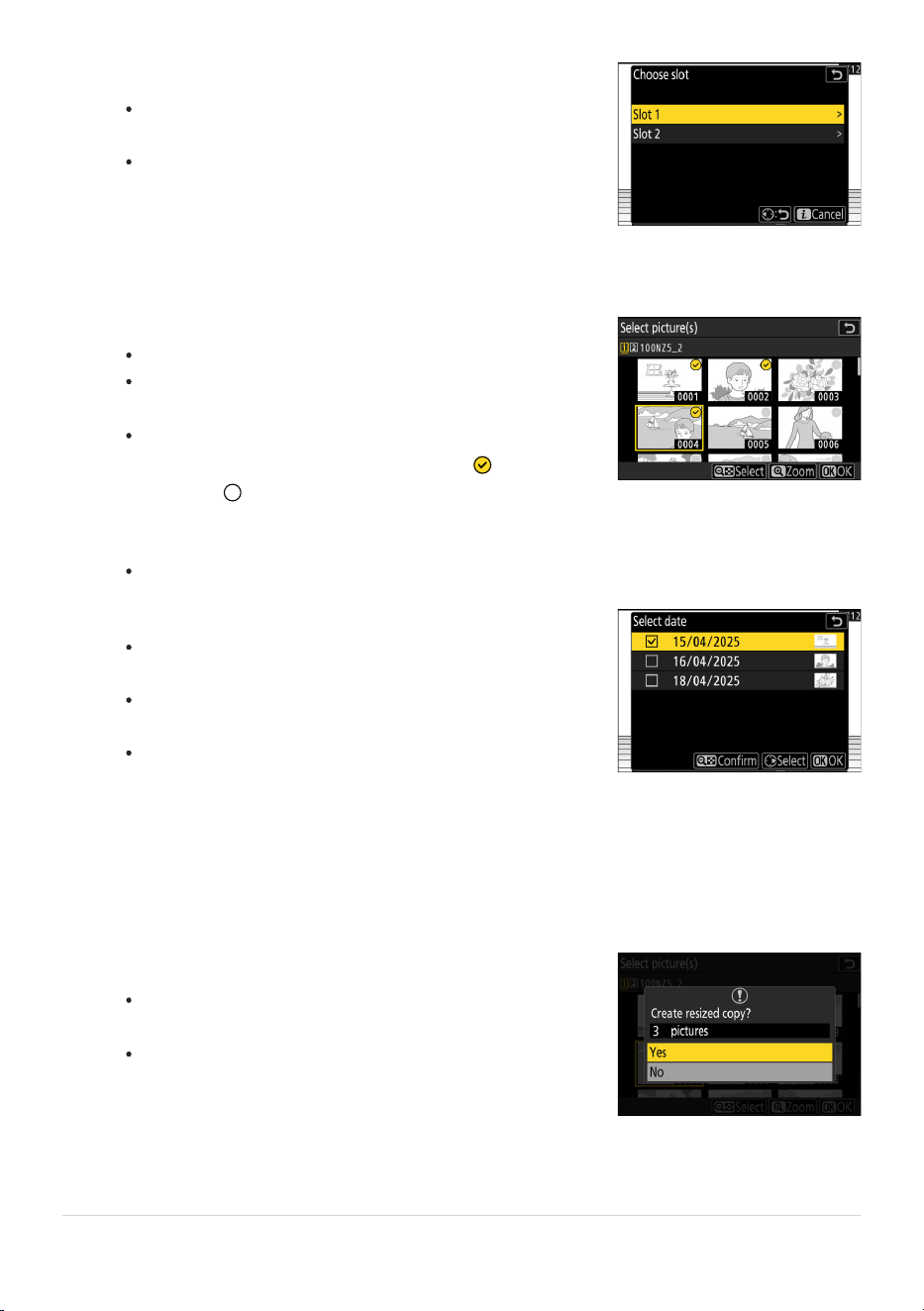
Select the source slot.
Highlight the slot with the card containing the desired
pictur
es and press 2.
You will not be prompted to select the slot if only one
memory card is inserted.
If you chose [Select picture(s)]:
Highlight pictures using the multi selector
.
To view the highlighted picture full screen, press and hold
the X button.
To select the highlighted picture, press the W (Q) button.
Selected pictures are marked with a check (
). To remove
the check ( ) and deselect the current picture, press the W
(Q) button again. The selected pictures will all be copied at
the size selected in Step2.
Press J to proceed once selection is complete.
If you chose [Select date]:
Highlight dates using the multi selector and press 2 to
select (M) or deselect (U).
All pictures taken on dates marked with a check (M) will be
copied at the size selected in Step2.
Press J to proceed once selection is complete.
Save the resized copies.
A confirmation dialog will be displayed; highlight [Y
es] and
press J to save the resized copies.
To cancel the operation before all copies have been created,
press the G button; when a confirmation dialog is
displayed, highlight [Yes] and press J.
Choose pictures.
If you chose [Select folder
]:
Highlight a folder and press J to select; all pictures in the selected folder will be copied at the
size selected in Step2.
280
Resize
4
5
6
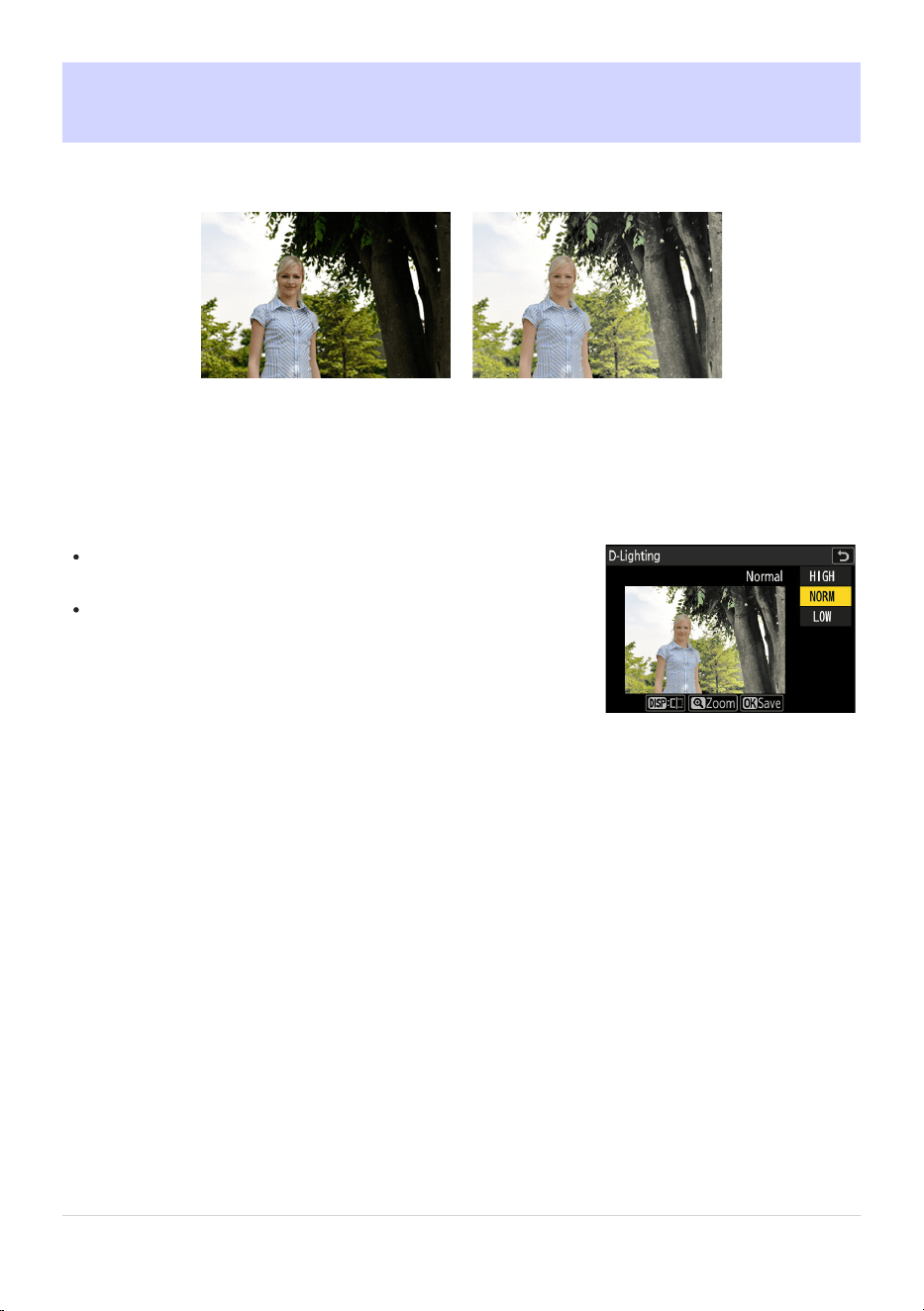
Before After
Press 1 or 3 t
o choose the amount o
f corr
ection performed.
The effect can be previewed in the edit display.
Press J to save the retouched copy.
D-Lighting
D-Lighting brightens shadows. It is ideal for dark or backlit phot
ographs.
The effect can be previewed in the edit display. To view the unedited picture, press and hold the DISP
button.
281
D-Lighting
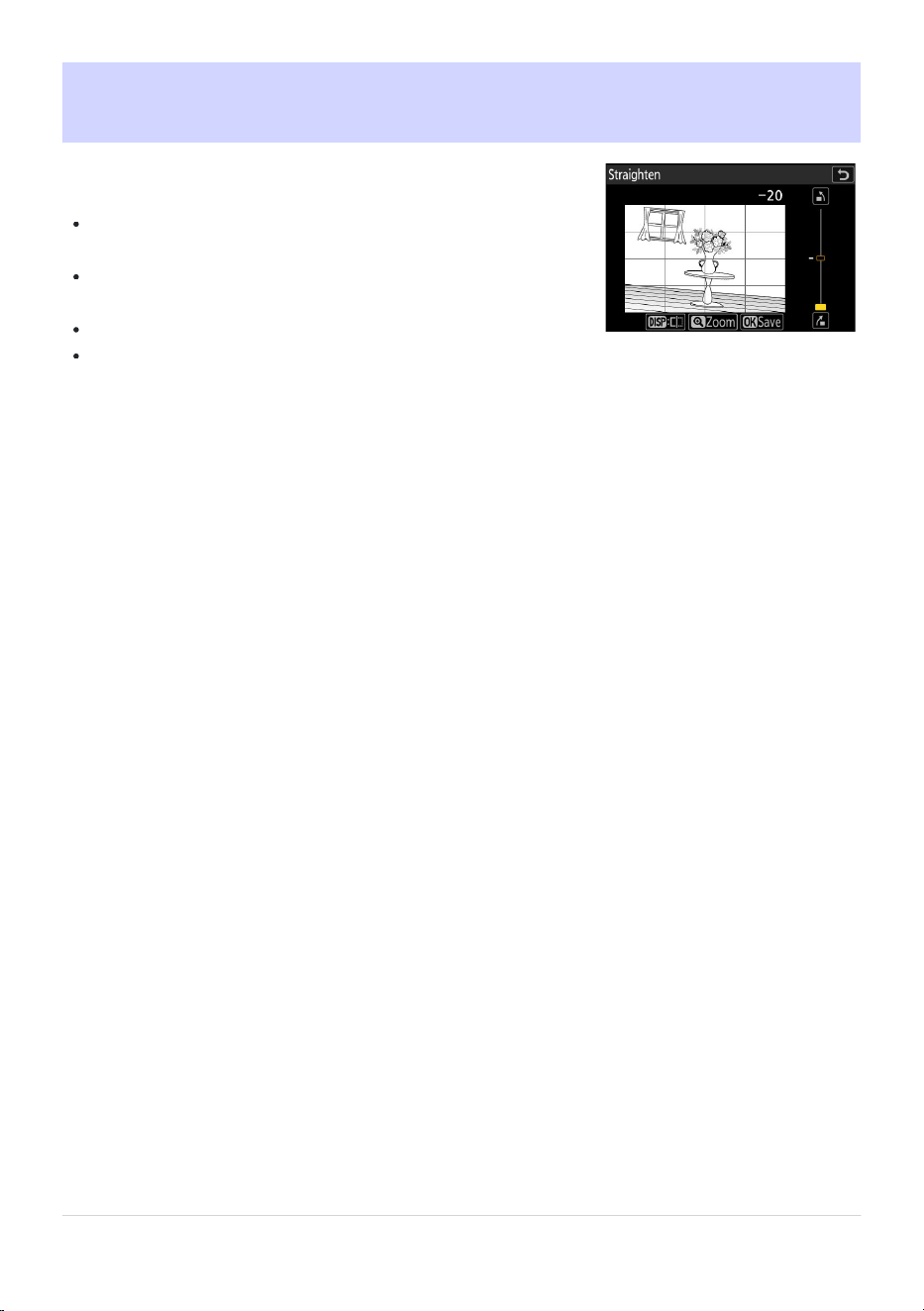
Rotate pictures by up to ±5° in increments of approximately 0.25°.
The effect can be preview
ed in the edit display. To view the
unedited picture, press and hold the DISP button.
The greater the rotation, the more will be trimmed from the
edges.
Press 1 or 3 to choose the amount of straightening performed.
Press J to save the retouched copy.
Straighten
282
Straighten
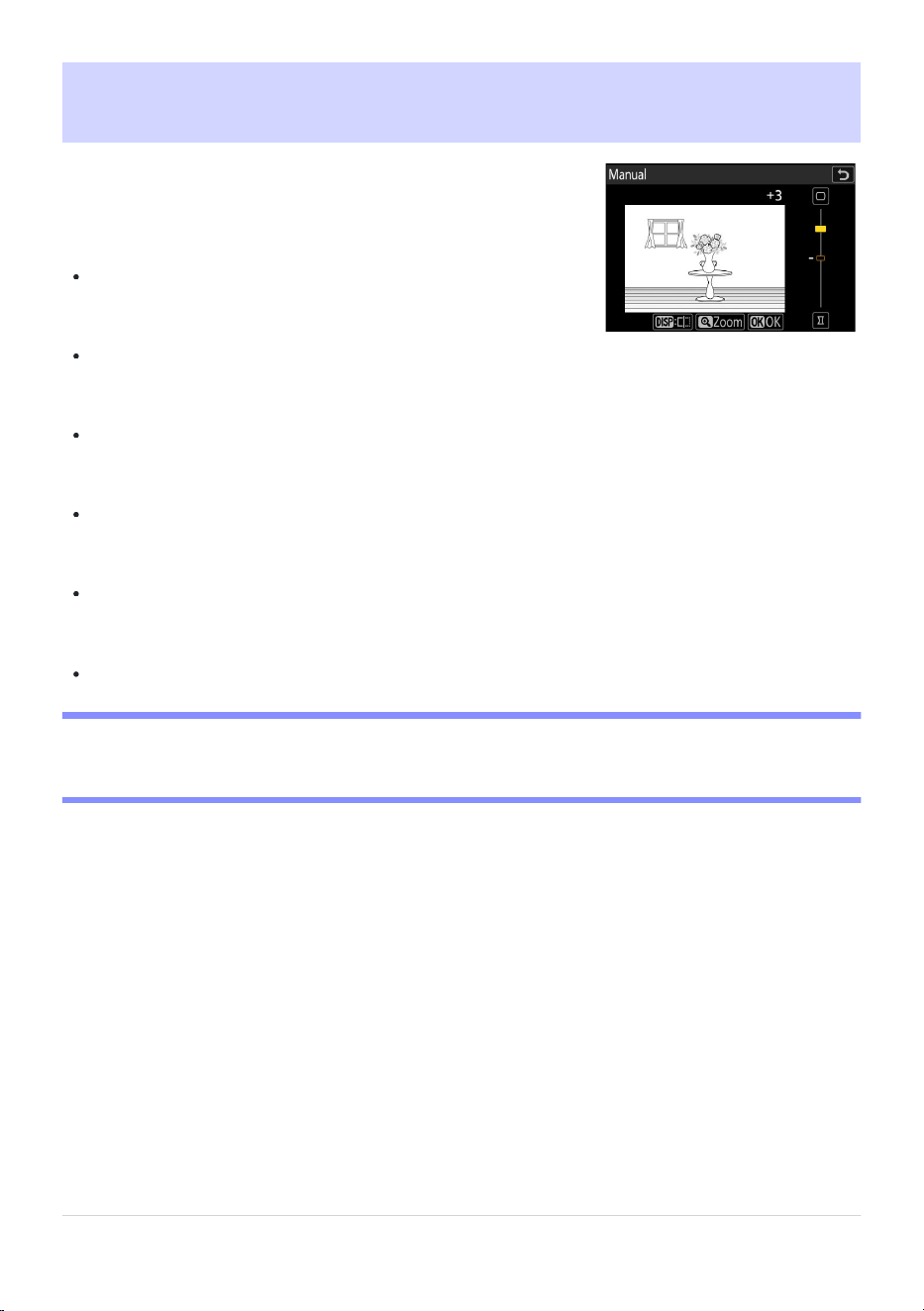
Create copies with reduced peripheral distortion, reducing barrel
distortion in pictur
es taken with wide-angle lenses or pincushion
distortion in pictures taken with telephoto lenses.
If the camera detects distortion, it will offer a choice of [Auto]
and [Manual]. Select [Auto] to let the camera correct distortion
automatically.
If the camera is unable to detect distortion, the only option
available will be [Manual]. Select [Manual] to reduce distortion
manually.
Note that [Manual] must be used with copies created using the
[Auto] option and with photos taken using the [Auto distortion
control] option in the photo shooting menu.
When [Manual] is selected, the effect can be previewed in the
display. To view the unedited picture, press and hold the DISP
button.
Press 1 to reduce pin-cushion distortion, 3 to reduce barrel
distortion. Press J to save changes and return to the previous
display.
Press J to save the retouched copy.
Distortion Control
D Caution: Distortion Contr
ol
Note that greater amounts of distortion control result in more of the edges being cropped out.
283
Distortion Control
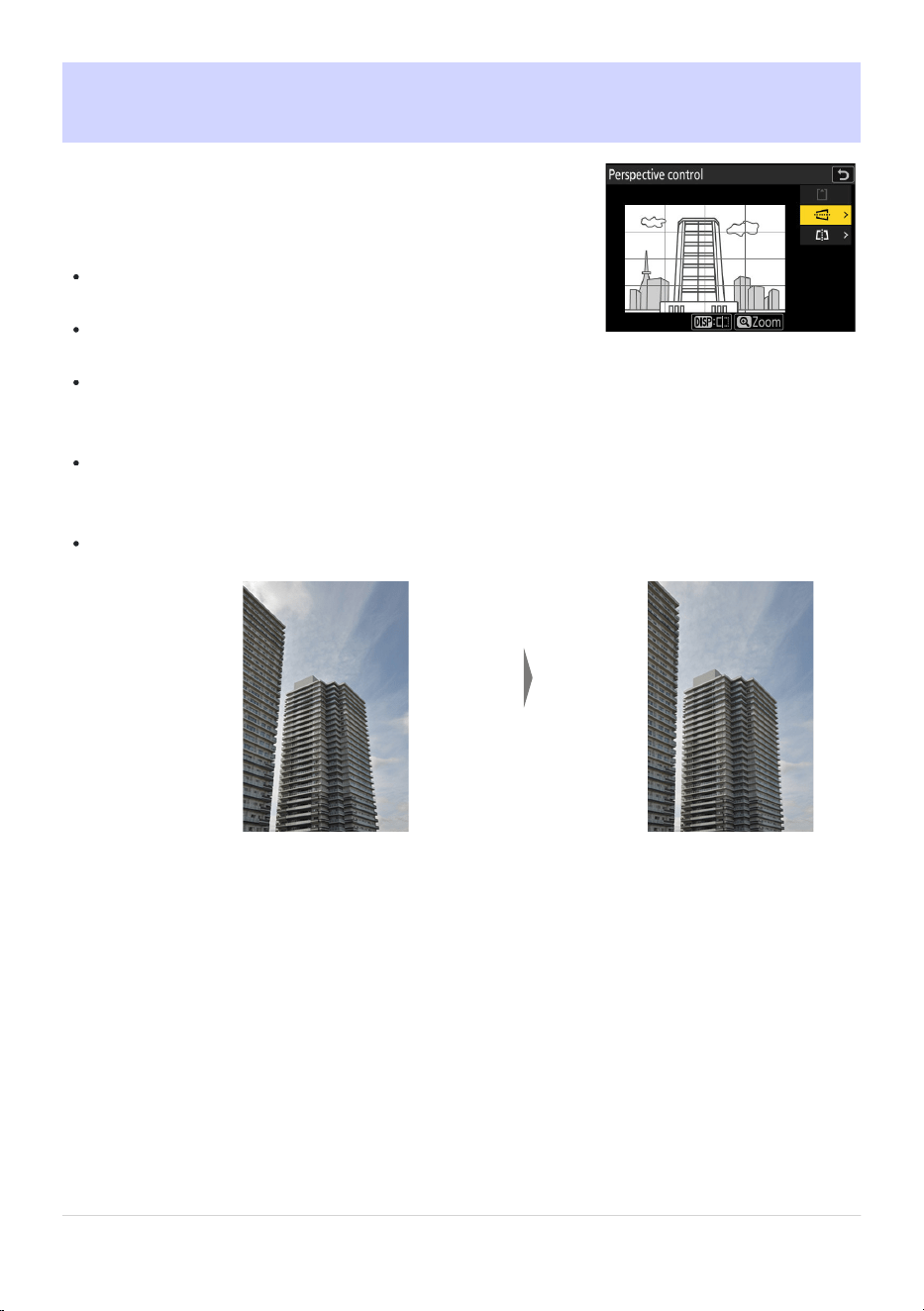
Create copies that reduce the horizontal and vertical effects of
perspective in phot
os taken looking up from the base of a tall
object.
The effect can be previewed in the edit display. To view the
unedited picture, press and hold the DISP button.
Note that greater amounts of perspective control result in more
of the edges being cropped out.
For horizontal correction, highlight J and press 2. Press 1 to
stretch the left edge, 3 to stretch the right. Press J to save
changes and return to the previous display.
For vertical correction, highlight K and press 2. Press 1 to
stretch the top edge, 3 to stretch the bottom. Press J to save
changes and return to the previous display.
Highlight N and press J to save the retouched copy.
Before After
Perspective Control
284
Perspective Control
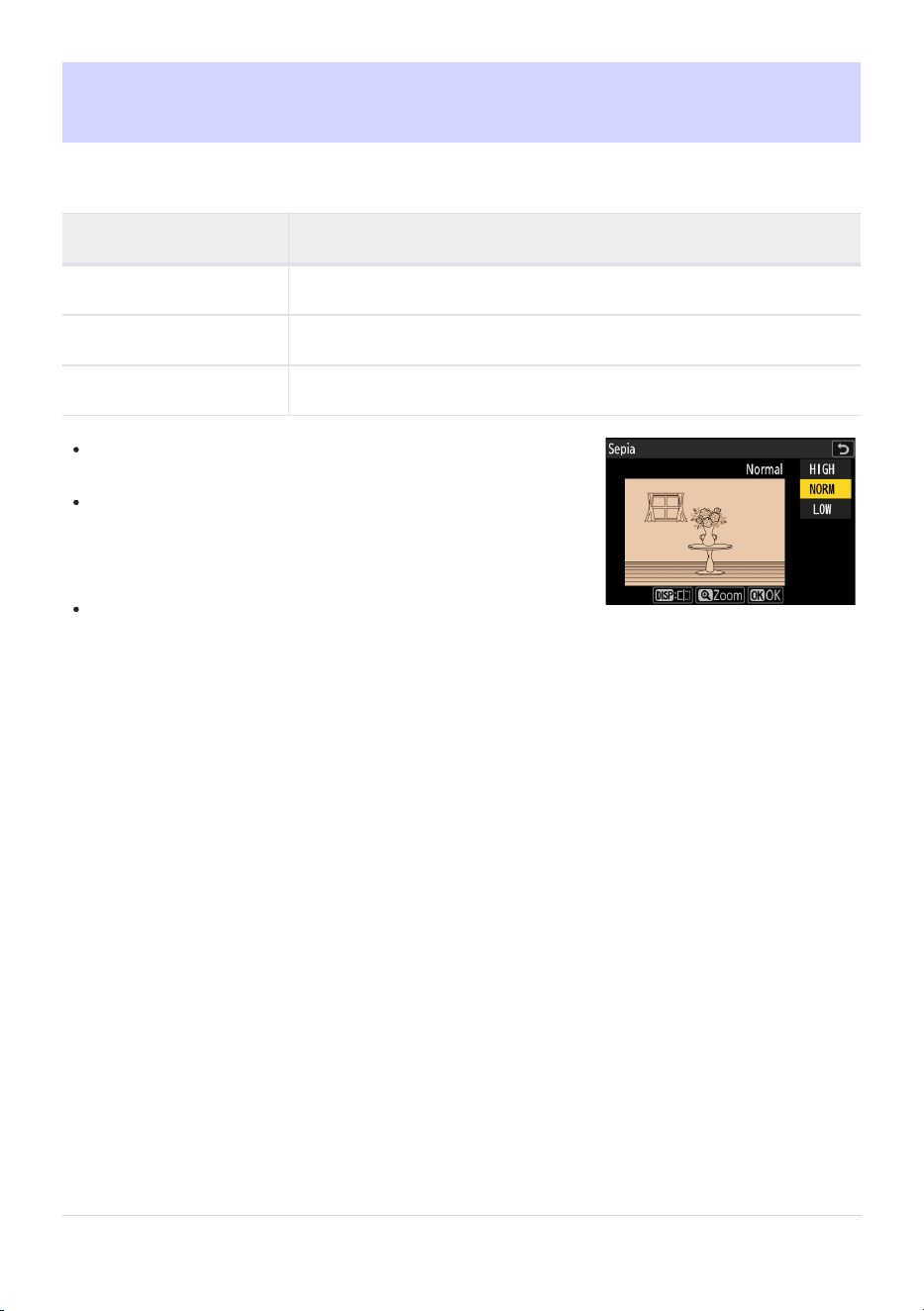
The effect can be previewed in the edit display. To view the
unedited picture, pr
ess and hold the DISP button.
Highlighting [Sepia] or [Cyanotype] and pressing 2 displays
saturation options for the selected monochrome tint; choose
from [High], [Normal], and [Low]. Press J to save changes and
return to the tint menu.
Press J to save the retouched copy.
Monochrome
Copy photographs in a selected
monochrome tint.
Option Description
[Black
-and-white] Copy phot
ographs in black
-and-white.
[Sepia] Copy photographs in sepia.
[Cyanotype] Copy photographs in blue-and-white monochrome.
285
Monochrome
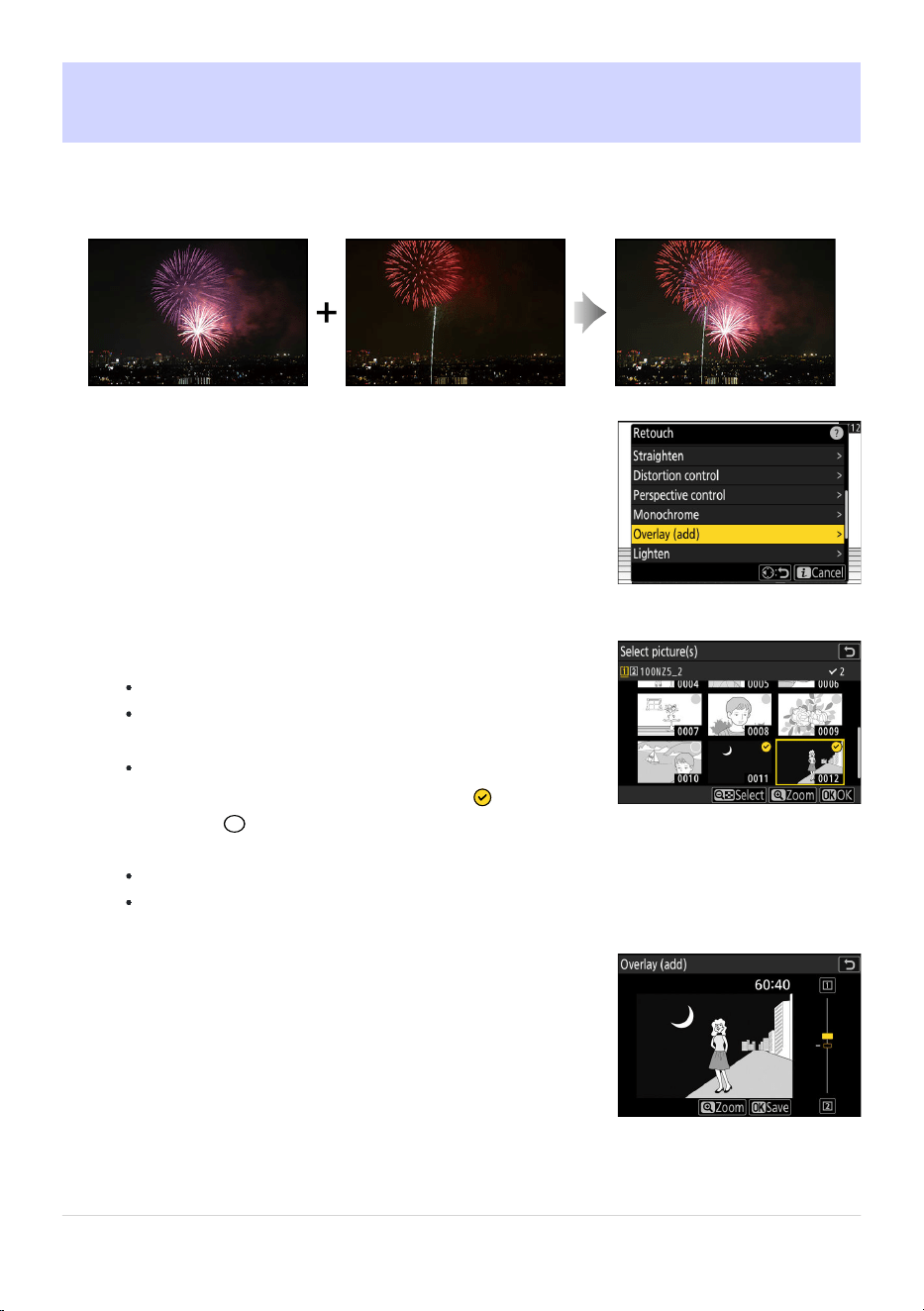
Select [Retouch] in the i menu, then highlight [
Ov
erlay
(add)
] and press 2.
Select the pictures.
Highlight pictur
es using the multi select
or
.
To view the highlighted picture full screen, press and hold
the X button.
To select the highlighted picture, press the W (Q) button.
Selected pictures are marked with a check (
). To remove
the check ( ) and deselect the current picture, press the
W (Q) butt
on again.
Pictur
es with differ
ent image areas cannot be selected.
Press J to proceed once the second picture is selected.
Adjust balance.
The overlay can be preview
ed in the display. Press 1 or 3 to
adjust the balance between the two pictures. Press 1 to make
the first picture more visible and the second less, 3 for the
opposite effect.
Overlay (Add)
Combine two existing photographs t
o create a single picture that is saved separately from the
originals.
286
Overlay (Add)
1
2
3

Save the overlay.
Press J
to save the overlay.
D Cautions: [Overlay (add)]
Color
s and brightness in the preview may differ from the final picture.
Only pictures created with this camera can be selected. Pictures created with other models cannot
be selected.
The overlay will include only pictures created with the same options selected for [Image area]>
[Choose image area] in the photo shooting menu.
The image quality setting for the completed overlay is that of the highest quality picture it contains.
Overlays that include NEF (RAW) pictures will be saved at an image quality of [JPEG/HEIF finem].
All JPEG pictures in the overlay must be the same size.
The size of overlays that include both NEF (RAW) and JPEG images is determined by the JPEG
picture.
The overlay has the same photo info (including date of recording, metering, shutter speed, aperture,
shooting mode, exposure compensation, focal length, and picture orientation) and values for white
balance and Picture Control as the first of the two pictures selected. Copyright information, however,
is not copied to the new picture. The comment is similarly not copied; instead, the comment
currently active on the camera, if any, is appended.
287
Overlay (Add)
4
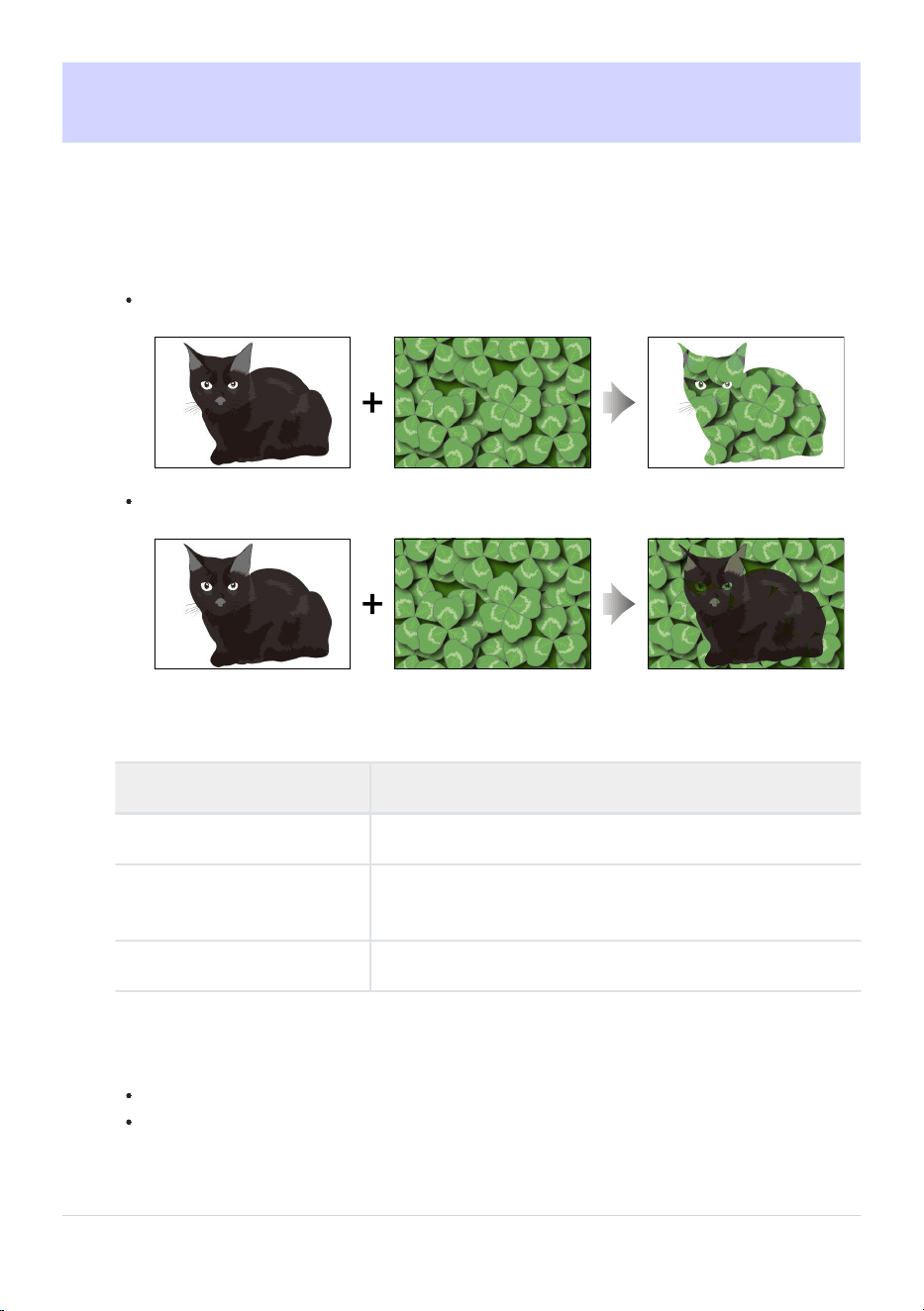
“Lighten” and “Darken”
The camera compares multiple select
ed pictures and selects only the brightest or darkest pixels at each
point in the picture to create a single new JPEG copy.
Select [Retouch] in the i menu, then highlight [Lighten] or [Darken] and press 2.
[Lighten]: The camera compares the pixels in each picture and uses only the brightest.
[Darken]: The camera compares the pixels in each picture and uses only the darkest.
Choose how pictures are selected.
Option Description
[Select individual pictures] Select pictures for the ov
erlay one-by-one.
[Select consecutive pictures]
Select two pictures; the overlay will include the two pictures
and all the pictures between them.
[Select folder] The overlay will include all pictures in the selected folder.
Select the source slot.
Highlight the slot with the card containing the desired pictures and press 2.
You will not be prompted to select the slot if only one memory card is inserted.
288
“Lighten” and “Darken”
1
2
3

Select the pictures.
If you chose [Select individual pictur
es]:
Highlight pictures using the multi selector.
To view the highlighted picture full screen, press and hold the X button.
To select the highlighted picture, press the W (Q) button. Selected pictures are marked with
a check (
). To remove the check ( ) and deselect the current picture, press the W (Q)
button again. The selected pictures will be combined using the option selected in Step1.
Press J to proceed once selection is complete.
If you chose [Select consecutive pictures]:
All pictures in a range chosen using the multi selector will be combined using the option
selected in Step1.
Use the W (Q) button to select the first and last pictures in the desired range.
The first and last pictures are indicated by icons and the pictures between them by
icons.
You can alter your selection by using the multi selector to highlight different pictures to
serve as the first or last frame. Press the center of the sub-selector to choose the current
picture as the new start or end point.
To view the highlighted picture full screen, press and hold the X button.
Press J to proceed once selection is complete.
If you chose [Select folder]:
Highlight the desired folder and press J to overlay all pictures in the folder using the option
selected in Step1.
Save the overlay.
A confirmation dialog will be displayed; highlight [Yes] and press J to save the overlay and
display the resulting picture.
To interrupt the process and display a confirmation dialog before the operation is complete,
press the G button; to save the current overlay “as is” without adding the remaining
pictures, highlight [Save and exit] and press J. To exit without creating an overlay, highlight
[Discard and exit] and press J.
289
“Lighten” and “Darken”
4
-
-
-
5

D Cautions: [Lighten] and [
Darken]
Only pictures created with this camera can be selected. Pictures created with other models cannot
be selected.
The overlay will include only pictures created with the same options selected for [Image area]>
[Choose image area] in the photo shooting menu.
The image quality setting for the completed overlay is that of the highest quality picture it contains.
Overlays that include NEF (RAW) pictures will be saved at an image quality of [JPEG/HEIF finem].
All JPEG pictures in the overlay must be the same size.
The size of overlays that include both NEF (RAW) and JPEG images is determined by the JPEG
picture.
“Noise” (in the form of randomly-spaced bright pixels, fog, or lines) increases with the number of
pictures in the overlay.
Noise will be less noticeable if the pictures for the overlay were shot with 0 or a negative value
selected for the [Sharpening] Picture Control parameter.
Noise becomes noticeable in overlays that include around 50 pictures or more.
290
“Lighten” and “Darken”
-
-
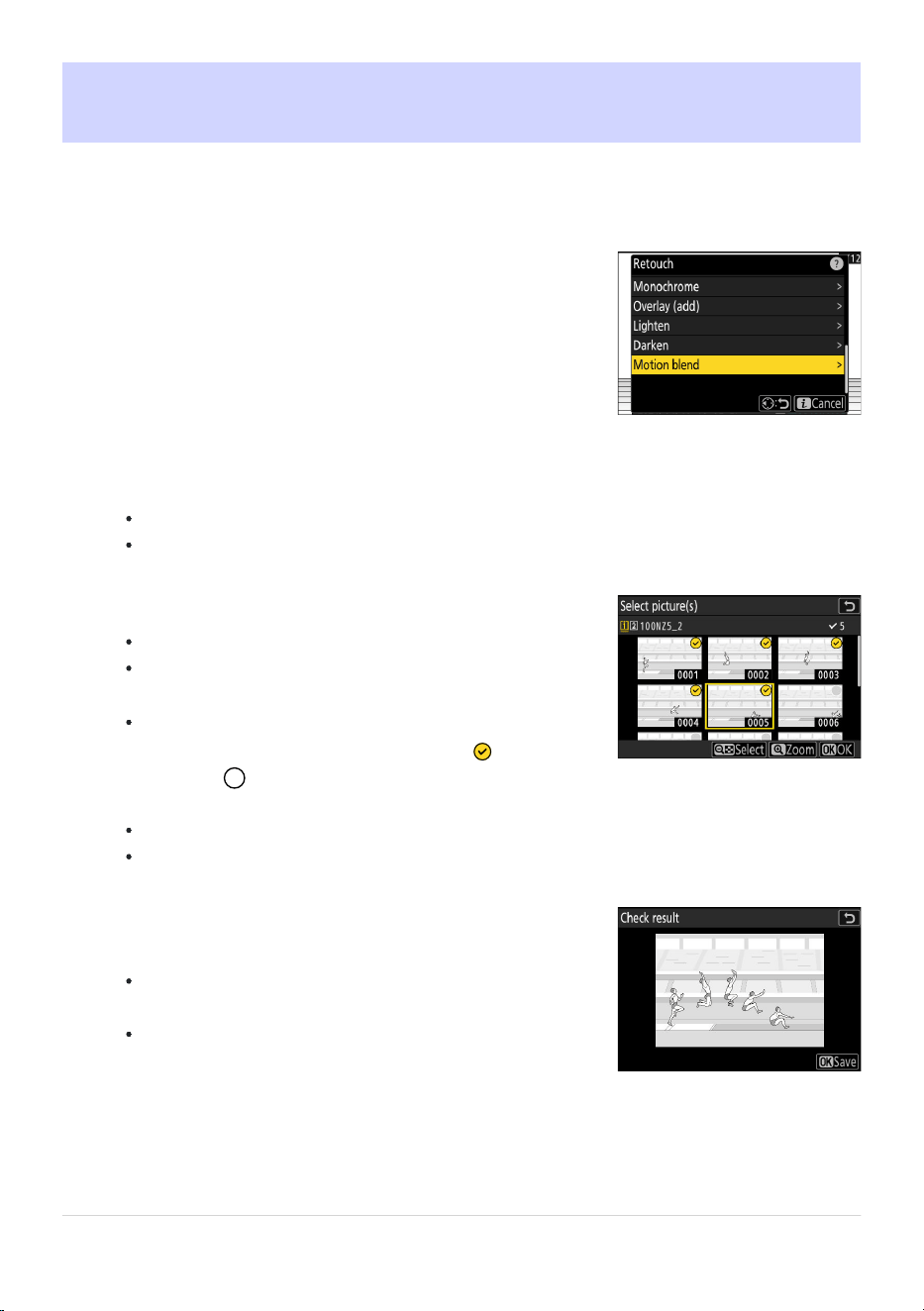
Select [Retouch] in the i menu, then highlight [Motion
blend] and press 2
.
Select the pictures.
Highlight pictures using the multi selector
.
To view the highlighted picture full screen, press and hold
the X button.
To select the highlighted picture, press the W (Q) button.
Selected pictures are marked with a check (
). To remove
the check ( ) and deselect the current picture, press the
W (Q) button again.
Motion blends can contain between 5 and 20 pictur
es.
Press J to proceed once selection is complete.
Check the results.
Check the results of the ov
erlay in the preview display.
To return to Step3 and choose different pictures, tap Z or
press 4.
To proceed with the current selection, press J; a
confirmation dialog will be displayed.
Motion Blend
The camera examines a selected burst o
f pictures to detect moving subjects and overlays them to
create a single JPEG image.
Select the source slot.
Highlight the slot with the card containing the desired pictures and press 2.
You will not be prompted to select the slot if only one memory card is inserted.
291
Motion Blend
1
2
3
4
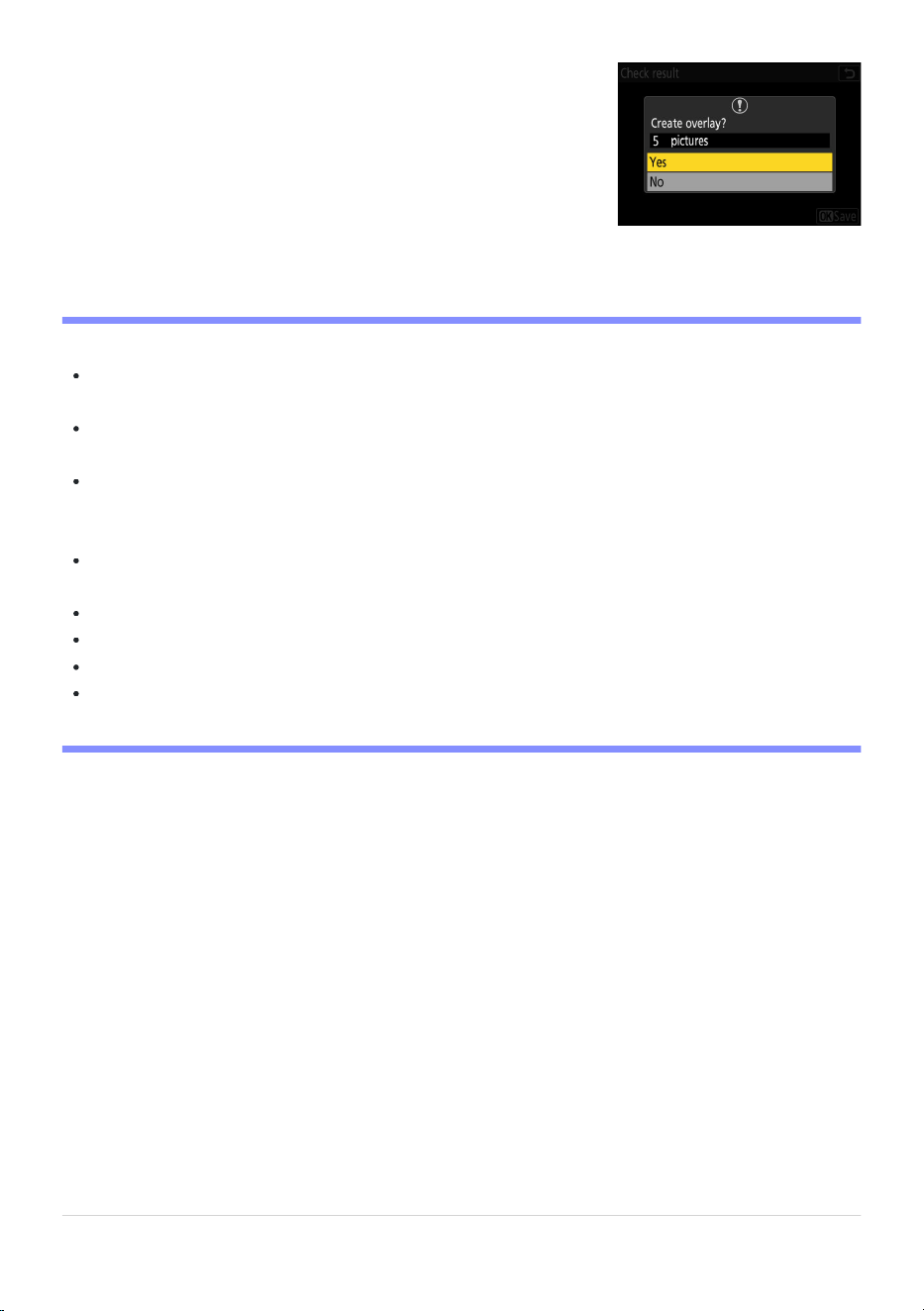
Save the overlay.
Highlight [Yes] in the confir
mation dialog and press J to save
the overlay.
D Cautions: [Motion blend]
The final picture may differ fr
om the preview both in how it looks (including color and brightness)
and in how the pictures are combined.
Only pictures created with this camera can be selected. Pictures created with other models cannot
be selected.
[Motion blend] is intended for bursts shot with the camera on a tripod, with a fixed background
and moving subjects. The desired results may consequently not be achieved with bursts shot
without a tripod.
The overlay will include only pictures created with the same options selected for [Image area]>
[Choose image area] in the photo shooting menu.
The image quality setting for the completed overlay is that of the highest quality picture it contains.
Overlays that include NEF (RAW) pictures will be saved at an image quality of [JPEG/HEIF finem].
All JPEG pictures in the overlay must be the same size.
The size of overlays that include both NEF (RAW) and JPEG images is determined by the JPEG
picture.
292
Motion Blend
5

Editing Videos
Editing Videos
Videos can be edit
ed using the following options:
Option Description
9
[T
r
im video] T
rim unwant
ed footage.
4
[Save current frame] Save a selected frame as a JPEG still.
1
[Save consecutive frames]
Save the frames in a selected length of footage as a series of
individual JPEG images.
[Volume control] Volume can also be adjusted while playback is paused.
[Playback speed]
Select the video playback speed from [Original speed], [1/2×
speed], and [1/4× speed]. Selecting [1/2× speed] or [1/4×
speed] will slow video playback at ¹/₂× or ¹/₄× the speed. The
playback speed selection will be applied to all video playback.
These options are available only with videos recorded with [H.265 8-bit (MOV)] or [H.264 8-bit
(MP4)] selected for [Video file type] in the video recording menu.
293
Editing Videos
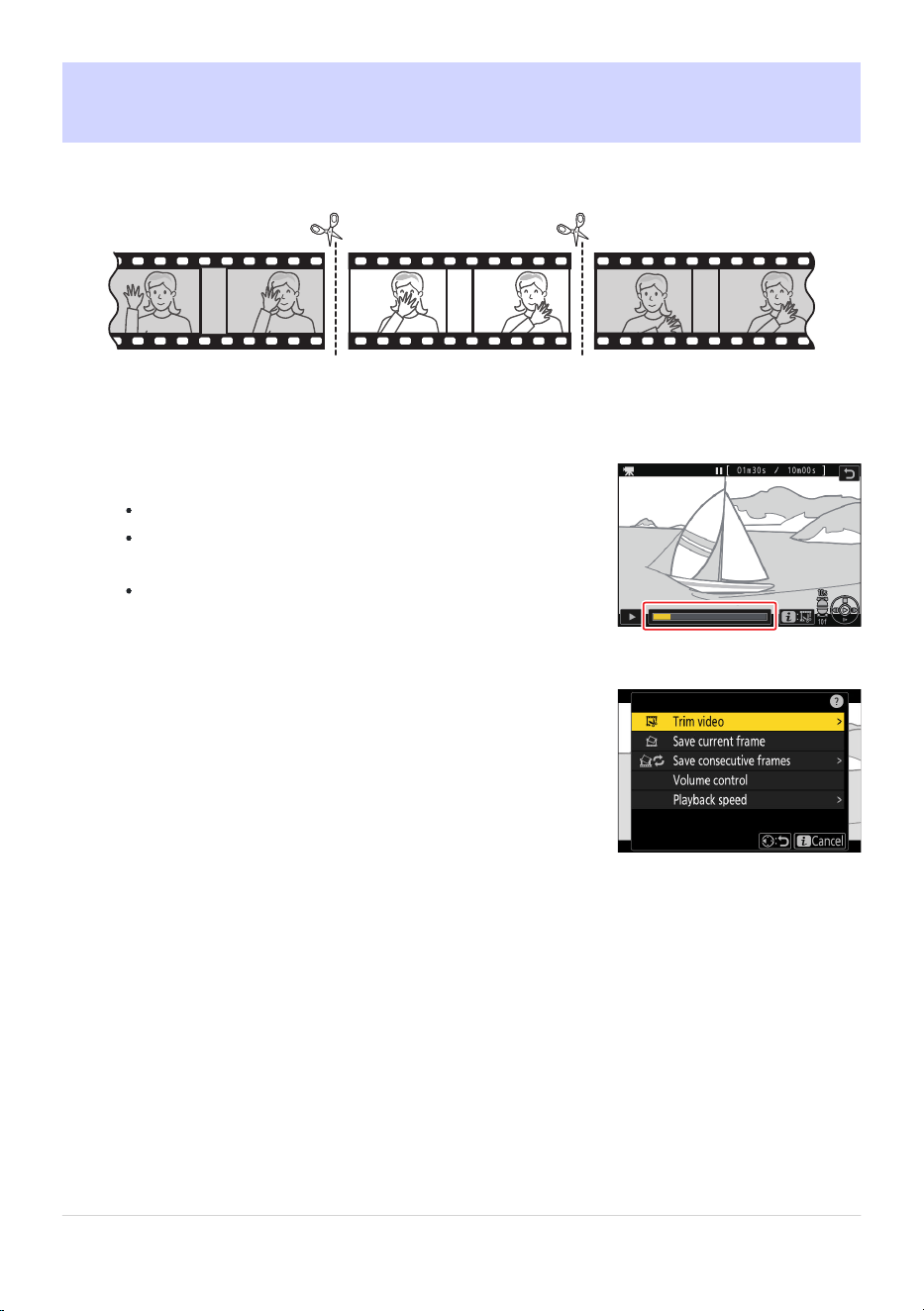
Pause the video on the new opening frame.
Press J
to start playback. Press 3 to pause.
Your approximate position in the video can be ascertained
from the video progress bar.
Press 4 or 2 or rotate the command dials to locate the
desired frame.
Press the i button, highlight [T
rim video], and press 2.
Trimming Videos
Trim unwanted footage.
Display a video full frame.
294
Trimming Videos
1
2
3
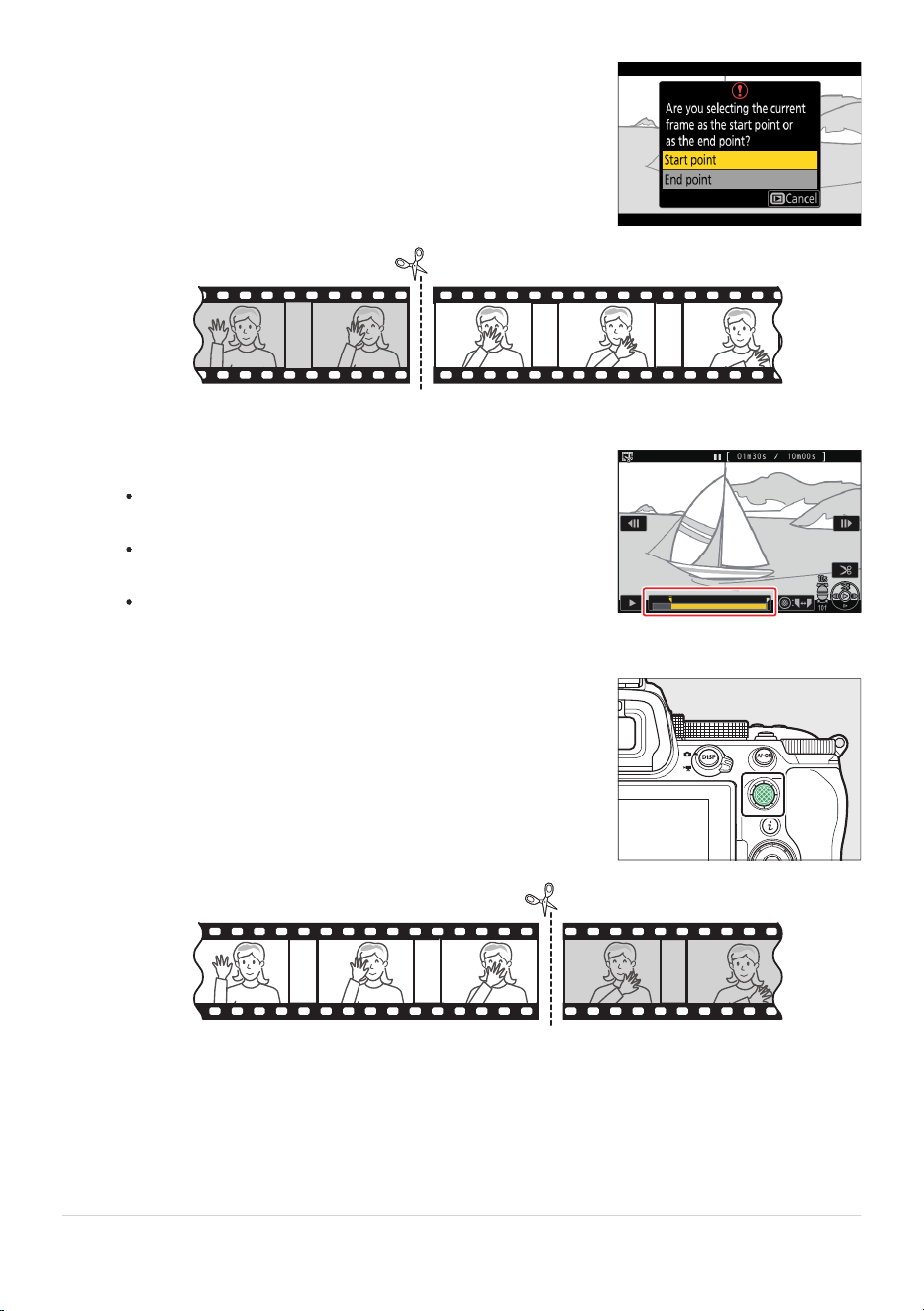
Choose the start point.
To creat
e a copy that begins from the current frame, highlight
[Start point] and press J.
Confirm the new start point.
If the desired frame is not currently display
ed, press 4 or 2
to advance or rewind a frame at a time.
Rotate the main command dial one stop to skip ahead or
back 10 frames.
Rotate the sub-command dial one stop to skip ahead or
back 10s.
Choose the end point.
Pr
ess the cent
er o
f the sub-selector to switch to the end-point
selection tool (x) and then select the closing frame (x) as
described in Step5.
Press 1 to create the copy.
295
Trimming Videos
4
5
6
7
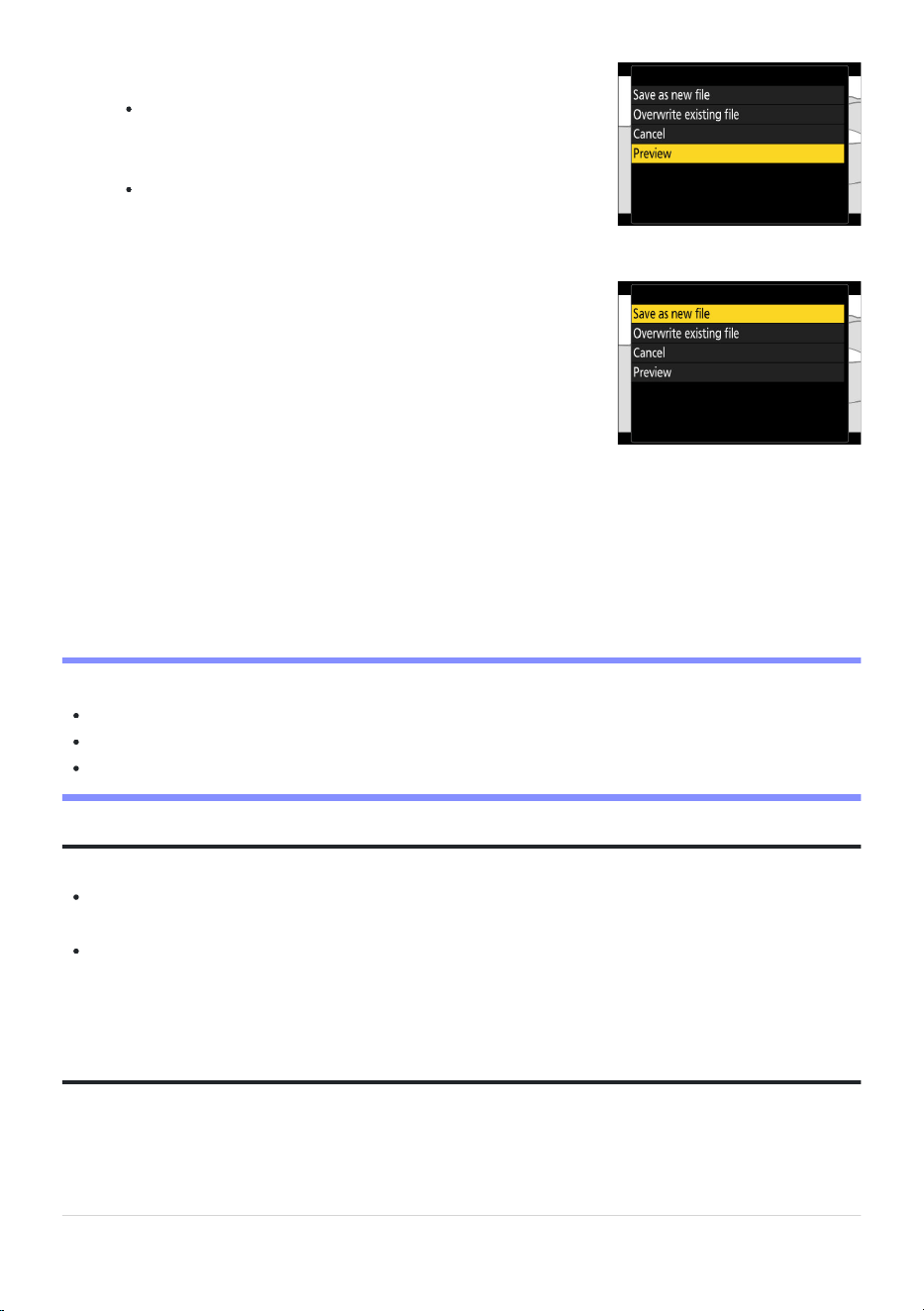
Preview the copy.
To preview the copy
, highlight [Preview] and press J (to
interrupt the preview and return to the save options menu,
press 1).
To abandon the current copy and return to Step5, highlight
[Cancel] and press J.
Choose a save option.
Choose [Save as new file] t
o save the edited copy as a new
file. To replace the original video with the edited copy, choose
[Overwrite existing file].
Save the copy.
Press J
to save the copy.
D Cautions: Trimming Videos
The copy will not be saved if there is insufficient space available on the memory card.
Videos less than two seconds long cannot be edited using [Trim video].
Copies have the same time and date of creation as the original.
Tip: Removing Opening or Closing Footage
To remove only the closing footage from a video, highlight [End point] and press J in Step4, select
the closing frame, and proceed to Step7 without pressing the center of sub-selector in Step6.
To remove only the opening footage, proceed to Step7 without pressing the center of sub-selector
in Step6.
Tip: The i Menu [Trim video] Option
Videos can also be edited using the [Trim video] item in the i menu.
296
Trimming Videos
8
9
10
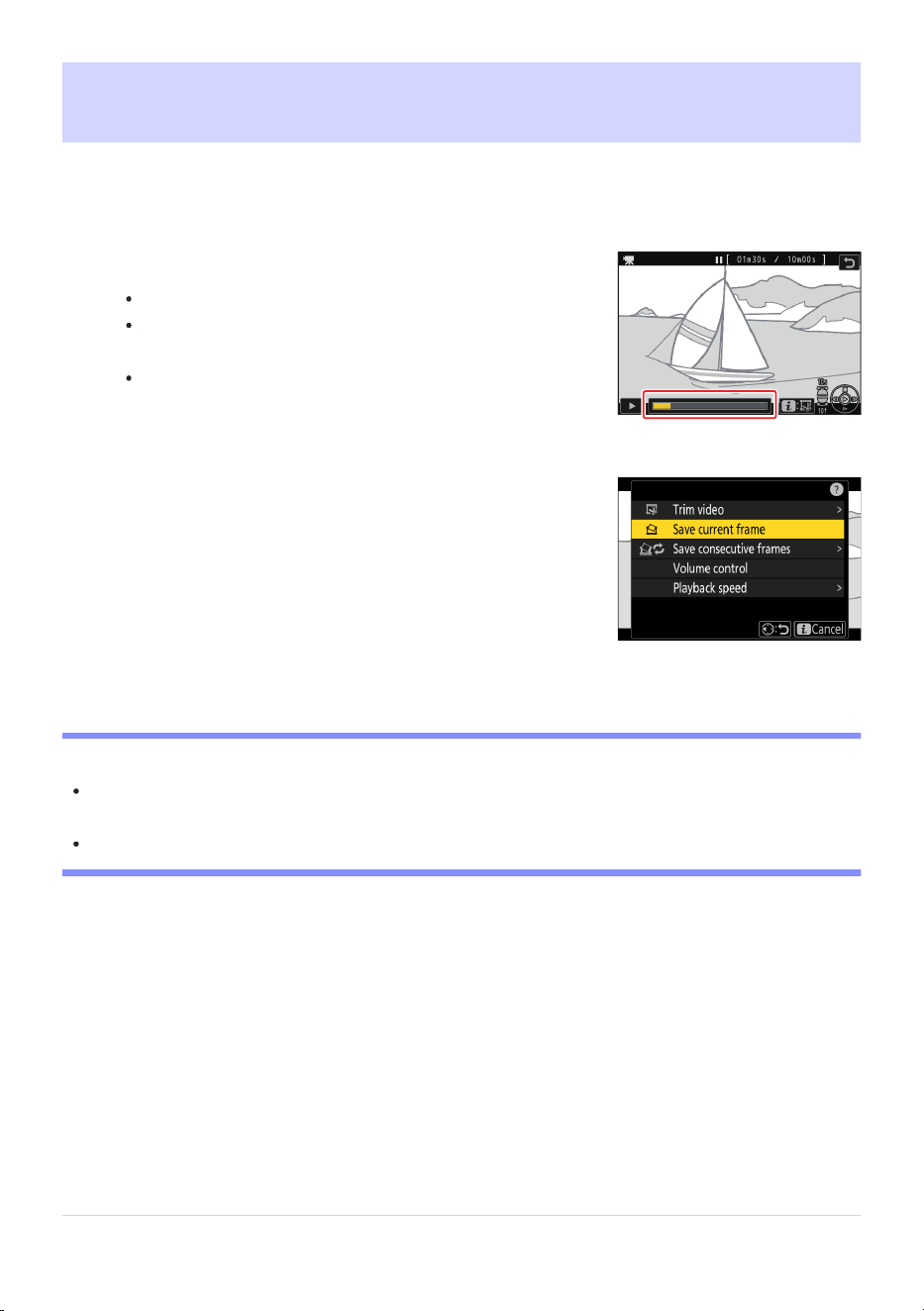
Pause the video on the desired frame.
Press 3
to pause playback.
Your approximate position in the video can be ascertained
from the video progress bar.
Press 4 or 2 or rotate the command dials to locate the
desired frame.
Press the i butt
on and highlight [
Sav
e current frame].
Press J to create a JPEG copy of the current frame.
Saving the Current Frame as a JPEG Still
Stills can be creat
ed from individual frames of existing videos. You can create a single still from the
current frame or a series of stills from a selected length of footage.
D [Save current frame]
Stills are saved at the dimensions selected for [Frame size/frame rate] in the video recording menu
when the video was recorded.
They cannot be retouched.
297
Saving the Current Frame as a JPEG Still
1
2
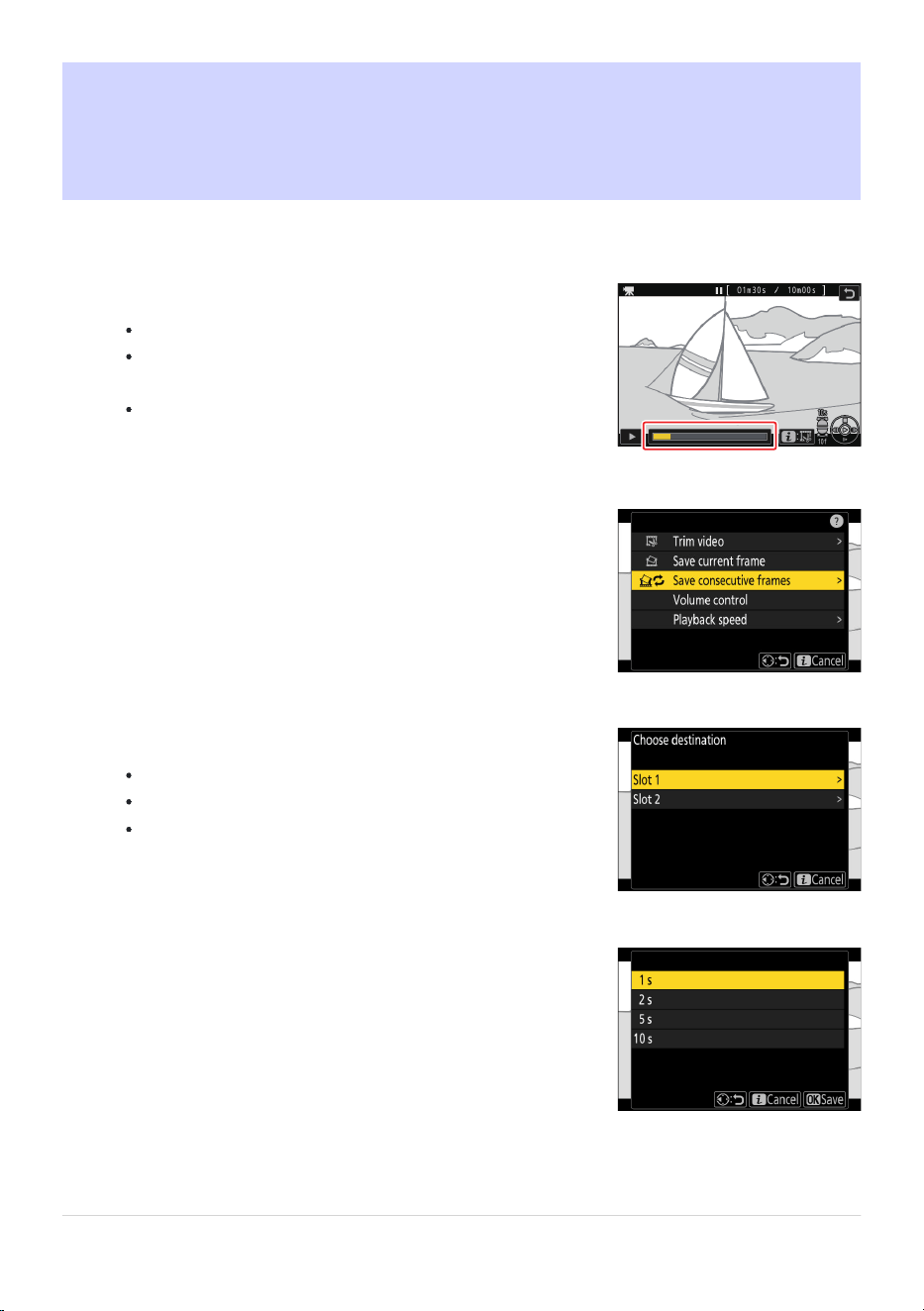
Pause the video on the desired frame.
Press 3
to pause playback.
Your approximate position in the video can be ascertained
from the video progress bar.
Press 4 or 2 or rotate the command dials to locate the
desired frame.
Press the i butt
on, highlight [
Sav
e consecutive frames]
and press 2.
Choose a destination.
Choose the destination.
Pr
ess
1
or 3 to highlight a card slot and press J.
You will not be prompted to select the slot if only one
memory card is inserted.
Choose the length of footage.
Choose the length o
f footage that will be sav
ed as stills.
Creating Stills from a Selected Length of
Footage
The frames in a select
ed length of footage can be sav
ed as a series of individual JPEG images.
298
Creating Stills from a Selected Length of Footage
1
2
3
4

Press J.
The selected footage will be saved as a series o
f JPEG stills. The number varies with the video
frame rate.
D [Save consecutive frames]
Stills are saved at the dimensions selected for [Frame size/frame rate] in the video recording menu
when the video was recorded.
They cannot be retouched.
299
Creating Stills from a Selected Length of Footage
5
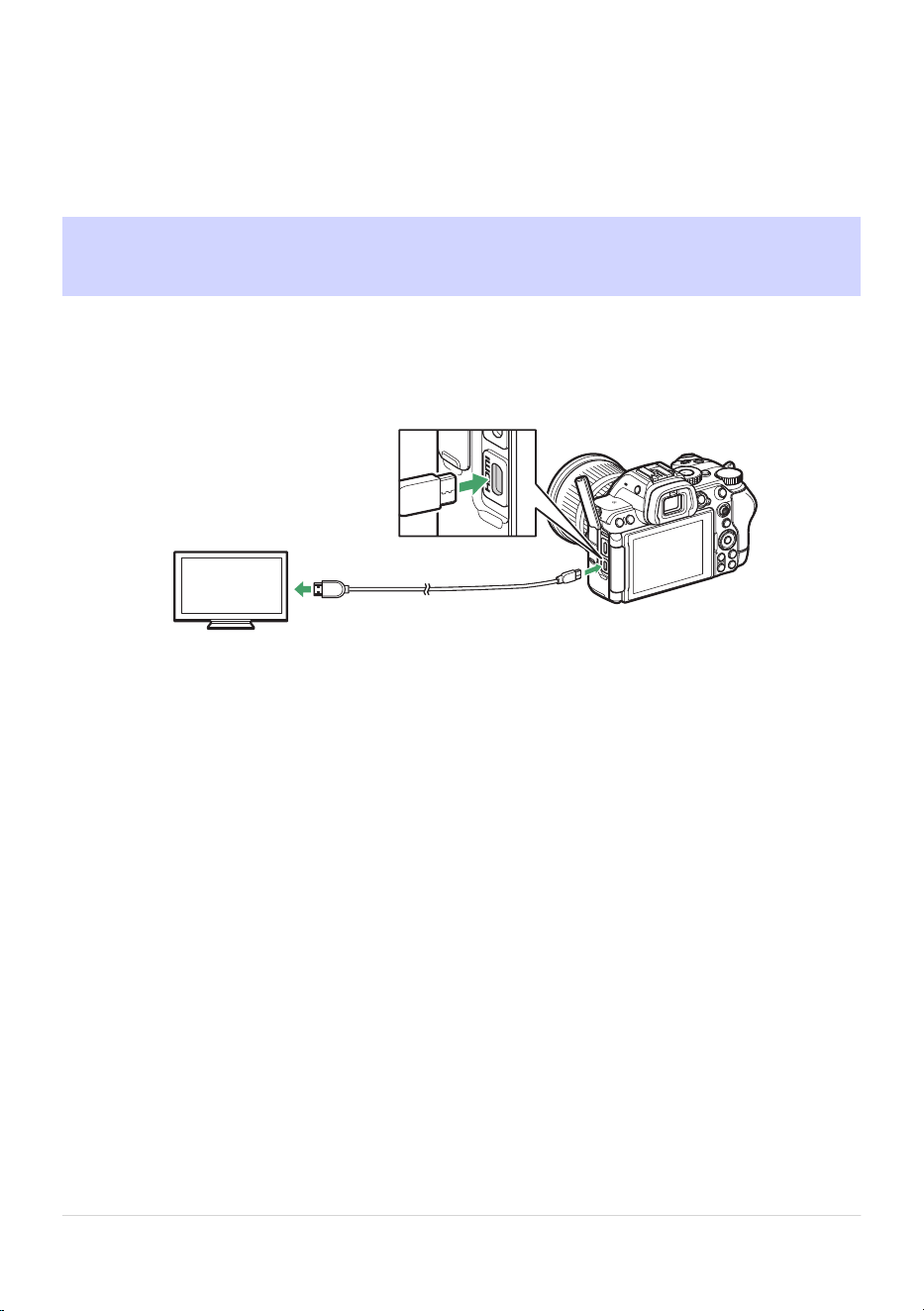
Connecting to HDMI TVs and
Recorder
s
Connecting to HDMI Devices
The camera can be connected to TVs, recorders, and other devices featuring HDMI connectors. Use a
third-party Type D HDMI cable. The cable must be purchased separately. Always turn the camera off
before connecting or disconnecting a cable.
1
2
HDMI connector for connection to camera
HDMI connector for connection to ext
ernal device
*
Choose a cable with a connector that matches the connector on the HDMI device.
300
Connecting to HDMI Devices
1
2
*

TVs
After tuning the T
V to the HDMI input channel, turn the camera on and press the K button to view
pictures on the television screen.
Audio playback volume can be adjusted using the controls on the TV. Camera controls cannot be
used.
If the camera is paired with a smart device running the SnapBridge app, the device can be used to
control playback remotely while the camera is connected to a TV. See SnapBridge online help for
details.
301
TVs

Recorders
In video mode, the camera can record dir
ectly to connected HDMI recorders.
If a memory card is inserted in the camera when it is connected to a recorder, video will be recorded
both to the recorder and the memory card. If no memory card is inserted, the footage will be
recorded only to the external device.
Adjusting Settings
Use the [HDMI] item in the setup menu to adjust settings for HDMI output.
Option Description
[
Output resolution]
The format for output t
o HDMI devices can be selected from
[Auto], [2160p (progressive)], [1080p (progressive)], [1080i
(interlaced)]
*
, and [ 720p (progressive)].
[Output range]
The RGB video signal input range varies with the HDMI device.
[Auto], which matches the output range to the HDMI device,
is recommended in most situations. If the camera is unable to
determine the correct RGB video signal output range for the HDMI
device, you can choose from the following options:
[Limited range]: For devices with an RGB video signal input
range of 16 to 235. Choose this option if you notice a loss of
detail in shadows.
[Full range]: For devices with an RGB video signal input range
of 0 to 255. Choose this option if you notice that shadows are
“washed out” or too bright.
[Output shooting info]
Choose whether shooting information is displayed on the HDMI
device. If [ON] is selected, icons and other information in the
shooting display will be recorded with the footage saved to
external recorders.
[Mirror camera info display]
Choose whether the display in the camera monitor remains on
while an HDMI device is connected.
If [OFF] is selected, the display will remain off, reducing the drain
on the camera battery.
[Mirror camera info display] will be fixed at [ON] while [OFF] is
selected for [Output shooting info].
302
Recorders

Video will not be output at 1080i when [Auto] is selected for [Output r
esolution] even when a
recorder that supports this option is connected. Choose [1080i (interlaced)] for interlaced output.
[Output resolution]
When [Auto] is selected for [HDMI]> [Output resolution] in the setup menu, the camera
automatically detects whether the external recorder supports the frame size and rate selected on
the camera. If it does not, the camera will search for a supported resolution and frame rate in the
order listed below. If no supported resolution and frame rate is found, output will be suspended.
Frame size/frame rate Output resolution/frame rate search order
[3840×2160; 60p]
1080/60p V 2160/30p V 1080/30p
[3840×2160; 50p]
1080/50p V 2160/25p V 1080/25p
[3840×2160; 30p]
2160/30p V 1080/30p
[3840×2160; 25p]
2160/25p V 1080/25p
[3840×2160; 24p]
2160/24p V 1080/24p
[1920×1080; 120p]
[1920×1080; 30p ×4 (slow-motion)]
[1920×1080; 24p ×5 (slow-motion)]
1080/120p V 1080/60p V 1080/30p
[1920×1080; 100p]
[1920×1080; 25p ×4 (slow-motion)]
1080/100p V 1080/50p V 1080/25p
[1920×1080; 60p]
1080/60p V 1080/30p
[1920×1080; 50p]
1080/50p V 1080/25p
[1920×1080; 30p] 1080/30p
[1920×1080; 25p] 1080/25p
[1920×1080; 24p] 1080/24p
When an option other than [Aut
o] is select
ed for [HDMI] > [Output resolution] in the setup menu,
the signal will be output at the selected resolution. HDMI output will be suspended if:
output resolution is higher than the current frame size or
the recorder does not support the selected output resolution.
303
Recorders
*
-
-

Regardless of the option chosen for [HDMI] > [Output resolution] in the setup menu, the
maximum output resolution when [N-RA
W 12-bit (NEV)] is selected for [Video file type] in the
video recording menu is 1920 × 1080.
D Frame Rates for [Output resolution] Options Other Than [Auto]
Video recording rates of 120p, 100p, 60p, or 50p will be adjusted as follows if not compatible with the
frame rate chosen for the external recorder.
120p: The frame rate will first drop to 60p. If 60p is also not supported, it will drop to 30p.
100p: The frame rate will first drop to 50p. If 50p is also not supported, it will drop to 25p.
60p: The frame rate will drop to 30p.
50p: The frame rate will drop to 25p.
D Frame Rates for an [Output resolution] of [1080i (interlaced)]
Footage filmed at a frame rate of 120p, 60p, 30p, or 24p is output at 60i. Footage filmed at 100p, 50p,
or 25p is output at 50i.
D Frame Rates for an [Output resolution] of [ 720p (progressive)]
Footage filmed at a frame rate of 120p, 60p, 30p, or 24p is output at 60p. Footage filmed at 100p, 50p,
or 25p is output at 50p.
D Zoom
In case of a setting to record RAW videos (
0 219), you can zoom in the camera shooting display
and output to an ext
ernal recorder by pressing the X button if you are not currently recording
footage. The camera display and output to the recorder cannot be zoomed in while recording.
In case of a setting to record non-RAW videos, you can zoom in the camera shooting display by
pressing the X button whether or not a footage is being recorded; note that output to an external
recorder cannot be zoomed in.
304
Recorders
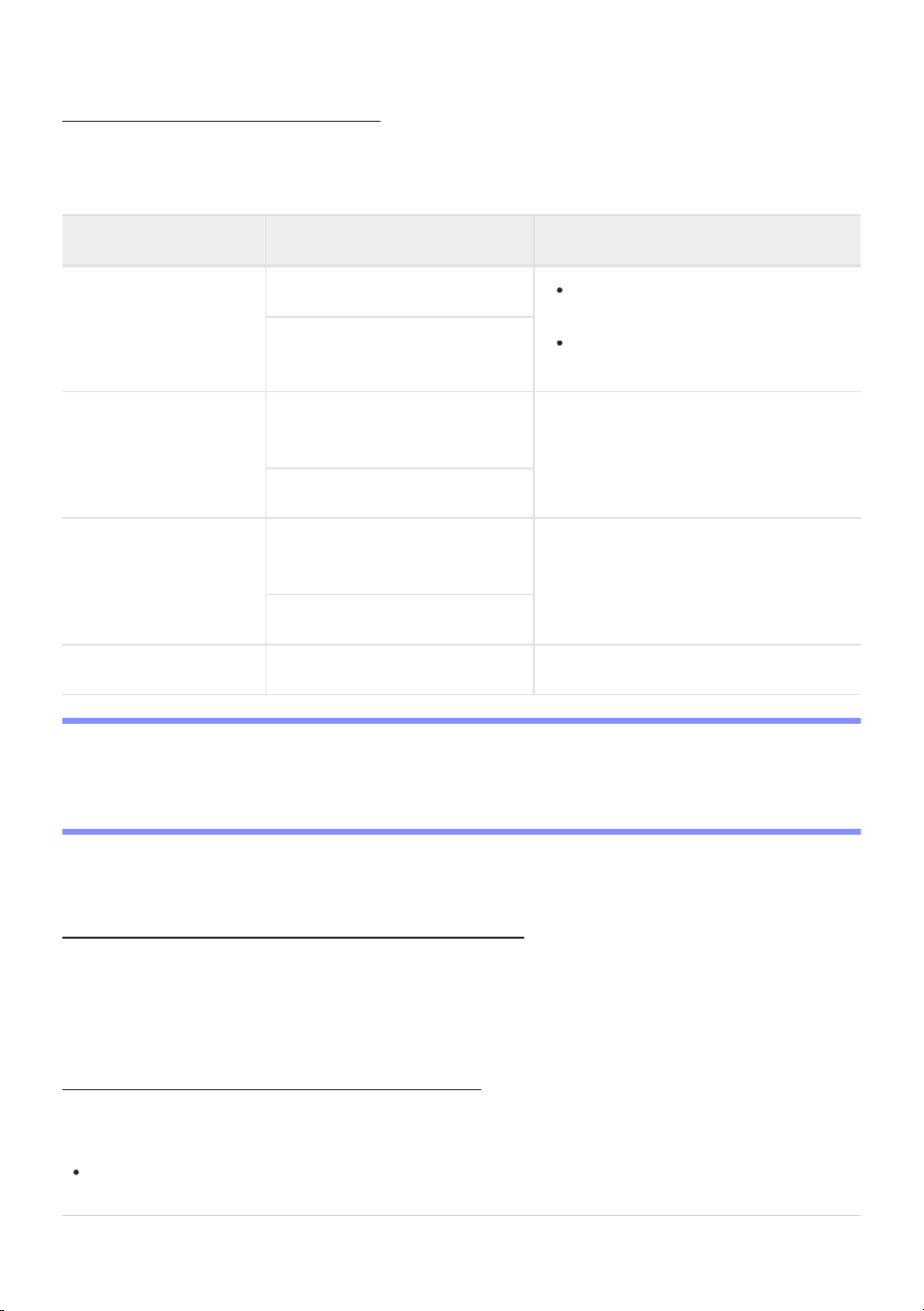
YCbCr and Bit Depth
The YCbCr value and bit depth for footage output t
o external HDMI devices varies with the options
selected for [Video file type] and [Frame size/frame rate] in the video recording menu.
Video file type Frame size/frame rate YCbCr and bit depth
[N-RAW 12-bit (NEV)]
4032×2268 Video mode (ready t
o record/
recording in progress): 4:2:2 10-bit
Video playback: 4:2:2 8-bit
3984×2240
[H.265 10-bit (MOV)]
3840×2160
60p/50p/30p/25p/24p
4:2:2 10-bit
1920×1080
[H.265 8-bit (MOV)]
3840×2160
60p/50p/30p/25p/24p
4:2:2 8-bit
1920×1080
[H.264 8-bit (MP4)] 1920×1080 4:2:2 8-bit
D Recording to External Recorders That Support a Bit Depth of 10Bits
The HDMI signal will be output at a bit depth of 10 bits only t
o HDMI recorders that support this
option.
HDMI Output and Tone Mode
The tone mode selected via [Video file type] in the video r
ecording menu applies to video output via
HDMI. Equipment that supports HDR (HLG) is required when [HLG] is selected.
External Recording Control
Choosing [ON] for [External r
ec. cntrl (HDMI)] in the video recording menu allows camera controls to
be used to start and stop recording on the external recorder.
For information on whether your recorder supports external recording control, consult the
manufacturer.
305
Recorders

The camera display will turn off automatically when the time selected for Custom Setting c3
[Power o
ff delay]> [Standby timer] expires, ending HDMI output. When recording videos to an
external device, select [Standby timer] and choose [No limit] or a time longer than the anticipated
recording time.
An icon will be displayed in the camera monitor when [ON] is selected: A is displayed if no
footage is currently being recorded, B while videos are being recorded. During recording, check
the recorder and recorder display to ensure that footage is being saved to the device.
Note that selecting [ON] may disrupt the footage output to the device.
Including the Camera File Name When Saving
Videos to External Recorders
When recording videos t
o both the camera's memory card and an Atomos external recorder that has
been connected to the camera, the name of the file saved on the external recorder will include the
name of the video file saved on the camera's memory card. Having a common string in both file names
makes it easier to link the files when editing the video.
When starting video recording with a memory card inserted in the camera and [External rec. cntrl
(HDMI)] set to [ON] in the video recording menu, the file name of the video to be saved on the
memory card is transmitted to the external recorder.
The file extension will not be transmitted to the external recorder.
The following Atomos external recorders support the transmission of file names (as of March 2024).
Ninja (2023 models)
Ninja Ultra
Ninja V
Ninja V+
Shogun (2023 models)
Shogun Ultra
Shogun Connect
D Compatible External Recorders
Some of these products may no longer be available. Contact Atomos to learn more about products
that support file-name transmission.
Some recorders may require an Atomos operating system upgrade or paid activation of the
recorder. Contact Atomos for details.
Refer to the documentation provided with the external recorder for instructions to set up the
external recorder and details on file names saved on it.
306
Recorders
-
-
-
-
-
-
-

Connecting to Nikon Imaging Cloud
About Nikon Imaging Cloud
NikonImagingCloud is Nik
on’s cloud service that can be used in a web browser of the computer or
smart device (
0 28). Connect your camera to Nik
onImagingCloud to access a variety of services.
Once connected, you can use Nikon Imaging Cloud with your camera via the internet even when no
smart devices or computers are nearby.
See the NikonImagingCloud online help for detailed instructions.
D Cautions: Lending and Disposing of Cameras Connected to Nikon Imaging Cloud
Before lending the camera to another person, you should turn off automatic connection to the
camera in the Nikon Imaging Cloud home screen or initialize the camera using the [Reset all
settings] item in the camera setup menu.
If you are discarding the camera or transferring ownership to another person, you should delete the
camera's information in the Nikon Imaging Cloud home screen and initialize the camera using the
[Reset all settings] item in the camera setup menu.
307
About Nikon Imaging Cloud
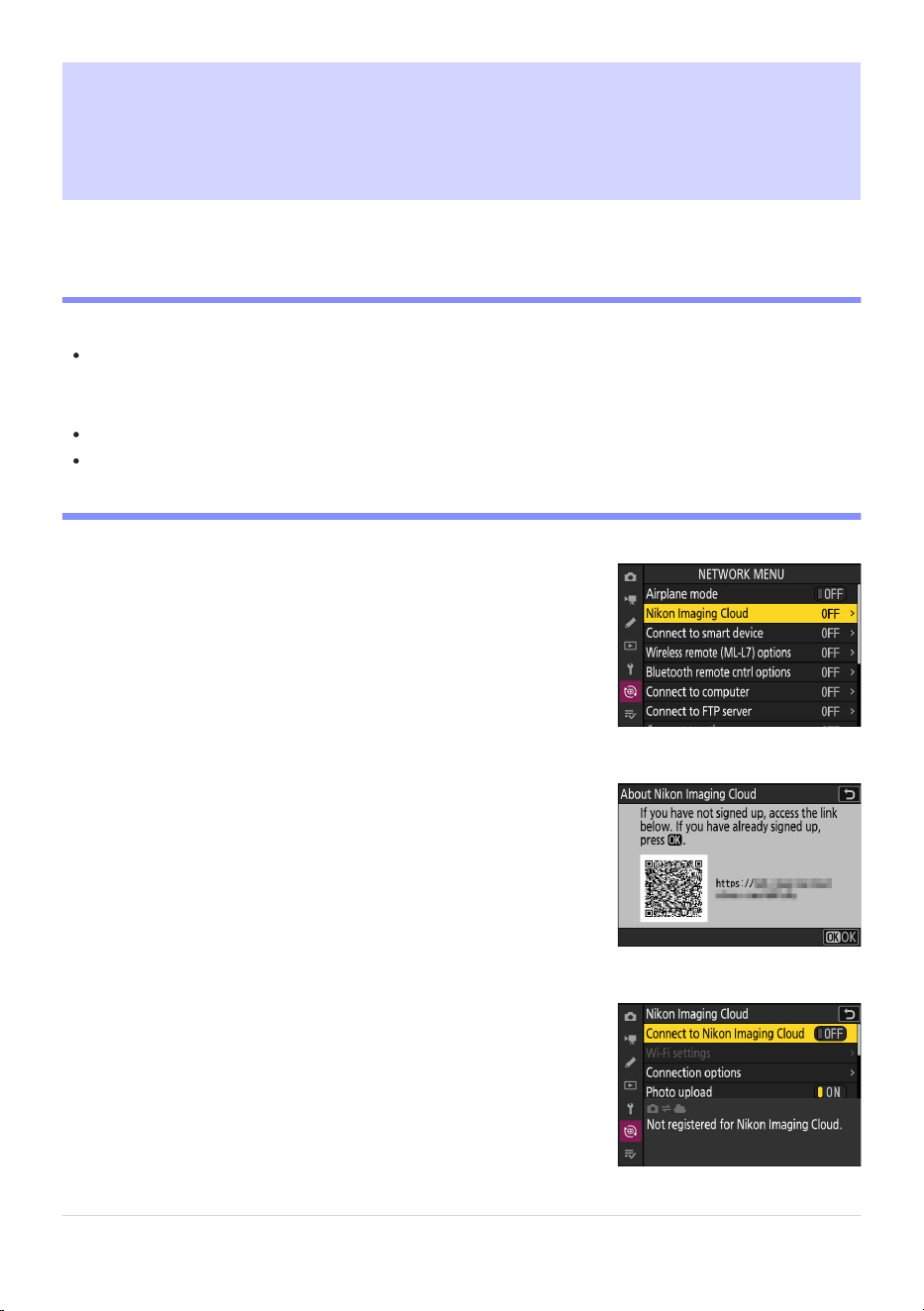
Camera: Highlight [Nikon Imaging Cloud] in the network
menu and press 2
.
A QR code and URL to access NikonImagingCloud on a
computer or smart device will appear.
Camera: When a dialog is displayed as shown, press J to
proceed.
Camera: Select [ON] for [Connect to Nikon Imaging Cloud].
Connecting the Camera to Nikon Imaging
Cloud
Use the camera and comput
er/smart device t
o establish a Wi-Fi connection between the camera and
NikonImagingCloud to access services.
D Before Connecting Nikon Imaging Cloud
You must create a Nikon ID and register with Nikon Imaging Cloud to use the service. Complete
registration and sign in on the computer or smart device before connecting to the camera. See the
Nikon Imaging Cloud online help for detailed instructions.
A web browser is required to use Nikon Imaging Cloud.
A Wi-Fi environment is required to connect the camera and Nikon Imaging Cloud. Connect the
camera to an existing network (including home networks) via a wireless router.
308
Connecting the Camera to Nikon Imaging Cloud
1
2
3
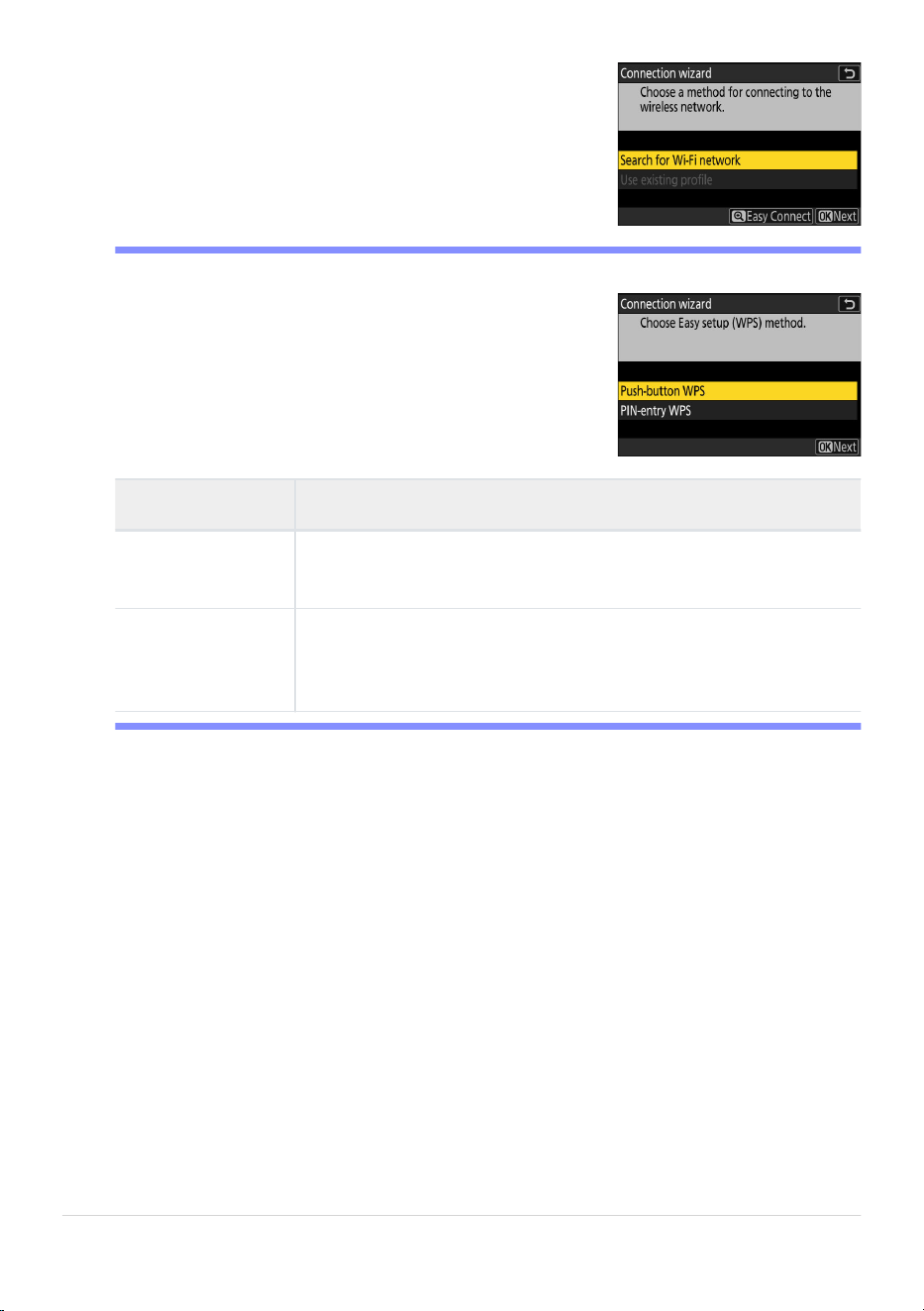
Camera: Highlight [Search for Wi-Fi network] and press J.
The camera will search for networks curr
ently active in the
vicinity and list them by name (SSID).
To connect without entering an SSID or encryption key, press
X in Step4. Next, highlight one o
f the following options and
press J. After connecting, proceed to Step7.
D “Easy Connect”
Option Description
[Push-butt
on WPS]
For rout
ers that support push-button WPS. Press the WPS button on
the r
out
er and then pr
ess the camera J button to connect.
[PIN-entry WPS]
The camera will display a PIN. Using a computer, enter the PIN on the
router. For more information, see the documentation provided with
the router.
309
Connecting the Camera to Nikon Imaging Cloud
4
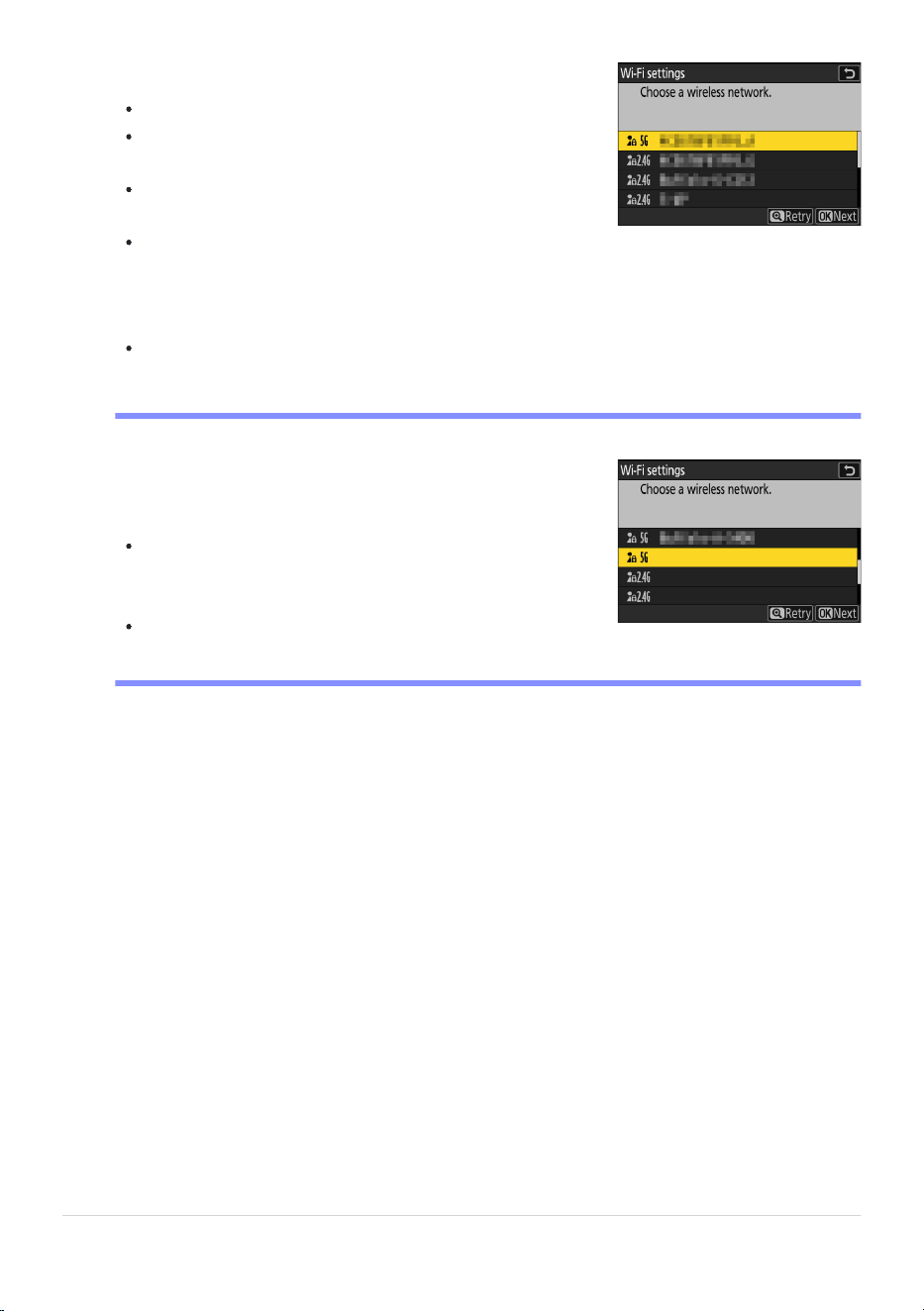
Camera: Choose a network.
Highlight a network SSID and press J.
The SSIDs containing charact
ers that cannot be entered on
the camera will not be displayed.
The band on which each SSID operates is indicated by an
icon.
Encrypted networks are indicated by a h icon. If the selected
network is encrypted (h), you will be prompted to enter the
encryption key. If the network is not encrypted, proceed to
Step8.
If the desired network is not displayed, press X to search
again.
Networks with hidden SSIDs are indicated by blank entries in
the network list.
To connect t
o a network with a hidden SSID, highlight a
blank entry and press J. Next, press J; the camera will
prompt you to provide an SSID.
Enter the network name and press X. Press X again; the
camera will now prompt you to enter the encryption key.
D Hidden SSIDs
310
Connecting the Camera to Nikon Imaging Cloud
5
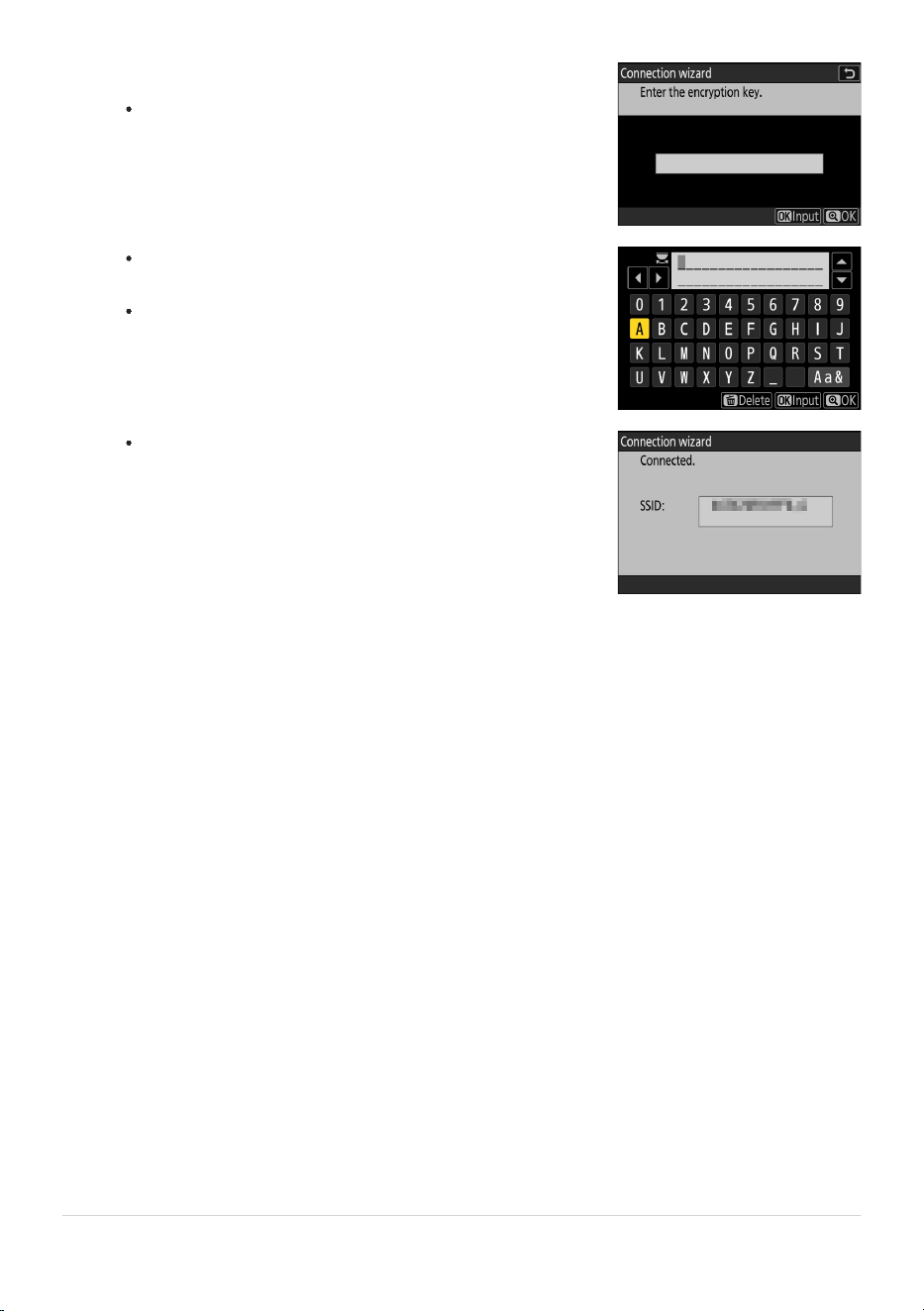
Camera: Enter the encryption key.
Press J
and enter the encryption key for the wireless router.
For more information, see the documentation for the
wireless rout
er.
Press X when entry is complete.
Press X again to initiate the connection. A message will
be display
ed for a few seconds when the connection is
established.
311
Connecting the Camera to Nikon Imaging Cloud
6
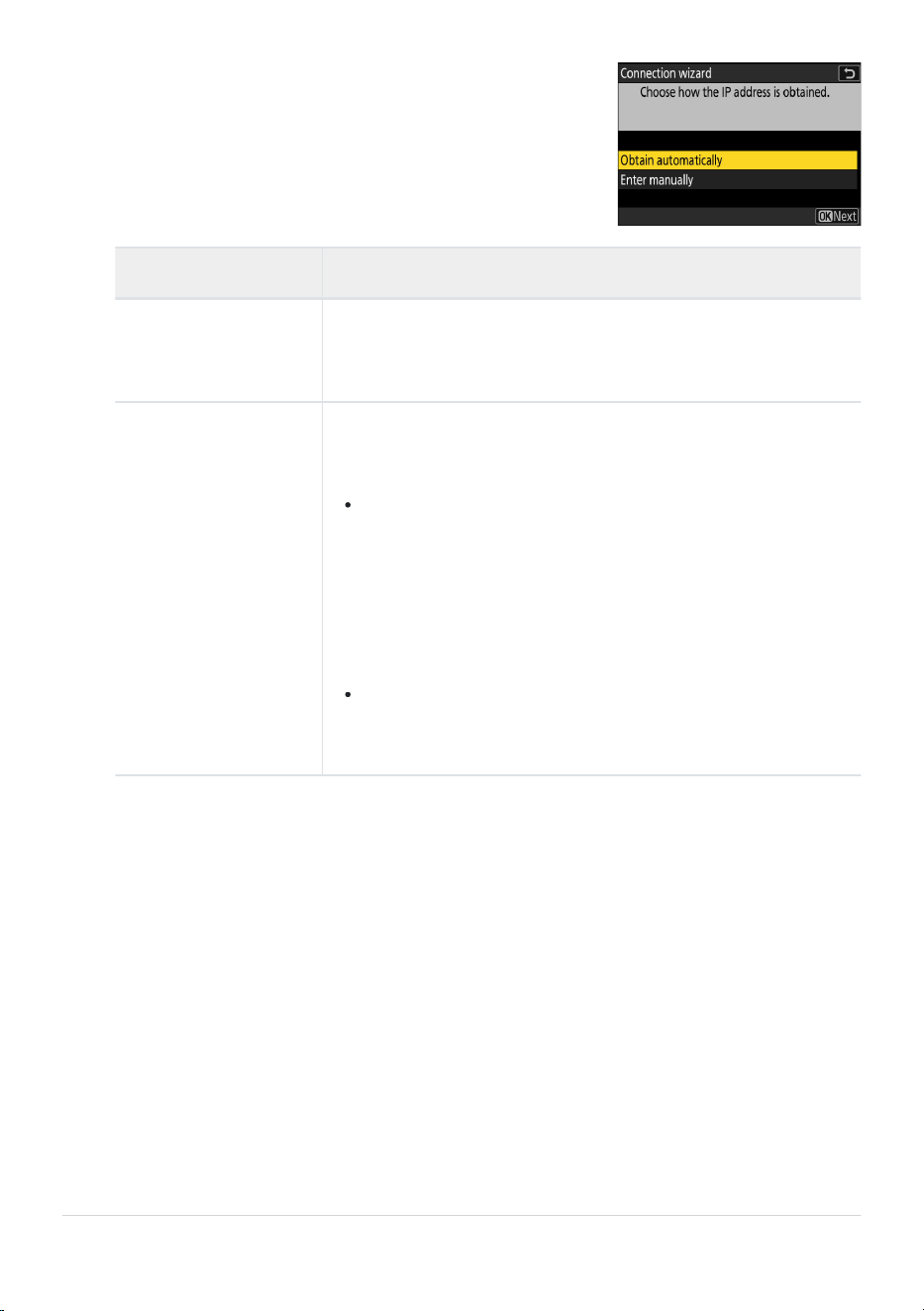
Camera: Obtain or select an IP address.
Highlight one of the following options and press J
.
Option Description
[Obtain automatically]
Select this option if the network is configur
ed to supply the IP
address automatically. A “configuration complete” message will be
displayed once an IP address has been assigned.
[Enter manually]
Enter the IP addr
ess, sub-net mask, gateway address, and Domain
Name Server (DNS) addr
ess in that order manually. The items can
be entered as follows.
IP address/gateway address/Domain Name Server (DNS):
Press J; you will be prompted to enter the address.
Rotate the main command dial to highlight segments.
Press 4 or 2 to change the highlighted segment and press
J to enter changes.
When all digits have been entered, press X to save changes.
Press X again to proceed.
Sub-net mask:
To change the highlighted digit, press 1 or 3. Press J to save
changes and proceed.
312
Connecting the Camera to Nikon Imaging Cloud
-
-
-
-
-
7
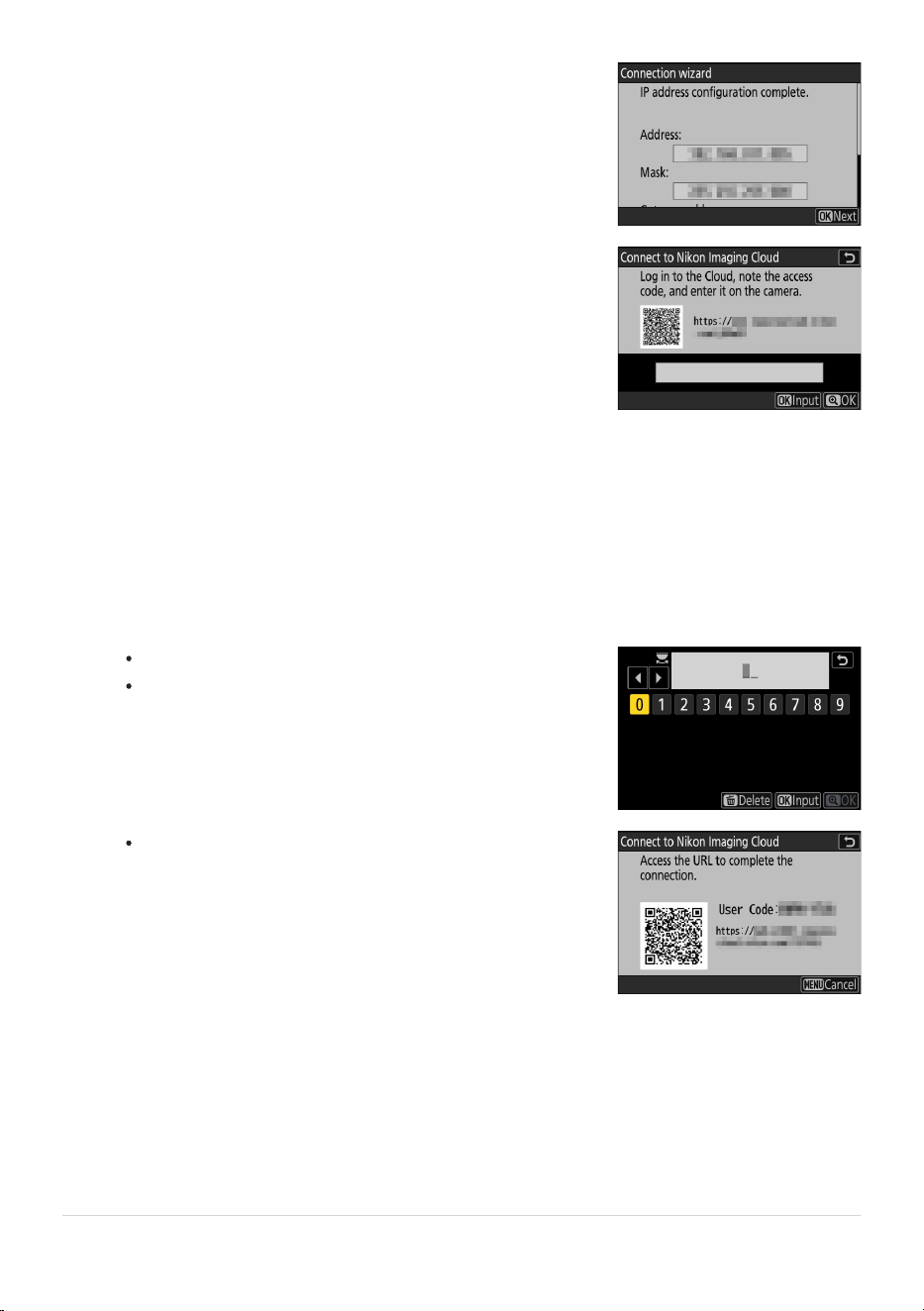
Camera: Press J to proceed when the “
configuration
complete” message is displayed.
The camera accesses NikonImagingCloud and prepares for
connection. If preparation is complet
e, a QR code and URL to
access NikonImagingCloud on a computer or smart device
will appear.
Press J to enter the access code.
Press
X when entry is complete.
Pressing X again connects the camera and
NikonImagingCloud and displays a QR code and URL to
access to the Nikon Imaging Cloud from a computer or
smart device.
Computer/smart device: Click or tap the connect camera button in the Nikon Imaging
Cloud home screen.
An access code to connect Nik
onImagingCloud and the camera appears.
Camera: Enter the access code displayed on the computer/smart device in Step 9.
313
Connecting the Camera to Nikon Imaging Cloud
8
9
10
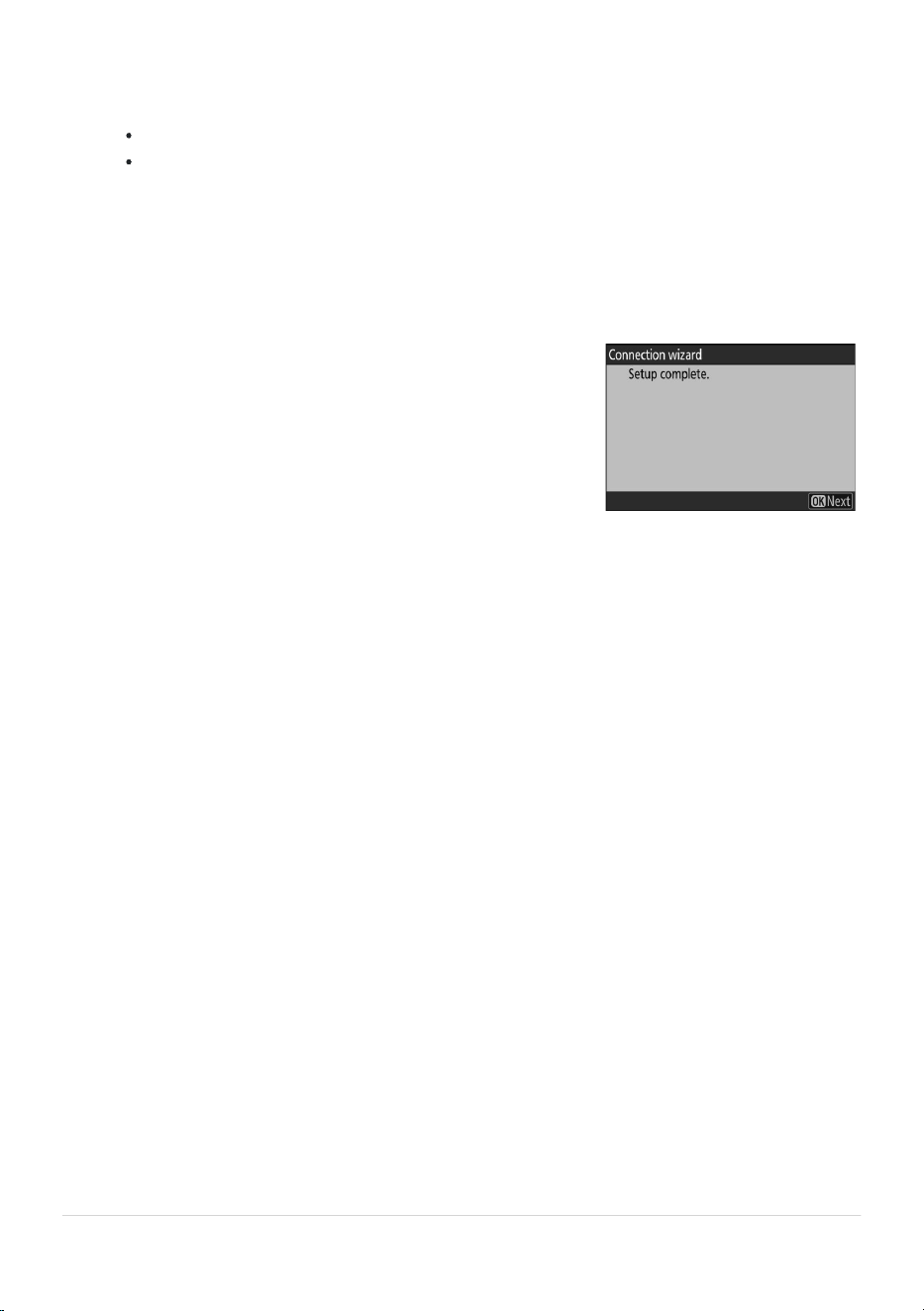
Nikon Imaging Cloud and the camera are now connected
via Wi-Fi. If connection completion screens appear on both
the computer/smar
t device and the camera, you can use the
camera with Nikon Imaging Cloud.
For information on using NikonImagingCloud, see online
help.
Computer/smart device: Scan the QR code displayed on the camera screen or enter the
URL also displayed on the camera into a w
eb browser.
A connection confirmation screen appears.
If a user-code entry screen appears on the computer/smart device, enter the user code
displayed on the camera screen.
Computer/smart device: Click or tap the [Connect] button.
314
Connecting the Camera to Nikon Imaging Cloud
11
12
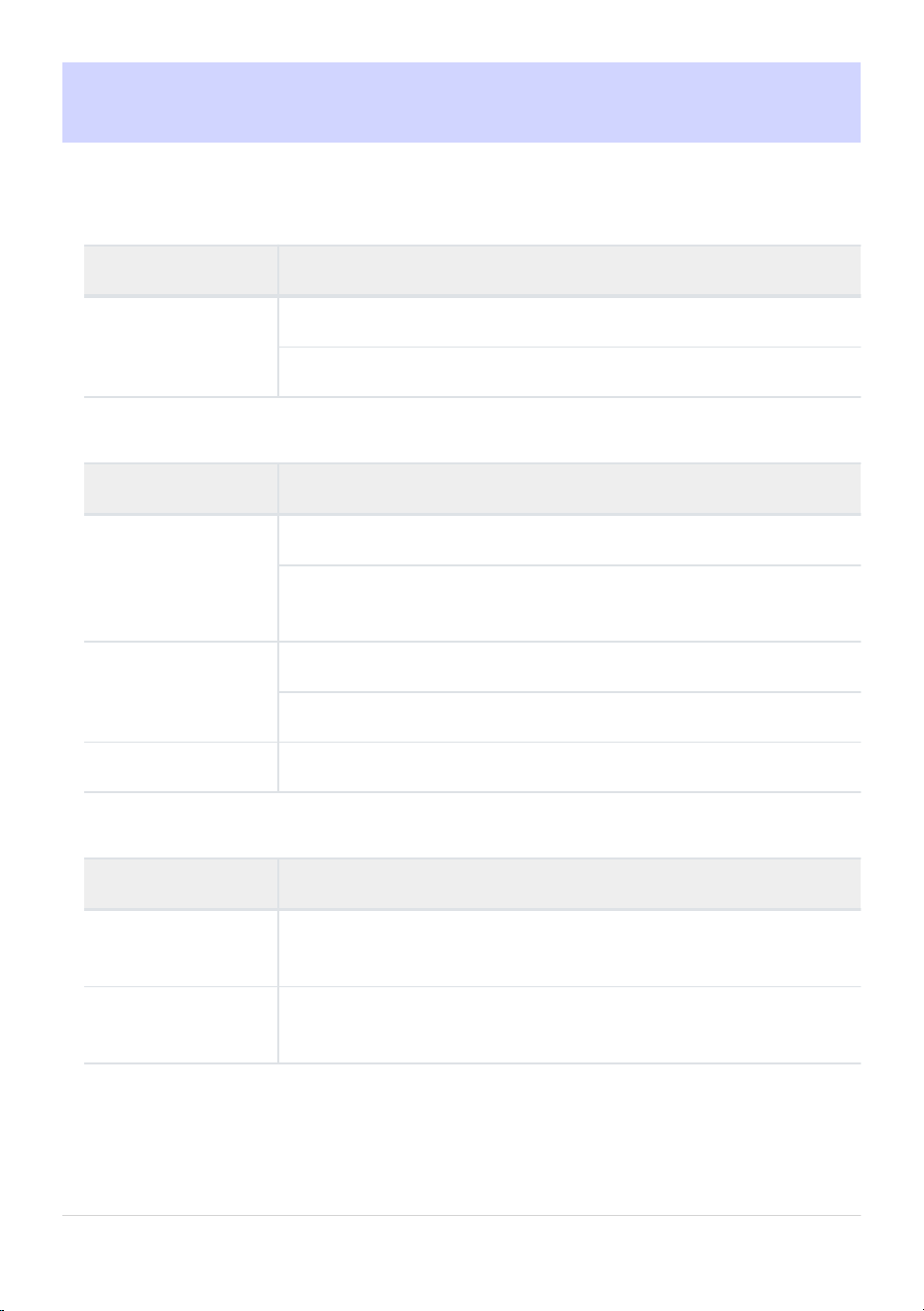
Error Codes
The errors display
ed on the camera and their solutions are listed below.
● [Network not found.]
Error code Solution
Err.11
Confirm that the device to which you are attempting to connect is on.
Confirm the network SSID in the camera wireless network profile.
● [Wireless error.]
Error code Solution
Err.12
Confirm that you are using the correct password for the selected SSID.
Confirm that you are using the correct authentication and encryption
method in the camera wir
eless netw
ork pr
ofile.
Err.13
Confirm that the device to which you are attempting to connect is on.
Turn the camera off and then on again.
Err.1F Turn the camera off and then on again.
● [TCP/IP error.]
Error code Solution
Err.21
Check that the TCP/IP address and the sub-net mask are correct in the
camera wireless network profile.
Err.22
Duplicate IP address. Choose a different address in the camera wireless
network profile.
315
Error Codes
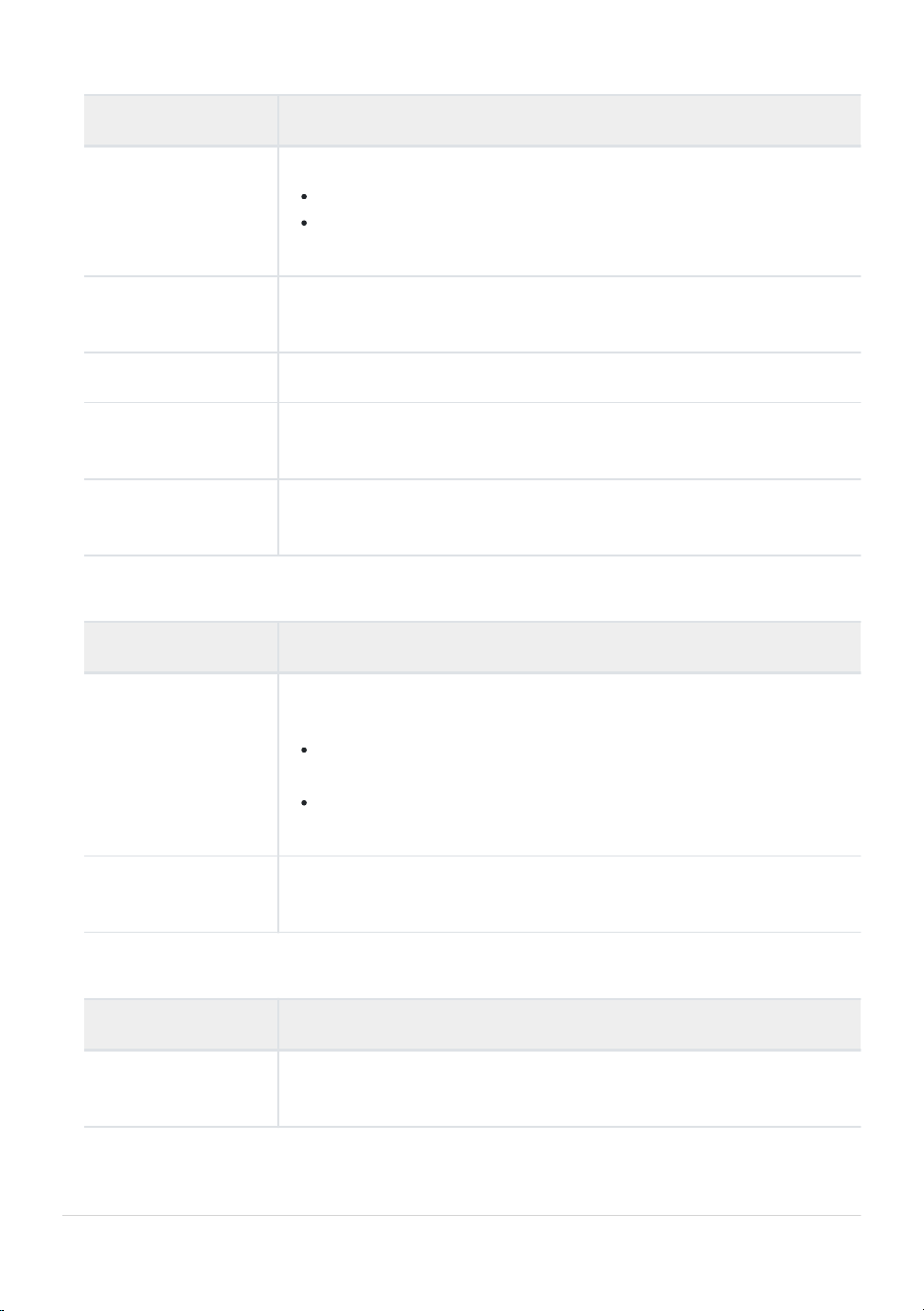
● [Could not connect to Nikon Imaging Cloud.]
Error code Solution
Err.90
Camera registration error.
Connect the camera and register it again with Nik
on Imaging Cloud.
The camera date and time may not be set correctly. Confirm the date
and time on your camera.
Err.91
The Terms of Use may have been updated. See the
NikonImagingCloud home screen for details.
Err.94 Token error. Turn the camera off and then on again and reconnect.
Err.96
Cannot use NikonImagingCloud. Please check the
NikonImagingCloud website.
Err.A0
Couldn’t find your Nikon ID. If you do not have a Nikon ID, create one
and reconnect the camera.
● [Nikon Imaging Cloud registration failed.]
Error code Solution
Err.92
Authentication error. Reconnect to NikonImagingCloud using one of
the following methods.
Computer: Enter the URL displayed on the camera into a web
browser.
Smart device: Enter the URL displayed on the camera into a web
browser or scan the QR code displayed on the camera.
Err.95
Camera identification error. Consult a Nikon-authorized service
representative.
● [The system is undergoing maintenance. Cannot connect.]
Error code Solution
Err.93
Nikon Imaging Cloud is undergoing maintenance. Please reconnect
later.
316
Error Codes
● [Could not get version update information.]
Error code Solution
Err.97
Failed to receive firmware update notifications. Please try again later.
If this issue occurs frequently
, contact a Nikon-authorized service
representative.
● [Could not upload pictures to Nikon Imaging Cloud.]
Error code Solution
Err.98
Access to NikonImagingCloud is restricted. Please check the
NikonImagingCloud website.
● [Could not log in to Nikon Imaging Cloud.]
Error code Solution
Err.A1
The camera sign-in setting is set to off. Turn on the camera sign-in
setting on the NikonImagingCloud home screen.
● [An HTTPS error occurred.]
Error code Solution
Err.1400 Turn the camera off and then on again.
Err.1404 Check the DNS in the camera wireless network profile.
Err.1502 Please try again later.
Err.1503 Please try again later.
Err.1504 Please try again later.
317
Error Codes

Use the SnapBridge app for wireless connections between the
camera and your smartphone or tablet (“
smart device”).
Connecting to Smart Devices
The SnapBridge App
The SnapBridge app can be downloaded fr
om the Apple App Store
®
or on Google Play™.
Visit the Nikon website for the latest SnapBridge news.
Carefully read any license agreements or the like displayed when SnapBridge is launched and only
proceed if you are willing to accept them.
What SnapBridge Can Do for You
The tasks that can be performed using the SnapBridge app ar
e outlined below. For details, see the
SnapBridge app online help:
https://nikonimglib.com/snbr/onlinehelp/en/index.html
Downloading Pictures fr
om the Camera
Download existing pictures to your smart device. They can also be downloaded automatically as they
are taken.
Remote Photography
Control the camera and take pictures from the smart device.
D Can’t Connect?
If you have trouble connecting, try:
turning the camera and smart device off and then on again, or
checking wireless settings on the smart device.
318
The SnapBridge App
To connect the camera to a smart device, some operations are
performed using the camera, other
s on the smart device.
Additional instructions are available via SnapBridge online help.
https://nikonimglib.com/snbr/onlinehelp/en/index.html
Wireless Connections
Use the SnapBridge app for wireless connections between the camera and y
our smart device. You can
connect via either Bluetooth (
0 319) or Wi-Fi ( 0 322). Furthermore, a Wi-Fi connection has two
modes: “Wi-Fi access point mode” and “Wi-Fi station mode.” Connecting via Bluet
ooth or Wi-Fi station
mode allows you to automatically upload pictures as they are taken.
Connecting via Bluetooth (Pairing)
Before connecting via Bluetooth for the fir
st time, you will need to pair the camera and smart device.
D Before Pairing
Enable Bluetooth on the smart device. For details, see the documentation provided with the device.
Ensure that the batteries in the camera and smart device are fully charged to prevent the devices
turning off unexpectedly.
Check that there is space available on the camera memory card.
319
Wireless Connections
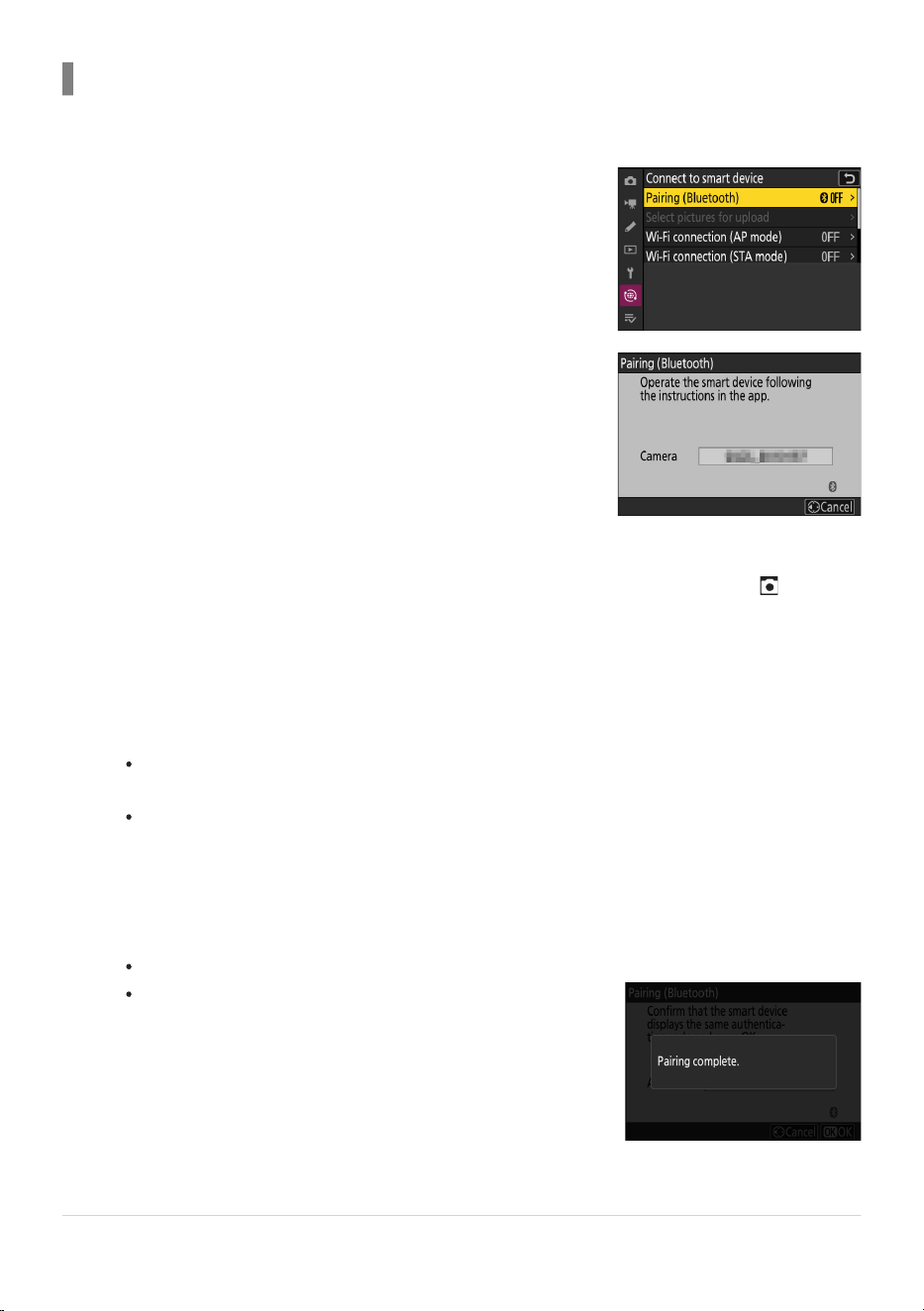
Camera: Select [Connect to smart device]> [Pairing
(Bluetooth)] in the netw
ork menu, then highlight [Start
pairing] and press J.
The camera name will be displayed in the monitor.
The camera and smart device will each display a message
when pairing is complete. The camera will then aut
omatically
exit to the menus.
Pairing
Pair the camera and smart device as described below
.
Smart device: Launch the SnapBridge app and tap [Connect to camera] in the
tab.
If this is the first time you hav
e launched the app, you should instead tap [Connect to camera]
in the welcome display.
Smart device: Follow the on-screen instructions.
When prompted, tap the category for your camera and then tap the “pairing” option when
prompted to choose the connection type.
Tap the camera name when prompted.
Camera/smart device: After confirming that the camera and smart device display the
same authentication code, follow the on-screen instructions on both devices to complete
pairing.
Tap the pairing button on the smart device and press the J button on the camera.
320
Wireless Connections
1
2
3
4
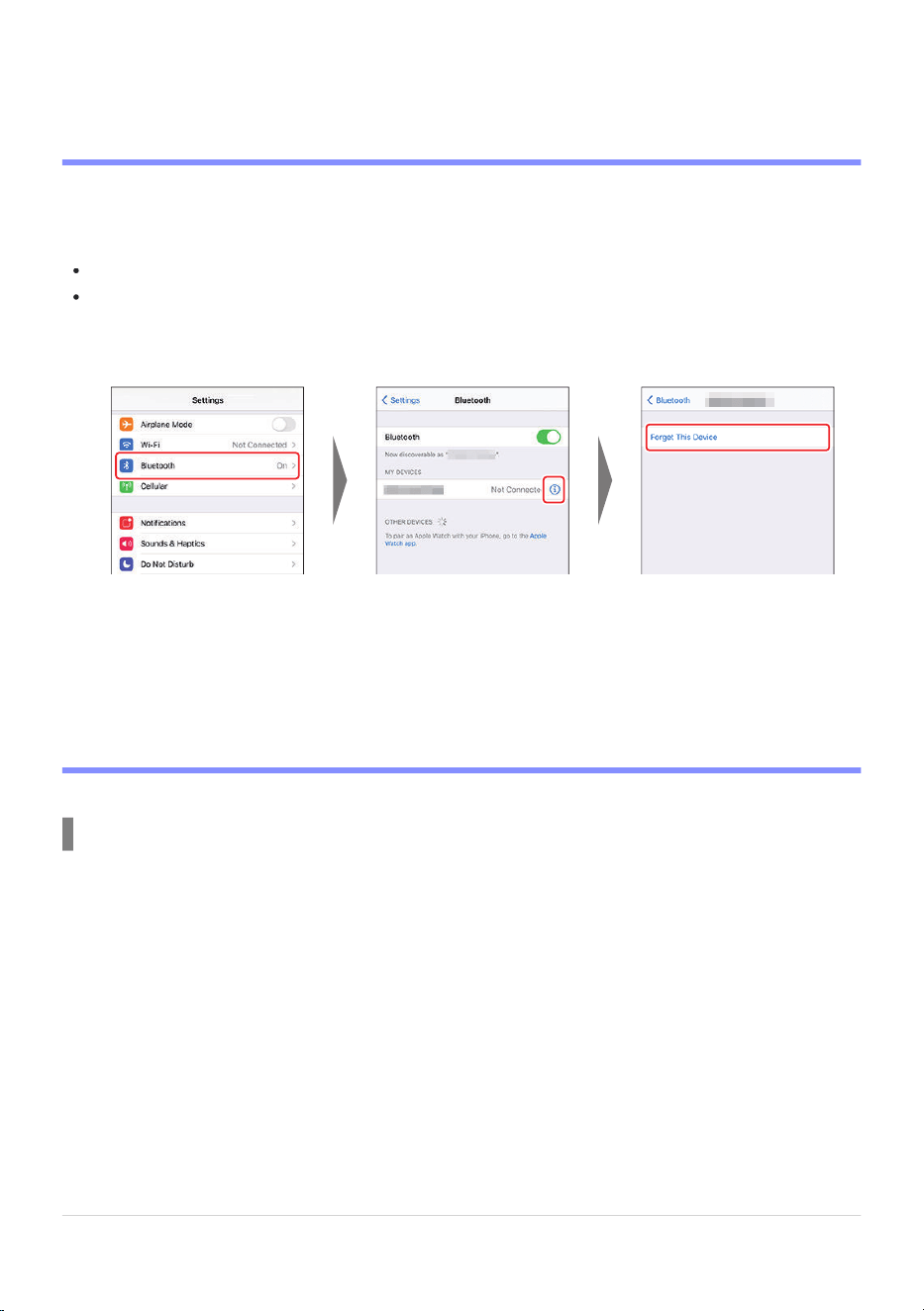
The camera and smart device are now paired.
For information on using the SnapBridge app, see online help.
D P
airing Error
If you wait too long between pressing the button on the camera and tapping the button on the smart
device in Step4, the device will display an error message and pairing will fail.
If you are using an Android device, tap [OK] and return to Step1.
If you are using an iOS device, dismiss the SnapBridge app and check that it is not running in the
background, then request iOS to “forget” the camera before returning to Step1. The request to
“forget” the camera is made via the iOS “Settings” app.
D Can’t Connect to the Smart Device?
See also “
Troubleshooting” in SnapBridge online help.
D Disabling Bluetooth
To disable Bluetooth, select [OFF] for [Connect to smart device]> [Pairing (Bluetooth)]>
[Bluetooth connection] in the camera network menu.
Connecting to a Previously-Paired Smart Device
Once the smart device has been paired with the camera, you will be able to connect simply by
enabling Bluetooth on both the smart device and camera and launching the SnapBridge app.
321
Wireless Connections

Connecting via Wi-Fi
There are tw
o ways to connect the camera and a smart device via Wi-Fi with the SnapBridge app:
“Wi-Fi access point mode” to connect the camera and smart device directly via Wi-Fi and “Wi-Fi station
mode” to connect to the smart device via a wireless router on an existing network (including home
networks).
D Before Connecting via Wi-Fi
Enable Wi-Fi on the smart device. For details, see the documentation provided with the device.
Ensure that the batteries in the camera and smart device are fully charged to prevent the devices
turning off unexpectedly.
Check that there is space available on the camera memory card.
Direct Wireless Connection to a Smart Device (Wi-Fi Access
Point Mode)
Connect the camera and a smart device directly via Wi-Fi. The camera acts as a wireless LAN access
point, allowing you to connect when working outdoors and in other situations in which the smart
device is not already connected to a wireless network and eliminating the need for complicated
adjustments to settings. The smart device cannot connect to the Internet while connected to the
camera.
Smart device: Launch the SnapBridge app, open the
tab, tap , and select [Wi-Fi AP
Mode Connection].
If this is the first time y
ou have launched the app, you should instead tap [Connect to camera]
in the welcome display. When prompted, tap the category for your camera and then tap the
“Wi‑Fi” option when prompted to choose the connection type.
Camera/smart device: Turn the camera on when prompted.
Do not use any of the controls in the app at this point.
322
Wireless Connections
1
2
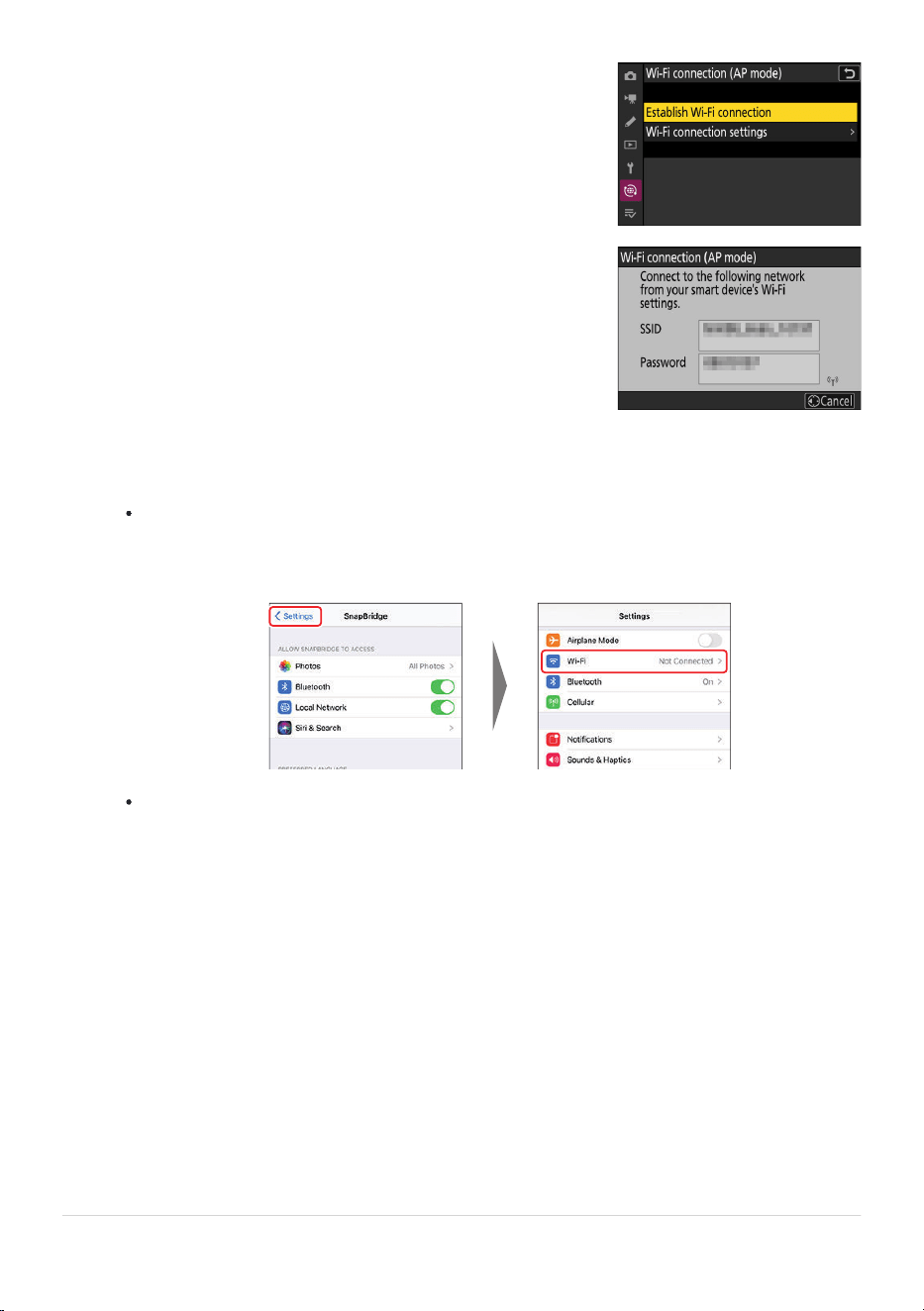
Camera: Select [Connect to smart device] > [Wi-Fi
connection (AP mode)] in the network menu, then
highlight [
Establish Wi-Fi connection] and press J.
The camera SSID and password will be displayed.
Smart device: Follow the on-screen instructions to establish a Wi-Fi connection.
On iOS devices, the “Settings” app will launch. Tap [<Settings] t
o open [Settings], then
scroll up and tap [Wi‑Fi] (which you’ll find near the top of the settings list) to display Wi-Fi
settings.
In the Wi-Fi settings display, select the camera SSID and enter the password displayed by the
camera in Step3.
323
Wir
eless Connections
3
4
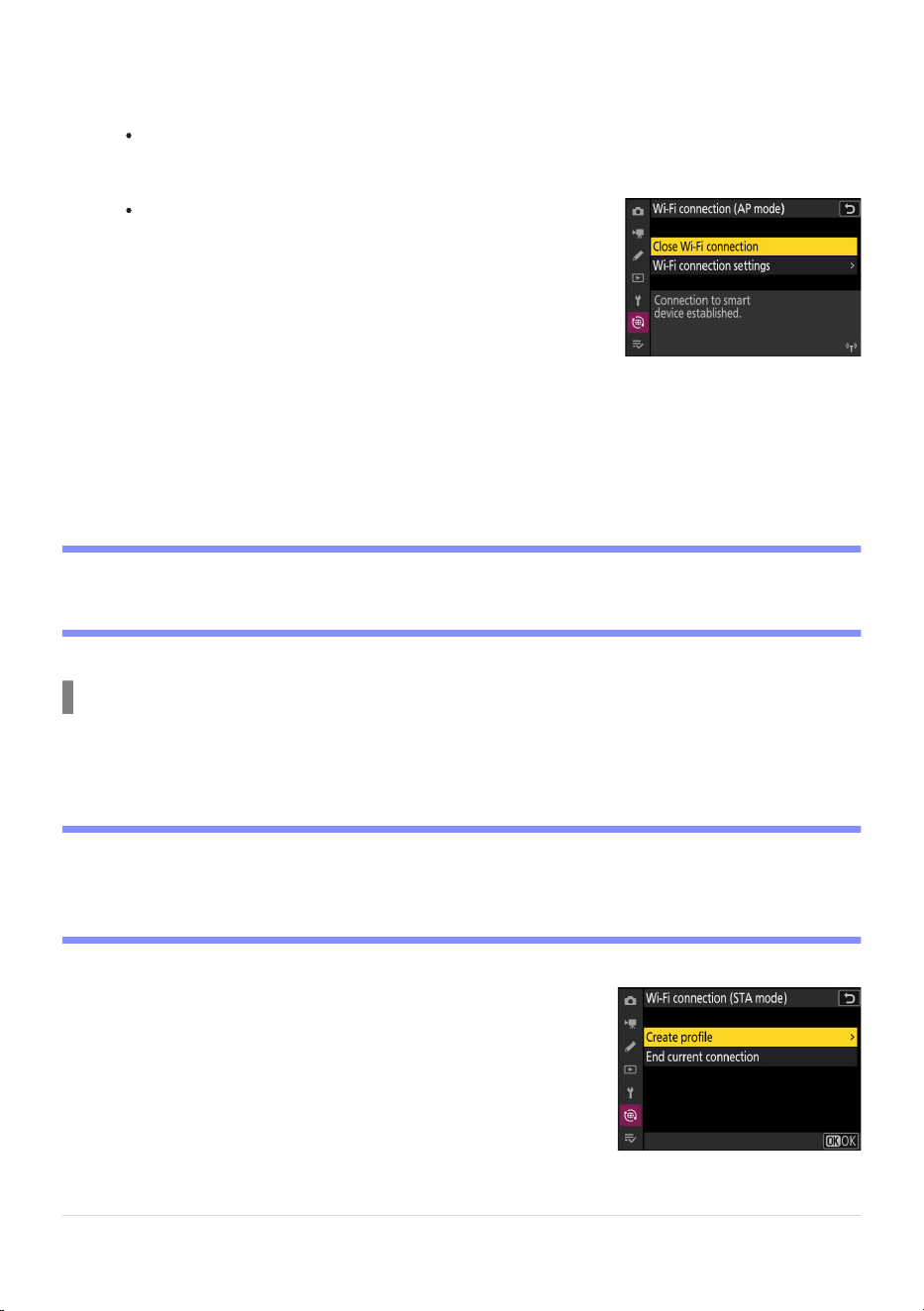
The camera will display a message stating that the
connection is complete.
Camera: Select [Connect to smart device] > [Wi-Fi
connection (STA mode)] in the netw
ork menu, then
highlight [Create profile] and press J.
Smart device: After adjusting device settings as described in Step4, return to the
SnapBridge app.
Aft
er establishing a Wi-Fi connection to the camera, the smart device will display Wi-Fi
access point mode options.
The camera and smart device are now connected via Wi-Fi.
For information on using the SnapBridge app, see online help.
D Can’t Connect to the Smart Device?
See also “Troubleshooting” in SnapBridge online help.
Connecting to an Existing Network (Wi-Fi Station Mode)
The camera connects to a smart device on an existing network (including home networks) via a
wireless LAN access point. The smart device can still connect to the Internet while connected to the
camera.
D Wi-Fi Station Mode
Connection to smart devices beyond the local area network is not supported. You can connect only to
smart devices on the same network.
324
Wireless Connections
5
1
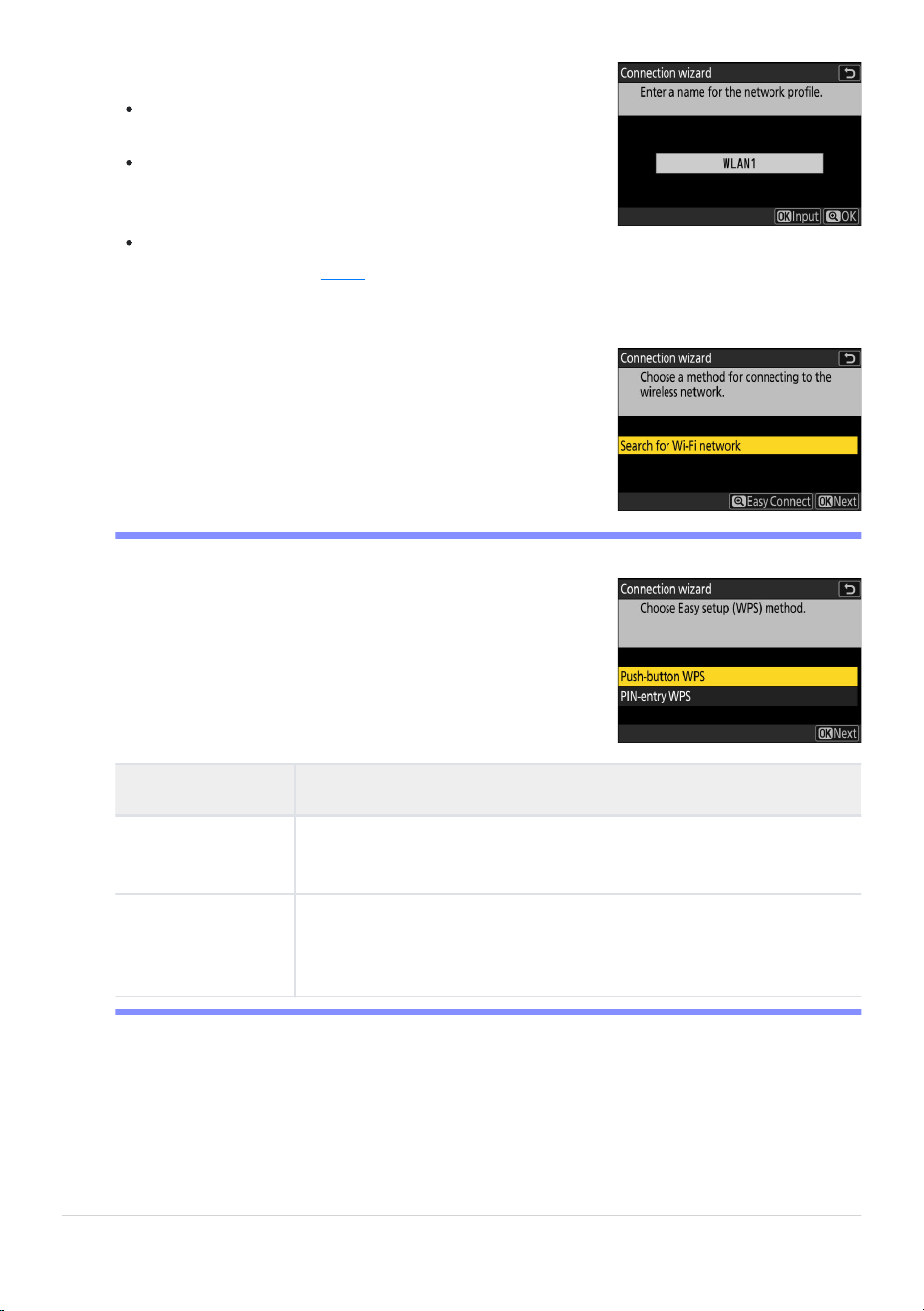
Camera: Name the new profile.
To proceed t
o the next step without changing the default
name, press X.
Whatever name you choose will appear in the network
menu [Connect to smart device] > [Wi-Fi connection
(STA mode)] list.
To rename the profile, press J. For information on text
entry, see “Text Entry” (
0 79). Press X to proceed after
entering a name.
Camera: Highlight [Search for Wi-Fi network] and press J.
The camera will search for networks currently active in the
vicinity and list them by name (SSID).
To connect without entering an SSID or encryption key, press
X in Step3. Next, highlight one o
f the following options and
press J. After connecting, proceed to Step6.
D “Easy Connect”
Option Description
[Push-button WPS]
For r
out
ers that support push-button WPS. Press the WPS button on
the r
out
er and then pr
ess the camera J button to connect.
[PIN-entry WPS]
The camera will display a PIN. Using a computer, enter the PIN on the
router. For more information, see the documentation provided with
the router.
325
Wireless Connections
2
3
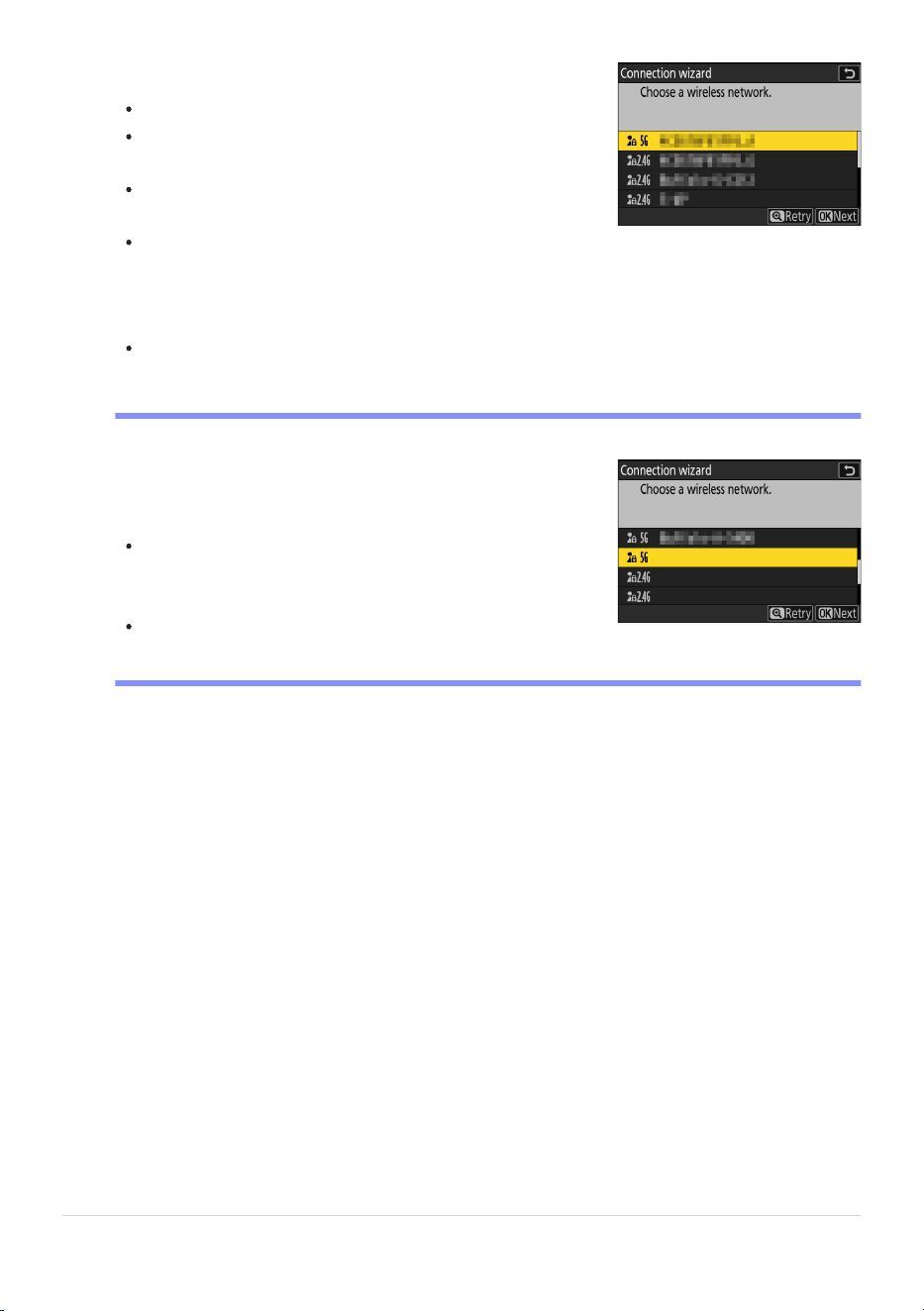
Camera: Choose a network.
Highlight a network SSID and press J.
The SSIDs containing charact
ers that cannot be entered on
the camera will not be displayed.
The band on which each SSID operates is indicated by an
icon.
Encrypted networks are indicated by a h icon. If the selected
network is encrypted (h), you will be prompted to enter the
encryption key. If the network is not encrypted, proceed to
Step6.
If the desired network is not displayed, press X to search
again.
Networks with hidden SSIDs are indicated by blank entries in
the network list.
To connect t
o a network with a hidden SSID, highlight a
blank entry and press J. Next, press J; the camera will
prompt you to provide an SSID.
Enter the network name and press X. Press X again; the
camera will now prompt you to enter the encryption key.
D Hidden SSIDs
326
Wireless Connections
4
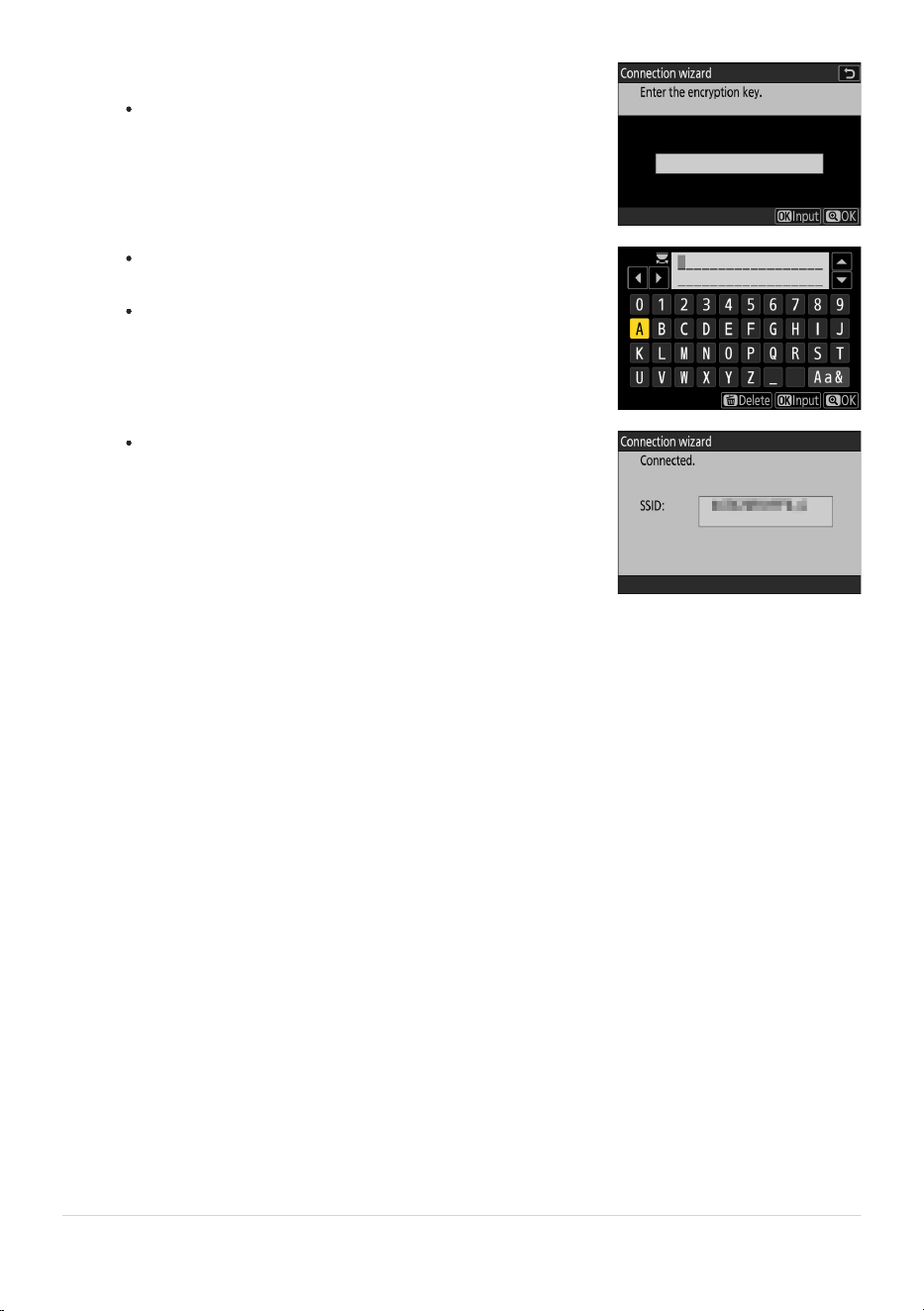
Camera: Enter the encryption key.
Press J
and enter the encryption key for the wireless router.
For more information, see the documentation for the
wireless rout
er.
Press X when entry is complete.
Press X again to initiate the connection. A message will
be display
ed for a few seconds when the connection is
established.
327
Wireless Connections
5
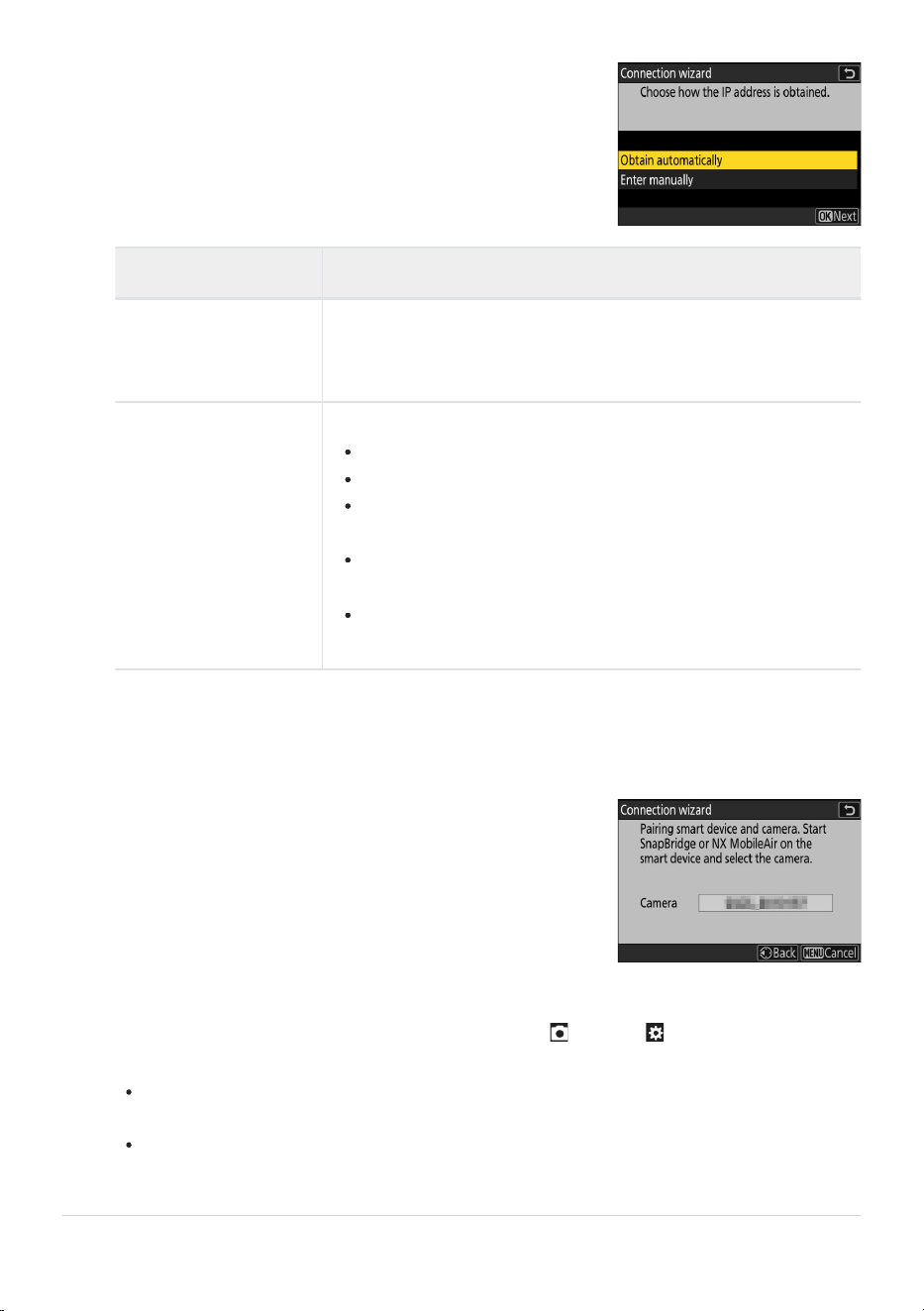
Camera: Obtain or select an IP address.
Highlight one of the following options and press J
.
Camera: Start a Wi-Fi connection with the smart device.
When prompted, launch the SnapBridge app on the smar
t
device.
Option Description
[Obtain automatically]
Select this option if the network is configur
ed to supply the IP
address automatically. A “configuration complete” message will be
displayed once an IP address has been assigned.
[Enter manually]
Enter the IP addr
ess and sub-net mask manually.
Press J
; you will be prompted to enter the IP address.
Rotate the main command dial to highlight segments.
Press 4 or 2 to change the highlighted segment and press J
to save changes.
Next, press X; a “configuration complete” message will be
displayed. Press X again to display the sub-net mask.
Press 1 or 3 to edit the sub-net mask and press J; a
“configuration complete” message will be displayed.
Camera: Press J t
o proceed when the “
configuration complete” message is displayed.
Smart device: Launch the SnapBridge app, open the
tab, tap , and select [Wi-Fi STA
Mode Connection].
Make sur
e your smart device is connected to the same SSID network to which the camera is
connected.
Follow the on-screen instructions to operate the SnapBridge app. If this is the first time you
have launched the app, you should instead tap [Connect to camera] in the welcome display.
328
Wireless Connections
6
7
8
9
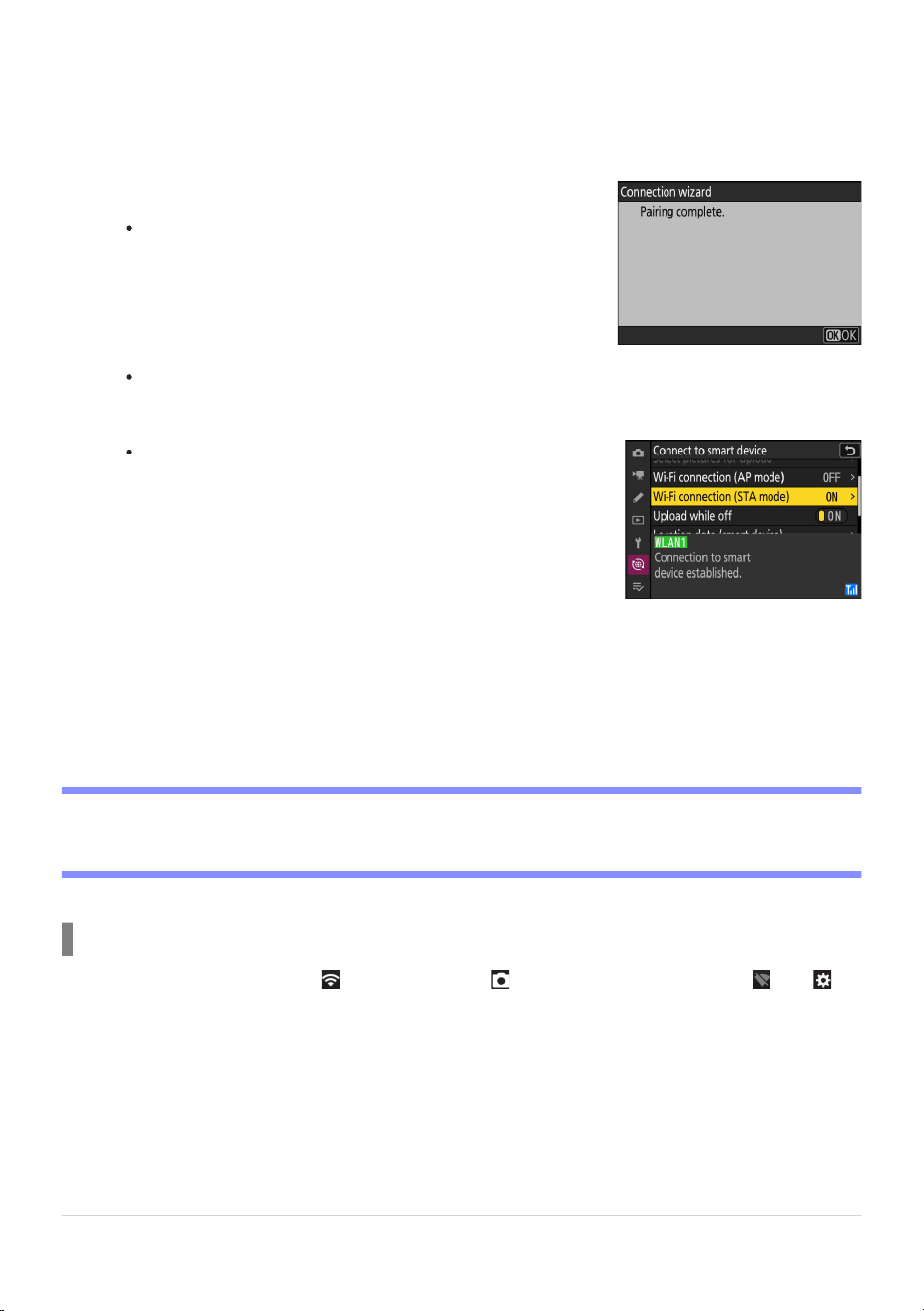
Camera/smart device: Establish a Wi-Fi connection.
When the camera displays the dialog as shown, press J.
The camera will display a message stating that the
connection is complete.
Smart device: Select the camera.
Select the name displayed by the camera in St
ep 8.
After establishing a Wi-Fi connection to the camera, the smart device will display Wi-Fi
station mode options.
The camera and smart device are now connected via Wi-Fi.
For information on using the SnapBridge app, see online help.
D Can’t Connect to the Smart Device?
See also “Troubleshooting” in SnapBridge online help.
Terminating Wi-Fi Access Point/Wi-Fi Station Mode
To end the Wi-Fi connection, tap
in the SnapBridge tab. After the icon changes to , tap ,
and select [Exit Wi-Fi AP mode] or [Exit Wi-Fi STA mode].
329
Wireless Connections
10
11
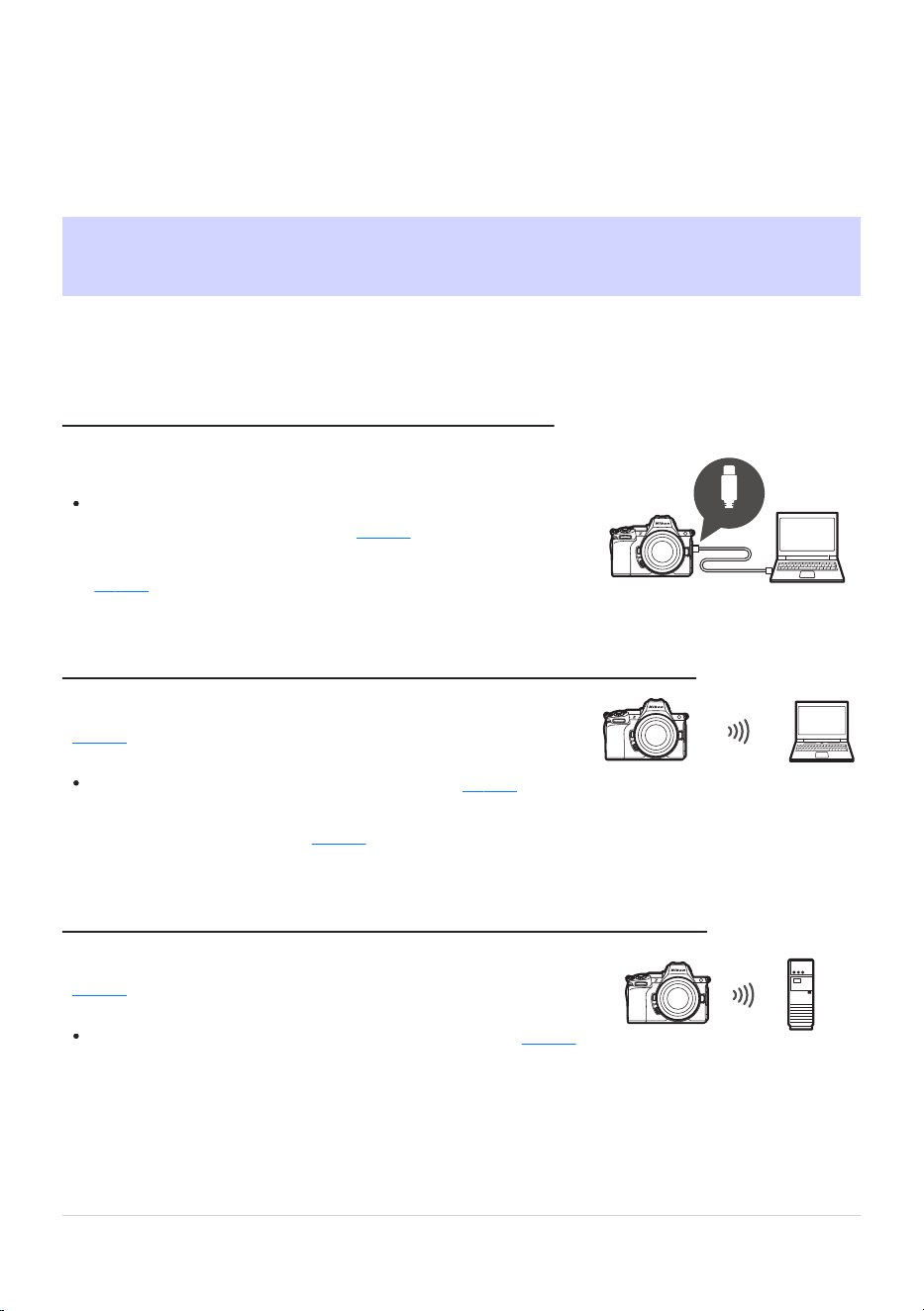
Connect the camera using a USB cable.
The connection can be used to transfer pictures t
o a computer
using Nikon’s NX Studio software (
0 331) or to control the
camera remot
ely from computers using NX Tether software
(
0 372).
Type
-
C
Connect to computers using the camera’s built-in wireless LAN
(0 335).
The connection can be used to upload pictur
es (
0 366) or to
control the camera r
emotely from computers on the network
running NX Tether software (
0 372).
Connect to FTP servers using the camera’s built-in wireless LAN
(0 349).
The connection can be used to upload pictur
es via FTP (
0 366).
FTP
Connecting to Computers or FTP
Server
s
Making the Connection
The camera can be connected to a computer or FTP server using any of the methods below.
Computers: Connecting via USB
Computers: Connecting via Wireless LAN
FTP Servers: Connecting via Wireless LAN
330
Making the Connection
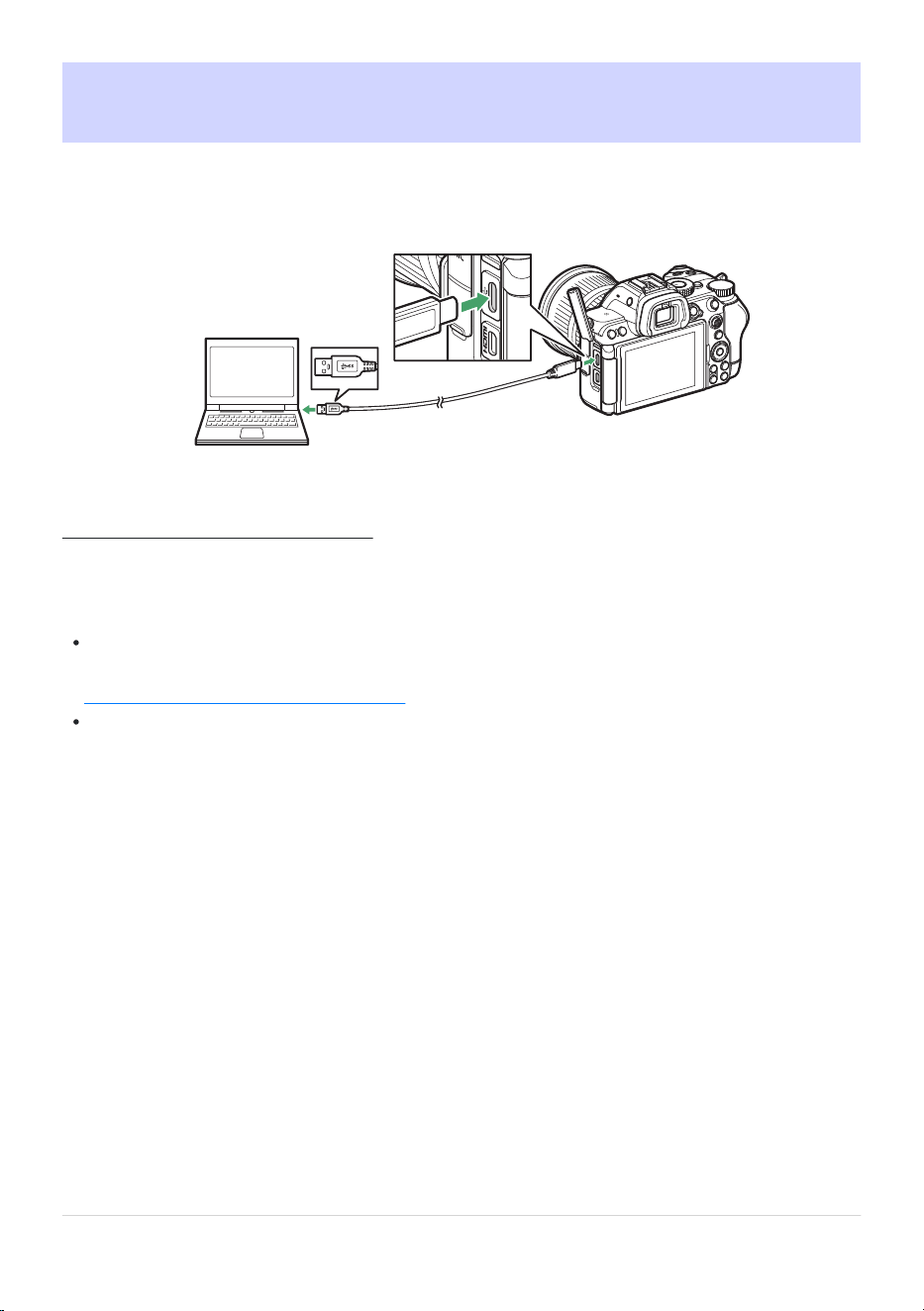
Computers: Connecting via USB
Connect the camera using the supplied USB cable. You can then use NX Studio so
ftware to copy
pictures to the computer for viewing and editing.
Installing NX Studio
You will need an Inter
net connection when installing NX Studio. Visit the Nikon website for the latest
information, including system requirements.
Download the latest NX Studio installer from the website below and follow the on-screen
instructions to complete installation.
https://downloadcenter.nikonimglib.com/
Note that you may be unable t
o download pictures from the camera using earlier versions of
NX Studio.
331
Computers: Connecting via USB
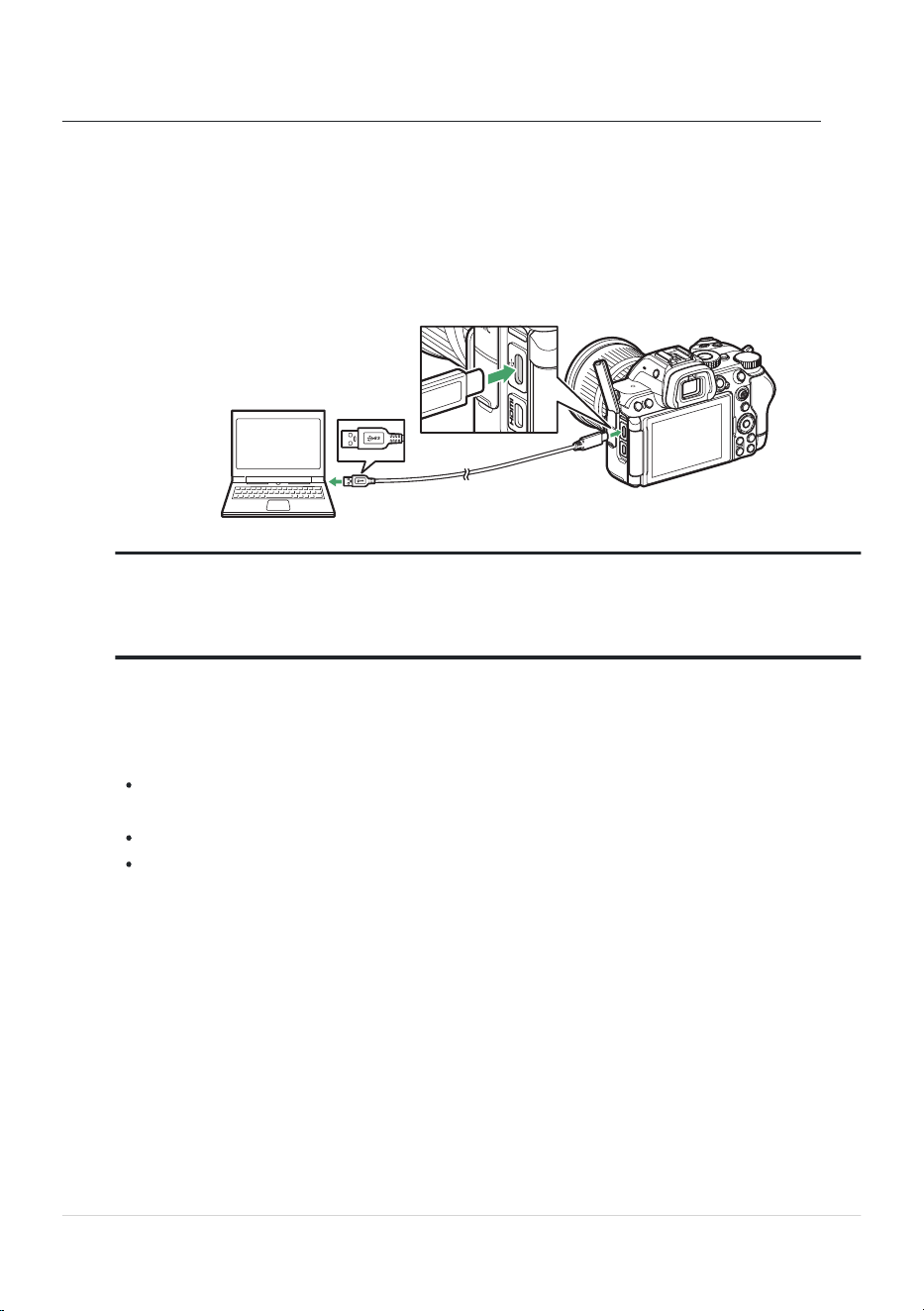
Copying Pictures to a Computer Using NXStudio
See online help for detailed instructions.
Connect the camera to the computer
.
After turning the camera off and ensuring that a memory card is inserted, connect the supplied
USB cable as shown.
Tip: Using a Card Reader
Pictures can also be copied from memor
y cards inserted in third-party card readers connected
to the computer. You should however check that the card is compatible with the card reader.
Turn the camera on.
The Nikon Transfer2 component of NX Studio will start. Nikon Transfer2 image transfer
software is installed as part of NX Studio.
If a message is displayed prompting you to choose a program, select Nikon Transfer 2.
If Nikon Transfer 2 does not start automatically, launch NX Studio and click the “Import” icon.
332
Computers: Connecting via USB
1
2
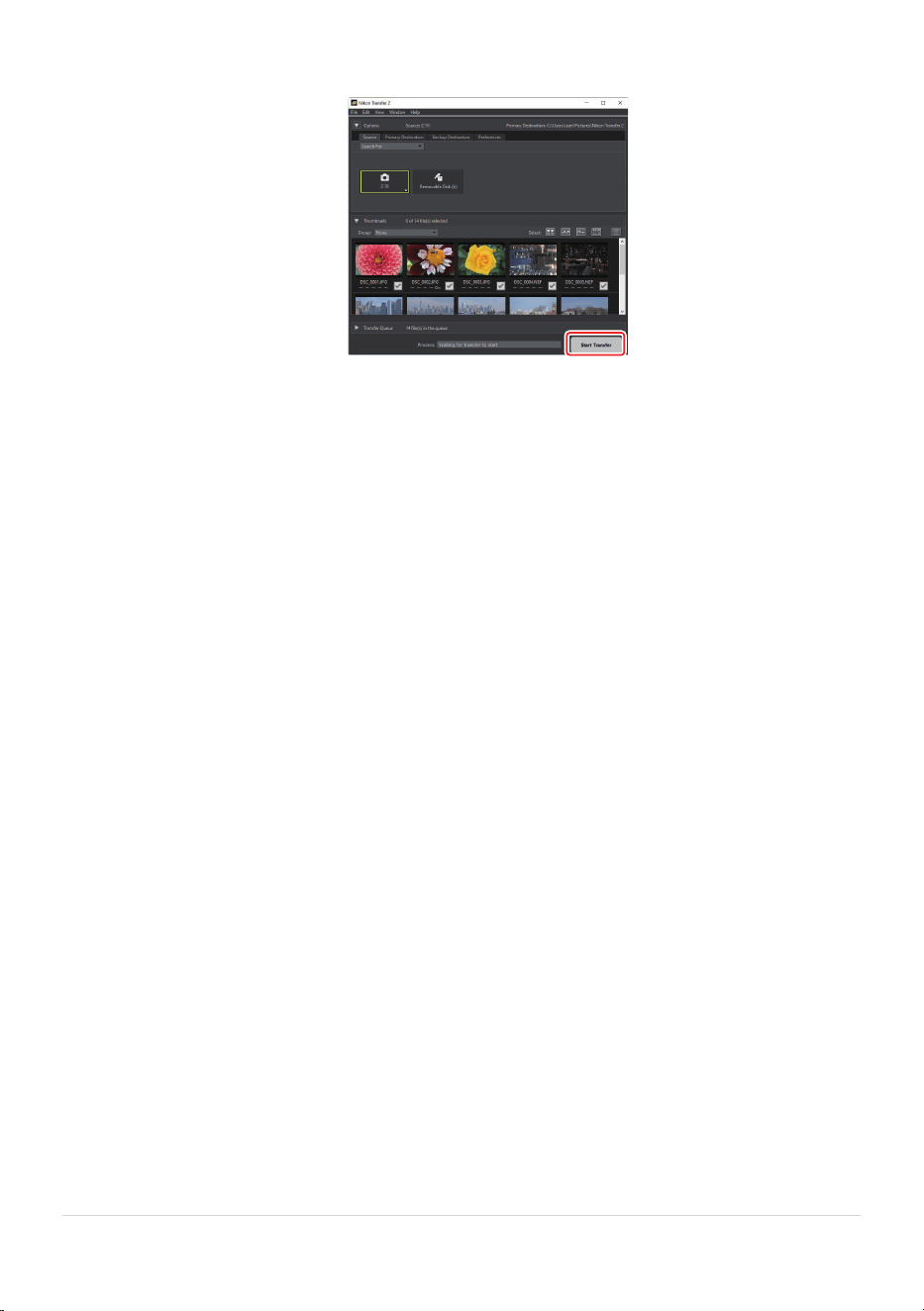
Click [Start Transfer].
Pictures on the memory card will be copied to the computer.
Turn the camera o
ff.
Disconnect the USB cable when transfer is complete.
333
Computers: Connecting via USB
3
4
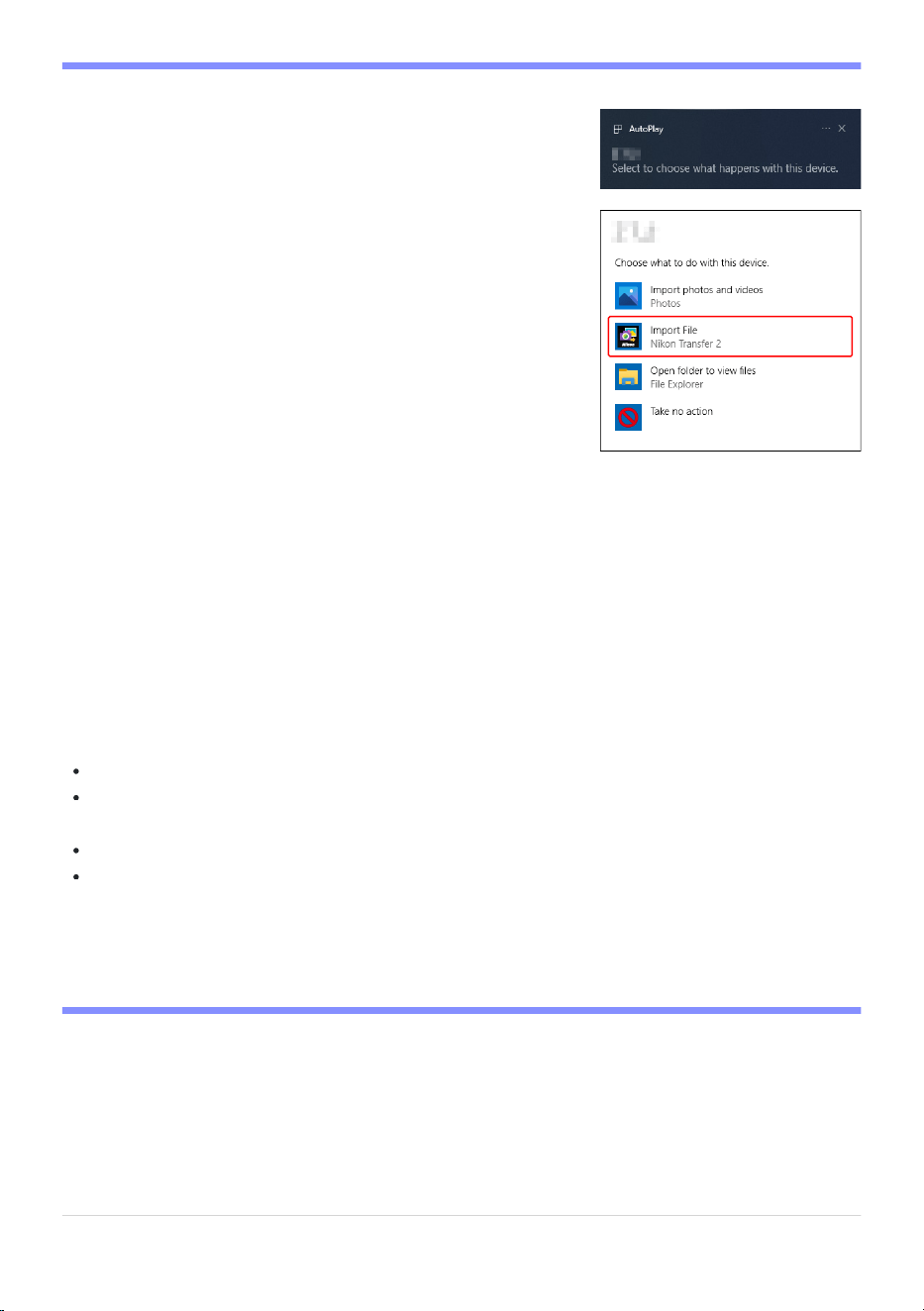
Some computers may be configured to display an AutoPlay prompt
when the camera is connected.
Click the dialog and then click [Nikon Transfer2
] to select Nikon
Transfer2.
D Windows
D macOS
If Nikon Transfer2 does not star
t automatically, confirm that the camera is connected and then launch
Image Capture (an application that comes with macOS) and select Nikon Transfer2 as the application
that opens when the camera is detected.
D Caution: Transferring Videos
Do not attempt to transfer videos from the memory card while it is inserted in a camera of a different
make or model. Doing so could result in the videos being deleted without being transferred.
D Cautions: Connecting to Computers
Do not turn the camera off or disconnect the USB cable while transfer is in progress.
Do not use force or attempt to insert the connectors at an angle. Be sure also to keep the
connectors straight when disconnecting the cable.
Always turn the camera off before connecting or disconnecting a cable.
To ensure that data transfer is not interrupted, be sure the camera battery is fully charged.
D USB Hubs
Connect the camera directly to the computer; do not connect the cable via a USB hub or keyboard.
Connect the camera to a pre-installed USB port.
334
Computers: Connecting via USB

Computers: Connecting via Wireless LAN
The camera can connect to computer
s via Wi-Fi (built-in wireless LAN).
D Connecting to Multiple Devices
The camera can connect to only one type of device (computer, FTP server, or smart device) at a time.
End the current connection before attempting to connect to a device of a different type.
D Can’t Connect?
If you have trouble connecting, try:
turning the camera off and then on again,
checking wireless settings on the computer, or
restarting the computer.
Tip: Wireless LAN Errors
For information on wireless-related errors, see “Troubleshooting Wireless LAN Connections” (
0 374).
The Wireless Transmitter Utility
Before you will be able t
o connect to a wireless LAN, you will need to pair the camera with the
computer using Nikon’s Wireless Transmitter Utility software.
Once the devices are paired, you will be able to connect to the computer from the camera.
The Wireless Transmitter Utility is available for download from the Nikon Download Center. Check
the version and system requirements and be sure to download the latest version.
https://downloadcenter.nikonimglib.com/
335
Computers: Connecting via Wireless LAN
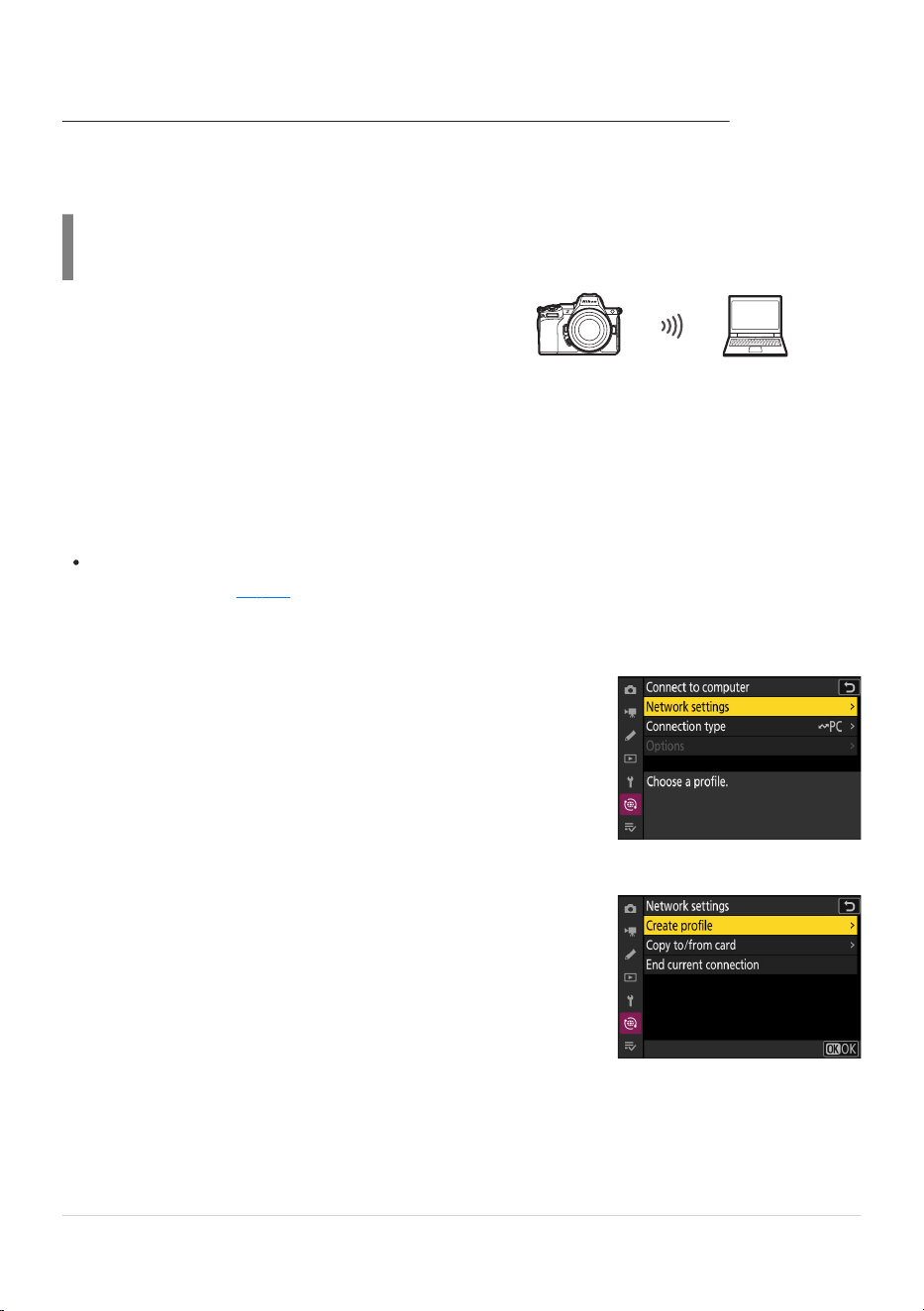
The camera and computer connect via direct
wireless link. The camera acts as a wir
eless LAN
access point, allowing you to connect when
working outdoors and in other situations in
which the computer is not already connected
to a wireless network and eliminating the need
for complicated adjustments to settings. The
computer cannot connect to the Internet while
connected to the camera.
Before proceeding, check that the Wireless
Transmitter Utility (
0 335) is installed on the
computer.
Select [Connect to computer] in the network menu, then
highlight [Network settings
] and press 2.
Highlight [Create profile] and press J.
Connecting to Computers via Wireless LAN
The camera can connect to computer
s either by direct wireless link (Wi-Fi access point mode) or via a
wireless router on an existing network, including home networks (Wi-Fi station mode).
Direct Wireless Connection to a Computer (Wi-Fi Access
Point Mode)
336
Computers: Connecting via Wireless LAN
1
2
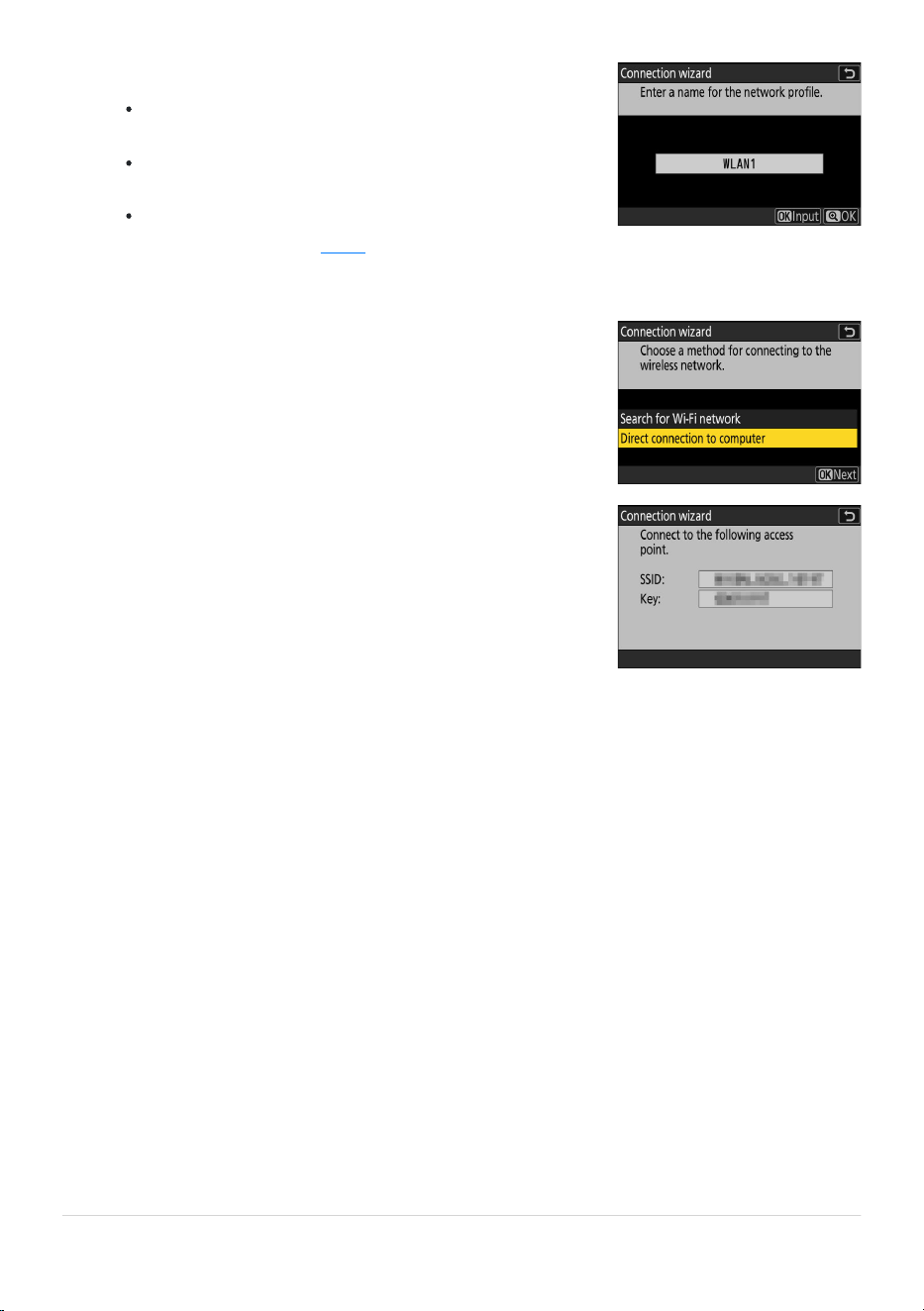
Name the new profile.
To proceed t
o the next step without changing the default
name, press X.
Whatever name you choose will appear in the network
menu [Connect to computer]> [Network settings] list.
To rename the profile, press J. For information on text
entry, see “Text Entry” (
0 79). Press X to proceed after
entering a name.
Highlight [Direct connection to computer] and press J.
The camera SSID and encryption key will be displayed.
337
Computers: Connecting via Wireless LAN
3
4
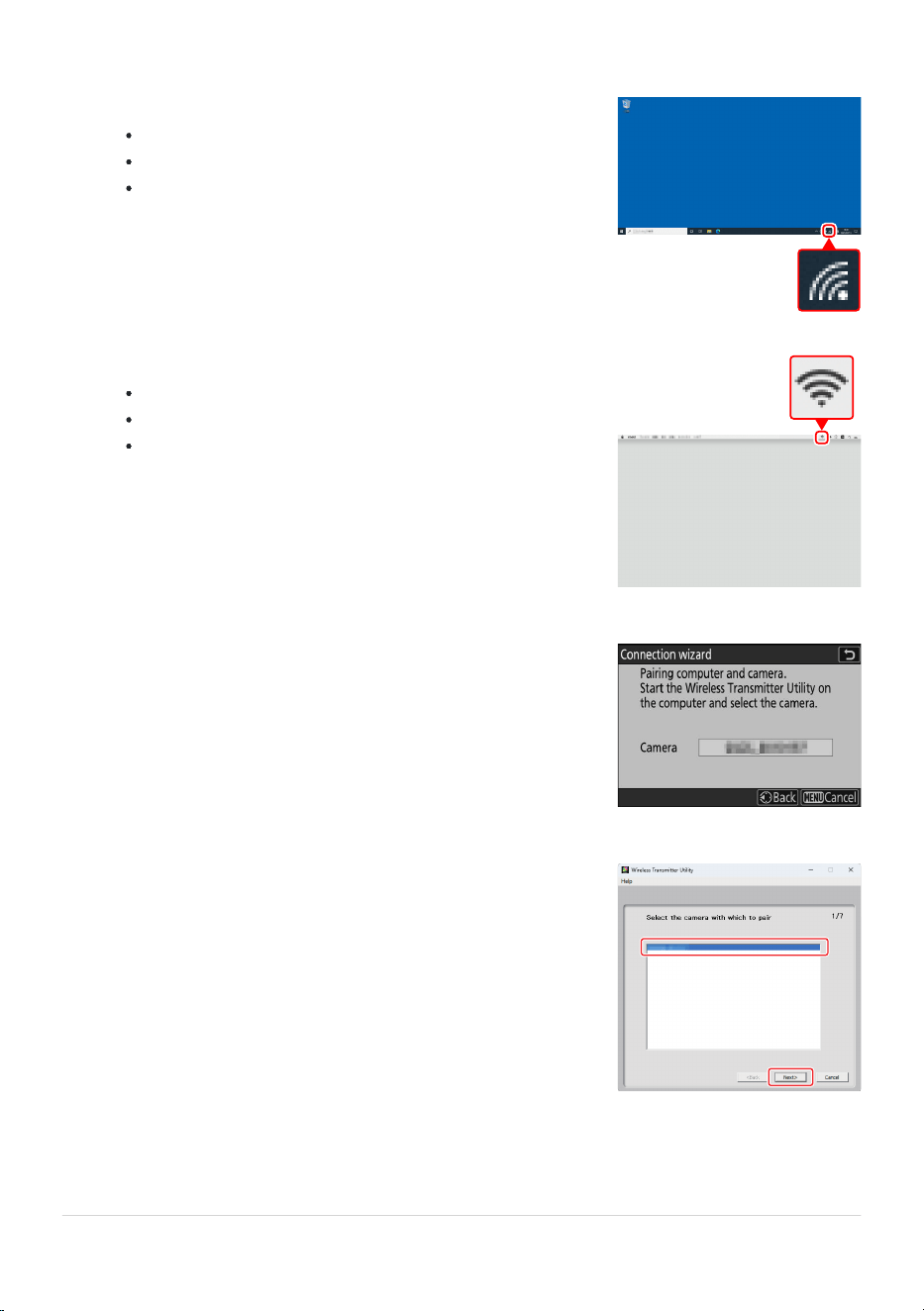
Windows:
Click the wireless LAN icon in the taskb
ar.
Select the SSID displayed by the camera in Step4.
When prompted to enter the network security key, enter
the encryption key displayed by the camera in Step4. The
computer will initiate a connection to the camera.
macOS:
Click the wireless LAN icon in the menu b
ar.
Select the SSID displayed by the camera in Step4.
When prompted to enter the network security key, enter
the encryption key displayed by the camera in Step4. The
computer will initiate a connection to the camera.
Start pairing.
When prompted, launch the Wir
eless Transmitter Utility on the
computer.
Select the camera in the Wireless Transmitter Utility.
Select the name displayed by the camera in St
ep6 and click
[Next].
Establish a connection to the camera.
338
Computers: Connecting via Wireless LAN
5
6
7
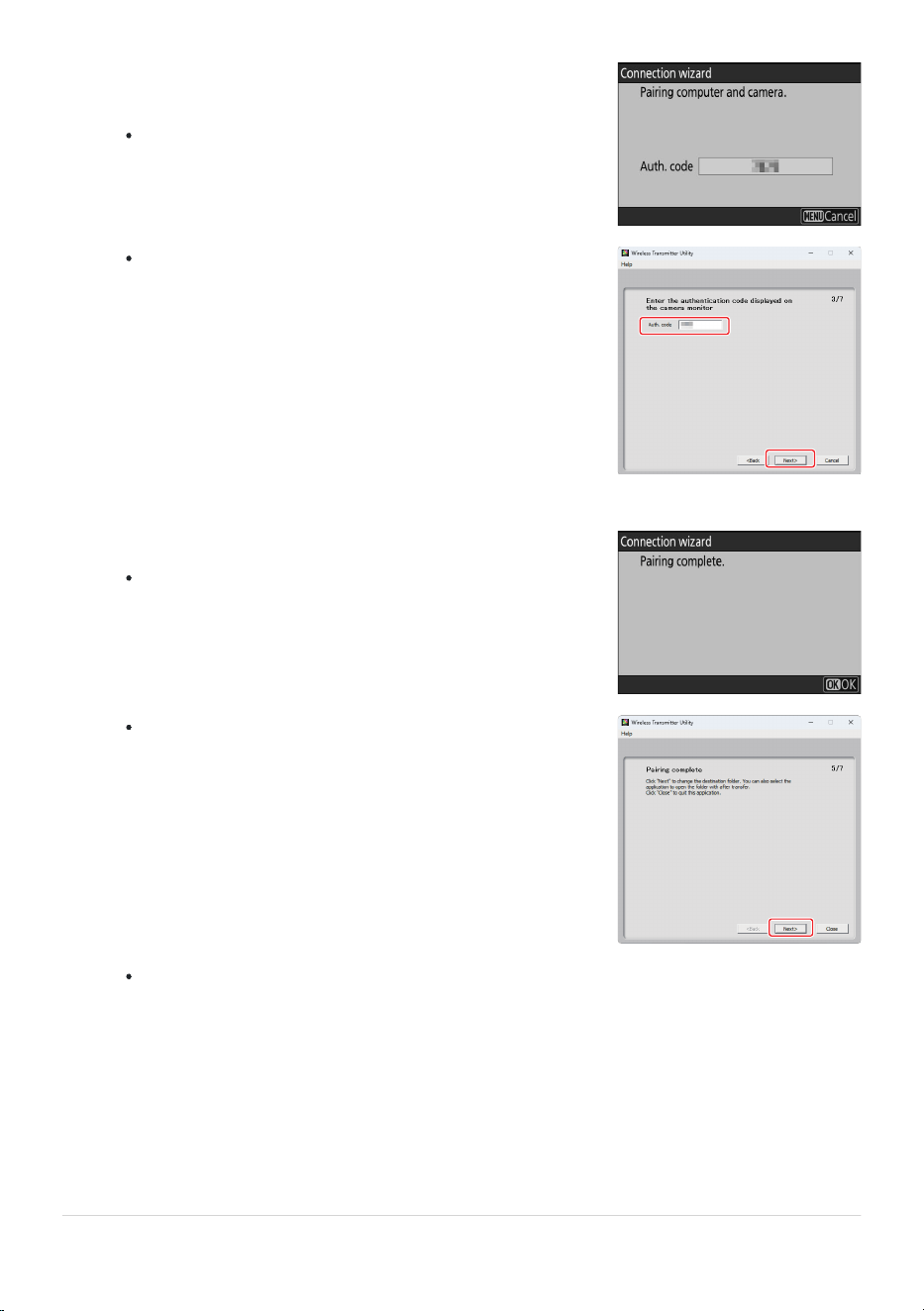
In the Wireless Transmitter Utility, enter the authentication
code displayed by the camera.
The camera will display an authentication code.
Enter the authentication code in the dialog displayed by the
Wireless Transmitt
er Utility and click [Next].
Complete the pairing process.
When the camera displays the dialog as shown, press J.
In the Wireless Transmitter Utility, click [Next]; you will
be prompted to choose a destination folder. For more
information, see online help for the Wireless Transmitter
Utility.
A wireless connection will be established between the camera and computer when pairing is
complete.
339
Computers: Connecting via Wireless LAN
8
9

Check the connection.
When a connection is established, the profile name will be
display
ed in green in the camera [Connect to computer]
menu.
If the profile name is not displayed in green, connect to the
camera via the wireless network list on your computer.
A wireless connection has now been established between the camera and the computer.
Pictures taken with the camera can be uplo
aded to the computer as described under “Uploading
Pictures” (
0 366) in the chapter titled “What You Can Do When the Camera Is Connect
ed to a
Computer or FTP Server”.
For information on controlling the camera from a computer using NX Tether, see the section
on “Camera Control” (
0 372) in the chapter titled “What You Can Do When the Camera Is
Connect
ed to a Computer or FTP Server”.
Tip: Firewall Settings
TCP port 15740 and UDP port 5353 are used for connections to computers. File transfer may be
blocked if the server firewall is not configured to allow access to these ports.
340
Computers: Connecting via Wireless LAN
10
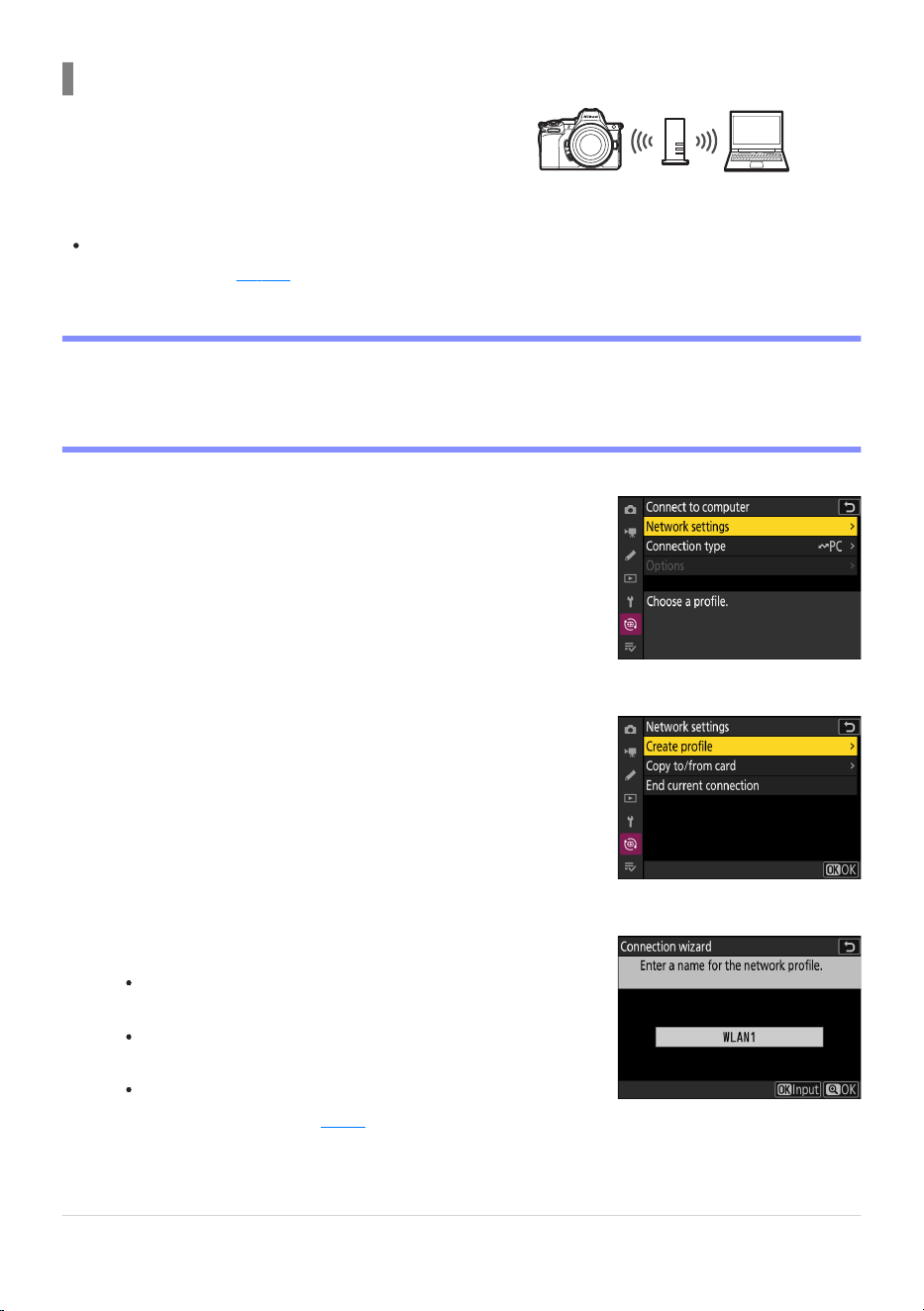
The camera connects to a computer on an existing
network (including home networks) via a wir
eless
router. The computer can still connect to the
Internet while connected to the camera.
Before proceeding, check that the Wireless
Transmitter Utility (
0 335) is installed on the
computer.
Select [Connect to computer] in the network menu, then
highlight [Network settings
] and press 2.
Highlight [Create profile] and press J.
Name the new profile.
To proceed t
o the next step without changing the default
name, press X.
Whatever name you choose will appear in the network
menu [Connect to computer]> [Network settings] list.
To rename the profile, press J. For information on text
entry, see “Text Entry” (
0 79). Press X to pr
oceed after
entering a name.
Connecting to an Existing Network (Wi-Fi Station Mode)
D Wi-Fi Station Mode
Connection to comput
ers beyond the local area network is not supported. You can connect only to
computers on the same network.
341
Computers: Connecting via Wireless LAN
1
2
3
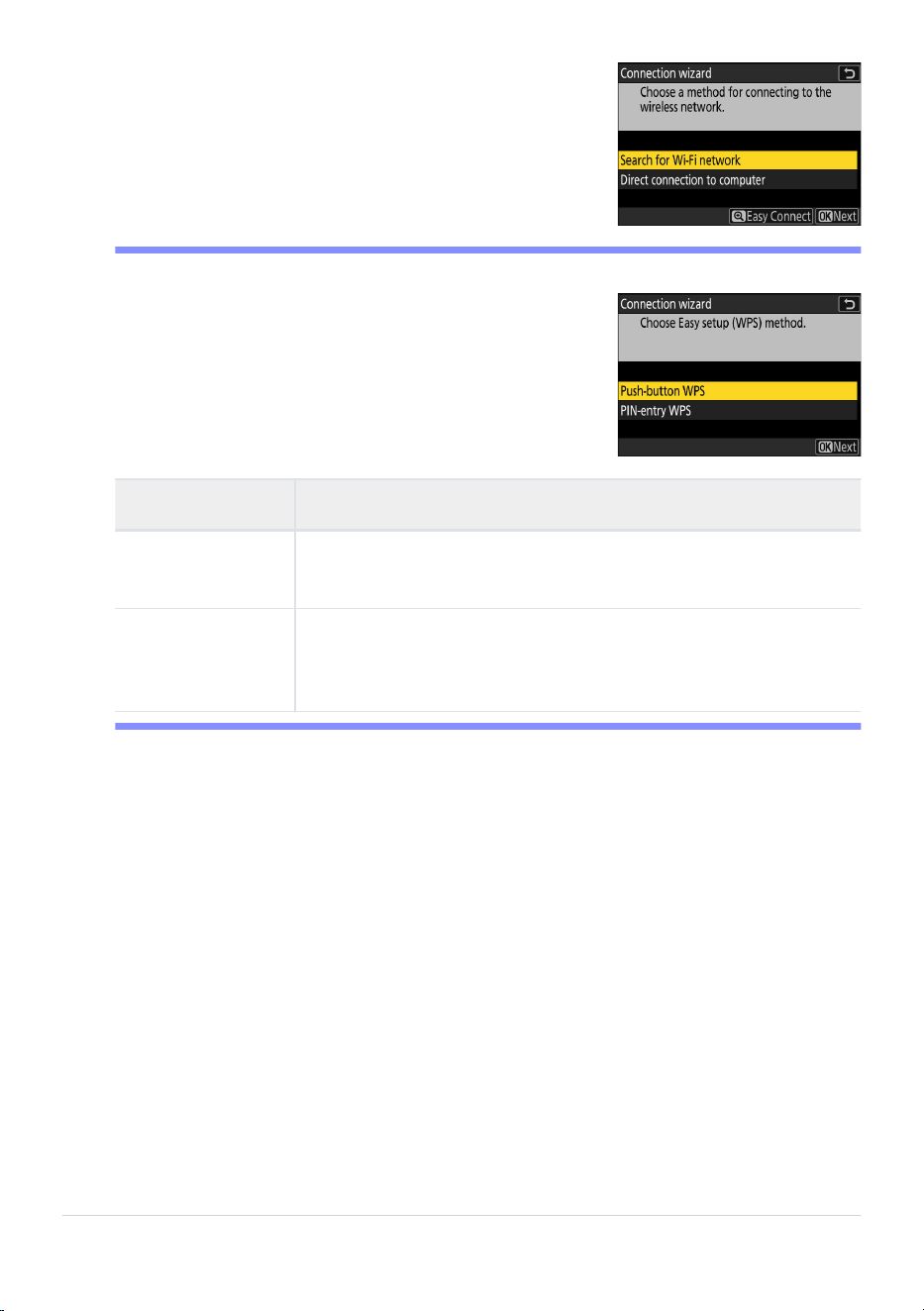
Highlight [Search for Wi-Fi network] and press J.
The camera will search for networks curr
ently active in the
vicinity and list them by name (SSID).
To connect without entering an SSID or encryption key, press
X in Step4. Next, highlight one o
f the following options and
press J. After connecting, proceed to Step7.
D “Easy Connect”
Option Description
[Push-butt
on WPS]
For rout
ers that support push-button WPS. Press the WPS button on
the r
out
er and then pr
ess the camera J button to connect.
[PIN-entry WPS]
The camera will display a PIN. Using a computer, enter the PIN on the
router. For more information, see the documentation provided with
the router.
342
Computers: Connecting via Wireless LAN
4
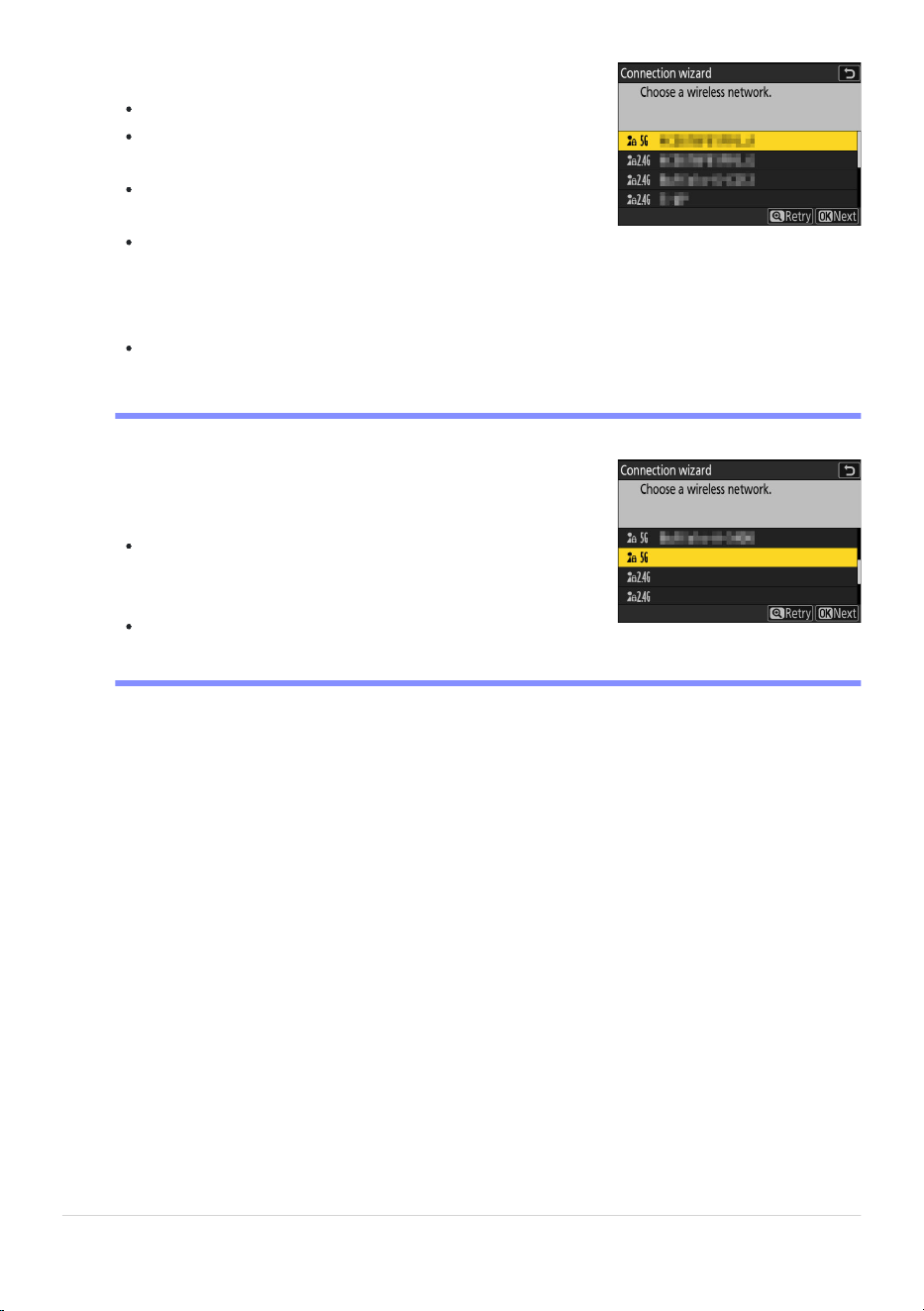
Choose a network.
Highlight a network SSID and press J.
The SSIDs containing charact
ers that cannot be entered on
the camera will not be displayed.
The band on which each SSID operates is indicated by an
icon.
Encrypted networks are indicated by a h icon. If the selected
network is encrypted (h), you will be prompted to enter the
encryption key. If the network is not encrypted, proceed to
Step7.
If the desired network is not displayed, press X to search
again.
Networks with hidden SSIDs are indicated by blank entries in
the network list.
To connect t
o a network with a hidden SSID, highlight a
blank entry and press J. Next, press J; the camera will
prompt you to provide an SSID.
Enter the network name and press X. Press X again; the
camera will now prompt you to enter the encryption key.
D Hidden SSIDs
343
Computers: Connecting via Wireless LAN
5
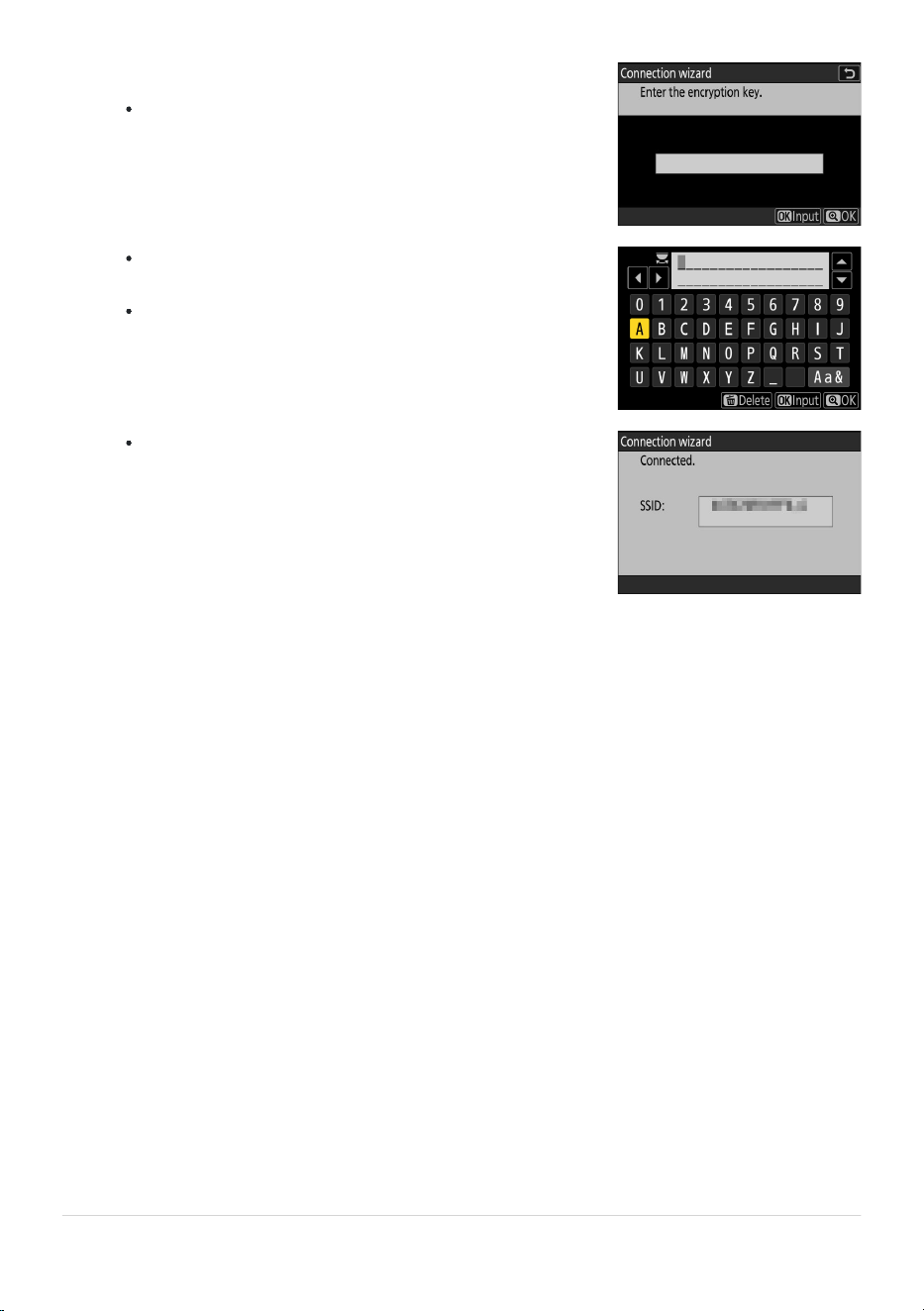
Enter the encryption key.
Press J
and enter the encryption key for the wireless router.
For more information, see the documentation for the
wireless rout
er.
Press X when entry is complete.
Press X again to initiate the connection. A message will
be display
ed for a few seconds when the connection is
established.
344
Computers: Connecting via Wireless LAN
6
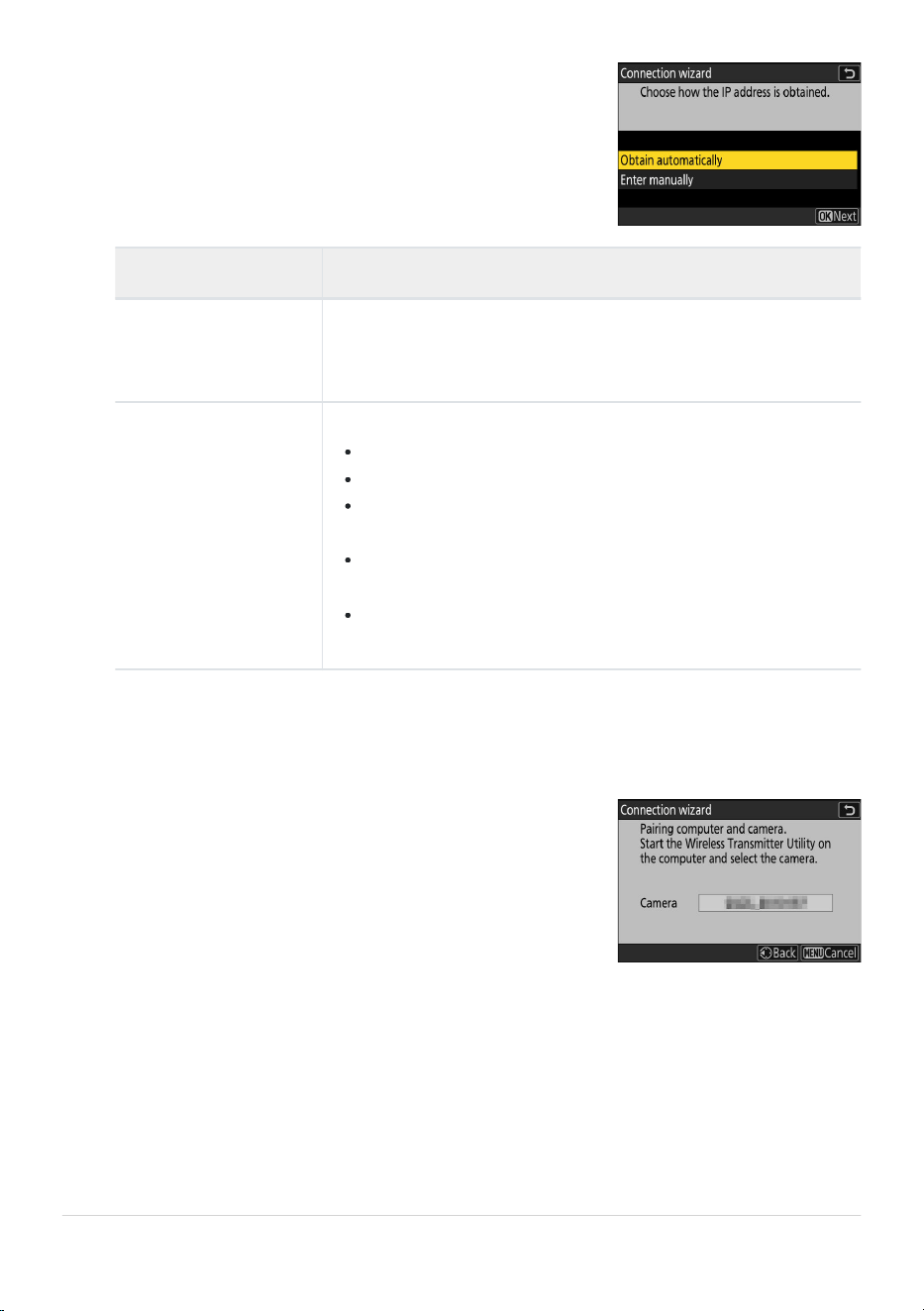
Obtain or select an IP address.
Highlight one of the following options and press J
.
Start pairing.
When prompted, launch the Wir
eless Transmitter Utility on the
computer.
Option Description
[Obtain automatically]
Select this option if the network is configur
ed to supply the IP
address automatically. A “configuration complete” message will be
displayed once an IP address has been assigned.
[Enter manually]
Enter the IP addr
ess and sub-net mask manually.
Press J
; you will be prompted to enter the IP address.
Rotate the main command dial to highlight segments.
Press 4 or 2 to change the highlighted segment and press J
to save changes.
Next, press X; a “configuration complete” message will be
displayed. Press X again to display the sub-net mask.
Press 1 or 3 to edit the sub-net mask and press J; a
“configuration complete” message will be displayed.
Press J
to proceed when the “configuration complete” message is displayed.
345
Computer
s: Connecting via Wireless LAN
7
8
9
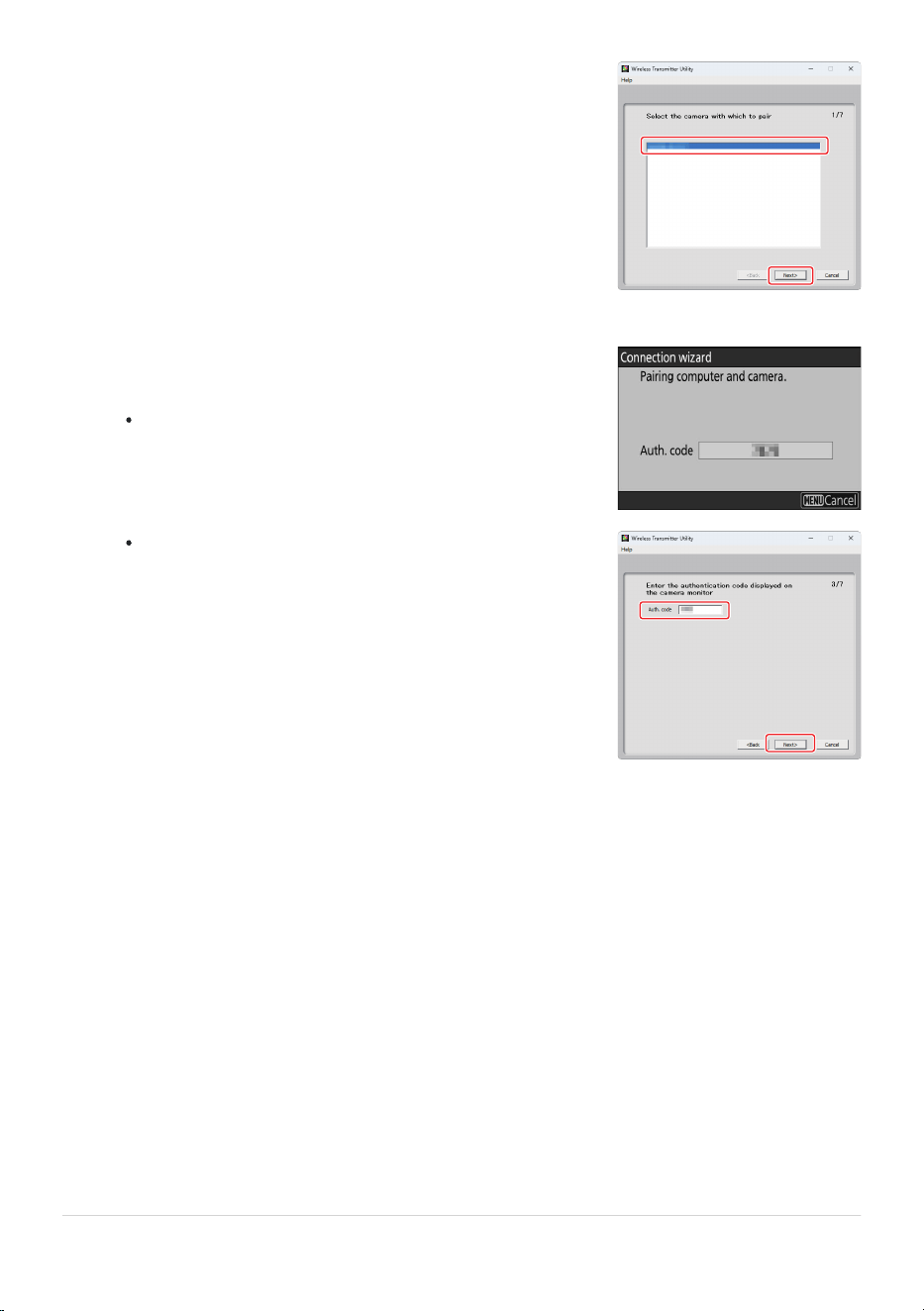
Select the camera in the Wireless Transmitter Utility.
Select the name displayed by the camera in St
ep9 and click
[Next].
In the Wireless Transmitter Utility, enter the authentication
code displayed by the camera.
The camera will display an authentication code.
Enter the authentication code in the dialog displayed by the
Wireless Transmitt
er Utility and click [Next].
346
Computers: Connecting via Wireless LAN
10
11
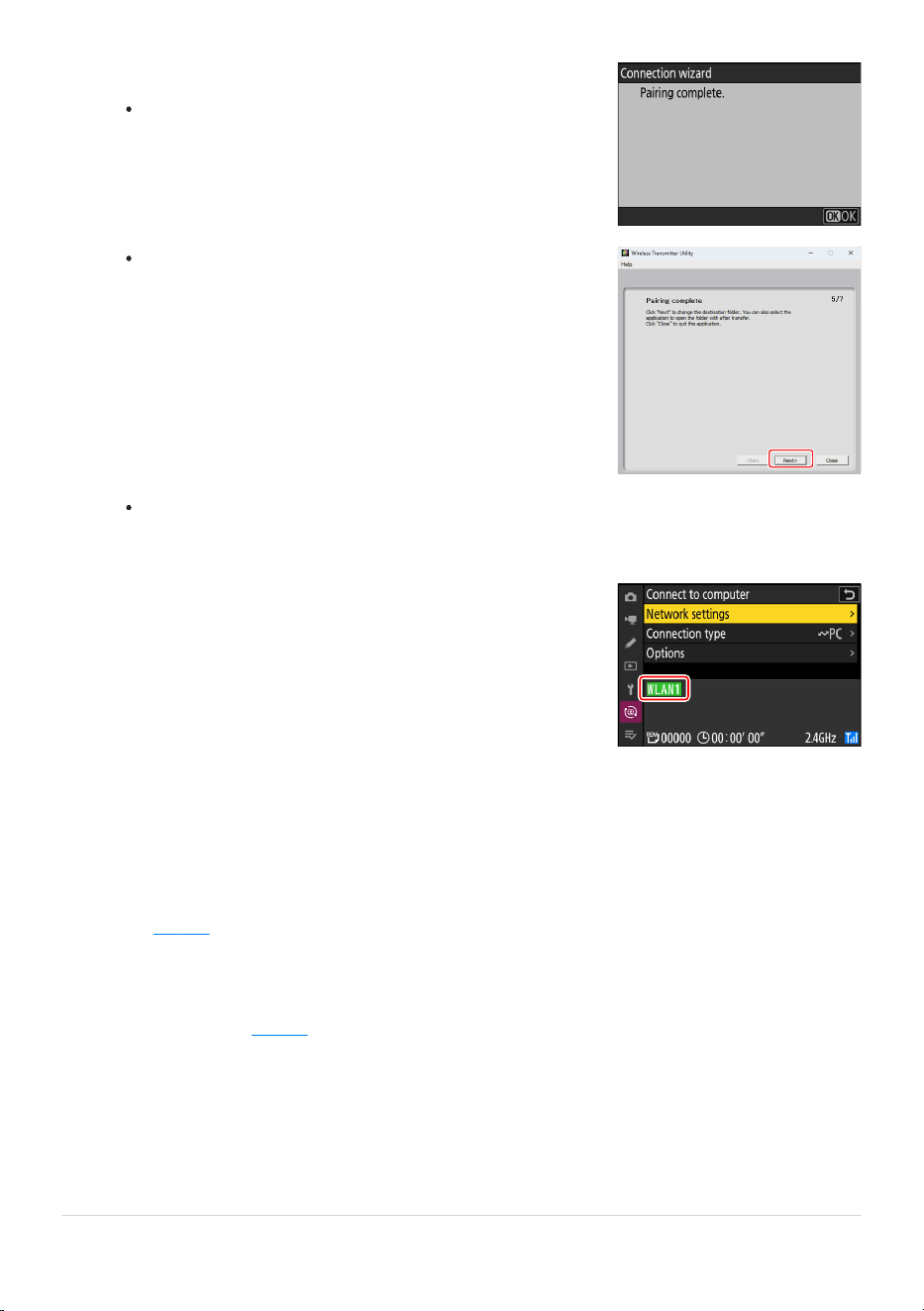
Complete the pairing process.
When the camera displays the dialog as shown, press J.
In the Wireless Transmitter Utility, click [Next]; you will
be prompt
ed to choose a destination folder. For more
information, see online help for the Wireless Transmitter
Utility.
Check the connection.
When a connection is established, the profile name will be
display
ed in green in the camera [Connect to computer]
menu.
A wireless connection will be established between the camera and computer when pairing is
complete.
A wireless connection has now been established betw
een the camera and the computer.
Pictures taken with the camera can be uploaded to the computer as described under “Uploading
Pictures” (
0 366) in the chapter titled “What You Can Do When the Camera Is Connect
ed to a
Computer or FTP Server”.
For information on controlling the camera from a computer using NX Tether, see the section
on “Camera Control” (
0 372) in the chapter titled “What You Can Do When the Camera Is
Connect
ed to a Computer or FTP Server”.
347
Computers: Connecting via Wireless LAN
12
13

Ending the Connection to the Computer
You can end the connection by:
turning the camera o
ff, or
selecting [End current connection] for [Connect to computer]> [Network settings] in the
network menu.
D Wi-Fi Access-Point Mode
An error will occur if the computer’s wireless connection is disabled before the camera’s. Disable
camera’s connection first.
348
Computers: Connecting via Wireless LAN

FTP Servers: Connecting via Wireless LAN
The camera can connect to FTP ser
vers via Wi-Fi (built-in wireless LAN).
D Connecting to Multiple Devices
The camera can connect to only one type of device (computer, FTP server, or smart device) at a time.
End the current connection before attempting to connect to a device of a different type.
D Can’t Connect?
If you have trouble connecting, try:
turning the camera off and then on again,
checking wireless settings on the FTP server, or
restarting the FTP server.
Tip: Wireless LAN Errors
For information on wireless-related errors, see “Troubleshooting Wireless LAN Connections” (
0 374).
349
FTP Servers: Connecting via Wireless LAN
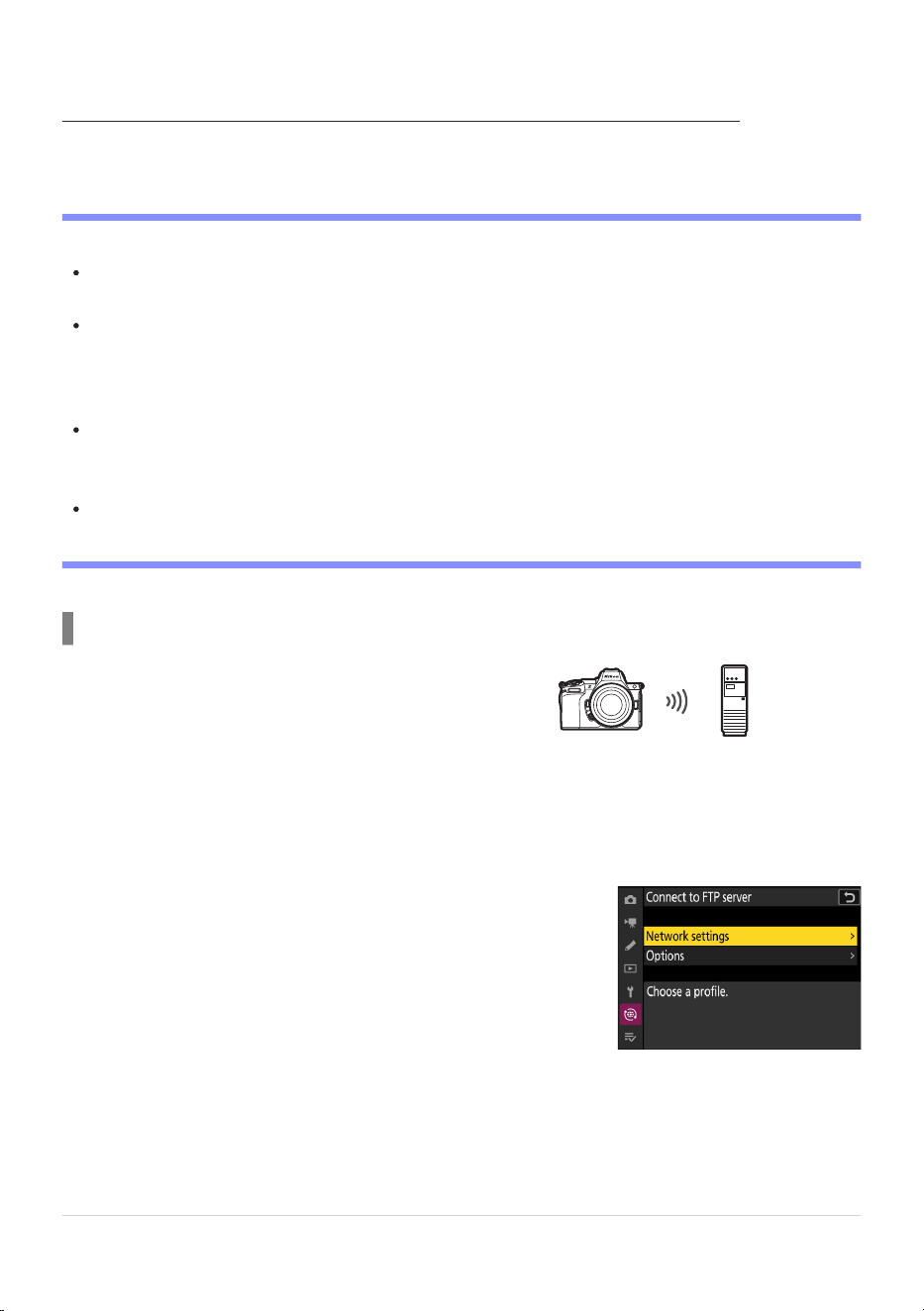
The camera and FTP server connect via direct
wireless link. The camera acts as a wir
eless LAN
access point, allowing you to connect when
working outdoors and in other situations in which
the FTP server is not already connected to a
wireless network and eliminating the need for
complicated adjustments to settings.
FTP
Select [Connect to FTP server] in the network menu, then
highlight [Network settings
] and press 2.
Connecting to FTP Servers via Wireless LAN
The camera can connect to FTP ser
vers either by direct wireless link (Wi-Fi access point mode) or via a
wireless router on an existing network, including home networks (Wi-Fi station mode).
D FTP Servers
Servers can be configured using standard FTP services—including IIS (Internet Information Services)
—available with Windows 11 and Windows 10.
Internet FTP connections and connection to FTP servers running third-party software are not
supported.
D FTPS Servers
Before connecting to a server via FTPS, you will need to load a root certificate onto the camera. This
can be done using [Connect to FTP server] > [Options] > [Manage root certificate] > [Import
root certificate] in the network menu.
Contact the network administrator for the FTPS server in question for information on acquiring root
certificates.
Direct Wireless Connection (Wi-Fi Access Point Mode)
350
FTP Servers: Connecting via Wireless LAN
1
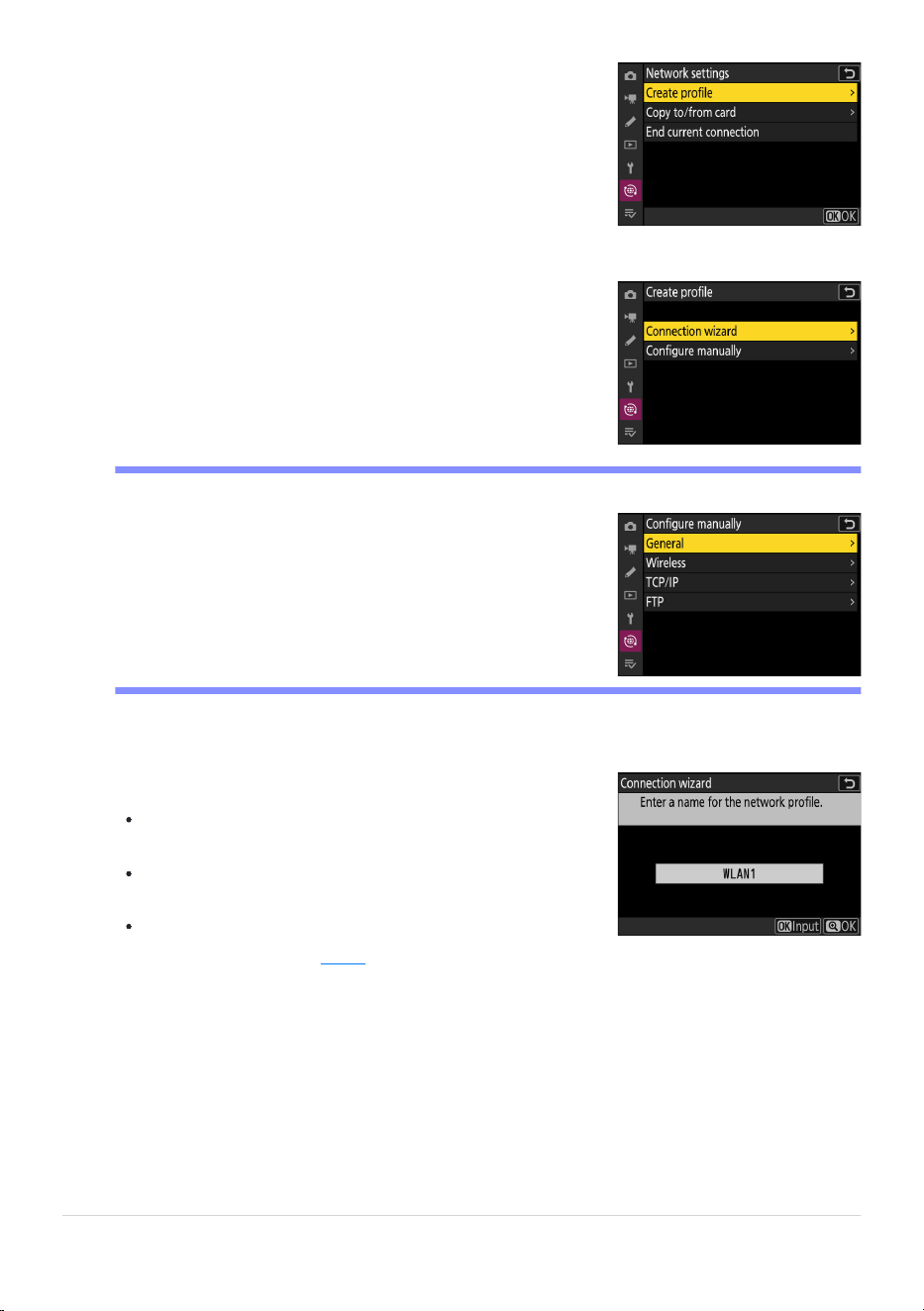
Highlight [Create profile] and press J.
Highlight [Connection wizard] and press 2.
The connection wizard will launch.
Choose [Configure manually] to configur
e settings manually.
Name the new profile.
To proceed t
o the next step without changing the default
name, press X.
Whatever name you choose will appear in the network
menu [Connect to FTP server]> [Network settings] list.
To rename the profile, press J. For information on text
entry, see “Text Entry” (
0 79). Press X to proceed after
entering a name.
D Manual Configuration
351
FTP Servers: Connecting via Wireless LAN
2
3
4
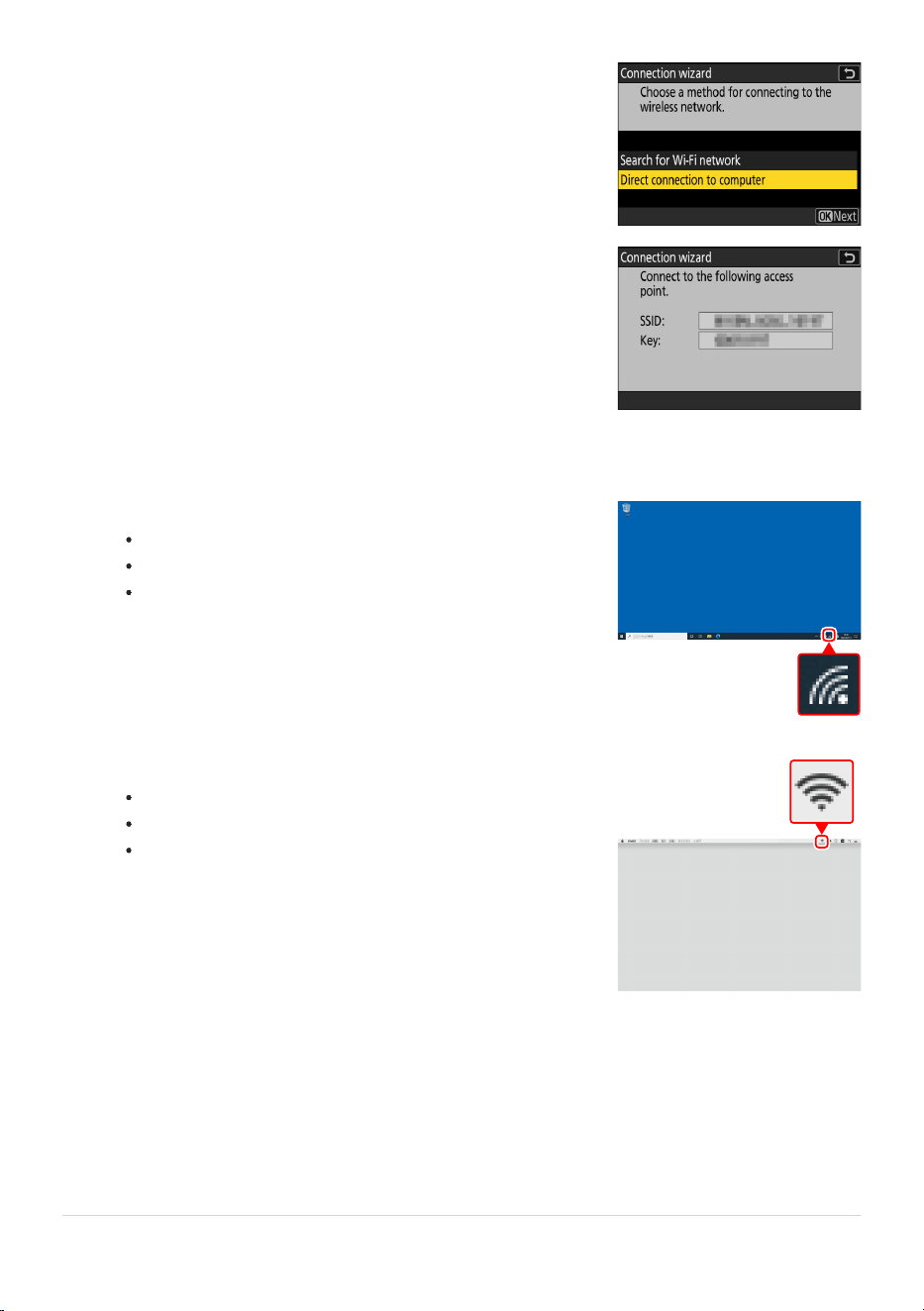
Highlight [Direct connection to computer] and press J.
The camera SSID and encryption key will be displayed.
Windows:
Click the wireless LAN icon in the taskb
ar.
Select the SSID displayed by the camera in Step5.
When prompted to enter the network security key, enter
the encryption key displayed by the camera in Step5. The
computer will initiate a connection to the camera.
macOS:
Click the wireless LAN icon in the menu b
ar.
Select the SSID displayed by the camera in Step5.
When prompted to enter the network security key, enter
the encryption key displayed by the camera in Step5. The
computer will initiate a connection to the camera.
Establish a connection to the camera.
352
FTP Servers: Connecting via Wireless LAN
5
6
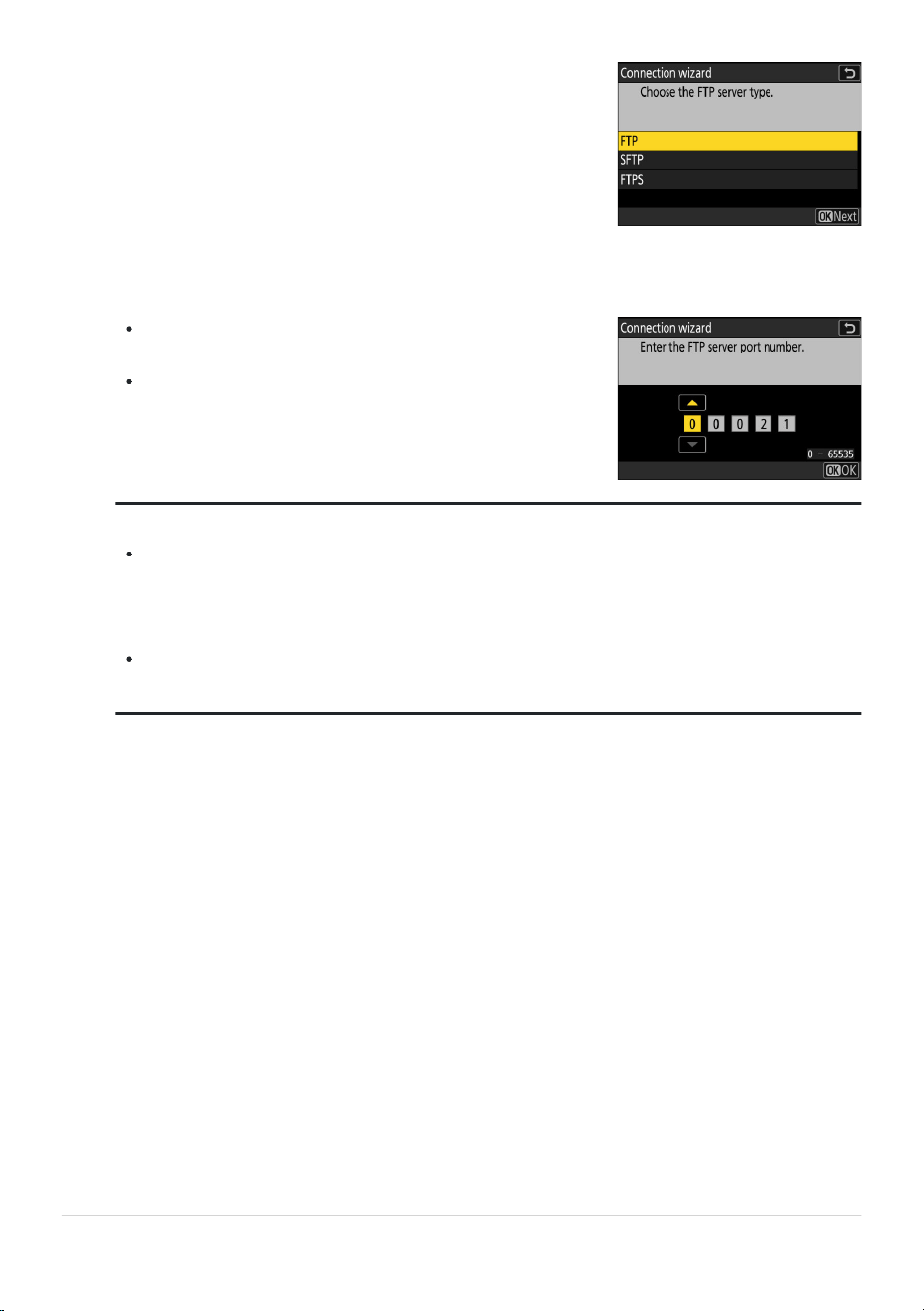
Choose the server type.
Highlight [FTP], [SF
TP] (SSH FTP), or [FTPS] (FTP-SSL) and
press J to display a dialog where you can enter the server
port number.
Press 4 or 2 to highlight digits and press 1
or 3 to
change.
Press J to display a dialog where you can choose a login
method.
Enter the FTP server port number.
Tip: Firewall Settings
The ports used for F
TP vary with the server type. The port numbers are listed below.
[FTP]: TCP ports 21 and 32768 through 61000
[SFTP]: TCP ports 22 and 32768 through 61000
[FTPS]: TCP ports 21 and 32768 through 61000
File transfer may be blocked if the server firewall is not configured to allow access to the
appropriate ports.
353
FTP Servers: Connecting via Wireless LAN
7
8
-
-
-
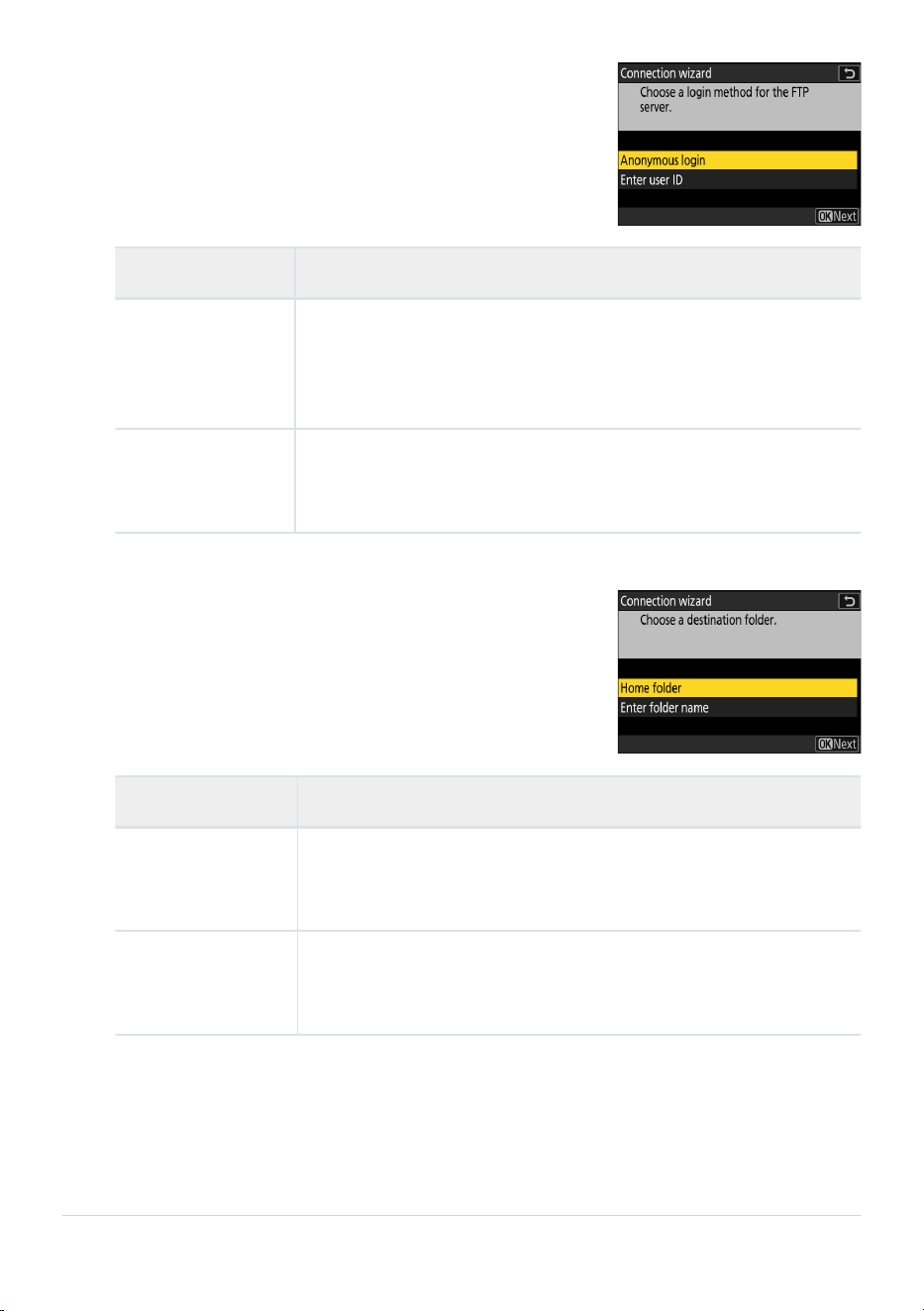
Log in.
Highlight one of the following options and press J
.
Choose a destination folder.
Highlight one of the following options and press J
.
Option Description
[Anonymous login]
Select this option if the server does not require a user ID or password.
This option can only be used with server
s that are configured for
anonymous login. If login is successful, the camera will prompt you to
choose a destination.
[Ent
er user ID]
Ent
er a user ID and p
assword. Press J t
o log in when entr
y is
complet
e. If login is successful, the camera will prompt you to choose
a destination.
Option Description
[Home folder]
Select this option to select the server’s home folder as the
destination for pictures uploaded from the camera. A “setup
complete” dialog will be displayed if the operation is successful.
[Ent
er folder name]
Ent
er the destination folder name manually
. The folder must already
exist on the ser
v
er
. Enter the folder name and path when prompted
and press J to display the “setup complete” dialog.
354
FTP Servers: Connecting via Wireless LAN
9
10
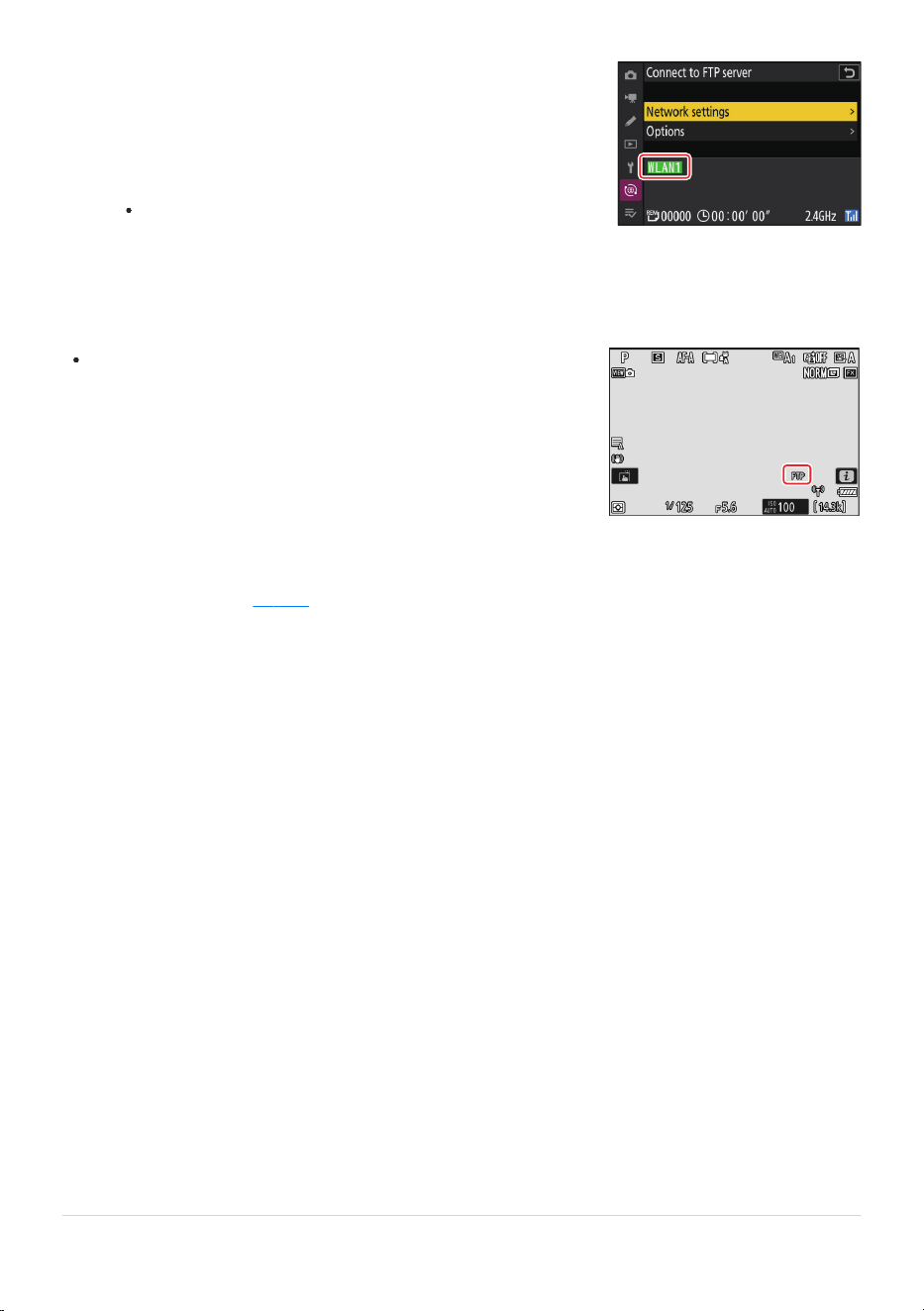
Check the connection.
When a connection is established, the profile name will be
display
ed in green in the camera [Connect to FTP server]
menu.
If the profile name is not displayed in green, connect to the
camera via the wireless network list on the FTP server.
“FTP” will appear in the camera shooting display once a
connection is established. If a connection error occurs, this
indicat
or will be displayed in red together with a C icon.
A wireless connection has now been established between the camera and the FTP server.
Pictures taken with the camera can be uplo
aded to the FTP server as described under
“Uploading Pictures” (
0 366) in the chapt
er titled “What Y
ou Can Do When the Camera Is
Connect
ed to a Computer or FTP Server.”
355
FTP Servers: Connecting via Wireless LAN
11
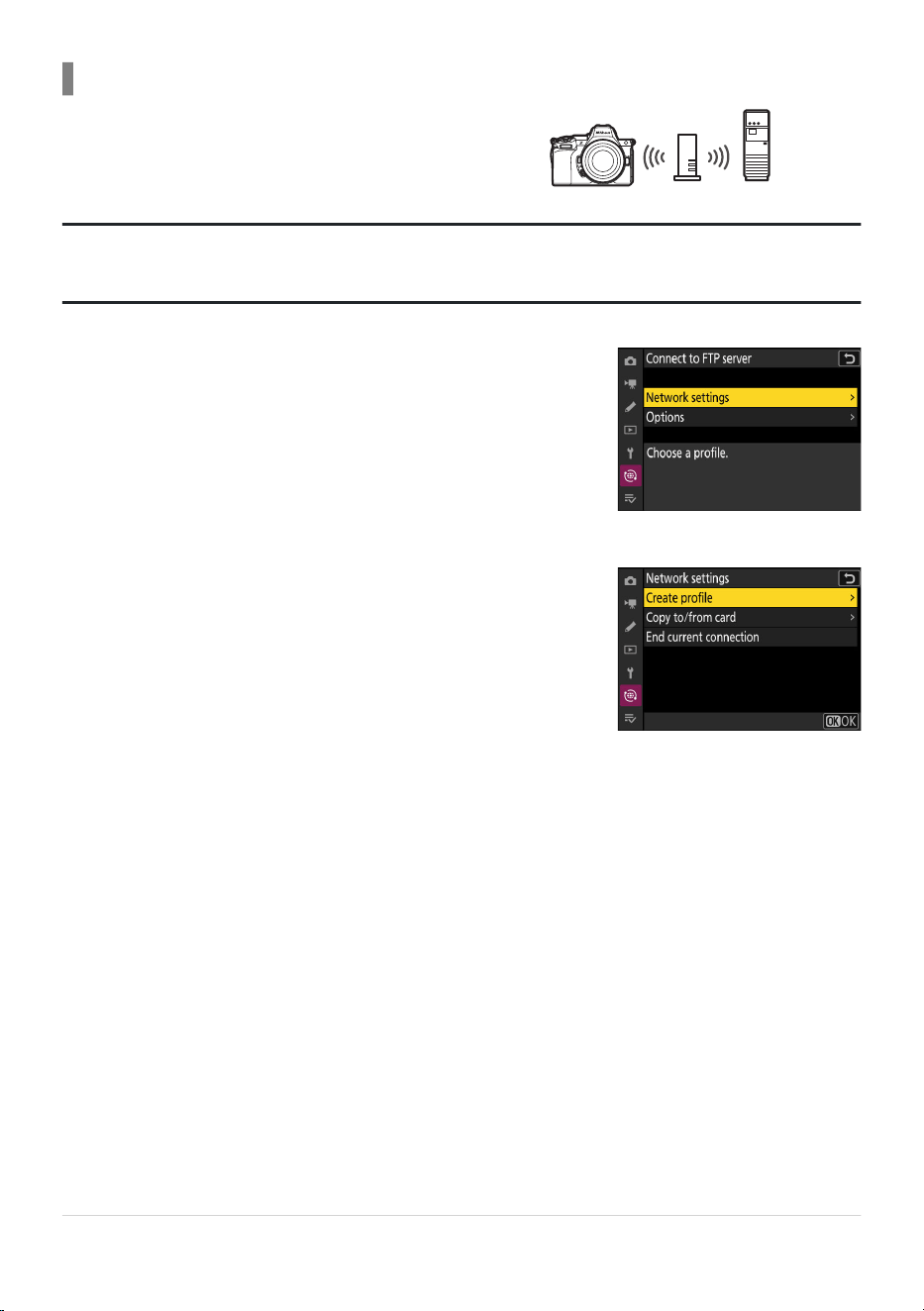
The camera and FTP server connect on an existing
network (including home networks) via a wir
eless
router.
FTP
Select [Connect to FTP server] in the network menu, then
highlight [Network settings
] and press 2.
Highlight [Create profile] and press J.
Connecting to an Existing Network (Wi-Fi Station Mode)
Tip: Wi-Fi Station Mode
Wi-Fi station mode supports connection t
o FTP servers on different networks.
356
FTP Servers: Connecting via Wireless LAN
1
2
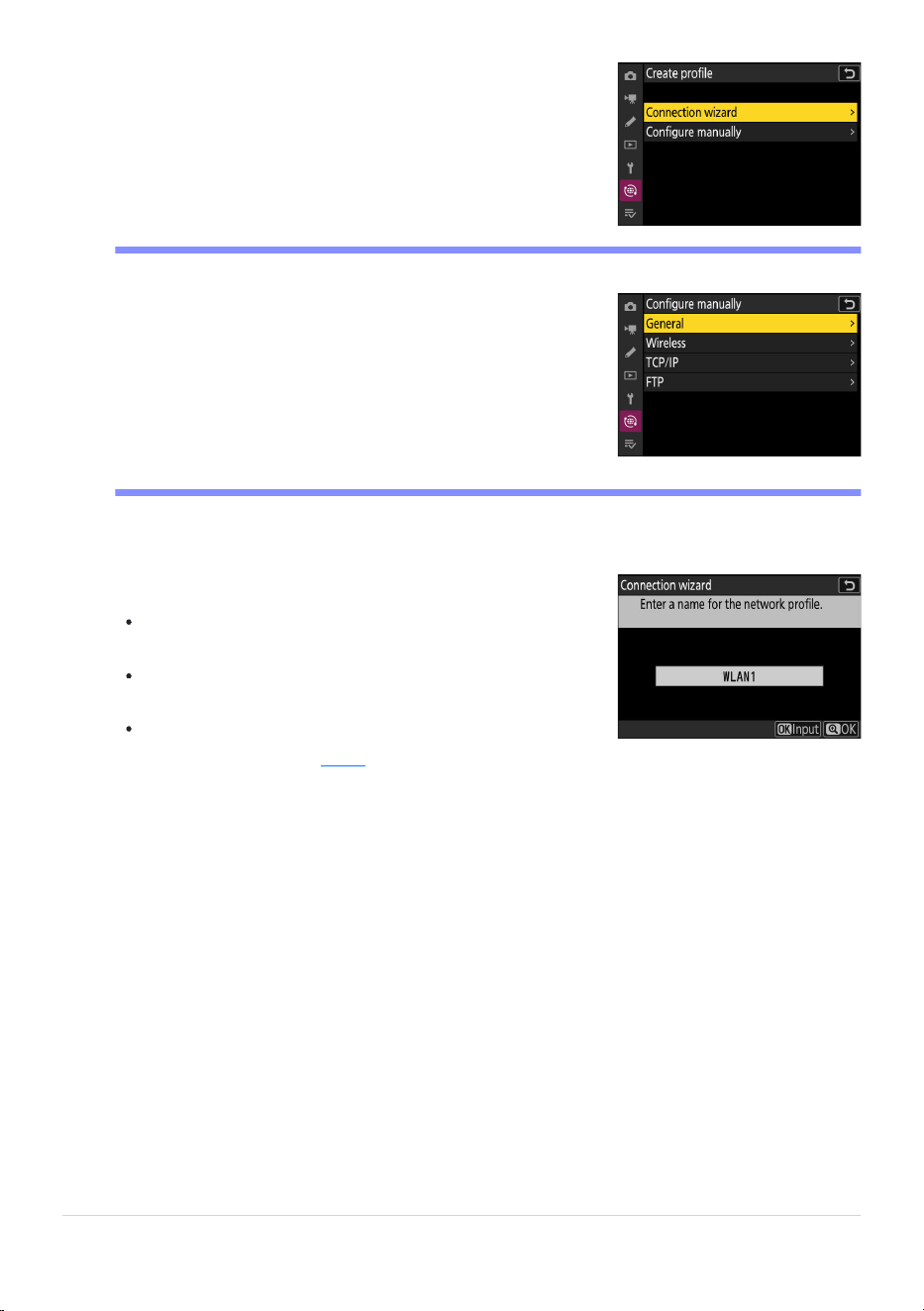
Highlight [Connection wizard] and press 2.
The connection wizard will launch.
Choose [Configure manually] to configur
e settings manually.
Name the new profile.
To proceed t
o the next step without changing the default
name, press X.
Whatever name you choose will appear in the network
menu [Connect to FTP server]> [Network settings] list.
To rename the profile, press J. For information on text
entry, see “Text Entry” (
0 79). Press X to proceed after
entering a name.
D Manual Configuration
357
FTP Servers: Connecting via Wireless LAN
3
4
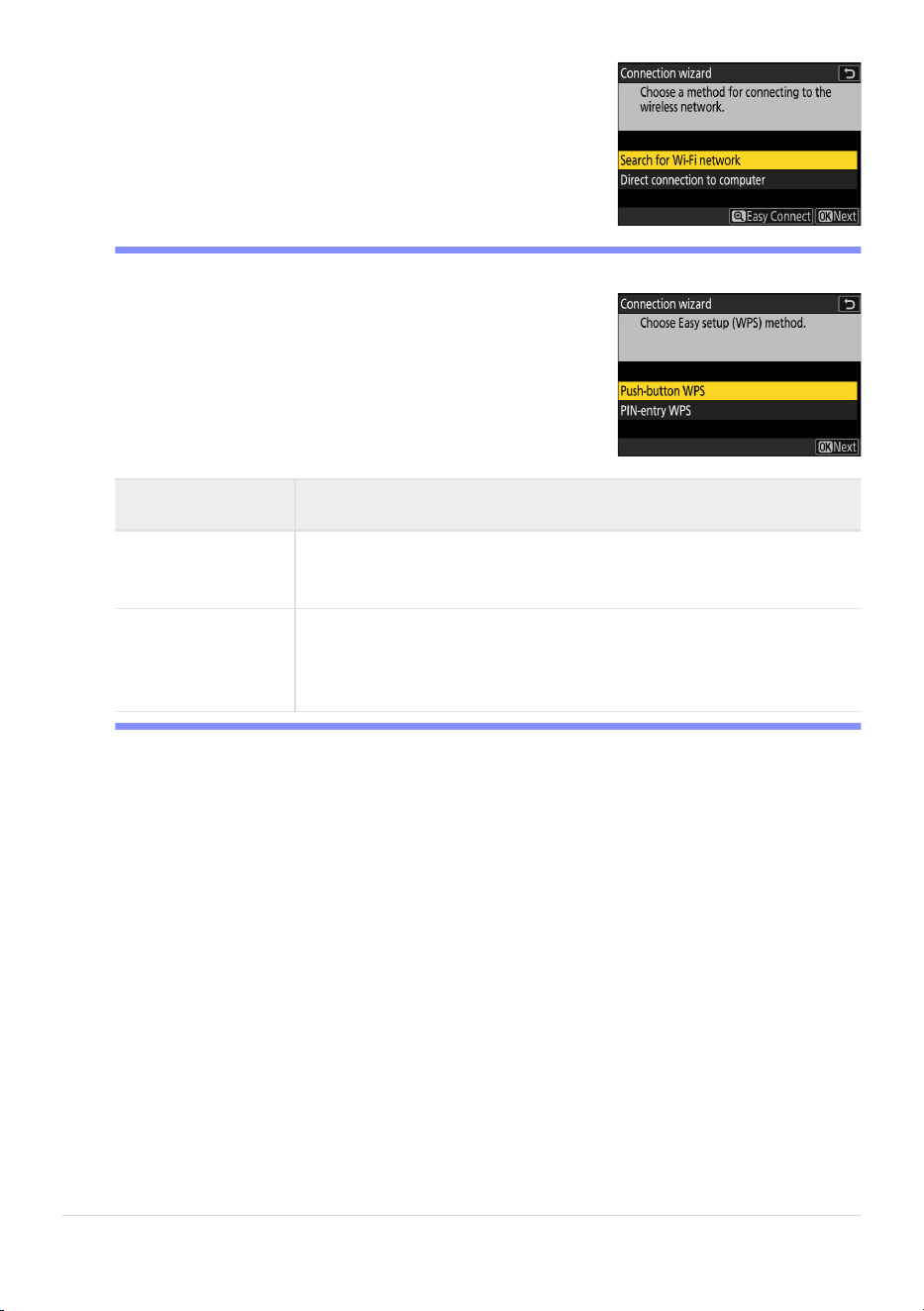
Highlight [Search for Wi-Fi network] and press J.
The camera will search for networks curr
ently active in the
vicinity and list them by name (SSID).
To connect without entering an SSID or encryption key, press
X in Step5. Next, highlight one o
f the following options and
press J. After connecting, proceed to Step8.
D “Easy Connect”
Option Description
[Push-butt
on WPS]
For rout
ers that support push-button WPS. Press the WPS button on
the r
out
er and then pr
ess the camera J button to connect.
[PIN-entry WPS]
The camera will display a PIN. Using a computer, enter the PIN on the
router. For more information, see the documentation provided with
the router.
358
FTP Servers: Connecting via Wireless LAN
5
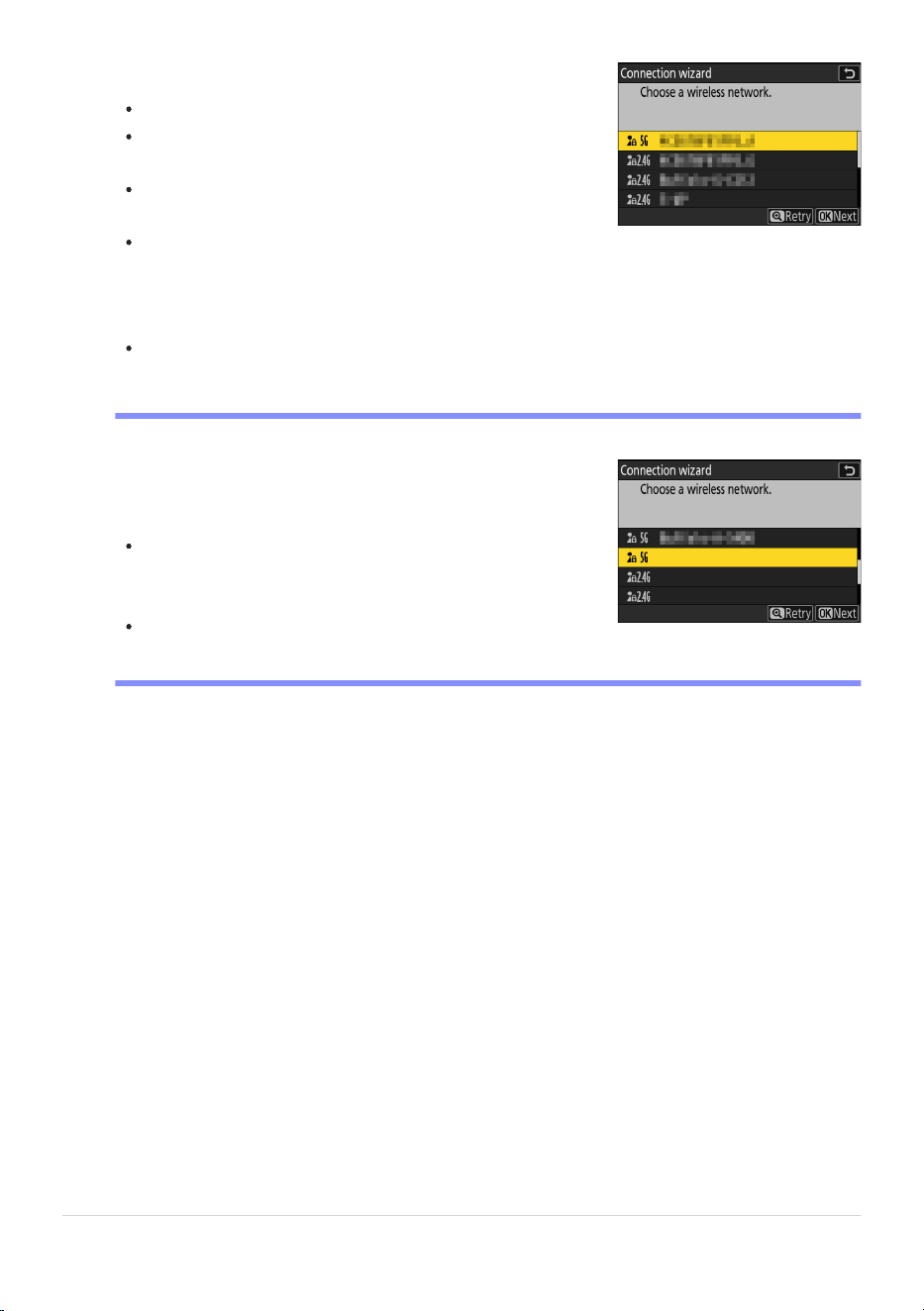
Choose a network.
Highlight a network SSID and press J.
The SSIDs containing charact
ers that cannot be entered on
the camera will not be displayed.
The band on which each SSID operates is indicated by an
icon.
Encrypted networks are indicated by a h icon. If the selected
network is encrypted (h), you will be prompted to enter the
encryption key. If the network is not encrypted, proceed to
Step8.
If the desired network is not displayed, press X to search
again.
Networks with hidden SSIDs are indicated by blank entries in
the network list.
To connect t
o a network with a hidden SSID, highlight a
blank entry and press J. Next, press J; the camera will
prompt you to provide an SSID.
Enter the network name and press X. Press X again; the
camera will now prompt you to enter the encryption key.
D Hidden SSIDs
359
FTP Servers: Connecting via Wireless LAN
6
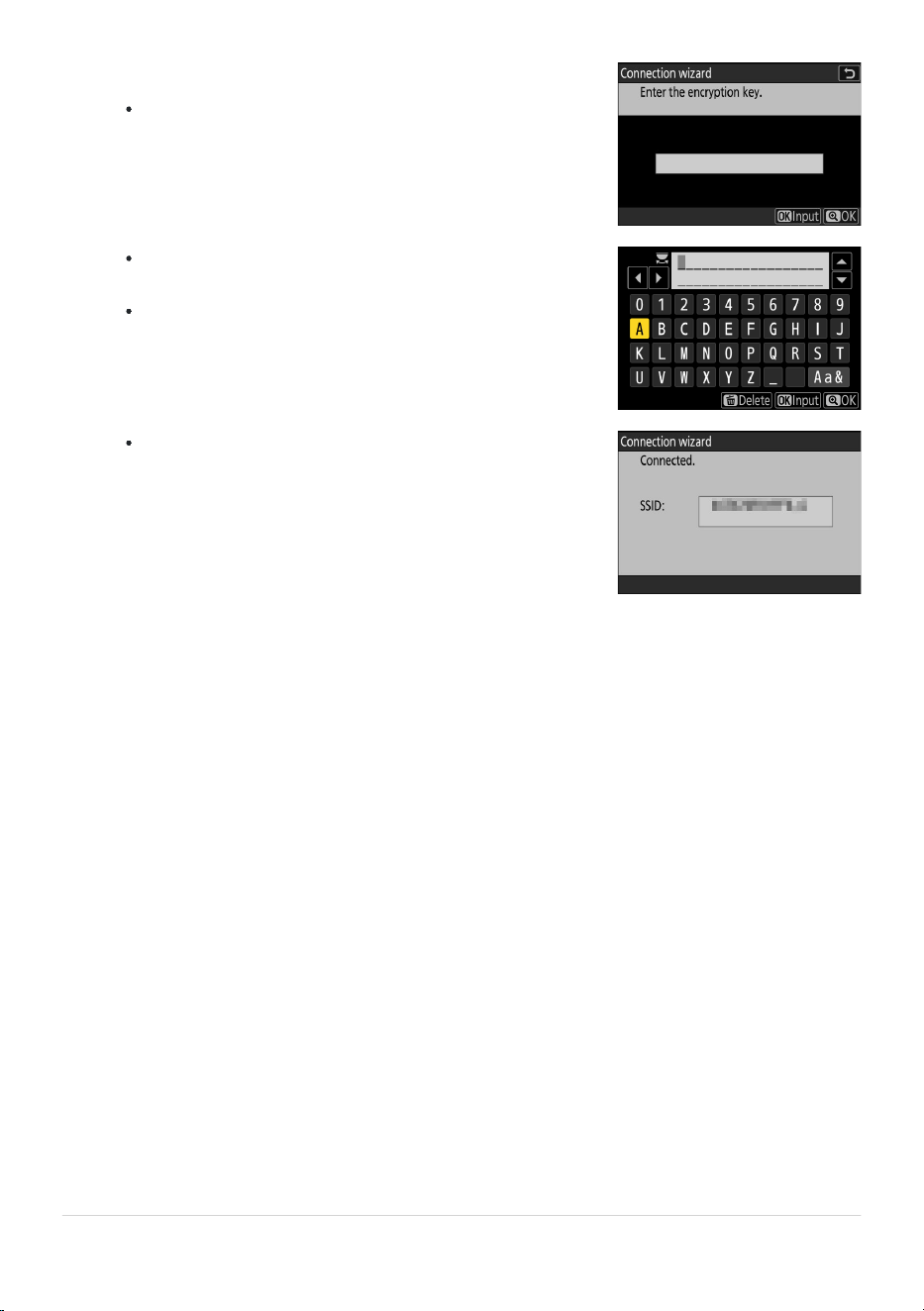
Enter the encryption key.
Press J
and enter the encryption key for the wireless router.
For more information, see the documentation for the
wireless rout
er.
Press X when entry is complete.
Press X again to initiate the connection. A message will
be display
ed for a few seconds when the connection is
established.
360
FTP Servers: Connecting via Wireless LAN
7
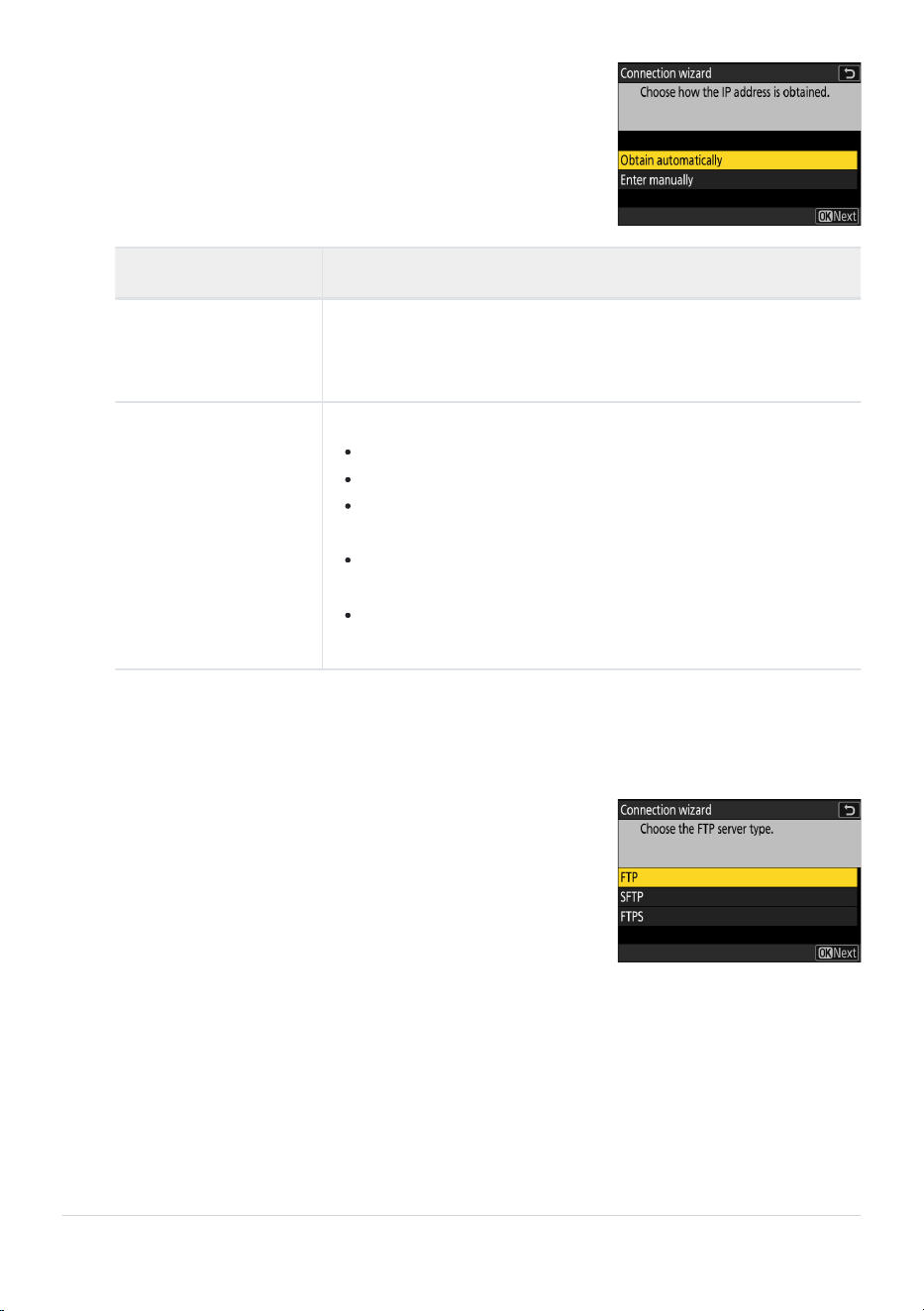
Obtain or select an IP address.
Highlight one of the following options and press J
.
Choose the server type.
Highlight [FTP], [SF
TP] (SSH FTP), or [FTPS] (FTP-SSL) and
press J to display a dialog where you can enter the server
address.
Option Description
[Obtain automatically]
Select this option if the network is configur
ed to supply the IP
address automatically. A “configuration complete” message will be
displayed once an IP address has been assigned.
[Enter manually]
Enter the IP addr
ess and sub-net mask manually.
Press J
; you will be prompted to enter the IP address.
Rotate the main command dial to highlight segments.
Press 4 or 2 to change the highlighted segment and press J
to save changes.
Next, press X; a “configuration complete” message will be
displayed. Press X again to display the sub-net mask.
Press 1 or 3 to edit the sub-net mask and press J; a
“configuration complete” message will be displayed.
Press J
to proceed when the “configuration complete” message is displayed.
361
FTP Ser
vers: Connecting via Wireless LAN
8
9
10
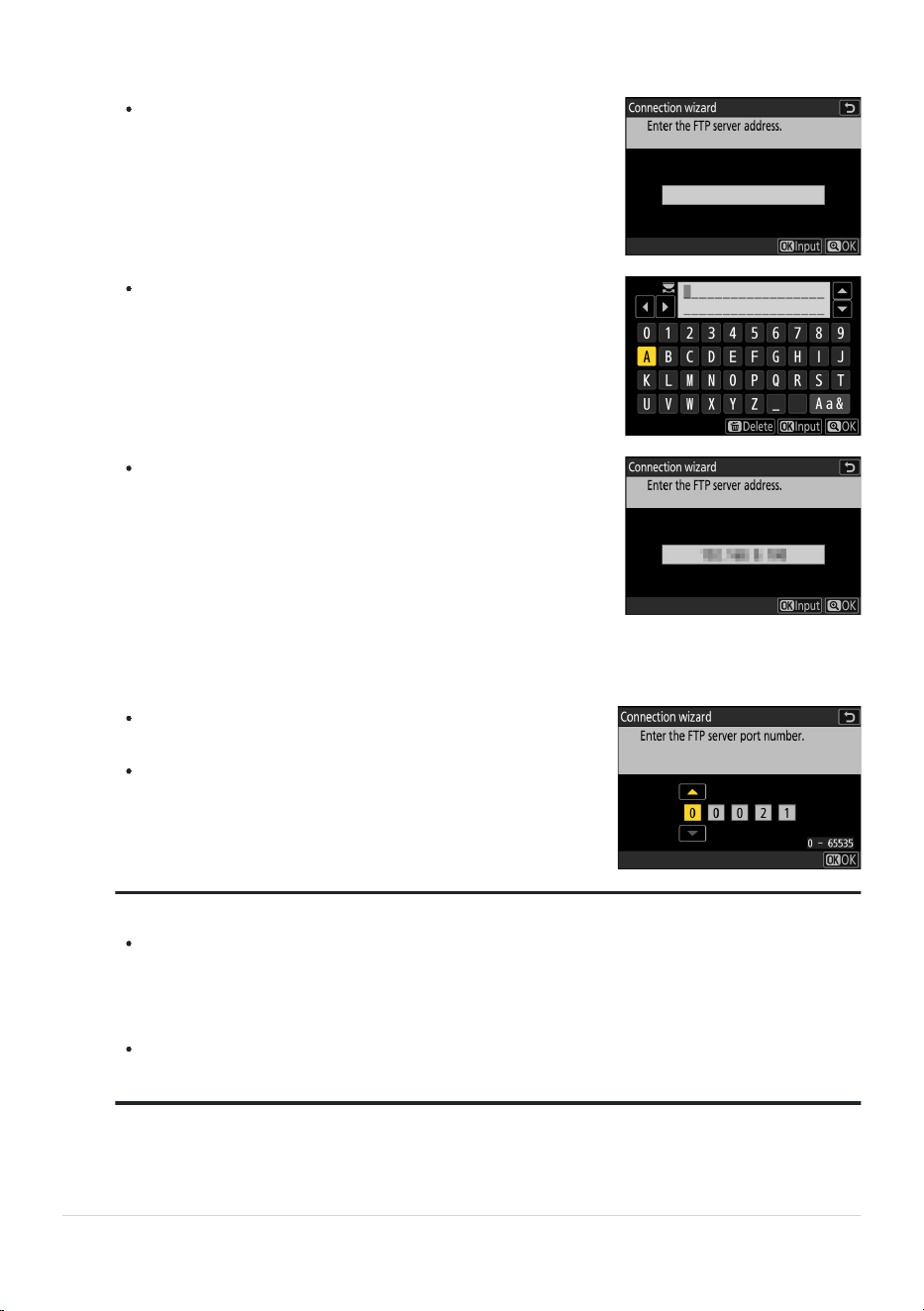
Press J to enter the server URL or IP address.
Press X when entry is complete.
Press X again to connect to the F
TP server. When a
connection is successfully established, you will be prompted
to enter a port number.
Press 4 or 2 to highlight digits and press 1 or 3 to
change.
Press J to display a dialog where you can choose a login
method.
Enter the server address.
Enter the FTP ser
ver port number.
Tip: Firewall Settings
The ports used for FTP vary with the server type. The port numbers are listed below.
[FTP]: TCP ports 21 and 32768 through 61000
[SFTP]: TCP ports 22 and 32768 through 61000
[FTPS]: TCP ports 21 and 32768 through 61000
File transfer may be blocked if the server firewall is not configured to allow access to the
appropriate ports.
362
FTP Servers: Connecting via Wireless LAN
11
12
-
-
-
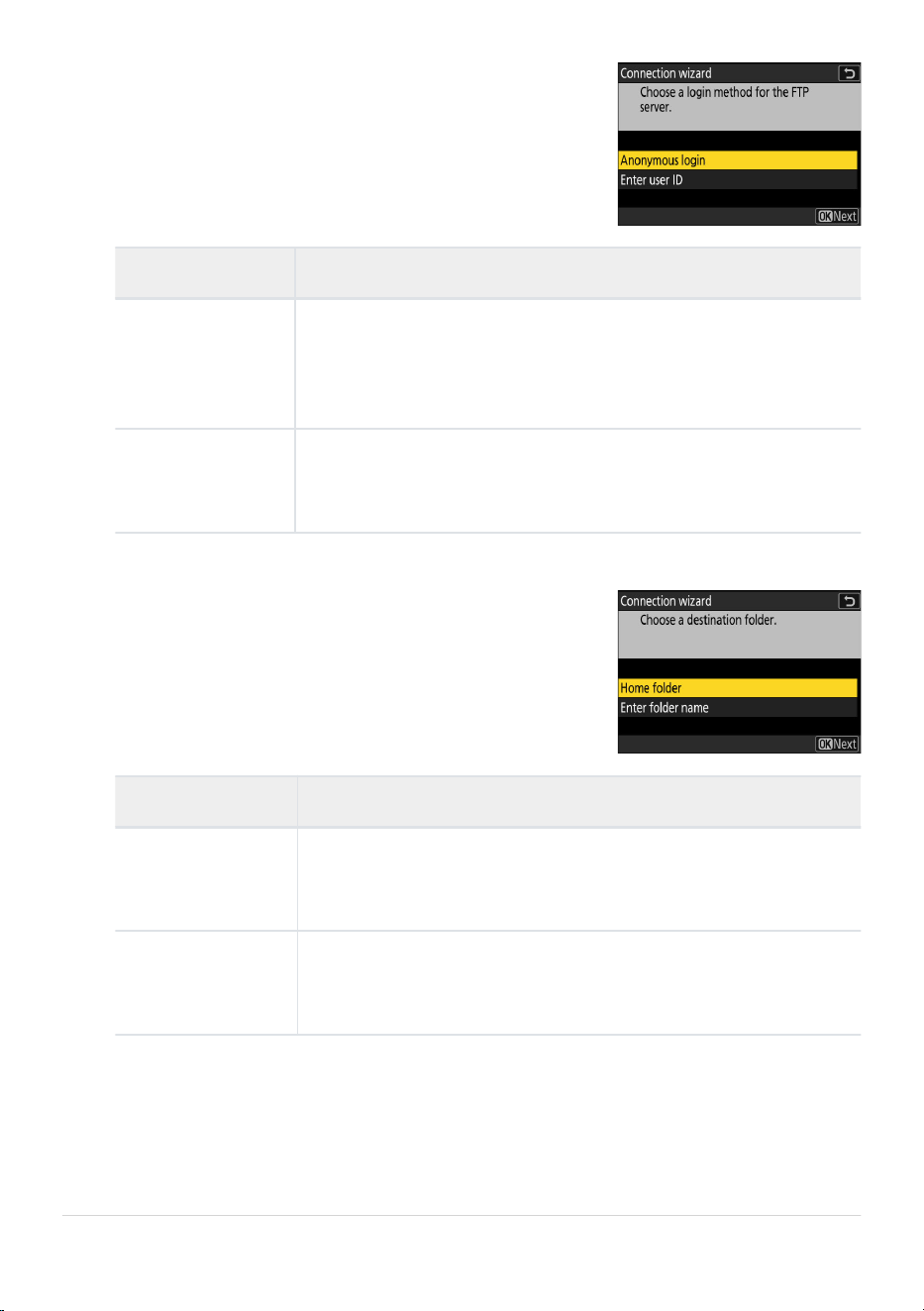
Log in.
Highlight one of the following options and press J
.
Choose a destination folder.
Highlight one of the following options and press J
.
Option Description
[Anonymous login]
Select this option if the server does not require a user ID or password.
This option can only be used with server
s that are configured for
anonymous login. If login is successful, the camera will prompt you to
choose a destination.
[Ent
er user ID]
Ent
er a user ID and p
assword. Press J t
o log in when entr
y is
complet
e. If login is successful, the camera will prompt you to choose
a destination.
Option Description
[Home folder]
Select this option to select the server’s home folder as the
destination for pictures uploaded from the camera. A “setup
complete” dialog will be displayed if the operation is successful.
[Ent
er folder name]
Ent
er the destination folder name manually
. The folder must already
exist on the ser
v
er
. Enter the folder name and path when prompted
and press J to display the “setup complete” dialog.
363
FTP Servers: Connecting via Wireless LAN
13
14
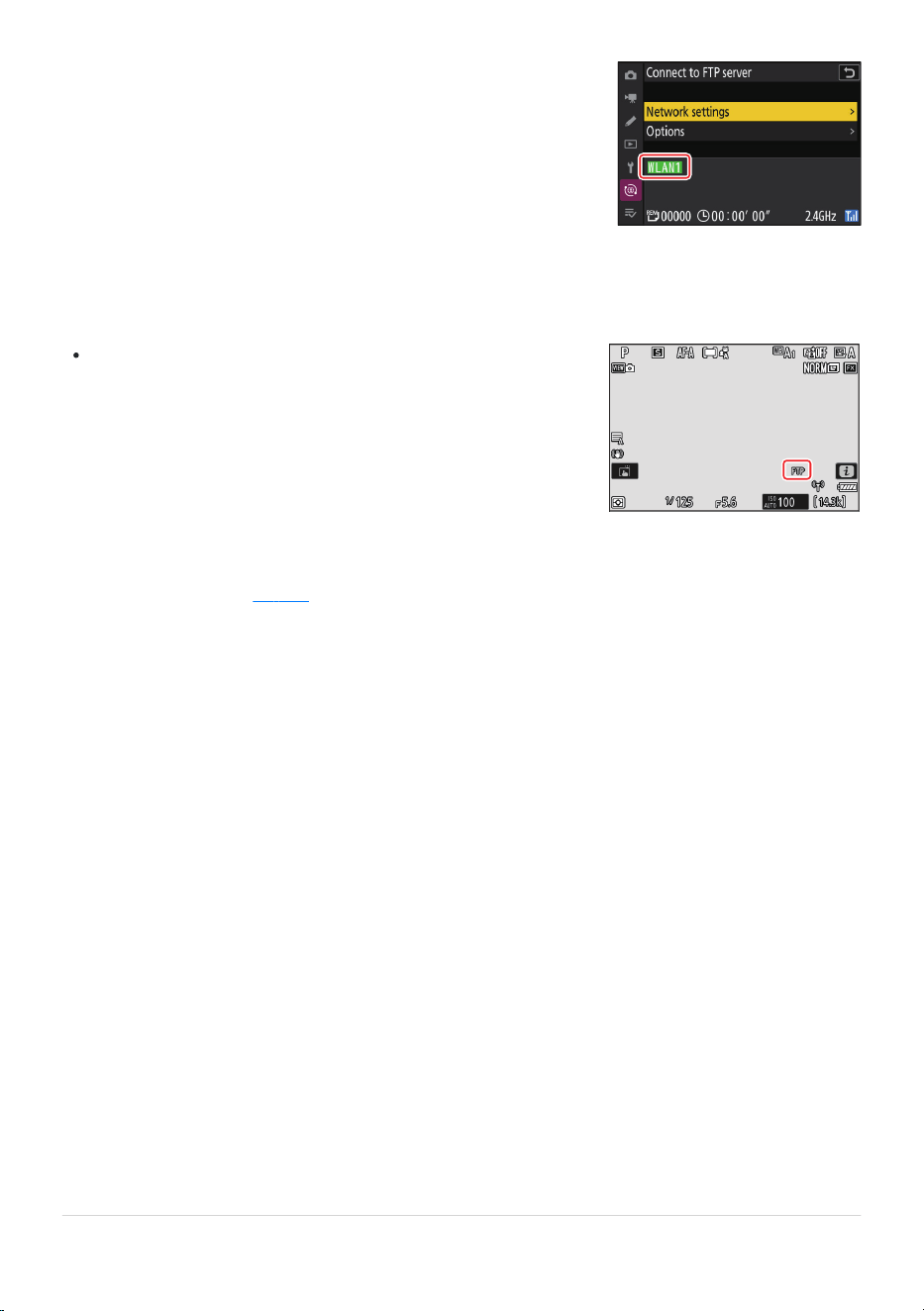
Check the connection.
When a connection is established, the profile name will be
display
ed in green in the camera [Connect to FTP server]
menu.
“FTP” will appear in the camera shooting display once a
connection is established. If a connection error occurs, this
indicat
or will be displayed in red together with a C icon.
A wireless connection has now been established between the camera and the FTP server.
Pictures taken with the camera can be uplo
aded to the FTP server as described under
“Uploading Pictures” (
0 366) in the chapter titled “What You Can Do When the Camera Is
Connect
ed to a Computer or FTP Server.”
364
FTP Servers: Connecting via Wireless LAN
15

Ending the Connection to the FTP Server
You can end the connection by:
turning the camera o
ff, or
selecting [End current connection] for [Connect to FTP server]> [Network settings] in the
network menu.
D Wi-Fi Access-Point Mode
An error will occur if the FTP server’s wireless connection is disabled before the camera’s. Disable
camera’s connection first.
365
FTP Servers: Connecting via Wireless LAN
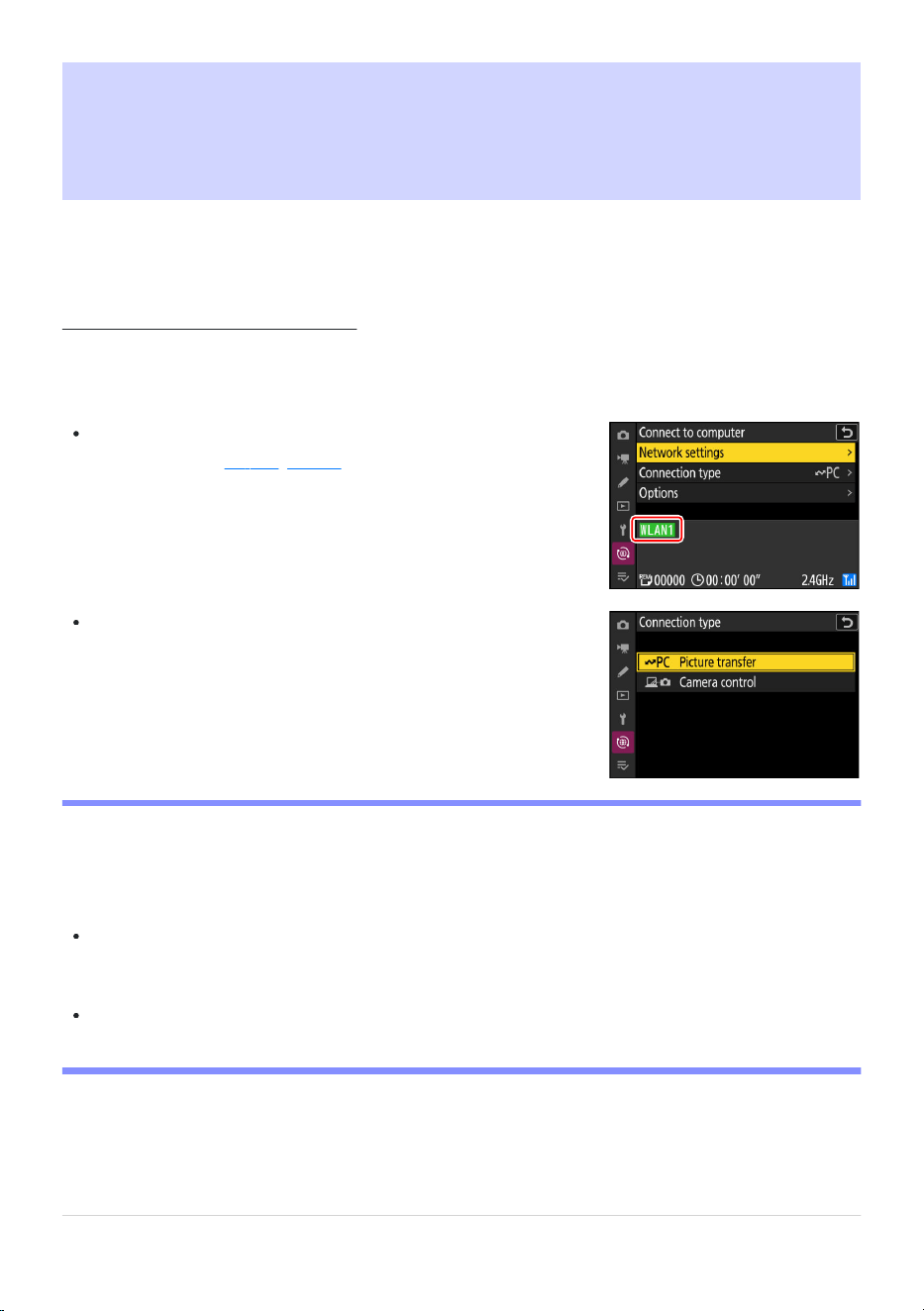
Before uploading pictures, connect the camera to the destination
via wireless LAN (
0 335, 0 349). After creating a profile,
confirm that the pr
ofile name is listed in green in the [Connect to
computer] or [Connect to FTP server] display.
To upload pictures to a computer, select [Picture transfer] for
[Connect t
o computer]> [Connection type] in the network
menu.
What You Can Do When the Camera Is
Connected to a Comput
er or FTP Server
Wireless LAN connections can be used to upload pictures or control the camera remotely.
Uploading Pictures
Pictures can be selected for uplo
ad during playback. They can also be uploaded automatically as they
are taken.
D Caution: Wi-Fi Access Point Mode
Select a host profile and enable camera Wi-Fi before connecting.
D Destination Folders for Upload to a Computer
By default, pictures are uploaded to the following folders:
Windows: \Users\(user name)\Pictures\Wireless Transmitter Utility
macOS: /Users/(user name)/Pictures/Wireless Transmitter Utility
The destination folder can be selected using the Wireless Transmitter Utility. For more information,
see online help for the Wireless Transmitter Utility.
366
What You Can Do When the Camera Is
Connected to a Comput
er or FTP Server
-
-
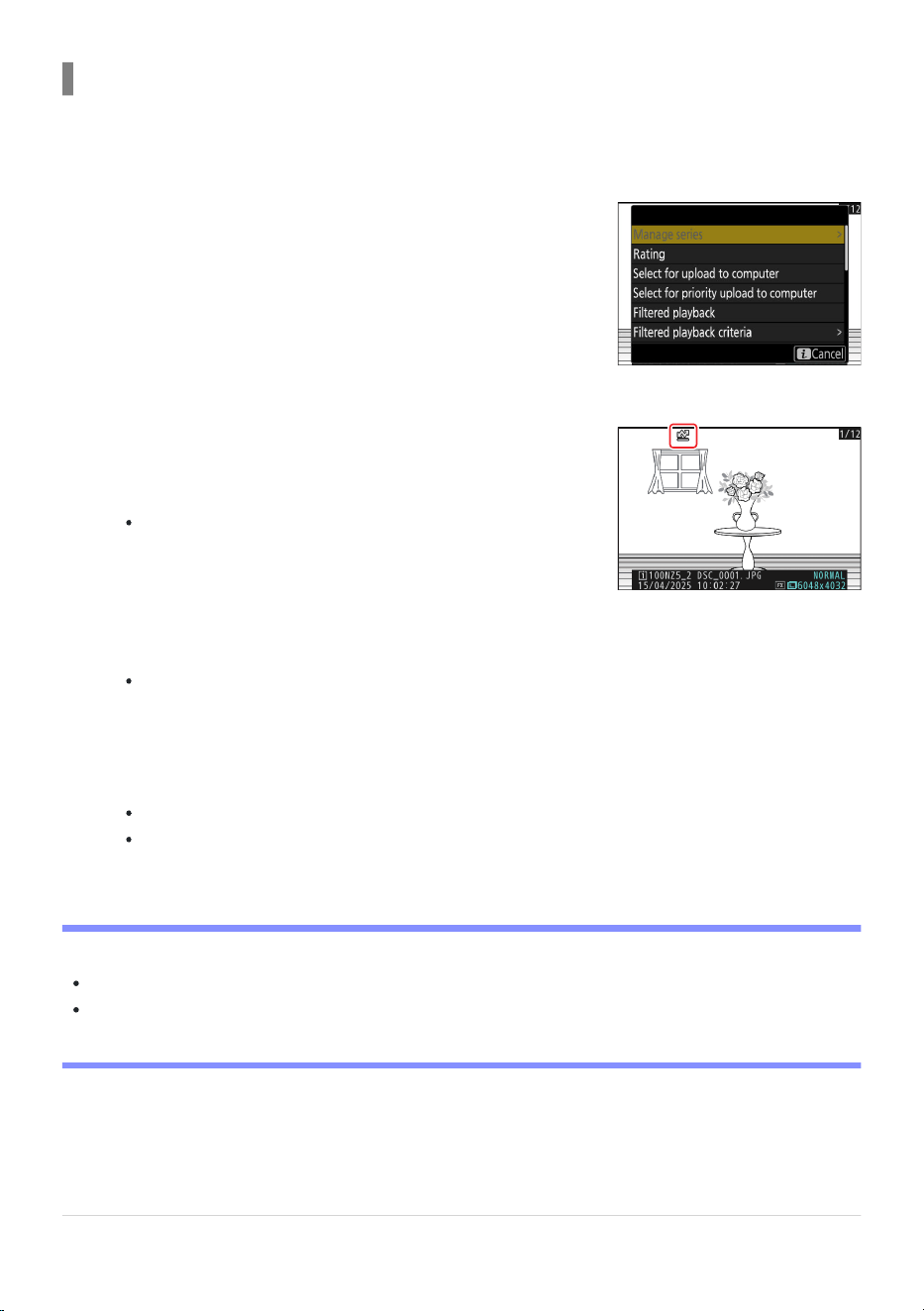
Select a picture and press the i button.
The i
menu items used to select pictures for upload vary with
the type of device connected.
Highlight [Select for upload to computer], [Select for
upload (FTP)
], [Select for priority upload to computer], or
[Select for priority upload (FTP)] and press J.
Selecting [Select for upload to computer] or [Select for
upload (FTP)] displays a white “upload” icon and pictures
will be uploaded in the specified order. Pictures with this
marking will be added to the end of the upload queue
and will not begin uploading until all other pictures have
uploaded.
Selecting [Select for priority upload to computer] or
[Select for priority upload (FTP)] displays a white “priority
upload” icon, and pictures selected for priority upload will
begin uploading immediately even if pictures marked for
upload already are in the upload queue.
Upload will begin when a connection is established.
Repeat Steps 2–3 to upload additional pictures.
Selecting Pictures for Upload
Press the K
button on the camera and select full-frame or thumbnail playback.
D Removing Upload Marking
Repeat Steps2–3 to remove upload marking from selected pictures.
To remove upload marking from all pictures, select [Connect to computer] or [Connect to FTP
server] in the network menu and choose [Options]> [Deselect all?].
367
What You Can Do When the Camera Is
Connected to a Comput
er or FTP Server
1
2
3

Tip: Filtering Pictures for Upload
The [Filtered playb
ack] item in the playback i menu can be used to display only pictures that meet
chosen criteria (
0 252). The pictures can then all be selected for uplo
ad by highlighting [Select all for
computer upload] or [Select all for upload (FTP)] in the i menu and pressing J.
368
What You Can Do When the Camera Is
Connect
ed to a Comput
er or FTP Server
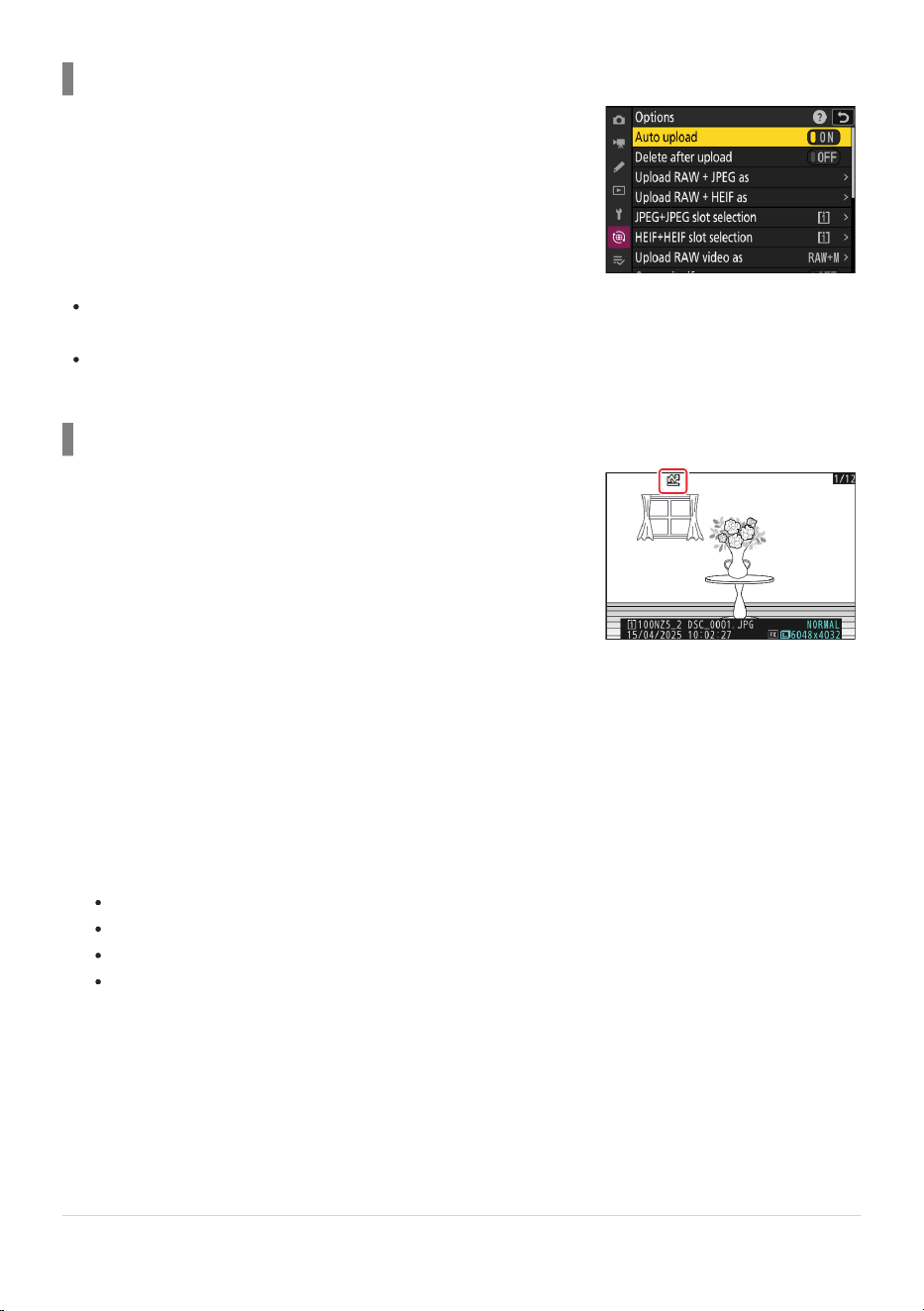
To upload new photos as they are taken, select [Connect to
computer] or [Connect t
o FTP server] in the network menu and
choose [ON] for [Options]> [Auto upload].
Upload status is indicated by the upload icon.
Uploading Photos as They Are Taken
Upload begins only aft
er the photo has been recorded to the memory card. Be sure a memory card
is inserted in the camera.
Videos are not uploaded automatically. They must instead be uploaded manually from the playback
display.
The Upload Icon
s (white): Priority upload
This icon appears on pictures selected with [Select for priority upload to computer] or [Select for
priority upload (FTP)]. Pictures marked with this icon will be uploaded before pictures marked W
(“upload”).
W (white): Upload
This icon appears on pictures with the following upload status. The pictures will be sent in the order
in which they were taken or selected for update.
Marked for auto upload,
Selected with [Select for upload to computer],
Selected with [Select for upload (FTP)], or
Filtered with a “select all for upload” option.
X (green): Uploading
Upload in progress.
Y (blue): Uploaded
Upload complete.
369
What You Can Do When the Camera Is
Connected to a Comput
er or FTP Server

The [Connect to computer]/[Connect to FTP server] Upload
Status Display
The [Connect to comput
er] and [Connect to FTP server] displays show the following:
4 3 2
1
Status:
The status of the connection to the host. The pr
ofile name is displayed in green when a
connection is established.
While files are being transferred, the status display shows “Now uploading” preceded by the
name of the file being sent. Errors are also displayed here.
The display for [Connect to FTP server] also includes error codes (
0 375).
Signal strength: The wireless signal str
ength.
Band: When connecting wirelessly in Wi-Fi station mode, the radio frequency band of the
connected SSID network is displayed. In Wi-Fi access point mode, the radio frequency band
that the camera is outputting is displayed.
Pictures/time remaining: The number of pictures remaining and the time needed to send
them. The time remaining is an estimate only.
D Loss of Signal
Wireless transmission may be interrupted if the signal is lost. Upload of pictures with upload marking
can be resumed by turning the camera off and then on again once the signal has been re-established.
D Caution: During Upload
Do not remove or insert the memory card during upload.
D Voice Memos
Voice memos will be included when the associated pictures are transmitted. They cannot, however, be
uploaded separately.
D Turning the Camera Off
The camera saves transfer marking when turned off and resumes upload when next turned on.
370
What You Can Do When the Camera Is
Connected to a Comput
er or FTP Server
1
2
3
4

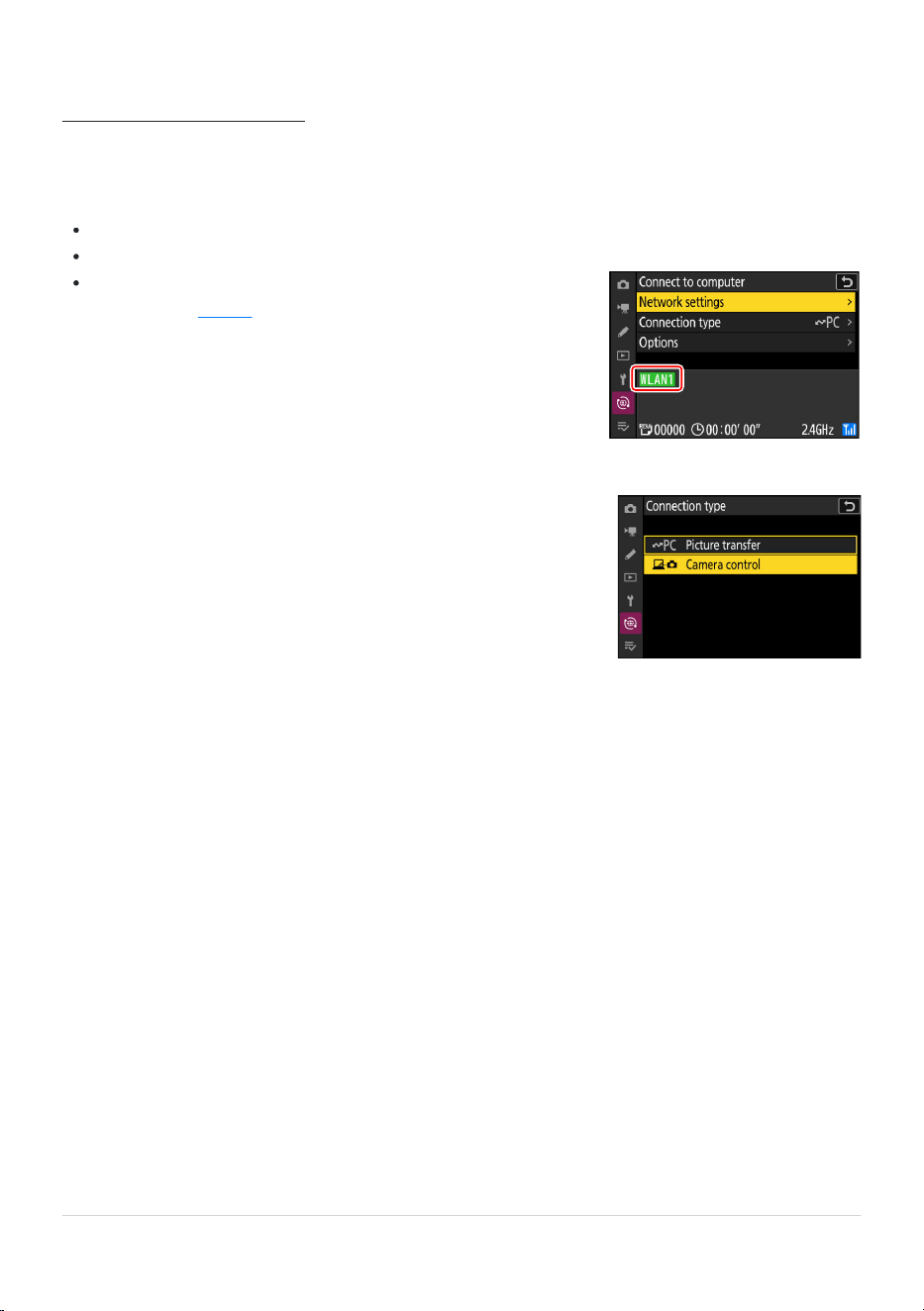
Before using NX Tether, connect the camera and computer via
wireless LAN (
0 335). After creating a profile, confirm that the
pro
file name is listed in green in the [Connect to computer]
display.
Select [Camera control] for [Connect to computer]>
[Connection type] in the netw
ork menu.
Camera Control
The camera can be controlled from a comput
er running NX Tether software. Photos can be saved
directly to the computer instead of to the memory card and can consequently be taken even when no
memory card is inserted in the camera.
You will still need to insert a memory card when filming videos.
Note that the camera standby timer does not expire in camera control mode.
Launch the copy of NX Tether installed on the host computer.
Control the camera using NX Tether.
For information on taking pictures using NX Tether, see NX Tether online help.
372
What You Can Do When the Camera Is
Connected to a Comput
er or FTP Server
1
2
3

The [Connect to computer] Camera Control Display
The [Connect to computer] display shows the following:
1
3 2
Status: The status of the connection to the host. The pr
ofile name is displayed in green when
a connection is established. Errors are also displayed here (
0 374).
Signal strength: The wir
eless signal strength.
Band: When connecting wirelessly in Wi-Fi station mode, the radio frequency band of the
connected SSID network is displayed. In Wi-Fi access point mode, the radio frequency band
that the camera is outputting is displayed.
D Loss of Signal
Loss of signal while the camera is connected to a wireless network may disrupt the connection to the
computer. Select [End current connection] for [Connect to computer]> [Network settings] in the
network menu before connecting to the network again. When the signal is re-established, the camera
will reconnect to the computer and resume upload of any pictures that have yet to be transferred.
Note that upload cannot be resumed if you turn the camera off before transfer is complete.
373
What You Can Do When the Camera Is
Connected to a Comput
er or FTP Server
1
2
3
Troubleshooting Wireless LAN
Connections
R
efer to this section for infor
mation on errors involving wireless LAN connections.
For information on the Wireless Transmitter Utility, see the utility’s online help.
Problems and Solutions
Solutions to some common issues are list
ed below.
Problem Solution
The camera displays a wireless error.
The camera displays a TCP/IP error
.
The camera displays an FTP error.
Connection settings require adjustment. Check settings
for the wireless router, FTP server, or host computer
and adjust camera settings appropriately (
0 335,
0 349).
Check the error code, if any. For more information, see
“Error Codes” (0 375).
“Connecting to computer” does not clear
from the camera display.
Check fir
ewall settings (
0 340, 0 353).
The camera displays a “no memory card”
error.
The memor
y card is inserted incorrectly or not at all.
Check that card is inserted correctly (
0 92).
Upload is interrupted and fails to resume.
Upload will resume if the camera is turned off and then
on again (0 370).
The connection is unreliable.
If the camera is connected in Wi-Fi station mode, check
that the router is set t
o a channel between 1 and 8
(
0 782, 0 787).
374
Troubleshooting Wireless LAN Connections
Error Codes
The following messages and error codes may be displayed if an err
or occurs while the camera is
connected to an FTP server via wireless LAN.
● [Wireless error.]
Error code Solution
Err.11
Confirm that the device to which you are attempting to connect is on.
Check the SSID (
0 787).
Err.12
Confirm that you are using the correct password for the selected SSID.
Confirm that you are using the correct authentication method (0 787).
Err.13
Confirm that the device to which you are attempting to connect is on.
Turn the camera off and then on again.
Err.1F Turn the camera off and then on again.
● [TCP/IP error.]
Error code Solution
Err.21 Check that the TCP/IP address and sub-net mask are correct (0 787).
Err.22 Duplicate TCP/IP address. Choose a different address (0 787).
● [PTP/IP error.]
Error code Solution
Err.41 Turn the camera off and then on again.
375
Troubleshooting Wireless LAN Connections
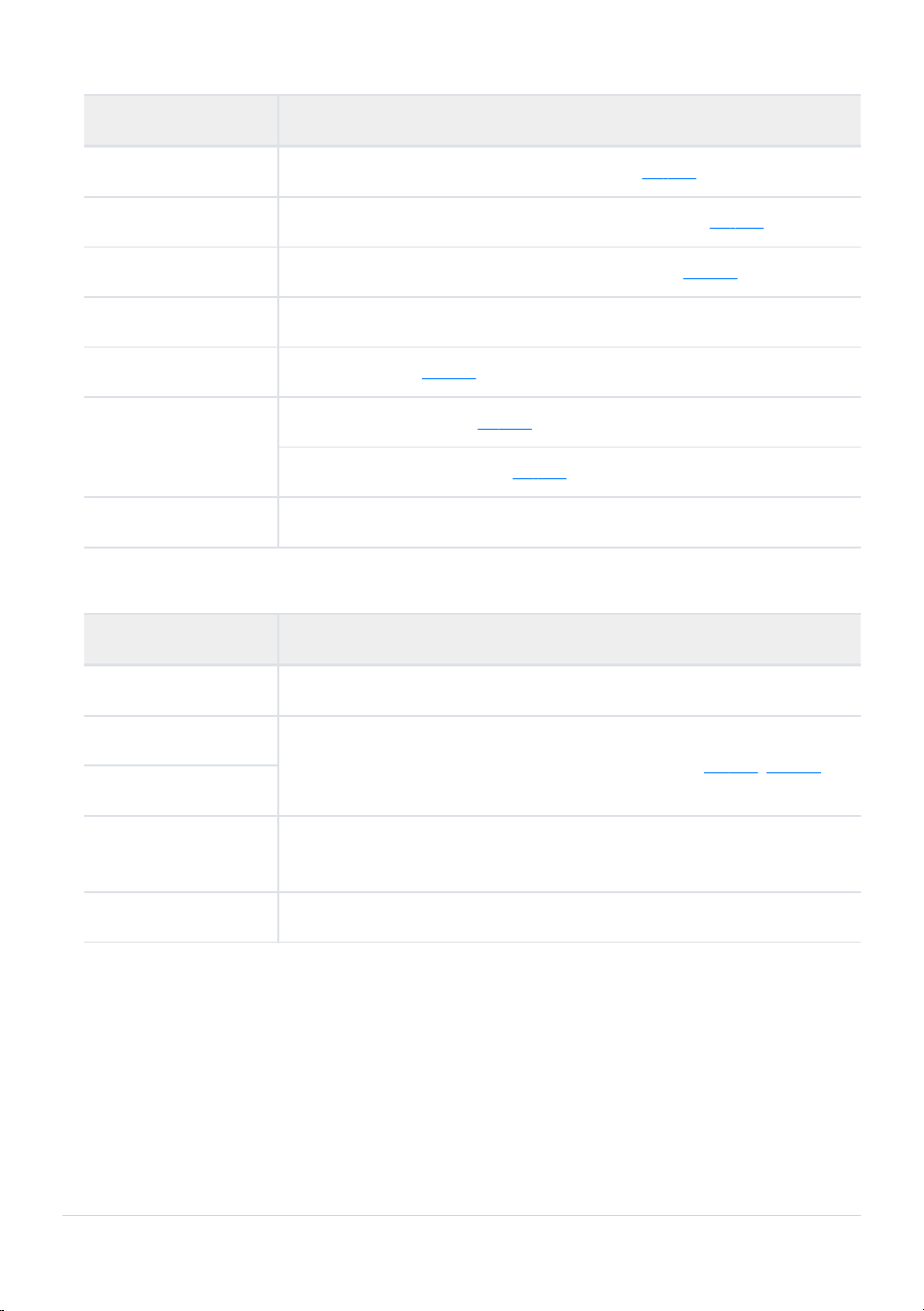
● [FTP error.]
Error code Solution
Err.31 Check that the FTP server address is correct (0 787).
Err.32 Check that the login name and password are correct (0 787).
Err.34 Check that the destination folder name is correct (0 787).
Err.35 Confirm that the destination folder is not write-protected.
Err.36 Check the DNS (0 787).
Err.37
Check firewall settings (0 353).
Check PASV mode settings (0 787).
Err.3F Turn the camera off and then on again.
● [Error authenticating FTP server credentials.]
Error code Solution
Err.61 Check that the FTP server supports TLS 1.2 or later.
Err.62
Check that you are using the correct root certificate ( 0 350, 0 792).
Err.63
Err.64
The camera cannot connect because the FTP server has requested a
client certificate. Check F
TP server settings.
Err.65 Turn the camera off and then on again.
376
Troubleshooting Wireless LAN Connections
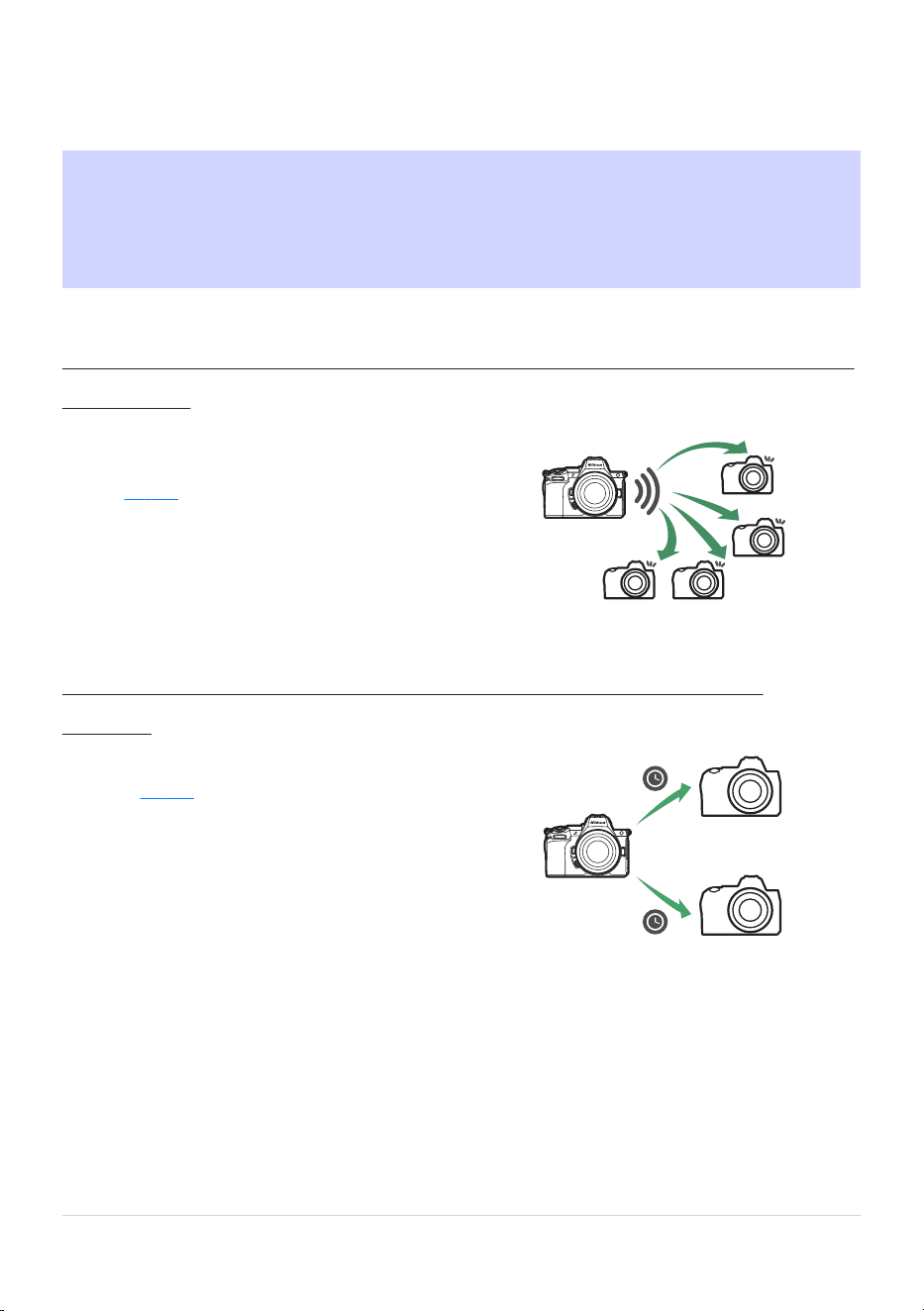
A master camera can be used to release the
shutters on up t
o 16 remote cameras in the same
group (
0 378).
Synchronize the clocks on multiple cameras via a
netw
ork (
0 389).
Connecting to Other Cameras
What Inter-camera Connections Can Do
for Y
ou
Camera-Based Remote Photography (Synchronized
Release)
Clock Synchronization (Synchronize Date and
Time)
377
What Inter-camera Connections Can Do for You
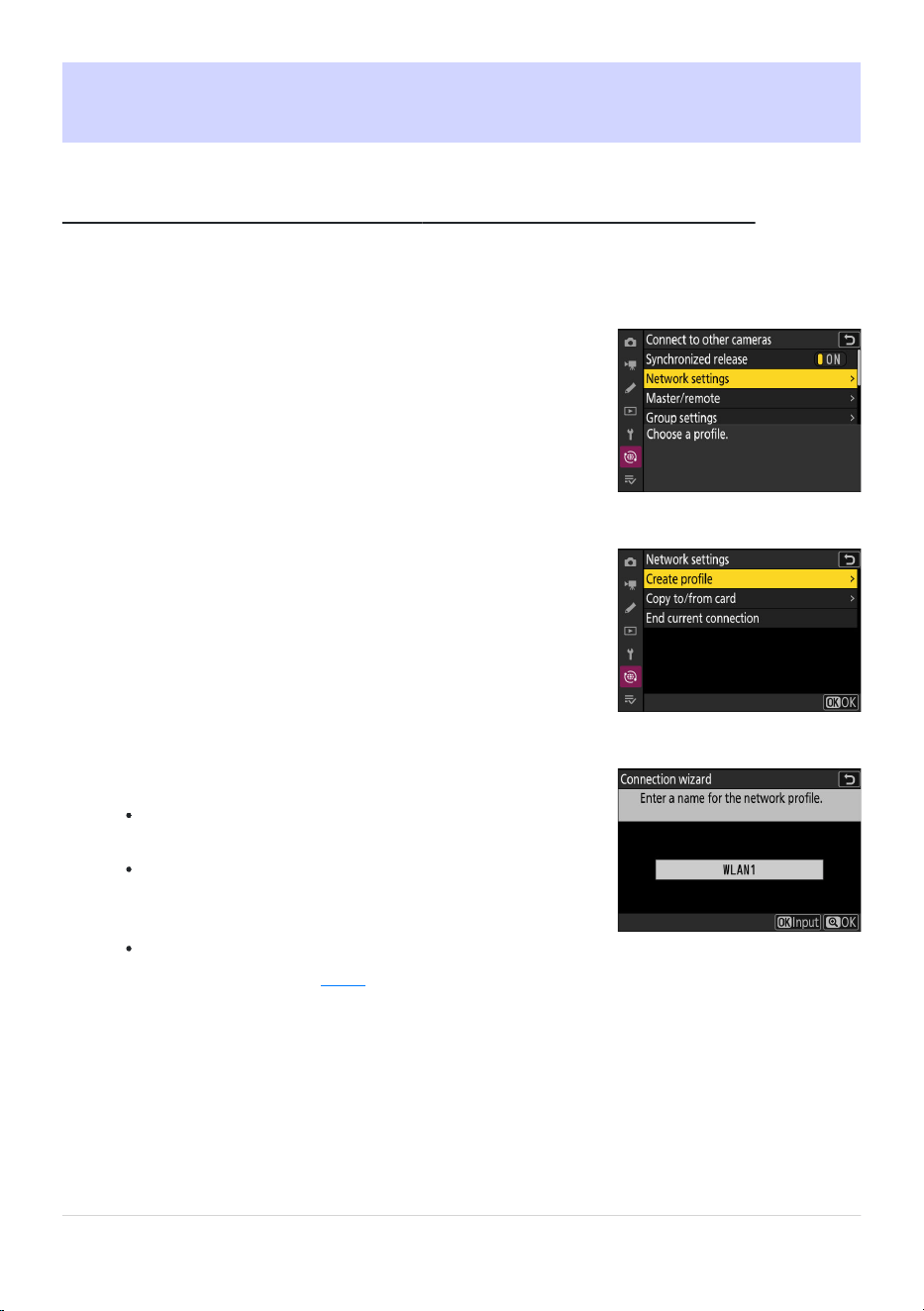
Select [Connect to other cameras] in the network menu,
then highlight [Network settings
] and press 2.
Highlight [Create profile] and press J.
Name the new profile.
To proceed t
o the next step without changing the default
name, press X.
Whatever name you choose will appear in the network
menu [Connect to other cameras]> [Network settings]
list.
To rename the profile, press J. For information on text
entry, see “Text Entry” (
0 79). Press X to proceed after
entering a name.
Synchronized Release
Configuring and Using Synchronized Release
Follow the steps below to cr
eate host profiles for synchronized release. Each camera saves the pictures
it takes to its own memory card. Repeat the process to create identical profiles for each camera.
378
Synchronized Release
1
2
3
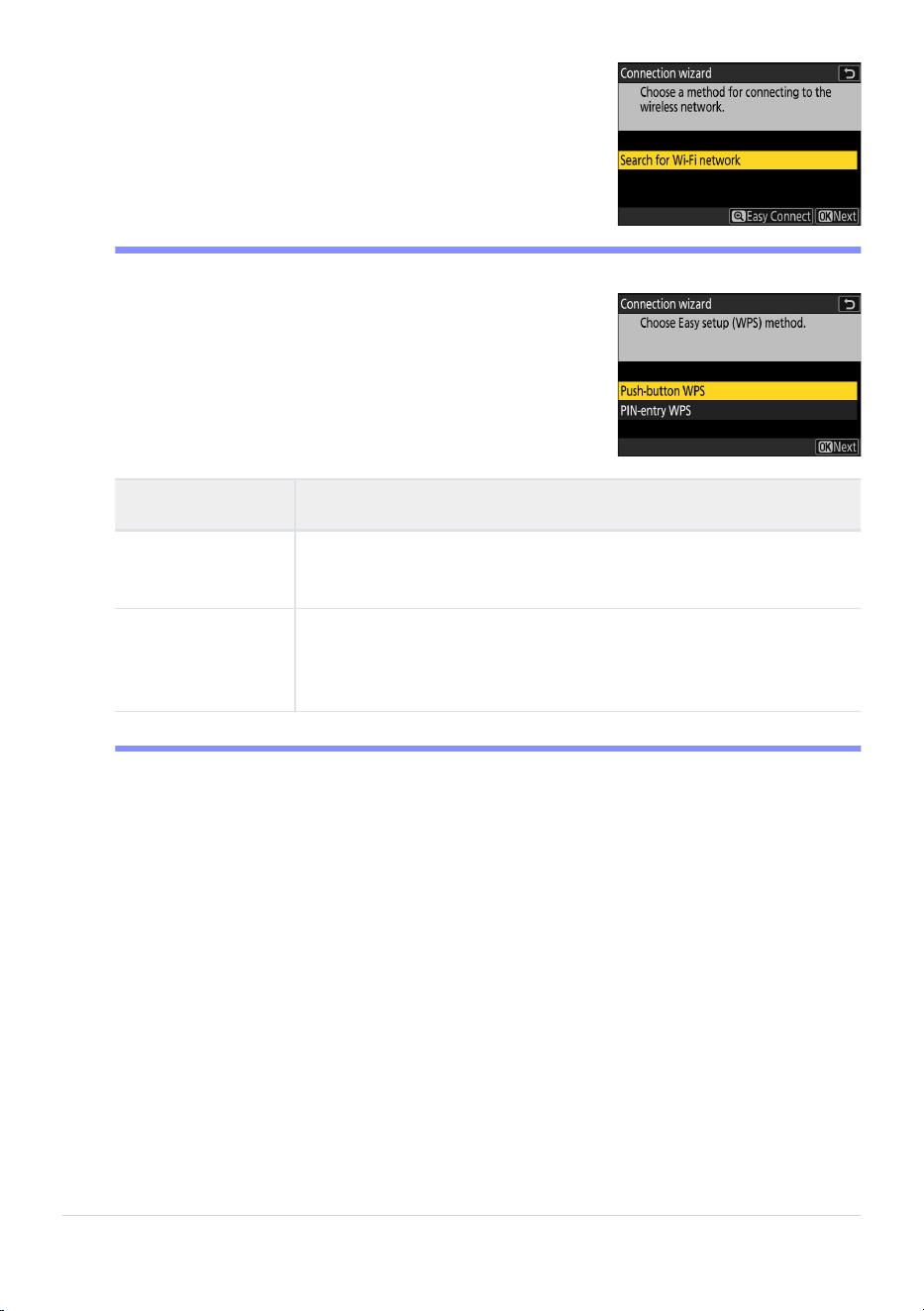
Highlight [Search for Wi-Fi network] and press J.
The camera will search for networks curr
ently active in the
vicinity and list them by name (SSID).
To connect without entering an SSID or encryption key, press
X in Step4. Next, highlight one o
f the following options and
press J. After connecting, proceed to Step7.
D “Easy Connect”
Option Description
[Push-butt
on WPS]
For rout
ers that support push-button WPS. Press the WPS button on
the r
out
er and then pr
ess the camera J button to connect.
[PIN-entry WPS]
The camera will display a PIN. Using a computer, enter the PIN on the
router. For more information, see the documentation provided with
the router.
379
Synchronized Release
4
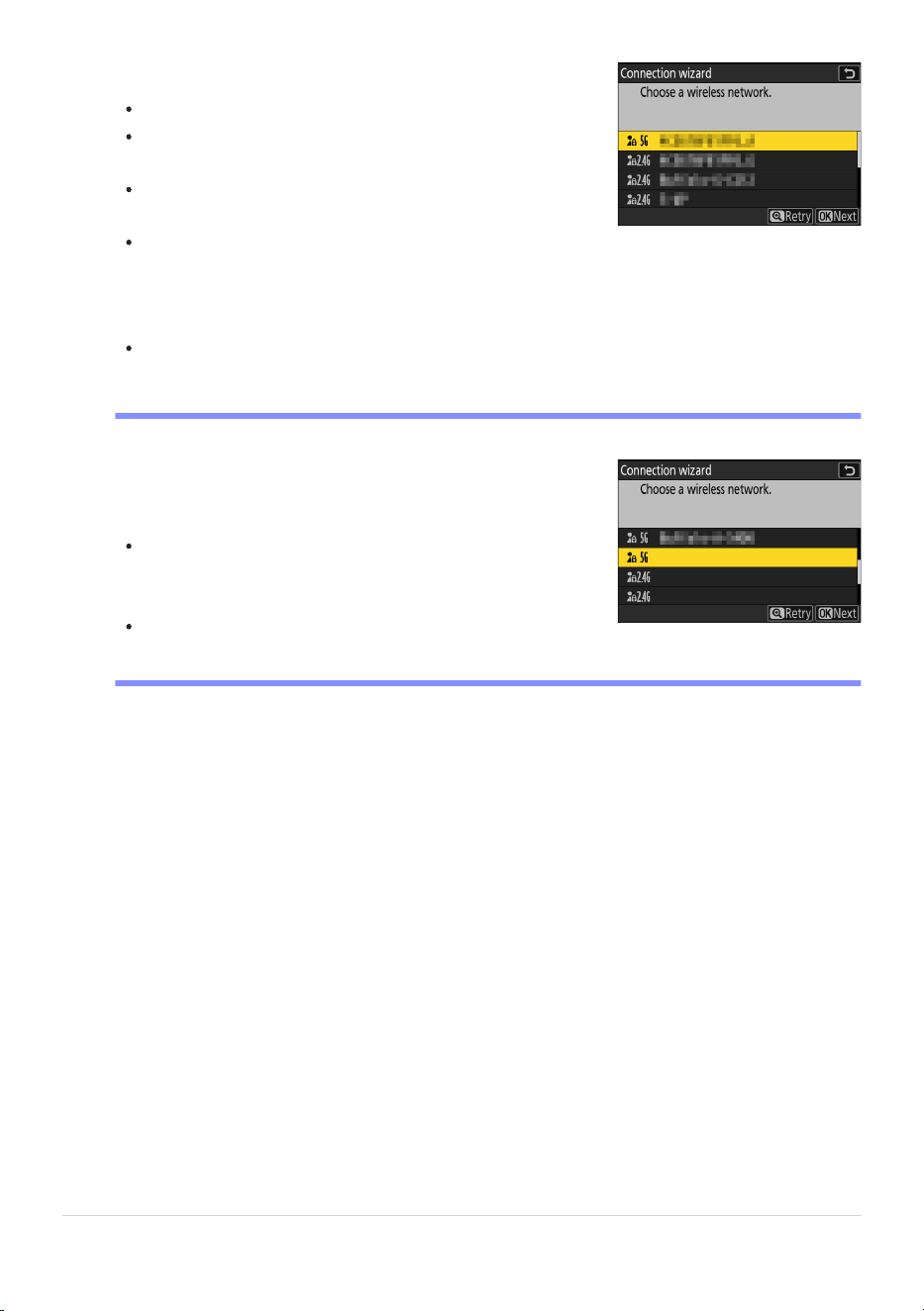
Choose a network.
Highlight a network SSID and press J.
The SSIDs containing charact
ers that cannot be entered on
the camera will not be displayed.
The band on which each SSID operates is indicated by an
icon.
Encrypted networks are indicated by a h icon. If the selected
network is encrypted (h), you will be prompted to enter the
encryption key. If the network is not encrypted, proceed to
Step7.
If the desired network is not displayed, press X to search
again.
Networks with hidden SSIDs are indicated by blank entries in
the network list.
To connect t
o a network with a hidden SSID, highlight a
blank entry and press J. Next, press J; the camera will
prompt you to provide an SSID.
Enter the network name and press X. Press X again; the
camera will now prompt you to enter the encryption key.
D Hidden SSIDs
380
Synchronized Release
5
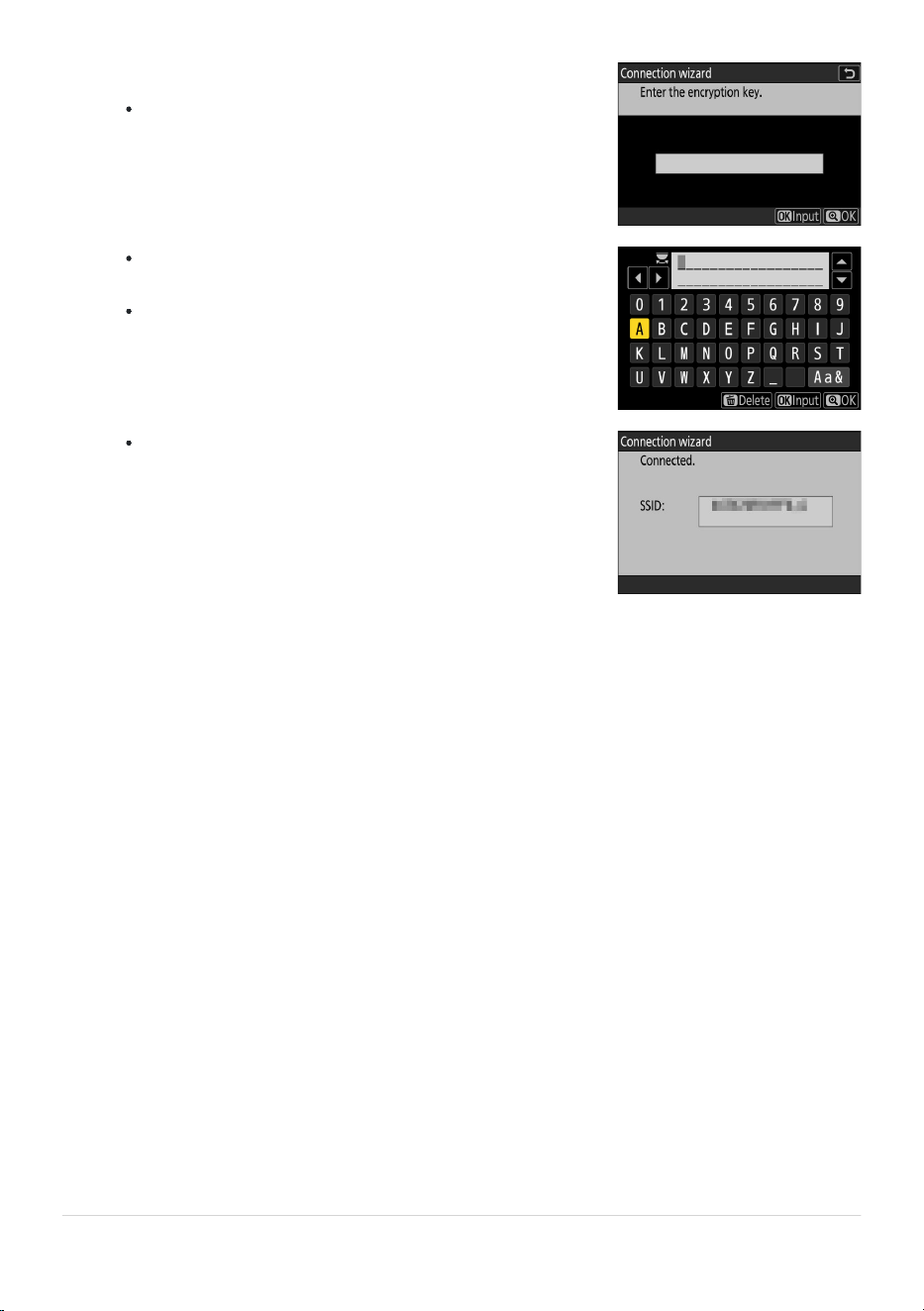
Enter the encryption key.
Press J
and enter the encryption key for the wireless router.
For more information, see the documentation for the
wireless rout
er.
Press X when entry is complete.
Press X again to initiate the connection. A message will
be display
ed for a few seconds when the connection is
established.
381
Synchronized Release
6
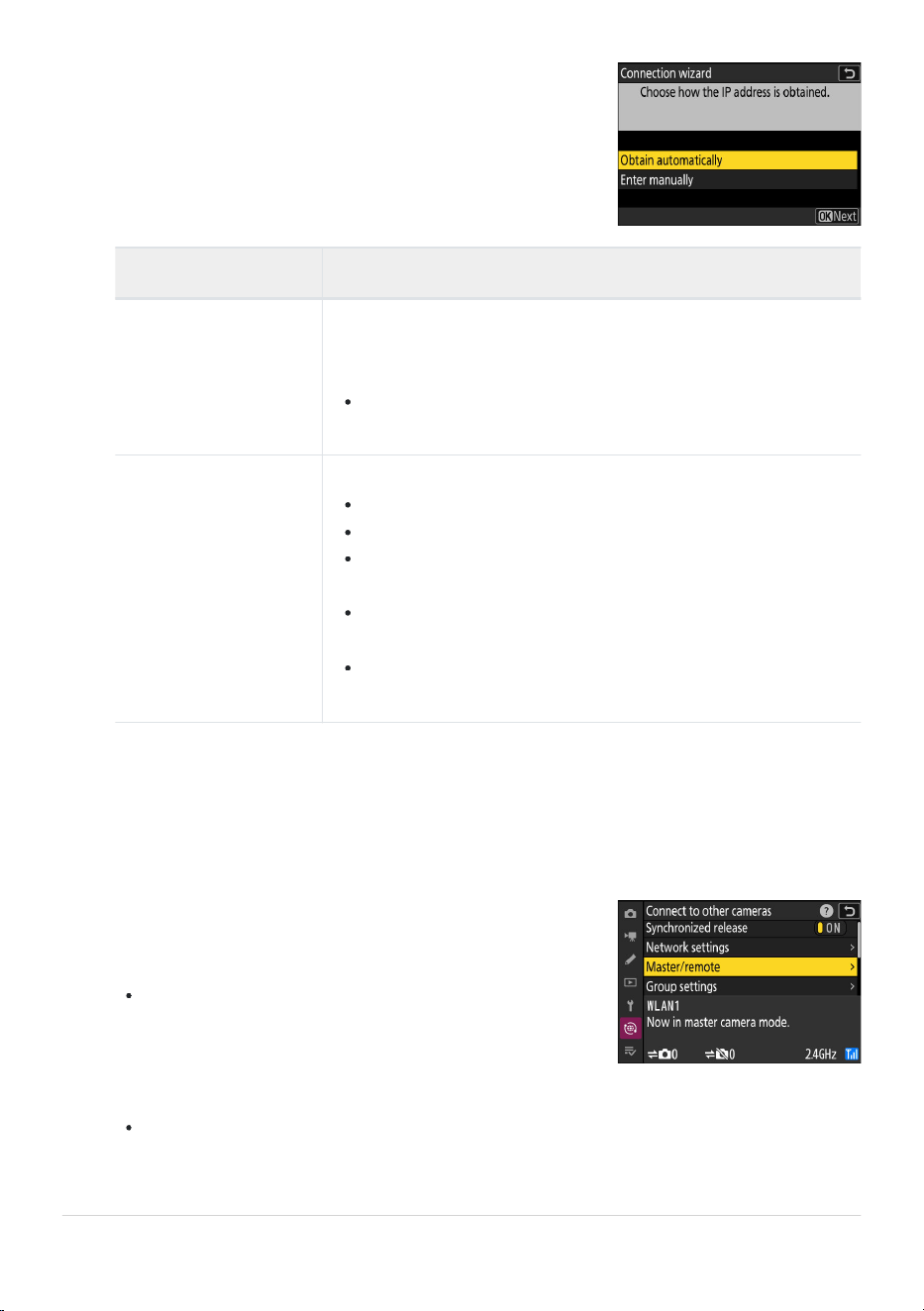
Obtain or select an IP address.
Highlight one of the following options and press J
.
Highlight [Master/remote] and press 2.
Choose a role for each camera from “mast
er” and “remote”.
[Master camera]: Pressing the shutter-release button on the
master camera releases the shutters on the remote cameras.
Each group can have only one master. If the group has
multiple master cameras, only the first to connect to the
network will actually serve in that capacity.
[Remote camera]: The shutters on the remote cameras are
synchronized with the shutter on the master camera.
Option Description
[Obtain automatically]
Select this option if the network is configur
ed to supply the IP
address automatically. A “configuration complete” message will be
displayed once an IP address has been assigned.
It is recommended that you note the remote camera IP
address, as you will need it in subsequent steps.
[Enter manually]
Enter the IP addr
ess and sub-net mask manually.
Press J
; you will be prompted to enter the IP address.
Rotate the main command dial to highlight segments.
Press 4 or 2 to change the highlighted segment and press J
to save changes.
Next, press X; a “configuration complete” message will be
displayed. Press X again to display the sub-net mask.
Press 1 or 3 to edit the sub-net mask and press J; a
“configuration complete” message will be displayed.
Press J
to proceed when the “configuration complete” message is displayed.
The pro
file name is displayed when a connection is established.
382
Synchronized Release
7
8
9
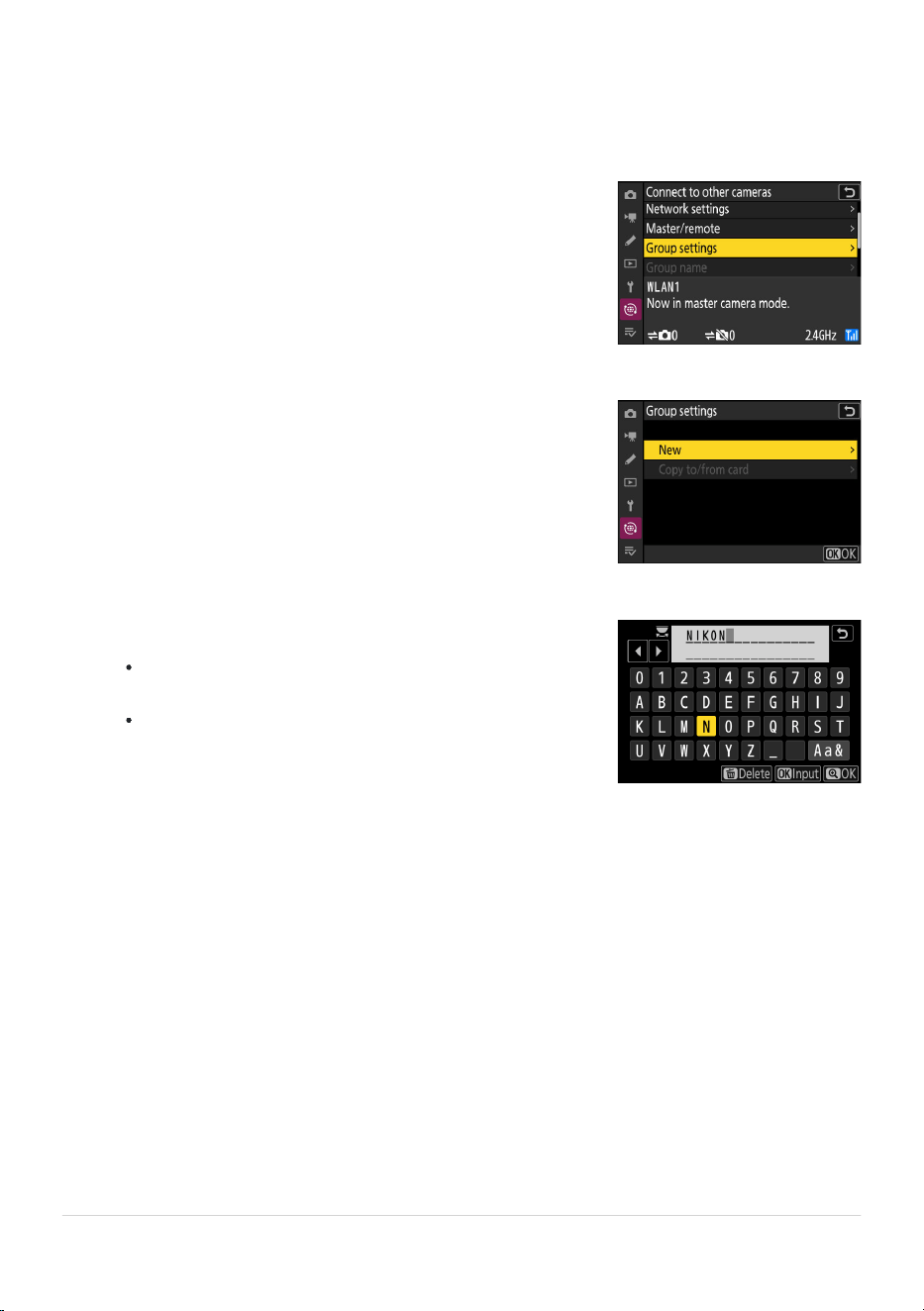
On the master camera, highlight [Group settings] and press
2.
Highlight [New] and press J.
Enter a group display name.
Set a group display name to add r
emote cameras. Display
names can be up to 32 characters long.
Press X to proceed once entry is complete.
Repeat Steps1 through 9 for the remaining cameras.
When configuring remote cameras, be sur
e to select [Remote camera] in Step9.
383
Synchronized Release
10
11
12
13
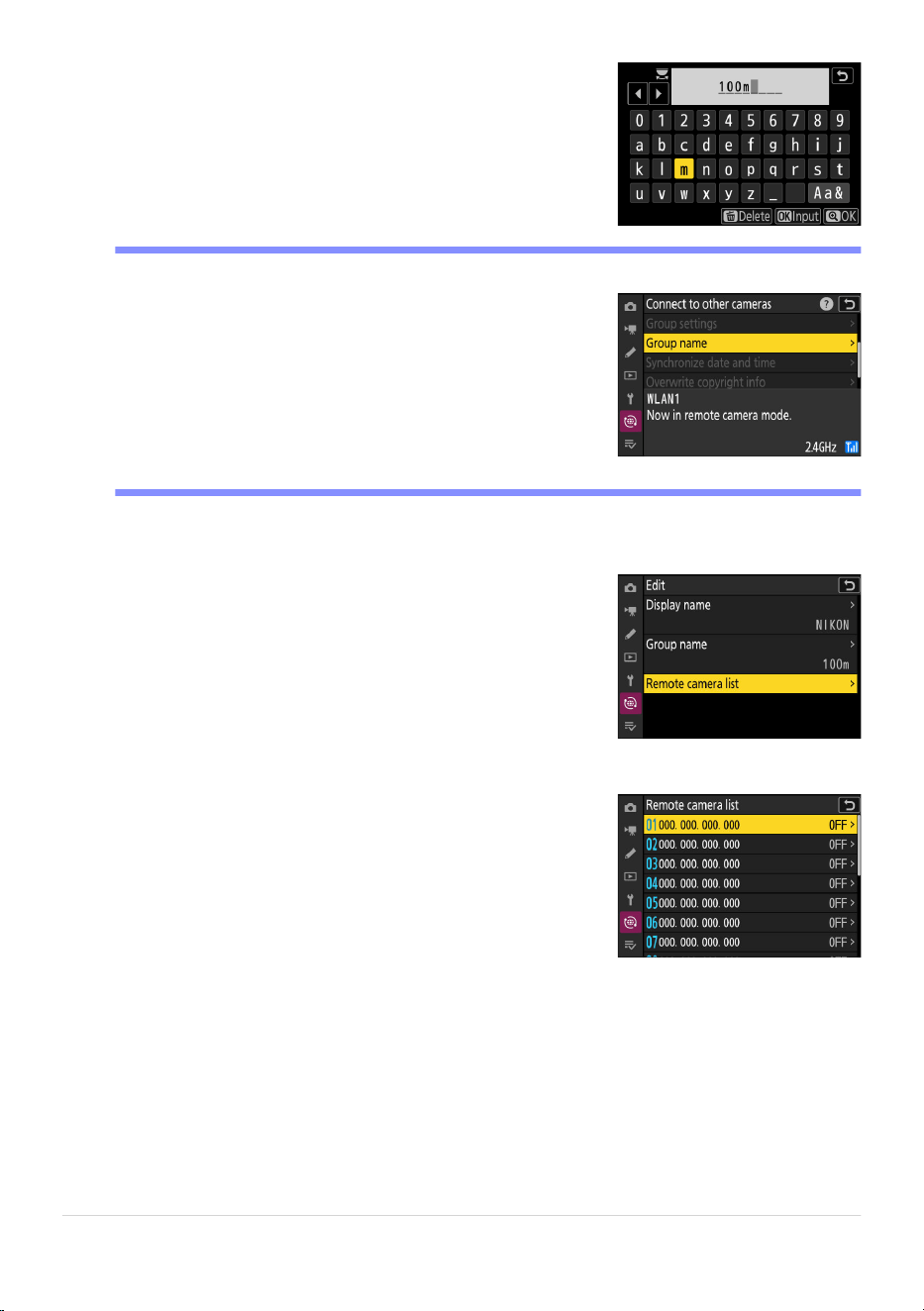
Highlight [Group name], press 2, and enter a group name.
Ent
er a group name for the synchronized cameras. Group
names can be up to eight characters long.
The group name selected on the remote cameras must match
that chosen for the master camera. Choose the name using
[Connect t
o other cameras]> [Group name] in the network
menu.
Highlight [Remote camera list] and press 2.
Add remote cameras t
o the group. The master camera can
store information for up to 16 remote cameras in slots [01]
through [16].
Highlight the desired slot and press 2.
Remote camera options will be display
ed.
D Assigning Remote Cameras a [
Group name]
384
Synchronized Release
14
15
16
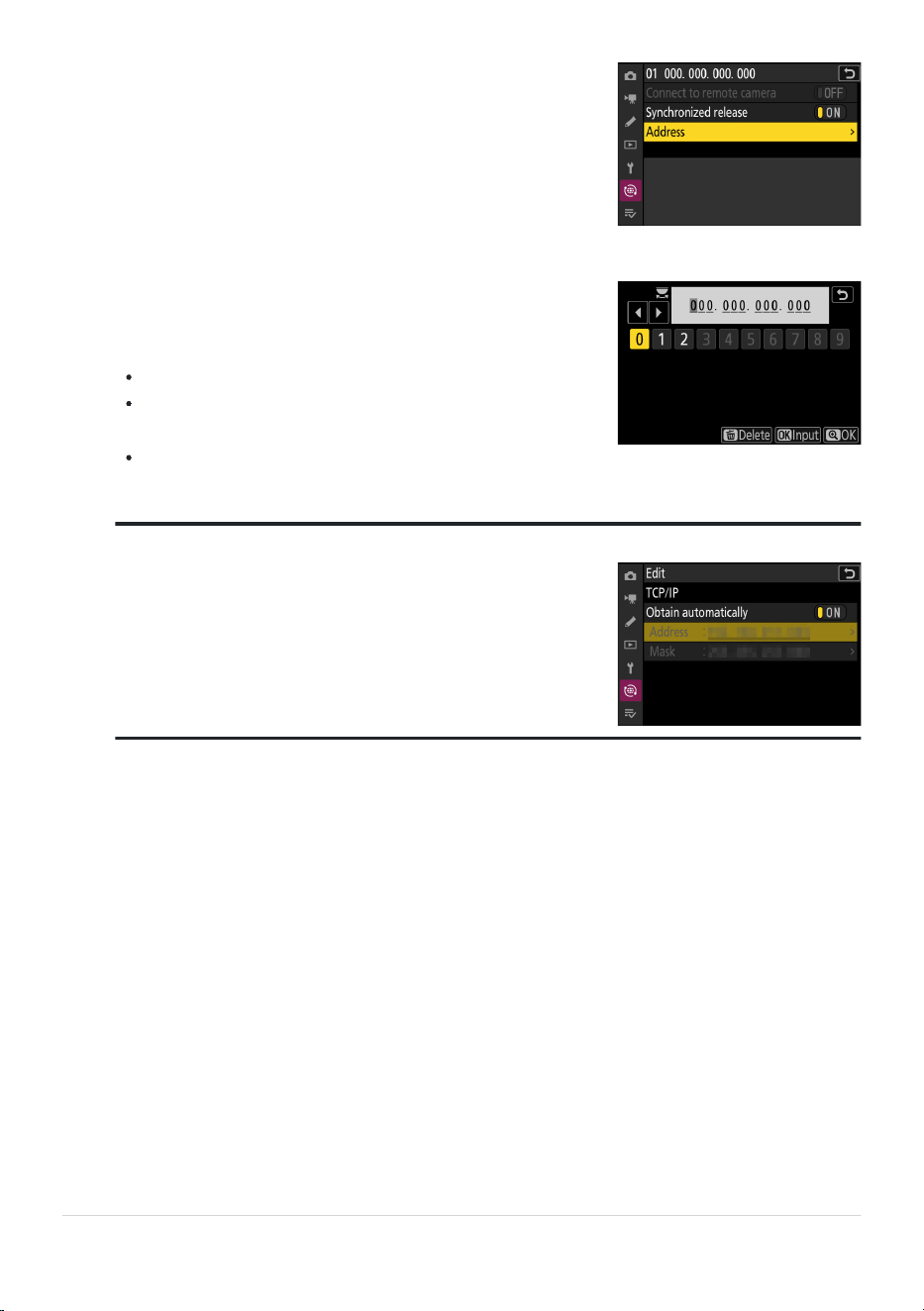
Highlight [Address] and press 2.
You will be prompt
ed to enter an IP address.
Enter the remote camera IP address.
Enter the remot
e camera IP address you noted in Step7.
Rotate the main command dial to highlight segments.
Press 4 or 2 to change the highlighted segment and press
J to save changes.
Press X to add the remote camera to the master camera
remote camera list and establish a connection.
To view a remote camera’s IP address, select [Connect to other
cameras]> [
Network settings] in the camera’s network menu,
highlight a synchronized release host profile, press 2, and
select [TCP/IP].
Tip: Viewing Remote Camera IP Addresses
385
Synchronized Release
17
18
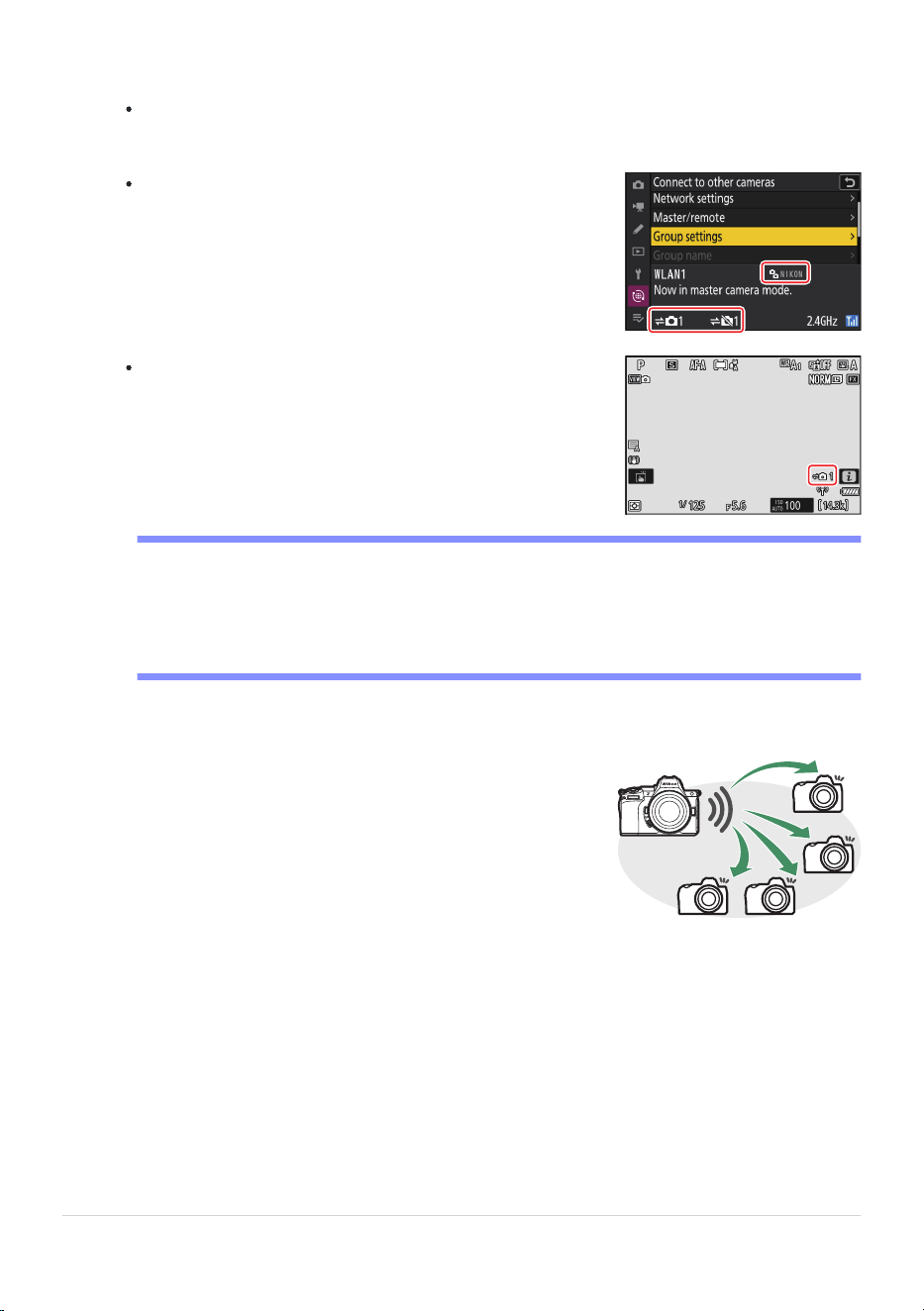
The master camera shows the number of remote cameras
connected and not yet connect
ed.
A k icon appear
s in the mast
er camera shooting display
t
ogether with the number of remote cameras connected.
Take pictures.
Pressing the shutter
-release button on the master camera
releases the shutters on the remote cameras.
Add the remaining remote cameras.
When connecting to wireless netw
orks, the cameras will display the band used by the
selected SSID.
D Connection Errors
In the event of remote camera connection errors, the remote camera count in the master
camera shooting display will turn red and instead show the number of remote cameras that
failed to connect.
386
Synchronized Release
19
20
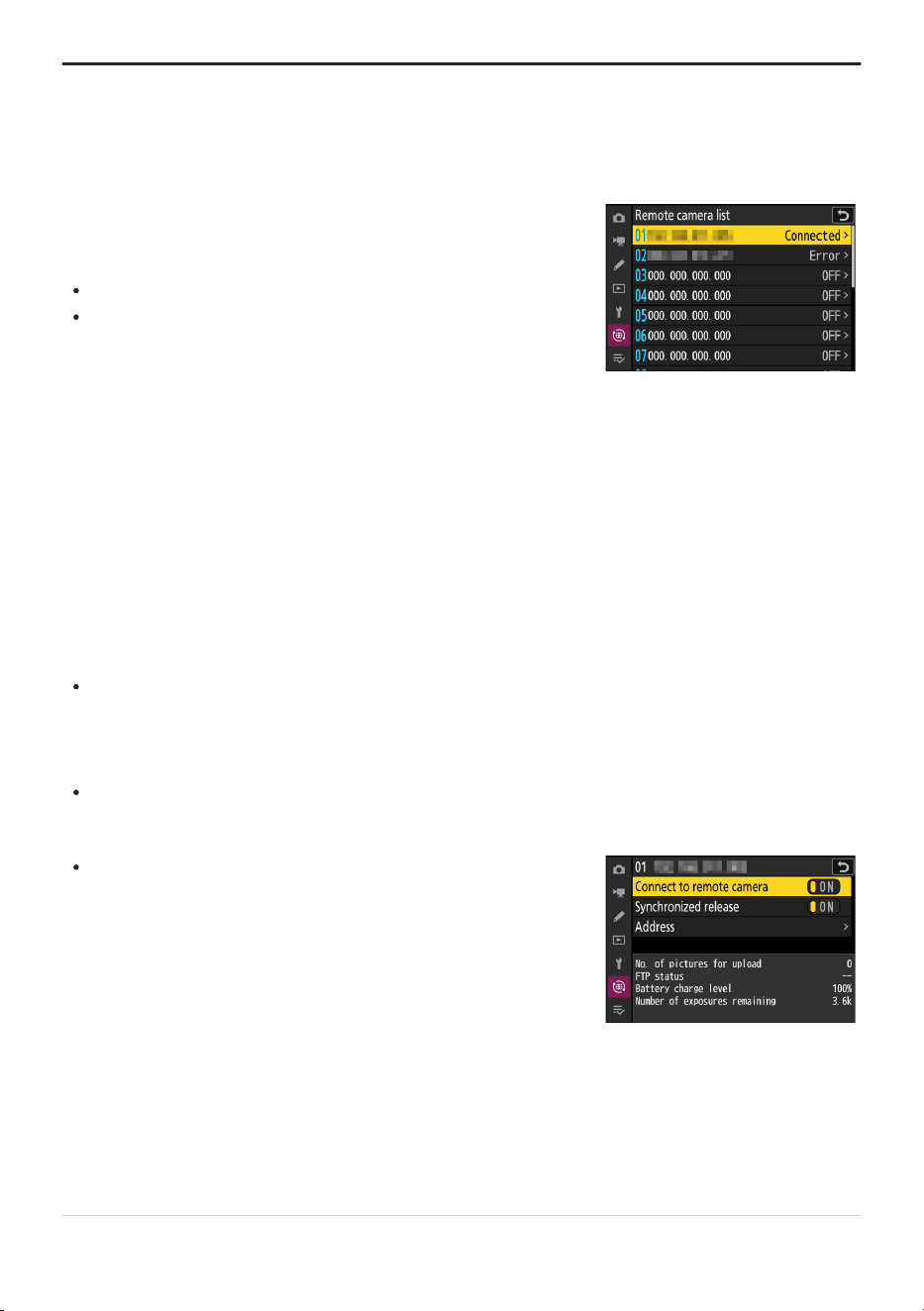
To view remote camera status, highlight [Remote camera list] on
the mast
er camera and press 2.
Remote cameras are identified by IP address.
Remote camera status is displayed as follows:
[Connected]: Normal connection.
[Busy]: The camera is being controlled from another master
camera.
[Error]: One of the following errors has been detected:
The remote camera standby timer has expired.
The remote camera is off.
The remote camera is not in the same group as the master
camera.
The IP address is incorrect.
[OFF]: Either
no remote camera has been assigned to the slot, or
[OFF] is selected for [Connect to remote camera] on the
camera in question.
Highlighting a remote camera with the [Connected] label and
pressing 2 displays the number of pictures awaiting upload
from the camera via FTP, FTP connection status, the battery level,
and the number of exposures remaining.
The entries for the remote cameras previously used for
synchronized release will show the time of the most recent shot.
-
-
-
-
-
-
-
-
-
-
To edit remote camera settings from the master camera,
highlight the camera in the remote camera list and pr
ess 2.
To temporarily suspend the connection to the selected
camera, select [OFF] for [Connect to remote camera].
To temporarily suspend synchronized release on the selected
camera, select [OFF] for [Synchronized release].
If desired, you can then edit the camera’s IP address by
highlighting [Address] and pressing 2. To reconnect, select
[ON] for [Connect to remote camera]. No connection will
be established if no remote camera exists at the specified
address.
-
-
-
Tip: Suspending Synchronized Release
To temporarily disable synchr
onized release without ending the camera’s connection to the network,
select [OFF] for [Connect to other cameras]> [Synchronized release] in the network menu.
Tip: Viewing Remote Camera Status
387
Synchronized Release

Tip: Saving Group Settings to a Memory Card
Navigate to [Connect t
o other cameras] > [Group settings] > [Copy to/from card] in the network
menu, highlight [Copy to card], press 2, and then highlight group settings you wish to save and press
2 again. Select the destination (1–99) and press J to copy the group settings to the memory card.
Saved group settings can be loaded using [Copy from card].
388
Synchronized Release
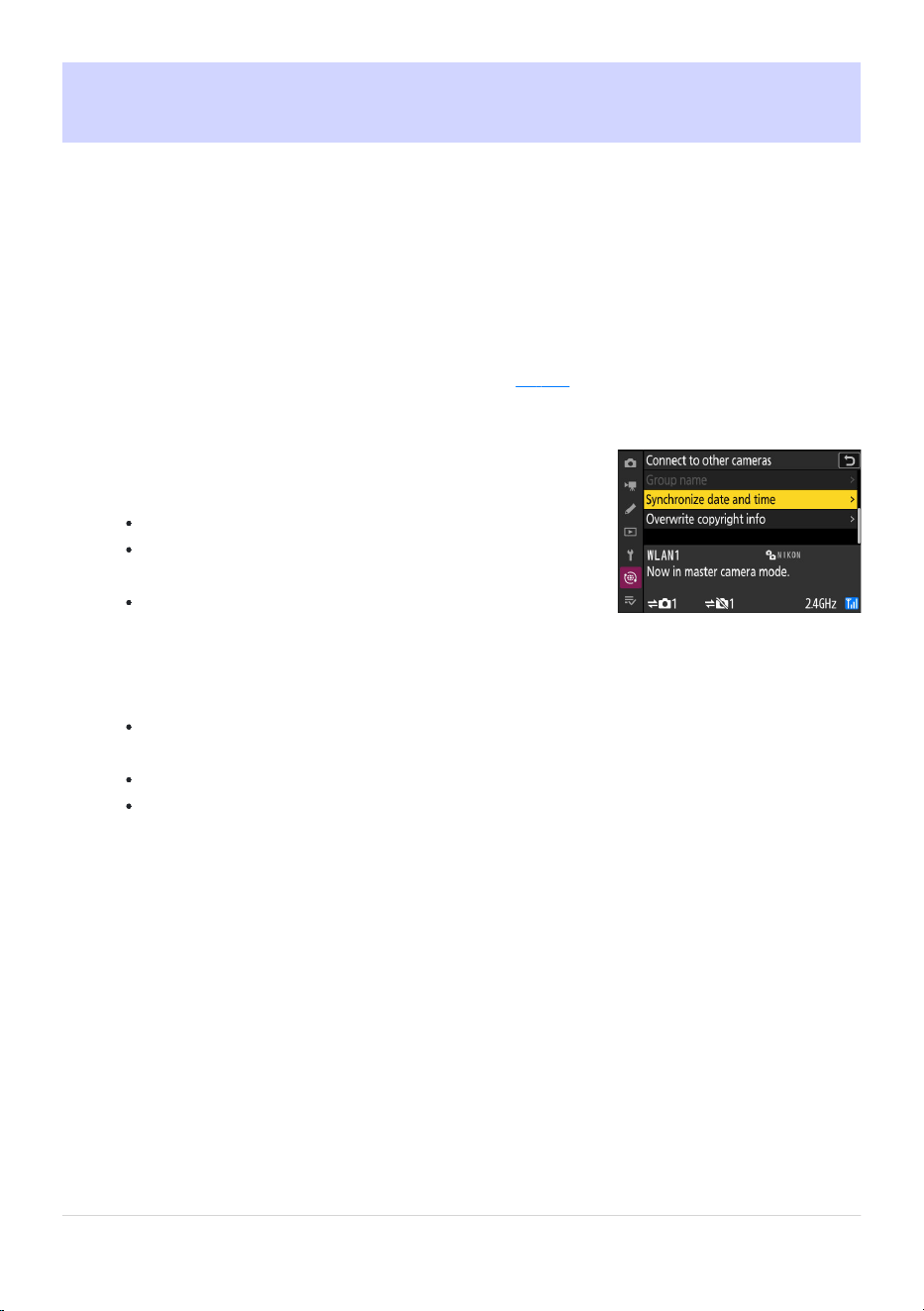
On the master camera, select [Connect to other cameras],
then highlight [Synchr
onize date and time] and press 2.
Master camera clock settings will be displayed.
[Synchronize date and time] is not available on the remote
cameras.
[Synchronize date and time] will not be available if no
camera is connected to the network.
Synchronizing Camera Clocks
When the cameras are connected t
o the network using [Connect to other cameras] in the network
menu, the clocks on all cameras in the current group connected can be set to the time and date
reported by the master camera. Synchronization applies to all options in the setup menu [Time zone
and date] display.
Connect the cameras to the network using [Connect to other cameras]> [Network
settings] in the network menu.
For more information, see “Synchronized Release” (
0 378).
Press J
.
The clocks on the remote cameras will be set to the date and time reported by the master
camera.
A message will be displayed when the process is complete.
Press J again to return to the [Connect to other cameras] display.
389
Synchronizing Camera Clocks
1
2
3
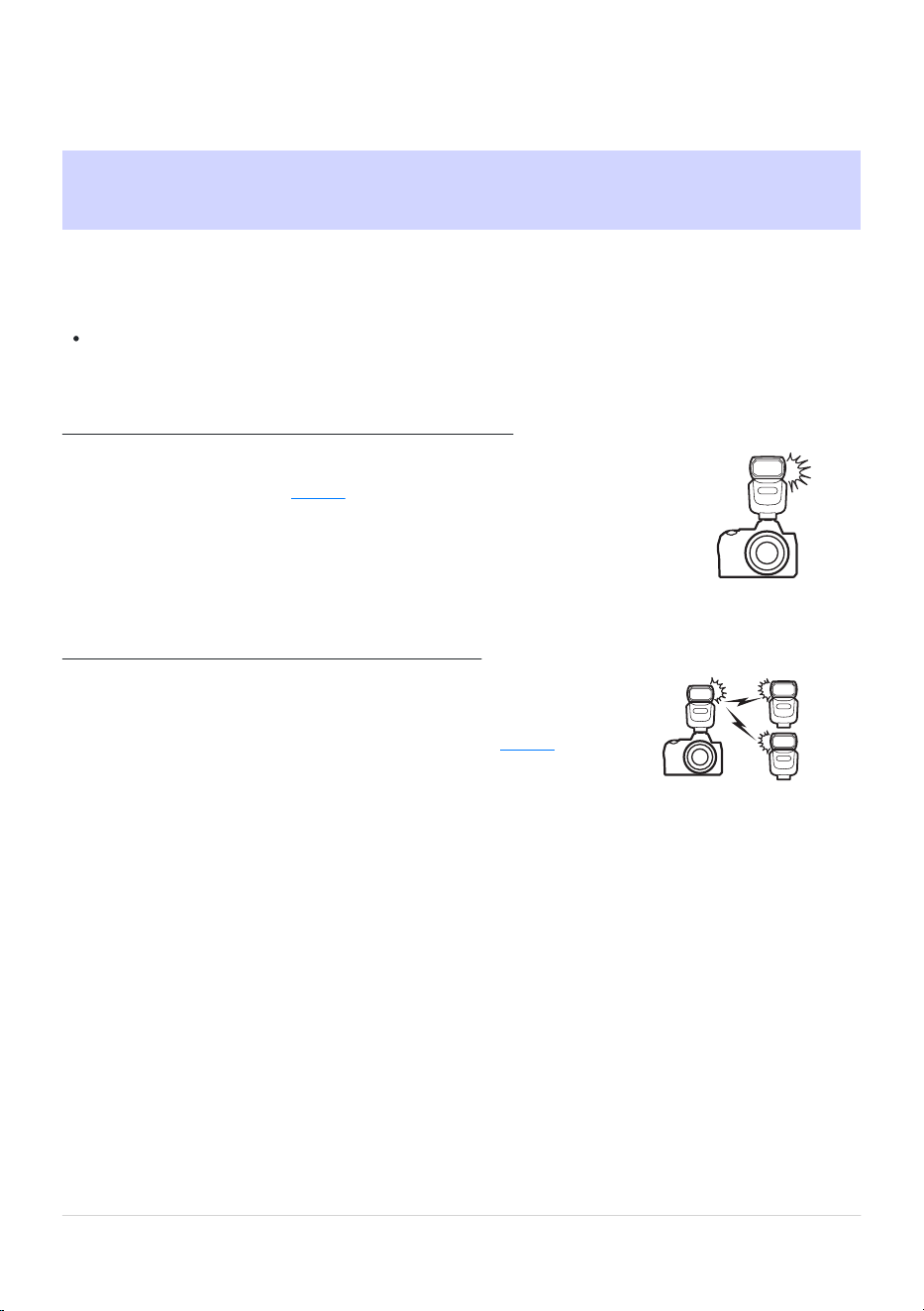
Take pictures using a flash unit mounted on the camera. See the following
pages for more infor
mation (
0 391).
Take pictures with one or more remote flash units using wireless
flash control (Advanced Wir
eless Lighting, or AWL). For more
information, see “What Is Remote Flash Photography?” (
0 400).
Flash Photography
“On-Camera” Versus “R
emote”
You can take pictures using an optional flash unit mounted on the camera accessory shoe or one or
more remote flash units.
When using a flash, select [OFF] for [Silent mode] in the setup menu.
Camera-Mounted Flash Units
Remote Flash Photography
390
“On-Camera” Versus “Remote”
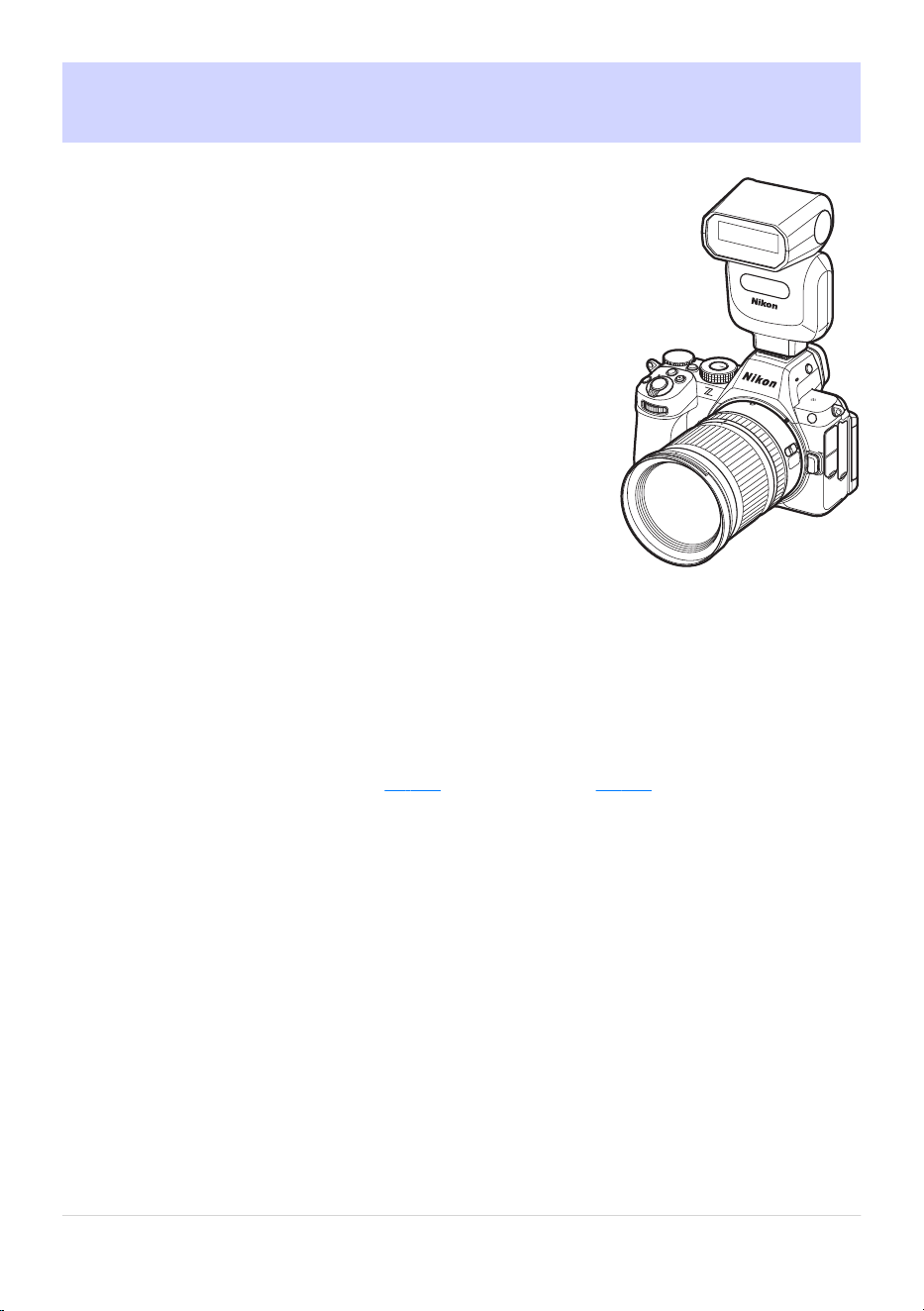
Mount a flash unit on the camera accessory shoe.
See the documentation supplied with each Speedlight for
information on mounting the unit on the camera.
Using an On-Camera Flash
Turn on the camera and f
lash unit.
The flash will begin charging; the flash-ready indicator (c) will appear in the shooting display
when charging is complete.
Choose the flash control mode (
0 394) and flash mode (0 395).
Adjust shutter speed and apertur
e.
Take pictures.
391
Using an On-Camera Flash
1
2
3
4
5

D Shutter Speed
Shutter speed can be set as follows when an optional flash unit is used:
Shooting mode Shutt
er speed
b
Set automatically by camera (¹⁄₂₀₀s–¹⁄₆₀s)
P, A Set automatically by camera (¹⁄₂₀₀s–¹⁄₆₀s)
*
S ¹⁄₂₀₀s–30s
M ¹⁄₂₀₀s–30s, Bulb, Time
Shutter speed may be set as slow as 30s if slow sync, slow rear-curtain sync, or slow sync with
red-eye reduction is selected for flash mode.
D Caution: Third-Party Flash Units
The camera cannot be used with flash units that would apply voltages over 250V to the camera’s
X contacts or short-circuit contacts on the accessory shoe. Use of such flash units could not only
interfere with normal operation of the camera but also damage the flash sync circuits of the camera
and/or flash.
392
Using an On-Camera Flash
*
D i-TTL Flash Control
When an optional flash unit that supports the Nik
on Creative Lighting System is attached and set to
TTL, the camera uses monitor pre-flashes for balanced or standard “i-TTL fill-flash” flash control. i-TTL
flash control is not available with flash units that do not support the Nikon Creative Lighting System.
The camera supports the following types of i-TTL flash control:
Flash control Description
i-TTL balanced fill-flash
The camera uses “i-TTL balanced fill-flash” flash control for a natural
balance between the main subject and ambient background lighting.
After the shutter-release button is pressed and immediately before the
main flash, the flash unit emits a series of monitor pre-flashes which the
camera uses to optimize flash output for a balance between the main
subject and ambient background lighting.
Standard i-TTL fill-flash
Flash output is adjusted to bring lighting in the frame to a standard
level; the brightness of the background is not taken into account.
Recommended for shots in which the main subject is emphasized at
the expense of background details, or when exposure compensation is
used.
Standard i-TTL fill-flash is activated automatically when [Spot metering] is selected.
393
Using an On-Camera Flash
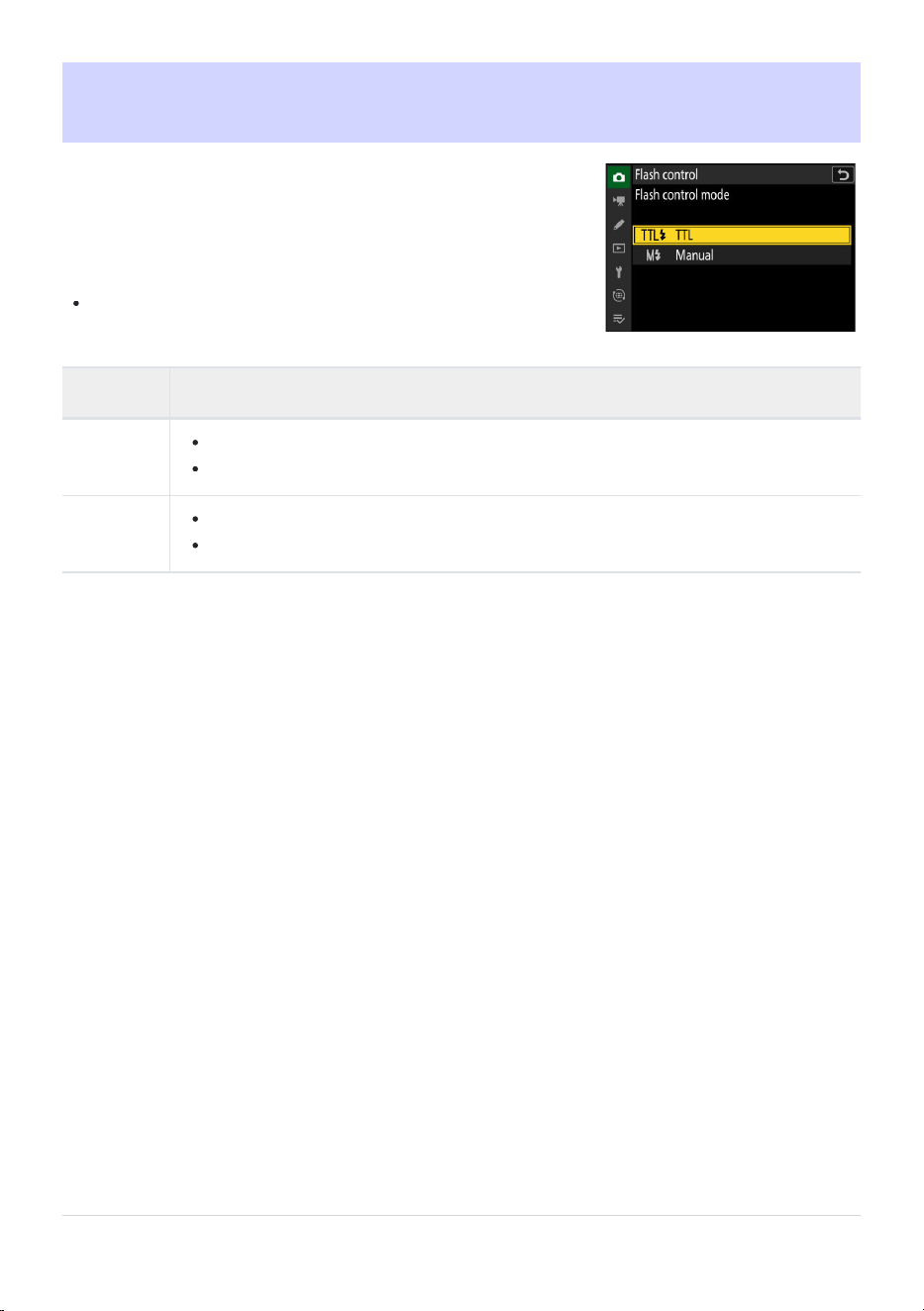
When an optional SB‑500, SB‑400, or SB‑300 flash unit is mounted
on the camera, the flash control mode, flash level, and other flash
settings can be adjust
ed using the [Flash control]> [Flash control
mode] item in the photo shooting menu.
Settings for flash units other than the SB‑500, SB‑400, and
SB‑300 can only be adjusted using flash unit controls.
Flash Control Mode
Option Description
[T
TL]
Flash output is adjusted aut
omatically in response to shooting conditions.
For additional adjustments to output, use [Flash compensation].
[Manual]
Choose the flash level manually.
Flash output is selected using [Manual output amount].
394
Flash Control Mode

Flash Modes
The flash mode can be selected via the [Flash mode] item in the phot
o shooting menu.
The options available vary with the shooting mode.
Option Description Available in
I
[Fill f
lash] (fr
ont
-curtain sync)
This mode is recommended in most
situations. In modes P and A,
shutter speed will automatically be
set to values between ¹⁄₂₀₀s (or
¹⁄₈₀₀₀s with auto FP high-speed
sync) and ¹⁄₆₀s.
b, P, S, A, M
J
[R
ed-eye reduction]
Use for portraits. The flash
will fire or the camera red-eye
reduction lamp will light before the
photograph is taken, reducing “red-
eye”.
The desired results may not
be achieved if the subject
or camera moves before the
shutter is released (this setting
is not recommended with
moving subjects or in other
situations requiring a quick
shutter response).
b, P, S, A, M
L
[Slow sync]
(slow sync)
As for “fill flash”, except that
shutt
er speed slows automatically
to capture background lighting at
night or under low light.
Note that photos may be prone
to blurring due to camera shake
at slow shutter speeds.
Use of a tripod is recommended.
P, A
395
Flash Modes
Option Description Available in
K
[Slow sync + red-eye]
(r
ed-eye reduction with slow sync)
Use to include background lighting
in portraits. Red-eye reduction is
combined with slow shutter speeds
to capture background lighting at
night or under low light.
Note that photos may be prone
to blurring due to camera shake
at slow shutter speeds.
Use of a tripod is recommended.
P, A
M
[Rear-curtain sync]
The flash fires just before the
shutter closes, creating the effect
of a stream of light behind moving
light sources.
Selecting mode P or A after
choosing this option sets the
flash mode to slow sync.
Note that photos may be prone
to blurring due to camera shake
at slow shutter speeds.
Use of a tripod is recommended.
P, S, A, M
s
[Flash o
ff] The flash does not fir
e.
b
, P, S, A, M
D S
tudio Strobe Lighting
Rear
-curtain sync may not correctly synchronize with studio flash systems.
396
Flash Modes
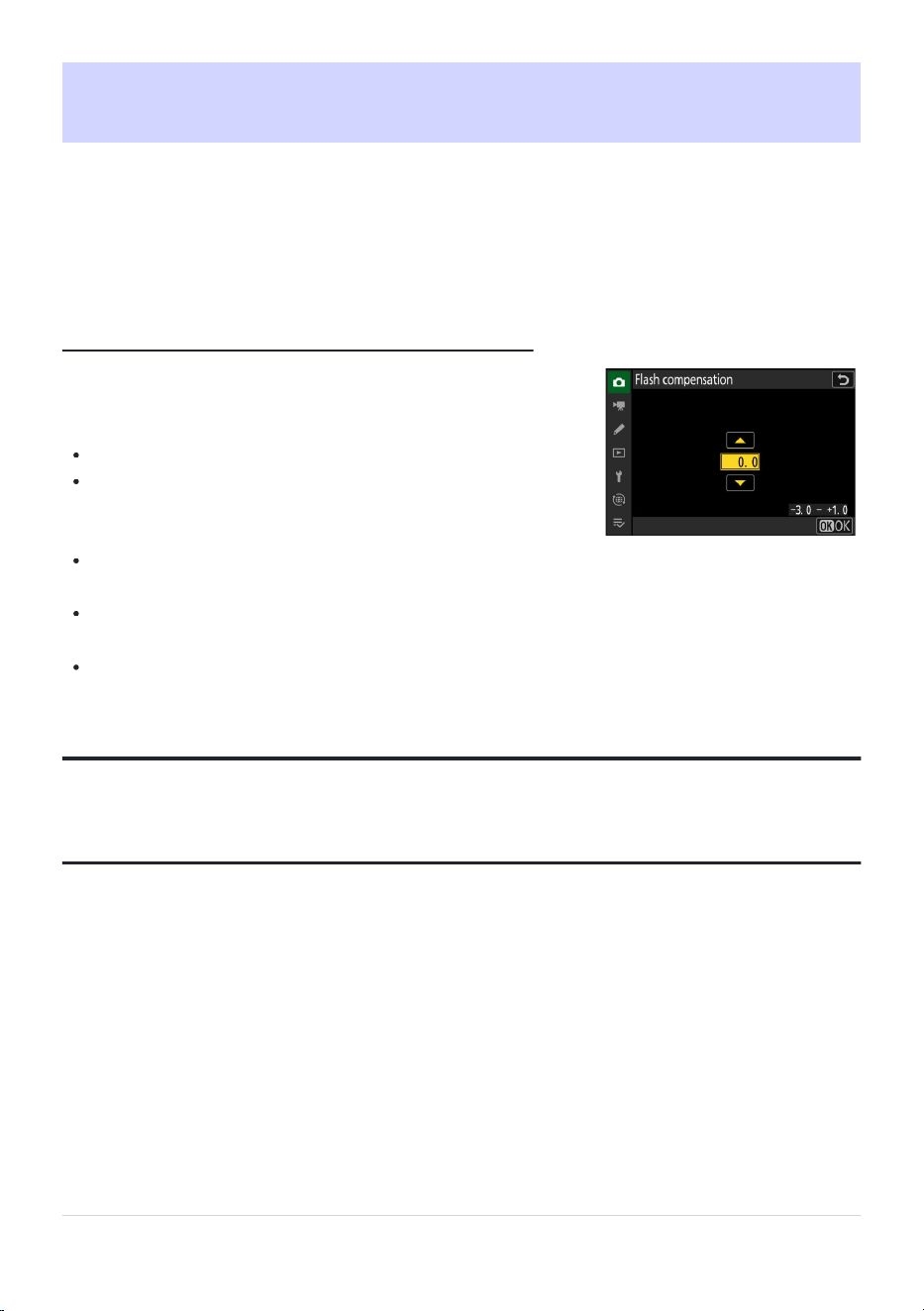
Flash output can be adjusted using the [Flash compensation] item
in the photo shooting menu.
Choose fr
om values of from −3 to +1EV.
At default settings, changes to flash output are made in
increments of ¹⁄₃EV. The size of the increment can be selected
using Custom Setting b2 [EV steps for exposure cntrl].
In general, choose positive values for brighter lighting, negative
values to ensure that the subject is not too brightly lit.
At values other than ±0.0, a Y icon will appear in the shooting
display.
Normal flash output can be restored by setting flash
compensation to ±0.0. Flash compensation is not reset when the
camera is turned off.
Flash Compensation
Flash compensation is used t
o deliberately alter flash output, for example in order to change the
brightness of the subject relative to the background. Flash output can be increased to make the main
subject appear brighter, reduced to prevent glare, or otherwise fine-tuned to produce the desired
result.
Adjusting Flash Compensation
Tip: Auto Flash Compensation
Flash compensation is perfor
med automatically along with exposure compensation when [Entire
frame] is selected for Custom Setting e3 [Exposure comp. for flash].
397
Flash Compensation
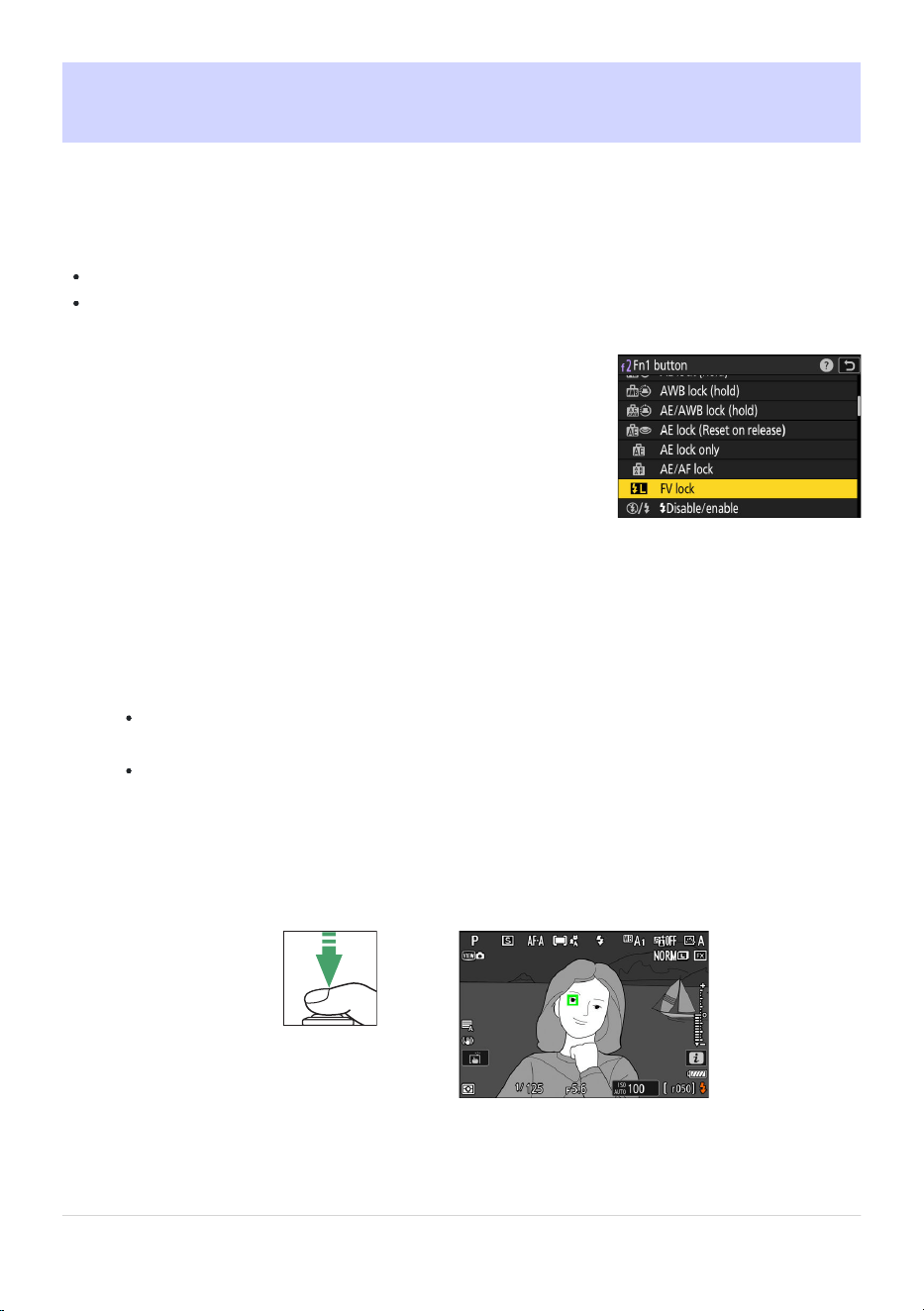
Assign [FV lock] to a control using Custom Setting f2
[Custom controls (shooting)
].
FV Lock
This feature is used to
lock flash output for optional CLS-compatible flash units, letting you take
multiple photos or recompose shots without changing the flash level. Your subject need not be in the
center of the frame, giving you more freedom when composing shots.
Flash output is adjusted automatically for any changes in ISO sensitivity and aperture.
FV lock is not available in b mode.
Mount a flash unit that supports FV lock on the camera accessory shoe.
Turn the flash unit on and choose a flash control mode of TTL or monitor pre-flash qA or
A.
If you are using an SB‑500, SB‑400, or SB‑300 mounted on the camera accessory shoe,
choose [TTL] for [Flash control]> [Flash control mode] in the photo shooting menu.
For information on other flash units, see the documentation provided with the unit.
Focus.
Position the subject in the center of the frame and press the shutter-release button halfway to
focus.
398
FV Lock
1
2
3
4
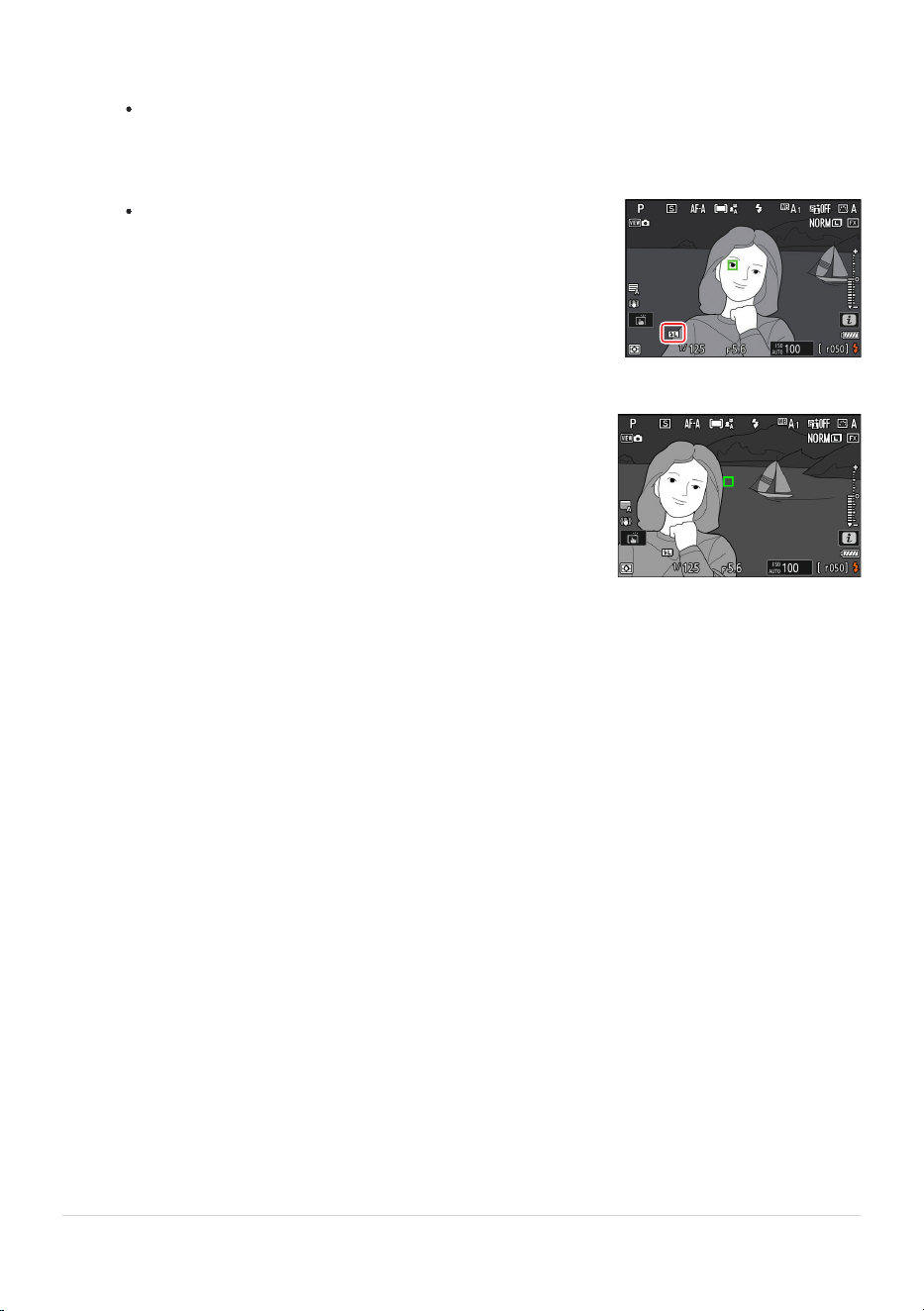
Flash output will lock and an FV lock icon (r) will appear in
the shooting display.
Recompose the shot.
Lock flash level.
After confir
ming that the flash-ready indicator (c) appears in the shooting display, press the
[FV lock] control; the flash unit will emit a monitor pre-flash to determine the appropriate
flash level.
Press the shutter-release button the rest of the way down to shoot.
If desired, additional pictures can be taken without releasing FV lock. Repeat Steps6 to 7 to take
additional shots.
Release FV lock.
Press the [FV lock] control to release FV lock and confirm that the FV lock icon (r) no longer
appears in the shooting display.
399
FV Lock
5
6
7
8
Remote Flash Photography
What Is Remote Flash Phot
ography?
Take pictures with one or more remote flash units using wireless flash control (Advanced Wireless
Lighting, or AWL). For information on using a flash unit mounted on the camera accessory shoe, see
“Using an On-Camera Flash” (
0 391).
Throughout this chapter
, operations involving an accessory connected to the camera are indicated
by C, operations involving remote flash units by f. For more information on using remote flash
units (f), see the documentation provided with the flash unit.
400
What Is Remote Flash Photography?
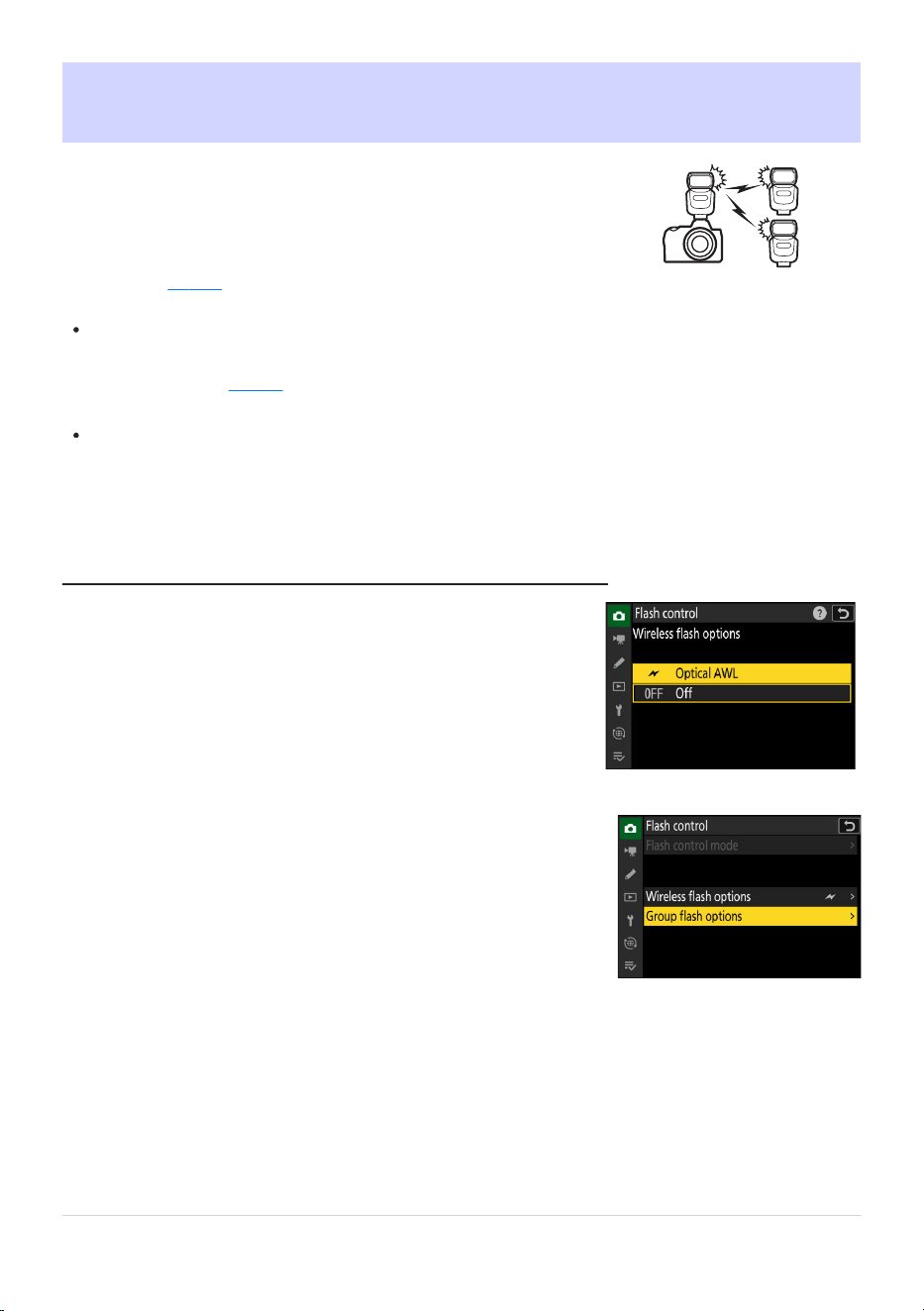
Remote flash units can be controlled via optical signals from an
optional flash unit mounted on the camera accessory shoe and
functioning as a mast
er flash (optical AWL). For information on
compatible flash units, see “Features Available with CLS-Compatible
Flash Units” (
0 839).
If the flash unit in question is an SB‑500, settings can be adjusted
from the camera. For mor
e information, see “Using Optical AWL
with the SB‑500” (
0 401). See the documentation provided
with the flash units for more infor
mation.
Settings for other flash units must be adjusted using flash unit
controls. For more information, see the documentation provided
with the flash unit in question.
Mount the flash unit on the camera accessory shoe. Select [Optical
AWL] for [Flash contr
ol]> [Wireless flash options] in the photo
shooting menu and take pictures using group flash control. Settings
for the flash units in each group can be adjusted separately.
C: Highlight [Group f
lash options] in the [Flash control]
display and press 2.
Controlling Remote Flash Units
Using Optical AWL with the SB‑500
401
Controlling Remote Flash Units
1
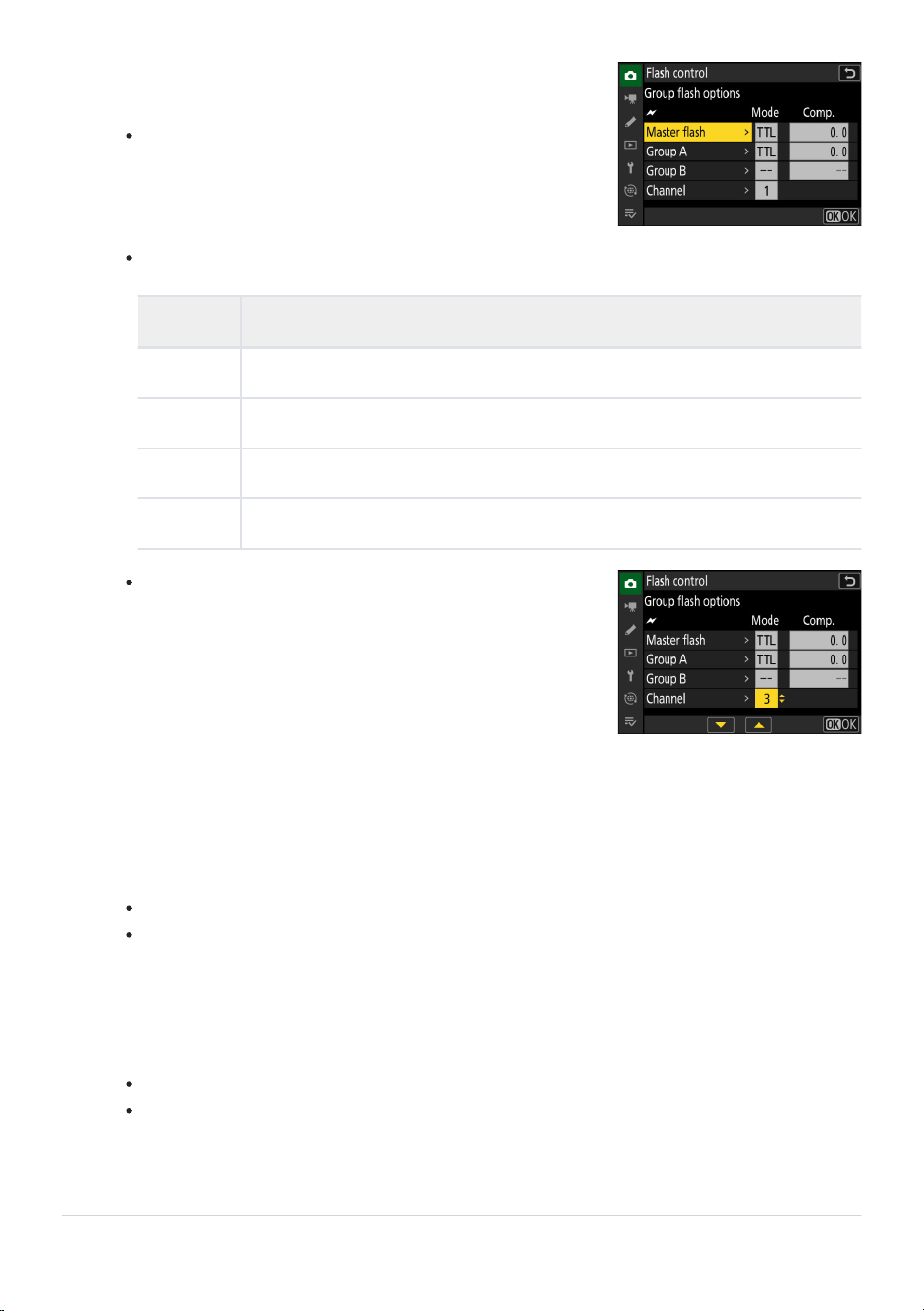
C: Adjust flash output and choose the channel and flash
contr
ol mode.
Choose the flash control mode and flash level for the master
flash and the remote flash units in each group.
Choose Channel [3].
The following options are available:
Option Description
TTL i-TTL flash control.
qA
Auto aperture. Available only with compatible flash units.
M Choose the flash level manually.
––
(off) The r
emot
e units do not fire. [Comp.] cannot be adjusted.
f: Set the remote f
lash units to Channel [3].
f: Group the remote flash units.
Choose a group (A or B).
There is no limit on the number of remote flash units that may be used. The practical
maximum, however, is three per group, as the light emitted by the remote flash units will
interfere with performance if more flash units are used.
C/f: Compose the shot and arrange the flash units.
See the documentation provided with the flash units for more information.
Test-fire the units and confirm that they are functioning normally. To test fire the units, use
the test flash button on the master flash.
402
Controlling Remote Flash Units
2
3
4
5

C/f: Take the photograph after confirming that the flash-ready lights for all flash units
are lit.
403
Controlling Remote Flash Units
6
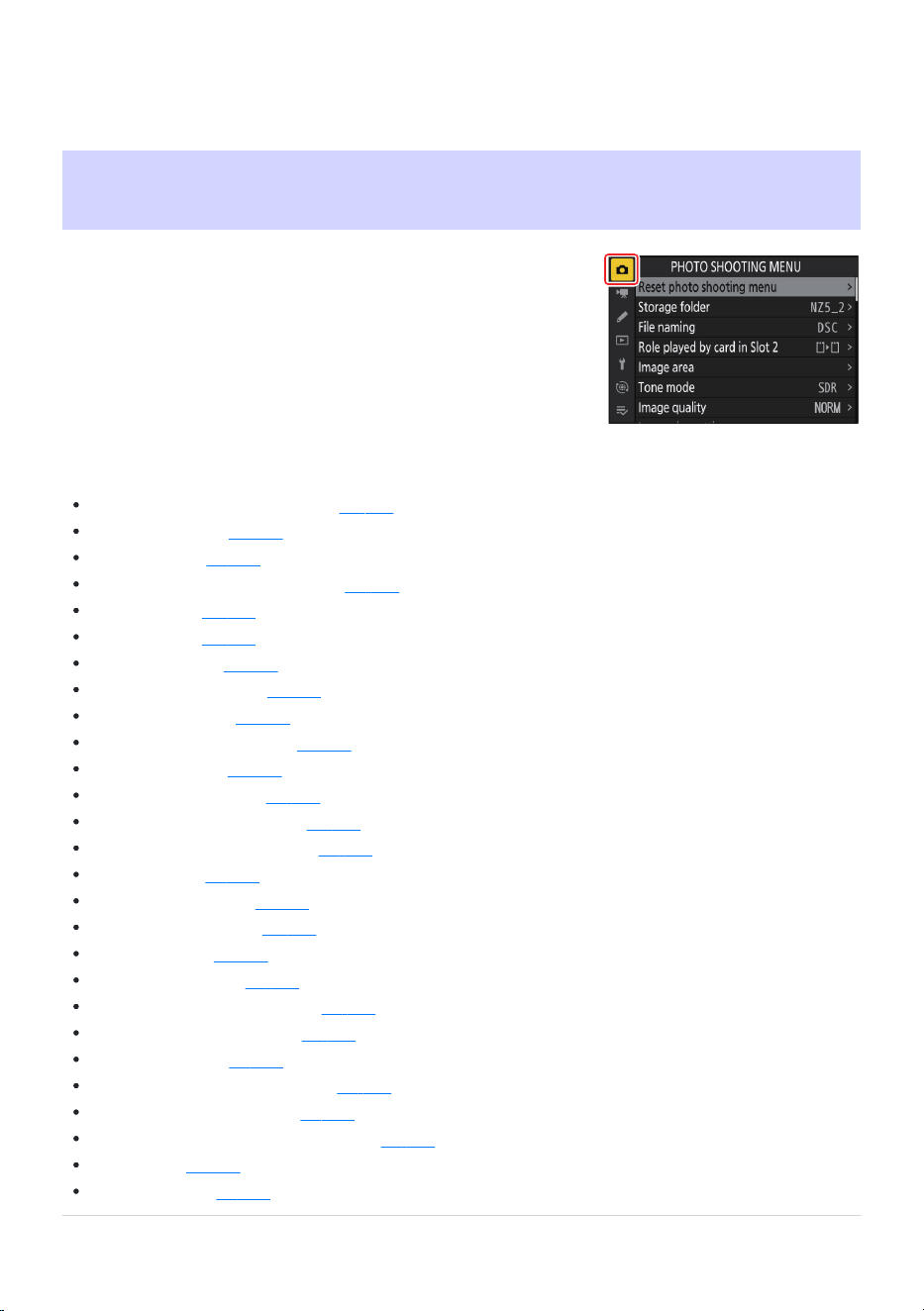
To view the photo shooting menu, select the C tab in the camera
menus.
The Photo Shooting Menu
The Photo Shooting Menu
The photo shooting menu contains the following it
ems:
[Reset photo shooting menu] (
0 406)
[Storage folder] (
0 407)
[File naming] ( 0 411)
[Role played by car
d in Slot 2] (
0 412)
[Image area] ( 0 416)
[Tone mode] ( 0 417)
[Image quality] ( 0 419)
[Image size settings] ( 0 420)
[RAW recor
ding] (
0 421)
[ISO sensitivity settings] ( 0 422)
[White balance] (
0 423)
[Set Picture Control] (
0 424)
[Manage Picture Control] (
0 425)
[Set Picture Control (HL
G)] (
0 426)
[Color space] ( 0 427)
[Active D-Lighting] ( 0 428)
[Long exposure NR] ( 0 430)
[High ISO NR] ( 0 431)
[Vignette control] (
0 432)
[Diffraction compensation] ( 0 433)
[Auto distor
tion control] (
0 434)
[Skin soft
ening] (
0 435)
[Portrait impr
ession balance] (
0 436)
[Photo flick
er reduction] (
0 438)
[High-frequency flick
er reduction] (
0 439)
[Metering] (
0 441)
[Flash control] ( 0 442)
404
The Photo Shooting Menu

[Flash mode] ( 0 444)
[Flash compensation] ( 0 445)
[Release mode] ( 0 446)
[Focus mode] ( 0 447)
[AF-area mode] ( 0 448)
[AF/MF subject detection options] ( 0 449)
[MF subject detection area] ( 0 450)
[Vibration reduction] ( 0 451)
[Link VR to focus point] ( 0 452)
[Auto bracketing] ( 0 453)
[Multiple exposure] ( 0 464)
[HDR overlay] ( 0 471)
[Interv
al timer shooting] (
0 475)
[Time-lapse video] ( 0 485)
[Focus shift shooting] ( 0 494)
[Pixel shift shooting] (
0 503)
405
The Photo Shooting Menu

Reset photo shooting menu
G buttonU
Cphoto shooting menu
Reset all photo shooting menu settings to their default values.
Photo shooting menu settings cannot be reset while a multiple exposure is in progress.
406
Reset photo shooting menu
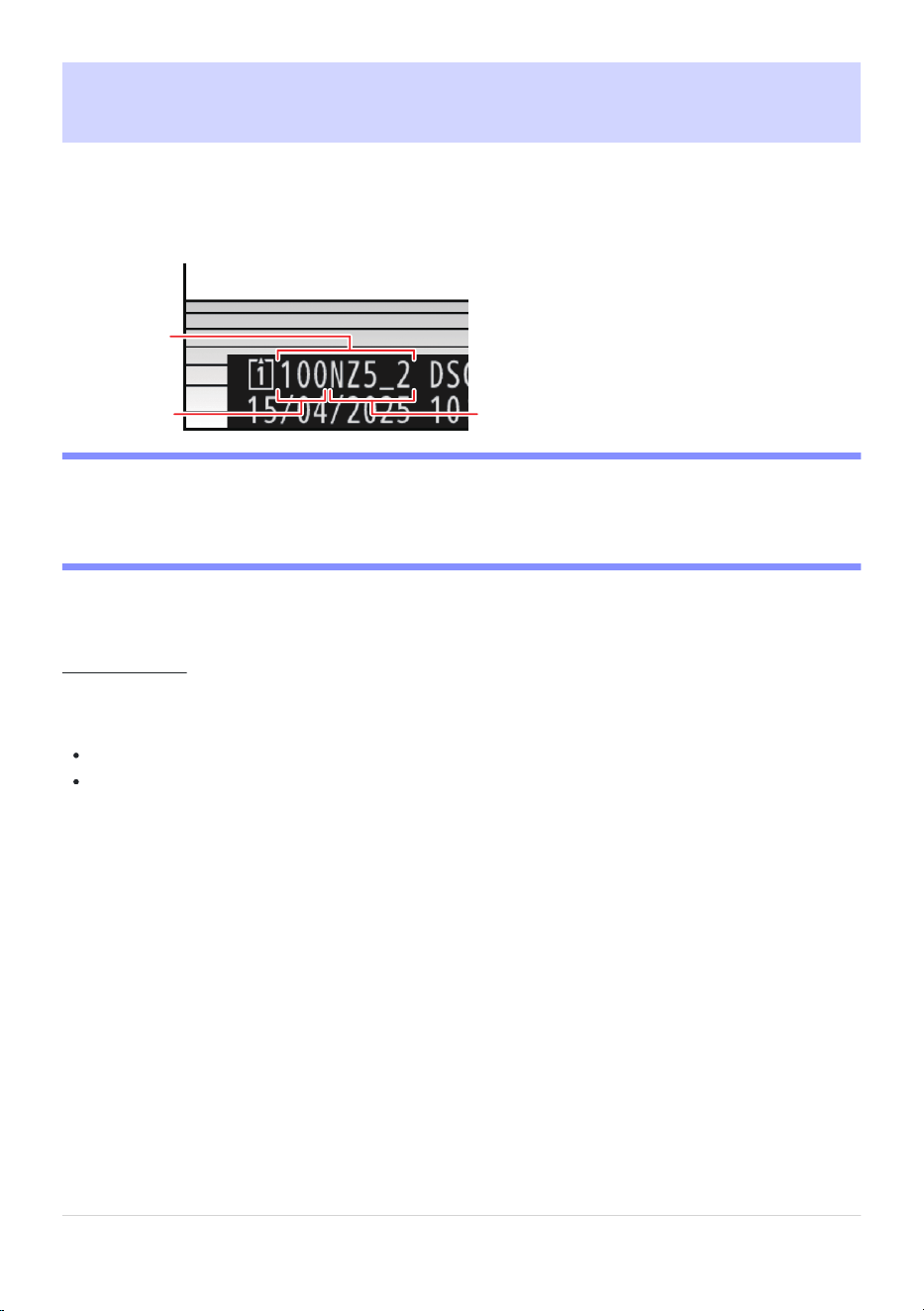
3
1
2
Folder
Folder number
Folder name
1
2
3
Storage folder
G buttonU
Cphoto shooting menu
Choose the folder in which subsequent pictures will be stored.
D “Storage Folder”
Changes to [Storage folder] in the photo shooting menu apply in the video recording menu and vice
versa.
Rename
The default folder name, which appears aft
er the folder number, is “NZ5_2”. To choose a different
five-character folder name for new folders, select [Rename].
Existing folders cannot be renamed.
If desired, the default name can be restored for subsequent folders by pressing and holding the O
button while the keyboard is displayed.
407
Storage folder
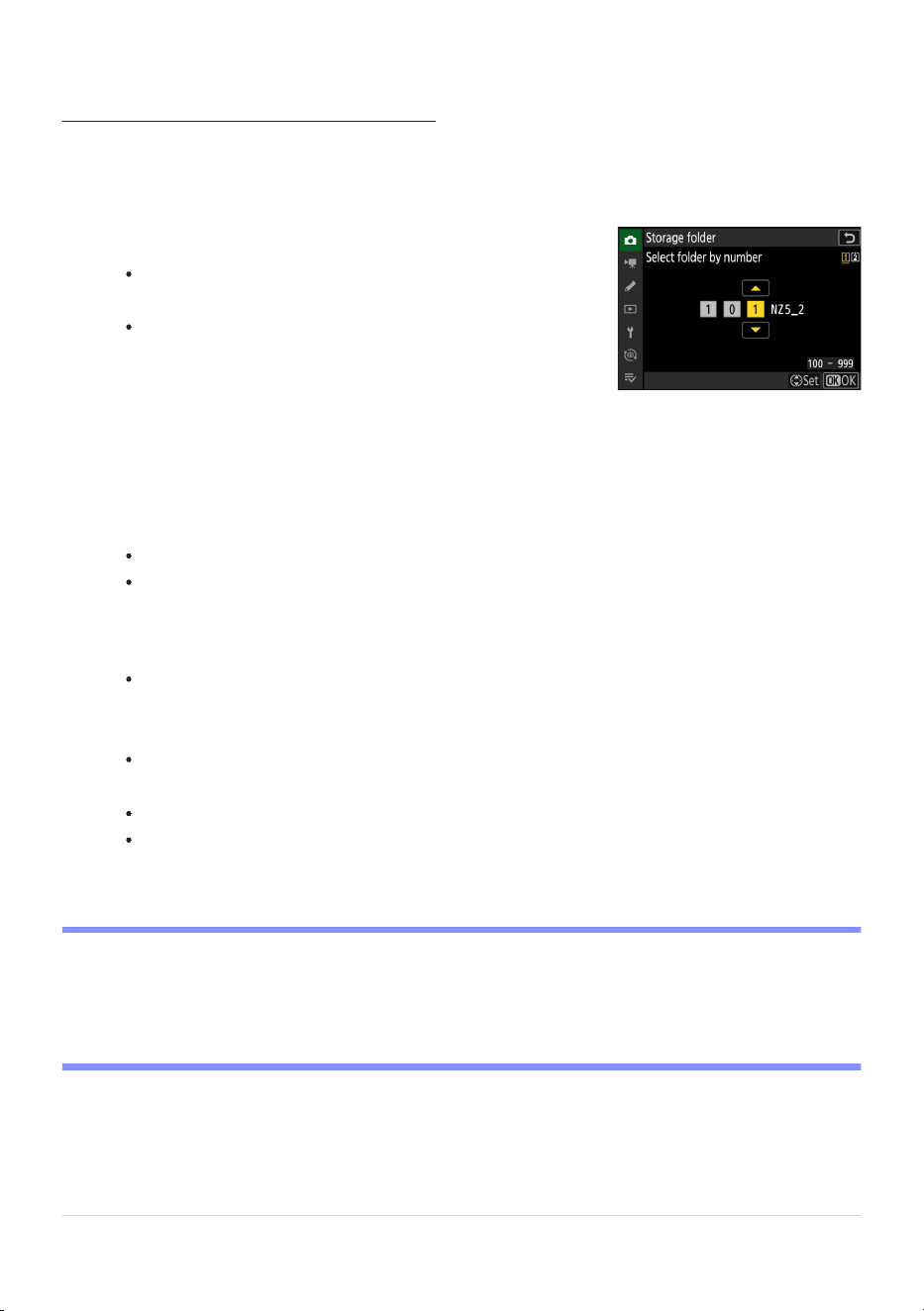
Choose [Select folder by number].
Highlight [Select folder by number] and press 2 t
o display
the [Select folder by number] dialog.
The card on which the new folder will be created is
underlined in the card slot display area at the top right
corner of the [Select folder by number] dialog. The card
used for new folders depends on the option currently
selected for [Role played by card in Slot 2] in the photo
shooting menu.
Select folder by number
The folder in which subsequent pictures will be stor
ed can be selected by number. If a folder with the
specified number does not already exist, a new folder will be created.
Choose a folder number.
Press 4 or 2 to highlight digits.
To change the highlighted digit, press 1 or 3.
Save changes and exit.
If a folder with the selected number already exists, a W, X, or Y icon will be displayed to the
left of the folder number. Press J to complete the operation and return to the main menu; if
you chose a folder marked W or X, it will be selected as the folder for new pictures.
If you chose a folder number that does not already exist, a new folder will be created with
that number when you press J.
In either case, subsequent pictures will be stored in the chosen folder.
To exit without changing the storage folder, press the G button.
D Folder Icons
Folders in the [Select folder by number] dialog are shown by W if empty, by Y if full (containing
either 5000 pictures or a picture numbered 9999), or by X if partially full. A Y icon indicates that no
further pictures can be stored in the folder.
408
Storage folder
1
2
3
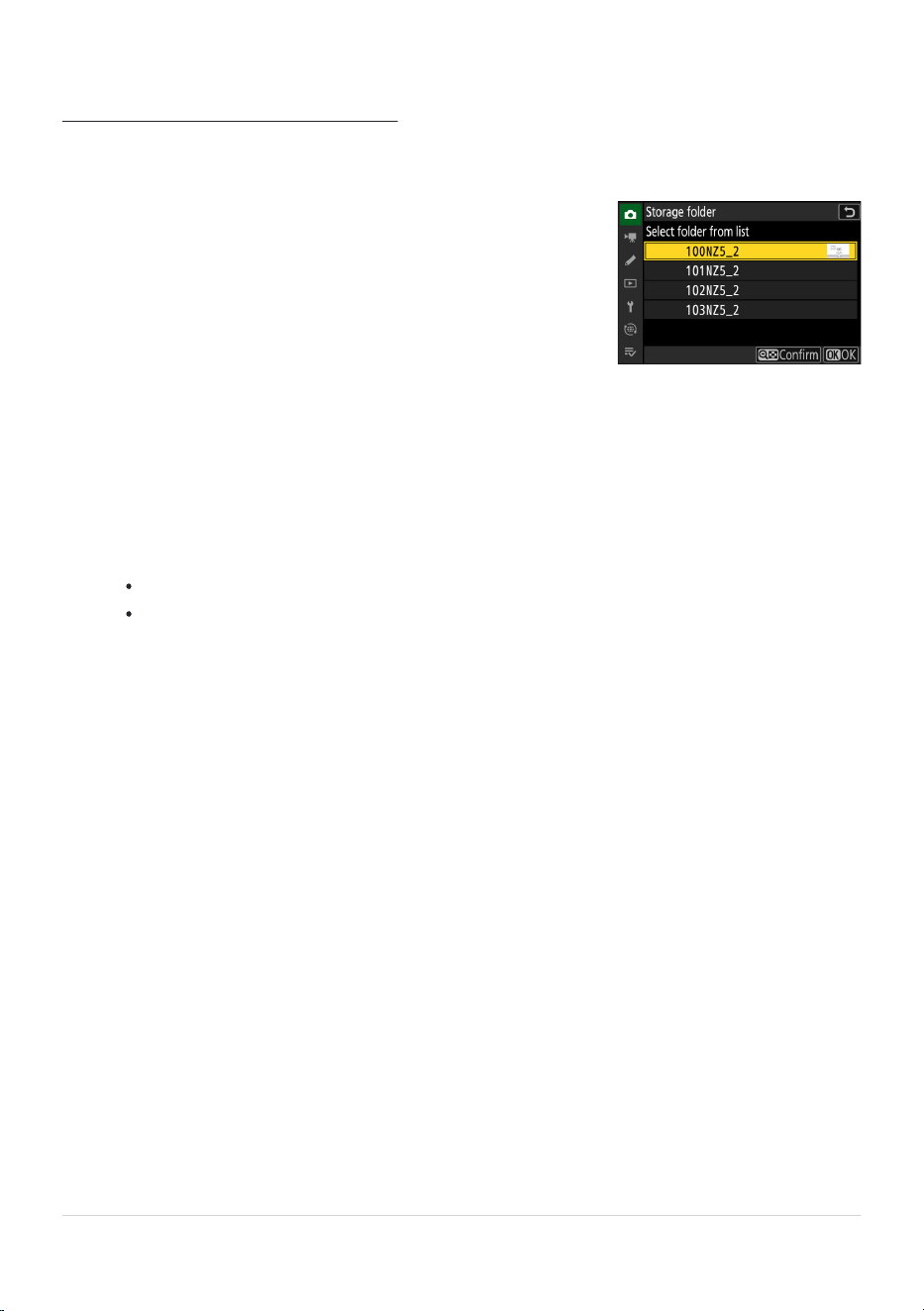
Choose [Select folder from list].
Highlight [Select folder from list] and press 2
to display the
[Select folder from list] dialog.
Select folder from list
To choose from a list o
f existing folders:
Highlight a folder.
Press 1 or 3 to highlight a folder.
Select the highlighted folder.
Press J to select the highlighted folder and return to the main menu.
Subsequent photographs will be stored in the selected folder.
409
Storage folder
1
2
3

D Cautions: Folder and File Numbers
When the current folder number r
eaches 999, the camera will no longer be able to create new
folders and the shutter release will be disabled if:
the current folder contains 5000 pictures (in addition, video recording will be disabled if the
camera calculates that the number of files needed to record a video of the maximum length
would result in the folder containing over 5000 files), or
the current folder contains a picture numbered 9999 (in addition, video recording will be
disabled if the camera calculates that the number of files needed to record a video of the
maximum length would result in a file numbered over 9999).
If there is space on the memory card, you will nevertheless be able to continue shooting by:
creating a folder with a number less than 999 and selecting it as the storage folder, or
changing the options selected for [Frame size/frame rate] or [Video file type] before recording
videos.
D Startup Time
Additional time may be required for camera startup if the memory card contains a very large number
of files or folders.
410
Storage folder
-
-
-
-

File naming
G buttonU
Cphoto shooting menu
Pictures are saved using file names consisting of “DSC_” followed by a four-digit number and a
three-letter extension. [File naming] is used to select three letters to replace the “DSC” portion of the
file name. For information on text entry, see “Text Entry” (
0 79).
D File Names
File names take the form “DSC_nnnn
.xxx”, where nnnn is a number from 0001 to 9999 and xxx is one
of the following extensions, assigned according to the options selected for image quality and file
type:
NEF: NEF (RAW) format, used when RAW is selected for image quality
JPG: JPEG format, used if an image quality other than RAW is chosen with SDR selected for tone
mode
HIF: HEIF, used if an image quality other than RAW is chosen with HLG selected for tone mode
NEV: NEV videos
MOV: MOV videos
MP4: MP4 videos
NDF: Dust off reference data
Pictures created with [Adobe RGB] selected for [Color space] in the photo shooting menu have file
names of the form “_DSCnnnn.xxx”.
The NEF (RAW) and JPEG photographs in each pair of pictures recorded at image-quality settings
of RAW+ JPEG/HEIF have the same file names but different extensions (“.NEF” for the NEF (RAW)
photo and “.JPG” for the JPEG copy).
The NEF (RAW) and HEIF photographs in each pair of pictures recorded at image-quality settings
of RAW+ JPEG/HEIF have the same file names but different extensions (“.NEF” for the NEF (RAW)
photo and “.HIF” for the HEIF copy).
Proxy videos have the same file names as the RAW footage with which they are recorded, but while
the RAW footage is assigned the extension “.NEV,” the proxy files have the extension “.MP4”.
411
File naming
-
-
-
-
-
-
-

Role played by card in Slot 2
G buttonU
Cphoto shooting menu
Choose the role played by the card in Slot 2 when two memory cards are inserted in the camera.
Option Description
P
[Overflow] The card in Slot 2 is used only when the car
d in Slot 1 is full.
Q
[Backup]
Each picture is recorded twice, once to the card in Slot 1 and
again to the card in Slot 2.
R
[RAW Slot 1 - JPEG Slot 2]
This option is available when [SDR] is selected for tone
mode.
NEF (RAW) copies of photos taken at settings of RAW+
JPEG/HEIF are recorded only to the card in Slot 1, JPEG
copies only to the card in Slot 2.
Pictures taken at other image quality settings are recorded
twice at the same setting, once to the card in Slot 1 and
again to the card in Slot 2.
O
[JPEG Slot 1 - JPEG Slot 2]
This option is available when [SDR] is selected for tone
mode.
Two JPEG copies are recorded, one to each memory card.
The copy saved to the card in Slot 1 is recorded at the
image quality and size selected in the photo shooting
menu.
The copy saved to the card in Slot 2 is saved at an image
quality of [JPEG/HEIF basic]. The size can be selected
by pressing 2 when [JPEG Slot 1 - JPEG Slot 2] is
highlighted.
At image qualities of RAW or RAW+ JPEG/HEIF, this option
is equivalent to [Backup].
412
Role played by card in Slot 2
Option Description
a
[RAW Slot 1 - HEIF Slot 2]
This option is available when [HL
G] is selected for tone
mode.
NEF (RAW) copies of photos taken at settings of RAW+
JPEG/HEIF are recorded only to the card in Slot 1, HEIF
copies only to the card in Slot 2.
Pictures taken at other image quality settings are recorded
twice at the same setting, once to the card in Slot 1 and
again to the card in Slot 2.
b
[HEIF Slot 1 - HEIF Slot 2]
This option is available when [HLG] is selected for tone
mode.
Two HEIF copies are recorded, one to each memory card.
The copy saved to the card in Slot 1 is recorded at the
image quality and size selected in the photo shooting
menu.
The copy saved to the card in Slot 2 is saved at an image
quality of [JPEG/HEIF basic]. The size can be selected by
pressing 2 when [HEIF Slot 1 - HEIF Slot 2] is highlighted.
At image qualities of RAW or RAW+ JPEG/HEIF, this option
is equivalent to [Backup].
413
Role played by card in Slot 2

D Caution: [RAW Slot 1 - JPEG Slot 2
]
If [ON] is selected for [Multiple exposure]> [Save individual pictures (RAW)] in the photo shooting
menu, or if [ON] is selected for [HDR overlay]> [Save individual pictures (RAW)] in the photo
shooting menu, unprocessed copies of the individual NEF (RAW) photos that make up each multiple
exposure or HDR picture will be recorded to both memory cards together with the JPEG composite,
regardless of the option selected for image quality.
Tip: When an Option Other than [Overflow] Is Selected
The shooting display shows the number of exposures remaining on the card with the least amount
of space available.
The shutter release is disabled when either card is full.
Tip: Viewing Dual-Format Photos
Use the [Dual-format recording PB slot] item in the playback menu to choose the slot from which
dual-format photos are played back.
When viewing dual-format photos, you can view the other copy using [Jump to copy on other
card] in the i menu.
Tip: Recording Videos
The slot to which videos are recorded is selected using [Destination] in the video recording menu.
414
Role played by card in Slot 2
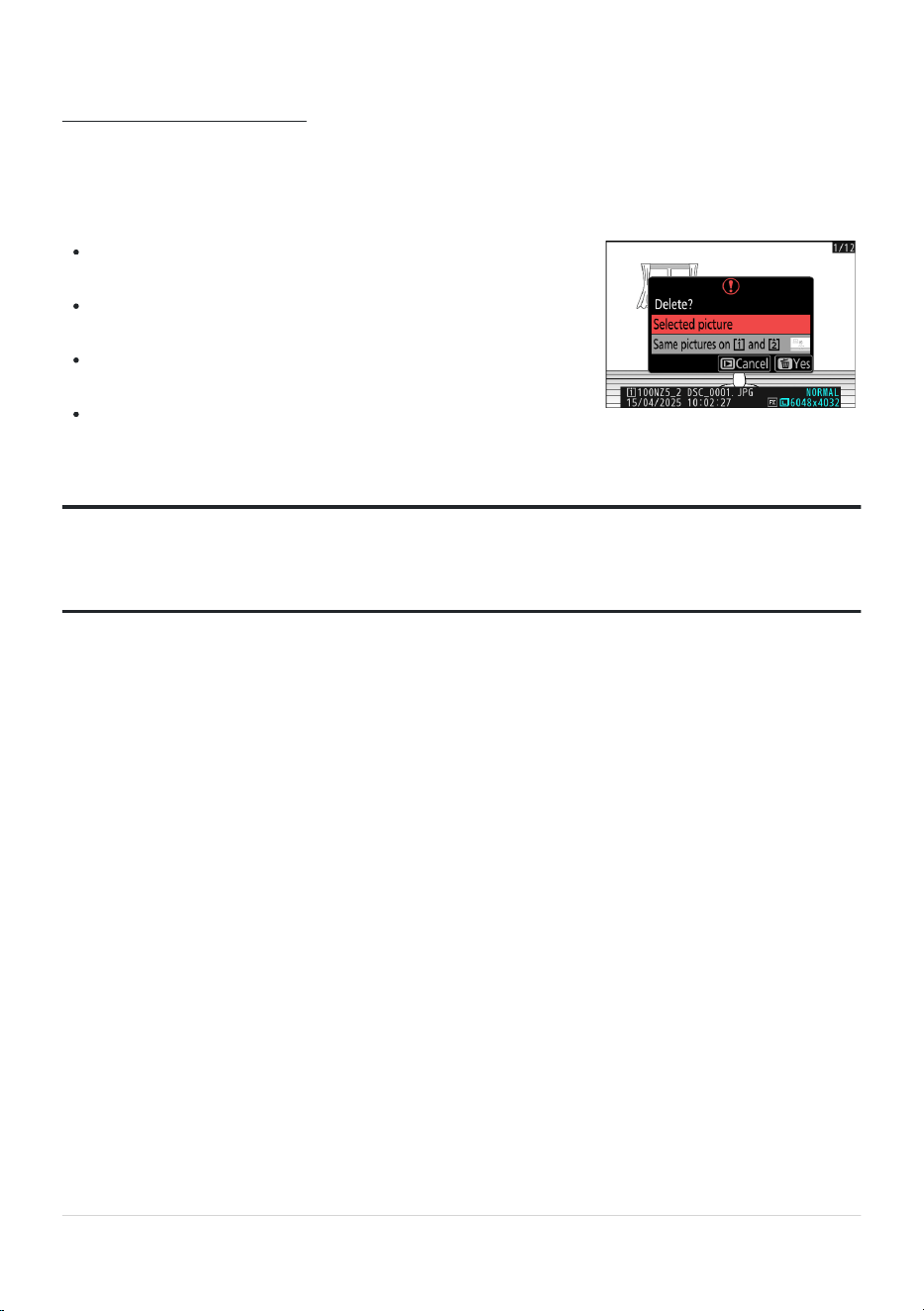
Pressing O when a picture creat
ed using either of these options
is highlighted during playback displays a confirmation message.
To delete only the copy on the card in the current slot, highlight
[Selected picture] and press O again.
To delete both copies, highlight [Same pictures on 1 and 2]
and press O.
If a voice memo is appended to the picture, a confirmation
dialog will be displayed. To delete only the voice memo,
highlight [Voice memo only] and press O.
Deleting Copies
When deleting pictures recor
ded using [Backup], [RAW Slot 1 - JPEG Slot 2], [JPEG Slot 1 - JPEG
Slot 2], [RAW Slot 1 - HEIF Slot 2], or [HEIF Slot 1 - HEIF Slot 2], you have the choice of erasing
either both copies or only the copy on the card in the current slot.
Tip: Delete Options
Use the [Delete pictures from both slots] item in the playback menu to choose the options displayed
when a picture is deleted.
415
Role played by card in Slot 2

Tone mode
G buttonU
Cphoto shooting menu
The camera offers a choice of two tone modes: [SDR] and [HLG].
Option Description
[SDR]
This mode supports a normal range of brightnesses (dynamic range). Pictures taken while
this option is selected are st
ored in JPEG format (extension “*.JPG”).
[HLG]
This mode supports HDR (high dynamic range). Pictures taken while this option is
selected are stored in HEIF format (extension “*.HIF”). It has a wider dynamic range than
SDR.
“HLG” appears in the shooting display when this option is selected.
For optimal tone reproduction when viewing HLG pictures, use monitors, computers,
operating systems, applications, and other equipment compatible with HLG. For more
information, visit the following website:
https://onlinemanual.nikonimglib.com/notice/hlg_setting_guide/en/
D Taking Photos in HLG
Pictures tak
en with [HLG] selected for tone mode exhibit more “noise“ (in the form of randomly-
spaced bright pixels, fog, and lines) than do pictures taken using [SDR].
ISO sensitivities of Hi 0.3 through Hi 1.7 are not available.
ISO 400 is the lowest ISO sensitivity value available.
The lowest value available for the [ISO sensitivity settings]> [Maximum sensitivity] item in the
photo shooting menu is ISO 800.
The video file type for time-lapse videos is fixed at [H.265 10-bit (MOV)].
[Color space] in the photo shooting menu is fixed at "BT.2100".
[Active D-Lighting], [Multiple exposure], and [HDR overlay] are not available in the photo
shooting menu.
[C15] and [C30] cannot be selected for release mode and Custom Setting d3 [Pre-Release Capture
options] is not available.
417
Tone mode

D Caution: HLG Photos
Pictur
es shot with [HLG] selected for tone mode are subject to the following restrictions:
Image overlay is not available with HLG photos. HEIF pictures will not be displayed in the picture
selection dialogs for the various image overlay options available via [Retouch] in the playback i
menu.
You can download HLG photos using the SnapBridge app but may not be able to view them in
some versions of the app or operating system.
D Camera Shooting and Playback Displays
When [HLG] is selected for tone mode, the shooting and playback displays in the camera monitor and
viewfinder may include “noise” in the form of randomly-spaced bright pixels, fog, or lines or may fail
to accurately reproduce highlights and highly-saturated colors. In addition, abrupt tone discontinuities
may be visible in the camera monitor or viewfinder when photos are displayed full-frame, although the
photos themselves are unaffected. For accurate tone reproduction, use monitors, computers, operating
systems, applications, and other equipment compatible with HLG.
Tip: HLG
Hybrid Log-Gamma (HLG) technology was developed for television broadcasting and other high-
definition applications.
Compared with Standard Dynamic Range (SDR), it increases the amount of detail that can be
expressed in the upper half of the tone range for greater rendering potential.
It matches SDR in the level of detail that can be expressed in the lower portion of the tone range to
ensure compatibility with non-HDR displays.
Tip: Picture Controls
Photos shot with [SDR] selected for tone mode can be processed using the [Set Picture Control]
and [Manage Picture Control] items in the photo shooting menu.
Photos shot with [HLG] selected for tone mode can be processed using the [Set Picture Control
(HLG)] item in the photo shooting menu.
Tip: Viewing and Editing HLG Photos
HLG (HEIF) photos can be viewed and edited using Nikon’s NX Studio software.
NX Studio can be downloaded free of charge from the Nikon Download Center.
Some of the options available for editing HLG photos are more limited than is the case with photos
shot with [SDR] selected for tone mode.
418
Tone mode


Image size settings
G buttonU
Cphoto shooting menu
Choose the size, in pixels, of pictures recorded with the camera. For more information, see “Choosing
an Image Size” (
0 118), part of the section on “Image Recording Options (Image Area, Quality, and
Size)” in the “Shooting Settings” chapter
.
420
Image size settings

RAW recording
G buttonU
Cphoto shooting menu
Choose a compression type for NEF (RAW) photographs. In descending order by the size of the files
produced, the options are: [Lossless compression], [High efficiencym], and [High efficiency].
[High efficiencym] produces pictures that compare favorably in quality to those produced by
[Lossless compression] and are higher in quality than those produced by [High efficiency].
421
RAW recording

ISO sensitivity settings
G buttonU
Cphoto shooting menu
Adjust ISO sensitivity settings for photographs.
Option Description
[ISO sensitivity]
Choose from settings of ISO100 to 64000; the camera also
supports settings below ISO100 by about 0.3, 0.7, and 1EV (ISO
50 equivalent) and abov
e ISO 64000 by about 0.3, 0.7, 1, and 1.7
EV (ISO 204800 equivalent). An [Auto] option is available in b
mode.
[Auto ISO sensitivity control]
Select [ON
] to enable auto ISO sensitivity contr
ol. If [OFF] is
selected, [ISO sensitivity] will remain fixed at the value selected
by the user. [Maximum sensitivity], [Maximum sensitivity with
c], and [Minimum shutter speed] options are available when
[ON] is selected.
[Maximum sensitivity]
Choose an upper limit for ISO sensitivity to prevent it being raised
too high.
[Maximum sensitivity with c
]
Choose the upper ISO sensitivity limit for photos taken using an
optional flash unit.
[Minimum shutter speed]
Choose the shutter speed below which aut
o ISO sensitivity control
will kick in to prev
ent underexposure in modes P and A; options
range from ¹/₈₀₀₀ to 30 s. If [Auto] is selected, the camera
will choose the minimum shutter speed based on lens focal
length. For example, the camera will automatically choose faster
minimum shutter speeds to prevent blur caused by camera shake
when a long lens is attached.
To view auto shutter-speed selection options, highlight [Auto]
and press 2. Auto shutter-speed selection can be fine-tuned
by choosing faster or slower minimums. Faster settings can be
used to reduce blur when photographing fast-moving subjects.
Shutter speeds may drop below the selected minimum if
optimal exposure cannot be achieved at the ISO sensitivity
chosen for [Maximum sensitivity].
422
ISO sensitivity settings


Set Picture Control
G buttonU
Cphoto shooting menu
Choose image processing (“Picture Control”) options for new photos according to the scene or your
creative intent. For more information, see “Picture Controls” (
0 164) in the “Shooting Settings”
chapter.
Add Cloud Picture Control Files
If Picture Controls ar
e transferred to the camera from Nikon Imaging Cloud, they can be downloaded
and read to the camera by [Add Cloud Picture Control files]. Use imported Picture Controls after
adding them via [Manage Picture Control] in the photo shooting or video recording menu.
The camera and NikonImagingCloud must be connected wirelessly to download and import
Picture Controls. In the camera network menu, set [Nikon Imaging Cloud] > [Connect to Nikon
Imaging Cloud] to [ON], and then turn on the NikonImagingCloud camera sign-in setting.
See the Nikon Imaging Cloud online help for how to transfer Picture Controls to the camera and
how to turn on the camera sign-in setting in Nikon Imaging Cloud.
424
Set Picture Control



Color space
G buttonU
Cphoto shooting menu
The color space determines the gamut of colors available for color reproduction. [sRGB] is
recommended for general-purpose printing and display. With a broader gamut of colors than [sRGB],
[Adobe RGB] is a better choice for professional publication and commercial printing.
D Caution: Color Space
The selected color space may be overwritten when pictures are opened in third-party software.
NX Studio can open pictures in the color space selected on the camera.
D Adobe RGB
For accurate color reproduction, Adobe RGB pictures require applications, displays, and printers that
support color management.
427
Color space
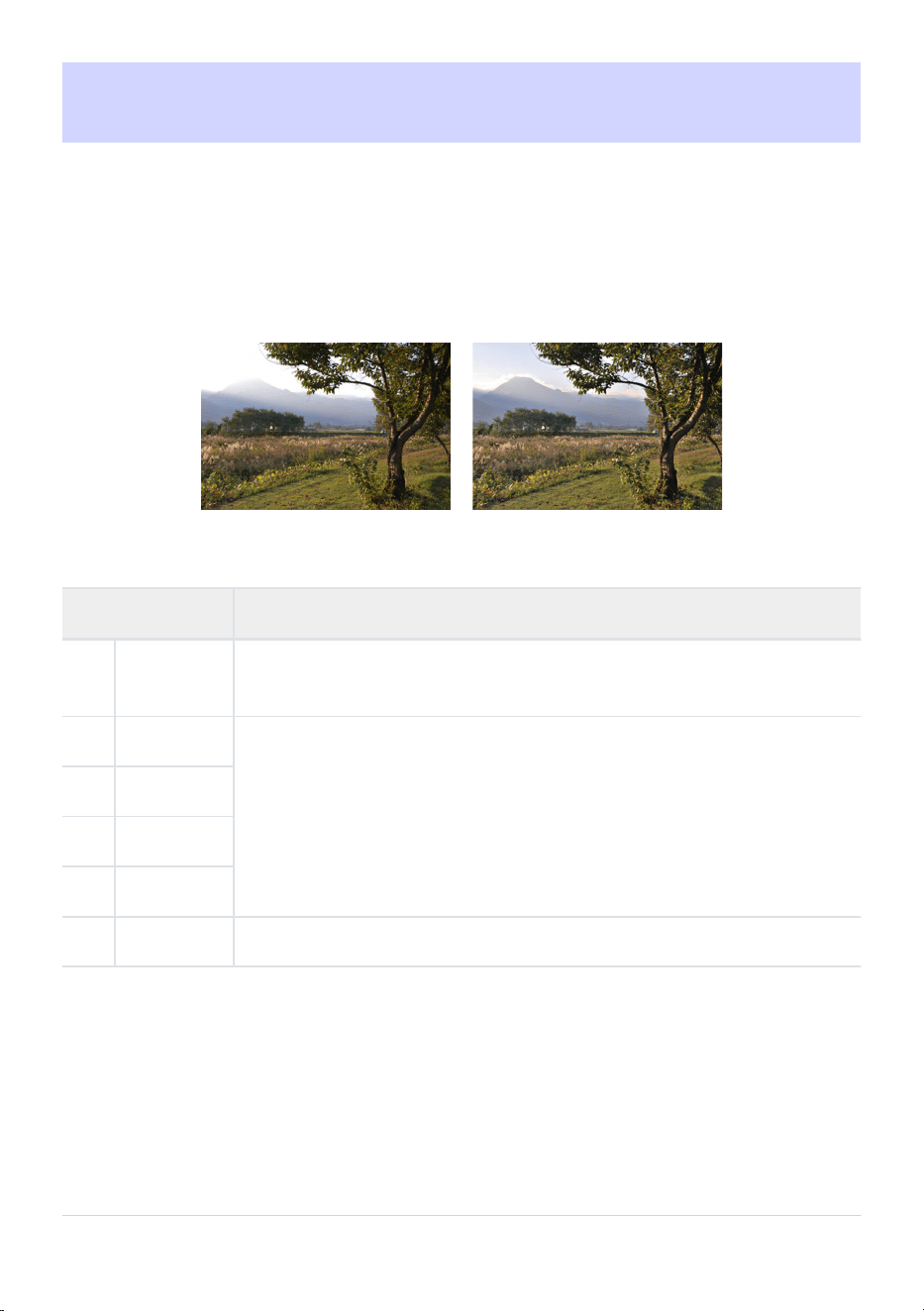
[Off]
[Y Aut
o]
Activ
e D-Lighting
G buttonU
Cphoto shooting menu
Preserve details in highlights and shadows, creating pictures with natural contrast. Use for high-
contrast scenes, for example when photographing brightly-lit outdoor scenery through a door or
window or taking pictures of shaded subjects on a sunny day. Active D-Lighting is most effective when
used with matrix metering.
Option Description
Y
[Auto]
The camera automatically adjusts Activ
e D-Lighting in response to shooting
conditions.
Z
[Extra high]
Choose the amount of Active D-Lighting performed from (in order from high
to low) [Extra high], [High], [Normal], and [Low].
P
[High]
Q
[Normal]
R
[Low]
c
[Off] Active D-Lighting off.
428
Active D-Lighting
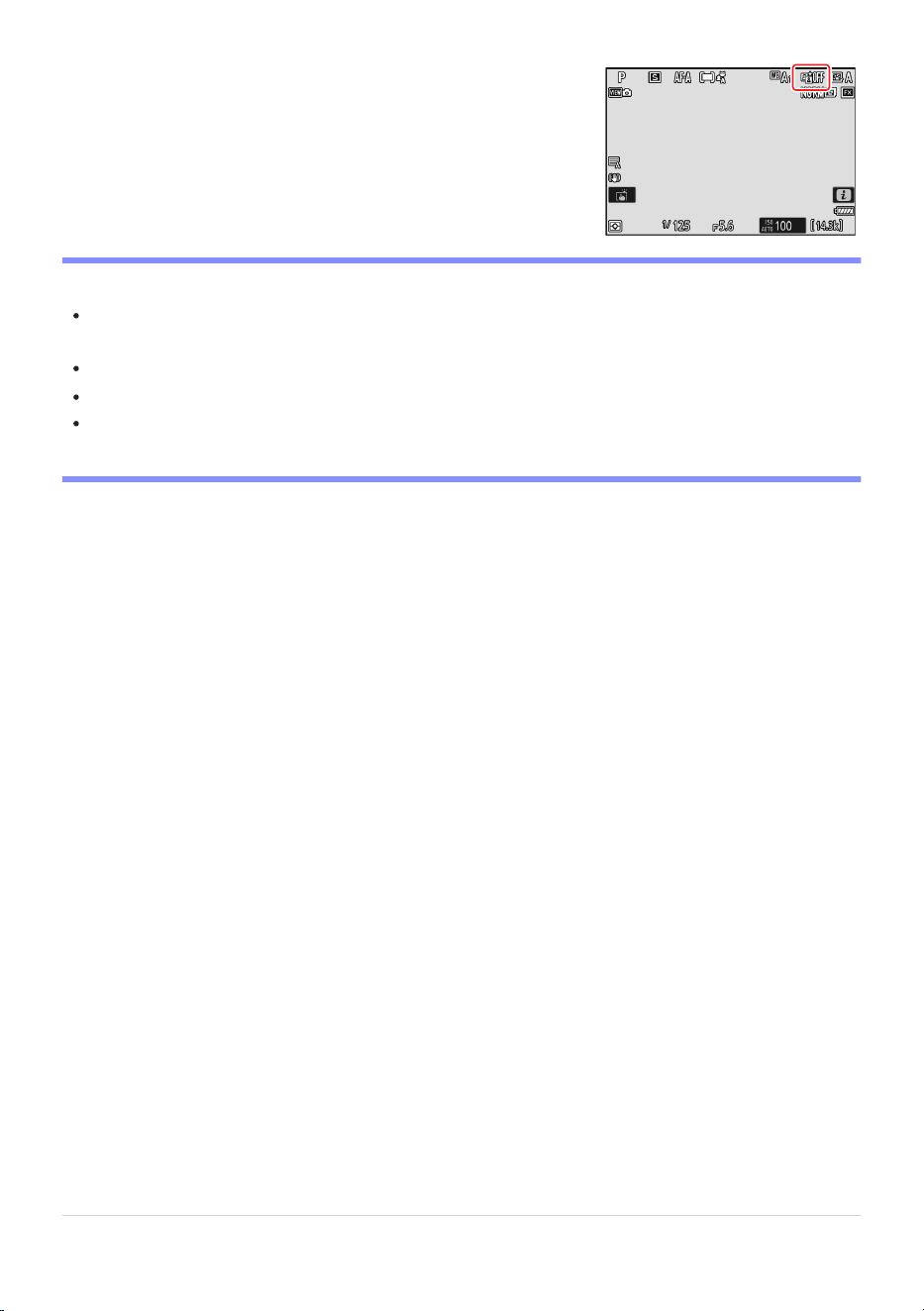
The option currently selected is shown by an icon in the display
during shooting.
D Cautions: Active D-Lighting
Depending on the subject, “noise” in the form o
f randomly-spaced bright pixels, fog, or lines may
appear in photos taken with Active D-Lighting.
In mode M, [YAuto] is equivalent to [QNormal].
Uneven shading may be visible with some subjects.
This function does not apply at high ISO sensitivities (Hi 0.3–Hi 1.7), including high sensitivities
selected via auto ISO sensitivity control.
429
Active D-Lighting

Long-exposure noise reduction is performed after the photo
is taken. During processing, the message, [P
erforming noise
reduction] will appear in the shooting display. Pictures cannot
be taken until the message has cleared from the display. The time
needed to record photos after shooting roughly doubles.
Long exposure NR
G buttonU
Cphoto shooting menu
Select [ON] to reduce “noise” (bright spots or fog) in photographs taken at shutter speeds slower than
1s.
D Caution: Long-Exposure Noise Reduction
If the camera is turned off before processing is complete, the picture will be saved but noise reduction
will not be performed.
430
Long exposure NR

High ISO NR
G buttonU
Cphoto shooting menu
Photographs taken at high ISO sensitivities can be processed to reduce “noise” (randomly-spaced
bright pixels).
Option Description
[High]
Reduce noise in photographs taken at all ISO sensitivities. The higher the sensitivity,
the greater the effect. Choose the amount o
f noise reduction performed from (in order
from high to low) [High], [Normal], and [Low].
[Normal]
[Low]
[Off]
Noise reduction is performed only as required. The amount of noise reduction
performed is always lower than when [Low] is selected.
431
High ISO NR

Vignette control
G buttonU
Cphoto shooting menu
Vignette control reduces “vignetting”—a drop in brightness at the edges of a photograph—by an
amount that varies from lens to lens. Its effects are most noticeable at maximum aperture.
Option Description
e
[High]
Choose the amount of vignette control performed from (in order from high to
low) [High], [Normal], and [Low].
g
[Nor
mal]
f
[Low]
[Off] Vignette control disabled.
D Caution: Vignette Control
Depending on the scene, shooting conditions, and type o
f lens, JPEG pictures may exhibit “noise” (fog)
or over- or under-exposure at the edge of the frame that introduces variations in peripheral brightness.
In addition, Custom Picture Controls and preset Picture Controls that have been modified from default
settings may not produce the desired effect. Take test shots and view the results in the monitor.
D Vignette Control
Changes to [Vignette control] in the photo shooting menu apply in the video recording menu and
vice versa.
432
Vignette control

Diffraction compensation
G buttonU
Cphoto shooting menu
Select [ON] to reduce diffraction at small apertures (high f-numbers).
D Diffraction Compensation
Changes to [Diffraction compensation] in the photo shooting menu apply in the video recording
menu and vice versa.
433
Diffraction compensation

Auto distortion control
G buttonU
Cphoto shooting menu
Select [ON] as required to reduce barrel distortion when shooting with wide-angle lenses and to
reduce pin-cushion distortion when shooting with long lenses. Note that [ON] may be selected
automatically with some lenses, in which case this item will be grayed out and unavailable.
D Auto Distortion Control
Changes to [Auto distortion control] in the photo shooting menu apply in the video recording menu
and vice versa.
434
Auto distortion control

Skin softening
G buttonU
Cphoto shooting menu
Pictures taken when the face of a human portrait subject is detected will automatically be processed to
soften the subject’s complexion.
Option Description
[High] Choose the amount of skin softening performed from (in order from high to low)
[High], [Normal], and [Low].
The camera can perfor
m skin softening on up to three subjects at a time.
If more than one human portrait subject is detected, a gray focus point will appear
over each of the subjects. If [Auto-area AF] is selected for [AF-area mode], H and F
icons will appear on the focus point selected by the camera. The focus point can be
positioned by pressing 4 or 2 to choose the subject to which skin softening applies.
[Normal]
[Low]
[Off] Skin softening off.
D Skin Soft
ening: Restrictions
Skin softening cannot be combined with some camera features, including:
high-speed frame capture +,
multiple exposures, and
HDR overlay.
435
Skin softening
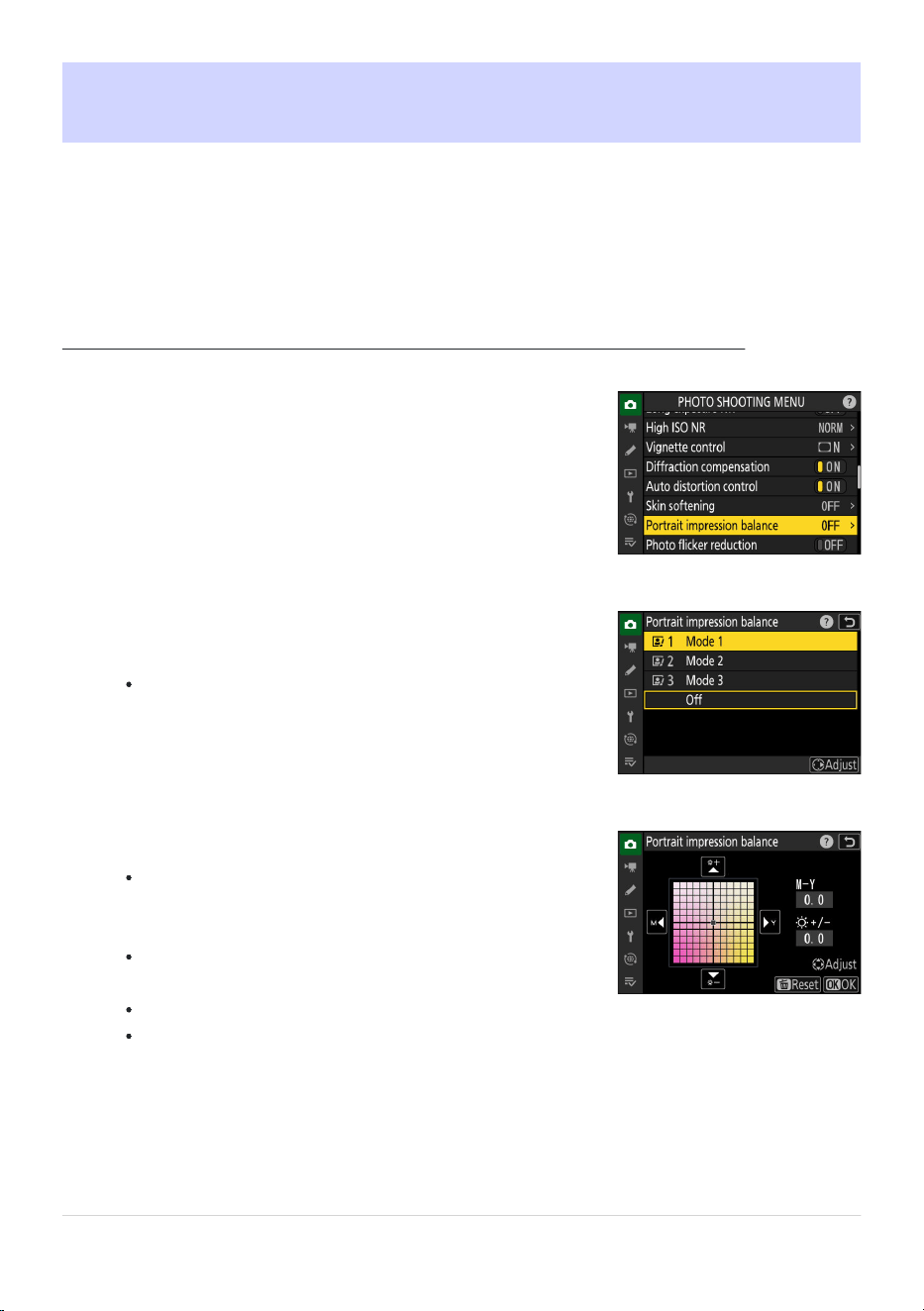
Select [Portrait impression balance] in the photo shooting
menu.
Highlight a mode from [Mode 1] through [Mode 3] and
press 2
.
Options for the selected mode will be displayed.
Adjust hue and brightness.
Press 4
or 2 to adjust hue on the M (magenta)–Y (yellow)
axis. Magenta increases as you move toward M, amber
(yellow) as you move toward Y.
Press 1 or 3 to adjust brightness. Brightness increases as
the values go up and decreases as they go down.
The selected values are displayed to the right of the grid.
To restore default settings, press the O button.
Portrait impression balance
G buttonU
Cphoto shooting menu
Fine-tune hue and brightness settings for human portrait subjects and save the results for application
during shooting as [Mode 1], [Mode 2], or [Mode 3].
Creating Portrait Impression Balance Modes
436
Portrait impression balance
1
2
3

Save changes.
Press J
to save changes and exit to the menus.
Modes that have been altered from default values are indicated by asterisks (“U”).
Repeat Steps1 through 4 to create additional modes.
Applying Saved Modes
To enable portrait impr
ession balance during shooting, select the desired mode ([Mode 1] through
[Mode 3]) for [Portrait impression balance] in the photo shooting menu.
D “Portrait Impression Balance”
[Portrait impression balance] will not be available if:
[Monochrome], [Flat Monochrome], [Deep Tone Monochrome], or [Creative Picture Control] is
selected for [Set Picture Control] or
[Monochrome] is selected for [Set Picture Control (HLG)].
D Caution: Using Portrait Impression Balance
Portrait impression balance may affect areas of the image that are similar in color to the skin of portrait
subjects.
Tip: Previewing the Results
If [Portrait impression balance] has been assigned a place in the i menu using Custom Setting f1
[Customize i menu], you can select this option, rotate the main command dial to choose a mode,
and then adjust hue and brightness using the multi selector while previewing their effects on the
subject framed in the display.
437
Portrait impression balance
4

Photo flicker reduction
G buttonU
Cphoto shooting menu
Selecting [ON] reduces the effects of flicker from such light sources as fluorescent or mercury-vapor
lamps.
Flicker can cause uneven exposure or (in photographs taken in continuous release modes)
inconsistent exposure or coloration.
If flicker reduction does not produce the desired results, turn the camera off and aim it at the
subject or light source before turning it on again.
If [ON] is selected and flicker is detected when the shutter is released, a green I will appear next to
the FLICKER icon in the shooting display.
During burst photography, the camera will behave as described below.
Continuous high-speed (extended) mode: Priority is given to frame rate. The display will briefly
go dark with the first shot in each burst but not with the subsequent shots.
Continuous high-speed and continuous low-speed modes: Priority is given to flicker
reduction. The display will briefly go dark each time the shutter is released and the frame rate
may drop or become erratic.
D [Photo flicker reduction]
Flicker reduction may slightly delay shutter response.
Flicker reduction can detect flicker at 100 and 120Hz (associated respectively with AC power
supplies of 50 and 60Hz). The desired results may not be achieved if the frequency of the power
supply changes during burst photography.
Flicker may not be detected or the desired results may not be achieved depending on the light
source and shooting conditions, for example with scenes that are brightly lit or feature dark
backgrounds.
The desired results may also not be achieved with decorative lighting displays and other non-
standard lighting.
The actual effects of photo flicker reduction may differ from those visible in the display.
D Continuous High-Speed (Extended)
Flicker reduction may not produce the desired results during long bursts.
D [Photo flicker reduction]: Restrictions
[Photo flicker reduction] does not take effect under some conditions, including:
during HDR overlay,
during high-speed frame capture +,
in silent mode, and
during pixel shift shooting.
438
Photo flicker reduction
-
-
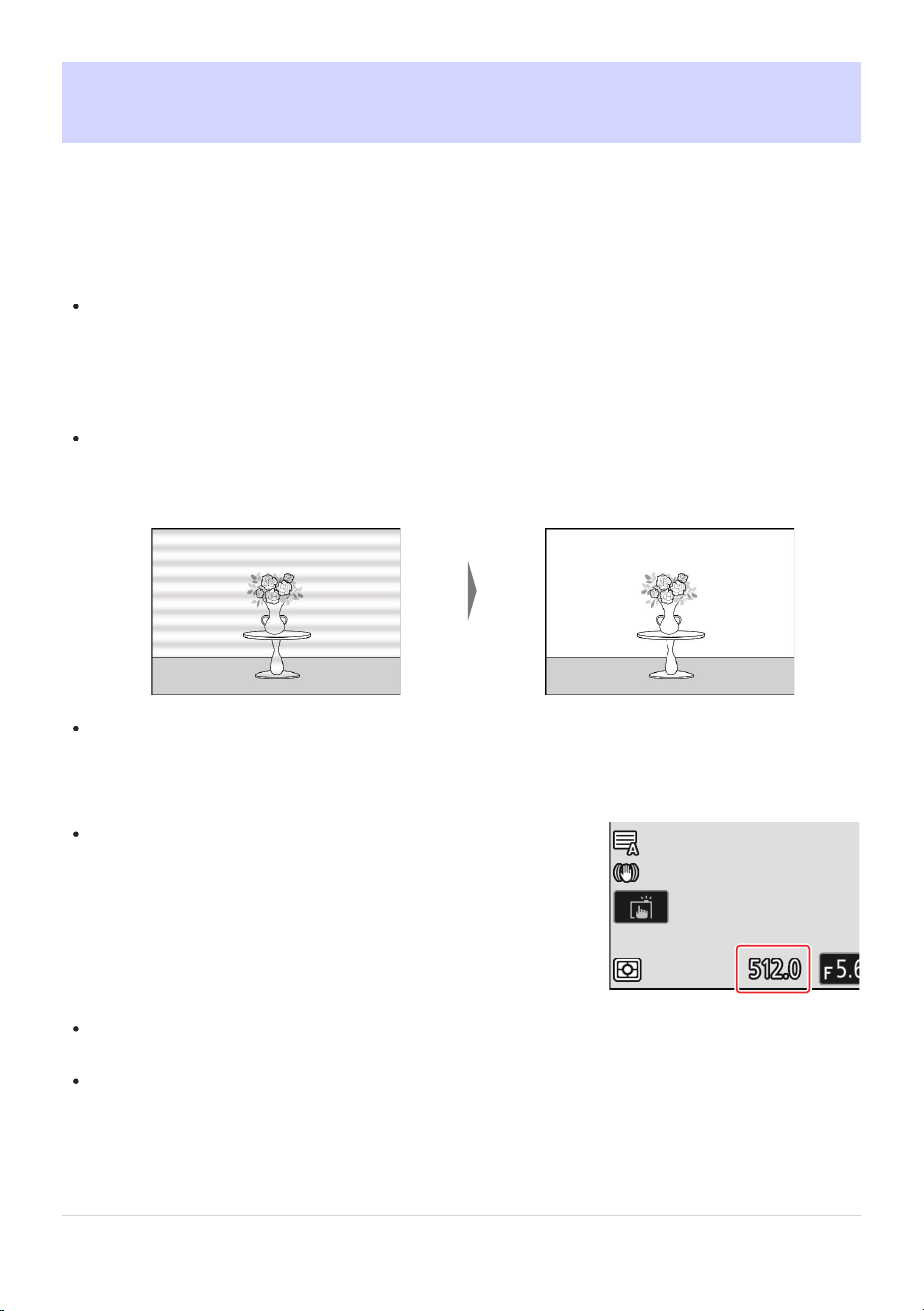
When high-frequency flicker reduction is enabled, the shutter
speed display shows only the denominator, with a digit added
af
ter the decimal point.
High-frequency flicker reduction
G buttonU
Cphoto shooting menu
Selecting [On (shutter speed fine-tuning)] allows shutter speeds at specific values to be adjusted
in smaller increments in modes S and M, letting speeds that keep flicker to a minimum be found by
viewing the preview in the shooting display.
Shutter speeds at which the high-frequency flicker reduction feature takes effect depend on Custom
Setting d6 [Shutter type] and [Silent mode] in the setup menu.
When [Shutter type] is set to [Auto] or [Mechanical shutter]: ¹/₈₀₀₀ s – ¹⁄₃₀ s
When [Shutter type] is set to [Electronic front-curtain shutter]: ¹/₂₀₀₀ s – ¹⁄₃₀ s
When [Silent mode] is set to [ON]: ¹/₈₀₀₀ s – ¹⁄₃₀ s
Flicker may cause banding in pictures taken under high-frequency LED lighting or in shots that
include monitors with high-frequency LED displays. Reducing the size of the increments used for
shutter-speed selection helps in identifying speeds that keep flicker to a minimum.
After choosing a shutter speed suited to your subject, enable high-frequency flicker reduction and
fine-tune shutter speed while viewing your subject in the shooting display until you find a value that
minimizes flicker and banding. The effect can be more readily ascertained by zooming in on your
subject using display zoom.
The precise shutter speed is shown. For example, the shutter speed when ¹⁄₅₀₀ s is selected is
precisely ¹⁄₅₁₂ s, which the display shows as “512.0”, the denominator.
Turning high-frequency flicker reduction off returns shutter speed to the nearest of the values
normally displayed.
439
High-frequency flicker reduction
-
-
-

D Caution: High-Frequency Flicker R
eduction
The effects of flicker in the shooting display may differ from those seen in photographs. We
recommend that you take test shots to identify the shutter speed that minimizes flicker and banding.
440
High-frequency flicker reduction
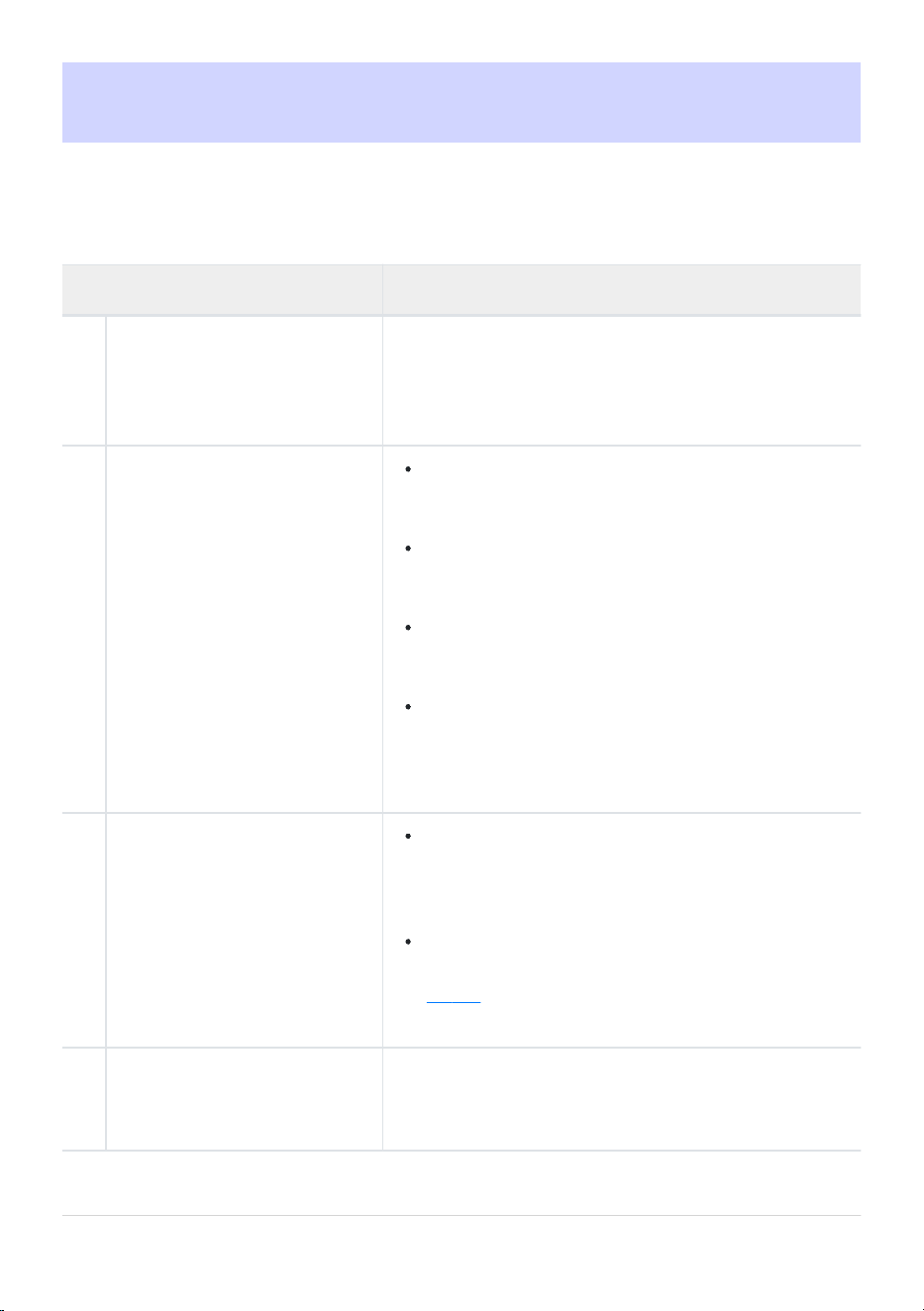
Metering
G buttonU
Cphoto shooting menu
Metering determines how the camera sets exposure.
Option Description
L
[Matrix metering]
The camera meter
s a wide area of the frame and
sets exposure according to tone distribution, color,
composition, and distance for results close to those seen
by the naked eye.
M
[Center-weighted metering]
The camera assigns the greatest weight to the center
of the frame. This mode can, for example, be used with
subjects that dominate the composition.
Center-weighted metering is also recommended when
using filters with an exposure factor (filter factor) over
1×.
The size of the area assigned the greatest weight can
be selected using Custom Setting b5 [Center-weighted
area].
The metered area can be displayed or hidden using
Custom Settings d19 [Custom monitor shooting
display] and d20 [Custom viewfinder shooting
display].
N
[Spot metering]
The camera meters a circle with a diameter of 4mm/
0.16in. (equivalent to approximately 1.5% of the frame).
This ensures that the subject will be correctly exposed
even when the background is much brighter or darker.
The metered area is centered on the current focus
point. If [Auto-area AF] is selected for AF-area mode
(
0 122), the camera will instead meter the cent
er
focus point.
t
[Highlight-weighted metering]
The camera assigns the greatest weight to highlights.
Use this option to reduce loss of detail in highlights, for
example when photographing spotlit performers on stage.
441
Metering
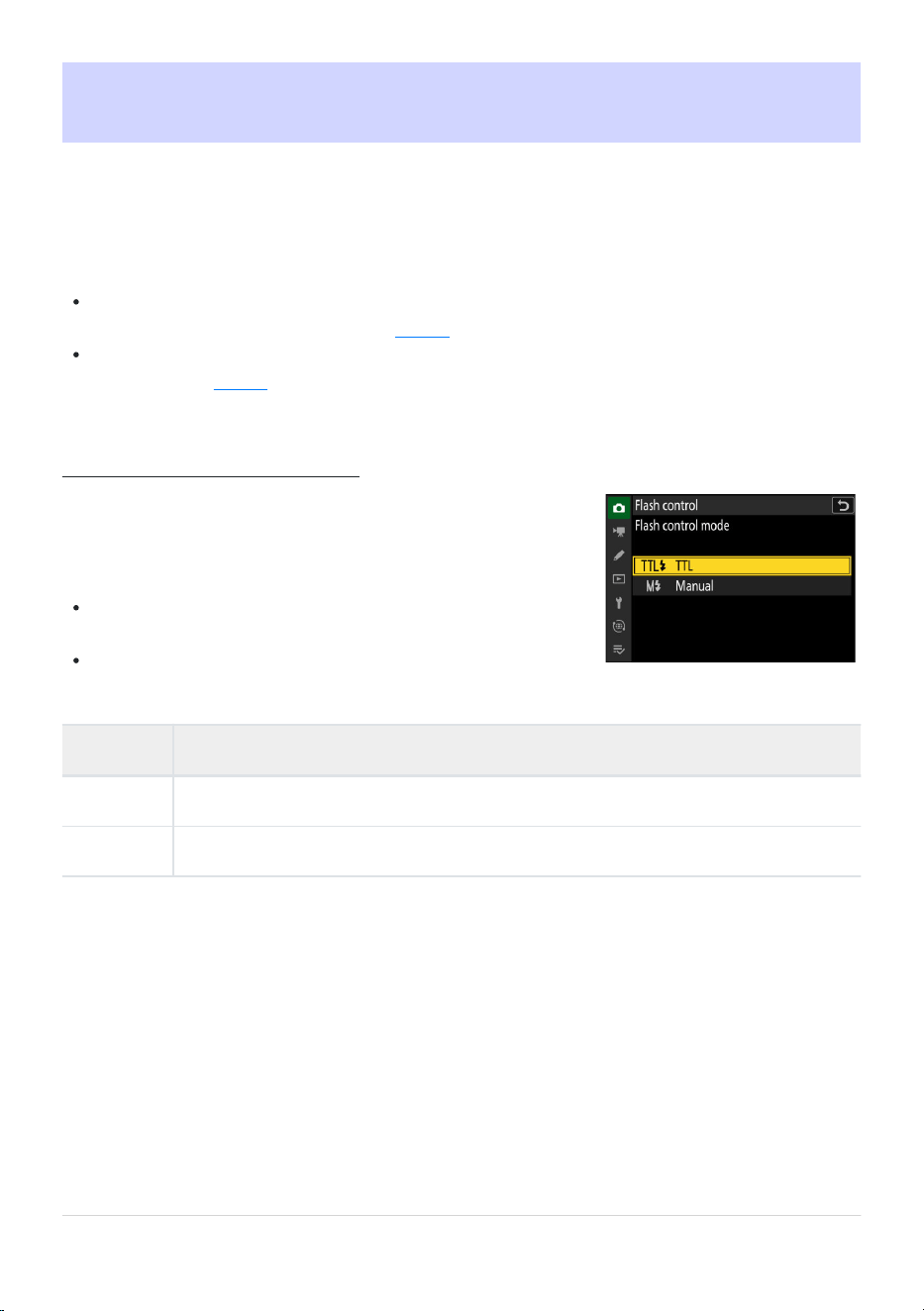
Choose a flash control mode and flash level and adjust other
settings for SB‑500, SB‑400, or SB‑300 flash units mounted on the
camera accessory shoe.
The options av
ailable in the flash control display vary with the
option selected for [Flash control mode].
Settings for flash units other than the SB‑500, SB‑400, and
SB‑300 can only be adjusted using flash unit controls.
Flash control
G buttonU
Cphoto shooting menu
Adjust settings for wireless remote flash units or optional flash units mounted on the camera accessory
shoe.
For information on adjusting settings for optional flash units mounted on the camera accessory
shoe, see “Using an On-Camera Flash” (
0 391).
For information on adjusting settings for wireless r
emote flash units, see “What Is Remote Flash
Photography?” (
0 400).
Flash control mode
Option Description
[T
TL] Flash output is adjusted aut
omatically in response to shooting conditions.
[Manual] Choose the flash level manually.
442
Flash control
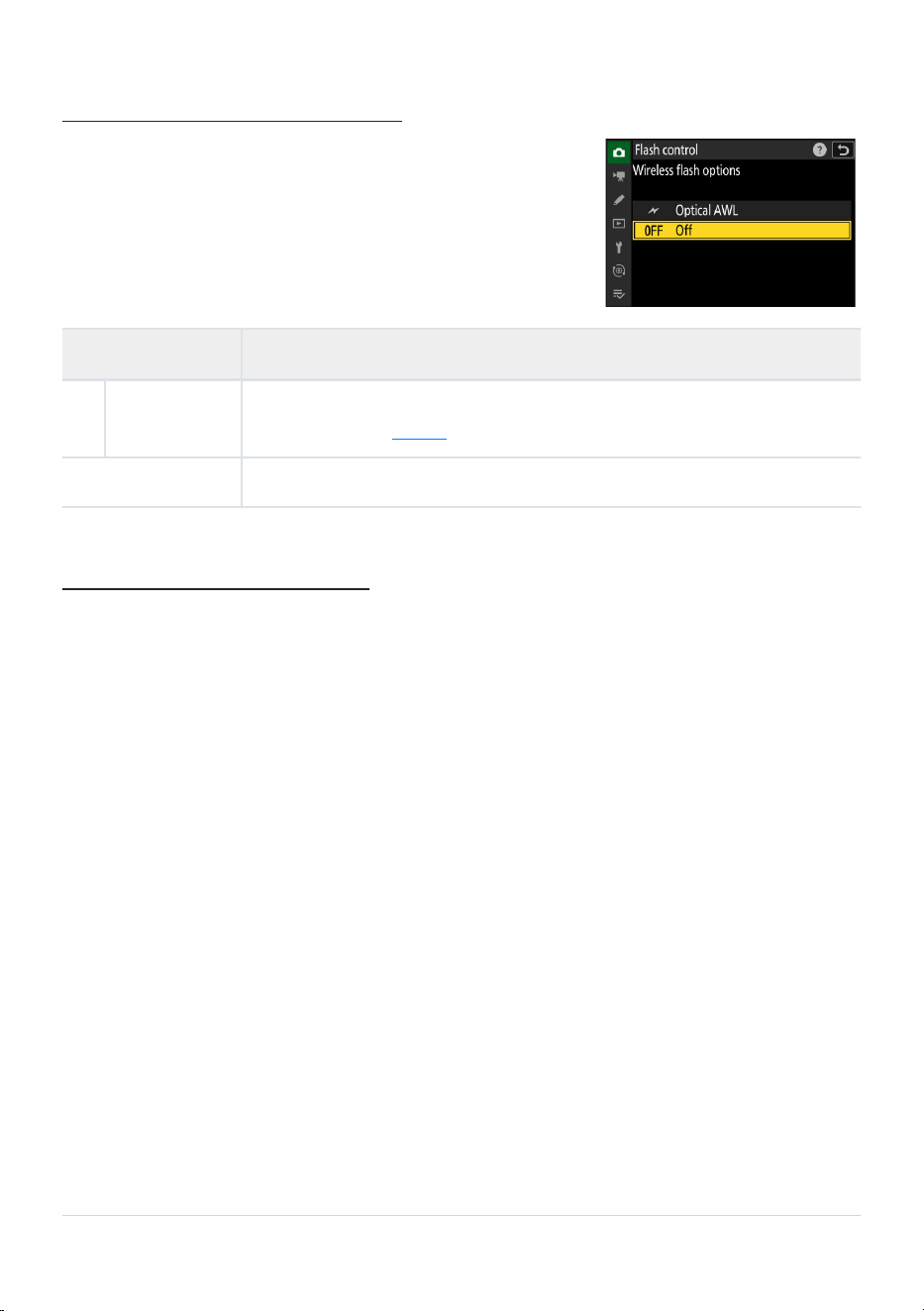
Adjust settings for simultaneous wireless control of multiple remote
flash units. This option is available only when an SB‑500 flash unit is
mounted on the camera.
Wireless flash options
Option Description
Y
[Optical A
WL]
The remot
e flash units are controlled using low-intensity flashes emitted by
the master flash (
0 401).
[Off] Remote flash photography disabled.
Group flash options
Adjust settings for the units in each group when using optional remote flash units. This option is
available only when an SB-500 flash unit is mounted on the camera.
443
Flash control


Flash compensation
G buttonU
Cphoto shooting menu
Flash compensation is used to deliberately alter the output of optional flash units, for example in order
to change the brightness of the subject relative to the background. Flash output can be increased to
make the main subject appear brighter, reduced to prevent glare, or otherwise fine-tuned to produce
the desired result (
0 397).
445
Flash compensation





Vibration reduction
G buttonU
Cphoto shooting menu
Choose whether to enable vibration reduction. The options available vary with the lens.
Option Description
C
[Normal] Choose for enhanced vibration reduction when phot
ographing static subjects.
D
[Sport]
Choose when photographing athletes and other subjects that are moving
rapidly and unpredictably.
[Off] Vibration reduction is disabled.
D Cautions: Using Vibration Reduction
[Vibration r
eduction] may be unavailable with some lenses.
We recommend that you wait for the image in the display to stabilize before shooting.
When [Normal] is selected for lenses that support vibration reduction, the image in the viewfinder
may jiggle before the shutter is released, but this is a natural consequence of how vibration
reduction is performed and does not indicate a malfunction. [Sport] or [Off] can be used should
you find the motion distracting.
[Sport] is recommended for panning shots. In [Normal] and [Sport] modes, vibration reduction
applies only to motion that is not part of the pan. If the camera is panned horizontally, for example,
vibration reduction will be applied only to vertical shake.
[Normal] and [Sport] are also recommended if the camera is mounted on a tripod or monopod.
Note, however, that [Off] may be a better choice with some tripods depending on shooting
conditions. Settings may vary from lens to lens; consult the lens documentation for more
information.
If an F mount lens with a vibration reduction switch is attached via an optional FTZ II/FTZ mount
adapter, [Vibration reduction] will be grayed out and unavailable. Use the lens switch for vibration
reduction.
451
Vibration reduction

Link VR to focus point
G buttonU
Cphoto shooting menu
Choose whether vibration reduction is optimized to reduce blur at the current focus point.
Option Description
[ON] Optimize vibration reduction to reduce blur at the current focus point.
[OFF] Optimize vibration reduction to reduce blur at the center of the frame.
D Cautions: [Link VR t
o focus point
]
Enabling this option configur
es vibration reduction to minimize blur at the focus point active when
the shutter is released. Its effects cannot be previewed in the shooting display.
Selecting [ON] for [Link VR to focus point] will optimize vibration reduction to reduce blur at the
center of the frame if:
a Z mount lens with built-in vibration reduction is attached,
[Auto-area AF] is selected for AF-area mode and multiple focus points are displayed, or
video recording is in progress.
452
Link VR to focus point
-
-
-
Auto bracketing
G buttonU
Cphoto shooting menu
Bracketing automatically varies exposure, flash level, Active D-Lighting (ADL), or white balance slightly
with each shot, “bracketing” the current value. Bracketing can be used in situations in which getting the
right settings is difficult and there is not time to check results and adjust settings with each shot, or to
experiment with different settings for the same subject.
Option Description
[Auto bracketing on/off] Select [ON] to enable bracketing.
[Aut
o bracketing set]
Choose the type of auto bracketing performed.
[AE & flash bracketing]: The camera varies exposure and flash level
over a series of photographs.
[AE bracketing]: The camera varies exposure over a series of
photographs.
[Flash bracketing]: The camera varies flash level over a series of
photographs.
[WB bracketing]: The camera creates multiple copies of each
photograph, each with a different white balance.
[ADL bracketing]: The camera varies Active D-Lighting (ADL) over a
series of photographs.
[Number of shots] Choose the number of shots in the bracketing sequence.
[Increment]
Choose the bracketing increment for all [Auto bracketing set] options
except [ADL bracketing].
[Amount]
Choose the amount by which Active D-Lighting changes during
bracketing sequences shot when [ADL bracketing] is selected for
[Auto bracketing set].
453
Auto bracketing
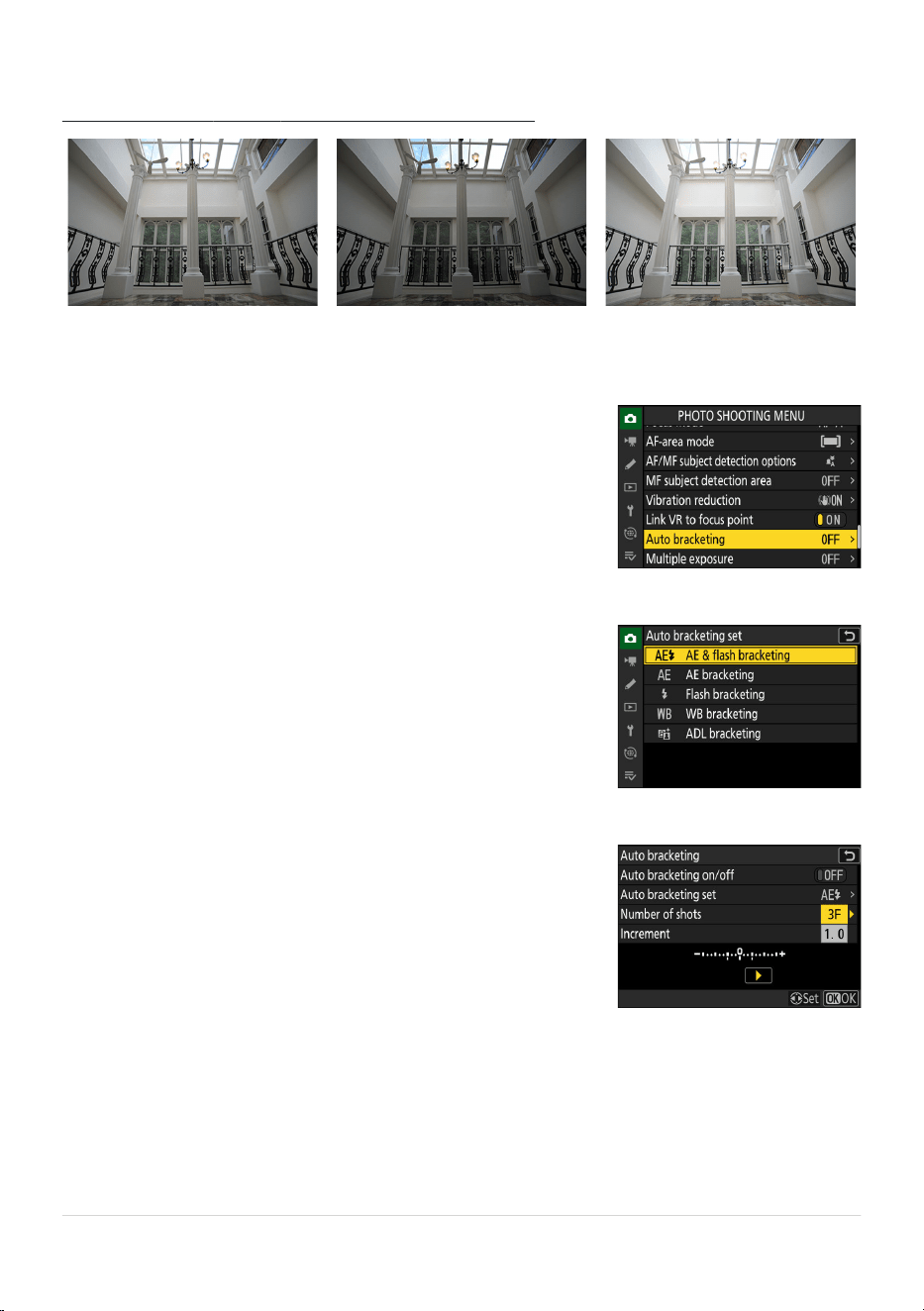
No exposure compensation −1EV +1EV
Highlight [Auto bracketing] in the photo shooting menu
and press 2
.
Select [AE & flash bracketing], [AE bracketing], or [Flash
bracketing] for [Aut
o bracketing set].
[Number of shots] and [Increment] options will be displayed.
Choose the number of shots in the bracketing sequence.
Highlight [Number of shots] and pr
ess 4 or 2 to choose the
number of shots.
Exposure and Flash Bracketing
454
Auto bracketing
1
2
3
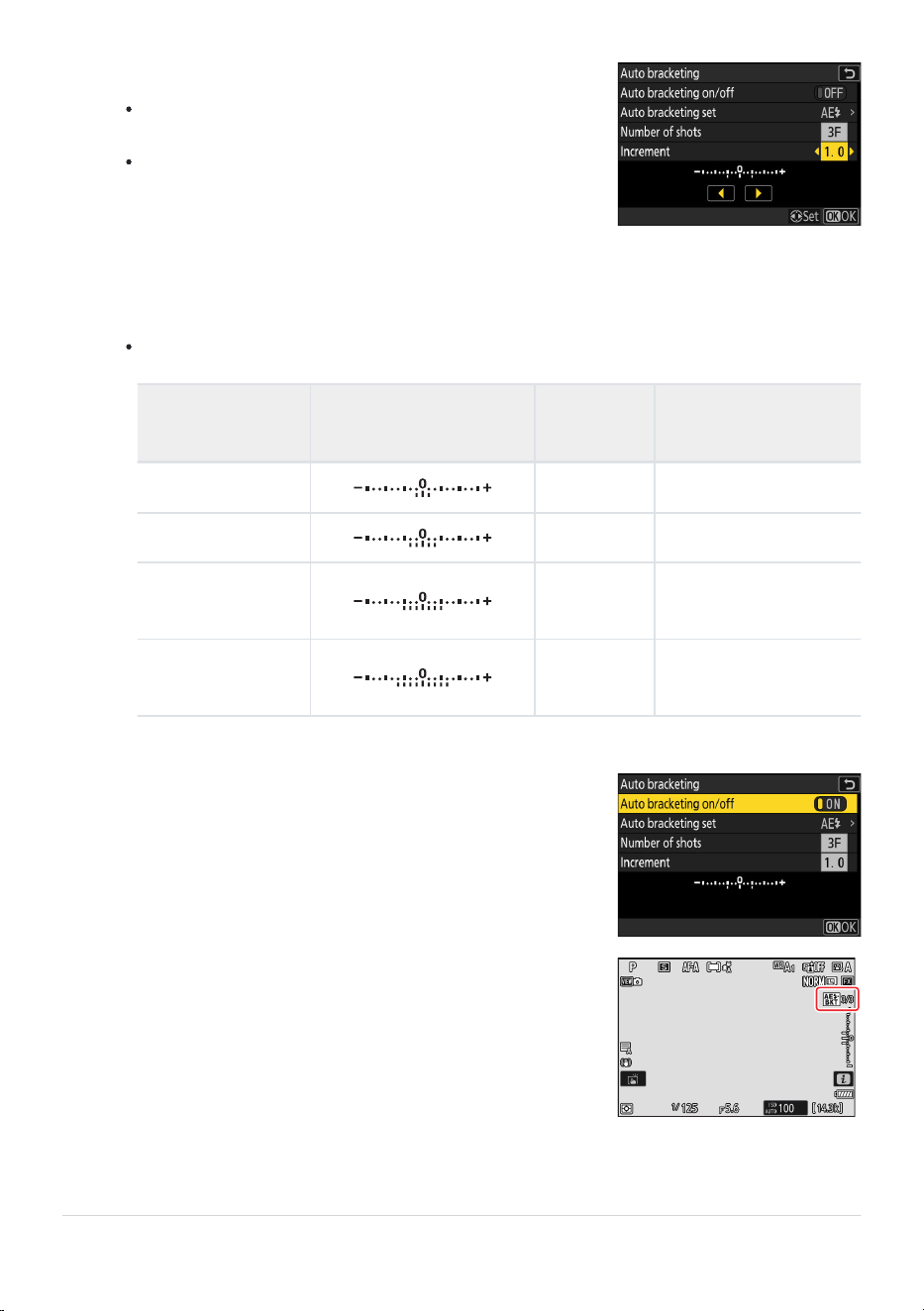
Select an exposure increment.
Highlight [Increment] and pr
ess 4 or 2 to choose the
bracketing increment.
When [1/3 EV steps (comp. 1/3 EV)] is selected for Custom
Setting b2 [EV steps for exposure cntrl], the size of the
increment can be chosen from 0.3 (¹⁄₃), 0.7 (²⁄₃), 1.0, 1.3
(1+¹⁄₃), 1.7 (1+²⁄₃), 2.0, 2.3 (2+¹⁄₃), 2.7 (2+²⁄₃), and 3.0 EV.
Bracketing programs with an increment of 2.0 EV or larger
offer a maximum of 5 shots. If a value of 7 or 9 was selected
in Step3, the number of shots will automatically be set to 5.
Select [ON] for [Auto bracketing on/off].
Selecting [ON] enables bracketing, and an icon will appear in
the shooting display.
The bracketing programs with an increment of 0.3 are listed below.
[Number of shots]
Exposure and flash
brack
eting indicator
No. of shots Bracketing order
3F
3 0/−0.3/+0.3
5F 5 0/−0.7/−0.3/+0.3/+0.7
7F 7
0/−1.0/−0.7/−0.3/
+0.3/+0.7/+1.0
9F 9
0/−1.3/−1.0/−0.7/−0.3/
+0.3/+0.7/+1.0/+1.3
455
Auto bracketing
4
5
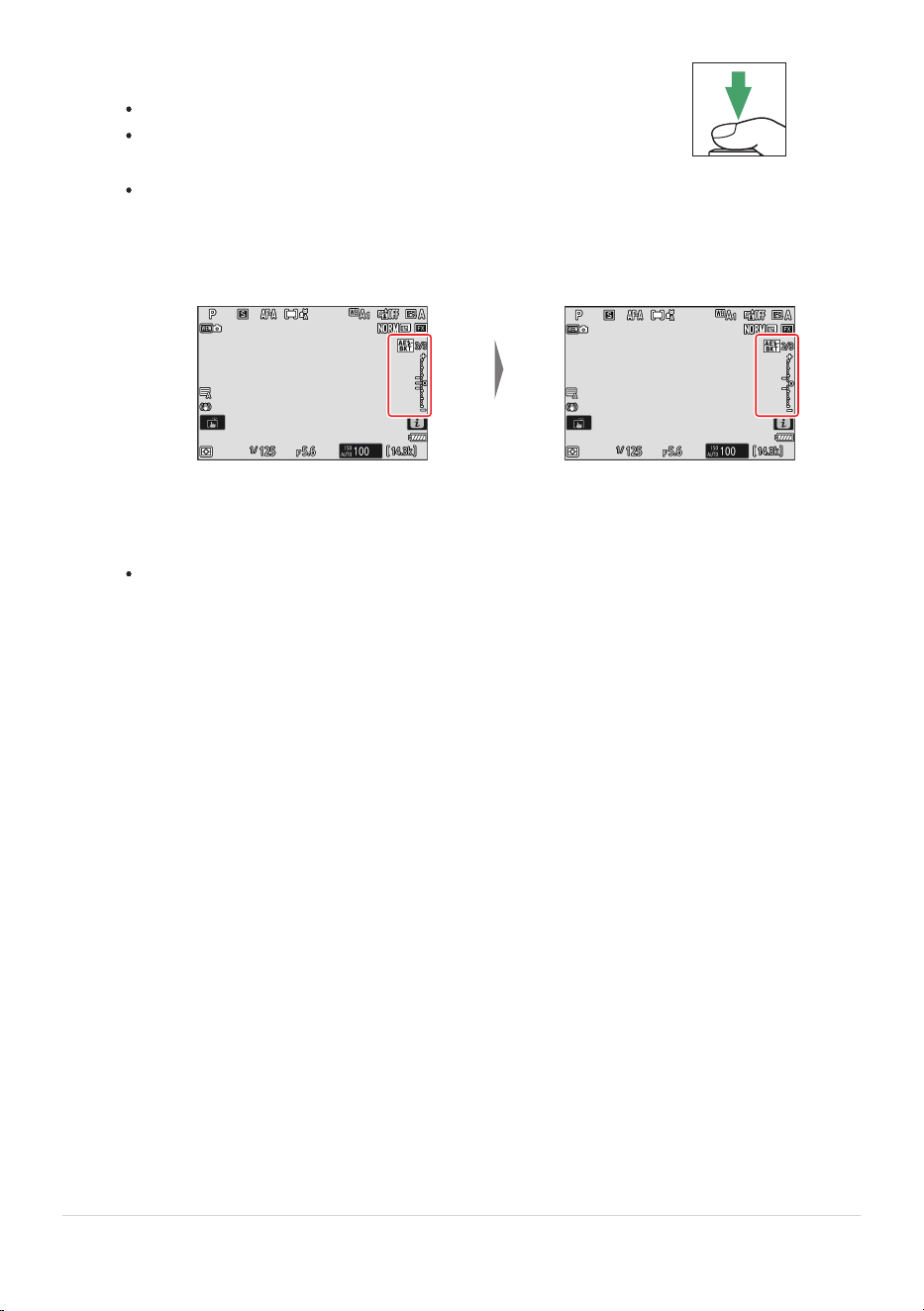
Take pictures.
Take the number o
f pictures in the bracketing program.
The modified values for shutter speed and aperture are
shown in the display.
No. shots: 3
Increment: 0.7
Display after first shot
While bracketing is in effect, the shooting display shows a bracketing icon, a bracketing
progress indicat
or, and the number of shots remaining in the bracketing sequence. After each
shot, a segment will disappear from the indicator and the number of shots remaining will be
reduced by one.
Exposure changes due to bracketing are added to those made with exposure compensation.
456
Auto bracketing
6
Tip: Bracketing Options
When [AE & flash bracketing] is select
ed, the camera varies both exposure and flash level. Select
[AE bracketing] to vary only exposure, [Flash bracketing] to vary only flash level. Note that flash
bracketing is available in i-TTL and, where supported, auto aperture (qA) flash control modes only
(
0 393, 0 839).
In self
-timer mode, the number o
f copies select
ed for [Auto bracketing] > [Number of shots] will
be created each time the shutter is released, regardless of the option selected for Custom Setting c2
[Self-timer] > [Number of shots].
Tip: Exposure and Flash Bracketing
In continuous release modes, shooting will pause after the number of shots specified in the
bracketing program has been taken. Shooting will resume the next time the shutter-release button
is pressed.
If the camera is turned off before all shots in the sequence have been taken, bracketing will resume
from the first shot in the sequence when the camera is turned on.
Tip: Exposure Bracketing
The settings (shutter speed and/or aperture) altered during exposure bracketing vary with the shooting
mode.
Shooting mode Setting
P Shutter speed and aperture
1
S Aperture
1
A Shutter speed
1
M Shutter speed
2, 3, 4
If [ON] is selected for [ISO sensitivity settings]> [Auto ISO sensitivity control] in the photo
shooting menu, the camera will automatically vary ISO sensitivity for optimum exposure when the
limits of the camera exposure system are exceeded.
If [ON] is selected for [ISO sensitivity settings]> [Auto ISO sensitivity control] in the photo
shooting menu, the camera will vary ISO sensitivity.
Use Custom Setting e6 [Auto bracketing (mode M)] to choose whether the camera varies both
shutter speed and aperture or any one of shutter speed, aperture, and ISO sensitivity when [OFF]
is selected for [ISO sensitivity settings] > [Auto ISO sensitivity control] in the photo shooting
menu.
Shutter speed will not be adjusted if [ON] is chosen for Custom Setting d7 [Extended shutter
speeds (M)] and a shutter speed slower than 30 s is selected.
457
Auto bracketing
1
2
3
4
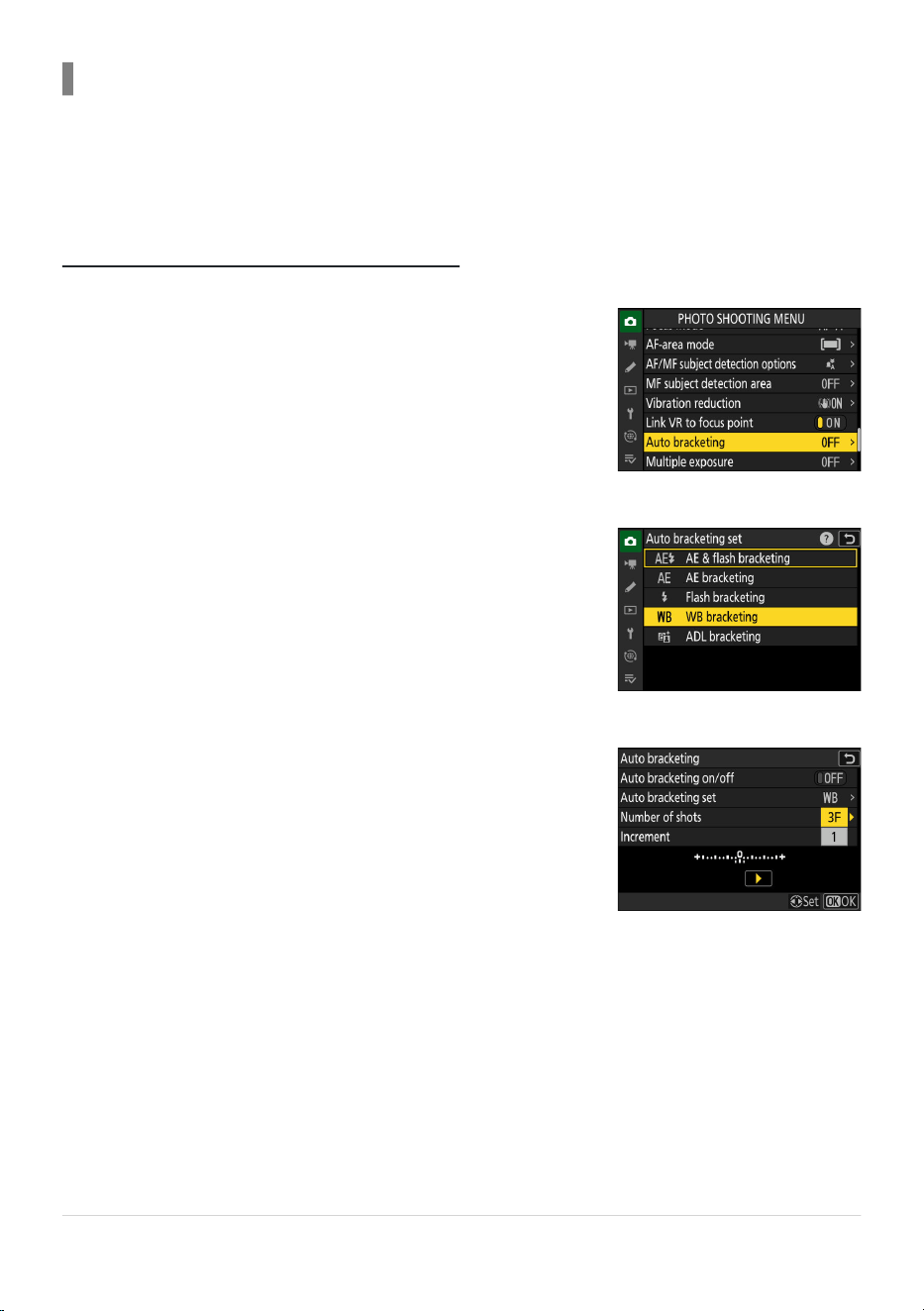
Highlight [Auto bracketing] in the photo shooting menu
and press 2
.
Select [WB bracketing] for [Auto bracketing set].
[Number of shots] and [Increment
] options will be displayed.
Choose the number of shots in the bracketing sequence.
Highlight [Number of shots] and pr
ess 4 or 2 to choose the
number of shots.
Cancelling Bracketing
To cancel bracketing, select [OFF] for [Aut
o bracketing] > [Auto bracketing on/off] in the photo
shooting menu. If you select [ON] after selecting [OFF], bracketing will resume from the first shot in
the sequence.
White Balance Bracketing
458
Auto bracketing
1
2
3
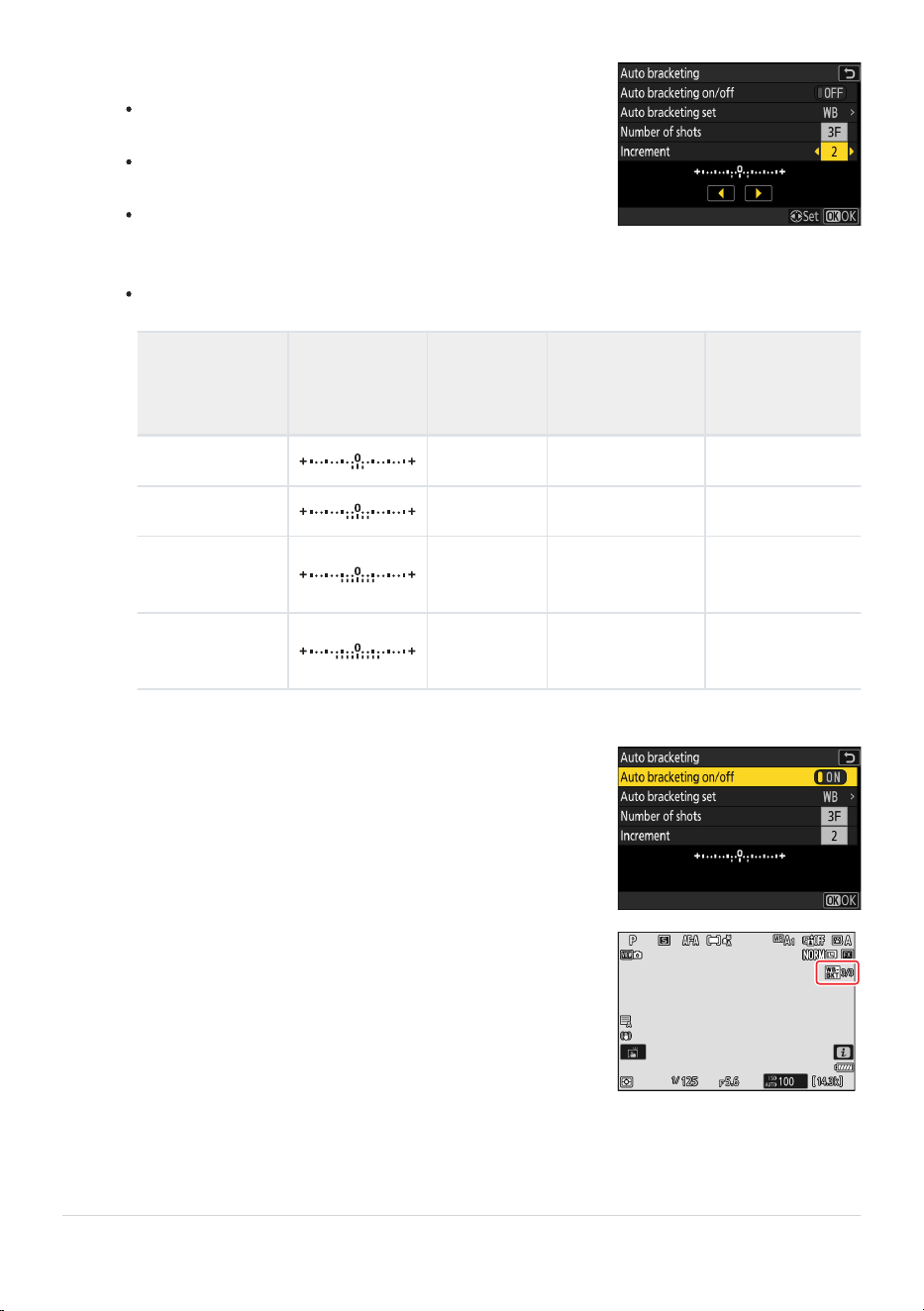
Select a white balance increment.
Highlight [Increment] and pr
ess 4 or 2 to choose the
bracketing increment.
The size of the increment can be chosen from 1 (1 step), 2 (2
steps), or 3 (3 steps).
Each step is equivalent to 5 mired. Higher “A” values
correspond to increased amounts of amber. Higher “B”
values correspond to increased amounts of blue.
Select [ON] for [Auto bracketing on/off].
Selecting [ON] enables bracketing, and an icon will appear in
the shooting display.
The bracketing programs with an increment of 1 are listed below.
[Number of
shots]
Whit
e balance
bracketing
indicator
No. of
shots
White balance
increment
Bracketing order
3F
3 1 0/A1/B1
5F 5 1 0/A2/A1/B1/B2
7F 7 1
0/A3/A2/A1/
B1/B2/B3
9F 9 1
0/A4/A3/A2/A1/
B1/B2/B3/B4
459
Auto bracketing
4
5

Take pictures.
Each shot will be processed to cr
eate the number of copies
specified in the bracketing program, and each copy will have
a different white balance.
Modifications to white balance are added to the white
balance adjustment made with white balance fine-tuning.
If the number of shots in the bracketing program is greater
than the number of exposures remaining, the shutter release
will be disabled. Shooting can begin when a new memory
card is inserted.
D White Balance Bracketing Restrictions
White b
alance bracketing is not available at image quality settings of NEF (RAW) or NEF (RAW) +
JPEG/HEIF.
Tip: White Balance Bracketing
White balance bracketing affects only color temperature (the amber–blue axis in the white balance
fine-tuning display). No adjustments are made on the green–magenta axis.
If the camera is turned off while the memory card access lamp is lit, the camera will power off only
after all photographs in the sequence have been recorded.
In self-timer mode, the number of copies specified in the white balance bracketing program will be
created each time the shutter is released, regardless of the option selected for Custom Setting c2
[Self-timer]> [Number of shots].
Cancelling Bracketing
To cancel bracketing, select [OFF] for [Auto bracketing] > [Auto bracketing on/off] in the photo
shooting menu.
460
Auto bracketing
6
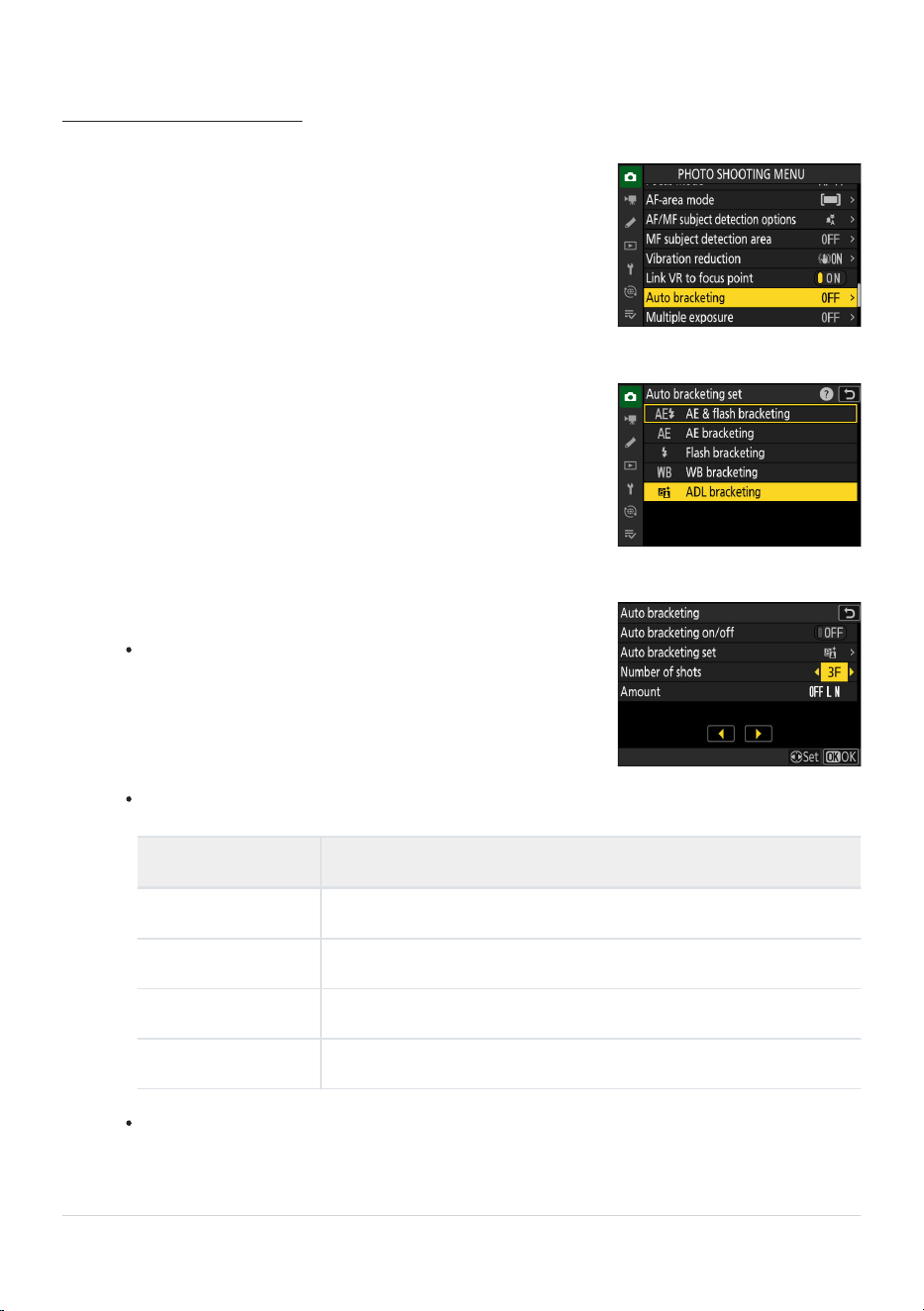
Highlight [Auto bracketing] in the photo shooting menu
and press 2
.
Select [ADL bracketing] for [Auto bracketing set].
[Number of shots] and [Amount] options will be displayed.
Choose the number of shots in the bracketing sequence.
Highlight [Number of shots] and pr
ess 4 or 2 to choose
the number of shots.
ADL Bracketing
The number of shots deter
mines the bracketing sequence:
No. of shots Bracketing sequence
2 Off → Value selected in Step 4
3 Off → Low → Normal
4 Off → Low → Normal → High
5 Off → Low → Normal → High → Extra high
If you chose more than two shots, proceed to Step 5.
461
Auto bracketing
1
2
3
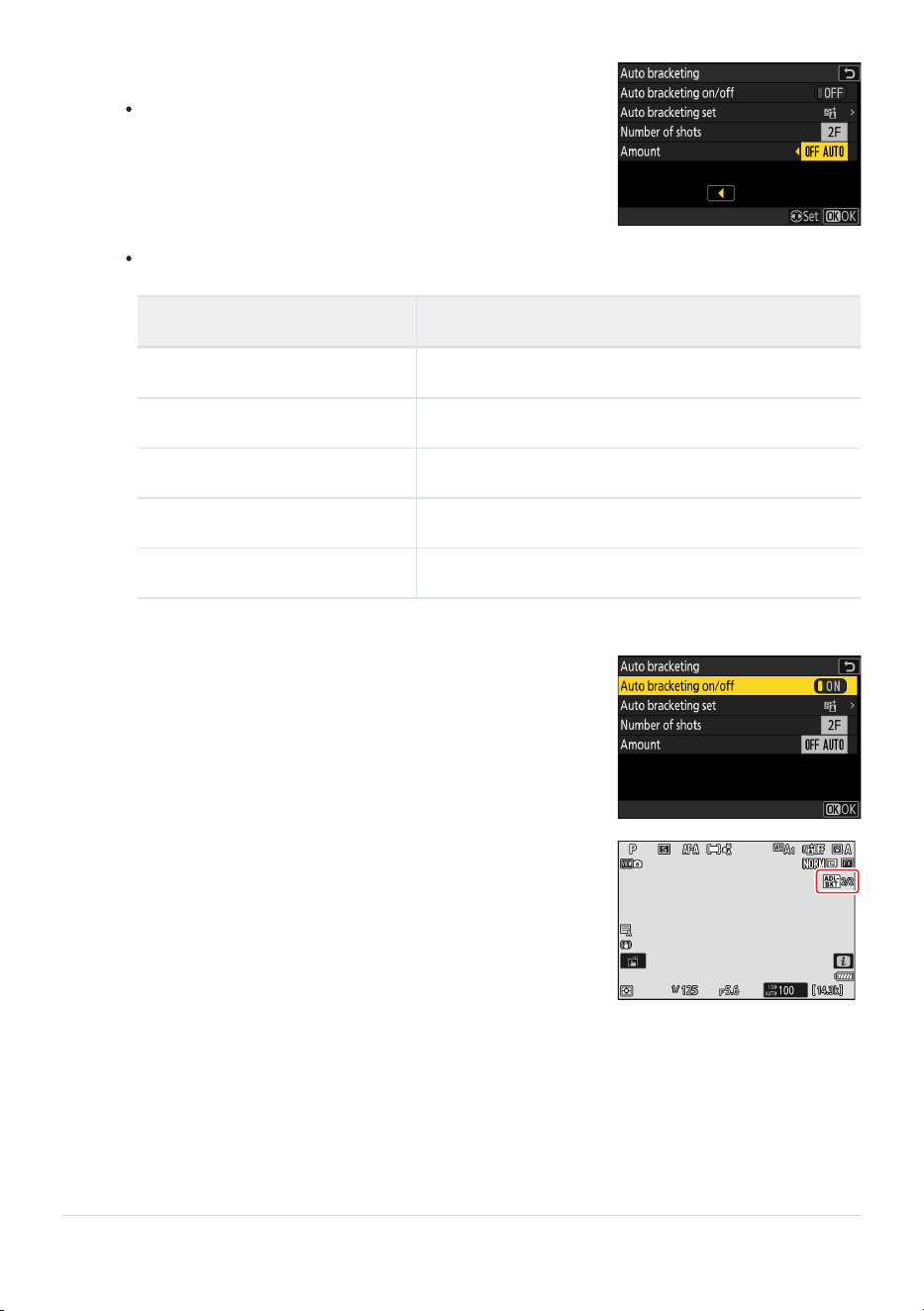
Choose the Active D-Lighting amount.
Highlight [Amount] and press 4 or
2 to choose the Active
D-Lighting setting for the second shot when the number of
shots in the bracketing sequence is 2.
Select [ON] for [Auto bracketing on/off].
Selecting [ON] enables bracketing, and an icon will appear in
the shooting display.
The bracketing sequence varies with the Active D-Lighting amount as follows:
Amount Bracketing sequence
[OFF L] Off → Low
[OFF N] Off → Normal
[OFF H] Off → High
[OFF H+] Off → Extra high
[OFF AUTO] Off → Auto
462
Aut
o bracketing
4
5

Take pictures.
Take the number o
f pictures in the bracketing program.
While bracketing is in effect, the shooting display shows an
ADL bracketing icon and the number of shots remaining in
the bracketing sequence. After each shot, the number of
shots remaining will be reduced by one.
D ADL Bracketing
In continuous release modes, shooting will p
ause after the number of shots specified in the
bracketing program has been taken. Shooting will resume the next time the shutter-release button
is pressed.
If the camera is turned off before all shots in the sequence have been taken, bracketing will resume
from the first shot in the sequence when the camera is turned on.
In self-timer mode, the number of copies selected for [Auto bracketing] > [Number of shots] will
be created each time the shutter is released, regardless of the option selected for Custom Setting c2
[Self-timer] > [Number of shots].
Cancelling Bracketing
To cancel bracketing, select [OFF] for [Auto bracketing] > [Auto bracketing on/off] in the photo
shooting menu.
463
Auto bracketing
6
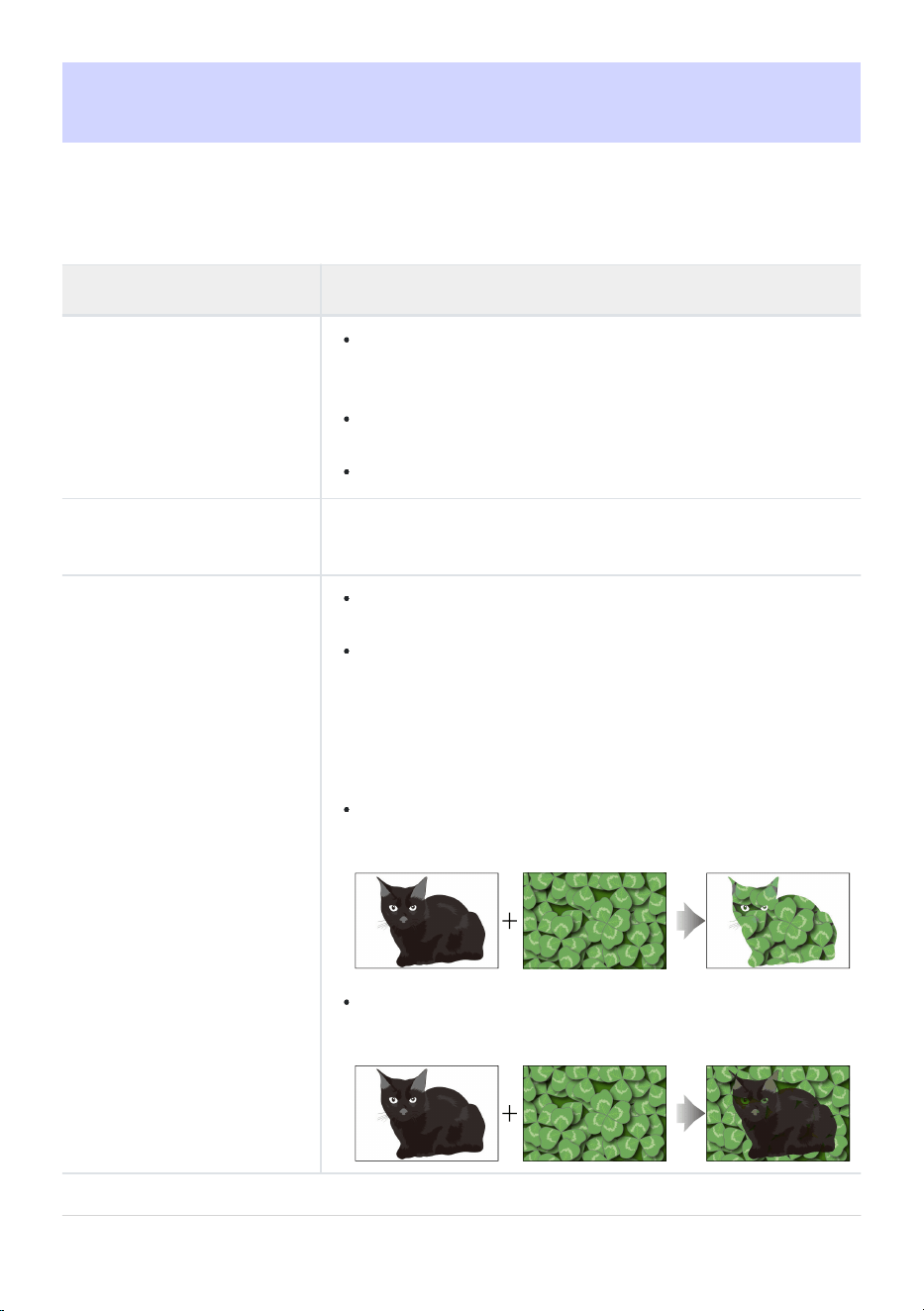
Multiple exposure
G buttonU
Cphoto shooting menu
Record two to ten NEF (RAW) exposures as a single photograph.
Option Description
[Multiple exposure mode]
[On (ser
ies)]: Take a series of multiple exposures. To end
multiple exposure photography, select [Multiple exposure
mode] again and choose [Off].
[On (single photo)]: End multiple exposure photography after
creating a single multiple exposure.
[Off]: End multiple exposure photography.
[Number of shots]
Choose the number of exposures that will be combined to form a
single photograph.
[Overlay mode]
[Add]: The exposures are overlaid without modification; gain is
not adjusted.
[Average]: Gain is adjusted before the exposures are overlaid.
The gain for each exposure is equal to 1 divided by the total
number of exposures taken. For example, in a photo made by
combining two exposures, the gain for each exposure will be
set to ¹⁄₂, while in a photo combining three exposures, gain will
be set to ¹⁄₃.
[Lighten]: The camera compares the pixels in each picture and
uses only the brightest.
[Darken]: The camera compares the pixels in each picture and
uses only the darkest.
464
Multiple exposure
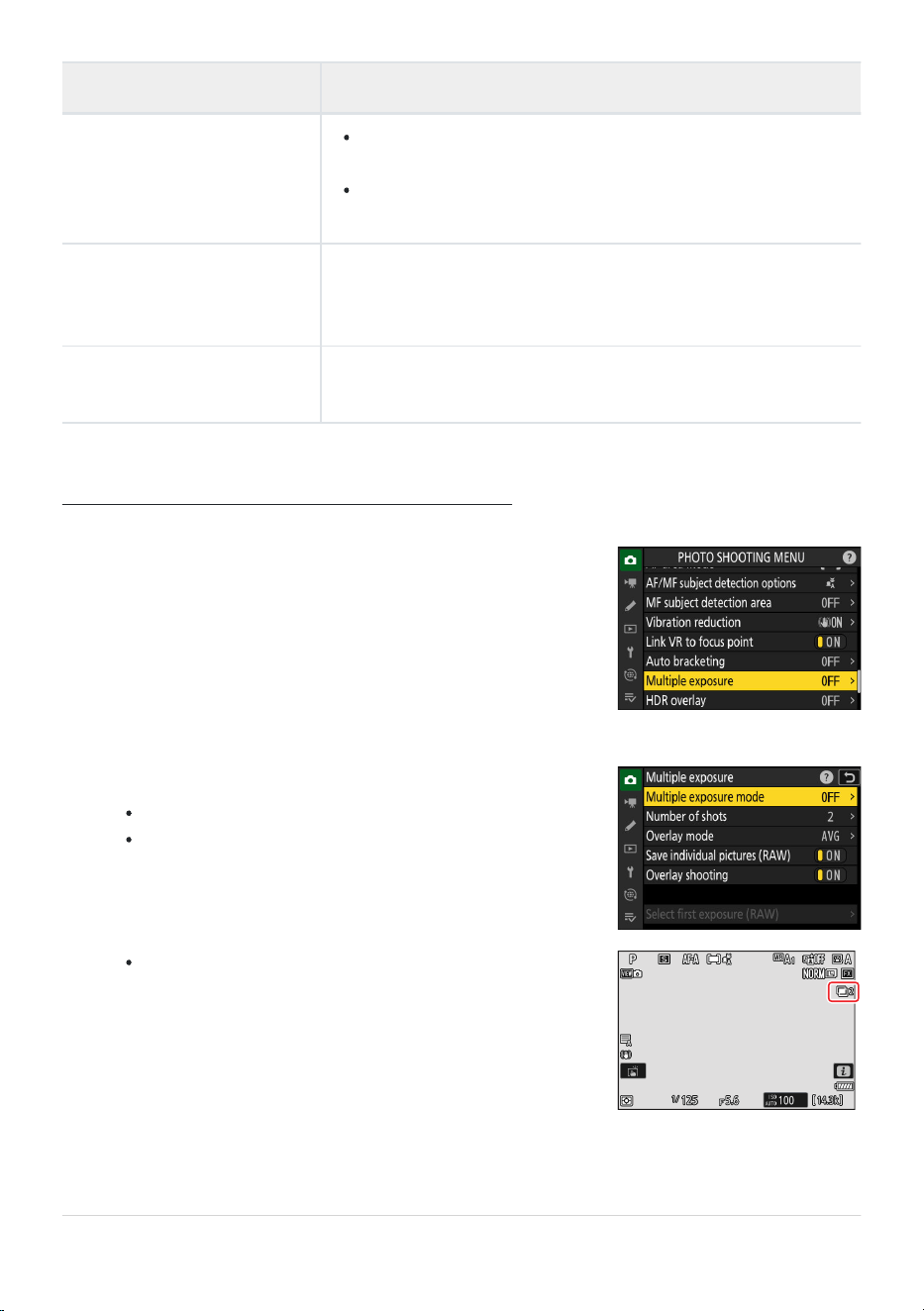
Highlight [Multiple exposure] in the photo shooting menu
and press 2
.
Choose an option for [Multiple exposure mode].
Highlight [Multiple exposure mode] and press 2
.
Highlight [On (series)] or [On (single photo)] using 1 or 3
and press J.
An icon will appear in the shooting display.
Option Description
[Save individual pictures
(RAW)
]
[ON]: Save both the multiple exposure and the shots that make
it up; the individual shots are saved in NEF (RAW) format.
[OFF]: Discard the individual shots and save only the multiple
exposure.
[Overlay shooting]
If [ON] is selected, earlier exposures will be superimposed on the
view through the lens. The earlier exposures aid composition of
the next shot.
[Select first exposure
(RAW)]
Choose the first exposure from the NEF (RAW) pictures on the
memory card.
Creating a Multiple Exposure
465
Multiple exposure
1
2
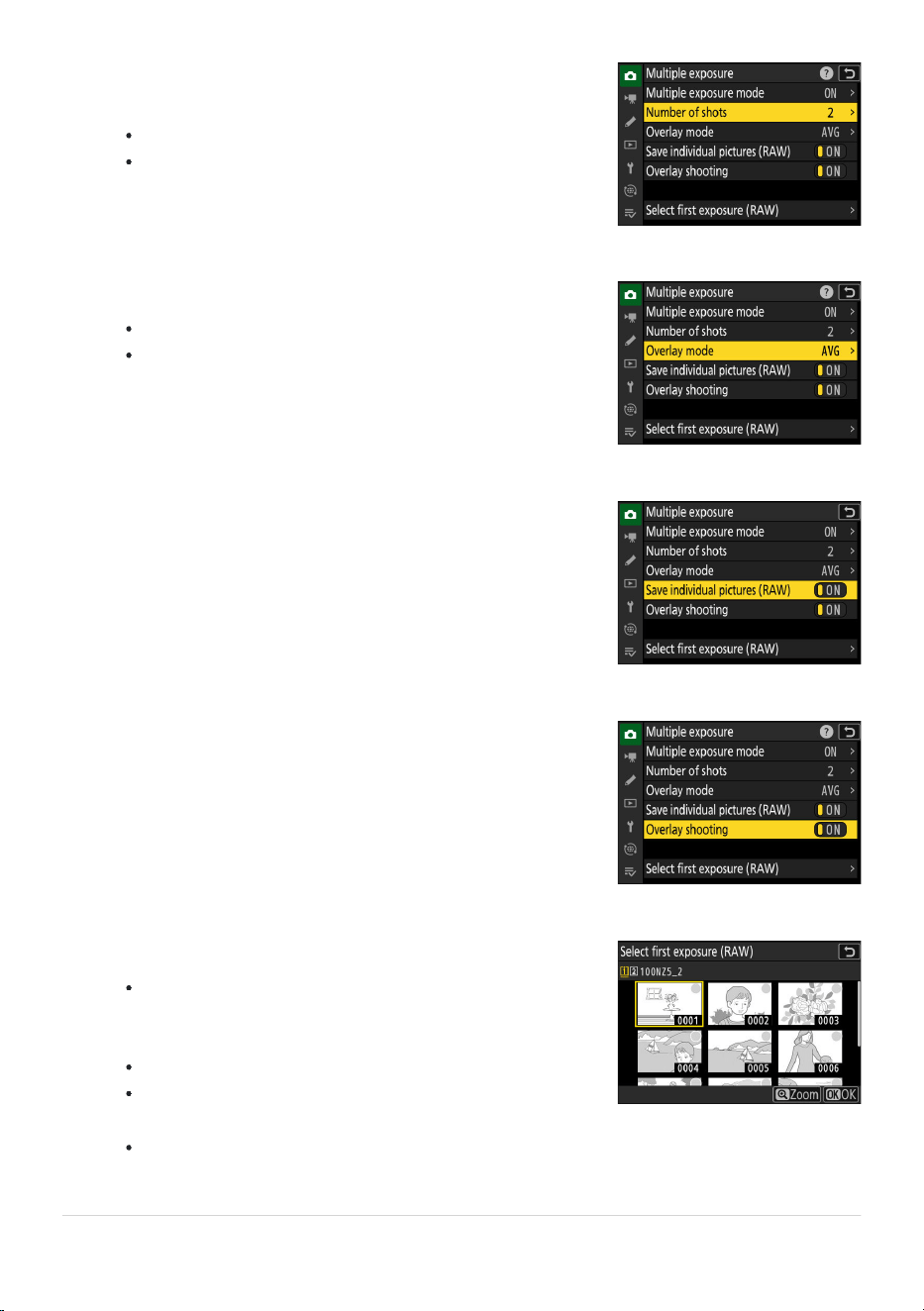
Choose a value for [Number of shots] (number of
exposures).
Highlight [Number o
f shots] and press 2.
Choose the number of exposures using 1 or 3 and press J.
Select an [Overlay mode].
Highlight [Overlay mode] and press 2
.
Highlight an option using 1 or 3 and press J.
Choose a setting for [Save individual pictures (RAW)].
To save both the multiple exposur
e and the shots that make
it up, select [ON]; the individual shots are saved in NEF (RAW)
format. To save only the multiple exposure, select [OFF].
Choose an option for [Overlay shooting].
Select [ON] to superimpose earlier exposures on the view
thr
ough the lens. You can use the earlier exposures as a guide
when composing subsequent shots.
Choose an option for [Select first exposure (RAW)].
To choose the first exposur
e from existing NEF (RAW)
photos, highlight [Select first exposure (RAW)] and press
2.
Highlight the desired picture using the multi selector.
To view the highlighted picture full screen, press and hold
the X button.
After highlighting the desired picture, press J.
466
Multiple exposure
3
4
5
6
7
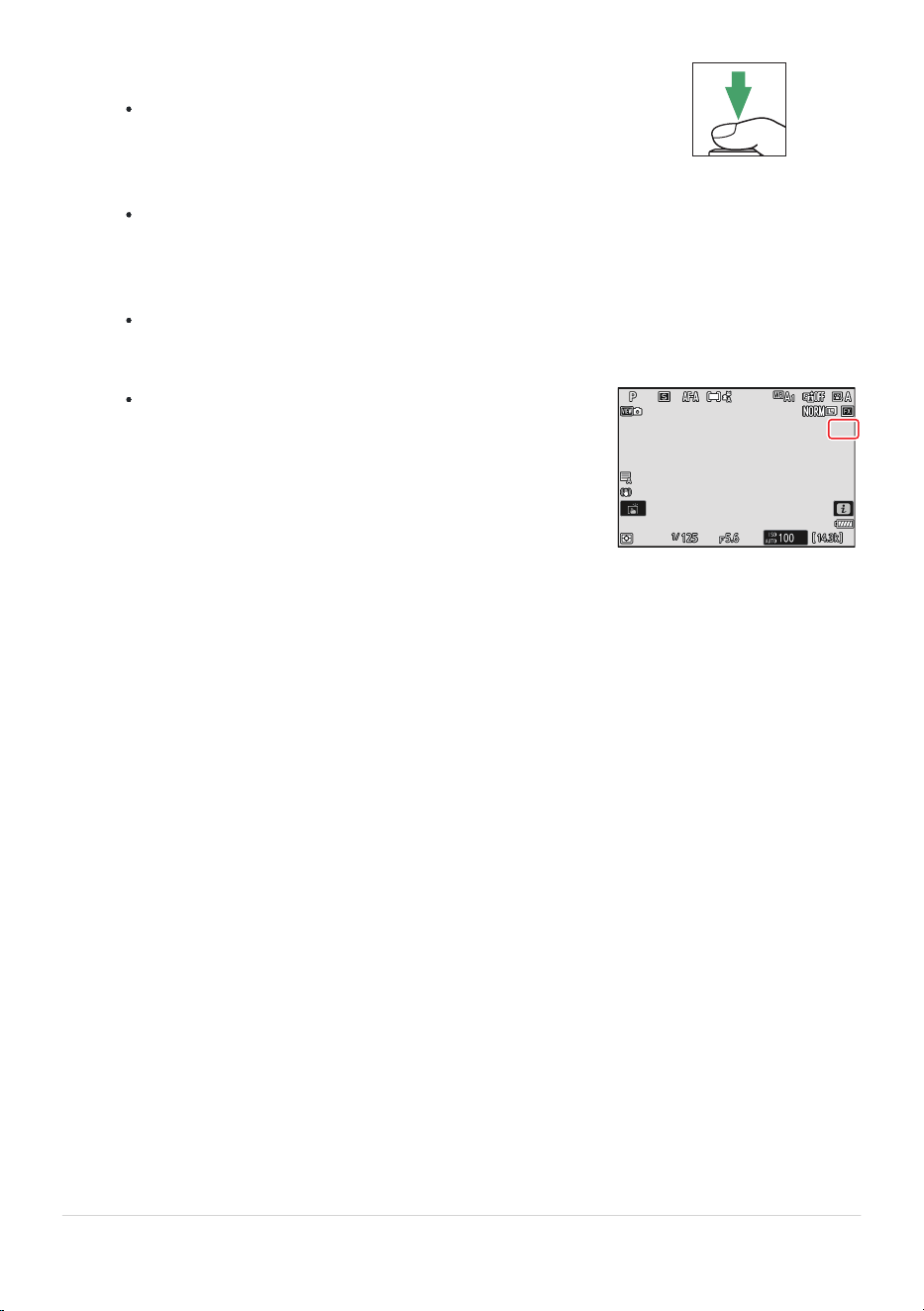
Start shooting.
Take the select
ed number of shots. If you used [Select first
exposure (RAW)] to select an existing NEF (RAW) picture
as the first exposure in Step7, shooting will start from the
second exposure.
Once you have taken the selected number of shots, the
pictures will be overlaid to create a multiple exposure.
Multiple exposures are recorded in JPEG format regardless
of the option selected for image quality.
If [On (series)] is selected for [Multiple exposure mode],
you can continue to take additional multiple exposures until
[Off] is selected.
If [On (single photo)] is selected for [Multiple exposur
e
mode], the camera will exit multiple exposure mode once
the number of shots selected in Step 3 has been taken.
467
Multiple exposure
8
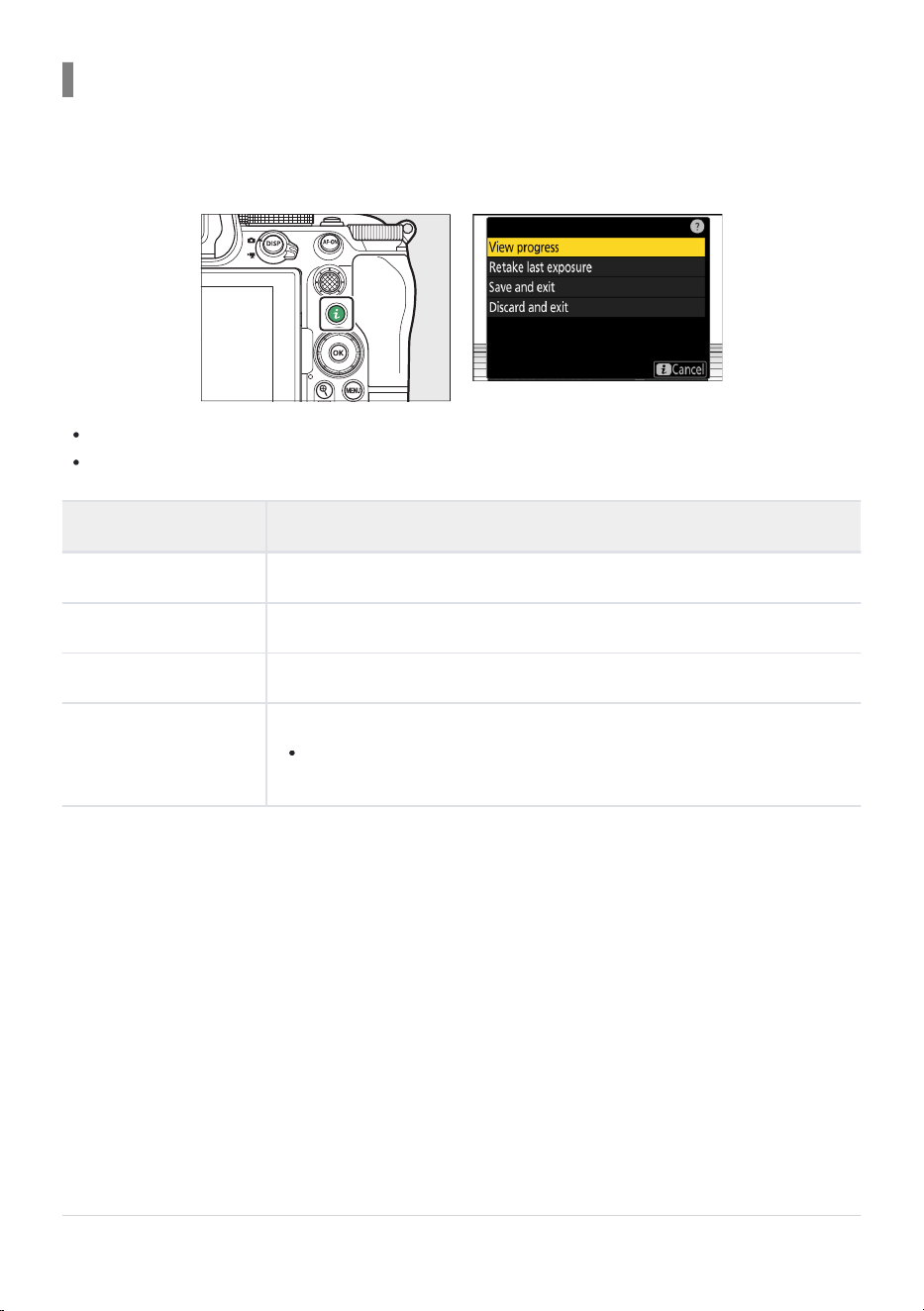
The i Menu
Pictures can be viewed by pr
essing the K button while a multiple exposure is in progress. The most
recent shot in the current multiple exposure is indicated by a $ icon; pressing the i button when this
icon is present displays the multiple exposure i menu.
Highlight items and press J to select.
You also have the option of using touch controls after pressing the i button.
Option Description
[View progress] View a preview cr
eated from the exposures recorded to the current point.
[Retake last exposure] Retake the most recent exposure.
[Save and exit] Create a multiple exposure from the exposures taken to current point.
[Discard and exit]
Exit without recording a multiple exposure.
If [ON] is selected for [Save individual pictures (RAW)], the individual
exposures will be saved separately.
468
Multiple exposure

D Cautions: Multiple Exposure
If you use the menus or view pictur
es in the display while shooting a multiple exposure, remember
that shooting will end and the multiple exposure will be recorded if no operations are performed for
about 40 seconds (or in the case of menus, about 90 seconds). The time available to record the next
exposure can be extended by choosing longer times for Custom Setting c3 [Power off delay]>
[Playback] or [Menus].
Multiple exposures may be affected by “noise” in the form of randomly-spaced bright pixels, fog, or
lines.
In continuous shooting modes, the camera records all exposures in a single burst. If [On (single
photo)] is selected, multiple exposure shooting will end after the first multiple exposure is recorded.
If [On (series)] is selected, an additional multiple exposure will be recorded each time the shutter-
release button is pressed.
In self-timer mode, the interval between each shot in the exposure is selected using Custom Setting
c2 [Self-timer]> [Interval between shots]. Regardless of the value selected for the c2 [Number
of shots] option, shooting will however end after the number of shots selected for the multiple
exposure.
Multiple exposures may end if settings are changed while shooting is in progress.
Shooting settings and photo info for multiple exposure photographs are those for the first
exposure.
Do not remove or replace the memory card while a multiple exposure is in progress.
Memory cards cannot be formatted while a multiple exposure is in progress. Some menu items will
be grayed out and unavailable.
D Multiple Exposure: Restrictions
Multiple exposure cannot be combined with some camera features, including:
b (auto) mode,
video recording,
high-speed frame capture +,
bracketing,
HDR overlay,
interval-timer photography,
time-lapse video recording,
focus shift, and
pixel shift.
469
Multiple exposure
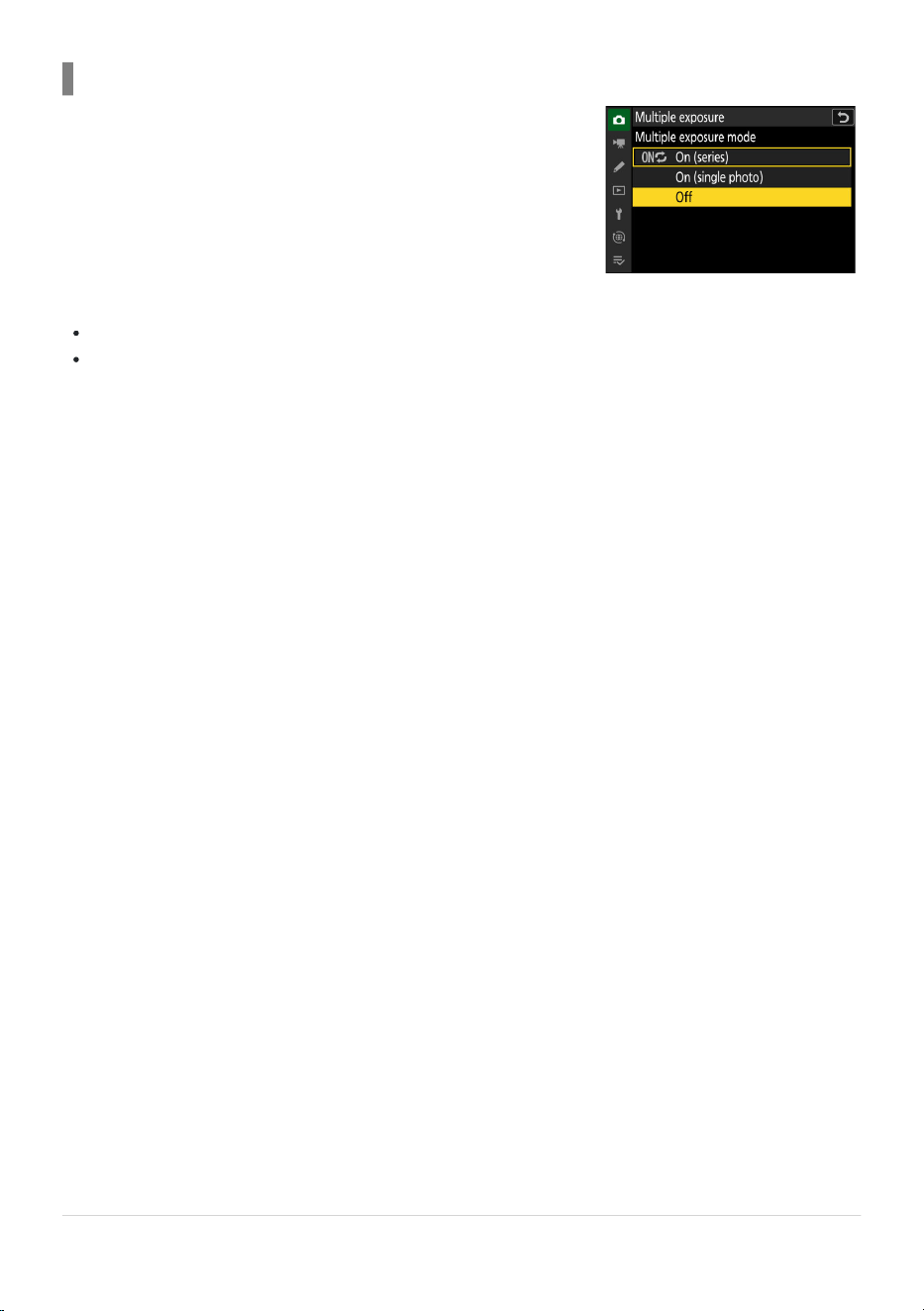
To end a multiple exposure before the specified number of
exposures have been tak
en, select [Off] for multiple exposure
mode. A multiple exposure will be created from the exposures
that have been recorded to that point (if [Average] is selected
for [Overlay mode], gain will be adjusted to reflect the number of
exposures actually recorded).
Ending Multiple Exposures
The multiple exposure will also end if:
the standby timer expir
es after the first exposure has been taken, or
you press the K button followed by the i button and select either [Save and exit] or [Discard and
exit].
470
Multiple exposure
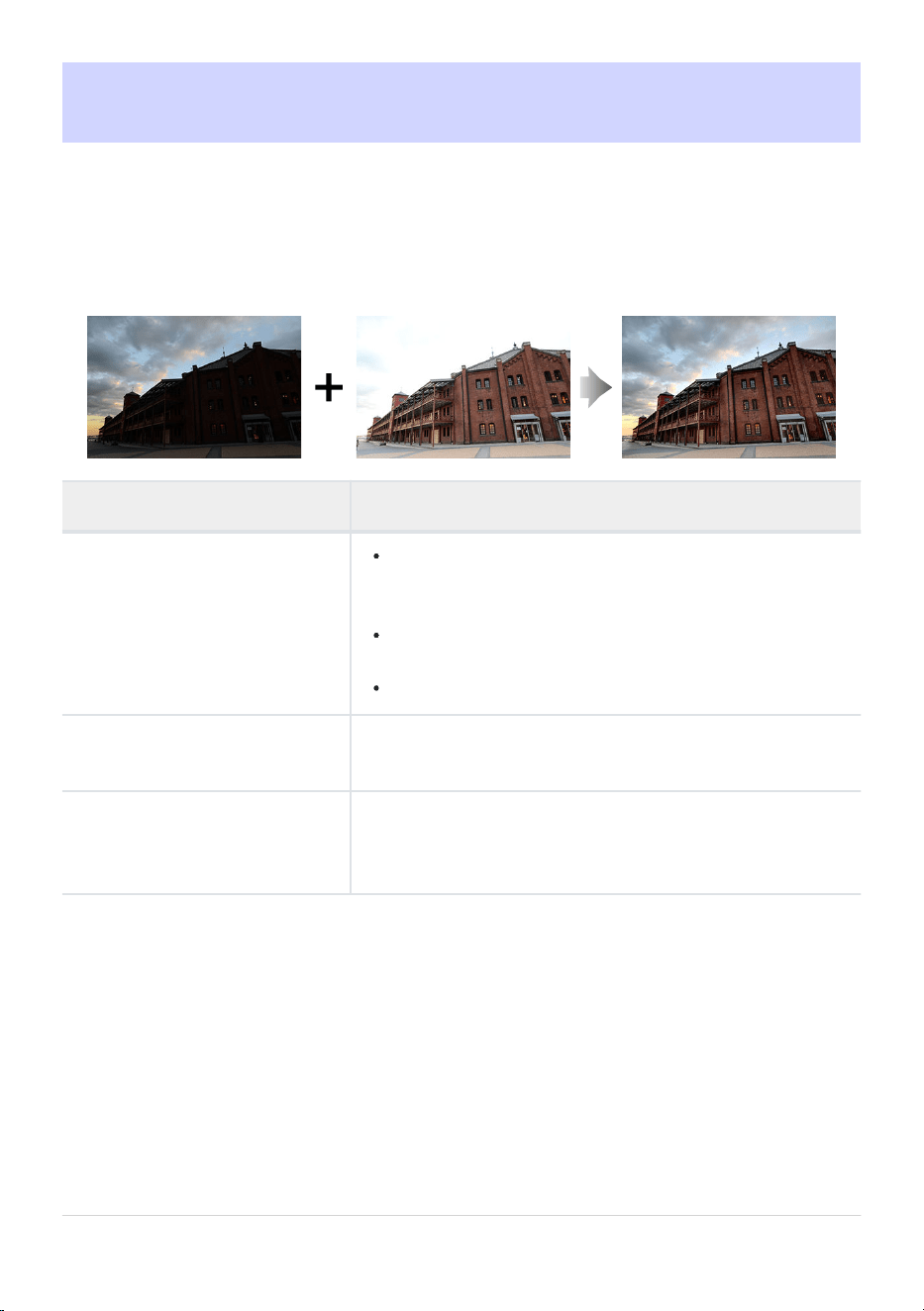
HDR overlay
G buttonU
Cphoto shooting menu
Used with high contrast subjects, High Dynamic Range (HDR) preserves details in highlights and
shadows by combining two shots taken at different exposures. Use with high-contrast scenes and
other subjects to preserve a wide range of details, from highlights to shadows.
Option Description
[HDR mode]
[On (series)]: Take a series of HDR photographs. To end
HDR photography
, select [HDR mode] again and choose
[Off].
[On (single photo)]: End HDR photography after recording
a single HDR photograph.
[Off]: End HDR photography.
[HDR strength]
Adjust HDR strength. If [Auto] is selected, the camera will
automatically adjust HDR strength to suit the scene.
[Save individual pictures (RAW)]
Choose [ON] to save each of the individual shots used to
create the HDR picture; the shots are saved in NEF (RAW)
format.
471
HDR overlay
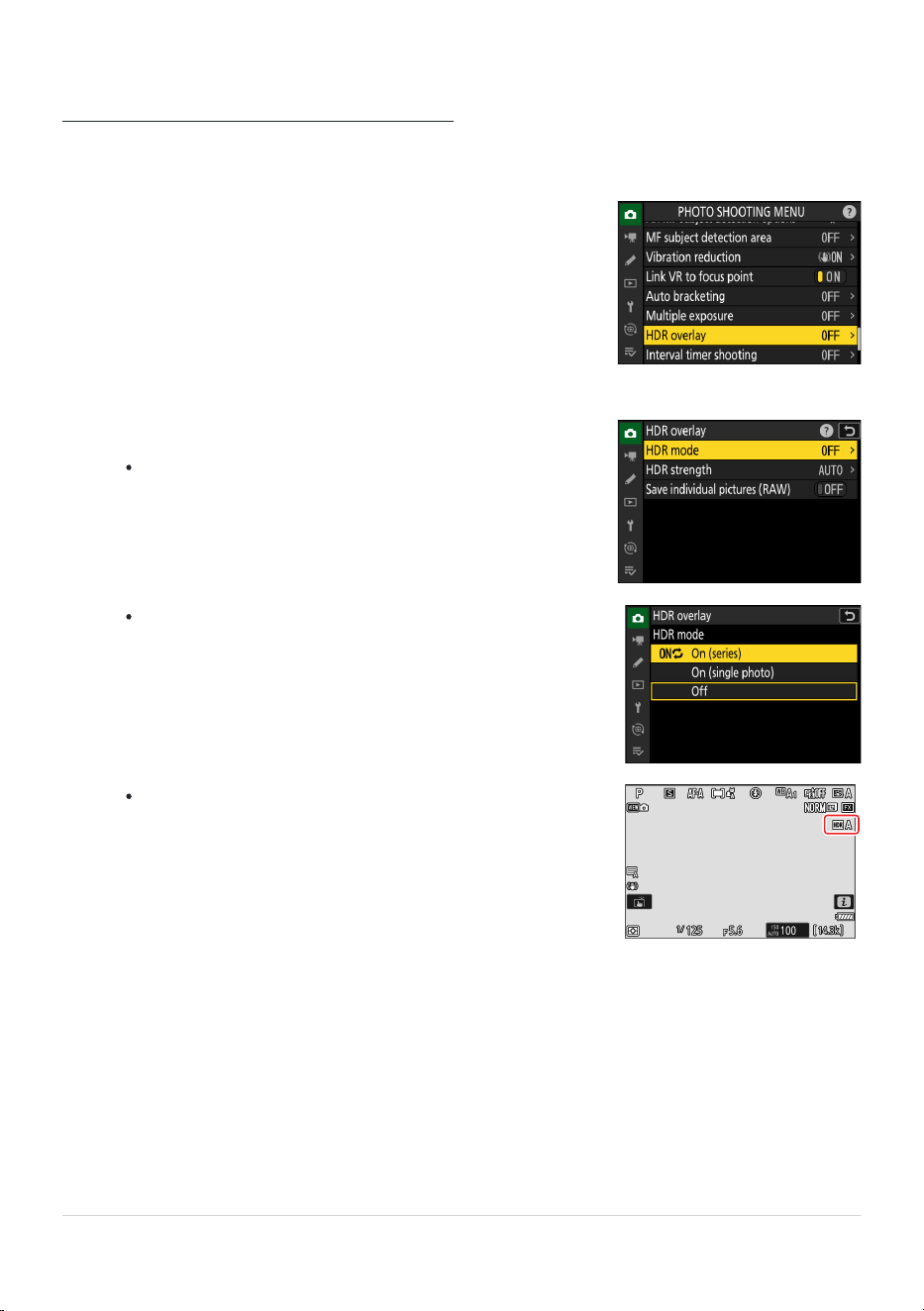
Highlight [HDR overlay] in the photo shooting menu and
press 2
.
Select an [HDR mode].
Highlight [HDR mode] and press 2.
Highlight [On (series)] or [On (single phot
o)] using 1 or 3
and press J.
An icon will appear in the shooting display.
Taking HDR Photographs
We recommend that y
ou use matrix metering when shooting with HDR.
472
HDR overlay
1
2
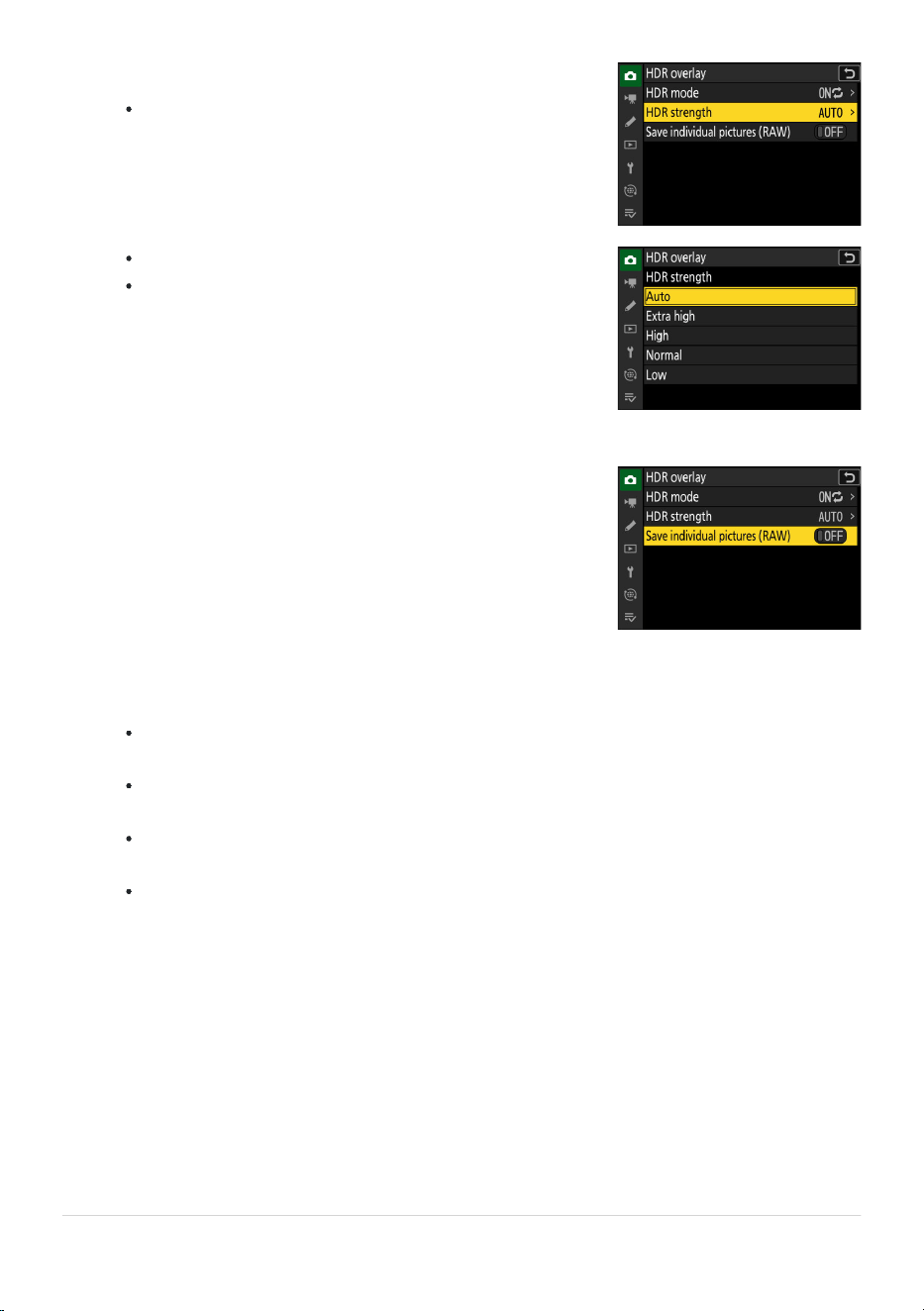
Choose an [HDR strength].
Highlight [HDR strength] and pr
ess 2.
Highlight an option using 1 or 3 and press J.
If [
Auto] is selected, the camera will automatically adjust
HDR strength to suit the scene.
Choose a setting for [Save individual pictures (RAW)].
Choose [ON] to save each o
f the individual shots used to
create the HDR picture; the shots are saved in NEF (RAW)
format.
Frame the photograph, focus, and shoot.
The camera takes two exposur
es when the shutter-release button is pressed all the way
down.
If [On (series)] is selected for [HDR mode], you can continue to take HDR photographs until
[Off] is selected.
If [On (single photo)] is selected for [HDR mode], HDR will turn off automatically after a
single shot.
HDR photographs are recorded in JPEG format regardless of the option selected for image
quality.
473
HDR overlay
3
4
5

D Cautions: HDR Photography
The edges of the pictur
e will be cropped out.
The desired results may not be achieved if the camera or subject moves during shooting. Use of a
tripod is recommended.
Depending on the scene, you may notice shadows around bright objects or halos around dark
objects. In other cases, the effect produced by HDR may not be particularly noticeable.
Uneven shading may be visible with some subjects.
When spot or center-weighted metering is selected, an [HDR strength] setting of [Auto] is
equivalent to [Normal].
Optional flash units will not fire.
In continuous release modes, only one photograph will be taken each time the shutter-release
button is pressed all the way down.
Shutter speeds of “Bulb” and “Time” are not available.
D HDR: Restrictions
HDR cannot be combined with some camera features, including:
b (auto) mode,
photo flicker reduction,
high-speed frame capture +,
bracketing,
multiple exposures,
interval-timer photography,
time-lapse video recording,
focus shift, and
pixel shift.
474
HDR overlay

Interval timer shooting
G buttonU
Cphoto shooting menu
Take photographs at the selected interval until the specified number of shots has been recorded. When
using the interval timer, select a release mode other than self-timer or high-speed frame capture +.
Option Description
[Start]
Star
t interval timer shooting. Shooting will begin either after about
3s ([Now] selected for [Choose start day/time]) or at a selected
date and time ([Choose day/time]). Shooting will continue at the
selected interval until all shots have been taken.
[Choose start day/time]
Choose a start option. Select [Now] to start shooting immediately,
[Choose day/time] to start shooting at a chosen date and time.
[Interval] Specify the interval between shots in hours, minutes, and seconds.
[Intervals×shots/interval]
Choose the number of intervals and the number of shots per
interval.
For example, when [Interval] is set to one minute and
[Intervals×shots/interval] to “5×3,” the camera will take three
shots every minute, five times.
[Exposure smoothing]
Selecting [ON] allows the camera to adjust exposure to match the
previous shot.
Large changes in subject brightness during shooting may result
in apparent variations in exposure. This can be addressed by
shortening the interval between shots.
Exposure smoothing will not take effect in mode M if [OFF] is
selected for [ISO sensitivity settings]> [Auto ISO sensitivity
control] in the photo shooting menu.
[Electronic shutter options]
Choose whether to use the electronic shutter.
When [ON] is selected for [Electronic shutter], the electronic
shutter will be used regardless of the option selected for Custom
Setting d6 [Shutter type].
The volume of the sound made when the electronic shutter is
released can be chosen using [Volume].
475
Interval timer shooting

Option Description
[Interval priority]
[ON
]: Enable interval priority to ensure that frames shot in modes
P and A are taken at the chosen interval.
Flash photography is disabled.
Release priority is enabled regardless of the options selected
for Custom Settings a1 [AF-C priority selection] and a2 [AF-S
priority selection].
If [ON] is selected for [ISO sensitivity settings]> [Auto
ISO sensitivity control] and the time chosen for [Minimum
shutter speed] is longer than the interval, the time selected
for the interval will take priority over the selected shutter
speed.
[OFF]: Disable interval priority to ensure that photos are correctly
exposed.
[Focus before each shot]
If [ON] is selected, the camera will focus between shots. Select [OFF]
to focus at a fixed distance.
[Options]
Combine interval-timer photography with other options.
[AE bracketing]: Perform exposure bracketing during interval-
timer photography.
[Time-lapse video]: Use the photos taken during interval-timer
photography to create a time-lapse video with an aspect ratio of
16 : 9.
The camera saves both the photos and the time-lapse video.
Selecting [1:1 (24×24)] for [Image area]> [Choose image
area] in the photo shooting menu disables the shutter release.
Videos created using [Time-lapse video] are recorded in the
[sRGB] color space, regardless of the option selected for
[Color space] in the photo shooting menu.
[Off]: Do not perform additional operations during interval-timer
photography.
[Starting storage folder]
Highlight options and press J
or 2 to select (M) or deselect (U
).
[New folder]: A new folder is created for each new sequence.
[Reset file numbering]: File numbering is reset to 0001
whenever a new folder is created.
476
Interval timer shooting
-
-
-
-
-
-
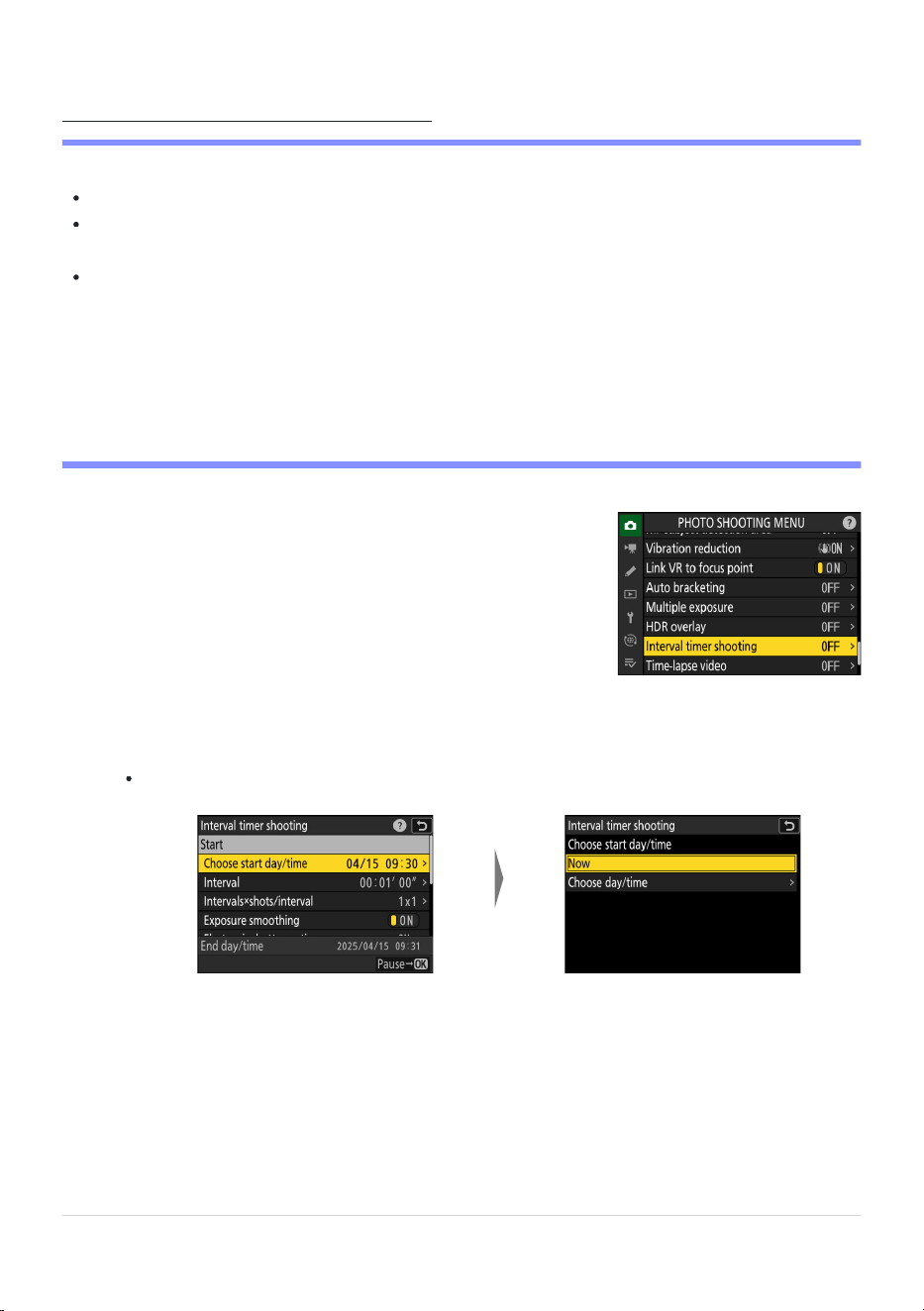
Highlight [Interval timer shooting] in the photo shooting
menu and press 2
.
Highlight [Choose start day/
time] and pr
ess 2.
Highlight an option and press
J.
Interval Timer Shooting
D Before Shooting
Tak
e a test shot at current settings.
Before proceeding, select [Time zone and date] in the setup menu and make sure that the camera
clock is set to the correct time and date.
We recommend using one of the following power sources to prevent loss of power while shooting is
in progress:
A fully-charged battery
An optional EH-8P AC adapter connected using the supplied USB cable (featuring Type-C
connectors at both ends)
An optional EP‑5B power connector with an EH‑5d, EH‑5c, or EH‑5b AC adapter
A third-party portable charger (power bank)
Adjust interval timer settings.
Choose the start day and time.
To start shooting immediately, select [Now].
To start shooting at a chosen date and time, select [Choose day/time]. Choose the date
and time and press J.
477
Interval timer shooting
-
-
-
-
1
2
-
-
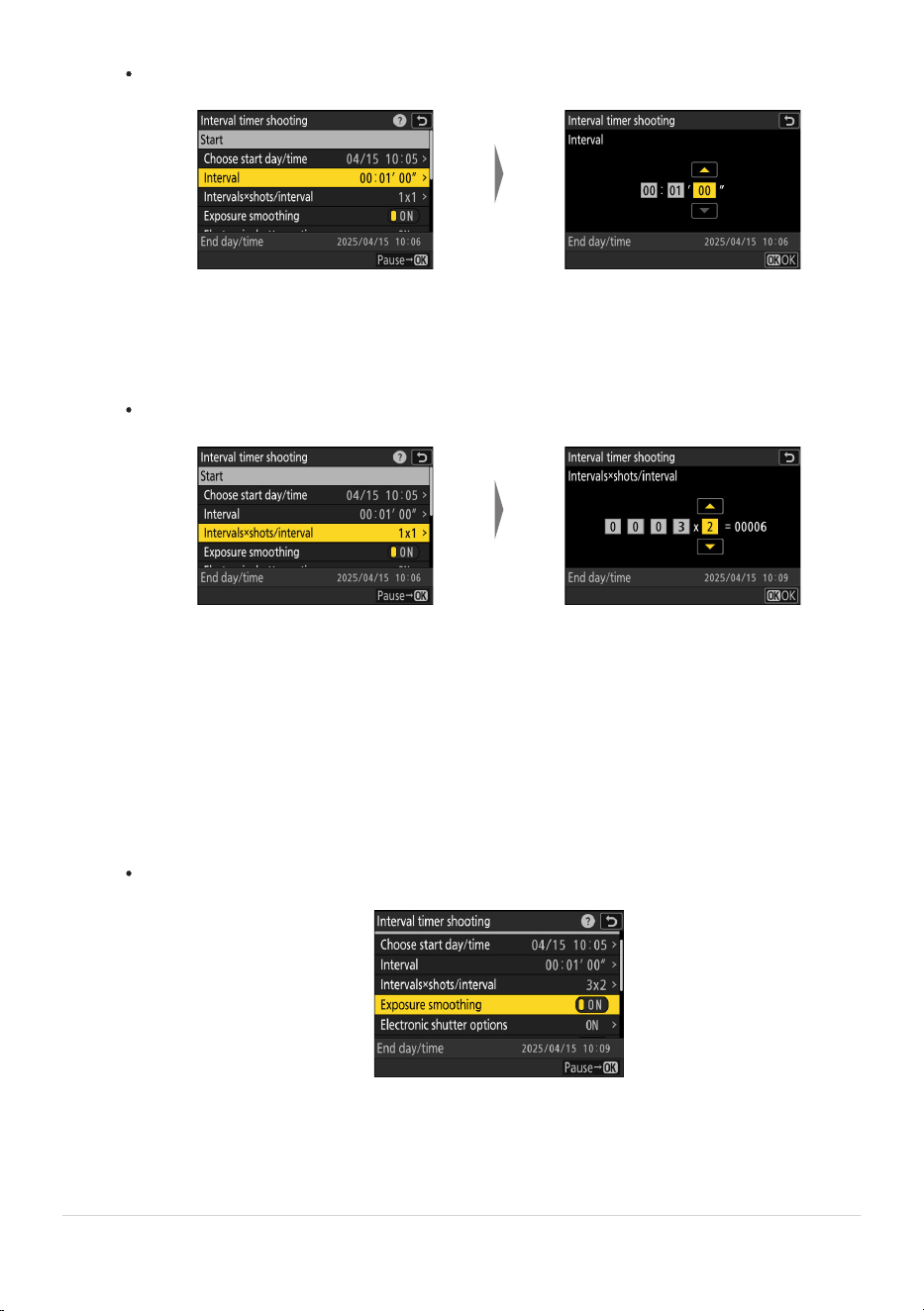
Highlight [Interv
al] and press
2.
Choose an interval (in hours,
minutes, and seconds) and
press
J.
Highlight [Interv
als×shots/
interval] and press 2.
Choose the number of
interv
als and the number of
shots per interval and press
J.
Choose the interval between shots.
Choose the number of inter
vals and the number of shots per interval.
If “shots/interval” is set to two shots or more, the photographs will be taken with the
frame advance rate for the selected release mode. In single frame release mode, the
photographs will be taken at the rate for continuous high-speed release mode.
Enable or disable exposure smoothing.
Highlight [Exposure smoothing] and press 2 to select [ON] or [OFF].
Selecting [ON] allows the camera to adjust exposure to match the previous shot.
478
Interval timer shooting
-
-
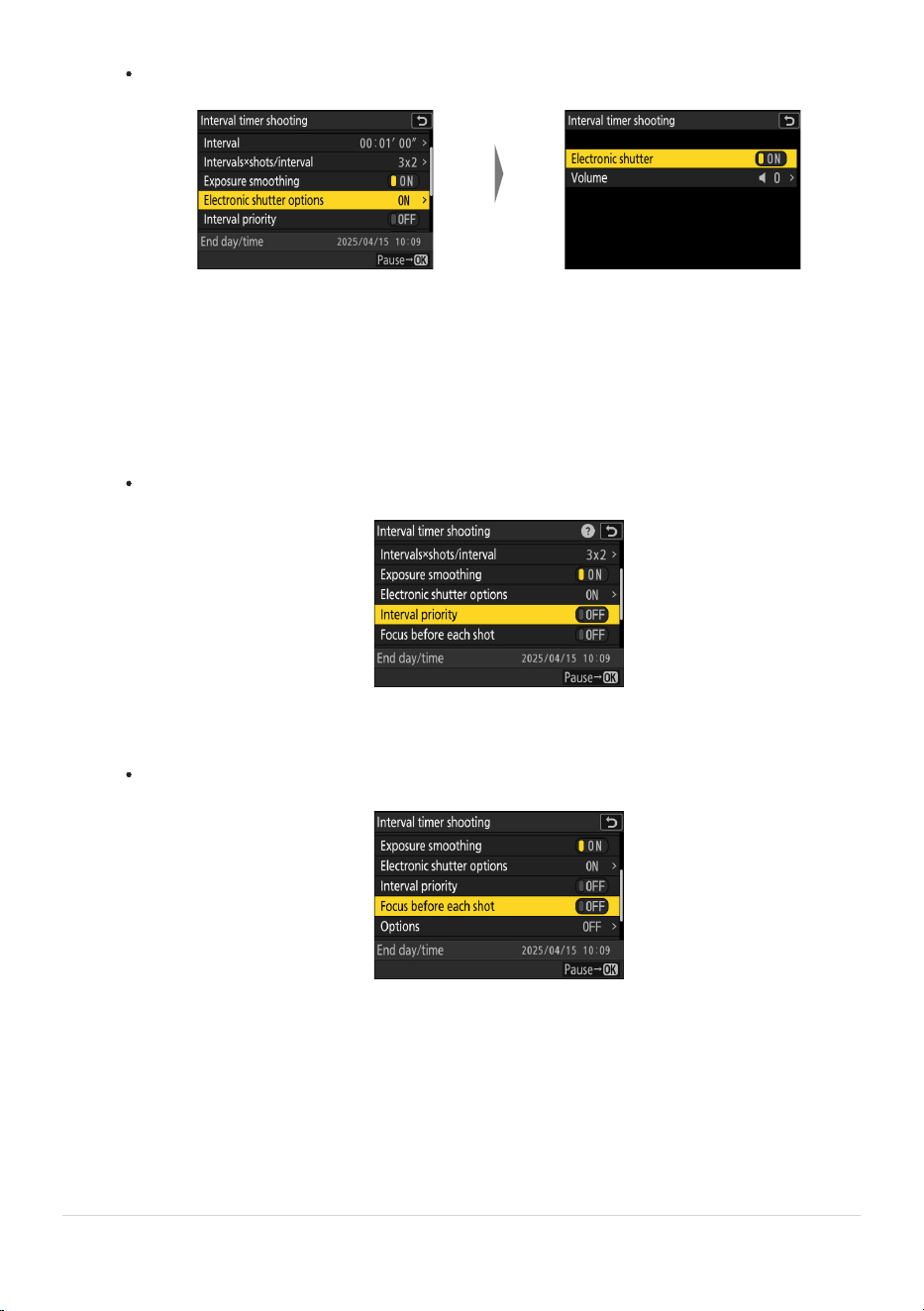
Highlight [Electronic shutter
options] and pr
ess 2.
Highlight [Electronic shutter]
and pr
ess 2 to select [ON] or
[OFF].
Choose whether to use the electronic shutter.
The volume of the sound made when the electr
onic shutter is released can be chosen
using [Volume].
Choose an interval priority option.
Highlight [Int
er
v
al priority] and press 2 to select [ON] or [OFF].
Choose whether the camera focuses between shots.
Highlight [Focus befor
e each shot] and pr
ess 2
to select [ON] or [OFF].
If [ON] is selected for [Focus before each shot], the camera will focus before each shot
according to the option currently selected for focus mode.
479
Interval timer shooting
-
-
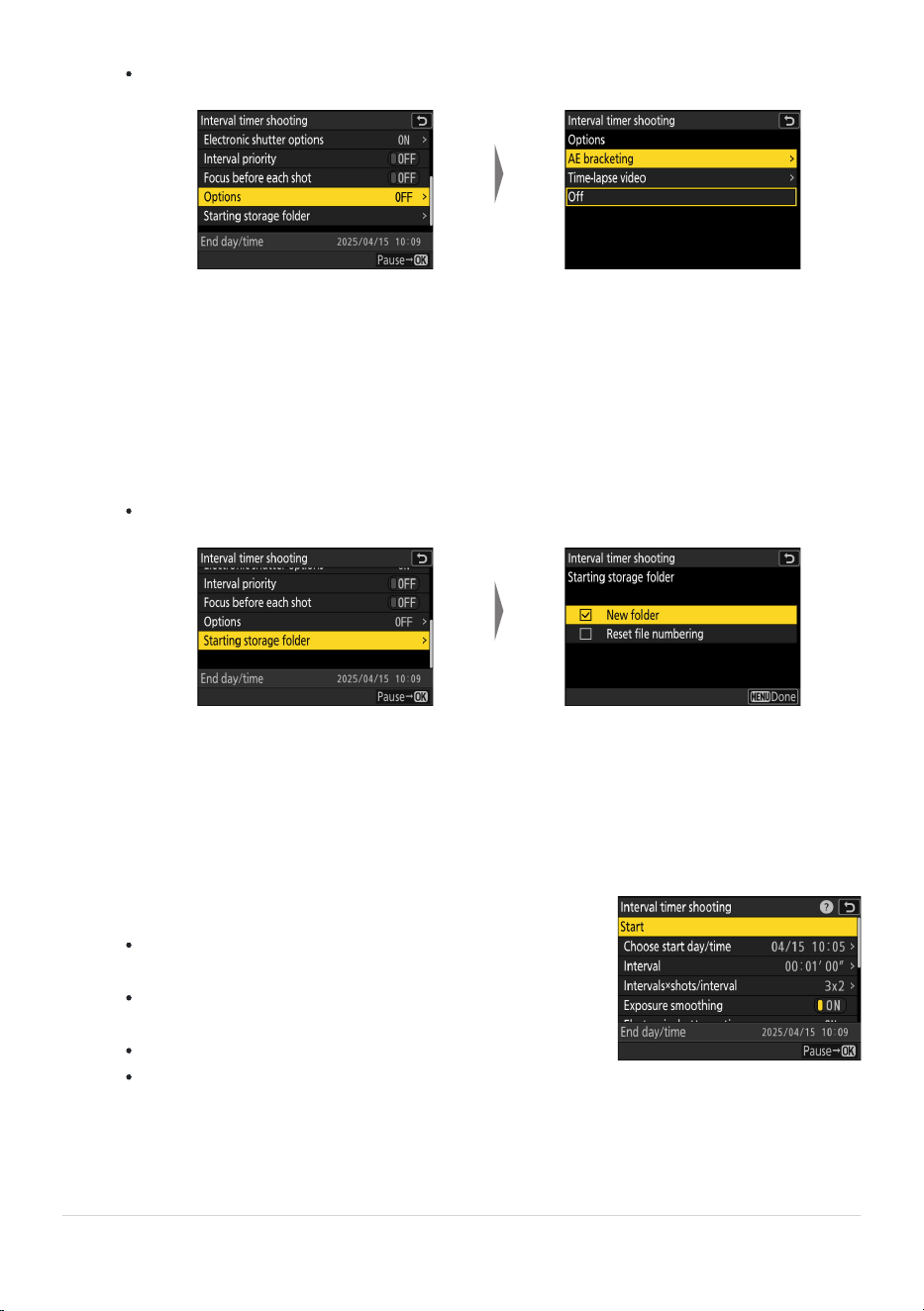
Highlight [Options] and press
2.
Highlight [AE bracketing] or
[Time-lapse video] and pr
ess
J.
Highlight [Starting st
orage
folder] and press 2.
After highlighting the desired
options and pressing J t
o
turn them on (M) or off (U),
press 4.
Highlight [Start] and press J.
If [Now] was select
ed for [Choose start day/time] in S
tep 2,
shooting will start after about 3 s.
Otherwise shooting will start at the time selected for
[Choose start day/time]> [Choose day/time].
The display turns off during shooting.
Shooting will continue at the selected interval until all shots
have been taken.
Choose additional options.
If you selected [
AE bracketing], choose values for [Number of shots] and [Increment];
if you selected [Time-lapse video], choose settings for [Video file type], [Frame size/
frame rate], and [Destination].
Choose starting folder options.
480
Interval timer shooting
-
3
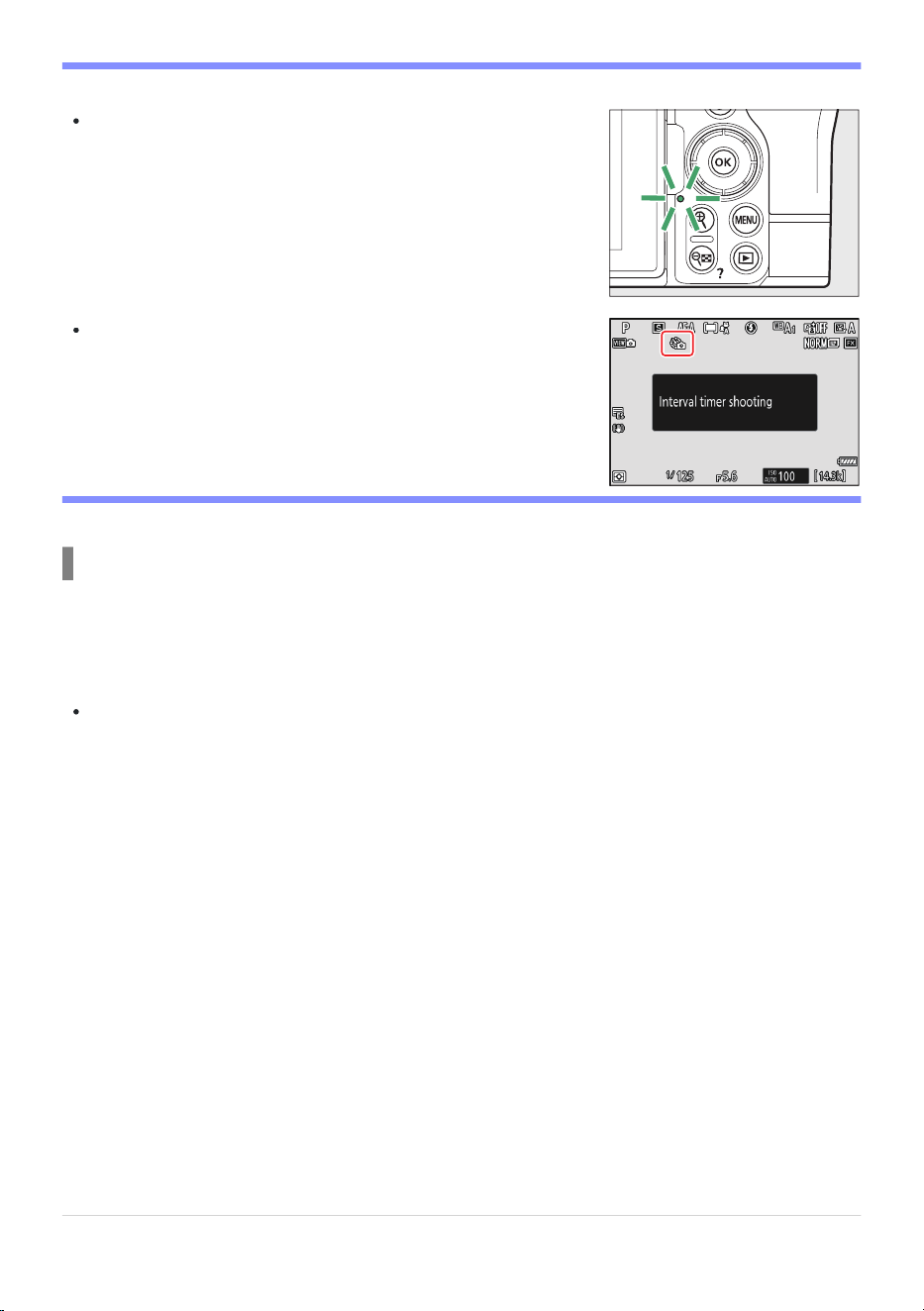
The memory card access lamp flashes between shots. Note that
the memory card access lamp lights when [Time-lapse video] is
select
ed for [Options].
If the display is turned on by pressing the shutter-release button
halfway, the message [Int
erval timer shooting] will be displayed
and the 7 icon will flash. If [Time-lapse video] is selected for
[Options], a 8 icon will also be displayed.
D During Shooting
Pausing Int
erval-Timer Photography
Interval-timer photography can be paused between intervals by pressing J or by selecting [Interval
timer shooting] in the photo shooting menu, highlighting [Pause], and pressing J. Note that the
menus may not be displayed when the G button is pressed if the time selected for [Interval] is very
short.
If [Time-lapse video] is selected for [Options], pressing J between intervals will end interval-timer
photography.
481
Interval timer shooting
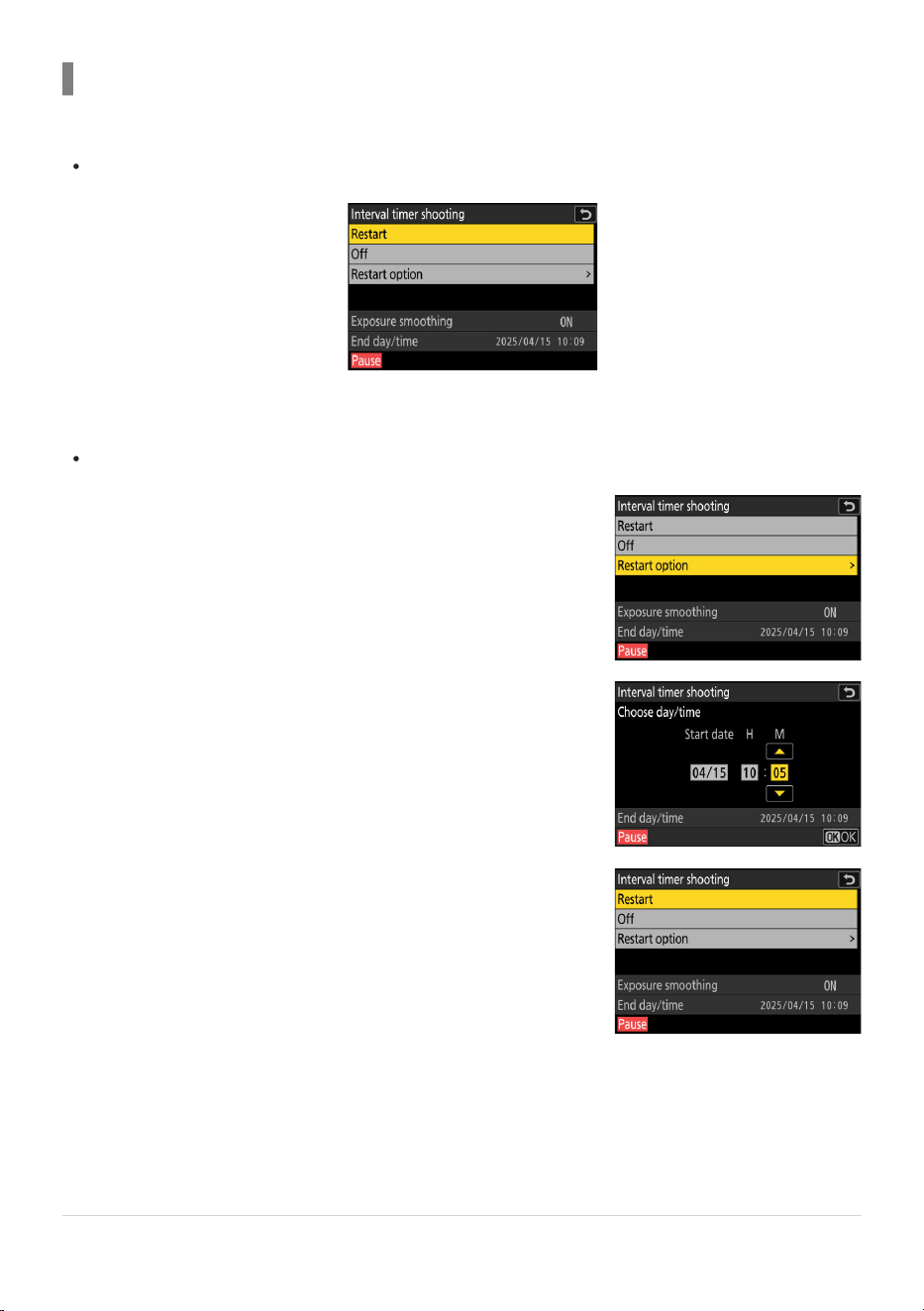
Highlight [Restart option] and pr
ess 2, then highlight [Choose
day/time] and press 2.
Choose a starting date and time and press J.
Highlight [Restart
] and press J.
Resuming Interval-Timer Photography
Interv
al timer shooting can be resumed as described below.
To resume shooting immediately:
Highlight [Restart
] and press J.
To resume shooting at a specified time:
482
Interval timer shooting
-
-
-

Ending Interval-Timer Photography
To end inter
val-timer photography before all the photos are taken, select [Interval timer shooting]
in the photo shooting menu, highlight [Off], and press J. Note that the menus may not be displayed
when the G button is pressed if the time selected for [Interval] is very short. In this case you will
need to press J to pause interval-timer photography and then select [Interval timer shooting] in the
photo shooting menu, highlight [Off], and press J.
D Cautions: Interval-Timer Photography
Choose an interval longer than the time needed to take the selected number of shots at the
predicted shutter speed. Note that during actual interval-timer photography, the camera must not
only take shots at the selected interval but must also have sufficient time to complete the exposures
and perform such tasks as processing the photographs. If the interval is too short to take the
selected number of photos, the camera may skip to the next interval without shooting.
If the interval is too short, the total number of shots taken may be less than that selected for
[Intervals×shots/interval].
If you are using a flash, choose an interval longer than the time needed for the flash to charge. If the
interval is too short, the flash may fire at less than the power needed for full exposure.
If shooting cannot proceed at current settings—for example, if shutter speed is set to “Bulb” or
“Time”, the [Interval] is [00:00'00"], or the start time is in less than a minute—a warning will be
displayed.
If [ON] is selected for [Electronic shutter options] > [Electronic shutter], the shutter will sound
with every shot unless [Volume] is set to [0] (note that this applies even when [ON] is selected for
[Silent mode] in the setup menu).
If [Time-lapse video] is selected for [Options], the standby timer will not expire during interval-
timer photography, regardless of the option selected for Custom Setting c3 [Power off delay]>
[Standby timer].
Selecting [HLG] for [Tone mode] in the photo shooting menu fixes [Options] > [Time-lapse
video]> [Video file type] at [H.265 10-bit (MOV)].
If the memory card is full, the interval timer will remain active but no pictures will be taken. Insert
another memory card and resume shooting (
0 482).
Depending on memory card per
formance and shooting conditions, shooting may end before the
selected number of shots have been taken or the selected number of intervals is complete.
Interval timer shooting will pause if:
the camera is turned off and then on again (when the camera is off, batteries and memory cards
can be replaced without ending interval-timer photography), or
self-timer or high-speed frame capture + is selected for release mode.
Changing camera settings while the interval timer is active may cause shooting to end.
483
Interval timer shooting
-
-

D Release Mode
Regar
dless of the release mode selected, the camera will take the specified number of shots at each
interval.
D Adjusting Settings Between Shots
Pictures can be viewed and shooting and menu settings adjusted between shots. Note, however, that
the display will turn off and shooting will resume a few seconds before the next shot is taken.
D Interval-Timer Photography: Restrictions
Interval-timer photography cannot be combined with some camera features, including:
video recording,
long time-exposures (“Bulb” or “Time”),
the self-timer,
high-speed frame capture +,
bracketing,
multiple exposures,
HDR overlay,
focus shift, and
pixel shift.
D Interval Timer Settings
Turning the camera off or selecting a new release mode does not affect interval-timer photography
settings.
D Restoring Default Settings
Shooting menu settings cannot be reset while interval-timer photography is in progress.
484
Interval timer shooting

Time-lapse video
G buttonU
Cphoto shooting menu
The camera automatically takes photos at selected intervals to create a time-lapse video.
Option Description
[Start]
Star
t time-lapse recording. Shooting starts after about 3s and
continues at the interval selected for [Interval] for the time selected
for [Shooting time].
[Interval] Choose the interval between shots, in minutes and seconds.
[Shooting time]
Choose how long the camera will continue to take pictures, in hours
and minutes.
[Exposure smoothing]
Selecting [ON] smooths abrupt changes in exposure.
Large changes in subject brightness during shooting may result
in apparent variations in exposure. This can be addressed by
shortening the interval between shots.
Exposure smoothing will not take effect in mode M if [OFF] is
selected for [ISO sensitivity settings]> [Auto ISO sensitivity
control] in the photo shooting menu.
[Electronic shutter options]
Choose whether to use the electronic shutter.
When [ON] is selected for [Electronic shutter], the electronic
shutter will be used regardless of the option selected for Custom
Setting d6 [Shutter type].
The volume of the sound made when the electronic shutter is
released can be chosen using [Volume].
[Choose image area] Choose the image area for time-lapse videos from [FX] and [DX].
[Video file type] Choose the video file type for the final video.
[Frame size/frame rate]
Choose the frame size and rate for the final video. The options
available vary with the setting chosen for [Video file type].
485
Time-lapse video
Option Description
[Interval priority]
[ON
]: Enable interval priority to ensure that frames shot in modes
P and A are taken at the chosen interval.
Release priority is enabled regardless of the options selected
for Custom Settings a1 [AF-C priority selection] and a2 [AF-S
priority selection].
If [ON] is selected for [ISO sensitivity settings]> [Auto
ISO sensitivity control] and the time chosen for [Minimum
shutter speed] is longer than the interval, the time selected
for the interval will take priority over the selected shutter
speed.
[OFF]: Disable interval priority to ensure that photos are correctly
exposed.
[Focus before each shot] If [ON] is selected, the camera will focus between shots.
[Destination]
Choose the slot used to record time-lapse videos when two
memory cards are inserted.
486
Time-lapse video
-
-
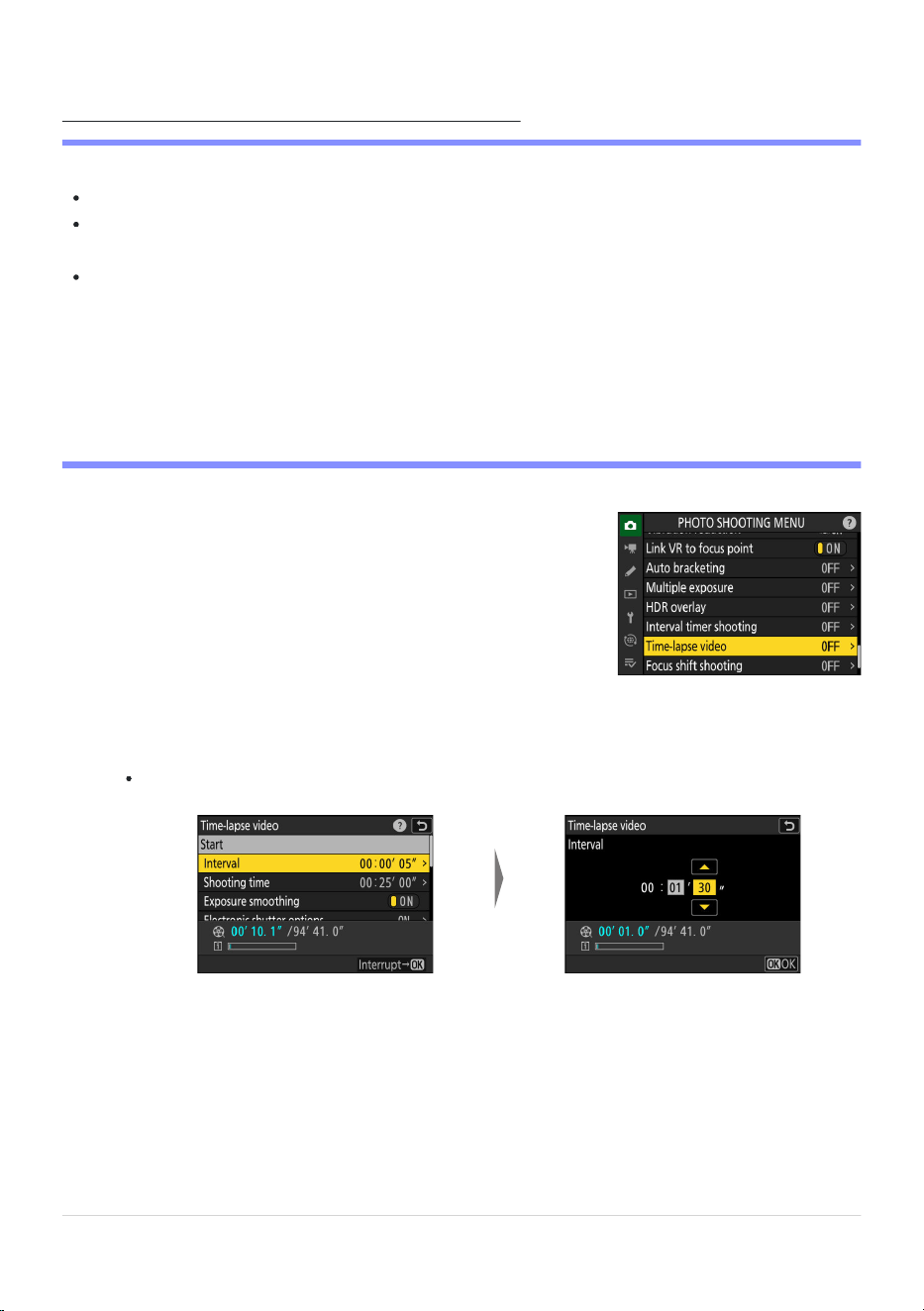
Highlight [Time-lapse video] in the photo shooting menu
and press 2
.
Highlight [Interv
al] and press
2.
Choose an interval (in minutes
and seconds) and press J.
Recording Time-Lapse Videos
D Before Shooting
Tak
e test shots and check the results in the monitor.
Before proceeding, select [Time zone and date] in the setup menu and make sure that the camera
clock is set to the correct time and date.
We recommend using one of the following power sources to prevent loss of power while shooting is
in progress:
A fully-charged battery
An optional EH-8P AC adapter connected using the supplied USB cable (featuring Type-C
connectors at both ends)
An optional EP‑5B power connector with an EH‑5d, EH‑5c, or EH‑5b AC adapter
A third-party portable charger (power bank)
Adjust time-lapse video settings.
Choose the interval between shots.
Choose an interval longer than the slowest anticipated shutter speed.
487
Time-lapse video
-
-
-
-
1
2
-
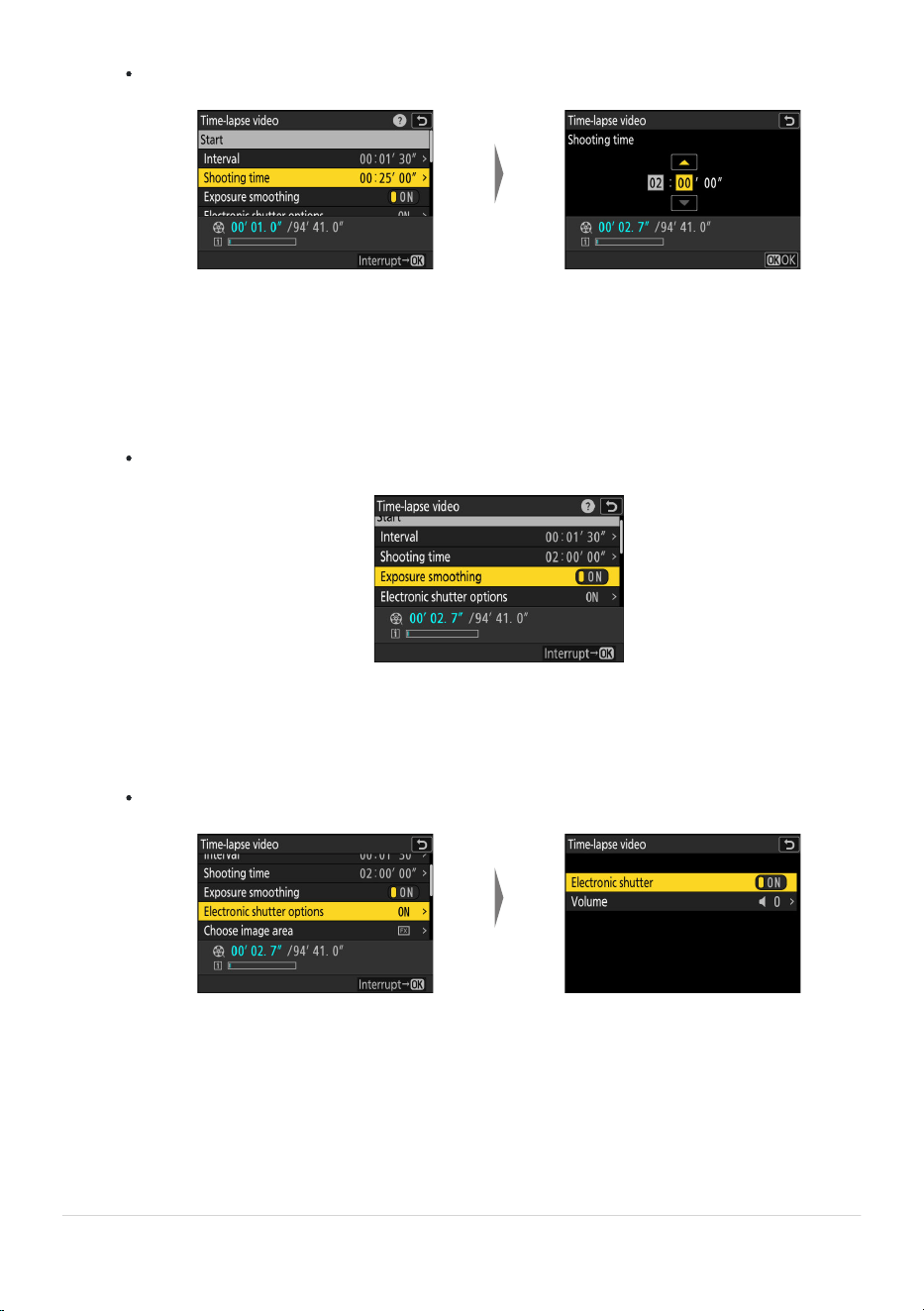
Highlight [Shooting time]
and press 2.
Choose a shooting time (in
hours and minutes) and pr
ess
J.
Highlight [Electronic shutter
options] and pr
ess 2.
Highlight [Electronic shutter]
and pr
ess 2 to select [ON] or
[OFF].
Choose the total shooting time.
The maximum shooting time is 23 hour
s and 59 minutes.
Enable or disable exposur
e smoothing.
Highlight [Exposure smoothing] and press
2 to select [ON] or [OFF].
Selecting [ON] smooths abrupt changes in exposure.
Choose whether to use the electronic shutter.
The volume of the sound made when the electronic shutter is released can be chosen
using [Volume].
488
Time-lapse video
-
-
-
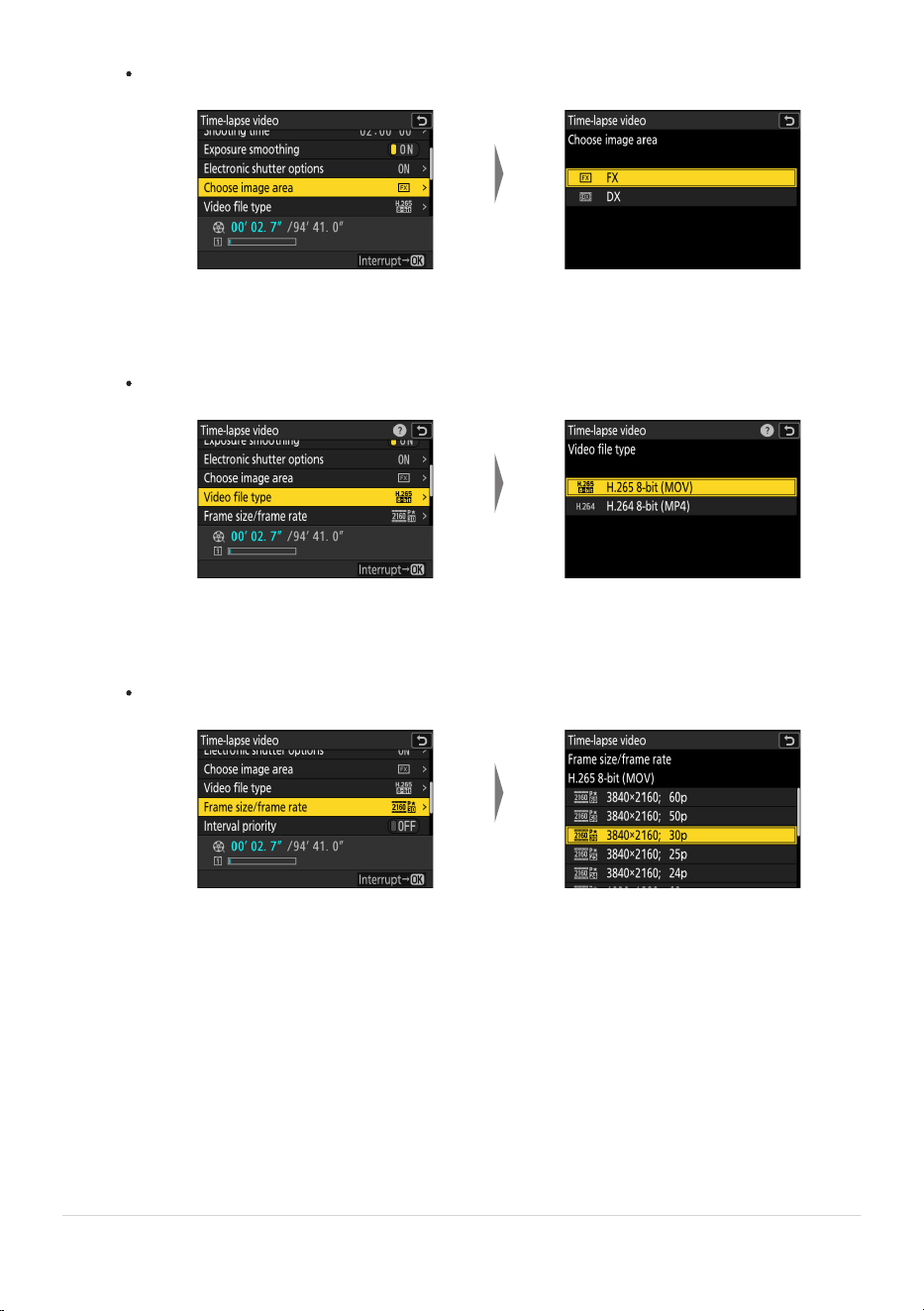
Highlight [Choose image
area] and pr
ess 2.
Highlight an option and press
J.
Highlight [Video file type]
and press 2.
Highlight an option and press
J.
Highlight [Frame size/frame
rate] and press 2.
Highlight an option and press
J.
Choose the image area.
Choose a video file type.
Choose the frame size and rat
e.
489
Time-lapse video
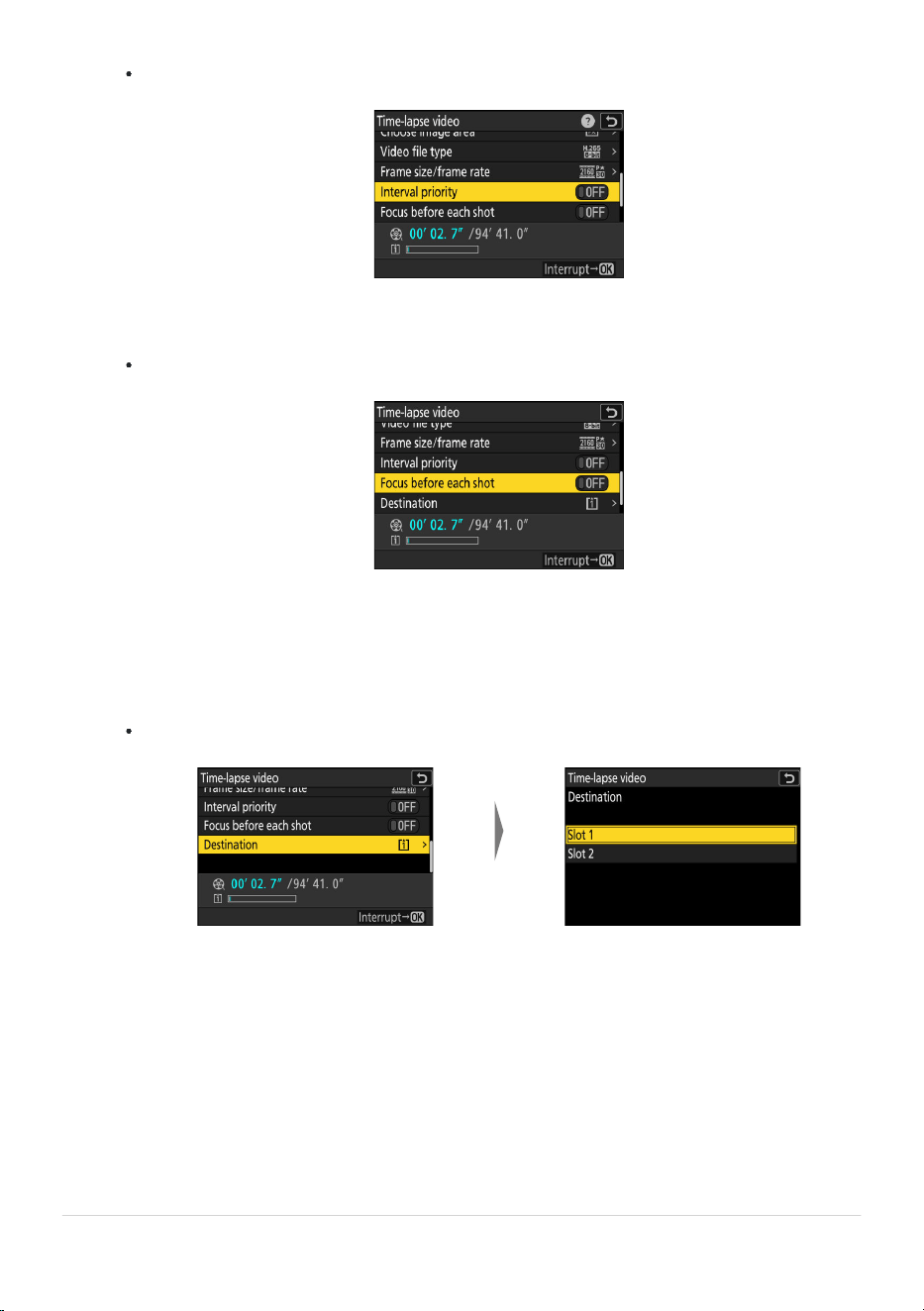
Highlight [Destination] and
pr
ess
2.
Highlight the slot that will
be used t
o r
ecor
d time-lapse
videos when two memory
cards are inserted and press
J.
Choose an interval priority option.
Highlight [Int
er
v
al priority] and press 2 to select [ON] or [OFF].
Choose whether the camera focuses between shots.
Highlight [Focus befor
e each shot] and pr
ess 2
to select [ON] or [OFF].
If [ON] is selected for [Focus before each shot], the camera will focus before each shot
according to the option currently selected for focus mode.
Choose a destination.
490
Time-lapse video
-
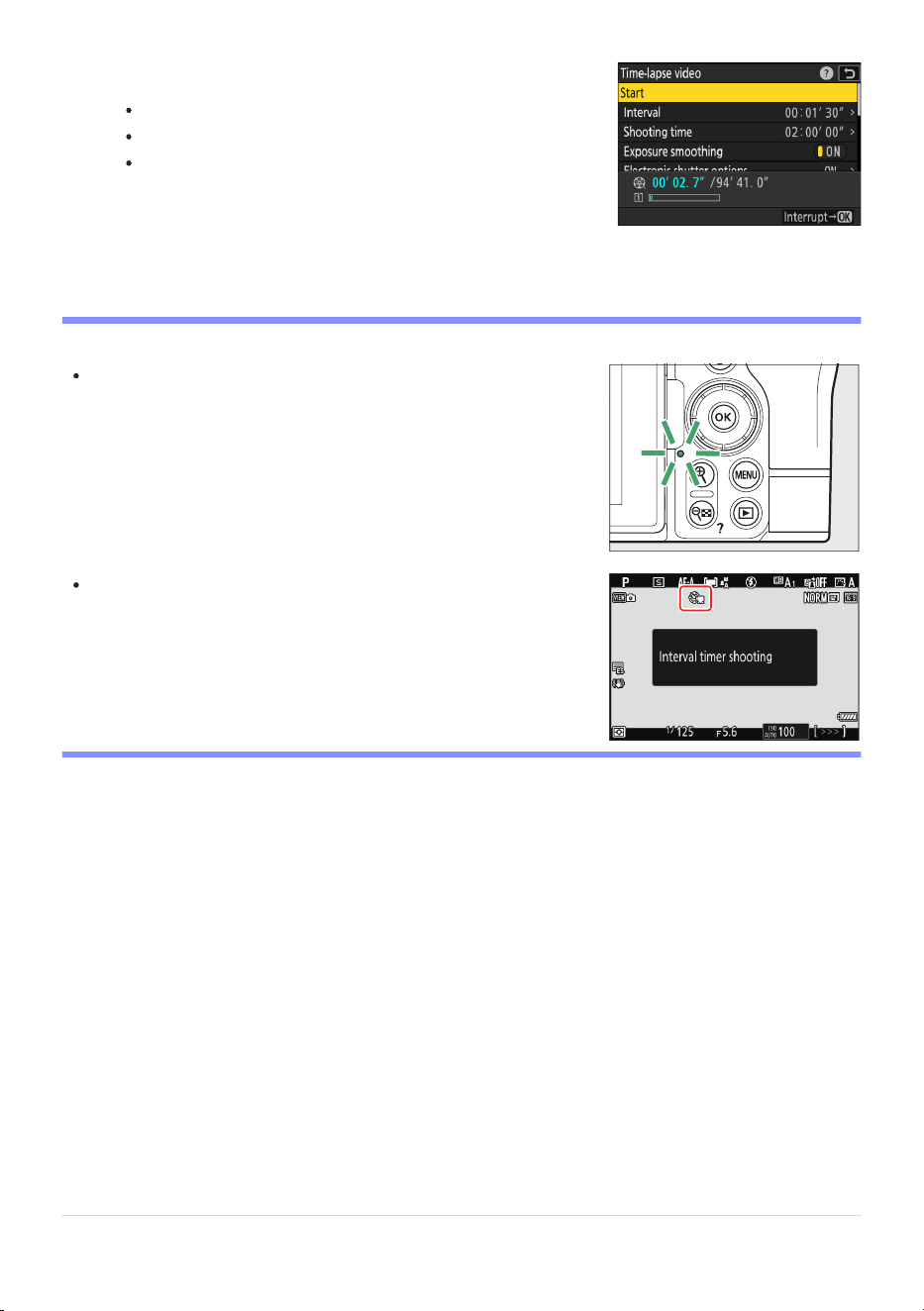
Highlight [Start] and press J.
Shooting starts aft
er about 3s.
The display turns off during shooting.
The camera takes pictures at interval selected for [Interval]
for the time selected for [Shooting time] in Step2.
The memory card access lamp lights between shots.
If the display is turned on by pressing the shutter-release button
halfway, the message [Int
erval timer shooting] will be displayed
and the 8 icon will flash.
D During Shooting
491
Time-lapse video
3
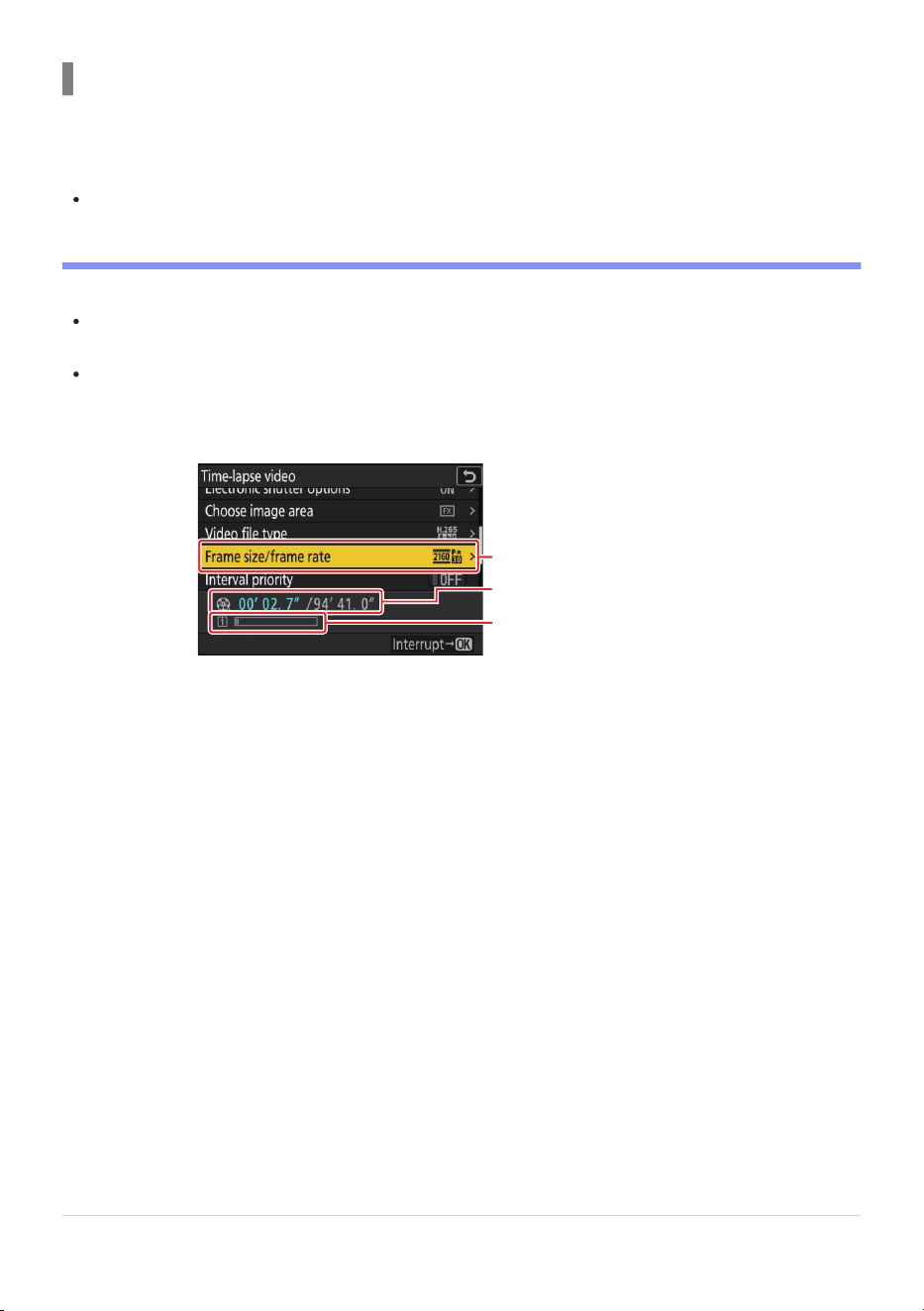
1
2
3
Frame size/frame rate
Length recorded/maximum
length
Memor
y card indicator
1
2
3
Ending Shooting
T
o end shooting before all the phot
os are taken, press J or select [Time-lapse video] in the photo
shooting menu, highlight [Off], and press J. Note that the menus may not be displayed when the G
button is pressed if the time selected for [Interval] is very short.
A video will be created from the frames shot to the point where shooting ended and normal
photography will resume.
D Calculating the Length of the Final Video
The total number of frames in the final video can be calculated by dividing the shooting time
selected in Step2 by the interval, rounding up, and adding 1.
The length of the final video can then be calculated by dividing the number of shots by the
frame rate selected for [Frame size/frame rate] (for example, a 48-frame video recorded with
[1920×1080; 24p] selected for [Frame size/frame rate] will be about two seconds long).
D Picture Review
The K button cannot be used to view pictures while shooting is in progress. The current frame will
however be displayed for a few seconds after each shot if [On] or [On (monitor only)] is selected
for [Picture review] in the playback menu. Note that other playback operations cannot be performed
while the frame is displayed. The current frame may not be displayed if the interval is very short.
492
Time-lapse video

D Cautions: Time-Lapse Videos
Sound is not recorded with time-lapse videos.
The shutt
er speed and the time needed to record the picture to the memory card may vary from
shot to shot. As a result, camera may be unable to take shots at the selected interval.
Shooting will not begin if a time-lapse video cannot be recorded at current settings, for example if:
the value selected for [Interval] is longer than that selected for [Shooting time],
[00:00'00"] is selected for [Interval] or [Shooting time], or
the memory card is full.
Time-lapse photography will not start if the recording time is shown in red in the [Time-lapse
video] display. Adjust the [Interval] or [Shooting time].
If [ON] is selected for [Electronic shutter options] > [Electronic shutter], the shutter will sound
with every shot unless [Volume] is set to [0] (note that this applies even when [ON] is selected for
[Silent mode] in the setup menu).
Selecting [HLG] for [Tone mode] in the photo shooting menu fixes [Video file type] at [H.265
10-bit (MOV)].
The K button cannot be used to view pictures while time-lapse recording is in progress.
For consistent coloration, choose a white balance setting other than 4[Auto] or D[Natural
light auto] when recording time-lapse videos.
Regardless of the option selected for Custom Setting c3 [Power off delay]> [Standby timer], the
standby timer will not expire while recording is in progress.
Shooting may end if camera controls are used, settings are changed, or an HDMI cable is
connected. A video will be created from the frames shot to the point where shooting ended.
The following end shooting without a beep sounding or a video being recorded:
Disconnecting the power source
Ejecting the memory card
D Adjusting Settings Between Shots
Shooting and menu settings can be adjusted between shots. Note, however, that the monitor will turn
off approximately 2s before the next shot is taken.
D Time-Lapse Videos: Restrictions
Time-lapse video recording cannot be combined with some camera features, including:
video recording,
long time-exposures (“Bulb” or “Time”),
the self-timer,
high-speed frame capture +,
bracketing,
multiple exposures,
HDR overlay,
interval-timer photography,
focus shift, and
pixel shift.
493
Time-lapse video
-
-
-
-
-
Focus shift shooting
G buttonU
Cphoto shooting menu
Focus shift automatically varies focus over a series of shots. Use it to take photos that will later be
combined using focus stacking to create a single picture with increased depth of field. Before using
focus shift, choose a focus mode of AF‑A, AF‑S, or AF-C and a release mode other than self-timer or
high-speed frame capture +.
Option Description
[Start]
Star
t shooting. The camera will take the selected number of shots,
changing the focus distance by the selected amount with each shot.
[No. of shots] Choose the number of shots (maximum 300).
[Focus step width]
Focus shift varies the focus distance over a series of photographs.
Choose the amount the focus distance changes with each shot.
[Interval until next shot]
Choose the interval between shots, in seconds.
To ensure correct exposure when using a flash, choose an interval
long enough for the flash to charge.
[First-frame exposure lock]
[ON]: The camera locks exposure for all shots at the setting for
the first frame.
[OFF]: The camera adjusts exposure before each shot.
[Electronic shutter options]
Choose whether to use the electronic shutter.
When [ON] is selected for [Electronic shutter], the electronic
shutter will be used regardless of the option selected for Custom
Setting d6 [Shutter type].
The volume of the sound made when the electronic shutter is
released can be chosen using [Volume].
494
Focus shift shooting
Option Description
[Focus position auto reset]
[
ON]: Focus will return to the starting position once all the shots
in the current sequence have been taken. This saves you having
to refocus each time when photographing subjects at the same
focus distance several times in succession.
[OFF]: Focus remains fixed at the position for the final shot in the
sequence. This allows you to start from the most recent focus
position when photographing a single subject over multiple
consecutive series.
[Starting storage folder]
Highlight options and press J
or 2 to select (M) or deselect (U
).
[New folder]: A new folder is created for each new sequence.
[Reset file numbering]: File numbering is reset to 0001
whenever a new folder is created.
495
Focus shift shooting
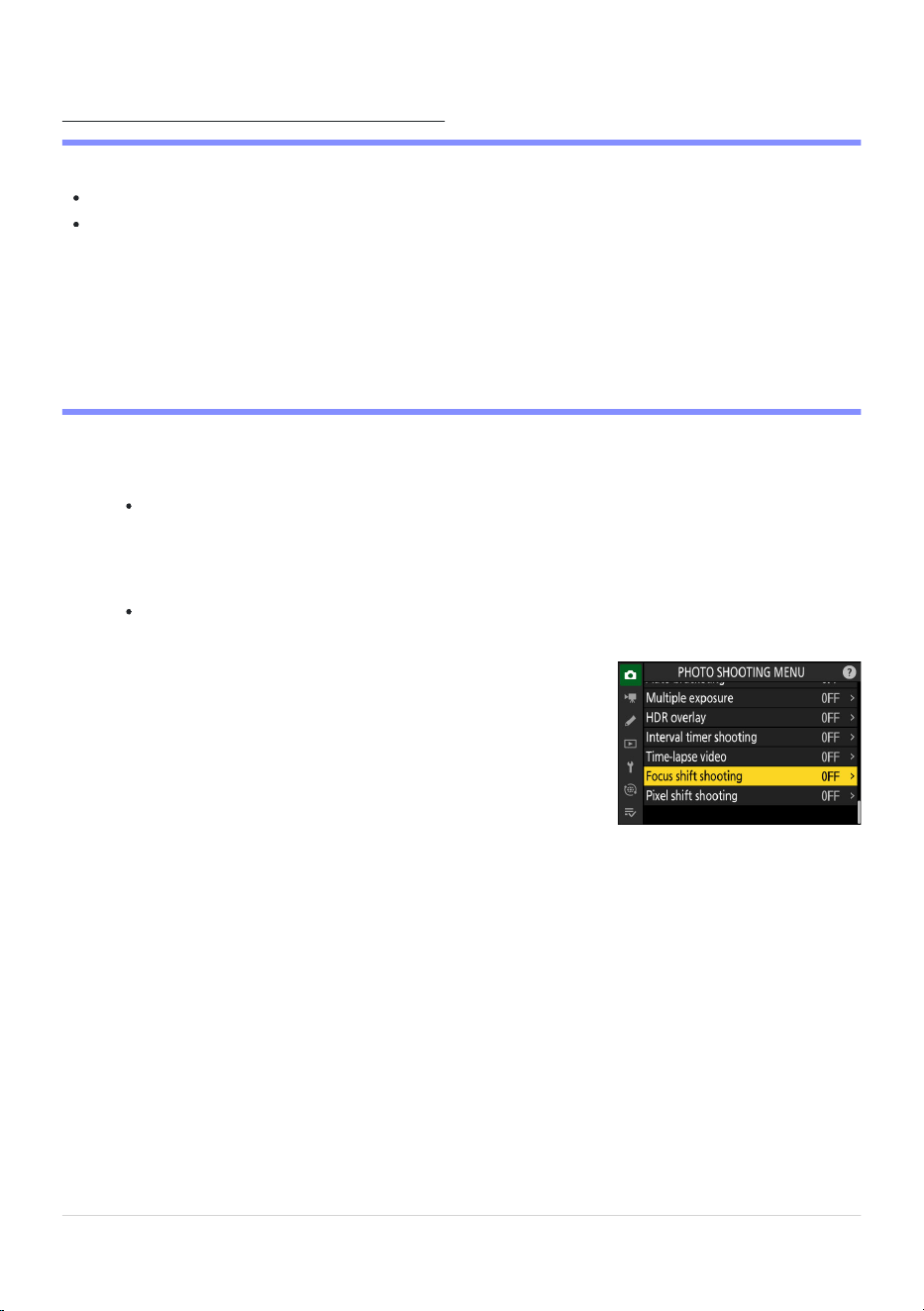
Highlight [Focus shift shooting] in the photo shooting
menu and press 2
.
Focus Shift Photography
D Before Shooting
Tak
e a test shot at current settings.
We recommend using one of the following power sources to prevent loss of power while shooting is
in progress:
A fully-charged battery
An optional EH-8P AC adapter connected using the supplied USB cable (featuring Type-C
connectors at both ends)
An optional EP‑5B power connector with an EH‑5d, EH‑5c, or EH‑5b AC adapter
A third-party portable charger (power bank)
Focus.
During focus shift, the camera takes a series of shots starting from a selected focus position
and continuing toward infinity. Given that shooting ends when infinity is reached, the starting
focus position should be slightly in front of (i.e., closer to the camera than) the closest point
on the subject.
Do not move the camera after focusing.
496
Focus shift shooting
-
-
-
-
1
2
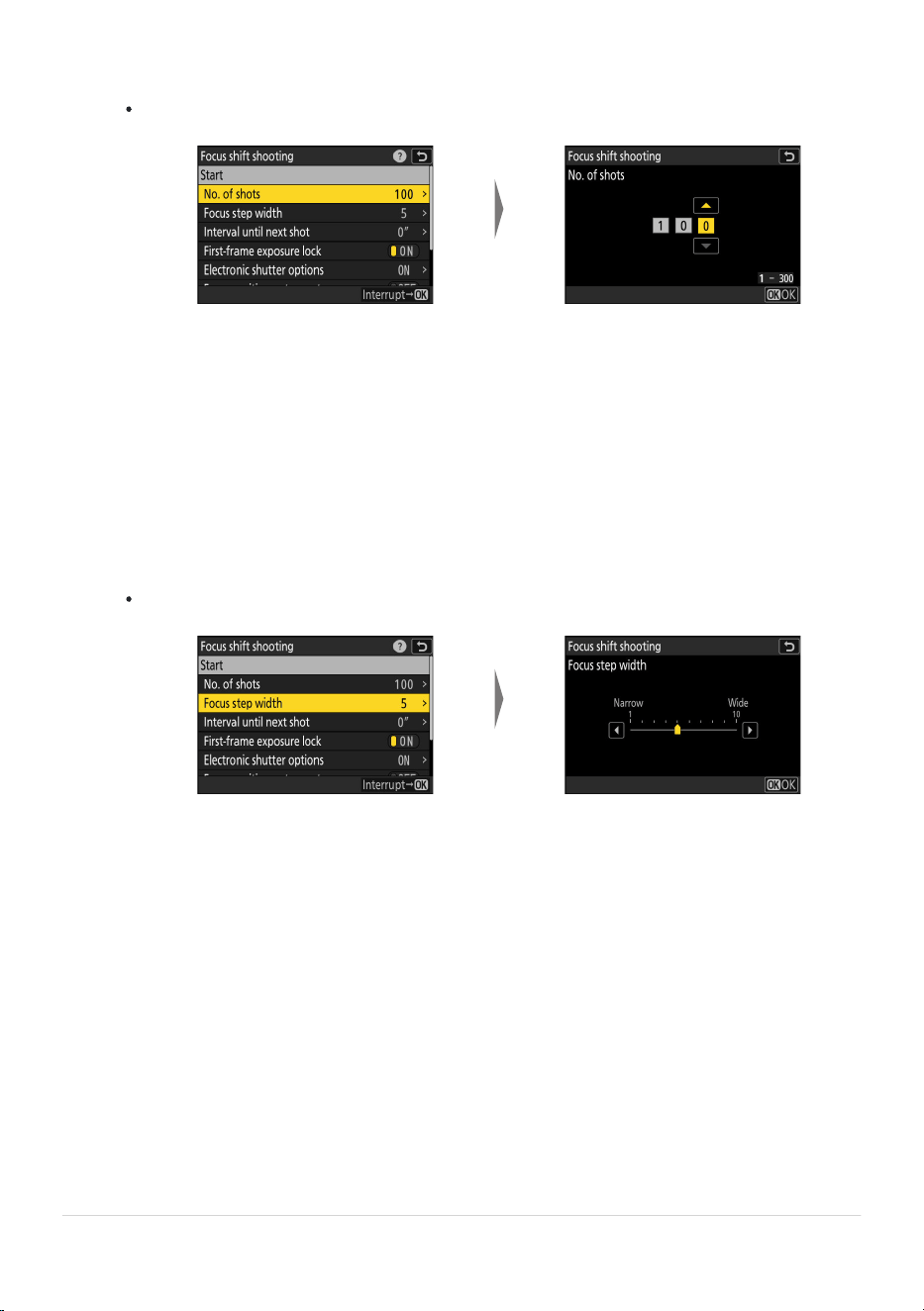
Highlight [No. of shots] and
press
2.
Choose the number of shots
and press J
.
Highlight [Focus step width]
and press 2
.
Choose a focus step width
and press J
.
Adjust focus shift settings.
Choose the number of shots.
The maximum number of shots is 300.
W
e recommend taking more shots than you think you’ll need. You can winnow them down
during focus stacking.
More than 100 shots may be required for photographs of insects or other small objects.
On the other hand, only a few may be needed to photograph a landscape from front to
back with a wide-angle lens.
Choose the amount the focus distance changes with each shot.
Press 4 to reduce the focus step width, 2 to increase.
Note that high settings increase the risk that some areas will be out of focus when the
shots are stacked. A value of 5 or less is recommended.
Try experimenting with different settings before shooting.
497
Focus shift shooting
3
-
-
-
-
-
-
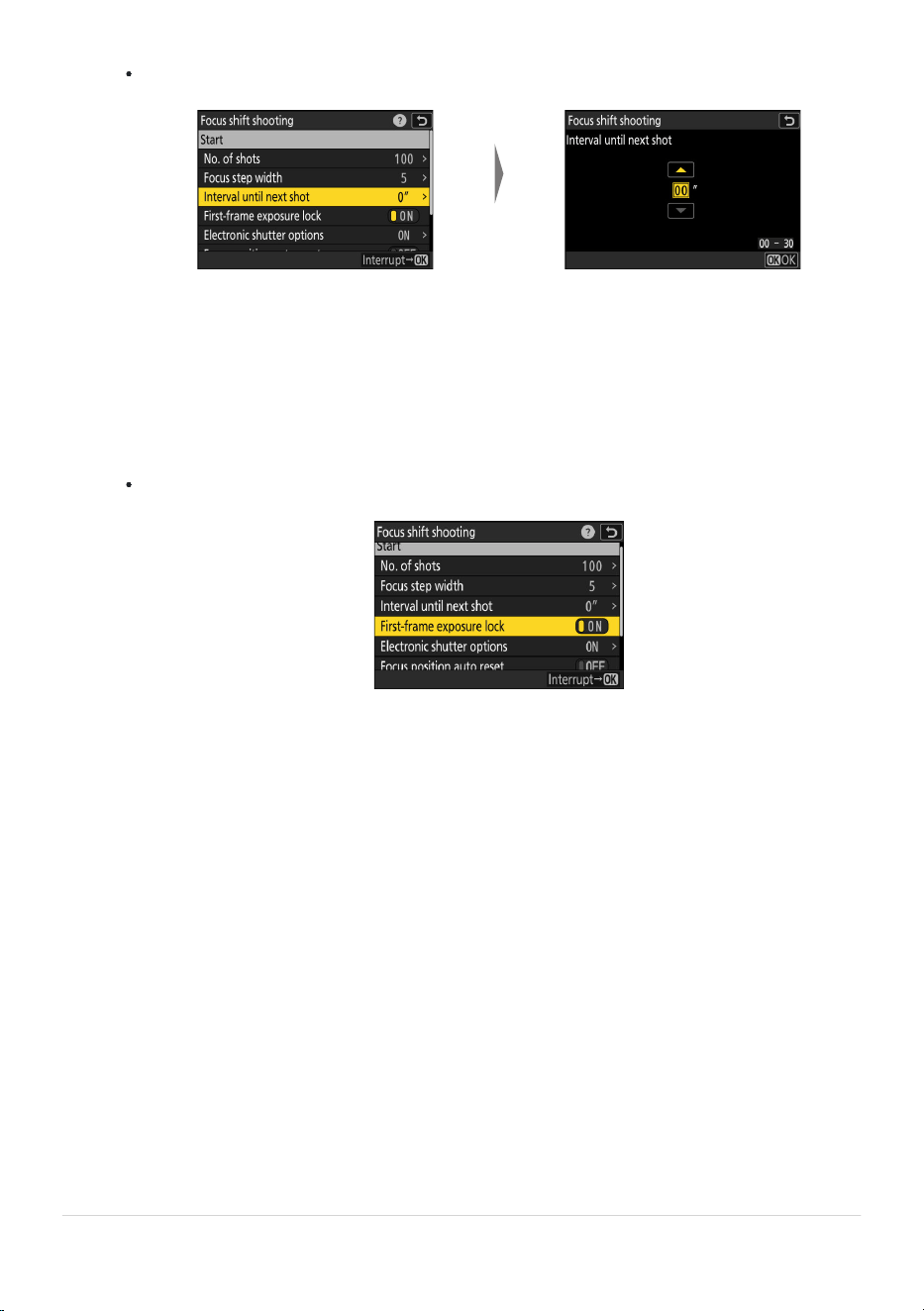
Highlight [Interv
al until next
shot] and press 2.
Choose the interval between
shots and press J.
Choose the int
erval until next shot.
Choose the interv
al between shots, in seconds.
To ensure correct exposure when using a flash, choose an interval long enough for the
flash to charge. A setting of [00] is recommended when shooting without a flash.
Enable or disable first-frame exposure lock.
Highlight [First-frame exposur
e lock] and press 2 to select [ON] or [OFF].
[OFF] is recommended if lighting and other conditions will not change during shooting,
[ON] when photographing landscapes and the like under variable lighting.
Selecting [ON] locks exposure at the value for the first shot, ensuring that all photos have
the same exposure. Large changes in subject brightness during shooting may however
result in apparent variations in exposure. This can be addressed by selecting [OFF].
498
Focus shift shooting
-
-
-
-
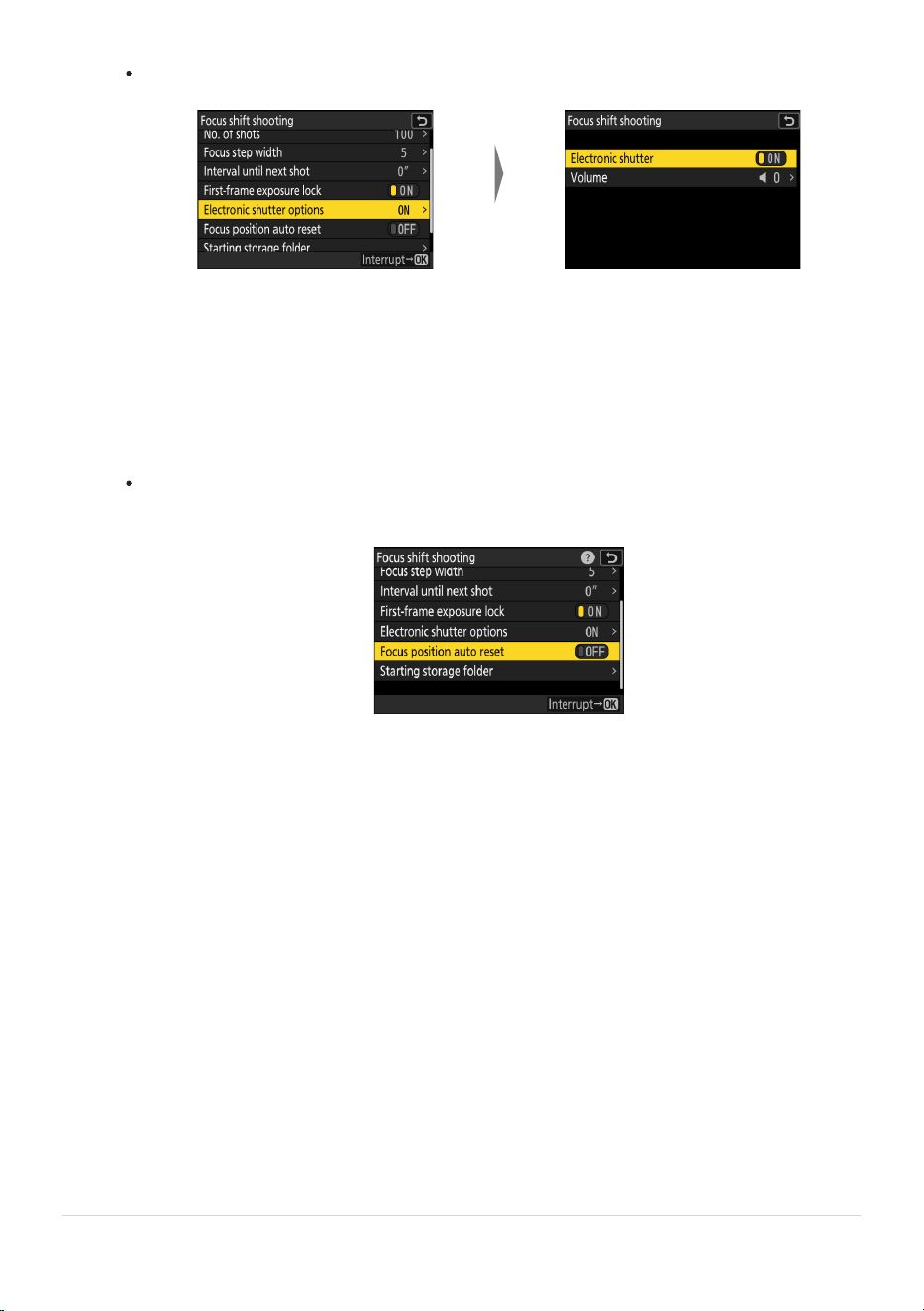
Highlight [Electronic shutter
options] and pr
ess 2.
Highlight [Electronic shutter]
and pr
ess 2 to select [ON] or
[OFF].
Choose whether to use the electronic shutter.
The volume of the sound made when the electr
onic shutter is released can be chosen
using [Volume].
Choose whether the focus position returns to the starting position at the end of each
sequence.
Highlight [Focus position aut
o r
eset] and pr
ess 2 to select [ON] or [OFF].
We recommend selecting [ON] when using focus shift to photograph subjects at the same
focus distance multiple times in succession.
If [OFF] is selected, focus will remain fixed at the position for the final shot in the
sequence.
499
Focus shift shooting
-
-
-
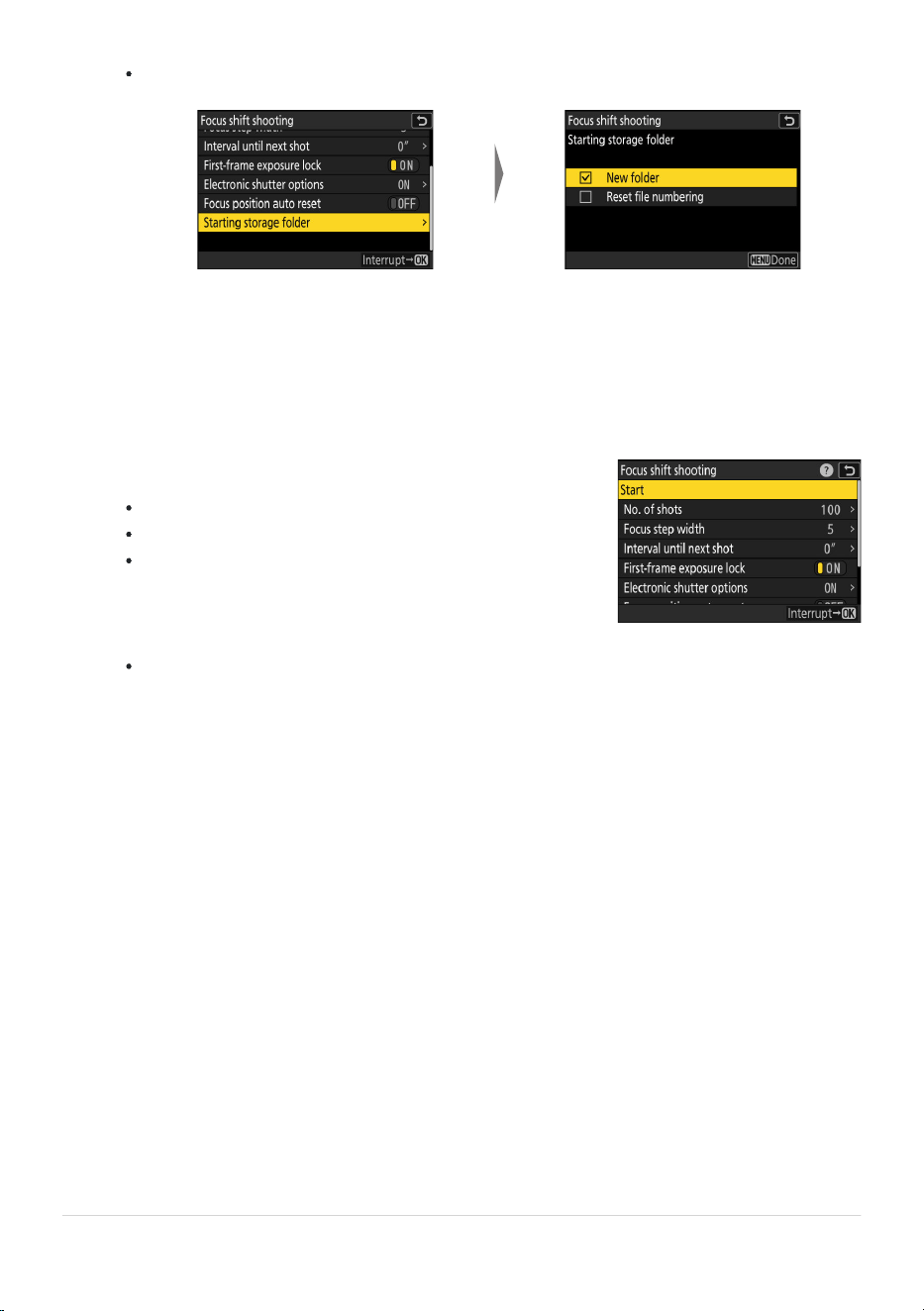
Highlight [Starting st
orage
folder] and press 2.
After highlighting the desired
options and pressing J t
o
turn them on (M) or off (U),
press 4.
Highlight [Start] and press J.
Shooting star
ts aft
er about 3s.
The display turns off during shooting.
The camera takes photographs at the selected interval,
starting at the focus distance selected at the start of
shooting and progressing out toward infinity by the selected
focus step distance with each shot.
Shooting ends when the selected number of shots has been
taken or focus reaches infinity.
Choose starting folder options.
500
Focus shift shooting
4

Ending Focus Shift Photography
To end shooting before all shots hav
e been taken, either:
select [Focus shift shooting] in the photo shooting menu, highlight [Off], and press J, or
press the shutter-release button halfway or press the J button between shots.
D Cautions: Focus Shift Photography
The shutter speed and the time needed to record the picture may vary from shot to shot. As a
result, the camera may be unable to take shots at the selected interval.
Shooting ends when focus reaches infinity, and consequently depending on the focus position at
the start of shooting, shooting may end before the selected number of shots has been taken.
If [ON] is selected for [Electronic shutter options] > [Electronic shutter], the shutter will sound
with every shot unless [Volume] is set to [0] (note that this applies even when [ON] is selected for
[Silent mode] in the setup menu).
Regardless of the option selected for Custom Setting c3 [Power off delay]> [Standby timer], the
standby timer will not expire while shooting is in progress.
If you are using a flash, choose an interval longer than the time needed for the flash to charge. If
the interval is too short, the flash may fire at less than the power needed for full exposure. When
[Interval until next shot] is set to [00], the flash will not fire regardless of the setting chosen for
[Flash mode] in the photo shooting menu.
If shooting cannot proceed at current settings, for example because shutter speed is set to “Bulb”
or “Time”, a warning will be displayed.
Changing camera settings while focus shift photography is in progress may cause shooting to end.
D Focus Shift Photography: Restrictions
Focus-shift photography cannot be combined with some camera features, including:
video recording,
long time-exposures (“Bulb” or “Time”),
the self-timer,
high-speed frame capture +,
bracketing,
multiple exposures,
HDR overlay,
interval-timer photography,
time-lapse video recording, and
pixel shift.
501
Focus shift shooting

Tip: Aperture
Given that pictures shot at v
ery small apertures (high f-numbers) may lack definition, we recommend
that you choose apertures wider (f-numbers lower) than f/8–f/11.
Tip: Close-ups
Because focus depth is reduced at short focus distances, we recommend choosing smaller focus steps
and increasing the number of shots when photographing subjects close to the camera.
502
Focus shift shooting

Pixel shift shooting
G buttonU
Cphoto shooting menu
The camera automatically shoots a series of NEF (RAW) photos, changing the position of the image
sensor with each one. The photos can be merged using Nikon’s NX Studio software to create a single
high-resolution image.
Option Description
[Pixel shift shooting mode]
[On (ser
ies)]: Take a series of pixel shift photos. To end pixel
shift photography, select [Pixel shift shooting mode] again and
choose [Off].
[On (single photo)]: End pixel shift photography after recording
a single series.
[Off]: End pixel shift photography.
[Number of shots]
Choose the number of photos taken each time the shutter-release
button is pressed. Long series require more time to record but
produce better-quality results when merged into a single image.
[Delay]
Choose the delay between the shutter-release button being pressed
all the way down and the start of pixel shift photography.
[Interval until next shot] Choose the interval between shots, in seconds.
503
Pixel shift shooting
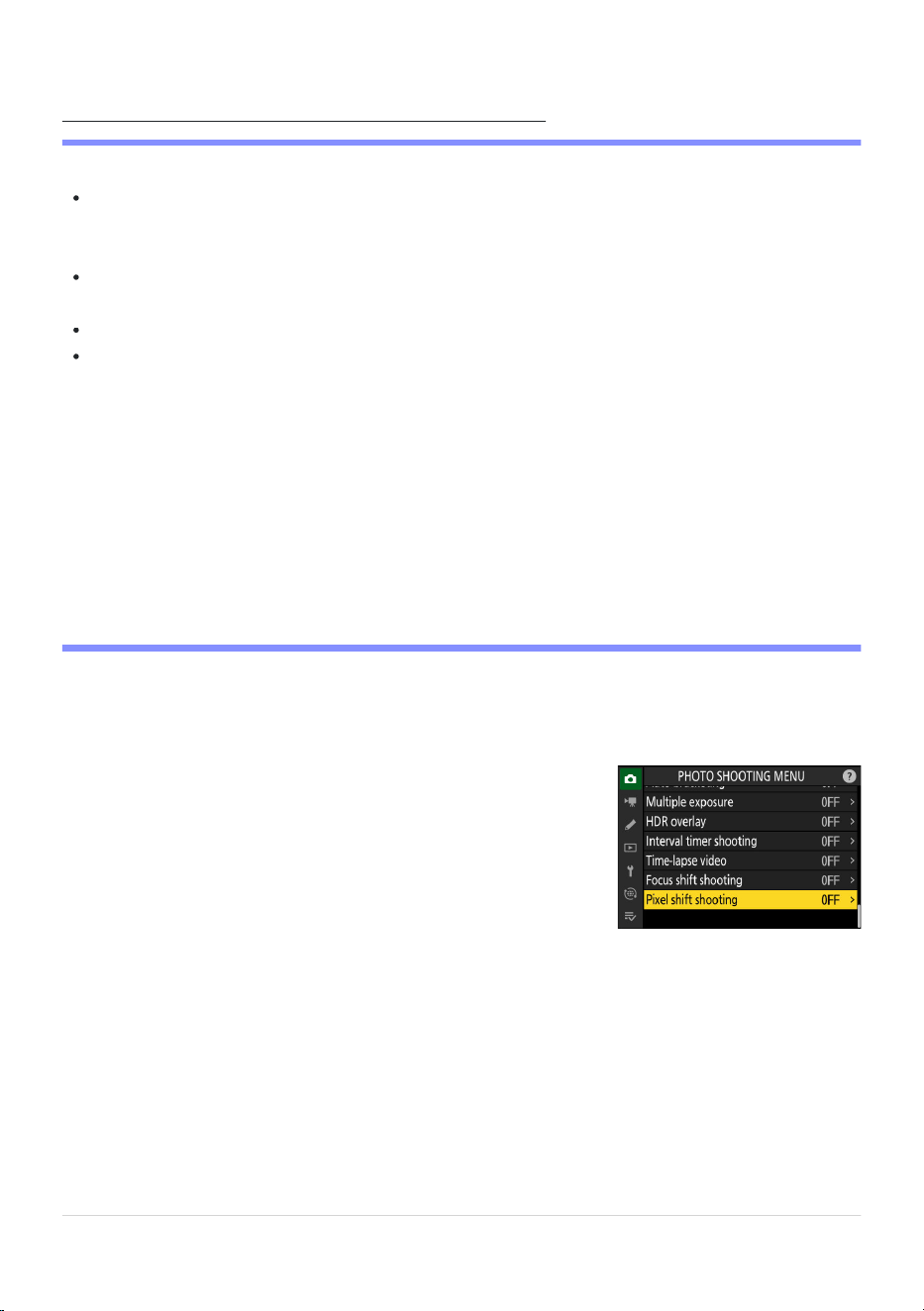
Highlight [Pixel shift shooting] in the photo shooting
menu and press 2
.
Taking Photos Using Pixel Shift
D Before Shooting
Pixel shif
t is intended for pictures of landscapes, buildings, and other static subjects shot with the
camera on a tripod. The desired results may consequently not be achieved with moving subjects or
shots taken without a tripod.
To improve the quality of merged pixel shift images, we recommend using [Pixel mapping] in the
setup menu before shooting.
Take a test shot at current settings.
We recommend using one of the following power sources to prevent loss of power while shooting is
in progress:
A fully-charged battery
An optional EH-8P AC adapter connected using the supplied USB cable (featuring Type-C
connectors at both ends)
An optional EP‑5B power connector with an EH‑5d, EH‑5c, or EH‑5b AC adapter
A third-party portable charger (power bank)
D NXStudio
Be sure to download and install the latest version from the Nikon Download Center. Earlier versions
may not support pixel shift merge.
Keep the camera steady, for example by using a tripod.
504
Pixel shift shooting
-
-
-
-
1
2
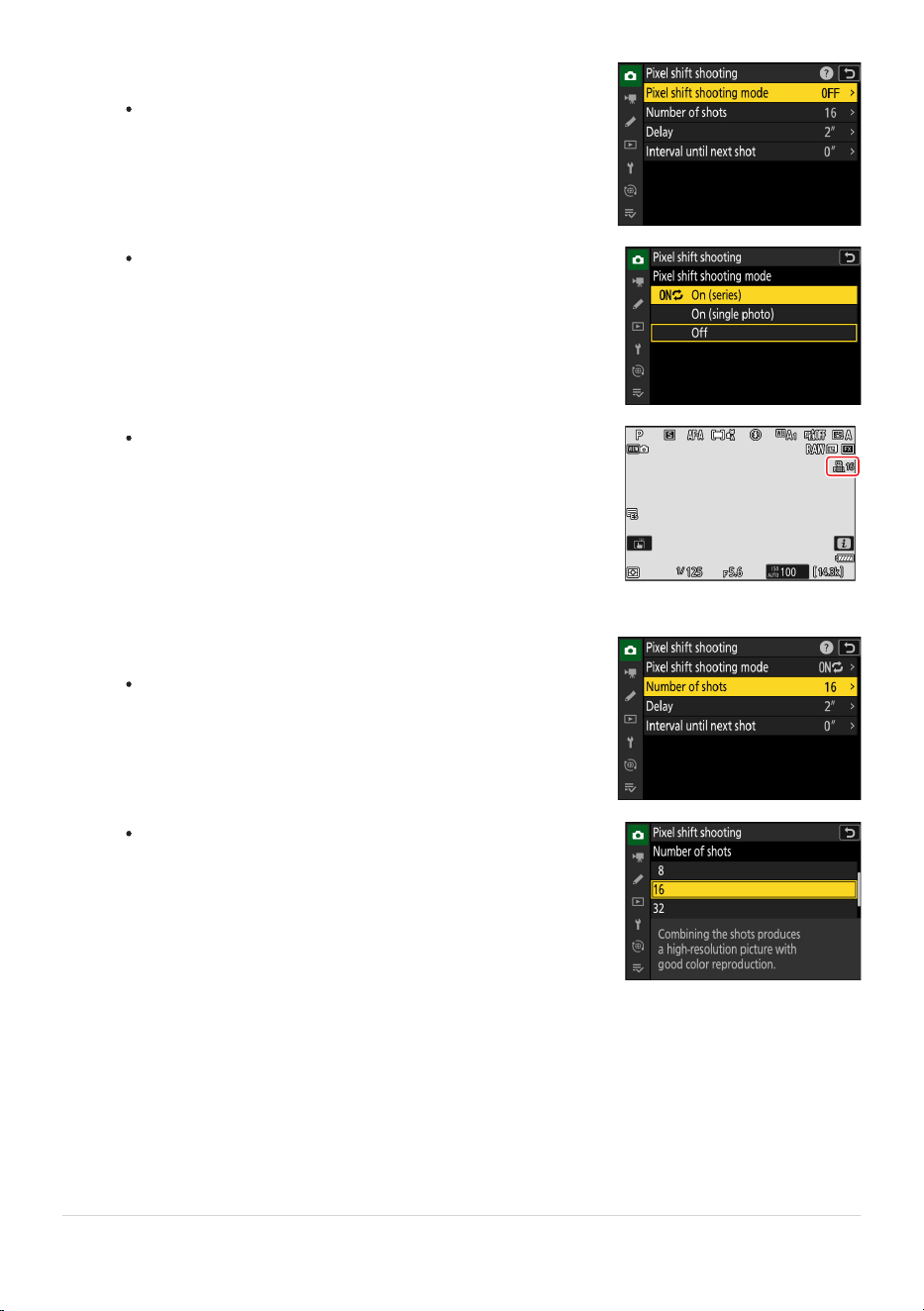
Select a [Pixel shift shooting mode].
Highlight [Pixel shift shooting mode] and pr
ess 2.
Highlight [On (series)] or [On (single phot
o)] using 1 or 3
and press J.
Image quality will be fixed at [RAW].
The electronic shutter will be used regardless of the option
selected for Custom Setting d6 [Shutter type].
-
-
A Z icon will appear in the shooting display.
Choose the [Number of shots].
Highlight [Number of shots] and pr
ess 2.
Choose the number of shots using 1 or 3 and press J.
505
Pixel shift shooting
3
4
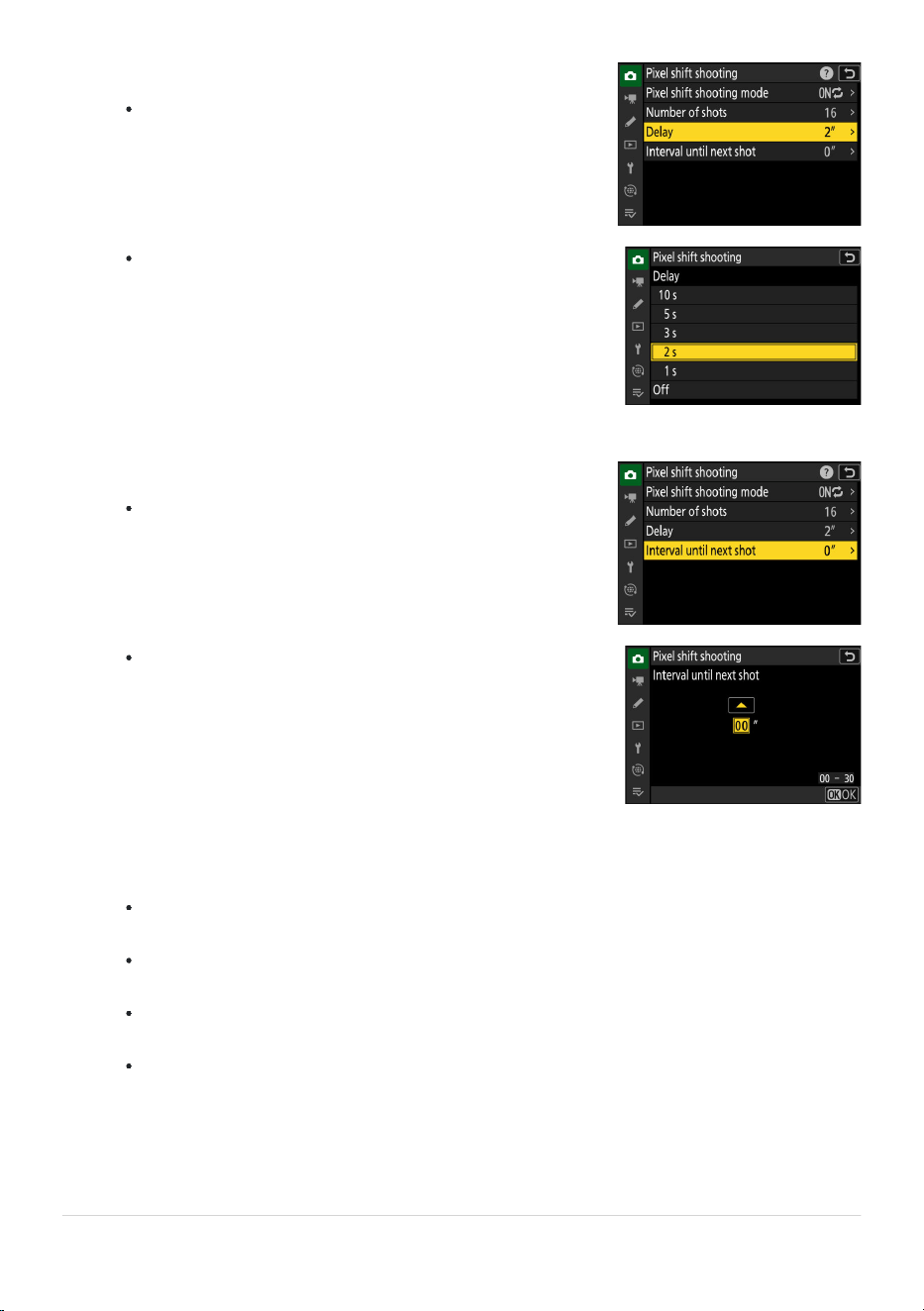
Choose a value for [Delay].
Highlight [Delay] and press 2. Choose the delay betw
een
the shutter-release button being pressed all the way down
and the start of pixel shift photography.
Choose a delay (in seconds) using 1 or 3 and press J.
Choose a value for [Interval until next shot].
Highlight [Interv
al until next shot] and press 2. Choose
the interval between shots, in seconds.
Choose an interval (in seconds) using 1 or 3 and press J.
Frame the photograph, focus, and shoot.
Press the shutter
-release button all the way down to begin taking the specified number of
NEF (RAW) photos after the time selected for [Delay].
Shooting may continue for some time depending on the value selected for [Number of
shots].
If [On (series)] is selected for [Pixel shift shooting mode], you can continue to take
photographs using pixel shift until [Off] is selected.
If [On (single photo)] is selected for [Pixel shift shooting mode], pixel shift will end
automatically after a single series.
506
Pixel shift shooting
5
6
7

Merge the NEF (RAW) photos using NX Studio.
See NX Studio’
s online help for detailed instructions.
The desired results may not be achieved if the subject moved or lighting changed during
shooting.
Ending Pixel Shift
To end pixel-shift photography before all the photos in the current series have been taken, either press
the shutter-release button halfway or press the J button between shots.
D Cautions: Pixel Shift
Optional flash units will not fire.
In continuous release modes, only one photograph will be taken each time the shutter-release
button is pressed all the way down.
Changing camera settings while pixel shift is in progress may cause shooting to end.
Shutter speeds of “Bulb” and “Time” are not available.
The focus mode for autofocus is fixed at AF-S. If the option currently selected for AF-area mode is
available only with AF-C, the AF-area mode will switch to single-point AF.
Custom Setting d7 [Extended shutter speeds (M)] is fixed at [OFF].
D Pixel Shift: Restrictions
Pixel shift cannot be combined with some camera features, including:
video recording,
the self-timer,
high-speed frame capture +,
long exposure noise reduction,
photo flicker reduction,
vibration reduction,
bracketing,
multiple exposures,
HDR overlay,
interval-timer photography,
time-lapse video recording,
focus shift,
exposure delay mode, and
energy saving (photo mode).
507
Pixel shift shooting
8
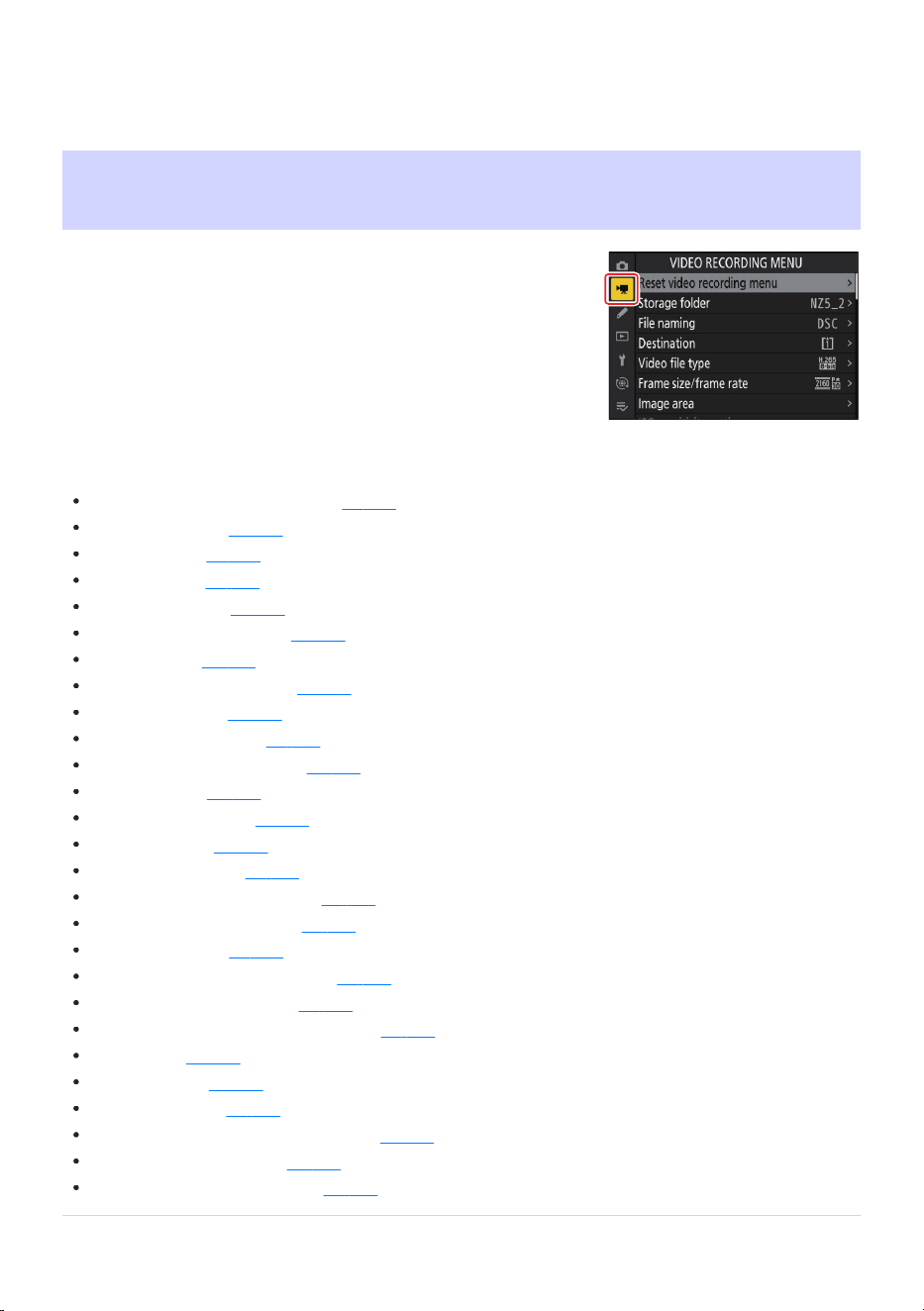
To view the video recording menu, select the 1 tab in the camera
menus.
The Video Recording Menu
The Video Recording Menu
The video r
ecording menu contains the following items:
[Reset video recording menu] (
0 510)
[Storage folder] ( 0 511)
[File naming] ( 0 512)
[Destination] ( 0 513)
[Video file type] ( 0 514)
[Frame size/frame rate] ( 0 515)
[Image area] (
0 516)
[ISO sensitivity settings] ( 0 517)
[White balance] (
0 518)
[Set Picture Control] ( 0 519)
[Manage Picture Control] ( 0 520)
[HLG quality] ( 0 521)
[Active D-Lighting] ( 0 522)
[High ISO NR] ( 0 523)
[Vignette control] ( 0 524)
[Diffraction compensation] ( 0 525)
[Auto distor
tion control] (
0 526)
[Skin soft
ening] (
0 527)
[Portrait impr
ession balance] (
0 528)
[Video flicker r
eduction] (
0 529)
[High-frequency flick
er reduction] (
0 530)
[Metering] (
0 531)
[Focus mode] ( 0 532)
[AF-area mode] ( 0 533)
[AF/MF subject detection options] ( 0 534)
[Product review mode] (
0 535)
[MF subject detection area] (
0 536)
508
The Video Recording Menu

[Video self-timer] ( 0 537)
[Vibration reduction] ( 0 538)
[Electronic VR] ( 0 539)
[Microphone sensitivity] ( 0 540)
[Attenuat
or] (
0 541)
[Frequency response] (
0 542)
[Wind noise reduction] ( 0 543)
[Mic jack plug-in power] ( 0 544)
[Headphone volume] ( 0 545)
[Timecode] ( 0 546)
[External r
ec. cntrl (HDMI)] (
0 547)
[Hi-Res Zoom] ( 0 548)
509
The Video Recording Menu

Reset video recording menu
G buttonU
1video recording menu
Reset all video recording menu settings to their default values.
510
Reset video recording menu

Storage folder
G buttonU
1video recording menu
Choose the folder in which subsequent pictures will be stored. More information is available in the
section devoted to the [Storage folder] item in the photo shooting menu (
0 407).
D “Storage Folder
”
Changes to [Storage folder] in the photo shooting menu apply in the video recording menu and vice
versa.
511
Storage folder


Destination
G buttonU
1video recording menu
Choose the slot to which videos are recorded when two memory cards are inserted.
The menu shows the time available on each card.
Recording ends automatically when no time remains on the current card.
513
Destination



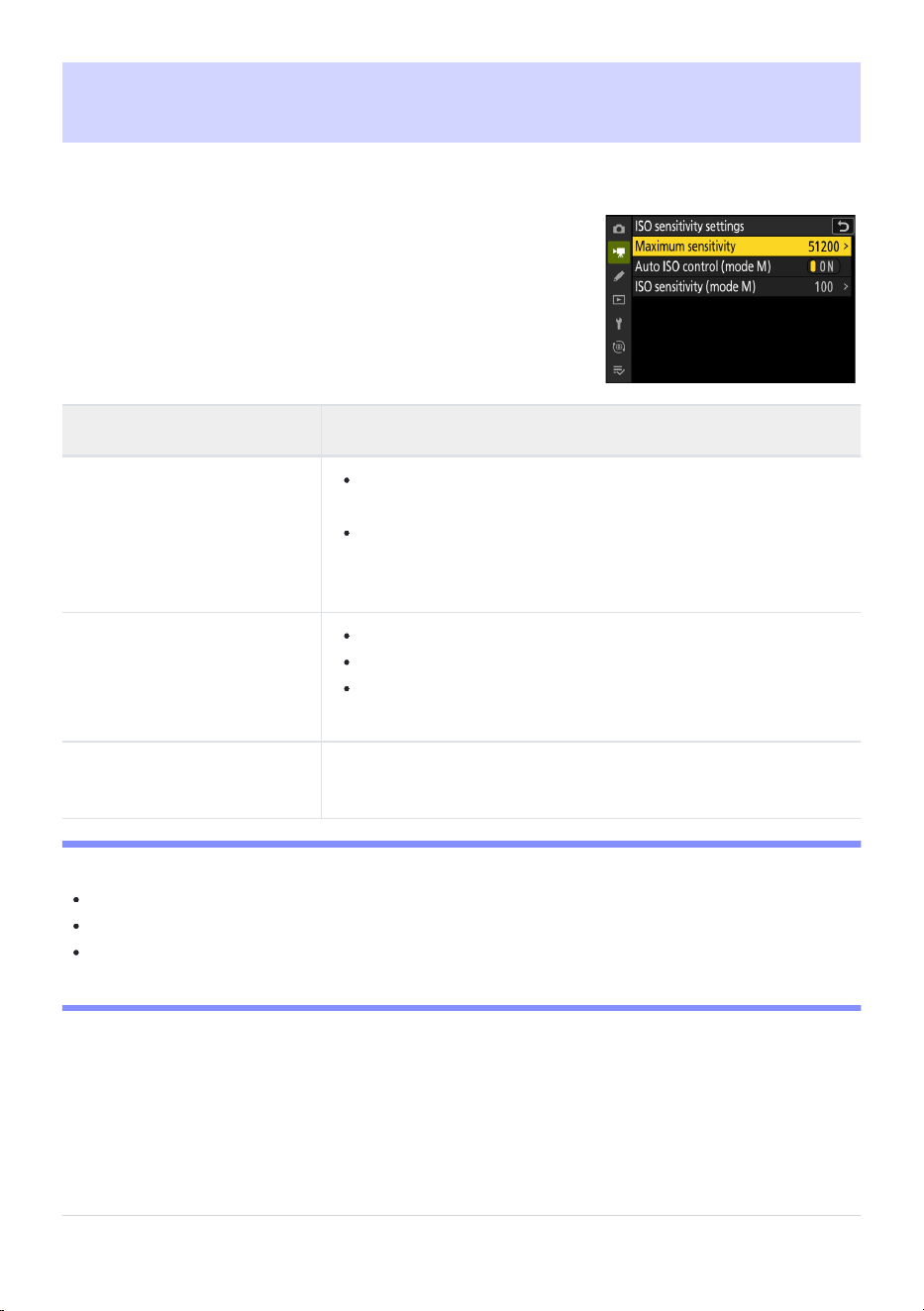
Adjust the following ISO sensitivity settings for use in video mode.
ISO sensitivity settings
G buttonU
1video recording menu
Option Description
[Maximum sensitivity]
Choose the upper limit for auto ISO sensitivity control from
v
alues betw
een ISO 200 and Hi 2.0.
The select
ed value serves as the upper limit for ISO sensitivity
in modes P, S, and A and when [ON] is selected for [Auto ISO
control (mode M)] in mode M.
[Auto ISO control (mode M)]
[ON]: Enable auto ISO sensitivity control in mode M.
[OFF]: Use the value selected for [ISO sensitivity (mode M)].
Regardless of the option selected, auto ISO sensitivity control is
used in modes other than M.
[ISO sensitivity (mode M)]
Choose the ISO sensitivity for mode M from values between ISO
100 and Hi 2.0.
D Cautions: Auto ISO Sensitivity Control
A
t high ISO sensitivities, “noise” (randomly-spaced bright pixels, fog, or lines) may increase.
At high ISO sensitivities, the camera may have difficulty focusing.
The foregoing can be prevented by choosing a lower value for [ISO sensitivity settings]>
[Maximum sensitivity].
517
ISO sensitivity settings




HLG quality
G buttonU
1video recording menu
Adjust HLG video image processing options for use when [HLG] is chosen as the tone mode for [Video
file type]> [H.265 10-bit (MOV)] in the video recording menu.
Option Description
[Quick sharp]
Apply sharpening to areas of contrast within the picture.
Adjusting [Quick sharp] simultaneously adjusts [Sharpening],
[Mid-range sharpening], and [Clarity] for well-b
alanced results.
Choose higher values for heightened sharpness. Choose lower
values for greater softness.
[Sharpening], [Mid-range sharpening], and [Clarity] each apply
to different areas within the picture. These parameters can also
be adjusted individually.
[Sharpening] Apply sharpening to small areas of contrast.
[Mid-range sharpening]
Apply sharpening to areas of contrast larger than those affected by
[Sharpening] and smaller those affected by [Clarity].
[Clarity]
Apply sharpening to large areas of contrast.
Fine outlines and the brightness and contrast of the picture as a
whole are unaffected.
[Contrast] Adjust overall contrast.
[Saturation] Control the vividness of colors.
[Hue] Adjust hue.
521
HLG quality

Active D-Lighting
G buttonU
1video recording menu
Preserve details in highlights and shadows, creating videos with natural contrast.
Option Description
Z
[Extra high]
Choose the amount of Active D-Lighting performed from (in order from high
to low) [Extra high], [High], [Normal
], and [Low].
P
[High]
Q
[Normal]
R
[Low]
[Off] Active D-Lighting off.
522
Active D-Lighting





Skin softening
G buttonU
1video recording menu
Adjust skin softening settings for video recording. Select [Same as photo settings] to use the option
currently selected for photos (
0 435).
D Restrictions on Skin So
ftening in Video Mode
Skin softening will not be performed if:
[N-RAW 12-bit (NEV)] is selected for [Video file type] in the video recording menu or
[N-Log] is chosen for tone mode when [H.265 10-bit (MOV)] is selected for [Video file type] in
the video recording menu.
527
Skin softening


Video flicker reduction
G buttonU
1video recording menu
This function reduces flicker and banding in the shooting display and in footage recorded under
fluorescent or mercury-vapor lighting. The frequency of the power supply can be selected from [Auto],
[50 Hz], and [60 Hz] according to the region of the shooting location.
If [Auto] fails to produce the desired results, select [50 Hz] or [60 Hz] according to the frequency of
the local power supply and take test shots. Choose [50 Hz] for areas with a 50 Hz power supply, [60
Hz] for areas with a 60 Hz power supply.
The [Video flicker reduction] setting also applies to the shooting display in photo mode.
D Cautions: [Video flicker reduction]
Flicker reduction may not produce the desired results if the subject is very bright. If this is the case,
try choosing a smaller aperture (higher f-number).
If flicker reduction does not produce the desired results, select mode S or M and choose a shutter
speed adapted to the frequency of the local power supply:
50Hz: ¹⁄₁₀₀s, ¹⁄₅₀s, ¹⁄₂₅s
60Hz: ¹⁄₁₂₅s, ¹⁄₆₀s, ¹⁄₃₀s
529
Video flicker reduction
-
-

High-frequency flicker reduction
G buttonU
1video recording menu
Selecting [On (shutter speed fine-tuning)] allows shutter speeds between ¹⁄₈₀₀₀ and ¹⁄₃₀ s to be
adjusted in smaller increments in modes S and M, letting speeds that keep flicker to a minimum be
found by viewing the preview in the shooting display. More information is available in the section
devoted to the [High-frequency flicker reduction] item in the photo shooting menu (
0 439).
530
High-frequency flicker reduction




AF/MF subject detection options
G buttonU
1video recording menu
Subject detection
Choose the type of subject to which the camera giv
es priority when focusing in video mode (
0 126).
AF when subject not detected
Choose whether the camera focuses if unable to detect a subject o
f the type selected for [Subject
detection] when [Full-time AF] is selected for focus mode.
If [ON] is selected, the camera will initiate autofocus whether or not a subject of the selected type is
detected.
Select [OFF] to disable autofocus when no subject of the selected type is detected.
534
AF/MF subject detection options





Electronic VR
G buttonU
1video recording menu
Choose whether to enable electronic vibration reduction in video mode.
D Caution: Electronic Vibration Reduction
[Electronic VR] is fixed at [OFF] while:
[N-RAW 12-bit (NEV)] is selected for [Video file type] in the video recording menu,
120p or 100p is selected for frame rate,
1920 × 1080 (slow-motion) is selected for frame size and rate, or
[ON] is selected for [Hi-Res Zoom] in the video recording menu.
539
Electronic VR
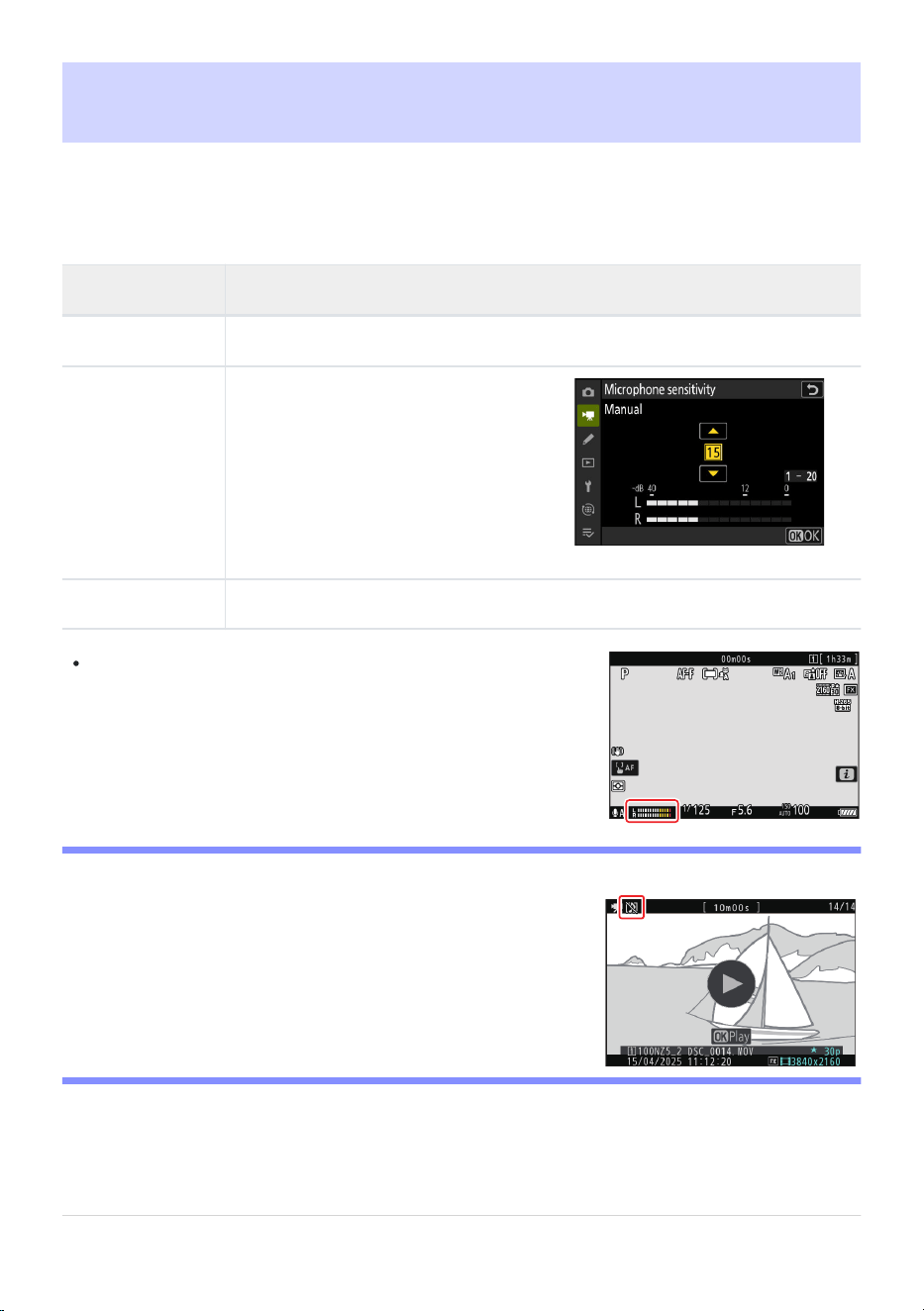
If the sound level is displayed in red, the volume is too high.
Reduce microphone sensitivity
.
Videos recorded with [Microphone off] select
ed for [Microphone
sensitivity] are indicated by a 2 icon.
Adjust microphone sensitivity
manually. Choose from v
alues of from
[1] to [20]. The higher the value, the
higher the sensitivity; the lower the
value, the lower the sensitivity.
Microphone sensitivity
G buttonU
1video recording menu
Turn built-in or external microphones on or off or adjust microphone sensitivity.
Option Description
[Auto] Microphone sensitivity is adjust
ed automatically.
[Manual]
[Microphone off] Tur
n sound recording off.
D Videos Without Sound
540
Microphone sensitivity

Attenuator
G buttonU
1video recording menu
Select [ON] to reduce microphone gain and prevent audio distortion when recording videos in loud
environments.
541
Attenuator
Frequency response
G buttonU
1video recording menu
Choose the range of frequencies to which built-in and external microphones respond.
Option Description
S
[Wide range]
Record a wide range of frequencies. Choose for everything from music to
the bustling hum of a city street.
T
[V
ocal range] Choose for human voices.
542
Frequency response

Wind noise reduction
G buttonU
1video recording menu
Select [ON] to enable the low-cut filter, reducing noise produced by wind blowing over the built-in
microphone. Note that other sounds may also be affected.
Selecting [ON] for [Wind noise reduction] has no effect on optional stereo microphones. Wind-noise
reduction for optional stereo microphones that support this feature can be enabled or disabled using
microphone controls.
543
Wind noise reduction

Mic jack plug-in power
G buttonU
1video recording menu
The camera does not provide power to external microphones when [OFF] is selected.
To prevent noise from interference generated by the power supply, we recommend turning plug-in
power [OFF] when using microphones that do not require plug-in power.
For information on whether your microphone requires plug-in power, consult the manufacturer.
544
Mic jack plug-in power

Headphone volume
G buttonU
1video recording menu
Press 1 or 3 to adjust headphone volume.
545
Headphone volume
Timecode
G buttonU
1video recording menu
Choose whether to record time codes giving the hour, minute, second, and frame number for each
frame when shooting videos. Time codes are not included in videos shot with [H.264 8-bit (MP4)]
selected for [Video file type] in the video recording menu.
Option Description
[Record timecodes]
[On
]: Record time codes. The time code appears in the shooting display.
[On (with HDMI output)]: Time codes will be included with footage
saved to external recorders connected to the camera via an HDMI cable.
[Off]: Time codes are not recorded.
[Count-up method]
[Record run]: Time codes are incremented only while recording is in
progress.
[Free run]: Time codes are incremented continuously. Time codes
continue to be incremented while the camera is off.
[Timecode origin]
[Reset]: Reset the time code to 00:00:00.00.
[Enter manually]: Enter the hour, minute, second, and frame number
manually.
[Current time]: Set the time code to the current time as reported by
the camera clock. Before proceeding, select [Time zone and date] in the
setup menu and make sure that the camera clock is set to the correct
time and date.
[Drop frame]
Select [ON] to compensate for discrepancies between the frame count and
the actual recording time at frame rates of 30 and 60fps.
D Caution: HDMI Devices
Selecting [On (with HDMI output)] for [Record timecodes] may disrupt footage output t
o HDMI
devices.
546
Timecode

External rec. cntrl (HDMI)
G buttonU
1video recording menu
Selecting [ON] allows camera controls to be used to start and stop recording on the external recorder.
For more information, see the section on “Recorders” (
0 302) in the “Connecting to HDMI TV
s and
Recorders” chapter.
547
External rec. cntrl (HDMI)

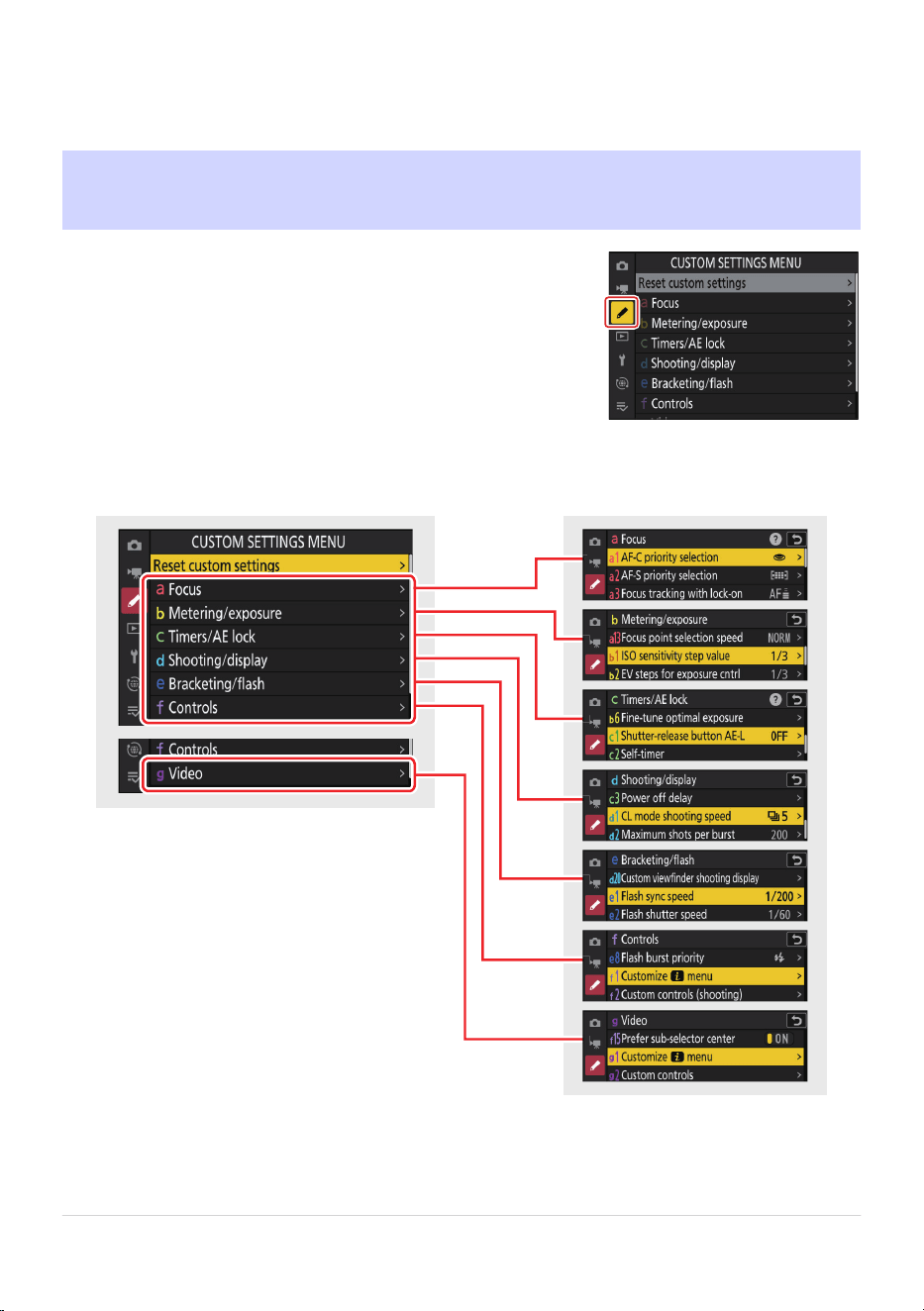
To view Custom Settings, select the A tab in the camera menus.
The Custom Settings Menu
The Custom Settings Menu
Custom Settings ar
e used to customize camera settings to suit individual preferences. The Custom
Settings menu is divided into two levels.
549
The Custom Settings Menu

The Custom Settings menu contains the following items:
1
[Reset custom settings
] (
0 553)
a [Focus]
a1: [AF-C priority selection] ( 0 554)
a2: [AF-S priority selection] ( 0 555)
a3: [Focus tracking with lock-on] ( 0 556)
a4: [Focus points used] ( 0 557)
a5: [Stor
e points by orientation] (
0 558)
a6: [AF activation] ( 0 560)
a7: [Focus point persistence] (
0 561)
a8: [Limit AF-area mode selection] ( 0 562)
a9: [Focus point wrap-around] ( 0 563)
a10: [Focus point display] ( 0 564)
a11: [Built-in AF-assist illuminator] (
0 566)
a12: [Focus peaking] ( 0 567)
a13: [Focus point selection speed] ( 0 568)
a14: [Manual focus ring in AF mode]
2
( 0 569)
b [Metering/exposur
e]
b1: [ISO sensitivity step value] (
0 570)
b2: [EV steps for exposur
e cntrl] (
0 571)
b3: [Easy exposure compensation] ( 0 572)
b4: [Matrix meter
ing face detection] (
0 573)
b5: [Center-w
eighted area] (
0 574)
b6: [Fine-tune optimal exposure] ( 0 575)
c [Timers/AE lock]
c1: [Shutter
-release button AE-L] (
0 576)
c2: [Self-timer] ( 0 577)
c3: [Power o
ff delay] (
0 578)
d [Shooting/display]
d1: [CL mode shooting speed] ( 0 579)
d2: [Maximum shots per burst] ( 0 580)
d3: [Pre-Release Captur
e options] (
0 581)
d4: [Sync. release mode options] (
0 583)
d5: [Exposure delay mode] ( 0 584)
d6: [Shutter type] ( 0 585)
d7: [Extended shutter speeds (M)] ( 0 586)
d8: [Limit selectable image area] ( 0 587)
d9: [File number sequence] ( 0 588)
d10: [View mode (photo Lv)] (
0 590)
d11: [Starlight view (photo L
v)] (
0 592)
d12: [Warm display color
s] (
0 593)
d13: [View all in continuous mode] ( 0 594)
550
The Custom Settings Menu
-
-
-
-
-
-
-
-
-
-
-
-
-
-
-
-
-
-
-
-
-
-
-
-
-
-
-
-
-
-
-
-
-
-
-
-

d14: [Release timing indicator] ( 0 595)
d15: [Image frame] ( 0 596)
d16: [Grid type] ( 0 597)
d17: [Virtual horizon type] ( 0 598)
d18: [Half-press t
o cancel zoom (MF)] (
0 601)
d19: [Custom monitor shooting display] (
0 602)
d20: [Custom viewfinder shooting display] ( 0 604)
e [Bracketing/flash]
e1: [
Flash sync speed] (
0 605)
e2: [Flash shutter speed] ( 0 607)
e3: [Exposure comp. for flash] (
0 608)
e4: [Auto c
ISO sensitivity control] (
0 609)
e5: [Modeling flash] ( 0 610)
e6: [Auto bracketing (mode M)] ( 0 611)
e7: [Bracketing order] (
0 612)
e8: [Flash burst prior
ity] (
0 613)
f [Controls]
f1: [
Customize i menu] (
0 614)
f2: [Custom controls (shooting)] ( 0 618)
f3: [Custom controls (playb
ack)] (
0 636)
f4: [Touch Fn] (
0 644)
f5: [Control lock] ( 0 646)
f6: [Rever
se dial rotation] (
0 647)
f7: [Release button t
o use dial] (
0 648)
f8: [Rever
se indicators] (
0 649)
f9: [Rever
se ring for focus] (
0 650)
f10: [Focus ring rotation range] (
0 651)
f11: [Control ring r
esponse] (
0 652)
f12: [Switch focus/contr
ol ring roles] (
0 653)
f13: [Power zoom (PZ) butt
on options] (
0 654)
f14: [Full-frame playback flicks] (
0 655)
f15: [Prefer sub-selector cent
er] (
0 657)
g [Video]
g1: [Customize i
menu] (
0 658)
g2: [Custom controls] ( 0 661)
g3: [Control lock] ( 0 672)
g4: [Limit AF-area mode selection] ( 0 673)
g5: [AF speed] ( 0 674)
g6: [AF tracking sensitivity] ( 0 675)
g7: [Hi-Res Zoom speed] ( 0 676)
g8: [Power zoom (PZ) butt
on options] (
0 677)
g9: [Fine ISO control (mode M)] ( 0 678)
g10: [Extended shutter speeds (S/M)] ( 0 679)
551
The Custom Settings Menu
-
-
-
-
-
-
-
-
-
-
-
-
-
-
-
-
-
-
-
-
-
-
-
-
-
-
-
-
-
-
-
-
-
-
-
-
-
-
-
-

g11: [View assist] ( 0 680)
g12: [Zebra patter
n] (
0 681)
g13: [Limit zebra patter
n tone range] (
0 683)
g14: [Grid type] ( 0 684)
g15: [Brightness information display] (
0 685)
g16: [Half-press t
o cancel zoom (MF)] (
0 686)
g17: [Custom monitor shooting display] (
0 687)
g18: [Custom viewfinder shooting display] ( 0 689)
g19: [Red REC frame indicator] (
0 690)
Items modified from default v
alues are indicated by asterisks (“U“).
Available with compatible lenses only.
552
The Custom Settings Menu
-
-
-
-
-
-
-
-
-
1
2

Reset custom settings
G buttonU
ACustom Settings menu
Reset custom settings to their default values.
553
Reset custom settings

a1: AF-C priority selection
G buttonU
ACustom Settings menu
Choose whether photos can be taken before the camera focuses when AF-C is selected.
Option Description
G
[Release]
Photos can be tak
en whenever the shutter-release button is pressed
(release priority).
B
[Focus + release]
Priority is normally given to release, but if the subject is dark or low
contrast and the camera is in continuous-release mode, priority will be
given to focus for the first shot in each series. For the remaining shots,
priority will be given to release regardless of focus. This helps ensure
that the first shot in each series is in focus.
F
[Focus] Photos can be taken only when the camera is in focus (focus priority).
554
a1: AF-C priority selection
a2: AF-S priority selection
G buttonUA
Custom Settings menu
Choose whether photos can be taken before the camera focuses when AF-S is selected.
Option Description
G
[Release]
Photos can be tak
en whenever the shutter-release button is pressed (release
priority).
F
[Focus] Photos can be taken only when the camera is in focus (focus priority).
555
a2: AF-S priority selection

Choose how quickly focus responds if something passes between
the subject and the camera when AF-C is selected for the focus
mode or AF-C
is selected when the camera is in AF-A mode.
a3: Focus tracking with lock-on
G buttonUA
Custom Settings menu
Blocked shot AF response
Choose [5] ([Delayed]) to help maintain focus on y
our original subject.
Choose [1] ([Quick]) to make it easier to shift focus to objects crossing your field of view.
Regardless of the option selected, blocked shot AF response functions in mode[3] when [3D-
tracking] is selected for AF-area mode.
If [Auto-area AF] is selected for AF-area mode, blocked shot AF response will function in mode [3]
when [2] or [1] ([Quick]) is selected.
556
a3: Focus tracking with lock-on

a4: Focus points used
G buttonUA
Custom Settings menu
Choose the number of focus points available for manual focus-point selection when an option other
than [Auto-area AF] is selected for AF-area mode.
Option Description
4
[All points]
Every focus point available in the current AF-area mode can be
selected. The number of points av
ailable varies with the AF-area mode.
5
[Alternating points]
The number of available focus points is reduced to one quarter of the
number available when [All points] is selected. Use for quick focus-
point selection. The number of points available for [Pinpoint AF] is not
affected.
557
a4: Focus points used
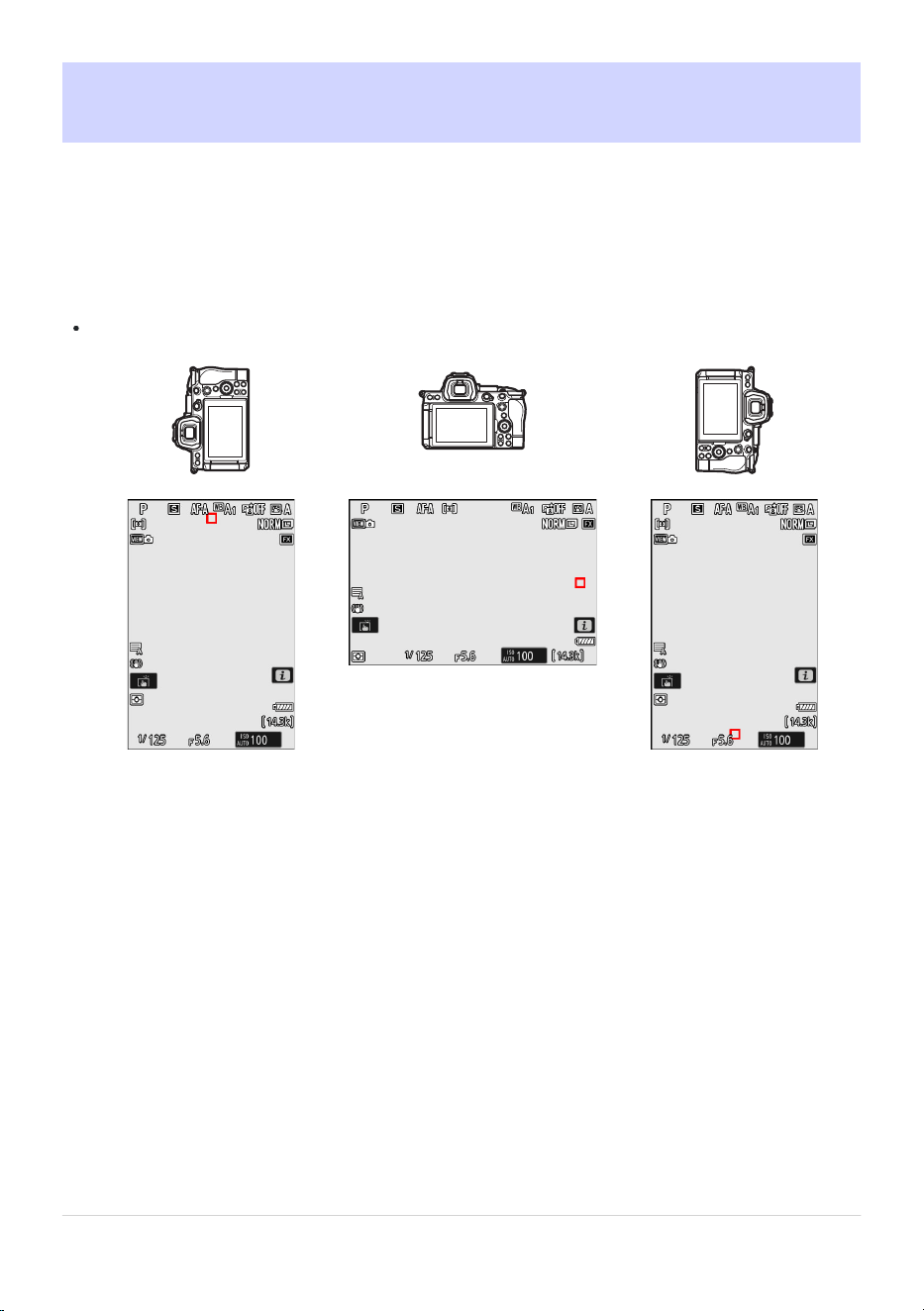
Camera rotated 90° counter-
clockwise
Landscape (wide) orientation Camera rotated 90° clockwise
a5: Store points by orientation
G butt
onU
ACustom Settings menu
Choose whether separate focus points can be selected for “wide” (landscape) orientation, for “tall”
(portrait) orientation with the camera rotated 90° clockwise, and for “tall” orientation with the camera
rotated 90° counterclockwise.
Select [Off] to use the same focus point regardless of camera orientation.
558
a5: Store points by orientation
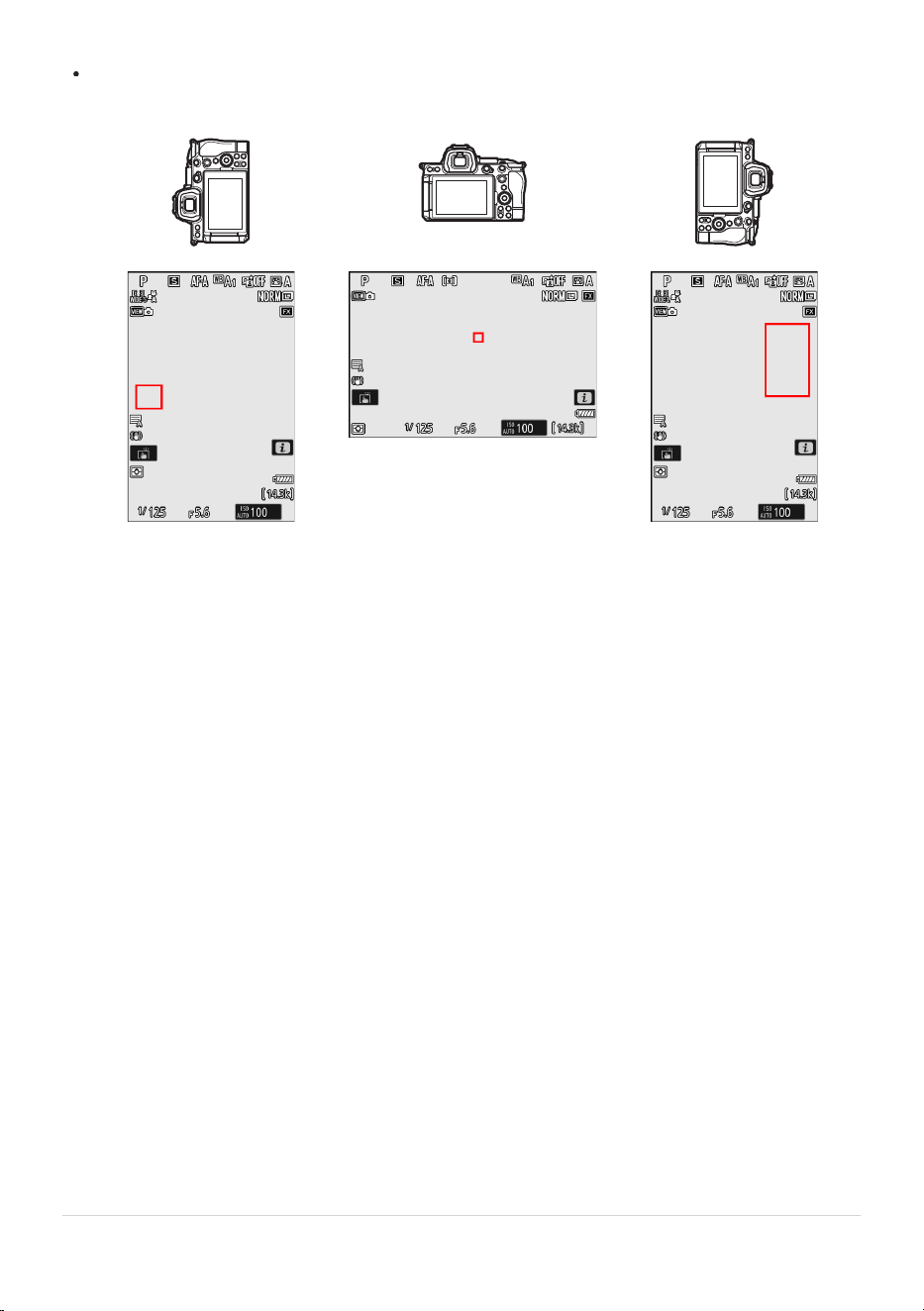
Camera rotated 90° counter-
clockwise
Landscape (wide) orientation Camera rotated 90° clockwise
Select [Focus point] t
o enable separat
e focus-point selection. To enable separate selection of both
the focus point and AF-area mode, choose [Focus point and AF-area mode].
559
a5: Store points by orientation
a6: AF activation
G buttonU
ACustom Settings menu
Choose whether the shutter-release button can be used to focus.
Option Description
[Shutter/AF-ON] The camera focuses when the shutter
-release button is pressed halfway.
[AF-ON only] The camera does not focus when the shutter-release button is pressed halfway.
Highlighting [AF-ON only] and pressing 2 displays [Out-of-focus release] options.
Option Description
[Enable] Photos can be taken whenever the shutter-release button is pressed (release priority).
[Disable]
Photos can be taken only when the camera is in focus (focus priority).
Focus using the AF-ON button or other controls t
o which AF-ON has been
assigned.
D Caution: [Pinpoint AF]
If [
Pinpoint AF] is selected for AF-area mode with Custom Setting a6 [AF activation] set to [AF-ON
only] and [Disable] chosen for [Out-of-focus release], the shutter can be released whether or not the
subject is in focus.
560
a6: AF activation

a7: Focus point persistence
G buttonU
ACustom Settings menu
Choose whether the focus point selected by the camera continues in use after you change AF-area
modes using a control to which one of [AF-area mode] or [AF-area mode + AF-ON] has been
assigned via Custom Setting f2 [Custom controls (shooting)]. This only applies if you change AF-area
modes while focusing with the shutter-release button pressed halfway.
Option Description
[Auto]
The focus point last chosen by the camera before y
ou switched AF-area modes remains in
effect.
[Off] The focus point last chosen by the user is restored.
Focus-point persistence applies if while the control is pressed, you switch from an AF-area mode
such as [Auto-area AF] in which the focus point is chosen automatically to a mode in which the
focus point is selected manually.
561
a7: Focus point persistence
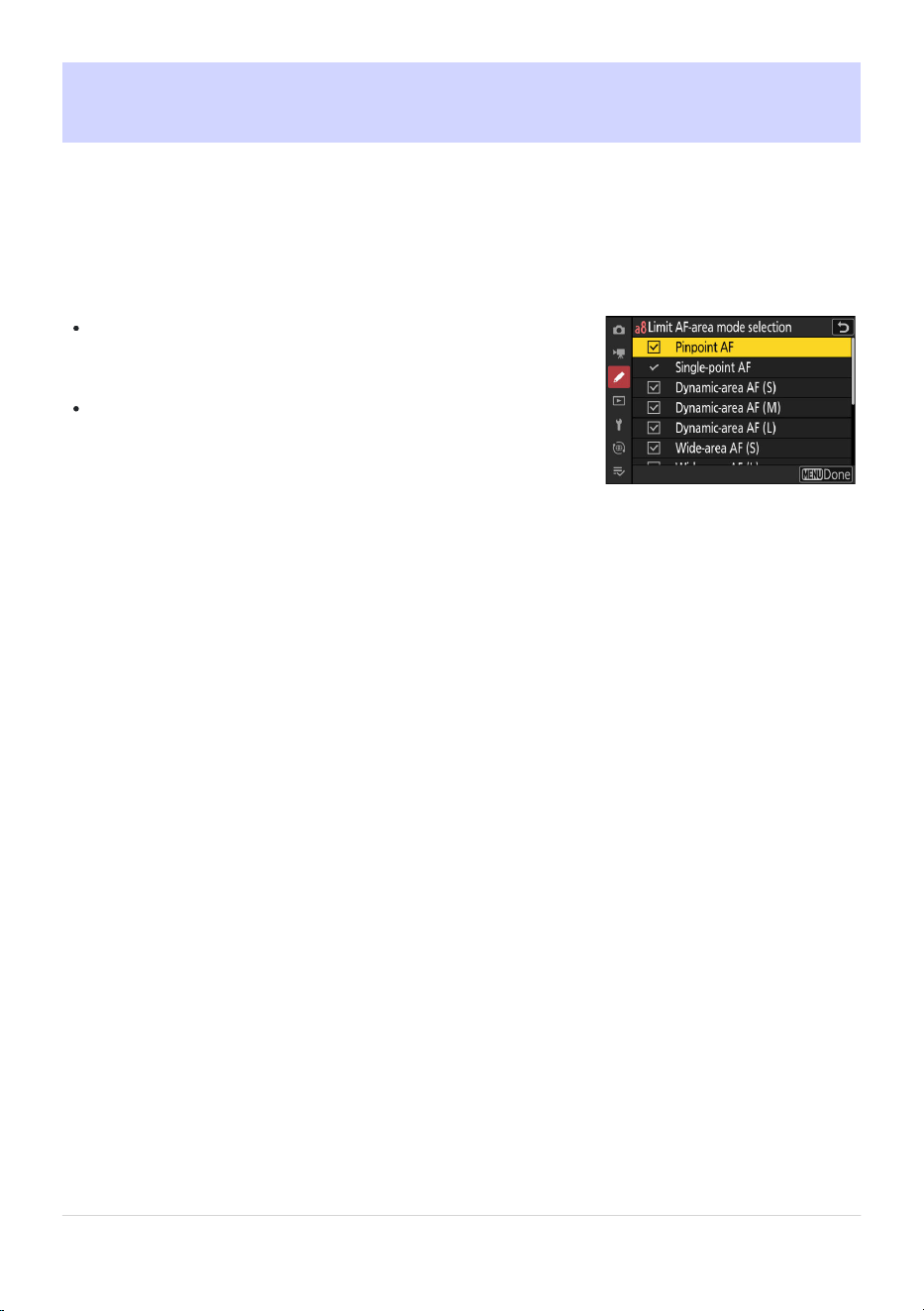
Highlight options and press J or 2 to select (M) or deselect (U
).
Modes marked with a check (M) are available for selection via
the sub-command dial.
To complete the operation, press G.
a8: Limit AF-area mode selection
G buttonUA
Custom Settings menu
Choose the AF-area modes that can be selected by rotating the sub-command dial while pressing a
control to which [Focus mode/AF-area mode] has been assigned using Custom Setting f2 [Custom
controls (shooting)].
562
a8: Limit AF-area mode selection

a9: Focus point wrap-around
G buttonU
ACustom Settings menu
Choose whether focus-point selection “wraps around” from one edge of the display to another. If [ON]
is selected, focus-point selection will “wrap around” from top to bottom, bottom to top, right to left,
and left to right, so that, for example, pressing 2 when a focus point at the right edge of the display is
highlighted selects the corresponding point at the left edge.
563
a9: Focus point wrap-around
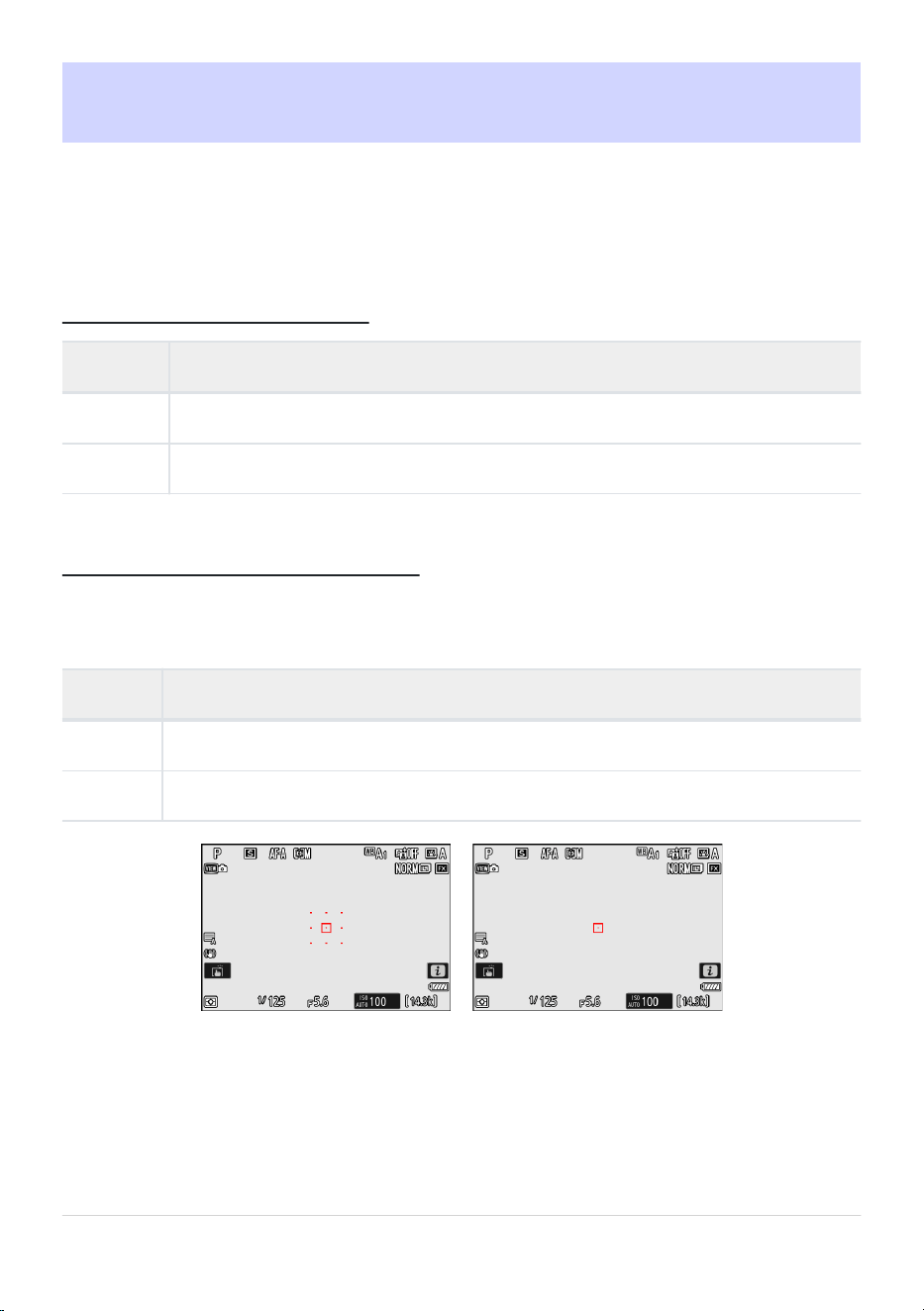
[ON] ([Dynamic-area AF (M)]) [OFF]
a10: Focus point display
G butt
onU
ACustom Settings menu
Choose from the focus point display options below.
Manual focus mode
Option Description
[ON] The focus point is displayed at all times in manual focus mode.
[OFF] The focus point is displayed only during focus-point selection.
Dynamic-area AF assist
Choose whether both the selected focus point and the surrounding focus points ar
e displayed in
dynamic-area AF mode.
Option Description
[ON] Display both the selected focus point and surrounding focus points.
[OFF] Display only the selected focus point.
564
a10: Focus point display

AF-C in-focus display
Choose whether the focus point changes color when the subject is in focus in focus mode AF‑C.
Option Description
[ON] The focus point is displayed in green when the camera judges that the subject is in focus.
[OFF]
The active focus point is displayed in red or yellow at all times, whether or not the camera
is in focus.
3D-tracking focus point color
The color of the focus point displayed when [3D-tracking] is select
ed for AF-area mode can be chosen
from [White] and [Red].
Focus point border width
Choose from 3 focus point border widths, fr
om [1] to [3].
565
a10: Focus point display
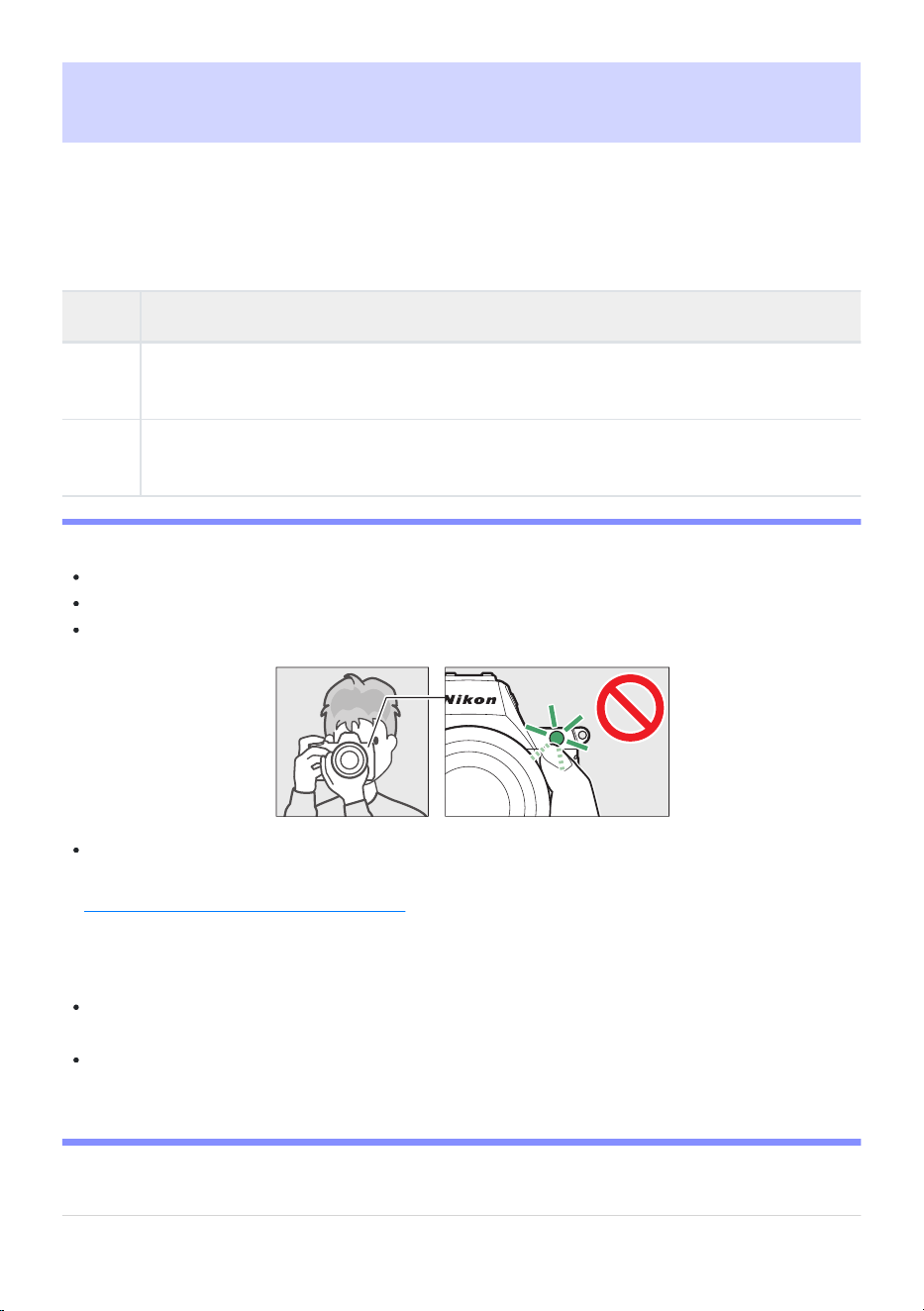
a11: Built-in AF-assist illuminator
G buttonUA
Custom Settings menu
Choose whether the built-in AF-assist illuminator lights to assist the focus operation in photo mode
when lighting is poor.
Option Description
[ON]
In photo mode, the illuminator will light as required when AF-S is selected for the focus
mode or AF-S
is selected when the camera is in AF-A mode.
[OFF]
The illuminator does not light to assist the focus operation. The camera may not be able
to focus when lighting is poor.
D The AF-Assist Illuminator
The AF-assist illuminator has a range o
f about 1–3m (3ft 4in.–9ft 10in.).
Remove lens hoods when using the illuminator.
Do not obstruct the AF-assist illuminator while it is lit.
Some lenses may block the light from the AF-assist illuminator at some or all focus distances.
Information on these restrictions is av
ailable from the Nikon Download Center.
https://downloadcenter.nikonimglib.com/
D Caution: Using Profot
o A10 (On-Camera Flash) as the AF-Assist Illuminator
The Profoto A10's continuous LED light can be used as the AF-assist illuminator.
When a Profoto A10 configured to act as an AF-assist illuminator is attached, it will light regardless
of the setting for Custom Setting a11 [Built-in AF-assist illuminator].
If the Profoto A10 is not configured to act as an AF-assist illuminator, the camera's AF-assist
illuminator will light in accordance with the setting set for Custom Setting a11 [Built-in AF-assist
illuminator].
566
a11: Built-in AF-assist illuminator

a12: Focus peaking
G buttonUA
Custom Settings menu
When focus peaking is enabled in manual focus mode, objects that are in focus are indicated by
colored outlines in the display. You can choose the color.
Focus peaking display
Select [ON] to enable focus peaking.
Focus peaking sensitivity
Choose focus peaking sensitivity from [3 (high sensitivity)], [
2 (standard)], and [1 (low sensitivity)].
The higher the value, the greater the depth that will be shown as being in focus.
Focus peaking highlight color
Choose the highlight color.
567
a12: Focus peaking

a13: Focus point selection speed
G buttonU
ACustom Settings menu
The speed at which the camera cycles through focus points while the multi selector or sub-selector is
pressed can be chosen from [Low], [Normal], and [High].
568
a13: Focus point selection speed

a14: Manual focus ring in AF mode
G buttonU
ACustom Settings menu
This item is available with compatible lenses only. Use it to choose whether the lens focus ring can be
used for manual focus in autofocus mode.
Option Description
[ON]
Autofocus can be over-ridden by rotating the lens focus ring (autofocus with manual
override). The focus ring can be used for manual focus while the shutter-r
elease button
is pressed halfway. To refocus using autofocus, lift your finger from the shutter-release
button and then press it halfway again.
[OFF] The lens focus ring cannot be used for manual focus in autofocus mode.
569
a14: Manual focus ring in AF mode

b1: ISO sensitivity step value
G buttonUA
Custom Settings menu
Choose whether changes to ISO sensitivity are made in increments of ¹⁄₃ or 1EV. If the value currently
selected for ISO sensitivity is not available at the chosen setting, ISO sensitivity will be set to the
nearest available value.
570
b1: ISO sensitivity step value

b2: EV steps for exposure cntrl
G buttonU
ACustom Settings menu
Select the increments used for adjustments to shutter speed, aperture, bracketing, and exposure and
flash compensation.
If [ 1 EV steps (comp. 1/3 EV)] is selected, changes to shutter speed, aperture, and bracketing will
be made in increments of 1EV and changes to exposure and flash compensation in increments of
¹⁄₃EV.
571
b2: EV steps for exposure cntrl

b3: Easy exposure compensation
G buttonUA
Custom Settings menu
Choose whether the E button is needed for exposure compensation in photo mode.
Option Description
[On (Auto reset)]
Only a command dial is needed to adjust exposur
e compensation. The setting
selected with the command dial is reset when the camera turns off or the
standby timer expires.
[On]
Only a command dial is needed to adjust exposure compensation. Exposure
compensation is not reset when the camera turns off or the standby timer
expires (note that the camera still resets exposure compensation in b mode
when it is turned off).
[Off]
Exposure compensation is set by pressing the E butt
on and rotating a
command dial.
This option tak
es effect in modes P, S, A, and b. Easy exposure compensation is not available in
mode M.
The command dial used varies with the mode.
572
b3: Easy exposure compensation

b4: Matrix metering face detection
G buttonUA
Custom Settings menu
Choose whether exposure is adjusted for the faces of human portrait subjects detected by the camera
when [Matrix metering] is selected.
Option Description
[ON] The camera adjusts exposure for faces.
[OFF] Exposure is not adjusted according to whether faces have been detected.
573
b4: Matrix metering face detection

b5: Center-weighted area
G buttonUA
Custom Settings menu
When [Center-weighted metering] is selected, the camera assigns the greatest weight to an area in
the center of the shooting display when setting exposure.
Option Description
R
[Small]
The camera assigns the greatest weight to an area equivalent to a circle
8mm in diameter.
S
[S
tandard]
The camera assigns the greatest weight to an area equivalent to a circle
12mm in diameter.
T
[Average] Weighting is based on the average of the entire frame.
574
b5: Center-weighted area
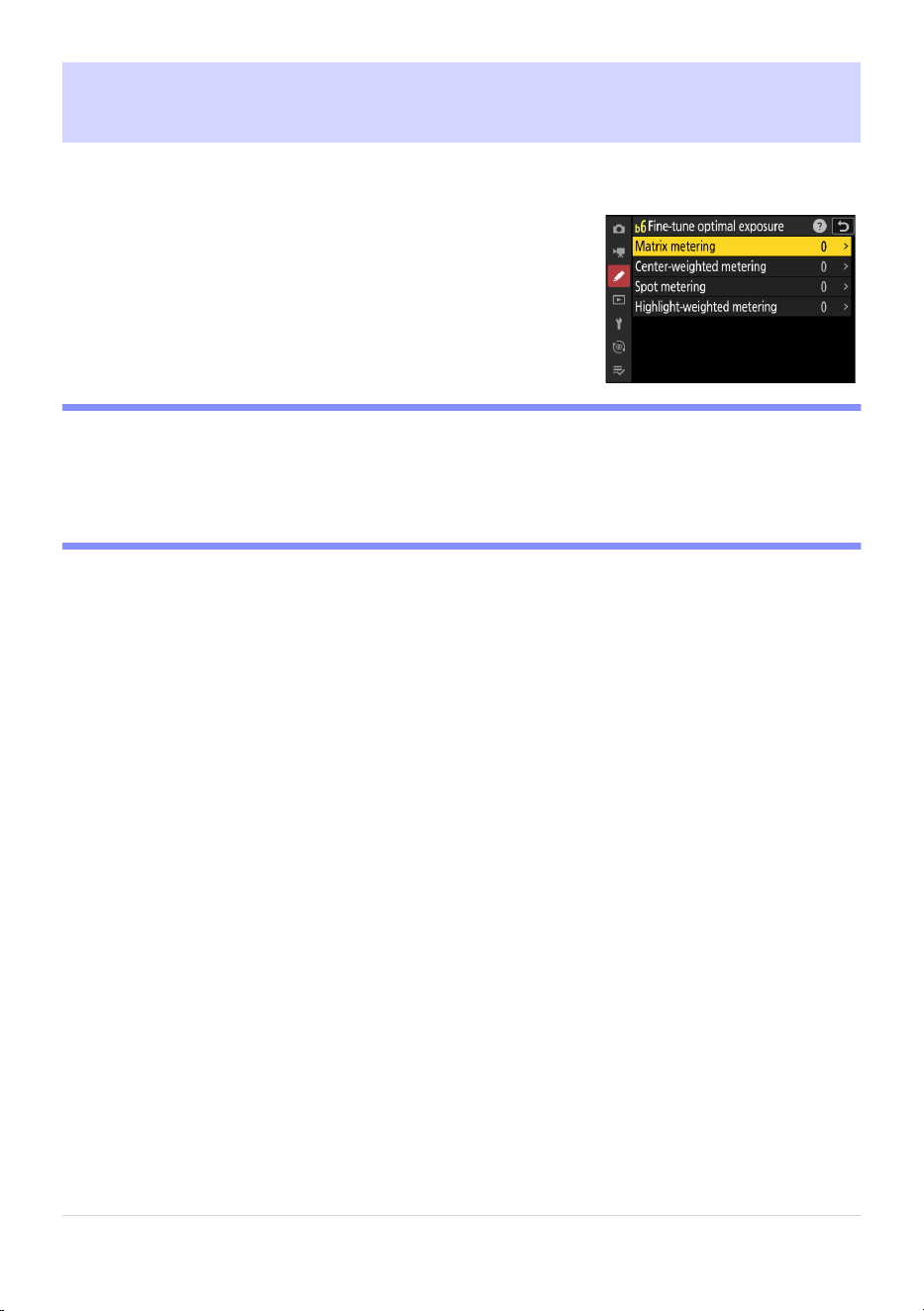
Use this option to fine-tune the exposure value selected by the
camera; exposure can be fine-tuned separat
ely for each metering
method. Exposure can be adjusted up for brighter exposures or
down for darker exposures in the range +1 to –1EV in steps of
¹⁄₆EV. The default is zero.
b6: Fine-tune optimal exposure
G buttonUA
Custom Settings menu
D Fine-Tuning Exposure
Regardless of the option selected for Custom Setting b6 [Fine-tune optimal exposure], the exposure
compensation icon (E) will not be displayed. The only way to determine how much exposure has been
altered is to view the amount in the fine-tuning menu for Custom Setting b6.
575
b6: Fine-tune optimal exposure

c1: Shutter-release button AE-L
G buttonUA
Custom Settings menu
Choose whether exposure locks when the shutter-release button is pressed.
Option Description
O
[On (half press)]
Pressing the shutter-release button halfway locks exposure.
P
[On (burst mode)]
Exposure only locks while the shutter-release button is pressed all the
way down.
[Off] Pressing the shutter-release button does not lock exposure.
576
c1: Shutter-release button AE-L
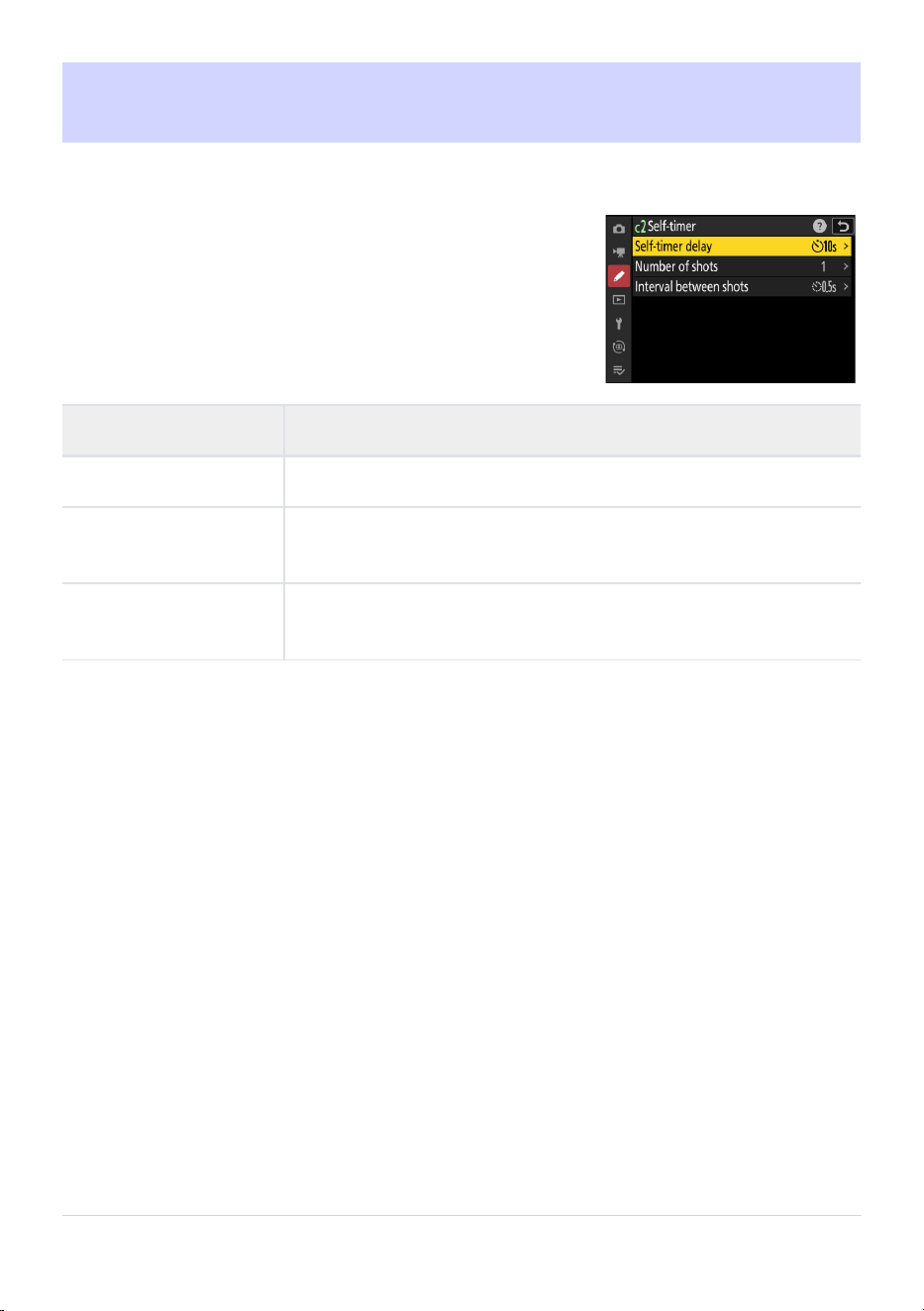
Choose the length of the shutter release delay, the number of shots
taken, and the inter
val between shots in self-timer mode.
c2: Self-timer
G buttonUA
Custom Settings menu
Option Description
[Self
-timer delay] Choose the length o
f the shutt
er-release delay.
[Number of shots]
Press
1 and 3 to choose the number of shots tak
en each time the
shutter-release button is pressed; choose from values of from 1 to 9.
[Interval between shots]
Choose the inter
val between shots when [Number of shots] is more
than 1.
577
c2: Self-timer
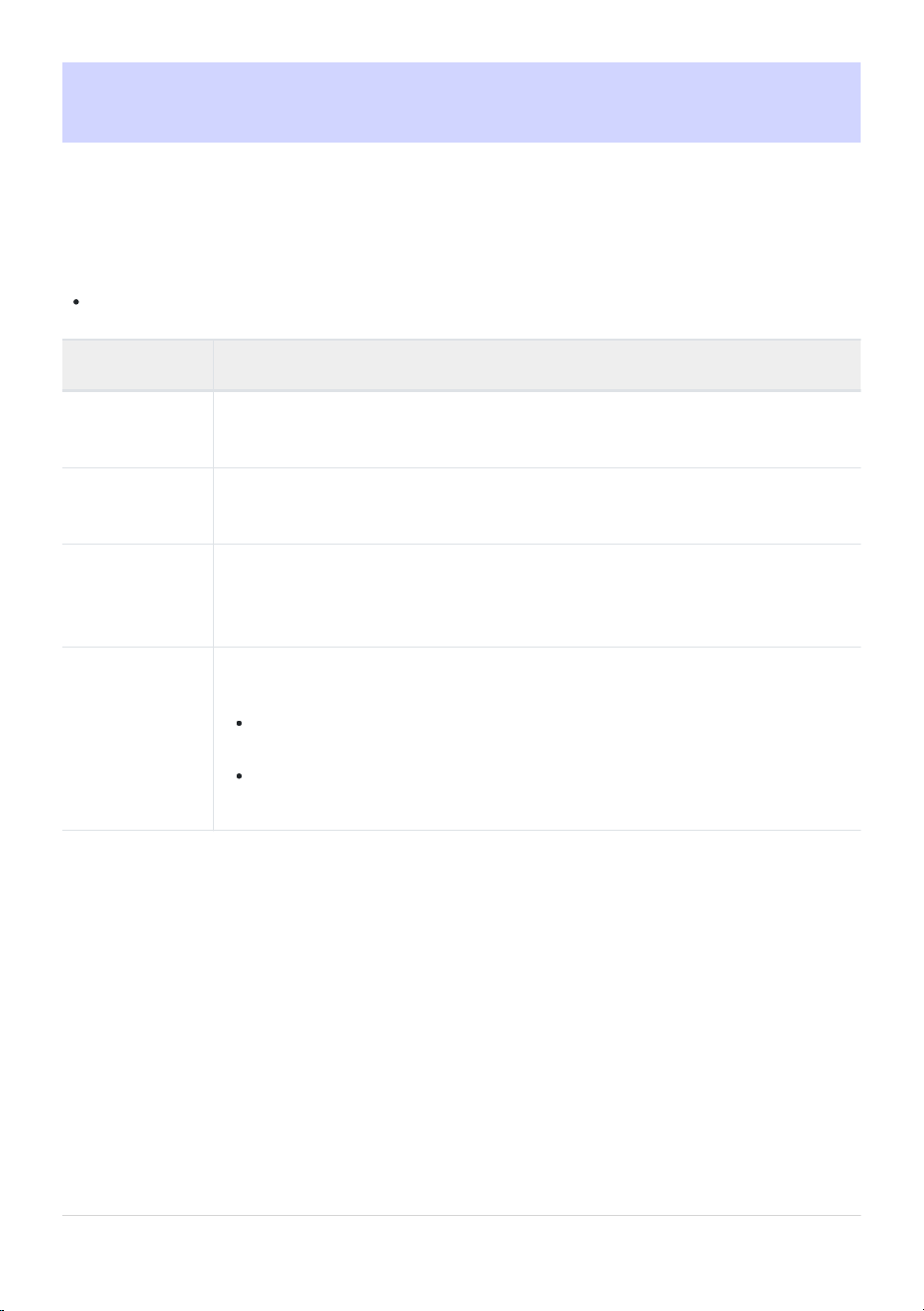
c3: Power off delay
G buttonU
ACustom Settings menu
Choose how long the displays remain on, and how long the camera waits before returning from
picture review to shooting mode, when no operations are performed.
Longer power-off delays reduce battery endurance.
Option Description
[Playback]
Choose how long the monitor or viewfinder waits t
o turn off after playback
starts.
[Menus]
Choose how long the monitor or viewfinder waits to turn off after menus are
displayed.
[Picture review]
Choose how long the camera waits to return to the shooting display after
picture review starts when [On] or [On (monitor only)] is selected for [Picture
review] in the playback menu.
[S
tandby timer]
Choose how long the exposur
e displays in the monit
or and viewfinder remain
on af
t
er the shooting display is activ
ated.
The monitor and viewfinder dim a few seconds before the standby timer
expires.
If [10 s] is selected, the timer will be extended to 20 seconds while the i
menu is displayed.
578
c3: Power off delay

d1: CL mode shooting speed
G buttonUA
Custom Settings menu
Choose the frame advance rate for low-speed continuous release mode; options range from 1 to 7 fps.
579
d1: CL mode shooting speed

d2: Maximum shots per burst
G buttonU
ACustom Settings menu
You can set the camera to take 1–200 shots in a single burst in continuous release modes.
No limits are placed on the number of shots that can be taken in a single burst when shutter speed
is set to 1 s or slower in mode S or M.
D The Memory Buffer
Custom Setting d2 [Maximum shots per burst] is used to select the number of shots that can be
taken in a single burst. The number of shots that can be taken before the memory buffer fills and
shooting slows varies with image quality and other settings. When the buffer is full, the camera will
display “r000” and the frame advance rate will drop.
580
d2: Maximum shots per burst
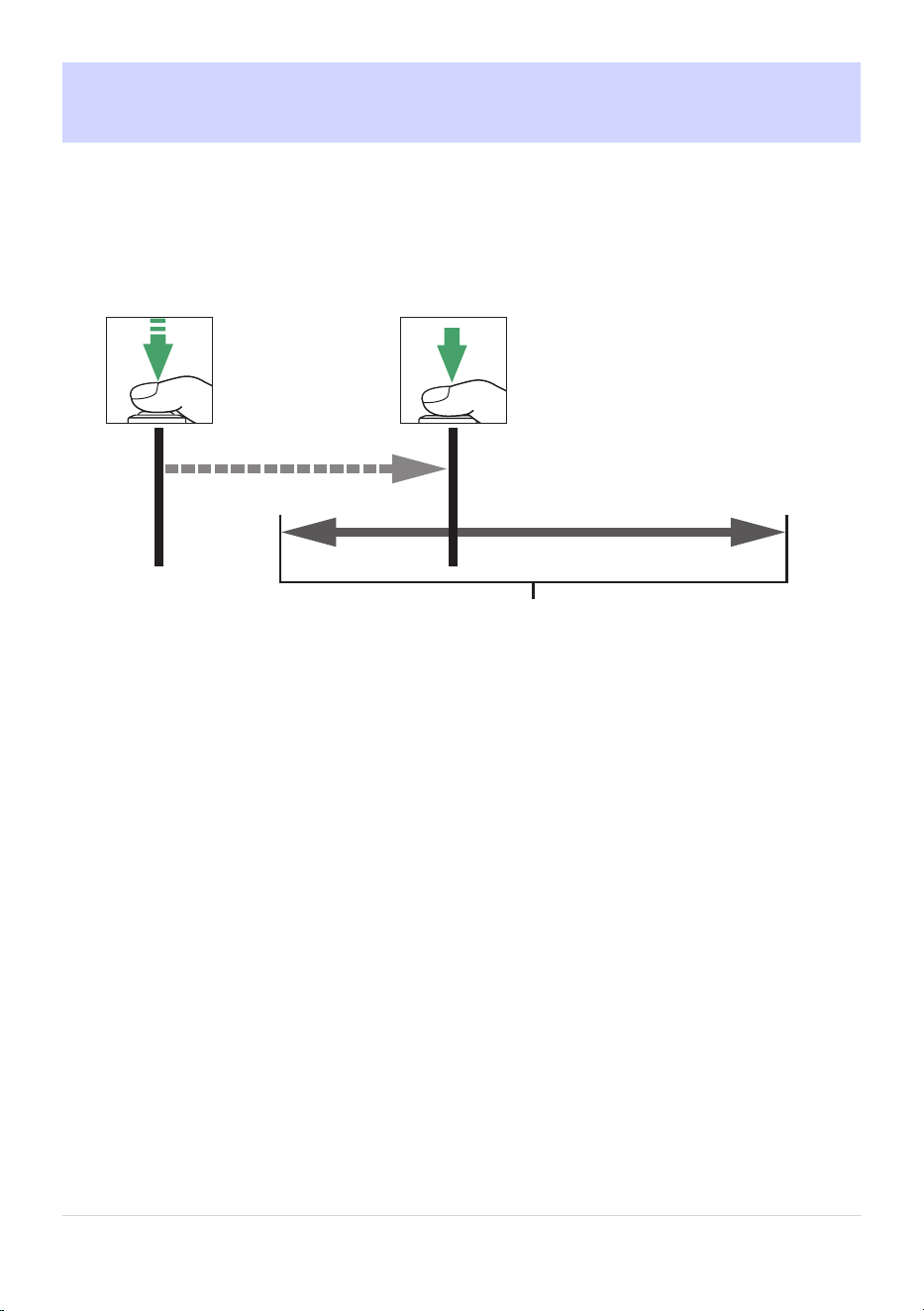
Pre-Release Capture standby (maximum 90s)
Portion o
f buffer recorded to memory card at release ([Pre-
release burst])
Pictures taken after release ([Post-release burst])
Complete high-speed burst
1
2
3
4
d3: Pre-Release Capture options
G butt
onUA
Custom Settings menu
Choose the length of the burst recorded from the end of the memory buffer when the shutter-release
button is pressed all the way down and the maximum length of the burst recorded while the shutter-
release button is fully pressed in high-speed frame capture + mode.
2
1
3
4
581
d3: Pre-Release Capture options
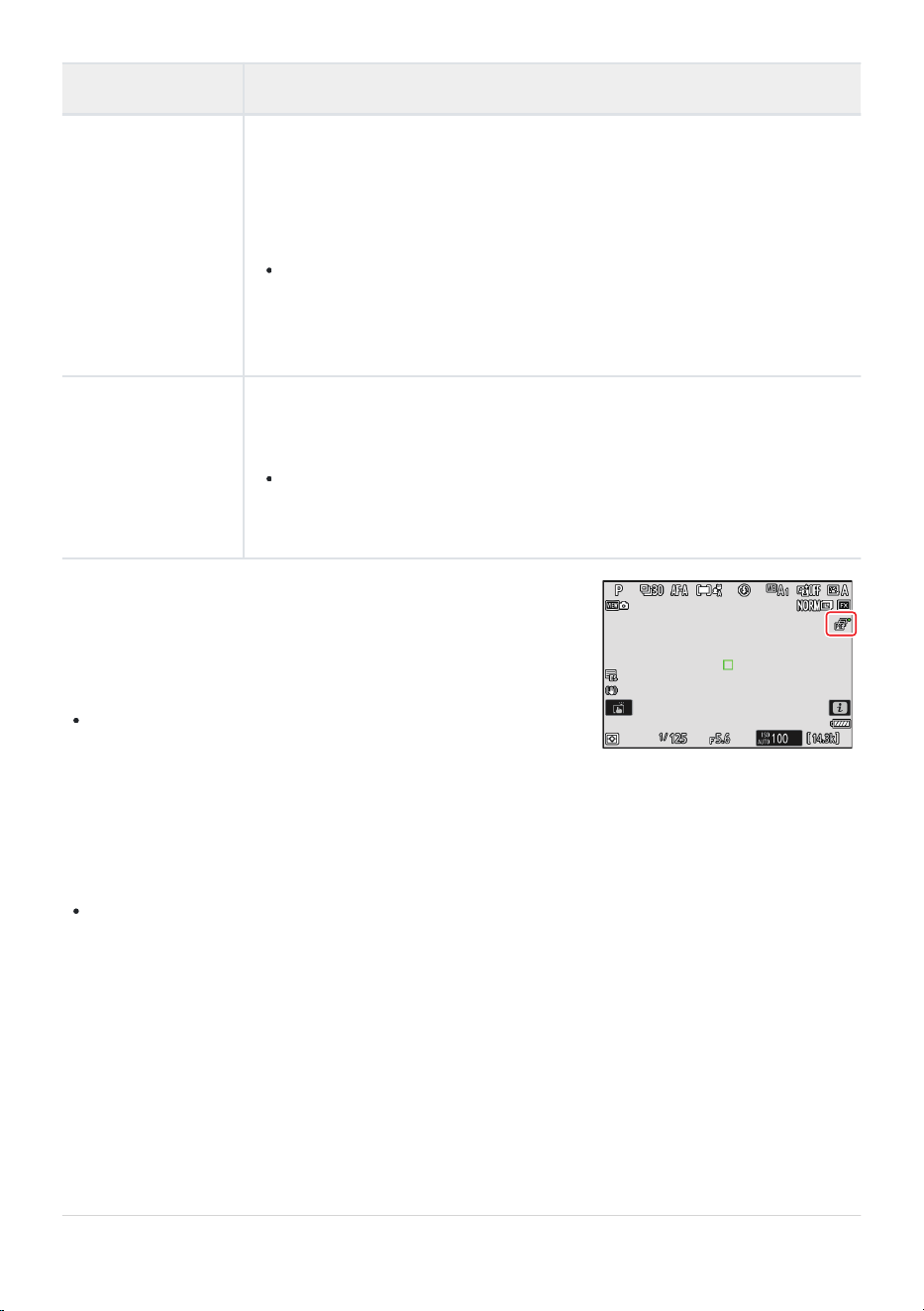
A Y icon appears in the shooting display when an option other
than [None] is selected for [Pre-release burst]. While the shutter-
release button is pressed halfway, a green dot (I) will appear in the
icon to show that buffering is in progress.
If the shutter-release button is pressed halfway for more than
about 90 seconds, I will change to C and Pre-Release Capture
will be cancelled. No pre-release burst will be recorded if the
shutter-release button is pressed the rest of the way down while
C is displayed. Pre-Release Capture can be resumed by lifting
your finger from the shutter-release button and then pressing it
halfway again.
The Y icon will start to flash 30 seconds before Pre-Release
Capture is cancelled.
Option Description
[Pre-release burst]
If an option other than [None] is select
ed, the camera will buffer frames
while the shutter-release button is pressed halfway, but only the frames
added to the buffer in the final n seconds, where n is the value selected
for [Pre-release burst], will be recorded to the memory card when the
shutter-release button is pressed all the way down (“Pre-Release Capture”).
If the interval between the shutter-release button being pressed halfway
and its being pressed all the way down is shorter than the time selected,
only the frames saved to the buffer while the button was pressed halfway
will be recorded.
[Post-release burst]
Choose the maximum length of time the camera will continue to take
pictures while the shutter-release button is pressed all the way down: [1
s], [2 s], [3 s], or [Max.].
Shooting can continue until the camera's memory buffer is full when
[Max.] is selected. The maximum length for bursts varies with camera
settings.
582
d3: Pre-Release Capture options

d4: Sync. release mode options
G buttonU
ACustom Settings menu
Choose whether the shutters on the remote cameras are synchronized with the shutter on the master
camera when using the [Connect to other cameras] item in the network menu.
For information on synchronized release using [Connect to other cameras] in the network menu,
see the section on “Synchronized Release” (
0 378) in the “Connecting to Other Cameras” chapter
.
583
d4: Sync. release mode options
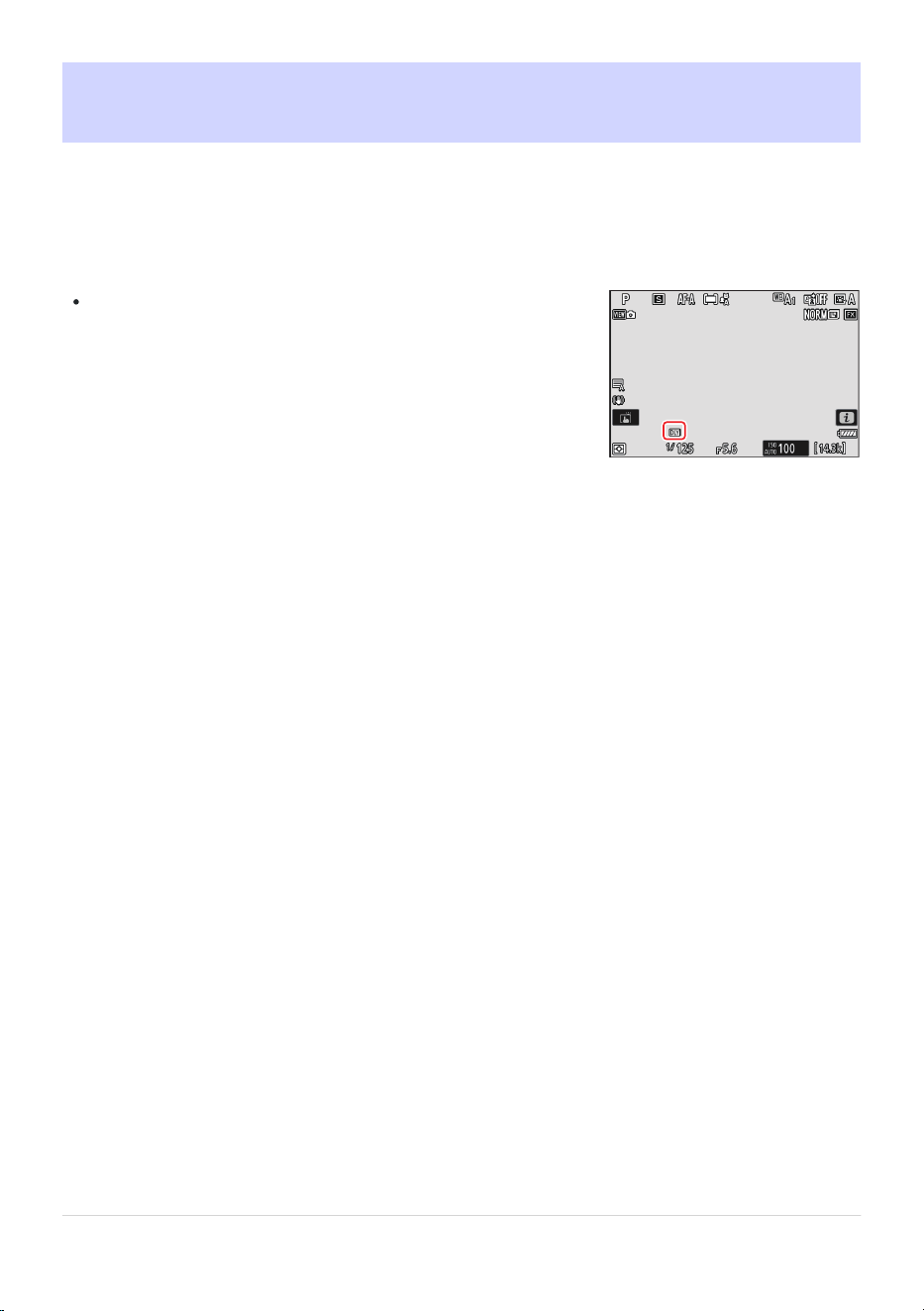
A z icon appears in the shooting display when an option other
than [Off] is selected.
d5: Exposure delay mode
G buttonU
ACustom Settings menu
In situations where the slightest camera movement can blur pictures, shutter release can be delayed by
from about 0.2 to 3 seconds after the shutter-release button is pressed.
584
d5: Exposure delay mode

d6: Shutter type
G buttonU
ACustom Settings menu
Choose the type of shutter used for photographs.
Option Description
6
[Auto]
The camera selects the shutter type aut
omatically
according to shutter speed. The electronic front-curtain
shutter is used to reduce blur caused by camera shake at
slow shutter speeds.
7
[Mechanical shutter] The camera uses the mechanical shutter for all photos.
v
[Electronic front-curtain shutter]
The camera uses the electronic front-curtain shutter for
all photos.
D “Mechanical Shutter”
[
Mechanical shutter] is not available with some lenses due to the camera's specifications.
D “Electronic Front-Curtain Shutter”
The fastest shutter speed available when [Electronic front-curtain shutter] is selected is ¹⁄₂₀₀₀s.
585
d6: Shutter type

d7: Extended shutter speeds (M)
G buttonUA
Custom Settings menu
Extend the range of shutter speeds available in mode M; the slowest shutter speed available when
[ON] is selected is 900s (15 minutes). Extended shutter speeds can be used for pictures of the night
sky and other long exposures.
When [ON] is selected, the time remaining in the current exposure will be displayed in the shooting
display at shutter speeds slower than 30s.
At speeds slower than 1s, the shutter speed displayed by the camera may differ from the actual
exposure time. The actual exposure times at shutter speeds of 15 and 30 seconds, for example, are
respectively 16 and 32 seconds. The exposure time will again match the selected shutter speed at
speeds of 60 seconds and slower.
586
d7: Extended shutter speeds (M)
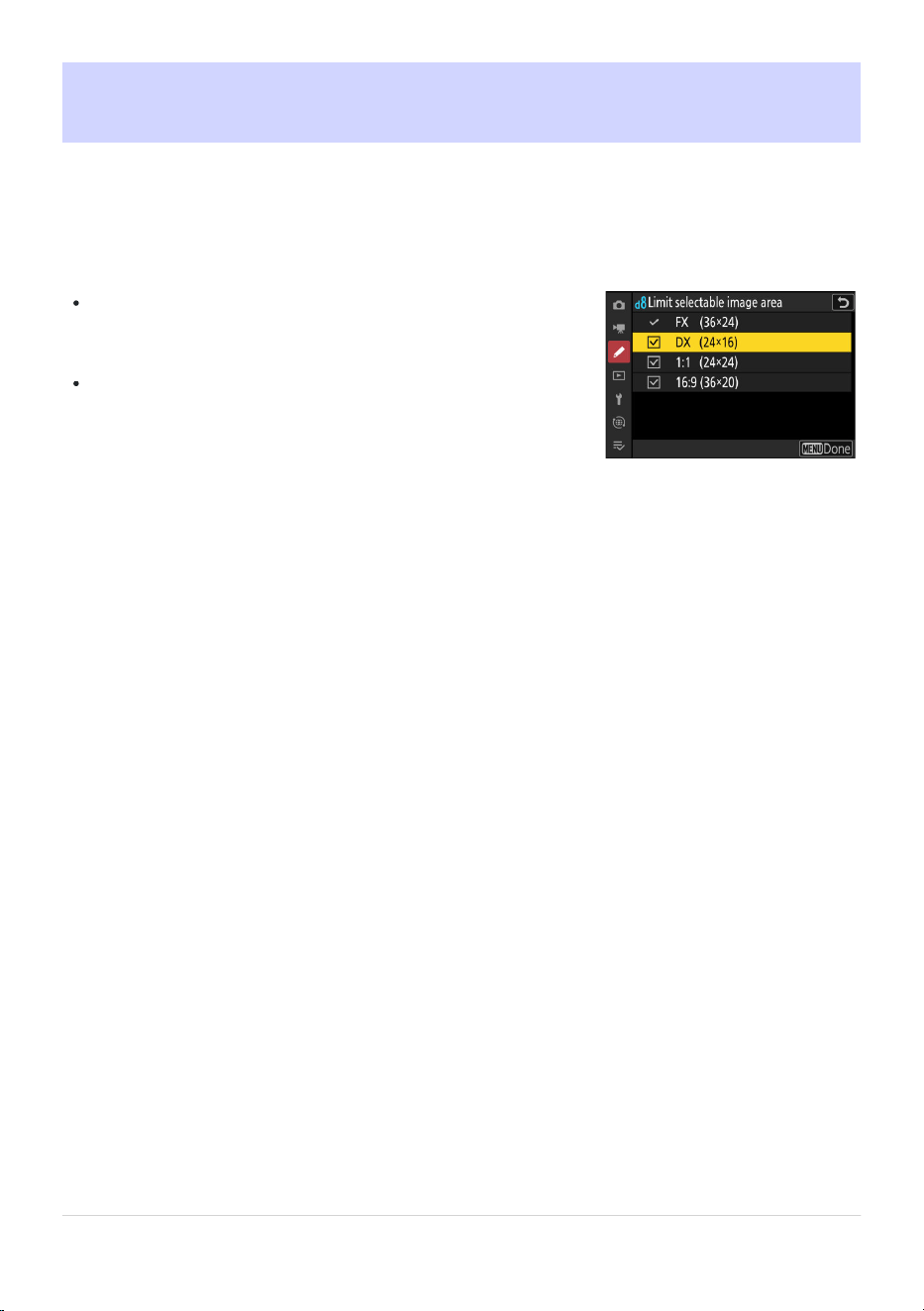
Highlight options and press J or 2 to select (M) or deselect (U
).
Modes marked with a check (M) are available for selection via
the command dials.
To complete the operation, press G.
d8: Limit selectable image area
G buttonUA
Custom Settings menu
Choose the options that can be accessed by rotating a command dial in the i menu or while pressing
a control to which image area has been assigned.
587
d8: Limit selectable image area

d9: File number sequence
G buttonU
ACustom Settings menu
Choose a file numbering option.
Option Description
[On]
When a new folder is created or a new memory card is inserted in the camera, file
numbering will continue from the last number used. This simplifies file management by
minimizing the occurrence o
f duplicate file names when multiple cards are used.
[Off]
When a new folder is created or a new memory card is inserted, file numbering restarts
from 0001. If the current folder already contains pictures, file numbering will instead
continue from the highest file number in the current folder.
If you select [Off] after selecting [On], the camera will store the current file number. File
numbering will resume from the previously-stored value the next time [On] is selected.
[Reset]
Reset the file numbering for [On]. If the current folder is empty, file numbering will restart
from 0001 with the next picture taken. If the current folder contains pictures, the next
picture taken will be assigned a file number by adding one to the highest file number in
the current folder.
588
d9: File number sequence

D File Number Sequence
If a picture is taken when the curr
ent folder contains a picture numbered 9999, a new folder will be
created and file numbering will restart from 0001.
When the current folder number reaches 999, the camera will no longer be able to create new
folders and the shutter release will be disabled if:
the current folder contains 5000 pictures (in addition, video recording will be disabled if the
camera calculates that the number of files needed to record a video of the maximum length
would result in the folder containing over 5000 files), or
the current folder contains a picture numbered 9999 (in addition, video recording will be
disabled if the camera calculates that the number of files needed to record a video of the
maximum length would result in a file numbered over 9999).
To resume shooting, choose [Reset] for Custom Setting d9 [File number sequence] and then either
format the current memory card or insert a new memory card.
D Folder Numbering
If a picture is taken when the current folder contains 5000 pictures or a picture numbered 9999, a
new folder will be created and selected as the current folder.
The new folder is assigned a number one higher than current folder number. If a folder with that
number already exists, the new folder will be assigned the lowest available folder number.
589
d9: File number sequence
-
-

d10: View mode (photo Lv)
G buttonU
ACustom Settings menu
Choose whether the camera adjusts the preview in the viewfinder or monitor to reflect how shooting
settings will affect the hue and brightness of the final picture. Regardless of the option selected, the
effects of camera settings are always visible in video mode.
Option Description
V
[Show effects of settings]
The effects of whit
e balance, Picture Controls, exposure
compensation, and other settings that affect color and
exposure are visible in the shooting display
. Pressing 2
when [Show effects of settings] is highlighted displays
[Always] and [Only when flash is not used] options.
[Always]: The effects of settings are also visible when a
flash unit is attached and ready to fire.
This setting is recommended when the display is used
for adjustments to background exposure.
The main subject may appear dark in the shooting
display.
The brightness of the scene shown in the shooting
display may differ from that of the actual subject
if TTL is selected for flash control mode with [ON]
selected for [ISO sensitivity settings] > [Auto ISO
sensitivity control] in the photo shooting menu.
[Only when flash is not used]: Display brightness is
adjusted for ease of viewing (as per [Adjust for ease of
viewing]) when a flash unit is attached and ready to fire.
The effects of settings on colors are visible regardless.
V will appear in the shooting display.
590
d10: View mode (photo Lv)
-
-
-

Option Description
W
[Adjust for ease of viewing]
The effects of changes to settings such as white balance,
Picture Controls, and exposur
e compensation are not visible
in the shooting display. Pressing 2 when [Adjust for ease
of viewing] is highlighted displays [Auto] and [Custom]
options.
[Auto]: Color, brightness, and other settings are adjusted
for ease of viewing, making it easier to frame pictures
and perform other tasks.
[Custom]: Press 2 to make individual adjustments to
[White balance], [Set Picture Control], and [Brighten
shadows].
[White balance]: Choose from [Preview current
setting], [Auto], and [Choose color temperature].
Select [Choose color temperature] to choose the
color temperature for the shooting display.
[Set Picture Control]: Choose from [Preview current
setting] and [Adjust for ease of viewing].
[Brighten shadows]: Choose whether or by how
much the camera brightens shadows (dark areas) in
the display; the available options are [Off], [+1], [+2],
and [+3]. The higher the value, the greater the effect.
W will appear in the shooting display.
591
d10: View mode (photo Lv)
-
-
-

d11: Starlight view (photo Lv)
G buttonU
ACustom Settings menu
Select [ON] to brighten the display for ease of viewing in dark environments (starlight view). Note that
the display may become slightly jerky when starlight view is in effect.
592
d11: Starlight view (photo Lv)

d12: Warm display colors
G buttonUA
Custom Settings menu
Use warmer colors with reduced brightness in the shooting, menu, and/or playback displays. This
makes the displays easier to view with vision adapted to dark environments during astronomical
photography and the like.
Option Description
[Warm display color options]
Choose from the following options.
[
Mode 1]: Use warmer colors in the shooting, menu, and
playback displays.
[Mode 2]: Use warmer colors in the menu display. Warmer
colors are also used for the icons and other information in
the shooting and playback displays, but not for the view
through the lens or the content of pictures themselves.
[Off]: Warm colors are not used.
[Warm color display brightness]
Press
1 or 3 to adjust warm color display brightness.
Choose higher v
alues for increased brightness, lower values for
reduced brightness.
593
d12: Warm display colors

d13: View all in continuous mode
G buttonUA
Custom Settings menu
If [OFF] is selected, the display will go blank during burst photography.
594
d13: View all in continuous mode

d14: Release timing indicator
G buttonU
ACustom Settings menu
Unlike in other release modes, the shooting display does not dim when the shutter is released in
high-speed frame capture + mode. Choose how the display responds when the shutter is released in
high-speed frame capture + mode.
Option Description
[Type A]
The display goes dark when the shutter is r
eleased. This makes it easier to track the
subject during panning shots.
[Type B] Borders appear at the top, bottom, and sides of the frame when the shutter is released.
[Type C] Borders appear at the sides of the frame when the shutter is released.
[Off] A release timing indicator is not displayed when the shutter is released.
Note that regardless of the option selected, release timing indicators are not displayed at slow
shutter speeds.
595
d14: Release timing indicat
or

d15: Image frame
G buttonU
ACustom Settings menu
Select [OFF] to hide the white border around the shooting displays in the monitor and viewfinder.
596
d15: Image frame

d16: Grid type
G buttonU
ACustom Settings menu
Choose a framing grid for the shooting display. The selected grid can be displayed by placing a check
(M) next to b in the list for Custom Setting d19 [Custom monitor shooting display] (
0 602) or
d20 [Custom viewfinder shooting display] (0 604).
597
d16: Grid type
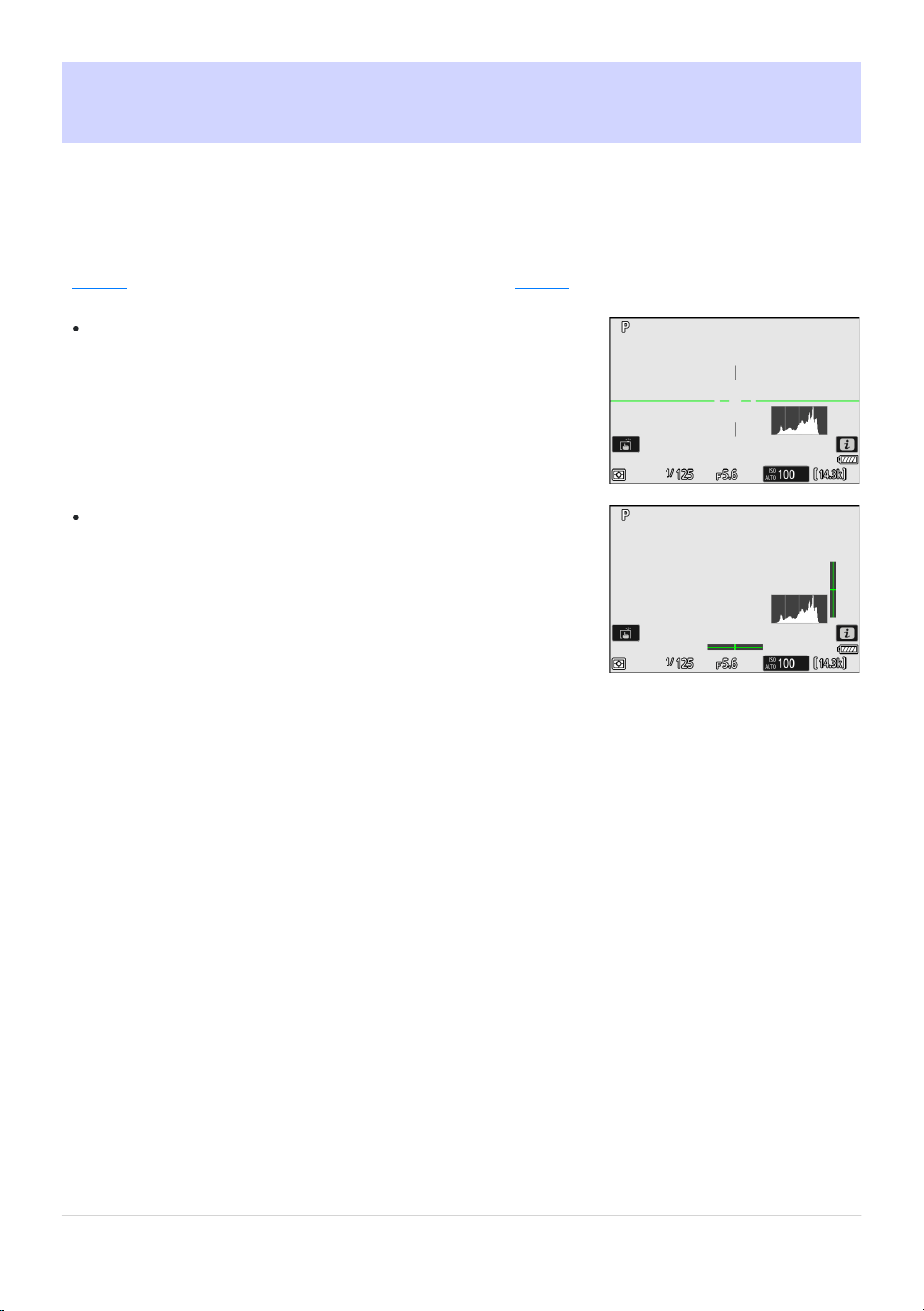
[Type A]: A large indicator showing roll and pitch fills the display.
[Type B]: A roll indicator appears at the bottom of the display and
a pitch indicat
or at its right edge.
d17: Virtual horizon type
G buttonU
ACustom Settings menu
Choose a virtual horizon for the shooting display. The selected virtual horizon can be displayed by
placing a check (M) next to D in the list for Custom Setting d19 [Custom monitor shooting display]
(
0 602) or d20 [Custom viewfinder shooting display] (0 604).
The indicators ar
e displayed in green when the camera is level.
598
d17: Virtual horizon type
*
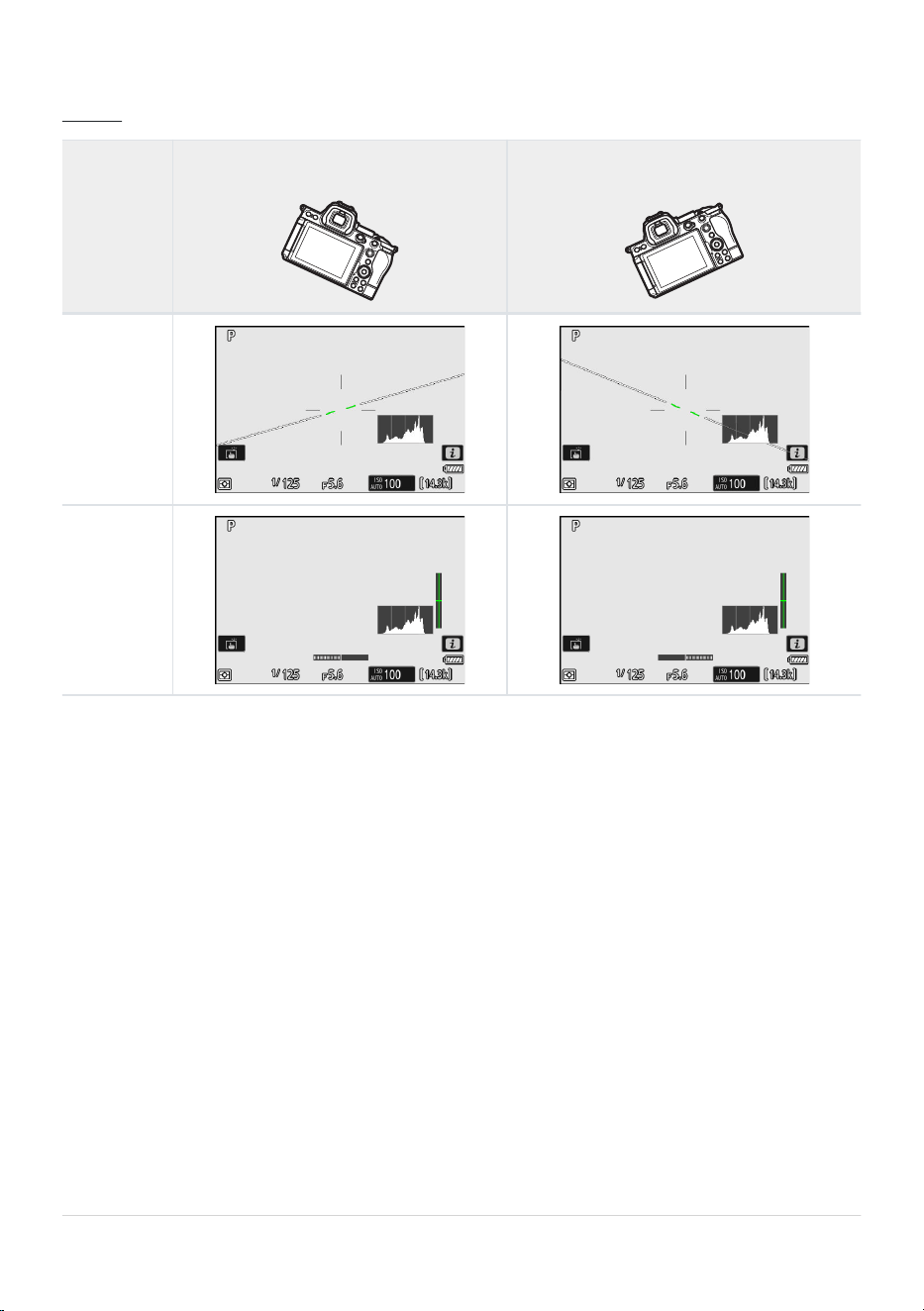
Roll
Option
Camera rotated clockwise
Camera rotated counterclockwise
[Type A]
[Type B]
599
d17: Virtual horizon type
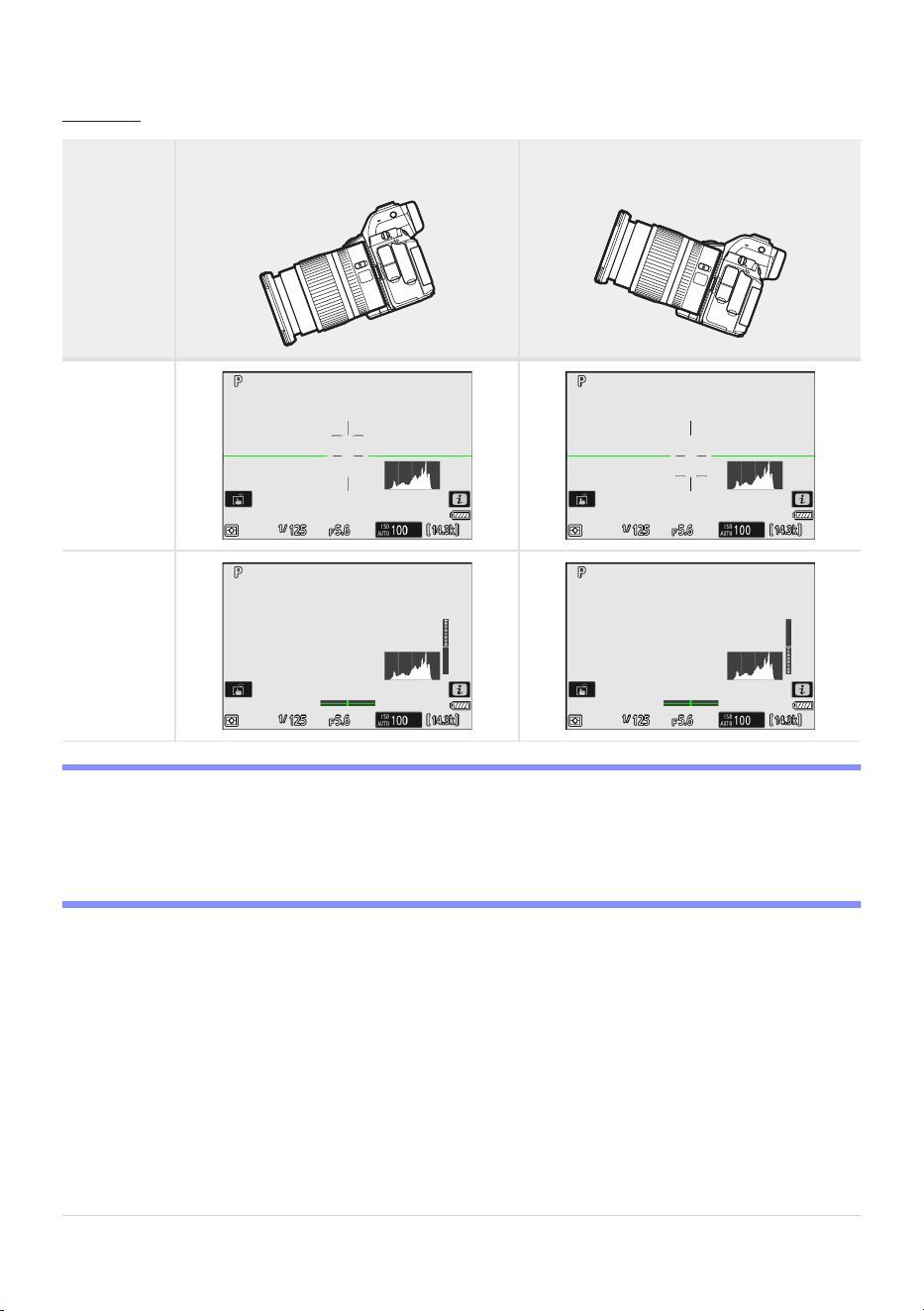
Pitch
Option
Camera tilted forward
Camera tilted back
[Type A]
[Type B]
D The Virtual Horizon Display
Not
e that the display may not be accurate when the camera is tilted at a sharp angle forward or back.
The camera will not display the virtual horizon or pitch and roll indicators when held at angles at which
tilt cannot be measured.
600
d17: Virtual horizon type

d18: Half-press to cancel zoom (MF)
G buttonU
ACustom Settings menu
When the view through the lens is zoomed in during manual focus while [ON] is selected, the zoom
can be cancelled by pressing the shutter-release button halfway.
601
d18: Half-press to cancel zoom (MF)
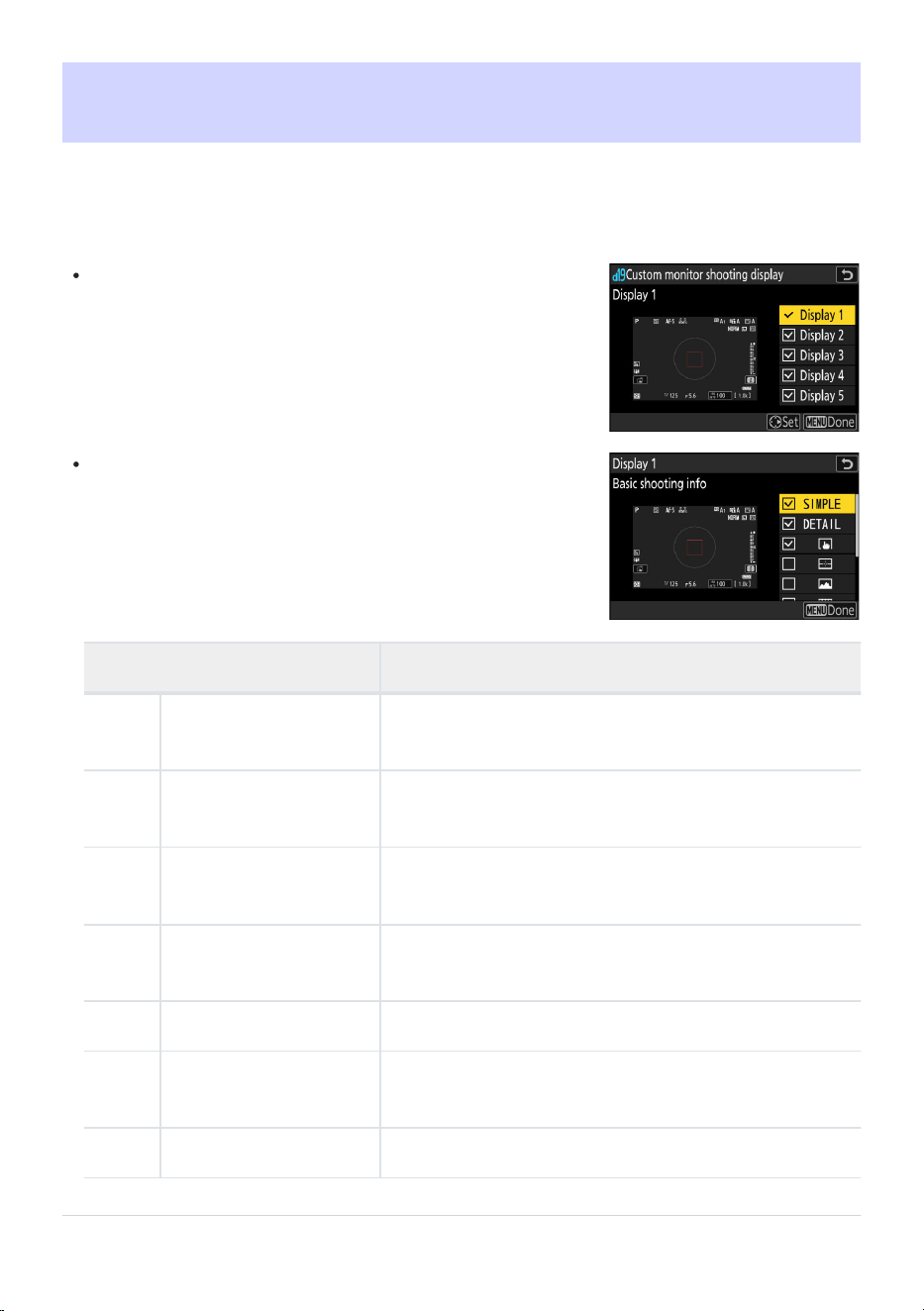
Highlight items ([Display 2] through [Display 5]) and press J
to
select (M) or deselect (U). Only displays marked with a check (M)
can be accessed by pressing the DISP button during shooting.
[Display 1] cannot be deselected (U).
To choose indicators that appear in displays [Display 1] through
[Display 4], highlight the corr
esponding option and press 2. You
can then highlight items and press J to select (M) or deselect (U).
d19: Custom monitor shooting display
G buttonUA
Custom Settings menu
Choose the monitor displays accessible by pressing the DISP button during shooting.
Option Description
A
[Basic shooting info]
View the shooting mode, shutter speed, aperture, and
other basic shooting info.
B
[Detailed shooting info]
View the focus mode, AF-ar
ea mode, white balance, and
other detailed shooting info.
C
[Touch controls]
View options that can be accessed via touch contr
ols,
including touch AF and the i menu.
D
[
Virtual horizon]
Enable the virtual horizon. The display type can be
select
ed using Custom Setting d17 [Virtual horizon type].
E
[Histogram] Enable the RGB histogram.
b
[Framing grid]
Enable the framing grid. The display type can be selected
using Custom Setting d16 [Grid type].
F
[Center indicator] Display crosshairs at the center of the frame.
602
d19: Custom monitor shooting display

Option Description
G
[Center-weighted area]
Add an 8 or 12 mm circle t
o the center of the shooting
display whenever [Center-weighted metering] is selected
for [Metering] in the photo shooting menu.
The size of the circle varies with the option selected for
Custom Setting b5 [Center-weighted area]. The circle
is not displayed when [Average] is selected for Custom
Setting b5 [Center-weighted area].
[Display 5] consists solely of the information display and cannot be customized.
To complete the operation, press G.
603
d19: Custom monitor shooting display

d20: Custom viewfinder shooting display
G buttonUA
Custom Settings menu
Choose the viewfinder displays accessible by pressing the DISP button during shooting.
Highlight items ([Display 2] through [Display 4]) and press J to select (M) or deselect (U). Only
displays marked with a check (M) can be accessed by pressing the DISP button during shooting.
[Display 1] cannot be deselected (U).
To choose indicators that appear in displays [Display 1] through [Display 4], highlight the
corresponding option and press 2. You can then highlight items and press J to select (M) or
deselect (U). Apart from [Touch controls], the options are the same as those for Custom Setting
d19 [Custom monitor shooting display] (
0 602).
To complete the operation, pr
ess G.
604
d20: Custom viewfinder shooting display

e1: Flash sync speed
G buttonUA
Custom Settings menu
Choose the flash sync speed.
Option Description
[1/200 s (Auto FP)]
Flash sync speed is set to ¹⁄₂₀₀s. With comp
atible flash units, auto FP high-
speed sync will automatically be enabled at shutter speeds faster than ¹⁄₂₀₀s.
In modes P and A, auto FP high-speed sync will be activated if the actual
shutter speed is faster than ¹⁄₂₀₀s. If the flash supports auto FP high-speed
sync, the camera can select shutter speeds as fast as ¹⁄₈₀₀₀s (or ¹⁄₂₀₀₀s
if [Electronic front-curtain shutter] is selected for Custom Setting d6
[Shutter type]).
In modes S and M, the user can select shutter speeds as fast as ¹⁄₈₀₀₀s
when using flash units that support auto FP high-speed sync (or ¹⁄₂₀₀₀s
if [Electronic front-curtain shutter] is selected for Custom Setting d6
[Shutter type]).
[1/200 s]
Flash sync speed set to selected value, which can be from ¹⁄₂₀₀ to ¹⁄₆₀s.
The shutter speed will be set to the selected flash sync speed in the S and
M modes if a faster shutter speed is selected.
[1/160 s]
[1/125 s]
[1/100 s]
[1/80 s]
[1/60 s]
605
e1: Flash sync speed

D Caution: Auto FP High-Speed Sync
Depending on the shutt
er speed, horizontal lines may appear in pictures taken using auto FP high-
speed sync when [1/200 s (Auto FP)] is selected. This effect can be mitigated by:
choosing a slower shutter speed or
adjusting flash output.
Tip: Auto FP High-Speed Sync
Auto FP high-speed sync allows the flash to be used at shutter speeds as fast as ¹⁄₈₀₀₀s (or ¹⁄₂₀₀₀s if
[Electronic front-curtain shutter] is selected for Custom Setting d6 [Shutter type]). When [1/200 s
(Auto FP)] is selected, the camera automatically enables auto FP high-speed sync at shutter speeds
faster than the flash sync speed. This makes it possible to choose the maximum aperture for reduced
depth of field even when the subject is backlit in bright sunlight.
606
e1: Flash sync speed

e2: Flash shutter speed
G buttonUA
Custom Settings menu
Choose the slowest shutter speed available with a flash in mode P or A.
Regardless of the setting chosen for Custom Setting e2 [Flash shutter speed], shutter speeds can be
as slow as 30s in modes S and M or at flash settings of slow sync, slow rear-curtain sync, or red-eye
reduction with slow sync.
607
e2: Flash shutter speed

e3: Exposure comp. for flash
G buttonUA
Custom Settings menu
Choose how the camera adjusts flash level when exposure compensation is used.
Option Description
YE
[Entire frame]
The camera adjusts both the flash level and exposur
e. This changes
the exposure for the entire frame.
E
[Background only] Exposure compensation is adjusted for the background only.
608
e3: Exposure comp. for flash

e4: Auto cISO sensitivity control
G butt
onUACustom Settings menu
Choose how the camera adjusts flash level when auto ISO sensitivity control is enabled.
Option Description
e
[Subject and backgr
ound]
The camera takes both the main subject and background
lighting into account when adjusting ISO sensitivity.
f
[Subject only]
ISO sensitivity is adjusted only to ensure that the main subject is
correctly exposed.
609
e4: Auto cISO sensitivity control

e5: Modeling flash
G buttonU
ACustom Settings menu
If [ON] is selected when the camera is used with an optional flash unit that supports the Nikon Creative
Lighting system, pressing a control to which [Preview] has been assigned using Custom Setting f2
[Custom controls (shooting)] will emit a modeling flash.
610
e5: Modeling flash

e6: Auto bracketing (mode M)
G buttonUA
Custom Settings menu
The settings affected when bracketing is enabled in mode M and [OFF] is selected for [ISO sensitivity
settings]> [Auto ISO sensitivity control] in the photo shooting menu are determined by the options
selected for [Auto bracketing]> [Auto bracketing set] in the photo shooting menu and the option
chosen for Custom Setting e6 [Auto bracketing (mode M)].
Custom Setting e6 [Auto bracketing
(mode M)]
Phot
o shooting menu [Auto bracketing]> [Auto
bracketing set]
AE & flash bracketing AE bracketing
F
[Flash/speed] Shutter speed and flash level Shutter speed
G
[Flash/speed/aperture]
Shutter speed, aperture, and
flash level
Shutter speed and
aperture
H
[Flash/aperture] Aperture and flash level Aperture
9
[Flash/ISO sensitivity] ISO sensitivity and flash level ISO sensitivity
I
[Flash only] Flash level —
When [ON] is selected for [ISO sensitivity settings]> [Auto ISO sensitivity contr
ol] in the photo
shooting menu, the camera will vary flash level and/or ISO sensitivity as per [Flash/ISO sensitivity],
regardless of the option selected for Custom Setting e6 [Auto bracketing (mode M)].
D Flash Bracketing
Flash bracketing is performed only with i-TTL or qA (auto aperture) flash control.
611
e6: Auto bracketing (mode M)

e7: Bracketing order
G buttonUA
Custom Settings menu
Choose the order in which the shots in the bracketing program are taken.
Option Description
H
[MTR > under > over]
The unmodified shot is tak
en first, followed by the shot with the
lowest value, followed by the shot with the highest value.
I
[Under > MTR > over] Shooting proceeds in order from the lowest to the highest value.
Custom Setting e7 [Bracketing order] has no effect on the order of the shots taken when [ADL
bracketing] is selected for [Auto bracketing]> [Auto bracketing set] in the photo shooting
menu.
612
e7: Bracketing order

e8: Flash burst priority
G buttonUA
Custom Settings menu
Choose whether optional flash units emit monitor pre-flashes before each shot during burst
photography in high- or low-speed continuous release mode.
Option Description
c
[Prioritize frame advance rate]
The flash unit emits a monitor pr
e-flash before the first
shot in each sequence and locks output at the metered
v
alue for the remaining shots. The frame advance rate
drops less than when [Prioritize precise flash control] is
selected.
An FV lock icon (r) will appear in the shooting display
during burst photography.
q
[Prioritize precise flash control]
The flash unit emits a monitor pr
e-flash before each shot
and adjusts flash output as required. The frame advance
rate may drop in some circumstances.
Tip: “Continuous H (Extended)” Mode
Regardless o
f the option selected for Custom Setting e8 [Flash burst priority], the camera will
prioritize the frame advance rate when [Continuous H (extended)] is selected for release mode.
613
e8: Flash burst priority
f1: Customize imenu
G buttonUACustom Settings menu
Choose the items listed in the i menu displayed when the i button is pressed in photo mode.
Highlight a position in the i menu, press J, and select the desired item.
The following items can be assigned to the i menu.
Option
0
J
[Choose image ar
ea] 0 114
f
[Tone mode] 0 417
8
[Image quality] 0 116
o
[Image size] 0 118
N
[View memory card info] 0 616
E
[Exposure compensation] 0 150
9
[ISO sensitivity settings] 0 160
m
[White balance] 0 182
h
[Set Picture Control] 0 424
g
[Set Picture Control (HLG)] 0 426
p
[Color space] 0 427
y
[Active D-Lighting] 0 428
q
[Long exposure NR] 0 430
r
[High ISO NR] 0 431
h
[Skin softening] 0 435
i
[Portrait impression balance] 0 436
614
f1: Customize imenu
Option
0
w
[Metering] 0 441
c
[Flash mode] 0 444
Y
[Flash compensation] 0 445
s
[Focus mode] 0 120
7
[AF-area mode/subj. detection] 0 122, 0 126
u
[Vibration reduction] 0 451
t
[Auto bracketing] 0 453
$
[Multiple exposure] 0 464
2
[HDR overlay] 0 471
7
[Interval timer shooting] 0 475
8
[Time-lapse video] 0 485
9
[Focus shift shooting] 0 494
5
[Pixel shift shooting] 0 503
F
[Focus tracking with lock-on] 0 556
L
[Silent mode] 0 749
j
[Pre-Release Capture options] 0 581
v
[Release mode] 0 152
6
[Shutter type] 0 585
w
[Custom controls (shooting)] 0 618
z
[Exposure delay mode] 0 584
m
[View mode (photo Lv)] 0 590
615
f1: Customize imenu
Option
0
z
[Split-screen display zoom] 0 617
W
[Focus peaking] 0 567
3
[Monitor/viewfinder brightness] 0 718, 0 720
v
[Warm display colors] 0 593
u
[Airplane mode] 0 769
W
[Wireless remote connection (ML-L7)] 0 778
W
[Bluetooth remote cntrl connection] 0 780
a
[Power battery pack info] 0 617
View memory card info
View the slot currently selected as the destination for new pictur
es and the options used to record
pictures when two memory cards are inserted. This option can be used to view but not to change the
option selected.
The options used to record pictures when two memory cards are inserted can be selected using
[Role played by card in Slot 2] in the photo shooting menu.
616
f1: Customize imenu
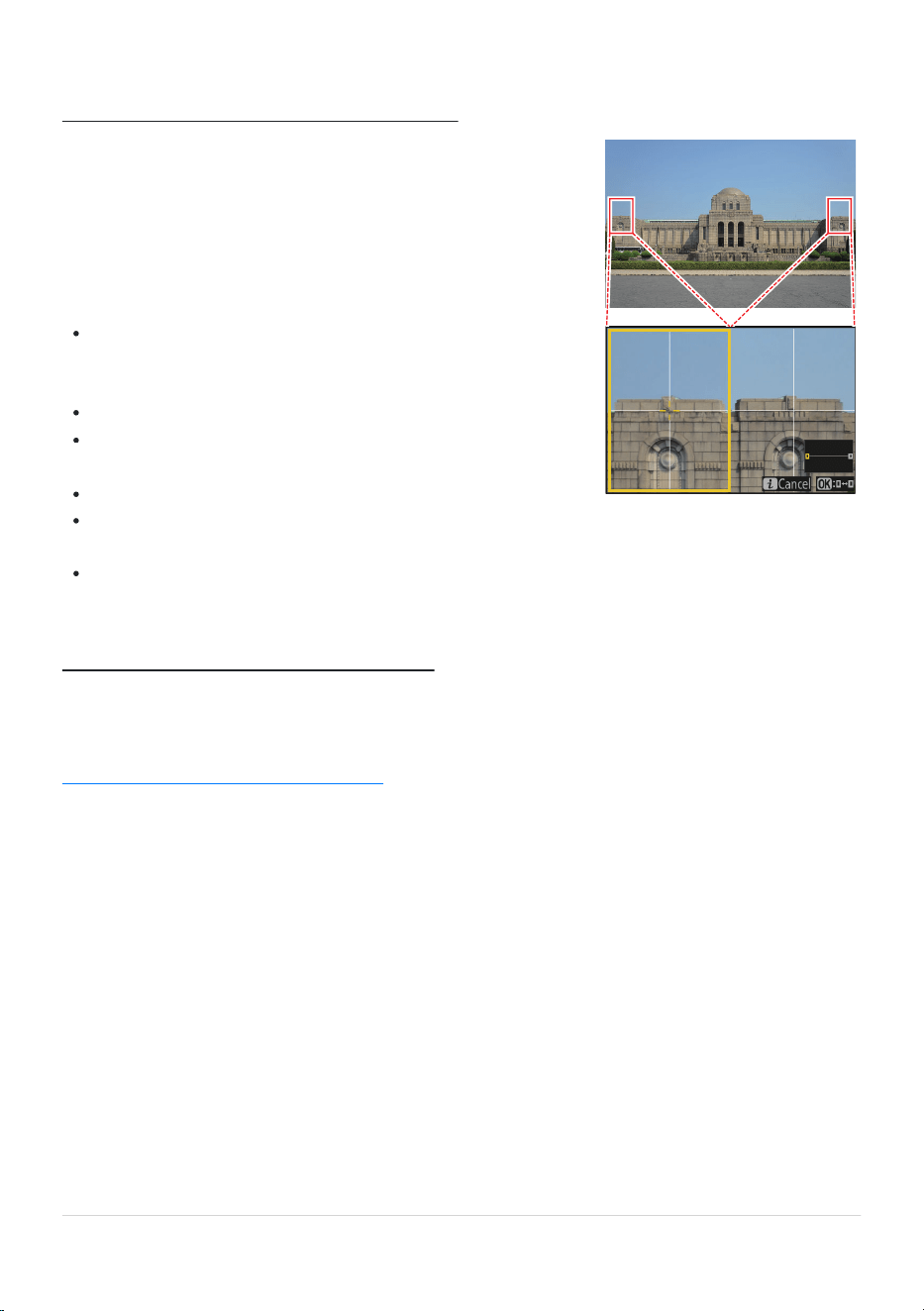
If [Split-screen display zoom] is assigned to the i
menu, you can
select [Split-screen display zoom] to simultaneously zoom in on
two areas that are aligned horizontally but are in different parts of
the frame (split-screen display zoom). The locations of the areas are
indicated by the two frames (r) in the navigation window in the
bottom right corner of the display.
Zooming in simultaneously on two widely-separated but
horizontally-aligned areas of the frame makes it easier to level
pictures of buildings or other wide objects.
Use the X and W (Q) buttons to zoom in and out.
Press 4 or 2 to scroll the selected area left or right. Use the J
button to switch between the two areas.
Press 1 or 3 to scroll both areas up or down simultaneously.
To focus on the subject at the center of the selected area, press
the shutter-release button halfway.
To exit split-screen display zoom, press the i button.
Split-screen display zoom
Power battery pack info
If an optional MB-N14 power batt
ery pack is attached, information about the batteries in the MB-N14
is displayed. For details, download the MB-N14 Reference Guide from the Nikon Download Center.
https://downloadcenter.nikonimglib.com/
617
f1: Customize imenu
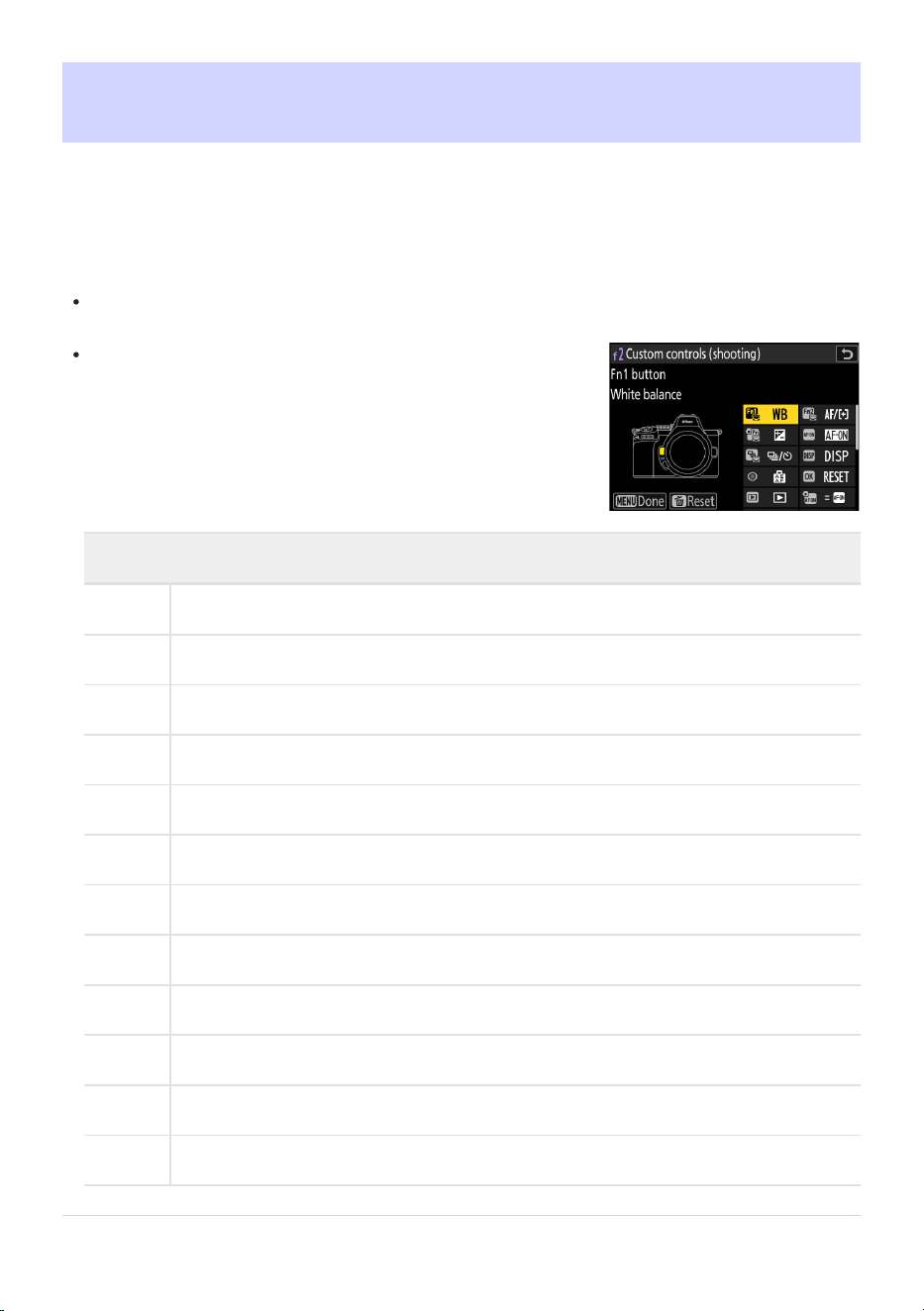
Choose the roles played by the controls below. Highlight the
desired control and pr
ess J.
f2: Custom controls (shooting)
G buttonUA
Custom Settings menu
Choose the operations performed in photo mode using lens rings and camera buttons and command
dials.
You can also choose the roles played by the controls on optional battery packs connected to the
camera.
Option
w
[Fn1 butt
on]
y
[Fn2 button]
n
[Fn button for vertical shooting]
V
[AF-ON button]
m
[Release mode/protect button]
D
[DISP button]
8
[Sub-selector cent
er
]
p
[OK button]
q
[Playback button]
j
[AF-ON button for vertical shooting]
F
[Vertical multi selector center]
z
[Video record button]
618
f2: Custom controls (shooting)
Option
R
[ISO sensitivity button]
Q
[Exposur
e compensation button]
x
[Picture Control button]
y
[Command dials]
S
[Lens Fn button]
3
[Lens Fn2 button]
S
[Lens Fn ring (counterclockwise)]
R
[Lens Fn ring (clockwise)]
T
[Lens memory set button]
l
[Lens control ring]
The roles that can be assigned are listed below. The roles available vary with the control.
Role Description
K
[Select center focus
point]
Pressing the control selects the center focus point.
F
[Save focus position]
Holding the control saves the current focus position.
The saved position can be restored using a control
to which [Recall focus position] has been assigned
(“memory recall”).
When saving the focus position, you can choose
whether it can be recalled using any of the controls
to which [Recall focus position] is assigned ([Save
to all]) or using only a specific control ([Save
individually]).
For more information, see “Saving and Recalling
Focus Positions” (
0 632).
619
f2: Custom controls (shooting)

Role Description
H
[Recall focus position]
Pressing the contr
ol recalls a focus position saved using
a control to which [Save focus position] has been
assigned.
For more information, see “Saving and Recalling
Focus Positions” (
0 632).
z
[Switch eyes]
Press the contr
ol to choose the eye used for focus when
the camera detects the eyes of a human or animal
portrait subject.
r
[Cycle AF-area mode]
Press the contr
ol to cycle the AF-area mode.
To choose the AF-area modes t
o be cycled, press 2
when [Cycle AF-area mode] is highlighted.
Highlight options and press J or 2 to select (M) or
deselect (U). Only items marked with a check (M) will
be cycled when the control is pressed.
d
[AF-ar
ea mode]
Holding the control selects a preset AF-area mode. The
AF-area mode previously in effect is r
estored when the
control is released.
To choose the AF-area mode, press 2 when [AF-area
mode] is highlighted.
5
[AF-ar
ea mode + AF-ON]
Holding the contr
ol selects a pr
eset AF-area mode
and initiates auto
focus. The AF-area mode previously in
effect is restored when the control is released.
To choose the AF-area mode, press 2 when [AF-area
mode + AF-ON] is highlighted.
A
[AF-ON]
Pressing the control initiates autofocus, duplicating the
function of the AF-ON
button.
F
[AF lock only] Focus locks while the control is pressed.
E
[AE lock (hold)]
Exposure locks when the control is pressed. Exposure
lock does not end when the shutter is released.
Exposure remains locked until the control is pressed a
second time or the standby timer expires.
620
f2: Custom controls (shooting)
-
-

Role Description
N
[AWB lock (hold)]
If [Aut
o] or [Natural light auto] is selected for white
balance, white balance will lock when the control is
pressed (white-balance lock). White-balance lock does
not end when the shutter is released. The lock will
however be released when the control is pressed a
second time or the standby timer expires.
O
[AE/AWB lock (hold)]
Exposure locks when the control is pressed. White
balance will also lock provided [Auto] or [Natural light
auto] is selected for white balance. Exposure and white-
balance lock do not end when the shutter is released.
The lock will however be released when the control is
pressed a second time or the standby timer expires.
D
[AE lock (Reset on
release)]
Exposure locks when the control is pressed. Exposure
remains locked until the control is pressed a second
time, the shutter is released, or the standby timer
expires.
C
[AE lock only] Exposure locks while the control is pressed.
B
[AE/AF lock] Focus and exposure lock while the control is pressed.
r
[FV lock]
Press the control to lock flash value for optional flash
units; press again to cancel FV lock.
h
[cDisable/enable]
If the flash is currently enabled, it will be disabled while
the control is pressed. If the flash is currently off, front-
curtain sync will be selected while the control is pressed.
K
[Switch FX/DX]
Press the control to switch to [DX (24×16)] when [FX
(36×24)] is chosen for image area. Pressing the control
when an option other than [FX (36×24)] is chosen for
image area selects [FX (36×24)].
621
f2: Custom controls (shooting)

Role Description
h
[Set Picture Control]
Press the contr
ol to display the same Picture Control
list as when the i-menu [Set Pictur
e Contr
ol] or [Set
Pictur
e Control (HLG)] is selected. The [Set Picture
Control] options are displayed when [Tone mode] is
set to [SDR] in the photo shooting menu, and the
[Set Picture Control (HLG)] options are displayed when
[Tone mode] is set to [HLG] in the photo shooting
menu.
a
[Photo flicker reduction]
Press the control to select [ON] for [Photo flicker
reduction] in the photo shooting menu. Press again to
select [OFF].
q
[Preview]
While the control is pressed, the shooting display will
show how color, exposure, and depth of field are
affected by current photo settings.
L
[Matrix metering]
Holding the control selects matrix metering. The setting
previously in effect is restored when the control is
released.
M
[Center-weighted
metering]
Holding the control selects center-weighted metering.
The setting previously in effect is restored when the
control is released.
N
[Spot metering]
Holding the control selects spot metering. The setting
previously in effect is restored when the control is
released.
t
[Highlight-weighted
metering]
Holding the control selects highlight-weighted metering.
The setting previously in effect is restored when the
control is released.
E
[High-frequency flicker
reduction]
Pressing the control allows shutter speed to be fine-
tuned in smaller increments. Press the control a second
time to restore normal shutter-speed selection.
622
f2: Custom controls (shooting)

Role Description
1
[Bracketing burst]
If the control is pr
essed when an option other than
[WB bracketing] is selected for [Auto bracketing]>
[Auto bracketing set] in the photo shooting menu in
continuous release mode, the camera will take all the
shots in the current bracketing program and repeat
the bracketing burst while the shutter-release button
is pressed. In single-frame release mode, shooting
will end after the first bracketing burst.
If [WB bracketing] is selected for [Auto bracketing
set], the camera will take pictures while the shutter-
release button is pressed and apply white balance
bracketing to each shot.
c
[Sync. release selection]
When [Synchr
onized release] is selected for [Connect
to other cameras] in the netw
ork menu, the chosen
control can be used to toggle between remote release
and master or synchronized release. The options
available depend on the setting chosen for Custom
Setting d4 [Sync. release mode options].
The following options are available when [Sync] is
selected for [Sync. release mode options]:
[Master release only] (c): Keep the control
pressed to take pictures with the master camera
only.
[Remote release only] (d): Keep the control
pressed to take pictures only with the remote
cameras.
The following options are available when [No sync] is
selected for [Sync. release mode options]:
[Synchronized release] (6): Keep the control
pressed to synchronize the releases on the master
and remote cameras.
[Remote release only] (d): Keep the control
pressed to take pictures only with the remote
cameras.
623
f2: Custom controls (shooting)
-
-
-
-

Role Description
L
[Override other cameras]
Press the contr
ol to remotely take over the master
camera role from another camera functioning as a
master camera commanding remote cameras during
synchronized release.
This option takes effect when multiple cameras in the
same group have been designated as masters using
[Connect to other cameras] in the network menu.
It cannot be used to promote cameras functioning in
the remote role to the role of master camera.
4
[+ RAW]
If a JPEG or HEIF option is currently selected for
image quality, “RAW” will appear in the shooting
display and an NEF (RAW) copy will be recorded
with the next picture taken after the control is
pressed. The original image quality setting will be
restored when you remove your finger from the
shutter-release button or press the control again,
canceling [+ RAW].
NEF (RAW) copies are recorded at the settings
currently selected for [RAW recording] in the photo
shooting menu.
L
[Silent mode]
Press the control to enable silent mode. Press again to
disable.
M
[Cycle live view info
display]
Press the control to cycle the shooting display. The type
and content of the displays available can be chosen
using Custom Settings d19 [Custom monitor shooting
display] and d20 [Custom viewfinder shooting
display].
b
[Live view info display
off]
Press the control to hide icons and other information in
the shooting display. Press again to view.
b
[Framing grid]
Press the control to display a framing grid. To hide the
grid, press the control again. The display type can be
selected using Custom Setting d16 [Grid type].
624
f2: Custom controls (shooting)

Role Description
p
[Zoom on/off]
Press the control to zoom the display in on the area
around the current focus point. Pr
ess again to cancel
zoom.
To choose the zoom ratio, highlight [Zoom on/off]
and press 2.
D
[Vir
tual horizon]
Press the contr
ol to enable the virtual horizon display.
Press again to hide the display. The display type can
be selected using Custom Setting d17 [Virtual horizon
type].
k
[Starlight view (photo
Lv)]
Press the control to toggle starlight view on. Press again
to end starlight view.
m
[View mode (photo Lv)]
Press the control to switch the option selected for
Custom Setting d10 [View mode (photo Lv)] from
[Show effects of settings] to [Adjust for ease of
viewing] or vice versa.
W
[Focus peaking display]
Press the control once to enable focus peaking when
MF is selected for focus mode. Press again to end focus
peaking.
8
[Enable/disable touch Fn] Press the control to enable or disable touch Fn.
O
[MY MENU] Press the control to display “MY MENU”.
3
[Access top item in MY
MENU]
Press the control to jump to the top item in “MY MENU”.
Select this option for quick access to a frequently-used
menu item.
K
[Playback] Press the control to start playback.
l
[Filtered playback]
Press the control to view only pictures that meet the
criteria selected for [Filtered playback criteria] in the
playback menu.
N
[Filtered playback (select
criteria)]
Press the control to jump to [Filtered playback criteria]
in the playback menu.
625
f2: Custom controls (shooting)

Role Description
Y
[Power zoom +]
When a power zoom lens is attached, the camera zooms
in while the contr
ol is pressed. This option is enabled
automatically when [Power zoom −] is selected for [Fn2
button].
Z
[Power zoom −]
When a power zoom lens is attached, the camera zooms
out while the control is pressed. This option is enabled
automatically when [Power zoom +] is selected for [Fn1
button].
e
[Same as AF-ON button]
The control performs the role currently selected for the
AF-ON button.
J
[Choose image area]
Press the control and rotate a command dial to choose
the image area.
8
[Image quality/size]
Press the control and rotate the main command dial to
choose an image quality option and the sub-command
dial to select image size.
E
[Exposure compensation]
Adjust exposure compensation either by holding the
control and rotating a command dial or by rotating the
lens control ring.
9
[ISO sensitivity]
Adjust ISO sensitivity either by holding the control and
rotating a command dial or by rotating the lens control
ring.
m
[White balance]
To choose a white balance option, hold the control
and rotate the main command dial. Some options offer
sub-options that can be selected by rotating the sub-
command dial.
y
[Active D-Lighting]
Press the control and rotate a command dial to adjust
Active D-Lighting.
h
[Skin softening]
Press the control and rotate a command dial to adjust
skin softening.
i
[Portrait impression
balance]
Press the control and rotate a command dial to choose a
portrait impression balance mode.
626
f2: Custom controls (shooting)

Role Description
w
[Metering]
Press the contr
ol and rotate a command dial to choose a
metering option.
I
[Flash mode/
compensation]
Press the control and rotate the main command dial
to choose a flash mode and the sub-command dial to
adjust flash output.
v
[Release mode]
Hold the control and rotate the main command dial
to choose a release mode. Options for the selected
mode, if any, can be chosen by holding the control and
rotating the sub-command dial.
z
[Focus mode/AF-area
mode]
Hold the control and rotate the main command dial
to choose the focus mode, the sub-command dial to
choose the AF-area mode.
t
[Auto bracketing]
Press the control and rotate the main command dial
to toggle bracketing [ON] or [OFF], and rotate the sub-
command dial to select the number of shots.
$
[Multiple exposure]
Press the control and rotate the main command dial to
choose the mode and the sub-command dial to choose
the number of shots.
2
[HDR overlay]
Press the control and rotate the main command dial to
choose the mode and the sub-command dial to adjust
HDR strength.
5
[Pixel shift shooting]
Press the control and rotate the main command dial
to choose the pixel shift shooting mode and the sub-
command dial to choose the number of shots.
z
[Exposure delay mode]
Press the control and rotate a command dial to select an
exposure delay mode.
a
[Control lock]
Press the control and rotate the main command dial
to lock shutter speed (modes S and M). To lock
aperture (modes A and M), press the control and
rotate the sub-command dial.
To lock focus-point selection, hold the control while
using the multi selector to choose the focus point.
627
f2: Custom controls (shooting)

Role Description
v
[1 step spd/aperture]
Make adjustments t
o shutter speed and aperture in
increments of 1EV, regardless of the option selected for
Custom Setting b2 [EV steps for exposure cntrl].
In modes S and M, shutter speed can be adjusted
in increments of 1EV by holding the control and
rotating the main command dial.
In modes A and M, aperture can be adjusted in
increments of 1EV by holding the control and
rotating the sub-command dial.
w
[Choose non-CPU lens
number]
Press the control and rotate a command dial to choose a
lens number saved using the [Non-CPU lens data] item
in the setup menu.
X
[Focus (M/A)]
Autofocus can be over-ridden by rotating the lens
control ring (autofocus with manual override). The
control ring can be used for manual focus while the
shutter-release button is pressed halfway. To refocus
using autofocus, lift your finger from the shutter-release
button and then press it halfway again.
q
[Aperture] Rotate the lens control ring to adjust aperture.
t
[Aperture (open)]
Rotate the lens Fn ring counterclockwise to widen
the lens aperture. This option is enabled automatically
when [Aperture (close)] is selected for [Lens Fn ring
(clockwise)].
q
[Aperture (close)]
Rotate the lens Fn ring clockwise to narrow the
lens aperture. This option is enabled automatically
when [Aperture (open)] is selected for [Lens Fn ring
(counterclockwise)].
i
[Exposure compensation
+]
Rotate the lens Fn ring clockwise for increased exposure
compensation. This option is enabled automatically
when [Exposure compensation -] is selected for [Lens
Fn ring (counterclockwise)].
628
f2: Custom controls (shooting)

Role Description
h
[Exposure compensation
-]
R
otate the lens Fn ring counterclockwise to reduce
exposure compensation. This option is enabled
automatically when [Exposure compensation +] is
selected for [Lens Fn ring (clockwise)].
B
[ISO sensitivity (increase)]
Rotate the lens Fn ring clockwise to increase ISO
sensitivity. This option is enabled automatically when
[ISO sensitivity (decrease)] is selected for [Lens Fn
ring (counterclockwise)].
C
[ISO sensitivity
(decrease)]
Rotate the lens Fn ring counterclockwise to decrease ISO
sensitivity. This option is enabled automatically when
[ISO sensitivity (increase)] is selected for [Lens Fn ring
(clockwise)].
[None] The control has no effect.
629
f2: Custom controls (shooting)
Command Dials
The following roles can be assigned to the command dials. T
o view options, highlight items and press
2.
Role Description
[Exposure setting]
Reverse the roles of the main and sub-command dials in
selected modes. Press
4 or 2 to highlight a mode and 1 or 3
to switch roles.
[Focus/AF-area mode selection]
Swit
ch the roles played by rotating the main and sub-
command dials while holding a control to which [Focus mode/
AF-area mode] has been assigned using Custom Setting f2
[Custom controls (shooting)].
[Sub-command dial zoom role]
Choose the role played by the sub-command dial in the zoom
display.
Choose [Exposure setting] to change the role played by the
sub-command dial in each mode.
Choose [Zoom] to use the sub-command dial to zoom in or
out.
630
f2: Custom controls (shooting)
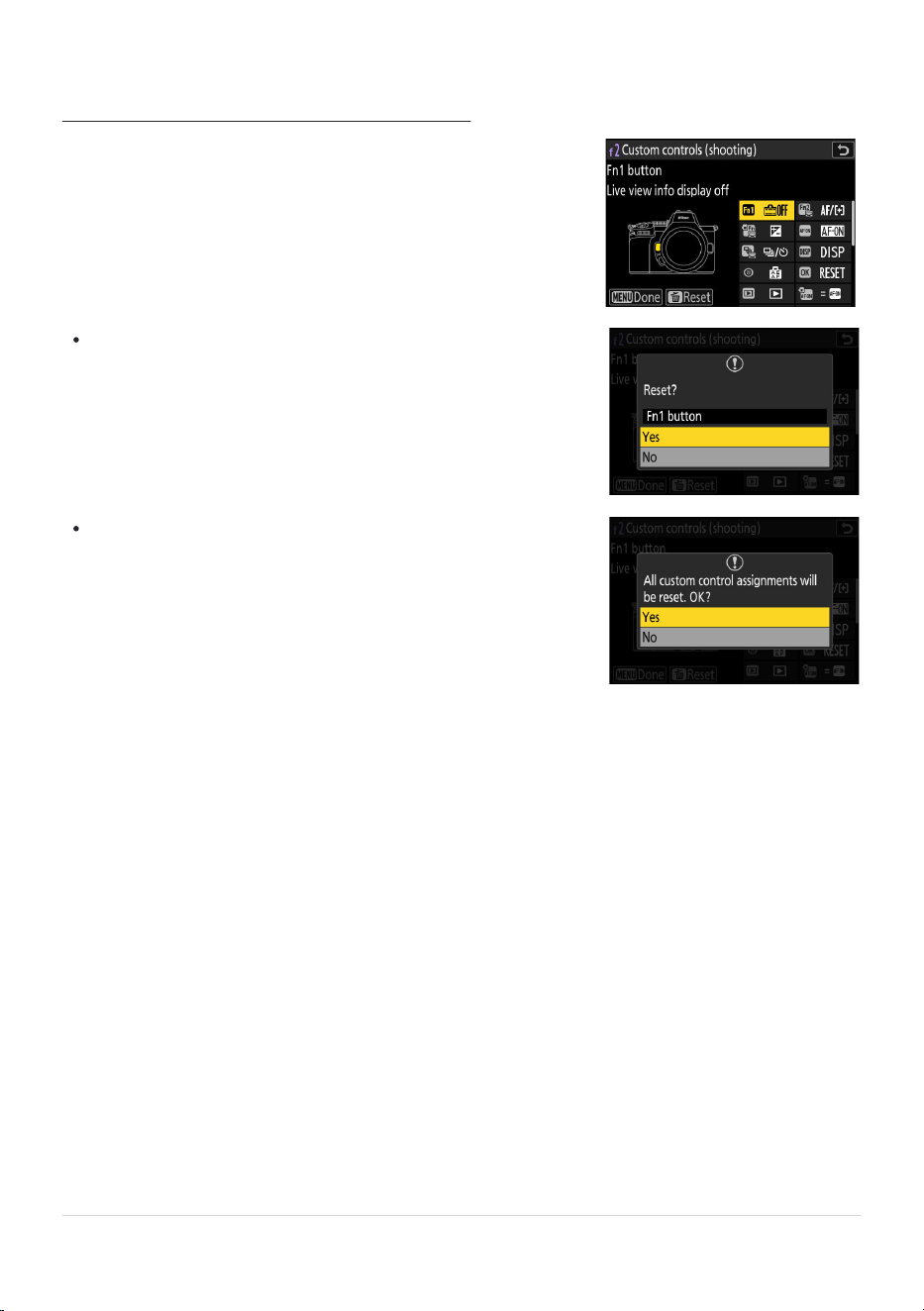
You can reset selected controls to their default settings in the
custom-control selection display
. You can reset individual controls
or all controls to their default settings.
To reset a control, highlight it and press O; this will display a
confirmation dialog. Highlight [Yes
] and press J to restore the
default settings for the selected control.
To reset all controls, highlight a control and press and hold O
for about three seconds; this will display a confirmation dialog.
Highlight [
Yes] and press J to restore the default settings for all
controls.
Restoring Default Settings
631
f2: Custom controls (shooting)
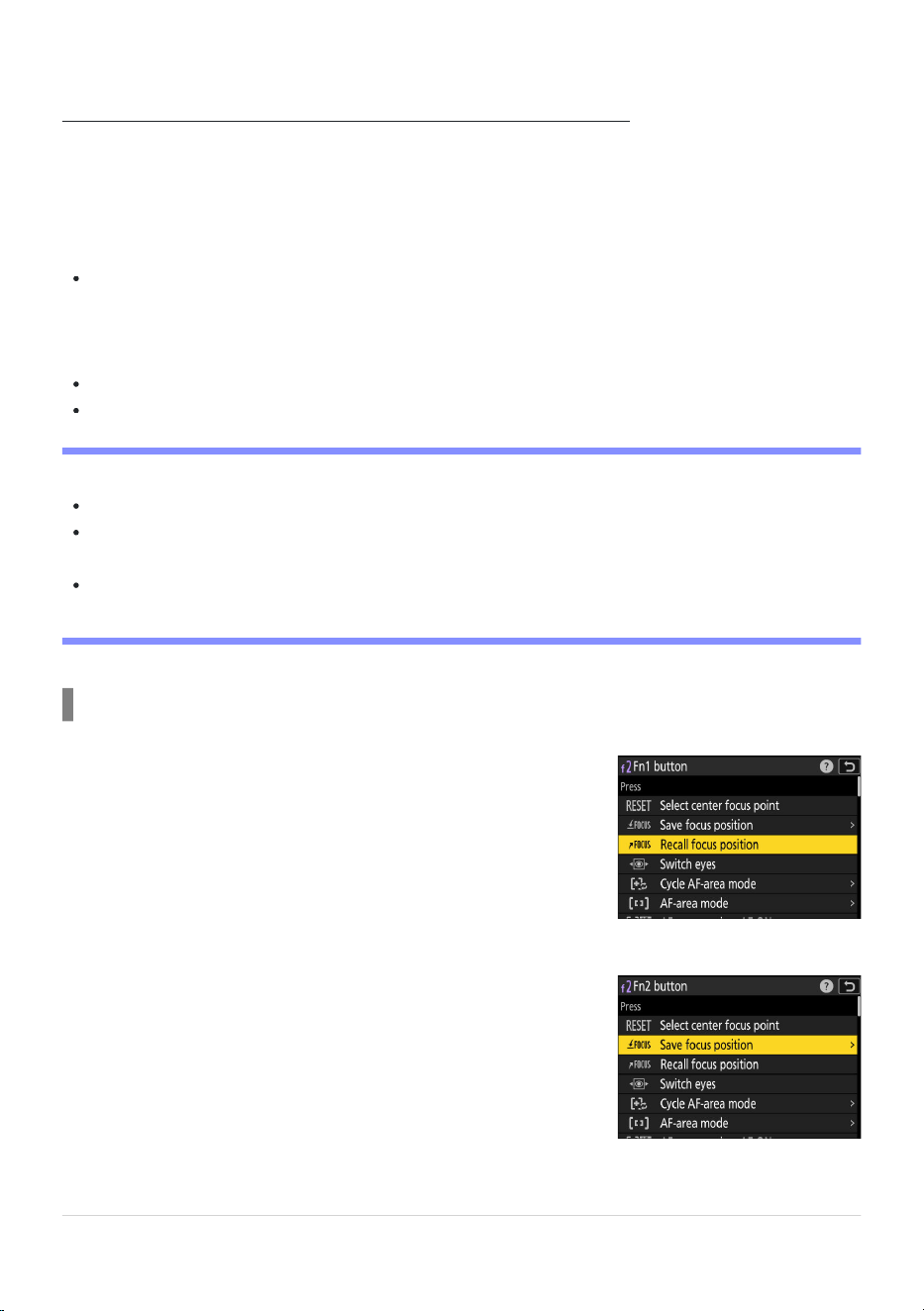
Assign [Recall focus position] to a control.
Repeat this step for each o
f the controls you intend to use for
memory recall.
Select another control in the custom control list and, when
prompted t
o choose a role, highlight [Save focus position]
and press 2.
Save options will be displayed.
Saving and Recalling Focus Positions
You can save the curr
ent focus position by pressing and holding a custom control to which you have
assigned [Save focus position]. The saved focus position can be instantly restored by pressing a
custom control assigned [Recall focus position] (“memory recall”). You may find this useful if you
frequently return to subjects at a fixed focus distance.
[Recall focus position] can be assigned to multiple controls. Focus positions saved by selecting
[Save to all] for [Save focus position] can be recalled using any of the assigned controls. Those
saved by selecting [Save individually] for [Save focus position] can instead be recalled only via a
specific control.
Focus positions can be saved in any focus mode.
The stored distance is however reset when the lens is detached.
D Cautions: Saving and Recalling Focus Positions
Focus positions cannot be saved while shooting information is displayed.
The focus position selected when a stored value is recalled may differ from the saved position due
changes in ambient temperature.
Changes to zoom after a focus position is saved tend to alter the position selected when the value is
recalled.
“Save to All”
632
f2: Custom controls (shooting)
1
2
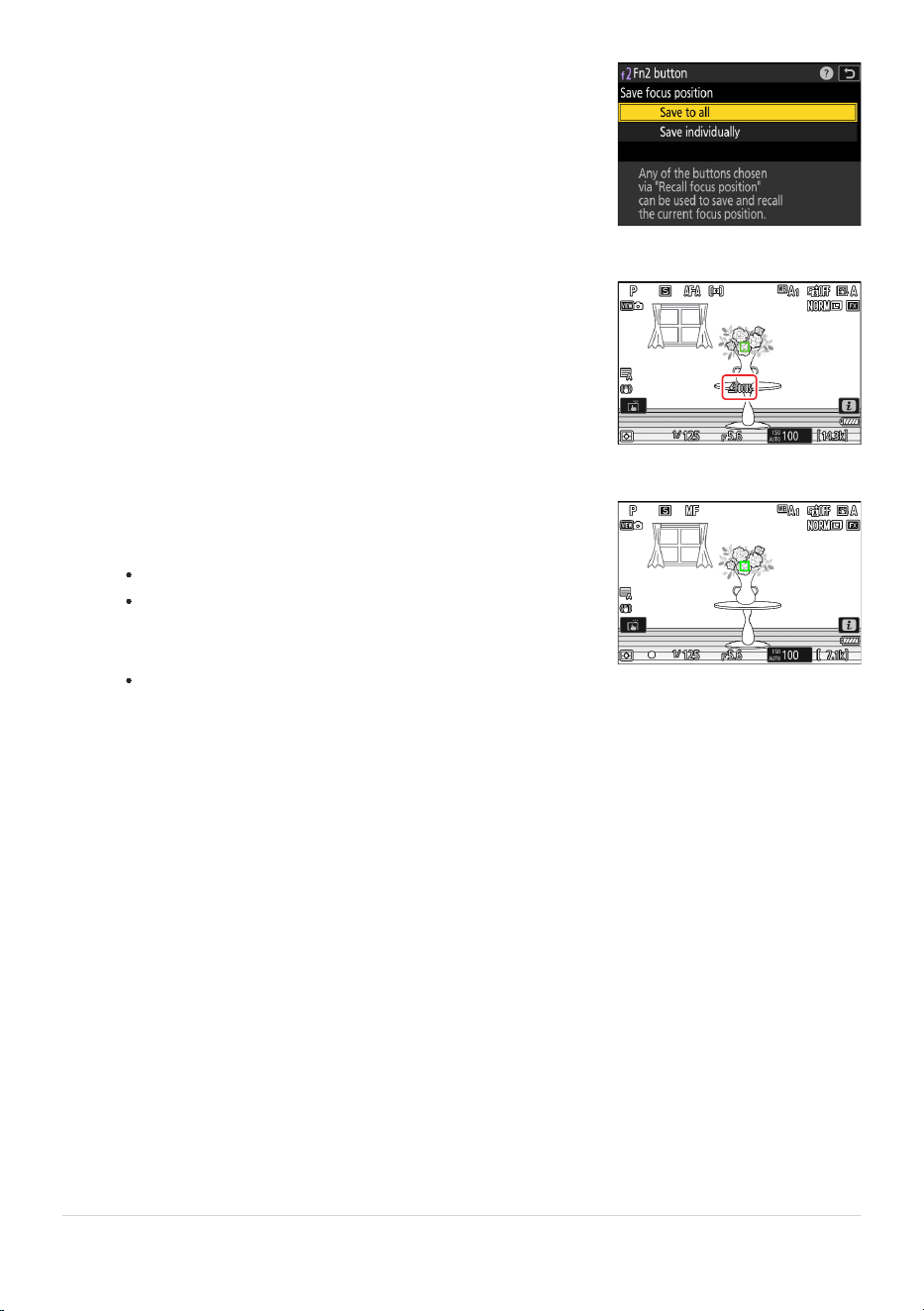
Highlight [Save to all] and press J.
Focus on the desired subject in the shooting display and
press and hold the control t
o which [Save focus position] is
assigned.
A F icon will appear in the shooting display if the operation
is successful.
Press any of the controls to which [Recall focus position]
was assigned in Step1.
The sav
ed focus position will be restored.
Although [Recall focus position] can be assigned to
multiple controls, the same focus position will be restored
regardless of the control used.
Holding a control to which [Recall focus position] is
assigned activates manual focus (MF), and the camera will
not refocus if the shutter-release button is pressed halfway
while the control is pressed.
633
f2: Custom controls (shooting)
3
4
5
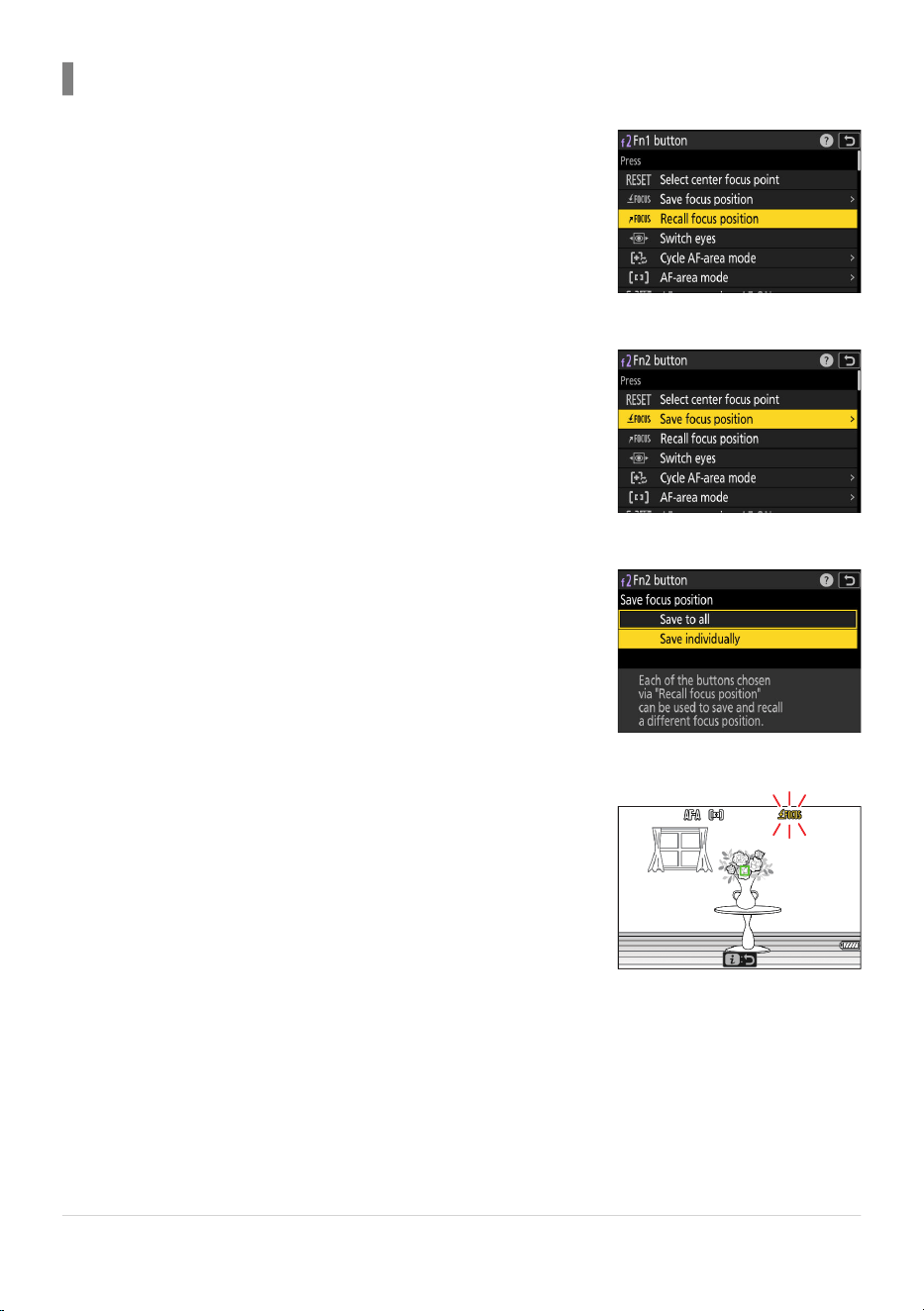
Assign [Recall focus position] to multiple controls.
Select another control in the custom control list and, when
prompted t
o choose a role, highlight [Save focus position]
and press 2.
Save options will be displayed.
Highlight [Save individually] and press J.
Focus on the desired subject in the shooting display and
press and hold the control t
o which [Save focus position] is
assigned.
A F icon will flash in the shooting display.
“Save Individually”
634
f2: Custom controls (shooting)
1
2
3
4
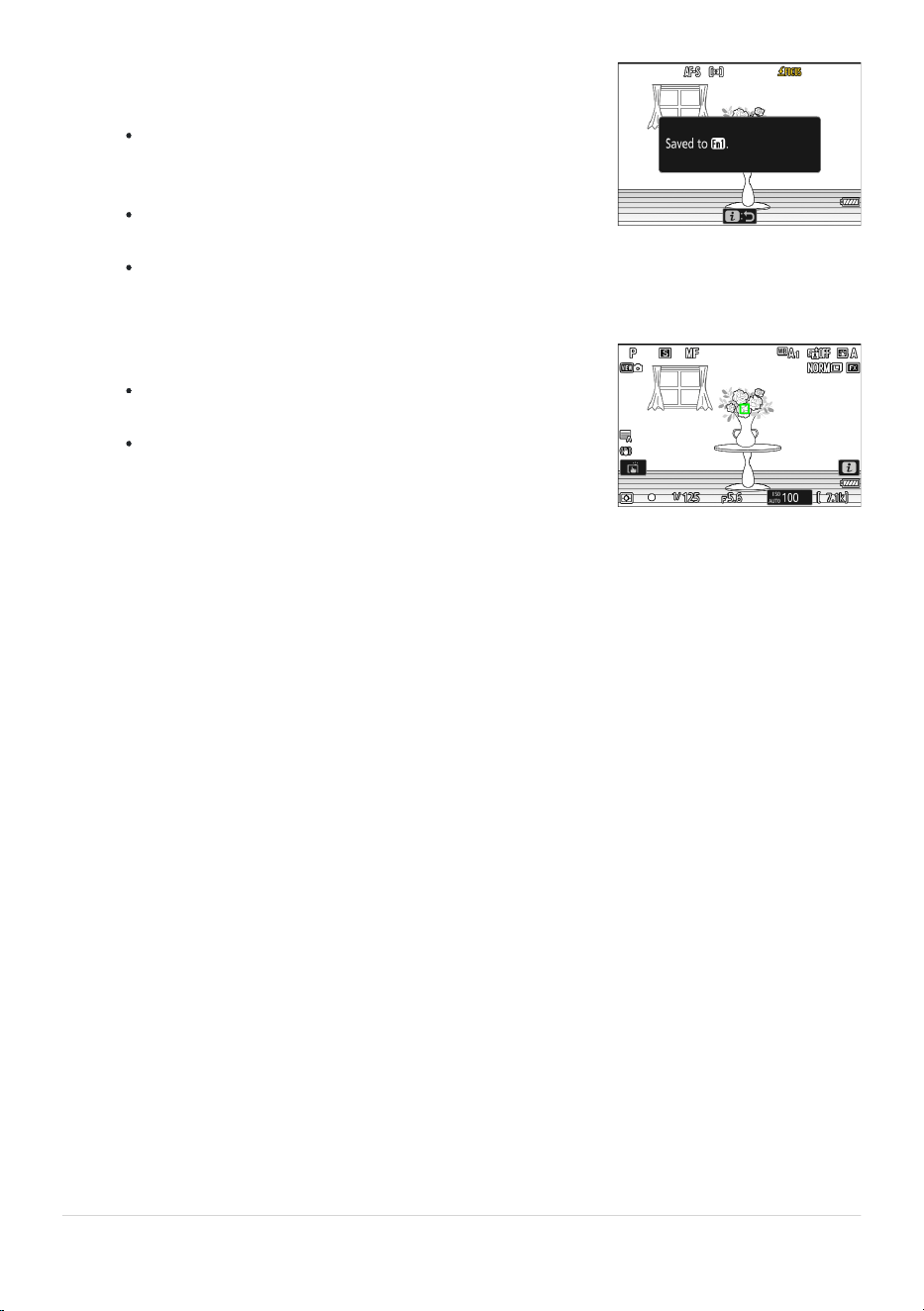
Press the button you intend to use for recall of the focus
position saved in St
ep4.
Of the controls to which [Recall focus position] was
assigned in Step1, press the control you intend to use for
recall of the focus position saved in Step4.
A message will appear in the shooting display if the
operation is successful.
Repeat Steps4 to 5 to save additional focus positions to the
other controls to which [Recall focus position] is assigned.
Press the control for the desired focus position.
The focus position saved to the contr
ol in question will be
restored.
Holding a control to which [Recall focus position] is
assigned activates manual focus (MF), and the camera will
not refocus if the shutter-release button is pressed halfway
while the control is pressed.
635
f2: Custom controls (shooting)
5
6
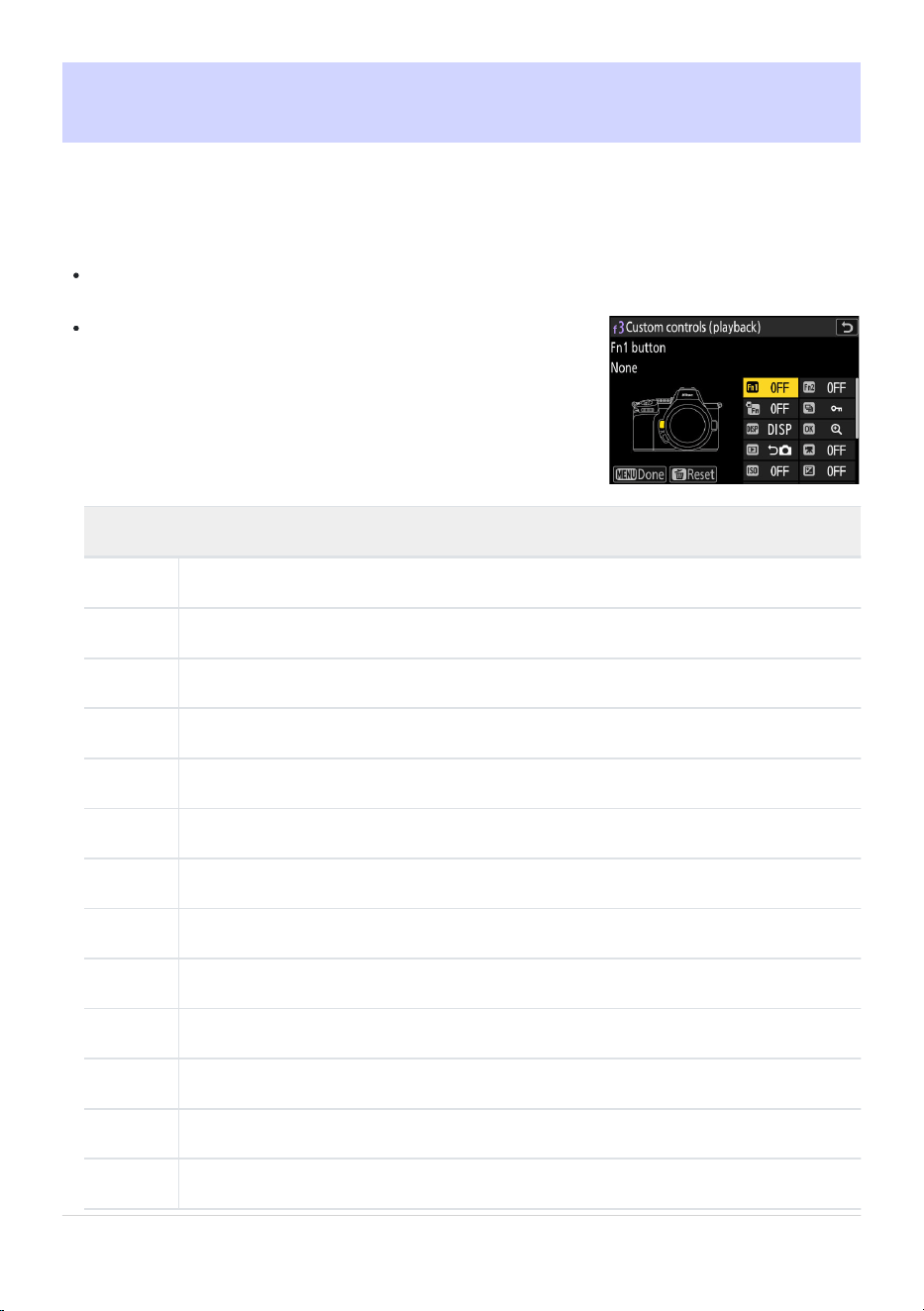
Choose the roles played by the controls below. Highlight the
desired control and pr
ess J.
f3: Custom controls (playback)
G buttonUA
Custom Settings menu
Choose the operations performed during playback using camera buttons and command dials.
You can also choose the roles played by the controls on optional battery packs connected to the
camera.
Option
v
[Fn1 butt
on]
x
[Fn2 button]
k
[Fn button for vertical shooting]
l
[Release mode/protect button]
D
[DISP button]
p
[OK button]
q
[Playback button]
z
[Video record button]
R
[ISO sensitivity button]
Q
[Exposure compensation button]
x
[Picture Control button]
3
[Sub-command dial]
y
[Main command dial]
636
f3: Cust
om contr
ols (playback)

Option
3
[Lens Fn2 button]
S
[Lens Fn butt
on]
The roles that can be assigned to these controls are listed below. The roles available vary with the
control.
Role Description
g
[Protect]
Press the control to toggle protection for the current picture on or
off.
O
[Delete]
Press the control once to display a confirmation dialog. Press the
control again to delete the current picture and return to playback.
p
[Zoom on/off]
Press the contr
ol to zoom the display in on the area around the
current focus point (the zoom ratio is selected in adv
ance). Press
again to cancel zoom.
To choose the zoom ratio, highlight [Zoom on/off] and press
2.
Zoom on/off is available in both full-frame and thumbnail
playback.
l
[Filtered
playback]
Pr
ess the control to view only pictures that meet the criteria
selected for [Filtered playback criteria] in the playback menu.
N
[Filtered playback
(select criteria)]
Press the control to jump to [Filtered playback criteria] in the
playback menu.
O
[Start series
playback]
Pressing the control when a picture from a burst is displayed full
frame starts automated playback (
0 699). The pictures will play
back while the contr
ol is pressed, at a speed higher than when the
multi selector is used. Playback stops when the control is released
or the last picture in the burst is displayed.
b
[Voice memo] Use the control for voice memo operations.
637
f3: Custom controls (playback)

Role Description
K
[Select for upload
to comput
er]
Press the control to upload the current picture to a computer or
FTP server with which the camera is currently connected.
To view upload options, highlight [Select for upload to
computer] or [Select for upload (FTP)] and press 2. Highlight
options and press J to select (M) or deselect (U).
[Priority upload]: If this option is selected (M), pressing the
control to mark a picture for upload will move it to the front
of the upload queue.
[Protect]: If this option is selected (M), pressing the control
to mark a picture for upload will simultaneously protect it.
[Rating]: If this option is selected (M), pressing the control
to mark a picture for upload will simultaneously assign it a
preset rating. Press 2 to choose the rating.
N
[Select for uplo
ad
(FTP)]
n
[
Thumbnail on/
off]
Press the contr
ol to toggle between full-frame and 4-, 9-, or 72-
frame thumbnail playback.
o
[View histograms]
A histogram is displayed while the control is pressed. The
histogram display is available in both full-frame and thumbnail
playback.
W
[Choose slot and
folder]
Press the control to display the [Choose slot and folder] dialog,
where you can then choose a slot and folder for playback.
M
[Cycle info
display]
Press the control to cycle the photo information display during
full-frame playback. The pages available can be chosen using
[Playback display options] in the playback menu.
P
[Resume
shooting]
Press the control to end playback and return to shooting mode.
c
[Rating]
To rate the current picture in playback mode, press the control and
rotate the main command dial.
To display rating options, highlight [Rating] and press 2. If an
option other than [None] is selected, the chosen rating can be
assigned to pictures simply by pressing the selected control.
Pressing the control again selects a “no star” rating.
638
f3: Custom controls (playback)
-
-
-

Role Description
7
[RAW processing
(current pictur
e)]
Press the control to display the same retouch options as when the
selected item is select
ed for [Retouch] in the i menu.
e
[RAW processing
(multiple
pictures)]
k
[
Trim]
8
[Resize (current
picture)]
f
[Resize (multiple
pictures)]
i
[D-Lighting]
Z
[Straighten]
a
[Distortion
control]
e
[Perspective
control]
l
[Monochrome]
g
[Overlay (add)]
h
[Lighten]
i
[Darken]
j
[Motion blend]
[None] The control has no effect.
639
f3: Custom controls (playback)

Command Dials
The following roles can be assigned to the command dials. T
o view options, highlight items and press
2.
Frame advance
Choose how frames can be skipped by rotating the command dials during full-frame playback.
Option Description
1 [ 1 frame] Skip forward or back a frame at a time.
10 [10 frames] Skip forward or back 10 frames at a time.
50 [50 frames] Skip forward or back 50 frames at a time.
c
[Rating] Skip to the next or previous picture with the selected rating.
P
[Pr
otect] Skip to the next or pr
evious protected picture.
C
[Photos only] Skip to the next or previous photo.
1
[Videos only] Skip to the next or previous video.
c
[Skip to first shot in series]
Select this option to skip all but the first shot in each burst
displayed when scrolling through pictures with the command
dials. Pictures that are not part of a burst will not be skipped.
W
[Folder] Rotate the dial to select a folder.
7
[Page] View the next or previous page of thumbnails.
N
[Uploaded to FTP]
Skip to the next or previous picture that has been uploaded
to an FTP server.
K
[Uploaded to computer]
Skip to the next or previous picture that has been uploaded
to a computer.
640
f3: Custom controls (playback)

Video playback
Choose the roles played by the command dials during video playb
ack.
Option Description
1f [ 1 frame] Advance or rewind a frame at a time.
5f [ 5 frames] Advance or rewind 5 frames at a time.
10f [10 frames] Advance or rewind 10 frames at a time.
2s [ 2 s] Skip forward or back 2s at a time.
5s [ 5 s] Skip forward or back 5s at a time.
10s [10 s] Skip forward or back 10s at a time.
c
[First/last frame] Skip to the fir
st or last frame.
d
[Playback speed]
Choose the video playback speed. You can toggle between original
speed, ¹/₂× speed, and ¹/₄× speed. The new playback speed applies only
to the video currently being played back.
641
f3: Custom controls (playback)
Frame advance zoom position
Choose how the camera centers the display when either the main or sub-command dial is r
otated to
scroll through pictures during playback zoom.
Option Description
[Keep current zoom position] Center the display on the curr
ent zoom location.
[Prefer focus point]
Center the display on the focus point that was active when
the photograph was taken.
[Prefer focus point (face priority)]
Center the display on the focus point that was active when
the photograph was taken. If a person's face is detected in
the photograph, playback zoom will center on the face.
Playback zoom face selection
If [ON] is selected, when multiple faces are det
ected in the picture during playback zoom, the sub-
command dial can be rotated to switch between the detected faces.
642
f3: Custom controls (playback)
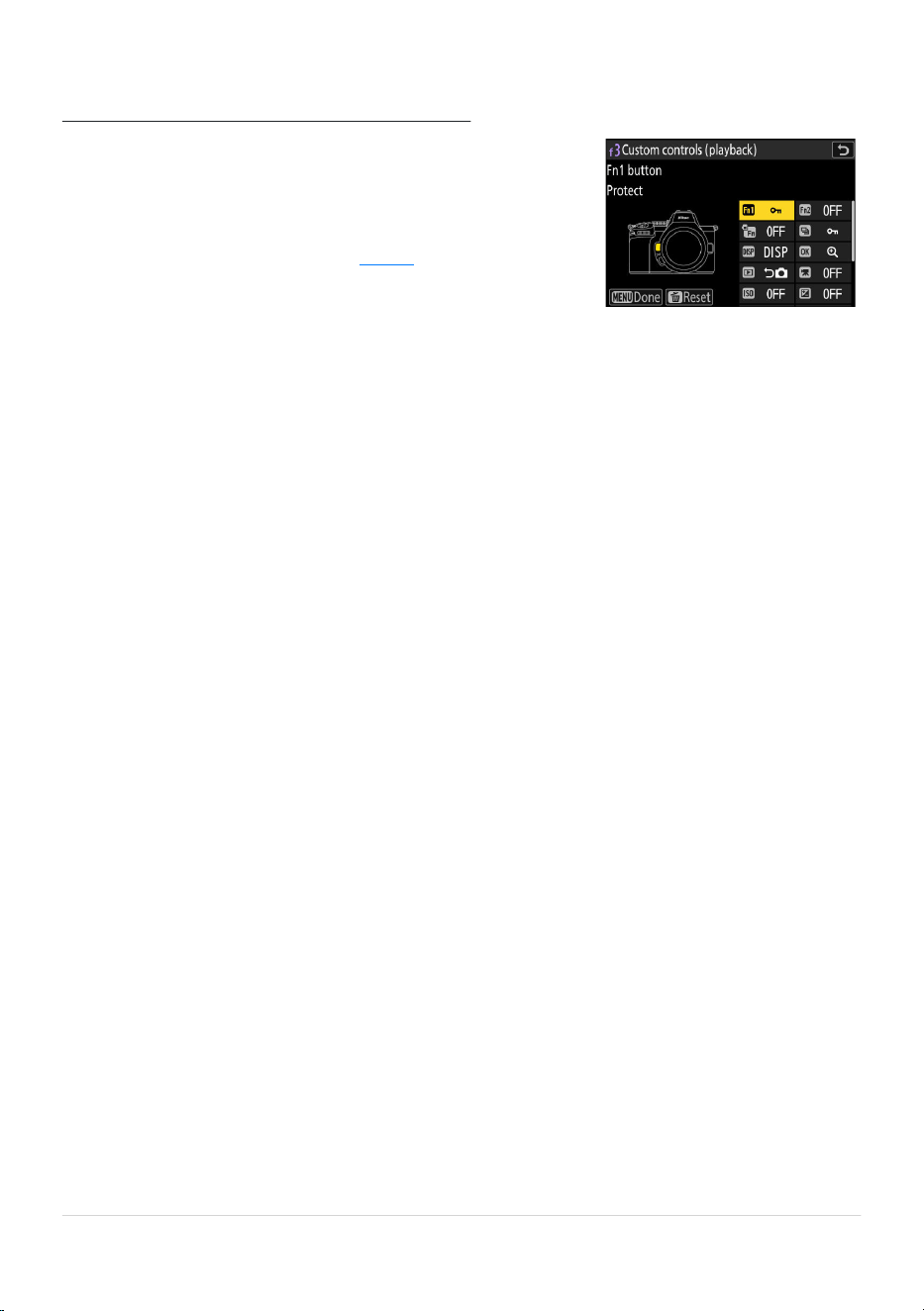
You can reset selected controls to their default settings in the
custom-control selection display
. You can reset individual controls
or all controls to their default settings. For information on resetting
the custom controls, see “Restoring Default Settings” in the “f2:
Custom Controls (Shooting)” section (
0 631).
Restoring Default Settings
643
f3: Custom controls (playback)
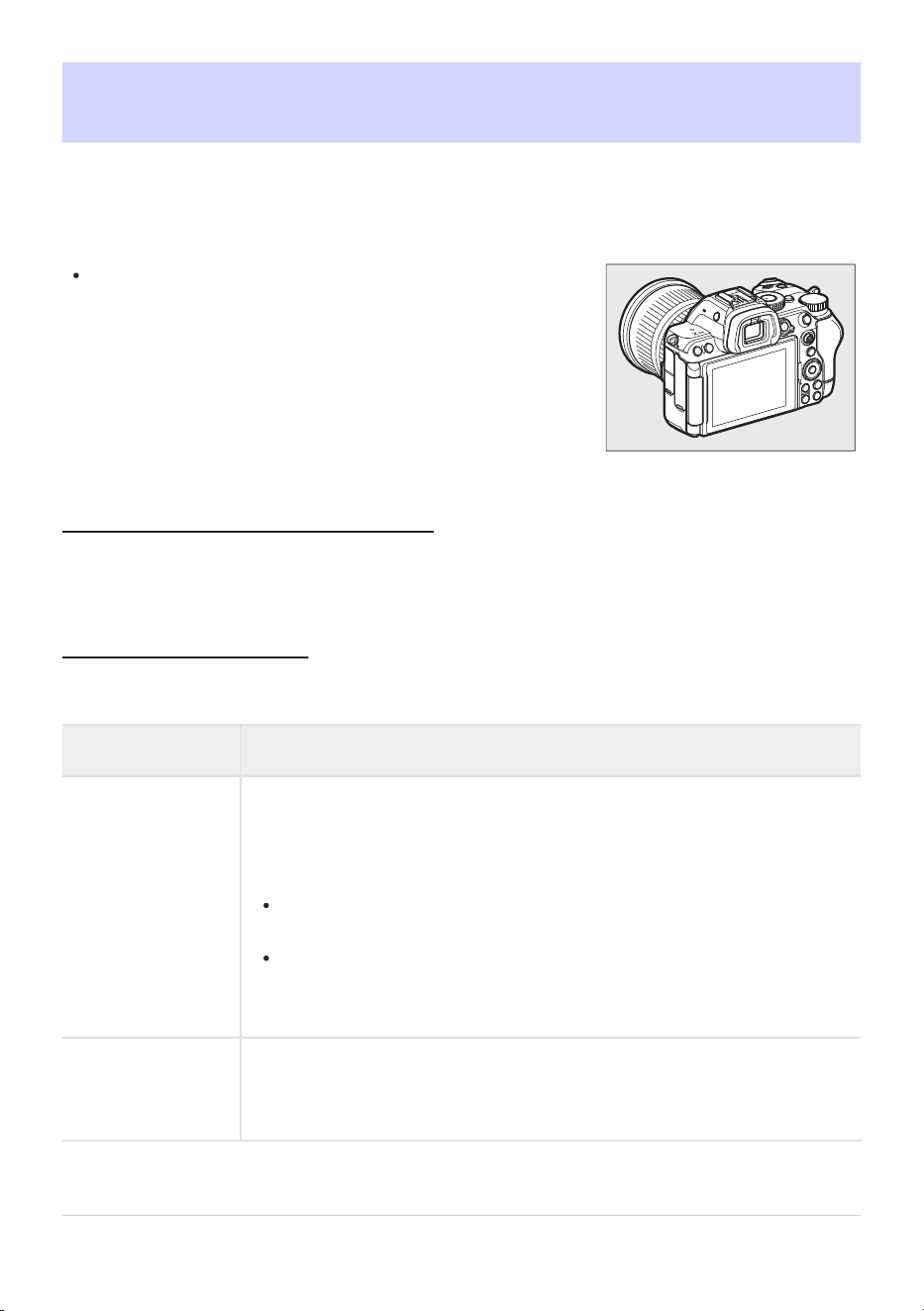
Touch Fn is available only when the monitor is in storage
position with the screen facing outward.
f4: Touch Fn
G buttonU
ACustom Settings menu
Use monitor touch controls to adjust settings while framing pictures in the viewfinder.
Enable/disable touch Fn
Select [ON] t
o enable t
ouch Fn.
Assign touch Fn
The roles that can be assigned to t
ouch Fn are listed below.
Role Description
[Move focus point]
When sliding a finger over the t
ouch Fn area, the focus point will reposition
in the direction of the slide. Highlight [Mov
e focus point] and press 2 on
the multi selector to choose the operation performed when double-tapping
the touch Fn area in the monitor.
[Select center focus point]: The focus point is positioned to the center of
the viewfinder.
[Set absolute focus position]: The touch Fn area represents the entire
viewfinder, and the focus point is repositioned to the corresponding
position in the viewfinder by double-tapping the desired location.
[Switch eyes]
When the camera detects the ey
es of a human or animal portrait subject,
you can choose the eye used for focus by tapping the touch Fn area in the
monitor.
644
f4: Touch Fn

Role Description
[Framing grid]
T
apping the touch Fn area in the monitor displays a framing grid in the
viewfinder. Tap again to hide the grid. The grid type can be selected using
Custom Setting d16 or g14 [Grid type].
[Zoom on/off]
Tap the t
ouch Fn area in the monitor to zoom the display in the viewfinder in
on the area around the curr
ent focus point. Tap again to cancel zoom.
To choose the zoom ratio, highlight [Zoom on/off] and press 2.
[Virtual horizon]
Tap the t
ouch Fn area in the monitor to enable the virtual horizon display
in the viewfinder. Tap again to hide the display. The display type can be
selected using Custom Setting d17 [Virtual horizon type].
Touch Fn area
Choose the area of the monit
or used for touch Fn. The areas for use when the camera is rotated to
take pictures in “tall” and “wide” orientations can be selected separately.
645
f4: Touch Fn

f5: Control lock
G buttonUA
Custom Settings menu
Lock exposure settings or focus-point selection.
Option Description
[Shutter speed lock]
Select [ON
] to lock shutter speed at its curr
ent value in modes S and M.
O icons appear in the shooting display when shutter-speed lock is in
effect.
[Aperture lock]
Select [ON
] to lock apertur
e at its current value in modes A and M.
O icons appear in the shooting display when aperture lock is in effect.
[Focus-point lock]
Select [ON] to lock focus-point selection on the currently-select
ed focus
point.
Focus point lock does not apply when [Auto-area AF] is selected for
AF-area mode.
When [3D-tracking] is selected, the focus point will track subject motion
while the shutter-release button is pressed halfway.
646
f5: Control lock

f6: Reverse dial rotation
G buttonUA
Custom Settings menu
Reverse the direction of rotation of the command dials for selected operations.
Highlight [Exposure compensation] or [Shutter speed/aperture] and press 2 to select (M) or
deselect (U).
Press G to save changes and exit.
The selected setting also applies to the command dials on optional battery packs.
647
f6: Reverse dial rotation

f7: Release button to use dial
G buttonU
ACustom Settings menu
Selecting [ON] allows adjustments that are normally made by holding a button and rotating a
command dial to be made by rotating the command dial after the button is released. This ends when
the button is pressed again, the shutter-release button is pressed halfway, or the standby timer expires.
[Release button to use dial] applies to the E, S, c (E), Fn1, and Fn2 buttons.
[Release button to use dial] also applies to controls to which certain roles have been assigned
using Custom Setting f2 [Custom controls (shooting)] or g2 [Custom controls].
648
f7: Release button to use dial
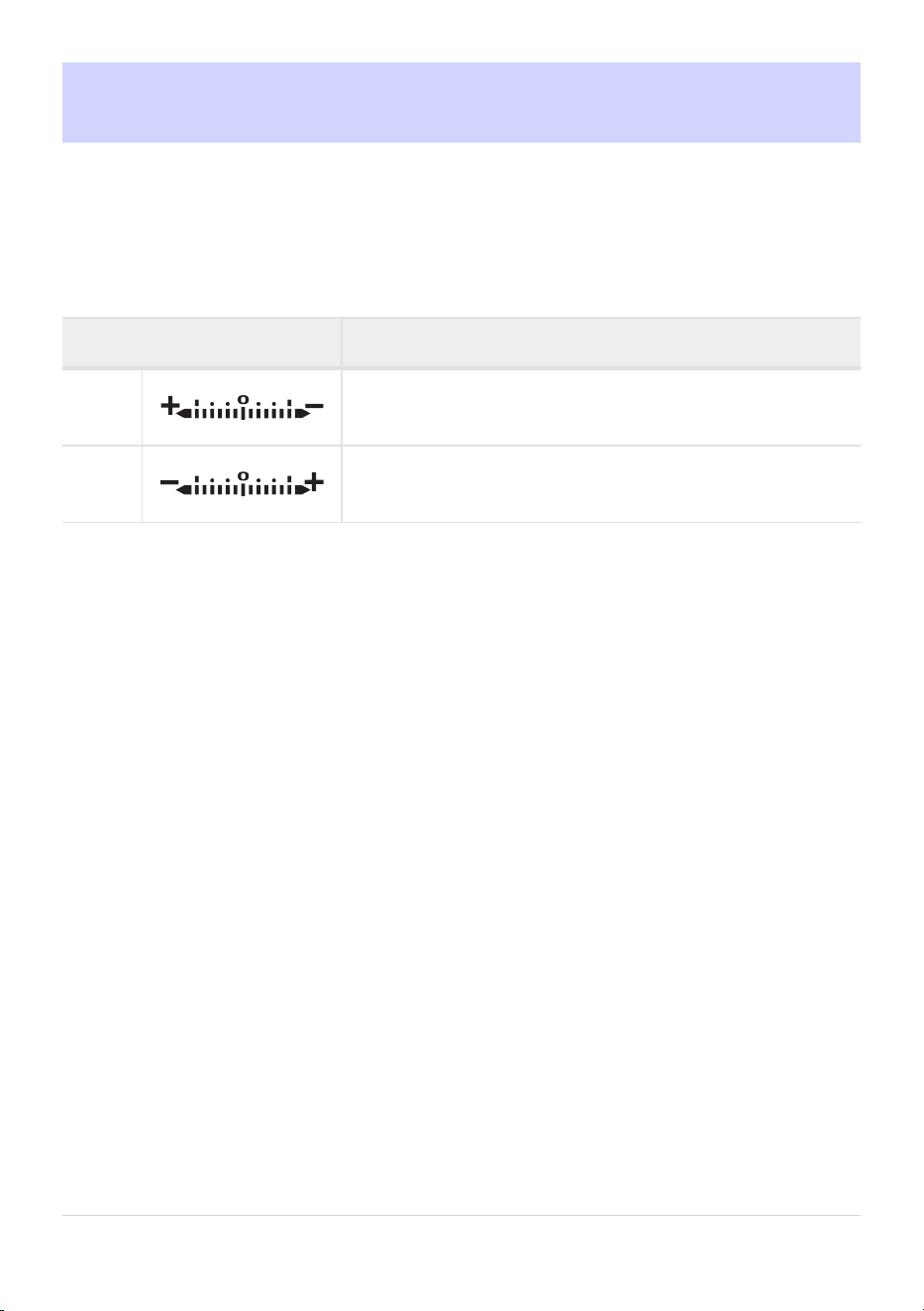
f8: Reverse indicators
G buttonUA
Custom Settings menu
Choose whether certain horizontal indicators in the shooting and other displays are shown with
negative values on the left and positive values on the right, or with positive values on the left and
negative values on the right.
Option Description
V
The indicators are displayed with positive values on the left and
negative values on the right.
W
The indicators are displayed with negative values on the left
and positive values on the right.
649
f8: R
everse indicators

f9: Reverse ring for focus
G buttonUA
Custom Settings menu
Select [ON] to reverse the direction of rotation for the focus or control rings on Z mount lenses during
manual focus.
This option does not support:
certain Z mount lenses that can only be focused manually, or
F mount lenses connected via an FTZ II/FTZ mount adapter.
650
f9: Reverse ring for focus
-
-

f10: Focus ring rotation range
G buttonU
ACustom Settings menu
Choose how far the focus or control rings on Z mount lenses must be rotated to go all the way from
the minimum focus distance to infinity.
Option Description
[Non-linear]
The focus distance changes by a large amount when the ring is rotated rapidly and
by a small amount when the ring is rotated slowly
, without regard to how far the
ring is rotated.
[90°]–[720°]
Choose how far the ring must be rotated to go all the way from the minimum focus
distance to infinity. To take focus from the minimum distance to infinity when, for
example, [90°] is selected, the ring needs only be rotated 90°. Larger values permit
finer adjustments.
[Max.]
Taking focus from the minimum focus distance to infinity requires rotating the ring
the maximum distance permitted at current lens settings.
If the lens does not support rotation range selection, [Focus ring rotation range] will be fix
ed at
[Non-linear].
651
f10: Focus ring rotation range

f11: Control ring response
G buttonU
ACustom Settings menu
Choose how responsive the lens control ring is when assigned [Aperture], [Power aperture],
[Exposure compensation], [ISO sensitivity], or [Hi-Res Zoom] using Custom Setting f2 [Custom
controls (shooting)] or g2 [Custom controls].
652
f11: Control ring response

f12: Switch focus/control ring roles
G buttonU
ACustom Settings menu
If [ON] is selected, the focus ring will perform the role currently assigned to the control ring using
Custom Setting f2 [Custom controls (shooting)] or g2 [Custom controls].
When [ON] is selected, the control ring functions solely in the [Focus (M/A)] role.
This option applies only to compatible lenses.
653
f12: Switch focus/control ring roles

f13: Power zoom (PZ) button options
G buttonUA
Custom Settings menu
Choose whether the X and W (Q) buttons can be used for power zoom during still photography when
a power zoom lens is attached.
Option Description
[Use x/w buttons
]
Selecting [ON] allows the X and W (Q) buttons to be used for pow
er zoom.
[Power zoom speed]
Choose the speed at which power zoom lenses can be zoomed in and out
using the butt
ons.
654
f13: Power zoom (PZ) button options

f14: Full-frame playback flicks
G buttonU
ACustom Settings menu
Choose the role assigned to the flick up and down or flick left and right gestures during full-frame
playback.
Flick up/Flick down
Choose the operation performed by flicking up or down.
Option Description
c
[Rating]
Assign the curr
ent picture a pre-selected rating. The
rating can be chosen by pressing 2.
K
[Select for upload to comput
er]
Mark the current picture for priority upload to a
computer.
N
[Select for upload (FTP)]
Mark the current picture for priority upload to an FTP
server.
g
[Protect] Protect the current picture.
b
[V
oice memo]
Flick t
o star
t recording a voice memo. If a memo
already exists for the current pictur
e, flicking instead
begins playback of the existing memo. Press J to end
recording or playback.
[None] Flicking up or down has no effect.
Pictures selected by flicking up or down when [Rating], [Select for upload to comput
er], [Select
for upload (FTP)], or [Protect] is selected are indicated by icons (
0 227). The marking can be
r
emov
ed by flicking again in the same dir
ection.
655
f14: Full-frame playback flicks

Flick advance direction
Choose the gesture used for frame advance.
Option Description
S
[
Left←Right] Flick from right t
o left to view the next picture.
T
[Left→Right] Flick from left to right to view the next picture.
656
f14: Full-frame playback flicks

f15: Prefer sub-selector center
G buttonUA
Custom Settings menu
Choose how the sub-selector behaves while its center is pressed.
Option Description
[ON] The sub-selector cannot be used to position the focus point while the center is pressed.
[OFF] The sub-selector can be used to position the focus point while the center is pressed.
The center of the sub-selector, meanwhile, functions in the role chosen for [Sub-selector center
]
using Custom Setting f2 [Custom controls (shooting)] or g2 [Custom controls]. This is particularly
noteworthy in that if you assign [AF-area mode] to the center of the sub-selector via Custom Setting
f2 [Custom controls (shooting)], you will then be able to use it to temporarily switch AF-area modes
without interfering with your ability to position the focus point.
657
f15: Prefer sub-selector center
g1: Customize imenu
G buttonUACustom Settings menu
Choose the items listed in the i menu displayed when the i button is pressed in video mode.
Highlight a position in the i menu, press J, and select the desired item.
The following items can be assigned to the i menu.
Option
0
G
[Frame size/frame rat
e] 0 202
J
[Choose image area] 0 209
N
[Destination] 0 513
E
[Exposure compensation] 0 150
9
[ISO sensitivity settings] 0 160
m
[White balance] 0 182
h
[Set Picture Control] 0 164
6
[HLG quality] 0 521
y
[Active D-Lighting] 0 428
h
[Skin softening] 0 527
i
[Portrait impression balance] 0 436
w
[Metering] 0 531
s
[Focus mode] 0 120
7
[AF-area mode/subj. detection] 0 122, 0 126
H
[Product review mode] 0 212
u
[Vibration reduction] 0 538
658
g1: Customize imenu
Option
0
4
[Electronic VR] 0 539
H
[Microphone sensitivity] 0 540
5
[Attenuator] 0 541
6
[Frequency response] 0 542
7
[Wind noise reduction] 0 543
8
[Headphone volume] 0 545
H
[Hi-Res Zoom] 0 213
L
[Silent mode] 0 749
w
[Custom controls] 0 661
W
[Focus peaking] 0 567
9
[Zebra pattern] 0 681
3
[Monitor/viewfinder brightness] 0 718, 0 720
8
[Multi-selector power aper
ture]
0 660
9
[Multi selector exposure comp.] 0 660
l
[View video info] 0 660
v
[Warm display colors] 0 593
u
[Airplane mode] 0 769
W
[Wireless remote connection (ML-L7)] 0 778
W
[Bluetooth remote cntrl connection] 0 780
a
[Power battery pack info] 0 617
E
[Video self-timer] 0 211
659
g1: Customize imenu
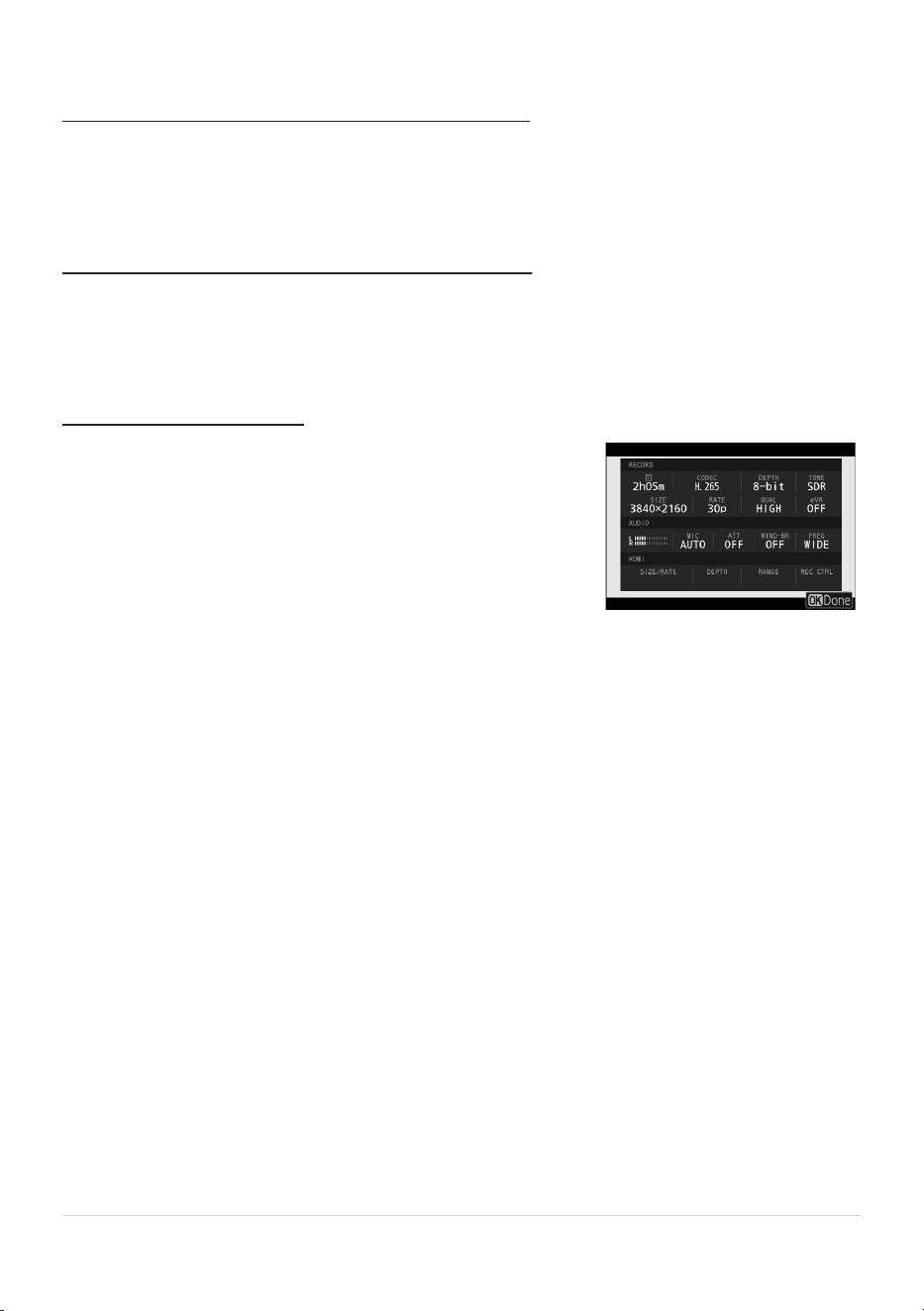
View video recording settings. This option can be used to view but
not to change the option selected.
Multi-selector power aperture
Choose whether the multi selector can be used for power aper
ture. When [Enable] is selected, holding
1 widens the aperture. Holding 3 narrows the aperture.
Multi selector exposure comp.
Choose whether the multi selector can be used to adjust exposur
e compensation. Selecting [Enable]
allows exposure compensation to be set by pressing 1 or 3.
View video info
660
g1: Customize imenu
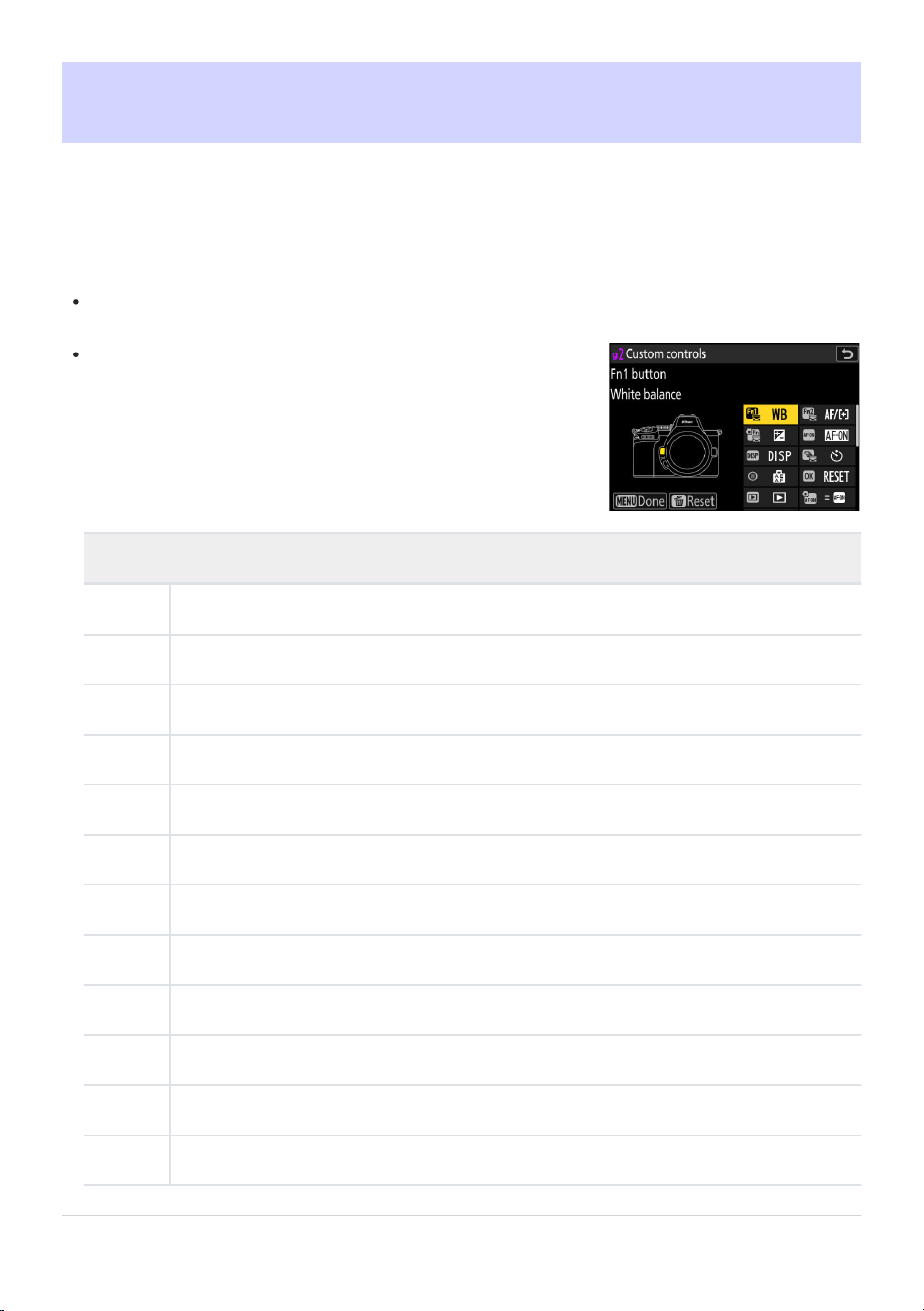
Choose the roles played by the controls below. Highlight the
desired control and pr
ess J.
g2: Custom controls
G buttonUA
Custom Settings menu
Choose the operations performed in video mode using lens rings and camera buttons and command
dials.
You can also choose the roles played by the controls on optional battery packs connected to the
camera.
Option
w
[Fn1 butt
on]
y
[Fn2 button]
n
[Fn button for vertical shooting]
V
[AF-ON button]
D
[DISP button]
l
[Release mode/protect button]
8
[Sub-selector cent
er
]
p
[OK button]
q
[Playback button]
j
[AF-ON button for vertical shooting]
F
[Vertical multi selector center]
z
[Video record button]
661
g2: Custom controls
Option
R
[ISO sensitivity button]
Q
[Exposur
e compensation button]
x
[Picture Control button]
y
[Command dials]
G
[Shutter-release button]
3
[Lens Fn2 button]
S
[Lens Fn button]
R
[Lens Fn ring (clockwise)]
S
[Lens Fn ring (counterclockwise)]
T
[Lens memory set button]
l
[Lens control ring]
The roles that can be assigned are listed below. The roles available vary with the control.
Role Description
K
[Select center focus
point]
Pressing the control selects the center focus point.
F
[Save focus position]
Holding the control saves the current focus position.
The saved position can be restored using a control
to which [Recall focus position] has been assigned
(“memory recall”).
When saving the focus position, you can choose
whether it can be recalled using any of the controls
to which [Recall focus position] is assigned ([Save
to all]) or using only a specific control ([Save
individually]).
For more information, see “Saving and Recalling Focus
Positions” (
0 632).
662
g2: Custom controls

Role Description
H
[Recall focus position]
Pressing the contr
ol recalls a focus position saved using
a control to which [Save focus position] has been
assigned.
For more information, see “Saving and Recalling Focus
Positions” (
0 632).
z
[Switch eyes]
Press the contr
ol to choose the eye used for focus when
the camera detects the eyes of a human or animal
portrait subject.
r
[Cycle AF-area mode]
Press the contr
ol to cycle the AF-area mode.
To choose the AF-area modes t
o be cycled, press 2
when [Cycle AF-area mode] is highlighted.
Highlight options and press J or 2 to select (M) or
deselect (U). Only items marked with a check (M) will
be cycled when the control is pressed.
A
[AF-ON]
Pressing the control initiates autofocus, duplicating the
function of the AF-ON
button.
When AF-C is selected for focus mode, the camera will
focus at the speed selected for Custom Setting g5 [AF
speed].
G
[Fast AF-ON]
Pressing the control initiates autofocus, duplicating the
function of the AF-ON button.
When AF-C is selected for focus mode, the camera
will focus at maximum speed, regardless of the option
chosen for Custom Setting g5 [AF speed].
F
[AF lock only] Focus locks while the control is pressed.
E
[AE lock (hold)]
Exposure locks when the control is pressed. Exposure lock
does not end when recording begins. Exposure remains
locked until the control is pressed a second time or the
standby timer expires.
663
g2: Custom controls
-
-

Role Description
N
[AWB lock (hold)]
If [Aut
o] or [Natural light auto] is selected for white
balance, white balance will lock when the control is
pressed (white-balance lock). White-balance lock does
not end when recording begins. The lock will however be
released when the control is pressed a second time or the
standby timer expires.
O
[AE/AWB lock (hold)]
Exposure locks when the control is pressed. White
balance will also lock provided [Auto] or [Natural light
auto] is selected for white balance. Exposure and white-
balance lock do not end when recording begins. The lock
will however be released when the control is pressed a
second time or the standby timer expires.
C
[AE lock only] Exposure locks while the control is pressed.
B
[AE/AF lock] Focus and exposure lock while the control is pressed.
K
[Switch FX/DX]
Press the control to switch between [FX] and [DX] image
areas.
h
[Set Pictur
e Control]
Pr
ess the contr
ol to display the same Picture Control list
as when the i-menu [Set Pictur
e Contr
ol] is select
ed.
p
[View assist]
Press the control to select [ON] for Custom Setting g11
[View assist]. Press again to select [OFF].
E
[High-frequency flicker
reduction]
Pressing the control allows shutter speed to be fine-tuned
in smaller increments. Press the control a second time to
restore normal shutter-speed selection.
L
[Silent mode]
Press the control to enable silent mode. Press again to
disable.
M
[Cycle live view info
display]
Press the control to cycle the shooting display. The type
and content of the displays available can be chosen
using Custom Settings g17 [Custom monitor shooting
display] and g18 [Custom viewfinder shooting display].
b
[Live view info display
off]
Press the control to hide icons and other information in
the shooting display. Press again to view.
664
g2: Custom controls

Role Description
b
[Framing grid]
Pr
ess the control to display a framing grid. To hide the
grid, press the control again. The display type can be
selected using Custom Setting g14 [Grid type].
p
[Zoom on/off]
Press the contr
ol to zoom the display in on the area
around the current focus point. Pr
ess again to cancel
zoom.
To choose the zoom ratio, highlight [Zoom on/off]
and press 2.
D
[Vir
tual horizon]
Press the contr
ol to enable the virtual horizon display.
Press again to hide the display. The display type can
be selected using Custom Setting d17 [Virtual horizon
type].
W
[Focus peaking display]
Press the control once to enable focus peaking when
MF is selected for focus mode. Press again to end focus
peaking.
8
[Enable/disable touch
Fn]
Press the control to enable or disable touch Fn.
O
[MY MENU] Press the control to display “MY MENU”.
3
[Access top item in MY
MENU]
Press the control to jump to the top item in “MY MENU”.
Select this option for quick access to a frequently-used
menu item.
K
[Playback] Press the control to start playback.
l
[Filtered playback]
Press the control to view only pictures that meet the
criteria selected for [Filtered playback criteria] in the
playback menu.
N
[Filtered playback
(select criteria)]
Press the control to jump to [Filtered playback criteria]
in the playback menu.
665
g2: Custom controls

Role Description
t
[Power aperture (open)]
Apertur
e widens while the button is pressed.
This option is enabled automatically when [Power
aperture (close)] is selected for [Fn2 button].
Rotate the lens Fn ring counterclockwise to widen the
lens aperture. This option is enabled automatically
when [Power aperture (close)] is selected for [Lens
Fn ring (clockwise)].
q
[Power aperture (close)]
Aperture narrows while the button is pressed.
This option is enabled automatically when [Power
aperture (open)] is selected for [Fn1 button].
Rotate the lens Fn ring clockwise to narrow the lens
aperture. This option is enabled automatically when
[Power aperture (open)] is selected for [Lens Fn ring
(counterclockwise)].
i
[Exposure compensation
+]
Exposure compensation increases while the button is
pressed. This option is enabled automatically when
[Exposure compensation -] is selected for [Fn2
button].
Rotate the lens Fn ring clockwise for increased
exposure compensation. This option is enabled
automatically when [Exposure compensation -] is
selected for [Lens Fn ring (counterclockwise)].
h
[Exposure compensation
-]
Exposure compensation decreases while the button is
pressed. This option is enabled automatically when
[Exposure compensation +] is selected for [Fn1
button].
Rotate the lens Fn ring counterclockwise to reduce
exposure compensation. This option is enabled
automatically when [Exposure compensation +] is
selected for [Lens Fn ring (clockwise)].
B
[ISO sensitivity
(increase)]
Rotate the lens Fn ring clockwise to increase ISO
sensitivity. This option is enabled automatically when
[ISO sensitivity (decrease)] is selected for [Lens Fn ring
(counterclockwise)].
666
g2: Custom controls
Role Description
C
[ISO sensitivity
(decrease)]
Rotat
e the lens Fn ring counterclockwise to decrease
ISO sensitivity. This option is enabled automatically when
[ISO sensitivity (increase)] is selected for [Lens Fn ring
(clockwise)].
I
[Hi-Res Zoom +]
Zoom in using Hi-Res Zoom; the zoom ratio increases
while the control is pressed. This option is enabled
automatically when [Hi-Res Zoom −] is selected for
[Fn2 button].
Rotate the lens Fn ring clockwise to zoom in using
Hi-Res Zoom. This option is enabled automatically
when [Hi-Res Zoom −] is selected for [Lens Fn ring
(counterclockwise)].
J
[Hi-Res Zoom −]
Zoom out using Hi-Res Zoom; the zoom ratio
decreases while the control is pressed. This option
is enabled automatically when [Hi-Res Zoom +] is
selected for [Fn1 button].
Rotate the lens Fn ring counterclockwise to zoom
out using Hi-Res Zoom. This option is enabled
automatically when [Hi-Res Zoom +] is selected for
[Lens Fn ring (clockwise)].
Y
[Power zoom +]
When a power zoom lens is attached, the camera zooms
in while the control is pressed. This option is enabled
automatically when [Power zoom −] is selected for [Fn2
button].
Z
[Power zoom −]
When a power zoom lens is attached, the camera zooms
out while the control is pressed. This option is enabled
automatically when [Power zoom +] is selected for [Fn1
button].
9
[Pattern tone range]
Press the control to cycle through zebra pattern tone
range options (
0 681).
1
[Record videos]
Press the contr
ol to start recording. Press again to end
recording.
e
[Same as AF-ON button]
The control performs the role currently selected for the
AF-ON button.
667
g2: Custom controls

Role Description
J
[Choose image area]
Press the contr
ol and rotate a command dial to choose
the image area for videos. Note that the image area
cannot be changed while recording is in progress.
E
[Exposure
compensation]
Adjust exposure compensation either by holding the
control and rotating a command dial or by rotating the
lens control ring.
9
[ISO sensitivity]
Adjust ISO sensitivity either by holding the control and
rotating a command dial or by rotating the lens control
ring.
m
[White balance]
Hold the control and rotate the main command dial
to adjust white balance for videos. Some options offer
sub-options that can be selected by rotating the sub-
command dial.
y
[Active D-Lighting]
Press the control and rotate a command dial to adjust
Active D-Lighting for videos.
h
[Skin softening]
Press the control and rotate a command dial to adjust
skin softening.
i
[Portrait impression
balance]
Press the control and rotate a command dial to choose a
portrait impression balance mode.
w
[Metering]
Press the control and rotate a command dial to choose a
metering option for use during video recording.
E
[Video self-timer]
Press the control and rotate a command dial to select a
video self-timer option.
z
[Focus mode/AF-area
mode]
Hold the control and rotate the main command dial to
choose the focus mode, the sub-command dial to choose
the AF-area mode.
668
g2: Custom controls
Role Description
a
[Control lock]
Press the contr
ol and rotate the main command dial
to lock shutter speed (mode M). To lock aperture
(modes A and M), press the control and rotate the
sub-command dial.
To lock focus-point selection, hold the control while
using the multi selector to choose the focus point.
H
[Microphone sensitivity]
Press the control and rotate a command dial to adjust
microphone sensitivity.
X
[Focus (M/A)]
The lens control ring can be used for manual focus
regardless of the option selected for focus mode. To
refocus using autofocus, press the shutter-release button
halfway or press a control to which AF-ON has been
assigned.
q
[Power aperture] Rotate the lens control ring to adjust aperture.
H
[Hi-Res Zoom]
Rotate the lens control ring to zoom in or out using Hi-
Res Zoom.
[None] The control has no effect.
D Power Aperture
Pow
er aperture is available only in modes A and M.
The display may flicker while aperture is adjusted.
669
g2: Custom controls
Command Dials
The following roles can be assigned to the command dials. T
o view options, highlight items and press
2.
Role Description
[Exposure setting]
Reverse the roles of the main and sub-command dials in
selected modes. Press
4 or 2 to highlight a mode and 1 or 3
to switch roles.
[Focus/AF-area mode selection]
Swit
ch the roles played by rotating the main and sub-
command dials while holding a control to which [Focus mode/
AF-area mode] has been assigned using Custom Setting g2
[Custom controls].
[Sub-command dial zoom role]
Choose the role played by the sub-command dial in the zoom
display.
Choose [Exposure setting] to change the role played by the
sub-command dial in each mode.
Choose [Zoom] to use the sub-command dial to zoom in or
out.
670
g2: Custom controls
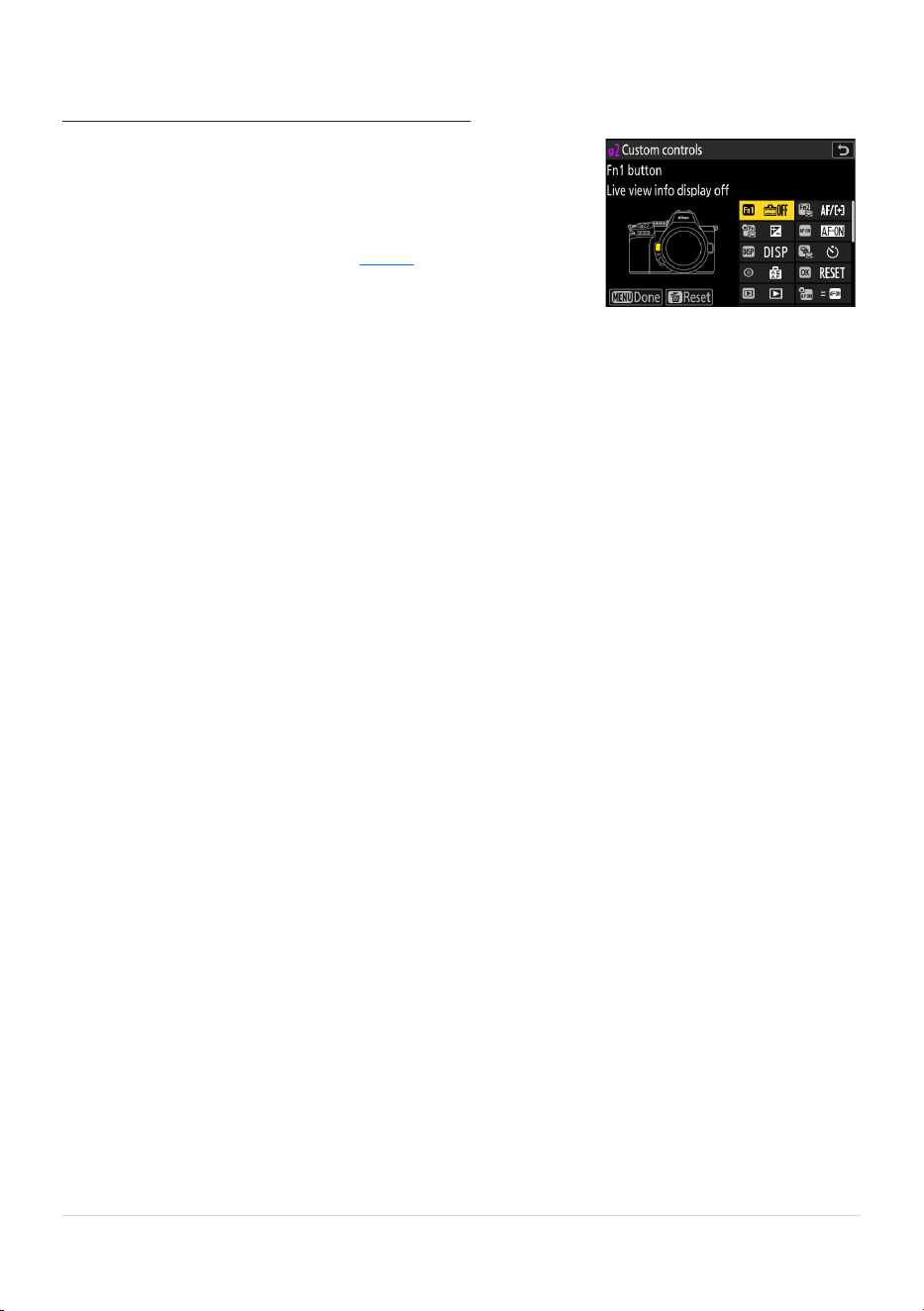
You can reset selected controls to their default settings in the
custom-control selection display
. You can reset individual controls
or all controls to their default settings. For information on resetting
the custom controls, see “Restoring Default Settings” in the “f2:
Custom Controls (Shooting)” section (
0 631).
Restoring Default Settings
671
g2: Custom controls

g3: Control lock
G buttonU
ACustom Settings menu
Lock exposure settings or focus-point selection.
Option Description
[Shutter speed lock]
Select [ON
] to lock shutter speed at its curr
ent value in mode M.
O icons appear in the shooting display when shutter-speed lock is in
effect.
[Aperture lock]
Select [ON
] to lock apertur
e at its current value in modes A and M.
O icons appear in the shooting display when aperture lock is in effect.
[Focus-point lock]
Select [ON] to lock focus-point selection on the currently-select
ed focus
point.
Focus point lock does not apply when [Auto-area AF] is selected for
AF-area mode.
When [Subject-tracking AF] is selected, the focus point will track
subject motion.
672
g3: Control lock
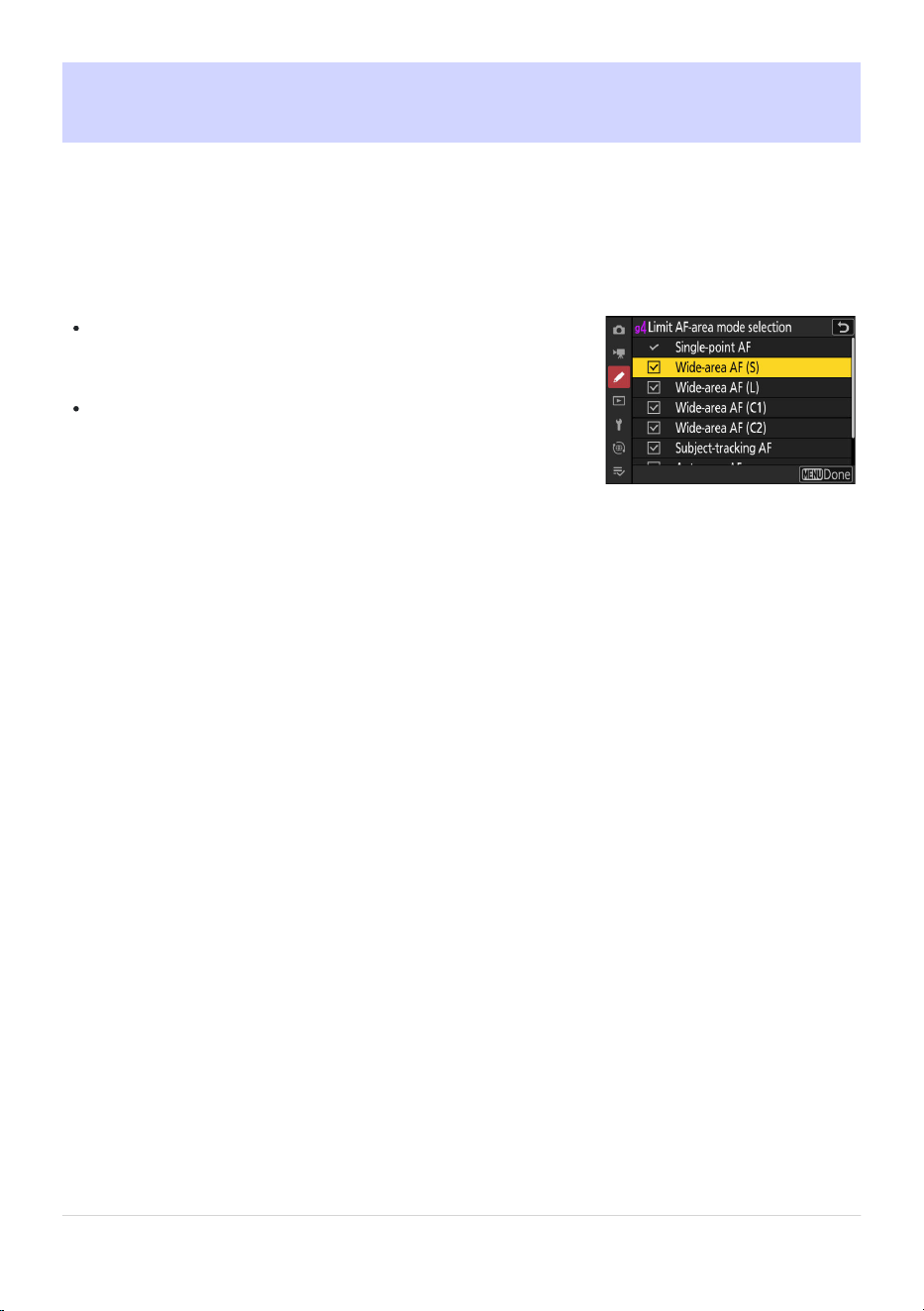
Highlight options and press J or 2 to select (M) or deselect (U
).
Modes marked with a check (M) are available for selection via
the sub-command dial.
To complete the operation, press G.
g4: Limit AF-area mode selection
G buttonUA
Custom Settings menu
Choose the AF-area modes that can be selected by rotating the sub-command dial while pressing a
control to which [Focus mode/AF-area mode] has been assigned using Custom Setting g2 [Custom
controls].
673
g4: Limit AF-area mode selection
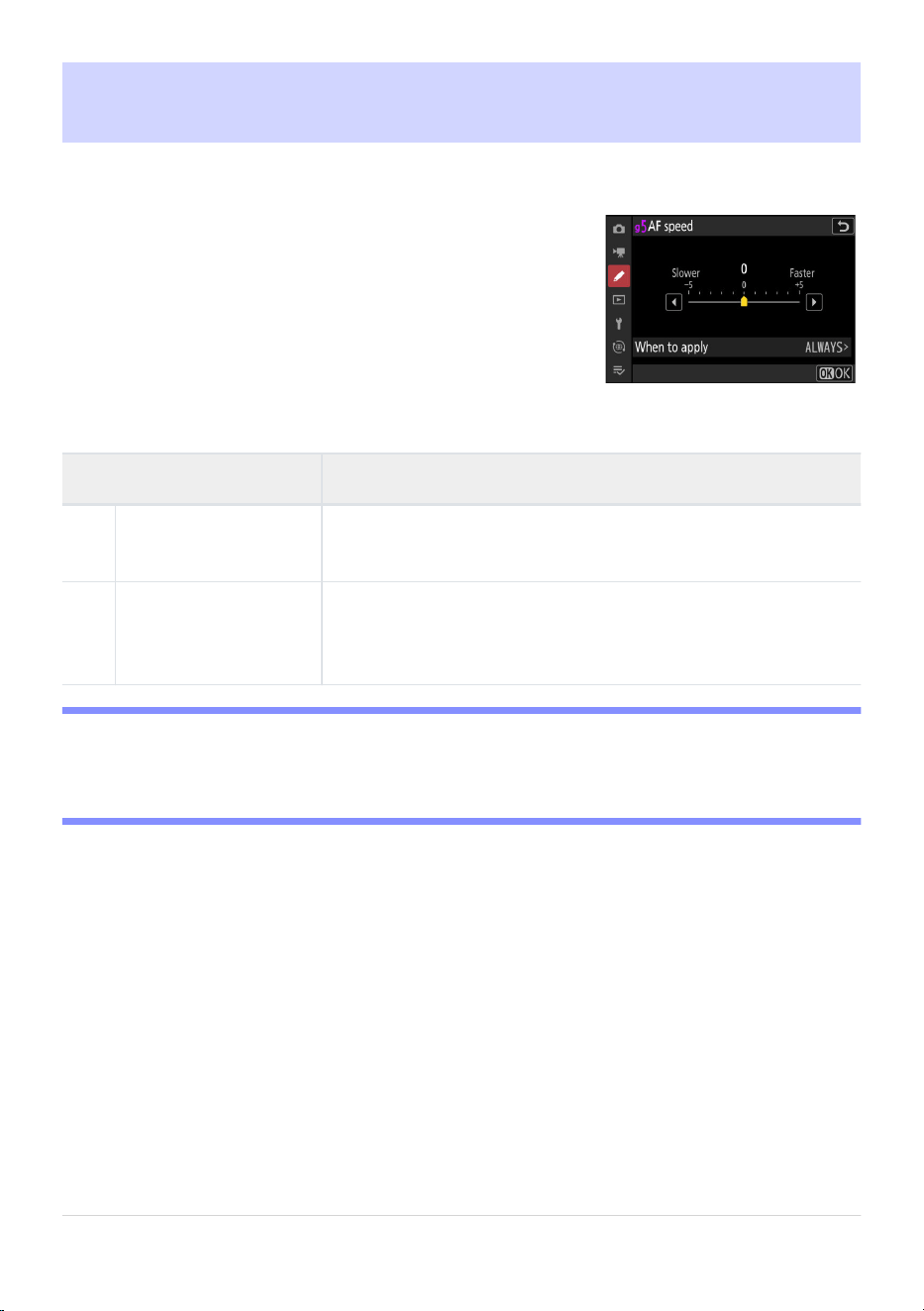
Choose the focus speed for video mode.
g5: AF speed
G buttonUA
Custom Settings menu
Use [When to apply] to choose when the selected option applies.
Option Description
D
[Always]
The camera focuses at the selected speed at all times in video
mode.
E
[Only while r
ecor
ding]
Focus is adjust
ed at the selected speed only while video recording
is in progress. At other times, the camera focuses as quickly as
possible.
D Lens Sounds
The sound produced by the lens during focus operations increases with AF speed. The effect is
p
articularly noticeable at a setting of [+5], so choose lower values if you find the noise distracting.
674
g5: AF speed
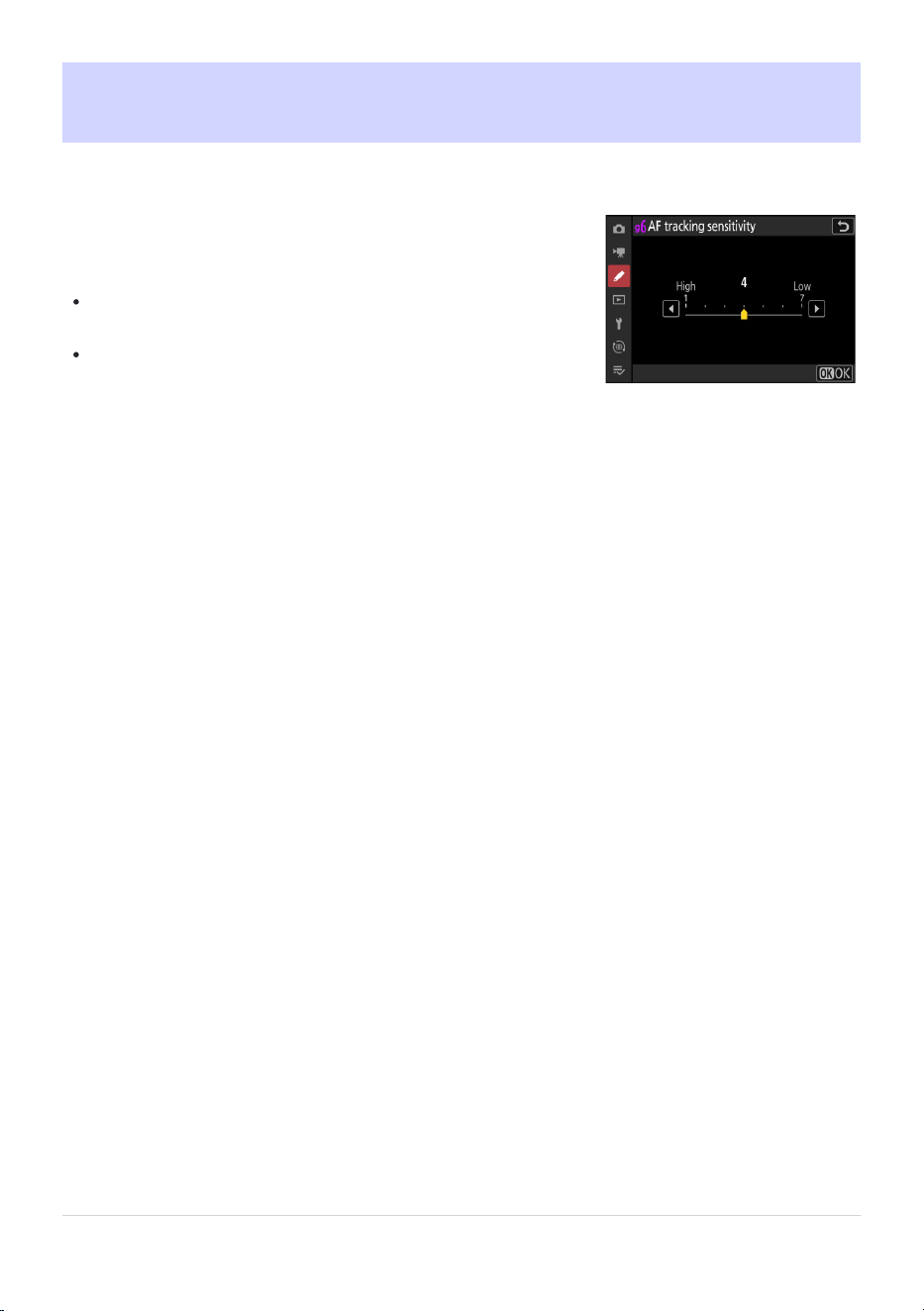
The AF tracking sensitivity for video mode can be set to values of
from 1 to 7.
Choose [
7] ([Low]) to help maintain focus on your original
subject.
If the subject leaves the selected focus point when [1] ([High]) is
selected, the camera will respond by quickly shifting focus to a
new subject in the same area.
g6: AF tracking sensitivity
G buttonUA
Custom Settings menu
675
g6: AF tracking sensitivity
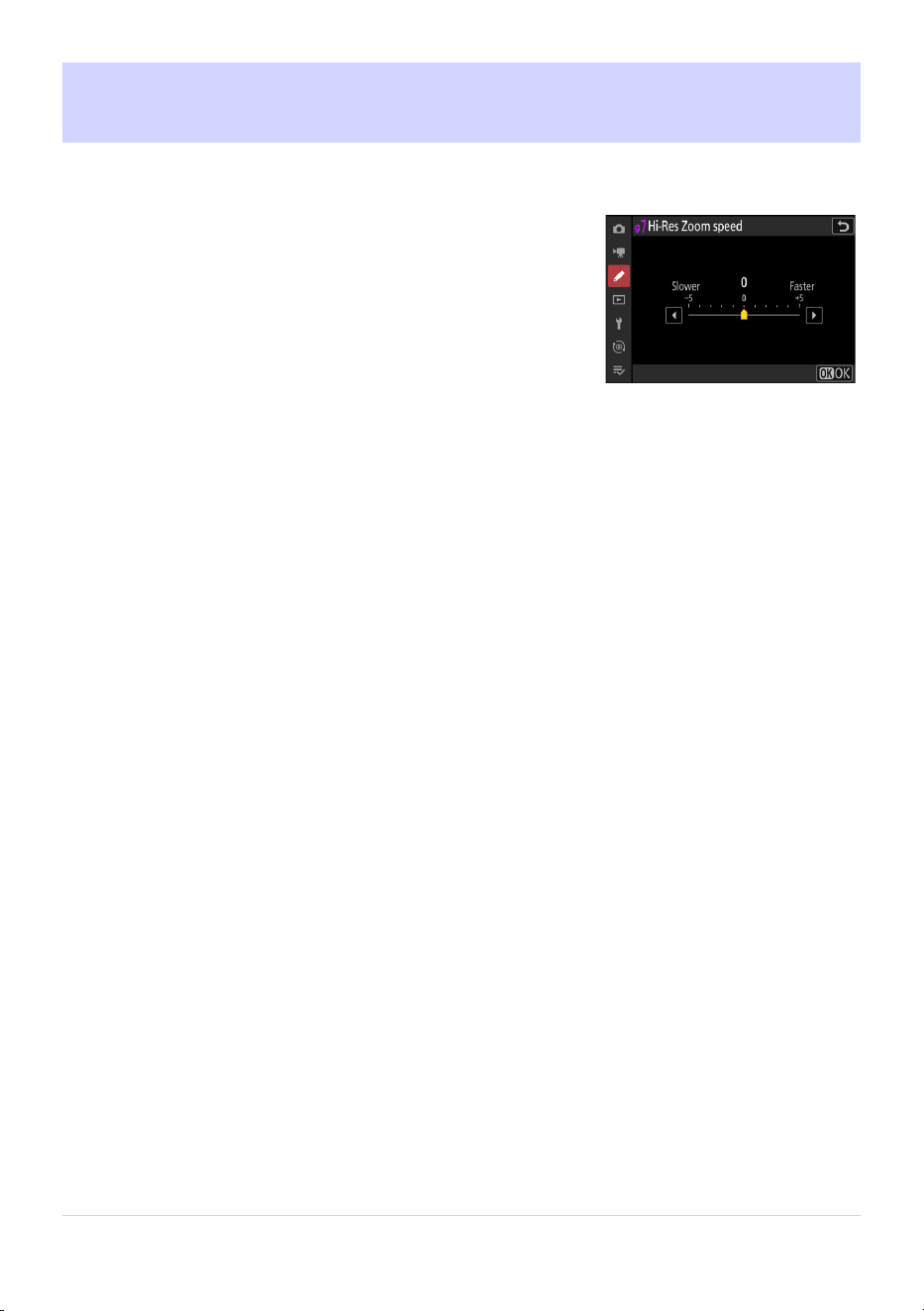
Choose the zoom speed for Hi-Res Zoom. This option only takes
effect when Hi-Res Zoom is assigned to a contr
ol using any of
the [Fn1 button], [Fn2 button], [Lens Fn ring (clockwise)], and
[Lens Fn ring (counterclockwise)] options for Custom Setting g2
[Custom controls].
g7: Hi-Res Zoom speed
G buttonUA
Custom Settings menu
676
g7: Hi-Res Zoom speed

g8: Power zoom (PZ) button options
G buttonU
ACustom Settings menu
Choose whether the X and W (Q) buttons can be used for power zoom during video recording when a
power zoom lens is attached.
Option Description
[Use x/w buttons]
Selecting [ON
] allows the X and W (Q) buttons to be used for pow
er zoom.
[Power zoom speed]
Choose the speed at which power zoom lenses can be zoomed in and out
using the butt
ons; if desired, you can choose one speed for use during
recording and another for pre- and post-recording.
Note that the sounds produced by the lens may be audible in footage
recorded during zoom. The effect can be mitigated by selecting a slower
zoom speed.
677
g8: Power zoom (PZ) button options

g9: Fine ISO control (mode M)
G buttonU
ACustom Settings menu
Selecting [On (1/6 EV)] allows ISO sensitivity for videos to be adjusted in increments of ¹⁄₆EV in mode
M.
This option takes effect only when ISO sensitivity is adjusted via [ISO sensitivity settings]> [ISO
sensitivity (mode M)] in the video recording menu.
Sensitivity can be set to values of from ISO 100 to 51200 in increments of ¹⁄₆EV.
678
g9: Fine ISO control (mode M)

g10: Extended shutter speeds (S/M)
G buttonUA
Custom Settings menu
Select [ON] for access to a range of slower shutter speeds in modes S and M.
When [OFF] is selected, the minimum shutter speed varies with frame rate as follows.
120p: ¹⁄₁₂₅ s
100p: ¹⁄₁₀₀ s
60p: ¹⁄₆₀ s
50p: ¹⁄₅₀ s
30p: ¹⁄₃₀ s
25p: ¹⁄₂₅ s
24p: ¹⁄₂₅ s
When [ON] is selected, the minimum shutter speeds for frame rates of 60p to 24p drop to ¹⁄₄s.
Those for 120p and 100p do not change.
Selecting [ON] and choosing a slow shutter speed helps prevent ISO sensitivity rising too high
during shots of the night sky and other dark subjects.
Videos recorded at slow shutter speeds when [ON] is selected will include repeated multiple copies
of the same frames.
To reduce blur caused by camera shake in videos recorded at slow shutter speeds while [ON] is
selected, we recommend mounting the camera on a tripod.
679
g10: Extended shutter speeds (S/M)
-
-
-
-
-
-
-

g11: View assist
G buttonUA
Custom Settings menu
Choose [ON] for a live preview of video footage recorded with [N-Log] selected for video tone mode,
but note that the colors in the preview are simplified for enhanced contrast.
Colors in the actual recorded footage are unaffected.
Contrast is also enhanced when N-Log footage is viewed on the camera.
680
g11: View assist
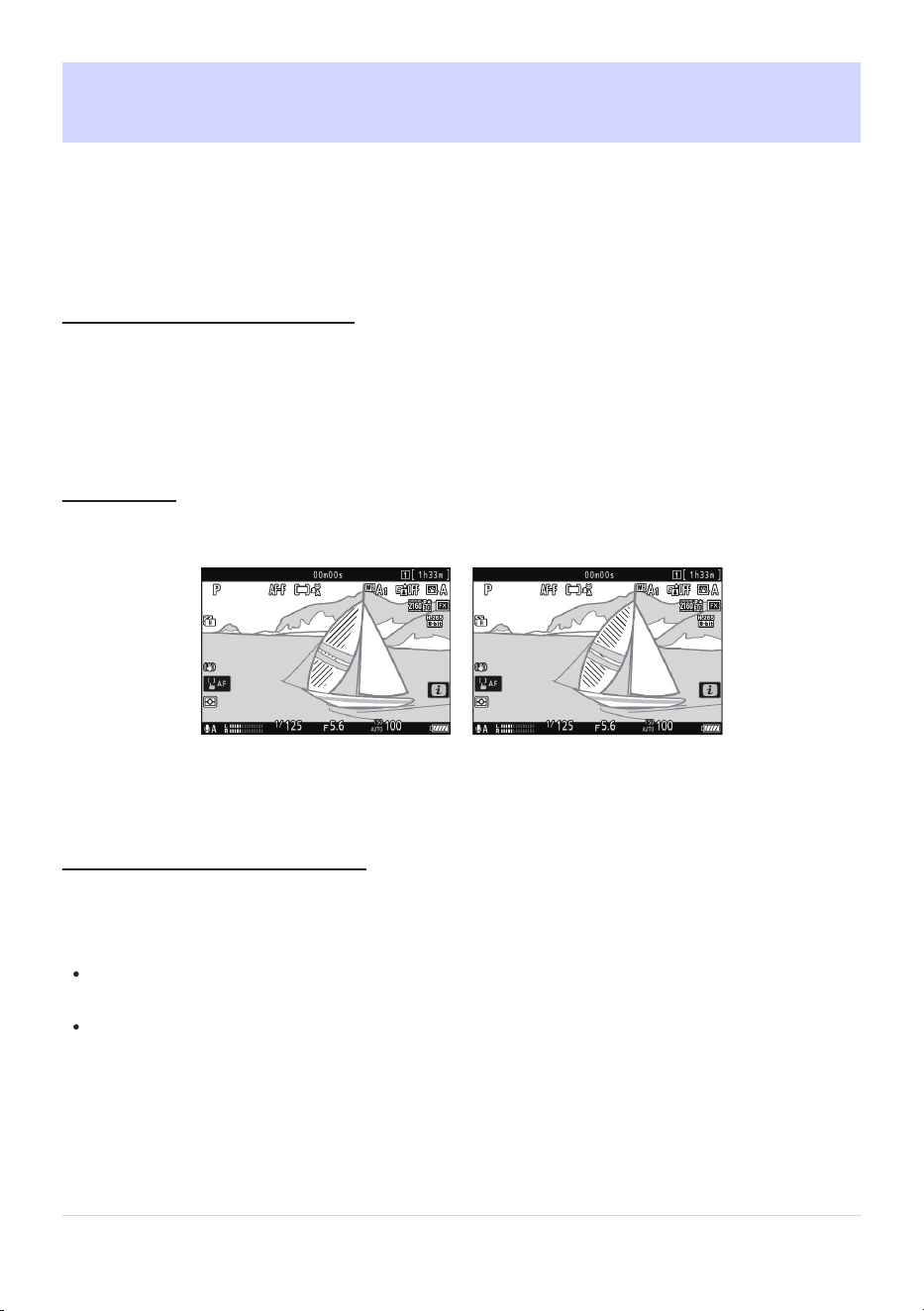
Pattern 1
Pattern 2
g12: Zebra pattern
G buttonU
ACustom Settings menu
Choose whether a zebra pattern is used to indicate selected tone ranges in video mode.
Pattern tone range
Choose the tone range shown by the zebra patt
ern from [Highlights] or [Mid-tones], or select [Zebra
pattern off] to turn the zebra pattern off. Highlights and mid-tones can be defined using [Highlight
threshold] and [Mid-tone range], respectively.
Pattern
To enable the zebra display, select [P
attern 1] or [Pattern 2].
Highlight threshold
Choose the brightness needed to trigger the zebra display when [Highlights] is selected for [P
attern
tone range].
Choose from values of from 120 to 255. The lower the value, the greater the range of brightnesses
that will be shown as highlights.
If 255 is selected, the display will show only areas that are potentially overexposed.
681
g12: Zebra pattern
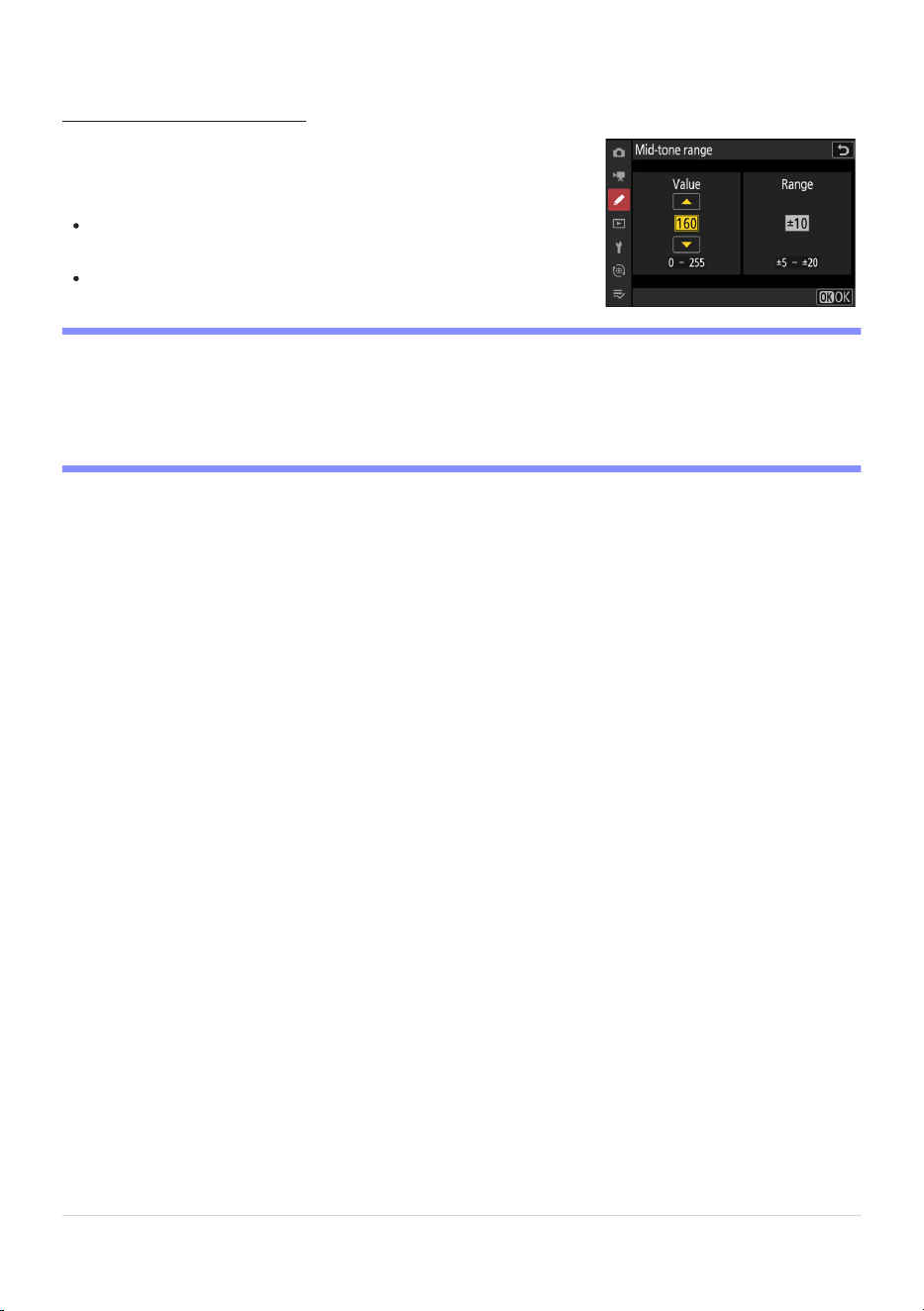
Choose the brightness needed to trigger the zebra display when
[Mid-tones] is selected for [P
attern tone range].
The mid-tone range is defined as a brightness [Value] and
[Range] of brightnesses centered around the selected value.
Press 4 or 2 to highlight items and press 1 or 3 to change.
Mid-tone range
D Zebra Patter
n
If both the zebra display and focus peaking are enabled in manual focus mode, only focus peaking
will take effect. To view the zebra display in manual focus mode, select [OFF] for Custom Setting a12
[Focus peaking]> [Focus peaking display].
682
g12: Zebra pattern

g13: Limit zebra pattern tone range
G buttonUA
Custom Settings menu
Choose the tone ranges accessible via controls to which [Pattern tone range] is assigned.
Option Description
[Highlights] The control can be used to cycle between [Highlights] and [Zebra patter
n off].
[Mid-tones] The control can be used to cycle between [Mid-tones] and [Zebra pattern off].
[No restrictions]
The control can be used to cycle through [Highlights], [Mid-tones], and [Zebra
pattern off].
683
g13: Limit zebra pattern tone range

g14: Grid type
G buttonU
ACustom Settings menu
Choose a framing grid for video mode. The selected grid can be displayed by placing a check (M)
next to b in the list for Custom Setting g17 [Custom monitor shooting display] or g18 [Custom
viewfinder shooting display].
684
g14: Grid type
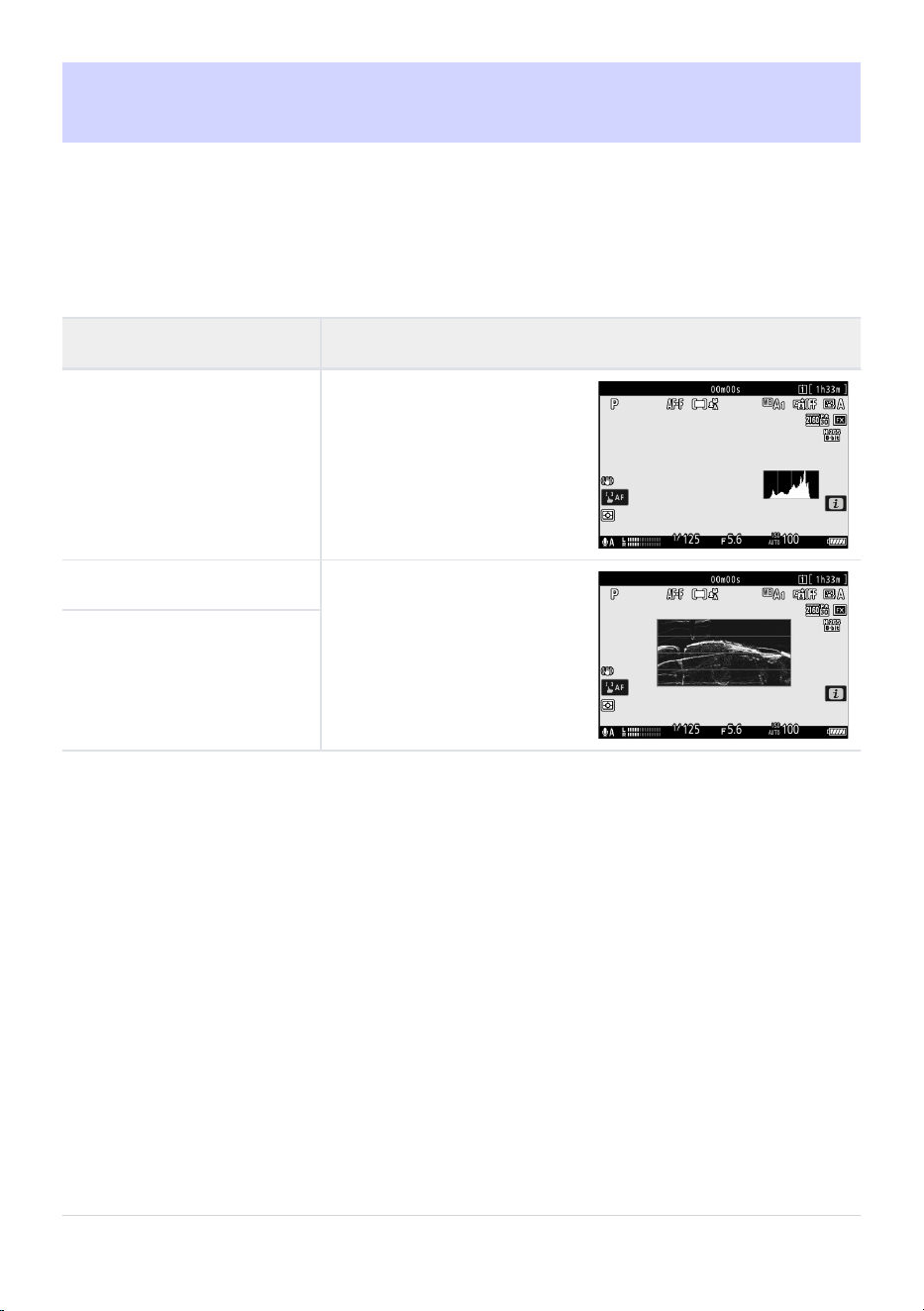
Enable the histogram.
The camera displays a wave-
form monitor
. The monitor can
be displayed at either of two
different sizes.
g15: Brightness information display
G buttonU
ACustom Settings menu
Choose how the camera displays brightness information in video mode. Brightness information of the
selected type can be displayed by placing a check (M) next to E in the list for Custom Setting g17
[Custom monitor shooting display] or g18 [Custom viewfinder shooting display].
Option Description
[Histogram]
[Wav
e-form monitor]
[Wav
e-form monitor (large)]
685
g15: Brightness information display

g16: Half-press to cancel zoom (MF)
G buttonU
ACustom Settings menu
When the view through the lens is zoomed in during manual focus in video mode while [ON] is
selected, the zoom can be cancelled by pressing the shutter-release button halfway.
686
g16: Half-press to cancel zoom (MF)
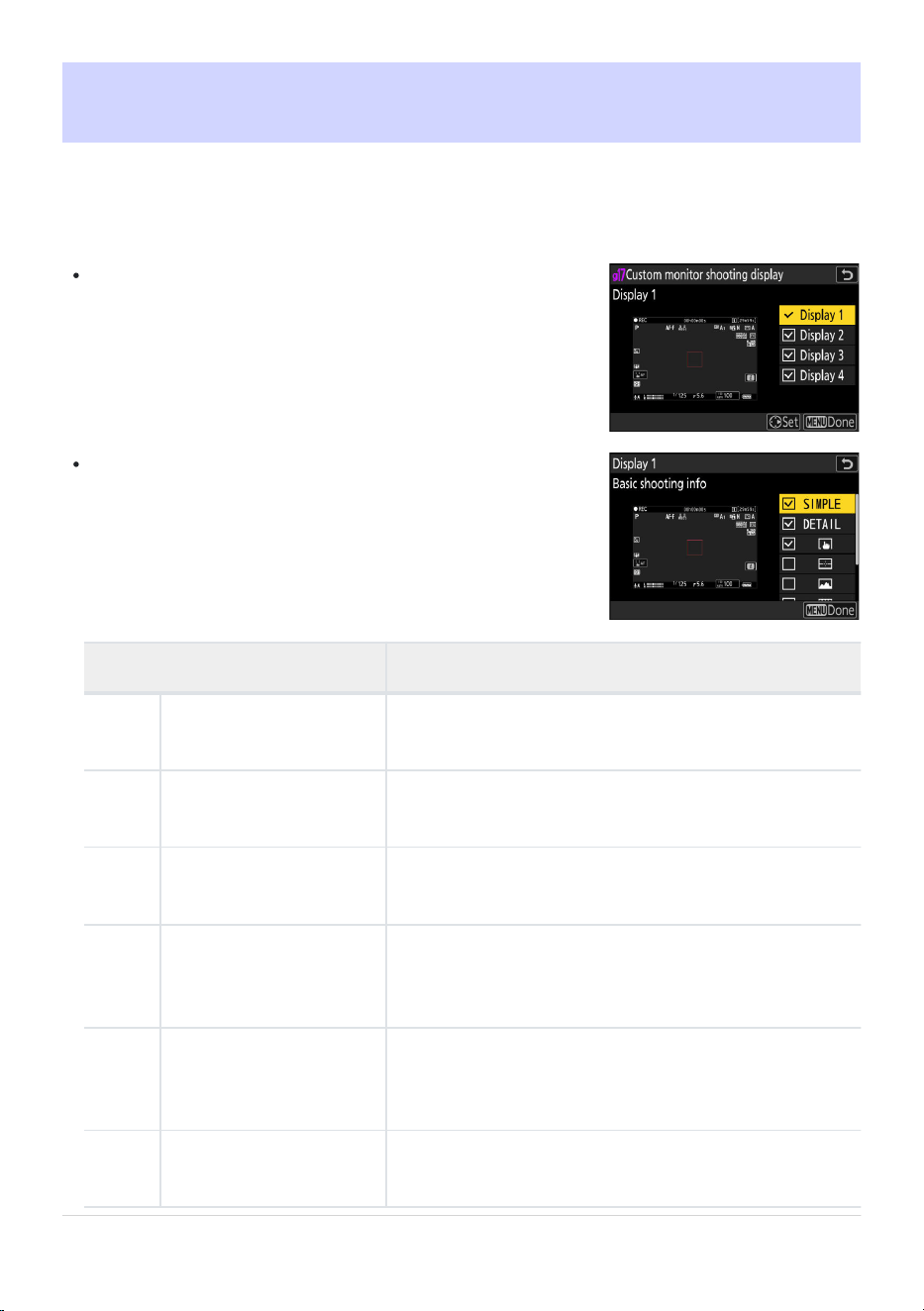
Highlight items ([Display 2] through [Display 4]) and press J
to
select (M) or deselect (U). Only displays marked with a check (M)
can be accessed by pressing the DISP button during shooting.
[Display 1] cannot be deselected (U).
To choose indicators that appear in displays [Display 1] through
[Display 4], highlight the corr
esponding option and press 2. You
can then highlight items and press J to select (M) or deselect (U).
g17: Custom monitor shooting display
G buttonUA
Custom Settings menu
Choose the monitor displays accessible by pressing the DISP button in video mode.
Option Description
A
[Basic shooting info]
View the shooting mode, shutter speed, aperture, and
other basic shooting info.
B
[Detailed shooting info]
View the focus mode, AF-ar
ea mode, white balance, and
other detailed shooting info.
C
[Touch controls]
View options that can be accessed via touch contr
ols,
including touch AF and the i menu.
D
[
Virtual horizon]
Enable the virtual horizon. The display type can be
select
ed using Custom Setting d17 [Virtual horizon
type].
E
[Brightness information]
View a histogram or wave-form monitor. The display type
can be selected using Custom Setting g15 [Brightness
information display].
b
[Framing grid]
Enable the framing grid. The display type can be selected
using Custom Setting g14 [Grid type].
687
g17: Custom monitor shooting display

Option Description
F
[Center indicator] Display crosshair
s at the center of the frame.
To complete the operation, press G.
688
g17: Custom monitor shooting display

g18: Custom viewfinder shooting display
G buttonUA
Custom Settings menu
Choose the viewfinder displays accessible by pressing the DISP button in video mode.
Highlight items ([Display 2] or [Display 3]) and press J to select (M) or deselect (U). Only displays
marked with a check (M) can be accessed by pressing the DISP button during shooting. [Display 1]
cannot be deselected (U).
To choose indicators that appear in displays [Display 1] through [Display 3], highlight the
corresponding option and press 2. You can then highlight items and press J to select (M) or
deselect (U). Apart from [Touch controls], the options are the same as those for Custom Setting
g17 [Custom monitor shooting display].
To complete the operation, press G.
689
g18: Custom viewfinder shooting display

g19: Red REC frame indicator
G buttonUA
Custom Settings menu
If [ON] is selected, a red border will appear around the shooting display while video recording is in
progress. This helps prevent missed shots by alerting you when recording is in progress.
690
g19: Red REC frame indicator
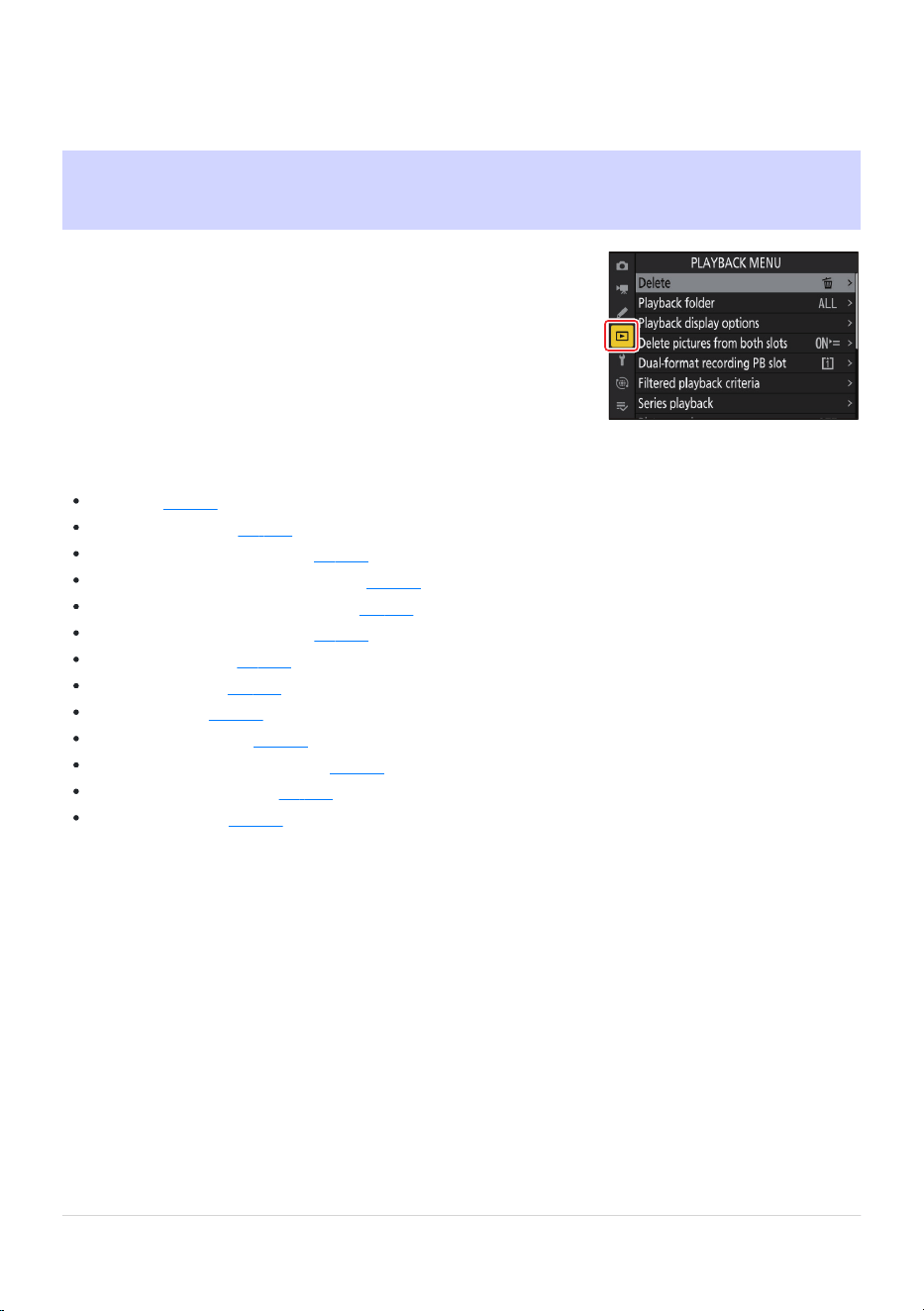
To display the playback menu, select the D (playback menu) tab in
the camera menus.
The Playback Menu
The Playback Menu
The playback menu contains the following it
ems:
[Delete] (
0 692)
[Playback folder] ( 0 693)
[Playback display options] ( 0 694)
[Delete pictures fr
om both slots] (
0 696)
[Dual-format recor
ding PB slot] (
0 697)
[Filtered playb
ack criteria] (
0 698)
[Series playback] (
0 699)
[Picture review] (
0 701)
[After delet
e] (
0 702)
[After bur
st, show] (
0 703)
[Record camera or
ientation] (
0 704)
[Auto-rotat
e pictures] (
0 705)
[Copy image(s)] ( 0 706)
691
The Playback Menu

Delete
G buttonU
Dplayback menu
Delete multiple pictures. For more information, see “Deleting Multiple Pictures” (
0 260).
Option Description
Q
[Selected pictures] Delete select
ed pictures.
d
[Candidates for deletion]
Delete pictur
es rated d (candidate for deletion).
i
[Pictur
es shot on selected dates] Delete all pictures taken on selected dates.
R
[All pictures]
Delete all pictures in the folder currently selected for
[Playback folder] in the playback menu.
If two memory cards are inserted, you can select the
card from which pictures will be deleted.
692
Delete

Playback folder
G buttonU
Dplayback menu
Choose a folder for playback.
Option Description
(Folder name)
Pictures in all folders with the selected name will be visible during playback.
Folders can be renamed using the [S
torage folder]> [Rename] option in the
photo shooting menu.
[All] Pictures in all folders will be visible during playback.
[Current] Only pictures in the current folder will be visible during playback.
693
Playback folder
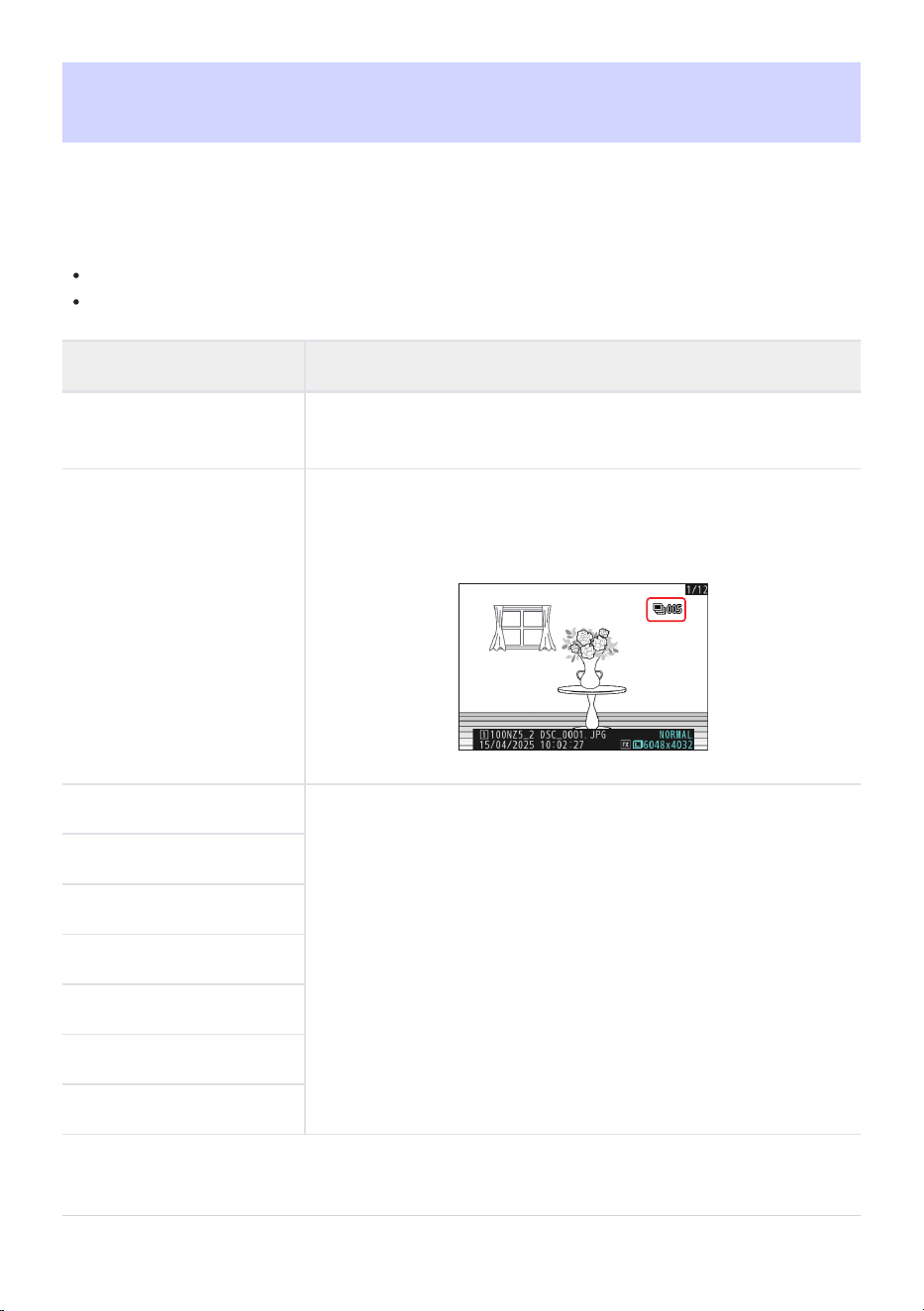
Playback display options
G buttonU
Dplayback menu
Choose display options for full-frame playback.
Highlight options and press 2 to select (M) or deselect (U).
To complete the operation, press G.
Option Description
[Focus point]
Select (M) this option t
o view the location of the focus point used
when the pictur
e was taken.
[Mark first shot in series]
When this option is selected (
M), the fir
st pictur
e in each bur
st will
be identified by a c icon and a figure giving the total number of
shots in the burst.
[Exposure info]
The selected (
M) information displays can be viewed using the DISP
button or by pressing 1 or 3.
[Highlights]
[RGB histogram]
[Shooting data]
[Overview]
[None (picture only)]
[File info]
694
Playback display options
Option Description
[Basic shooting data]
The selected (M) options are included in the full-frame playback
[Shooting data] display.
[Flash data]
[Picture Control/HLG data]
[Other shooting data]
[
Copyright info]
[Location data]
[IPTC data]
695
Playback display options
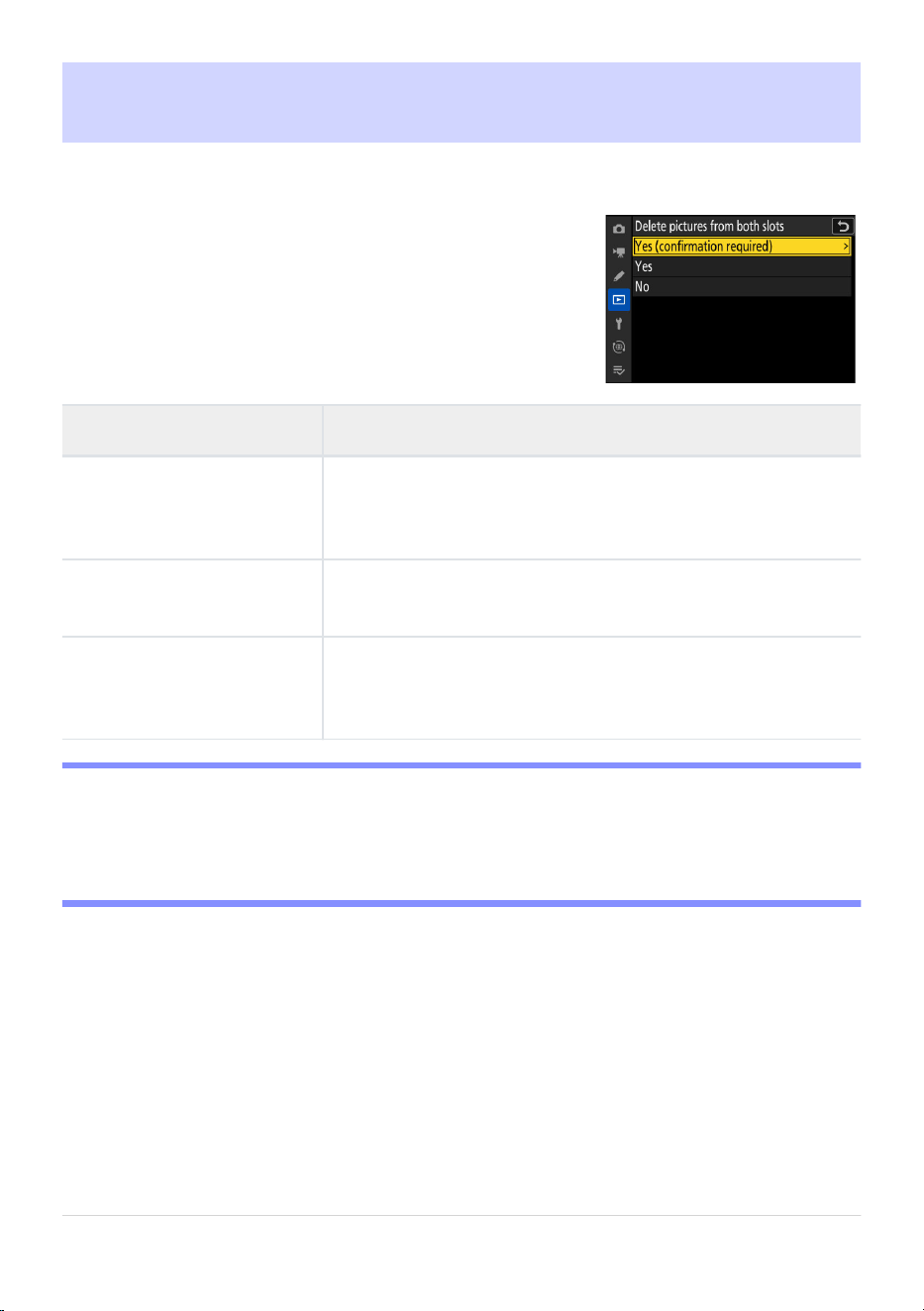
Choose whether deleting a copy of a picture recorded to both
memory cards with an option other than [Ov
erflow] selected for
[Role played by card in Slot 2] in the photo shooting menu also
deletes the remaining copy.
Delete pictures from both slots
G buttonU
Dplayback menu
Option Description
[Yes (confirmation required)]
Before deleting one copy
, you will be prompted to choose
whether to delete the other
. To choose the option highlighted by
default, press 2.
[Yes]
[Same pictures on 1
& 2] is always selected; selecting [Yes] in
the confirmation dialog deletes both copies.
[No]
The confirmation dialog displayed is the same as that for pictures
for which no second copy exists. Deleting the current picture does
not delet
e the copy.
D Caution: Selecting the [Yes (confir
mation required)] or [Yes] Option
You cannot delete bursts using the O button or [Manage series] > [Delete] in the playback i menu
when viewing pictures in a thumbnail list while two memory cards are inserted and [Series playback]
> [List series as single thumbnails] in the playback menu is set to [ON].
696
Delete pictures from both slots

Dual-format recording PB slot
G buttonU
Dplayback menu
Choose the slot from which dual-format pictures recorded with [RAW Slot 1 - JPEG Slot 2], [JPEG Slot
1 - JPEG Slot 2], [RAW Slot 1 - HEIF Slot 2], or [HEIF Slot 1 - HEIF Slot 2] selected for [Role played
by card in Slot 2] in the photo shooting menu are played back.
697
Dual-format recording PB slot

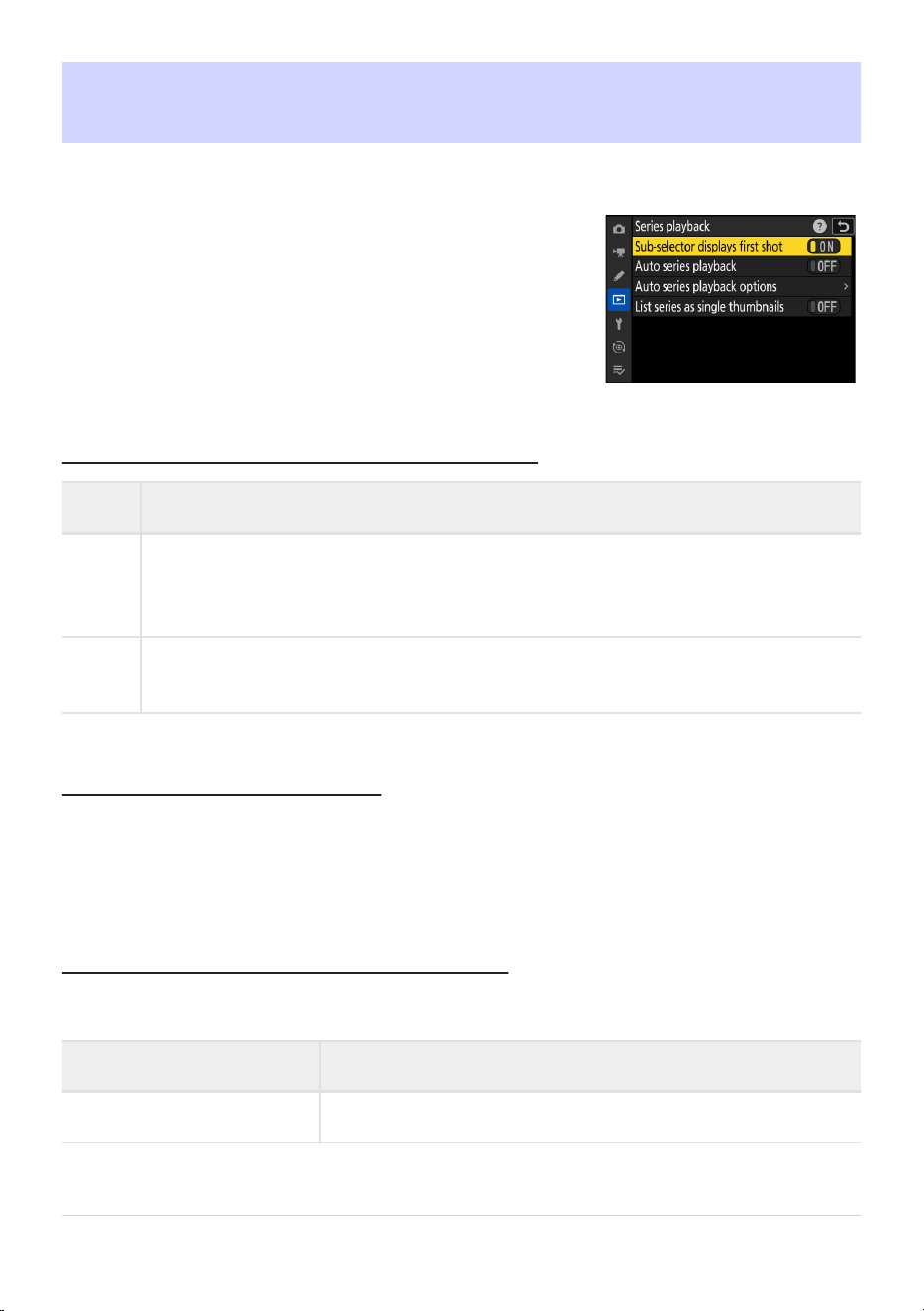
Choose options for viewing bursts.
Series playback
G buttonU
Dplayback menu
Sub-selector displays first shot
Option Description
[ON]
Skip all but the first shot in each burst when scrolling through pictures by tilting the
sub-selector left or right. Pictur
es that are not part of a burst will not be skipped. The
individual shots in each burst can be viewed by tilting the sub-selector up or down.
[OFF]
The sub-selector performs the same functions as the multi selector when tilted up, down,
left, or right.
Auto series playback
If [ON] is selected, the remaining pictur
es will play back automatically after the first picture in the burst
has been displayed full frame for a few seconds. Playback ends when the last picture in the burst is
displayed.
Auto series playback options
Choose options for viewing bursts when [Auto ser
ies playback] is set to [ON].
Option Description
[Loop playback] If [ON
] is selected, the current series will playback repeatedly.
699
Series playback
Option Description
[Wait before playback]
Choose the time until auto series playb
ack begins once the first
picture in the series is displayed: [Normal], [Long], [Short], or
[Start immediately].
[Auto series playback speed]
Select the playback speed for auto series playback.
[ 5 fps], [15 fps], [30 fps]: Playback proceeds at the selected
speed.
[At current release mode speed]: Playback speed varies
depending on the current release mode.
Single frame, self-timer: Approx. 3 fps
Continuous low-speed: Approx. 5 fps
Continuous high-speed, [C15]: Approx. 10fps
[C30]: Approx. 30fps
List series as single thumbnails
When [ON] is selected, only the first shot in each bur
st will appear in the thumbnail list. The first
picture in each burst will be identified by a c icon and a figure giving the total number of shots in the
burst.
All the pictures in each burst will be displayed during full-frame playback.
Selecting [ON] for [List series as single thumbnails] allows access to [Manage series] in the
playback i menu (
0 239).
700
Series playback
-
-
-
-

Picture review
G buttonU
Dplayback menu
Choose whether pictures are automatically displayed immediately after shooting.
Option Description
[On]
Pictures appear in the currently-selected display (monitor or viewfinder) as
they are taken.
When [Pr
ioritize viewfinder (2)] is selected for monitor mode, the most
recent picture will be displayed in the monitor when you take your eye
from the viewfinder.
[On (monitor only)]
Pictures are displayed after shooting only when the monitor is used to
frame shots. Pictures are not displayed in the viewfinder when [Viewfinder
only] is selected for monitor mode.
[Off]
Pictures can only be viewed by pressing the K butt
on.
701
Picture review

After delete
G buttonU
Dplayback menu
Choose the picture displayed after an image is deleted.
Option Description
S
[Show next]
The following picture is displayed.
If the deleted picture was the last pictur
e, the preceding picture
will be displayed.
T
[Show previous]
The preceding picture is displayed.
If the deleted picture was the first picture, the next picture will be
displayed.
U
[Continue as before]
If you were scrolling through pictures in the order recorded, the
following picture will be displayed as described for [Show next].
If you were scrolling through pictures in reverse order, the
preceding picture will be displayed as described for [Show
previous].
702
After delete
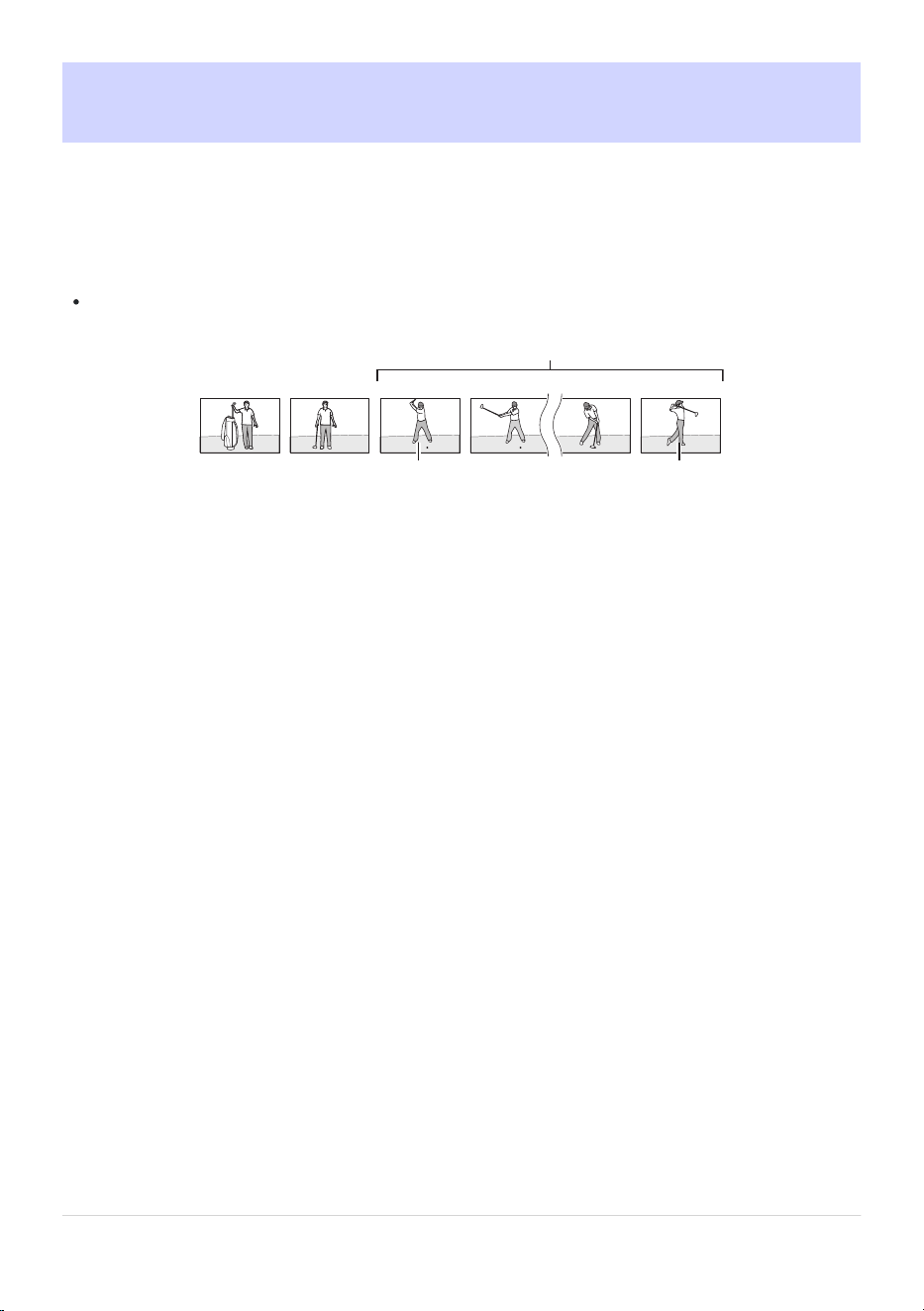
After burst, show
G buttonU
Dplayback menu
Choose whether the photo displayed immediately after a burst of shots is taken in continuous mode is
the first or last shot in the burst.
This option takes effect only when [Off] is selected for [Picture review] in the playback menu.
DSC_0001.jpg DSC_0002.jpg DSC_0003.jpg DSC_0004.jpg DSC_0014.jpg DSC_0015.jpg
1
2 3
Most recent shots (burst)
Displayed if [First pictur
e in burst] is selected
Displayed if [Last picture in burst] is selected
703
After burst, show
1
2
3
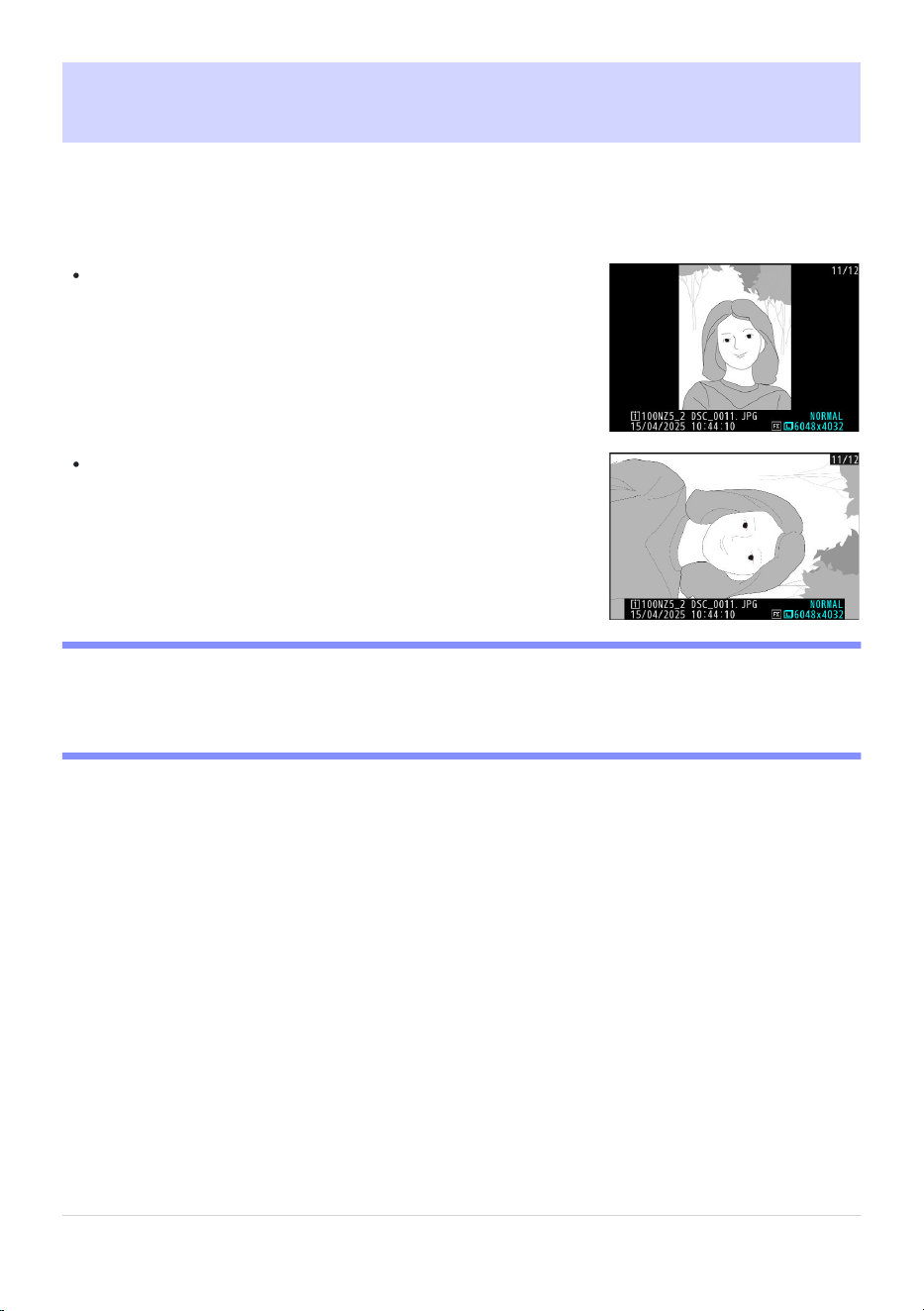
If [ON] is selected, information on camera orientation when
the phot
ograph was taken is recorded. During playback on the
camera or on a computer, images are rotated automatically using
the recorded orientation information.
If [OFF] is selected, information on camera orientation is not
r
ecorded. In this case, images displayed during playback are
always in landscape (wide) orientation.
Record camera orientation
G buttonU
Dplayback menu
Choose whether the camera orientation information during shooting is stored in pictures.
D Caution: Record Camera Orientation
Camera orientation may not be correctly recorded in photos taken with the camera pointing up or
down or while panning.
704
Record camera orientation

Auto-rotate pictures
G buttonU
Dplayback menu
If [ON] is selected, the playback display will automatically rotate to match camera orientation, with
the result that “tall” pictures will be rotated to display in “tall” orientation when the camera is held
in ”wide” orientation and “wide” pictures will be rotated to display in “wide” orientation when the
camera is held in “tall” orientation.
D Cautions: Auto-Rotate Pictures
Pictures are not rotated automatically during picture review even when [ON] is selected for [Auto-
rotate pictures].
If [OFF] was selected for [Record camera orientation] during shooting, images displayed during
playback are always in landscape (wide) orientation, even if [ON] is selected for [Auto-rotate
pictures].
705
Auto-rotate pictures
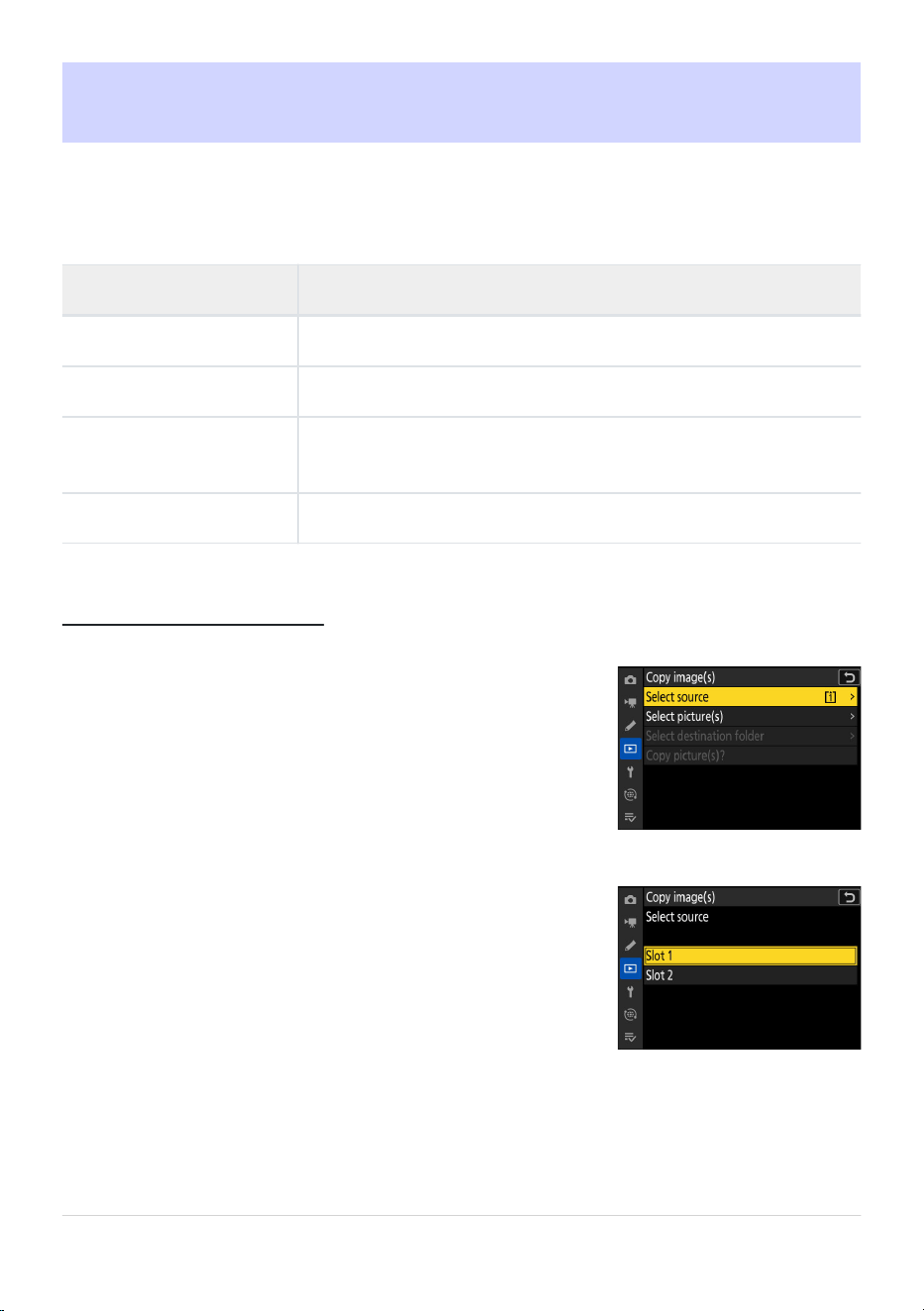
Choose [Select source].
Highlight [Select source] and pr
ess 2 to display the [Select
source] dialog.
Select the card containing the pictures to be copied.
Highlight the slot for the card containing the pictures t
o be
copied and press J to select the highlighted slot and return to
the [Copy image(s)] menu.
Copy image(s)
G buttonU
Dplayback menu
Copy pictures from one memory card to another when two memory cards are inserted.
Option Description
[Select source] Choose the car
d from which pictures will be copied.
[Select picture(s)] Select pictures to be copied.
[Select destination folder]
Select the destination folder on the remaining card (the card not
selected for [Select source]).
[Copy picture(s)?] Copy the pictures.
Copying Pictures
706
Copy image(s)
1
2
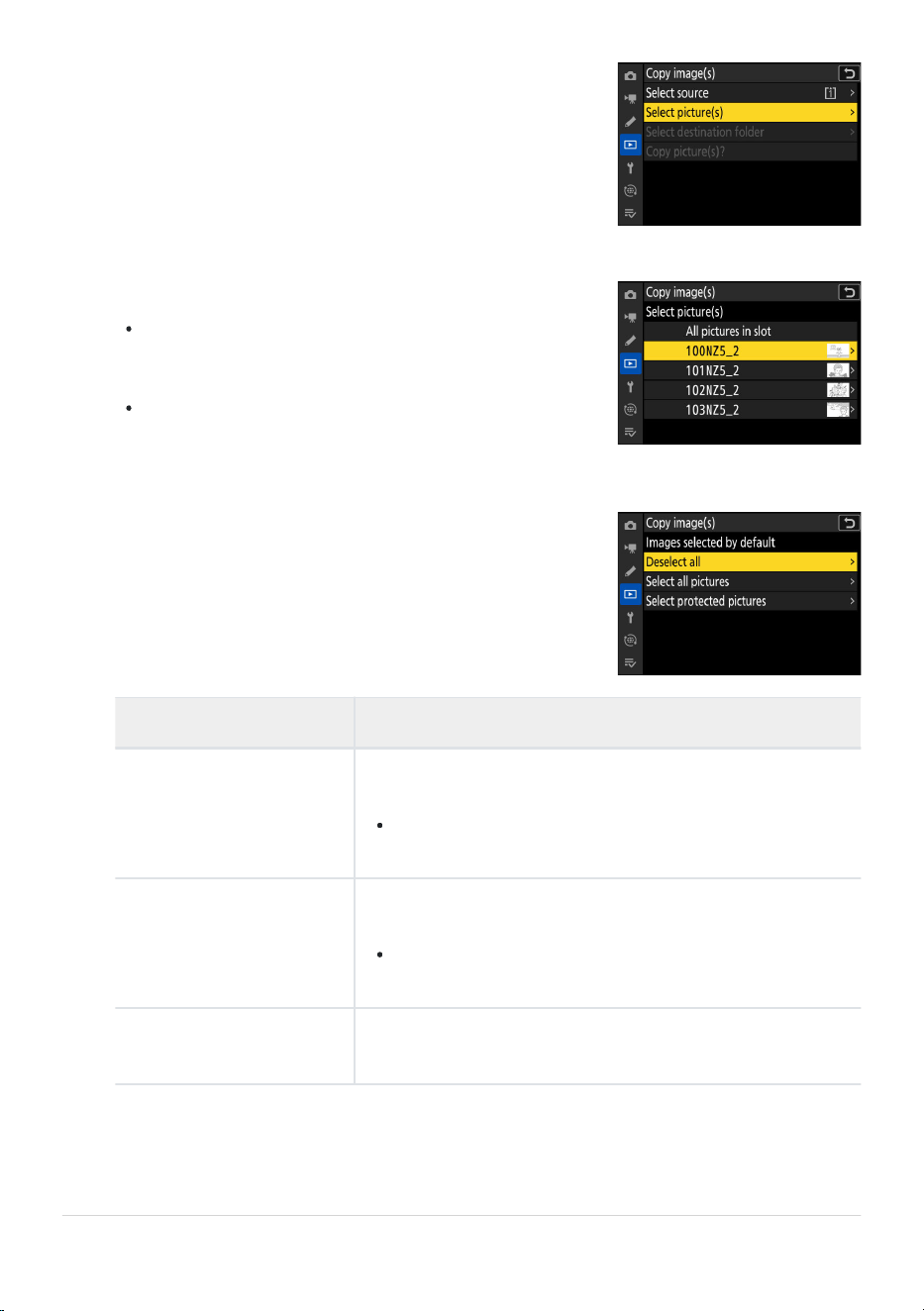
Choose [Select picture(s)].
Highlight [Select picture(s)] and pr
ess 2 to view the [Select
picture(s)] display.
Select the source folder.
Highlight the folder containing the pictures to be copied
and pr
ess 2 to display the [Images selected by default]
menu.
To copy all pictures from the card in the selected slot,
highlight [All pictures in slot], press J, and proceed to
Step10.
Make the initial selection.
Choose the pictures that will be selected by default.
Option Description
[Deselect all]
None of the pictures in the chosen folder will be selected by
default.
Choose this option when you want to select pictur
es
individually.
[Select all pictures]
All of the pictures in the chosen folder will be selected by
default.
Choose this option if you want to copy all or most of the
pictures in the folder.
[Select protected pictures]
Only the protected pictures in the folder will be selected by
default.
707
Copy image(s)
3
4
5
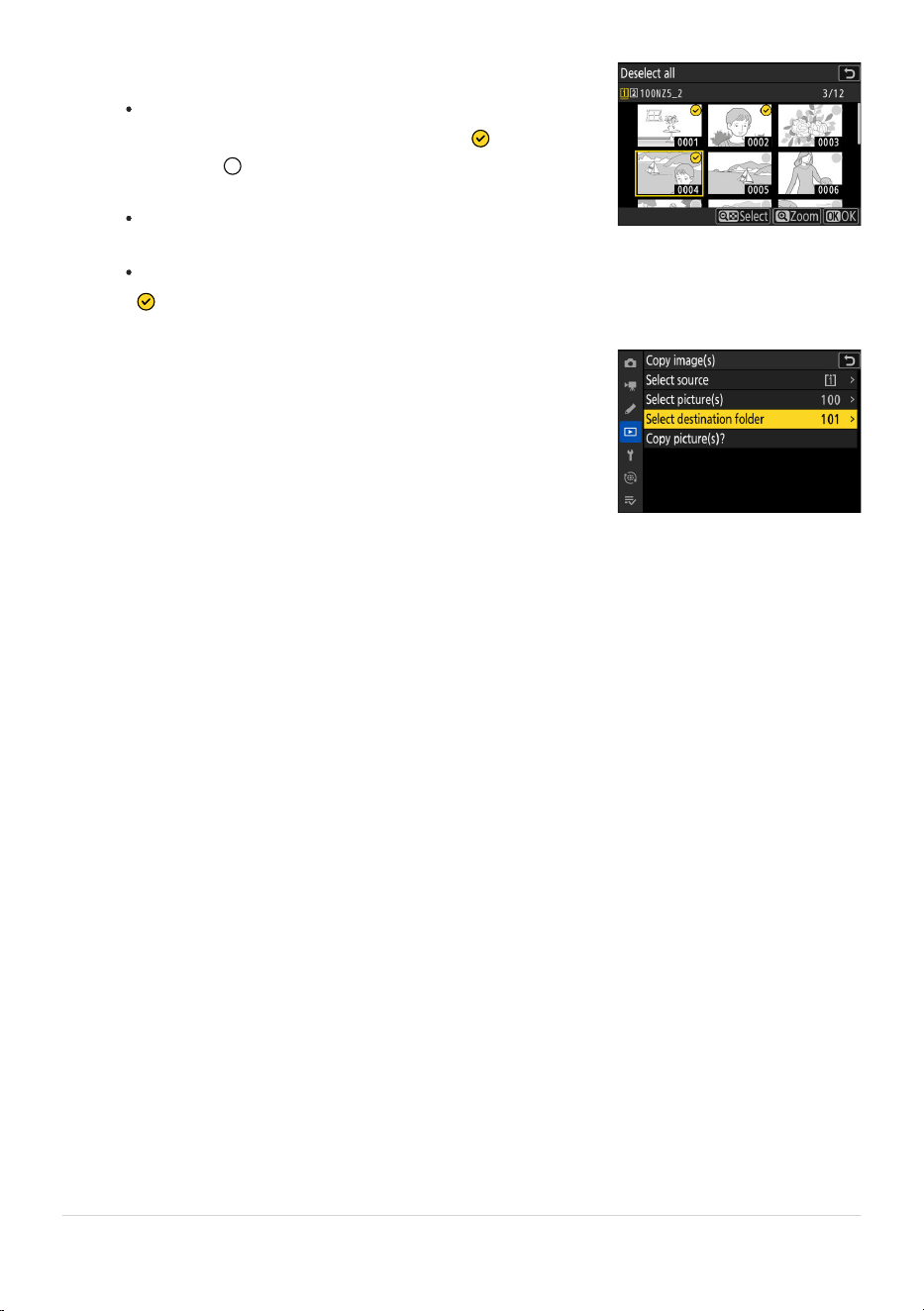
Select additional pictures.
Highlight pictures and press the W
(Q) button to select;
selected pictures are marked with a check (
). To remove
the check ( ) and deselect the current picture, press the W
(Q) button again.
To view the highlight
ed picture full screen, press and hold
the X button.
After confirming that all the pictures you want to copy have
marks, press J to return to the [Copy image(s)] menu.
Choose [Select destination folder].
Highlight [Select destination folder] and press 2 to display
[Select destination folder] options.
708
Copy image(s)
6
7
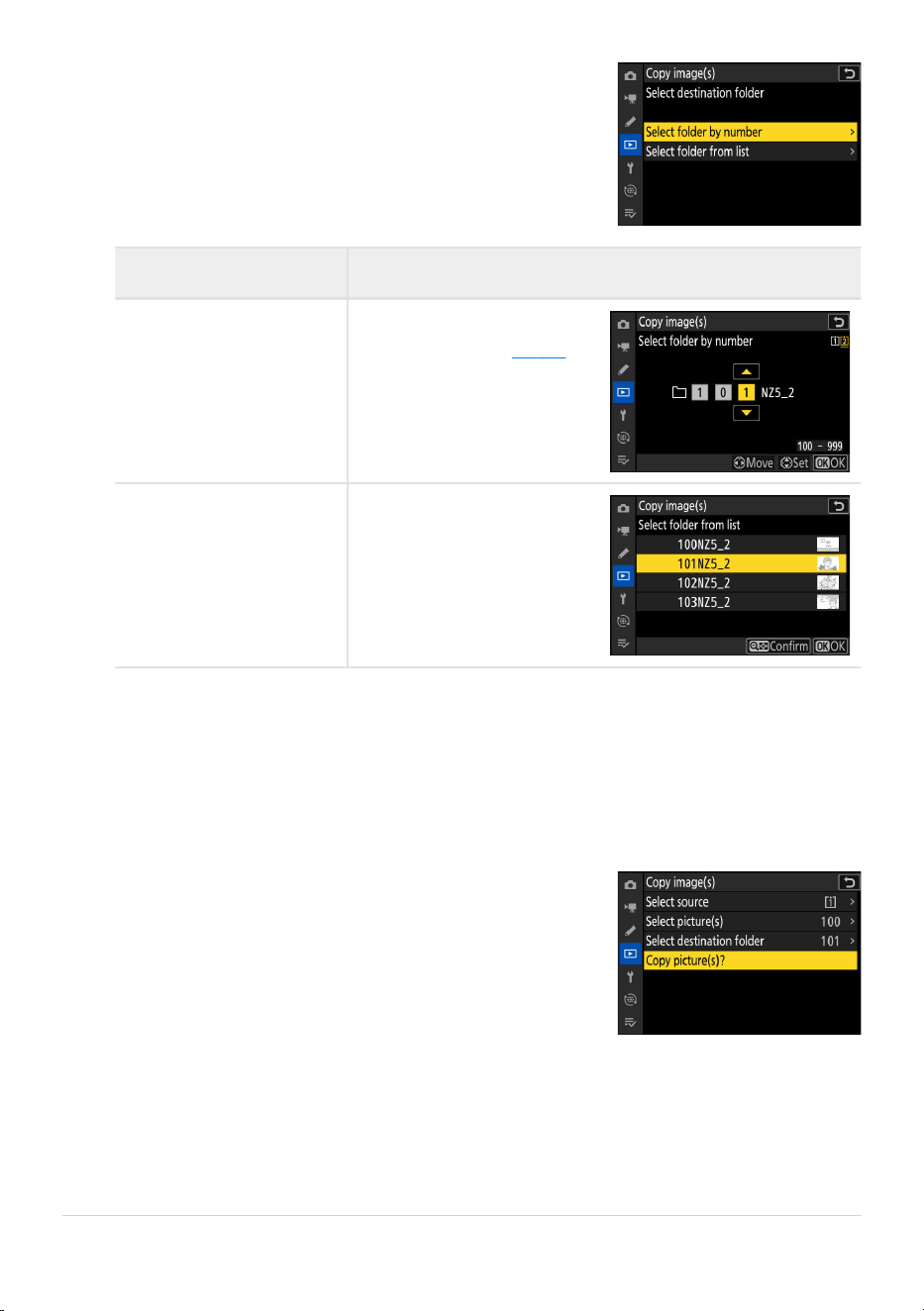
Choose a destination folder.
Highlight one of the following options and press 2
.
Choose [Copy picture(s)?].
Highlight [Copy picture(s)?] and press J t
o display a
confirmation dialog.
Enter the number of the
destination folder (0 408).
If a folder with the selected
number does not already exist,
a new folder will be cr
eated.
Choose the destination folder
from a list of existing folder
s.
Option Description
[Select folder by number]
[Select folder from list]
Select the folder.
Af
ter entering a folder number or highlighting the folder name, press J to select the folder and
return to the [Copy image(s)] menu.
709
Copy image(s)
8
9
10
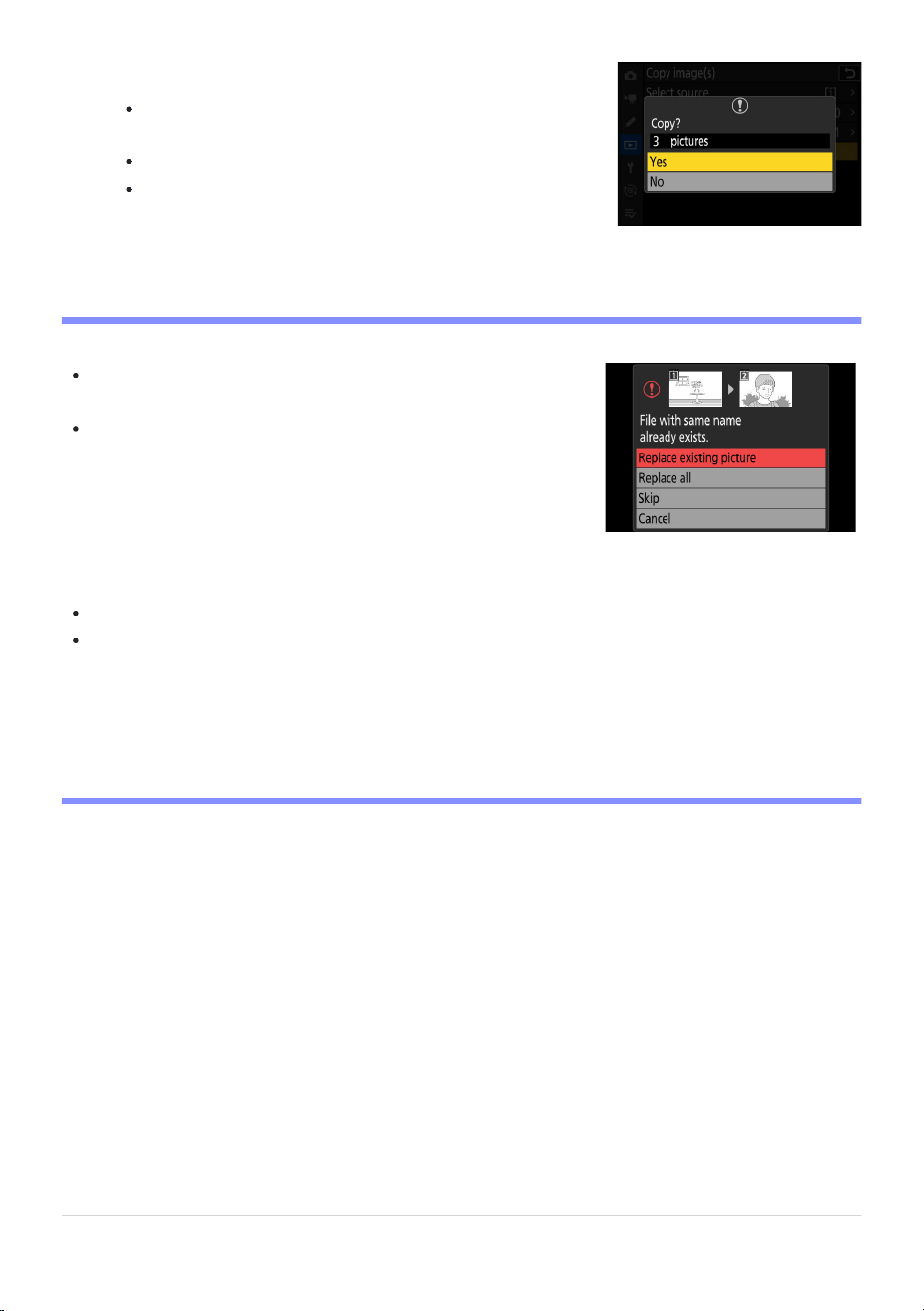
Choose [Yes].
The camera will display the message [Copy?] together with
the number o
f pictures that will be copied.
Highlight [Yes] and press J to copy the selected pictures.
Press J again to exit when copying is complete.
Pictures will not be copied if there is insufficient space on the
destination card.
If the destination folder contains a file with the same name as
one of the pictur
es to be copied, a confirmation dialog will be
displayed. Select [Replace existing picture] or [Replace all] to
replace the existing file or files. Protected files in the destination
folder will not be replaced. Select [Skip] to continue without
replacing existing files. Select [Cancel] to exit without copying
any further pictures.
D Cautions: Copying Pictures
Ratings and prot
ection are copied with the pictures.
To prevent loss of power while copying videos, use one of the following power sources:
A fully-charged battery
An optional EH-8P AC adapter connected using the supplied USB cable (featuring Type-C
connectors at both ends)
An optional EP‑5B power connector with an EH‑5d, EH‑5c, or EH‑5b AC adapter
A third-party portable charger (power bank)
710
Copy image(s)
11
-
-
-
-
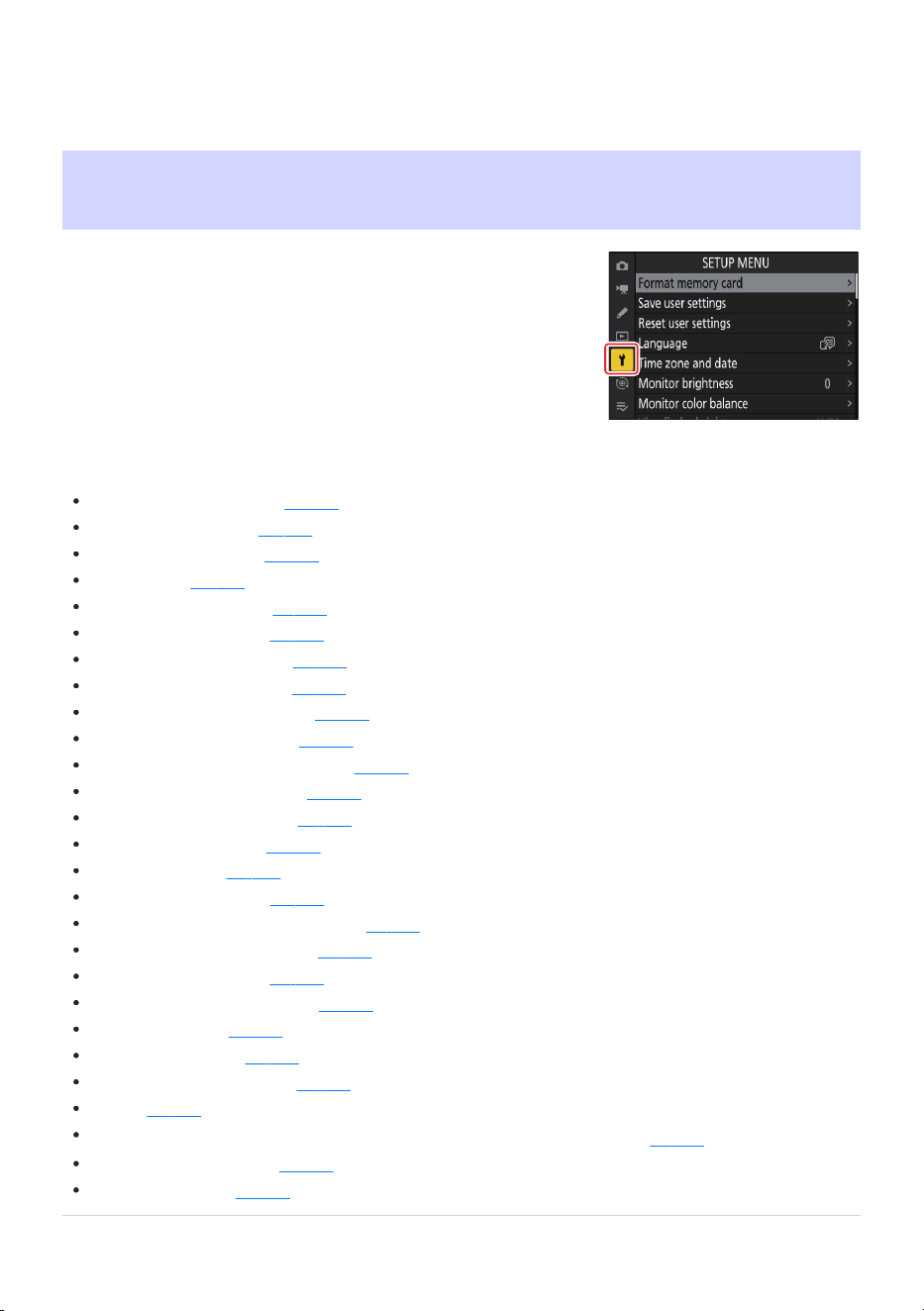
To view the setup menu, select the B tab in the camera menus.
The Setup Menu
The Setup Menu
The setup menu contains the following items:
[For
mat memory card] (
0 713)
[Save user settings] ( 0 714)
[Reset user settings] (
0 715)
[Language] ( 0 716)
[Time zone and date] ( 0 717)
[Monitor brightness] ( 0 718)
[Monitor color balance] (
0 719)
[Viewfinder brightness] ( 0 720)
[Viewfinder color balance] ( 0 721)
[Viewfinder display size] ( 0 722)
[Limit monitor mode selection] ( 0 723)
[Auto rotat
e info display] (
0 724)
[AF fine-tuning options] ( 0 725)
[Non-CPU lens data] ( 0 729)
[Distance units] ( 0 730)
[Save focus position] ( 0 731)
[Save zoom position (PZ lenses)] ( 0 732)
[Auto temperatur
e cutout] (
0 733)
[Clean image sensor] ( 0 734)
[Image Dust Off ref photo] ( 0 735)
[Pixel mapping] ( 0 737)
[Image comment] ( 0 738)
[Copyright information] (
0 739)
[IPTC] (
0 740)
[Z connector function] (headphone/r
emote cord connector function;
0 745)
[Voice memo options] ( 0 746)
[Camera sounds] ( 0 748)
711
The Setup Menu

[Silent mode] ( 0 749)
[Touch controls] (
0 750)
[Self-portrait mode] ( 0 751)
[HDMI] ( 0 752)
[USB connection priority] (
0 753)
[Conformity marking] ( 0 754)
[Battery info] ( 0 755)
[USB power deliver
y] (
0 756)
[Energy saving (photo mode)] ( 0 758)
[Slot empty release lock] ( 0 759)
[Save/load menu settings] ( 0 760)
[Reset all settings] ( 0 764)
[Firmware v
ersion] (
0 765)
712
The Setup Menu
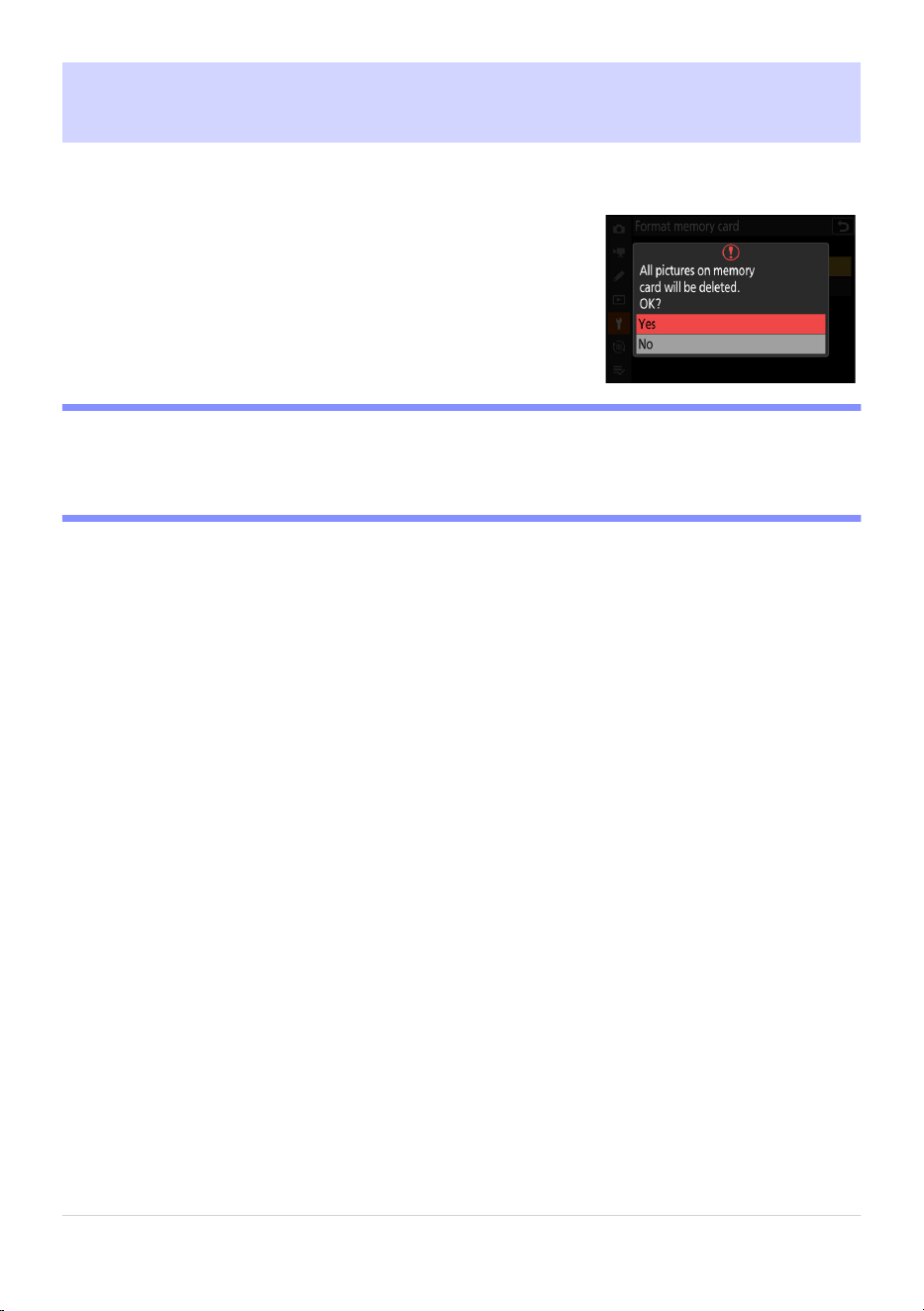
Format memory cards. Memory cards that have been formatted in
a computer or another camera should be refor
matted using this
option before use. To begin formatting, choose a memory card
slot and select [Yes]. Note that formatting permanently deletes all
pictures and other data on the card. Before formatting, be sure to
make backup copies as required.
Format memory card
G buttonU
Bsetup menu
D Caution: During Formatting
Do not turn the camera off or remove memory cards until the message [Formatting memory card.]
clears from the display.
713
Format memory card



Language
G buttonU
Bsetup menu
Choose a language for camera menus and messages. The languages available vary with the country or
region in which the camera was originally purchased.
716
Language

Time zone and date
G buttonU
Bsetup menu
Change time zones and set the camera clock. We recommend that the camera clock be adjusted
regularly.
Option Description
[Time zone]
Choose a time zone. The time selected for [Date and time] is
automatically adjust
ed for the new time zone.
[Date and time] Set the camera clock to the current time in the selected [Time zone].
[Date format] Choose the order in which the day, month, and year are displayed.
[Daylight saving time]
Turn daylight saving time [ON] or [OFF]. Selecting [ON] automatically
advances the clock one hour. The default setting is [OFF].
A g icon in the shooting display indicates that the clock has not been set.
717
Time zone and date

Monitor brightness
G buttonU
Bsetup menu
Press 1 or 3 to adjust monitor brightness. Choose higher values for increased brightness, lower values
for reduced brightness.
[Monitor brightness] can only be adjusted when the monitor is the active display. It cannot
be adjusted when [Viewfinder only] is selected for monitor mode or when your eye is to the
viewfinder.
Higher values increase the drain on the battery.
Changing the option selected for [Monitor brightness] in the setup menu when [HLG] is selected
for [Tone mode] in the photo shooting menu or when viewing pictures taken with [HLG] selected
for [Tone mode] changes the distribution of tones in the shooting and playback displays. The
fidelity of reproduction in highlights in particular declines as brightness rises.
718
Monitor brightness
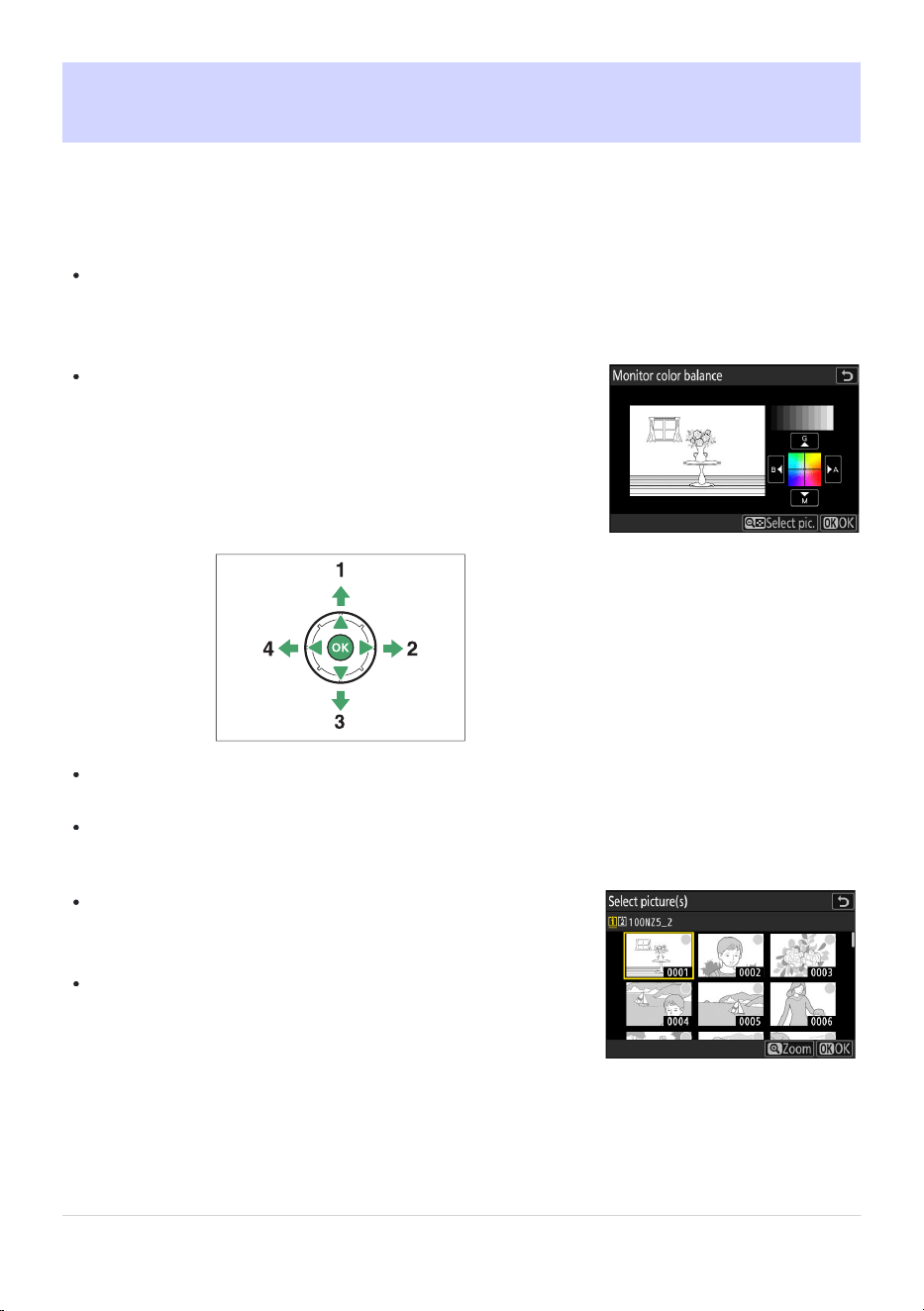
Color balance is adjusted using the multi selector. Press 1, 3, 4,
or 2 to adjust color balance as shown below
. Press J to save
changes.
Increase green
Increase amber
Increase magenta
Incr
ease blue
1
2
3
4
To choose a different picture, press the W (Q) butt
on. Highlight
the desired pictur
e and press J to select it as the reference
image.
To view the highlighted picture full frame, press and hold X.
Monitor color balance
G buttonU
Bsetup menu
Adjust monitor color balance to your taste.
[Monitor color balance] can only be adjusted when the monitor is the active display. It cannot
be adjusted when [Viewfinder only] is selected for monitor mode or when your eye is to the
viewfinder.
Monitor color balance applies only to menus, playback, and the shooting display; photos and videos
taken with the camera are not affected.
The reference image is either the last picture taken or, in playback mode, the picture last displayed.
If the memory card contains no pictures, an empty frame will be displayed instead.
719
Monitor color balance

Viewfinder brightness
G buttonU
Bsetup menu
Adjust viewfinder brightness. [Viewfinder brightness] can only be adjusted when the viewfinder is the
active display. It cannot be adjusted when the monitor is on or when [Monitor only] is selected for
monitor mode.
Option Description
[Auto] Viewfinder brightness is adjusted aut
omatically in response to lighting conditions.
[Manual]
Press 1 or 3 to adjust viewfinder brightness. Choose higher values for increased
brightness, lower values for reduced brightness.
Higher values increase the drain on the battery.
If the camera becomes hot, the viewfinder display will temporarily dim when [Manual] is select
ed
and viewfinder brightness is set to [Hi1] or [Hi2].
Changing the option selected for [Viewfinder brightness] in the setup menu when [HLG] is
selected for [Tone mode] in the photo shooting menu or when viewing pictures taken with [HLG]
selected for [Tone mode] changes the distribution of tones in the shooting and playback displays.
The fidelity of reproduction in highlights in particular declines as brightness rises.
720
Viewfinder brightness

Viewfinder color balance
G buttonU
Bsetup menu
Adjust viewfinder color balance to your taste. [Viewfinder color balance] can only be adjusted when
the viewfinder is the active display. It cannot be adjusted when the monitor is on or when [Monitor
only] is selected for monitor mode. Otherwise the procedure is the same as for [Monitor color
balance] (
0 719).
721
Viewfinder color balance

Viewfinder display size
G buttonU
Bsetup menu
Choose a magnification for the viewfinder display from [Standard] and [Small]. Selecting [Small]
makes it easier to see the entire subject.
722
Viewfinder display size

Limit monitor mode selection
G buttonU
Bsetup menu
Choose the monitor modes that can be selected using the M button.
Highlight options and press J or 2 to select (M) or deselect (U). Options marked with a check (M)
are available for selection.
To complete the operation, press G.
723
Limit monitor mode selection

Auto rotate info display
G buttonU
Bsetup menu
When [ON] is selected, the indicators in the shooting and playback displays will automatically be
rotated to match camera orientation.
724
Auto rotate info display
AF fine-tuning options
G buttonU
Bsetup menu
Fine-tune focus for the current lens.
Use only as required.
We recommend that you perform fine-tuning at a focus distance you use frequently. If you perform
focus-tuning at a short focus distance, for example, you may find it less effective at longer
distances.
Option Description
[AF fine-tune] Select [ON] to turn fine-tuning on.
[
Fine-tune and save lens]
Fine-tune focus for the curr
ent lens. Press 1 or 3 to highlight
items and pr
ess 4 or 2 to choose from values between +20
and −20.
The larger the fine-tuning value, the farther the focal point is
from the lens; the smaller the value, the closer the focal point.
The display shows the current and previous values.
The camera can store values for up to 40 lens types.
If a value already exists for the current lens, you can choose
whether to add a new value or overwrite the existing value.
[Default]
Choose the fine-tuning values for lenses for which no values
hav
e pr
eviously been sav
ed using [Fine-tune and save lens].
Press 4 or 2 to choose from values between +20 and −20.
725
AF fine-tuning options
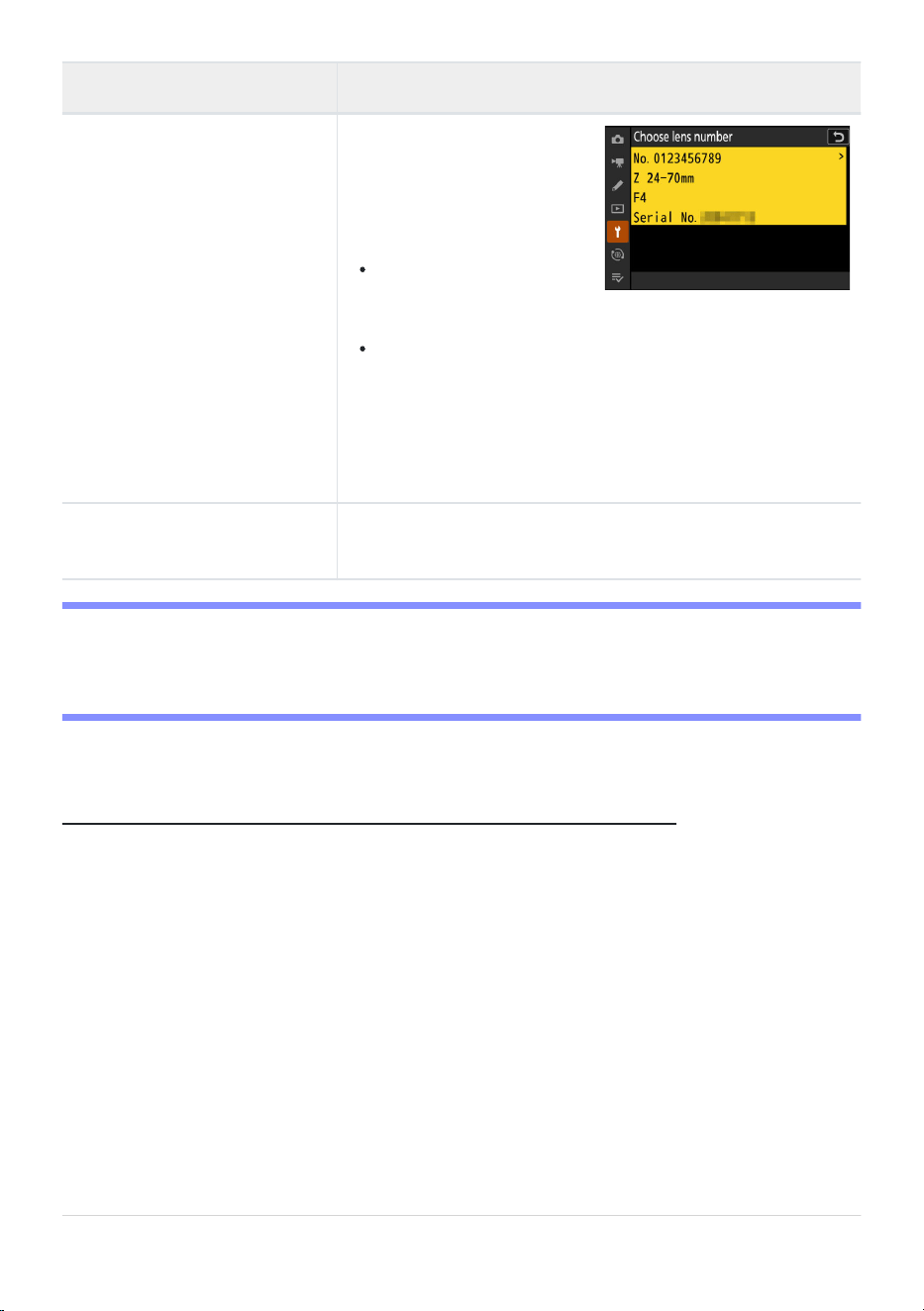
List values saved using
[Fine-tune and save lens].
Highlighting a lens in the list
and pressing 2
displays a
[Choose lens number] dialog.
The [Choose lens number]
dialog is used to enter the
lens identifier.
In the case of Z mount
lenses and some F
mount lenses, the lens
serial number is entered
automatically.
Option Description
[List saved values]
[Choose value for current lens]
Choose from multiple fine-tuning v
alues saved for lenses of the
same type.
D Deleting Saved Values
T
o delete values saved using [Fine-tune and save lens], highlight the desired lens in the [List saved
values] list and press O.
Creating and Saving Fine-Tuning Values
Attach the lens to the camera.
Select [AF fine-tuning options
] in the setup menu, then highlight [Fine-tune and save
lens] and press 2.
An AF fine-tuning dialog will be displayed.
726
AF fine-tuning options
1
2

Press 4 or 2 to fine-tune auto
focus.
Choose from values between +20 and −20.
The current value is shown by g, the previously-selected value by o.
If a zoom lens is attached, you can choose separate fine-tuning values for maximum angle
(WIDE) and maximum zoom (TELE). Use 1 and 3 to choose between the two.
The larger the fine-tuning value, the farther the focal point is from the lens; the smaller the
value, the closer the focal point.
Press J to save the new value.
727
AF fine-tuning options
3
4

Choosing a Default Fine-Tuning Value
Select [AF fine-tuning options] in the setup menu, then highlight [Default] and press 2.
Pr
ess 4 or 2 to fine-tune autofocus.
Choose from values between +20 and −20.
The current value is shown by g, the previously-selected value by o.
The larger the fine-tuning value, the farther the focal point is from the lens; the smaller the
value, the closer the focal point.
Press J to save the new value.
728
AF fine-tuning options
1
2
3

Non-CPU lens data
G buttonU
Bsetup menu
Record data for non-CPU lenses attached using an optional mount adapter. Recording the focal
length and maximum aperture of non-CPU lenses allows them to be used with some camera features
normally reserved for CPU lenses, such as on-board vibration reduction.
Option Description
[Lens number] Choose a lens identifier.
[Focal length (mm)] Enter the focal length.
[Maximum aperture
] Enter the maximum aperture.
[Lens name]
Assign a lens name. Lens names can be up to 36 characters long. The
assigned lens names are recorded in the Exif data stored in pictures.
729
Non-CPU lens data

Distance units
G buttonU
Bsetup menu
The camera displays the distance between the camera and the focus position in manual focus. The
distance unit can be set in meters or feet.
The distance shown is intended as a guide only. It may vary from the actual distance, depending on
the lens used.
730
Distance units

Save focus position
G buttonU
Bsetup menu
When [ON] is selected, the camera will save the current focus position when turned off and restore it
when next turned on. Note that this may increase camera startup times.
Note that even when [ON] is selected, if the temperature, zoom position, or other conditions
change while the camera is off, focus may resume from a different position when the camera is
turned on.
Similarly, note that even when [OFF] is selected, focus may resume from the previously-selected
position depending on the state of the camera and lens.
731
Save focus position

Save zoom position (PZ lenses)
G buttonU
Bsetup menu
If [ON] is selected when a power zoom (PZ) lens is attached, the camera will save the current zoom
position when turned off and restore it when next turned on.
732
Save zoom position (PZ lenses)
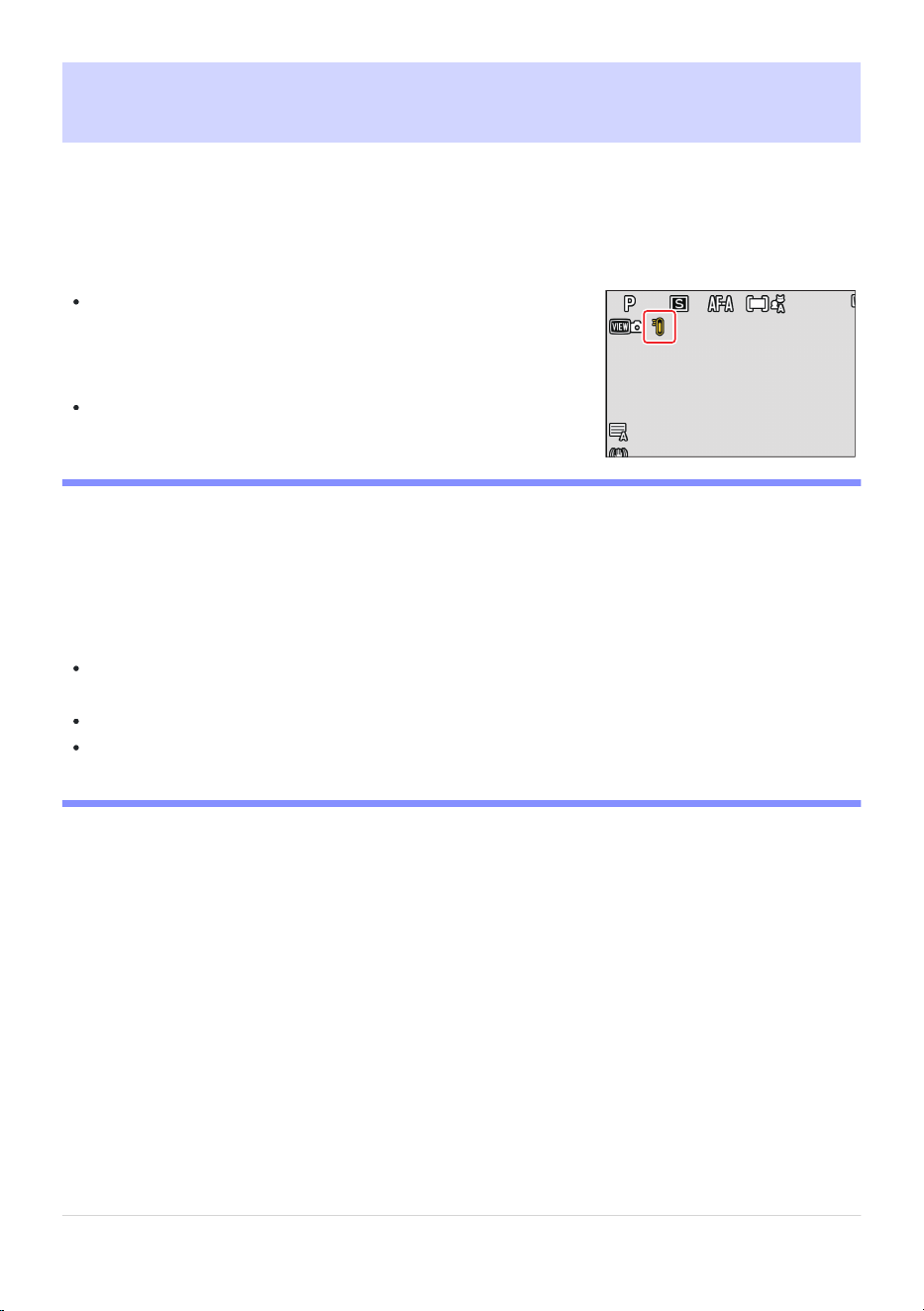
The camera will display J, then K as its internal t
emperature
rises. A count-down timer will be displayed as the temperature
increases still further, and the camera will automatically turn off
when the timer reaches zero.
Selecting [High] keeps the camera on longer than when
selecting [Standard].
Auto temperature cutout
G buttonU
Bsetup menu
The level at which the camera will turn off automatically as its internal temperature rises can be
selected from [Standard] and [High].
D Caution: [Auto temperature cutout] > [High]
Although selecting [High] gives you more time before the camera shuts down, the camera may
become hot to the touch. We recommend using a tripod or other equipment to reduce the time spent
touching the camera.
D Cautions: When the Camera Is Hot
In some cases, the count-down timer may be displayed the moment the camera is turned on, even
when [High] is selected.
Image quality may drop when the camera is hot.
Batteries inserted in a hot camera may also become hot. Do not attempt to remove the batteries
immediately; instead, wait for the camera to cool.
733
Auto temperature cutout
Clean image sensor
G buttonU
Bsetup menu
Dirt or dust entering the camera when lenses are exchanged or the body cap is removed may adhere
to the image sensor and affect your photographs. The “clean image sensor” option vibrates the sensor
to remove dust.
Option Description
[Start] Per
form image sensor cleaning immediately.
[Automatic cleaning]
[Clean at shutdown]: The image sensor is automatically cleaned during
shutdown each time the camera is turned off.
[Cleaning off]: Automatic image sensor cleaning off.
734
Clean image sensor
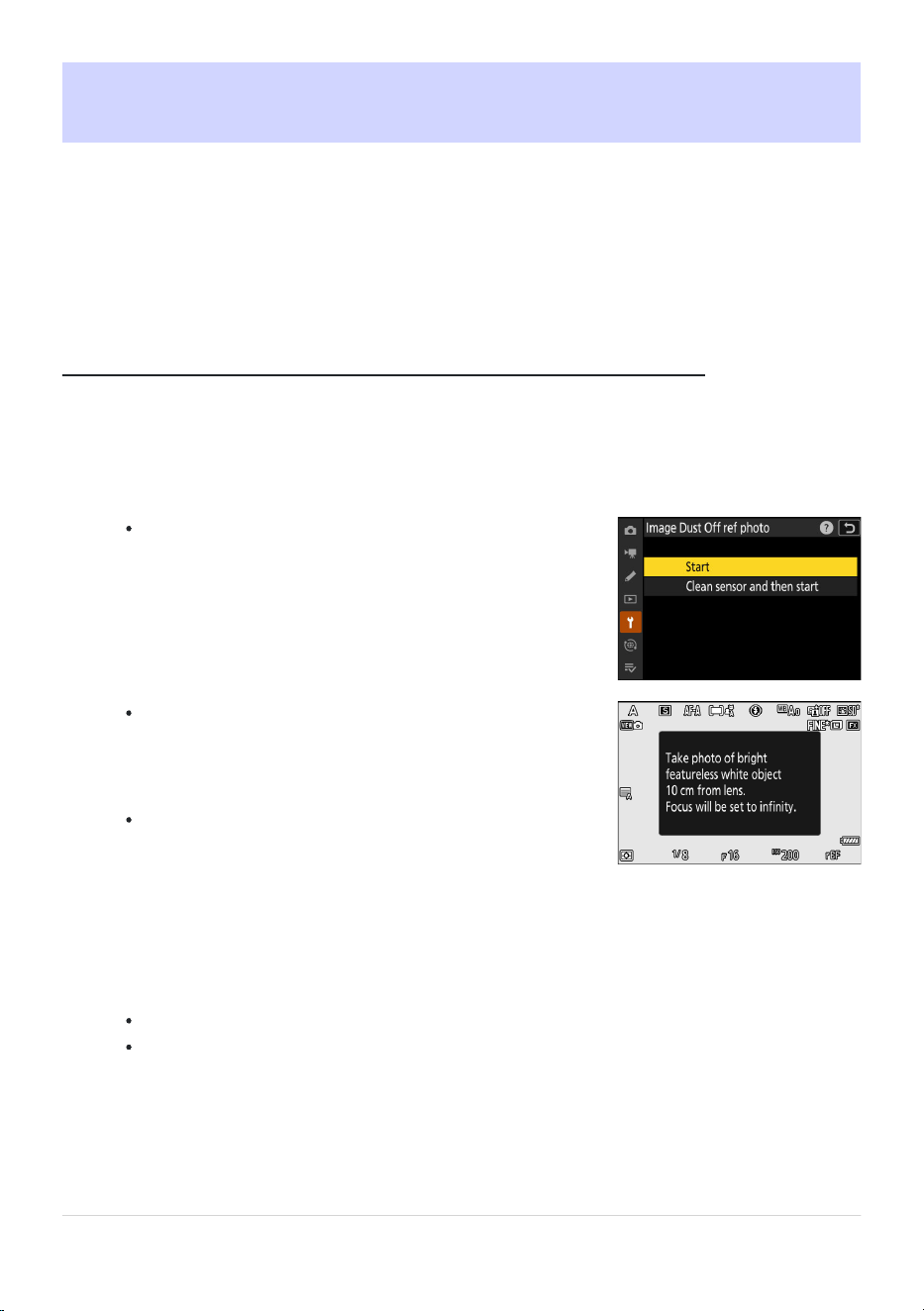
Highlight [S
tar
t] and pr
ess J to immediately display the
[Image Dust Off ref photo] dialog.
Highlight [Clean sensor and then star
t] and pr
ess J
to
clean the image sensor before starting. The [Image Dust
Off ref photo] dialog will be displayed when image sensor
cleaning is complete.
To exit without acquiring Image Dust Off reference data,
press G.
Image Dust Off ref photo
G buttonU
Bsetup menu
Acquire reference data for the Image Dust Off option in NX Studio. Image Dust Off processes NEF
(RAW) pictures to mitigate effects caused by dust adhering to the front of the camera image sensor.
For more information, refer to NX Studio’s online help.
Acquiring Image Dust Off Reference Data
Before acquiring Image Dust Off refer
ence data, select photo mode by rotating the photo/video
selector to C.
Choose a start option.
With the lens about ten centimeters (four inches) from a well-lit, featureless white object,
frame the object so that it fills the display and then press the shutter-release button
halfway.
In autofocus mode, focus will automatically be set to infinity.
In manual focus mode, set focus to infinity manually.
735
Image Dust Off ref photo
1
2
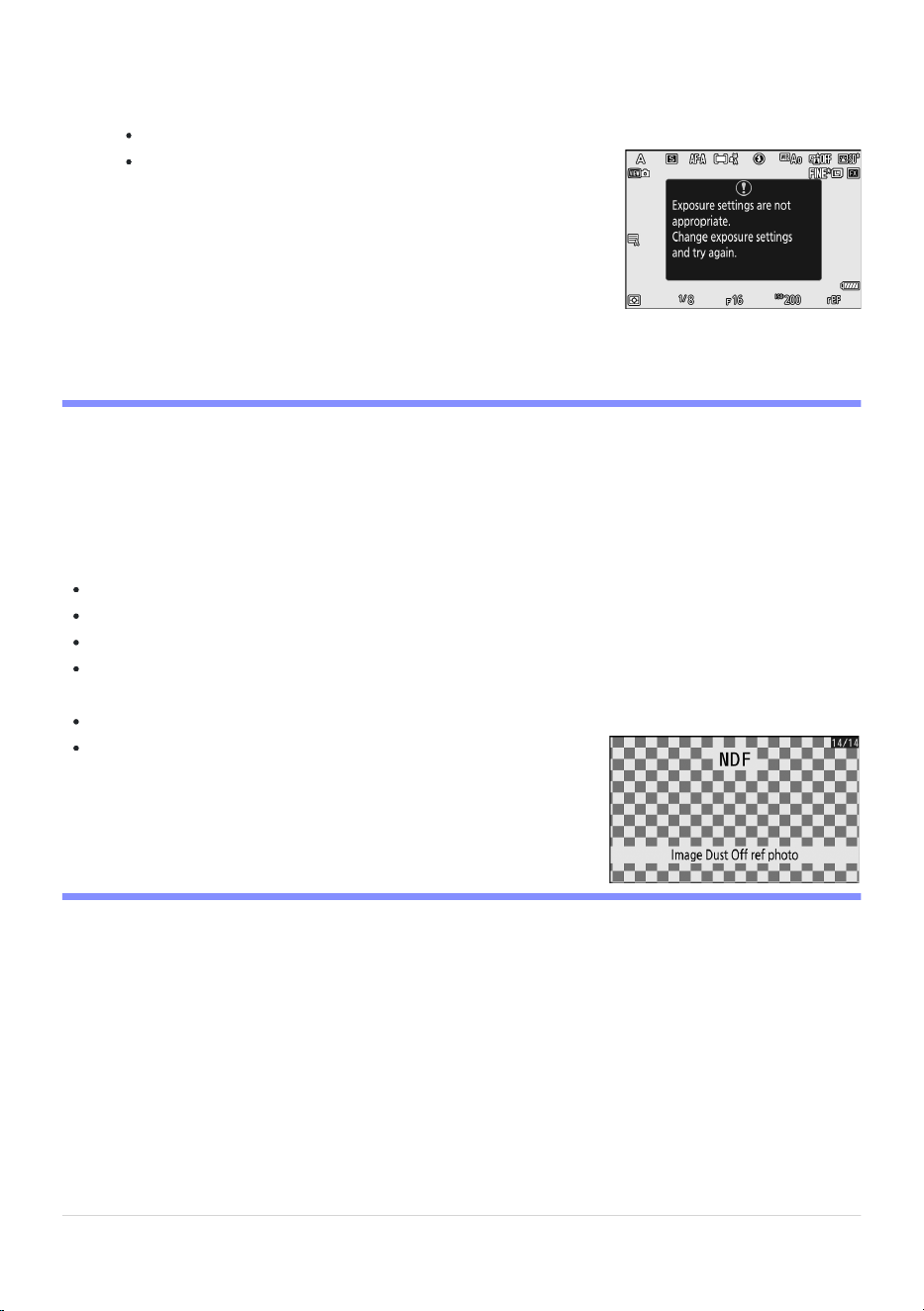
If the reference object is too bright or too dark, the camera
may be unable to acquire Image Dust Off r
eference data, in
which case a message will appear and the camera will return
to the display shown in Step1. Choose another reference
object and press the shutter-release button again.
A grid pattern is displayed when reference images are viewed on
the camera.
Press the shutter-release button the rest of the way down to acquire Image Dust Off
reference data.
The monit
or turns off when the shutter-release button is pressed.
D Caution: Image Sensor Cleaning
Dust off reference data recorded before image sensor cleaning is performed cannot be used with
photographs taken after image sensor cleaning is performed. Select [Clean sensor and then start]
only if the Image Dust Off reference data will not be used with existing photographs.
D Cautions: Acquiring Image Dust Off Reference Data
An FX-format lens with a focal length of at least 50mm is recommended.
When using a zoom lens, zoom all the way in.
Image Dust Off data cannot be acquired when a DX lens is attached.
The same reference data can be used for photographs taken with different lenses or at different
apertures.
Reference images cannot be viewed using computer imaging software.
736
Image Dust Off ref photo
3

Pixel mapping
G buttonU
Bsetup menu
Pixel mapping checks and optimizes the camera image sensor. If you notice unexpected bright spots
appearing in pictures taken with the camera, perform pixel mapping as described below.
Pixel mapping is available only when a Z mount lens or an optional FTZ II/FTZ mount adapter is
attached.
To prevent unexpected loss of power, use one of the following power sources:
A fully-charged battery
An optional EH-8P AC adapter connected using the supplied USB cable (featuring Type-C
connectors at both ends)
An optional EP‑5B power connector with an EH‑5d, EH‑5c, or EH‑5b AC adapter
A third-party portable charger (power bank)
To start pixel mapping, select [Start]. A message is displayed while the operation is in progress.
D Cautions: Pixel Mapping
Do not attempt to operate the camera while pixel mapping is in progress. Do not turn the camera
off or remove or disconnect the power source.
Pixel mapping may not be available if the camera’s internal temperature is elevated.
737
Pixel mapping
-
-
-
-
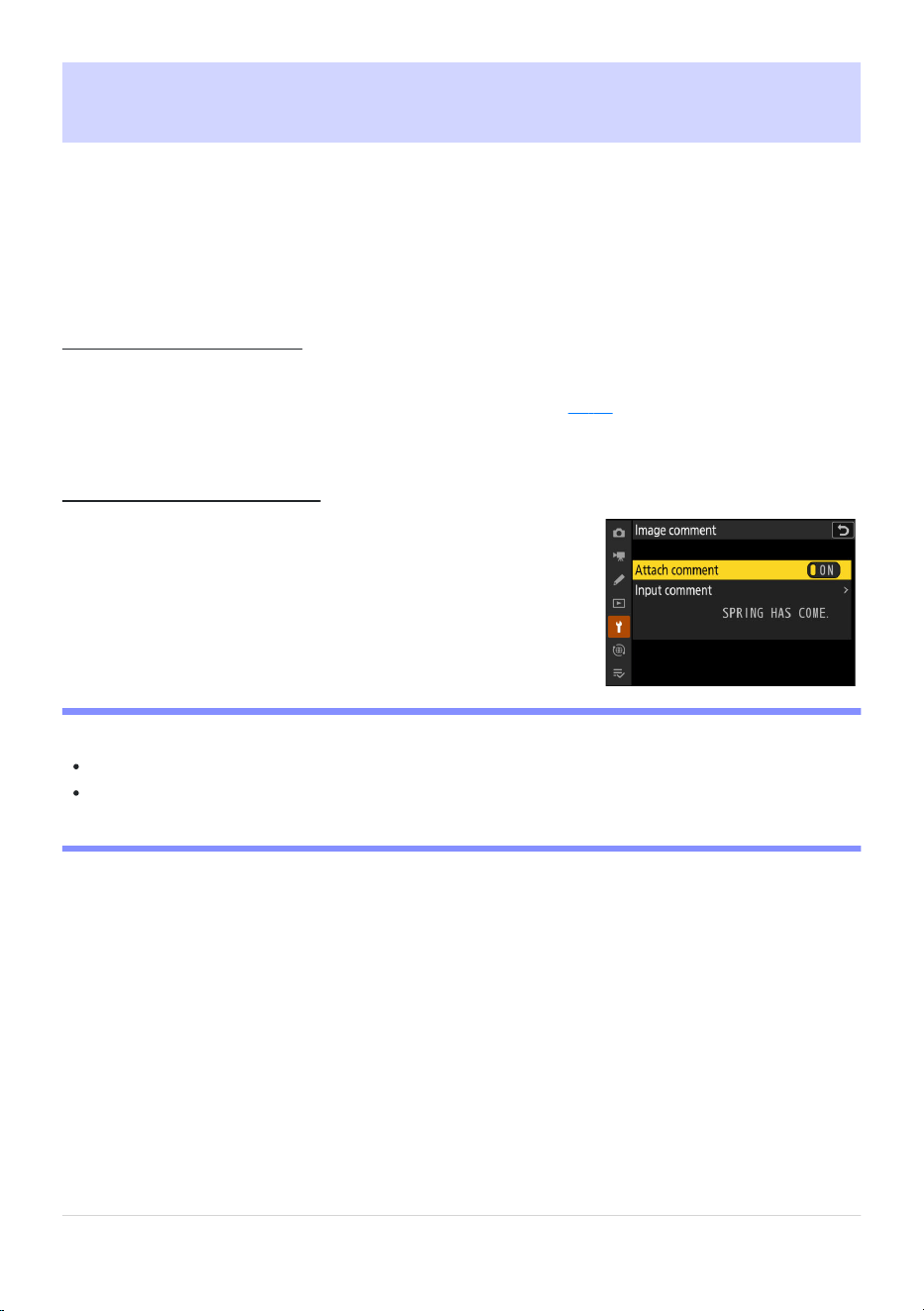
Comments will be attached to pictures taken while [A
ttach
comment
] is [
ON].
Image comment
G buttonU
Bsetup menu
Add a comment to new photographs as they are taken. Comments can be viewed in the NX Studio
[Info] tab.
Input comment
Input a comment of up to 36 charact
ers. Highlight [Input comment] and press 2 to display a
text-entry dialog. For information on text entry, see “Text Entry” (
0 79).
Attach comment
D Photo Info
Comments can be viewed on the [Other shooting data] p
age in the photo information display.
To display the [Other shooting data] page, select (M) both [Shooting data] and [Other shooting
data] for [Playback display options] in the playback menu.
738
Image comment
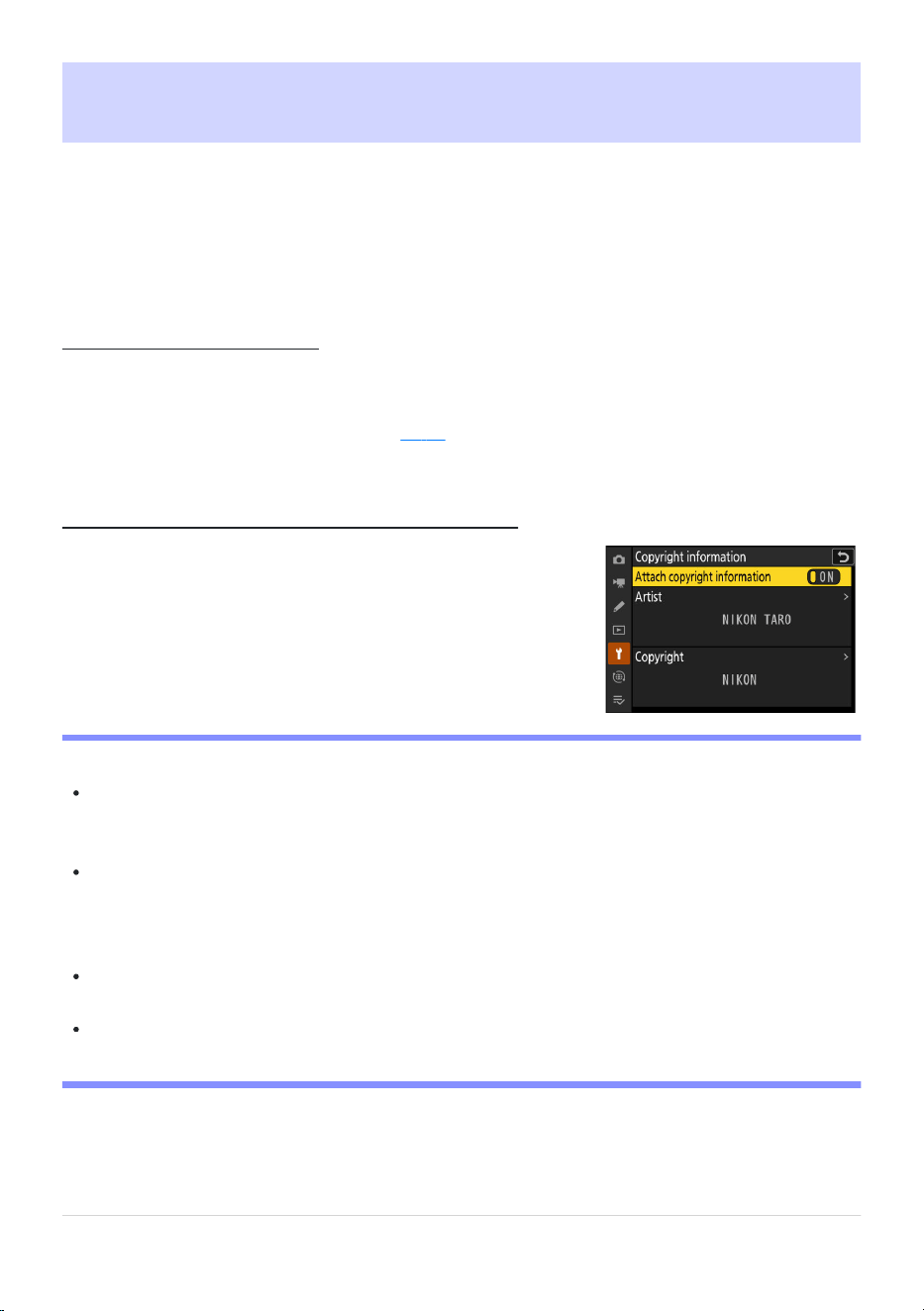
Copyright information will be attached to pictures taken while
[A
ttach copyr
ight infor
mation] is [ON].
Copyright information
G buttonU
Bsetup menu
Add copyright information to new photographs as they are taken. Copyright information can be
viewed in the NX Studio [Info] tab.
Artist/Copyright
Enter the names of the phot
ographer (maximum 36 characters) and copyright holder (maximum
54 characters). Highlight [Artist] or [Copyright] and press 2 to display a text-entry dialog. For
information on text entry, see “Text Entry” (
0 79).
Attach copyright information
D Cautions: Copyright Information
T
o prevent unauthorized use of the artist or copyright holder names, make sure that [OFF] is
selected for [Attach copyright information] before lending or transferring the camera to another
person. You will also need to make sure that the artist and copyright fields are blank.
Nikon does not accept liability for any damages or disputes arising from the use of the [Copyright
information] option.
D Viewing Copyright Information
Copyright information can be viewed on the [Copyright info] page in the photo information
display.
To display the [Copyright info] page, select (M) both [Shooting data] and [Copyright info] for
[Playback display options] in the playback menu.
739
Copyright information

IPTC presets can be created or edited on the camera and
embedded in new photographs as described below.
IPTC
G buttonU
Bsetup menu
You can also load IPTC presets created on a computer.
To create IPTC presets and save them to memory cards for later import, use IPTC Preset Manager
(
0 744).
Creating, Renaming, Editing, and Copying Presets
Highlight [Edit/save] and press 2
to display the [Select preset to edit or save] list of existing presets.
To edit or rename a preset, highlight it and press 2. To create a new preset, highlight “Unused” and
press 2.
[Rename]: Rename the preset.
[Edit IPTC information]: Display the selected preset (
0 743). Selected fields can be edited as
desir
ed.
To copy a preset, highlight it and press X. Highlight the destination, press J, and name the copy.
Deleting Presets
To delete pr
esets, highlight [Delete] and press 2.
740
IPTC
-
-
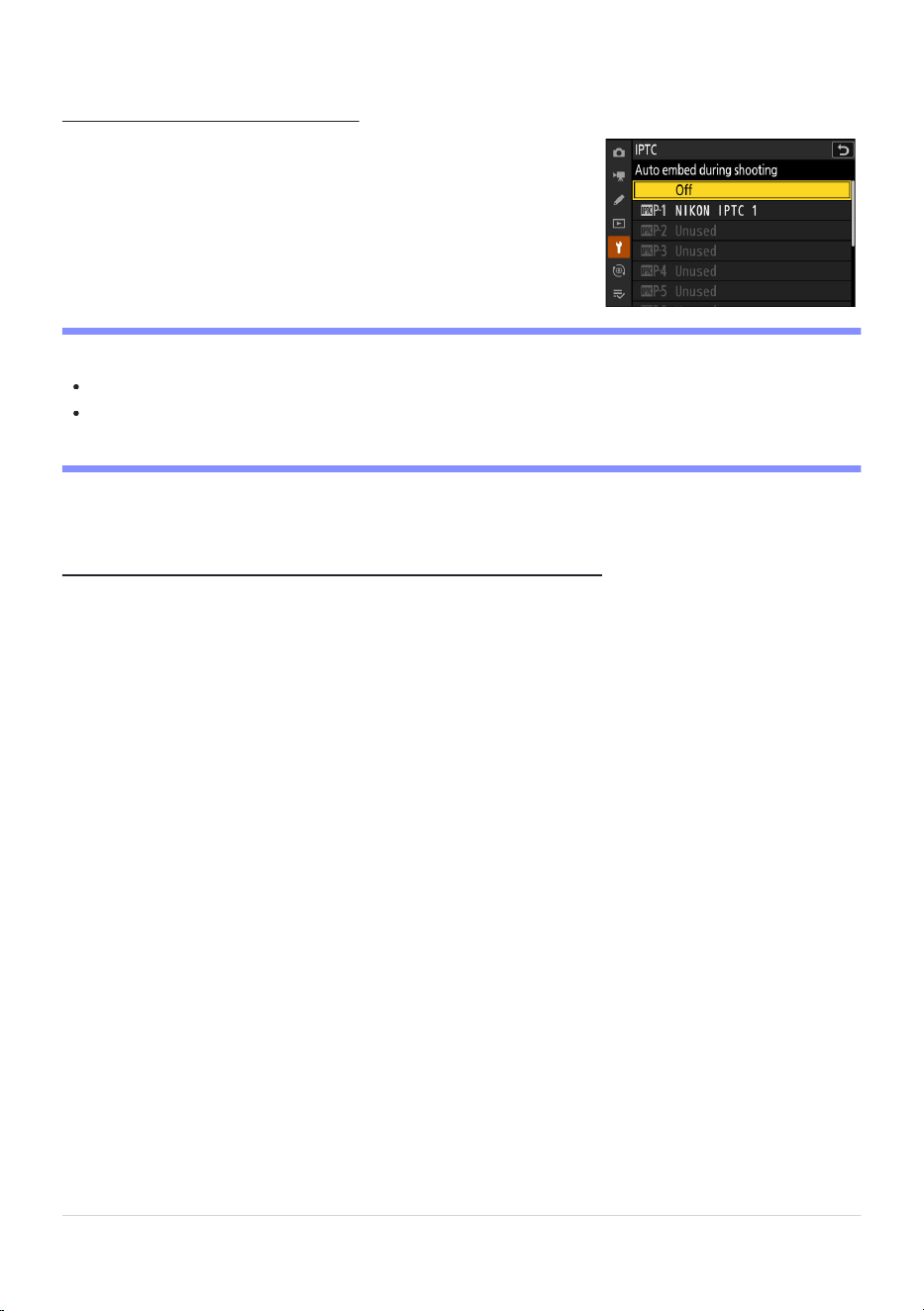
Highlighting [Auto embed during shooting] and pr
essing 2
displays a list of presets. Highlight a preset and press J; the
selected preset will be embedded in all subsequent photographs.
To disable embedding, select [Off].
Embedding Presets
D Viewing IPTC Data
Embedded presets can be view
ed on the [IPTC data] page in the photo information display.
To display the [IPTC data] page, select (M) both [Shooting data] and [IPTC data] for [Playback
display options] in the playback menu.
Copying Presets to a Memory Card
To copy IPTC pr
esets from the camera to a memory card, select [Load/save]> [Slot 1] or [Slot 2], then
highlight [Copy to card] and press 2. Select the desired preset and destination (1–99) and press J to
copy the preset to the card.
741
IPTC
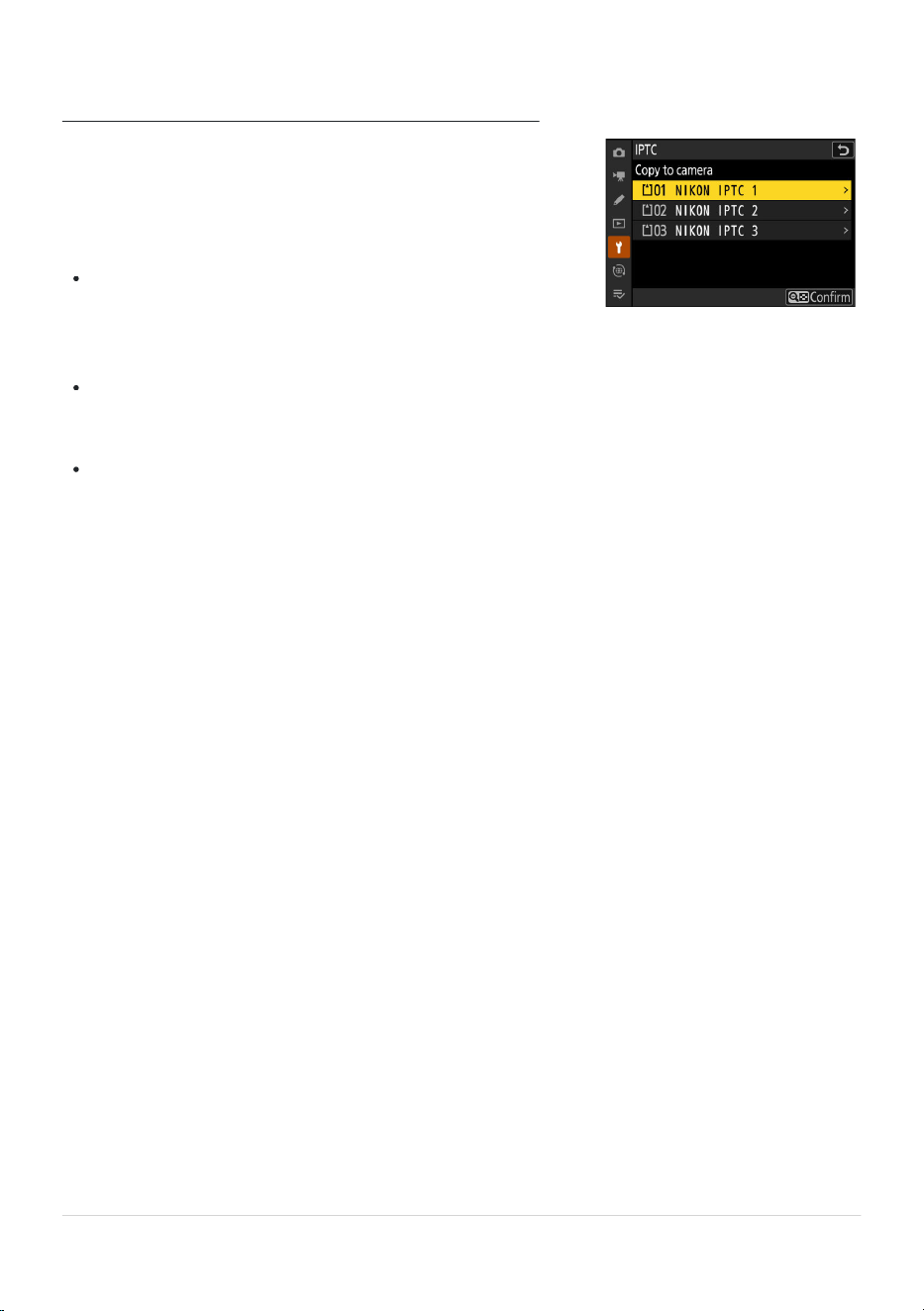
The camera can store up to ten presets; to copy IPTC presets from a
memory card t
o a selected destination on the camera, select [Load/
save]> [Slot 1] or [Slot 2], then highlight [Copy to camera] and
press 2.
Highlight a preset and press J to proceed to the [Select
destination] list. To preview the highlighted preset, press W (Q)
instead of pressing J. After previewing the preset, press J to
proceed to the [Select destination] list.
Highlight a destination and press J to display a dialog where
you can name the preset. Name the preset as desired and press
X to copy the preset to the camera.
In addition to the ten presets mentioned above, the camera can
store up to three XMP/IPTC presets created on a computer and
saved in XMP format. XMP/IPTC presets are not displayed during
playback. Nor can they be copied from the camera to a memory
card.
Copying Presets to the Camera
742
IPTC

D Cautions: IPTC Information
The camera suppor
ts standard roman alphanumeric characters only. Other characters will not
display correctly except on a computer.
Preset names (
0 740) may be up to 18 character
s long. If a preset with a longer name is created
using a computer, all characters after the eighteenth will be deleted.
The number of characters that may appear in each field is given below. Any characters over the limit
will be deleted.
Field Max. length
Caption 2000
Event ID 64
Headline 256
Object Name 256
City 256
State 256
Country 256
Category 256
Supp. Cat. (supplemental categories) 256
Byline 256
Byline Title 256
Writer/Editor 256
Credit 256
Source 256
D IPTC
IPTC is a standar
d established by the International Press Telecommunications Council (IPTC) with the
intent of clarifying and simplifying the information required when photographs are shared with a
variety of publications.
743
IPTC


Z Connector Function (Headphone/
Remot
e Cord Connector Function)
G buttonUBsetup menu
Select a device to use by connecting to the headphone/remote cord (Z) connector.
When set to [Auto switch], the camera automatically detects whether the connected device is a
pair of headphones or an optional MC-DC3 remote cord. [Auto switch] is recommended for most
situations.
If the headphones do not operate properly with the [Auto switch] option (such as when using
headphones with 4-pole plug), select [Headphone].
745
Z Connector Function (Headphone/Remot
e
Cord Connector Function)

Voice memo options
G buttonU
Bsetup menu
Adjust settings for voice memos (
0 254).
Voice memo control
Choose the behavior of controls t
o which [Voice memo] has been assigned via Custom Setting f3
[Custom controls (playback)].
Option Description
3
[Press and hold]
Voice memos up t
o 60 seconds long can be recorded while the
control is pressed.
4
[Press to start/stop]
Recording begins when the control is pressed and ends after about
60 seconds or when the control is pressed a second time.
746
Voice memo options
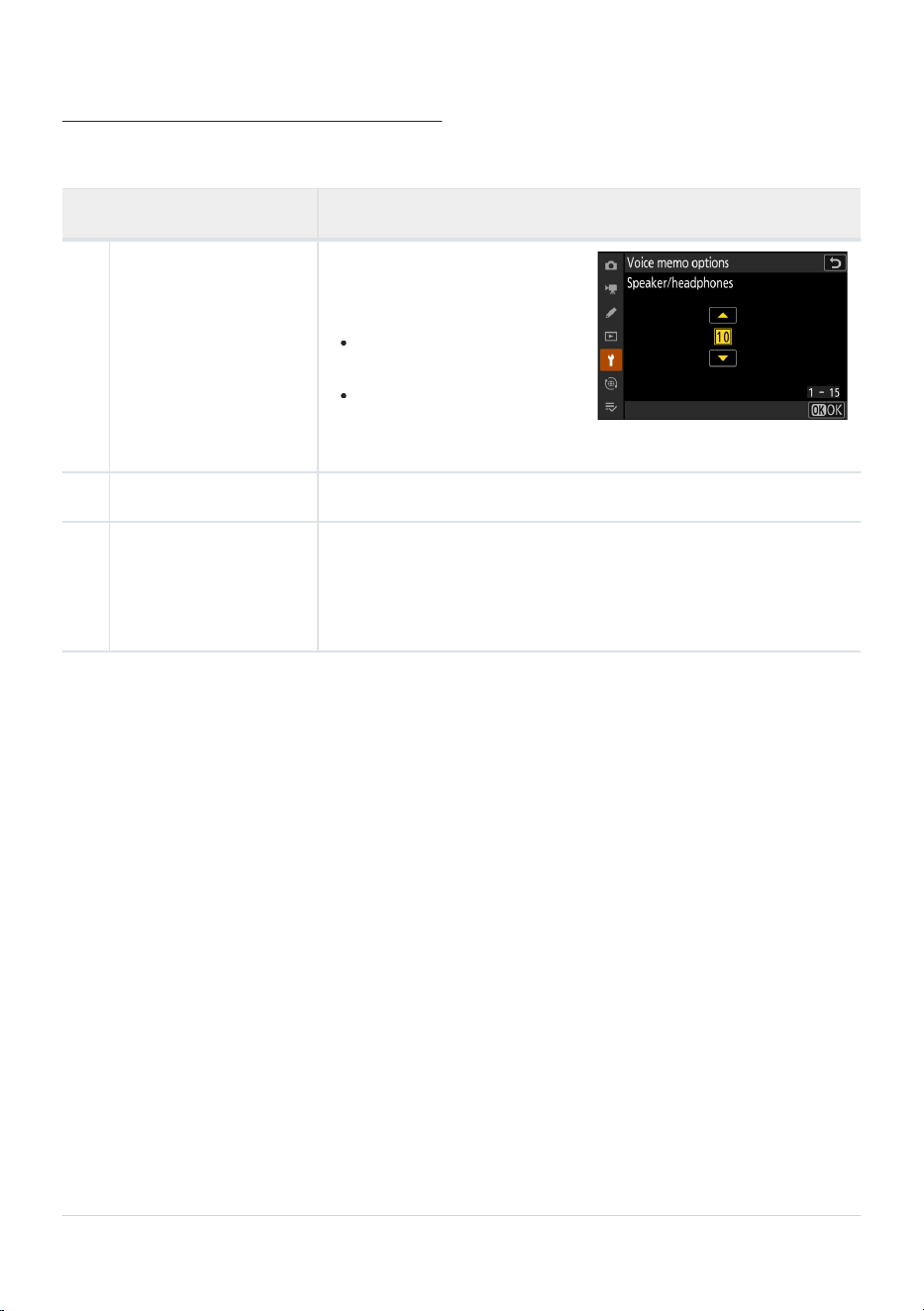
Voice memos are played back
over headphones (if connected)
or the camera’
s built-in speaker.
Press 1 or 3 to choose a
volume between [1] and [15].
Press J to save changes and
exit.
Audio output (playback)
Choose the device used for voice memo playback
.
Option Description
5
[Speak
er/headphones]
7
[HDMI
] Voice memos are output to the HDMI terminal at a fixed volume.
6
[Off]
Voice memos cannot be played even using controls to which
[Voice memo] has been assigned via Custom Setting f3 [Cust
om
controls (playback)]. 2 icons are displayed when photographs for
which memos exist are viewed in the monitor.
747
Voice memo options

Camera sounds
G buttonU
Bsetup menu
Beep on/off
Turn the
beep speaker on or off.
If [On] is selected for [Beep on/off], beeps sound when:
the self-timer counts down,
interval-timer photography, time-lapse video recording, focus shift, or pixel shift ends,
the camera focuses in photo mode (note that this does not apply if AF-C is selected for focus
mode or if AF-A is selected and the camera is shooting using AF-C, or if [Release] is selected for
Custom Setting a2 [AF-S priority selection]), or
touch controls are used.
Select [Off (touch controls only)] to disable the beep for touch controls while enabling it for other
purposes.
Select [Off] to mute the beep speaker.
Volume
Adjust the beep volume.
Pitch
Choose the pitch of the beep fr
om [High] and [Low].
D Silent Mode
Selecting [ON] for [Silent mode] in the setup menu disables the camera sounds.
D Caution: Camera Sounds
Overlapping camera sounds may play as a single sound.
748
Camera sounds
-
-
-
-

Silent mode
G buttonU
Bsetup menu
Select [ON] to enable the electronic shutter, eliminating the noise and vibration caused by the motion
of the mechanical shutter (“shutter shock”).
Enabling silent mode also suppresses other camera sounds. It does not, however, completely
silence the camera. Camera sounds may still be audible, for example during autofocus or aperture
adjustment, in the latter case most noticeably at apertures smaller (i.e., at f-numbers higher) than
f/5.6.
Optional flash units mounted on the camera will not fire.
The electronic shutter is used regardless of the option selected for Custom Setting d6 [Shutter
type].
The beep speaker is muted regardless of the options selected for [Camera sounds] in the setup
menu.
The frame advance rate may drop in some circumstances.
The [Long exposure NR] and [Photo flicker reduction] options in the photo shooting menu are
disabled.
You may notice the following in the shooting display and in photographs recorded in silent mode:
flicker or banding in scenes lit by such sources as fluorescent, mercury vapor, or sodium lamps,
distortion associated with motion (individual subjects moving through the frame may be
distorted, or the entire frame may appear distorted if the camera is moved during shooting),
jagged edges, color fringing, moiré, or bright spots, or
bright regions or bands in scenes lit by flashing signs and other intermittent light sources or
when the subject is briefly illuminated by a strobe or other bright, momentary light source.
Silent mode mutes the beep speaker and dampens other camera sounds, but does not absolve
photographers of the need to respect their subjects’ privacy and image rights.
Tip: The Standby Timer
Even when [ON] is selected for [Silent mode], a sound will be produced when the standby timer is
activated or expires. To mute the standby timer, select [No limit] for Custom Setting c3 [Power off
delay] > [Standby timer].
749
Silent mode
-
-
-
-

Touch controls
G buttonU
Bsetup menu
Adjust settings for monitor touch controls.
Enable/disable touch controls
Enable or disable touch controls. Select [Playb
ack only] to enable touch controls in playback mode
only.
Glove mode
Selecting [ON] raises the sensitivity of the touch scr
een, making it easier to use while wearing gloves.
750
Touch controls

Self-portrait mode
G buttonU
Bsetup menu
Select [OFF] to prevent the camera entering self-portrait mode when the monitor is in the self-portrait
position.
751
Self-portrait mode


USB connection priority
G buttonU
Bsetup menu
Choose the function assigned priority when the camera is connected to a computer via USB.
Option Description
[Upload]
The monitor r
emains blank while the camera is connected to a computer. The monitor
turns on when the shutter-release button is pressed halfway but upload speeds may
drop.
[Shooting]
The monitor remains on while the camera is connected to a computer. Upload speeds
may drop.
753
USB connection priority

Conformity marking
G buttonU
Bsetup menu
View some of the standards with which the camera complies.
754
Conformity marking
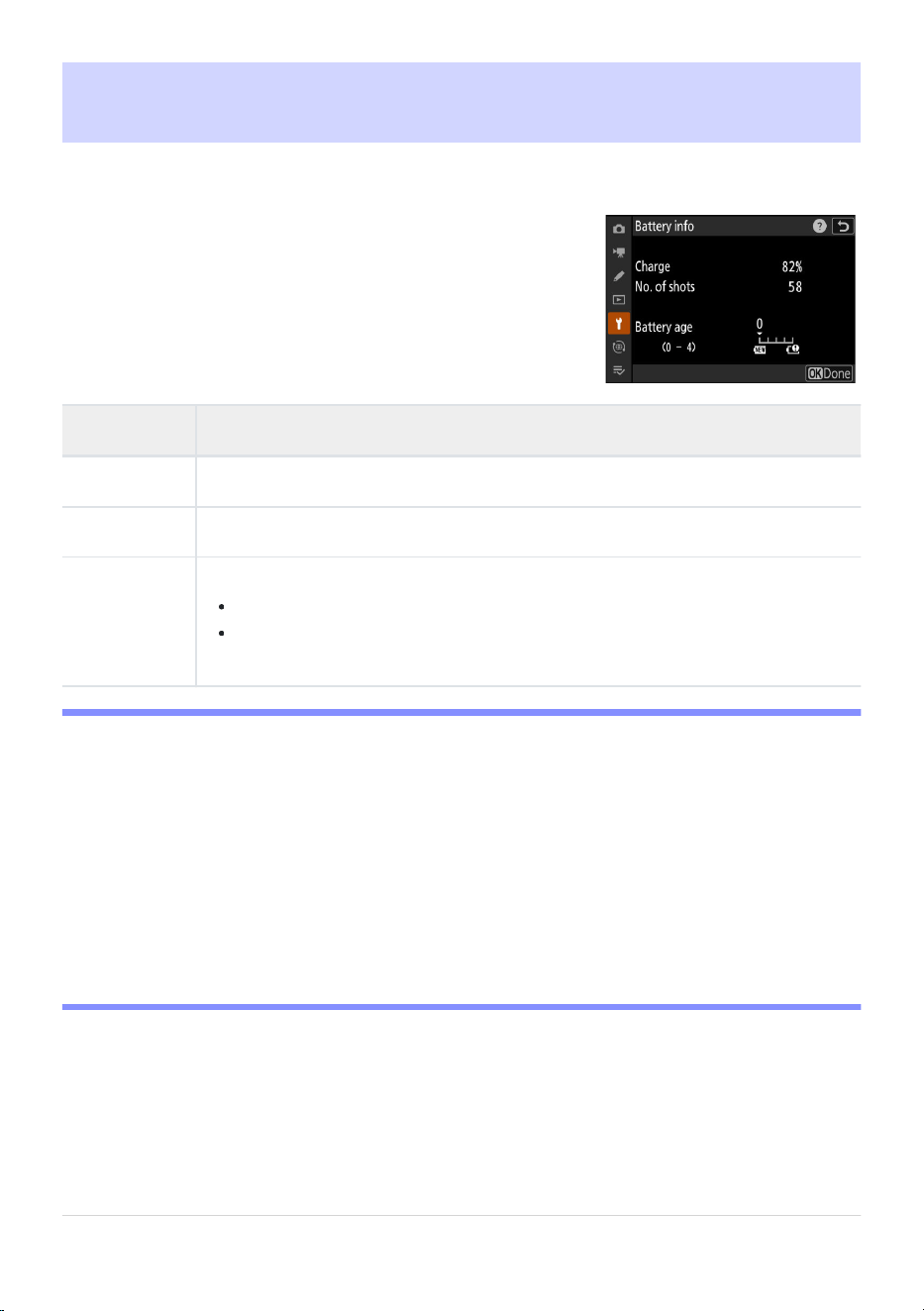
View information on the battery currently inserted in the camera.
Battery info
G buttonU
Bsetup menu
Option Description
[Char
ge] The curr
ent b
attery level, expressed as a percentage.
[No. of shots] The number of shots taken since the battery was last charged.
[Battery age]
A five-lev
el display showing battery age.
A value of “0” (k
) indicates that battery performance is unimpaired.
A value of “4” (l) indicates that the battery has reached the end of its charging
life. Replace the battery.
D Number of Shots
[No. o
f shots] shows the number of times the shutter has been released. Note that the camera may
sometimes release the shutter without recording a photograph, for example when measuring preset
manual white balance.
D Charging Batteries at Low Temperatures
Batteries in general exhibit a drop in capacity at low ambient temperatures. Even fresh batteries
charged at temperatures under about 5°C (41°F) may show a temporary increase from “0” to “1” in
the value shown for [Battery age], but the display will return to normal once the battery has been
recharged at a temperature of about 20°C (68°F) or higher.
755
Battery info
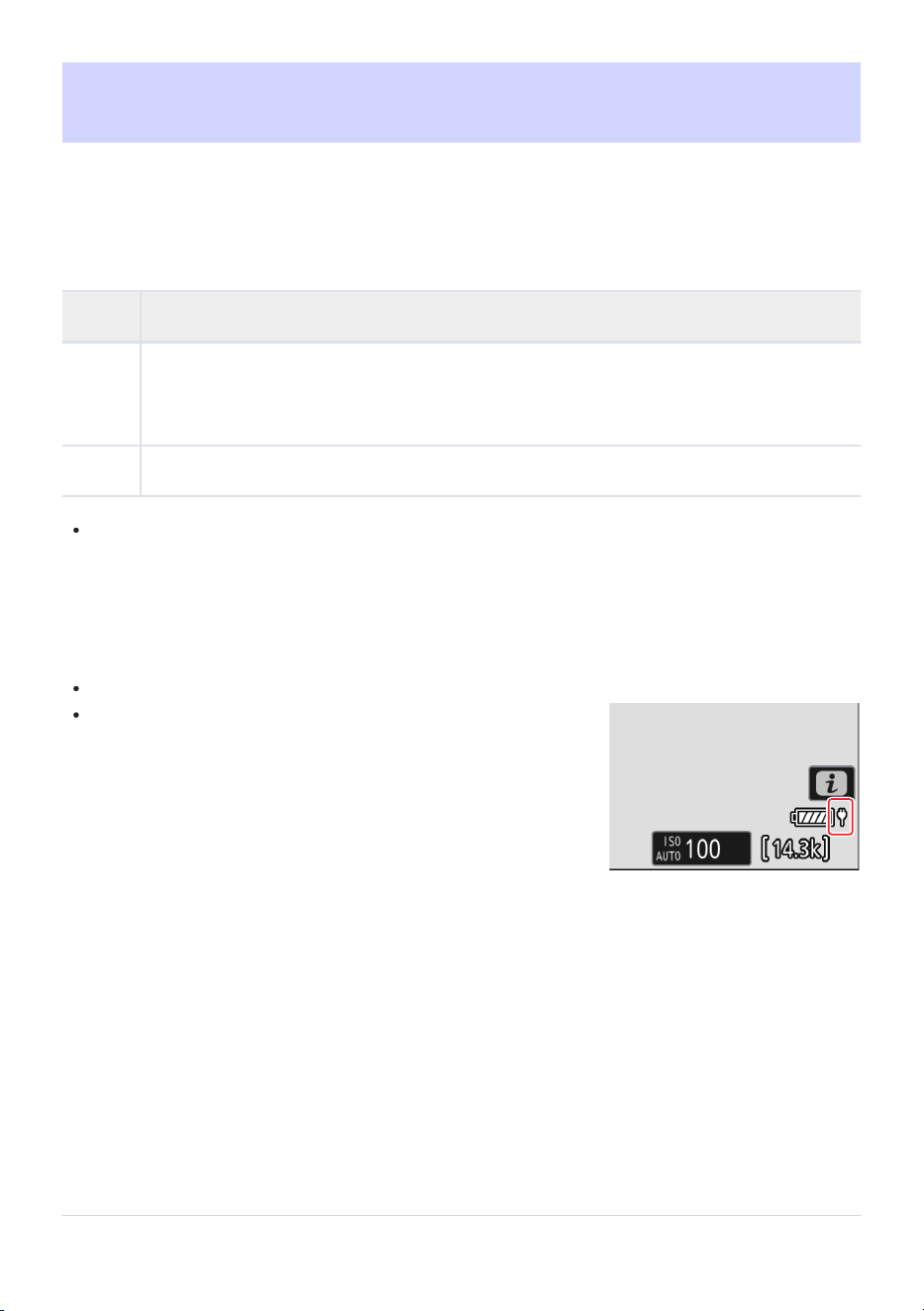
A USB power delivery icon appears in the shooting display when
the camera is powered by an ext
ernal source.
USB power delivery
G buttonU
Bsetup menu
Choose whether the camera draws power from devices connected via USB. USB power delivery allows
the camera to be used while limiting the drain on the battery.
Option Description
[ON]
The camera draws power from connected devices while on. Connected devices will also
supply power when the camera is off if Bluet
ooth upload is in progress or the memory
card access lamp is lit.
[OFF] The camera does not draw power from connected devices at any time.
USB power delivery is available from:
An optional EH-8P AC adapter connected using the supplied USB cable (featuring Type-C
connectors at both ends)
computers with built-in Type-C USB ports (requires the supplied USB cable featuring Type-C
connectors at both ends).
A third-party portable charger (power bank)
Power will only be supplied to the camera when the battery is inserted.
756
USB power delivery
-
-
-

D Computer USB Pow
er Delivery
Before using a computer to supply power to the camera, check that the computer is equipped with
a Type-C USB connector. Use the USB cable supplied with the camera (featuring Type-C connectors
at both ends) to connect the camera to the computer.
Depending on the model and product specifications, some computers will not supply current to
power the camera.
Tip: “Power Delivery” Versus “Charging”
The supply of power for camera operations is referred to as “power delivery”, while the term “charging”
is used when power is supplied only to charge the camera battery. The conditions under which the
power supplied by external devices is used to power the camera or charge the battery are shown
below.
Option selected for [USB power
delivery]
Power switch External power source used for
[ON]
On (standby timer active)
1
Power delivery
On (standby timer off) Charging
2
Off Charging
2
[OFF]
On (standby timer active)
1
—
On (standby timer off) Charging
2
Off Charging
2
Includes instances in which the power switch is in the “OFF” position but Bluetooth upload is in
progress or the memory card access lamp is lit.
EN‑EL15c and EN‑EL15b batteries inserted in the camera will charge when the camera is
connected to an optional EH‑8P AC adapter or a computer (note that connections to the EH-8P
or a computer must be made using the supplied USB cable featuring Type-C connectors at both
ends).
757
USB power delivery
1
2

Energy saving (photo mode)
G buttonU
Bsetup menu
In photo mode, the shooting display will dim to save power approximately 15 seconds before the
standby timer expires.
Option Description
[ON] Enable energy saving. The display refresh rate may drop.
[OFF]
Disable energy saving. Note selecting [OFF] does not stop the shooting display dimming
a few seconds before the standby timer expir
es.
D [Energy saving (photo mode)]
Note that ev
en when [ON] is selected, energy saving will not function in some situations, including:
if [No limit] is selected for Custom Setting c3 [Power off delay]> [Standby timer] or if the
delay selected is less than 30 seconds,
in self-portrait mode,
during zoom,
while the camera is connected to another device via HDMI,
while the camera is connected to and exchanging data with a computer or smart device via USB,
or
while the camera is connected to an AC adapter.
Selecting [OFF] increases drain on the battery.
758
Energy saving (photo mode)
-
-
-
-
-
-

Slot empty release lock
G buttonU
Bsetup menu
Choose whether the shutter can be released when no memory card is inserted in the camera.
Option Description
a
[Release locked] The shutter cannot be r
eleased when no memory card is inserted.
b
[Enable release]
The shutter can be released with no memory card inserted. No pictures
will be recorded; during playback, the camera displays [Demo].
759
Slot empty release lock

Save/load menu settings
G buttonU
Bsetup menu
Save current camera menu settings to a memory card. You can also load saved settings, allowing menu
settings to be shared among cameras of the same model.
The settings will be saved to the card in Slot 1 when two memory cards are inserted.
Settings That Can Be Saved and Loaded
The following settings are saved:
PHO
TO SHOOTING MENU
[File naming]
[Role played by card in Slot 2]
[Image area]
[Tone mode]
[Image quality]
[Image size settings]
[RAW recording]
[ISO sensitivity settings]
[White balance]
[Set Picture Control] (Custom Picture Controls are saved as [Auto])
[Set Picture Control (HLG)]
[Color space]
[Active D-Lighting]
[Long exposure NR]
[High ISO NR]
[Vignette control]
[Diffraction compensation]
[Auto distortion control]
[Skin softening]
[Portrait impression balance]
[Photo flicker reduction]
[High-frequency flicker reduction]
[Metering]
[Flash control]
[Flash mode]
[Flash compensation]
[Release mode]
760
Save/load menu settings
-
-
-
-
-
-
-
-
-
-
-
-
-
-
-
-
-
-
-
-
-
-
-
-
-
-
-

[Focus mode]
[AF-area mode]
[AF/MF subject det
ection options]
[MF subject detection area]
[Vibration reduction] (the options available vary with the lens)
[Link VR to focus point]
[Auto bracketing]
VIDEO RECORDING MENU
[File naming]
[Destination]
[Video file type]
[Frame size/frame rate]
[Image area]
[ISO sensitivity settings]
[White balance]
[Set Picture Control] (Custom Picture Controls are saved as [Auto])
[HLG quality]
[Active D-Lighting]
[High ISO NR]
[Vignette control]
[Diffraction compensation]
[Auto distortion control]
[Skin softening]
[Portrait impression balance]
[Video flicker reduction]
[High-frequency flicker reduction]
[Metering]
[Focus mode]
[AF-area mode]
[AF/MF subject detection options]
[Product review mode]
[MF subject detection area]
[Video self-timer]
[Vibration reduction] (the options available vary with the lens)
[Electronic VR]
[Microphone sensitivity]
[Attenuator]
[Frequency response]
[Wind noise reduction]
[Mic jack plug-in power]
[Headphone volume]
[Timecode] (excepting [Timecode origin])
[External rec. cntrl (HDMI)]
761
Save/load menu settings
-
-
-
-
-
-
-
-
-
-
-
-
-
-
-
-
-
-
-
-
-
-
-
-
-
-
-
-
-
-
-
-
-
-
-
-
-
-
-
-
-
-

[Hi-Res Zoom]
CUSTOM SE
TTINGS MENU: All items
PLAYBACK MENU
[Playback display options]
[Delete pictures from both slots]
[Dual-format recording PB slot]
[Filtered playback criteria]
[Series playback]
[Picture review]
[After delete]
[After burst, show]
[Record camera orientation]
[Auto-rotate pictures]
SETUP MENU
[Language]
[Time zone and date] (excepting [Date and time])
[Viewfinder display size]
[Limit monitor mode selection]
[Auto rotate info display]
[Non-CPU lens data]
[Distance units]
[Save focus position]
[Save zoom position (PZ lenses)]
[Auto temperature cutout]
[Clean image sensor]
[Image comment]
[Copyright information]
[IPTC]
[Z connector function]
[Voice memo options]
[Camera sounds]
[Silent mode]
[Touch controls]
[Self-portrait mode]
[HDMI]
[USB connection priority]
[USB power delivery]
[Energy saving (photo mode)]
[Slot empty release lock]
762
Save/load menu settings
-
-
-
-
-
-
-
-
-
-
-
-
-
-
-
-
-
-
-
-
-
-
-
-
-
-
-
-
-
-
-
-
-
-
-
-

MY MENU
The current contents o
f “My Menu”
[Choose tab]
RECENT SETTINGS
The current contents of the recent settings menu (up to 20 items)
[Choose tab]
Save menu settings
Save settings to a memor
y card. If the card is full, an error will be displayed and settings will not be
saved. Saved settings can only be used with other cameras of the same model.
Load menu settings
Load saved settings fr
om a memory card. Note that [Load menu settings] is available only when a
memory card containing saved settings is inserted.
D Caution: Saved Settings
Settings are saved to files named “NCSET***”, where “***” is an identifier that varies from camera to
camera. The camera will not be able to load settings if the file name is changed.
763
Save/load menu settings
-
-
-
-

Reset all settings
G buttonU
Bsetup menu
Reset all settings except [Language] and [Time zone and date] to their default values. Copyright
information and other user-generated entries are also reset. Once reset, settings cannot be restored.
We recommend that you save settings using the [Save/load menu settings] item in the setup menu
before performing a reset.
764
Reset all settings

If a new camera firmware is available for download from
NikonImagingCloud, notification marks will appear on the
setup menu tab and [Firmwar
e version] item in the camera
menu.
Firmware version
G buttonU
Bsetup menu
View the current camera firmware version. Firmware updates can be performed if the memory card
contains new firmware.
The camera displays firmware versions for the camera and attached accessories as follows. Only
accessories currently connected to the camera are listed.
C: Camera firmware
LF/MA: Lens (LF) or mount adapter (MA) firmware
S: Flash firmware
TC: Teleconverter firmware
RG: Remote grip firmware
Tip: Firmware Updates
Update your camera as follows:
Download firmware from the Nikon Download Center using a computer: Check the Nikon
Download Center for new firmware. For more information, see the firmware download page.
Download firmware via the SnapBridge app on a smart device: If the smart device has been
paired with the camera using the SnapBridge app, the app will automatically notify you when
updates become available, and you can then download the update to a camera memory card via
the smart device. For more information, see the SnapBridge app’s online help. SnapBridge may not
display the notification at the same time that updates are made available on the Nikon Download
Center.
Download firmware to the camera from NikonImagingCloud: If the camera receives a firmware
version update notification from NikonImagingCloud, [Update (from Nikon Imaging Cloud)]
appears in the [Firmware version] menu. Highlight [Update (from Nikon Imaging Cloud)] >
[On] and press 2 to download the firmware to the camera via the Internet. The update will start
automatically after the download is complete.
765
Firmware version
-
-
-
-
-
-

Auto update
If you select [On
] and specify a time, the camera automatically connects to NikonImagingCloud at the
set time each day and will automatically download and perform a firmware update, if available. Auto
update is enabled only when all the following conditions are met:
The camera sign-in setting is enabled in Nikon Imaging Cloud.
The camera power switch is in the “OFF” position.
The camera is powered using one of the following:
An optional EH-8P AC adapter connected using the supplied USB cable (featuring Type-C
connectors at both ends)
An optional EP‑5B power connector with an EH‑5d, EH‑5c, or EH‑5b AC adapter
A third-party portable charger (power bank)
766
Firmware version
-
-
-
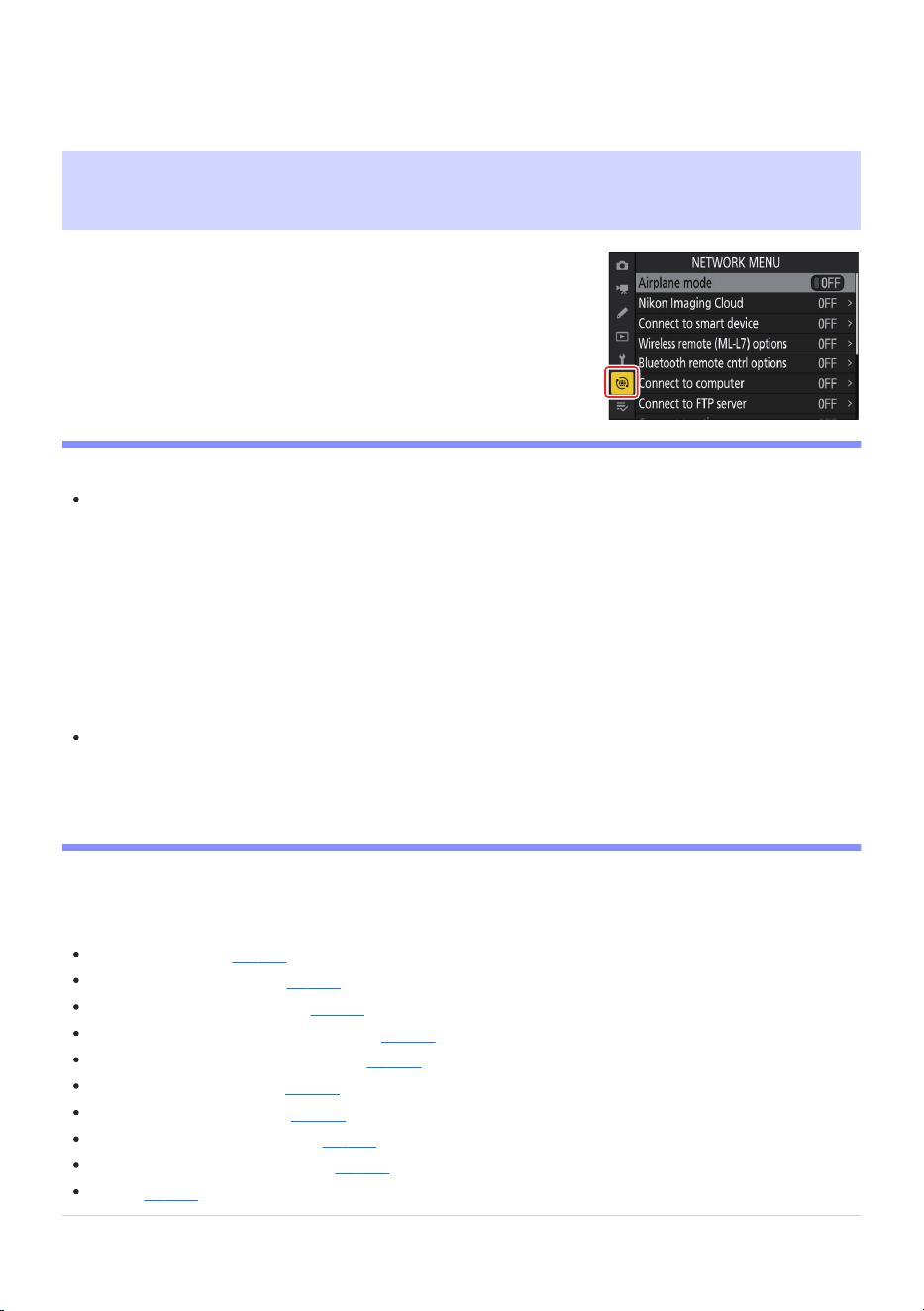
To view the network menu, select the F tab in the camera menus.
The Network Menu
The Network Menu
D Compatible Ser
vices and Devices
The network menu introduces menu items for connecting to the following services and devices:
Nikon Imaging Cloud,
smart devices,
ML‑L7 remote controls,
third-party Bluetooth remote controls,
computers,
FTP servers,
other cameras, and
Atomos UltraSync BLUE AirGlu accessories.
The camera can connect to only one type of device at a time and cannot connect to multiple
different devices simultaneously. For example, attempting to connect to a smart device while
connected to a computer displays a message to end the connection. Highlight [Yes] and press
J to end the connection to the computer and make the connection to the smart device available.
The network menu contains the following items:
[Airplane mode] (
0 769)
[Nikon Imaging Cloud] ( 0 770)
[Connect to smart device] ( 0 774)
[Wireless remot
e (ML-L7) options] (
0 778)
[Bluetooth remot
e cntrl options] (
0 780)
[Connect to computer] ( 0 782)
[Connect to FTP ser
ver] (
0 787)
[Connect to other cameras] ( 0 793)
[ATOMOS AirGlu B
T options] (
0 797)
[USB] ( 0 799)
767
The Network Menu
-
-
-
-
-
-
-
-


Airplane mode
G buttonU
F network menu
Select [ON] to disable the camera’s built-in Bluetooth and Wi-Fi functions and connection with
optional ML‑L7 remote controls.
769
Airplane mode
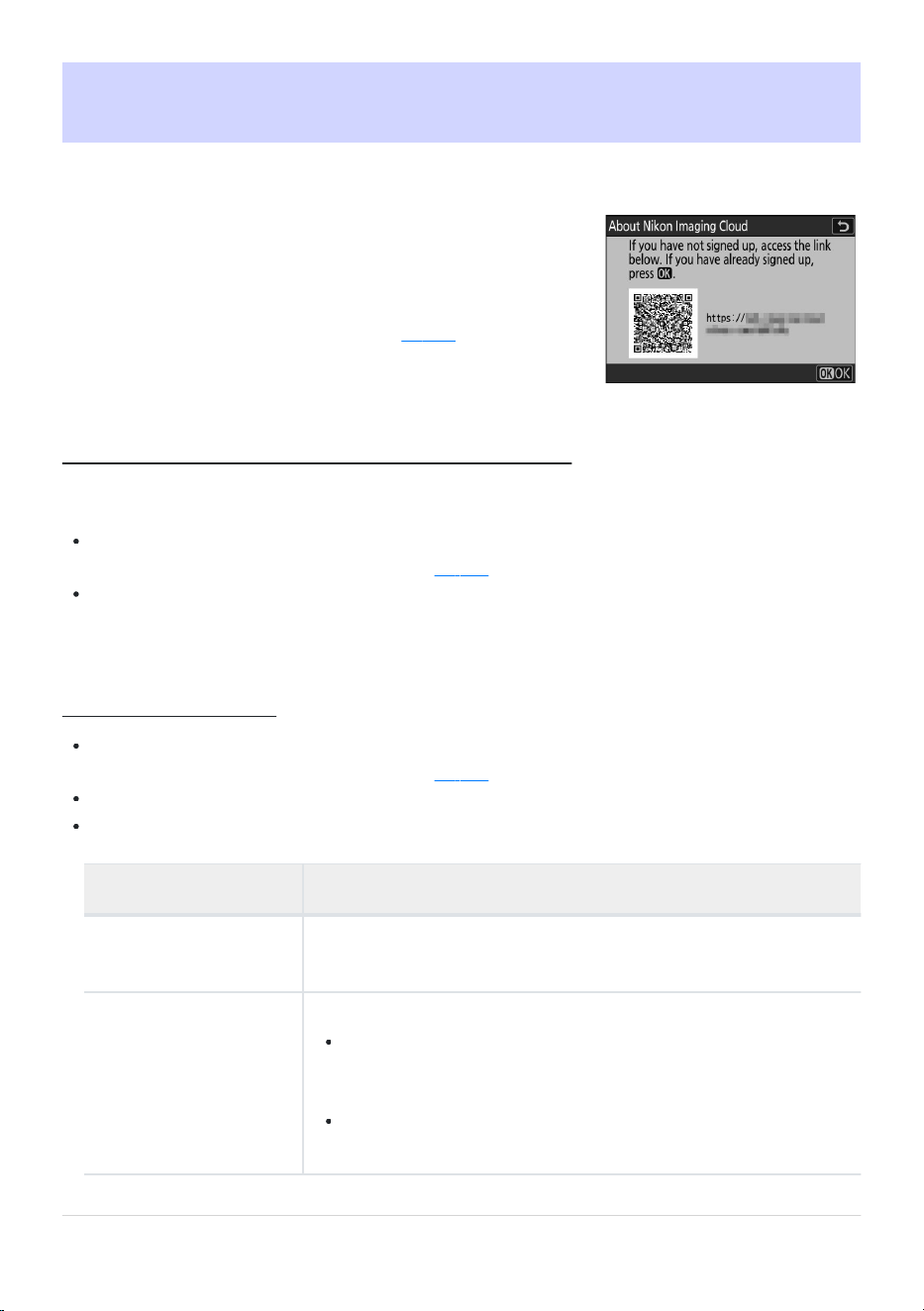
Use to connect the camera and NikonImagingCloud, Nikon’s cloud
service, via a wireless r
outer. Highlight [Nikon Imaging Cloud] in
the network menu and press 2 to display [About Nikon Imaging
Cloud] automatically when no network profiles to connect with the
wireless router are available in the camera (
0 772).
Nikon Imaging Cloud
G buttonU
F network menu
Connect to Nikon Imaging Cloud
Choose whether to enable a wireless connection with Nik
onImagingCloud.
When no network profiles to connect with the wireless router are available in the camera, you can
create profiles and add them to the camera (
0 308).
If a network pro
file already exists, highlight [Use existing profile] and press 2 to select a profile to
use. This item can also be used to choose from existing network profiles.
Wi-Fi settings
When no network pro
files to connect with the wireless router are available in the camera, you can
create profiles and add them to the camera (
0 308).
If a network pro
file already exists, choose the profile and press the J button to connect.
To edit an existing profile, highlight it and press 2.
Option Description
[Connect automatically]
Choose whether to connect aut
omatically when the camera detects a
configured Wi-Fi network.
[TCP/IP]
Adjust the TCP/IP settings. An IP address is required.
If [ON] is selected for [Obtain automatically], the IP address and
sub-net mask will be acquired via a DHCP server or automatic IP
addressing.
Select [OFF] to enter the IP address ([Address]) and sub-net mask
([Mask]) manually.
770
Nikon Imaging Cloud

Connection options
Adjust connection and upload settings.
Only when power
ed via USB
Select [ON] to limit automatic Wi-Fi connections to NikonImagingCloud to when powered via USB.
Connect to Cloud while off
Select [ON] to maintain Wi-Fi connections even when the camera is turned off.
Inactive connection timeout
Select [ON] to end Wi-Fi connections when Wi-Fi communications are unavailable for a certain period
of time.
Photo upload
Select [ON] to automatically send phot
os from the camera to NikonImagingCloud when shooting
images that are configured by [Photo upload options].
Photo upload options
Configure image sending settings from the camera t
o NikonImagingCloud.
Auto select for upload
Select [ON] to mark new photos for upload as they are taken.
Videos cannot be uploaded to NikonImagingCloud.
Upload begins only after the photo has been recorded to the memory card. Be sure a memory card
is inserted in the camera.
Upload RAW + JPEG as
When uploading RAW+ JPEG pictures, choose whether to upload both the NEF (RAW) and JPEG files
or only the NEF (RAW) or JPEG copy. Separate options can be selected for [Overflow/backup] and
[RAW Slot 1 - JPEG Slot 2].
The option selected for [Overflow/backup] takes effect during both auto and manual upload.
The option selected for [RAW Slot 1 - JPEG Slot 2] applies only during auto upload.
771
Nikon Imaging Cloud

Upload RAW + HEIF as
When uploading RAW+ HEIF pictur
es, choose whether to upload both the NEF (RAW) and HEIF files or
only the NEF (RAW) or HEIF copy. Separate options can be selected for [Overflow/backup] and [RAW
Slot 1 - HEIF Slot 2].
The option selected for [Overflow/backup] takes effect during both auto and manual upload.
The option selected for [RAW Slot 1 - HEIF Slot 2] applies only during auto upload.
JPEG+JPEG slot selection
Choose a source slot for auto upload when taking pictures with [JPEG Slot 1 - JPEG Slot 2] selected
for [Role played by card in Slot 2] in the photo shooting menu.
HEIF+HEIF slot selection
Choose a source slot for auto upload when taking pictures with [HEIF Slot 1 - HEIF Slot 2] selected for
[Role played by card in Slot 2] in the photo shooting menu.
Upload folder
Mark all photos in a selected folder for upload. Marking will be applied to all photos, regardless of
whether they have been uploaded previously.
Videos cannot be uploaded to NikonImagingCloud.
Deselect all?
Remove upload marking from all pictures. Upload of pictures with an “uploading” icon will immediately
be terminated.
View errors
Error details and codes will be displayed if an err
or occurs during a connection or attempted
connection to NikonImagingCloud. Use the QR code displayed or the following URL to view the
website when troubleshooting.
https://onlinemanual.nikonimglib.com/troubleshooting/en/
About Nikon Imaging Cloud
A QR code and URL will be displayed to br
owse NikonImagingCloud from the web browser of a
computer or smart device.
772
Nikon Imaging Cloud
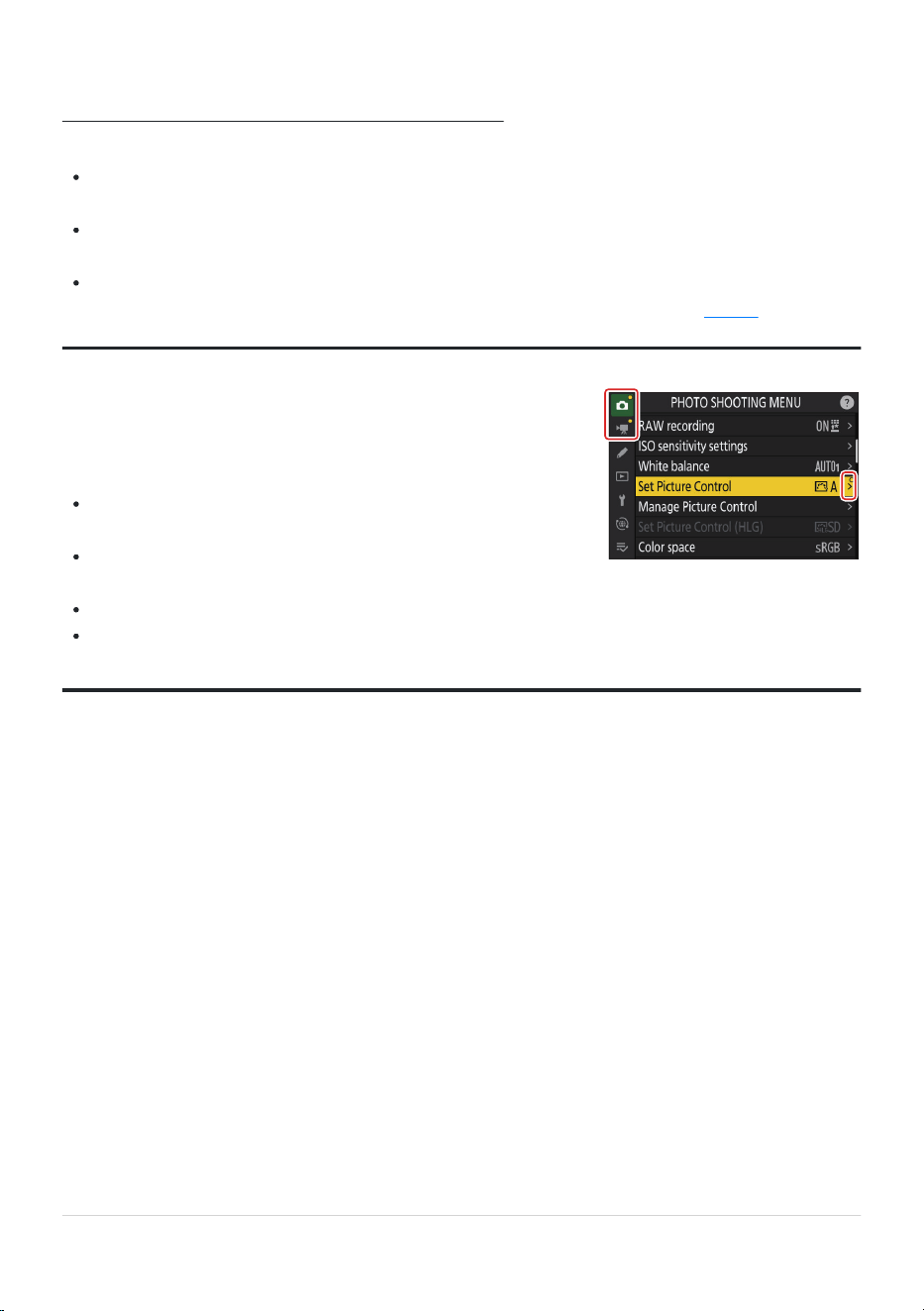
In the following cases, notification marks as shown will appear
on the menu tabs and menu items in the camera menu. When a
menu with a notification mark is selected for display
, the mark will
disappear.
When there is a difference between the Picture Controls added
to the camera and the Picture Controls in NikonImagingCloud.
When new camera firmware can be downloaded from
NikonImagingCloud.
When an auto firmware update was performed.
When there is an error notification related to connection or
coordination between the camera and NikonImagingCloud.
Unlink Nikon Imaging Cloud
Delete the connection information t
o NikonImagingCloud.
Delete connection information before discarding this product or transferring ownership to another
person.
If the connection information is deleted, images marked for upload to NikonImagingCloud will no
longer be sent.
To re-connect the camera and NikonImagingCloud after deleting connection information, set
[Connect to Nikon Imaging Cloud] to [ON] and create a new network profile (
0 308).
Tip: Notifications from Nikon Imaging Cloud
773
Nik
on Imaging Cloud
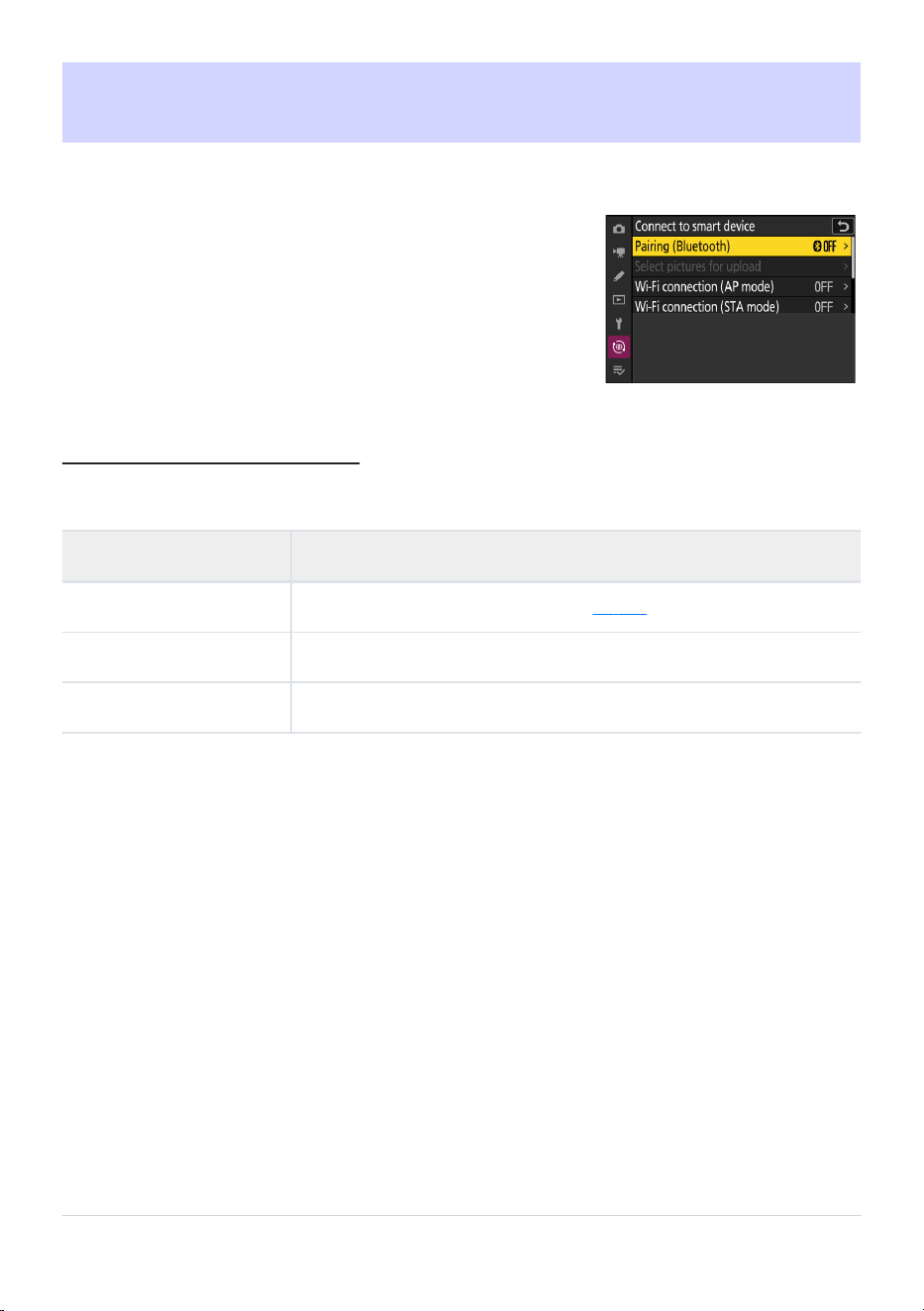
Connect to smartphones or tablets (smart devices) via Bluetooth or
Wi-Fi.
Connect to smart device
G buttonU
F network menu
Pairing (Bluetooth)
Pair with or connect to smar
t devices using Bluetooth.
Option Description
[Start pairing] Pair the camera with a smar
t device (
0 319).
[Paired devices] List pair
ed smart devices. To connect, select a device from the list.
[Bluetooth connection] Select [ON] to enable Bluetooth.
774
Connect to smart device
Select pictures for upload
Select pictures for upload t
o a smart device. You can also opt to upload pictures as they are taken.
Option Description
[Auto select for upload] Select [ON] t
o upload pictures as they are taken.
[Manually select for upload]
Upload selected pictures. Transfer marking appears on the selected
pictures.
[Deselect all] Cancel upload of all pictures currently selected for transfer.
Wi-Fi connection (AP mode)
Connect directly to smar
t devices in Wi-Fi access point mode.
Establish Wi-Fi connection
Initiate a Wi-Fi connection to a smart device in Wi-Fi access point mode.
The camera SSID and password will be displayed. To connect, select the camera SSID on the smart
device and enter the password (
0 322).
Once a connection is established, this option will change to [Close Wi-Fi connection].
Use [Close Wi-Fi connection] t
o end the connection.
775
Connect to smart device
Wi-Fi connection settings
Access the following Wi-Fi settings:
Option Description
[SSID] Choose the camera SSID.
[Authentication/encryption]
Choose [OPEN], [WP
A2-PSK], [WPA3-SAE], or [WPA2-PSK/
WPA3-SAE].
[Password] Choose the camera password.
[Channel]
Choose a channel.
Select [Auto] to have the camera choose the channel
automatically.
Select [Manual] to choose the channel manually.
[Current settings] View current Wi-Fi settings.
[Reset connection settings] Select [Yes] to reset Wi-Fi settings to default values.
Wi-Fi connection (STA mode)
Add camera network pro
files. This item can also be used to choose from existing network profiles.
Create profile
Create new network profiles (
0 324).
If more than one pro
file already exists, you can press J to choose a profile and connect to the
selected network.
To edit an existing profile, highlight it and press 2.
Option Description
[General]
[Profile name]: Rename the pr
ofile.
[Password protection]: Select [On] to require that a password be entered before
the profile can be changed. To change the password, highlight [On] and press 2.
776
Connect to smart device
Option Description
[TCP/IP]
Adjust the TCP/IP settings. An IP addr
ess is required.
If [ON] is selected for [Obtain automatically], the IP address and sub-net mask
will be acquired via a DHCP server or automatic IP addressing.
Select [OFF] to enter the IP address ([Address]) and sub-net mask ([Mask])
manually.
End current connection
End the connection to the current netw
ork.
Upload while off
If [ON] is selected, upload o
f pictures to smart devices via wireless connections will continue even
when the camera is off.
This feature is available only when connecting via Bluetooth or a Wi-Fi access point.
Location data (smart device)
Display latitude, longitude, altitude, and UTC (Univer
sal Coordinated Time) data downloaded from a
smart device.
For information on downloading location data from smart devices, see the online help for the
SnapBridge app.
Note that the camera may be unable to download or display location data from smart devices
depending on the version of the device operating system and/or SnapBridge app used.
777
Connect to smart device
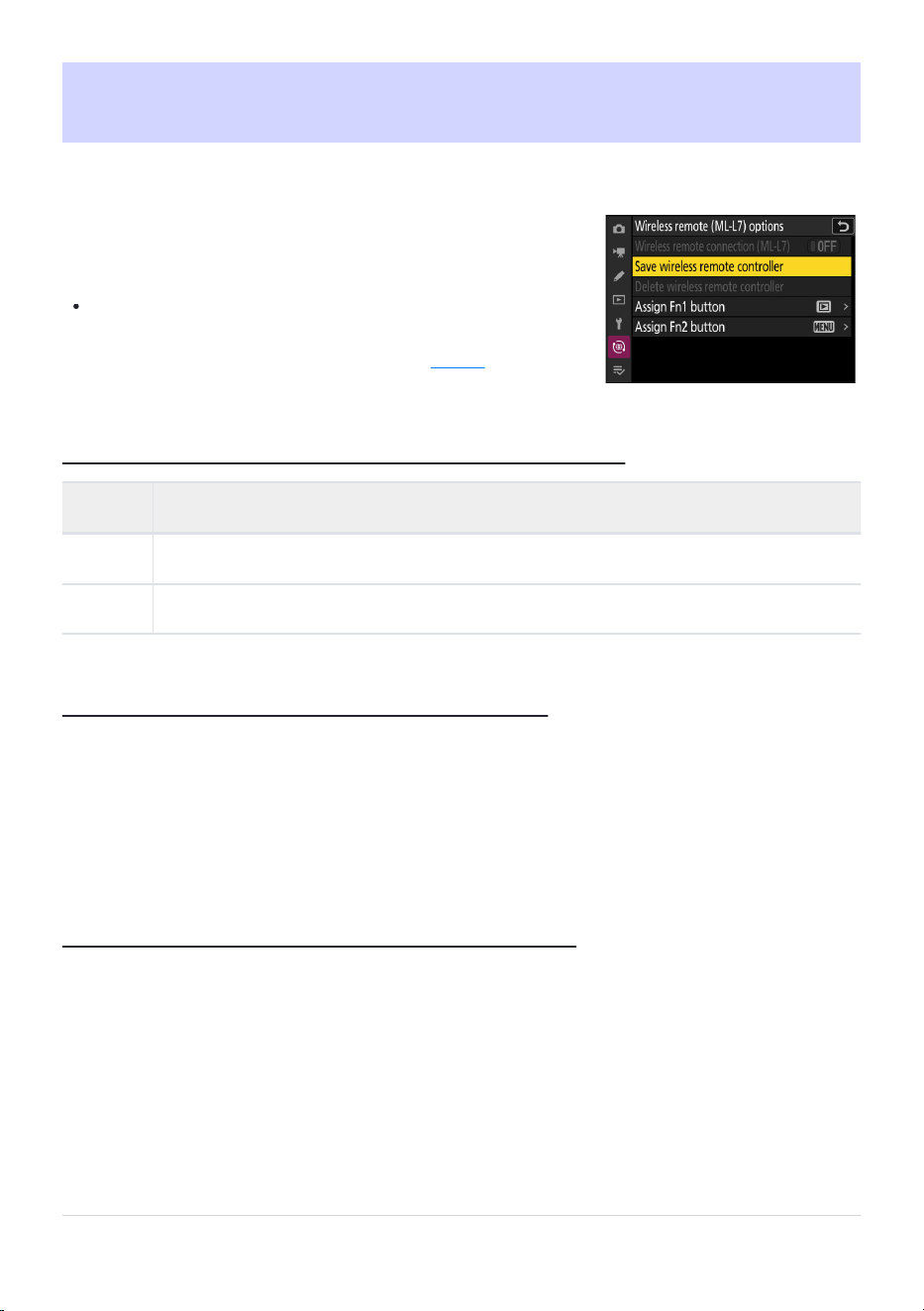
Connect to optional ML‑L7 remote controls via Bluetooth. You can
also choose the roles played by the Fn1 and Fn2 butt
ons on the
ML‑L7.
For information on connecting to remote controls and on the
features they support, see “ML‑L7 Remote Controls” in the
section on “Other Compatible Accessories” (
0 872).
Wireless remote (ML-L7) options
G buttonU
F network menu
Wireless remote connection (ML-L7)
Option Description
[ON] Connect to the ML‑L7 with which the camera has most recently been paired.
[OFF] End an existing connection to an ML‑L7.
Save wireless remote controller
Pair the camera with an ML‑L7. Once the camera has enter
ed pairing mode, press the power button on
the remote control and keep it pressed for over three seconds. The status lamp on the remote control
will start to flash green at a rate of about once every three seconds when pairing is complete.
The camera can be paired with only one remote control at a time. It will respond only to the remote
control with which it was last paired.
Delete wireless remote controller
End pairing between the camera and the r
emote control.
778
Wireless remote (ML-L7) options
Assign Fn1 button/Assign Fn2 button
Choose the roles played by the Fn1 and Fn2 butt
ons on the ML‑L7.
Option Description
[Playback]
Press the butt
on to start playback. Pressing the button while playback is in
progress ends playback and returns you to the shooting display.
[Launch menu] Press the button to display the menu.
[Launch i menu]
Press the button to display the i menu.
[None
] Pressing the button has no effect.
779
Wireless remote (ML-L7) options
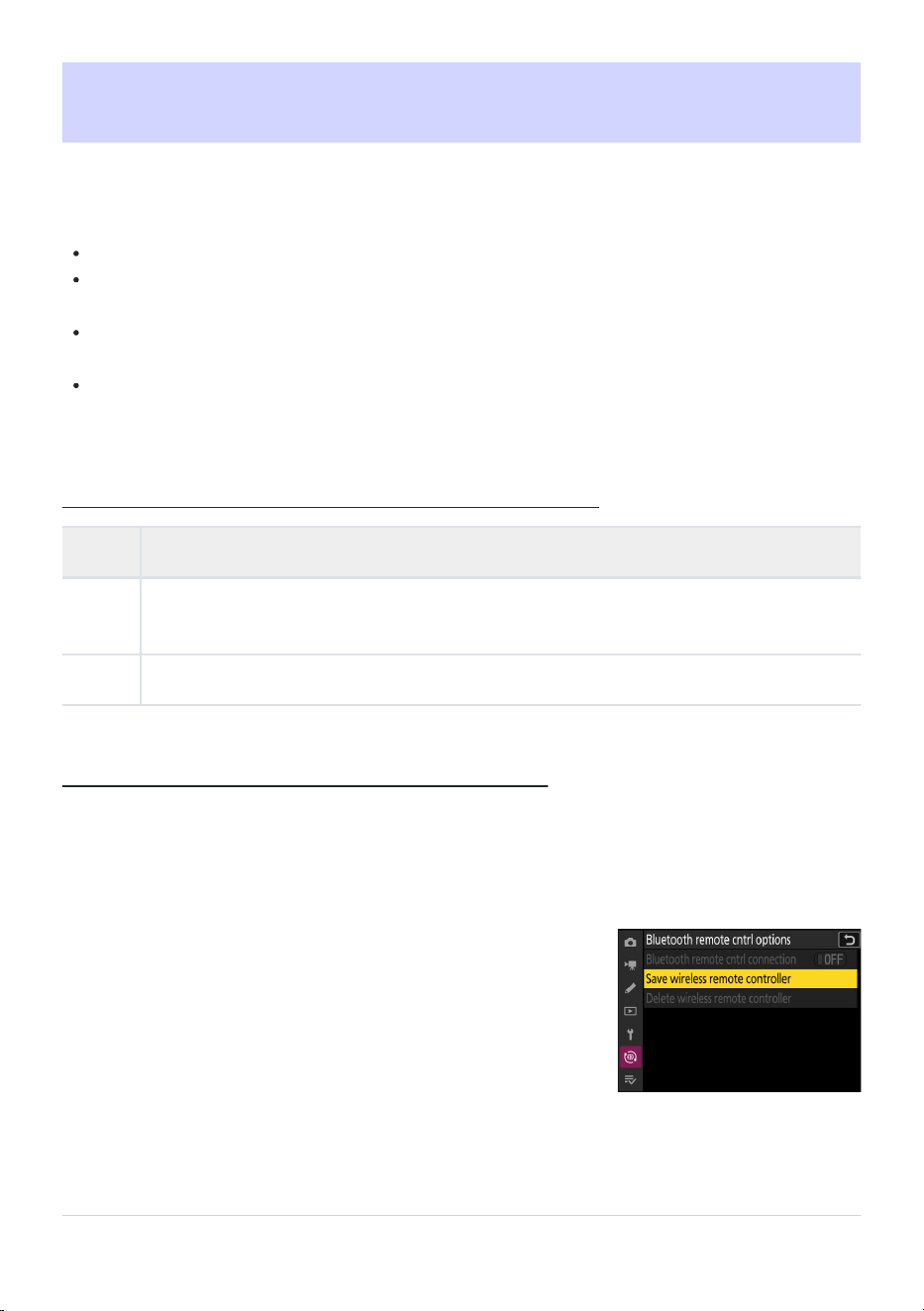
The camera will enter pairing mode.
Bluetooth remote cntrl options
G buttonU
F network menu
Connect to third-party Bluetooth remote controls.
Bluetooth remote controls must be paired with the camera before use.
The camera can be paired with only one Bluetooth remote control at a time. It will respond only to
the remote control with which it was last paired.
The following Bluetooth remote control has been tested and approved for use:
SmallRig SR-RG2 Wireless Shooting Grip
In addition to the present document, you will also need to consult the documentation for the
Bluetooth remote control.
Bluetooth remote cntrl connection
Option Description
[ON]
Connect to the Bluetooth remote control with which the camera has most recently been
p
aired.
[
OFF] End an existing connection to a Bluetooth remote control.
Save wireless remote controller
The Bluetooth remot
e control must be paired with the camera before use.
Select [Bluetooth remote cntrl options]> [Save wireless remote controller] in the camera
network menu and press J.
780
Bluetooth remote cntrl options
-
1
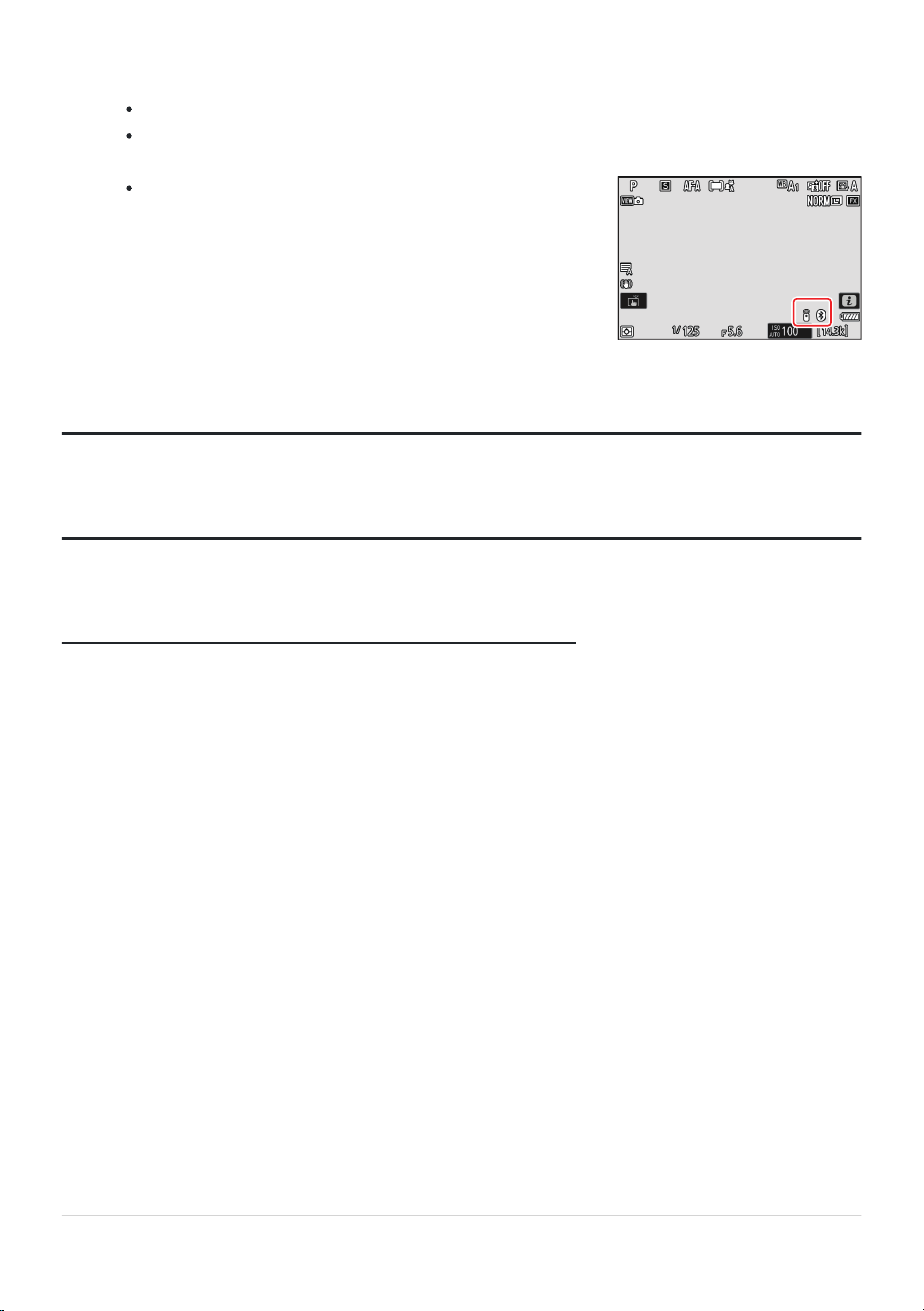
W and Z will appear in the shooting display.
Pair with the Bluetooth remote control.
The camera and Bluetooth remot
e control will begin pairing.
When pairing is complete, the Bluetooth remote control will be added to the camera and will
establish a connection.
Tip: Connecting to a Previously-Paired Bluetooth Remote Control
Once the Bluetooth remote control is paired with the camera, you will be able to connect simply by
selecting [ON] for [Bluetooth remote cntrl connection].
Delete wireless remote controller
End pairing between the camera and the Bluet
ooth remote control.
781
Bluetooth remote cntrl options
2
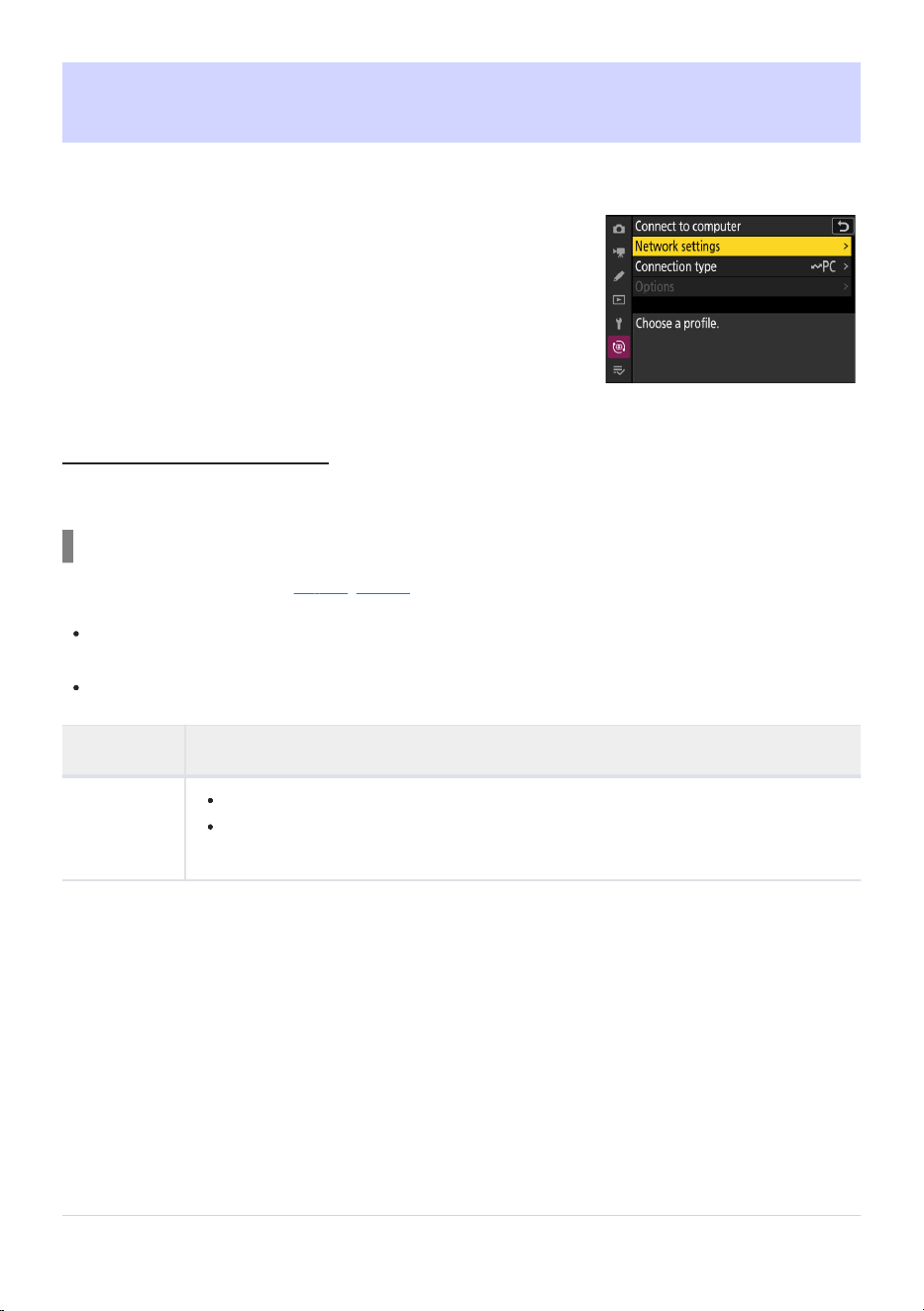
Connect to computers via wireless LAN.
Connect to computer
G buttonU
F network menu
Network settings
Add camera network pro
files. This item can also be used to choose from existing network profiles.
Create profile
Create new network profiles (
0 336, 0 341).
If more than one pro
file already exists, you can press J to choose a profile and connect to the
selected network.
To edit an existing profile, highlight it and press 2.
Option Description
[General]
[Profile name]: Rename the pr
ofile.
[Password protection]: Select [On] to require that a password be entered before
the profile can be changed. To change the password, highlight [On] and press 2.
782
Connect to computer

Option Description
[Wireless]
Display connection settings for connection to wir
eless networks.
Wi-Fi station mode: Adjust settings for connection to a network via a router.
[SSID]: Enter the network SSID.
[Channel]: Selected automatically.
[Authentication/encryption]: Select the type of encryption used on the
wireless network.
[Password]: Enter the network password.
Wi-Fi access point mode: Adjust settings for direct wireless connection to the
camera.
[SSID]: Choose the camera SSID.
[Channel]: Choose [Auto] or [Manual].
[Authentication/encryption]: Select the type of encryption used on the
wireless network.
[Password]: If an option other than [OPEN] is selected for [Authentication/
encryption], this item can be used to change the camera password.
[TCP/IP]
Adjust the TCP/IP settings for the Wi-Fi station mode network profiles. An IP
address is required.
If [ON] is selected for [Obtain automatically], the IP address and sub-net mask
will be acquired via a DHCP server or automatic IP addressing.
Select [OFF] to enter the IP address ([Address]) and sub-net mask ([Mask])
manually.
783
Connect to computer
-
-
-
-
-
-
-
-
Copy to/from card
Copy created netw
ork profiles to memory cards to share them with other cameras.
If two memory cards are inserted, the profiles will be copied to and from the card in Slot 1.
Option Description
[Copy profile from card]
Copy pro
files from the root directory of the memory card to the
camera profile list.
[Copy pr
ofile to card]
Copy pr
o
files from the camera to the memory card. Highlight a profile
and pr
ess
J t
o copy it to the memory card.
Password-protected profiles cannot be copied.
End current connection
End the connection to the current netw
ork.
784
Connect to computer
Connection type
Choose an operating mode for use when the camera is connected to a netw
ork.
Option Description
[Picture transfer]
Upload phot
os to a computer as they are taken or upload existing pictures
from the camera memory card.
[Camera control]
Use NX Tether software to control the camera and take pictures remotely from
a computer.
Options
Adjust upload settings.
Auto uplo
ad
Select [ON] to mark new photos for upload as they are taken.
Upload begins only after the photo has been recorded to the memory card. Be sure a memory card
is inserted in the camera.
Videos are not uploaded automatically. They must instead be uploaded from the playback display
(
0 250).
Delete aft
er upload
Select [ON] to delete photographs from the camera memory card automatically once upload is
complete.
Files marked for transfer before you selected [ON] are not deleted.
Deletion may be suspended during some camera operations.
Upload RAW + JPEG as
When uploading RAW+ JPEG pictures, choose whether to upload both the NEF (RAW) and JPEG files
or only the NEF (RAW) or JPEG copy. Separate options can be selected for [Overflow/backup] and
[RAW Slot 1 - JPEG Slot 2].
The option selected for [Overflow/backup] takes effect during both auto and manual upload.
The option selected for [RAW Slot 1 - JPEG Slot 2] applies only during auto upload.
785
Connect to computer

Upload RAW + HEIF as
When uploading RAW+ HEIF pictur
es, choose whether to upload both the NEF (RAW) and HEIF files or
only the NEF (RAW) or HEIF copy. Separate options can be selected for [Overflow/backup] and [RAW
Slot 1 - HEIF Slot 2].
The option selected for [Overflow/backup] takes effect during both auto and manual upload.
The option selected for [RAW Slot 1 - HEIF Slot 2] applies only during auto upload.
JPEG+JPEG slot selection
Choose a source slot for auto upload when taking pictures with [JPEG Slot 1 - JPEG Slot 2] selected
for [Role played by card in Slot 2] in the photo shooting menu.
HEIF+HEIF slot selection
Choose a source slot for auto upload when taking pictures with [HEIF Slot 1 - HEIF Slot 2] selected for
[Role played by card in Slot 2] in the photo shooting menu.
Upload RAW video as
When uploading videos shot with [N-RAW 12-bit (NEV)] selected for [Video file type] in the video
recording menu, choose whether to upload both the RAW and MP4 files or only the MP4 copy.
Upload folder
Mark all photos in a selected folder for upload. Marking will be applied to all photos, regardless of
whether they have been uploaded previously.
Videos will not be marked for upload. They must instead be uploaded from the playback display.
Deselect all?
Remove upload marking from all pictures. Upload of pictures with an “uploading” icon will immediately
be terminated.
786
Connect to computer
Connect to FTP server
G buttonU
F network menu
Connect to FTP servers via wireless LAN.
Network settings
Add camera network pro
files. This item can also be used to choose from existing network profiles.
Create profile
Create new network profiles (
0 350).
If more than one pro
file already exists, you can press J to choose a profile and connect to the
selected network.
To edit an existing profile, highlight it and press 2.
Option Description
[General]
[Profile name]: Rename the pr
ofile.
[Password protection]: Select [On] to require that a password be entered before
the profile can be changed. To change the password, highlight [On] and press 2.
[Wireless]
Display connection settings for connection to wir
eless networks.
Wi-Fi station mode: Adjust settings for connection to a network via a router.
[SSID]: Enter the network SSID.
[Channel]: Selected automatically.
[Authentication/encryption]: Select the type of encryption used on the
wireless network.
[Password]: Enter the network password.
Wi-Fi access point mode: Adjust settings for direct wireless connection to the
camera.
[SSID]: Choose the camera SSID.
[Channel]: Choose [Auto] or [Manual].
[Authentication/encryption]: Select the type of encryption used on the
wireless network.
[Password]: If an option other than [OPEN] is selected for [Authentication/
encryption], this item can be used to change the camera password.
787
Connect to FTP server
-
-
-
-
-
-
-
-
Option Description
[TCP/IP]
Adjust the TCP/IP settings for the Wi-Fi station mode netw
ork profiles. An IP
address is required.
[Obtain automatically]: If [ON] is selected, the IP address and sub-net mask will
be acquired via a DHCP server or automatic IP addressing. Select [OFF] to enter
the IP address ([Address]) and sub-net mask ([Mask]) manually.
[Gateway]: Enter the network’s default gateway address, if required.
[Domain Name Server (DNS)]: If a DNS is present on the same network as the
FTP server, enter its address.
[FTP]
[Server type]: Choose the FTP server type and enter the URL or IP address,
destination folder, and port number. An IP address is required.
[PASV mode]: Select [ON] to enable PASV mode.
[Anonymous login]: Select [ON] for anonymous login. This option can only
be used with servers that are configured for anonymous login. Select [OFF] to
supply a user ID and password.
[Proxy server]: Enable this option as required.
788
Connect to FTP server
Copy to/from card
Copy created netw
ork profiles to memory cards to share them with other cameras.
If two memory cards are inserted, the profiles will be copied to and from the card in Slot 1.
Option Description
[Copy profile from card]
Copy pro
files from the root directory of the memory card to the
camera profile list.
[Copy profile to card]
Copy pro
files from the camera to the memory card. Highlight a profile
and press 2
to display the destination list. Select a destination and
press J to copy the profile to the memory card.
Password-protected profiles cannot be copied.
End current connection
End the connection t
o the current netw
ork.
789
Connect to FTP server

Options
Adjust upload settings.
Auto uplo
ad
Select [ON] to mark new photos for upload as they are taken.
Upload begins only after the photo has been recorded to the memory card. Be sure a memory card
is inserted in the camera.
Videos are not uploaded automatically. They must instead be uploaded from the playback display
(
0 250).
Delete aft
er upload
Select [ON] to delete photographs from the camera memory card automatically once upload is
complete.
Files marked for transfer before you selected [ON] are not deleted.
Deletion may be suspended during some camera operations.
Upload RAW + JPEG as
When uploading RAW+ JPEG pictures, choose whether to upload both the NEF (RAW) and JPEG files
or only the NEF (RAW) or JPEG copy. Separate options can be selected for [Overflow/backup] and
[RAW Slot 1 - JPEG Slot 2].
The option selected for [Overflow/backup] takes effect during both auto and manual upload.
The option selected for [RAW Slot 1 - JPEG Slot 2] applies only during auto upload.
Upload RAW + HEIF as
When uploading RAW+ HEIF pictures, choose whether to upload both the NEF (RAW) and HEIF files or
only the NEF (RAW) or HEIF copy. Separate options can be selected for [Overflow/backup] and [RAW
Slot 1 - HEIF Slot 2].
The option selected for [Overflow/backup] takes effect during both auto and manual upload.
The option selected for [RAW Slot 1 - HEIF Slot 2] applies only during auto upload.
JPEG+JPEG slot selection
Choose a source slot for auto upload when taking pictures with [JPEG Slot 1 - JPEG Slot 2] selected
for [Role played by card in Slot 2] in the photo shooting menu.
790
Connect to FTP server

HEIF+HEIF slot selection
Choose a source slot for auto uplo
ad when taking pictures with [HEIF Slot 1 - HEIF Slot 2] selected for
[Role played by card in Slot 2] in the photo shooting menu.
Upload RAW video as
When uploading videos shot with [N-RAW 12-bit (NEV)] selected for [Video file type] in the video
recording menu, choose whether to upload both the RAW and MP4 files or only the MP4 copy.
Overwrite if same name
Choose [ON] to overwrite files with duplicate names during upload. Choose [OFF] to add numbers to
the names of newly uploaded files as necessary to prevent existing files being overwritten.
Protect if marked for upload
Select [ON] to automatically protect files marked for upload. Protection is removed as the files are
uploaded.
Upload marking
Select [ON] to add a timestamp to the pictures on the camera memory card giving the time of upload.
Upload folder
Mark all photos in a selected folder for upload. Marking will be applied to all photos, regardless of
whether they have been uploaded previously.
Videos will not be marked for upload. They must instead be uploaded from the playback display.
Deselect all?
Remove upload marking from all pictures. Upload of pictures with an “uploading” icon will immediately
be terminated.
Keep connection
Select [ON] to perform network connection processing after about 15 seconds when a wireless error,
TCP/IP error, or FTP error occurs and prevents a network connection. Connection processing repeats
until the camera connects to the network.
If [ON] is selected, the standby timer will not expire regardless of the option selected for Custom
Setting c3 [Power off delay] > [Standby timer]. This increases drain on the battery.
791
Connect to FTP server
Manage root certificate
Load or manage root cer
tificates used for connection to FTPS servers.
Contact the network administrator for the FTPS server in question for information on acquiring root
certificates.
Option Description
[Import root certificate]
Import a r
oot certificate to the camera from a memory card.
The certificate must be in the card’s root (top) directory.
The camera can import root certificate files named
“ROOT.CER”, “ROOT.CRT”, or “ROOT.PEM”.
Only one root certificate can be stored on the camera at
a time. The existing certificate is overwritten when a new
certificate is imported.
Connections established using self-signed root certificates
may not be trustworthy.
[Delete root certificate] Delete the current root certificate from the camera.
[View root certificate] View the camera’s current root certificate.
[Connect if authentication fails] Select [ON] to ignore certain authentication errors.
792
Connect to FTP server
Connect to other cameras
G buttonU
F network menu
Connect to other cameras for shutter or clock synchronization.
Synchronized release
Select [ON] to synchronize the shutt
er release with those of cameras on the same network.
Network settings
Add camera network pro
files. This item can also be used to choose from existing network profiles.
Create profile
Create new network profiles (
0 378).
If more than one pro
file already exists, you can press J to choose a profile and connect to the
selected network.
To edit an existing profile, highlight it and press 2.
Option Description
[General]
[Profile name]: Rename the pr
ofile.
[Password protection]: Select [On] to require that a password be entered before
the profile can be changed. To change the password, highlight [On] and press 2.
[TCP/IP]
Adjust the TCP/IP settings. An IP addr
ess is required.
If [ON] is selected for [Obtain automatically], the IP address and sub-net mask
will be acquired via a DHCP server or automatic IP addressing.
Select [OFF] to enter the IP address ([Address]) and sub-net mask ([Mask])
manually.
793
Connect to other cameras
Copy to/from card
Copy created netw
ork profiles to memory cards to share them with other cameras.
If two memory cards are inserted, the profiles will be copied to and from the card in Slot 1.
Option Description
[Copy profile from card]
Copy pro
files from the root directory of the memory card to the
camera profile list.
[Copy pr
ofile to card]
Copy pr
o
files from the camera to the memory card. Highlight a profile
and pr
ess
J t
o copy it to the memory card.
Password-protected profiles cannot be copied.
End current connection
End the connection to the current netw
ork.
Master/remote
Choose a role for each camera from “mast
er” and “remote”. Pressing the shutter-release button on the
master camera releases the shutters on remote cameras.
Group settings
Cameras can be grouped for synchronized r
elease and remote cameras can be added to each group.
Switching groups also switches the remote cameras that the master camera controls.
This item is available only when [Master camera] is selected for [Master/remote].
794
Connect to other cameras
New
Create gr
oup settings.
If more than one group setting already exists, use the multi selector to choose a group and press J.
To edit an existing group setting, highlight it and press 2.
Option Description
[Display name] Enter the display name for the remote camera group.
[Group name] Enter a gr
oup name for the synchronized cameras.
[Remote camera list] View the remote camera status (
0 387).
Copy to/from card
Copy gr
oup settings to memor
y cards to share them with other cameras.
If two memory cards are inserted, the group settings will be copied to and from the card in Slot 1.
Option Description
[Copy fr
om card]
Add group settings t
o the camera from the memory card. Highlight a group
and pr
ess
J t
o add them to the camera.
[Copy to card]
Copy group settings fr
om the camera to the memory card. Highlight a group
and press 2
to display the destination list. Select a destination and press J to
copy the group settings to the memory card.
Group name
Enter a group name for the remote cameras. Matching the remote camera group name to the one set
with [Group settings] > [Group name] for the master camera on the same network allows the master
camera to release the shutters on remote cameras in the same group.
This item is available only when [Remote camera] is selected for [Master/remote].
Synchronize date and time
Set the clocks on the remote cameras to the date and time reported by the master camera ( 0 389).
795
Connect to other cameras

Overwrite copyright info
Selecting this option overwrit
es the copyright information on any remote cameras currently connected
with the copyright information stored on the master camera.
796
Connect to other cameras
ATOMOS AirGlu BT options
G buttonU
F network menu
Manage wireless Bluetooth connections between the camera and Atomos UltraSync BLUE AirGlu
accessories.
The UltraSync BLUE can be used for simultaneous wireless connections to multiple compatible
cameras or audio recorders. Time codes are transmitted to the connected devices from the
UltraSync BLUE, synchronizing time codes even across devices from a mix of manufacturers. For
information on the maximum number of simultaneous connections, see the Atomos website.
Option Description
[Connect to ATOMOS AirGlu BT]
Establish a wireless Bluet
ooth connection to a
previously-paired UltraSync BLUE.
[Save ATOMOS AirGlu BT pairing info]
Pair the camera with the UltraSync BLUE.
The camera name will be displayed in the camera
monitor.
Use the controls on the UltraSync BLUE to pair it
with the camera. For more information, see the
documentation for the UltraSync BLUE.
[Delete ATOMOS AirGlu BT pairing info]
End the wireless connection between the camera and
the UltraSync BLUE.
[Camera]
Choose the name under which the camera is listed on
the UltraSync BLUE.
After establishing a wireless connection to the UltraSync BLUE, select [On] or [On (with HDMI
output)] for [Timecode] > [Record timecodes] in the video r
ecording menu to start receiving time
codes. The time codes will appear in the camera shooting display.
If no time code is received, the shooting display will show “--:--:--:--” (or “00:00:00:00” when an
external device is connected via HDMI). No time codes will be recorded if filming is begun at this
stage.
797
ATOMOS AirGlu BT options

D Cautions: Using the UltraSync BLUE
Time codes will not be r
ecorded if [H.264 8-bit (MP4)] is selected for [Video file type] in the video
recording menu.
The UltraSync BLUE allows users to choose the frame rate. If the value is not a match for that chosen
with the camera, time codes will not be recorded or output via HDMI. Match the frame rate for the
UltraSync BLUE to the video recording frame rate as follows:
Video recording frame rate UltraSync BLUE frame rate
120p, 60p, 30p 29.97 fps, 29.97 fps DF
100p, 50p, 25p 25 fps
24p 23.98fps
Select 29.97 fps DF for drop-frame recording.
See the documentation for the UltraSync BLUE for information on choosing a frame rate.
The options selected for [Timecode] > [Count-up method], [Timecode origin], and [Drop frame]
in the video recording menu cannot be changed while the camera has a wireless connection to the
UltraSync BLUE.
If the camera loses the wireless connection to the UltraSync BLUE while filming is in progress, it
will continue to record time codes until the end of the current shot, although the time code shown
in the shooting display will switch to “--:--:--:--“ about 60 seconds after the connection is lost. The
time code will reappear when the wireless connection to the UltraSync BLUE is re-established.
The wireless connection to the UltraSync BLUE will end when the camera is turned off or the standby
timer expires. We recommend choosing [No limit] for Custom Setting c3 [Power off delay] >
[Standby timer].
798
ATOMOS AirGlu BT options
-
-

USB
G buttonU
F network menu
Adjust settings for connection to other devices via USB.
Select [MTP/PTP] when connecting to computers or Android devices via USB.
Select [iPhone] when connecting the camera and iPhone via one of the following cables to use
NX MobileAir.
Use the USB cable featuring Type-C connectors at both ends supplied with the camera.
See the NX MobileAir online help for information on compatible cables when using a USB-C to
Lightning cable.
Select [USB streaming (UVC/UAC)] for live streaming by connecting to a computer or smart device
via the USB cable.
D Caution: [iPhone]
Whether or not the camera is actually connected to an iPhone, selecting [iPhone] will disable the
features listed below. To access these features, select [MTP/PTP].
Built-in camera network functions
Powering the camera or charging the battery from an optional EH-8P AC adapter or via USB
799
USB
-
-
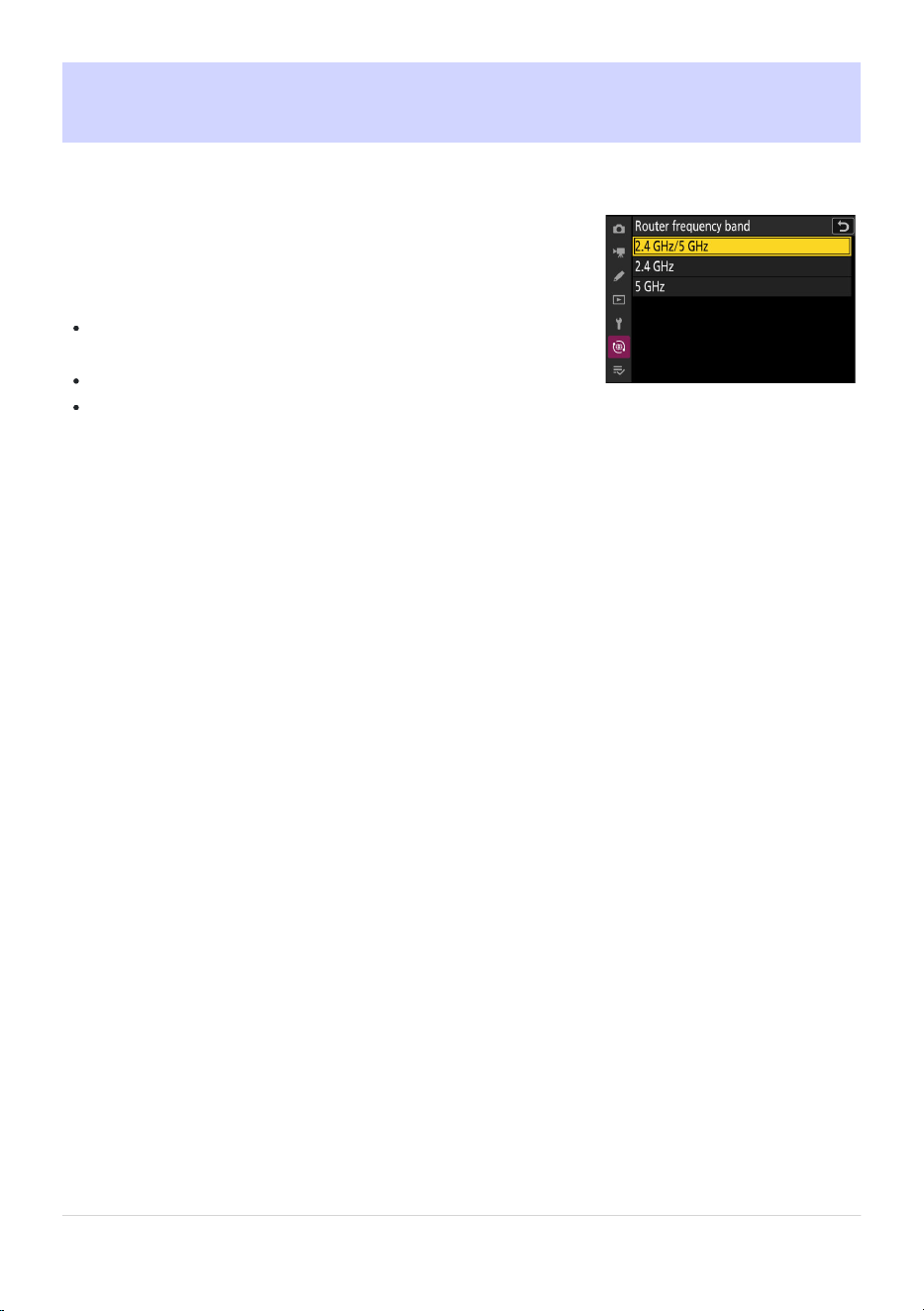
Choose the band for the selected SSID when connecting to a
wireless network in Wi-Fi station mode. Select [2.4 GHz/5 GHz]
t
o connect to networks operating on either band.
When the camera searches for networks active in the vicinity, it
will list only those operating on the chosen band or bands.
The band is listed to the left of the network SSID.
If you select [2.4 GHz/5 GHz] when connecting via wireless
routers that operate on both bands, the list will include the SSIDs
in the band or bands detected by the camera.
Router frequency band
G buttonU
F network menu
800
Router frequency band

MAC address
G buttonU
F network menu
View the MAC address.
801
MAC address
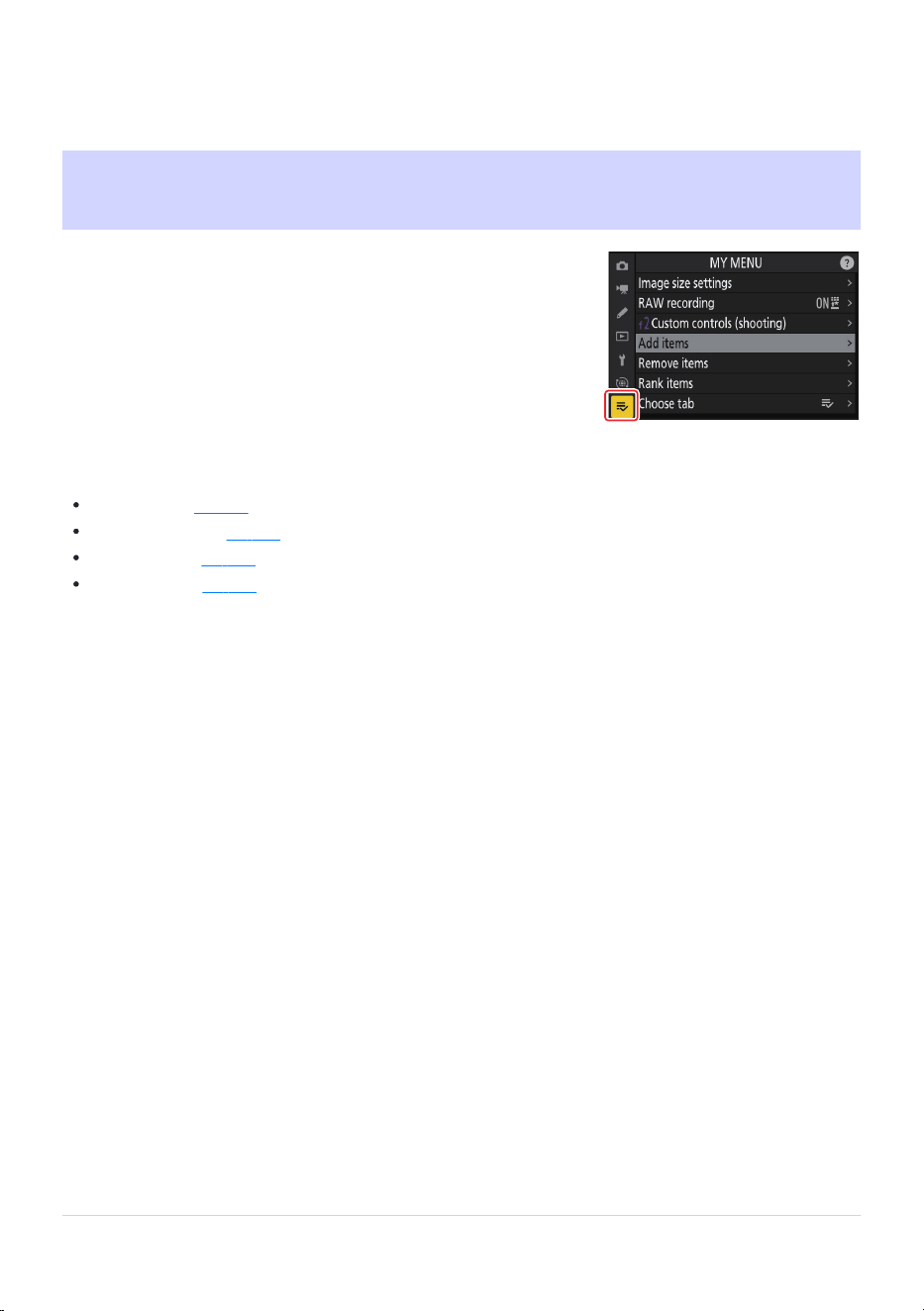
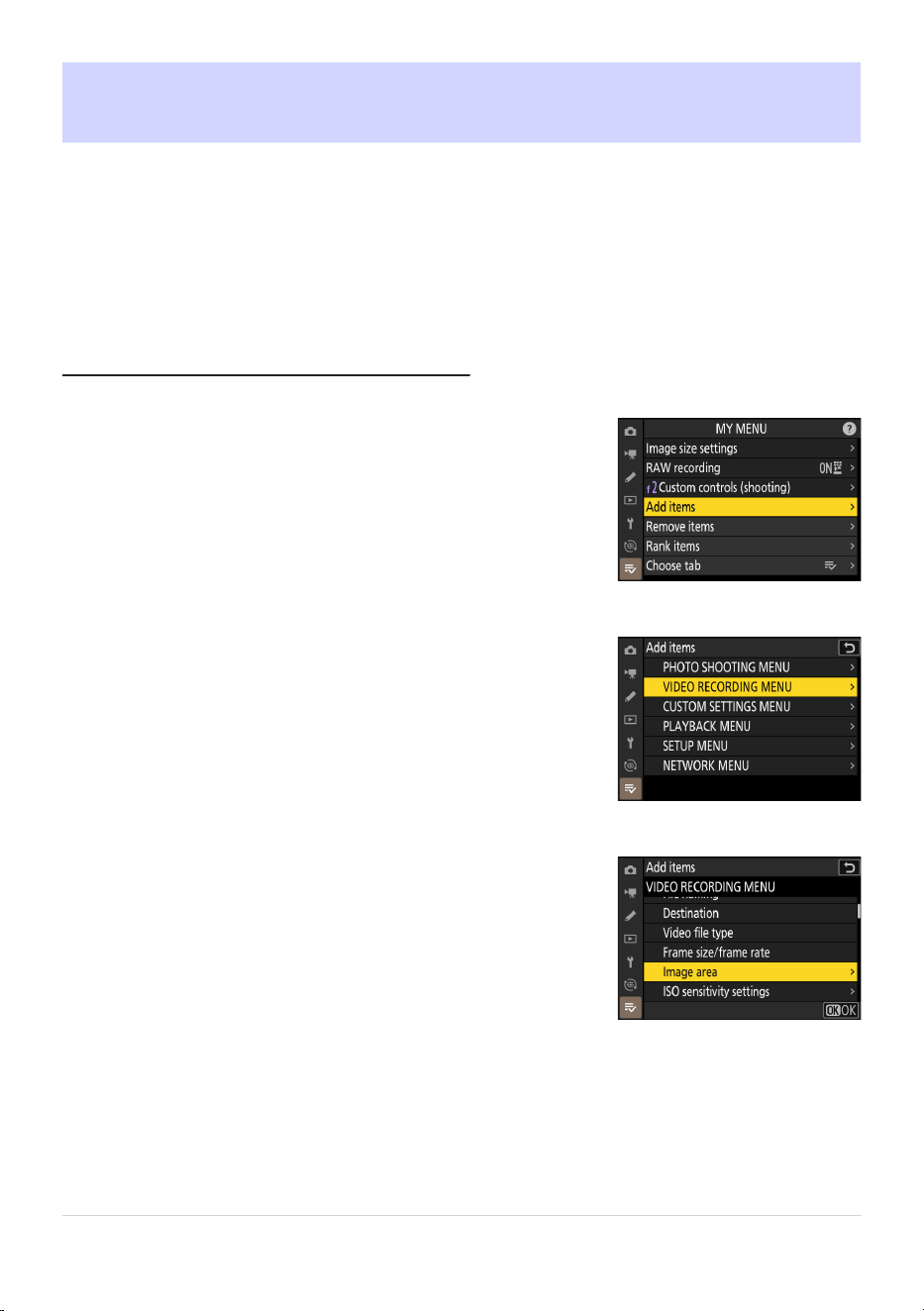
Select [Add items] in [OMY MENU].
Highlight [Add it
ems
] and pr
ess 2.
Select a menu.
Highlight the name of the menu containing the item y
ou wish
to add and press 2.
Select an item.
Highlight the desired menu item and pr
ess J.
My Menu: Creating a Custom Menu
G buttonU
Omy menu
My Menu can be used to create and edit a customized list of up to 20 items from the photo shooting,
video recording, Custom Settings, playback, setup, and network menus. Items can be added, deleted,
and reordered as described below.
Adding Items to My Menu
803
My Menu: Creating a Custom Menu
1
2
3
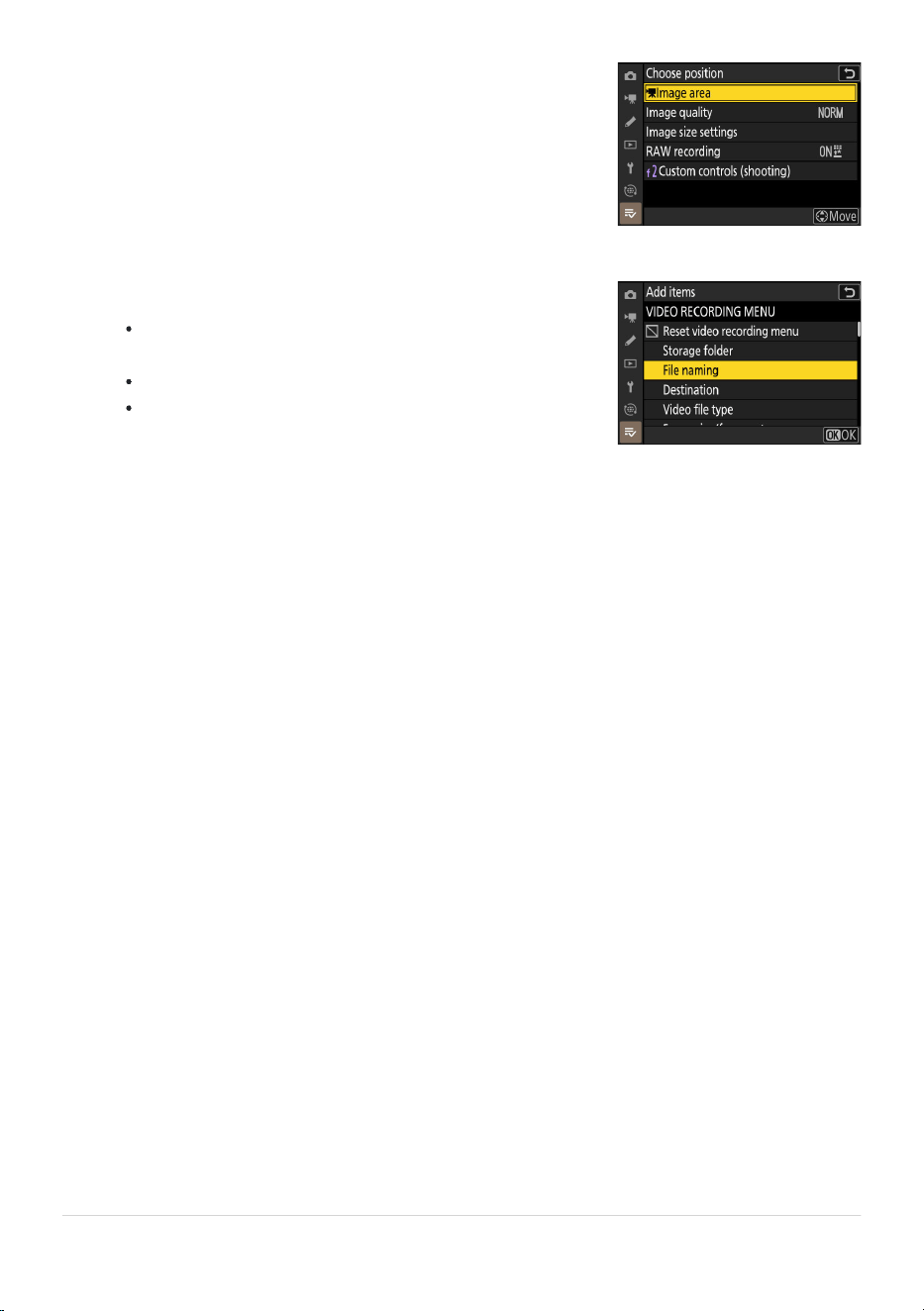
Position the new item.
Press 1
or 3 to position the new item and press J to add it to
My Menu.
Add more items.
The items currently display
ed in My Menu are indicated by a
check mark (L).
Items indicated by a V icon cannot be selected.
Repeat Steps 1–4 to select additional items.
804
My Menu: Creating a Custom Menu
4
5
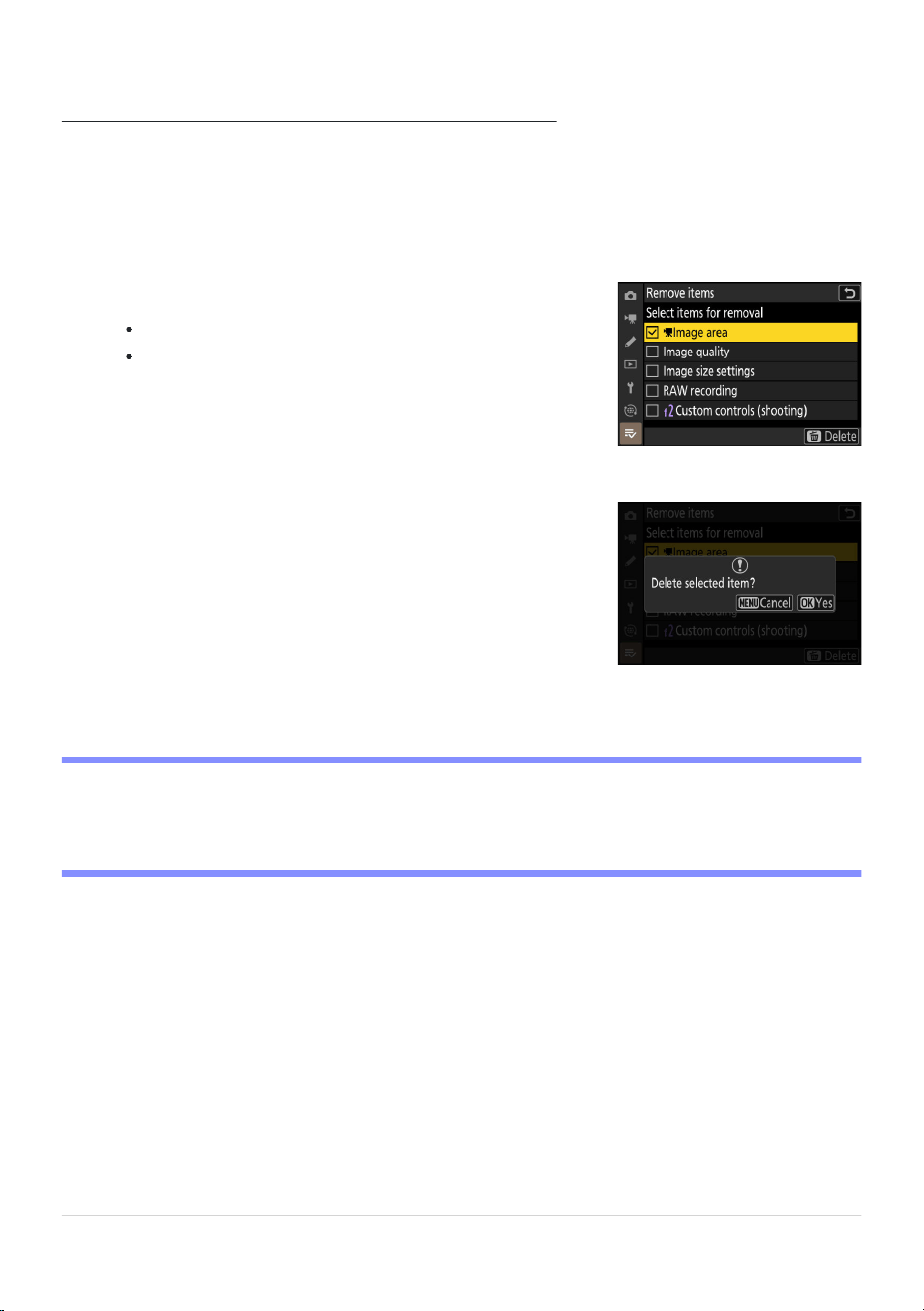
Select items.
Highlight items and press
J or 2 to select (M) or deselect.
Continue until all the items you wish to remove are selected
(L).
Remove the selected items.
Press O
; a confirmation dialog will be displayed. Press J to
remove the selected items.
Removing Items from My Menu
Select [Remove it
ems] in [OMY MENU].
Highlight [Remove items] and press 2.
D Removing Items While in My Menu
Items can also be removed by highlighting them in [OMY MENU] and pressing the O button; a
confirmation dialog will be displayed. Press O again to remove the selected item.
805
My Menu: Creating a Custom Menu
1
2
3
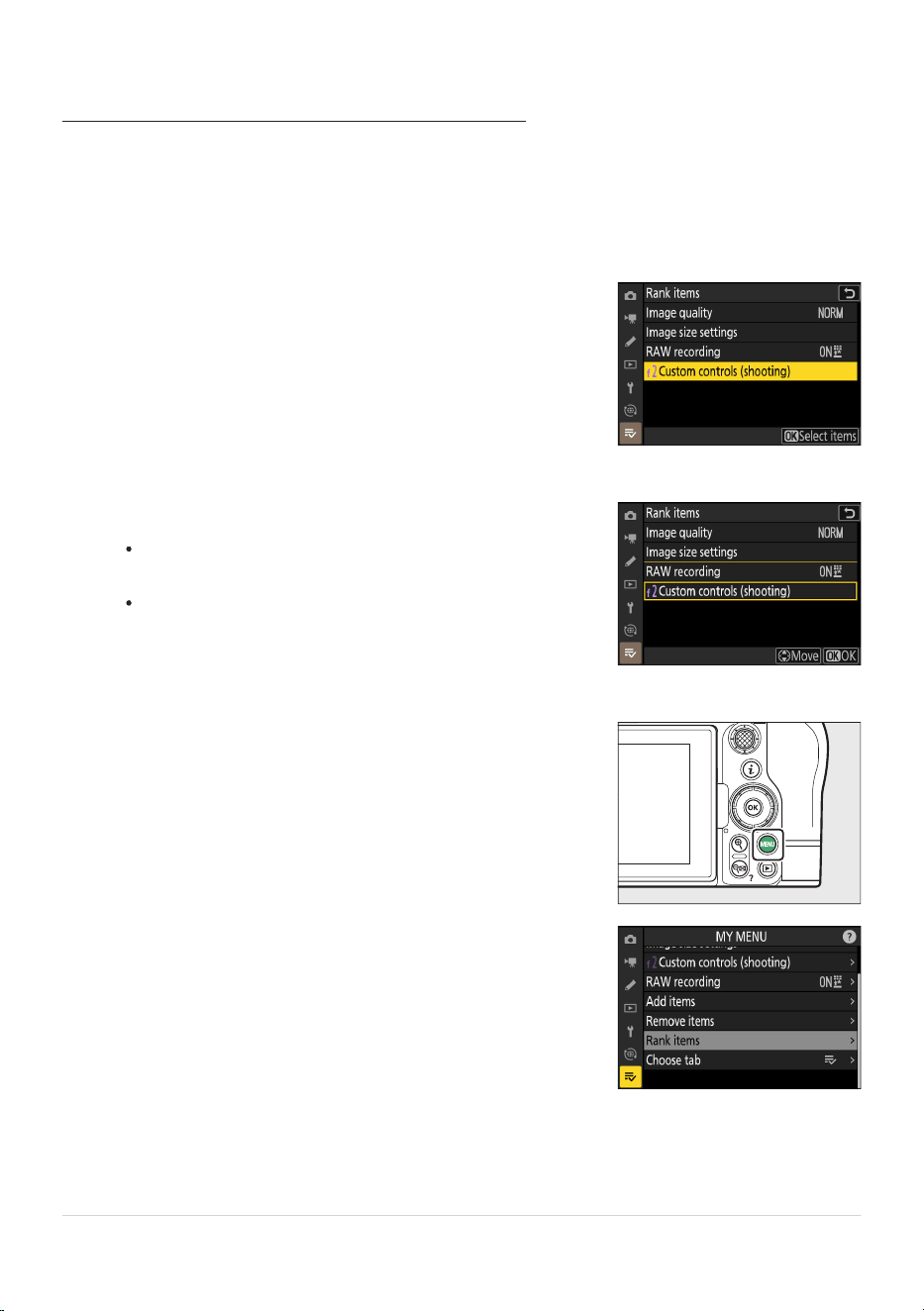
Select an item.
Highlight the item you wish t
o move and press J.
Position the item.
Press 1
or 3 to move the item up or down in My Menu and
press J.
Repeat Steps 2–3 to reposition additional items.
Exit to [O MY MENU].
Press the G butt
on to return to [OMY MENU].
Reordering Items in My Menu
Select [Rank items] in [O
MY MENU].
Highlight [Rank items] and press 2.
806
My Menu: Creating a Custom Menu
1
2
3
4
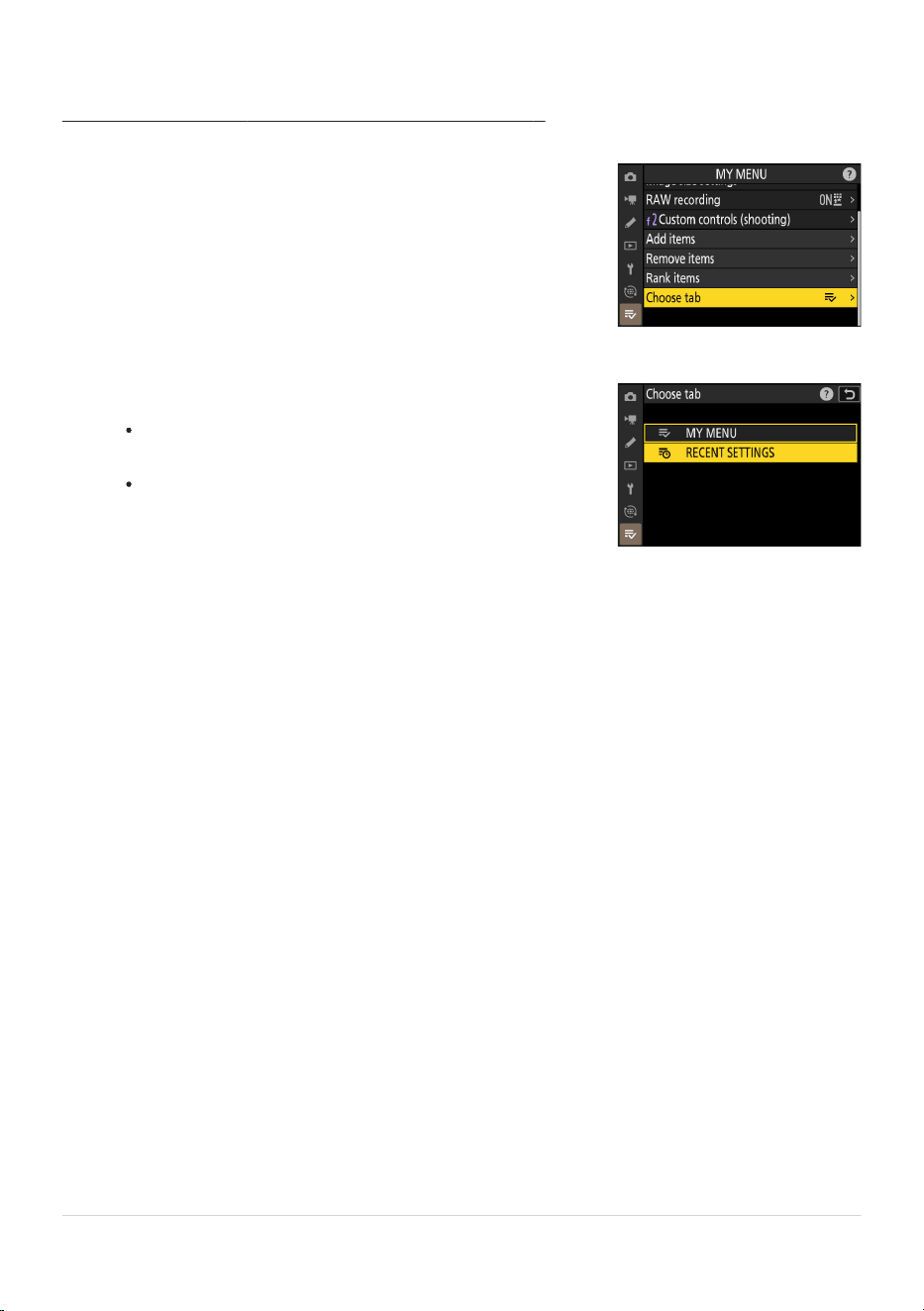
Select [Choose tab] in [OMY MENU].
Highlight [Choose tab] and press 2.
Select [mRECENT SETTINGS].
Highlight [mRECENT SETTINGS] in the [Choose tab] menu
and press J.
The name of the menu will change from [MY MENU] to
[RECENT SETTINGS] and the tab icon will change from O
to m.
Displaying [RECENT SETTINGS]
807
My Menu: Creating a Custom Menu
1
2
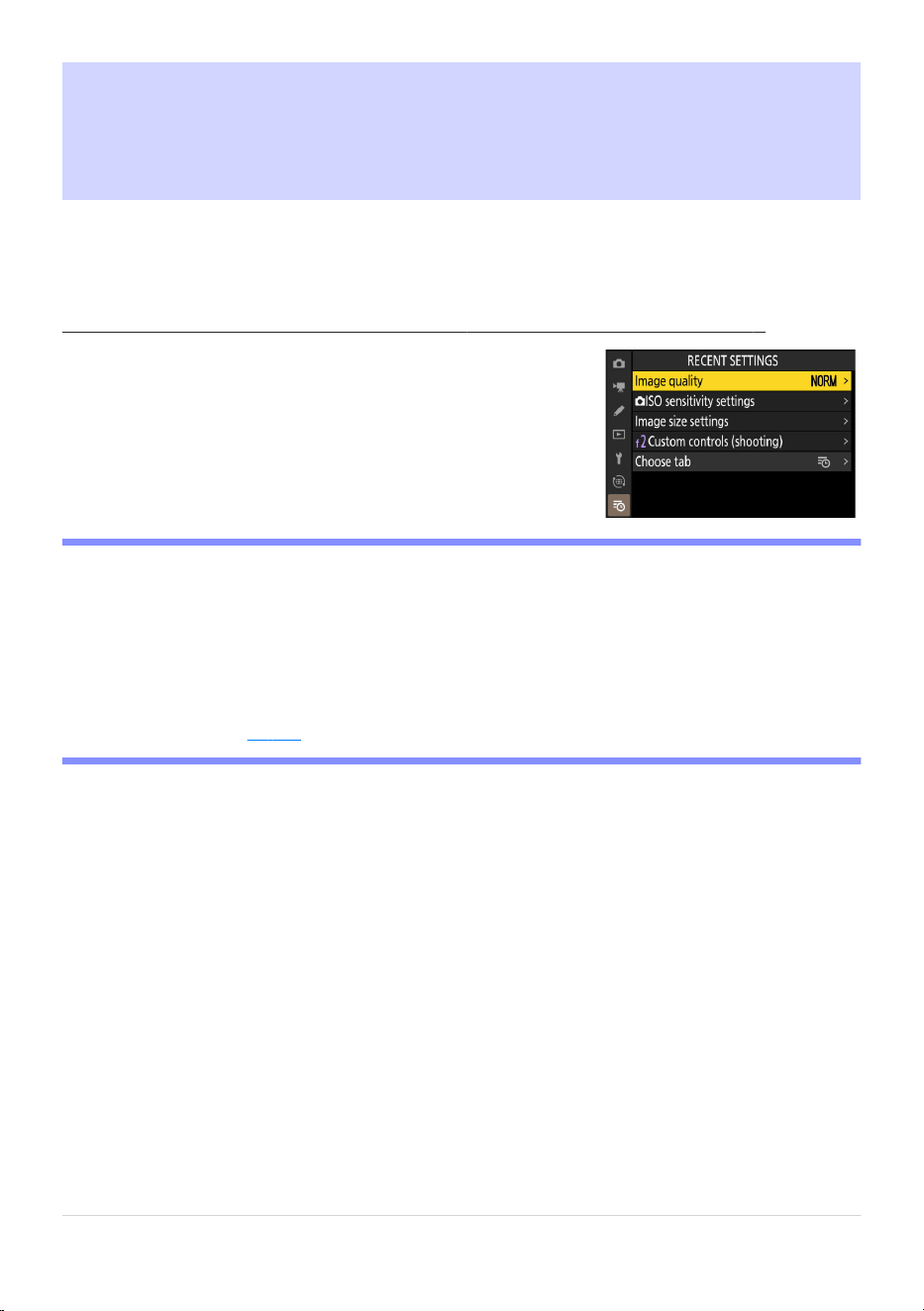
Menu items are added to the top of the [RECENT SETTINGS] menu
as they ar
e used. The twenty most recently-used settings are listed.
Recent Settings: Accessing Recently-Used
Settings
G buttonU
mRECENT SETTINGS
How Items Are Added to [RECENT SETTINGS]
D Removing Items fr
om the Recent Settings Menu
To remove an item from the [RECENT SETTINGS] menu, highlight it and press the O button; a
confirmation dialog will be displayed. Press O again to remove the selected item.
D Displaying My Menu
Selecting [RECENT SETTINGS]> [Choose tab] menu displays the items shown in Step2 of “Displaying
[RECENT SETTINGS]” (
0 807). Highlight [OMY MENU] and pr
ess J
t
o view My Menu.
808
Recent Settings: Accessing Recently-Used
Settings
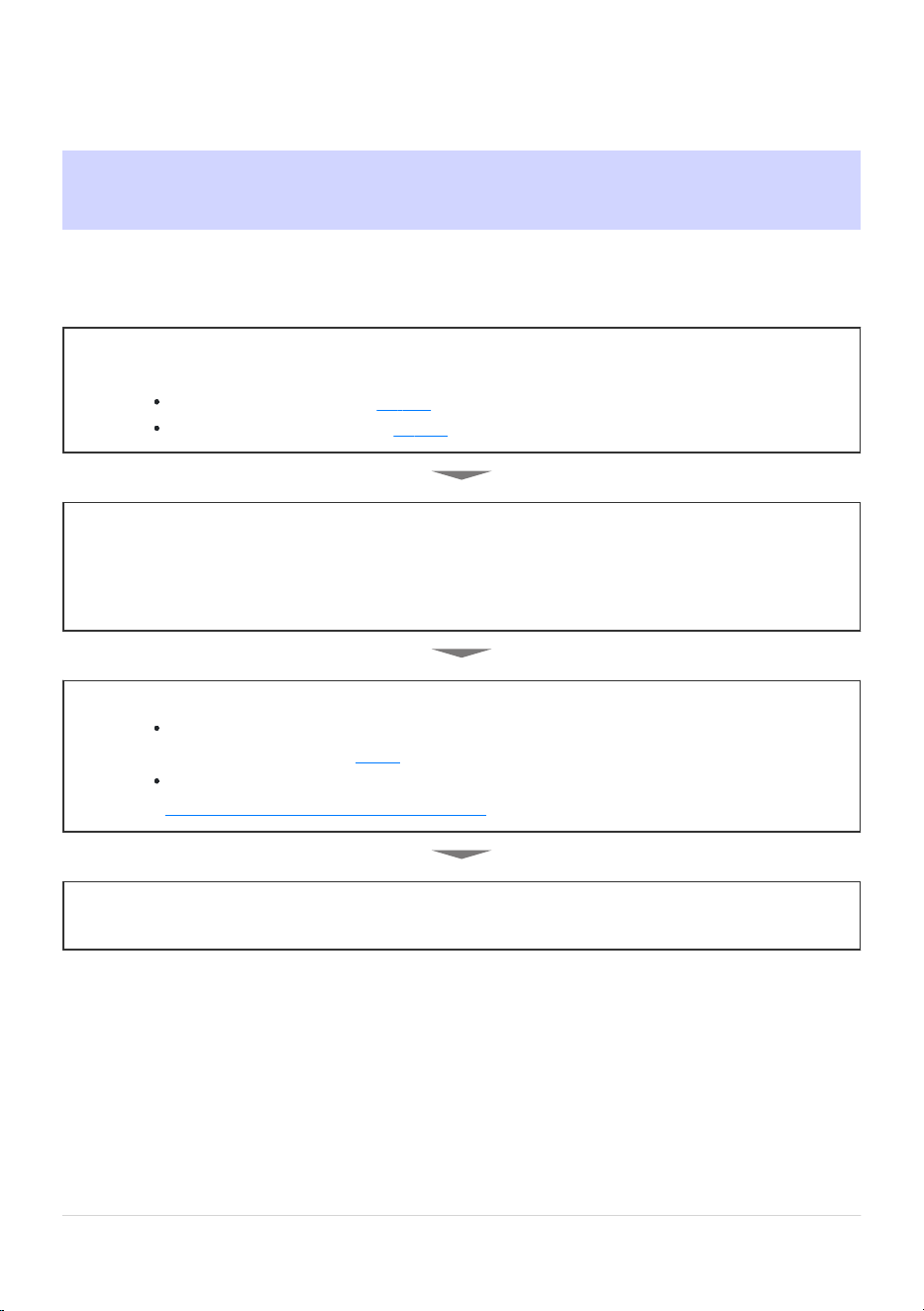
1
Check the list of common problems.
Common problems and solutions to them ar
e listed in the following sections:
“Problems and Solutions” (
0 811)
“Alerts and Err
or Messages” (
0 822)
2
Turn the camera off and remove the battery, then wait about a minute, re-insert the
b
atter
y and turn the camera on.
D The camera may continue to write data to the memory card after shooting. Wait at
least a minute before removing the battery.
3
Search Nikon websites.
For suppor
t infor
mation and answ
ers to frequently asked questions, visit the website for
your country or region (
0 43).
To download the lat
est firmware for your camera, visit:
https://downloadcenter.nikonimglib.com/
4
Consult a Nikon-authorized service representative.
Troubleshooting
Before Contacting Customer Suppor
t
You may be able to resolve any issues with the camera by following the steps below. Check this list
before consulting your retailer or Nikon-authorized service representative.
809
Before Contacting Customer Support

D Restoring Default Settings
Depending on current settings, some menu it
ems and other features may be unavailable. To access
menu items that are grayed out or features that are otherwise unavailable, try restoring default
settings using the [Reset all settings] item in the setup menu.
Note, however, that wireless network profiles, copyright information, and other user-generated
entries will also be reset. Once reset, settings cannot be restored.
810
Before Contacting Customer Support

Problems and Solutions
Solutions to some common issues are list
ed below.
Battery/Display
● The camera is on but does not respond:
W
ait for recording and other operations to end.
If the problem persists, turn the camera off.
If the camera does not turn off, remove and reinsert the battery.
If you are using an AC adapter, disconnect and reconnect the AC adapter.
Any data currently being recorded will be lost.
Data that have already been recorded are not affected by removing or disconnecting the
power source.
● The viewfinder or monitor does not turn on:
Have you changed the monitor mode? Choose a different monitor mode using the M button.
Have you limited the choice of monitor modes available using the [Limit monitor mode
selection] item in the setup menu? Adjust settings as required.
Dust, lint, or other foreign matter on the eye sensor may prevent it functioning normally. Clean
the eye sensor with a blower.
The eye sensor may not function normally if the rubber eyecup is not properly attached. Make
sure to attach it to the camera viewfinder correctly.
● The display of the viewfinder or monitor has been changed unintentionally:
Was the DISP button pressed? If the DISP button is pressed during playback or shooting, the
display of the viewfinder or monitor changes (
0 226, 0 602, 0 604).
● The viewfinder is out of focus:
R
otate the diopter adjustment control to adjust viewfinder focus.
If adjusting viewfinder focus does not correct the problem, set the focus mode to AF‑S and the
AF-area mode to single-point AF. Next, select the center focus point, choose a high-contrast
subject, and focus using autofocus. With the camera in focus, use the diopter adjustment control
to bring the subject into clear focus in the viewfinder.
● The display in the viewfinder or monitor turns off without warning:
Choose longer delays for Custom Setting c3 [Power off delay].
811
Problems and Solutions
-
-

● The viewfinder is unresponsive:
The display refresh rat
e may drop about 20 seconds before the standby timer turns off. The length
of time before the standby timer expires automatically can be selected using Custom Setting c3
[Power off delay]> [Standby timer].
Shooting
● The camera takes time t
o turn on:
More time will be needed to find files if the memory card contains large numbers of files or folders.
● The shutter cannot be released:
Is a memory card inserted, and if so, does it have space available?
If you selected mode S after selecting a shutter speed of [Bulb] or [Time] in mode M, choose a
different shutter speed.
Is [Release locked] selected for [Slot empty release lock] in the setup menu?
● Burst shooting is unavailable:
Burst shooting cannot be used in conjunction with HDR.
● Photos are out of focus:
Is the camera in manual focus mode? To enable autofocus, select AF‑A, AF‑S, AF-C, or AF‑F for
focus mode.
The camera may be unable to focus if:
the subject contains lines parallel to the long edge of the frame,
the subject lacks contrast,
the subject in the focus point contains areas of sharply contrasting brightness,
the focus point includes night-time spot lighting or a neon sign or other light source that
changes in brightness,
flicker or banding appears under fluorescent, mercury-vapor, sodium-vapor, or similar lighting,
a cross (star) filter or other special filter is used,
the subject appears smaller than the focus point, or
the subject is dominated by regular geometric patterns (e.g., blinds or a row of windows in a
skyscraper).
In focus mode AF‑C, the focus point may flash while the shutter-release button is pressed
halfway or the AF-ON button is pressed, indicating that the camera is no longer able to focus.
The focus operation can be resumed by releasing and then pressing the button again.
● The beep does not sound:
A beep does not sound when the camera focuses with AF-C selected for focus mode or if AF-A is
selected and the camera is shooting using AF-C.
812
Problems and Solutions
-
-
-
-
-
-
-
-

Is [ON] selected for [Silent mode] in the setup menu?
Select an option other than [Off] for [Camera sounds
] > [Beep on/off] in the setup menu.
The beep does not sound in video mode.
● The full range of shutter speeds is not available:
Using a flash restricts the range of shutter speeds available.
Flash sync speed can be set to values of ¹⁄₂₀₀–¹⁄₆₀s using Custom Setting e1 [Flash sync speed].
When using flash units that support auto FP high-speed sync, choose [1/200 s (Auto FP)] for
Custom Setting e1 [Flash sync speed] for shutter speeds as fast as ¹⁄₈₀₀₀s.
When [Electronic front-curtain shutter] is selected for Custom Setting d6 [Shutter type], the
fastest shutter speed available will be ¹⁄₂₀₀₀ s.
● Focus does not lock when the shutter-release button is pressed halfway:
When AF-C is selected for focus mode or AF-A is selected and the camera is shooting using AF-C,
focus can be locked by pressing the center of the sub-selector.
● Focus-point selection is not available:
Focus-point selection is not available when [Auto-area AF] is selected for AF-area mode.
● The camera is slow to record photos:
Is [ON] selected for [Long exposure NR] in the photo shooting menu?
● Photographs and videos do not appear to have the same exposure as the preview shown in
the display:
The effects of changes to settings that affect exposure and color are not visible in the display
when [Adjust for ease of viewing] is selected for Custom Setting d10 [View mode (photo
Lv)]. If [Show effects of settings]> [Only when flash is not used] is selected for Custom
Setting d10, display brightness will also be adjusted for ease of viewing (per [Adjust for ease of
viewing]) when a flash unit is attached and ready to fire.
Note that changes to [Monitor brightness] and [Viewfinder brightness] have no effect on
pictures recorded with the camera.
● Flicker or banding appears in video mode:
Select [Video flicker reduction] in the video recording menu and choose an option that matches
the frequency of the local AC power supply.
● Bright regions or bands appear:
Bright regions or bands may occur if the subject is lit by a flashing sign, flash, or other light source
with brief duration.
813
Problems and Solutions
-

● Smudges appear in photographs:
Are there smudges on the fr
ont or rear (mount-side) lens elements?
Is there foreign matter on the image sensor? Perform image sensor cleaning.
● Pictures are affected by noticeable ghosting or flare:
You may notice ghosting or flare in shots that include the sun or other bright light sources. These
effects can be mitigated by attaching a lens hood or by composing shots with bright light sources
well out of the frame. You can also try such techniques as removing lens filters or choosing a
different shutter speed.
● Bokeh is irregular:
With fast shutter speeds and/or fast lenses, you may notice irregularities in how bokeh is shaped.
The effect can be mitigated by choosing slower shutter speeds and/or higher f-numbers.
● Shooting ends unexpectedly or does not start:
Shooting may end automatically to prevent the camera overheating, for example if:
the ambient temperature is high,
the camera has been used for extended periods to record videos, or
the camera has been used in continuous release modes for extended periods.
If pictures cannot be taken because the camera is running hot, turn the camera off and wait for
it to cool before trying to take pictures again. Note that the camera may feel warm to the touch,
but this does not indicate a malfunction.
● Image artifacts appear in the display during shooting:
To reduce noise, adjust settings such as ISO sensitivity, shutter speed, or Active D-Lighting.
At high ISO sensitivities, noise may become more noticeable in long exposures or in pictures
recorded when the camera temperature is elevated.
Randomly-spaced bright pixels, fog, or bright spots may arise as a result of increases in the
temperature of the camera’s internal circuits. Turn the camera off when it is not in use.
Randomly-spaced bright pixels, fog, lines or unexpected colors may appear if you press the X
button to zoom in on the view through the lens during shooting.
Note that the distribution of noise in the display may differ from that in the final picture.
This issue can sometimes be addressed by checking and optimizing the image sensor. Perform
pixel mapping using [Pixel mapping] in the setup menu.
814
Problems and Solutions
-
-
-

● The camera cannot measure a value for preset manual white balance:
The subject is too dark or too bright.
●
Certain pictures cannot be selected as sources for preset manual white balance:
Pictures created with cameras of other types cannot serve as sources for preset manual white
balance.
● White balance (WB) bracketing is unavailable:
White balance bracketing is not available when an NEF (RAW) or RAW+ JPEG/HEIF option is
selected for image quality.
White balance bracketing cannot be used in multiple exposure and HDR overlay modes.
● The effects of [Set Picture Control] differ from picture to picture:
[Auto] is selected for [Set Picture Control] or as the basis for a Custom Picture Control created
using [Manage Picture Control], or [A] (auto) is selected for [Quick sharp], [Contrast], or
[Saturation]. For consistent results over a series of photographs, choose a setting other than [A]
(auto).
● The option selected for metering cannot be changed:
The option selected for metering cannot be changed during exposure lock.
● Exposure compensation is not available:
Changes to exposure compensation in mode M apply only to the exposure indicator and have no
effect on shutter speed or aperture.
● Uneven shading appears in long exposures:
Uneven shading may appear in long exposures shot at shutter speeds of [Bulb] or [Time]. The effect
can be mitigated by selecting [ON] for [Long exposure NR] in the photo shooting menu.
● The AF-assist illuminator does not light:
Is [OFF] selected for Custom Setting a11 [Built-in AF-assist illuminator]?
The illuminator does not light in video mode.
The illuminator does not light in the following focus modes: AF-C (including when AF-A is
selected and the camera is shooting using AF-C) and MF.
● Sound is not recorded with videos:
[Microphone off] is selected for [Microphone sensitivity] in the video recording menu.
[Manual] is selected for [Microphone sensitivity] in the video recording menu and a low value
is selected.
815
Problems and Solutions

Playback
● NEF (RAW) pictur
es are not visible during playback:
The camera displays only the JPEG or HEIF copies of pictures taken with [RAW+ JPEG/HEIF finem],
[RAW + JPEG/HEIF fine], [RAW+ JPEG/HEIF normalm], [RAW + JPEG/HEIF normal], [RAW+
JPEG/HEIF basicm], or [RAW + JPEG/HEIF basic] selected for [Image quality].
● Pictures taken with other cameras are not displayed:
Pictures recorded with other types of camera may not display correctly.
● Not all photos are visible during playback:
Select [All] for [Playback folder] in the playback menu.
● “Tall” (portrait) orientation photos are displayed in “wide” (landscape) orientation:
Is [OFF] selected for [Record camera orientation] in the playback menu?
Is [OFF] selected for [Auto-rotate pictures] in the playback menu?
Auto picture rotation is not available during picture review.
Camera orientation may not be correctly recorded in photos taken with the camera pointing up
or down.
● HLG (HEIF) pictures do not display correctly:
Pictures taken with [HLG] selected for [Tone mode] may not display correctly when viewed on other
devices (for example, when output to other devices directly or when opened on a computer after
upload). View the pictures on an HLG-compatible computer or other device. For more information
on viewing HLG pictures on a computer, visit the following website:
https://onlinemanual.nikonimglib.com/notice/hlg_setting_guide/en/
● Pictures cannot be delet
ed:
Are the pictures protected?
● Pictures cannot be retouched:
The pictures cannot be further edited with this camera.
There is insufficient space on the memory card to record the retouched copy.
● The camera displays the message, [Folder contains no pictures.]:
Select [All] for [Playback folder] in the playback menu.
816
Problems and Solutions

● NEF (RAW) pictures cannot be printed:
Print JPEG or HEIF copies of the pictures cr
eated using a tool such as the [RAW processing
(current picture)] or [RAW processing (multiple pictures)] items accessible via [Retouch] in
the playback i menu.
Copy the pictures to a computer and print them using NX Studio or other software that supports
the NEF (RAW) format.
● Pictures are not displayed on HDMI devices:
Confirm that an HDMI cable is correctly connected.
● Output to HDMI devices does not function as expected:
Confirm that an HDMI cable is correctly connected.
Photos taken with [HLG] selected for [Tone mode] may not display correctly on devices that are
not HLG-compatible.
Videos may not display correctly when viewed with [ON] selected for [External rec. cntrl
(HDMI)] in the video recording menu.
Pictures may display correctly if default settings are restored using the [Reset all settings] item
in the setup menu.
● The Image Dust Off option in NX Studio does not have desired effect:
Image sensor cleaning changes the position of dust on the image sensor and will not have the
desired effect if:
Image Dust Off reference data recorded after image sensor cleaning is performed are used with
photographs taken before image sensor cleaning is performed, or
Image Dust Off reference data recorded before image sensor cleaning is performed are used with
photographs taken after image sensor cleaning is performed.
● The effects of [Set Picture Control], [Set Picture Control (HLG)], [Active D-Lighting], or
[Vignette control] are not visible:
In the case of NEF (RAW) pictures, the effects can only be viewed using Nikon software. View NEF
(RAW) pictures using NX Studio.
● Pictures cannot be copied to a computer:
Depending on the operating system, you may be unable to upload pictures when the camera is
connected to a computer. Copy pictures from the memory card to a computer using a card reader
or other device.
817
Problems and Solutions

Bluetooth and Wi-Fi (Wireless Networks)
● Smart devices do not display the camera SSID (netw
ork name):
Navigate to the network menu and confirm both that [OFF] is selected for [Airplane mode]
and that [ON] is selected for [Connect to smart device]> [Pairing (Bluetooth)]> [Bluetooth
connection].
Confirm that [Connect to smart device] > [Wi-Fi connection (AP mode)] is enabled in the
network menu.
Try disabling and re-enabling wireless network features on the smart device.
The camera SSID may not appear when the camera becomes hot. Wait for the camera to cool
and try again.
● The camera cannot connect to printers and other wireless devices:
This camera can establish wireless connections with the following devices. Note that the connection
is unavailable with other devices.
smart devices,
ML‑L7 remote controls,
third-party Bluetooth remote controls,
computers,
FTP servers,
Nikon cameras with the network menu, and
Atomos UltraSync BLUE AirGlu accessories.
● Pictures cannot be uploaded to smart devices via auto upload:
If [Foreground] is selected for [Auto link]> [Link mode] in the SnapBridge
tab, pictures will
not be uploaded to the smar
t device automatically while the SnapBridge app is running in the
background. Pictures will only be uploaded when the SnapBridge app is displayed (running in the
foreground) on the smart device.
Check that the camera is paired with the smart device.
Check that the camera and smart device are configured for connection via Bluetooth.
Using the camera for such purposes as viewing videos or retouching pictures may interrupt
upload of pictures at a size of 8megapixels via the SnapBridge app. Try again after ending the
task in progress on the camera.
● The camera cannot download location data from the smart device:
The camera may be unable to download or display location data from smart devices depending
on the version of the operating system and/or SnapBridge app used.
If [Foreground] is selected for [Auto link]> [Link mode] in the SnapBridge
tab, location
data will not be downloaded to the camera. Inst
ead, they will be embedded in photographs after
they are uploaded to the smart device.
818
Problems and Solutions

● The camera cannot connect to a computer or smart device when it becomes hot:
When the camera becomes hot, wireless transmission is interrupt
ed. In such a case, the Wi-Fi
connection indicator in the shooting display flashes rapidly.
Wait for the camera to cool before reconnecting the camera to the computer or smart device.
819
Problems and Solutions

Miscellaneous
● The date o
f recording is not correct:
Is the camera clock set correctly? The clock is less accurate than most watches and household
clocks; check it regularly against more accurate timepieces and reset as necessary.
● Menu items cannot be selected:
Some items are not available at certain combinations of settings.
● [Wireless remote (ML-L7) options] cannot be selected in the network menu, or the camera
cannot be paired with the remote control using [Wireless remote (ML-L7) options]> [Save
wireless remote controller]:
Check that the camera battery is charged.
Confirm that [OFF] is selected for [Airplane mode] in the network menu.
Confirm that [MTP/PTP] is selected for [USB] in the network menu.
The remote control cannot be used while the camera is connected to another device via USB,
Bluetooth, or Wi-Fi. End the connection.
The camera may not connect to the remote control when it becomes hot. Wait for the camera to
cool and try again.
● The camera does not respond to the remote control:
The camera and ML‑L7 remote control are not connected. To connect, press the remote control
power button. If W does not appear in the shooting display, pair the camera and remote control
again (
0 872).
Confirm that [ON] is select
ed for [Wireless remote (ML-L7) options]> [Wireless remote
connection (ML-L7)] in the network menu.
Confirm that [MTP/PTP] is selected for [USB] in the network menu.
Confirm that [OFF] is selected for [Airplane mode] in the network menu.
The remote control cannot be used while the camera is connected to another device via USB,
Bluetooth, or Wi-Fi. End the connection.
If you end the connection to the remote control by connecting to a computer or smart
device, the connection can be re-established by selecting [ON] for [Wireless remote (ML-L7)
options]> [Wireless remote connection (ML-L7)] in the network menu.
The camera may not connect to the remote control when it becomes hot. Wait for the camera to
cool and try again.
● USB connections fail to function:
Confirm that the appropriate option is selected for [USB] in the network menu.
When connecting to computers or Android devices via USB, select [MTP/PTP].
820
Problems and Solutions

Select [USB streaming (UVC/U
AC)] when live streaming by connecting to a computer/smart
device.
● The NX MobileAir app cannot be used even when a smart device is connected to the camera
USB connector via a cable:
Are the camera and the smart device connected by a USB cable that supports the NX MobileAir
app? See the NX MobileAir online help for information on compatible cables.
Confirm that the appropriate option is selected for [USB] in the network menu.
When connecting to Android devices, select [MTP/PTP].
When connecting to iPhones, select [iPhone].
821
Problems and Solutions
-
-
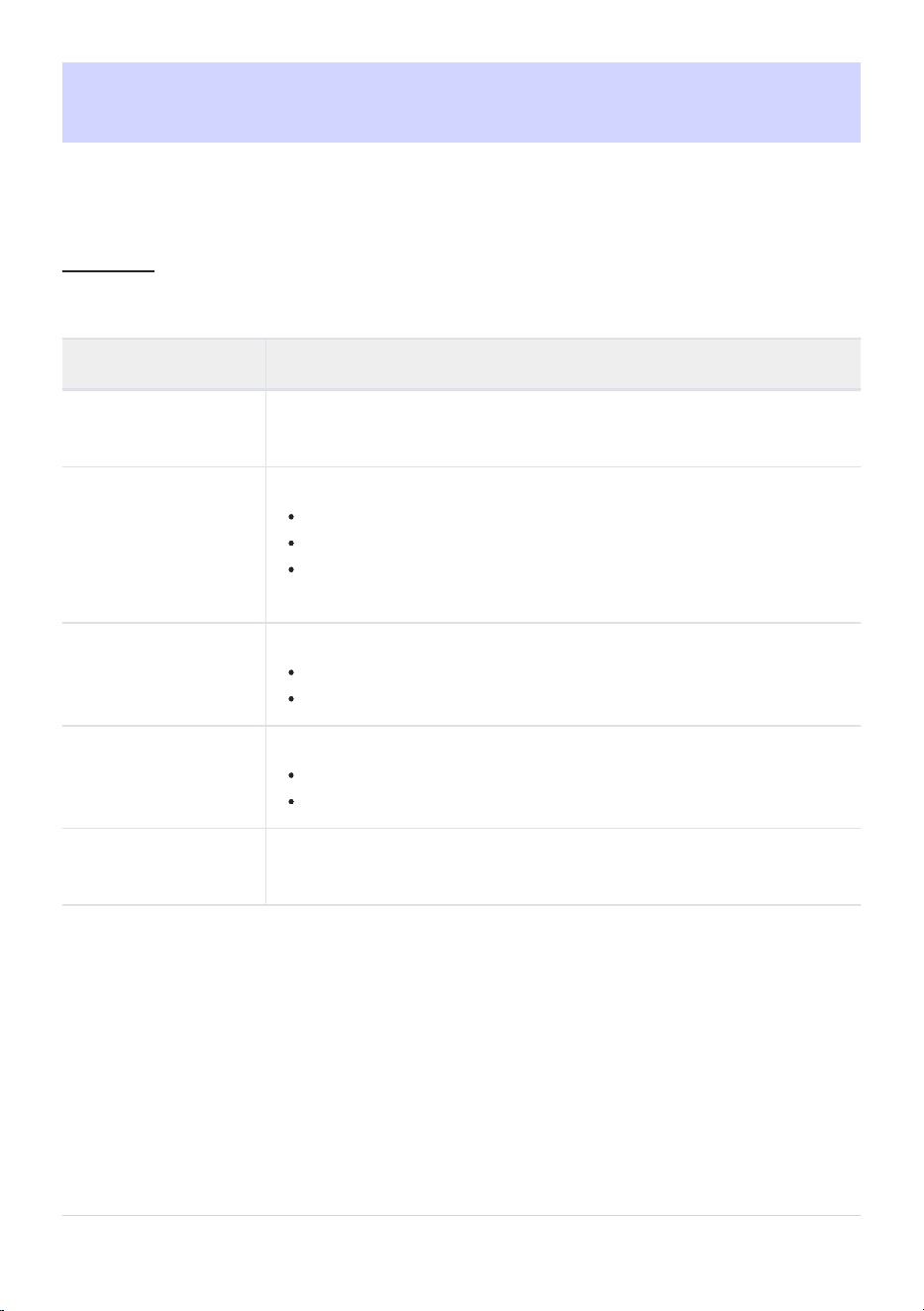
Alerts and Error Messages
This section lists the alerts and error messages that appear in the camera display
.
Alerts
The following alerts appear in the camera display:
Alert Pr
oblem/solution
H
Low battery.
Ready a spar
e battery.
l
Lens is not correctly attached.
Ensure that lens is correctly attached.
Ensure that retractable lenses are extended.
This indicator is also displayed when a non-CPU lens is attached via a
mount adapter, but in this case no action need be taken.
Bulb
(flashes)
“Bulb” selected in mode S.
Change shutter speed.
Select mode M.
Time
(flashes)
“Time” selected in mode S.
Change shutter speed.
Select mode M.
Busy
(flashes)
Processing in progress.
Wait until processing is complete.
822
Alerts and Error Messages

Alert Problem/solution
(Exposure indicators
and shutter speed or
apertur
e display flash)
Subject too bright; limits of camera exposure metering system
exceeded.
Lower ISO sensitivity.
Mode P: Use third-party ND (neutral density) filter (filter can also be
used if alert is still displayed after following settings are adjusted in
mode S or A).
Mode S: Choose faster shutter speed.
Mode A: Choose smaller aperture (higher f‑number).
Subject too dark; limits of camera exposure metering system
exceeded.
Increase ISO sensitivity.
Mode P: Use optional flash unit (flash can also be used if alert is still
displayed after following settings are adjusted in mode S or A).
Mode S: Choose slower shutter speed.
Mode A: Choose wider aperture (lower f‑number).
c
(flashes)
Flash has fired at full power.
Photo may be underexposed. Check distance to subject and settings such
as aperture, flash range, and ISO sensitivity.
Full
(flashes)
Memory insufficient to record further photos.
Delete pictures from memory card until there is room for additional
pictures to be recorded. Copy pictures you wish to keep to computer
or other device before proceeding.
Insert new memory card.
Camera has run out of file numbers.
Delete pictures from memory card until there is room for additional
pictures to be recorded. Copy pictures you wish to keep to computer
or other device before proceeding.
Insert new memory card.
Err
(flashes)
Camera malfunction.
Press shutter-release button again. If error persists or appears frequently,
consult Nikon-authorized service representative.
Card
(flashes)
The memory card is write-protected (“locked”).
Slide the lock switch to the “write” position (
0 94).
823
Alerts and Error Messages
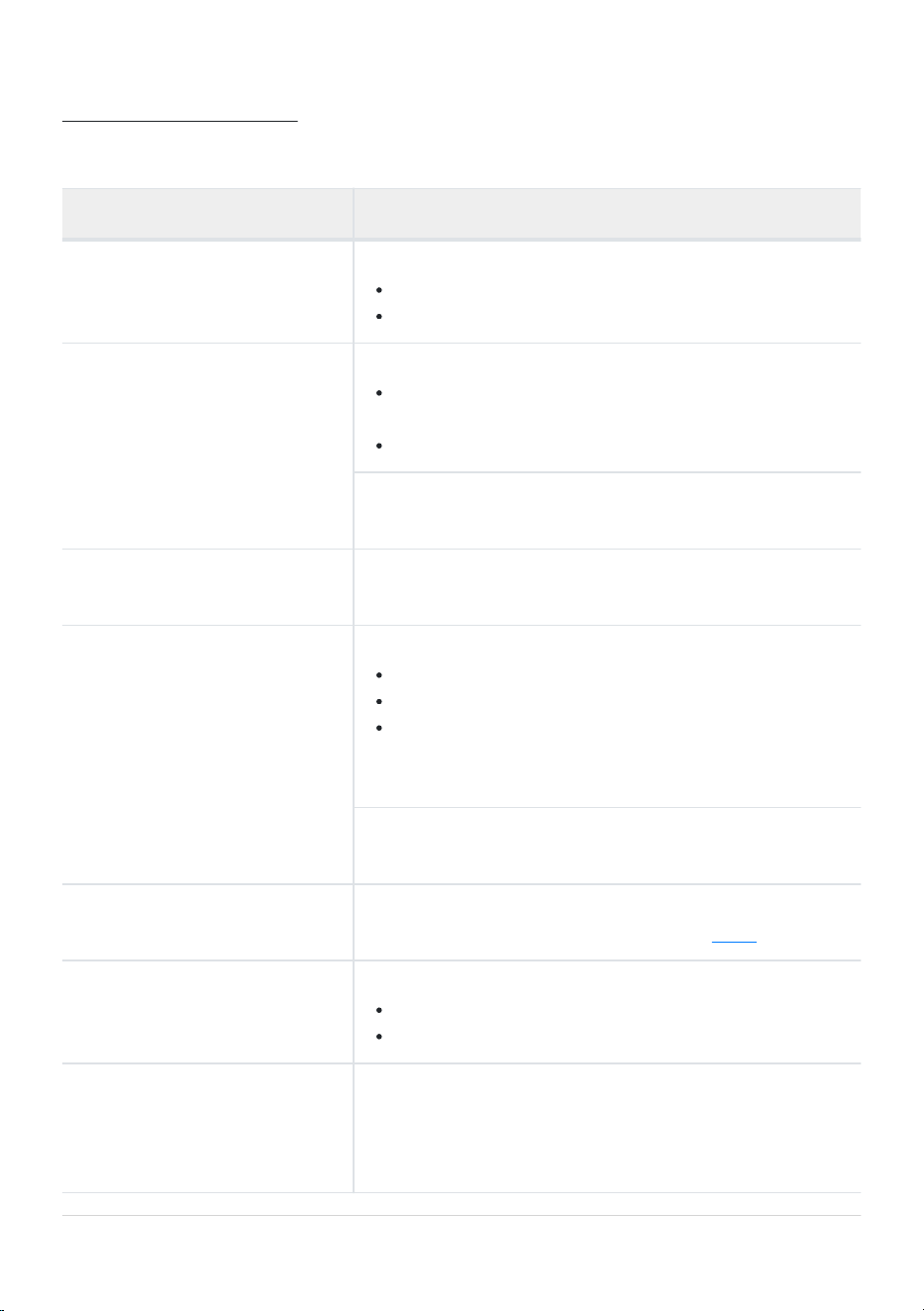
Error Messages
The following error messages may appear in the camera display:
Message Problem/solution
Shutt
er release disabled. Recharge
batter
y.
Battery exhausted.
Replace with spare battery.
Charge battery.
This battery is unable to provide
data to the camera and cannot be
used. For safety, choose a battery
designated for use in this camera.
Battery info not available.
Battery cannot be used. Contact Nikon-authorized service
representative.
Battery level is extremely low; charge battery.
Battery cannot supply data to camera.
Replace third-party batteries with genuine Nikon batteries.
No memory card.
The memory card is inserted incorrectly or not at all.
Check that card is inserted correctly.
Cannot access this memory card.
Insert another card.
Error accessing memory card.
Check that camera supports memory card.
Insert new memory card.
If error persists after card has been repeatedly ejected
and reinserted, card may be damaged. Contact retailer or
Nikon-authorized service representative.
Unable to create new folder.
Insert new memory card.
Memory card is locked. Slide lock
to "write" position.
The memory card is write-protected (“locked”).
Slide the lock switch to the “write” position (
0 94).
This card is not formatted. Format
the card.
Memory car
d is not correctly formatted.
Format memory card.
Replace with correctly-formatted memory card.
FTZ mount adapter firmware
version not supported. Upgrade
FTZ firmware.
Mount adapter firmware out of date.
Update to the latest version of the mount adapter firmware.
For more information, visit the Nikon website for your country
or region.
824
Alerts and Error Messages

Message Problem/solution
Recording interrupted. Please
wait.
Memory card does not support required video write
speed.
Use card that supports r
equired write speed or change option
selected for [Frame size/frame rate] in video recording
menu.
The camera is too hot. It cannot
be used until it cools. Please wait.
Camera will turn itself off.
Camera’s internal temperature is elevated.
Suspend shooting until camera has cooled.
High battery temperature.
Remove battery and wait for it to cool.
Folder contains no pictures.
Folder contains no pictures.
Insert memory card that contains pictures.
No pictures in folder selected for playback.
Use [Playback folder] item in playback menu to select folder
that contains pictures.
Cannot display this file.
File has been modified using computer application or
does not conform to DCF file standard.
Do not overwrite pictures using computer applications.
File is corrupt.
Do not overwrite pictures using computer applications.
Cannot select this file.
Selected picture cannot be retouched.
Retouch options are available only with pictures taken with or
previously retouched on camera.
This video cannot be edited.
Selected video cannot be edited.
Videos created with other devices cannot be edited.
Videos under two seconds long cannot be edited.
This file cannot be saved to the
destination memory card. See the
camera manual for details.
Files 4GB or larger can only be saved to memory cards
formatted for exFAT. They will not be saved to cards in
other formats such as FAT32.
Use a memory card with a capacity over 64GB formatted in
the camera or keep file size to under 4GB.
825
Alerts and Error Messages

Technical Notes
Compatible Lenses and Accessories
The camera can be used with all Z mount lenses.
Confirm that the lens name includes “NIKKOR Z”.
Be sure to updat
e to the latest versions of the camera and lens firmware. With earlier versions,
some functions may not be available or the camera may fail to correctly detect the lens. The latest
firmware is available from the Nikon Download Center.
For more information on lenses, see the lens documentation available from the Nikon Download
Center.
Tip: Compatible F Mount Lenses
F mount lenses can be mounted on Z mount cameras using an FTZ II/FTZ mount adapter.
Some features may not be available depending on the lens used.
Information on the F mount lenses that can be used with Z mount cameras and on any restrictions that
may apply can be found in Compatible F Mount Lenses. Compatible F Mount Lenses is available from the
Nikon Download Center.
https://downloadcenter.nikonimglib.com/
826
Compatible Lenses and Accessories
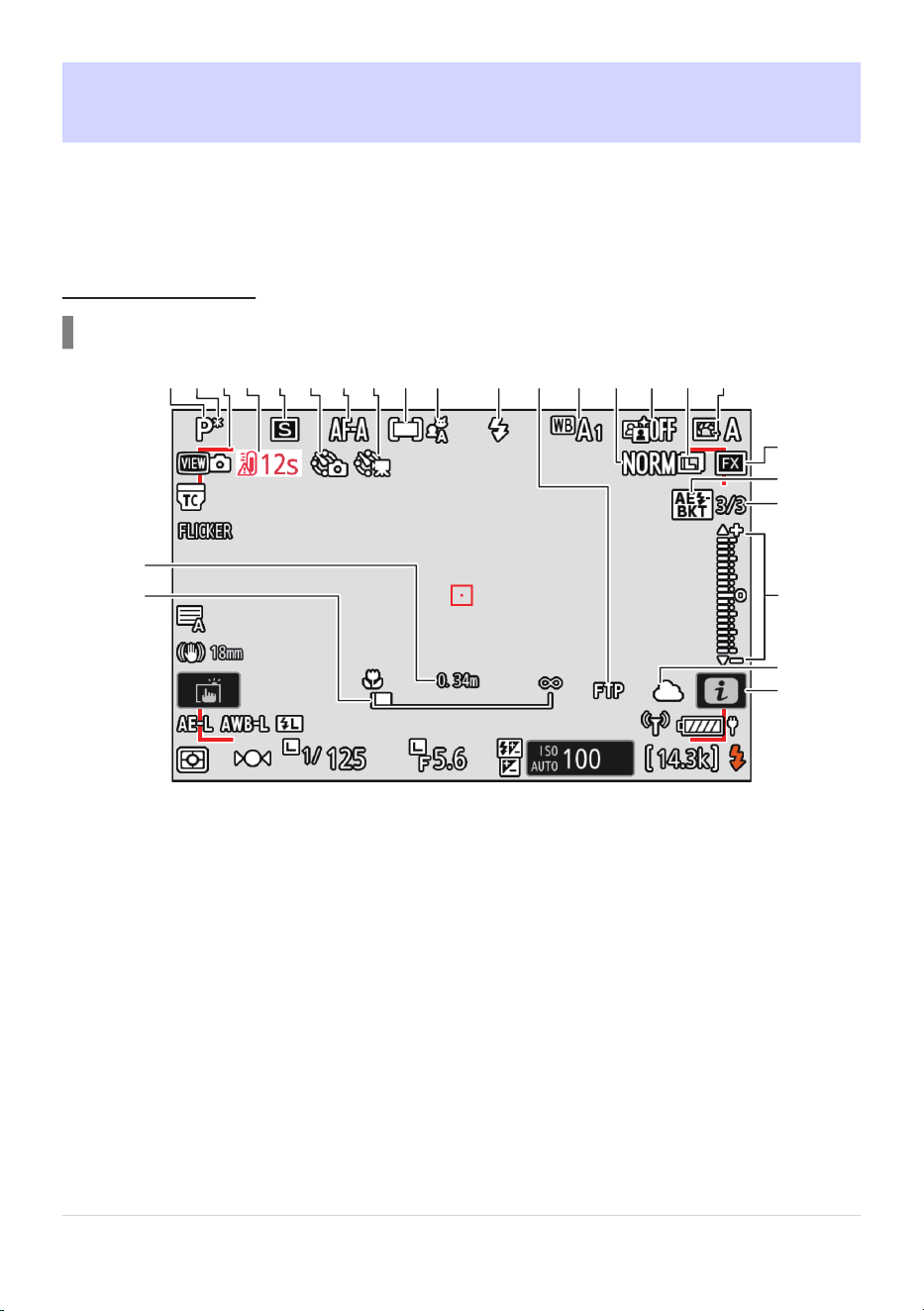
CameraDisplays
The displays show information on current settings. Other icons or war
nings may occasionally be
displayed, for example when settings are changed.
The Monitor
Photo Mode
3 5 8 1461 42 7 9 10 11 12 13 15 16 17
18
19
20
25
24
23
22
21
827
CameraDisplays

Shooting mode (0 137)
Flexible program indicator (
0 138)
Out-of
-focus indicator (auto-area AF;
0 101)
Temperature war
ning (
0 733)
Release mode (0 152)
Interv
al-timer photography indicator
(
0 475)
g icon (0 100)
“No memory card” indicat
or (
0 92,
0 830)
Focus mode (0 120)
Time-lapse video indicat
or (
0 485)
AF-ar
ea mode (
0 122)
Subject det
ection (
0 126)
Flash mode (0 395)
F
TP connection status (
0 350)
Whit
e b
alance (
0 182)
Image quality (
0 116)
Activ
e D-Lighting (
0 428)
Image size (0 118)
Pictur
e Contr
ol (
0 424)
Image ar
ea (
0 114)
1
2
3
4
5
6
7
8
9
10
11
12
13
14
15
16
17
18
Exposure and flash bracketing indicator
(
0 454)
WB bracketing indicator (
0 458)
ADL bracketing indicator (
0 461)
HDR indicator (0 472)
Multiple exposure indicator (
0 465)
Pixel shift indicat
or (
0 503)
Number of shots in exposure and flash
brack
eting sequence (
0 454)
Number of shots in WB bracketing
sequence (
0 458)
Number of shots in ADL bracketing
sequence ( 0 461)
HDR strength (0 472)
Number of shots in multiple exposure
(0 465)
Pre-Release Captur
e (
0 581)
Number of shots in pixel shif
t sequence
(
0 503)
Exposure indicator
Exposur
e (
0 142)
Exposure compensation (0 150)
Auto bracketing (
0 453)
NikonImagingCloud connection status
(0 308)
Remote camera connection status
( 0 378)
i icon ( 0 80)
Focus distance indicator (0 135)
Distance between the camera and the
focus position (0 135)
19
20
21
22
23
24
25
828
CameraDisplays
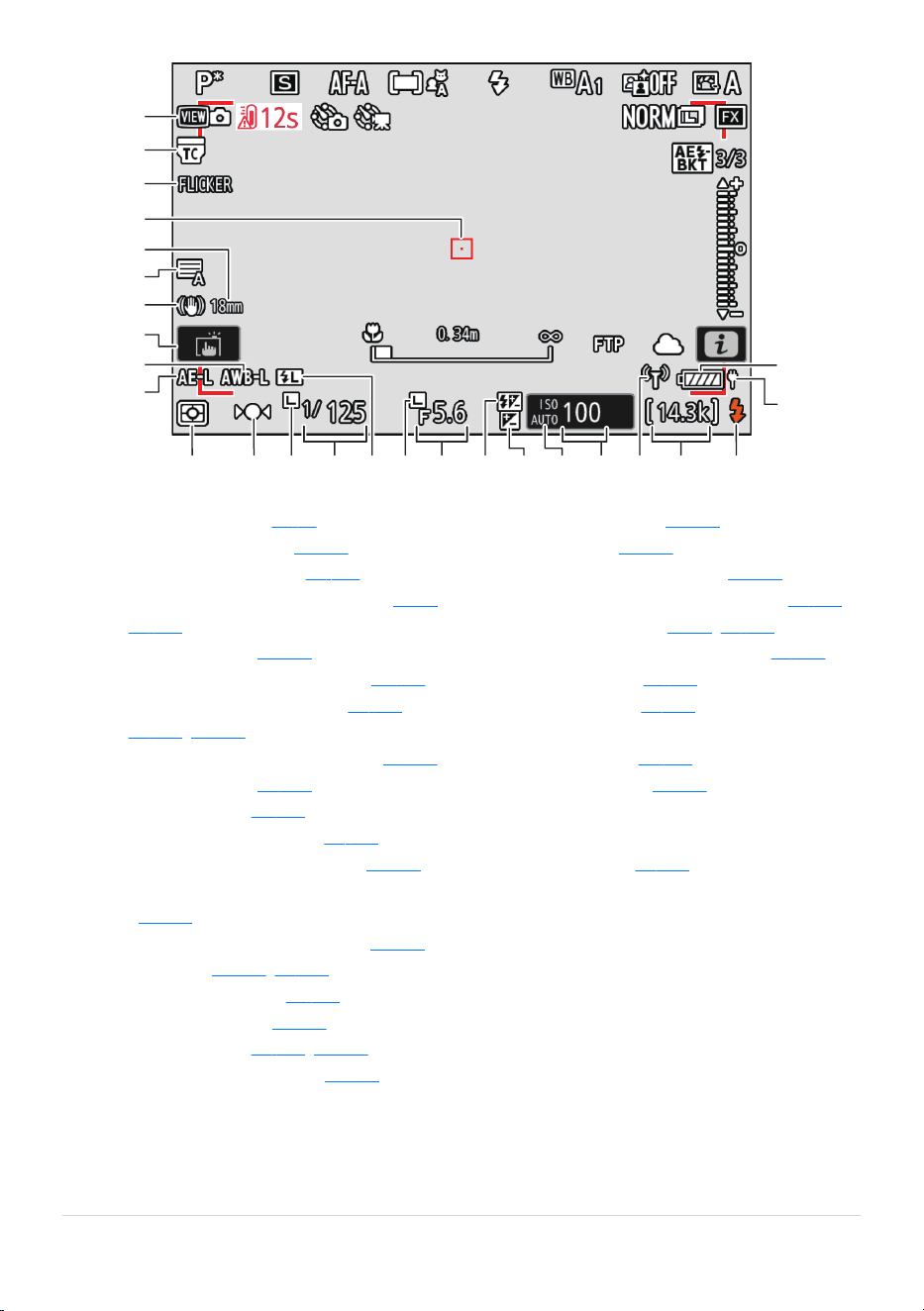
Battery indicator (0 88)
USB power deliver
y (
0 756)
Flash-ready indicator (
0 391)
Number of exposures r
emaining (
0 93,
0 906)
Buffer capacity ( 0 155)
Camera control mode display (0 372)
Wi-Fi connection indicator ( 0 322,
0 336, 0 350)
Bluetooth connection indicator (
0 774)
Airplane mode (0 769)
ISO sensitivity (0 160)
ISO sensitivity indicator (0 160)
Auto ISO sensitivity indicator ( 0 162)
Exposure compensation indicator
(0 150)
Flash compensation indicator ( 0 397)
Aperture (
0 140, 0 141)
Aperture lock icon (
0 646)
FV lock indicator ( 0 398)
Shutter speed (0 139, 0 141)
Shutter speed lock icon ( 0 646)
1
2
3
4
5
6
7
8
9
10
11
12
13
14
Focus indicator (0 135)
Metering (0 441)
Autoexposure (AE) lock (
0 148)
Auto white-b
alance (AWB) lock (
0 618)
Touch shooting (0 66, 0 131)
Vibration reduction indicator (
0 451)
Shutter type (0 585)
Silent mode ( 0 749)
Focal length
1
Focus point (0 130)
FLICKER icon ( 0 438)
“Lens built-in teleconv
erter enabled”
indicator
2
View mode (
0 590)
Displayed when using a zoom lens with no
focal length scale.
Display only when a NIKKORZ lens with
a built
-in teleconverter is attached and the
teleconverter enabled.
15
16
17
18
19
20
21
22
23
24
25
26
1
2
19
18
2
0
21
24
25
26
23
22
17
1
2
9111214
516 78
15 341013 6
829
CameraDisplays

D Temperature Warnings
If the camera temperatur
e becomes elevated, a high-temperature warning (K) and count-down
timer will be displayed. When the timer reaches zero, the shooting display will turn off.
The temperature at which the count-down timer starts can be selected from [Standard] and [High]
using [Auto temperature cutout] in the setup menu.
The timer turns red when the thirty second mark is reached. In some cases, the timer may be
displayed immediately after the camera is turned on.
D High-Temperature Warnings
If the camera becomes hot, a high-temperature warning (K) may appear in the shooting display. Note
that the camera body and battery may be hot while the high-temperature warning (K) is displayed.
D When the Wi-Fi Connection Indicator Flashes Rapidly
When the camera becomes hot while wirelessly connecting to a computer or smart device, the Wi-Fi
connection indicator (U) flashes rapidly and wireless transmission is interrupted.
Wait for the camera to cool before reconnecting the camera to the computer or smart device.
When the Wi-Fi connection indicator (U) flashes rapidly, note that the camera body and battery
may be hot.
D No Memory Card Inserted
If no memory card is inserted, [–E–] and a “no memory card” indicator will appear in the shooting
display.
830
CameraDisplays
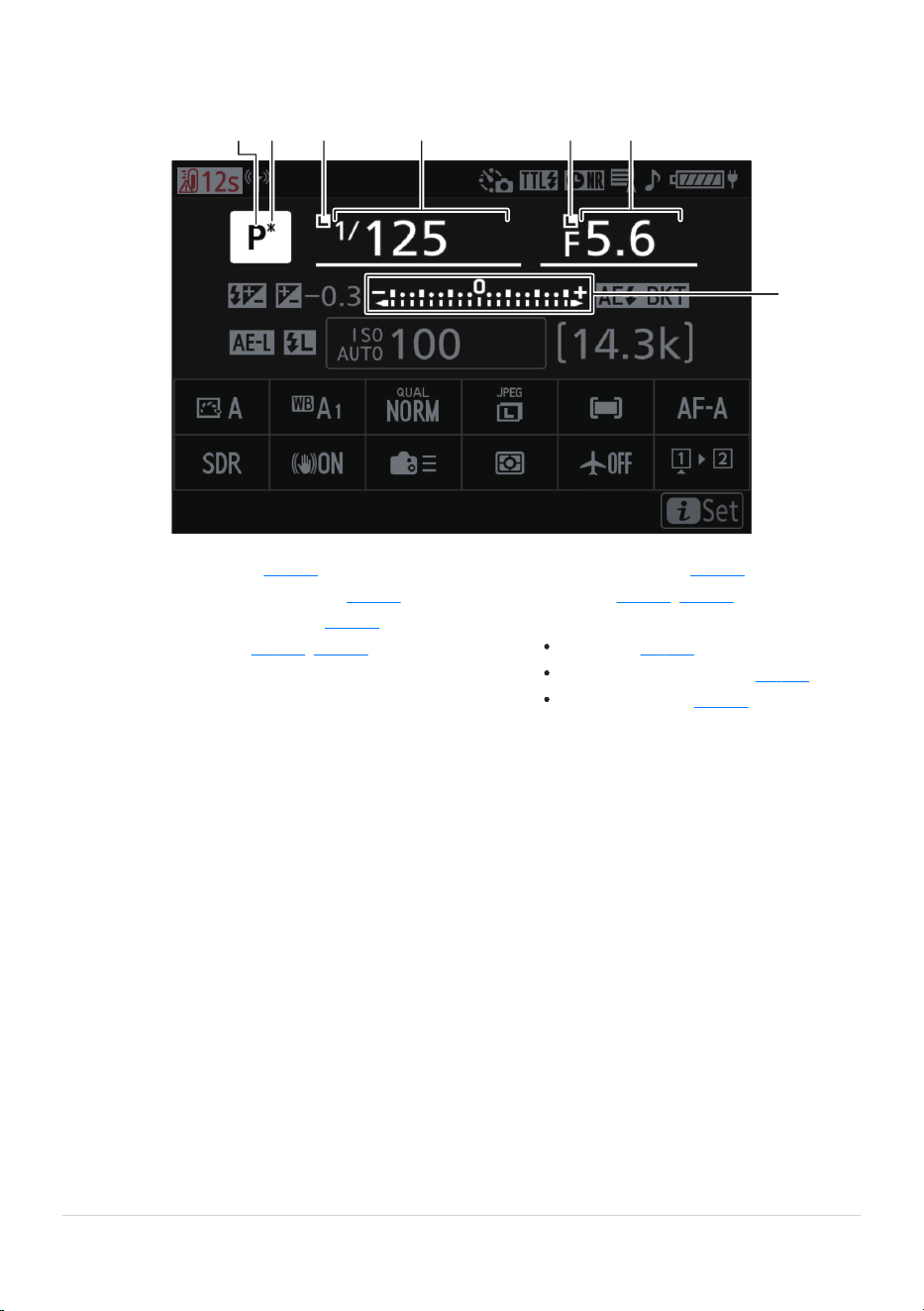
Shooting mode (0 137)
Flexible program indicator (0 138)
Shutter speed lock icon ( 0 646)
Shutter speed (0 139, 0 141)
1
2
3
4
Aperture lock icon ( 0 646)
Aperture (0 140, 0 141)
Exposure indicator
Exposure (0 142)
Exposure compensation (0 150)
Auto bracketing (0 453)
5
6
7
The Information Display
4 61 2 3 5
7
831
CameraDisplays
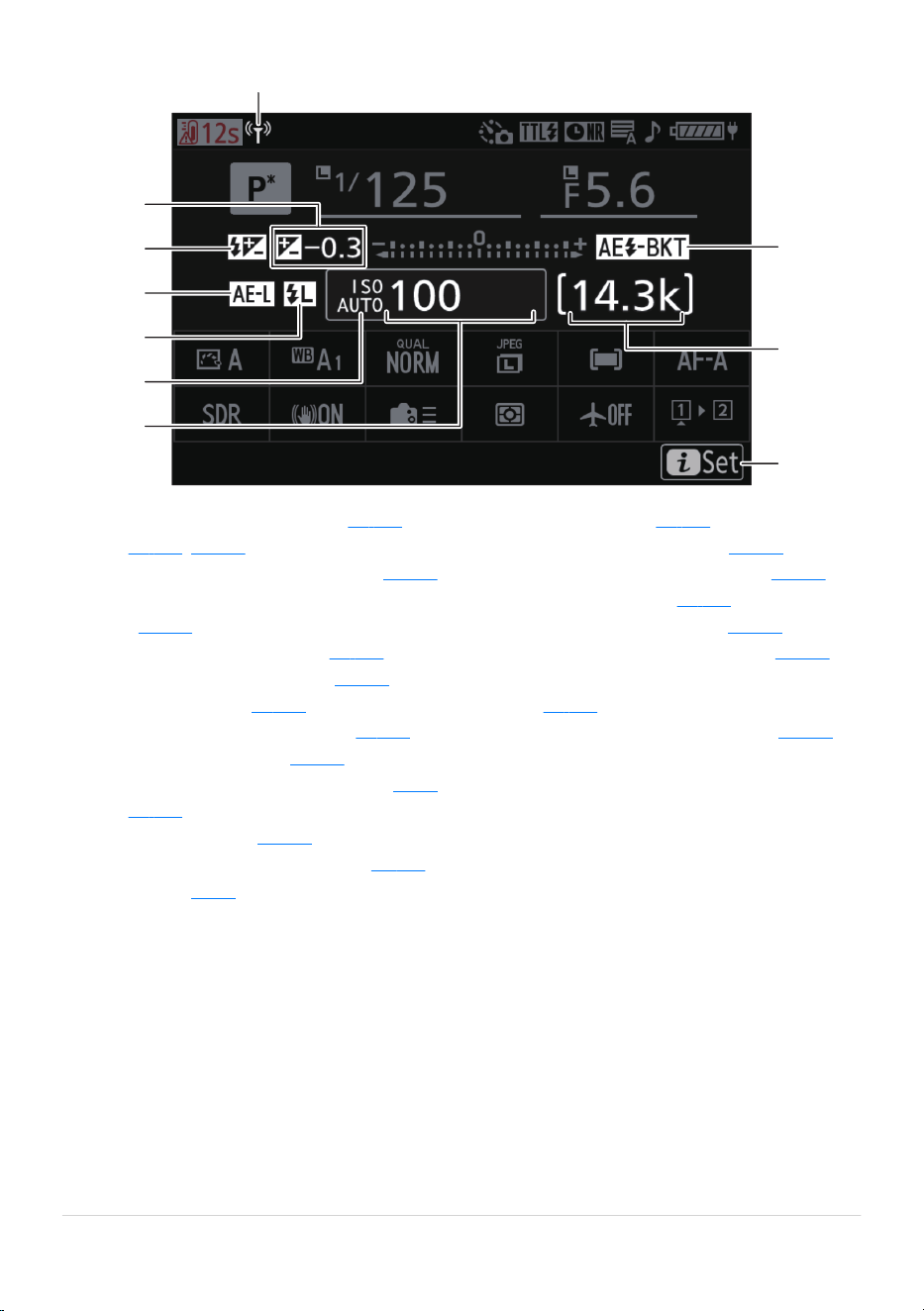
Wi-Fi connection indicator ( 0 322,
0 336, 0 350)
Bluetooth connection indicator (0 774)
Exposure and flash bracketing indicator
( 0 454)
WB bracketing indicator ( 0 458)
ADL bracketing indicator ( 0 461)
HDR indicator (0 472)
Multiple exposure indicator (0 465)
Pixel shift indicator (0 503)
Number of exposures remaining (0 93,
0 906)
Buffer capacity ( 0 155)
Camera control mode display (0 372)
i icon ( 0 80)
1
2
3
4
ISO sensitivity (0 160)
ISO sensitivity indicator (0 160)
Auto ISO sensitivity indicator ( 0 162)
FV lock indicator ( 0 398)
Autoexposure (AE) lock (0 148)
Flash compensation indicator ( 0 397)
Exposure compensation indicator
(0 150)
Exposure compensation value (0 150)
5
6
7
8
9
10
1
2
3
4
6
7
5
8
9
10
832
CameraDisplays
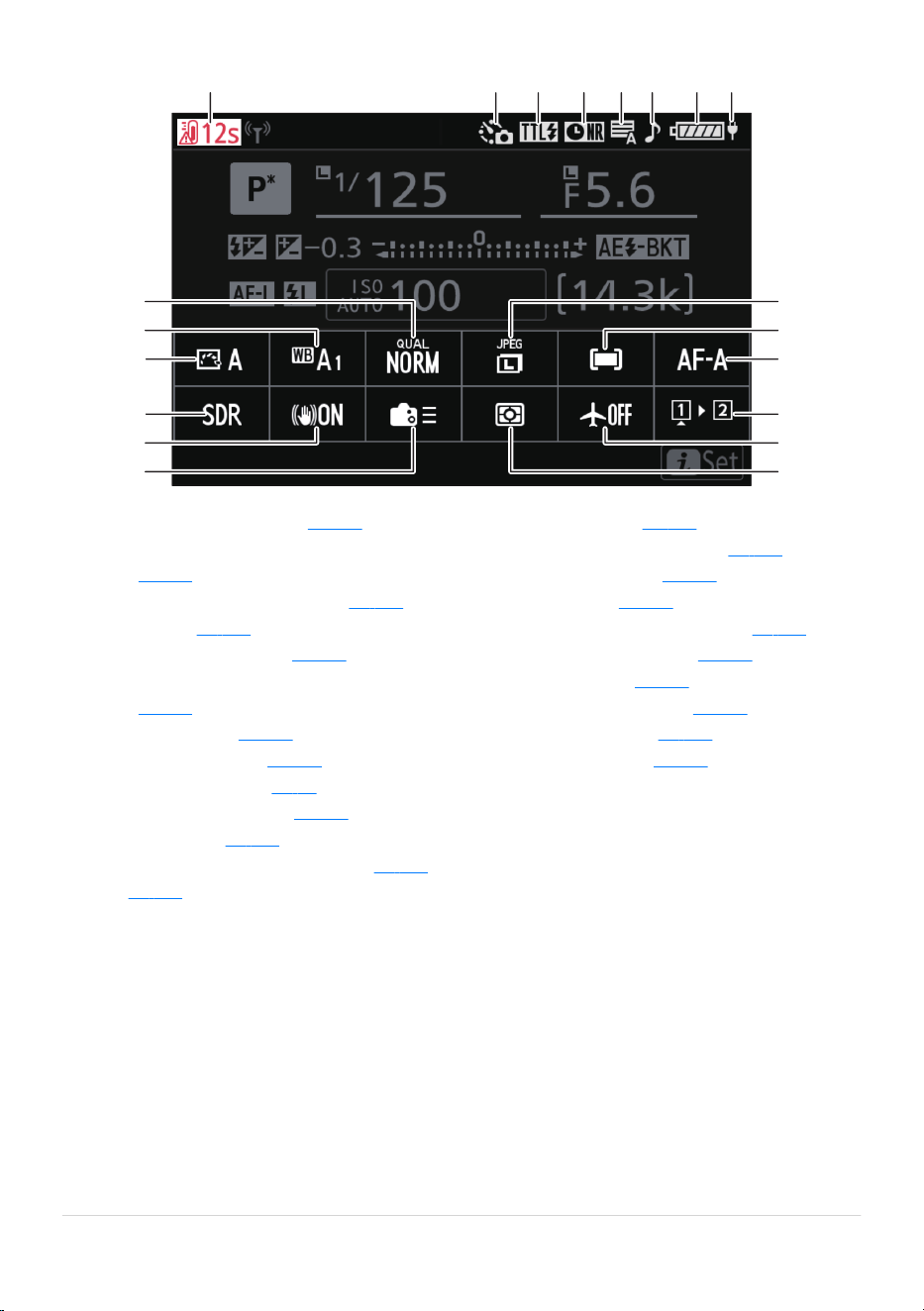
Temperature warning ( 0 733)
Interv
al-timer photography indicator
(
0 475)
Time-lapse video indicator ( 0 485)
g icon (0 100)
Flash control mode (
0 394)
Long-exposure noise reduction indicat
or
(
0 430)
Shutter type (0 585)
“Beep” indicator (
0 748)
Battery indicat
or (
0 88)
USB power deliver
y (
0 756)
Image size (0 118)
AF-area mode/subj. detection (
0 122,
0 126)
1
2
3
4
5
6
7
8
9
10
Focus mode (0 120)
View memory card info (
0 616)
Airplane mode (0 769)
Metering (0 441)
Custom controls (shooting; 0 618)
Vibration reduction (0 451)
Tone mode ( 0 417)
Set Picture Control (
0 164)
White balance (
0 182)
Image quality (0 116)
11
12
13
14
15
16
17
18
19
20
21 3 4
65 7 8
15
16
14
20
9
13
19
10
17
12
18
11
833
CameraDisplays
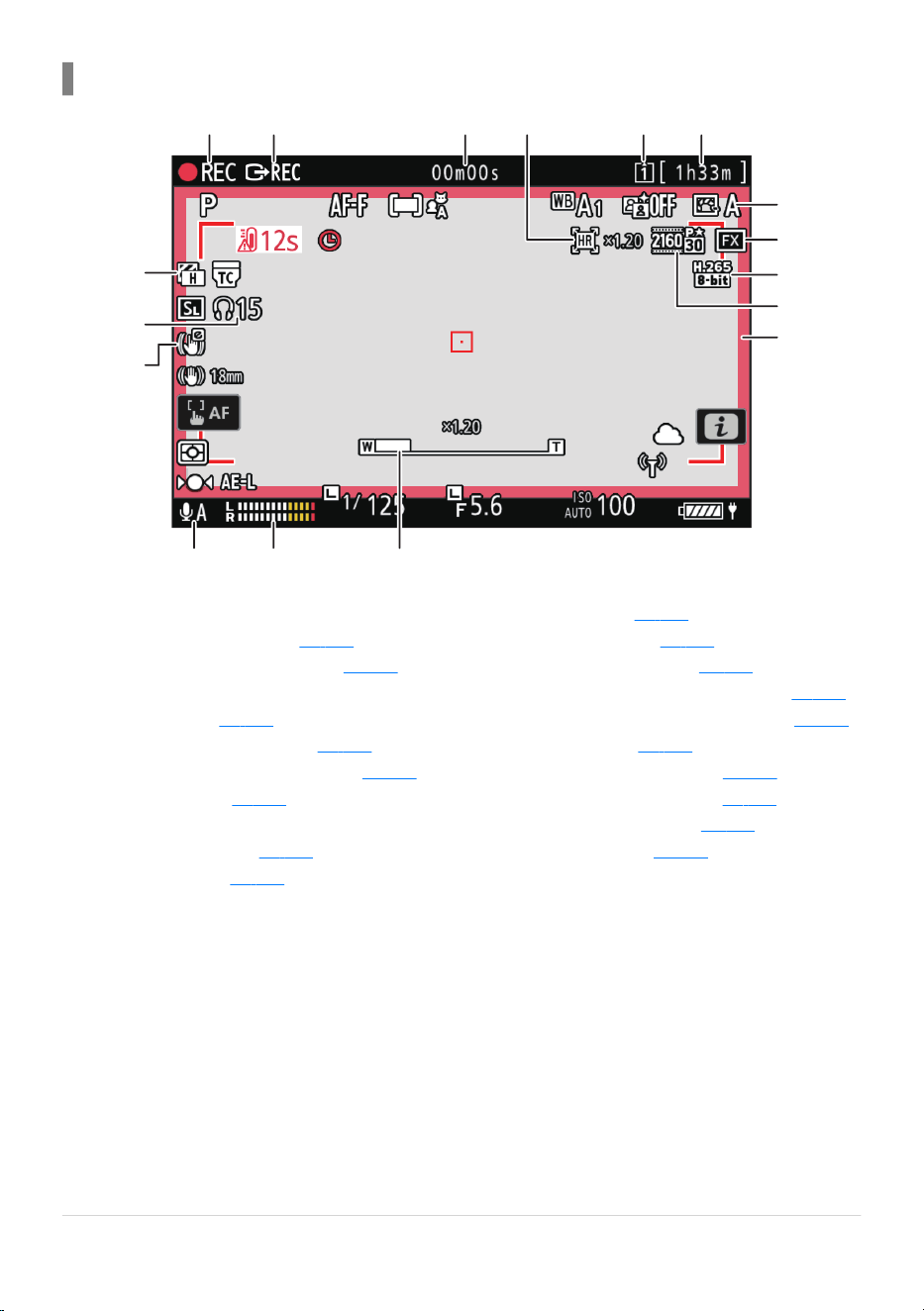
Recording indicator
“No video” indicator (
0 107)
External r
ecording control (
0 302)
Length of footage recor
ded
Timecode (
0 546)
Hi-Res Zoom indicator ( 0 213)
Zoom ratio for Hi-Res Zoom ( 0 213)
Destination (0 513)
Available r
ecording time
Picture Control (
0 164)
Tone mode (0 201)
1
2
3
4
5
6
7
Image area (0 209)
Video file type (0 200)
Frame size and rate ( 0 202)
Recording indicat
or (red border;
0 690)
Zoom position for Hi-Res Zoom ( 0 213)
Sound level ( 0 540)
Microphone sensitivity (0 540)
Electronic VR indicator (
0 539)
Headphone volume ( 0 545)
Zebra patter
n (
0 681)
8
9
10
11
12
13
14
15
16
17
Video Mode
15
16
17
1 2 3 5
64
8
9
11
10
7
13
1214
834
CameraDisplays
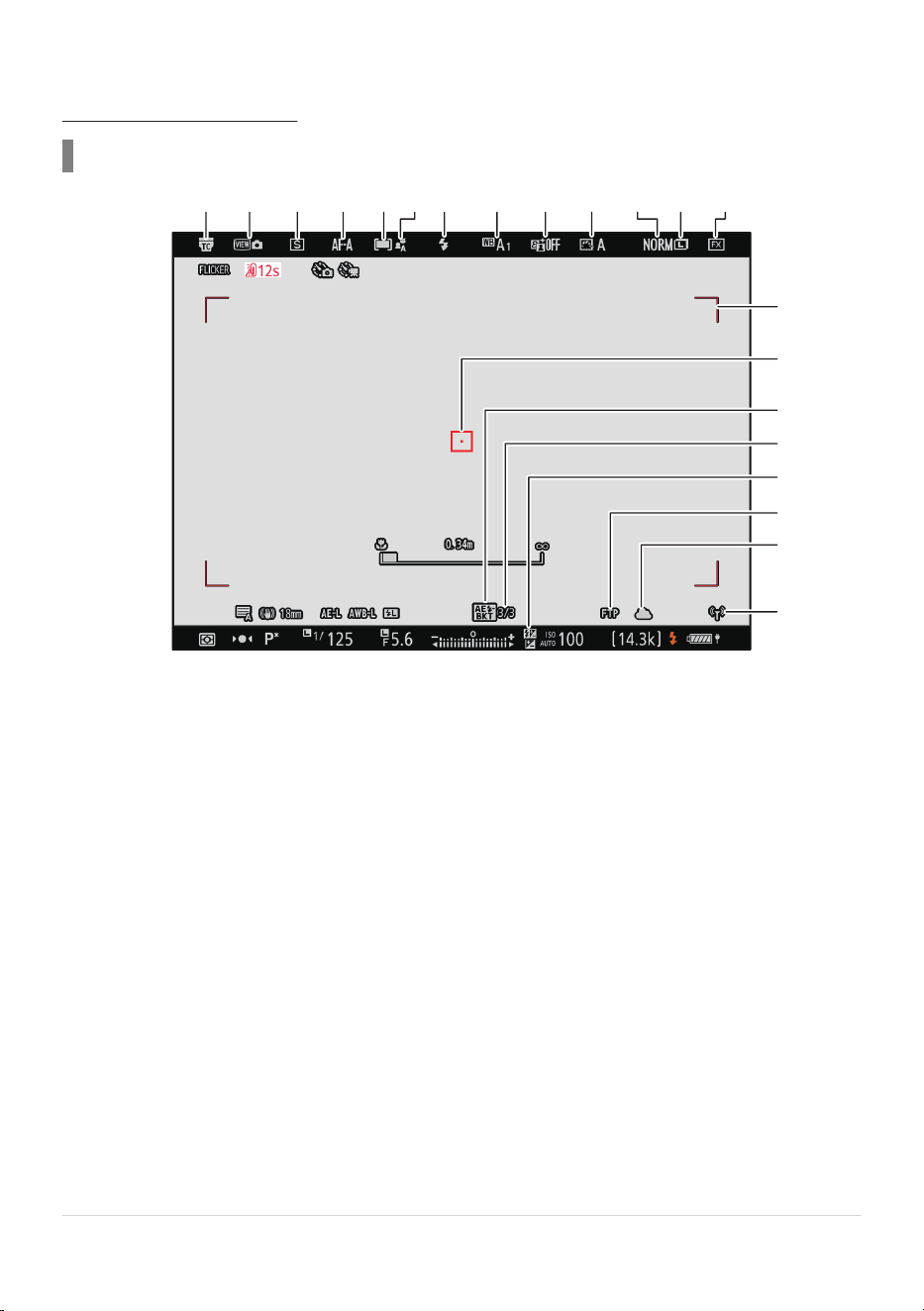
The Viewfinder
Photo Mode
12 1331 2 4 5 6 7 8 9 10 11
21
19
20
18
17
15
16
14
835
CameraDisplays

“Lens built-in teleconverter enabled”
indicator
View mode ( 0 590)
Release mode (0 152)
Focus mode (0 120)
AF-area mode (0 122)
Subject detection (0 126)
Flash mode (0 395)
White balance (
0 182)
Active D-Lighting (0 428)
Picture Control (
0 164)
Image quality (0 116)
Image size (0 118)
Image area (0 114)
Out-of
-focus indicator (auto-area AF;
0 101)
Focus point (0 130)
Exposure and flash bracketing indicat
or
(
0 454)
WB bracketing indicator (
0 458)
ADL bracketing indicator (
0 461)
HDR indicator (0 472)
Multiple exposure indicator (
0 465)
Pixel shift indicat
or (
0 503)
1
2
3
4
5
6
7
8
9
10
11
12
13
14
15
16
Number of shots in exposure and flash
bracketing sequence ( 0 454)
Number of shots in WB bracketing
sequence (
0 458)
Number of shots in ADL bracketing
sequence ( 0 461)
HDR strength (0 472)
Number of shots in multiple exposure
(0 465)
Pre-Release Captur
e (
0 581)
Number of shots in pixel shif
t sequence
(
0 503)
Flash compensation indicator ( 0 397)
FTP connection status ( 0 350)
NikonImagingCloud connection status
(0 308)
Remote camera connection status
( 0 378)
Wi-Fi connection indicator ( 0 322,
0 336, 0 350)
Bluetooth connection indicator (
0 774)
Airplane mode (0 769)
17
18
19
20
21
836
CameraDisplays
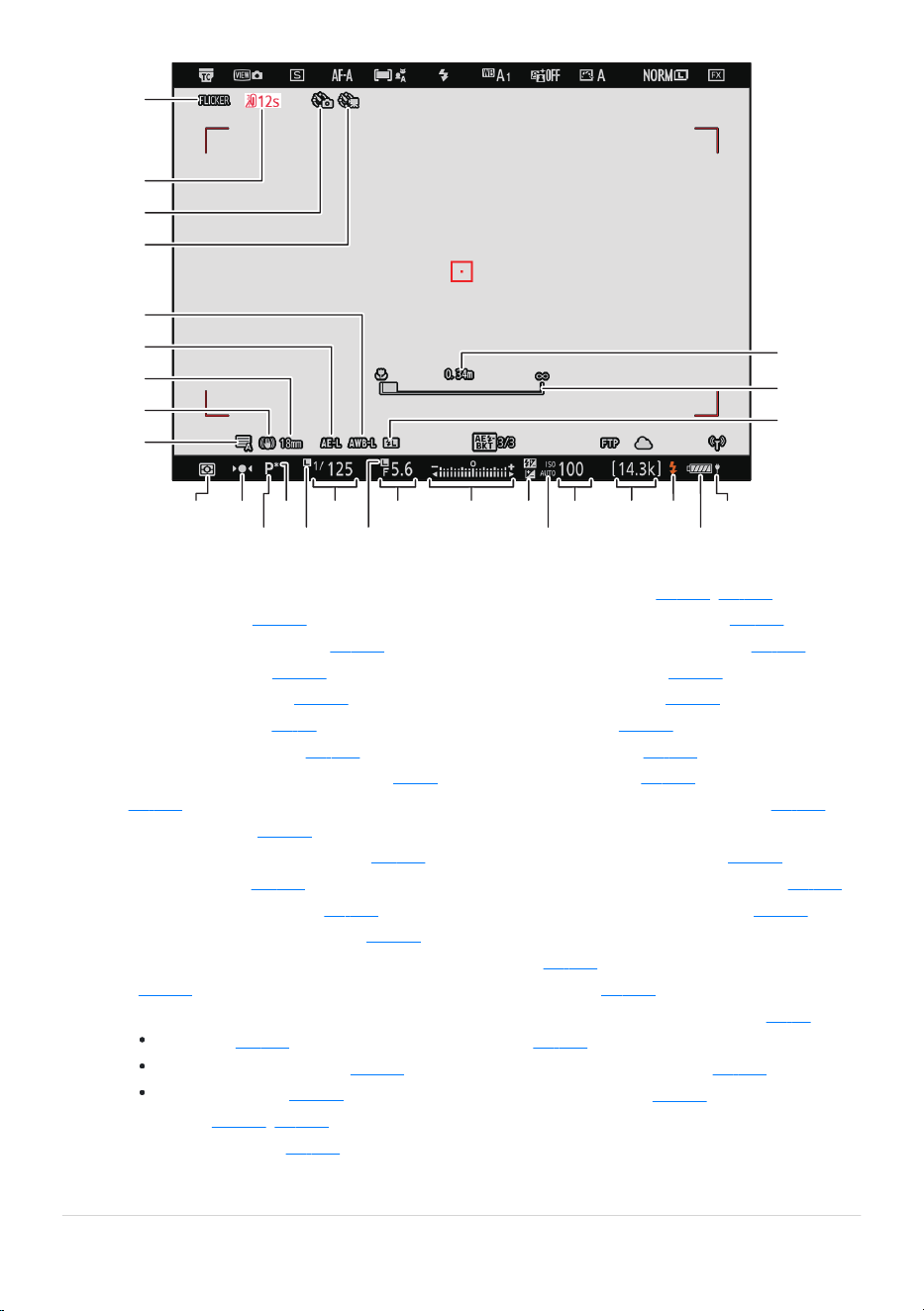
Distance between the camera and the
focus position (0 135)
Focus distance indicator (0 135)
FV lock indicator ( 0 398)
USB power deliver
y (
0 756)
Battery indicat
or (
0 88)
Flash-ready indicator (
0 391)
Number of exposures r
emaining (
0 93,
0 906)
Buffer capacity ( 0 155)
Camera control mode display (0 372)
ISO sensitivity (0 160)
ISO sensitivity indicator (0 160)
Auto ISO sensitivity indicator (
0 162)
Exposure compensation indicator
(0 150)
Exposure indicator
Exposur
e (
0 142)
Exposure compensation (0 150)
Auto bracketing (
0 453)
Aperture (
0 140, 0 141)
Aperture lock icon (
0 646)
1
2
3
4
5
6
7
8
9
10
11
12
13
Shutter speed (
0 139, 0 141)
Shutter speed lock icon ( 0 646)
Flexible program indicator (
0 138)
Shooting mode (0 137)
Focus indicator (0 135)
Metering (0 441)
Shutter type (0 585)
Silent mode ( 0 749)
Vibration reduction indicator (
0 451)
Focal length
Autoexposure (AE) lock (
0 148)
Auto white-b
alance (AWB) lock (
0 618)
Time-lapse video indicator ( 0 485)
Interv
al-timer photography indicator
(
0 475)
g icon (0 100)
“No memory card” indicat
or (
0 92,
0 830)
Temperature warning ( 0 733)
FLICKER icon ( 0 438)
14
15
16
17
18
19
20
21
22
23
24
25
26
27
28
21
20
22
3
23
24
25
26
27
28
10
9
15
13
16
17
18
14 12 6 4
5
19 711 8
2
1
837
CameraDisplays
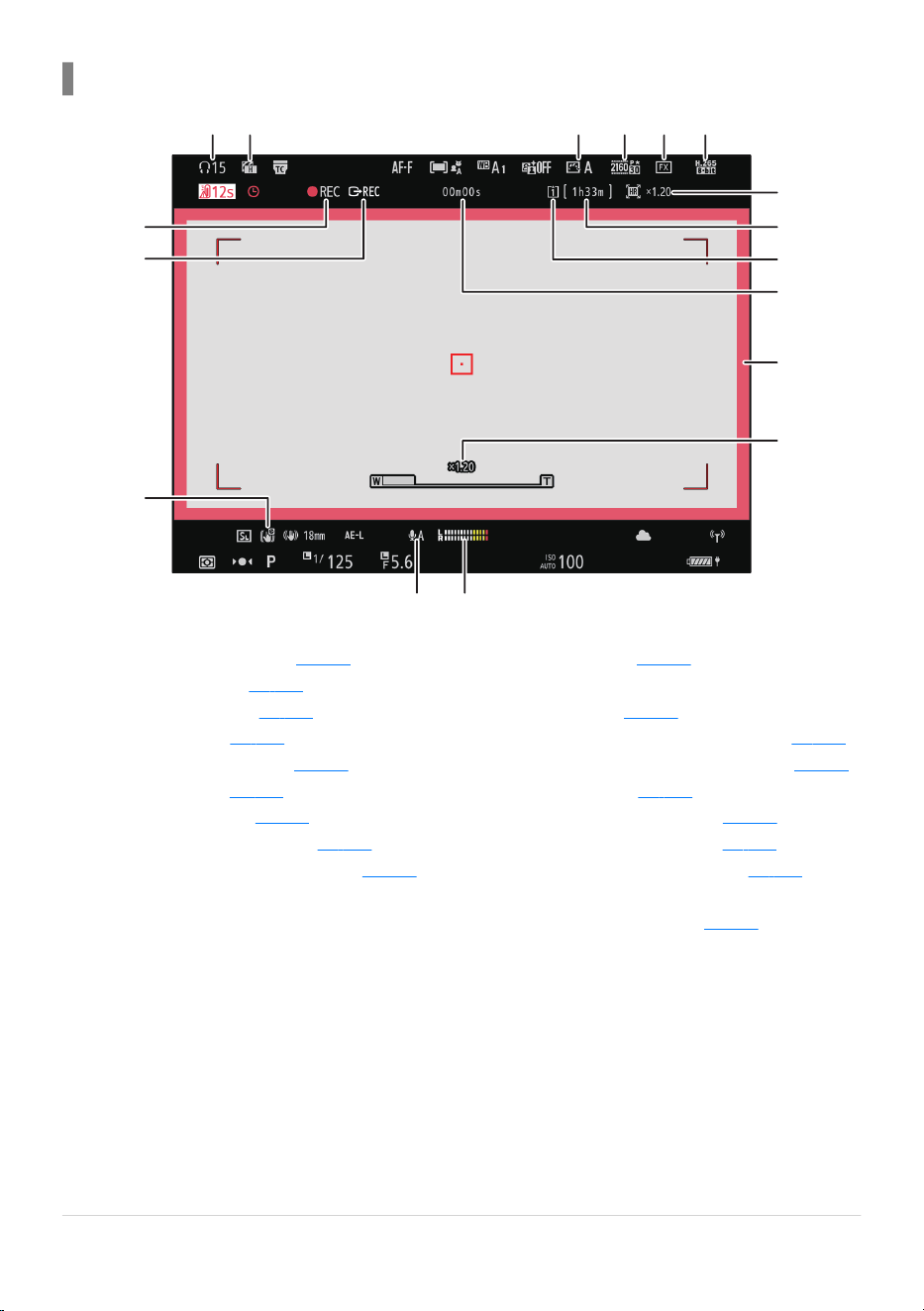
Headphone volume ( 0 545)
Zebra patter
n (
0 681)
Picture Control (
0 164)
Tone mode (0 201)
Frame size and rate ( 0 202)
Image area (0 209)
Video file type (0 200)
Hi-Res Zoom indicator ( 0 213)
Zoom ratio for Hi-Res Zoom ( 0 213)
Available r
ecording time
1
2
3
4
5
6
7
8
Destination (
0 513)
Length of footage recor
ded
Timecode (
0 546)
Recording indicat
or (red border;
0 690)
Zoom position for Hi-Res Zoom ( 0 213)
Sound level ( 0 540)
Microphone sensitivity (0 540)
Electronic VR indicator (
0 539)
External r
ecording control (
0 302)
Recording indicat
or
“No video” indicator (
0 107)
9
10
11
12
13
14
15
16
17
Video Mode
15
17
16
4
3
5 61 2
8
7
11
12
9
10
1314
838
CameraDisplays
Compatible Flash Units
The Nikon Creative Lighting System (CLS)
Nikon’s adv
anced Creative Lighting System (CLS) supports a variety of features thanks to improved
communication between the camera and compatible flash units.
Features Available with CLS-Compatible Flash Units
Flash unit
0
SB-5000 0 840
SB‑910/SB‑900/SB‑800 0 842
SB-700 0 844
SB-600 0 846
SB-500 0 848
SB-R200 0 850
SB-400 0 852
SB-300 0 854
SU-800 0 856
839
Compatible Flash Units

The SB‑5000
Supported features
Stand-alone
i‑TTL
i‑TTL balanced fill-flash
4
1
Standard i‑TTL fill-flash
4
2
qA
Auto aperture
4
A Non-TTL auto —
GN Distance-priority manual
4
M Manual
4
RPT Repeating flash
4
840
Compatible Flash Units

Supported features
Optical Advanced Wireless Lighting
Master
Remote flash control
4
i‑TTL i‑TTL
4
[A : B] Quick wireless flash control
4
qA
Auto aperture
4
A Non-TTL auto —
M Manual
4
RPT Repeating flash
4
Remote
i‑TTL i‑TTL
4
[A : B] Quick wireless flash control
4
qA/A
Auto aperture/non-TTL auto
4
3
M Manual
4
RPT Repeating flash
4
Radio-controlled Advanced Wireless Lighting —
Color Information Communication (flash)
4
Color Information Communication (LED light) —
Auto FP high-speed sync
4
4
FV lock
4
5
Red-eye reduction
4
841
Compatible Flash Units
Supported features
Camera modeling illumination
4
Unified flash control —
Camera flash unit firmware update
4
Not available with spot metering.
Can also be selected via the flash unit.
Choice of
qA and A depends on the option selected with the master flash.
Available only in i‑TTL, qA, A, GN, and M flash-control modes.
Available only in i‑TTL flash control mode or when the flash is configured to emit monitor
preflashes in qA or A flash control mode.
The SB‑910, SB‑900, and SB‑800
Supported features
Stand-alone
i‑TTL
i‑TTL balanced fill-flash
4
1
Standard i‑TTL fill-flash
4
2
qA
Auto aperture
4
3
A Non-TTL auto
4
3
GN Distance-priority manual
4
M Manual
4
RPT Repeating flash
4
842
Compatible Flash Units
1
2
3
4
5

Supported features
Optical Advanced Wireless Lighting
Master
Remote flash control
4
i‑TTL i‑TTL
4
[A : B] Quick wireless flash control —
qA
Auto aperture
4
A Non-TTL auto —
M Manual
4
RPT Repeating flash
4
Remote
i‑TTL i‑TTL
4
[A : B] Quick wireless flash control
4
qA/A
Auto aperture/non-TTL auto
4
4
M Manual
4
RPT Repeating flash
4
Radio-controlled Advanced Wireless Lighting —
Color Information Communication (flash)
4
Color Information Communication (LED light) —
Auto FP high-speed sync
4
5
FV lock
4
6
Red-eye reduction
4
843
Compatible Flash Units
Supported features
Camera modeling illumination
4
Unified flash control —
Camera flash unit firmware update
4
7
Not available with spot metering.
Can also be selected via the flash unit.
qA/A mode selection is per
formed on the flash unit using custom settings.
Choice of qA and A depends on the option selected with the master flash.
Available only in i‑TTL, qA, A, GN, and M flash-control modes.
Available only in i‑TTL flash control mode or when the flash is configured to emit monitor
preflashes in qA or A flash control mode.
Firmware updates for the SB‑910 and SB‑900 can be performed from the camera.
The SB‑700
Supported features
Stand-alone
i‑TTL
i‑TTL balanced fill-flash
4
1
Standard i‑TTL fill-flash
4
qA
Auto aperture —
A Non-TTL auto —
GN Distance-priority manual
4
M Manual
4
RPT Repeating flash —
844
Compatible Flash Units
1
2
3
4
5
6
7

Supported features
Optical Advanced Wireless Lighting
Master
Remote flash control
4
i‑TTL i‑TTL
4
[A : B] Quick wireless flash control
4
qA
Auto aperture —
A Non-TTL auto —
M Manual
4
RPT Repeating flash —
Remote
i‑TTL i‑TTL
4
[A : B] Quick wireless flash control
4
qA/A
Auto aperture/non-TTL auto —
M Manual
4
RPT Repeating flash
4
Radio-controlled Advanced Wireless Lighting —
Color Information Communication (flash)
4
Color Information Communication (LED light) —
Auto FP high-speed sync
4
2
FV lock
4
3
Red-eye reduction
4
845
Compatible Flash Units
Supported features
Camera modeling illumination
4
Unified flash control —
Camera flash unit firmware update
4
Not available with spot metering.
Available only in
i‑TTL, GN, and M flash-control modes.
Available only in i‑TTL flash-control mode.
The SB‑600
Supported features
Stand-alone
i‑TTL
i‑TTL balanced fill-flash
4
1
Standard i‑TTL fill-flash
4
2
qA
Auto aperture —
A Non-TTL auto —
GN Distance-priority manual —
M Manual
4
RPT Repeating flash —
846
Compatible Flash Units
1
2
3

Supported features
Optical Advanced Wireless Lighting
Master
Remote flash control —
i‑TTL i‑TTL —
[A : B] Quick wireless flash control —
qA
Auto aperture —
A Non-TTL auto —
M Manual —
RPT Repeating flash —
Remote
i‑TTL i‑TTL
4
[A : B] Quick wireless flash control
4
qA/A
Auto aperture/non-TTL auto —
M Manual
4
RPT Repeating flash
4
Radio-controlled Advanced Wireless Lighting —
Color Information Communication (flash)
4
Color Information Communication (LED light) —
Auto FP high-speed sync
4
3
FV lock
4
4
Red-eye reduction
4
847
Compatible Flash Units
Supported features
Camera modeling illumination
4
Unified flash control —
Camera flash unit firmware update —
Not available with spot metering.
Can also be selected via the flash unit.
Av
ailable only in i‑TTL and M flash-control modes.
Available only in i‑TTL flash-control mode.
The SB‑500
Supported features
Stand-alone
i‑TTL
i‑TTL balanced fill-flash
4
1
Standard i‑TTL fill-flash
4
qA
Auto aperture —
A Non-TTL auto —
GN Distance-priority manual —
M Manual
4
2
RPT Repeating flash —
848
Compatible Flash Units
1
2
3
4

Supported features
Optical Advanced Wireless Lighting
Master
Remote flash control
4
2
i‑TTL i‑TTL
4
2
[A : B] Quick wireless flash control —
qA
Auto aperture —
A Non-TTL auto —
M Manual
4
2
RPT Repeating flash —
Remote
i‑TTL i‑TTL
4
[A : B] Quick wireless flash control
4
qA/A
Auto aperture/non-TTL auto —
M Manual
4
RPT Repeating flash
4
Radio-controlled Advanced Wireless Lighting —
Color Information Communication (flash)
4
Color Information Communication (LED light)
4
Auto FP high-speed sync
4
3
FV lock
4
4
Red-eye reduction
4
849
Compatible Flash Units
Supported features
Camera modeling illumination
4
Unified flash control —
Camera flash unit firmware update
4
Not available with spot metering.
Can be selected using the [Flash control] it
em in the camera menus.
Available only in i‑TTL and M flash-control modes.
Available only in i‑TTL flash-control mode.
The SB‑R200
Supported features
Stand-alone
i‑TTL
i‑TTL balanced fill-flash —
Standard i‑TTL fill-flash —
qA
Auto aperture —
A Non-TTL auto —
GN Distance-priority manual —
M Manual —
RPT Repeating flash —
850
Compatible Flash Units
1
2
3
4

Supported features
Optical Advanced Wireless Lighting
Master
Remote flash control —
i‑TTL i‑TTL —
[A : B] Quick wireless flash control —
qA
Auto aperture —
A Non-TTL auto —
M Manual —
RPT Repeating flash —
Remote
i‑TTL i‑TTL
4
[A : B] Quick wireless flash control
4
qA/A
Auto aperture/non-TTL auto —
M Manual
4
RPT Repeating flash —
Radio-controlled Advanced Wireless Lighting —
Color Information Communication (flash) —
Color Information Communication (LED light) —
Auto FP high-speed sync
4
1
FV lock
4
2
Red-eye reduction —
851
Compatible Flash Units
Supported features
Camera modeling illumination
4
Unified flash control —
Camera flash unit firmware update —
Available only in i‑TTL and
M flash-control modes.
Available only in i‑TTL flash-control mode.
The SB‑400
Supported features
Stand-alone
i‑TTL
i‑TTL balanced fill-flash
4
1
Standard i‑TTL fill-flash
4
qA
Auto aperture —
A Non-TTL auto —
GN Distance-priority manual —
M Manual
4
2
RPT Repeating flash —
852
Compatible Flash Units
1
2

Supported features
Optical Advanced Wireless Lighting
Master
Remote flash control —
i‑TTL i‑TTL —
[A : B] Quick wireless flash control —
qA
Auto aperture —
A Non-TTL auto —
M Manual —
RPT Repeating flash —
Remote
i‑TTL i‑TTL —
[A : B] Quick wireless flash control —
qA/A
Auto aperture/non-TTL auto —
M Manual —
RPT Repeating flash —
Radio-controlled Advanced Wireless Lighting —
Color Information Communication (flash)
4
Color Information Communication (LED light) —
Auto FP high-speed sync —
FV lock
4
3
Red-eye reduction
4
853
Compatible Flash Units
Supported features
Camera modeling illumination —
Unified flash control —
Camera flash unit firmware update —
Not available with spot metering.
Can be selected using the [Flash control] it
em in the camera menus.
Available only in i‑TTL flash-control mode.
The SB‑300
Supported features
Stand-alone
i‑TTL
i‑TTL balanced fill-flash
4
1
Standard i‑TTL fill-flash
4
qA
Auto aperture —
A Non-TTL auto —
GN Distance-priority manual —
M Manual
4
2
RPT Repeating flash —
854
Compatible Flash Units
1
2
3

Supported features
Optical Advanced Wireless Lighting
Master
Remote flash control —
i‑TTL i‑TTL —
[A : B] Quick wireless flash control —
qA
Auto aperture —
A Non-TTL auto —
M Manual —
RPT Repeating flash —
Remote
i‑TTL i‑TTL —
[A : B] Quick wireless flash control —
qA/A
Auto aperture/non-TTL auto —
M Manual —
RPT Repeating flash —
Radio-controlled Advanced Wireless Lighting —
Color Information Communication (flash)
4
Color Information Communication (LED light) —
Auto FP high-speed sync —
FV lock
4
3
Red-eye reduction —
855
Compatible Flash Units
Supported features
Camera modeling illumination —
Unified flash control —
Camera flash unit firmware update
4
Not available with spot metering.
Can be selected using the [Flash control] it
em in the camera menus.
Available only in i‑TTL flash-control mode.
The SU-800 Wireless Speedlight Commander
When mounted on a CLS-compatible camera, the SU-800 can be used as a commander for SB‑5000,
SB‑910, SB‑900, SB‑800, SB‑700, SB‑600, SB‑500, or SB‑R200 flash units. Group flash control is
supported for up to three groups. The SU-800 itself is not equipped with a flash.
Supported features
Stand-alone
i‑TTL
i‑TTL balanced fill-flash —
Standard i‑TTL fill-flash —
qA
Auto aperture —
A Non-TTL auto —
GN Distance-priority manual —
M Manual —
RPT Repeating flash —
856
Compatible Flash Units
1
2
3

Supported features
Optical Advanced Wireless Lighting
Master
Remote flash control
4
i‑TTL i‑TTL —
[A : B] Quick wireless flash control
4
1
qA
Auto aperture —
A Non-TTL auto —
M Manual —
RPT Repeating flash —
Remote
i‑TTL i‑TTL —
[A : B] Quick wireless flash control —
qA/A
Auto aperture/non-TTL auto —
M Manual —
RPT Repeating flash —
Radio-controlled Advanced Wireless Lighting —
Color Information Communication (flash) —
Color Information Communication (LED light) —
Auto FP high-speed sync
4
2
FV lock
4
3
Red-eye reduction —
857
Compatible Flash Units

Supported features
Camera modeling illumination
4
Unified flash control —
Camera flash unit firmware update —
Available during close-up photography only.
Not available when RPT is select
ed as the flash control mode for the remote flash unit.
Available only when i‑TTL is selected as the flash control mode for the remote flash unit or when
the flash is configured to emit monitor preflashes in mode qA.
858
Compatible Flash Units
1
2
3
Notes on Optional Flash Units
Be sure also to consult documentation for the optional flash unit befor
e use.
If the unit supports CLS, refer to the section on CLS-compatible digital SLR cameras. This camera
is not included in the “digital SLR” category in the documentation for the SB‑80DX, SB‑28DX, and
SB‑50DX.
If the flash-ready indicator (c) flashes for about three seconds after a photograph is taken in i‑TTL
or non-TTL auto mode, the flash has fired at full power and the photograph may be underexposed
(CLS-compatible flash units only).
i‑TTL flash control can be used at ISO sensitivities between 64 and 12800 equivalent.
At ISO sensitivities over 12800, the desired results may not be achieved at some ranges or aperture
settings.
In mode P, the maximum aperture (minimum f-number) is limited according to ISO sensitivity, as
shown below:
Maximum aperture (minimum f-number) at ISO equivalent of:
100 200 400 800 1600 3200 6400 12800
4 5 5.6 7.1 8 10 11 13
If the maximum aperture of the lens is smaller than given above, the maximum value for aperture
will be the maximum aperture o
f the lens.
The SB‑5000, SB‑910, SB‑900, SB‑800, SB‑700, SB‑600, SB‑500, and SB‑400 provide red-eye
reduction in red-eye reduction and slow-sync with red-eye reduction flash modes.
“Noise” in the form of lines may appear in flash photographs taken with an SD-9 or SD-8A high-
performance battery pack attached directly to the camera. Reduce ISO sensitivity or increase the
distance between the camera and the battery pack.
The camera provides AF-assist illumination as required. AF-assist illuminators on optional flash units
will not light.
When an SC‑series 17, 28, or 29 sync cable is used for off-camera flash photography, correct
exposure may not be achieved in i‑TTL mode. We recommend that you select standard i‑TTL
fill-flash. Take a test shot and view the results in the camera display.
In i‑TTL, do not use any form of flash panel (diffusion panel) other than the flash unit’s built-in flash
panel or supplied bounce adapter. Using other panels may produce incorrect exposure.
859
Compatible Flash Units
*

D Flash Photography
Flash photography cannot be combined with some camera featur
es, including:
silent mode,
video recording,
high-speed frame capture +,
HDR overlay.
D Using FV Lock with Optional Flash Units
FV lock is available with optional flash units in TTL and (where supported) monitor pre-flash qA and
monitor pre-flash A flash control modes (see the documentation provided with the flash unit for
more information).
Note that when Advanced Wireless Lighting is used to control remote flash units, you will need to
set the flash control mode for the master or at least one remote group to TTL, qA, or A.
D Other Flash Units
The following flash units can be used in non-TTL auto (A) and manual modes. The options available do
not vary with the lens used.
Flash unit Supported features
SB‑80DX, SB‑28DX, SB‑28, SB‑26, SB‑25,
SB‑24
Non-TTL auto, manual, repeating flash, rear-curtain
sync
1
SB‑50DX, SB‑23, SB‑29, SB‑21B, SB‑29S Manual, rear-curtain sync
1
SB‑30, SB‑27
2
, SB‑22S, SB‑22, SB‑20, SB‑16B,
SB‑15
Non-TTL auto, manual, rear-curtain sync
1
Available when the camera is used to select the flash mode.
Mounting an SB‑27 on the camera aut
omatically sets the flash mode to T
TL, but setting the flash
mode to TTL disables the shutter release. Set the SB‑27 to A.
860
Compatible Flash Units
1
2

D Metering Areas for FV Lock
The areas met
ered when FV lock is used with optional flash units are as follows:
Stand-Alone
Flash control mode Metered area
i-TTL 6-mm circle in center of frame
Auto aperture (qA)
Area metered by flash exposure meter
Remote
Flash control mode Metered area
i-TTL Entire frame
Auto aperture (qA)
Area metered by flash exposure meter
Non-TTL auto (A)
D Flash Compensation for Optional Flash Units
In i‑T
TL and auto aperture (qA) flash control modes, the flash compensation selected with the
optional flash unit or with [Flash control] in the camera photo shooting menu is added to the flash
compensation selected with the [Flash compensation] item in the photo shooting menu.
861
Compatible Flash Units

Tip: Modeling Illumination
Pressing the control t
o which [Preview] has been assigned using Custom Setting f2 [Custom
controls (shooting)] causes CLS-compatible flash units to emit a modeling flash.
This feature can be used with Advanced Wireless Lighting to preview the total lighting effect
achieved with multiple flash units.
The effects of shadows cast by the flash are best observed directly rather than in the shooting
display.
Modeling illumination can be turned off by selecting [OFF] for Custom Setting e5 [Modeling flash].
Tip: Studio Strobe Lighting
To adjust the color and brightness of the view through the lens so that shots are easier to frame, select
[Adjust for ease of viewing] for Custom Setting d10 [View mode (photo Lv)].
862
Compatible Flash Units

Other Compatible Accessories
A variety of accessories ar
e available for your Nikon camera.
D Compatible Accessories
Availability may vary with country or region.
See our website or brochures for the latest information.
● Power Sources
EN‑EL15c Rechargeable Li-ion Battery: EN‑EL15c batteries can be used with Nikon Z5II digital
cameras.
EN‑EL15b and EN‑EL15a batteries can also be used. Note, however, that fewer pictures can be
taken on a single charge than with the EN‑EL15c (
0 909).
EH‑8P AC Adapter: When connect
ed to the camera via USB, the EH-8P can be used to charge
batteries inserted in the camera.
The battery will not charge while the camera is on.
The EH-8P cannot be used to charge EN‑EL15a batteries.
The EH-8P can be used to power the camera; to do so, select [ON] for [USB power delivery]
in the setup menu. For more information, see “USB power delivery” (
0 756).
Connections for power supply or batt
ery charging using the EH-8P must be made via the
supplied USB cable (featuring Type-C connectors at both ends).
MH‑25a Battery Charger: The MH‑25a can be used to recharge EN‑EL15c batteries.
MH‑34 Battery Charger: The MH‑34 can be used to recharge EN‑EL15c batteries. Charge
batteries by connecting an EH‑8P AC Adapter.
Connecting to the EH‑8P requires the supplied USB cable (featuring Type-C connectors at
both ends).
EP‑5B Power Connector and EH‑5d AC Adapter: Use EH‑5d AC adapters to power the camera
for extended periods.
The EP‑5B is needed to connect the EH‑5d to the camera. See “Attaching an EP‑5B Power
Connector and EH‑5d, EH‑5c, or EH‑5b AC Adapter” (
0 878) for details.
EH‑5c and EH‑5b AC adapter
s can be used in place of the EH‑5d.
MB-N14/MB-N11 Power Battery Pack: A battery pack for the Nikon Z5II digital camera. When
attached, it allows the use of up to two EN‑EL15c rechargeable Li-ion batteries as a power source.
The MB-N14/MB-N11 is equipped with buttons, dials, and a multi selector for use when the
camera is rotated to take pictures in portrait (“tall”) orientation.
EN‑EL15b and EN‑EL15a batteries can be used in place of the EN‑EL15c. Note, however, that
fewer pictures can be taken on a single charge than with the EN‑EL15c (
0 909).
863
Other Compatible Accessories
-
-
-
-
-
-
-
-
-
-

You can charge batteries in the battery pack or power the camera while the battery pack is
connected. An EH‑8P AC adapt
er is required when using the MB-N14 and an EH-7P charging
AC adapter for the MB-N11.
Information on connecting and removing the battery pack and instructions on its use and care
are available in the battery pack User's Manual and Reference Guide.
● Filters
Neutral Color (NC) filters can be used to protect the lens.
Filters may cause ghosting when the subject is framed against a bright light, or when a bright
light source is in the frame. Filters can be removed if ghosting occurs.
Matrix metering may not produce the desired results with filters with exposure factors (filter
factors) over 1× (Y44, Y48, Y52, O56, R60, X0, X1, C‑PL, ND2S, ND4, ND4S, ND8, ND8S, ND400,
A2, A12, B2, B8, B12). We suggest that [Center-weighted metering] be selected instead. See the
documentation provided with the filter for details.
Filters intended for special-effects photography may interfere with autofocus or the in-focus
indicator (I).
● Remote Cords
MC-DC3 Remote Cord (length approximately 1 m/3.3 ft): When connected to the headphone/
remote cord (Z) connector, the MC-DC3 can be used to release the shutter remotely.
● USB Cables
UC-E24 USB Cable: A USB cable with a Type-C connector for connection to the camera and a
Type A connector for connection to the USB device.
UC-E25 USB Cable: A USB cable with Type-C connectors at both ends.
● Sync Terminal Adapters
AS‑15 Sync Terminal Adapter: An adapter for the accessory shoe that allows studio flash
equipment and the like to be connected via a sync terminal.
● Accessory Shoe Covers
BS-1 Accessory Shoe Cover: A cover protecting the accessory shoe when no flash unit is attached.
● Body Caps
BF-N1 Body Cap: The body cap prevents dust entering the camera when no lens is in place.
864
Other Compatible Accessories
-
-
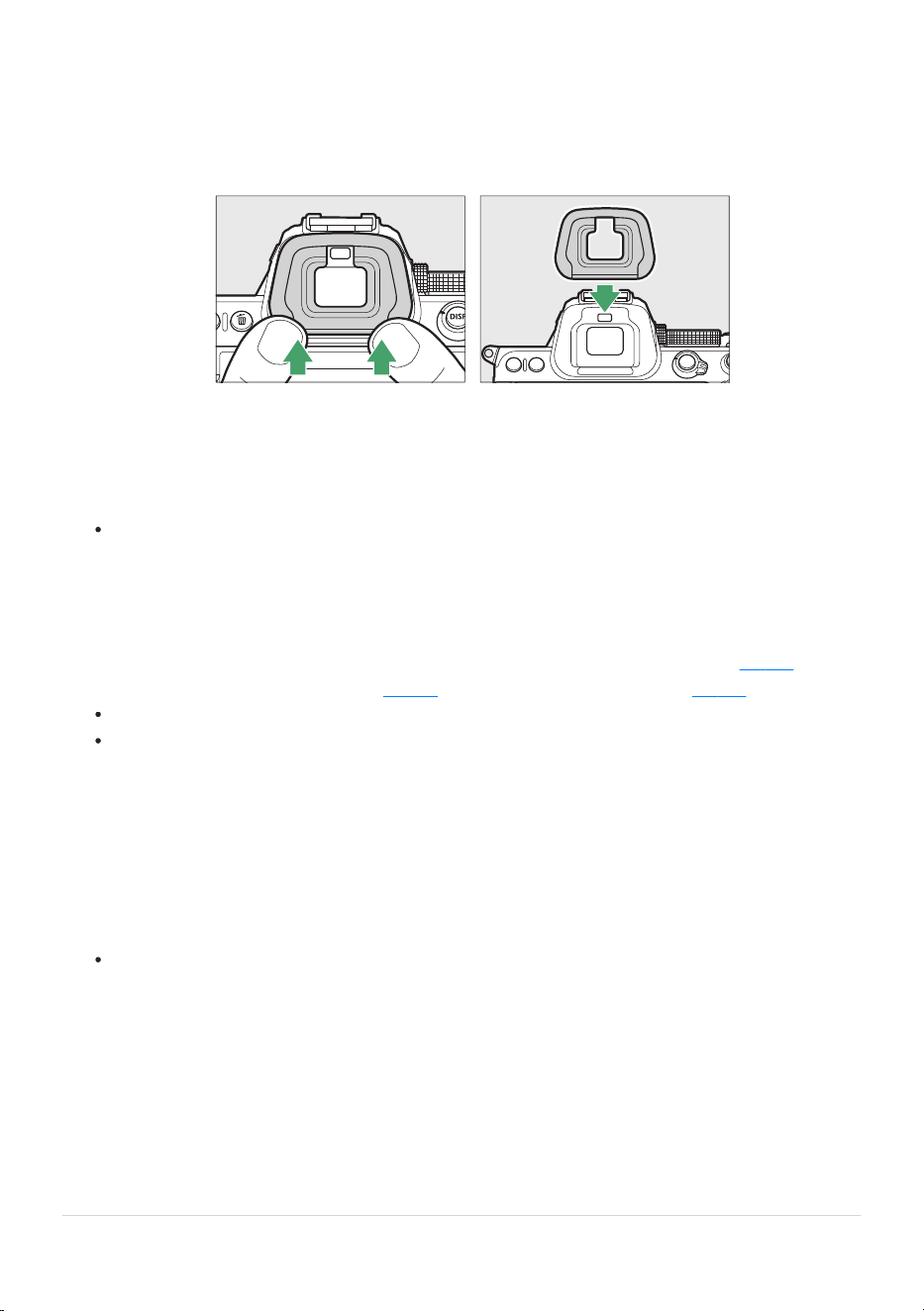
Remove Replace
● Viewfinder Eyepiece Accessories
DK-29 Rubber Ey
ecup: A rubber eyecup that comes attached t
o the camera at shipment. It can
be fitted to the camera viewfinder. The DK-29 makes the image in the viewfinder easier to see,
preventing eye fatigue.
● Flash Units
SB-5000, SB-910, SB-900, SB-800, SB-700, SB-600, SB-500, SB-400, and SB-300
Speedlights: These units can be mounted on the camera for flash photography. Some also
support wireless remote control for off-camera flash photography with multiple flash units.
See the documentation supplied with each Speedlight for information on mounting the unit
on the camera.
For more information on flash photography, see “Using an On-Camera Flash” (
0 391), “What
Is R
emot
e Flash Phot
ography?” (
0 400), and “Comp
atible Flash Units” (
0 839).
SB‑R200 Wir
eless R
emot
e Speedlight: A flash unit for wireless remote flash photography.
SU-800 Wireless Speedlight Commander: A wireless commander for use with SB-5000, SB-910,
SB-900, SB-800, SB-700, SB-600, SB-500, and SB-R200 flash units. Flash units can be divided into
up to three groups for remote flash control. The SU‑800 itself is not equipped with a flash.
● Mount Adapters
FTZ II/FTZ Mount Adapter: An adapter that allows NIKKOR F mount lenses to be used with digital
cameras that support interchangeable Z mount lenses.
For information on attaching, removing, maintaining, and using mount adapters, refer to the
product documentation.
Update to the latest version of the mount adapter firmware if so prompted after attaching the
adapter. Information on performing firmware updates is available via the Nikon website for
your country or region.
865
Other Compatible Accessories
-
-
*

● Microphones
ME-1 Ster
eo Microphone: Connect the ME-1 to the external microphone connector to record
stereo sound. Using an external microphone also reduces the chance of picking up equipment
noise, such as the sounds produced during video recording when focus is achieved using
autofocus.
ME-W1 Wireless Microphone: A wireless Bluetooth microphone. Use the ME‑W1 for off-camera
recording.
● Remote Controls
ML‑L7 Remote Control: Pair the ML‑L7 with the camera for remote photography and video
recording.
● Remote Grips
MC-N10 Remote Grip: When connected to the camera, the MC-N10 can be used for such tasks
as video recording, photography, and adjusting camera settings. It comes equipped with a rosette
for attachment to third-party camera equipment. With the MC-N10 mounted on third-party camera
equipment via an ARRI-compatible rosette adapter, you can keep moving subjects in focus while
panning the camera to track their motion, or use its conveniently-placed controls to adjust settings
such as exposure and white balance without touching the camera.
866
Other Compatible Accessories
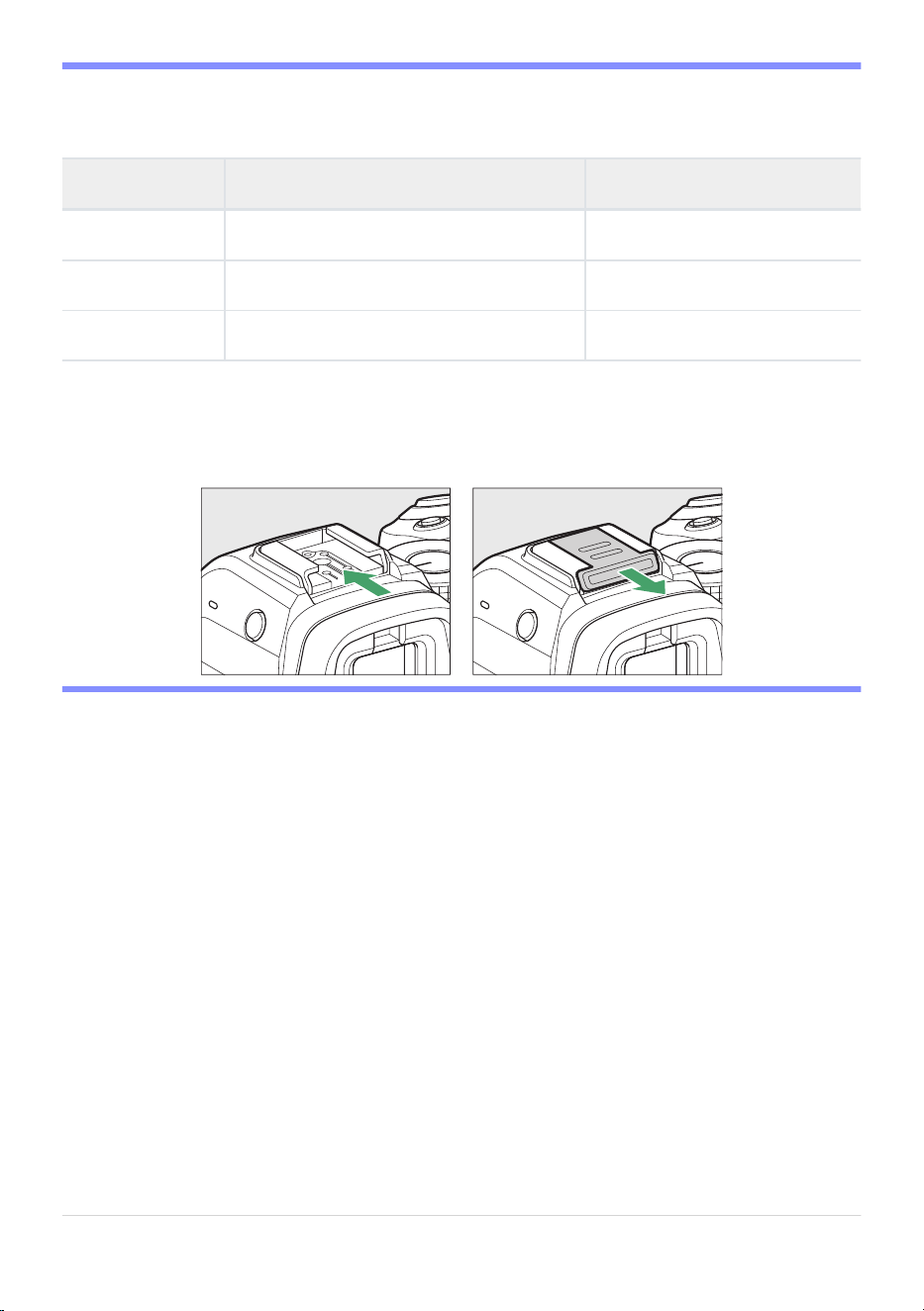
D Charging Batteries
Compatible b
atteries can be charged using the devices below.
Battery MH‑25a battery charger EH‑8P AC adapter
EN‑EL15c
4 4
EN‑EL15b
4 4
EN‑EL15a
4
—
D Attaching and Removing the Accessory Shoe Cover
TheBS-1 accessory shoe cov
er slides into the shoe as shown. To remove the cover, hold the camera
firmly, press the cover down with a thumb and slide it in the direction shown.
867
Other Compatible Accessories
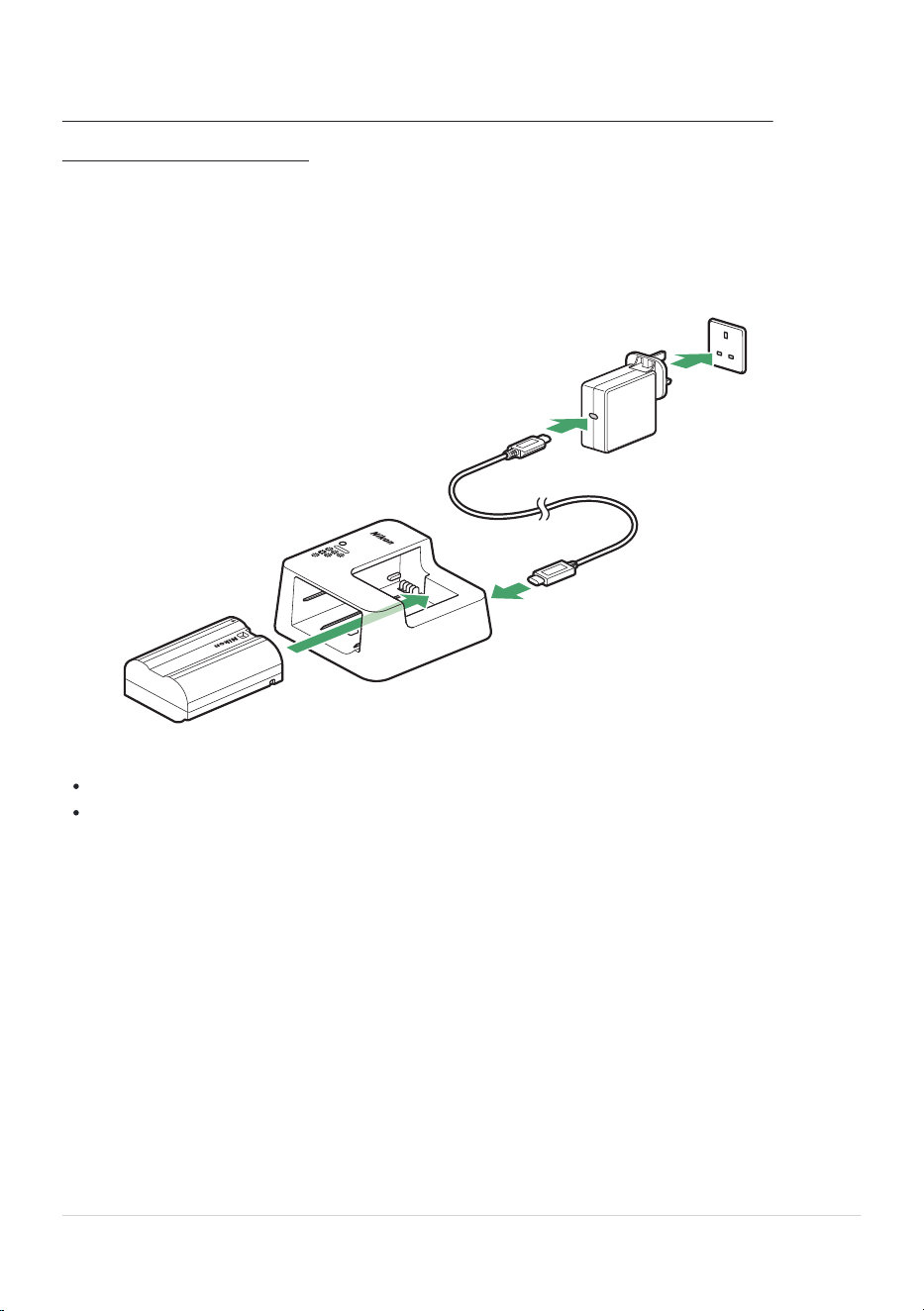
Charging the Battery with an Optional MH-34
Battery Charger
Connect the optional EH-8P AC adapter t
o the MH-34 battery charger with the supplied USB cable
featuring Type-C connectors at both ends and plug the AC adapter into a household power outlet. You
can then insert the battery into the charger to begin charging.
C
HARGE
%
100
80
50
0
Choose a location where the charger will remain stable and free from vibration during use.
An exhausted EN-EL15c batt
ery will fully charge in about 2 hours and 30 minutes, and an EN-EL15b
battery will charge in about 2 hours and 50 minutes.
868
Other Compatible Accessories
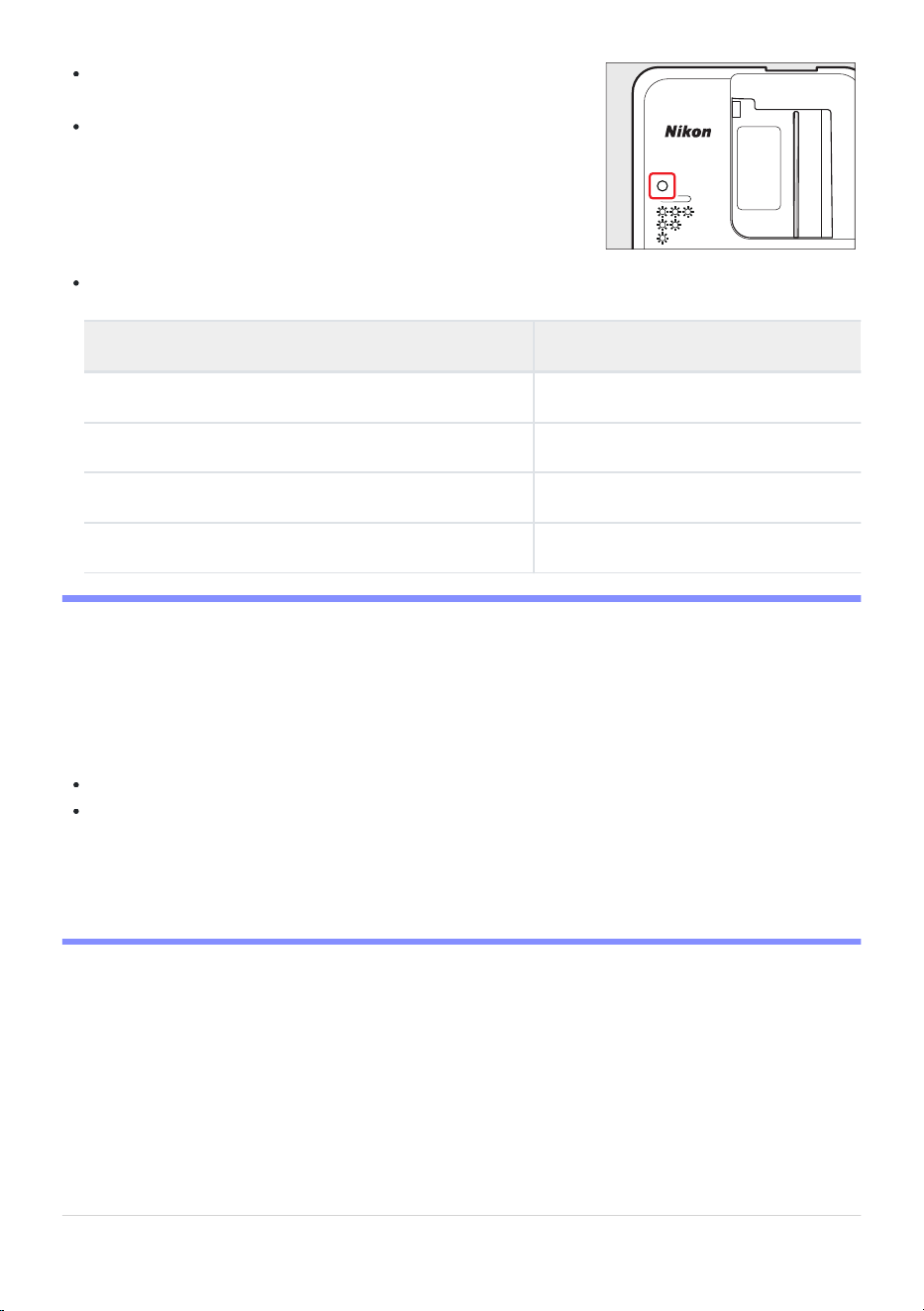
The “CHARGE %” lamp flashes while charging and turns on after
charging is complete.
Ther
e may be a delay of about five seconds before the lamp
starts flashing.
CHARGE %
100
8
0
50
0
Battery status is shown by the “CHARGE %” lamp:
“CHARGE %” lamp Status
Flashes once and turns off, in repetition Charging (less than 50% charged)
Flashes twice and turns off, in repetition Charging (50% charged)
Flashes three times and turns off, in repetition Charging (80% charged)
Turns on Charging complete
D Caution: Charging EN-EL15a/EN-EL15 Batter
ies
EN-EL15a and EN-EL15 rechargeable Li-ion batteries are not compatible with MH-34 battery chargers.
Be sure to use an MH‑25a battery charger when charging these batteries via a charger.
D If the “CHARGE %” Lamp Flashes Rapidly
If the “CHARGE %” lamp on the charger flashes rapidly (8 times a second):
The battery is not inserted correctly: Unplug the charger and remove and reinsert the battery.
The ambient temperature is too hot or too cold: Use the battery charger at temperatures within
the designated temperature range (0–40 °C/+32–104 °F).
If the problem persists, unplug the charger and end charging. Bring the battery and charger to a
Nikon-authorized service representative.
869
Other Compatible Accessories
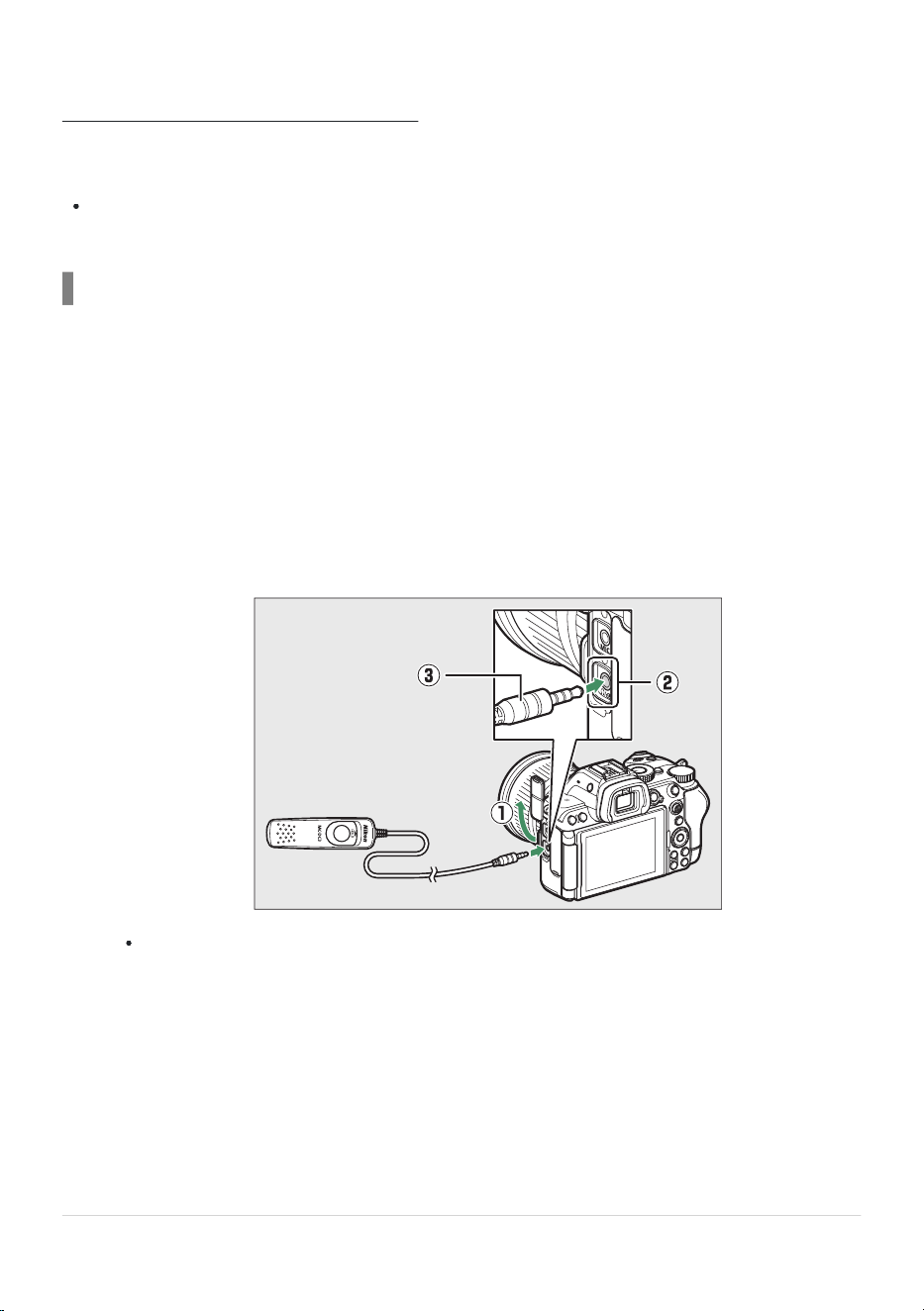
MC-DC3 Remote Cords
The MC-DC3 can be used to release the shutt
er remotely when connected to the headphone/remote
cord (Z) connector.
Select [Auto switch] for [Z connector function] in the setup menu before using the MC-DC3
remote cord.
Connecting an MC-DC3 Remote Cord
Turn the camera off.
Open camera's microphone and headphone/remote cord connector cover (q).
Insert the remote cord plug (e) all the way into the headphone/remote cord connector
(w).
Do not use force or attempt to insert the connector at an angle.
Connect the MC-DC3 remote cord to the headphone/remote cord connector. It will not
function if connected to the ext
ernal microphone connector of the same shape.
Turn the camera on.
870
Other Compatible Accessories
1
2
3
4
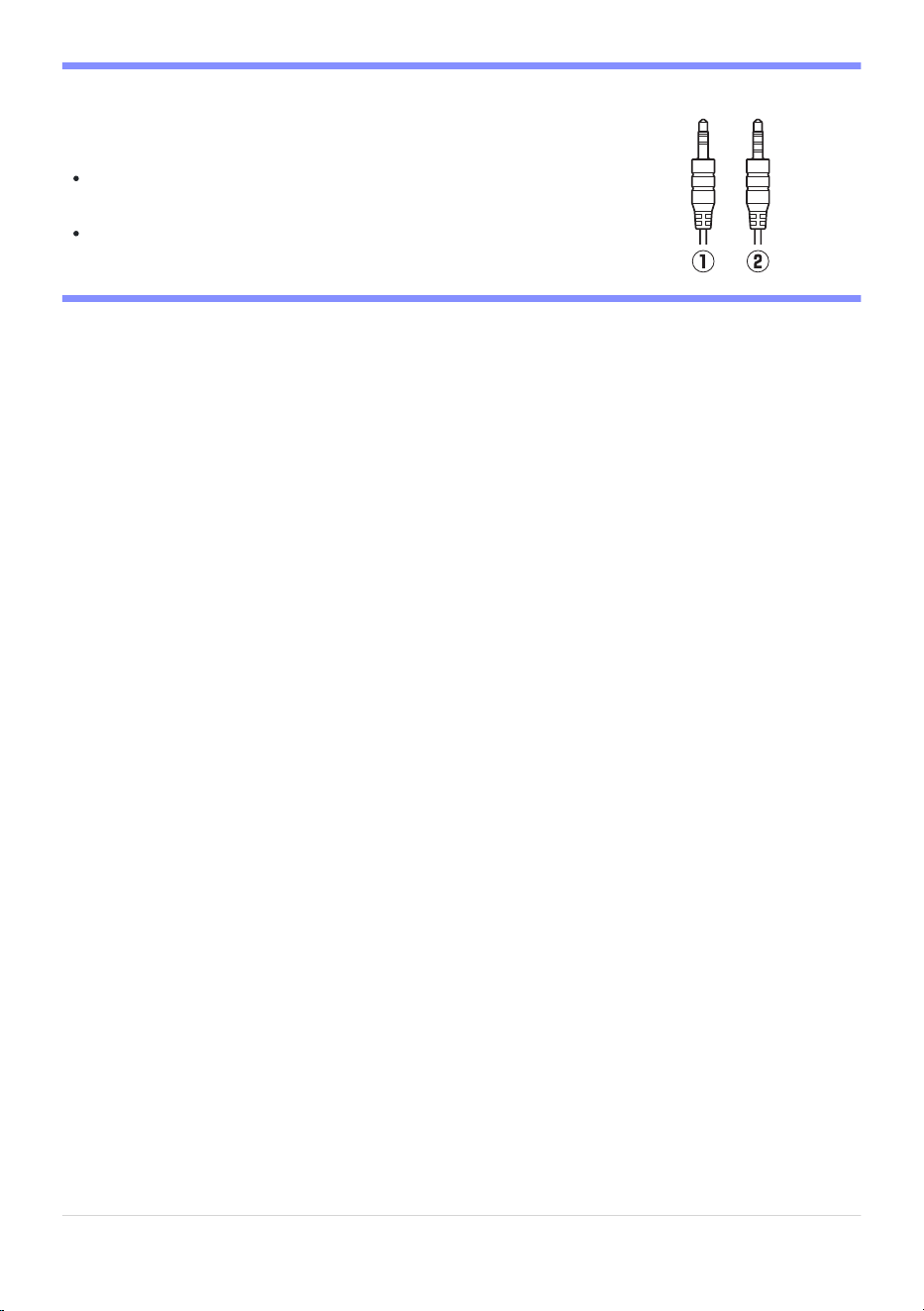
Use headphones with a 3-pole plug (q) while [Aut
o swit
ch] is
select
ed for [Z connector function].
Headphones or a headset with a 4-pole plug (w) may not be
recognized or may cause the camera to malfunction.
Select [Headphone] when using headphones or a headset with a
4-pole plug.
D Caution: Headphone/Remote Cor
d Connector
871
Other Compatible Accessories

ML‑L7 Remote Controls
When paired with the camera via Bluet
ooth, optional ML‑L7 remote controls can be used to control the
camera remotely during still photography, video recording, and the like.
The ML‑L7 remote control must be paired with the camera before use.
The camera can be paired with only one ML‑L7 remote control at a time. If paired successively with
more than one ML‑L7, the camera will respond only to the ML‑L7 with which it was last paired.
In addition to the present document, you will also need to consult the documentation for the ML‑L7
remote control.
D Cautions: Using ML‑L7 Remote Controls
ML‑L7 remote controls cannot be used when:
[ON] is selected for [Airplane mode] in the network menu,
[iPhone] is selected for [USB] in the network menu, or
while the camera is connected to and exchanging data with another device via USB.
The camera cannot connect to an ML‑L7 remote control while connected to another device via
Bluetooth or Wi-Fi or vice versa.
872
Other Compatible Accessories
-
-
-
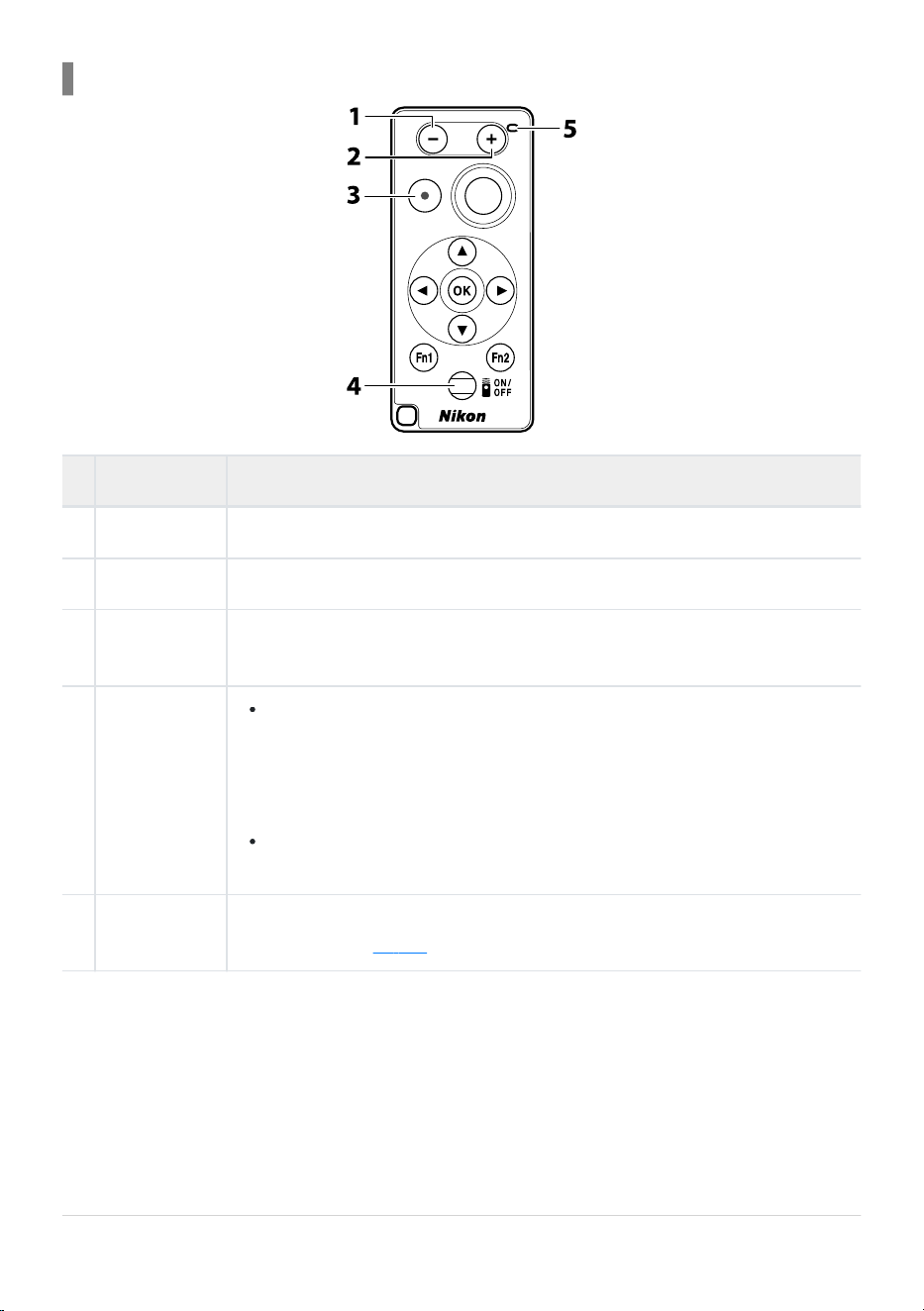
Parts of the ML‑L7 Remote Control: Names and Functions
Control Function
1 “−” button
Performs the same function as the camera W (Q) butt
on.
2 “+” button
P
erforms the same function as the camera X butt
on.
3
Movie record
button
Press once to start video recording and again to stop.
4
Power
button
Press the button to turn the remote control on.
The remote control will automatically connect to the camera with which
it is currently paired, assuming it is nearby.
If you keep the button pressed for over three seconds, the remote
control will enter pairing mode.
Pressing the power button while the remote control is on turns off the
remote control, after which the status lamp will turn off.
5 Status lamp
The color and behavior of the status lamp indicates remote control and
shooting status (
0 875).
873
Other Compatible Accessories
-
-
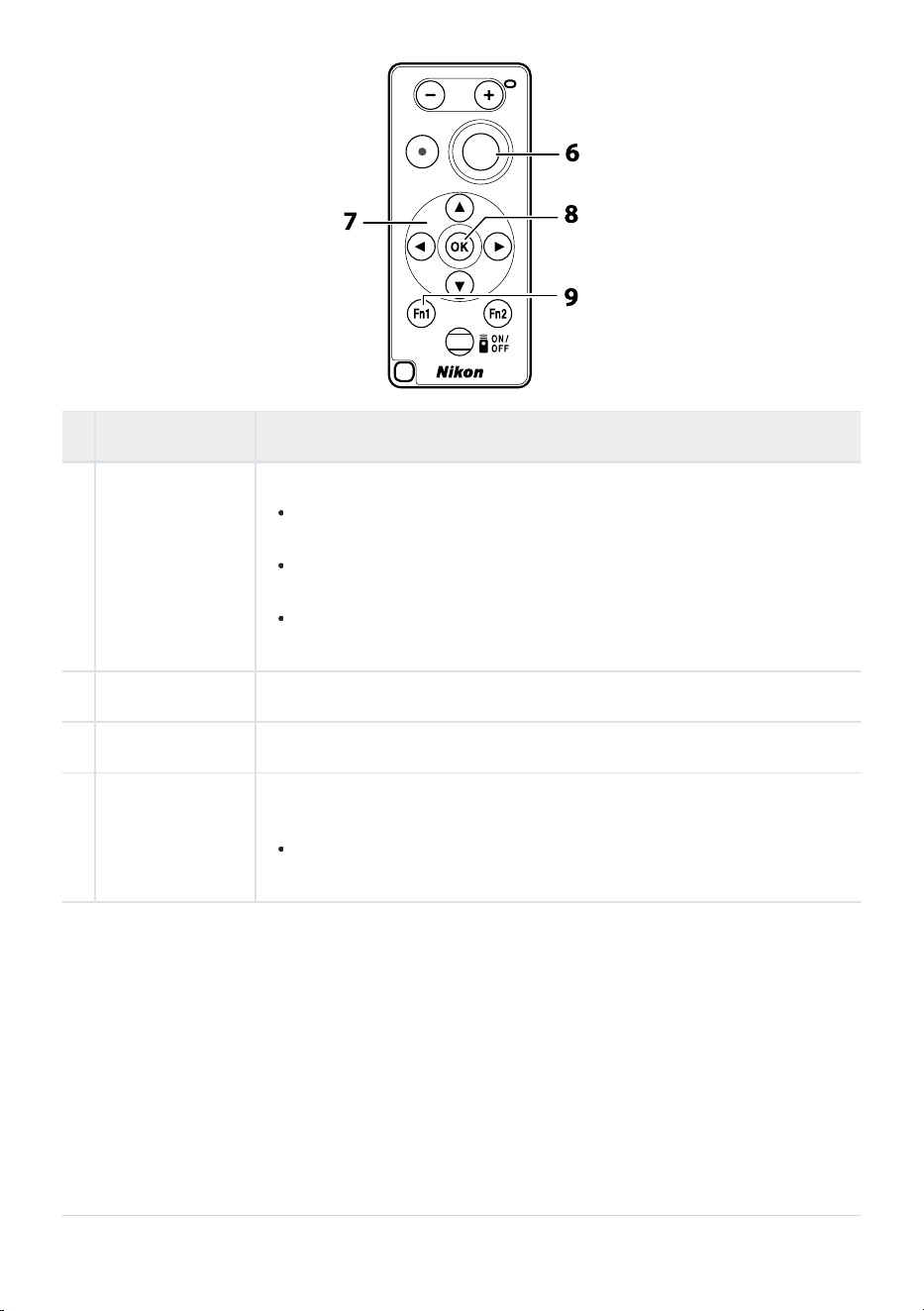
Control Function
6
Shutter-release
button
Press the butt
on to release the shutter.
The remote control shutter-release button cannot be pressed halfway.
The camera releases the shutter after focusing when in autofocus mode.
The remote control shutter-release button cannot be kept pressed for
burst photography.
The procedure for taking photographs at a shutter speed of “Bulb” is
the same as that for “Time”.
7 Multi selector Performs the same function as the multi selector on the camera.
8
J
(select) button Performs the same function as the J button on the camera.
9
Fn1 (Function
1)/Fn2 (Function
2) buttons
Perform the roles assigned via the network menu using [Wireless remote
(ML-L7) options]> [Assign Fn1 button] and [Assign Fn2 button].
At default settings, the remote control Fn1 button is used to start
playback and Fn2 button to display the menus.
874
Other Compatible Accessories

Tip: The Remote Control Status Lamp (Z5II)
Color Behavior Status
Green Flashes approximately once a second Searching for paired camera.
Green Flashes quickly (approximately twice a second) Pairing.
Green Flashes approximately once every three seconds Connected to camera.
Orange Flashes once Photography started.
Orange Flashes twice “Bulb” or “Time” photography ended.
Red Flashes once Video recording started.
Red Flashes twice Video recording ended.
Tip: Adjusting Focus from the Camera
To shoot using the focus position adjusted with the camera, pr
ess the camera shutter-release button
halfway to lock focus, then select the manual focus mode.
Tip: The Standby Timer
To reactivate the camera after the standby timer has expired and the monitor and viewfinder have
turned off, turn the remote control on and press and hold its shutter-release or movie record button.
875
Other Compatible Accessories
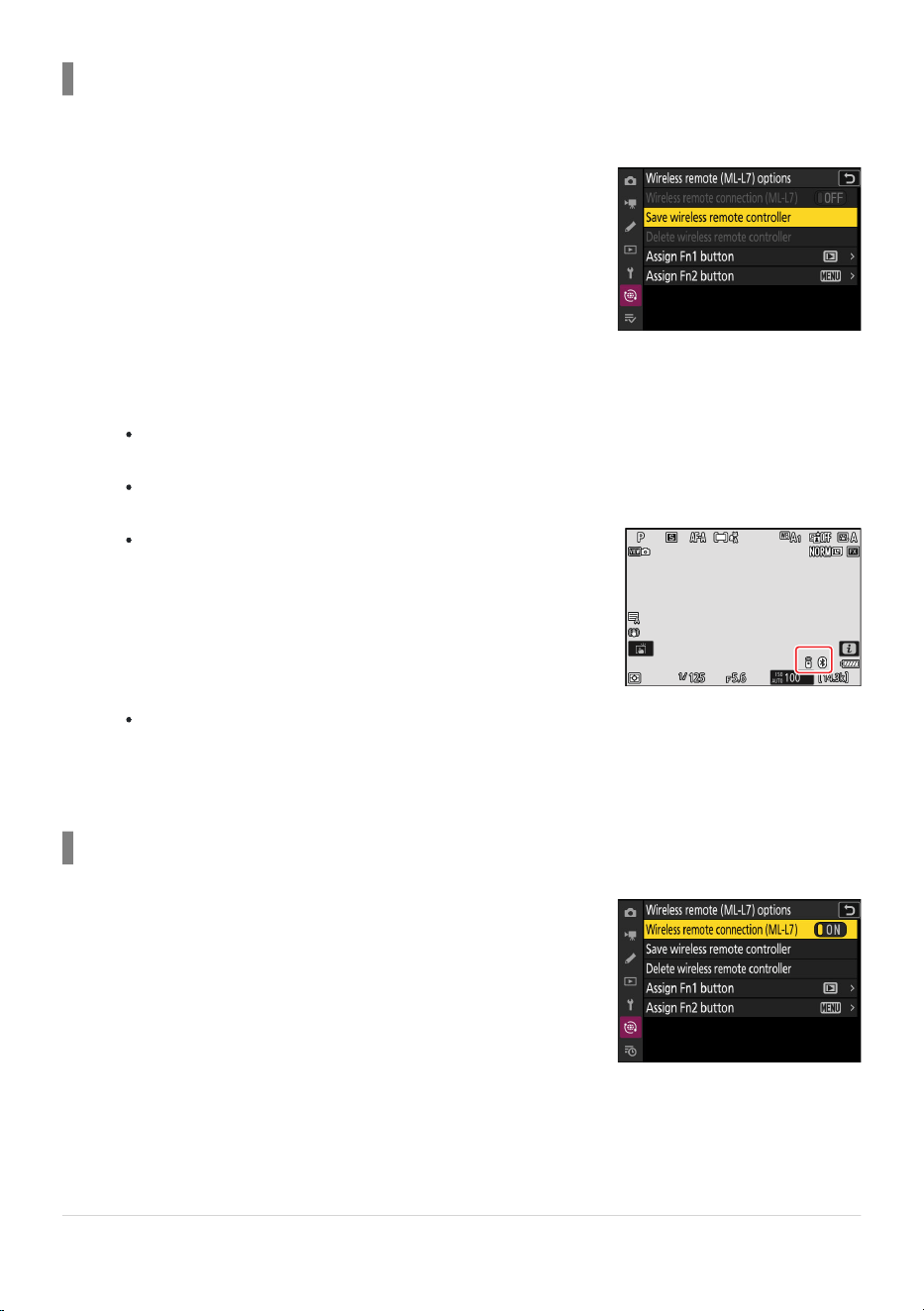
Go to [Wireless remote (ML-L7) options] in the camera
network menu, highlight [Sav
e wireless remote controller],
and press J.
The camera will enter pairing mode.
W and Z will appear in the shooting display.
Go to [Wireless remote (ML-L7) options] in the camera
network menu and select [ON] for [Wireless remote
connection (ML-L7)].
Connecting for the First Time (Pairing)
The remote contr
ol must be paired with the camera before use.
Keep the power button on the remote control pressed for over three seconds.
The camera and remote control will begin pairing. During pairing, the status lamp on the
remote control will flash about twice a second.
A connection will be established between the camera and remote control when pairing is
complete.
If a message is displayed stating that pairing has failed, repeat the pairing process from
Step1.
Connecting to a Paired Remote
876
Other Compatible Accessories
1
2
1

Press the remote control power button.
The camera and remote will connect aut
omatically.
877
Other Compatible Accessories
2
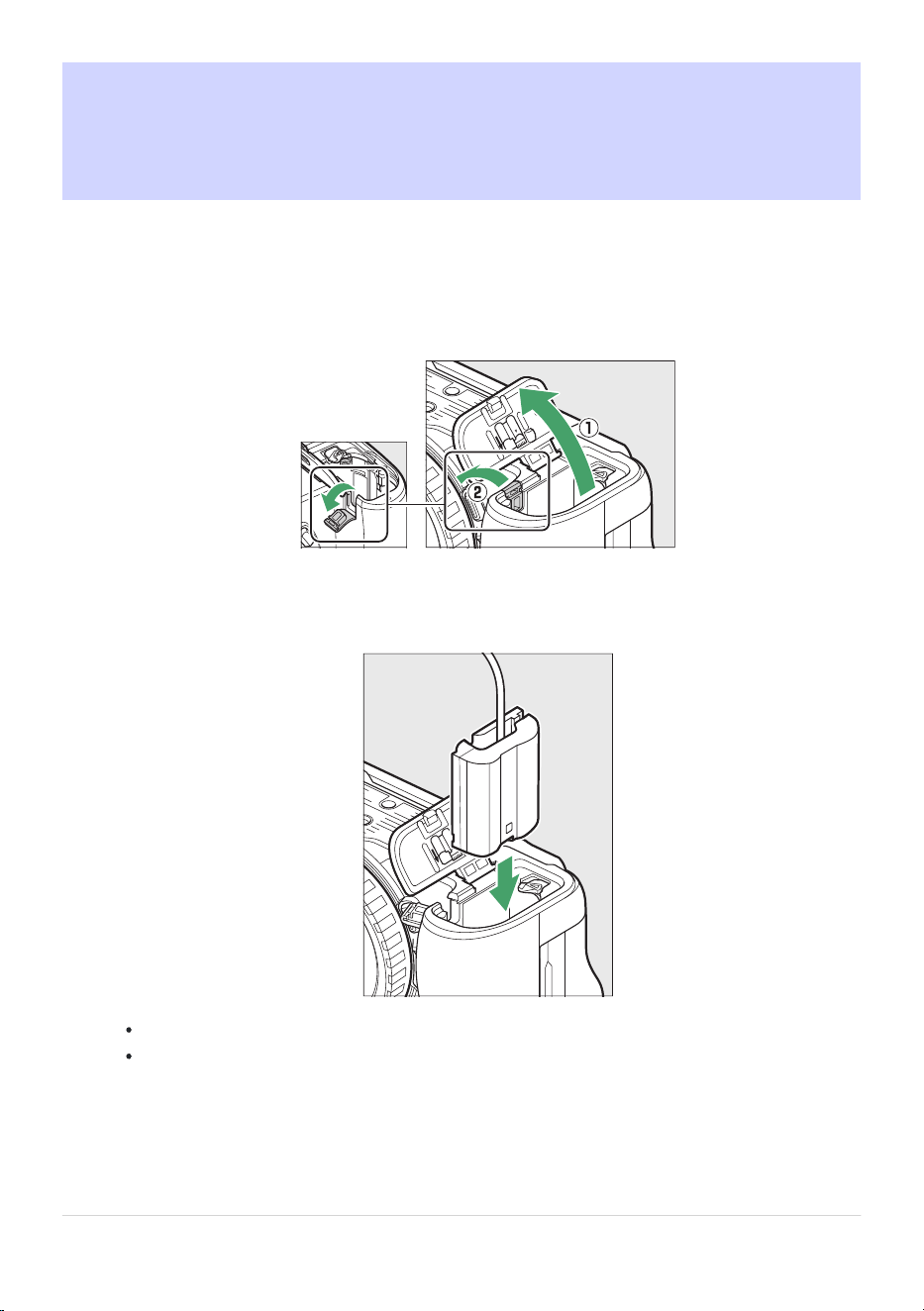
Attaching an EP‑5B Power Connector and
EH‑5d, EH‑5c, or EH‑5b AC Adapter
T
urn the camera off before attaching an EP‑5B power connector and EH‑5d, EH‑5c, or EH‑5b AC
adapter.
Open the battery chamber (q) and power connector (w) covers.
Insert the EP‑5B power connector.
Be sure to insert the connector in the correct orientation.
Using the connector to k
eep the orange battery latch pressed to one side, slide the
connector into the battery chamber until the latch locks the connector in place.
878
Attaching an EP‑5B Power Connector and EH‑5d,
EH‑5c, or EH‑5b A
C Adapter
1
2
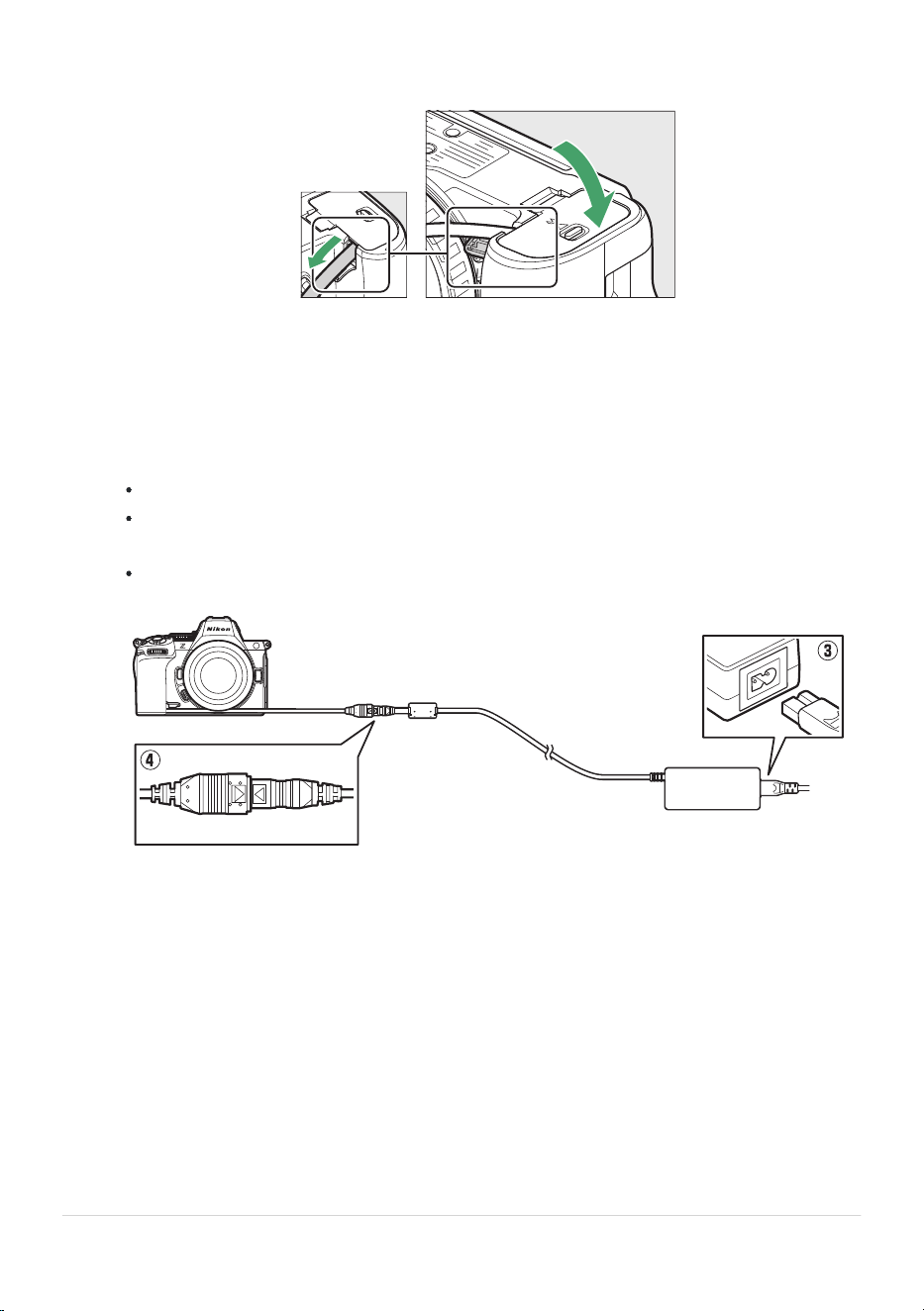
Close the battery chamber cover.
Position the power connector cable so that it passes through the power connector slot and
close the b
att
er
y chamber cover.
Connect the EH‑5d/EH‑5c/EH‑5b AC adapter to the EP‑5B power connector.
Connect the power cable to the AC socket on the EH‑5d, EH‑5c, or EH‑5b AC adapter (e).
Insert the DC plug from the EH‑5d, EH‑5c, or EH‑5b AC adapter into the DC IN connector
(r).
When the camera is used with a power connector and EH‑5d, EH‑5c, or EH‑5b AC adapter,
P appears in place of the battery level icon in the shooting display.
879
Attaching an EP‑5B Power Connector and EH‑5d,
EH‑5c, or EH‑5b A
C Adapt
er
3
4

Caring for the Camera
Long-Term Storage
Remove the b
attery if the product will not be used for an extended period. Before removing the
battery, confirm that the camera is off.
Do not store the camera in locations that:
are poorly ventilated or subject to humidities of over 60%,
are next to equipment that produces strong electromagnetic fields, such as televisions or radios, or
are exposed to temperatures above 50°C (122°F) or below −10°C (14°F).
Cleaning
The procedure v
aries with the part that requires cleaning. The procedures are detailed below.
Do not use alcohol, thinner, or other volatile chemicals.
Camera Body
Use a blower to remove dust and lint, then wipe gently with a soft, dry cloth. After using the camera at
the beach or seaside, wipe off sand or salt with a cloth lightly dampened in distilled water and dry the
camera thoroughly.
Important: The following cases are not covered under our warranty.
Damage due to the presence of foreign matter inside the camera.
Damage caused by using a spray-type blower too close to the camera.
Lens and Viewfinder
These glass elements are easily damaged: remove dust and lint with a blower. If using an aerosol
blower, keep the can vertical to prevent the discharge of liquid that could damage glass elements. To
remove fingerprints and other stains, apply a small amount of lens cleaner to a soft cloth and clean
with care.
The Monitor
Remove dust and lint with a blower. When removing smudges, fingerprints, and other oily stains, wipe
the surface lightly with a soft cloth or chamois leather. Do not apply pressure, as this could result in
damage or malfunction.
880
Caring for the Camera
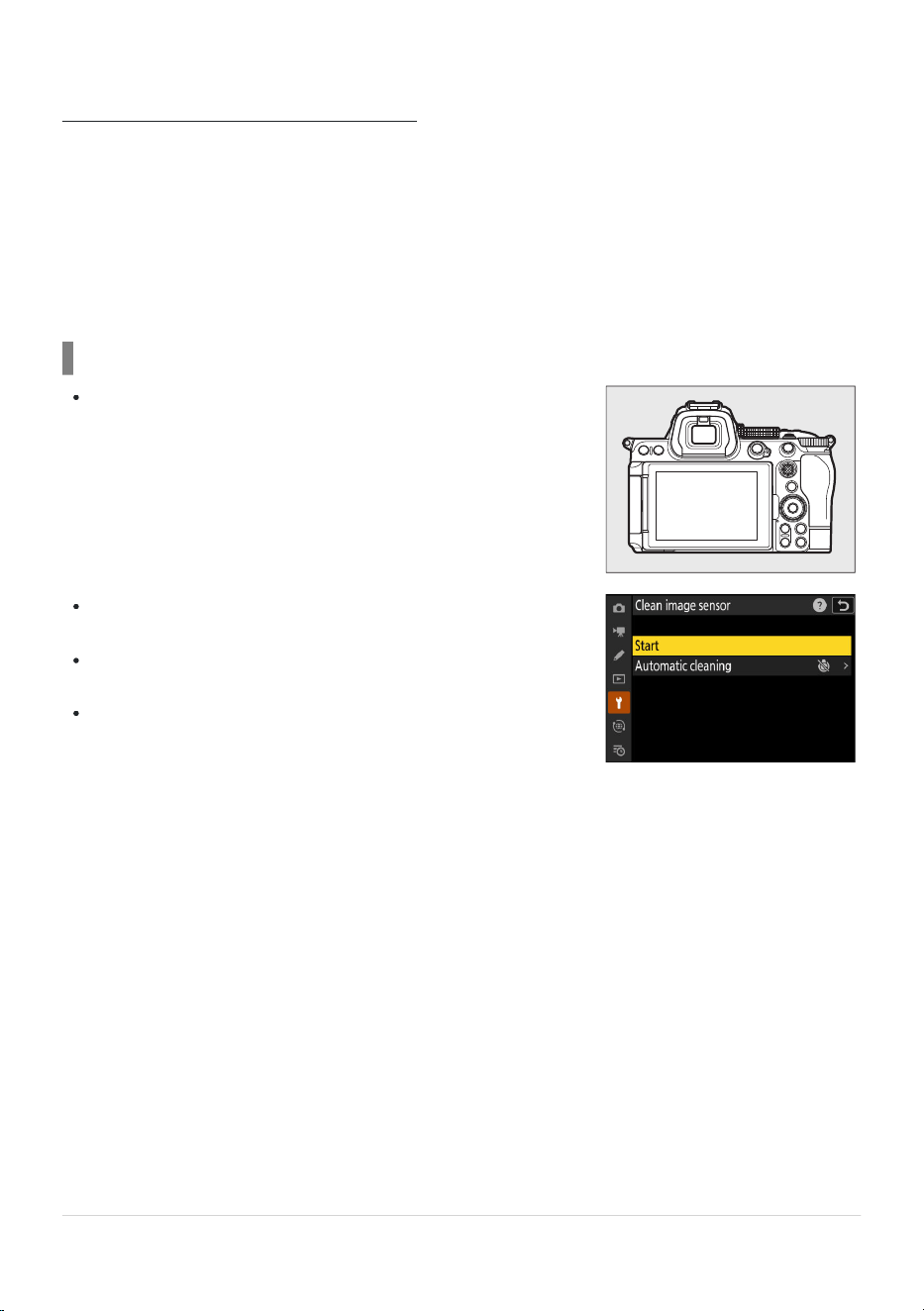
For maximum effect, hold the camera in normal orientation (base
down).
Select [Clean image sensor] in the setup menu, then highlight
[S
tar
t
] and press J to begin cleaning.
Camera controls cannot be used while cleaning is in progress. Do
not remove or disconnect the power source.
The setup menu will be displayed when cleaning is complete.
Image Sensor Cleaning
Dirt or dust entering the camera when lenses ar
e exchanged or the body cap is removed may adhere
to the image sensor and affect your photographs. The “clean image sensor” option vibrates the sensor
to remove dust.
The image sensor can be cleaned at any time from the menus, or cleaning can be performed
automatically when the camera is turned off. If image sensor cleaning fails to resolve the problem,
contact a Nikon-authorized service representative.
Using the Menus
881
Caring for the Camera
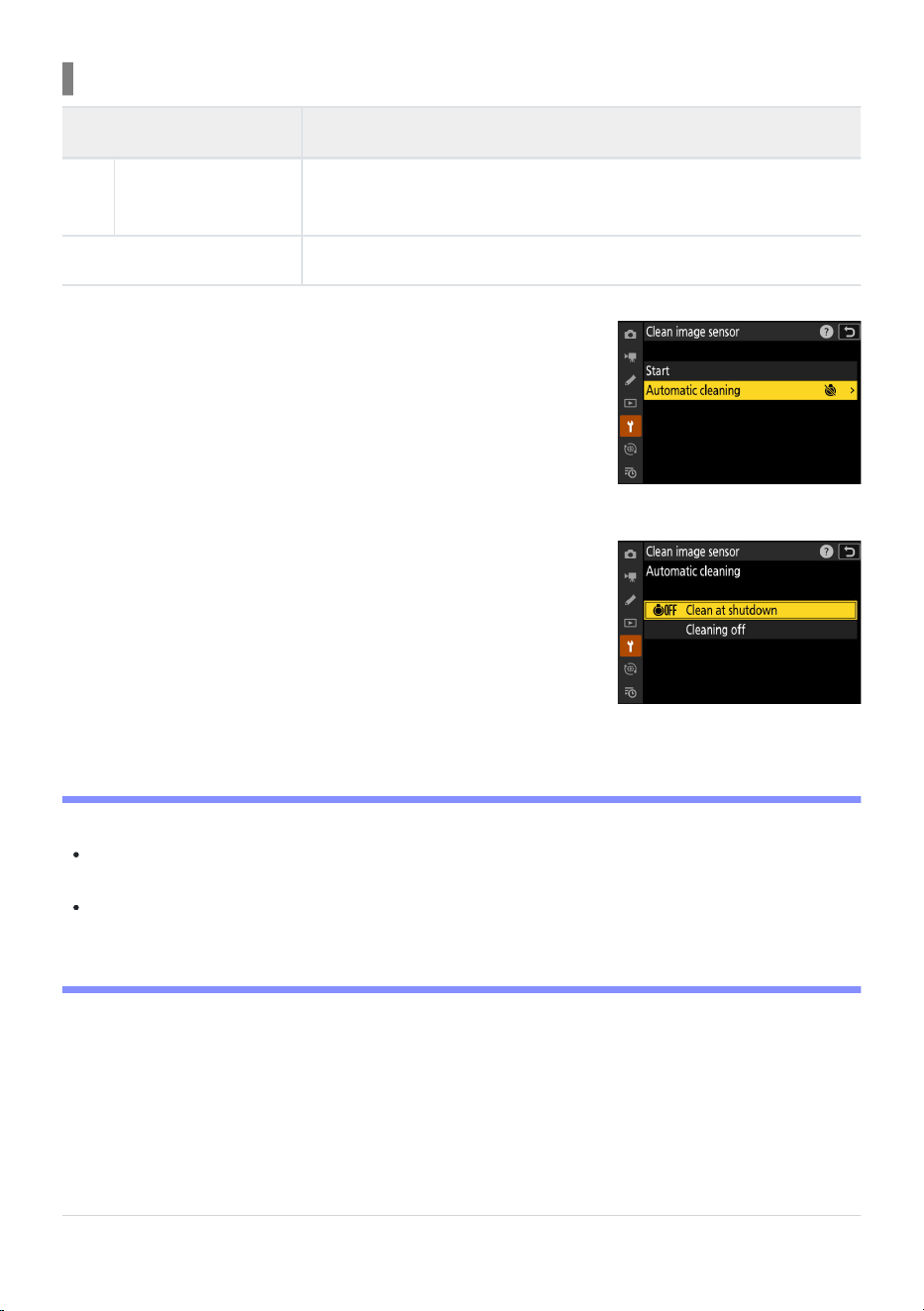
Select [Automatic cleaning] for [Clean image sensor].
Pressing 2
when [Automatic cleaning] is highlighted displays
[Automatic cleaning] options.
Highlight an option.
Press J
to select the highlighted option.
Cleaning the Image Sensor at Shutdown
Option Description
6
[Clean at shutdown]
The image sensor is automatically cleaned during shut
down each
time the camera is turned off.
[Cleaning off] Automatic image sensor cleaning off.
D Cautions: Image Sensor Cleaning
Using camera controls interrupts any image sensor cleaning begun in r
esponse to the operation of
the power switch.
If image sensor cleaning is performed several times in succession, image sensor cleaning may be
temporarily disabled to protect the camera’s internal circuitry. Cleaning can be performed again
after a short wait.
882
Caring for the Camera
1
2
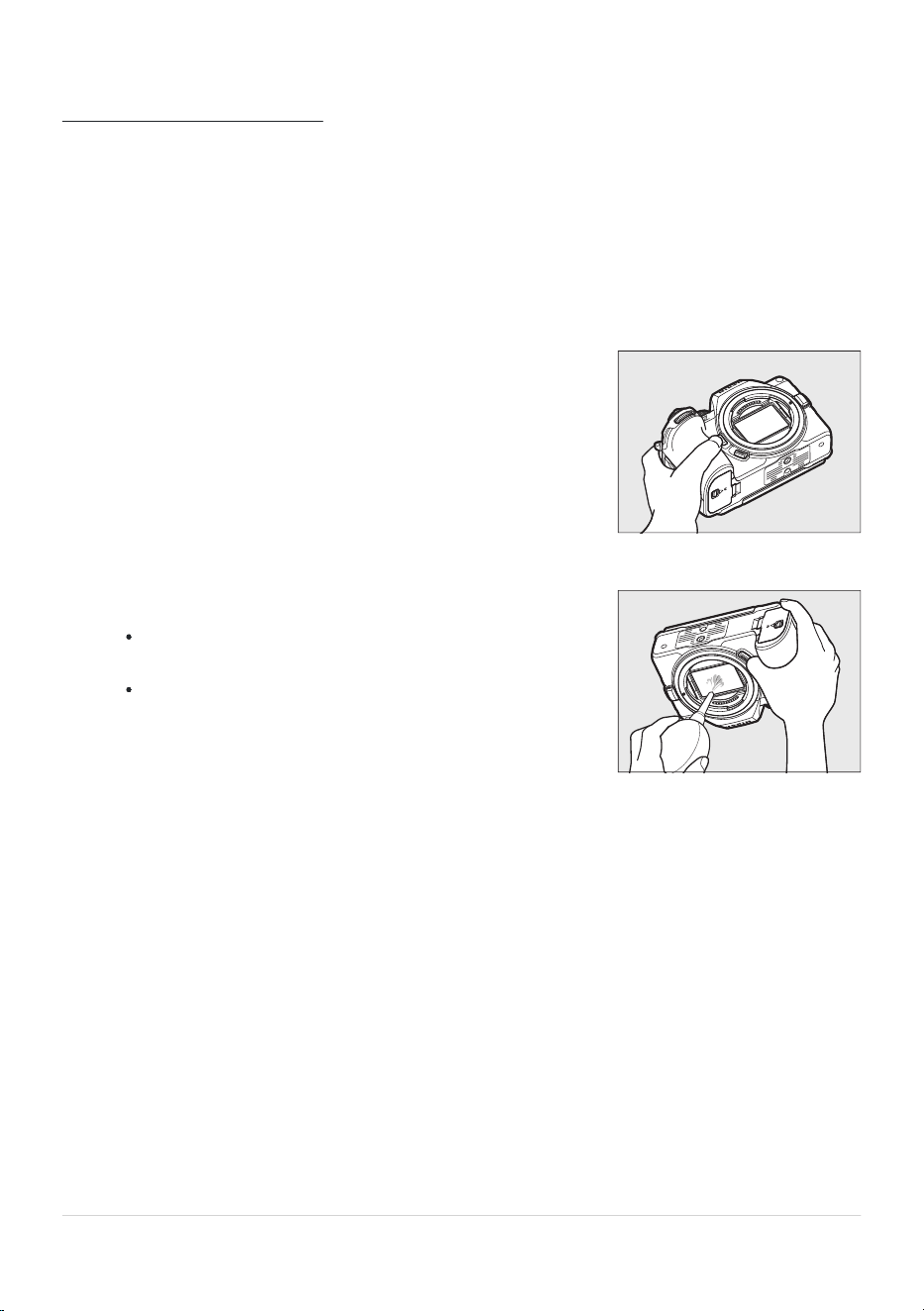
Holding the camera so that light can enter, examine the
image sensor for dust or lint.
If no foreign objects are pr
esent, proceed to Step4.
Remove any dust and lint from the sensor with a blower.
Do not use a blower-brush. The bristles could damage the
sensor
.
Dirt that cannot be removed with a blower can only be
removed by Nikon-authorized service personnel. Under no
circumstances should you touch or wipe the sensor.
Manual Cleaning
If foreign matter cannot be r
emoved from the image sensor using image sensor cleaning, the sensor
can be cleaned manually as described below. Note, however, that the sensor is extremely delicate
and easily damaged; we recommend that manual cleaning be performed only by a Nikon-authorized
service representative.
Turn the camera off and remove the lens.
Replace the lens or supplied body cap.
883
Caring for the Camera
1
2
3
4

D Foreign Matter on the Image Sensor
Foreign matt
er entering the camera when lenses or body caps are removed or exchanged (or in rare
circumstances lubricant or fine particles from the camera itself) may adhere to the image sensor, where
it may appear in photographs taken under certain conditions. To prevent entry of foreign matter when
attaching the body cap or exchanging lenses, avoid dusty environments and be sure to remove all dust
and other foreign matter that may be adhering to the camera mount, lens mount, or body cap. To
protect the camera when no lens is in place, be sure to replace the supplied body cap. Should you
encounter foreign matter that cannot be removed using the image sensor cleaning option (
0 881),
clean the image sensor as described in “Manual Cleaning” (0 883), or have the sensor cleaned by
Nikon-authorized ser
vice personnel. Photographs affected by the presence of foreign matter on the
sensor can be retouched using the clean image options available in some imaging applications.
D Servicing the Camera and Accessories
The camera is a precision device and requires regular servicing; Nikon recommends that the camera be
inspected once every one to two years, and that it be serviced once every three to five years (note that
fees apply to these services).
Frequent inspection and servicing are particularly recommended if the camera is used
professionally.
Any accessories regularly used with the camera, such as lenses or optional flash units, should be
included when the camera is inspected or serviced.
884
Caring for the Camera

Caring for the Camera and Battery:
Cautions
Cautions: Using the Camera
● Do Not Drop
Do not dr
op the camera or lens or subject them to blows. The product may malfunction if subjected
to strong shocks or vibration.
● Keep Dry
Keep the camera dry. Rusting of the internal mechanism caused by water inside the camera can not
only be expensive to repair but can in fact cause irreparable damage.
● Avoid Sudden Changes in Temperature
Taking the camera from a warm to a cold environment or vice versa may cause damaging
condensation inside and outside the camera. Place the camera in a sealed bag or plastic case before
taking it across a temperature boundary. The camera can be taken from the bag or case once it has
had time to adjust to the new temperature.
● Keep Away from Strong Magnetic Fields
Static charges or the magnetic fields produced by equipment such as radio transmitters could
interfere with the monitor, corrupt data stored on the memory card, or affect the product’s internal
circuitry.
● Keep Credit Cards and Other Such Magnetic Storage Devices Away from the Camera and Lens
Data stored on magnetic storage devices could be corrupted.
● Do Not Leave the Lens Pointed at the Sun
Do not leave the lens pointed at the sun or other bright light source. Intense light may damage the
image sensor or cause fading or “burn in”. Photographs taken with the camera may exhibit a white
blur effect.
● Lasers and Other Bright Light Sources
Do not direct lasers or other extremely bright light sources toward the lens, as this could damage
the camera’s image sensor.
885
Caring for the Camera and Battery: Cautions
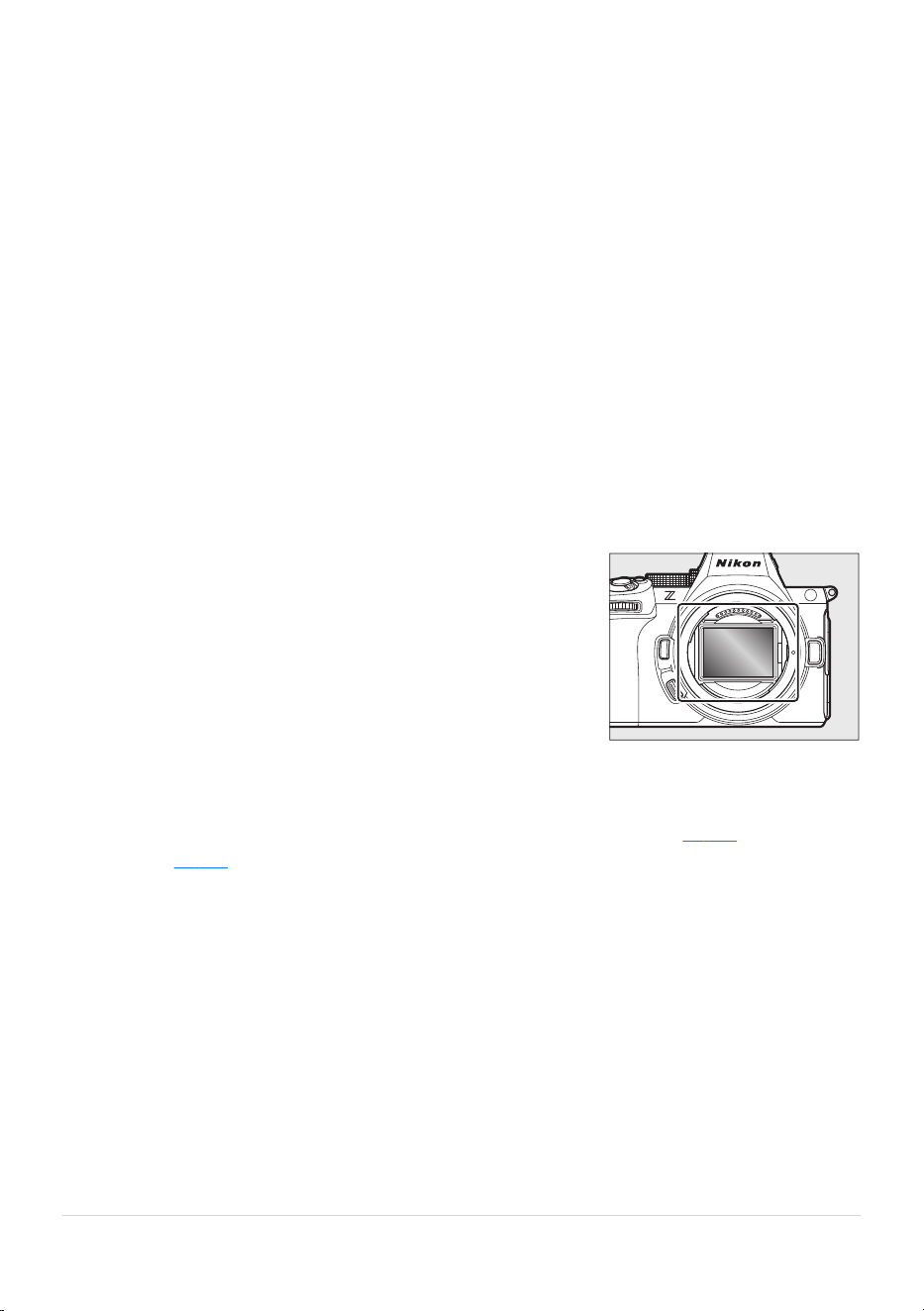
Under no circumstances should you exert pressure on the image
sensor, poke it with cleaning t
ools, or subject it to powerful air
currents from a blower. These actions could scratch or otherwise
damage the sensor.
● Turn the Product Off Before Removing or Disconnecting the Power Source
Removing or disconnecting the power sour
ce while the camera is on could damage the product.
Particular care should be taken not to remove or disconnect the power source while pictures are
being recorded or deleted.
● Cleaning
When cleaning the camera body, use a blower to gently remove dust and lint, then wipe gently with
a soft, dry cloth. After using the camera at the beach or seaside, wipe off any sand or salt using a
cloth lightly dampened in fresh water and then dry the camera thoroughly with a dry, soft cloth.
● Cleaning the Lens and Viewfinder
These glass elements are easily damaged: remove dust and lint with a blower. If using an aerosol
blower, keep the can vertical to prevent the discharge of liquid that could damage glass elements.
To remove fingerprints and other stains from the lens, apply a small amount of lens cleaner to a soft
cloth and wipe the lens carefully.
● Do Not Touch the Image Sensor
● Cleaning the Image Sensor
For information on cleaning the image sensor, see “Image Sensor Cleaning” (
0 881) and “Manual
Cleaning” (0 883).
886
Caring for the Camera and Battery: Cautions

● The Lens Contacts
Keep the lens contacts clean. Av
oid touching them with your fingers.
● Store in a Well-Ventilated Area
To prevent mold or mildew, store the camera in a dry, well-ventilated area. Do not store the camera
with naphtha or camphor moth balls, next to equipment that produces strong electromagnetic
fields, or where it will be exposed to extremely high temperatures, for example near a heater or
in an enclosed vehicle on a hot day. Failure to observe these precautions could result in product
malfunction.
● Long-Term Storage
To prevent damage caused for example by leaking battery fluid, remove the battery if the product
will not be used for an extended period. Store the camera in a plastic bag containing a desiccant.
Do not, however, store the leather camera case in a plastic bag, as this may cause the material to
deteriorate. Store the battery in a cool, dry place. Note that desiccant gradually loses its capacity to
absorb moisture and should be replaced at regular intervals. To prevent mold or mildew, take the
camera out of storage at least once a month, insert the battery, and release the shutter a few times.
● Monitor/Viewfinder
The monitor and viewfinder are constructed with extremely high precision; at least 99.99% of
pixels are effective, with no more than 0.01% being missing or defective. Hence while these
displays may contain pixels that are always lit (white, red, blue, or green) or always off (black),
this is not a malfunction. Pictures recorded with the device are unaffected. Your understanding is
requested.
Pictures in the monitor may be difficult to see in a bright light.
Do not apply pressure to the monitor. It could malfunction or suffer damage. Dust or lint can be
removed with a blower. Stains can be removed by wiping the monitor lightly with a soft cloth
or chamois leather. Should the monitor break, care should be taken to avoid injury from broken
glass. Be careful that liquid crystal from the monitor does not touch the skin or enter the eyes or
mouth.
Should you experience any of the following symptoms while framing shots in the viewfinder,
discontinue use until your condition improves:
nausea, eye pain, eye fatigue,
dizziness, headache, stiffness in your neck or shoulders,
queasiness or loss of hand-eye coordination, or
motion sickness.
The display may rapidly flicker on and off during burst photography. Watching the flickering
display could cause you to feel unwell. Discontinue use until your condition improves.
887
Caring for the Camera and Battery: Cautions
-
-
-
-

● Bright Lights and Back-Lit Subjects
Noise in the form of lines may in rar
e cases appear in pictures that include bright lights or back-lit
subjects.
● Camera Shooting and Playback Displays
When [HLG] is selected for tone mode, the shooting and playback displays in the camera monitor
and viewfinder may include “noise” in the form of randomly-spaced bright pixels, fog, or lines or
may fail to accurately reproduce highlights and highly-saturated colors. In addition, abrupt tone
discontinuities may be visible in the camera monitor or viewfinder when photos are displayed
full-frame, although the photos themselves are unaffected. For accurate tone reproduction, use
monitors, computers, operating systems, applications, and other equipment compatible with HLG.
888
Caring for the Camera and Battery: Cautions

Cautions: Using Batteries
● Precautions for Use
If impr
operly handled, batteries may rupture or leak, causing the product to corrode. Observe the
following precautions when handling batteries:
Turn the product off before replacing the battery.
Batteries may be hot after extended use.
Keep the battery terminals clean.
Use only batteries approved for use in this equipment.
Do not short or disassemble batteries or expose them to flame or excessive heat.
Replace the terminal cover when the battery is not inserted in the camera or charger.
If the battery is hot, for example immediately after use, wait for it to cool before charging.
Attempting to charge the battery while its internal temperature is elevated will impair battery
performance, and the battery may not charge or charge only partially.
If the battery will not be used for some time, remove it from the camera and store it in a cool, dry
location with an ambient temperature of 15 °C to 25 °C (59 °F to 77 °F). Avoid hot or extremely
cold locations.
Batteries in long-term storage should be charged to about 50% at least once a year. Do not
charge the battery to 100% before returning it to storage. A fully-exhausted battery will charge
to around 50% in about half the time needed to charge it to 100%.
Remove the battery from the camera or charger when not in use. The camera and charger draw
minute amounts of charge even when off and could draw the battery down to the point that it
will no longer function.
Do not use the battery at ambient temperatures below 0 °C (32 °F) or above 40°C (104°F).
Failure to observe this precaution could damage the battery or impair its performance. Charge
the battery indoors at ambient temperatures of 5°C–35°C (41°F–95°F). The battery will not
charge if its temperature is below 0°C (32°F) or above 60°C (140°F).
Capacity may be reduced and charging times increase at battery temperatures from 0°C (32°F)
to 15°C (59°F) and from 45°C (113°F) to 60°C (140°F).
Batteries in general exhibit a drop in capacity at low ambient temperatures. Even fresh batteries
charged at temperatures under about 5°C (41°F) may show a temporary increase from “0” to
“1” in the setup menu [Battery info] age display, but the display will return to normal once the
battery has been recharged at a temperature of about 20°C (68°F) or higher.
Battery capacity drops at low temperatures. The change in capacity with temperature is reflected
in the camera battery-level display. As a result, the battery display may show a drop in capacity as
the temperature drops, even if the battery is fully charged.
Batteries may be hot after use. Observe due caution when removing batteries from the camera.
● Charge Batteries Before Use
Charge the battery before use. The supplied battery is not fully charged at shipment.
889
Caring for the Camera and Battery: Cautions
-
-
-
-
-
-

● Ready Spare Batteries
Before taking photographs, r
eady a spare battery and keep it fully charged. Depending on your
location, it may be difficult to purchase replacement batteries on short notice.
● Have Fully-Charged Spare Batteries Ready on Cold Days
Partially-charged batteries may not function on cold days. In cold weather, charge one battery
before use and keep another in a warm place, ready to be exchanged as necessary. Once warmed,
cold batteries may recover some of their charge.
● Battery Level
Turning the camera on or off repeatedly when the battery is fully discharged will shorten battery
life. Batteries that have been fully discharged must be charged before use.
A marked drop in the time a fully charged battery retains its charge when used at room
temperature indicates that it requires replacement. Purchase a new rechargeable battery.
● Do Not Attempt to Charge Fully-Charged Batteries
Continuing to charge the battery after it is fully charged can impair battery performance.
● Recycling Used Batteries
Recycle rechargeable batteries in accord with local regulations, being sure to first insulate the
terminals with tape.
890
Caring for the Camera and Battery: Cautions
Specifications
Nikon Z5II Digital Camera
Type
Type Digital camera with support for interchangeable lenses
Lens mount Nikon Z mount
Lens
Compatible lenses
Z mount NIKKOR lenses
F mount NIKKOR lenses (mount adapter r
equired; restrictions
may apply)
Effective pixels
Effective pixels 24.5 million
Image sensor
Type 35.9× 23.9mm CMOS sensor (full-frame/FX-format)
Total pixels 25.28 million
Dust-reduction system
Image sensor cleaning, Image Dust Off reference data (requires
NX Studio)
891
Specifications
Storage
Image size (pixels)
[FX (36×24)] selected for image area:
6048× 4032 (Large: 24.4M)
4528× 3024 (Medium: 13.7M)
3024× 2016 (Small: 6.1M)
[DX (24×16)] select
ed for image area:
3984× 2656 (Large: 10.6M)
2976× 1992 (Medium: 5.9M)
1984× 1328 (Small: 2.6M)
[1:1 (24×24)] selected for image area:
4032× 4032 (Large: 16.3M)
3024× 3024 (Medium: 9.1M)
2016× 2016 (Small: 4.1M)
[16:9 (36×20)] selected for image area:
6048× 3400 (Large: 20.6M)
4528× 2544 (Medium: 11.5M)
3024× 1696 (Small: 5.1M)
File format (image quality)
NEF (RAW): 14 bit; choose from lossless compression, high
efficiencym, and high efficiency options
JPEG: JPEG-Baseline compliant with fine (approx. 1 : 4), normal
(approx. 1 : 8), or basic (approx. 1 : 16) compression; size-priority
and optimal-quality compression available
HEIF: Supports fine (approx. 1 : 4), normal (approx. 1 : 8), or basic
(approx. 1 : 16) compression; size-priority and optimal-quality
compression available
NEF (RAW)+JPEG: Single photograph recorded in both NEF
(RAW) and JPEG formats
NEF (RAW)+HEIF: Single photograph recorded in both NEF
(RAW) and HEIF formats
892
Specifications
-
-
-
-
-
-
-
-
-
-
-
-
Storage
Picture Control System
Auto, Standard, Neutral, Vivid, Monochrome, Flat Monochrome,
Deep Tone Monochrome, P
ortrait, Rich Tone Portrait, Landscape,
Flat, Creative Picture Controls (Dream, Morning, Pop, Sunday,
Somber, Dramatic, Silence, Bleached, Melancholic, Pure, Denim,
Toy, Sepia, Blue, Red, Pink, Charcoal, Graphite, Binary, Carbon);
selected Picture Control can be modified; storage for Custom
Picture Controls
Note: Choice of Picture Controls is restricted to Standard,
Monochrome, and Flat when HLG is selected for tone mode
during still photography.
Media
SD (Secure Digital), SDHC, and SDXC memory cards (SDHC and
SDXC memory cards are UHS‑II compliant)
Dual card slots
Either card can be used for overflow or backup storage, for
separate storage of NEF (RAW) and JPEG or HEIF pictures, or for
storage of duplicate JPEG or HEIF pictures at different sizes and
image qualities; pictures can be copied between cards.
File system DCF 2.0, Exif 2.32, MPEG‑A MIAF
Viewfinder
Viewfinder
1.27-cm/0.5-in. approx. 3690k-dot (Quad VGA) OLED electronic
viewfinder with color balance and auto and 18-level manual
brightness controls
Frame coverage Approx. 100% horizontal and 100% vertical
Magnification Approx. 0.8× (50mm lens at infinity, −1.0m
−1
)
Eyepoint
21mm (−1.0m
−1
; from rearmost surface of viewfinder eyepiece
lens)
Diopter adjustment −4 – +2m
−1
Eye sensor Automatically switches between monitor and viewfinder displays
893
Specifications
*
Monitor
Monitor
8-cm/3.2-in., approx. 2100k-dot vari-angle TFT touch-sensitive LCD
with 170° viewing angle, approximat
ely 100% frame coverage, and
color balance and 15-level manual brightness controls
Shutter
Type
Electronically-controlled vertical-travel focal-plane mechanical
shutter; electronic front-curtain shutter; electronic shutter
Speed
¹⁄₈₀₀₀ – 30s (choose from step sizes of ¹⁄₃, ¹⁄₂, and 1EV, extendable to
900s in mode M), Bulb, Time
Flash sync speed
Flash synchronizes with shutter at speeds of ¹⁄₂₀₀ s or slower; faster
sync speeds are supported with auto FP high-speed sync
Release
Release mode
Single frame, continuous low-speed, continuous high-speed,
continuous high-speed (extended), high-speed frame capture +
with Pre-Release Capture, self-timer
Approximate frame advance
rate
1
Continuous low-speed: Approx. 1 – 7fps
Continuous high-speed
2
:
Approx. 7.8 fps (when the shutter type is set to [Auto] or
[Mechanical shutter])
Approx. 9.4 fps (when the shutter type is set to [Electronic
front-curtain shutter])
Approx. 10 fps (when silent mode is set to [ON])
Continuous high-speed (extended)
2
:
Approx. 14 fps
Approx. 15 fps (when silent mode is set to [ON])
High-speed frame capture + (C15): Approx. 15fps
High-speed frame capture + (C30): Approx. 30fps
Maximum frame advance rate as measured by in-house tests.
When using an image quality setting other than NEF (RAW) or
NEF (RAW) +.
Self-timer 2s, 5s, 10s, 20s; 1–9 exposures at intervals of 0.5, 1, 2, or 3s
894
Specifications
-
-
-
-
-
1
2

Exposure
Metering system TTL metering using camera image sensor
Metering mode
Matrix metering
Center-w
eighted metering: Weight of 75% given to 12 or
8mm circle in center of frame or weighting can be based on
average of entire frame
Spot metering: Meters circle with a diameter of approximately
4mm centered on selected focus point
Highlight-weighted metering
Range
*
−4 – +17EV
Figures are for ISO 100 equivalent and f/2.0 lens at 20°C/68°F
Mode
b: aut
o, P: programmed auto with flexible program, S: shutter-
priority auto, A: aperture-priority auto, M: manual
Exposure compensation −5 – +5EV (choose from step sizes of ¹⁄₃ and ¹⁄₂EV)
Exposure lock Luminosity locked at detected value
ISO sensitivity
(Recommended Exposure
Index)
ISO 100–64000 (choose from step sizes of ¹⁄₃ and 1EV); can also be
set to approx. 0.3, 0.7, or 1EV (ISO 50 equivalent) below ISO 100 or
to approx. 0.3, 0.7, 1, or 1.7EV (ISO 204800 equivalent) above ISO
64000; auto ISO sensitivity control available
Note: ISO sensitivity is limited to 400–64000 when HLG is
selected for tone mode.
Active D‑Lighting Auto, Extra high, High, Normal, Low, and Off
Multiple exposure Add, average, lighten, darken
Other options
HDR overlay, photo flicker reduction, high-frequency flicker
reduction
895
Specifications
*
*
Autofocus
Type Hybrid phase-detection/contrast AF with AF assist
Detection range
*
−10 – +19EV
Measured in photo mode at ISO 100 equiv
alent and a
temperature of 20°C/68°F using single-servo AF (AF‑S), single-
point AF with the center focus point selected, and a lens with a
maximum aperture of f/1.2
Lens servo
Autofocus (AF): Single-servo AF (AF-S); continuous-servo AF
(AF-C); AF mode auto-switch (AF-A; available only in photo
mode); full-time AF (AF-F; available only in video mode);
predictive focus tracking
Manual focus (M): Electronic rangefinder can be used
Focus points
*
273 focus points (single-point AF), 299 focus points (auto-area AF)
Number of focus points available in photo mode with FX
selected for image area
AF-area mode
Pinpoint (available in photo mode only), single-point, dynamic-area
(S, M, and L; available in photo mode only), wide-area (S, L, C1, and
C2), and auto-area AF; 3D-tracking (available in photo mode only);
subject-tracking AF (available in video mode only)
Focus lock
Focus can be locked by pressing shutter-release button halfway
(single-servo AF/AF‑S) or by pressing the center of the sub-selector
Vibration reduction (VR)
Camera on-board VR 5-axis image sensor shift
Lens on-board VR Lens shift (available with VR lenses)
896
Specifications
*
*
Flash
Flash control
TTL: i‑TTL flash control; i‑TTL balanced fill-flash is used with matrix,
center
-weighted, and highlight-weighted metering, standard i‑TTL
fill-flash with spot metering
Flash mode
Front-curtain sync, slow sync, rear-curtain sync, red-eye reduction,
red-eye reduction with slow sync, off
Flash compensation −3 – +1EV (choose from step sizes of ¹⁄₃ and ¹⁄₂EV)
Flash-ready indicator
Lights when optional flash unit is fully charged; flashes as
underexposure warning after flash is fired at full output
Accessory shoe ISO 518 hot-shoe with sync and data contacts and safety lock
Nikon Creative Lighting
System (CLS)
i-TTL flash control, optical Advanced Wireless Lighting, modeling
illumination, FV lock, Color Information Communication, auto FP
high-speed sync
White balance
White balance
Auto (3 types), natural light auto, direct sunlight, cloudy, shade,
incandescent, fluorescent (3 types), flash, choose color temperature
(2500–10,000K), preset manual (up to 6 values can be stored), all
with fine-tuning
Bracketing
Bracketing Exposure and/or flash, white balance, and ADL
897
Specifications
Other options for still photography
Other options for still
photography
Vignette contr
ol, diffraction compensation, auto distortion
control, skin softening, portrait impression balance, interval-timer
photography, focus-shift photography, and pixel-shift photography
Video
Metering system TTL metering using camera image sensor
Metering mode Matrix, center-weighted, or highlight-weighted
Frame size (pixels) and
frame rate
3840× 2160 (4K UHD): 60p/50p/30p/25p/24p
1920× 1080: 120p/100p/60p/50p/30p/25p/24p
1920 × 1080 (slow-motion): 30p ×4 (slow-motion)/25p ×4 (slow-
motion)/24p ×5 (slow-motion)
Actual frame rates for 120p, 100p, 60p, 50p, 30p, 25p, and 24p
are 119.88, 100, 59.94, 50, 29.97, 25, and 23.976 fps respectively
Frame size (pixels) and
frame rate (RAW video)
[FX] 4032× 2268: 30p/25p/24p
[DX] 3984× 2240: 30p/25p/24p
Actual frame rates for 30p, 25p, and 24p are 29.97, 25, and
23.976 fps respectively.
File format NEV, MOV, MP4
Video compression N-RAW (12 bit), H.265/HEVC (8 bit/10 bit), H.264/AVC (8 bit)
Audio recording format
Linear PCM (48 KHz, 24 bit, for videos recorded in NEV or MOV
format) or AAC (48 KHz, 16 bit, for videos recorded in MP4 format)
898
Specifications
*
*
Video
Audio recording device
Built-in stereo or external microphone can be used; sensitivity
adjustable; attenuator
, frequency response, and wind noise
reduction functions
Exposure compensation −3 – +3EV (choose from step sizes of ¹⁄₃ and ¹⁄₂EV)
ISO sensitivity
(R
ecommended Exposur
e
Index)
Mode M
: Manual selection (ISO 100–51200; choose fr
om st
ep
sizes o
f ¹⁄₆, ¹⁄₃, and 1EV); with additional options available
equivalent to approximately 0.3, 0.7, 1, or 2EV (ISO 204800
equivalent) above ISO 51200; auto ISO sensitivity control (ISO
100–Hi 2.0) available with selectable upper limit
Note: ISO sensitivity is limited to 400–51200 when HLG is
selected for tone mode.
Note: ISO sensitivity is limited to Lo 0.3–2.0 and 800–51200
when N-Log is selected for tone mode.
Modes P, S, A: Auto ISO sensitivity control (ISO 100–Hi2.0) with
selectable upper limit
b mode: Auto ISO sensitivity control (ISO 100–51200)
Active D‑Lighting Extra high, High, Normal, Low, and Off
Other options for video
Other options for video
Time-lapse video recording, electronic vibration reduction, time
codes, N-Log and HDR (HLG) video, wave-form display, red REC
frame indicator, video recording display zoom (50%, 100%, 200%,
and 400%), extended shutter speeds (modes S and M), and dual-
format (proxy-video) recording for RAW video; option to view video
recording info available via i menu; Hi-Res Zoom
899
Specifications
*
*
Playback
Playback
Full-frame and thumbnail (up to 4, 9, or 72 pictures) playback
with playback zoom, playback zoom cr
opping, video playback, slide
shows, histogram display, highlights, photo information, location
data display, auto picture rotation, picture rating, voice memo
recording and playback, IPTC information embedding and display,
filtered playback, skip to first shot in series, series playback, save
consecutive frames, and motion blend
Interface
USB
Type-C SuperSpeed USB connector; connection to built-in USB
ports is recommended
HDMI output Type D HDMI connector
Audio input Stereo mini-pin jack (3.5mm diameter; plug-in power supported)
Audio output/remote cord
Stereo mini-pin jack (3.5mm diameter)
The MC-DC3 remote cord can be used.
The connector function can be set to either auto switch or fixed
to headphones.
900
Specifications
*
Wi-Fi/Bluetooth
Wi-Fi
Standards :
IEEE 802.11b/g/n/a/ac (Europe, Africa, the Middle East, Asia,
Oceania, U.S.A., Canada, and Mexico)
IEEE 802.11b/g/n/a (The Americas, other than U.S.A., Canada,
and Mexico)
Operating frequency:
Eur
ope (other than Georgia, Azerbaijan, and Armenia), Israel,
Turkey, and India: 2412–2472 MHz (channel 13) and 5180–
5825 MHz (5180–5700 MHz and 5745–5825 MHz)
Georgia, Azerbaijan, Algeria, Egypt, Morocco, and the
Republic of Congo: 2412–2462 MHz (channel 11) and 5180–
5320 MHz
Africa (other than Algeria, Egypt, Morocco, and the Republic
of Congo), Asia (other thanTurkey), the Middle East (other
than Israel), and Armenia: 2412–2462 MHz (channel 11) and
5745–5805 MHz
U.S.A., Canada, Mexico, Australia, New Zealand, and the Fiji
Islands: 2412–2462 MHz (channel 11) and 5180–5825 MHz
(5180–5580 MHz, 5660–5700 MHz, and 5745–5825 MHz)
The Americas (other than U.S.A., Canada, and Mexico): 2412–
2462 MHz (channel 11) and 5180–5805 MHz (5180–5320 MHz
and 5745–5805 MHz)
Maximum output power (EIRP):
2.4GHz band: 1.6 dBm
5GHz band: 6.3 dBm
Authentication: Open system, WPA2-PSK, WPA3-SAE
Bluetooth
Communication protocols: Bluetooth Specification version 5.0
Operating frequency:
Bluetooth: 2402–2480 MHz
Bluetooth Low Energy: 2402–2480 MHz
Maximum output power (EIRP):
Bluetooth: −3.9dBm
Bluetooth Low Energy: −5.4dBm
901
Specifications
-
-
-
-
-
-
-
-
-
-
-
-
-
Power source
Battery
One EN‑EL15c rechargeable Li-ion battery
*
EN‑EL15b and EN‑EL15a batteries can be used in place o
f the
EN‑EL15c. Note, however, that fewer pictures can be taken on a
single charge than with the EN‑EL15c. EH-8P AC adapters can be
used to charge EN‑EL15c and EN‑EL15b batteries only.
Battery pack
MB-N14 and MB-N11 power battery packs (available separately)
taking two EN‑EL15c
*
batteries
EN‑EL15b and EN‑EL15a batteries can be used in place of the
EN‑EL15c. Note, however, that fewer pictures can be taken on a
single charge than with the EN‑EL15c.
AC adapter
EH-8P AC adapters (available separately); require supplied USB
cable featuring Type-C connectors at both ends
EH‑5d, EH‑5c, and EH‑5b AC adapters; requires EP‑5B power
connector (available separately)
Tripod socket
Tripod socket 0.635 cm (¹⁄₄in., ISO 1222)
Dimensions/weight
Dimensions (W×H×D) Approx. 134× 100.5× 72 mm/5.3 × 4 × 2.9 in.
Weight
Approx. 700g (1 lb. 8.7 oz.) with battery and memory card but
without body cap and accessory shoe cover; approx. 620g/1lb.
5.9oz. (camera body only)
902
Specifications
*
*

Operating environment
Temperature 0 °C– 40 °C (+32 °F – 104 °F)
Humidity 85% or less (no condensation)
Unless otherwise stated, all measurements are performed in conformity with Camera and Imaging
Products Association (CIPA) standar
ds or guidelines.
All figures are for a camera with a fully-charged battery.
Throughout this document, “FX format” and “FX” are used in reference to an angle of view
equivalent to that of a 35 mm format (“full frame”) camera and “DX format” and “DX” to an angle of
view equivalent to that of an APS-C camera.
The sample images displayed on the camera and the images and illustrations in this document are
for expository purposes only.
Nikon reserves the right to change the appearance, specifications, and performance of the product
described in this document at any time and without prior notice. Nikon will not be held liable for
damages that may result from any mistakes that this document may contain.
903
Specifications

EN‑EL15c Rechargeable Li-ion Battery
Type Rechargeable lithium-ion battery
Rated capacity 7.0V, 2280mAh
Operating temperature 0°C – 40°C (+32°F – 104 °F) with Z5II
Dimensions (W×H×D) Approx. 40× 56× 20.5 mm/1.6 × 2.3 × 0.9 in.
Weight Approx. 80g (2.9oz), excluding terminal cover
D Cautions: Disposing of Data St
orage Devices
Please note that deleting pictures or formatting memory cards or other data storage devices does not
completely erase the original image data. Deleted files can sometimes be recovered from discarded
storage devices using commercially available software, potentially resulting in the malicious use of
personal image data. Ensuring the privacy of such data is the user’s responsibility.
Before discarding a data storage device or transferring ownership to another person, erase all data
using commercial deletion software, or format the device and then completely refill it with pictures
containing no private information (for example, pictures of empty sky). Care should be taken to avoid
injury when physically destroying data storage devices.
Before discarding the camera or transferring ownership to another person, you should also use the
[Reset all settings] item in the camera setup menu to delete network settings and other personal
information.
904
Specifications

Approved Memory Cards
The camera can be used with SD, SDHC, and SDX
C memory cards.
UHS‑I and UHS‑II SD cards are supported.
UHS Speed Class3 or better SD cards with a maximum data transfer rate of at least 250MB/s are
recommended for high-speed frame capture +.
UHS Speed Class3 or bett
er SD cards are recommended for video recording and playback. UHS
Speed Class3 or better SD cards with a maximum data transfer rate of at least 250MB/s are
recommended for recording and playback of videos with a high frame size or rate. Slower speeds
may result in recording or playback being interrupted.
Video Speed Class 90 (V90) SD cards are recommended for video recording when [N-RAW 12-bit
(NEV)] is selected for [Video file type] in the video recording menu.
When choosing cards for use in card readers, be sure they are compatible with the device.
Contact the manufacturer for information on features, operation, and limitations on use.
905
Approved Memory Cards

Memory Card Capacity
The following table shows buffer capacity and the appro
ximate number of pictures that can be stored
on a 32GB
1
card at different image qualities(
0 116), and sizes (0 118) with [FX (36×24)] selected
for [Choose image area]and [SDR] select
ed for [Tone mode]. Note that the actual capacity varies
with shooting conditions and the type of card.
Image quality Image size File size
Number of
exposures
remaining
2
Buffer
capacity
2, 3
NEF (RAW), lossless
compression
— Approx. 28.6 MB 654 frames 166 frames
NEF (RAW), high
efficiencym
— Approx. 18.1 MB 1400 frames
200 frames
NEF (RAW), high
efficiency
— Approx. 12.3 MB 2000 frames
JPEG/HEIF fine
4
Large Approx. 11.3 MB 1800 frames
200 framesMedium Approx. 7.6 MB 3000 frames
Small Approx. 4.1 MB 5700 frames
JPEG/HEIF normal
4
Large Approx. 6.6 MB 3600 frames
200 framesMedium Approx. 4.0 MB 5900 frames
Small Approx. 2.2 MB 11,000 frames
JPEG/HEIF basic
4
Large Approx. 2.7 MB 7000 frames
200 framesMedium Approx. 1.9 MB 11,300 frames
Small Approx. 1.2 MB 19,900 frames
Figures are for a SanDisk SDSDXPK-032G-JNJIP memory card (as of October 2024) with a NIKKOR
Z 50mm f/1.8 S lens mounted on the camera.
The number of pictur
es that can be saved to the memory card or stored in the memory buffer
varies with the scene recorded.
906
Memory Card Capacity
1
2

Maximum number of exposures that can be stored in the memory buffer at ISO 100. May drop in
some situations, including when:
an optimal-compression ([m]) option is select
ed for [Image quality] for pictures shot in JPEG
format or
[ON] is selected for [Auto distortion control].
Figures assume a size-priority option (an option not marked with [m]) is selected for [Image
quality]. Selecting an optimal-compression ([m]) option increases file size; the number of images
and buffer capacity drop accordingly.
907
Memory Card Capacity
3
4

Memory Card Capacity (Videos)
The following table shows the approximat
e length of footage that can be stored on a 256 GB
*
card
with different options selected for [Frame size/frame rate] (
0 202) in the video recording menu
when [H.265 8-bit (MOV)] is select
ed for [Video file type].
Each shot can be up to 125 minutes in length. Actual capacity varies with shooting conditions and
the type of card.
The maximum capacity for each option is the maximum combined length of files that can be shot at
that frame size and rate.
Even when space remains on the memory card, recording may end before the maximum length is
reached if the battery runs low or camera temperature rises.
Frame size/frame rate Maximum capacity
[3840×2160; 60p]
Approx. 94 minutes
[3840×2160; 50p]
[3840×2160; 30p]
Approx. 187 minutes[3840×2160; 25p]
[3840×2160; 24p]
[1920×1080; 120p]
Approx. 187 minutes
[1920×1080; 100p]
[1920×1080; 60p]
Approx. 370 minutes
[1920×1080; 50p]
[1920×1080; 30p]
Approx. 722 minutes[1920×1080; 25p]
[1920×1080; 24p]
Figures are for a SanDisk SDSDXDK-256G-JNJIP memory card (as of October 2024).
908
Memory Card Capacity (Videos)
*

Battery Endurance
The video footage or number of shots that can be recor
ded with a fully-charged EN‑EL15c
rechargeable Li-ion battery
1
is given below.
2
Actual endurance varies with such factors as the
condition of the battery, the interval between shots, and the options selected in the camera menus.
Photo Mode (Single Frame): Number of Shots
3
[Viewfinder only] selected for monitor mode with:
[ON] selected for [Energy saving (photo mode)] in the setup menu: Approx. 380 shots
[OFF] selected for [Energy saving (photo mode)] in the setup menu: Approx. 330 shots
[Monitor only] selected for monitor mode with:
[ON] selected for [Energy saving (photo mode)] in the setup menu: Approx. 390 shots
[OFF] selected for [Energy saving (photo mode)] in the setup menu: Approx. 350 shots
Video Mode: Length of Footage
4
[Viewfinder only] selected for monitor mode: Approx. 85 minutes
[Monitor only] selected for monitor mode: Approx. 85 minutes
Actions such as the following can reduce battery endurance:
keeping the shutter-release button pressed halfway,
repeated autofocus operations,
taking NEF (RAW) photographs,
slow shutter speeds,
using camera Wi-Fi (wireless LAN) and Bluetooth features,
using the camera with optional accessories connected,
repeatedly zooming in and out, and
taking pictures at low ambient temperatures.
To ensure that you get the most from rechargeable Nikon EN‑EL15c batteries:
Keep the battery contacts clean. Soiled contacts can reduce battery performance.
Use batteries immediately after charging. Batteries will lose their charge if left unused.
EN‑EL15b and EN‑EL15a batteries can be used in place of the EN‑EL15c. Note, however, that fewer
pictures can be taken on a single charge than with the EN‑EL15c.
Measured at 23 °C/73.4 °F (±3 °C/5.4 °F) with a Lexar LSD2000128G-BNNNG memory card.
Camera and Imaging Products Association (CIPA) standard. One photograph taken at default
settings once every 30s. Measured with a NIKKOR Z 24–70mm f/4 S lens.
Actual battery endurance as measured under conditions specified by CIPA. Measured with a
NIKKOR Z 24–70mm f/4 S lens. Measurement performed at default settings.
Each shot can be up to 125 minutes in length.
909
Battery Endurance
-
-
-
-
1
2
3
4

If camera temperature rises, recording may end before maximum length or size is reached.
910
Battery Endurance

Trademarks and Licenses
NVM Express is a trademark or regist
ered trademark of NVM Express Inc.
The SD, SDHC, and SDXC logos are trademarks of SD-3C, LLC.
Windows is either a registered trademark or a trademark of Microsoft Corporation in the United
States and/or other countries.
Apple®, App Store®, the Apple logos, iPhone®, iPad®, Mac, and macOS are trademarks of Apple
Inc. registered in the U.S. and/or other countries.
Android, Google Play and the Google Play logo are trademarks of Google LLC. The Android robot
is reproduced or modified from work created and shared by Google and used according to terms
described in the Creative Commons 3.0 Attribution License.
IOS is a trademark or registered trademark of Cisco Systems, Inc., in the United States and/or other
countries and is used under license.
HDMI, the HDMI logo and High-Definition Multimedia Interface are trademarks or registered
trademarks of HDMI Licensing, LLC.
The Bluetooth® word mark and logo are registered trademarks owned by Bluetooth SIG, Inc., and
any use of such marks by Nikon is under license.
Wi-Fi and the Wi-Fi logo ar
e trademarks or registered trademarks of the Wi-Fi Alliance.
Powered by intoPIX technology.
All other trade names mentioned in this document or the other documentation provided with your
Nikon product ar
e trademarks or registered trademarks of their respective holders.
Use of the Made for Apple badge means that an accessory has been designed to connect
specifically to the Apple products identified in the badge, and has been certified by the developer
to meet Apple performance standards. Apple is not responsible for the operation of this device or
its compliance with safety and regulatory standards. Please note that the use of this accessory with
an Apple product may affect wireless performance.
This product includes software developed by the OpenSSL Project for use in the OpenSSL Toolkit.
911
Trademarks and Licenses

D FreeType License (FreeType2)
Por
tions of this software are copyright ©2012 The FreeType Project (
https://www.freetype.org). All
rights reserv
ed.
D MIT License (HarfBuzz)
Portions of this software are copyright © 2018 The HarfBuzz Project (
https://www.freedesktop.org/
wiki/Software/HarfBuzz). All rights reserv
ed.
IN NO EVENT SHALL THE COPYRIGHT HOLDER BE LIABLE TO ANY PARTY FOR DIRECT, INDIRECT,
SPECIAL, INCIDENTAL, OR CONSEQUENTIAL DAMAGES ARISING OUT OF THE USE OF THIS
SOFTWARE AND ITS DOCUMENTATION, EVEN IF THE COPYRIGHT HOLDER HAS BEEN ADVISED
OF THE POSSIBILITY OF SUCH DAMAGE. THE COPYRIGHT HOLDER SPECIFICALLY DISCLAIMS ANY
WARRANTIES, INCLUDING, BUT NOT LIMITED TO, THE IMPLIED WARRANTIES OF MERCHANTABILITY
AND FITNESS FOR A PARTICULAR PURPOSE. THE SOFTWARE PROVIDED HEREUNDER IS ON AN “AS IS”
BASIS, AND THE COPYRIGHT HOLDER HAS NO OBLIGATION TO PROVIDE MAINTENANCE, SUPPORT,
UPDATES, ENHANCEMENTS, OR MODIFICATIONS.
912
Trademarks and Licenses

D Unicode® Character Database License (Unicode® Charact
er Database)
The software for this product uses the Unicode® Character Database License open-source software.
The terms of the software license are as follows:
COPYRIGHT AND PERMISSION NOTICE
Copyright © 1991–2025 Unicode, Inc. All rights reserved.
Distributed under the Terms of Use in
https://www.unicode.org/copyright.html.
Permission is her
eby granted, free of charge, to any person obtaining a copy of the Unicode data
files and any associated documentation (the "Data Files") or Unicode software and any associated
documentation (the "Software") to deal in the Data Files or Software without restriction, including
without limitation the rights to use, copy, modify, merge, publish, distribute, and/or sell copies of the
Data Files or Software, and to permit persons to whom the Data Files or Software are furnished to do
so, provided that either
this copyright and permission notice appear with all copies of the Data Files or Software, or
this copyright and permission notice appear in associated Documentation.
THE DATA FILES AND SOFTWARE ARE PROVIDED "AS IS", WITHOUT WARRANTY OF ANY KIND,
EXPRESS OR IMPLIED, INCLUDING BUT NOT LIMITED TO THE WARRANTIES OF MERCHANTABILITY,
FITNESS FOR A PARTICULAR PURPOSE AND NONINFRINGEMENT OF THIRD PARTY RIGHTS. IN NO
EVENT SHALL THE COPYRIGHT HOLDER OR HOLDERS INCLUDED IN THIS NOTICE BE LIABLE FOR ANY
CLAIM, OR ANY SPECIAL INDIRECT OR CONSEQUENTIAL DAMAGES, OR ANY DAMAGES WHATSOEVER
RESULTING FROM LOSS OF USE, DATA OR PROFITS, WHETHER IN AN ACTION OF CONTRACT,
NEGLIGENCE OR OTHER TORTIOUS ACTION, ARISING OUT OF OR IN CONNECTION WITH THE USE
OR PERFORMANCE OF THE DATA FILES OR SOFTWARE.
Except as contained in this notice, the name of a copyright holder shall not be used in advertising
or otherwise to promote the sale, use or other dealings in these Data Files or Software without prior
written authorization of the copyright holder.
913
Trademarks and Licenses
(i)
(ii)

D AVC Patent Portfolio License
THIS PRODUCT IS LICENSED UNDER THE A
VC PATENT PORTFOLIO LICENSE FOR THE PERSONAL AND
NON-COMMERCIAL USE OF A CONSUMER TO
ENCODE VIDEO IN COMPLIANCE WITH THE AVC STANDARD (“AVC VIDEO”) AND/OR
DECODE AVC VIDEO THAT WAS ENCODED BY A CONSUMER ENGAGED IN A PERSONAL
AND NON-COMMERCIAL ACTIVITY AND/OR WAS OBTAINED FROM A VIDEO PROVIDER
LICENSED TO PROVIDE AVC VIDEO.
NO LICENSE IS GRANTED OR SHALL BE IMPLIED FOR ANY OTHER USE.
ADDITIONAL INFORMATION MAY BE OBTAINED FROM MPEG LA, L.L.C.
SEE
http://www.mpegla.com
D BSD License (NVM Express Driv
er)
The license for the open-source software included in the camera’s NVM Express driver is as follows:
https://imaging.nikon.com/support/pdf/LicenseNVMe.pdf
D Other Open-Source Sof
tware
Additional open-source licenses can be found at the URL below:
https://imaging.nikon.com/oss/en/index.htm
914
Trademarks and Licenses
(i)
(ii)

Compliance information
Notes about wireless communication function
● Use restr
iction
The use of wireless devices may be prohibited in some countries or regions. Familiarize yourself with
and obey all applicable local regulations.
The Bluetooth transmitter in this device operates in the 2.4 GHz band.
● Security note
Although one of the benefits of this product is that it allows others to freely connect for the wireless
exchange of data anywhere within its range, the following may occur if security is not enabled:
Data theft: Malicious third-parties may intercept wireless transmissions to steal user IDs,
passwords, and other personal information.
Unauthorized access: Unauthorized users may gain access to the network and alter data or
perform other malicious actions. Note that due to the design of wireless networks, specialized
attacks may allow unauthorized access even when security is enabled.
Unsecured networks: Connecting to open networks may result in unauthorized access. Use secure
networks only.
Configuring the settings of the security features that are normally included in Wi-Fi (wireless
LAN) products will reduce the possibility that the problems described above will occur.
You should fully understand the problems that may occur if you use a product without
configuring security settings. It is your responsibility to configure security settings at your own
discretion before using the product.
● Precautions when exporting or carrying this product abroad
This product is controlled by the United States Export Administration Regulations (EAR). The
permission of the United States government is not required for export to countries other than
the following, which as of this writing are subject to embargo or special controls: Cuba, Iran, North
Korea, Sudan, and Syria (list subject to change).
915
Compliance information
Notice for customers in the U.S.A.
● Federal Communications Commission (FCC) stat
ement
This device complies with part 15 of the FCC Rules. Operation is subject to the following two
conditions: (1) This device may not cause harmful interference, and (2) this device must accept any
interference received, including interference that may cause undesired operation.
● FCC Class B Statement
This equipment has been tested and found to comply with the limits for a Class B digital device,
pursuant to Part 15 of the FCC rules. These limits are designed to provide reasonable protection
against harmful interference in a residential installation. This equipment generates, uses, and can
radiate radio frequency energy and, if not installed and used in accordance with the instructions,
may cause harmful interference to radio communications. However, there is no guarantee that
interference will not occur in a particular installation. If this equipment does cause harmful
interference to radio or television reception, which can be determined by turning the equipment
off and on, the user is encouraged to try to correct the interference by one or more of the following
measures:
Reorient or relocate the receiving antenna.
Increase the separation between the equipment and receiver.
Connect the equipment into an outlet on a circuit different from that to which the receiver is
connected.
Consult the dealer or an experienced radio/television technician for help.
Z5II
● FCC caution
The FCC requir
es the user to be notified that any changes or modifications made to this device
that are not expressly approved by Nikon Corporation may void the user’s authority to operate the
equipment.
This transmitter must not be co-located or operated in conjunction with any other antenna or
transmitter.
916
Compliance information

● Compliance with FCC requirement 15.407(c)
Data transmission is always initiated by sof
tware, which is the passed down through the MAC,
through the digital and analog baseband, and finally to the RF chip. Several special packets are
initiated by the MAC. These are the only ways the digital baseband portion will turn on the RF
transmitter, which it then turns off at the end of the packet. Therefore, the transmitter will be on
only while one of the aforementioned packets is being transmitted. In other words, this device
automatically discontinue transmission in case of either absence of information to transmit or
operational failure.
Frequency Tolerance: ±20 ppm
● FCC RF exposure statement
The available scientific evidence does not show that any health problems are associated with using
low power wireless devices. There is no proof, however, that these low power wireless devices
are absolutely safe. Low power Wireless devices emit low levels of radio frequency energy (RF)
in the microwave range while being used. Whereas high levels of RF can produce health effects
(by heating tissue), exposure of low-level RF that does not produce heating effects causes no
known adverse health effects. Many studies of low-level RF exposures have not found any biological
effects. Some studies have suggested that some biological effects might occur, but such findings
have not been confirmed by additional research. This product has been tested and found to comply
with FCC radiation exposure limits set forth for an uncontrolled environment and meets the FCC
radio frequency (RF) Exposure Guidelines. Please refer to the SAR test report that was uploaded to
FCC website.
● CAUTION
Interface cables (when interface cables are supplied)
Use only the interface cables supplied with your camera. Using other interface cables may exceed
the limits of Class B Part 15 of the FCC rules. If you have lost a cable or the cable has been
damaged, contact the seller or Nikon Inc.
Nikon Inc., 1300 Walt Whitman Road, Melville,
New York 11747-3064, U.S.A.
Tel.: 631-547-4200
917
Compliance information

Notice for customers in Canada
● Innovation, Science and Economic Dev
elopment Canada (ISED) statement
This device complies with Innovation, Science and Economic Development Canada's licence-exempt
RSS(s). Operation is subject to the following two conditions: (1) this device may not cause harmful
interference, and (2) this device must accept any interference received, including interference that
may cause undesired operation.
● ISED compliance label
CAN ICES-003(B) / NMB-003(B)
● ISED RF exposure statement
The available scientific evidence does not show that any health problems are associated with using
low power wireless devices. There is no proof, however, that these low power wireless devices
are absolutely safe. Low power Wireless devices emit low levels of radio frequency energy (RF)
in the microwave range while being used. Whereas high levels of RF can produce health effects
(by heating tissue), exposure of low-level RF that does not produce heating effects causes no
known adverse health effects. Many studies of low-level RF exposures have not found any biological
effects. Some studies have suggested that some biological effects might occur, but such findings
have not been confirmed by additional research. This product has been tested and found to comply
with ISED radiation exposure limits set forth for an uncontrolled environment and meets RSS-102 of
the ISED radio frequency (RF) Exposure rules.
● Cancelling automatic transmission (compliance with RSS-247)
Data transmission is always initiated by software, which is the passed down through the MAC,
through the digital and analog baseband, and finally to the RF chip. Several special packets are
initiated by the MAC. These are the only ways the digital baseband portion will turn on the RF
transmitter, which it then turns off at the end of the packet. Therefore, the transmitter will be on
only while one of the aforementioned packets is being transmitted. In other words, this device
automatically discontinue transmission in case of either absence of information to transmit or
operational failure.
● Use restriction in Canada
For indoor use only (5150–5350 MHz).
918
Compliance information

Hereby, Nikon Corporation declares that the radio equipment type Z5II is
in compliance with Directive 2014/53/EU.
Notice for customers in Europe and in countries
complying with the EU legislation
● Declaration of confor
mity
The full text of the EU declaration of conformity is available at the following internet address:
https://imaging.nikon.com/imaging/support/pdf/DoC_N2326.pdf
● Use restr
iction in Europe
For this radio equipment, 5150–5350 MHz band is restricted to indoor operations only. This
restriction on putting into service or of the requirement for authorization of use applies in AT,
BE, BG, CY, CZ, DK, EE, FI, FR, DE, EL, MK, IE, IT, LV, LT, LU, MT, NL, PL, PT, RO, SK, LI, HU, SI, ES, SE,
UK(NI), IS, ME, NO, CH, TR, HR and RS.
Wi-Fi
Operating frequency:
Europe (other than Georgia, Azerbaijan, and Armenia), Israel, Turkey, and India: 2412–2472 MHz
(channel 13) and 5180–5825 MHz (5180–5700 MHz and 5745–5825 MHz)
Georgia, Azerbaijan, Algeria, Egypt, Morocco, and the Republic of Congo: 2412–2462 MHz
(channel 11) and 5180–5320 MHz
Africa (other than Algeria, Egypt, Morocco, and the Republic of Congo), Asia (other thanTurkey),
the Middle East (other than Israel), and Armenia: 2412–2462 MHz (channel 11) and 5745–5805
MHz
U.S.A., Canada, Mexico, Australia, New Zealand, and the Fiji Islands: 2412–2462 MHz (channel 11)
and 5180–5825 MHz (5180–5580 MHz, 5660–5700 MHz, and 5745–5825 MHz)
The Americas (other than U.S.A., Canada, and Mexico): 2412–2462 MHz (channel 11) and 5180–
5805 MHz (5180–5320 MHz and 5745–5805 MHz)
Maximum output power (EIRP):
2.4 GHz band: 1.6 dBm
5 GHz band: 6.3 dBm
Bluetooth
Operating frequency:
Bluetooth: 2402–2480 MHz
Bluetooth Low Energy: 2402–2480 MHz
Maximum output power (EIRP):
Bluetooth: −3.9 dBm
Bluetooth Low Energy: −5.4 dBm
919
Compliance information
-
-
-
-
-
-
-
-
-
-
-
Power consumption
Off mode: 0.1W
Standby mode: 0.1W
Network
ed standby mode (Bluetooth
connections): 0.1W
Default transition time
Standby mode: 1min.
Network
ed standby mode (Bluetooth
connections): 1min.
When using a charging AC adapter to charge this camera, check that it
conforms to the following standar
ds.
The power delivered by the charger must be between min7.5Watts
required by the radio equipment, and max15Watts in order to achieve
the maximum charging speed.
USB PD fast charging
This symbol indicates that electrical and electronic equipment is to be
collected separat
ely.
This product is designated for separate collection at an appropriate
collection point. Do not dispose of as household waste.
Separate collection and recycling helpconserve natural resources and
prevent negative consequences for human health and the environment
that might result from incorrect disposal.
For more information, contact the retailer or the local authorities in
charge of waste management.
● Standby power consumption
This product complies with the implementation measures (standby and o
ff mode, and networked
standby, electric power consumption of electrical and electronic household and office equipment)
adopted under the Ecodesign Directive 2009/125/EC.
● When using a charging AC adapter
● Disposal information
CAUTION: RISK OF EXPLOSION IF BATTERY IS REPLACED BY AN INCORRECT TYPE. DISPOSE OF
USED BATTERIES ACCORDING TO THE INSTRUCTIONS.
920
Compliance information

This symbol on the battery indicates that the battery is to be collected
separately
.
All batteries, whether marked with this symbol or not, are designated
for separate collection at an appropriate collection point. Do not
dispose of as household waste.
For more information, contact the retailer or the local authorities in
charge of waste management.
921
Compliance information
Hereby, Nikon Corporation declares that the radio equipment type Z5II is
in compliance with Radio Equipment Regulations 2017.
Wi-Fi
Operating frequency:
2412–2472MHz (channel13) and 5180–
5825MHz (5180–5700MHz and 5745–5825
MHz)
Maximum output power (EIRP):
2.4 GHz b
and: 1.6dBm
5 GHz band: 6.3 dBm
-
-
-
Bluetooth
Operating frequency:
Bluetooth: 2402–2480 MHz
Bluet
ooth Low Energy: 2402–2480 MHz
Maximum output power (EIRP):
Bluetooth: −3.9dBm
Bluetooth Low Energy: −5.4 dBm
-
-
-
-
Notice for customers in UK
● Declaration of confor
mity
The full text of the UKCA declaration of conformity is available at the following internet address:
https://imaging.nikon.com/imaging/support/pdf/UKCA_DoC_N2326.pdf
● Use restr
iction in the UK
For this radio equipment, 5150–5350 MHz band is restricted to indoor operations only.
● Compliance with the UK PSTI Act 2022
This product complies with the UK PSTI Act 2022 and the statement of compliance and security
update period is available at the following internet address:
https://www.nikonimgsupport.com/eu/BV_article?lang=en_GB&articleNo=000066765
Notice for customers in Singapore
Trade Name:
Mo
del: Z5II
This device complies with radio-frequency regulations. The content of certification labels not affixed to
the device is given below.
Complies with
IMD
A Standards
DA103423
922
Compliance information
Notice for customers in Thailand
เครือ่
งโทรคมนาคมและอุปกรณ์นี้ มีความสอดคล้องตามมาตรฐานหรือข้อกําหนดทางเทคนิคของ กสทช
Notice for customers in Oman
Oman-TRA
D202897
TRA/TA-R/20121/2024
Conformity marking
The standards with which the camera complies can be viewed using the [Confor
mity marking] option
in the setup menu.
Z5II Model Name: N2326
923
Compliance information

Index
Index
Symbols, Numerics
b (Aut
o) ( 0 101, 0 106,0 138)
P(Programmed auto) (
0 138)
S(Shutter-priority aut
o) (
0 139)
A(Aperture-priority aut
o) (
0 140)
M(Manual) ( 0 141)
U(Single frame) ( 0 152)
V(Continuous L) ( 0 152)
W(Continuous H) ( 0 152)
X(Continuous H (extended)) ( 0 152)
A(C15) ( 0 152)
A(C30) ( 0 152)
E(Self-timer) ( 0 152, 0 158, 0 211)
3(Pinpoint AF) ( 0 122)
d(Single-point AF) ( 0 122)
d(Dynamic-area AF (S)) ( 0 123)
e(Dynamic-area AF (M)) ( 0 123)
f(Dynamic-area AF (L)) ( 0 123)
f(Wide-area AF (S)) ( 0 123)
g(Wide-area AF (L)) ( 0 123)
8(Wide-area AF (C1)) ( 0 124)
9(Wide-area AF (C2)) ( 0 124)
u(3D-tracking) ( 0 124)
n(Subject-tracking AF) ( 0 124)
h(Auto-area AF) (
0 125)
i button( 0 80,0 239)
i menu( 0 80, 0 239)
O button( 0 113)
c (E) button( 0 152)
E button( 0 150)
hbutton( 0 72)
d (Help) ( 0 78)
1920×1080; 24p ×5 (slow-motion)( 0 204)
1920×1080; 25p ×4 (slow-motion)( 0 204)
1920×1080; 30p ×4 (slow-motion)( 0 204)
3D-tracking( 0 124)
A
AC adapter
(
0 89, 0 878)
ADL bracketing(Aut
o bracketing set)(
0 461)
Advanced Wireless Lighting(
0 400)
AE bracketing (Auto brack
eting set)(
0 454)
AF mode auto-switch (
0 120)
AF-A( 0 120)
AF‑C( 0 120)
AF‑F( 0 121)
AF‑ON button( 0 134)
AF‑S( 0 120)
Aperture
(
0 140, 0 141)
Aperture-priority aut
o(
0 140)
Attaching a lens ( 0 96)
Auto bracketing
(
0 453)
Auto ISO sensitivity control( 0 162)
Auto-area AF(
0 125)
Autoexposurelock
(
0 148)
B
Battery
(
0 87, 0 89)
Bluetooth ( 0 319)
Built-in microphone( 0 107)
Bulb ( 0 141)
Bulb(Long time-exposures)
(
0 145)
924
Index

Burst photography( 0 152)
C
C15 ( 0 152,0 156)
C30 ( 0 152,0 156)
Camera setup ( 0 99)
Camera-mounted flash units( 0 390)
Cloud service( 0 28, 0 307)
Color temperature
(
0 186, 0 191)
Continuous AF( 0 120)
Continuous high-speed ( 0 152)
Continuous high-speed (extended) ( 0 152)
Continuous low-speed ( 0 152)
D
Darken ( 0 288)
Delete( 0 113,0 259,0 692)
Detaching lenses( 0 97)
Diopter adjustment control
(
0 65)
DISP button( 0 51, 0 60,0 226)
Distortion contr
ol (
0 283)
D-Lighting ( 0 281)
DX format
(
0 115)
Dynamic-area AF (L) ( 0 123)
Dynamic-area AF (M) ( 0 123)
Dynamic-area AF (S) ( 0 123)
E
Editingvideo ( 0 293)
Electronic front
-curtain shutter (
0 585)
Exposure compensation( 0 150)
Exposure indicator
s(
0 142)
External r
ecorder (
0 302)
F
Filtered playb
ack (
0 252)
Flange-back distance( 0 136)
Flash bracketing( 0 454)
Flash compensation( 0 397)
Flash control mode( 0 394)
Flashphotography( 0 390)
Flexible program( 0 138)
Fn1button ( 0 73)
Fn2button ( 0 73)
Focal plane mark( 0 136)
Focus indicator( 0 135)
Focus lock( 0 133)
Focus point( 0 130)
Focus ring( 0 135)
Formatmemory car
d (
0 713)
Frame rate( 0 202)
Full-frame playback( 0 224)
Full-time AF( 0 121)
FV lock ( 0 398)
FX format( 0 115)
H
Hi(ISO sensitivity) ( 0 161)
High sensitivity (Hi) ( 0 161)
High-speed frame capture +( 0 156)
Hi-Res Zoom(
0 213)
HLG( 0 220, 0 417)
HLG video( 0 220)
I
Image area(
0 114,0 209)
Image quality( 0 116)
Image size( 0 118)
925
Index

ISO sensitivity( 0 160)
S button( 0 160)
L
Lighten ( 0 288)
Link VR to focus point ( 0 452)
Live streaming( 0 215)
Lo(ISO) ( 0 161)
Log recording
(
0 222)
Long time-exposures( 0 145)
Low sensitivity (Lo) ( 0 161)
M
Manual(Shooting mode)( 0 141)
Manual focus( 0 121)
Mechanical shutter( 0 585)
Memory card
(
0 92, 0 905)
G button( 0 74)
MF(Manual focus) ( 0 121)
Mired( 0 190)
ML‑L7( 0 872)
Monitor( 0 49, 0 98)
Monochrome( 0 285)
Motion blend( 0 291)
My Menu( 0 803)
N
Nikon Imaging Cloud( 0 28,0 307)
N-Log( 0 222)
Number of exposures r
emaining(
0 93,0 906)
NXStudio( 0 29, 0 331)
NX Tether ( 0 29,0 372)
O
Overlay (add) ( 0 286)
P
Perspectiv
e control (
0 284)
Photo Information(
0 226)
Photo/video selector
(
0 101, 0 106)
Picture Control
(
0 164)
Pinpoint AF ( 0 122)
Playback zoom( 0 246)
Portrait (tall) orientation (
0 51,0 705,0 724)
Power connect
or(
0 878)
Power o
ff delay (
0 88)
Press the shutter
-release button all the way down
(
0 103)
Press the shutter
-release button halfway
(
0 103)
Product review mode
(
0 56,0 212)
Programmed auto
(
0 138)
Protect
(
0 248)
R
Rating( 0 249)
RAW processing(
0 266)
RAW video( 0 219)
Remote flash
photography(
0 400)
Resize ( 0 278)
Retouch( 0 263)
S
SDR( 0 417)
926
Index

Selectfor upload( 0 250)
Self-portrait mode
(
0 56,0 751)
Self-timer ( 0 152,0 158)
Shooting mode( 0 137)
Shutter speed( 0 139, 0 141)
Shutter-priority aut
o(
0 139)
Silent mode( 0 749)
Single AF( 0 120)
Single frame( 0 152)
Single-point AF( 0 122)
Slide show( 0 257)
Slow-motion video( 0 204)
SnapBridge( 0 31, 0 318)
Standby timer ( 0 88)
Straighten(
0 282)
Subject-tracking AF( 0 124)
Sub-selector( 0 130,0 133, 0 148)
Synchronized r
elease(
0 378)
Synchronizing camera clocks
(
0 389)
T
Thumbnail playback( 0 224)
Time ( 0 141)
Time(Long time-exposures)(
0 145)
Touch controls (
0 66)
Touch shutter
(
0 131)
Trim( 0 277)
U
U1, U2, U3(User setting mode) ( 0 143)
UltraSync BLUE
(
0 797)
USB cable( 0 89, 0 331)
User setting mode( 0 143)
V
Video file type( 0 200)
Video self-timer( 0 56, 0 211)
Video-record butt
on(
0 107)
Voice memo( 0 254)
W
WB bracketing(Auto brack
eting set) (
0 458)
Wide-area AF (C1) ( 0 124)
Wide-area AF (C2) ( 0 124)
Wide-area AF (L) ( 0 123)
Wide-area AF (S) ( 0 123)
Wi-Fi Access-point mode( 0 322, 0 336,
0 350)
Wi-Fi Station mode( 0 324, 0 341, 0 356)
Wireless LAN
(
0 335)
Wireless Transmitt
er Utility(
0 335)
927
Index

No reproduction in any form of this document, in whole or in part (except for brief quotation in critical
articles or reviews), may be made without written authorization from NIKON CORPORATION.
SB5D01(11)
6MO17411-01