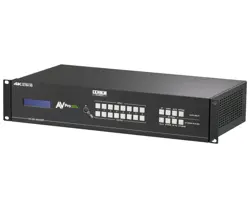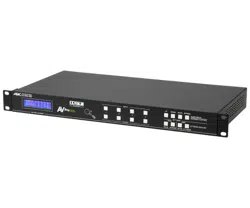

User Manual
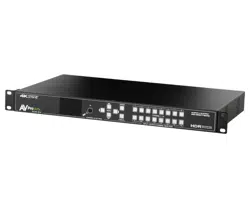
18Gbps True 4K60 4:4:4, 4x4 Matrix with four
HDMI inputs as well as four mirrored HDBaseT
outputs blocks.
AC-MX-44HDBT
1

INTRODUCTION ................................................................................. 5
FEATURES ......................................................................................... 5
WHATS IN THE BOX ............................................................................ 5
SPECIFICATIONS ................................................................................ 6
COMPATIBLE HDBASET RECEIVERS ........................................................ 7
FRONT AND REAR PANEL OVERVIEW ...................................................... 8
INITIAL SETUP: WEBUI ....................................................................... 9
ADVANCED SETUP: WEBUI INPUT SETTINGS ........................................ 13
ADVANCED SETUP: WEBUI OUTPUT SETTINGS ...................................... 14
ADVANCED SETUP: WEBUI EXTRACTED AUDIO OUTPUT SETTINGS ........... 15
WEBUI: VIDEO MATRIX .................................................................... 17
WEBUI: AUDIO MATRIX .................................................................... 18
WEBUI: I/O CONFIG - INPUT SETTINGS .............................................. 19
WEBUI: I/O CONFIG - INPUT SETTINGS CONT ...................................... 20
WEBUI: I/O CONFIG - OUTPUT SETTINGS ............................................ 20
WEBUI: I/O CONFIG - OUTPUT SETTINGS CONT .................................... 21
WEBUI: I/O CONFIG - OUTPUT SETTINGS CONT .................................... 22
WEBUI: I/O CONFIG - OUTPUT SETTINGS CONT .................................... 23
WEBUI: SYSTEM - IP SETTINGS ......................................................... 24
WEBUI: SYSTEM - TELNET SETTINGS .................................................. 25
WEBUI: SYSTEM - ADMIN WEB INTERFACE .......................................... 25
WEBUI: SYSTEM - USER WEB INTERFACE ............................................ 26
WEBUI: SYSTEM - CLOUD SERVICES ................................................... 27
WEBUI: SYSTEM - FIRMWARE UPDATE CONT ......................................... 28
WEBUI: SYSTEM - HARDWARE ........................................................... 28
WEBUI: DIAGNOSTICS - HDMI IN ...................................................... 29
WEBUI: DIAGNOSTICS - HDMI IN CONT ............................................... 30
WEBUI: DIAGNOSTICS - HDMI OUT ..................................................... 31
WEBUI: DIAGNOSTICS - HDBT OUT ..................................................... 32
2

WEBUI: DIAGNOSTICS - HDBT OUT CONT ............................................. 33
WEBUI: CONSOLE ............................................................................. 34
FRONT PANEL CONTROL - SWITCHING ................................................. 35
FRONT PANEL CONTROL - SCALING ..................................................... 35
FRONT PANEL CONTROL - SCALING CONT ............................................. 36
FRONT PANEL CONTROL - AUDIO BINDING .......................................... 37
AUDIO MATRIX CONTROL: ................................................................. 38
FRONT PANEL CONTROL - AUDIO DELAY ............................................. 38
EDID MANAGEMENT: ........................................................................ 39
DISPLAY IP INFORMATION: .............................................................. 40
QUICK NETWORK CONNECT TO WEB INTERFACE: ................................. 40
HDBASET LIGHTS: LINK ................................................................... 41
HDBASET LIGHTS: STATUS ............................................................... 42
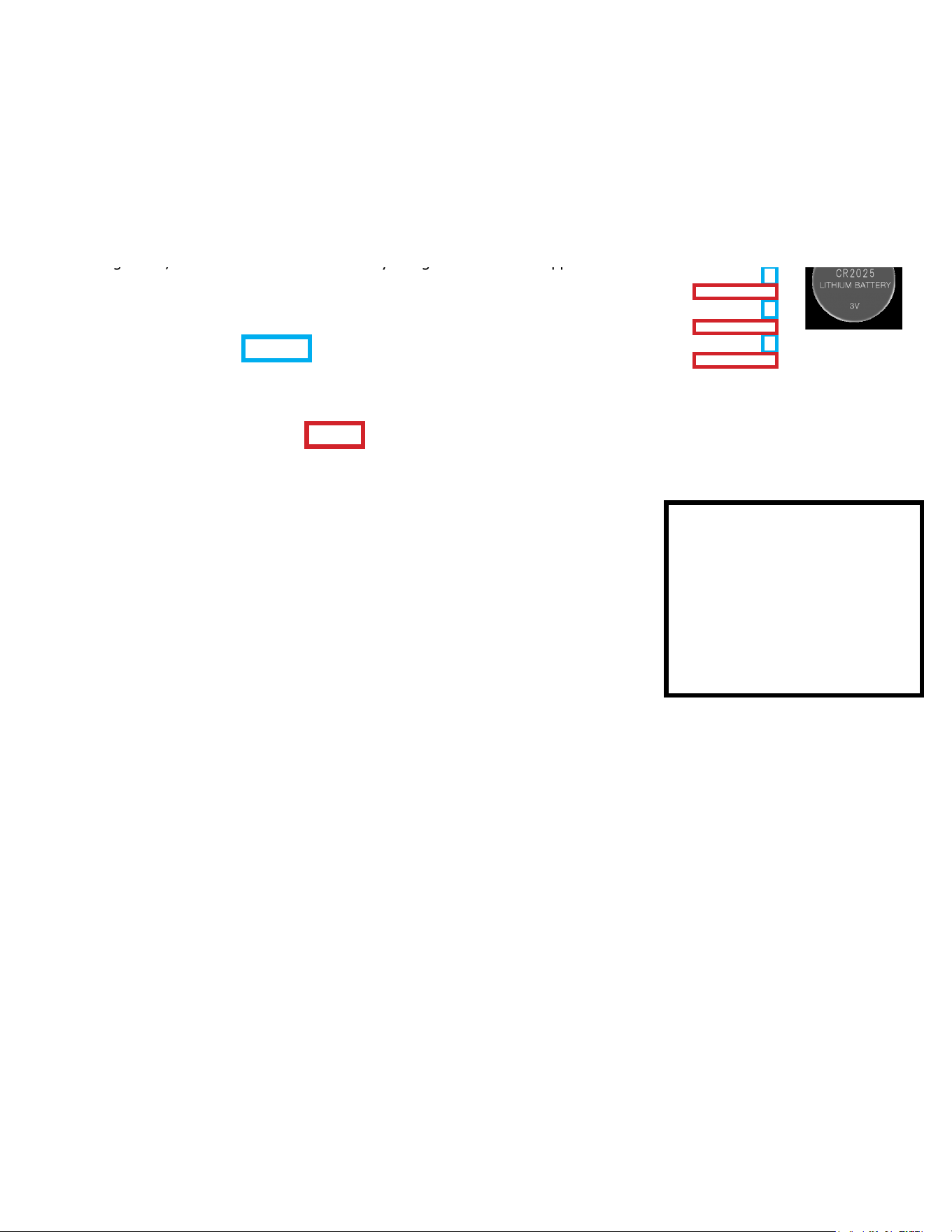
IR CONTROL: IR REMOTE .................................................................. 43
IR CONTROL: SWITCH ...................................................................... 43
IR CONTINUED: ............................................................................... 44
CONTROL4 WIRING EXAMPLE ............................................................ 44
SLEEVE - GROUND ........................................................................... 44
SLEEVE - GROUND ........................................................................... 44
TIP - SIGNAL .................................................................................. 44
TIP - SIGNAL .................................................................................. 44
RS-232 AND TCP/IP CONTROL: .......................................................... 45
COMMAND LIST: .............................................................................. 46
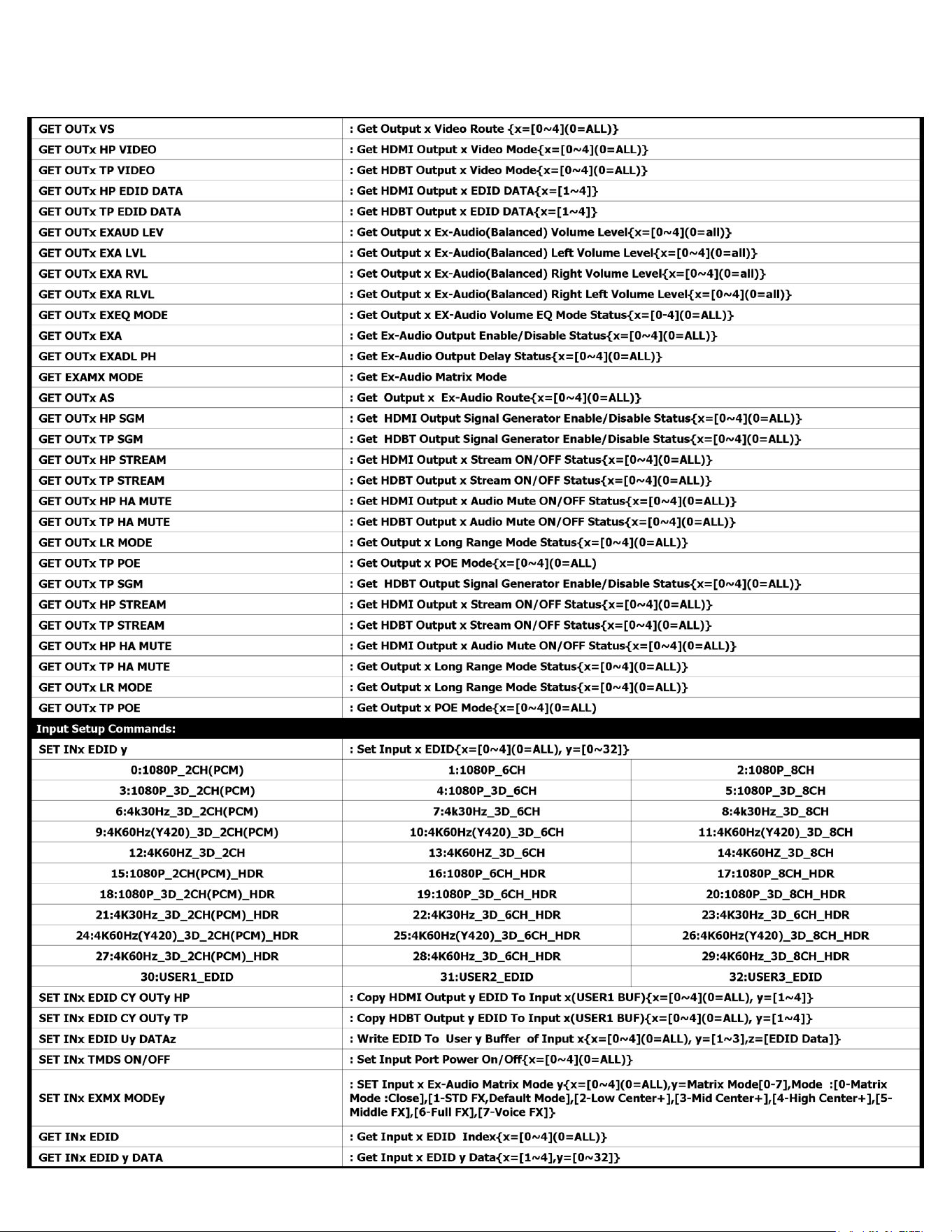
COMMAND LIST CONTINUED: ............................................................. 47
COMMAND LIST CONTINUED: ............................................................. 48
EXTRACTED AUDIO: ......................................................................... 49
BALANCED 5 PIN 2CH AND TOSLINK AUDIO PORT /SPDIF: .................... 49
AUDIO OUTPUT LOGIC AND CABLE PREP: ............................................ 50
TROUBLESHOOTING ......................................................................... 51
BANDWIDTH CHART ......................................................................... 51
3

4
MAINTENANCE ................................................................................ 52
DAMAGE REQUIRING SERVICE ........................................................... 52
SUPPORT ........................................................................................ 53
WARRANTY ..................................................................................... 53

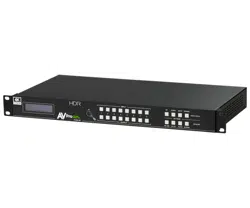
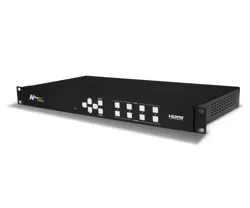
The AC-MX-44HDBT is a true 4x4 HDMI/HDBaseT matrix switch. This unit includes 4 HDMI inputs and 4
HDMI/HDBaseT output blocks. These output blocks include an HDBaseT and HDMI port, these ports are
mirrored, and both are active. This Matrix supports HDMI 2.0(a/b), HDCP 2.2, up to 4K video resolution,
and up to 18 Gbps bandwidth. We can pass 18Gbps through category cable by using the new HDBaseT
technology we have developed called “ICT”, learn more about ICT below. This switch allows any source
(Blu-ray, UHD Blu-ray, satellite receiver, game consoles, PCs, etc...) to be shown on any of the connect-
ed displays. This matrix equalizes and amplies the output to ensure the HDMI signal can be transmitted
through long HDMI cables without loss of quality.
Audio Delay is “On-Board” so you can manage lip-sync issue before it is a problem. Also, with built-in Scal-
ers you don’t have to forfeit that 4K signal just because you have a couple of older displays. All that with
Full EDID management allows maximum exibility with today’s wide mixture of sources and displays.
Features
· HDMI 2.0(a/b)
· 18Gbps Uncompressed Bandwidth Support on HDMI
· 18 Gbps with ICT on HDBaseT outputs
· 4K60 4:4:4 Support
· Full HDR Support (HDR 10 & 12 Bit)
· Dolby Vision, HDR10+ and HLG Support
· HDCP 2.2 (and all earlier versions supported)
· 1080p > 4K Up Scaling on HDMI outputs
· 4K > 1080p Down Scaling on HDBaseT outputs
· Advanced EDID Management
· IR, RS-232 and LAN Control Options
· Digital Toslink Out (7CH PCM, DD, DD+, DTS, DTS-MA)
· Balanced Analog Out (2CH PCM)
· Audio Delay for Digital & Analog Out
· HDBaseT Compatibility mode for mixed systems! (More
below)
· Driver Support for Crestron, C4, RTI, ELAN and more!!!
· Extracted Audio Supports DD+, DTS Master Audio on
Toslink
· Extracted Audio has 3 Operating Modes. Bound to
Input, Bound to Output, or Independent Matrix
· Built in Test Pattern on Each Output to Verify Infrastruc-
ture
Whats in the box
· AC-MX-44HDBT Matrix
· IR Remote Control (*No Battery Included)
· IR Extension Cable
· 48v Power Supply
· RS-232 terminal blocks
· Mounting Brackets
· Grounding Strap
· x4 AC-CABLE-5PIN-2CH audio adapters
5
Introduction
*3V CR2025 Battery Required For IR Remote Control
Not Included
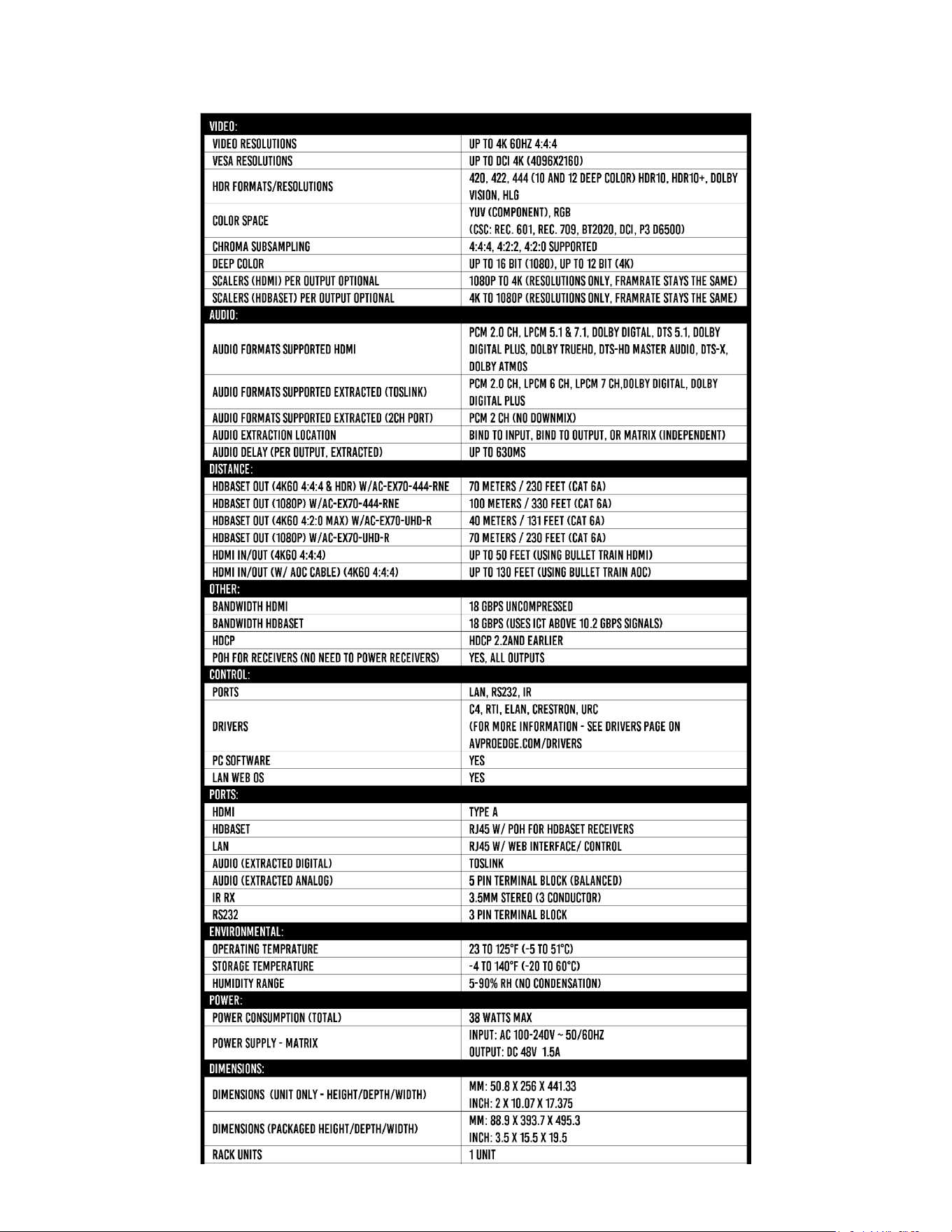
Specications
6

Compatible HDBaseT Receivers
AC-EX70-444-RNE (Receiver /No Ethernet)
· 70M 4k 60 4:4:4 & HDR
· 100M 1080P
AC-EX70-SC2-R (Scaling Receiver)
· 70M 4k 60 4:4:4 & HDR
· 100M 1080P
AC-CX100-RAMP
· 70M 4k 60 4:2:0 & HDR
· 70M 1080P
AC-EX70-UHD-R
· 40M 4k 30 4:4:4/4k 60 4:2:0
· 70M 1080P
7
Non AVPro HDBaseT Receivers may work but ICT (our Invisible Compression Technology) will not. This
means higher bandwidth signals (greater than 10.2Gbps) will not pass as this requires ICT.

8
Front and Rear Panel Overview
9
Initial Setup: WebUI
1. With the AC-MX-44HDBT placed into its new home (AV Rack, cabinet, table top) take a Phil-
lips head screwdriver and attach the included yellow ground strap to the back of the chassis
using the pre-installed screw, then attach the other end to a suitable grounded object.
2. Connect the HDMI Input sources to the HDMI Inputs on the back of the matrix.
3. Connect the HDMI/HDBaseT devices to the HDMI/HDBaseT Outputs.
4. Connect the network LAN cable to the RJ45 port labeled LAN (between the Micro USB and 3pin RS232
port).
5. Power on the sources (Inputs).
6. Power on the Output devices/displays.
7. Connect the 48V power supply to power on the matrix and then to a suitable power source.
8. In order to see the current IP settings, press and hold (for 3 seconds) INPUT 3 and INPUT 4 buttons
simultaneously. This screen will change every 3 seconds showing
additional settings (host, net mask, router IP).
NOTE: This screen starts with the current IP address of the matrix.
9. To Enable/Disable DHCP, press and hold INPUT 1 and INPUT 4 at the same time for 3 seconds. With
the matrix connected to the local network, using a computer on the same network open up a web
browser and type the HIP (Host IP Address) into the address bar to navigate to the WebUI.
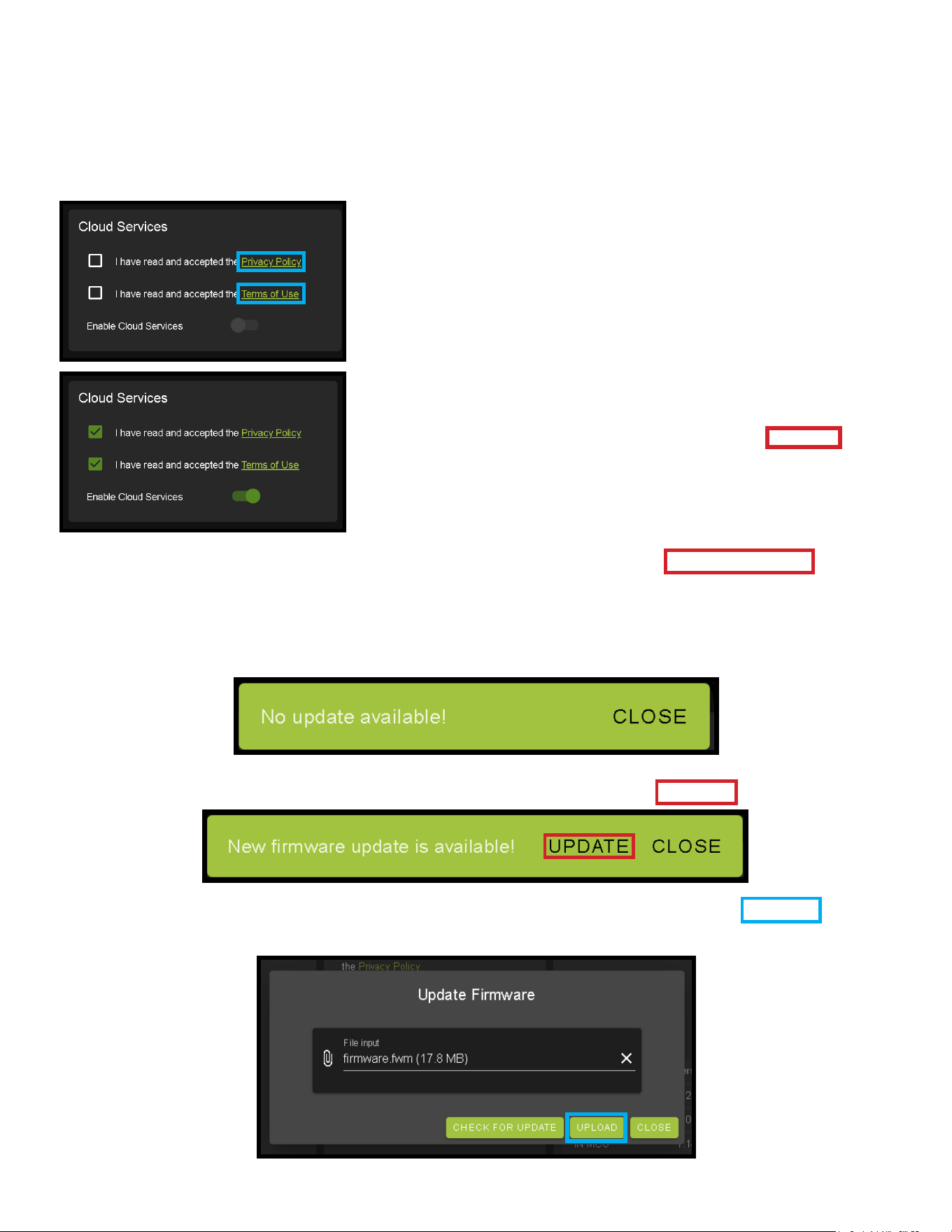
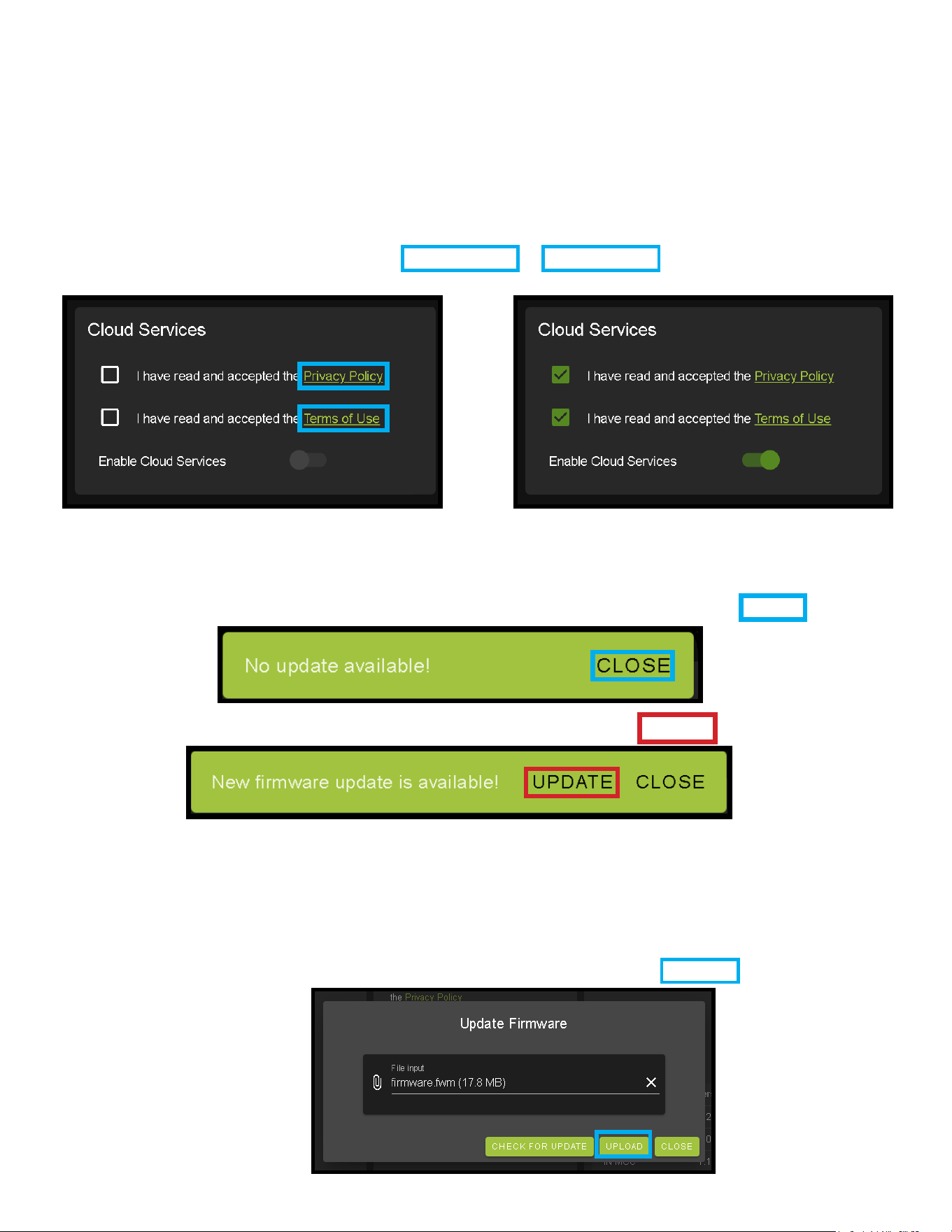
10. With the WebUI open, navigate to System. Click on the Privacy Policy and Terms of Use, this will open
these documents in a new tab for review. Once read click on the boxes next to each to agree. When
both are checked the switch for Enable Cloud Services will be selectable (will be red or disabled by
default). Click to enable (the switch will turn green).
The AC-MX-44HDBT can be controlled using the Micro USB port, 3pin RS232, or over TCP/IP using the LAN
connection. For initial setup it is recommended to connect the matrix to a local area network (LAN) and use
a computer on the same network in conjunction with the built in WebUI. After making all the physical con-
nections, the rst step will be to check for any Firmware Updates. The below steps are an example of this
setup, other control options are covered in separate sections of this user manual.
10
11. With the AVProEdge WebUI open, navigate to System. Click on the Privacy Policy and Terms of Use,
this will open these documents in a new tab for review. Once read click on the boxes next to each to
agree. When both are checked the switch for Enable Cloud Services will be selectable (will be red or dis-
abled by default). Click to enable (the switch will turn green).
12. With the Cloud Services enabled under the Hardware section click the Update Firmware button to
check for new Firmware OTA (over the air). This will compare the rmware versions currently loaded on
the AC-MX-44HDBT and compare to the latest available. If it is up to date, you will see a prompt stating
“No update available!”
13. If an update is available, the following prompt will show. Simply click UPDATE.
14. If a new update is available a le will automatically be selected, simply click the UPLOAD button to
load the rmware les to the Matrix. Uploading does not install the Firmware, that is the next step.
11
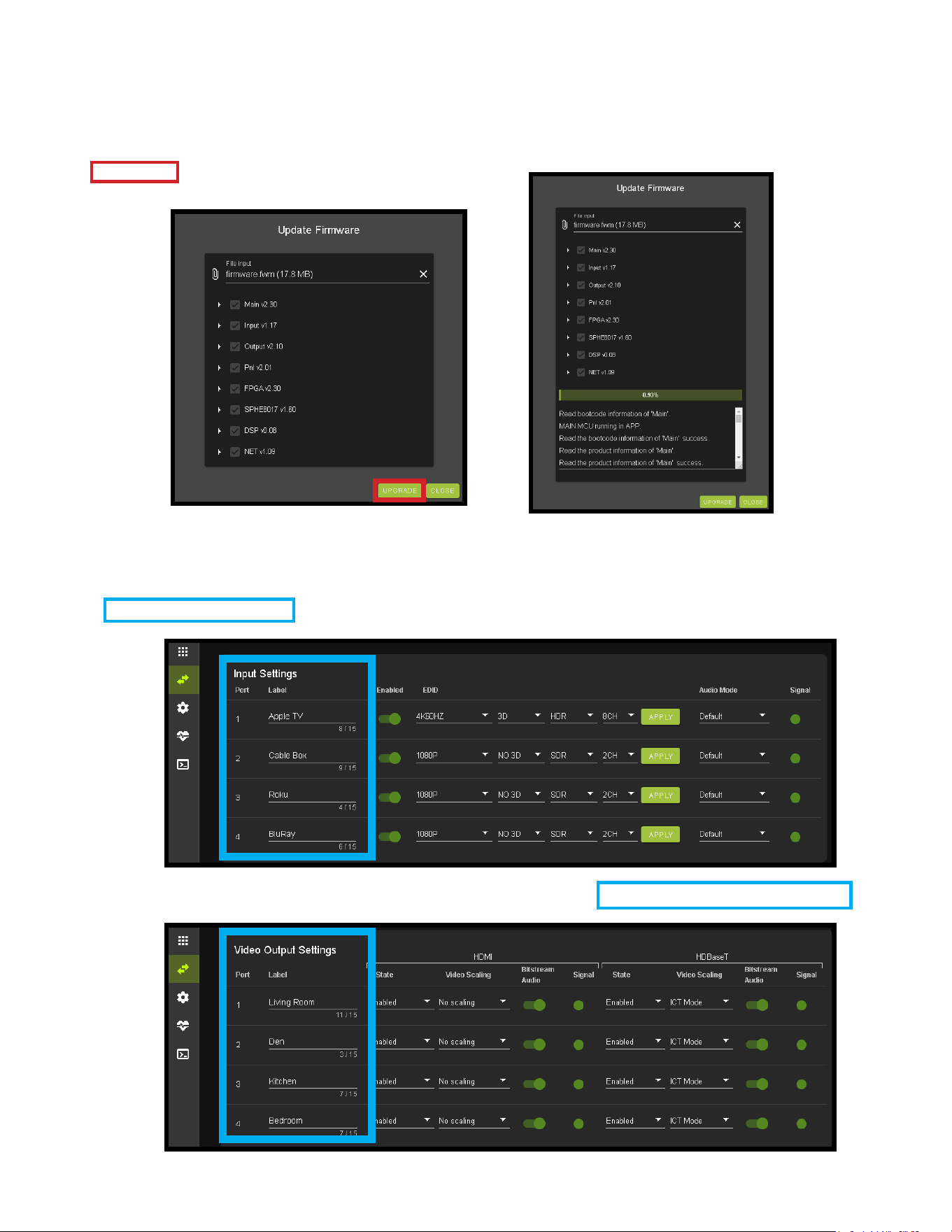
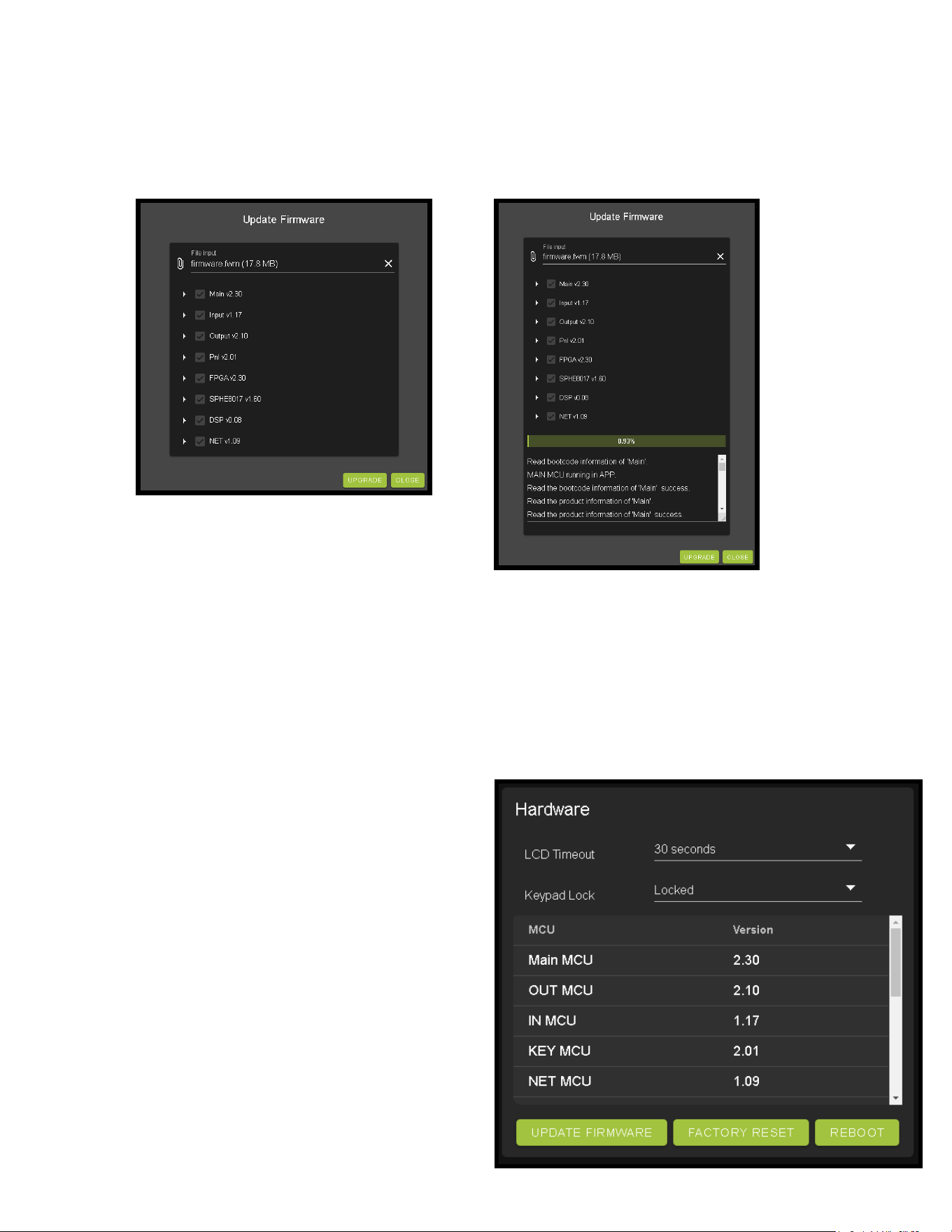
15. Once the rmware le has been uploaded, it will display all containing rmware les. Here you can
select individual rmware les to load or simply leave all les/options selected. If the version currently in-
stalled is not newer (does not need to be updated), then that update will be skipped automatically. Click
the UPGRADE button to start.
16. Once the progress bar hits 100% click the CLOSE button, the rmware upgrade process is complete.
17. With the Firmware up to date it’s time to start setting up the matrix. With the AVPro Edge WebUI open,
navigate to the I/O Conifg section. Label the applicable Inputs (Apple TV, Cable Box, Roku, etc) under
the Input Settings - Label.
18. Label the Outputs (Living Room, Bedroom, Den, etc) under the Video Output Settings - Label.
12
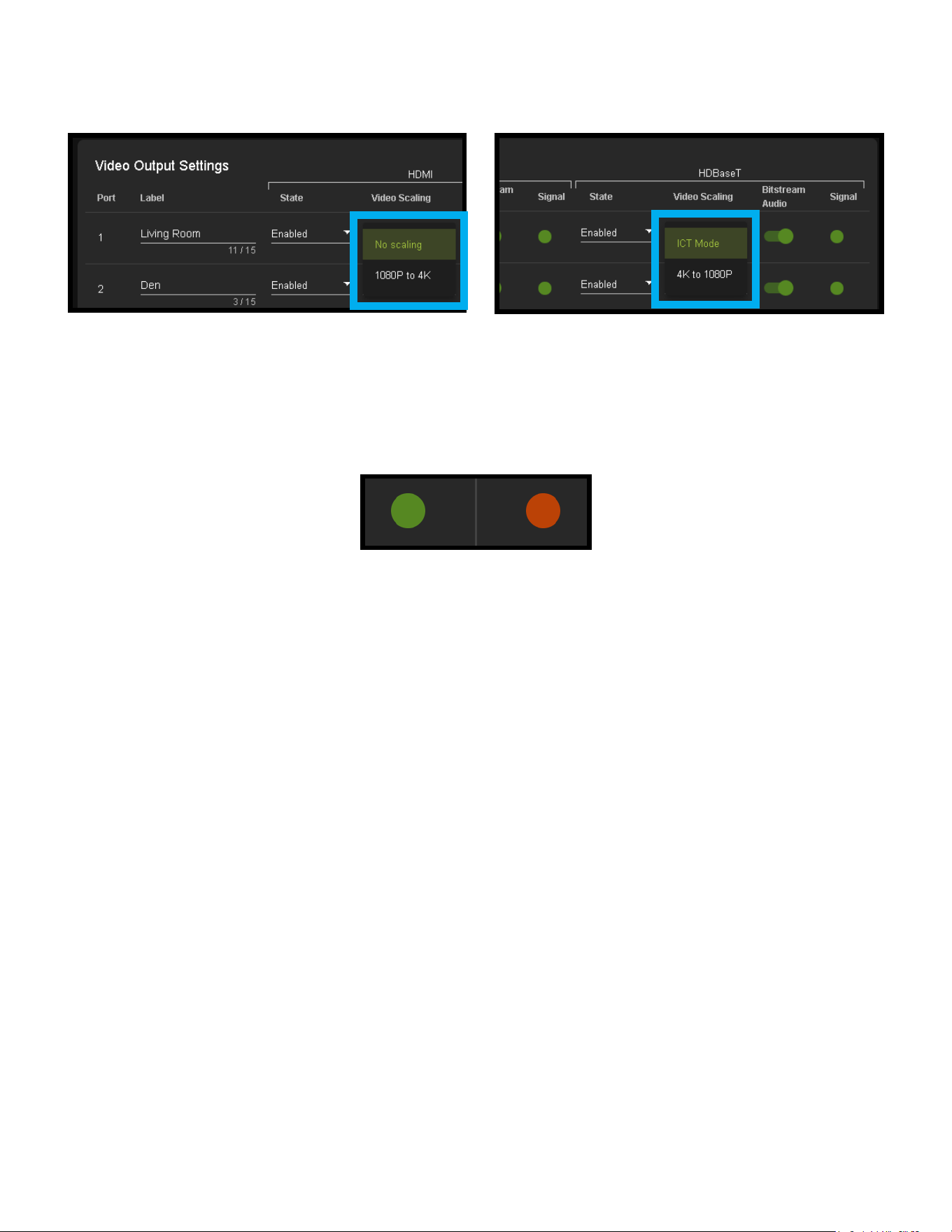
19. Set the HDMI/HDBaseT Video Scaling if needed. HDMI outputs can be upscaled (1080P signal up to 4k)
and the HDBaseT outputs can be downscaled (4k signals down to 1080P).
20. With the system and all it’s components powered up it’s time to verify signal path from source to the
sync. For now leave EDID settings to their default 1080P 2 CH, the next section Advanced Setup will
cover the more advance settings.
21. Use the Signal Indicator on the HDMI INPUTS. Green means HDMI source is detected, red means that
the source is not detected. If red verify that the input is powered on and that the HDMI cable is prop-
erly connected to the source and to the back of the matrix.
22. Now verify the connections to the HDMI/HDBaseT outputs using the Signal indicator. Green means
HDMI/HDBaseT sync is detected, red means that the HDMI/HDBaseT sync is not detected. If red verify
that the sync devices are powered on and that the HDMI/HDBaseT cables are properly connected to
the back of the matrix.
23. With everything connected and powered on, green indicators across the applicable inputs and outputs,
verify you are getting all of your sources on all of your displays.
24. Problems with a source or sync, see the Troubleshooting section for help on page 45.
Advanced Setup: WebUI Input Settings
After verifying good signal path from source to sync now it is time to go through the rest of the settings to
maximize the setup. Starting with the input side with the EDID and Audio Mode settings.
13
1. With the WebUI open, navigate to the I/O Conifg tab and focus on the Input Settings section at the
top.
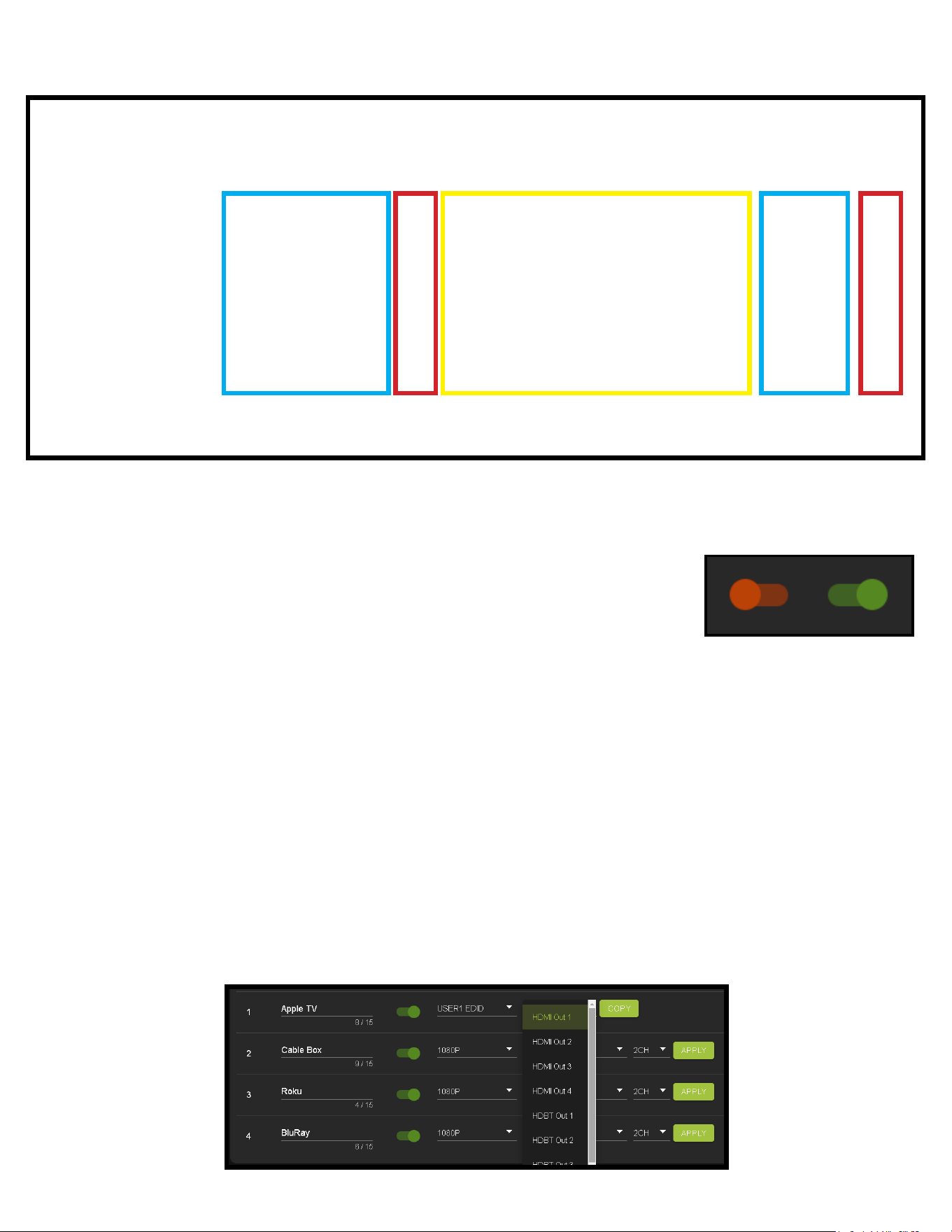
2. Set the EDID on each input by selecting the resolution drop-down rst (default is set to 1080P). The
options are 1080P, 4K30Hz, 4K60Hz Y420, and 4K60Hz. If you select USER1 EDID, then the drop-
downs change to allow you to select from and output to copy from. You can select any of the 4 HDMI
outputs, or any of the 4 HDBaseT outputs, then click the COPY button. This will save that outputs EDID
to the USER1 slot.
3. Next use the drop-down to select NO 3D, or 3D depending on the displays capability.
NOTE: Currently the only resolution you can choose NO 3D for is 1080P.
4. Next drop-down select either SDR (standard dynamic range) or HDR (High Dynamic Range).
5. The fourth drop-down in the EDID section is for the audio, you can select 2 CH, 6CH, or 8CH.
6. Click the APPLY button to set the EDID.
7. Verify you are still getting that source to all your displays and that the image looks correct.
NOTE: Some older displays may take an HDR signal and display correctly (ignoring the HDR Metadata)
others will not ignore the HDR part of the signal and may display incorrectly.
Audio Mode - see Page 19 “Input Settings Audio Mode” for more info.
Advanced Setup: WebUI Output Settings
14
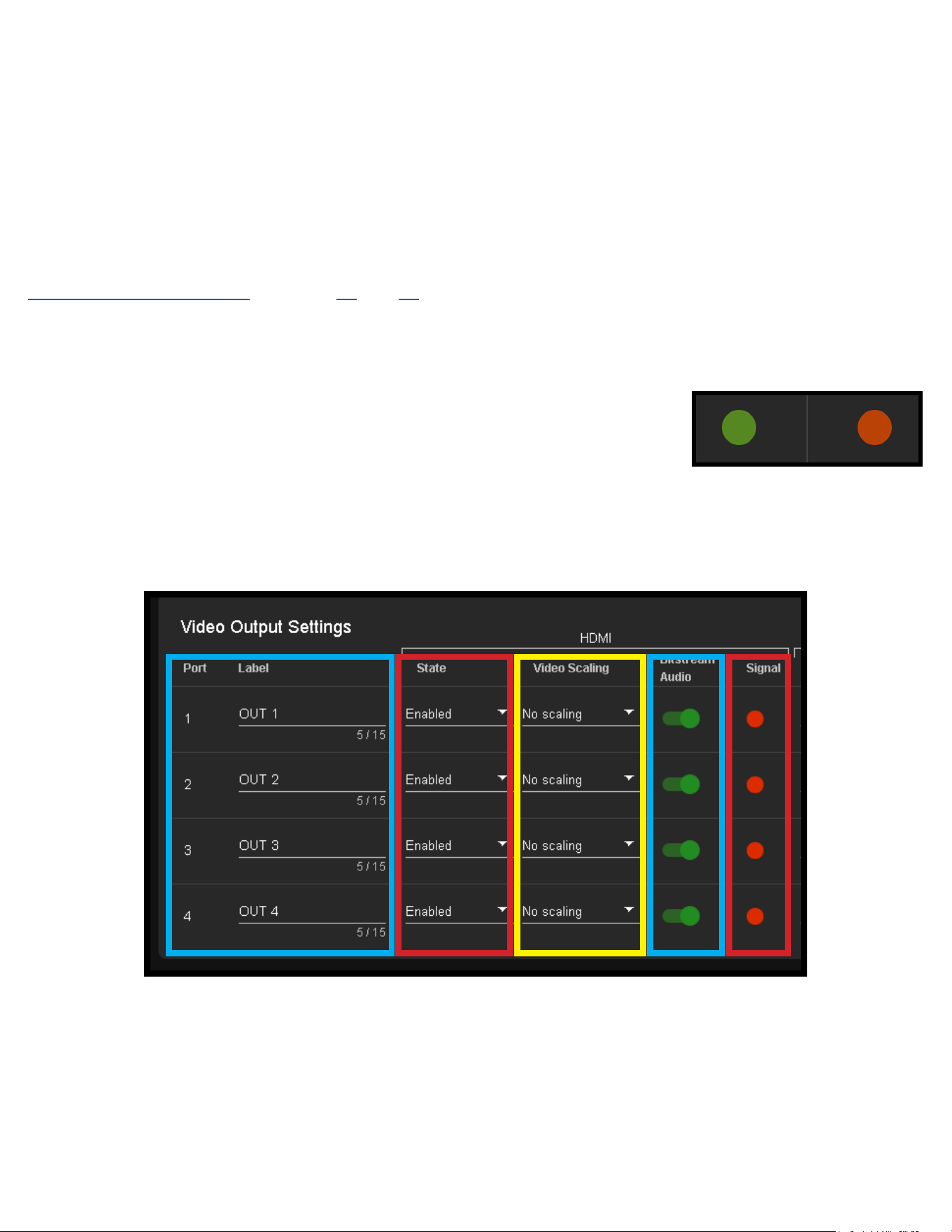
8. Now navigate to the Video Output Settings under I/O Cong
9. In addition to the output Label (name/alias), there are 3 settings for each HDMI output and 3 settings
for each HDBaseT output.
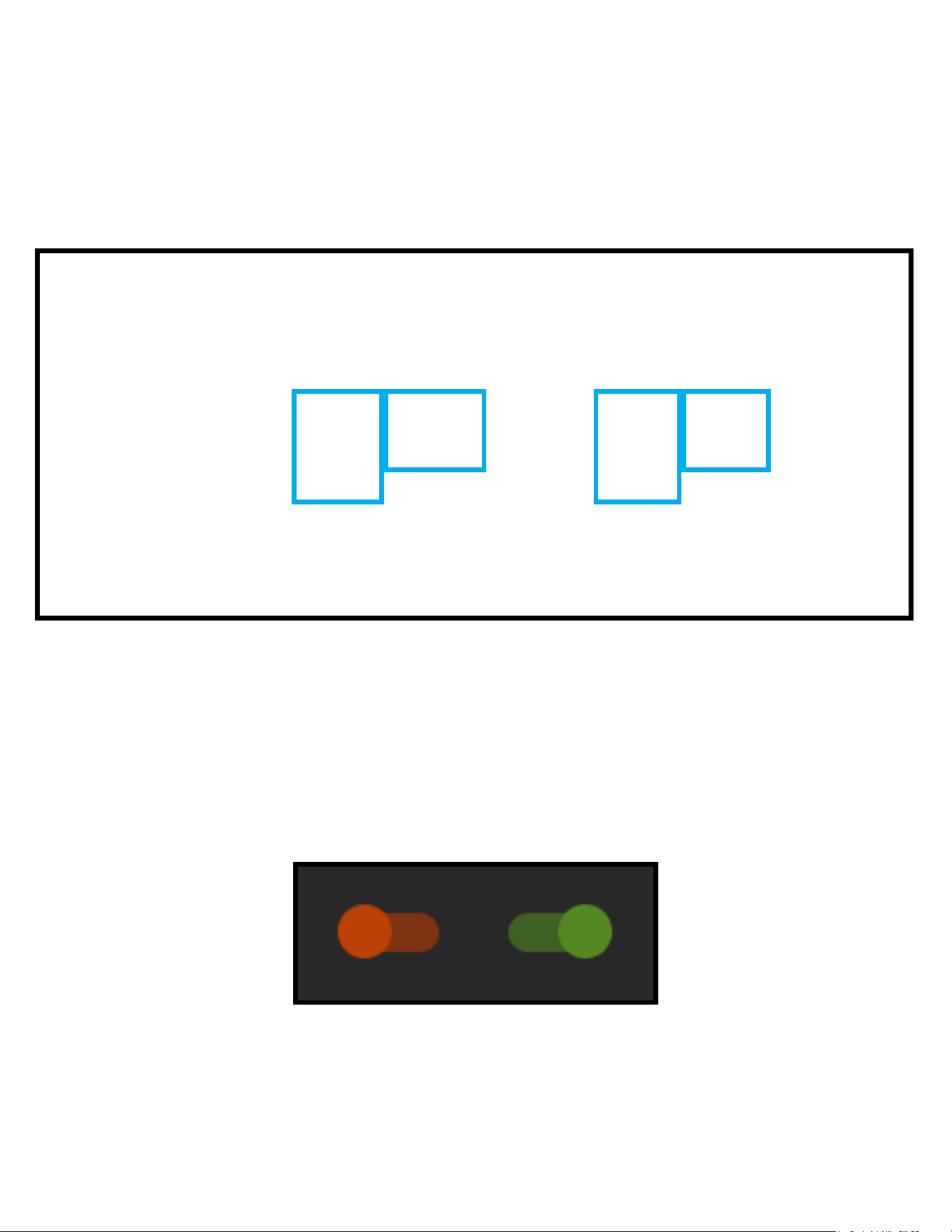
10. Under State, you can enable/disable that port (turn that port on or o) and also enable a 1080P test
pattern, the Video Scaling mode (HDMI you can choose to No Scaling or 1080P to 4k, HDBaseT you can
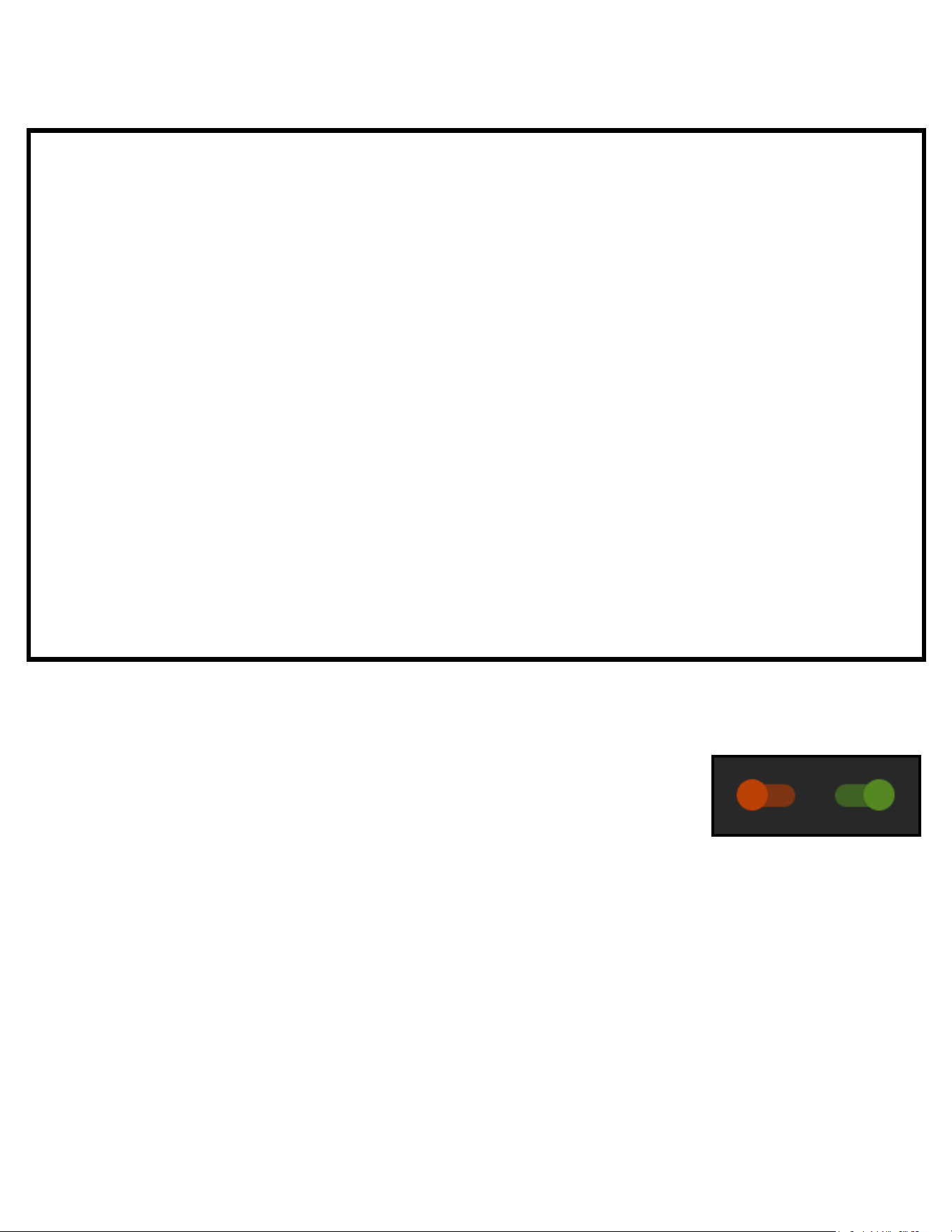
choose ICT or 4K to 1080P), and you can Enable or Disable the Bitstream Audio (slider icon Green=ON,
Red=OFF).
O
Disabled
On
Enabled

1.
Advanced Setup:
WebUI Extracted Audio Output Settings
1. Now navigate to the Extracted Audio Output Settings under I/O Cong.
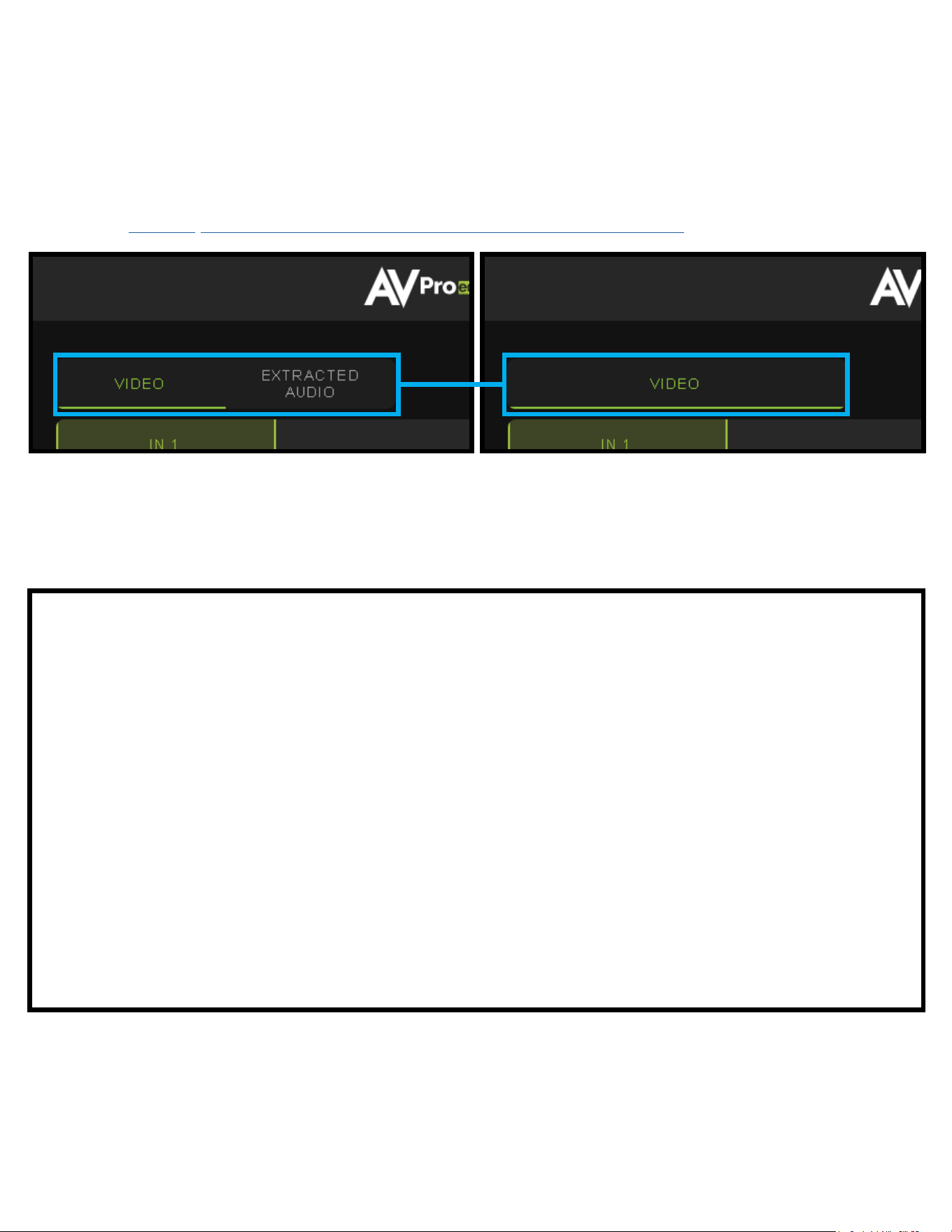
2. The extracted audio ports have 3 distinct operating modes, use the drop-down at the top to select.
The three options are.
Bind to Input (Default) - where the audio port number corresponds to the input signal. This is ideal
for systems where audio is matrixed separately in a zoned amplier.
Bind to Output - this conguration the audio will automatically follow the HDMI/HDBaseT output.
This is ideal for systems that use local AVR’s for some of the Zones.
Matrix - This mode allows you to matrix the extracted audio ports independently from the HDMI/
HDBaseT outputs. In this mode you there will be a Tab for the extracted audio under the Matrix page,
allowing you to route the audio just like routing the video. If the matrix is set to Bind to Input or Bind
to Output this tab will not be visible.
3. Other available settings for the extracted audio ports include Enable/Disable, Volume control (1-100),
EQ presets (7 generic preset options to choose from), Left/Right balance, and audio delay. Each of
these 5 settings can be changed per extracted audio port.
NOTE: The balanced 5pin and Toslink ports are mirrored and always down-mixed to 2CH audio.
4. You can use the slider or text box to change the volume (settings are 0-100).
15
16
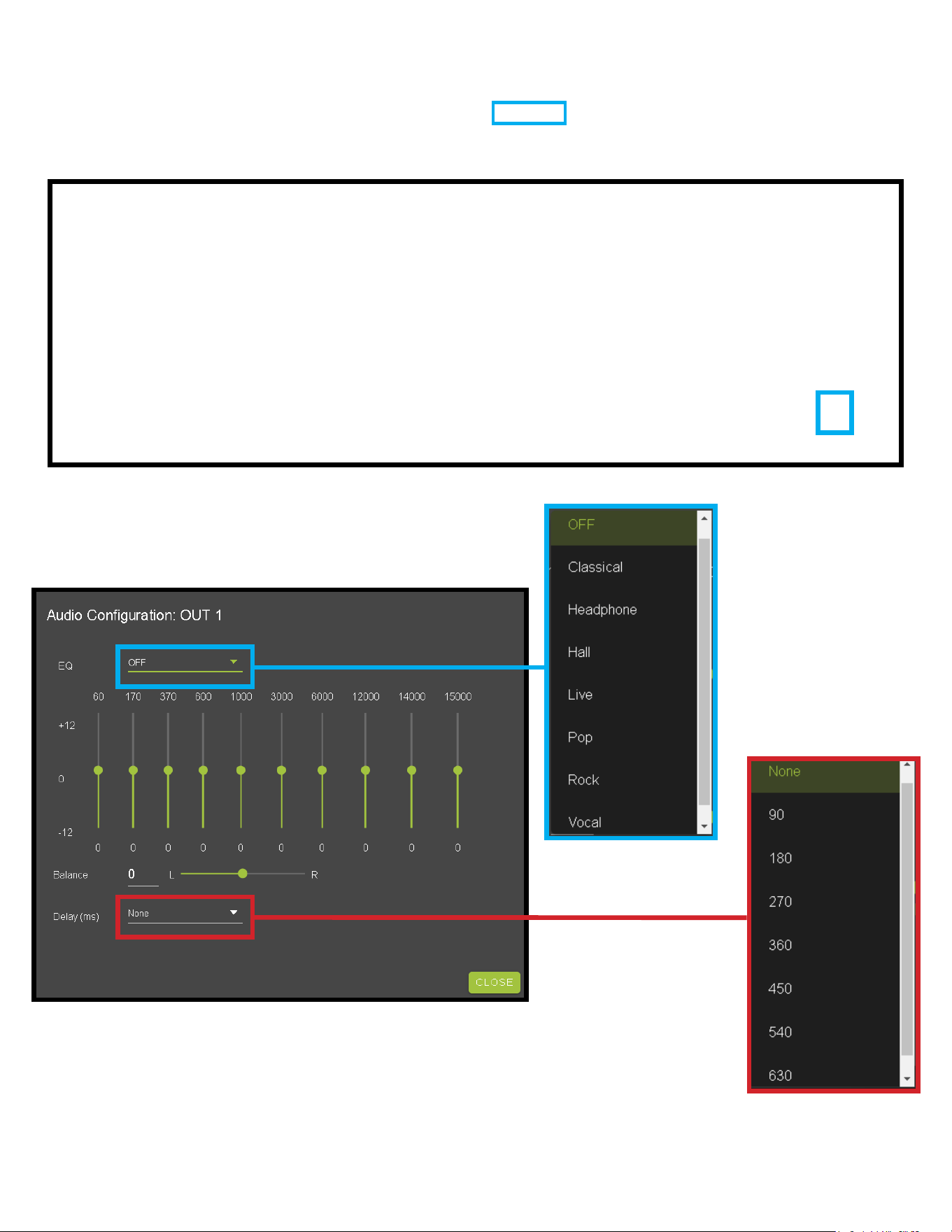
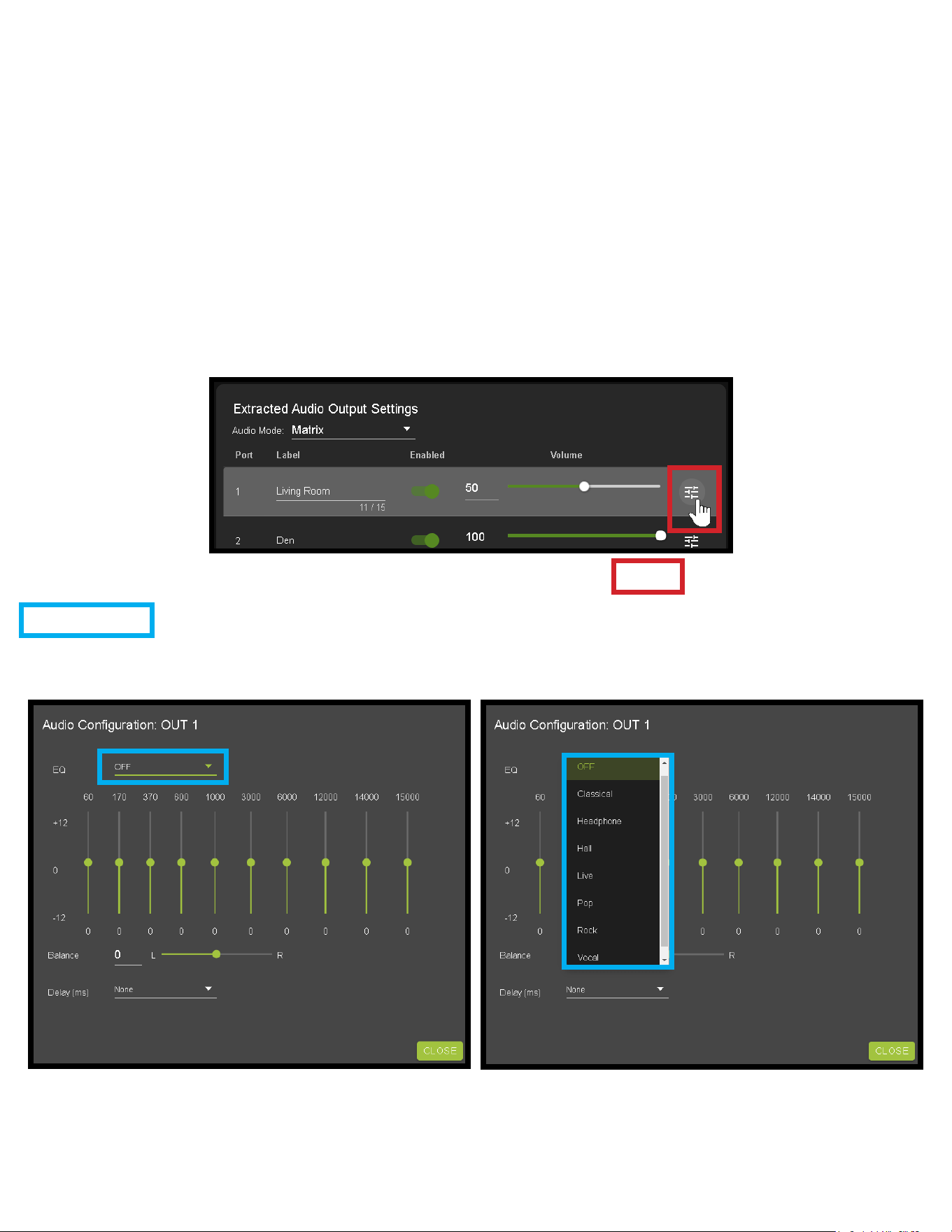
5. To change the EQ settings of that port click on the emblem to the right of the volume slider. This will
bring up the Audio Conguration Page. Here you can choose from 8 dierent EQ settings, change the
Left / Right balance, and set the audio delay.
6. Delay (eight settings in 90 millisecond increments)
None (default), 90, 180, 270, 360, 450, 540, and 630.
17
WebUI: Video Matrix
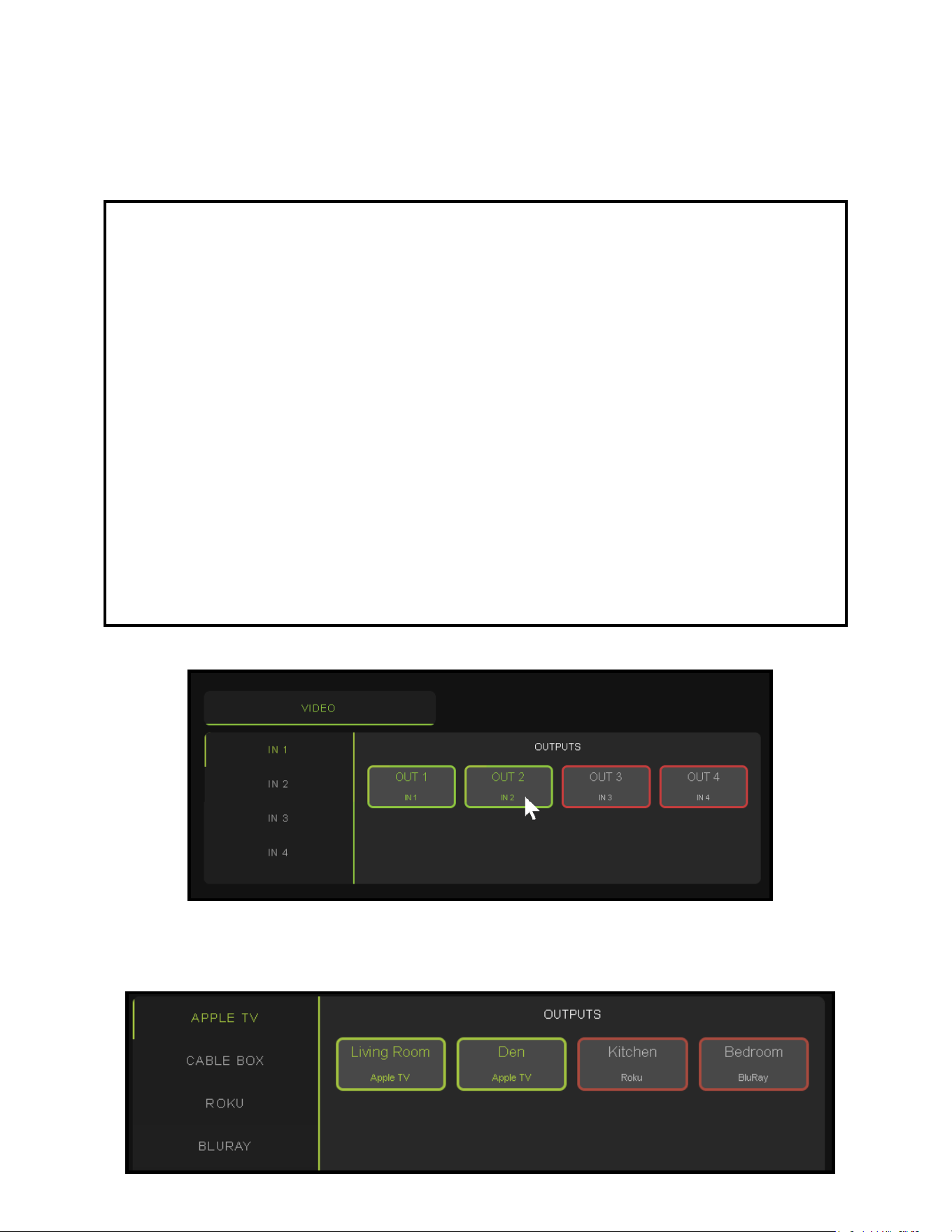
Use this page to route the video INPUTS and OUTPUTS.
·Click on the INPUT number to select (example below shows IN 1)
·With the INPUT selected simply click on the OUTPUT you want to send that source to.
·Note: If you rename the INPUTS/OUTPUTS using the I/O Cong page they will display here.
18
WebUI: Audio Matrix
Use this page to route the extracted audio.
NOTE: The extracted audio ports can only be manually changed (matrixed) when in Matrix Mode. If the
extracted audio is set to Bind to Input (default) or Bind to Output then this tab will not be visible, example
below. See Page 14 “Advanced Setup: WebUI Extracted Audio Output Settings” for more info.
·Click on the INPUT number to select (example below shows IN 1 - Apple TV)
·With the INPUT selected simply click on the OUTPUT you want to send that audio to.
·Note: If you rename the INPUTS/OUTPUTS using the I/O Cong page they will display here.
19
WebUI: I/O Cong - Input Settings
Input Settings Label - Use this to give an name/alias to your inputs (Apple TV, Cable Box, Roku, etc).
Note: There is a 15 character limit to this eld, the name will replace the default “IN #” throughout the rest
of the WebUI (for instance the Video Matrix tab).
Input Settings Enable switch - Use this enable/disable switch to turn the
corresponding Input port on or o. The default setting is enabled (green) by
default.
Input Settings EDID - Use these four drop-downs to select your preferred EDID.
The available combinations are as follows.
1. 1080P_2CH
2. 1080P_6CH
3. 1080P_8CH
4. 1080P_3D_2CH
5. 1080P_3D_6CH
6. 1080P_3D_8CH
7. 4K30HZ_3D_2CH
8. 4K30HZ_3D_6CH
9. 4K30HZ_3D_8CH
10. 4K60HzY420_3D_2CH
11. 4K60HzY420_3D_6CH
12. 4K60HzY420_3D_8CH
13. 4K60HZ_3D_2CH
14. 4K60HZ_3D_6CH
15. 4K60HZ_3D_8CH
16. 1080P_2CH_HDR
17. 1080P_6CH_HDR
18. 1080P_8CH_HDR
19. 1080P_3D_2CH_HDR
20. 1080P_3D_6CH_HDR
21. 1080P_3D_8CH_HDR
22. 4K30HZ_3D_2CH_HDR
23. 4K30HZ_3D_6CH_HDR
24. 4K30HZ_3D_8CH_HDR
25. 4K60HzY420_3D_2CH_HDR
26. 4K60HzY420_3D_6CH_HDR
27. 4K60HzY420_3D_8CH_HDR
28. 4K60HZ_3D_2CH_HDR
29. 4K60HZ_3D_6CH_HDR
30. 4K60HZ_3D_8CH_HDR
NOTE: If you select USER1 EDID, then drop-downs change to allow you to select from and output to copy
from. You can select any of the 4 HDMI outputs, or any of the 4 HDBaseT outputs, then click the COPY
button (this replaces the Apply button). This will save that outputs EDID to the USER1 slot.
O
Disabled
On
Enabled
20
WebUI: I/O Cong - Input Settings Cont.
Input Settings Audio Mode - There are 7 settings available (Default state is o/disabled).
The AC-MX-44HDBT automatically down-mixes the source audio signals down to 2Ch. for the extracted
audio Toslink and balanced 5pin ports. Changing the audio mode here will aect that inputs audio on all the
extracted ports.
Default (o), Low Center+, Mid Center+, High Center+, Middle FX, Full FX, and Voice FX.
NOTE: There are also EQ, Balance (left/right), and Delay settings you can change per Output, see WebUI:
I/O Con - Output Settings on pages 20 and 21 for more info.
Input Settings Signal - The Signal Indicator on the HDMI INPUTS shows the current state of the con-
nection HDMI source. Green means the HDMI source is detected, red means that the source is not detect-
ed. If red verify that source is powered on and that the HDMI cable is properly connected to the source and
to the back of the matrix.
Global Input Settings - There are two settings available
·SupportsDolbyMAT-CheckthisboxtoenableDolbyMATaudio
·RequiresDolbyVisionLowLatency-CheckthisboxtorequireDolbyVisionLowLatency(Player-led)
overStandardDolbyVision(TV-Led).SourcesliketheAppleTVandX-BoxSeriesXuseLowLatency.
Output Settings Label - Use this to give an name/alias to your outputs (Living Room, Den, Kitchen, etc).
Note: There is a 15 character limit to this eld, the name will replace the default “OUT #” throughout the
rest of the WebUI (for instance the Video Matrix tab).
Output Settings State - This drop-down has 3 settings, just like the input settings you can Enable or
disable this port. In addition you can also choose Test Pattern to enable a 1080P color bar test pattern on
that output. This is helpful in verifying the signal chain from Matrix to sync (display). To disable the test
pattern, change the state back to Enabled (default).
WebUI: I/O Cong - Output Settings
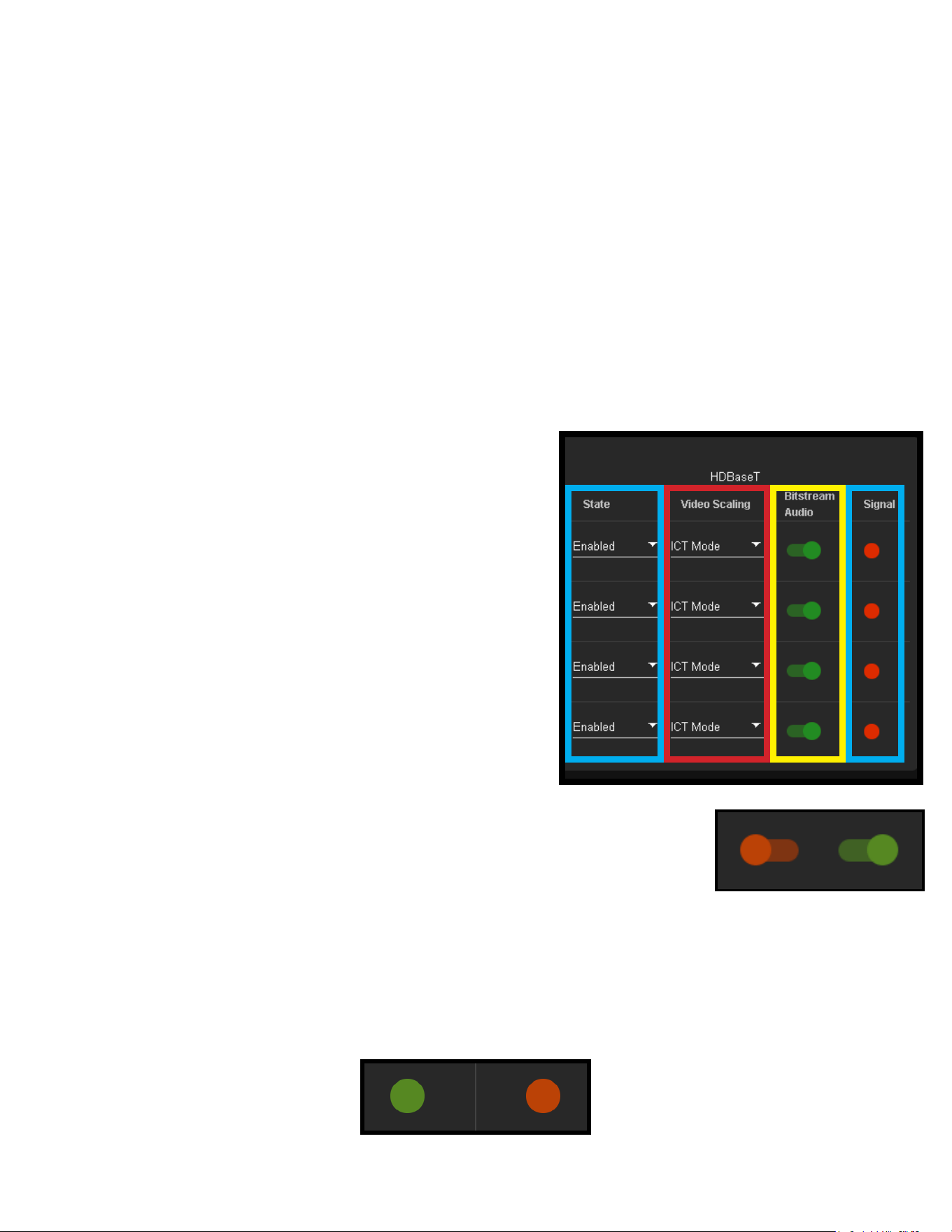
Output Settings State - This drop-down has 3 settings, just
like the input settings and HDMI outputs you can Enable or
Disable this port. In addition you can also choose Test Pattern
to enable a 1080P color bar test pattern on that output. This
is helpful in verifying the signal chain from Matrix to sync (dis-
play). To disable the test pattern, change the state back to
Enabled (default).
Output Settings Video Scaling - The HDBaseT outputs can
down-scale a 4K signal to 1080P. This scaling only changes
the pixel density, it does not alter frame rate or color space.
The other setting is ICT Mode (default), AVProEdge’s Invisible
Compression Technology designed to work with a compatible
AVProEdge HDBaseT Receiver (RX).
Output Settings Bitstream Audio - This is an enable/disable switch. By default
this will be Enabled/Green. To change the setting simply click to switch. Disabled/
Red there will be no Audio passed on that HDBaseT output.
Output Settings Signal - The Signal Indicator on the HDBaseT outputs shows the current state of the
connected HDBaseT Receiver. Green means HDBaseT receiver is detected, red means that the receiver is
not detected. If red verify that the category cable is properly terminated on both ends, and properly con-
nected to both the matrix and the HDBaseT receiver.
WebUI: I/O Cong - Output Settings Cont.
Output Settings Video Scaling - The HDMI outputs can up-scale a 1080P signal to 4k. This scaling only
changes the pixel density, it does not alter frame rate or color space.
Output Settings Bitstream Audio - This is an enable/disable switch. By default this will be Enabled/
Green. To change the setting simply click to switch. Disabled/Red there will be no Audio passed on that
HDMI output.
NOTE: This setting has no aect on the HDBaseT or Extracted Audio output.
Output Settings Signal - The Signal Indicator on the HDMI OUTPUTS shows the current state of the
connection HDMI Output. Green means HDMI sync is detected, red means that the sync is not detected. If
red verify that the output is powered on and that the HDMI cable is properly connected to the sync and to
the back of the matrix.
20
O
Disabled
On
Enabled
22
WebUI: I/O Cong - Output Settings Cont.
Output Settings Label - Use this to give an alias/name to your extracted audio outputs.
Note: There is a 15 character limit to this eld, the name will replace the default “OUT #” throughout the
rest of the WebUI (for instance the Video Matrix tab).
Output Settings Enabled - This is an enable/disable switch. By default this will be Enabled/Green. To
change the setting simply click to switch. Disabled/Red there will be no Audio passed on that extracted au-
dio port (both Toslink and balanced 5pin will be muted).
Output Settings Volume - Here you can use the slider bar to adjust the extracted port volume (0~100).
You can also use the text box and enter a value (0~100).
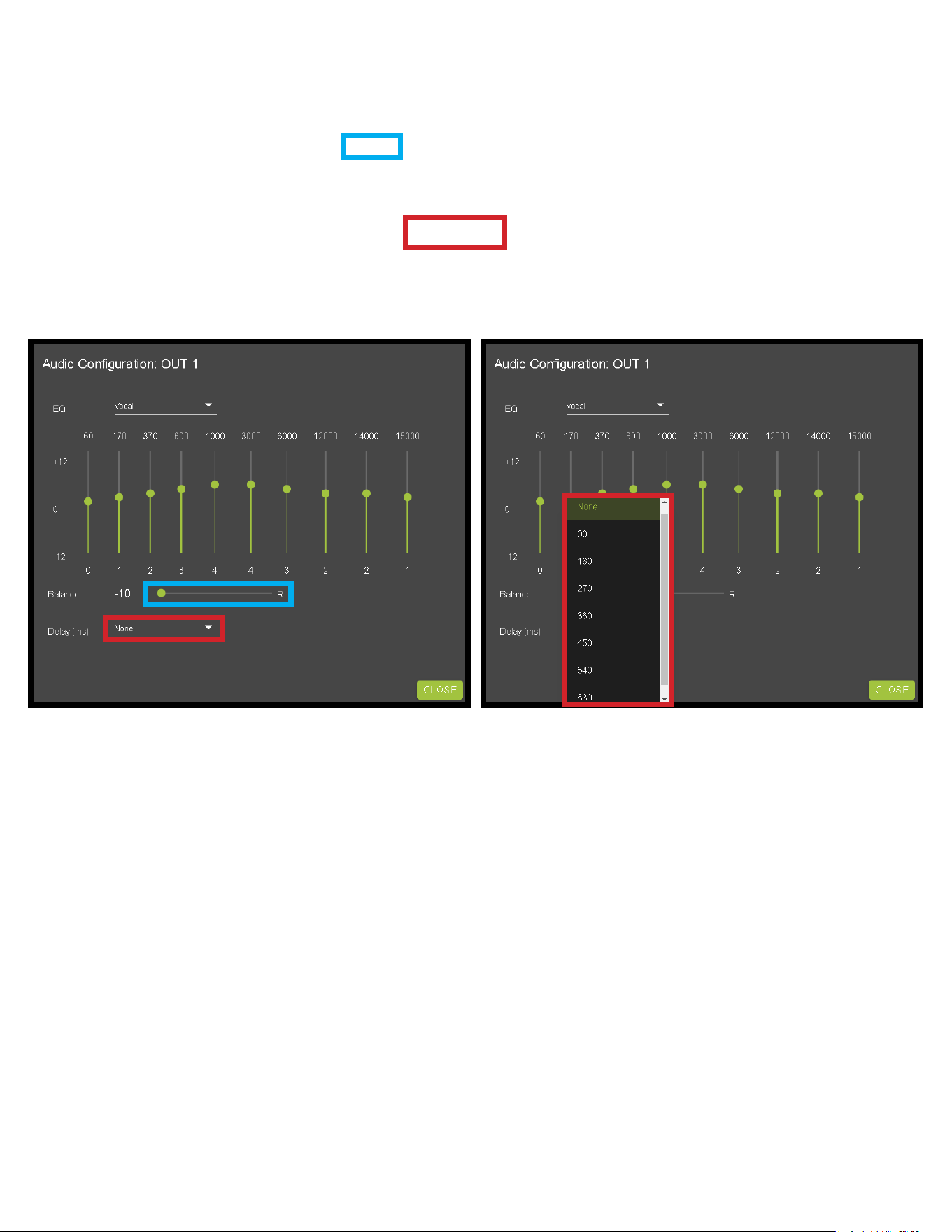
Output Settings EQ Settings - To open the EQ Settings click on the symbol next to the Volume slider.
EQ Drop-down contains 8 settings. The default o, Classical, Headphone, Hall, Live, Pop, Rock, and Vocal.
23
WebUI: I/O Cong - Output Settings Cont.
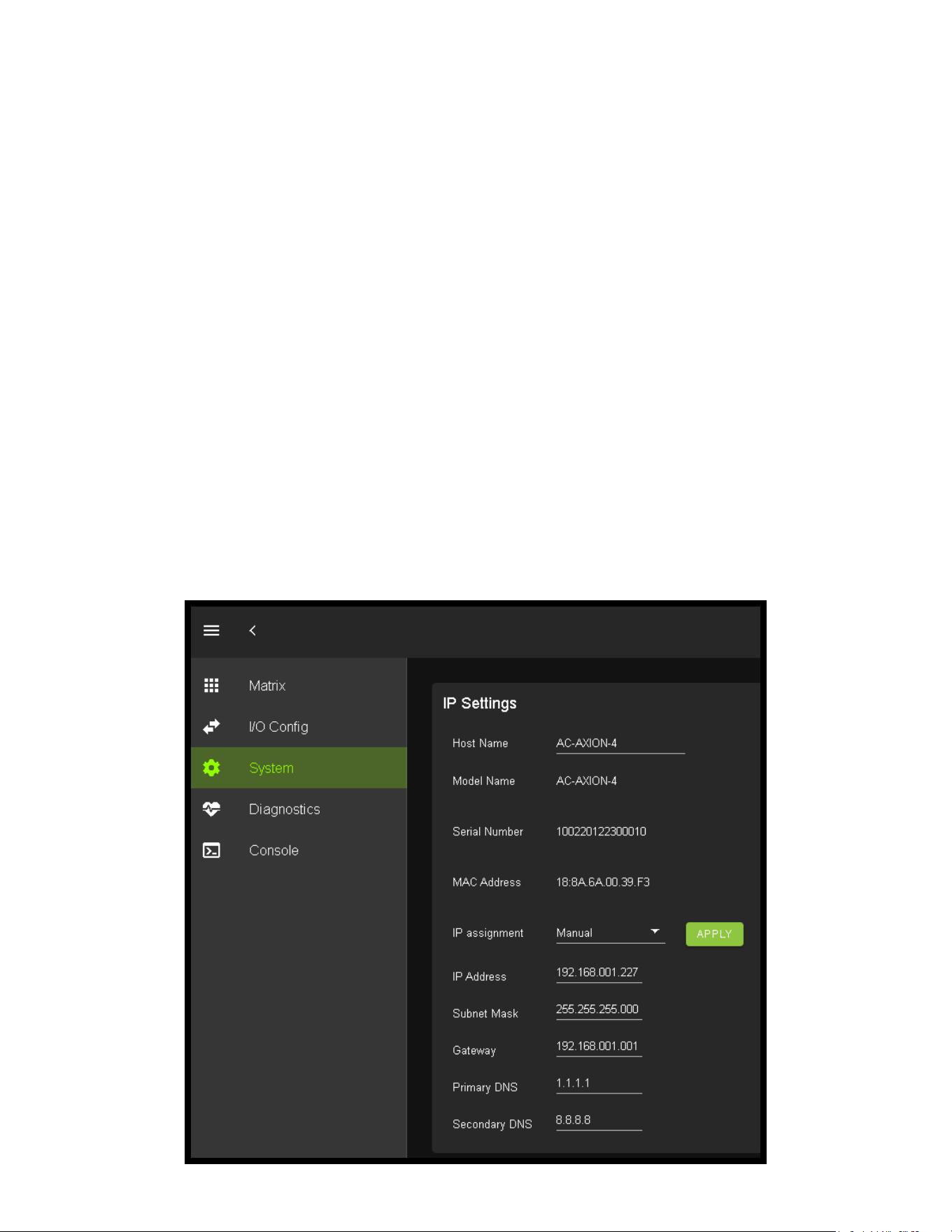
Output Settings Balance - Use this slider to adjust the Left/Right balance.
Note: Default is 0 (zero), value can be -10~10
Output Settings Delay (ms) - Audio delay drop-down has eight available settings, these are measured
in milliseconds.
None (default), 90ms, 180ms, 270ms, 360ms, 450ms, 540ms, and 630ms.
24
WebUI: System - IP Settings
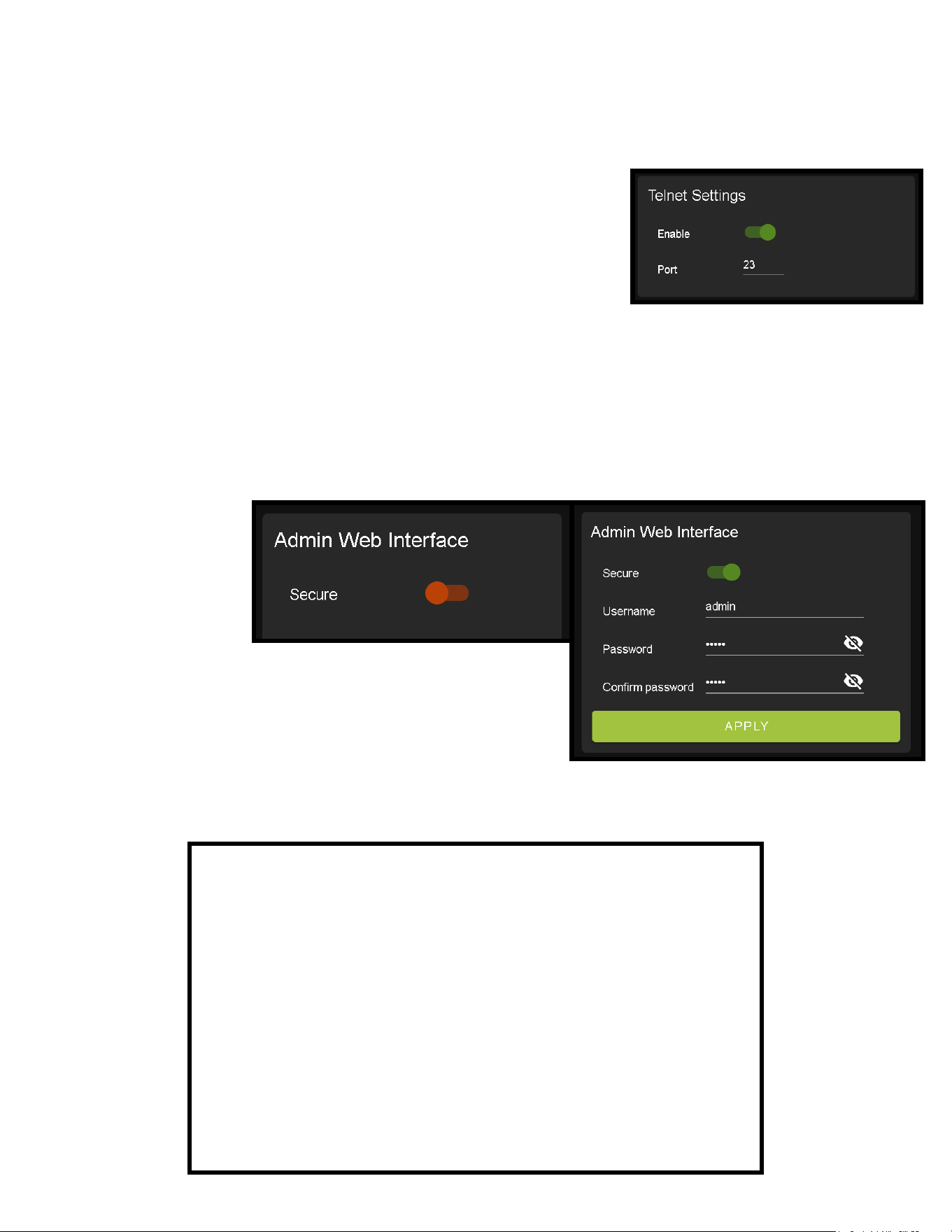
Host Name - Devices name on the network. This eld is automatically lled with Model Name by default.
Model Name - Displays the AVProEdge Model/Part number.
Serial Number - Displays the Serial Number of the matrix.
MAC Address - Displays the devices MAC Address.
IP assignment - This drop-down has two options.
1. Manual
2. Automatic (DHCP)
Default out of the box will be set to Automatic (DHCP), the IP Address, Subnet Mask, Gateway, Primary
DNS, and Secondary DNS will be assigned by your network controller. If you select Manual, you can use the
text elds to enter your own Network settings. Once all elds have been lled out, click the green Apply
Button to set. A prompt will appear to conrm the change, click OK to conrm.
This area contains relevant network information of the AC-MX-44HDBT.
25
WebUI: System - Telnet Settings
This area contains relevant Telnet settings for the AC-MX-44HDBT. There are two elds that can changed,
Enable Disable switch and the Port Number.
• Enable - This switch has two options, Green/Enabled (Default) and
Red/Disabled.
• Port - This eld is used to change the Telnet Port of the AC-MX-
44HDBT. You can use the text led to enter a number or use the
Up/Down arrow buttons to increase/decrease the number.
WebUI: System - Admin Web Interface
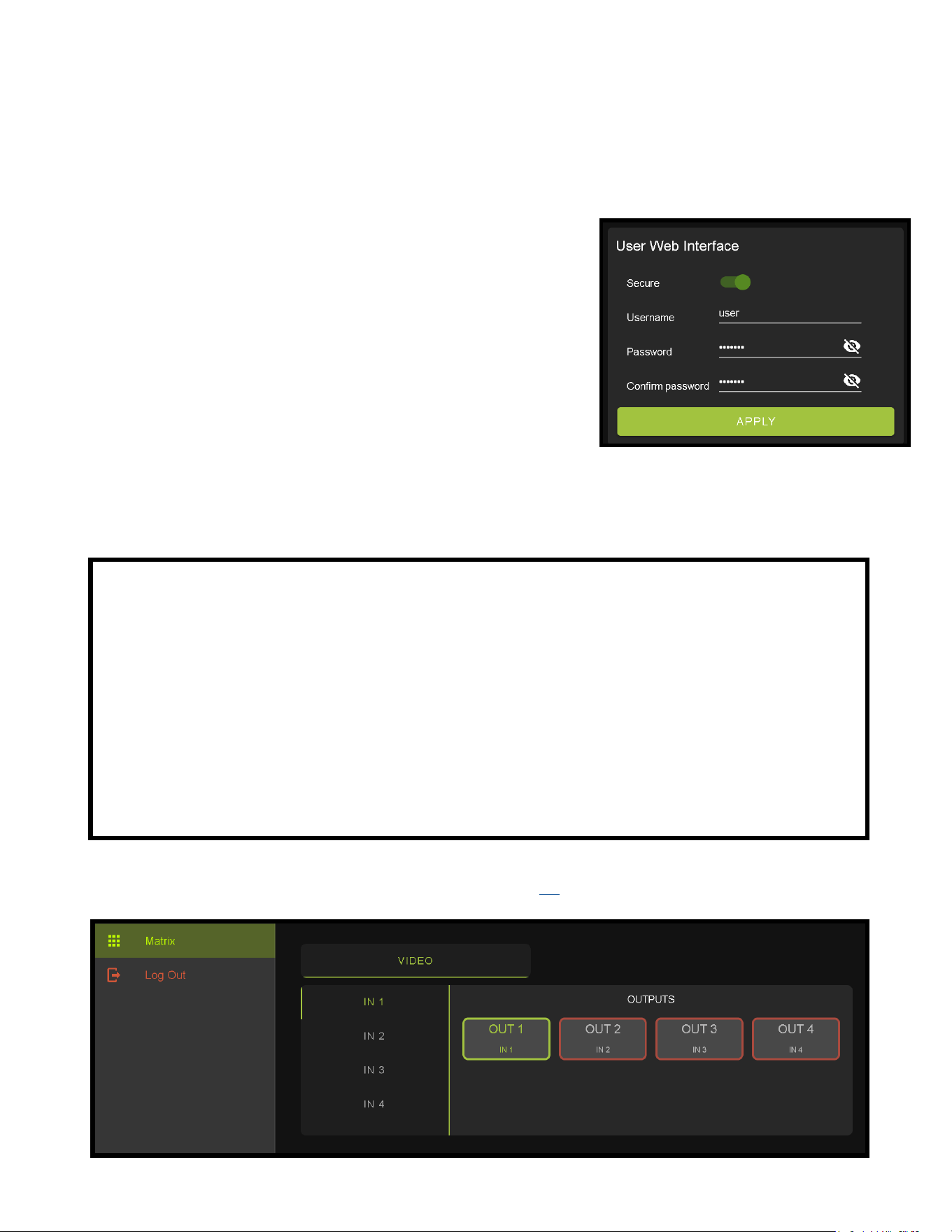
This switch has two options, Red/Disabled (Default) and Green/Enabled. When enabled (green) there will
be three elds that appear, Username, Password, and Conrm Password.
Default Username - admin
Default Password - admin
Once the desired Username and Password has been entered,
click the green APPLY button to set.
With the Admin Web Interface enabled, the only menu that will be accessible using the WebUI will be the
Matrix tab. The rest of the settings will require the Admin log in to access.
26
WebUI: System - User Web Interface
This switch has two options, Red/Disabled (Default) and Green/Enabled. When enabled (green) there will
be three elds that appear, Username, Password, and Conrm Password.
NOTE: The Admin Web Interface must rst be Enabled and setup before this eld will be available to
change.
Default Username - user
Default Password - user123
Once the desired Username and Password has been entered, click
the green APPLY button to set.
Note: The web page will reload to the Log In page.
With both Admin and User Web Interfaces enabled, no menus will be accessible using the WebUI without
rst logging in (see image below).
Logging in with the User credentials, the only menu that will be accessible will be the Matrix tab. The rest
of the settings will require the Admin user to log in (see page 24).
27
WebUI: System - Cloud Services
By enabling Cloud Services your device will have the ability to connect to rmware servers for over-the-air
(OTA) updates and enable third-party remote management services. If Cloud Services are disabled, your
device will opt-out of any previously enabled services and will not be able to access OTA updates.
Before you can enable the cloud services you must rst agree to the “Privacy Policy” and “Terms of Use”.
You can view these documents by clicking on Privacy Policy or Terms of Use links, this will open up a PDF
copy of that document in a new tab.
With the Cloud Services enabled you can use the System tab to check for new Firmware OTA (over the air).
This will check the rmware versions currently loaded on the AC-MX-44HDBT and compare to the latest
available. If it is up to date, you will see a prompt stating “No update available!” click CLOSE to exit.
If an update is available a le will automatically be selected, simply click the UPLOAD button to load the
rmware les to the Matrix.
NOTE: When loading rmware (depending on the rmware les that are being updated) some settings will
revert back to Factory Defaults. Take note of the I/O Cong tab. Settings like the INPUT/OUTPUT labels,
EDID Settings, Video Scaling, Audio Settings, etc. as they will have to be re-applied after the rmware up-
dates are completed.
If an update is available, the following prompt will show. Simply click the UPDATE button to load.
28
WebUI: System - Hardware
LCD Timeout - This adjusts the time the front panel display will stay lit up when a button is pressed.
There are four setting available
1. Always on (Default)
2. 15 Seconds
3. 30 Seconds
4. 45 Seconds
WebUI: System - Firmware Update Cont.
Once the rmware le has been uploaded, it will display all containing rmware les. Here you can select
individual rmware les to load or simply leave all les/options selected. If the version currently installed
not newer, then that update will be skipped automatically.
Once the progress bar hits 100% click the CLOSE button, the rmware upgrade process is complete.
Now you will want to go back and re-apply settings like INPUT/OUTPUT Labels, applied EDIDs, Video Scaler
Settings, Audio Settings, etc.
Keypad Lock - Enable or Disable (default) the front
panel Keypad Lock.
MCU/Version - Lists the current Firmware Versions
UPDATE FIRMWARE - Check/upload rmware.
FACTORY RESET - Restores matrix to Factory Defaults
REBOOT - Reboots the AC-MX-44HDBT
29
WebUI: Diagnostics - HDMI IN
Input Settings Label - Use this to give an name/alias to your inputs (Apple TV, Cable Box, Roku, etc).
Note :There is a 15 character limit to this eld, the name will replace the default “IN #” throughout the rest
of the WebUI (for instance the Video Matrix tab).
Input Settings Enable switch - Use this enable/disable switch to turn the cor-
responding Input port on or o. The default setting is enabled (green) by default.
Connection Reset - Use this button to perform a reset of the HDMI Input connection.
Input Settings EDID - Use these four drop-downs to select your preferred EDID.
The available combinations are as follows.
1. 1080P_2CH
2. 1080P_6CH
3. 1080P_8CH
4. 1080P_3D_2CH
5. 1080P_3D_6CH
6. 1080P_3D_8CH
7. 4K30HZ_3D_2CH
8. 4K30HZ_3D_6CH
9. 4K30HZ_3D_8CH
10. 4K60HzY420_3D_2CH
11. 4K60HzY420_3D_6CH
12. 4K60HzY420_3D_8CH
13. 4K60HZ_3D_2CH
14. 4K60HZ_3D_6CH
15. 4K60HZ_3D_8CH
16. 1080P_2CH_HDR
17. 1080P_6CH_HDR
18. 1080P_8CH_HDR
19. 1080P_3D_2CH_HDR
20. 1080P_3D_6CH_HDR
21. 1080P_3D_8CH_HDR
22. 4K30HZ_3D_2CH_HDR
23. 4K30HZ_3D_6CH_HDR
24. 4K30HZ_3D_8CH_HDR
25. 4K60HzY420_3D_2CH_HDR
26. 4K60HzY420_3D_6CH_HDR
27. 4K60HzY420_3D_8CH_HDR
28. 4K60HZ_3D_2CH_HDR
29. 4K60HZ_3D_6CH_HDR
30. 4K60HZ_3D_8CH_HDR
O
Disabled
On
Enabled
30
WebUI: Diagnostics - HDMI IN Cont.
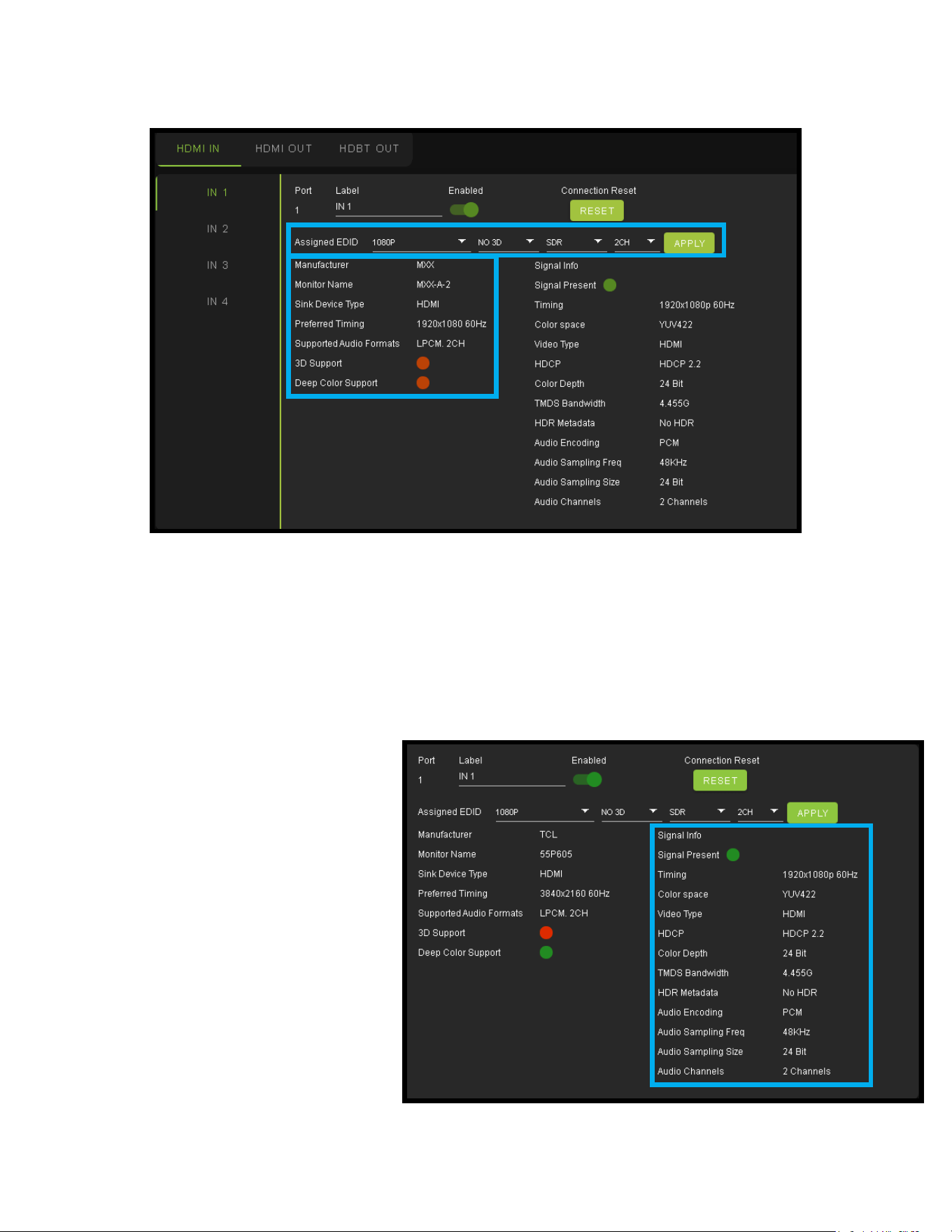
On the left, you will see the current applied EDID information. In the example above, you will see a canned
1080P - No 3D - SDR - 2CH EDID applied to IN 1. Any EDID change, once applied will display here.
Signal Info shows the connected source’s current output information. This includes
·Timing
·ColorSpace
·VideoType
·HDCPVersion
·TMDSBandwidth
·HDRMetadata
·AudioSamplingFrequency
·AudioSamplingSize
·AudioChannels
31
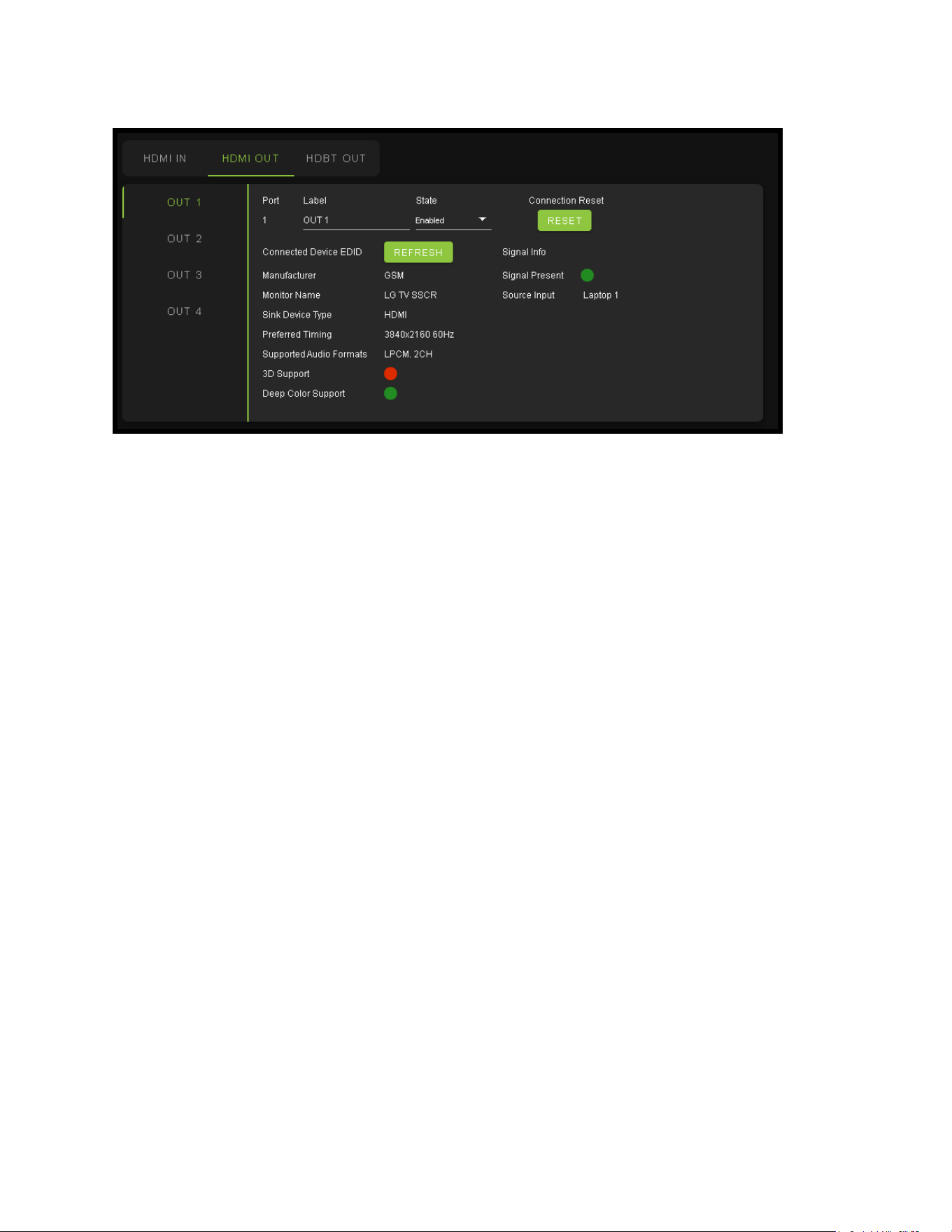
WebUI: Diagnostics - HDMI OUT
HDMI Output Label, State, and Connection Reset.
Connected Device EDID shows the connected sync’s preferred EDID information and current state.
This includes
·Manufacturer
·MonitorName
·SinkDeviceType
·PreferredTiming
·SupportedAudioFormats
·3dSupport
·DeepColorSupport
·SignalPresent
·SourceInput(futureupdate)
32
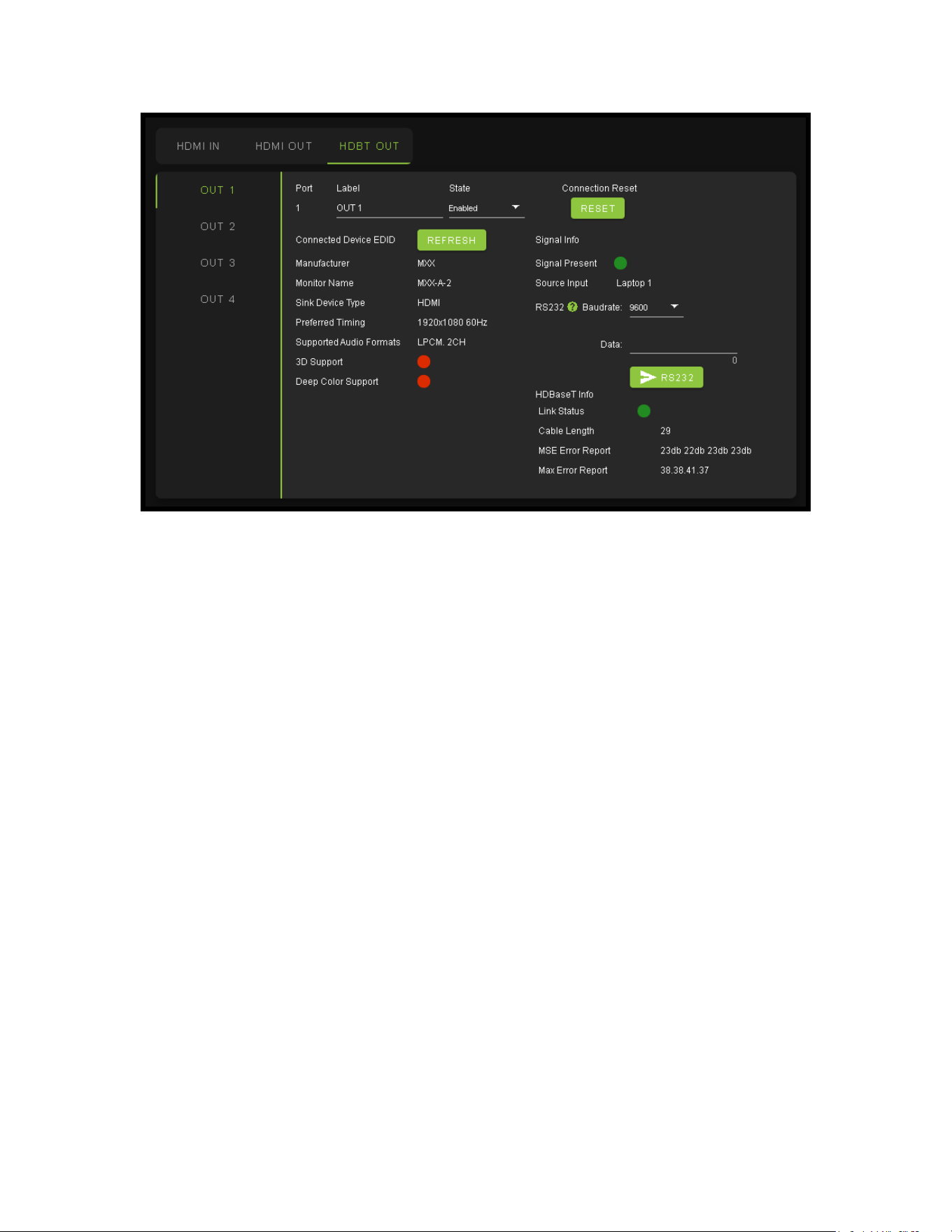
WebUI: Diagnostics - HDBT OUT
HDBaseT Output Label, State, and Connection Reset.
Connected Device EDID shows the connected sync’s preferred EDID information and current state.
This includes a REFRESH button and the following EDID information:
·Manufacturer
·MonitorName
·SinkDeviceType
·PreferredTiming
·SupportedAudioFormats
·3dSupport
·DeepColorSupport
SignalInfo
·SignalPresentIndicatorLight(green-PRESENT/red-NOTpresent)
·SourceInput(futureupdate)
·RS232Baudrate:Drop-downforchangingRS232Baudrate
·Data-SendRS232overHDBaseTlinetoHDBaseTReceiver(Rx)
33
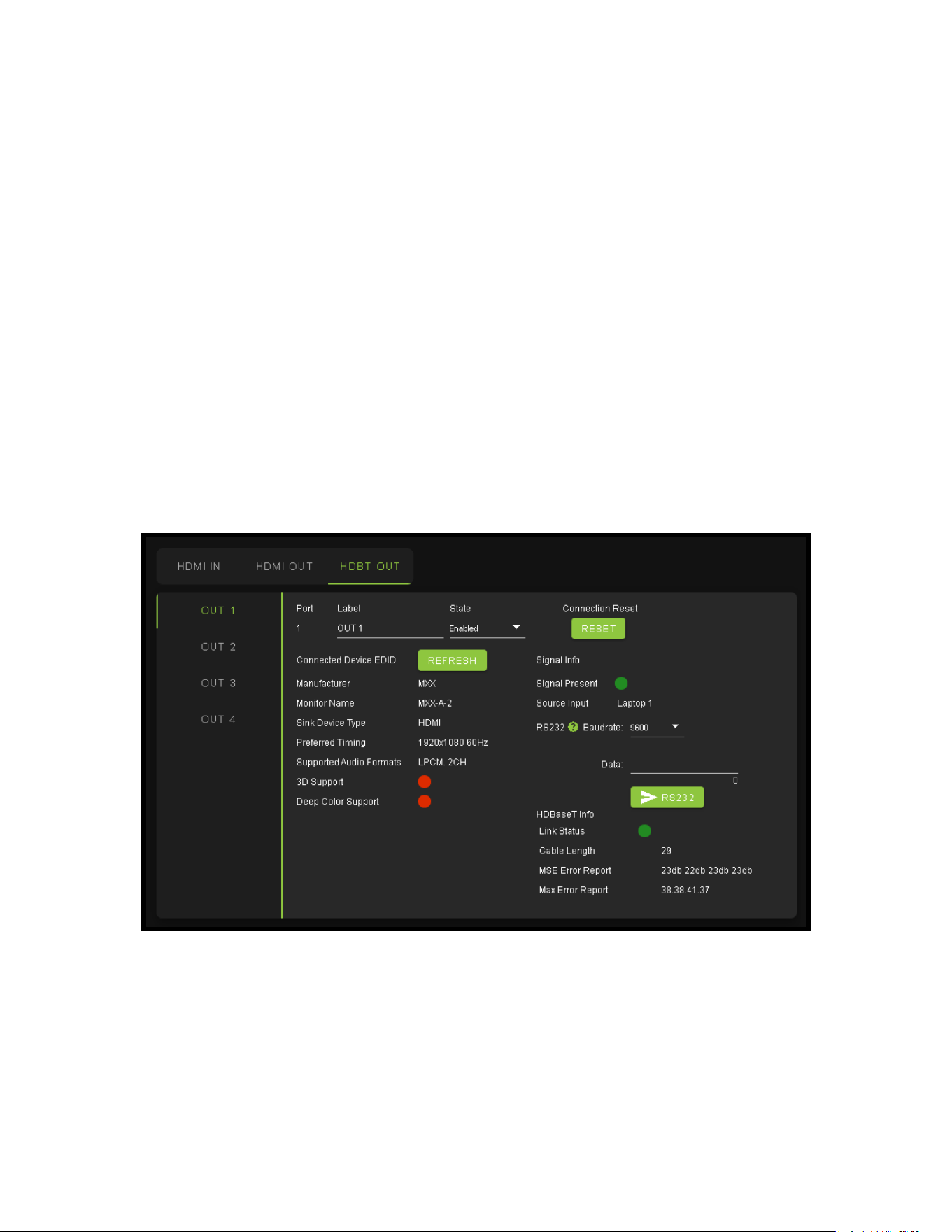
WebUI: Diagnostics - HDBT OUT Cont.
HDBaseTInfo
·LinkStatusIndicatorLight(thereare3states)
a. Green - Link quality is good (within HDBaseT threshold)
b. Yellow - Link quality between the matrix and HDBaseT Receiver is marginal. You may experi-
ence occasional failures like dropouts/screen ashing/or no video.
c. Red - Exceeds the HDBaseT Error threshold, may experience frequent failures or no signal at
all.
·CableLength-InMeters(<20indicatesthecableisLessthan20Meters)
·MSEErrorReport-Showserrorrate(indecibels)foreachpairofwires
·MaxErrorReport-ShowsMaxerrorforeachpairofwires
34
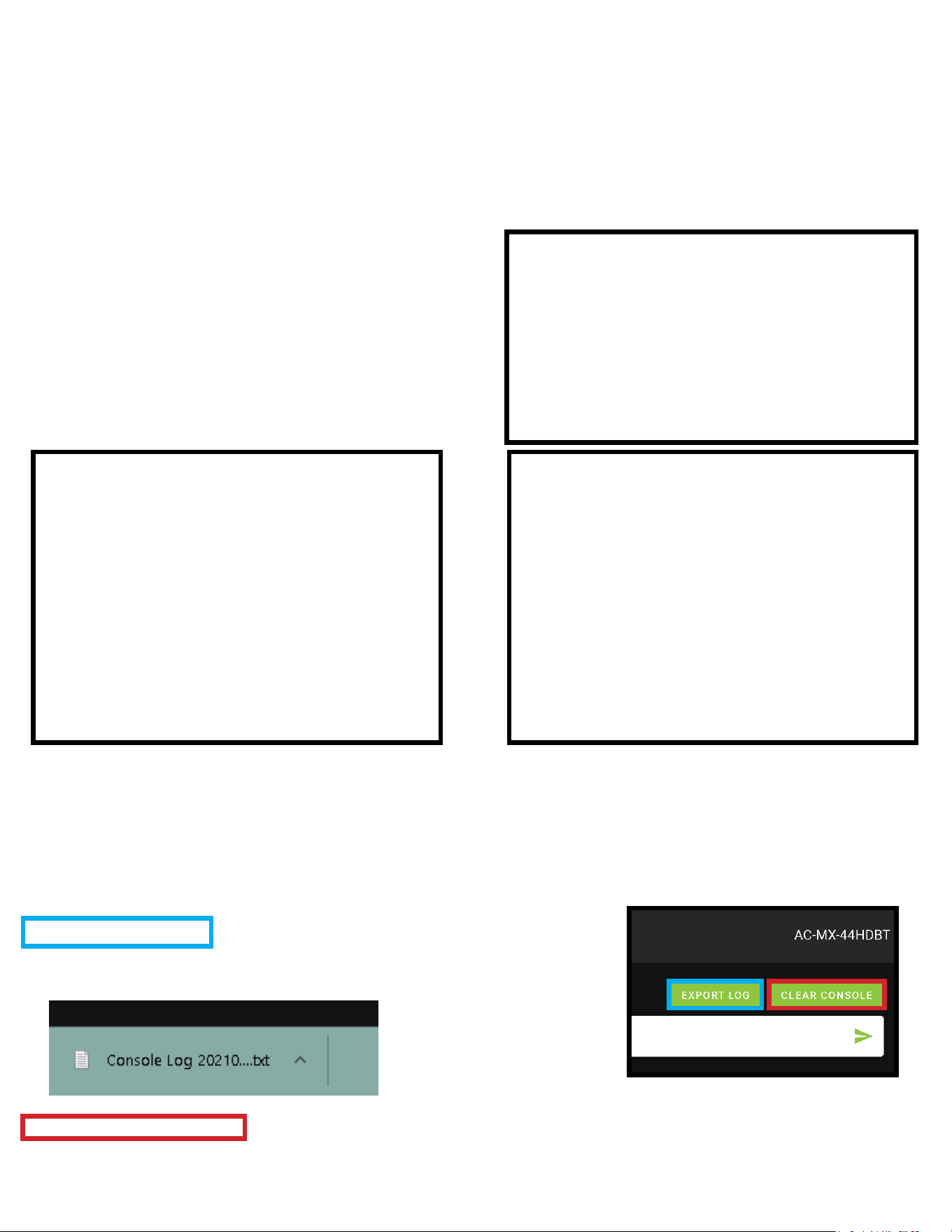
WebUI: Console
ThereisabuiltinCommandConsole
UsingthecommandAPI(commandlist)youcansenddevicespecificcommandsoruseasalivemonitor
whilesendingcommandsfromacontrolsystem(helpfulintroubleshooting).
Example
15. Click in the white box and type
a. GET STA
Click the green arrow or hit ENTER/RETURN on your
keyboard
The the command response will show in the eld below.
CLEAR CONSOLE - Button
This button will clear the current console session.
EXPORT LOG - Button
This button will generate a text le containing the console in
formation in your web browsers download folder.
*NEW to NET MCU Firmware Version 1.18
Example - “GET STA”
Get status
Example - “H”
Help command
Returns all Available Commands

35
Front Panel Control - Switching
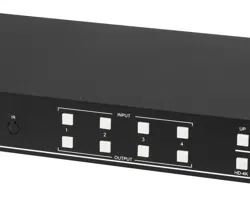
The AC-MX-44HDBT can be switched from the front panel by rst pressing the desired OUTPUT (bottom
row) button rst, then by pressing the desired INPUT button (top row).
1. Press the OUTPUT button (1 through 4) on the bottom row that corresponds with the OUTPUT (Dis-
play, or Sink Device) you would like to send to a source.
2. Once pressed, the front panel display will change to the SWITCH menu showing the current IN/OUT
routes. Press the corresponding OUTPUT button (top row) to set.
Front Panel Control - Scaling
The AC-MX-44HDBT has scalers built into every output. The HDBaseT Ports can be DOWNSCALED and the
HDMI Ports can be UPSCALED. The scalers are set on the OUTPUT side of the switch and each can have
separate settings.
·HD-4K (Scales 1080P to 2160P - On HDMI Port Only)
·ICT Mode (Enables ICT Compression mode on HDBT Port) - DEFAULT
·4K-HD (Scales 2160P to 1080P - On HDBT Port Only)
·AUTO (Automatically detects capabilities of attached display - for HDBT Port Only)
·BYPASS (There will be no scaling set)

36
Front Panel Control - Scaling Cont.
NOTE: When using a non ICT receiver the unit automatically applies HDBT-C mode when ICT mode is
selected, which reduces 10-18Gbps content to 9Gbps for legacy infrastructures. This mode maintains 4K
resolution, but removes HDR.
TheLCDScreen
showsthecurrent
status
STEP1:Pressandhold
thedesiredOUTPUTyou
wanttoscale
STEP2:Choosethe
scalermode
To Change the scaler settings
1. Press and hold the desired OUTPUT button (1 through 4) on the bottom row that corresponds with the
OUTPUT (Display, or Sink Device) you would like to change the scaler settings on (it will stay lit).
2. Use the Scaler Control buttons on the bottom right to make your selecting (refer to options above)
3. Press the same OUTPUT button (1 through 4) that you held in step one to Conrm/Set you chosen
scaling mode. Or wait 5 seconds and the matrix will automatically exit and keep any changes made.

37
Front Panel Control - Audio Binding
The AC-MX44-AUHD-HDBT can be congured to extract audio in 3 ways
·Bind to OUTPUT(Default)
·Bind to INPUT
·Matrix
To change from the default:
1. Press and hold (3 sec) BYPASS from the audio settings (top right of machine).
2. Toggle selection by pressing the “UP” and
“DOWN” buttons
3. Once a desired selection is found, quick press the BYPASS button again to set.
TheLCDScreen
showsthecurrent
status
STEP1:Pressandhold
theBYPASSbutton
STEP2:UsetheUP
andDOWNbuttonsto
changethesetting

38
Front Panel Control - Audio Delay
The AC-MX44-AUHD-HDBT has an Audio Delay feature built-in. Audio Delay is set on the extracted
audio OUTPUT (Digital and Analog) of the switch and each can have separate settings. The Audio
Delay has 4 controls:
·UP (Increase Delay)
·Down (Decrease Delay)
·MUTE (The audio will be muted)
·BYPASS (There will be no delay set)
*Delay settings are in increments of 90 milliseconds.
Settings are: 90MS, 180MS, 270MS, 360MS, 450MS, 540MS or 630MS.
Control this feature from the front panel:
1. Press and hold the OUTPUT number for which you want to delay
the audio.
2. The available options will light up (as pictured).
3. Press UP, DOWN, MUTE or BYPASS to control the delay.
4. The current setting will be indicated on the LCD screen.
Audio Matrix Control:
Once in “Matrix” mode for audio, the extracted audio routing on the AC-MX-44HDBT can be con-
trolled from the front panel:
To Control:
1. Press and hold (3 sec) BYPASS button from the audio settings (top right of machine).
2. Make sure the screen says “Matrix”, if it does not use the UP/DOWN arrow keys to change,
then press the BYPASS button again in order to enter the AUDIO MATRIX mode.
(
See image below, screen will show “AIN” and “AOUT” for AUDIO INPUT and AUDIO OUTPUT.)
3. Press the desired OUTPUT number (1-4)
4. Press the INPUT for the desired audio source you want to route (1-4)
5. To exit, quick press BYPASS button again or wait 15 seconds (matrix will exit automatically)
TheLCDScreen
showsthecurrent
status
STEP1:Pressandhold
theBYPASSbutton

39
EDID Management:
This matrix has 29 factory dened EDID settings. It also has 3 user dened EDID memories. The user
EDID memories are independent to each input and can be set dierently. The user dened EDID can
be uploaded using the free PC Control software or RS-232. In addition, you can choose to read the
EDID from the desired output and the captured EDID will automatically store and overwrite the EDID
in “USER EDID 1” and will be applied to the selected source.
By default, the matrix is set to a 1080P EDID, this is to maximize plug and play capability. When us-
ing 4K sources, you will want to dene a 4K EDID on each input (or read from the display).
To Change the EDID setting:
1. Press and hold (for 3 seconds) the INPUT you want to change.
2. The “UP” and “DOWN” button’s will illuminate (as pictured below), and the LCD will show the
active EDID.
3. Toggle through the EDID options by pressing up or down repeatedly.
4. Press the “INPUT” you had selected in order to apply the EDID (this will still be illuminated).
These are the pre-dened EDID settings that you can toggle through:
1.
1080P_2CH
2. 1080P_6CH
3. 1080P_8CH
4. 1080P_3D_2CH
5. 1080P_3D_6CH
6. 1080P_3D_8CH
7. 4K30HZ_3D_2CH
8. 4K30HZ_3D_6CH
9. 4K30HZ_3D_8CH
10. 4K60HzY420_3D_2CH
11. 4K60HzY420_3D_6CH
12. 4K60HzY420_3D_8CH
13. 4K60HZ_3D_2CH
14. 4K60HZ_3D_6CH
15. 4K60HZ_3D_8CH
16. 1080P_2CH_HDR
17. 1080P_6CH_HDR
17. 1080P_8CH_HDR
18. 1080P_3D_2CH_HDR
19. 1080P_3D_6CH_HDR
20. 1080P_3D_8CH_HDR
21. 4K30HZ_3D_2CH_HDR
22. 4K30HZ_3D_6CH_HDR
23. 4K30HZ_3D_8CH_HDR
24. 4K60HzY420_3D_2CH_HDR
25. 4K60HzY420_3D_6CH_HDR
26. 4K60HzY420_3D_8CH_HDR
27. 4K60HZ_3D_2CH_HDR
28. 4K60HZ_3D_6CH_HDR
29. 4K60HZ_3D_8CH_HDR
30. User EDID 1
31. User EDID 2
32. User EDID 3
*You may also copy EDID from any output and apply to any input, simply select “Copy EDID from
Output x” (x=1-4). This will copy the EDID from the display attached and store it into “User EDID 1”
and apply it to the input you have selected.
Step1
Step2
CurrentEDID
In order to obtain Dolby Atmos, DTS:X, or other HBR Surround formats, the EDID must be copied from a capable device.

40
Display IP Information:
In order to see the current IP settings, press and hold (for 3 seconds) INPUT 3 and INPUT 4 buttons
simultaneously. This screen will change every 3 seconds showing additional settings (host, net mask,
router IP).
NOTE: This screen always starts with the current IP address of the matrix:
In order to toggle DHCP on and o, press and hold (for 3 seconds) the INPUT 1 and INPUT 4 buttons
simultaneously.
In order to prevent potential IP problems, you can change the IP settings by using RS-232 com-
mands (connect via the Micro USB port or 3 Pin Terminal RS-232 connection).
NOTE: The default IP address is 192.168.001.239 (as pictured above).
Quick Network Connect to Web Interface:
Use the following steps to quickly and immediately connect to the matrix switch:
1. Connect the LAN port into an active router port.
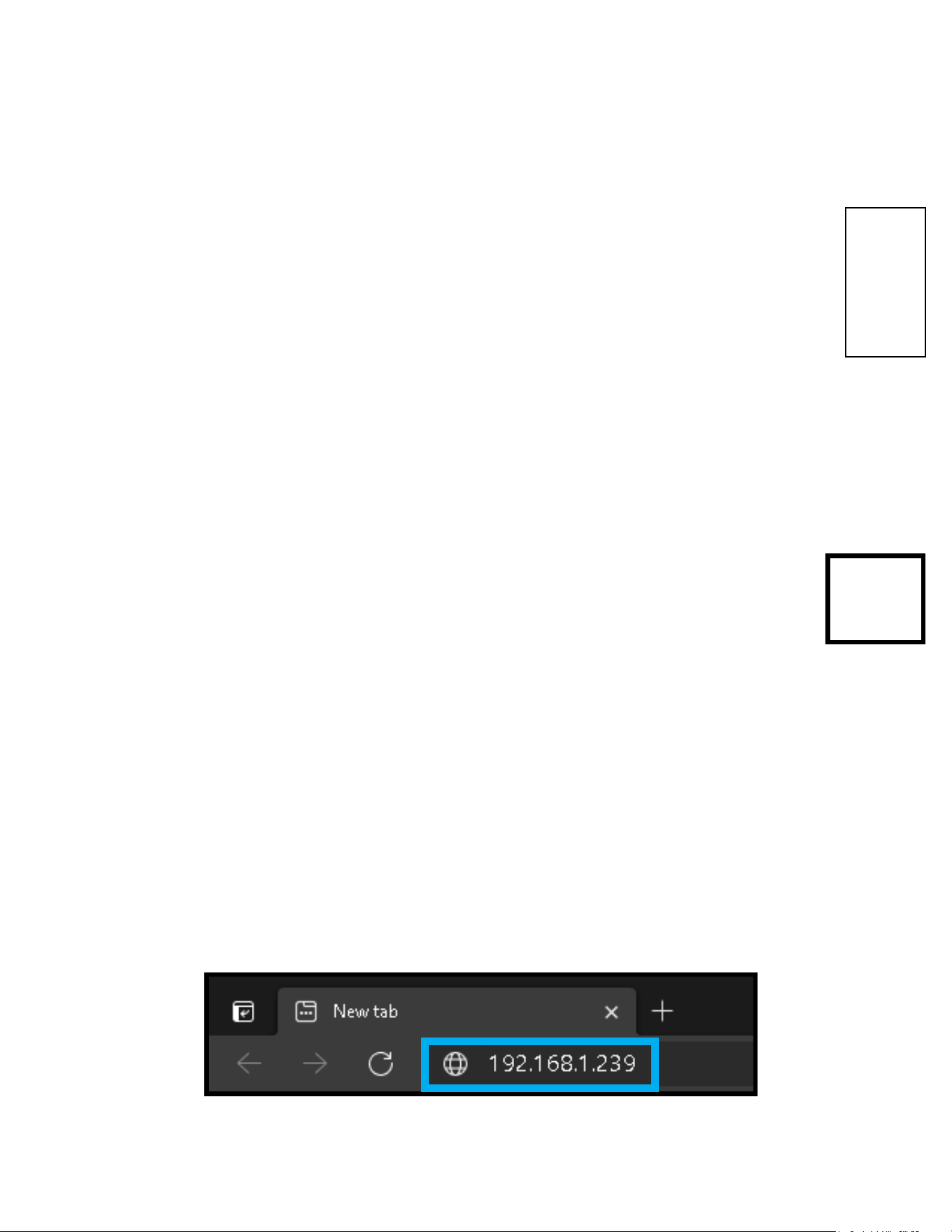
2. On most networks you can simply type the Default IP address into any web browser. The De-
fault IP Address is 192.168.1.239
If you are on a closed network or non-standard, the following may work better when using DHCP:
1. Use an Ethernet cable to connect the LAN port on the switch to an unused, active port on the
router.
2. Enable DHCP by pressing the INPUT 1 and INPUT 4 buttons simultaneously for 3 seconds.
3. Wait 5 seconds, then press and hold (for 3 seconds) the INPUT 3 and INPUT 4 buttons simul-
taneously. The display will show the assigned IP address.
4. Input the IP Address into any web browser.
Setting a Static IP:
·Once connected, you can use the web interface to set a static IP address.
·A static IP can also be set by using the RS-232 software or a direct command (see Command
list for more information).

41
HDBaseT lights: LINK
These ports are HDBaseT Transmitters (TX) and are designed to be connected via a Category cable (Cat6 or
better) to an HDBaseT Receiver (RX).
NOTE: Non AVPro HDBaseT Receivers may work but ICT (our Invisible Compression Technology) will not.
This means higher bandwidth signals (greater than 10.2Gbps) will not pass as this requires ICT. See Band-
width chart on Page 50.
LINK - Above RJ45 (HDBT) Port:
(Green)(Green) This indicator shows that the AV HDBT link between the Tx
and Rx is in tact. This light should
ALWAYSALWAYS be SOLIDSOLID.
If this light is ashing or not present attempt following:
15. Check the length. The maximum distances are 70m (230ft) on 4K and 100m (330ft) on 1080P.
16. Remove any coils of cable and make sure that there is not excess cabling.
17. Bypass all patch panels and punch-down blocks.
18. Re-terminate connectors. Sometimes, even if a cable tester indicates the run is valid, something
may be slightly o.
a. Standard RJ45 ends are recommended. Pass through style types can cause interference/crosstalk
19. Contact AVProEdge if these suggestions do not work.
AVProEdge - HDBaseT Extender
Indicator Lights
42
HDBaseT lights: STATUS
STATUS - Above RJ45 (HDBT) Port: (Amber)(Amber) This is an indicator showing that the power is present
between the Transmitter and Receiver. This light
ALWAYS BLINKSALWAYS BLINKS steadily indicating everything is OK.
If this light is ashing or not present attempt following:
15. Check the length. The maximum distances are 70m (230ft) on 4K and 100m (330ft) on 1080P.
16. Remove any coils of cable and make sure that there is not excess cabling.
17. Bypass all patch panels and punch-down blocks.
18. Re-terminate connectors. Sometimes, even if a cable tester indicates the run is valid, something
may be just slightly o.
19. Standard RJ45 ends are recommended. Pass through style types can cause interference/cross-
talk
20. Try powering from the Receiver instead of the Transmitter (See Receiver page for more about
PoE direction).
21. Contact AVProEdge if these steps do not work.
AVProEdge - HDBaseT Extender
Indicator Lights
43
IR Control: IR Remote
IR Remote Control:
When routing HDMI, the matrix can be controlled by using the IR remote supplied When
routing HDMI, the matrix can be controlled by using the IR remote supplied with the product
(battery not included, requires CR2025).
The labels on the right are the OUTPUT numbers.
The left arrow button decrements to the next input port, and the right arrow increments to
the next input port.
The numbers are for selecting a desired INPUT.
IR Receiving Eye - Set the switch to “EYE” to utilize a 3.5mm IR receiving eye.
*Not Included
The IR IN ports on the back can accept an IR Receiving Eye (EYE) or a di-
rect connection from a control system (I-PASS). There is a toggle switch to
change between the two.
NOTE: If you are having any issues, verify the switch is properly set. To
verify toggle from your desired setting, to the other setting, and then back
to your desired setting.
IR Control: Switch

44
IR NOTES (On the Matrix):
1. By default the IR IN is routed to the corresponding HDBaseT Output number (ie. IR IN #1 --> HDBaseT
Output 1, IR IN #2 --> HDBaseT Output 2, etc...)
2. By default the IR OUT is automatically routed with the active source (ie. If you are watching INPUT 3
on HDBaseT OUTPUT 1, when you point a remote at an IR Receiver on the HDBaseT Rx connected the
signal will be routed to IR OUT 3)
3. Each IR IN can be routed in any way you like (One to one or one to many) by using the command SET
IRC EXT SW x1.x2.x3.x4 (See below).
4. Each IR OUT can be routed manually as well using the command SET IRC OUTx VS INy. This can also
be controlled by the Web Interface
IR NOTES (On the HDBaseT Receiver):
1. IR OUT = IR Emitter for sending signals to a Display or Projector (Note - Use Provided Emitters)
2. IR IN = For sending IR signals back to the Matrix for switching AND to send IR signals to the IR OUT
on the Matrix - by default the IR OUT on the matrix is automatically routed with the active source (ie.
If you are watching INPUT 3 on HDBaseT OUTPUT 1, when you point a remote at an IR Receiver on the
HDBaseT Rx connected the signal will be routed to IR OUT 3)
IR Continued:
Direct connection to a control system - Set the switch to “I-PASS” to connect directly to a control system.
TIP - Signal
Sleeve - Ground
TIP - Signal
Sleeve - Ground
Control4 Wiring
Example

45
RS-232 and TCP/IP Control:
The AC-MX-44HDBT can be controlled with either RS-232 or TCP/IP commands. Certain switching or format
congurations can only be done using these commands. We recommend using either the MyUART (RS-232
- free) or Hercules (TCP/IP - free) apps as they are very easy to use for sending commands to the machine.
For TCP/IP control commands use Telnet Port 23.
For RS-232, use a null modem serial cable adapter and set the serial communications to: 57600,n,8,1 (baud:
57600, no parity, 8 data bits and 1 stop bit) with no handshaking.
Please add a return (Enter key) after each command when using direct commands.
The unied command list (ASCII) is listed on the following pages. Text version available here, and under
the resources tab of on the products web page.
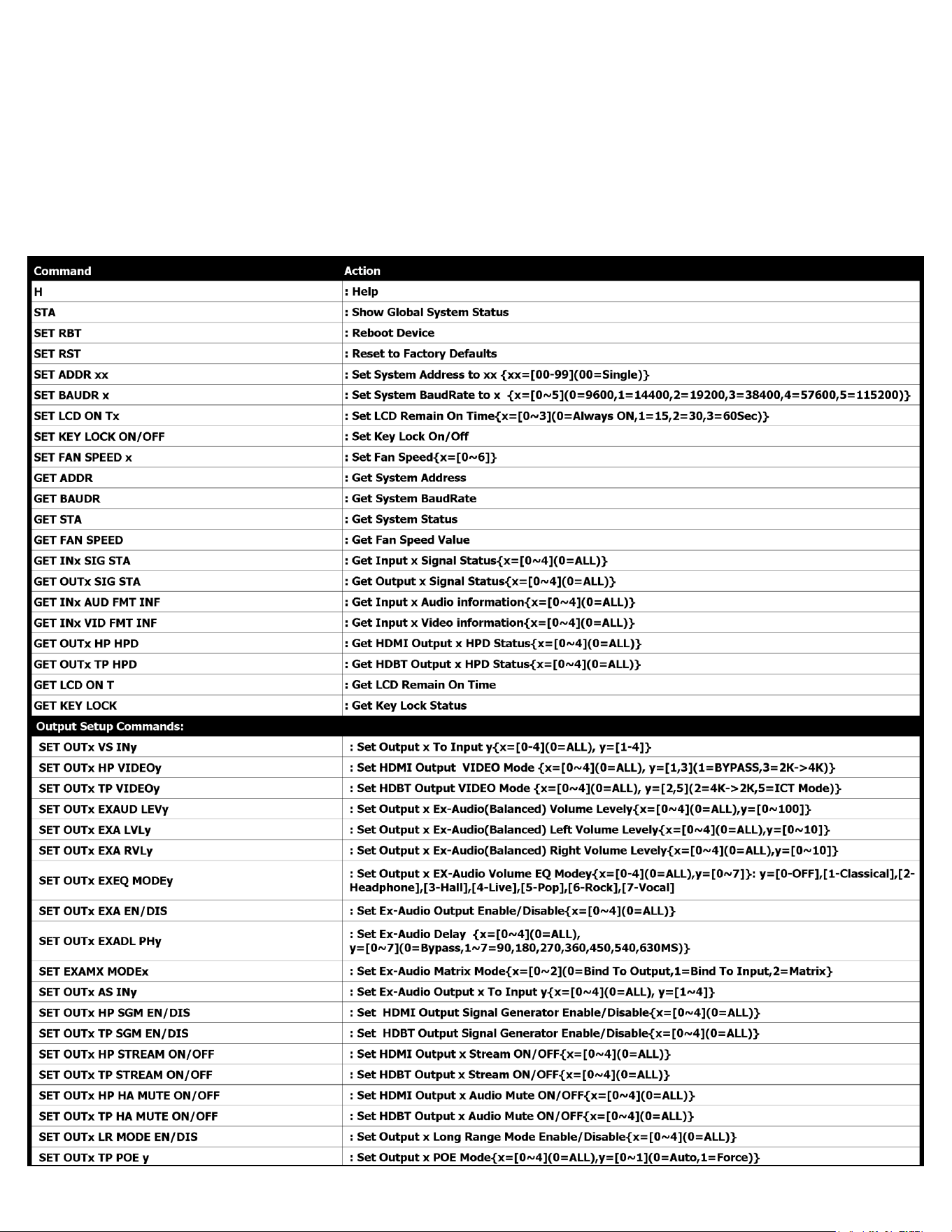
46
Command List:
·Baudrate:57600
·Checksum:None
·BitNum:8
·StopBit:1
47
Command List Continued:
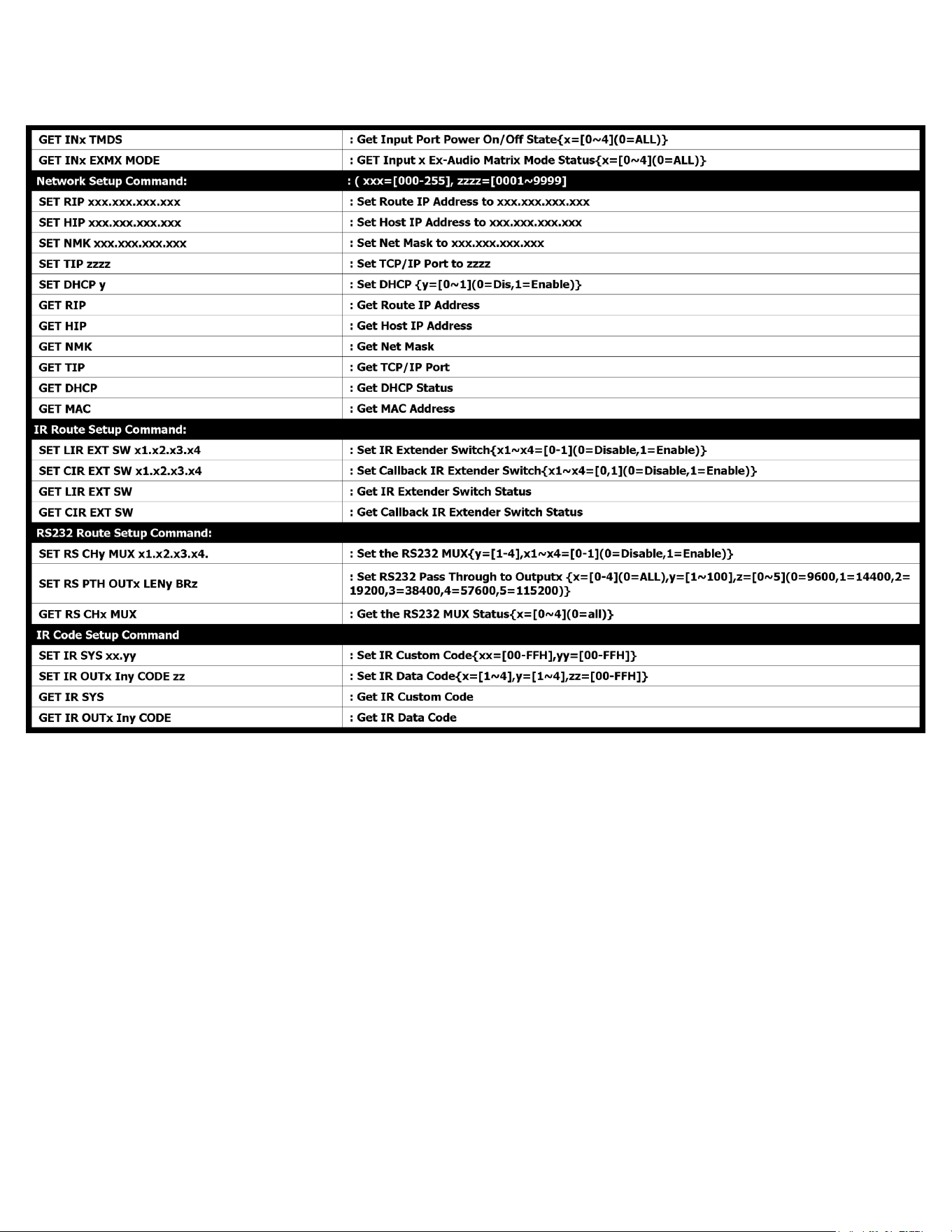
48
Command List Continued:

49
Extracted Audio:
The extracted audio ports have three distinct operating modes. Your desired mode can be set to suite your
particular installation.
The 3 modes are:
Bind to Input ~ This is the default conguration. In this mode the audio port number corresponds to the
INPUT signal. This is ideal for systems where audio is matrixed separately in a zoned amplier.
Bind to Output ~ This conguration will automatically have the audio follow OUTPUT, so the audio from
the extracted port always matches the HDMI output. This is ideal for systems that use local AVR’s for some
of the zones.
Independent/Matrix ~ This mode allows you matrix the extracted audio outputs independent of HDMI.
In this mode a new set of commands becomes available to be able to route audio however you want. This
can be used as a separate zoned audio matrix with only using an amplier.
Setting up Extracted Audio Routing:
You can set up Extracted Audio Routing from the front panel, WebUI, Driver or by sending the following
command:
SET EXAMX MODEx -- Where {x=[0~2](0=Bind To Output,1=Bind To Input,2=Matrix}
If you set to “Matrix” you can use the following command to route the 16 extracted audio ports to any IN-
PUT:
SET OUTx AS INy -- Where Set Ex-Audio Output x To Input y{x=[0~4](0=ALL), y=[1~4]}
Balanced 5 pin 2Ch and Toslink Audio Port /SPDIF:
TheSPDIFToslinkportsupportsupto5.1ChDigitalaudiothebalanced5pinterminalconnectorsupports
2Chaudioonly.Thismeansinorderfortheseportstofunctionthesourcesmustbesetto2ChPCM,this
unitdoesNOTdownmixtheaudio(seeAC-AXION-4fordown-mixingmatrix).Togetmorethan2Chan-
nelsyouwillwanttousetheSPDIFport.

50
Audio Output Logic and Cable Prep:
You can extract audio from Toslink or balance 2CH Audio.
2CH Balanced Audio Port - Supports 2CH PCM audio only, which is ideal for 2 Channel
systems and zoned audio systems. No Down-mixing on this version, see AC-AXION-4.
Toslink Audio Port - Toslink extracted audio ports support up to 5.1 digital audio.
You can use balanced analog outputs in a balanced system, but you can also prep a cable
as shown below to convert to a traditional 2CH unbalanced (L/R) system. You can also
purchase pre-made cables (AC-CABLE-5PIN-2CH) four of these are included in the box
when purchased.
AC-CABLE-5PIN-2CH
51
Troubleshooting
·Verify Power - Check that the power supply is properly connected and on an active circuit.
·Verify Connections - Check that all cables are properly connected.
·HDBaseT TX/RX Indicator Troubleshooting Lights - Page(s) 40 and 41
·IR Issues - Verify correct connections - Page(s) 42 and 43
Note: Visibly ashing Emitters may not function properly, if you are experiencing issue try the
IR Cables that come in the box.
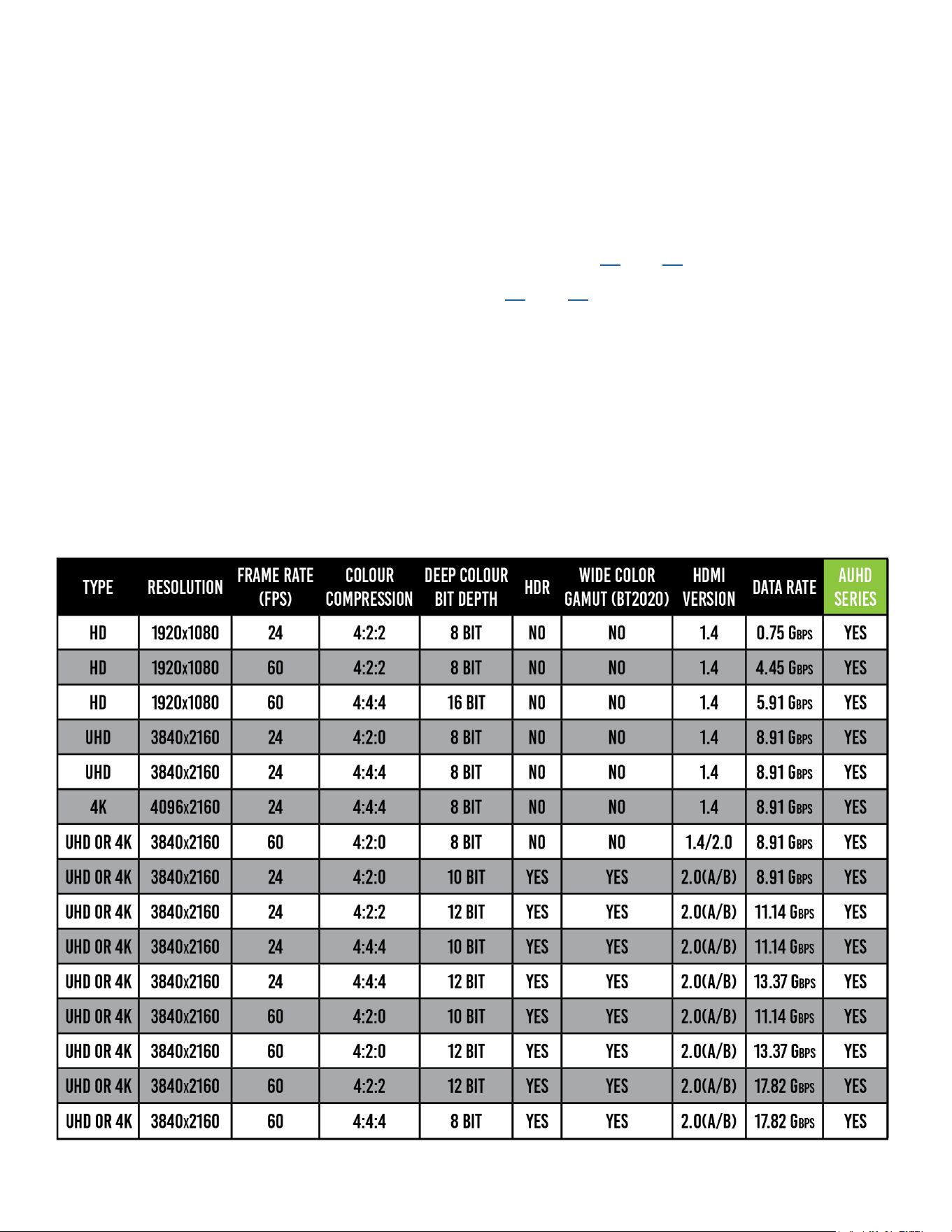
·Lights indicate everything is good but still not getting a picture, this may be a bandwidth lim-
itation. See Bandwidth Chart below to verify the signal is not exceeding the bandwidth of the
Extender kit (limited to 10.2Gbps).
Bandwidth Chart

52
Maintenance
To ensure reliable operation of this product as well as protecting the safety of any person using or
handling this device while powered, please observe the following instructions.
·Use the power supplies provided. If an alternate supply is required, check voltage, polarity
and that it has sucient power to supply the device it is connected to.
·Do not operate these products outside the specied temperature and humidity range given in
the above specications.
·Ensure there is adequate ventilation to allow this product to operate eciently.
·Repair of the equipment should only be carried out by qualied professionals as these prod-
ucts contain sensitive components that may be damaged by any mistreatment.
·Only use this product in a dry environment. Do not allow any liquids or harmful chemicals to
come into contact with these products.
·Clean this unit with a soft, dry cloth. Never use alcohol, paint thinner or benzene to clean this
unit.
Damage Requiring Service
The unit should be serviced by qualied service personnel if:
·The DC power supply cord or AC adapter has been damaged
·Objects or liquids have gotten into the unit
·The unit has been exposed to rain
·The unit does not operate normally or exhibits a marked change in performance
·The unit has been dropped or the housing damaged

53
Support
Should you experience any problems while using this product, rst, refer to the Troubleshooting section of
this manual before contacting Technical Support. When calling, the following information should be provid-
ed:
·Product name and model number
·Product serial number
·Details of the issue and any conditions under which the issue is occurring
·Clean this unit with a soft, dry cloth. Never use alcohol, paint thinner or benzene to clean this unit.
Warranty
THE BASICS.
AVPro Edge warranties its products that are purchased from all Authorized AVPro Edge Resellers or direct
purchases. Products are guaranteed to be free from manufacturing defects and of sound physical and elec-
tronic condition.
AVPro Edge has developed a warranty that anyone can get behind. We really wanted to take all the “red
tape” out of a warranty and just make is simple. Our 10 YEAR NO BS warranty hinges on 3 elements.
1. If you are having trouble, call us. We will attempt to troubleshoot your issue over the phone.
2. If it’s broke - We’ll replace it in advance on our dime. (We’ll cover return shipping too.) Repair is an
option too, but it’s YOUR call.
3. We know you know what you are doing. We will not make you go through unnecessary steps to
troubleshoot an extender...
COVERAGE DETAILS.
AVPro Edge will replace or repair (at customer choice) the defective product. If the product is out of stock
or on back order it can either be replaced with a comparable product of equal value/feature set (if available)
or repair.
Your warranty begins at receipt of product (as conrmed by shipping rm tracking). If tracking information
is unavailable for any reason, the warranty will commence 30 ARO (After Receipt of Order). The coverage
continues for 10 YEARS.

54
RED TAPE.
AVPro Edge is not responsible for untraceable purchases or those that were made outside of an authorized
channel.
If we conclude that a product or serial number has been tampered with as identied by warranty seal or
physical examination the warranty will be void. Additionally, excessive physical damage (beyond normal
wear & tear) the warranty may be voided or pro-rated based on the extent of the damage as examined by
an AVPro Edge representative.
Damage caused by “acts of God” are not covered. They can include natural disasters, power surges,
storms, earthquakes, tornadoes, sink holes, typhoons, tidal waves, hurricanes, or any other uncontrollable
event related to nature.
Damage caused by incorrect installation will not be covered. Incorrect power supply, inadequate cooling,
improper cabling, inadequate protection, static discharge are examples of this.
Products installed or sold by a third party to AVPro Edge will be serviced by the Authorized AVPro Edge Re-
seller.
Accessories (IR Cables, RS-232, Power Supplies, etc…) are not included in the warranty. We will make ac-
ceptable eort to source and supply replacements for defective accessories at a discounted rate as needed.
OBTAINING AN RMA.
Dealers, Re-sellers, and Installers can request an RMA AVPro Edge Tech Support Rep or their Sales Engineer.
Or you may email support@avproedge.com or ll out the general contact form at www.avproedge.com
End users may not request and RMA directly from AVPro Edge and will be referred back to the Dealer,
Re-seller or Installer.
SHIPPING.
For USA (not including Alaska and Hawaii). Shipping is covered on advanced replacements for FedEx
Ground (some expressed exceptions may apply). Defective product return shipping is covered by AVPro
Edge using an emailed return label. Item must be returned within 30 days of receipt of replacement prod-
uct, after 30 days, the customer will be billed. Other return shipping methods will not be covered.
For International (and Alaska and Hawaii) return shipping costs will be the responsibility of the returnee.
Once the unit is scanned for return shipping AVPro Edge will ship new unit for replacement.
LEGAL STUFF.
Limitation on Liability

55
The maximum liability of AVPro Global Holdings LLC under this limited warranty shall not exceed the actual
purchase price paid for the product. AVPro Global Holdings LLC is not responsible for direct, special, inci-
dental or consequential damages resulting from any breach of warranty or condition, or under any other
legal theory to the maximum extent permitted by law.
Taxes, Duties, VAT, and freight forwarding service charges are not covered or paid for by this warranty.
Obsolescence or incompatibility with newly invented technologies (after manufacture of product) is not cov-
ered by this warranty.
Obsolescence is dened as:
“Peripherals are rendered obsolete when current technology does not support product repair or re-manu-
facture. Obsolete products cannot be re-manufactured because advanced technologies supersede original
product manufacturer capabilities. Because of performance, price and functionality issues, product redevel-
opment is not an option.”
Discontinued or out of production items will be credited at fair market value towards a current product of
equal or comparable capabilities and cost. Fair market value is determined by AVPro Edge.
Exclusive Remedy
To the maximum extent permitted by law, this limited warranty and the remedies set forth above are exclu-
sive and in lieu of all other warranties, remedies and conditions, whether oral or written, express or implied.
To the maximum extent permitted by law, AVPro Global Holdings LLC specically disclaims any and all im-
plied warranties, including, without limitation, warranties of merchantability and tness for a particular pur-
pose. If AVPro Global Holdings LLC cannot lawfully disclaim or exclude implied warranties under applicable
law, then all implied warranties covering this product, including warranties of merchantability and tness for
a particular purpose, shall apply to this product as provided under applicable law.
This warranty supersedes all other warranties, remedies and conditions, whether oral or written, express or
implied.

56

57

58
ThankyouforchoosingAVProEdge!
Pleasecontactuswithanyquestions,weare
happilyatyourservice!
AVProEdge
2222E52ndStN~SiouxFalls,SD57104
1-877-886-5112~605-274-6055