
EE
EE
nn
nn
gg
gg
ll
ll
ii
ii
ss
ss
hh
hh
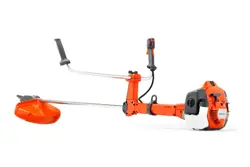
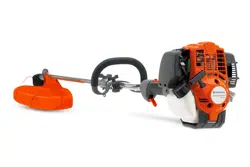
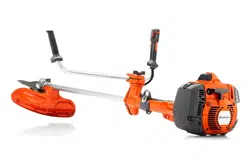
345FR 545FX 545FXT
545RX 545RXT
Oper
ator’s manual
Please r
ead the operator’s manual carefully and make sure you understand the instructions
before using the machine.
KEY
T
O SYMBOLS
2
–
English
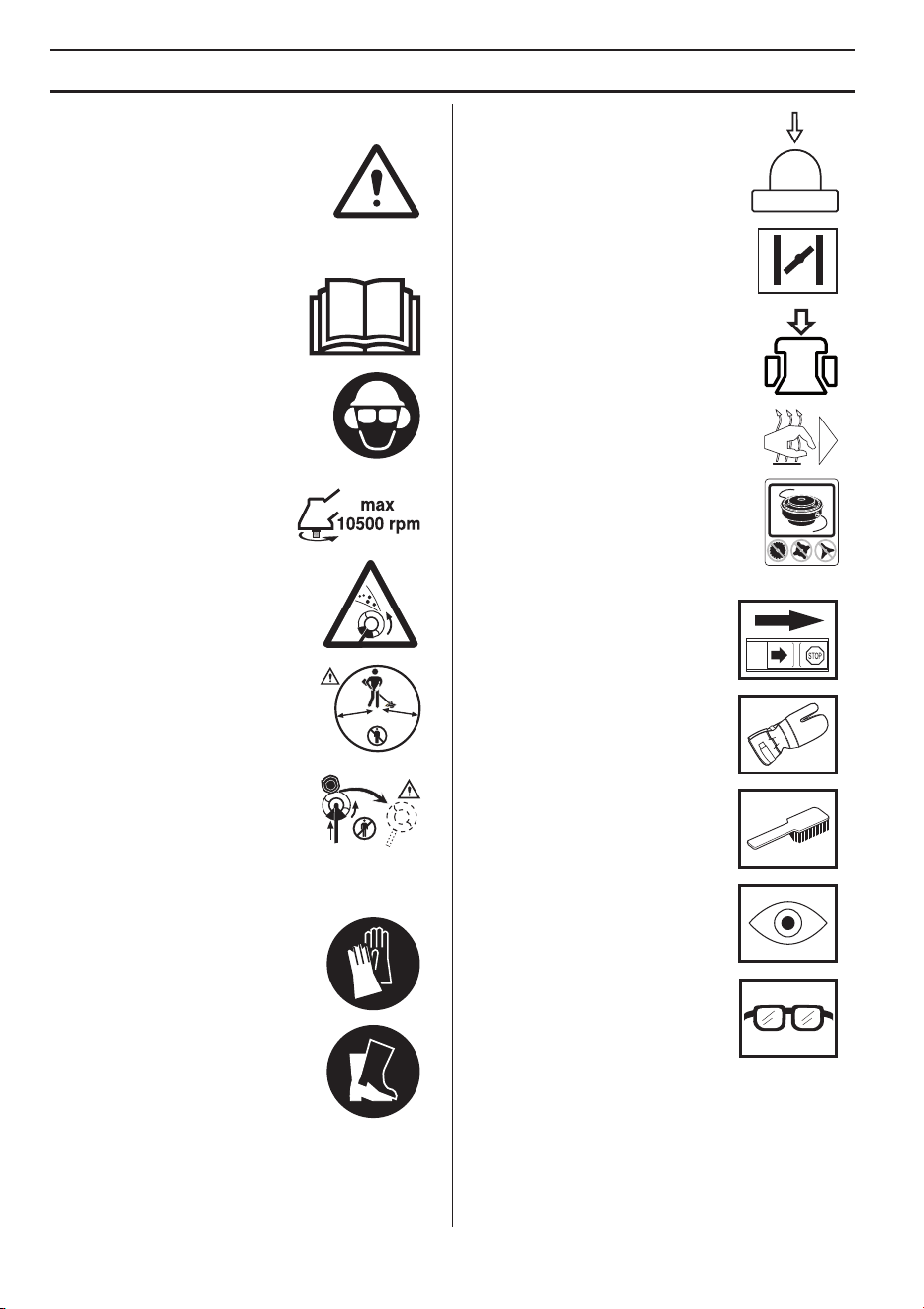
Symbols
W
ARNING! Clearing saws,
brushcutters and trimmers can be
dangerous! Careless or incorrect use
can result in serious or fatal injury to
the operator or others. It is extremely
important that you read and
understand the contents of the operator’s manual.
Please read the operator’s manual
carefully and make sure you
understand the instructions before
using the machine.
Always wear:
• Wear a protective helmet where
there is a risk of falling objects
• Approved hearing protection
• Approved eye protection
Max. speed of output shaft, rpm
Watch out for thrown objects and
ricochets.
The operator of the machine must
ensure, while working, that no
persons or animals come closer than
15 meters (50 ft.).
Machines fitted with saw blades or
grass blades can be thrown violently
to the side when the blade comes
into contact with a fixed object. This is
called blade thrust. The blade is
capable of amputating an arm or leg.
Always keep people and animals at least 15 meters (50
ft.) from the machine.
Always wear approved protective
gloves.
Wear sturdy, non-slip boots.
Primer bulb
Choke:
Set the choke control in the
choke position.
Decompression v
alve:
The valve is to
reduce the pressure in the cylinder and
make starting easier. You should always
use the decompression valve when
starting the machine.
Heated handles
Only use non-metallic, flexible cutting
attachments, i.e. trimmer heads with
trimmer cord.
Other symbols/decals on the mac
hine
refer to special certification
requirements for certain markets.
Switch off the engine b
y moving the
stop switch to the STOP position
before carrying out any checks or
maintenance.
Always wear approved protective
gloves.
Regular cleaning is required.
Visual check.
Approved eye protection must always
be used.
5
0
FT
15
m
50FT
15 m
CONTENTS
English
–
3
Contents
•
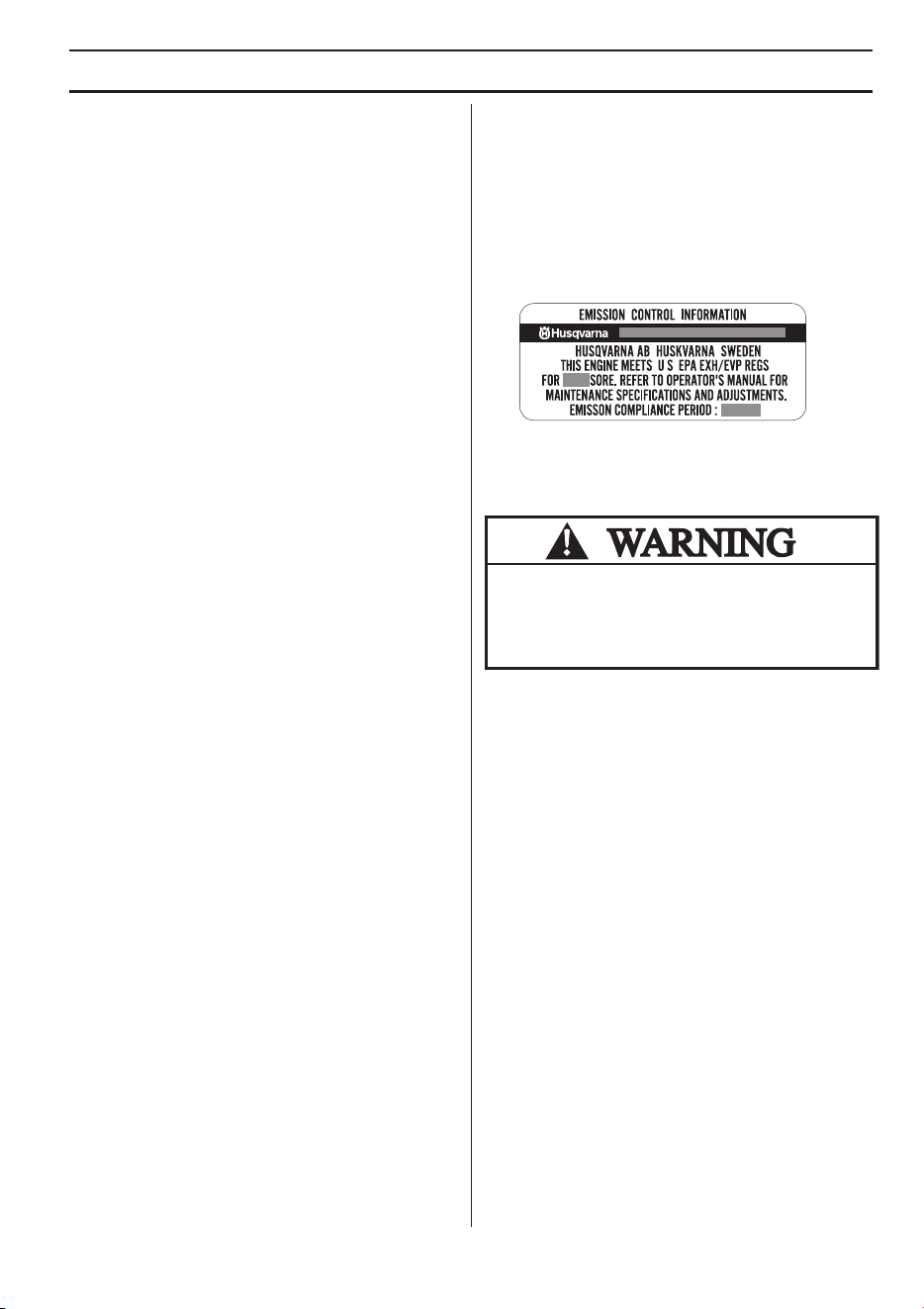
Maintenance, replacement, or repair of the emission
control devices and system may be performed by any
nonroad engine repair establishment or individual.
Your warranty may not cover damage or liability
caused by the use of non-authorized accessories or
replacement parts.
The Emissions Compliance Period referred to on the
Emission Compliance label indicates the number of
operating hours for which the engine has been shown to
meet Federal emissions requirements.
KEY
TO SYMBOLS
Symbols
................................................................ 2
CONTENTS
Contents
............................................................... 3
INTR
ODUCTION
Dear customer!
..................................................... 4
WHA
T IS WHAT?
What is what on the br
ush cutter? ........................ 5
GENERAL SAFETY PRECA
UTIONS
Measures to tak
e before using new clearing saws,
brushcutters or trimmers. ......................................
6
Important .............................................................. 6
Personal protective equipment ............................. 7
Machine
′
s safety equipment ................................. 7
Cutting equipment ................................................ 10
ASSEMBL
Y
Assemb
ling the handlebar and throttle ................. 13
Transport position, handlebar ............................... 13
Assembling the cutting equipment ....................... 13
Fitting the guard extension ................................... 14
Fitting the blade guard/combination guard, grass
blade and grass cutter ..........................................
14
Fitting the blade guard and saw blade .................. 15
Fitting other guards and cutting attachments ....... 16
Adjusting the harness and brush cutter ................ 16
Balance X ............................................................. 16
Balance XT ........................................................... 17
FUEL HANDLING
Fuel saf
ety ............................................................ 19
Fuel ...................................................................... 19
Fueling .................................................................. 20
ST
ARTING AND STOPPING
Chec
k before starting ........................................... 21
Starting and stopping ........................................... 21
W
ORKING TECHNIQUES
Gener
al working instructions ................................ 23
MAINTENANCE
Carb
uretor ............................................................ 27
Muffler .................................................................. 27
Cooling system ..................................................... 28
Air filter ................................................................. 28
Bevel gear ............................................................ 29
Drive shaft ............................................................ 29
Spark plug ............................................................ 29
Winter use ............................................................ 29
Maintenance schedule ......................................... 32
TECHNICAL D
ATA
T
echnical data ...................................................... 33
FEDERAL EMISSION CONTR
OL WARRANTY
STATEMENT
Y
OUR WARRANTY RIGHTS AND OBLIGATIONS 37
The engine exhaust from this product
contains chemicals known to the State
of California to cause cancer, birth
defects or other reproductive harm.

4
–
English
INTR
ODUCTION
Dear customer!
Cong
ratulations on your choice to buy a Husqvarna product! Husqvarna is based on a tradition that dates back to 1689,
when the Swedish King Karl XI ordered the construction of a factory on the banks of the Huskvarna River, for production
of muskets. The location was logical, since water power was harnessed from the Huskvarna River to create the water-
powered plant. During over 300 years of continuous operation, the Husqvarna factory has produced a lot of different
products, from wood stoves to modern kitchen appliances, sewing machines, bicycles, motorcycles etc. In 1956, the first
motor driven lawn mowers appeared, followed by chain saws in 1959, and it is within this area Husqvarna is working
today.
Today Husqvarna is one of the leading manufacturers in the world of forest and garden products, with quality as our
highest priority. We develop, manufacture and market high quality motor driven products for forestry and gardening as
well as for building and construction industry.
Your purchase gives you access to professional help with repairs and service whenever this may be necessary. If the
retailer who sells your machine is not one of our authorized dealers, ask for the address of your nearest servicing dealer.
It is our wish that you will be satisfied with your product and that it will be your companion for a long time. Think of this
operator
′
s manual as a valuable document. By following its
′
content (using, service, maintenance etc) the life span and
the second-hand value of the machine can be extended. If you ever lend or sell this machine, make sure that the
borrower or buyer gets the operator
′
s manual, so they will also know how to properly maintain and use it.
Thank you for using a Husqvarna product.
Husqvarna AB has a policy of continuous product development and therefore reserves the right to modify the design and
appearance of products without prior notice.
English
–
5
WHA
T IS
WHA
T?
What is what on the brush cutter?
30
22
32
33
11
10
9
8
12
26
27
29
24
25
1
31
28
4
5
6 7
14
16
13
21
20
19
18
17
15
9
8
11
2
2524
26
27
25
3
24
23
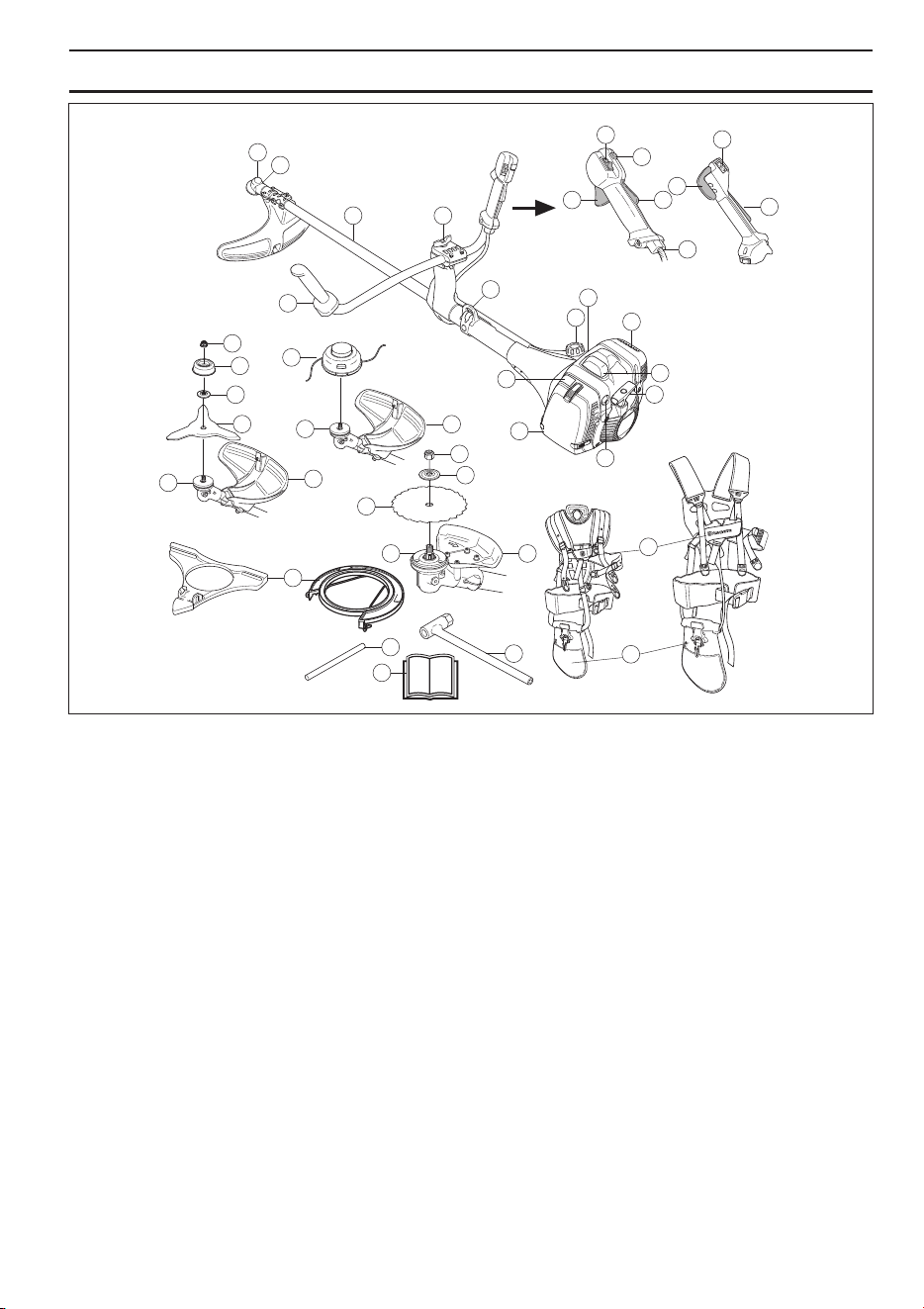
345FR, 545RX,RXT
545FX, FXT
1
Grass blade (345FR, 545RX, 545RXT)
2 Saw blade (345FR, 545FX, 545FXT)
3 Trimmer head (345FR, 545RX, 545RXT)
4 Bevel gear
5 Grease filler cap, bevel gear
6 Shaft
7 Handle adjustment
8 Throttle trigger
9 Stop switch
10 Start throttle button
11 Throttle trigger lockout
12 Adjusting the throttle wire
13 Suspension ring
14 Fuel tank
15 Decompression valve
16 Muffler
17 Spark plug cap and spark plug
18 Starter handle
19 Primer bulb
20 Air filter cover
21 Choke control
22 Harness, quick release
23 Harness, hip pad
24 Drive disc
25 Cutting attachment guard
26 Locking nut
27 Support flange
28 Handlebar
29 Support cup
30 Transport guard
31 Locking pin
32 Operator’s manual
33 Socket spanner
GENERAL SAFETY PRECA
UTIONS
6
–
English
Measures to take bef
ore using
new clearing saws, brushcutters
or trimmers.
•
Please read this manual carefully.
• Check that the locking nut of the cutting equipment is
tighten correctly. See instructions under the heading
Assembly.
Impor
tant
!
W
ARNING! Long-term exposure to noise
can result in permanent hearing
impairment. Always use approved
hearing protection.
!
W
ARNING! Under no circumstances may
the design of the machine be modified
without the permission of the
manufacturer. Always use genuine
accessories. Non-authorized
modifications and/or accessories can
result in serious personal injury or the
death of the operator or others.
!
W
ARNING! A clearing saw, brushcutter
or trimmer can be dangerous if used
incorrectly or carelessly, and can cause
serious or fatal injury to the operator or
others. It is extremely important that you
read and understand the contents of this
operator’s manual.
IMPOR
TANT!
The clearing saw or grass trimmer is only designed for
trimming grass, grass clearing and/or forestry clearing.
National or local regulations may regulate the use.
Comply to given regulations.
The only accessories you can operate with this engine
unit are the cutting attachments we recommend in the
chapter on Technical data.
Never use the machine if you are tired, if you have drunk
alcohol, or if you are taking medication that could affect
your vision, your judgement or your co-ordination.
Wear personal protective equipment. See instructions
under the heading ”Personal protective equipment”.
Never use a machine that has been modified in any way
from its original specification.
Never use a machine that is faulty. Carry out the safety
checks, maintenance and service instructions
described in this manual. Some maintenance and
service measures must be carried out by trained and
qualified specialists. See instructions under the heading
Maintenance.
All covers, guards and handles must be fitted before
starting. Ensure that the spark plug cap and ignition
lead are undamaged to avoid the risk of electric shock.
National legislation could regulate the use of this
machine. Find out what legislation is applicable in the
place where you work before you start using the
machine.
The machine operator must ensure that no people or
animals come closer than 15 meters while working.
When several operators are working in the same area
the safety distance should be at least twice the tree
height and no less than 15 meters.
Do an overall inspection of the machine before use, see
maintenance schedule.
!
W
ARNING! This machine produces an
electromagnetic field during operation.
This field may under some
circumstances interfere with active or
passive medical implants. To reduce the
risk of serious or fatal injury, we
recommend persons with medical
implants consult their physician and the
medical implant manufacturer before
operating this machine.
!
W
ARNING! Running an engine in a
confined or badly ventilated area can
result in death due to asphyxiation or
carbon monoxide poisoning.
GENERAL SAFETY PRECA
UTIONS
English
–
7
P
ersonal protective equipment
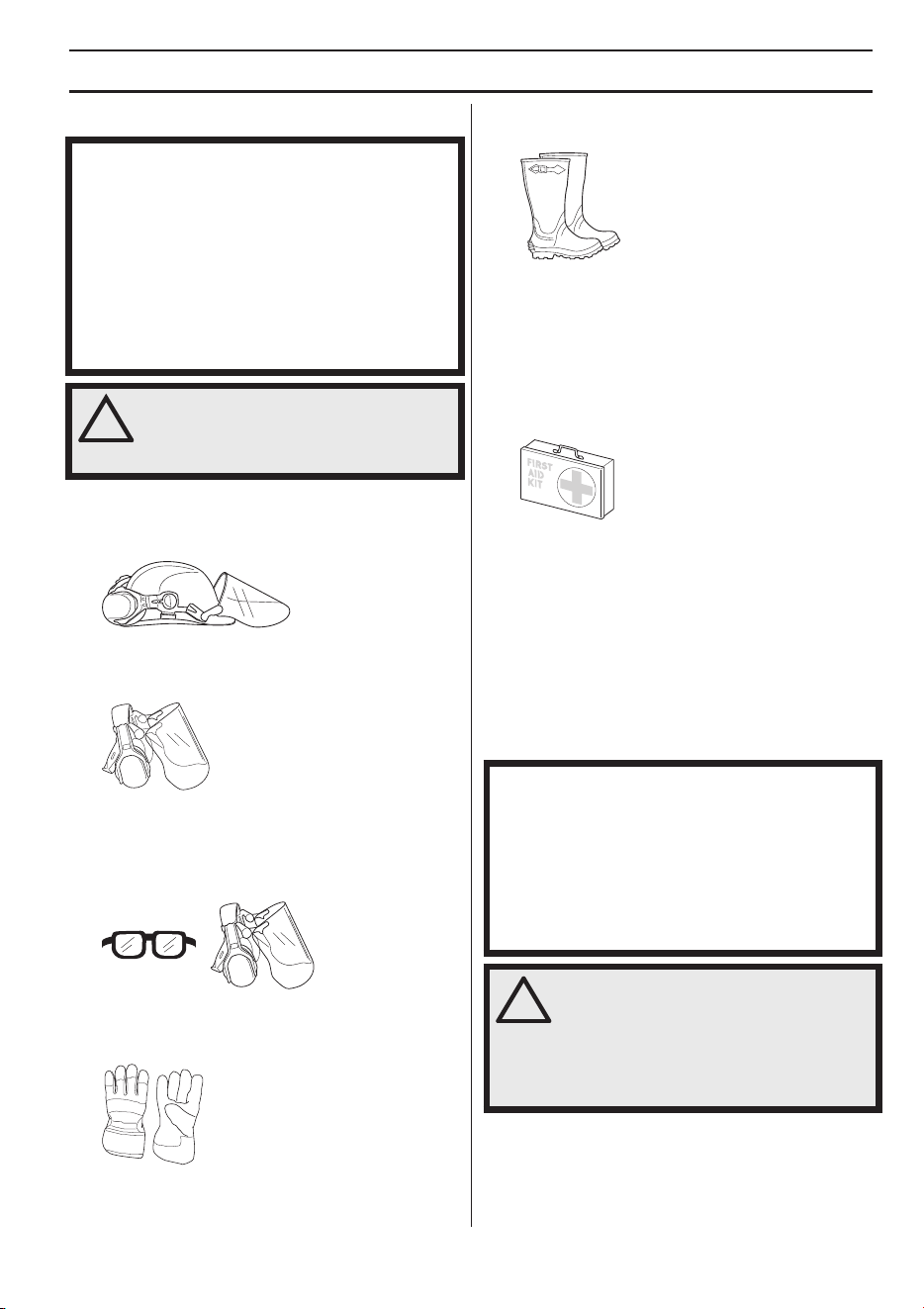
HELMET
A helmet should be w
orn if the trees being cleared are
taller than 2 m.
HEARING PROTECTION
Wear hearing protection that provides adequate noise
reduction.
EYE PROTECTION
Always wear approved eye protection. If you use a visor
then you must also wear approved protective goggles.
Approved protective goggles must comply with standard
ANSI Z87.1 in the USA or EN 166 in EU countries.
GLOVES
Gloves should be worn when necessary, e.g., when fitting
cutting attachments.
BOOTS
Wear boots with steel toe-caps and non-slip sole.
CLOTHING
Wear clothes made of a strong fabric and avoid loose
clothing that can catch on twigs and branches. Always
wear heavy, long pants. Do not wear jewellery, shorts
sandals or go barefoot. Secure hair so it is above shoulder
level.
FIRST AID KIT
Always have a first aid kit nearby.
Mac
hine
′
s safety equipment
This section descr
ibes the machine
′
s safety equipment,
its purpose, and how checks and maintenance should be
carried out to ensure that it operates correctly. See the
”What is what?” section to locate where this equipment is
positioned on your machine.
The life span of the machine can be reduced and the risk
of accidents can increase if machine maintenance is not
carried out correctly and if service and/or repairs are not
carried out professionally. If you need further information
please contact your nearest servicing dealer.
IMPORTANT!
A clearing saw, brushcutter or trimmer can be
dangerous if used incorrectly or carelessly, and can
cause serious or fatal injury to the operator or others. It
is extremely important that you read and understand the
contents of this operator’s manual.
You must use approved personal protective equipment
whenever you use the machine. Personal protective
equipment cannot eliminate the risk of injury but it will
reduce the degree of injury if an accident does happen.
Ask your dealer for help in choosing the right equipment.
!
W
ARNING! Listen out for warning signals
or shouts when you are wearing hearing
protection. Always remove your hearing
protection as soon as the engine stops.
IMPOR
TANT!
All servicing and repair work on the machine requires
special training. This is especially true of the machine
′
s
safety equipment. If your machine fails any of the
checks described below you must contact your service
agent. When you buy any of our products we guarantee
the availability of professional repairs and service. If the
retailer who sells your machine is not a servicing dealer,
ask him for the address of your nearest service agent.
!
W
ARNING! Never use a machine with
faulty safety equipment. The machine’s
safety equipment must be checked and
maintained as described in this section.
If your machine fails any of these checks
contact your service agent to get it
repaired.
GENERAL SAFETY PRECA
UTIONS
8
–
English
Thr
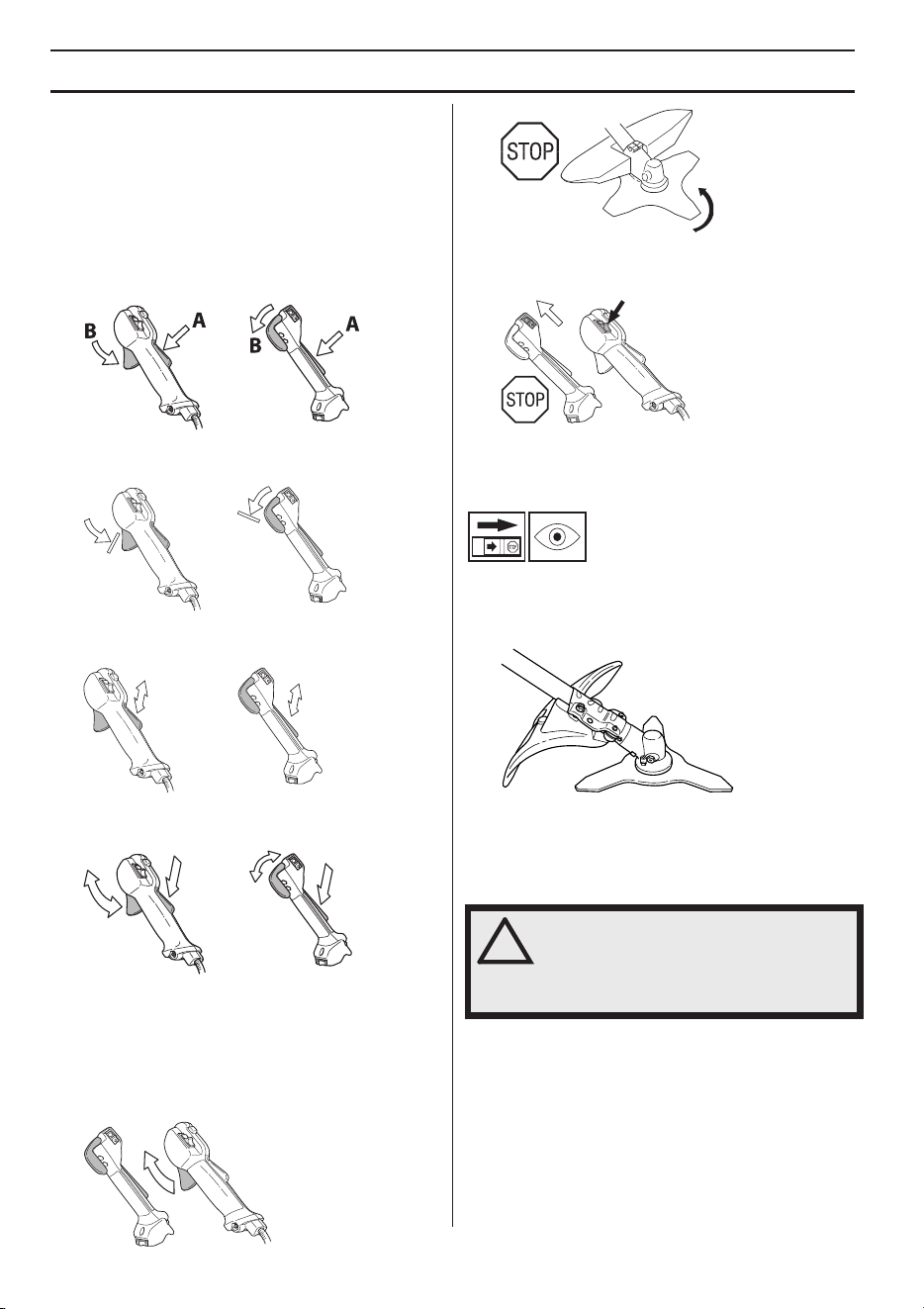
ottle trigger lockout
The throttle loc
kout is designed to prevent accidental
operation of the throttle control. When you press the lock
(A) (i.e. when you grasp the handle) it releases the throttle
control (B). When you release the handle the throttle
control and the throttle lockout both move back to their
original positions. This movement is controlled by two
independent return springs. This arrangement means that
the throttle control is automatically locked at the idle
setting.
Make sure the throttle control is locked at the idle setting
when the throttle lockout is released.
Press the throttle lockout and make sure it returns to its
original position when you release it.
Check that the throttle trigger and throttle lockout move
freely and that the return springs work properly.
See instructions under the heading Start. Start the
machine and apply full throttle. Release the throttle and
check that the cutting attachment stops and remains at a
standstill. If the cutting attachment rotates with the throttle
in the idle position then the carburettor idle setting must
be checked. See instructions under the heading
Maintenance.
Stop s
witch
Use the stop s
witch to switch off the engine.
Start the engine and make sure the engine stops when
you move the stop switch to the stop setting.
Cutting attac
hment guard
This guard is intended to pre
vent loose objects from being
thrown towards the operator. The guard also protects the
operator from accidental contact with the cutting
attachment.
Check that the guard is undamaged and not cracked.
Replace the guard if it has been exposed to impact or is
cracked.
Always use the recommended guard for the cutting
attachment you are using. See chapter on Technical data.
!
WARNING! Never use a cutting
attachment without an approved guard.
See the chapter on Technical data. If an
incorrect or faulty guard is fitted this can
cause serious personal injury.
GENERAL SAFETY PRECAUTIONS
English – 9
Vibration damping system
Your machine is equipped with a vibration damping
system that is designed to reduce vibration and make
operation easier.
Use of incorrectly wound cord or an incorrect cutting
attachment increases the level of vibration. See
instructions under the heading Cutting equipment.
The machine′s vibration damping system reduces the
transfer of vibration between the engine unit/cutting
equipment and the machine
′s handle unit.
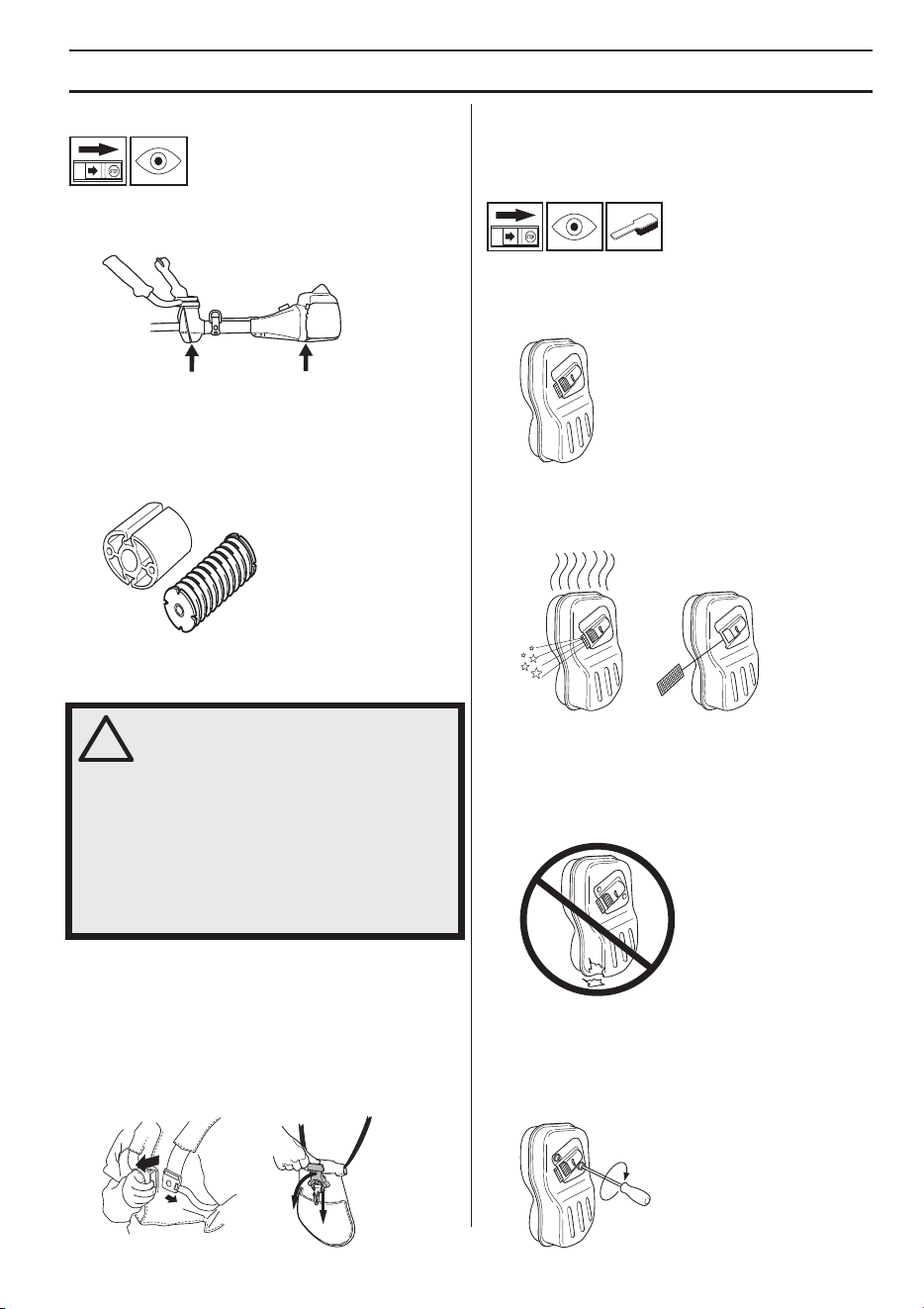
Regularly check the vibration damping units for cracks or
deformation. Check that the vibration damping element is
undamaged and securely attached.
Quick release
There is an easily accessible, quick release fitted at the
front as a safety precaution in case the engine catches
fire, or in any other situation that requires you to free
yourself from the machine and harness. See instructions
under the heading Adjusting the harness and brush
cutter. Certain harnesses also have a quick release fitted
to the support hook.
Check that the harness straps are correctly positioned.
Once the harness and machine have been adjusted,
check that the harness quick release works correctly.
Muffler
The muffler is designed to keep noise levels to a minimum
and to direct exhaust fumes away from the user. A muffler
fitted with a catalytic converter is also designed to reduce
harmful exhaust gases.
In countries that have a warm and dry climate there is a
significant risk of fire. We therefore fit certain mufflers with
a spark arrestor screen. Check whether the muffler on
your machine is fitted with this kind of screen.
For mufflers it is very important that you follow the
instructions on checking, maintaining and servicing your
machine. See instructions under the heading Checking,
maintaining and servicing the machine’s safety
equipment.
Never use a machine that has a faulty muffler.
Regularly check that the muffler is securely attached to
the machine.
If the muffler on your machine is fitted with a spark
arrestor screen this must be cleaned regularly. A blocked
screen will cause the engine to overheat and may lead to
serious damage.
!
WARNING! Overexposure to vibration
can lead to circulatory damage or nerve
damage in people who have impaired
circulation. Contact your doctor if you
experience symptoms of overexposure
to vibration. Such symptoms include
numbness, loss of feeling, tingling,
pricking, pain, loss of strength, changes
in skin colour or condition. These
symptoms normally appear in the
fingers, hands or wrists. The risk
increases at low temperatures.
GENERAL SAFETY PRECAUTIONS
10 – English
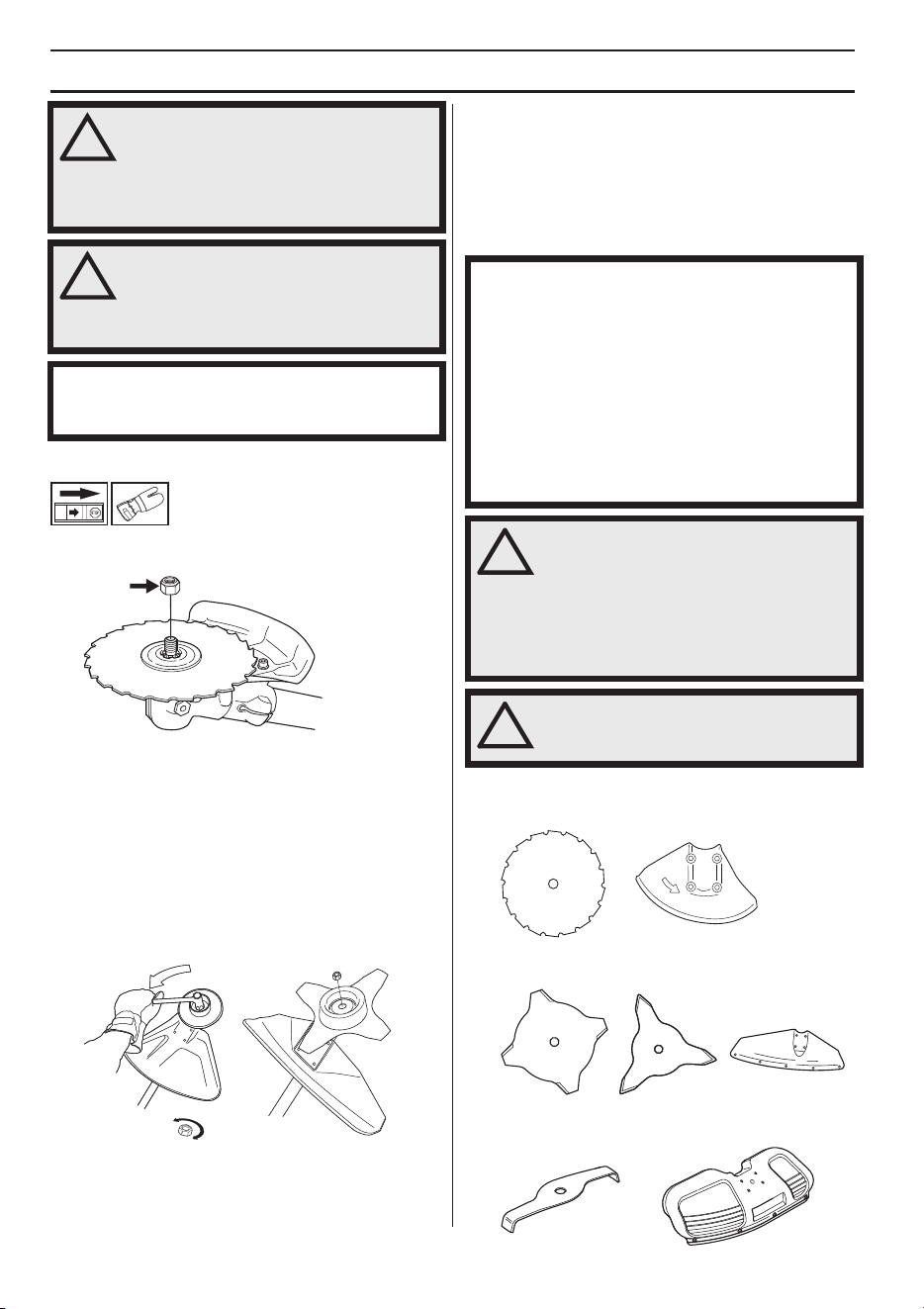
Locking nut
A locking nut is used to secure some types of cutting
attachment.
When fitting, tighten the nut in the opposite direction to the
direction of rotation of the cutting attachment. To remove
it, undo the nut in the same direction as the cutting
attachment rotates. (CAUTION! The nut has a left-hand
thread.) When loosening and tightening the saw blade
nut, there is a risk of injury from the teeth of the saw blade.
You should therefore always ensure that your hand is
shielded by the blade guard when doing this. Always use
a socket spanner with a shaft that is long enough to allow
this. The arrow in the diagram shows the area where you
should operate the socket spanner when loosening or
tightening the nut.
The nylon lining inside the locking nut must not be so worn
that you can turn it by hand. The lining should offer a
resistance of at least 1.5 Nm. The nut should be replaced
after it has been put on approx. 10 times.
Cutting equipment
This section describes how to choose and maintain your
cutting equipment in order to:
• Reduce the risk of blade thrust.
• Obtain maximum cutting performance.
• Extend the life of cutting equipment.
Cutting equipment
Saw blades are intended for cutting fibrous types of wood.
Grass blades and grass knifes are intended for cutting
coarse grass.
Shredder blades are intended for cutting coarse grass
and bushes.
!
WARNING! Mufflers fitted with catalytic
converters get very hot during use and
remain so for some time after stopping.
This also applies at idle speed. Contact
can result in burns to the skin.
Remember the risk of fire!
!
WARNING! The inside of the muffler
contain chemicals that may be
carcinogenic. Avoid contact with these
elements in the event of a damaged
muffler.
IMPORTANT! The exhaust fumes from the engine are
hot and may contain sparks which can start a fire. Never
start the machine indoors or near combustible material!
IMPORTANT!
Only use cutting attachments with the guards we
recommend! See the chapter on Technical data.
Refer to the instructions for the cutting attachment to
check the correct way to load the cord and the correct
cord diameter.
Keep the teeth of the blade correctly sharpened! Follow
our recommendations. Also refer to the instructions on
the blade packaging.
Maintain the correct blade setting! Follow our
instructions and use the recommended file gauge.
!
WARNING! Always stop the engine
before doing any work on the cutting
attachment. This continues to rotate even
after the throttle has been released.
Ensure that the cutting attachment has
stopped completely and disconnect the
spark plug cap before you start to work
on it.
!
WARNING! Using an incorrect cutting
attachment or an incorrectly sharpened
blade increases the risk of blade thrust.
GENERAL SAFETY PRECAUTIONS
English – 11
A trimmer head is intended for trimming grass.
General rules
Only use cutting attachments with the guards we
recommend! See the chapter on Technical data.
Keep the teeth of the blade correctly sharpened! Follow
our instructions and use the recommended file gauge. An
incorrectly sharpened or damaged blade increases the
risk of accidents.
Keep the correct setting on the saw blade! Follow our
instructions and use the recommended setting tool. An
incorrectly set saw blade increases the risk of jamming
and blade thrust, and damage to the saw blade.
Check the cutting attachment for damage or cracks. A
damaged cutting attachment should always be replaced.
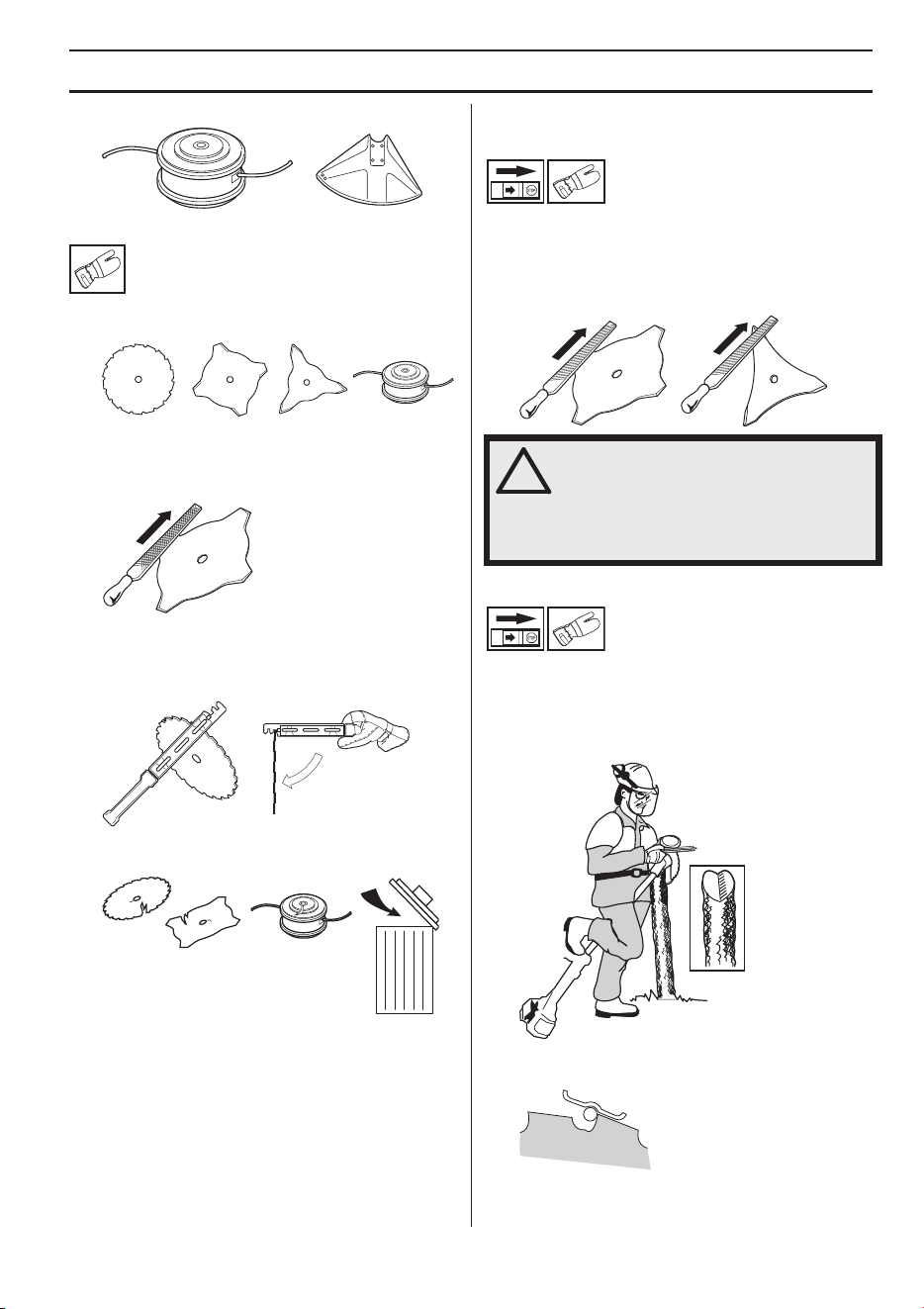
Sharpening grass knifes and grass
blades
• See the cutting attachment packaging for correct
sharpening instructions. Sharpen blades and cutters
using a single-cut flat file.
• Sharpen all edges equally to maintain the balance of
the blade.
Sharpening the saw blade
• See the cutting attachment packaging for correct
sharpening instructions.
A correctly sharpened blade is essential for working
efficiently and to avoid unnecessary wear to the blade and
brush cutter.
• Make sure that the blade is well supported when you
file it. Use a 5.5 mm round file with a file holder.
!
WARNING! Always discard a blade that is
bent, twisted, cracked, broken or
damaged in any other way. Never attempt
to straighten a twisted blade so that it
can be reused. Only use original blades
of the specified type.
GENERAL SAFETY PRECAUTIONS
12 – English
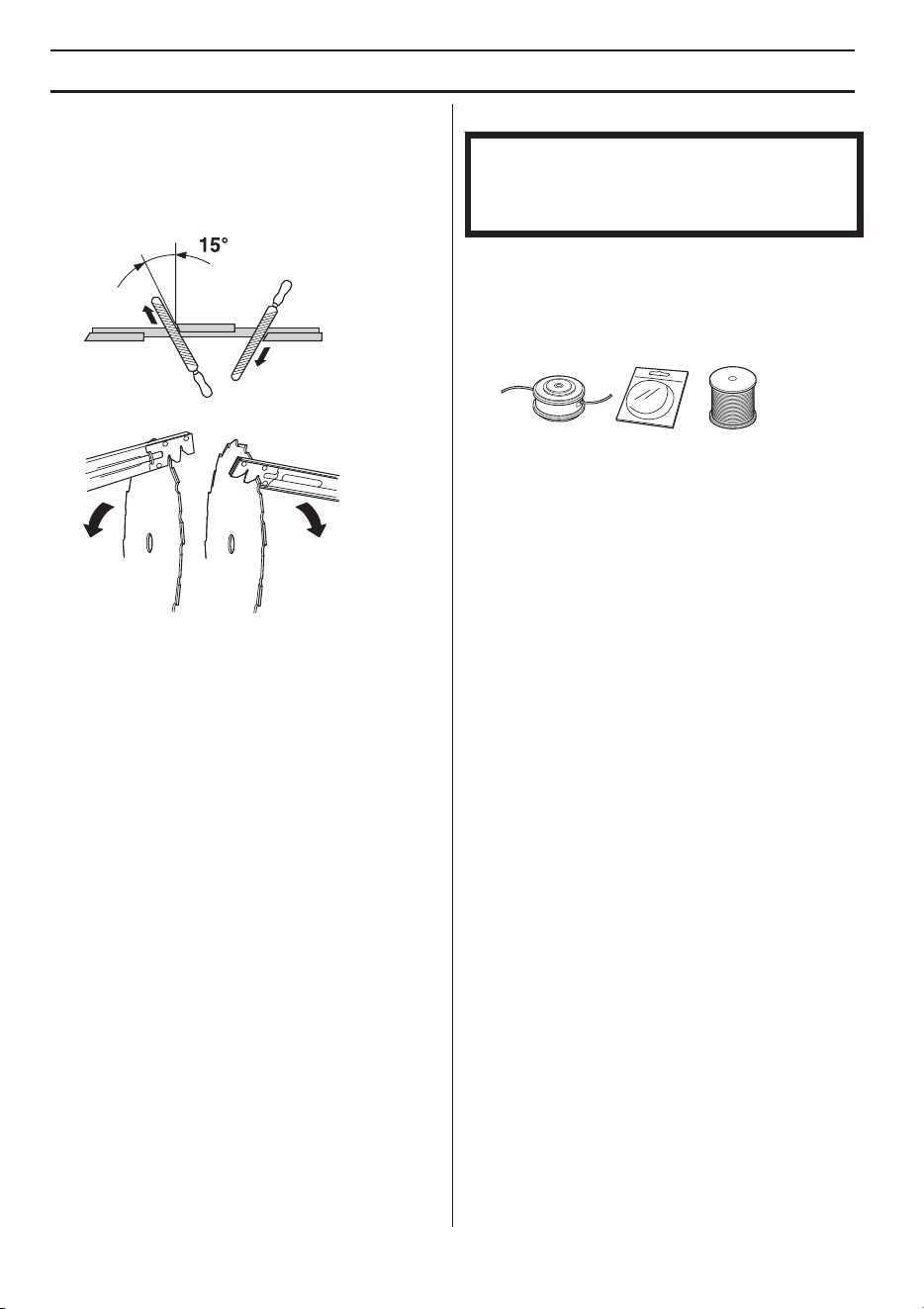
• The filing angle is 15°. File alternate teeth to the right
and those in between to the left. If the blade has been
heavily pitted by stones it may be necessary to dress
the top edges of the teeth with a flat file, in exceptional
cases. If so, this should be done before filing with a
round file. The top edges must be filed down by the
same amount for all the teeth.
Adjust the blade setting. This should be 1 mm.
Trimmer head
• Only use the recommended trimmer heads and
trimmer cords. These have been tested by the
manufacturer to suit a particular engine size. This is
especially important when a fully automatic trimmer
head is used. Only use the recommended cutting
attachment. See the chapter on Technical data.
• Smaller machines generally require small trimmer
heads and vice versa. This is because when clearing
using a cord the engine must throw out the cord
radially from the trimmer head and overcome the
resistance of the grass being cleared.
• The length of the cord is also important. A longer cord
requires greater engine power than a shorter cord of
the same diameter.
• Make sure that the cutter on the trimmer guard is
intact. This is used to cut the cord to the correct length.
• To increase the life of the cord it can be soaked in
water for a couple of days before use. This will make
the cord tougher so that it lasts longer.
IMPORTANT!
Always ensure the trimmer cord is wound tightly and
evenly around the drum, otherwise the machine will
generate harmful vibration.
ASSEMBLY
English – 13
Assembling the handlebar and throttle
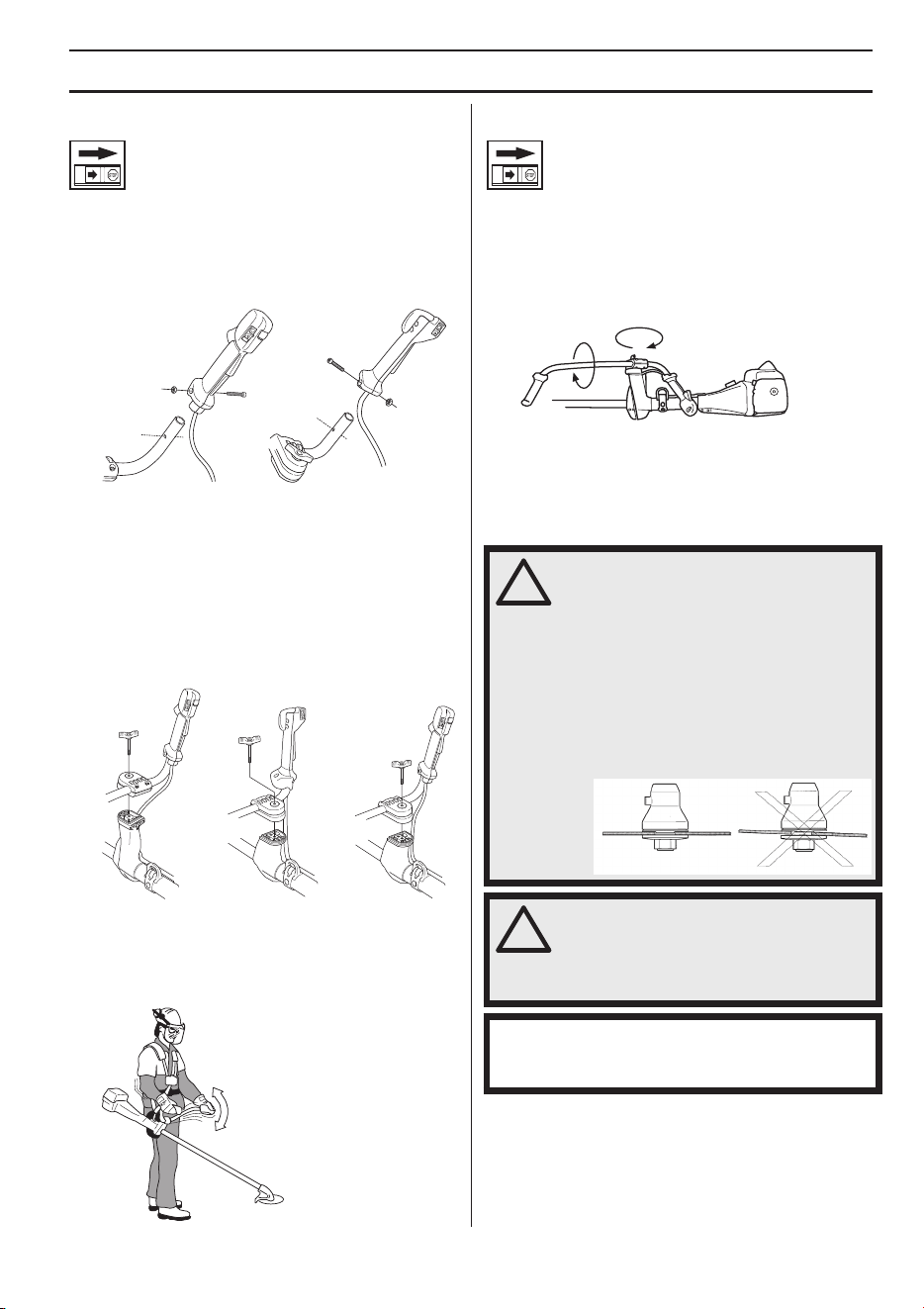
CAUTION! Some models have the throttle handle fitted at
the factory.
• Remove the screw at the rear of the throttle handle.
• Slide the throttle handle onto the right side of the
handlebar, (see diagram).
• Align the screw hole in the throttle handle with the hole
in the handlebar.
• Refit the screw in the hole in the rear of the throttle
handle.
• Screw the screw through the handle and handlebar.
Tighten it.
• Unscrew the knob from the handlebar mounting.
• Position the handlebar as shown. Fit the mounting
components and tighten the knob lightly.
• Put on the harness and hang the machine from the
support hook. Now make a final adjustment so that
the machine is in a comfortable working position when
it hangs from the harness.
• Tighten the knob.
Transport position, handlebar
• The handlebar can easily be turned to fit along the
shaft for easier transportation and storage.
• Loosen the knob. Turn the handlebar clockwise so that
the throttle handle rests against the engine.
• Now twist the handlebar around the shaft. Tighten the
knob.
• Fit the transport guard to the cutting attachment.
Assembling the cutting
equipment
Always wear approved protective gloves.
345 FR
545 FX
,
545 FXT
545 RX
,
545 RXT
!
WARNING!
When fitting the cutting attachment it is
extremely important that the raised
section on the drive disc/support flange
engages correctly in the centre hole of
the cutting attachment. If the cutting
attachment is fitted incorrectly it can
result in serious and/or fatal personal
injury.
!
WARNING! Never use a cutting
attachment without an approved guard.
See the chapter on Technical data. If an
incorrect or faulty guard is fitted this can
cause serious personal injury.
IMPORTANT! If a saw blade or grass blade are to be
used the machine must be equipped with the correct
handlebar, blade guard and harness.
ASSEMBLY
14 – English
Fitting the guard extension
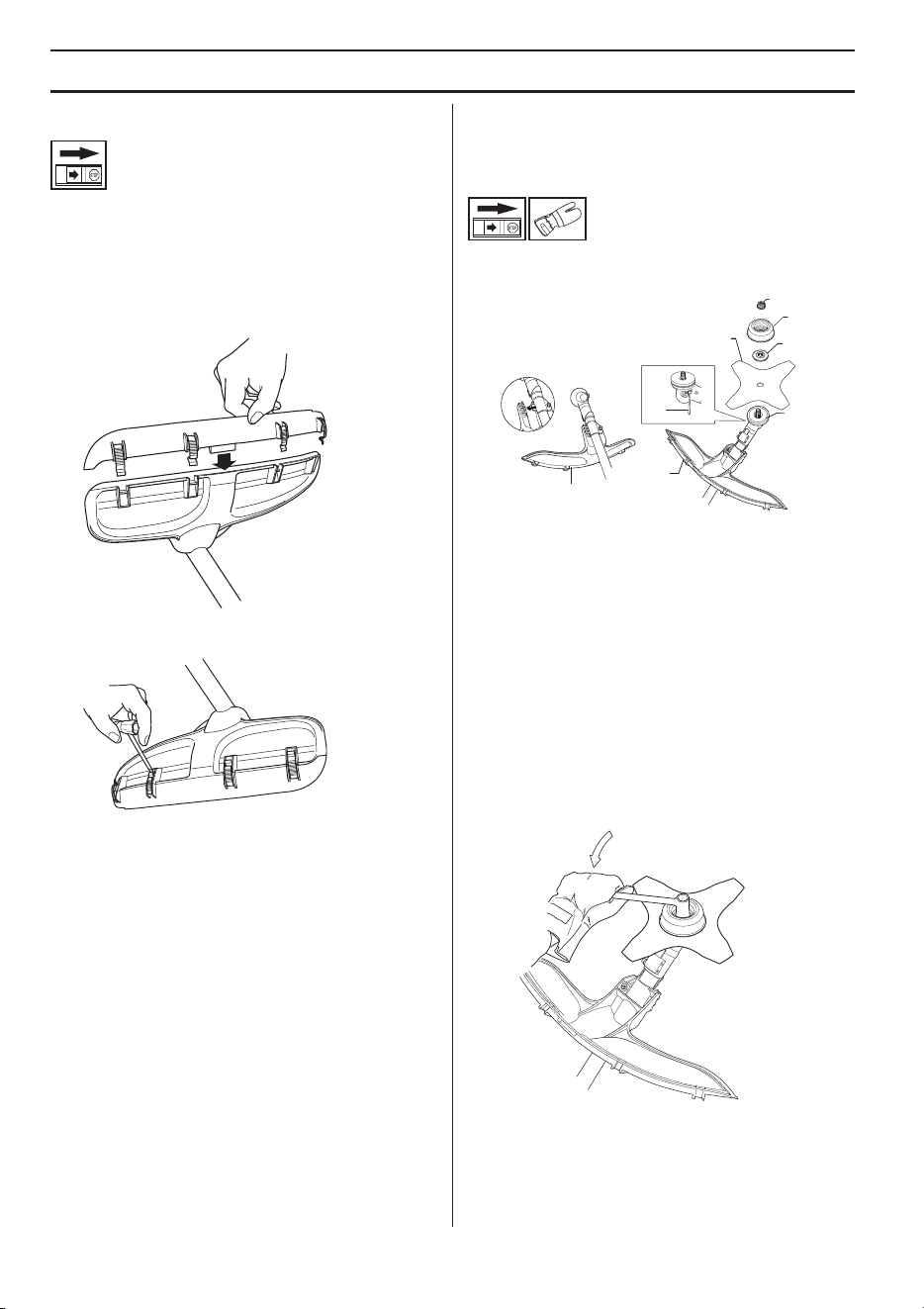
The guard extension shall always be fitted when using the
trimmer head/plastic blades and combination guard. The
guard extension shall always be removed when using the
grass blade and combination guard.
Enter the guard extension guide in the slot of the
combination guard. Then click the guard extension into
position on the guard with the four quick-fasteners.
The guard extension is removed easily using the spark
plug spanner, see illustration.
Fitting the blade guard/
combination guard, grass blade
and grass cutter
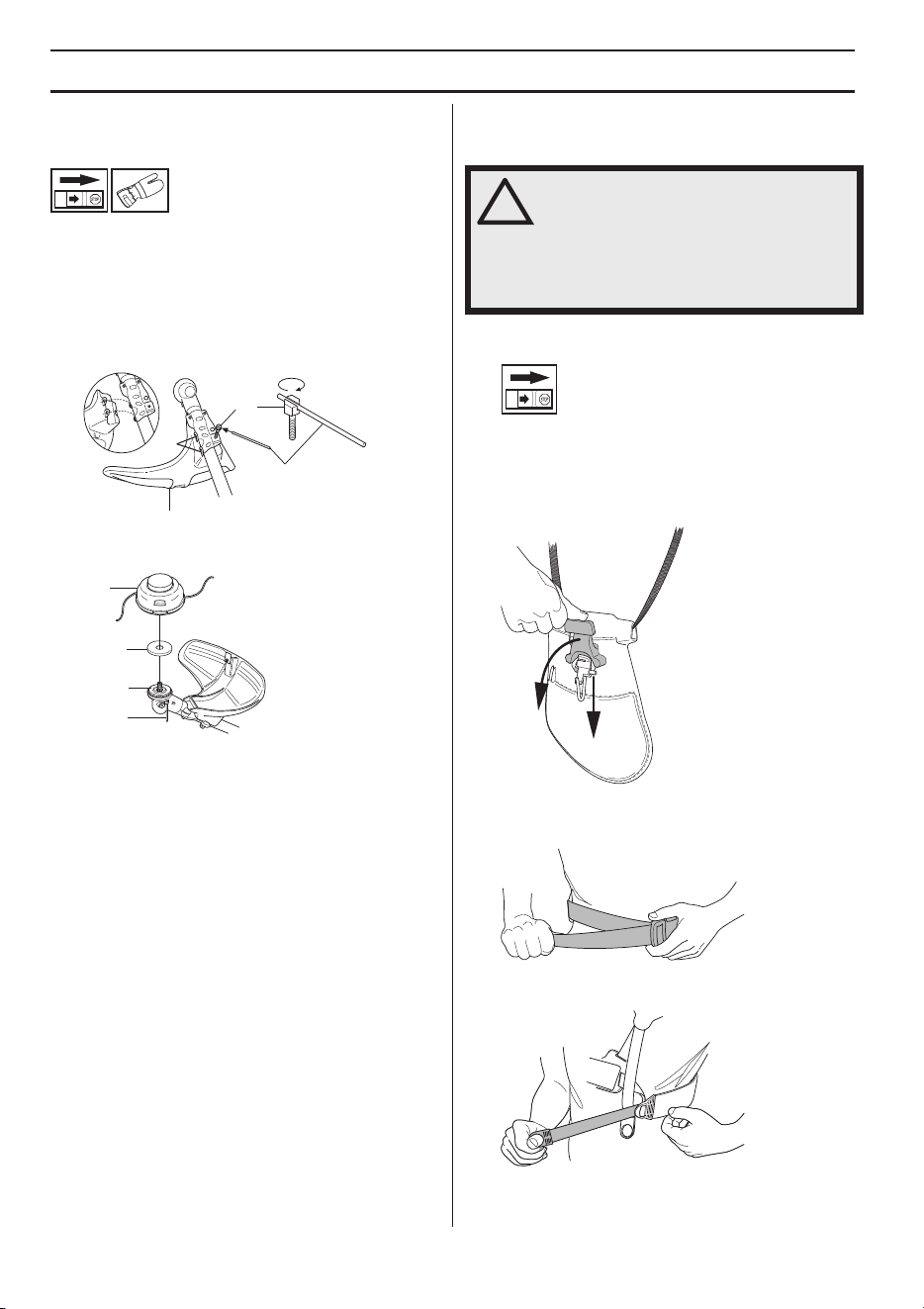
Hook the blade guard/combination guard (A) onto the
fitting on the shaft and secure with the bolt.
CAUTION! Ensure that the guard extension is removed.
• Use the recommended blade guard. See the
Technical data section.
• Turn the output shaft until one of the holes in the drive
disc aligns with the corresponding hole in the gear
housing.
• Insert the locking pin (C) in the hole to lock the shaft.
• Place the blade (D), support cup (E) and support
flange (F) on the output shaft.
• Fit the nut (G). The nut must be tightened to a torque
of 35-50 Nm (26-36 ft-lb). Use the spanner in the tool
kit. Hold the shaft of the spanner as close to the blade
guard as possible. To tighten the nut, turn the spanner
in the opposite direction to the direction of rotation
(Caution! left-hand thread).
G
F
D
B
C
A
E
A
ASSEMBLY
English – 15
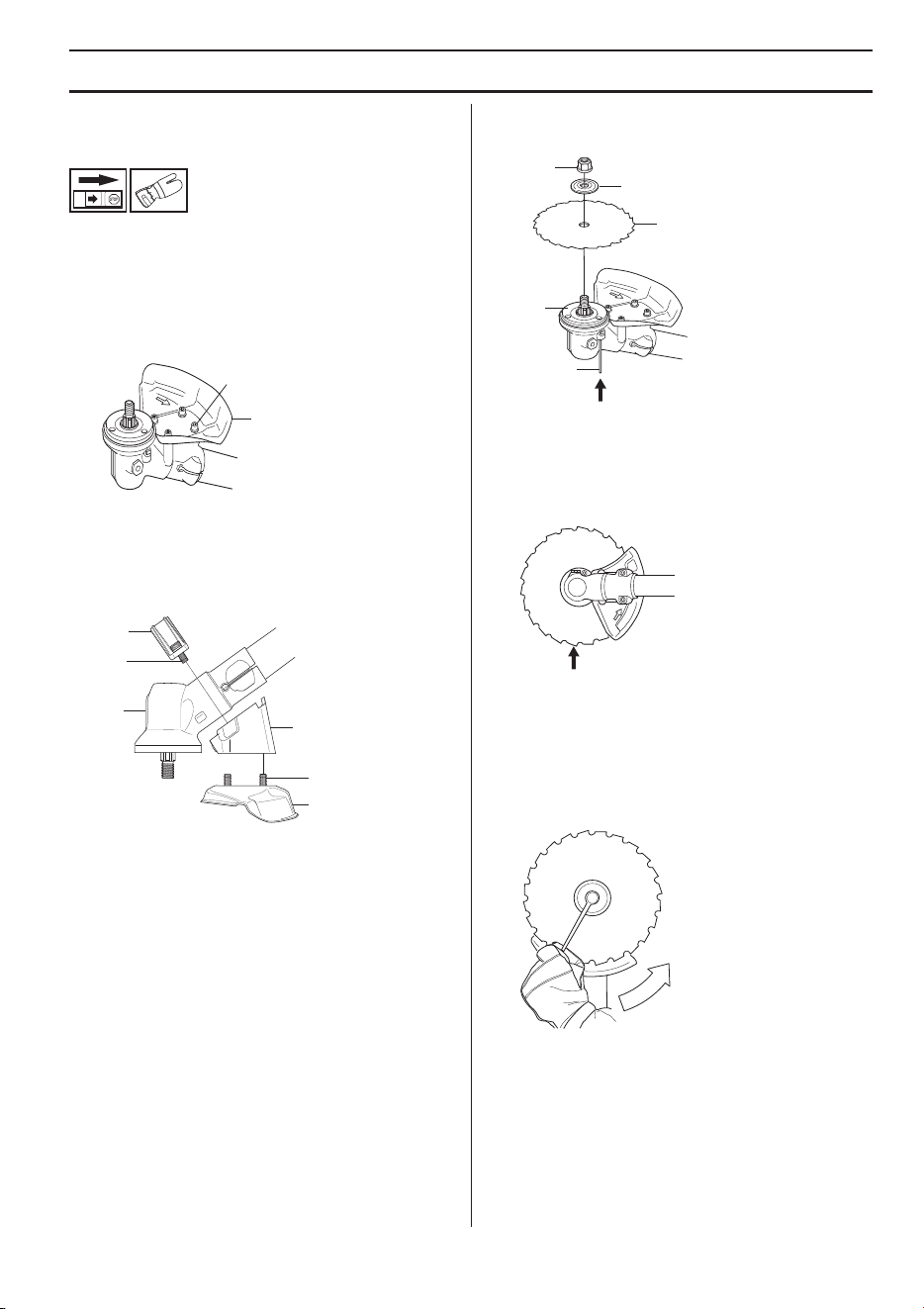
Fitting the blade guard and saw
blade
CAUTION! Always use the recommended guard for the
cutting attachment you are using. See chapter on
Technical data.
545FX, 545FXT
• The blade guard (A) is fitted using 4 screws (L) as
shown.
345FR, 545RX, 545RXT
• Fit the holder (R) and bracket (J) with 2 bolts (H) on
the gear housing.
• Then fasten the blade guard (A) with 4 bolts (L) in the
holder (N).
• Fit the drive disc (B) on the output shaft.
• Turn the output shaft until one of the holes in the drive
disc aligns with the corresponding hole in the gear
housing.
• Insert the locking pin (C) in the hole to lock the shaft.
• Place the blade (D) and support flange (F) on the
output shaft.
• Fit the nut (G). The nut must be tightened to a torque
of 35-50 Nm (26-36 ft-lb). Use the spanner in the tool
kit. Hold the shaft of the spanner as close to the blade
guard as possible. To tighten the nut, turn the spanner
in the opposite direction to the direction of rotation
(Caution! left-hand thread).
When loosening and tightening the saw blade nut, there
is a risk of injury from the teeth of the saw blade. You
should therefore always ensure that your hand is shielded
by the blade guard when doing this. Always use a socket
spanner with a shaft that is long enough to allow this. The
arrow in the diagram shows the area where you should
operate the socket spanner when loosening or tightening
the nut.
A
L
H
J
K
L
R
A
F
G
D
B
C
ASSEMBLY
16 – English
Fitting other guards and cutting
attachments
• Fit the trimmer guard/combination guard (A) intended
for use with the trimmer head/plastic blades. Hang the
trimmer guard/combination guard (A) on the two
hooks on the plate holder (M). Bend the guard around
the shaft and tighten it with the bolt (L) on the opposite
side of the shaft. Use the locking pin (C). Place the
locking pin in the groove on the screw head and
tighten. See diagram.
• Fit the drive disc (B) on the output shaft.
• Centre the metal cup (P) on the drive disc’s blade
guide.
• Turn the output shaft until one of the holes in the drive
disc aligns with the corresponding hole in the gear
housing.
• Insert the locking pin (C) in the hole to lock the shaft.
• Screw on the trimmer head/plastic blades (H) in the
opposite direction to the direction of rotation.
• To dismantle, follow the instructions in the reverse
order.
Adjusting the harness and brush
cutter
Balance X
(345FR, 545RX)
Safety release
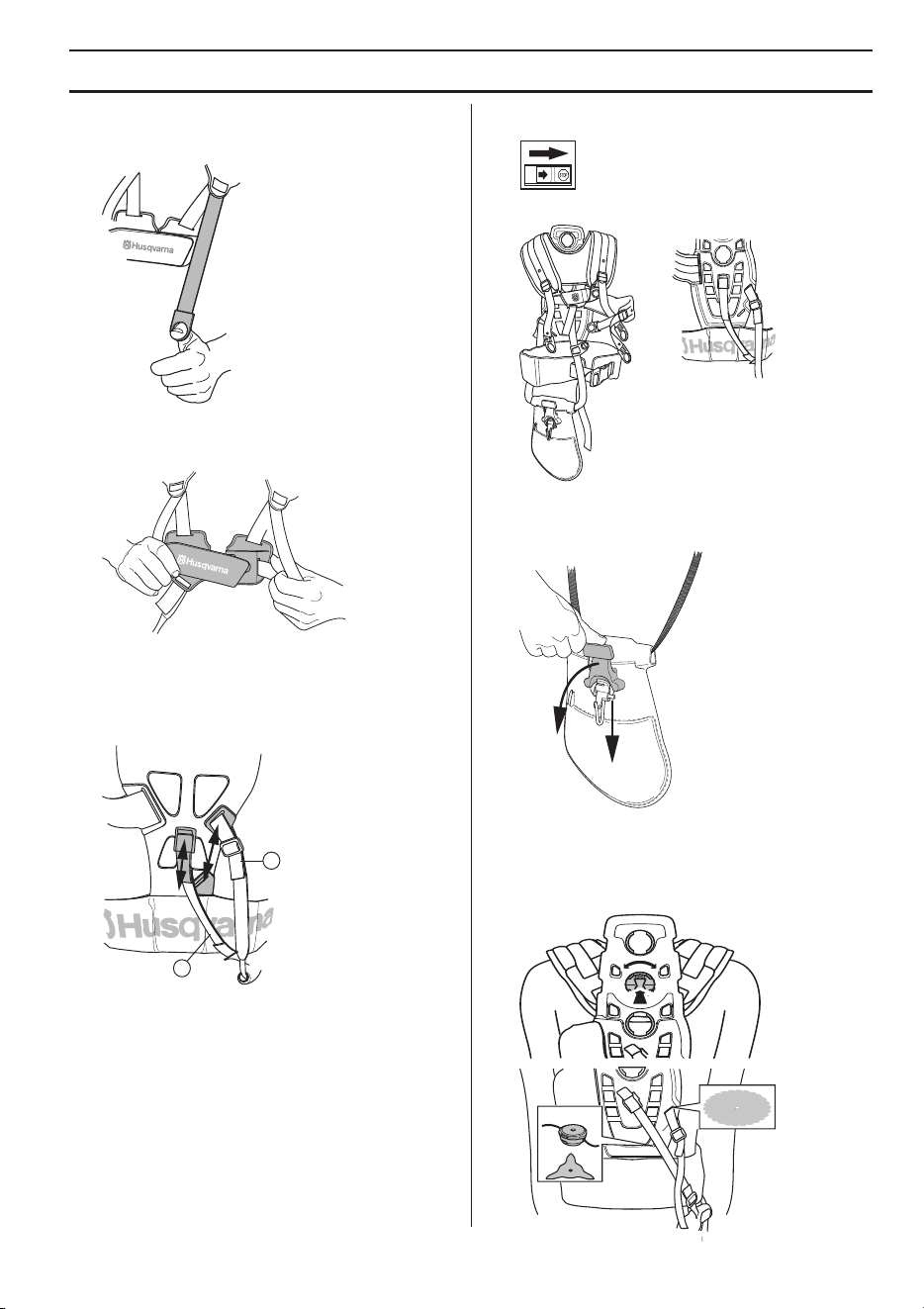
Push down the red release lever to release the machine
from the harness.
Adjusting the harness
1 Tighten the hip strap so that it sits securely.
2 Tighten the chest strap under your left arm so that it
fits closely around your body.
L
A
M
C
B
H
P
C
!
WARNING! When using a brush cutter it
must always be hooked securely to the
harness. Otherwise you will be unable to
control the brush cutter safely and this
can result in injury to yourself or others.
Never use a harness with a defective
quick release.
ASSEMBLY
English – 17
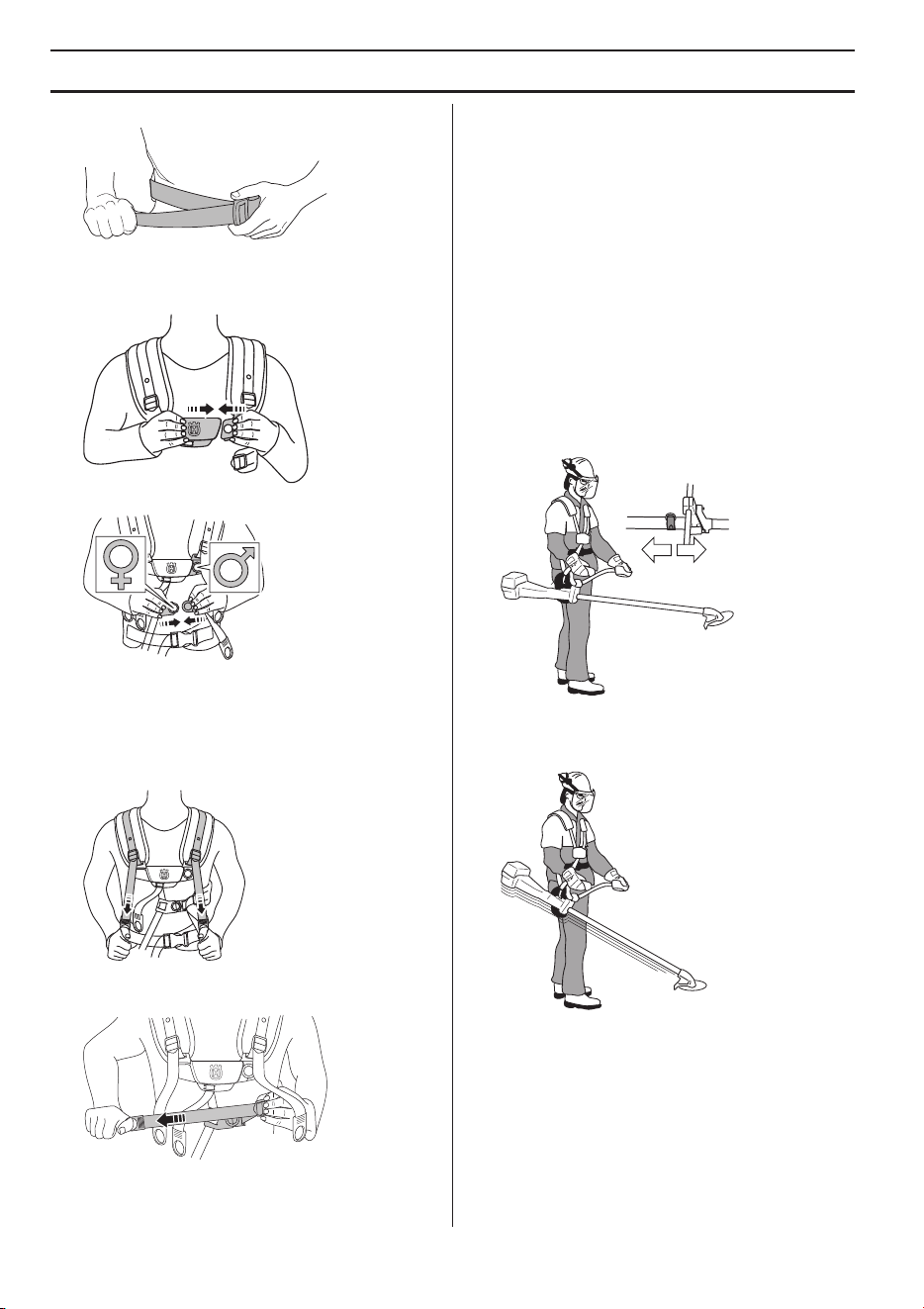
3 Adjust the shoulder strap to distribute the load evenly
across your shoulders. Press downwards on the
suspension hook to load the harness.
4 Adjust the height of the suspension hook as described
in the instructions for the standard harness. (Forestry
clearing)
5 If you need to lower the suspension hook, for trimming
for example, move the suspension strap (A) to the
lower mounting point on the backplate.
6 The elastic strap (B) can be tightened to transfer more
load from the shoulder straps to the hip strap.
Balance XT
(545FX, 545FXT, 545RXT)
Safety release
Push down the red release lever to release the machine
from the harness.
Adjusting the harness
1 Adjust the harness to suit the person's height. Move
the shoulder strap attachment to a suitable hole in the
back plate by pressing in the spring-loaded lock and
twisting the shoulder strap attachment.
A
B
ASSEMBLY
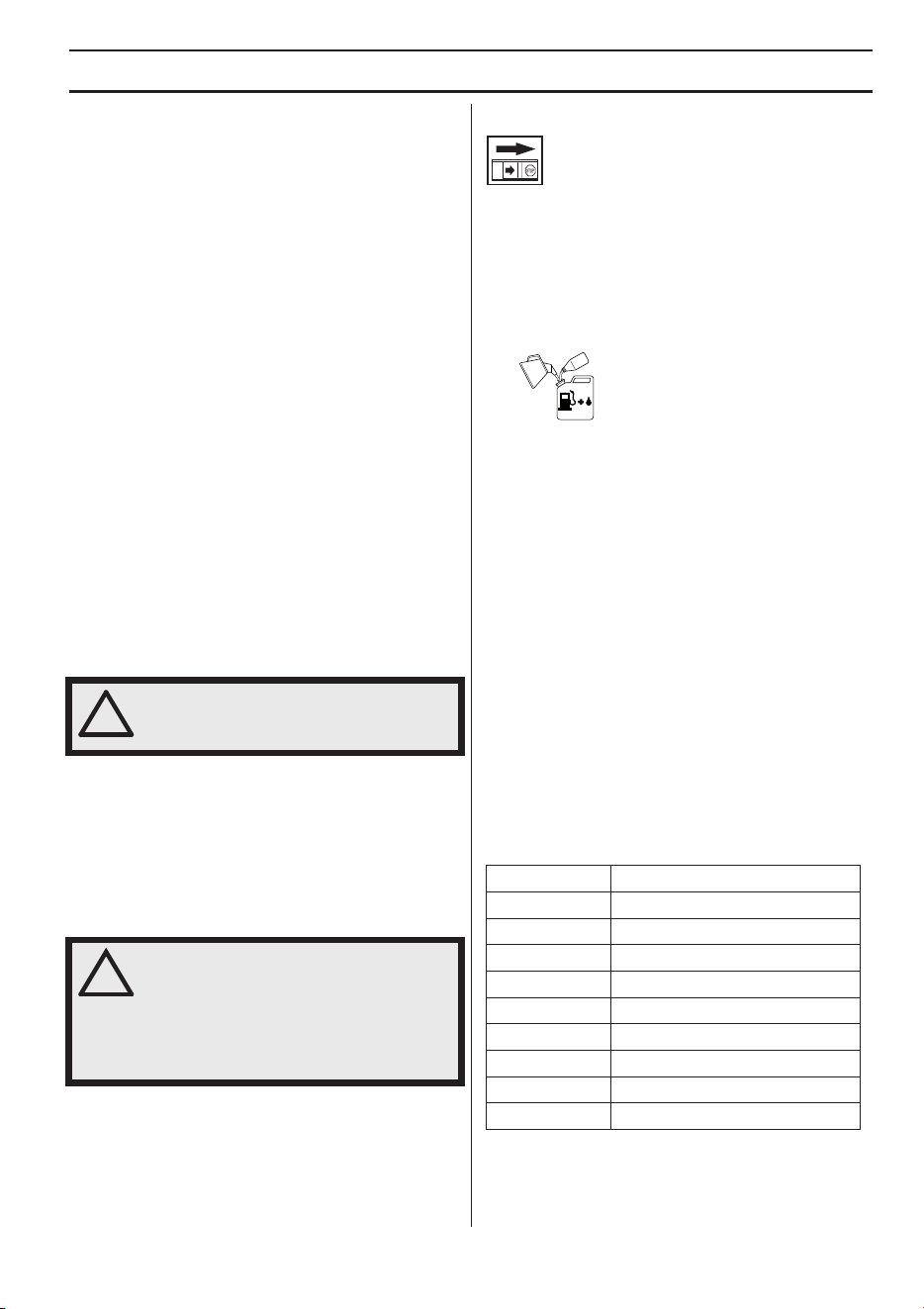
18 – English
2 Tighten the hip strap so that it sits securely.
3 The hip belt should hang roughly in line with the hip
bone.
4 Press the breast plate together.
5 Attach the side belt to the breast plate.
6 To relieve pressure on the rib cage, it is possible to
connect the side belt with a belt to the hip pad.
(Suitable for females).
7 Adjust the shoulder strap to distribute the load evenly
across your shoulders. Press downwards on the
suspension hook to load the harness.
8 Adjust the side belts to fit around the rib cage until the
breast plate is centred on the chest.
Adjust the height of the hanging ring as per the
instructions. (For forest clearing, the suspension should
hang approx. 10 cm below your hip bone.)
9 If you need to lower the suspension hook, for trimming
for example, move the suspension strap (A) to the
lower mounting point on the backplate. The front belt
that is attached to the breast plate can also be
adjusted if necessary.
10 The elastic strap (B) can be tightened to transfer more
load from the shoulder straps to the hip strap.
Correct balance
1 Forestry clearing
The machine is balanced by moving the suspension
ring on the machine forwards or backwards. On some
models the suspension ring is fixed, however, this will
then have a number of holes for the support hook. The
machine is correctly balanced when it freely hangs
horizontally from the support hook. In this way the risk
of hitting stones is reduced if you need to release the
handlebar.
2 Grass clearing
Let the blade balance at a comfortable cutting height,
i.e. close to the ground.
FUEL HANDLING
English – 19
Fuel safety
Never start the machine:
1 If you have spilled fuel on it. Wipe off the spillage and
allow remaining fuel to evaporate.
2 If you have spilled fuel on yourself or your clothes,
change your clothes. Wash any part of your body that
has come in contact with fuel. Use soap and water.
3 If the machine is leaking fuel. Check regularly for
leaks from the fuel cap and fuel lines.
Transport and storage
• Store and transport the machine and fuel so that there
is no risk of any leakage or fumes coming into contact
with sparks or open flames, for example, from
electrical machinery, electric motors, electrical relays/
switches or boilers.
• When storing and transporting fuel always use
approved containers intended for this purpose.
• When storing the machine for long periods the fuel
tank must be emptied. Contact your local gas station
to find out where to dispose of excess fuel.
• Ensure the machine is cleaned and that a complete
service is carried out before long-term storage.
• The transport guard must always be fitted to the
cutting attachment when the machine is being
transported or in storage.
• Secure the machine during transport.
Fuel
CAUTION! The machine is equipped with a two-stroke
engine and must always be run using a mixture of
gasoline and two-stroke engine oil. It is important to
accurately measure the amount of oil to be mixed to
ensure that the correct mixture is obtained. When mixing
small amounts of fuel, even small inaccuracies can
drastically affect the ratio of the mixture.
Gasoline
CAUTION! Always use a quality gasoline/oil mixture with
an octane rating of at least 87 octane ((RON+MON)/2). If
your machine is equipped with a catalytic converter (see
chapter on Technical data) always use a good quality
unleaded gasoline/oil mixture. Leaded gasoline will
destroy the catalytic converter.
Use low-emission gasoline, also known as alkylate
gasoline, if it is available.
This engine is certified to operate on unleaded
gasoline.
• The lowest recommended octane grade is 87
((RON+MON)/2). If you run the engine on a lower
octane grade than 87 so-called knocking can occur.
This gives rise to a high engine temperature and
increased bearing load, which can result in serious
engine damage.
• When working at continuous high revs a higher octane
rating is recommended.
Two-stroke oil
• For best results and performance use HUSQVARNA
two-stroke engine oil, which is specially formulated for
our air-cooled two stroke-engines.
• Never use two-stroke oil intended for water-cooled
engines, sometimes referred to as outboard oil (rated
TCW).
• Never use oil intended for four-stroke engines.
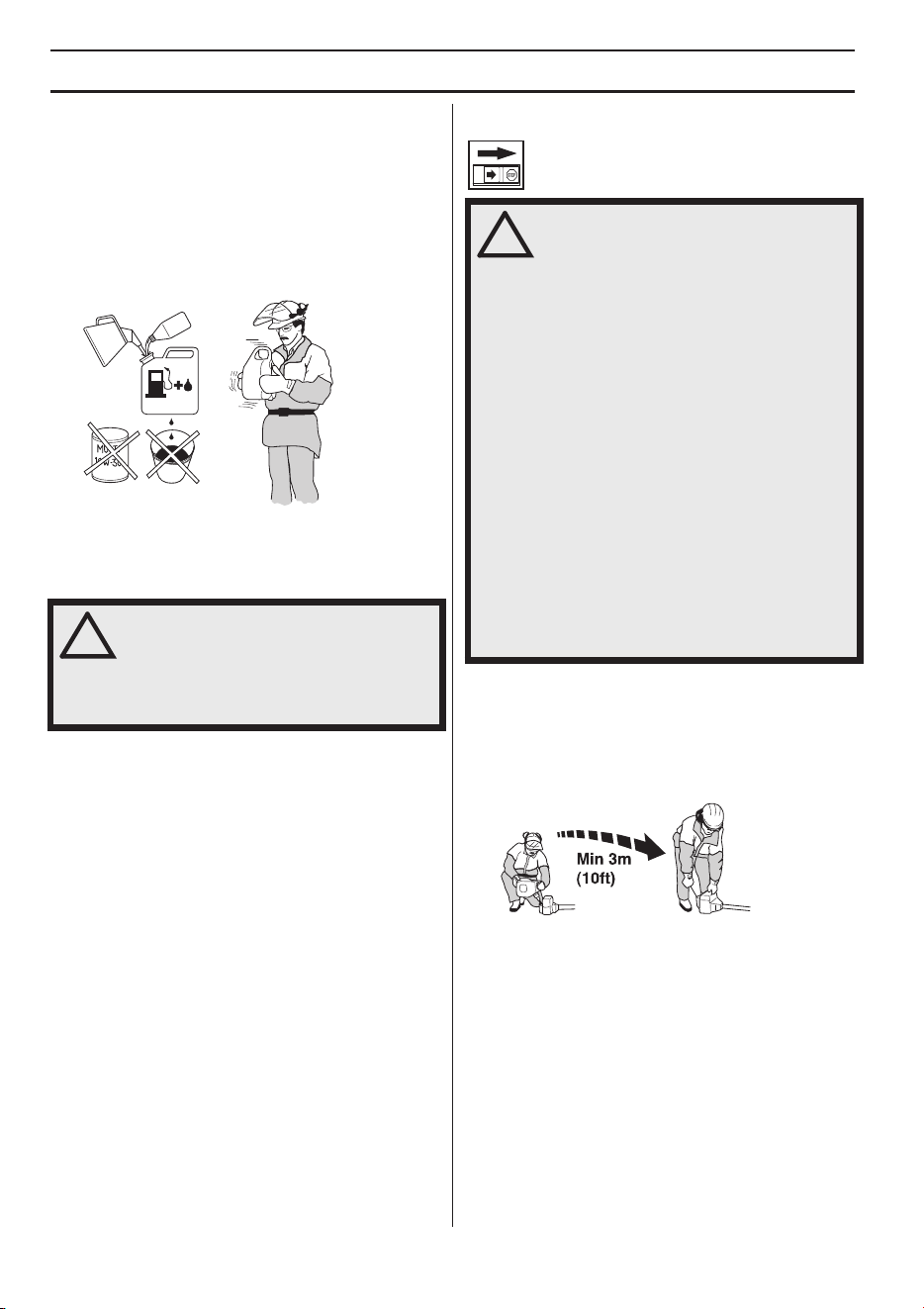
• Mixing ratio
50:1 (2%) with HUSQVARNA two-stroke oil.
!
WARNING! Take care when handling fuel.
Bear in mind the risk of fire, explosion
and inhaling fumes.
!
WARNING! Fuel and fuel fumes are
highly inflammable and can cause
serious injury when inhaled or allowed to
come in contact with the skin. For this
reason observe caution when handling
fuel and make sure there is adequate
ventilation.
Gasoline, litre Two-stroke oil, litre
2% (50:1)
5 0,10
10 0,20
15 0,6/0,30
20 0,40
US gallon US fl. oz.
1 2 1/2
2 1/2 6 1/2
5 12 7/8
FUEL HANDLING
20 – English
Mixing
• Always mix the gasoline and oil in a clean container
intended for fuel.
• Always start by filling half the amount of the gasoline
to be used. Then add the entire amount of oil. Mix
(shake) the fuel mixture. Add the remaining amount of
gasoline.
• Mix (shake) the fuel mixture thoroughly before filling
the machine’s fuel tank.
• Do not mix more than one month’s supply of fuel at a
time.
• If the machine is not used for some time the fuel tank
should be emptied and cleaned.
Fueling
• If you have spilled fuel on it. Wipe off the spillage and
allow remaining fuel to evaporate.
• Clean the area around the fuel cap. Contamination in
the tank can cause operating problems.
• Ensure that the fuel is well mixed by shaking the
container before filling the tank.
!
WARNING! The catalytic converter
muffler gets very hot during and after
use. This also applies during idling. Be
aware of the fire hazard, especially when
working near flammable substances and/
or vapors.
!
WARNING! Taking the following
precautions, will lessen the risk of fire:
Mix and pour fuel outdoors, where there
are no sparks or flames.
Do not smoke or place hot objects near
fuel.
Always shut off the engine before
refueling.
Always stop the engine and let it cool for
a few minutes before refueling.
When refuelling, open the fuel cap slowly
so that any excess pressure is released
gently.
Tighten the fuel cap carefully after
refueling.
Always move the machine away from the
refueling area and source before
starting.
STARTING AND STOPPING
English – 21
Check before starting
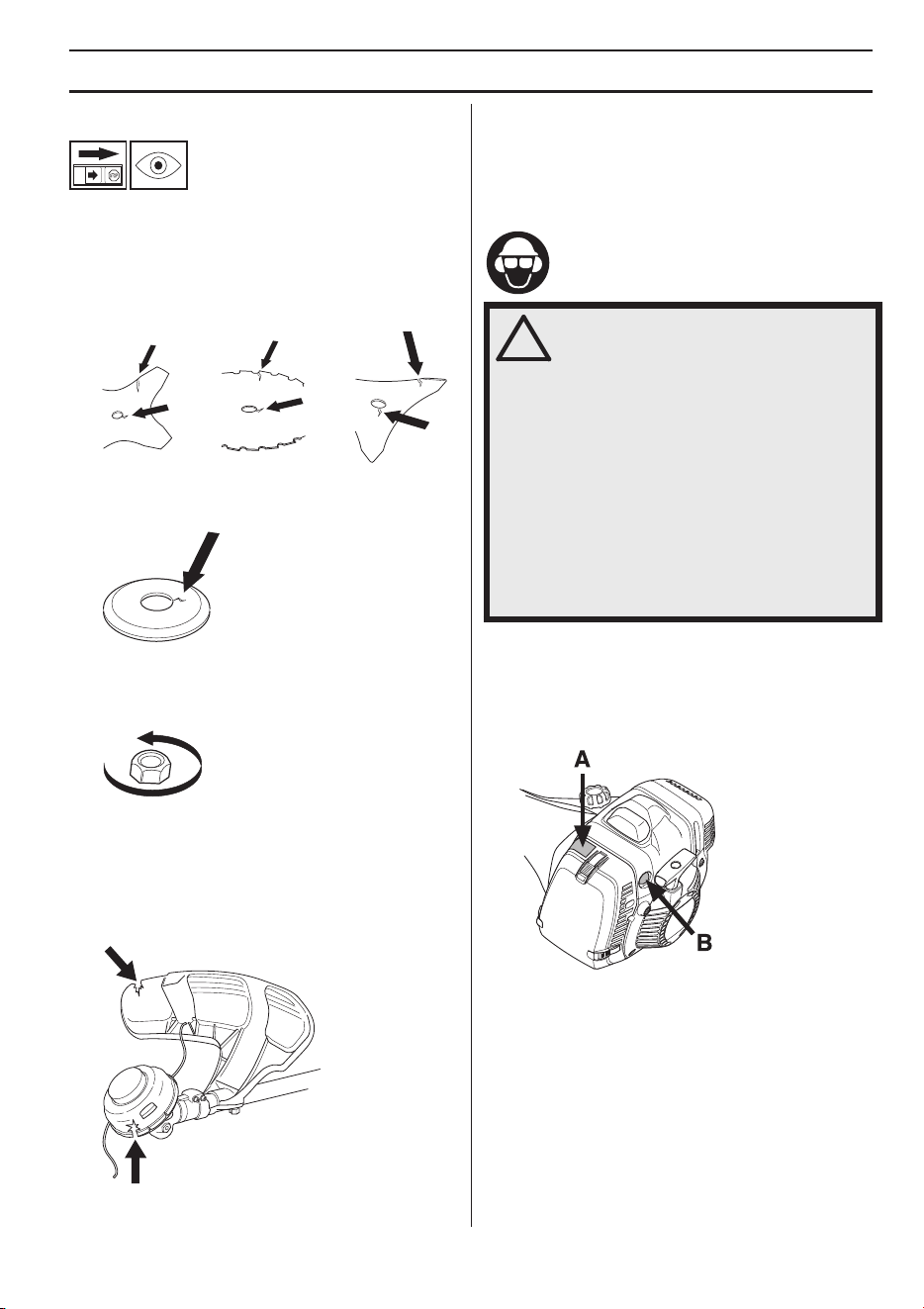
• Check the blade to ensure that no cracks have formed
at the bottom of the teeth or by the centre hole. The
most common reason why cracks are formed is that
sharp corners have been formed at the bottom of the
teeth while sharpening or that the blade has been
used with dull teeth. Discard a blade if cracks are
found.
• Check that the support flange is not cracked due to
fatigue or due to being tightened too much. Discard
the support flange if it is cracked.
• Ensure the locking nut has not lost its captive force.
The nut lock should have a locking force of at least 1.5
Nm. The tightening torque of the locking nut should be
35-50 Nm.
• Check that the blade guard is not damaged or
cracked. Replace the blade guard if it is exposed to
impact or is cracked.
• Check that the trimmer head and trimmer guard are
not damaged or cracked. Replace the trimmer head or
trimmer guard if they have been exposed to impact or
are cracked.
• Never use the machine without a guard nor with a
defective guard.
• All covers must be correctly fitted and undamaged
before you start the machine.
Starting and stopping
Cold engine
Choke: Set the choke control (A) in the choke position.
Primer bulb: Press the air purge diaphragm (B)
repeatedly until fuel begins to fill the diaphragm. The
diaphragm need not be completely filled.
Warm engine
Use the same starting procedure as for a cold engine but
without setting the choke control in the choke position.
Start throttle: (545FX, 545FXT)
Set the throttle to the start position by moving the choke
control to the choke position and then returning it to its
original position.
!
WARNING! The complete clutch cover
and shaft must be fitted before the
machine is started, otherwise the clutch
can come loose and cause personal
injury.
Always move the machine away from the
refueling area and source before
starting. Place the machine on a flat
surface. Ensure the cutting attachment
cannot come into contact with any
object.
Make sure no unauthorised persons are
in the working area, otherwise there is a
risk of serious personal injury. The safety
distance is 15 meters (50 ft.).
STARTING AND STOPPING
22 – English
Start throttle: (345FR, 545RX, 545RXT)
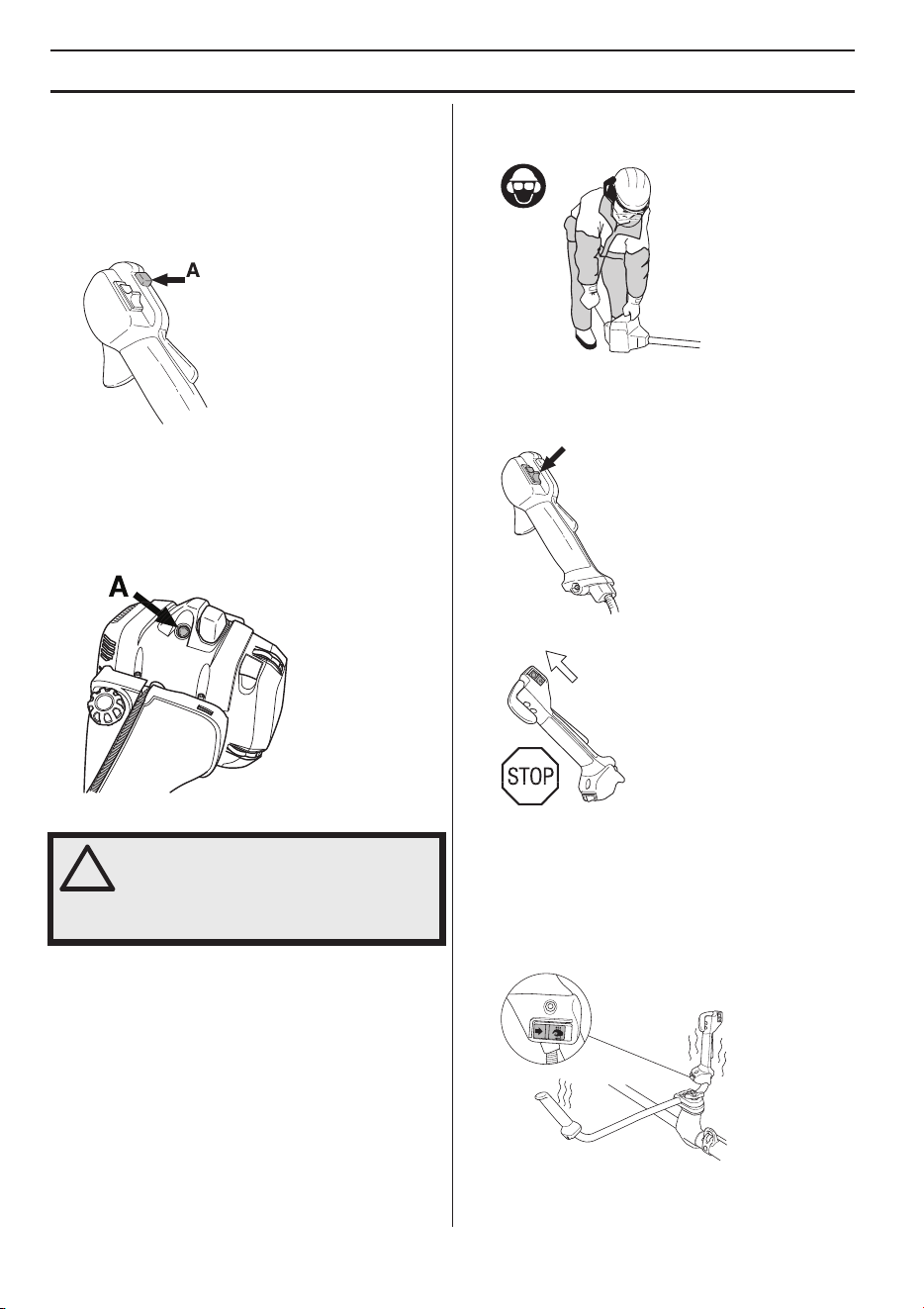
Set the throttle to the start position by first pressing the
throttle lockout and the throttle trigger, then pressing the
start throttle button (A). Then release the throttle lockout
and the throttle trigger, followed by the start throttle
button. The throttle function is now activated. To return the
engine to idle, press the throttle lockout and throttle
trigger again.
Decompression valve
If the machine is fitted with a decompression valve (A):
Press the valve to reduce the pressure in the cylinder and
make starting easier. You should always use the
decompression valve when starting the machine. Once
the machine has started the valve will automatically return
to its original setting.
Starting
Hold the body of the machine on the ground using your
left hand (CAUTION! Not with your foot!). Grip the starter
handle, slowly pull out the cord with your right hand until
you feel some resistance (the starter pawls grip), now
quickly and powerfully pull the cord.
Never wrap the
starter cord around your hand
Repeat pulling the cord until the engine starts. When the
engine starts, return choke control to run position and
apply full throttle; the throttle will automatically disengage
from the start setting.
CAUTION! Do not pull the starter cord all the way out and
do not let go of the starter handle when the cord is fully
extended. This can damage the machine.
Stopping
345FR, 545RX, 545RXT
Stop the engine by switching off the ignition.
545FX, 545FXT
Heated handles
(545FXT)
Models equipped with heating elements in the handles
have an on/off switch on the throttle handle to control the
heat. Both the left and right handles have heating
elements that automatically maintain a temperature of
roughly 70° when the heat is turned on.
!
WARNING! When the engine is started
with the choke in either the choke or
start throttle positions the cutting
attachment will start to rotate
immediately.
WORKING TECHNIQUES
English – 23
General working instructions
Basic safety rules
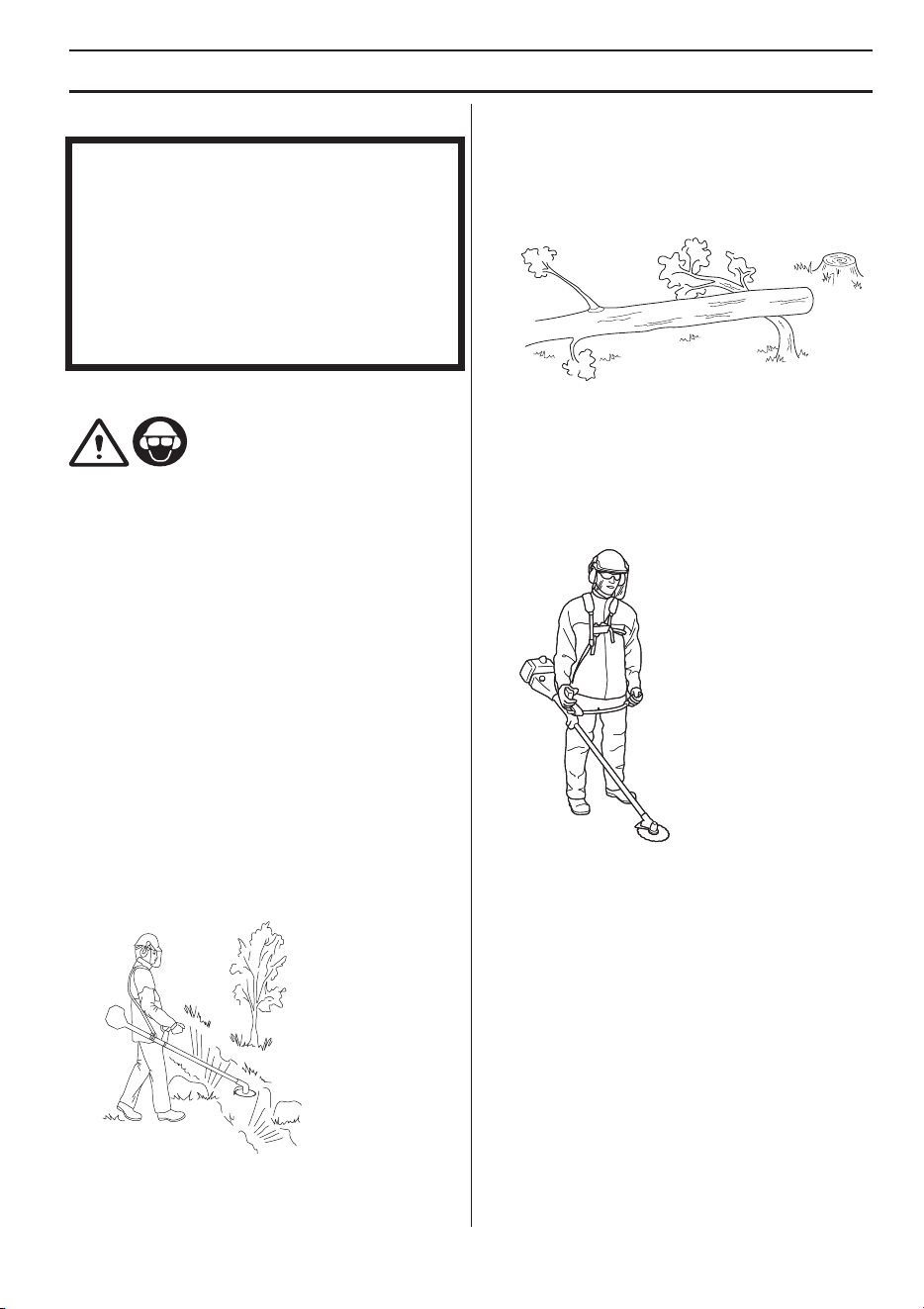
1 Look around you:
• To ensure that people, animals or other things cannot
affect your control of the machine.
• To ensure that people, animals, etc., do not come into
contact with the cutting attachment or loose objects
that are thrown out by the cutting attachment.
• CAUTION! Do not use the machine unless you are
able to call for help in the event of an accident.
2 Inspect the working area. Remove all loose objects,
such as stones, broken glass, nails, steel wire, string,
etc. that could be thrown out or become wrapped
around the cutting attachment.
3 Do not use the machine in bad weather, such as
dense fog, heavy rain, strong wind, intense cold, etc.
Working in bad weather is tiring and often brings
added risks, such as icy ground, unpredictable felling
direction, etc.
4 Make sure you can move and stand safely. Check the
area around you for possible obstacles (roots, rocks,
branches, ditches, etc.) in case you have to move
suddenly. Take great care when working on sloping
ground.
5 Take great care when cutting a tree that is under
tension. A tree that is under tension may spring back
to its normal position before or after being cut. If you
position yourself incorrectly or make the cut in the
wrong place the tree may hit you or the machine and
cause you to lose control. Both situations can cause
serious personal injury.
6 Keep a good balance and a firm foothold. Do not
overreach. Keep proper footing and balance at all
times.
7 Always hold the machine with both hands. Hold the
machine on the right side of your body. Keep all parts
of your body away from the hot surfaces. Keep all
parts of your body away from the rotating cutting
attachment.
8 When using a brush cutter it must always be hooked
securely to the harness. Otherwise you will be unable
to control the brush cutter safely and this can result in
injury to yourself or others. Never use a harness with
a defective quick release.
9 Keep the cutting attachment below waist level.
10 Switch off the engine before moving to another area.
Fit the transport guard before carrying or transporting
the equipment any distance.
11 Never put the machine down with the engine running
unless you have it in clear sight.
IMPORTANT!
This section describes the basic safety precautions for
working with brush cutters and trimmers.
If you encounter a situation where you are uncertain
how to proceed you should ask an expert. Contact your
dealer or your service workshop.
Avoid all usage which you consider to be beyond your
capability.
You must understand the difference between forestry
clearing, grass clearing and grass trimming before use.
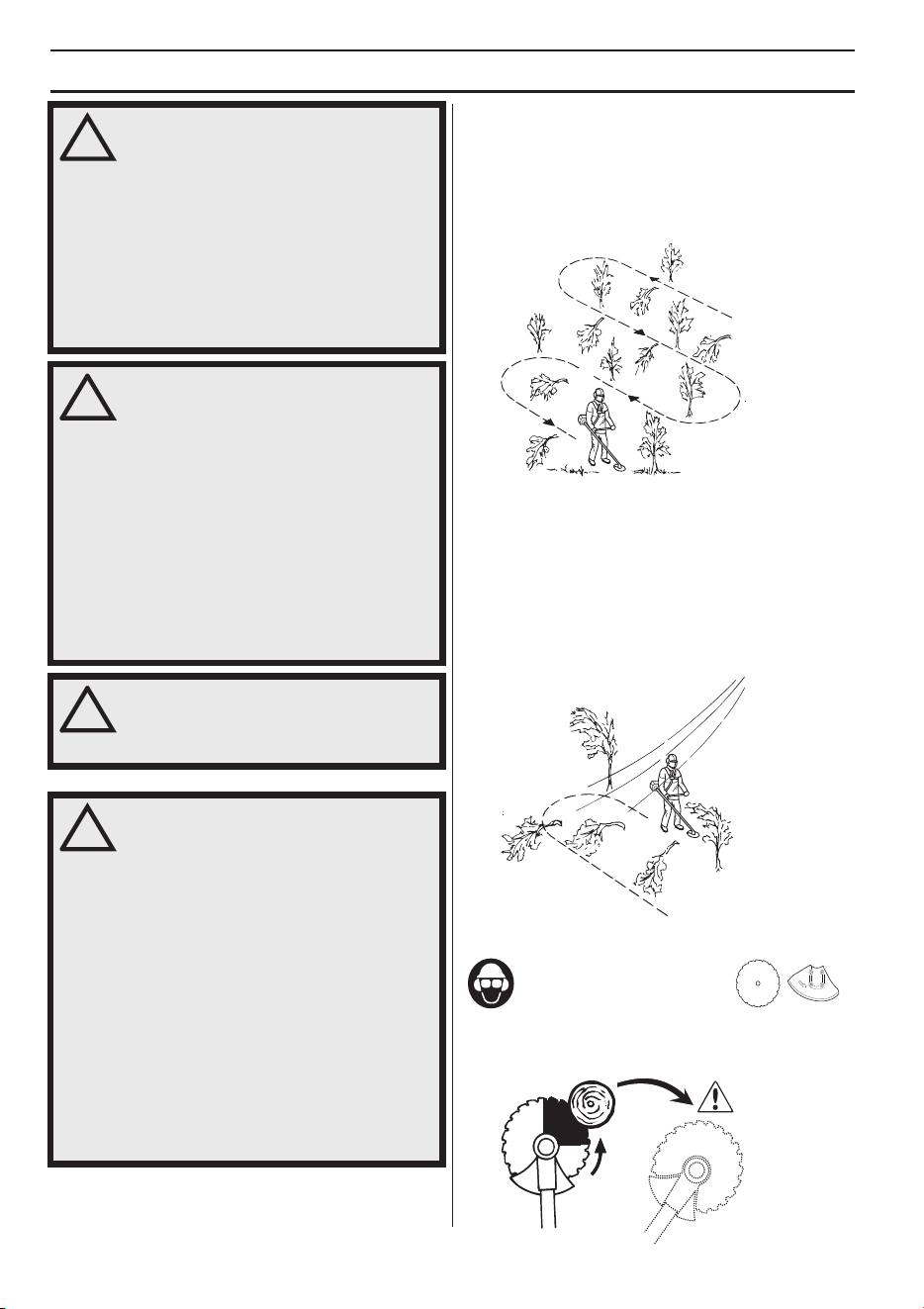
WORKING TECHNIQUES
24 – English
Working methods
• Before you start clearing, check the clearing area, the
type of terrain, the slope of the ground, whether there
are stones, hollows etc.
• Start at whichever end of the area is easiest, and clear
an open space from which to work.
• Work systematically to and fro across the area,
clearing a width of around 4-5 m on each pass. This
exploits the full reach of the machine in both directions
and gives the operator a convenient and varied
working area to work in.
• Clear a strip around 75 m long. Move your fuel can as
work progresses.
• On sloping ground you should work along the slope. It
is much easier to work along a slope than it is to work
up and down it.
• You should plan the strip so that you avoid going over
ditches or other obstacles on the ground. You should
also orient the strip to take advantage of wind
conditions, so that cleared stems fall in the cleared
area of the stand.
Forestry clearing using a saw blade
• The risk of blade thrust increases with increasing
stem size. You should therefore avoid cutting with the
area of the blade between 12 o’clock and 3 o’clock.
!
WARNING! Neither the operator of the
machine nor anyone else may attempt to
remove the cut material while the engine is
running or the cutting equipment is
rotating, as this can result in serious injury.
Stop the engine and cutting equipment
before you remove material that has
wound around the blade shaft as
otherwise there is a risk of injury. The
bevel gear can get hot during use and
may remain so for a while afterwards. You
could get burnt if you touch it.
!
WARNING! Watch out for thrown objects.
Always wear approved eye protection.
Never lean over the cutting attachment
guard. Stones, rubbish, etc. can be
thrown up into the eyes causing
blindness or serious injury.
Keep unauthorised persons at a
distance. Children, animals, onlookers
and helpers should be kept outside the
safety zone of 15 m. (50 ft.) Stop the
machine immediately if anyone
approaches. Never swing the machine
around without first checking behind you
to make sure no-one is within the safety
zone.
!
WARNING! Sometimes branches or
grass get caught between the guard and
cutting attachment. Always stop the
engine before cleaning.
!
WARNING! Machines fitted with saw
blades or grass blades can be thrown
violently to the side when the blade
comes into contact with a fixed object.
This is called blade thrust. A blade thrust
can be violent enough to cause the
machine and/or operator to be propelled
in any direction, and possibly lose
control of the machine. Blade thrust can
occur without warning if the machine
snags, stalls or binds. Blade thrust is
more likely to occur in areas where it is
difficult to see the material being cut.
Avoid cutting with the area of the blade
between the 12 o’clock and 3 o’clock
positions. Because of the speed of
rotation of the blade, blade thrust can
occur if you attempt to cut thick stems
with this area of the blade.
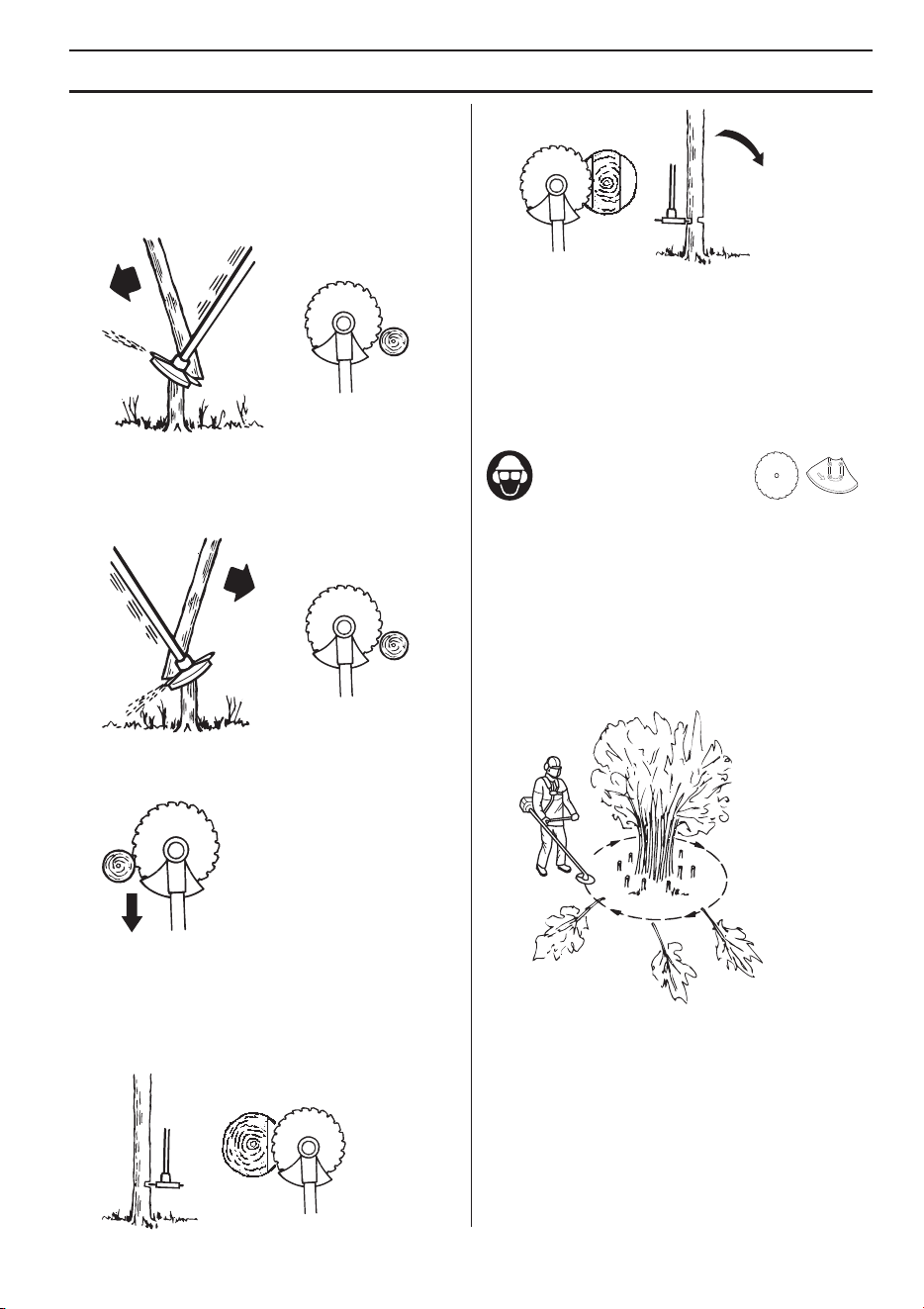
WORKING TECHNIQUES
English – 25
• To fell to the left, the bottom of the tree should be
pushed to the right. Tilt the blade and bring it
diagonally down to the right, exerting firm pressure. At
the same time push the stem using the blade guard.
Cut with the area of the blade between 3 o’clock and
5 o’clock. Apply full throttle before advancing the
blade.
• To fell to the right, the bottom of the tree should be
pushed to the left. Tilt the blade and bring it diagonally
up to the right. Cut with the area of the blade between
3 o’clock and 5 o’clock so that the direction of rotation
of the blade pushes the bottom of the tree to the left.
• To fell a tree forwards, the bottom of the tree should be
pulled backwards. Pull the blade backwards with a
quick, firm movement.
• Large stems must be cut from two sides. First
determine which direction the stem will fall. Make the
first cut on the felling side. Then finish cutting the stem
from the other side. Adjust the cutting pressure to
match the size of the stem and the hardness of the
wood. Small stems require more pressure, while large
stems require less pressure.
• If the stems are tightly packed, adapt your walking
pace to suit.
• If the blade jams in a stem, never jerk the machine
free. If you do this the blade, bevel gear, shaft or
handlebar may be damaged. Release the handles,
grip the shaft with both hands and gently pull the
machine free.
Brush cutting with a saw blade
• Thin stems and brush are mown down. Work with a
sawing movement, swinging sideways.
• Try to cut several stems in a single sawing movement.
• With groups of hardwood stems, first clear around the
group. Start by cutting the stems high up around the
outside of the group to avoid jamming. Then cut the
stems to the required height. Now try to reach in with
the blade and cut from the centre of the group. If it is
still difficult to gain access, cut the stems high up and
let them fall. This will reduce the risk of jamming.
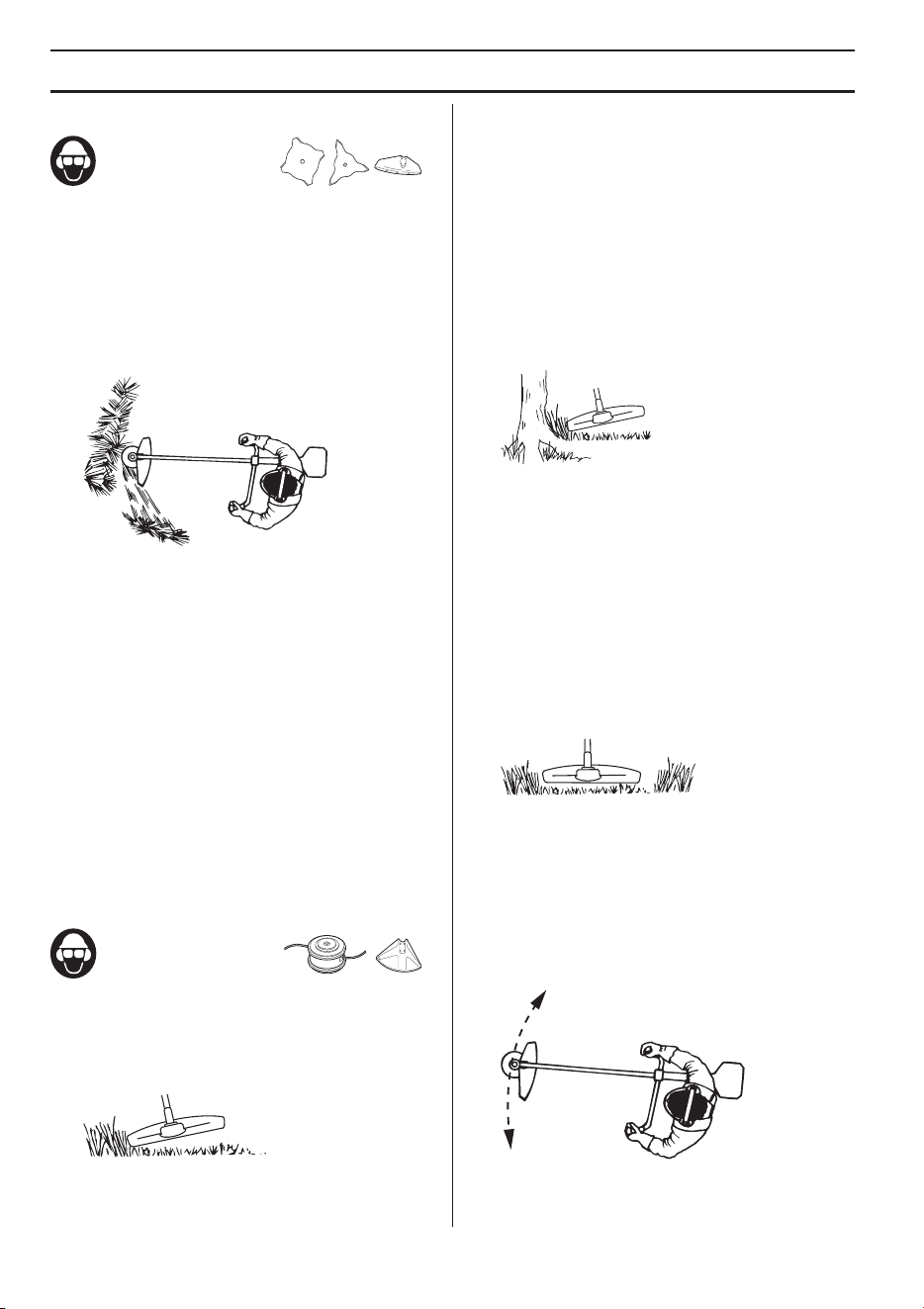
WORKING TECHNIQUES
26 – English
Grass clearing using a grass blade
• Grass blades and grass knifes must not be used on
woody stems.
• A grass blade is used for all types of tall or coarse
grass.
• The grass is cut down with a sideways, swinging
movement, where the movement from right-to-left is
the clearing stroke and the movement from left-to-
right is the return stroke. Let the left-hand side of the
blade (between 8 and 12 o’clock) do the cutting.
• If the blade is angled to the left when clearing grass,
the grass will collect in a line, which makes it easier to
collect, e.g. by raking.
• Try to work rhythmically. Stand firmly with your feet
apart. Move forward after the return stroke and stand
firmly again.
• Let the support cup rest lightly against the ground. It
is used to protect the blade from hitting the ground.
• Reduce the risk of material wrapping around the blade
by following these instructions:
1Always work at full throttle.
2Avoid the previously cut material during the return
stroke.
• Stop the engine, unclip the harness and place the
machine on the ground before you start to collect the
cut material.
Grass trimming with a trimmer head
Trimming
• Hold the trimmer head just above the ground at an
angle. It is the end of the cord that does the work. Let
the cord work at its own pace. Never press the cord
into the area to be cut.
• The cord can easily remove grass and weeds up
against walls, fences, trees and borders, however it
can also damage sensitive bark on trees and bushes,
and damage fence posts.
• Reduce the risk of damaging plants by shortening the
cord to 10-12 cm and reducing the engine speed.
Clearing
• The clearing technique removes all unwanted
vegetation. Keep the trimmer head just above the
ground and tilt it. Let the end of the cord strike the
ground around trees, posts, statues and the like.
CAUTION! This technique increases the wear on the
cord.
• The cord wears quicker and must be fed forward more
often when working against stones, brick, concrete,
metal fences, etc., than when coming into contact with
trees and wooden fences.
• When trimming and clearing you should use less than
full throttle (80%) so that the cord lasts longer and to
reduce the wear on the trimmer head.
Cutting
• The trimmer is ideal for cutting grass that is difficult to
reach using a normal lawn mower. Keep the cord
parallel to the ground when cutting. Avoid pressing the
trimmer head against the ground as this can ruin the
lawn and damage the tool.
• Do not allow the trimmer head to constantly come into
contact with the ground during normal cutting.
Constant contact of this type can cause damage and
wear to the trimmer head.
Sweeping
• The fan effect of the rotating cord can be used for
quick and easy clearing up. Hold the cord parallel to
and above the area to be swept and move the tool side
to side.
• When cutting and sweeping you should use full
throttle to obtain the best results.
MAINTENANCE
English – 27
Carburetor
Your Husqvarna product has been designed and
manufactured to specifications that reduce harmful
emissions.
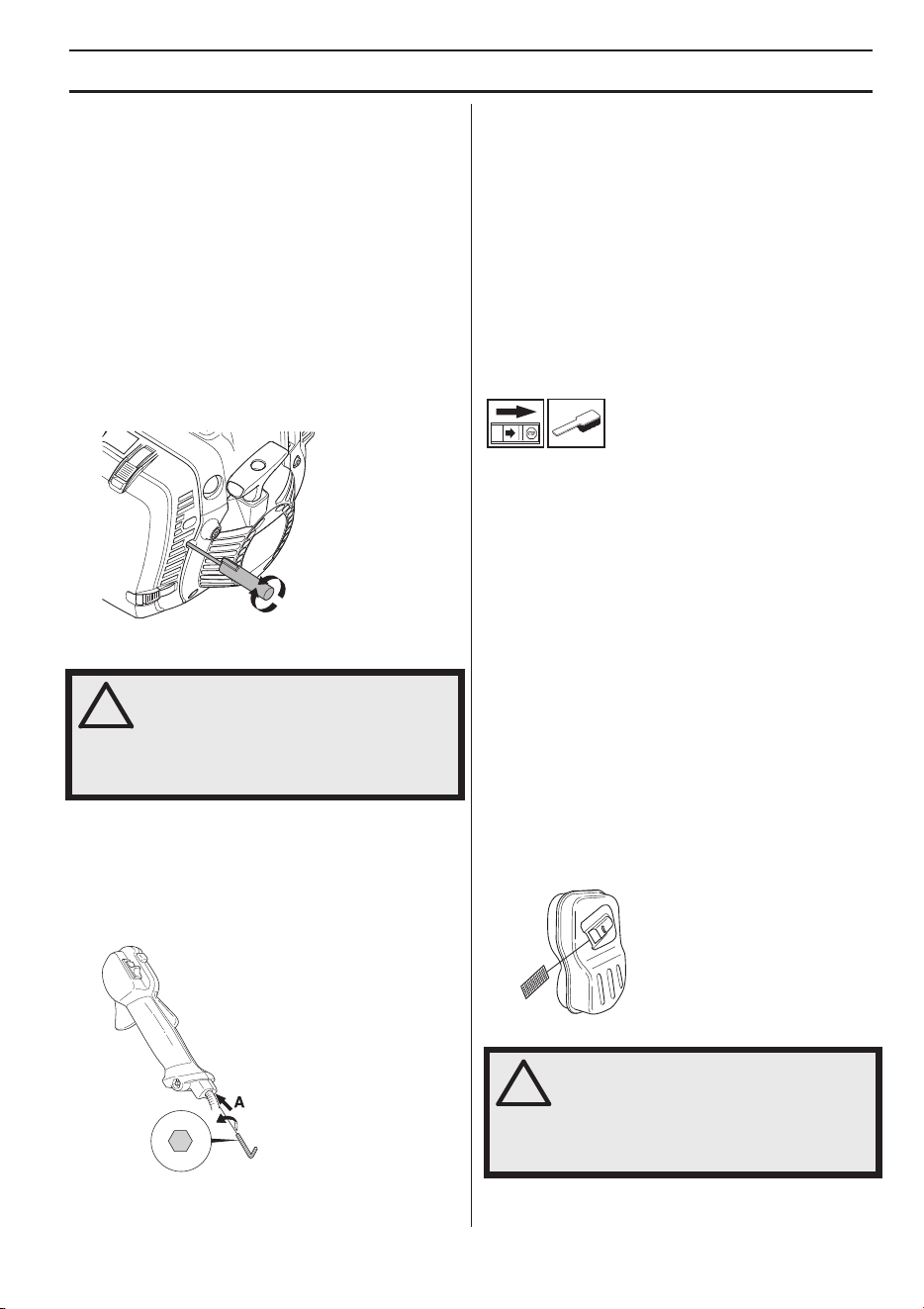
Adjustment of the idle speed
Before any adjustments are made, make sure that the air
filter is clean and the air filter cover is fitted.
Adjust the idle speed using the idle adjustment screw T, if
it is necessary to readjust. First turn the idle adjustment
screw T clockwise until the cutting attachment starts to
rotate. Then turn the screw counter clockwise until the
cutting attachment stops. The idle speed is correctly
adjusted when the engine will run smoothly in every
position. The idle speed should also be well below the
speed at which the cutting attachment starts to rotate.
Recommended idle speed: See the Technical data
section.
Adjusting the start throttle speed (345FR,
545RX, 545RXT)
The correct start throttle speed is set by means of an
adjuster on the rear of the handle next to the cable. Use
this screw (5 mm Allen screw) to increase or decrease the
start throttle speed.
Proceed as follows:
1 Run the machine at idle.
2 Press the start throttle lock as described under the
heading Starting and stopping.
3 If the start throttle speed is too low (below 4000 rpm),
turn the adjuster screw A clockwise until the cutting
attachment starts to rotate. Then turn A clockwise a
further 1/2 turn.
4 If the start throttle speed is too high (above 6500 rpm),
turn the adjuster screw A anti-clockwise until the
cutting attachment stops. Then turn adjuster screw A
clockwise a further 1/2 turn.
Muffler
CAUTION! Some mufflers are fitted with a catalytic
converter. See chapter on Technical data to see whether
your machine is fitted with a catalytic converter.
The muffler is designed to reduce the noise level and to
direct the exhaust gases away from the operator. The
exhaust gases are hot and can contain sparks, which may
cause fire if directed against dry and combustible
material.
Some mufflers are equipped with a special spark arrestor
screen. If your machine has this type of muffler, you
should clean the screen at least once a week. This is best
done with a wire brush.
On mufflers without a catalytic converter the screen
should be cleaned weekly, or replaced if necessary. On
mufflers fitted with a catalytic converter the screen should
be checked, and if necessary cleaned, monthly.
If the
screen is damaged it should be replaced.
If the screen is frequently blocked, this can be a sign that
the performance of the catalytic converter is impaired.
Contact your dealer to inspect the muffler. A blocked
screen will cause the machine to overheat and result in
damage to the cylinder and piston.
CAUTION! Never use a machine with a defective muffler.
!
WARNING! If the idle speed cannot be
adjusted so that the cutting attachment
stops, contact your dealer/service
workshop. Do not use the machine until
it has been correctly adjusted or
repaired.
5 mm
!
WARNING! Mufflers fitted with catalytic
converters get very hot during use and
remain so for some time after stopping.
This also applies at idle speed. Contact
can result in burns to the skin.
Remember the risk of fire!
MAINTENANCE
28 – English
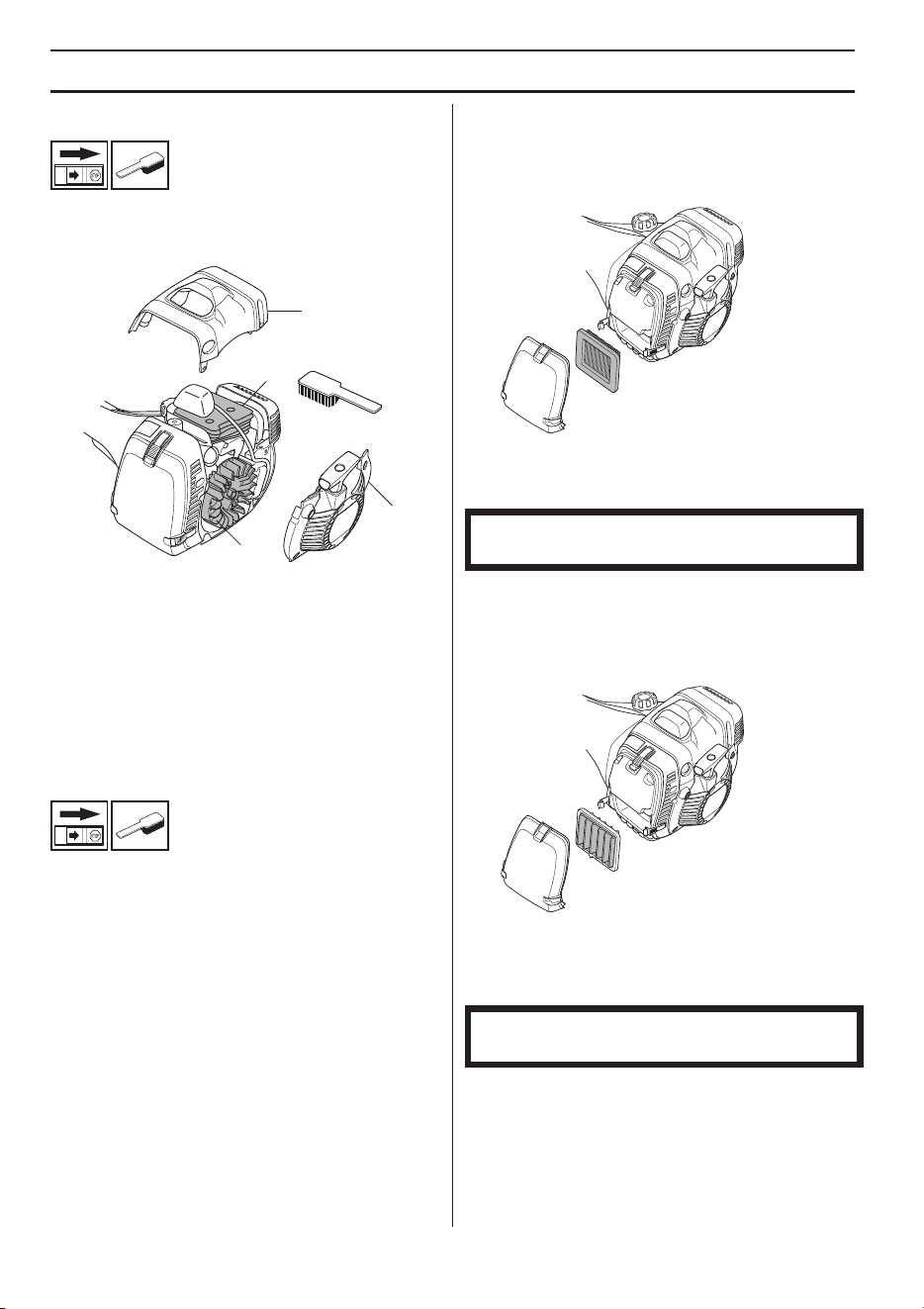
Cooling system
To keep the working temperature as low as possible the
machine is equipped with a cooling system.
The cooling system consists of:
1 Air intake on the starter.
2 Fins on the flywheel.
3 Cooling fins on the cylinder.
4 Cylinder cover (directs cold air over the cylinder).
Clean the cooling system with a brush once a week, more
often in demanding conditions. A dirty or blocked cooling
system results in the machine overheating which causes
damage to the piston and cylinder.
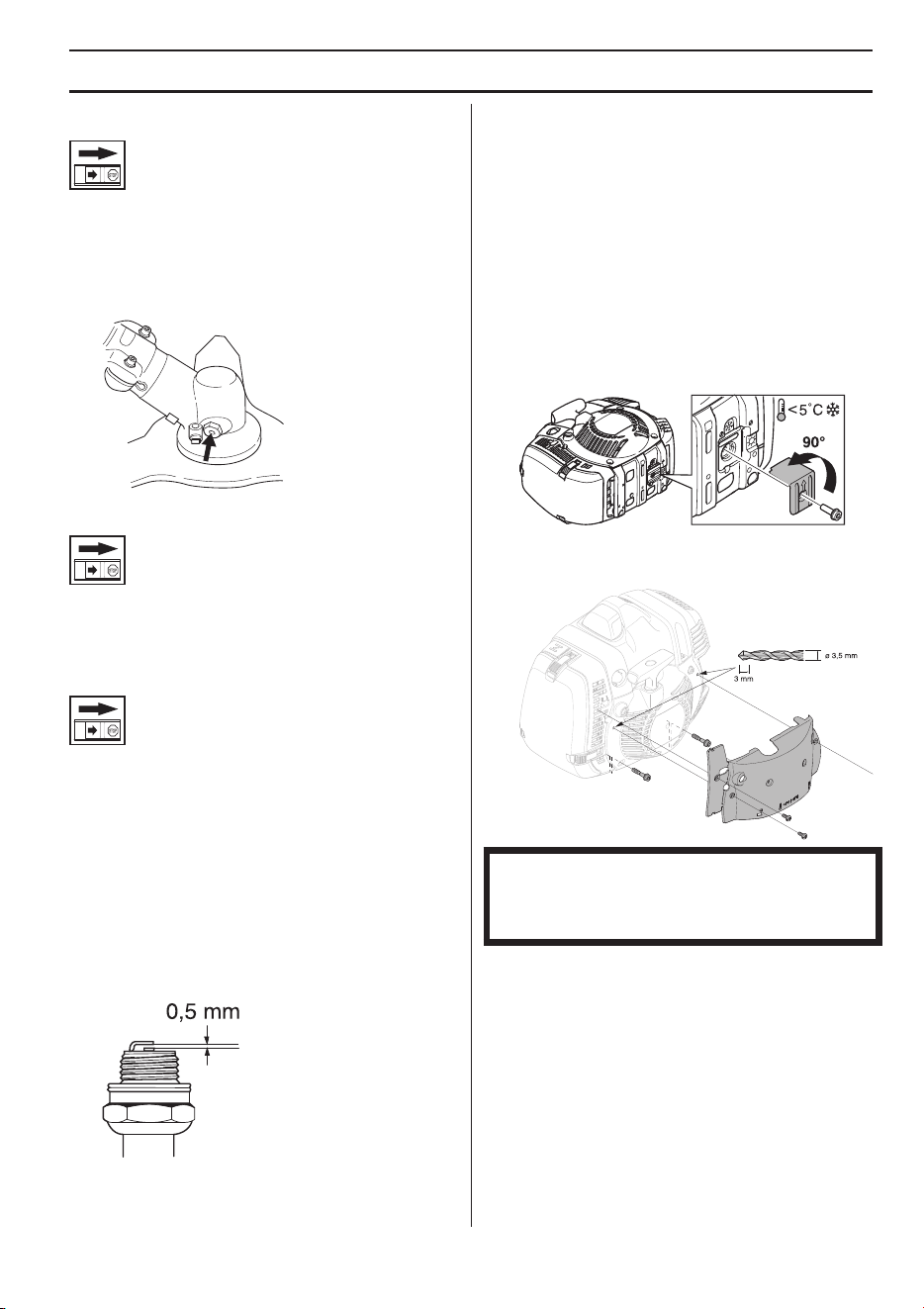
Air filter
The air filter must be regularly cleaned to remove dust
and dirt in order to avoid:
• Carburettor malfunctions.
• Starting problems.
• Loss of engine power.
• Unnecessary wear to engine parts
• Excessive fuel consumption.
Clean the filter every 25 hours, or more regularly if
conditions are exceptionally dusty.
Check air filter (345FR, 545RX, 545RXT)
(paper filter)
• Set the choke control in the choke position.
• Remove the air filter cover and take out the filter.
• Check and clean filter housing.
• Check the filter and change if contaminated or
damaged. Use Husqvarna original filters.
Check air filter (545FX, 545FXT) (nylon
filter)
• Set the choke control in the choke position.
• Remove the air filter cover and take out the filter.
• Check and clean filter housing.
• Clean the filter if it is contaminated and change if
damaged. Clean the filter with warm soapy water. Use
Husqvarna original filters.
4
1
2
3
IMPORTANT! Never bend or fold a filter as it can be
damaged. A damaged air filter must always be replaced.
IMPORTANT! A damaged air filter must always be
replaced.
MAINTENANCE
English – 29
Bevel gear
The bevel gear is filled with the right quantity of grease at
the factory. However, before using the machine you
should check that the bevel gear is filled three-quarters
full with grease. Use HUSQVARNA special grease.
The grease in the bevel gear does not normally need to
be changed except if repairs are carried out.
Drive shaft
The drive shaft must be greased every three months
during full-time use. Contact your dealer if you are
uncertain about the procedure.
Spark plug
The spark plug condition is influenced by:
• Incorrect carburetor adjustment.
• An incorrect fuel mixture (too much or incorrect type of oil).
• A dirty air filter.
These factors cause deposits on the spark plug
electrodes, which may result in operating problems and
starting difficulties.
If the machine is low on power, difficult to start or runs
poorly at idle speed: always check the spark plug first
before taking any further action. If the spark plug is dirty,
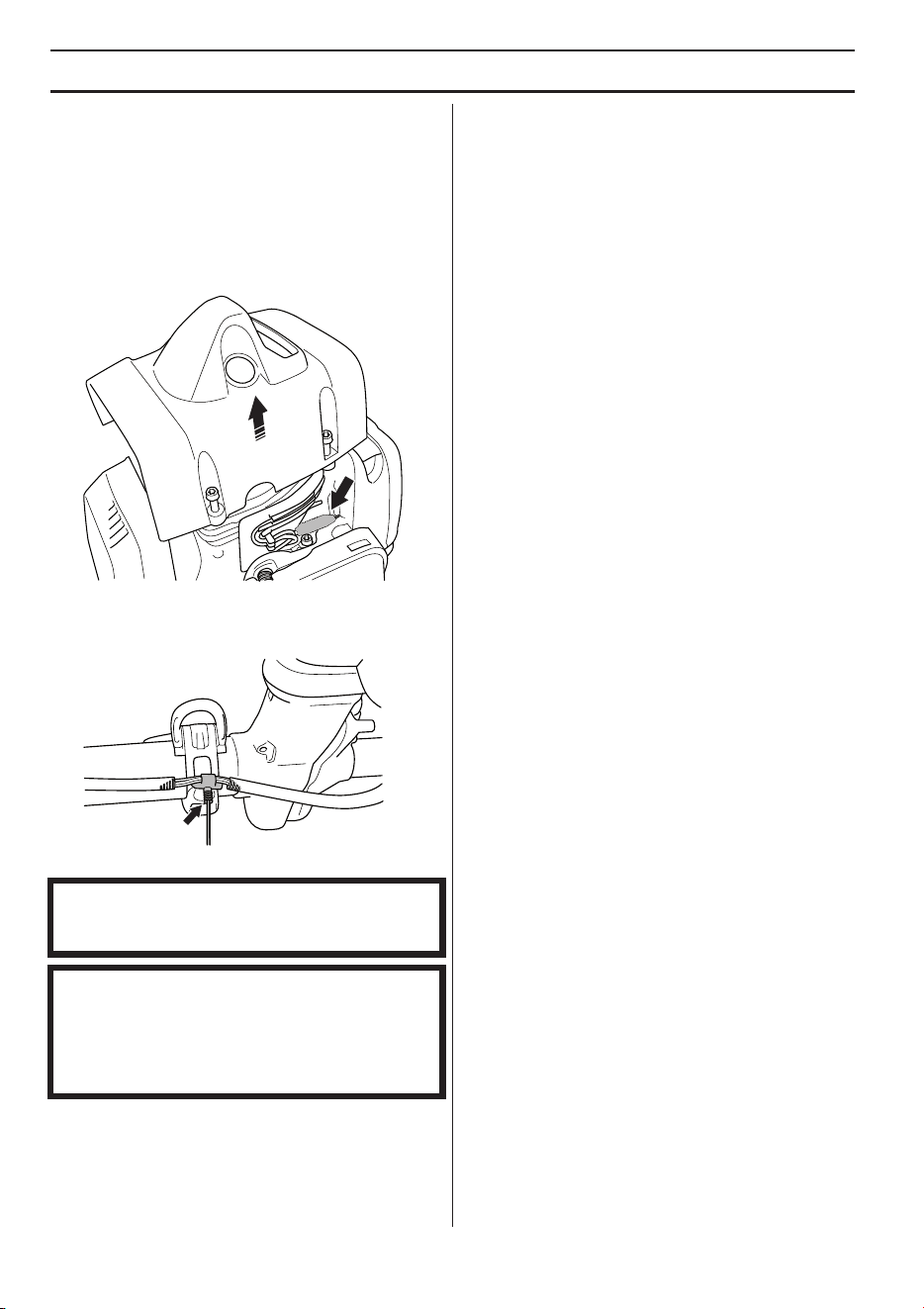
clean it and check that the electrode gap is 0.020 inch (0,5
mm). The spark plug should be replaced after about a
month in operation or earlier if necessary.
CAUTION! Always use the recommended spark plug
type! Use of the wrong spark plug can damage the piston/
cylinder. Check that the spark plug is fitted with a
suppressor.
Winter use
Running problems can occur when using the machine in
the cold and snowy conditions caused by:
• Too low engine temperature.
• Icing of the air filter and carburetor.
Special measures are therefore often required:
• Partly mask the air inlet on the starter to increase the
working temperature of the engine.
• Preheat the intake air to the carburettor by utilising the
heat from the muffler.
Temperature 5°C (41°F) or colder
• Fit the cooling air duct with the arrow pointing to the
snow flake.
• Hot air is then supplied to the carburettor from the
muffler.
• Fit a cover over the starter in snowy conditions.
IMPORTANT! The machine MUST be returned to its
standard design at temperatures warmer than 5
°C
(41
°F). Otherwise there is a risk of overheating resulting
in serious engine damage.
MAINTENANCE
30 – English
Lubrication of wire
(545FXT)
NOTE!
The wire is pre-lubricated and does not need to be
lubricated again until required.
• Remove the protective cover.
• Unscrew the cylinder cover and make sure the rubber
bellows on the wire has not been expanded too much.
• Unscrew the plug on the grease nipple.
• Use antifreeze spray with a 2 mm spray tube. Spray in
short bursts.
• Fit covers.
IMPORTANT! Any maintenance other than that
described in this manual must be carried out by your
servicing dealer (retailer).
IMPORTANT! Use only HUSQVARNA replacement
parts. Use of other brands of replacement parts can
cause damage to your unit or injury to the operator or
others. Your warranty does not cover damage or liability
caused by the use of accessories and/or attachments
not specifically recommended by HUSQVARNA.

English – 31
MAINTENANCE
Troubleshooting schedule
Contact your dealer for more information.
Starting failure
Check Possible Cause Action
Stop button Stop position
Set the stop switch to the start
position.
Pawls Binding pawls
Adjust or replace the pawls.
Clean around the pawls.
Contact an authorized service
workshop.
Fuel tank Incorrect fuel type Drain it and use correct fuel.
Carburetor Adjustment of the idle speed
Adjust the idling speed with the T-
screw.
Sparking (no spark)
Spark plug contaminated or wet
Make sure that the spark plug is dry
and clean.
Spark plug gap incorrect.
Clean the spark plug. Check that the
electrode gap is correct. Make sure
that the spark plug is fitted with a
suppressor.
Refer to technical data for correct
electrode gap.
Spark plug Spark plug loose. Retighten the spark plug
Fuel filter Clogged fuel filter Replace the fuel filter.
Engine starts but does not kepp running.
Check Possible Cause Possible action
Fuel tank Incorrect fuel type Drain it and use correct fuel.
Fuel filter Clogged fuel filter Replace the fuel filter.
Carburetor Engine will not idle properly.
Adjust the idling speed with the T-
screw.
Air filter Air filter clogged Clean the air filter.

32 – English
MAINTENANCE
Maintenance schedule
The following is a list of the maintenance that must be performed on the machine. Most of the items are described in the
Maintenance section. The user must only carry out the maintenance and service work described in this manual. More
extensive work must be carried out by an authorized service workshop.
Maintenance
Daily
maintenance
Weekly
maintenance
Monthly
maintenance
Clean the outside of the machine.
X
Check that the harness is not damaged.
X
Make sure the throttle trigger lock and the throttle function correctly from a
safety point of view.
X
Check that the handle and handlebar are undamaged and secured correctly.
X
Check that the stop switch works correctly.
X
Check that the cutting attachment does not rotate at idle.
X
Clean the air filter. Replace if necessary.
X
Check that the guard is undamaged and not cracked. Replace the guard if it
has been exposed to impact or is cracked.
X
Check that the blade is correctly centred, is sharp, and is not cracked. An off-
centre blade will cause vibration that could result in damage to the machine.
X
Check that the trimmer head is undamaged and not cracked. Replace the
trimmer head if necessary.
X
Check that the locking nut of the cutting equipment is tighten correctly.
X
Check that the locking screw is tightened when using a support cup with
bearings.
X
Check that the transport guard for the blade is intact and that it can be
secured correctly.
X
Check that nuts and screws are tight.
X
Check that there are no fuel leaks from the engine, tank or fuel lines.
X
Check the starter and starter cord.
X
Check that the vibration damping elements are not damaged.
X
Clean the outside of the spark plug. Remove it and check the electrode gap.
Adjust the gap to 0.5 mm (.020”), or replace the spark plug. Check that the
spark plug is fitted with a suppressor.
X
Clean the machine’s cooling system.
X
Clean or replace the spark arrestor screen on the muffler (only applies to
mufflers without a catalytic converter).
X
Clean the outside of the carburettor and the space around it.
X
Check that the bevel gear is filled three-quarters full with lubricant. Fill if
necessary using special grease.
X
Check that the safety release on the harness is not damaged and works.
X
Check the fuel filter for contamination and the fuel hose for cracks or other
defects. Replace if necessary.
X
Check all cables and connections.
X
Check the clutch, clutch springs and the clutch drum for wear. Replace if
necessary by an autorized service workshop.
X
Replace the spark plug. Check that the spark plug is fitted with a suppressor.
X
Check and clean the spark arrestor screen on the muffler (only applies to
mufflers fitted with a catalytic converter).
X
Lubricate the drive shaft with the special grease.
Do this every three months.
Replace the vibration damping elements after each season, however, at least
once a year.

English – 33
TECHNICAL DATA
Technical data
NOTE! This spark ignition system complies with the Canadian ICES-002 standard.
Note 1: Reported data for equivalent sound pressure level for the machine has a typical statistical dispersion (standard
deviation) of 1 dB (A).
Note 2: Reported data for equivalent vibration level has a typical statistical dispersion (standard deviation) of 1 m/s
2
.
345FR 545RX 545RXT
Engine
Cylinder displacement, cu.in/cm
3
2.79/45,7 2.79/45,7 2.79/45,7
Cylinder bore, inch/mm 1.65/42 1.65/42 1.65/42
Stroke, inch/mm 1.30/33 1.30/33 1.30/33
Idle speed, rpm 2700 2700 2700
Speed of output shaft, rpm 8800 8800 8800
Max. engine output, acc. to ISO 8893, kW/ rpm 2,1/9000 2,1/9000 2,1/9000
Catalytic converter muffler No No No
Ignition system
Spark plug NGK CMR6H NGK CMR6H NGK CMR6H
Electrode gap, inch/mm 0.02/0,5 0.02/0,5 0.02/0,5
Fuel and lubrication system
Fuel tank capacity, US pint/cm
3
1,9/0,9 1,9/0,9 1,9/0,9
Weight
Weight without fuel, cutting attachment and guard, Lbs/
kg
19,2/8,7 19,6/8,9 19,2/8,7
Sound levels
(see note 1)
Equivalent sound pressure level at the operator’s ear,
measured according to ISO 22868, dB(A):
Equipped with trimmer head (original) 100 100 100
Equipped with grass blade (original) 100 100 100
Equipped with saw blade (original) 100 - -
Vibration levels
(see note 2)
Equivalent vibration levels (a
hv,eq
) at handles,
measured according to ISO 22867, m/s
2
Equipped with trimmer head (original), left/right 3,6/3,8 3,2/2,9 3,2/2,9
Equipped with grass blade (original), left/right 3,3/3,0 2,9/2,4 2,9/2,4
Equipped with saw blade (original), left/right 3,8/3,2 - -

34 – English
TECHNICAL DATA
NOTE! This spark ignition system complies with the Canadian ICES-002 standard.
Note 1: Reported data for equivalent sound pressure level for the machine has a typical statistical dispersion (standard
deviation) of 1 dB (A).
Note 2: Reported data for equivalent vibration level has a typical statistical dispersion (standard deviation) of 1 m/s
2
.
545FX 545FXT
Engine
Cylinder displacement, cu.in/cm
3
2.79/45,7 2.79/45,7
Cylinder bore, inch/mm 1.65/42 1.65/42
Stroke, inch/mm 1,3/33 1,3/33
Idle speed, rpm 2700 2700
Speed of output shaft, rpm 10100 10100
Max. engine output, acc. to ISO 8893, kW/ rpm 2,2/9000 2,2/9000
Catalytic converter muffler No No
Ignition system
Spark plug NGK CMR6H NGK CMR6H
Electrode gap, inch/mm 0.02/0,5 0.02/0,5
Fuel and lubrication system
Fuel tank capacity, US pint/litre 1,9/0,9 1,9/0,9
Weight
Weight without fuel, cutting attachment and guard, Lbs/
kg
18,1/8,2 18,5/8,4
Sound levels
(see note 1)
Equivalent sound pressure level at the operator’s ear,
measured according to ISO 22868, dB(A):
Equipped with trimmer head (original) - -
Equipped with grass blade (original) - -
Equipped with saw blade (original) 99 99
Vibration levels
(see note 2)
Equivalent vibration levels (a
hv,eq
) at handles,
measured according to ISO 22867, m/s
2
At idle, left/right handles, max.: - -
At max. speed, left/right handles, min.: - -
At max. speed, left/right handles, max.: 2,0/3,2 2,0/3,2

English – 35
TECHNICAL DATA
545RX, 545RXT
Approved accessories Type Cutting attachment guard, Art. no.
Centre hole in blades/cutters, Ø 25,4
mm
Output shaft thread M12
Grass blade/grass cutter
Multi 255-3 (Ø 255 3 teeth) 537 28 85-01 / 544 46 43-01
Multi 275-4 (Ø 275 4 teeth) 537 28 85-01 / 544 46 43-01
Multi 300-3 (Ø 300 3 teeth) 537 28 85-01 / 544 46 43-01
Saw blade
Maxi XS 200-22 (Ø 200 22 teeth) 537 31 09-01
Scarlet 200-22 (Ø 200 22 teeth) 537 31 09-01
Plastic blades
Tricut Ø 300 mm (Separate blades
have part number 531 01 77-15)
537 28 85-01 / 544 46 43-01
Trimmer head
Trimmy S II (Ø 2.4 - 3.3 mm cord) 503 95 43-01 / 544 46 43-01
Auto 55 (Ø 2.7 - 3.3 mm cord) 503 95 43-01 / 544 46 43-01
T45x (Ø 2.7 - 3.3 mm cord) 503 95 43-01 / 544 46 43-01
Support cup Fixed
545FX, 545FXT
Approved accessories Type Cutting attachment guard, Art. no.
Centre hole in blades/cutters, Ø 20
mm
Output shaft thread M12
Grass blade/grass cutter
Multi 255-3 (Ø 255 3 teeth) 537 29 74-01 / 544 46 43-01
Multi 275-4 (Ø 275 4 teeth) 537 29 74-01 / 544 46 43-01
Multi 300-3 (Ø 300 3 teeth) 537 29 74-01 / 544 46 43-01
Saw blade
Maxi XS 200-22 (Ø 200 22 teeth) 574 53 26-01
Scarlet 200-22 (Ø 200 22 teeth) 574 53 26-01
Scarlet 225-24 (Ø 225 24 teeth) 574 50 67-02
Plastic blades
Tricut Ø 300 mm (Separate blades
have part number 531 01 77-15)
537 29 74-01 / 544 46 43-01
Trimmer head
Trimmy S II (Ø 2.4 - 3.3 mm cord) 537 29 73-01 / 544 46 43-01
Auto 55 (Ø 2.7 - 3.3 mm cord) 537 29 73-01 / 544 46 43-01
T45x (Ø 2.7 - 3.3 mm cord) 537 29 73-01 / 544 46 43-01
Support cup Fixed

36 – English
TECHNICAL DATA
345FR
Approved accessories Type Cutting attachment guard, Art. no.
Centre hole in blades/cutters, Ø 25,4
mm
Output shaft thread M12
Grass blade/grass cutter
Multi 255-3 (Ø 255 3 teeth) 537 28 85-01 / 544 46 43-01
Multi 275-4 (Ø 275 4 teeth) 537 28 85-01 / 544 46 43-01
Multi 300-3 (Ø 300 3 teeth) 537 28 85-01 / 544 46 43-01
Saw blade
Maxi XS 200-22 (Ø 200 22 teeth) 537 31 09-01
Scarlet 200-22 (Ø 200 22 teeth) 537 31 09-01
Plastic blades
Tricut Ø 300 mm (Separate blades
have part number 531 01 77-15)
537 28 85-01 / 544 46 43-01
Trimmer head
Trimmy S II (Ø 2.4 - 3.3 mm cord) 503 95 43-01 / 544 46 43-01
Auto 55 (Ø 2.7 - 3.3 mm cord) 503 95 43-01 / 544 46 43-01
T45x (Ø 2.7 - 3.3 mm cord) 503 95 43-01 / 544 46 43-01
Support cup Fixed

FEDERAL EMISSION CONTROL WARRANTY STATEMENT
English – 37
YOUR WARRANTY RIGHTS AND
OBLIGATIONS
The EPA (The US Environmental Protection Agency),
Environment Canada and Husqvarna Forest & Garden are
pleased to explain the emissions control system warranty on
your 2009 and later small nonroad engine. In U.S. and
Canada, new small nonroad engines must be designed, built
and equipped to meet the federal stringent anti-smog
standards. Husqvarna Forest & Garden must warrant the
emission control system on your small nonroad engine for
the period of time listed below provided there has been no
abuse, neglect or improper maintenance of your unit. Your
emission control system includes Parts such as the
carburetor and the ignition system. Where a warrantable
condition exists, Husqvarna Forest & Garden will repair your
small nonroad engine at no cost to you. Expenses covered
under warranty include diagnosis, parts and labor.
MANUFACTURER′S WARRANTY
COVERAGE
The 2009 and later small nonroad engines are warranted for
two years. If any emission related part on you engine (as
listed above) is defective, the part will be repaired or replaced
by Husqvarna Forest & Garden.
OWNER′S WARRANTY RESPONSIBILITIES
As the small nonroad engine owner, you are responsible for
the performance of the required maintenance listed in your
Operator
′s Manual. Husqvarna Forest & Garden
recommends that you retain all receipts covering
maintenance on your small nonroad engine, but Husqvarna
Forest & Garden cannot deny warranty solely for the lack of
receipts or for your failure to ensure the performance of all
scheduled maintenance. As the small nonroad engine
owner, you should, however, be aware that Husqvarna
Forest & Garden may deny you warranty coverage if your
small nonroad engine or a part of it has failed due to abuse,
neglect, improper maintenance, unapproved modifications or
the use of parts not made or approved by the original
equipment manufacturer. You are responsible for presenting
your small nonroad engine to a Husqvarna Forest & Garden
authorized servicing dealer as soon as a problem exists. The
warranty repairs should be completed in a reasonable
amount of time, not to exceed 30 days. If you have any
questions regarding your warranty rights and responsibilities,
you should contact your nearest authorized servicing dealer
or call Husqvarna Forest & Garden at 1-800-487-5951 or
visit www.husqvarna.com.
WARRANTY COMMENCEMENT DATE
The warranty period begins on the date small nonroad
engine is delivered.
LENGTH OF COVERAGE
Husqvarna Forest & Garden warrants to the initial owner and
each subsequent purchaser that the engine is free from
defects in materials and workmanship which cause the
failure of a warranted part for a period of two years.
WHAT IS COVERED
REPAIR OR REPLACEMENT OF PARTS Repair or
replacement of any warranted part will be performed at no
charge to the owner at an approved Husqvarna Forest &
Garden servicing dealer. If you have any questions regarding
your warranty rights and responsibilities, you should contact
your nearest authorized servicing dealer or call Husqvarna
Forest & Garden at 1-800-487-5951 or visit
www.husqvarna.com.
WARRANTY PERIOD Any warranted part which is not
scheduled for replacement as required maintenance, or
which is scheduled only for regular inspection to the effect of
“repair or replace as necessary” shall be warranted for 2
years. Any warranted part which is scheduled for
replacement as required maintenance shall be warranted for
the period of time up to the first scheduled replacement point
for that part.
DIAGNOSIS The owner shall not be charged for diagnostic
labor which leads to the determination that a warranted part
is defective, if the diagnostic work is performed at an
approved Husqvarna Forest & Garden servicing dealer.
CONSEQUENTIAL DAMAGES Husqvarna Forest & Garden
may be liable for damages to other engine components
caused by the failure of a warranted part still under warranty.
WHAT IS NOT COVERED
All failures caused by abuse, neglect or improper
maintenance are not covered.
ADD -ON OR MODIFIED PARTS
The use of add-on or modified parts can be grounds for
disallowing a warranty claim. Husqvarna Forest & Garden is
not liable to cover failures of warranted parts caused by the
use of add-on or modified parts.
HOW TO FILE A CLAIM
If you have any questions regarding your warranty rights and
responsibilities, you should contact your nearest authorized
servicing dealer or call Husqvarna Forest & Garden at 1-800-
487-5951 or visit www.husqvarna.com.
WHERE TO GET WARRANTY SERVICE
Warranty services or repairs shall be provided at all
Husqvarna Forest & Garden authorized servicing dealers.
MAINTENANCE, REPLACEMENT AND
REPAIR OF EMISSION-RELATED PARTS
Any Husqvarna Forest & Garden approved replacement part
used in the performance of any warranty maintenance or
repairs on emission-related parts, will be provided without
charge to the owner if the part is under warranty.
EMISSION CONTROL WARRANTY PARTS
LIST
1 Carburetor and internal parts
2 Intake pipe, airfilter holder and carburetor bolts.
3 Airfilter and fuelfilter covered up to maintenance
schedule.
4 Ignition System
1Spark Plug, covered up to maintenance schedule
2Ignition Module
5 Muffler with catalytic converter
MAINTENANCE STATEMENT
The owner is responsible for the performance of all
required maintenance, as defined in the operator’s
manual.
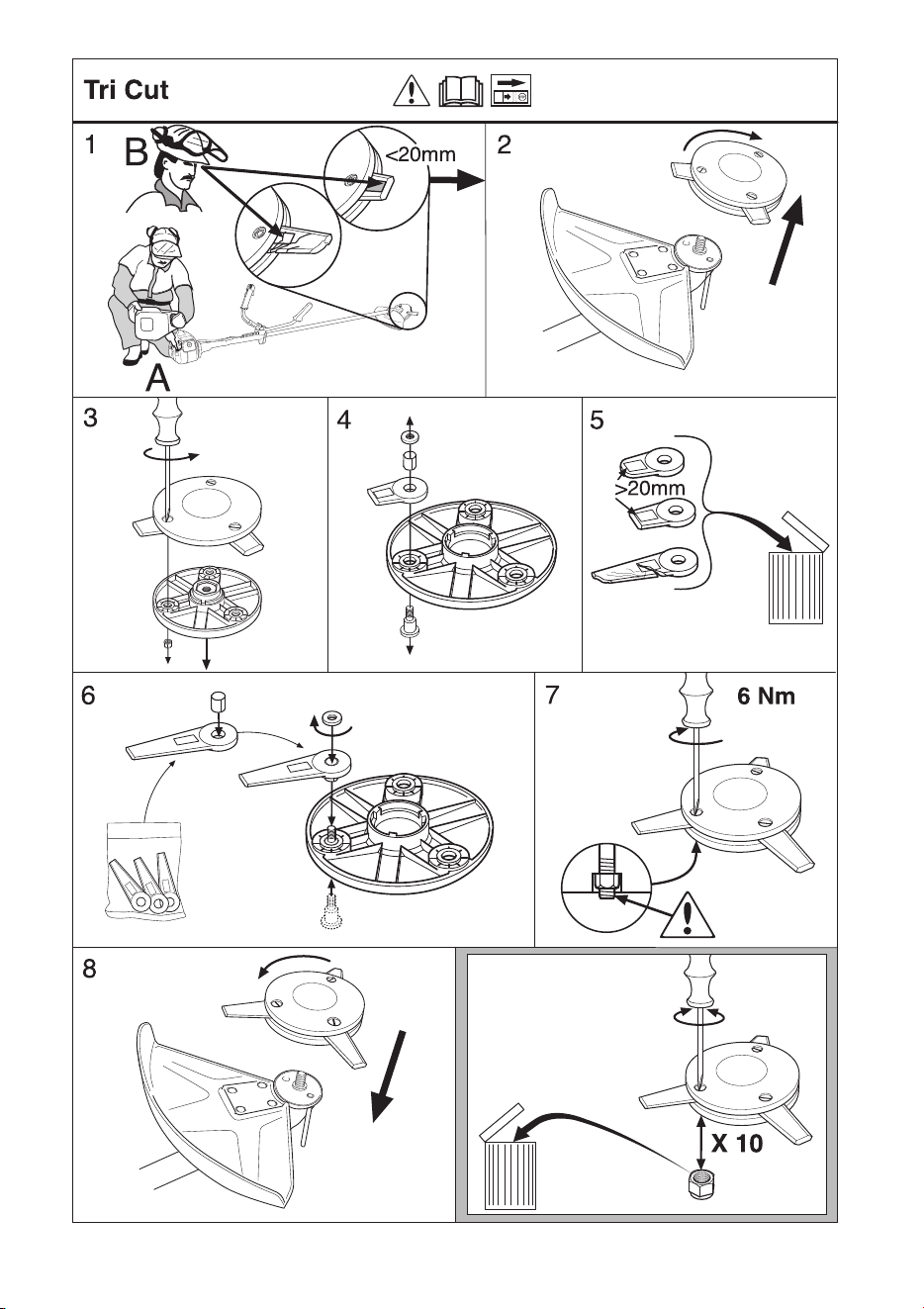
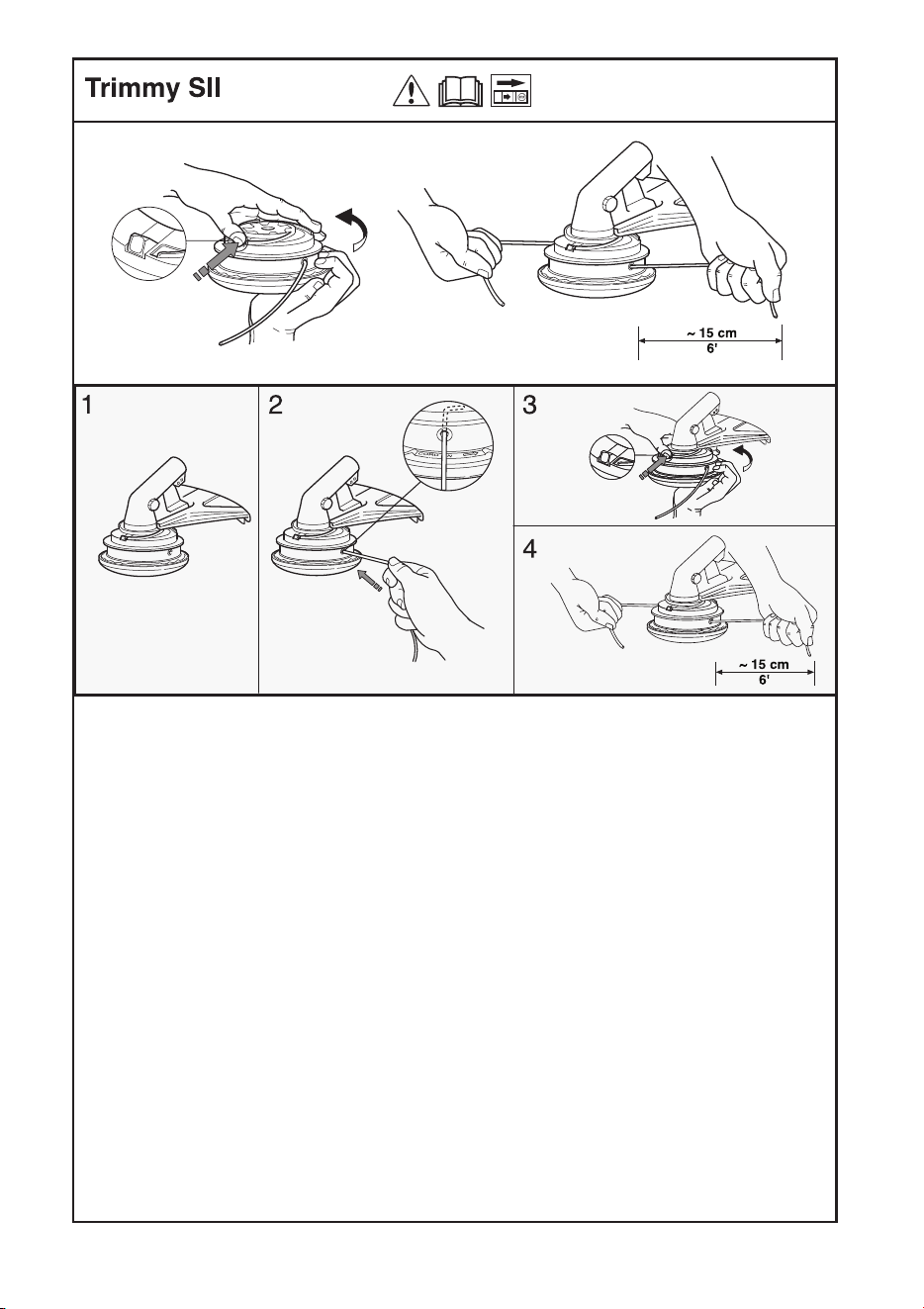
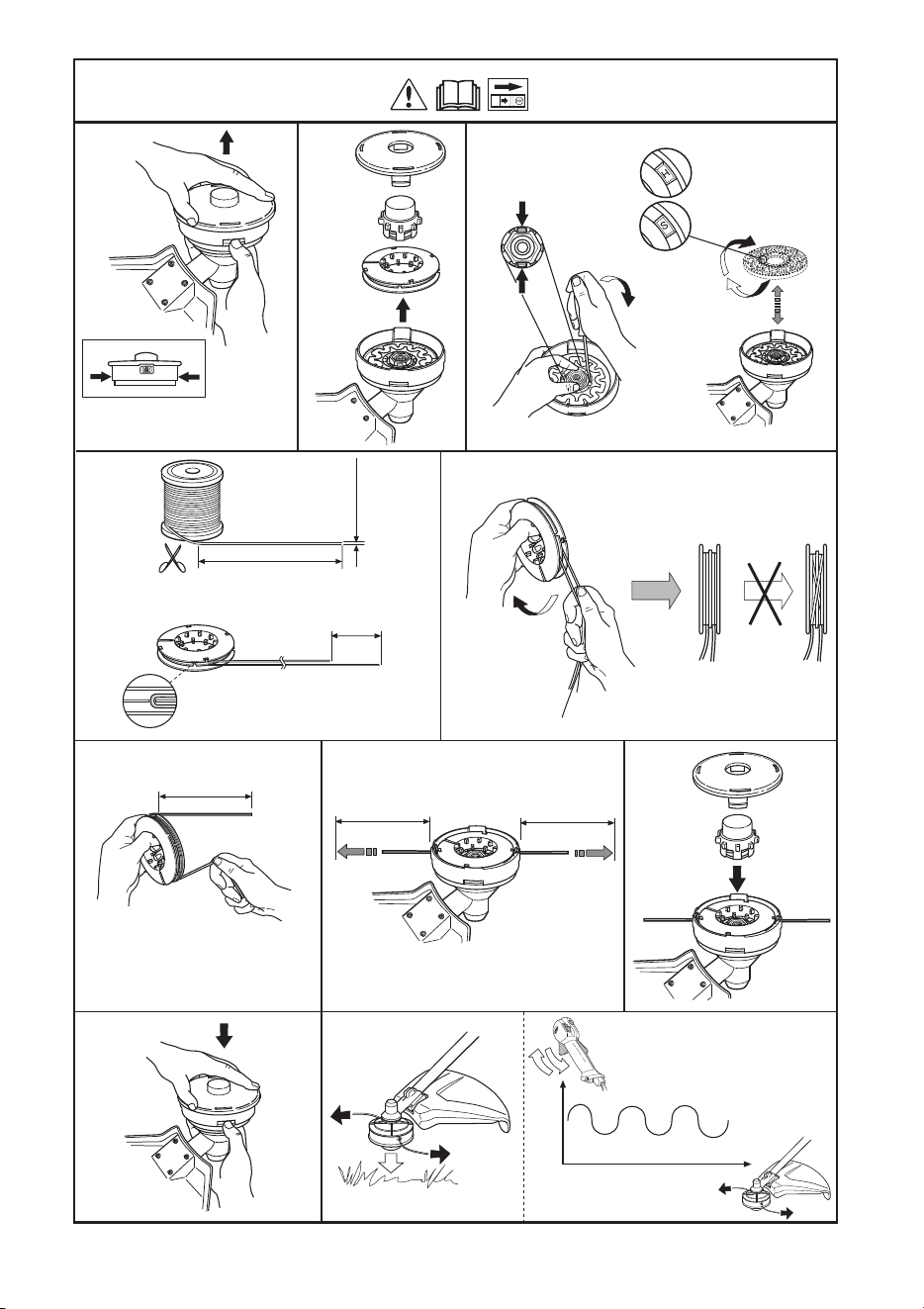
2,7-3,3 mm
.106-.130"
15 cm
6"
15 cm
6"
15 cm
6"
15 cm
6"
1
2
3
5
6
7
10
11
1.)
2.)
>1,1 Kw
<1,1 Kw
2,7 mm - 9,0 m
3,0 mm - 7,5 m
3,3 mm - 6,0 m
4
8
Auto 55
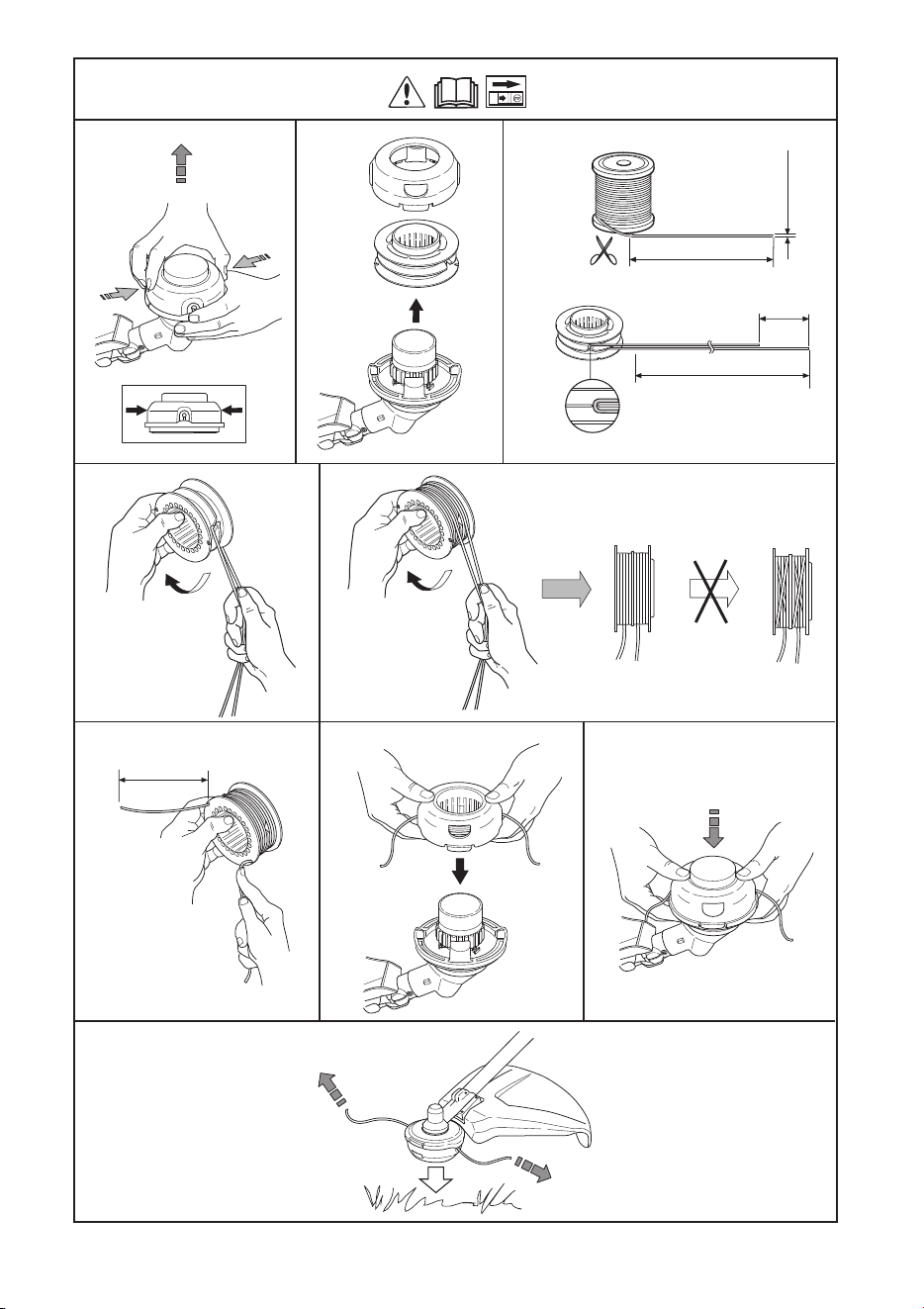
"Clic"
1
2
3
5
6
7
9
10 m
32'
4
8
4,3 m
14'
2,7-3,3 mm
.106-.13"
10 cm
4"
6"
15 cm
T45, T45x

Original instructions
´®z+YPQ¶5}¨
´®z+YPQ¶5}¨
2017-01-09
1157484-95