
Please read these instructions carefully and make sure
you understand them before using the machine.
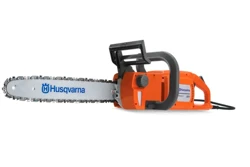
317 EL
321 EL
English
Operator´s manual

Original instructions

ENGLISH
1
CONTENTS
EC DECLARATION OF CONFORMITY
Husqvarna AB, 561 82, Huskvarna, Sweden, declare under our sole responsibility that the product(s);
Category.......................................... Electric chainsaw
Type(s)............................................. Husqvarna 317 EL & 321 EL
Identifi cation of Series..................... See Product Rating Label
Year of Construction........................ See Product Rating Label
conforms to the essential requirements & provisions of the following EC Directives:
2011/65/EU, 2006/42/EC, 2006/95/EC, 2004/108/EC,
2000/14/EC based on the following EU harmonized standards applied:
EN60745-1, EN60745-2-13, EN50366, EN55014-1, EN55014-2,
EN61000-3-2, EN61000-3-3.
INTERTEK SEMKO AB, 0413, PO Box 1103, 164 22 KISTA, Sweden, has issued reports regarding the assessment of conformity to
article 12 section 3 (c).
Certifi cate no. ............................... 1117352
The maximum A weighted sound pressure level L
pA
at the workstation, measured according to EN60745-2-13, corresponds to the
Noise Emissions given in the technical specifi cations table. The maximum hand / arm vibration weighted value, measured according
to EN60745-2-13, on a sample of the above product(s) corresponds to the vibration value a
h
given in the table.
The declared vibration total value has been measured in accordance with a standard test method and may be used for comparing
one tool with another. The declared vibration total value may also be used in a preliminary assessment of exposure.
Warning: The vibration emission during actual use of the power tool can differ from the declared total value depending on the ways
in which the tool is used. Operators should identify safety measures to protect themselves that are based on an estimation of expo-
sure in the actual conditions of use (taking account of all parts of the operating cycle such as the times when the tool is switched off
and when it is running idle in addition to the trigger time).
2000/14/EC: The Measured Sound Power L
WA
& Guaranteed Sound Power L
WA
values are according to the tabulated fi gures.
Conformity Assessment Procedure.........Annex V
Ulm 22/12/2010
P. Lamelli
Global R&D Director - Hand held, Keeper of technical documentation
Contents 1
EC declaration of conformity 1
Symbols 2
Important! Read before using chain saw 2
Technical specifi cations 4
Chain saw parts 5
Safe use 5
Starting and stopping 7
Daily inspection and maintenance 7
Kickback prevention 8
Chain brake with kickback guard 9
- Kickback guard inspection 9
- Manual chain brake function check 9
- Inertia chain brake function check 9
Mounting guide bar and adjusting chain 10
Chain catcher 11
Right hand guard 11
Slip clutch 11
Electronic overload protection 2000W 11
Cutting equipment 11
Chain and guide bar lubrication 12
- Chain oil 12
- Filling chain oil 12
- Checking automatic 12
chain lubrication system
- Checking chain wear 12
Filing chain 13
Limbing 13
Crosscutting 14
Felling operations 14
- Danger zone 15
- Felling direction 15
- Clearing branches/Line of retreat 15
- Felling 15
ENGLISH
2
SYMBOLS USED IN OPERATOR’S MANUAL:
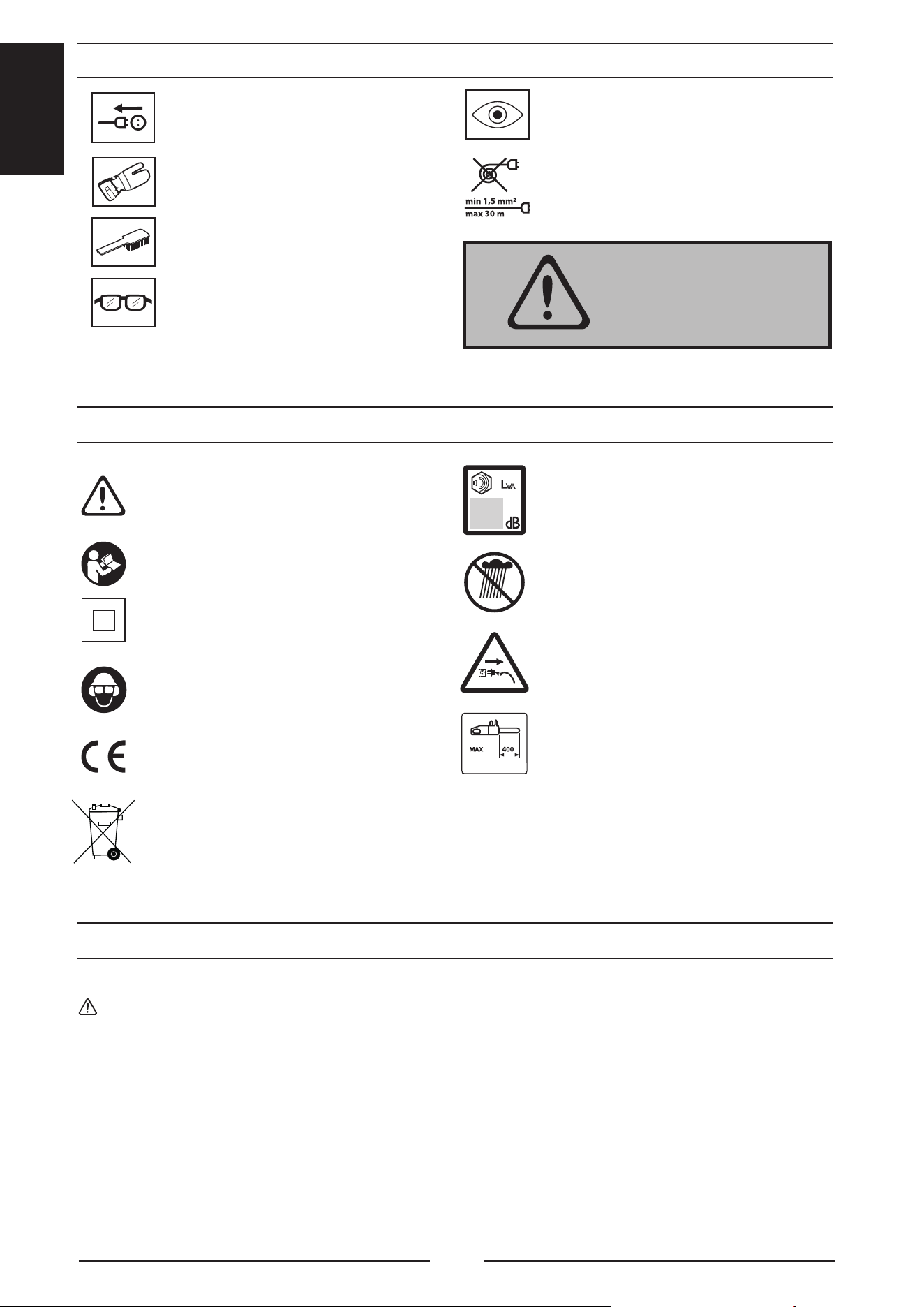
Do not use a coiled extension cord.
Minimum wire cross-section: 1,5 mm
²
Maximum cable length: 30 m
Voltage: 230 V
CAUTION!
Chain saws are dangerous!
Careless or improper use can
result in severe or fatal injury.
Noise emission to the environment according to the
European Community’s Directive. The machine’s
emission is specifi ed in «TECHNICAL SPECIFICATIONS»
page 4 and on label.
Always disconnect power before performing
cleaning or maintenance work.
Visual inspection.
Always use approved safety gloves.
Clean your chain saw regularly.
Use approved face mask or safety goggles.
CAUTION!
Chain saws are dangerous! Careless or im-
proper use can result in serious or fatal injury.
IMPORTANT! READ BEFORE USING CHAIN SAW
Read operating instructions and make certain you
understand them thoroughly before using the chain
saw.
Always use:
• Approved helmet
• Approved hearing protection
• Approved safety goggles or face mask
The chain saw is double-insulated.
This product conforms to
applicable CE directives.
Do not expose saw to rain or moisture.
Disconnect power in case of damage to power cable.
Maximum permissible guide bar length.
SYMBOLS ON THE CHAIN SAW:
This product may not be treated as household waste. Instead it shall be handed over to the applicable collection point for the recycling
of electrical and electronic equipment. By ensuring this product is disposed of correctly, you will help prevent potential negative
consequences for the environment and human health, which could otherwise be caused by inappropriate waste handling of this product.
For more detailed information about recycling of this product, please contact your local council offi ce, your household waste disposal
service or the shop where you purchased the product.
General Power Tool Safety Warnings
WARNING Read all safety warnings and all instructions!
Failure to follow the warnings and instructions may result in
electric shock, fi re and/or serious injury. Save all warnings and
instructions for future reference. The term“power tool” in the
warnings refers to your mains-operated (corded) power tool or
battery-operated (cordless) power tool.
1) Work area safety
a) Keep work area clean and well lit. Cluttered or dark areas
invite accidents.
b) Do not operate power tools in explosive atmospheres, such
as in the presence of fl ammable liquids, gases or dust. Power
tools create sparks which may ignite the dust or fumes.
c) Keep children and bystanders away while operating a power
tool. Distractions can cause you to lose control.
2) Electrical safety
a) Power tool plugs must match the outlet. Never modify the
plug in any way. Do not use any adaptor plugs with earthed
(grounded) power tools. Unmodifi ed plugs and matching outlets
will reduce risk of electric shock.
b) Avoid body contact with earthed or grounded surfaces,
such as pipes, radiators, ranges and refrigerators. There is an
increased risk of electric shock if your body is earthed or grounded.
c) Do not expose power tools to rain or wet conditions. Water
entering a power tool will increase the risk electric shock.
d) Do not abuse the cord. Never use the cord for carrying,
pulling or unplugging the power tool. Keep cord away from
heat, oil, sharp edges or moving parts. Damaged or entangled
cords increase the risk of electric shock.

ENGLISH
3
e) When operating a power tool outdoors, use an extension
cord suitable for outdoor use. Use of a cord suitable for outdoor
use reduces the risk of electric shock.
f) If operating a power tool in a damp location is unavoidable,
use a residual current device (RCD) protected supply. Use of
an RCD reduces the risk of electric shock.
We recommend that the tool always should be supplied via an
RCD with a rated residual current of 30mA or less!
3) Personal safety
a) Stay alert, watch what you are doing and use common
sense when operating a power tool. Do not use a power tool
while you are tired or under the infl uence of drugs, alcohol or
medication. A moment of inattention while operating power tools
may result in serious personal injury.
b) Use personal protective equipment. Always wear eye
protection. Protective equipment such as dust mask, non-skid
safety shoes, hard had, or hearing protection used for appropriate
conditions will reduce personal injuries.
c) Prevent unintentional starting. Ensure the switch is in the
off-position before connecting to power source and/or battery
pack, picking up or carrying the tool. Carrying power tools with
your fi nger on the switch or energising power tools that have the
switch on invites accidents.
d) Remove any adjusting key or wrench before turning the
power tool on. A wrench or a key left attached to a rotating part of
the power tools may result in personal injury.
e) Do not overreach. Keep proper footing and balance at all
times. This enables better control of the power tool in unexpected
situations.
f) Dress properly. Do not wear loose clothing or jewellery.
Keep your hair, clothing and gloves away from moving parts.
Loose clothes, jewellery or long hair can be caught in movingparts.
g) If devices are provided for the connection of dust extraction
and collection facilities, ensure these are connected and
properly used. Use of dust collection can reduce dust-related
hazards.
4) Power tool use and care
a) Do not force the power tool. Use the correct power tool for
your application. The correct power tool will do the job better
and safer at the rate for which it was designed.
b) Do not use the power tool if the switch does not turn it on
and off. Any power tool that cannot be controlled with the switch
is dangerous and must be repaired.
c) Disconnect the plug from the power source and/or
the battery pack from the power tool before making any
adjustments, changing accessories, or storing power tools.
Such preventive safety measures reduce the risk of starting the
power tool accidentally.
d) Store idle power tools out of the reach of children and
do not allow persons unfamiliar with the power tool or
these instructions to operate the power tool. Power tools are
dangerous in the hands of untrained users.
e) Maintain power tools. Check for misalignment or binding of
moving parts, breakage of parts and any other condition that
may affect the power tool’s operation. If damaged, have the
power tool repaired before use. Many accidents are caused by
poorly maintained power tools.
f) Keep cutting tools sharp and clean. Properly maintained
cutting tools with sharp cutting edges are less likely to bind and
are easier to control.
g) Use the power tool, accessories and tool bits etc. in
accordance with these instructions, taking into account the
working conditions and the work to be performed. Use of the
power tool for operations different from those intended could
result in a hazardous situation.
5. Service
a) Have your power tool serviced by a qualifi ed repair person
using only identical replacement parts. This will ensure that the
safety of the power tool is maintained.
Chain saw safety warnings:
• Keep all parts of the body away from the saw chain when the
chain saw is operating. Before you start the chain saw, make
sure the saw chain is not contacting anything. A moment of
inattention while operating chain saws may cause entanglement of
your clothing or body with the saw chain.
• Always hold the chain saw with your right hand on the rear
handle and your left hand on the front handle. Holding the
chain saw with a reversed hand confi guration increases the risk of
personal injury and should never be done.
• Hold the power tool by insulated gripping surfaces only,
because the saw chain may contact hidden wiring or its own
cord. Saw chains contacting a “live” wire may make exposed
metal parts of the power tool “live” and could give the operator an
electric shock.
• Wear safety glasses and hearing protection. Further
protective equipment for head, hands, legs and feet is
recommended. Adequate protective clothing will reduce personal
injury by fl ying debris or accidental contact with the saw chain.
• Do not operate a chain saw in a tree. Operation of chain saw
while up a tree may result in personal injury.
• Always keep proper footing and operate the chain saw only
when standing on fi xed, secure and level surface. Slippery or
unstable surfaces such as ladders may cause a loss of balance or
control of the chain saw.
• When cutting a limb that is under tension be alert for spring
back. When the tension in the wood fi bres is released the spring
loaded limb may strike the operator and/or throw the chain saw
out of control.
• Use extreme caution when cutting brush and saplings. The
slender material may catch the saw chain and be whipped forward
toward you or pull you off balance.
• Carry the chain saw by the front handle with the chain saw
switched off and away from your body. When transporting or
storing the chain saw always fi t the guide bar cover
.
Proper
handling of the chain saw will reduce the likelihood of accidental
contact with the moving saw chain.
• Follow instructions for lubricating, chain tensioning and
changing accessories. Improperly tensioned or lubricated chain
may either break or increase the chance for kickback.
• Keep handles dry, clean and free from oil and grease. Greasy,
oily handles are slippery causing loss of control.
• Cut wood only. Do not use chain saw for purposes not
intended. For example: do not use chain saw for cutting
plastic, masonry or nonwood building materials. Use of the
chain saw for operations different than intended could result in a
hazardous situation.
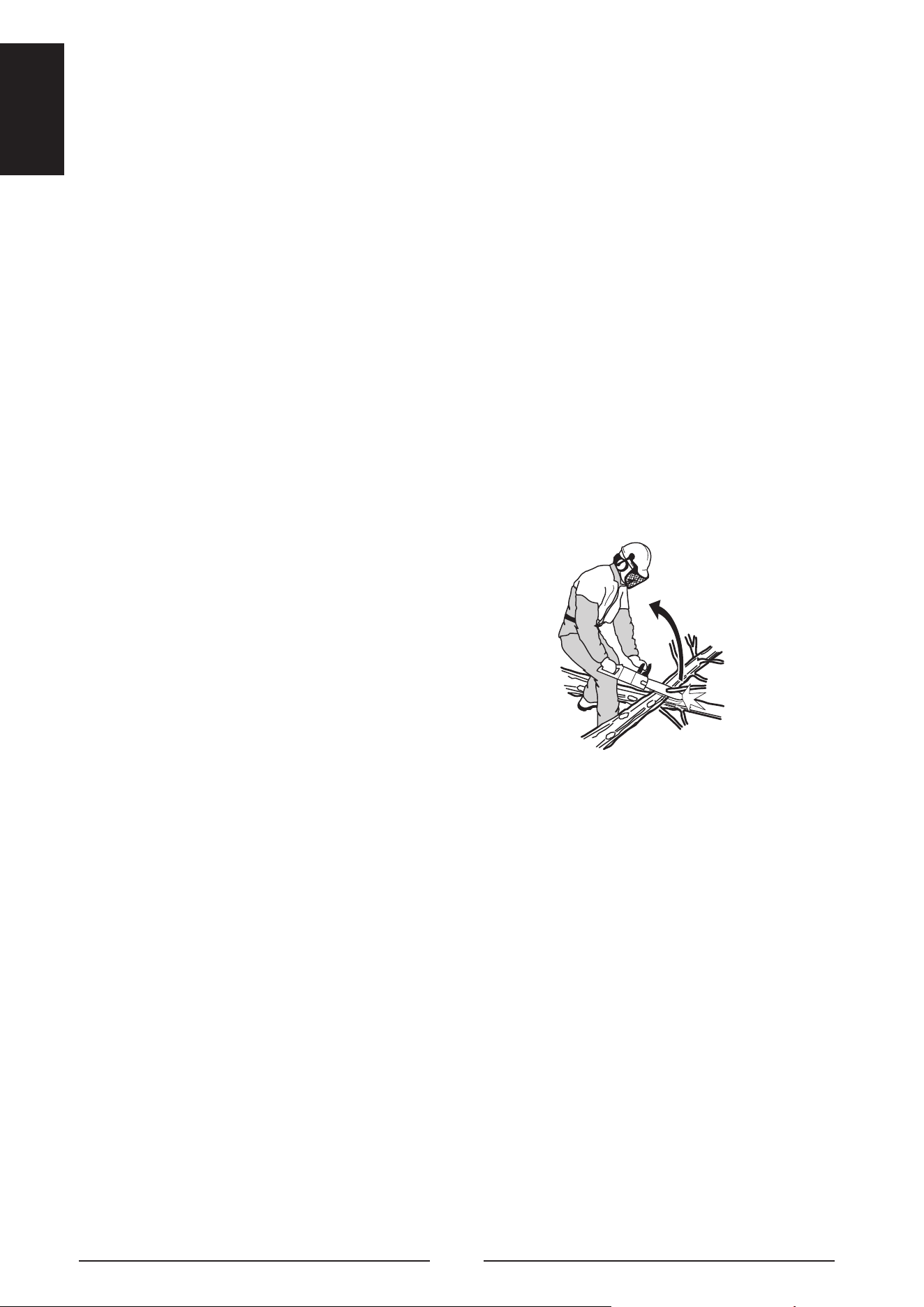
Causes and operator prevention of kickback:
Kickback may occur when the nose or tip of the guide bar touches
an object, or when the wood closes in and pinches the saw chain
in the cut. Tip contact in some cases may cause a sudden reverse
reaction, kicking the guide bar up and back towards the operator.
Pinching the saw chain along the top of the guide bar may push
the guide bar rapidly back towards the operator. Either of these
reactions may cause you to lose control of the saw which could
result in serious personal injury. Do not rely exclusively upon the
safety devises built into your saw. As a chain saw user, you should
take several steps to keep your cutting jobs free from accident or
injury. Kickback is a result of tool misuse and/or incorrect operating
procedures or conditions and can be avoided by taking proper
precautions as given below:
• Maintain a fi rm grip, with thumbs and fi ngers encircling the
chain saw handles, with both hands on the saw and position
your body and arm to allow you to resist kickback forces.
Kickback forces can be controlled by the operator, if proper
precautions are taken. Do not let go of the chain saw.
• Do not overreach and do not cut above shoulder height. This
helps prevent unintended tip contact and enables better control of
the chain saw in unexpected situations.
• Only use replacement bars and chains specifi ed by the
manufacturer. Incorrect replacement bars and chains may cause
chain breakage and/or kickback.
• Follow the manufacturer’s sharpening and maintenance
instructions for the saw chain. Decreasing the depth gauge
height can lead to increased kickback.
IMPORTANT! READ BEFORE USING CHAIN SAW
ENGLISH
4
Model 317 EL 321 EL
Rated power kW 1.7 2.1
Slip clutch Yes Yes
Electronic start control - Yes
Electronic speed control - Yes
Electronic overload protection - Yes
Weight
Without guide bar and chain kg 4.4 4.4
With 14” guide bar and chain kg 5.1 5.1
Chain lubrication
Oil tank volume litres 0.1 0.1
Oil consumption approx. litres 0.1/20 min. 0.1/20 min.
Oil pump auto auto
Noise levels, L
pA
Equivalent noise intensity at operator’s ear,
according to international standards dB(A) 93 93
Uncertainty, k
pA
dB(A)
2.0 2.0
Noise emissions
Sound power, measured LW dB(A) 104 104
Sound power, guaranteed LWA dB(A) 106 106
Vibration, a
h
Front handle m/s
2
3.4 3.4
Rear handle m/s
2
3.7 3.7
Uncertainty, K
ah
m/s
2
1.5 1.5
Chain/guide bar
Recommended bar length inches/cm 12/30 12/30
inches/cm 14/35 14/35
inches/cm 16/40 16/40
Effective cutting length inches/cm 12/30 12/30
inches/cm 14/35 14/35
inches/cm 16/40 16/40
Chain speed, unloaded m/sec. (drive) 14,5 (6 tooth) 15,2 (6 tooth)
Chain speed, rated output m/sec. (drive) 12,5 (6 tooth) 12,2 (6 tooth)
Chain pitch inches 3/8 3/8
Gauge inches/mm .050/1.3 .050/1.3
Number of drive links 12”/14”/16” 45/52/56 45/52/56
TECHNICAL SPECIFICATIONS
inch
inch/mm
inch/mm inch/mm
inch/cm/dl
ENGLISH
5
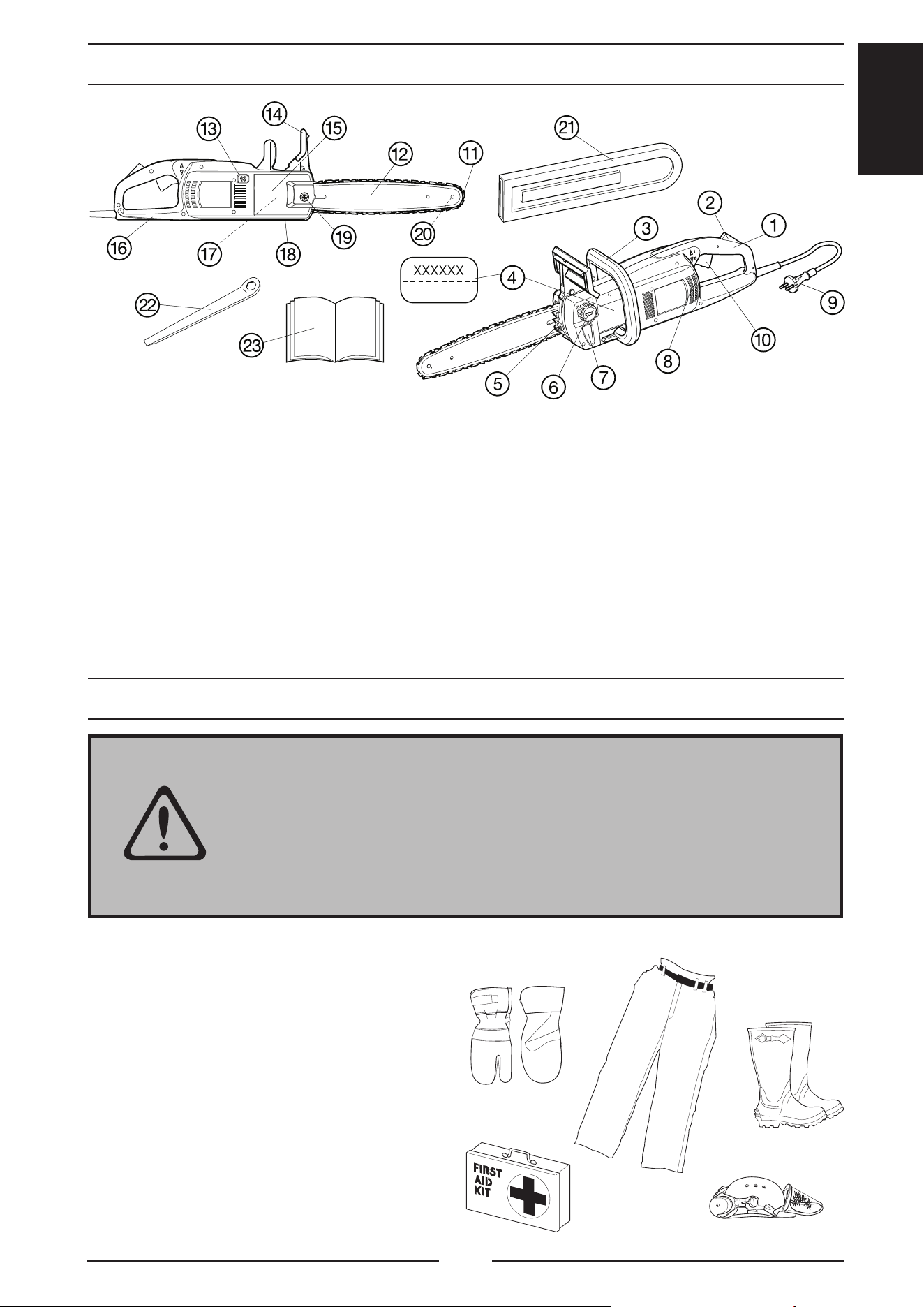
1. Rear handle
2. Power trigger lockout
3. Front handle
4. Serial No. plate
5. Chain tensioner
6. Chain oil reservoir
7. Chain oil level
8. Ventilation slots
9. Power cable
10. Power trigger
11. Chain
12. Guide bar
13. Chain brake release button
14. Kickback guard
15. Chain drive cover
16. Right hand guard - protects right hand
in case chain breaks or derails
17. Drive sprocket
- concealed by chain drive cover
18. Chain catcher - defl ects chain in case
chain breaks or derails
19. Guide bar nut
20. Nose sprocket
21. Scabbard
22. Combination tool
23. Operator’s manual
CHAIN SAW PARTS
• Dress safely. Avoid jewellery and loose-fitting clothing,
which may be caught in moving parts. Approved safety
mitts and sturdy footwear which gives a good footing are
recommended (also for helpers).
Wear: - Approved face mask or safety goggles
- Approved hearing protection
- Approved helmet
- Approved safety boots with protective rein-
forcement, steel toecap and non-slip soles
- Clothing which is snug without hampering
movement
- Approved gloves with protective reinforcement
Always keep a fi rst-aid kit on hand!
CAUTION!
Never operate a chain saw with one hand only. Doing so may lead to i serious injury to operator,
helpers or bystanders. An electric chain saw is designed for operation with both hands.
Use of accessories not conforming to the recommendations outlined in the Operating
Instructions could lead to injury.
The chain saw must not be modifi ed in any way under any circumstances without the
permission of the manufacturer. Use only original accessories. Unauthorized modifi cations and/
or accessories may cause serious or fatal injury of the operator or others.
SAFE USE
ENGLISH
6
• See to it that others keep their distance as long as the
chain is in motion. Keep onlookers, children and animals
away from the work area. Do not let inexperienced persons
handle the chainsaw or power cable.
• Keep work area clear and well-lighted. Do not operate
chain saw under wet or humid conditions, around water
or in rain or snow. Ingress of moisture into the motor can
cause short-circuiting.
• Show caution, care and common sense. Do not operate
the chain saw when you are tired or under the infl uence
of alcohol or drugs which may affect vision, judgement or
physical control. Keep all body parts well away from the
chain as long as the motor is running. Always ensure that
the chain is not touching anything before starting the chain
saw.
• Be on your guard against electric shock. Avoid touching
metal objects imbedded in or in electrical contact with the
ground.
• Do not abuse power cables. Never lift or carry the chain
saw by the power cable, and never disconnect the power
by jerking on the cable. Keep cable away from water, oil
and sharp objects. Avoid crushing cable in or against doors,
fences, or other metal objects which can conduct electricity.
• Inspect the chain saw and power cable before use. Do not
use a chain saw with a damaged cable. If replacement of
the supply cable is necessary, this must only be done by an
approved Husqvarna service dealer in order to avoid a safe-
ty hazard. Keep handles clean, dry and free from grease
and oil.
• See to it that all tools are removed from the chain saw
before connecting the power.
• Ensure that the extension cord is in good condition and
approved for outdoor use. It must be of suffi cient dimension
for the chain saw’s rated power. See section «IMPORTANT!
READ BEFORE USING CHAIN SAW» on page 2.
• When carrying the chain saw, stop the motor, keep your
fi nger AWAY from the power trigger and turn the saw with
the guide bar to the rear and pointing away from your body.
• Connect chain saw to a power supply equipped with a
current-operated earth-fault protection device.
• Double-insulated! Your electric chain saw is double-
insulated for added protection against electric shock.
A double-insulated electric tool is designed with two
separate «layers» of electrical insulation or one layer of in-
sulation of double thickness between the operator and the
tool’s conducting parts. Double-insulated tools do not use
earthed mains connections and may therefore be connect-
ed to any normal 220-240 VAC outlet. Observe the same
precautions required with all electric tools. Double insula-
tion gives added protection only against defective insula-
tion.
• Use chain saw only on wood. Do not attempt to cut metal,
plastic, masonry or any non-wood building materials. Do not
use the guide bar to push away branches, roots or other objects.
• Ensure that you can move and stand safely at all times.
Watch out for roots, stones, branches, holes, mounds
and so forth when moving around. Be par ticularly careful
when working on slopes. Work with the trunk to your right,
keeping the log between you and the guide bar. Always grip
your chain saw with both hands, holding it as close to your
body as possible for best control. Wherever possible, let
the log take the weight of the chain saw. A lways keep the
log between you and the guide bar when moving forward.
• Do not bear down hard when cutting. With the chain
properly sharpened, light pressure is suffi cient. Forcing the
saw at the end of a cut can make you lose control when you
break through.
• Secure short logs before sawing.
• Show particular care when cutting small branches, and
avoid sawing bushes or many small branches at once.
Small branches can get caught in the chain with a violent
jerk and cause serious personal injury.
• We recommend limiting tree diameter to guide bar length so
that the NOTCH and FELLING CUT may be done with
single
cuts. (See «Technical Specifi cations» for recommended
guide bar lengths for your chain saw model).
• The chain will keep rotating a short while after releaseing
the power trigger (slowness).
• Disconnect power supply before servicing chain saw.
• Your chain saw complies with all relevant safety stan dards.
Repairs should be performed only by qualifi ed service
personnel using only original parts.
• Examine saw closely for damaged parts before use to avoid
malfunctions and to ensure safe and effi cient operation.
Verify that all moving parts are fi tted and adjusted correctly.
Except for the maintenance described in this operator’s
manual, damaged parts must be replaced at an authorized
service centre. Defective power triggers are to be replaced
by authorized service personnel. Do not operate the saw if
the power trigger does not work properly.
• Store the chain saw in a safe, dry place out of the reach of
children, with the power disconnected and the guide bar
scabbard in place.
ENGLISH
7
DAILY INSPECTION AND MAINTENANCE
CAUTION!
Always disconnect the power before cleaning or performing maintenance.
Here are a few general instructions for maintaining your hand-
saw. If you are in doubt on any of these points, contact your
service dealer.
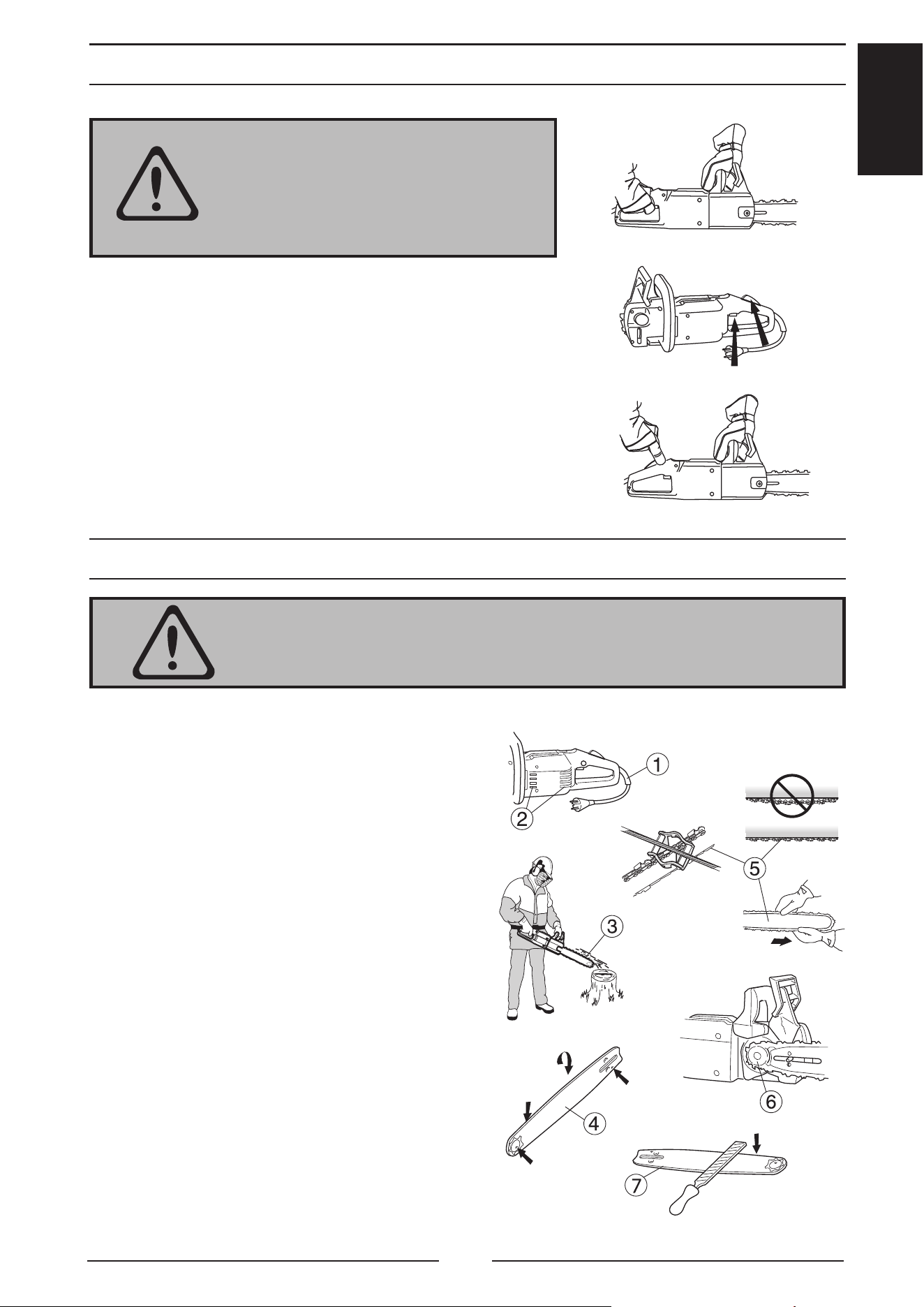
1. Inspect power cable and plug for defects.
A damaged power cable or plug must be replaced.
2. Clean ventilation openings and keep them open.
3. Check automatic chain lubrication.
4. Turn guide bar over at regular intervals to distribute the
wear on both sides. Check to see that the oil passage is
clear. Clean the guide bar groove.
5. Check chain tension, sharpen the cutters and ensure that
chain turns easily.
6. Check drive sprocket for abnormal wear, replacing it if
necessary.
7. Remove any burrs from the edges of the guide bar
STARTING AND STOPPING
• Grip the front handle fi rmly with your left hand.
• Grip the rear handle fi rmly with your right hand.
• Press and hold the power trigger lockout button with the inside of your
hand and squeeze the power trigger with your index fi nger.
Stop the saw by releasing the power trigger. If the saw does not stop,
trip the chain brake and disconnect the power cable.
CAUTION!
• Make certain at all times that your footing is
secure and that the chain touches nothing
but the wood you are cutting.
• Keep bystanders away from your work area.
ENGLISH
8
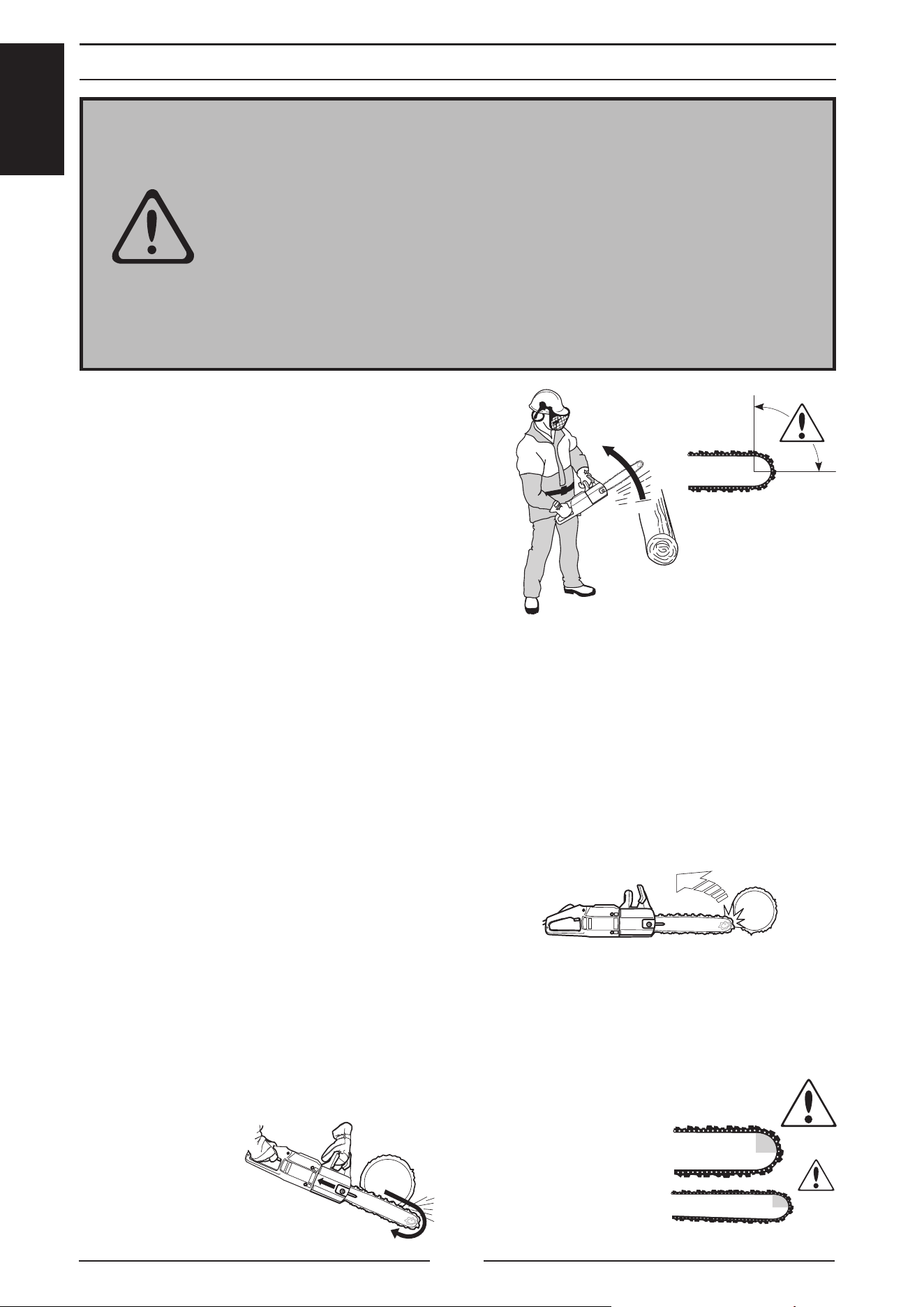
• Take extreme care when cutting with the top chain (on the
underside of a log). The force of the chain action pushes the
saw backwards, and if the operator does not maintain fi rm
control, the kickback danger zone may move far enough
back into the kerf to produce a kickback. Cutting with the
bottom chain (on the top side of the log) pulls the saw for-
ward. This presses the power head fi rmly against the tree,
providing a steady support and giving the operator added
control over the saw and consequently over the kickback
danger zone.
• Follow the maintenance and sharpening instructions for
the chain and guide bar. When replacing chains and guide
bars, use only combinations recommended by us. See
«Technical Specifi cations».
• The smaller the bar nose radius, the smaller the kickback
danger zone and thus
the kickback tendency.
• By using low-kickback
cutting equipment
and keeping the cut-
ters properly sharp-
ened, the strength of a
kickback can be greatly
reduced.
KICKBACK PREVENTION
DANGER!
Kickbacks occur suddenly and without warning. A kickback may be violent enough to throw a
chainsaw back at the user. A running chain can infl ict severe and even fatal injury. It is imperative
for users to be familiar with the causes of kickbacks in order to exercise the proper care and use
working techniques to prevent kickback.
CAUTION!
Improperly sharpened cutters or the wrong chain and guide bar combination will
increase the risk of kickback. See «Technical Specifi cations» on page 4.
CAUTION!
Do not let the chain come in contact with the ground or any objects. Chain link and wire fencing
materials present a particular kickback hazard.
Observe all safety rules in order to avoid kickbacks and other
accidents which may cause injury.
• A kickback is a sudden reaction in which a chain saw is
thrown back as a result from contact with the upper part of
the bar nose known as the kickback danger zone.
• The direction of a kickback is always in the same plane as
the guide bar. The most common reaction is that the guide
bar and saw are thrown up and back towards the operator.
The saw can be thrown in other directions, depending on
the position of the saw at the moment of kickback.
Basic rules
• Knowing the cause and nature of a kickback helps reduce
or eliminate the element of surprise. Surprise increases the
danger of an accident. Most kickbacks are small, but some
are violent, and all are lightning-fast.
• Always grip the chain saw fi rmly with thumb and fi ngers
wrapped around the handles, right hand on the rear handle
and left hand on the front handle. All users, whether right or
left-handed, must use this grip, which will reduce the effect
of a kickback and help keep the saw under control.
Do not let go of the chain saw handles!
• Most accidents caused by kickbacks take place in con-
nection with limbing. Make certain your footing is secure
and that there are no objects nearby which may trip you
or make you lose your balance. If you are not careful, the
kickback danger zone could make contact with a branch,
a nearby tree or some other object which could cause a
kickback.
• Never use a chain saw to cut above shoulder height, and
do not cut with the guide bar nose. Never operate a chain
saw while holding it with only one hand!
• Maintain full speed while cutting.
ENGLISH
9
• The chain brake may be activated manually or by the force
of inertia depending on the strength of the kickback and
the position of the saw in relation to the object which made
contact with the kickback danger zone.
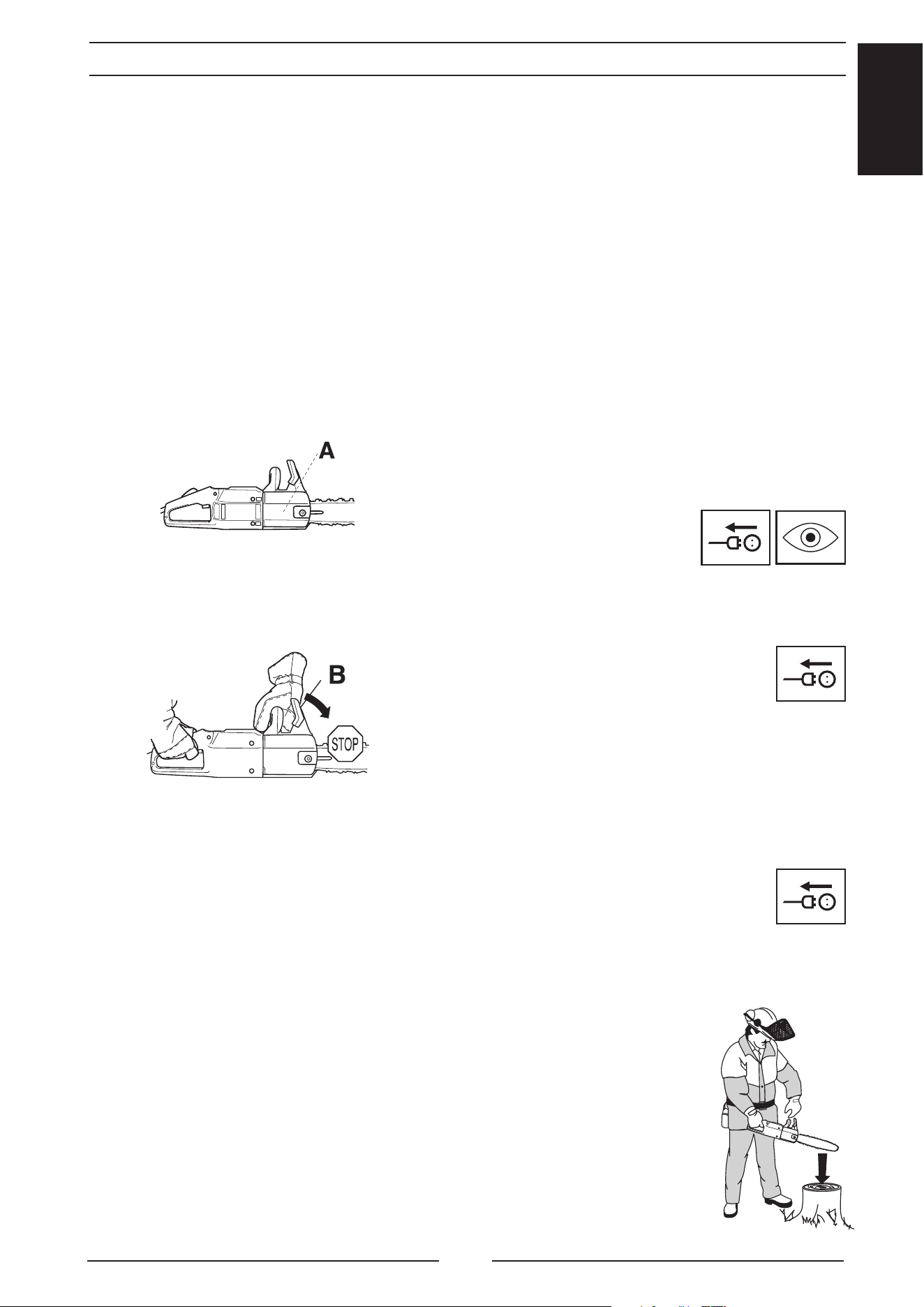
- If the kickback is suffi ciently violent and the left hand
is too far from the kickback guard, the chain brake is
activated by the INERTIA of the chain brake against the
force of the kickback.
- In the event of smaller kickbacks or when the left hand
is near the kickback guard, the chain brake is activated
manually with the left hand.
• When the chain saw is turned on its side and the operator is
holding the side of the front handle, the kickback guard will
not strike the left hand in the event of a kickback and will
thus not activate the chain brake. In a situation of this type,
inertia is the only thing that can activate the chain brake,
but like manual activation, it will not work in every situation.
Kickback guard inspection
• Inspect kickback guard for visible defects, such as cracks.
• Move kickback guard back and forth to ensure that it moves
freely without being loose.
Manual chain brake function check
• Check chain brake daily or every time the saw is used.
Holding the running saw fi rmly with the left hand on the
front handle and the right hand on the rear handle, twist
your left wrist, pushing the kickback guard to activate the
chain brake without letting go of the front handle. The chain
should stop instantaneously. If the chain brake does not
perform as required, have it serviced by authorized per-
sonnel.
Inertia chain brake function check
• Hold the running saw level with the guide bar approximately
45 cm above a stump or other solid wooden object.
Release the power trigger.
• Release the front handle, letting
the chain saw pivot in your
right hand as the guide bar falls
down and strikes the stump.
The brake should activate when
the bar nose hits the stump.
Your chain saw is equipped with a chain brake designed to
stop the chain instantaneously in the event of a kickback.
A chain brake can reduce the risk of accident, but only the
operator can prevent accidents from happening. Be extremely
careful when operating a chain saw and do not allow the kick-
back danger zone to make contact with anything.
• The chain brake (A) is activated either manually (with the left
hand) or by the force of inertia (the inertia of the kickback
guard resisting the motion of the saw from the force of the
kickback). However it is activated, the kickback protection
mechanism works in the opposite direction to the force of
the kickback. The saw incorporates a slip clutch which pro-
tects the saw against overload. If the chain stops while the
motor is running, the saw is overloaded. Ease up on the
cutting pressure until the chain starts running again. If the
saw jams in the tree, stop the saw immediately and free it.
• The chain brake is also activated when the kickback guard
(B) is pushed forward. This releases a springloaded mecha-
nism which jerks the brake band tightly around the brake
drum.
• The purpose of the kickback guard is not only to activate
the chain brake. Its other important function is to reduce
the danger of contact with the chain in the event that the
operator loses his grip on the front handle.
• Use the chain brake as a «parking brake» when carrying
the chain saw around or putting it down for short periods!
Besides automatic activation in the event of a kickback, the
chain brake may also be activated manually and must be
activated in the event of any inadvertent contact with a ro-
tating chain.
• An activated chain brake is released by pulling the kickback
guard back towards the front handle.
• As pointed out on page 8, a kickback can be extremely
violent and lightning-fast. Most kickbacks are small and do
not activate the chain brake. When this happens, it is im-
portant to maintain a fi rm grip on the saw and not let go.
CHAIN BRAKE WITH KICKBACK GUARD
ENGLISH
10
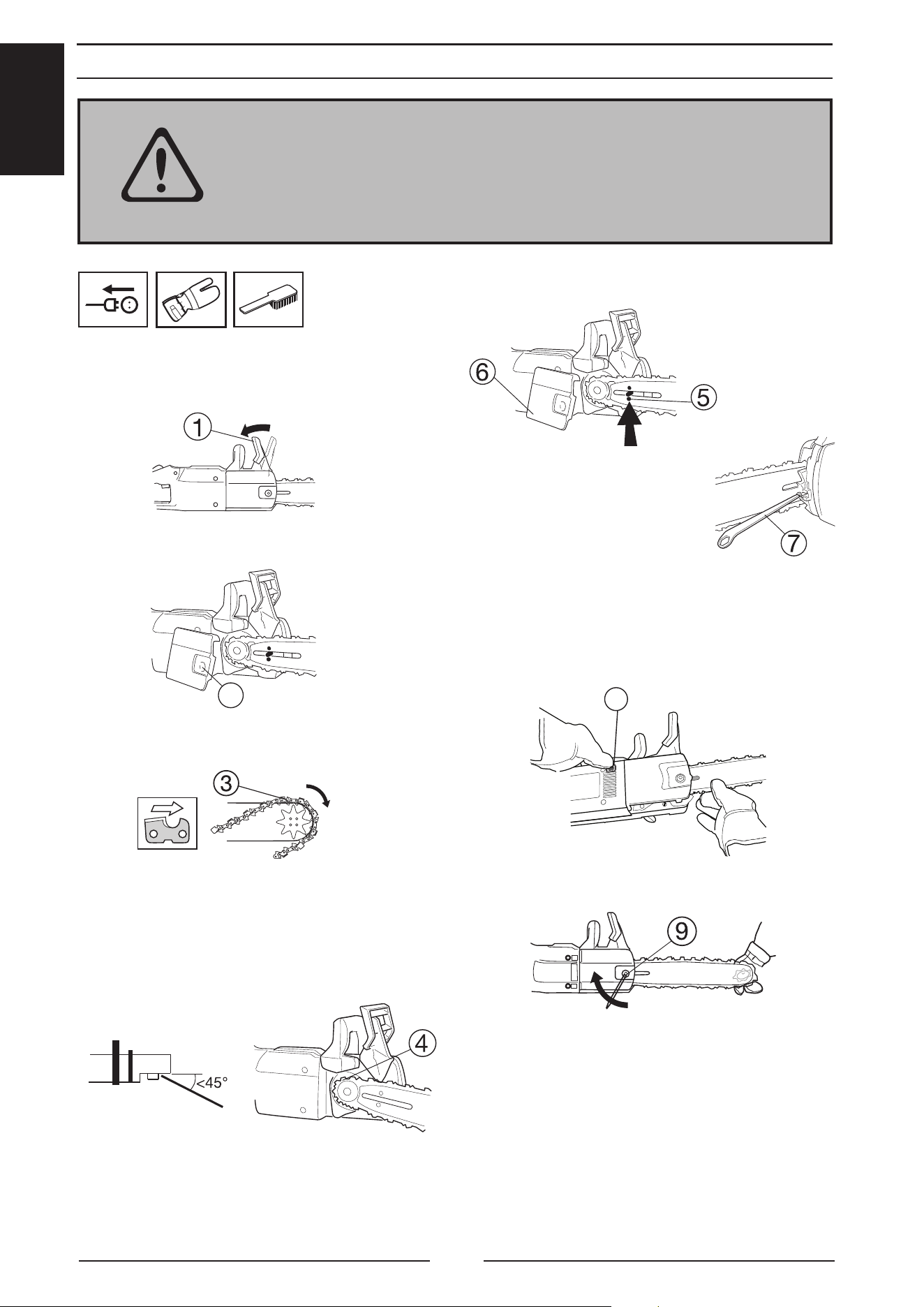
6. Replace the chain drive cover and screw
the mounting nut hand tight.
7. Tension the chain by screwing the
tensioning screw clockwise using the
screwdriver tip on the combination
tool.
8. Tighten chain fi rmly but not so hard that it does not turn easily
by hand force. Push the button to release the chain brake. To
avoid contact between your hands and the chain, use gloves
to turn the chain.
9. Tighten the mounting nut with the combination tool while hold-
ing the tip of the guide bar up.
The tension of a new chain must be checked frequently until it
is broken in. Continue to check the tension at regular intervals
to ensure good performance and a long service life.
• Wear causes a chain to become looser with use. Regular
t ensioning is important to compensate for this wear.
• Check the chain tension at least every time you refi ll the chain
oil reservoir.
1. Pull kickback guard back against the front handle
to ensure that the chain brake is not applied.
2. Screw out the guide bar nut and remove
the chain drive cover.
3. Fit the chain around guide bar nose with
the top cutters facing forwards.
4. Holding the chain over the guide bar nose, position the
back end of the guide bar against the drive sprocket at a
45° angle to the power head. Pass the free end of the chain
around the drive sprocket, swing the guide bar into place
over the mounting bolt and against the power head, and
guide the chain into the guide bar groove.
5. Seat the guide bar tensioner pin in its hole in the guide bar.
CAUTION!
Always disconnect power before performing cleaning or maintenance work.
CAUTION!
A loose chain can jump out of its groove during operation and cause serious
or even fatal injury.
2
8
MOUNTING GUIDE BAR AND ADJUSTING CHAIN
ENGLISH
11
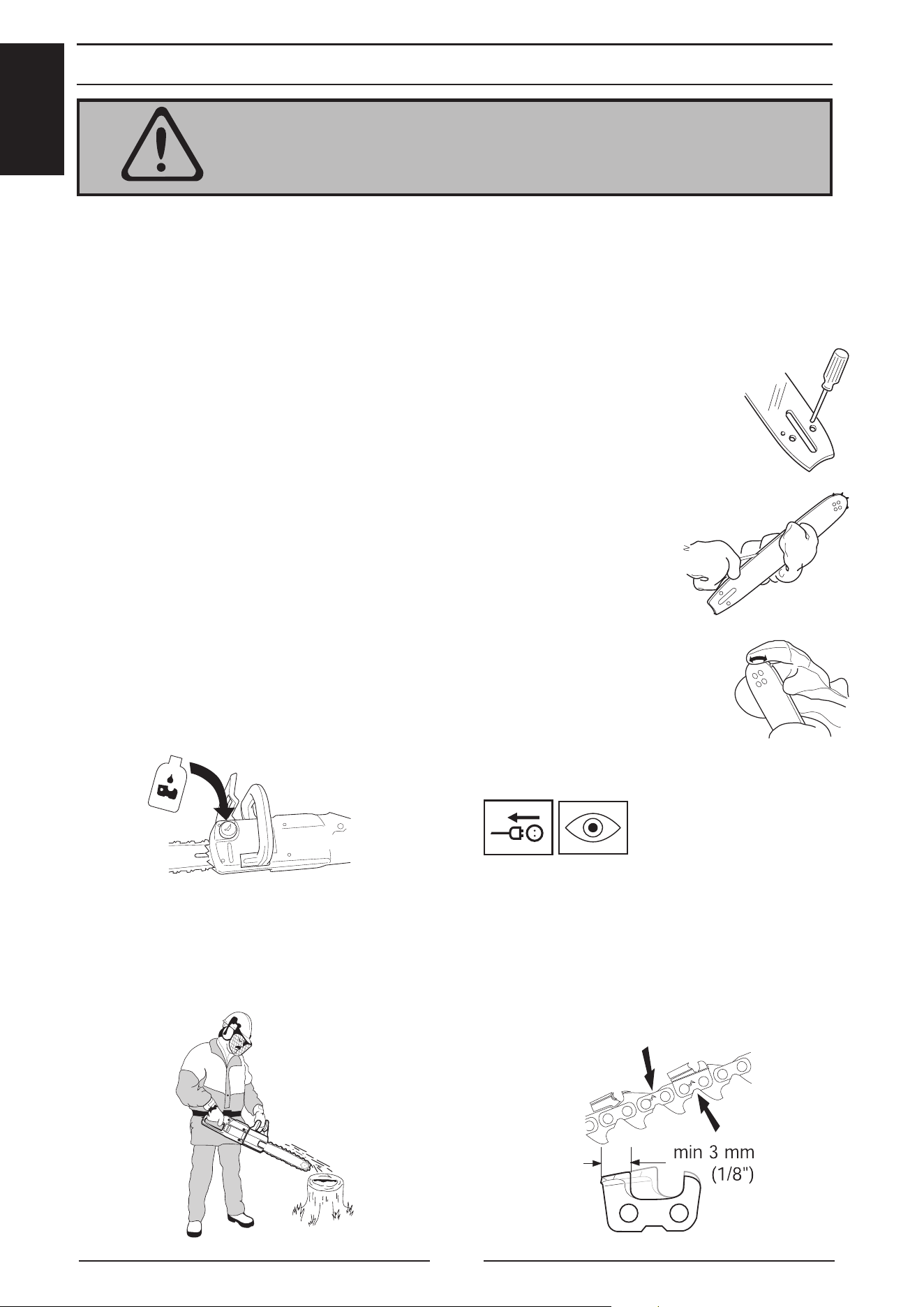
• Ensure that the cutter teeth are always
correctly sharpened! Follow our
instructions and use the recommended
fi ling guide. A chain which is damaged or
improperly maintained increases the risk
of accident.
• Maintain the correct depth-gauge height.
Worn depth gauges increase the risk of
kickback.
• Keep chain properly tensioned!
A loose chain derails more easily and
accelerates wear on guide bar, chain
and drive sprocket.
• Ensure that the automatic oiling system
works and that the cutting equipment is
properly maintained.
CHAIN CATCHER
The chain catcher is designed to catch a chain which breaks or jumps out of its groove.
This problem will generally be avoided, however, if the chain is tensioned properly (see
chapter on «Mounting guide bar and adjusting chain» page 10) and the chain and
guide bar properly maintained.
Ensure that the CHAIN CATCHER is undamaged.
RIGHT HAND GUARD
The right hand guard protects the right hand in the event that the chain breaks or
jumps out of its groove, as well as keeping twigs and branches from interfering with
your grip on the handle.
Ensure that the RIGHT HAND GUARD is undamaged.
SLIP CLUTCH
Your chain saw features a slip clutch which protects it from overload.
The slip clutch may require cleaning after long periods of operation.
Contact your nearest service dealer in the event of malfunction.
ELECTRONIC OVERLOAD PROTECTION 2000W
The 2000W electric chain saw is provided with electronic overload protection.
• When the overload protection trips, the saw stops.
• Release the power trigger. Ensure that the chain is not stuck.
• Squeeze the power trigger.
CUTTING EQUIPMENT
This section explains how correct maintenance and use of the
right cutting equipment:
• Reduces kickback tendencies
• Reduces the frequency of chain derailing and breakage
• Achieves maximum cutting effect
• Increases the service life of the chain
The fi ve basic rules
• Use only the recommended cutting equipment!
See «Technical Specifi cations» on page 4.
ENGLISH
12
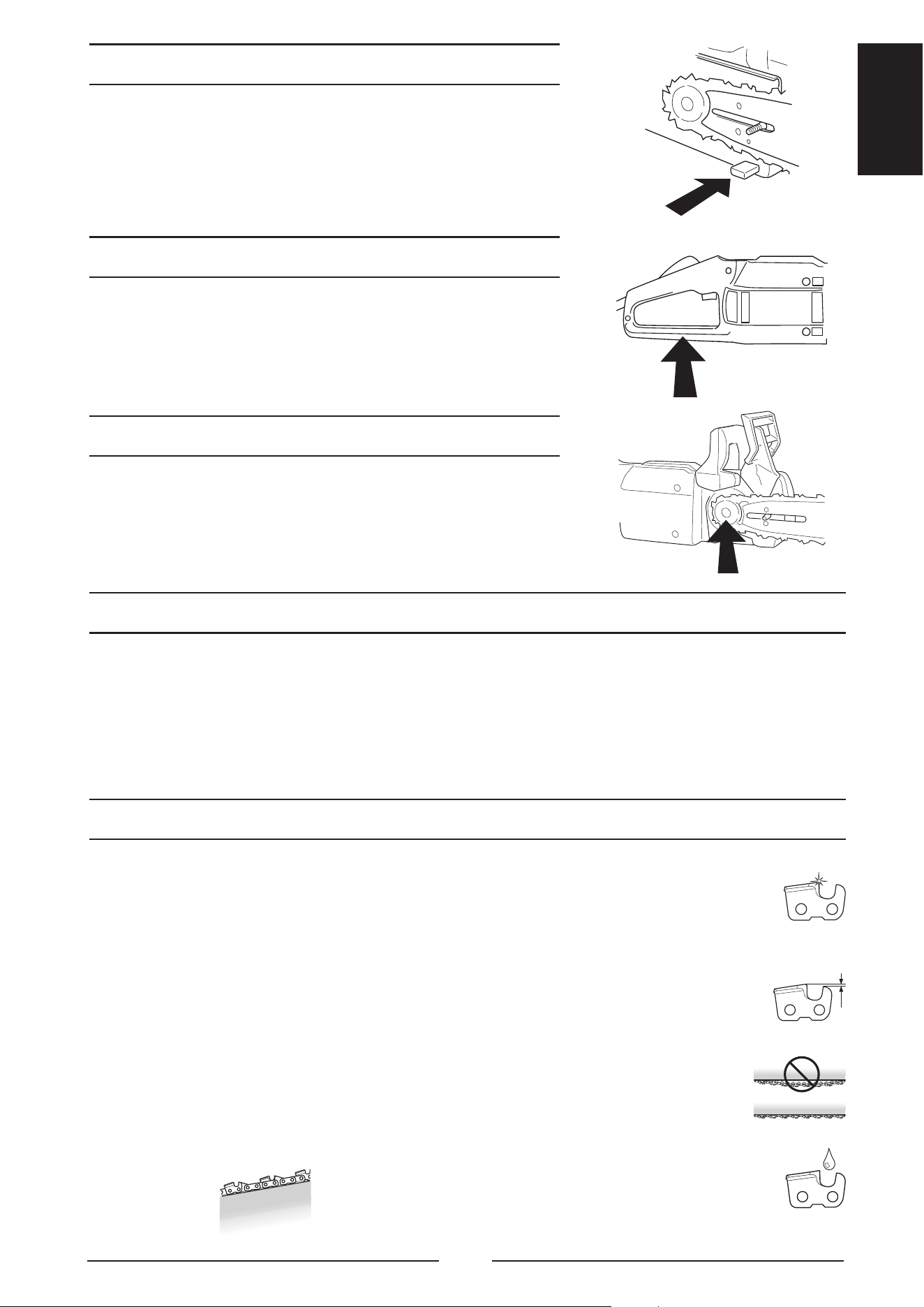
Checking chain wear
• Inspect chain every day for:
- Visible cracks in rivets or links
- Stiffness
- Abnormal wear in rivets or links
- Min. 3 mm (1/8”) horizontal cutter length
- Any deviation on any of these points indicates a worn chain
which must be discarded
- Check the guide bar’s oil passage
and clean if necessary.
- Check guide bar groove and
clean if necessary.
- Ensure that the nose sprocket
turns easily and is not clogged.
Clean and grease if necessary.
Chain oil
• The chain and bar are lubricated by an automatic oiling
system. We recommend using only chain saw oil, which
is formulated for good adhesion and fl ow characteristics
in hot or cold weather. Nonetheless, it is important to use
the viscosity appropriate to the season. Oil thickens in
subfreezing temperatures and can overload the oil pump
and cause parts to fail.
• As a manufacturer of chain saws, we have developed an
ideal chain oil which, being based on vegetable oils, is
completely biodegradable. We recommend our oil for the
sake of your chain and guidebar and for the sake of the
environment.
• Where chain oil is not available, EP 90 gear oil may be used.
• If you need help choosing chain oil, contact your service dealer.
• Never use old motor oil! Used motor oil contains impurities
which may be harmful to oil pump, guide bar and chain.
Filling chain oil
• All our chain saw models feature automatic chain l ubrication.
Checking automatic chain lubrication system
• Start the chain saw and point the guide bar towards a fi xed,
light- coloured object at a distance of approximately 20 cm.
After running the saw for a minute, a streak of oil spatter
should be clearly visible on the light surface.
CHAIN AND GUIDE BAR LUBRICATION
CAUTION!
Inadequate lubrication can lead to cutting equipment failure and serious or fatal
personal injury.
• A full reservoir is suffi cient for 20 minutes of steady use.
• If the lubrication system does not seem to be working, and
the following steps do not help, take your saw to a service
dealer.
ENGLISH
13
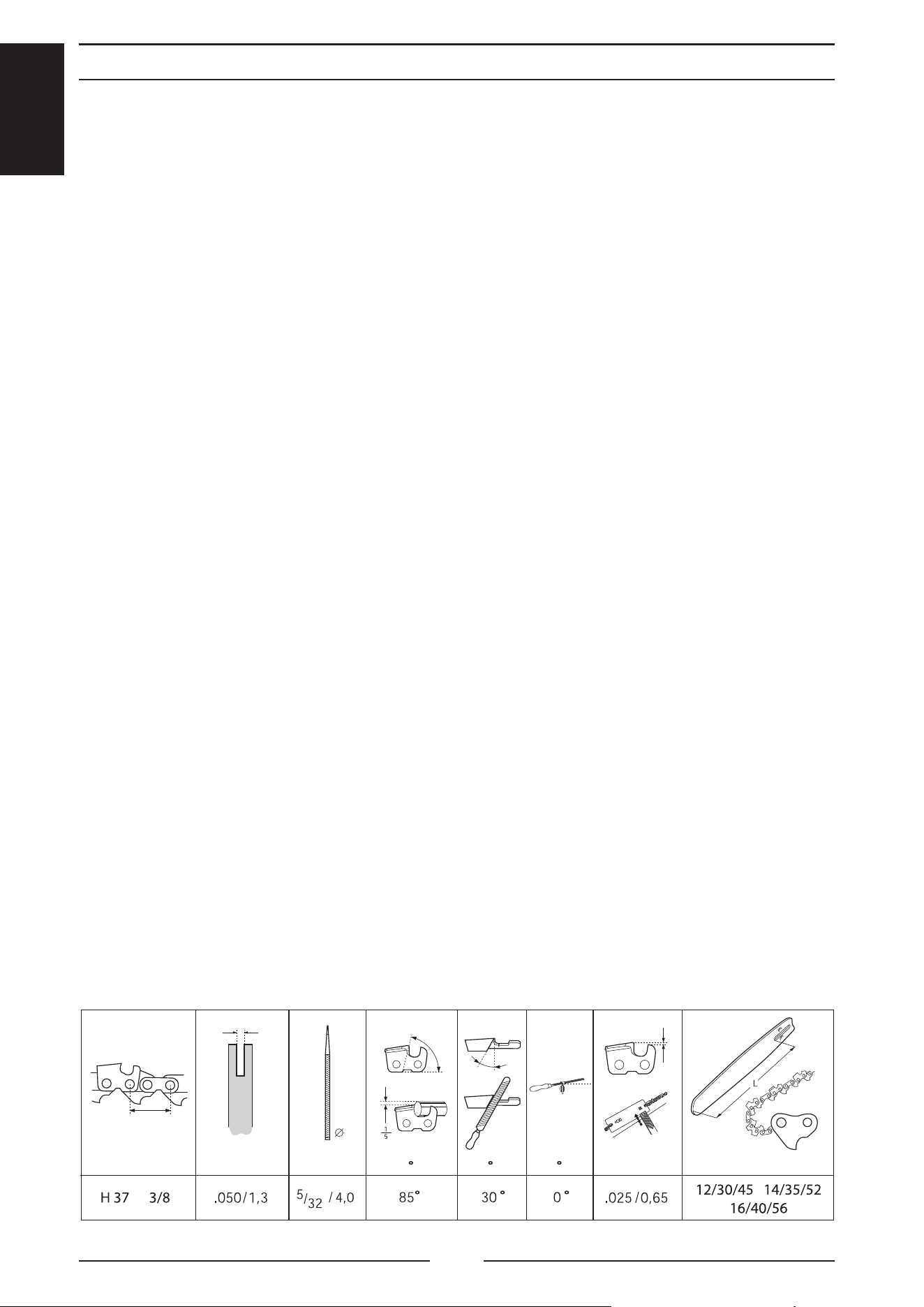
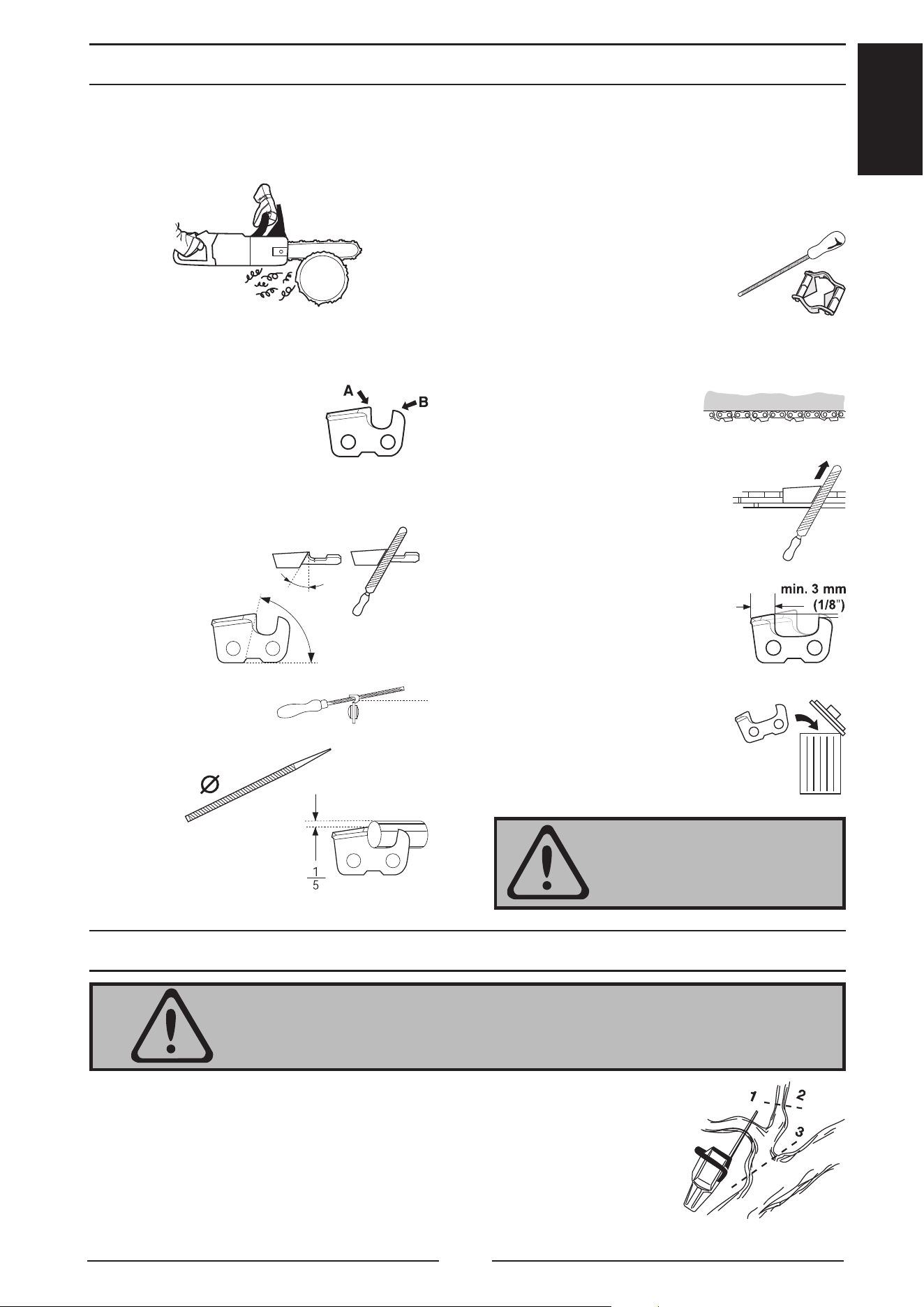
your chain. It is very diffi cult to fi le a chain saw correctly with-
out the proper aids. We recommend the use of a fi le guide to
ensure maximum cutting effi ciency with the least tendency to
kickback.
To fi le cutters correctly, a ROUND FILE and a FILE GUIDE are
required. Look under «Technical Specifi cations» for the cor-
rect fi le diameter and fi le guide for
your saw and chain.
• File only with the chain properly
tensioned. A loose chain wiggles,
making it diffi cult to fi le.
• Always fi le from the inside of
each cutter towards the outside.
Lift the fi le on the return stroke.
• File the cutters on one side fi rst.
Then turn the saw around and fi le
the cutters on the other side.
• Make certain that all cutters are of
equal length. When the horizontal
length is down to 3 mm (1/8”), the
chain is worn out and must be dis-
carded.
• Never cut wood using a dull chain. Having to press hard is a
sure sign of a dull chain, as are very small chips. A very dull
chain will produce sawdust rather than chips.
• A sharp chain will produce large chips, and the saw will
feed itself through the wood.
• The part of the chain that saws is called the CUTTING
LINK, which consists of a CUTTER
(A) and DEPTH GAUGE (B). The
difference in height between them
determines the depth of the cut.
• When fi ling a saw, pay close atten-
tion to:
TOP-PLATE ANGLE
CUTTING ANGLE
HORIZONTAL FILE ANGLE
FILE DIAMETER
FILE DEPTH
See «Technical Specifi cations» for the details which apply to
FILING CHAIN
CAUTION!
Improperly fi led cutters heighten kick-
back tendencies!
LIMBING
CAUTION!
Most kickback accidents take place when limbing. Pay very close attention to the
kickback danger zone when cutting limbs under tension!
All the principles which apply to crosscutting also apply when cutting thick branches.
Cut complicated branches in several stages.
Ensure that your footing is secure at all times, whether moving about or
standing in one place. Always work with the log to your right. For best control,
hold the chain saw as close to your body as possible.
ENGLISH
14
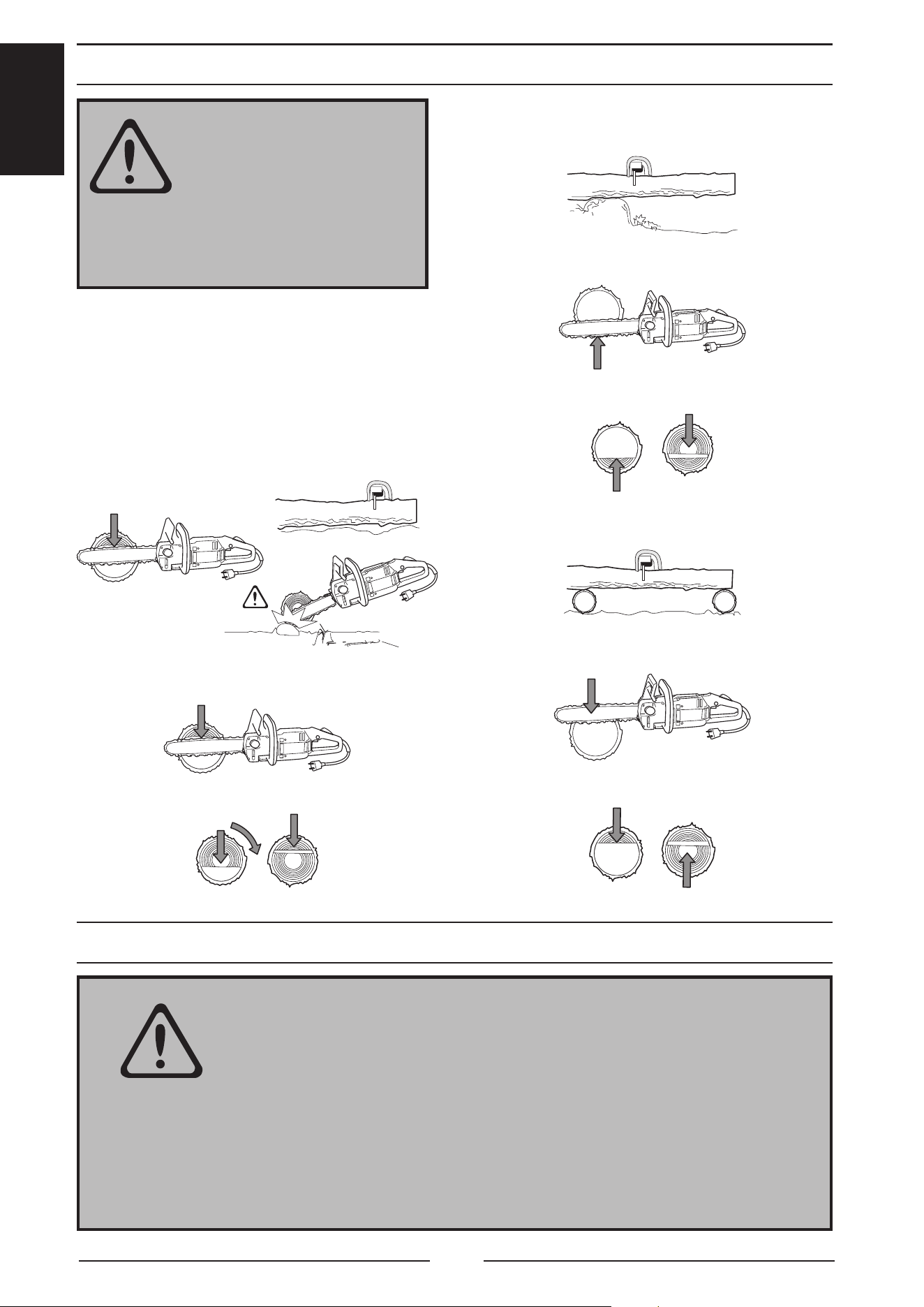
• Cutting a log supported at one end. The log is more than likely
to splinter if cut straight through from the top down.
- Make an initial cut from below (approx. 1/3 of the
diameter)
- Finish the cut from above.
• Cutting a log supported at both ends. The saw is more than
likely to jam in the kerf if cut straight through from above.
- Make an initial cut from the top (approx. 1/3 of the
diameter).
- Finish the cut from below.
• Cutting a log on the ground. There is little danger of the saw
jamming or the log splintering, but it is diffi cult to avoid running
the saw into the ground when breaking through at the end of
the cut.
Saw straight through the log. Be careful at the end of the
cut to avoid contact with the ground. Keep the saw run-
ning at full speed, but be prepared for the breakthrough.
- If it is possible to turn the log, stop cutting 2/3
of the way through the log.
- Turn the log and cut the remaining section from above.
CROSSCUTTING
CAUTION!
If the chain becomes stuck in the
kerf, STOP THE SAW!
Do not attempt to jerk the saw free.
You could be harmed by the chain
if the saw suddenly comes loose.
Lever the saw free instead.
FELLING OPERATIONS
CAUTION!
Felling a tree is a job which calls for experience. Do not attempt to fell trees if you are
inexperienced. DO NOT CARRY OUT ANY OPERATIONS FOR WHICH YOU DO NOT
FEEL QUALIFIED!
CAUTION!
Beginning chain saw operators should gain experience cutting logs on a sawhorse or
similar arrangement.
CAUTION!
We advise operators without suffi cient experience against felling trees with trunk
diameters exceeding their guide bar length.
ENGLISH
15
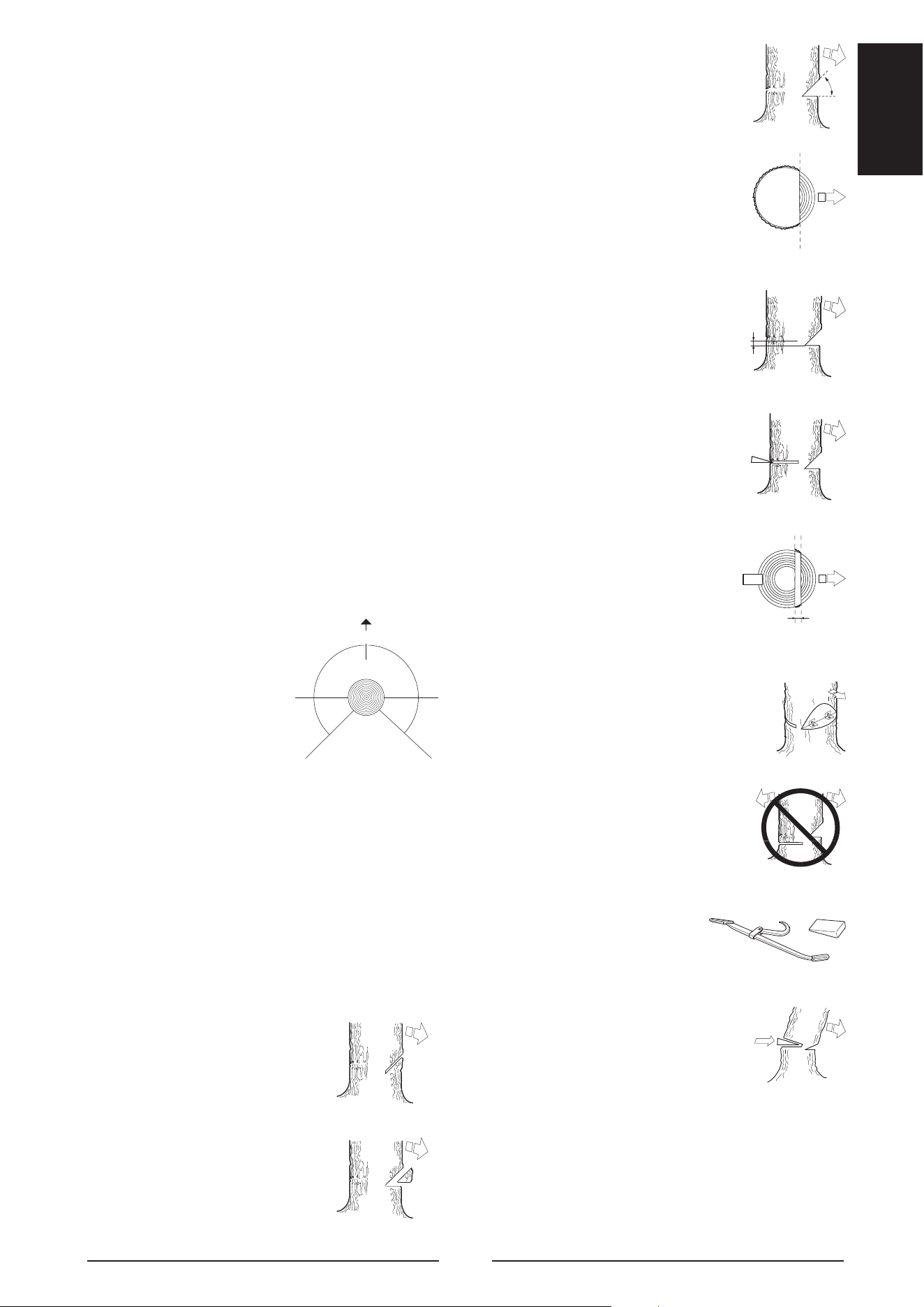
A danger zone surrounds the tree to a distance of
2 1/2 times the height of the tree. See to it that no one is
standing within this zone while you are felling the tree.
When felling a tree, one always aims to place it where neither
objects nor diffi cult terrain will hamper limbing and cutting.
Unobstructed movement and secure footing are essential.
It is also important to avoid lodging the tree against another
tree. A lodged tree is extremely dangerous.
After determining where you want the tree to fall, you must
also consider the likely unaided direction of fall. This is
affected by the straightness and lean of the tree, wind direc-
tion, concentration of branches and any snow that may weigh
the tree down.
After assessing all these factors, you may fi nd you have no
choice but to fell the tree in its natural direction of fall because
your preferred direction of fall is likely to fail.
Another important factor affecting your personal safety, though
it has no bearing on the direction of fall, is the presence of any
dead branches which could fall while you are felling the tree.
Remove any branches from around the base of the tree which
may interfere with your work. It is safest to work from the top
down and to keep the tree trunk
between you and the running chain.
Never cut branches above shoulder
height. Clear undergrowth around
the tree and identify your line of
retreat or escape, taking note of
any obstructions (stones, branch-
es, holes, etc.).Your line of retreat
should be at an angle, around 135°
behind the direction of fall.
Notch depth should be around 1/4 of the
diameter of the tree and the angle should
be around 45°.
The line defi ned by the inside angle of the
notch must be precisely horizontal and
at a precise right angle to the direction
of fall.
Felling cut
The felling cut is done from the opposite
side of the tree and must also be
horizontal. Stand with the tree to your left
and cut with the bottom of the guide bar
(pulling chain).
Place the FELLING CUT approximately
3-5 cm (1 1/2 - 2”) above the BOTTOM
NOTCH CUT.
Cut at full motor speed, feeding the
saw slowly into the tree. Watch out for
tree movement opposite to the intend-
ed direction of fall. Insert a WEDGE or
FELLING BAR in the FELLING CUT as
soon as the depth of the cut permits.
When complete, the FELLING CUT must
be parallel to the notch and leave a
strip of HINGE WOOD at least 1/10 the
diameter of the tree.
The HINGE WOOD acts as a hinge,
steering the direction of the falling tree.
If the HINGE WOOD is too small or has
been sawn through, or if the
notch and the felling cut are
mismatched, the tree is no
longer under control.
As the felling cut approaches the notch,
the tree should start falling, either by
itself or with the help of a WEDGE or
FELLING BAR.
Felling
Three cuts are made to fell a tree. The «TOP NOTCH CUT»
and the «BOTTOM» or «HORIZONTAL NOTCH CUT» forms
the «NOTCH», which determines the direction in which the
tree will fall. The fi nal cut is the «FELLING CUT», which allows
the tree to topple over.
Notch
To form the NOTCH, start with the TOP
NOTCH CUT. Using the bottom of the
guide bar (pulling chain), make a 45°
downward angled cut at right angles to
the intended direction of fall.
Next do the BOTTOM NOTCH CUT,
ensuring that it meets the bottom of the
TOP NOTCH CUT precisely.
Planned Direction of fall
Danger zone
Retreat Retreat
Danger zone



2012W40
Trøskenveien 36
P.O.B. 10
N - 1708 Sarpsborg
Norway
115 44 42-26 rev. 3
´®z+VL6¶6*¨
´®z+VL6¶6*¨