
日本語
EnglishDeutschFrançaisEspañol
Português
한국어
Русский
繁體中文
取扱説明書
Owner’s Manual
Bedienungsanleitung
Mode d’emploi
Manual de instrucciones
Manual do Proprietário
Руководство пользователя
使用说明书
사용설명서
使用說明書
简体中文
tenorvenova_140_ja_om_b1_0701.fm Page 1 Thursday, July 1, 2021 4:25 PM
Owner’s Manual
2
Introduction
Thank you for purchasing the Yamaha Tenor Venova™.
The Venova is a totally new type of wind instrument that offers expressiveness
of single reed instrument using a simple recorder-like fingering system. Com-
pared to conventional wind instruments, it offers easier maintenance and greater
durability. With its deeper bass sounds than the Alto Venova, the Tenor Venova
lets you enjoy performing music in a wonderfully new way.
For instruction on the proper assembly of the instrument, and how to keep the
instrument in optimum condition for as long as possible, we urge you to read this
Owner’s Manual thoroughly. After reading it, keep it in a safe place for future ref-
erence.
* This booklet contains notes on caring for and handling of the Tenor Venova.
Refer to the separate booklet “Let’s play Venova
™ !” for more information on how to
play the instrument.
Contents
Precautions................................................................................. 3
Nomenclature ............................................................................. 5
Before Playing............................................................................ 7
After Playing............................................................................... 8
Separately Sold Accessories.................................................... 9
* The Venova™ is a branched pipe wind instrument manufactured and sold by the
Yamaha Corporation. Venova™ and are trademarks or registered trade-
marks of the Yamaha Corporation.
Owner’s Manual
tenorvenova_140_en_om.book Page 2 Thursday, September 17, 2020 5:16 PM
Owner’s Manual
3
Precautions
PRECAUTIONS
PLEASE READ CAREFULLY BEFORE PROCEEDING
Keep this manual in a safe and handy place for future reference.
CAUTION
Always follow the basic precautions listed below to avoid the possibility of physical injury to you
or others, or damage to the instrument or other property. These precautions include, but are not
limited to, the following:
• Never throw the instrument at others or swing the instrument about. Doing so can injure
others and may result in a lost mouthpiece or other parts. Always handle the instrument
with care.
• Never sit or stand on the instrument or place heavy objects on it. Doing so can damage
the instrument and injure you and others.
• Do not swing the case. Doing so may result in accident or injury.
Yamaha cannot be held responsible for damage caused by improper use or modifications to the instrument, or data that is lost
or destroyed.
Handling caution
tenorvenova_140_en_om.book Page 3 Thursday, September 17, 2020 5:16 PM

Owner’s Manual
4
Notes on Using the Instrument
Follow the points listed below to prevent instrument malfunction and damage.
Notes on Handling the Instrument
• Do not expose the instrument to extremely high temperatures such as near a heater, or
direct sunlight (such as in a car during the day), and extremely low temperatures. Also,
do not expose to excessive dust or vibrations. Doing so can deform and/or deteriorate
the instrument hindering performance.
• Do not place objects made of vinyl, plastic, or rubber on top of the instrument. Doing so
can discolor and/or alter of the instrument.
• Generally, though most chemicals should not be used for cleaning (see below), rubbing
alcohol can be used, but only for lightly wiping the surface. Wipe thoroughly with a dry
polishing cloth so that no solution or water remains. Remaining solution or water could
result in surface discoloration or degradation of the instrument.
Notes on Caring for the Instrument
• When cleaning the instrument, use a soft and dry/slightly damp cloth.
• Never use paint thinners or other solvents, detergents, or chemically treated dust cloths
to clean the instrument. Doing so could result in discoloration and/or deterioration of the
instrument.
• Do not put the instrument in a dishwasher or in boiling water. Doing so could result in
deformation and/or deterioration, and could hinder proper performance of the instru-
ment.
Keeping the Instrument in Good Condition
Follow the instructions on proper care and handling below, to ensure that the instrument
will remain in optimum condition for a long time.
• Before assembling the instrument, use a cloth to remove any dust or foreign substance
from the joint section.
• After playing, remove moisture from inside the instrument.
• Inspect and clean the instrument regularly (page 8).
* The illustrations as shown in this manual are for instructional purposes only, and may appear
somewhat different from those on your instrument.
tenorvenova_140_en_om.book Page 4 Thursday, September 17, 2020 5:16 PM
Owner’s Manual
5
Nomenclature
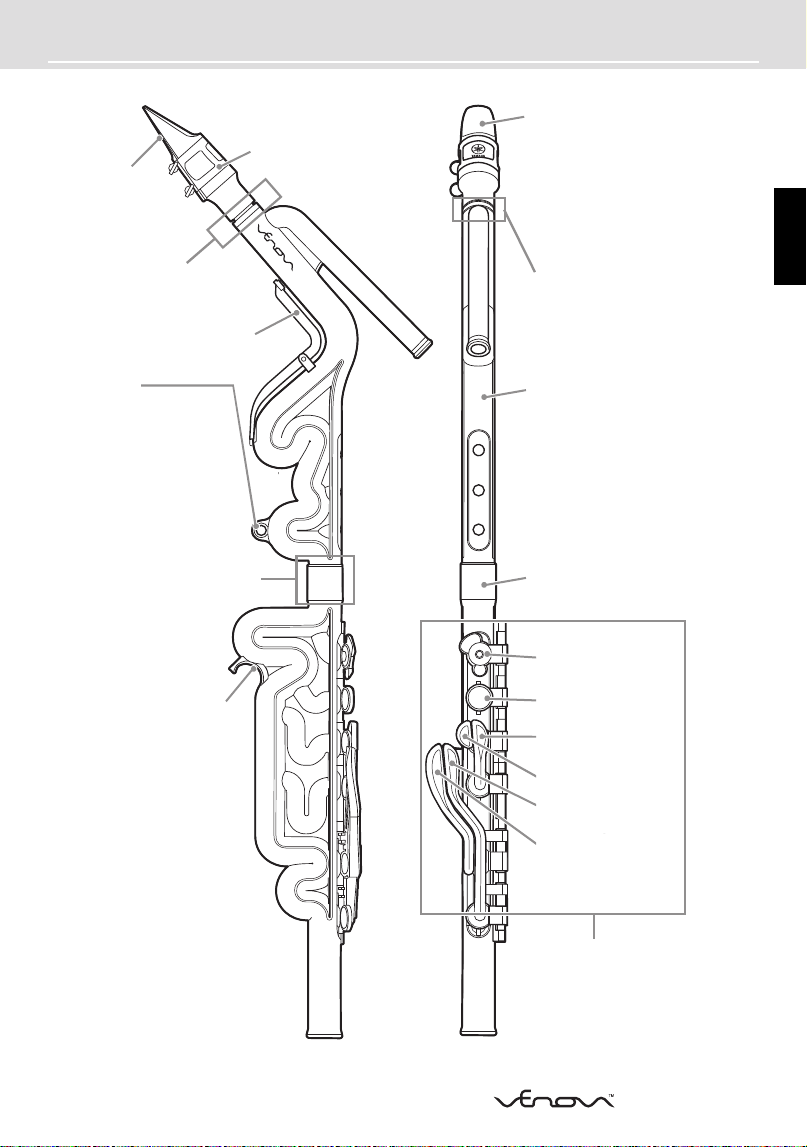
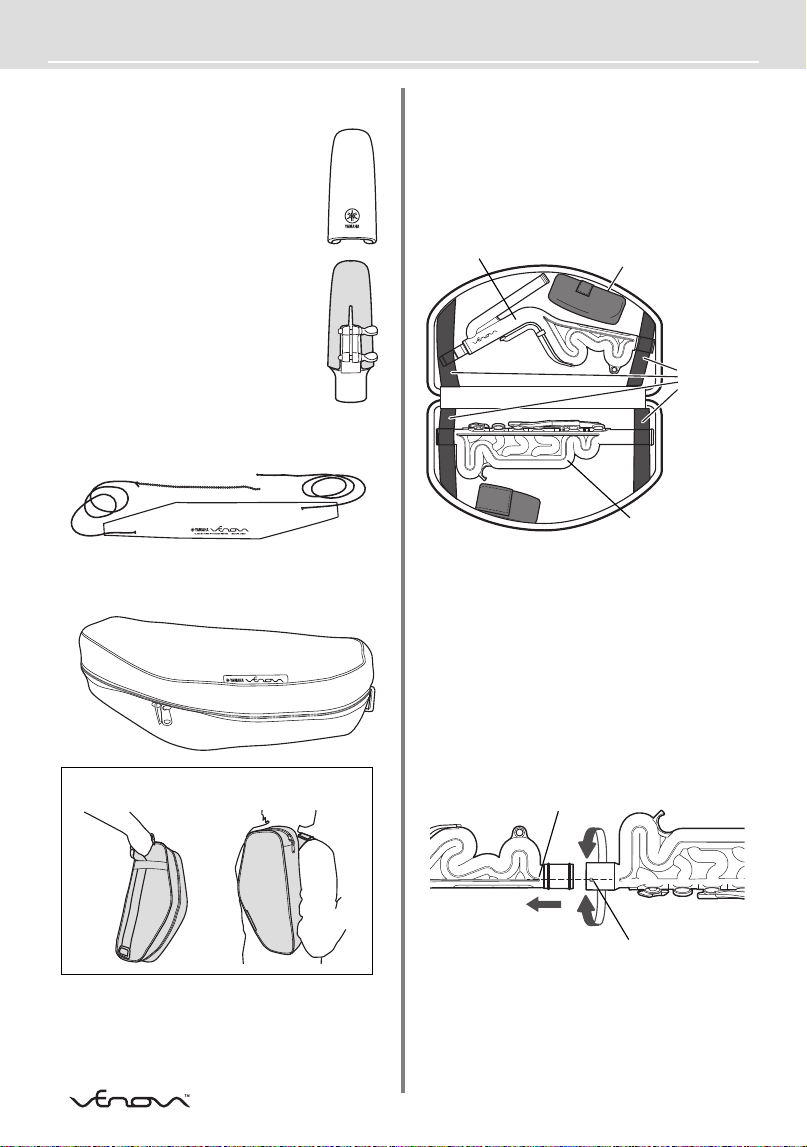
Reed
Upper body
Mouthpiece
The instrument is supplied
with a mouthpiece equivalent
to the Yamaha 4C.
Ligature
Hook hole
The hook hole can be
used for attaching a
string, etc., to temporarily
suspend the instrument
when not in use.
Main keys
Thumb hook
E key
D key
C key
Joint part
Joint part
F/F# key
C# key
D# key
Joint part
Lower body
Octave key
tenorvenova_140_en_om.book Page 5 Thursday, September 17, 2020 5:16 PM
Nomenclature
Owner’s Manual
6
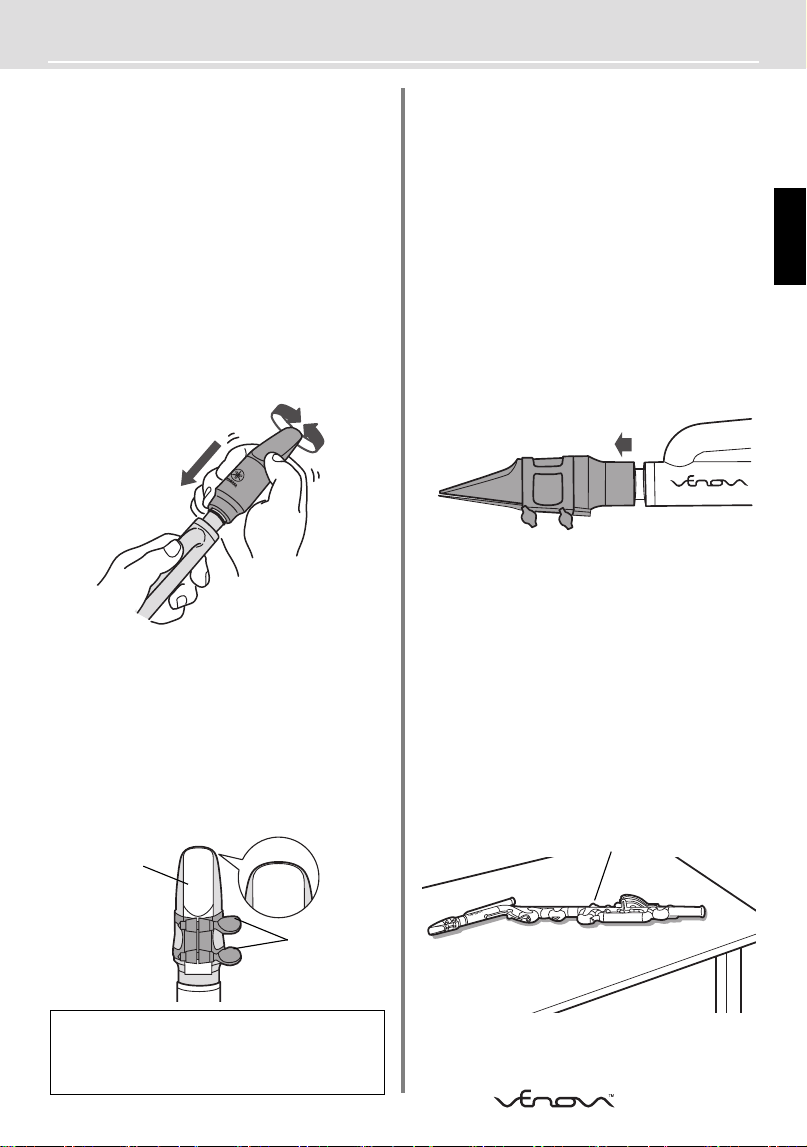
Accessories
• Mouthpiece cap ×1
• Since both the reed and
the mouthpiece may be
damaged easily, make
sure to cover them with
the mouthpiece cap when
storing the instrument or
any time it is not being
played.
• Special cleaning swab (with ball chain) ×1
• Special case ×1
• Owner’s Manual (this booklet) ×1
• “Let’s play Venova™ !” (separate booklet) ×1
Removing the Instrument from the
Case and Assembling
Remove the top and bottom of the body,
which is secured with rubber bands inside
the case.
The mouthpiece is stored in an inner
pocket.
Join the upper and lower bodies. Make
sure that the groove shape on the upper
body and the marking on lower body are
aligned.
Shoulder carriedHand carried
Rubber
band
Upper body
Inner pocket
Lower body
Groove shape
Upper body
Marking
Lower body
tenorvenova_140_en_om.book Page 6 Thursday, September 17, 2020 5:16 PM
Owner’s Manual
7
Before Playing
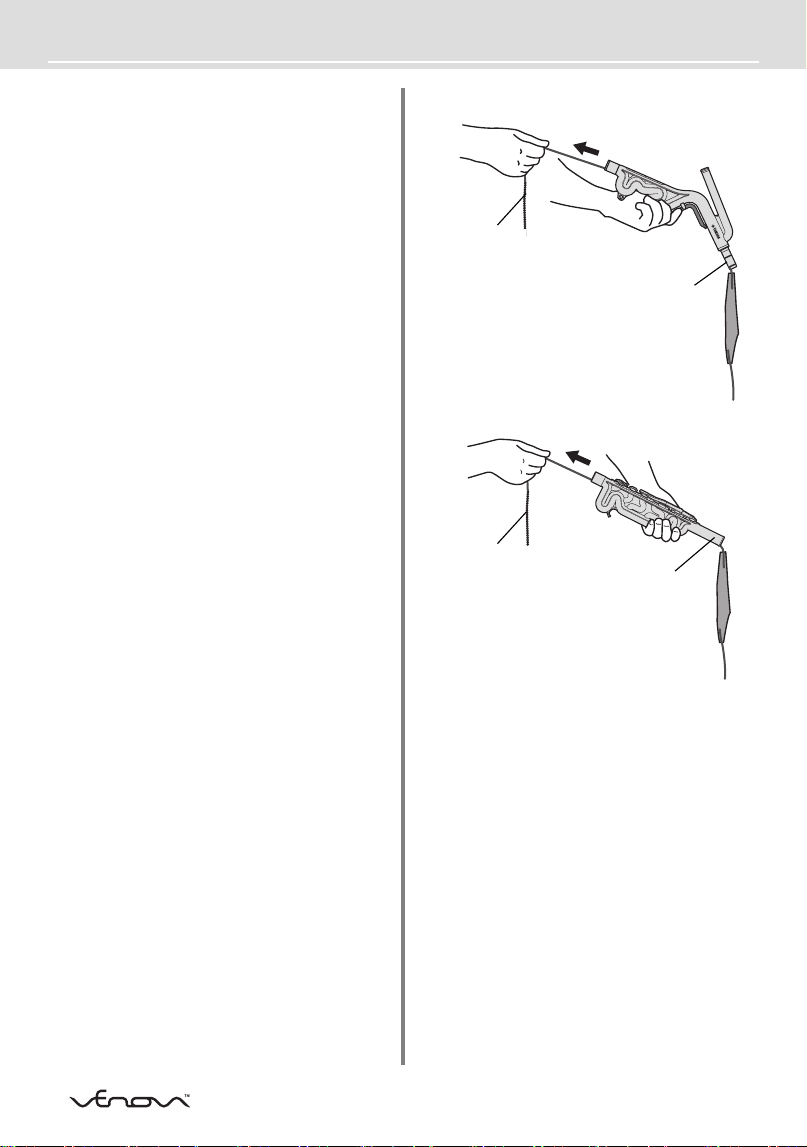
Attaching the Mouthpiece
Use a cloth to remove any dust or foreign
substance from the neck joint before
attaching the mouthpiece.
1 Grasp the mouthpiece firmly, and
twist it from side to side as you slide it
onto the neck joint until it stops at the
body.
• Twist and pull the mouthpiece from
side to side when you remove it.
Attaching or pulling the mouthpiece
straight could result in damage to the
rubber of the neck joint.
2 Slide the ligature onto the mouth-
piece from its tapered end.
3 Attach the reed onto the mouthpiece.
First, place the reed so that the top
edge of the mouthpiece is visible
over the end of the reed, and then
tighten the ligature screws (2) to
secure the reed.
About Tuning
If the instrument needs to be tuned to
another pitch, it can be tuned lower by
pulling the mouthpiece slightly away from
the body. Since the temperature of the
inside of the instrument affects the tuning
(particularly when cold), blow into the
instrument to warm it before tuning it.
• Take care not to pull the mouthpiece
too far out. Pulling too far can result
in poor pitch balance and make it dif-
ficult to play.
Laying the Instrument Down
When the instrument is not being played,
place it on a flat surface as shown in the
illustration below. Do not place the instru-
ment on a chair, music stand, or other
such unstable surfaces, as there is a risk
of the instrument falling. Also, never lean
the instrument up against a wall, etc.
For more detailed instructions on attaching
the reed, refer to the accompanying “Let’s
play Venova™ !” booklet.
Ligature
screws
Reed
Slide this out to lower the pitch
(but avoid sliding it out too far)
Place the instrument with the
keys facing up, to prevent them
from touching the surface.
tenorvenova_140_en_om.book Page 7 Thursday, September 17, 2020 5:16 PM
Owner’s Manual
8
After Playing
Instrument Maintenance after
Playing
After playing, always loosen the ligature
and remove the reed from the mouth-
piece then wipe dry with gauze. Remove
the ligature from the mouthpiece as well.
• Take care not to damage the end of
the mouthpiece.
Remove the mouthpiece from the instru-
ment and clean the inside of the mouth-
piece with a soft cloth.
• Turn and pull the mouthpiece from
side to side when you remove it.
Attaching or pulling the mouthpiece
straight could result in damage to the
rubber of the neck joint.
Before cleaning inside the instrument,
the body should be separated into two.
Clean the inside the instrument with the
supplied cleaning swab.
• To separate the body, twist the lower
body off the upper body. If you try to
separate them without twisting, the
rubber parts may break.
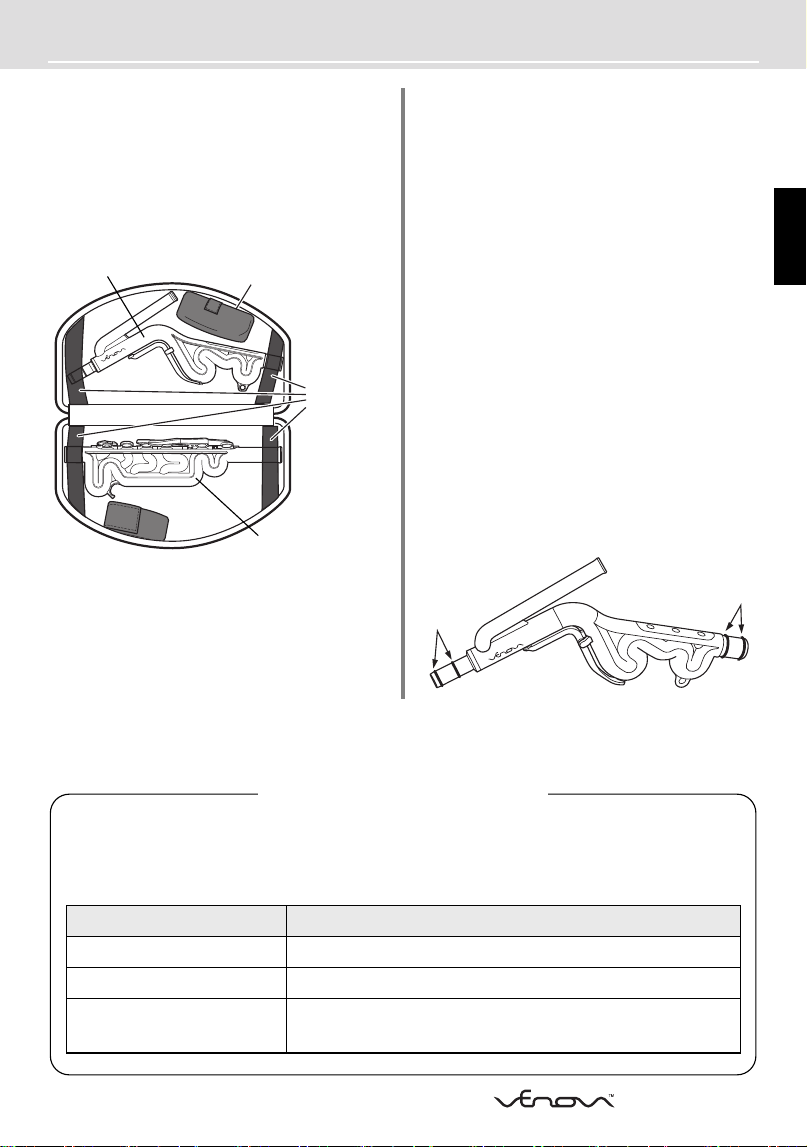
Using the Cleaning Swab
1 For the upper body, insert the end
of the ball chain from the neck joint.
For the lower body, insert the end of
the ball chain from the foot of the
instrument.
2 Gently shake the body so that the ball
chain comes out of the opposite end.
3 Pull on the ball chain gently so that the
cleaning swab can remove moisture
and dirt from the inside of the body.
• Pulling the cleaning swab too fast can
result in the swab becoming stuck in
the body.
• Always keep the cleaning swab clean
and dry.
4 Use a soft cloth to wipe off the joint
sections.
Use a soft cloth to wipe the instrument
surface. Take care to avoid applying
excessive force on the keys.
Both the mouthpiece and body are
washable. After washing, use a cleaning
swab or a soft cloth to thoroughly
remove moisture.
For the upper body
For the lower body
Chain
Chain
Neck joint
Foot of the
instrument
tenorvenova_140_en_om.book Page 8 Thursday, September 17, 2020 5:16 PM
After Playing
Owner’s Manual
9
Putting the Instrument in the Case
First, remove the mouthpiece from the
body, and then secure the body inside
the case with the rubber bands at the top
and bottom. The shape of the product is
shown in white on the inside of the case.
Store the mouthpiece in the inner pocket
(shown above).
Storage Precautions
Make sure that you wipe off any moisture,
grease, or foreign substance before put-
ting the instrument in the case. Also avoid
keeping the instrument in a location where
it may be exposed to extremely high or low
temperatures.
About the Reed
Replace the reed supplied with the instru-
ment with a new one if the tip becomes
damaged or it no longer vibrates well. In
addition to resin reeds, reeds made of
cane can also be used.
Rubber parts on joints
The rubber parts on joints may become
loose or broken depending on usage. If
this happens, replace them with new ones.
Rubber
band
Upper body
Inner pocket
Lower body
Separately Sold Accessories
Yamaha offers a wide variety of accessories to enrich your playing experience. Here is
a selection of accessories created especially for the Tenor Venova. Please give them a
try.
Part Name Features / Usage
Swab for Tenor Venova Best for cleaning and drying inside of the Venova.
Resin Reed for Tenor Venova
This is a resin reed for the Venova.
Mouthpiece Patch (M) Helps stabilize your embouchure and protect mouthpiece
wear from your teeth.
tenorvenova_140_en_om.book Page 9 Thursday, September 17, 2020 5:16 PM

JA EN DE FR ES PT RU ZH-CN ZH-TWKO
Manual Development Group
© 2021 Yamaha Corporation
Published 10/2021 2021年10月发行
POPI-B1
VEA1620
〒430-8650 静岡県浜松市中区中沢町10-1
10-1 Nakazawa-cho, Naka-ku,
Hamamatsu, 430-8650 Japan
tenorvenova_140_ja_om_b1_0701.fm Page 12 Thursday, July 1, 2021 4:25 PM