AMA15997 Printed in Europe
SB4B01(11)
6MVA6711-01
No reproduction in any form of this manual, in whole or in
part (except for brief quotation in critical articles or reviews),
may be made without written authorization from NIKON
CORPORATION.
Nikon User Support
Visit the site below to register your camera and keep up-to-date
with the latest product information. You will find answers to
frequently asked questions (FAQs) and can contact us for
technical assistance.
http://www.europe-nikon.com/support
DIGITAL CAMERA
User's Manual
En
Nikon Manual Viewer 2
Use the Nikon Manual Viewer 2 app to view
manuals anytime, anywhere on your
smartphone or tablet.

Getting the Most from Your Camera ........................................iii
About This Manual ....................................................................... iv
The Reference Manual.................................................................. v
For Your Safety..............................................................................vi
Notices............................................................................................ ix
Wireless ........................................................................................xiv
Introduction 1
Package Contents..........................................................................1
Parts of the Camera.......................................................................2
Using the Touch Screen..............................................................10
First Steps......................................................................................15
Taking and Viewing Photographs 22
Point-and-Shoot Photography (Auto Mode) .........................22
Viewing Photographs.........................................................................25
Deleting Pictures ..................................................................................27
Live Image Control...............................................................................29
Choosing a Creative Mode.........................................................31
Choosing a Mode That Matches the Subject or Situation.....32
Taking Photos in P, S, A, and M Modes ...........................................34
The Creative Palette ............................................................................39
HDR ...........................................................................................................40
Easy Panorama......................................................................................41
Selective Color.......................................................................................44
Cross Process .........................................................................................45
Recording and Viewing Movies 46
Recording Movies........................................................................46
Taking Photographs During Movie Recording..........................51
Viewing Movies.....................................................................................52
Deleting Movies....................................................................................53
Table of Contents

i
Other Shooting Modes 55
u Choosing the Moment (Best Moment Capture) ............... 55
Choosing a Shot Manually (Active Selection)............................ 55
Choosing Your Moment (Slow View)............................................ 59
Letting the Camera Choose the Moment (Smart Photo
Selector).............................................................................................. 61
z Combining Photos with Brief Movie Vignettes (Motion
Snapshot Mode).....................................................................65
Viewing Motion Snapshots.............................................................. 69
Deleting Motion Snapshots............................................................. 69
More on Photography 70
Continuous Mode........................................................................70
Self-Timer Modes ........................................................................72
The Built-in Flash......................................................................... 74
Auto Pop-up Modes............................................................................ 74
Manual Pop-up Modes ...................................................................... 76
Tap Shooting Options ................................................................ 80
Auto Mode ............................................................................................. 80
Creative Mode....................................................................................... 80
Advanced Movie Mode ..................................................................... 81
Wi-Fi 83
What Wi-Fi Can Do for You ........................................................83
Accessing the Camera ................................................................ 84
WPS (Android Only) ............................................................................ 85
PIN Entry (Android Only)................................................................... 86
SSID (Android and iOS)...................................................................... 87
Uploading Pictures to a Smart Device .................................... 89
Uploading Photos One at a Time................................................... 89
Uploading Multiple Selected Photos............................................ 90

ii
Menu Options 92
Playback Menu Options .............................................................92
Shooting Menu Options.............................................................93
Movie Menu Options ..................................................................94
Image Processing Menu Options..............................................95
Setup Menu Options...................................................................96
Connecting to a Computer 97
Installing the Supplied Software..............................................97
System Requirements.........................................................................98
Viewing and Editing Pictures on a Computer..................... 100
Transferring Pictures........................................................................ 100
Viewing Pictures ................................................................................ 102
Technical Notes 103
Optional Accessories ............................................................... 103
Approved Memory Cards ............................................................... 104
Storage and Cleaning .............................................................. 105
Storage.................................................................................................. 105
Cleaning................................................................................................ 105
Caring for the Camera and Battery: Cautions ..................... 106
Troubleshooting....................................................................... 110
Battery/Display................................................................................... 110
Shooting (All Modes) ....................................................................... 111
Movies ................................................................................................... 111
Tap Shooting Options ..................................................................... 112
Playback................................................................................................ 112
Wi-Fi (Wireless Networks)............................................................... 112
Miscellaneous..................................................................................... 112
Error Messages.......................................................................... 113
Specifications ............................................................................ 115
Nikon 1 J4 Digital Camera.............................................................. 115
Battery Life........................................................................................... 124
Index ........................................................................................... 125
Warranty Terms - Nikon Europe Service Warranty ............ 128
iii
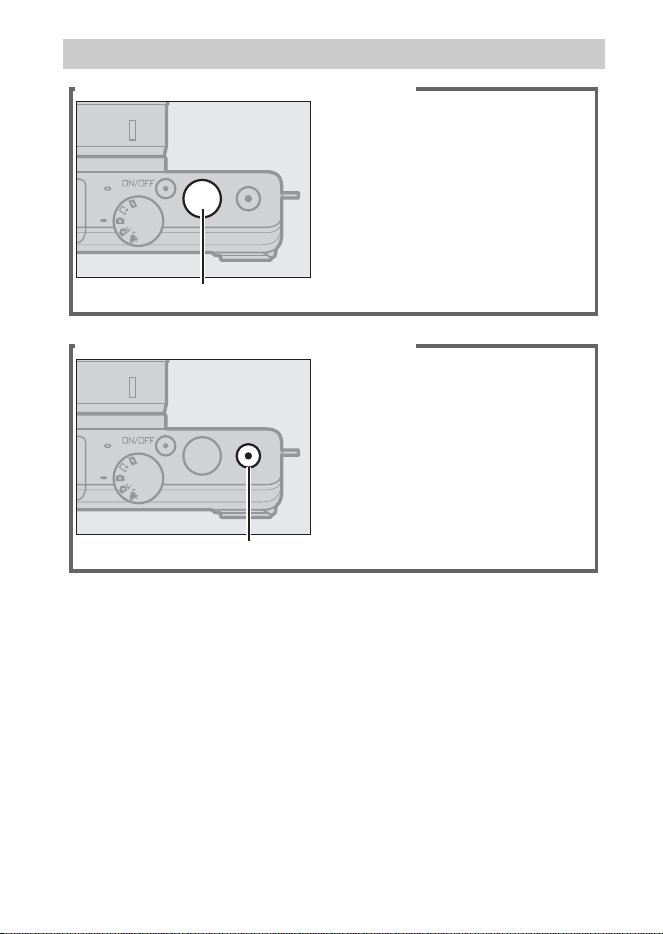
Getting the Most from Your Camera
Take photos with the shutter-release button.
See page 6 for more informa-
tion.
Shutter-release button
Shoot movies with the movie-record button.
Movies can be recorded by
pressing the movie-record but-
ton in auto (page 22), creative
(page 31), and advanced movie
(page 46) modes.
Movie-record button
iv
For a complete guide to using your digital camera, see the Refer-
ence Manual (page v). To get the most from your camera, please
be sure to read this User’s Manual thoroughly and keep it where
it will be read by all who use the product.
Camera Settings
The explanations in this manual assume that default settings are used.
Symbols and Conventions
To make it easier to find the information you need, the following sym-
bols and conventions are used:
The lens generally used in this manual for illustrative purposes is a
1 NIKKOR VR 10–30mm f/3.5–5.6 PD-ZOOM.
About This Manual
D
This icon marks cautions; information that should be read before
use to prevent damage to the camera.
A
This icon marks notes; information that should be read before
using the camera.
0
This icon marks references to other pages in this manual.
Nikon Manual Viewer 2
Install the Nikon Manual Viewer 2 app on your smartphone or
tablet to view Nikon digital camera manuals, anytime,
anywhere. Nikon Manual Viewer 2 can be downloaded free of
charge from the App Store and Google Play. Download of the
app and any product manuals requires an Internet
connection, for which fees may be levied by your phone or
Internet service provider.
A For Your Safety
Before using the camera for the first time, read the safety instructions in
“For Your Safety” (0 vi–viii) and “Caring for the Camera and Battery:
Cautions” (0 106).

v
For more information on using your Nikon camera, download a
pdf copy of the camera Reference Manual from the website listed
below. The Reference Manual can be viewed using Adobe Reader
or Adobe Acrobat Reader 5.0 or later.
1 On your computer, launch a web browser and open the Nikon
manual download site at http://nikonimglib.com/manual/
2 Navigate to the page for the desired product and download
the manual.
The Reference Manual

vi
To prevent damage to your Nikon product or injury to yourself or to others,
read the following safety precautions in their entirety before using this equip-
ment. Keep these safety instructions where all those who use the product will
read them.
The consequences that could result from failure to observe the precautions
listed in this section are indicated by the following symbol:
❚❚WARNINGS
For Your Safety
A
This icon marks warnings. To prevent possible injury, read all warn-
ings before using this Nikon product.
A
Keep the sun out of the frame. Keep the
sun well out of the frame when
shooting backlit subjects. Sunlight
focused into the camera when the
sun is in or close to the frame could
cause a fire.
A
Turn off immediately in the event of mal-
function. Should you notice smoke or
an unusual smell coming from the
equipment or AC adapter (available
separately), unplug the AC adapter
and remove the battery immediately,
taking care to avoid burns. Continued
operation could result in injury. After
removing the battery, take the equip-
ment to a Nikon-authorized service
center for inspection.
A
Do not use in the presence of flammable
gas. Do not use electronic equipment
in the presence of flammable gas, as
this could result in explosion or fire.
A
Keep dry. Do not immerse in or expose
to water or handle with wet hands.
Failure to keep the product dry could
result in damage to the product, fire,
or electric shock, while handling the
product with wet hands could result
in electric shock.
A
Do not disassemble. Touching the prod-
uct’s internal parts could result in
injury. In the event of malfunction,
the product should be repaired only
by a qualified technician. Should the
product break open as the result of a
fall or other accident, remove the bat-
tery and/or AC adapter and then take
the product to a Nikon-authorized
service center for inspection.
A
Keep out of reach of children. Failure to
observe this precaution could result
in injury. In addition, note that small
parts constitute a choking hazard.
Should a child swallow any part of
this equipment, consult a physician
immediately.
A
Do not place the strap around the neck of
an infant or child. Placing the camera
strap around the neck of an infant or
child could result in strangulation.

vii
A
Follow the instructions of airline and hos-
pital personnel. This camera transmits
radio frequencies that could interfere
with medical equipment or aircraft
navigation. Disable the wireless net-
work feature before boarding an air-
craft, and turn the camera off during
take off and landing. In medical facili-
ties, follow staff instructions regard-
ing the use of wireless devices.
A
Do not remain in contact with the camera,
battery, or charger for extended periods
while the devices are on or in use. Parts of
the device become hot. Leaving the
device in direct contact with the skin
for extended periods may result in
low-temperature burns.
A
Do not leave the product where it will be
exposed to extremely high temperatures,
such as in an enclosed automobile or in
direct sunlight. Failure to observe this
precaution could cause damage or
fire.
A
Do not aim the flash at the operator of a
motor vehicle. Failure to observe this
precaution could result in accidents.
A
Observe caution when using a flash.
• Using the camera with the flash in
close contact with the skin or other
objects could cause burns.
• Using a flash close to the subject’s
eyes could cause temporary visual
impairment. The flash should be no
less than one meter (3 ft 4 in.) from
the subject. Particular care should
be observed when photographing
infants.
A
Avoid contact with liquid crystal. Should
the display break, care should be
taken to avoid injury due to broken
glass and to prevent the liquid crystal
from the display touching the skin or
entering the eyes or mouth.
A
Do not carry tripods with a lens or camera
attached. You could trip or accidentally
strike others, resulting in injury.
A
Observe proper precautions when handling
batteries. Batteries may leak or
explode if improperly handled.
Observe the following precautions
when handling batteries for use in
this product:
• Use only batteries approved for use
in this equipment.
• Do not short or disassemble the
battery.
• Be sure the product is off before
replacing the battery. If you are
using an AC adapter, be sure it is
unplugged.
• Do not attempt to insert the battery
upside down or backwards.
• Do not expose the battery to flame
or to excessive heat.
• Do not immerse in or expose to
water.
• Replace the terminal cover when
transporting the battery. Do not
transport or store the battery with
metal objects such as necklaces or
hairpins.
• Batteries are prone to leakage when
fully discharged. To avoid damage
to the product, be sure to remove
the battery when no charge
remains.

viii
• When the battery is not in use,
attach the terminal cover and store
in a cool, dry place.
• The battery may be hot immedi-
ately after use or when the product
has been used on battery power for
an extended period. Before remov-
ing the battery turn the camera off
and allow the battery to cool.
• Discontinue use immediately
should you notice any changes in
the battery, such as discoloration or
deformation.
A
Observe proper precautions when handling
the charger:
• Keep dry. Failure to observe this pre-
caution could result in injury or
product malfunction due to fire or
electric shock.
• Do not short the charger terminals.
Failure to observe this precaution
could result in overheating and
damage to the charger.
• Dust on or near the metal parts of
the plug should be removed with a
dry cloth. Continued use could
result in fire.
• Do not go near the charger during
thunderstorms. Failure to observe
this precaution could result in elec-
tric shock.
• Do not handle the plug or charger
with wet hands. Failure to observe
this precaution could result in injury
or product malfunction due to fire
or electric shock.
• Do not use with travel converters or
adapters designed to convert from
one voltage to another or with DC-
to-AC inverters. Failure to observe
this precaution could damage the
product or cause overheating or fire.
A
Use appropriate cables. When connect-
ing cables to the input and output
jacks, use only the cables provided or
sold by Nikon for the purpose to
maintain compliance with product
regulations.
A
CD-ROMs: CD-ROMs containing soft-
ware or manuals should not be
played back on audio CD equipment.
Playing CD-ROMs on an audio CD
player could cause hearing loss or
damage the equipment.
ix
• No part of the manuals included
with this product may be repro-
duced, transmitted, transcribed,
stored in a retrieval system, or trans-
lated into any language in any form,
by any means, without Nikon’s prior
written permission.
• Nikon reserves the right to change
the specifications of the hardware
and software described in these
manuals at any time and without
prior notice.
• Nikon will not be held liable for any
damages resulting from the use of
this product.
• While every effort has been made to
ensure that the information in these
manuals is accurate and complete,
we would appreciate it were you to
bring any errors or omissions to the
attention of the Nikon representa-
tive in your area (address provided
separately).
Notice for Customers in Canada
CAN ICES-3 B / NMB-3 B
Notice for Customers in Europe
This symbol indicates that
electrical and electronic
equipment is to be col-
lected separately.
The following apply only to
users in European countries:
• This product is designated for sepa-
rate collection at an appropriate col-
lection point. Do not dispose of as
household waste.
• Separate collection and recycling
helps conserve natural resources
and prevent negative consequences
for human health and the environ-
ment that might result from incor-
rect disposal.
• For more information, contact the
retailer or the local authorities in
charge of waste management.
This symbol on the battery
indicates that the battery is
to be collected separately.
The following apply only to
users in European countries:
• All batteries, whether marked with
this symbol or not, are designated
for separate collection at an appro-
priate collection point. Do not dis-
pose of as household waste.
• For more information, contact the
retailer or the local authorities in
charge of waste management.
Notices
CAUTION: RISK OF EXPLOSION IF BATTERY IS REPLACED BY AN INCORRECT
TYPE. DISPOSE OF USED BATTERIES ACCORDING TO THE INSTRUCTIONS.
x
Notice for Customers in the U.S.A.
Federal Communications Commission (FCC) Radio Frequency Interference Statement
This equipment has been tested and
found to comply with the limits for a
Class B digital device, pursuant to Part
15 of the FCC rules. These limits are
designed to provide reasonable pro-
tection against harmful interference in
a residential installation. This equip-
ment generates, uses, and can radiate
radio frequency energy and, if not
installed and used in accordance with
the instructions, may cause harmful
interference to radio communications.
However, there is no guarantee that
interference will not occur in a particu-
lar installation. If this equipment does
cause harmful interference to radio or
television reception, which can be
determined by turning the equipment
off and on, the user is encouraged to
try to correct the interference by one
or more of the following measures:
• Reorient or relocate the receiving
antenna.
• Increase the separation between the
equipment and receiver.
• Connect the equipment into an out-
let on a circuit different from that to
which the receiver is connected.
• Consult the dealer or an experienced
radio/television technician for help.
CAUTIONS
Modifications
The FCC requires the user be notified
that any changes or modifications
made to this device that are not
expressly approved by Nikon Corpo-
ration may void the user’s authority to
operate the equipment.
Interface Cables
Use the interface cables sold or pro-
vided by Nikon for your equipment.
Using other interface cables may
exceed the limits of Class B Part 15 of
the FCC rules.
Notice for Customers in the State of California
WARNING: Handling the cord on this
product may expose you to lead, a
chemical known to the State of Cali-
fornia to cause birth defects or other
reproductive harm. Wash hands after
handling.
Nikon Inc., 1300 Walt Whitman Road,
Melville, New York 11747-3064, U.S.A.
Tel.: 631-547-4200
The Battery Charger
IMPORTANT SAFETY INSTRUCTIONS—SAVE THESE
INSTRUCTIONS
DANGER—TO REDUCE THE RISK OF FIRE OR ELECTRIC
SHOCK, CAREFULLY FOLLOW THESE INSTRUCTIONS
For connection to a supply not in the U.S.A., use an attachment plug adapter
of the proper configuration for the power outlet if needed. This power unit
is intended to be correctly oriented in a vertical or floor mount position.

xi
Notice Concerning Prohibition of Copying or Reproduction
Note that simply being in possession of material that has been digitally cop-
ied or reproduced by means of a scanner, digital camera, or other device may
be punishable by law.
• Items prohibited by law from being copied
or reproduced
Do not copy or reproduce paper
money, coins, securities, govern-
ment bonds, or local government
bonds, even if such copies or repro-
ductions are stamped “Sample.”
The copying or reproduction of
paper money, coins, or securities
which are circulated in a foreign
country is prohibited.
Unless the prior permission of the
government has been obtained, the
copying or reproduction of unused
postage stamps or post cards issued
by the government is prohibited.
The copying or reproduction of
stamps issued by the government
and of certified documents stipu-
lated by law is prohibited.
• Cautions on certain copies and reproduc-
tions
The government has issued cautions
on copies or reproductions of securi-
ties issued by private companies
(shares, bills, checks, gift certificates,
etc.), commuter passes, or coupon
tickets, except when a minimum of
necessary copies are to be provided
for business use by a company. Also,
do not copy or reproduce passports
issued by the government, licenses
issued by public agencies and pri-
vate groups, ID cards, and tickets,
such as passes and meal coupons.
• Comply with copyright notices
The copying or reproduction of
copyrighted creative works such as
books, music, paintings, woodcuts,
prints, maps, drawings, movies, and
photographs is governed by
national and international copyright
laws. Do not use this product for the
purpose of making illegal copies or
to infringe copyright laws.
Disposing of Data Storage Devices
Please note that deleting images or formatting memory cards or other data
storage devices does not completely erase the original image data. Deleted
files can sometimes be recovered from discarded storage devices using com-
mercially available software, potentially resulting in the malicious use of per-
sonal image data. Ensuring the privacy of such data is the user’s responsibility.
Before discarding a data storage device or transferring ownership to another
person, erase all data using commercial deletion software, or format the
device and then completely refill it with images containing no private infor-
mation (for example, pictures of empty sky). Wi-Fi settings can be reset to
default values by selecting Wi-Fi > Wi-Fi connection type > Reset Wi-Fi set-
tings in the setup menu. Care should be taken to avoid injury when physically
destroying data storage devices.
xii
AVC Patent Portfolio License
THIS PRODUCT IS LICENSED UNDER THE AVC PATENT PORTFOLIO LICENSE FOR THE PERSONAL
AND NON-COMMERCIAL USE OF A CONSUMER TO (I) ENCODE VIDEO IN COMPLIANCE WITH
THE
AVC STANDARD (“AVC VIDEO”) AND/OR (II) DECODE AVC VIDEO THAT WAS ENCODED
BY
A CONSUMER ENGAGED IN A PERSONAL AND NON-COMMERCIAL ACTIVITY AND/OR WAS
OBTAINED FROM A VIDEO PROVIDER LICENSED TO PROVIDE AVC VIDEO. NO LICENSE IS
GRANTED OR SHALL BE IMPLIED FOR ANY OTHER USE. ADDITIONAL INFORMATION MAY BE
OBTAINED FROM MPEG LA, L.L.C. SEE http://www.mpegla.com
Temperature Warnings
The camera may become warm to the touch during use; this is normal and
does not indicate a malfunction. At high ambient temperatures, after
extended periods of continuous use, or after several photographs have been
taken in quick succession, a temperature warning may be displayed, follow-
ing which the camera will turn off automatically to minimize damage to its
internal circuits. Wait for the camera to cool before resuming use.
Use Only Nikon Brand Electronic Accessories
Nikon cameras are designed to the highest standards and include complex
electronic circuitry. Only Nikon brand electronic accessories (including charg-
ers, batteries, AC adapters, and lens accessories) certified by Nikon specifically
for use with this Nikon digital camera are engineered and proven to operate
within the operational and safety requirements of this electronic circuitry.
The use of non-Nikon electronic accessories could damage the
camera and may void your Nikon warranty. The use of third-
party rechargeable Li-ion batteries not bearing the Nikon holo-
graphic seal shown at right could interfere with normal operation of the cam-
era or result in the batteries overheating, igniting, rupturing, or leaking.
For more information about Nikon brand accessories, contact a local autho-
rized Nikon dealer.

xiii
D
Use Only Nikon Brand Accessories
Only Nikon brand accessories certified by Nikon specifically for use
with your Nikon digital camera are engineered and proven to operate
within its operational and safety requirements. T
HE USE OF NON-NIKON
ACCESSORIES
COULD DAMAGE YOUR CAMERA AND MAY VOID YOUR NIKON WAR-
RANTY.
D
Servicing the Camera and Accessories
The camera is a precision device and requires regular servicing. Nikon
recommends that the camera be inspected by the original retailer or a
Nikon-authorized service representative once every one to two years,
and that it be serviced once every three to five years (note that fees
apply to these services). Frequent inspection and servicing are particu-
larly recommended if the camera is used professionally. Any accesso-
ries regularly used with the camera, such as lenses, should be included
when the camera is inspected or serviced.
A
Before Taking Important Pictures
Before taking pictures on important occasions (such as at weddings or
before taking the camera on a trip), take a test shot to ensure that the
camera is functioning normally. Nikon will not be held liable for dam-
ages or lost profits that may result from product malfunction.
A
Life-Long Learning
As part of Nikon’s “Life-Long Learning” commitment to ongoing prod-
uct support and education, continually-updated information is avail-
able on-line at the following sites:
• For users in the U.S.A.: http://www.nikonusa.com/
• For users in Europe and Africa: http://www.europe-nikon.com/support/
• For users in Asia, Oceania, and the Middle East: http://www.nikon-asia.com/
Visit these sites to keep up-to-date with the latest product information,
tips, answers to frequently-asked questions (FAQs), and general advice
on digital imaging and photography. Additional information may be
available from the Nikon representative in your area. For contact infor-
mation, visit http://imaging.nikon.com/

xiv
This product, which contains encryption software developed in the United
States, is controlled by the United States Export Administration Regulations
and may not be exported or re-exported to any country to which the United
States embargoes goods.
The following countries are currently subject to
embargo: Cuba, Iran, North Korea, Sudan, and Syria.
Notices for Customers in the U. S. A.
This device complies with Part 15 of the FCC Rules. Operation is subject to the
following two conditions: (1) this device may not cause harmful interference,
and (2) this device must accept any interference received, including interfer-
ence that may cause undesired operation.
FCC WARNING
The FCC requires the user to be notified that any changes or modifications
made to this device that are not expressly approved by Nikon Corporation
may void the user’s authority to operate the equipment.
FCC Radio Frequency Interference Statement
Note: This equipment has been tested and found to comply with the limits for
a Class B digital device, pursuant to part 15 of the FCC Rules.
These limits are
designed to provide reasonable protection against harmful interference in a
residential installation.
This equipment generates, uses and can radiate radio
frequency energy and, if not installed and used in accordance with the
instructions, may cause harmful interference to radio communications.
How-
ever, there is no guarantee that interference will not occur in a particular
installation.
If this equipment does cause harmful interference to radio or
television reception, which can be determined by turning the equipment off
and on, the user is encouraged to try to correct the interference by one or
more of the following measures:
• Reorient or relocate the receiving antenna.
• Increase the separation between the equipment and receiver.
• Connect the equipment into an outlet on a circuit different from that to
which the receiver is connected.
• Consult the dealer or an experienced radio/TV technician for help.
Co-location
This transmitter must not be co-located or operated in conjunction with any
other antenna or transmitter.
Nikon Inc., 1300 Walt Whitman Road, Melville, New York 11747-3064, U.S.A.
Tel.: 631-547-4200
Wireless

xv
Notices for Customers in Canada
CAN ICES-3 B / NMB-3 B
This device complies with Industry Canada licence-exempt RSS standard(s).
Operation is subject to the following two conditions: (1) this device may not
cause interference, and (2) this device must accept any interference, includ-
ing interference that may cause undesired operation of the device.
FCC/IC RF Exposure Statement
The available scientific evidence does not show that any health problems are
associated with using low power wireless devices.
There is no proof, however,
that these low power wireless devices are absolutely safe.
Low power Wire-
less devices emit low levels of radio frequency energy (RF) in the microwave
range while being used.
Whereas high levels of RF can produce health effects
(by heating tissue), exposure of low-level RF that does not produce heating
effects causes no known adverse health effects.
Many studies of low-level RF
exposures have not found any biological effects.
Some studies have sug-
gested that some biological effects might occur, but such findings have not
been confirmed by additional research.
The 1 J4, which is equipped with a
LBWA1ZZYM6 (FCC ID:VPYLBYM / IC ID:772C-LBYM) wireless LAN module, has
been tested and found to comply with FCC/IC radiation exposure limits set
forth for an uncontrolled environment and meets the FCC radio frequency
(RF) Exposure Guidelines in Supplement C to OET65 and RSS-102 of the IC
radio frequency (RF) Exposure rules.
Please refer to the SAR test report that
was uploaded to FCC website.
xvi
Notices for Customers in Europe
Hereby, Nikon Corporation, declares that the 1 J4 is in compliance
with the essential requirements and other relevant provisions of
Directive 1999/5/EC.
The declaration of conformity may be
consulted at http://imaging.nikon.com/support/pdf/DoC_1J4.pdf
Notice for Customers in Singapore
This device complies with radio-frequency regulations. The content of certifi-
cation labels not affixed to the device is given below.
Security
Although one of the benefits of this product is that it allows others to freely
connect for the wireless exchange of data anywhere within its range, the fol-
lowing may occur if security is not enabled:
• Data theft: Malicious third-parties may intercept wireless transmissions to
steal user IDs, passwords, and other personal information.
• Unauthorized access: Unauthorized users may gain access to the network
and alter data or perform other malicious actions. Note that due the design
of wireless networks, specialized attacks may allow unauthorized access
even when security is enabled.
Trade Name:
Model: 1 J4
Complies with
IDA Standards
DA104328
1
s
s
Introduction
Confirm that the package contains the following items:
Memory cards are sold separately.
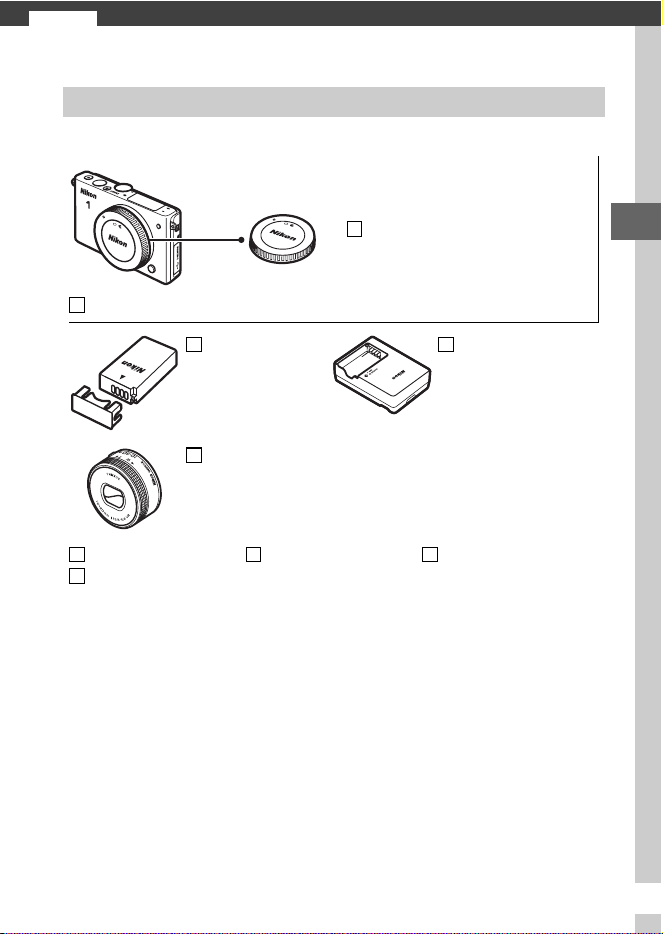
Package Contents
BF-N1000 body cap
Nikon 1 J4 digital camera
EN-EL22
rechargeable
Li-ion battery
(with terminal cover)
MH-29 battery
charger (AC wall
adapter supplied in
countries or regions where
required; shape depends
on country of sale)
Lens (supplied only
if lens kit is
purchased with
camera)
AN-N1000 strap
UC-E20 USB cable
ViewNX 2 CD User’s Manual
(this manual)
2
s
Take a few moments to familiarize yourself with camera controls
and displays. You may find it helpful to bookmark this section
and refer to it as you read through the rest of the manual.
The Camera Body
Parts of the Camera
31 2 54
7
9
6
5
14
15
16
13 1112
17
8
18
10
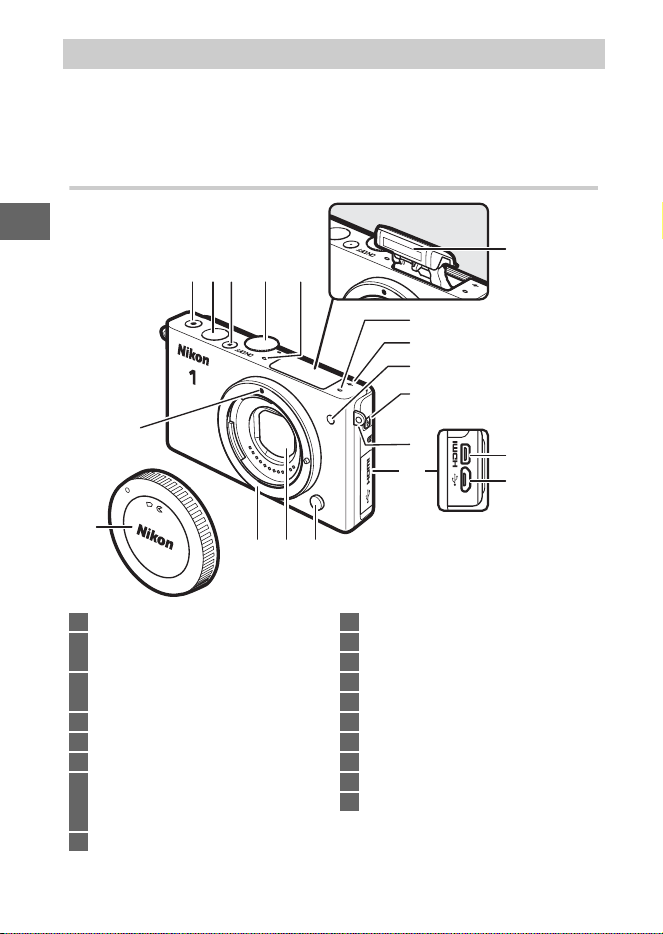
1 Movie-record button .................. 46, 47
2 Shutter-release
button ..............................51, 57, 62, 66
3 Power switch........................................19
Power lamp ..........................................19
4 Mode dial ................................................ 6
5 Microphone
6 Focal plane mark (E)
7 AF-assist illuminator
Self-timer lamp....................................73
Red-eye reduction lamp ............ 75, 77
8 Flash pop-up button ..........................76
9 Eyelet for camera strap......................15
10 Connector cover
11 Lens release button............................18
12 Dust shield.................................105, 106
13 Lens mount ..........................................17
14 Mounting mark ...................................17
15 Body cap .............................................103
16 Built-in flash .........................................74
17 HDMI connector
18 USB connector...................................100
3
s
The Camera Body (Continued)
* Camera does not support TA-N100 tripod mounting spacer.
2
1
1011
3
4
5
7
6
8
9
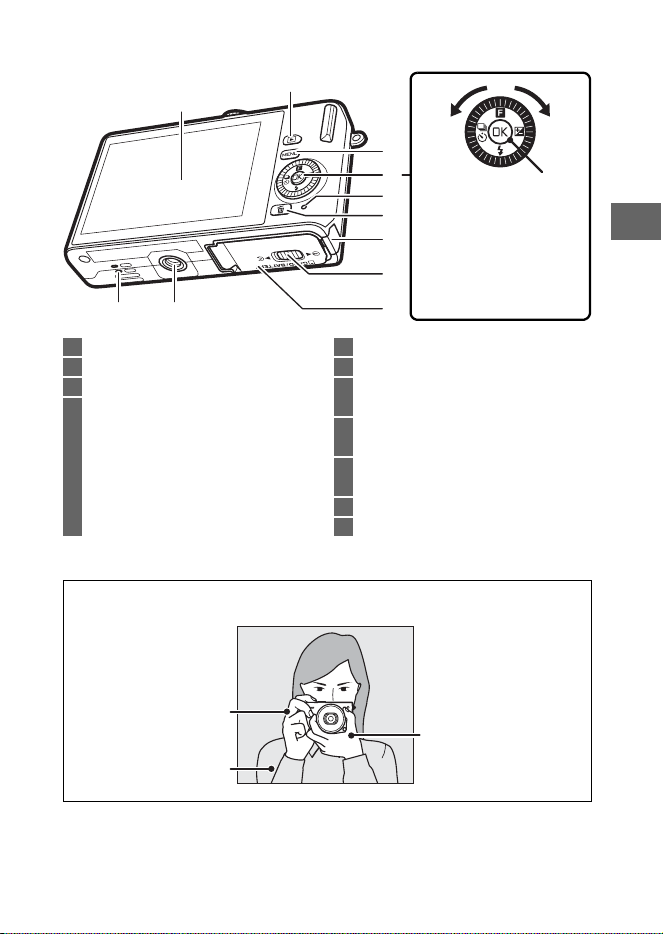
J button
Press the multi selector
up, down, left, or right
(1,3, 4, or 2), or
rotate it as shown
above.
1 Monitor ................................................... 4
2 K (playback) button ............25, 63, 69
3 G (menu) button .......................... 7
4 Multi selector
J (OK) button
& (feature) ............................................. 9
E (exposure compensation)
M (flash mode).....................................74
C (continuous shooting/
self-timer)..................................... 70, 72
5 Memory card access lamp................ 24
6 O (delete) button................................ 27
7 Power connector cover
for optional power connector
8 Battery-chamber/memory card slot
cover latch...........................................16
9 Battery-chamber/
memory card slot cover................... 16
10 Tripod socket
*
11 Speaker
A
Holding the Camera
When framing photographs, hold the camera as shown below.
Hold the camera in
your right hand.
Keep your elbows
propped lightly
against your torso.
Cradle the lens with
your left hand.
4
s
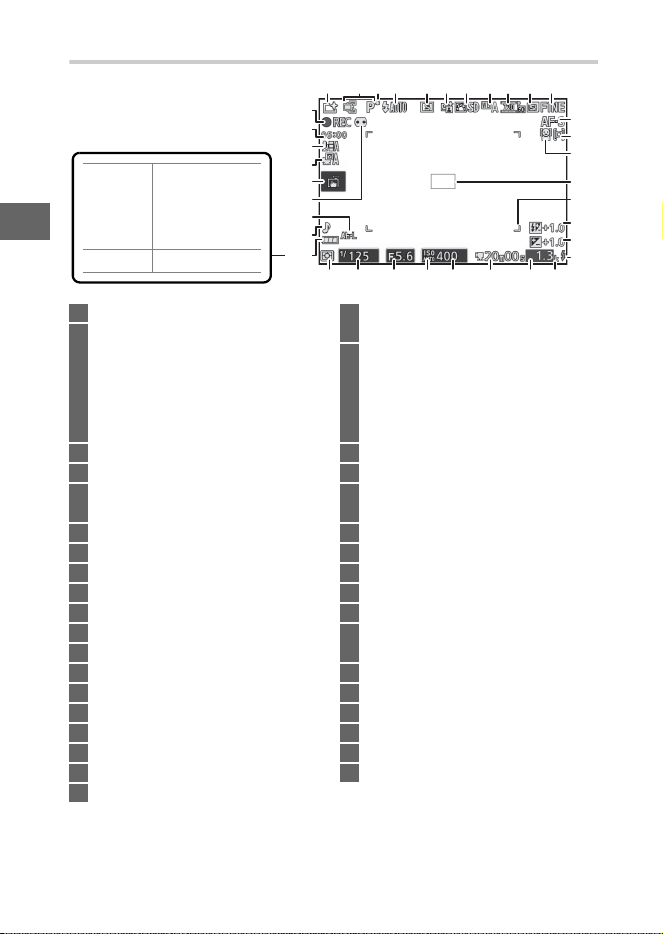
The Monitor
* Available only when Detailed is selected for Display > Shooting in the
setup menu (0 96).
Note: Display shown with all indicators lit for illustrative purposes.
421 3 5 6 7 8 9 1011
29
28
33
17
12
13
14
18
21
27 222325 2426 20
15
16
19
30
34
32
31
35
36
NO ICON
Battery fully
charged or
partially
discharged.
H Low battery.
1 Shooting mode ..................................... 6
2 Live image control..............................29
Creative mode ....................................31
Best moment capture
selection ................................ 55, 59, 61
Advanced movie selection ........ 46, 49
Exposure mode ...................................93
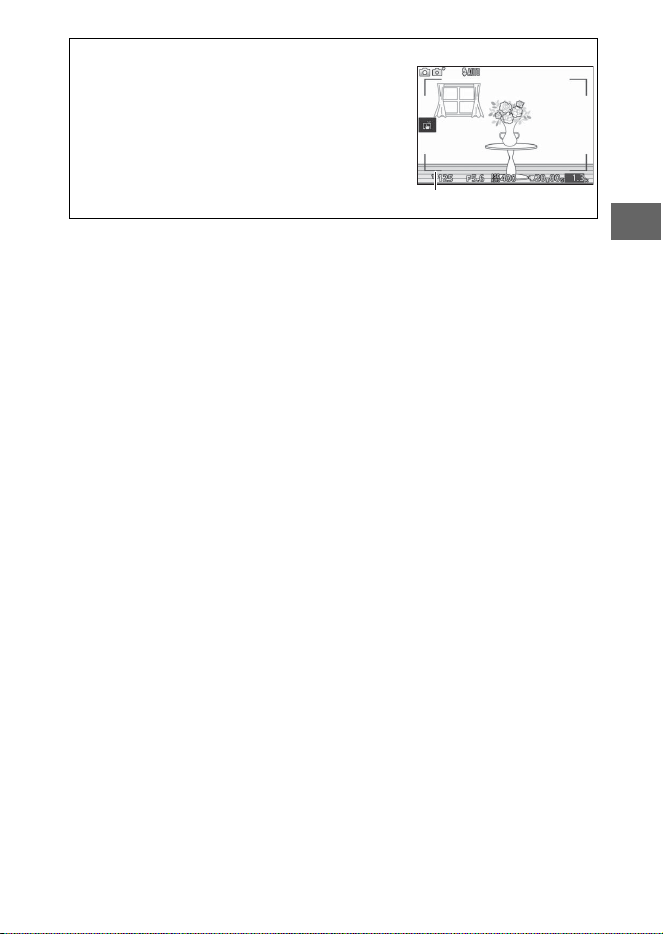
3 Flexible program indicator...............34
4 Flash mode.................................... 75, 77
5 Self-timer ..............................................72
Continuous mode
*
.............................70
6 Active D-Lighting
*
.............................94
7 Picture Control
*
..................................95
8 White balance
*
...................................95
9 Frame size/frame rate........................95
10 Image size
*
..........................................93
11 Image quality
*
....................................93
12 Focus mode
*
................................. 94, 95
13 AF-area mode
*
............................. 94, 95
14 Face-priority
*
................................ 28, 94
15 Focus area............................... 24, 94, 95
16 AF-area brackets
*
17 Flash compensation ...........................94
18 Exposure compensation
19 Flash-ready indicator ........................ 78
20 “k” (appears when memory remains
for over 1000 exposures)
21 Number of exposures remaining....21
Number of shots remaining before
memory buffer fills
White balance recording indicator
Card warning indicator....................113
22 Time available......................................47
23 ISO sensitivity ......................................95
24 ISO sensitivity indicator.....................95
Auto ISO sensitivity indicator
25 Aperture......................................... 36, 37
26 Shutter speed ............................... 35, 37
27 Metering ........................................ 94, 95
28 Battery indicator
*
29 Sound settings
*
..................................96
30 Autoexposure (AE) lock
indicator .............................................. 96
31 Auto distortion control...................... 94
32 Tap shooting options.........................80
33 Auto image capture ...........................95
34 Microphone sensitivity
*
35 Time elapsed........................................47
36 Recording indicator............................ 47
6
s
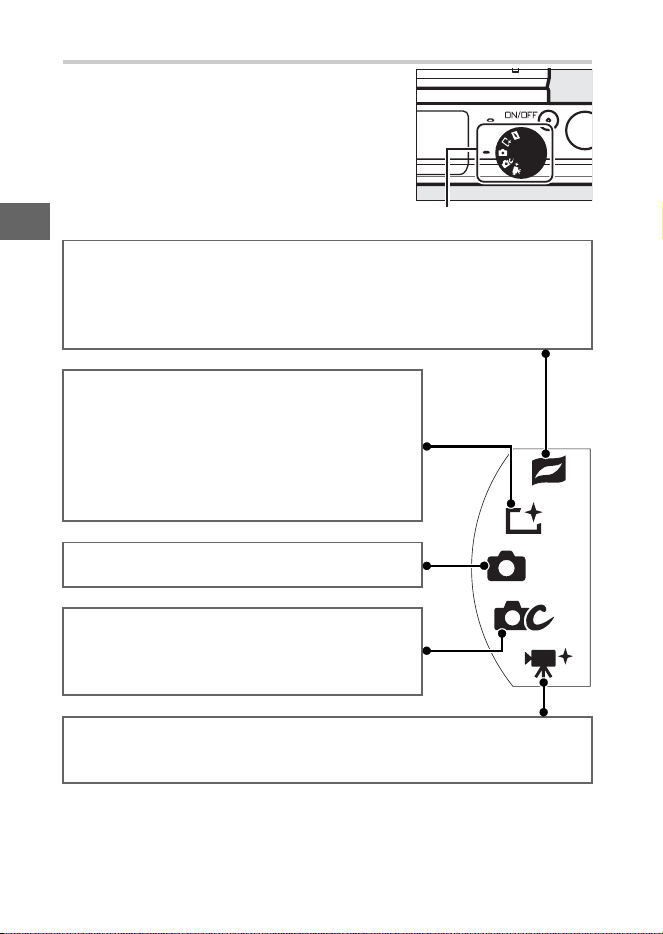
The Mode Dial
The camera offers a choice of the follow-
ing shooting modes:
Mode dial
z Motion Snapshot mode (0 65): Each time the shutter is released, the
camera records a still image and about 1.6 s of movie footage. When the
resulting “Motion Snapshot” is viewed on the camera, the movie will
play back in slow motion over approximately 4 s, followed by the still
image.
u Best moment capture mode (0 55): Choose
Active Selection to select the best picture from
20 shots in temporary storage, Slow view to
choose the best timing for the shot while the
scene plays back in slow motion, or Smart
Photo Selector to let the camera pick the best
shot based on composition and movement.
C Auto mode (0 22): Let the camera pick the set-
tings for photographs and movies.
w Creative mode (0 31): For photographs in
which you want to use special effects, match set-
tings to the scene, or control shutter speed and
aperture.
v Advanced movie mode (0 46): Choose an exposure mode and adjust
shutter-speed or aperture or record movies in slow or fast motion or
with other special effects.
7
s
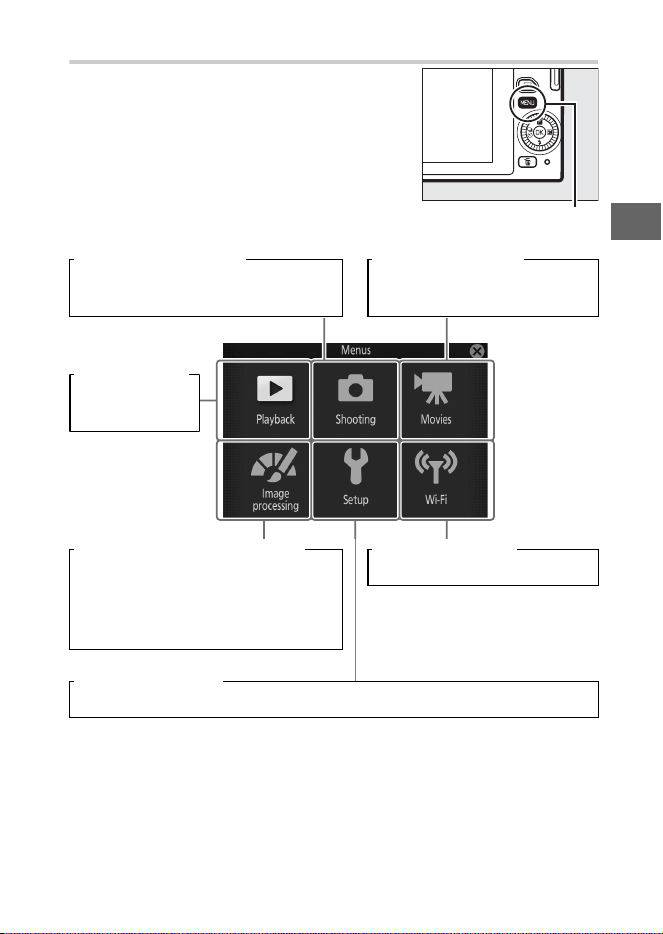
The G Button
Most shooting, playback, and setup
options can be accessed from the camera
menus. Press the G button to display
the menu selection dialog shown below,
then use the multi selector to highlight
the icon for the desired menu and press
J. To exit the menus, tap 1.
G button
Shooting menu (0 93): Movie menu (0 94):
Adjust settings for still photography. Adjust movie-recording
options.
Image processing menu (0 95): Wi-Fi menu (0 83):
Adjust white balance, ISO sensitivity,
Picture Controls, and other image
processing settings for photographs
and movies.
Connect to wireless networks.
Setup menu (0 96):
Adjust basic camera settings.
Playback menu
(0 92):
Adjust playback
settings.
8
s
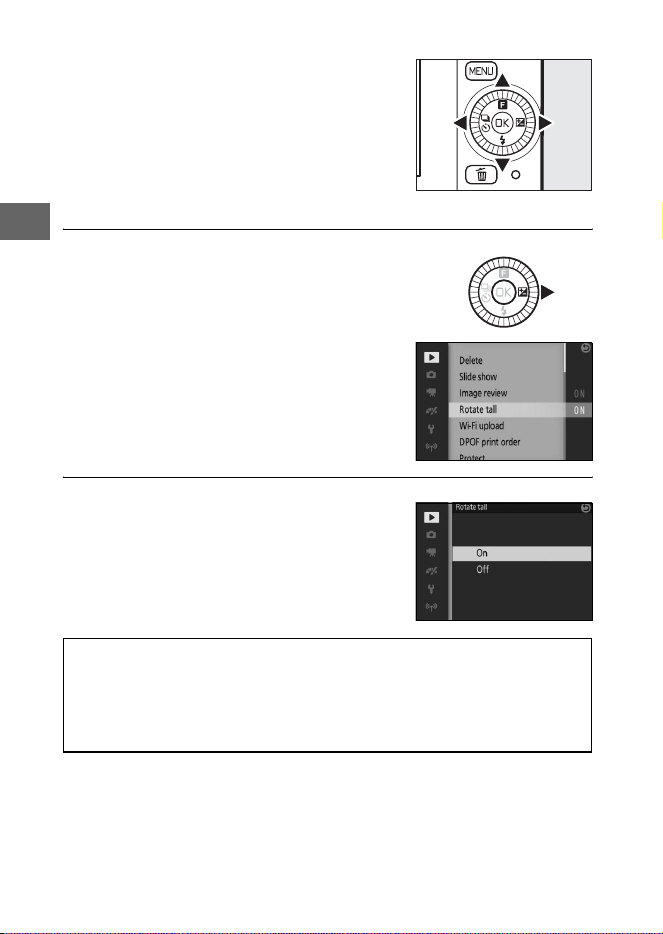
❚❚ Using the Menus
1
Select an item.
2
Select an option.
Use the multi selector (0 3) to navigate
the playback, shooting, movie, image
processing, setup, and Wi-Fi menus.
Multi selector
Press 1 or 3 to highlight menu items
and press 2 to view options for the
highlighted item.
Press 1 or 3 to highlight the desired
option and press J to select.
A
Using the Menus
The items listed may vary with camera settings. Items displayed in gray
are not currently available. To change menus, press 4 in Step 1 and
select a menu as described on page 7. To exit the menus and return to
shooting mode, press the shutter-release button halfway (0 24).
9
s
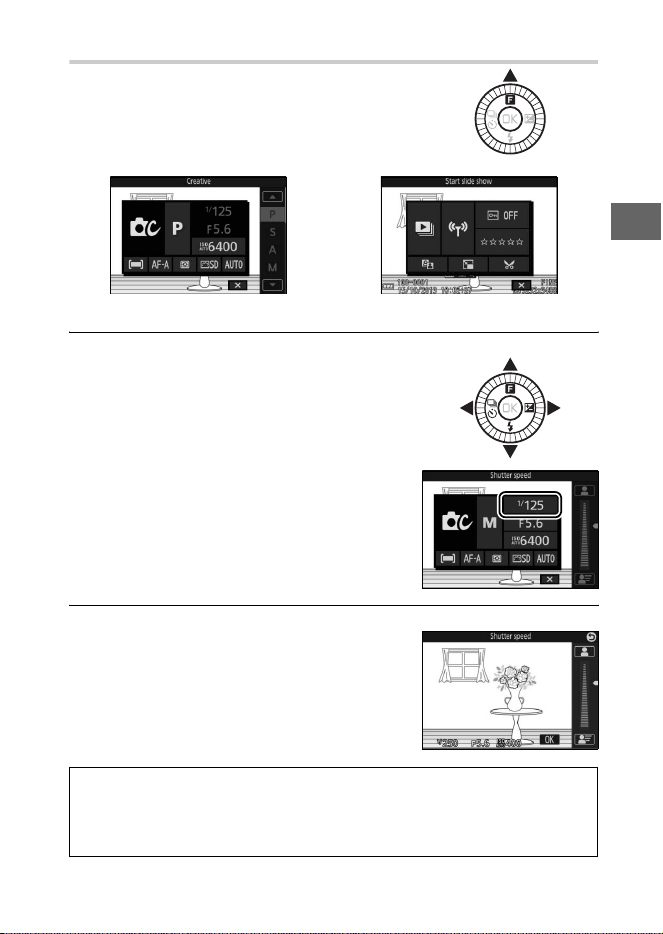
The & (Feature) Menu
1
Select an item.
2
Select an option.
To display the feature menu and adjust
camera settings or access playback
options, press & (feature) on the multi
selector.
& menu (shooting mode) & menu (playback)
Use the multi selector to highlight an
item and press J to display options
(to exit the & menu, press the shutter-
release button halfway as described
on page 24 or highlight 1 and press
J).
Highlight the desired option or value
and press J to select.
A
The & Menu
The & menu is context-sensitive: its contents vary with camera settings
or the type of image displayed; options that are currently unavailable
are shown in gray. The & menu is not available in auto mode.
10
s
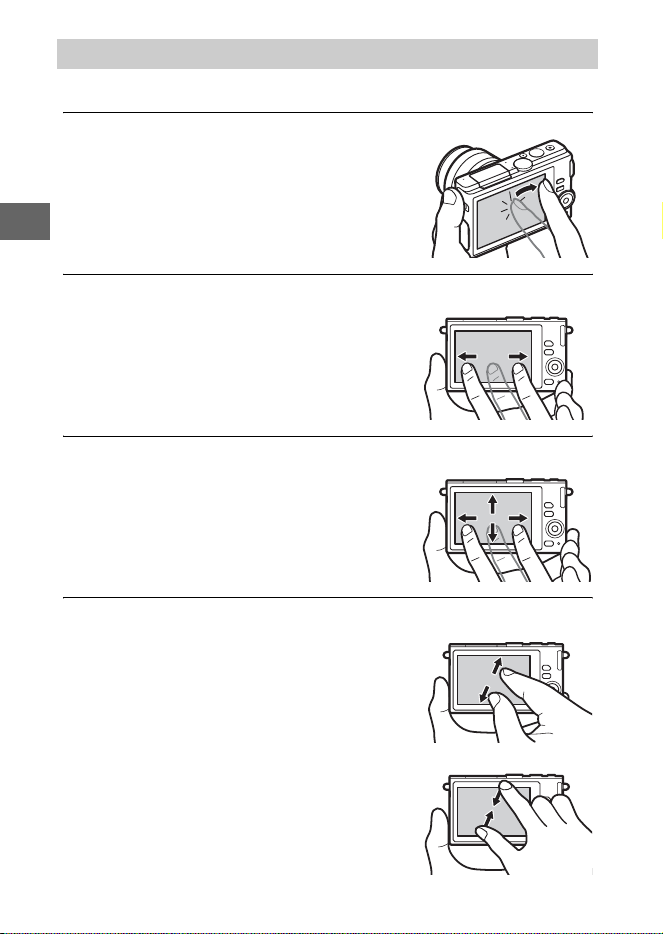
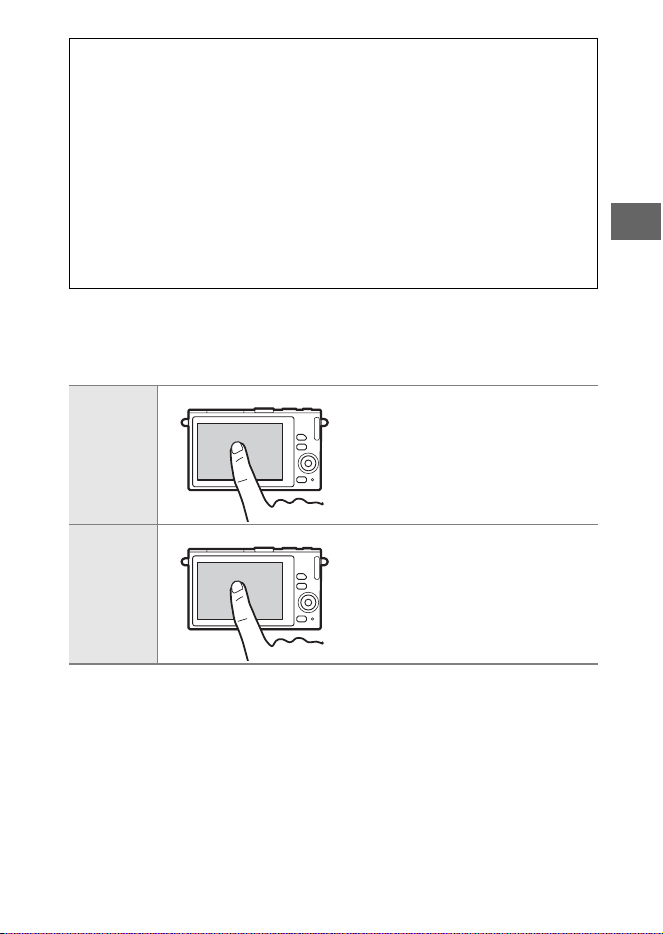
The touch-sensitive monitor supports the following operations:
Tap
Flick
Slide
Stretch/Pinch
Using the Touch Screen
Tap the monitor.
Flick a finger a short distance across the
monitor.
Slide a finger over the monitor.
Place two fingers on the monitor and
move them apart or pinch them together.
11
s
❚❚ Taking Pictures
The touch screen can be used for the following shooting opera-
tions.
A
The Touch Screen
The touch screen responds to static electricity and may not respond
when covered with third-party protective films or when touched with
fingernails or gloved hands. Do not use excessive force or touch the
screen with sharp objects.
A
Using the Touch Screen
The camera may not recognize a tap if you leave your finger on the
screen too long. It may not recognize other gestures if your touch is too
soft, your fingers are moved too quickly or too short a distance or do
not remain in contact with the screen, or if the movement of the two
fingers in a pinch or stretch is not correctly coordinated.
Take a
picture (tap
shooting)
In auto and creative modes, you
can focus and take a picture by
tapping your subject in the dis-
play.
Focus (tap
shooting)
In advanced movie mode, you
can focus by tapping your subject
in the display.
12
s
❚❚ Viewing Pictures
The touch screen can be used for the following playback opera-
tions.
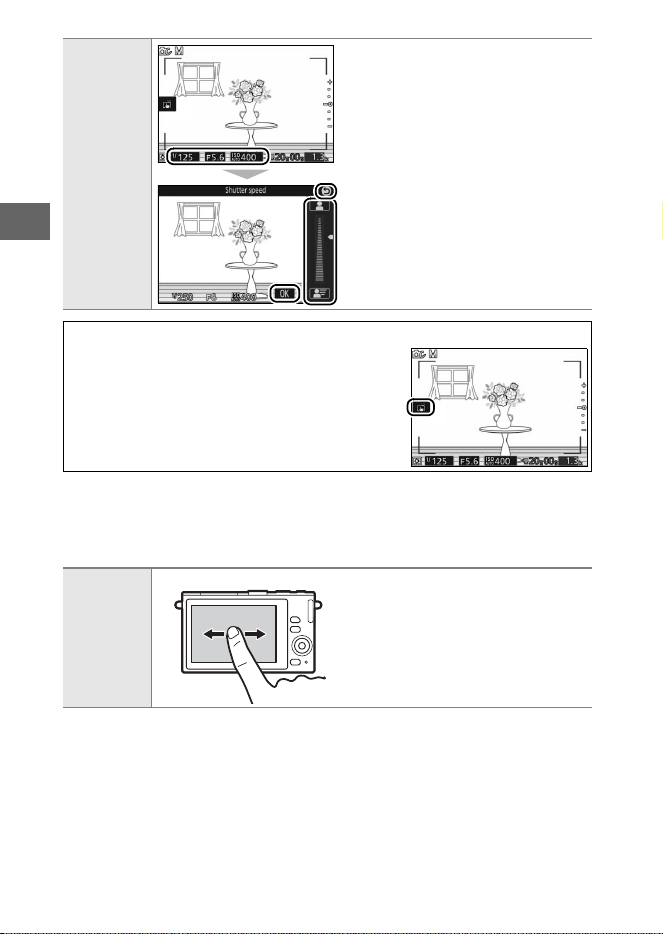
Adjust
settings
Tap highlighted icons to view set-
tings and tap icons or sliders to
change (the items available vary
with camera settings). Tap 0 to
save changes and exit, or tap 2 to
return to the previous display.
A
Tap Shooting Options
Tap shooting options can be adjusted by
tapping the icon shown at right (0 80).
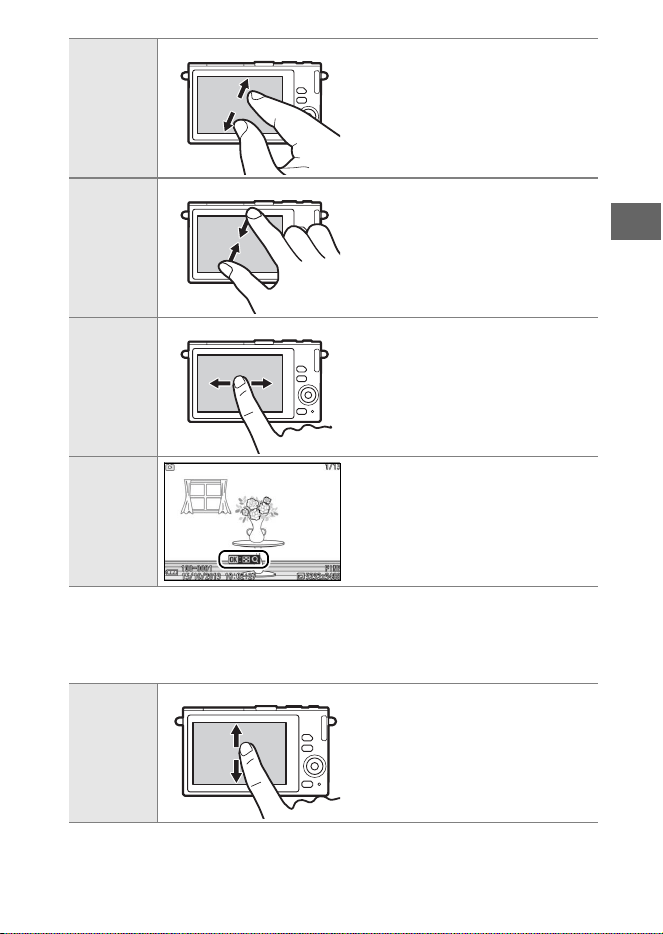
View other
images
Flick left or right to view other
images.
13
s
❚❚ Using the Menus
The touch screen can be used for the following menu opera-
tions.
Zoom in
Use stretch and pinch gestures to
zoom in and out and slide to
scroll. You can also double-tap a
picture in full-frame playback to
zoom in and double-tap again to
exit zoom.
View
thumbnails
To “zoom out” to a thumbnail
view, use a pinch gesture in full-
frame playback. Use pinch and
stretch to choose the number of
images displayed from 4, 9, or 16
frames.
View other
months
Flick left or right to view other
months in the calendar display.
Use
on-screen
guides
Various operations can be per-
formed by tapping on-screen
guides.
Scroll Slide up or down to scroll.
14
s
❚❚ The & Menu
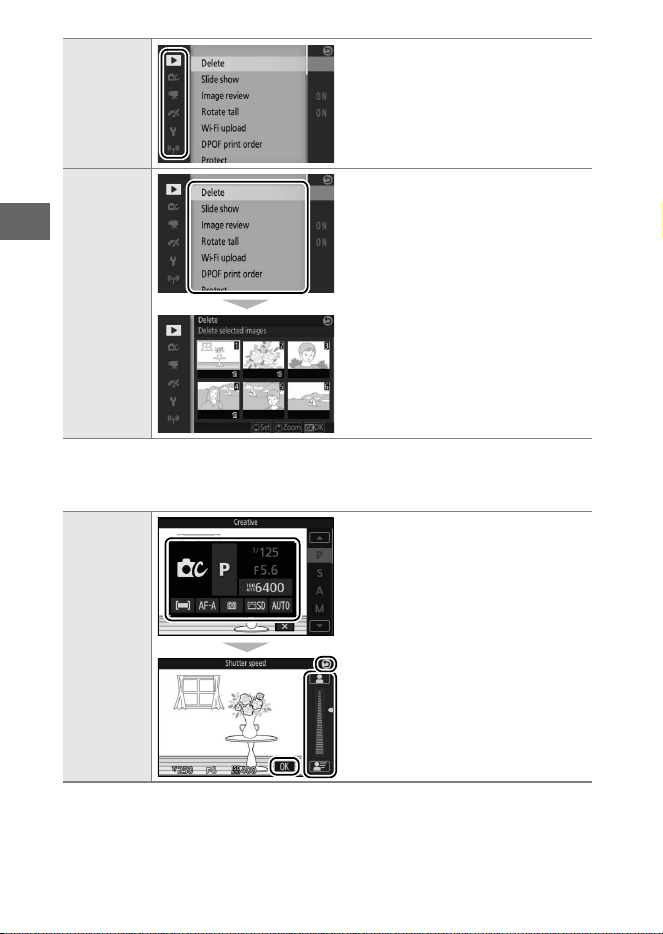
The touch screen can be used to adjust settings in the & menu.
Choose a
menu
Tap a menu icon to choose a
menu.
Adjust
settings
Tap menu items to display
options and tap icons or sliders to
change. Tap 2 to return to the
previous display.
Adjust
settings
Tap menu items to display
options and tap icons or sliders to
change. Tap 0 to save changes
and exit, or tap 2 to return to the
previous display.
15
s
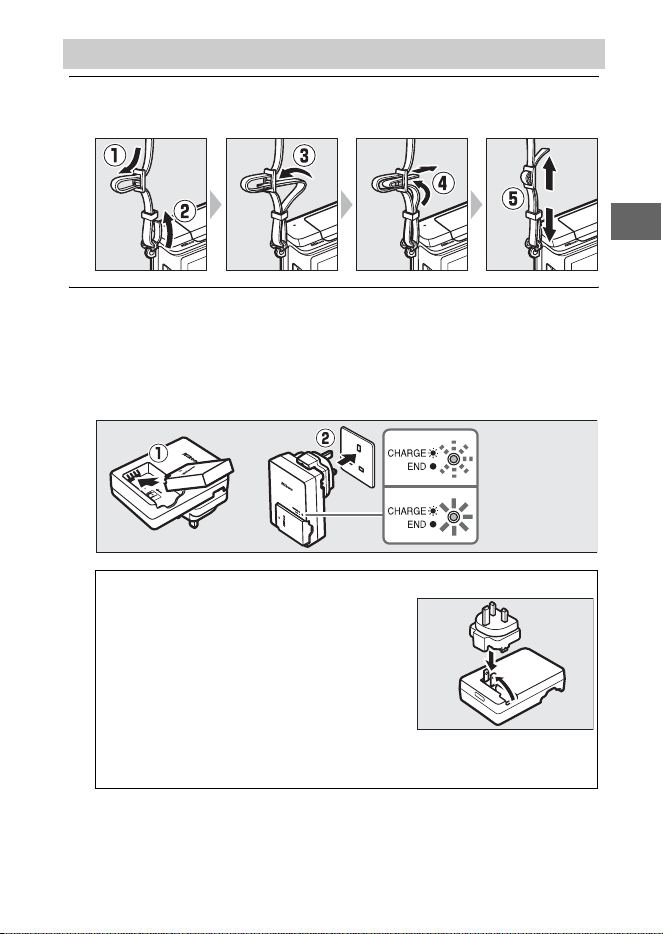
1
Attach the camera strap.
Attach the strap securely to the two camera eyelets.
2
Charge the battery.
Insert the battery into the charger q and plug the charger in
w. An exhausted battery fully charges in about three hours.
Unplug the charger and remove the battery when charging is
complete.
First Steps
A
The Plug Adapter
Depending on the country or region of
purchase, a plug adapter may be sup-
plied with the charger. The shape of the
adapter varies with the country or region
of purchase. If a plug adapter is supplied,
raise the wall plug and connect the plug
adapter as shown at right, making sure
the plug is fully inserted. Attempting to forcibly remove the plug
adapter could damage the product.
Battery
charging
Charging
complete
16
s
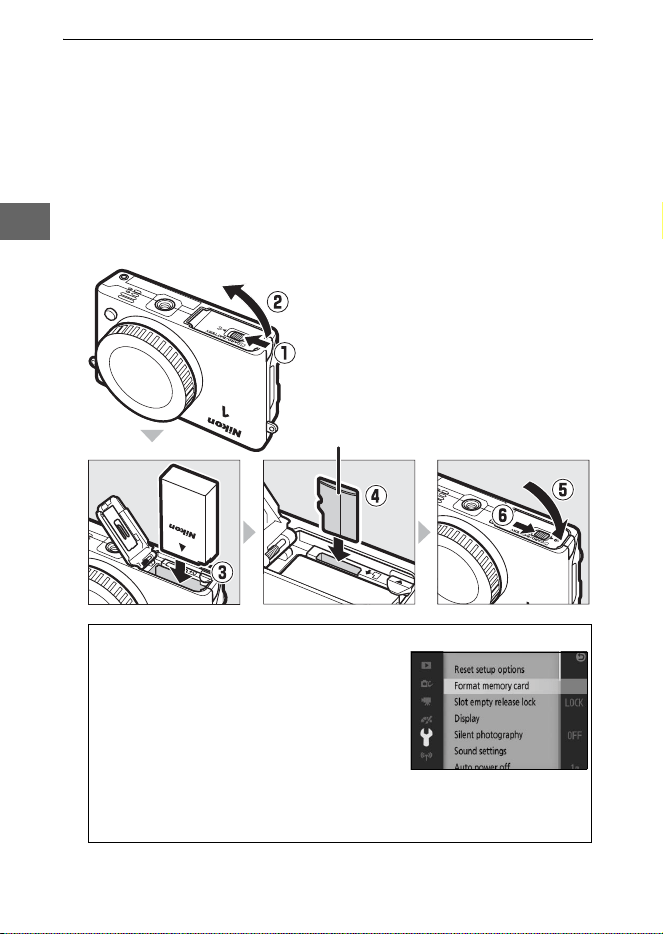
3
Insert the battery and a memory card.
The camera stores pictures on microSD, microSDHC, and
microSDXC memory cards (available separately; 0 104).
Before inserting the battery or memory cards, check that they
are in the correct orientation. Using the battery to keep the
orange battery latch pressed to one side, slide the battery in
until it latches, and then slide in the memory card until it
clicks into place. Do not attempt to insert the card at an angle;
failure to observe this precaution could damage the product.
A
Formatting Memory Cards
If this is the first time the memory card
will be used in the camera or if the card
has been formatted in another device,
select Format memory card in the setup
menu and follow the on-screen instruc-
tions to format the card (0 96). Note that
this permanently deletes any data the card
may contain. Be sure to copy any photographs and other data you
wish to keep to a computer before proceeding (0 100).
16GB
Front
17
s
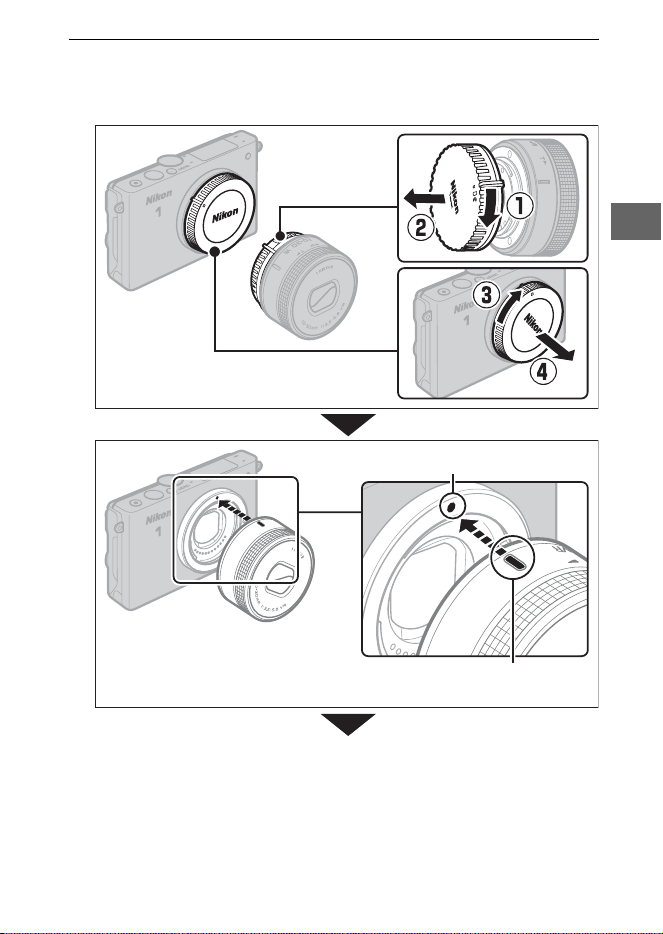
4
Attach a lens.
Be careful to prevent dust from entering the camera when
the lens or body cap is removed.
Remove the
rear lens cap
Remove the camera body cap
Mounting mark (camera)
Mounting mark (lens)
Keeping the mounting marks
aligned, position the lens on
the camera
18
s
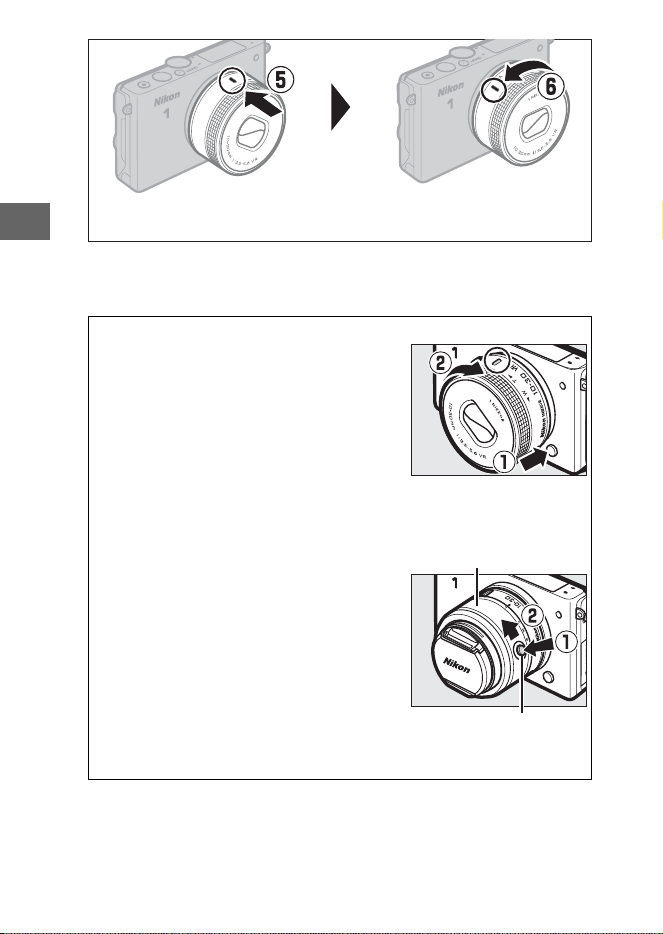
If the lens supports vibration reduction (VR), vibration reduc-
tion can be controlled from the camera (0 94, 95).
A
Detaching the Lens
Be sure the lens is retracted before
removal. To remove the lens, turn the
camera off, then press and hold the lens
release button (q) while turning the lens
clockwise (w). After removing the lens,
replace the camera body cap, the rear
lens cap, and, if applicable, the front lens
cap.
A
Lenses with Retractable Lens Barrel Buttons
Lenses with retractable lens barrel but-
tons can not be used when retracted. To
unlock and extend the lens, readying the
camera for use, keep the retractable lens
barrel button pressed (q) while rotating
the zoom ring as shown (w). The lens can
be retracted and the zoom ring locked by
pressing the button and rotating the ring
in the opposite direction. Be careful not to
press the retractable lens barrel button
while attaching or removing the lens.
Rotate the lens as shown until it clicks into place.
Zoom ring
Retractable lens barre
l
button
19
s
5
Turn the camera on.
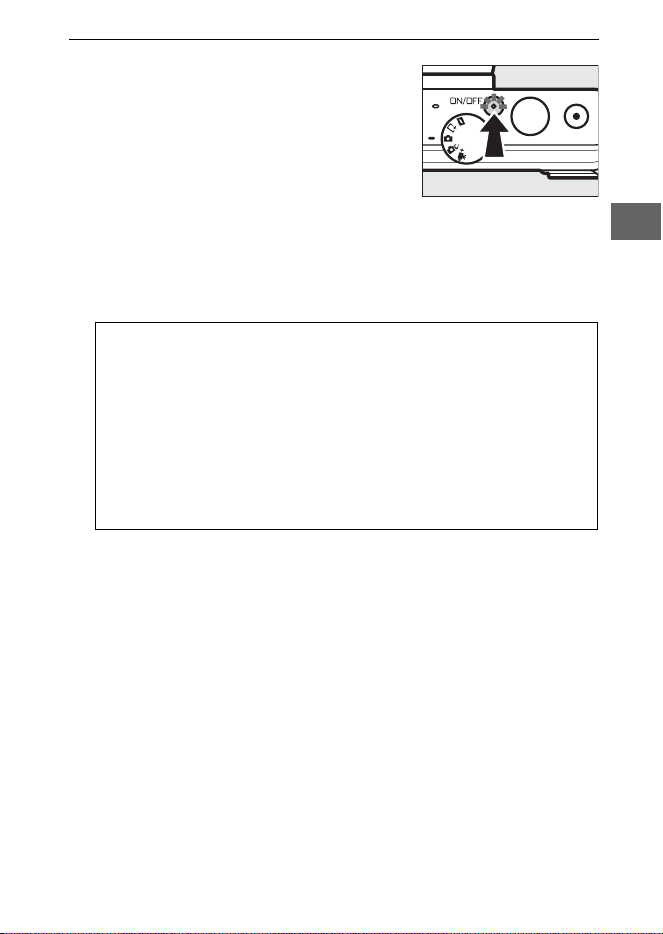
Press the power switch to turn the
camera on. The power lamp will
briefly light green and the monitor will
turn on. If the lens is equipped with a
front lens cap, remove the cap before
shooting. If a 1 NIKKOR VR 10–30mm
f/3.5–5.6 PD-ZOOM lens is attached,
the lens will automatically extend
when the camera is turned on and
retract when the camera is turned off.
A
Turning the Camera Off
To turn the camera off, press the power switch again. The monitor
will turn off.
A
Auto Power Off
If no operations are performed for about a minute, the display will
turn off and the power lamp start to flash. The camera can be reac-
tivated by operating the shutter-release button. If no operations are
performed for about three minutes after the display has turned off,
the camera will turn off automatically.
20
s
6
Choose a language.
A
Lenses with Retractable Lens Barrel Buttons
The camera will turn on automatically when the retractable lens
barrel lock is released; in addition, if the view through the lens is dis-
played or the monitor is off, the camera will turn off when the lens
barrel is locked (in the case of 1 NIKKOR VR 10–30mm f/3.5–5.6 and
1 NIKKOR VR 30–110mm f/3.8–5.6 lenses, firmware version 1.10 or
later is required if locking the lens barrel is to turn the camera off
when the monitor is off; for information on updating lens firmware,
visit the Nikon website for your area).
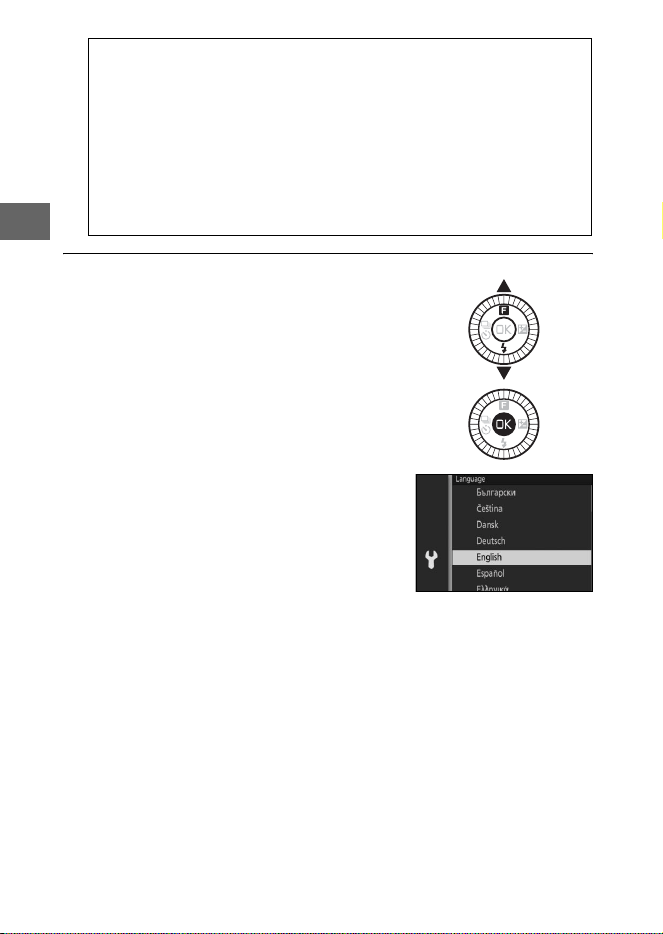
A language-selection dialog will be
displayed the first time the camera is
turned on. Use the multi selector and
J button to choose a language.
21
s
7
Set the clock.
8
Check the battery level and memory card capacity.
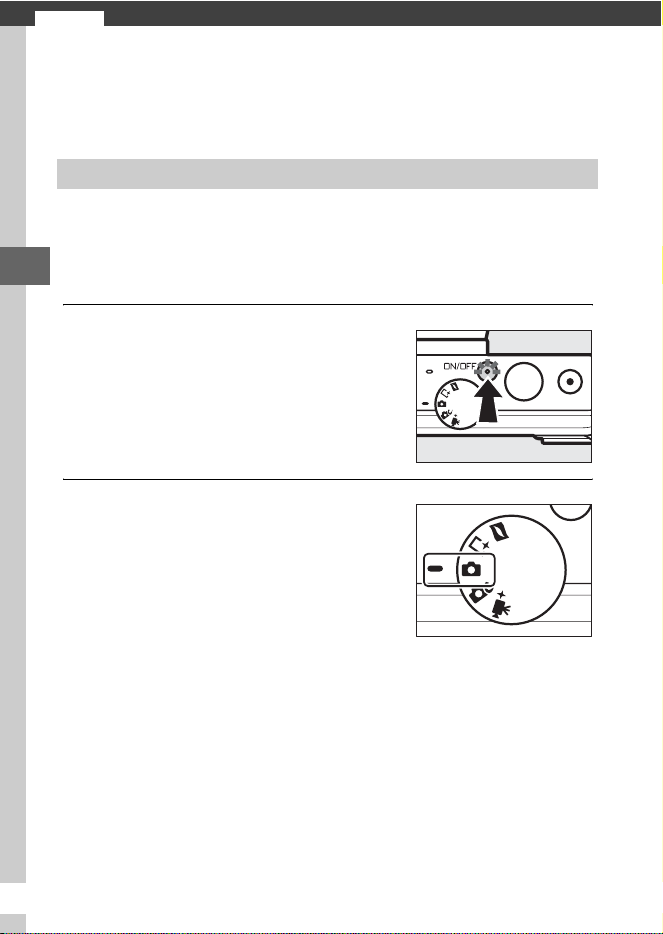
Check the battery level and number
of exposures remaining in the moni-
tor (0 4).
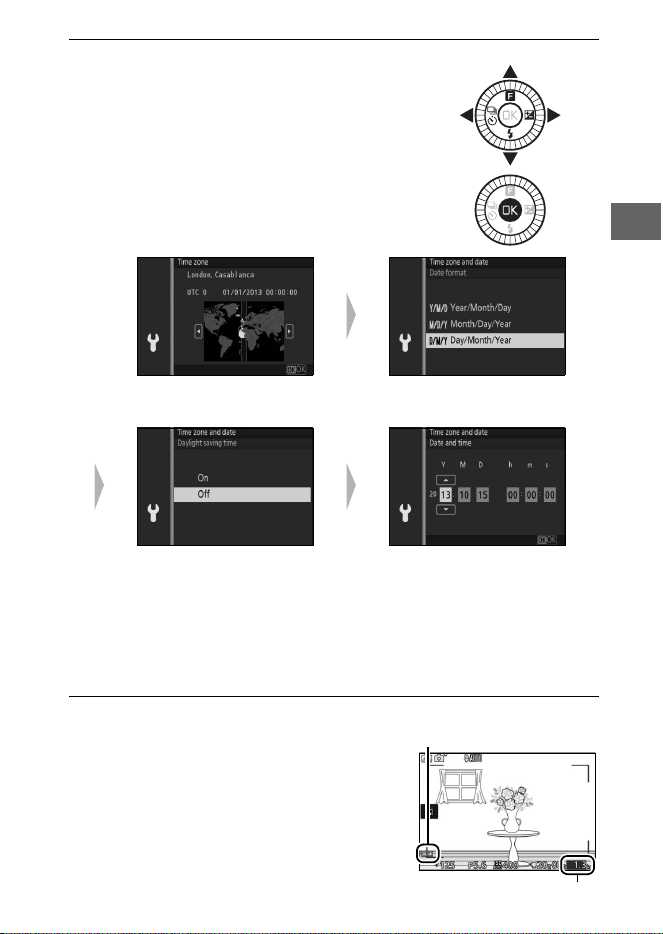
Use the multi selector and J button
(0 3) to set the time and date. Note
that the camera uses a 24-hour clock.
Press 4 or 2 to highlight time
zone and press J.
Press 1 or 3 to highlight date
format and press J.
Press 1 or 3 to highlight daylight
saving time option and press J.
Press 4 or 2 to highlight items
and press 1 or 3 to change. Press
J to exit to shooting display when
setup is complete.
Note: Language and clock can be changed at any time using Language
(0 96) and Time zone and date (0 96) options in setup menu.
Battery level
Exposures remaining
z
22
z
Taking and Viewing Photographs
This chapter describes how to take, view, and delete photo-
graphs in auto and creative mode.
Follow the steps below to take photographs in auto mode, a
“point-and-shoot” mode in which the camera automatically
detects the subject type and adjusts settings according to the
subject and situation.
1
Turn the camera on.
2
Select C mode.
Point-and-Shoot Photography (Auto Mode)
Press the power switch to turn the
camera on.
Rotate the mode dial to C (auto).
23
z
3
Ready the camera.
4
Frame the photograph.
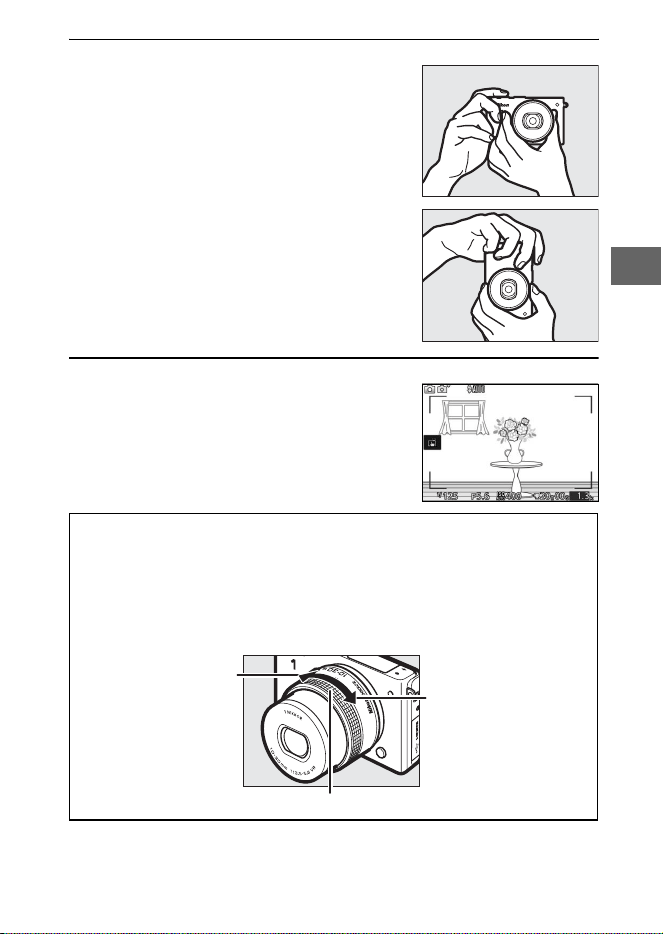
Hold the camera securely with both
hands, being careful not to obstruct
the lens, AF-assist illuminator, or
microphone. Rotate the camera as
shown at lower right when taking pic-
tures in “tall” (portrait) orientation.
Position your subject in the center of
the frame.
A
Using a Zoom Lens
Use the zoom ring to zoom in on the subject so that it fills a larger area
of the frame, or zoom out to increase the area visible in the final photo-
graph. During movie recording with the 1 NIKKOR VR 10–30mm f/3.5–
5.6 PD-ZOOM, the zoom rate is unaffected by the speed with which the
ring is rotated.
Zoom in
Zoom out
Zoom ring
24
z
5
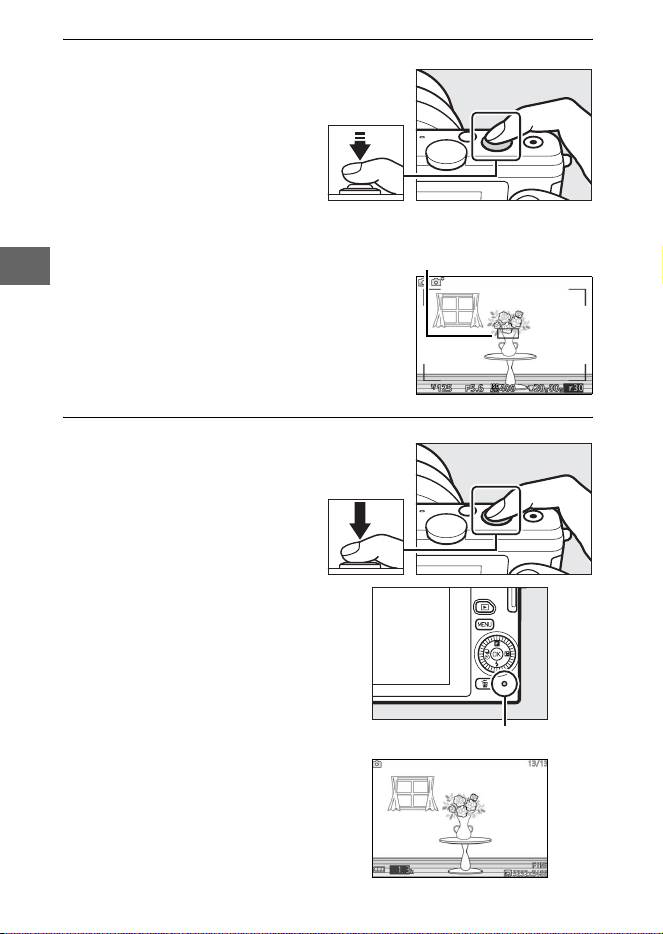
Focus.
Press the shutter-release
button halfway to focus. If
the subject is poorly lit, the
flash may pop up (0 74)
and the AF-assist illumina-
tor (0 2) may light to assist
the focus operation.
If the camera is able to focus, the selected
focus area will be highlighted in green
and a beep will sound (a beep may not
sound if the subject is moving).
If the camera is unable to focus, the focus
area will be displayed in red.
6
Shoot.
Smoothly press the shutter-
release button the rest of
the way down to release
the shutter and record the
photograph. The memory
card access lamp will light
and the photograph will be
displayed in the monitor for
a few seconds (the photo
will automatically clear
from the display when the
shutter-release button is
pressed halfway). Do not
eject the memory card or
remove the battery until the
lamp has gone out and
recording is complete.
Memory card access lamp
Focus area
25
z
Viewing Photographs
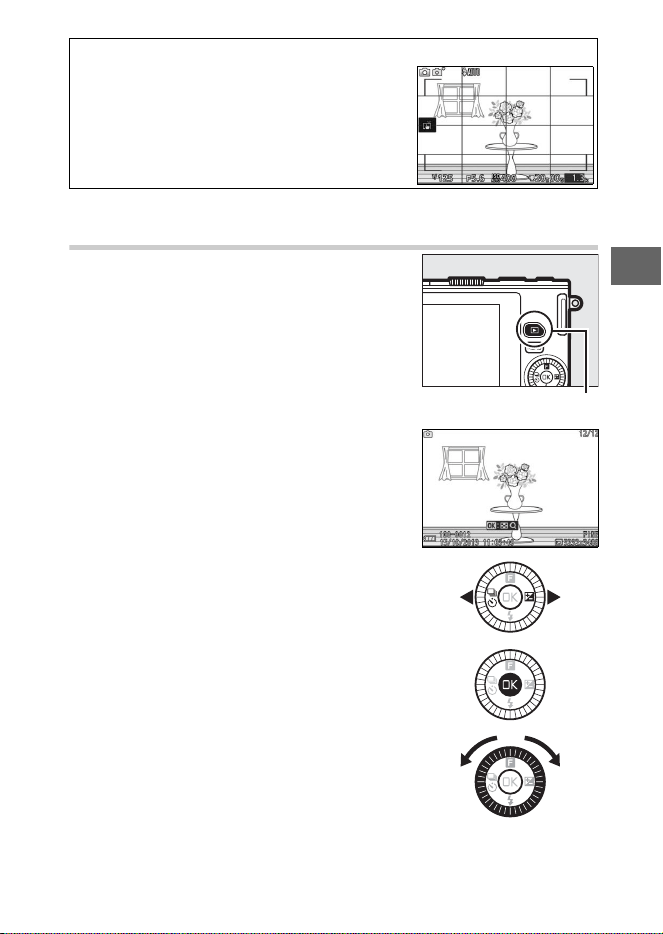
To end playback and return to shooting mode, press the shutter-
release button halfway.
A
The Framing Grid
A framing grid can be displayed by selecting
On for Display > Grid display in the setup
menu (0 96).
Press K to display your most recent pho-
tograph full frame in the monitor (full-
frame playback).
K button
Press 4 or 2 or rotate the multi selector
to view additional pictures.
To zoom in on the center of the current
image, press J and rotate the multi
selector clockwise. Rotate counterclock-
wise to zoom out. To view multiple
images, rotate the multi selector counter-
clockwise when the picture is displayed
full frame.
26
z
A
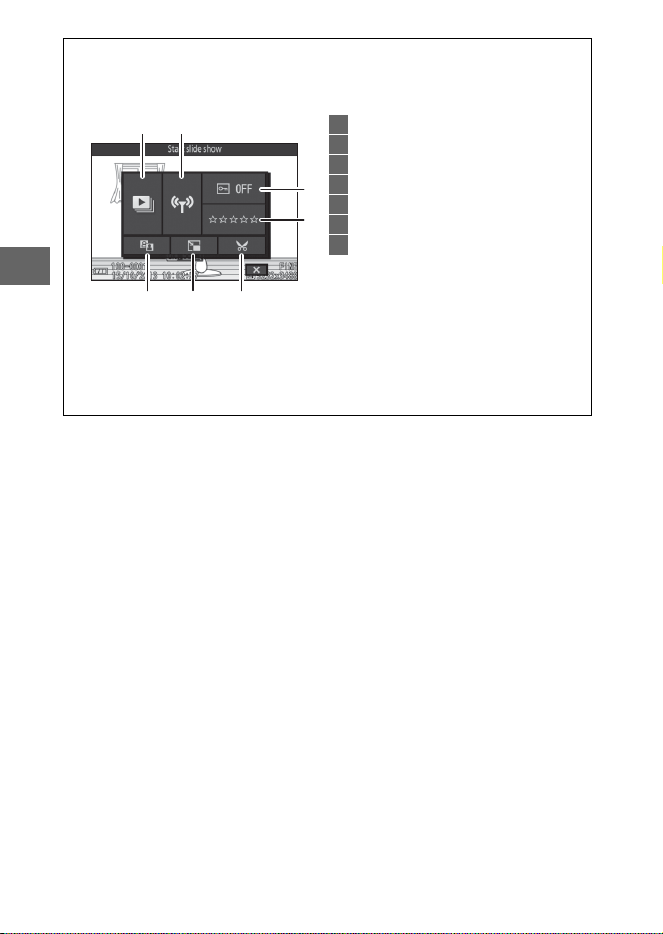
The & (Feature) Menu (0 9)
The following options can be accessed by pressing & when a photo is
displayed:
1 Start slide show ...................................92
2 Wi-Fi upload .........................................92
3 Protect ...................................................92
4 Rating.....................................................92
5 Crop ........................................................92
6 Resize .....................................................92
7 D-Lighting.............................................92
A
See Also
The Display > Playback option in the setup menu can be used to tog-
gle photo info on or off (0 96). The Slide show option in the playback
menu can also be used for slide shows.
1 2
6
3
4
57
27
z
Deleting Pictures
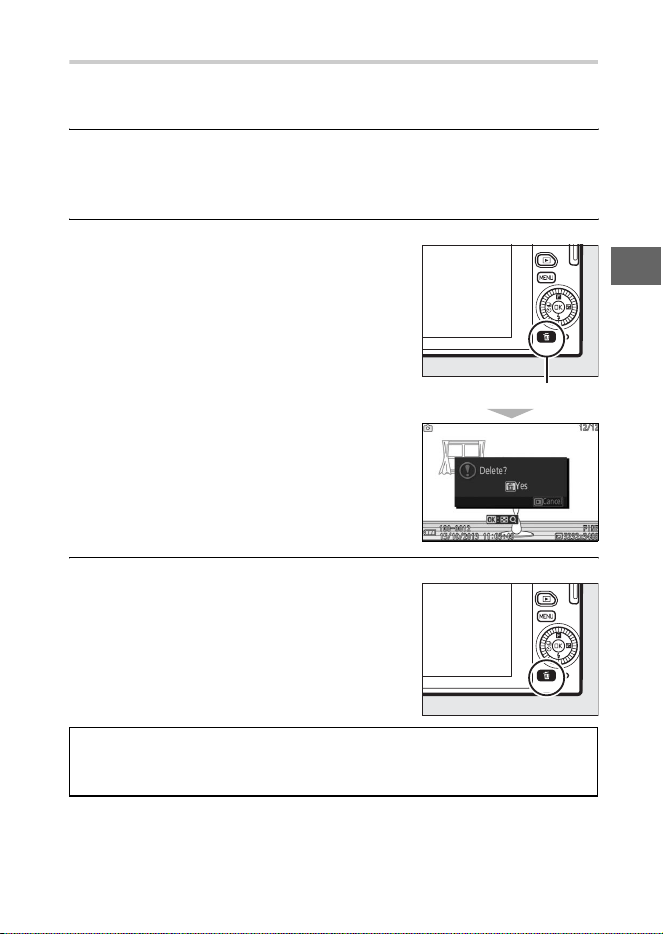
To delete the current picture, press O. Note that once deleted, pic-
tures can not be recovered.
1
Display the photograph.
Display the photograph you wish to delete as described on
the preceding page.
2
Press O.
3
Delete the photograph.
A confirmation dialog will be dis-
played.
O button
Press O again to delete the picture and
return to playback, or press K to exit
without deleting the picture.
A
Deleting Multiple Pictures
The Delete option in the playback menu (0 92) can be used to delete
all or selected pictures.
28
z
A
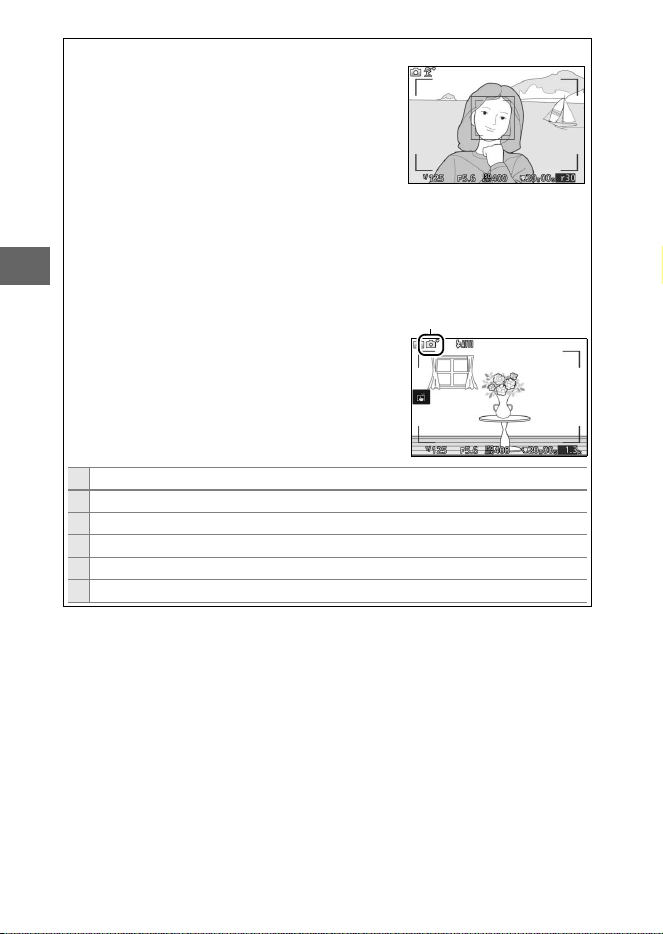
Face Priority
The camera detects and focuses on portrait
subjects (face priority). A double yellow bor-
der will be displayed if a portrait subject is
detected facing the camera (if multiple faces,
up to a maximum of five, are detected, the
camera will select the closest subject). Press
the shutter-release button halfway to focus
on the subject in the double yellow border. The border will clear from
the display if the camera can no longer detect the subject (because, for
example, the subject has looked away).
A
Automatic Scene Selection
In auto mode, the camera automatically ana-
lyzes the subject and selects the appropriate
scene. The selected scene is shown in the
monitor.
Scene icon
c Portrait: Human portrait subjects.
d Landscape: Landscapes and cityscapes.
f Night portrait: Portrait subjects framed against dark backgrounds.
e Close up: Subjects close to the camera.
g Night landscape: Poorly-lit landscapes and cityscapes.
Z Auto: Subjects that do not fall into the categories listed above.
29
z
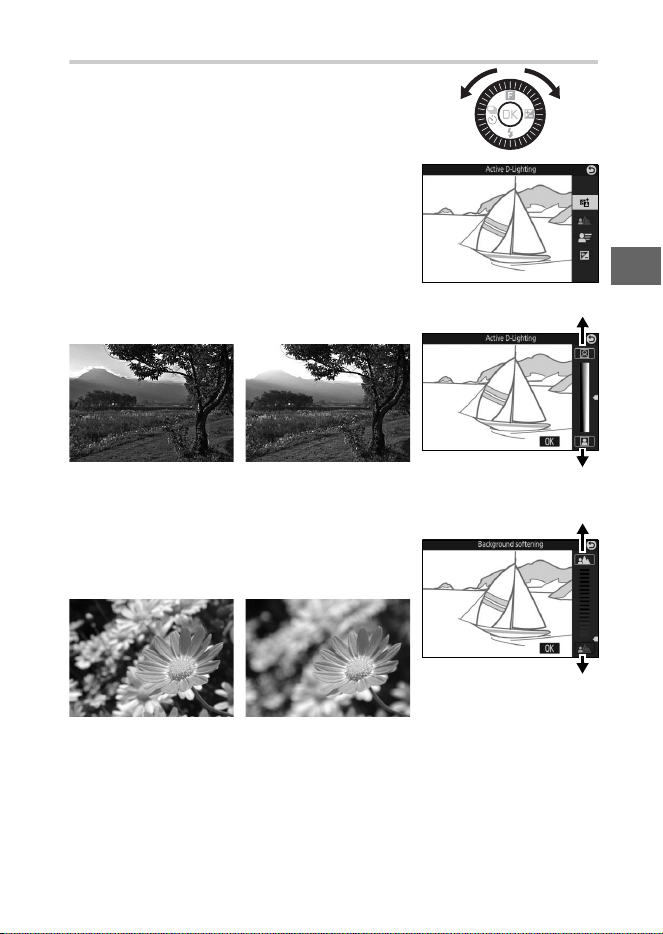
Live Image Control
Live image controls let you preview how
changes to each control will affect the
final photograph. To choose a live image
control for auto mode, press J to display
the live image control menu, then use the
multi selector to highlight a control and
press J to view the effect. Rotate the
multi selector to choose a setting and
press J to select.
Active D-Lighting: Preserve details in high-
lights and shadows for natural contrast.
Increase effect
Reduce effectActive D-Lighting: High Active D-Lighting: Low
Background softening: Soften background
details to make your subject stand out, or
bring both background and foreground
into focus.
Sharpen background
Soften background
Background sharp Background softened
30
z
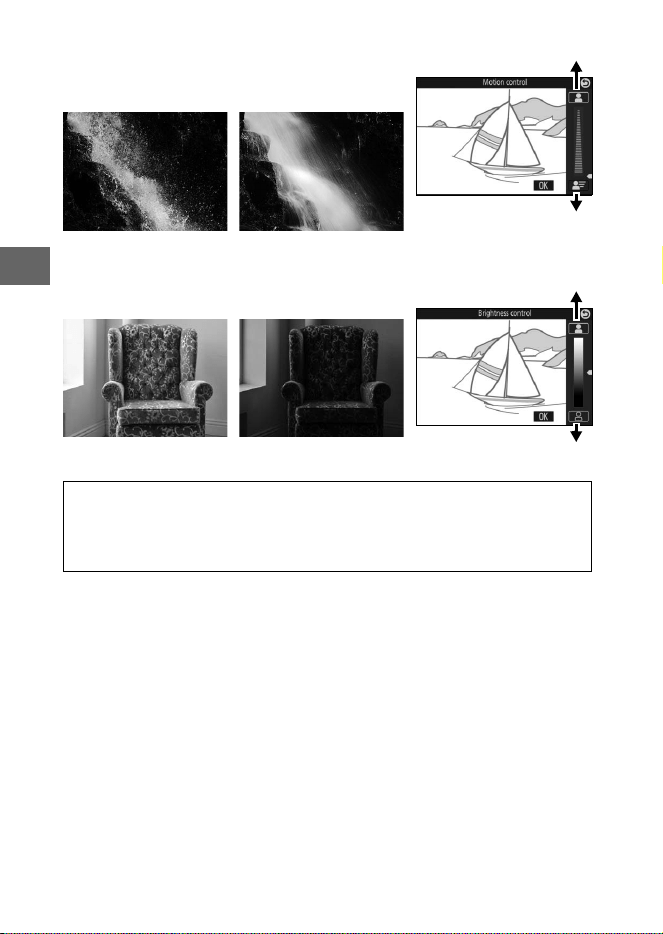
Motion control: Suggest motion by blurring
moving objects, or “freeze” motion to
capture moving objects clearly.
Freeze motion
Blur motion
Freeze motion Blur motion
Brightness control: Make pictures brighter
or darker.
Brighter
DarkerBrighter Darker
D
Live Image Control
Continuous shooting is not available (0 70) and the built-in flash can
not be used when live image control is in effect. Pressing the movie-
record button cancels live image control.
31
z
Choose creative mode to match settings to the subject or situa-
tion, take photos using special effects, or control shutter speed
and aperture.
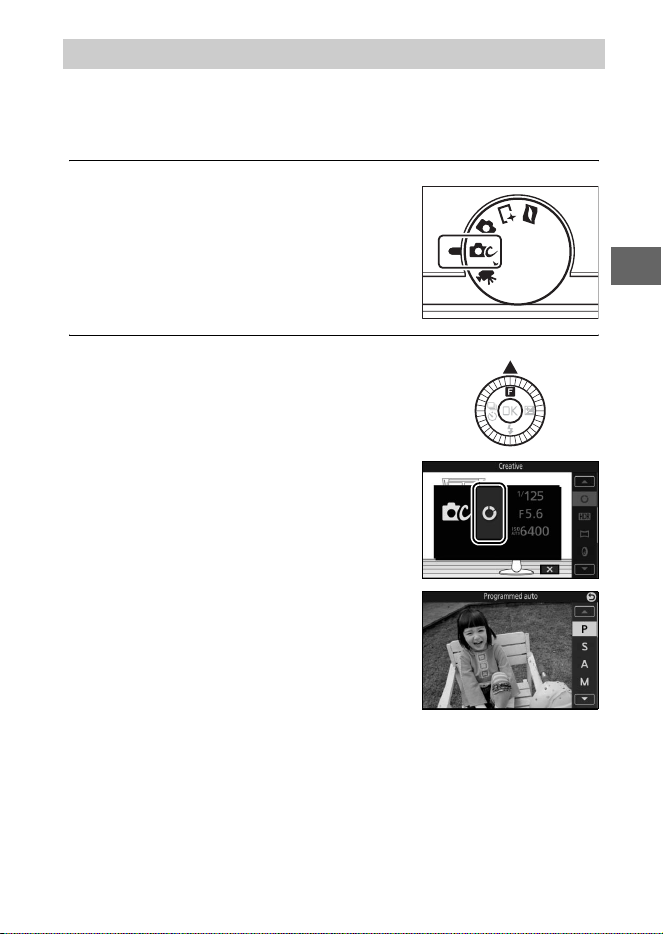
1
Select w mode.
2
Choose an option.
Choosing a Creative Mode
Rotate the mode dial to w (creative).
Press & (feature) on the multi selector
to display the & menu, then highlight
Creative and press J. Highlight an
option suited to your subject and cre-
ative intent (0 32) and press J.

32
z
Choosing a Mode That Matches the Subject or Situation
Choose a creative mode according to the subject or situation:
Option Description
Programmed auto (P)
The camera sets shutter speed and aperture for opti-
mal exposure (0 34). Recommended for snapshots
and in other situations in which there is little time to
adjust camera settings.
Shutter-priority auto
(S)
You choose the shutter speed; the camera selects an
aperture for best results (0 35). Use to freeze or blur
motion.
Aperture-priority
auto (A)
You choose the aperture; the camera selects a shut-
ter speed for best results (0 36). Use to blur the
background or bring both foreground and back-
ground into focus.
Manual (M) You control both shutter speed and aperture (0 37).
Creative Palette (4)
Rotate the palette to choose creative effects while
previewing them in the display (0 39).
HDR (5) Photograph high-contrast scenes (0 40).
Easy panorama (p)
Shoot panoramas for later viewing on the camera
(0 41).
Soft (q)
Shoot photographs with a soft filter effect. Use the &
(feature) menu (0 33) to select the amount of soft-
ening and to choose how softening applies to por-
traits.
Miniature effect (r)
The top and bottom of each photo is blurred so that
the subject appears to have been a diorama photo-
graphed at short range. Works best when shooting
from a high vantage point.
Selective color (s)
Take photos in which only a selected hue appears in
color (0 44).
Cross process (6)
Choose a base color to create photographs with dif-
ferent hues (0 45).
Toy camera effect (7)
Alter color saturation and reduce peripheral illumi-
nation for a toy camera effect (0 94). The effect can
be adjusted using the & menu (0 33).
33
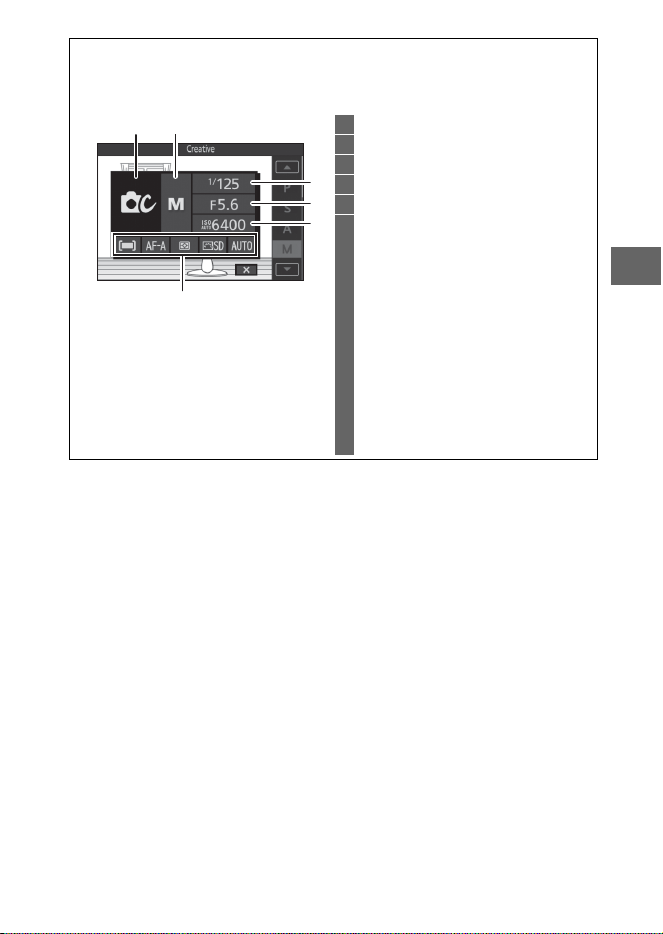
z
A
The & (Feature) Menu (0 9)
Pressing & in creative mode displays the items listed below. The items
available vary with the option selected for creative mode (0 32).
1 Shooting mode......................................6
2 Creative................................................. 31
3 Shutter speed................................35, 37
4 Aperture .........................................36, 37
5 ISO sensitivity...................................... 95
6 AF-area mode...................................... 94
Focus mode ......................................... 94
Metering............................................... 94
Picture Control.................................... 95
White balance ..................................... 95
Image size ............................................ 93
Select color .......................................... 44
Filter strength
Portrait
Hue ........................................................ 45
Saturation ............................................ 94
Vignetting ............................................ 94
1 2
3
4
5
6
34
z
Taking Photos in P, S, A, and M Modes
P, S, A, and M modes offer varying degrees of control over shutter
speed and aperture. Choose a mode and adjust settings accord-
ing to your creative intent.
❚❚ P Programmed Auto
In this mode, the camera automatically adjusts shutter speed
and aperture for optimal exposure in most situations. This mode
is recommended for snapshots and other situations in which
you want to leave the camera in charge of shutter speed and
aperture.
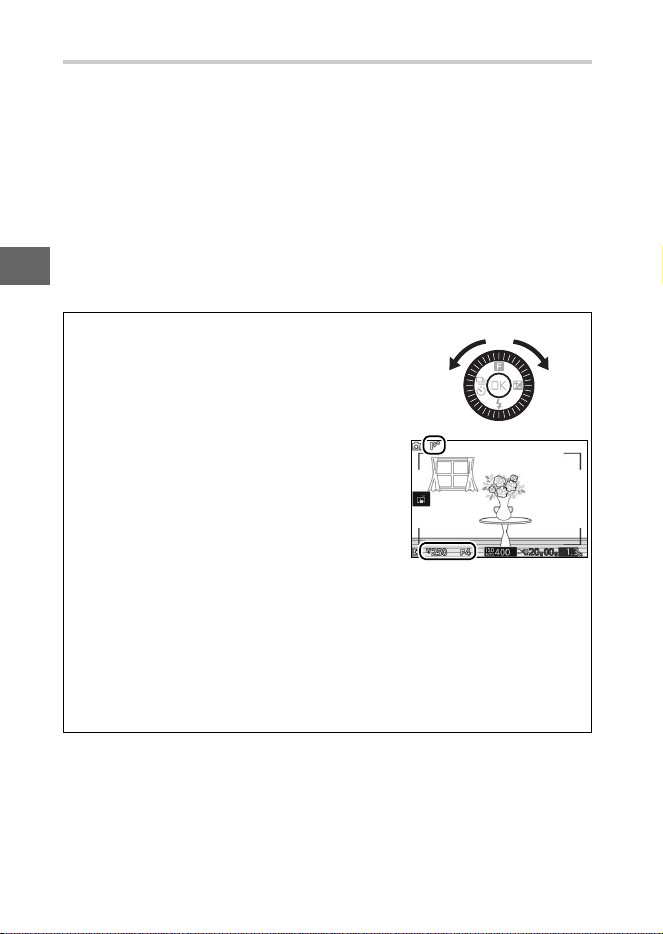
A
Choosing a Combination of Shutter Speed and Aperture
Although the shutter speed and aperture
chosen by the camera will produce optimal
results, you can also choose from other com-
binations that will produce the same expo-
sure (“flexible program”). Rotate the multi
selector clockwise for large apertures (low
f-numbers) that blur background details or
fast shutter speeds that “freeze” motion.
Rotate the multi selector counterclockwise
for small apertures (high f-numbers) that
increase depth of field or slow shutter speeds
that blur motion. U is displayed while flexible
program is in effect.
A
Restoring Default Shutter Speed and Aperture Settings
To restore default shutter speed and aperture settings, rotate the multi
selector until U is no longer displayed or turn the camera off. The
default shutter speed and aperture is automatically restored when the
camera enters standby mode.
35
z
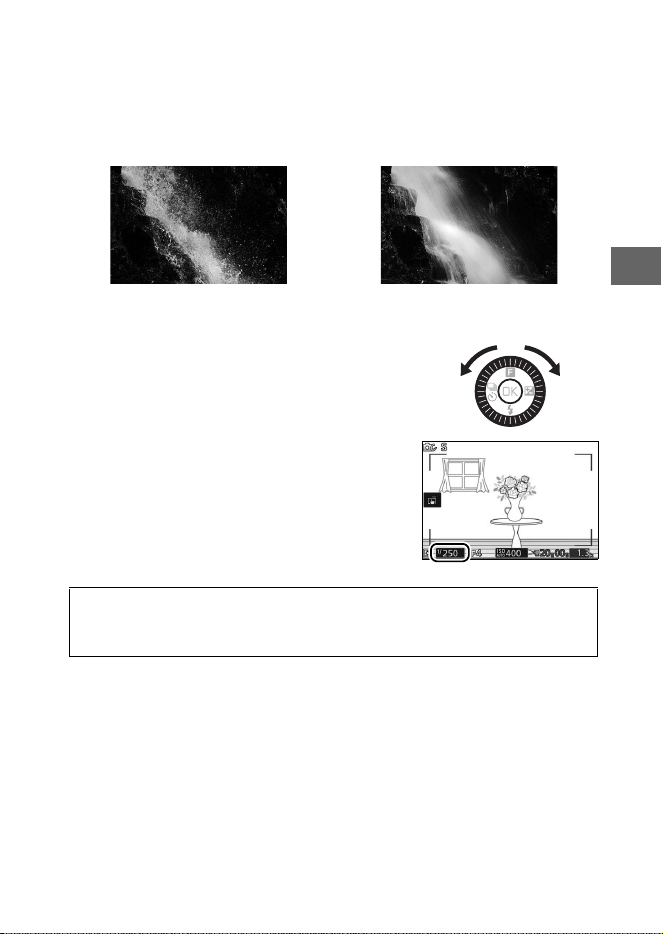
❚❚ S Shutter-Priority Auto
In shutter-priority auto, you choose the shutter speed while the
camera automatically selects the aperture that will produce the
optimal exposure. Use slow shutter speeds to suggest motion by
blurring moving subjects, fast shutter speeds to “freeze” motion.
Choosing a Shutter Speed
Rotate the multi selector to choose from
shutter speeds between 30 s and
1
/
16,000 s.
Rotate the selector clockwise for faster
shutter speeds, counterclockwise for
slower shutter speeds.
Fast shutter speed (
1
/
1600 s) Slow shutter speed (1 s)
A
Continuous Shooting
The selected shutter speed may change when a frame rate of 10 fps or
faster is selected in continuous shooting mode (0 70).
36
z
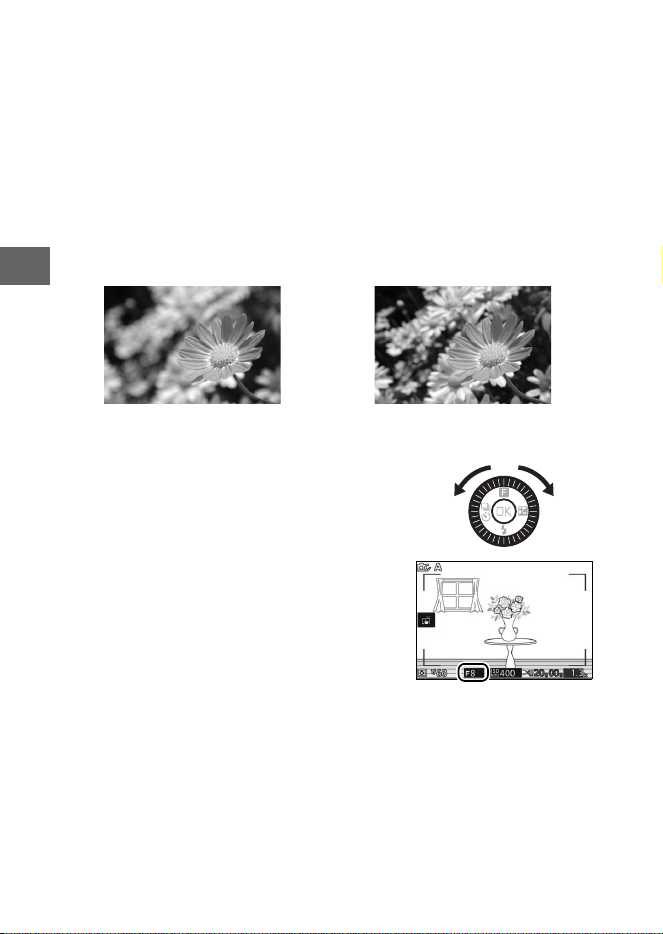
❚❚ A Aperture-Priority Auto
In aperture-priority auto, you choose the aperture while the
camera automatically selects the shutter speed that will produce
the optimal exposure. Large apertures (low f-numbers) reduce
depth of field, blurring objects behind and in front of the main
subject. Small apertures (high f-numbers) increase depth of
field, bringing out details in the background and foreground.
Short field depths are generally used in portraits to blur back-
ground details, long field depths in landscape photographs to
bring the foreground and background into focus.
Choosing an Aperture
Rotate the multi selector counterclock-
wise for larger apertures (lower f-num-
bers), clockwise for smaller apertures
(higher f-numbers). The minimum and
maximum values depend on the lens cur-
rently in use.
Large aperture (f/5.6) Small aperture (f/16)
37
z
❚❚ MManual
In manual mode, you control both shutter speed and aperture.
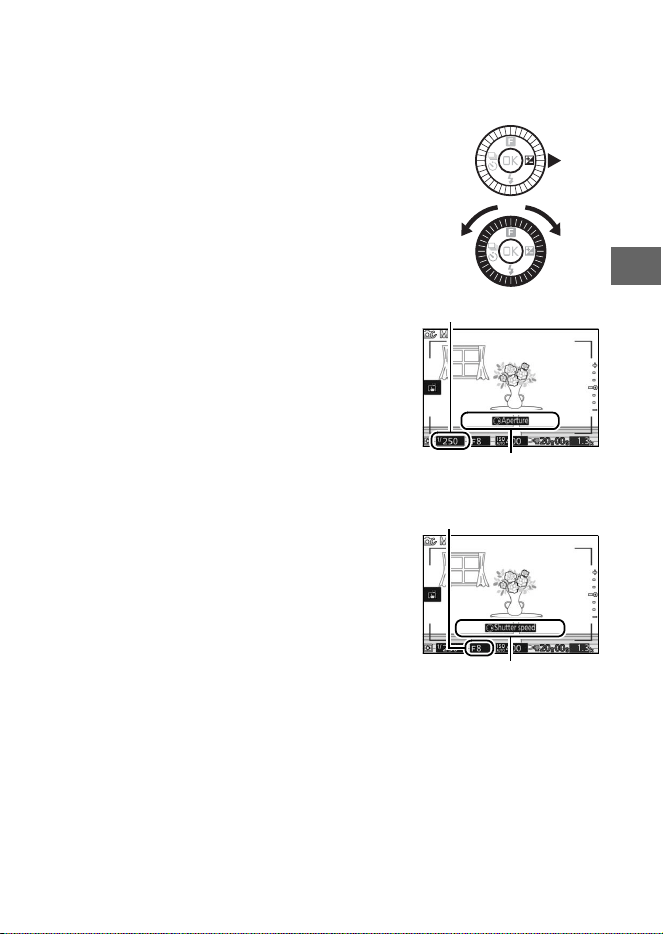
Choosing Shutter Speed and Aperture
Adjust shutter speed and aperture with
reference to the exposure indicator (see
below). Press 2 to highlight shutter
speed or aperture and rotate the multi
selector to choose a value, then repeat
for the remaining item. Rotate the selec-
tor clockwise for faster shutter speeds or
smaller apertures (higher f-numbers),
counterclockwise for slower shutter
speeds and larger apertures (lower f-
numbers). Shutter speeds can be set to
values as fast as
1
/
16,000 s or as slow as 30 s,
or to “Bulb” to hold the shutter open
indefinitely for a long time-exposure.
Aperture can be set to values between
the minimum and maximum for the lens.
Shutter speed
Press 2 to highlight
aperture.
A
perture
Press 2 to highlight
shutter speed.
38
z
A
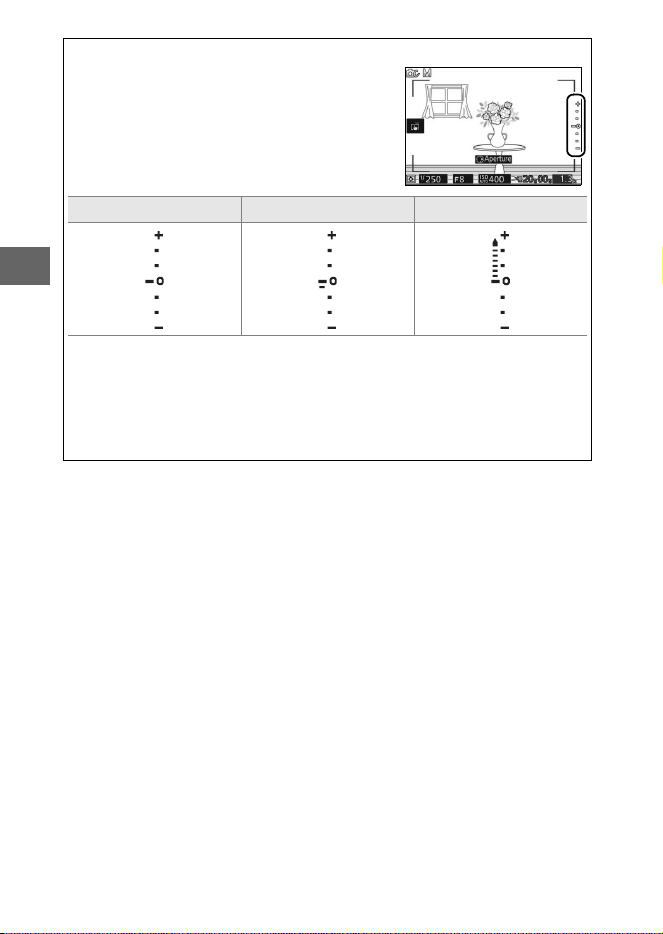
The Exposure Indicator
When shutter speeds other than “Bulb” are
selected, the exposure indicator shows
whether the photograph would be under-
or over-exposed at current settings.
Optimal exposure Underexposed by
1
/
3 EV Overexposed by over 2 EV
A
ISO Sensitivity (P, S, A, and M Modes)
When an “auto” option is selected for ISO sensitivity (0 95), the cam-
era will automatically adjust sensitivity within the selected range if
optimal exposure can not be achieved at the selected shutter speed or
aperture.
39
z
The Creative Palette
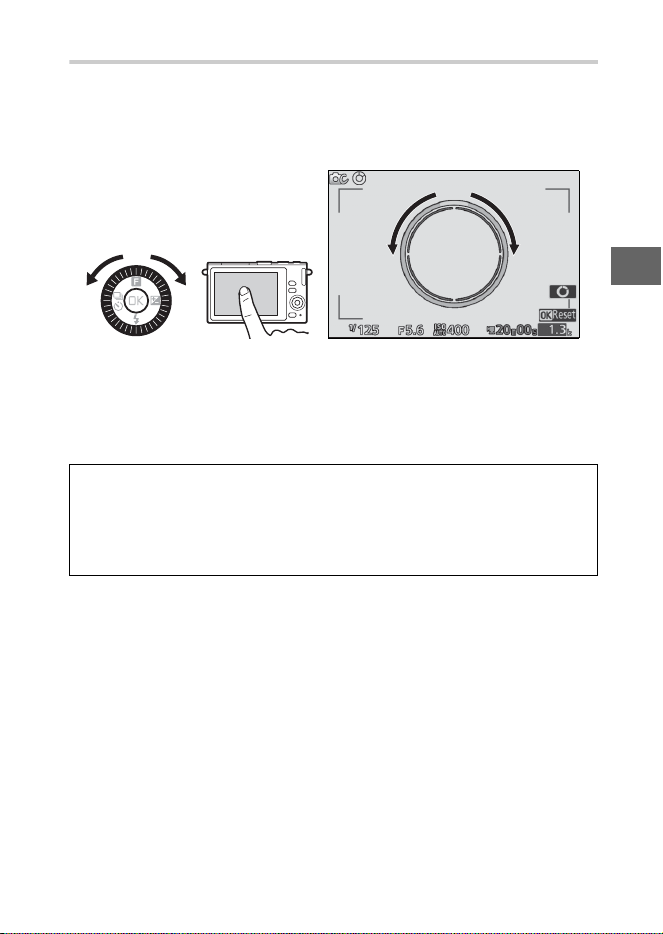
To choose a creative effect, rotate the multi selector or use a fin-
ger to rotate the creative palette in the monitor. The selected
effect is visible in the monitor and changes gradually as the pal-
ette is rotated.
Press the shutter-release button all the way down to take a pic-
ture with the selected effect (tap shooting options are not avail-
able when the creative palette is displayed; to view or hide the
creative palette, tap 4). The built-in flash can not be used.
A
Scene Detection
The camera automatically adjusts settings to suit the subject and situa-
tion. The effects available vary with the type of subject detected. To
reset the palette, press J or tap Reset while the creative palette is dis-
played.
40
z
HDR
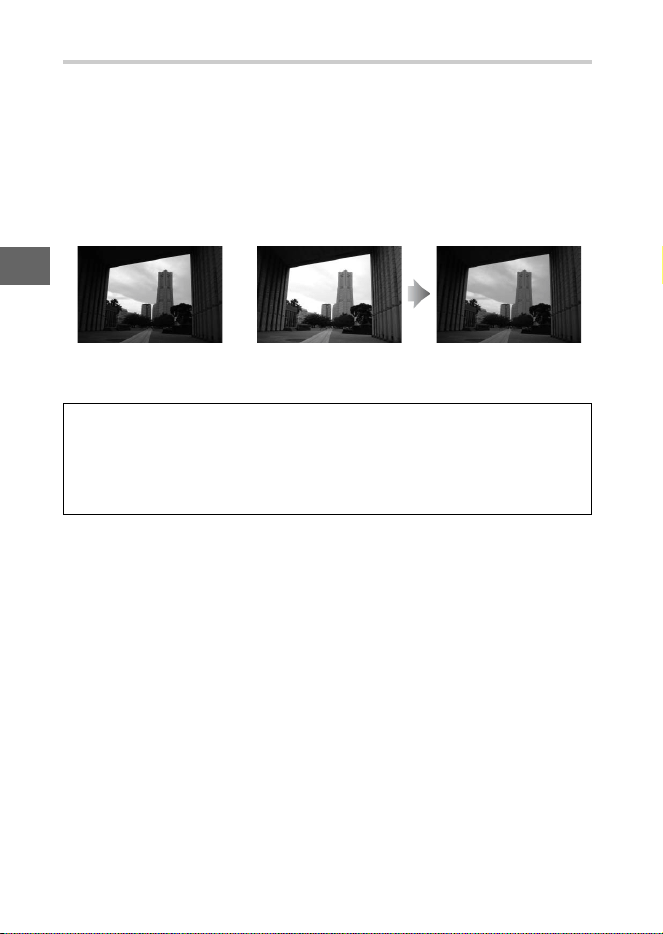
Details in highlights and shadows are preserved using HDR (high
dynamic range). Each time the shutter-release button is fully
pressed, the camera takes two shots in quick succession and
combines them to preserve details in highlights and shadows in
high-contrast scenes; the built-in flash does not fire. Some time
may be required to process the pictures; the final photograph
will be displayed when processing is complete.
+
First exposure
(darker)
Second exposure
(brighter)
Combined HDR
image
D
Framing HDR Photographs
The edges of the image will be cropped out. The desired results may
not be achieved if the camera or subject moves during shooting.
Depending on the scene, shading may be uneven and shadows may
appear around bright objects or halos around dark objects.
41
z
Easy Panorama
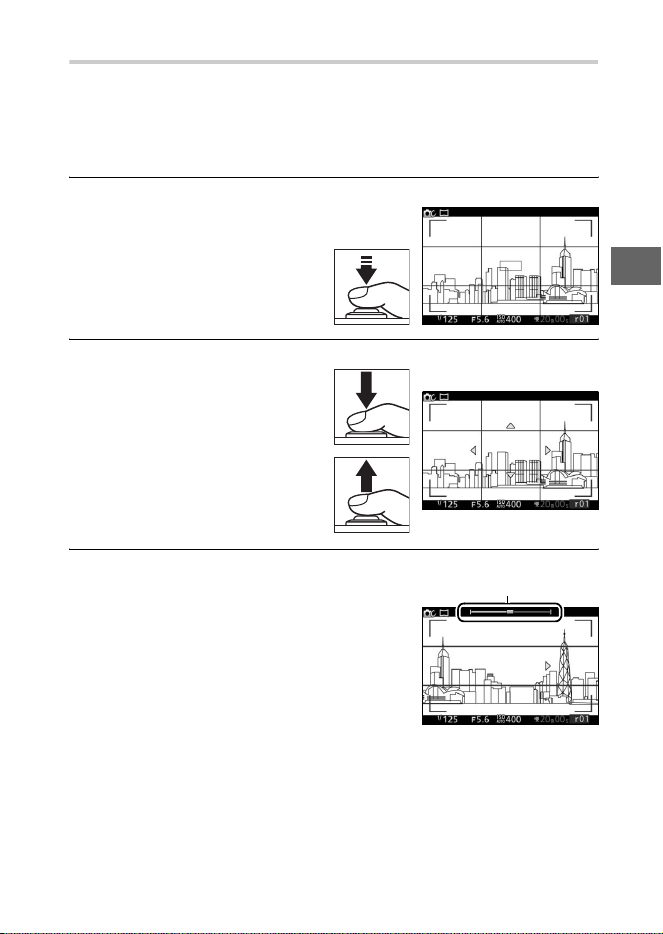
Follow the steps below to shoot panoramas. During shooting,
the camera focuses using auto-area AF; face detection (0 28) is
not available. Exposure compensation can be used, but the
built-in flash will not fire.
1
Set focus and exposure.
Frame the start of the pan-
orama and press the shut-
ter-release button halfway.
Guides will appear in the
display.
2
Start shooting.
Press the shutter-release
button the rest of the way
down and then lift your fin-
ger from the button. 1, 3,
4, and 2 icons will appear
in the display to indicate
the possible pan directions.
3
Pan the camera.
Slowly pan the camera up, down, left,
or right as shown below. Shooting will
start when the camera detects the pan
direction and a progress indicator will
appear in the display. Shooting ends
automatically when the end of the
panorama is reached.
Progress indicator
42
z
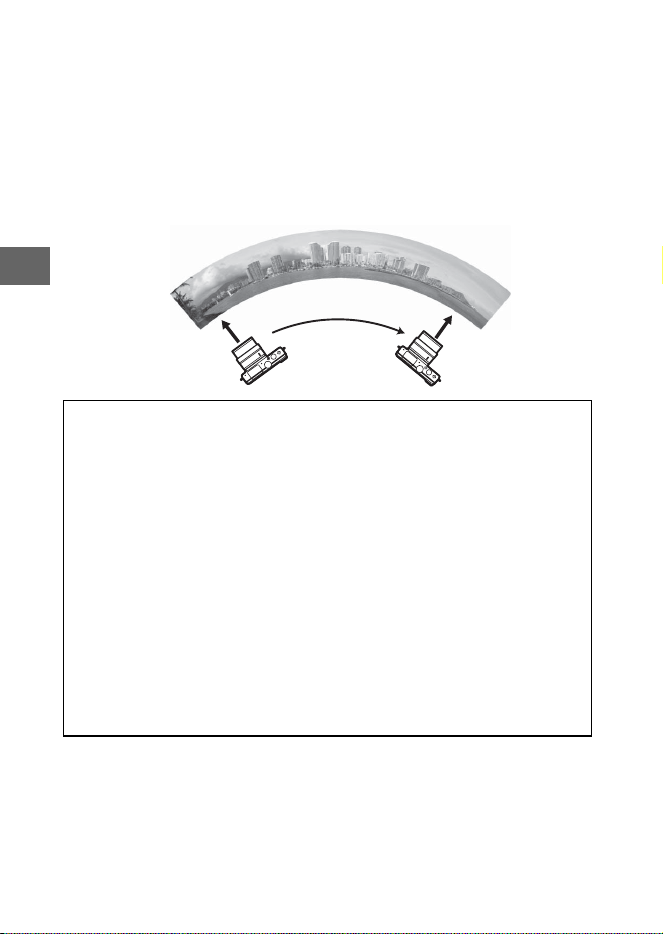
An example of how to pan the camera is shown below. With-
out changing your position, pan the camera in a steady curve
either horizontally or vertically. Time the pan according to the
option selected for Image size in the shooting menu: about
15 seconds are needed to complete the pan when
A Normal panorama is selected, about 30 seconds when
B Wide panorama is selected.
A
Panoramas
High-distortion wide-angle lenses may fail to produce the desired
results. An error message will be displayed if the camera is panned too
quickly or unsteadily. Note that because panoramas are composed of
multiple images, the joins between images may be visible and the
desired results may not be achieved with moving subjects or with neon
lights or other subjects that exhibit rapid changes in color or bright-
ness, subjects that are too close to the camera, poorly-lit subjects, and
subjects such as the sky or sea that are a solid color or contain simple
repeating patterns.
The completed panorama will be slightly smaller than the area visible
in the display during shooting. No panorama will be recorded if shoot-
ing ends before the halfway point; if shooting ends after the halfway
point but before the panorama is complete, the unrecorded portion
will be shown in gray.
43
z
❚❚ Viewing Panoramas
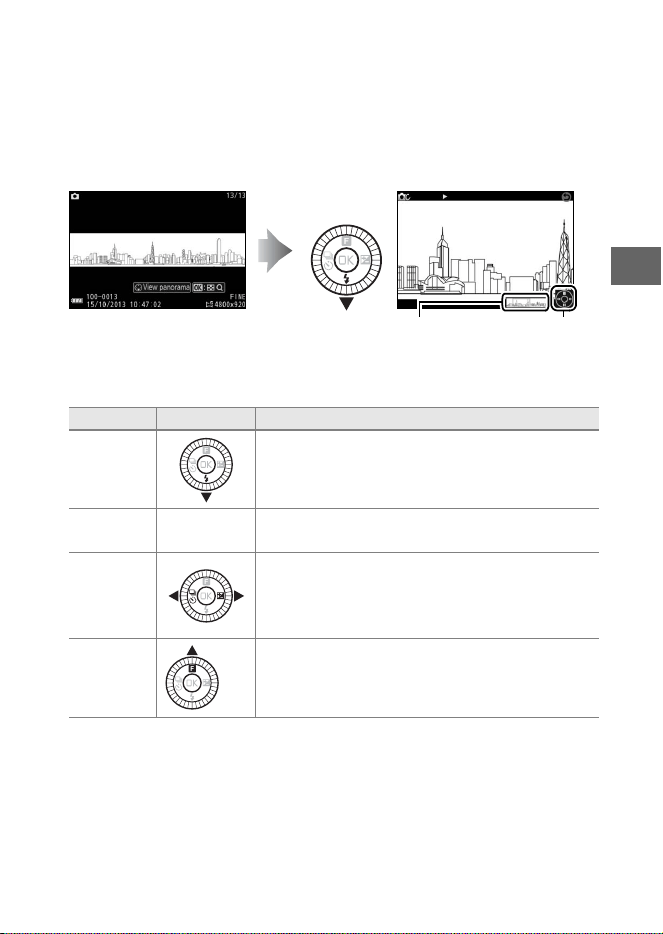
Panoramas can be viewed by pressing 3 when a panorama is
displayed full frame (0 25). The start of the panorama will be
displayed with the smallest dimension filling the display and the
camera will then scroll through the picture in the original pan
direction.
The following operations can be performed:
Navigation
window
Guide
To Use Description
Pause Pause playback.
Play J
Resume playback when the panorama is
paused or during rewind/advance.
Advance/
rewind
Press 4 to rewind, 2 to advance. If playback is
paused, the panorama rewinds or advances a
segment at a time; keep the button pressed
for continuous rewind or advance.
Return to
full-frame
playback
/K Press 1 or K to exit to full-frame playback.
44
z
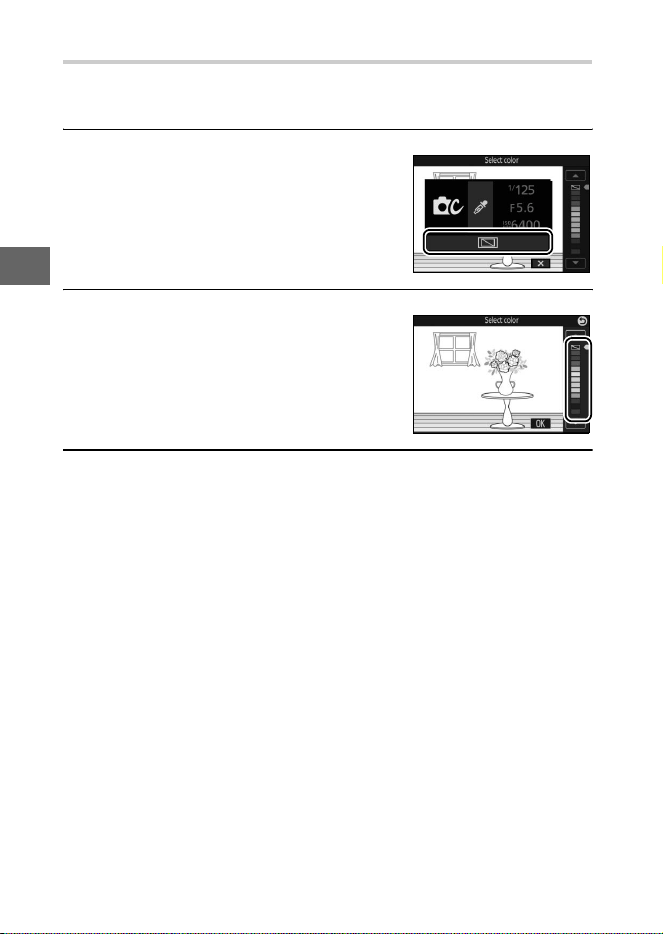
Selective Color
Take black-and-white pictures in which one hue appears in a
color.
1
Choose Select color.
2
Choose a color.
3
Take pictures.
Press the shutter-release button all the way down to take pic-
tures. Only the selected hue will appear in color; all other
hues will be recorded in shades of gray.
Press & to display the & (feature)
menu, then highlight Select color
and press J.
Use the multi selector to choose a
color and press J.
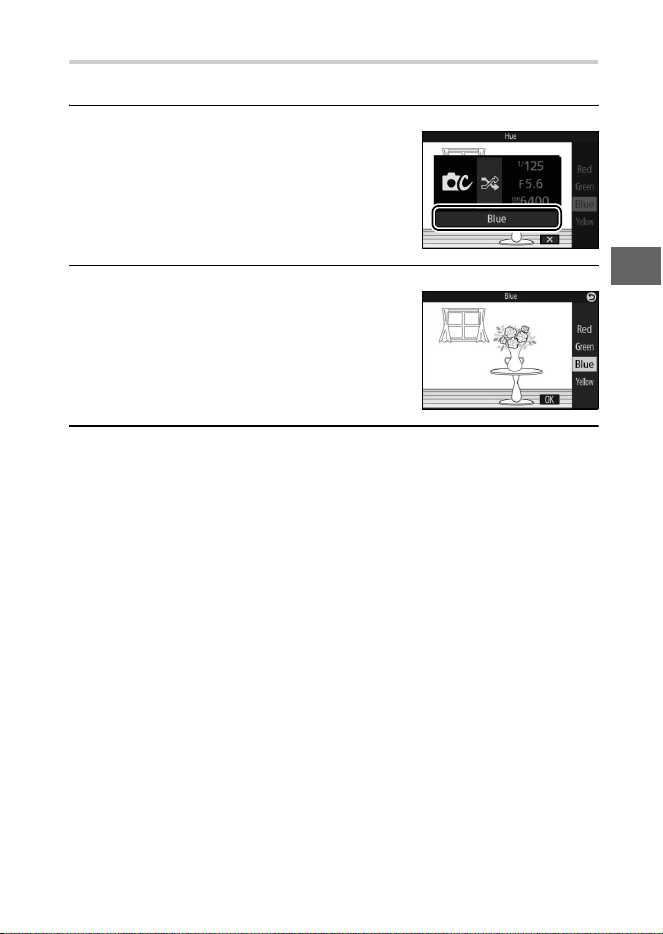
45
z
Cross Process
Select a base hue to take pictures with modified colors.
1
Select Hue.
2
Choose a color.
3
Take pictures.
Press the shutter-release button all the way down to take pic-
tures with modified colors.
Press & to display the & (feature)
menu, then highlight Hue and press
J.
Use the multi selector to choose a
base color (red, green, blue, or yellow)
and press J.
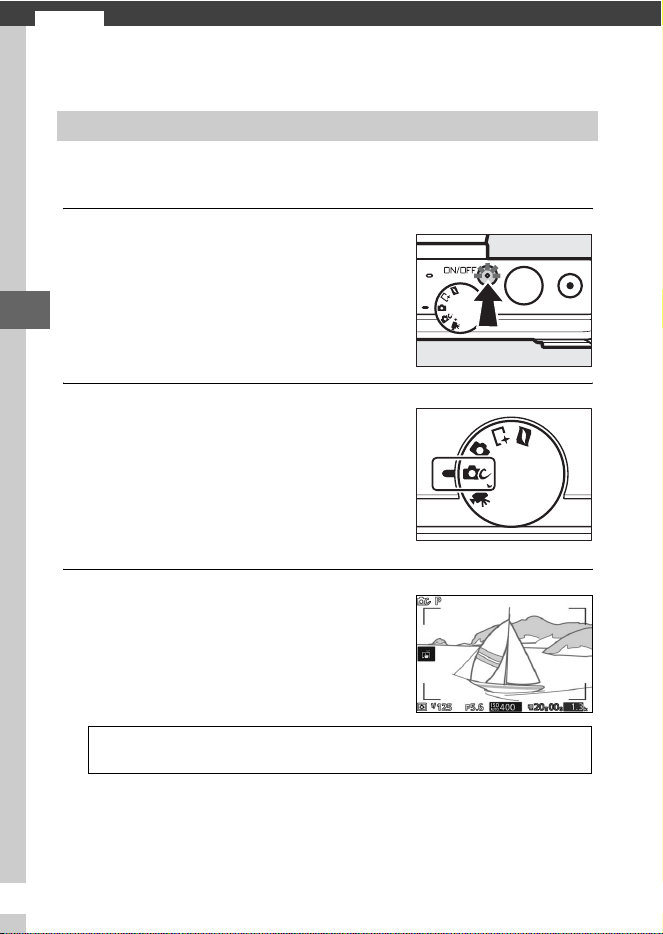
y
46
y
Recording and Viewing Movies
Use the movie-record button to record movies in auto, creative,
and advanced movie mode.
1
Turn the camera on.
2
Choose a shooting mode.
3
Frame the opening shot.
Recording Movies
Press the power switch to turn the
camera on.
Rotate the mode dial to C (auto), w
(creative), or v (advanced movie) as
described on page 6. In advanced
movie mode, you can choose a movie
type using the Advanced movie
option in the & menu (0 49).
Frame the opening shot with your
subject in the center of the display. If
Slow motion is selected in advanced
movie mode (0 49), press the shutter-
release button halfway to focus.
A
The 0 Icon
A 0 icon indicates that movies can not be recorded.
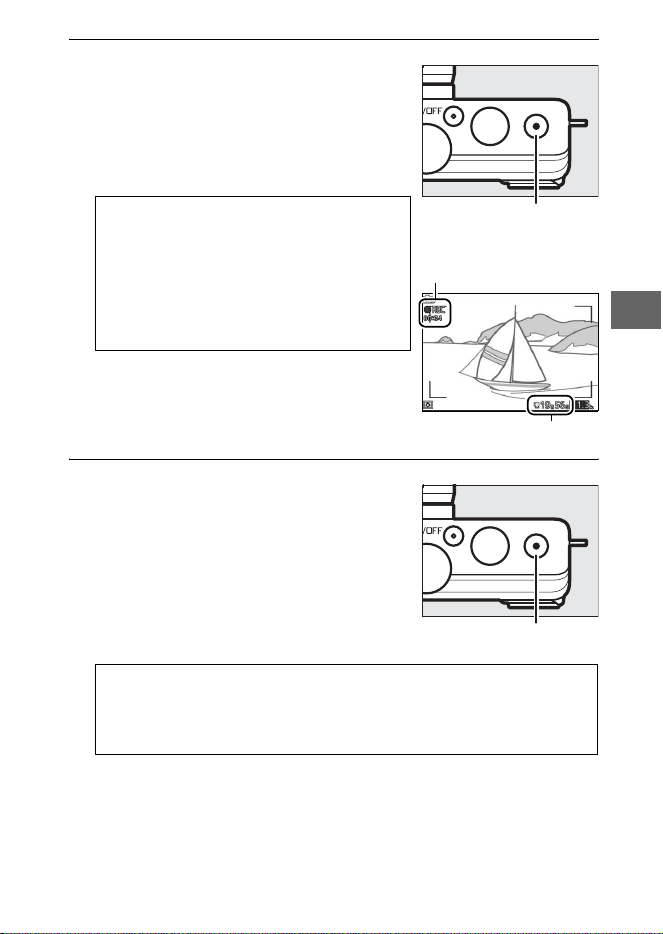
47
y
4
Start recording.
5
End recording.
Press the movie-record button to
begin recording. A recording indica-
tor, the time elapsed, and the time
available are displayed while record-
ing is in progress.
A
Audio Recording
Be careful not to cover the microphone
and note that the built-in microphone
may record sounds made by the camera
or lens. Except when recording slow-
motion movies, the camera focuses con-
tinuously.
Movie-record button
Recording indicator/
Time elapsed
Time available
Press the movie-record button again
to end recording. Recording will end
automatically when the maximum
length is reached, the memory card is
full, another mode is selected, the lens
is removed, or the camera becomes
hot (0 xii).
Movie-record button
A
Maximum Length
The camera can record movies up to 4 GB in size; note that depend-
ing on memory card write speed, shooting may end before this
length is reached (0 104).
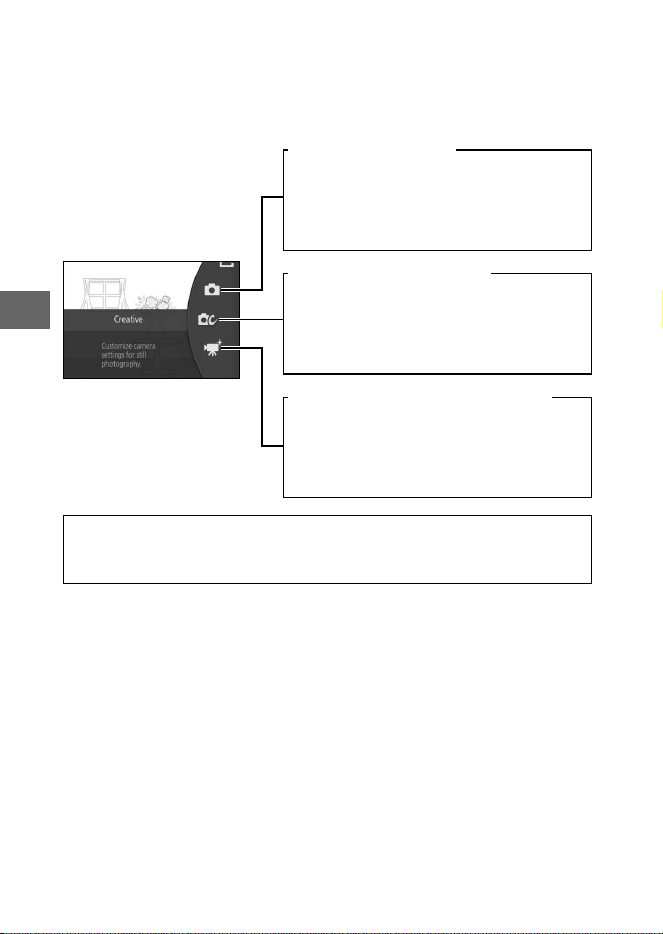
48
y
❚❚ Shooting Mode
Movies can be recorded in the shooting modes listed below.
Movies can not be recorded in best moment capture or Motion
Snapshot modes.
C Auto mode (0 22)
Choose this mode to leave the camera in
charge of choosing settings. The camera
automatically adjusts settings according
to the subject and situation.
w Creative mode (0 31)
Record movies in exposure mode P
(programmed auto). If Creative Palette is
selected, the chosen effect will be applied
to the movie (0 39).
v Advanced movie mode (0 49)
Choose an exposure mode (0 94) and
adjust shutter speed or aperture, or record
movies in slow or fast motion or with
other special effects.
A
Movie Sound
The Movie sound options item in the movie menu offers microphone
sensitivity and wind noise options (0 95).
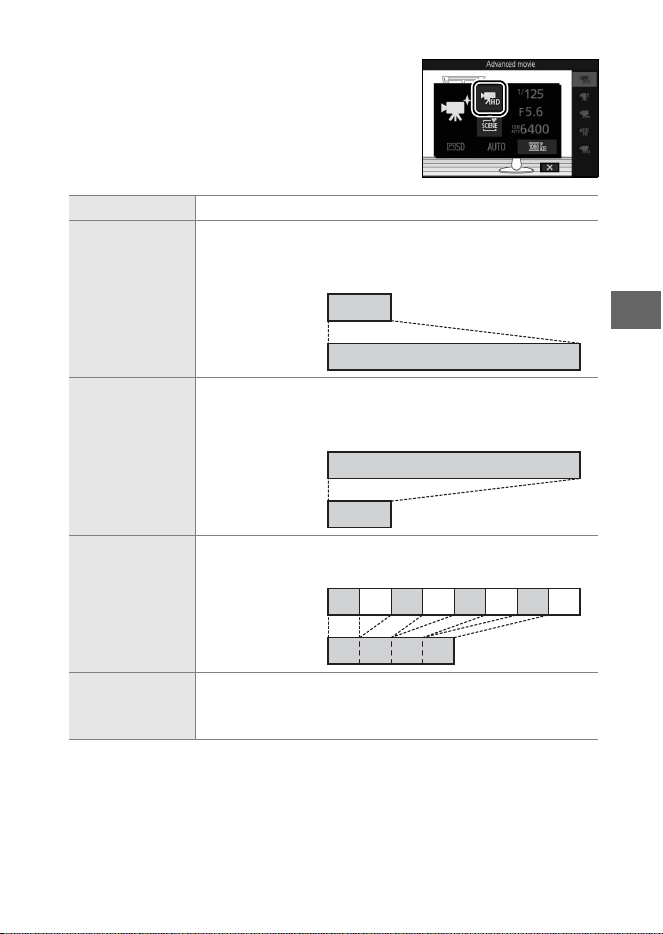
49
y
❚❚ Advanced Movie Options
In v (advanced movie) mode, the fol-
lowing options can be accessed by press-
ing & and selecting Advanced movie in
the & (feature) menu.
0 HD movie Record high-definition (HD) movies.
y Slow motion
Record up to about three seconds of silent slow-
motion footage. Slow-motion movies are recorded at
400 fps and play back at about 30 fps.
1 Fast motion
Record silent fast-motion footage that plays back at
about four times normal speed. Playback time is one
quarter the recording time.
2 Jump cut
Record silent jump-cut movies. Recording pauses
every other second for a drop-frame effect.
3 4-second movie
Record a 4-second movie clip. Multiple clips can be
joined into a single movie using the Combine 4-sec-
ond movies option in the playback menu (0 92).
Recording
Playback
Recording
Playback
Recording
Playback
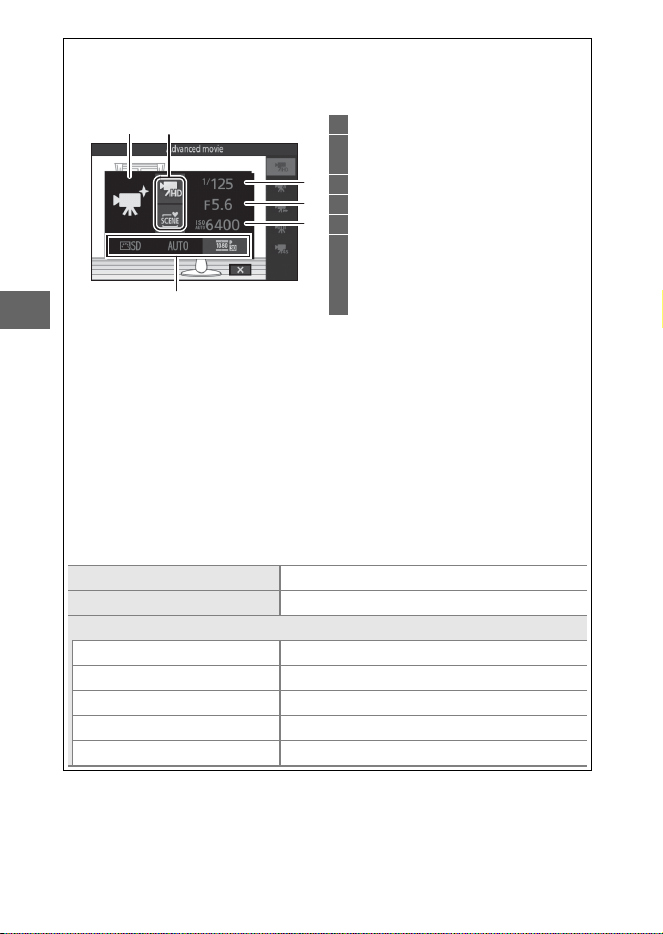
50
y
A
The & (Feature) Menu (0 9)
Pressing & in advanced movie mode displays the items listed below.
The items available vary with the type of movie selected (0 49).
1 Shooting mode......................................6
2 Advanced movie .................................49
Exposure mode....................................94
3 Shutter speed................................35, 37
4 Aperture ......................................... 36, 37
5 ISO sensitivity.......................................95
6 Picture Control.....................................95
White balance......................................95
Frame size/frame rate ........................95
Slow motion .........................................95
A
Slow Motion
When slow motion is selected in advanced movie mode, the camera
can be focused by pressing the shutter-release button halfway before
recording begins. The camera focuses on the subject at the center of
the display; face detection (0 28) is not available. Focus and exposure
can not be adjusted during recording. The frame rate can be chosen
using the Slow motion item in the movie menu (0 95).
A
Recording Time
The following table lists the approximate maximum recording times for
individual movies shot at the default frame rate in each shooting mode.
Auto mode 20 minutes
Creative mode 20 minutes
Advanced movie mode
HD movie 20 minutes
Slow motion 3 seconds
Fast motion 20 minutes
Jump cut 20 minutes
4-second movie 4 seconds
12
6
3
4
5
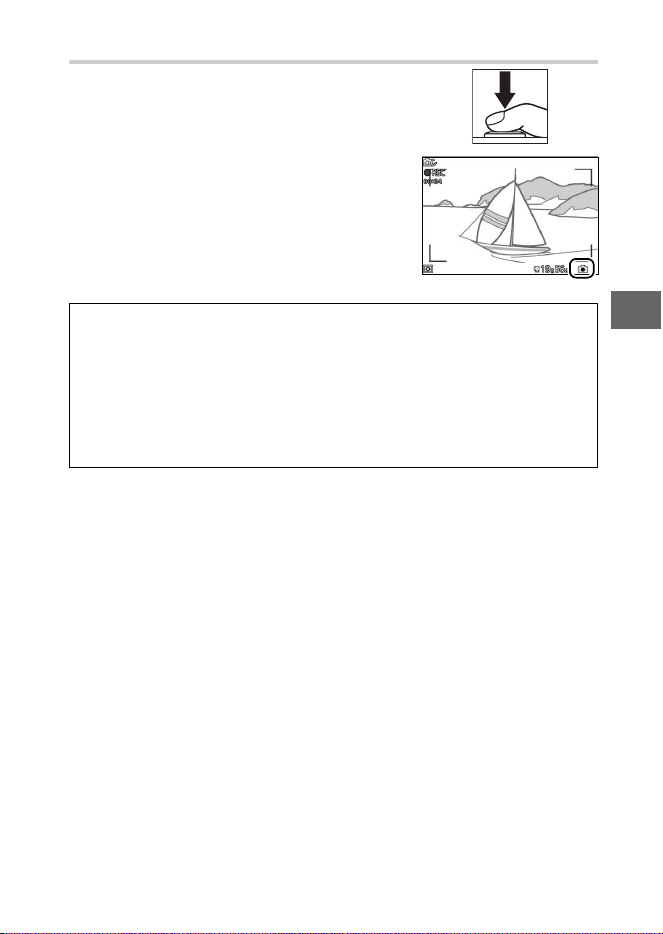
51
y
Taking Photographs During Movie Recording
Press the shutter-release button all the
way down to take a photograph without
interrupting movie recording. Photo-
graphs taken during movie recording
have an aspect ratio of 3 : 2.
A
Taking Photographs During Movie Recording
Up to 20 photographs can be taken with each movie shot. Please note
that photographs can not be taken with slow-motion movies.
A
Focus Lock
If Single AF is selected for Focus mode in the movie menu for
advanced movie mode, focus will lock while the shutter-release button
is pressed halfway (0 95).
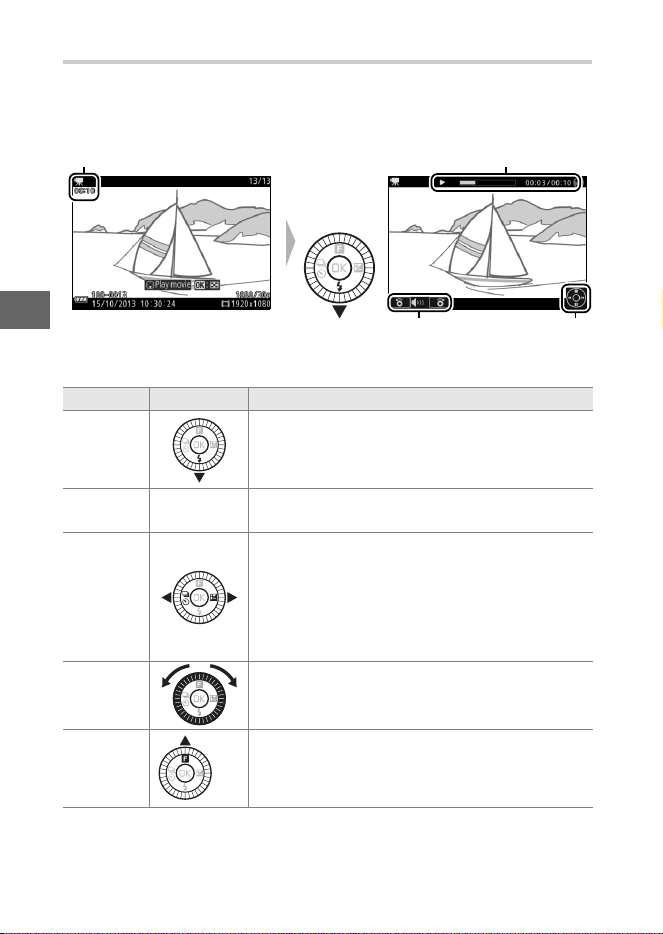
52
y
Viewing Movies
Movies are indicated by a 1 icon in full-frame playback (0 25).
Press 3 to start playback.
The following operations can be performed:
1 icon/Length
Movie playback indicator/
Current position/total length
Volume Guide
To Use Description
Pause Pause playback.
Play J
Resume playback when the movie is paused
or during rewind/advance.
Advance/
rewind
Press 4 to rewind, 2 to advance. Speed
increases with each press, from 2× to 4× to 8×
to 16×. If playback is paused, the movie
rewinds or advances one frame at a time; keep
the button pressed for continuous rewind or
advance.
Adjust
volume
Rotate the multi selector to adjust volume.
Return to
full-frame
playback
/K Press 1 or K to exit to full-frame playback.
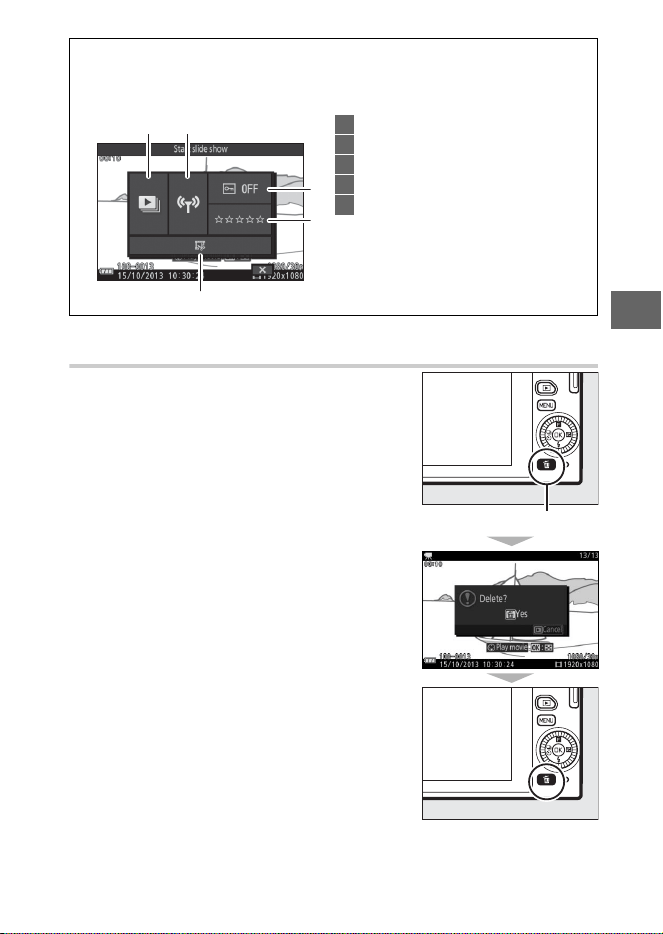
53
y
Deleting Movies
To delete the current movie, press O. A
confirmation dialog will be displayed;
press O again to delete the movie and
return to playback, or press K to exit
without deleting the movie. Note that
once deleted, movies can not be recovered.
A
The & (Feature) Menu (0 9)
The following options can be accessed by pressing & when a movie is
displayed:
1 Start slide show .................................. 92
2 Wi-Fi upload ........................................ 92
3 Protect................................................... 92
4 Rating.................................................... 92
5 Edit movie ............................................ 92
1 2
3
4
5
O button
54
y
A
See Also
The Edit movie option in the playback menu can be used to trim
unwanted footage from existing movies (0 92).
Use the Frame Size/Frame Rate option in the movie menu to choose
the frame size and rate for HD movies (0 95), the Slow motion option
to choose the frame rate for slow-motion movies (0 95).
D
Recording Movies
Flicker, banding, or distortion may be visible in the display and in the
final movie under fluorescent, mercury vapor, or sodium lamps or if the
camera is panned horizontally or an object moves at high speed
through frame (flicker and banding can be reduced by choosing a
Flicker reduction option that matches the frequency of the local AC
power supply, but note that the slowest shutter speed available is
1
/
100
s at 50 Hz,
1
/
60 s at 60 Hz; flicker reduction is not available with slow-
motion movies). Bright light sources may leave after-images when the
camera is panned. Jagged edges, color fringing, moiré, and bright
spots may also appear. When recording movies, avoid pointing the
camera at the sun or other strong light sources. Failure to observe this
precaution could result in damage to the camera’s internal circuitry.
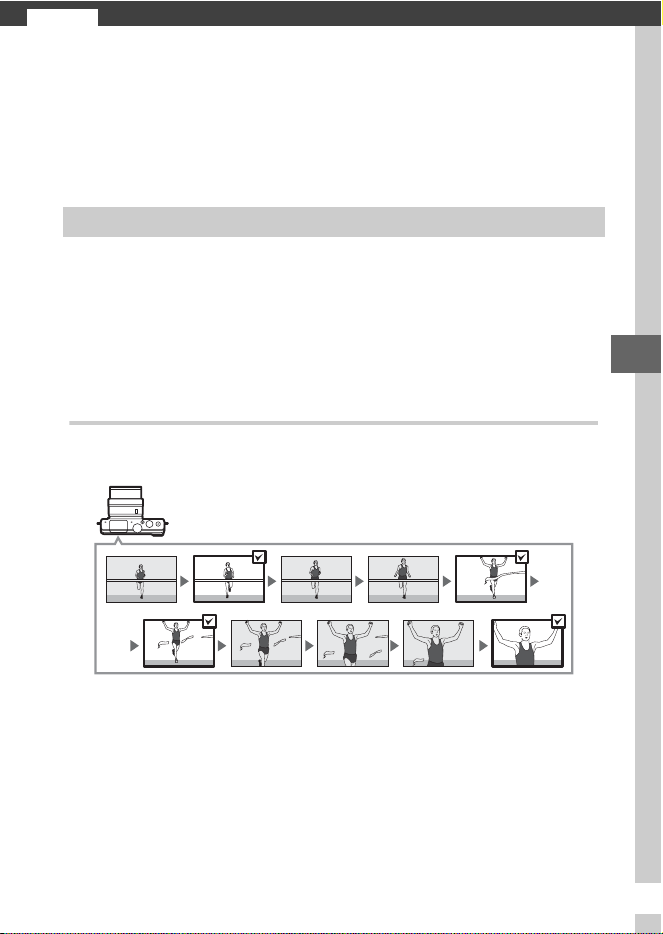
55
R
R
Other Shooting Modes
In addition to the modes described above, the camera offers
u (best moment capture) mode to help with hard-to-time shots
and a z (Motion Snapshot) mode that combines photographs
with brief movie vignettes (0 65).
Choose a shot from 20 frames recorded to temporary storage
shortly before or after the shutter is released (Active Selection),
choose the moment to release the shutter as the scene plays
back in slow motion (slow view), or let the camera choose the
best shot based on composition and movement (Smart Photo
Selector).
Choosing a Shot Manually (Active Selection)
Choose up to 20 shots from 20 frames recorded shortly before or
after the shutter-release button is pressed all the way down.
u Choosing the Moment (Best Moment Capture)
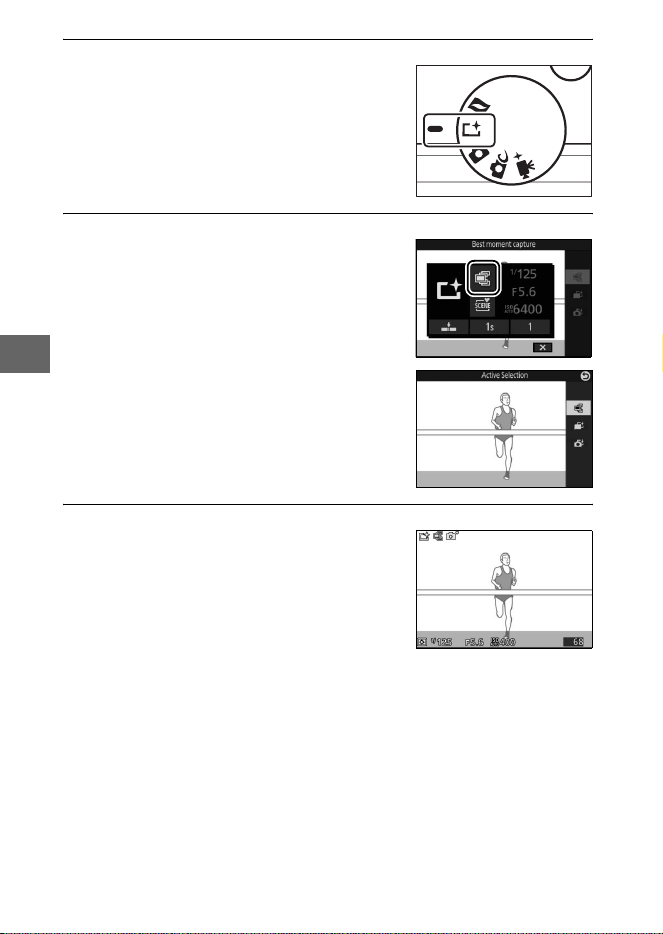
56
R
1
Select u mode.
2
Choose Active Selection.
3
Frame the photograph.
Rotate the mode dial to u (best
moment capture).
Press & (feature) to display the &
menu. Highlight Best moment cap-
ture and press J, then highlight
Active Selection and press J.
Compose the photograph with your
subject in the center of the frame.
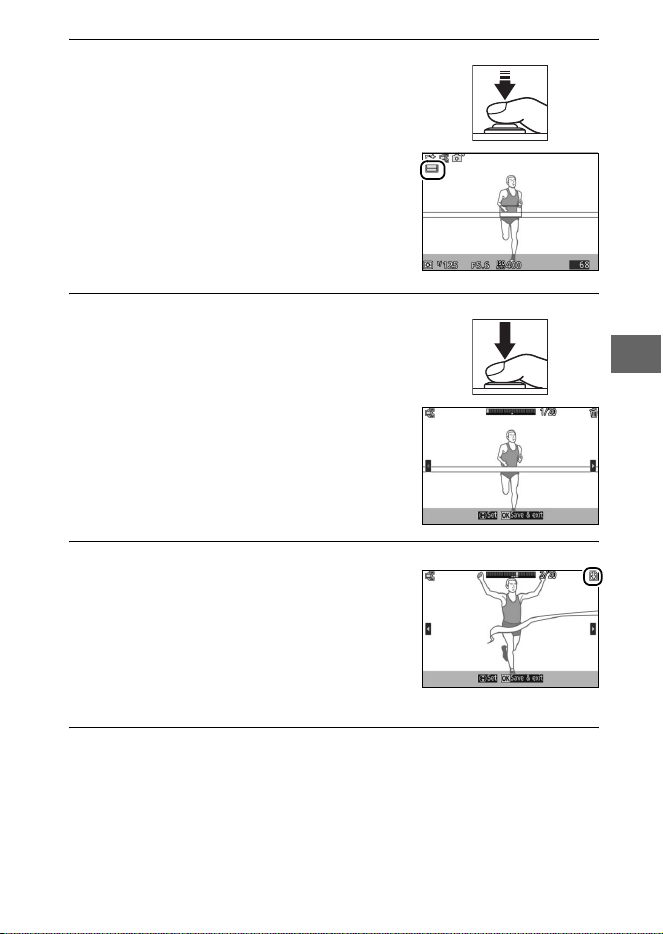
57
R
4
Begin buffering photographs.
5
Shoot.
6
Select up to 20 frames.
7
Save the selected frames.
Press J to save the selected frames to the memory card. The
memory card access lamp will light while recording is in
progress; note that depending on shooting conditions and
memory card write speed, some time may be required to save
the selected images.
Press the shutter-release button half-
way to focus (0 24). A & icon will be
displayed as the camera begins
recording images to the memory
buffer.
Smoothly press the shutter-release
button the rest of the way down. The
20 frames recorded to the buffer in the
moments before and after the shutter-
release button was pressed all the way
down will be copied to temporary
storage.
Press 4 or 2 to scroll through the
frames and press 1 or 3 to select or
deselect. Selected images are indi-
cated by a p icon, while the remaining
images are marked with O icons to
show that they will be deleted.
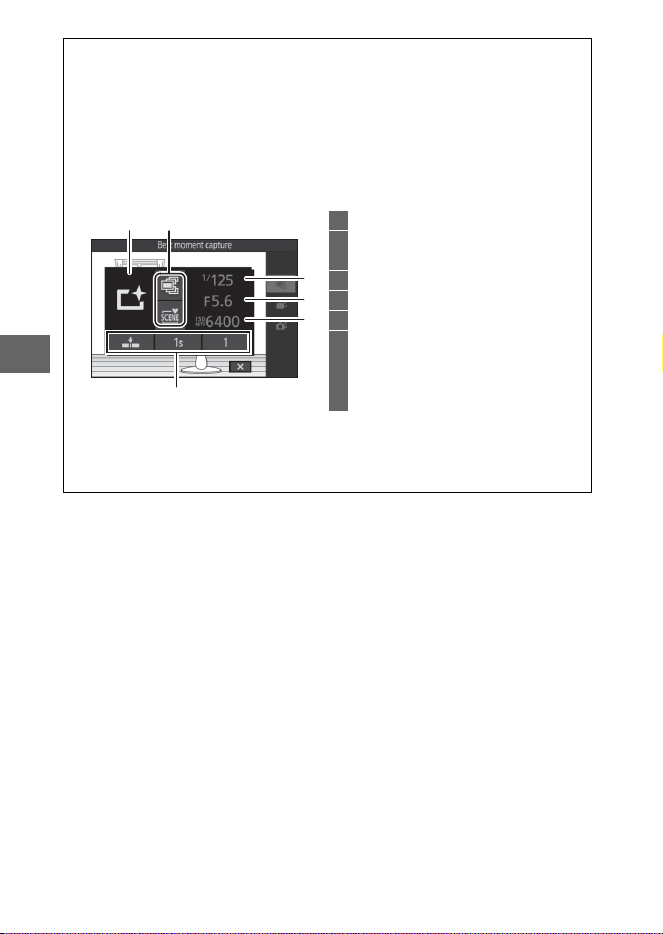
58
R
A
Active Selection
At default settings, the frame recorded at the moment the shutter-
release button was pressed all the way down is automatically marked
with a p icon in Step 6.
A
The & (Feature) Menu (0 9)
Pressing & in best moment capture mode displays the items listed
below. The items available vary with the mode selected (0 55, 59, 61).
1 Shooting mode......................................6
2 Best moment capture ........................55
Exposure mode....................................93
3 Shutter speed................................35, 37
4 Aperture ......................................... 36, 37
5 ISO sensitivity.......................................95
6 On release, record
Capture 20 frames over
Frames saved (default)
Number of shots saved......................93
A
Best Moment Capture Mode
Movies can not be recorded, and pressing the movie-record button has
no effect. The flash can not be used.
12
6
3
4
5
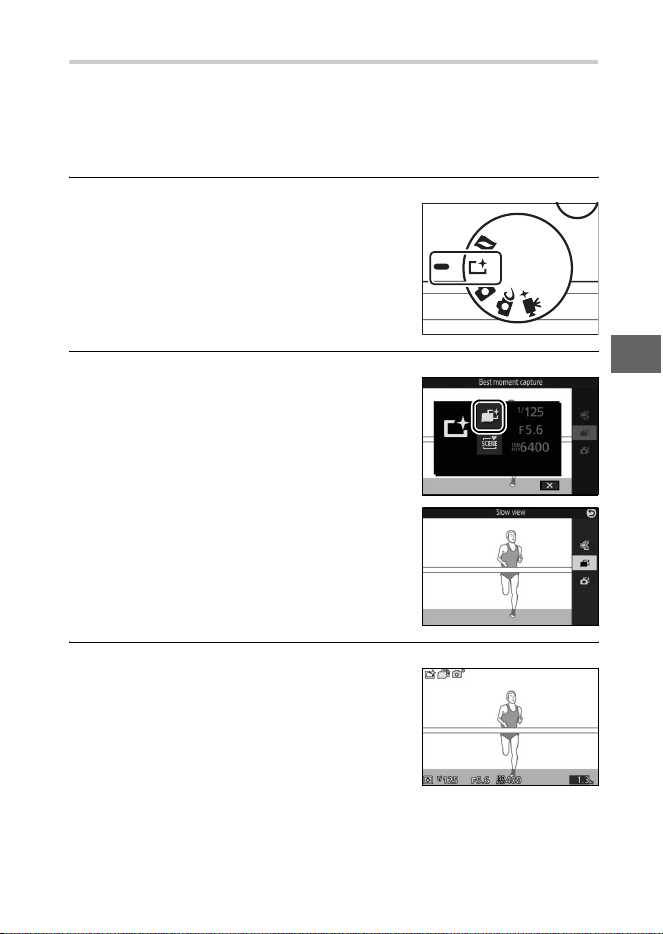
59
R
Choosing Your Moment (Slow View)
When slow view is selected in u (best moment capture) mode,
the camera captures a short sequence of still images and plays
them back in slow motion so that you can choose the precise
moment for a photograph.
1
Select u mode.
2
Select Slow view.
3
Frame the photograph.
Rotate the mode dial to u (best
moment capture).
Press & (feature) to display the &
menu. Highlight Best moment cap-
ture and press J, then highlight Slow
view and press J.
Compose the photograph with your
subject in the center of the frame.
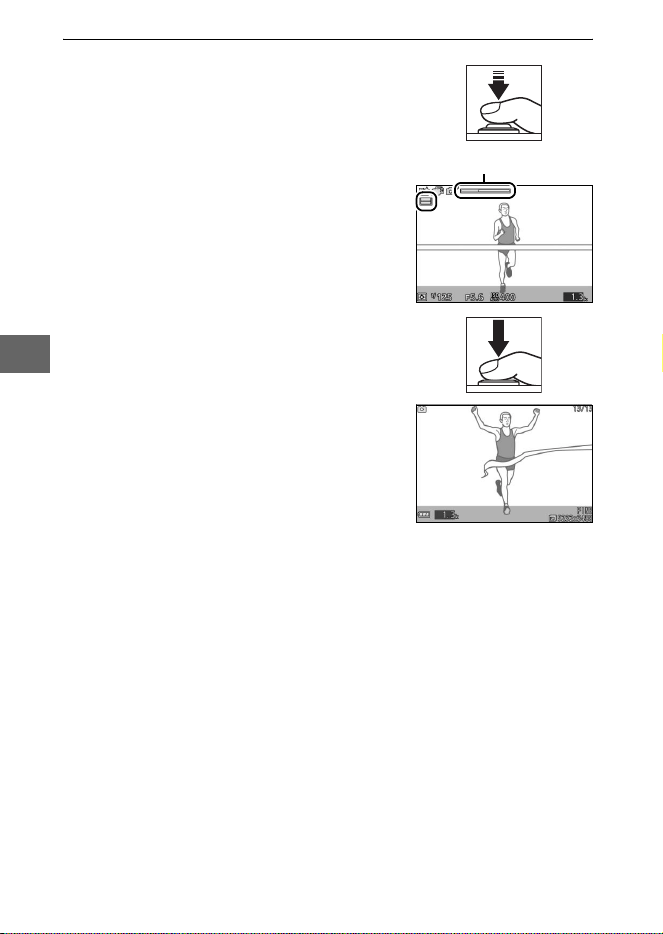
60
R
4
Press the shutter-release button halfway.
After focusing, the camera will record
20 frames to a temporary memory
buffer. It will then slowly play them
back in a continuous loop while the
shutter-release button is kept pressed
halfway. A & icon is displayed in the
monitor.
Progress indicator
When the desired frame is displayed,
press the shutter-release button the
rest of the way down to record the cur-
rent frame and discard the remaining
images. The selected frame will be dis-
played for a few seconds when record-
ing is complete. To delete the buffer
contents and exit without recording a
photograph, release the button with-
out pressing it the rest of the way
down.
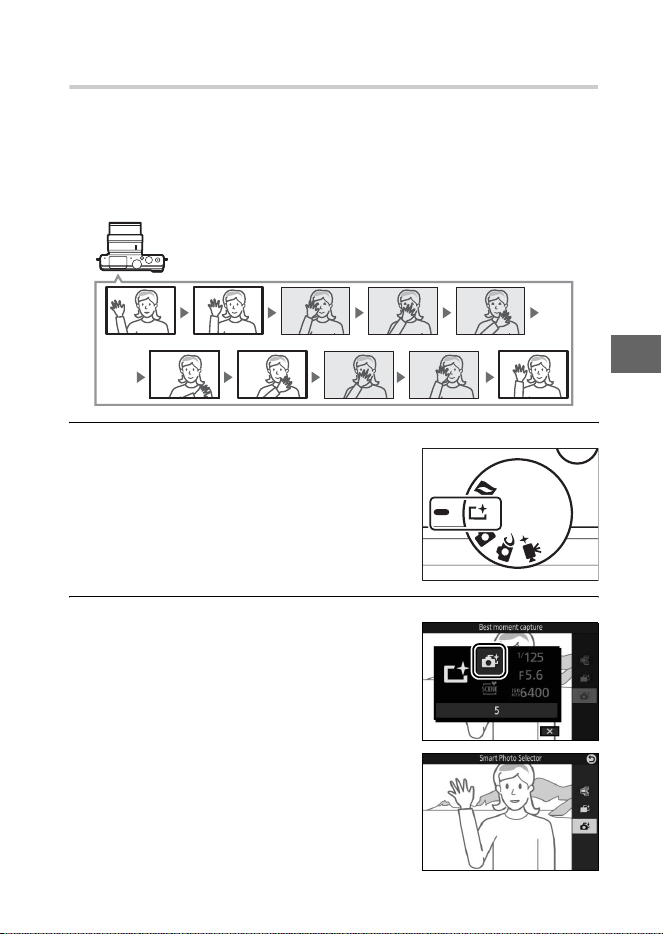
61
R
Letting the Camera Choose the Moment
(Smart Photo Selector)
The Smart Photo Selector helps you capture a fleeting expres-
sion on the face of a portrait subject or other hard-to-time shots
such as group photos in party scenes. Each time the shutter is
released, the camera automatically selects the best shot and four
best shot candidates based on composition and motion.
1
Select u mode.
2
Choose Smart Photo Selector.
Rotate the mode dial to u (best
moment capture).
Press & (feature) to display the &
menu. Highlight Best moment cap-
ture and press J, then highlight
Smart Photo Selector and press J.
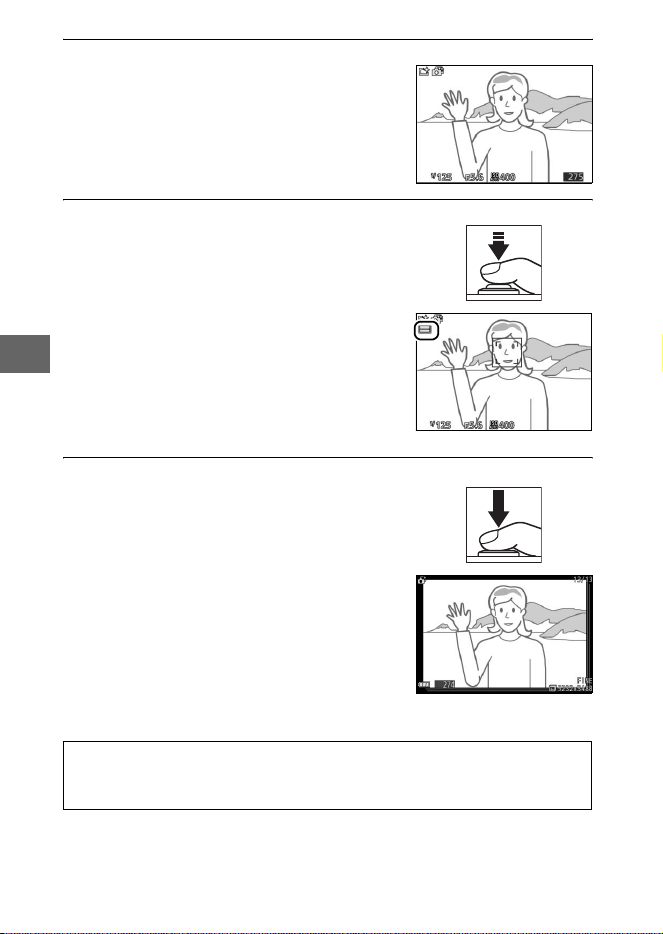
62
R
3
Frame the photograph.
4
Begin buffering photographs.
5
Shoot.
Smoothly press the shutter-release
button the rest of the way down. The
camera will compare shots recorded
to the buffer both before and after the
shutter-release button was pressed all
the way down, and select five to copy
to the memory card. Note that some
time may be required. The best pic-
ture is displayed in the monitor when
recording is complete.
Compose the photograph with your
subject in the center of the frame.
Press the shutter-release button half-
way to focus (0 24). A & icon will be
displayed as the camera begins
recording images to the memory
buffer. The camera continuously
adjusts focus to account for changes
in the distance to the subject while
the shutter-release button is pressed
halfway.
A
Smart Photo Selector
The camera automatically chooses a scene mode appropriate to the
subject.
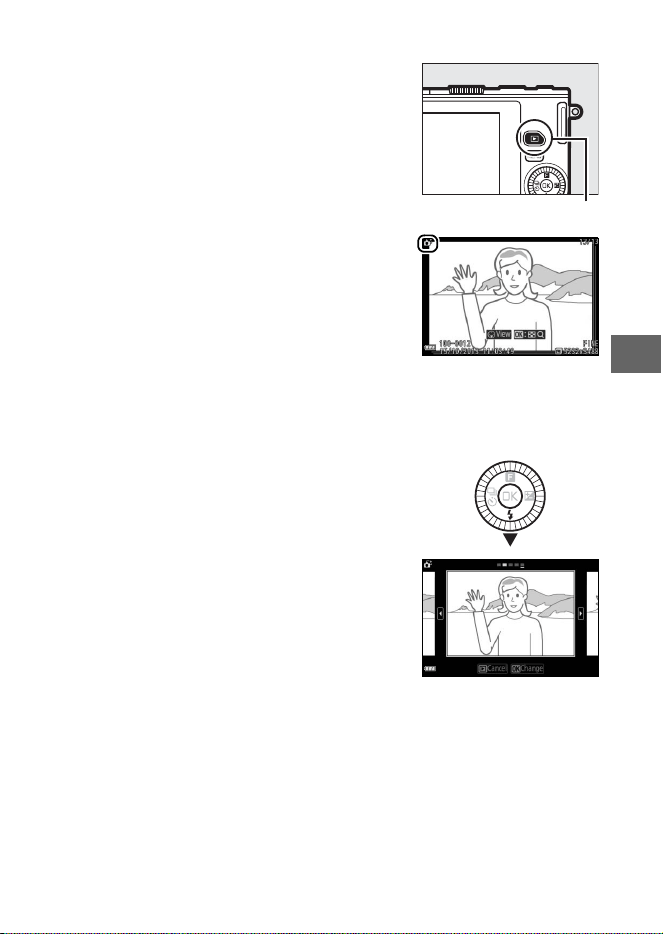
63
R
❚❚ Viewing Photos Taken with the Smart Photo Selector
Choosing the Best Shot
Press K and use the multi selector to dis-
play photographs taken with the Smart
Photo Selector (0 25; pictures taken with
the Smart Photo Selector are indicated by
a y icon). Of the photographs recorded
by the Smart Photo Selector, only the
best shot will be displayed (when you
press 2 to view the next picture, the
camera will skip over the best shot candi-
dates, with the result that the next pic-
ture displayed will not have a file number
that immediately follows that of the cur-
rent picture). To end playback and return
to shooting mode, press the shutter-
release button halfway.
K button
When a photograph taken with the Smart
Photo Selector is displayed, you can
choose the best shot by pressing 3. Press
4 or 2 to view the other pictures in the
sequence and press J to select the cur-
rent picture as the best shot. To return to
normal playback, press D.
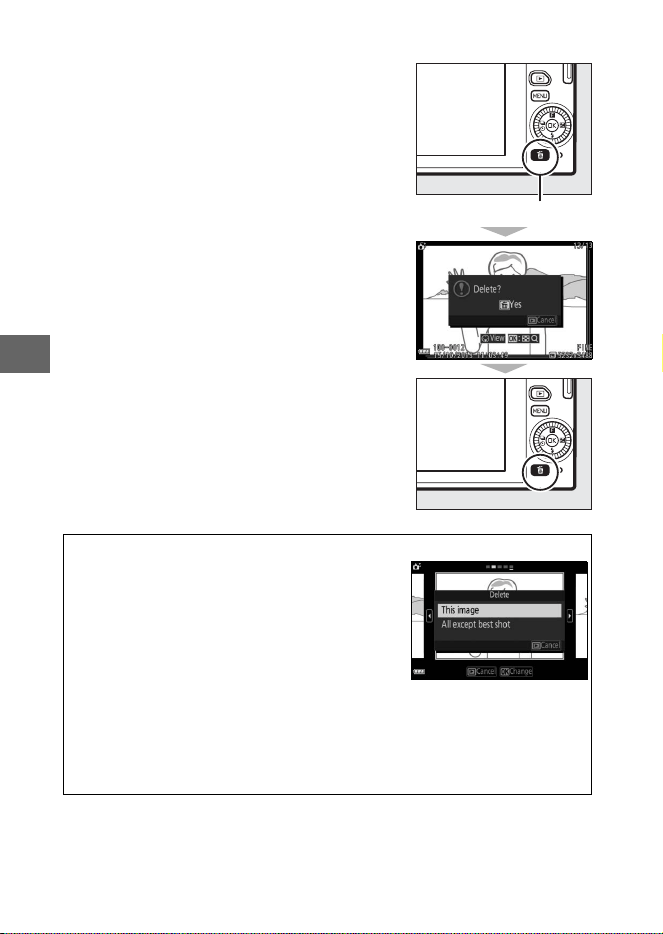
64
R
❚❚ Deleting Pictures
Pressing O when a picture taken with the
Smart Photo Selector is selected displays
a confirmation dialog; press O again to
delete the best shot and the best shot
candidates, or press K to exit without
deleting the pictures. Note that once
deleted, pictures can not be recovered.
A
Deleting Individual Photographs
Pressing the O button in the best shot selec-
tion dialog displays the following options;
highlight an option using the multi selector
and press J to select.
• This image: Delete the current photo (note
that the picture currently selected as the
best shot can not be deleted).
• All except best shot: Delete the best shot candidates, but not picture cur-
rently selected as the best shot.
A confirmation dialog will be displayed; to delete the selected image or
images, highlight Ye s and press J.
O button
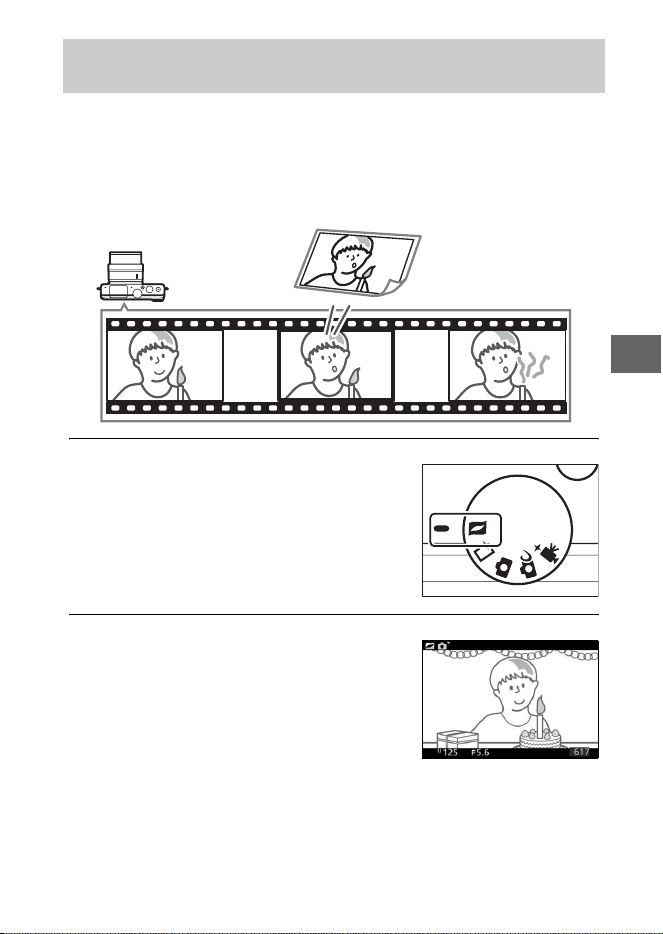
65
R
Record brief movie vignettes with your photographs. Each time
the shutter is released, the camera records a still image and
about 1.6 s of movie footage. When the resulting “Motion Snap-
shot” is viewed on the camera, the movie will play back in slow
motion over approximately 4 s, followed by the still image.
1
Select z mode.
2
Frame the picture.
z Combining Photos with Brief Movie Vignettes
(Motion Snapshot Mode)
Rotate the mode dial to z (Motion
Snapshot).
Compose the photograph with your
subject in the center of the frame.
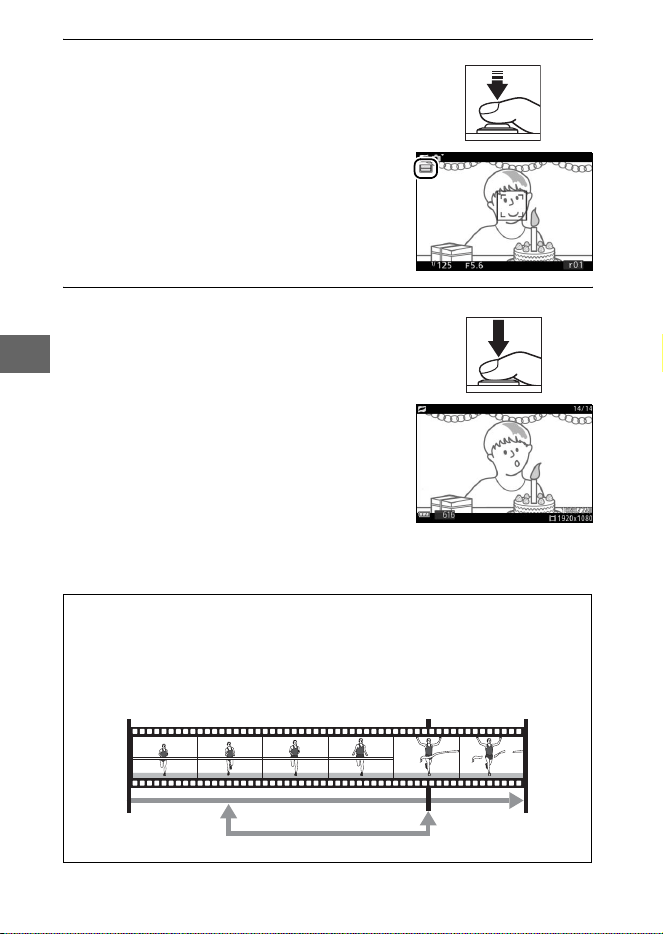
66
R
3
Begin buffering.
4
Shoot.
Smoothly press the shutter-release
button the rest of the way down. The
camera will record a photograph,
together with about 1.6 s of movie
footage beginning before and ending
after the time the shutter-release but-
ton was pressed all the way down.
Note that some time may be required.
When recording is complete, the pho-
tograph will be displayed for a few
seconds.
Press the shutter-release button half-
way to focus (0 24). A & icon will be
displayed as the camera begins
recording footage to the memory
buffer.
A
Ending the Vignette with a Photograph
To make the photograph the same as the last frame in the movie
vignette, select 1.6 s : 0 s for Movie before/after (0 93).
Shutter-release button
pressed halfway
Shutter-release button
pressed all the way down
Movie footage
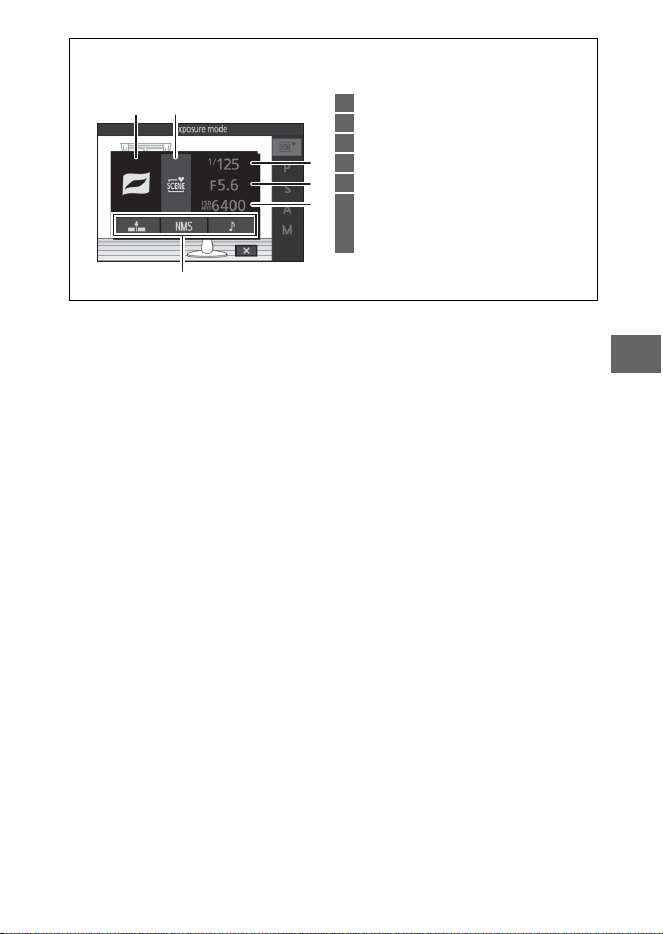
67
R
A
The & (Feature) Menu (0 9)
Pressing & in Motion Snapshot mode displays the following items:
1 Shooting mode......................................6
2 Exposure mode................................... 93
3 Shutter speed................................35, 37
4 Aperture .........................................36, 37
5 ISO sensitivity...................................... 95
6 Movie before/after............................. 93
File format............................................ 93
Audio..................................................... 68
1 2
6
3
4
5
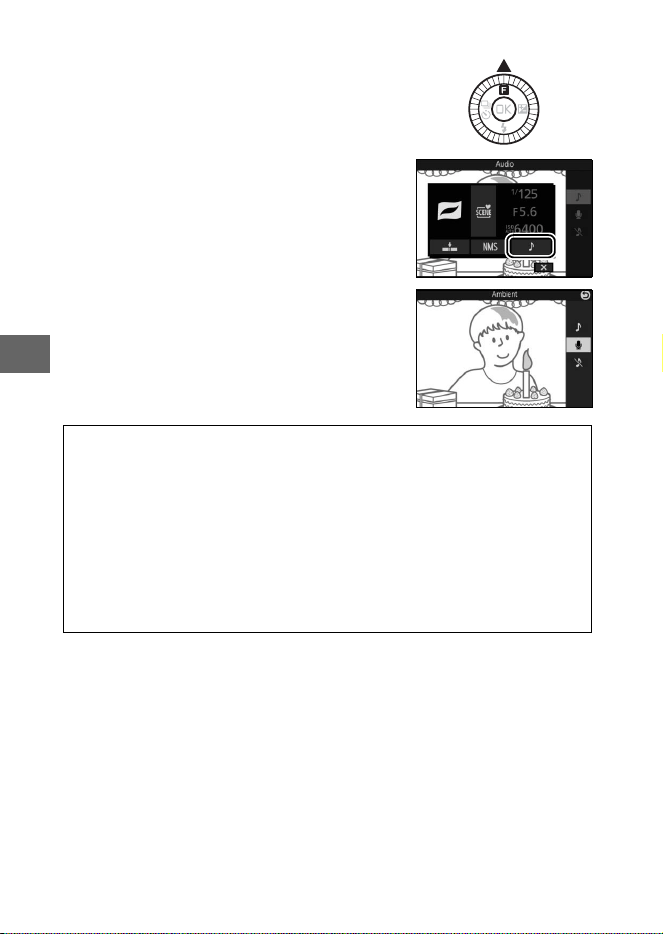
68
R
❚❚ Audio
To record about four seconds of sound
with Motion Snapshots beginning at the
start of movie recording, use the multi
selector and J button to select Ambient
for Audio in the & (feature) menu (0 67).
Motion Snapshots can also be recorded
with background music (Background
music) or no sound (None).
A
Motion Snapshot Mode
Movies can not be recorded using the movie-record button and the
flash can not be used.
A
See Also
Use the File format option in the shooting menu to save Motion Snap-
shots in a format that can be viewed in most movie playback software
(0 93). Use the Combine NMS movies option in the playback menu to
combine the movie portions of multiple Motion Snapshots into a single
movie (0 92).
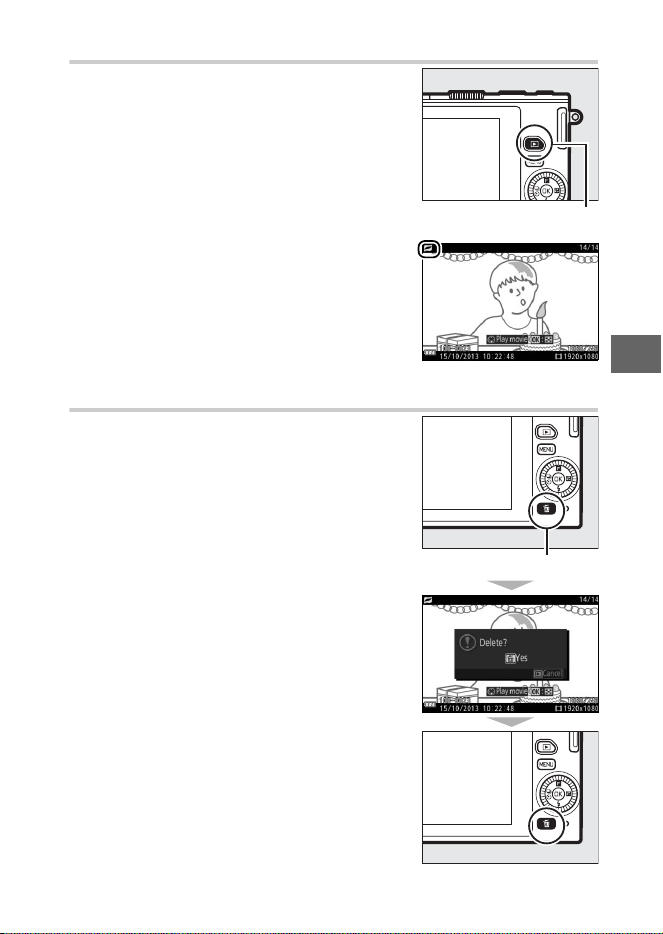
69
R
Viewing Motion Snapshots
Deleting Motion Snapshots
To delete the current Motion Snapshot,
press O. A confirmation dialog will be dis-
played; press O again to delete the photo
and movie and return to playback, or
press K to exit without deleting the file.
Note that once deleted, Motion Snapshots
can not be recovered.
Press K and use the multi selector to dis-
play a Motion Snapshot (0 25; Motion
Snapshots are indicated by a z icon).
Pressing 3 when a Motion Snapshot is
displayed plays back the movie portion in
slow motion over a period of about 4 s,
followed by the photo; playback is
accompanied by the audio track selected
using the Audio option (0 68). To end
playback and return to shooting mode,
press the shutter-release button halfway.
K button
O button
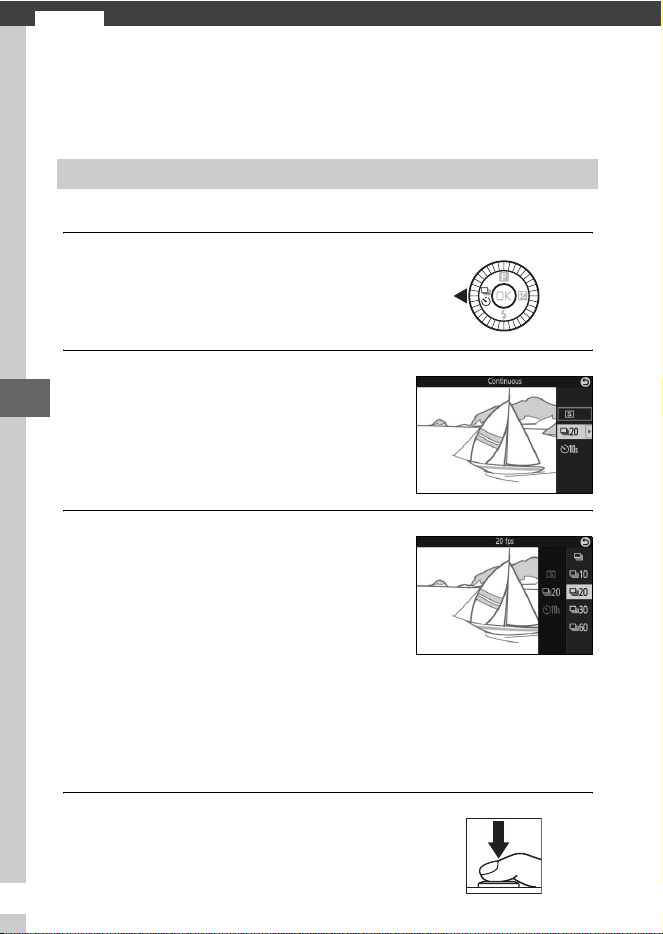
t
70
t
More on Photography
This section describes other features you can use when taking
pictures.
Shoot a continuous series (burst) of photographs.
1
Display release mode options.
2
Select I.
3
Select a frame rate.
4
Frame your subject and shoot.
Continuous Mode
Press 4 (C) to display release mode
options.
Highlight I (continuous) and press 2
to display frame rate options.
Highlight the desired frame rate and
press J. Frame rate is expressed in
terms of the number of frames
recorded per second (fps); choose
from frame rates of approximately 5,
10, 20, 30, and 60 fps (I, Q, R,
S, and T, respectively). Except
when I is selected, the maximum
number of shots that can be recorded
in a single burst is 20.
Press the shutter-release button all
the way down to shoot the burst.

71
t
D
Continuous Mode
Only one picture will be taken if the flash fires when I is selected; at
settings of 10, 20, 30, and 60 fps, the built-in flash will not fire.
While photographs are being recorded to the memory card, the mem-
ory card access lamp will light. Depending on shooting conditions and
memory card write speed, recording may take some time. If the battery
is exhausted before all photographs are recorded, the shutter release
will be disabled and the remaining images transferred to the memory
card.
Continuous shooting is not available in creative modes other than P, S,
A, or M, in best moment capture, advanced movie, or Motion Snapshot
mode, or when live image control is used in auto mode (0 29).
A
Single Frame
To take only one picture each time the shutter-release button is
pressed all the way down, select 8 (single frame) for release mode.
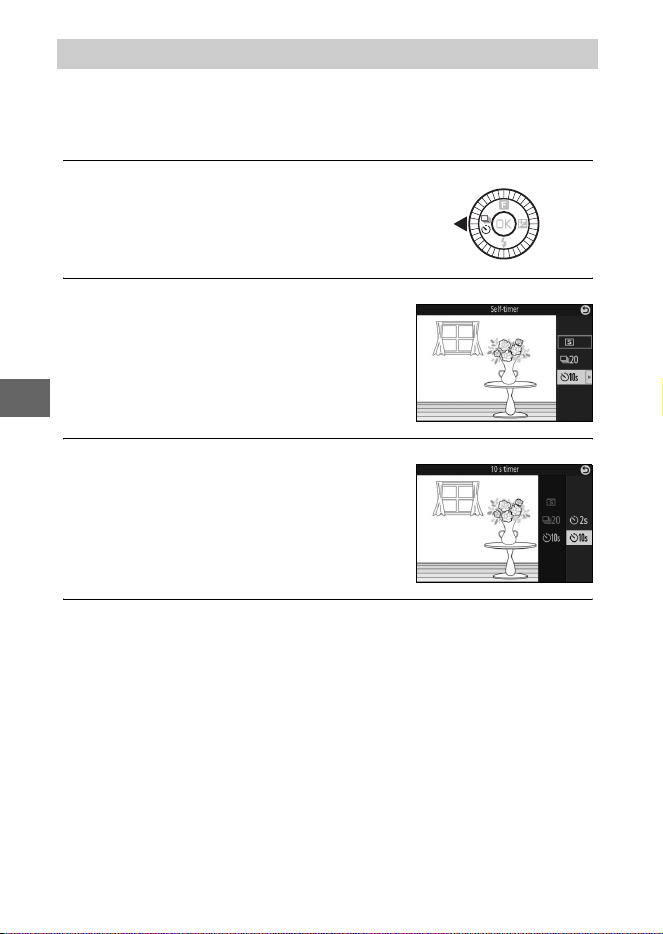
72
t
The self-timer is used to delay shutter release until 10 or 2 sec-
onds after the shutter-release button is pressed all the way
down.
1
Display release mode options.
2
Select E.
3
Select the desired self-timer option.
4
Mount the camera on a tripod.
Mount the camera on a tripod or place the camera on a sta-
ble, level surface.
Self-Timer Modes
Press 4 (C) to display release mode
options.
Highlight E (self-timer) and press 2 to
display self-timer options.
Use the multi selector to highlight c
or a and press J.
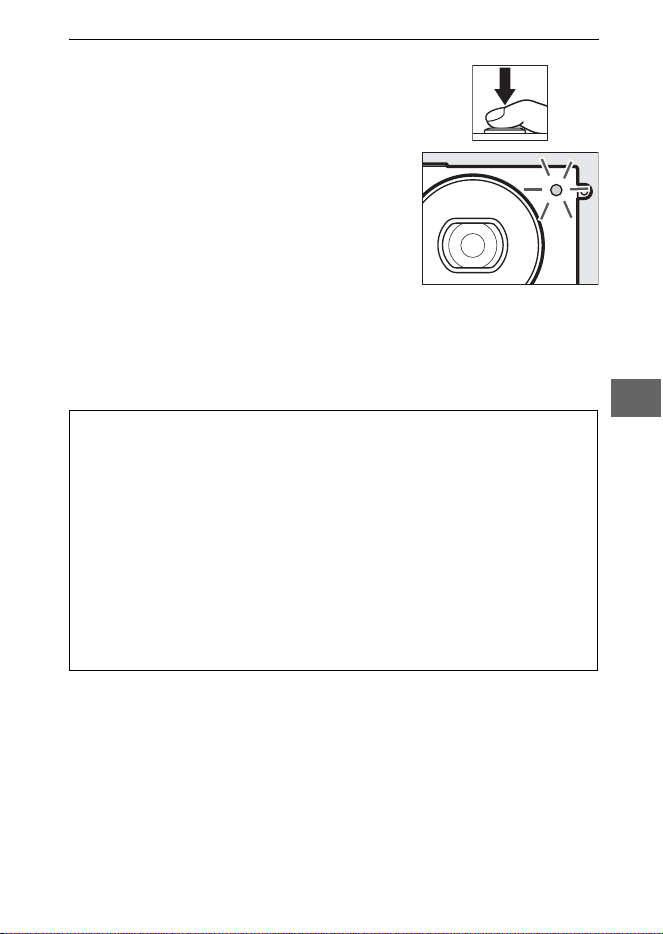
73
t
5
Frame the photograph and shoot.
Note that the timer may not start or a photograph may not be
taken if the camera is unable to focus or in other situations in
which the shutter can not be released. Turning the camera off
cancels the self-timer.
Press the shutter-release button half-
way to focus, and then press the but-
ton the rest of the way down. The self-
timer lamp will start to flash and a
beep will begin to sound. Two sec-
onds before the photo is taken, the
lamp will stop flashing and the beep-
ing will become more rapid.
A
Movie Mode
To record movies using the self-timer, select advanced movie mode
and use the movie-record button to start the timer. Movie recording
ends when the movie-record button is pressed a second time.
A
Raising the Flash
In P, S, A, or M mode, press the flash pop-up button to raise the flash
before shooting. Shooting will be interrupted if the flash is raised while
the timer is counting down.
A
See Also
The Sound settings option in the setup menu controls the beeps that
sound when the self-timer is used (0 96).
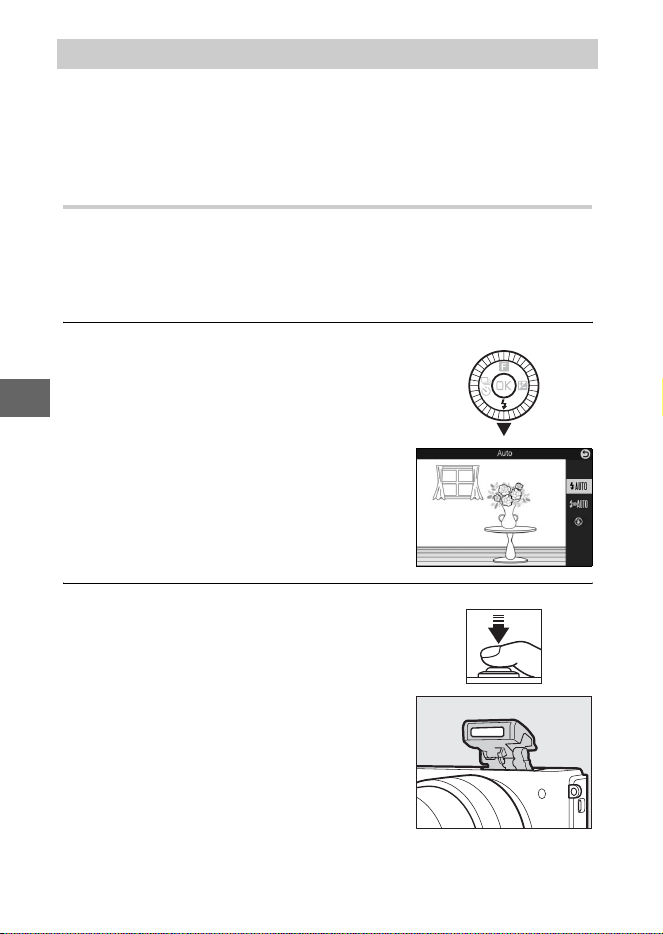
74
t
Use the built-in flash for additional lighting when the subject is
poorly lit or to “fill-in” (illuminate) back-lit subjects. The built-in
flash is available in the following shooting modes, but note that
some camera settings automatically disable the built-in flash:
Auto Pop-up Modes
In C (auto) mode and when soft, miniature effect, selective
color, cross process, or toy camera effect is selected in w (cre-
ative) mode, the flash will pop-up automatically and fire when
required.
1
Choose a flash mode.
2
Take pictures.
The Built-in Flash
Press 3 (N) on the multi selector to
display a list of flash modes, then use
the multi selector to highlight the
desired mode and press J to select.
Press the shutter-release button half-
way to focus and the rest of the way
down to shoot. The flash will pop up
and fire when required.

75
t
❚❚ Flash Modes
The following flash modes are available in C (auto), q (soft),
r (miniature effect), s (selective color), 6 (cross process), and
7 (toy camera effect) modes:
• o (auto flash): When lighting is poor or the subject is backlit,
the flash pops up automatically when the shutter-release but-
ton is pressed halfway and fires as required.
• n (auto with red-eye reduction): Use for portraits. The flash
pops up and fires as required, but before it fires, the red-eye
reduction lamp lights to help reduce “red-eye.”
• s (off): The flash does not fire.
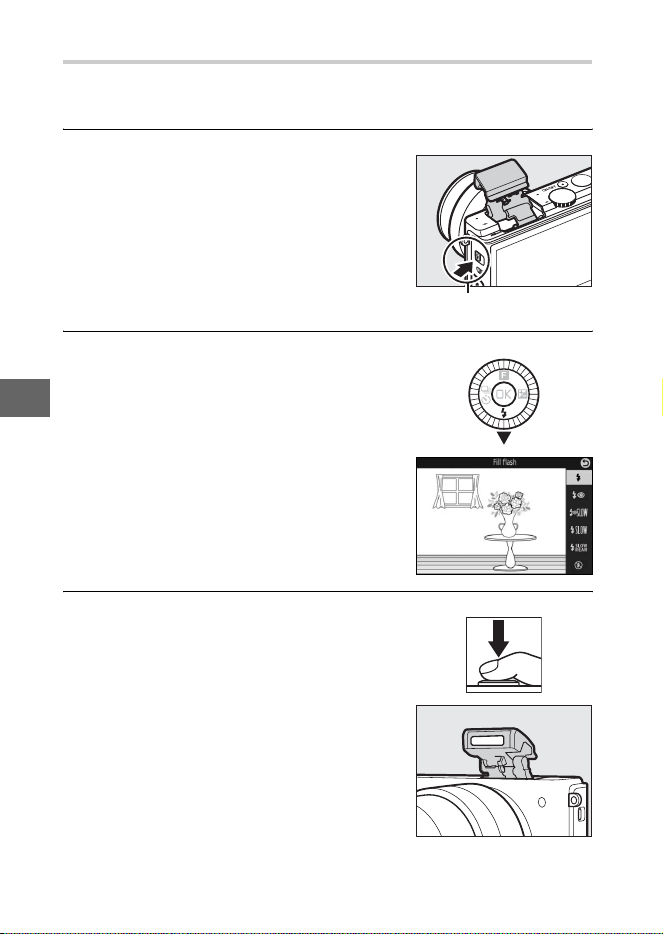
76
t
Manual Pop-up Modes
When P, S, A, or M is selected in w (creative) mode, the flash
must be raised manually. The flash will not fire if it is not raised.
1
Raise the flash.
2
Choose a flash mode.
3
Take pictures.
Press the flash pop-up button to raise
the flash.
Flash pop-up button
Press 3 (N) on the multi selector to
display a list of flash modes, then use
the multi selector to highlight the
desired mode and press J to select.
The flash will fire with every shot. To
disable the flash, press it gently down-
ward until it latches.
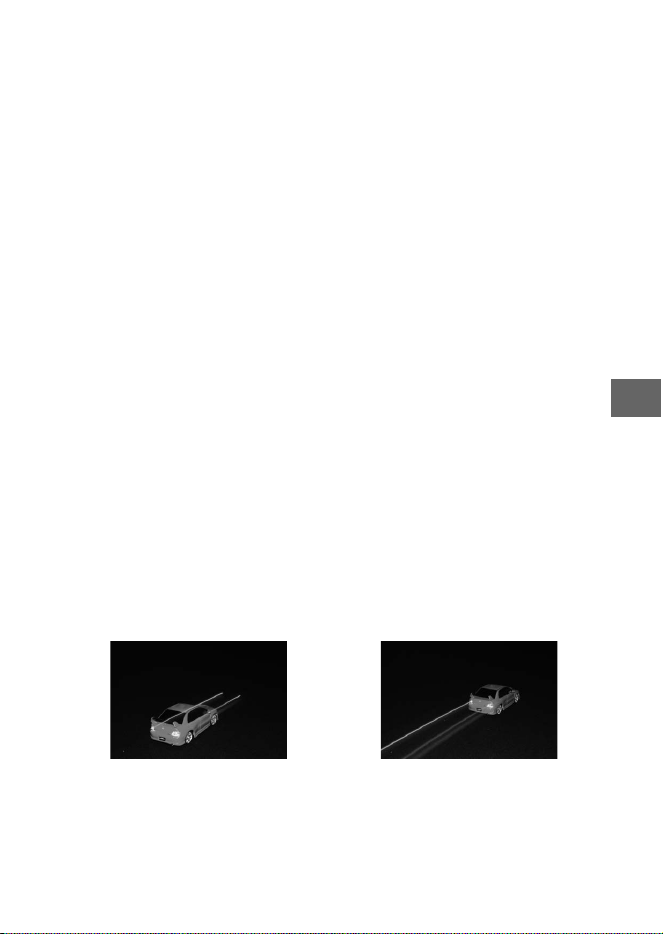
77
t
❚❚ Flash Modes
The following flash modes are available when P, S, A, or M is
selected in w (creative) mode:
• N (fill flash): The flash fires with every shot.
• NY (red-eye reduction): Use for portraits. The flash fires with
every shot, but before it fires, the red-eye reduction lamp lights
to help reduce “red-eye.”
• NYp (red-eye reduction with slow sync): As for “red-eye
reduction”, above, except that shutter speed slows automati-
cally to capture background lighting at night or under low
light. Use when you want to include background lighting in
portraits. Available only in modes P and A.
• Np (fill flash + slow sync): As for “fill flash”, above, except that
shutter speed slows automatically to capture background
lighting at night or under low light. Use when you want to cap-
ture both subject and background. Available only in modes P
and A.
• Nr (rear curtain + slow sync): As for “rear-curtain sync”, below,
except that shutter speed slows automatically to capture back-
ground lighting at night or under low light. Use when you want
to capture both subject and background. Available only in
modes P and A.
• Nq (rear-curtain sync): The flash fires just before the shutter
closes, creating a stream of light behind moving light sources
as shown below at right. Available only in modes S and M.
• s (off): The flash does not fire. Available only when built-in
flash is raised.
Front-curtain sync Rear-curtain sync
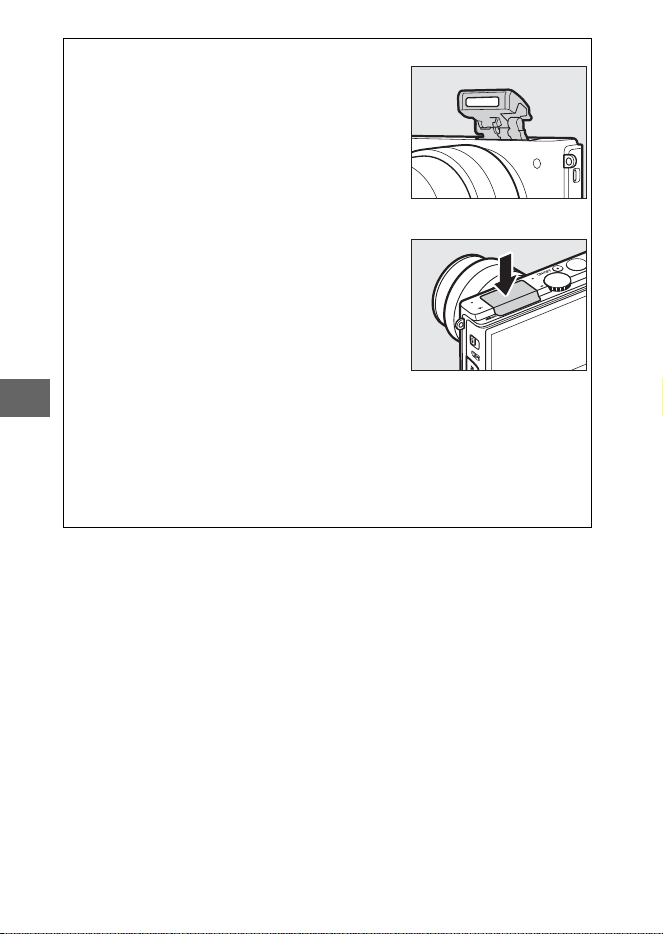
78
t
D
Raising the Flash
When using the flash, be sure it is fully raised
as shown at right. Do not touch the flash dur-
ing shooting.
A
Lowering the Built-in Flash
To save power when the flash is not in use,
press it gently downward until the latch
clicks into place. Do not use force. Failure to
observe this precaution could result in prod-
uct malfunction.
A
The Flash-Ready Indicator
The flash-ready indicator (N) lights to show that the flash is fully
charged when the shutter-release button is pressed halfway.
A
Preventing the Built-in Flash from Firing
Lowering the flash prevents it firing in modes P, S, A, and M. The flash can
also be turned off by selecting a flash mode of s (off ).
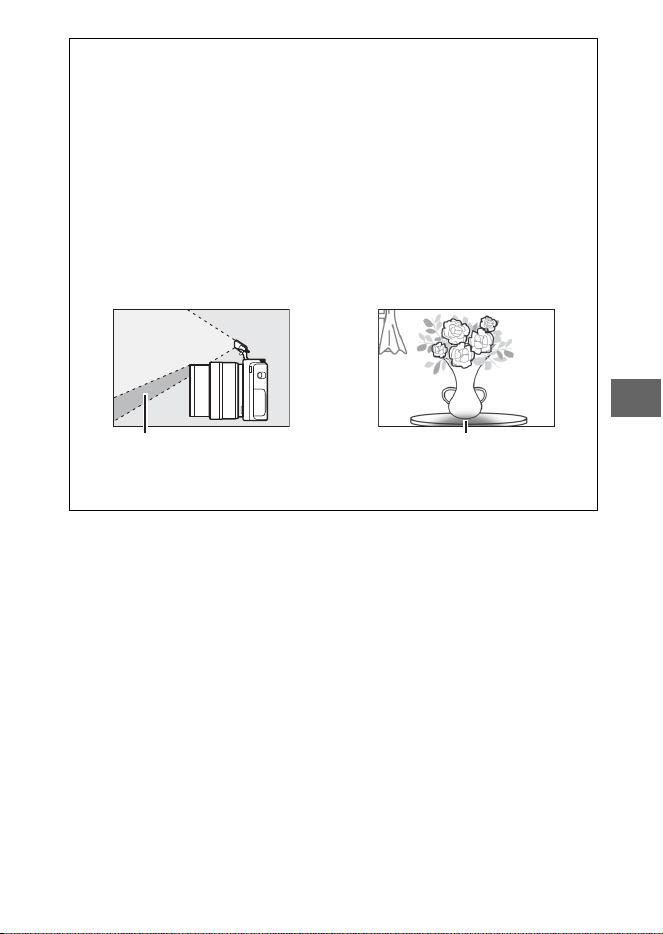
79
t
A
Using the Built-in Flash
If the flash is fired multiple times in quick succession, the flash and
shutter may be temporarily disabled to protect the flash. Shooting can
be resumed after a brief pause.
Objects close to the camera may be overexposed in photographs taken
with the flash at high ISO sensitivities.
To avoid vignetting, remove lens hoods and shoot at ranges of at least
0.6 m (2 ft). Some lenses may cause vignetting at greater distances or
obstruct the red-eye reduction lamp, interfering with red-eye reduc-
tion. The following illustrations show the effect of vignetting caused by
shadows cast by the lens when the built-in flash is used.
Shadow Shadow
A
Aperture, Sensitivity, and Flash Range
Flash range varies with sensitivity (ISO equivalency) and aperture.
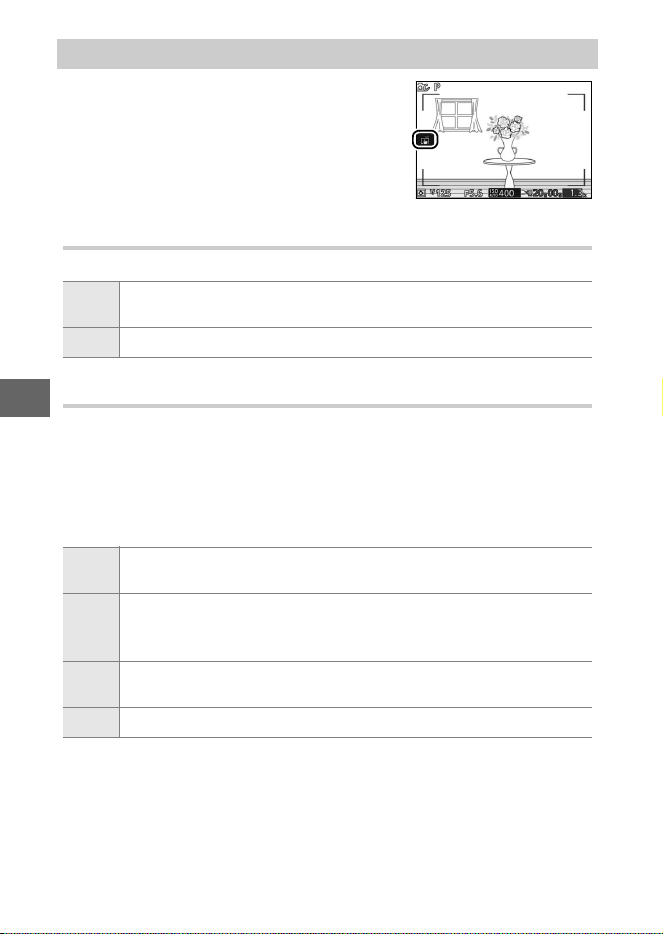
80
t
Auto Mode
Choose from the following options.
Creative Mode
The operation performed by tapping the display depends on
whether the camera is in autofocus or manual focus mode.
❚❚ Autofocus Modes
The following options are available in autofocus modes (AF-A,
AF-S, and AF-C).
Tap Shooting Options
Tap the icon shown at right to choose the
operation performed by tapping the
monitor in shooting mode. The options
available vary with the shooting and
focus mode.
3
When you tap a subject in the display, the camera will focus and
take a picture.
7
Tapping the display during shooting has no effect.
3
When you tap a subject in the display, the camera will focus and
take a picture.
4
Tap the display to position the focus area when single-point AF
is selected for AF-area mode (0 94). To focus, press the shutter-
release button halfway.
6
Tap a subject to start tracking when subject tracking is selected
for AF-area mode (0 94).
7
Tapping the display during shooting has no effect.
81
t
❚❚ Manual Focus Mode
The following options are available in manual focus mode.
Advanced Movie Mode
The operation performed by tapping the display depends on
whether the camera is in autofocus or manual focus mode.
❚❚ Autofocus Modes
The following options are available in autofocus modes (AF-F
and AF-S).
❚❚ Manual Focus Mode
The following options are available in manual focus mode.
3
When you tap the display, the camera will take a picture without
first adjusting focus.
5
Tap a subject to display it at a higher magnification in the moni-
tor.
7
Tapping the display during shooting has no effect.
8
To focus when auto-area AF or single-point AF is selected for AF-
area mode, tap your subject in the display.
6
Tap a subject to start tracking when subject tracking is selected
for AF-area mode (0 95).
9
Tapping the display during shooting has no effect.
5
Tap a subject to display it at a higher magnification in the moni-
tor.
9
Tapping the display during shooting has no effect.
82
t
D
Best Moment Capture/Motion Snapshot
Tap shooting options are not available in best moment capture and
Motion Snapshot modes.
D
Taking Pictures Using Tap Shooting Options
Avoid tapping too hard. The camera may move when the shutter is
released, blurring photographs.
The shutter-release button can be used to focus and take pictures even
when the 3 icon is displayed to show that tap shooting options are
active. Use the shutter-release button to take photographs in continu-
ous shooting mode (0 70) and during movie recording. Tap shooting
options can be used only to take pictures one at a time in continuous
shooting mode and can not be used to take photographs during movie
recording. In self-timer mode (0 72), tapping the monitor locks focus
and starts the timer; the photograph will be taken after ten or two sec-
onds.
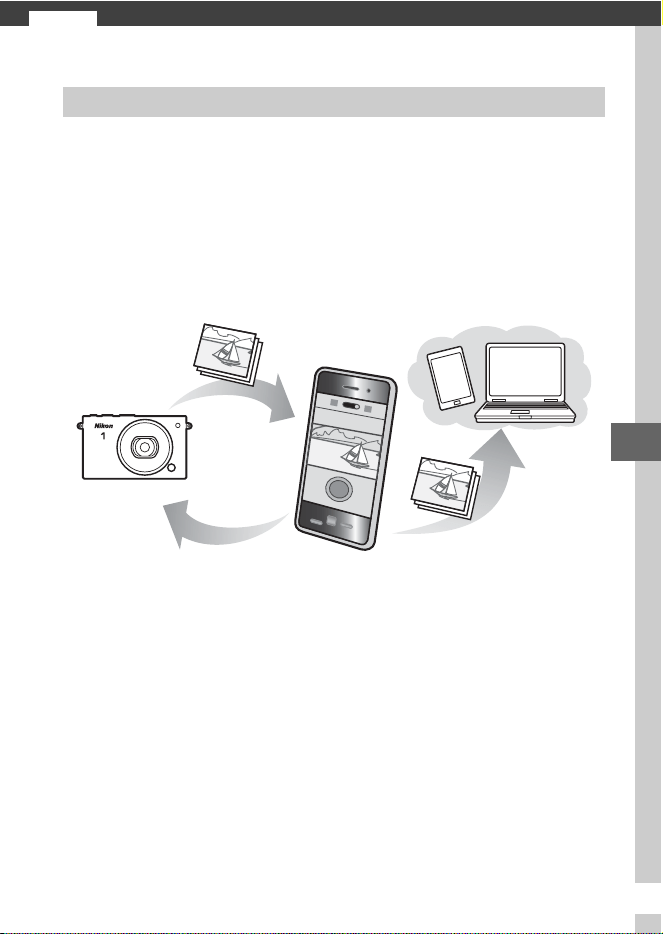
83
T
T
Wi-Fi
The camera can connect via Wi-Fi wireless networks to a smart
device running Nikon’s dedicated Wireless Mobile Utility app
(0 84). The smart device can be used to control the camera and
take pictures remotely, or pictures can be downloaded from the
camera to the smart device and shared with others on the Inter-
net. Pictures can also be uploaded from the camera to the smart
device (0 89).
What Wi-Fi Can Do for You
Download pictures Share pictures
Remote control
84
T
Before connecting via Wi-Fi (wireless LAN), install the Wireless
Mobile Utility on your Android or iOS smart device.
Instructions
for accessing the camera vary with the type of connection used
by the smart device.
Android
• Push-button WPS: If the smart device supports push-button WPS
(i.e., has a WPS button connection option in its Wi-Fi settings
menu), you can use this easy method to connect to the smart
device (0 85)
• PIN-entry WPS: If the smart device supports WPS, you can use the
camera to establish a connection by entering the PIN displayed
by the smart device (0 86)
• View SSID: If the smart device does not support WPS, you can
connect by selecting the camera SSID on the smart device
(0 87)
iOS
• View SSID: Connect by selecting the camera SSID on the smart
device (0 87)
Accessing the Camera
A
Installing the Wireless Mobile Utility App
1 Find the app.
On the smart device, connect to the Google Play service, the App
Store, or another app marketplace and search for “Wireless Mobile
Utility”.
For more information, see the instructions provided with the
smart device.
2 Install the app.
Read the app description and install the app.
A pdf manual for the
Wireless Mobile Utility is available for download at the following
URLs:
• Android: http://nikonimglib.com/ManDL/WMAU/
• iOS: http://nikonimglib.com/ManDL/WMAU-ios/
A
WPS
WPS (Wi-Fi Protected Setup) is a standard designed to make it easy to
establish a secure wireless network.
For information on the steps
involved and the length of time the smart device will wait for a connec-
tion, see the documentation supplied with the smart device.
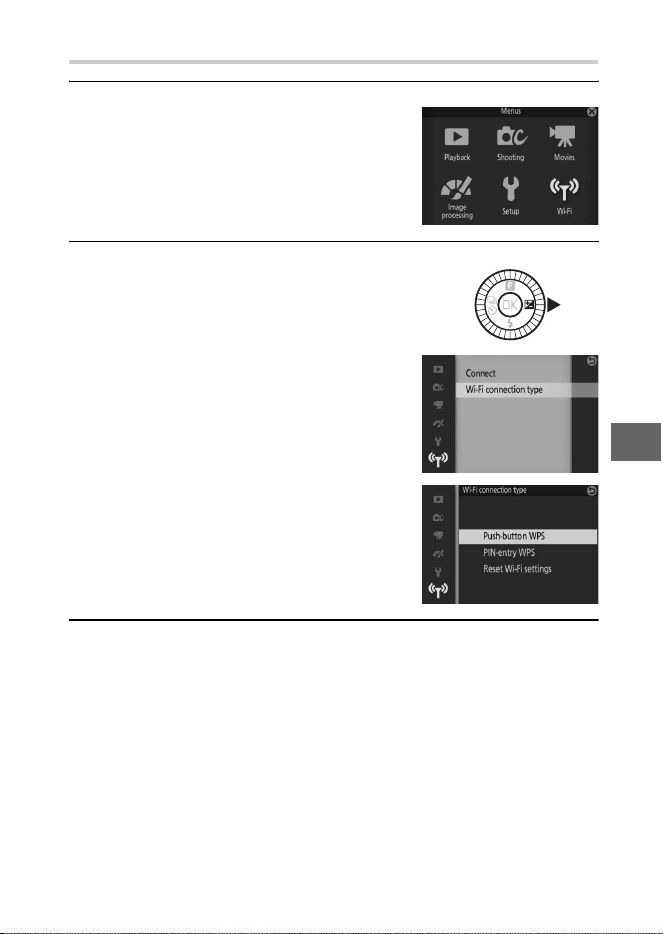
85
T
WPS (Android Only)
1
Select Wi-Fi.
2
Connect.
3
Launch the Wireless Mobile Utility.
Launch the Wireless Mobile Utility on the smart device.
The
main dialog will be displayed.
Press the G button to display the
menus, then highlight Wi-Fi and press
J.
Enable WPS button connections on
the camera and smart device:
• Camera: Highlight Wi-Fi connection
type and press 2, then highlight
Push-button WPS and press 2 to
ready the camera for a WPS connec-
tion.
The camera will wait about two
minutes for a WPS connection
request from the smart device.
To
extend the wait time, press J.
• Smart device: Select Wi-Fi settings >
WPS button connection.
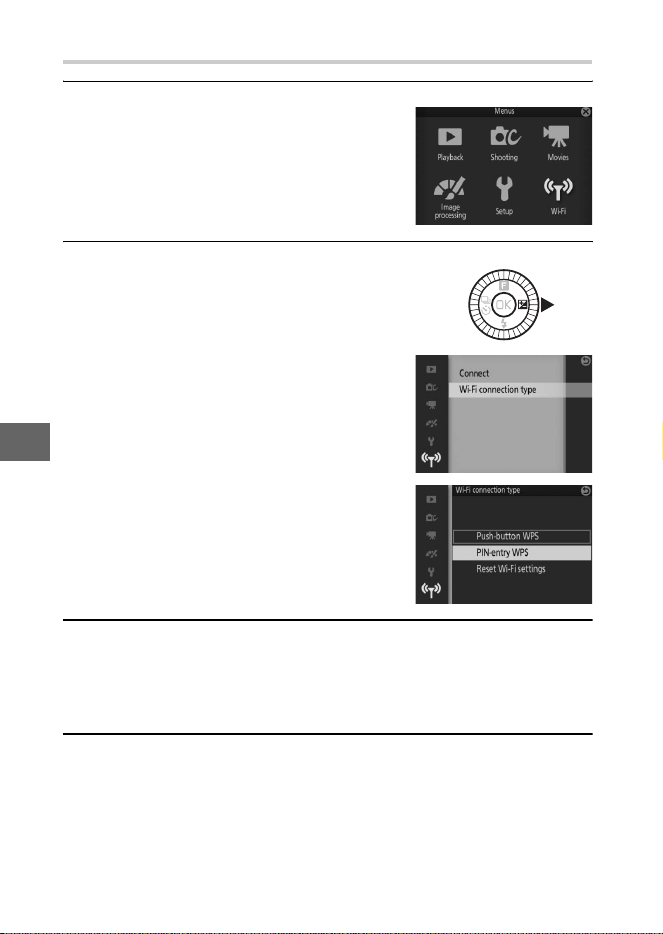
86
T
PIN Entry (Android Only)
1
Select Wi-Fi.
2
Select Wi-Fi connection type > PIN-entry WPS.
3
Enter the PIN.
Enter the PIN displayed by the smart device.
Press 4 or 2 to
highlight digits and press 1 or 3 to change.
Press J when
entry is complete.
4
Launch the Wireless Mobile Utility.
Launch the Wireless Mobile Utility on the smart device.
The
main dialog will be displayed.
Press the G button to display the
menus, then highlight Wi-Fi and press
J.
Highlight Wi-Fi connection type and
press 2.
Highlight PIN-entry WPS and press
2.
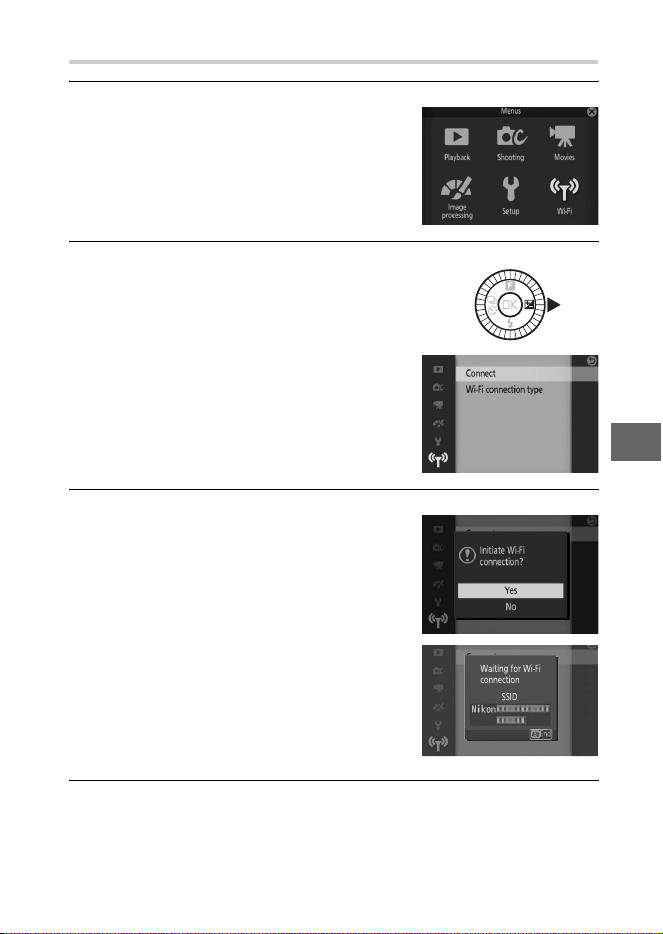
87
T
SSID (Android and iOS)
1
Select Wi-Fi.
2
Select Connect.
3
Select Ye s .
4
Select the camera SSID on the smart device.
Select the camera SSID in the list of networks displayed by
the smart device.
Press the G button to display the
menus, then highlight Wi-Fi and press
J.
Highlight Connect and press 2.
Highlight Ye s and press J to view the
camera SSID.
88
T
5
Launch the Wireless Mobile Utility.
Launch the Wireless Mobile Utility on the smart device.
The
main dialog will be displayed.
❚❚ Restoring Default Settings
To restore default network settings, highlight Wi-Fi connection
type > Reset Wi-Fi settings and press 2.
A confirmation dialog
will be displayed; highlight Ye s and press J to restore default
network settings.
D
Wi-Fi
Before using the Wi-Fi function, read the warnings on pages xiv to xvi;
to prevent loss of power while connected, you should also charge the
camera battery. Do not use Wi-Fi in settings in which its use is prohib-
ited.
Note that the camera Wi-Fi function can not be used when a USB
or HDMI cable is connected.
A
Terminating Wi-Fi Connections
Wi-Fi will terminate automatically if the smart device does not initiate a
connection within five minutes. To terminate Wi-Fi manually, press the
G button to exit the Wi-Fi standby or connection display.
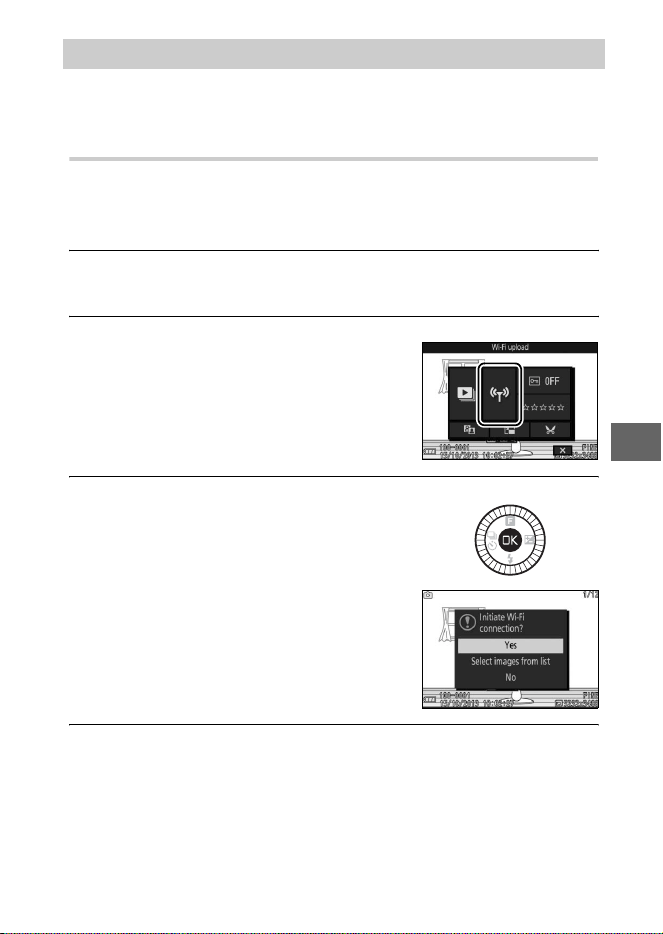
89
T
Follow the steps below to upload photos from the camera to a
smart device. Movies can not be selected for upload.
Uploading Photos One at a Time
Use the Wi-Fi upload option in the playback & (feature) menu
(0 9) to upload the photo currently displayed in full-frame play-
back.
1
Display the photo on the camera.
Display the desired photo in full-frame playback.
2
Select Wi-Fi upload.
3
Select Ye s .
4
Select the camera SSID on the smart device.
Select the camera SSID in the list of networks displayed by
the smart device.
Uploading Pictures to a Smart Device
Press & (feature) to display the &
menu, then highlight Wi-Fi upload
and press J. A confirmation dialog
will be displayed.
Highlight Ye s and press J. To upload
multiple selected photos, choose
Select images from list and proceed
to Step 2 on page 90.
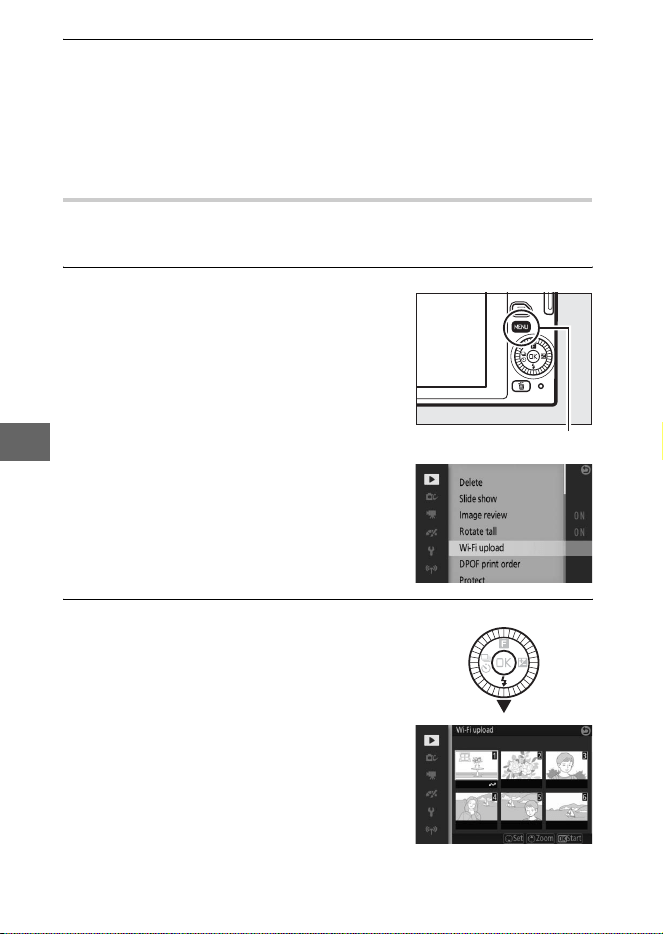
90
T
5
Download the photo to the smart device.
Launch the Wireless Mobile Utility on the smart device and
follow the on-screen instructions to download the photo.
When download is complete, press the G button on the
camera to terminate the Wi-Fi connection.
Uploading Multiple Selected Photos
To upload multiple selected photos, use the Wi-Fi upload
option in the playback menu.
1
Choose Wi-Fi upload.
2
Select photos.
Press the G button to display the
menus. Highlight Wi-Fi upload in the
playback menu and press 2.
G button
Press 4 or 2 to scroll through pictures
and press 3 to select or deselect, or
press and hold 1 to view the high-
lighted picture full frame. Selected
images are indicated by a & icon.
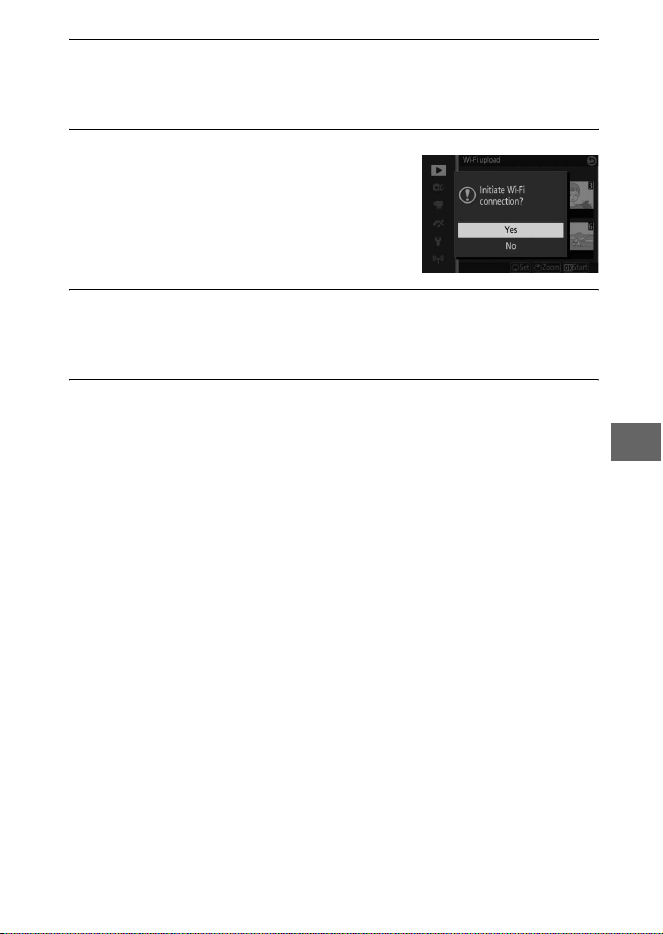
91
T
3
Press J.
Press J to complete the operation. A confirmation dialog will
be displayed.
4
Select Ye s .
5
Select the camera SSID on the smart device.
Select the camera SSID in the list of networks displayed by
the smart device.
6
Download the photos to the smart device.
Launch the Wireless Mobile Utility on the smart device and
follow the on-screen instructions to download the selected
photos. When download is complete, press the G button
on the camera to terminate the Wi-Fi connection.
Highlight Ye s and press J.
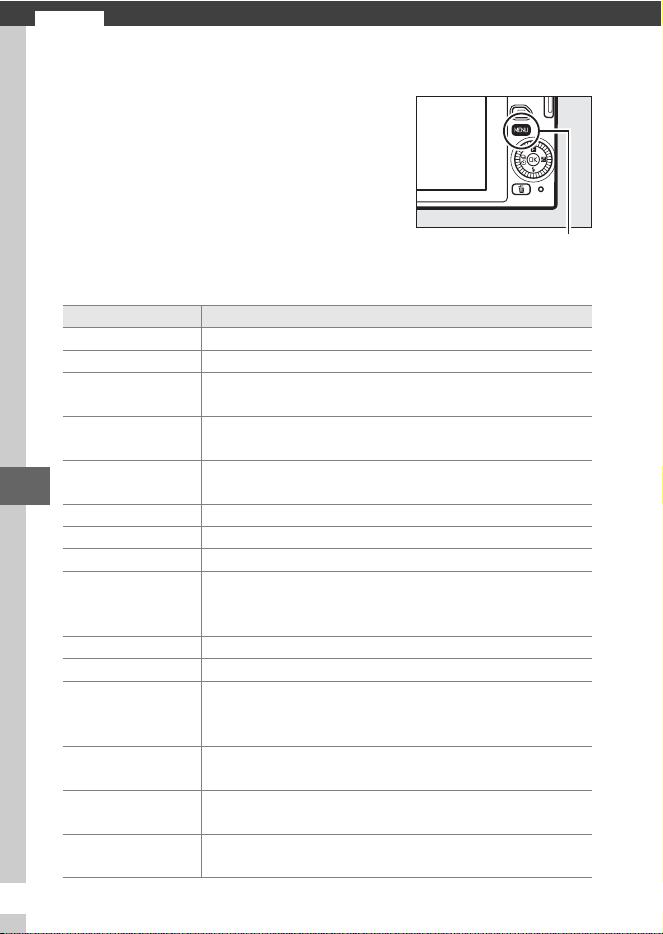
U
92
U
Menu Options
❚❚ Playback Menu Options
To display the playback, shooting, movie,
image processing, and setup menus,
press the G button. Following menu
options are available:
G button
Option Description
Delete Delete multiple images.
Slide show View movies and photos in a slide show.
Image review
Choose whether pictures are displayed after
shooting.
Rotate tall
Rotate “tall” (portrait-orientation) pictures for
display during playback.
Wi-Fi upload
Upload selected photos to smart devices via wireless
networks.
DPOF print order Create digital “print orders”.
Protect Protect pictures from accidental deletion.
Rating Rate pictures.
D-Lighting
Brighten shadows in dark or back-lit photos, creating
a retouched copy that is saved separately from the
unmodified original.
Resize Create small copies of selected pictures.
Crop Create cropped copies of selected pictures.
Face-priority zoom
Choose whether 4 and 2 can be used during
playback zoom to select faces detected with face
priority.
Edit movie
Create copies of movies from which unwanted
footage has been trimmed.
Combine 4-second
movies
Combine multiple 4-second movies into a single
movie.
Combine NMS movies
Make a movie from the movie portions of multiple
Motion Snapshots.
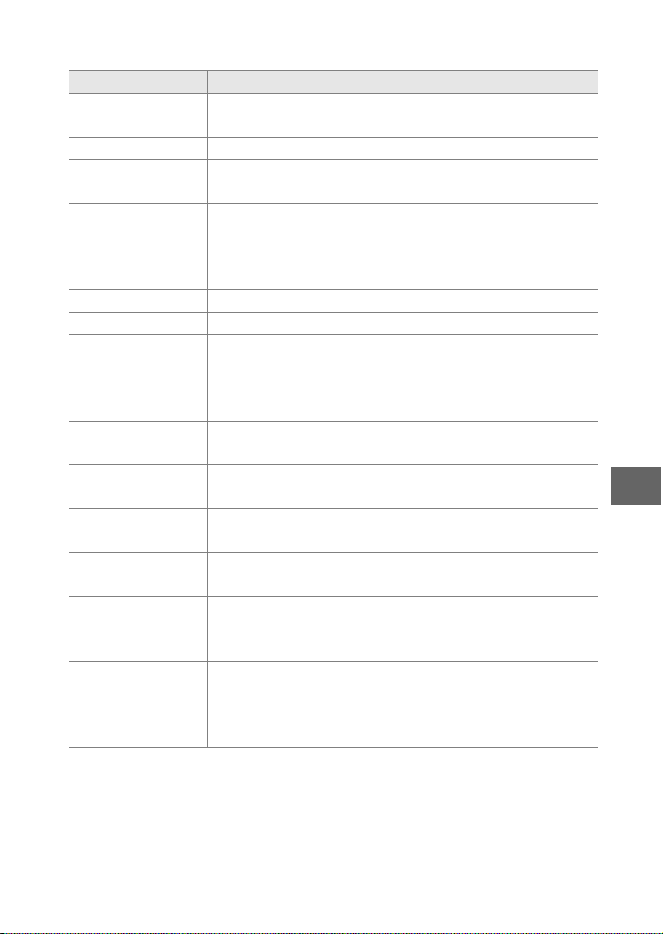
93
U
❚❚ Shooting Menu Options
Option Description
Reset shooting
options
Reset shooting options to default values.
Creative Choose a creative mode.
Best moment capture
Choose from Active Selection, Slow view, and
Smart Photo Selector.
Exposure mode
Choose how the camera sets shutter speed and
aperture in Motion Snapshot mode (0 65) and when
Active Selection or Slow view is chosen in best
moment capture mode.
Image quality Choose a file format and compression ratio.
Image size Choose a size for new photos.
Active Selection
Choose the frames Active Selection (0 55) records to
temporary storage, the length of time over which the
frames are captured, and the default number of
frames saved.
Number of shots
saved
Choose the number of shots selected by the Smart
Photo Selector (0 61).
Movie before/after
Choose when the movie portion of Motion
Snapshots is recorded (0 65).
File format
Choose a file format for new Motion Snapshots
(0 65).
Audio
Choose the audio recorded with Motion Snapshots
(0 65).
Select color
Choose the hue that appears in color in pictures
taken with Selective color selected in creative
mode.
Soft
Choose amount of softening applied to pictures
taken with Soft selected in creative mode. You can
also choose how softening applies to pictures with
portrait subjects.
94
U
❚❚ Movie Menu Options
Hue
Choose base hue for pictures taken with Cross
process selected in creative mode.
Toy camera effect
Adjust saturation and vignetting for pictures taken
with Toy camera effect selected in creative mode.
Metering Choose how the camera meters exposure.
Auto distortion
control
Choose whether the camera corrects barrel and pin-
cushion distortion.
Color space Choose a color space for new pictures.
Active D-Lighting Avoid loss of detail in highlights and shadows.
Long exposure NR Reduce noise in long time-exposures.
Optical VR
Choose whether to use optical vibration reduction
with compatible 1 NIKKOR lenses.
Electronic VR
Choose whether to use electronic vibration
reduction in Motion Snapshot mode (0 65).
Focus mode Choose how the camera focuses.
AF-area mode Choose how the focus area is selected.
Face-priority Turn face priority on or off.
Built-in AF assist Control the built-in AF-assist illuminator.
Flash control Choose a flash mode for the built-in flash.
Flash compensation Control flash output.
Underwater flash
Choose Enable when using an optional underwater
flash unit.
Option Description
Reset movie options Reset movie menu options to their default values.
Advanced movie Choose a movie type for advanced movie mode.
Exposure mode
Choose how the camera sets exposure in advanced
movie mode.
Option Description
95
U
❚❚ Image Processing Menu Options
Slow motion
Choose a frame rate for slow-motion movies
recorded in advanced movie mode (0 49).
Frame size/ frame
rate
Choose a frame size and rate for movies recorded in
auto and creative modes and when HD movie is
selected in advanced movie mode (0 49).
Metering Choose how the camera meters exposure.
Movie sound options Choose sound recording options.
Optical VR
Choose whether to use optical vibration reduction
with compatible 1 NIKKOR lenses.
Electronic VR
Choose whether to use electronic vibration control
when recording movies.
Focus mode Choose how the camera focuses.
AF-area mode Choose how the focus area is selected.
Face-priority Turn face priority on or off.
Auto image capture
Choose whether the camera takes photos
automatically during movie recording and select the
number of pictures taken per minute.
Option Description
Reset processing
options
Reset image processing options to their default
values.
White balance Adjust settings for different types of lighting.
ISO sensitivity Control the camera’s sensitivity to light.
Picture Control Choose how the camera processes pictures.
Custom Picture
Control
Create custom Picture Controls.
High ISO noise
reduction
Reduce noise at high ISO sensitivities.
Option Description
96
U
❚❚ Setup Menu Options
Option Description
Reset setup options Reset setup menu options to default values.
Format memory card Format the memory card.
Slot empty release
lock
Allow the shutter to be released when no memory
card is inserted in the camera.
Display
Adjust display brightness, view or hide a framing
grid, and choose the information displayed in the
monitor.
Silent photography Mute the sounds made during shooting.
Sound settings Choose the beeps made by the camera.
Auto power off Choose the auto power off delay.
Touch-screen controls Enable or disable touch-screen controls.
Shutter button AE
lock
Choose whether exposure locks when the shutter-
release button is pressed halfway.
HDMI device control
Choose whether remote controls for HDMI-CEC
devices to which the camera is connected can be
used to operate the camera.
Flicker reduction Reduce flicker or banding.
Reset file numbering Reset file numbering.
Time zone and date Set the camera clock.
Language Choose a language for the camera displays.
Auto image rotation Record camera orientation with pictures.
Pixel mapping
Check and optimize the camera image sensor and
image processors.
Firmware version Display the current firmware version.
97
Q
Q
Connecting to a Computer
Install the supplied software to copy pictures to your computer
for viewing and editing. Before installing the software, confirm
that your system meets the requirements on page 98.
1
Launch the installer.
Start the computer, insert the ViewNX 2 installer CD, and
launch the installer. A language-selection dialog will be dis-
played; if the desired language is not available, click Region
Selection to choose a different region and then choose the
desired language (region selection is not available in the
European release).
2
Start the installer.
Click Install and follow the on-screen instructions.
3
Exit the installer.
Click Ye s (Windows) or OK (Mac) when installation is com-
plete.
4
Remove the installer CD from the CD-ROM drive.
Installing the Supplied Software
A
Supplied Software
Be sure to update to the latest versions of the supplied software.
Nikon Message Center 2 will periodically check for updates while the
computer is connected to the Internet.
A
Motion Snapshots
ViewNX 2 is required to view Motion Snapshots saved using the File
format > NMS files option in the shooting menu (0 93).
A
Supported Operating Systems
See the websites listed on page xiii for the latest information on sup-
ported operating systems.
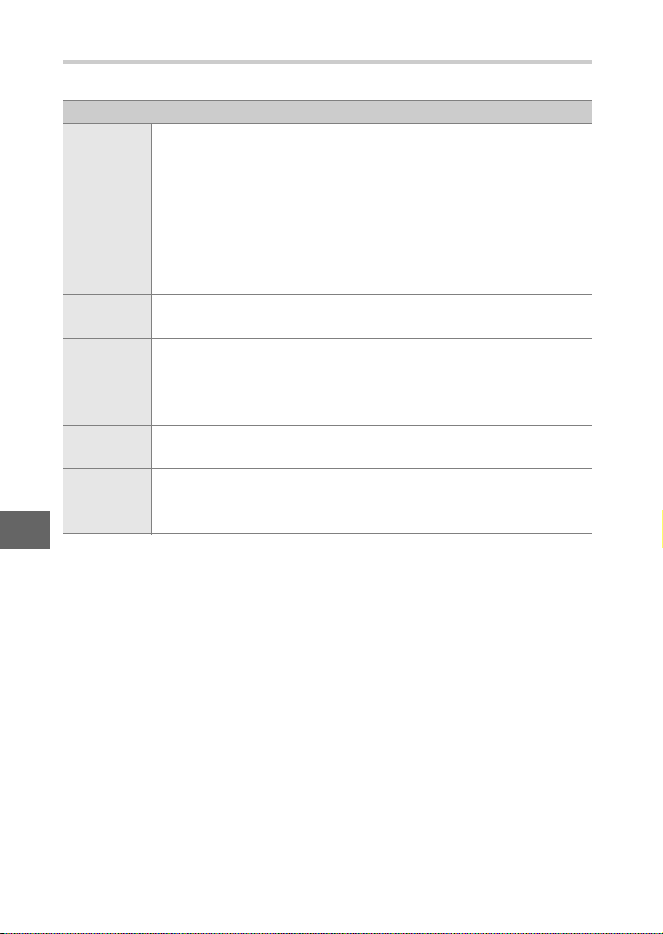
98
Q
System Requirements
The system requirements for ViewNX 2 are:
Windows
CPU
• Photos: Intel Celeron, Pentium 4, Core Series; 1.6 GHz or
better
• Movies (playback): Pentium D 3.0 GHz or better; Intel Core i5
or better recommended when viewing movies with a
frame size of 1280 × 720 or more at a frame rate of 30 fps
or above or movies with a frame size of 1920 × 1080 or
more
• Movies (editing): Intel Core i5 or better
OS
Pre-installed versions of Windows 8.1, Windows 7, or
Windows Vista
Memory
(RAM)
• 32-bit Windows 8.1, Windows 7, or Windows Vista: 1 GB or more
(2 GB or more recommended)
• 64-bit Windows 8.1, Windows 7, or Windows Vista: 2 GB or more
(4 GB or more recommended)
Hard disk
space
A minimum of 1 GB available on the startup disk (3 GB or more
recommended)
Graphics
• Resolution: 1024 × 768 pixels (XGA) or more (1280 × 1024 pixels or
more recommended)
• Color: 24-bit color (True Color) or more
99
Q
Mac
CPU
• Photos: Intel Core or Xeon series
• Movies (playback): Core Duo 2 GHz or better; Intel Core i5 or
better recommended when viewing movies with a frame
size of 1280 × 720 or more at a frame rate of 30 fps or
above or movies with a frame size of 1920 × 1080 or more
• Movies (editing): Intel Core i5 or better
OS OS X 10.9, 10.8, or 10.7
Memory
(RAM)
2 GB or more (4 GB or more recommended)
Hard disk
space
A minimum of 1 GB available on the startup disk (3 GB or more
recommended)
Graphics
• Resolution: 1024 × 768 pixels (XGA) or more (1280 × 1024 pixels or
more recommended)
• Color: 24-bit color (millions of colors) or more
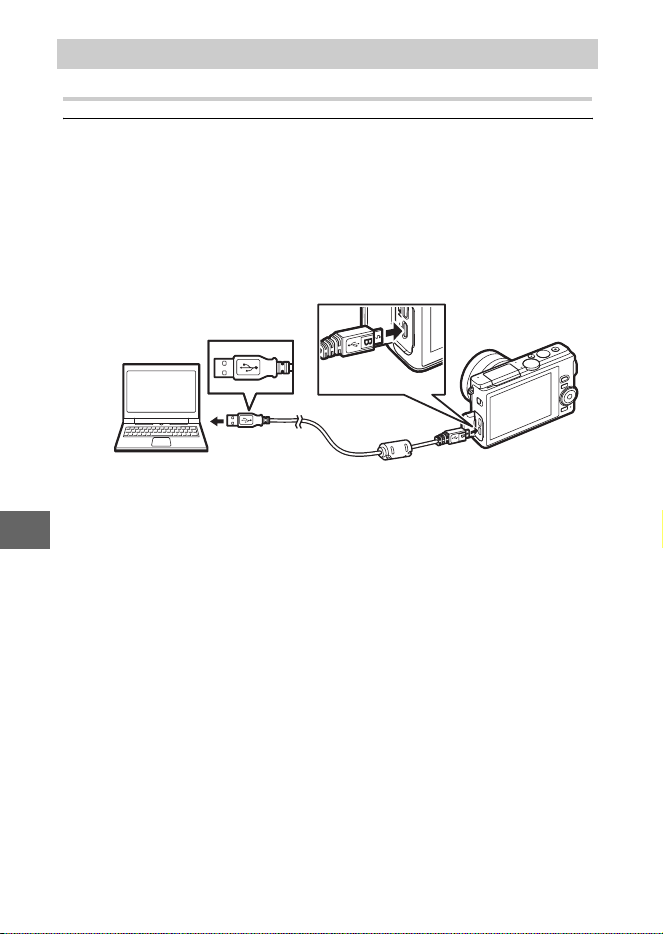
100
Q
Transferring Pictures
1
Choose how pictures will be copied to the computer.
Choose one of the following methods:
• Direct USB connection: Turn the camera off and ensure that the
memory card is inserted in the camera. Connect the camera
to the computer using the supplied USB cable (do not use
force or insert the connectors at an angle) and then turn the
camera on.
• Card slot: If your computer is equipped with a slot for
microSD memory cards, the card can be inserted directly in
the slot.
• Card reader: Connect a card reader (available separately from
third-party suppliers) to the computer and insert the mem-
ory card.
Viewing and Editing Pictures on a Computer
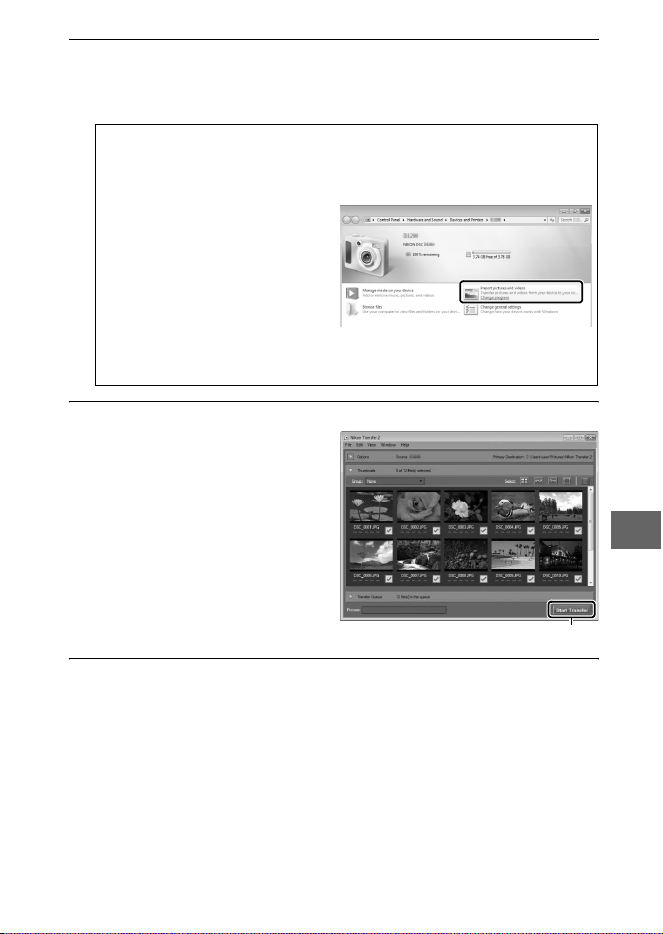
101
Q
2
Start the Nikon Transfer 2 component of ViewNX 2.
If a message is displayed prompting you to choose a pro-
gram, select Nikon Transfer 2.
3
Click Start Transfer.
At default settings, all the
pictures on the memory
card will be copied to the
computer.
4
Terminate the connection.
If the camera is connected to the computer, turn the camera
off and disconnect the USB cable. If you are using a card
reader or card slot, choose the appropriate option in the com-
puter operating system to eject the removable disk corre-
sponding to the memory card and then remove the card from
the card reader or card slot.
A
Windows 7
If the following dialog is displayed, select Nikon Transfer 2 as
described below.
1 Under Import pictures and
videos, click Change pro-
gram. A program selection
dialog will be displayed;
select Import File using
Nikon Transfer 2 and click
OK.
2 Double-click Import file.
Click Start Transfe
r
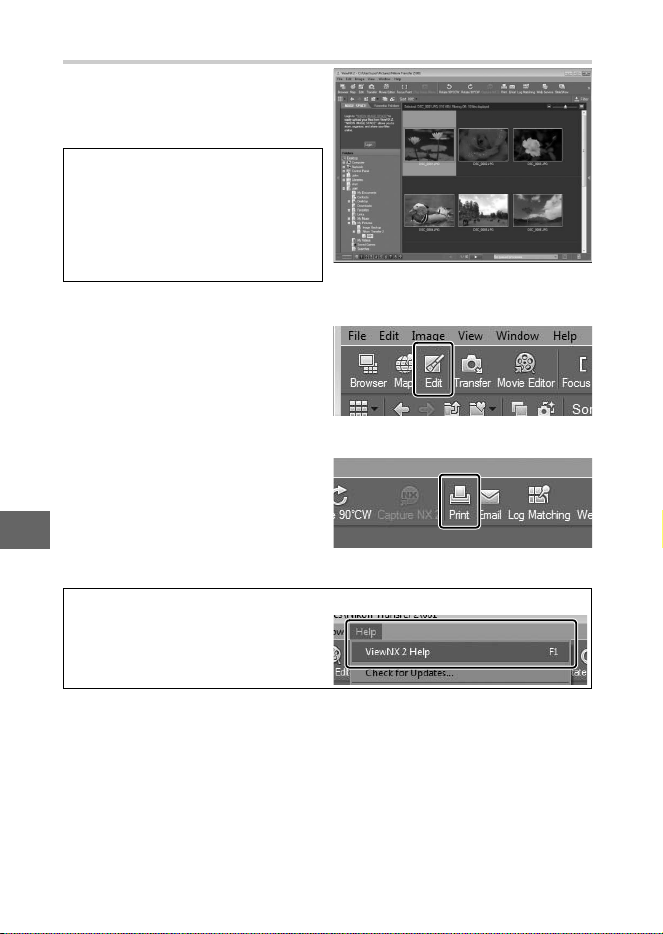
102
Q
Viewing Pictures
Pictures are displayed in
ViewNX 2 when transfer is com-
plete.
❚❚ Retouching Photographs
To crop pictures and perform
such tasks as adjusting sharp-
ness and tone levels, click the
Edit button in the toolbar.
❚❚ Printing Pictures
Click the Print button in the
toolbar. A dialog will be dis-
played, allowing you to print
pictures on a printer connected
to the computer.
A
Starting ViewNX 2 Manually
• Windows: Double-click the
ViewNX 2 shortcut on the desk-
top.
• Mac: Click the ViewNX 2 icon in
the Dock.
A
For More Information
Consult online help for more infor-
mation on using ViewNX 2.
103
n
n
Technical Notes
Read this chapter for information on compatible accessories,
cleaning and storing the camera, and what to do if an error mes-
sage is displayed or you encounter problems using the camera.
At the time of writing, the following accessories were available
for your camera.
Optional Accessories
Lenses 1 mount lenses
Mount adapters Mount Adapter FT1
Power sources • Rechargeable Li-ion Battery EN-EL22 (0 15–16): Additional
EN-EL22 batteries are available from local retailers and
Nikon-authorized service representatives.
• Battery Charger MH-29 (0 15): Recharge EN-EL22 batteries.
• Power Connector EP-5E, AC Adapter EH-5b: These accessories
can be used to power the camera for extended periods
(EH-5a and EH-5 AC adapters can also be used). An
EP-5E power connector is required to connect the cam-
era to the EH-5b, EH-5a, or EH-5.
Waterproof
cases
Waterproof Case WP-N3: In addition to protecting the cam-
era from rain, snow, and spray, this waterproof case can
be used to take photographs underwater.
Underwater
flash units
Underwater Speedlight SB-N10: Use with the optional WP-N3
waterproof case.
Body caps Body Cap BF-N1000: The body cap keeps the dust shield free
of dust when a lens is not in place.
A
Optional Accessories
Availability may vary with country or region. See our website or bro-
chures for the latest information.
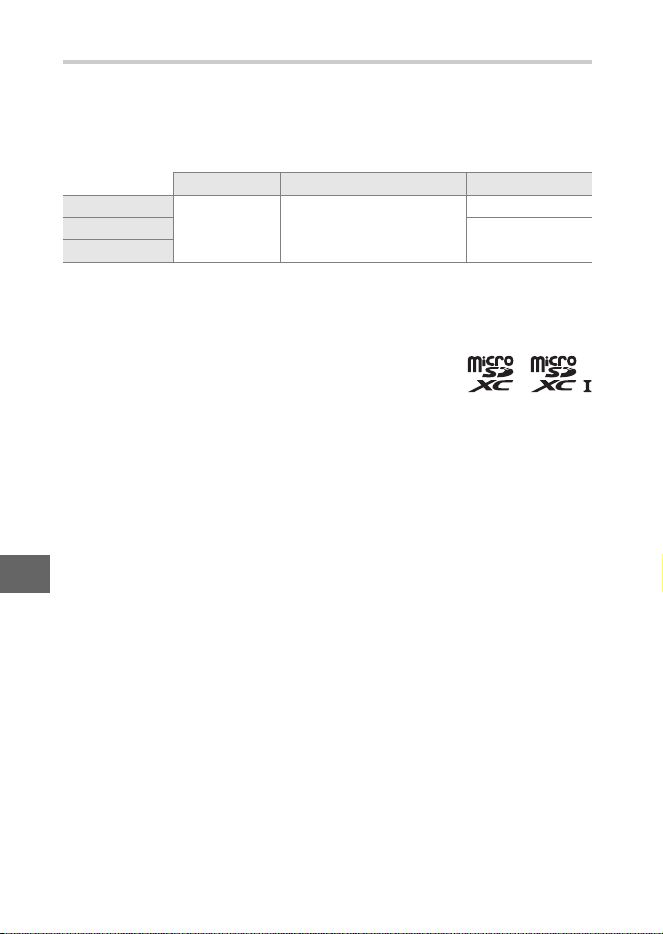
104
n
Approved Memory Cards
The following cards have been tested and approved for use in
the camera. Cards with class 6 or faster write speeds are recom-
mended for movie recording. Recording may end unexpectedly
when cards with slower write speeds are used.
1 Check that any card readers or other devices with which the card will be
used support 2 GB cards.
2 Check that any card readers or other devices with which the card will be
used are SDHC-compliant. The camera supports UHS-I.
3 Check that any card readers or other devices with
which the card will be used are SDXC-compliant. The
camera supports UHS-I.
Other cards have not been tested. For more details on the above
cards, please contact the manufacturer.
microSD cards microSDHC cards
2
microSDXC cards
3
SanDisk
2GB
1
4 GB, 8 GB, 16 GB, 32 GB
64 GB
Toshiba
—
Panasonic
105
n
Storage
If the camera will not be used for an extended period, remove
the battery and store it in a cool, dry area with the terminal cover
in place. To prevent mold or mildew, store the camera in a dry,
well-ventilated area. Do not store your camera with naphtha or
camphor moth balls or in locations that:
• are poorly ventilated or subject to humidities of over 60%
• are next to equipment that produces strong electromagnetic
fields, such as televisions or radios
• are exposed to temperatures above +50 °C (122 °F) or below –10 °C
(14 °F)
Cleaning
Do not use alcohol, thinner, or other volatile chemicals.
Storage and Cleaning
Camera body
Use a blower to remove dust and lint, then wipe gently with
a soft, dry cloth. After using the camera at the beach or sea-
side, wipe off sand or salt with a cloth lightly dampened in
distilled water and dry thoroughly. Important: Dust or other
foreign matter inside the camera may cause damage not cov-
ered under warranty.
Lens
Lenses are easily damaged. Remove dust and lint with a
blower. If using an aerosol blower, keep the can vertical to
prevent the discharge of liquid. To remove fingerprints and
other stains, apply a small amount of lens cleaner to a soft
cloth and clean with care.
Monitor
Remove dust and lint with a blower. When removing finger-
prints and other stains, wipe the surface lightly with a soft
cloth or chamois leather. Do not apply pressure, as this
could result in damage or malfunction.
Dust shield
The dust shield is easily damaged. Remove dust and lint
with a blower.

106
n
Do not drop: The product may mal-
function if subjected to strong
shocks or vibration.
Keep dry: This product is not water-
proof, and may malfunction if
immersed in water or exposed to
high levels of humidity. Rusting of
the internal mechanism can cause
irreparable damage.
Avoid sudden changes in temperature:
Sudden changes in temperature,
such as those that occur when
entering or leaving a heated build-
ing on a cold day, can cause con-
densation inside the device. To
prevent condensation, place the
device in a carrying case or plastic
bag before exposing it to sudden
changes in temperature.
Keep away from strong magnetic fields:
Do not use or store this device in
the vicinity of equipment that gen-
erates strong electromagnetic radi-
ation or magnetic fields. Strong
static charges or the magnetic
fields produced by equipment
such as radio transmitters could
interfere with the display, damage
data stored on the memory card, or
affect the product’s internal cir-
cuitry.
Keep the lens mount covered: Be sure to
attach the body cap if the camera is
without a lens.
Do not touch the dust shield: The dust
shield covering the image sensor is
easily damaged. Under no circum-
stances should you exert pressure
on the shield or poke it with clean-
ing tools. These actions could
scratch or otherwise damage the
shield.
Turn the product off before removing or
disconnecting the power source: Do not
unplug the product or remove the
battery while the product is on or
while images are being recorded or
deleted. Forcibly cutting power in
these circumstances could result in
loss of data or in damage to prod-
uct memory or internal circuitry. To
prevent an accidental interruption
of power, avoid carrying the prod-
uct from one location to another
while the AC adapter is connected.
Cleaning: When cleaning the camera
body, use a blower to gently
remove dust and lint, then wipe
gently with a soft, dry cloth. After
using the camera at the beach or
seaside, wipe off any sand or salt
using a cloth lightly dampened in
pure water and then dry the cam-
era thoroughly.
Lenses are easily damaged. Dust
and lint should be gently removed
with a blower. When using an aero-
sol blower, keep the can vertical to
prevent discharge of liquid. To
remove fingerprints and other stains
from the lens, apply a small amount
of lens cleaner to a clean, soft cloth
and wipe the lens carefully.
Caring for the Camera and Battery: Cautions

107
n
Storage: To prevent mold or mildew,
store the camera in a cool, dry,
well-ventilated area. If you are
using an AC adapter, unplug the
adapter to prevent fire. If the prod-
uct will not be used for an
extended period, remove the bat-
tery to prevent leakage and store
the camera in a plastic bag contain-
ing a desiccant. Do not, however,
store the camera case in a plastic
bag, as this may cause the material
to deteriorate. Note that desiccant
gradually loses its capacity to
absorb moisture and should be
replaced at regular intervals.
To prevent mold or mildew, take
the camera out of storage at least
once a month. Turn the camera on
and release the shutter a few times
before putting it away.
Store the battery in a cool, dry
place. Replace the terminal cover
before putting the battery away.
Notes on the monitor: The monitor is
constructed with extremely high
precision; at least 99.99% of pixels
are effective, with no more than
0.01% being missing or defective.
Hence while these displays may
contain pixels that are always lit
(white, red, blue, or green) or
always off (black), this is not a mal-
function and has no effect on
images recorded with the device.
Images in the monitor may be diffi-
cult to see in a bright light.
Do not apply pressure to the dis-
play, as this could cause damage or
malfunction. Dust or lint on the dis-
play can be removed with a blower.
Stains can be removed by wiping
lightly with a soft cloth or chamois
leather. Should the monitor break,
care should be taken to avoid
injury from broken glass and to
prevent liquid crystal from the dis-
play touching the skin or entering
the eyes and mouth.
Do not leave the lens pointed at the sun:
Do not leave the lens pointed at
the sun or other strong light source
for an extended period. Intense
light may cause the image sensor
to deteriorate or produce a white
blur effect in photographs.
Moiré: Moiré is an interference pat-
tern created by the interaction of
an image containing a regular,
repeating grid, such as the pattern
of weave in cloth or windows in a
building, with the camera image
sensor grid. In some cases, it may
appear in the form of lines. If you
notice moiré in your photographs,
try changing the distance to the
subject, zooming in and out, or
changing the angle between the
subject and the camera.
Lines: Noise in the form of lines may
in rare cases appear in pictures of
extremely bright or backlit sub-
jects.

108
n
Batteries: Batteries may leak or
explode if improperly handled.
Observe the following precautions
when handling batteries:
• Use only batteries approved for
use in this equipment.
• Do not expose the battery to
flame or excessive heat.
• Keep the battery terminals clean.
• Turn the product off before
replacing the battery.
• Remove the battery from the
camera or charger when not in
use and replace the terminal
cover. These devices draw minute
amounts of charge even when off
and could draw the battery down
to the point that it will no longer
function. If the battery will not be
used for some time, insert it in the
camera and run it flat before
removing it and storing it in a
location with an ambient temper-
ature of 15 °C to 25 °C (59 °F to
77 °F; avoid hot or extremely cold
locations). Repeat this process at
least once every six months.
• Turning the camera on and off
repeatedly when the battery is
fully discharged will shorten bat-
tery life. Batteries that have been
fully discharged must be charged
before use.
• The internal temperature of the
battery may rise while the battery
is in use. Attempting to charge
the battery while the internal
temperature is elevated will
impair battery performance, and
the battery may not charge or
charge only partially. Wait for the
battery to cool before charging.
• Continuing to charge the battery
after it is fully charged can impair
battery performance.
• A marked drop in the time a fully
charged battery retains its charge
when used at room temperature
indicates that it requires replace-
ment. Purchase a new EN-EL22
battery.
• Charge the battery before use.
When taking photographs on
important occasions, ready a
spare EN-EL22 battery and keep it
fully charged. Depending on your
location, it may be difficult to pur-
chase replacement batteries on
short notice. Note that on cold
days, the capacity of batteries
tends to decrease. Be sure the
battery is fully charged before
taking photographs outside in
cold weather. Keep a spare bat-
tery in a warm place and
exchange the two as necessary.
Once warmed, a cold battery may
recover some of its charge.
• Used batteries are a valuable
resource; recycle in accord with
local regulations.

109
n
• Do not use the battery at ambient
temperatures below 0°C (32°F) or
above 40°C (104°F); failure to
observe this precaution could
damage the battery or impair its
performance. Capacity may be
reduced and charging times may
increase at battery temperatures
from 0°C (32°F) to 10°C (50°F)
and from 45°C (113°F) to 60°C
(140°F); the battery will not
charge if its temperature is below
0°C (32°F) or above 60°C (140°F).
The battery charger: Charge the bat-
tery at ambient temperatures
between 5°C (41°F) and 35°C
(95°F). If the CHARGE lamp flashes
quickly during charging, cease use
immediately and take battery and
charger to your retailer or a Nikon-
authorized service representative.
Do not move the charger or touch
the battery during charging. Fail-
ure to observe this precaution
could in very rare instances result
in the charger showing that charg-
ing is complete when the battery is
only partially charged. Remove and
reinsert the battery to begin charg-
ing again.
Use the charger with compatible
batteries only. Unplug when not in
use.
Memory Cards:
• Do not remove memory cards
from the camera, turn the camera
off, or remove or disconnect the
power source during formatting
or while data are being recorded,
deleted, or copied to a computer.
Failure to observe these precau-
tions could result in loss of data or
in damage to the camera or card.
• Do not touch the card terminals
with your fingers or metal
objects.
• Do not bend, drop, or subject to
strong physical shocks.
• Do not apply force to the card
casing. Failure to observe this pre-
caution could damage the card.
• Do not expose to water, heat,
high levels of humidity, or direct
sunlight.
• Do not format memory cards in a
computer.
D
Servicing the Camera and Accessories
The camera is a precision device and requires regular servicing. Nikon
recommends that the camera be inspected by the original retailer or
Nikon-authorized service representative once every one to two years,
and that it be serviced once every three to five years (note that fees
apply to these services). Frequent inspection and servicing are particu-
larly recommended if the camera is used professionally. Any accesso-
ries regularly used with the camera, such as lenses, should be included
when the camera is inspected or serviced.
110
n
If the camera fails to function as expected, check this list of com-
mon problems before consulting your retailer or Nikon repre-
sentative.
Battery/Display
Troubleshooting
The camera is on but does not respond: Wait for recording or any other process-
ing to end. If the problem persists, turn the camera off. If the camera still
does not respond, remove and replace the battery or disconnect and
reconnect the AC adapter, but note that this will delete any data not yet
saved. Data already saved to the memory card are unaffected.
The display is off:
• The camera is off (0 19) or the battery is exhausted (0 4).
• The display has turned off automatically to save power. The display can
be reactivated by pressing the shutter-release button.
• The camera is connected to a computer (0 100) or television.
The camera turns off without warning:
• The battery is low (0 4).
• The display has turned off automatically to save power (0 19). The dis-
play can be reactivated by pressing the shutter-release button.
• The camera’s internal temperature is high (0 xii, 114). Wait for the cam-
era to cool before turning it on again.
Indicators are not displayed: Use the Display > Shooting and Display >
Playback options in the setup menu to choose the information dis-
played.
111
n
Shooting (All Modes)
Movies
The camera takes time to turn on: Delete files or format the memory card.
The shutter-release is disabled:
• The battery is exhausted (0 4).
• The memory card is full.
• The flash is charging (0 78).
• The camera is not in focus (0 24).
• You are currently filming a slow-motion movie (0 51).
Only one picture is taken each time the shutter-release button is pressed in continuous
release mode: I is selected in continuous mode (0 70) and the built-in
flash is raised.
Smudges appear in photographs: Clean the front and rear lens elements or the
dust shield (0 105).
Flicker or banding appears in movies or in the display: Choose a Flicker reduc-
tion setting that matches the local AC power supply (0 96).
No flash: The flash will not fire when off (0 75, 77); in P, S, A, and M modes,
the flash will not fire when lowered.
Menu items are unavailable: Some options are only available in particular
shooting or exposure modes.
Cannot record movies: The movie-record button can not be used to record
movies in best moment capture or Motion Snapshot mode (0 58, 68).
No sound is recorded for movies:
• Microphone off is selected for Movie sound options > Microphone
(0 95).
• Live audio is not recorded with slow-motion, fast-motion, or jump-cut
movies (0 49) or with Motion Snapshots recorded with None selected
for Audio (0 68).
112
n
Tap Shooting Options
Playback
Wi-Fi (Wireless Networks)
Miscellaneous
The touch screen can not be used for shooting or focus:
• Touch shooting options are not available in best moment capture or
Motion Snapshot mode.
• The edges of the display can not be used for shooting or focus. Tap
closer to the center of the display.
Pictures are blurred: The camera may move when the display is tapped,
which may under some conditions result in blurred pictures. Use both
hands to hold the camera steady.
“Tall” (portrait) orientation photos are displayed in “wide” (landscape) orientation:
• Select On for Rotate tall (0 92).
• The photos were taken with Auto image rotation off (0 96).
• Camera was pointed up or down when the photo was taken.
• Photo is displayed in image review.
Cannot hear movie sound:
• Rotate the multi selector clockwise to raise the volume (0 52). If the
camera is connected to a television, use the controls for the TV to
adjust the volume.
• Live audio is not recorded with slow-motion, fast-motion, or jump-cut
movies (0 49) or with Motion Snapshots recorded with None selected
for Audio (0 68).
Cannot delete images: Remove protection from the files before deletion.
Smart devices do not display the camera SSID (network name):
• Confirm that camera Wi-Fi is enabled (0 84).
• Try turning the smart device Wi-Fi off and then on again.
The date of recording is not correct: Set the camera clock.
Menu items are unavailable: Some options are only available at particular
settings or when a memory card is inserted.
113
n
This section lists the error messages that appear in the display.
Error Messages
Message Solution
(Shutter-speed or
aperture display flashes)
If the subject is too bright, lower ISO sensitivity
or choose a faster shutter speed or smaller
aperture (higher f-number).
If the subject is too dark, raise ISO sensitivity,
use the flash, or choose a slower shutter speed
or larger aperture (lower f-number).
Keeping the zoom ring
button pressed, rotate
the zoom ring to extend
the lens.
A lens with a retractable lens barrel button is
attached with the lens barrel retracted. Keep-
ing the retractable lens barrel button pressed,
rotate the zoom ring to extend the lens.
Check lens. Pictures can
only be taken when a
lens is attached.
Attach a lens.
Start-up error. Turn the
camera off and then on
again.
Turn the camera off, remove and replace the
battery, and then turn the camera on.
The clock has been
reset.
Set the camera clock.
No memory card.
Turn the camera off and confirm that the card
is correctly inserted.
This memory card
cannot be used. Card
may be damaged; insert
a different card.
• Use an approved card.
• Format the card. If the problem persists, the
card may be damaged. Contact a Nikon-
authorized service representative.
• Insert a new memory card.
This memory card is not
formatted. Format the
memory card?
Select Ye s to format the card, or turn the cam-
era off and insert another memory card.
114
n
Memory card is full.
• You may be able to record additional images
if you reduce image quality or size.
• Delete unwanted images.
• Insert another memory card.
Cannot create
additional folders on
memory card.
If the current folder is numbered 999 and con-
tains either 999 photographs or a photograph
numbered 9999, the shutter-release button will
be disabled and no further photographs can be
taken. Choose
Ye s
for
Reset file numbering
and
then either format the current memory card or
insert a new memory card.
The movie-record
button cannot be used
in this mode.
The movie-record button can not be used in
best moment capture or Motion Snapshot
modes.
Photographs cannot be
recorded in this mode.
The shutter-release button can not be used to
take photographs while a slow-motion movie
is being recorded.
The camera’s internal
temperature is high. The
camera will now turn
off.
Wait for the camera to cool.
Memory card contains
no images.
To view pictures, insert a memory card con-
taining images.
Cannot display this file.
The file has been created or modified on a
computer or different make of camera, or is
corrupt.
Message Solution
115
n
Nikon 1 J4 Digital Camera
Specifications
Type
Type Digital camera with support for interchangeable
lenses
Lens mount Nikon 1 mount
Effective angle of view Approx. 2.7× lens focal length (35 mm format
equivalent)
Effective pixels
18.4 million
Image sensor
Image sensor 13.2 mm × 8.8 mm CMOS sensor (Nikon CX for-
mat)
Storage
Image size (pixels) Still images taken in auto, best moment capture, and all
creative modes other than easy panorama (aspect ratio 3 : 2)
• 5232 × 3488 • 3920 × 2616
• 2608 × 1744
Still images taken in normal panorama mode with camera
panned horizontally (aspect ratio 120 : 23)
4800 × 920
Still images taken in normal panorama mode with camera
panned vertically (aspect ratio 8 : 25)
1536 × 4800
Still images taken in wide panorama mode with camera
panned horizontally (aspect ratio 240 : 23)
9600 × 920
Still images taken in wide panorama mode with camera
panned vertically (aspect ratio 4 : 25)
1536 × 9600
Still images taken during movie recording (aspect ratio 3 : 2)
• 5232 × 3488 (1080/60p, 1080/30p)
• 1472 × 984 (720/60p, 720/30p)
Motion Snapshots (photo portion, aspect ratio 16 : 9)
5232 × 2936
116
n
File format • NEF (RAW): 12-bit, compressed
• JPEG: JPEG-Baseline compliant with fine (approx.
1:4), normal (approx. 1 : 8) compression
• NEF (RAW) + JPEG: Single photograph recorded in
both NEF (RAW) and JPEG formats
Picture Control system Standard, Neutral, Vivid, Monochrome, Portrait,
Landscape; selected Picture Control can be mod-
ified; storage for custom Picture Controls
Media microSD (micro Secure Digital), microSDHC, and
microSDXC memory cards
File system DCF 2.0, DPOF, Exif 2.3, PictBridge
Shooting modes
C auto; w creative, with a choice of the follow-
ing options: P, S, A, M, 4 creative palette, 5 HDR,
p easy panorama, q soft, r miniature effect, s
selective color, 6 cross process, and 7 toy cam-
era effect; u best moment capture (s Active
Selection, t slow view and y Smart Photo
Selector); v advanced movie (0 HD movie,
y slow motion, 2 jump cut, 1 fast motion and
3 4-second movie), z Motion Snapshot
Shutter
Type Electronic shutter
Speed
1
/
16,000 –30 s in steps of
1
/
3 EV; Bulb
Note: Bulb ends automatically after approximately 2 minutes
Flash sync speed Synchronizes with shutter at X=
1
/
60 s or slower
Release
Mode • Single frame, continuous
• Self-timer
Frame advance rate Approx. 5, 10, 20, 30, or 60 fps
Self-timer 2 s, 10 s
117
n
Exposure
Metering TTL metering using image sensor
Metering method • Matrix
• Center-weighted: Meters 4.5 mm circle in center of
frame
• Spot: Meters 2 mm circle centered on selected
focus area
Mode P programmed auto with flexible program;
S shutter-priority auto; A aperture-priority auto;
M manual; h scene auto selector
Exposure compensation –3–+3 EV in increments of
1
/
3 EV
Exposure lock Luminosity locked at metered value when shut-
ter-release button is pressed halfway
ISO sensitivity
(Recommended Exposure
Index)
ISO 160; ISO 200–12800 in steps of 1 EV; 6400
(NR); 12800 (NR); auto ISO sensitivity control (ISO
160–6400, 160–3200, 160–800) available (user controlled in P,
S, A, and M modes)
Active D-Lighting On, off
Focus
Autofocus Hybrid autofocus (phase-detection/contrast-
detect AF); AF-assist illuminator
Lens servo • Autofocus (AF): Single AF (AF-S); continuous AF
(AF-C); auto AF-S/AF-C selection (AF-A); full-
time AF (AF-F)
• Manual focus (MF)
AF-area mode Single-point, auto-area, subject tracking
Focus area • Single-point AF: 171 focus areas; the center 105
areas support phase-detection AF
• Auto-area AF: 41 focus areas
Focus lock Focus can be locked by pressing shutter-release
button halfway (single AF)
Face priority On, off
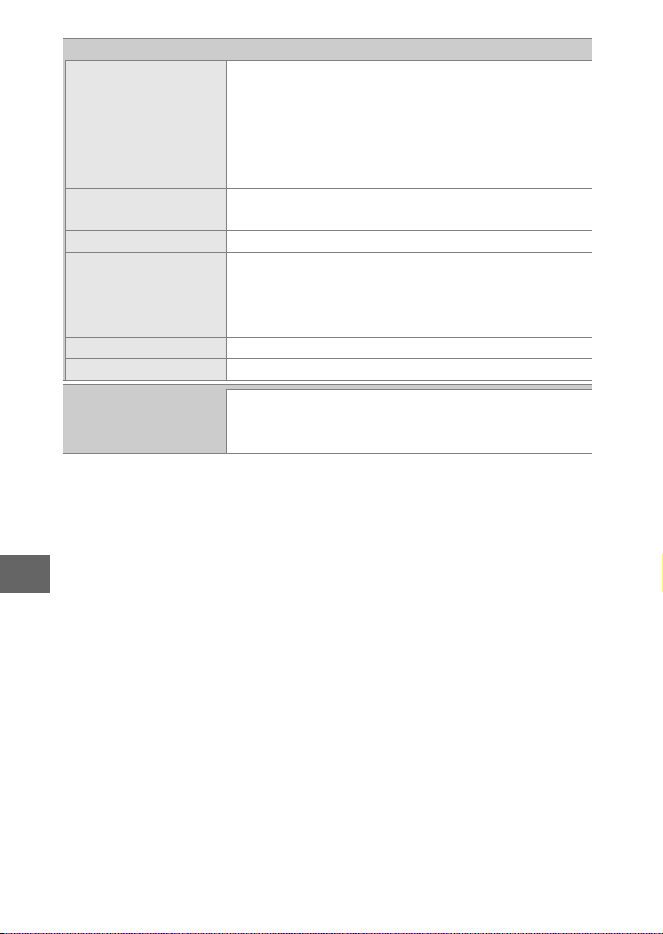
118
n
Flash
Built-in flash • Auto; Soft, Miniature effect, Selective color, Cross pro-
cess, Toy camera effect (Creative mode): Flash pops up
automatically and fires as required
• P programmed auto, S shutter-priority auto, A aperture-
priority auto, M manual (Creative mode): Manual pop-
up
Guide Number (GN) Approx. 5/16 (m/ft, ISO 100, 20 °C/68 °F; at ISO
160, Guide Number is approx. 6.3/20.7)
Control i-TTL flash control using image sensor
Mode Auto, auto + red-eye reduction, fill flash, fill flash
+ slow sync, red-eye reduction, red-eye reduction
+ slow sync, rear-curtain sync, rear curtain + slow
sync, off
Flash compensation –3–+1 EV in increments of
1
/
3 EV
Flash-ready indicator Lights when built-in flash unit is fully charged
White balance
Auto, incandescent, fluorescent, direct sunlight,
flash, cloudy, shade, underwater, preset manual,
all except preset manual with fine tuning
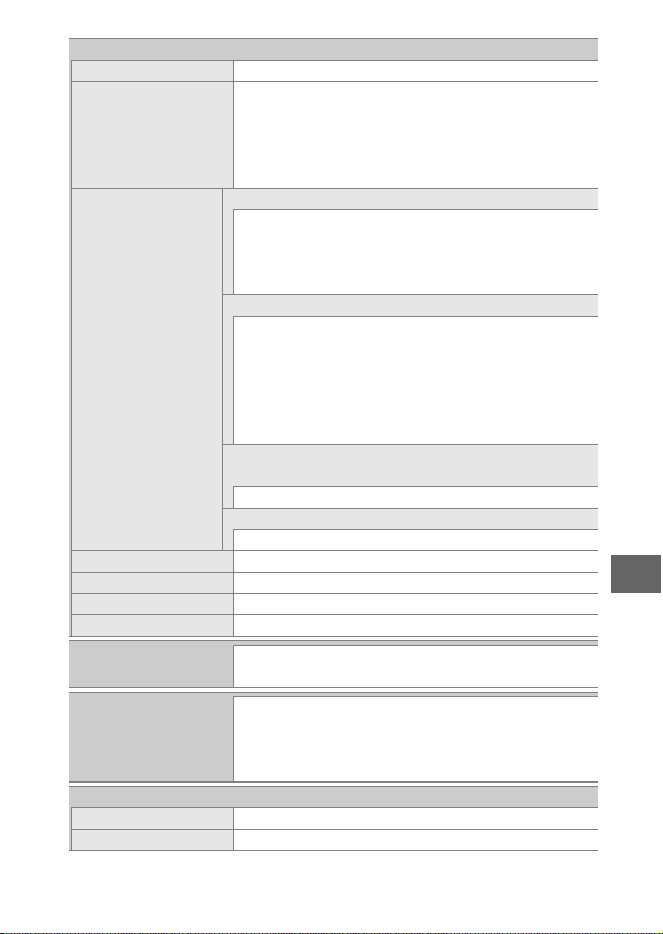
119
n
Movie
Metering TTL metering using image sensor
Metering method • Matrix
• Center-weighted: Meters 4.5 mm circle in center of
frame
• Spot: Meters 2mm circle centered on selected
focus area
Frame size (pixels)/
recording rate
HD movies (aspect ratio 16 : 9)
• 1920 × 1080/60p (59.94 fps)
• 1920 × 1080/30p (29.97 fps)
• 1280 × 720/60p (59.94 fps)
• 1280 × 720/30p (29.97 fps)
Slow-motion movies
• 1280 × 720/120 fps
(aspect ratio 16 : 9; plays at 30p/29.97 fps)
• 768 × 288/400 fps
(aspect ratio 8 : 3; plays at 30p/29.97 fps)
• 416 × 144/1200 fps
(aspect ratio 26 : 9; plays at 30p/29.97 fps)
Fast-motion, jump-cut, and 4-second movies (aspect ratio
16 : 9)
1920 × 1080/30p (29.97 fps)
Motion Snapshots (movie portion, aspect ratio 16 : 9)
1920 × 1080/60p (59.94 fps) (plays at 24p/23.976 fps)
File format MOV
Video compression H.264/MPEG-4 Advanced Video Coding
Audio recording format PCM
Audio recording device Built-in stereo microphone; sensitivity adjustable
Monitor
7.5 cm (3-in.), approx. 1037k-dot, TFT LCD touch
screen with brightness adjustment
Playback
Full-frame and thumbnail (4, 9, or 16 images or
calendar) playback with playback zoom, movie
and panorama playback, slide show, histogram
display, auto image rotation, and rating option
Interface
USB Hi-Speed USB
HDMI output Type D HDMI connector
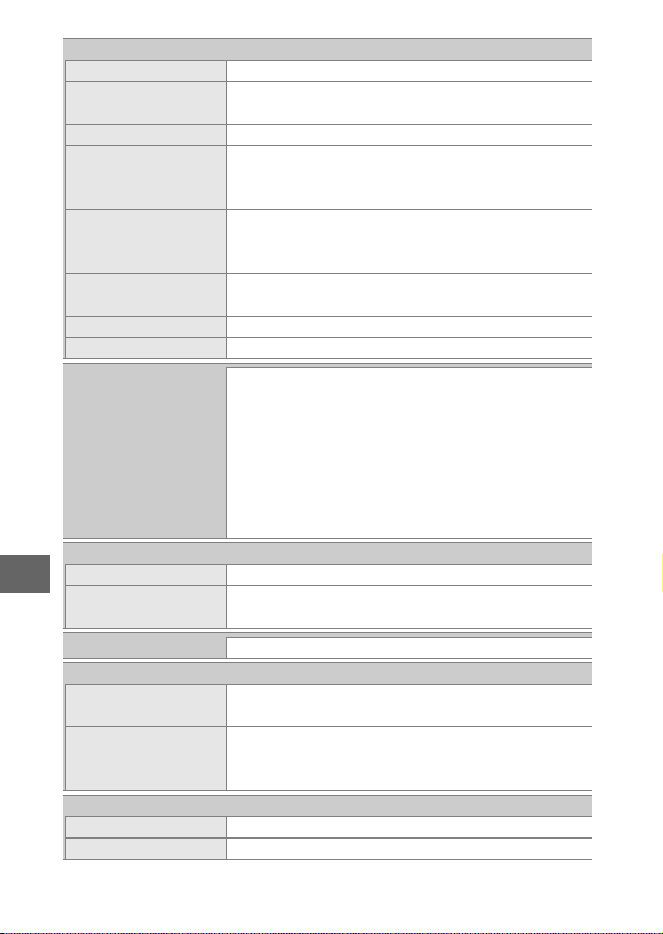
120
n
Wireless
Standards IEEE 802.11b, IEEE 802.11g
Communications
protocols
• IEEE 802.11b: DSSS/CCK
• IEEE 802.11g: OFDM
Operating frequency 2412–2462 MHz (channels 1–11)
Range (line of sight) Approximately 10 m/33 ft (assumes no interfer-
ence; range may vary with signal strength and
presence or absence of obstacles)
Data rate 54 Mbps
Maximum logical data rates according to IEEE
standard. Actual rates may differ.
Security • Authentication: Open system, WPA2-PSK
• Encryption: AES
Wireless setup Supports WPS
Access protocols Infrastructure
Supported languages
Arabic, Bengali, Bulgarian, Chinese (Simplified
and Traditional), Czech, Danish, Dutch, English,
Finnish, French, German, Greek, Hindi, Hungar-
ian, Indonesian, Italian, Japanese, Korean, Mar-
athi, Norwegian, Persian, Polish, Portuguese
(European and Brazilian), Romanian, Russian, Ser-
bian, Spanish, Swedish, Tamil, Telugu, Thai, Turk-
ish, Ukrainian, Vietnamese
Power source
Battery One rechargeable Li-ion EN-EL22 battery
AC adapter EH-5b AC adapter; requires EP-5E power connec-
tor (available separately)
Tripod socket
1
/
4-in. (ISO 1222)
Dimensions/weight
Dimensions (W × H × D) Approx. 99.5 × 60.0 × 28.5 mm (3.9 × 2.4 × 1.1 in.),
excluding projections
Weight Approx. 232 g (8.2 oz) with battery and memory
card but without body cap; approx. 192 g (6.8 oz),
camera body only
Operating environment
Temperature 0 °C–40 °C (+32 °F–104 °F)
Humidity 85% or less (no condensation)
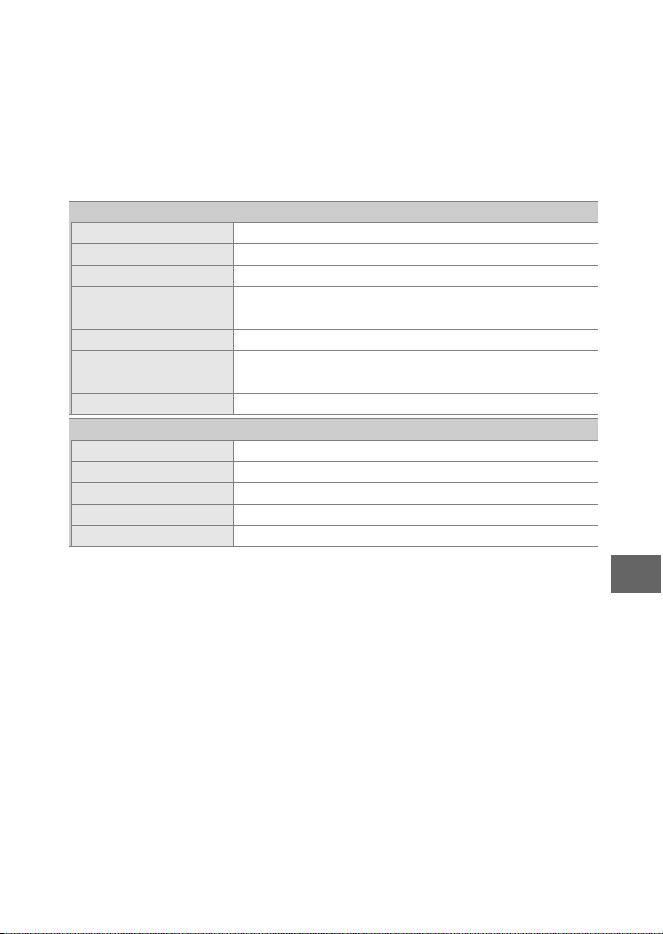
121
n
• Unless otherwise stated, all figures are for a camera with a fully-charged bat-
tery operating at the temperature specified by the Camera and Imaging
Products Association (CIPA): 23 ±3 °C (73.4 ±5.4 °F).
• Nikon reserves the right to change the specifications of the hardware and
software described in this manual at any time and without prior notice.
Nikon will not be held liable for damages that may result from any mistakes
that this manual may contain.
MH-29 battery charger
Rated input AC 100–240 V, 50–60 Hz, 0.2 A
Rated output DC 8.4 V/0.6 A
Supported batteries Nikon EN-EL22 rechargeable Li-ion batteries
Charging time Approx. 3 hours at an ambient temperature of
25 °C (77 °F) when no charge remains
Operating temperature 0 °C–40 °C (+32 °F–104 °F)
Dimensions (W × H × D) Approx. 67.0 × 28.0 × 94.0 mm (2.6 × 1.1 × 3.7 in.),
excluding plug adapter
Weight Approx. 83 g (2.9 oz), excluding plug adapter
EN-EL22 rechargeable Li-ion battery
Type Rechargeable lithium-ion battery
Rated capacity 7.2 V, 1010 mAh
Operating temperature 0 °C–40 °C (+32 °F–104 °F)
Dimensions (W × H × D) Approx. 30.7 × 50.0 × 13.0 mm (1.2 × 2.0 × 0.5 in.)
Weight Approx. 39 g (1.4 oz), excluding terminal cover
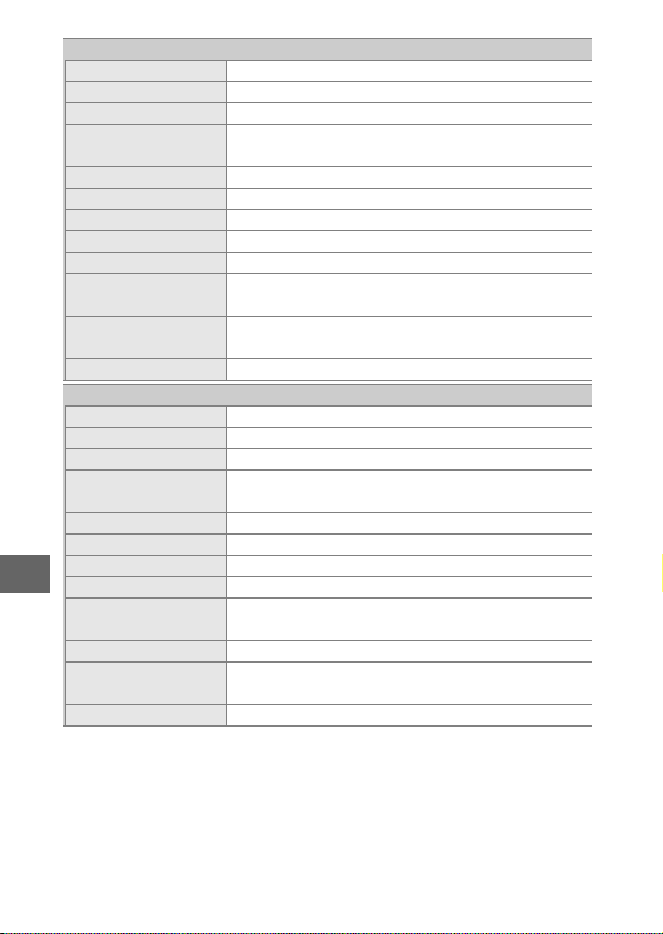
122
n
Specifications subject to change without notice. Nikon will not be held liable
for damages that may result from any mistakes that this manual may contain.
1 NIKKOR VR 10–30mm f/3.5–5.6 PD-ZOOM
Type 1 mount lens
Focal length 10–30 mm
Maximum aperture f/3.5–5.6
Construction 9 elements in 7 groups (including 4 aspherical lens ele-
ments, 1 ED lens element, and HRI lens elements)
Angle of view 77°–29° 40′
Vibration reduction Lens shift using voice coil motors (VCMs)
Minimum focus distance 0.2 m (0.7 ft) from focal plane at all zoom positions
Diaphragm blades 7 (rounded diaphragm opening)
Diaphragm Fully automatic
Aperture range • 10 mm focal length: f/3.5–16
• 30 mm focal length: f/5.6–16
Dimensions Approx. 58 mm diameter × 28 mm (distance from
camera lens mount flange when lens is retracted)
Weight Approx. 85 g (3.0 oz)
1 NIKKOR 11–27.5mm f/3.5–5.6
Type 1 mount lens
Focal length 11–27.5 mm
Maximum aperture f/3.5–5.6
Construction 8 elements in 6 groups (including 1 ED lens element and
1 aspherical lens element), 1 protective glass element
Angle of view 72°–32° 20′
Minimum focus distance 0.3 m (1.0 ft) from focal plane at all zoom positions
Diaphragm blades 7 (rounded diaphragm opening)
Diaphragm Fully automatic
Aperture range • 11 mm focal length: f/3.5–16
• 27.5 mm focal length: f/5.6–16
Filter-attachment size 40.5 mm (P=0.5 mm)
Dimensions Approx. 57.5 mm diameter × 31 mm (distance from
camera lens mount flange when lens is retracted)
Weight Approx. 83 g (3.0 oz)

123
n
A
Trademark Information
Mac and OS X are registered trademarks of Apple Inc. in the United
States and/or other countries. Microsoft, Windows, and Windows Vista
are either registered trademarks, or trademarks of Microsoft Corpora-
tion in the United States and/or other countries. The PictBridge logo is
a trademark. The microSD, microSDHC, and microSDXC logos are trade-
marks of SD-3C, LLC. HDMI, the HDMI logo and High-Definition Multi-
media Interface are trademarks or registered trademarks of HDMI
Licensing LLC.
Wi-Fi and the Wi-Fi logo are trademarks or registered trademarks of the
Wi-Fi Alliance. All other trade names mentioned in this manual or the
other documentation provided with your Nikon product are trade-
marks or registered trademarks of their respective holders.
A
FreeType License (FreeType2)
Portions of this software are copyright © 2012 The FreeType Project
(http://www.freetype.org). All rights reserved.
A
MIT License (HarfBuzz)
Portions of this software are copyright © 2014 The HarfBuzz Project
(http://www.freedesktop.org/wiki/Software/HarfBuzz). All rights
reserved.

124
n
Battery Life
The number of shots or movie footage that can be recorded with
fully-charged batteries varies with the condition of the battery,
temperature, the interval between shots, and the length of time
menus are displayed. Sample figures for EN-EL22 (1010 mAh)
batteries are given below.
• Still images: Approximately 300 shots
• Movies: Approximately 70 minutes at 1080/30p
Measured according to CIPA standards at 23 ±3 °C (73.4 ±5.4 °F)
with the camera at default settings, a fully-charged battery, a
1 NIKKOR VR 10–30mm f/3.5–5.6 PD-ZOOM lens, and a 16GB
SanDisk SDSDQXP-016G-J35 UHS-I microSDHC card. Value for
still images obtained under the following test conditions: pho-
tographs taken at intervals of 30 s with the built-in flash fired
with every other shot and the camera turned off and then on
after every ten shots. Value for movies obtained under the fol-
lowing test conditions: a series of 20 minute movies with a file
size of up to 4 GB were recorded; recording was only inter-
rupted when temperature warning was displayed.
The following can reduce battery life:
• Keeping the shutter-release button pressed halfway
• Repeated autofocus operations
• Taking NEF (RAW) photographs
• Slow shutter speeds
• Using Wi-Fi
• Using vibration reduction mode with VR lenses
• Using zoom with power zoom lenses
To ensure that you get the most from rechargeable Nikon
EN-EL22 batteries:
• Keep the battery contacts clean. Soiled contacts can reduce
battery performance.
• Use batteries immediately after charging. Batteries will lose
their charge if left unused.
125
n
Symbols
C (Auto mode) ............................. 6, 22
w (Creative mode) .................... 6, 31
u (Best moment capture mode) . 6,
55
v (Advanced movie mode) ... 6, 46,
49
z (Motion Snapshot mode) ..... 6, 65
P (Programmed auto) ................32, 34
S (Shutter-priority auto) ...........32, 35
A (Aperture-priority auto) ........32, 36
M (Manual) ....................................32, 37
4 (Creative palette) ..................32, 39
5 (HDR) ........................................32, 40
p (Easy panorama) ...................32, 41
q (Soft) ..................................................32
r (Miniature effect) .........................32
s (Selective color) .....................32, 44
6 (Cross process) ......................32, 45
7 (Toy camera effect) .......................32
c (Portrait) .........................................28
d (Landscape) ...................................28
f (Night portrait) .............................28
e (Close up) .......................................28
g (Night landscape) .......................28
Z (Auto) ..............................................28
U (flexible program) .........................34
G (menu) button ................... 7, 92
K (playback) button ..........25, 63, 69
O (delete) button ..........27, 53, 64, 69
J (OK) button ...................................... 3
& (feature) ............................................. 9
C (continuous shooting/self-timer) .
70, 72
I (continuous) ..................................70
E (self-timer) ......................................72
N (flash mode) .............................75, 77
8 (Single frame) ...............................71
Y (red-eye reduction) .............75, 77
p (slow sync) .....................................77
q (rear-curtain sync) ...................... 77
N (flash-ready indicator) ................. 78
Numerics
4-second movie ................................. 49
A
AC adapter .........................................103
Accessories ........................................103
Active selection .................................55
Advanced movie mode .......6, 46, 49
Aperture ........................................36, 37
Aperture-priority auto .............32, 36
Attaching the lens ............................ 17
Audio ..................................................... 68
Auto mode ..........................................22
Auto power off ................................... 19
Automatic scene selection ............ 28
B
Battery ...................................15, 16, 121
Beep ................................................ 24, 73
Best moment capture mode ......... 55
Best shot ........................................61, 63
Body cap ...................................1, 2, 103
Buffering ................................57, 62, 66
Built-in flash ........................................74
C
Charging a battery ........................... 15
Clock ......................................................21
Close up ................................................ 28
Compatible lens ..............................103
Computer ............................................. 97
Continuous .......................................... 70
Creative mode .................................... 31
Creative palette .......................... 32, 39
Cross process ...............................32, 45
D
Date and time ..................................... 21
Date format ......................................... 21
Index
126
n
Daylight saving time ........................21
Delete ...............................27, 53, 64, 69
Detailed display ................................... 4
Dust shield ...............................105, 106
E
Easy panorama ............................32, 41
Exposure indicator ............................38
F
Face priority ........................................28
Fast motion .........................................49
Fill flash .................................................77
Flash .......................................................74
Flash mode ...................................75, 77
Flash range ..........................................79
Flash-ready indicator .......................78
Flexible program ...............................34
Focal plane mark ................................. 2
Focus area ............................................24
Format ...................................................16
Format memory card .......................16
Full-frame playback ..........................25
G
Grid display .........................................25
H
H.264 ....................................................119
HD movie .............................................49
HDR ........................................................40
Hue (Cross process) ..........................45
J
Jump cut ...............................................49
L
Landscape ............................................28
Language .............................................21
Lens ..............................17, 23, 103, 122
Lens cap ................................................18
Live image control ............................29
M
Manual ........................................... 32, 37
Maximum aperture ........................122
Memory card .............................16, 104
Memory card access lamp ............. 24
Microphone ........................................ 47
microSD card ....................................104
Miniature effect ................................. 32
Monitor ....................................................4
Motion Snapshot mode ................. 65
Mount adapter .................................103
Movie-record button ....................... 47
Movies ............................................ 46, 49
N
Network connection ........................ 83
Nikon Transfer 2 ..............................101
P
PIN-entry WPS .................................... 86
Playback ............................................... 25
Portrait .................................................. 28
Power connector .............................103
Power switch ...................................... 19
Press the shutter-release button all
the way down ................................... 24
Press the shutter-release button
halfway ............................................... 24
Programmed auto ..................... 32, 34
Push-button WPS .............................. 85
R
Rear-curtain sync .............................. 77
Red-eye reduction ..................... 75, 77
Removing the lens from the camera
18
Reset Wi-Fi settings .......................... 88
Retractable lens barrel button .... 18,
20
S
Scene selection .................................. 32
Select color ......................................... 44
127
n
Select to send to smart device .....90
Selective color .............................32, 44
Self-timer ..............................................72
Shutter speed ..............................35, 37
Shutter-priority auto .................32, 35
Shutter-release button .....24, 57, 60,
62, 66
Single frame ........................................71
Size .............................................115, 119
Slow motion ........................................49
Slow sync ..............................................77
Slow view .............................................59
Smart Photo Selector .......................61
Soft .........................................................32
Speaker ................................................... 3
SSID ........................................................87
Strap .......................................................15
System requirements .......................98
T
Tap shooting options .......................80
Temperature warnings .................... xii
Time .......................................................21
Timer ......................................................72
Touch screen .......................................10
Toy camera effect ..............................32
U
Underwater flash units ................. 103
USB ...................................................... 100
USB cable .......................................... 100
V
View SSID .............................................87
ViewNX 2 ..............................................97
Volume ..................................................52
W
Waterproof case .............................. 103
Wi-Fi ...............................................xiv, 83
Wi-Fi upload .................................89, 92
Wireless .........................................xiv, 83
Wireless Mobile Utility ..............83, 84
Z
Zoom ring .....................................18, 23

128
n
Dear Nikon Customer,
We thank you for your purchasing this Nikon product. Should
your Nikon product require warranty service, please contact the
dealer from whom it was purchased or a member of our autho-
rized service network within the sales territory of Nikon Europe
BV (Europe/Africa and Russia).
In order to avoid any unnecessary inconvenience, we advise you
to read the user manuals carefully before contacting the dealer
or our authorized service network.
Your Nikon equipment is guaranteed against any manufacturing
defects for one full year from the date of original purchase. If dur-
ing this period of guarantee the product proves defective due to
improper material or workmanship, our authorized service net-
work within the sales territory of Nikon Europe BV will, without
charge for labor and parts, repair the product in the terms and
conditions set as below. Nikon reserves the right (at its sole dis-
cretion) to replace or repair the product.
1. This warranty is only provided upon presentation of the com-
pleted warranty card and original invoice or purchase receipt
indicating the date of purchase, product type and dealer’s
name, together with the product. Nikon reserves the right to
refuse free-of-charge warranty service if the above docu-
ments cannot be presented or if the information contained in
it is incomplete or illegible.
2. This warranty will not cover:
• necessary maintenance and repair or replacement of parts
due to normal wear and tear.
• modifications to upgrade the product from its normal pur-
pose as described in user manuals, without the prior written
consent of Nikon.
Warranty Terms - Nikon Europe Service Warranty

129
n
• transport costs and all risks of transport relating directly or
indirectly to the warranty of the products.
• any damage resulting from modifications or adjustments
which may be made to the product, without the prior writ-
ten consent of Nikon, in order to comply with local or
national technical standards in force in any other country
than the ones for which the product was originally designed
and/or manufactured.
3. The warranty will not be applicable in the case of:
• damage caused by misuse including but not limited to fail-
ure to use the product for its normal purpose or according
to the user instructions on the proper use and maintenance,
and to installation or use of the product inconsistent with
the safety standards in force in the country where it is used.
• damage caused by accidents including but not limited to
lightning, water, fire, misuse or neglect.
• defacing, illegibility or removal of the model or serial num-
ber on the product.
• damage resulting from repairs or adjustments which have
been conducted by unauthorized service organizations or
persons.
• defects in any system into which the product is incorpo-
rated or with which it is used.
4. This service warranty does not affect the consumer’s statutory
rights under applicable national laws in force, nor the con-
sumer’s right against the dealer arising from their sales/pur-
chase contract.
Notice: An overview of all authorized Nikon Service Stations can
be found online by following this Link
(URL = http://www.europe-nikon.com/service/ ).

AMA15997 Printed in Europe
SB4C01(11)
6MVA6711-01
No reproduction in any form of this manual, in whole or in
part (except for brief quotation in critical articles or reviews),
may be made without written authorization from NIKON
CORPORATION.
Nikon User Support
Visit the site below to register your camera and keep up-to-date
with the latest product information. You will find answers to
frequently asked questions (FAQs) and can contact us for
technical assistance.
http://www.europe-nikon.com/support
DIGITAL CAMERA
User's Manual
En
Nikon Manual Viewer 2
Use the Nikon Manual Viewer 2 app to view
manuals anytime, anywhere on your
smartphone or tablet.