
User Guide

© Copyright 2019 HP Development Company,
L.P.
DisplayPort™ and the DisplayPort™ logo are
trademarks owned by the Video Electronics
Standards Association (VESA®) in the United
States and other countries. Windows is either a
registered trademark or trademark of
Microsoft Corporation in the United States
and/or other countries.
Plug and Display
™
DisplayLink™ is an oicial software
development partner.
The information contained herein is subject to
change without notice. The only warranties for
HP products and services are set forth in the
express warranty statements accompanying
such products and services. Nothing herein
should be construed as constituting an
additional warranty. HP shall not be liable for
technical or editorial errors or omissions
contained herein.
First Edition: May 2019
Document Part Number: L59870-001

Table of contents
1 Getting started ............................................................................................................................................. 1
Components ........................................................................................................................................................... 1
Top ....................................................................................................................................................... 1
Front .................................................................................................................................................... 2
Left ....................................................................................................................................................... 3
Rear ...................................................................................................................................................... 4
Bottom ................................................................................................................................................. 5
Adapter components ........................................................................................................................... 6
Setting up the docking station .............................................................................................................................. 7
Step 1: Connecting to AC power .......................................................................................................... 7
Step 2: Connecting to a computer ....................................................................................................... 8
Step 3: Turning on the docking station ............................................................................................... 9
Step 4: Preventing Sleep or Hibernation ............................................................................................. 9
Setting up the software ......................................................................................................................................... 9
Updating the docking station .............................................................................................................................. 10
Downloading HP Firmware Installer ................................................................................................. 10
Installing updates .............................................................................................................................. 10
Conguring an external monitor ......................................................................................................................... 11
Using DisplayLink .............................................................................................................................. 11
Using Windows .................................................................................................................................. 11
Using additional software features .................................................................................................. 11
Sleep, Hibernation, shutdown, and restart ....................................................................................... 12
2 Using the docking station ............................................................................................................................. 13
Docking station guidelines .................................................................................................................................. 13
Connecting to a network ..................................................................................................................................... 14
Connecting USB devices ....................................................................................................................................... 15
Connecting to a DisplayPort device ..................................................................................................................... 16
Connecting to an HDMI device ............................................................................................................................. 17
Connecting audio ................................................................................................................................................. 18
Connecting analog audio devices ...................................................................................................... 18
Connecting an optional security cable ................................................................................................................ 18
3 Disconnecting the docking station ................................................................................................................ 19
iii

4 Troubleshooting .......................................................................................................................................... 20
Solving common problems .................................................................................................................................. 20
General use and connection problems ............................................................................................. 20
Audio problems ................................................................................................................................. 20
Video problems ................................................................................................................................. 21
Getting more information .................................................................................................................................... 21
5 Specications .............................................................................................................................................. 22
Input power .......................................................................................................................................................... 22
Operating environment ....................................................................................................................................... 22
6 Electrostatic discharge ................................................................................................................................ 23
7 Accessibility ................................................................................................................................................ 24
Accessibility ......................................................................................................................................................... 24
Finding the technology tools you need ............................................................................................ 24
Our commitment ............................................................................................................................... 24
International Association of Accessibility Professionals (IAAP) ....................................................... 24
Finding the best assistive technology .............................................................................................. 25
Assessing your needs ..................................................................................................... 25
Accessibility for HP products .......................................................................................... 25
Standards and legislation .................................................................................................................................... 26
Standards .......................................................................................................................................... 26
Mandate 376 – EN 301 549 ............................................................................................ 26
Web Content Accessibility Guidelines (WCAG) ................................................................ 26
Legislation and regulations .............................................................................................................. 26
United States ................................................................................................................... 27
21st Century Communications and Video Accessibility Act (CVAA) ............................... 27
Canada ............................................................................................................................. 27
Europe ............................................................................................................................. 28
United Kingdom .............................................................................................................. 28
Australia .......................................................................................................................... 28
Worldwide ....................................................................................................................... 28
Useful accessibility resources and links .............................................................................................................. 29
Organizations .................................................................................................................................... 29
Educational institutions .................................................................................................................... 29
Other disability resources ................................................................................................................. 29
HP links .............................................................................................................................................. 29
Contacting support .............................................................................................................................................. 30
iv


vi
1 Getting started
Components
This chapter identies the visible hardware features of the docking station and provides setup instructions.
NOTE: Some features of the docking station may not be supported by your computer.
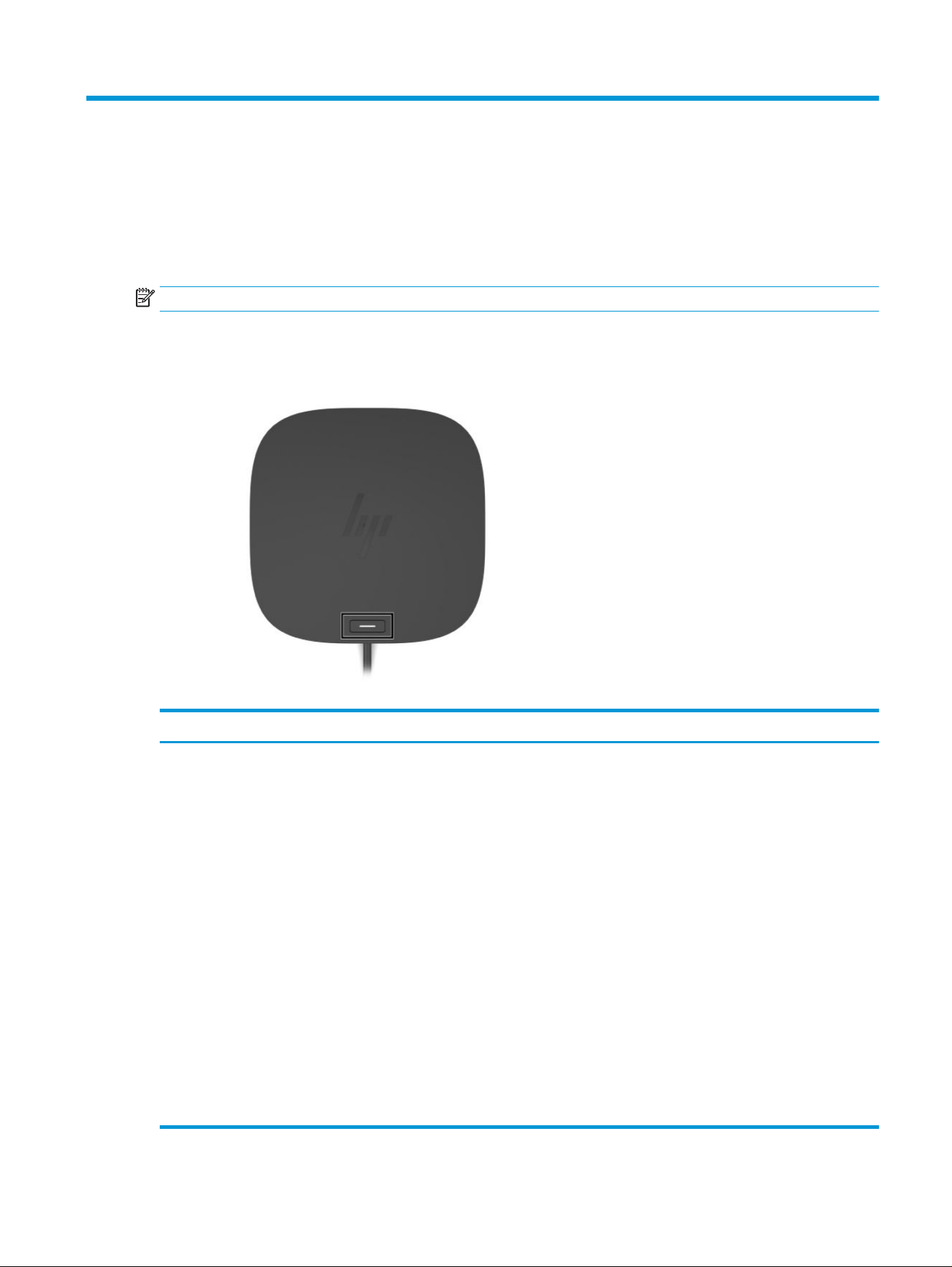
Top
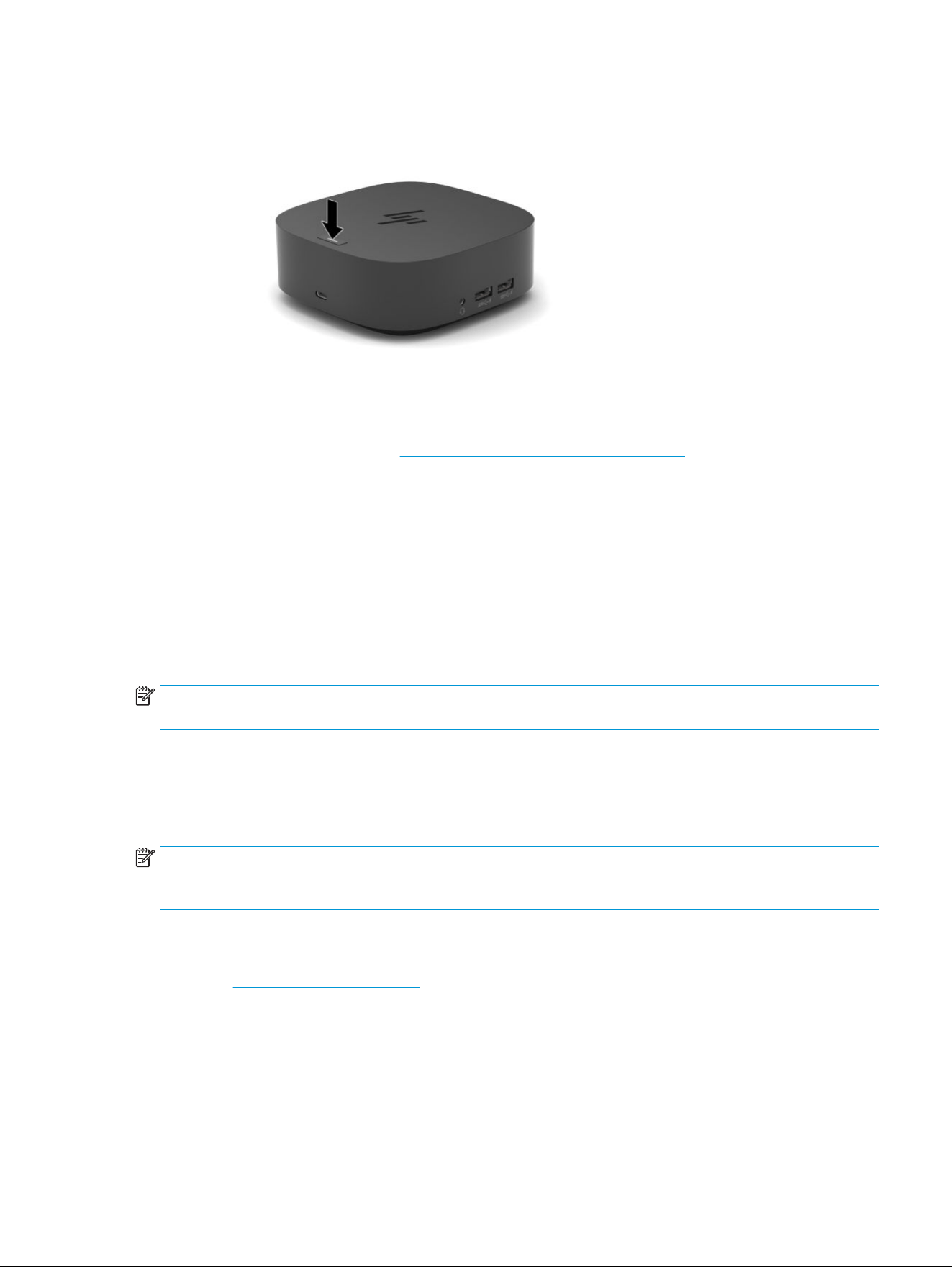
Table 1-1 Top component and its description
Component Description
Power button and light Button:
NOTE: These functions are not supported by the adapter.
● When the computer is o, press the button to turn on the
computer.
● When the computer is on, press the button briey to
initiate Sleep.
● When the computer is in the Sleep state, press the button
briey to exit Sleep.
● When the computer is in Hibernation, press the button
briey to exit Hibernation.
CAUTION: Pressing and holding down the power button results
in the loss of unsaved information.
If the computer has stopped responding and shutdown
procedures are ineective, press and hold the power button for
at least 5 seconds to turn o the computer.
Light:
● On: The docking station is on.
Components 1
Front
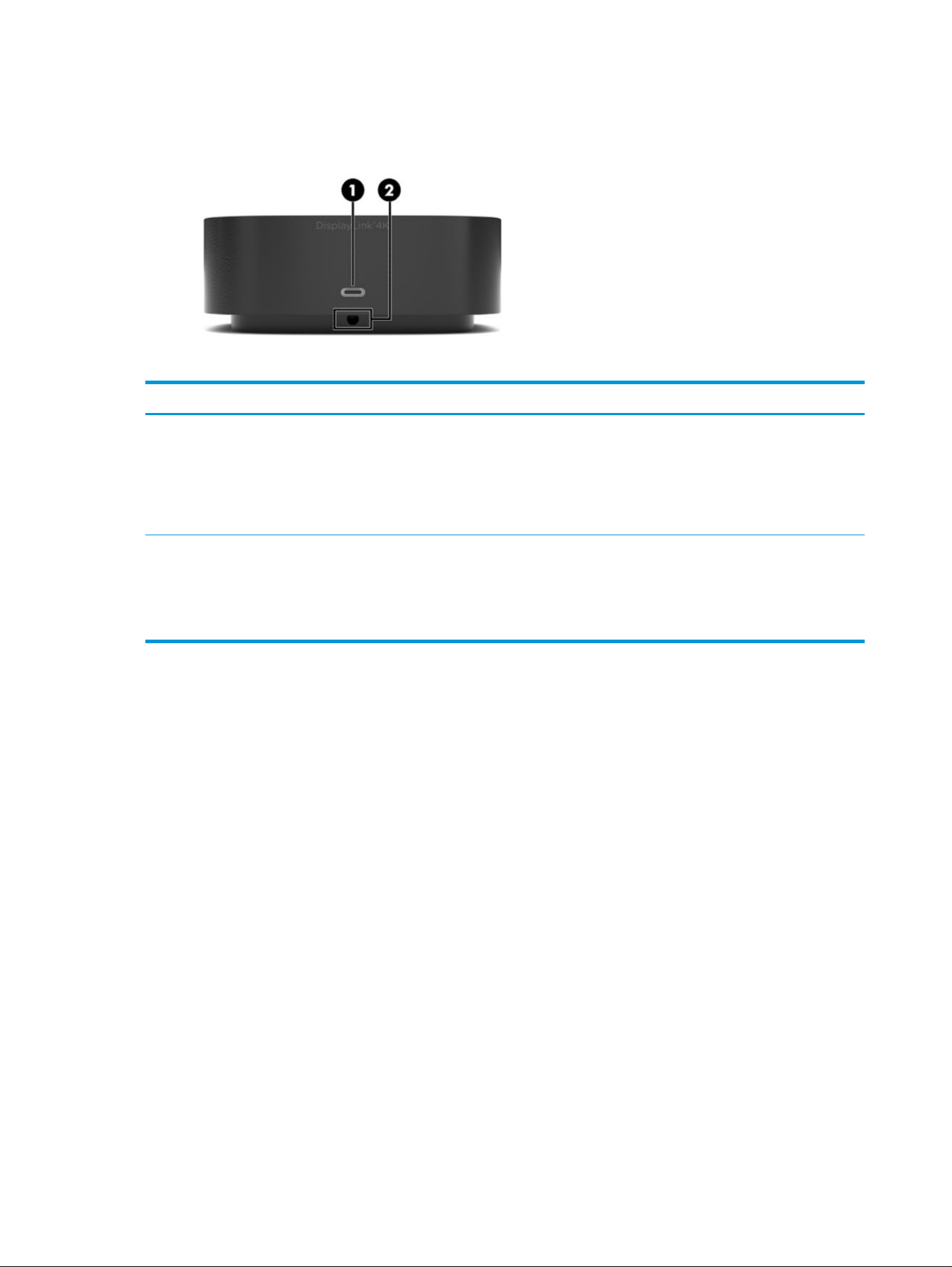
Table 1-2 Front components and their descriptions
Component Description
(1) USB Type-C SuperSpeed port with HP Sleep and Charge Connects a USB device that has a Type-C connector, provides
data transfer, and even when the computer is o, charges most
products such as a cell phone, camera, activity tracker, or
smartwatch.
NOTE: Cables and/or adapters (purchased separately) may be
required.
(2) USB Type-C cable Connects the docking station to a notebook or tablet computer.
NOTE: If a computer does not support power over USB Type-C
connections or requires more than 100 W of power, you must
use the AC adapter included with the computer to power or
charge the computer.
2 Chapter 1 Getting started
Left
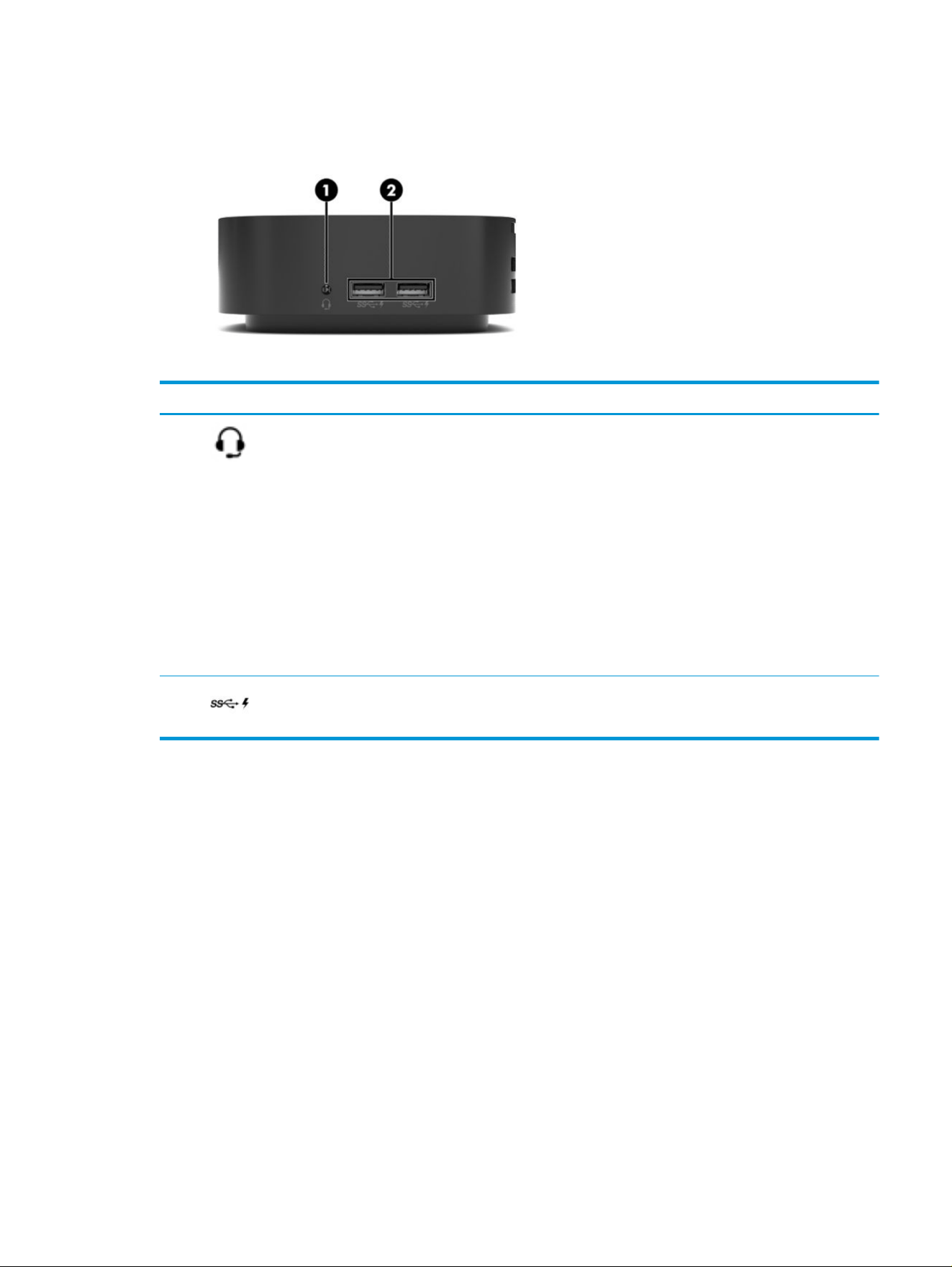
Table 1-3 Left components and their descriptions
Component Description
(1) Audio-out (headphone)/Audio-in (microphone)
combo jack
Connects optional powered stereo speakers, headphones,
earbuds, a headset, or a television audio cable. Also connects an
optional headset microphone. This jack does not support
optional standalone microphones.
WARNING! To reduce the risk of personal injury, adjust the
volume before putting on headphones, earbuds, or a headset.
For additional safety information, see the Regulatory, Safety,
and Environmental Notices.
To access this guide:
▲ On your computer, select the Start button, select HP Help
and Support, and then select HP Documentation.
NOTE: When a device is connected to the jack, the computer
speakers are disabled.
(2) USB SuperSpeed ports with HP Sleep and
Charge (2)
Connect a USB device, provides data transfer, and even when
the computer is o, charges most products such as a cell phone,
camera, activity tracker, or smartwatch.
Components 3
Rear
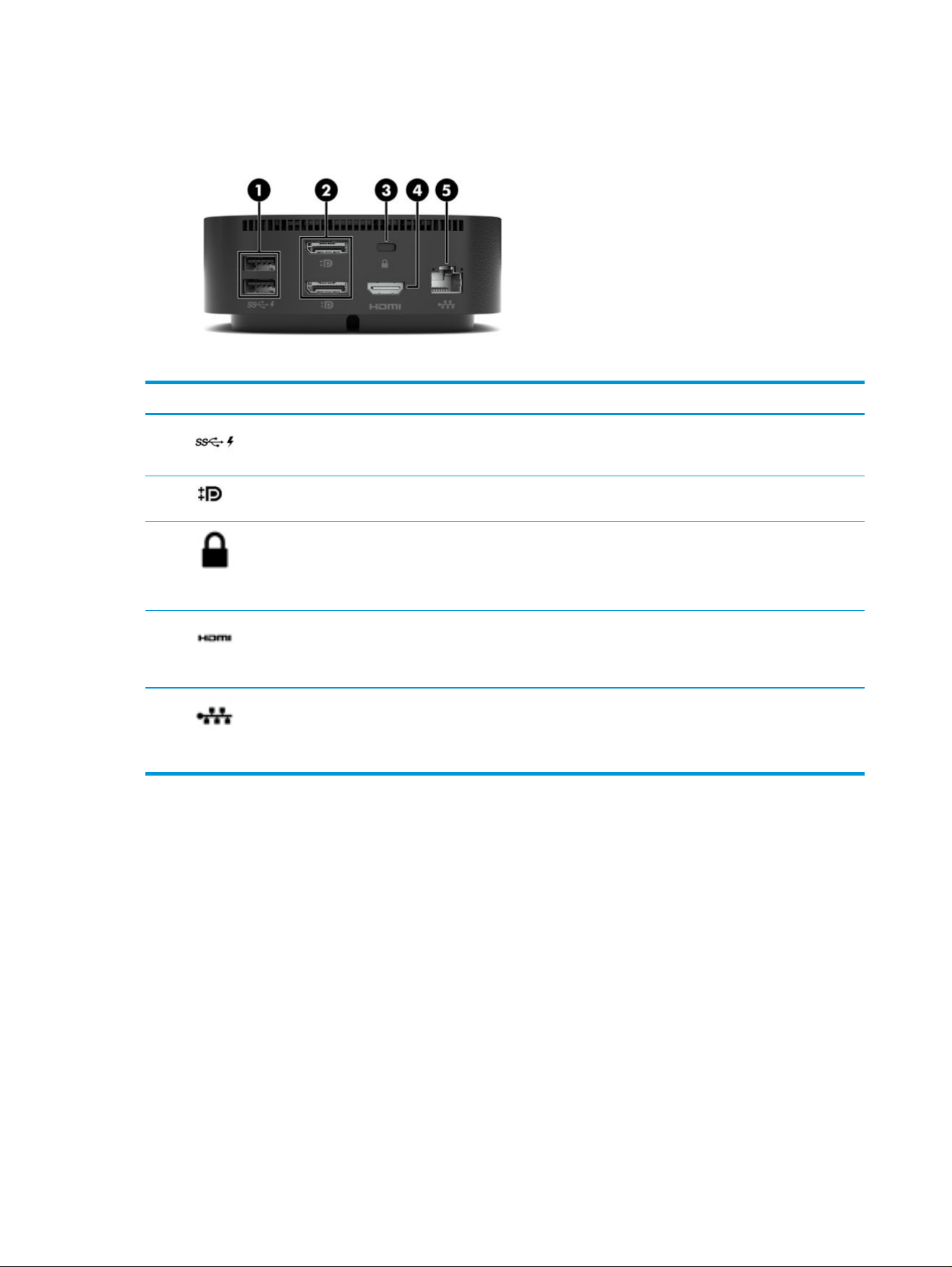
Table 1-4 Rear components and their descriptions
Component Description
(1) USB SuperSpeed ports with HP Sleep and
Charge (2)
Connect a USB device, provides data transfer, and even when the
computer is o, charges most products such as a cell phone,
camera, activity tracker, or smartwatch.
(2) Dual-Mode DisplayPort™ connectors (2) Connect an optional digital display device, such as a high-
performance monitor or projector.
(3) Security cable slot Attaches an optional security cable to the docking station.
NOTE: The security cable is designed to act as a deterrent, but
it may not prevent the docking station from being mishandled or
stolen.
(4) HDMI port Connects an optional video or audio device, such as a high-
denition television, any compatible digital or audio component,
or a high-speed High Denition Multimedia Interface (HDMI)
device.
(5) RJ-45 (network) jack/status lights Connects a network cable.
● Green (right): The network is connected.
● Amber (left): Activity is occurring on the network.
4 Chapter 1 Getting started
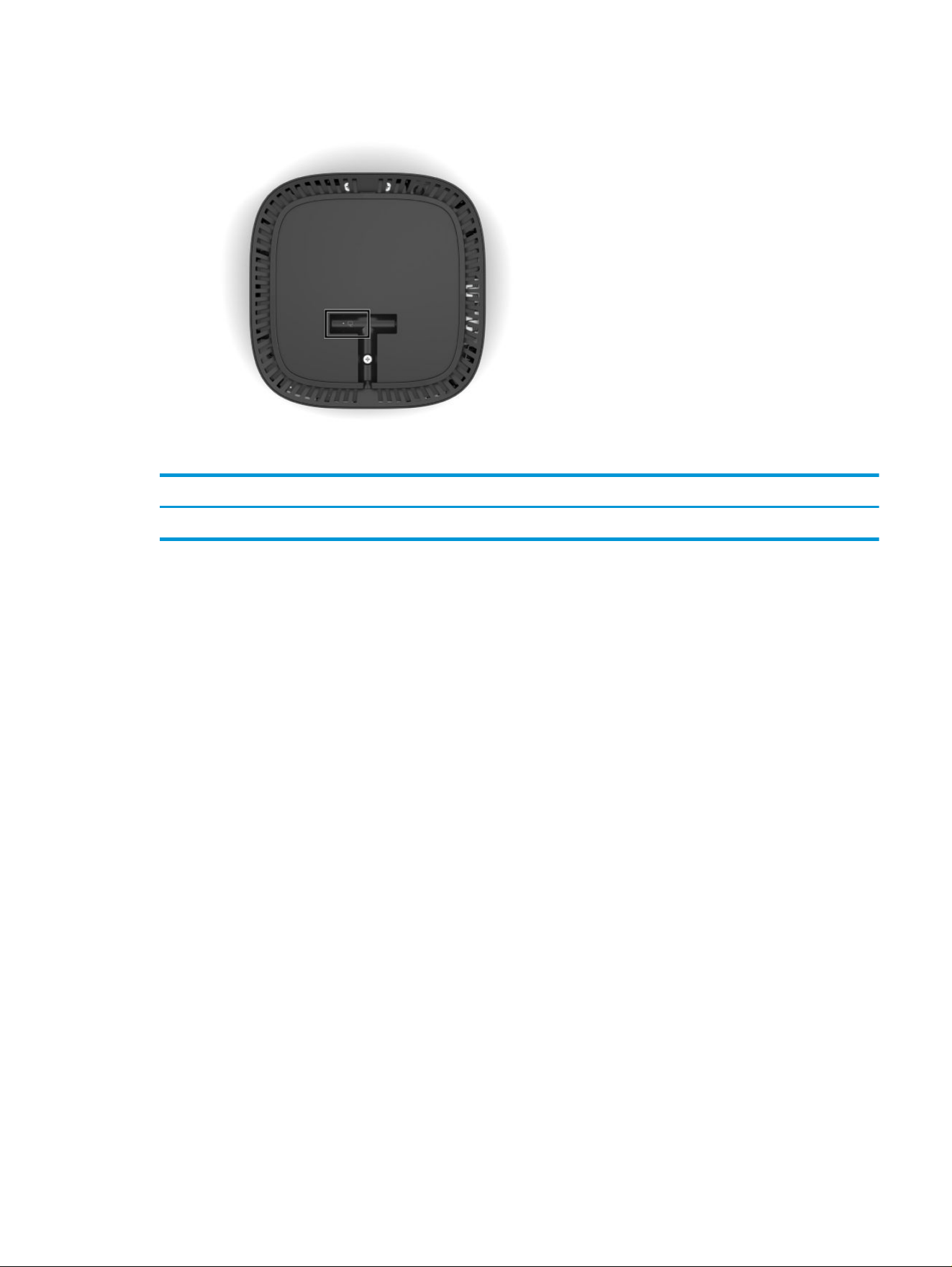
Bottom
Table 1-5 Bottom components and their descriptions
Components Description
AC adapter light ● On: AC power is connected to the docking station.
Components 5
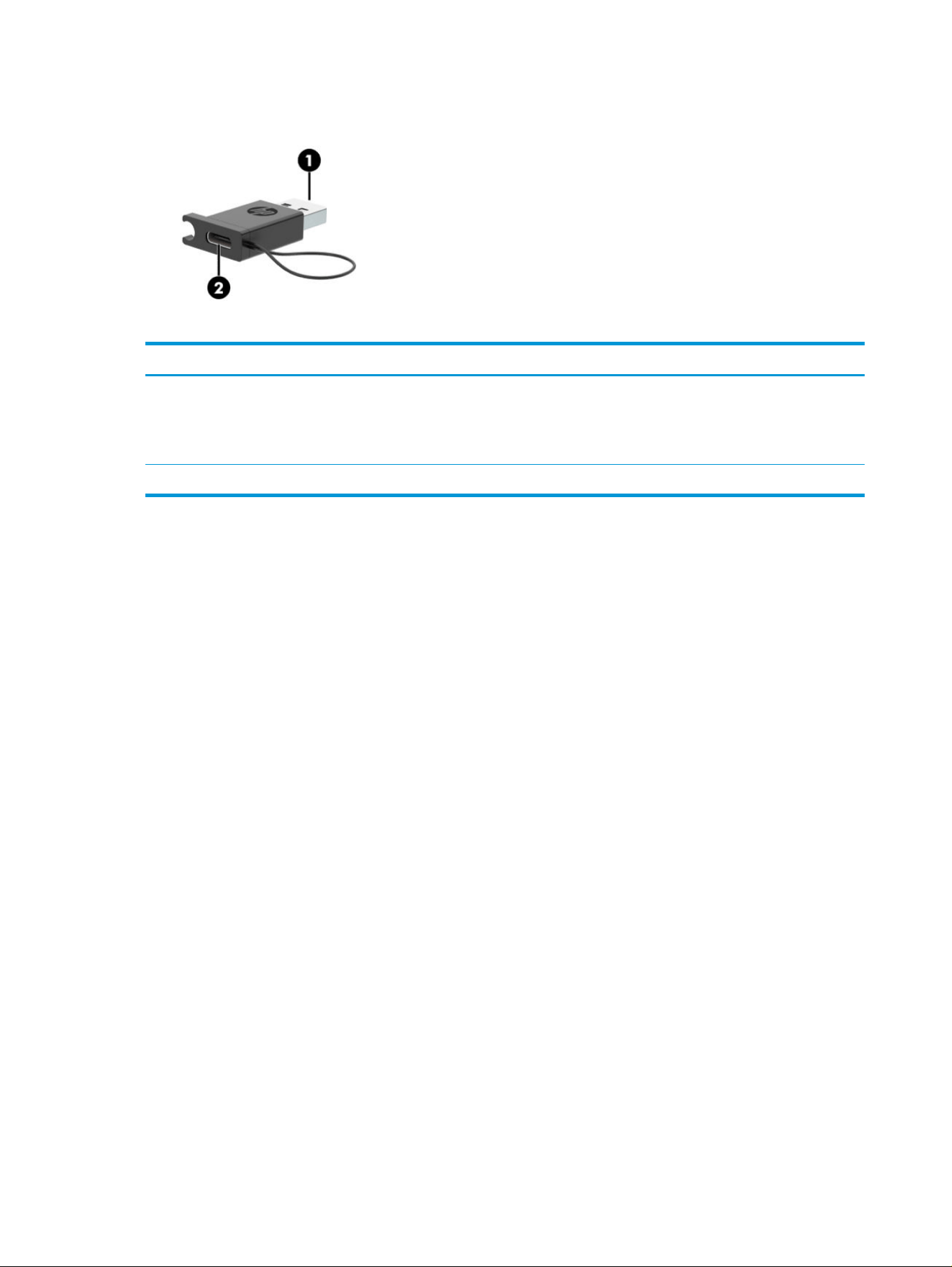
Adapter components
Table 1-6 Adapter components and their descriptions
Component Description
(1) USB connector Connects the docking station to a USB port on a notebook or
tablet computer that lacks a USB Type-C port.
NOTE: You must use the AC adapter included with the
computer to power or charge the computer.
(2) USB Type-C port Connects the adapter to the docking station.
6 Chapter 1 Getting started
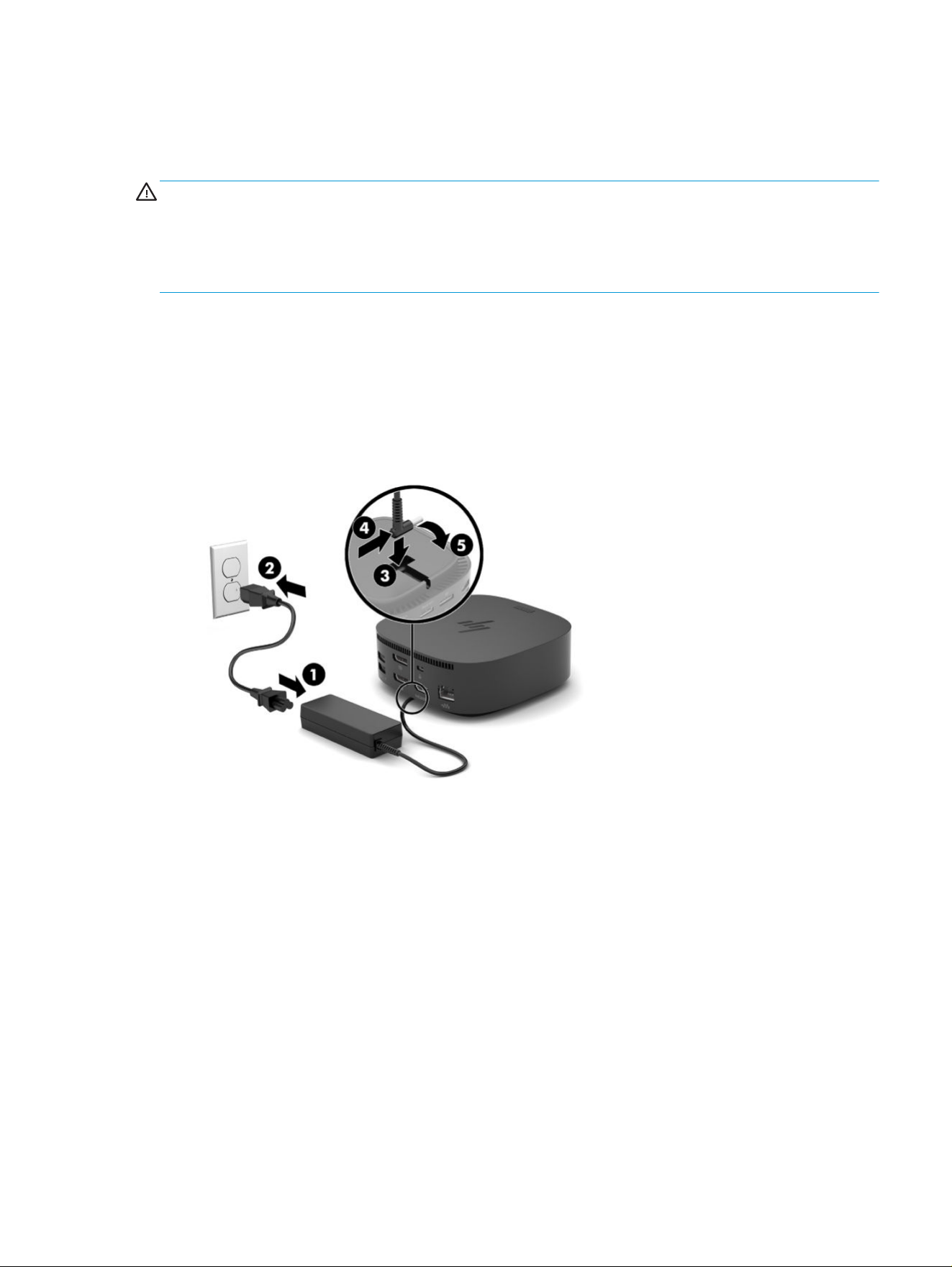
Setting up the docking station
Step 1: Connecting to AC power
WARNING! To reduce the risk of electric shock or damage to your equipment:
Plug the power cord into a grounded (earthed) outlet that is easily accessible at all times.
Disconnect power from the equipment by unplugging the power cord from the electrical outlet.
Do not disable the power cord grounding plug. The grounding plug is an important safety feature.
To ensure the correct performance of all docking station features, connect the docking station to an AC power
source using the docking station power cord.
1. Connect one end of the power cord to the AC adapter (1), and connect the other end of the power cord to
an AC outlet (2).
2. Lower the AC adapter connector into the power-in connector slot on the docking station (3), press the
connector to the side until it is rmly seated (4), and then rotate the connector so that the cable is
routed through the channel on the side of the docking station chassis (5).
Setting up the docking station 7
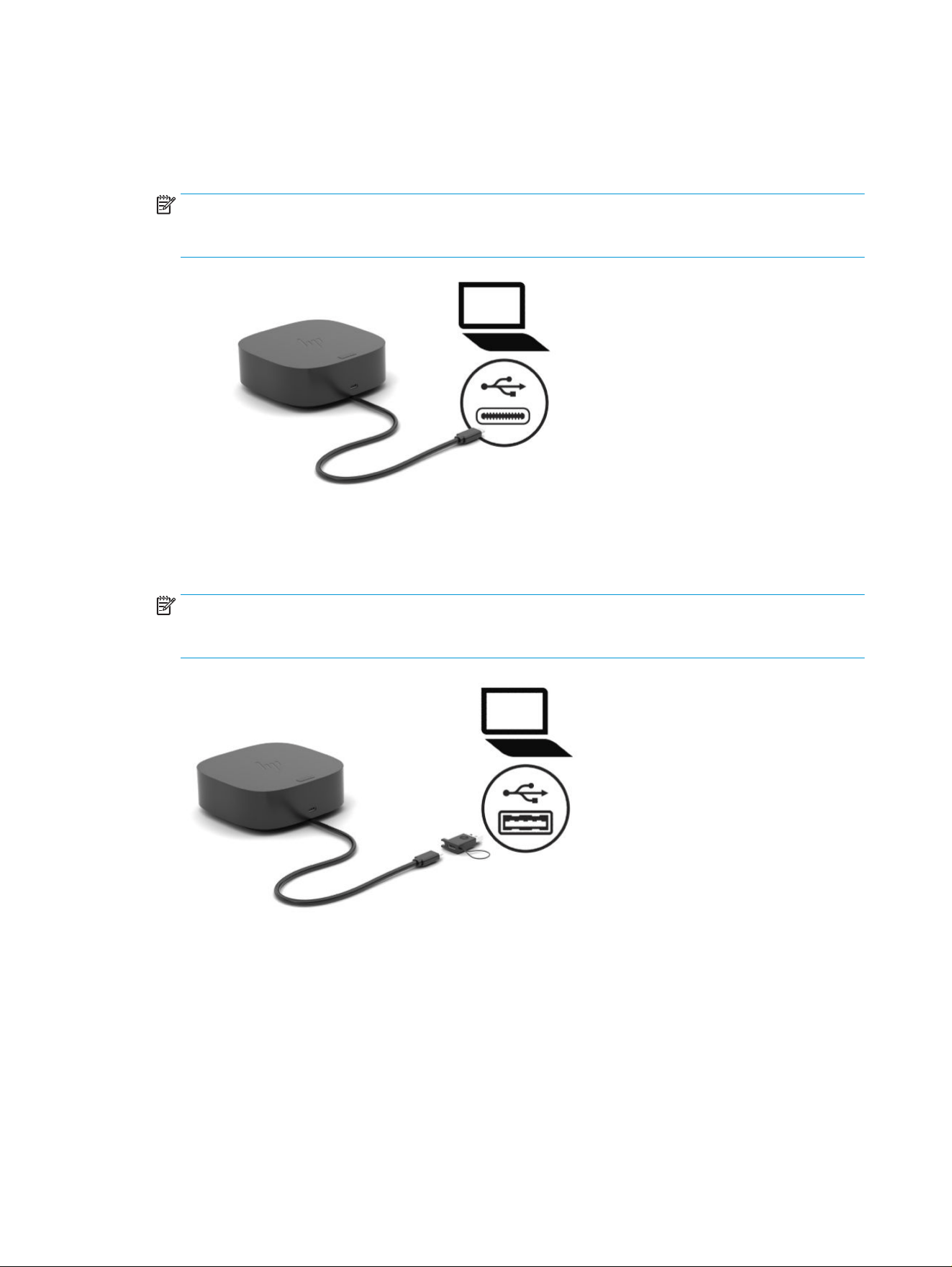
Step 2: Connecting to a computer
To connect a computer to the docking station via USB Type-C:
▲ Connect the USB Type-C cable to a USB Type-C port on your computer.
NOTE: If the computer does not support power over USB Type-C connections or requires more than
100 W of power, you must use the AC adapter included with the computer to power or charge the
computer.
To connect a computer to the docking station via USB, use the included adapter:
▲ Connect the docking station cable to the USB Type-C end of the adapter, and then connect the USB end
of the adapter to a USB port on your computer.
NOTE: If you connect to a computer using the adapter, the docking station does not provide power to
the computer. You must use the AC adapter included with the computer to power or charge the
computer.
8 Chapter 1 Getting started
Step 3: Turning on the docking station
▲ Press the power button.
Step 4: Preventing Sleep or Hibernation
When using an external monitor, you might want to close the computer. For more information about
conguring an external monitor, see Conguring an external monitor on page 11.
To ensure that the computer does not initiate Sleep or Hibernation when it is closed:
1. Type control panel in the taskbar search box, and then select Control Panel.
2. Select Power Options.
3. Select Choose what closing the lid does.
4. Next to When I close the lid, under On battery, select Do nothing.
5. Next to When I close the lid, under Plugged in, select Do nothing.
6. Select Save changes.
NOTE: For instructions on accessing the computer Power Options page, see HP Help and Support on the
computer.
Setting up the software
This section describes how to install the docking station software on a computer running the Windows® 10
operating system.
NOTE: If your computer is running the Windows 7 operating system, you must download additional drivers
from the HP Support page for your computer. Go to http://www.hp.com/support and follow the on-screen
instructions to nd your product.
1. With the computer on, Windows running, and the Internet connected, connect the docking station to the
computer.
2. Go to http://www.hp.com/support.
3. Select Get software and drivers, and follow the on-screen instructions to nd your docking station.
4. Follow the on-screen instructions to select and download the latest rmware update and each driver.
5. Complete the installation wizard.
6. Choose to restart now or later. The docking station might not work until the next restart. If you choose
to restart the computer, rst remove any discs from the computer drives. Click Finish.
Setting up the software 9

Updating the docking station
Downloading HP Firmware Installer
1. Go to http://www.hp.com/support.
2. Select Get software and drivers, and follow the on-screen instructions to nd your docking station.
3. Follow the on-screen instructions to select and download HP Firmware Installer.
4. Complete the installation wizard.
5. Choose to restart now or later. The docking station might not work until the next restart. If you choose
to restart the computer, rst remove any discs from the computer drives. Click Finish.
Installing updates
You can update the docking station while connected to your computer or, for better performance, schedule
the docking station to update when you disconnect your computer from the docking station.
1. Open Windows Explorer and navigate to where you saved HP Firmware Installer.
2. Double-click HPFirmwareInstaller.exe.
3. Verify that updates are available, and then select which updates to Install.
TIP: You must be connected to the Internet for new updates to download to HP Firmware Installer.
4. Select one of the following:
● Update now: Installs the update immediately.
NOTE: You cannot disconnect your computer from the docking station during an update.
Your might see your monitor icker and hear some audio clicks, your Internet connection might be
intermittent, and your mouse and keyboard could become unresponsive until installation is
complete.
● Update on dock disconnect: Installs the update after you disconnect your computer from the
docking station.
NOTE: You cannot connect your computer to the docking station during an update.
The dock power light might blink while the update is being installed.
5. Select Install.
10 Chapter 1 Getting started

Conguring an external monitor
Using DisplayLink
Use DisplayLink to congure the display of a monitor attached to the docking station:
1. Click the DisplayLink icon in the taskbar.
2. To set the external monitor as an extension of the primary monitor, click Extend.
– or –
To set the external monitor as a copy of the primary monitor, click Mirror.
– or –
To set the external monitor to be the only display, click Notebook monitor o.
– or –
To set the external monitor to be the primary display, click Set as main monitor.
DisplayLink allows you to optimize the display for video, check for updates, and congure advanced settings.
DisplayLink options might vary, depending on the operating system. For instructions on conguring the
external monitor using Windows, see Using Windows on page 11.
Using Windows
Use Windows to congure the display of a monitor attached to the docking station.
1. Type control panel in the taskbar search box, and then select Control Panel. Select Appearance
and Personalization
.
2. To set the external monitor as the primary monitor, select Second screen only.
– or –
To set the external monitor as an extension of the primary monitor on computers, select Extend.
– or –
To set the external monitor as a copy of the primary monitor, select Duplicate.
You can also access the display settings by pressing the Windows key +p.
Using additional software features
The DisplayLink software oers additional features for conguring monitors attached to the docking station:
● Screen Resolution: Changes the resolution of the external monitor.
● Screen rotation: Rotates the display of the external monitor 90, 180, or 270 degrees.
● O: Turns the external monitor o.
● Advanced: Opens the Windows properties box.
Conguring an external monitor 11

Sleep, Hibernation, shutdown, and restart
If the computer initiates Sleep or Hibernation, the monitor turns o. When the computer exits Sleep or
Hibernation, the connected monitor returns to the previous monitor settings.
If you restart or shut down the computer and then turn it back on, the connected monitor returns to the
previous monitor settings.
12 Chapter 1 Getting started

2 Using the docking station
Docking station guidelines
● Operating systems: For optimal performance, use the docking station with a computer running a
Windows 10, version 1809 or higher operating system.
● Drivers: Be sure that you downloaded and installed all drivers, including the DisplayLink driver. (See
Setting up the software on page 9.)
● Power: To use docking station features, AC power must be connected to the docking station.
● Connecting and disconnecting: The docking station can be connected to or disconnected from the
computer whether the computer is on or o. (See Step 2: Connecting to a computer on page 8 and
Disconnecting the docking station on page 19.)
● External devices: When the docking station is connected to the computer, external devices can be
connected to the ports on the docking station or to the ports on the computer.
Docking station guidelines 13
Connecting to a network
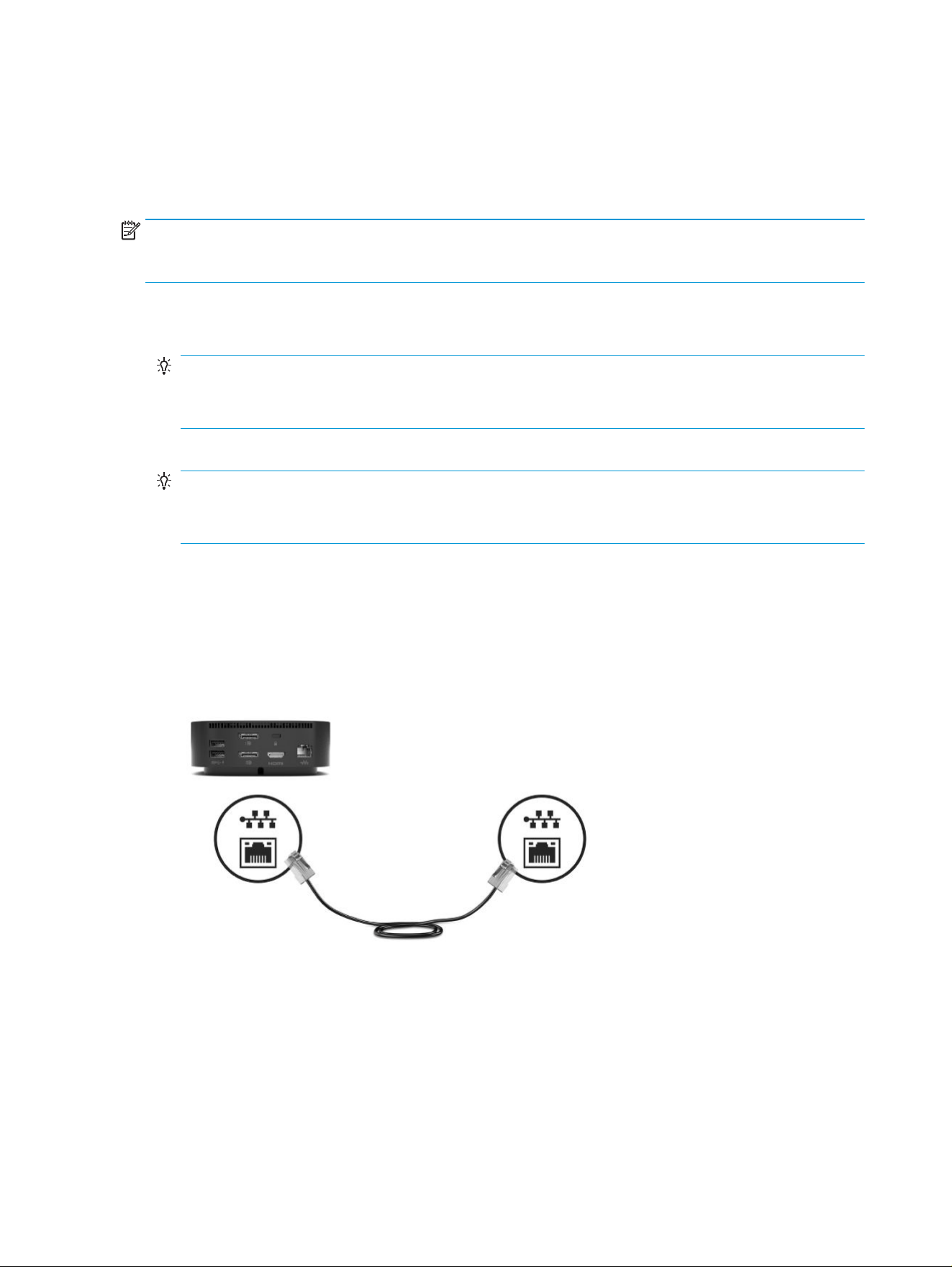
You can connect the computer to a network through the docking station. This requires a network cable
(purchased separately).
The docking station supports the following computer functions over the network connection:
NOTE: Before using these functions, verify that your computer has the latest BIOS, network controller
driver, and USB LAN driver installed. For instructions on updating these drivers, see your computer
documentation.
● PXE boot
● MAC Address Pass Through
TIP: Your computer might support MAC Address Pass Through from the On, O, Sleep, or Hibernation
states, or only when the computer is on or in Sleep.
MAC Address Pass Through is supported for UEFI PXE boot.
● Wake on LAN (WOL)
TIP: Your computer might support WOL from the O, Sleep, or Hibernation states, or only when the
computer is on or in Sleep.
WLAN-LAN switching is supported only on select computers running the Windows 10 operating system.
1. Connect the docking station to the computer.
2. Connect one end of the network cable to the RJ-45 (network) jack on the docking station and connect
the other end to an RJ-45 wall jack or router.
14 Chapter 2 Using the docking station
Connecting USB devices
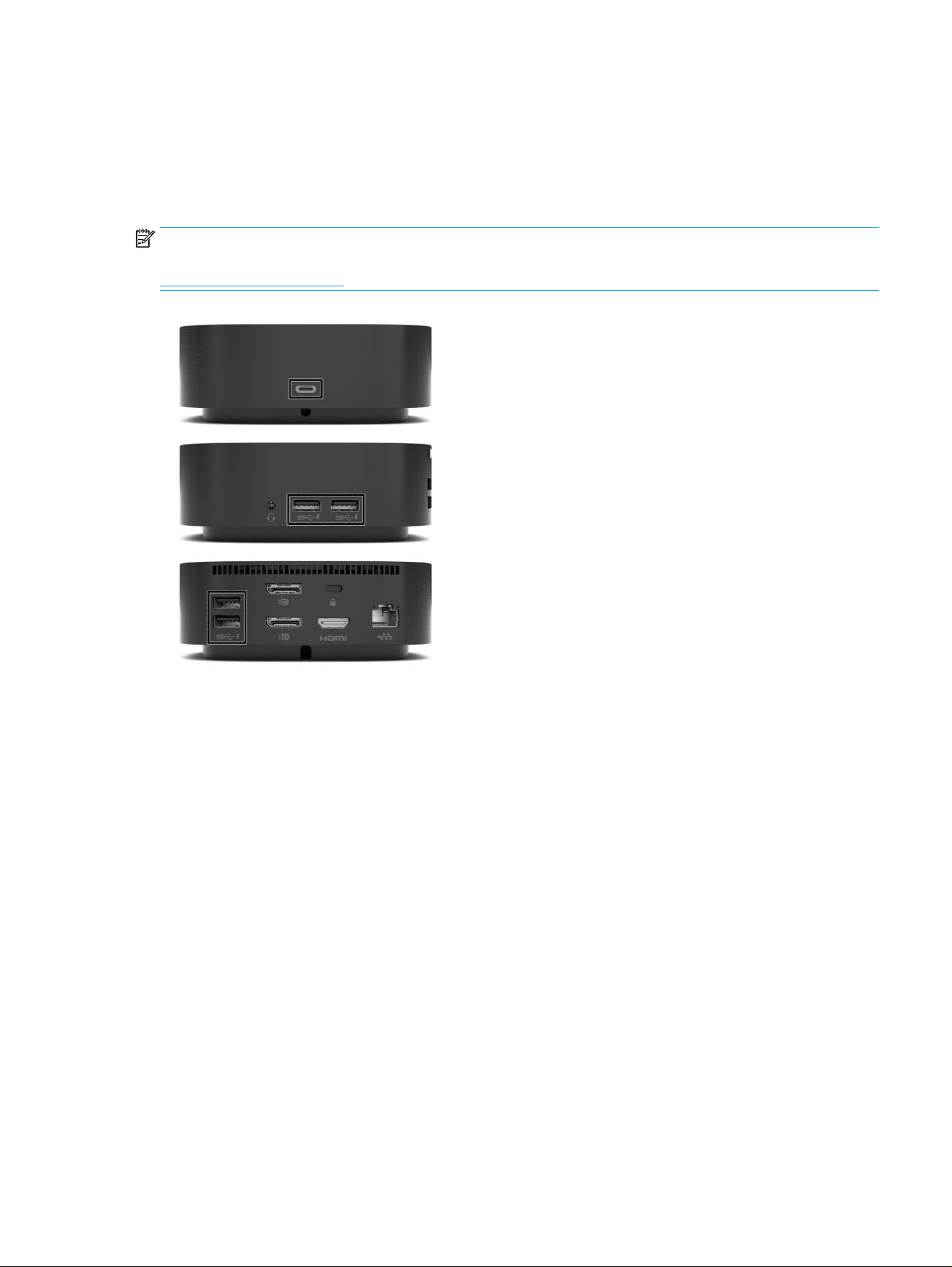
The docking station has ve USB ports: one USB Type-C port with HP Sleep and Charge on the front panel, two
USB SuperSpeed ports with HP Sleep and Charge on the middle panel, and two USB SuperSpeed ports with HP
Sleep and Charge on the rear panel. Use the USB ports to connect optional external USB devices, such as a
keyboard or mouse.
NOTE: Be sure that the external device is compliant with the docking station power specications. Using a
noncompliant device might disable the port to which the device is attached. To reset the port, see
Troubleshooting on page 20.
Connecting USB devices 15
Connecting to a DisplayPort device
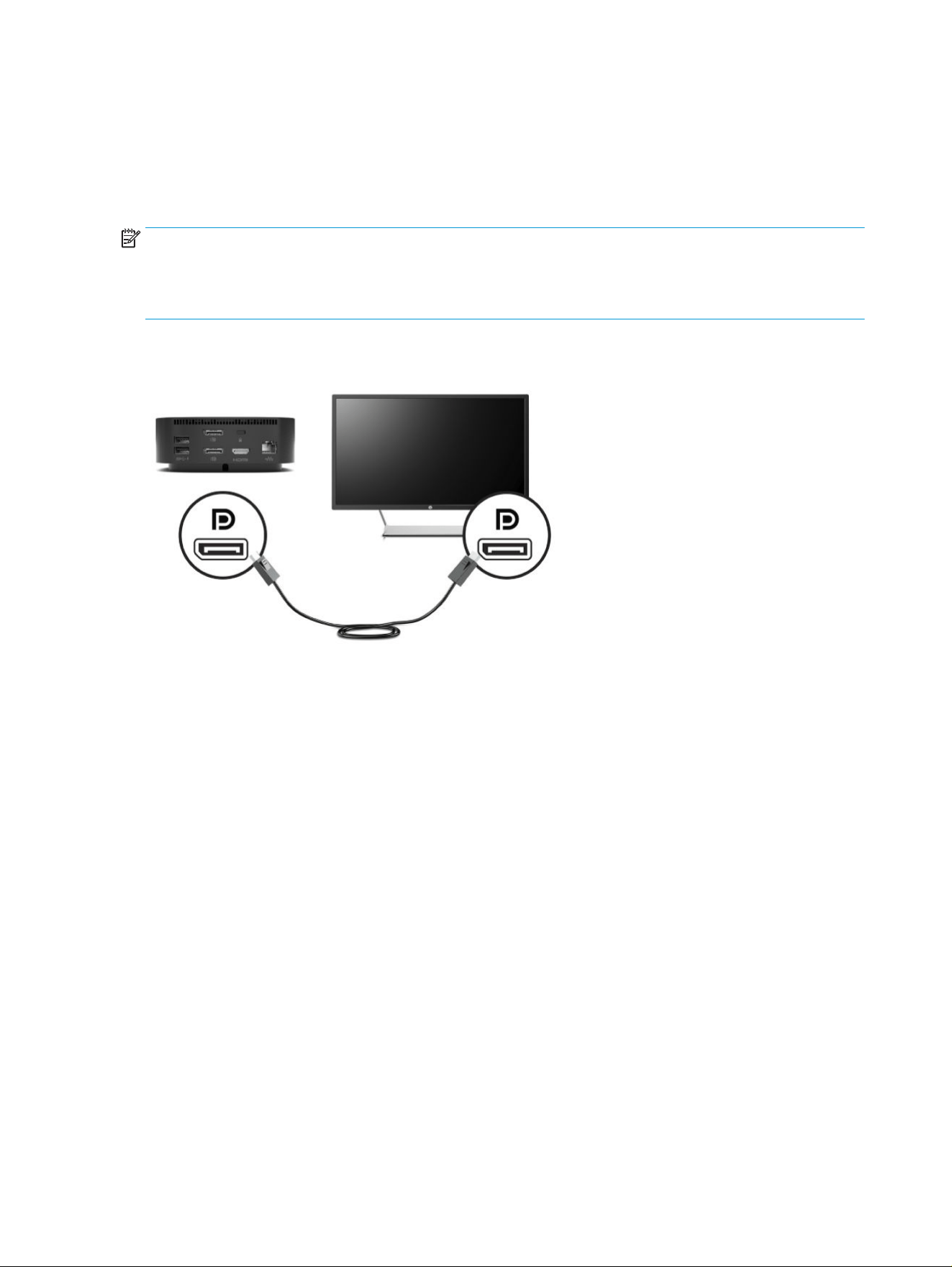
The docking station can also be connected to an external video device, such as a monitor or a projector,
through the DisplayPort connectors. The docking station supports video connections to both DisplayPort
connectors at the same time. A single DisplayPort can support a screen resolution up to 4096 × 2160 @ 60
Hz, depending on your computer, cable, and monitor capabilities.
NOTE: The docking station supports simultaneous video connections to the HDMI port and the DisplayPort
connectors. When using the included adapter, only two monitors are supported.
To transmit video signals through the DisplayPort connection, you need a DisplayPort cable (purchased
separately).
16 Chapter 2 Using the docking station
Connecting to an HDMI device
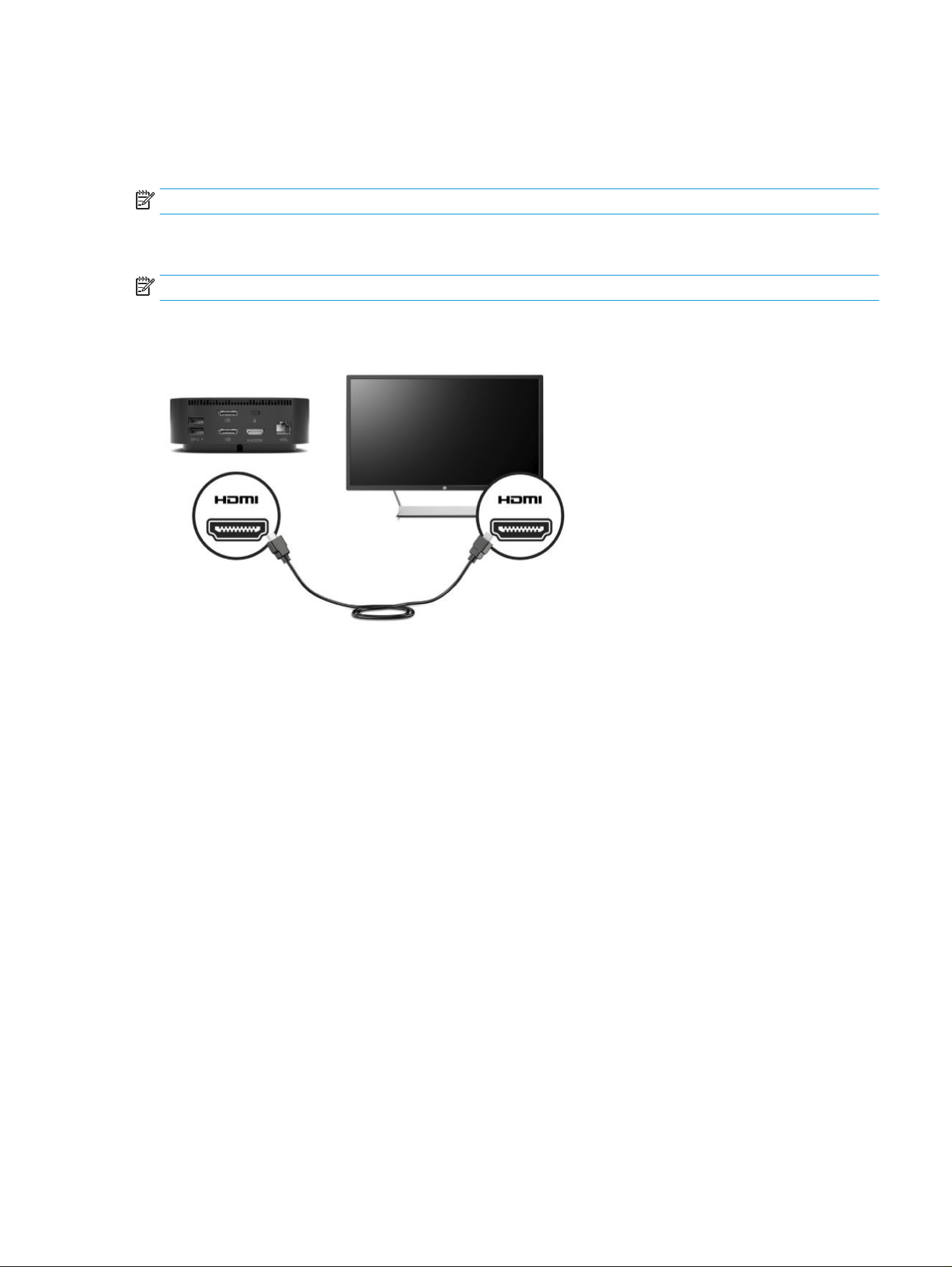
You can connect the docking station to an external video or audio device, such as a high-denition television,
or to any digital audio components, through the HDMI port.
NOTE: HDMI can only be used with computers that support DisplayPort alt mode.
The docking station supports simultaneous video connections to the HDMI port and the DisplayPort
connectors. When using the included adapter, only two monitors are supported.
NOTE: To transmit video signals through the HDMI port, you need an HDMI cable (purchased separately).
Connecting to an HDMI device 17
Connecting audio
You can connect headphones or speakers directly into the audio-out (headphone)/audio-in (microphone)
combo jack on the docking station. You can also connect analog audio devices.
NOTE: If the audio does not automatically switch to the docking station, set the docking station as the
default audio device in your computer settings.
Connecting analog audio devices
To connect analog audio:
1. Connect one end of an audio Y-cable (purchased separately) to the audio-out (headphone)/audio-in
(microphone) combo jack on the docking station.
2. Connect the other end to the red and white audio-in jacks on your television or stereo equipment. See
your television or stereo equipment user guide for the jack names and locations.
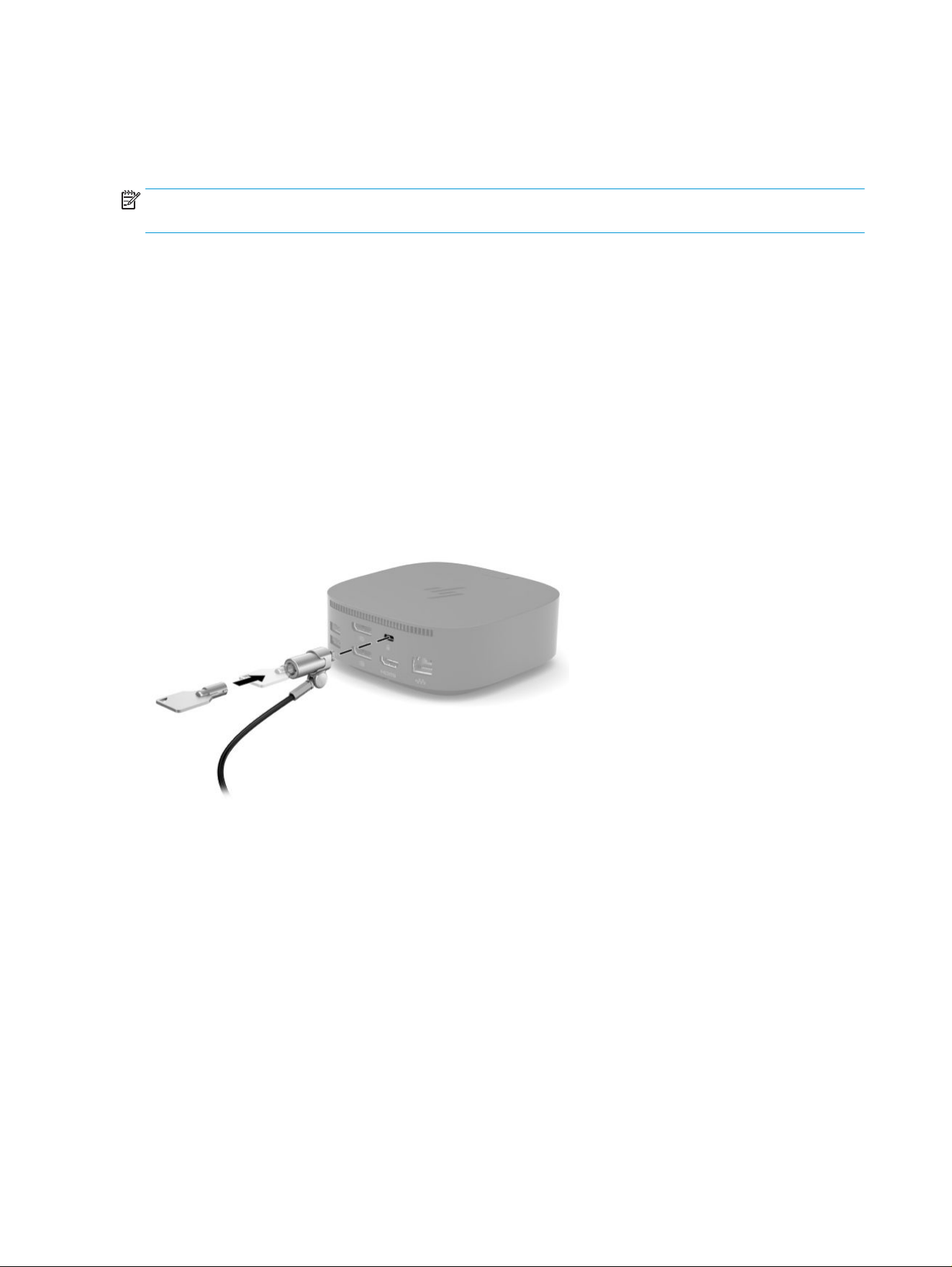
Connecting an optional security cable
A security cable (purchased separately) is designed to act as a deterrent, but it may not prevent the docking
station from being mishandled or stolen. To connect a security cable to your docking station, follow the device
manufacturer's instructions.
18 Chapter 2 Using the docking station

3 Disconnecting the docking station
To disconnect the docking station from the computer, follow these steps:
1. Click the Safely Remove Hardware icon in the notication area, at the far right of the taskbar.
2. Click Safely Remove USB Docking Station. The Safe to Remove Hardware message is displayed.
3. Disconnect the attached USB Type-C cable from the computer.
19

4 Troubleshooting
Solving common problems
The following tables list possible problems and the recommended solutions.
General use and connection problems
Table 4-1 General use and connection problems, causes, and solutions
Problem Possible cause Solution
The power light is o. The docking station is not connected to AC
power.
Connect the power cord to the docking
station and to an electrical outlet.
The ports or jacks on the docking station
are not working.
The docking station is not connected to AC
power.
Connect the power cord to the docking
station and to an electrical outlet.
The docking station is not connected to the
computer correctly.
Disconnect the USB cable from the
computer, and then reconnect it.
A USB port on the docking station is
disabled.
The USB device attached to the port may
not be compliant with the docking station
power specications and is using too much
power.
Reset the port:
1. Disconnect the device that disabled
the port.
2. Disconnect the power cord from the
docking station, and then reconnect
it.
– or –
Disconnect the docking station from
the computer, and then reconnect it.
When the docking station is connected to
the computer, both the WLAN and the LAN
are connected.
Switching from the WLAN connection to
the LAN connection may not be supported
on your computer.
NOTE: WLAN-LAN switching is supported
only on select computers running the
Windows 10 operating system.
Disable the WLAN connection:
1. Right-click Start, and then select
Network Connections.
2. Right-click Wi-Fi, and then click
Disable.
Cannot uninstall DisplayLink software
using Uninstall.
Uninstall DisplayLink Core Software. This
automatically uninstalls DisplayLink.
Data transfer speeds through USB or
Ethernet are slow.
Multiple high-resolution monitors are
connected to the docking station.
Either disable high-resolution mode or
disconnect a monitor.
Audio problems
Table
4-2 Audio problems, causes, and solutions
Problem Possible cause Solution
Audio does not play. The drivers are not installed. Install the drivers. See Setting up the
software on page 9.
20 Chapter 4 Troubleshooting

Table 4-2 Audio problems, causes, and solutions (continued)
Problem Possible cause Solution
Headphones or other audio device
connected to the docking station do not
produce sound.
An audio device is connected to the
headphone jack on the docking station, but
the docking station is not the default audio
device.
Set the docking station as the default
audio device in the computer settings, or
connect the audio device to the computer.
A microphone connected to the docking
station does not work.
A microphone is connected to the docking
station, but the docking station is not the
default audio device.
Set the docking station as the default
audio device in the computer settings, or
connect the microphone to the computer.
A connected home entertainment system
does not have audio.
Audio is not connected properly. Be sure that the docking station is properly
connected to the home entertainment
system.
Video problems
Table 4-3 Video problems, causes, and solutions
Problem Possible cause Solution
A video does not display. The drivers are not installed. Install the drivers. See Setting up the
software on page 9.
Fonts and other characters on the external
monitor appear large.
The external monitor screen resolution is
higher than the maximum limit of 5120 ×
2880.
Set the screen resolution equal to or lower
than the maximum limit.
The graphics application does not detect
the external monitor.
Some graphics applications do not detect
external monitors connected to the
docking station.
Using the DisplayLink software, congure
the external monitor. See Conguring an
external monitor on page 11.
The external monitor cannot be set as the
primary monitor when using some Intel
graphics applications.
Older Intel graphics applications do not
support setting the external monitor as
the primary monitor.
Download the latest Intel drivers from
http://www.hp.com/support.
The computer monitor does not work. The external monitor has been
disconnected from the docking station
before the docking station was
disconnected from the computer.
Disconnect the docking station from the
computer, and then disconnect the
external monitor from the docking station.
Getting more information
● For comprehensive information about the docking station, as well as governmental agency and safety
information about the use of the docking station, access HP Help and Support.
● The HP website (http://www.hp.com) provides product news and software updates.
Getting more information 21

5 Specications
Input power
The power information in this section may be helpful if you plan to travel internationally with the docking
station.
The docking station operates on DC power, which can be supplied by an AC or a DC power source. The AC
power source must be rated at 100–240 V, 50–60 Hz. Although the docking station can be powered from a
standalone DC power source, it should be powered only with an AC adapter or a DC power source supplied and
approved by HP for use with this docking station.
The docking station can operate on DC power within the following specications.
Table 5-1 DC power specications
Input Power Rating
Operating voltage and current 19.5 V dc @ 6.15 A – 120 W
NOTE: This product is designed for IT power systems in Norway with phase-to-phase voltage not exceeding
240 V rms.
NOTE: The docking station operating voltage and current can be found on the docking station’s regulatory
label.
Operating environment
Table
5-2 Operating environment specications
Factor Metric U.S.
Temperature
Operating 0°C to 35°C 32°F to 95°F
Nonoperating -40°C to 70°C -40°F to 158°F
Relative humidity (noncondensing)
Operating 5% to 95% 5% to 95%
Nonoperating 5% to 90% 5% to 90%
Maximum altitude (unpressurized)
Operating -15 m to 3,048 m -50 ft to 10,000 ft
Nonoperating -15 m to 9,144 m -50 ft to 30,000 ft
22 Chapter 5 Specications

6 Electrostatic discharge
Electrostatic discharge is the release of static electricity when two objects come into contact—for example,
the shock you receive when you walk across the carpet and touch a metal door knob.
A discharge of static electricity from ngers or other electrostatic conductors may damage electronic
components.
IMPORTANT: To prevent damage to the computer, damage to a drive, or loss of information, observe these
precautions:
● If removal or installation instructions direct you to unplug the computer, rst be sure that it is properly
grounded.
● Keep components in their electrostatic-safe containers until you are ready to install them.
● Avoid touching pins, leads, and circuitry. Handle electronic components as little as possible.
● Use nonmagnetic tools.
● Before handling components, discharge static electricity by touching an unpainted metal surface.
● If you remove a component, place it in an electrostatic-safe container.
23

7 Accessibility
Accessibility
HP is working to weave diversity, inclusion and work/life into the fabric of our company, so it is reected in
everything we do. Here are some examples of how we are putting dierences to work to create an inclusive
environment focused on connecting people to the power of technology throughout the world.
Finding the technology tools you need
Technology can unleash your human potential. Assistive technology removes barriers and helps you create
independence at home, at work, and in the community. Assistive technology helps increase, maintain, and
improve the functional capabilities of electronic and information technology. For more information, see
Finding the best assistive technology on page 25.
Our commitment
HP is committed to providing products and services that are accessible for people with disabilities. This
commitment supports our company's diversity objectives and helps us ensure that the benets of technology
are available to all.
Our accessibility goal is to design, produce, and market products and services that can be eectively used by
everyone, including people with disabilities, either on a stand-alone basis or with appropriate assistive
devices.
To achieve our goal, this Accessibility Policy establishes seven key objectives to guide our actions as a
company. All HP managers and employees are expected to support these objectives and their implementation
in accordance with their roles and responsibilities:
● Raise the level of awareness of accessibility issues within our company, and provide our employees with
the training they need to design, produce, market, and deliver accessible products and services.
● Develop accessibility guidelines for products and services, and hold product development groups
accountable for implementing these guidelines where competitively, technically, and economically
feasible.
● Involve people with disabilities in the development of accessibility guidelines, and in the design and
testing of products and services.
● Document accessibility features and make information about our products and services publicly
available in an accessible form.
● Establish relationships with leading assistive technology and solution providers.
● Support internal and external research and development that will improve assistive technology relevant
to our products and services.
● Support and contribute to industry standards and guidelines for accessibility.
International Association of Accessibility Professionals (IAAP)
IAAP is a not-for-prot association focused on advancing the accessibility profession through networking,
education, and certication. The objective is to help accessibility professionals develop and advance their
careers and to better enable organizations to integrate accessibility into their products and infrastructure.
24 Chapter 7 Accessibility

HP is a founding member, and we joined to participate with other organizations to advance the eld of
accessibility. This commitment supports our company’s accessibility goal of designing, producing, and
marketing products and services that can be eectively used by people with disabilities.
IAAP will make our profession strong by globally connecting individuals, students, and organizations to learn
from one another. If you are interested in learning more, go to http://www.accessibilityassociation.org to join
the online community, sign up for newsletters, and learn about membership options.
Finding the best assistive technology
Everyone, including people with disabilities or age-related limitations, should be able to communicate,
express themselves, and connect with the world using technology. HP is committed to increasing accessibility
awareness within HP and with our customers and partners. Whether it’s large fonts that are easy on the eyes,
voice recognition that lets you give your hands a rest, or any other assistive technology to help with your
specic situation—a variety of assistive technologies make HP products easier to use. How do you choose?
Assessing your needs
Technology can unleash your potential. Assistive technology removes barriers and helps you create
independence at home, at work, and in the community. Assistive technology (AT) helps increase, maintain,
and improve the functional capabilities of electronic and information technology.
You may choose from many AT products. Your AT assessment should allow you to evaluate several products,
answer your questions, and facilitate your selection of the best solution for your situation. You will nd that
professionals qualied to do AT assessments come from many elds, including those licensed or certied in
physical therapy, occupational therapy, speech/language pathology, and other areas of expertise. Others,
while not certied or licensed, may also provide evaluation information. You will want to ask about the
individual's experience, expertise, and fees to determine if they are appropriate for your needs.
Accessibility for HP products
The following links provide information about accessibility features and assistive technology, if applicable,
included in various HP products. These resources will help you select the specic assistive technology
features and product(s) most appropriate for your situation.
● HP Elite x3–Accessibility Options (Windows 10 Mobile)
● HP PCs–Windows 7 Accessibility Options
● HP PCs–Windows 8 Accessibility Options
● HP PC’s–Windows 10 Accessibility Options
● HP Slate 7 Tablets–Enabling Accessibility Features on Your HP Tablet (Android 4.1/Jelly Bean)
● HP SlateBook PCs–Enabling Accessibility Features (Android 4.3,4.2/Jelly Bean)
● HP Chromebook PCs–Enabling Accessibility Features on Your HP Chromebook or Chromebox (Chrome
OS)
● HP Shopping–peripherals for HP products
If you need additional support with the accessibility features on your HP product, see Contacting support
on page 30.
Additional links to external partners and suppliers that may provide additional assistance:
● Microsoft Accessibility information (Windows 7, Windows 8, Windows 10, Microsoft Oice)
● Google Products accessibility information (Android, Chrome, Google Apps)
Accessibility 25

● Assistive Technologies sorted by impairment type
● Assistive Technologies sorted by product type
● Assistive Technology vendors with product descriptions
● Assistive Technology Industry Association (ATIA)
Standards and legislation
Standards
Section 508 of the Federal Acquisition Regulation (FAR) standards was created by the US Access Board to
address access to information and communication technology (ICT) for people with physical, sensory, or
cognitive disabilities. The standards contain technical criteria specic to various types of technologies, as well
as performance-based requirements which focus on functional capabilities of covered products. Specic
criteria cover software applications and operating systems, web-based information and applications,
computers, telecommunications products, video and multi-media, and self-contained closed products.
Mandate 376 – EN 301 549
The EN 301 549 standard was created by the European Union within Mandate 376 as the basis for an online
toolkit for public procurement of ICT products. The standard
species the functional accessibility
requirements applicable to ICT products and services, together with a description of the test procedures and
evaluation methodology for each accessibility requirement.
Web Content Accessibility Guidelines (WCAG)
Web Content Accessibility Guidelines (WCAG) from the W3C's Web Accessibility Initiative (WAI) helps web
designers and developers create sites that better meet the needs of people with disabilities or age-related
limitations. WCAG advances accessibility across the full range of web content (text, images, audio, and video)
and web applications. WCAG can be precisely tested, is easy to understand and use, and allows web
developers exibility for innovation. WCAG 2.0 has also been approved as ISO/IEC 40500:2012.
WCAG specically addresses barriers to accessing the web experienced by people with visual, auditory,
physical, cognitive, and neurological disabilities, and by older web users with accessibility needs. WCAG 2.0
provides characteristics of accessible content:
● Perceivable (for instance, by addressing text alternatives for images, captions for audio, adaptability of
presentation, and color contrast)
● Operable (by addressing keyboard access, color contrast, timing of input, seizure avoidance, and
navigability)
● Understandable (by addressing readability, predictability, and input assistance)
● Robust (for instance, by addressing compatibility with assistive technologies)
Legislation and regulations
Accessibility of IT and information has become an area of increasing legislative importance. This section
provides links to information about key legislation, regulations, and standards.
● United States
● Canada
● Europe
26 Chapter 7 Accessibility

● United Kingdom
● Australia
● Worldwide
United States
Section 508 of the Rehabilitation Act species that agencies must identify which standards apply to the
procurement of ICT, perform market research to determine the availability of accessible products and
services, and document the results of their market research. The following resources provide assistance in
meeting Section 508 requirements:
● www.section508.gov
● Buy Accessible
The U.S. Access Board is currently updating the Section 508 standards. This eort will address new
technologies and other areas where the standards need to be modied. For more information, go to Section
508 Refresh.
Section 255 of the Telecommunications Act requires telecommunications products and services to be
accessible to people with disabilities. FCC rules cover all hardware and software telephone network
equipment and telecommunications equipment used in the home or oice. Such equipment includes
telephones, wireless handsets, fax machines, answering machines, and pagers. FCC rules also cover basic and
special telecommunications services, including regular telephone calls, call waiting, speed dialing, call
forwarding, computer-provided directory assistance, call monitoring, caller identication, call tracing, and
repeat dialing, as well as voice mail and interactive voice response systems that provide callers with menus of
choices. For more information, go to Federal Communication Commission Section 255 information.
21st Century Communications and Video Accessibility Act (CVAA)
The CVAA updates federal communications law to increase the access of persons with disabilities to modern
communications, updating accessibility laws enacted in the 1980s and 1990s to include new digital,
broadband, and mobile innovations. Regulations are enforced by the FCC and documented as 47 CFR Part 14
and Part 79.
● FCC Guide on the CVAA
Other U.S. legislation and initiatives
● Americans with Disabilities Act (ADA), Telecommunications Act, the Rehabilitation Act and others
Canada
The Accessibility for Ontarians with Disabilities Act was established to develop and implement accessibility
standards to make goods, services, and facilities accessible to Ontarians with disabilities and to provide for
the involvement of persons with disabilities in the development of the accessibility standards. The rst
standard of the AODA is the customer service standard; however, standards for transportation, employment,
and information and communication are also being developed. The AODA applies to the Government of
Ontario, the Legislative Assembly, every designated public sector organization, and to every other person or
organization that provides goods, services, or facilities to the public or other third parties and that has at
least one employee in Ontario; and accessibility measures must be implemented on or before January 1,
2025. For more information, go to Accessibility for Ontarians with Disability Act (AODA) .
Standards and legislation 27

Europe
EU Mandate 376 ETSI Technical Report ETSI DTR 102 612: "Human Factors (HF); European accessibility
requirements for public procurement of products and services in the ICT domain (European Commission
Mandate M 376, Phase 1)" has been released.
Background: The three European Standardization Organizations have set up two parallel project teams to
carry out the work specied in the European Commission "Mandate 376 to CEN, CENELEC and ETSI, in Support
of Accessibility Requirements for Public Procurement of Products and Services in the ICT Domain."
ETSI TC Human Factors Specialist Task Force 333 has developed ETSI DTR 102 612. Further details about the
work performed by STF333 (e.g., Terms of Reference,
specication of the detailed work tasks, time plan for
the work, previous drafts, listing of comments received and means to contact the task force) can be found at
the Special Task Force 333.
The parts relating to the assessment of suitable testing and conformity schemes were carried out by a
parallel project, detailed in CEN BT/WG185/PT. For further information, go to the CEN project team website.
The two projects are closely coordinated.
● CEN project team
● European Commission mandate for e-accessibility (PDF 46KB)
United Kingdom
The Disability Discrimination Act of 1995 (DDA) was enacted to ensure that websites are accessible to blind
and disabled users in the United Kingdom.
● W3C UK Policies
Australia
The Australian government has announced their plan to implement Web Content Accessibility Guidelines 2.0.
All Australian government websites will require Level A compliance by 2012, and Double A by 2015. The new
standard replaces WCAG 1.0, which was introduced as a mandated requirement for agencies in 2000.
Worldwide
● JTC1 Special Working Group on Accessibility (SWG-A)
● G3ict: The Global Initiative for Inclusive ICT
● Italian accessibility legislation
● W3C Web Accessibility Initiative (WAI)
28 Chapter 7 Accessibility

Useful accessibility resources and links
The following organizations may be good resources for information about disabilities and age-related
limitations.
NOTE: This is not an exhaustive list. These organizations are provided for informational purposes only. HP
assumes no responsibility for information or contacts you may encounter on the Internet. Listing on this page
does not imply endorsement by HP.
Organizations
● American Association of People with Disabilities (AAPD)
● The Association of Assistive Technology Act Programs (ATAP)
● Hearing Loss Association of America (HLAA)
● Information Technology Technical Assistance and Training Center (ITTATC)
● Lighthouse International
● National Association of the Deaf
● National Federation of the Blind
● Rehabilitation Engineering & Assistive Technology Society of North America (RESNA)
● Telecommunications for the Deaf and Hard of Hearing, Inc. (TDI)
● W3C Web Accessibility Initiative (WAI)
Educational institutions
● California State University, Northridge, Center on Disabilities (CSUN)
● University of Wisconsin - Madison, Trace Center
● University of Minnesota computer accommodations program
Other disability resources
● ADA (Americans with Disabilities Act) Technical Assistance Program
● Business & Disability network
● EnableMart
● European Disability Forum
● Job Accommodation Network
● Microsoft Enable
● U.S. Department of Justice - A Guide to disability rights Laws
HP links
Our contact webform
HP comfort and safety guide
HP public sector sales
Useful accessibility resources and links 29

Contacting support
NOTE: Support is in English only.
● Customers who are deaf or hard of hearing that have questions about technical support or accessibility
of HP products:
– Use TRS/VRS/WebCapTel to call (877) 656-7058 Monday through Friday, 6 a.m. to 9 p.m. Mountain
Time.
● Customers with other disabilities or age-related limitations who have questions about technical support
or accessibility of HP products, choose one of the following options:
– Call (888) 259-5707 Monday through Friday, 6 a.m. to 9 p.m. Mountain Time.
– Complete the Contact form for people with disabilities or age-related limitations.
30 Chapter 7 Accessibility

Index
A
AC adapter light 5
accessibility 24
accessibility needs assessment 25
analog audio 18
assistive technology (AT)
nding 25
purpose 24
AT (assistive technology)
nding 25
purpose 24
audio connection, analog 18
audio, connecting 18
audio-out (headphone)/audio-in
(microphone) combo jack 18
audio-out (headphone)/audio-in
(microphone) combo jack,
identifying 3
C
cable, identifying 2
components
bottom 5
front 2
left 3
rear 4
top 1
computer
connecting 8
sleeping 9
connectors
Dual-Mode DisplayPort 4
power 7
customer support, accessibility 30
D
DisplayPort device, connecting 16
Dual-Mode DisplayPort connector
identifying 4
E
electrostatic discharge 23
external devices 13
H
HDMI device, connecting 17
HDMI port, identifying 4
Help and Support 21
HP Assistive Policy 24
I
input power 22
International Association of
Accessibility Professionals 24
J
jacks
audio-out (headphone)/audio-in
(microphone) combo 3
audio-out (headphone)/audio-in
(microphone) combo jack 18
network 4
RJ-45 (network) 4, 14
L
lights
AC adapter 5
RJ-45 (network) 4
lights, power 1
N
network (RJ-45) jack
using 14
network jack, identifying 4
O
operating environment 22
operating systems supported 13
P
ports
HDMI 4
USB 6, 15
USB SuperSpeed port with HP
Sleep and Charge 3, 4
USB Type-C SuperSpeed with HP
Sleep and Charge 2
power
docking station, connecting 7
guidelines 13
power connector 7
power light, identifying 1
R
resources, accessibility 29
RJ-45 (network) jack
using 14
RJ-45 (network) jack, identifying 4
RJ-45 (network) lights, identifying
4
S
Section 508 accessibility standards
26, 27
security cable slot, identifying 4
slots
security cable 4
standards and legislation,
accessibility 26
T
Troubleshooting 20
U
USB devices, connecting 15
USB ports, identifying 6
USB SuperSpeed port with HP Sleep
and Charge, identifying 3, 4
USB Type-C SuperSpeed port with HP
Sleep and Charge, identifying 2
Index 31