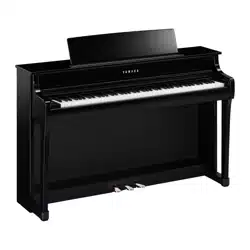

Owner’s Manual
Mode d’emploi
CLP
-
885
CLP
-
875
CLP
-
845
CLP
-
835
CLP
-
895GP
CLP
-
865GP
FR
EN
Merci d’avoir choisi ce piano numérique de Yamaha !
Cet instrument offre une qualité de son et une expressivité exceptionnelles pour votre plus grand plaisir.
Afin d’exploiter votre Clavinova au maximum de ses performances et de ses fonctions, lisez entièrement ce mode
d’emploi et conservez-le afin de pouvoir le consulter ultérieurement.
Avant d’utiliser l’instrument, lisez attentivement la section « PRÉCAUTIONS D’USAGE » aux pages 4 et 5.
Pour plus d'informations sur l’assemblage de l’instrument, reportez-vous aux instructions figurant à la page 63.
Thank you for purchasing this Yamaha Digital Piano!
This instrument provides exceptionally high-quality sound and expressive control for your playing enjoyment.
In order to make the most of your Clavinova’s performance potential and features, please read this Owner’s Manual
thoroughly, and keep it in a safe place for later reference.
Before using the instrument, be sure to read “PRECAUTIONS” on pages 4−5.
For information on assembling the instrument, refer to the instructions on page 63.
EnglishFrançais

2
CLP-885 CLP-875 CLP-845 CLP-835 CLP-895GP CLP-865GP Owner’s Manual
FCC INFORMATION (U.S.A.)
1. IMPORTANT NOTICE: DO NOT MODIFY THIS UNIT!
This product, when installed as indicated in the instructions contained in this manual, meets FCC requirements.
Modifications not expressly approved by Yamaha may void your authority, granted by the FCC, to use the product.
2. IMPORTANT: When connecting this product to accessories and/or another product use only high quality shielded
cables. Cable/s supplied with this product MUST be used. Follow all installation instructions. Failure to follow
instructions could void your FCC authorization to use this product in the USA.
3. NOTE: This product has been tested and found to comply with the requirements listed in FCC Regulations, Part 15
for Class “B” digital devices. Compliance with these requirements provides a reasonable level of assurance that
your use of this product in a residential environment will not result in harmful interference with other electronic
devices. This equipment generates/uses radio frequencies and, if not installed and used according to the
instructions found in the users manual, may cause interference harmful to the operation of other electronic
devices. Compliance with FCC regulations does not guarantee that interference will not occur in all installations. If
this product is found to be the source of interference, which can be determined by turning the unit “OFF” and “ON”,
please try to eliminate the problem by using one of the following measures:
- Relocate either this product or the device that is being affected by the interference.
- Utilize power outlets that are on different branch (circuit breaker or fuse) circuits or install AC line filter/s.
- In the case of radio or TV interference, relocate/reorient the antenna. If the antenna lead-in is 300 ohm ribbon
lead, change the lead-in to co-axial type cable.
If these corrective measures do not produce satisfactory results, please contact the local retailer authorized to
distribute this type of product. If you cannot locate the appropriate retailer, please contact Yamaha Corporation of
America, 6600 Orangethorpe Avenue, Buena Park, CA 90620, U.S.A.
The above statements apply ONLY to those products distributed by Yamaha Corporation of America or its
subsidiaries.
(529-M04 FCC class B YCA 02)
COMPLIANCE INFORMATION STATEMENT
(Supplier’s declaration of conformity procedure)
Responsible Party: Yamaha Corporation of America
Address: 6600 Orangethorpe Avenue, Buena Park, CA 90620, U.S.A.
Telephone: 714-522-9011
Type of Equipment: Digital Piano
Model Name: CLP-885, CLP-875, CLP-845, CLP-835, CLP-895GP, CLP-865GP
This device complies with Part 15 of the FCC Rules.
Operation is subject to the following two conditions:
1) this device may not cause harmful interference, and
2) this device must accept any interference received, including interference that may cause undesired operation.
(529-M02 FCC sdoc YCA 02)
3
CLP-885 CLP-875 CLP-845 CLP-835 CLP-895GP CLP-865GP Owner’s Manual
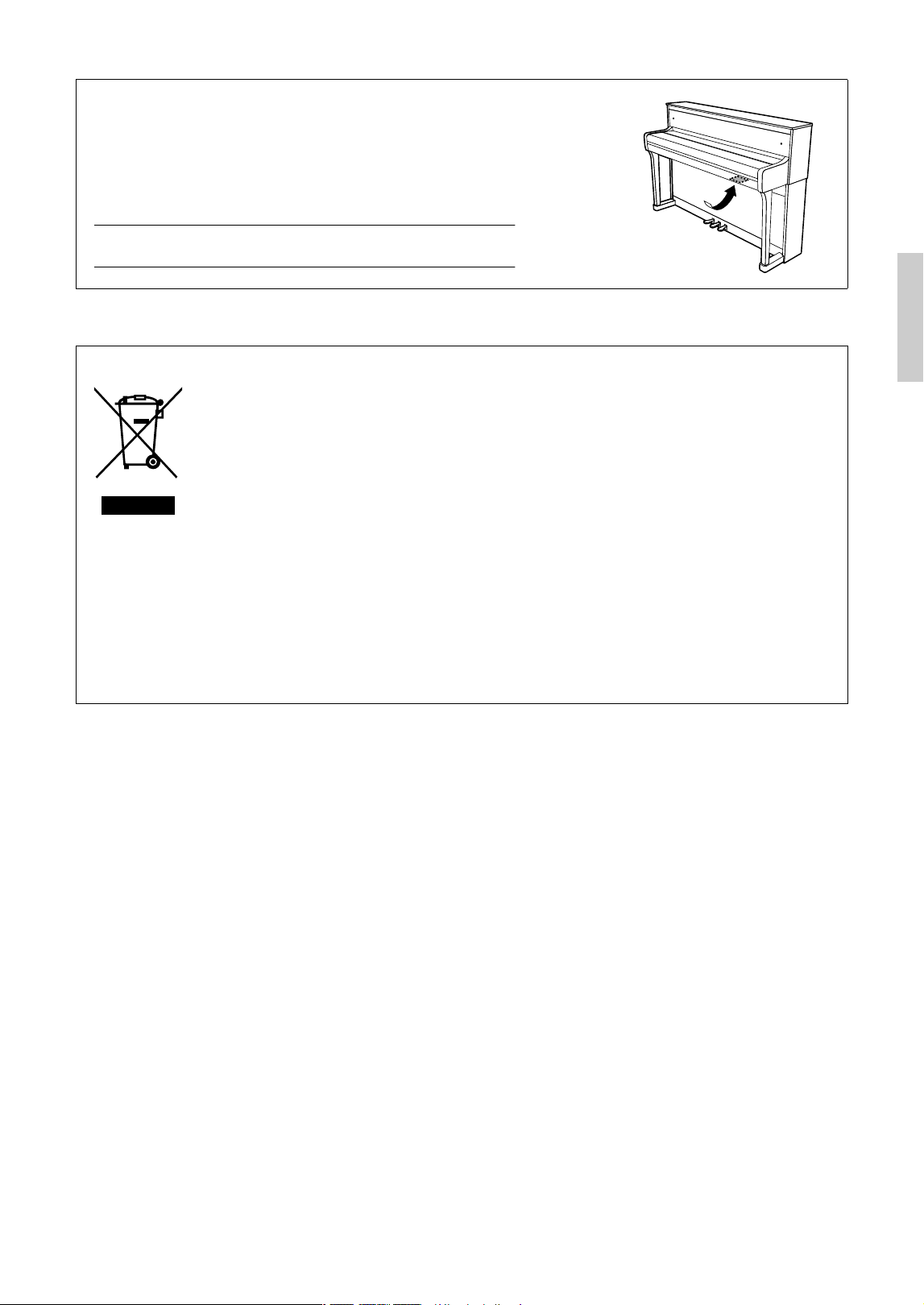
The model number, serial number, power requirements, etc., may
be found on or near the name plate, which is at the bottom of the
unit. You should note this serial number in the space provided
below and retain this manual as a permanent record of your
purchase to aid identification in the event of theft.
Model No.
Serial No.
(1003-M06 plate bottom en 01)
Information for users on collection and disposal of old equipment:
This symbol on the products, packaging, and/or accompanying documents means that used
electrical and electronic products should not be mixed with general household waste.
For proper treatment, recovery and recycling of old products, please take them to applicable
collection points, in accordance with your national legislation.
By disposing of these products correctly, you will help to save valuable resources and prevent any
potential negative effects on human health and the environment which could otherwise arise from
inappropriate waste handling.
For more information about collection and recycling of old products, please contact your local
municipality, your waste disposal service or the point of sale where you purchased the items.
For business users in the European Union:
If you wish to discard electrical and electronic equipment, please contact your dealer or supplier for
further information.
Information on Disposal in other Countries outside the European Union:
This symbol is only valid in the European Union. If you wish to discard these items, please contact
your local authorities or dealer and ask for the correct method of disposal.
(58-M02 WEEE en 01)
The name plate is located
on the bottom of the unit.
4
CLP-885 CLP-875 CLP-845 CLP-835 CLP-895GP CLP-865GP Owner’s Manual
PLEASE READ CAREFULLY
BEFORE PROCEEDING
Especially in the case of children, a guardian should
provide guidance on how to properly use and
handle the product before actual use.
Please keep this manual in a safe and handy place
for future reference.
WARNING
Always follow the basic precautions listed below to
avoid the possibility of serious injury or even death
from electrical shock, short-circuiting, damages, fire
or other hazards. These precautions include, but are
not limited to, the following:
Power supply
• Do not place the power cord near heat sources such as
heaters or radiators. Also, do not excessively bend or
otherwise damage the cord, or place heavy objects on
it.
• Do not touch the product or the power plug during an
electrical storm.
• Use only the correct voltage specified for the product.
The required voltage is printed on the name plate of the
product.
• Use only the supplied or the specified AC adaptor
(pages 79, 82)/power cord. Do not use the AC adaptor/
power cord for other devices.
• Check the power plug periodically and remove any dirt
or dust which may have accumulated on it.
• Insert the power plug firmly all the way into the AC
outlet. Using the product when it is not plugged in
sufficiently can cause dust to accumulate on the plug,
possibly resulting in fire or skin burns.
• When setting up the product, make sure that the AC
outlet you are using is easily accessible. If some trouble
or malfunction occurs, immediately turn off the power
switch and disconnect the plug from the outlet. Even
when the power switch is turned off, as long as the
power cord is not unplugged from the wall AC outlet, the
product will not be disconnected from the power source.
• Do not connect the product to an electrical outlet using
a multi-plug outlet extender. Doing so can result in
lower sound quality, or possibly cause overheating in
the outlet.
• When disconnecting the power plug, always hold the
plug itself and not the cord. Pulling by the cord can
damage it and cause electric shocks or a fire.
• If not using the product for long periods of time, be sure
to pull the power plug from the AC outlet.
Do not disassemble
• This product contains no user-serviceable parts. Do not
attempt to disassemble the internal parts or modify
them in any way.
Water warning
• Do not expose the product to rain, use it near water or
in damp or wet conditions, or place on it any containers
(such as vases, bottles or glasses) containing liquids
which might spill into any openings or places where
water may drop. A liquid such as water getting into the
product may cause a fire, electric shocks, or
malfunctions.
• Use the AC adaptor indoors only. Do not use in any wet
environments.
• Never insert or remove a power plug with wet hands.
Fire warning
• Do not place any burning items or open flames near the
product, since they may cause a fire.
Wireless unit
• Radio waves from this product may affect electro-
medical devices, such as a heart pacemaker implant or
defibrillator implant.
- Do not use the product near medical devices or inside
medical facilities. Radio waves from this product may
affect electro-medical devices.
- Do not use the product within 15 cm (6 in.) of persons
with a heart pacemaker implant or a defibrillator
implant.
Connections
• Be sure to read the manual of the device to be
connected, and follow the instructions. Failure to
observe this may cause a fire, overheating, explosion,
or malfunction.
Using the bench (if included)
• Do not place the bench in an unstable position where it
might accidentally fall over.
• Do not play carelessly with or stand on the bench.
Using it as a tool or stepladder or for any other purpose
might result in accident or injury.
• Only one person should sit on the bench at a time, in
order to prevent the possibility of accident or injury.
• If the bench screws become loose due to extensive
long-term use, tighten them periodically using the
specified tool in order to prevent the possibility of
accident or injury.
• Keep special watch over any small children so that they
don’t fall off the rear of the bench. Since the bench does
not have a backrest, unsupervised use may result in
accident or injury.
PRECAUTIONS
5
CLP-885 CLP-875 CLP-845 CLP-835 CLP-895GP CLP-865GP Owner’s Manual
If you notice any abnormality
• If any of the following problems occur, immediately turn
off the power switch and disconnect the power plug
from the outlet.
Finally have the device inspected by Yamaha service
personnel.
- The power cord or plug becomes frayed or damaged.
- Unusual smells or smoke are emitted.
- Some object, or water has been dropped into the
product.
- There is a sudden loss of sound during use of the
product.
- Cracks or other visible damage appear on the
product.
CAUTION
Always follow the basic precautions listed below to
avoid the possibility of physical injury to you or
others, or damage to the product or other property.
These precautions include, but are not limited to, the
following:
Assembly
• Assemble the product in the proper sequence by
following the assembly instructions in this manual. Also,
make sure to tighten the screws regularly. Failure to do
so might result in damage to the product or even injury.
Location
• Do not place the product in an unstable position or a
location with excessive vibration, where it might
accidentally fall over and cause injury.
• Do not go near the product during an earthquake.
Strong shaking during an earthquake could cause the
product to move or tip over, resulting in damage to the
product or its parts, and possibly causing injury.
• (CLP-885, CLP-875, CLP-845, CLP-835) When
transporting or moving the product, always use two or
more people. Attempting to lift the product by yourself
may result in injuries, such as back injuries, or cause
the product to be dropped and broken, which could lead
to other injuries.
• (CLP-895GP, CLP-865GP) Since this product is very
heavy, make sure that a sufficient number of people are
on hand to help, so you can lift and move it safely and
easily. Attempting to lift or move the instrument by force
may damage your back, result in other injury, or cause
damage to the instrument itself.
• Before moving the product, remove all connected
cables, to prevent damage to the cables or injury to
anyone who might trip over them.
Connections
• Before connecting the product to other devices, turn off
the power for all devices. Before turning the power on or
off for all devices, set all volume levels to minimum.
• Be sure to set the volumes of all devices at their
minimum levels and gradually raise the volume controls
while playing the product to set the desired listening
level.
Handling
• Do not insert your finger or hand in any gaps on the key
cover or product. Also take care that the key cover does
not pinch your finger.
• Do not insert foreign materials such as metal or paper
into any openings or gaps of the product. Failure to
observe this may cause a fire, electric shocks, or
malfunctions.
• (CLP-885) Do not apply excessive force when closing
the key cover. A key cover equipped with the SOFT-
CLOSE™ mechanism closes the cover slowly. Applying
excessive force to the key cover when closing it could
damage the SOFT-CLOSE™ mechanism, and possibly
result in injury to your hands and fingers caught under
the closing key cover.
• Do not rest your weight on, or place heavy objects on
the product, and do not use excessive force on the
buttons, switches or connectors.
• Keep small parts out of the reach of infants. Your
children may accidentally swallow them.
• Do not use the product or headphones for a long period
of time at a high or uncomfortable volume level, since
this can cause permanent hearing loss. If you
experience any hearing loss or ringing in the ears,
consult a physician.
• Remove the power plug from the AC outlet before
cleaning the unit. Failure to observe this may cause
electric shocks.
Using the bench (if included)
• For benches that can be adjusted, do not adjust the
bench height while sitting on the bench, since this can
cause excessive force applied to the adjustment
mechanism, possibly resulting in damage to the
mechanism or even injury.
• Do not place your hand between moving parts.
Otherwise, your hand could be pinched between the
parts, possibly resulting in injury.
Always turn the power off when the instrument is not in
use.
Even when the [ ] (Standby/On) switch is in standby
status (power lamp is off), electricity is still flowing to the
product at the minimum level.
When you are not using the product for a long time, make
sure you unplug the power cord from the wall AC outlet.
(DMI-11)
Yamaha cannot be held responsible for damage
caused by improper use or modifications to the
product, or data that is lost or destroyed.

6
CLP-885 CLP-875 CLP-845 CLP-835 CLP-895GP CLP-865GP Owner’s Manual
NOTICE
To avoid the possibility of malfunction/damage to the
product, damage to data, or damage to other property,
follow the notices below.
Handling
• Do not connect this product to a public Wi-Fi and/or
Internet service directly. Only connect this product to
the Internet through a router with strong password
protections. Consult your router manufacturer for
information on optimum security practices.
• Do not use this product in the vicinity of a TV, radio,
stereo equipment, mobile phone, or other electric
devices. Otherwise, this product or the other device
may generate noise.
• When you use the product along with an app on your
smart device, such as a smartphone or tablet, we
recommend that you enable “Airplane Mode” on the
device to avoid noise caused by communication. When
wirelessly connecting a smart device with this product,
make sure that the Wi-Fi or Bluetooth
®
setting on the
device is turned on.
• Do not expose the product to excessive dust or
vibrations, or extreme cold or heat (such as in direct
sunlight, near a heater, or in a car during the day) to
prevent the possibility of disfiguration, damage to the
internal components or unstable operation. (Verified
operating temperature range: 5° – 40°C, or 41° –
104°F.)
• Do not place vinyl, plastic or rubber objects on the
product, since this might discolor the product.
• In the case of a model with a polished finish, bumping
the surface of the product with metal, porcelain, or
other hard objects can cause the finish to crack or peel.
Use caution.
Maintenance
• When cleaning the product, use a soft and dry (or
slightly damp) cloth. Do not use paint thinners,
solvents, alcohol, cleaning fluids, or chemical-
impregnated wiping cloths.
• In the case of a model with a polished finish, gently
remove dust and dirt with a soft cloth. Do not wipe too
hard since small particles of dirt can scratch the
instrument’s finish.
• During extreme changes in temperature or humidity,
condensation may occur and water may collect on the
surface of the product. If water is left, the wooden parts
may absorb the water and be damaged. Make sure to
wipe any water off immediately with a soft cloth.
Saving data
• A recorded Song is lost when you turn off the power to
the product without saving the data. This also occurs
when the power is turned off by the Auto Power Off
function (page 17). Save the data to the product, or to a
USB flash drive (page 38).
• Some of the setting data of this product are retained
when the power is turned off. You can back up the
settings to the USB flash drive as a backup file, as well
as restore it to the product. For details, refer to the
Reference Manual.
• The data saved to the product may be lost due to some
failure, an operational mistake, etc. Save your
important data onto a USB flash drive or an external
device such as a computer.
• Before using a USB flash drive, make sure to refer to
page 49. To protect against data loss through USB
flash drive damage, we recommend that you save your
important data onto spare USB flash drive or an
external device such as a computer as backup data.
Using the USB [TO DEVICE] terminal
• Compatible USB devices for the USB [TO DEVICE]
terminal of this product are a USB flash drive or a USB
wireless LAN adaptor (UD-WL01; sold separately) only.
Other USB devices such as a USB hub or smart device
cannot be used. When connecting a USB device, make
sure that the connector on the device is appropriate
and that it is connected in the proper direction. Do not
use an extension cable when connecting a USB device.
For a list of the compatible USB devices, access the
Yamaha website below:
https://download.yamaha.com/
• The rating of the USB [TO DEVICE] terminal is a
maximum of 5 V/500 mA. Do not connect USB devices
having a rating above this, since this can cause
damage to the instrument itself.
• Avoid connecting or disconnecting the USB device
while executing playback/recording and file
management operations (such as Save, Copy and
Delete), or when accessing the USB device. Failure to
observe this may result in “freezing” of the operation of
the instrument or corruption of the USB device and the
data.

7
CLP-885 CLP-875 CLP-845 CLP-835 CLP-895GP CLP-865GP Owner’s Manual
Information
About copyrights
• The copyright of the “content”
*1
installed in this product
belongs to Yamaha Corporation or its copyright holder.
Except as permitted by copyright laws and other
relevant laws, such as copying for personal use, it is
prohibited to “reproduce or divert”
*2
without the
permission of the copyright holder. When using the
content, consult with a copyright expert.
If you create music or perform with the contents
through the original use of the product, and then record
and distribute them, the permission of Yamaha
Corporation is not required regardless of whether the
distribution method is paid or free of charge.
*1: The word “content” includes a computer program, audio
data, Accompaniment Style data, MIDI data, waveform
data, voice recording data, music score, and score data,
etc.
*2: The phrase “reproduce or divert” includes taking out the
content itself in this product, or recording and distributing it
without changes in a similar manner.
About functions/data bundled with
the product
• Some of the preset Songs have been edited for length
or arrangement, and may not be exactly the same as
the original.
• (CLP-885/CLP-895GP) This product is capable of using
various types/formats of music data by optimizing them
to the proper format music data for use with the device
in advance. As a result, this device may not play them
back precisely as their producers or composers
originally intended.
• The bitmap fonts used in this product have been
provided by and are the property of Ricoh Co., Ltd.
About open source software
• The firmware of this product contains open source
software. For copyright information and terms of use for
each open source software, access the Yamaha
website below:
Yamaha Downloads: https://download.yamaha.com/
About this manual
• The illustrations and LCD screens as shown in this
manual are for instructional purposes only.
• Windows is a registered trademark of Microsoft
®
Corporation in the United States and other countries.
• Wi-Fi is a registered trademark of Wi-Fi Alliance
®
.
• The Bluetooth
®
word mark and logos are registered
trademarks owned by Bluetooth SIG, Inc. and any use
of such marks by Yamaha Corporation is under license.
• The company names and product names in this manual
are the trademarks or registered trademarks of their
respective companies.
Tuning
• Unlike an acoustic piano, this instrument does not need
to be tuned by an expert (although the pitch can be
user-adjusted to match other instruments). This is
because the pitch of digital instruments is always
maintained perfectly.
About disposal
• When disposing of this product, please contact the
appropriate local authorities.
About Bluetooth
®
Bluetooth is a technology for wireless communication
between devices within an area of about 10 meters
(33 ft.) employing the 2.4 GHz frequency band.
• Handling Bluetooth communications
- The 2.4 GHz band used by Bluetooth compatible
devices is a radio band shared by many types of
equipment. While Bluetooth compatible devices use a
technology minimizing the influence of other
components using the same radio band, such
influence may reduce the speed or distance of
communications and in some cases interrupt
communications.
- The speed of signal transfer and the distance at which
communication is possible differs according to the
distance between the communicating devices, the
presence of obstacles, radio wave conditions and the
type of equipment.
- Yamaha does not guarantee all wireless connections
between this unit and devices compatible with
Bluetooth function.
8
CLP-885 CLP-875 CLP-845 CLP-835 CLP-895GP CLP-865GP Owner’s Manual
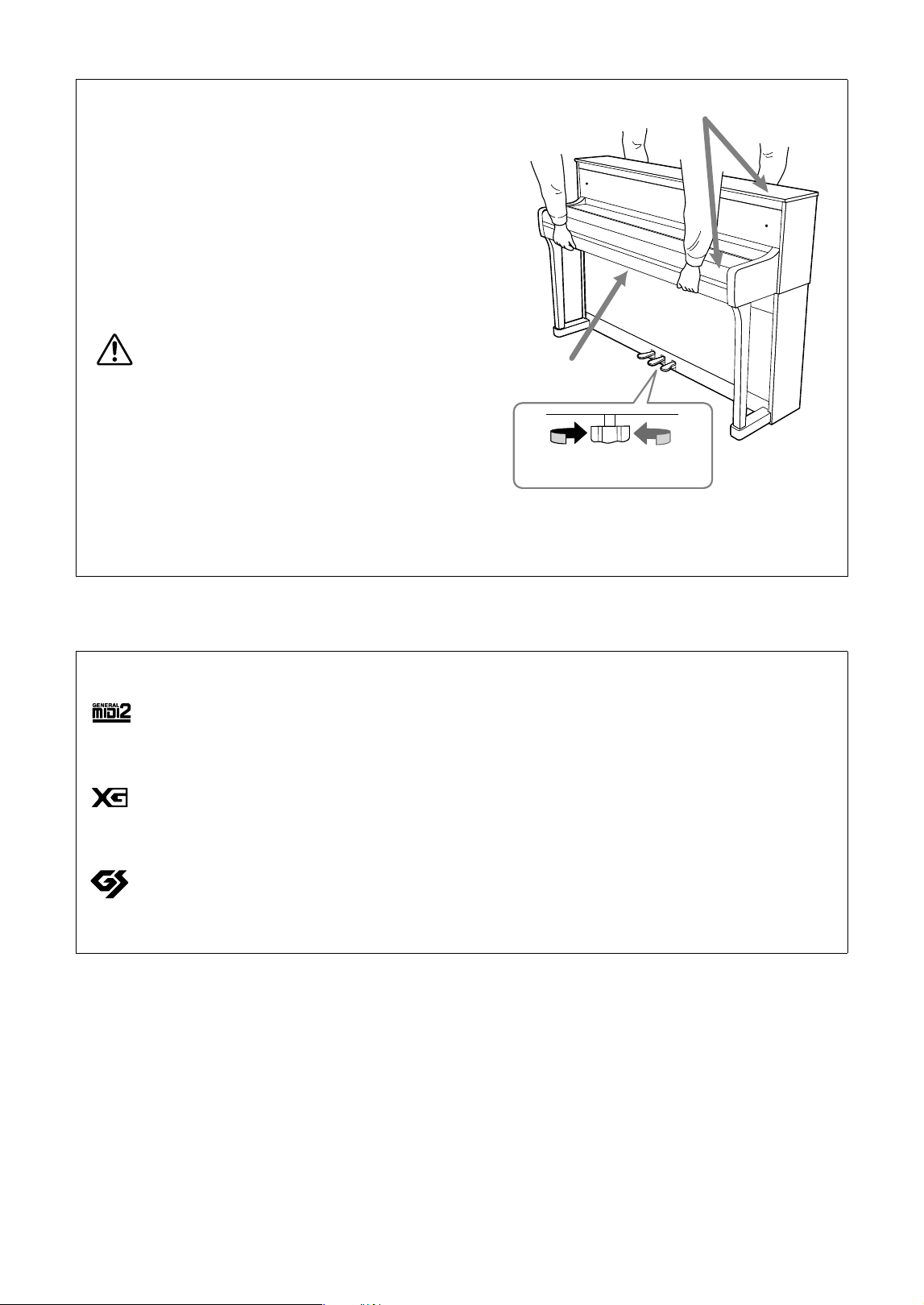
When moving and placing the instrument
Move the instrument horizontally. Do not subject the
instrument to excessive vibration or shock. Since it is very
heavy, make sure that a sufficient number of people are on
hand to help, so you can lift and move it safely and easily.
After moving the instrument, make sure all screws are
properly tightened and have not been loosened.
If you move to another location, you can transport the
instrument along with other belongings. You can move the
unit as it is (assembled) or you can disassemble the unit
down to the condition it was in when you first took it out of
the box.
CAUTION
When moving the instrument, always hold the bottom of the main
unit. Holding another portion of the instrument can result in it being
damaged or causing personal injury.
NOTICE
Before moving the instrument, rotate the adjuster under the pedal
until it separates from the floor surface. Failure to do so may
damage the floor surface.
The CLP-885 and CLP-895GP are compatible with the following formats.
GM System Level 2
“GM (General MIDI)” is one of the most common Voice allocation formats. “GM System Level 2” is a standard
specification that enhances the original “GM” and improves Song data compatibility. It provides for increased
polyphony, greater Voice selection, expanded Voice parameters, and integrated effect processing.
XG
XG is a major enhancement of the GM System Level 1 format, and was developed by Yamaha specifically to provide
more Voices and variations, as well as greater expressive control over Voices and effects, and to ensure compatibility
of data well into the future.
GS
GS was developed by the Roland Corporation. In the same way as Yamaha XG, GS is a major enhancement of the
GM specifically to provide more Voices and Drum kits and their variations, as well as greater expressive control over
Voices and effects.
Do not hold here.
Hold here.
Presses against
the floor
Lifts from
the floor
NOTE
(CLP-885/CLP-875 only) Place the instrument away from the
wall by at least 10 cm to optimize and enhance the sound
effect.

9
CLP-885 CLP-875 CLP-845 CLP-835 CLP-895GP CLP-865GP Owner’s Manual
Contents
PRECAUTIONS........................................... 4
NOTICE...............................................................6
Information...........................................................7
About the Manuals................................... 10
Included Accessories .............................. 10
What You Can Do with Your CLP ........... 11
Panel Controls and Terminals ................ 12
Starting Up................................................ 14
Opening/Closing the key cover..........................14
Using the music rest..........................................15
Opening/Closing the Lid (CLP-895GP/CLP-865GP
only)...................................................................15
Power supply.....................................................16
Turning the power on or off ...............................17
Adjusting the Master Volume.............................18
Using headphones.............................................18
Using the pedals................................................19
Basic Operations...................................... 20
Control Panel ....................................................20
Initializing the settings .......................................22
Enjoy Playing the Piano .......................... 23
Customizing the sound and the Touch Sensitivity of
piano Voices (Piano Room)...............................23
Using the metronome ........................................25
Playing with Various Sounds (Voices)... 26
Combining Voices for playing (Dual/Split) .........27
Playing the Keyboard along with Rhythm
Playback.................................................... 29
Playing back Songs such as Preset Songs
and Recorded Songs ............................... 30
Fast forward/Rewind/Returning to the Song
beginning...........................................................32
Adjusting the tempo/speed................................33
Using repeat playback.......................................33
Practicing a one-hand part along with Song
playback (MIDI Songs only)...............................35
Other useful Song playback functions...............36
Recording Your Performance ................. 37
Recording to the instrument (MIDI recording) ...37
Recording to a USB flash drive (MIDI recording/
Audio recording) ................................................39
Recording the right- and left-hand parts
independently (MIDI recording) .........................40
Deleting the recorded Songs.............................42
Connecting to Other Devices ..................43
Listening to audio player playback through the
instrument’s speakers........................................43
Using the convenient Smart Pianist app............46
Interfacing with a Computer...............................48
Connecting a USB flash drive............................49
Outputting the instrument sound to external
speakers............................................................50
Making Various Settings in the Menu
Display.......................................................51
Appendix ...................................................52
Voice List...........................................................52
Rhythm List........................................................56
Song List............................................................57
Message List .....................................................58
Troubleshooting.................................................61
Assembling the Clavinova .................................63
Specifications ....................................................78
Index..................................................................83
10
CLP-885 CLP-875 CLP-845 CLP-835 CLP-895GP CLP-865GP Owner’s Manual
About the Manuals
This instrument has the following documents and instructional materials.
Supplied with the instrument
• Owner’s Manual (this book)
Explains the basic operations and functions of this instrument. Please read this manual first.
Available on the website
• Reference Manual
Explains various settings and functions controlled from the Menu (page 51). Please read this manual after reading
the Owner’s Manual.
• Data List
Contains MIDI-related information of the instrument, as well as lists of XG Voices and XG Drum Kits that can be
selected on the CLP-885 and CLP-895GP.
• Smart Pianist User Guide
Explains how to set up and use the smart device app “Smart Pianist” (page 46) for controlling this instrument.
Included Accessories
Owner’s Manual (this book)
“50 Classical Music Masterpieces” (Music Book)
Online Member Product Registration
Bench*
Power cord*, AC adaptor*
* May not be included depending on your area. Check with your Yamaha dealer.
Rules for the notes
WARNING
Important information to avoid the possibility of serious injury or even death from electrical shock,
short-circuiting, damages, fire or other hazards.
CAUTION
Important information to avoid the possibility of physical injury to you or others, or damage to the
instrument or other property.
NOTICE
Important information to avoid the possibility of malfunction/ damage to the product, damage to
data, or damage to other property.
NOTE
Helpful information and tips.
To obtain these manuals, access the website below:
Yamaha Downloads
https://download.yamaha.com/
* Enter the model name for searching the desired manuals.
11
CLP-885 CLP-875 CLP-845 CLP-835 CLP-895GP CLP-865GP Owner’s Manual
What You Can Do with Your CLP
Variety of Voices to complement your music page 26
This instrument features piano sounds created with samples of Yamaha’s flagship CFX concert grand piano and the
famed Vienna-made Bösendorfer grand piano. Along with these two gorgeous piano sounds, a variety of other
Voices such as piano, organ and strings are provided—allowing you to select the instrument sound that best
matches the music you want to play. You can also layer two Voices, or play different Voices in the right and left areas
of the keyboard.
* Bösendorfer is a subsidiary company of Yamaha.
Helpful practice aids with Song data page 30
A variety of well-known classic Songs and lesson Songs including “The Virtuoso Pianist” are pre-installed to the
instrument, and help you to practice efficiently. You can simply enjoy listening to these Songs, or play back only the
left-hand part (or right-hand part) and practice each part individually. The playback tempo or speed can be adjusted
as you like, so you can start in a slow tempo at first and increase it as you master the piece. Compatible
commercially available Songs can also be used on this instrument.
Recording and playing back your performances page 37
The instrument lets you record your performance to internal memory or a USB flash drive. Listening back to your
recordings helps immensely in improving your performance. This instrument also allows you to record multiple parts
independently and save as one Song. This may also help you to practice; for example, record the right-hand part
first and then record the left-hand while listening to the already recorded right-hand part. Songs recorded with this
method can be played back with independent parts—an effective tool for children’s one-hand practice by
independently recording the right- and left-hand parts of the parent’s performance.
Enjoy playing along with Rhythms page 29
A variety of rhythm patterns (drums and bass accompaniment) in various genres such as pop and jazz are provided,
letting you enjoy playing the piano along with dynamic Rhythm playback. The accompaniment bass sound
automatically changes based on your performance and make it dynamic and professional sounding.
Listen to music through the built-in speakers (Bluetooth Audio)
page 43
By connecting a Bluetooth-equipped audio player such as smartphone via Bluetooth, you can listen to music played
back on the connected audio player through this instrument’s speakers.
Get more fun out of your piano with Smart Pianist app page 46
By installing the Smart Pianist app to your smart device such as a smartphone or tablet, you can connect the
instrument to the device and take more advantage of this instrument. The easy-to-understand display helps you to
control the instrument while checking the status of the settings. You can play the instrument while viewing the music
score on the device, and record your performances to the device, etc.
12
CLP-885 CLP-875 CLP-845 CLP-835 CLP-895GP CLP-865GP Owner’s Manual
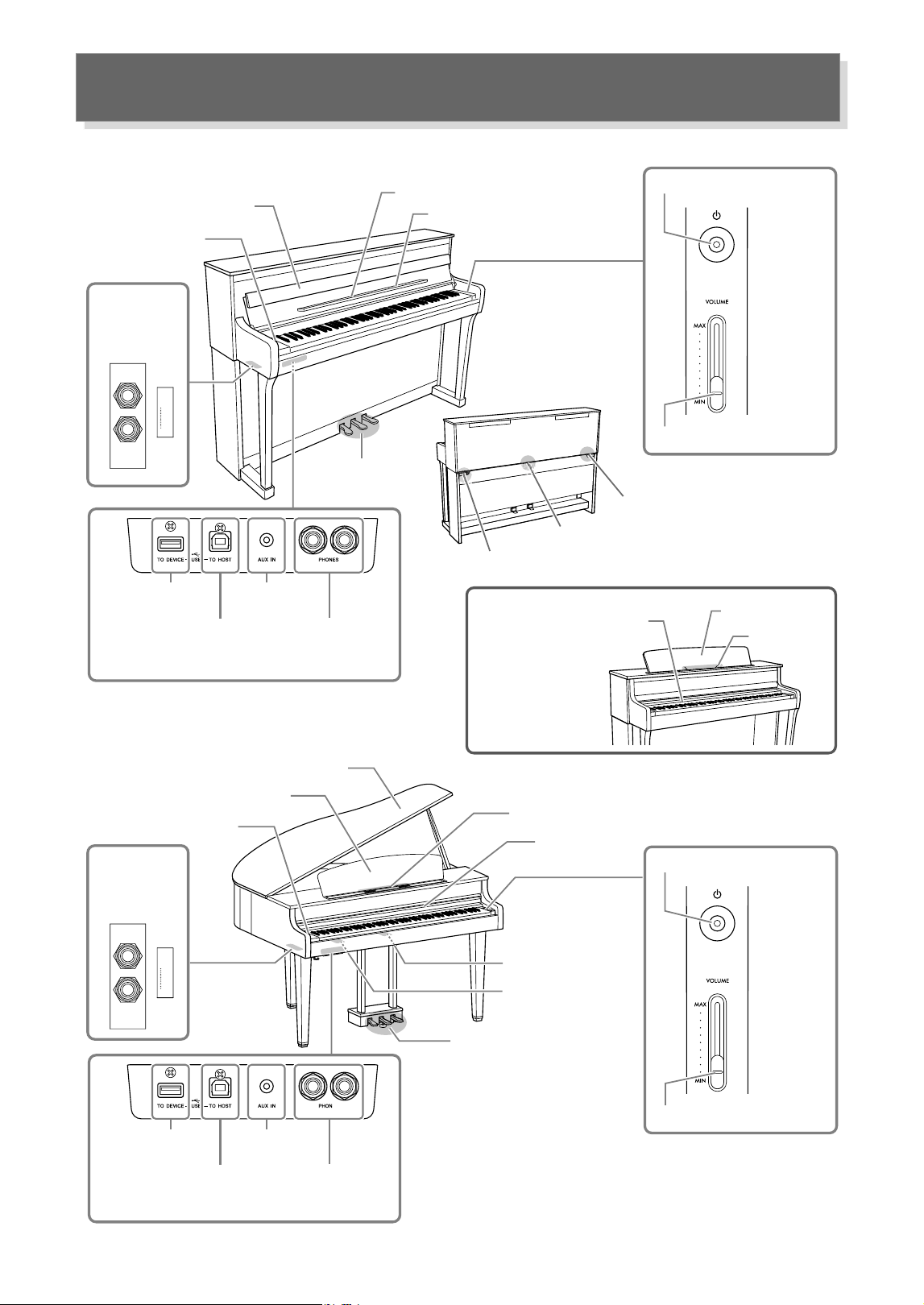
Panel Controls and Terminals
CLP-885/CLP-875/CLP-845/CLP-835
AUX OUT
L/L+R R
AUX OUT
L/L+R R
8
9
)
!
@
8
9
)
!
@
7
3
3
4
5
6
1
2
1
2
#
$
#
CLP-875
CLP-845
CLP-835
4
5
6
6
4
5
%
7
#
$
Key cover
Control panel
Music rest
Music braces
[P] (Standby/On) switch
[VOLUME] slider
Pedals
USB [TO DEVICE]
terminal
[AUX IN]
jack
USB [TO HOST]
terminal
[PHONES]
jacks
[PEDAL] connector
Control panel
Music rest
Lid
Music braces
Key cover
4, 5 and 6 are
located here.
Pedals
CLP-895GP/CLP-865GP
[P] (Standby/On) switch
[VOLUME] slider
USB [TO DEVICE]
terminal
[AUX IN]
jack
USB [TO HOST]
terminal
[PHONES]
jacks
AUX OUT
[L/L+R][R] jacks
AUX OUT
[L/L+R][R] jacks
(CLP-845/CLP-835) DC IN jack
(CLP-885/CLP-875) DC IN jack
[DC IN jack
[PEDAL] connector
* This illustration shows the CLP-885.
* This illustration shows the CLP-895GP.
Key cover
Music rest
Music
braces

Panel Controls and Terminals
13
CLP-885 CLP-875 CLP-845 CLP-835 CLP-895GP CLP-865GP Owner’s Manual
1 [P] (Standby/On) switch (page 17)
For turning the power on or setting it to standby.
2 [VOLUME] slider (page 18)
For adjusting the overall volume.
3 Control Panel (page 20)
For controlling the instrument, using the various functions, and changing the settings.
4 Key cover (page 14)
For keeping the keyboard clean and protecting it from dust or dirt.
5 Music rest (page 15)
For holding music books, etc.
6 Music braces (page 15)
For securely holding the pages of music books on the music rest.
7 Pedals (page 19)
For using as a damper pedal (right), sostenuto pedal (center) or soft pedal (left). (These are default settings.)
8 USB [TO DEVICE] terminal (pages 47, 49)
For connecting a USB flash drive or the UD-WL01 USB wireless LAN adaptor (sold separately). Before using the
USB [TO DEVICE] terminal, be sure to read “Using the USB [TO DEVICE] terminal” on page 6.
9 USB [TO HOST] terminal (pages 47, 48)
For connecting to a computer or smart device such as smartphone or tablet.
) [AUX IN] jack (page 45)
For connecting to an audio player and inputting sound from that device to this instrument.
! [PHONES] jack (×2) (page 18)
For connecting headphones.
@ AUX OUT [L/L+R][R] jacks (page 50)
For connecting to an audio device such as a speaker system and outputting sound from this instrument to that
device.
# DC IN jack (page 16)
For connecting the power cord and the AC adaptor.
$ [PEDAL] connector (page 19)
For connecting the pedal cord of the pre-installed pedal or the separately sold FC35 pedal unit.
% Lid (page 15)
For changing the sound resonance like on an actual grand piano by opening or closing it.
14
CLP-885 CLP-875 CLP-845 CLP-835 CLP-895GP CLP-865GP Owner’s Manual
Starting Up
For information on assembling the instrument, refer to the instructions on page 63.
To protect the keyboard and the inside of the instrument from the dust or dirt, make sure to close the key cover when
you are not using the instrument.
CAUTION
• Hold the key cover with both hands when opening or closing it. Be careful to avoid catching fingers (yours or others, especially
children’s) between the cover and the unit.
• Do not place anything (such as metal objects or pieces of paper) on top of the key cover. Small objects placed on the key cover
may fall inside the unit when the cover is opened and may be nearly impossible to remove. Once inside, they could cause electric
shock, short circuit, fire or other serious damage to the instrument.
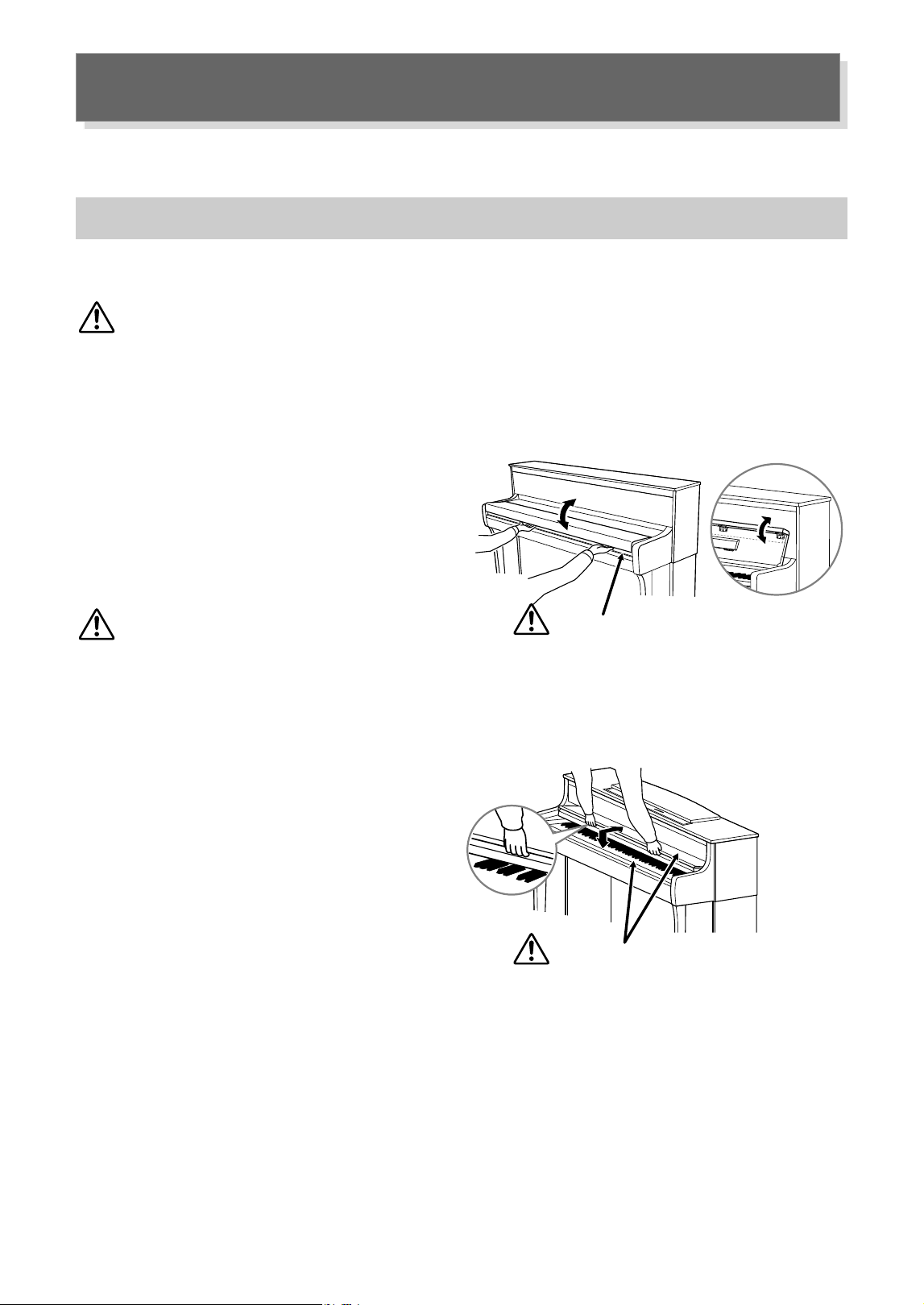
CLP-885
To open the key cover, hold the hand grip with
both hands, and then lift to open it. Once it’s
open, fold down the top of the key cover.
To close the key cover, first fold back the music
rest (page 15). Then, open the folded top of the
key cover, and close the cover gently with both
hands.
CAUTION
Do not apply excessive force when closing the key
cover. Doing so can damage the SOFT-CLOSE™
mechanism, and possibly result in injury to your hands
and fingers caught under the closing key cover.
CLP-875/CLP-845/CLP-835/CLP-895GP/CLP-865GP
To open the key cover, lift it slightly, and then
push and slide it to the end. To close the key
cover, slide it toward yourself and gently lower it.
Opening/Closing the key cover
CAUTION
Be careful to avoid catching your fingers when opening
or closing the cover.
CAUTION
Be careful to avoid catching your fingers when opening
or closing the cover.
Starting Up
15
CLP-885 CLP-875 CLP-845 CLP-835 CLP-895GP CLP-865GP Owner’s Manual
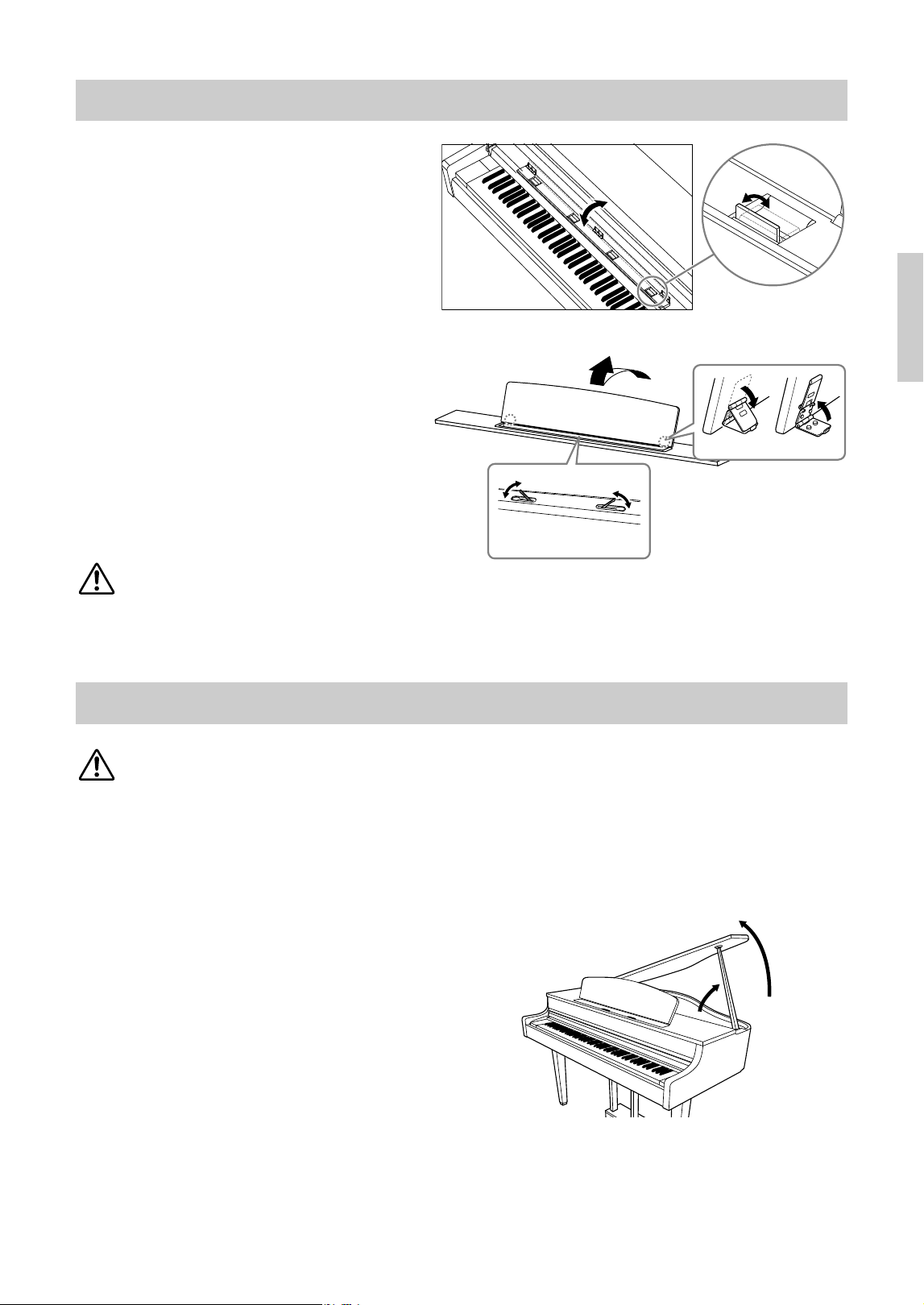
CLP-885
To use the music rest, unfold it from under the
inside of the key cover. The music braces can be
raised to securely hold the pages of music books
on the music rest.
To close the music rest, close the music braces
first, and then fold back the music rest toward the
key cover.
CLP-875/CLP-845/CLP-835/CLP-895GP/CLP-865GP
To use the music rest, pull it up toward yourself as
far as it will go (1), and then flip down the two
metal supports on the rear of the music rest (2).
After that, lower the music rest so that the metal
supports latch into place. The music braces can
be raised to securely hold the pages of music
books on the music rest.
To close the music rest, pull it up toward yourself
(1), and then raise the two metal supports (2).
After that, gently lower the music rest backward
until it is all the way down.
CAUTION
Do not try to use the music rest in a half-raised position. Also, when raising or lowering the music rest, do not release your hands
from the music rest until it is all the way up or down.
WARNING
• Do not let children open or close the lid. Also, be careful to avoid catching fingers (yours or others, and especially those of
children) when raising or lowering the lid.
• Make sure that the end of the stay fits securely in the lid recess. If the stay is not properly seated in the recess, the lid may fall,
causing damage or injury.
• Be careful that you or others do not bump the stay while the lid is raised. The stay may be dislodged from the lid recess causing
the lid to fall.
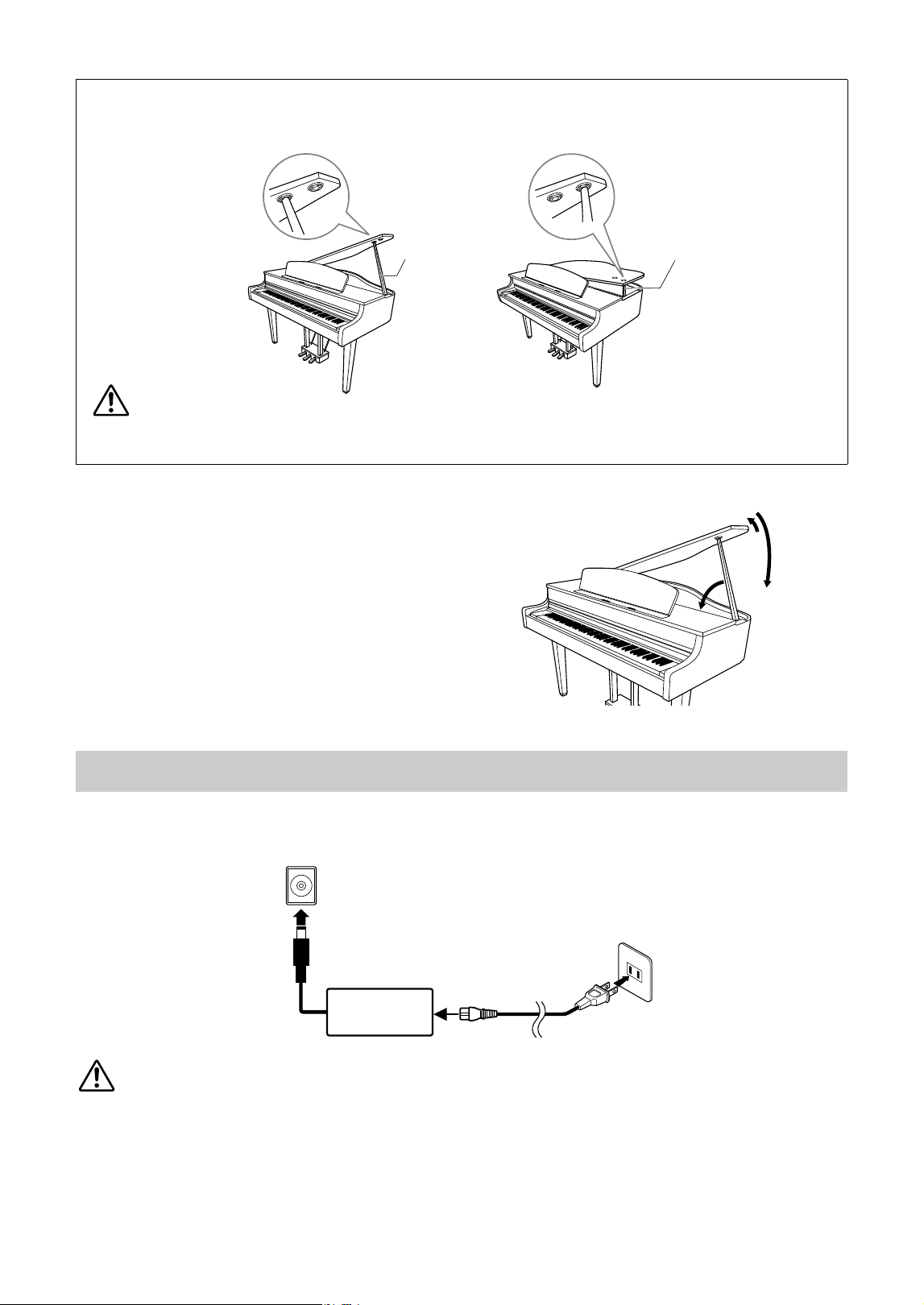
To open the lid:
1 Raise and hold the right side of the lid
(viewed from the keyboard end of the
instrument).
2 Raise the lid stay and carefully lower the lid
so that the end of the stay fits into the
recess in the lid.
Using the music rest
Opening/Closing the Lid (CLP-895GP/CLP-865GP only)
Music braces
1
2
Music braces
1
2
Starting Up
16
CLP-885 CLP-875 CLP-845 CLP-835 CLP-895GP CLP-865GP Owner’s Manual
To close the lid:
1 Hold the lid stay and carefully raise the lid.
2 Hold the lid in its raised position and lower
the lid stay.
3 Carefully lower the lid.
Connect the plugs of the AC adaptor and power cord in the order shown in the illustration. To confirm the location of
the DC IN jack, refer to page 12.
WARNING
• Use the supplied or the specified AC adaptor (page 79 or page 82)/power cord only. Do not use the AC adaptor/power cord for
other devices. Using the wrong AC adaptor/power cord can result in damage to the instrument or overheating.
• When setting up the product, make sure that the AC outlet you are using is easily accessible. If some trouble or malfunction
occurs, immediately turn the power off and disconnect the plug from the outlet.
NOTE
When disconnecting the power cord/AC adaptor, first turn off the power, and then follow this procedure in reverse order.
CLP-895GP only
For the longer stay, use the inner recess, and for the shorter stay, use the outer recess to support the lid.
WARNING
Do not use the outer recess for the longer stay. Doing so makes the lid unstable and may cause it to fall, resulting in damage
or injury.
Power supply
Longer stay Shorter stay
1
3
2
1
2
3
DC IN jack
(DC IN 24 V or DC IN 16 V)
DC plug
AC adaptor
Power cord AC plug
AC outlet
The shapes of the plug and
outlet may differ depending on
your locale.
Starting Up
17
CLP-885 CLP-875 CLP-845 CLP-835 CLP-895GP CLP-865GP Owner’s Manual
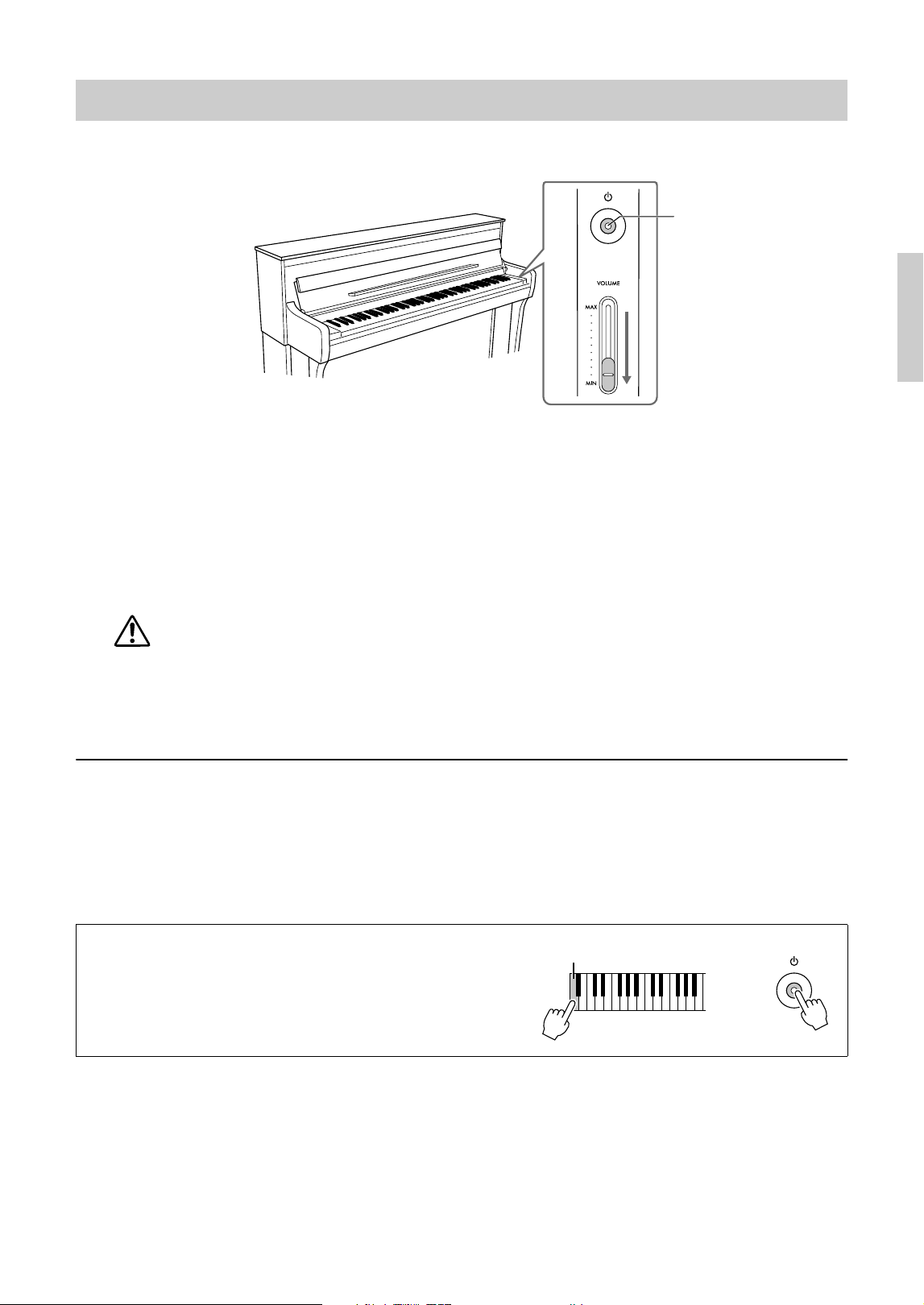
1. Turn down the [VOLUME] slider to “MIN.”
2. Press the [P] (Standby/On) switch to turn the power on.
The display located at the left of the keyboard and the power indicator on the [P] (Standby/On) switch both
light up.
NOTICE
Press only the [P] (Standby/On) switch when turning the power on. Any other operations, such as pressing the keys, buttons
or pedals may cause the instrument to malfunction.
3. After you finish using the instrument, turn off the power by pressing the [P] (Standby/
On) switch for a second.
WARNING
Even when the [P] (Standby/On) switch is in standby status, electricity is still flowing to the instrument at the minimum level.
Remove the electric plug from the outlet when the instrument is not to be used for extended periods of time, or during
electrical storms.
Auto Power Off function
The Auto Power Off function automatically turns the power off if the instrument is not operated for a specified period
of time (15 minutes by default). This prevents unnecessary power consumption. The amount of time that elapses
before the power is automatically turned off can be changed from “Utility” > “Auto Power Off” in the System menu
(page 51). For details, refer to the Reference Manual.
NOTICE
Any data which are not saved will be lost if the power automatically turns off. Make sure to save your data before this happens.
Turning the power on or off
Disabling Auto Power Off
Turn the power on while holding down the lowest key on the
keyboard. An “Auto power off disabled” message appears
briefly and the instrument starts up with the Auto Power Off
disabled.
1
2
Power indicator
+
Lowest key
Starting Up
18
CLP-885 CLP-875 CLP-845 CLP-835 CLP-895GP CLP-865GP Owner’s Manual
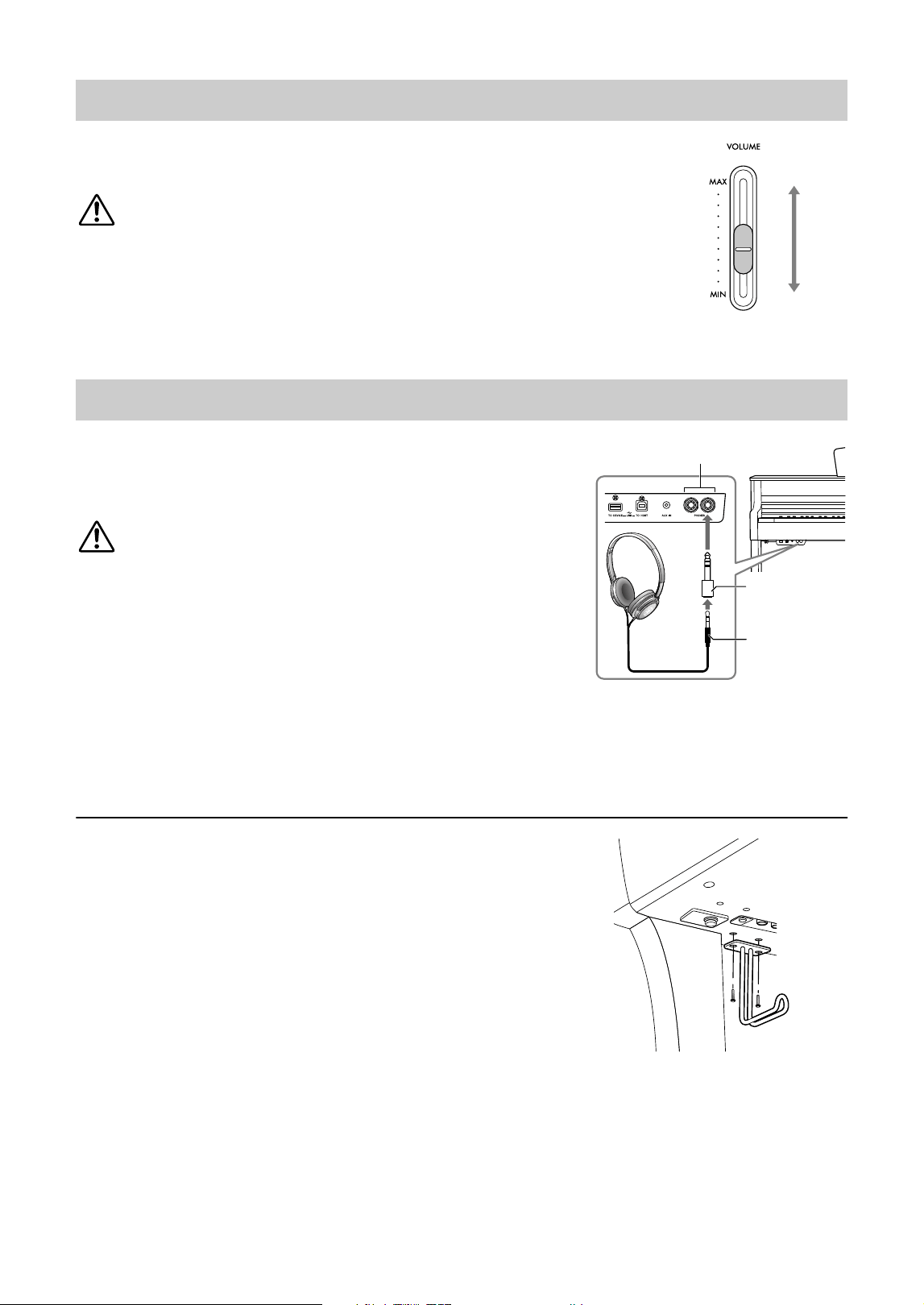
To adjust the volume of the entire keyboard sound, use the [VOLUME] slider. Play the
keyboard to check the sound while you adjust the volume.
CAUTION
Do not use the instrument for a long period of time at a high or uncomfortable volume level, since
this can cause permanent hearing loss.
NOTE
You can use the Volume Limiter function to prevent excessively loud sounds from the instrument. This function is
set to off by default; however, you can turn it on/off from “Sound” > “Volume Limiter” in the System menu (page 51).
For details, refer to the Reference Manual.
You can connect two pairs of headphones to the [PHONES] jacks. If you
are using only one pair, insert the plug into either of these jacks. If you
use headphones with a mini plug, you will need an appropriate adaptor
plug as shown in the illustration.
CAUTION
Do not use the headphones for a long period of time at a high or uncomfortable
volume level, since this can cause permanent hearing loss.
NOTE
• To prevent excessively loud volume, the Volume Limiter function can be used to limit the
maximum volume. This function is set to off by default; however, you can turn it on/off from
“Sound” > “Volume Limiter” in the System menu (page 51). For details, refer to the Reference
Manual.
• When a plug is connected to the [PHONES] jack, no sound will come out from the
instrument's speakers. If you are using an adaptor plug, be sure to remove this as well when
unplugging the headphones.
• When one of the Voices having VRM effects is selected (page 52), the Binaural Sampling or Stereophonic Optimizer technology lets you enjoy
exceptionally realistic, natural piano sound, even when listening on headphones. This function is set to on by default; however, you can turn it on/off
from “Sound” > “Binaural” in the System menu (page 51). For details refer to the Reference Manual.
Attaching the headphone hanger
A headphone hanger is included in the instrument package so that you
can hang the headphones on the instrument. Attach the headphone
hanger by using the included two screws (4 × 10 mm) at the left front
side as shown in the illustration.
NOTICE
Do not hang anything other than the headphones on the hanger. Otherwise, the
instrument or the hanger may be damaged.
Adjusting the Master Volume
Using headphones
Increases
the level.
Decreases
the level.
Standard stereo phone jack
Adaptor plug
(3.5 mm
6.3 mm)
Stereo mini plug
(3.5 mm)
* The shape of the hanger differs
depending on the model
Starting Up
19
CLP-885 CLP-875 CLP-845 CLP-835 CLP-895GP CLP-865GP Owner’s Manual
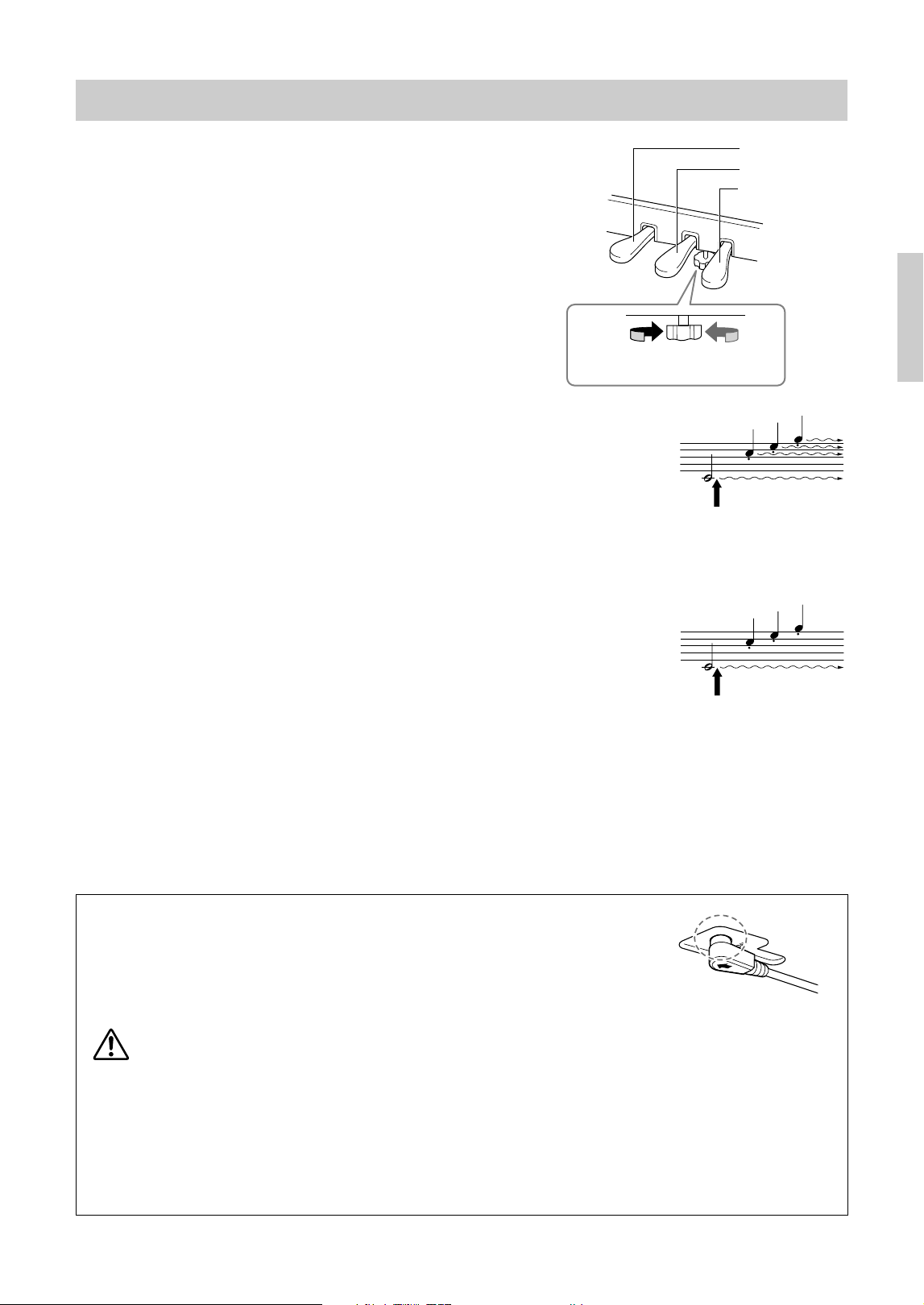
The function below is assigned for each pedal by default. Before
using the pedals, rotate the adjuster until it comes in firm contact
with the floor surface so that the pedals do not rattle or give way
when you step on them.
NOTICE
Before moving the instrument, rotate the adjuster under the pedal until it
separates from the floor surface. Failure to do so may damage the floor
surface.
NOTE
• The pedals are protected with vinyl covers when shipped from the factory. Remove
the covers from the pedals before using to ensure optimum use of the pedal
effects.
• The pedal functions can be changed from “Pedal Assign” in the Voice menu
(page 51). For details, refer to the Reference Manual.
Damper pedal (right pedal)
When you press the damper pedal, the notes you play have a longer sustain.
When you select a piano Voice having VRM effects (page 52), pressing the
damper pedal activates the VRM to accurately recreate the unique resonance.
NOTE
The damper pedal of the CLP-885, CLP-875 and CLP-895GP features the GP Response Damper. This
special pedal has been designed to provide enhanced tactile response and, when pressed, is much
closer in feel to the pedal of an actual grand piano. It makes it easier to physically experience the half-
pedal point and more easily apply the half-pedal effect than other pedals.
Sostenuto pedal (center pedal)
If you play a note or chord on the keyboard and press the sostenuto pedal while
holding the note(s), the notes will sustain as long as the pedal is held. All
subsequent notes will not sustain.
NOTE
While the center pedal is held, a sustained (non-decaying) type of Voice in the STRINGS or ORGAN
category may sound continuously without decay after the notes have been released.
Soft pedal (left pedal)
The soft pedal reduces the volume and slightly changes the timbre of notes played while the pedal is pressed. The
soft pedal will not affect notes that are already playing when it is pressed.
When “Jazz Organ 1,” “Jazz Organ 2” or “Rock Organ” is selected, pressing and releasing this pedal switches
between “fast” and “slow” of the Rotary Speaker speed. When the “Vibraphone” is selected, this pedal switches
Vibrato on and off.
Using the pedals
[PEDAL] connector
Make sure to connect the plug of the pedal cord securely into the [PEDAL] connector in
the proper direction. Otherwise, the pedal may not function properly. The FC35 Pedal
Unit (sold separately) can also be connected to this terminal. You can substitute the
FC35 for the pedals of the instrument, and use the pedals at a suitable height for you by
placing the unit on a stand.
CAUTION
When placing the FC35 on a stand, make sure that the stand is sufficiently large, flat and stable to prevent the pedals from
wobbling or falling when they are pressed.
NOTICE
Be careful to connect the plug in the proper direction. Connecting in the wrong direction can result in damage to the
instrument.
NOTE
• On the CLP-895GP/CLP-865GP, the shape of the plug differs from the illustration above.
• Make sure that power is off when connecting or disconnecting the plug of the pedal.
Soft Pedal
Sostenuto Pedal
Damper Pedal
Presses against
the floor
Lifts from the
floor
When you press the damper
pedal here, the notes you play
before you release the pedal
have a longer sustain.
When you press the sostenuto
pedal here while holding the
note(s), the notes will sustain as
long as you hold the pedal.
Insert the plug securely
until the metal part of the
plug disappears from view.
20
CLP-885 CLP-875 CLP-845 CLP-835 CLP-895GP CLP-865GP Owner’s Manual
Basic Operations
Since this instrument is optimized for first-time users by factory default, you can enjoy easily using it simply with the
default settings.
As you become more familiar with the instrument, try out some of the various functions or change some of the
settings as desired. Use the control panel to control the instrument while checking the status of the instrument on
the display.
Control Panel
NOTE
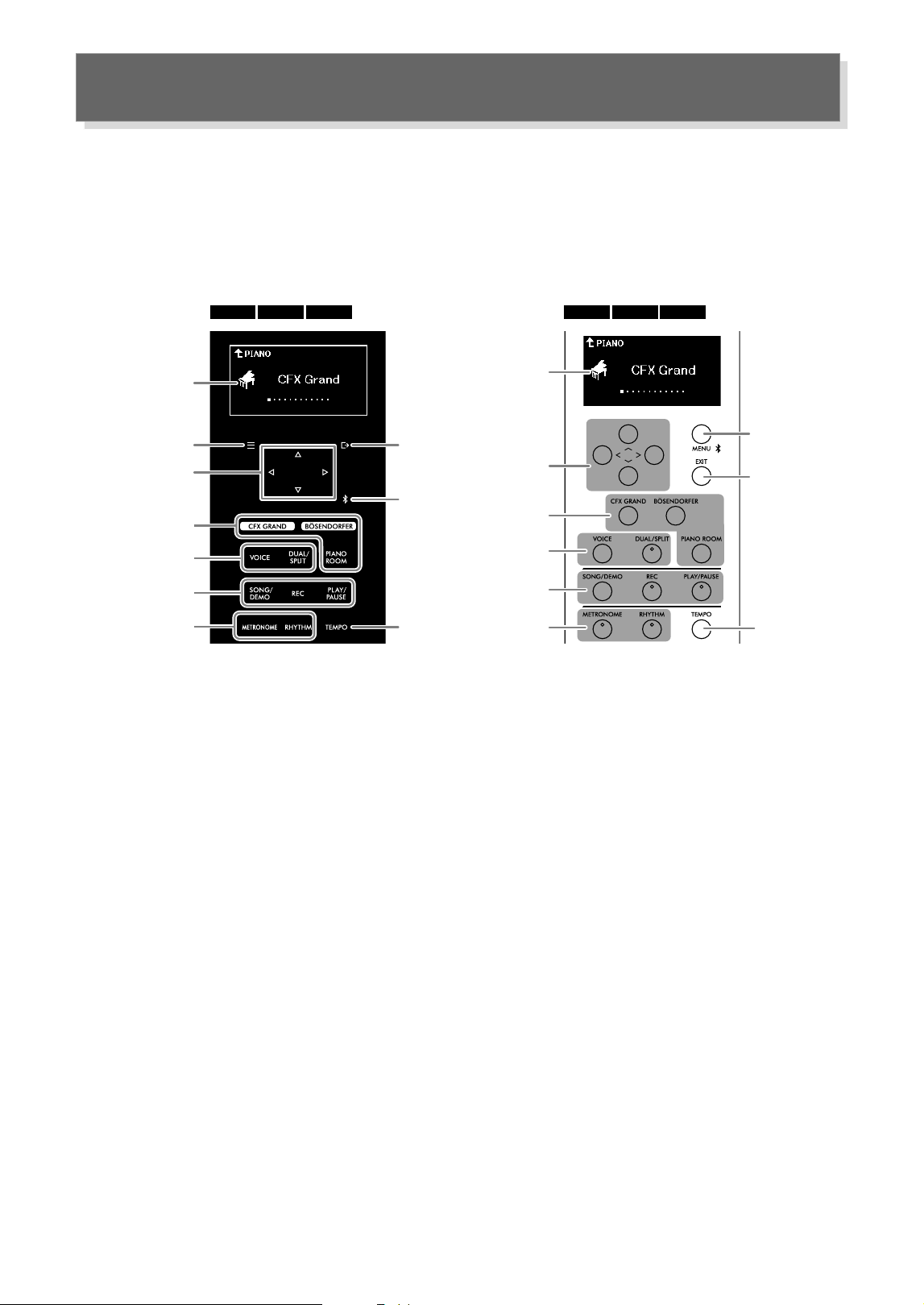
• The CLP-885/CLP-875/CLP-895GP and the CLP-845/CLP-835/CLP-865GP have different control panels. Panel illustration examples are hereafter
indicated with the icons to show which models have that particular panel.
• On the CLP-885/CLP-875/CLP-895GP, the control panel lights up when the power is turned on, and it turns off automatically if you do not touch the
control panel for a specified period time (30 seconds by default). The amount of time that elapses before the light turns off, and the sound on/off of the
control buttons can be set from “Utility” in the System menu (page 51). For details, refer to the Reference Manual.
1 [CFX GRAND]/[BÖSENDORFER]/[PIANO ROOM] buttons
For playing this instrument as a piano (page 23). You can play the piano with your desired settings, such as
touch sensitivity and the resonance.
2 [VOICE]/[DUAL/SPLIT] buttons
For playing with various instrumental Voices, including piano, organ and more (page 26). You can also layer two
Voices, or play different Voices in the right- and left-hand areas of the keyboard.
3 [SONG/DEMO]/[REC]/[PLAY/PAUSE] buttons
For playing back and listening to the preset or commercially available Songs (page 30), or for recording your
performance (page 37). You can also play back or record each part individually, allowing you to practice the
right-hand part while playing back the left-hand part.
4 [METRONOME]/[RHYTHM] buttons
For practicing playing at an accurate tempo with metronome (page 25), or playing along with dynamic Rhythm
playback (page 29).
5 [TEMPO] button
For adjusting the tempo for the metronome (page 25), Rhythm (page 29), or Song (page 33) playback.
885 875 895GP 845 835 865GP
1
1
2
2
3
3
4
4
5
5
Display
[MENU] button
[u]/[d]/[l]/[r]
buttons
[EXIT] button
Bluetooth button
Display
[u]/[d]/[l]/[r]
buttons
[MENU] button
[EXIT] button
Basic Operations
21
CLP-885 CLP-875 CLP-845 CLP-835 CLP-895GP CLP-865GP Owner’s Manual
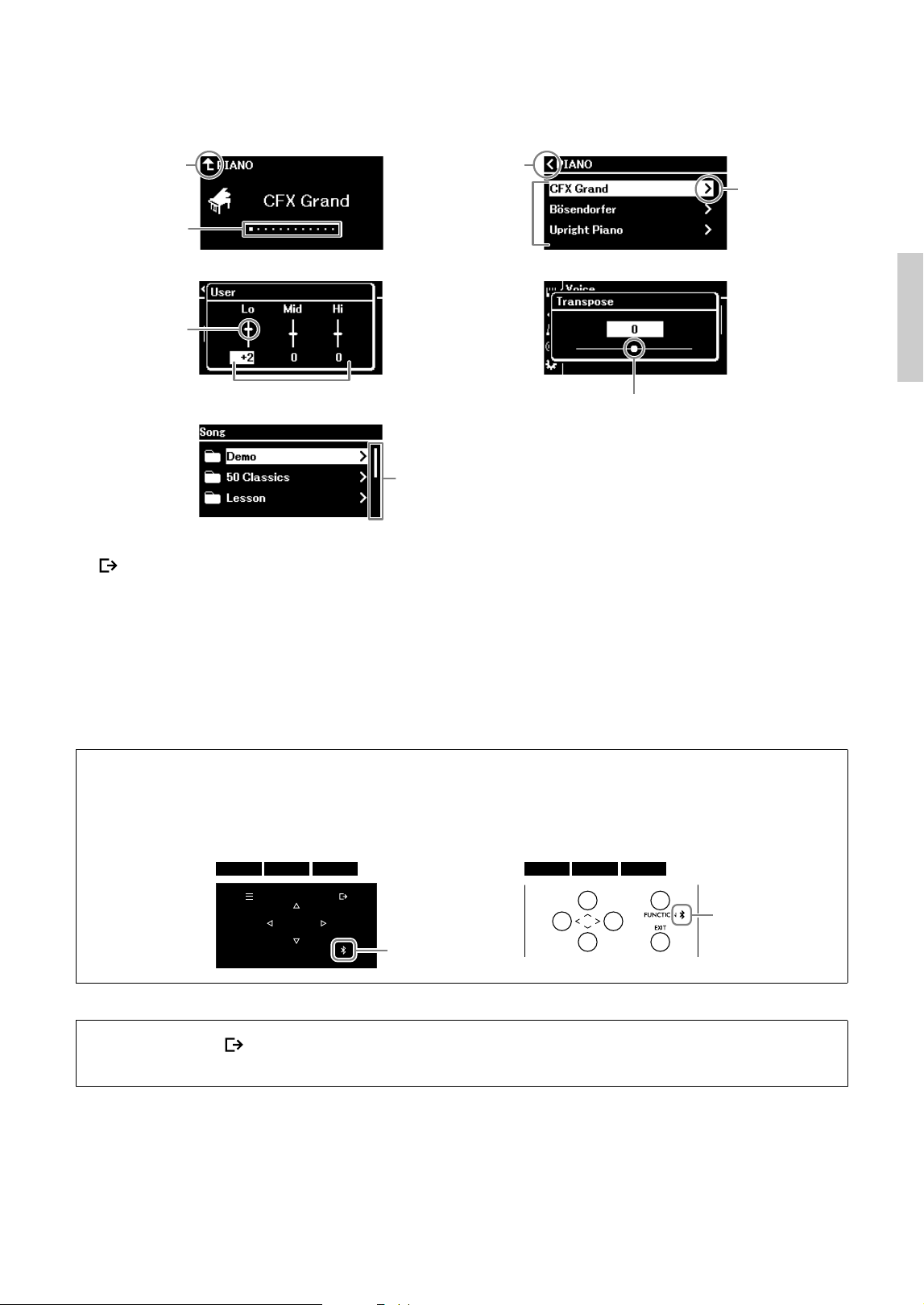
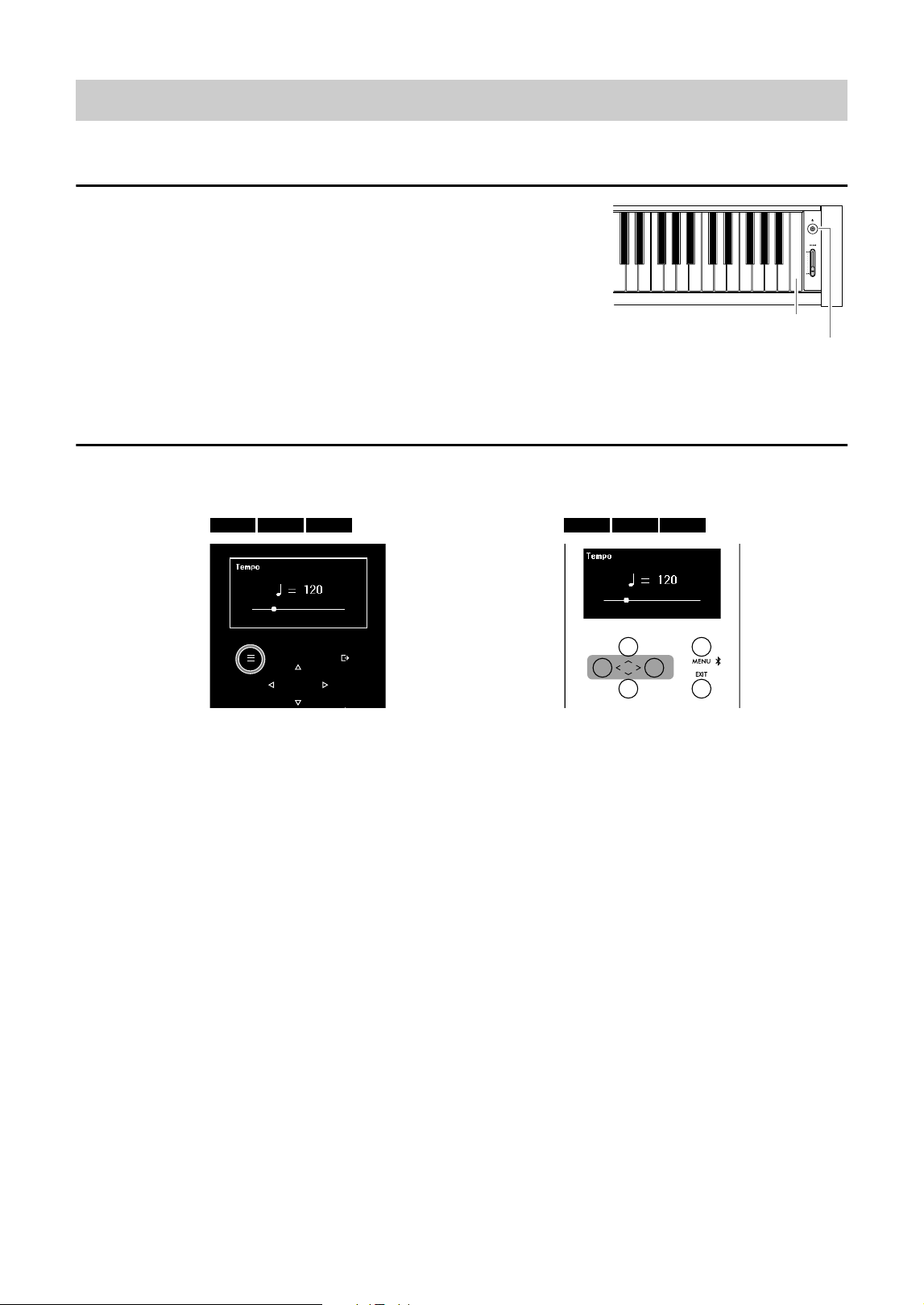
• [u]/[d]/[l]/[r] buttons
For selecting an item on the display or setting a value. Refer to the examples below as a guide for using these
buttons.
• [ ]/[EXIT] buttons
For exiting from the setting display.
• [≡]/[MENU] buttons (page 51)
For making detailed settings of each function. On the CLP-845, CLP-835 and CLP-865GP, this is also used for
connecting a Bluetooth-equipped device such as a smartphone (page 44).
• (CLP-885/CLP-875/CLP-895GP only) Bluetooth button (page 44)
For connecting to a Bluetooth-equipped device such as a smartphone.
Bluetooth capability
Depending on the country in which you purchased the product, the instrument may not have Bluetooth
capability. If the Bluetooth logo is shown or printed on the control panel, this means that the product is equipped
with Bluetooth functionality.
In this manual, the [ ] button is hereafter referred to as the [EXIT] button, and the [≡] button is referred to as
the [MENU] button.
Press the [u]
button to call up a
higher level (list).
Use the [l]/[r]
buttons to select
an item.
Press the [l]
button to call up a
higher level (list).
Use the [u]/[d]
buttons to select
an item.
Press the [r]
button to enter a
setting, execute
an operation, or
call up a lower
level.
Use the [u]/[d]
buttons to change
the value.
Use the [l]/[r] buttons to
select an item.
Use the [l]/[r] buttons to
change the value.
Use the [u]/[d] buttons to scroll
through the display. (The scroll bar is
shown when there are too many
items to fit into one page.)
885 875 845895GP 835 865GP
Bluetooth logo
Bluetooth logo
Basic Operations
22
CLP-885 CLP-875 CLP-845 CLP-835 CLP-895GP CLP-865GP Owner’s Manual
Restoring the factory-programmed settings
The settings of the instrument are retained even when the power is turned off,
allowing you to use the instrument with the same settings when you turn the
power on the next time. To reset the settings to their factory defaults, press
the [P] (Standby/On) switch to turn on the power while holding down the
highest key.
NOTE
• For details on the data retained even when the power is turned off, refer to the “Backup” section in
the System menu on the Reference Manual.
• The Songs saved to the instrument (page 37) and Bluetooth paring information (page 44) will not be
lost even when the initializing is executed.
Resetting the value of the selected item to its default
You can reset the setting value for a selected item, such as in the Tempo display and Menu display, to its original
default value.
Initializing the settings
Highest key
[P] (Standby/On) switch
885 875 845 835895GP 865GP
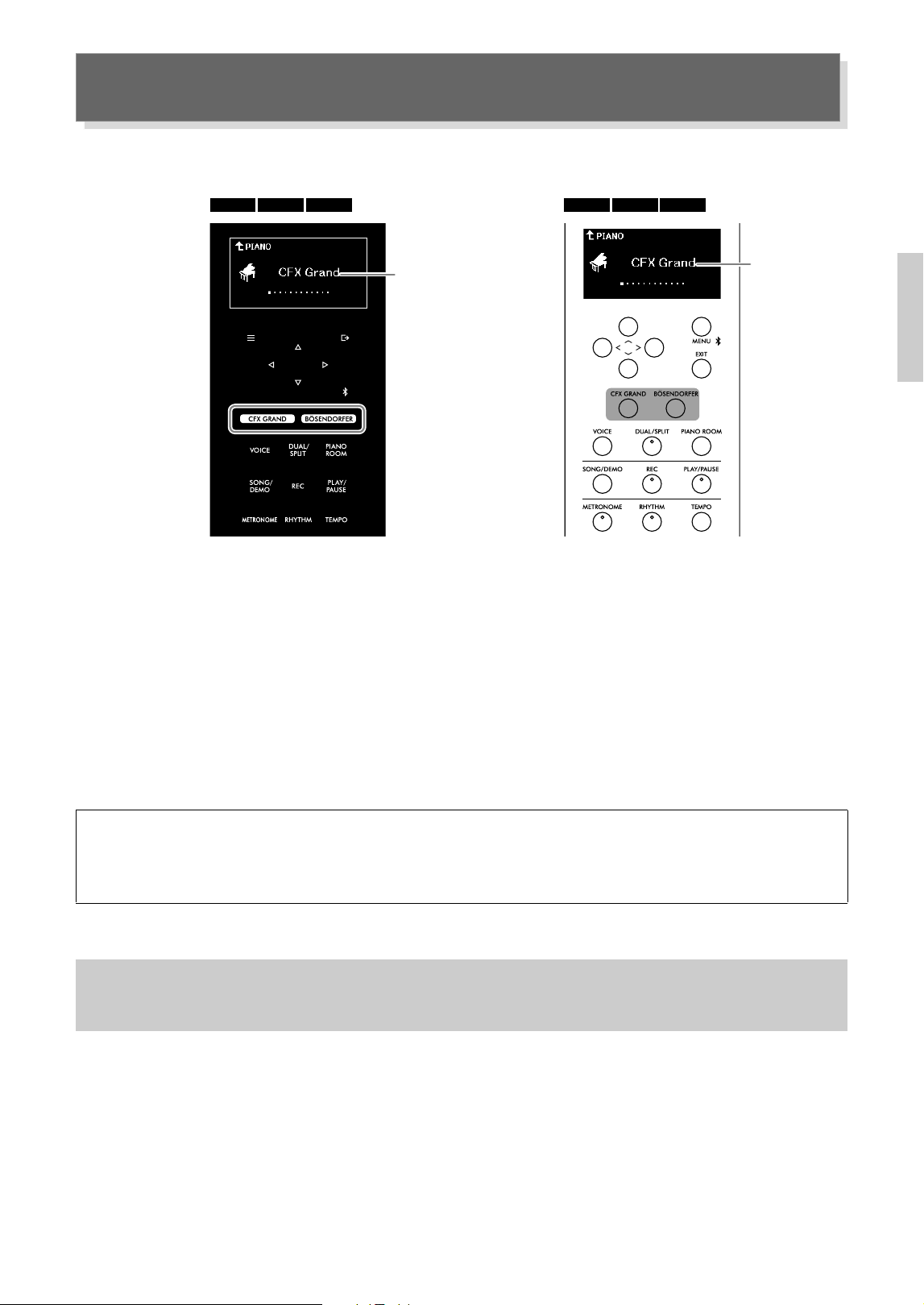
While the setting display is shown,
press and hold the [MENU] button
until the value is reset.
While the setting display is shown,
press the [l] and [r] buttons
simultaneously.
NOTE
On the display in which you set the value by
using the [u]/[d] buttons, press the [u] and
[d] buttons simultaneously to reset.
23
CLP-885 CLP-875 CLP-845 CLP-835 CLP-895GP CLP-865GP Owner’s Manual
Enjoy Playing the Piano
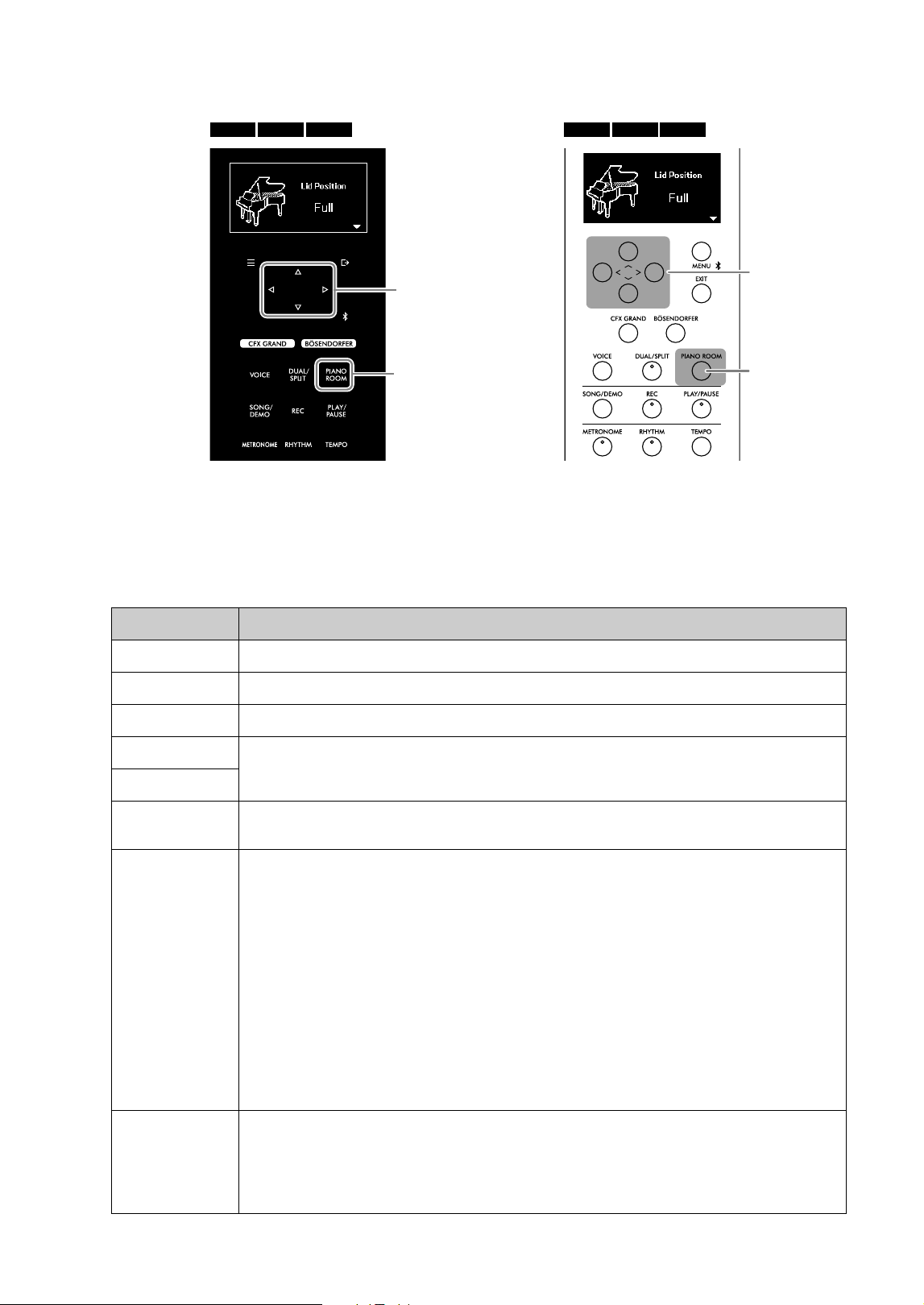
This instrument lets you play with various types of piano sounds. Press the [CFX GRAND] or [BÖSENDORFER]
button at first to play with an authentic grand piano.
• [CFX GRAND] button:
Calls up Yamaha’s CFX concert grand piano sound (“CFX Grand” Voice) with a wide dynamic range for maximum
expressive control. Suitable for playing in any music genre and style.
• [BÖSENDORFER] button:
Calls up the famed sound of the Vienna-made Bösendorfer Imperial concert grand piano (“Bösendorfer” Voice).
The warm, spacious sound evokes the size of the instrument, and is ideal for expressing tenderness in
compositions.
NOTE
Pressing the [CFX GRAND] or [BÖSENDORFER] button disables the Dual, Split or Duo function (page 27).
The Piano Room lets you adjust detailed settings such as the resonance of the piano sound and Touch Sensitivity to
customize your desired piano. Select “CFX Grand,” “Bösendorfer” or any other PIANO category Voices having VRM
effects to apply the settings.
NOTE
To check which PIANO category Voices have VRM effects, refer to the “Voice List” on page 52.
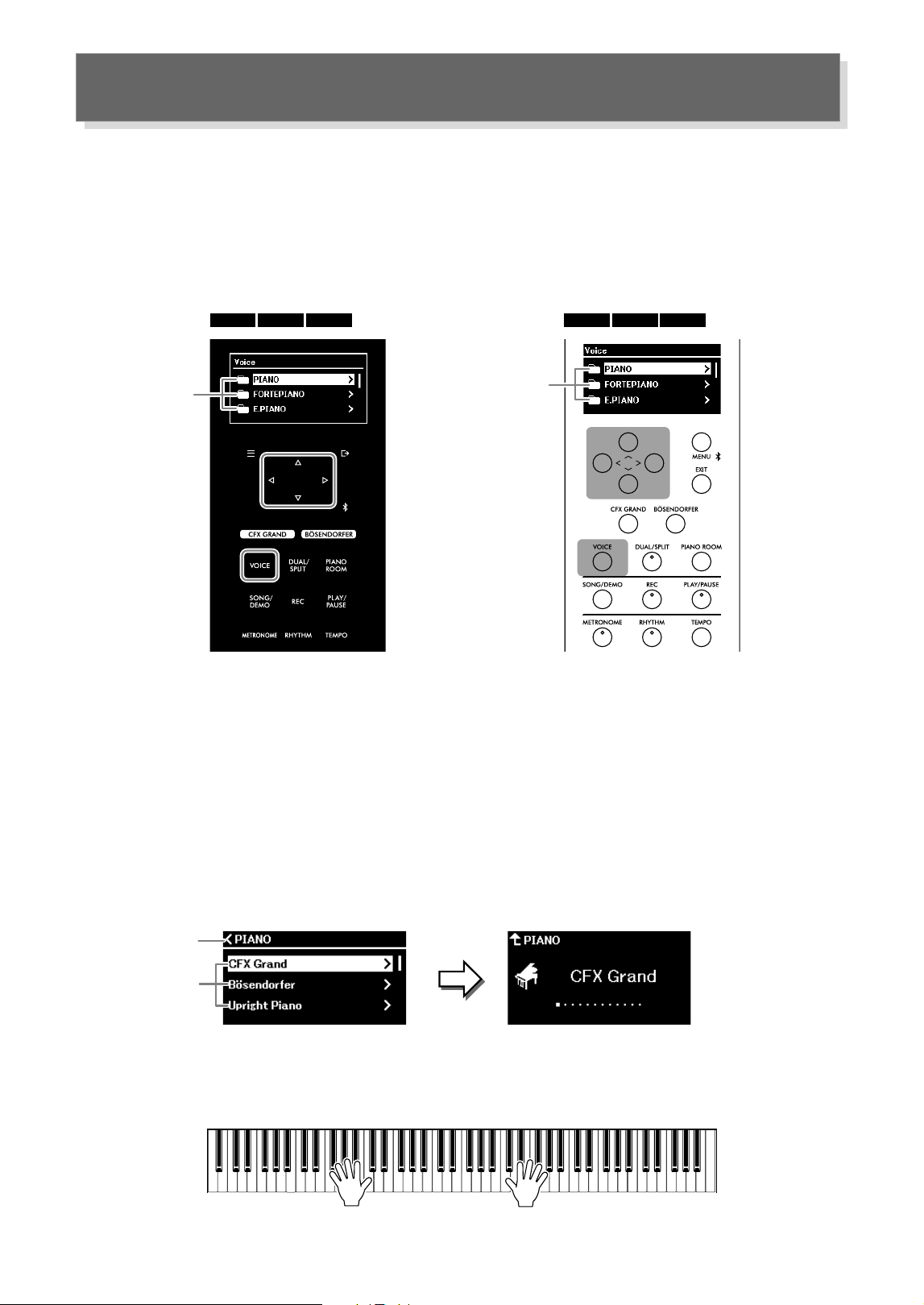
Selecting other piano Voices
Use the [l][r] buttons to select piano Voices other than “CFX Grand” and “Bösendorfer.” You can also select
other Voices by pressing the [VOICE] button (page 26).
Customizing the sound and the Touch Sensitivity of piano
Voices (Piano Room)
885 875 845 835895GP 865GP
Voice display
Voice name
Voice display
Voice name
Enjoy Playing the Piano
24
CLP-885 CLP-875 CLP-845 CLP-835 CLP-895GP CLP-865GP Owner’s Manual
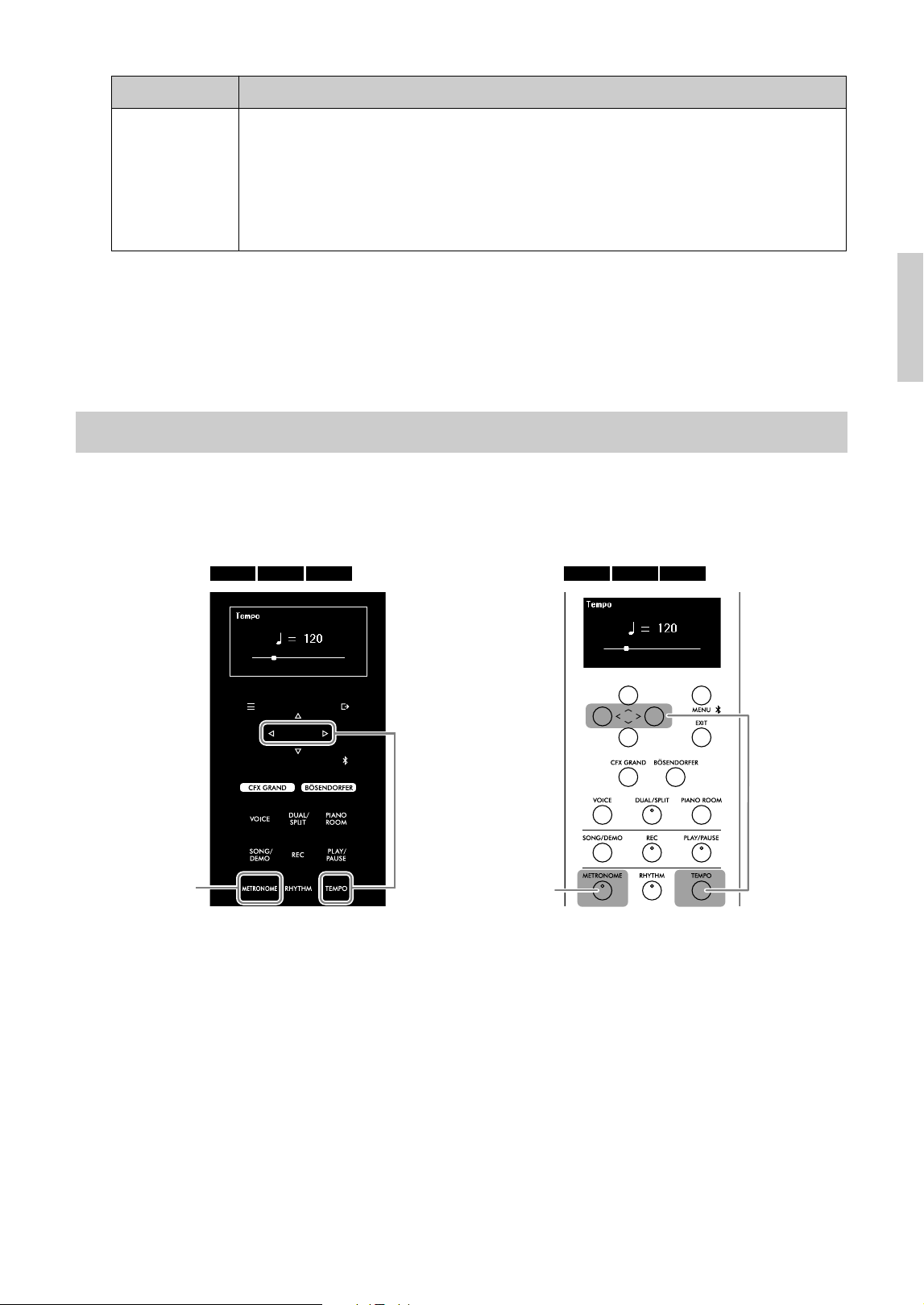
1. Press the [PIANO ROOM] button to call up the Piano Room display.
NOTE
To exit from the Piano Room display, press the [EXIT] button.
2. Use the [u][d] buttons to select an item, and then use the [l][r] buttons to set the
value.
Item Description
Lid Position
Recreates the differences in sound depending on how high the (virtual) grand piano lid is opened.
Brightness
Adjusts the brightness of the sound.
Touch
Determines how the sound responds to your playing strength.
Reverb
Selects the Reverb type, which simulates the reverberation of a specific room or venue, giving you
the feeling of being in the selected space. The Reverb depth can also be adjusted.
Reverb Depth
Master Tune
Fine tunes the pitch of the entire instrument. This function is useful when you play this instrument
along with other instruments or CD music.
VRM
Turns on/off the VRM (Virtual Resonance Modeling) effect which faithfully simulates an actual
acoustic piano. While this display is shown, pressing the [PLAY/PAUSE] button plays back the
Demo. You can listen to the Demo with and without the effect (VRM on or off). The parameters
below can be set when VRM is set to “On.”
• Damper Resonance: Adjusts the depth of the string resonance effect which is applied when the
damper pedal (right pedal) is pressed.
• Damper Noise: Turns on/off the damper noise which recreates the sound made on an acoustic
piano when the damper pedal is pressed.
• String Resonance: Adjusts the depth of the string resonance effect which is applied when a note
on the keyboard is pressed.
• Duplex Scale Resonance: Adjusts the sympathetic vibrations of the duplex scaling resonance
effect.
• Body Resonance: Adjusts the resonance of the piano itself (the soundboard, the sides, the frame
and so on).
Grand
Expression
Selects the type of the Grand Expression Modeling effects. While this display is shown, pressing the
[PLAY/PAUSE] button plays back the Demo. You can listen to the Demo with “Dynamic” or “Static.”
• Dynamic: You can control extremely subtle nuances in the sound like on an actual acoustic piano
by changing your playing strength or touch.
• Static: The nuances are generally fixed even when you change your playing strength or touch.
885 875 845 835
1
2
1
2
895GP 865GP
Piano Room
display
Piano Room
display
Enjoy Playing the Piano
25
CLP-885 CLP-875 CLP-845 CLP-835 CLP-895GP CLP-865GP Owner’s Manual
NOTE
• The settings in the Piano Room are equivalent to those in the Menu display (page 51). “Touch,” “Master Tune” and “Half Pedal Point” can be set
in the System menu, and other parameters can be set in the Voice menu. For details on these setting parameters, refer to the Reference
Manual.
• To reset the selected item to the default value, on the CLP-885, CLP-875 and CLP-895GP, press and hold the [MENU] button until the until the
value is reset. On the CLP-845, CLP-835 and CLP-865GP, press the [l] and [r] buttons simultaneously.
Pressing the [METRONOME] button turns the metronome on/off. The metronome lets you practice or play at an
accurate tempo.
To adjust the metronome tempo, use the [l]/[r] buttons to change the value while the Tempo display is shown. If
the Tempo display is not shown, press the [TEMPO] button to call it up.
NOTE
• The tempo of the metronome and the Rhythm (page 29) are equivalent.
• If you set the time signature of the metronome, the first beat is accented by the bell sound. The time signature and the volume of the metronome can
be set in the Metronome/Rhythm menu (page 51). For details, refer to the Reference Manual.
Half Pedal
Point
Specifies the point to which you must depress the damper pedal (right pedal) before the Sustain
effect begins to be applied.
Half-pedal function
The Half-pedal function allows you to use half-damper techniques, in which the damper is pressed somewhere
between all the way down and all the way up. In this half-damper state (on a real piano), the damper felts only
partially mute the strings. The Half-pedal function on this instrument lets you delicately and expressively control the
damper muting, and create subtle nuances in your performance, by finely controlling the point at which pressure on
the pedal affects the damper muting.
Using the metronome
Item Description
885 875 845 835895GP 865GP
Tempo display
Tempo display
Metronome on/off
Metronome on/off
Adjusting
the tempo
Adjusting
the tempo
26
CLP-885 CLP-875 CLP-845 CLP-835 CLP-895GP CLP-865GP Owner’s Manual
Playing with Various Sounds (Voices)
In addition to the wonderfully realistic piano sounds, you can select and play other musical instrument sounds
(Voices), such as organ or stringed instruments. For details on each Voice, refer to the Voice List on page 52.
NOTE
Demos are provided for some Voices, allowing you to hear and experience the characteristics of the Voices. Refer to page 31 for instructions on playing
back the Voice Demos.
1. Press the [VOICE] button to call up the Voice category list.
Voices are categorized by the type of instrument.
2. Use the [u]/[d] buttons to select the Voice category, and then press the [r] button call
it up.
The Voices in the selected category are listed in the display. To re-select the category, press the [l] button.
NOTE
On the CLP-885 and CLP-895GP, XG Voices can also be selected. Since the XG category contains a large number of Voices, it is conveniently
divided into sub-categories. Use the [u]/[d] buttons to select a sub-category, and then press the [r] button to go on to the next step. For a list of
XG Voices, refer to the Data List on the website.
3. Use the [u]/[d] buttons to select the desired Voice, and then press the [r] button to
call it up.
The Voice display appears with the current Voice.
NOTE
You can also change the Voice by using the [l]/[r] buttons while the Voice display is shown.
4. Play the keyboard.
885 875 845 835895GP 865GP
Voice categories
Voice categories
Voice category
Voice
Voice display
Playing with Various Sounds (Voices)
27
CLP-885 CLP-875 CLP-845 CLP-835 CLP-895GP CLP-865GP Owner’s Manual
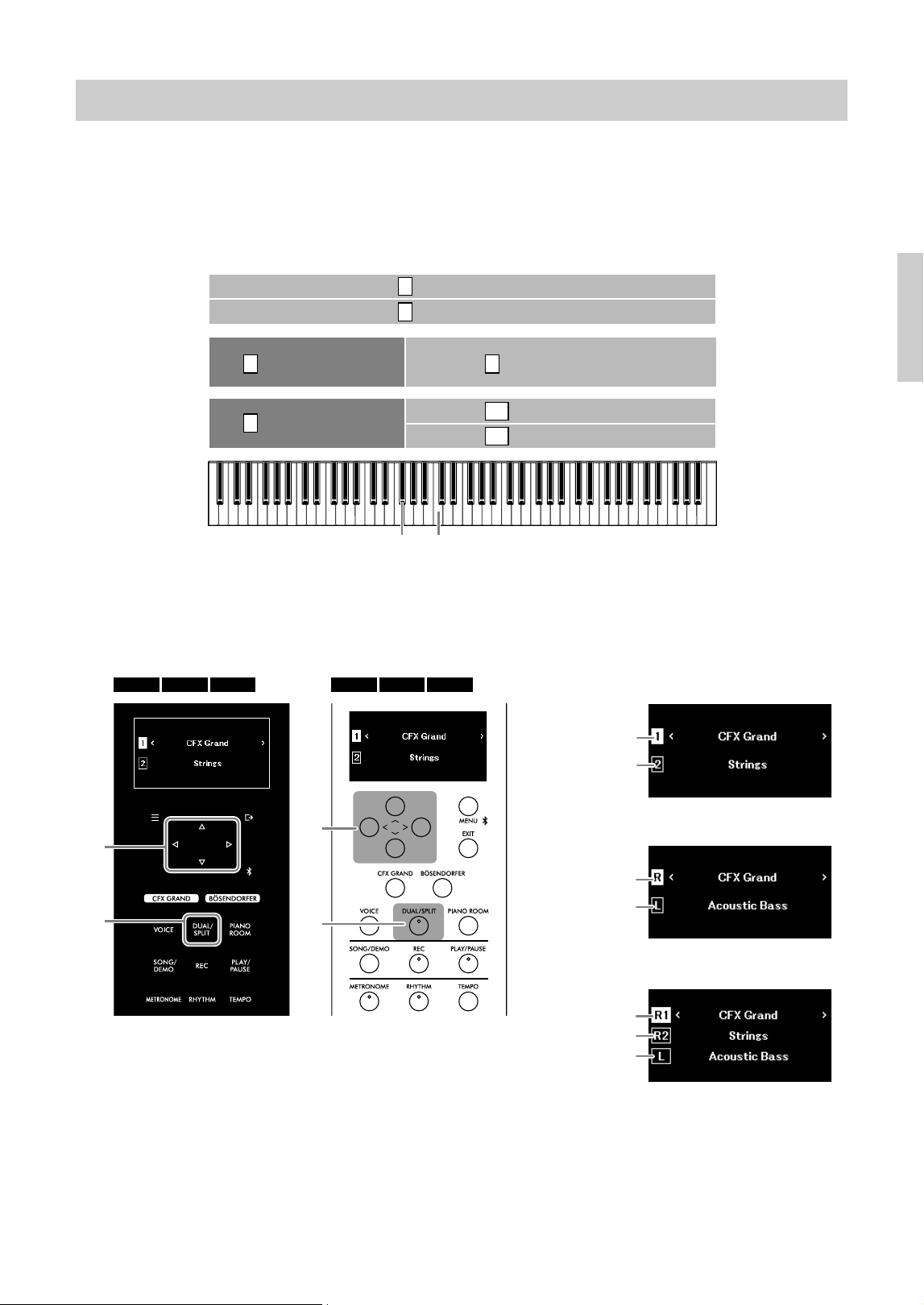
The Dual function lets you play two different Voices in a layer, and the Split function lets you play different Voices in
the right- and left-hand areas of the keyboard. The Dual and Split functions can be used at the same time. By
combining Voices, you can create luscious instrument textures and convenient performance combinations.
When Split is turned on, the key which divides the keyboard into the left- and right-hand areas is referred to as Split
Point, and it is set to the key indicated in the illustration below by default. The Split Point key is included in the left-
hand area.
1. Press the [DUAL/SPLIT] button several times to turn on the Dual/Split function.
Depending on the function you wish to use, press the button once, twice or three times. The display differs
depending on the activated function.
Combining Voices for playing (Dual/Split)
1
2
L R
R1
R2
L
Dual
Split
Dual + Split
Voice 1
Voice 2
Right 1 Voice
Right 2 Voice
Right Voice
Left Voice
Left Voice
Split Point (F#2 as default) Center “C” (C3)
885 875 845 835
2
1
2
1
895GP 865GP
Right 1 Voice
Right 2 Voice
Right Voice
Left Voice
Left Voice
Voice 1
Voice 2
Dual: Press the button once
Split: Press the button twice
Dual + Split: Press the
button three times
Playing with Various Sounds (Voices)
28
CLP-885 CLP-875 CLP-845 CLP-835 CLP-895GP CLP-865GP Owner’s Manual
2. Select two or three Voices.
2-1. Use the [u]/[d] buttons to select the part (1/2, R/ L, or R1/R2/L).
2-2. Use the [l]/[r] buttons to select the Voice.
You can also select the Voice by pressing the [VOICE] button to call up the Voice category list (page 26).
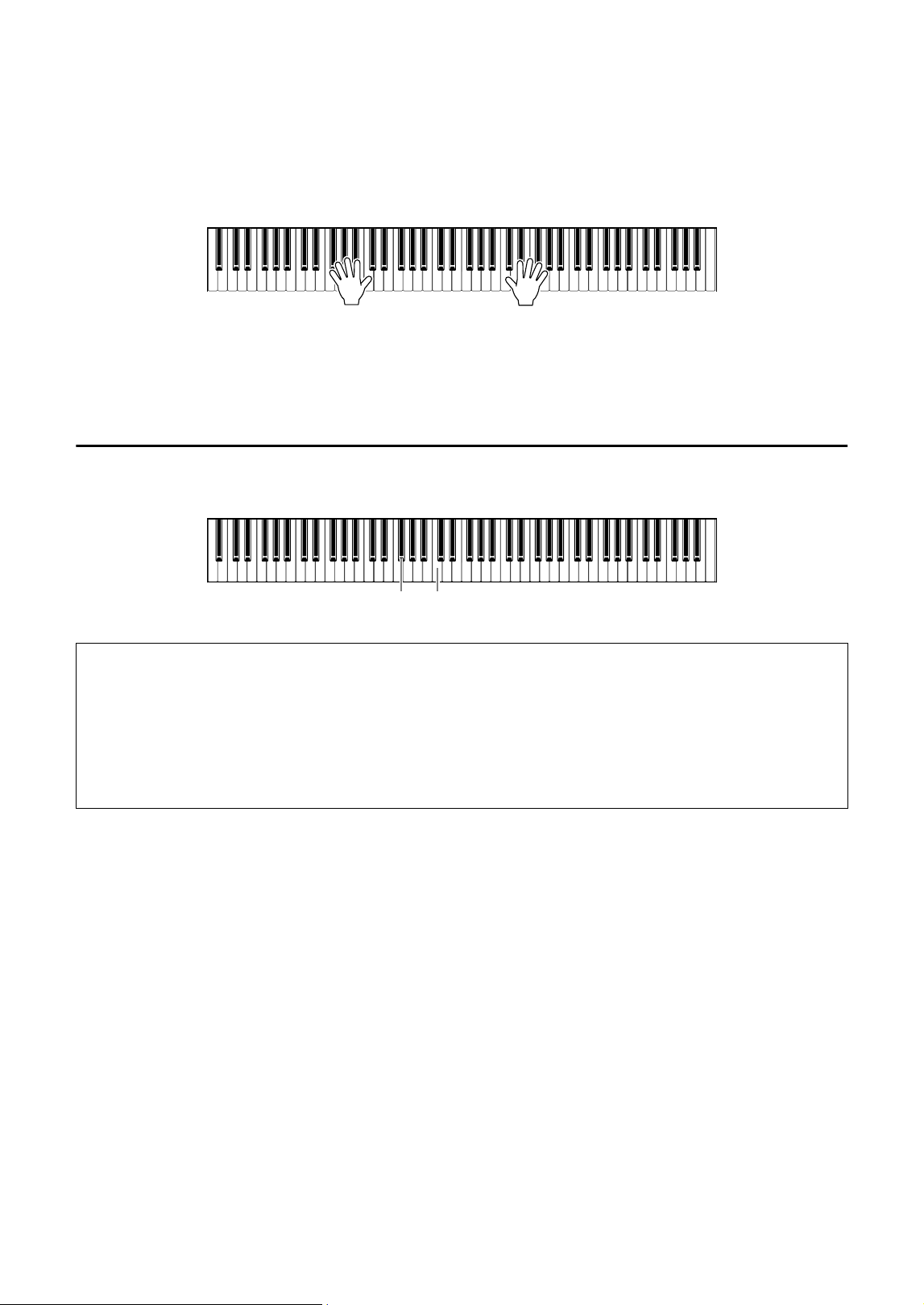
3. Play the keyboard.
4. After you finish your performance, press the [DUAL/SPLIT] button to turn off the Dual/
Split function.
Changing the Split Point (the border between the right- and left-hand areas)
With the Split function turned on, simultaneously hold down the [DUAL/SPLIT] button and press the key you wish to
set as the Split Point. The specified Split Point key is included in the left-hand area.
Playing by two players over the same octave range (Duo)
The Duo function allows two different players to play the right and left area of the keyboard which is divided at
the Split Point. Two players can play over the same octave range. You can turn this function on/off from
“Keyboard” in the System menu (page 51). For details, refer to the Reference Manual.
NOTE
When Duo is turned on, the right pedal becomes the damper pedal for the right player, the left pedal becomes the damper pedal for the left player,
and the center pedal becomes the damper pedal for both the right and left player.
Split Point (F#2 as default) Center “C” (C3)
29
CLP-885 CLP-875 CLP-845 CLP-835 CLP-895GP CLP-865GP Owner’s Manual
Playing the Keyboard along with Rhythm
Playback
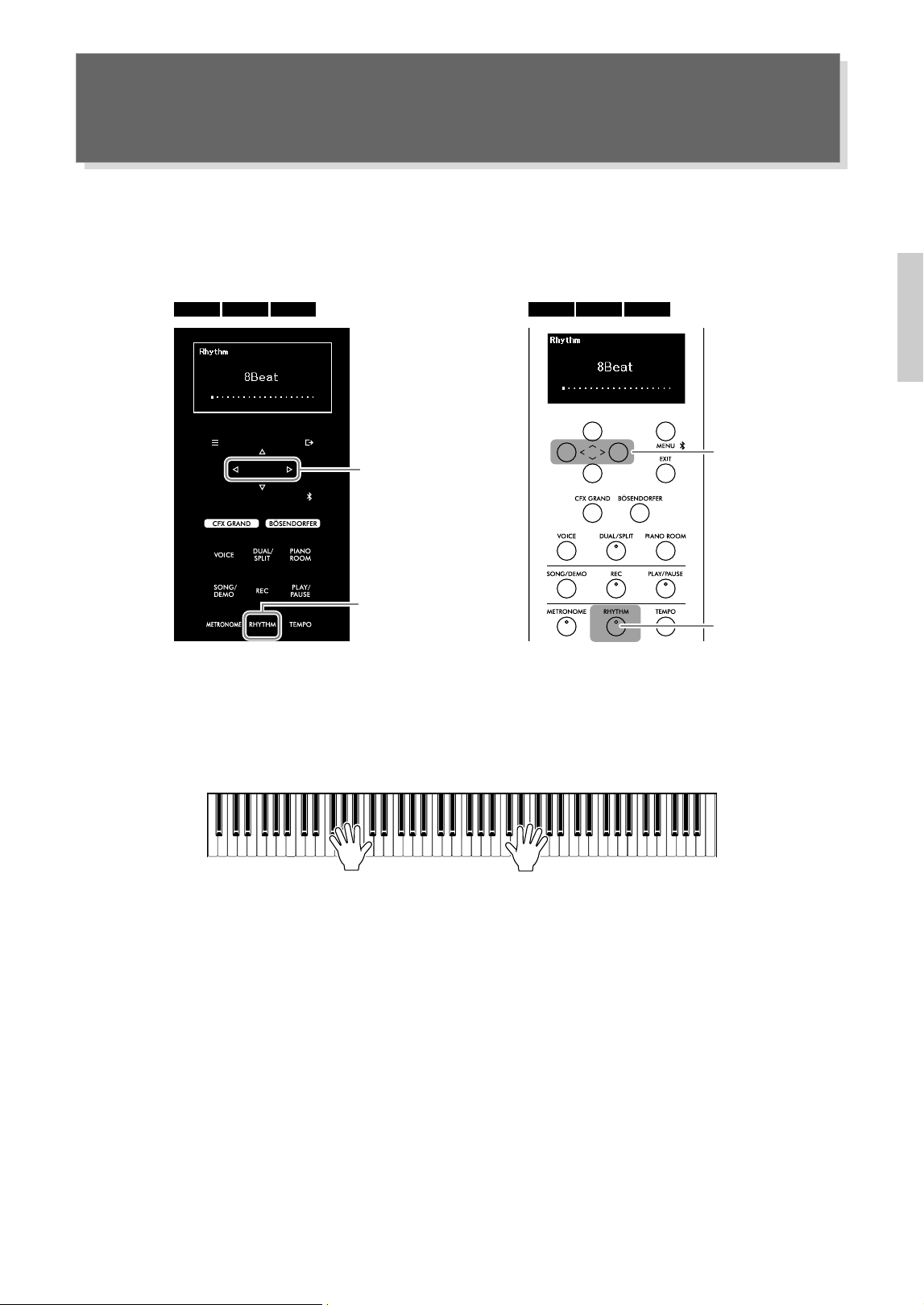
Using the Rhythm function instead of the metronome lets you not only play with accurate tempo but also lets you
perform more enjoyably along with dynamic Rhythm playback in the desired music genre.
1. Press the [RHYTHM] button to start Rhythm playback.
Intro playback starts followed by the Rhythm playback.
2. Use the [l]/[r] buttons to call up the desired Rhythm.
3. Play the keyboard along with Rhythm playback.
The Rhythms consist of drums and bass accompaniment. The bass accompaniment sound automatically
changes based on the chords played on the keyboards.
The Rhythm tempo is equivalent to the metronome tempo (page 25). Press the [TEMPO] button and then use
the [l]/[r] buttons to adjust the tempo.
NOTE
• For details on how to play chords, refer to commercially available chord books. 9th, 11th and 13th chords cannot be recognized.
• The volume, bass sound on/off, and Intro and Ending on/off can be set in the Metronome/Rhythm menu (page 51). For details, refer to the
Reference Manual.
4. To stop Rhythm playback, press the [RHYTHM] button again.
The Rhythm will automatically stop after an Ending is played.
885 875 845 835
1, 4
2
1, 4
2
895GP 865GP
Rhythm display
Rhythm display

30
CLP-885 CLP-875 CLP-845 CLP-835 CLP-895GP CLP-865GP Owner’s Manual
Playing back Songs such as Preset Songs and
Recorded Songs
Preset songs, your recorded performances, and commercially available songs that can be played back on this
instrument are referred to as “Songs” in this manual. In addition to listening to these Songs, you can use the Songs
for your practice.
There are two kinds of Songs as described below.
• MIDI Songs
A MIDI Song is comprised of your keyboard performance information and is not a recording of the actual sound
itself. The performance information refers to which keys are played, at what timing, and at what strength—just as
in a musical score. Based on the recorded performance information, the sounds built into the instrument is output
from the speakers. MIDI Songs are useful for practicing; you can play back the right-hand and left-hand parts
independently, and you can also play back the specified range of the Song repeatedly.
• Audio Songs
An Audio Song is a recording of the performed sound itself. This data is recorded in the same way as that used
with voice recorders, etc.
Songs that can be played back on this instrument
• Preset MIDI Songs (see “Song List” on page 57)
• MIDI Songs/Audio Songs recorded on this instrument (see page 37 for instructions on recording)
• Commercially available Songs of the following formats in the USB flash drive connected to the USB [TO
DEVICE] terminal
- MIDI Songs: SMF (Standard MIDI File)
- Audio Songs: WAV (44.1 kHz, 16-bit, stereo)
NOTE
Before using a USB flash drive, be sure to read “Using the USB [TO DEVICE] terminal” on page 6.
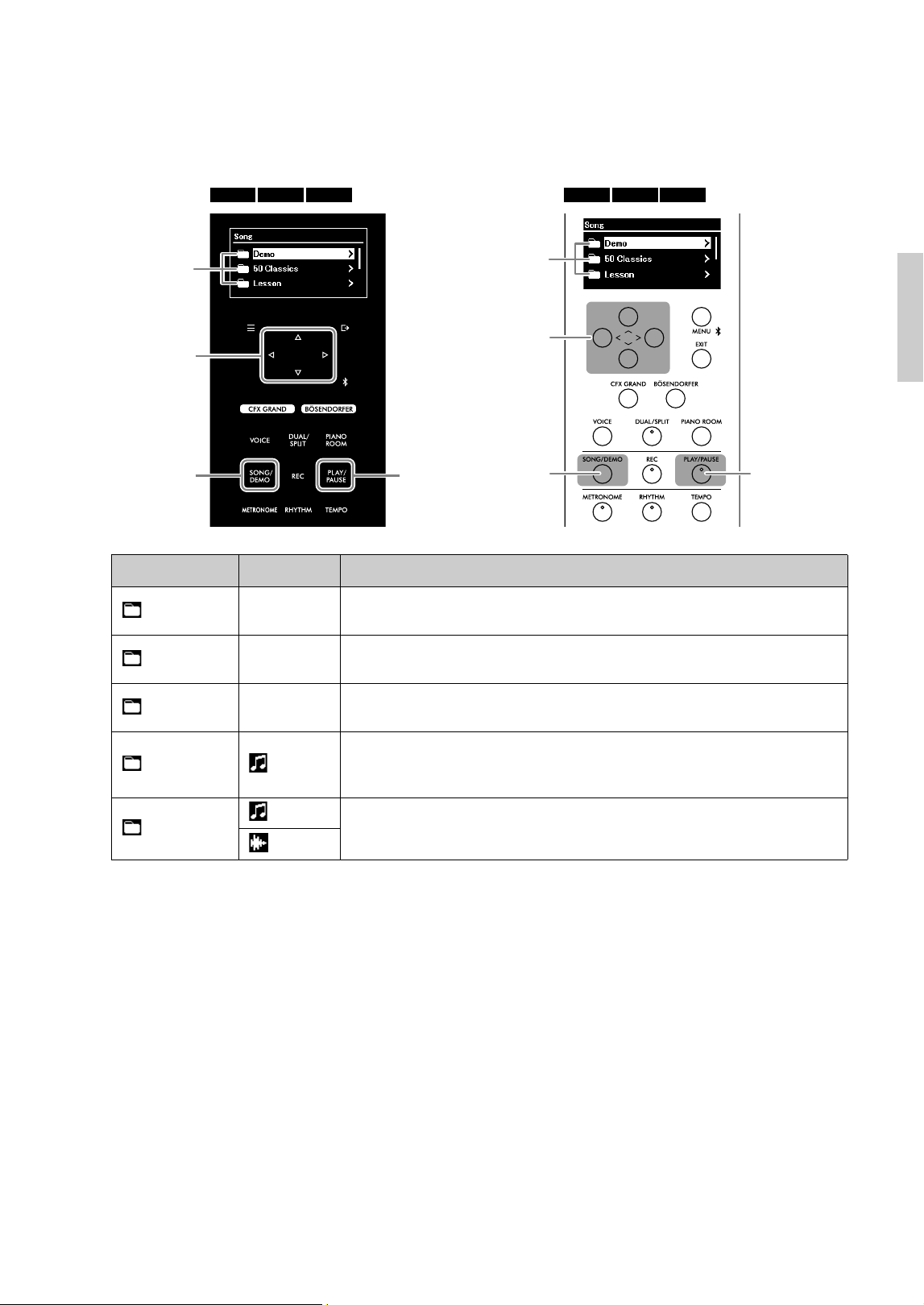
Playing back Songs such as Preset Songs and Recorded Songs
31
CLP-885 CLP-875 CLP-845 CLP-835 CLP-895GP CLP-865GP Owner’s Manual
1. (Only when playing a Song from a USB flash drive) Connect the USB flash drive to the USB [TO
DEVICE] terminal.
2. Press the [SONG/DEMO] button to call up the Song category list.
NOTE
• For a list of the preset Songs, refer to the “Song List” on page 57. To see which Voices have Demos, refer to the “Voice List” on page 52.
• “USB” appears only when a USB flash drive is connected.
• Copying or moving MIDI Songs from a USB flash drive to “User” can be done from “File” in the Song menu (page 51). For details, refer to the
Reference Manual.
• By using the Smart Pianist app (page 46), you can view the music scores of the “50 Classics” and “Lesson” Songs on your smart device.
3. Use the [u]/[d] buttons to select the Song category (folder), and then press the [r]
button to call it up.
The Songs in the selected folder are shown. If the folder contains another folder within it, repeat the same
operation. To re-select a folder, press the [<] button to return to the Song category list.
Song category Format Description
Demo MIDI
Voice Demos let you experience the characteristics of the Voices (page 26).
Demos are available only for some Voices.
50 Classics MIDI
Preset piano Songs which are contained in the music book “50 Classical Music
Masterpieces,” included with this instrument.
Lesson MIDI
Preset Songs ideal for practice, taken from “The Virtuoso Pianist” and others.
Lesson Songs are divided into several folders depending on the album types.
User MIDI
Songs which have been recorded and saved to the instrument by using the Record
function (page 37), and Songs which have been copied/moved to the instrument
from a USB flash drive.
USB
MIDI
Songs saved to the USB flash drive connected to the USB [TO DEVICE] terminal.
The Songs recorded on this instrument are saved to the “USER FILES” folder.
Audio
5
3, 4
25
3, 4
2
885 875 845 835895GP 865GP
Song categories
Song categories
Playing back Songs such as Preset Songs and Recorded Songs
32
CLP-885 CLP-875 CLP-845 CLP-835 CLP-895GP CLP-865GP Owner’s Manual
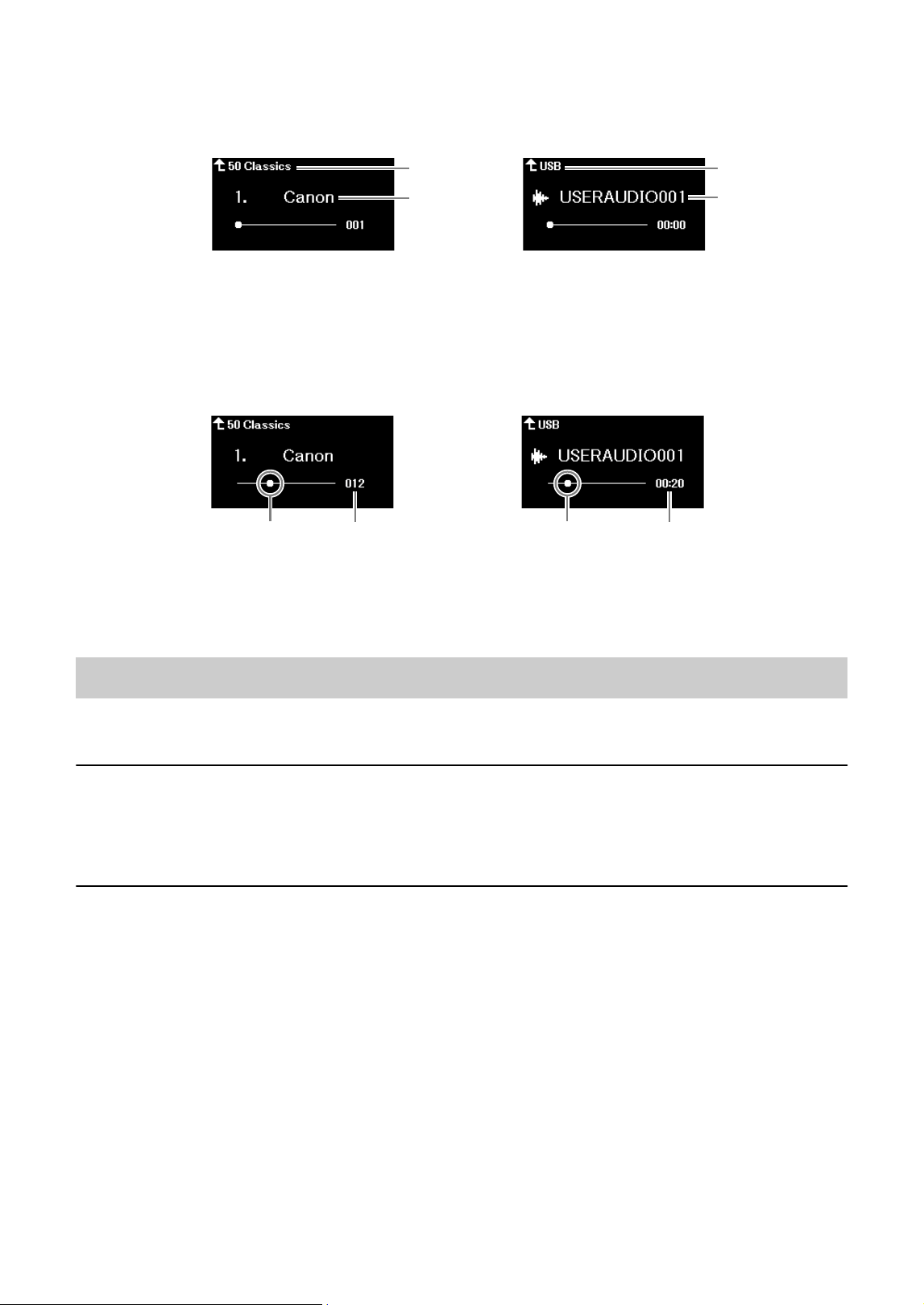
4. Use the [u]/[d] buttons to select the Song, and then press the [r] button to call it up.
The Song display appears, and you can see the currently selected Song name and its category name.
NOTE
When the Song name is too long to be displayed, press the [d] button to see the full name.
5. Press the [PLAY/PAUSE] button to start playback.
The current position of Song playback appears in the display. The current measure number is shown for MIDI
Songs, and the elapsed time is shown for Audio Songs.
The Song stops automatically when playback of the selected Song reaches the end. To pause the Song during
playback, press the [PLAY/PAUSE] button.
Fast forward/Rewind
While the Song display is shown, press the [l] button to rewind, and press the [r] button to fast forward. The
display shows you the current playback position (measure number/elapsed time).
Returning to the Song beginning
• CLP-885/CLP-875/CLP-895GP: While the Song display is shown, hold the [MENU] button until the Song position
returns to the beginning.
• CLP-845/CLP-835/CLP-865GP: While the Song display is shown, press the [l] and [r] buttons simultaneously.
Fast forward/Rewind/Returning to the Song beginning
Song name
Song display (MIDI Song)
Category name
Song name
Song display (Audio Song)
Category name
Song display (MIDI Song) Song display (Audio Song)
Current position Measure number Current position Elapsed time (min.: sec.)
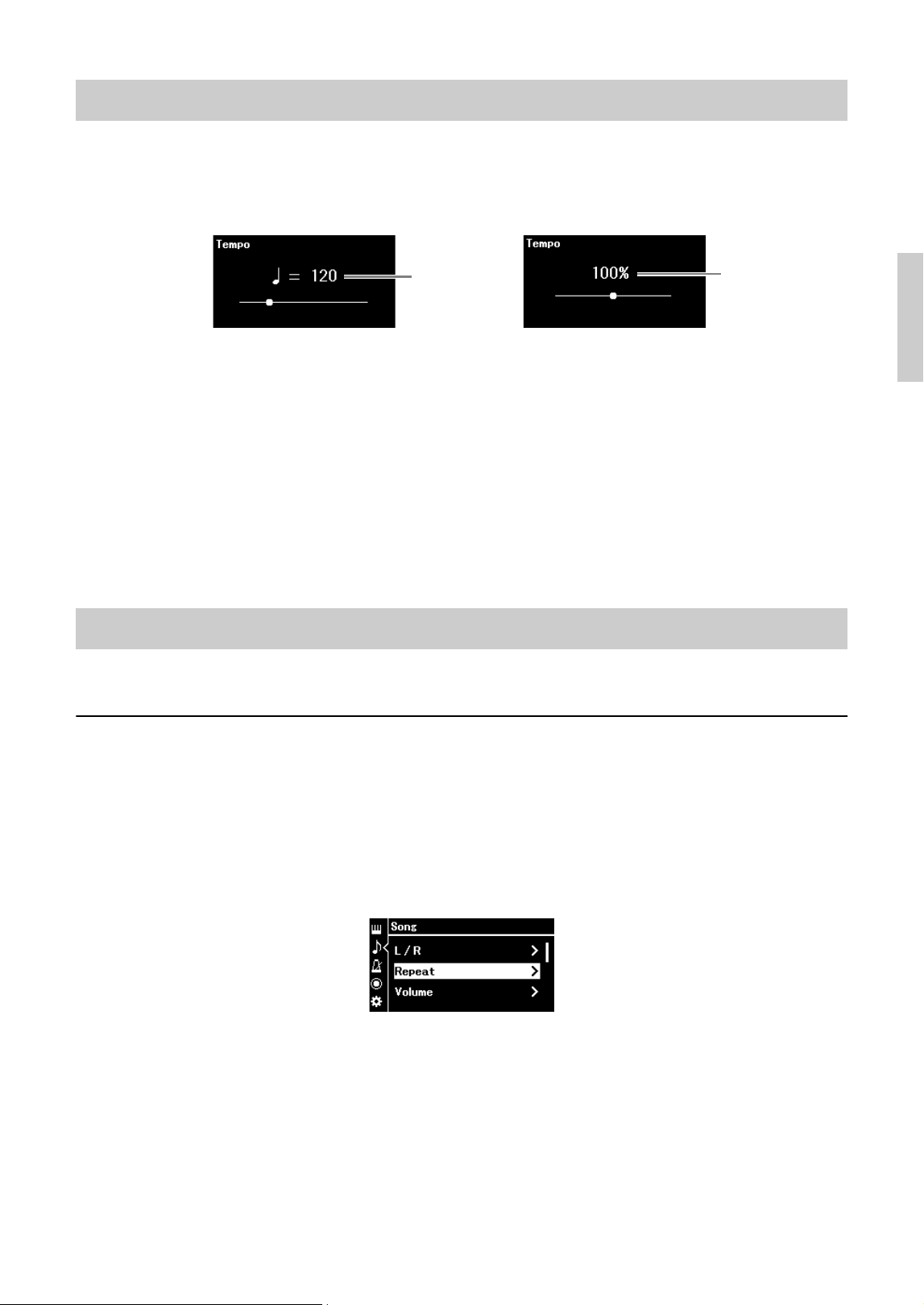
Playing back Songs such as Preset Songs and Recorded Songs
33
CLP-885 CLP-875 CLP-845 CLP-835 CLP-895GP CLP-865GP Owner’s Manual
1. During Song playback, press the [TEMPO] button to call up the Tempo display.
When a MIDI Song is selected and the Song display is shown, you can call up the Tempo display while the
Song is stopped.
2. Use the [l]/[r] buttons to change the tempo.
For MIDI Songs, the tempo range differs depending on the time signature for the selected Song. For Audio
Songs, tempo can be adjusted over a range of 75%–125%, with 100% being the original speed.
NOTE
When a MIDI Song is selected, only even numbers are available for the tempo value depending on the time signature for the selected Song. For
details, refer to the “Time Signature” section in the Metronome/Rhythm menu in the Reference Manual.
To reset to the original tempo, follow the instructions below.
• CLP-885/CLP-875/CLP-895GP: Hold the [MENU] button until the tempo resets to the default value.
• CLP-845/CLP-835/CLP-865GP: Press the [l] and [r] buttons simultaneously.
Playing back an entire Song or Songs repeatedly
You can play back the selected Song or all Songs in the selected folder continuously.
1. Select a Song to be played back (page 31).
2. Press the [MENU] button several times to call up the Song menu (page 51).
3. Use the [u]/[d] buttons to select “Repeat,” and then press the [r] button to call up the
function.
Adjusting the tempo/speed
Using repeat playback
Tempo display (MIDI Song) Tempo display (Audio Song)
Tempo value
Percentage
compared to the
original speed
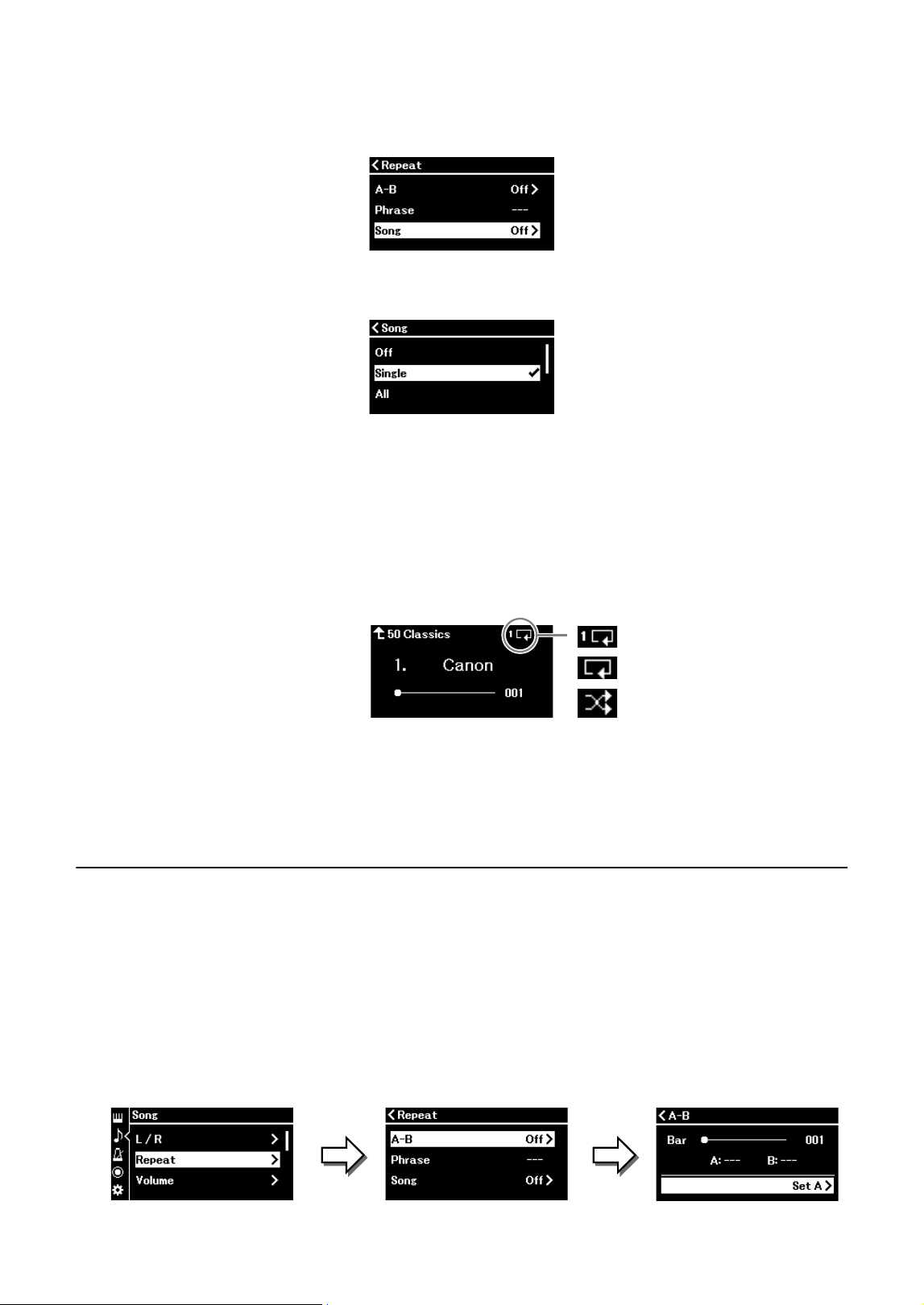
Playing back Songs such as Preset Songs and Recorded Songs
34
CLP-885 CLP-875 CLP-845 CLP-835 CLP-895GP CLP-865GP Owner’s Manual
4. (Only for when a MIDI Song is selected) Use the [u]/[d] buttons to select “Song,” and then
press the [r] button to call up the function.
When an Audio Song is selected, this step is not needed.
5. Use the [u]/[d] buttons to select the repeat type.
• Off: Disables repeated playback. When playback of the selected Song reaches the end, playback stops
automatically.
• Single: Plays through only the selected Song repeatedly.
• All: Continuously plays back all Songs in the folder which contains the selected Song in numerical order.
• Random: Continuously plays back all Songs in the folder which contains the selected Song in random order.
6. Press the [PLAY/PAUSE] button to start playback.
If you call up the Song display by pressing the [EXIT] button, you can check the status of repeat playback.
Playback continues until you press the [PLAY/PAUSE] button again. To stop repeated playback, select “Off” in
the display of step 5.
Playing back a specified range of a Song repeatedly (A-B Repeat; MIDI
Songs only)
A specified range of the selected MIDI Song can be played back repeatedly. This is referred to as the A-B Repeat
function, and lets you practice a part of a Song repeatedly.
1. Select a MIDI Song to be played back (page 31).
2. Press the [MENU] button several times to call up the Song menu (page 51).
3. Use the [u]/[d] and [r] buttons to select “Repeat” followed by “A-B” and call up the A-
B Repeat display.
Single
All
Random
A-B Repeat display
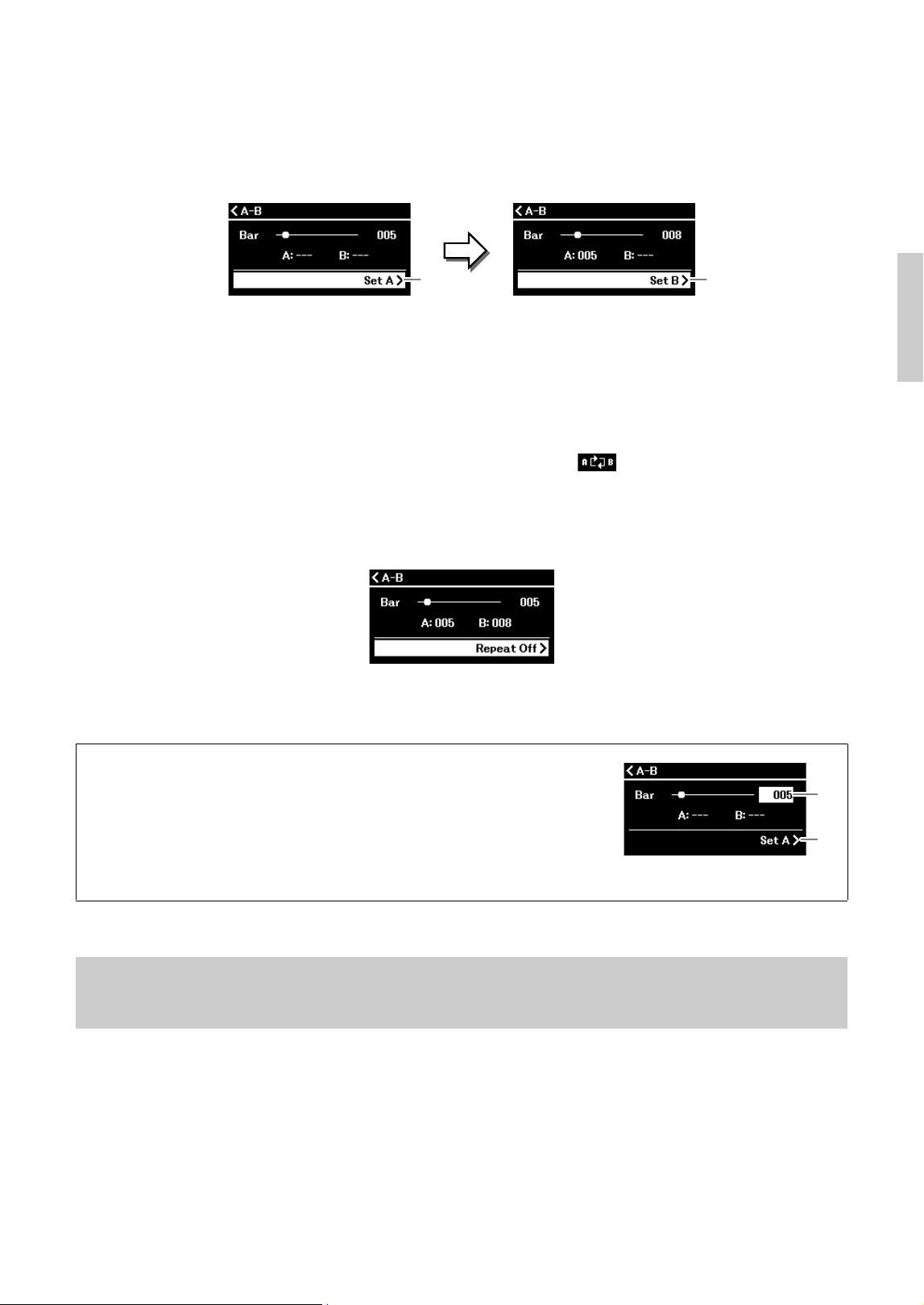
Playing back Songs such as Preset Songs and Recorded Songs
35
CLP-885 CLP-875 CLP-845 CLP-835 CLP-895GP CLP-865GP Owner’s Manual
4. Press the [PLAY/PAUSE] button to start playback.
NOTE
To specify the top of the Song as the starting point (A), first go to step 5, and then start playback. After that, go on to step 6.
5. Press the [r] button at the starting point (A) of the range to be repeated.
6. Press the [r] button again at the ending point (B).
After an automatic lead-in (to help guide you into the phrase), the range from Point A to Point B is played back
repeatedly. To pause the Song at any time, press the [PLAY/PAUSE] button.
NOTE
To specify the end of the Song as the ending point (B), play back through until the end of the Song. The point B is automatically set without you
needing to press any button.
If you call up the Song display by pressing the [EXIT] button, the icon ( ) is shown at the upper right of the
display, indicating that the A-B Repeat function is turned on.
7. To disable A-B Repeat, press the [r] button in the A-B Repeat display while “Repeat
Off” is selected.
Selecting another Song also disables A-B Repeat.
Some MIDI Songs, such as preset Songs in the “50 Classics” and “Lesson” are divided into right-hand and left-hand
parts. When playing this Song data, you can play the keyboard with one hand while playing back the other hand’s
part—allowing you to practice parts separately for easy mastery of difficult material.
1. Select a Song for practicing (page 31).
2. Press the [MENU] button several times to call up the Song menu (page 51).
Another method for specifying a repeat range
1. Press the [u] button to highlight the measure number, and then use the
[l]/[r] buttons to select the desired measure for point A.
2. Press the [d] button to highlight “Set A,” and then press the [r] button
to enter the setting.
3. Specify point B in the same way as point A.
Practicing a one-hand part along with Song playback (MIDI
Songs only)
65
2
1
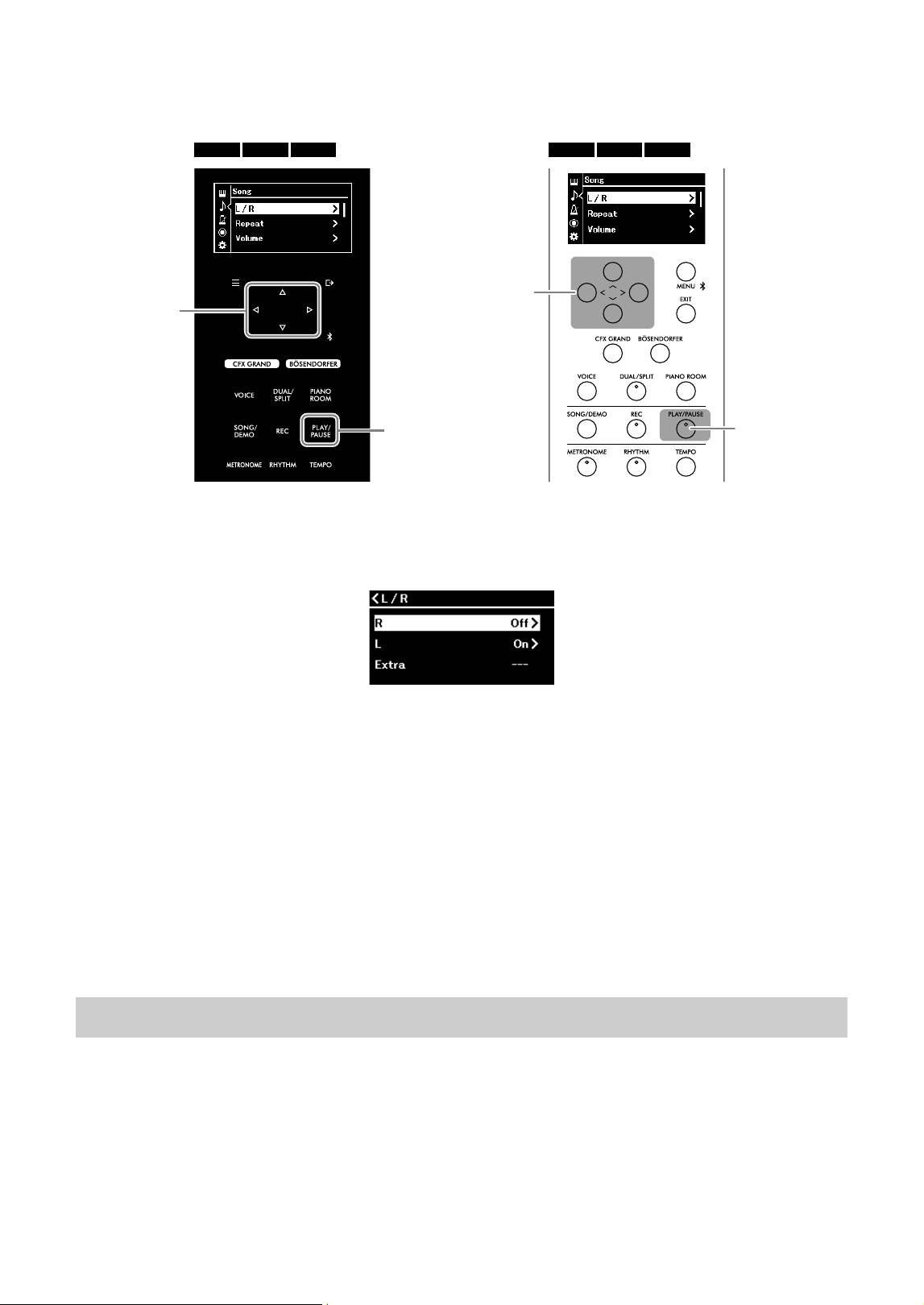
Playing back Songs such as Preset Songs and Recorded Songs
36
CLP-885 CLP-875 CLP-845 CLP-835 CLP-895GP CLP-865GP Owner’s Manual
3. Use the [u]/[d] buttons to select “L/R,” and then press the [r] button to call up the
function.
4. Use the [u]/[d]/[l]/[r] buttons to set the desired part for practicing—“R” (Right) or
“L” (Left)—to “Off.”
The part set to “Off” will be muted.
NOTE
• Parts having no data are indicated by a “---” mark.
• A MIDI Song consists of 16 tracks (parts), and usually track 1 is assigned to “R,” track 2 is assigned to “L,” and tracks 3−16 are assigned to
“Extra.”
• If you select another Song, all parts will be reset to on.
5. Press the [PLAY/PAUSE] button to start playback and practice playing the part you have
turned off.
The Song stops automatically when playback of the selected Song reaches the end. To pause the Song during
playback, press the [PLAY/PAUSE] button.
To practice more effectively, you can conveniently adjust the tempo (page 33) and use the A-B Repeat function
(page 34).
The additional functions below are useful for Song playback and can be set in the Menu display (page 51). For
details, refer to the Reference Manual.
• Starting/pausing playback by using a pedal: This can be set from “Pedal” > “Play/Pause” in the System menu.
• Transposing the pitch of a Song: This can be set from “Transpose” in the Song menu.
• Adjusting the volume balance between your keyboard performance and Song playback: This can be set
from “Volume” in the Song menu.
Other useful Song playback functions
5
3, 4
5
3, 4
885 875 845 835895GP 865GP
Song menu
Song menu

37
CLP-885 CLP-875 CLP-845 CLP-835 CLP-895GP CLP-865GP Owner’s Manual
Recording Your Performance
This instrument features two different recording methods that you can use depending on your purposes.
• MIDI Recording
With this method, recorded performances are saved as an SMF (format 0) MIDI Song to the instrument or a USB
flash drive. A MIDI Song uses a small amount of data capacity in comparison to an Audio Song. MIDI recording
allows you to record each part (such as right- and left-hand parts) separately. Since a MIDI Song can be edited, if
you want to re-record a specific section or change parameters such as Voice, use this method. Since a MIDI Song
can be converted to an Audio Song after recording, you may want to first use MIDI recording (with overdubbing
and multiple parts) to create a complex arrangement you would not otherwise be able to play live, and then
convert it to an Audio Song. This instrument allows you to record approximately 500 KB of data per Song.
• Audio Recording
With this method, recorded performances are saved to a USB flash drive as an Audio Song in WAV format
(44.1 kHz, 16-bit, stereo). Audio input sound from the connected external device (computer, smartphone, audio
player, etc.) can also be recorded along with your keyboard performance. This instrument allows you to record up
to 80 minutes per single recording.
NOTE
• In this manual, “audio input sound” refers to audio data that is input to the instrument from connected external devices using one of these methods:
USB Audio Interface function, Bluetooth Audio function (page 43), [AUX IN] jack (page 45) or Wi-Fi (page 47).
• MIDI Songs can be converted to Audio Songs from “File” > “MIDI to Audio” in the Song menu (page 51). For details, refer to the Reference Manual.
This section explains how to record a new performance and save it to the instrument as a MIDI Song.
1. Make the necessary settings such as Voice selection.
If you want to use functions such as Dual, Split and metronome, turn them on here.
If you want to play back Rhythm, select it here, but make sure to start playback in step 3. If you start Rhythm
playback here, going on to the next step stops playback.
NOTE
The metronome sound is not recorded. Rhythm is recorded by default; however, you can set whether Rhythm is recorded or not in the Recording
menu (page 51).
2. Press the [REC] button to set recording to standby.
The REC display appears and the [PLAY/PAUSE] button flashes.
Recording to the instrument (MIDI recording)
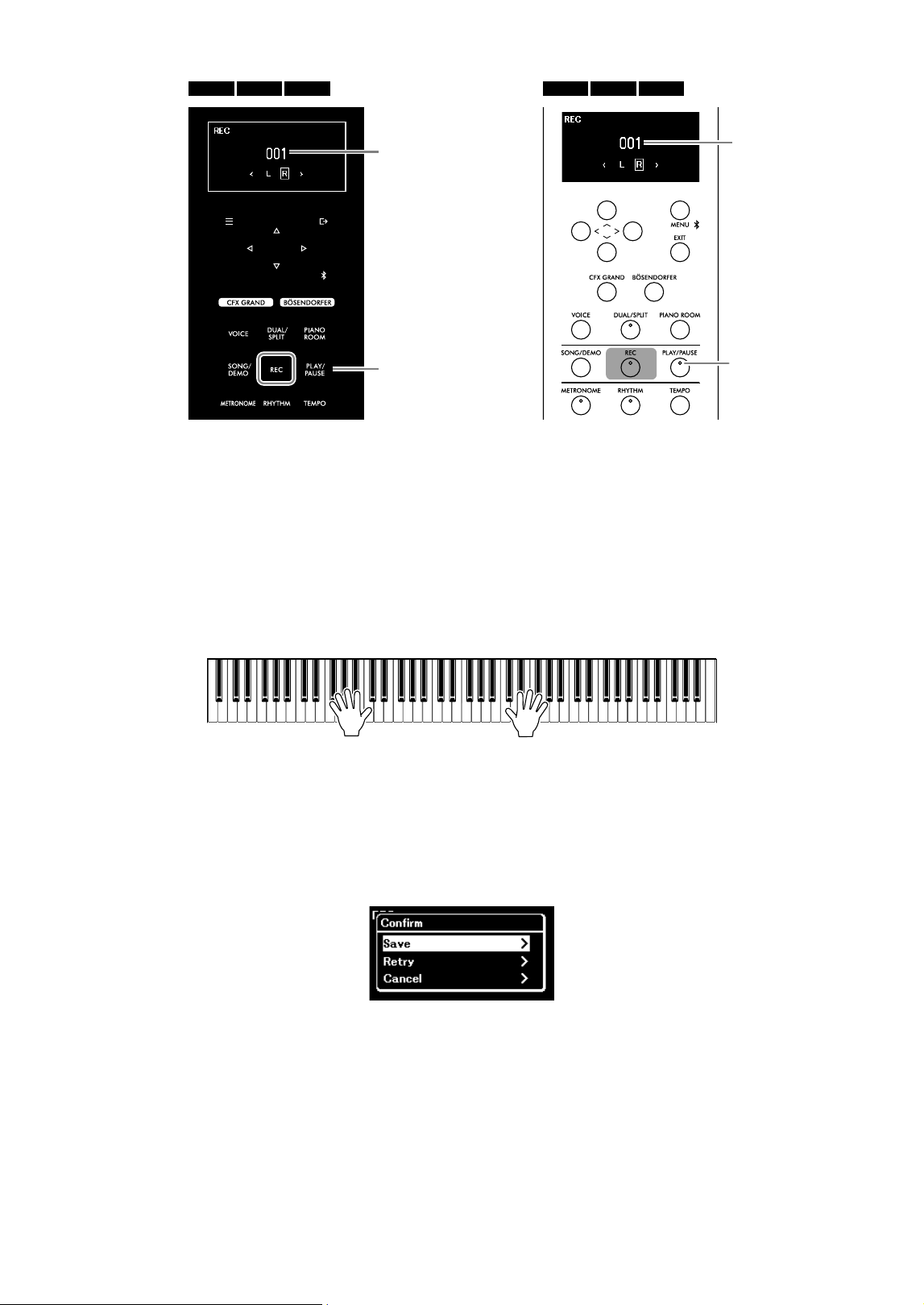
Recording Your Performance
38
CLP-885 CLP-875 CLP-845 CLP-835 CLP-895GP CLP-865GP Owner’s Manual
NOTE
If you press and hold the [REC] button for a while, a list appears letting you select the recording target Song (step 3 on page 39). From that list
select “New MIDI.”
3. Start recording and play the keyboard.
Playing the keyboard automatically starts recording. If you want to record some silence at the start of the Song,
press the [PLAY/PAUSE] button to start recording. While recording, the measure number in the display
advances.
If you want to record with Rhythm playback, press the [RHYTHM] button at the timing you want to start Rhythm
playback. To start recording and Rhythm playback at the same time, press the [RHYTHM] button to start
recording.
4. After you finish your performance, press the [REC] button again to stop recording.
5. In the “Confirm” display, use the [u]/[d] buttons to select “Save,” and then press the
[r] button to save the data.
If you want to record again, select “Retry” and return to step 3.
If you do not want to save the data and exit from this display, select “Cancel.”
After the operation is completed, a “Save Completed” message appears and operation returns to the Song
display. The recorded Song is named “USERSONG***” (***: number) and saved in the “User” category
(page 31).
NOTICE
The recorded Song will be lost if you change to another Song or you turn the power off without executing the Save operation.
NOTE
You can rename the Song name as desired from “File” in the Song menu (page 51). For details, refer to the Reference Manual.
6. Press the [PLAY/PAUSE] button to listen to the recorded performance.
885 875 845 835895GP 865GP
Flashes
Flashes
REC display
REC display
Measure number
Measure number
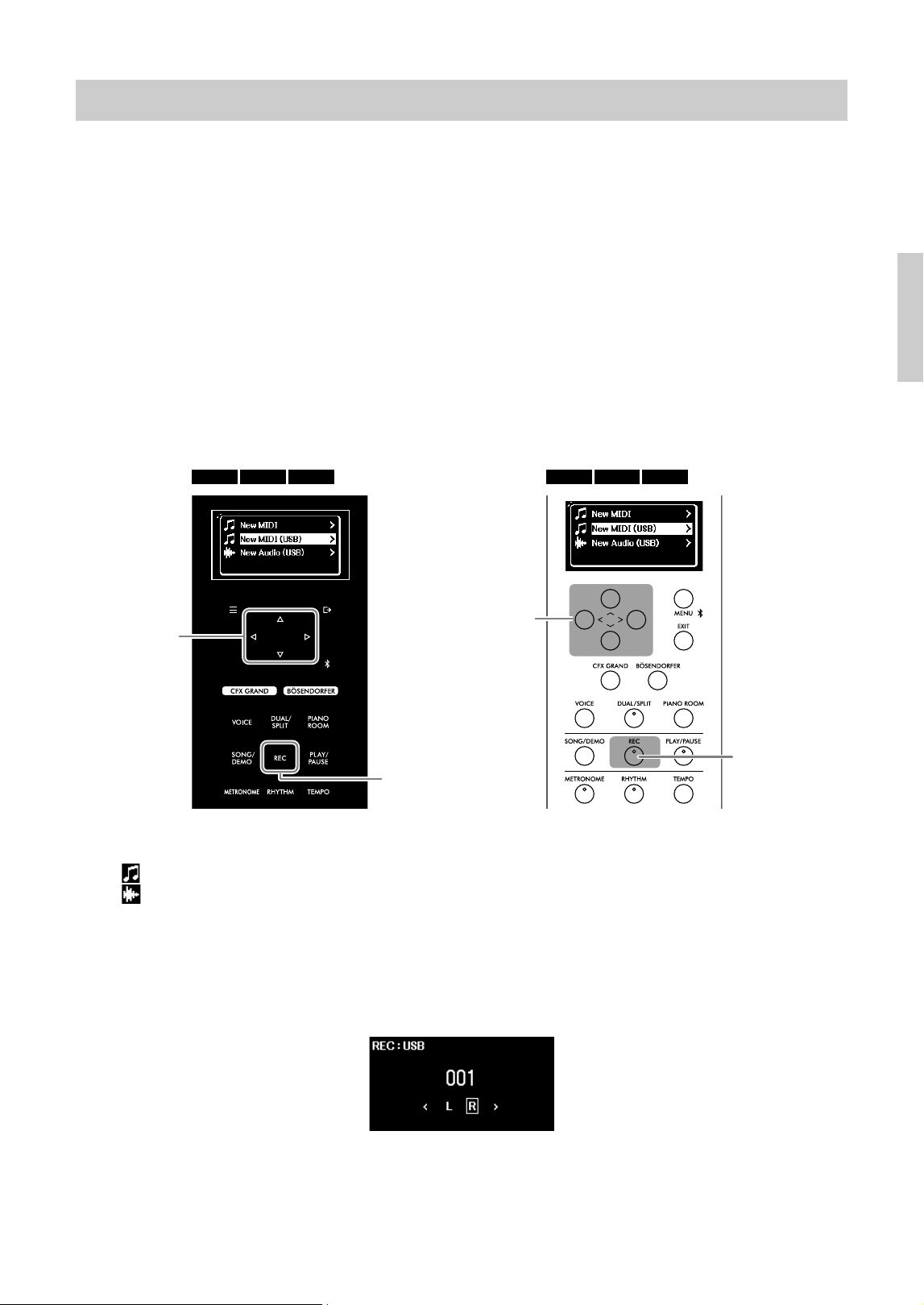
Recording Your Performance
39
CLP-885 CLP-875 CLP-845 CLP-835 CLP-895GP CLP-865GP Owner’s Manual
This section explains how to record a new performance and save it to the USB flash drive as a MIDI Song or an
Audio Song.
NOTE
Before using a USB flash drive, be sure to read “Using the USB [TO DEVICE] terminal” on page 6.
1. Connect the USB flash drive to the USB [TO DEVICE] terminal.
2. Make the necessary settings such as Voice selection.
If you want to use functions such as Dual, Split and metronome, turn them on here.
If you want to play back Rhythm, select it here, but make sure to start playback in step 6. If you start Rhythm
playback here, going on to the next step stops playback.
NOTE
The metronome sound is not recorded. Rhythm is recorded by default; however, you can set whether Rhythm is recorded or not in the Recording
menu (page 51).
3. Press and hold the [REC] button for a second to call up a list of recording target Songs.
4. Use the [u]/[d] buttons to select “New MIDI (USB)” or “New Audio (USB).”
• New MIDI (USB): For recording a new MIDI Song and saving it to the USB flash drive.
• New Audio (USB): For recording a new Audio Song and saving it to the USB flash drive.
NOTE
• “New MIDI (USB)” and “New Audio (USB)” can be selected only when a USB flash drive is connected to the USB [TO DEVICE] terminal.
• “New MIDI” is for recording a new MIDI Song and saving it to the instrument (same as step 2 on page 37).
5. Press the [r] button to set recording to standby.
The REC display appears and the [PLAY/PAUSE] button flashes.
6. Follow the same operations as steps 3–6 on page 38.
The recorded Song will be named “USERSONG***.mid” for MIDI Songs, and “USERAUDIO***.wav” for Audio
Songs (***: number), and is saved in the “USER FILES” folder of the USB flash drive.
Recording to a USB flash drive (MIDI recording/Audio recording)
3
3
4, 5
4, 5
885 875 845 835895GP 865GP
Recording
target list
Recording
target list
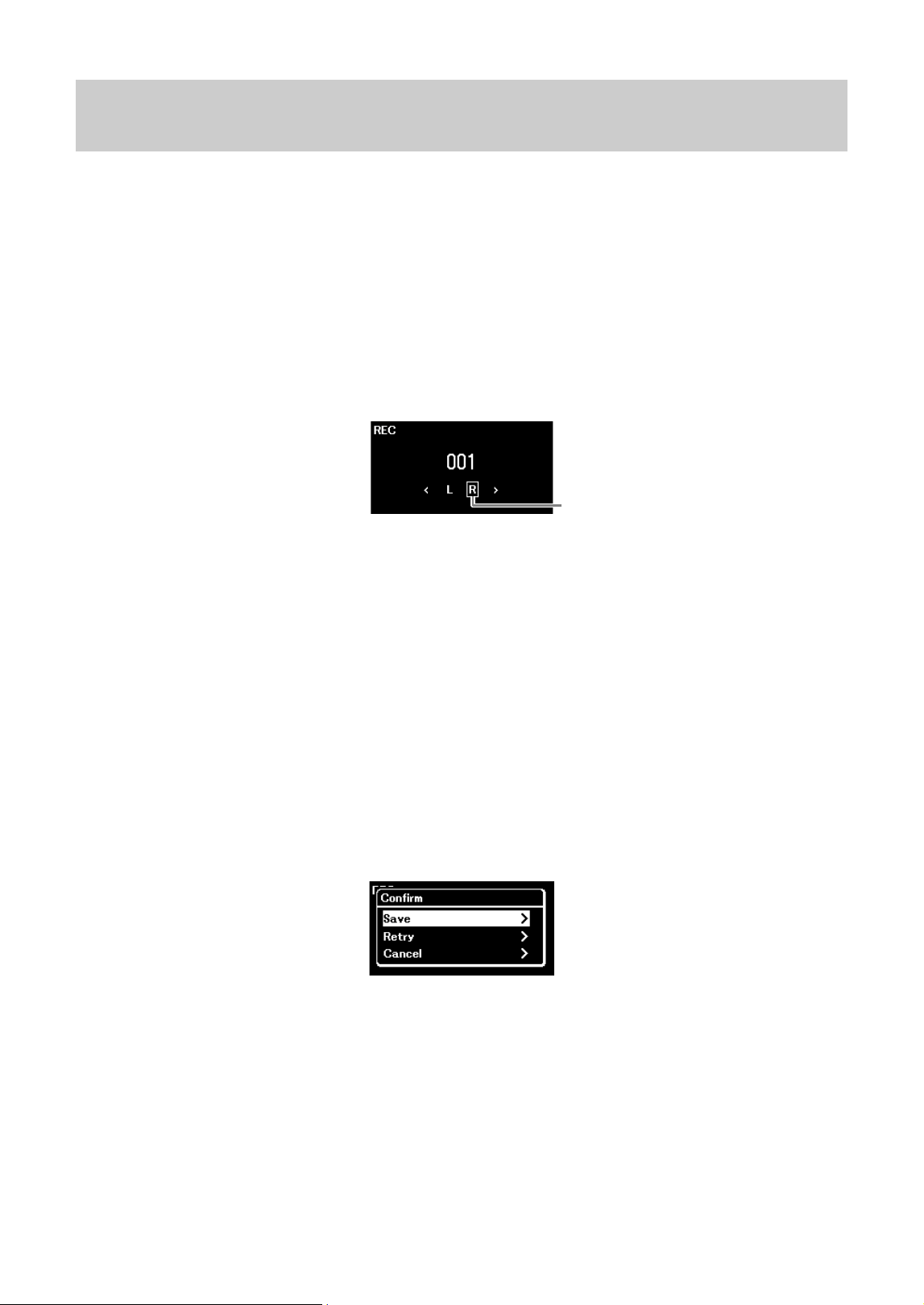
Recording Your Performance
40
CLP-885 CLP-875 CLP-845 CLP-835 CLP-895GP CLP-865GP Owner’s Manual
With MIDI recording, you can record right-hand and left-hand parts independently and save them as a single Song.
This lets you create a piece that would be difficult play live with both hands together. This can also be convenient for
letting children practice, for example, by recording the performance of a parent or teacher, and having the child can
play one hand part along with playback of the model part.
1. Make the necessary settings such as Voice selection.
If you want to save the recorded data to a USB flash drive, connect a USB flash drive to the USB [TO DEVICE]
terminal.
2. Press the [REC] button to set recording to standby.
The REC display appears and the [PLAY/PAUSE] button flashes.
NOTE
To record to the USB flash drive, hold the [REC] button until the list of recording target Songs (step 3 on page 39) appears, and then select “New
MIDI (USB).”
3. Use the [l]/[r] buttons to select the first part to record: “R” (Right-hand) or “L” (Left-
hand).
4. Start recording and play the keyboard.
Playing the keyboard automatically starts recording. If you want to record some silence at the start of the Song,
press the [PLAY/PAUSE] button to start recording.
5. After you finish your performance, press the [REC] button again to stop recording.
6. In the “Confirm” display, use the [u]/[d] buttons to select “Save,” and then press the
[r] button to save the data.
If you want to record again, select “Retry” and return to step 3.
If you do not want to save the data and exit from this display, select “Cancel.”
After the operation is completed, a “Save Completed” message appears and operation returns to the Song
display. The recorded Song will be named “USERSONG***” (***: number) and is saved in the “User” category
(page 31).
NOTICE
The recorded Song will be lost if you change to another Song or you turn the power off without executing the Save operation.
7. Press the [PLAY/PAUSE] button to listen to the recorded performance.
8. Press and hold the [REC] button for a second to call up a list of the recording target
Songs.
Recording the right- and left-hand parts independently (MIDI
recording)
REC display
Recording part
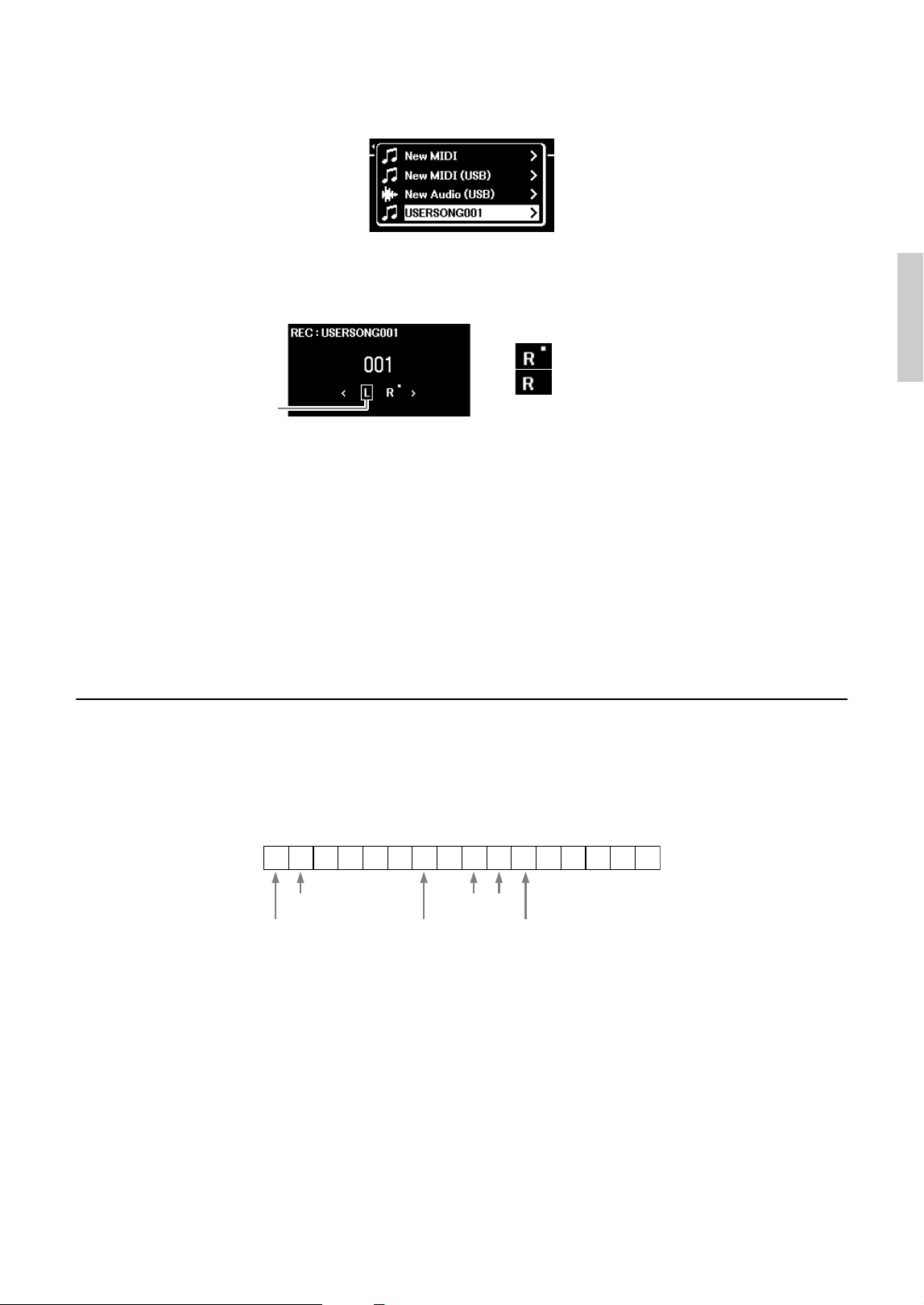
Recording Your Performance
41
CLP-885 CLP-875 CLP-845 CLP-835 CLP-895GP CLP-865GP Owner’s Manual
9. Use the [d] button to select the MIDI Song (at the bottom of the list) saved in step 6,
and then press the [r] button.
10.Use the [l]/[r] buttons to select the second part to record: “R” (Right-hand) or “L”
(Left-hand).
NOTICE
Keep in mind that recording your performance to a part (track) containing data will overwrite the previously recorded data.
11. Follow the same operations as steps 4–6, and overwrite the recorded data.
While recording, the previously recorded part is played back.
After saving the data, press the [PLAY/PAUSE] button to listen to the recorded performance.
NOTE
• If you want to re-record one part after saving the data, start from step 8. If your desired Song is not shown in step 9, press the [SONG] button
and select the desired Song, and then start from step 8 again. In step 10, select the part to re-record.
• To delete the data of one part, select the desired part (track) from “Edit” > “Track Delete” in the Song menu (page 51). “R” is the same as
track 1, and “L” the same as track 2. For details, refer to the Reference Manual.
Overdubbing multiple parts (multi track recording)
With MIDI Recording, you can create a MIDI Song consisting of 16 tracks by recording your performance to each
track one by one.
As described in the section above, the right-hand part was recorded to “R” (track 1), and then the left-hand part was
recorded to “L” (track 2). In step 3 or 10, another track from Track 3 – Track 16 (Extra 3 – Extra 16) can be selected,
allowing you to add recording data to additional tracks and save everything together as a Song. In this way, you can
record a Duet Song only by yourself, or you can create even more complex Songs.
• When Dual/Split/Duo is on (page 27), only the Right 1 Voice (for Dual) and Right Voice (for Split/Duo) performance
is recorded to the selected track. The Right 2 Voice (for Dual) will be recorded to the track number which is 6 plus
the selected track, and the Left Voice (for Split/Duo) will be recorded to the track number which is 3 plus the
selected track. If the track number exceeds 16, the track count starts again from the top.
• When recording the Rhythm (page 29), you cannot freely select desired tracks. The drum part is recorded to
Tracks 9 and 10, and the bass part is recorded to Track 11.
NOTICE
Note that recording your performance to a track containing data will overwrite the previously recorded data. Take special notice
when Dual, Split or Duo is on, because the recording tracks are automatically assigned. To see which track contains data, check
the REC display (step 10 above).
NOTE
The data in each track can be played back individually from “Others” > “Play Track” in the Song menu (page 51). For details, refer to the Reference
Manual.
Recording part (track)
Track data status
: Contains data
: Contains no data
12345678910111213141516
Example of
recording tracks
Right-hand part
Left-hand part
Right 2 Voice
in Dual
Rhythm
(bass part)
Rhythm
(drum part)
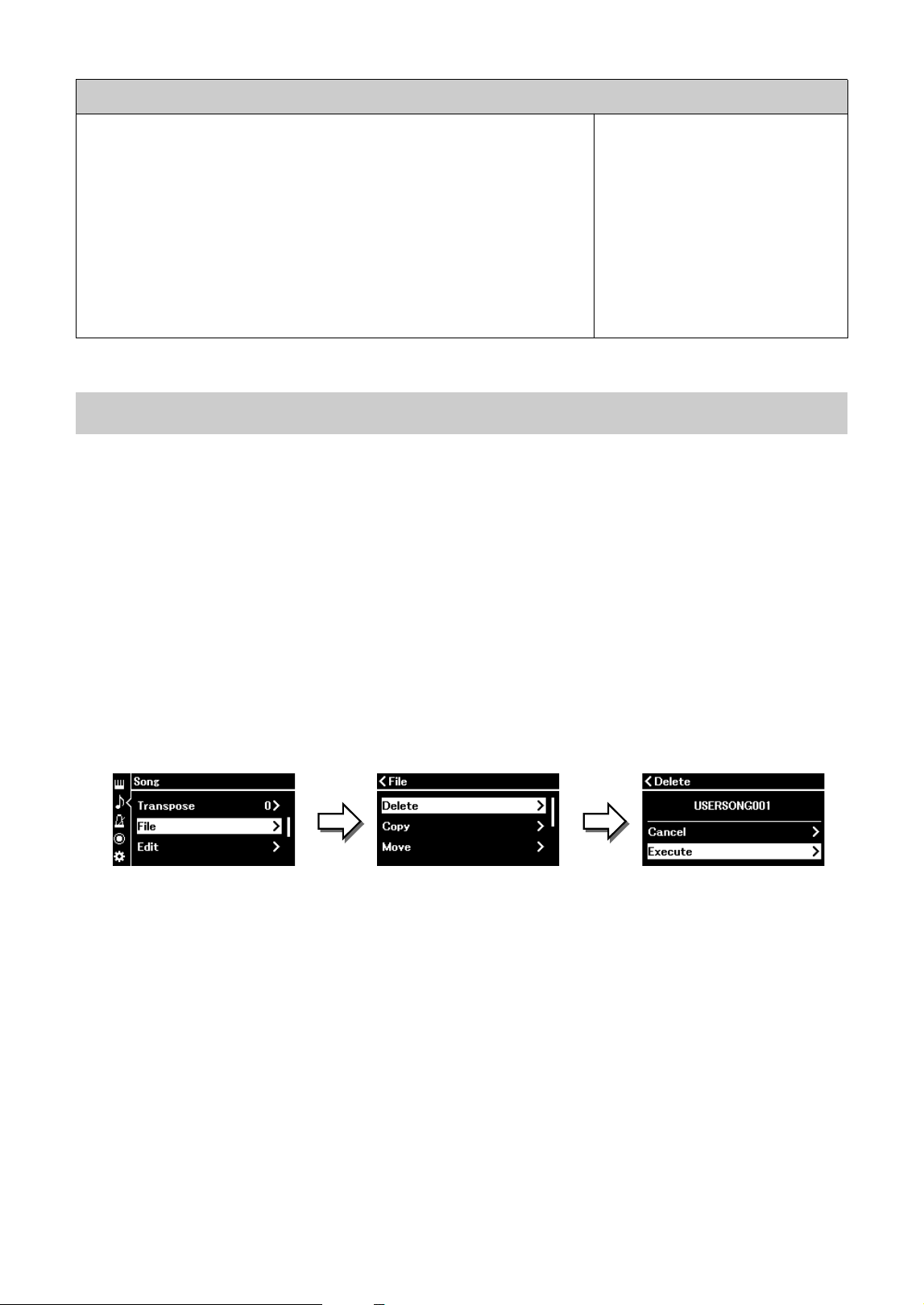
Recording Your Performance
42
CLP-885 CLP-875 CLP-845 CLP-835 CLP-895GP CLP-865GP Owner’s Manual
You can delete Songs recorded and saved in the instrument or USB flash drive. You can delete the selected Song
one by one, or delete all “User” category Songs in the instrument, or delete all Songs in the “USER FILES” folder of
the connected USB flash drive.
NOTE
The Songs in the folder contained in the “USER FILES” folder of the USB flash drive are not deleted.
1. Select the desired Song (page 31) to delete.
To delete all “User” category Songs in the instrument or delete all Songs in the “USER FILES,” select any one
of the Songs in the folder.
2. Press the [MENU] button several times to call up the Song menu (page 51).
3. Use the [u]/[d] buttons to select “File,” and then press the [r] button to call up the
function.
4. Use the [u]/[d] buttons to select “Delete” or “Delete All,” and then press the [r]
button to actually select it.
5. Use the [u]/[d] buttons to select “Execute,” and then press the [r] button to actually
execute the operation.
An “Executing” message appears. After the operation is completed, a “Completed” message appears and
operation returns to the Song selection display.
NOTICE
Do not turn off the power or disconnect the USB flash drive while “Executing” is shown in the display. Doing so may damage
the data.
NOTE
To delete the data of each part (track), use “Edit” > “Track Delete” in the Song menu (page 51). For details, refer to the Reference Manual.
Data recorded to MIDI Songs
Data for each part
• Note data (keyboard performance)
• Voice selection
• Pedal operations (Damper, Soft, Sostenuto)
• Grand Expression Modeling data
• Following settings that can be set in the Voice menu (page 51)
- Voice Edit
Octave, Volume, Reverb Depth, Chorus Depth, Effect, Effect depth, Pan,
Harmonic Content, Brightness, Touch
- Balance
Detune (only when Dual is turned on)
Data commonly for all parts
• Scale
• Tempo
• Time Signature
• Reverb type
• Chorus type
Deleting the recorded Songs
345
Song menu
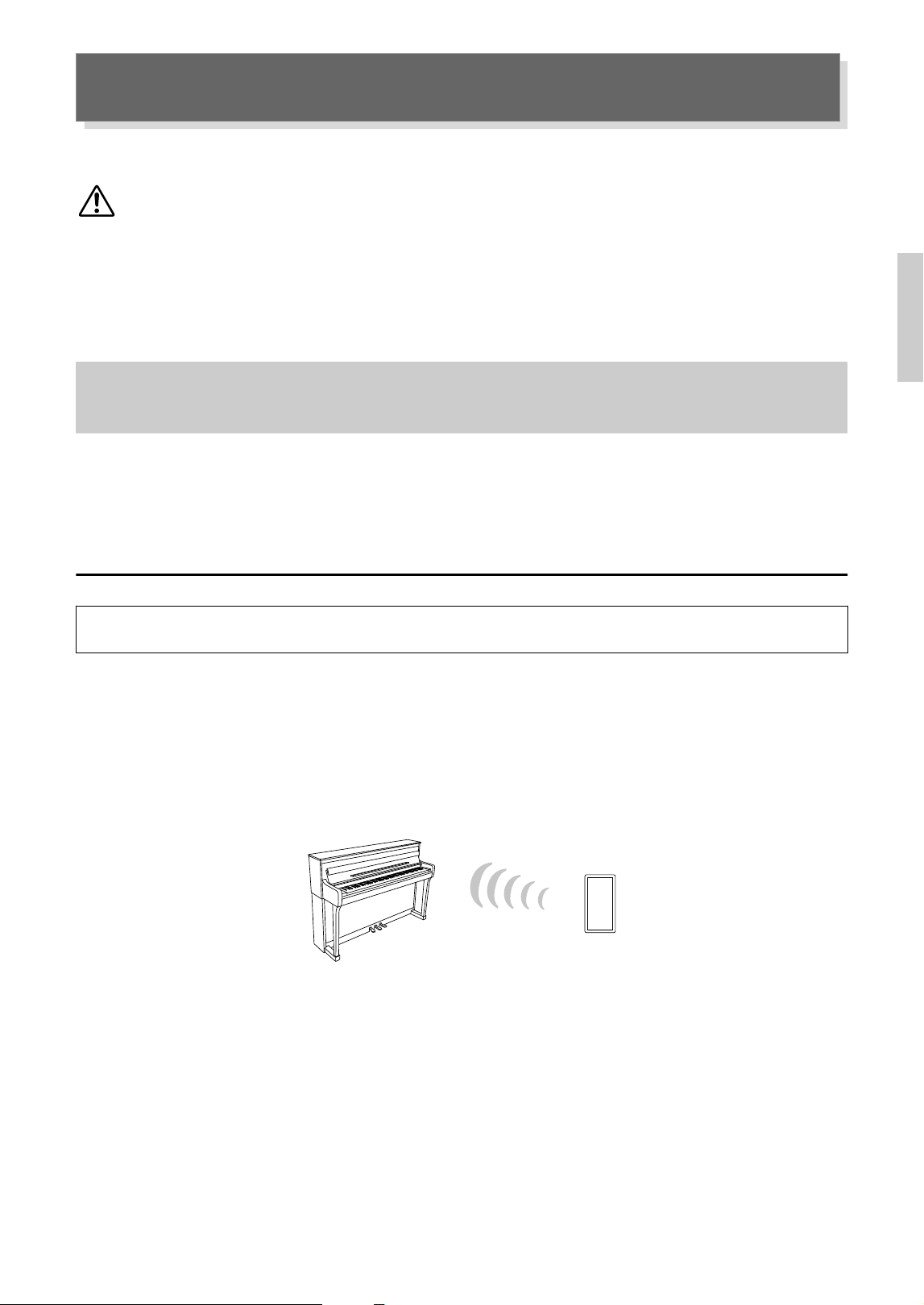
43
CLP-885 CLP-875 CLP-845 CLP-835 CLP-895GP CLP-865GP Owner’s Manual
Connecting to Other Devices
Connecting external devices to this instrument provides even greater convenience performance options. For
information on the location of these connectors, refer to “Panel Controls and Terminals” on page 12.
CAUTION
Before connecting the instrument to other electronic devices, turn off the power of all the devices. Also, before turning any devices
on or off, make sure to set all volume levels to minimum (0). Otherwise, damage to the devices, electrical shock, or even permanent
hearing loss may occur.
NOTICE
Do not place any devices in an unstable position. Doing so may cause the device to fall and result in damage.
Connecting an audio player such as smartphone or tablet to the instrument allows you to output audio from that
connected device from the instrument’s speakers. The audio player can be connected via the Bluetooth Audio
function, [AUX IN] jack, or USB [TO HOST] terminal.
Connecting via Bluetooth (Bluetooth Audio function)
A Bluetooth-equipped audio player can be connected by the Bluetooth Audio function. Audio playback on the
connected device is output from the built-in speakers of this instrument.
NOTE
• Depending on the country in which you purchased the product, the instrument may not have Bluetooth capability (page 21).
• In order to use the Bluetooth function via wireless communication, the audio player must be equipped for transmitting audio data. For proper
operation, the device must be compatible with A2DP (Advanced Audio Distribution Profile).
• Since this instrument cannot transmit audio data to external devices via Bluetooth, Bluetooth headphones or speakers cannot be connected.
To connect via Bluetooth, the Bluetooth function of this instrument should be turned on. By default, the Bluetooth
function is set to on, however you can turn it on/off from “Bluetooth” in the System menu (page 51). For details, refer
to the Reference Manual.
Listening to audio player playback through the instrument’s
speakers
Before using the Bluetooth function, be sure to read “About Bluetooth” on page 7.
Instrument
Bluetooth-equipped
audio player
Bluetooth Audio
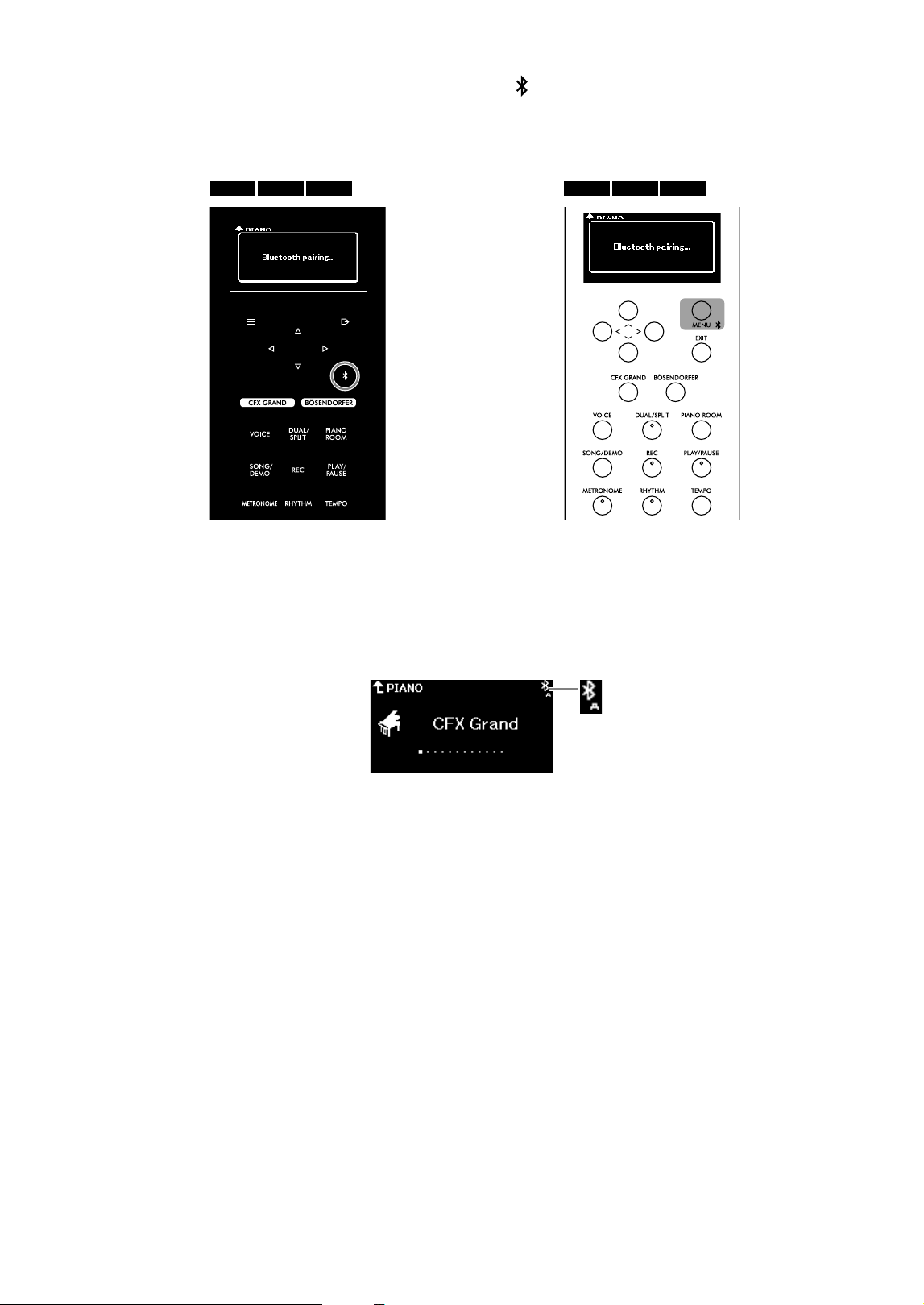
Connecting to Other Devices
44
CLP-885 CLP-875 CLP-845 CLP-835 CLP-895GP CLP-865GP Owner’s Manual
1. (CLP-885/CLP-875/CLP-895GP) Hold down the [ ] (Bluetooth) button for 3 seconds.
(CLP-845/CLP-835/CLP-865GP) Hold down the [MENU] button for 3 seconds.
A message appears indicating that the instrument is set to standby for pairing (registering) the Bluetooth-
equipped device.
To cancel the pairing, press the [EXIT] button.
2. On the audio player, set the Bluetooth function to on and select “CLP-*** (model name)
AUDIO” from the connection list.
For details, refer to the audio player’s manual. After pairing is completed, the connection status will be shown
in the display.
NOTE
• Make sure to complete the settings on the audio player within 5 minutes.
• Only one Bluetooth-equipped audio player can be connected to this instrument at a time (although up to 8 audio players can be paired to this
instrument). When pairing with the 9th audio player has succeeded, pairing data for the audio player with the oldest connection date will be
deleted.
3. Play back audio data on the audio player to confirm that the speakers of the instrument
can output audio sound.
When you turn on the instrument the next time, the last-connected audio player will be connected to this
instrument automatically, if the Bluetooth function of the audio player and the instrument is set to on. If it is not
connected automatically, select the model name of the instrument from the connection list on the audio player
again.
885 875 845 835895GP 865GP
Indicates audio data
can be received
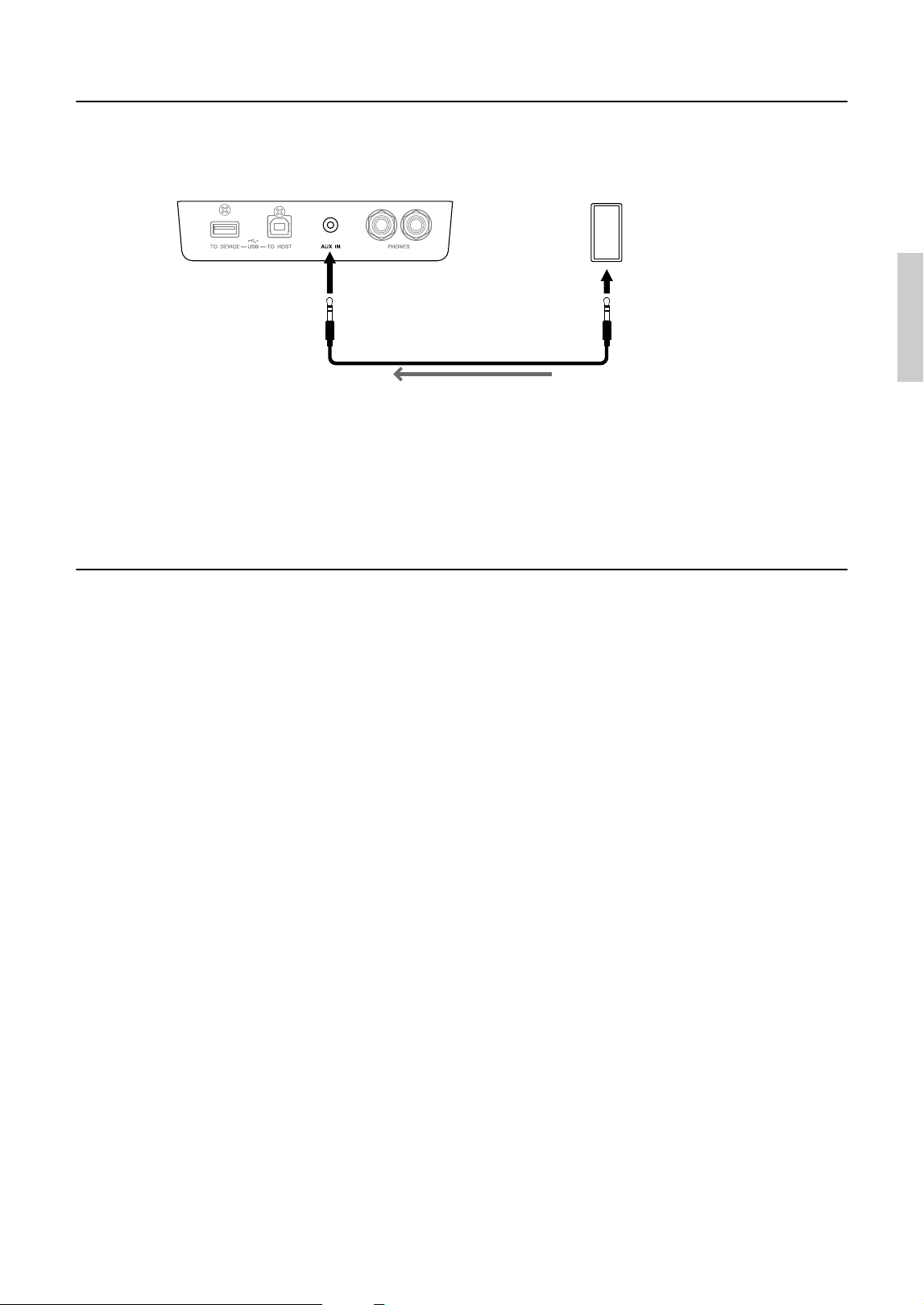
Connecting to Other Devices
45
CLP-885 CLP-875 CLP-845 CLP-835 CLP-895GP CLP-865GP Owner’s Manual
Connecting with an audio cable ([AUX IN] jack)
You can connect the headphone jack of an audio player to the instrument’s [AUX IN] jack by using an audio cable.
Audio playback on the connected device is output from the built-in speakers of this instrument.
NOTICE
To avoid damage to the devices, first turn on the power to the external device, and then to the instrument. When turning off the
power, do in reverse: first turn off the power to the instrument, and then to the external device.
NOTE
Use audio cables and adaptor plugs having no (zero) resistance.
Connecting with a USB cable (USB [TO HOST] terminal)
By using a USB cable and a USB conversion adaptor, you can connect an audio player (or smart device such as
smartphone) to the USB [TO HOST] terminal of the instrument. With this connection, the instrument can be used as
a USB audio interface, allowing audio data to be transmitted and received between the instrument and the
connected device. For details, refer to page 48.
NOTICE
Use an AB type USB cable of less than 3 meters. USB 3.0 cables cannot be used.
Instrument
Phone plug (stereo mini)
Phone plug (stereo mini)
Audio player
Audio cable
Headphone jack
Audio signal
Example
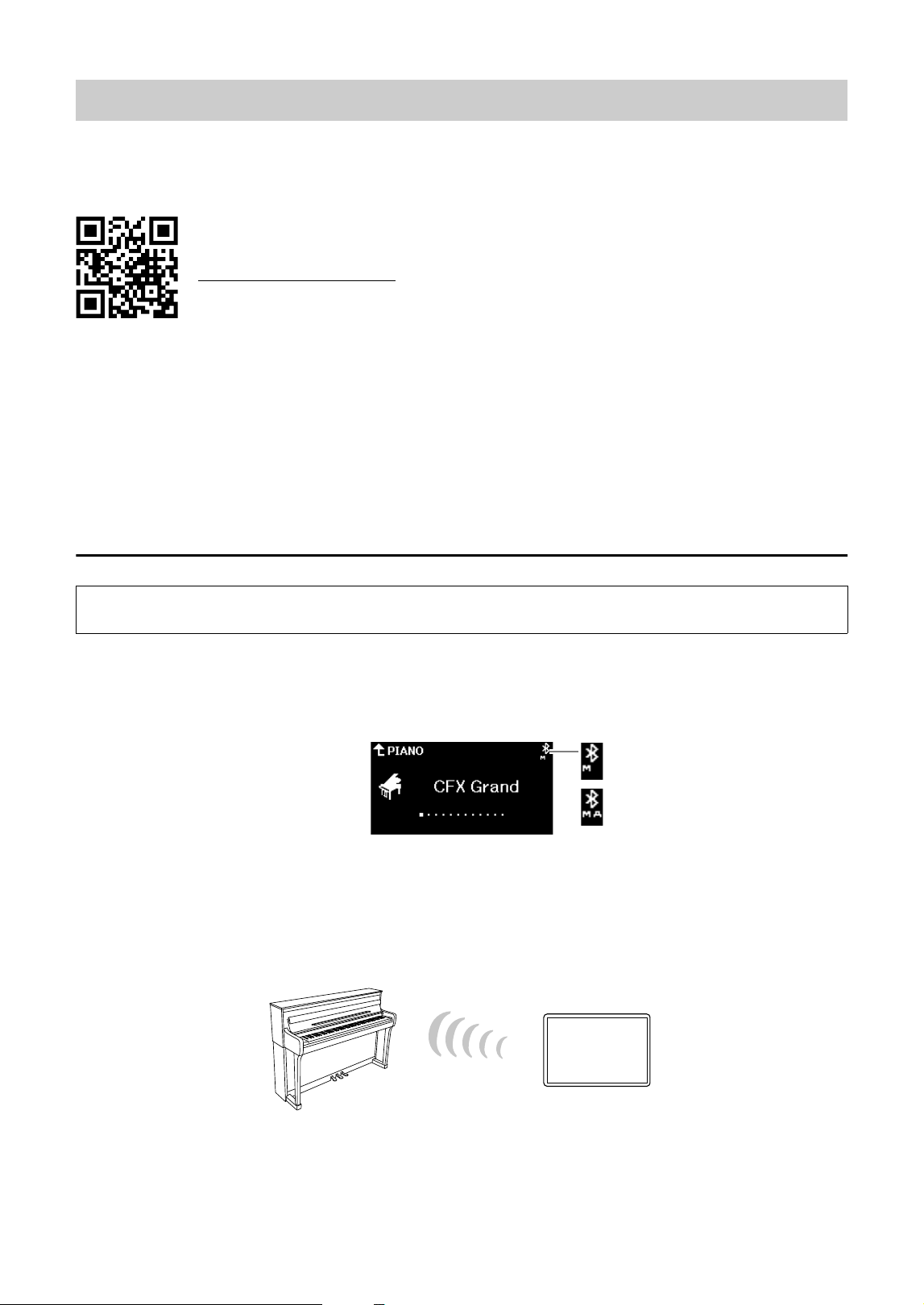
Connecting to Other Devices
46
CLP-885 CLP-875 CLP-845 CLP-835 CLP-895GP CLP-865GP Owner’s Manual
By connecting to a smart device such as a smartphone or tablet and using Smart Pianist, you have access to a
variety of exceptionally convenient functions, such as viewing music scores and recording your performances to the
device. The intuitive visual interface also helps you confirm the current settings of the instrument.
For details on the app and compatible devices, access the website below and check the “Smart
Pianist” page.
https://yamaha.com/kbdapps/
After installing the Smart Pianist app on your smart device, connect this instrument to the device via USB cables,
Bluetooth or wireless LAN (Wi-Fi). For instructions on how to connect the device and use the app, refer to the
“Smart Pianist User Guide.”
NOTICE
All settings on the instrument are replaced by the settings on Smart Pianist when the instrument is connected with Smart Pianist.
NOTE
While Smart Pianist is connected, you cannot use the control panel on the instrument. Use Smart Pianist to control the instrument. To disconnect Smart
Pianist, close Smart Pianist on the smart device or press the [EXIT] button on the instrument.
Connecting via Bluetooth
To connect the instrument and a smart device via Bluetooth, you need to make Bluetooth MIDI and Bluetooth Audio
settings individually. In order to use Smart Pianist, Bluetooth MIDI connection is necessary. For listening to audio
data on the smart device from the instrument, Bluetooth Audio connection is required as well.
Once Bluetooth connection has been made successfully, the connection status appears on the display.
NOTE
• Depending on the country in which you purchased the product, the instrument may not have Bluetooth capability (page 21).
• When the device is connected by Bluetooth, you cannot record in audio format by using Smart Pianist. To enable audio recording, connect via USB
cable (page 47) or Wi-Fi (page 47).
1. Connect the instrument and the smart device by Bluetooth Audio (page 44).
When the connection is successful, audio data can be received on the instrument. This lets you listen to audio
playback on the smart device from the instrument’s speaker.
Using the convenient Smart Pianist app
Before using the Bluetooth function, be sure to read “About Bluetooth” on page 7.
Indicates MIDI data can be
transmitted/received
Indicates MIDI data can be
transmitted/received, and
audio data can be received
Instrument
Smart device
Bluetooth Audio
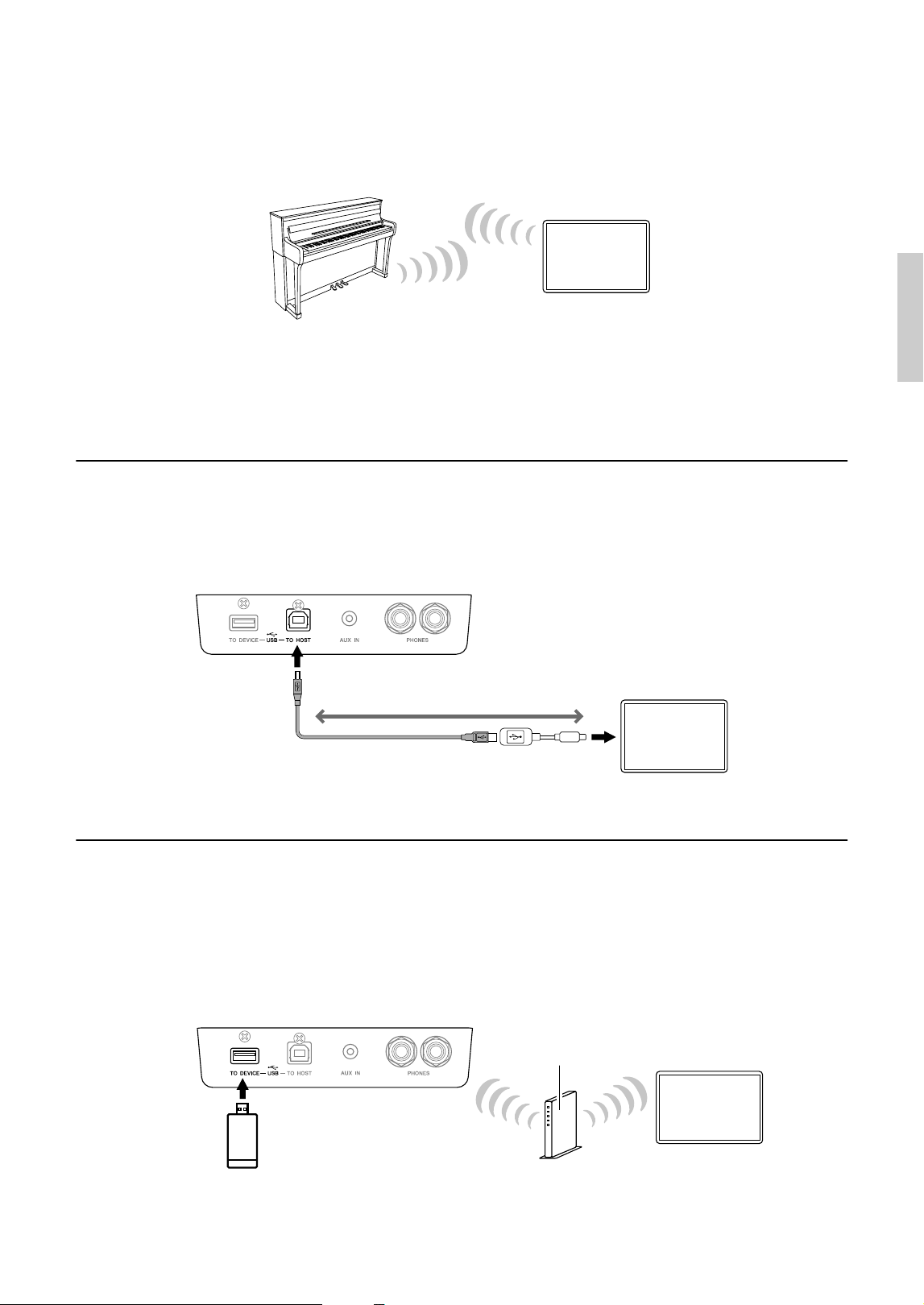
Connecting to Other Devices
47
CLP-885 CLP-875 CLP-845 CLP-835 CLP-895GP CLP-865GP Owner’s Manual
2. By using the Smart Pianist app, connect the instrument and the smart device by
Bluetooth MIDI.
For details on connection, refer to the “Smart Pianist User Guide.” Make sure to select “CLP-*** (model name)
MIDI” for pairing.
When the connection is successful, MIDI data can be transmitted/received between the instrument and the
smart device. This lets you record your keyboard performance in MIDI format to the smart device, or listen to
the MIDI Song played on the smart device from the instrument’s speaker.
Connecting with a USB cable (USB [TO HOST] terminal)
By using a USB cable and a USB conversion adaptor, you can connect a smart device to the USB [TO HOST]
terminal on the instrument. For instructions on connection, refer to “Smart Pianist User Guide.”
NOTICE
Use an AB type USB cable of less than 3 meters. USB 3.0 cables cannot be used.
Connecting via wireless LAN (Wi-Fi) by using the UD-WL01 (sold separately)
To enable Wi-Fi connection, the separately sold UD-WL01 USB wireless LAN adaptor is required. Connect the USB
wireless LAN adaptor to the USB [TO DEVICE] terminal. Before using the USB wireless LAN adaptor, be sure to
read “Using the USB [TO DEVICE] terminal” on page 6.
For instructions on connection, refer to “Smart Pianist User Guide.”
NOTICE
Do not connect this product to a public Wi-Fi and/or Internet service directly. Only connect this product to the Internet through a
router with strong password protections. Consult your router manufacturer for information on optimum security practices.
Bluetooth MIDI
Instrument
Smart device
Instrument
Smart device
USB cable
USB conversion adaptor
Example
MIDI data/Audio data
Access point
(router)
USB wireless LAN adaptor
(UD-WL01)
Instrument
Smart device
Example
Wireless
LAN
Wireless
LAN
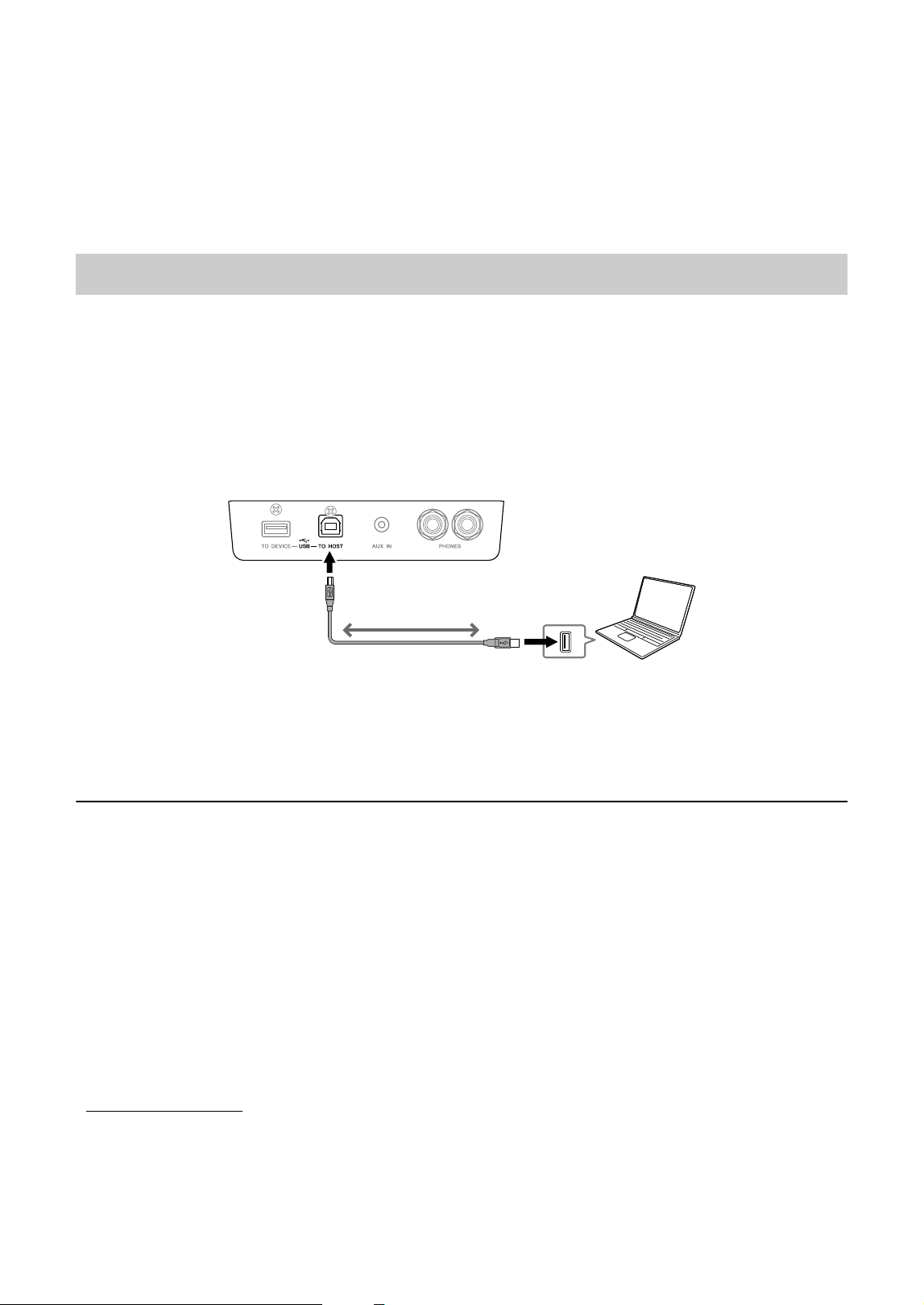
Connecting to Other Devices
48
CLP-885 CLP-875 CLP-845 CLP-835 CLP-895GP CLP-865GP Owner’s Manual
The instrument can be connected via Wi-Fi directly without need of an access point. However, in this condition
Internet access will be disabled on your smart device, and some functions of Smart Pianist (such as data export/
import to and from online storage, firmware update) cannot be used.
NOTE
• The USB wireless LAN adaptor (UD-WL01) may not be available depending on your area.
• An “access point” refers to a device which acts as a base station when data is transmitted/received via a USB wireless LAN adaptor. Some access
points are combined with router or modem functions.
By connecting a computer to the USB [TO HOST] terminal with a USB cable, you can use the instrument as a USB
audio/MIDI interface for transmitting/receiving MIDI data and audio data between the instrument and the computer.
Among the various possibilities are being able to play the instrument and record performance data by using the
computer, or playing music data on the computer and listening to it on the instrument.
NOTICE
• Use an AB type USB cable of less than 3 meters. USB 3.0 cables cannot be used.
• If you are using a DAW (digital audio workstation) application with this instrument, set the Audio Loopback function to off
(page 49). Otherwise, a loud sound may occur, depending on the settings of the computer.
NOTE
• When using a USB cable to connect the instrument to your computer, make the connections directly without passing through a USB hub.
• The instrument will begin transmission a short time after the USB connection is made.
• Unexpected sounds may occur if you edit MIDI data related to the Grand Expression Modeling effect (page 24) on a computer.
Transmitting/Receiving Audio Data (USB Audio Interface function)
By connecting a computer or a smart device to the USB [TO HOST] terminal via a USB cable, digital audio data can
be transmitted/received. This USB Audio Interface function provides the following advantages:
• Playing back audio data with high sound quality
This gives you direct, clear sound in which the sound quality has less noise and deterioration than that from the
[AUX IN] jack.
• Recording performance on the instrument as audio data by using a recording software or
a music production software
The recorded audio data can be played back on the computer or smart device.
NOTE
• Depending on the model or OS of the computer and smart device, noise may occur, or this function may not be available.
• When transmitting or receiving audio signals by using a computer running Windows, if operation is unstable or delays occur, use the “Yamaha
Steinberg USB Driver.” On the website below, search for “Yamaha Steinberg USB Driver” and install it on the computer. For instructions on installing
the driver, refer to the Installation Guide included with the download file.
https://download.yamaha.com/
Interfacing with a Computer
Instrument
Computer
USB cable
Example
USB terminal
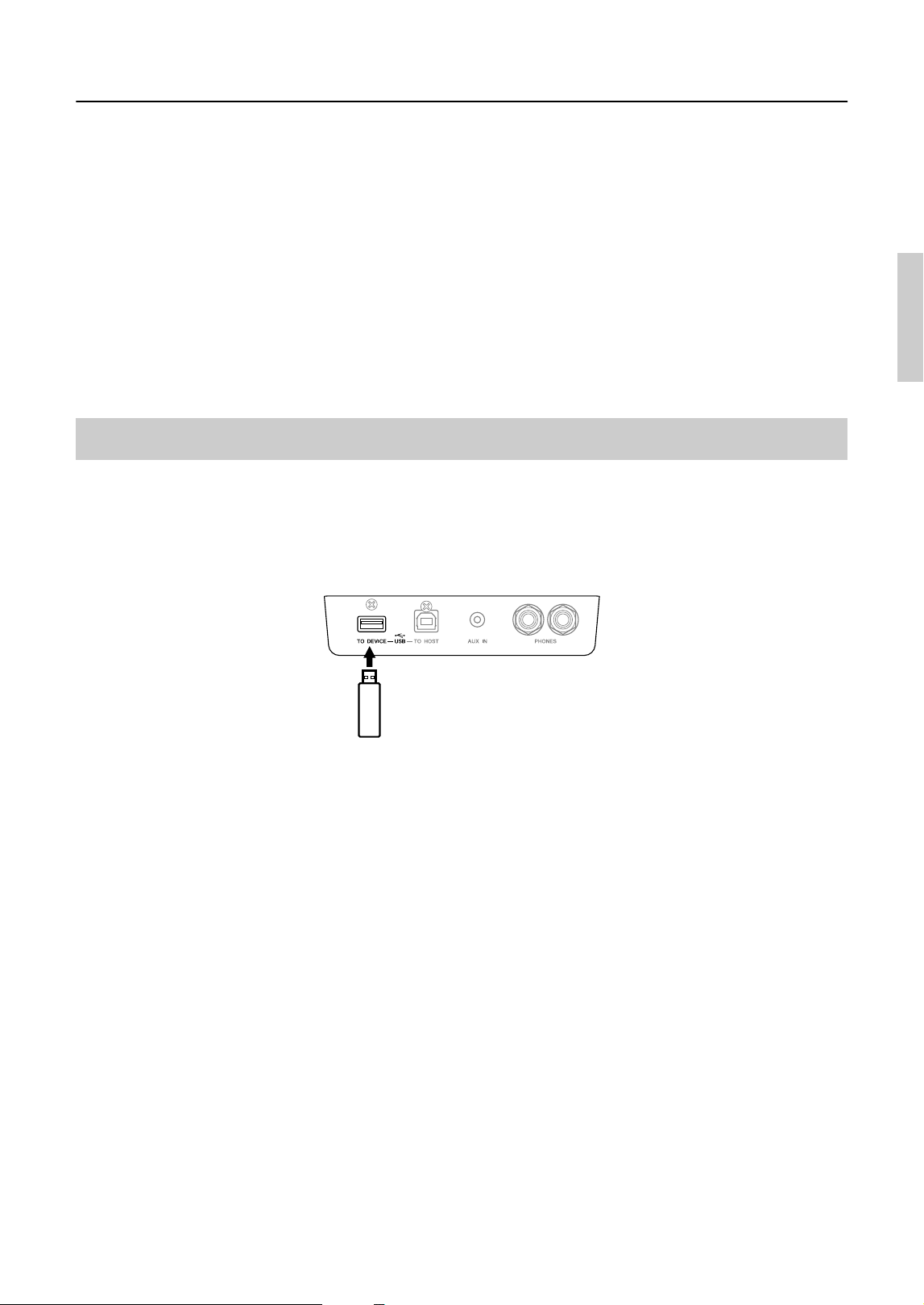
Connecting to Other Devices
49
CLP-885 CLP-875 CLP-845 CLP-835 CLP-895GP CLP-865GP Owner’s Manual
Turning Audio Loopback on/off
This allows you to set whether audio input sound from the connected computer or smart device is output to a
computer or a smart device or not along with the performance played on the instrument. To output the audio input
sound, set the Audio Loopback to “On.” For example, if you want to record the audio input sound as well as the
sound played on the instrument by using the connected computer or smart device, set this to “On.” If you intend to
record only the sound played on the instrument by using the computer or smart device, set this to “Off.”
This is set to “On” by default; however, the setting can be changed via “Utility” > “Audio Loopback” in the System
menu (page 51).
NOTE
• In this manual, “audio input sound” refers to audio data that is input to the instrument from connected external devices using one of these methods:
USB Audio Interface function, Bluetooth Audio function (page 43), [AUX IN] jack (page 45) or Wi-Fi (page 47).
• The sound cannot be output to a device connected by Bluetooth or the [AUX IN] jack.
• With Audio recording on this instrument (page 39), the audio input sound from the external device is recorded when this is set to on, while the sound
is not recorded when this is set to off. However, when the devices are connected via the Bluetooth Audio or [AUX IN] jack, the input sounds are always
recorded regardless of the Audio Loopback on/off setting.
A USB flash drive can be connected to the USB [TO DEVICE] terminal, allowing you to save data you have recorded
on the instrument to the USB flash drive (page 39), or play back data contained in the USB flash drive from the
instrument (page 31). Before using the USB [TO DEVICE] terminal, be sure to read “Using the USB [TO DEVICE]
terminal” on page 6.
When a message appears on the display indicating that the USB flash drive has not been formatted, format it from
“Utility” > “USB Format” in the System menu (page 51).
NOTICE
• Executing the Format operation will delete all data saved in the USB flash drive. Save important data to a computer or another
storage device.
• When turning off the instrument, make sure that the instrument is NOT accessing the USB flash drive by playback/recording or
file management (such as during Save, Copy, Delete and Format operations). Failure to do so may corrupt the USB flash drive
and the data.
NOTE
Although USB devices 2.0 or 3.0 can be used on this instrument, the amount of time for saving to or loading from the USB device may differ depending
on the type of data or the status of the instrument.
Connecting a USB flash drive
Instrument
USB flash drive
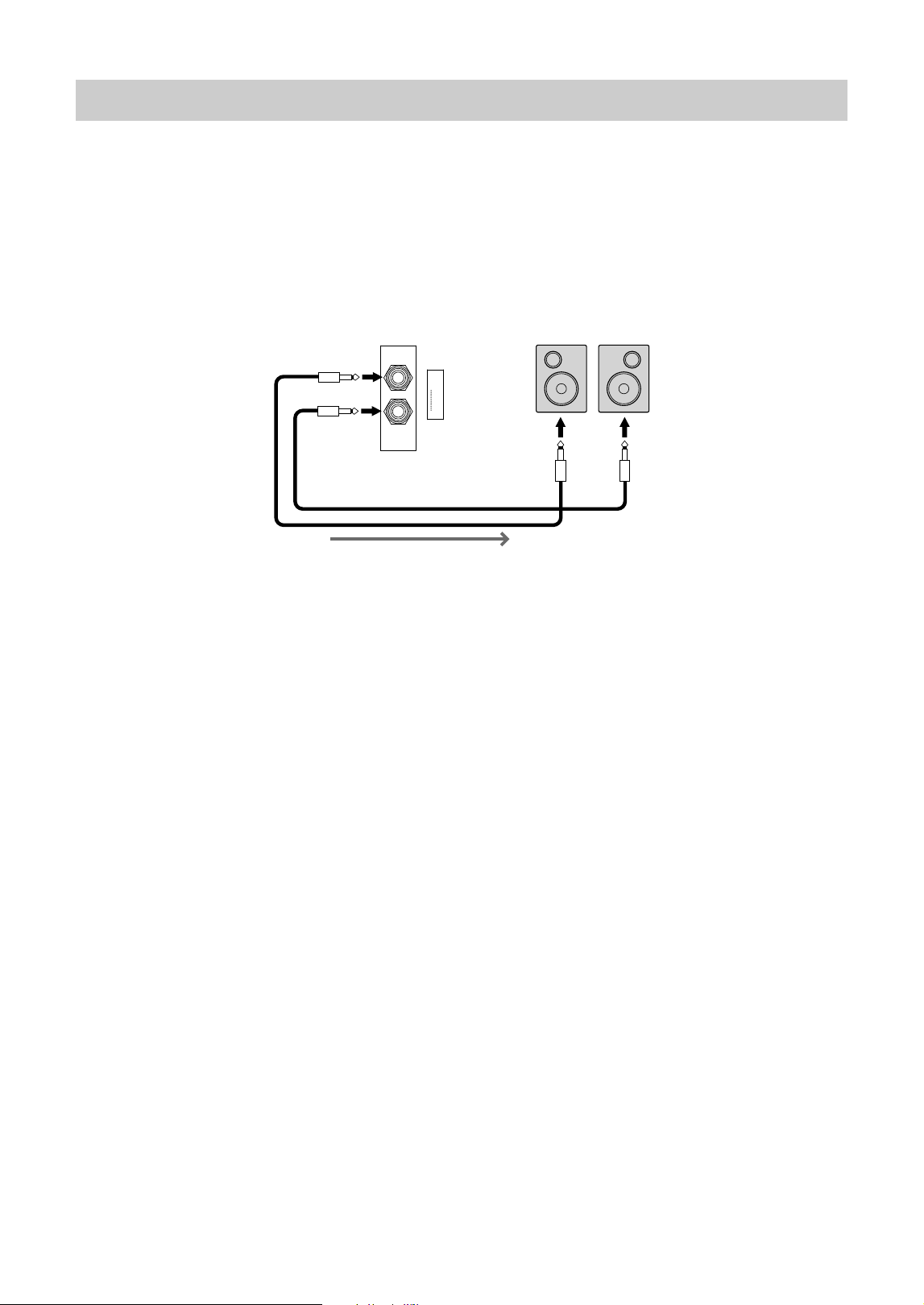
Connecting to Other Devices
50
CLP-885 CLP-875 CLP-845 CLP-835 CLP-895GP CLP-865GP Owner’s Manual
You can connect speakers to the AUX OUT [L/L+R]/[R] jacks by using audio cables to output the sound played on
the instrument to the connected devices.
NOTICE
• To avoid possible damage, first turn on the power to the instrument, and then to the external device. When turning off the power,
first turn off the power to the external device, and then to the instrument. Since this instrument’s power may automatically be
turned off due to the Auto Power Off function (page 17), turn off the power to the external device, or disable Auto Power Off when
you do not intend to operate the instrument.
• Do not route the output from the AUX OUT jacks to the [AUX IN] jack. If you make this connection, the signal input at the [AUX IN]
jack is output from the AUX OUT jacks. These connections could result in a feedback loop that will make normal performance
impossible, and may even damage the equipment.
NOTE
• Use only the [L/L+R] jack for connection with a monaural device.
• When you are monitoring the sound output via the AUX OUT jacks from headphones connected to the instrument, we recommend that you turn off
Binaural from “Sound” > “Binaural” in the System menu (page 51). For details, refer to the Reference Manual.
Outputting the instrument sound to external speakers
AUX OUT
L/L+R R
Instrument Powered speakers
Phone plug (standard)
Phone plug (standard)
Audio cable
Audio signal
Example
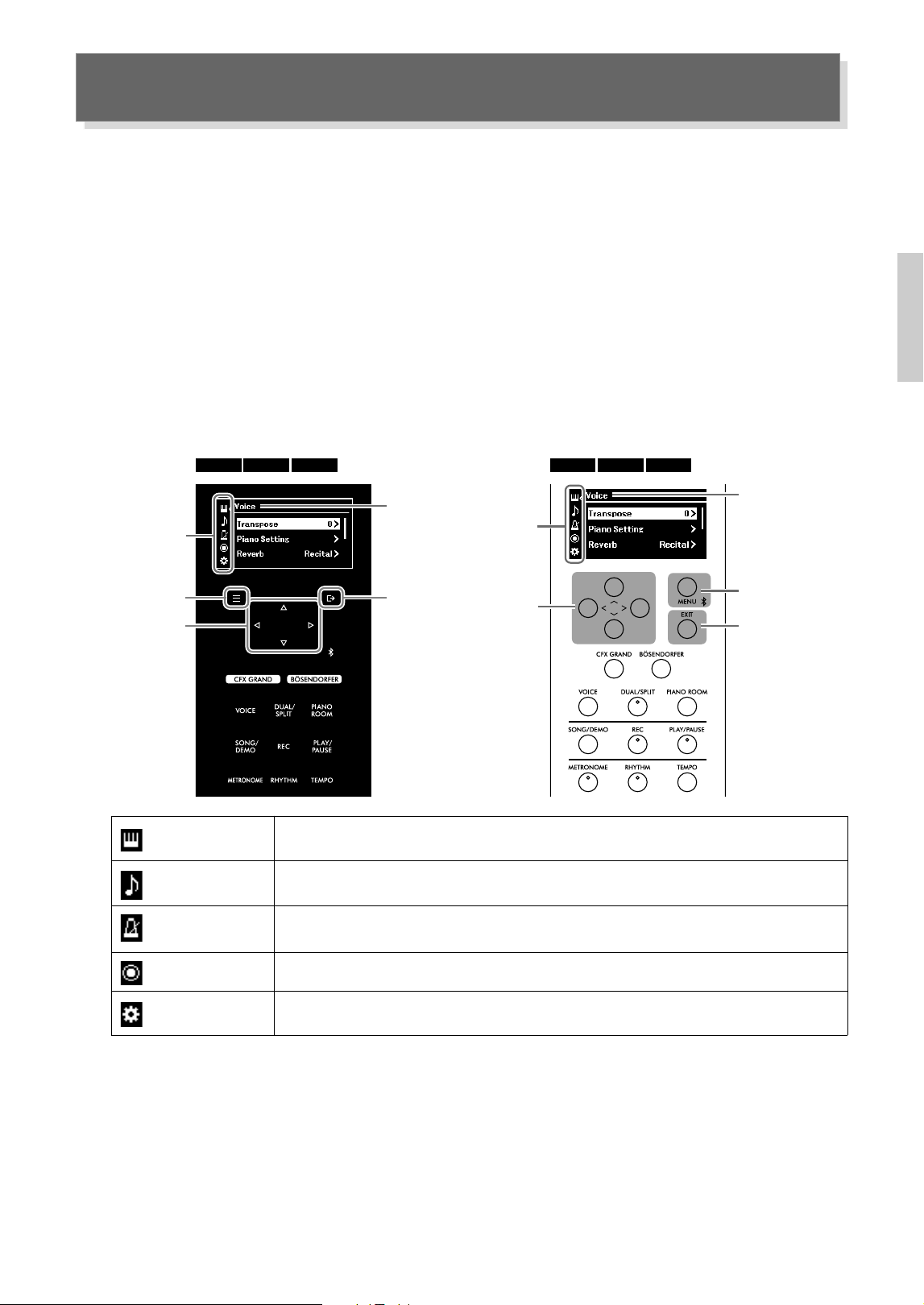
51
CLP-885 CLP-875 CLP-845 CLP-835 CLP-895GP CLP-865GP Owner’s Manual
Making Various Settings in the Menu Display
Pressing the [MENU] button calls up the Menu display. The Menu display contains five menus and allows you to
make settings related to Voice, Song, Metronome/Rhythm, Recording and System (overall settings for the
instrument). This section explains the basic operations in the Menu display. For details on each menu, refer to the
Reference Manual.
For the following, you will need to make additional settings before opening the Menu display.
• When you want to edit Voice-related parameters:
Select a Voice. If you want to edit Voices in Dual/Split/Duo, turn on the desired function.
• When you want to edit Song-related parameters:
Select a Song.
1. Press the [MENU] button several times to select the desired menu.
Pressing the button repeatedly switches among the menus. The menu name shown at the top of the display
and the icon at left indicate the selected menu.
2. Use the [u]/[d]/[l]/[r] buttons to select the desired parameter.
3. Use the [l]/[r] buttons to change the setting or execute the operation.
To reset the selected item to the default value on the CLP-885, CLP-875 and CLP-895GP, press and hold the
[MENU] button until the value is reset. On the CLP-845, CLP-835 and CLP-865GP, press the [l] and [r]
buttons simultaneously.
4. To exit from the Menu display, press the [EXIT] button.
Voice menu
For making keyboard performance settings (pedal function, volume balance in Dual/Split/Duo,
transpose, etc.), and for editing Voices.
Song menu
For making Song playback settings (repeat playback, volume, transpose, etc.), for editing
Songs, and for handling Song files.
Metronome/
Rhythm menu
For adjusting the metronome and rhythm volume, setting the metronome time signature, and
making rhythm related settings.
Recording menu
For making MIDI recording settings.
System menu
For making settings for the entire instrument (tuning, sound, Auto Power Off, display
brightness, etc.), formatting a USB flash drive, and backing up the instrument settings.
885 875 845 835
41
2, 3
2, 3
4
1
895GP 865GP
Menu name
Menu name
Menu icons
Menu icons
52
CLP-885 CLP-875 CLP-845 CLP-835 CLP-895GP CLP-865GP Owner’s Manual
Appendix
The preset Voices that are available differ among the models. The rows of the model names indicate if the model(s)
have the corresponding preset Voices or not.
: Yes (with Voice Demo)
: Yes (without Voice Demo)
–: No
Voice List
CLP-885
CLP-895GP
CLP-875
CLP-845
CLP-835
CLP-865GP
Voice
Category
Voice Name Description
Stereo
Sam-
pling
Touch
Sensi-
tivity
Key-off
Sam-
pling
VRM
PIANO CFX Grand Yamaha’s CFX concert grand piano sound with a
wide dynamic range for maximum expressive
control. Suitable for playing in any music genre and
style. When this Voice is selected, connecting the
headphones automatically enables binaural
sampling sound.
Bösendorfer The famed sound of the Vienna-made Bösendorfer
Imperial concert grand piano. Its spacious sound
evokes the size of the instrument, and is ideal for
expressing tenderness in compositions. When this
Voice is selected, connecting the headphones
automatically enables binaural sampling sound.
Upright Piano The sound sampled from an upright piano, the
Yamaha SU7. Enjoy the unique tonal character and
a lighter, more casual feel.
–
–
Studio Grand The sound of Yamaha’s C7 grand piano, which is
often used in recording studios. Its bright and clear
sound is good for popular styles.
–
Ballad Grand Grand piano sound with a soft and warm tone.
Good for playing ballads.
Jazz Grand A piano sound with unique tonal character. Good
for jazz styles.
Rock Grand A bright-sounding piano. Ideal for rock styles.
Warm Grand Warm and soft piano sound. Good for relaxing
music.
Bright Grand Bright piano sound. Good for clear expression and
“cutting through” other instruments in an ensemble.
–
Chill out Piano A heavily processed piano sound with deep reverb.
Good for relaxing music.
–
Lo-Fi Piano A warm piano sound typical of vintage vinyl
records. Good for styles such as early rock ’n’ roll or
classic rock.
–
HonkyTonk Pf A honky-tonk style piano. Enjoy a tonal character
that is quite different than a grand piano.
–
–
FORTE
PIANO
Scarlatti Piano The sound of a piano made by a musical
instrument maker in Florence in the early 18th
century. The maker is famous for inventing the
piano. It is believed that Scarlatti used the piano
made by the maker. The sound is bright and
brilliant.
–
Mozart Piano The sound of a piano made by a musical
instrument maker in Vienna in the late 18th century.
Mozart and Beethoven played and highly
appreciated the piano made by this manufacturer.
Its sound is clear and light.
– –
: Yes, –: No
Appendix
53
CLP-885 CLP-875 CLP-845 CLP-835 CLP-895GP CLP-865GP Owner’s Manual
–
FORTE
PIANO
Beethoven
Piano
The sound of a piano made by a piano
manufacturer in London in the early 19th century.
Haydn and Beethoven composed many
masterpieces inspired by the pianos of this
manufacturer. It features a rich bass, sparkling
highs and energetic fortissimo.
–
Chopin Piano The sound of a piano made by a piano
manufacturer in Paris in the 19th century. Chopin
deeply loved the pianos of this manufacturer, which
responded well to his sensitive touch. It has a
sound like a singing voice, sometimes luscious,
sometimes mournful.
– –
E.PIANO Stage E.Piano The sound of an electric piano using hammer-
struck metallic “tines.” Soft tone when played lightly,
and an aggressive tone when played hard.
– –
DX E.Piano An electronic piano sound produced by an FM
synthesizer. The tone will change as you vary your
playing touch. Ideal for popular music.
– – –
Vintage EP The sound of an electric piano using hammer-
struck metal reeds. Widely used in rock and popular
music.
– –
Soft EP An electric piano with a characteristic panning
effect. Good for playing quiet ballads.
– –
Phaser EP A distinctive phaser effect makes this ideal for
fusion styles.
– –
DX Bright A variation of electronic piano sound produced by
an FM synthesizer. Its bright and sparkling sound
character spice up the music.
– – –
Tremolo
Vintage
Includes tremolo ideal for Vintage EP. Frequently
used in rock music.
– –
–
ORGAN Organ
GrandJeu
A registration sound famous for use in French organ
compositions. This dramatic sound is ideal for
ending a performance.
– – –
Organ
Principal
This Voice features the combination of pipes
(8'+4'+2') of a principal (brass instrument) organ. It
is suitable for Baroque church music.
– – –
Organ Tutti This Voice features a full coupler of a pipe organ,
famous for the sound used in Toccata and Fugue by
Bach.
– – –
Jazz Organ 1 The sound of an electric organ often heard in jazz
and rock idioms. A slightly brighter sound in which
the Rotary effect is set to a slow speed.
* You can switch the speed of the Rotary effect between
slow and fast by pressing the left pedal.
– – – –
Jazz Organ 2 The sound of an electric organ often heard in jazz
and rock idioms. The Rotary effect is set to a fast
speed.
* You can switch the speed of the Rotary effect between
slow and fast by pressing the left pedal.
– – –
–
Rock Organ Bright and sharp electric organ sound. Optimum for
rock music.
– – – –
–
Organ Flute 1 A pipe organ sound that combines flute-type
(woodwind type) stops of different pitches (8' + 4').
This is a gentle sound that is ideal for
accompanying hymns.
– – –
–
Organ Flute 2 A pipe organ sound that combines flute-type
(woodwind type) stops of different pitches (8' + 4' +
1-1/3'). This is brighter than Organ Flute 1, and is
suitable for solos.
– – –
CLP-885
CLP-895GP
CLP-875
CLP-845
CLP-835
CLP-865GP
Voice
Category
Voice Name Description
Stereo
Sam-
pling
Touch
Sensi-
tivity
Key-off
Sam-
pling
VRM
Appendix
54
CLP-885 CLP-875 CLP-845 CLP-835 CLP-895GP CLP-865GP Owner’s Manual
STRINGS Strings Large-scale strings ensemble with realistic reverb.
Try combining this Voice with piano in Dual.
– –
Slow Strings The sound of a string ensemble, with a slow attack.
Suitable for use in Dual with piano or electric piano.
– –
Choir A big, spacious choir Voice. Perfect for creating rich
harmonies in slow pieces.
(CLP-
885/
CLP-
895GP
only)
– –
Slow Choir The sound of a choir with a slow attack. Suitable for
use in Dual with piano or electric piano.
– –
–
Mellow
Strings
A mellow string ensemble. Enjoy a tonal character
that is different from a Strings.
– –
–
Dark Pad Warm and spacious synth sound. Ideal for
sustained parts in the background of an ensemble,
or for use in Dual with piano or electric piano.
– – –
–
Lite Pad Bright and spacious synth sound. Ideal for
sustained parts in the background of an ensemble,
or for use in Dual with piano or electric piano.
– – –
–
Bell Pad Synth sound with a crisp, bell-like sound. Ideal for
layering in Dual with a piano or electric piano
sound, but also produces a bright, gorgeous sound
on its own.
– –
–
Synth Pad A warm, mellow, and spacious synth sound. Ideal
for sustained parts in the background of an
ensemble, or for use in Dual with piano or electric
piano.
– – –
BASS Acoustic Bass The sound of a finger-plucked upright bass.
Frequently used in jazz and Latin music.
– – –
Bass &
Cymbal
The sound of a cymbal has been layered onto the
bass. Effective when used for jazz walking-bass
lines.
– – –
Electric Bass The sound of an electric bass. Frequently used in
jazz, rock, and popular music.
– – –
Fretless Bass The sound of a fretless bass. Suitable for styles
such as jazz and fusion.
– – –
–
Vintage Bass A different type of electric bass with a soft and
warm sound.
– – –
OTHERS Harpsichord 8' The sound of the instrument frequently used in
baroque music. Variations in playing touch will not
affect the volume, and a characteristic sound will be
heard when you release the key.
– –
Harpsi. 8'+4' A harpsichord with an added upper octave.
Produces a more brilliant sound.
– –
–
Harp This sound was sampled from a grand harp. This
sound, with a bright attack, is ideal for playing
gorgeous phrases.
– – –
Vibraphone A Vibraphone with spacious and clear sound. Ideal
for popular music. Pressing the left pedal switches
Vibrato on and off.
– –
–
Marimba A marimba sound, sampled in stereo for
spaciousness and realism.
– –
–
Celesta The sound of a celesta (a percussion instrument in
which hammers strike metallic bars to produce
sound). This instrument is well-known for its
appearance in “Dance of the Sugar-plum Fairies”
from Tchaikovsky’s “Nutcracker Suite.”
– –
CLP-885
CLP-895GP
CLP-875
CLP-845
CLP-835
CLP-865GP
Voice
Category
Voice Name Description
Stereo
Sam-
pling
Touch
Sensi-
tivity
Key-off
Sam-
pling
VRM
Appendix
55
CLP-885 CLP-875 CLP-845 CLP-835 CLP-895GP CLP-865GP Owner’s Manual
• Key-off Sampling: Samples of the very delicate noises that are produced when keys are released.
• VRM (Virtual Resonance Modeling): Simulated string resonance sound with physical modeling when the damper pedal is pressed or keys are
pressed. Grand Expression Modeling is effective for VRM Voices. Effects cannot be applied to the VRM Voices.
Voice Demo List
The Voice Demos below are short rearranged excerpts of the original compositions. All other Demo Songs are Yamaha original (© Yamaha
Corporation).
OTHERS Nylon Guitar Stereo-sampled, nylon-string guitar with natural
reality. Suitable for any style of musics.
– –
Steel Guitar A bright steel-string guitar sound. Ideal for popular
music.
– – –
–
Scat You can enjoy jazz “scatting” with this Voice.
Depending on how hard and what note range you
play, different sounds will be produced.
– – –
–
XG – For details on XG Voices, refer to the “Data List” on
the website.
– – –
CLP-885
CLP-895GP
CLP-875
CLP-845
CLP-835
CLP-865GP
Voice
Category
Voice Name Title Composer
PIANO CFX Grand Ungarische rhapsodie “Preludio” E-Dur F. Liszt
Bösendorfer Widmung S.566 R.253 F. Liszt / R. Schumann
Upright Piano Sonatine F dur Anh.5(2) 1st mov. L. v. Beethoven
–
FORTE
PIANO
Scarlatti Piano Sonata G dur K.14 L.387 G. D. Scarlatti
Mozart Piano Sontata No.15 C dur K.545 1st mov. W. A. Mozart
–
Beethoven Piano Für Elise a moll L. v. Beethoven
Chopin Piano Nocturne op.27-2 Des dur F. F. Chopin
ORGAN Organ Principal Herr Christ, der ein’ge Gottes-Sohn BWV 601 J. S. Bach
OTHERS Harpsichord 8' Concerto a cembalo obbligato, 2 violini, viola e
continuo No.7 g moll BWV 1058 1st mov.
J. S. Bach
CLP-885
CLP-895GP
CLP-875
CLP-845
CLP-835
CLP-865GP
Voice
Category
Voice Name Description
Stereo
Sam-
pling
Touch
Sensi-
tivity
Key-off
Sam-
pling
VRM
Appendix
56
CLP-885 CLP-875 CLP-845 CLP-835 CLP-895GP CLP-865GP Owner’s Manual
Rhythm List
No. Name
Pops&Rock
1 8Beat
2 16Beat
3 Shuffle1
4 Shuffle2
5 Shuffle3
6 Gospel
7 8BeatBallad
8 6-8SlowRock
Jazz
9 FastJazz
10 SlowJazz
11 Swing
12 JazzWaltz
Latin
13 Samba
14 BossaNova
15 Rumba
16 Salsa
Kids&Holiday
17 KidsPop
18 6-8March
19 ChristmasSwing
20 Christmas3-4
Appendix
57
CLP-885 CLP-875 CLP-845 CLP-835 CLP-895GP CLP-865GP Owner’s Manual
50 Classics
Lesson Songs
*The Lesson Songs are original compositions.
Song List
No. Song Title Composer
Arrangements
1 Canon D dur J. Pachelbel
2 Air On the G String J. S. Bach
3 Jesus, Joy of Man’s Desiring J. S. Bach
4 Twinkle, Twinkle, Little Star Traditional
5
Piano Sonate op.31-2 “Tempest” 3rd mov.
L. v. Beethoven
6 Ode to Joy L. v. Beethoven
7 Wiegenlied op.98-2 F. P. Schubert
8 Grande Valse Brillante F. F. Chopin
9 Polonaise op.53 “Héroïque” F. F. Chopin
10 La Campanella F. Liszt
11 Salut d’amour op.12 E. Elgar
12 From the New World A. Dvořák
13 Sicilienne G. U. Fauré
14 Clair de lune C. A. Debussy
15 Jupiter (The Planets) G. Holst
Duets
16
Menuett (Eine kleine Nachtmusik K.525)
W. A. Mozart
17 Menuett G dur L. v. Beethoven
18 Marcia alla Turca L. v. Beethoven
19 Piano Concerto No.1 op.11 2nd mov. F. F. Chopin
20 The Nutcracker Medley P. I. Tchaikovsky
Original Compositions
21
Prelude (Wohltemperierte Klavier I No.1)
J. S. Bach
22 Menuett G dur BWV Anh.114 J. S. Bach
23 Piano Sonate No.15 K.545 1st mov. W. A. Mozart
24 Turkish March W. A. Mozart
25
Piano Sonate op.13 “Pathétique” 2nd mov.
L. v. Beethoven
26 Für Elise L. v. Beethoven
27
Piano Sonate op.27-2 “Mondschein” 1st
mov.
L. v. Beethoven
28 Impromptu op.90-2 F. P. Schubert
29 Frühlingslied op.62-6 J. L. F. Mendelssohn
30 Fantaisie-Impromptu F. F. Chopin
31 Etude op.10-3 “Chanson de l’adieu” F. F. Chopin
32 Etude op.10-12 “Revolutionary” F. F. Chopin
33 Valse op.64-1 “Petit chien” F. F. Chopin
34 Nocturne op.9-2 F. F. Chopin
35 Nocturne KK4a-16/BI 49 [Posth.] F. F. Chopin
36 Träumerei R. Schumann
37 Barcarolle P. I. Tchaikovsky
38 La prière d’une Vierge T. Badarzewska
39 Liebesträume No.3 F. Liszt
40 Blumenlied G. Lange
41 Humoresque A. Dvořák
42 Arietta E. H. Grieg
43 Tango (España) I. Albéniz
44 The Entertainer S. Joplin
45 Maple Leaf Rag S. Joplin
46 La Fille aux Cheveux de Lin C. A. Debussy
47 Arabesque No.1 C. A. Debussy
48 Cakewalk C. A. Debussy
49 Je te veux E. Satie
50 Gymnopédies No.1 E. Satie
Album Title No./Song Title Composer
Vorschule im
Klavierspiel op.101
1–106 F. Beyer
25 Etudes faciles et
progressives op.100
1 La candeur J. F. Burgmüller
2 Arabesque
3 Pastorale
4 Petite réunion
5 Innocence
6 Progrès
7 Courant limpide
8 La gracieuse
9 La chasse
10 Tendre fleur
11 La bergeronnette
12 Adieu
13 Consolation
14 La styrienne
15 Ballade
16 Douce plainte
17 Babillarde
18 Inquiétude
19 Ave Maria
20 Tarentelle
21 Harmonie des anges
22 Barcarolle
23 Retour
24 L'hirondelle
25 La chevaleresque
100 Übungsstücke
op.139
1–100 C. Czerny
30 Etudes de
mécanismeop.849
1–30 C. Czerny
The Virtuoso Pianist 1–20 1-Variation. 1–22 C-L. Hanon
About the Duet Songs
The Songs listed below are Duet Songs.
• Nos. 16-20 of “50 Classics”
• Nos. 1–11 of the Vorschule im Klavierspiel op.101 of “Lesson
Songs” as well as 32–34, 41–44, 63–64, and 86–87
The “R” (right-hand) part is for the right hand of the first player, the
“L” (left-hand) part is for the left hand of the first player, and the
“Extra” part is for both hands of the second player.
No. Song Title Composer
Appendix
58
CLP-885 CLP-875 CLP-845 CLP-835 CLP-895GP CLP-865GP Owner’s Manual
Certain message displays may remain open. If this happens, press the [EXIT] button to close the message display.
Message List
Messages Description
Access error The operation has failed. The following causes can be considered.
• The file operation is wrong. Follow the instructions in the Reference Manual, “File”
section in the Song menu or the “Backup” section in the System menu.
• The connected USB device is not compatible with this instrument. Use a device whose
compatibility has been confirmed by Yamaha (page 6).
• The file may be damaged.
Bluetooth pairing... The instrument is standing by for Bluetooth pairing. For details, refer to page 44.
Cannot be executed The following causes can be considered.
• This message appears when you attempt to perform a file operation to a preset Song or
an Audio Song. For details on the limitations of file operation, refer to the Song menu
chapter on the Reference Manual.
• The [PIANO ROOM] button has been pressed while a Voice that doesn’t allow use of
the Piano Room function has been selected. Select “CFX Grand,” “Bösendorfer” or any
other PIANO category Voices having VRM effects (page 52) to apply the settings.
Change to Current Tempo The tempo of the selected MIDI Song will be changed to the current tempo and
overwritten. For details, refer to the Song menu chapter in the Reference Manual.
Change to Current Voice The Voice of the selected MIDI Song will be changed to the current Voice and
overwritten. For details, refer to the Song menu chapter in the Reference Manual.
Completed The operation is complete. Go on to the next step.
Completed
Restart now
Restore is complete. The instrument will be automatically restarted.
Convert canceled Conversion from MIDI Song to Audio Song is canceled.
Convert completed to USB/
USERFILES/
The MIDI Song has been converted to an Audio Song and saved to the “USER FILES”
folder in the USB flash drive.
Convert to Audio The MIDI Song is being converted to an Audio Song.
Copy completed to USB/
USERFILES/
The Song in the “User” location on the instrument has been copied to the “USER FILES”
folder in the USB flash drive.
Copy completed to User The Song in the USB flash drive has been copied to the “User” location on this
instrument.
Device busy The operation, such as Audio Song playback/recording or MIDI to Audio conversion, has
failed. This message appears when you attempt to use a USB flash drive to which
recording/deleting operations have been repeated. Format the USB flash drive after
making sure there is no important data in it, and try again. To format the USB flash drive,
execute “Utility” > “USB Format” in the System menu (page 51).
Device removed The USB flash drive has been removed from the USB [TO DEVICE] terminal.
Duplicate name This message indicates that an identically named file already exists. Rename the file.
Executing Executing the operation. Wait until the message disappears, and then go on to the next
step.
Factory reset completed
Restart
Factory reset is complete. The instrument will be restarted.
Factory reset executing
Memory Song excluded
The instrument is now being reset to the default settings. The Songs in the “User”
(page 31) and Bluetooth pairing information (page 44) will not be cleared.
Appendix
59
CLP-885 CLP-875 CLP-845 CLP-835 CLP-895GP CLP-865GP Owner’s Manual
Incompatible device An incompatible USB device is connected. Use a device whose compatibility has been
confirmed by Yamaha (page 6).
Internal hardware error A malfunction has occurred in the instrument. Contact your nearest Yamaha dealer or
authorized distributor.
Last power off invalid
Checking memory
This message appears when the power is turned on after turning off the power while
handling a Song file or saving a backup file. The internal memory is being checked while
this message appears. If the internal settings are damaged, they will be reset to the
default settings. If the Songs in the “User” location are damaged, they will be deleted.
Wait until the message disappears, and then use the instrument.
Maximum no. of devices exceeded The number of devices exceeds the limitation. Only one USB device can be connected to
the USB [TO DEVICE] terminal.
Memory full Since the capacity and the number of files in the “User” or the USB flash drive are full,
the operation cannot be completed. Delete some unnecessary Songs (page 42) and try
again.
Move completed to USB/
USERFILES/
The Song in the “User” on this instrument has been moved to the “USER FILES” folder in
the USB flash drive.
Move completed to User The Song in the USB flash drive has been moved to the “User” location on this
instrument.
No device No USB flash drive has been connected to the USB [TO DEVICE] terminal. Connect a
USB flash drive, and execute the operation again.
No response from USB device The instrument cannot communicate with the connected USB device. Redo the
connection. If you still see this message, the USB device may be damaged.
Please wait The instrument is processing the data. Wait until the message disappears, and then go
on to the next step.
Protected device You are attempting to record or save the data to a write-protected USB flash drive.
Disable write-protect, if possible, and try again. If you still see this message, the USB
flash drive is internally protected. You cannot write any data to such a drive.
Read-only file You attempted a file operation to a read-only file. Use a read-only file after disabling the
read-only setting.
Remaining space on drive is low Since the remaining memory on the “User” drive or USB flash drive is low, delete any
unnecessary files (page 42) before recording.
Same file name exists This message appears if an identically named file already exists when performing a file
operation (Copy/Move/MIDI to Audio). Select to overwrite the file or to cancel the
operation.
Song error A problem has been found with the Song data. Reselect the Song, and try again to play
back. If the message still appears, the Song data may have been damaged.
Song too large The following causes can be considered.
• The size of the selected Song exceeds the limitation. The limitation for playback is
approx. 500KB (MIDI), 80 minutes (Audio).
• The Song size reached the limitation during recording. The limitation for recording is
approx. 500KB (MIDI), 80 minutes (Audio). The recording will end automatically and
the recorded data before the end is saved.
• The Song size reached the limitation during converting a MIDI Song to an Audio Song.
The limitation is 80 minutes (Audio).
System limit This message appears when the number of files and folders exceeds the system limit.
The maximum number of files and folders which can be saved in a folder is 250. Try
again after deleting/moving the unnecessary file(s).
This data format is not supported The format of the selected Song is not compatible with this instrument. For information
on Songs that can be played on this instrument, refer to page 30.
Messages Description
Appendix
60
CLP-885 CLP-875 CLP-845 CLP-835 CLP-895GP CLP-865GP Owner’s Manual
Unformatted device The USB flash drive is not formatted. Format it from “Utility” > “USB Format” in the
System menu (page 51).
Unsupported device An unsupported USB device is connected. Use a device whose compatibility has been
confirmed by Yamaha (page 6).
USB device overcurrent error Communication with the USB device has been cut off because of an abnormal power
surge to the device. Disconnect the USB device from the USB [TO DEVICE] terminal and
turn the power off and on again.
USB hub cannot be used Connect a USB device directly to the instrument without using a USB hub.
USB power consumption
exceeded
The power consumption of the connected USB device has exceeded the limit. Use a
device whose compatibility has been confirmed by Yamaha (page 6).
Wrong device The file operation cannot be made to the connected USB flash drive. The following
causes can be considered.
• The USB flash drive is not formatted. Format it from “Utility” > “USB Format” in the
System menu (page 51).
• The number of files exceeds the system limit. The maximum number of files and folders
which can be saved in a folder is 250. Try again after deleting/moving the unnecessary
file(s).
Wrong name This message appears during renaming a Song file because of the following causes.
Rename the Song correctly. For details, refer to “File” section in the Song menu on the
Reference Manual.
• No character has been input.
• You used a period or space at the beginning/ending of a Song name.
Messages Description
Appendix
61
CLP-885 CLP-875 CLP-845 CLP-835 CLP-895GP CLP-865GP Owner’s Manual
When a message is displayed, refer to the “Message List” (page 58) for troubleshooting aid.
For details on the settings in the Menu display (page 51), refer to the Reference Manual.
Troubleshooting
Problem Possible Cause and Solution
The instrument does not turn on. The instrument has not been plugged in properly. Securely connect the AC adaptor to
the DC IN jack on the instrument and to the AC outlet (page 16).
The power is automatically turned
off.
This is normal and due to the Auto Power Off function. If necessary, disable the Auto
Power Off function (page 17).
Mechanical noise is heard during
performance.
The keyboard mechanism of this instrument simulates the keyboard mechanism of an
actual piano. Mechanical noise is also heard on a piano.
Noise is heard from the
instrument’s speakers.
Noise may be heard if a mobile phone is used near the instrument or if the phone is
ringing. Turn off the mobile phone, or use it further away from the instrument.
Noise is heard from the
instrument’s speakers or
headphones when using the
instrument with the smart device.
When you use the instrument along with the app on your smart device, we recommend
that you enable “Airplane Mode” on the device to avoid noise caused by communication.
When wirelessly connecting a smart device with this product, make sure that the Wi-Fi or
Bluetooth setting on the device is turned on.
The overall volume is low, or no
sound is heard.
• The master volume may be set too low. Set it to an appropriate level with the
[VOLUME] slider (page 18).
• The Volume Limiter function is set to “On.” Set Volume Limiter to “Off” from “Sound” >
“Volume Limiter” in the System menu (page 51).
• The volume level for the keyboard performance is set too low. Adjust the balance to
increase the keyboard volume from “Volume” > “Song - Keyboard” in the Song menu
(page 51).
• Headphones are connected. Disconnect the headphone plugs and the adaptor plugs.
• The Speaker setting is “Off.” Set the Speaker to “Normal” or “On” from “Utility” >
“Speaker” in the System menu (page 51).
• Local Control is “Off.” Set Local Control to “On” from “MIDI” > “Local Control” in the
System menu (page 51).
The speakers do not switch off
when a pair of headphones is
connected to the [PHONES] jack.
The Speaker setting is “On.” Set the speaker setting to “Normal” from “Utility” > “Speaker”
in the System menu (page 51).
Pedals do not function. The pedal cord may not be securely connected to the [PEDAL] connector. Be sure to
insert the pedal cord all the way until the metal part of the cord plug disappears from
view (page 19).
The keyboard volume is lower than
the Song playback volume.
The volume level for the keyboard performance is set too low. Adjust the balance to
increase the keyboard volume from “Volume” > “Song - Keyboard” in the Song menu
(page 51).
The buttons do not respond. • While a function is being used, some buttons unrelated to the function may be disabled.
If a Song is playing, stop playback. If in another situation, press the [EXIT] button to
return to the Voice or Song display, and then perform the desired operation.
• While Smart Pianist is connected to the instrument, no operation can be performed on
the instrument. Control the instrument by using Smart Pianist. To disconnect Smart
Pianist, press the [EXIT] button.
The pitch and/or tone of the piano
Voices in certain ranges do not
sound right.
This is normal and not a malfunction. The piano Voice was designed to reproduce the
original sound of the piano as much as possible. As a result, the harmonics may be more
pronounced in certain tonal ranges, which could make the pitch or range of the sound
seem a bit unusual.
Higher or lower notes do not sound
correctly when the transpose or
octave setting is made.
This instrument can cover the range of C -2 – G8 when you set the transposition or
octave. If notes lower than C-2 are played, the sound is moved one octave higher. If
notes higher than G8 are played, the sound is moved one octave lower.
Appendix
62
CLP-885 CLP-875 CLP-845 CLP-835 CLP-895GP CLP-865GP Owner’s Manual
* Depending on the country in which you purchased the product, the instrument may not have Bluetooth capability. For information on whether Bluetooth
functionality is included or not, refer to page 21.
For more information, check the “Frequently Asked Questions (FAQ)” on the following website:
https://faq.yamaha.com/s/
* Available in English, German, French, Spanish and some other languages.
Performance in Dual/Split/Duo is
not recorded, or part data is lost
unexpectedly.
Switching to Dual/Split/Duo in the middle of the Song cannot be recorded. Also, the
recording part for the Voice 2 (Dual) or the left Voice (Split/Duo) is automatically assigned
(page 41). If the assigned part already has data, the data will be overwritten and deleted
when you record.
The keyboard sound in Duo may
be output from only one speaker.
This is because the default pan setting differs depending on the Voice. Set “Duo Type” to
“Balanced” in the System menu (page 51), or change the “Pan” setting from “Voice Edit”
in the Voice menu (page 51).
The Song title is not correct. The “Language” setting may be different than the one selected when the Song was
named. Also, if the Song was recorded on another instrument, the title might be
displayed incorrectly. Change the setting of “Utility” > “Language” > “Song” in the System
menu (page 51). However, if the Song was recorded on another instrument, changing
the “Language” setting may not resolve the problem.
Menu display cannot be called up. When Song is being played back, Menu display other than Voice menu and Song menu
will not appear. Also, while recording, only the Recording menu appears. Stop Song
playback or recording before calling up your desired menu.
Rhythm does not start. Synchro Start function has been turned on, meaning you need to press a key to start
playback. To start playback by pressing the [RHYTHM] button, set “SynchStart” off in the
Metronome/Rhythm menu (page 51).
Metronome, MIDI Song or Rhythm
goes out of tempo slightly when
you play the keyboard.
This occurs infrequently when Grand Expression Modeling is set to “Dynamic.” If this
happens, set Grand Expression Modeling to “Static” (page 24).
The contents of the Wireless LAN
is not shown in the display even
though the USB wireless LAN
adaptor is connected.
Disconnect the USB wireless LAN adaptor and connect it again.
The Bluetooth-equipped audio
player cannot be paired with nor
connected to the instrument.
Check that the Bluetooth function of the audio player is activated. To connect the audio
player and the instrument via Bluetooth, both devices need to be functional.
The audio player and the instrument need to be paired to connect with each other via
Bluetooth (page 43).
In case there is a device (microwave oven, wireless LAN device, etc.) that outputs
signals in the 2.4 GHz frequency band nearby, move this instrument away from the
device that is emitting radio-frequency signals.
Problem Possible Cause and Solution
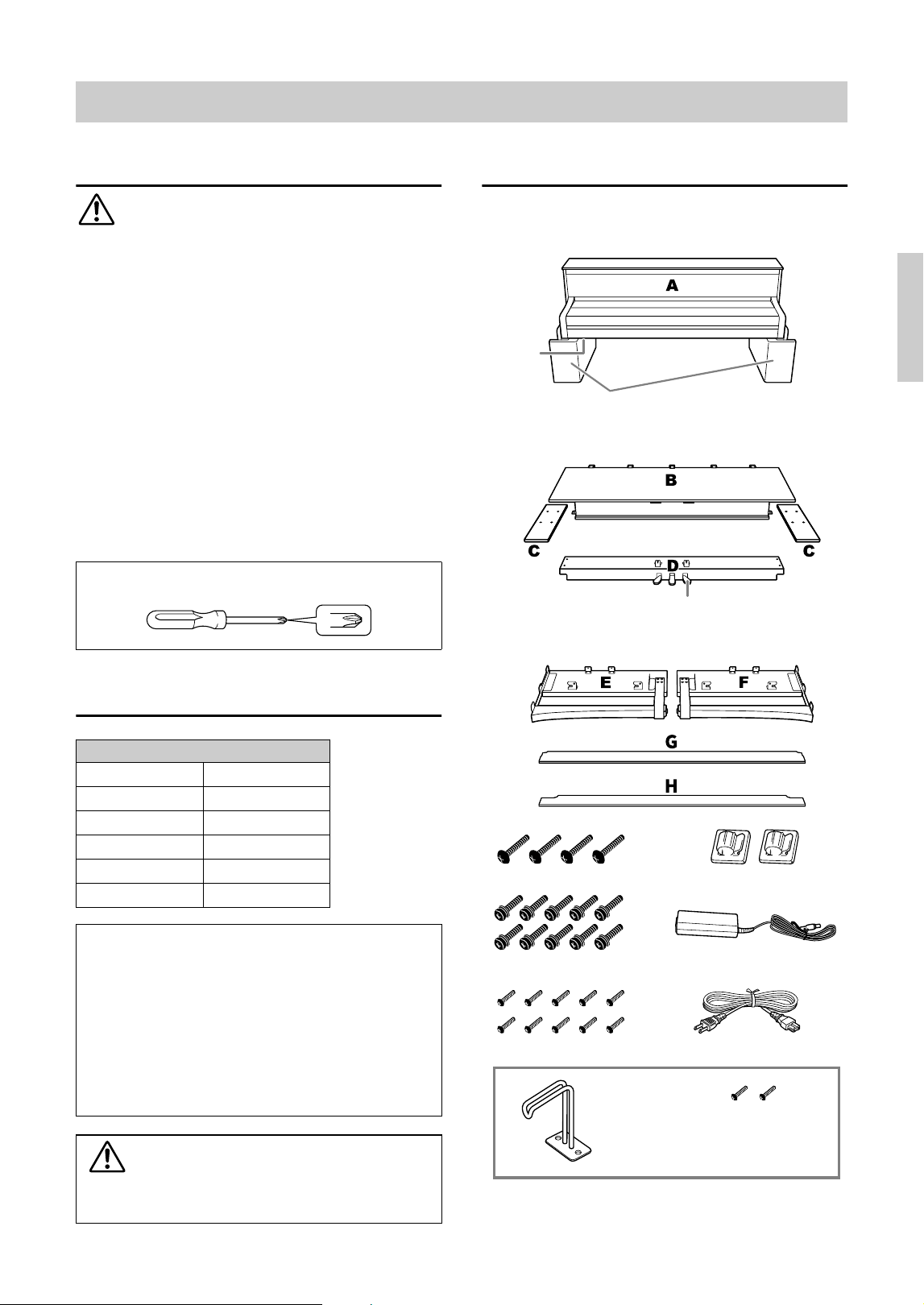
Appendix
63
CLP-885 CLP-875 CLP-845 CLP-835 CLP-895GP CLP-865GP Owner’s Manual
Assembly Precautions
CAUTION
• (CLP-885, CLP-875, CLP-845, CLP-835) Assembly should be
carried out by at least two persons.
• (CLP-895GP, CLP-865GP) Assembly should be carried out
by at least four persons.
• Assemble the unit on a hard and flat floor with ample space.
• Be sure to use the correct parts in the correct orientation,
and assemble the instrument in accordance with the
sequence given here.
• Keep small parts (such as screws) out of the reach of
infants. Children may accidentally swallow them.
• Be sure to use only the included screws of the specified
sizes. Do not use any other screws. Use of incorrect screws
can cause damage or malfunction of the product.
• Be sure to tighten all screws upon completing assembly of
the unit.
• When moving and placing the instrument after assembly,
check “When moving and placing the instrument” on
page 8.
• To disassemble the unit, reverse the assembly sequence
given below. Failure to do so can result in damage to the
instrument or personal injury.
Assembling the Clavinova
CLP-885 Assembly
Remove all parts from the package and make sure you
have all of the items.
The power cord and AC adaptor may not be included, or may look different
from the illustration above, depending on your particular area. Please check
with your Yamaha dealer.
Assembling the Clavinova
Have a Phillips-head (+) screwdriver of the appropriate size
ready.
Reference page
CLP-885 page 63
CLP-875 page 67
CLP-845 page 69
CLP-835 page 69
CLP-895GP page 71
CLP-865GP page 75
Post-assembly checklist
There are no unused parts.
The instrument is stable even if you shake it.
Both the pedal cord and power cord are plugged
securely into the correct jacks.
If any of the above items have not been confirmed,
review the assembly procedure and correct any
errors.
CAUTION
If the unit creaks or is otherwise unsteady when you play
on the keyboard, refer to the assembly diagrams and
retighten all screws.
Foamed styrol pads
Remove foamed styrol pads from the package, position them
on the floor, then place A on top of them. Position the pads so
that they will not hide the connector panel on the bottom of A.
Connector
panel
The pedals are covered with vinyl covers when
shipped from the factory. Before starting the
assembly, please make sure to remove the
cover from the damper pedal.
6 × 20 mm round head screws × 4
6 × 20 mm flat head screws × 10
4 × 14 mm round head screws × 10
Power cord
Cord holders × 2
4 × 10 mm thin screws × 2
AC adaptor
Headphone
hanger
* See page 18 for instructions on
attaching the hanger.
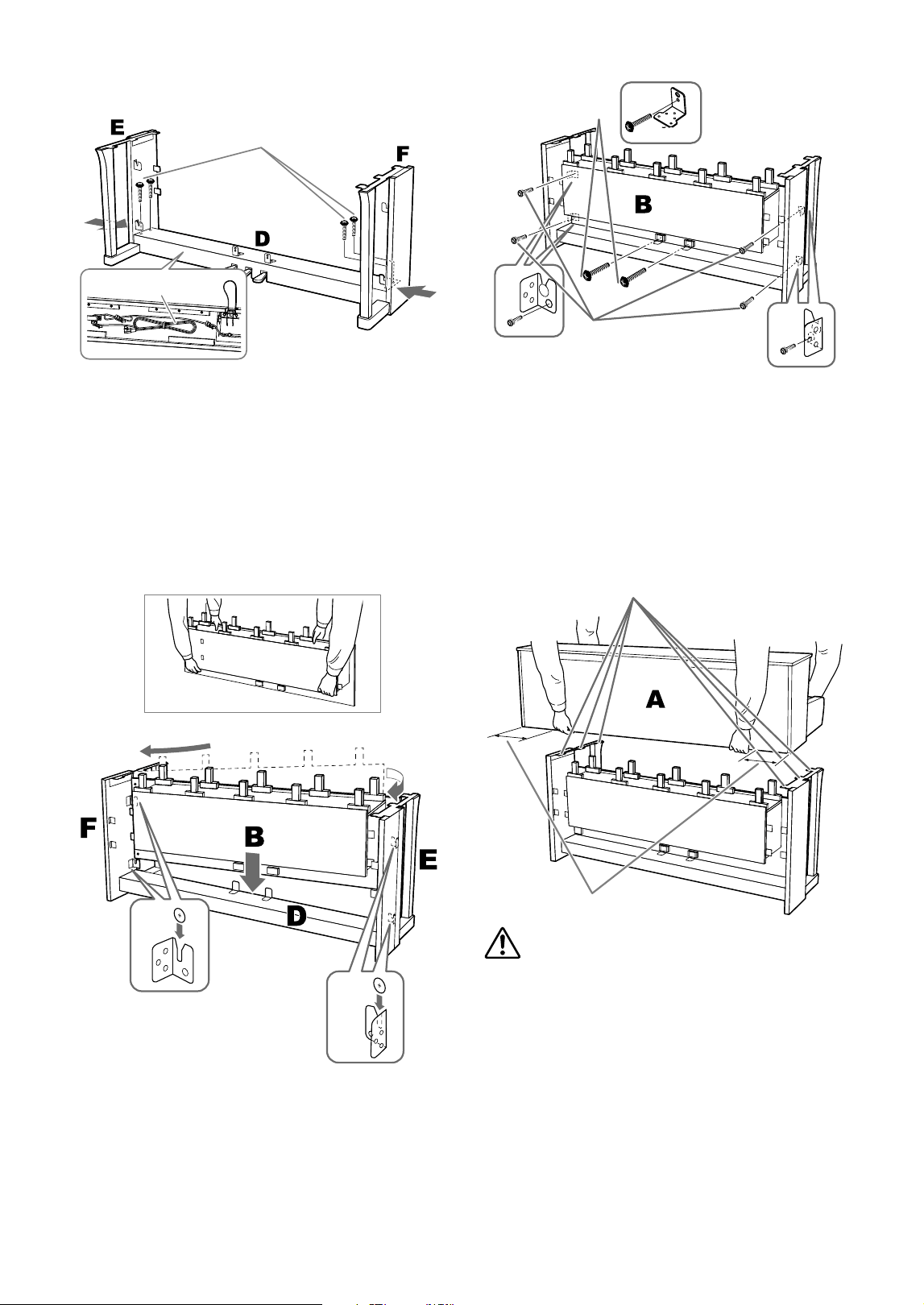
Appendix
64
CLP-885 CLP-875 CLP-845 CLP-835 CLP-895GP CLP-865GP Owner’s Manual
1. Attach E and F to D.
1-1. Remove the twist tie from the folded pedal
cord.
Don’t discard the twist tie, you’ll need it later in
step 6.
1-2. While pushing the lower part of E and F
from the outside, secure D using four
6 × 20 mm round head screws.
2. Attach B.
2-1. Insert B between E and F as shown in the
illustration, and then hold B at a position of
5 cm away from D.
2-2. Lower B slowly, and then hook the screws
on the right and left sides of B onto the
notches of brackets on E and F.
2-3. Temporarily secure the center with two
4 × 14 mm round head screws.
2-4. Temporarily secure the surroundings with
four 6 × 20 mm flat head screws.
3. Mount A.
Be sure to place your hands at least 15 cm away
from either end of the main unit when positioning it.
CAUTION
• Be extra careful not to drop the main unit or let your fingers
be pinched by it.
• Do not hold the main unit in any position other than the
position specified above.
1-2
1-1
2-1
2-1
2-2
2-2
Proper way to hold B
2-4
2-3
Align the screw holes.
At least 15 cm
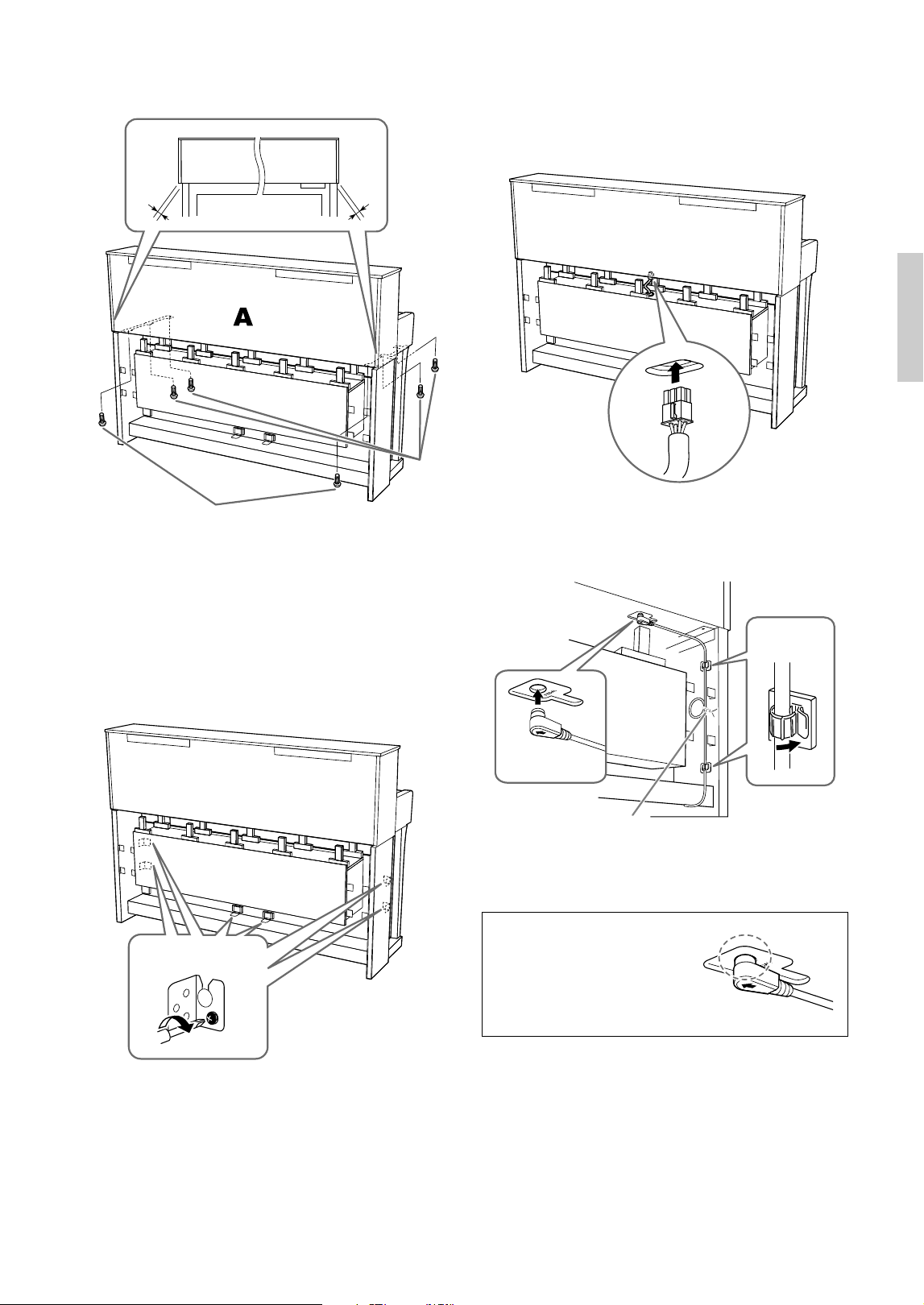
Appendix
65
CLP-885 CLP-875 CLP-845 CLP-835 CLP-895GP CLP-865GP Owner’s Manual
4. Attach A.
4-1. Adjust the position of A so that the left and
right ends of A will project beyond E and F
equally (as seen from the rear).
4-2. Secure A using four 6 × 20 mm flat head
screws from the front.
4-3. Secure A using two 6 × 20 mm flat head
screws from the rear.
4-4. Firmly tighten the screws from the upper
parts you temporarily fastened in previous
step 2-3 and 2-4 above (assembly B).
5. Connect the speaker cord.
Insert the speaker cord plug into the connector so
that the tab extends toward the front when viewed
from the rear.
6. Insert the DC plug of the AC adaptor
into the DC IN jack.
6-1. Insert the pedal cord plug into the [PEDAL]
connector.
6-2. Attach the cord holders to the instrument,
then clip the cord into the holders. At this
time, be careful that the pedal cord isn’t
loose between the plug and cord holder.
6-3. Use a twist tie to bundle the pedal cord.
4-3
4-2
4-1
4-4
Insert the pedal cord securely in
the proper direction until the
metal part of the plug
disappears from view.
Otherwise, the pedal may not
function properly.
6-2
6-1
6-3
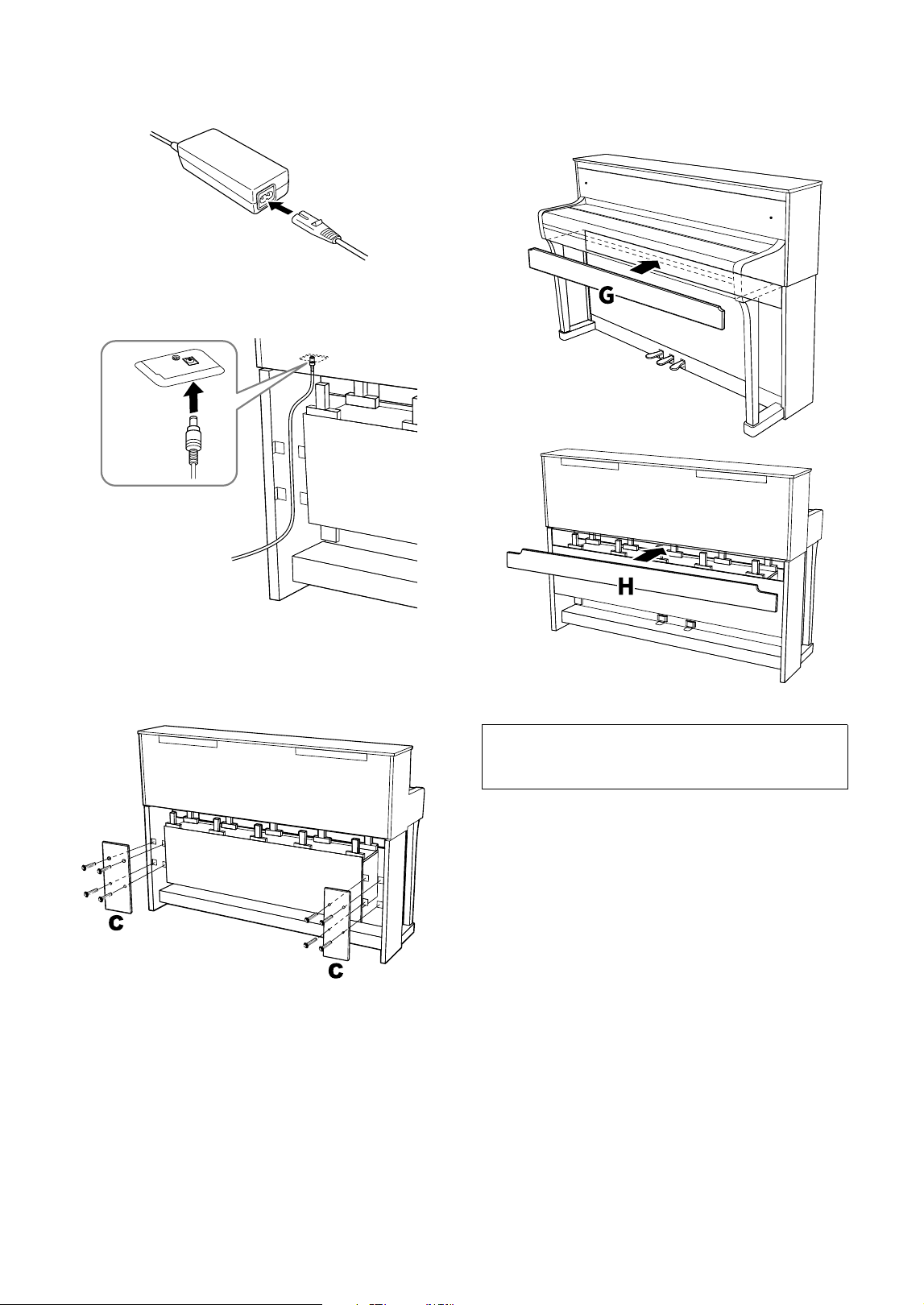
Appendix
66
CLP-885 CLP-875 CLP-845 CLP-835 CLP-895GP CLP-865GP Owner’s Manual
6-4. Connect one end of the power cord to the
AC adaptor.
6-5. Insert the DC plug of the AC adaptor into
the DC IN jack.
7. Attach C (two pieces).
Secure the two C pieces with eight 4 × 14 mm round
head screws.
8. Attach G and H.
Attach G to the front, and H to the rear by pressing
them against the instrument.
6-5
After completing assembly, confirm the checklist on
page 63.
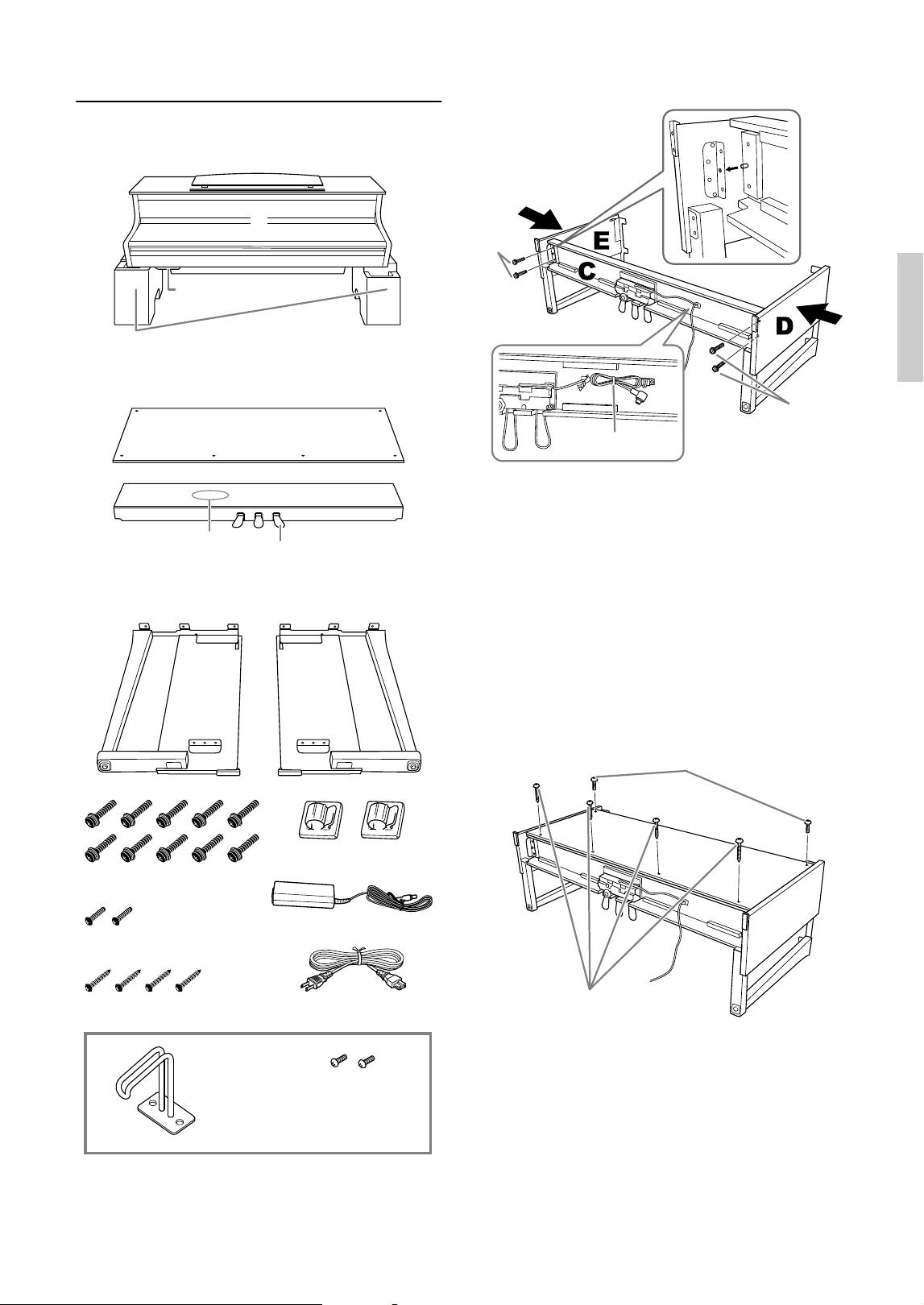
Appendix
67
CLP-885 CLP-875 CLP-845 CLP-835 CLP-895GP CLP-865GP Owner’s Manual
CLP-875 Assembly
Remove all parts from the package and make sure you
have all of the items.
The power cord and AC adaptor may not be included, or may look different
from the illustration above, depending on your particular area. Please check
with your Yamaha dealer.
1. Attach C to D and E.
1-1. Untie and straighten out the bundled pedal
cord. Do not discard the vinyl tie. You will
need it later in step 5.
1-2. Insert the protrusions into the holes on the
brackets, then attach D and E to C by
tightening the four thick screws
(6 × 20 mm).
2. Attach B.
Depending on the model of digital piano you
purchased, the surface color of one side of B may be
different from the other side. If so, position B so that
the side similar in color to D and E faces the player.
2-1. Align the screw holes on the upper side of
B with the bracket holes on D and E, then
attach the upper corners of B to D and E by
finger-tightening two thin screws
(4 × 12 mm).
2-2. Secure the bottom end of B using four
tapping screws (4 × 20 mm).
2-3. Securely tighten the screws on the top of B
that were attached in step 2-1.
A
B
C
DE
Foamed styrol pads
Remove foamed styrol pads from the package, position them on
the floor, then place A on top of them. Position the pads so that
they will not block the connector panel and the speaker box on the
bottom of A.
Bundled pedal cord
inside
The pedals are covered with vinyl
covers when shipped from the factory.
Before starting the assembly, please
make sure to remove the cover from
the damper pedal.
Connector panel
6 × 20 mm thick screws × 10
4 × 12 mm thin screws × 2
4 × 20 mm tapping screws × 4
Power cord
Cord holders × 2
4 × 10 mm thin screws × 2
Headphone
hanger
AC adaptor
* See page 18 for instructions on
attaching the hanger.
1-2
1-1
1-2
1-2
2-1, 2-3
2-2
D
B
E
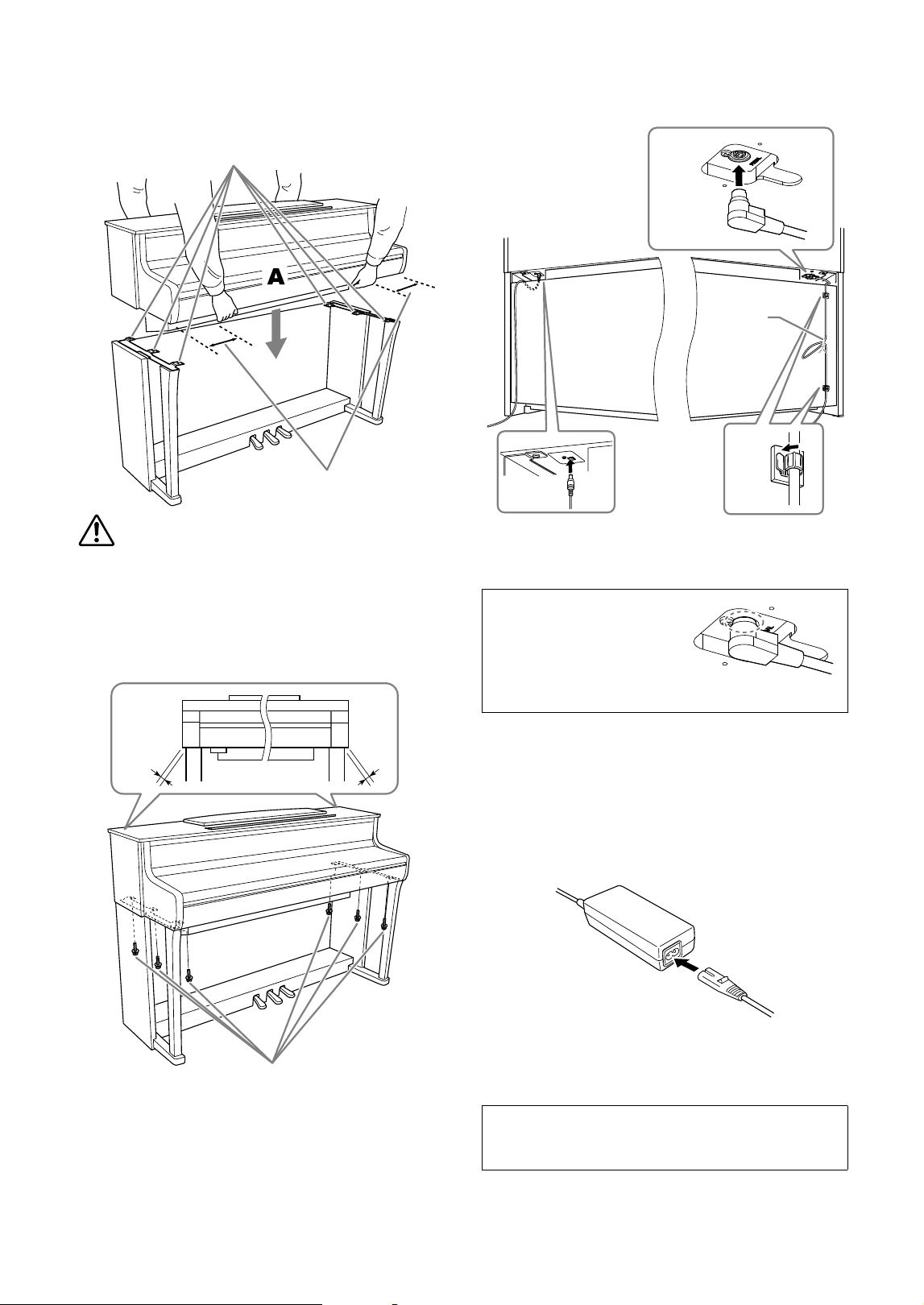
Appendix
68
CLP-885 CLP-875 CLP-845 CLP-835 CLP-895GP CLP-865GP Owner’s Manual
3. Mount A.
Be sure to place your hands at least 15 cm away
from either end of the main unit when positioning it.
CAUTION
• Be extra careful not to drop the main unit or let your fingers
be pinched by it.
• Do not hold the main unit in any position other than the
position specified above.
4. Secure A.
4-1. Adjust the position of A so that the left and
right ends of A will project beyond D and E
equally (as seen from the front).
4-2. Secure A by tightening six thick screws
(6 × 20 mm) from the front.
5. Connect the pedal cord and AC
adaptor.
5-1. Insert the plug of the pedal cord into the
[PEDAL] connector.
5-2. Attach the cord holders to the rear panel as
shown, then clip the cord into the holders.
5-3. Use a vinyl tie to take up any slack in the
pedal cord.
5-4. Connect one end of the power cord to the
AC adaptor.
5-5. Insert the DC plug of the AC adaptor into
the DC IN jack.
AA
At least 15 cm
Align the screw holes.
4-1
4-2
A
A
A
A
Insert the pedal cord securely in
the proper direction until the
metal part of the plug
disappears from view.
Otherwise, the pedal may not
function properly.
After completing assembly, confirm the checklist on
page 63.
5-15-1
5-3
5-2
5-5
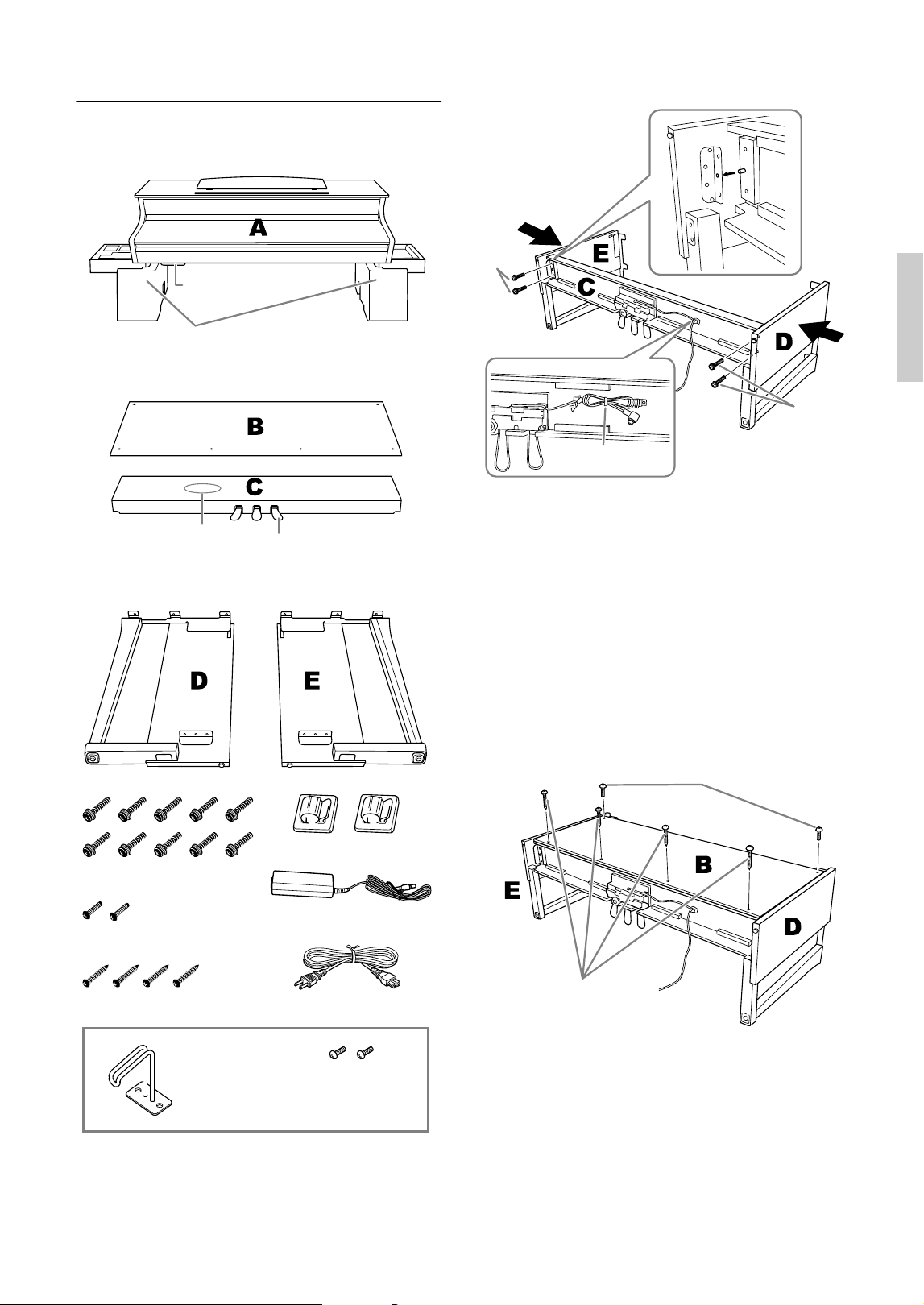
Appendix
69
CLP-885 CLP-875 CLP-845 CLP-835 CLP-895GP CLP-865GP Owner’s Manual
CLP-845, CLP-835 Assembly
Remove all parts from the package and make sure you
have all of the items.
The power cord and AC adaptor may not be included, or may look different
from the illustration above, depending on your particular area. Please check
with your Yamaha dealer.
1. Attach C to D and E.
1-1. Untie and straighten out the bundled pedal
cord. Do not discard the vinyl tie. You will
need it later in step 5.
1-2. Insert the protrusions into the holes on the
brackets, then attach D and E to C by
tightening the four thick screws
(6 × 20 mm).
2. Attach B.
Depending on the model of digital piano you
purchased, the surface color of one side of B may be
different from the other side. If so, position B so that
the side similar in color to D and E faces the player.
2-1. Align the screw holes on the upper side of
B with the bracket holes on D and E, then
attach the upper corners of B to D and E by
finger-tightening two thin screws
(4 × 12 mm).
2-2. Secure the bottom end of B using four
tapping screws (4 × 20 mm).
2-3. Securely tighten the screws on the top of B
that were attached in step 2-1.
Foamed styrol pads
Remove foamed styrol pads from the package, position them on
the floor, then place A on top of them. Position the pads so that
they will not block the connector panel and the speaker box on the
bottom of A.
Bundled pedal cord
inside
The pedals are covered with vinyl
covers when shipped from the factory.
Before starting the assembly, please
make sure to remove the cover from
the damper pedal.
Connector panel
6 × 20 mm thick screws × 10
4 × 12 mm thin screws × 2
4 × 20 mm tapping screws × 4
Power cord
Cord holders × 2
4 × 10 mm thin screws × 2
Headphone
hanger
AC adaptor
* See page 18 for instructions on
attaching the hanger.
1-2
1-2
1-2
1-1
2-1, 2-3
2-2
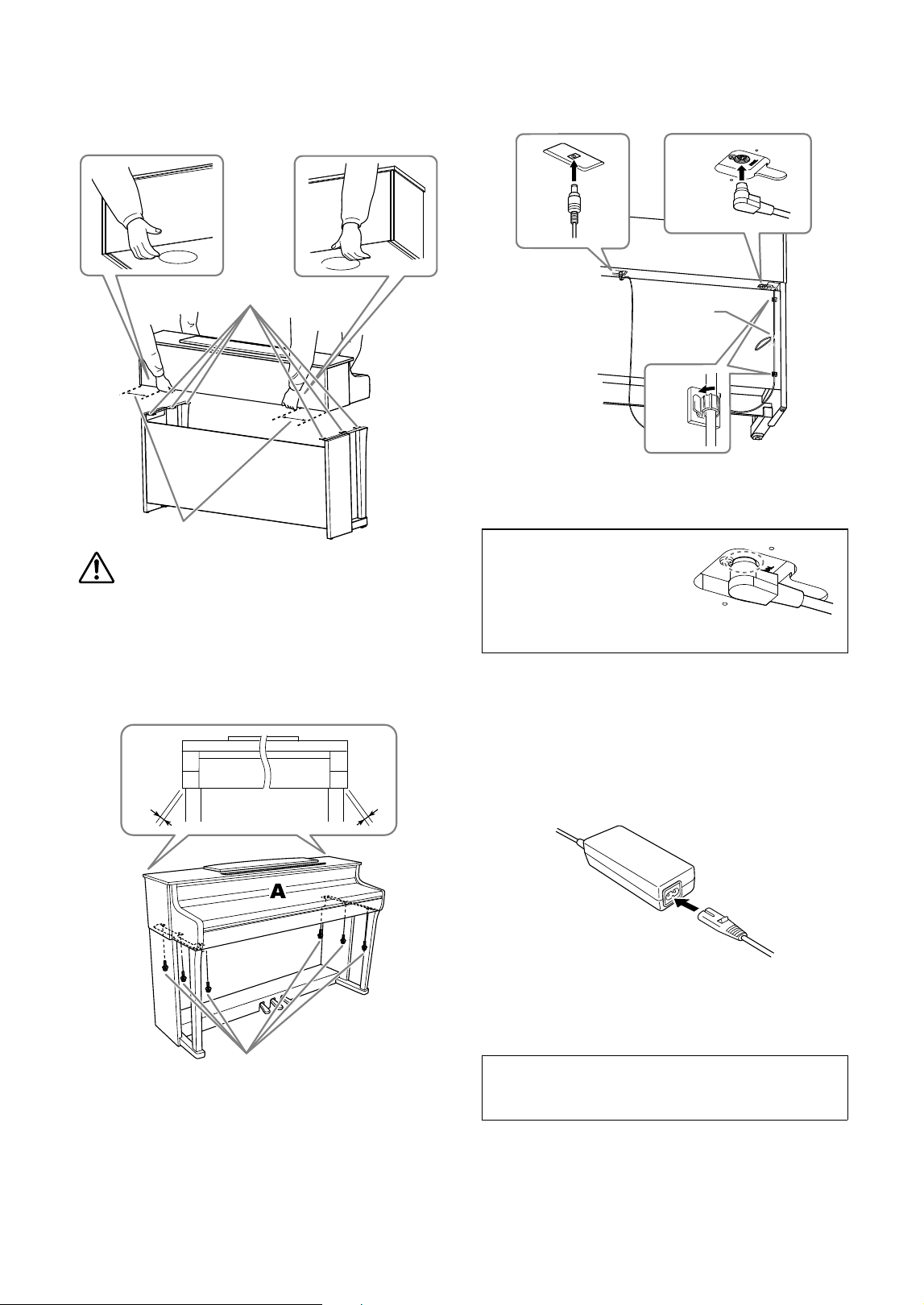
Appendix
70
CLP-885 CLP-875 CLP-845 CLP-835 CLP-895GP CLP-865GP Owner’s Manual
3. Mount A.
Be sure to place your hands at least 15 cm away
from either end of the main unit when positioning it.
CAUTION
• Be extra careful not to drop the main unit or let your fingers
be pinched by it.
• Do not hold the main unit in any position other than the
position specified above.
4. Secure A.
4-1. Adjust the position of A so that the left and
right ends of A will project beyond D and E
equally (as seen from the front).
4-2. Secure A by tightening six thick screws
(6 × 20 mm) from the front.
5. Connect the pedal cord and AC
adaptor.
5-1. Insert the plug of the pedal cord into the
[PEDAL] connector.
5-2. Attach the cord holders to the rear panel as
shown, then clip the cord into the holders.
5-3. Use a vinyl tie to take up any slack in the
pedal cord.
5-4. Connect one end of the power cord to the
AC adaptor.
5-5. Insert the DC plug of the AC adaptor into
the DC IN jack.
A
At least 15 cm
Align the screw holes.
A
4-1
4-2
Insert the pedal cord securely in
the proper direction until the
metal part of the plug
disappears from view.
Otherwise, the pedal may not
function properly.
After completing assembly, confirm the checklist on
page 63.
5-1
5-3
5-2
5-5
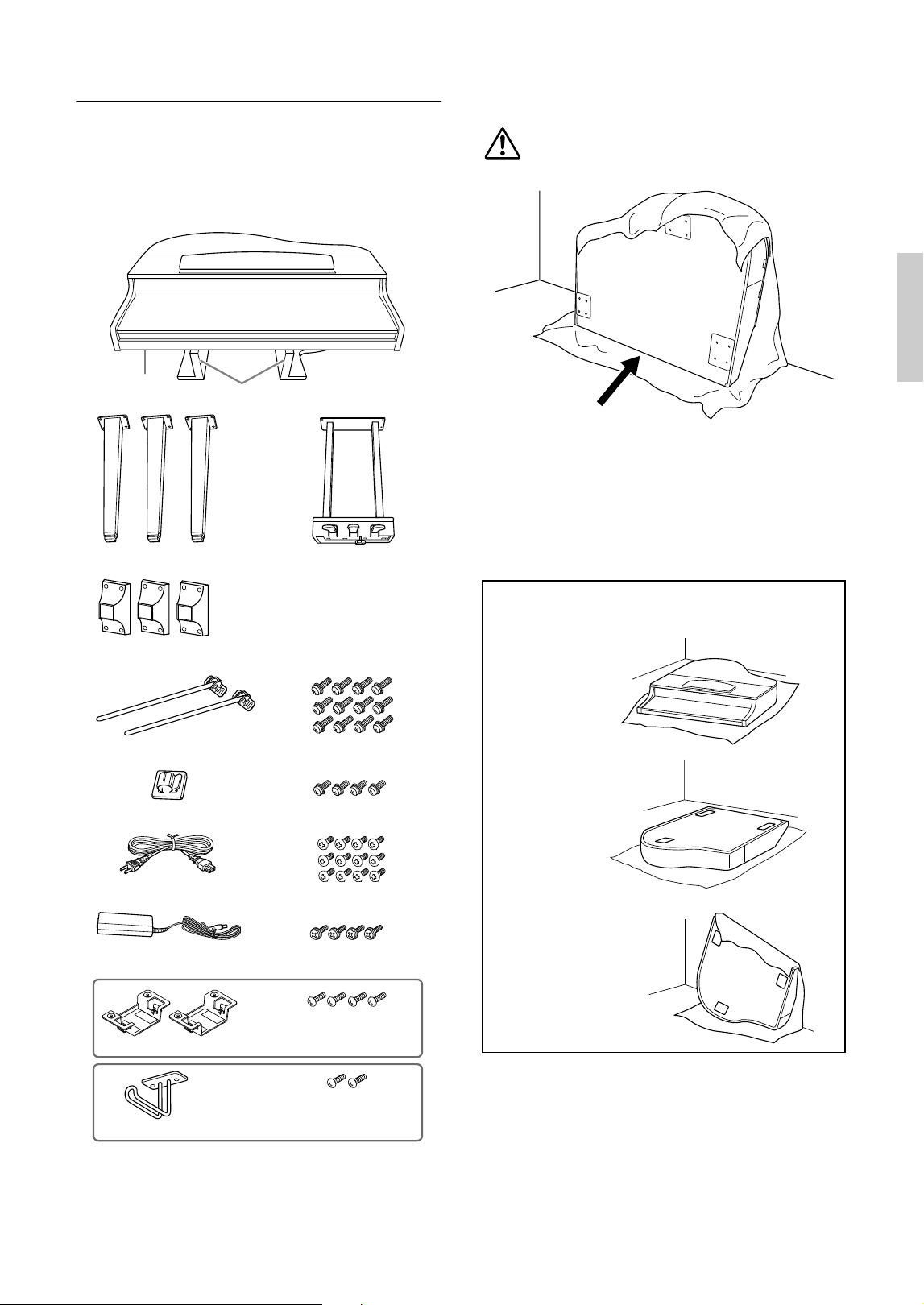
Appendix
71
CLP-885 CLP-875 CLP-845 CLP-835 CLP-895GP CLP-865GP Owner’s Manual
CLP-895GP Assembly
Remove all parts from the package and make sure you
have all of the items.
Main unit
To prevent damage to the connector panels located at the bottom of main unit,
make sure to place main unit on the Styrofoam pads. Also, make sure that the
pads do not touch the connector panels.
The power cord and AC adaptor may not be included, or may look different
from the illustration above, depending on your particular area. Please check
with your Yamaha dealer.
1. Lean the main unit against the wall as
shown below.
CAUTION
Be careful not to pinch your fingers.
1-1. Spread a large soft cloth, such as a blanket,
as shown to protect the floor and wall
surfaces.
1-2. Lean the main unit against the wall with the
key cover closed and the keyboard side on
the bottom.
Pedal box
Pads
Cord holder
Power cord
Bundled pedal cord inside.
The pedals are covered with
vinyl covers when shipped from
the factory. Remove the cover
from damper pedal for optimum
use of the GP Responsive
Damper Pedal effect.
Legs
Leg beams
Lyre braces
6 × 20 mm fixing screws
(4 pcs.)
6 × 40 mm fixing screws
(12 pcs.)
4 × 16 mm thin screws
(4 pcs.)
4 × 10 mm thin screws
(12 pcs.)
Connector panel
AC adaptor
4 × 10 mm thin screws
(4 pcs.)
Adaptor holders
Headphone
hanger
4 × 10 mm thin screws
(2 pcs.)
* See page 18 for instructions on attaching the hanger.
Be sure to position the
keyboard side on the bottom.
Incorrect
NOTICE
Do not place the main unit as shown in the illustration
here.
Incorrect
Incorrect
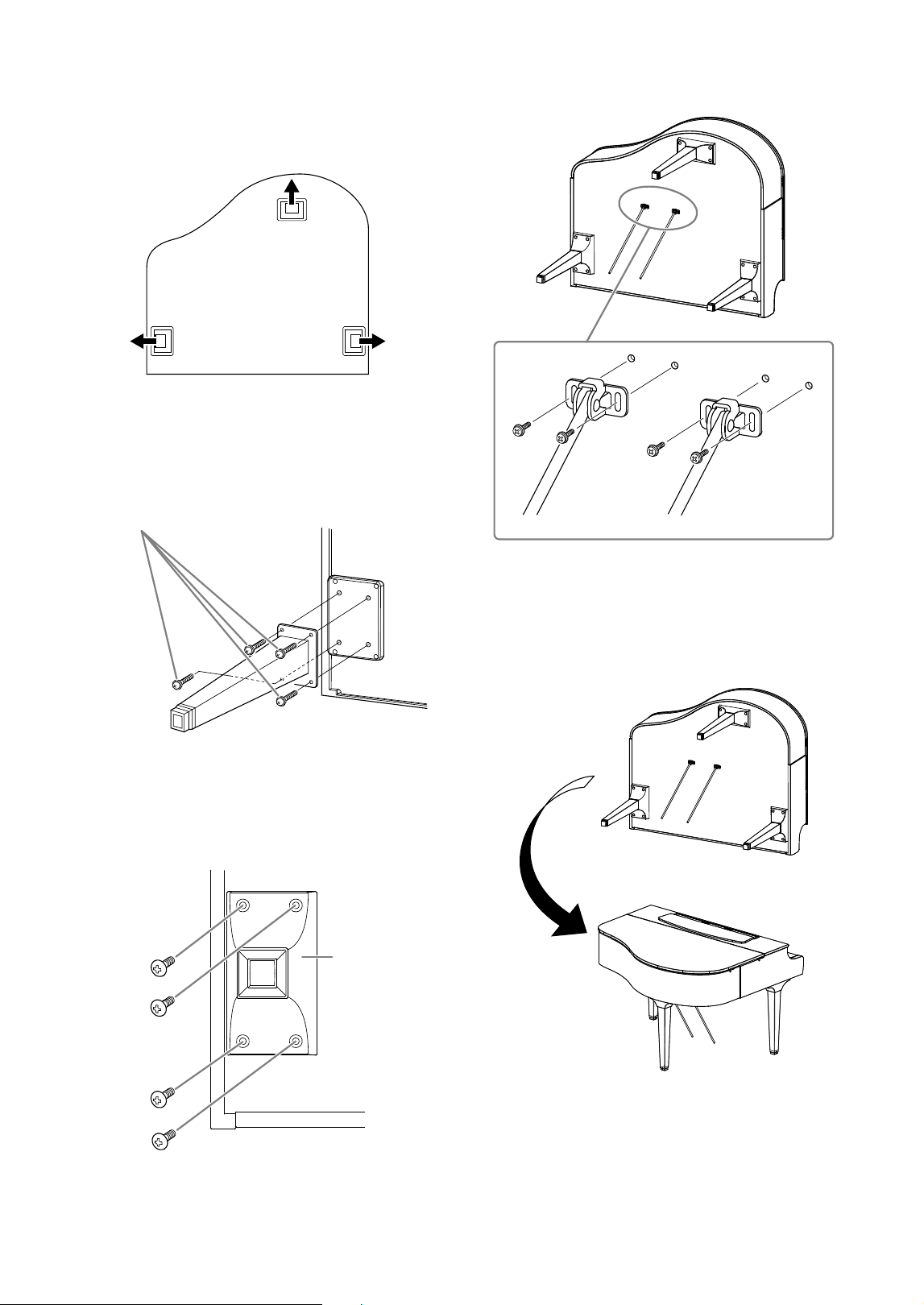
Appendix
72
CLP-885 CLP-875 CLP-845 CLP-835 CLP-895GP CLP-865GP Owner’s Manual
2. Attach the three legs and three leg
beams.
Refer to the diagram below to verify the orientation
of the legs.
2-1. Install and tighten four screws on each leg,
starting with one of the front legs.
2-2. Install and tighten four screws on each leg,
starting with one of the front legs.
2-3. Slide the leg beams over the legs, and
attach them to each of the legs using four
thin screws (4 × 10 mm).
Make sure that the gradually inclined side of the leg
beams faces the inside of the unit as shown.
3. Attach the lyre braces.
3-1. Attach the lyre braces using the four thin
screws (4 × 16 mm).
4. Raise the unit to the standing position.
Use the front legs as support to raise the unit.
Rear leg
Front leg
Front leg
6 × 40 mm fixing screws
4 × 10 mm
thin screws
The gradually
inclined side faces
the inside.
3-1
4 × 16 mm
thin screws
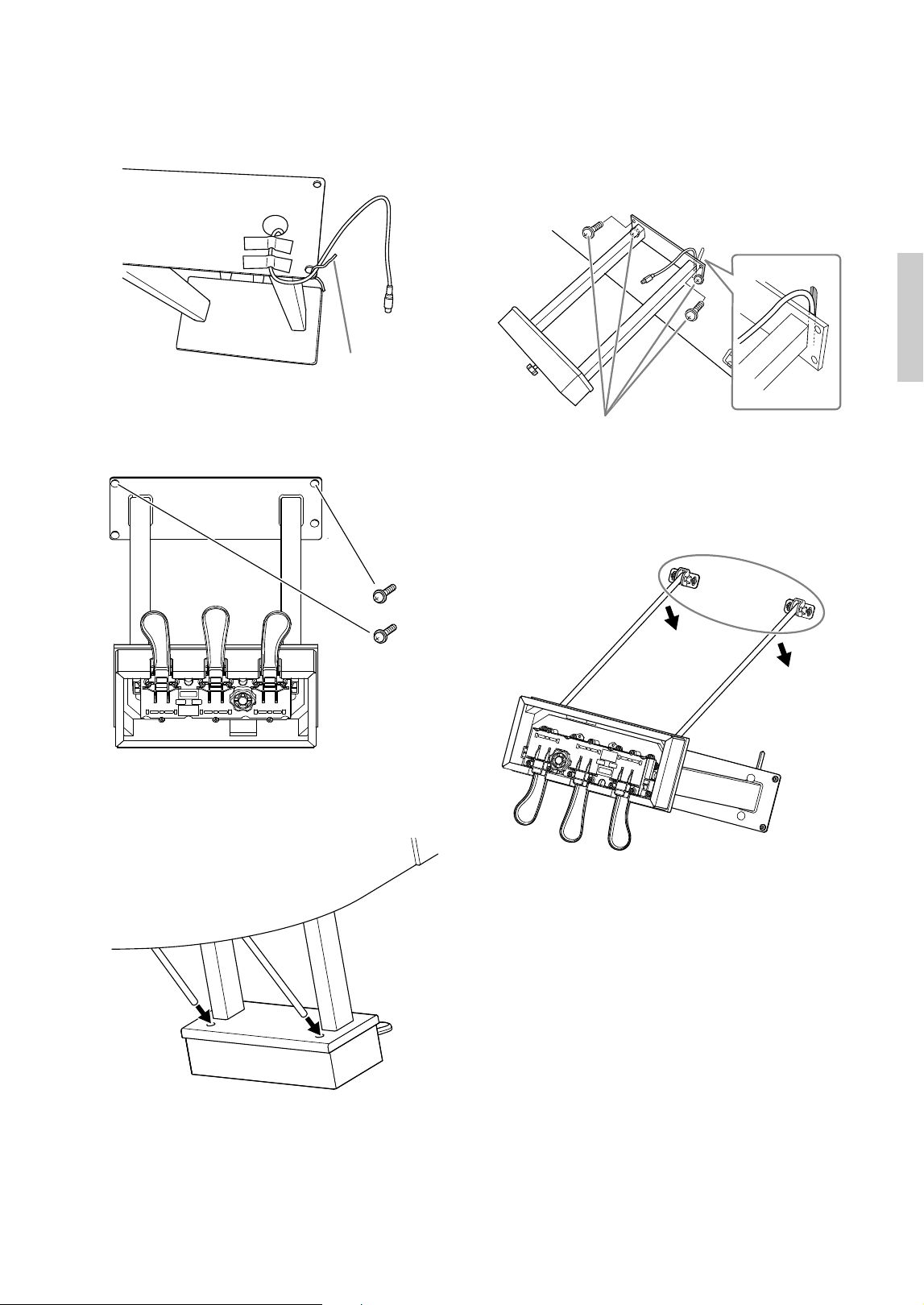
Appendix
73
CLP-885 CLP-875 CLP-845 CLP-835 CLP-895GP CLP-865GP Owner’s Manual
5. Install the pedal box.
5-1. Remove the twist tie that affixes the pedal
cord to the upper portion of the pedal box.
5-2. Attach the front side of the pedal box to the
bottom of the unit by finger-tightening the
two fixing screws (6 × 20 mm).
5-3. Insert the lyre braces into the pedal box
recesses and make sure they fit securely.
5-4. Align the cord with the groove on the unit
and attach the backside of the pedal box
using the two fixing screws (6 × 20 mm),
and then securely tighten the two screws of
the front side of the pedal box that were
attached in step 5-2.
5-5. Loosen the four screws that were attached
in step 3, and then securely tighten the four
screws again while pushing the lyre braces
in the direction of arrows as illustrated.
Twist tie
6 × 20 mm
fixing screws
6 × 20 mm fixing screws
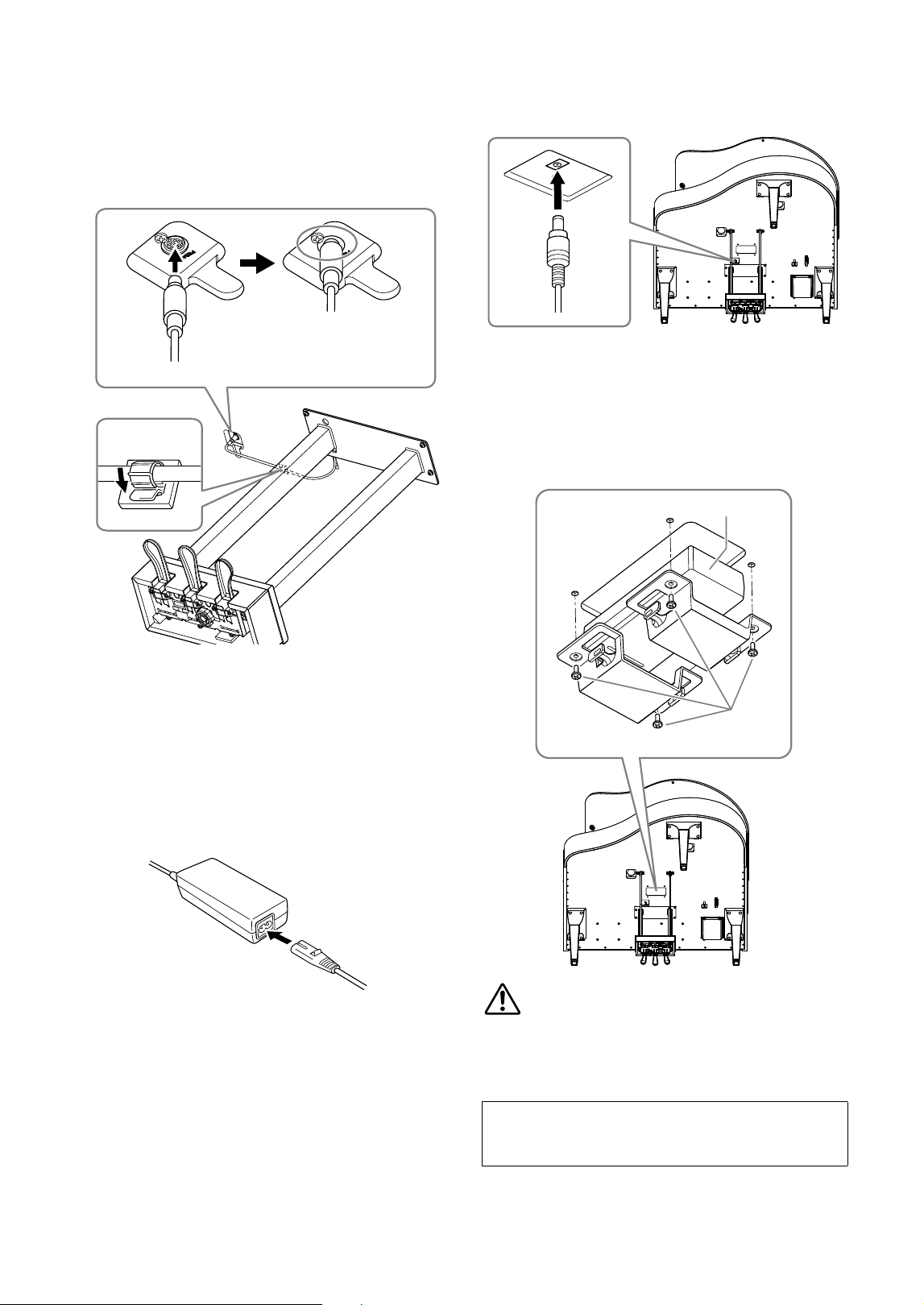
Appendix
74
CLP-885 CLP-875 CLP-845 CLP-835 CLP-895GP CLP-865GP Owner’s Manual
5-6. Insert the pedal cord plug into the [PEDAL]
connector. Insert the plug so the arrow side
faces front (toward the keyboard).
If the plug will not go in easily, do not force it.
Double-check the orientation of the plug, then try
again.
5-7. Attach the cord holder to the bottom of the
main unit as shown, then clip the holder
around the cord.
6. Connect the AC adaptor.
6-1. Connect one end of the power cord to the
AC adaptor.
6-2. Insert the DC plug of the AC adaptor into
the DC IN jack.
7. If desired, you can attach the AC
adaptor to the bottom of the unit by
using the adaptor holders.
For specific instructions, refer to the leaflet enclosed
with the adaptor holders.
CAUTION
To disassemble the unit, reverse the assembly sequence.
Failure to do so can result in damage to the instrument or
personal injury. In particular, if you lay down the main unit
without detaching the pedal box, the pedals will break.
5-7
5-6
Insert the pedal cord securely in the proper
direction until the metal part of the plug
disappears from view. Otherwise, the pedal
may not function properly.
After completing assembly, confirm the checklist on
page 63.
AC adaptor
4 × 10 mm
thin screws
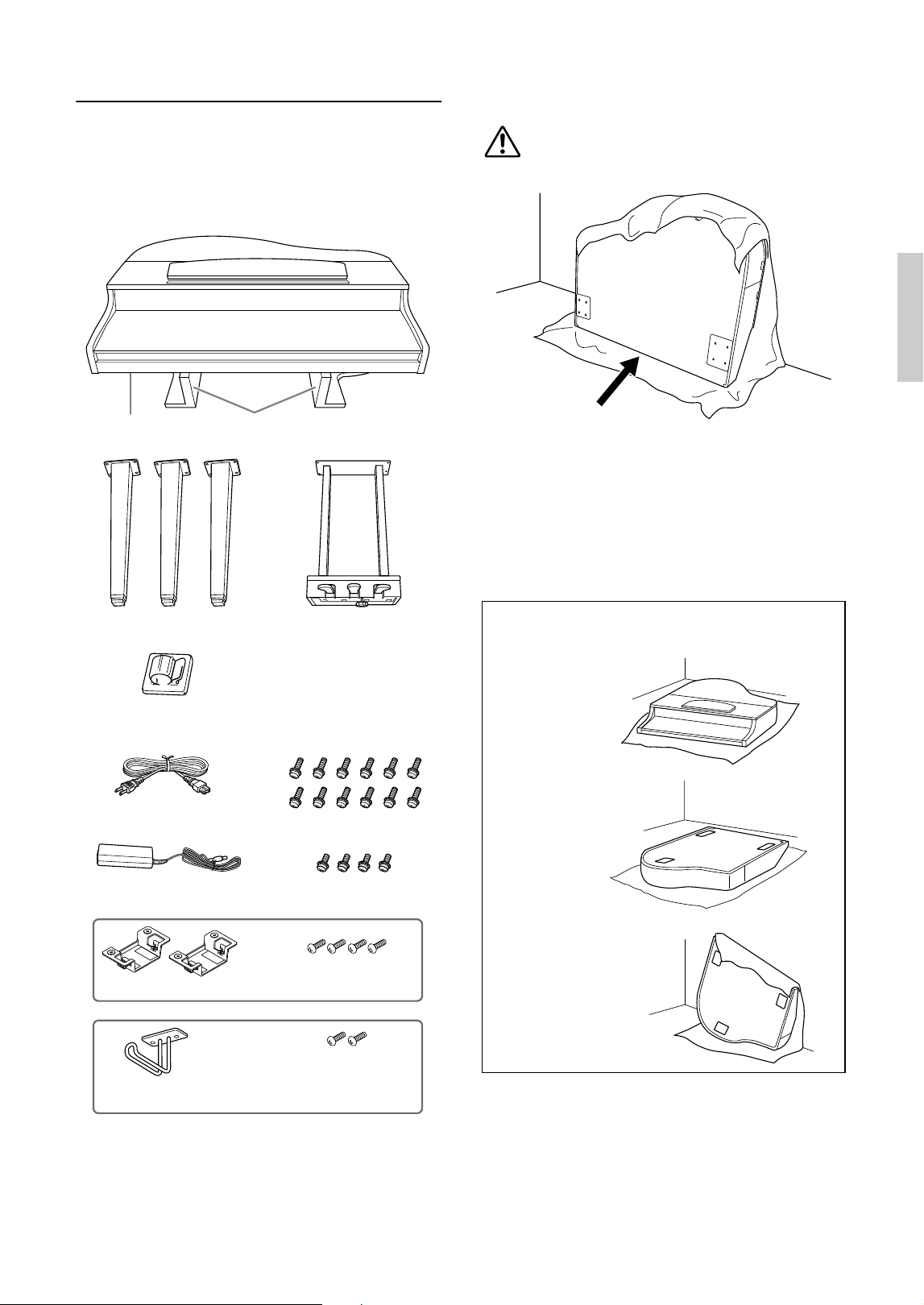
Appendix
75
CLP-885 CLP-875 CLP-845 CLP-835 CLP-895GP CLP-865GP Owner’s Manual
CLP-865GP Assembly
Remove all parts from the package and make sure you
have all of the items.
The power cord and AC adaptor may not be included, or may look different
from the illustration above, depending on your particular area. Please check
with your Yamaha dealer.
1. Lean the unit against the wall as
shown below.
CAUTION
Be careful not to pinch your fingers.
1-1. Spread a large soft cloth, such as a blanket,
as shown to protect the floor and wall
surfaces.
1-2. Lean the main unit against the wall with the
key cover closed and the keyboard side on
the bottom.
Legs Pedal box
6 × 40 mm fixing screws × 12
Cord holder
6 × 20 mm fixing screws × 4
Power cord
Bundled pedal cord inside.
The pedals are covered with
vinyl covers when shipped from
the factory. Before starting the
assembly, please make sure to
remove the cover from the
damper pedal.
Connector panel
Main unit
To prevent damage to the connector panels located at the bottom of main
unit, make sure to place main unit on the Styrofoam pads. Also, make sure
that the pads do not touch the connector panels.
Headphone
hanger
4 × 10 mm thin screws × 2
AC adaptor
4 × 10 mm thin screws × 4
Adaptor holders
Pads
* See page 18 for instructions on attaching the hanger.
Be sure to position the
keyboard side on the bottom.
Incorrect
NOTICE
Do not place the main unit as shown in the illustration
here.
Incorrect
Incorrect
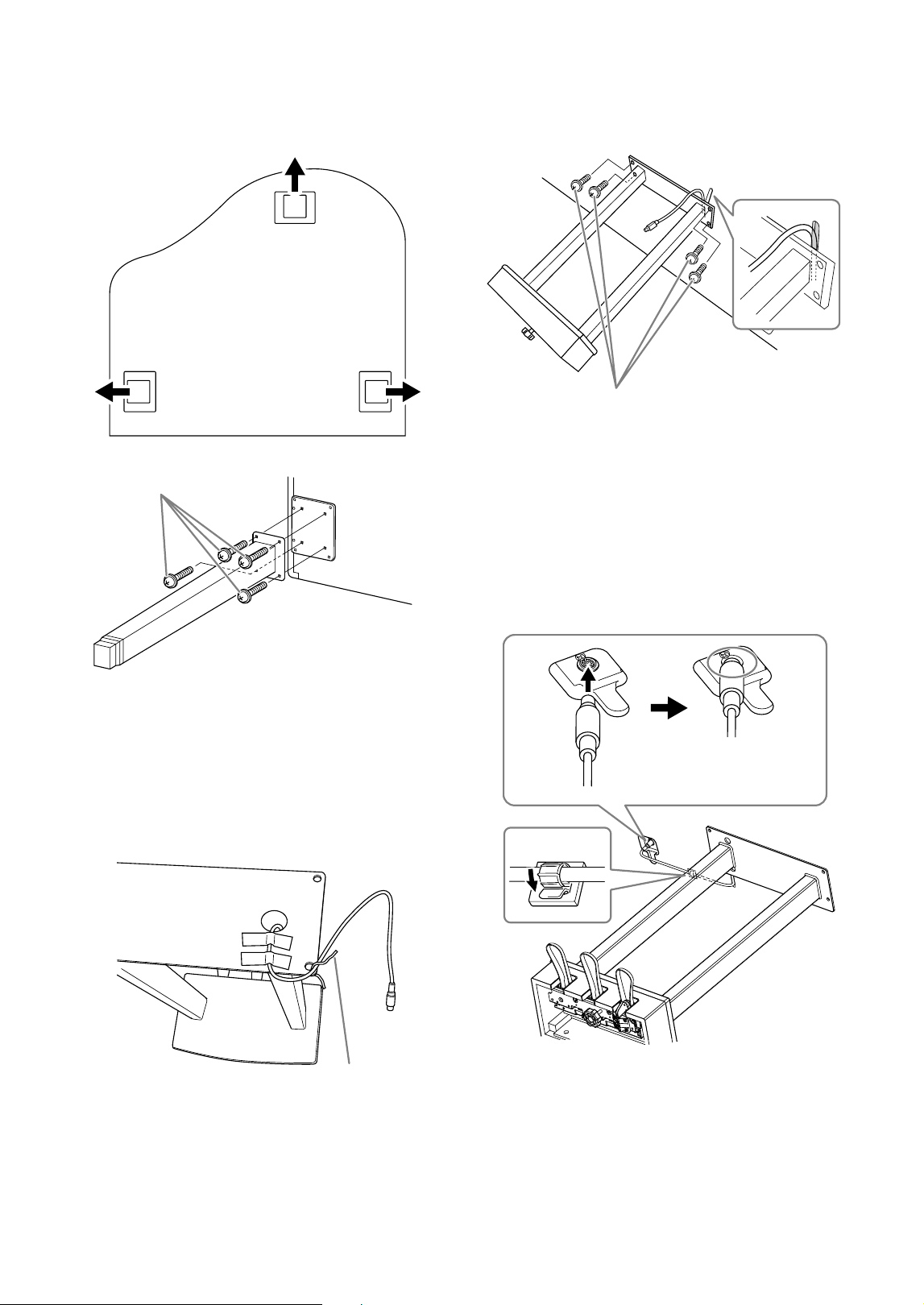
Appendix
76
CLP-885 CLP-875 CLP-845 CLP-835 CLP-895GP CLP-865GP Owner’s Manual
2. Attach two front legs and a rear leg.
Refer to the diagram below to verify the orientation
of the legs.
2-1. Install and tighten four screws on each leg,
starting with one of the front legs.
3. Install the pedal box.
3-1. Remove the twist tie that affixes the pedal
cord to the upper portion of the pedal box.
3-2. Align the cord with the groove on the unit,
and attach the pedal box using four
screws.
3-3. Insert the pedal cord plug into the [PEDAL]
connector. Insert the plug so the arrow side
faces front (toward the keyboard). If the
plug will not go in easily, do not force it.
Double-check the orientation of the plug,
then try again.
3-4. Attach the cord holder to the bottom of the
main unit as shown, then clip the holder
around the cord.
Rear leg
Front leg Front leg
6 × 40 mm fixing screws
Twist tie
6 × 20 mm fixing screws
3-3
3-4
Insert the pedal cord securely in the proper
direction until the metal part of the plug
disappears from view. Otherwise, the pedal
may not function properly.
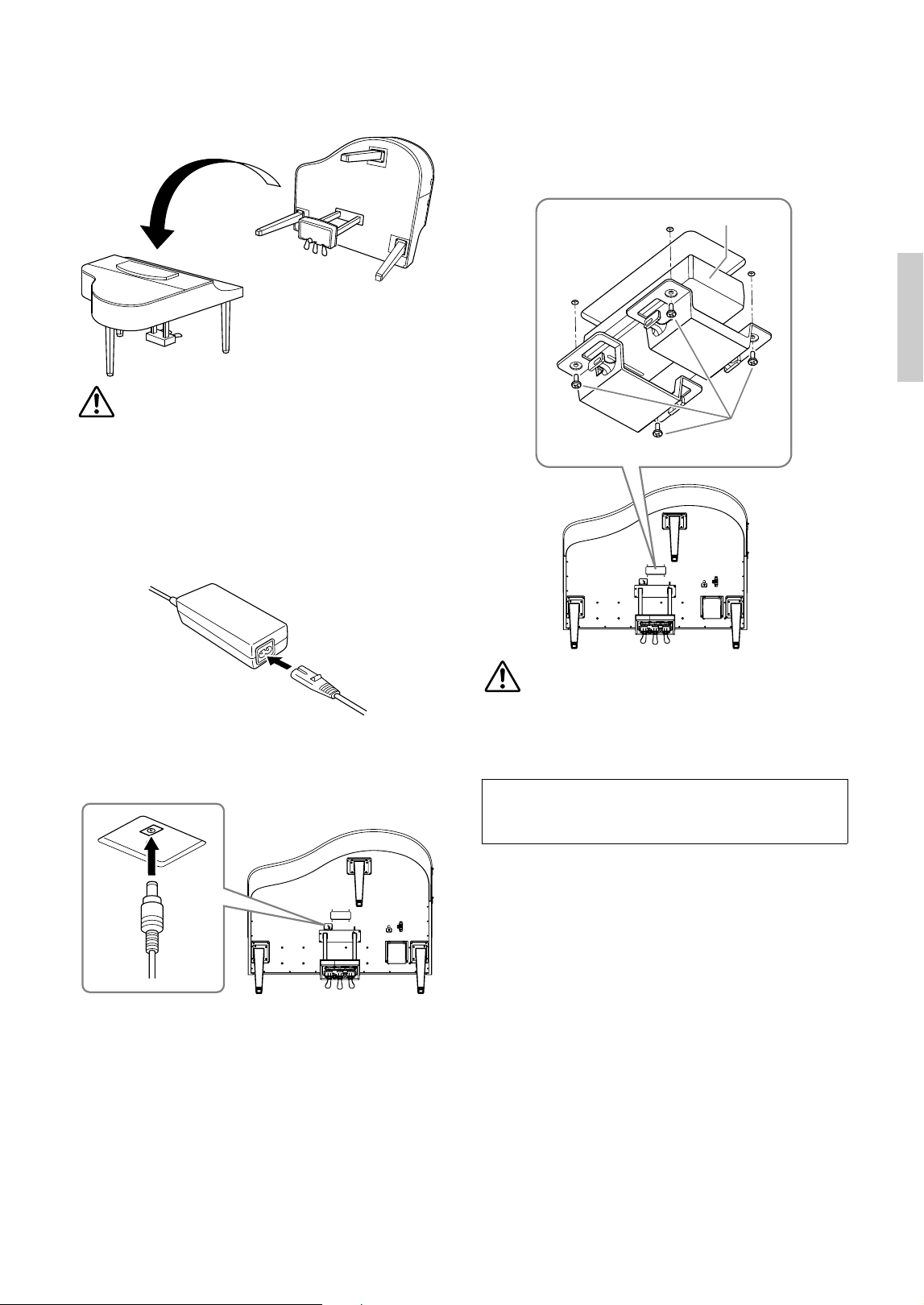
Appendix
77
CLP-885 CLP-875 CLP-845 CLP-835 CLP-895GP CLP-865GP Owner’s Manual
4. Raise the unit to the standing position.
Use the front legs as support to raise the unit.
CAUTION
Be careful not to pinch your fingers. When you raise the unit,
do not hold the key cover.
5. Connect the AC adaptor.
5-1. Connect one end of the power cord to the
AC adaptor.
5-2. Insert the DC plug of the AC adaptor into
the DC IN jack.
6. If desired, you can attach the AC
adaptor to the bottom of the unit by
using the adaptor holders.
For specific instructions, refer to the leaflet enclosed
with the adaptor holders.
CAUTION
To disassemble the unit, reverse the assembly sequence.
Failure to do so can result in damage to the instrument or
personal injury. In particular, if you lay down the main unit
without detaching the pedal box, the pedals will break.
After completing assembly, confirm the checklist on
page 63.
AC adaptor
4 × 10 mm
thin screws
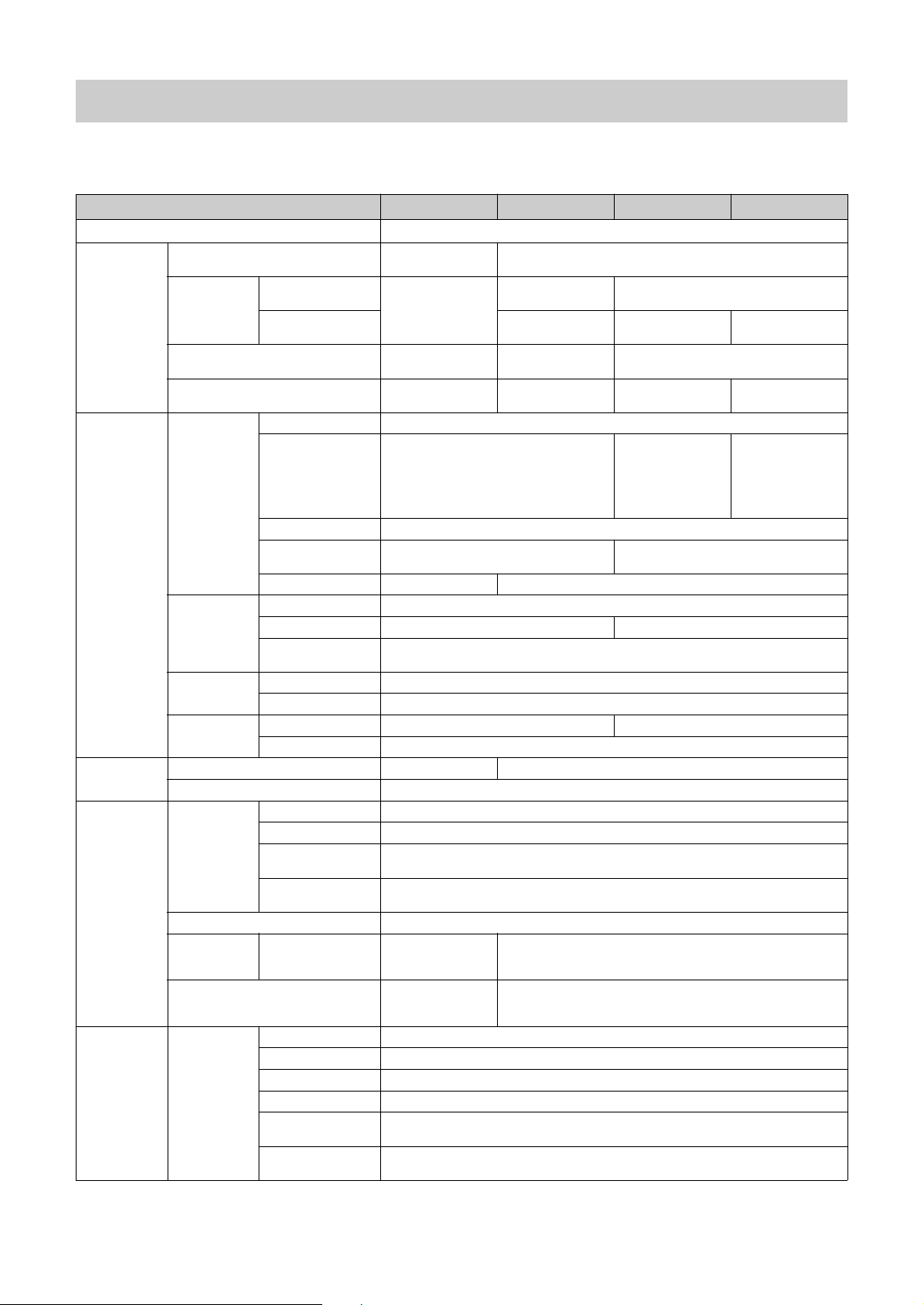
Appendix
78
CLP-885 CLP-875 CLP-845 CLP-835 CLP-895GP CLP-865GP Owner’s Manual
Specifications (CLP-885, CLP-875, CLP-845, CLP-835)
Refer to page 81 for specifications of the CLP-895GP and CLP-865GP.
Specifications
CLP-885 CLP-875 CLP-845 CLP-835
Product Name
Digital Piano
Size/Weight
Width
[For models with polished finish]
1,461 mm (57-1/2")
[1,467 mm (57-3/4")]
1,450 mm (57-1/16")
[1,455 mm (57-5/16")]
Height
[For models with
polished finish]
With music rest closed
1,027 mm (40-7/16")
[1,029 mm (40-1/2")]
967 mm (38-1/16")
[970 mm (38-3/16")]
927 mm (36-1/2")
[930 mm (36-5/8")]
With music rest raised
1,130 mm (44-1/2")
[1,131 mm (44-1/2")]
1,091 mm (42-15/16")
[1,092 mm (43-0")]
1,083 mm (42-5/8")
[1,084 mm (42-11/16")]
Depth
[For models with polished finish]
494 mm (19-7/16")
[494 mm (19-7/16")]
465 mm (18-5/16")
[465 mm (18-5/16")]
460 mm (18-1/8")
[460 mm (18-1/8")]
Weight
[For models with polished finish]
87 kg (191 lb, 13 oz)
[90 kg (198 lb, 7 oz)]
71 kg (156 lb, 8 oz)
[74 kg (163 lb, 2 oz)]
60 kg (132 lb, 4 oz)
[63 kg (138 lb, 14 oz)]
57 kg (125 lb, 11 oz)
[60 kg (132 lb, 4 oz)]
Control
Interface
Keyboard
Number of Keys 88
Type
GrandTouch Keyboard: wooden keys (white
only), synthetic ebony and ivory key tops,
escapement
GrandTouch-S
Keyboard: wooden
keys (white only),
synthetic ebony and
ivory key tops,
escapement
GrandTouch-S
Keyboard: synthetic
ebony and ivory key
tops, escapement
Touch Sensitivity Hard2, Hard1, Medium, Soft1, Soft2, Fixed
88-key Linear Graded
Hammers
Yes –
Counterweight Yes –
Pedal
Number of Pedals 3: Damper (with Half-pedal function), Sostenuto, Soft
GrandTouch Pedals Yes (with GP Response Damper) Yes
Assignable Functions
Sustain (Switch), Sustain Continuously, Sostenuto, Soft, Pitch Bend Up, Pitch Bend Down,
Rotary Speed, Vibe Rotor, Song Play/Pause
Display
Type Full Dots LCD
Language English, Japanese
Panel
Type Touch sensors Buttons
Language English
Cabinet
Key Cover Style Folding Sliding
Music Rest Yes (with music braces)
Voices
Tone Generator
Piano Sound Yamaha CFX, Bösendorfer Imperial
Binaural Sampling Yes (“CFX Grand” and “Bösendorfer” only)
VRM (Virtual
Resonance Modeling)
Yes
Grand Expression
Modeling
Yes
Polyphony (max.) 256
Preset Number of Voices
53 Voices + 480 XG
Voices + 14 Drum/
SFX Kits
38 Voices
Compatibility
XG (GM), GS (for
Song playback), GM2
(for Song playback)
–
Effects
Types
Reverb 7 types
Chorus 3 types
Brilliance 7 types + User
Insertion Effect 12 types
Intelligent Acoustic
Control (IAC)
Yes
Stereophonic
Optimizer
Yes
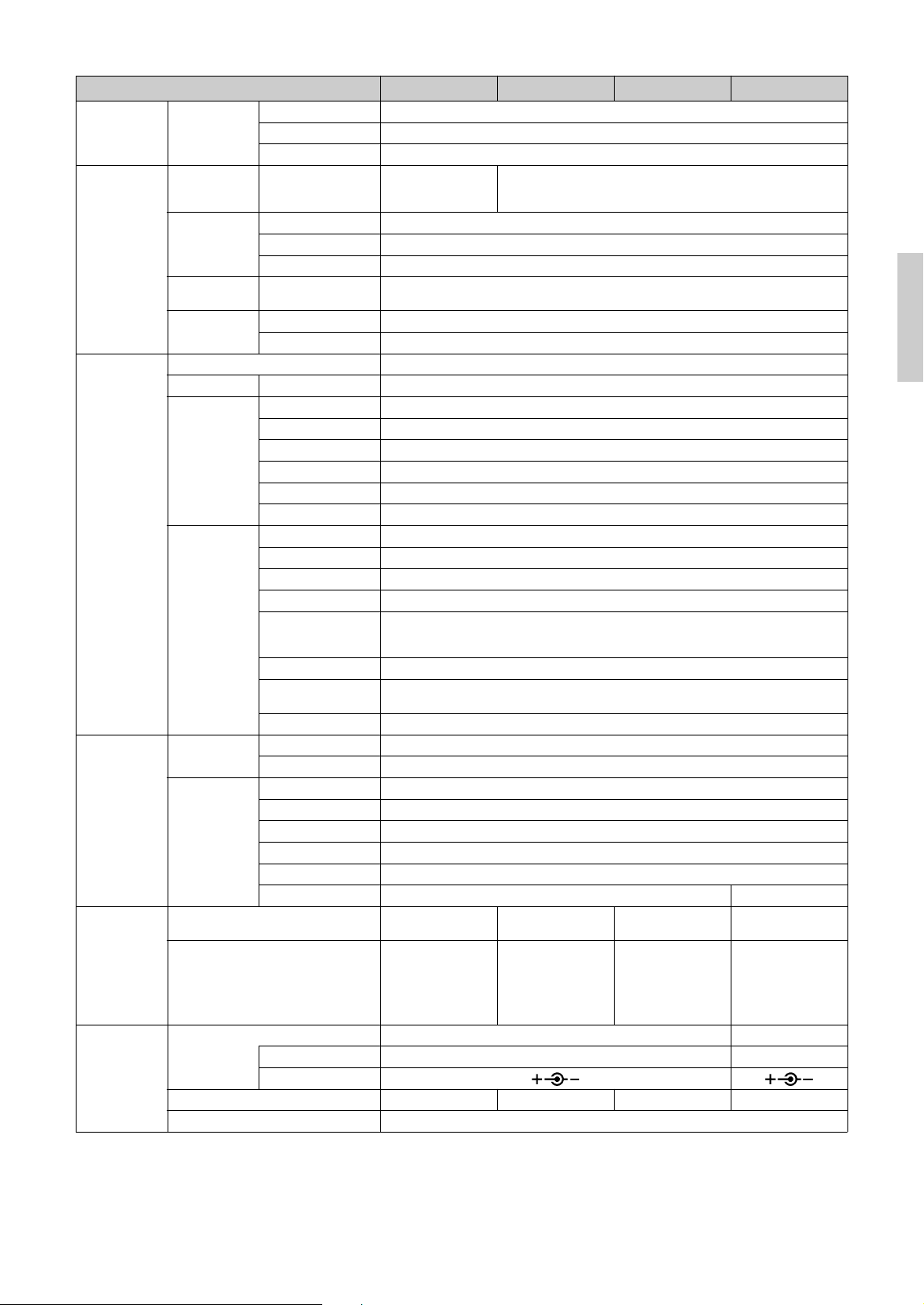
Appendix
79
CLP-885 CLP-875 CLP-845 CLP-835 CLP-895GP CLP-865GP Owner’s Manual
Effects Functions
Dual Yes
Split Yes
Duo Yes
Songs
Preset
Number of Preset
Songs
27 Voice Demo +
50 Classics +
303 Lesson Songs
23 Voice Demo + 50 Classics + 303 Lesson Songs
MIDI Recording
Number of Songs 250
Number of Tracks 16
Data Capacity Approx. 500 KB/Song (approx. 22,000 notes)
Audio Recording
(USB flash drive)
Recording Time (max.) 80 minutes/Song
Compatible Data
Format
Playback SMF (Format 0, Format 1), WAV (44.1 kHz, 16-bit, stereo)
Recording SMF (Format 0), WAV (44.1 kHz, 16-bit, stereo)
Functions
Piano Room Yes
Rhythm Number of Rhythms 20
Overall Controls
Metronome Yes
Tempo Range 5 – 500
Transpose −12 – 0 – +12
Tuning 414.8 – 440.0 – 466.8 Hz (approx. 0.2 Hz increments)
Scale Type 7 types
USB Audio Interface 44.1 kHz, 24-bit, stereo
Bluetooth
(May not have
this functionality
depending on
the country in
which you
purchased the
product.)
Audio Supported profile: A2DP, Compatible codec: SBC
MIDI Comply with Bluetooth Low Energy MIDI Specification
Bluetooth version 5.0
Wireless output Bluetooth Class 2
Maximum
communication
distance
Approx. 10 m
Radio Frequency 2,401 – 2,481 MHz
Maximum output power
(EIRP)
4 dBm
Type of modulation GFSK
Storage and
Connectivity
Storage
Internal Memory Approx. 1.4 MB
External Drives USB flash drive
Connectivity
Headphones Standard stereo phone jack (× 2)
AUX IN Stereo mini jack
AUX OUT Standard phone jack (L/L+R, R)
USB TO DEVICE Type A
USB TO HOST Type B
DC IN 24 V 16 V
Amplifiers
and Speakers
Amplifiers
(45 W + 30 W + 40 W)
× 2
(45 W + 25 W + 40 W)
× 2
(45 W + 45 W) × 2 30 W × 2
Speakers
(16 cm with diffuser +
8 cm with diffuser +
2.5 cm (dome) with
Bidirectional Horn)
× 2, Spruce Cone
Speaker
(16 cm + 8 cm with
diffuser + 2.5 cm
(dome) with
Bidirectional Horn) × 2
(16 cm with diffuser +
8 cm with diffuser) × 2
16 cm with diffuser × 2
Power
Supply
AC Adaptor PA-500 PA-300C
Output DC 24 V, 2.5 A DC 16 V, 2.4 A
Polarity
Power Consumption 55 W 55 W 30 W 18 W
Standby Power Consumption 0.3 W
CLP-885 CLP-875 CLP-845 CLP-835

Appendix
80
CLP-885 CLP-875 CLP-845 CLP-835 CLP-895GP CLP-865GP Owner’s Manual
The contents of this manual apply to the latest specifications as of the publishing date. To obtain the latest manual, access the Yamaha website then
download the manual file. Since specifications, equipment or separately sold accessories may not be the same in every locale, please check with your
Yamaha dealer.
Included Accessories
• Owner’s Manual
• “50 Classical Music Masterpieces” Music Book
• Online Member Product Registration
• Bench*
• Power cord*, AC adaptor*: (CLP-885/CLP-875/CLP-845) PA-500, (CLP-835) PA-300C
*May not be included depending on your area. Check with your Yamaha dealer.
Separately Sold Accessories
(May not be available depending on your area.)
• Headphones: HPH-150, HPH-100, HPH-50
• Pedal unit: FC35
• AC adaptor: (CLP-885/CLP-875/CLP-845) PA-500, (CLP-835) PA-300C
• USB wireless LAN adaptor: UD-WL01
CLP-885 CLP-875 CLP-845 CLP-835
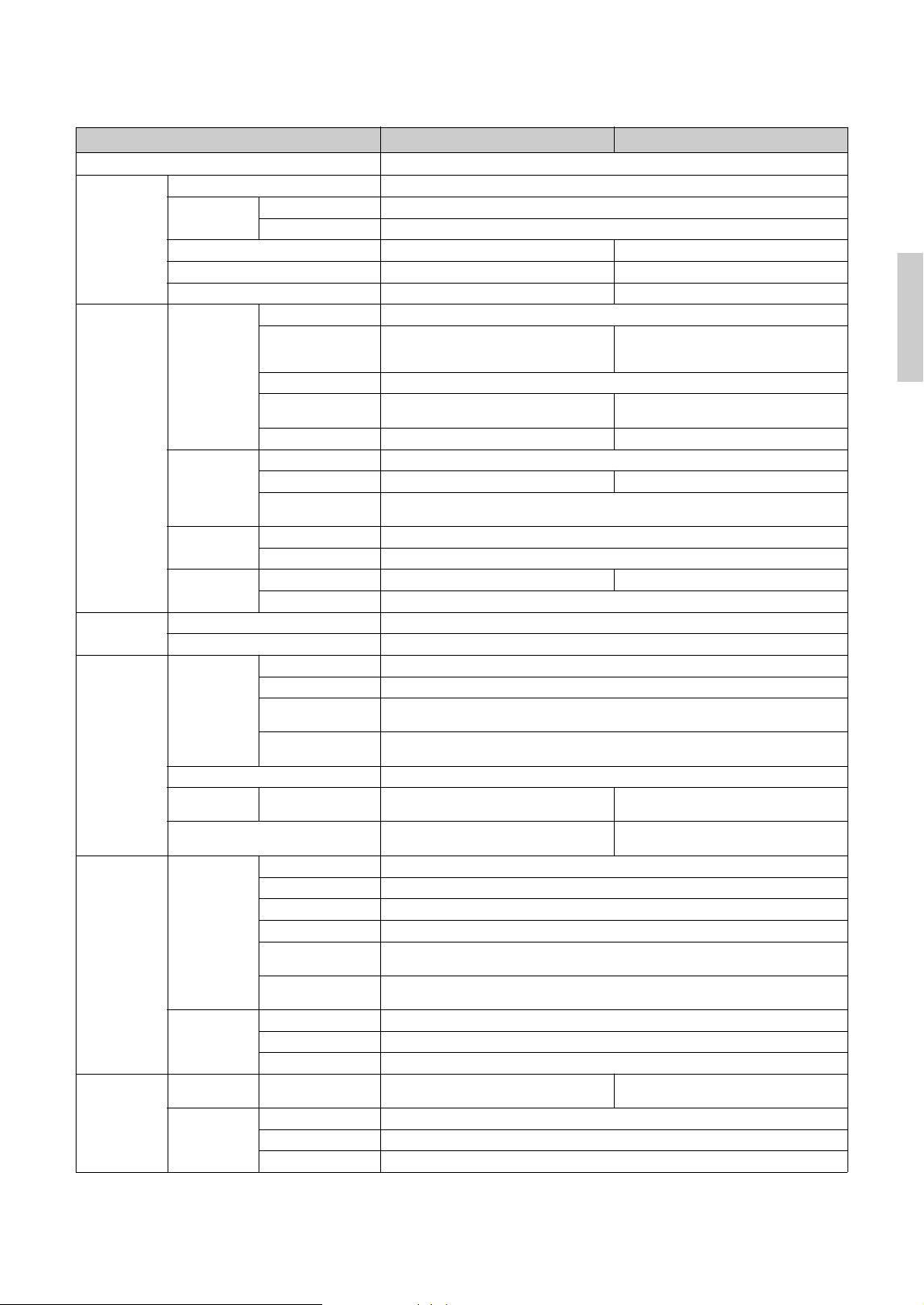
Appendix
81
CLP-885 CLP-875 CLP-845 CLP-835 CLP-895GP CLP-865GP Owner’s Manual
Specifications (CLP-895GP, CLP-865GP)
Refer to page 78 for specifications of the CLP-885, CLP-875, CLP-845 and CLP-835.
CLP-895GP CLP-865GP
Product Name
Digital Piano
Size/Weight
Width 1,430 mm (56-5/16")
Height
With music rest closed 932 mm (36-11/16")
With music rest raised 1,094 mm (43-1/16")
Height with lid up 1,577 mm (62-1/16")
1,400 mm (55-1/8")
Depth 1,237 mm (48-11/16") 1,146 mm (45-1/8")
Weight 135 kg (297 lb, 10 oz) 106 kg (233 lb, 11 oz)
Control
Interface
Keyboard
Number of Keys 88
Type
GrandTouch Keyboard: wooden keys (white
only), synthetic ebony and ivory key tops,
escapement
GrandTouch-S Keyboard: synthetic ebony and
ivory key tops, escapement
Touch Sensitivity Hard2, Hard1, Medium, Soft1, Soft2, Fixed
88-key Linear Graded
Hammers
Yes
–
Counterweight Yes
–
Pedal
Number of Pedals 3: Damper (with Half-pedal function), Sostenuto, Soft
GrandTouch Pedals Yes (with GP Response Damper)
Yes
Assignable Functions
Sustain (Switch), Sustain Continuously, Sostenuto, Soft, Pitch Bend Up, Pitch Bend Down,
Rotary Speed, Vibe Rotor, Song Play/Pause
Display
Type Full Dots LCD
Language English, Japanese
Panel
Type Touch sensors Buttons
Language English
Cabinet
Key Cover Style Sliding
Music Rest Yes (with music braces)
Voices
Tone Generator
Piano Sound Yamaha CFX, Bösendorfer Imperial
Binaural Sampling Yes (“CFX Grand” and “Bösendorfer” only)
VRM (Virtual
Resonance Modeling)
Yes
Grand Expression
Modeling
Yes
Polyphony (max.) 256
Preset Number of Voices
53 Voices + 480 XG Voices +
14 Drum/SFX Kits
38 Voices
Compatibility
XG (GM), GS (for Song playback),
GM2 (for Song playback)
–
Effects
Types
Reverb 7 types
Chorus 3 types
Brilliance 7 types + User
Insertion Effect 12 types
Intelligent Acoustic
Control (IAC)
Yes
Stereophonic
Optimizer
Yes
Functions
Dual Yes
Split Yes
Duo Yes
Songs
Preset
Number of Preset
Songs
27 Voice Demo + 50 Classics +
303 Lesson Songs
23 Voice Demo + 50 Classics +
303 Lesson Songs
MIDI Recording
Number of Songs 250
Number of Tracks 16
Data Capacity Approx. 500 KB/Song (approx. 22,000 notes)
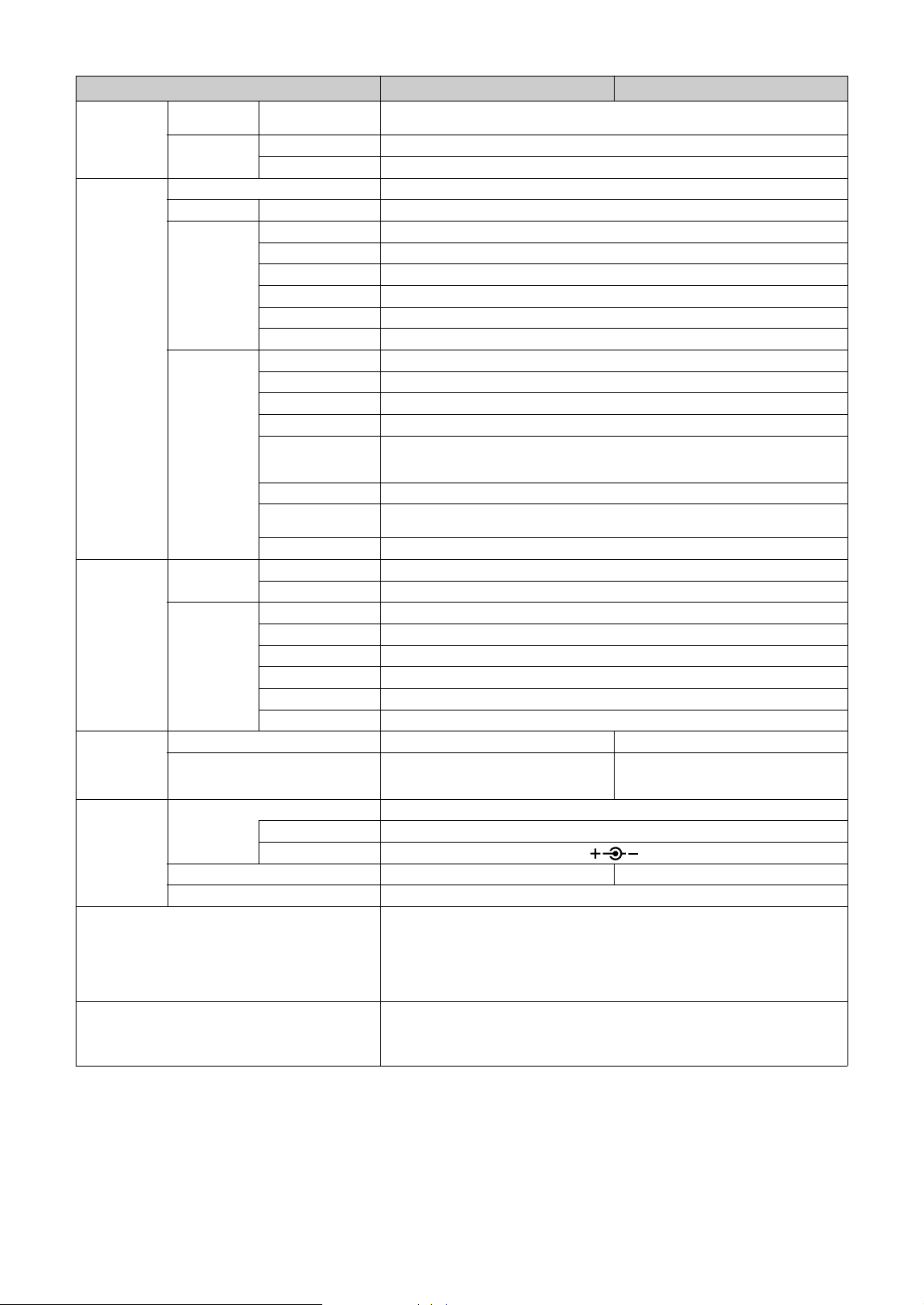
Appendix
82
CLP-885 CLP-875 CLP-845 CLP-835 CLP-895GP CLP-865GP Owner’s Manual
The contents of this manual apply to the latest specifications as of the publishing date. To obtain the latest manual, access the Yamaha website then
download the manual file. Since specifications, equipment or separately sold accessories may not be the same in every locale, please check with your
Yamaha dealer.
Songs
Audio Recording
(USB flash drive)
Recording Time (max.) 80 minutes/Song
Compatible Data
Format
Playback SMF (Format 0, Format 1), WAV (44.1 kHz, 16-bit, stereo)
Recording SMF (Format 0), WAV (44.1 kHz, 16-bit, stereo)
Functions
Piano Room Yes
Rhythm Number of Rhythms 20
Overall Controls
Metronome Yes
Tempo Range 5 – 500
Transpose −12 – 0 – +12
Tuning 414.8 – 440.0 – 466.8 Hz (approx. 0.2 Hz increments)
Scale Type 7 types
USB Audio Interface 44.1 kHz, 24-bit, stereo
Bluetooth
(May not have
this functionality
depending on
the country in
which you
purchased the
product.)
Audio Supported profile: A2DP, Compatible codec: SBC
MIDI Comply with Bluetooth Low Energy MIDI Specification
Bluetooth version 5.0
Wireless output Bluetooth Class 2
Maximum
communication
distance
Approx. 10 m
Radio Frequency 2,401 – 2,481 MHz
Maximum output power
(EIRP)
4 dBm
Type of modulation GFSK
Storage and
Connectivity
Storage
Internal Memory Approx. 1.4 MB
External Drives USB flash drive
Connectivity
Headphones Standard stereo phone jack (× 2)
AUX IN Stereo mini jack
AUX OUT Standard phone jack (L/L+R, R)
USB TO DEVICE Type A
USB TO HOST Type B
DC IN 24 V
Amplifiers
and Speakers
Amplifiers (45 W + 45 W + 45 W) × 2 (45 W + 35 W) × 2
Speakers
(16 cm + 8 cm with Waveguide + 2.5 cm
(dome) with Waveguide) × 2,
Spruce Cone Speaker
(16 cm with diffuser + 5 cm) × 2
Power
Supply
AC Adaptor PA-500
Output DC 24 V, 2.5 A
Polarity
Power Consumption 60 W 55 W
Standby Power Consumption 0.3 W
Included Accessories
• Owner’s Manual
• “50 Classical Music Masterpieces” Music Book
• Online Member Product Registration
• Bench*
• Power cord*, AC adaptor*: PA-500
*May not be included depending on your area. Check with your Yamaha dealer.
Separately Sold Accessories
(May not be available depending on your area.)
• Headphones: HPH-150, HPH-100, HPH-50
• Pedal unit: FC35
• AC adaptor: PA-500
• USB wireless LAN adaptor: UD-WL01
CLP-895GP CLP-865GP

Appendix
83
CLP-885 CLP-875 CLP-845 CLP-835 CLP-895GP CLP-865GP Owner’s Manual
A
A-B Repeat ....................................34
App ................................................46
Assembly .......................................63
Audio Loopback .............................49
Audio Recording ............................37
Audio Song ....................................30
Auto Power Off ..............................17
[AUX IN] jack .................................45
B
Bluetooth .......................7, 21, 43, 46
Body Resonance ...........................24
Brightness .....................................24
C
Computer .......................................48
Control panel .................................20
D
Damper Noise ...............................24
Damper Resonance ......................24
Data List ........................................10
Delete ............................................42
Demo .......................................31, 55
Dual ...............................................27
Duo ................................................28
Duplex Scale Resonance ..............24
F
Factory Reset ................................22
Fast forward ..................................32
Format (USB flash drive) ...............49
G
Grand Expression Modeling ..........24
H
Half pedal ......................................25
Headphones ..................................18
I
Initialize (Factory Reset) ................22
Input ..............................................43
K
Key cover ......................................14
L
Lid ............................................15, 24
M
Master Tune ................................. 24
Menu ............................................. 51
Message List ................................ 58
Metronome ................................... 25
Metronome/Rhythm menu ............ 51
MIDI Recording ............................. 37
MIDI Song ..................................... 30
Multi track recording ..................... 41
Music rest ..................................... 15
O
Output ........................................... 50
Overdubbing ................................. 41
P
Pairing .......................................... 44
Part (playback) ............................. 35
Part (recording) ....................... 40, 41
Pedal ............................................ 19
Piano Room .................................. 23
Pitch .............................................. 24
Playback (Rhythm) ....................... 29
Playback (Song) ........................... 30
Power ..................................... 16, 17
R
Recording ..................................... 37
Recording menu ........................... 51
Reference Manual ........................ 10
Repeat playback ........................... 33
Reset ............................................ 22
Reverb .......................................... 24
Rewind .......................................... 32
Rhythm ......................................... 29
Rhythm List ................................... 56
S
Smart device ................................. 46
Smart Pianist ................................ 46
Smart Pianist User Guide ............. 10
Song ............................................. 30
Song List ....................................... 57
Song menu ................................... 51
Speed ........................................... 33
Split ............................................... 27
Split Point ..................................... 28
String Resonance ......................... 24
System menu ................................ 51
T
Tempo ............................... 25, 29, 33
Touch ............................................ 24
Track (playback) ........................... 35
Track (recording) ..................... 40, 41
Transpose ..................................... 36
Troubleshooting ............................ 61
Tuning ........................................... 24
U
USB Audio Interface ..................... 48
USB flash drive ............................. 49
USB [TO DEVICE] terminal .......... 47
USB [TO HOST] terminal ........ 45, 47
V
Voice .............................................26
Voice Demo ............................31, 55
Voice List ......................................52
Voice menu ................................... 51
Volume .......................................... 18
VRM (Virtual Resonance Modeling)
....................................................... 24
W
Wi-Fi .............................................. 47
Wireless LAN ................................ 47
X
XG Voices (CLP-885/CLP-895GP
only) ..............................................26
Index

84
CLP-885 CLP-875 CLP-845 CLP-835 CLP-895GP CLP-865GP Owner’s Manual
MEMO
85
CLP-885 CLP-875 CLP-845 CLP-835 CLP-895GP CLP-865GP Owner’s Manual
For U.S.A.
For Canada
This transmitter must not be co-located or operated in conjunction with any other antenna or transmitter.
(554-M01 FCC transmitter 01)
This equipment complies with FCC radiation exposure limits set forth for an uncontrolled environment and meets the
FCC radio frequency (RF) Exposure Guidelines. This equipment has very low levels of RF energy that is deemed to
comply without testing of specific absorption rate (SAR).
(554-M04 FCC portable 01)
Important Notice:
U.S. LIMITED WARRANTY for Customers in the United States
For detailed information about this Yamaha product and warranty service, please either visit the following
website address (printable file is available at our website) or contact Customer Service at the address or
telephone number identified below.
Website Address:
Yamaha.io/ClavinovaWarranty
Customer Service:
Yamaha Corporation of America
6600 Orangethorpe Avenue, Buena Park, CA 90620
Telephone: 800-854-1569
This equipment complies with ISED radiation exposure limits set forth for an uncontrolled environment and meets
RSS-102 of the ISED radio frequency (RF) Exposure rules as this equipment has very low levels of RF energy.
Cet équipement est conforme aux limites d’exposition aux rayonnements énoncées pour un environnement non
contrôlé et respecte les règles d’exposition aux fréquences radioélectriques (RF) CNR-102 de l’ISDE puisque cet
appareil a une niveau tres bas d’energie RF.
(0555-M05_ised_portable_01)
This device contains licence-exempt transmitter(s)/receiver(s) that comply with Innovation, Science and Economic
Development Canada’s licence-exempt RSS(s). Operation is subject to the following two conditions:
1. This device may not cause interference.
2. This device must accept any interference, including interference that may cause undesired operation of the device.
L’émetteur/récepteur exempt de licence contenu dans le présent appareil est conforme aux CNR d’Innovation,
Sciences et Développement économique Canada applicables aux appareils radio exempts de licence. L’exploitation
est autorisée aux deux conditions suivantes :
1. L’appareil ne doit pas produire de brouillage ;
2. L’appareil doit accepter tout brouillage radioélectrique subi, même si le brouillage est susceptible d’en
compromettre le fonctionnement.
(555-M13 ISED RSS 01)

86
CLP-885 CLP-875 CLP-845 CLP-835 CLP-895GP CLP-865GP Owner’s Manual
For United Kingdom
SIMPLIFIED UK DECLARATION OF CONFORMITY
Hereby, Yamaha Corporation declares that the [CLP-885, CLP-875, CLP-845, CLP-835, CLP-895GP, CLP-865GP] is
in compliance with the Product Security and Telecommunications Infrastructure Regulations. The full text of the UK
declaration of conformity is available at the following internet address:
https://europe.yamaha.com/en/support/compliance/doc.html
87
CLP-885 CLP-875 CLP-845 CLP-835 CLP-895GP CLP-865GP Owner’s Manual
For European Union and United Kingdom
(559-M01 RED DoC URL 03)
EN SIMPLIFIED EU DECLARATION OF CONFORMITY /
SIMPLIFIED UK DECLARATION OF CONFORMITY
Hereby, Yamaha Corporation declares that the radio equipment type [CLP-
885, CLP-875, CLP-845, CLP-835, CLP-895GP, CLP-865GP] is in
compliance with Directive 2014/53/EU and the radio equipment regulations
of UK. The full texts of the EU declaration of conformity and the UK
declaration of conformity are available at the following internet address:
https://europe.yamaha.com/en/support/compliance/doc.html
FR DECLARATION UE DE CONFORMITE SIMPLIFIEE
Le soussigné, Yamaha Corporation, déclare que l'équipement radioélectrique du
type [CLP-885, CLP-875, CLP-845, CLP-835, CLP-895GP, CLP-865GP] est
conforme à la directive 2014/53/UE. Le texte complet de la déclaration UE de
conformité est disponible à l'adresse internet suivante :
https://europe.yamaha.com/en/support/compliance/doc.html
DE VEREINFACHTE EU-KONFORMITÄTSERKLÄRUNG
Hiermit erklärt Yamaha Corporation, dass der Funkanlagentyp [CLP-885,
CLP-875, CLP-845, CLP-835, CLP-895GP, CLP-865GP] der Richtlinie 2014/
53/EU entspricht. Der vollständige Text der EU-Konformitätserklärung ist
unter der folgenden Internetadresse verfügbar:
https://europe.yamaha.com/en/support/compliance/doc.html
SV
FÖRENKLAD EU-FÖRSÄKRAN OM ÖVERENSSTÄMMELSE
Härmed försäkrar Yamaha Corporation att denna typ av radioutrustning
[CLP-885, CLP-875, CLP-845, CLP-835, CLP-895GP, CLP-865GP]
överensstämmer med direktiv 2014/53/EU. Den fullständiga texten till EU-
försäkran om överensstämmelse finns på följande webbadress:
https://europe.yamaha.com/en/support/compliance/doc.html
IT DICHIARAZIONE DI CONFORMITÀ UE SEMPLIFICATA
Il fabbricante, Yamaha Corporation, dichiara che il tipo di apparecchiatura
radio [CLP-885, CLP-875, CLP-845, CLP-835, CLP-895GP, CLP-865GP] è
conforme alla direttiva 2014/53/UE. Il testo completo della dichiarazione di
conformità UE è disponibile al seguente indirizzo Internet:
https://europe.yamaha.com/en/support/compliance/doc.html
ES
DECLARACIÓN UE DE CONFORMIDAD SIMPLIFICADA
Por la presente, Yamaha Corporation declara que el tipo de equipo
radioeléctrico [CLP-885, CLP-875, CLP-845, CLP-835, CLP-895GP, CLP-
865GP] es conforme con la Directiva 2014/53/UE. El texto completo de la
declaración UE de conformidad está disponible en la dirección Internet
siguiente:
https://europe.yamaha.com/en/support/compliance/doc.html
PT
DECLARAÇÃO UE DE CONFORMIDADE SIMPLIFICADA
O(a) abaixo assinado(a) Yamaha Corporation declara que o presente tipo
de equipamento de rádio [CLP-885, CLP-875, CLP-845, CLP-835, CLP-
-895GP, CLP-865GP] está em conformidade com a Diretiva 2014/53/UE. O
texto integral da declaração de conformidade está disponível no seguinte
endereço de Internet:
https://europe.yamaha.com/en/support/compliance/doc.html
NL
VEREENVOUDIGDE EU-CONFORMITEITSVERKLARING
Hierbij verklaar ik, Yamaha Corporation, dat het type radioapparatuur [CLP-
885, CLP-875, CLP-845, CLP-835, CLP-895GP, CLP-865GP] conform is
met Richtlijn 2014/53/EU. De volledige tekst van de EU-
conformiteitsverklaring kan worden geraadpleegd op het volgende
internetadres:
https://europe.yamaha.com/en/support/compliance/doc.html
BG ОПРОСТЕНА ЕС ДЕКЛАРАЦИЯ ЗА СЪОТВЕТСТВИЕ
С настоящото Yamaha Corporation декларира, че този тип
радиосъоръжение [CLP-885, CLP-875, CLP-845, CLP-835, CLP-895GP,
CLP-865GP] е в съответствие с Директива 2014/53/ЕС. Цялостният
текст на ЕС декларацията за съответствие може да се намери на
следния интернет адрес:
https://europe.yamaha.com/en/support/compliance/doc.html
CS ZJEDNODUŠENÉ EU PROHLÁŠENÍ O SHODĚ
Tímto Yamaha Corporation prohlašuje, že typ rádiového zařízení [CLP-885,
CLP-875, CLP-845, CLP-835, CLP-895GP, CLP-865GP] je v souladu se
směrnicí 2014/53/EU. Úplné znění EU prohlášení o shodě je k dispozici na
této internetové adrese:
https://europe.yamaha.com/en/support/compliance/doc.html
DA
FORENKLET EU-OVERENSSTEMMELSESERKLÆRING
Hermed erklærer Yamaha Corporation, at radioudstyrstypen [CLP-885,
CLP-875, CLP-845, CLP-835, CLP-895GP, CLP-865GP] er i
overensstemmelse med direktiv 2014/53/EU. EU-
overensstemmelseserklæringens fulde tekst kan findes på følgende
internetadresse:
https://europe.yamaha.com/en/support/compliance/doc.html
ET LIHTSUSTATUD ELI VASTAVUSDEKLARATSIOON
Käesolevaga deklareerib Yamaha Corporation, et käesolev raadioseadme
tüüp [CLP-885, CLP-875, CLP-845, CLP-835, CLP-895GP, CLP-865GP]
vastab direktiivi 2014/53/EL nõuetele. ELi vastavusdeklaratsiooni täielik
tekst on kättesaadav järgmisel internetiaadressil:
https://europe.yamaha.com/en/support/compliance/doc.html
EL ΑΠΛΟΥΣΤΕΥΜΕΝΗ ΔΗΛΩΣΗ ΣΥΜΜΟΡΦΩΣΗΣ ΕΕ
Με την παρούσα ο/η Yamaha Corporation, δηλώνει ότι ο ραδιοεξοπλισμός
[CLP-885, CLP-875, CLP-845, CLP-835, CLP-895GP, CLP-865GP] πληροί
την οδηγία 2014/53/ΕΕ. Το πλήρες κείμενο της δήλωσης συμμόρφωσης ΕΕ
διατίθεται στην ακόλουθη ιστοσελίδα στο διαδίκτυο:
https://europe.yamaha.com/en/support/compliance/doc.html
HR POJEDNOSTAVLJENA EU IZJAVA O SUKLADNOSTI
Yamaha Corporation ovime izjavljuje da je radijska oprema tipa [CLP-885,
CLP-875, CLP-845, CLP-835, CLP-895GP, CLP-865GP] u skladu s
Direktivom 2014/53/EU. Cjeloviti tekst EU izjave o sukladnosti dostupan je
na sljedećoj internetskoj adresi:
https://europe.yamaha.com/en/support/compliance/doc.html
LV VIENKĀRŠOTA ES ATBILSTĪBAS DEKLARĀCIJA
Ar šo Yamaha Corporation deklarē, ka radioiekārta [CLP-885, CLP-875,
CLP-845, CLP-835, CLP-895GP, CLP-865GP] atbilst Direktīvai 2014/53/ES.
Pilns ES atbilstības deklarācijas teksts ir pieejams šādā interneta vietnē:
https://europe.yamaha.com/en/support/compliance/doc.html
LT SUPAPRASTINTA ES ATITIKTIES DEKLARACIJA
Aš, Yamaha Corporation, patvirtinu, kad radijo įrenginių tipas [CLP-885, CLP-
875, CLP-845, CLP-835, CLP-895GP, CLP-865GP] atitinka Direktyvą 2014/53/
ES. Visas ES atitikties deklaracijos tekstas prieinamas šiuo interneto adresu:
https://europe.yamaha.com/en/support/compliance/doc.html
HU
EGYSZERŰSÍTETT EU-MEGFELELŐSÉGI NYILATKOZAT
Yamaha Corporation igazolja, hogy a [CLP-885, CLP-875, CLP-845, CLP-
835, CLP-895GP, CLP-865GP] típusú rádióberendezés megfelel a 2014/53/
EU irányelvnek. Az EU-megfelelőségi nyilatkozat teljes szövege elérhető a
következő internetes címen:
https://europe.yamaha.com/en/support/compliance/doc.html
PL UPROSZCZONA DEKLARACJA ZGODNOŚCI UE
Yamaha Corporation niniejszym oświadcza, że typ urządzenia radiowego
[CLP-885, CLP-875, CLP-845, CLP-835, CLP-895GP, CLP-865GP] jest
zgodny z dyrektywą 2014/53/UE. Pełny tekst deklaracji zgodności UE jest
dostępny pod następującym adresem internetowym:
https://europe.yamaha.com/en/support/compliance/doc.html
RO DECLARAȚIA UE DE CONFORMITATE SIMPLIFICATĂ
Prin prezenta, Yamaha Corporation declară că tipul de echipamente radio
[CLP-885, CLP-875, CLP-845, CLP-835, CLP-895GP, CLP-865GP] este în
conformitate cu Directiva 2014/53/UE. Textul integral al declarației UE de
conformitate este disponibil la următoarea adresă internet:
https://europe.yamaha.com/en/support/compliance/doc.html
SK ZJEDNODUŠENÉ EÚ VYHLÁSENIE O ZHODE
Yamaha Corporation týmto vyhlasuje, že rádiové zariadenie typu [CLP-885,
CLP-875, CLP-845, CLP-835, CLP-895GP, CLP-865GP] je v súlade so
smernicou 2014/53/EÚ. Úplné EÚ vyhlásenie o zhode je k dispozícii na tejto
internetovej adrese:
https://europe.yamaha.com/en/support/compliance/doc.html
SL POENOSTAVLJENA IZJAVA EU O SKLADNOSTI
Yamaha Corporation potrjuje, da je tip radijske opreme [CLP-885, CLP-875,
CLP-845, CLP-835, CLP-895GP, CLP-865GP] skladen z Direktivo 2014/53/
EU. Celotno besedilo izjave EU o skladnosti je na voljo na naslednjem
spletnem naslovu:
https://europe.yamaha.com/en/support/compliance/doc.html
FI
YKSINKERTAISTETTU EU-VAATIMUSTENMUKAISUUSVAKUUTUS
Yamaha Corporation vakuuttaa, että radiolaitetyyppi [CLP-885, CLP-875,
CLP-845, CLP-835, CLP-895GP, CLP-865GP] on direktiivin 2014/53/EU
mukainen. EU-vaatimustenmukaisuusvakuutuksen täysimittainen teksti on
saatavilla seuraavassa internetosoitteessa:
https://europe.yamaha.com/en/support/compliance/doc.html
TR
BASİTLEŞTİRİLMİŞ AVRUPA BİRLİĞİ UYGUNLUK BİLDİRİMİ
İşbu belge ile, Yamaha Corporation, radyo cihaz tipinin [CLP-885, CLP-875,
CLP-845, CLP-835, CLP-895GP, CLP-865GP], Direktif 2014/53/ AB'ye
uygunluğunu beyan eder. AB uyumu beyanının tam metni aşağıdaki internet
adresinden edinilebilir:
https://europe.yamaha.com/en/support/compliance/doc.html
88
CLP-885 CLP-875 CLP-845 CLP-835 CLP-895GP CLP-865GP Owner’s Manual
Yamaha Worldwide Representative Offices
For details on the product(s), contact your nearest Yamaha representative or the authorized distributor,
found by accessing the 2D barcode below.
English
Wenden Sie sich für nähere Informationen zu Produkten an eine Yamaha-Vertretung oder einen
autorisierten Händler in Ihrer Nähe. Diese finden Sie mithilfe des unten abgebildeten 2D-Strichodes.
Deutsch
Pour obtenir des informations sur le ou les produits, contactez votre représentant ou revendeur agréé
Yamaha le plus proche. Vous le trouverez à l'aide du code-barres 2D ci-dessous.
Français
Para ver información detallada sobre el producto, contacte con su representante o distribuidor autorizado
Yamaha más cercano. Lo encontrará escaneando el siguiente código de barras 2D.
Español
Untuk detail produk, hubungi perwakilan Yamaha terdekat atau distributor resmi Anda dengan
mengakses barcode 2D di bawah ini.
Bahasa indonesia
Para mais informações sobre o(s) produto(s), fale com seu representante da Yamaha mais próximo ou com
o distribuidor autorizado acessando o código de barras 2D abaixo.
Português
ɑɬɨɛɵɭɡɧɚɬɶɩɨɞɪɨɛɧɟɟɨɩɪɨɞɭɤɬɟɩɪɨɞɭɤɬɚɯɫɜɹɠɢɬɟɫɶɫɛɥɢɠɚɣɲɢɦɩɪɟɞɫɬɚɜɢɬɟɥɟɦɢɥɢ
ɚɜɬɨɪɢɡɨɜɚɧɧɵɦɞɢɫɬɪɢɛɶɸɬɨɪɨɦ<DPDKDɜɨɫɩɨɥɶɡɨɜɚɜɲɢɫɶɞɜɭɯɦɟɪɧɵɦɲɬɪɢɯɤɨɞɨɦɧɢɠɟ
Ɋɭɫɫɤɢɣ
㞝僗⪩◲⿁氳陣篱⟔䕜陴纭硍饄䖻僄鲤氳 :BNBIB ♏辑䡝䪧儹篺ꛖら⺎鵠鲋阼ꠋ┖亡氳◅簟溞䤓⮽鲹◙
♏辑䡝篺ꛖら氳⟔䕜ն
甏⛮╈乄
㞞ꧏ榣⿁氳鎌碸鞴銻鑃绤礙艃䖼ꦗ鲥氳:BNBIBꊸす♏辑䡝䪧垷祺ꊸり䖼⺎♓䬟┖亡氳◅禵半澰刨
洇注绤礙鞴乣
竵냉╈乄
혗폋샻햋켳혐쫯삏팿얓%쨏싗폋폌켳킟폧맻뱇풯:BNBIB샯샴쟟혋쐋삏뫰탘샻잧혋폋
줳핓탨탗퐟
뭨펯
https://manual.yamaha.com/mi/address_list/
Head Office/Manufacturer: Yamaha Corporation 10-1, Nakazawa-cho, Chuo-ku, Hamamatsu, 430-8650, Japan
Importer (European Union): Yamaha Music Europe GmbH Siemensstrasse 22-34, 25462 Rellingen, Germany
Importer (United Kingdom): Yamaha Music Europe GmbH (UK) Sherbourne Drive, Tilbrook, Milton Keynes, MK7 8BL, United Kingdom
DMI37_10m

Yamaha Global Site
https://www.yamaha.com/
Yamaha Downloads
https://download.yamaha.com/
© 2024 Yamaha Corporation
Published 01/2025
MWMA-B0
VGJ7220