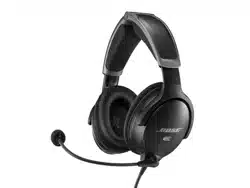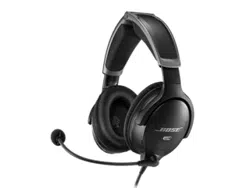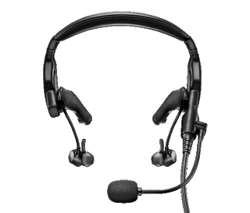
PROFLIGHT SERIES 2
AVIATION HEADSET
Owner’s Guide

IMPORTANT SAFETY INSTRUCTIONS
2
|
ENG
Please read and keep all safety and use instructions.
Bose Corporation hereby declares that this product is in compliance with the essential
requirements and other relevant provisions of Directive 2014/53/EU and all other
applicable EU directive requirements. The complete declaration of conformity can be
found at: www.Bose.com/compliance
This product conforms to all applicable Electromagnetic Compatibility Regulations 2016
and all other applicable UK regulations. The complete declaration of conformity can be
found at: www.Bose.com/compliance
Bose Corporation hereby declares that this product is in compliance with the essential
requirements per Radio Equipment Regulations 2017 and all other applicable UK
regulations. The complete declaration of conformity can be found
at: www.Bose.com/compliance
Important Safety Instructions
WARNINGS/CAUTIONS
• Do NOT use the headphones with noise canceling mode at any time the inability to hear
surrounding sounds may present a danger to yourself or others, e.g., while riding a bicycle or
walking in or near traic, a construction site or railroad, etc.
• Keep baeries out of reach of children.
• Please dispose of used baeries properly, following any local regulations.
• Baeries may cause a fire or chemical burn if mishandled. Do not recharge, disassemble, heat,
or incinerate.
• When a replacement is needed, use only a AA (LR06) alkaline baeries.
Please read and save this guide
Please read this guide carefully. Save this guide for future reference and make it easily accessible
for passengers and third parties who use this headset.
• Switch to an alternate communications method in the event of a headset issue.
In the unlikely event of any headset issue or failure in the passive noise reducing mode, switch
to an alternate communications method and use standard cockpit resource management
skills to minimize distractions.
• Use the headset at a moderate volume level.
To avoid hearing damage, use the headset at a comfortable, moderate volume level. Limit
the headset volume to safe levels that do not interfere with your ability to hear informational
sounds and warning alarms, such as stall warnings or gear up, while piloting.
• Turn the headset o if it emits any loud noise.
As with any complex electronic device, it is possible for this headset to fail during operation.
Symptoms of failure, which may include loud tones, distortion, feedback squeals and loss
of communications signal in the headset, can occur in either the Acoustic Noise Cancelling
mode (turned on) or in the passive mode (turned o). If the headset emits any loud noise and
the related loss of communications in the Acoustic Noise Cancelling mode, turn o the power
switch. The headset will continue to provide communications in the passive noise-reducing
mode. If the problem persists, see “Troubleshooting” on page 48.
• Be aware of sound dierences while wearing the headset.
With the headset’s active and passive noise reduction, typical aircraft sounds (such as engines,
propellers, warning alarms, and other sound sources) may not sound familiar. Make sure you
can hear and recognize these sounds when using the headset while operating any aircraft.
IMPORTANT SAFETY INSTRUCTIONS
3
|
ENG
• Do NOT make phone calls while piloting.
Do not use the headset for telephone calls during flight operations.
• Make sure your aircraft communications system volume control is easily accessible.
This control aects the strength of the communications signal coming into the headset. Make
sure you can understand critical communications even with Acoustic Noise Cancelling mode
turned o. In this case, you may need to turn up the aircraft communications system volume. In
passive mode, the volume controls on the control module will automatically be set to maximum
volume. For additional volume control, use the intercom or radio volume control. If your headset
is aircraft powered, connect the headset to the aircraft power sources only as described in
“Aircraft Connectors” on page 30.
• Make sure portable devices do not interfere with the aircraft’s navigation and communication
systems. Reference FAA AC 91.21-1D, or later revision, for installation approval.
It is the pilot’s responsibility to ensure that portable devices do not interfere with the aircraft’s
navigation and communication systems, as well as to determine if the portable device is
suitable for use with the headset.
• Use only AA alkaline baeries.
To avoid risk of explosion, replace the baeries only with AA alkaline baeries. Properly dispose
of used baeries.
• Do NOT repair the headset yourself.
Contact the Bose organization in your country/region for specific care, return and shipping
instructions. Visit: global.Bose.com
• Do not use the headset with a helmet or as part of a crash protection system.
The headset is not intended for such use, and has not been certified for crash protection.
Dismantling, reassembly or modification of the headset, or any part, for use in a helmet or other
crash protection system could result in severe bodily injury and such unauthorized use will void
the limited product warranty.
• Do NOT immerse the headset or any parts in water or any other liquid.
See “Clean the headset” on page 42 for cleaning instructions.
Contains small parts which may be a choking hazard. Not suitable for children under
age 3.
This product contains magnetic material. Consult your physician on whether this might
aect your implantable medical device.
• Do NOT expose this product to dripping or splashing, and do not place objects filled with
liquids, such as vases, on or near the product.
• Do NOT make unauthorized alterations to this product.
• The baery provided with this product may present a risk of fire, explosion or chemical burn if
mishandled, incorrectly replaced or replaced with an incorrect type.
• Do not expose products containing baeries to excessive heat (e.g. from storage in direct
sunlight, fire or the like).
REGULATORY INFORMATION
4
|
ENG
NOTE: This equipment has been tested and found to comply with the limits for a Class B digital
device, pursuant to Part 15 of the FCC Rules. These limits are designed to provide reasonable
protection against harmful interference in a residential installation. This equipment generates,
uses, and can radiate radio frequency energy and, if not installed and used in accordance with
the instructions, may cause harmful interference to radio communications. However, there is
no guarantee that interference will not occur in a particular installation. If this equipment does
cause harmful interference to radio or television reception, which can be determined by turning
the equipment o and on, the user is encouraged to try to correct the interference by one or
more of the following measures:
• Reorient or relocate the receiving antenna.
• Increase the separation between the equipment and receiver.
• Connect the equipment into an outlet on a circuit dierent from that to which the receiver
is connected.
• Consult the dealer or an experienced radio/TV technician for help.
Changes or modifications not expressly approved by Bose Corporation could void the user’s
authority to operate this equipment.
This device complies with part 15 of the FCC Rules and with Industry Canada license-exempt
RSS standard(s). Operation is subject to the following two conditions: (1) This device may not
cause harmful interference, and (2) this device must accept any interference received, including
interference that may cause undesired operation.
This device complies with FCC and Industry Canada radiation exposure limits set forth for
general population. This transmier must not be co-located or operating in conjunction with any
other antenna or transmier.
CAN ICES-3 (B)/NMB-3(B)
For Europe:
Frequency band of operation 2400 to 2483.5 MHz:
• Bluetooth: Maximum transmit power less than 20 dBm EIRP.
• Bluetooth Low Energy: Maximum power spectral density less than 10 dBm/MHz EIRP.
This symbol means the product must not be discarded as household waste, and should be
delivered to an appropriate collection facility for recycling. Proper disposal and recycling
helps protect natural resources, human health and the environment. For more information
on disposal and recycling of this product, contact your local municipality, disposal service,
or the shop where you bought this product.
Please dispose of used baeries properly, following local regulations. Do not incinerate.
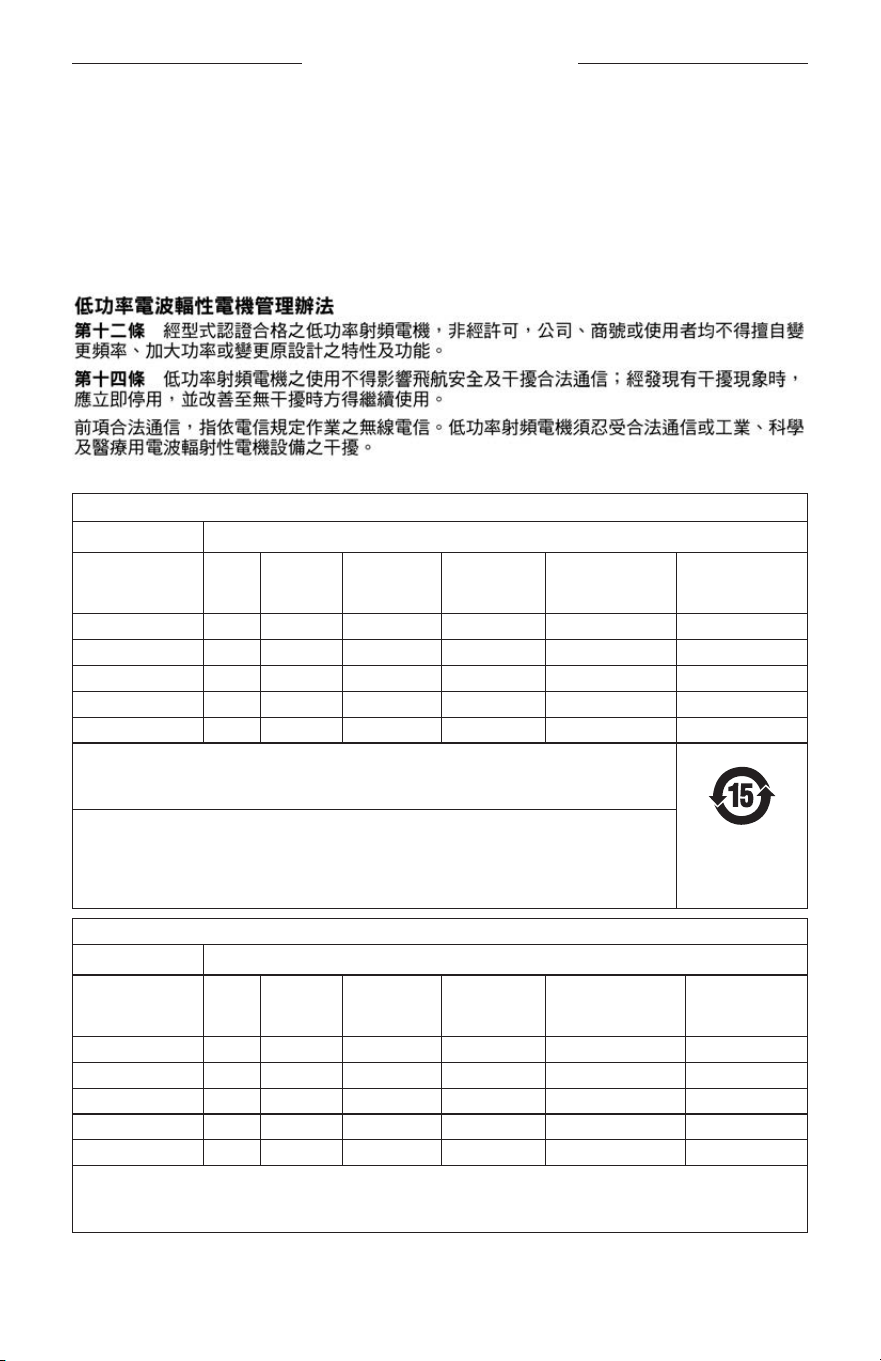
Management Regulation for Low-power Radio-frequency Devices
Article XII
According to “Management Regulation for Low-power Radio-frequency Devices” without
permission granted by the NCC, any company, enterprise, or user is not allowed to change
frequency, enhance transmiing power or alter original characteristic as well as performance to
an approved low power radio-frequency devices.
REGULATORY INFORMATION
5
|
ENG
Article XIV
The low power radio-frequency devices shall not influence aircraft security and interfere legal
communications; If found, the user shall cease operating immediately until no interference is
achieved. The said legal communications means radio communications operated in compliance
with the Telecommunications Act.
The low power radio-frequency devices must be susceptible with the interference from legal
communications or ISM radio wave radiated devices.
Names and Contents of Toxic or Hazardous Substances or Elements
Toxic or Hazardous Substances and Elements
Part Name
Lead
(Pb)
Mercury
(Hg)
Cadmium
(Cd)
Hexavalent
(CR(VI))
Polybrominated
Biphenyl
(PBB)
Polybrominated
diphenylether
(PBDE)
PCBs X O O O O O
Metal Parts X O O O O O
Plastic Parts O O O O O O
Speakers X O O O O O
Cables X O O O O O
This table is prepared in accordance with the provisions of SJ/T 11364.
O: Indicates that this toxic or hazardous substance contained in all of the homogeneous
materials for this part is below the limit requirement of GB/T 26572.
X: Indicates that this toxic or hazardous substance contained in at least one of the homo-
geneous materials used for this part is above the limit requirement of GB/T 26572.
Equipment name: Bose ProFlight Series 2 Aviation Headset, Type designation: 430970
Restricted substances and its chemical symbols
Unit
Lead
(Pb)
Mercury
(Hg)
Cadmium
(Cd)
Hexavalent
chromium
(Cr+6)
Polybrominated
biphenyls (PBB)
Polybrominated
diphenyl ethers
(PBDE)
PCBs
- ○ ○ ○ ○ ○
Metal Parts
- ○ ○ ○ ○ ○
Plastic Parts
○ ○ ○ ○ ○ ○
Speakers
- ○ ○ ○ ○ ○
Cables
- ○ ○ ○ ○ ○
Note 1:
“○” indicates that the percentage content of the restricted substance does not exceed the
percentage of reference value of presence.
Note 2: The “−” indicates that the restricted substance corresponds to the exemption.
REGULATORY INFORMATION
6
|
ENG
Date of Manufacture: The eighth digit in the serial number indicates the year of manufacture; “9”
is 2009 or 2019.
Importers: Bose Electronics (Shanghai) Company Limited, Level 6, Tower D, No. 2337 Gudai Rd.
Minhang District, Shanghai 201100 | Bose Products B.V., Gorslaan 60, 1441 RG Purmerend, The
Netherlands | Bose de México S. de R.L. de C.V., Avenida Prado Sur #150, Piso 2, Interior 222 y
223, Colonia Lomas de Chapultepec V Sección, Miguel Hidalgo, Ciudad de México, C.P. 11000
Phone Number: +5255 (5202) 3545 | Bose Limited (H.K.), 9F., No.10, Sec. 3, Minsheng E. Road,
Zhongshan Dist. Taipei City 10480, Phone Number: +886-2-2514 7676 | Bose Limited, Bose
House, Quayside Chatham Maritime, Chatham, Kent, ME4 4QZ, United Kingdom
Legal Information
Apple and the Apple logo are trademarks of Apple Inc. registered in the U.S. and other countries.
App Store is a service mark of Apple Inc.
Android, Google Play, and the Google Play logo are trademarks of Google LLC.
The Bluetooth
®
word mark and logos are registered trademarks owned by Bluetooth SIG, Inc. and
any use of such marks by Bose Corporation is under license.
Bose Corporation Headquarters: 1-877-230-5639
Bose, Acoustic Noise Cancelling, and StayHear are trademarks of Bose Corporation.
©2024 Bose Corporation. No part of this work may be reproduced, modified, distributed or
otherwise used without prior wrien permission.
Product Security
Bose Corporation hereby declares that the Bose A30 Aviation Headset is in compliance with
the Product Security and Telecommunications Infrastructure Act 2022. This statement of
compliance declares that all security requirement regulations have been met and the product
security software will be supported through at minimum 31/03/2026.
Report a vulnerability at: hps://www.Bose.com/legal/product-security-vulnerability-response
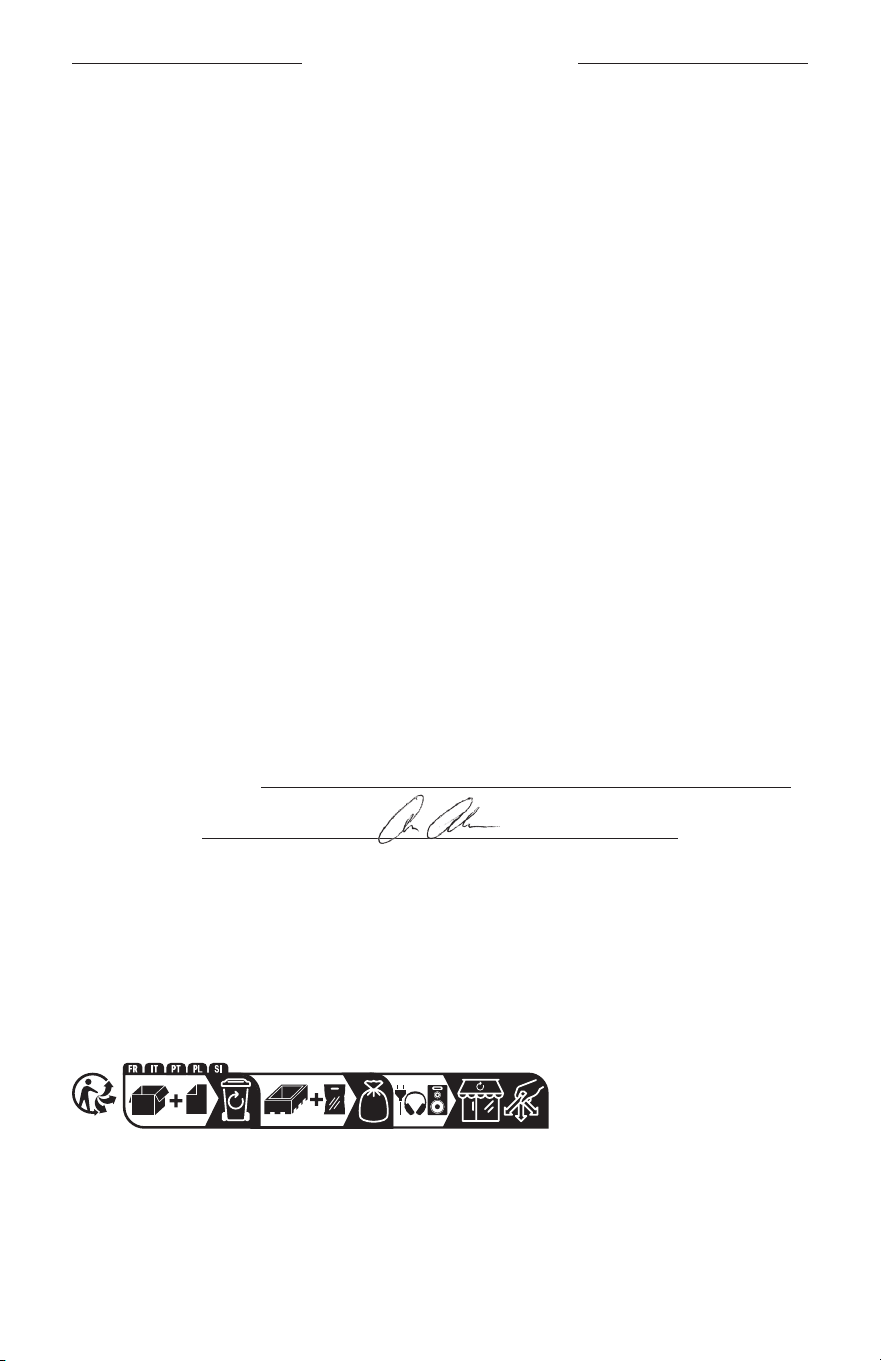
Arun Abraham
Chief Information Security Oicer, Global Information Security
Date: 20/03/2024
Bose Corporation, 100 The Mountain Road, Framingham, MA 01701-9168 USA

7
|
ENG
CONTENTS
BOSE CONNECT APP
Features ...................................................................................................................................................... 11
WHAT’S IN THE BOX
Contents ...................................................................................................................................................... 12
Headset components ............................................................................................................................. 13
Control module options......................................................................................................................... 14
IMPORTANCE OF PROPER FIT
Fit the headband ...................................................................................................................................... 15
Choose the correct StayHear+ tips .................................................................................................. 16
Fit the earbuds to your ear ................................................................................................................... 16
Single earbud use ........................................................................................................................... 17
Change the StayHear+ tips .................................................................................................................. 17
Adjust the microphone .......................................................................................................................... 18
Conditions related to fit ........................................................................................................................ 19
Secure clothing clip and control module holder ......................................................................... 19
Clothing clip ...................................................................................................................................... 19
Control module holder ................................................................................................................. 19
HEADSET CONTROLS
Power on ...................................................................................................................................................... 20
Power o ...................................................................................................................................................... 20
Acoustic Noise Cancellation
Acoustic Noise Cancelling functions
............................................................................................... 21
Tap Control for talk-through communication .............................................................................. 22
Reset Tap Control ........................................................................................................................... 22

CONTENTS
8
|
ENG
CONTENTS
OPERATION SWITCHES
Operation switch functions ................................................................................................................. 23
Change the operation switches ......................................................................................................... 24
MICROPHONE PLACEMENT
Move the microphone ............................................................................................................................ 26
BATTERIES
Replace the baeries ............................................................................................................................. 29
AIRCRAFT CONNECTORS
Dual plug ...................................................................................................................................................... 30
Connect to the aircraft ................................................................................................................ 30
Disconnect from the aircraft ..................................................................................................... 30
5-pin XLR, 6-pin Lemo, and 7-pin XLR............................................................................................. 31
Connect to the aircraft ................................................................................................................ 31
Disconnect from the aircraft ..................................................................................................... 31
STATUS LIGHTS
Bluetooth® light ......................................................................................................................................... 32
Power light................................................................................................................................................... 33
BLUETOOTH CONNECTIONS
Connect using the Bluetooth menu on your mobile device .................................................. 34
Connect your mobile device using the Bose Connect app .................................................... 35
Bluetooth audio priority ......................................................................................................................... 35
Disconnect a mobile device ................................................................................................................ 36
Reconnect a mobile device ................................................................................................................. 37
Recover a lost connection .................................................................................................................... 37

9
|
ENG
CONTENTS
MANAGING MULTIPLE BLUETOOTH CONNECTIONS
Connect an additional mobile device .............................................................................................. 38
Switch between connected devices................................................................................................ 38
Clear the headset pairing list .............................................................................................................. 38
BLUETOOTH FUNCTIONS
Bluetooth volume functions ................................................................................................................ 39
Call functions ............................................................................................................................................. 39
CARE AND MAINTENANCE
Store the headset .................................................................................................................................... 41
Clean the headset.................................................................................................................................... 42
Limited warranty ....................................................................................................................................... 42
Serial number location ........................................................................................................................... 43
Replacement parts and accessories ............................................................................................... 43
Side pad cushion ............................................................................................................................ 43
Headband cushion ......................................................................................................................... 44
StayHear+ tips ................................................................................................................................ 45
Microphone windscreen .............................................................................................................. 45
Baeries ............................................................................................................................................. 46
Microphone or terminator cover .............................................................................................. 46
TROUBLESHOOTING
Try these first.............................................................................................................................................. 47
Other solutions.......................................................................................................................................... 47
Acoustic Noise Cancelling .......................................................................................................... 47
Intercom communications ......................................................................................................... 48
Audio .................................................................................................................................................... 49
Microphone ....................................................................................................................................... 50
Bluetooth audio source ................................................................................................................ 51
Auto on/o ........................................................................................................................................ 52

CONTENTS
10
|
ENG
CONTENTS
INSTALLATION
Mount the aircraft panel connector ................................................................................................. 53
Mono connection diagram ......................................................................................................... 54
Stereo connection diagram ........................................................................................................ 55
Details on making the connections ........................................................................................ 56
TECHNICAL INFORMATION
FAA Technical Standard Order............................................................................................................ 58

11
|
ENG
BOSE CONNECT APP
Enhance your headset experience with the Bose Connect app.
FEATURES
Easily connect to and switch between multiple mobile devices with a single swipe.
Customize your headset experience:
• Name your headset.
• Share audio and music.
• Adjust Bluetooth volume.
NOTE: Applies to Bluetooth headsets only.
• Find answers to frequently asked questions.
12
|
ENG
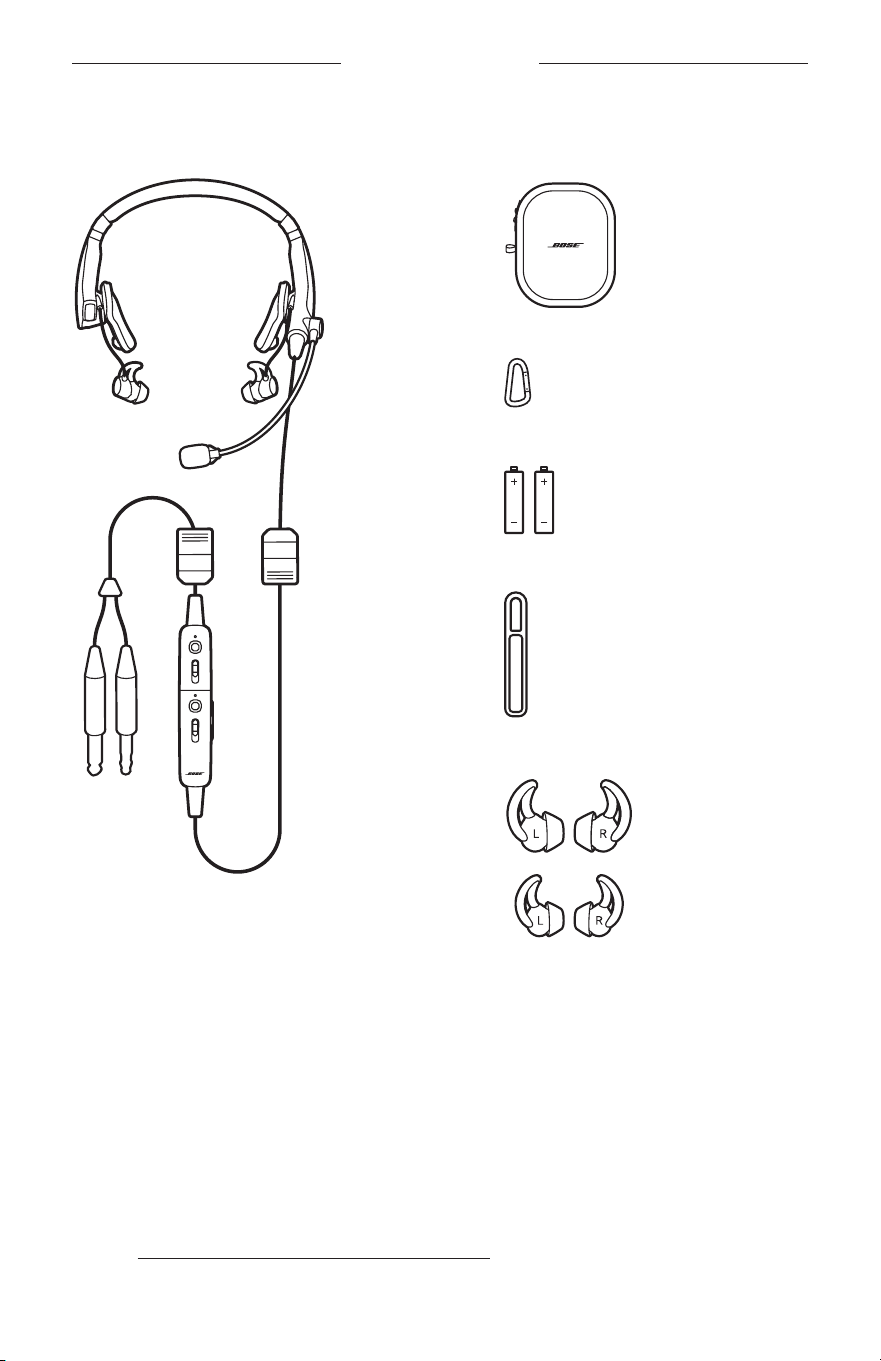
WHAT’S IN THE BOX
CONTENTS
Carry case
Carry case hook
AA baeries (2)
Control module holder
StayHear+ tips:
Large (black) and Small (white)
NOTE: Medium (gray) tips are
aached to the earbuds.
Bose ProFlight Series 2 Aviation Headset
NOTES:
• For control module options, see page 14.
• For aircraft connector types, see page 30.
• If any part of the product is damaged, don’t use it. Contact your authorized Bose
dealer or Bose customer service.
Visit: worldwide.Bose.com/Support/ProFlight2
WHAT’S IN THE BOX
13
|
ENG
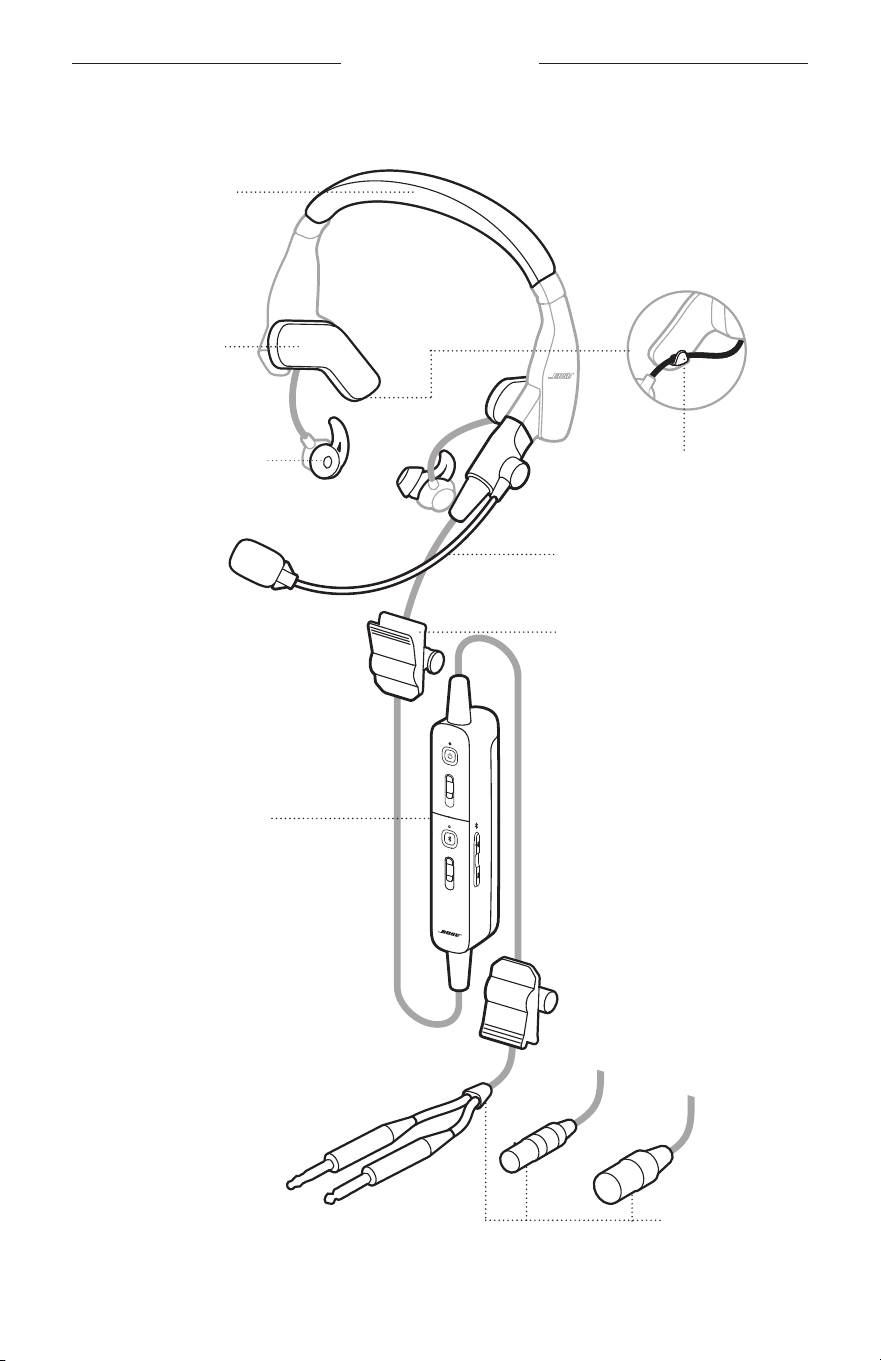
HEADSET COMPONENTS
®
ANR
HIGH
MED
LOW
MODE
MUTE
MIX
OFF
Side pad
Earbud storage hook
StayHear+ tip
Microphone assembly
(boom microphone,
microphone base, and cable)
Cable clip
Aircraft connectors
(see page 30)
Headband
Control module
(see page 14)
WHAT’S IN THE BOX
14
|
ENG
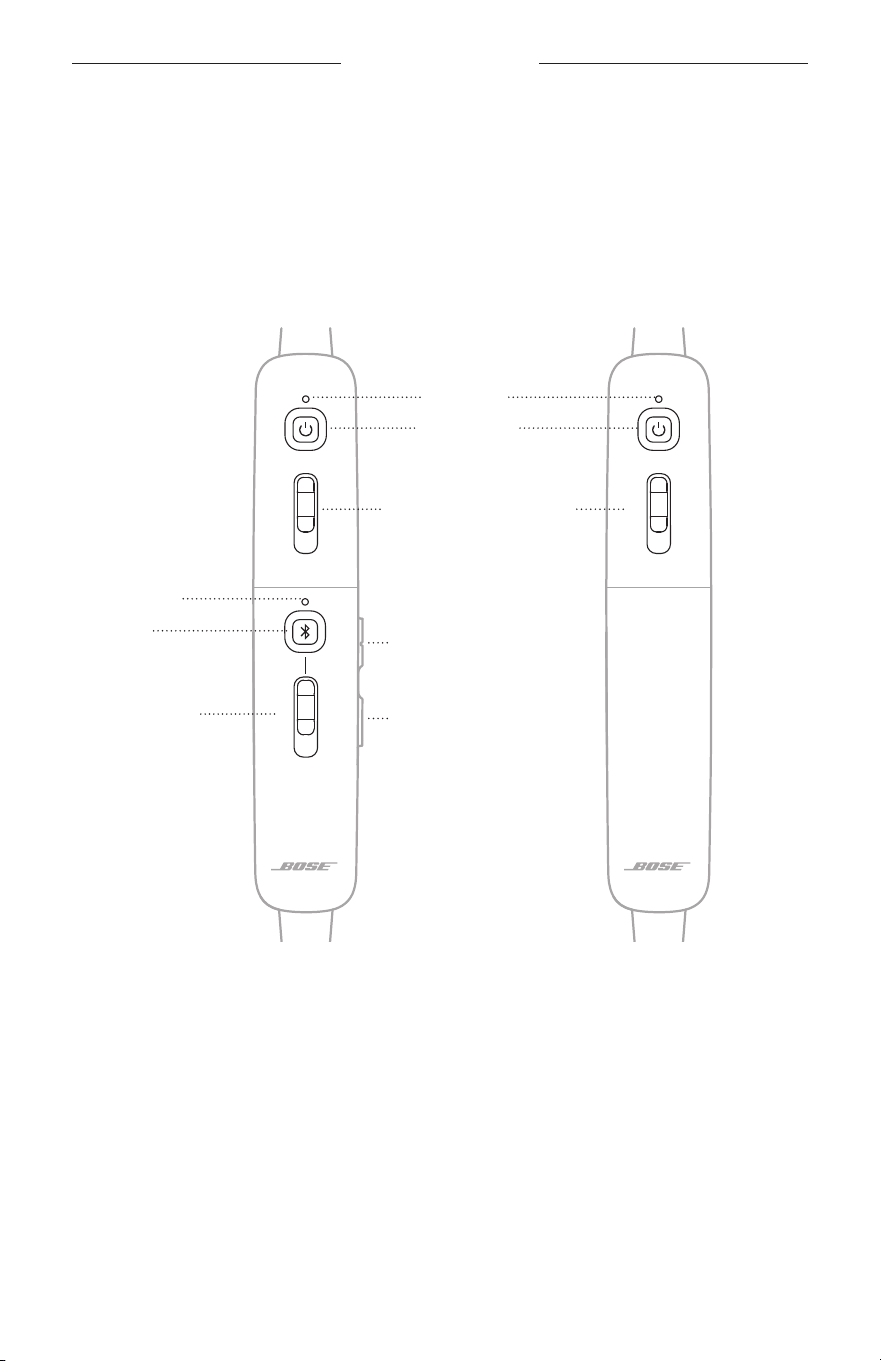
CONTROL MODULE OPTIONS
There are two options for the control module:
• Control module with Bluetooth capability
• Conventional control module
ANC
HIGH
MED
LOW
MUTE
MIX
OFF
ANC
HIGH
MED
LOW
Power light
Power buon
Acoustic Noise Cancelling
switch (see page 21)
Bluetooth light
Bluetooth/
Multi-function
buon
Bluetooth priority
switch (see page 35)
Bluetooth
volume up
Bluetooth
volume down
Control module with Bluetooth capability Conventional control module
15
|
ENG
IMPORTANCE OF PROPER FIT
FIT THE HEADBAND
Proper fit is important both for comfort and optimal noise cancellation performance.
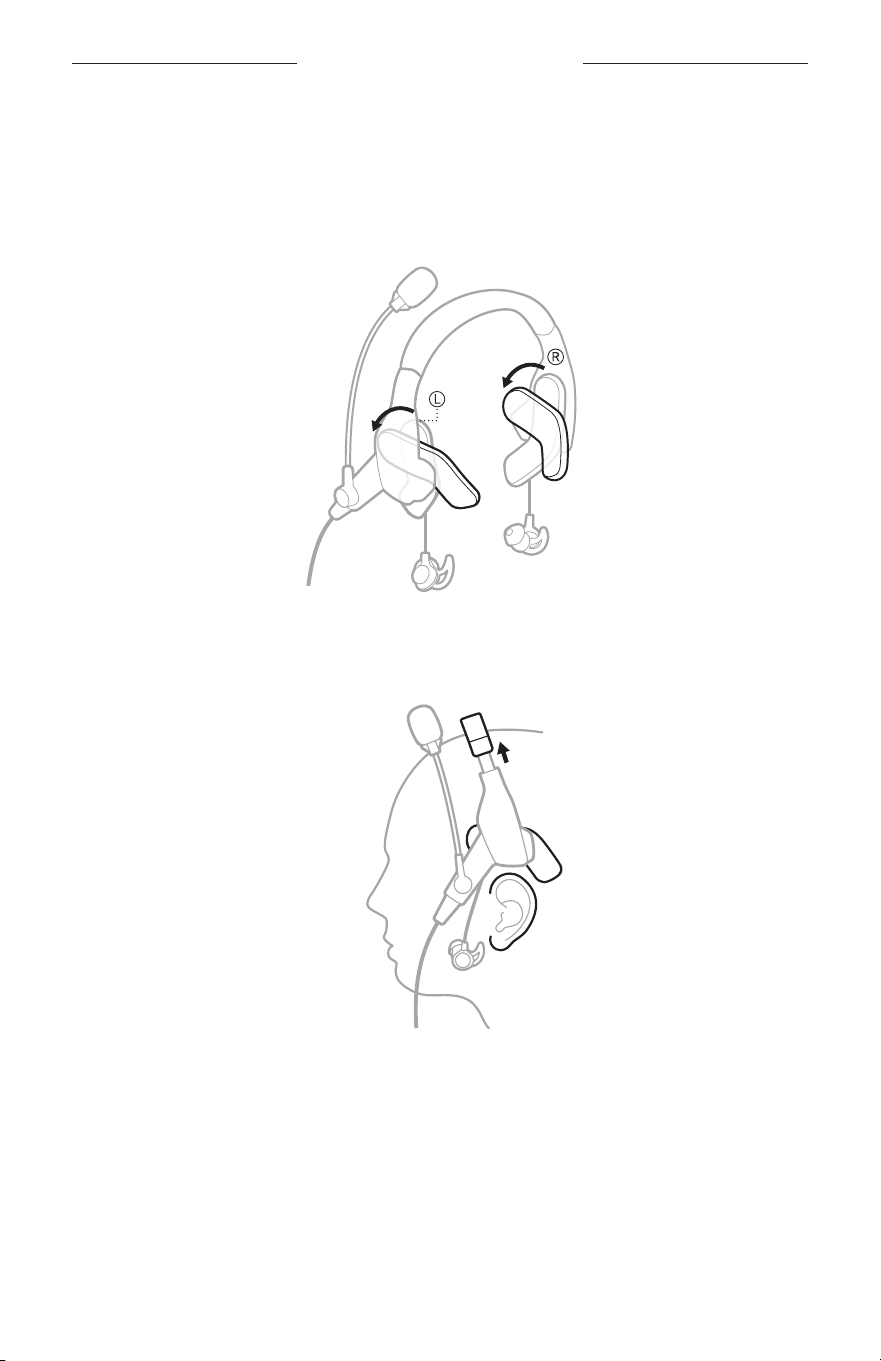
1. Using the left T and right U icons on the headband to orient the headset
properly, rotate the side pads into position.
2. Place the headset on your head.
3. Adjust the headband so the side pads rest above your ears.
IMPORTANCE OF PROPER FIT
16
|
ENG
CHOOSE THE CORRECT STAYHEAR+ TIPS
For optimal audio performance, it is important to choose the correct size
StayHear+ tip. Select the size that gives you the best comfort and fit in each ear.
To determine the best fit, you may need to try all three sizes. You may need a
dierent size for each ear.
NOTE: Without a properly fiing tip, the noise reduction and audio performance of
the headset will be degraded. To test the fit, try speaking aloud wearing the
headset while it’s powered o. Make a low-pitched “eee” sound. Your voice
should sound amplified and balanced in both ears, similar to when you plug
your ears with your fingers. If not, try another tip size.
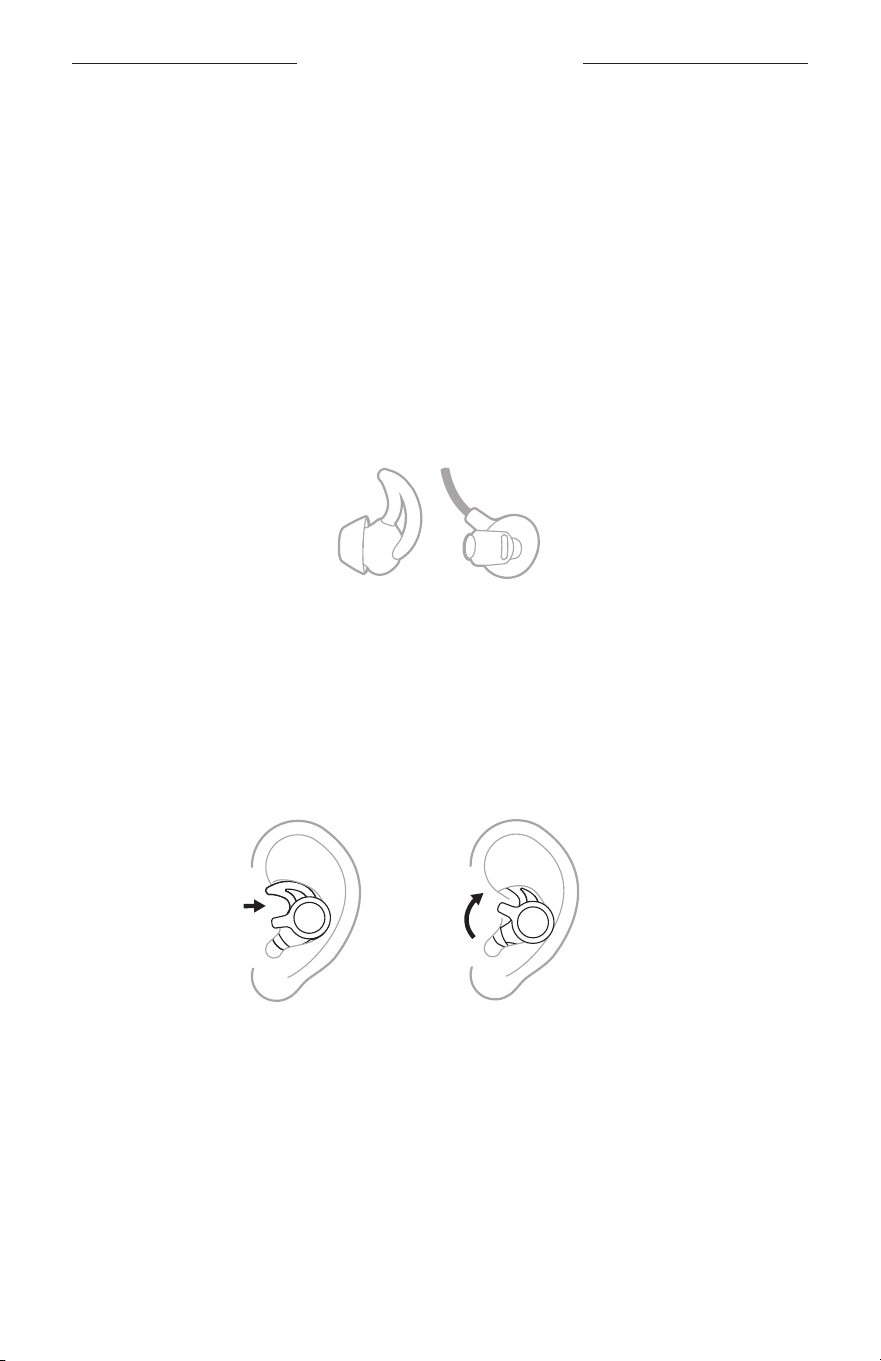
Each StayHear+ tip and earbud is marked with either an L or an R. Be sure to aach
the left tip to the left earbud and the right tip to the right earbud.
R
R
FIT THE EARBUDS TO YOUR EAR
The StayHear+ tip allows the earbud to rest comfortably and securely in your ear.
The tip wing fits just under your ear ridge.
1. Insert the earbud so the StayHear+ tip rests gently in the opening of the
ear canal.
2. Tilt the earbud back and tuck the tip wing under the ear ridge until it is secure.
TIP: If the StayHear+ tips don’t fit securely, choose a dierent size.
IMPORTANCE OF PROPER FIT
17
|
ENG
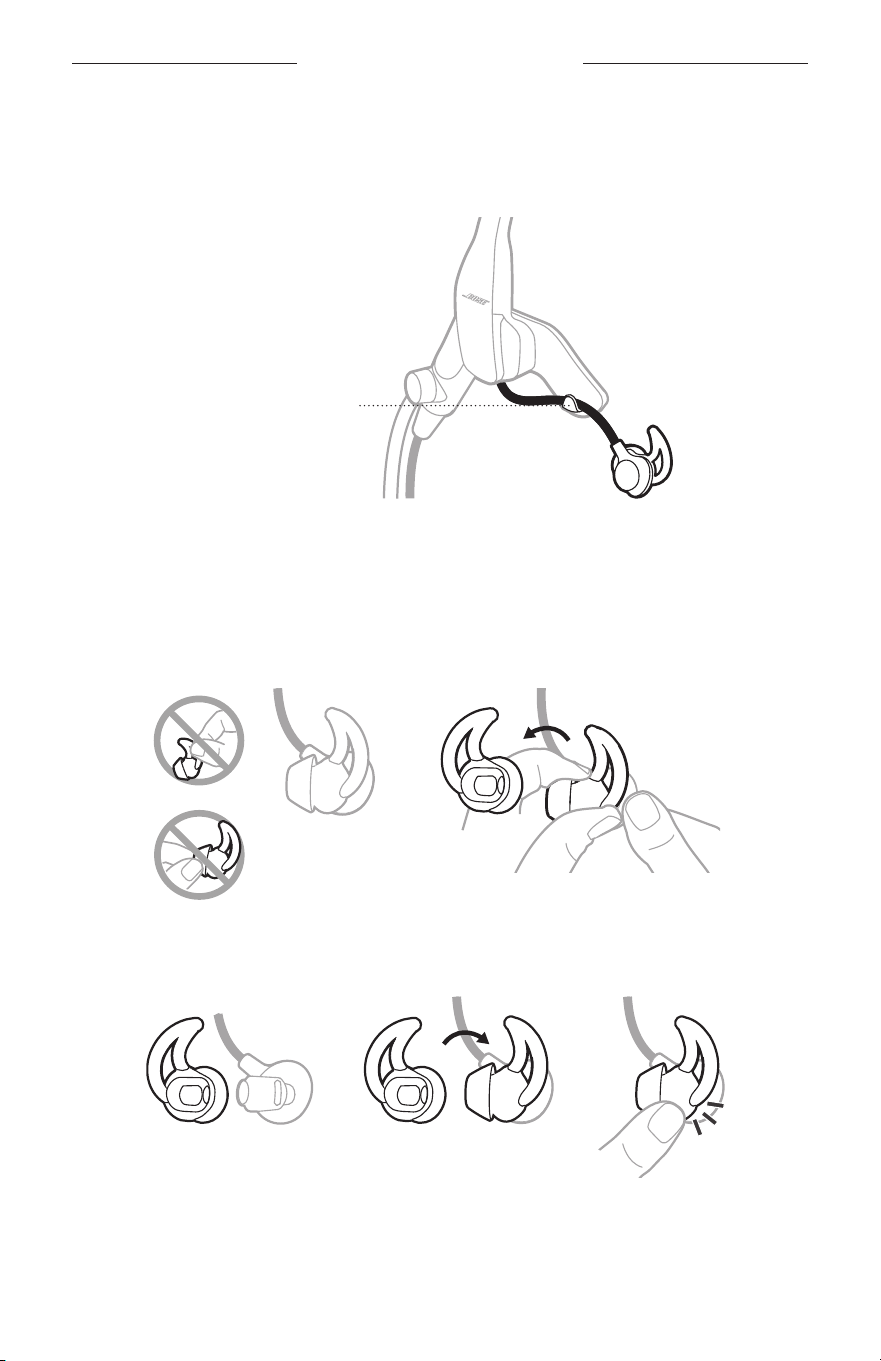
Single earbud use
When you want to use the headset with one earbud, you can stow the other earbud
using the earbud storage hook on the back of the side pad.
Earbud storage hook
CHANGE THE STAYHEAR+ TIPS
1. Holding the earbud, gently grasp the aached StayHear+ tip and peel it away from
the earbud.
CAUTION: To prevent tearing, grasp the StayHear+ tip by its base. Do NOT pull on
the tip wing.
R
2. Align the opening of the new StayHear+ tip with the earbud nozzle and rotate the
tip onto the nozzle. Press the base of the tip until it clicks securely into place.
R
R
R
IMPORTANCE OF PROPER FIT
18
|
ENG
IMPORTANCE OF PROPER FIT
ADJUST THE MICROPHONE
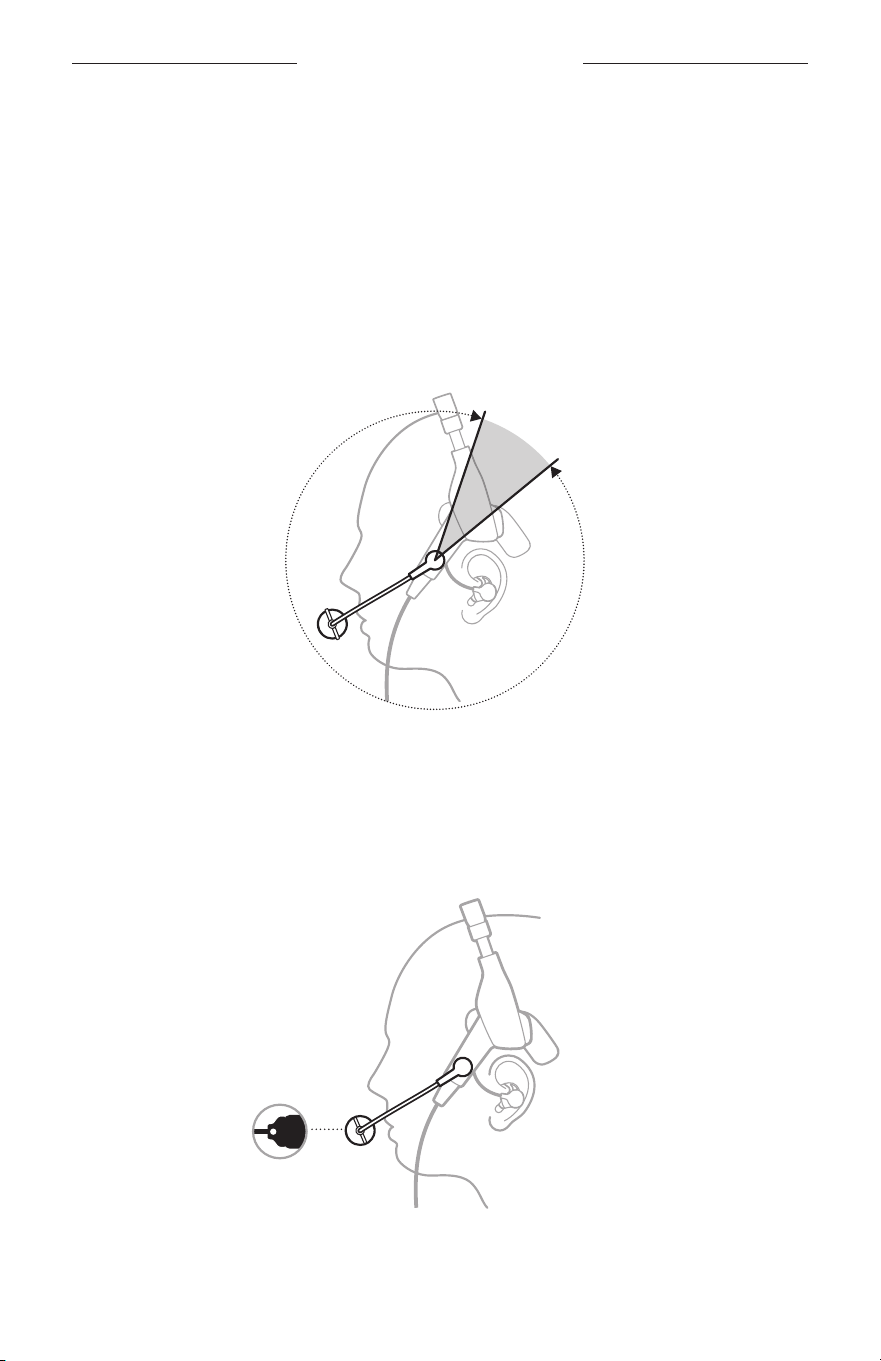
NOTE: By default, the reversible microphone ships from the factory aached to the
left side of the headset. If you want to move the microphone to the other side
of the headset, see “Microphone Placement” on page 26.
1. Grasp the microphone base, and adjust the boom so the microphone is level with
your mouth.
CAUTION: Microphone placement is important for clear communication.
It can rotate 300°. Do NOT force the microphone beyond the
intended rotation or damage could occur.
2. Position the microphone so it is 0.5" (12.7 mm) from your lips, and the white
surface on the base is facing your mouth.
NOTES:
• If necessary, twist the microphone base to rotate the microphone into position.
• The microphone should not be touching your lips.
3. Test the headset before flight.
IMPORTANCE OF PROPER FIT
19
|
ENG
IMPORTANCE OF PROPER FIT
CONDITIONS RELATED TO FIT
In very loud conditions, such as during takeo, you may experience a brief reduction
in noise cancellation as the headset compensates for a momentary pressure
change. If this continues when the sound level returns to normal, see “Acoustic Noise
Cancellation” on page 21. If it persists, see “Troubleshooting” on page 48.
A low rumbling sound or frequent, brief losses of noise cancellation may indicate
an improper fit or blocked earbud ports. See “Choose the correct StayHear+ tips”
on page 16 for information on proper fit or “Clean the headset” on page 42 for
instructions on removing blockages.
During a long flight, you may feel a slight pressure point, which can be relieved by
adjusting the headband position.
SECURE CLOTHING CLIP AND CONTROL
MODULE HOLDER
The cable clips and control module holder secure the cable and control module to
your clothing, a safety harness, sun visor rail, or aircraft headset hook for quick and
easy access.
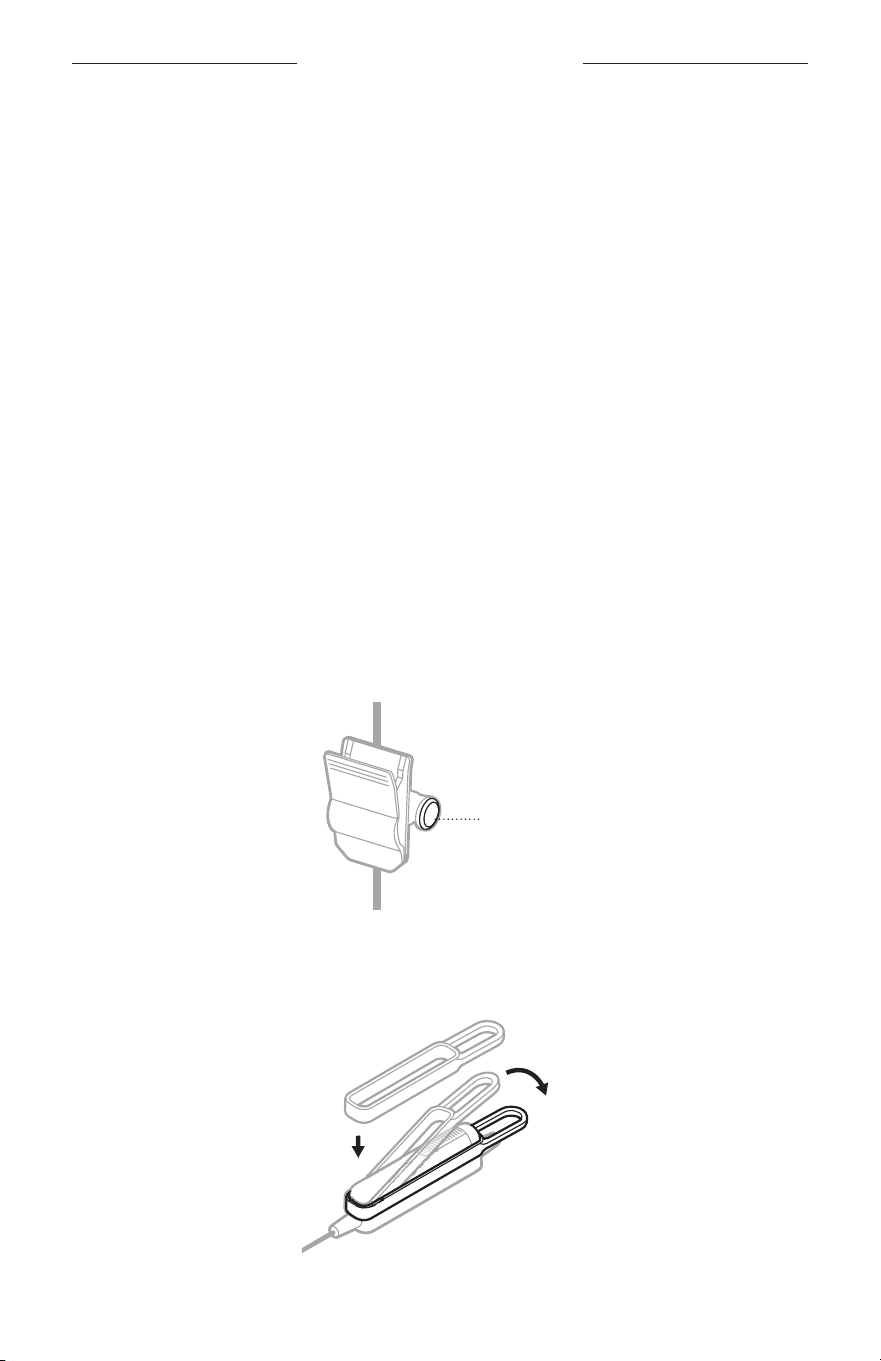
Clothing clip
Press the side buon to release and reposition the clip along the cable.
Side buon
Control module holder
Pull the strap over the control module to secure it in place.

20
|
ENG
HEADSET CONTROLS
POWER ON
Press the Power buon I.
Power buon
ANC
HIGH
MED
LOW
The Power light glows amber then blinks according to the power level.
See “Power light” on page 33.
NOTE: The first time you power on your headset, noise cancellation is fully enabled.
See “Acoustic Noise Cancellation” on page 21.
POWER OFF
Press and hold I for three seconds, then release.
When powered o, the headset provides passive audio communications.
21
|
ENG
ACOUSTIC NOISE CANCELLATION
Acoustic Noise Cancellation reduces unwanted noise providing a clearer, more lifelike
audio performance. You can choose your noise cancellation based on your listening
preferences and environment.
NOTE: When you receive a call, the headset remains at the current noise
cancellation level.
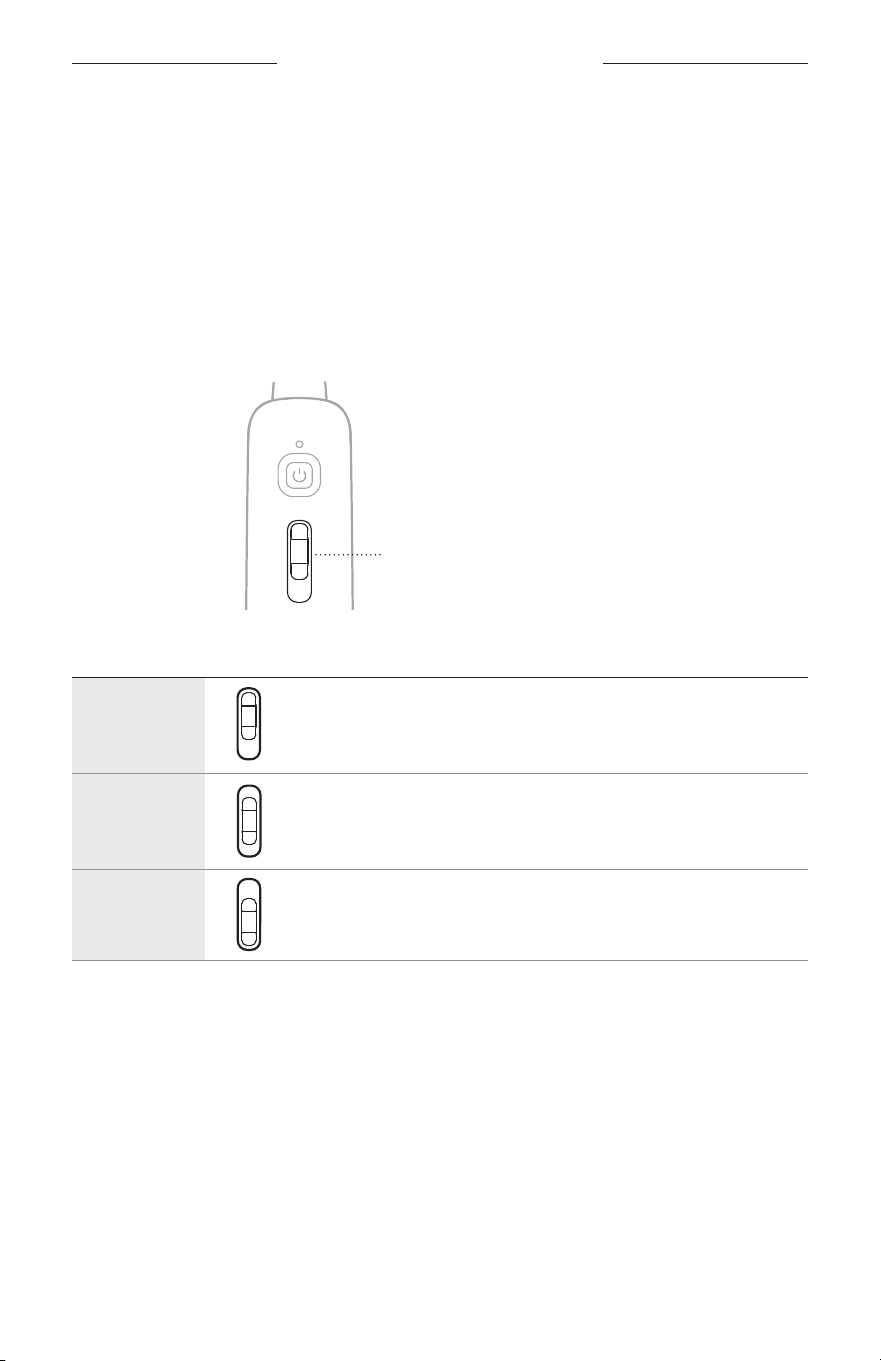
ACOUSTIC NOISE CANCELLING FUNCTIONS
The Acoustic Noise Cancelling switch is located on the front of the control module.
ANC
HIGH
MED
LOW
Acoustic Noise Cancelling switch
FUNCTION POSITION DESCRIPTION
High
HIGH
MED
LOW
Maximum quiet and noise cancellation across the entire
spectrum. Best signal-to-noise ratio for radio and intercom
communications in loud aircraft.
Medium
HIGH
MED
LOW
Consistent noise reduction across a wide range of
frequencies. Best for clear and comfortable noise
cancellation in typical jet aircraft.
Low
HIGH
MED
LOW
Best for improved interpersonal communication outside of
the intercom.
IMPORTANCE OF PROPER FIT
22
|
ENG
ACOUSTIC NOISE CANCELLATION
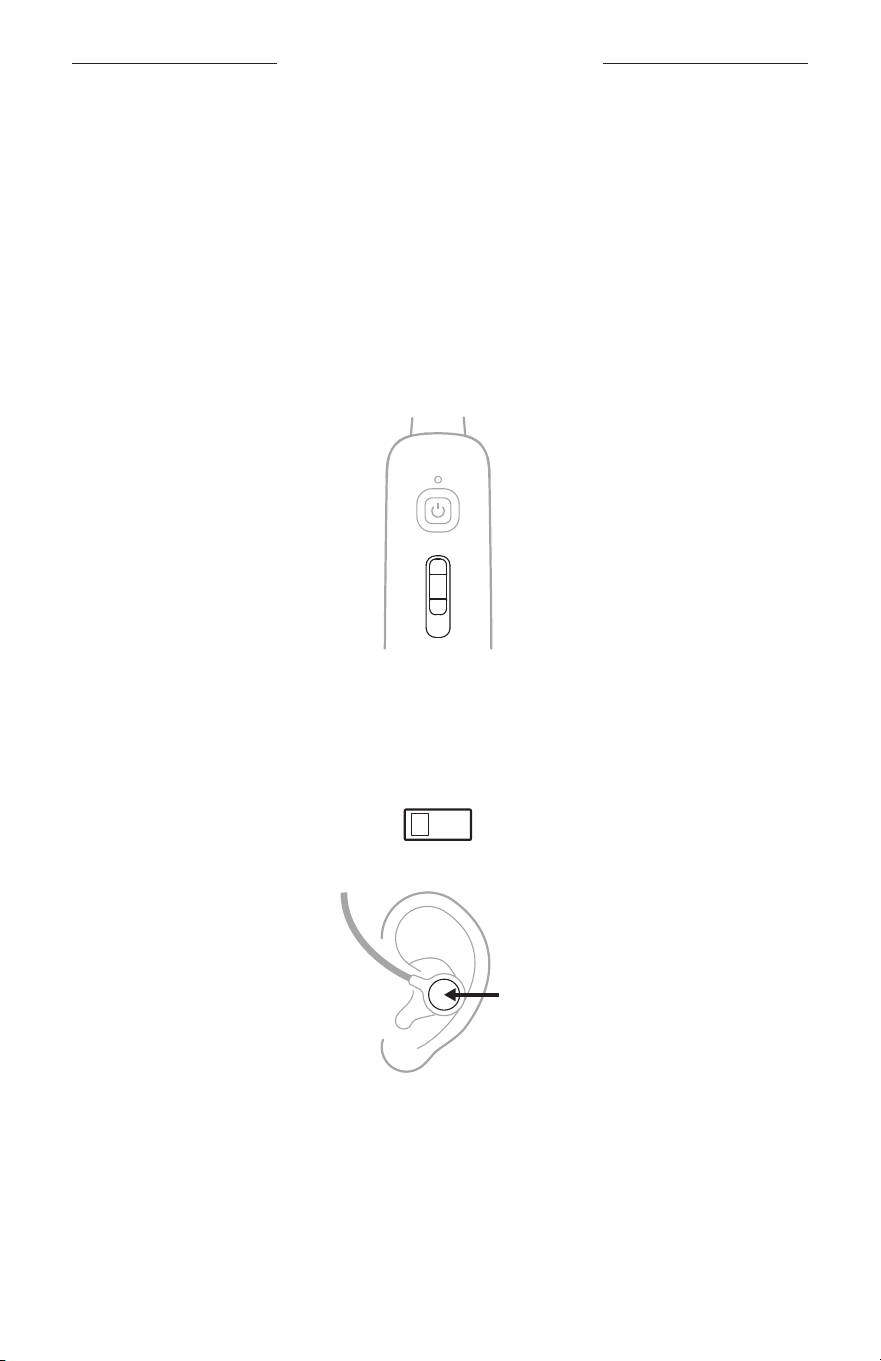
TAP CONTROL FOR TALK-THROUGH COMMUNICATION
When you need to focus on interpersonal communication coming from a specific
direction, you can automatically set noise cancelling to Low on a single earbud by
firmly double-tapping the earbud.
NOTES:
• By default, Tap Control is set to O.
• Tap Control is available only when the Acoustic Noise Cancelling switch is in the
High or Medium position.
1. Make sure the Acoustic Noise Cancelling switch is in the High or Medium position.
ANC
HIGH
MED
LOW
2. Set the Tap Control switch to On.
See “Change the operation switches” on page 24.
ON - OFF
TAP CONTROL
3. Firmly double-tap the earbud.
2X
NOTE: Tap Control is not a touch control feature. You must firmly double-tap the
earbud in order to activate the feature.
Reset Tap Control
To reset Tap Control and set noise cancelling in both earbuds to the Acoustic Noise
Cancelling switch level, double-tap the earbud with Tap Control active or move the
switch to another position.
23
|
ENG
OPERATION SWITCHES
OPERATION SWITCH FUNCTIONS
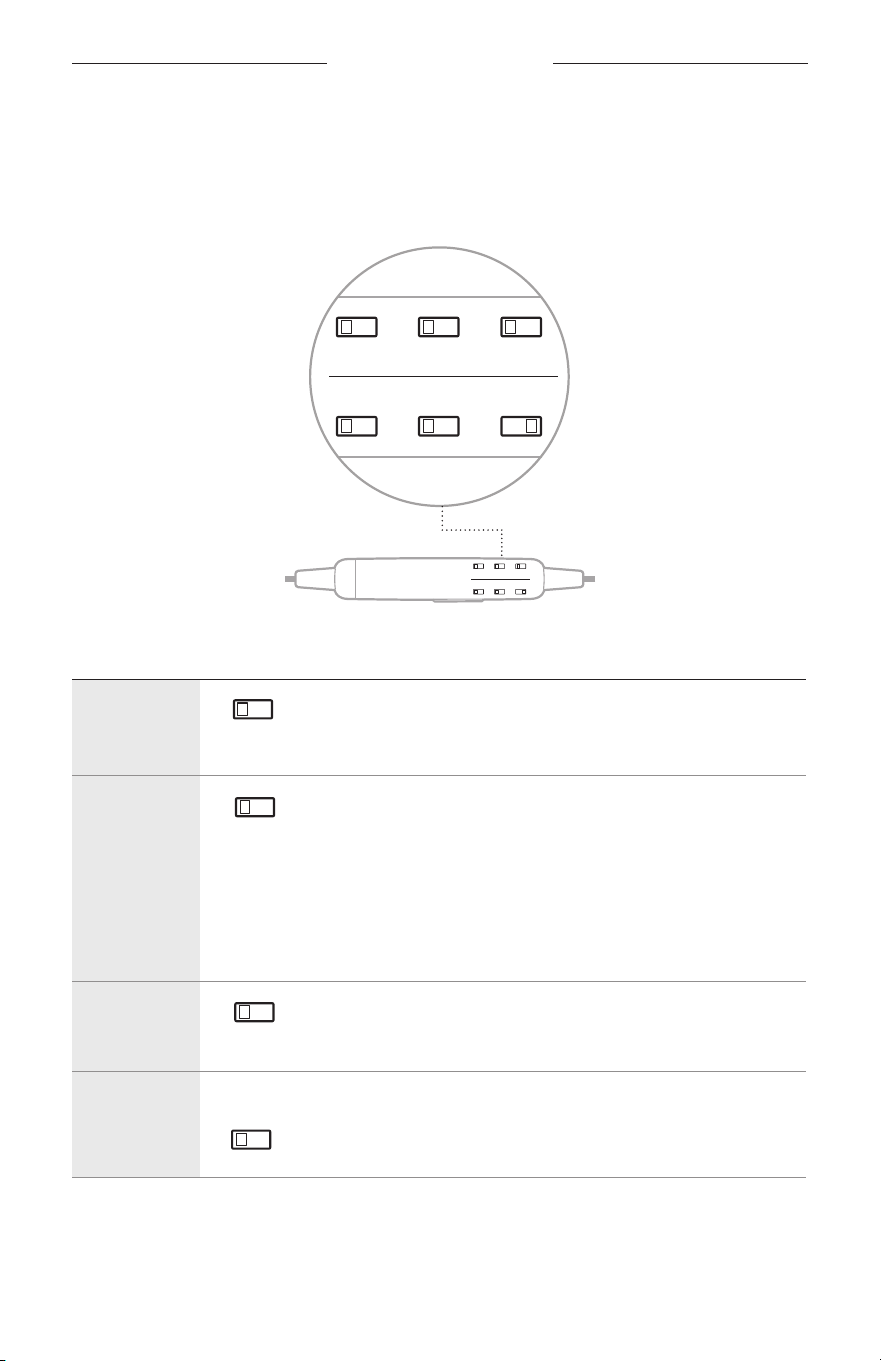
The operation switches are located in the control module baery compartment.
NOTE: Some operation switches are not available on all models.
AUTO ON
ON - OFF
ON - OFF
AUTO OFF
MONO - ST
INTERCOM
ON - OFF
TAP CONTROL
AIRCRAFT AUDIO
NORMAL - LOW
RESERVED
A-B
AUTO ON
ON - OFF
ON - OFF
AUTO OFF
MONO - ST
INTERCOM
ON - OFF
TAP CONTROL
AIRCRAFT AUDIO
NORMAL - LOW
RESERVED
A-B
FUNCTION POSITION DEFAULT DESCRIPTION
Reserved
RESERVED
A - B
A Reserved for future use.
Auto on
AUTO ON
ON - OFF
On Power on automatically when connected to
aircraft power.
NOTES:
• Available in Flex power models only
(see page 30).
• Bluetooth headsets return to the previous
Bluetooth state when powered on.
Aircraft
audio
AIRCRAFT AUDIO
NORMAL - LOW
Normal Set sensitivity/volume of intercom audio.
NOTE: Low is -8dB.
Intercom
MONO - ST
INTERCOM
Mono Process audio as mono or stereo.
Available for configurations that support
two-channel or stereo intercom systems only.
OPERATION SWITCHES
24
|
ENG
OPERATION SWITCHES
FUNCTION POSITION DEFAULT DESCRIPTION
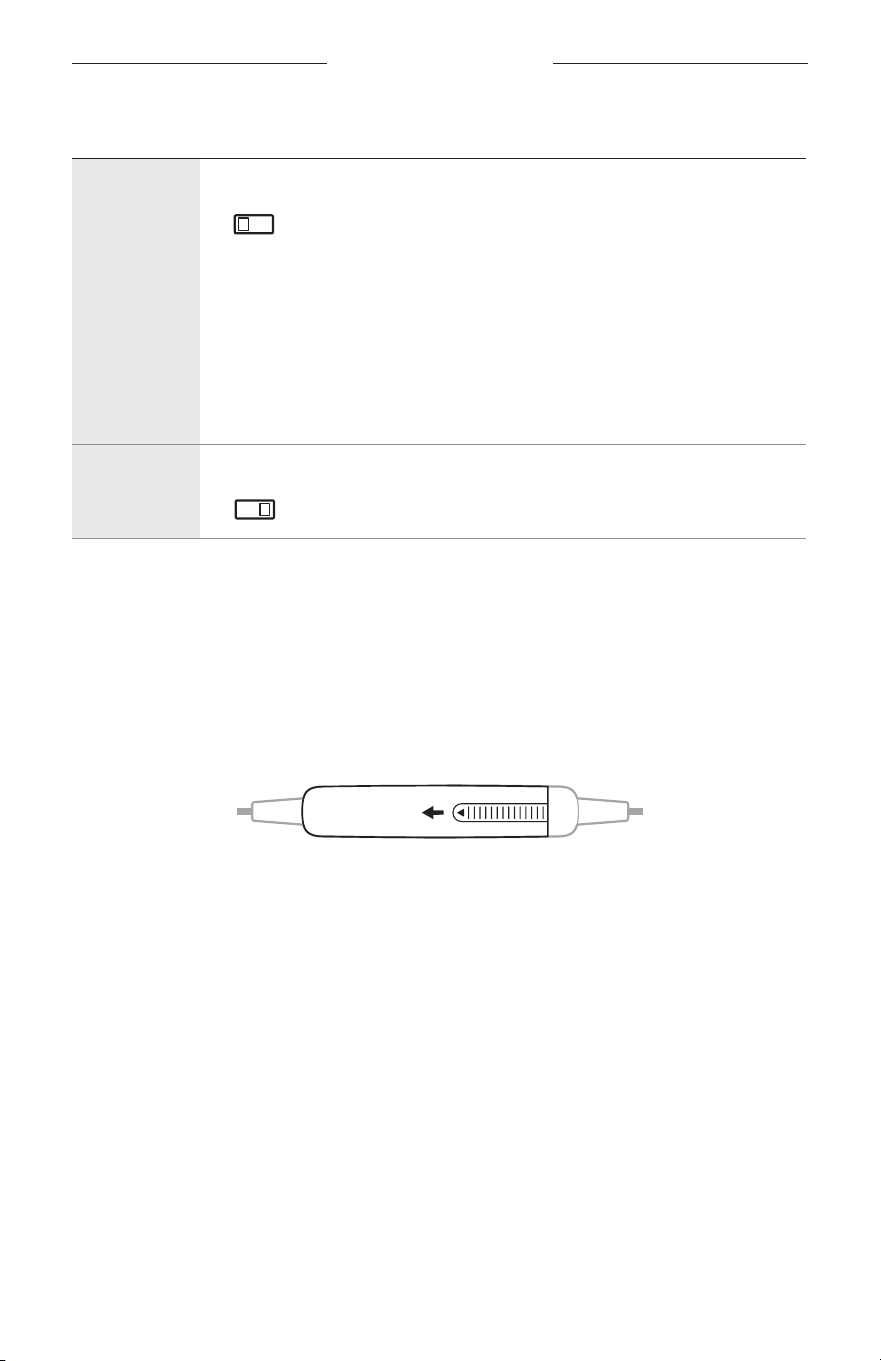
Auto off
ON - OFF
AUTO OFF
On Power o automatically after 3 to 45 minutes
of inactivity.
NOTES:
• When running on baery power and
unplugged from the intercom, the headset
powers o unless there is an active mobile
device audio present.
• If you are on a call and unplugged from
the intercom, the headset powers o
approximately three minutes after the call
is ended.
Tap control
ON - OFF
TAP CONTROL
O Don’t respond to Tap Control interaction
(see page 22).
CHANGE THE OPERATION SWITCHES
1. Power o the headset. See page 20.
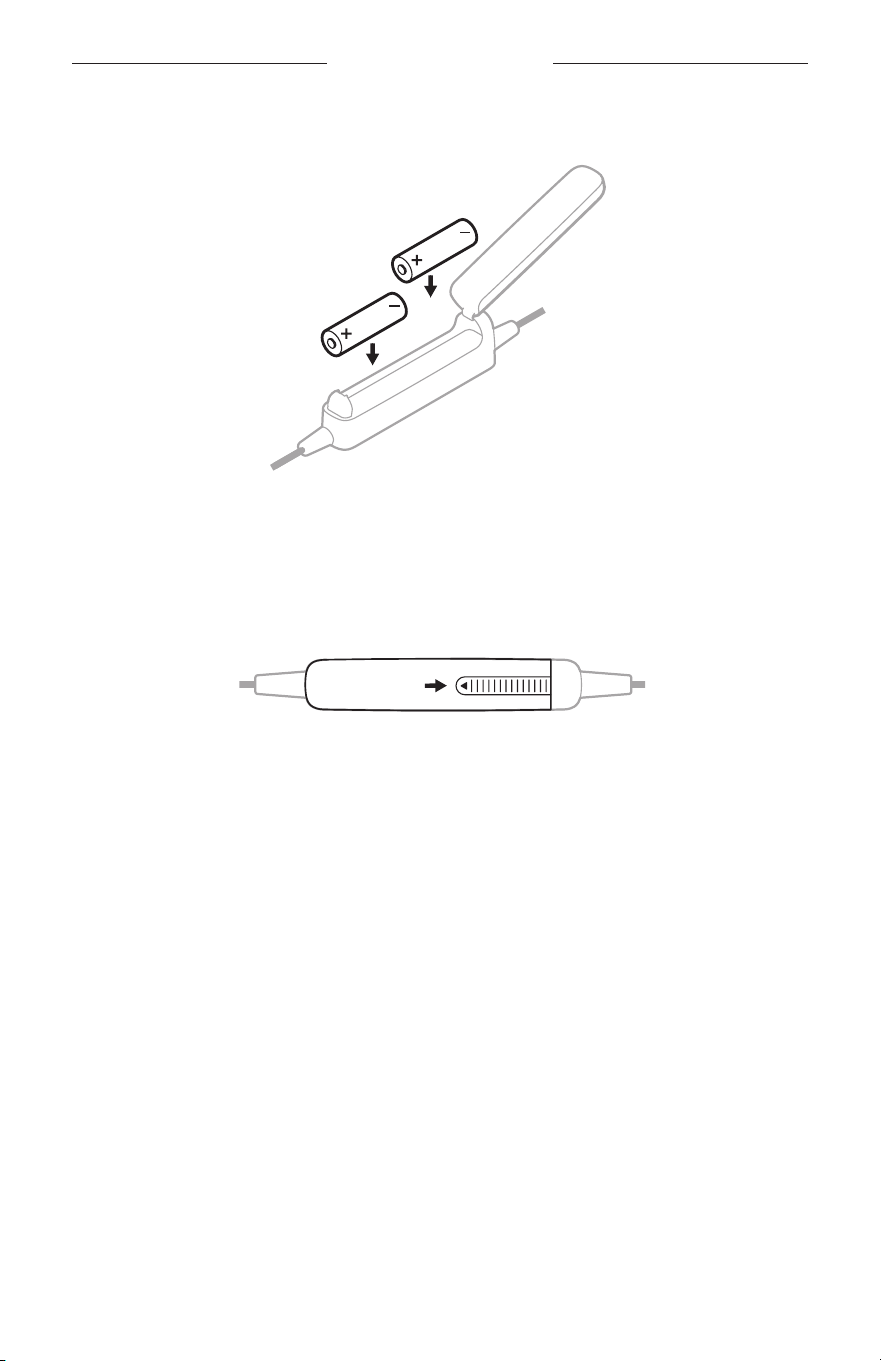
2. On the back of the control module, press down firmly on the finger indent and
slide the cover down.
CAUTION: The baery cover is tethered to the control module. Do NOT aempt
to detach it.
3. Remove the baeries.
4. Using a pen or a small, flat-tipped screwdriver, gently move the switch.
OPERATION SWITCHES
25
|
ENG
OPERATION SWITCHES
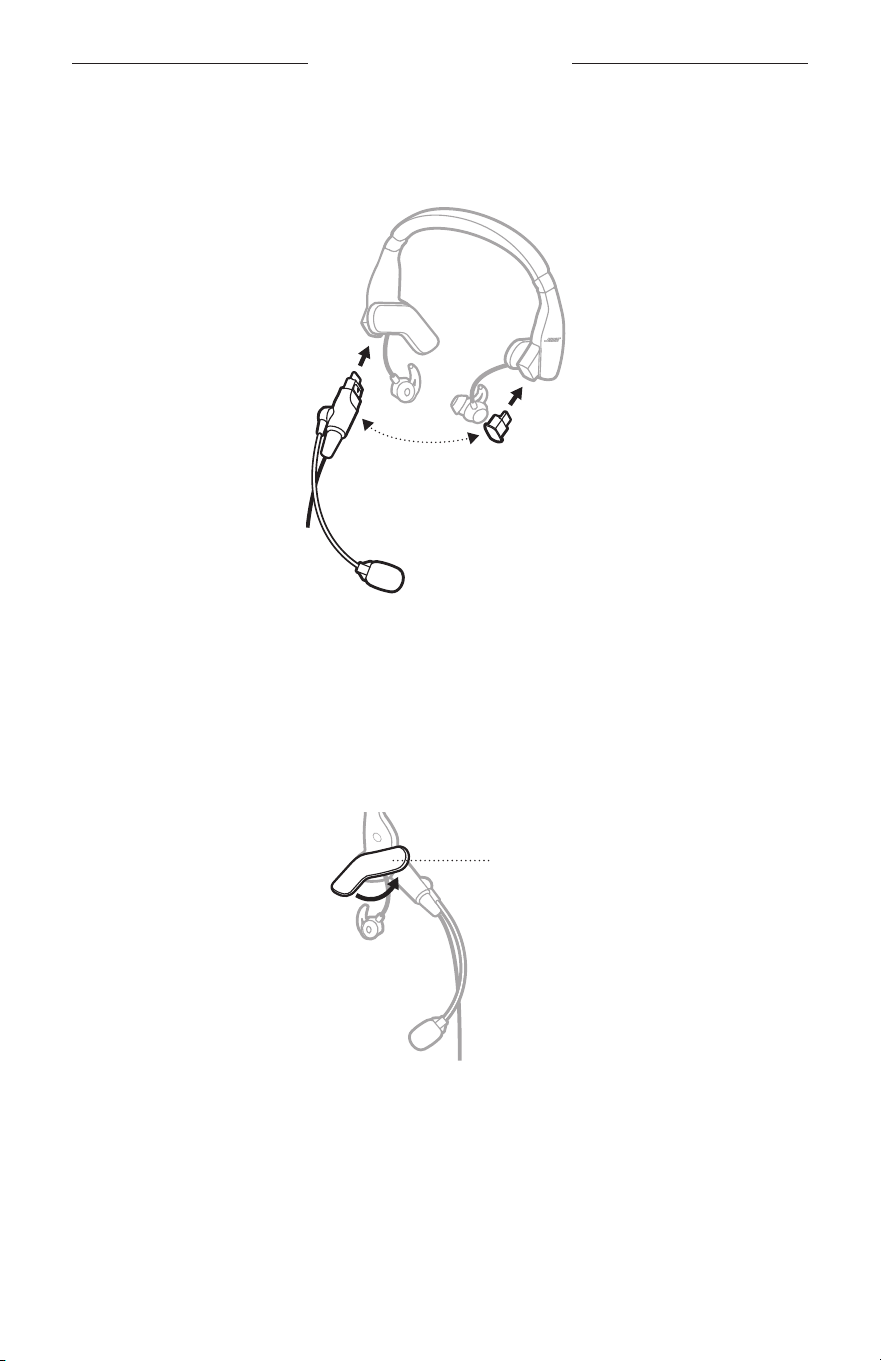
5. Insert two alkaline AA baeries, observing proper polarity.
CAUTION: If the baeries don’t fit correctly, do NOT force them in. Forcing an
improper connection will cause permanent damage to the
control module.
6. Close the baery cover, press firmly down on the finger indent, and slide the cover
into place.
26
|
ENG
MICROPHONE PLACEMENT
By default, the reversible microphone assembly ships from the factory aached to the
left side of the headset, however, in some configurations it may ship separately. It can
be easily aached to the left or right side of the headset.
®
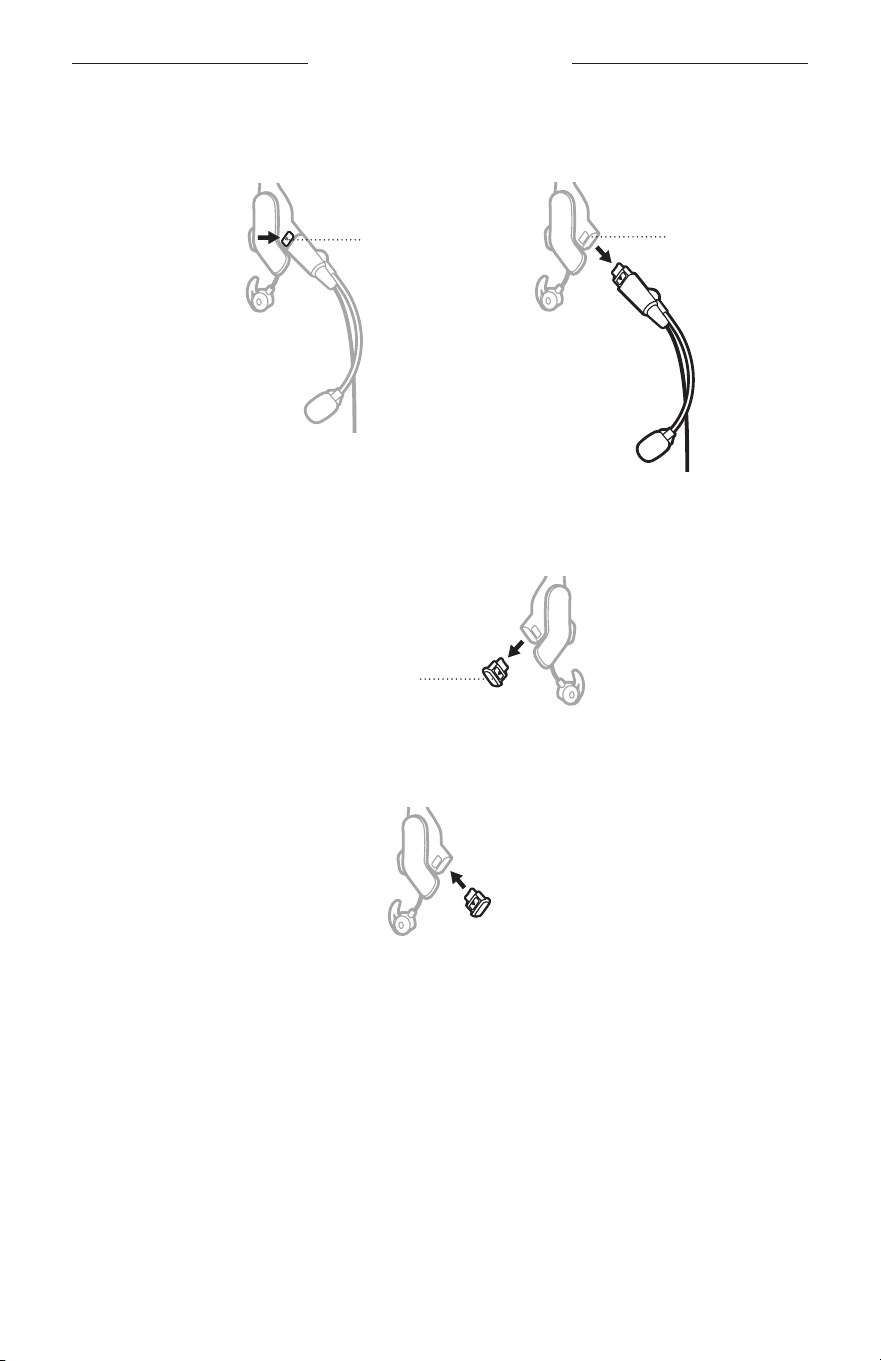
MOVE THE MICROPHONE
To move the microphone assembly from the left side of the headset to the right side:
1. Locate the left T and right U icons on the headband to orient the
headset properly.
2. On the left side, rotate the side pad.
L
Side pad
MICROPHONE PLACEMENT
27
|
ENG
MICROPHONE PLACEMENT
3. Push the release buon, and gently pull the microphone assembly from the
connector socket.
Release buon
4. On the right side, push the release buon, and gently pull the terminator cover
from the connector socket.
Terminator cover
5. On the left side, align the release buon to the release buon opening, and insert
the terminator cover into the base of the connector socket.
6. Slide the terminator cover into the connector socket until the release buon
is secure.
CAUTION: Do NOT force the terminator cover into the connector socket.
NOTE: If the terminator cover is not securely installed, there will be no audio
coming from that earbud.
Connector socket
28
|
ENG
MICROPHONE PLACEMENT
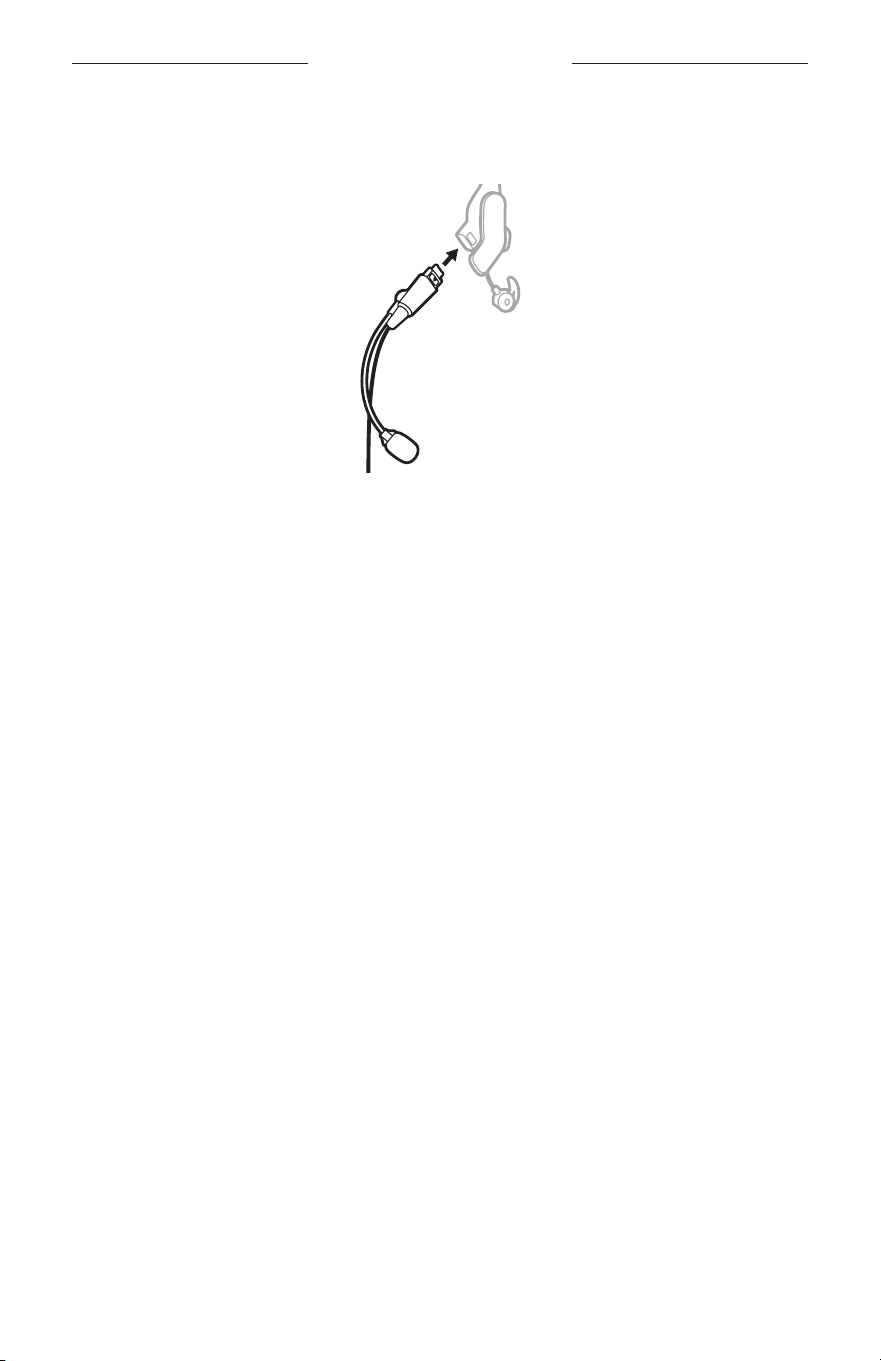
7. On the right side, align the release buon to the release buon opening, and insert
the microphone connector into the base of the connector socket.
8. Slide the microphone connector into the connector socket until the release
buon is secure.
CAUTION: Do NOT force the microphone connector into the connector socket.
9. Test the headset before flight.
29
|
ENG
BATTERIES
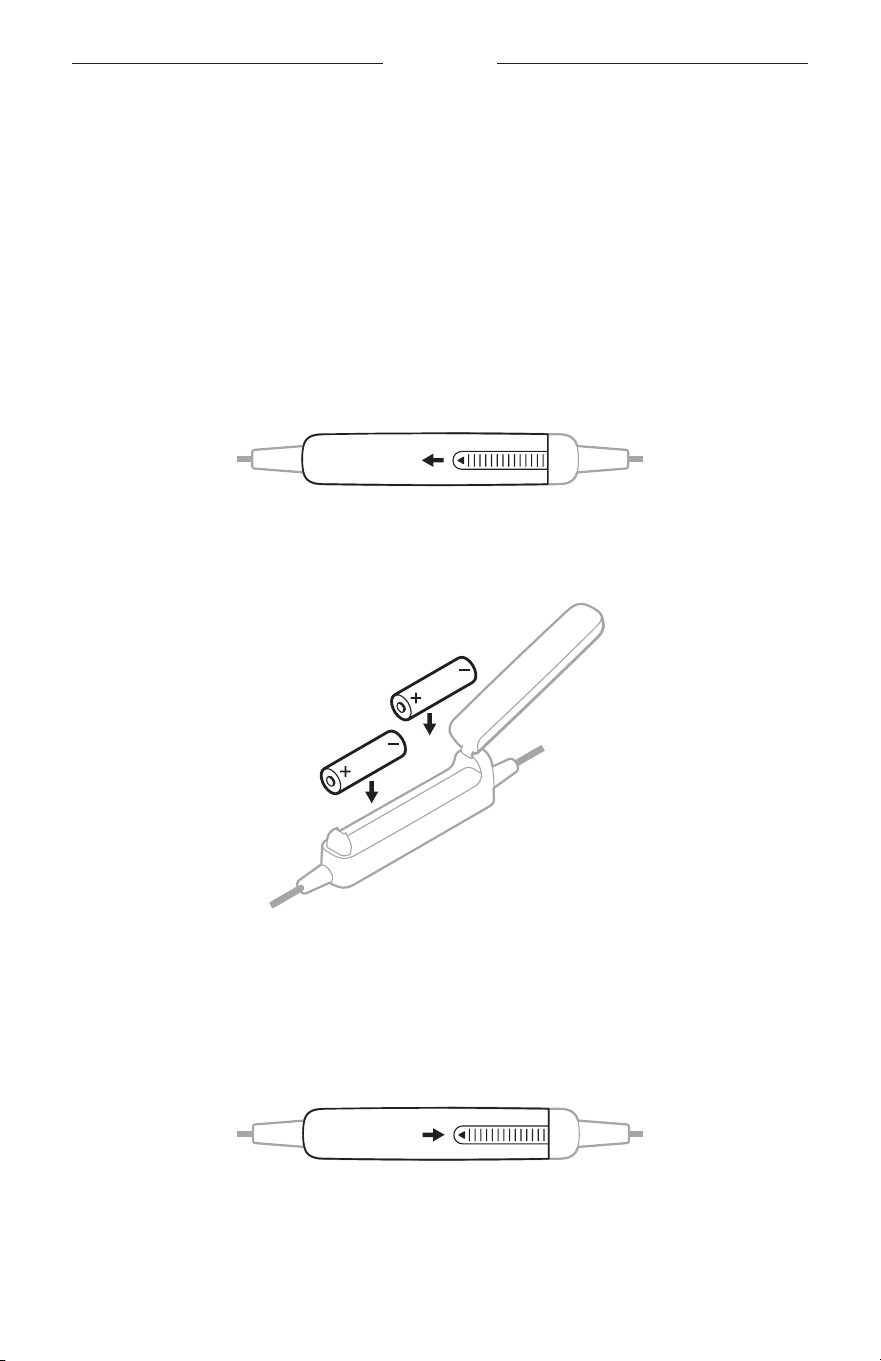
REPLACE THE BATTERIES
When the baery light blinks red, the baeries must be replaced.
NOTE: For aircraft-powered headsets, baeries are not required for operation if
aircraft power is available. See “Aircraft Connectors” on page 30.
1. Power o the headset. See page 20.
2. On the back of the control module, press down firmly on the finger indent and
slide the cover down.
CAUTION: The baery cover is tethered to the control module. Do NOT aempt
to detach it.
3. Remove the baeries.
4. Insert two alkaline AA baeries, observing proper polarity.
CAUTION: If the baeries don’t fit correctly, do NOT force them in. Forcing an
improper connection will cause permanent damage to the
control module.
5. Close the baery cover, press firmly down on the finger indent, and slide the
cover into place.
New alkaline AA baeries supply up to 45 hours of power for the headset.
Baery life varies with the ambient noise level of the aircraft, temperature,
ear tip condition, Bluetooth use, and age of the baeries.
30
|
ENG
AIRCRAFT CONNECTORS
Aircraft connectors are available in several standard aircraft connector options.
POWER TYPE CONNECTOR OPTIONS
Battery power only. Dual plug (general aviation)
Flex Power - Aircraft power or battery
power. No battery needed when
connected to aircraft power.
NOTE: This version is often called Flex
powered and comes with an
Auto On function (see
page 23).
5-pin XLR
6-pin Lemo
7-pin XLR
NOTES:
• An adapter is available to convert a 6-pin
Lemo connector to a Dual plug for additional
connection flexibility.
• Not all aircraft provide power to multi-pin
connectors. Check the power status to confirm
power is suppled to the headset
(see page 33).
NOTE: Contact Bose customer service for more information about these connectors.
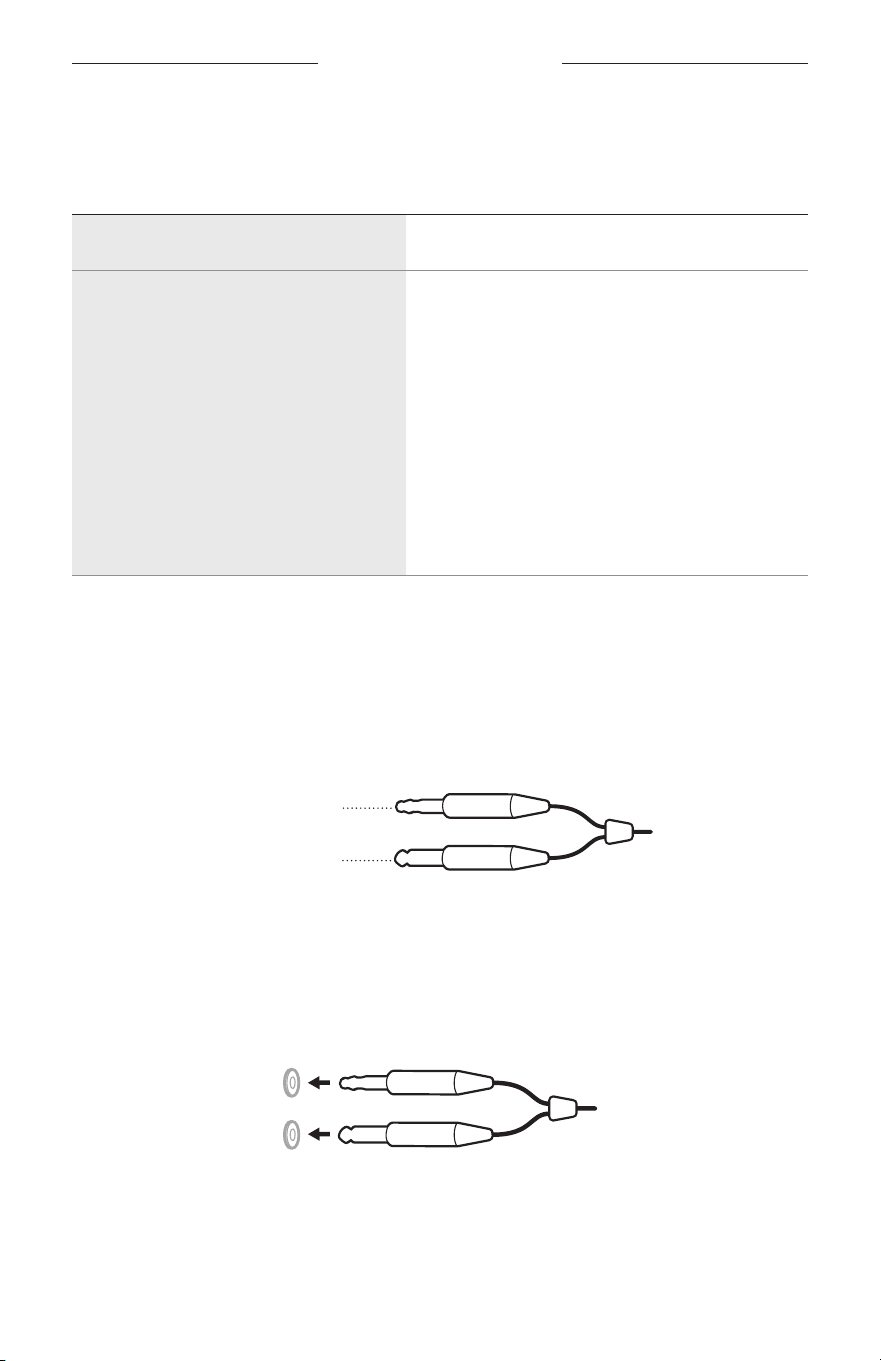
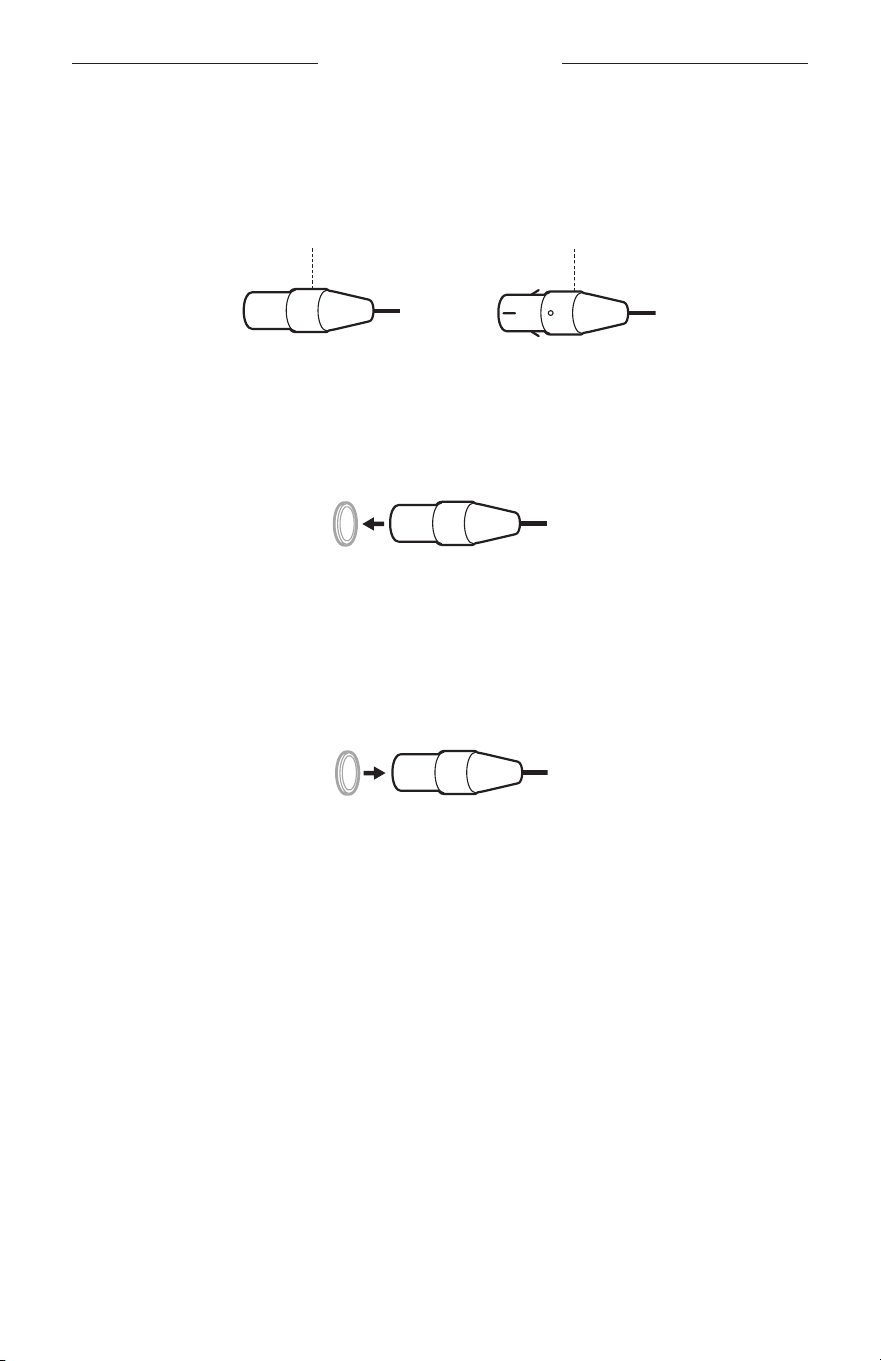
DUAL PLUG
The baery (only) powered version of the headset has two general aviation
aircraft connectors that insert into specific jacks on the aircraft control panel.
The microphone connector is shorter, thinner and has a slightly dierent shape
than the intercom connector.
Microphone
Intercom/audio
Connect to the aircraft
1. Insert the thicker intercom connector into the audio jack on the aircraft
control panel.
2. Insert the thinner microphone connector into the microphone jack on the
aircraft control panel.
Disconnect from the aircraft
Gently pull back on each connector to remove the connector from the
aircraft control panel.
BATTERIES
31
|
ENG
AIRCRAFT CONNECTORS
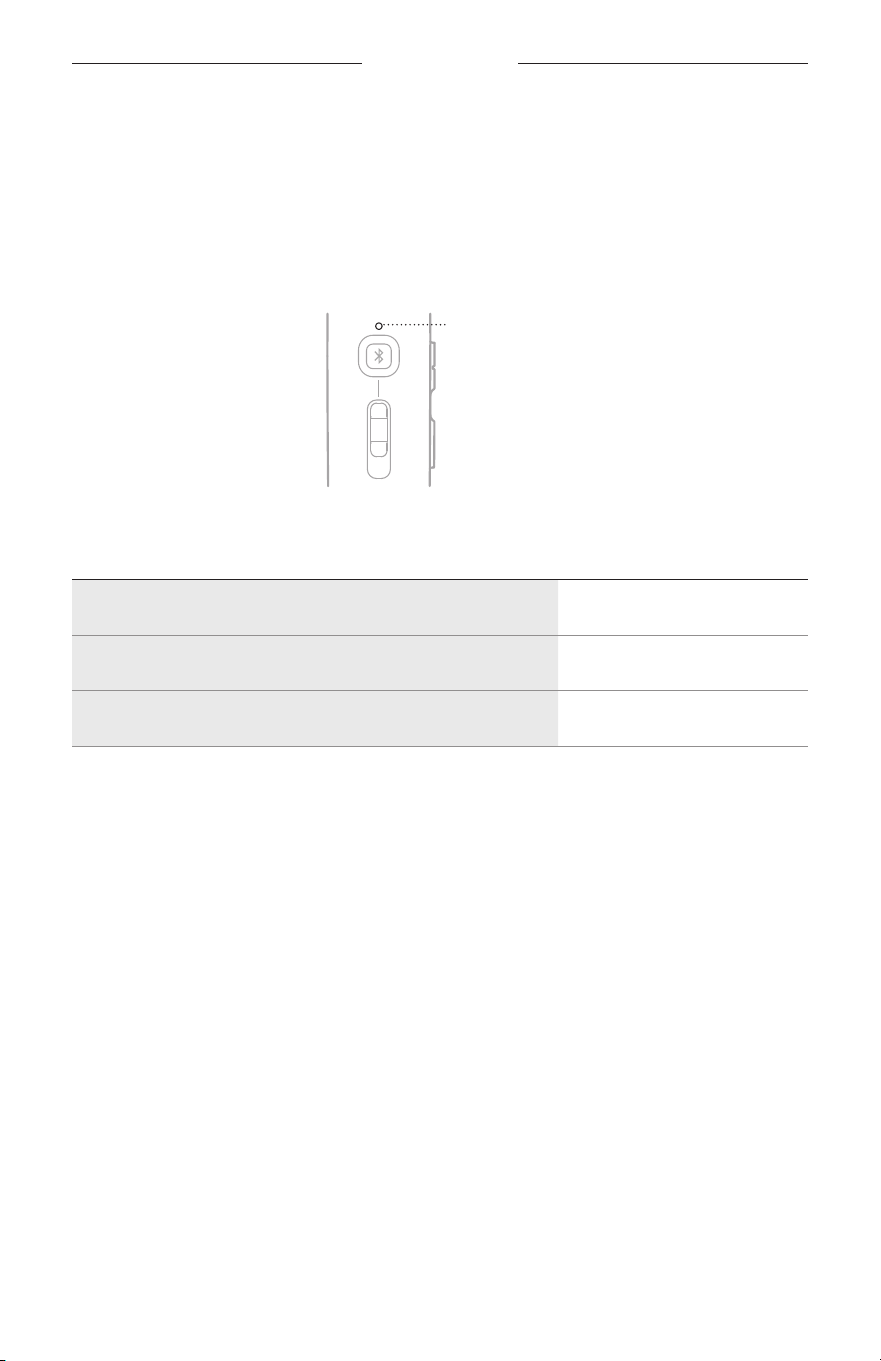
5-PIN XLR, 6-PIN LEMO, AND 7-PIN XLR
The 5-pin XLR, 6-pin Lemo, and 7-pin XLR aircraft connectors insert into the aircraft
control panel and provide the headset with aircraft power and intercom audio.
6-pin Lemo
5-pin XLR and 7-pin XLR
Connect to the aircraft
1. Align the connector to the connector keyway by matching the narrow bar on the
connector to the slot on the connector.
2. Firmly insert the connector into the connector jack on the aircraft control panel.
Disconnect from the aircraft
5-pin XLR and 7-pin XLR
1. Press the buon/latch on the aircraft control panel to release the connector,
if necessary.
2. Gently pull back to remove the connector from the aircraft control panel.
6-pin Lemo
1. Pull back on the sleeve near the end of the connector.
CAUTION: You must pull back on the sleeve before you pull out the connector.
Forcing the connector out will damage the cable and/or the aircraft
control panel.
2. Continue gently pulling back to remove the connector from the aircraft
control panel.
32
|
ENG
STATUS LIGHTS
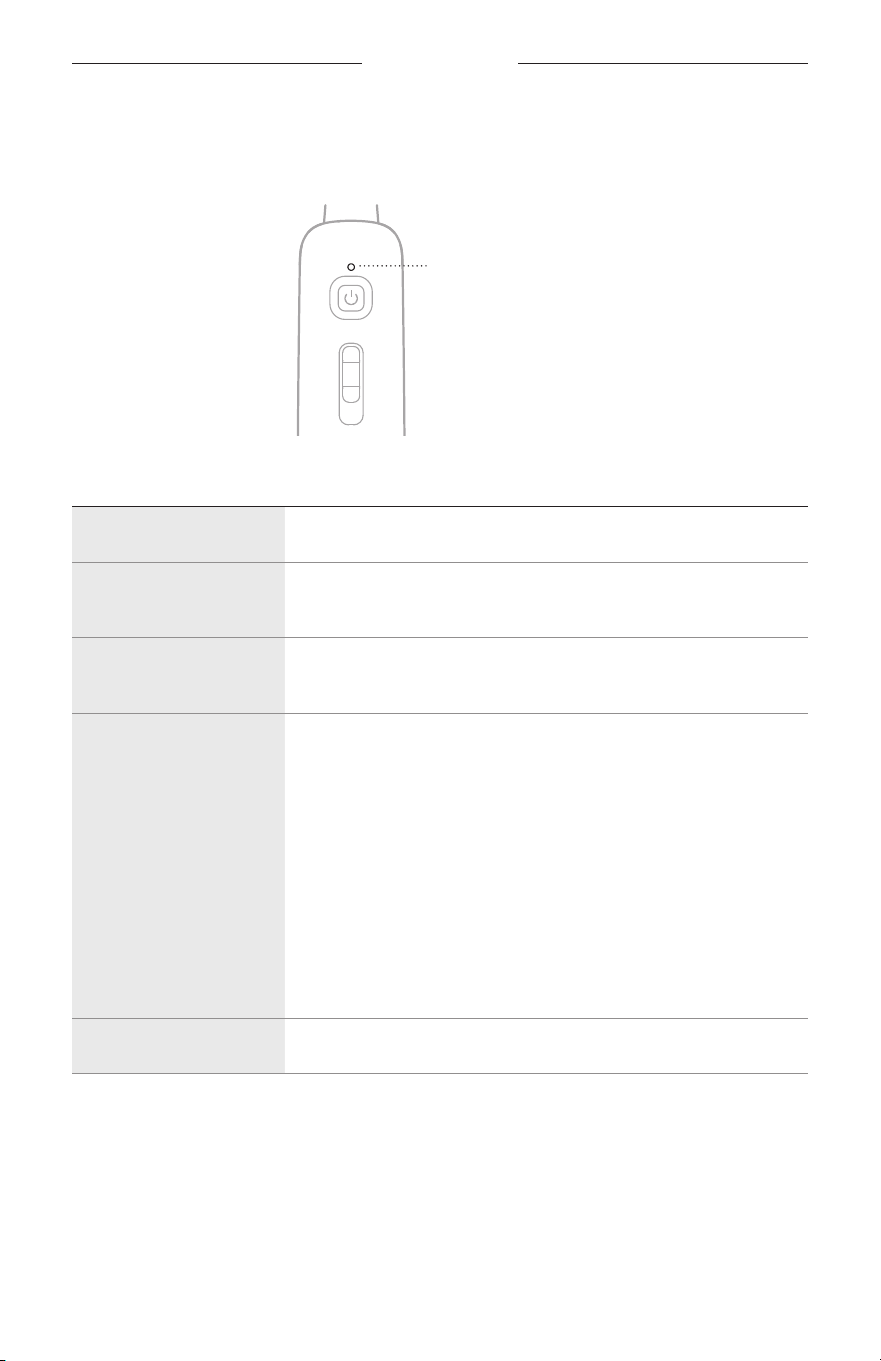
The Bluetooth and Power lights are located on the front of the control module.
BLUETOOTH LIGHT
NOTE: This section applies to Bluetooth headsets only.
Shows the connection status of a mobile device.
MUTE
MIX
OFF
Bluetooth light
LIGHT ACTIVITY SYSTEM STATE
Blinking purple (in sync with Power light) Ready to connect
Blinking blue (alternating with Power light) Connecting
Blinking blue (in sync with Power light) Connected
NOTE: To dim the Bluetooth and Power lights, double-press I.
STATUS LIGHTS
33
|
ENG
STATUS LIGHTS
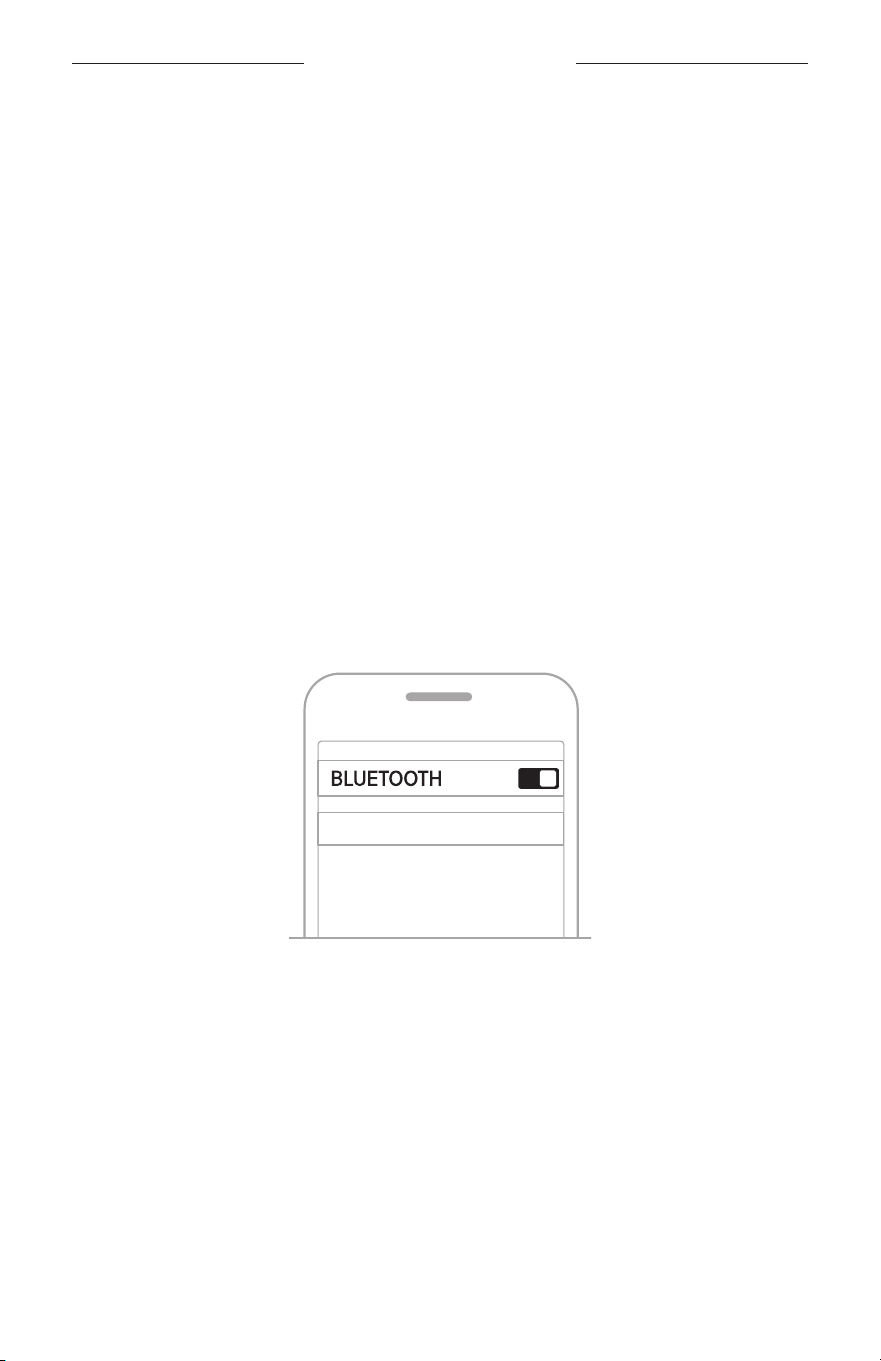
POWER LIGHT
Shows the power source and level.
ANC
HIGH
MED
LOW
Power light
POWER SOURCE LIGHT ACTIVITY SYSTEM STATE
Aircraft Slow blinking green Power On
Battery
Blinking green Power On—baeries high
(8 hours or more )
Battery
Blinking amber Power On—baeries low
(2 to 8 hours remaining)
Battery
Blinking red Power On—baeries low
(2 hours or less remaining)
NOTE: In Bluetooth headsets,
when the baeries reach
this level, the Bluetooth
feature is disabled to
conserve remaining
power. You hear a tone,
indicating that your
Bluetooth device is
disconnecting and the
Bluetooth feature is
turning o.
Aircraft or battery None Power O or baeries depleted
NOTE: To dim the Power and Bluetooth lights, double-press I.
New alkaline AA baeries supply up to 45 hours of power for the headset. Baery
life varies with the ambient noise level of the aircraft, temperature, ear tip condition,
Bluetooth use, and age of the baeries.
34
|
ENG
BLUETOOTH CONNECTIONS
Bluetooth wireless technology lets you stream audio from mobile devices such as
smartphones, tablets, and laptop computers. Before you can stream audio from a
device, you must connect the device with your headset.
NOTE: This section applies to Bluetooth headsets only.
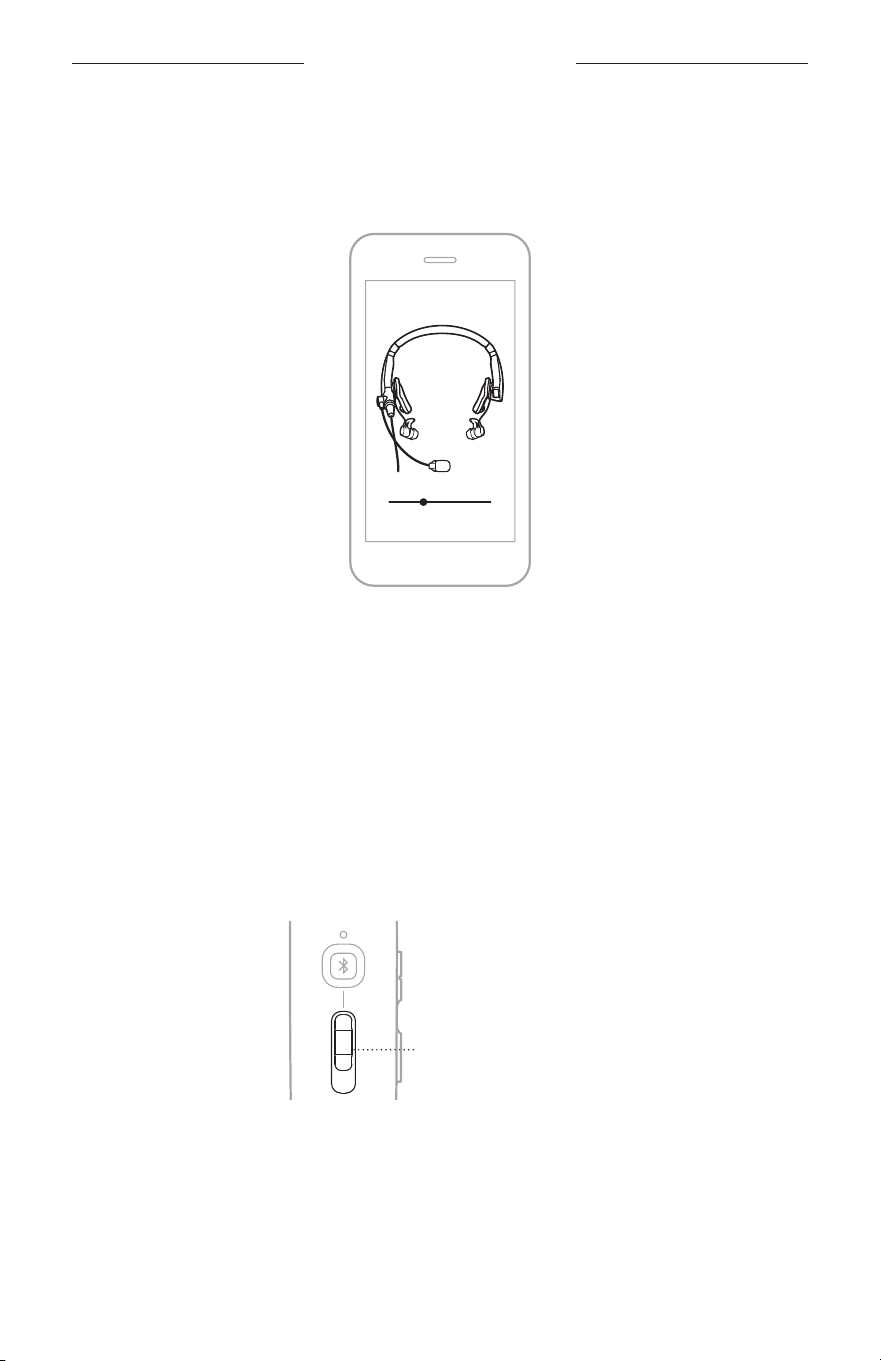
CONNECT USING THE BLUETOOTH MENU ON YOUR
MOBILE DEVICE
1. Make sure the Bluetooth priority switch is in the Mute or Mix position.
See “Bluetooth audio priority” on page 35.
NOTE: If the Bluetooth priority switch is set to O, Bluetooth is disabled.
2. Press and hold the Bluetooth/Multi-function buon l for one second.
The Bluetooth light blinks purple.
3. On your mobile device, enable the Bluetooth feature.
TIP: The Bluetooth feature is usually found in the Seings menu.
4. Select the headset from the device list.
Bose ProFlight
Once connected you hear a tone, and the Bluetooth light blinks blue.
NOTES:
• After 5 minutes of inactivity, the headset automatically exits pairing mode, and the
Bluetooth light turns o. To turn the Bluetooth feature back on, press l.
• Each time you turn on the Bluetooth feature, the headset aempts to reconnect
with the two most recently connected Bluetooth devices. If the device(s) are turned
o or out of range, the headset returns to pairing mode after 5 minutes.
See “Reconnect a mobile device” on page 37.
35
|
ENG
BLUETOOTH CONNECTIONS
CONNECT YOUR MOBILE DEVICE USING THE
BOSE CONNECT APP
Download the Bose Connect app, and follow the on-screen connection instructions.
PROFLIGHT
Once connected you hear a tone, and the Bluetooth light blinks blue.
BLUETOOTH AUDIO PRIORITY
The aircraft intercom system (ICS) is always the headset’s primary audio source.
When the headset is plugged in to the aircraft, intercom signals are always heard and
cannot be muted by the headset. You can configure how you hear the device audio
with the intercom.
NOTE: Bluetooth audio will never override the intercom.
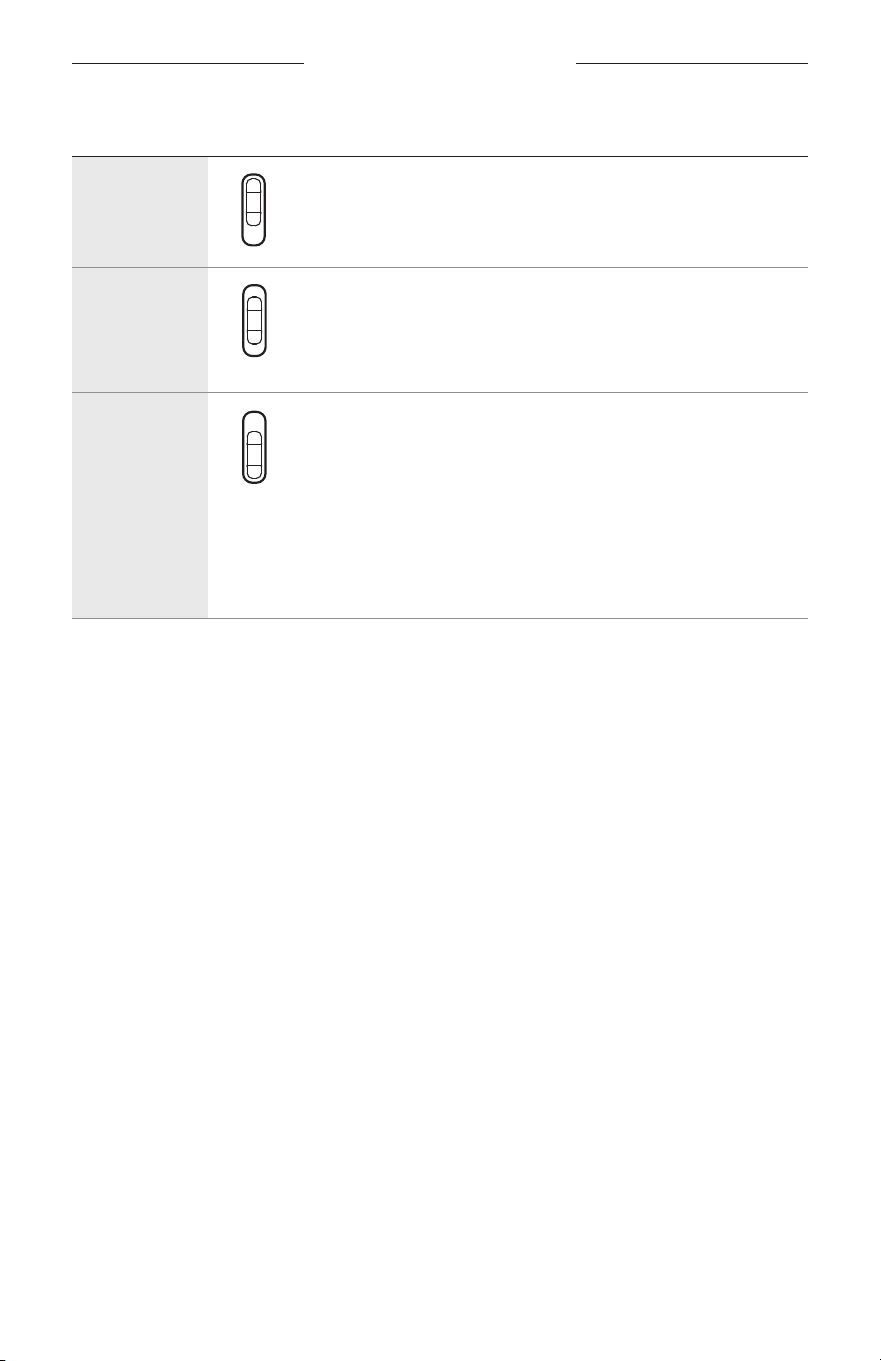
The Bluetooth priority switch is located on the front of the control module.
MUTE
MIX
OFF
Bluetooth priority switch
CONNECTIONS
36
|
ENG
BLUETOOTH CONNECTIONS
FUNCTION POSITION DESCRIPTION
Mute
When an intercom signal is detected, Bluetooth audio is
temporarily muted until intercom audio ceases.
Mix
When an intercom signal is detected, Bluetooth audio is
mixed with intercom audio.
You hear a maximum of two audio sources;
the intercom plus 1 Bluetooth device.
Off
Only intercom audio is active. Bluetooth functionality
is disabled.
NOTES:
• All Bluetooth connections are disabled and antennae
power is removed.
• If you switch to OFF while connected to a Bluetooth
device, you may need to re-establish your Bluetooth
connection the next time you turn on the headset.
NOTES:
• When Mute or Mix are selected, incoming and outgoing phone calls automatically
mute all other secondary audio sources.
• During a phone call, the intercom and the phone call are heard as mixed.
DISCONNECT A MOBILE DEVICE
Press and hold the Bluetooth/Multi-function buon l for five seconds to turn the
Bluetooth feature o.
Move the Bluetooth priority switch to the O position.
Use the Bose Connect app to disconnect your mobile device.
TIP: You can also use Bluetooth seings to disconnect your device. Disabling the
Bluetooth
feature disconnects all other devices.
MUTE
MIX
OFF
MUTE
MIX
OFF
MUTE
MIX
OFF

CONNECTIONS
37
|
ENG
BLUETOOTH CONNECTIONS
RECONNECT A MOBILE DEVICE
When powered on, the headset tries to reconnect with the two most
recently-connected devices.
NOTE: The devices must be within range (30 ft. or 9 m) and powered on.
RECOVER A LOST CONNECTION
When your connected mobile device moves out of range, the connection is lost. The
headset automatically aempts to reconnect. If the headset is unable to reconnect,
it returns to pairing mode. After five minutes of inactivity, the Bluetooth feature
turns o.
1. Move the device back into range.
2. Press the Bluetooth/Multi-function buon l to reconnect.

38
|
ENG
MANAGING MULTIPLE BLUETOOTH CONNECTIONS
You can pair additional devices to your headset. These Bluetooth connections
are controlled with the Bluetooth/Multi-function buon l. Before connecting an
additional mobile device, make sure this feature is enabled.
TIP: You can also easily manage multiple connected devices using the
Bose Connect app.
NOTE: This section applies to Bluetooth headsets only.
CONNECT AN ADDITIONAL MOBILE DEVICE
You can store up to eight paired devices in the headset pairing list, and your headset
can be actively connected to two devices at a time.
To connect an additional device, use the Bluetooth menu on your device or download
the Bose Connect app.
NOTES:
• Only one device can be heard at a time.
• Bluetooth audio will never override the intercom.
SWITCH BETWEEN CONNECTED DEVICES
1. Pause audio on your first device.
2. Play audio on your second device.
CLEAR THE HEADSET PAIRING LIST
1. Press and hold l and z simultaneously for seven seconds, or until the Bluetooth
light blinks purple in sync with the Power light.
2. Delete the headset from the Bluetooth list on your device.
All devices are cleared, and the headset is ready to connect.
See “Bluetooth Connections” on page 34.
39
|
ENG
BLUETOOTH FUNCTIONS
NOTE: This section applies to Bluetooth headsets only.
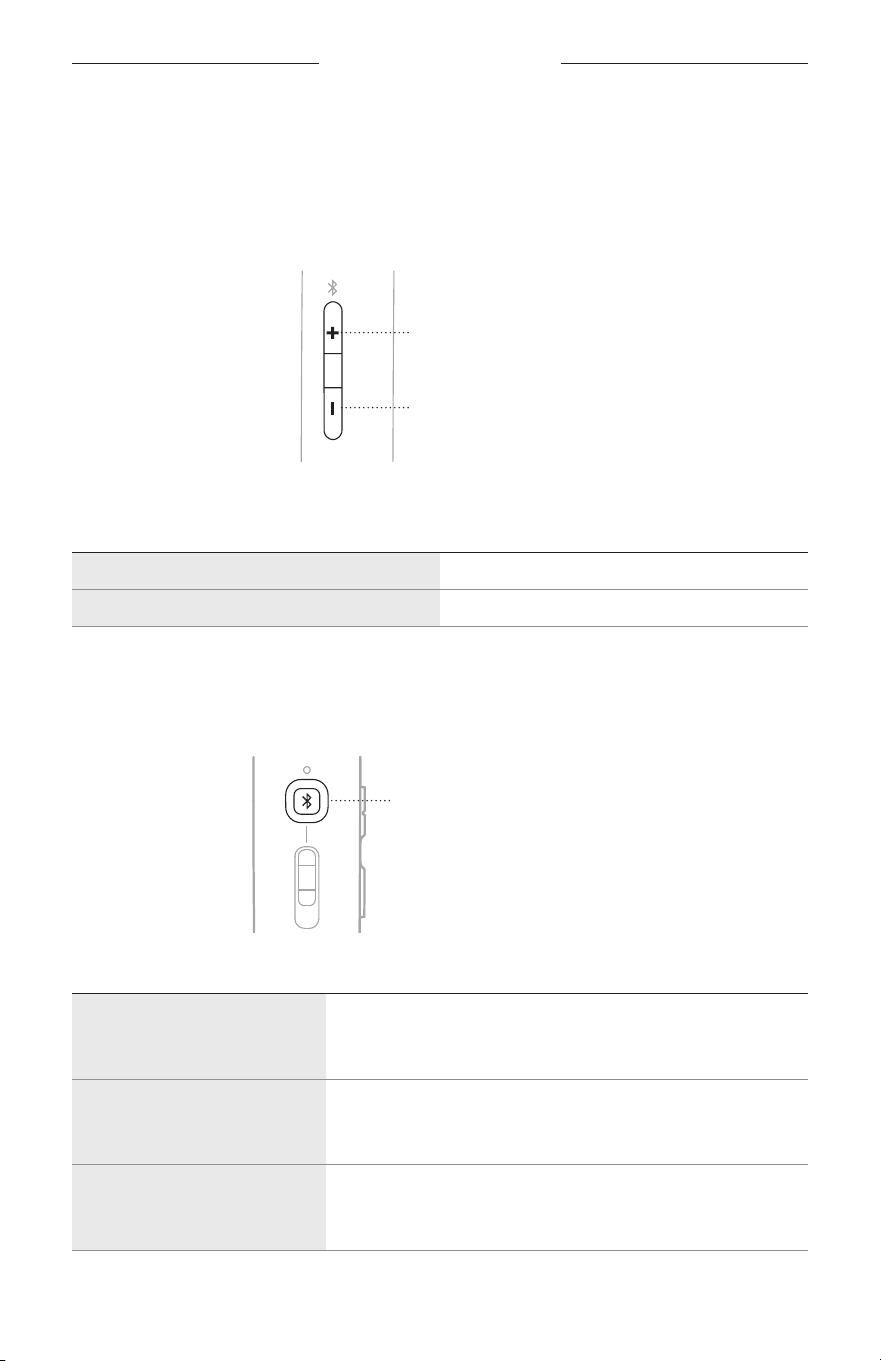
BLUETOOTH VOLUME FUNCTIONS
The Bluetooth volume controls are located on the side of the control module.
Bluetooth volume up
Bluetooth volume down
FUNCTION WHAT TO DO
Bluetooth volume up Press H.
Bluetooth volume down Press z.
CALL FUNCTIONS
The Bluetooth/Multi-function buon l is located on the front of the control module.
MUTE
MIX
OFF
Bluetooth/Multi-function buon
FUNCTION WHAT TO DO
Make a call
Dial from your connected phone.
The call automatically transfers to the headset.
Answer a call
Press l.
You hear a short beep before you hear the incoming call.
End a call
Press l.
You hear two short beeps indicating the call has ended.

40
|
ENG
BLUETOOTH FUNCTIONS
FUNCTION WHAT TO DO
Decline an incoming call
Press and hold l for one second.
You hear two short beeps indicating the call has
been declined.
Answer a second incoming
call and put the current call
on hold
While on a call, press the Bluetooth/Multi-function buon l.
You hear a short beep before you hear the second call.
Decline a second incoming
call and stay on current call
While on a call, press and hold l
for one second.
You hear two short beeps indicating the call has
been declined.
Switch between two calls
With two active calls, double-press l.
You hear a short beep before you hear the incoming call.
Redial the last number When there are no active or incoming calls, double-press l.
Transfer audio to the
mobile device
While on a call, press and hold l for three to four seconds.
The audio is transfered to the mobile phone while the
Bluetooth connection remains active.
Activate voice control When there are no active or incoming calls, press l.
Mute/unmute a call
While on a call, press H and z simultaneously.
You hear two short beeps indicating the call has been
muted/unmuted.
NOTES:
• If you are on a call and unplugged from the intercom, the headset powers o
approximately three minutes after the call is ended.
• To use the headset when unplugged from the intercom (to listen to audio or
to make or receive calls), Bose recommends to disable the Auto O feature for
uninterrupted functionality. See “Operation Switches” on page 23.
• Some functions may not be available for some mobile devices. Refer to your device
owner’s guide for more information.
41
|
ENG
CARE AND MAINTENANCE
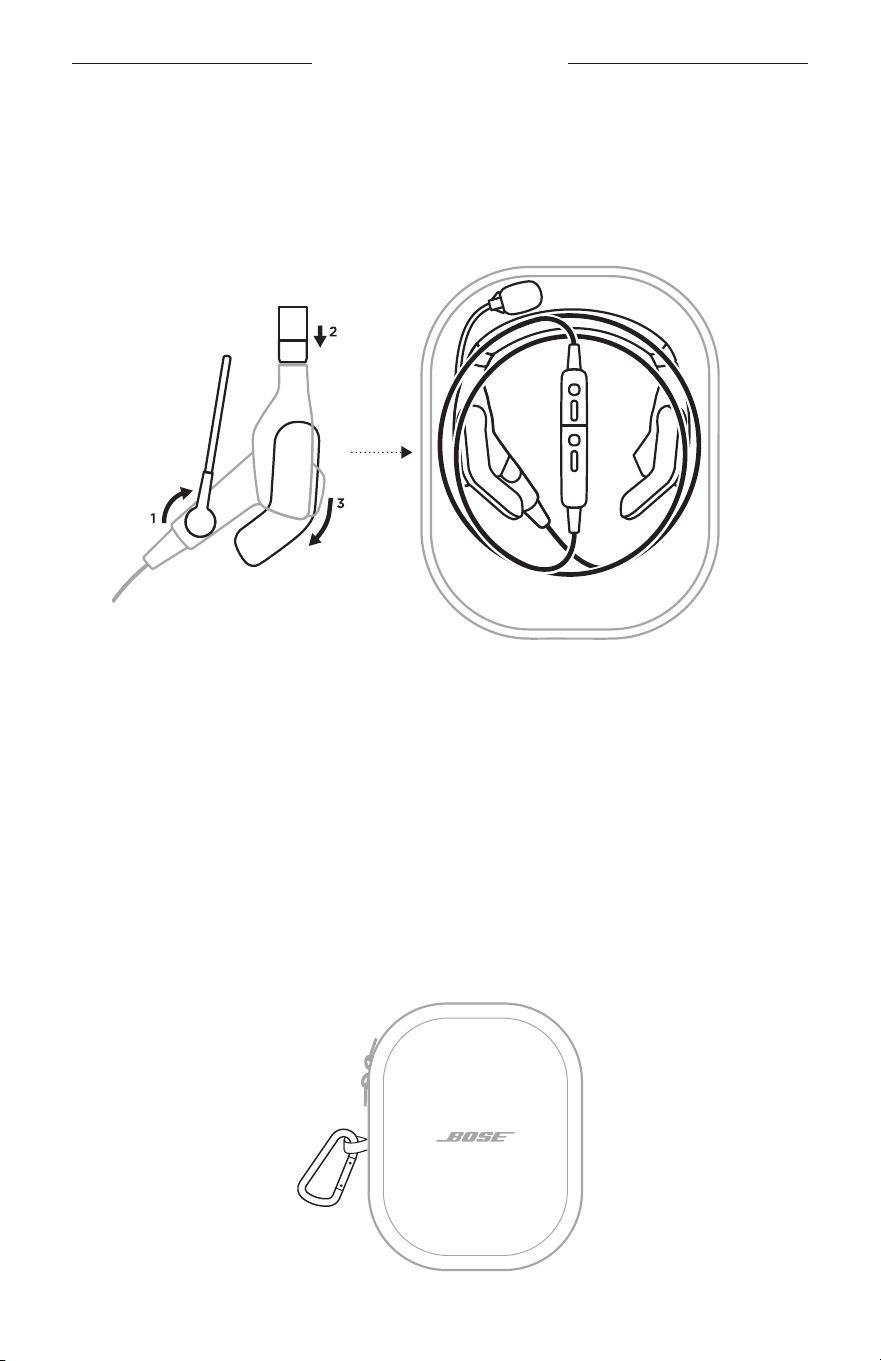
STORE THE HEADSET
• Place the headset in the carry case for easy, convenient storage.
• Store the headset in a ventilated area away from direct sunlight.
• Remove the baeries before storing the headset for extended periods.
1. Rotate the microphone up to the headband.
2. Adjust the headband.
3. Rotate the side pads.
4. Place the headset in the case.
5. Wrap the control module cable around the perimeter of the case.
6. Place the control module in the center of the headband.
7. Wrap the remaining cable around the perimeter of the case.
NOTE: Aach the carry case clip to hang the case in the aircraft.

CARE AND MAINTENANCE
42
|
ENG
CARE AND MAINTENANCE
CLEAN THE HEADSET
Your headset may require periodic cleaning.
COMPONENT CLEANING PROCEDURE
Headset
Wipe the outside surfaces of the headband, headband cushion, side
pads, connectors, and plastic parts using a soft, damp cloth (water only)
and mild soap.
CAUTION: Do NOT immerse the headset in water or any liquid.
StayHear+ tips
1. Remove the StayHear+ tips from the earbuds and wash them with a
mild soap and water.
2. Once the StayHear+ tips are completely dry, re-aach them to
the earbuds.
Microphone
windscreen
1. Gently slide or roll the windscreen o the microphone.
2. Rinse and dry the windscreen.
3. Once the windscreen is completely dry, slide the windscreen back on
the microphone.
4. Make sure it fits completely over the microphone.
LIMITED WARRANTY
The headset is covered by a limited warranty. Details of the limited warranty are
provided on the product registration card that is in the carton. Please refer to the card
for instructions on how to register. Failure to do so will not aect your limited
warranty rights.
1. Contact the Bose organization in your country/region (visit global.Bose.com for
Bose contact information in your country/region) for specific return and
shipping instructions.
2. Label and ship the product, freight prepaid, to the address provided by the Bose
organization in your country.
3. Place any necessary return authorization number prominently on the outside of
the carton. Cartons not bearing a return authorization number, where required,
will be refused.
CARE AND MAINTENANCE
43
|
ENG
CARE AND MAINTENANCE
SERIAL NUMBER LOCATION
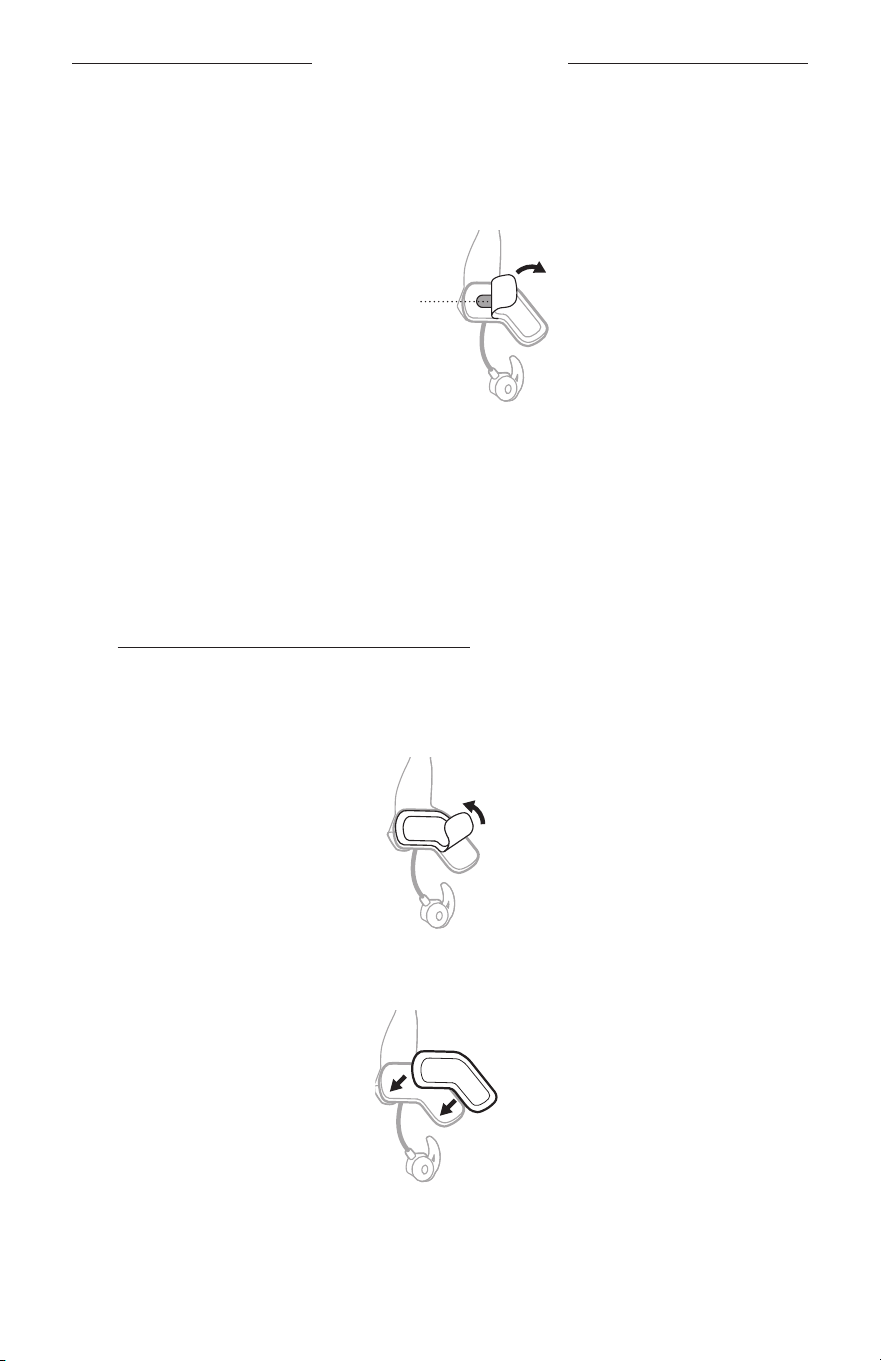
The serial number is located on the side pad. To view the serial number, gently grab
and peel the side pad cushion from the left edge away from the side pad.
®
Serial number
Refer to this serial number when you register your product or contact Bose for
technical support.
REPLACEMENT PARTS AND ACCESSORIES
Through normal use, parts like windscreens and ear tips may require periodic
replacement. Replacement parts and accessories can be ordered through
Bose customer service.
Visit: worldwide.Bose.com/Support/ProFlight2
Side pad cushion
1. Gently grab and peel the side pad cushion away from the side pad.
®
2. Align the new side pad cushion to the side pad.
®
3. Press the Velcro to secure the side pad cushion in place.
44
|
ENG
CARE AND MAINTENANCE
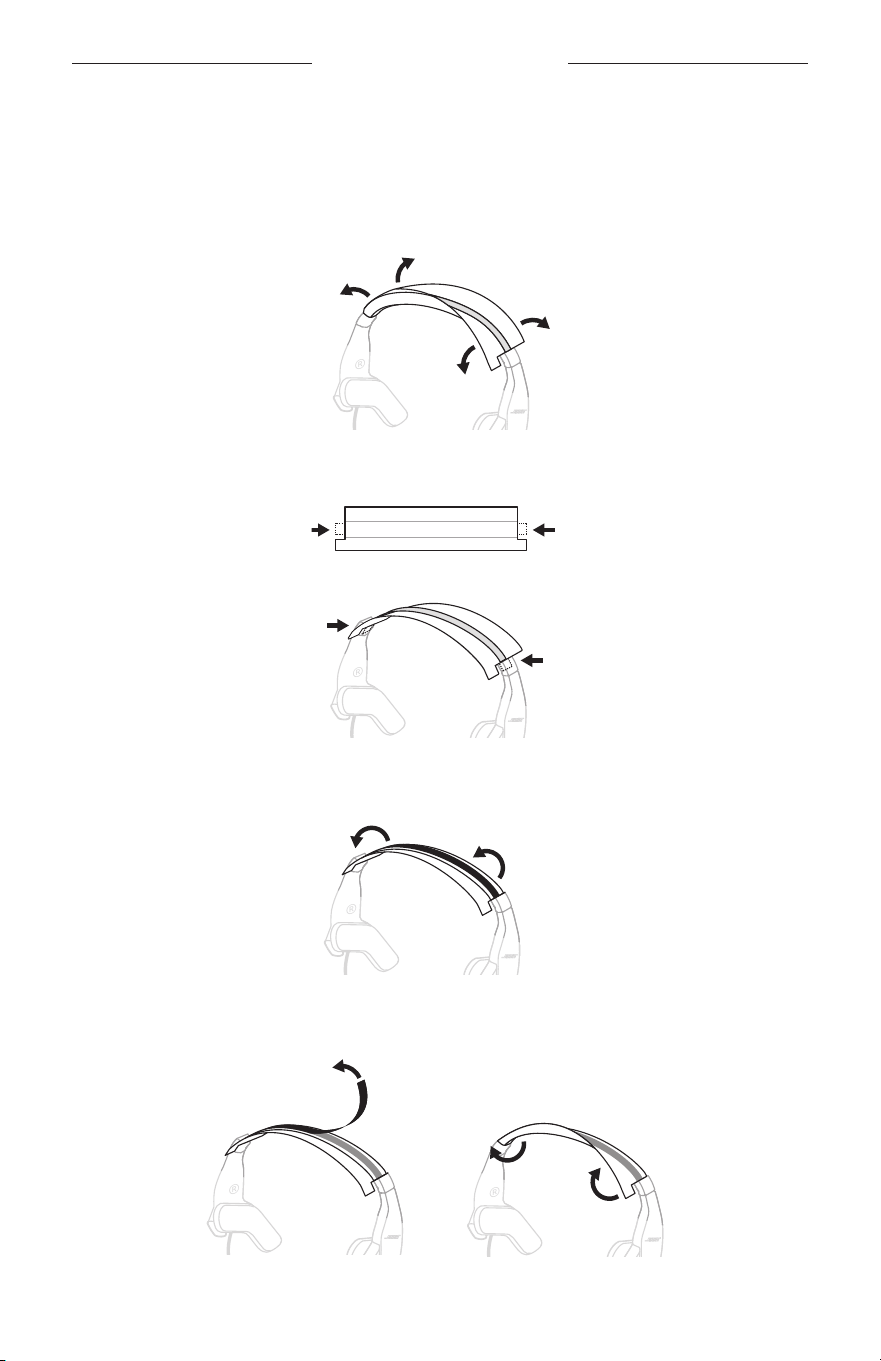
Headband cushion
Replace the cushion after regular care and maintenance fails to restore the cushion
to its original size and shape.
1. Gently grab and peel the headband cushion away from the headband.
®
2. Place the new headband cushion under the headband with adhesive facing rear.
®
3. Fold the adhesive flap over the headband.
®
4. Peel away the adhesive backing, fold top flap, and adhere the top to the adhesive.
®
®
45
|
ENG
CARE AND MAINTENANCE
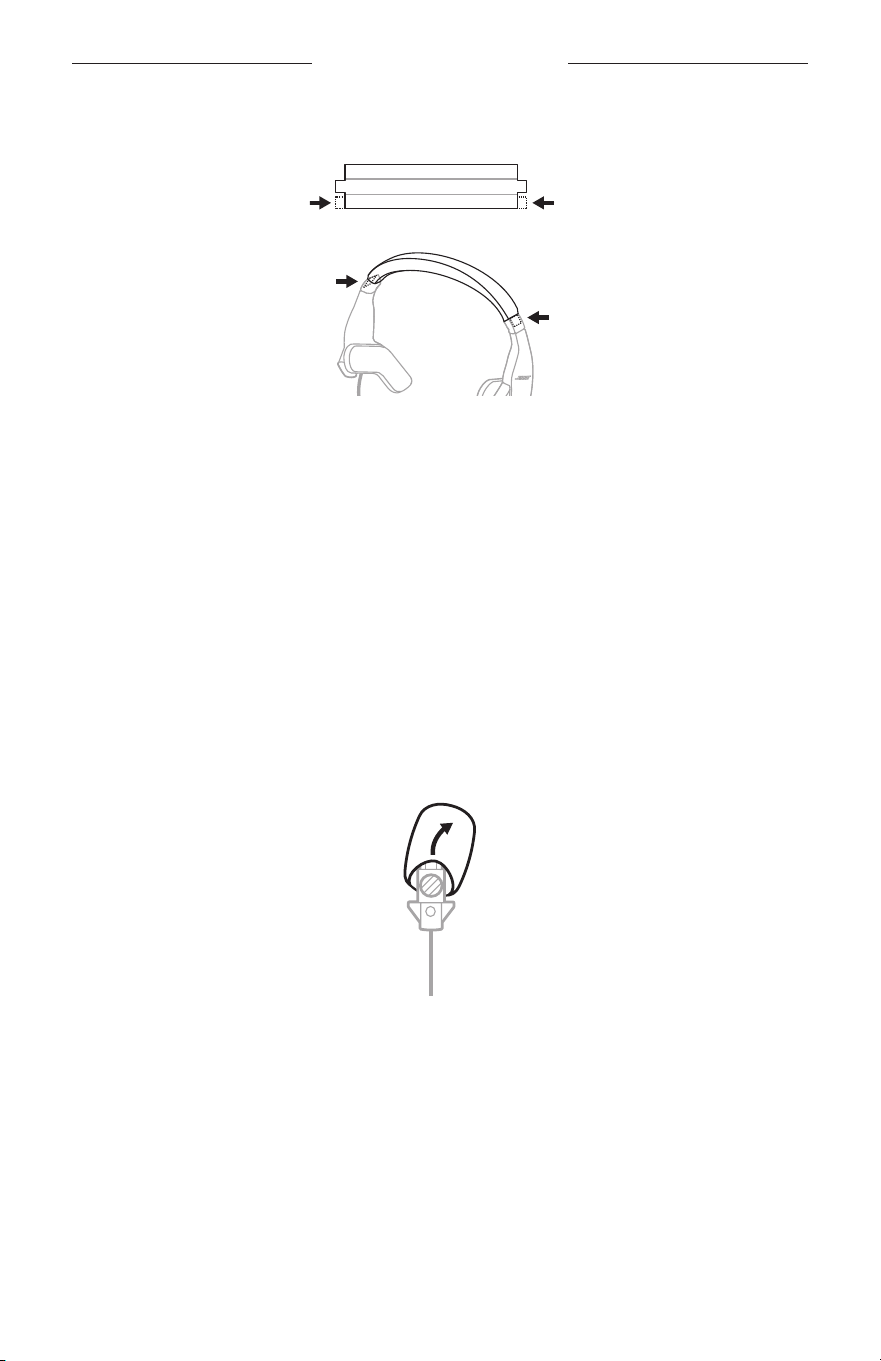
5. Insert the left and right tabs into the plastic cap.
®
StayHear+ tips
Replace tips every six months or every 350 hours of use, depending on how often you
fly. See “Change the StayHear+ tips” on page 17. You may have to replace them
more often, if you:
• Subject the headset to severe temperature extremes such as parking your airplane
outside in severe cold or heat.
• Put excess strain on the tips because of improper storage.
To extend the life of the StayHear+ tips, clean them regularly.
See “Clean the headset” on page 42.
Microphone windscreen
1. Gently grab the microphone base and peel the windscreen away from
the microphone.
2. Slide the windscreen o the microphone.
46
|
ENG
CARE AND MAINTENANCE
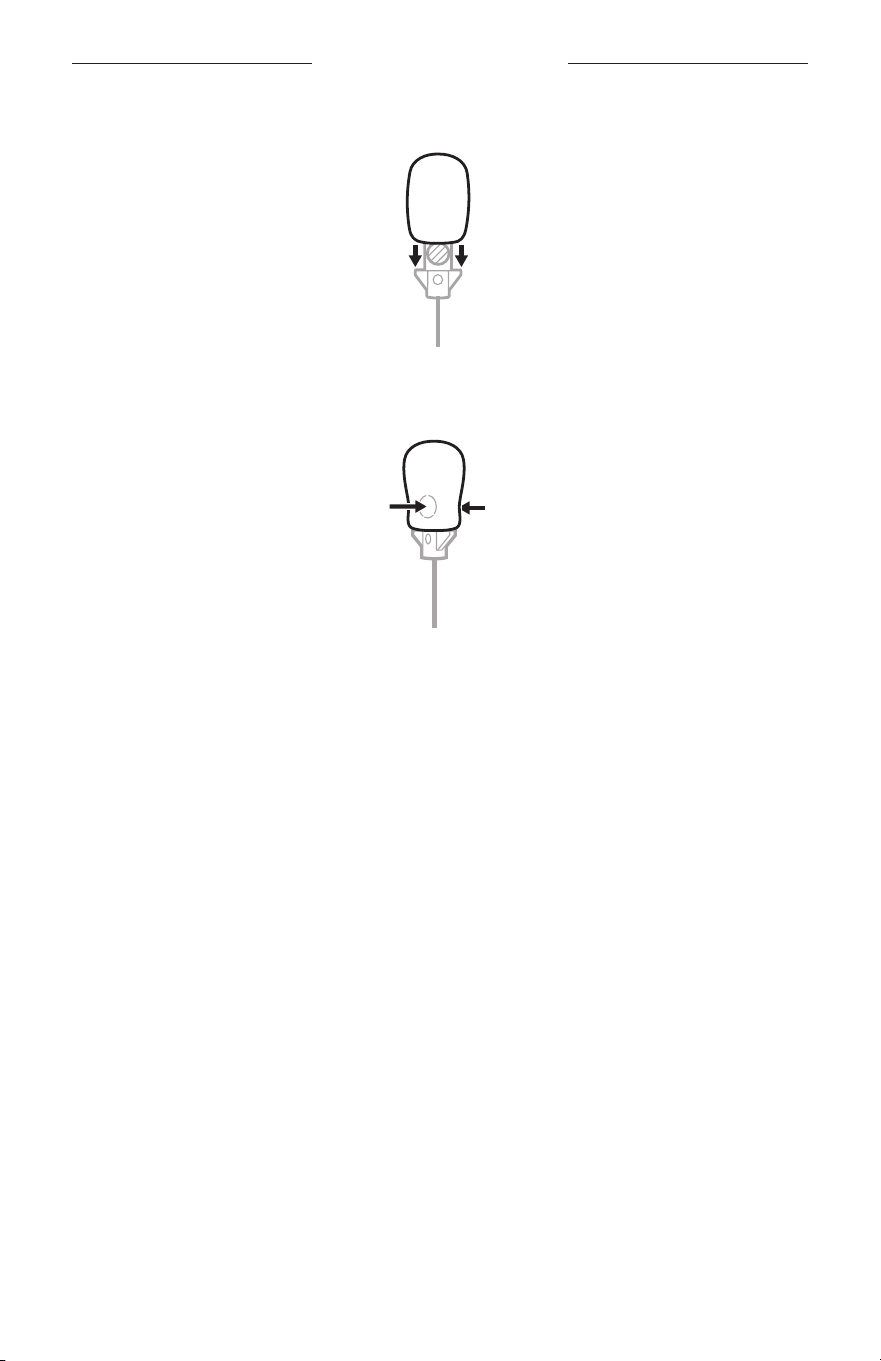
3. Slide the new windscreen on the microphone.
4. Make sure it fits completely over the microphone.
5. Press the sides of the windscreen to secure into place.
Batteries
See “Baeries” on page 29.
Microphone or terminator cover
See “Microphone Placement” on page 26.

47
|
ENG
TROUBLESHOOTING
TRY THESE FIRST
If you experience problems with your headset, try these solutions first:
• Power on the headset (see page 20).
• Check the state of the status lights (see page 32).
• Make sure the earbud is fully inserted and securely sealed (see page 16).
• For Bluetooth headsets:
– Make sure your mobile device supports Bluetooth (see page 53)
2.1 and greater.
– Increase the volume on your Bluetooth device (see page 39) and audio
or music app.
– Try connecting another Bluetooth device (see page 38).
OTHER SOLUTIONS
If you could not resolve your issue, see the table below to identify symptoms and
solutions to common problems. If you are unable to resolve your issue, contact
Bose customer service.
Visit: worldwide.Bose.com/contact
Acoustic Noise Cancelling
PROBLEM WHAT TO DO
Communication, but
no noise cancellation
in either ear
If using aircraft power, check the aircraft fuse or circuit breaker.
If using baery power, make sure the baeries are fresh and
correctly installed. See “Baeries” on page 29.
If using aircraft power, make sure the connector is firmly seated
in the control panel and the control panel has power. See “Aircraft
Connectors” on page 30.
Power o, then power on the headset.
See “Headset Controls” on page 20.
NOTE: Don’t press the Power buon I repeatedly.

TROUBLESHOOTING
48
|
ENG
TROUBLESHOOTING
PROBLEM WHAT TO DO
No active noise
cancellation and no
communication
If using baery power, make sure the baeries are fresh and
correctly installed. See “Baeries” on page 29.
If using aircraft power, make sure the connector is firmly seated
in the control panel and the control panel has power. See “Aircraft
Connectors” on page 30.
Power o, then power on the headset.
See “Headset Controls” on page 20.
NOTE: Don’t press the Power buon I repeatedly.
Use the headset in a dierent seat location.
Remove microphone assembly from the headset, and check for
damage to the connector or pins. See “Move the microphone” on
page 26.
Intercom communications
PROBLEM WHAT TO DO
Noise cancellation
active, but no
incoming audio
Make sure the volume controls are not set too low on the control
module (see page 39) or the intercom.
Make sure the aircraft connectors are securely inserted into the
aircraft control panel. See “Aircraft Connectors” on page 30.
Use a dierent seat location in the aircraft.
Low volume
of incoming
communications
Make sure the volume controls are not set too low on the control
module (see page 39) or the intercom.
Make sure the Intercom operation switch is correctly set for your
intercom system. See “Operation Switches” on page 23.
Make sure all headsets sharing the intercom have the Intercom
operation switch in the correct position. See “Operation Switches”
on page 23.
Unplug all other headsets and see if the volume can be adjusted
to an acceptable level.
Intermittent
communication
Make sure the aircraft connectors are securely inserted into the
aircraft control panel. See “Aircraft Connectors” on page 30.
Use a dierent seat location in the aircraft.
Reduced volume
in one ear only
Make sure the volume controls are not set too low on the control
module (see page 39) or the intercom.
Make sure the Intercom operation switch is correctly set for your
intercom system. See “Operation Switches” on page 23.

TROUBLESHOOTING
49
|
ENG
TROUBLESHOOTING
PROBLEM WHAT TO DO
No stereo separation
or communications
in one ear only
Make sure the Intercom operation switch is correctly set for your
intercom system. See “Operation Switches” on page 23.
Make sure the terminator cover is securely installed. See “Move the
microphone” on page 26.
Depending on how your audio jacks are wired, there may be only
one channel of audio supplied to the headphone jack. If the
Intercom (MON-ST) operation switch is set to ST and you only hear
communications on one side, set the operation switch to MON to
play audio on both sides. 5-pin XLR models are mono audio only.
Audio
PROBLEM WHAT TO DO
Reduced noise
cancellation,
intermittent
clicking sounds,
or communication
distortion in a loud
environment
Make sure the StayHear+ tips are clean and free of debris.
See “Clean the headset” on page 42.
Remove the microphone, then aach again.
See “Move the microphone” on page 26.
If the headset emits any loud noise and related loss of
communications while in the Acoustic Noise Cancelling
mode, turn the power o. The headset will continue to provide
communications in the passive noise reducing mode.
Squealing or whistling
sound when the
headset powers on
Make sure the headset orientation is correct. Use the Left T and
Right U markings on the headset to orient the headset correctly.
Make sure the StayHear+ tips are firmly seated on the earbuds.
Make sure the earbuds are fully seated in your ears. See “Fit the
earbuds to your ear” on page 16.
Make sure the proper sized StayHear+ tips are being used. See
“Choose the correct StayHear+ tips” on page 16.
Make sure the earbud openings are clean and free of debris.
Low rumbling sound
with the headset
turned on in a quiet
environment
Make sure the earbuds fit correctly.
See “Choose the correct StayHear+ tips” on page 16.
Make sure the StayHear+ tips are clean and free of debris.
See “Clean the headset” on page 42.

TROUBLESHOOTING
50
|
ENG
TROUBLESHOOTING
PROBLEM WHAT TO DO
Crackling sound
audible with headset
turned on in a loud
environment, or
noise cancelling is
intermittent
Make sure the headset orientation is correct. Use the Left T and
Right U markings on the earbuds to orient the headset correctly.
Make sure the earbuds fit correctly.
See “Choose the correct StayHear+ tips” on page 16.
Make sure the StayHear+ tips are clean and free of debris.
See “Clean the headset” on page 42.
Remove the microphone, then aach again.
See “Move the microphone” on page 26.
If using baery power, check if the baery is low.
See “Power light” on page 33.
If using aircraft power, make sure the voltage powering the
headset is no less than 10 VDC.
WARNING: If the headset emits any loud noise and related loss of communications
while in the Acoustic Noise Cancelling mode, turn the power o. The
headset will continue to provide communications in the passive noise
reducing mode.
Microphone
PROBLEM WHAT TO DO
No sound to the
microphone
Make sure the white surface on the microphone is facing your
mouth. See “Adjust the microphone” on page 18.
Make sure the microphone is fully connected to the headband.
See “Microphone Placement” on page 26.
Check the Squelch level on the intercom. The Squelch level may
need to be adjusted.
Try another intercom position in the aircraft.
For Bluetooth phone calls, make sure the baeries are fresh and
correctly installed. See “Baeries” on page 29.
NOTE: For Bluetooth headsets only.

TROUBLESHOOTING
51
|
ENG
TROUBLESHOOTING
Bluetooth audio source
NOTE: This section applies to Bluetooth headsets only.
PROBLEM WHAT TO DO
No audio from the
Bluetooth source to
the headset while on
a call
Make sure the Bluetooth priority switch is in the Mute or Mix
position. See “Bluetooth audio priority” on page 35.
Turn on and o Bluetooth on the mobile device. See “Connect
using the Bluetooth menu on your
mobile device” on page 34.
Make sure the Bluetooth feature is on, and the Bluetooth light is
flashing. See “Bluetooth light” on page 32.
Make sure the headset and device are in range (30 ft. or 9 m).
Make sure the mobile device is connected properly and the
headset is ready to pair. See “Bluetooth Connections” on
page 34.
Make sure the Bluetooth volume is not set too low on the control
module. See “Bluetooth volume functions” on page 39.
Headset does not pair
with a device
Turn on and o Bluetooth on the mobile device.
Make sure the Bluetooth feature is on, and the Bluetooth light is
flashing. See “Bluetooth light” on page 32.
Make sure the Bluetooth priority switch is in the Mute or Mix
position. See “Bluetooth audio priority” on page 35.
Clear the headset pairing list (see page 38) and connect again.
Delete the headset from your device’s Bluetooth device list and
pair again.
Cannot answer/end
a call
Make sure your mobile device is connected to the headset.
Turn your device o and on. Connect again.
Headset does not
reconnect to a
previously connected
device
Make sure the headset and device are in range (30 ft. or 9 m).
Make sure the Bluetooth priority switch is in the Mute or Mix
position. See “Bluetooth audio priority” on page 35.
Make sure the Bluetooth feature is on, and the Bluetooth light is
flashing. See “Bluetooth light” on page 32.
On your mobile device, make sure the Bluetooth feature is on.
Delete the headset from your device’s Bluetooth device list and
pair again.

52
|
ENG
TROUBLESHOOTING
Auto on/off
NOTE: This function is not available for Dual plug connectors.
PROBLEM WHAT TO DO
Headset does
not power on
automatically
Make sure the Auto on operation switch is set to ON.
See “Operation Switches” on page 23.
Check the aircraft specifications to see if the jack is geing power
from the aircraft’s electrical system.
Headset does
not power off
automatically
Make sure the Auto o operation switch is set to ON.
See “Operation Switches” on page 23.
Disconnect the headset from the aircraft. Then power on the
headset and wait 15 minutes.
It may take up to 9 minutes for the headset to power o when not
in use immediately after initial power up. If the headset has not
powered o after 15 minutes, contact Bose customer service.
53
|
ENG
INSTALLATION
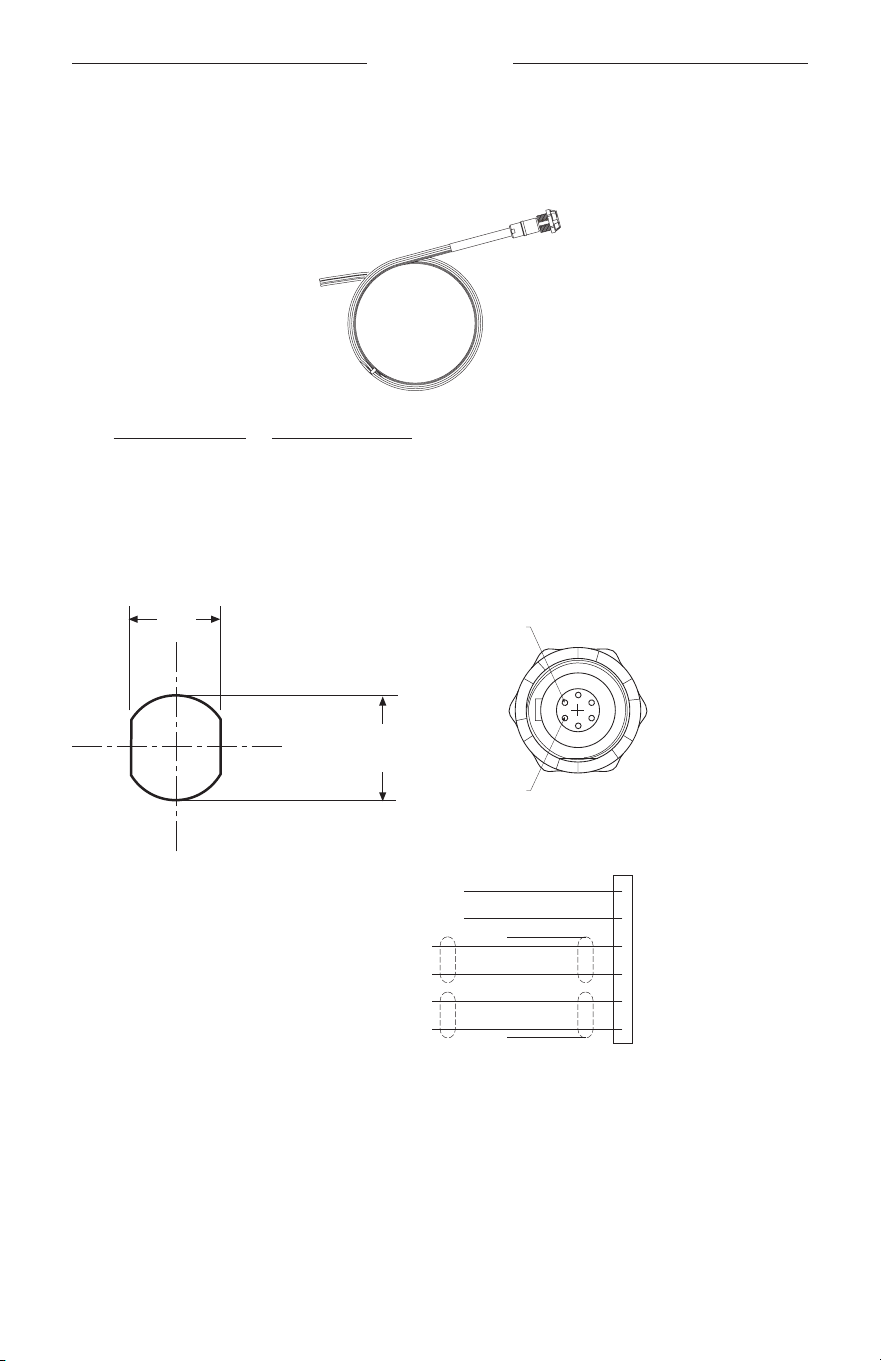
MOUNT THE AIRCRAFT PANEL CONNECTOR
The aircraft panel connector is part of the optional 6-pin wiring harness assembly.
Visit www.Bose.com or global.Bose.com for information or purchase.
WARNING: The aircraft panel connector must be mounted by a technician who is
qualified to perform this type of avionics installation for the aircraft you
are using.
Mount the connector into a cutout, using the diagrams below as a guide.
12.5mm
.49"
.55"
14.0
mm
RED
•
1 V+IN
BLK
•
2 GND
WHT
•
3 COMM L
BLU
•
4 COMM R
WHT
•
5 MIC HI
WH/BLU
•
6 MIC LO
BLK/WH
BLK/WH
Pin 6
Pin 1
Aircraft Interface Schematic
Receptacle - Pinout (front view)
54
|
ENG
INSTALLATION
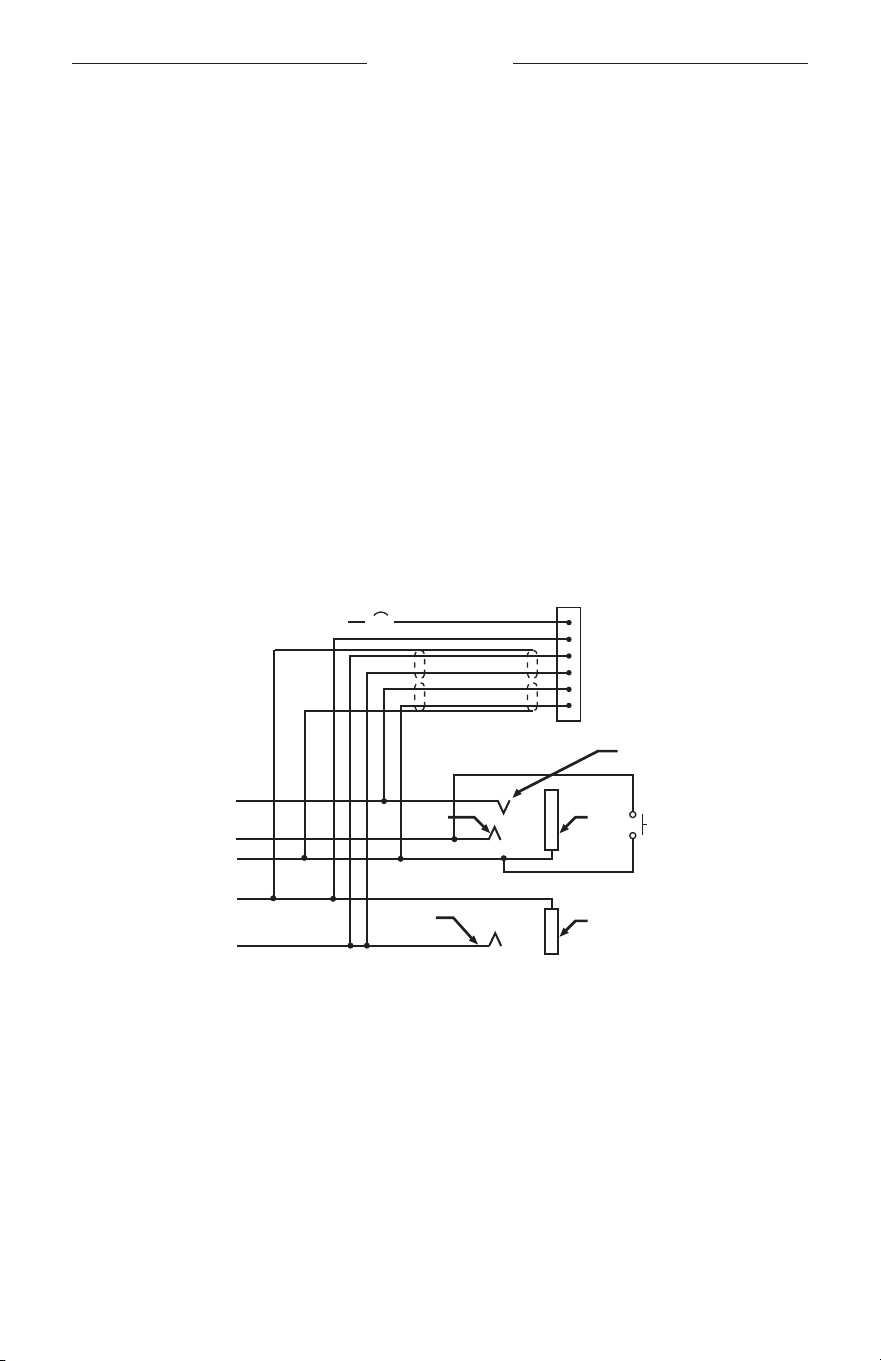
Connect the eight wires as follows:
• Two for the microphone
• Two for audio
• One for power
• One for ground
• Two for audio shields
Audio and microphone wires should be connected to the back of the existing
microphone and headphone jacks, leaving existing jacks intact for use with
conventional headsets. This is usually the fastest installation method.
CAUTION: Do NOT use excessive force or bend the installed connector. This may
damage or break internal solder joints.
NOTE: The aircraft panel connector cannot be installed in an audio system using
transformer-coupled audio outputs. Contact Bose customer service.
Mono connection diagram
10-32
V DC
1/2A
1V+IN
2 GND
3 COMM L
4 COMM R
5 MIC HI
6 MIC LO
RED
BLK
WHT
BLU
WHT
WHT/BLU
BLK/WH
BLK/WH
Ring
(audio)
Existing PTT
switch
and wiring
(no connection to
Bose headset)
Microphone - Jack
Tip
(PTT)
Barrel
(gnd)
Headphone - Jack
Barrel
(audio gnd)
Tip
(phone audio)
Existing wiring to
aircraft intercom/
audio panel
55
|
ENG
INSTALLATION
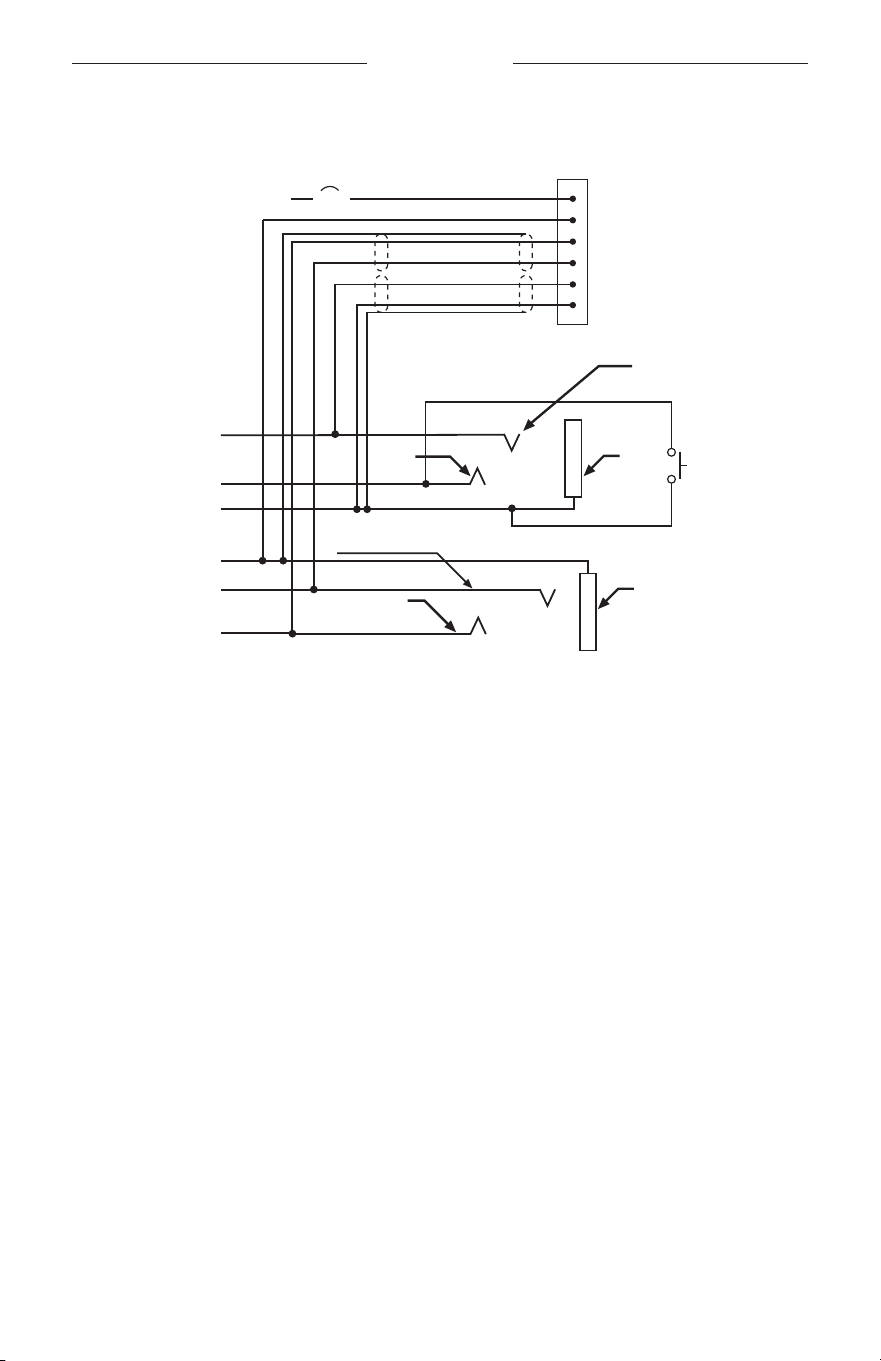
Stereo connection diagram
Existing wiring to
aircraft stereo
intercom/audio panel
10-32
V DC
1/2A
1V+IN
2 GND
3 COMM L
4 COMM R
5 MIC HI
6 MIC LO
RED
BLK
WHT
BLU
WHT
WHT/BLU
BLK/WH
BLK/WH
Audio
Existing
PTT switch
and wiring
(no connection to
Bose headset)
Microphone - Jack
Tip
(PTT)
Barrel
(gnd)
Stereo Headphone - Jack
Barrel
(audio gnd)
Tip
(phone audio left)
Phone
audio (right)

56
|
ENG
INSTALLATION
Details on making the connections
The pinouts for the optional installed connector are detailed in the table below.
PIN NUMBER COLOR PURPOSE
1
Red V+IN: Headset power (10-32 VDC). Use a 1/4 amp
fuse or a 1/2 amp circuit breaker.
2
Black GND: System ground. Connect to the existing
audio ground.
3 White COMM L: Phone communication: Left.
4 Blue COMM R: Phone communication: Right.
NOTE: For stereo operation, connect the left and right channels to their respective positions.
For monaural operation, connect pins 3 and 4 together, and to the tip of the existing
phone jack.
5
White MIC HI: Microphone/Hi-audio. Connect to the
portion of the existing microphone jack that
corresponds to the ring position of a headset
microphone plug. Don’t connect to the tip
(PTT) segment.
6
White/Blue MIC LO: Microphone/Lo-ground. Connect to the
portion of the microphone jack that corresponds
to the barrel position of a headset
microphone plug.
NOTE: If the microphone works on radio transmit but not through the intercom, check pin 6.
It may be incorrectly wired to the PTT segment of the microphone jack.
Comm Shield Black Shield from Comm L and Comm R wire pair.
Mic Shield Black Shield from Mic Hi and Mic Lo wire pair.
NOTE: The wires connecting pins 3 and 4 and pins 5 and 6 are shielded, twisted pairs with
a black wire shield termination exiting each pair. If the existing wiring is not shielded,
connect the shields to the existing audio wiring shields, or connect the shield from
Comm L and Comm R wire pair to audio ground.

57
|
ENG
TECHNICAL INFORMATION
SPECIFICATION DESCRIPTION
Headphone sensitivity
92dB SPL measure at 1 mW input signal, 1 kHz, in Mono mode
Headphone impedance
Mono mode: 150 Ohm ON and OFF
Stereo mode: 300 Ohm ON and OFF
Headphone frequency
response
RTCA-214a range: 300 to 3500Hz
Extended range: 40Hz to 15kHz
Boom microphone
sensitivity
-27dBV (+/- 2.5dB) at 94dB SPL (1 Pa), measured at 6mm
distance from artificial mouth, across 220 Ohms load resistor
and biased with 12 Vdc via 470 Ohms resistor.
Boom microphone bias Operating bias voltage range: 4 to 28 VDC
Maximum ambient
noise level
105 dBC SPL for full active noise reduction performance
Battery power source Two (2) AA alkaline baeries
Battery life
Up to 45 hours in typical commercial jet aircraft noise.
Duration varies with baery age, ambient noise levels,
temperature, ear tip condition, and use of the
Bluetooth feature.
Aircraft power source Aircraft power voltage range: 10 to 32 VDC
Average power
consumption
250mW
Fuse/breaker
recommended
1/4 amp, fast-blow fuse (AGC 1/4 amp fuse) or 1/2 amp
circuit breaker
Headset weight 9.6 ounces, 4.5 ounces on head
Headset size range
Slider not extended:
8.425" (214mm) H x 6.34" (161mm) W x 3.15" (80mm) D
Slider extended:
10.2" (259mm) H x 6.6" (168mm) W x 3.15" (80mm) D
Control module dimensions 1.5" (38.1mm) H x 1.5" (38.1mm) W x 4.92" (125mm) D

TROUBLESHOOTING
58
|
ENG
TECHNICAL INFORMATION
SPECIFICATION DESCRIPTION
Temperature and Altitude
(Category A)
Operating: 5 to 158°F (-15 to 70°C)
Storage: -67 to 158°F (-55 to 70°C)
Altitude: 15,000 feet maximum pressure altitude for
full cancellation
Bluetooth wireless
technology
4.2
Headset cable length 6.56 ft. or 2 m
FAA TECHNICAL STANDARD ORDER
The Bose ProFlight Series 2 Aviation Headset that is approved to TSO and ETSO
C139a are appropriately marked. The product interface, cables, and microphones have
been designed to function in or withstand exposure to the environmental
conditions below.
This article meets the minimum performance and quality control standards
required by a technical standard order (TSO). Installation of this article requires
separate approval.
CONDITION CATEGORY
Altitude and temperature A2
Salt fog S
AF conducted susceptibility B
Humidity A
Magnetic effect Z
Power input B
RF Susceptibility T
Vibration R
Voltage spike B

59
|
ENG
TECHNICAL INFORMATION
CONDITION CATEGORY
Shock drop 12 times, 1 m onto concrete (per DO-214a)
Electrostatic discharge A
Environmental categories cited refer to RTCA/DO-160G and RTCA/DO-214a
(December 18, 2013).
The conditions and tests required for TSO approval of this article are minimum
performance standards. Those installing this article either on or within a specific
type or class of aircraft must determine that the aircraft installation conditions are
within the TSO standards which include any accepted integrated non-TSO functions.
TSO articles and any accepted integrated non-TSO function(s) must have separate
approval for installation in an aircraft. The article may be installed only according to
14 CFR part 43 or the applicable airworthiness requirements.
This device complies with FCC and Industry Canada RF radiation exposure limits for
general population. It must not be collocated or operating in conjunction with any
other antenna or transmier.

©2024 Bose Corporation, 100 The Mountain Road, Framingham, MA 01701-9168 USA
AM838428-0040 Rev. 00