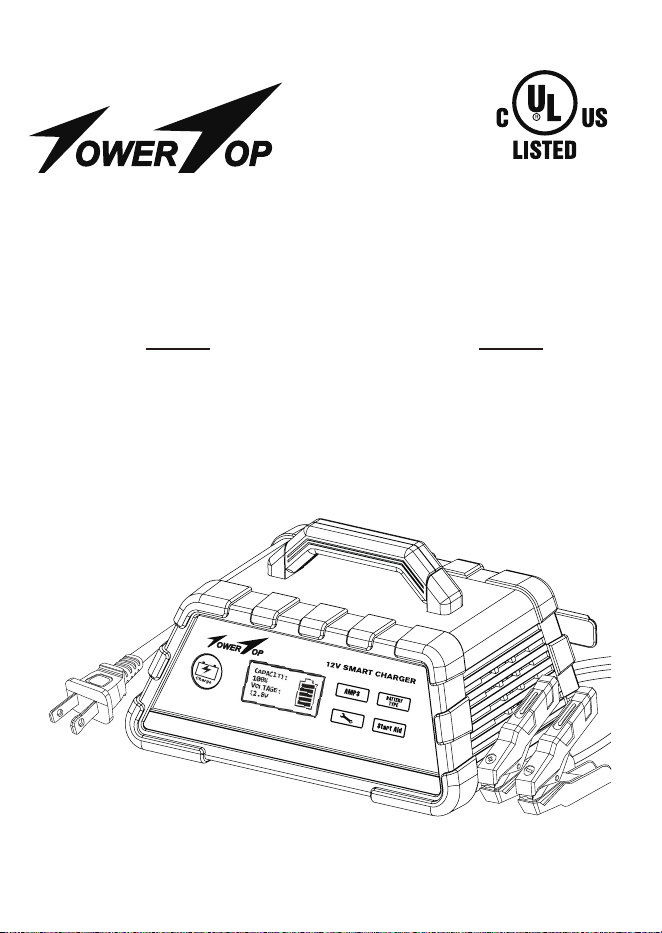
Smart Battery Charger
2 / 10 / 25 AMP
QUICK CHARGE
BOOST CHARGE
2A
TRICKLE CHARGE
10A 25A
REC OND ITION
ASSIST ENGINE START
STAND ARD/AGM/GE L
SELECTABL E
2A/10A/25 A
/
AUTO
SELECTABL E
E481323
TP108MB
Intended Use 1
Specifications 1
Important Safety Information 2
Main Parts of Product 8
Before Each Use 9
Operating Instructions 10
Maintenance 16
Troubleshooting 16
Table of Contents
WARNING: Read carefully and understand all
ASSEMBLY AND OPERATION INSTRUCTIONS before
operating. Failure to follow the safety rules and other basic
safety precautions may result in serious personal injury.
Should you have any questions or need any support,
please contact us at [email protected]
Intended Use
Specifications
This Battery charger is suitable for 12V Lead-acid Batteries,
including GEL, AGM and STD. This Battery charger will quickly
and easily charge the vehicle battery and keep the battery
performing at its optimal while lasting longer.
This Battery charger has an interactive LCD display showing
charging rate, battery type, error message in words and icon. It
also has six stages charging to keep batteries fully charged and
four different charging rates for charging variety of batteries with a
push of a button. This Battery charger also has safety features
such as automatic shutdown, over heat protection and reverse
polarity indicator to protect the user from harm and the charger
from damage.
Protection features
Overheat Protection - If the charger is overheating, the
charger will automatically shut off and will automatically
resume when the charger has cooled down.
Reverse Polarity - If the cables connected are reversely
connected, the charger will not work, and LCD screen tells
you to correct polarity.
Model No.: TP108MB
Input 120V AC/ 60Hz, 6A
Output 12V DC, 2A/10A/25A/Automatic
Working Temperature 32°F (0°C) - 104°F (40°C)
1
Important Safety Information
Overtime Charging Protection - If the battery cannot be
fully charged within 24 hours, charger will stop charging
automatically.
Short Circuit Protection - if the cables connected suffer
from short circuit when the charger working, charger will
stop charging automatically.
• Risk of Explosive Gases, Electric Shock or Fire.
• Keep out of reach of children.
• To reduce the risk of personal or property damage, read
and understand all directions and warnings prior to use of
this battery charger.
• Do not use in wet conditions or near combustible materials.
Keep away from flames, smoke or sparks while charging.
Never smoke in the area of the battery or engine.
• To reduce the risk of electric shock, connect to only
properly grounded outlets. Use of an extension cord is
not recommended and could result in fire.
• Do not operate if cords or wires are frayed or defective,
or if charger base is defective in any way. Do not attempt
to open the charger as this could result in electric shock.
• Use only on lead acid batteries. Do not use this charger
for charging dry cell batteries, as this could result in personal
injury or property damage due to battery explosion.
• Do not charge a frozen battery.
2
WORK AREA SAFETY
• Make sure you have adequate space to use this charger.
Position the charger as far away from the battery as
permitted by DC Cable.
• Never place the charger directly above the battery that is
being charged; as this may cause the charger to be
damaged by gases expelled from the battery.
• Never set a battery or any other object on the charger.
• Use only in a well-ventilated area.
• Never allow battery acid to drip on the charger when
reading electrolyte specific gravity or filling battery.
• Do not operate charger in a closed-in area or restrict
ventilation in any way.
• Use of an attachment not recommended or sold by the
battery charger manufacturer may result in a risk of fire,
electric shock, or injury to persons.
• Do not operate charger if it has received a sharp blow,
been dropped, or otherwise damaged in any way; take it
to a qualified serviceman.
• To reduce risk of electric shock, unplug charger from
outlet before attempting any repairs or cleaning. Turning
off controls will not reduce this risk.
3

PERSONAL SAFETY
• Make sure that someone is within range of your voice to
come to your aid if needed while you work with or are
near a lead-acid battery.
• Wear complete eye and clothing protection when
working with lead-acid batteries.
• Avoid touching your eyes while working with a battery.
Have plenty of fresh water and soap nearby for use in
case battery acid contacts your eyes, skin or clothing. If
this happens, wash immediately with soap and water,
then get medical attention.
• Take care not to drop any metal tool or object onto the battery.
This may result in a spark or short circuit across the battery
or another electrical device that may cause an explosion.
4
• Remove all personal metal items, such as rings, brace
lets, necklaces, and watches from your body while
working with a lead-acid battery. A battery can produce a
short circuit current high enough to weld such objects to
metal, causing a severe burn.
• Never overcharge a battery.

ELECTRICAL SAFETY
• Never alter AC cord or plug provided. If it does not fit the
outlet, have a proper outlet installed by a qualified
electrician. Improper connection can result in a risk of
fire or electric shock.
• Do not operate charger with damaged cord/plug - replace
the cord/plug immediately.
• “Warning: Changes or modifications to this unit not
expressly approved by the party responsible for compli
ance could void the user’s authority to operate the
equipment.”
• “NOTE: This equipment has been tested and found to
comply with the limits for a Class B digital de
vice,
pursuant to Part 15 of the FCC Rules. These limits are
designed to provide reasonable protection against
harmful interference in a residential installation. This
equipment generates uses and can radiate radio
frequency energy and, if not installed and used in
accordance with the instructions, may cause harmful
interference to radio communications.
5
• However, there is no guarantee that interference will
not occur in a particular installation. If this equipment
does cause harmful interference to radio or television
reception, which can be determined by turning the
equipment off and on, the user is encouraged to try to
correct the interference by one or more of the following
measures:

• NOTE: If using this battery charger/maintainer for a
marine battery, the battery must be removed and charged
on shore unless you have purchased special equipment
designed for marine use to allow for onboard charging.
• Check the polarity of the battery posts. Note: The
positive (+) post is usually larger in diameter than the
negative (-) post.
• The length of the cord external to the battery charger
and including the attachment plug shall not be less than
6 feet (1.8m) as measured from the face of the attach
ment plug to the point of attachment or entry.
• Connect the red positive (+) charger clip to the positive
(+) battery post.
Reorient or relocate the receiving antenna.
Increase the separation between the equipment and
receiver.
Connect the equipment into an outlet on a circuit
different from that to which the receiver is connected.
• Consult the dealer or an experienced radio/TV techni
cian for help.”
6

• Place the free end of the battery cable as far away from
the battery to be charged as the cable will allow and
then connect the black negative (-) charger clip to the
free end of the cable. NEVER face the battery when
making the connection.
• When disconnecting the charger/maintainer, always
use the reverse order from the connection process,
staying as far away as possible from the battery.
AC POWER CORD/PLUG CONNECTIONS AND
PROPER GROUNDING
• This battery maintainer is designed for use on a 120V
circuit. Always plug the AC power cord/plug into a
properly grounded outlet that follows all local ordinances.
• NEVER change or alter the AC power cord or plug pins.
7
Main Parts of Product
Subassembly
No.
1
65
2
3
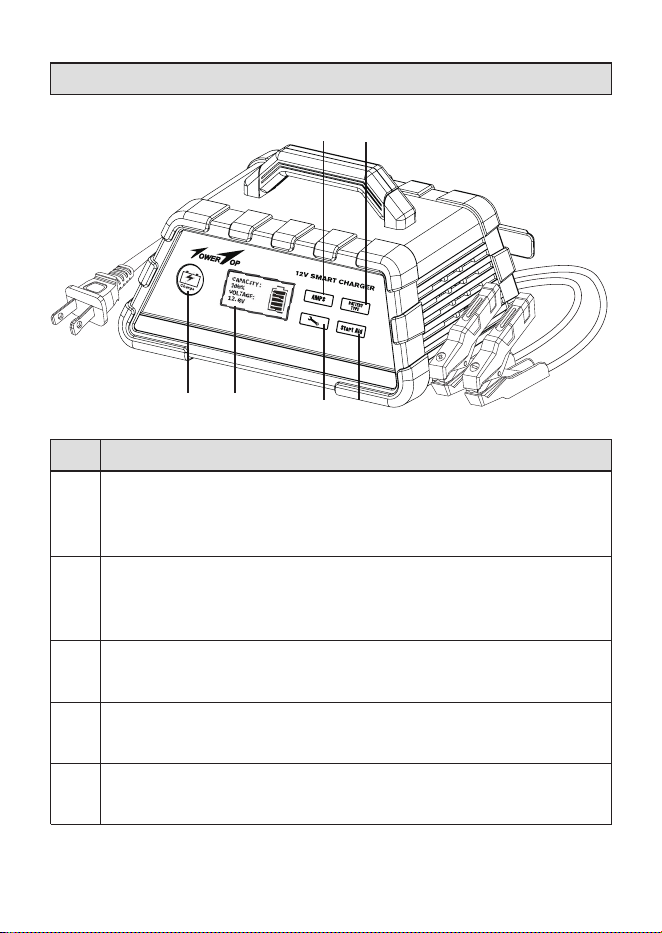
LCD Display Window - shows charging status,
charging current, voltage, battery type, start aid and
error information in words and icon.
Charging Amp Selection Button - press to select
the charging rate from 2A, 10A, 25A and automatic
charging rate.
Battery Type Selection Button - press to select the
battery type from AGM, GEL, and Standard battery.
Charge Button - press to begin charging and press
again to stop
Reconditioning Button - press to activate the
battery recondition function and press again to stop
2
3
5
4
8
14
QUICK CHARGE
BOOST CHARGE
2A
TRICKLE CHARGE
10A 25A
RECONDITION
ASSIST ENGINE START
STANDARD/AGM/GEL
SELECTABLE
2A/10A/25A/AUTO
SELECTABLE
If it is necessary to remove the battery prior to charging,
always remove the grounded terminal first. Ensure all
electrical accessories are off prior to charging.
It is best to clean the battery terminals prior to charging.
Using a battery terminal brush is a good way to remove
corrosion.
When charging a lead-acid battery that is not sealed, it may
be necessary to add distilled water into battery so the battery
acid solution reaches the level as specified by manufacturer.
Careful do not overfill the battery.
Subassembly
Before Each Use
No.
6
Start Aid Button
- press to activate engine start
function. LCD display window will guide how to
proceed step by step and press again to stop
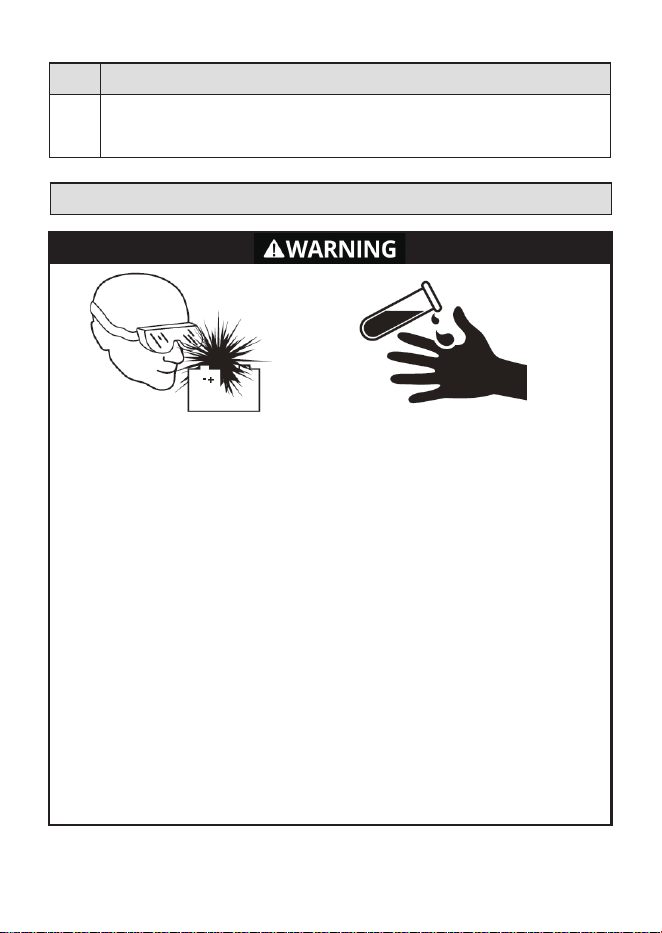
SHIELD EYES:
Explosive gases
can cause eye
injury or blindness.
CONTAINS SULFURIC
ACID:
May cause severe burns
and blindness.
9
Read individual precautions and warnings outlined by the
battery manufacturer relative to charging / maintaining.
Ensure that charger clips make a tight connection.
NEVER smoke or allow a spark or flame in the vicinity of the
battery or engine. Use charger for charging LEAD-ACID
batteries only.
NEVER charge a frozen battery.
SELECT CHARGING RATE
This smart charger has an Optimal function (defaulted setting).
The optimal function automatically selects not want to use
the optimal function, you can choose your charging rate
manually. This Smart Charger has three additional
charging rate options. Press the "AMP" button to choose the
desired charging rate.
2A - Can be used for small battery or slow charging.
10A - Can be used for medium size automobile battery or
quick charging.
25A - Can be used for large automobile battery or rapid
charging.
Note: If you want your battery to sustain a longer life, slow
charges it. Slow charging will take longer but will charge your
battery more thoroughly. If your battery needs to charge in a
short amount of time, use the Rapid charge setting.
Operating Instructions
10

BATTERY RECONDITIONING
When your battery has been unused for long periods of time,
the battery will be in a deep discharged state. The battery
reconditioning function is to recover the battery from deep
discharge and help the battery last longer.
CHARGING TIME
Charging time may vary depending on some factors listed
below stop the process.
Battery State – Depending on the voltage of your battery, it
may take up to 10 hours to charge. Batteries with higher
voltage can usually be charged in a few hours.
Battery Rating – A higher rated battery will take longer to
charge than a lower rated battery under the same conditions.
A battery is rated in ampere-hours (Ah), reserve capacity
(RC) and cold-cranking amps (CCA).
Charge Rate – The charge rate is measured in amps. A
battery charged at a lower rate will take longer than a battery
charged at a higher rate. However, smaller batteries can be
easily damaged by charging at a rate which is too high for
the capacity of the battery.
Temperature – Cold temperature will affect a battery’s ability
to accept a charge. Charging in cold temperatures will
increase the amount of time required to charge a battery.
DESULFATION
If the battery is left discharged for an extended period, the
battery could become sulfated. A sulfated battery will not
accept a normal charge.
11
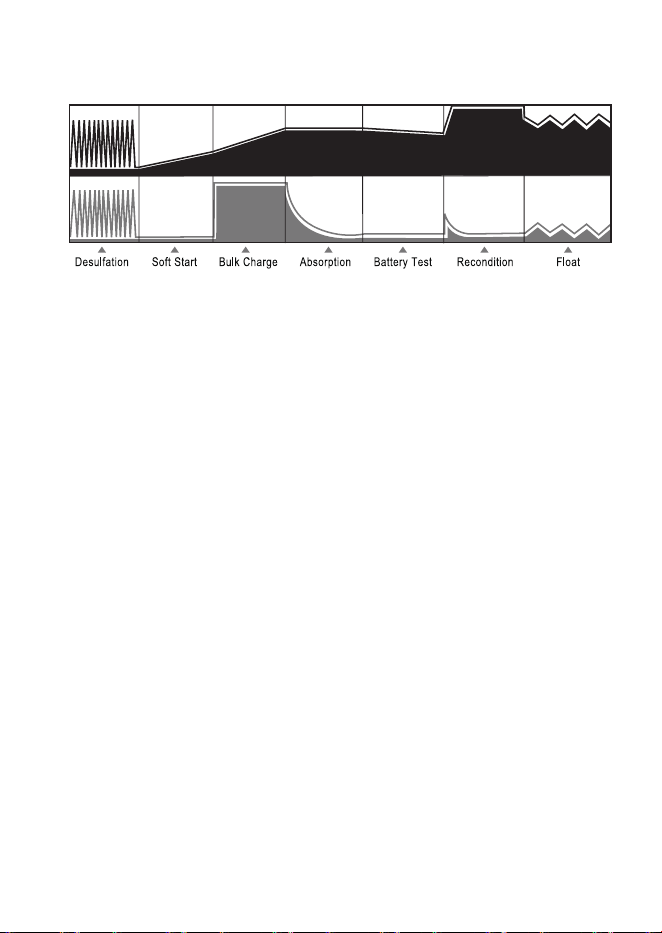
7-STAGE CHARGING
1. Desulphation:
Pulse charges the battery to break down
the buildup of lead sulphate crystals. Lead sulphate crystals
can occur when a battery has been discharged or left
unused for a period of time, seriously affecting the perfor-
mance and lifetime of the battery.
2. Soft Start: A slow steady buildup of the charging process
that limits the power supplied to protect the battery.
3. Bulk Charge: The main part of the charge process where
80% of the charge is applied.
4. Absorption: Fully charges the battery by slowly reducing
the charge rate to allow the battery to absorb more power.
5. Battery Test: An automatic test to determine the battery
condition after charging. If further charging required the
Recondition stage is selected, if fully charged the battery
goes into Float status.
CUPPENT VOLTAGE
12
6. Recondition: Unique charge state to recover deeply
discharged batteries.
7.Float: Maintains the battery at 100% charge without
overcharging or damaging the battery, allowing the Smart
Charge to be left connected to the battery indefinitely. Ideal for
batteries used intermittently, such as seasonally used vehicles
including classic cars, motorcycles.
Note: The Float process takes 5-10 minutes to fill the battery.
DO NOT disconnect the connection (AC\DC) during this time. If
disconnect the DC connection or the battery is filled, the LCD
Display will automatically turn off 5-10 minutes later.
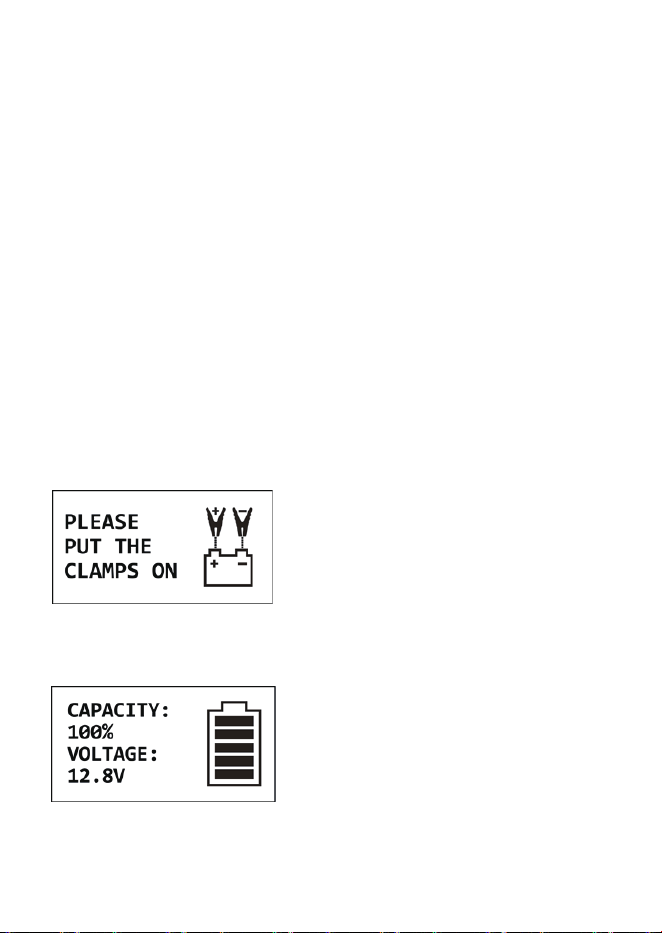
LCD DISPLAY
CHARGING DISPLAY
Please follow the charging steps to connect battery first, and
then plug in to AC power. If the connection to the battery is
loose, the LCD will display this icon. The clamp image will flash
and the screen will show: "PLEASE PUT THE CLAMPS ON".
When the connection is set, the LCD will display the battery
voltage, battery capacity % and battery graphic.
13
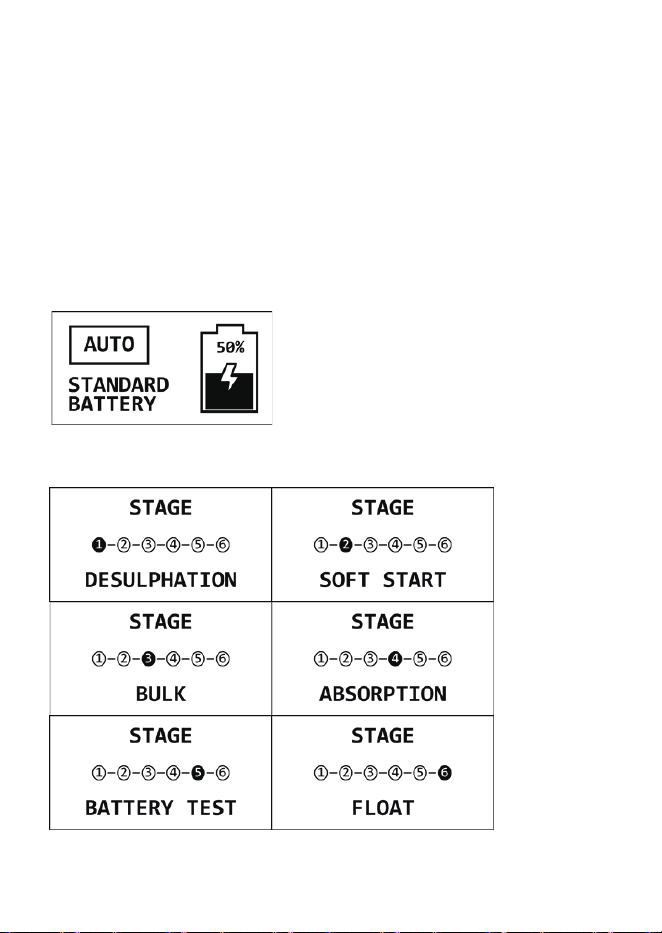
Press the "AMP" button to choose the desired charging rate, if
you don’t know how many Amps to choose, please select
automatic charging rate. Press the “BATTERY TYPE” button to
select your battery type, if you are not sure, please choose
“Standard”, then press the “CHARGE” button to start charging.
The LCD will display as shown.
Note: If user does not select the charging Amp and battery
type within 30 seconds, it will start charging the battery using
the default setting (auto charging rate for STD battery).
CHARGING PROGRESS
14
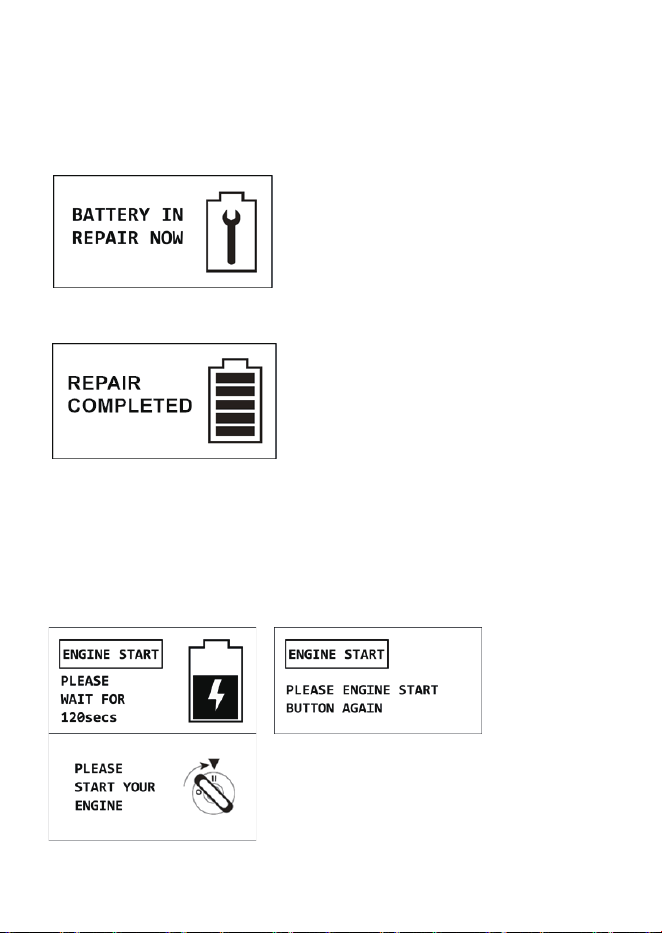
RECONDITION DISPLAY
Press the "RECONDITION" button to activate the battery
recondition function, the wrench image will flash and the screen
will show: "BATTERY IN REPAIR NOW”.
When the repair is completed, the LCD will display as shown.
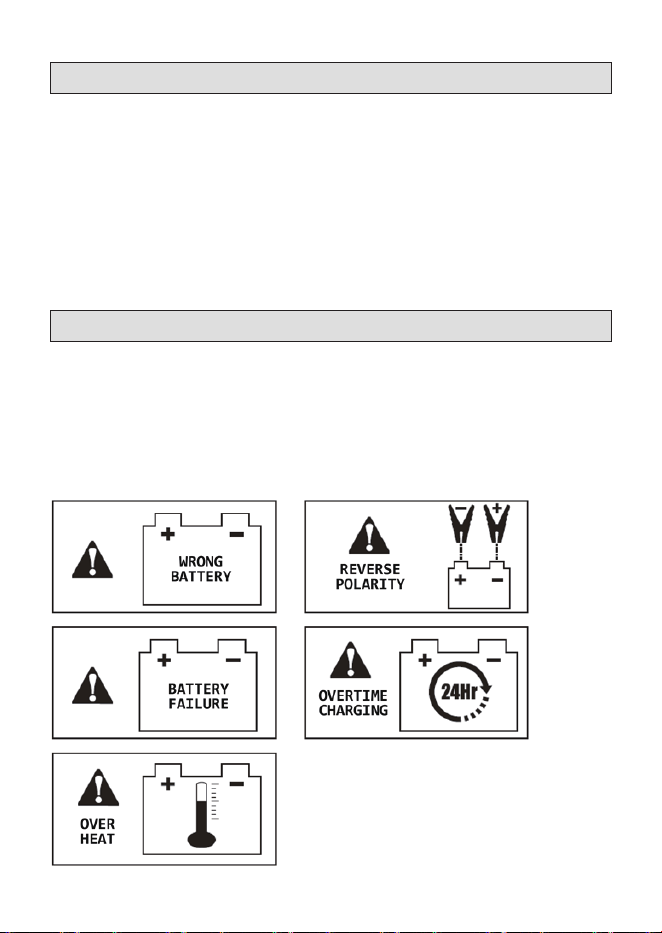
START AID DISPLAY
Press the “START AID” button to activate this function, please
wait until the LCD screen tells you to start the engine. If the
battery capacity is not enough to start engine within one 120
second cycle, please press the ”START AID” button again. The
LCD screen will be your guide:
15
Maintenance
Troubleshooting
Always unplug and disconnect the charger before performing
maintenance on the unit. After each use, use a dry, lint-free
cloth to clean battery corrosion and other dirt from the clips,
cords and charger. Ensure that all components are in good
working order. Never open the charger as there are no
serviceable parts inside the unit. The charger should be stored
in an upright position when not in use. Store in a cool, dry
location.
A fault graphic will show on the LCD display screen when
there is a problem. Please fix the problem to continue the
operation of the charger.
Words and icons will be displayed on the LCD screen when
there is a problem.
16

Possible Cause Corrective ActionFailure
Wrong
Battery
Overtime
Charging
Reverse
Polarity
Over Heat
Battery
Failure
17
1. Selected charging rate
is too small for big battery;
2. The battery condition is
not good.
Clamps connected to
wrong polarity.
1. A short circuit inside the
battery;
2. An appliance is drawing
power from battery being
charged.
Correct the polarity be
connected.
The temperature of the
charger is too high
Make sure the vents are
clear. The charger will
resume charging when
cooled.
1. Check the battery
condition. Replace battery
if needed.
2. Disconnect the
appliance and try to
charge again.
1. Select higher charging
rate and recharge;
2. Battery may be dead,
check the battery
condition. Replace battery
if needed.
Please connect to a 12V
lead acid battery.
The charger may connect
to a 24V battery by
mistake.