User's Guide
Notations Used in This Guide 5
Using the Manual to Search for Information..................................... 7
Searching b
y Keyword......................................................................................7
Jumping Directly from Bookmarks.....................................................................7
Printing Only the Pages You Need......................................................................7
Getting the Latest Version of the Documents................................... 8
Introduction to Your Projector 9
Projector Parts and Functions.......................................................... 10
Projec
tor Parts - Front/Side..............................................................................10
Projector Parts - Top/Side................................................................................11
Projector Parts - Rear.......................................................................................12
Projector Parts - Base...................................................................................... 13
Projector Parts - Remote Control......................................................................13
Setting Up the Projector 16
Projector Placement.......................................................................... 17
Projec
tor Setup and Installation Options.......................................................... 18
Precautions on Installation.............................................................................. 19
Projector Connections.......................................................................20
Connecting to Video Sources...........................................................................20
Connecting to External USB Devices.................................................................20
Connecting to External Audio Devices..............................................................21
Connecting to an eARC/ARC Compatible AV System..........................................22
Connecting Headphones................................................................................ 22
Installing Batteries in the Remote Control...................................... 24
Remote Control Operation.............................................................................. 24
Setting Up the Projector OS..............................................................26
Projector's Home Screen................................................................................. 26
About Epson Projector Update.........................................................28
Installing Epson Projector Update....................................................................28
Using Basic Projector Features 29
Turning On the Projector.................................................................. 30
Turning O
the Projector (Suspended Mode)................................. 31
Turning O the Projector (Deep Standby Mode)................................................31
Projection Modes...............................................................................32
Changing the Projection Mode Using the Menus...............................................32
Focusing the Image Using the Focus Lever......................................33
Correcting Distortion in the Image.................................................. 34
When Projecting on a Wall...............................................................................34
When Projecting on a Screen...........................................................................35
Adjusting Image Color...................................................................... 37
Adjusting the Size and Position of the Image................................. 38
Selecting an Image Source................................................................39
Image Aspect Ratio............................................................................40
Changing the Image Aspect Ratio....................................................................40
Available Image Aspect Ratios.........................................................................40
Adjusting Image Quality (Color Mode)............................................ 41
Changing the Color Mode............................................................................... 41
Available Color Modes.................................................................................... 41
Adjusting Image Quality in Detail....................................................42
Turning On Automatic Luminance Adjustment.............................. 43
Adjusting the Light Source Brightness............................................ 44
Controlling the Volume with the Volume Buttons..........................45
Changing the Sound Mode............................................................... 46
Contents
2
Available Sound Modes...................................................................................46
Adjusting Pr
ojector Features 47
Using the Projector as a Bluetooth
®
Speaker..................................
48
Shutting O the Image Temporarily................................................ 49
Using Google Cast
™
............................................................................50
HDMI CEC Features............................................................................ 51
Operating Connected Devices Using the HDMI CEC Features............................. 51
Installing a Security Cable................................................................ 52
Updating Projector Firmware Using Epson Projector Update....... 53
Initializing the Projector................................................................... 54
Adjusting the Menu Settings 55
Using the Projector's Menus............................................................. 56
Projec
tor Feature Settings - Channels & Inputs Menu....................57
Projector Feature Settings - Projector Menu...................................58
Image Quality Settings - Display & Sound Menu............................ 59
Other Menus...................................................................................... 61
Network & Internet Menu................................................................................61
Accounts & Proles Menu................................................................................61
Privacy Menu................................................................................................. 61
Apps Menu.................................................................................................... 61
System Menu................................................................................................. 61
Accessibility Menu..........................................................................................61
Remotes & Accessories Menu.......................................................................... 62
Help & Feedback Menu................................................................................... 62
Maintaining the Projector 63
Projector Maintenance......................................................................64
Cleaning the Pr
ojection Window......................................................65
Cleaning the Motion Sensor............................................................. 66
Cleaning the Projector Case..............................................................67
Air Filter and Air Intake Vent Maintenance..................................... 68
Cleaning the Air Filter .....................................................................................68
Replacing the Air Filter....................................................................................69
Cleaning the Air Intake Vents ..........................................................................70
Adjusting the Color Convergence (Panel Alignment).....................71
Solving Problems 73
Projection Problems..........................................................................74
Projec
tor Indicator Status ................................................................ 75
Solving Projector Power-On or Power-O Problems......................77
Solving Projector Power Problems....................................................................77
Solving Projector Shutdown Problems............................................................. 77
Solving Image Problems................................................................... 78
Solving Missing Image Problems......................................................................78
Adjusting an Image that is not Rectangular.......................................................79
Adjusting a Fuzzy or Blurry Image....................................................................79
Fixing Partial Image Problems..........................................................................79
Adjusting an Image that Contains Noise or Static.............................................. 80
Adjusting an Image with Incorrect Brightness or Colors.....................................80
Solving Sound Problems...................................................................81
Solving Missing or Low Audio Problems........................................................... 81
Solving Bluetooth Speaker Mode Problems...................................................... 81
Solving Remote Control Operation Problems.................................83
Contents
3

Solving HDMI CEC Problems.............................................................84
Solving Wi-F
i Network Problems......................................................85
Solving Projector's OS Problems...................................................... 86
Appendix 87
Optional Accessories and Replacement Parts................................. 88
Screens
..........................................................................................................88
Replacement Parts..........................................................................................88
Screen Size and Projection Distance................................................89
Supported Monitor Display Resolutions......................................... 91
Projector Specications.................................................................... 92
Connector Specications.................................................................................92
Bluetooth Specications................................................................................. 93
External Dimensions......................................................................... 94
List of Safety Symbols and Instructions...........................................95
Laser Safety Information.................................................................. 97
Laser Warning Labels...................................................................................... 97
Glossary..............................................................................................99
Notices..............................................................................................100
FCC Compliance Statement........................................................................... 100
Innovation, Science and Economic Development Canada (ISED) Notices........... 100
Wireless LAN with Bluetooth Safety and Specications.................................... 101
Restriction of Use..........................................................................................102
Trademarks.................................................................................................. 102
Copyright Notice.......................................................................................... 102
Copyright Attribution....................................................................................102
Contents
4
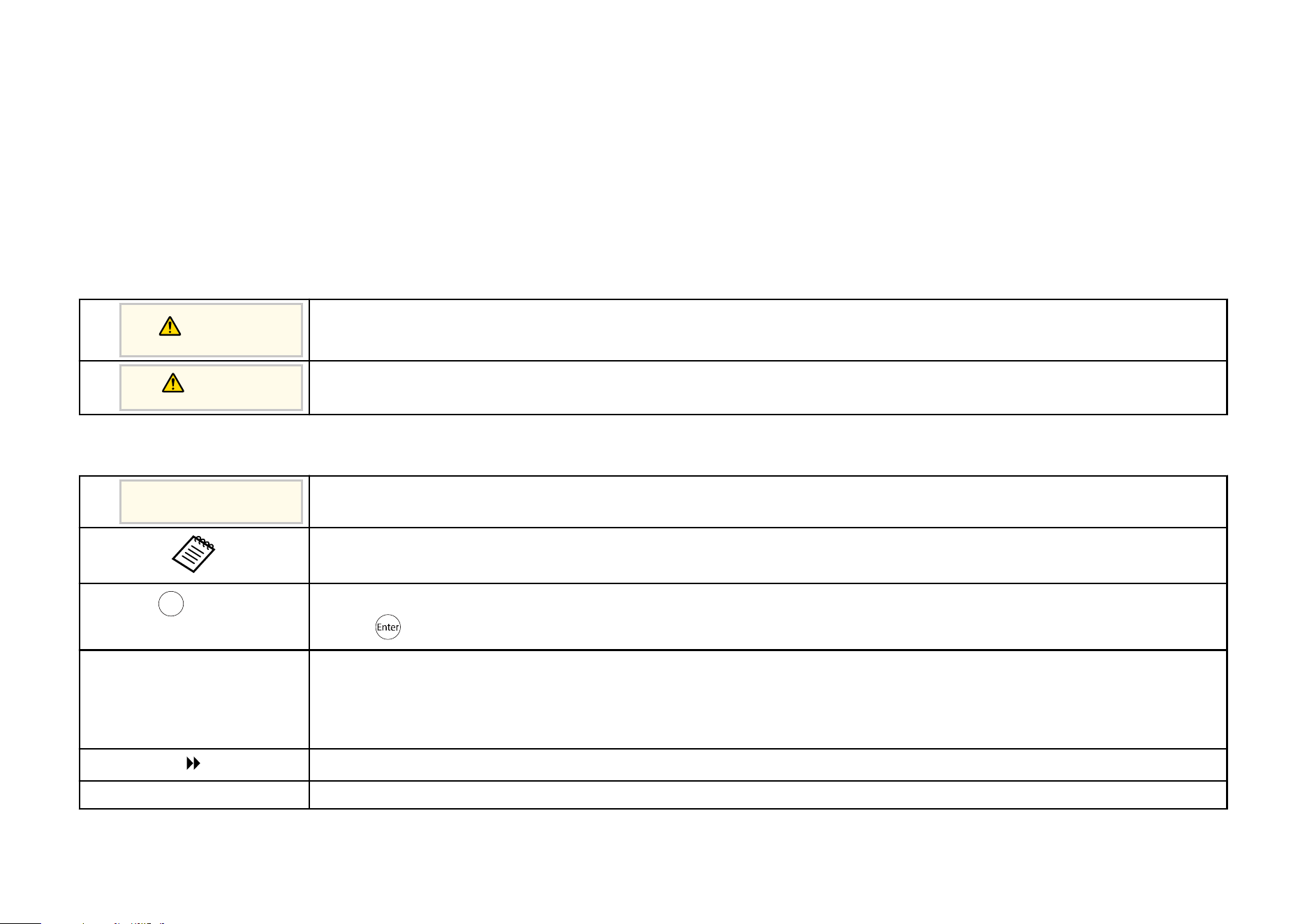
Notations Used in This Guide
Safety S
ymbols
e projector and its manuals use graphical symbols and labels to indicate content that tells you how to use the projector safely.
Read and carefully follow the instructions that are marked with these symbols and labels to avoid injury to persons or damage to property.
Warning
is symbol indicates information that, if ignored, could possibly result in personal injury or even death.
Caution
is symbol indicates information that, if ignored, could possibly result in personal injury or physical damage due to incorrect handling.
General Information Notations
Attention
is label indicates procedures that may result in damage or injury if sucient care is not taken.
is label indicates additional information that may be useful to know.
button
Indicates the buttons on the remote control or the control panel.
E
xamp
le:
button
Menu/Setting name Indicates projector menu and setting names.
Examp
le:
Select the Projector menu.
s Projector > Keystone > Zoom & Shi
is label indicates links to the related pages.
s
is
label indicates the projector's current menu level.
g
Related Links
•
"Using the Manual to Search for Information" p.7

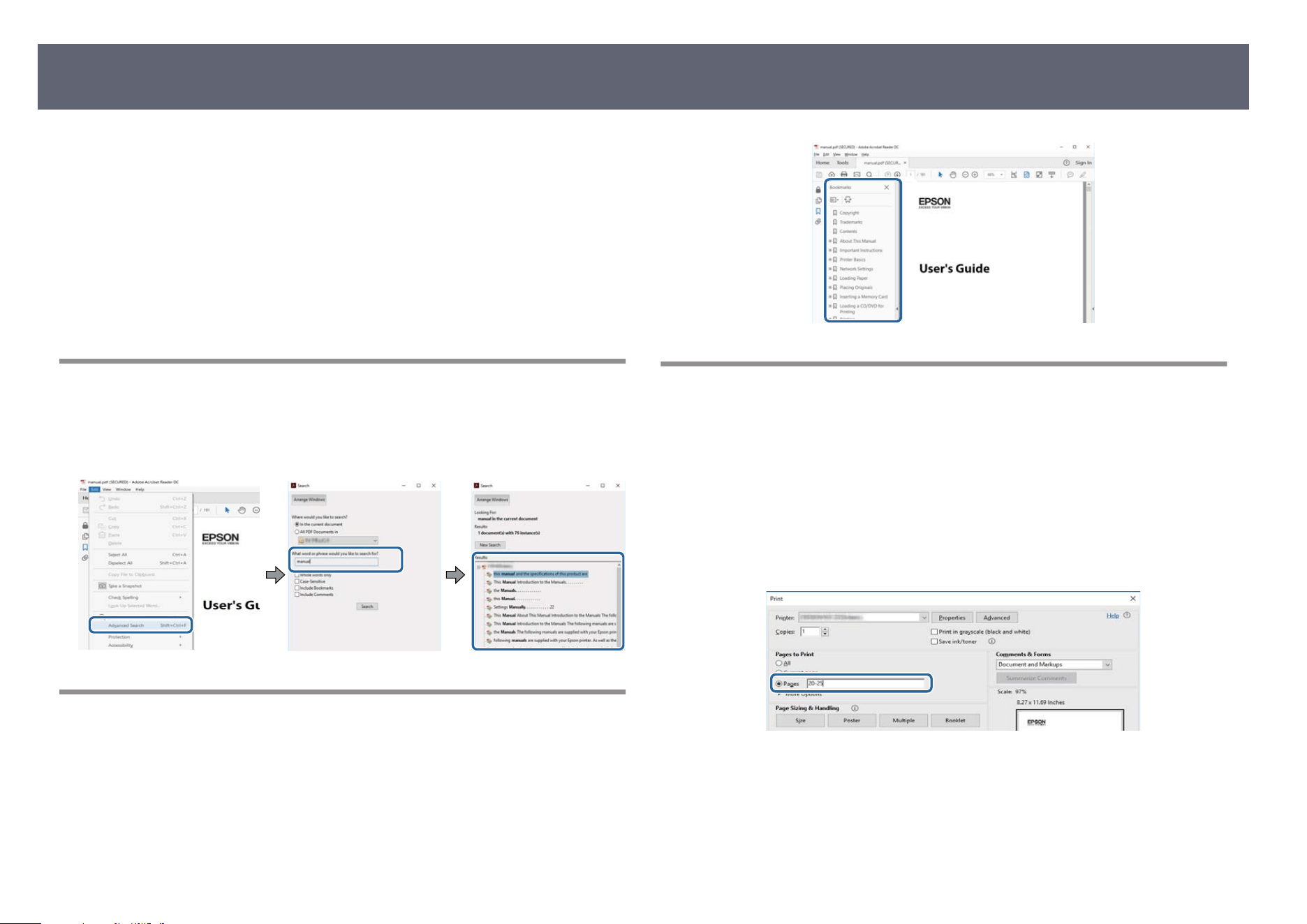
e PDF manual allows you to search for information you are looking for by
ke
yword, or jump directly to specic sections using the bookmarks. You can
also print only the pages you need. is section explains how to use a PDF
manual that has been opened in Adobe Reader X on your computer.
g
Related Links
•
"Searching by Keyword" p.7
•
"Jumping Directly from Bookmarks" p.7
•
"Printing Only the Pages You Need" p.7
Searching by Keyword
Click Edit > Advanced Search. Enter the keyword (text) for information you
want to nd in the search window, and then click Search. Hits are displayed as a
list. Click one of the displayed hits to jump to that page.
Jumping Directly from Bookmarks
Click a title to jump to that page. Click + or > to view the lower level titles in
t
h
at s
ection. To return to the previous page, perform the following operation on
your keyboard.
•
Windows: Hold down Alt, and then press ←.
•
Mac OS: Hold down the command key, and then press ←.
Printing Only the Pages You Need
You can extract and print only the pages you need. Click Print
in the File menu,
and then specify the pages you want to print in Pages in Pages to Print.
•
To specify a series of pages, enter a hyphen between the start page and the
end page.
Example: 20-25
•
To specify pages that are not in series, divide the pages with commas.
Example: 5, 10, 15
Using the Manual to Search for Information
7


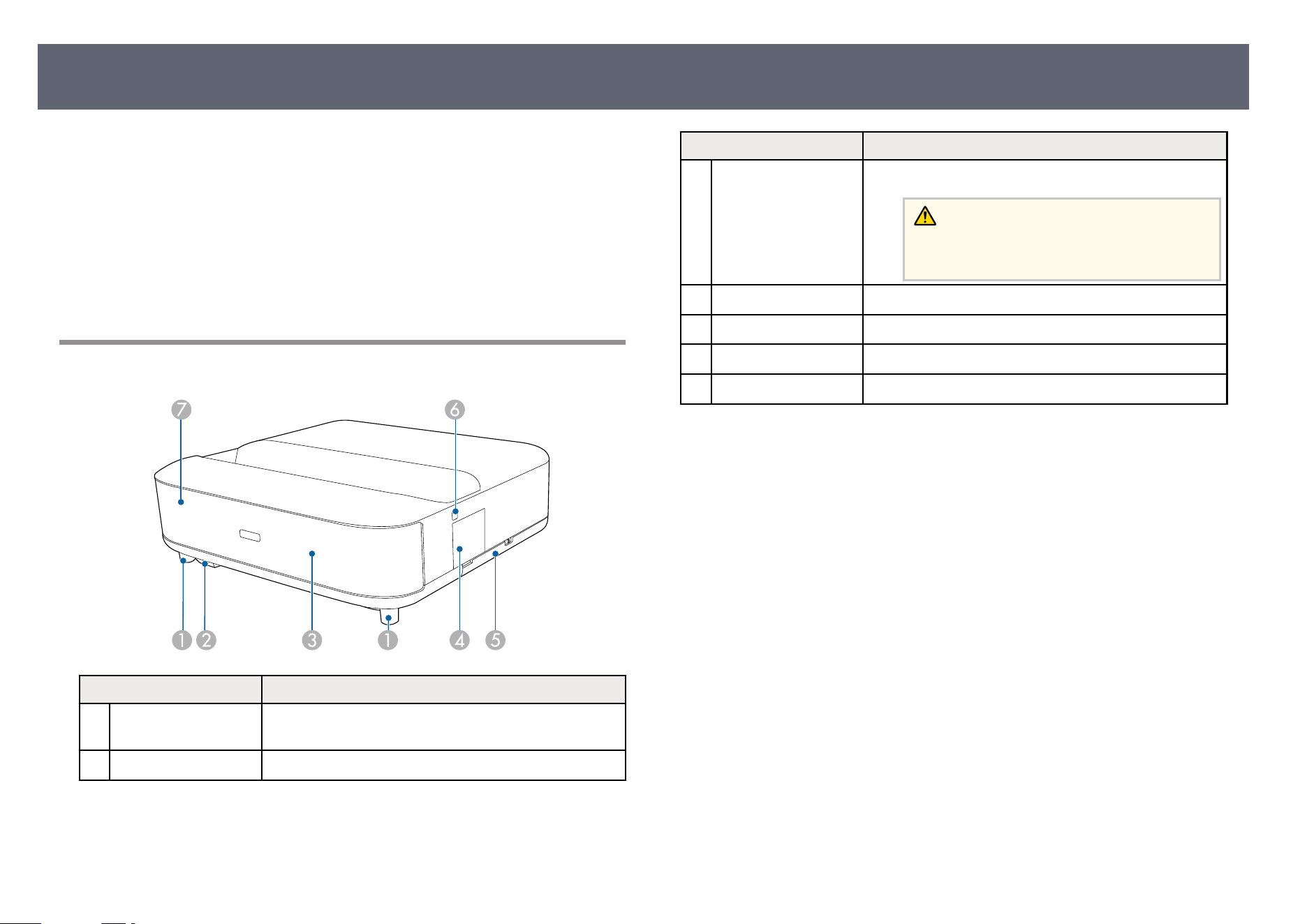
e following sections explain the projector parts and their functions.
g
Related Links
•
"P
rojector Parts - Front/Side" p.10
•
"Projector Parts - Top/Side" p.11
•
"Projector Parts - Rear" p.12
•
"Projector Parts - Base" p.13
•
"Projector Parts - Remote Control" p.13
Projector Parts - Front/Side
Name Function
A
Front adjustable feet When set up on a surface such as a desk, turn to extend
o
r ret
ract the feet to adjust the horizontal tilt.
B
Remote receiver Receives signals from the remote control.
Name Function
C
Speaker Outputs audio.
Caution
Do no
t hold or hit this part as doing so may
cause it to deform.
D
Focus lever cover Open to access the focus lever.
E
Air lter cover Open to access the air lter
.
F
Power button Turns the projector on or o.
G
St
atus indicator Indicates the projector's status.
g
Relat
ed Links
•
"R
em
ote Control Operation" p.24
•
"Turning On the Projector" p.30
•
"Focusing the Image Using the Focus Lever" p.33
•
"Air Filter and Air Intake Vent Maintenance" p.68
•
"Projector Indicator Status " p.75
Projector Parts and Functions
10
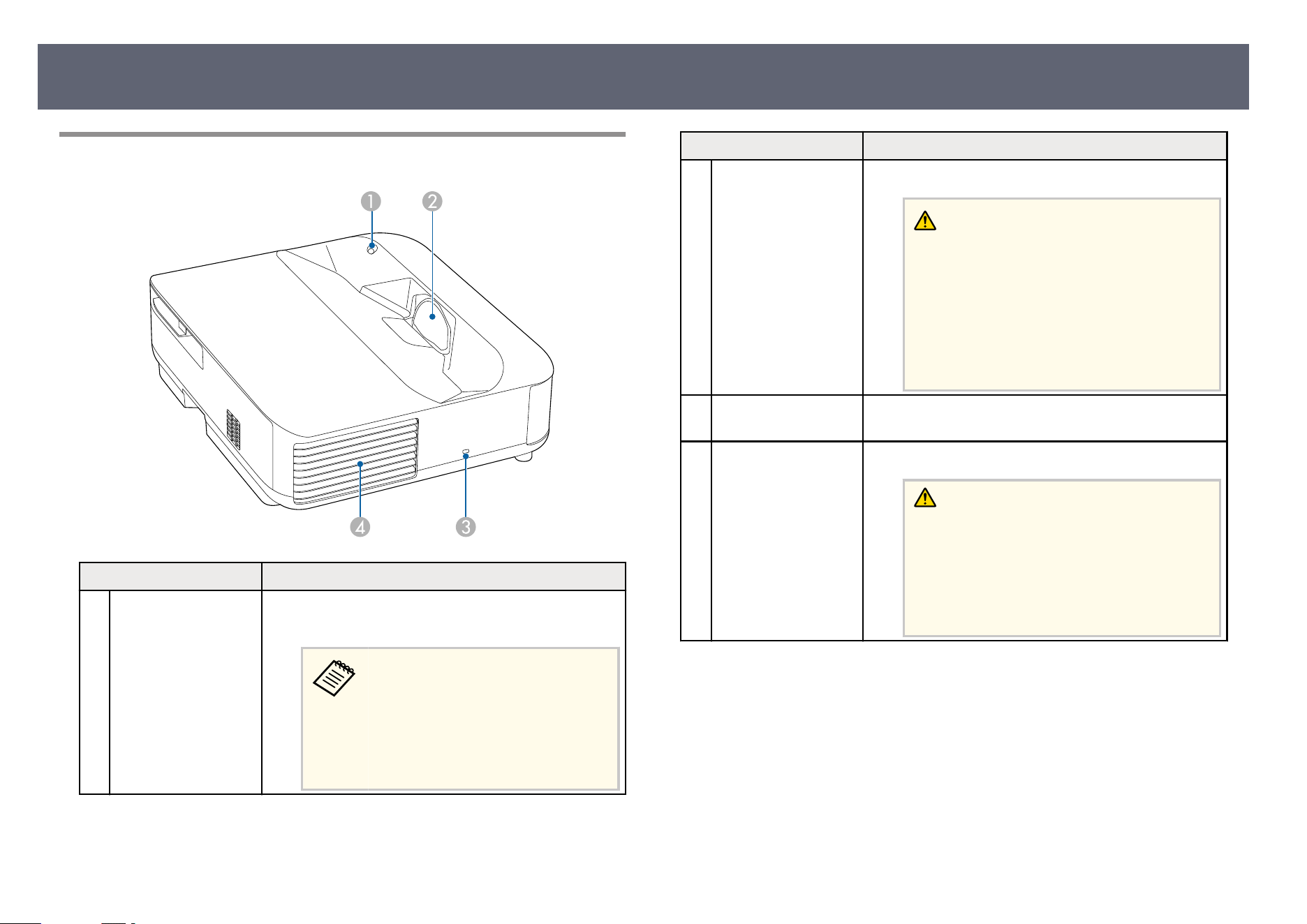
Projector Parts - Top/Side
Name Function
A
Motion sensor Detects movement near the projection window and
red
uces the brightness of the light source for safety.
•
e detection range may vary
depending on the temperature of
the surroundings.
•
Movement may not be detected
through transparent material such
as glass.
Name Function
B
Projection window Images are projected from the lens inside the projector.
Warning
•
Do no
t look into the projection window
while projecting.
•
Do not place any objects or put your hand
near the projection window. It could cause
burns, re, or the object to warp because this
area reaches a high temperature due to the
concentrated projection light.
C
Security slot e security slot is compatible with the Microsaver
Se
curity System manufactured by Kensington.
D
Air exhaust vent Exhaust vent for air used to cool the projector internally.
Caution
While p
rojecting, do not put your face or hands
near the air exhaust vent, and do not place
objects that may become warped or damaged
by heat near the vent. Hot air from the air
exhaust vent could cause burns, warping, or
accidents to occur.
g
Related Links
•
"Cle
aning the Motion Sensor" p.66
•
"Cleaning the Projection Window" p.65
•
"Installing a Security Cable" p.52
Projector Parts and Functions
11
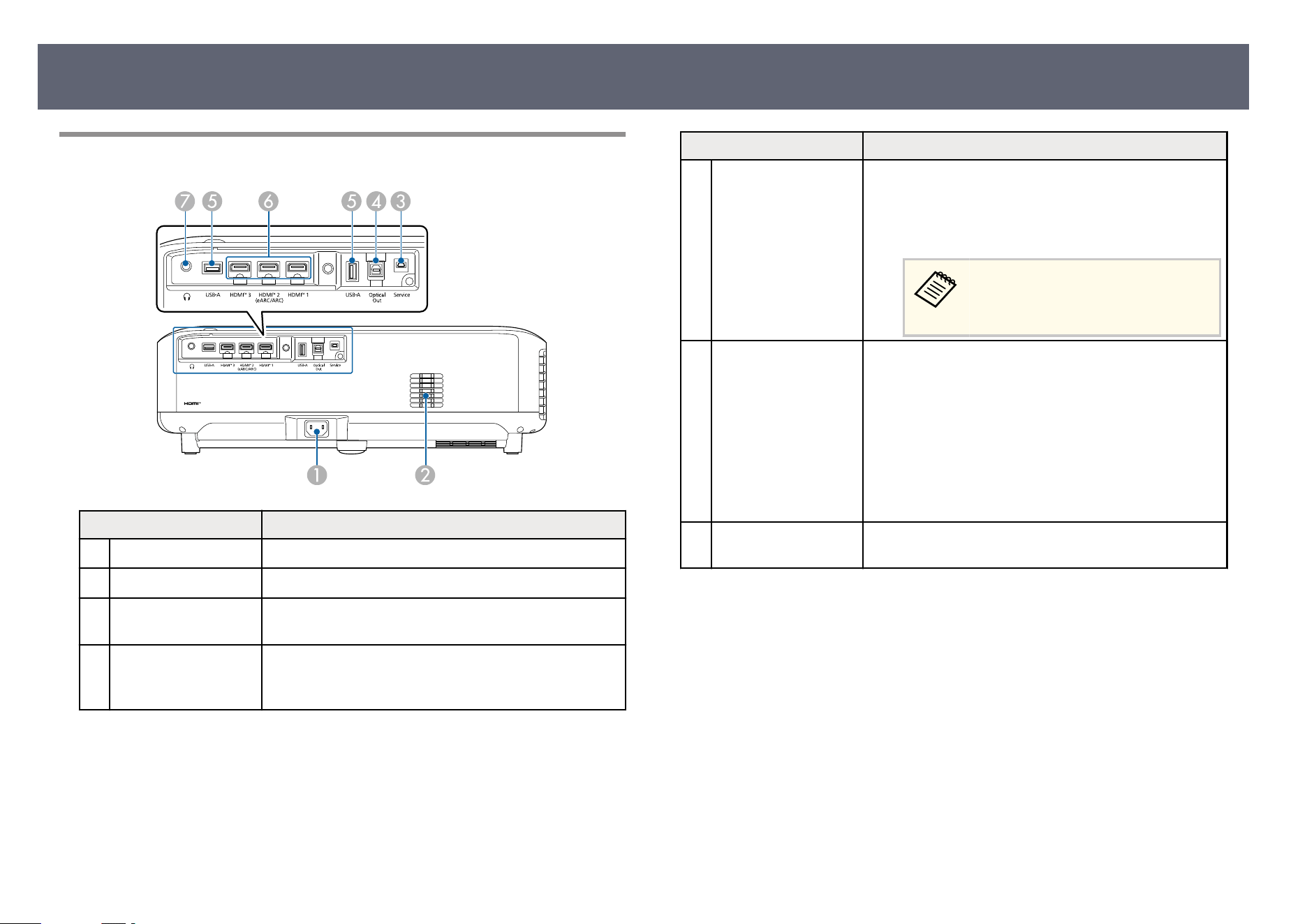
Projector Parts - Rear
Name Function
A
Power inlet Connects the power cord to the projector.
B
Air intake vent Takes in air to cool the projector internally.
C
Service port is port is used by service technicians and should not
no
rmally be used.
D
Optical Out port Outputs audio from the current input source to an
extern
al audio device by connecting an optical digital
audio cable.
Name Function
E
USB-A port Connects a commercially available USB device such as a
web
cam, external HDD, or keyboard.
Connects a commercially available RJ45 adapter to
enable wired LAN connections.
is port is not guaranteed to
op
erate for all devices that support
USB.
F
HDMI1 port
HDMI2 (eARC/AR
C)
port
HDMI3 port
Inputs video signals from HDMI compatible video
equipment and computers. is projector is compatible
with HDCP 2.3.
e HDMI2 port is compatible with HDMI eARC and
ARC.
Each port supports the following refresh rate:
•
HDMI1/HDMI2 ports: 4K 120 Hz
•
HDMI3 port: 4K 60 Hz
G
Audio Out port Outputs audio from the current input source to
head
phones.
g
Related Links
•
"Co
nnecting to Video Sources" p.20
•
"Connecting to External USB Devices" p.20
•
"Connecting to External Audio Devices" p.21
•
"Connecting to an eARC/ARC Compatible AV System" p.22
•
"Connecting Headphones" p.22
Projector Parts and Functions
12
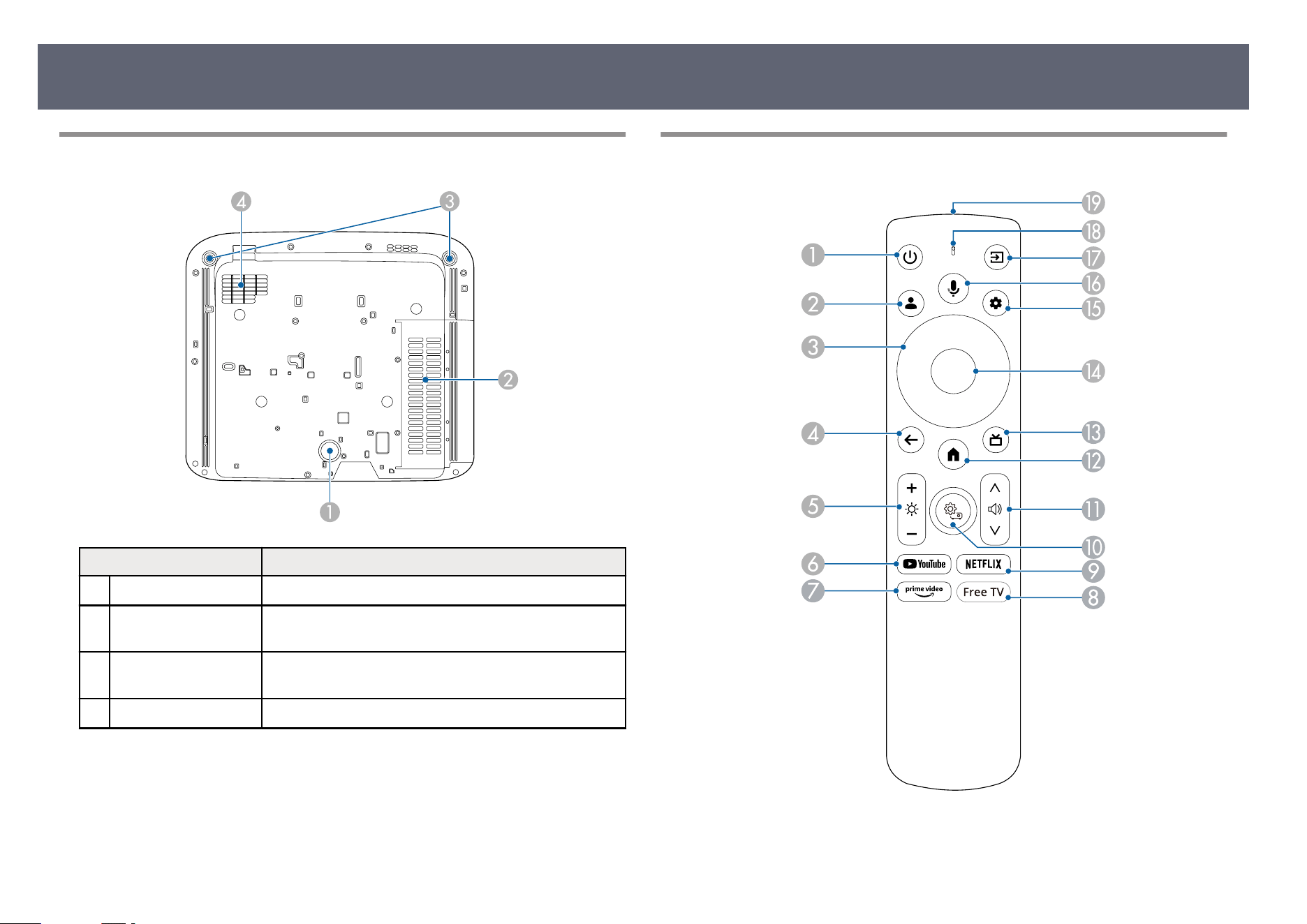
Projector Parts - Base
Name Function
A
Rear foot Stabilizes the projector on a surface such as a desk.
B
Air intake vent (air
lter)
T
akes in air to cool the projector internally.
C
Front adjustable feet When set up on a surface such as a desk, turn to extend
or ret
ract the feet to adjust the horizontal tilt.
D
Air intake vent Takes in air to cool the projector internally.
g
Related Links
•
"Cle
aning the Air Intake Vents " p.70
Projector Parts - Remote Control
Projector Parts and Functions
13
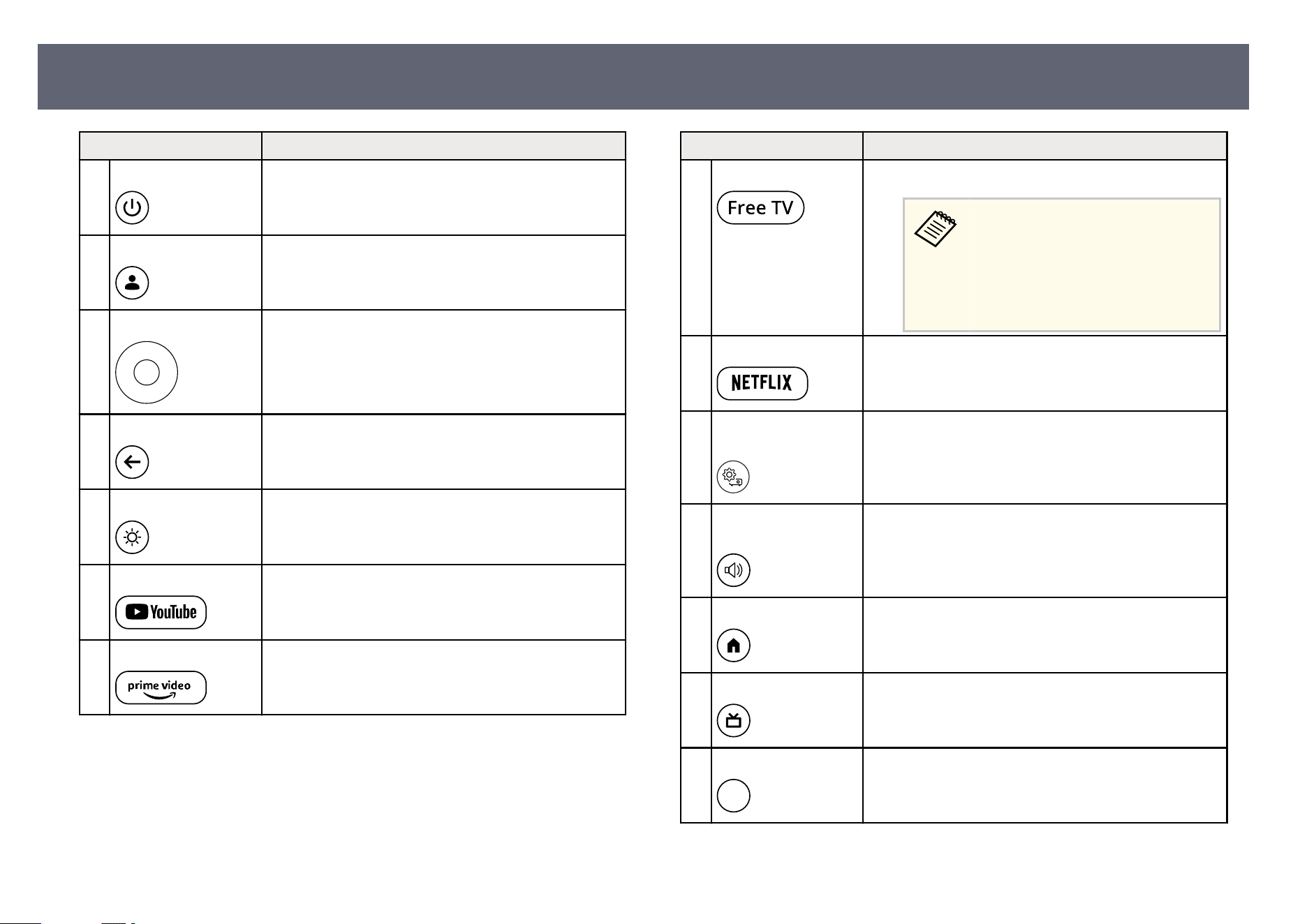
Name Function
A
Power button Turns the projector on or o.
B
Us
er Prole button
Displays the user p
r
o
le.
C
Arrow buttons
Selects items on the home screen to play online content.
Sele
cts menu items while displaying the projector's
menu.
D
Esc button
Stops the current function.
Moves back to the previous menu level while displaying
the projector's menu.
E
Brightness buttons Lightens or darkens the projected image.
F
YouTube button
Starts the YouTube application.
G
Prime Video button Starts the Amazon Prime Video application.
Name Function
H
Free TV button Starts the Free TV application.
Depending on your region, this
but
ton may appear as the Live TV
button. Live TV is not available
in certain languages and countries.
Availability of services varies by
country and language.
I
Netix button Starts the Netix application.
J
Pr
ojector Settings
but
ton
Displays the Projector menu.
K
Volume up/down
but
tons
Adjusts the volume for the speaker and headphones.
L
Home button Displays the home screen.
M
HDMI button
Switches to the last HDMI source you displayed.
N
[Enter] button Enters the current selection and moves to the next level
while displaying the projector's menu.
Projector Parts and Functions
14
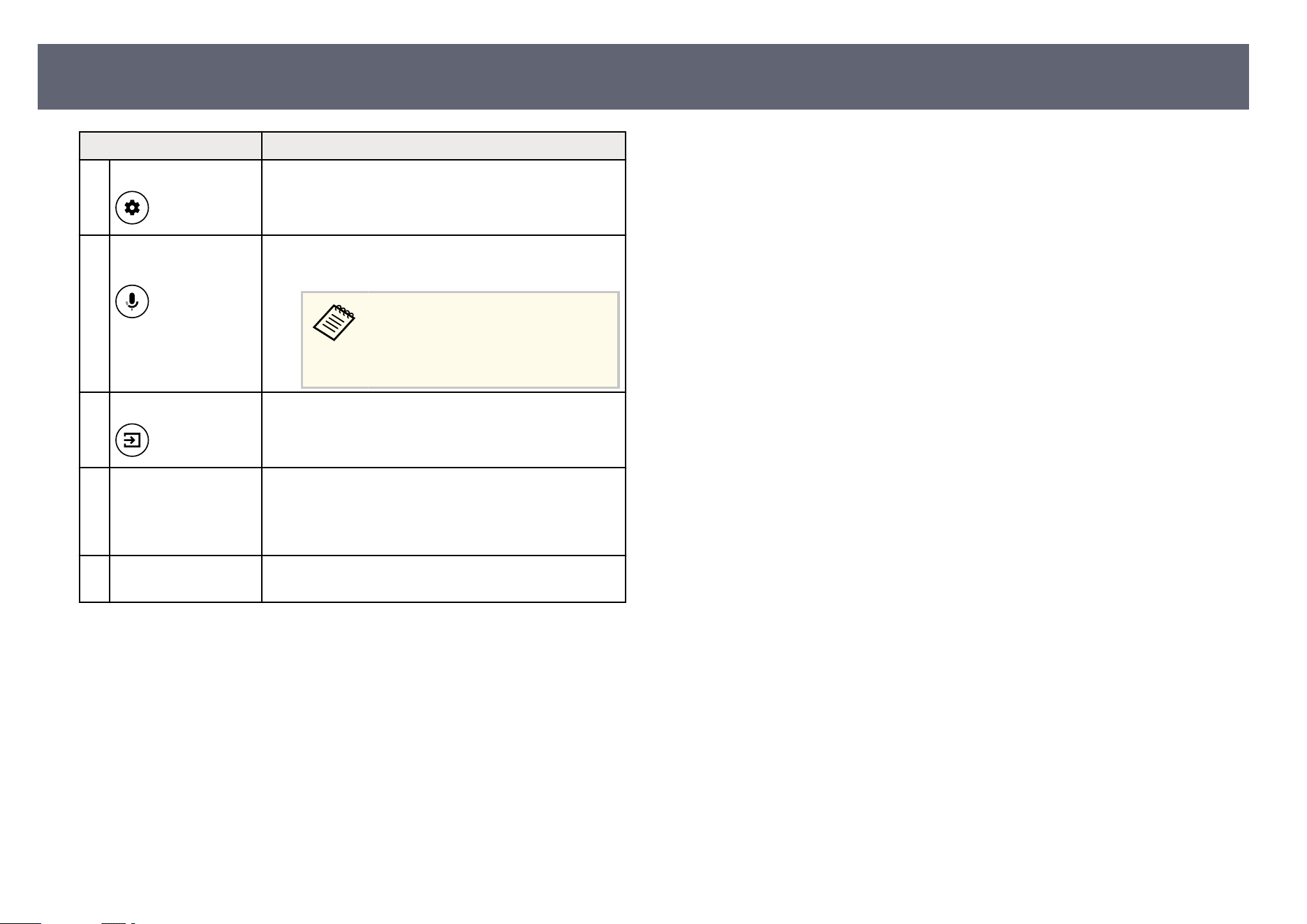
Name Function
O
Settings button Opens the dashboard.
P
Google Assistant
b
u
t
ton
Press the Google Assistant button on the remote, and
s
ay
, "H
ey Google" to get started.
Google Assistant is not available
in certain l
anguages and countries.
Availability of services varies by
country and language.
Q
Source Search button Displays a list of available input sources.
R
Indicator/Microphone Turns on when outputting signals from the remote
cont
rol.
Detects your voice when you press the Google Assistant
button.
S
Remote control light
emitt
ing area
Outputs remote control signals.
g
Related Links
•
"Rem
ote Control Operation" p.24
•
"Installing Batteries in the Remote Control" p.24
•
"Turning On the Projector" p.30
•
"Turning O the Projector (Suspended Mode)" p.31
•
"Projector's Home Screen" p.26
•
"Adjusting the Light Source Brightness" p.44
•
"Controlling the Volume with the Volume Buttons" p.45
•
"Projector's Home Screen" p.26
•
"Selecting an Image Source" p.39
•
"Using the Projector's Menus" p.56
Projector Parts and Functions
15

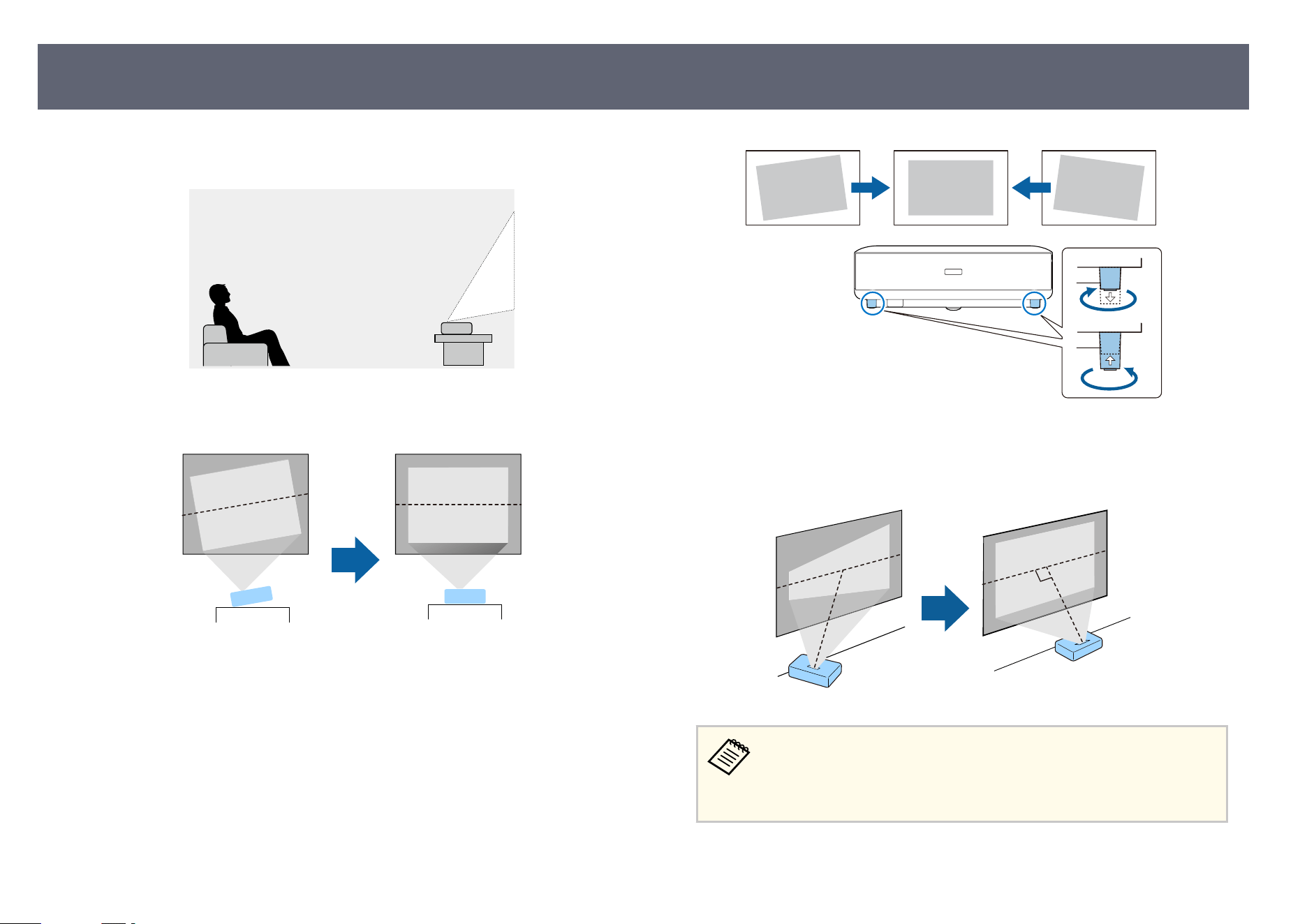
Install the projector on a table in your living room or on a low shelf to project
images.
Note the following points when selecting a projector location:
•
Place t
he projector on a sturdy and level surface.
•
If th
e image is tilted, rotate the front feet to adjust their height.
•
Leav
e plenty of space around and under the projector for ventilation, and do
not place it on top of or next to anything that could block the vents.
•
Place the projector so it squarely faces the screen, not at an angle.
If you cannot install the projector squarely facing the screen, correct
any res
ulting keystone distortion using the projector controls. For the
best quality images, we recommend adjusting the installation position
of the projector to achieve the correct image size and shape.
Projector Placement
17
Warning
Do no
t install the projector in a location subject to high levels of dust or humidity,
or in a location subject to smoke or steam. Otherwise, it could cause a re or electric
shock to occur.
Warning
•
Do no
t cover the projector's air intake or air exhaust vents. If the vents are
covered, the internal temperature could rise and cause a re.
•
Do not use or store the projector in locations where it will be subject to dust or
dirt. Otherwise, the quality of the projected image may decline, or the air lter
may become clogged, resulting in a malfunction or re.
•
Do not install the projector on an unstable surface or in a location beyond the
weight specications of the projector. Otherwise, it could fall or topple causing an
accident and injury.
•
Do not install in locations where salt damage could occur, or in locations subject
to corrosive gas such as sulphuric gas from hot springs. Otherwise, corrosion
could cause the projector to fall. It could also cause the projector to malfunction.
Attention
•
M
ak
e s
ure you do not operate the projector in the following positions.
•
Do not operate the projector on its side.
•
Do not project images straight up or straight down.
•
Do not tilt the projector right or le.
•
If you are using the projector at altitudes above 4,921 feet (1,500 m), set the High
Altitude Mode setting to On in the projector's menu to ensure the projector's
internal temperature is regulated properly.
s Projector > Advanced Settings > High Altitude Mode
g
Related Links
•
"Pr
ojector Setup and Installation Options" p.18
•
"Precautions on Installation" p.19
Projector Setup and Installation Options
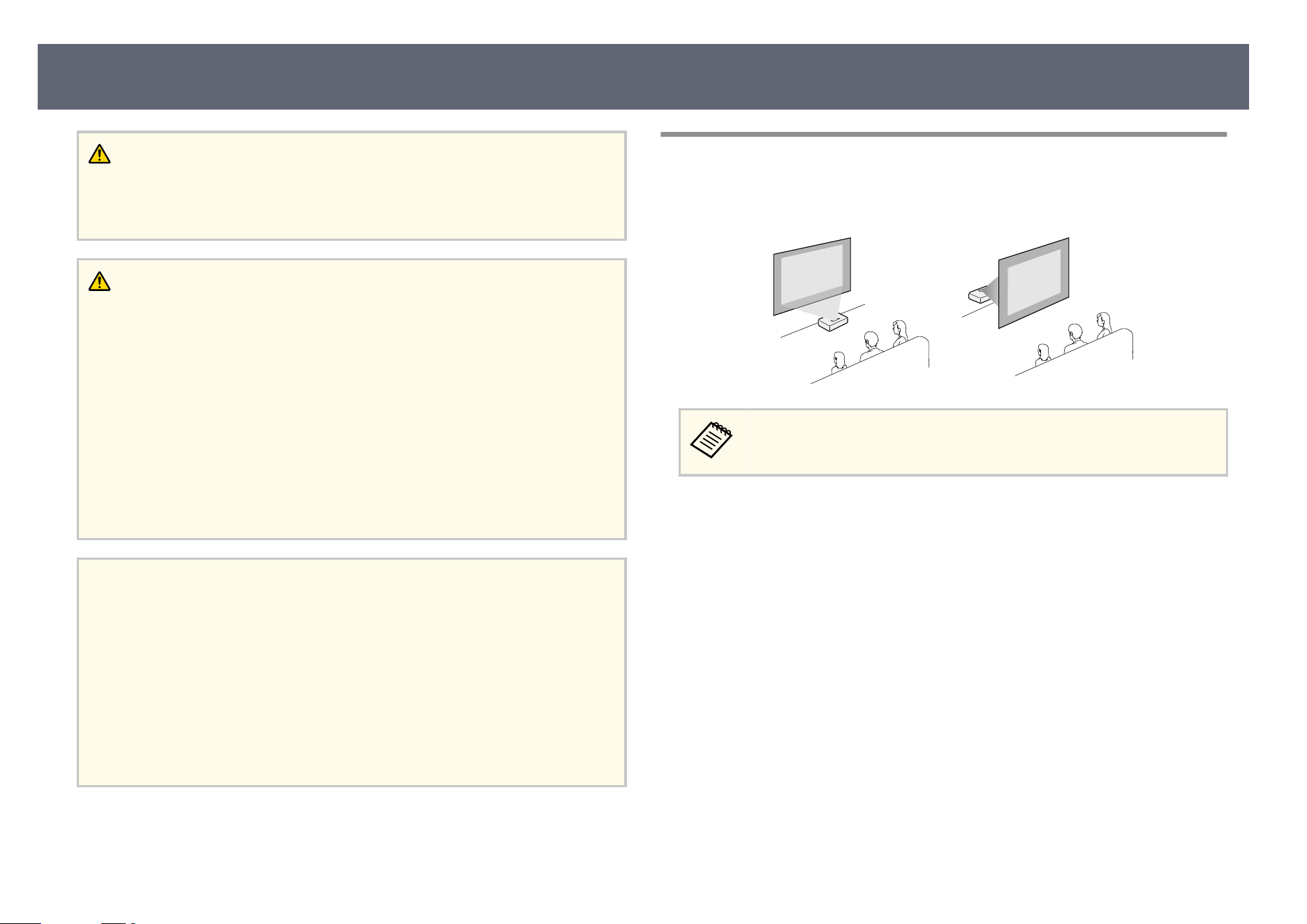
You can set up or install your projector in the following ways:
Fro
nt/Rear
e default Projection setting is Front.
g
Related Links
•
"Ch
anging the Projection Mode Using the Menus" p.32
Projector Placement
18
Precautions on Installation
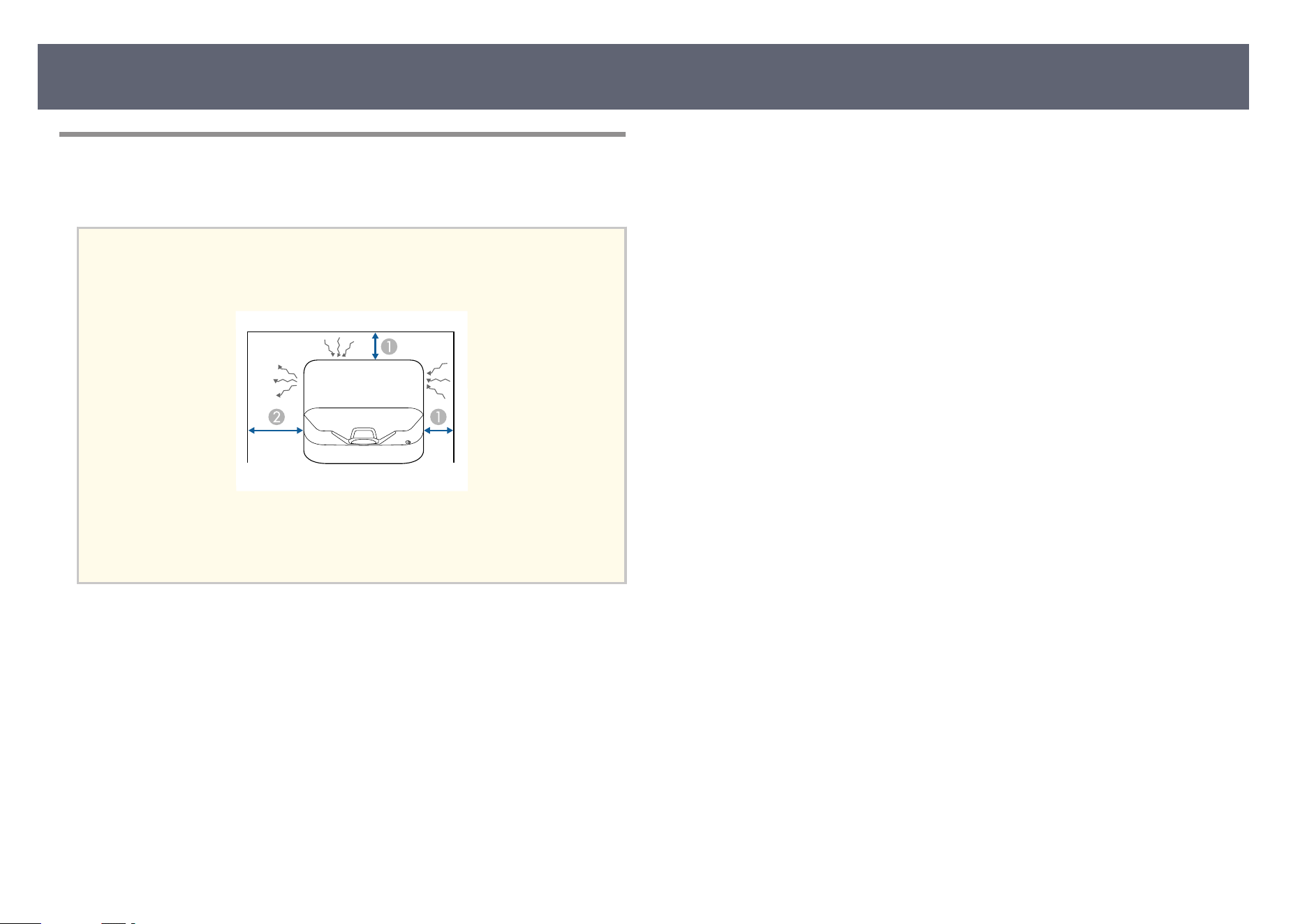
Installation space
Attention
Be sur
e to leave the following amount of space around the projector so as not to
block the air exhaust and intake vents.
A
3.9 inches (10 cm)
B
11.8 inches (30 cm)
Projector Placement
19
See these sections to connect the projector to a variety of projection sources.
Attention
Che
ck the shape and orientation of the connectors on any cable you plan to connect.
Do not force a connector into a port if it does not t. e device or your projector
could be damaged or could malfunction.
g
Related Links
•
"Co
nnecting to Video Sources" p.20
•
"Connecting to External USB Devices" p.20
•
"Connecting to External Audio Devices" p.21
•
"Connecting to an eARC/ARC Compatible AV System" p.22
•
"Connecting Headphones" p.22
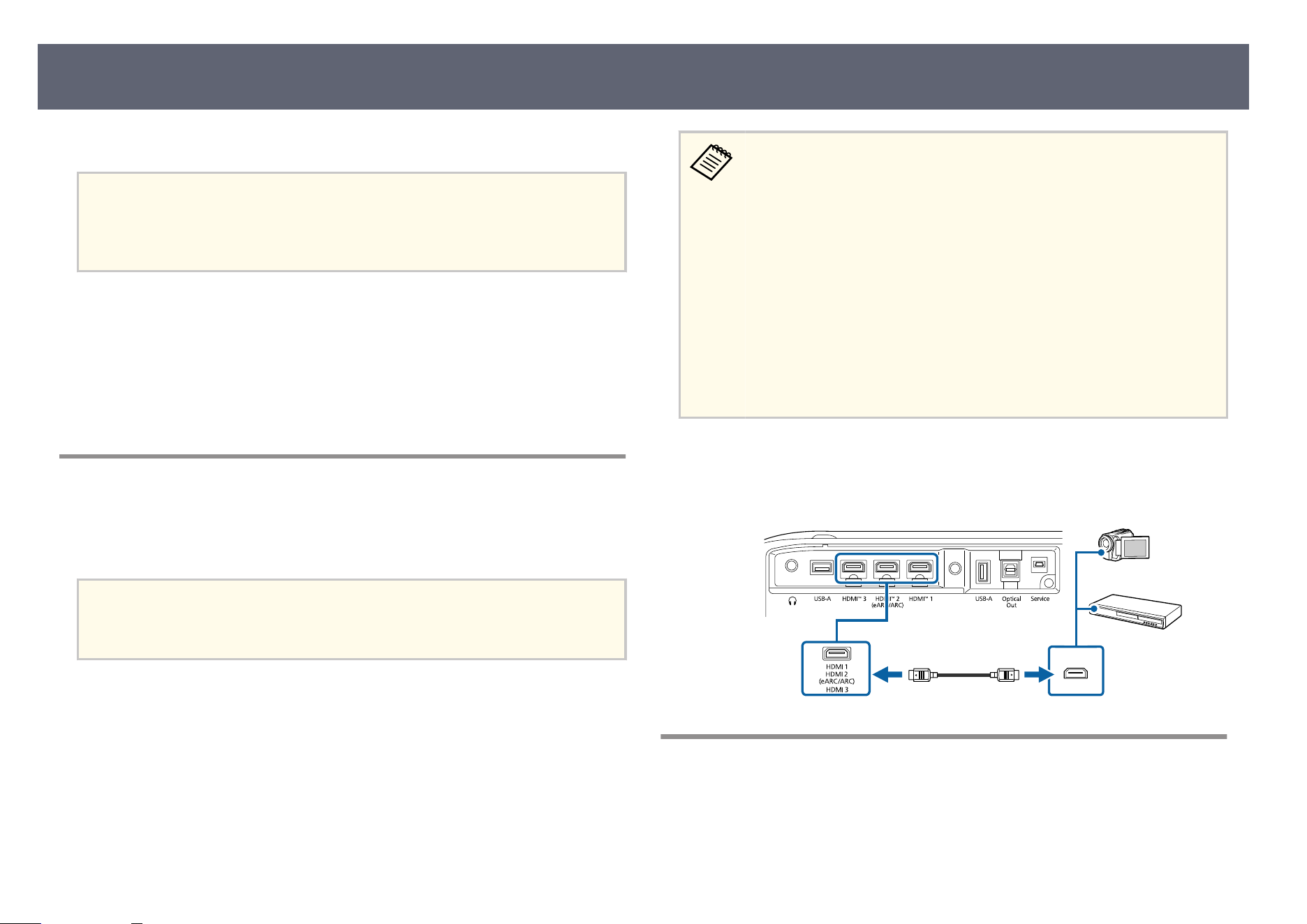
Connecting to Video Sources
If your video source has an HDMI port, you can connect it to the projector
using an HD
MI cable and send the image source's audio with the projected
image.
Attention
Do not turn on the video source before connecting it to the projector. Doing so could
damage the projector.
•
If th
e port on the device you connect has an unusual shape, use the
cable supplied with the device or an optional cable to connect to the
projector.
•
Some video devices are capable of outputting dierent types of signals.
See your video device manual to conrm what type of signals can be
output.
•
When sending 18 Gbps images such as 4K 60 Hz 4:4:4, use an HDMI
cable (premium-high speed). If you use an incompatible cable, images
may not be displayed correctly.
•
When connecting a gaming console, we recommend connecting it to a
port that supports the refresh rate of 120 Hz (HDMI1 or HDMI2). See
the online Notices guide for detailed information on compatible refresh
rates and resolutions for each compatible video display format.
a
Connect the HDMI cable to your video source's HDMI output port.
b
Connect the other end to the projector's HDMI port.
Connecting to External USB Devices
By connecting any of these devices to your projector, you can project images
and ot
her content or play audio without using a video device.
•
Microphone
Projector Connections
20
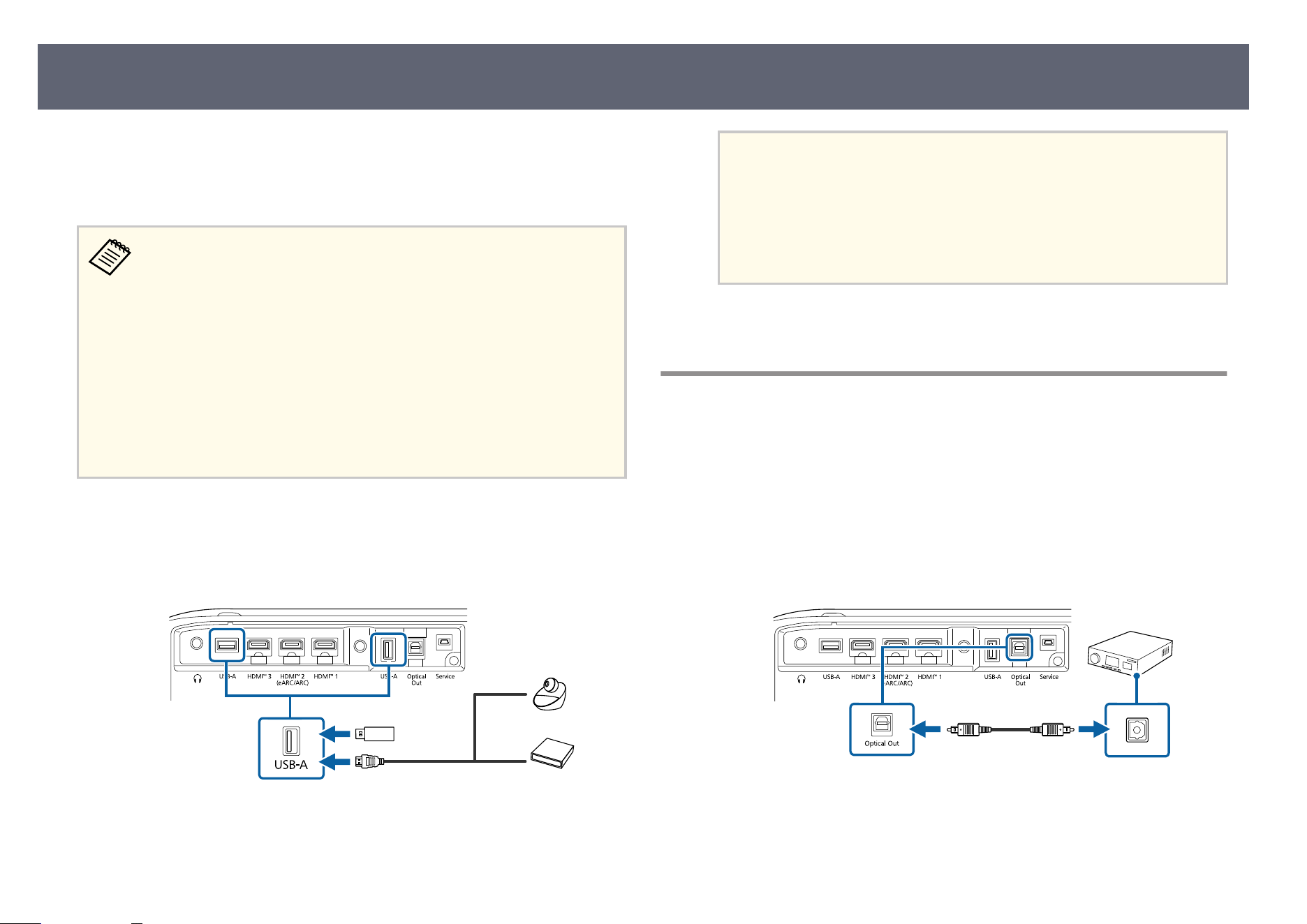
•
USB as
h drive
•
Digital camera
•
USB hard drive
•
e USB-A po
rt is not guaranteed to operate all devices that support
USB.
•
You may need an app to project content from your USB device.
•
USB hard drives must meet these requirements:
•
USB Mass Storage Class-compliant (not all USB Mass Storage Class
devices are supported)
•
Formatted in FAT16/32
•
Self-powered by their own AC power supplies (bus-powered hard
drives are not recommended)
•
Avoid using hard drives with multiple partitions
a
If your USB device came with a power adapter, plug the device into an
elec
trical outlet.
b
Connect the USB device to the projector's USB-A port as shown.
Attention
•
Use t
he USB cable supplied with or specied for use with the device.
•
If the USB cable is too long, the device may not operate correctly. We
recommend using a USB cable that is 9.8 feet (3 m) or less.
•
If you use a USB hub, the device may not operate correctly. We recommend
checking the operation in advance.
c
Connect the other end to your device, if necessary.
Connecting t
o External Audio Devices
If your amplier or speaker has an optical digital audio input port, you can
conn
ect it to the projector using an optical digital audio cable and project audio
from the image source.
a
Connect the optical digital audio cable to your audio device's optical
digit
al audio input port.
b
Connect the other end to the projector's Optical Out port.
Projector Connections
21
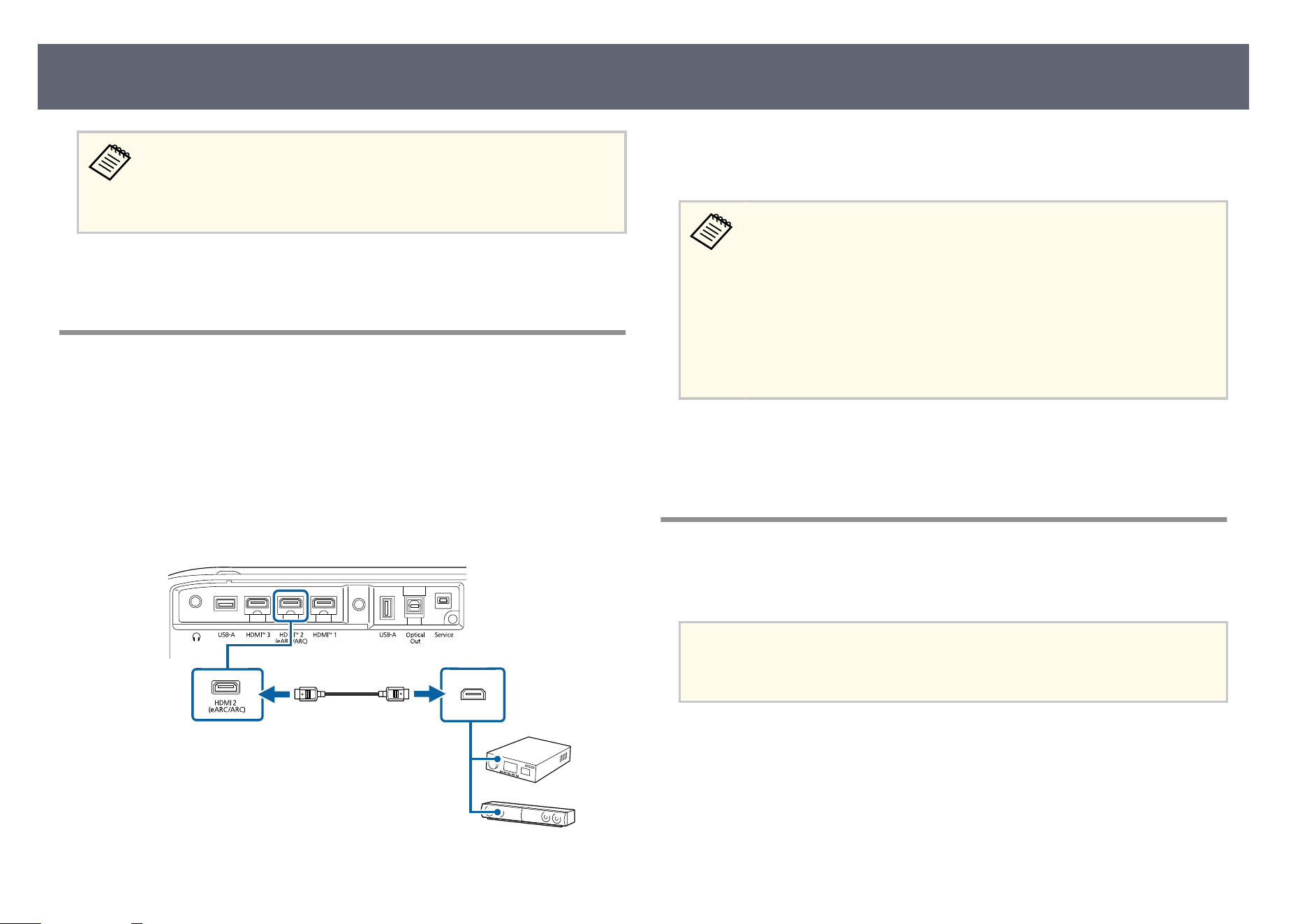
If you set Audio Output Device to SPDIF in the projector's menu, audio
is o
nly output from the external audio device and is not output from the
projector's speakers.
s Display & Sound > Audio Output > Audio Output Device
g
Related Links
•
"Im
age Quality Settings - Display & Sound Menu" p.59
Connecting to an eARC/ARC Compatible AV System
If your AV system or speakers, such as a sound bar, has an HDMI port, you can
conne
ct them to the projector using an HDMI cable (with Ethernet) to output
audio to these devices.
a
Connect the HDMI cable to your AV system's HDMI output port (eARC
o
r AR
C co
mpatible).
b
Connect the other end to the projector's HDMI2 (eARC/ARC) port.
c
Make any necessary settings on the connected AV system. See your
device's do
cumentation for more information.
•
To ou
tput audio from the projector's HDMI2 (eARC/ARC) port when
using an ARC connection, set Global CEC control to On in the
projector's menu.
s Channels & Inputs > Inputs > Global CEC control
•
If audio is not output properly, try changing Auto to PCM as the
Digital Output setting in the projector's menu.
s Display & Sound > Audio Output > Digital Output
•
See the online Notices guide for eARC/ARC audio supported formats.
g
Related Links
•
"Pr
ojector Feature Settings - Channels & Inputs Menu" p.57
•
"Image Quality Settings - Display & Sound Menu" p.59
Connecting Headphones
You can connect headphones to the projector's Audio Out port. You can control
the v
olume using the projector's remote control.
Attention
e pro
jector's Audio Out port only supports 3-pin headphones. If you use any other
headphones, audio may not be output normally.
Projector Connections
22
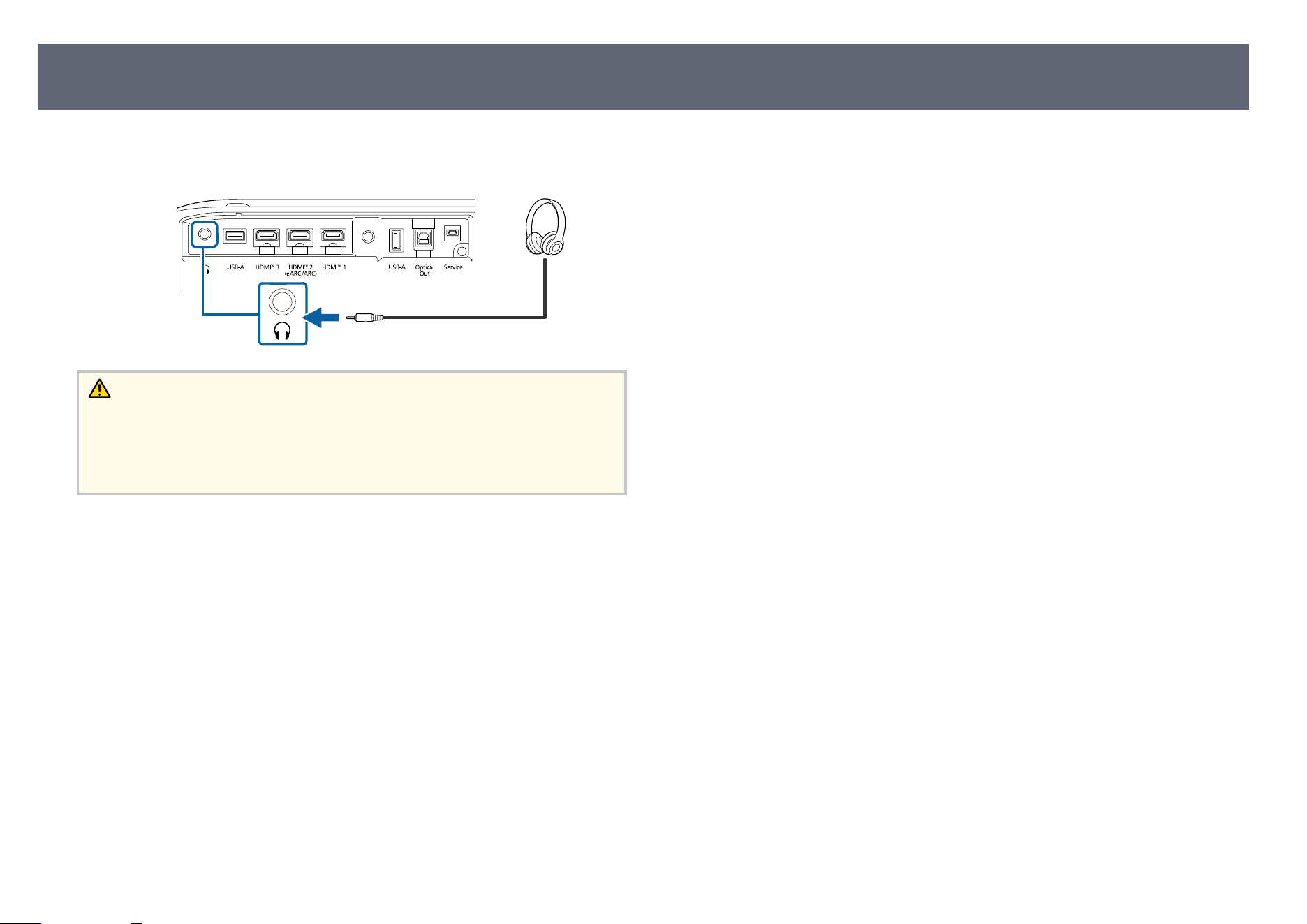
a
Connect the stereo headphone's mini-jack cable to the projector's Audio
Out p
ort.
Caution
Do no
t start a playback at a high volume setting. Sudden loud noises may cause
hearing loss.
Always lower the volume before powering o, so that you can power on and then
gradually increase the volume.
Projector Connections
23
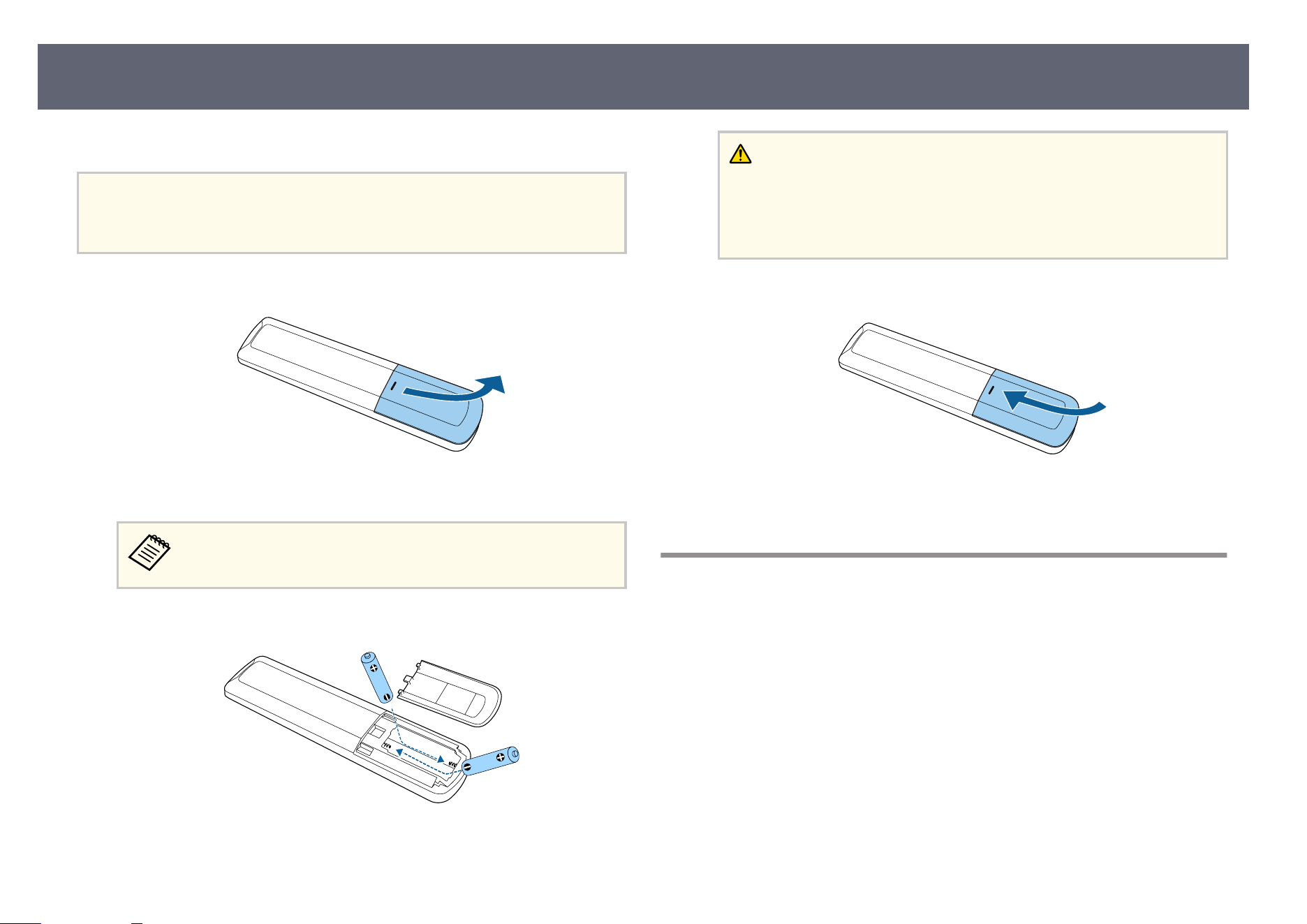
e remote control uses the two AAA batteries that came with the projector.
Attention
Make s
ure you read the safety instructions in the online Notices guide before
handling the batteries.
a
Remove the battery cover as shown.
b
Remove the old batteries, if necessary.
Dispose of used batteries according to local regulations.
c
Insert the batteries with the + an
d
–
ends facing as shown.
Warning
Che
ck the positions of the (+) and (–) marks inside the battery holder to
ensure the batteries are inserted the correct way. If the batteries are not used
correctly, they could explode or leak causing a re, injury, or damage to the
product.
d
Replace the battery cover and press it down until it clicks into place.
g
Related Links
•
"Rem
ote Control Operation" p.24
Remote Control Operation
e remote control lets you control the projector from almost anywhere in the
ro
om.
It is recommended that you aim the remote control at the projector's receivers
within the distance and angles listed here.
Installing Batteries in the Remote Control
24
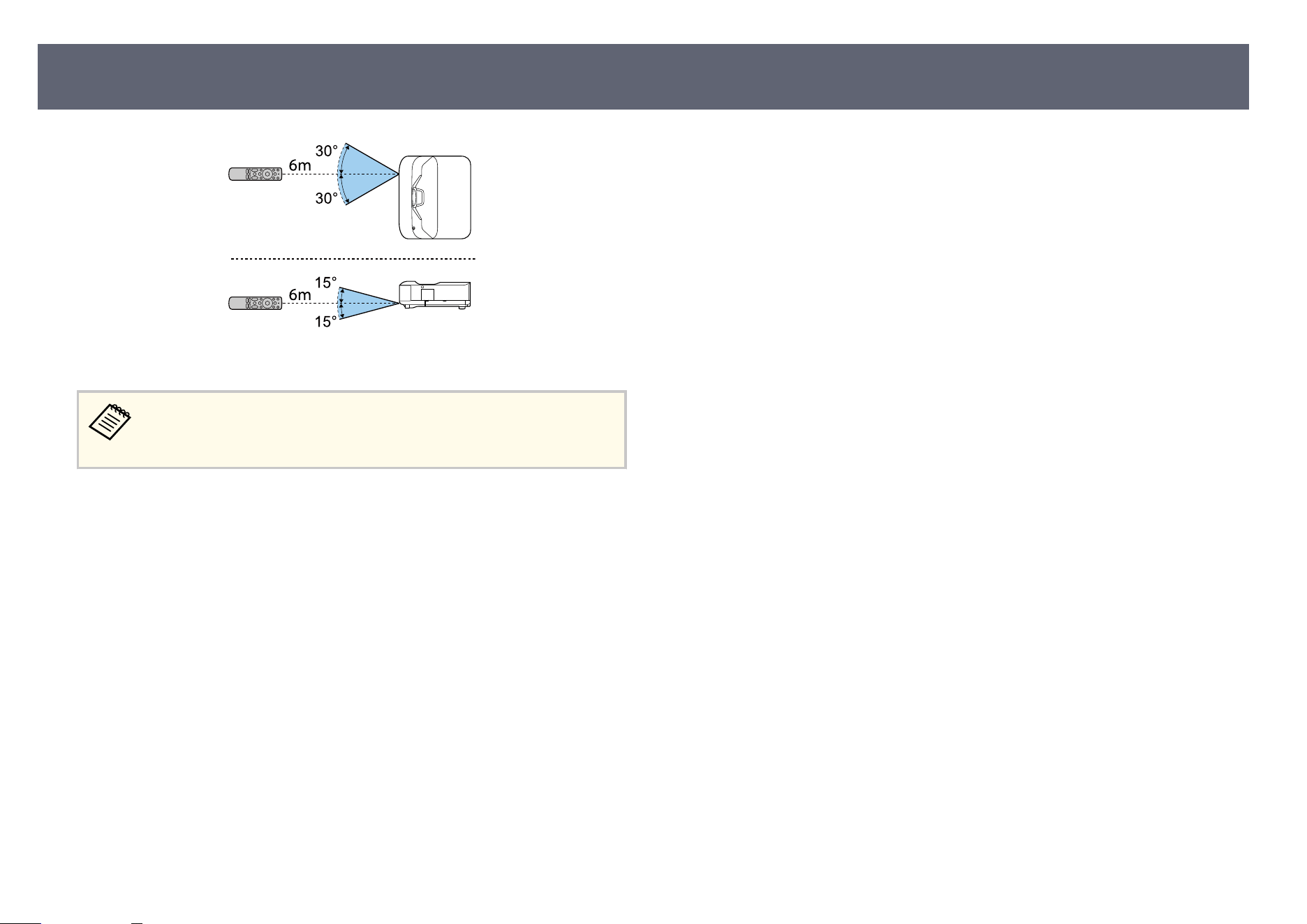
19.7 feet (6 m)
e projector may not respond to commands if you use the remote control
in con
ditions with bright uorescent lights or in direct sunlight. If you are
not going to use the remote control for a long time, remove the batteries.
Installing Batteries in the Remote Control
25
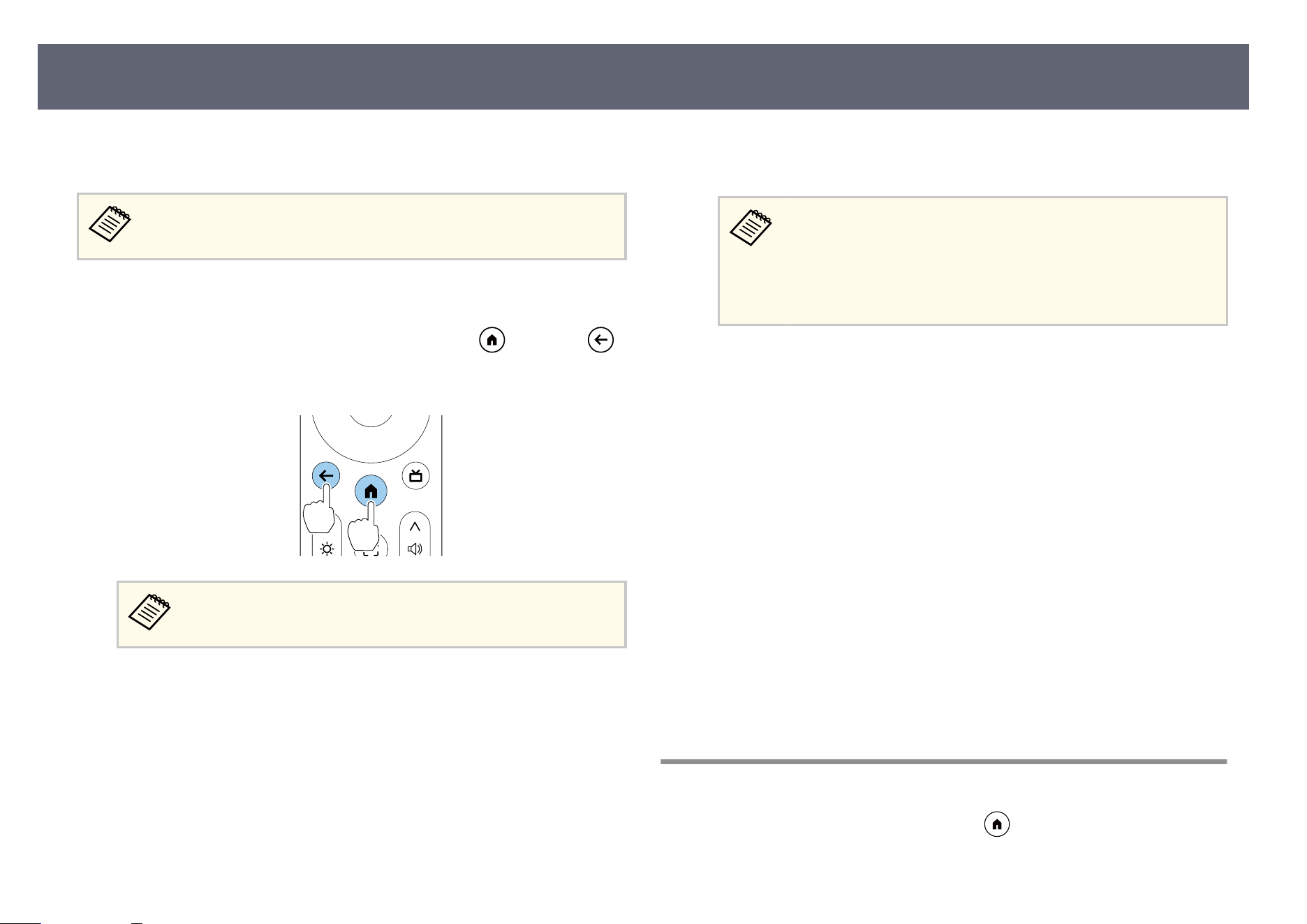
When you turn on the projector for the rst
time, you need to set up the
projector's OS using the initial setup wizard.
You can change each of the settings even aer comp
leting the initial setup.
a
Turn on the projector.
b
When the pairing screen is displayed, hold down the button and
button on the remote control at the same time to pair the remote control
and the projector.
When pairing starts, the indicator on the remote control ashes.
W
hen pairing is complete, the indicator turns o.
c
When the language selection screen is displayed, select the language you
wan
t t
o u
se, and then follow the on-screen instructions to select your
country or region.
d
When the setting screen is displayed, follow the on-screen instructions to
m
ake t
he initial settings for the projector's OS.
•
We re
commend logging in with your Google Account to make
more detailed settings.
•
For instructions on how to create a Google Account, contact
Google or see the following website.
Google Account Help
e
When the Wi-Fi setting screen is displayed, select the wireless network
y
ou wan
t to use, and then follow the on-screen instructions to make
necessary settings.
•
An Internet connection is required to view online content. Make sure
you can use the Wi-Fi service.
•
e customer is responsible are responsible for any communication
charges incurred when downloading the app or watching online
content.
f
Follow the on-screen instructions to make other necessary settings.
g
When you agree to the Epson license terms, the initial setup wizard closes.
W
hen
you have nished the initial setup, the home screen is displayed.
g
Related Links
•
"Projector's Home Screen" p.26
Projector's Home Screen
When you turn on the projector or press the button on the remote control,
the h
ome screen is displayed.
Setting Up the Projector OS
26
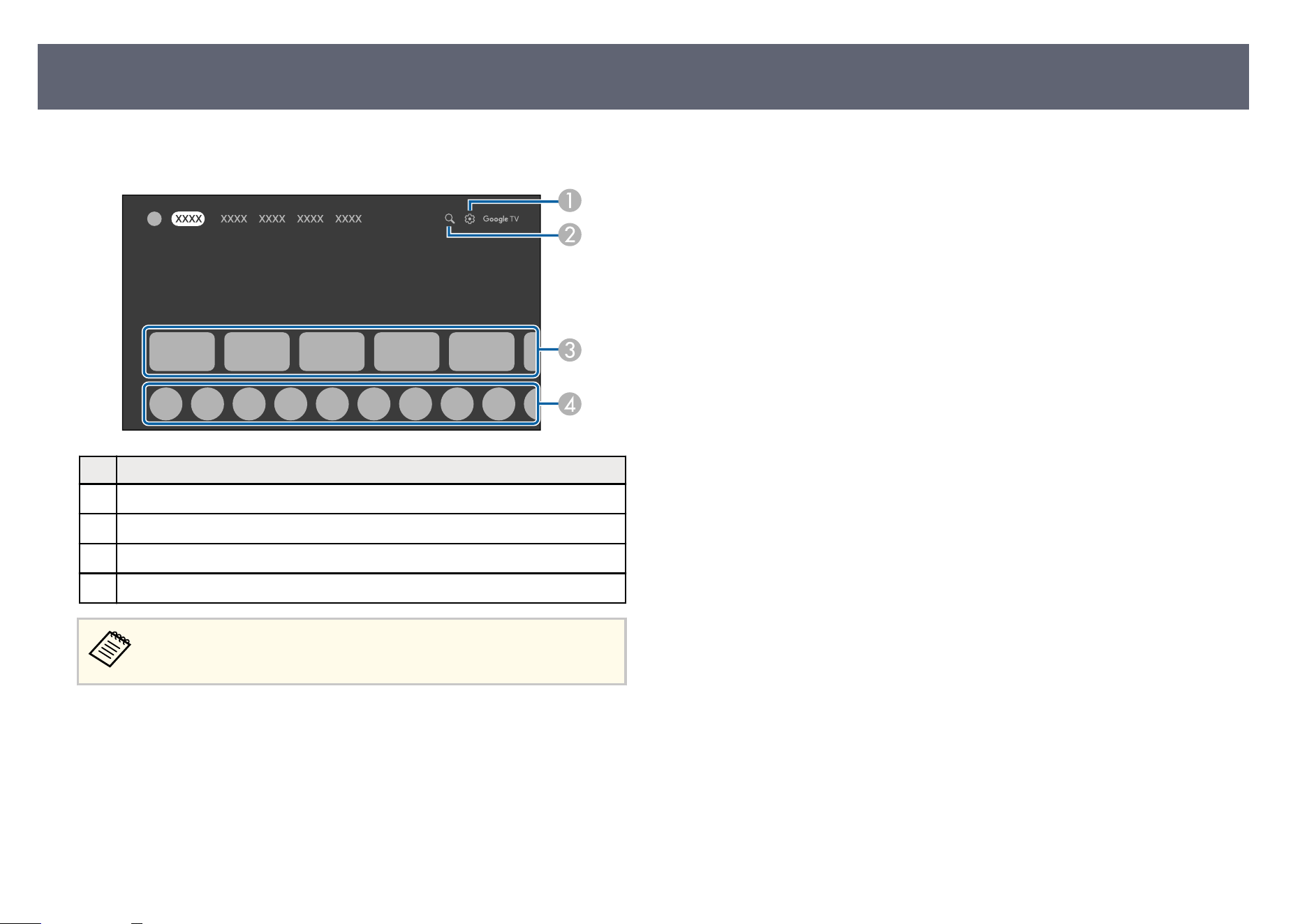
You can easily access recommended online content and applications from the
hom
e screen.
Description
A
Displays the dashboard menu.
B
Searches for online content.
C
Displays the online content recommended by the applications.
D
Displays the applications downloaded on the projector.
e content of the home screen may change depending on the version of
th
e projector's OS.
Setting Up the Projector OS
27
e Epson Projector Update app allows you to check the projector rmware and
up
date it to the latest version. is is necessary to keep the projector up to date.
Install the app, launch the app, and check for the latest rmware.
e Epson Projector Update app is automatically installed by the
pr
ojector's initial setting wizard. To install it automatically, make sure you
log in with your Google Account, make the necessary Wi-Fi settings, and
connect the projector to the Internet.
g
Related Links
•
"In
stalling Epson Projector Update" p.28
Installing Epson Projector Update
Follow the steps below to manually install the Epson Projector Update app.
a
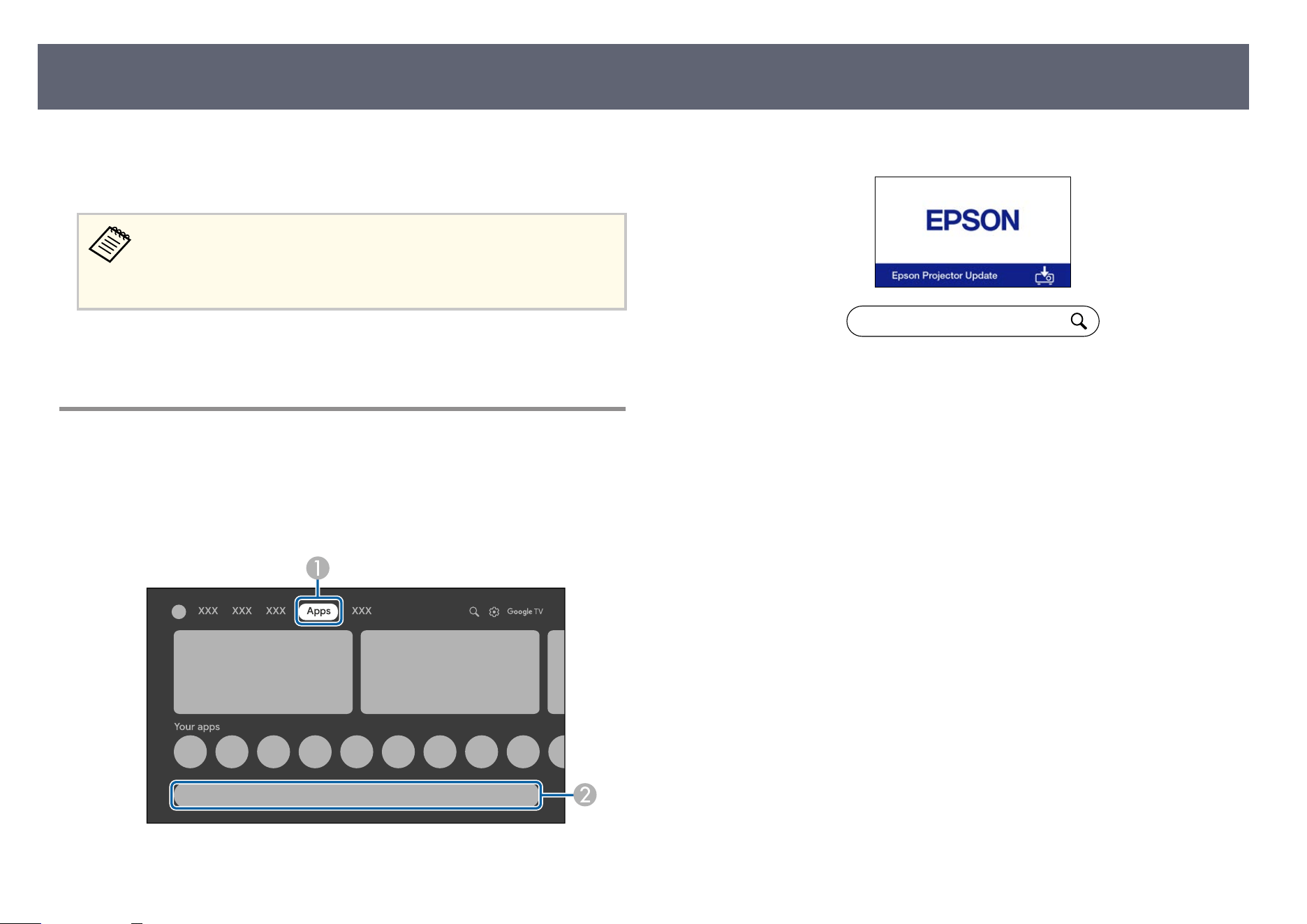
Select the A
pps icon at the top of the home screen and select the search
eld
.
b
Search for "Epson Projector Update" to install it on the projector.
Epson Projector Update
c
Start the Epson Projector Update app and co
nrm
the latest projector
rmware is installed on the projector.
g
Related Links
•
"Updating Projector Firmware Using Epson Projector Update" p.53
About Epson Projector Update
28

Using Basic Projector Features
Fol
low the instructions in these sections to use your projector's basic features.
g
Related Links
•
"Turning On the Projector" p.30
•
"Turning O the Projector (Suspended Mode)" p.31
•
"Projection Modes" p.32
•
"Focusing the Image Using the Focus Lever" p.33
•
"Correcting Distortion in the Image" p.34
•
"Adjusting Image Color" p.37
•
"Adjusting the Size and Position of the Image" p.38
•
"Selecting an Image Source" p.39
•
"Image Aspect Ratio" p.40
•
"Adjusting Image Quality (Color Mode)" p.41
•
"Adjusting Image Quality in Detail" p.42
•
"Turning On Automatic Luminance Adjustment" p.43
•
"Adjusting the Light Source Brightness" p.44
•
"Controlling the Volume with the Volume Buttons" p.45
•
"Changing the Sound Mode" p.46
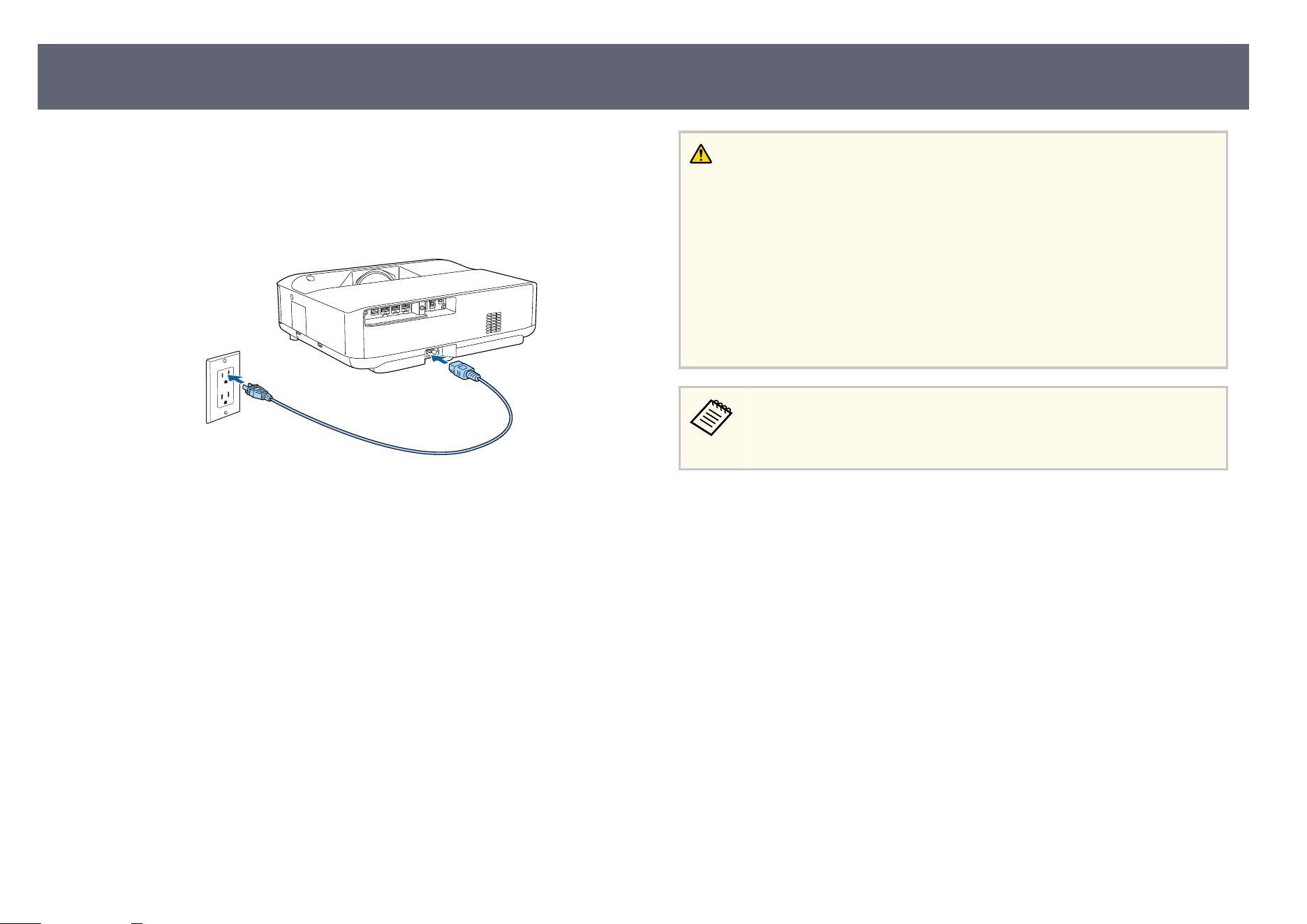
When you connect the video equipment to the projector, turn on the video
equi
pment you want to use aer you turn on the projector.
a
Connect the power cord to the projector's power inlet and plug it into an
elec
trical outlet.
e projector enters standby mode. is indicates that the projector is
receiving power, but is not yet turned on.
b
Press the power button on the projector or remote control to turn on the
pro
jector.
e status indicator turns white.
e rst time you turn on the projector, the remote control pairing screen
and initial setup screen are displayed. Follow the on-screen instructions to
complete the settings.
Warning
•
Nev
er look into the projector lens when the light source is on. is can damage
your eyes and is especially dangerous for children.
•
When turning on the projector at a distance using the remote control, make sure
there is no one looking into the lens.
•
During projection, do not block the light from the projector with a book or other
objects. If the light from the projector is blocked, the area on which the light
shines becomes hot which could cause it to melt, burn, or start a re. Also, the
lens may get hot due to the reected light which could cause the projector to
malfunction. To stop projection, turn o the projector.
When using at an altitude of 4,921 feet (1,500 m) or more, set High
Al
titude Mode to On.
s Projector > Advanced Settings > High Altitude Mode
g
Related Links
•
"Set
ting Up the Projector OS" p.26
•
"Projector Feature Settings - Projector Menu" p.58
Turning On the Projector
30
Turn o the projector aer use.
Turn o this product when it is not in use to prolong the life of
th
e projector. Light source life varies depending on the environmental
conditions and usage. Brightness decreases over time.
a
Press the power button on the projector or remote control.
e light s
ource turns o, and the status indicator turns o. e projector
enters suspended mode.
b
To transport or store the projector, make sure the status indicator on the
pro
jector is o, and then unplug the power cord.
g
Related Links
•
"Turning O the Projector (Deep Standby Mode)" p.31
Turning O the Projector (Deep Standby Mode)
To reduce power consumption when the projector is not in use, turn o t
he
projector completely using the remote control.
•
In deep s
tandby mode, the projector consumes less power than in
suspended mode.
•
It takes longer for the projector to start up the next time you turn it on
than when it is in suspended mode.
a
Hold down the power button on the remote control.
b
Select O
K on the shutdown conrmation screen.
e lig
ht source turns o, and the status indicator turns o. e projector
enters deep standby mode, reducing power consumption.
c
To transport or store the projector, make sure the status indicator on the
p
ro
jector is o, and then unplug the power cord.
Turning O the Projector (Suspended Mode)
31

Depending on how you positioned the projector, you may need to change the
pro
jection mode so your images project correctly.
•
Front lets you project from in front of the screen.
•
Rear ips the image horizontally to project from behind a translucent screen.
g
Related Links
•
"Changing the Projection Mode Using the Menus" p.32
•
"Projector Setup and Installation Options" p.18
Changing the Projection Mode Using the Menus
You can change the projection mode to ip the image from le-to-right using
the projector menus.
a
Turn on the projector and display an image.
b
Press the
button on the remote control to open the Pro
jector menu.
c
Select the menus in the following order:
s Advanced S
ettings > Projection
d
Select a projection mode and press [Enter].
e
Press
to exit the menus.
Projection Modes
32
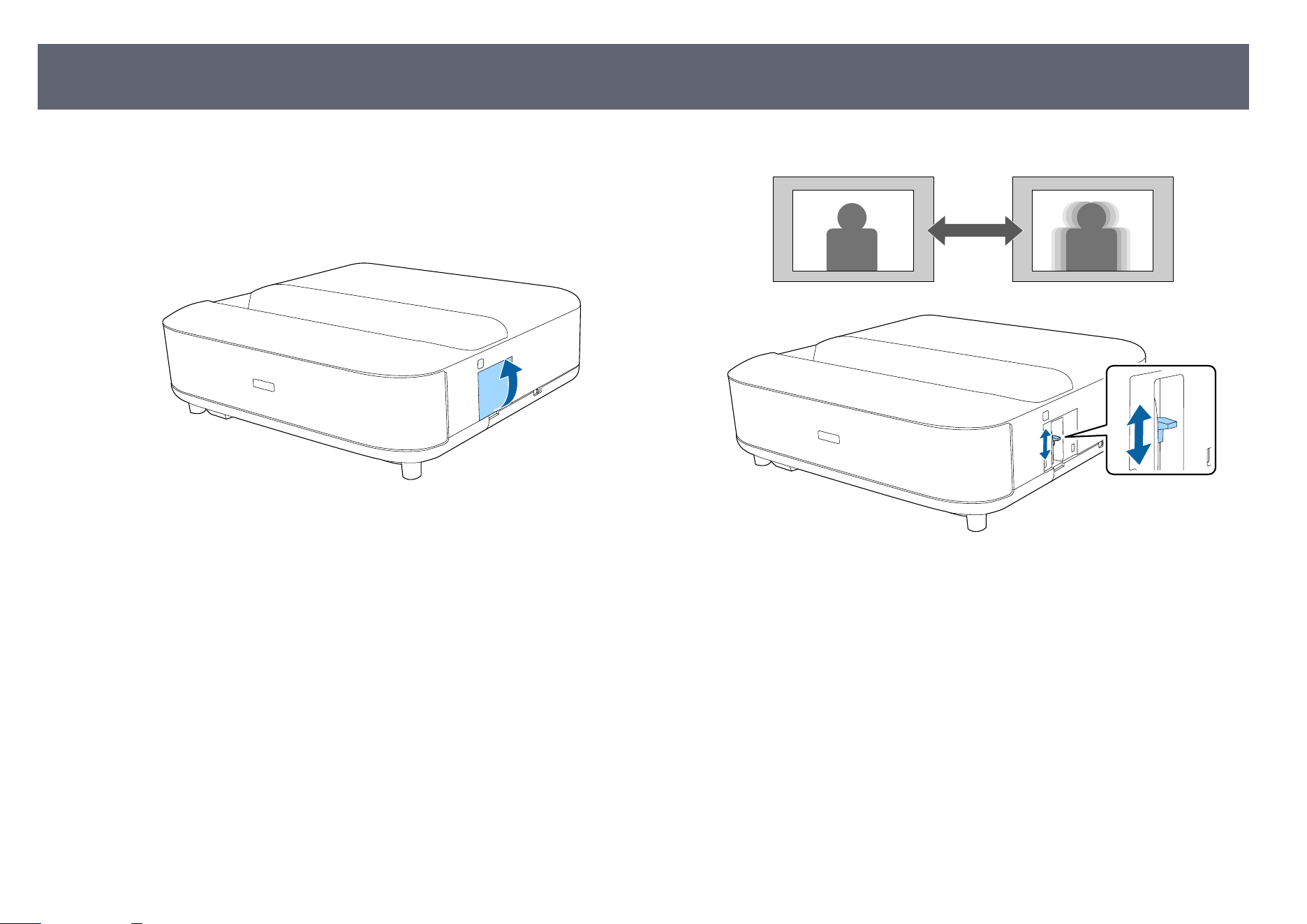
You can correct the focus using the focus lever.
a
Turn on the projector and display an image.
b
Open the focus lever cover.
c
Move the focus lever to adjust the focus.
d
Close the focus lever cover.
Focusing the Image Using the Focus Lever
33
When the projected image is curved or not rectangular, you can correct
dist
ortion in the projected image by following the on-screen instructions.
Aer correction, your image is slightly smaller.
a
Turn on the projector and display an image.
b
Press the
button on the remote control to open the Pro
jector menu.
c
Select Keystone.
d
Se
lect Remote control.
e f
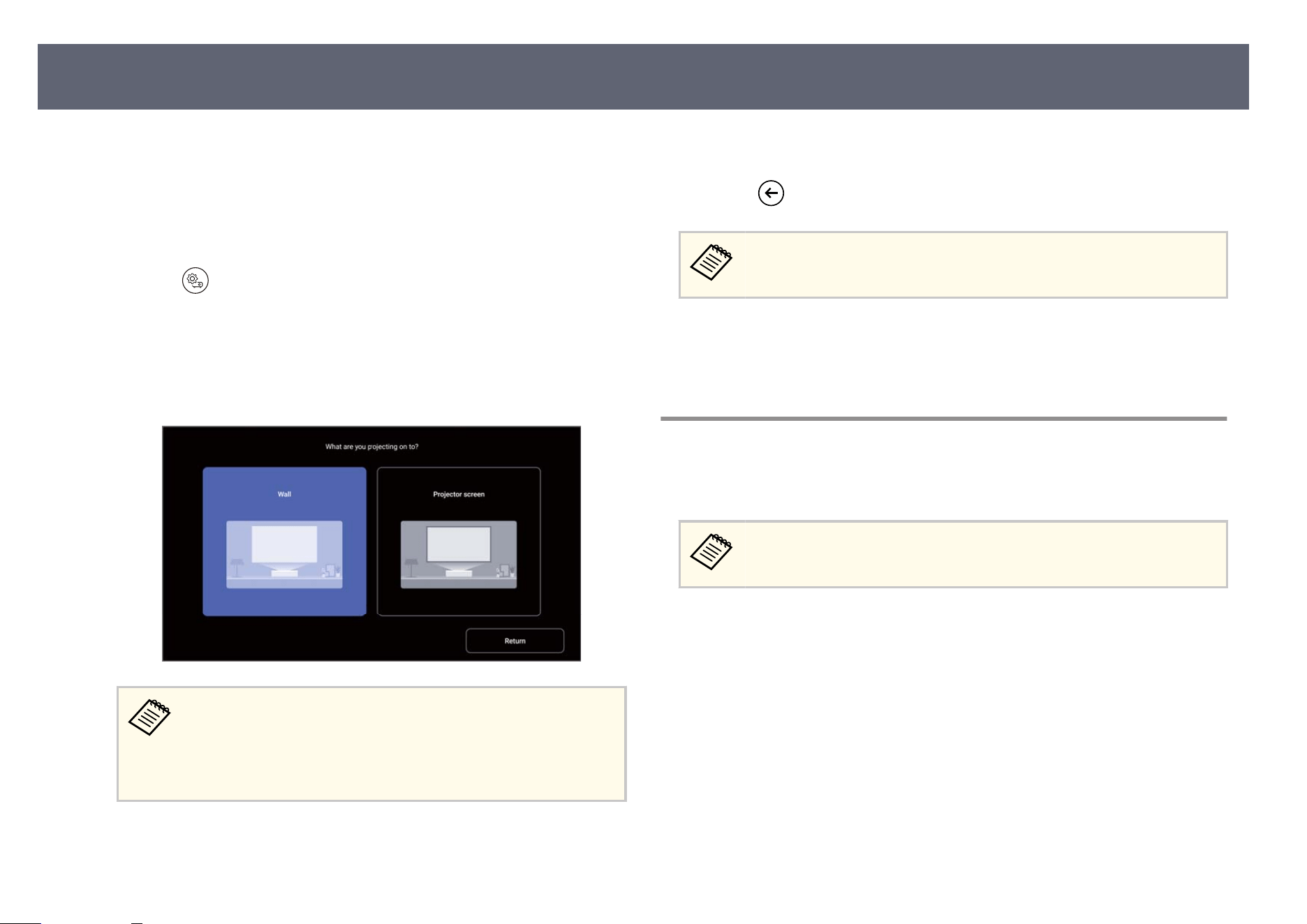
ollowing screen is displayed.
To correct distortion more easily, you can use the Epson Setting
Assi
stant app on a smartphone or tablet that has a camera function.
Select App and scan the QR code displayed on the projected
screen to install the app. e customer is responsible for any
communication charges incurred when downloading the app.
e
Select Wall or Projector screen according to the projection surface you are
usin
g.
f
Follow the on-screen instructions to correct distortion in the image.
g
Press
to exit the menus.
For details on the options for correcting distortion, see the following
sec
tions.
g
Related Links
•
"When Projecting on a Wall" p.34
•
"When Projecting on a Screen" p.35
When Projecting on a Wall
When you are projecting images on a wall, select Wall
and follow the steps
below.
When selecting the correction method, if the message Reset al
l distortion
corrections for the projected image? is displayed, select Yes.
Correcting Distortion in the Image
34
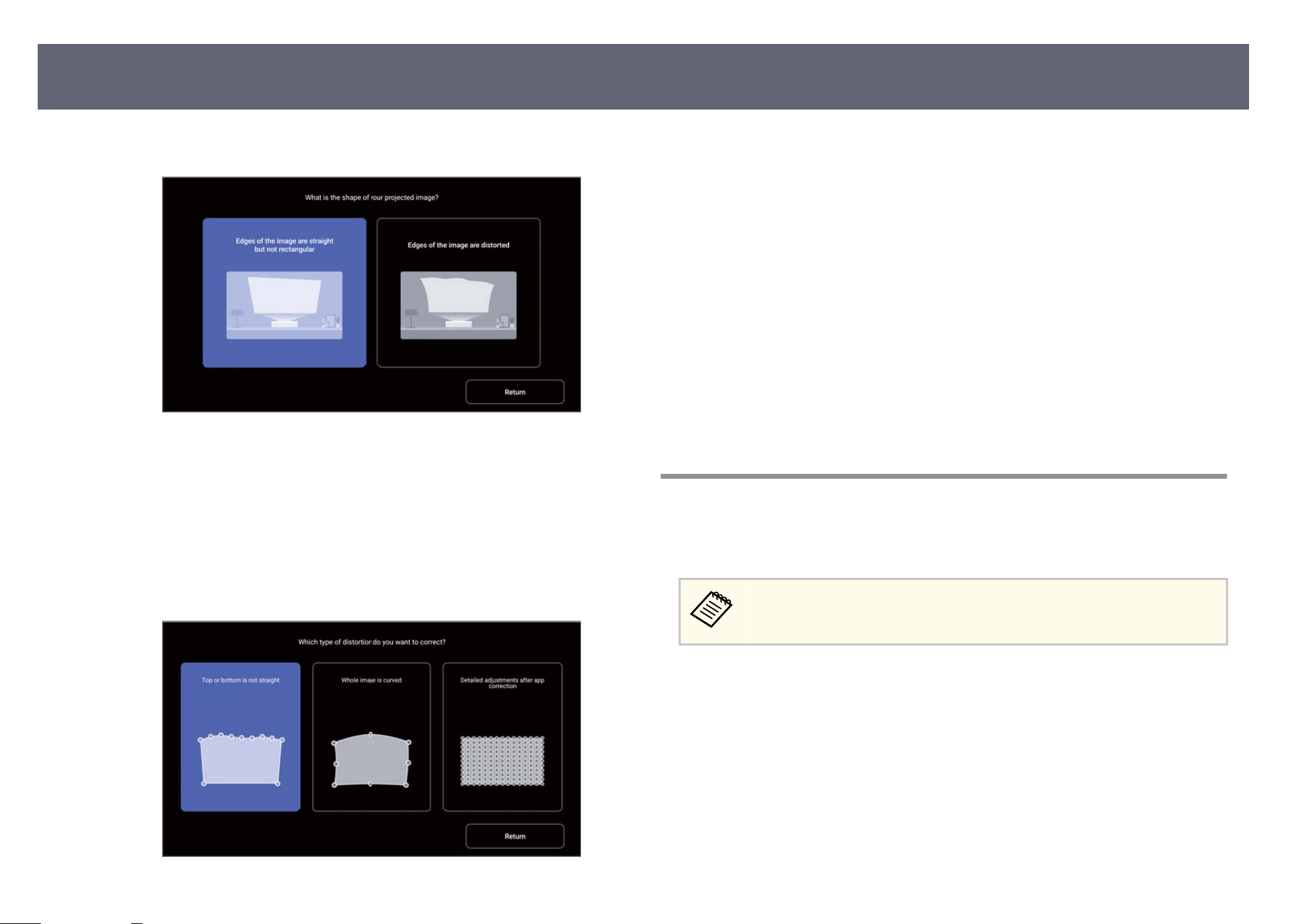
a
Select the shape of the projected image from the screen.
•
Edges o
f the image are straight but not rectangular:
e four-point correction screen is displayed. Select the points you
want to correct and correct the distortion.
•
Edges of the image are distorted:
Go to step 2 to select how the projected image is distorted.
b
Select which part of the projected image is distorted on the screen.
•
Top o
r bottom is not straight:
e eleven-point correction screen (top line with nine points, bottom
line with two points) is displayed. Select the points you want to correct
and correct the distortion.
•
Whole image is curved:
e eight-point correction screen is displayed. Select the points you
want to correct and correct the distortion.
•
Detailed adjustments aer app correction:
e point correction screen (33 × 33 points vertically and horizontally)
is displayed. Select the points you want to correct and correct the
distortion.
c
When you ni
s
h
correcting the distortion, select Finish.
When Projecting on a Screen
When you are projecting images on the projector screen, select Pro
jector screen
and follow the steps below.
When selecting the correction method, if the message Reset al
l distortion
corrections for the projected image? is displayed, select Yes.
Correcting Distortion in the Image
35
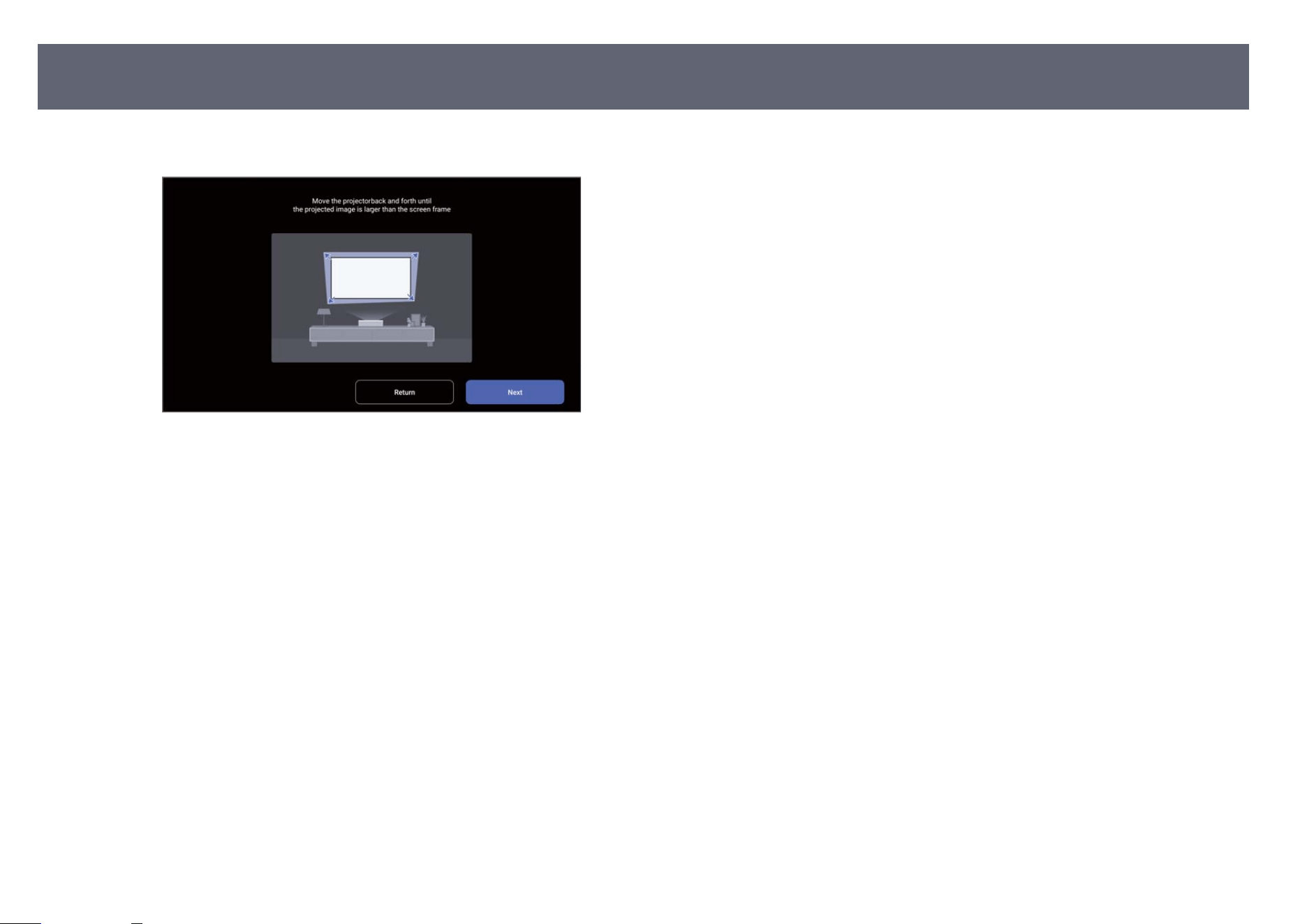
a
Move the projector following the on-screen instructions.
b
Select N
ext.
e
f
our-point correction screen is displayed.
c
Select the points you want to correct and correct the distortion.
d
If necessary, correct the distortion using the eight-point correction screen
t
hat i
s displayed when you select Corner Adjustment on the screen.
e
When you nish
correcting the distortion, select Finish.
Correcting Distortion in the Image
36
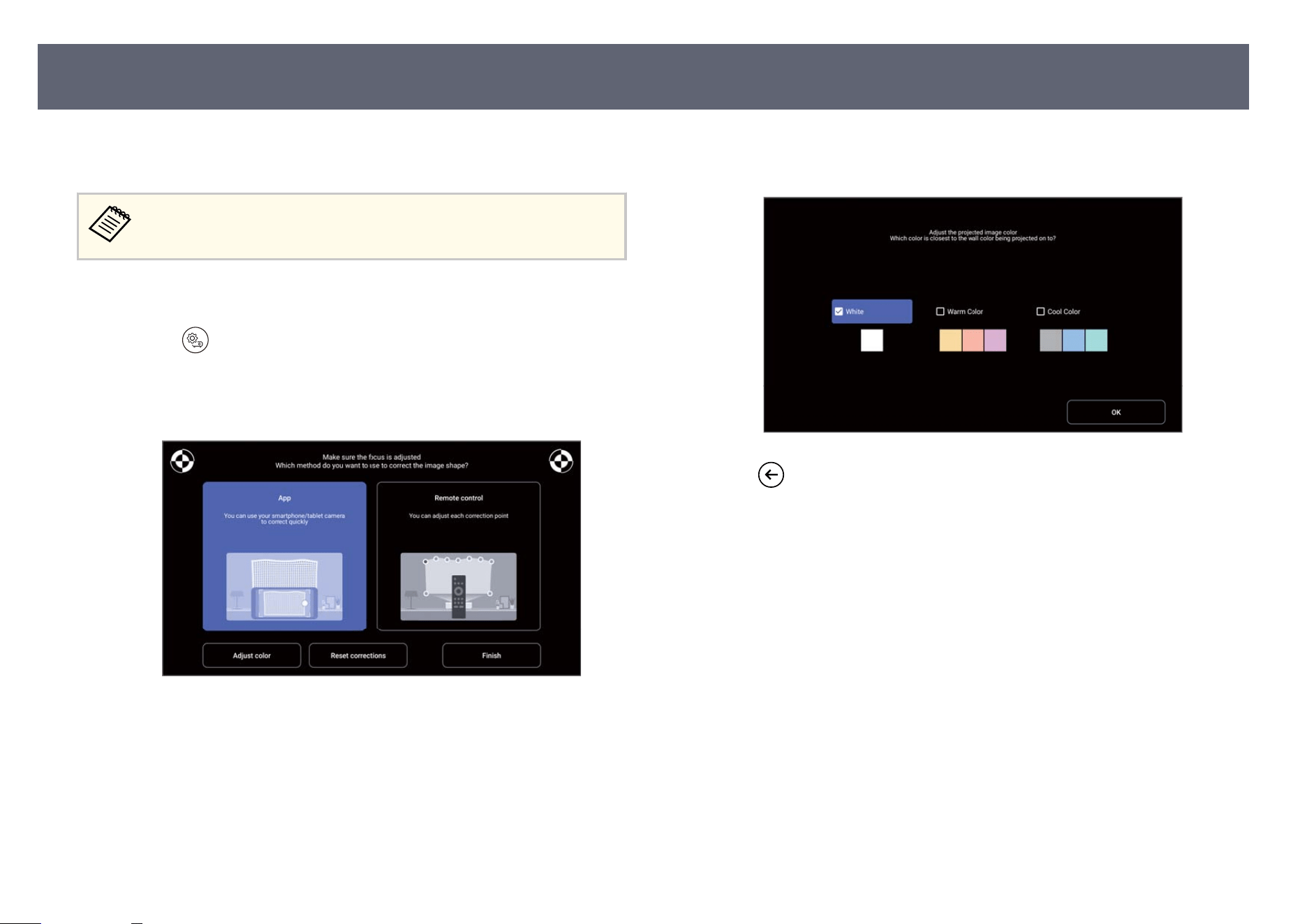
You can use the preset color correction to adjust the color of the projected image
so th
at it matches the color of the projection surface (wall or projector screen).
You can make further detailed color adjustments using the projector's
Displ
ay & Sound menu.
a
Turn on the projector and display an image.
b
Press the button on the remote control to open the Pro
jector menu.
c
Select Keystone.
e f
ollowing screen is displayed.
d
Select Adjust color.
e
Se
lect the color that is closest to the color of the projection surface and
select OK.
f
Press to exit the menus.
g
Related Links
•
"Im
age Quality Settings - Display & Sound Menu" p.59
Adjusting Image Color
37
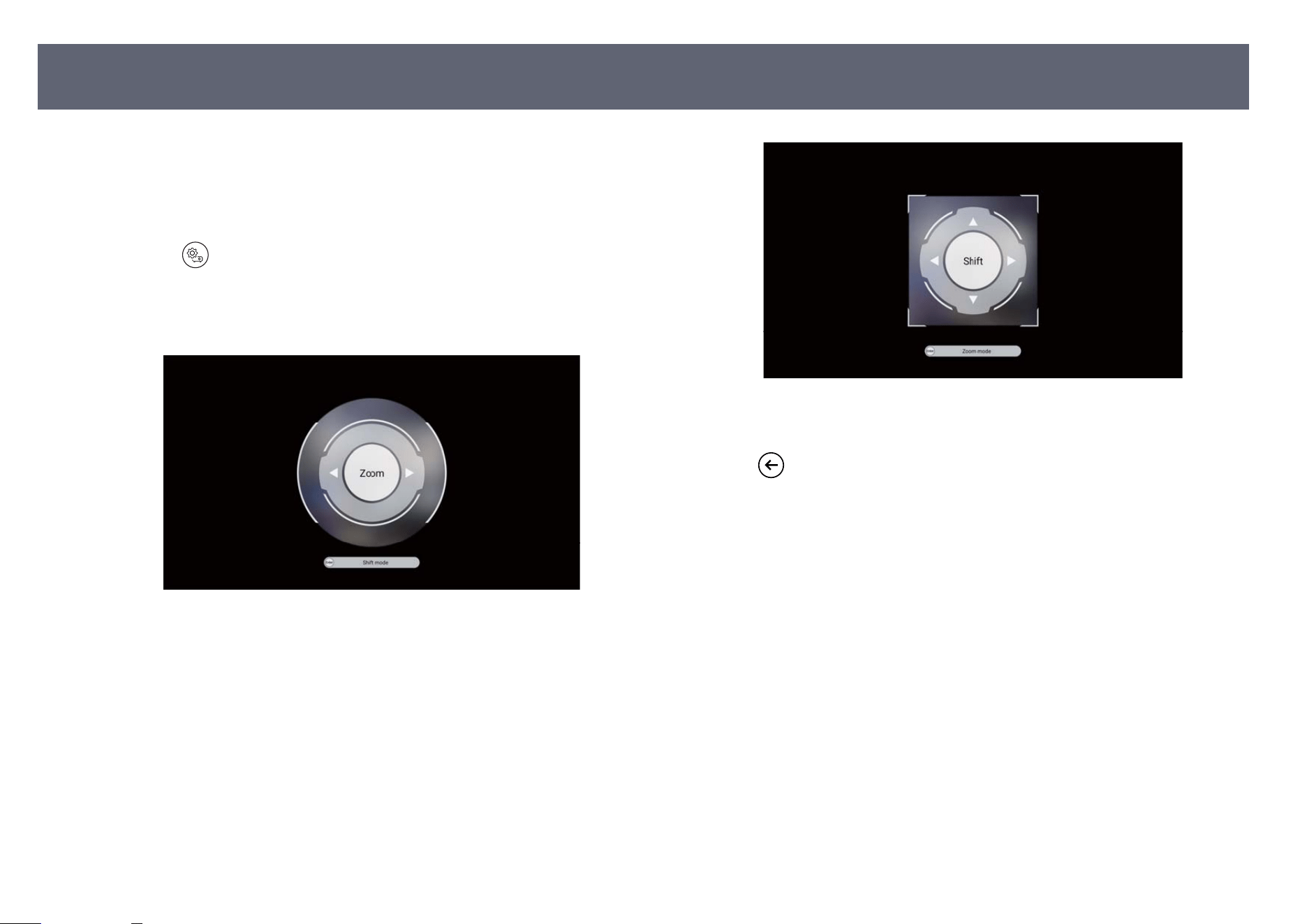
You can use the Zoo
m & Shi feature to adjust the size and position of the
projected image.
a
Turn on the projector and display an image.
b
Press the
button on the remote control to open the Pro
jector menu.
c
Select Zoom & Shi.
e zo
om adjustment screen is displayed.
d
Use the le and rig
ht arrow buttons to adjust the image size.
e
Press the [Enter] button.
e scre
en switches to Shi mode and the shi adjustment screen is
displayed.
f
Use the arrow buttons to adjust the image position.
g
Press to exit the menus.
g
Related Links
•
"Pr
ojector Feature Settings - Projector Menu" p.58
Adjusting the Size and Position of the Image
38
When multiple image sources are connected to the projector, such as a
comp
uter and DVD player, you can switch from one image source to the other.
a
Make sure the connected image source you want to use is turned on.
b
For video image sources, insert a DVD or other video media and press
p
lay
.
c
Press the
button on the remote control.
d
Press the up or down arrow button to select the image source you want.
When no image signal is detected, check the cable connections
b
et
w
een the projector and the image source.
Selecting an Image Source
39
e projector can display images in dierent width-to-height ratios called
asp
ect ratios. Normally, the input signal from your video source determines
the image's aspect ratio. However, you can change the aspect ratio for certain
images to t your screen.
If you always want to use a particular aspect ratio for a certain video input
source, you can select it using the projector's Screen menu.
You can select this setting only when the current input source is HDMI.
g
Related Links
•
"Ch
anging the Image Aspect Ratio" p.40
•
"Available Image Aspect Ratios" p.40
Changing the Image Aspect Ratio
You can change the aspect ratio of the displayed image.
a
Turn on the projector and display an image.
b
Press the button on the remote control to open the dashboard.
c
Select
on the dashboard.
d
Select the menus in the following order:
s Displ
ay & Sound > Screen
e
Select one of the available aspect ratios for your input signal.
f
Press
to exit the menus.
Available Image Aspect Ratios
You can select the following image aspect ratios.
Note that using the aspect ratio function of the projector to reduce,
enlar
ge, or split the projected image for commercial purposes or for public
viewing may infringe upon the rights of the copyright holder of that image
based on copyright law.
Aspect mode Description
Super Zoom Zooms into images. e righ
t, le, top, and bottom
edges are missing.
4:3 Scales images to 4:3.
Movie expand 14:9 Scales images to 14:9.
Movie expand 16:9 Scales images to 16:9.
Full Displays images using the full size of the projection
ar
e
a.
U
nscaled Displays images as they are.
Image Aspect Ratio
40
e projector oers dierent color modes to provide optimum brightness,
con
trast, and color for a variety of viewing environments and image types.
You can select the mode designed to match your image and environment, or
experiment with the available modes.
g
Related Links
•
"Changing the Color Mode" p.41
•
"Available Color Modes" p.41
Changing the Color Mode
You can change the projector's color mode to optimize the image for your
viewing environment.
a
Turn on the projector and display an image.
b
Press the button on the remote control to open the dashboard.
c
Select
on the dashboard.
d
Select the menus in the following order:
s Displ
ay & Sound > Display > Picture Mode
e
Select the color mode you want to use from the list.
f
Press
to exit the menus.
A
v
ailable C
olor Modes
You can set the projector to use these color modes, depending on your
environment and image types.
Color mode Description
Dynamic is is the brightest mode. Best for prioritizing
br
ightness.
Standard is is a standard mode that balances brightness
and co
lor saturation. Standard mode is generally
recommended.
Cinema Best for enjoying content such as movies.
Natural Reproduces natural colors. is i
s the best option when
you want to adjust the image color.
Adjusting Image Quality (Color Mode)
41

e projector's Display menu provides several options for adjusting the quality
of y
our image based on the input source you are currently using. You can ne-
tune various aspects of how quality and colors are displayed in your projected
images.
s Display & Sound > Display
See "Display & Sound Menu" for details on adjusting the image quality.
g
Related Links
•
"Image Quality Settings - Display & Sound Menu" p.59
Adjusting Image Quality in Detail
42

You can turn on Dynami
c Contrast to automatically optimize the image
luminance. is improves the image contrast based on the brightness of the
content you project.
a
Turn on the projector and display an image.
b
Press the
button on the remote control to open the dashboard.
c
Select on the dashboard.
d
Select the menus in the following order:
s Dis
pl
ay & Sound > Display > Advanced Settings > Dynamic Contrast
e
Select one of the following options:
•
O if you do n
ot want to adjust the brightness.
•
Normal for standard brightness adjustment.
•
High Speed to adjust brightness as soon as the scene changes.
f
Press
to exit the menus.
g
Related Links
•
"Im
age Quality Settings - Display & Sound Menu" p.59
Turning On Automatic Luminance Adjustment
43

You can adjust the brightness of your projector's light source.
a
Turn on the projector and display an image.
b
Press the up/down buttons on the remote control.
e Ligh
t Output adjustment gauge is displayed.
c
Press the
up/down buttons to adjust the brightness.
d
Press to exit the menus.
Adjusting the Light Source Brightness
44
e volume buttons control the projector's internal speaker system.
Yo
u can also control the volume of any external speakers you connected to the
projector.
You must adjust the volume separately for each connected input source.
To adjust the volume for the connected audio/video system, set the Glob
al
CEC control setting to On in the projector's menu.
s Channels & Inputs > Inputs > Global CEC control
a
Turn on the projector and start a video.
b
To lower or raise the volume, press the up/down buttons on the
r
em
o
te control.
A volume gauge appears on the screen.
Caution
Do no
t start a playback at a high volume setting. Sudden loud noises may cause
hearing loss.
Always lower the volume before powering o, so that you can power on and then
gradually increase the volume.
g
Relat
ed Links
•
"P
r
ojector Feature Settings - Channels & Inputs Menu" p.57
Controlling the Volume with the Volume Buttons
45
e projector oers dierent sound modes to provide optimum sound for a
variet
y of image types.
You can select the mode designed to match your image, or experiment with the
available modes.
a
Turn on the projector and start a video.
b
Press the
button on the remote control to open the dashboard.
c
Select on the dashboard.
d
Select the menus in the following order:
s Dis
pl
ay & Sound > Sound > Sound Mode
e
Select your sound mode.
f
Press
to exit the menus.
g
Related Links
•
"Avai
lable Sound Modes" p.46
Available Sound Modes
You can set the projector to use these sound modes, depending on the input
sour
ce you are using:
Sound mode Description
Cinema Best for audio from videos or movies. Low and high
p
it
ch sounds are emphasized.
Dialogue Best for hearing voices and spoken lines.
Music Best for music. Low and high pitch sounds are clearer.
Sound mode Description
Standard Outputs the audio using normal sound quality.
Changing the Sound Mode
46

Adjusting Projector Features
Fol
low the instructions in these sections to use your projector's adjustment features.
g
Related Links
•
"Using the Projector as a Bluetooth
®
Speaker" p.48
•
"Shutting O the Image Temporarily" p.49
•
"Using Google Cast
™
" p.50
•
"HDMI CEC Features" p.51
•
"Installing a Security Cable" p.52
•
"Updating Projector Firmware Using Epson Projector Update" p.53
•
"Initializing the Projector" p.54
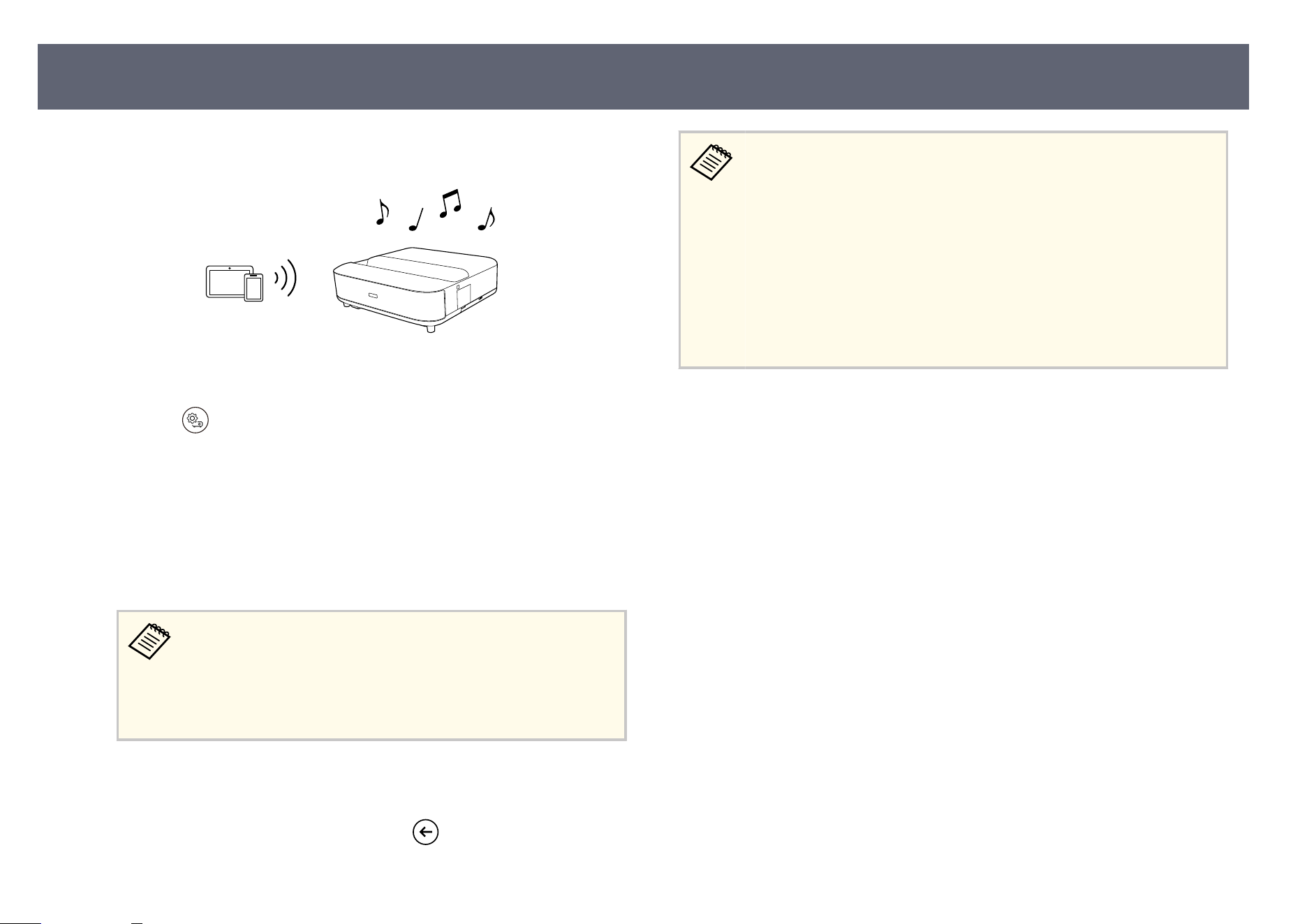
You can use the projector's speaker to output audio from a video/audio device
conne
cted by Bluetooth.
a
Turn on the projector and display an image.
b
Press the button on the remote control to open the Pro
jector menu.
c
Select Bluetooth Speaker Mode.
e
Bluetooth Speaker Mode screen is displayed.
d
Enable the Bluetooth function on the device you want to connect and
sele
ct the projector name (this projector) from the available device list. See
the documentation supplied with the device for more information.
•
You c
an check and change the projector name from the
projector's Device name menu.
s System > About > Device name
•
To cancel a Bluetooth connection, disconnect from the
connected device.
e projected image turns o 10 seconds aer the Bluetooth connection is
est
ablished.
e
To exit Bluetooth Speaker Mode, press the
button.
•
ere i
s a delay in the audio output from any Bluetooth audio device.
•
You cannot connect multiple video/audio devices by Bluetooth at the
same time.
•
You can also connect the projector to Bluetooth audio devices, such
as speakers or headphones, to output the projector's audio from these
devices. Select the menus in the following order to perform pairing
from the menu displayed.
s Remotes & Accessories > Pair Accessory
•
Bluetooth audio devices are not supported in some countries and
regions.
g
Related Links
•
"Bl
uetooth Specications" p.93
Using the Projector as a Bluetooth
®
Speaker
48
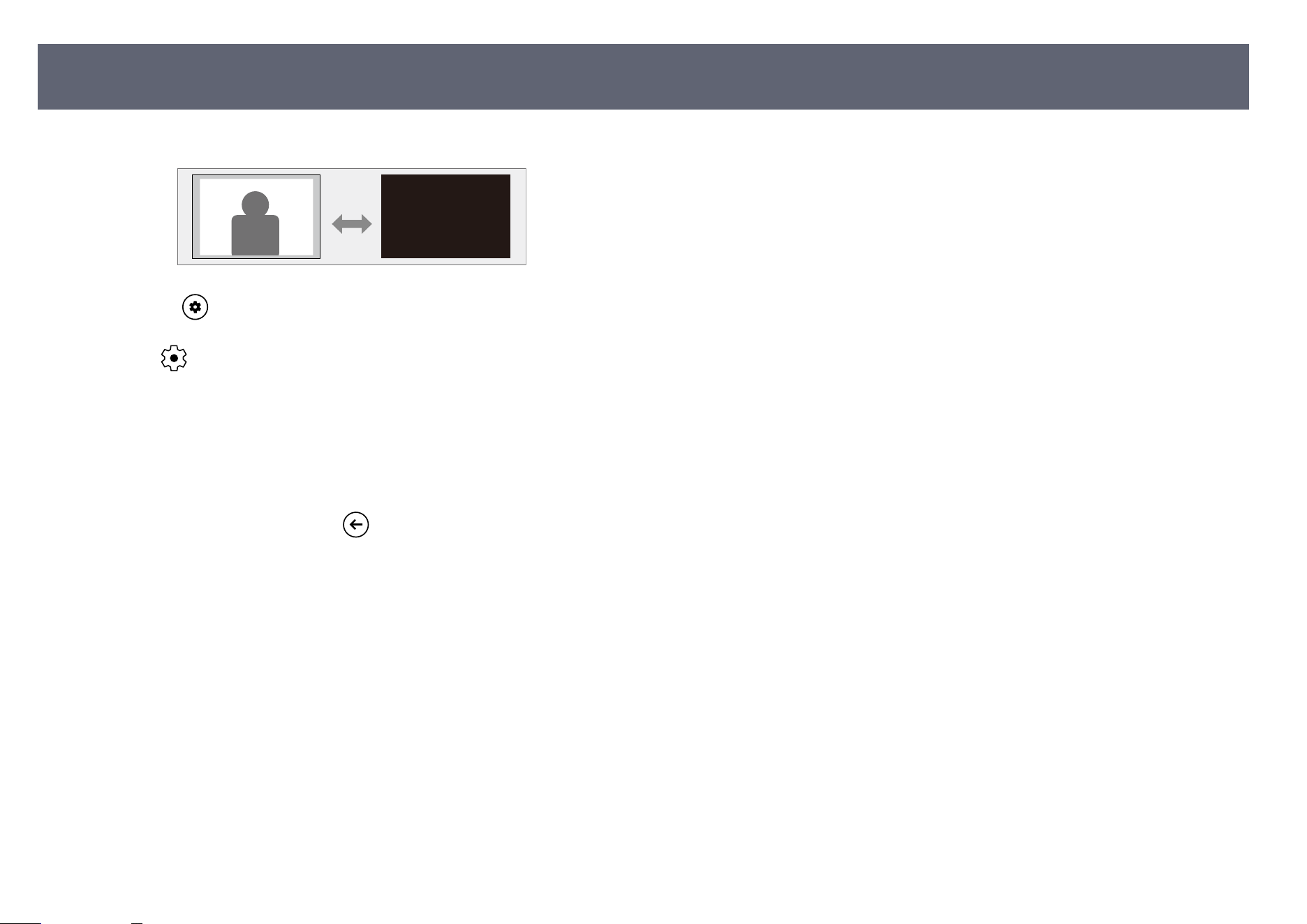
You can temporarily turn o t
he projected image.
a
Press the
button on the remote control to open the dashboard.
b
Select on the dashboard.
c
Select the menus in the following order:
s Displ
ay & Sound > Display > Advanced Settings
d
Select Picture o to turn o the projected image.
e
To t
urn the image back on, press
.
g
Related Links
•
"Im
age Quality Settings - Display & Sound Menu" p.59
Shutting O the Image Temporarily
49
With Google Cast, you can stream entertainment from your favorite apps on
your p
hone, tablet or laptop to Epson projectors.
a
Connect your device or computer to the same wireless network as the
pro
jector.
b
Open the Google Cast-enabled app and press
.
c
Select your projector from the list of devices.
You can check and change the projector name from the projector's
D
e
v
ice name menu.
s System > About > Device name
e app connects and starts casting to the projector.
d
To s
top casting, press
in the app and choose the disconnect option.
Using Google Cast
™
50
When an audio/video source that meets the HDMI CEC standard is connected
to th
e projector's HDMI port, you can use the projector's remote control to
control certain features of the linked device.
g
Related Links
•
"Operating Connected Devices Using the HDMI CEC Features" p.51
Operating Connected Devices Using the HDMI CEC
Features
You can control connected audio/video devices using the HDMI CEC features.
•
You m
ust also congure the connected device. See the documentation
supplied with the device for more information.
•
Some connected devices or functions of those devices may not
operate properly even if they meet the HDMI CEC standard. See the
documentation supplied with the device for more information.
•
Use a cable that supports the HDMI standard.
a
Press the button on the remote control to open the dashboard.
b
Select
on the dashboard.
c
Select the menus in the following order:
s Channels & Inputs > Inputs > Global CEC control
d
Set Global CEC control to on.
e
Ad
just the following HDMI CEC settings as necessary.
•
To aut
omatically turn o the connected device when you turn o the
projector, set Allow TV to turn o connected devices to on.
•
To automatically turn on the projector when you turn on the connected
device, set Allow connected devices to turn on TV to on.
f
Press
to exit the menus.
You c
an use the projector's remote control to control the linked device such as
playback, stop, or adjust the volume.
g
Related Links
•
"Projector Feature Settings - Channels & Inputs Menu" p.57
HDMI CEC Features
51
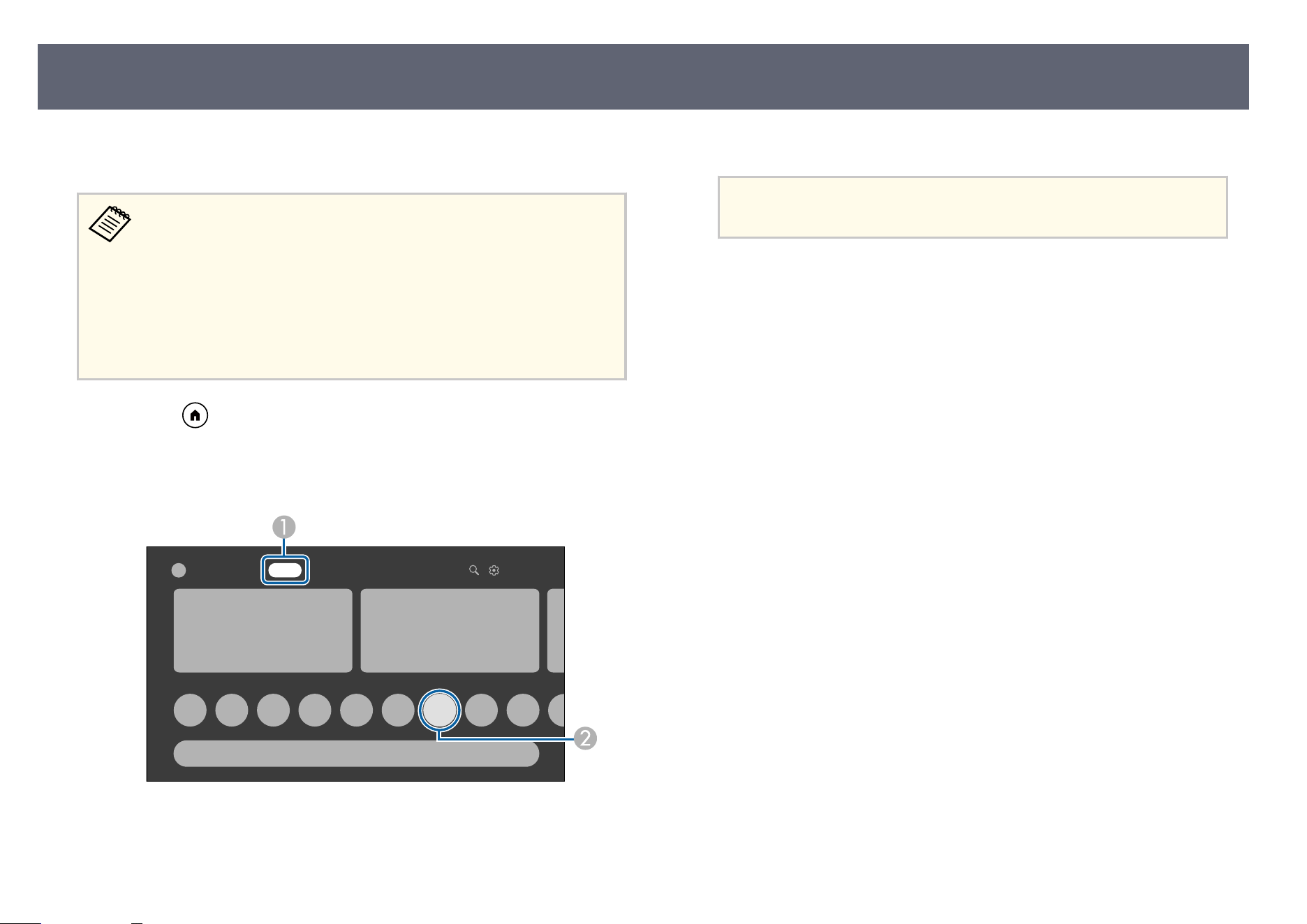
You can get the latest version of the projector rmwar
e by using Epson Projector
Update.
•
If th
e Epson Projector Update app is not installed, install it from the
home screen. Be sure to install the app to keep the projector up to date.
•
When the latest projector rmware is available, a notication
is automatically displayed on the screen. Follow the on-screen
instructions to update the rmware.
•
If there is not enough space in the internal storage, the update may
fail. Free up space by deleting unnecessary apps and caches, then try
updating again.
a
Press the button on the remote control.
b
Select A
pps and start Epson Projector Update by selecting it from the
ap
ps li
st.
XXXX XXXX Apps XXXX Google TV
Your apps
c
Follow the on-screen instructions to update the rmwar
e.
Attention
While u
pdating the rmware, do not operate or turn o the projector.
g
Related Links
•
"In
stalling Epson Projector Update" p.28
Updating Projector Firmware Using Epson Projector Update
53
You can reset all of the projector settings to their default values.
If you initialize the projector, all the information such as installed apps,
Goog
le Account login information, and the projector's menu settings
are deleted. Write down the settings you do not want to lose before
performing initialization.
a
Turn on the projector and display an image.
b
Press the button on the remote control to open the dashboard.
c
Select
on the dashboard.
d
Select the menus in the following order:
s Sys
tem > About > Reset > Factory reset
e
Follow the on-screen instructions to start initializing the projector.
g
Related Links
•
"Sys
tem Menu" p.61
Initializing the Projector
54

Adjusting the Menu Settings
Fol
low the instructions in these sections to access the projector menu system and change projector settings.
g
Related Links
•
"Using the Projector's Menus" p.56
•
"Projector Feature Settings - Channels & Inputs Menu" p.57
•
"Projector Feature Settings - Projector Menu" p.58
•
"Image Quality Settings - Display & Sound Menu" p.59
•
"Other Menus" p.61
You can use the projector's menus to adjust the settings that control how your
pro
jector works. e projector displays the menus on the screen.
a
Press the
button on the remote control to open the dashboard.
b
Select on the dashboard.
c
Press the up or down arrow buttons to move through the menus listed on
the s
creen.
d
To change settings in the displayed menu, press the [Enter] button.
e
Press the arrow buttons to move through the settings.
f
Change the settings using the buttons as necessary.
g
When you ni
sh
changing settings on a menu, press
.
h
Press to exit the menus.
Using the Projector's Menus
56
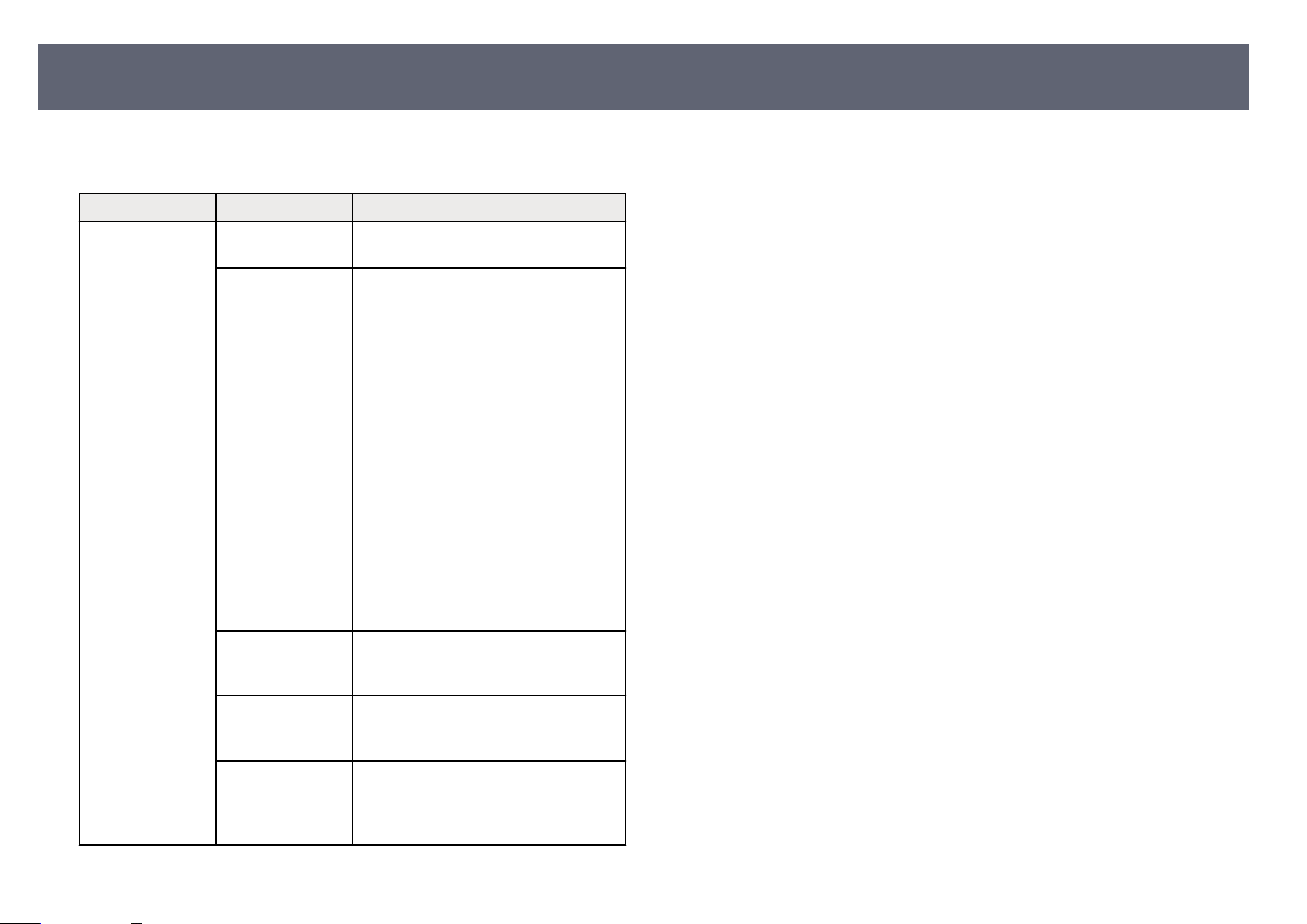
Settings on the Channels & I
nputs menu let you control the audio/video device
you are currently using.
Setting Options Description
Inputs Switch input Switches the input source between Home
an
d HDMI.
HDMI1
HDMI2
HDMI3
S
how this input: Species whether to
show HDMI1/HDMI2/HDMI3 in the list
of input sources.
PIN lock: When enabling this setting, the
PIN code of the device that is connected
to the projector's HDMI port is required
when you switch the input source to
HDMI.
Edit names: Selects a name you want to
display as the name of the audio/video
device that is connected to the projector's
HDMI port.
No signal standby timeout: Sets the time
before the projector enters standby mode
when no signal is detected from the
HDMI source.
HDMI EDID Version: Displays the EDID
version.
Global CEC control Select On to control the connected audio/
vide
o device using the projector's remote
control.
Allow TV to
turn
o connected
devices
Select On to automatically turn o the
connected audio/video device when you
turn o the projector.
Allow connected
devices t
o turn on
TV
Select On to automatically turn on
the projector when you turn on the
connected device, or when you start
playback on the connected device.
g
Related Links
•
"Op
erating Connected Devices Using the HDMI CEC Features" p.51
Projector Feature Settings - Channels & Inputs Menu
57
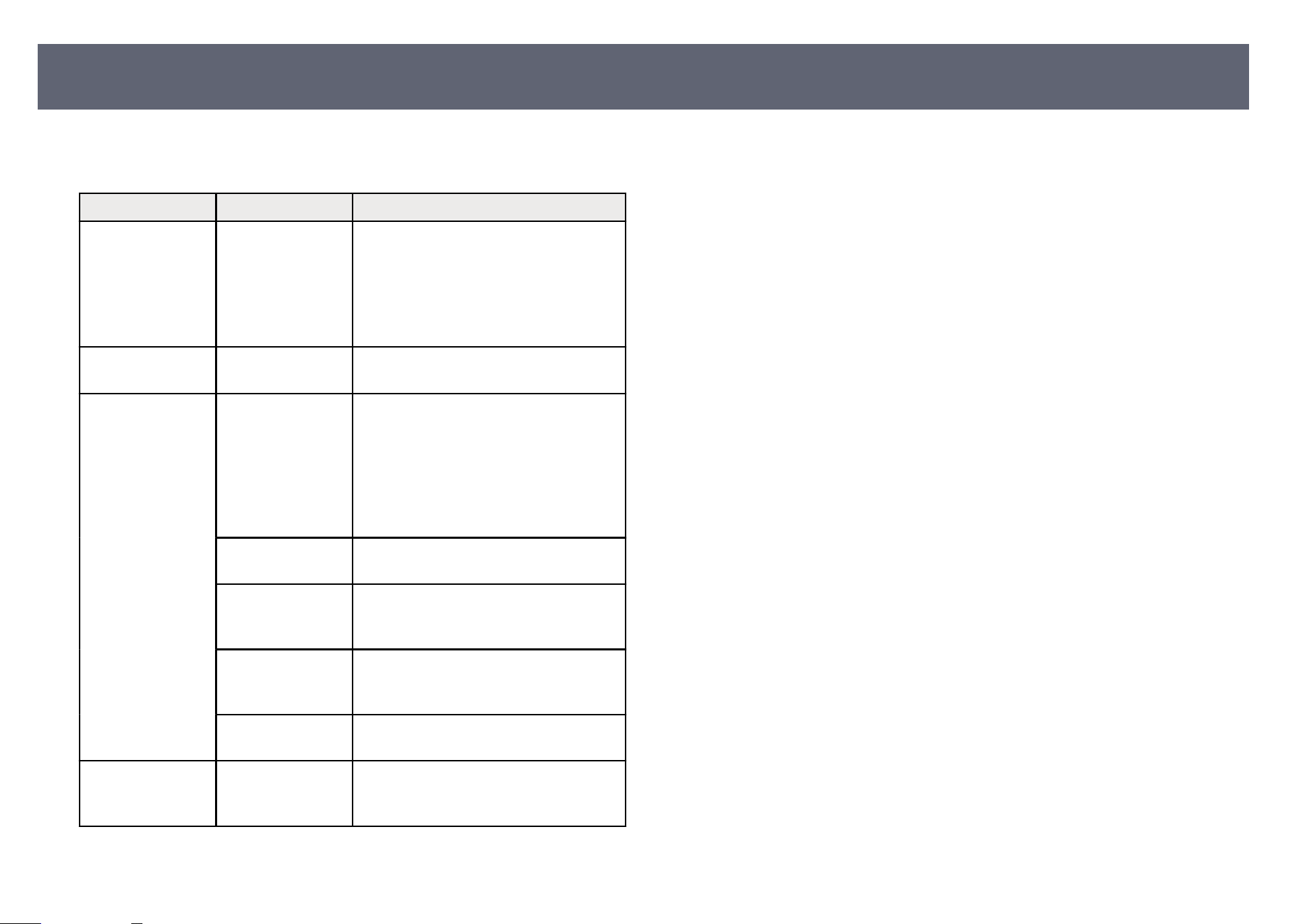
Settings on the Pro
jector menu provide correction methods to properly project
your image.
Setting Options Description
Keystone — Provides on-screen instructions for
corr
ecting distortion in the projected
image.
You can select the correction method by
using the Epson Setting Assist app or by
using the remote control.
Zoom & Shi — Resizes t
he projected image and adjusts
the image position.
Advanced Settings Smart Eye
Pro
tection
Select On to enable the Smart Eye
Protection function.
When the projector's sensor detects
obstacles that are interfering with the
projection area, the brightness of the
light source is automatically reduced to
minimize glare.
Projection Selects the way the projector faces the
scre
en so the image is oriented correctly.
Indicators Set to O to turn o the indicator lights
on t
he projector except when an error or
warning occurs.
High Altitude
Mode
S
et to On to regulate the projector’s
operating temperature at altitudes above
4,921 feet (1,500 m).
Panel Alignment Corrects color misalignment in the
pro
jected image.
Bluetooth Speaker
Mode
— O
pens the Bluetooth device connection
screen to switch to Bluetooth Speaker
Mode.
g
Related Links
•
"Co
rrecting Distortion in the Image" p.34
•
"Adjusting the Size and Position of the Image" p.38
•
"Using the Projector as a Bluetooth
®
Speaker" p.48
•
"Adjusting the Color Convergence (Panel Alignment)" p.71
Projector Feature Settings - Projector Menu
58
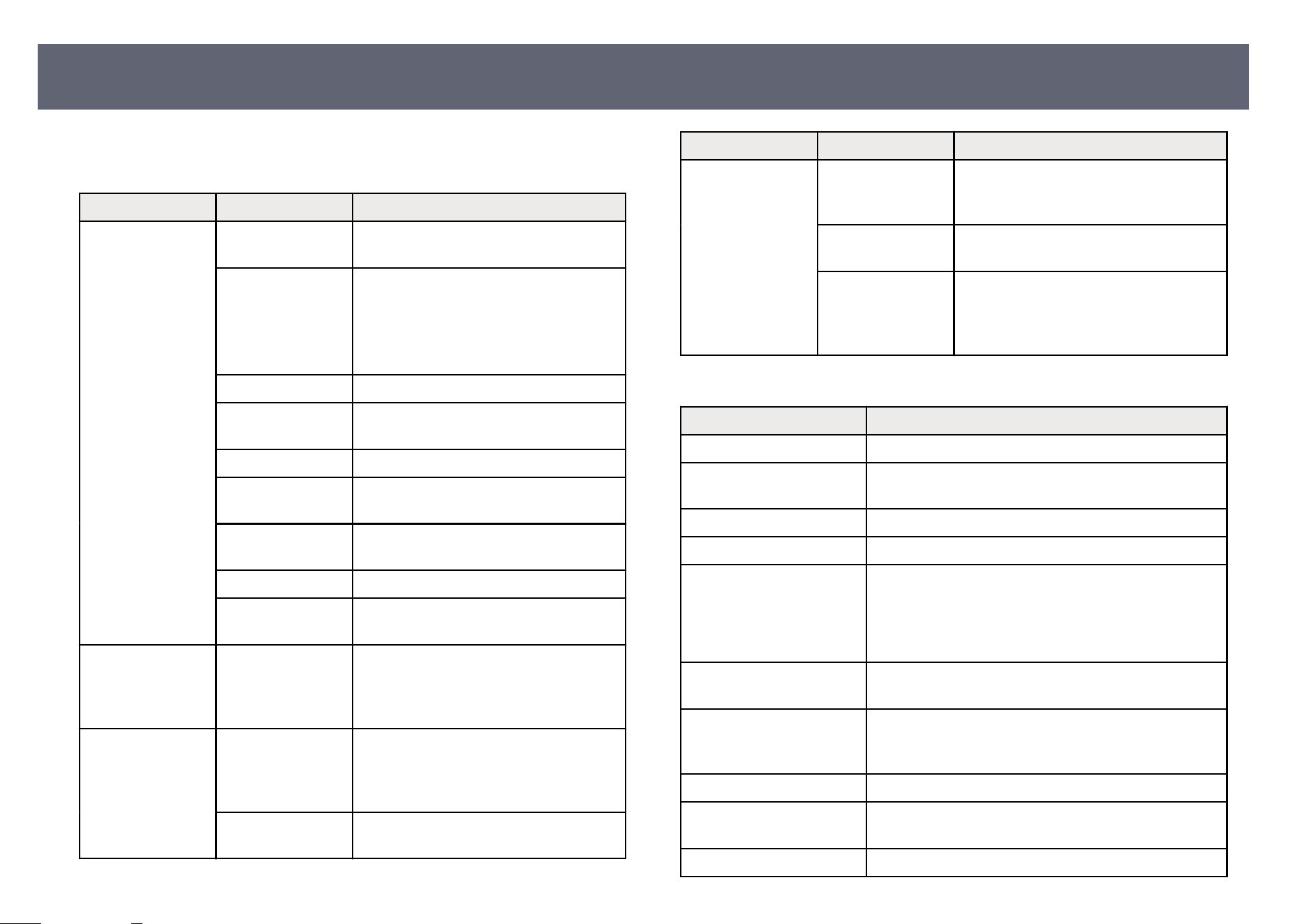
Settings on the Displ
ay & Sound menu let you adjust the quality of your image
and optimize the sound for the input source you are currently using.
Setting Options Description
Display Picture Mode Select your favorite color mode from the
list.
L
ight Output Adjusts the brightness of the light source.
You c
annot adjust the brightness if
the brightness of the light source dims
because the surrounding temperature is
too high or for other factors.
Brightness Lightens or darkens the overall image.
Contrast Adjusts the dierence
between light and
dark areas of the image.
Saturation Adjusts the overall vividness of the color.
Tint Adjusts the balance of green to magenta
ton
es in the image.
Sharpness Adjusts the sharpness or son
ess of the
image.
Advanced Settings See the table below for details.
Reset to Default Resets all adjustment values on the
Displ
ay menu to their default settings.
Screen See the list of
availab
le aspect
ratios.
Sets the aspect ratio (width-to-height
ratio) for the input source. (is setting
is available only when the current input
source is HDMI.)
Sound Sound Mode Select your favorite mode for sound
out
put from the projector's speaker
system according to the playback
contents.
Reset to Default Resets all adjustment values on the Sound
m
enu to their default settings.
Setting Options Description
Audio Output Digital Output Selects the sound output format when
you o
utput audio to an external audio
device.
Digital Output
Del
ay
Adjusts the audio latency. If the audio is
fast, select a higher value.
Audio Output
Dev
ice
Select SPDIF to output audio only from
an audio/video system connected to the
projector's Optical Out port. No audio is
output from the projector's speakers.
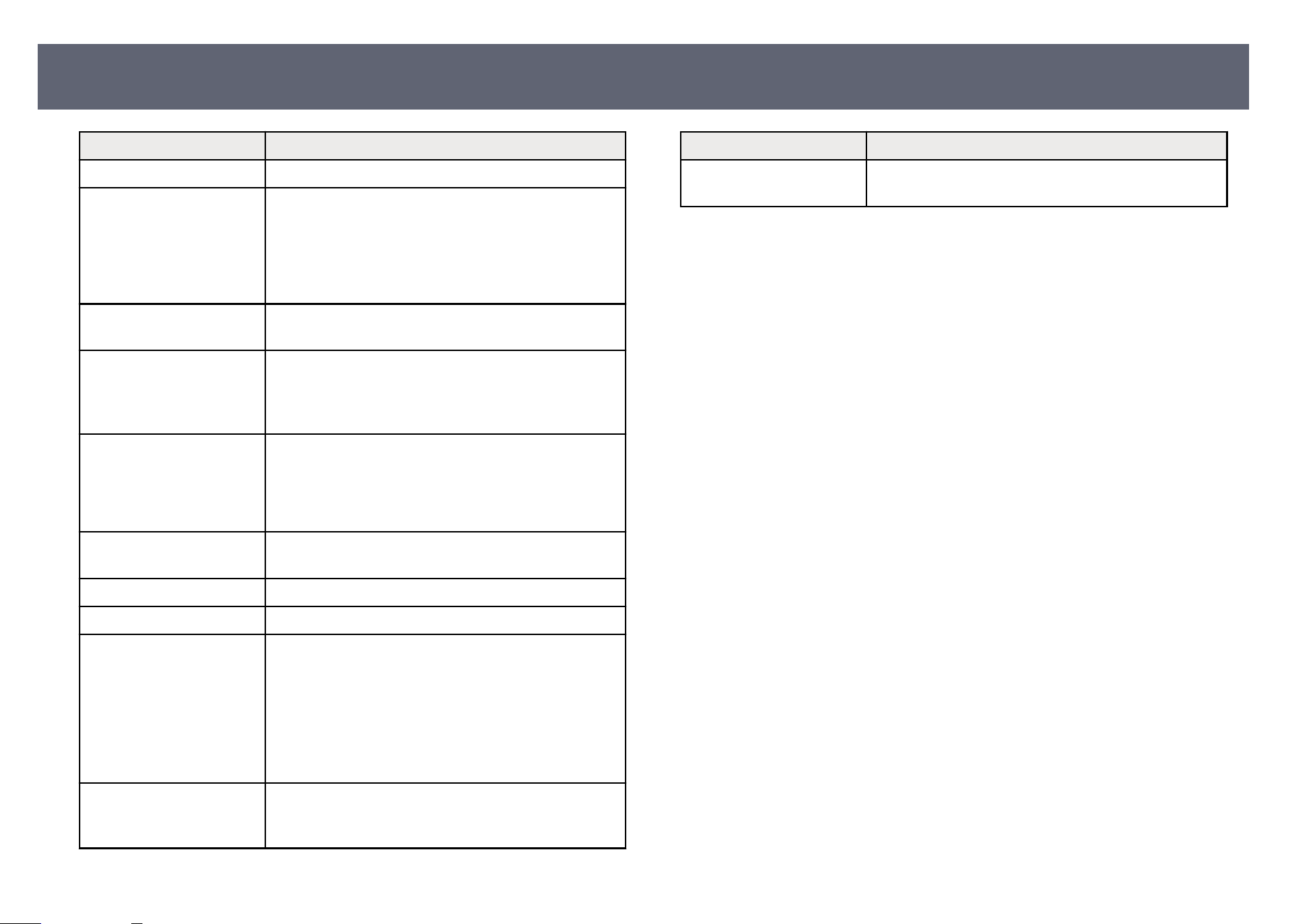
Advanced Settings
Setting Description
Picture o Tur
ns o the projected image.
Color Temperature Sets the color temperature according to the color mode
you s
elected.
DNR Reduces ickering in images.
MPEG NR R
educes the noise or artifacts seen in MPEG video.
Projection Preferences Selects whether to prioritize brightness or color tone
when p
rojecting an image.
•
Fine: Prioritizes color tone.
•
Bright: Prioritizes brightness.
Dynamic Contrast Adjusts the projected luminance based on the image
brig
htness.
Scene Adaptive Gamma Adjusts the coloring according to the scene, and obtains
a mor
e vivid image. Higher values enhance the more
the contrast.
Local Contrast Control Enhances the contrast of the projected image.
Dynamic Color Booster Automatically adjusts saturation according to the scene
and mak
es the projected image colorful.
Flesh Tone Lightens the skin tone of the image.
Image Quality Settings - Display & Sound Menu
59
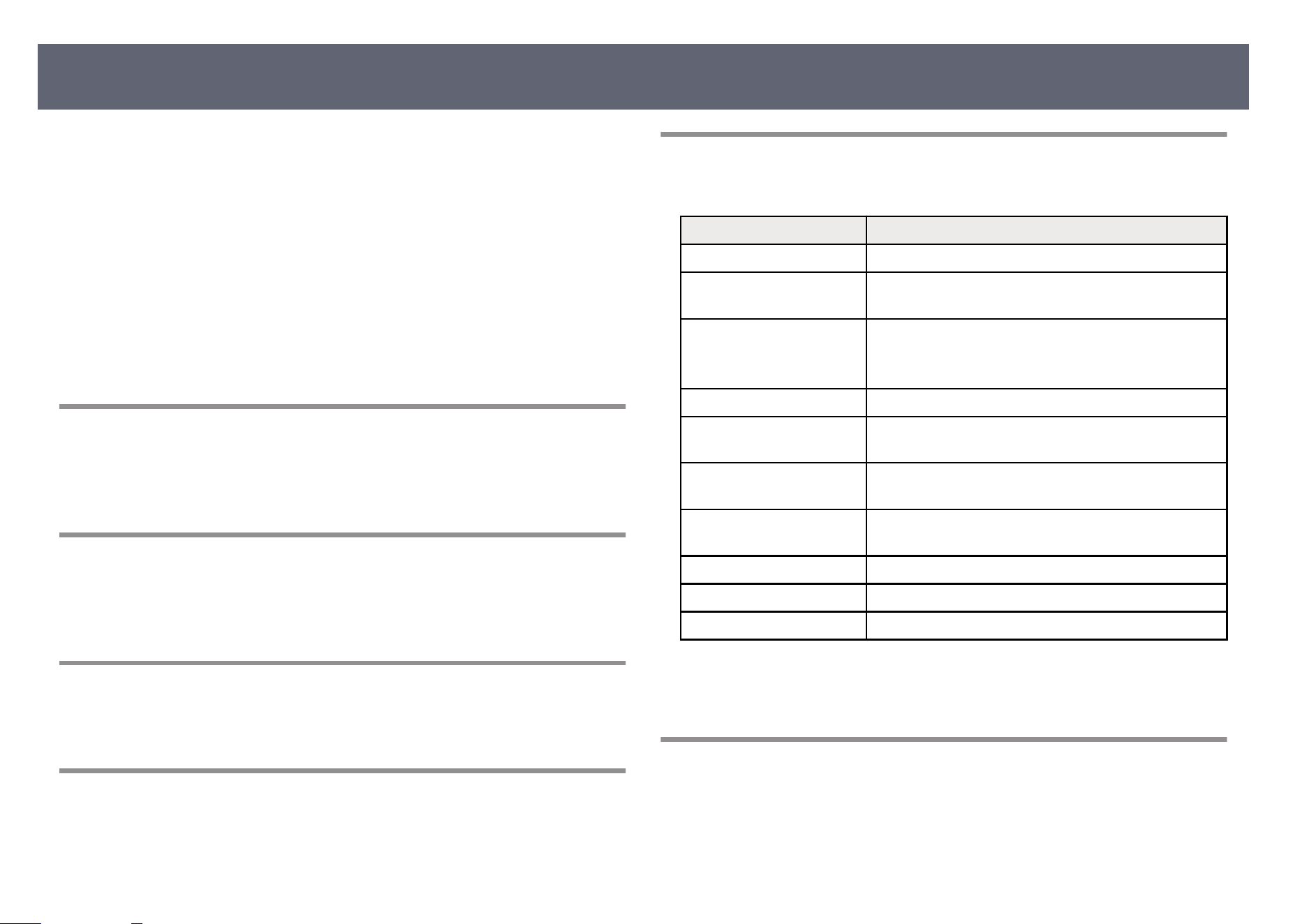
Setting Description
Gamma Selects the gamma to adjust the coloring.
Game Mode Improves the response speed for images projected at
high speed, such as games. is setting is displayed only
when:
•
ALLM is set to O.
•
Frame Interpolation is set to O.
ALLM Automatically adjusts the response speed according to
your p
rojected content.
PC Mode Select On to project the image while preserving the
colo
r information of the input image signal. is setting
is available only when the current input source is
HDMI.
Frame Interpolation Adjusts the smoothness of image movement. is
set
ting is displayed only when:
•
Game Mode is set to O.
•
PC Mode is set to O.
AISR Highlights the sharpness of the image by using image
analysi
s with AI technology.
De-contour Reduces banding noise in the image.
Low Blue Light Reduces blue light in the projected image.
Color Tuner Set Enable to On to enable the Color Tuner settings.
Ad
justs the individual R (red), G (green), B (blue),
C (cyan), M (magenta), Y (yellow), and Flesh Tone
components of the Hue, Saturation, and Brightness
settings.
Adjusts the individual R (red), G (green), and B (blue)
components of the oset and gain.
AIPQ Analyzes the image for each scene and applies suitable
image co
rrection based on the picture database in the
projector's chip.
Setting Description
HDMI RGB Range Sets the video range to match the setting of the device
conne
cted to the HDMI port.
g
Related Links
•
"Adjusting Image Quality (Color Mode)" p.41
•
"Adjusting Image Quality in Detail" p.42
•
"Adjusting the Light Source Brightness" p.44
•
"Image Aspect Ratio" p.40
•
"Changing the Sound Mode" p.46
Image Quality Settings - Display & Sound Menu
60
Options on other menus let you customize various projector's OS features.
g
Related Links
•
"Net
work & Internet Menu" p.61
•
"Accounts & Proles Menu" p.61
•
"Privacy Menu" p.61
•
"Apps Menu" p.61
•
"System Menu" p.61
•
"Accessibility Menu" p.61
•
"Remotes & Accessories Menu" p.62
•
"Help & Feedback Menu" p.62
Network & Internet Menu
Settings on the Network & Internet menu let you view network information
and set up the projector for controlling over a network.
Accounts & Proles Menu
Settings on the Accoun
ts & Proles menu let you add new Google Accounts
used to log in to the projector, and make detailed settings for these accounts.
Privacy Menu
Settings on the Privacy
menu let you change your privacy and security settings.
Apps Menu
e A
pps menu displays your most recently used apps or all the apps that are
in
s
talled on the projector.
System Menu
Settings on the Sys
tem menu let you customize various projector features.
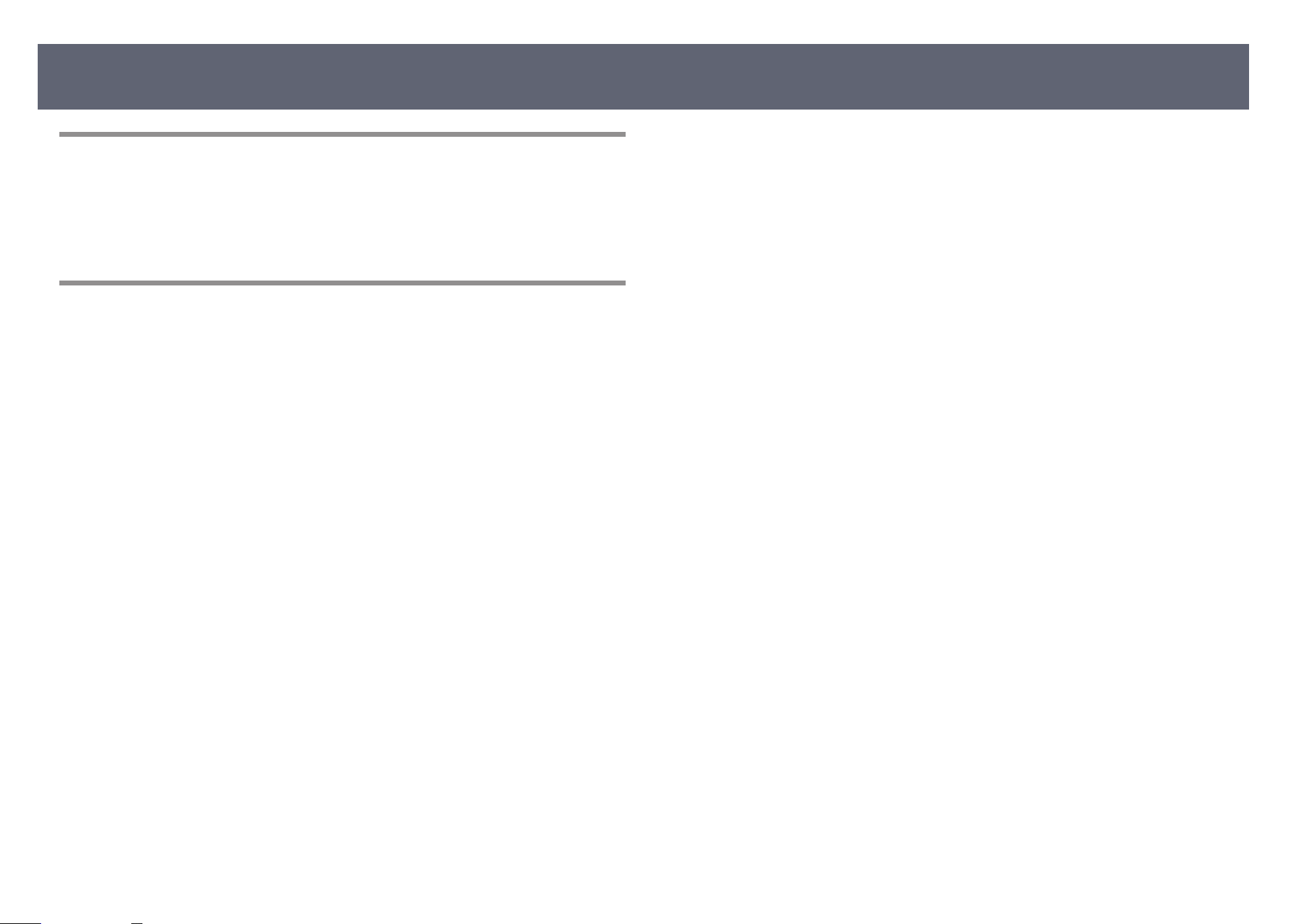
Setting Description
Ambient Screensaver Allows you to make settings for the screen saver.
Power & Energy Allows you to make settings for power and energy
s
av
in
g.
About Displays the projector's preferences and status.
You c
an return all the projector settings to their factory
default values from this menu.
Date & Time Adjusts the projector's system time and date settings.
Language Select the language used for the projector menus and
mess
ages.
Keyboard Allows you to make detailed settings for the virtual
key
board installed in the projector's menu.
Storage Allows you to display the usage status of the internal
sto
rage and clean the cache.
Cast Turns on/o the cast function.
Sys
tem sounds Turns on/o the system sounds.
Res
tart Restarts the projector.
g
Related Links
•
"Ini
tializing the Projector" p.54
Accessibility Menu
Settings on the Access
ibility menu let you congure accessibility options, such
as subtitles and text reading.
Other Menus
61
Remotes & Accessories Menu
Settings on the Remo
tes & Accessories menu let you pair the remote control
and the projector, or let you connect/disconnect your Bluetooth devices to the
projector.
Help & Feedback Menu
e Help & Feedback menu provides a link to the projector's OS help page, or
lets yo
u send feedback or comments about the product.
Other Menus
62

Maintaining the Projector
Fol
low the instructions in these sections to maintain your projector.
g
Related Links
•
"Projector Maintenance" p.64
•
"Cleaning the Projection Window" p.65
•
"Cleaning the Motion Sensor" p.66
•
"Cleaning the Projector Case" p.67
•
"Air Filter and Air Intake Vent Maintenance" p.68
•
"Adjusting the Color Convergence (Panel Alignment)" p.71
You may need to clean the projection window and motion sensor periodically,
and cle
an the air lter and air vents to prevent the projector from overheating
due to blocked ventilation.
e only parts you should replace are the air lter and remote control batteries.
If any other part needs replacing, contact Epson or an authorized Epson
servicer.
Warning
Befo
re cleaning any part of the projector, turn it o and unplug the power cord.
Never open any cover on the projector, except as specically explained in this
manual. Dangerous electrical voltages in the projector can injure you severely.
Projector Maintenance
64
Clean the projection window periodically, or whenever you notice dust or
smudges o
n the surface.
•
To remove dust or smudges, gently wipe the projection window with clean
and dry lens-cleaning paper.
•
If the projection window is dusty, blow o dust using a blower, and then wipe
the projection window.
Warning
•
Befo
re cleaning the projection window, turn o the projector and unplug the
power cord.
•
Do not use any ammable gas sprays such as air dusters to blow o dust. e
high heat generated by the projector may cause a re.
Attention
•
Do no
t wipe the projection window right aer you turn o the projector. Doing
so could damage the projection window.
•
Do not use any harsh materials to clean the projection window and do not
subject the projection window to any impacts; otherwise, it could be damaged.
Cleaning the Projection Window
65
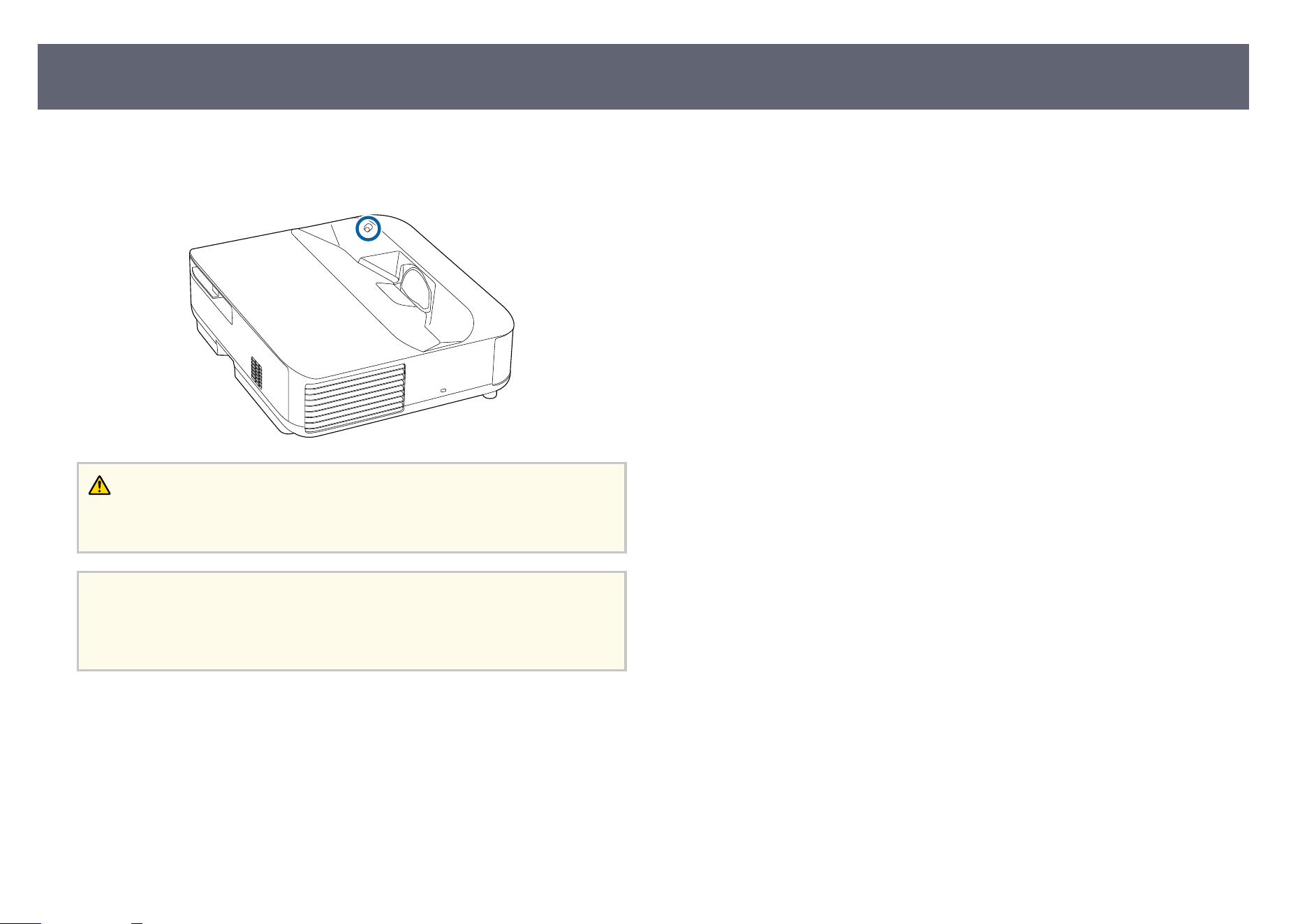
Clean the projector's motion sensor periodically, or if you see a message telling
you t
o remove any obstacles that are interfering with the projection area. To
remove dust or smudges, gently wipe the sensors with lens-cleaning paper.
Warning
Do no
t use a lens cleaner that contains ammable gas to clean the motion sensor.
e high heat generated by the projector may cause a re.
Attention
Do not use glass cleaner or any harsh materials to clean the sensors and do not
subject the sensors to any impacts. Damage to the surface of the sensors may cause
malfunctions.
Cleaning the Motion Sensor
66
Before cleaning the projector case, turn o t
he projector and unplug the power
cord.
•
To remove dust or dirt, use a so, dry, lint-free cloth.
•
To remove stubborn dirt, use a so cloth moistened with water and mild
soap. Do not spray liquid directly on the projector.
Attention
Do no
t use wax, alcohol, benzene, paint thinner, or other chemicals to clean the
projector case. ese can damage the case. Do not use canned air, or the gases
may leave a ammable residue.
Cleaning the Projector Case
67
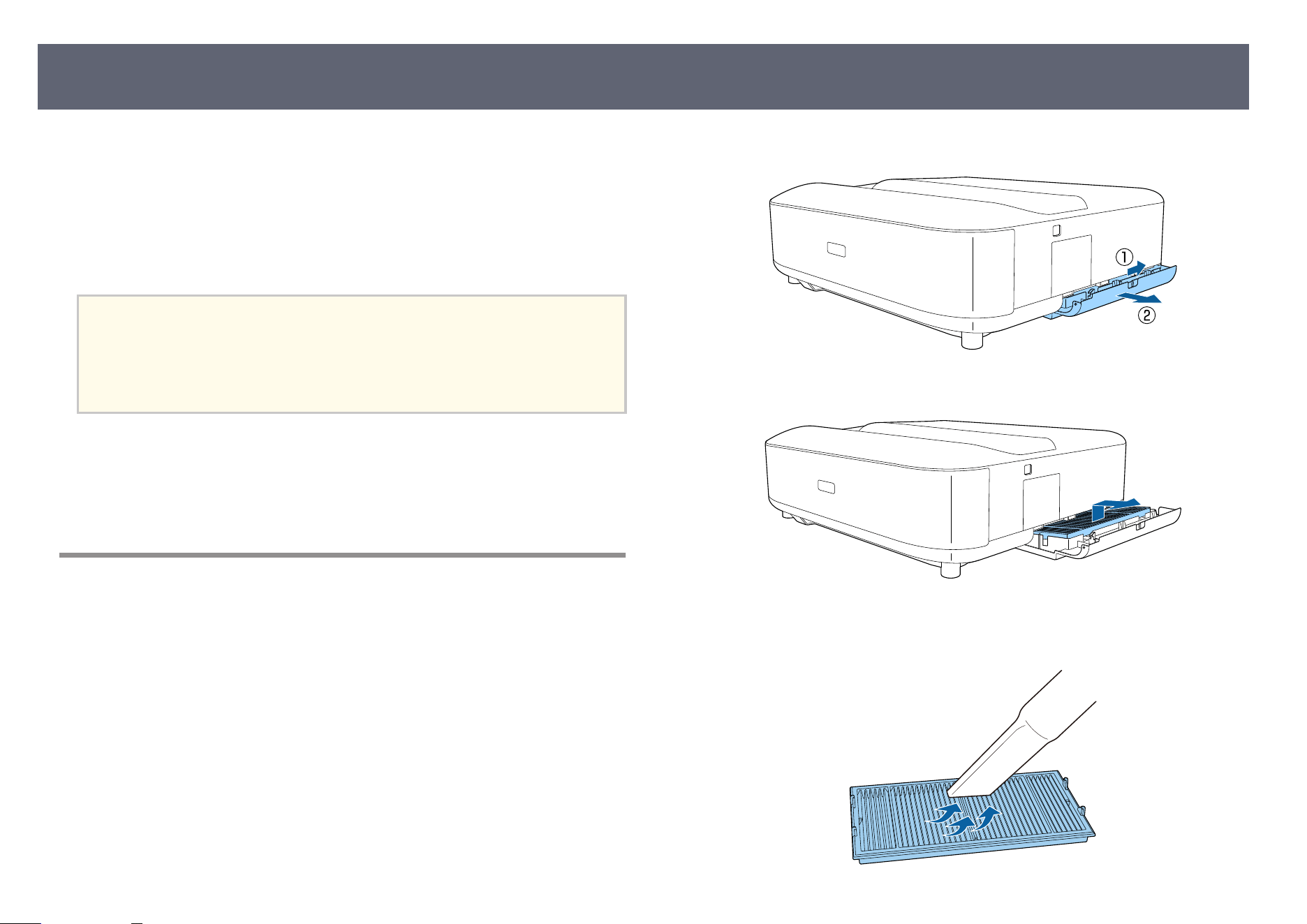
Regular lter maintenance is important to maintain your projector. Clean
th
e air lter when a message appears telling you the temperature inside the
projector has reached a high level. It is recommended that you clean these parts
about once every year. Clean them more oen than this if you use the projector
in an environment that is dustier than expected. (Assuming the projector is used
in an atmosphere in which airborne particulate matter is less than 0.04 to 0.2
mg/m3.)
Attention
If regu
lar maintenance is not performed, your Epson projector will notify you when
the temperature inside the projector has reached a high level. Do not wait until this
warning appears to maintain your projector lter as prolonged exposure to high
temperatures may reduce the life of your projector.
g
Related Links
•
"Cleaning the Air Filter " p.68
•
"Replacing the Air Filter" p.69
•
"Cleaning the Air Intake Vents " p.70
Cleaning the Air Filter
You need to clean the projector's air lter
s in the following situations:
•
e lter or vents get dusty.
a
Turn o the projector and unplug the power cord.
b
Slide t
he air lter
cover latch and pull out the air lter cover.
c
Pull the air l
ter
out of the air lter cover.
d
Vacuum the front of the air lter (the side with the tabs) to remove any
remaining dust.
Air Filter and Air Intake Vent Maintenance
68
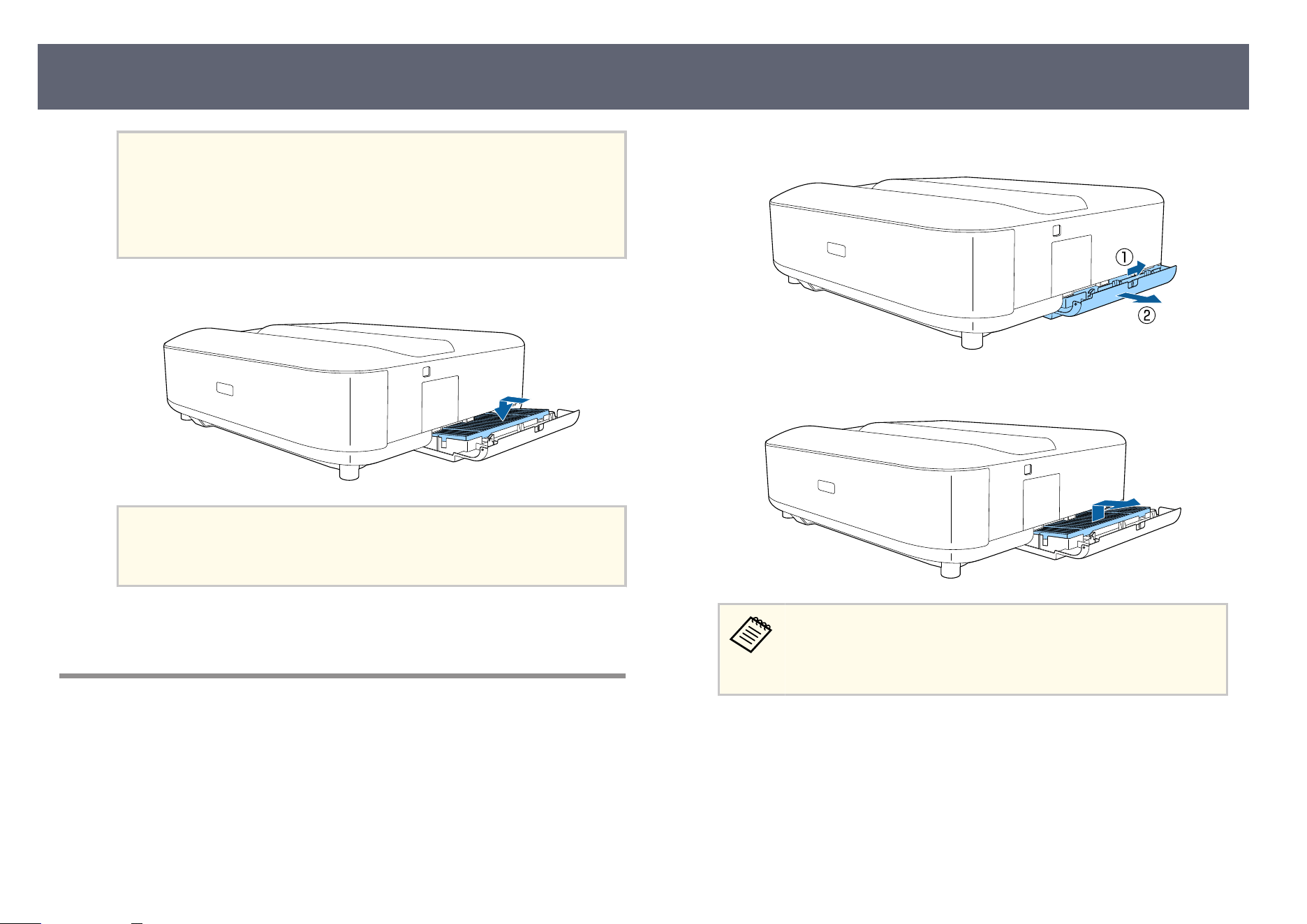
Attention
•
Do no
t rinse the air lter in water, or use any detergent or solvent to clean
it.
•
Do not use canned air. e gases may leave a ammable residue or push
dust and debris into the projector's optics or other sensitive areas.
e
Place the air lter
with the four tabs facing down as shown.
Attention
Do no
t force the air lter cover to close with the tabs on the air lter facing up.
Doing so could damage the projector.
f
Close the air lter
cover until it clicks into place.
Replacing the Air Filter
You need to replace the air lter
in the following situations:
•
e air lter is torn or damaged.
a
Turn o the projector and unplug the power cord.
b
Slide t
he air lter cover latch and open the air lter cover.
c
Pull the air l
ter
out of the projector.
Dispose of used air lter
s according to local regulations.
•
Filter frame: Polypropylene
•
Filter: Polypropylene, PET
Air Filter and Air Intake Vent Maintenance
69
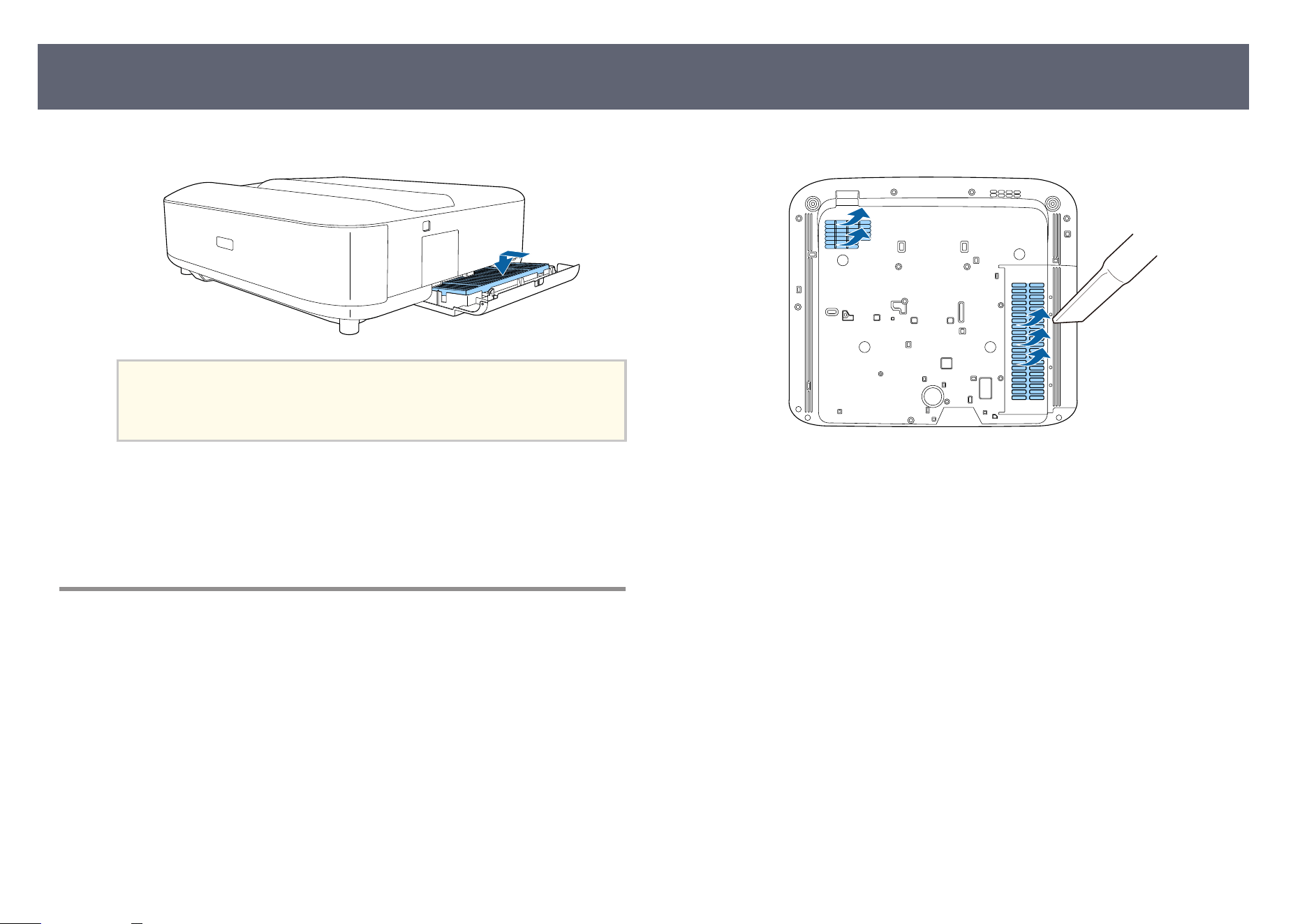
d
Place the new air lter
with the four tabs facing down as shown.
Attention
Do no
t force the air lter cover to close with the tabs on the air lter facing up.
Doing so could damage the projector.
e
Close the air lter
cover until it clicks into place.
g
Related Links
•
"Replacement Parts" p.88
Cleaning the Air Intake Vents
Clean the projector's air intake vents periodically, or whenever you notice dust
on th
e surface of the vents to prevent the projector from overheating due to
blocked ventilation.
a
Turn o the projector and unplug the power cord.
b
Tur
n the projector upside down.
c
Carefully remove the dust using a vacuum cleaner or a brush.
Air Filter and Air Intake Vent Maintenance
70
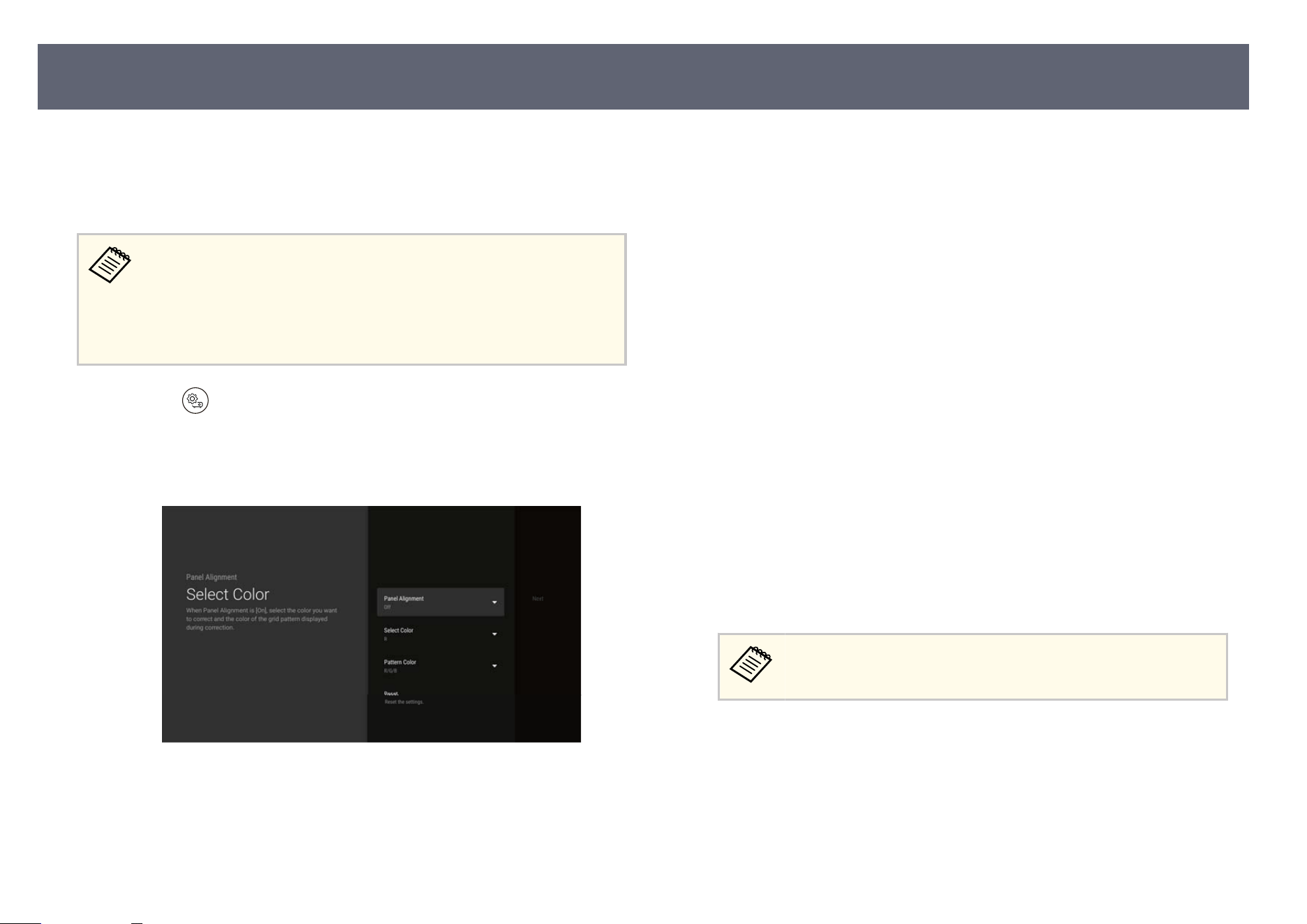
You can use the Panel Alignment feature to manually adjust the color
conv
ergence (the alignment of the red and blue colors) in the projected image.
You can adjust the pixels horizontally and vertically in increments of 0.125
pixels within a range of ± 3 pixels.
•
You c
an adjust only the red or blue color convergence. Green is the
standard color panel and cannot be adjusted.
•
Image quality may decline aer performing Panel Alignment.
•
Images for pixels that extend beyond the edge of the projected screen
are not displayed.
a
Press the button on the remote control to open the Pro
jector menu.
b
Select the menus in the following order:
s Advanced S
ettings > Panel Alignment
c
Select Panel Alignment and set it to On.
d
Se
lect S
elect Color and choose one of the following:
•
R
t
o adjust the red color convergence.
•
B to adj
ust the blue color convergence.
e
Select Pattern Color and choose the grid color displayed when making
adj
ustments. e available color varies depending on the Select Color
setting.
•
R/G/B to display the grid color in white.
•
R/G to display the grid color in yellow. R/G is only displayed when
Select Color is set to R.
•
G/B to display the grid color in cyan. G/B is only displayed when Select
Color is set to B.
f
Select Next.
g
Se
lect one of the following options on the Sel
ect Method screen:
•
Select Whole Panel to adjust the entire panel at the same time and go to
the next step.
•
Select Four Corners to adjust the corners of the panel one at a time and
go to step 11.
h
Use the arrow buttons on the remote control to adjust the color alignment
sele
cted in Select Color, and then press [Enter].
Adjustment aects
the grid lines in the entire screen.
i
Select one of the following options:
•
S
ele
ct Adjust the four corners to ne-tune your adjustments.
•
Select Exit to nish adjustments.
j
Use the arrow buttons on the remote control to adjust the color alignment
of th
e screen corner, and then press [Enter].
Adjusting the Color Convergence (Panel Alignment)
71

k
When you are nish
ed adjusting each corner of the screen, press [Enter].
l
Select one of the following options:
•
If yo
ur projector needs additional panel alignment, select Fine
Adjustment. Use the arrow buttons on the remote control to highlight
the corner of any misaligned box on the screen, press [Enter], make any
necessary adjustments, and then press [Enter] again. Repeat this step as
necessary for the other intersections.
•
Select Exit to nish adjustments.
Adjusting the Color Convergence (Panel Alignment)
72

Solving Problems
Che
ck the solutions in these sections if you have any problems using the projector.
g
Related Links
•
"Projection Problems" p.74
•
"Projector Indicator Status " p.75
•
"Solving Projector Power-On or Power-O Problems" p.77
•
"Solving Image Problems" p.78
•
"Solving Sound Problems" p.81
•
"Solving Remote Control Operation Problems" p.83
•
"Solving HDMI CEC Problems" p.84
•
"Solving Wi-Fi Network Problems" p.85
•
"Solving Projector's OS Problems" p.86
If the projector is not working properly, turn it o, un
plug it, and then plug it
back in and turn it on.
If this does not solve the problem, check the following:
•
e indicators on the projector may indicate the problem.
•
e solutions in this manual can help you solve many problems.
If none of these solutions help, contact Epson for technical support.
Aer repairing the projector, Epson may return the projector to you in
its ini
tial status. Make sure you make a note of the account information
of each online service before you contact your local dealer or the nearest
Epson repair center.
Projection Problems
74
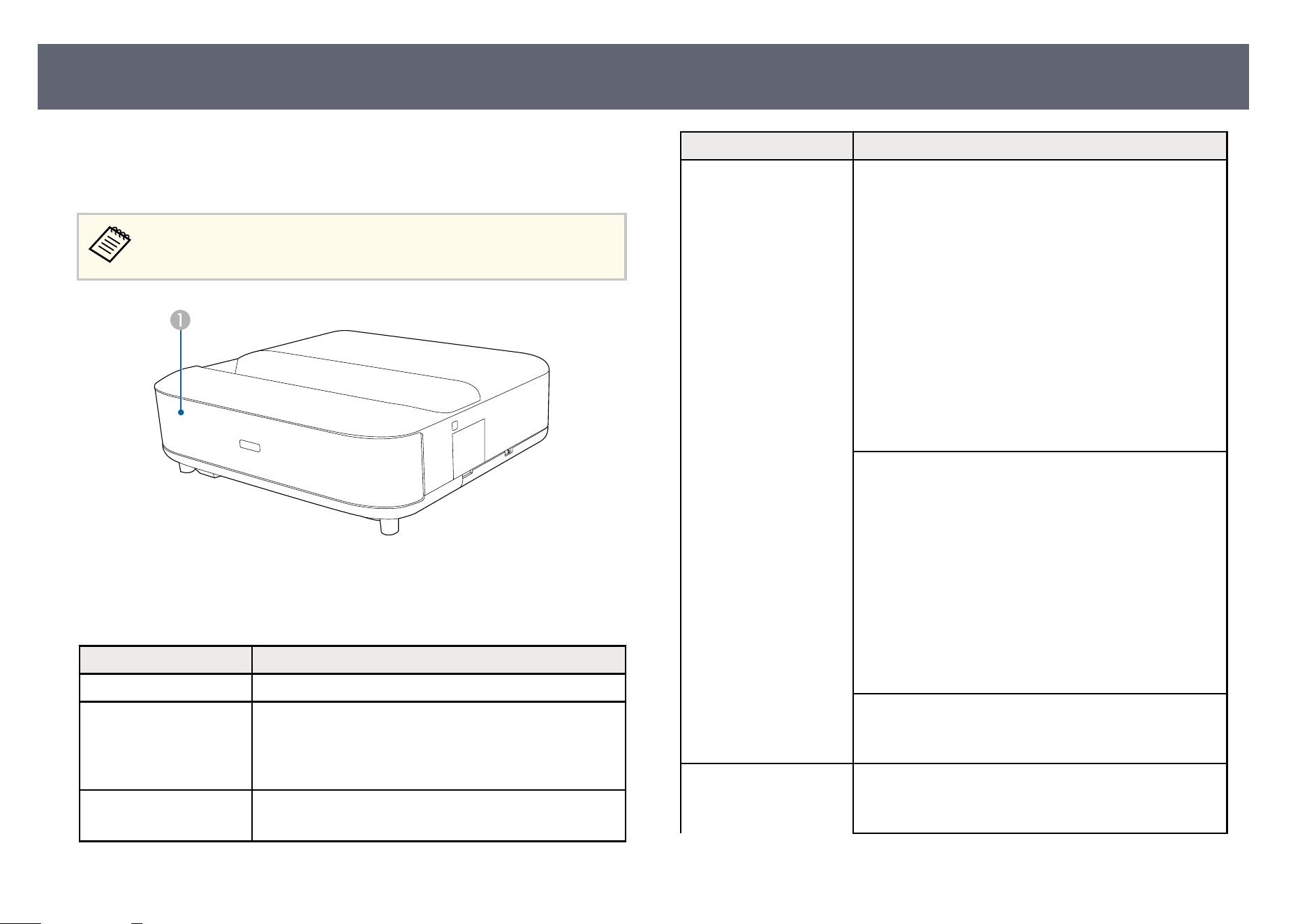
e indicators on the projector indicate the projector status and let you know
wh
en a problem occurs. Check the status and color of the indicators and then
refer to this table for a solution.
If the indicators display a pattern not listed in the table below, turn the
pro
jector o, unplug it, and contact Epson for help.
A
Status indicator
Projector status
Indicator status Problem and solutions
Lit white Normal operation.
Flashing white Entering standby mode or updating the projector
rmwar
e.
Remote control operations may be disabled when the
indicator is ashing white.
O Standby mode.
When y
ou press the power button, projection starts.
Indicator status Problem and solutions
Lit orange e projector has overheated and turned o. Leave it
tur
ned o to cool down for 5 minutes.
•
Make sure that the vents and air lter are not clogged
with dust or obstructed by nearby objects.
•
Make sure the environmental temperature is not too
hot.
•
Clean or replace the air lter.
•
If operating the projector at high altitude, set the High
Altitude Mode setting to On in the projector's menu.
s Projector > Advanced Settings > High Altitude
Mode
•
If the problem persists, unplug the projector and
contact Epson for help.
Movement detection warning.
A beep s
ounds, and the following message is displayed.
Playback has been stopped for safety reasons. Move
away from the lens or remove any obstacles around the
lens.
e brightness of the light source is reduced.
•
Make sure that there are no one looking into the
projection window. Move away from the projection
window.
•
Clean the motion sensor if there is no one near the
projection window.
Laser warning.
Turn t
he projector o, unplug it, and contact Epson for
help.
Flashing orange Laser has a problem.
Turn t
he projector o, unplug it, and contact Epson for
help.
Projector Indicator Status
75
Indicator status Problem and solutions
A fan or sensor has a problem.
Turn t
he projector o, unplug it, and contact Epson for
help.
Internal projector error.
Turn t
he projector o, unplug it, and contact Epson for
help.
g
Related Links
•
"Pr
ojector Feature Settings - Projector Menu" p.58
•
"Cleaning the Air Filter " p.68
•
"Replacing the Air Filter" p.69
•
"Cleaning the Air Intake Vents " p.70
Projector Indicator Status
76
Check the solutions in these sections if the projector does not turn on when you
pres
s the power button or it turns o unexpectedly.
g
Related Links
•
"Solving Projector Power Problems" p.77
•
"Solving Projector Shutdown Problems" p.77
Solving Projector Power Problems
If the projector does not turn on when you press the power button, try the
following steps until the problem is solved.
a
Make sure the power cord is securely connected to the projector and to a
wor
king electrical outlet.
b
If you are using the remote control, check the batteries of the remote
cont
rol.
c
e power cord may be defective. Disconnect the cord and contact Epson
fo
r help.
g
Related Links
•
"Turning On the Projector" p.30
•
"Installing Batteries in the Remote Control" p.24
Solving Projector Shutdown Problems
If the projector's light source turns o
un
expectedly, try the following steps until
the problem is solved.
a
e p
rojector may have turned o aer the interval of time specied in
Sh
ut-O Timer in the projector's Power & Energy menu has passed. Press
the power button on the projector or remote control to turn the projector
back on.
s System > Power & Energy > Shut-O Timer
b
Aer switching to HDMI source, if there is no input signal for more
th
an the time specied in No signal standby timeout, the projector
automatically enters standby mode. Press the power button to wake the
projector from standby mode.
s Channels & Inputs > Inputs > HDMI 1/HDMI 2/HDMI 3 > No signal
standby timeout
c
When the status indicator is lit orange, the projector has overheated and
turn
ed o.
e cooling fans may run in standby status depending on the
pr
ojector settings. Also, when the projector wakes from standby
status, the fans may cause an unexpected noise. is is not a
malfunction.
d
Make sure that there are no obstacles interfering with the projection
w
indo
w. Remove any obstacles.
g
Related Links
•
"Projector Feature Settings - Channels & Inputs Menu" p.57
•
"System Menu" p.61
Solving Projector Power-On or Pow
er-O Problems
77

Check the solutions in these sections if you have any problems with projected
images.
g
Relat
ed Links
•
"Solving Missing Image Problems" p.78
•
"Adjusting an Image that is not Rectangular" p.79
•
"Adjusting a Fuzzy or Blurry Image" p.79
•
"Fixing Partial Image Problems" p.79
•
"Adjusting an Image that Contains Noise or Static" p.80
•
"Adjusting an Image with Incorrect Brightness or Colors" p.80
Solving Missing Image Problems
If no image is displayed, try the following steps until the problem is solved.
a
Check the projector's status:
•
Che
ck the status indicator to conrm that the projector is in normal
operating status.
•
Press the projector's power button to wake it from standby mode.
•
Aer switching to an HDMI source, if there is no input signal for more
than the time specied in No signal standby timeout, the projector
automatically enters standby mode. Press the power button to wake the
projector from standby mode.
s Channels & Inputs > Inputs > HDMI 1/HDMI 2/HDMI 3 > No
signal standby timeout
b
Check the cable connection:
•
M
ak
e s
ure all necessary cables are securely connected and the power is
on for the projector.
•
Connect the video source directly to the projector.
•
Replace the HDMI cable with a shorter one.
We recommend using an HDMI cable that is 16.4 feet (5 m) or shorter.
If yo
u use an HDMI cable that is longer than 16.4 feet (5 m), the signal
may deteriorate and the video and audio may become unstable.
•
When sending 18 Gbps images such as 4K 60 Hz 4:4:4, use an HDMI
cable (premium-high speed).
c
Check the status of your video source:
•
Turn o
n the connected video source, and press the play button to start a
video, if necessary.
•
Make sure the connected device meets the HDMI CEC standard. See
the documentation supplied with the device for more information.
•
If you are projecting from a laptop computer, make sure it is set up to
display on an external monitor.
d
Check the following items:
•
You n
eed an Internet connection to view online content. Make sure
your Wi-Fi is on.
•
Turn o the projector and the connected video source, and then turn
them back on.
•
Set the CEC function for the connected device again and restart the
device.
•
Make sure the computer's display resolution does not exceed the
projector's resolution and frequency limits. If necessary, select a
dierent display resolution for your computer. (See your computer
manual for details.)
•
Reset all of the projector settings to their default values.
g
Related Links
•
"Projector Feature Settings - Channels & Inputs Menu" p.57
Solving Image Problems
78
Adjusting an Image that is not Rectangular
If the projected image is not evenly rectangular, try the following steps until the
pro
blem is solved.
a
Place the projector directly in front of the center of the screen, facing it
squ
arely, if possible.
b
Correct the distortion in the projected image using the projector's
Key
stone menu.
s Projector > Keystone
g
Related Links
•
"Correcting Distortion in the Image" p.34
Adjusting a Fuzzy or Blurry Image
If the projected image is fuzzy or blurry, try the following steps until the
pro
blem is solved.
a
Adjust the image focus using the focus lever.
b
Position the projector close enough to the screen.
c
Clean the projection window.
To avoid condensation on the lens aer brin
ging the projector
in from a cold environment, let the projector warm up to room
temperature before using it.
d
Adjust the Sharpness setting in the projector's Display & Sound menu to
imp
rove image quality.
s Display & Sound > Display > Sharpness
e
If you are projecting from a computer, use a lower resolution or select a
reso
lution that matches the projector's native resolution.
g
Related Links
•
"Focusing the Image Using the Focus Lever" p.33
•
"Image Quality Settings - Display & Sound Menu" p.59
•
"Cleaning the Projection Window" p.65
Fixing Partial Image Problems
If only a partial image is displayed, try the following steps until the problem is
sol
ved.
a
Adjust the position of the projected image using the Zoo
m & Shi setting
in the Projector menu.
s Projector > Zoom & Shi
b
Select an appropriate aspect ratio from the Scre
en menu according to the
current input source. (Available only when the current input source is
HDMI.)
s Display & Sound > Screen
c
Check your computer display settings to disable dual display and set the
reso
lution within the projector's limits. (See your computer manual for
details.)
g
Related Links
•
"Adjusting the Size and Position of the Image" p.38
•
"Changing the Image Aspect Ratio" p.40
Solving Image Problems
79

Adjusting an Image that Contains Noise or Static
If the projected image contains electronic interference (noise) or static, try the
fol
lowing steps until the problem is solved.
a
Check the cables connecting your video source to the projector. ey
sh
ould be:
•
Separated from the power cord to prevent interference
•
Securely connected at both ends
•
Not connected to an extension cable
b
Adjust the DNR s
etting in the projector's menu.
s Display & Sound > Display > Advanced Settings > DNR
c
If you adjusted the image shape using the projector controls, try
decre
asing the Sharpness setting in the projector's Display & Sound menu
to improve image quality.
s Display & Sound > Display > Sharpness
d
If you connected an extension power cable, try projecting without it to see
if it cau
sed interference in the signal.
e
Select a computer video resolution and refresh rate that are compatible
wit
h the projector.
f
If you connected an A/V system that does not support eARC/ARC to the
HDMI po
rt, the image may be distorted.
g
Related Links
•
"Image Quality Settings - Display & Sound Menu" p.59
Adjusting an Image with Incorrect Brightness or Colors
If the projected image is too dark or bright, or the colors are incorrect, try the
fol
lowing steps until the problem is solved.
a
Try dierent color modes for your image and environment by selecting
th
e color mode setting in the projector's Picture Mode menu.
s Display & Sound > Display > Picture Mode
b
Check your video source settings.
c
Adjust the color settings in the Dis
pl
ay menu.
s Display & Sound > Display
d
Make sure you selected the correct HDMI RGB R
ange setting in the
projector's Display & Sound menu, if available for your image source.
(Available only for the HDMI source.)
s Display & Sound > Display > Advanced Settings > HDMI RGB
Range
e
Make sure all the cables are securely connected to the projector and your
video e
quipment. If you connected long cables, try connecting shorter
cables.
f
Position the projector close enough to the screen.
g
Related Links
•
"Im
age Quality Settings - Display & Sound Menu" p.59
Solving Image Problems
80
Check the solutions in these sections if you have any problems with projected
soun
d.
g
Related Links
•
"Solving Missing or Low Audio Problems" p.81
•
"Solving Bluetooth Speaker Mode Problems" p.81
Solving Missing or Low Audio Problems
If there is no sound or the volume is too low, try the following steps until the
problem is solved.
a
Adjust the projector's volume settings using the up/down buttons on
the remote control.
b
Check the cable connection between the projector and your video source.
c
Check your video source to make sure the volume is turned up and the
audio o
ut
put is set for the correct source.
d
If you want to output audio from the projector's speakers, check that
Glob
al CEC control is set to O.
s Channels & Inputs > Inputs > Global CEC control
e
If you want to output audio to an external audio device that supports
HDMI eARC/AR
C using an HDMI cable, try the following solutions:
•
Set Global CEC control to On in the projector's menu when using an
ARC connection.
s Channels & Inputs > Inputs > Global CEC control
•
Make sure the HDMI cable is compliant with HDMI eARC and ARC.
•
When o
utputting audio to an external audio device that does
not support HDMI eARC/ARC using an HDMI cable, set Global
CEC control to O in the projector's menu.
s Channels & Inputs > Inputs > Global CEC control
•
See the online Notices guide for eARC/ARC audio supported
formats.
f
If audio is not output properly to an external audio device that supports
HD
MI eAR
C/AR
C, try changing Auto to PCM as the Digital Output
setting.
s Display & Sound > Audio Output > Digital Output
g
To output audio only from an external device connected to the projector's
Opt
ical Out port and not from the projector's speakers, set Audio Output
Device to SPDIF.
s Display & Sound > Audio Output > Audio Output Device
g
Related Links
•
"Projector Feature Settings - Channels & Inputs Menu" p.57
•
"Image Quality Settings - Display & Sound Menu" p.59
Solving Bluetooth Speaker Mode Problems
If you cannot connect a Bluetooth audio device to the projector, try the
fol
lowing solutions.
a
Select Bluetooth Speaker Mode in the Projector menu and press the
[Ent
er] button on the remote control.
Solving Sound Problems
81
b
Select the projector name (this projector) from the list of available
Bluet
ooth devices displayed on your device.
You can check and change the projector name from the projector's
Dev
ice name menu.
s System > About > Device name
c
Check your Bluetooth audio device to make sure the volume is turned up
an
d th
e audio output settings are correct.
d
Make sure only one Bluetooth device is connected to the projector.
You c
annot connect multiple Bluetooth audio devices to the projector at
the same time.
e
Make sure the device meets the projector's Bluetooth spe
cications.
f
Check the following items:
•
Che
ck for obstacles between the Bluetooth audio device and the
projector, and change their positions to improve communication.
•
Make sure the connected Bluetooth audio device is within the specied
communication distance.
•
Avoid using the projector near wireless networks, microwave ovens, 2.4
GHz cordless phones, or other devices that use the 2.4 GHz frequency
band. ese devices can interfere with the signal between the projector
and the Bluetooth audio device.
g
Related Links
•
"Using the Projector as a Bluetooth
®
Speaker" p.48
•
"Bluetooth Specications" p.93
Solving Sound Problems
82
If the projector does not respond to remote control commands or responds
slow
ly, try the following steps until the problem is solved.
If you lose the remote control, you can order another one. Contact Epson
for h
elp.
a
Check that the remote control batteries are installed correctly and have
power. If necessary, replace the batteries.
b
e buttons on the remote control may be stuck down and you may not be
able t
o operate them. Return the buttons to their normal positions.
c
If the pairing screen is displayed, perform pairing again by holding down
the
button and button on the remote control at the same time for
abou
t three seconds.
d
Perform pairing again by displaying the pairing screen manually from the
Remo
tes & Accessories menu.
e
If the image is projected from the projector, make sure you are operating
the r
emote control within the reception angle and range of the projector.
f
Strong uorescent lighting, direct sunlight, or infrared device signals may
be in
terfering with the projector's remote receivers. Dim the lights or
move the projector away from the sun or interfering equipment.
g
e remote control may be defective. Contact Epson for help.
g
Related Links
•
"R
emote Control Operation" p.24
•
"Installing Batteries in the Remote Control" p.24
Solving Remote Control Operation Problems
83

If you cannot operate the connected devices from the projector, try the
fol
lowing steps until the problem is solved.
a
Make sure the cable meets the HDMI CEC standard.
b
Make sure the connected device meets the HDMI CEC standard. See the
do
cum
entation supplied with the device for more information.
c
Set Global CEC control to On in the Channels & Inputs menu.
s Channe
ls & Inputs > Inputs > Global CEC control
d
Make sure all the cables are securely connected to the projector and your
video e
quipment.
e
Make sure the connected devices are turned on and in standby status. See
the do
cumentation supplied with the device for more information.
f
If you connect a new device or change the connection, set the CEC
func
tion for the connected device again and restart the device.
g
Related Links
•
"Operating Connected Devices Using the HDMI CEC Features" p.51
•
"Projector Feature Settings - Channels & Inputs Menu" p.57
Solving HDMI CEC Problems
84

If you cannot connect to a Wi-Fi network, try the following solutions.
a
Make sure your Wi-Fi router and modem are working properly. Rebooting
thes
e devices may solve the network connection problem.
b
Check for obstacles between the Wi-Fi router and the projector, and
chan
ge their positions to improve communication.
c
You can check the network settings from Wi-Fi
in the Network & Internet
menu.
d
If you initialize the projector, you need to select the network settings again
on th
e initial setup screen.
g
Related Links
•
"Initializing the Projector" p.54
Solving Wi-Fi Network Problems
85


Appendix
Che
ck these sections for the technical specications and important notices about your product.
g
Related Links
•
"Optional Accessories and Replacement Parts" p.88
•
"Screen Size and Projection Distance" p.89
•
"Supported Monitor Display Resolutions" p.91
•
"Projector Specications" p.92
•
"External Dimensions" p.94
•
"List of Safety Symbols and Instructions" p.95
•
"Laser Safety Information" p.97
•
"Glossary" p.99
•
"Notices" p.100

e following optional accessories and replacement parts are available. Please
pur
chase these products as and when needed.
e following list of optional accessories and replacement parts is current as of:
July 2025.
Details of accessories are subject to change without notice and availability may
vary depending on the country of purchase.
g
Related Links
•
"Screens" p.88
•
"Replacement Parts" p.88
Screens
Ultra Short Throw Screen ELPSC35 (100")
Ultra Short Throw Screen ELPSC36 (120")
Screens to be installed on a wall. (Aspect ratio 16:9)
Replacement Parts
Air lt
er ELPAF60
U
s
e as a replacement for used air lters.
g
Related Links
•
"Replacing the Air Filter" p.69
Optional Accessories and Replacement Parts
88
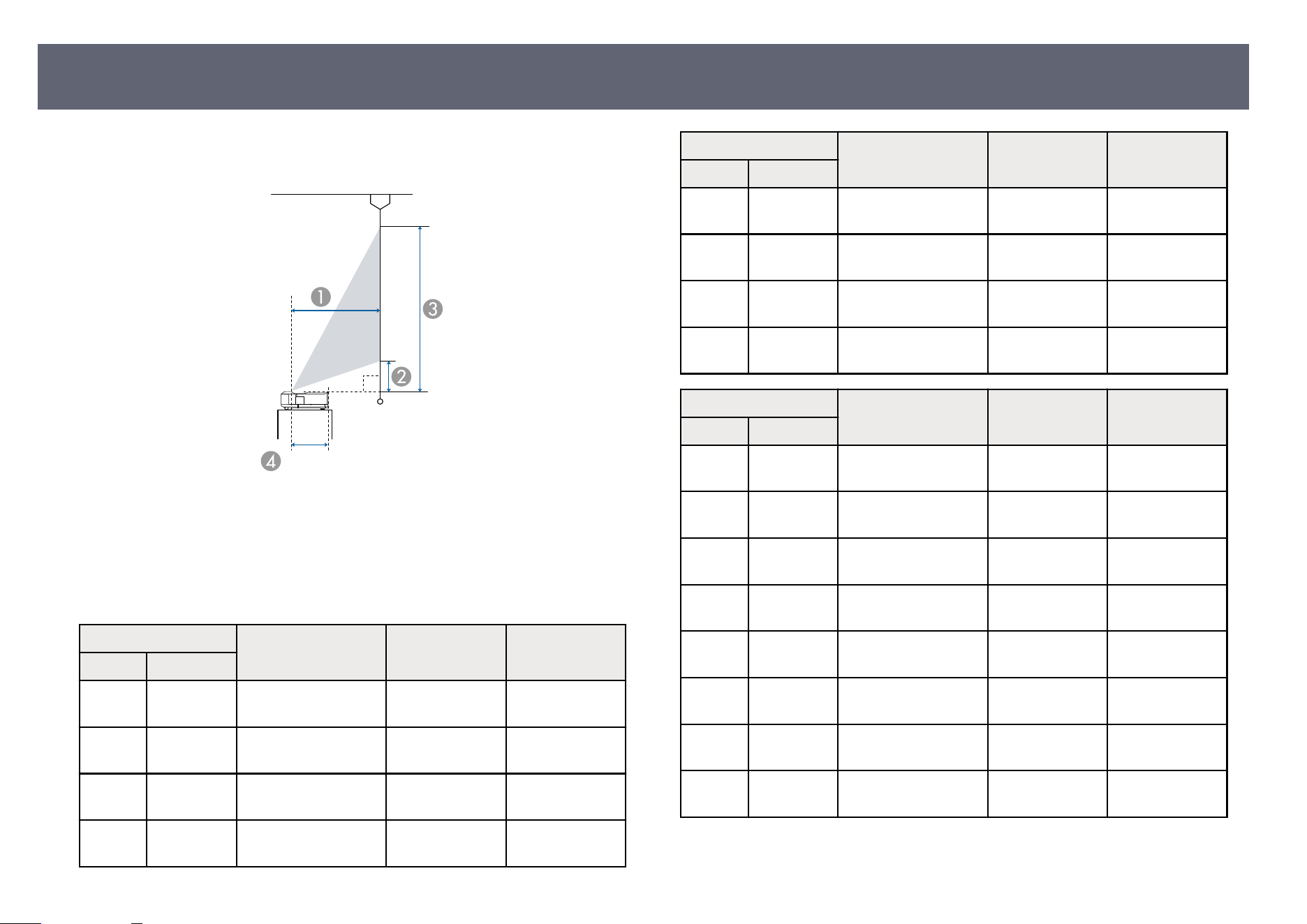
Check the table here to determine how far to place the projector from the screen
base
d on the size of the projected image.
30.83 cm
A
Projection distance
B
Distance from the projector to the bottom of the screen
C
Distance from the projector to the top of the screen
D
12.13 inches (30.83 cm) (Distance from the center of the lens to the rear of the
pro
jector)
16:9 screen size
A B C
inch cm
60" 133× 75 12.8 inches (32.5 cm) 4.5 inches (11.5
cm)
33.9 inches (86.3
cm)
65" 144× 81 14.0 inches (35.6 cm) 5.1 inches (13
cm)
37.0 inches (94
cm)
70" 155× 87 15.3 inches (38.8 cm) 5.7 inches (14.5
cm)
40.4 inches
(101.7 cm)
75" 166× 93 16.5 inches (42 cm) 6.3 inches (16
cm)
43.0 inches
(109.4 cm)
16:9 screen size
A B C
inch cm
80" 177× 100 17.7 inches (45.1 cm) 6.8 inches (17.5
cm)
46.1 inches
(117.1 cm)
90" 199× 112 20.2 inches (51.4 cm) 8.1 inches (20.5
cm)
52.1 inches
(132.5 cm)
100" 221× 125 22.7 inches (57.7 cm) 9.2 inches (23.5
cm)
58.2 inches (148
cm)
120" 266× 149 27.6 inches (70.3 cm) 11.5 inches (29.4
cm)
70.4 inches
(178.8 cm)
4:3 screen size
A B C
inch cm
50" 102× 76 13 inches (33.2 cm) 4.6 inches (11.9
cm)
34.6 inches (88.1
cm)
55" 112 × 84 14.6 inches (37.1 cm) 5.3 inches (13.7
cm)
38.3 inches (97.5
cm)
60" 122 × 91 16.1 inches (41 cm) 6.1 inches (15.5
cm)
42.1 inches (107
cm)
65" 132 × 99 17.6 inches (44.8 cm) 6.8 inches (17.4
cm)
45.8 inches
(116.4 cm)
70" 142× 107 19.1 inches (48.7 cm) 7.5 inches (19.2
cm)
49.5 inches
(125.9 cm)
75" 152 × 114 20.6 inches (52.5 cm) 8.2 inches (21
cm)
53.2 inches
(135.3 cm)
80" 163× 122 22.2 inches (56.4 cm) 8.9 inches (22.8
cm)
56.9 inches
(144.7 cm)
98" 199× 149 27.6 inches (70.3 cm) 11.5 inches (29.4
cm)
70.3 inches
(178.7 cm)
Screen Size and Projection Distance
89
16:10 screen size
A B C
inch cm
56" 121 × 75 12.9 inches (32.8 cm) 4.6 inches (11.7
cm)
34.3 inches (87.1
cm)
60" 129 × 81 14.0 inches (35.6 cm) 5.1 inches (13
cm)
36.9 inches (93.8
cm)
65" 140 × 88 15.3 inches (39 cm) 5.7 inches (14.6
cm)
40.2 inches
(102.1 cm)
70" 151× 94 16.7 inches (42.4 cm) 6.3 inches (16.2
cm)
43.4 inches
(110.4 cm)
80" 172× 108 19.3 inches (49.2 cm) 7.6 inches (19.4
cm)
50.3 inches
(127.1 cm)
90" 194× 121 22.0 inches (56 cm) 8.9 inches (22.6
cm)
56.6 inches
(143.8 cm)
100" 215× 135 24.7 inches (62.8 cm) 10.1 inches (25.9
cm)
63.1 inches
(160.5 cm)
111" 239 × 149 27.7 inches (70.3 cm) 11.5 inches (29.4
cm)
70.3 inches
(178.8 cm)
Screen Size and Projection Distance
90

See the online Not
ices guide for detailed information on compatible refresh rates
and resolutions for each compatible video display format.
Supported Monitor Display Resolutions
91
Product name EH-LS670B/EH-LS670W
Dimensions (W × H × D) 18.4 × 5.2 × 15.7 inches (467 × 133 × 400 mm) (not
incl
uding raised section)
LCD panel size 0.62"
Display method 3LCD
Number of pixels Full HD (1,920 (W) × 1,080 (H) dots) × 3
Screen resolution 4,147,200 pixels*
Focus adjustment Manual
Light source Laser diode
Light source output
p
ow
er
Up to 76.5 W
Wavelength 449 to 461 nm
Laser class (internal laser
light s
ource)
Class 4
Light source life ** Approx. 20,000 hours
Max. audio output 20 W
Speaker 2.1ch (Speaker × 2, Woofer × 1)
Power supply 100-240V AC±10% 50/60 Hz 2.8 - 1.3 A
Power consumption (100
t
o 120 V are
a)
Operating power consumption (When the light source
brightness is 100%): 265 W
Operating power consumption (When the light source
brightness is 50%): 169 W
Power consumption (220
to 240 V are
a)
Operating power consumption (When the light source
brightness is 100%): 254 W
Operating power consumption (When the light source
brightness is 50%): 162 W
Standby power
cons
umption
Communication On: 2.0 W
Communication O: 0.5 W
Operating altitude Altitude 0 to 10,000 feet (3,048 m)
Operating temperature Altitude of 0 to 7,500 feet (2,286 m): 41 to 95 °F (5 to 35
°C) (Humidit
y of 20 to 80%, No condensation)
Altitude of 7,500 to 10,000 feet (2,287 to 3,048 m): 41
to 86 °F (5 to 30 °C) (Humidity of 20 to 80%, No
condensation)
Storage temperature 14 to 140 °F (-10 to 60 °C) (Humidity of 10 to 90%, No
conden
sation)
Mass Approximately 16.31 lb (7.4 kg)
* Pixel shiing technology achieves 4K resolution on screen.
** Ap
proximate time until the light source brightness decreases to half of its
original value. (Assuming the projector is used in an atmosphere in which
airborne particulate matter is less than 0.04 to 0.2mg/m3. e estimated time
varies depending on the projector usage and operating conditions.)
e rating label is attached on the bottom surface of the projector.
is product is also designed for IT power distribution system with phase-to-
phase voltage 230V.
g
Related Links
•
"Connector Specications" p.92
•
"Bluetooth Specications" p.93
Connector Specications
Audio Out port 1 Stereo mini pin jack (3-pin)
HDMI1 port 1 HDMI (Type A)
HDMI2 (eARC/ARC) port 1 HDMI (Type A)
HDMI3 port 1 HDMI (Type A)
USB-A port 2 USB connector (Type A)
Service port 1 USB connector (Mini-B)
Optical Out port 1 Optical digital audio connector (S/PDIF)
Projector Specications
92
USB-A port supports USB 2.0. However, USB ports are not guaranteed to
operat
e all devices that support USB.
Bluetooth Specications
Version Bluetooth Ver. 5.2
Output Class 2
Communication distance Approximately 32.8 feet (10 m)
Supported p
roles A2D
P
, AVRCP, and HID
Frequency used 2.4 GHz band (2.402 to 2.480 GHz)
Supported codecs SBC, LC3, APT-X
Warning
Do no
t use the device near any medical equipment or equipment that is
automatically controlled, such as automatic doors or re alarms. Electromagnetic
interference from the device may cause such equipment to malfunction and cause an
accident.
•
Y
o
u m
ay not be able to connect depending on the standard and type of
device.
•
Even when connecting within the specied communication distance,
connections can be lost due to the strength of the signal.
•
e communication method for Bluetooth uses the same frequency
(2.4 GHz) as wireless LAN (IEEE802.11b/g) or microwave ovens.
erefore, if these devices are used at the same time, radio
wave interference may occur, the audio may be interrupted, or
communication may not be possible. If you do need to use these
devices at the same time, make sure there is enough distance between
them and the Bluetooth device.
Projector Specications
93
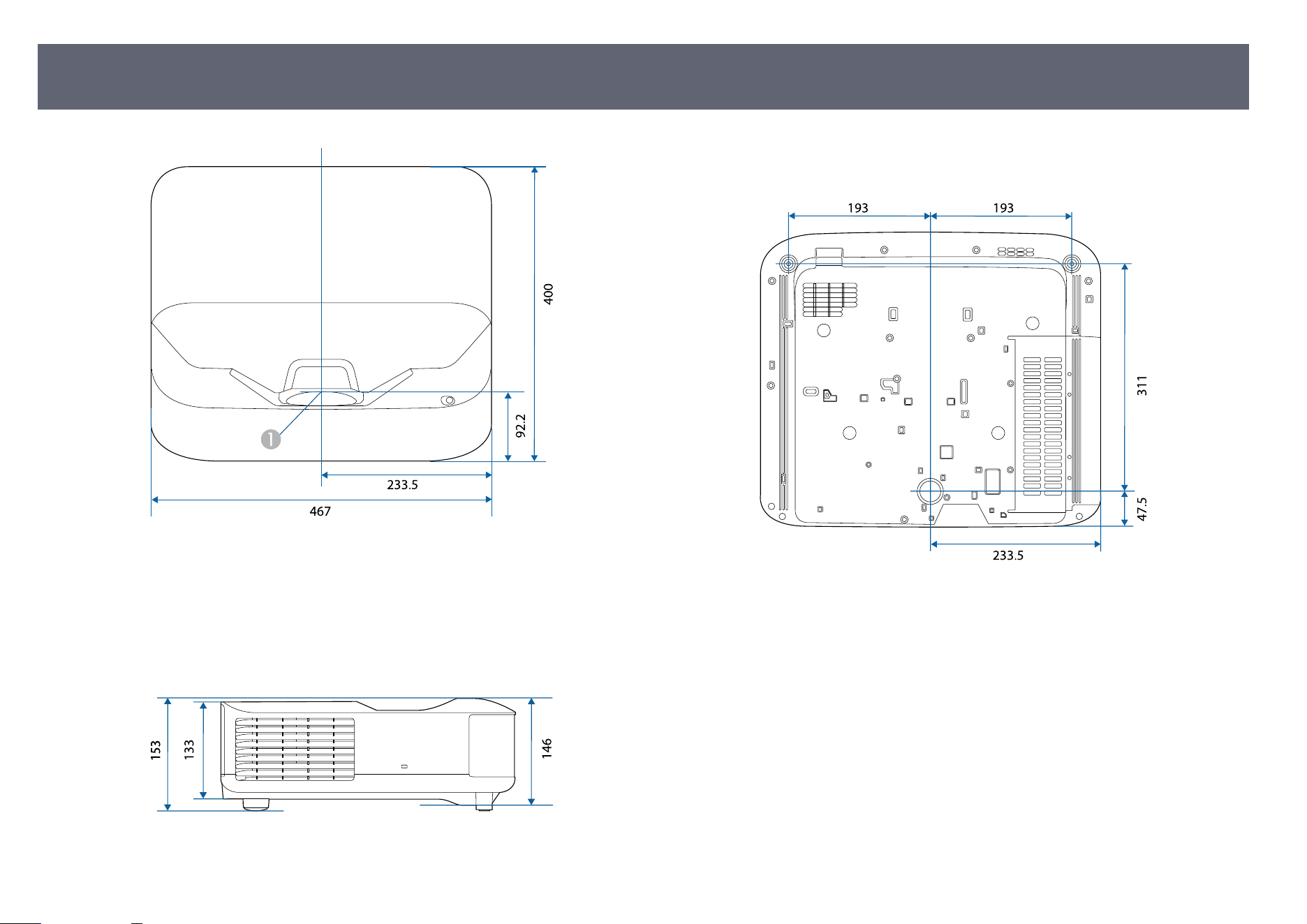
A
Center of the projection window
18.4 inches (467 mm)
19.2 inches (233.5 mm)
3.6 inches (92.2 mm)
15.7 inches (400 mm)
6 inches (153 mm)
5.2 inches (133 mm)
5.7 inches (146 mm)
19.2 inches (233.5 mm)
1.9 inches (47.5 mm)
12.2 inches (311 mm)
7.6 inches (193 mm)
External Dimensions
94
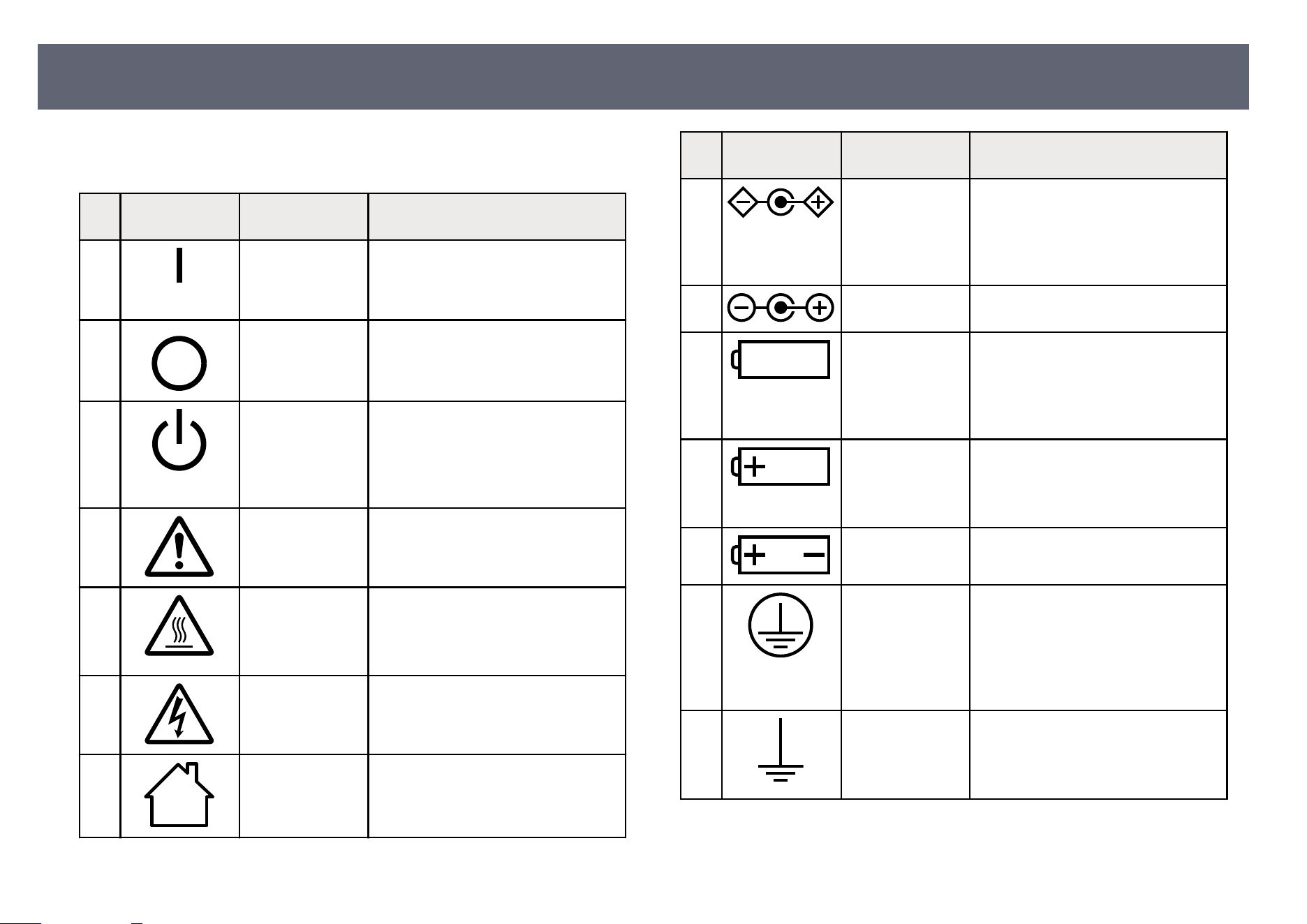
e following table lists the meaning of the safety symbols labeled on the
eq
uipment.
No. Symbol mark Approved
stan
dards
Description
A
IEC60417
No. 5007
"O
N" (power)
To indicate connection to the mains.
B
IEC60417
No. 5008
"O
FF" (power)
To indicate disconnection from the
mains.
C
IEC60417
No. 5009
S
tand-by
To identify the switch or switch
position by means of which part of the
equipment is switched on in order to
bring it into the stand-by condition.
D
ISO7000
N
o
. 0434B
,
IEC3864-B3.1
Caution
To identify general caution when using
the product.
E
IEC60417
No. 5041
C
aution, hot surface
To indicate that the marked item can
be hot and should not be touched
without taking care.
F
IEC60417
No. 6042
ISO3864-B3.6
C
aution, risk of electric shock
To identify equipment that has risk of
electric shock.
G
IEC60417
No. 5957
F
or indoor use only
To identify electrical equipment
designed primarily for indoor use.
No. Symbol mark Approved
stan
dards
Description
H
IEC60417
No. 5926
P
olarity of d.c. power connector
To identify the positive and negative
connections (the polarity) on a piece
of equipment to which a d.c. power
supply may be connected.
I
— e same as No. 8.
J
IEC60417
No. 5001B
B
attery, general
On battery powered equipment. To
identify a device for instance a cover
for the battery compartment, or the
connector terminals.
K
IEC60417
No. 5002
P
ositioning of cell
To identify the battery holder itself and
to identify the positioning of the cell(s)
inside the battery holder.
L
— e same as No. 11.
M
IEC60417
No. 5019
P
rotective earth
To identify any terminal which is
intended for connection to an external
conductor for protection against
electric shock in case of a fault, or the
terminal of a protective earth electrode.
N
IEC60417
No. 5017
E
arth
To identify an earth (ground) terminal
in cases where neither the symbol No.
13 is explicitly required.
List of Safety Symbols and Instructions
95
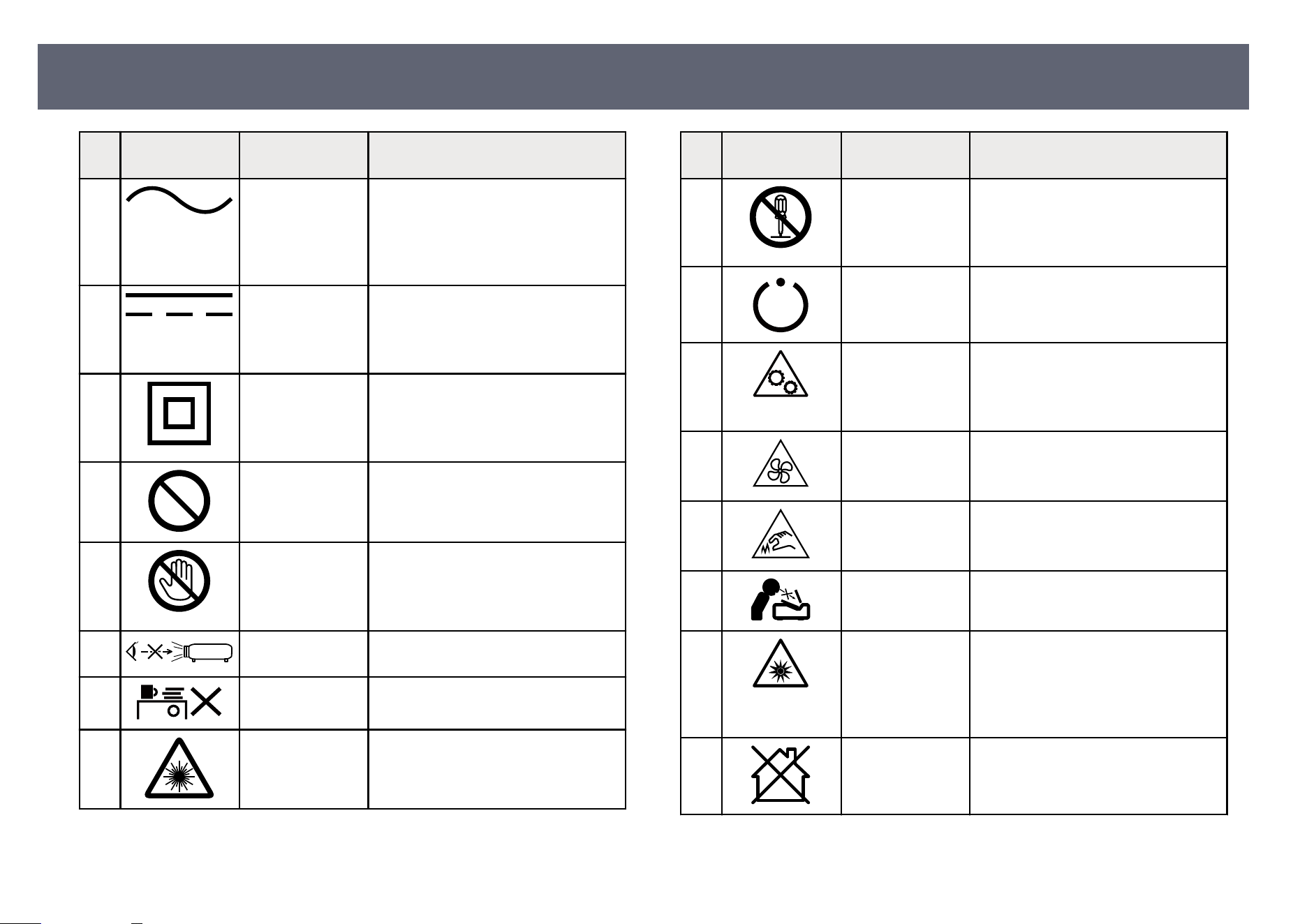
No. Symbol mark Approved
stan
dards
Description
O
IEC60417
No. 5032
A
lternating current
To indicate on the rating plate that the
equipment is suitable for alternating
current only; to identify relevant
terminals.
P
IEC60417
No. 5031
Direct current
To indicate on the rating plate that the
equipment is suitable for direct current
only; to identify relevant terminals.
Q
IEC60417
No. 5172
C
lass II equipment
To identify equipment meeting the
safety requirements specied for Class
II equipment according to IEC 61140.
R
ISO 3864 General prohibition
To ident
ify actions or operations that
are prohibited.
S
ISO 3864 Contact prohibition
To indic
ate injury that could occur
due to touching a specic part of the
equipment.
T
— Never look into the optical lens while
the p
rojector is on.
U
— To indicate that the marked item don’t
place an
ything on projector.
V
ISO3864
IEC60825-1
Caution, laser radiation
To indic
ate the equipment has a laser
radiation part.
No. Symbol mark Approved
stan
dards
Description
W
ISO 3864 Disassembly prohibition
To indic
ate a risk of injury, such as
electric shock, if the equipment is
disassembled.
X
IEC60417
No. 5266
Standby, partial standby
To indicate that part of the equipment
is in the ready status.
Y
ISO3864
IEC60417
No. 5057
C
aution, movable parts
To indicate that you must keep away
from movable parts according to
protection standards.
Z
IEC60417
No. 6056
Caution (Moving Fan Blades)
As a safety precaution, stay away from
the moving fan blades.
a
IEC60417
No. 6043
C
aution (Sharp Corners)
To indicate sharp corners that should
not be touched.
b
— To indicate that looking into the lens
while p
rojecting is prohibited.
c
ISO7010
N
o
. W027
ISO 3864
W
arning, Optical radiation (such as
UV, visible radiation, IR)
Taking care to avoid injury to eyes and
skin when in the vicinity of optical
radiation.
d
IEC60417
No. 5109
N
ot to be used in residential areas.
To identify electrical equipment which
is not suitable for a residential area.
List of Safety Symbols and Instructions
96
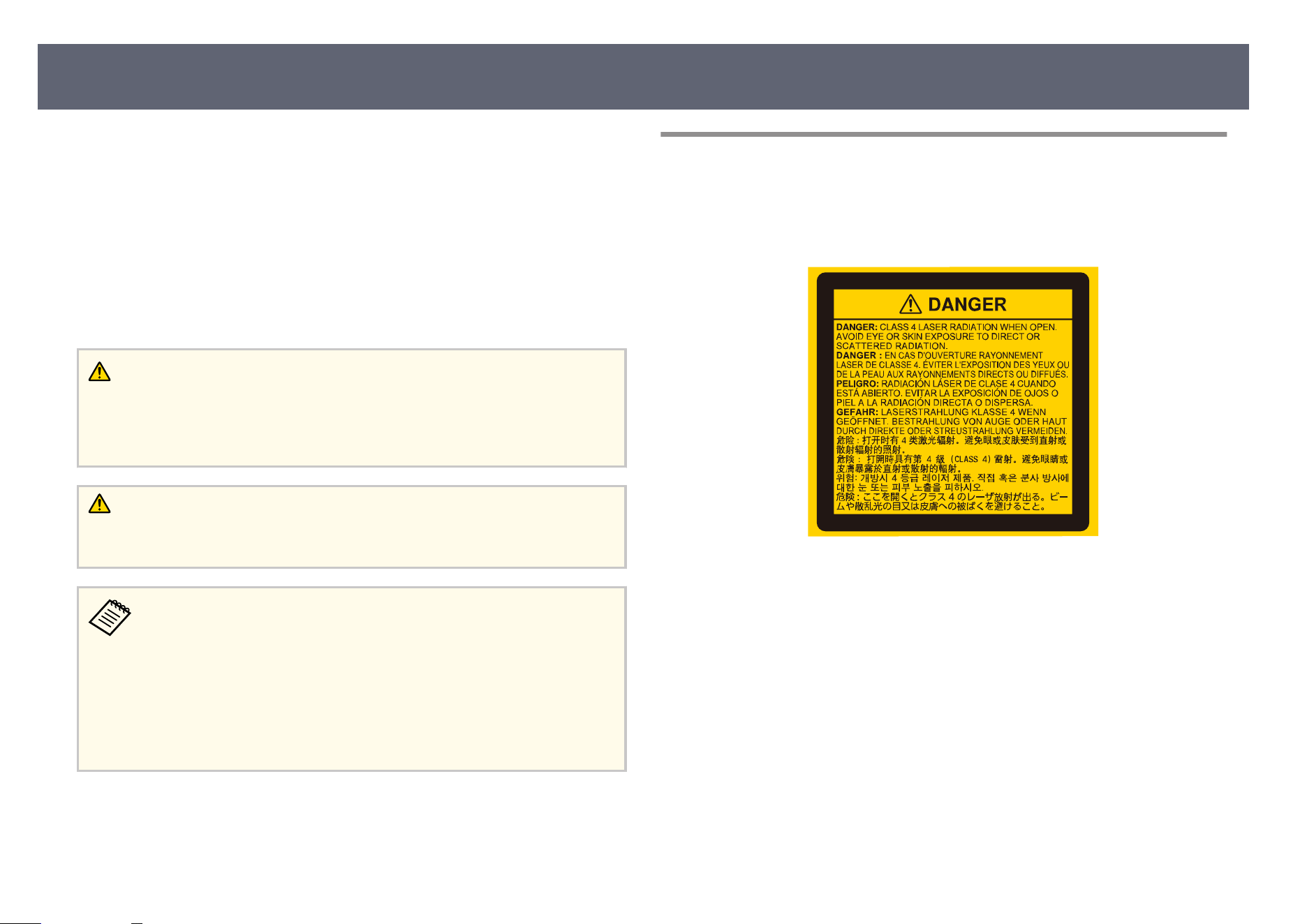
is product is a laser projector that projects images onto surfaces such as walls
and s
creens.
is projector is a Class 1 consumer laser product that complies with the
following standards:
•
IEC60825-1:2014
•
EN60825-1:2014+A11:2021
•
EN50689:2021
Follow these safety instructions when using the projector.
Warning
•
Do no
t open the projector's case. e projector contains a high-powered laser.
•
Possibly hazardous optical radiation emitted from this product. Do not look at
operating light source. Eye injury may result.
Caution
Do no
t disassemble the projector when disposing of it. Dispose according to your
local or national laws and regulations.
e projector uses a laser as the light source. e laser has the following
ch
aracteristics.
•
Depending on the surroundings, the brightness of the light source may
decline. e brightness declines a lot when the temperature gets too
high.
•
e brightness of the light source declines the longer it is used. You can
change the relationship between usage time and decline in brightness
settings.
g
Related Links
•
"Las
er Warning Labels" p.97
Laser Warning Labels
Laser warning labels are attached on the projector.
Ins
ide
Top
A
s w
i
th any bright source, do not stare into the beam, RG2 IEC/EN
62471-5:2015.
Laser Safety Information
97
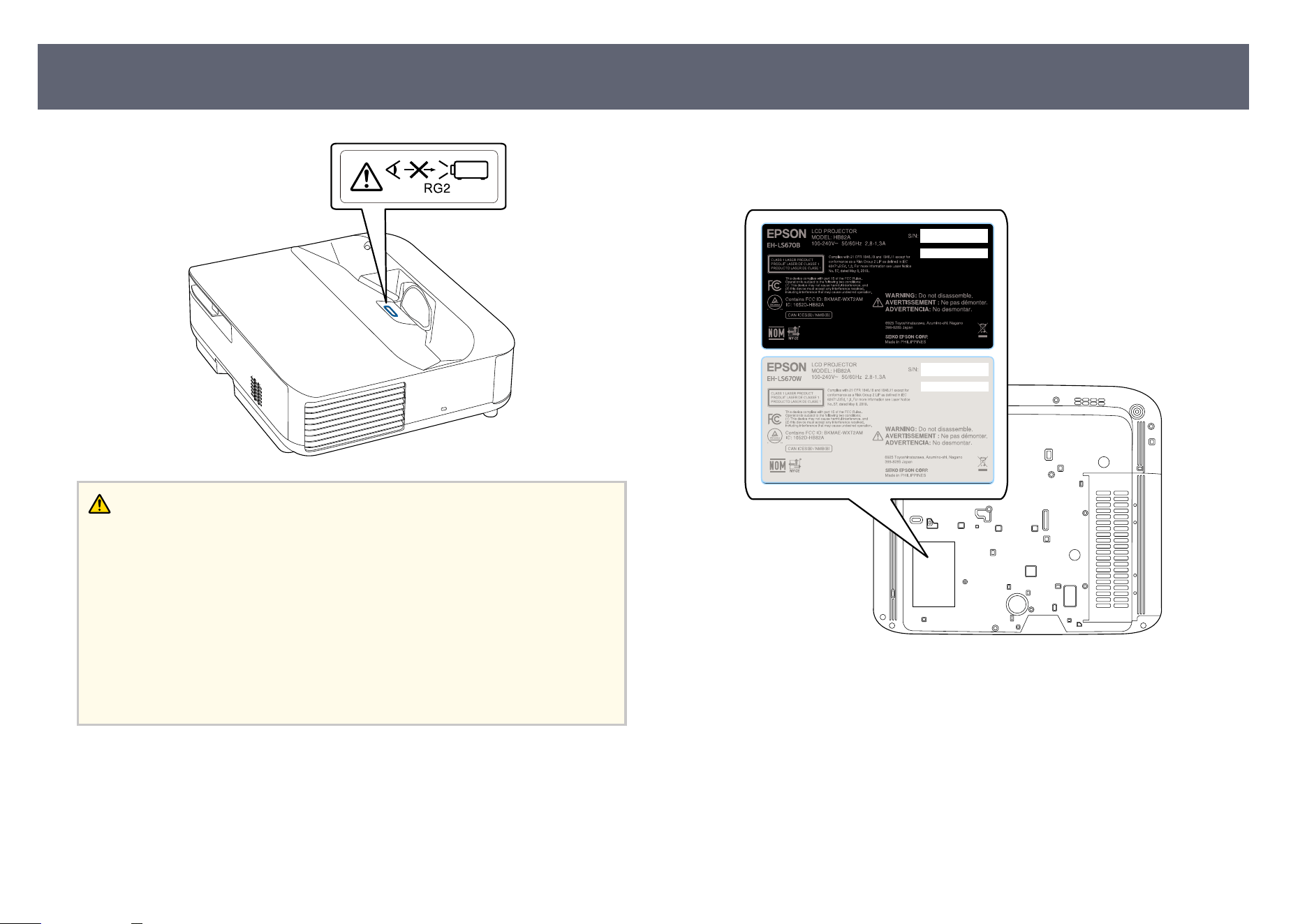
Warning
•
N
e
v
er look into the projector lens when the laser is on. is can damage your eyes
and is especially dangerous for children and pets.
•
When turning on the projector at a distance using the remote control, make sure
no one is looking into the lens.
•
Do not allow small children to operate the projector. Children must be
accompanied by an adult.
•
Do not look into the lens during projection. Also, do not look into the lens using
optical devices, such as a magnifying glass or telescope. is could cause visual
impairment.
Base
For N
orth/South America
Complies with 21 CFR 1040.10 and 1040.11 except for conformance as a Risk
Group 2 LIP as dened in IEC 62471-5: Ed. 1.0. For more information see Laser
Notice No. 57, dated May 8, 2019.
Rating Labels (EH-LS670W/EH-LS670B)
e rating l
abel contains the cert ication and identication information for the
projector.
Laser Safety Information
98
is section briey explains the dicult terms that are not explained in the text
of t
his guide. For details, refer to other commercially available publications.
Aspect Ratio e ratio between an image's length and its height.
Scr
eens with a horizontal:vertical ratio of 16:9, such as HDTV
screens, are known as wide screens.
SDTV and general computer displays have an aspect ratio of 4:3.
Contrast e relative brightness of the light and dark areas of an image
can b
e increased or decreased to make text and graphics stand
out more clearly, or to make them appear soer. Adjusting this
particular property of an image is called contrast adjustment.
4K A screen size standard with a resolution of 3,840 (horizontal) ×
2,160 (vert
ical) dots.
Full HD A screen size standard with a resolution of 1,920 (horizontal) ×
1,080 (vert
ical) dots.
HDCP HDCP is an abbreviation for High-bandwidth Digital Content
Pro
tection.
It is used to prevent illegal copying and protect copyrights by
encrypting digital signals sent over DVI and HDMI ports.
Because the HDMI port on this projector supports HDCP, it can
project digital images protected by HDCP technology.
However, the projector may not be able to project images
protected with updated or revised versions of HDCP encryption.
HDMI
™
An abbreviation for High D enit
ion Multimedia Interface.
HDMI
™
is a standard aimed at digital consumer electronics
and computers. is is the standard by which HD images and
multichannel audio signals are digitally transmitted.
By not compressing the digital signal, the image can be
transferred at the highest quality possible. It also provides an
encryption function for the digital signal.
HDTV An abbreviation for High-D
enition Television that refers to
high-denition systems which satisfy the following conditions:
•
Vertical resolution of 720p or 1080i or greater (p =
Progressive, i = Interlace)
•
Screen aspect ratio of 16:9
Pairing Register devices in advance when connecting with Bluetooth
devices t
o ensure mutual communication.
Refresh Rate e light-emitting element of a display maintains the same
lumin
osity and color for an extremely short time.
Because of this, the image must be scanned many times per
second to refresh the light-emitting element.
e number of refresh operations per second is called the
Refresh rate and is expressed in hertz (Hz).
SDTV An abbreviation for Standard Denit
ion Television that refers to
standard television systems which do not satisfy the conditions
for HDTV High-Denition Television.
Glossary
99

Check these sections for important notices about your projector.
g
Related Links
•
"FCC C
ompliance Statement" p.100
•
"Innovation, Science and Economic Development Canada (ISED) Notices"
p.100
•
"Wireless LAN with Bluetooth Safety and Specications" p.101
•
"Restriction of Use" p.102
•
"Trademarks" p.102
•
"Copyright Notice" p.102
•
"Copyright Attribution" p.102
FCC Compliance Statement
FCC Compliance Statement For United States Users
Contains FCC ID: BKMAE-WXT2AM
Bluetooth remote controller FCC ID: BKMAE-B064E02W7
is device complies with part 15 of the FCC Rules. Operation is subject to the
following two conditions: (1) is device may not cause harmful interference,
and (2) this device must accept any interference received, including interference
that may cause undesired operation.
is equipment has been tested and found to comply with the limits for a Class
B digital device, pursuant to Part 15 of the FCC Rules. ese limits are designed
to provide reasonable protection against harmful interference in a residential
installation. is equipment generates, uses, and can radiate radio frequency
energy and, if not installed and used in accordance with the instructions, may
cause harmful interference to radio communications. However, there is no
guarantee that interference will not occur in a particular installation. If this
equipment does cause interference to radio and television reception, which can
be determined by turning the equipment o and on, the user is encouraged to
try to correct the interference by one or more of the following measures.
•
Reorient or relocate the receiving antenna.
•
Incr
ease the separation between the equipment and receiver.
•
Connect the equipment into an outlet on a circuit dierent from that to
which the receiver is connected.
•
Consult the dealer or an experienced radio/TV technician for help.
WARNING
e connection of a non-shielded equipment interface cable to this equipment
will invalidate the FCC Certication or Declaration of this device and may
cause interference levels which exceed the limits established by the FCC for
this equipment. It is the responsibility of the user to obtain and use a shielded
equipment interface cable with this device. If this equipment has more than
one interface connector, do not leave cables connected to unused interfaces.
Changes or modications not expressly approved by the manufacturer could
void the user's authority to operate the equipment.
Caution
Changes or modications not expressly approved by the party responsible for
compliance could void the user’s authority to operate this equipment. Properly
shielded and grounded cables and connectors must be used for connection to
host computers and/or peripherals in order to meet FCC emission limits.
is transmitter must not be co-located or operating in conjunction with any
other antenna or transmitter.
is equipment complies with FCC radiation exposure limits set forth for an
uncontrolled environment and meets the FCC radio frequency (RF) Exposure
Guidelines. is equipment should be installed and operated keeping the
radiator at least 7.8 inches (20 cm) or more away from person’s body.
Innovation, Science and Economic Development
Canada (ISED) Notices
Contains IC: 1052D-HB82A
Notices
100
Bluetooth remote controller IC: 1052D-B064E02W7
Operating frequency range: 2.402-2.480GHz, 5.18-5.24GHz, 5.26-5.32GHz,
5.50-5.72GHz, 5.745-5.825GHz, 5.845-5.885GH
z, 5.955-7.115GHz
is device contains license-exempt transmitter(s)/receiver(s) that comply
with Innovation, Science and Economic Development Canada’s license-exempt
RSS(s). Operation is subject to the following two conditions:
(1) is device may not cause interference.
(2) is device must accept any interference, including interference that may
cause undesired operation of the device.
is device is restricted for indoor use only. Especially, ISED regulations state
that operation in 5150-5250MHz & 5850-5895MHz is for indoor use only.
is equipment (without Bluetooth remote controller) complies with ISED
radiation exposure limits set forth for an uncontrolled environment and meets
RSS-102 of the ISED radio frequency (RF) Exposure rules.
Caution: Exposure to Radio Frequency Radiation
1. To comply with the Canadian RF exposure compliance requirements, this
device and its antenna must not be co-located or operating in conjunction with
any other antenna or transmitter.
2. To comply with RSS-102 RF exposure compliance requirements, this
equipment should be installed and operated, keeping the radiator at least 7.9
inches (20cm) or more away from the person's body.
Wireless caution for Wi-Fi 6E
e following uses of this device are prohibited by ISED, RSS-248 regulations.
•
Devices shall not be used for control of or communications with unmanned
aircra systems.
•
Devices shall not be used on oil platforms.
•
D
ev
ices shall not be used on aircra, except for the low-power indoor access
points, indoor subordinate devices, low-power client devices, and very low-
power devices operating in the 5925-6425 MHz band, that may be used on
large aircra as dened in the Canadian Aviation Regulations, while ying
above 3,048 meters (10,000 feet).
•
Devices shall not be used on automobiles.
•
Devices shall not be used on trains.
•
Devices shall not be used on maritime vessels.
Wireless LAN with Bluetooth Safety and Specications
Contains wireless LAN with Bluetooth module model: WXT2AM2101
Bluet
ooth remote controller model: B064E-02-W7
is document provides safety instructions and describes the specications.
Read this document carefully before use to ensure your safety and product
performance.
is device is restricted to indoor operation only.
Operating frequency range:
WXT2AM2101: 2.402-2.480GHz, 5.18-5.24GHz, 5.26-5.32GHz, 5.50-5.72GHz,
5.745-5.825GHz, 5.845-5.885GHz, 5.955-7.115GHz
B064E-02-W7: 2.402-2.480GHz
Data transmission is always initiated by soware, which is then passed down
through the MAC, through the digital and analog baseband, and nally to the
RF chip. Several special packets are initiated by the MAC. ese are the only
ways the digital baseband portion will turn on the RF transmitter, which it then
turns o at the end of the packet. erefore, the transmitter will be on only
while one of the aforementioned packets is being transmitted. In other words,
this device automatically discontinue transmission in case of either absence of
information to transmit or operational failure.
Notices
101
Restriction of Use
When this product is used for applications requiring high reliability/safety
such as t
ransportation devices related to aviation, rail, marine, automotive etc.;
disaster prevention devices; various safety devices etc; or functional/precision
devices etc, you should use this product only aer giving consideration to
including fail-safes and redundancies into your design to maintain safety
and total system reliability. Because this product was not intended for use
in applications requiring extremely high reliability/safety such as aerospace
equipment, main communication equipment, nuclear power control equipment,
or medical equipment related to direct medical care etc, please make your own
judgment on this product’s suitability aer a full evaluation.
Trademarks
EPSON is a registered trademark of Seiko Epson Corporation.
Mac, OS X, and m
acOS are trademarks of Apple Inc.
Microso, Windows, and the Windows logo are trademarks or registered
trademarks of Microso Corporation in the United States and/or other
countries.
Google TV is the name of this device's soware experience and a trademark of
Google LLC. Google, YouTube and Google Cast are trademarks of Google LLC.
Manufactured under license from Dolby Laboratories. Dolby, Dolby Audio,
and the double-D symbol are trademarks of Dolby Laboratories Licensing
Corporation.
e terms HDMI, HDMI High-Denition Multimedia Interface, HDMI Trade
dress and the HDMI Logos are trademarks or registered trademarks of HDMI
Licensing Administrator, Inc.
"QR Code" is a registered trademark of DENSO WAVE INCORPORATED.
Wi-Fi
®
is a t
rademark of the Wi-Fi Alliance
®
.
e Bluetooth
®
word mark and logos are registered trademarks owned by
Bluetooth SIG, Inc. and any use of such marks by Seiko Epson Corporation
is under license. Other trademarks and trade names are those of their respective
o
w
n
ers.
Adobe and Adobe Reader are either registered trademarks or trademarks of
Adobe Systems Incorporated in the United States and/or other countries.
Other product names used herein are also for identication purposes only and
may be trademarks of their respective owners. Epson disclaims any and all
rights in those marks.
Copyright Notice
All rights reserved. No part of this publication may be reproduced, stored in
a retr
ieval system, or transmitted in any form or by any means, electronic,
mechanical, photocopying, recording, or otherwise, without the prior written
permission of Seiko Epson Corporation. No patent liability is assumed with
respect to the use of the information contained herein. Neither is any liability
assumed for damages resulting from the use of the information contained
herein.
Neither Seiko Epson Corporation nor its aliates shall be liable to the purchaser
of this product or third parties for damages, losses, costs, or expenses incurred
by the purchaser or third parties as a result of: accident, misuse, or abuse of this
product or unauthorized modications, repairs, or alterations to this product,
or (excluding the U.S.) failure to strictly comply with Seiko Epson Corporation's
operating and maintenance instructions.
Seiko Epson Corporation shall not be liable against any damages or problems
arising from the use of any options or any consumable products other than
those designated as Original Epson Products or Epson Approved Products by
Seiko Epson Corporation.
e contents of this guide may be changed or updated without further notice.
Copyright Attribution
is information is subject to change without notice.
Notices
102

© 2025 Seiko Epson Corporation
2025.8 414641500EN EAI
Notices
103
