
Table of Contents
1. Important ����������������������������������������1
1.1 Safety precautions and
maintenance ...................................1
1.2 Notational Descriptions ................3
1.3 Disposal of product and packing
material .............................................4
2� Setting up the monitor ��������������� 5
2.1 Installation .......................................5
2.2 Operating the monitor .................7
2.3 Remove the Base Assembly for
VESA Mounting ..............................9
3� Image Optimization ������������������10
3.1 SmartImage .................................. 10
3.2 SmartContrast .............................. 11
4� SmoothTouch �������������������������������12
5. TechnicalSpecications ������������13
5.1 Resolution & Preset Modes ...... 16
6� Power Management ������������������17
7. Customercareandwarranty ���18
7.1 Philips’ Flat Panel Monitors Pixel
Defect Policy ................................. 18
7.2 Customer Care & Warranty ...... 21
8. Troubleshooting&FAQs ����������22
8.1 Troubleshooting .......................... 22
8.2 General FAQs ................................ 23
8.3 SmoothTouch ............................... 26

1
1. Important
1� Important
This electronic user’s guide is intended for
anyone who uses the Philips monitor. Take
time to read this user manual before you
use your monitor. It contains important
information and notes regarding
operating your monitor.
The Philips guarantee applies provided
the product is handled properly for
its intended use, in accordance with
its operating instructions and upon
presentation of the original invoice or cash
receipt, indicating the date of purchase,
dealer’s name and model and production
number of the product.
1�1 Safetyprecautionsand
maintenance
Warnings
Use of controls, adjustments or procedures
other than those specied in this
documentation may result in exposure
to shock, electrical hazards and/or
mechanical hazards.
Read and follow these instructions when
connecting and using your computer
monitor.
Excessive sound pressure from earphones
and headphones can cause hearing loss.
Adjustment of the
equalizer to maximum increases the
earphones and headphones output
voltage and therefore the sound
pressure level.
Operation
• Please Keep the monitor out of
direct sunlight, very strong bright
lights and away from any other heat
source. Lengthy exposure to this
type of environment may result in
discoloration and damage to the
monitor.
• Keep the display away from oil. Oil
may damage the plastic cover of the
display and void the warranty.
• Remove any object that could fall into
ventilation holes or prevent proper
cooling of the monitor’s electronics.
• Do not block the ventilation holes on
the cabinet.
• When positioning the monitor, make
sure the power plug and outlet are
easily accessible.
• If turning off the monitor by
detaching the power cable or DC
power cord, wait for 6 seconds before
attaching the power cable or DC
power cord for normal operation.
• Please use approved power cord
provided by Philips all the time. If your
power cord is missing, please contact
with your local service center. (Please
refer to Service contact information
listed in Important information
manual.)
• Operate under the specified power
supply. Be sure to operate the monitor
only with the specified power supply.
Use of an incorrect voltage will cause
malfunction and may cause fire or
electric shock.
• Do not disassemble the AC adapter.
Disassembling the AC adapter may
expose you to the danger of fire or
electric shock.
• Protect the cable. Do not pull or bend
the power cable and signal cable.
Do not place the monitor or any
other heavy objects on the cables, if
damaged, the cables may cause fire or
electric shock.
• Do not subject the monitor to severe
vibration or high impact conditions
during operation.

2
1. Important
• Do not knock or drop the monitor
during operation or transportation.
• Excessive usage of monitor can
cause eye discomfort, it’s better to
take shorter breaks more often at
your workstation than longer breaks
and less often; for example a 5-10
minute break after 50-60-minute
continuous screen use is likely to
be better than a 15-minute break
every two hours. Try to keep your
eyes from eye strain while using the
screen for a constant period of time
by :
• Lookingatsomethingvarying
distancesafteralongperiod
focusingonthescreen.
• ConsciousBlinkingoftenwhile
youwork.
• Gentlyclosingandrollingyour
eyestorelax.
• Repositionyourscreentoappro-
priateheightandangleaccord-
ingtoyourheight.
• Adjustingthebrightnessand
contrasttoappropriatelevel.
• Adjustingtheenvironmentlight-
ingsimilartothatofyourscreen
brightness,avoidtheuorescent
lighting,andsurfacesthatdon’t
reecttoomuchlight.
• Seeingadoctorifyoursymp-
toms.
Maintenance
• To protect your monitor from possible
damage, do not put excessive pressure
on the LCD panel. When moving your
monitor, grasp the frame to lift; do not
lift the monitor by placing your hand
or fingers on the LCD panel.
• Oil-based cleaning solutions may
damage the plastic parts and void the
warranty.
• Unplug the monitor if you are not
going to use it for an extensive period
of time.
• Unplug the monitor if you need to
clean it with a slightly damp cloth. The
screen may be wiped with a dry cloth
when the power is off. However, never
use organic solvent, such as, alcohol,
or ammonia-based liquids to clean
your monitor.
• To avoid the risk of shock or
permanent damage to the set, do
not expose the monitor to dust,
rain, water, or excessive moisture
environment.
• If your monitor gets wet, wipe it with
dry cloth as soon as possible.
• If foreign substance or water gets in
your monitor, please turn the power
off immediately and disconnect the
power cord. Then, remove the foreign
substance or water, and send it to the
maintenance center.
• Do not store or use the monitor in
locations exposed to heat, direct
sunlight or extreme cold.
• In order to maintain the best
performance of your monitor and
use it for a longer lifetime, please use
the monitor in a location that falls
within the following temperature and
humidity ranges.
• Temperature: 0-40°C 32-104°F
• Humidity: 20-80% RH
Important information for Burn-in/Ghost
image
• Always activate a moving screen
saver program when you leave your
monitor unattended. Always activate
a periodic screen refresh application if
your monitor will display unchanging
static content. Uninterrupted display
of still or static images over an
extended period may cause “burn-

3
1. Important
in”, also known as “after-imaging” or
“ghost imaging”, on your screen.
• “Burn-in”, “after-imaging”, or
“ghost imaging” is a well-known
phenomenon in LCD panel
technology. In most cases, the “burn-
in” or “after-imaging” or “ghost
imaging” will disappear gradually over
a period of time after the power has
been switched off.
Warning
Failure to activate a screen saver, or a
periodic screen refresh application may
result in severe “burn-in” or “after-image”
or “ghost image” symptoms that will not
disappear and cannot be repaired. The
damage mentioned above is not covered
under your warranty.
Service
• The casing cover should be opened
only by qualified service personnel.
• If there is any need for any document
for repair or integration, please
contact with your local service center.
(Please refer to Service contact
information listed in Important
information manual.)
• For transportation information, please
refer to “Technical Specifications”.
• Do not leave your monitor in a car/
trunk under direct sun light.
Note
Consult a service technician if the monitor
does not operate normally, or you are not
sure what procedure to take when the
operating instructions given in this manual
have been followed.
1�2 NotationalDescriptions
The following subsections describe
notational conventions used in this
document.
Notes, Cautions and Warnings
Throughout this guide, blocks of text may
be accompanied by an icon and printed
in bold or italic type. These blocks contain
notes, cautions or warnings. They are used
as follows:
Note
This icon indicates important information
and tips that help you make better use of
your computer system.
Caution
This icon indicates information that tells
you how to avoid either potential damage
to hardware or loss of data.
Warning
This icon indicates the potential for bodily
harm and tells you how to avoid the
problem.
Some warnings may appear in alternate
formats and may not be accompanied
by an icon. In such cases, the specic
presentation of the warning is mandated
by the relevant regulatory authority.

4
1. Important
1�3 Disposalofproductand
packing material
Waste Electrical and Electronic Equipment-
WEEE
This marking on the product or on its
packaging illustrates that, under European
Directive 2012/19/EU governing used
electrical and electronic appliances,
this product may not be disposed of
with normal household waste. You are
responsible for disposal of this equipment
through a designated waste electrical
and electronic equipment collection. To
determine the locations for dropping
o such waste electrical and electronic,
contact your local government oce, the
waste disposal organization that serves
your household or the store at which you
purchased the product.
Your new monitor contains materials that
can be recycled and reused. Specialized
companies can recycle your product to
increase the amount of reusable materials
and to minimize the amount to be
disposed of.
All redundant packing material has been
omitted. We have done our utmost to
make the packaging easily separable into
mono materials.
Please nd out about the local regulations
on how to dispose of your old monitor and
packing from your sales representative.
Taking back/Recycling Information for
Customers
Philips establishes technically and
economically viable objectives to optimize
the environmental performance of the
organization's product, service and
activities.
From the planning, design and
production stages, Philips emphasizes
the important of making products
that can easily be recycled. At Philips,
end-of-life management primarily
entails participation in national take-
back initiatives and recycling programs
whenever possible, preferably in
cooperation with competitors, which
recycle all materials (products and related
packaging material) in accordance with
all Environmental Laws and taking back
program with the contractor company.
Your display is manufactured with high
quality materials and components which
can be recycled and reused.
To learn more about our recycling
program please visit
http://www.philips.com/a-w/about/
sustainability.html
5
2. Setting up the monitor
2� Setting up the monitor
2�1 Installation
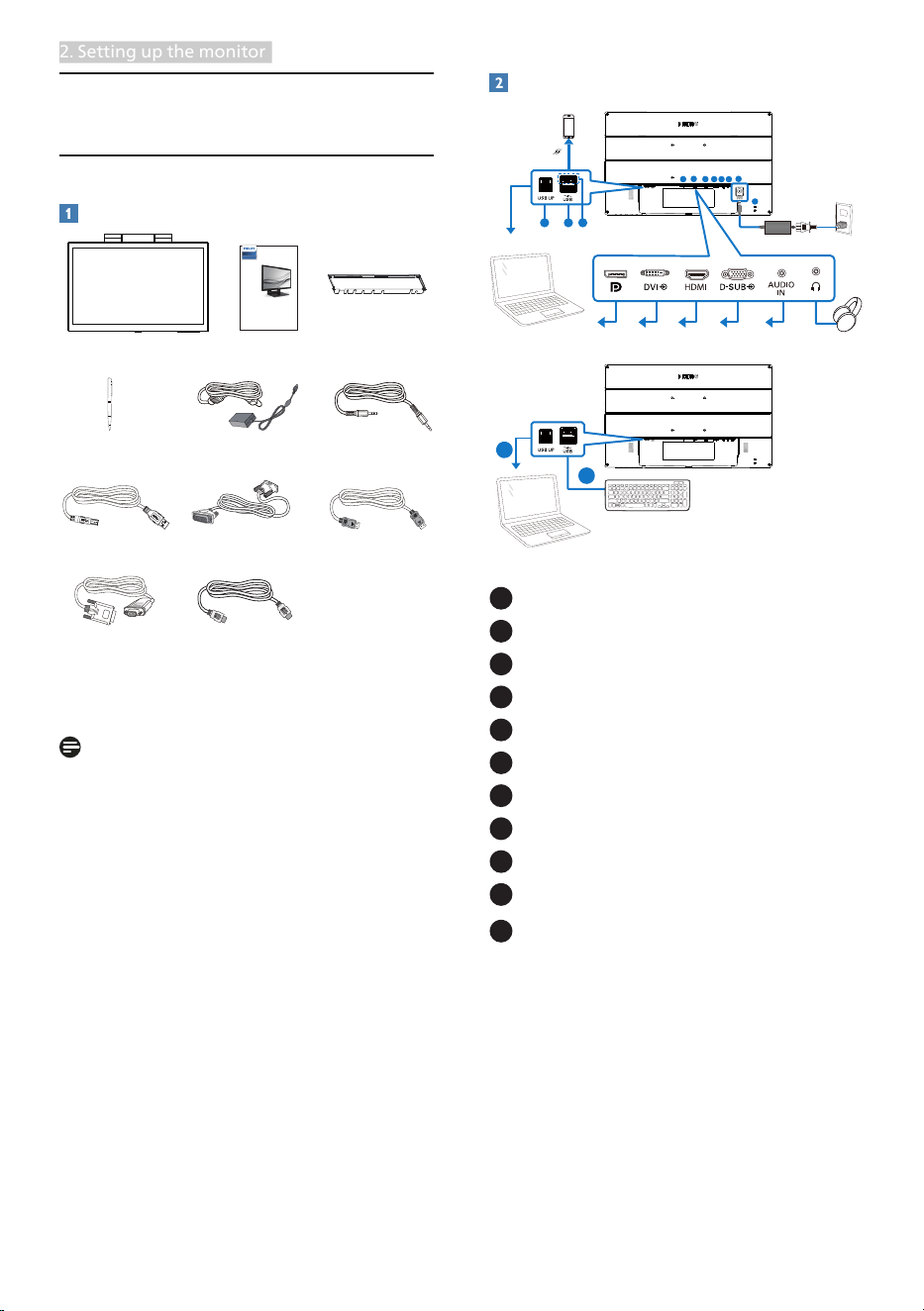
Packagecontents
* VGA
* HDMI
* Audio cable
* DVI* USB A-B
* DP
AC/DC Adapter* Stylus
I/O Cover
Register your product and get support at
www.philips.com/welcome
Quick
Start
B Line
222B9
*Dierentaccordingtoregion
Note
Use only the AC/DC adapter model: Philips
ADPC2045.
ConnectingtoyourPC
Fast
Charger
8
Step 1
Step 2
2
3
4
6
7
1
5
9 10 11
USB hub
1
Kensingtonanti-theftlock
2
DC power input
3
Displayportinput
4
DVI input
5
HDMI input
6
VGAinput
7
Audioinput
8
Headphoneout
9
USBupstream
10
USBdownstream
11
USBfastcharger/USBdownstream
6
2. Setting up the monitor
1
2
3
Connect to PC
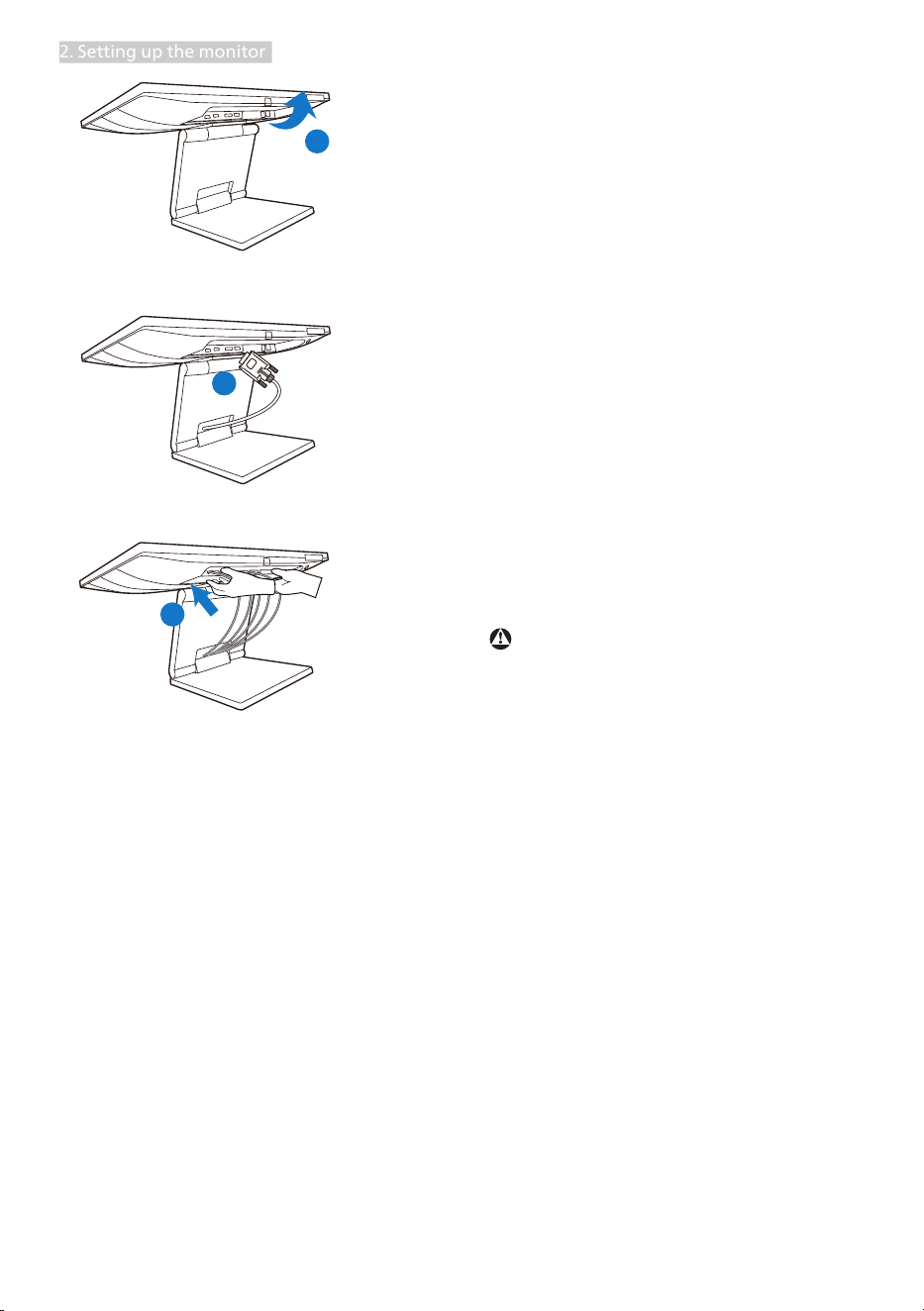
1. Connectthepowercordtotheback
ofthemonitorrmly.
2. Turnoyourcomputerandunplug
itspowercable.
3. Connectthemonitorsignalcableto
thevideoconnectoronthebackof
yourcomputer.
4. ConnectUSBupstreamcable
betweenmonitorandPCforthe
touchfunctionality.
5. Plugthepowercordofyour
computerandyourmonitorintoa
nearbyoutlet.
6. Afterconnectingcables,slidethe
I/Ocoverintotheslotsontherear
monitorandsnaptheI/Ocoverinto
the place�
7. Turnonyourcomputerandmonitor.
Ifthemonitordisplaysanimage,
installationiscomplete.
Warning
USB 2.4Ghz wireless devices, such
as, wireless mouse, keyboard, and
headphones, maybe have interference by
the high-speed signal of USB3.2 devices,
which may result in a decreased eciency
of the radio transmission. Should this
happen, please try the following methods
to help reduce the eects of interference.
• Try to keep USB2.0 receivers away
from USB3.2 connection port.
• Use a standard USB extension cable
or USB hub to increase the space
between your wireless receiver and
the USB3.2 connection port.
7
2. Setting up the monitor
2�2 Operating the monitor
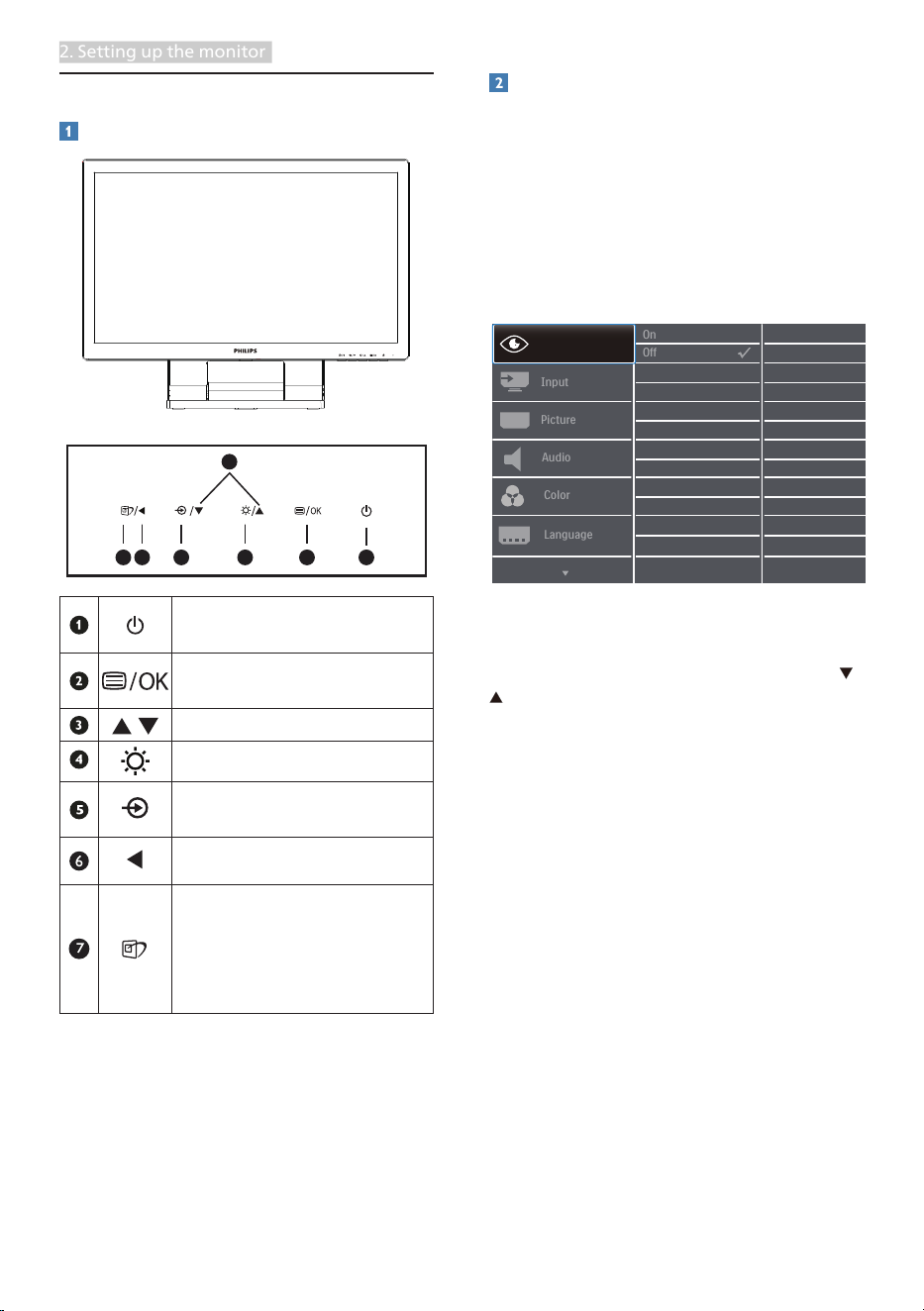
Descriptionofthecontrolbuttons
7
6
25
4
3
1
Switch monitor’s power ON
and OFF.
Access the OSD menu
.
Conrm the OSD adjustment.
Adjust the OSD menu.
Adjust the brightness level.
Change the signal input
source.
Return to previous OSD level.
SmartImage. There are
multiple selections:
EasyRead, Oce, Photo,
Movie, Game, Economy,
LowBlue Mode, O.
DescriptionoftheOnScreenDisplay
WhatisOn-ScreenDisplay(OSD)?
On-Screen Display (OSD) is a feature in all
Philips LCD monitors. It allows an end user
to adjust screen performance or select
functions of the monitors directly through
an on-screen instruction window. A user
friendly on screen display interface is
shown as below:
Basicandsimpleinstructiononthe
controlkeys
In the OSD shown above, you can press
buttons at the front bezel of the monitor
to move the cursor, and press OK button
to conrm the choice or change.
8
2. Setting up the monitor
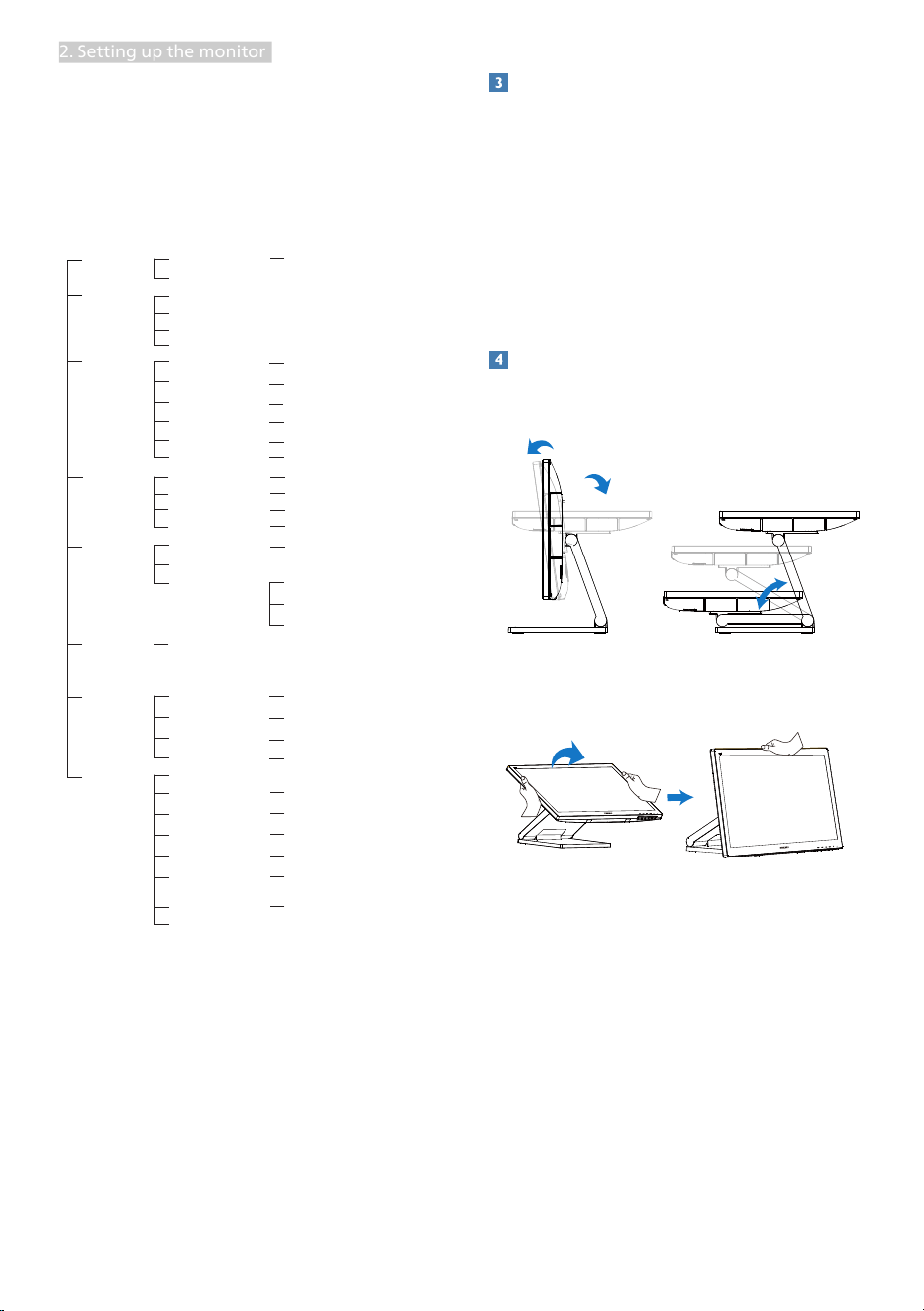
The OSD Menu
Below is an overall view of the structure of
the On-Screen Display. You can use this as
a reference when you want to work your
way around the dierent adjustments
later on.
Main menu Sub menu
Picture
Input
OSD Settings
Setup
Language
Color
Audio
Audio In, HDMI, DisplayPort
Brightness
Contrast
Horizontal
Vertical
Transparency
OSD Time Out
Auto
V.Position
Phase
Clock
Resolution
Notication
Reset
Information
Color Temperature
sRGB
User De�ne
VGA
DVI
DisplayPort
SmartResponse
SmartContrast
Gamma
H.Position
HDMI 1.4
Stand-Alone
0~100
0~100
0~100
0~100
Off, 1, 2, 3, 4
5s, 10s, 20s, 30s, 60s
On, Off
Yes, No
0~100
0~100
0~100
Native, 5000K, 6500K, 7500K,
8200K, 9300K, 11500K
Red: 0~100
Green: 0~100
Blue: 0~100
Off, Fast, Faster, Fastest
On, Off
1.8, 2.0, 2.2, 2.4, 2.6
0~100
0~100
On, Off
On, Off
Volume
Audio Source
Mute
Sharpness
0~100
LowBlue
Mode
On
Off
1, 2, 3, 4
English, Deutsch, Español, Ελληνική, Français, Italiano,
Magyar, Nederlands, Português, Português do Brasil,
Polski, Русский, Svenska, Suomi, Türkçe, Čeština,
Українська, 简体中文, 繁體中文,日本語,한국어
Resolutionnotication
This monitor is designed for optimal
performance at its native resolution,
1920 x 1080 @ 60 Hz. When the monitor
is powered on at a dierent resolution, an
alert is displayed on screen: Use
1920 x 1080 @ 60 Hz for best results.
Display of the native resolution alert can
be switched o from Setup in the OSD (On
Screen Display) menu.
PhysicalFunction
Tilt
90˚
-5˚
0˚-70˚
9
2. Setting up the monitor
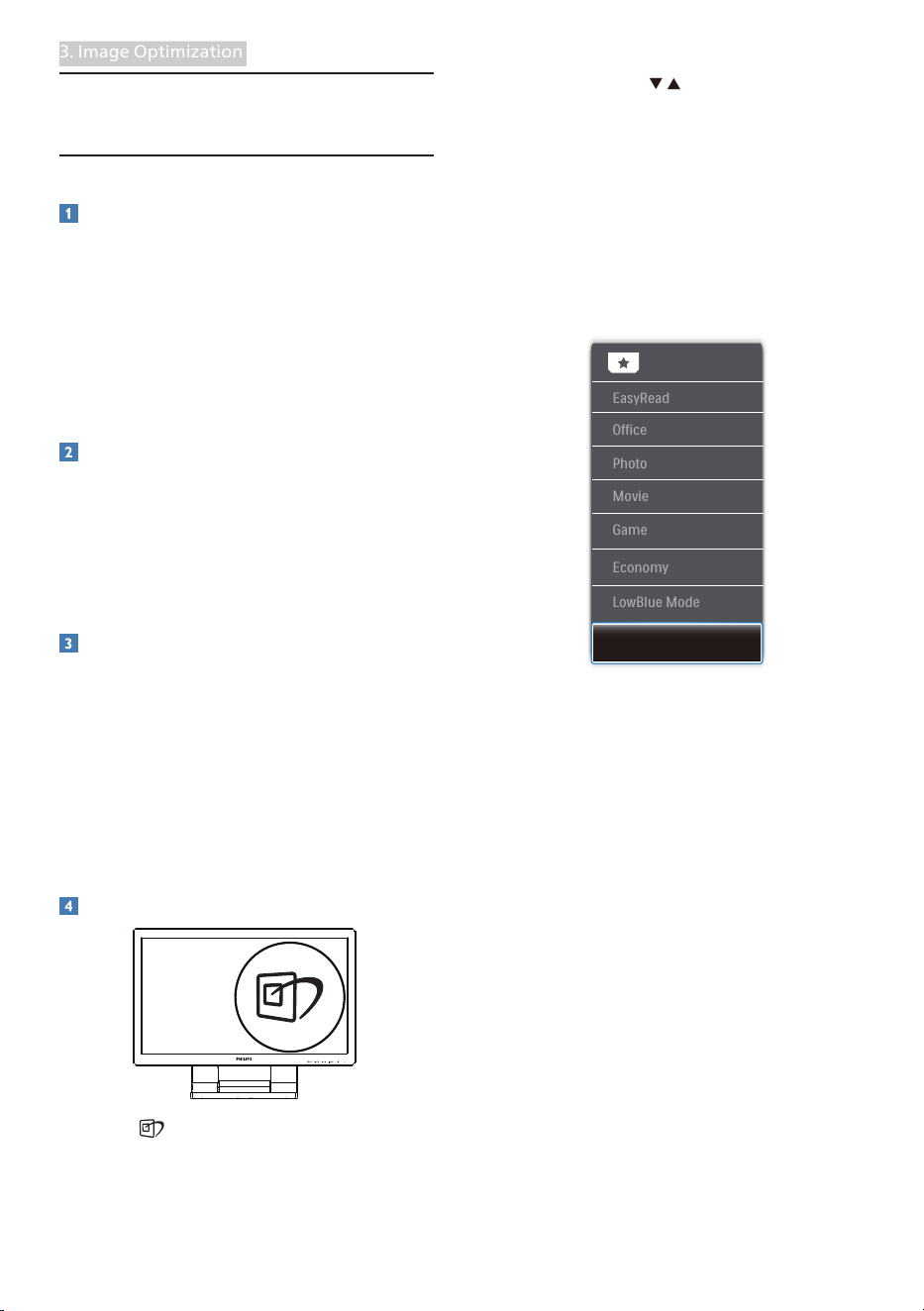
2�3 RemovetheBaseAssembly
forVESAMounting
Before you start disassembling the monitor
base, please follow the instructions below
to avoid any possible damage or injury.
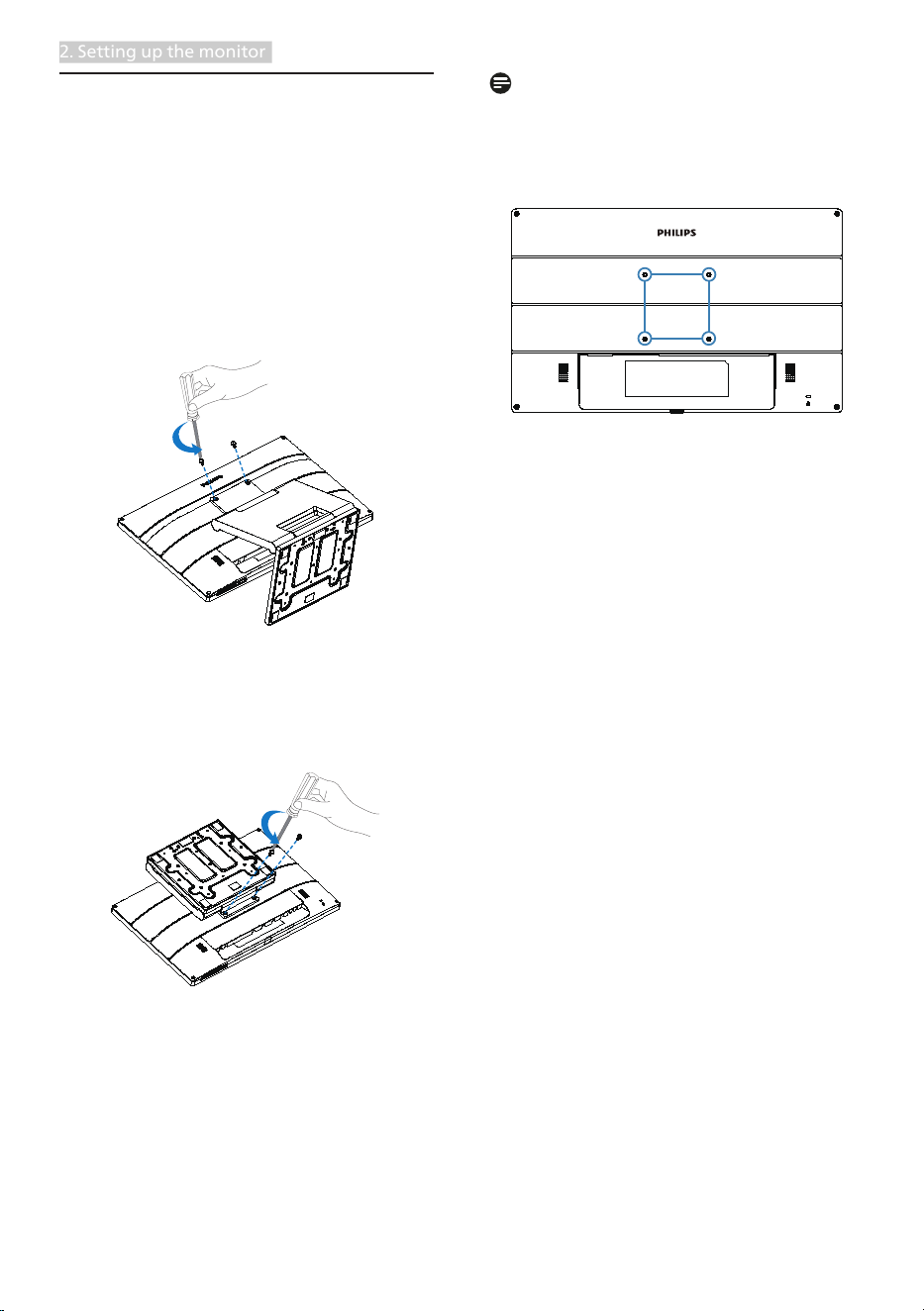
1. Place the monitor face down on a
smooth surface. Pay attention not to
scratch or damage the screen. Then
use a screwdriver to remove the
screws.
2. Move the stand into position
as shown in picture. Then use a
screwdriver to remove the screws,
and then detach the stand from the
monitor.
Note
This monitor accepts a 100mm x 100mm
VESA-Compliant mounting interface.
VESA Mounting Screw M4. Always contact
manufacturer for wall-mount installation.
100mm
100mm
10
3. Image Optimization
3� Image Optimization
3�1 SmartImage
Whatisit?
SmartImage provides presets that optimize
display for dierent types of content,
dynamically adjusting brightness, contrast,
color and sharpness in real time. Whether
you're working with text applications,
displaying images or watching a video,
Philips SmartImage delivers great
optimized monitor performance.
WhydoIneedit?
You want a monitor that delivers
optimized display all your favorite types of
content, SmartImage software dynamically
adjust brightness, contrast, color and
sharpness in real time to enhance your
monitor viewing experience.
Howdoesitwork?
SmartImage is an exclusive, leading edge
Philips technology that analyzes the
content displayed on your screen. Based
on a scenario you select, SmartImage
dynamically enhances the contrast, color
saturation and sharpness of images to
enhance the contents being displayed -
all in real time with the press of a single
button.
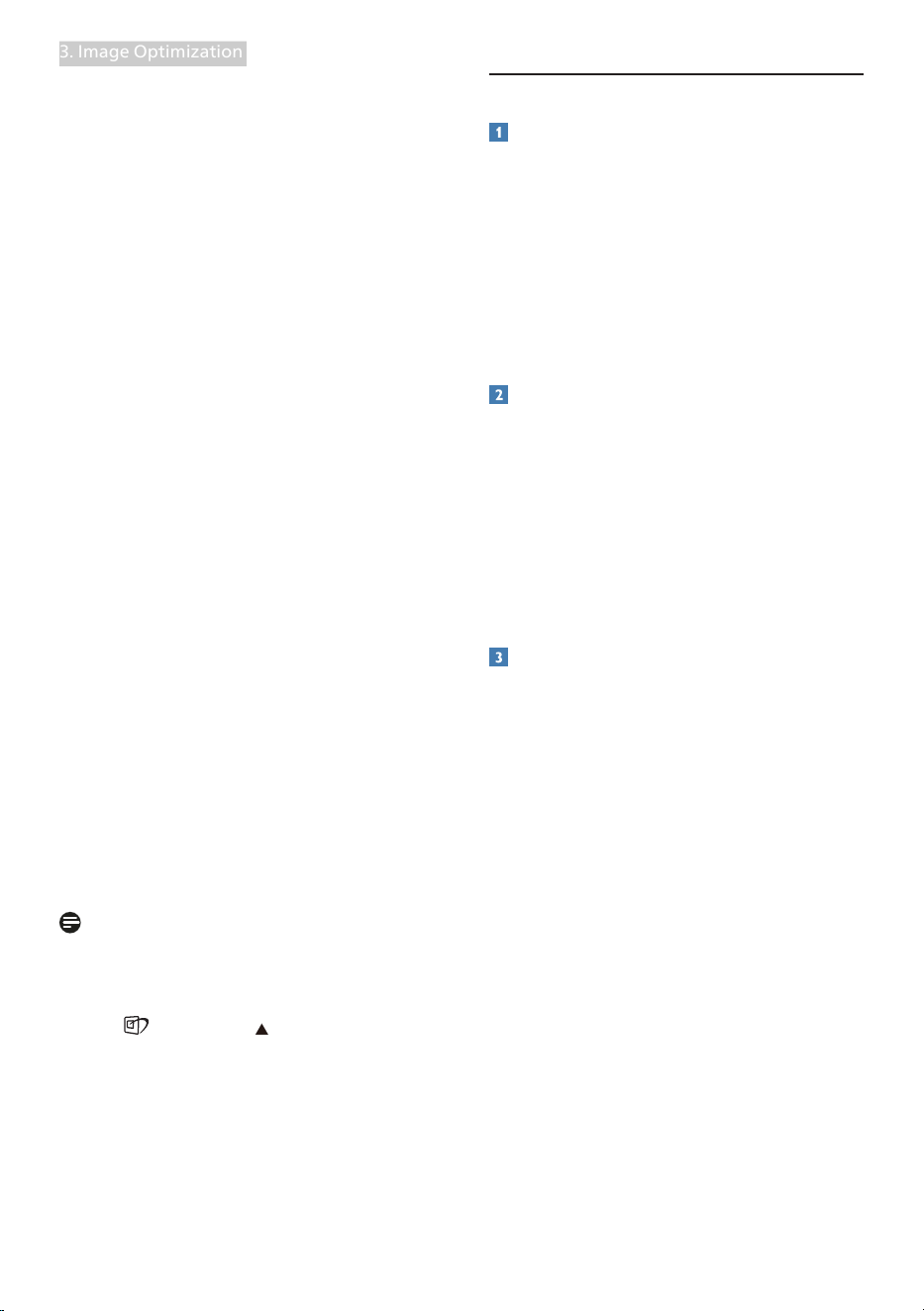
HowtoenableSmartImage?
1. Press to launch the SmartImage on
screen display.
2. Keep pressing to toggle among
EasyRead, Oce, Photo, Movie, Game,
Economy, LowBlue Mode, O.
3. The SmartImage on screen display
will remain on screen for 5 seconds,
or you can also press "OK" to make
conrmation.
There are multiple selections: EasyRead,
Oce, Photo, Movie, Game, Economy,
LowBlue Mode, O.
• EasyRead: Helps improve reading
of text based application like PDF
ebooks. By using a special algorithm
which increases the contrast and
boundary sharpness of text content,
the display is optimized for a
stress-free reading by adjusting
the brightness, contrast and color
temperature of the monitor.
• Office: Enhances text and dampens
brightness to increase readability
and reduce eye strain. This mode
significantly enhances readability and
productivity when you’re working
with spreadsheets, PDF files, scanned
articles or other general office
applications.
• Photo: This profile combines color
saturation, dynamic contrast and
sharpness enhancement to display
photos and other images with
11
3. Image Optimization
outstanding clarity in vibrant colors -
all without artifacts and faded colors.
• Movie: Ramped up luminance,
deepened color saturation, dynamic
contrast and razor sharpness displays
every details in darker areas of your
videos without color washout in
brighter areas maintaining a dynamic
natural values for the ultimate video
display.
• Game: Turn on over drive circuit for
best response time, reduce jaggy
edges for fast moving objects on
screen, enhance contrast ratio for
bright and dark scheme, this profile
delivers the best gaming experience
for gamers.
• Economy: Under this profile,
brightness, contrast are adjusted and
backlighting finetuned for just right
display of everyday office applications
and lower power consumption.
• LowBlue Mode: LowBlue Mode for
easy on-the-eyes productivity Studies
have shown that just as ultra-violet
rays can cause eye damage, shortwave
length blue light rays from LED
displays can cause eye damage and
affect vision over time. Developed
for wellbeing, Philips LowBlue
Mode setting uses a smart software
technology to reduce harmful
shortwave blue light.
• Off: No optimization by SmartImage.
Note
Philips LowBlue mode, mode 2 compliance
with TUV Low Blue Light certication, you
can have this mode by simply press the
hotkey , then press to select LowBlue
Mode, see above SmartImage selection
steps.
3�2 SmartContrast
Whatisit?
Unique technology that dynamically
analyzes displayed content and
automatically optimizes a Monitor's
contrast ratio for maximum visual clarity
and viewing enjoyment, stepping up
backlighting for clearer, crisper and
brighter images or dimming backlighting
for clear display of images on dark
backgrounds.
WhydoIneedit?
You want the very best visual clarity and
viewing comfort for every type of content.
SmartContrast dynamically controls
contrast and adjusts backlighting for clear,
crisp, bright gaming and video images
or displays clear, readable text for oce
work. By reducing your monitor's power
consumption, you save on energy costs
and extend the lifetime of your monitor.
Howdoesitwork?
When you activate SmartContrast, it will
analyse the content you are displaying
in real time to adjust colors and control
backlight intensity. This function will
dynamically enhance contrast for a great
entertainment experience when viewing
videos or playing games.
12
4.SmoothTouch
4� SmoothTouch
Whatisit?
This is a display which uses “Projected
capacitive” 10 point touch panel
technology. Used with latest OS like
Windows 10, it oers you groovy touch
gestures like tap, grab, pinch, rotate,
zoom, swipe, etc. Your older applications
come to life, and now you can fully utilize
the new capabilities of touch based
applications. Now you can view and scroll
through nger-touch directly without
using keyboard or mouse.
HowdoIuseit?
To activate touch functionality, connect
the display with the provided USB cable
to your computer. You can softly touch
the screen surface to interact with the
applications with dierent gestures like
swipe, tap, pinch, etc. You can use either
single nger touch, or multi-nger touch
upto maximum simultaneous 10 touch
points.
1
2
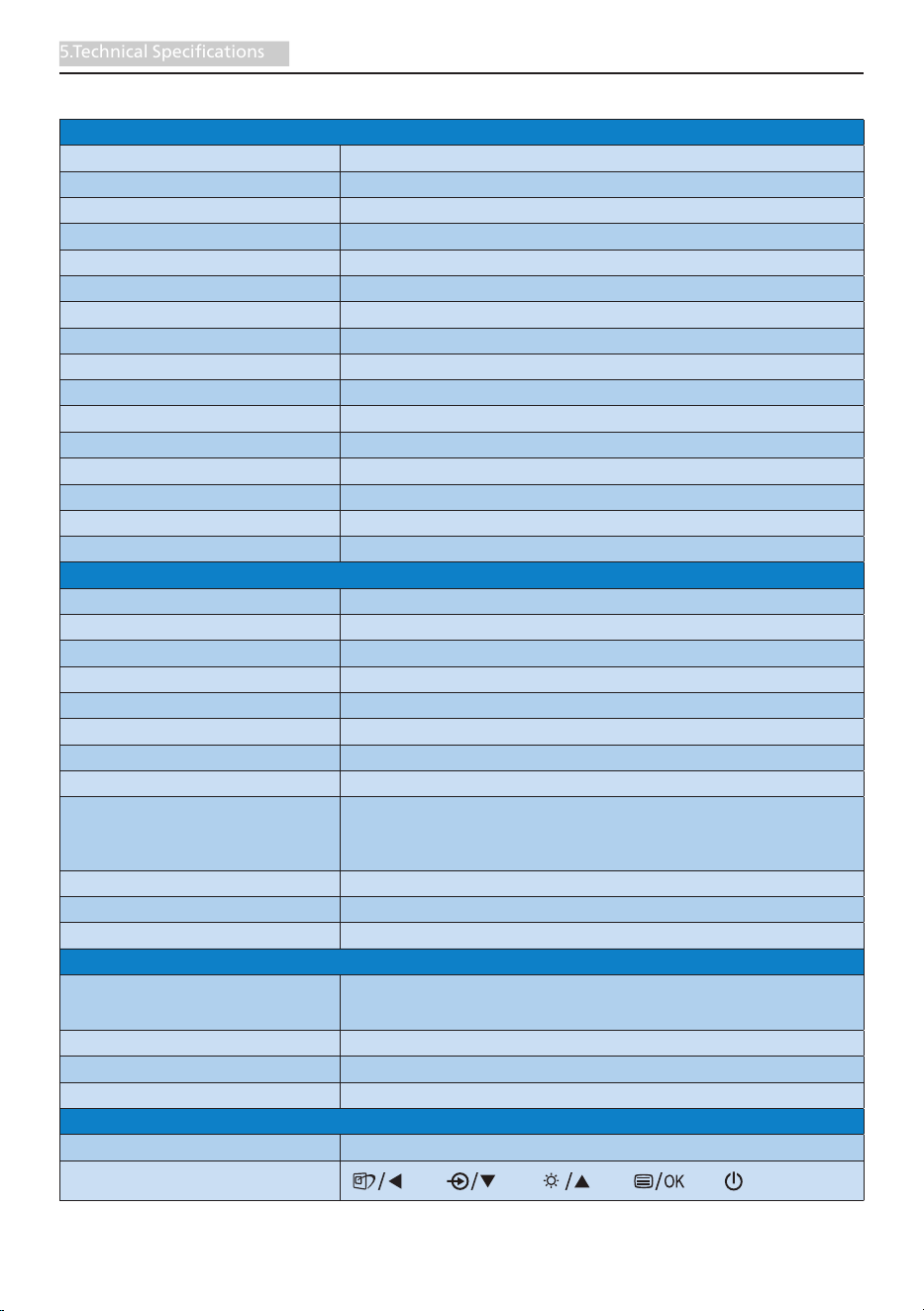
OperatingSystemrequirements
The touch function works on the
operating systems shown on the below
table.
OS OS Version/Name
Kernel
version
Touche finger Need Driver
Windows Win11 non multi-touch No
Windows Win10 non multi-touch No
Windows Win8/Win8.1 non multi-touch No
Android 7.1 (Nougat) 4.4.1 multi-touch No
Android 7.0 (Nougat) 4.4.1 multi-touch No
Android 6.0 (Marshmallow) 3.18 multi-touch No
Android 5.X (Lollipop) 3.16.1 multi-touch No
Android 4.4 (Jelly Bean) 3.1 multi-touch No
Note
• Do not touch the screen with sharp
objects, it may result in damage, and it
is not covered under your warranty.
• Do not push hard, or rest anything
on the glass surface (if in horizontal
position) as it will damage the screen
and it is not covered under your
warranty. Using the touch screen with
fingers or stylus are recommended.
• The touch function works only on OS
and applications which support touch
functions, see the table listed above.
• *Some operating systems require
driver for the touch function. you can
access them from the Philips website
supporting pages.
13
5.Technical Specications
5� TechnicalSpecifications
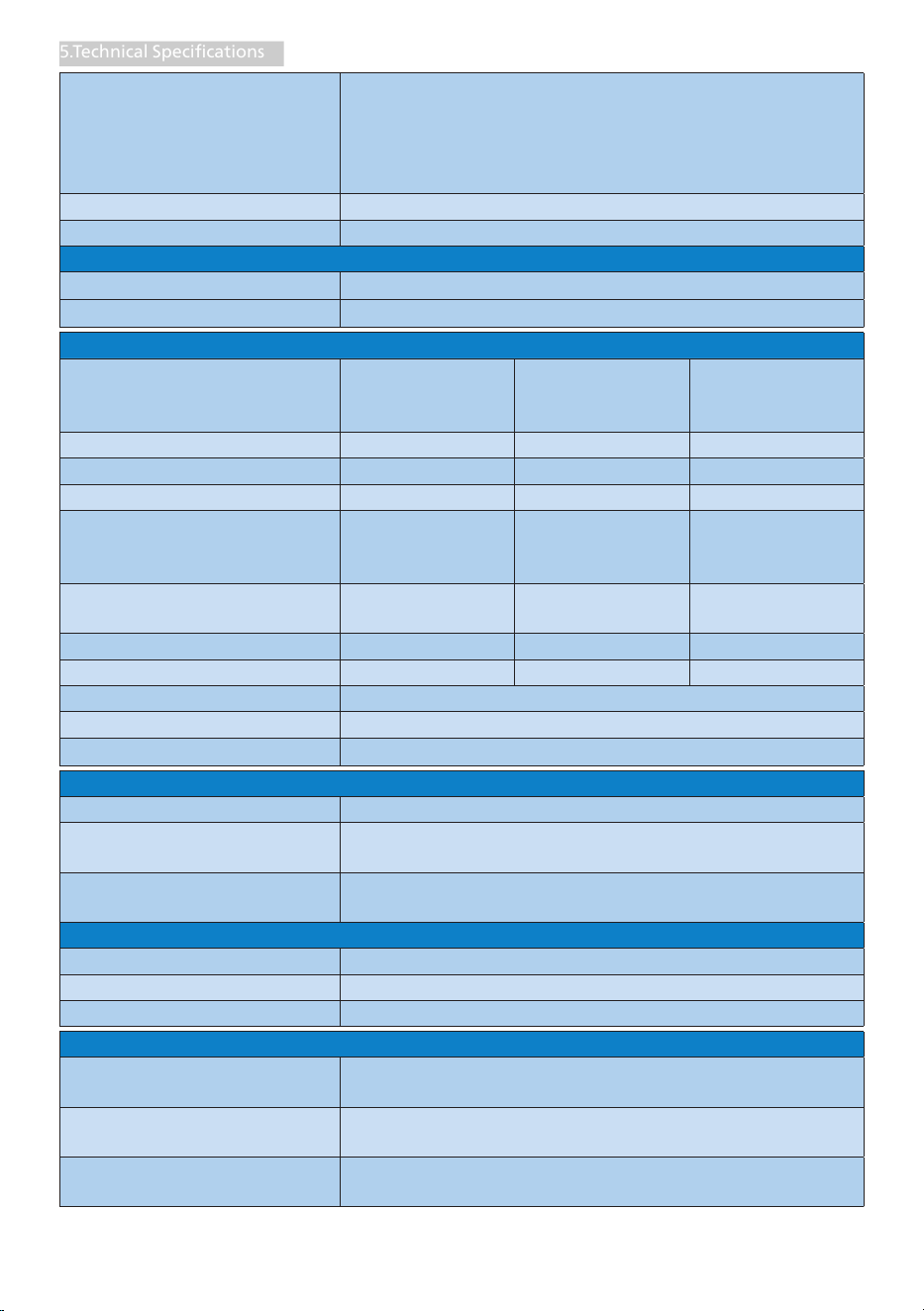
Picture/Display
Monitor Panel Type VA (222B9TA)
Backlight W-LED
Panel Size 21.5" W (54.6 cm)
Aspect Ratio 16:9
Pixel Pitch 0.248 (H) mm x 0.248 (V) mm
Contrast Ratio (typ.) 3000:1
Optimum Resolution 1920 x 1080 @ 60 Hz
Viewing Angle 178° (H) / 178° (V) @ C/R > 10 (typ.)
Display Colors 16.7M
Flicker Free YES
Picture Enhancement SmartImage
Vertical Refresh Rate 48 Hz - 75 Hz
Horizontal Frequency 30 kHz - 85 kHz
sRGB YES
LowBlue Mode YES
EasyRead YES
SmoothTouch
Touch Technology Projective Capacitive
Touch Points 10
Touch method Stylus, nger, glove
Transmission rate ≥ 85 %
Touch interface USB
Touch glass hardness 7H
Touch active area 476.64 mm (H) x 268.11 mm (V)
Touch Response time ≤35 ms
Openation system
Windows 8/8.1/10/11
Android 7.1/7.0 (Nougat) 6.0 (Marshmallow) 5.X
(Lollipop) 4.4 (Jelly Bean)
Brightness 250 nits (typ)
Ingress Protection IP65-front only
Sealability Touchscreen sealed to bezel; Touchscreen sealed to LCD
Connectivity
Signal Input/Output
Analog: VGA
Digital: DVI-D, DP1.2, HDMI 1.4
USB USB3.2 x 2 including x 1 BC1.2 fast charger (5V/1.5A)
Input Signal Separate Sync, Sync on Green
Audio In/Out PC audio-in, headphone out
Convenience
Built-in speaker 2 W x 2
User Convenience
14
5.Technical Specications
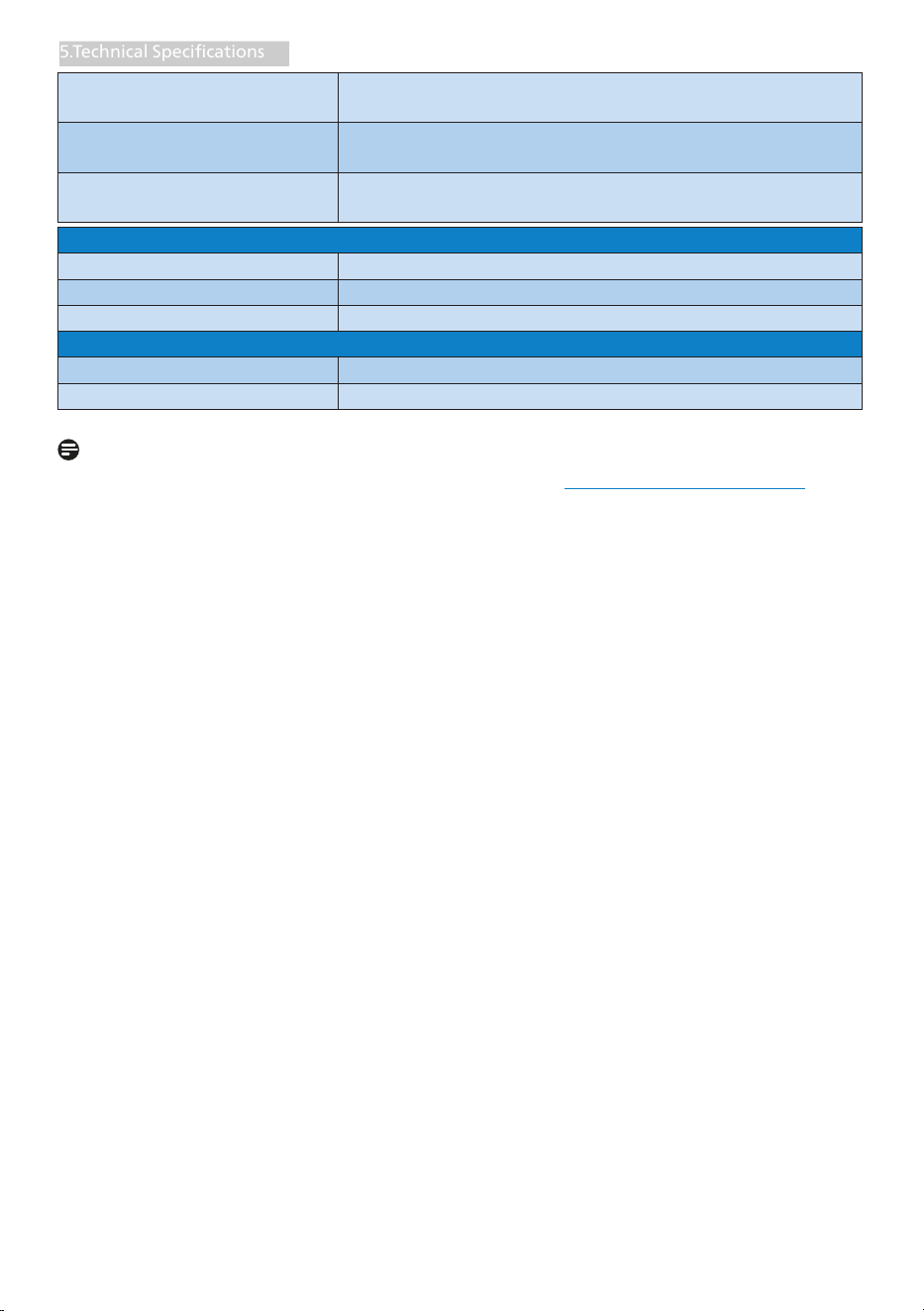
OSD Languages
English, German, Spanish, Greek, French, Italian,
Hungarian, Dutch, Portuguese, Brazil Portuguese, Polish,
Russian, Swedish, Finnish, Turkish, Czech, Ukranian,
Simplied Chinese, Traditional Chinese, Japanese,
Korean
Other Convenience VESA mount (100 x 100 mm), Kensington Lock
Plug & Play Compatibility DDC/CI, sRGB, Windows 11/10/8.1/8
Stand
Tilt -5 / +90 degree
Folding angle 0 / +70 degree
Power
Consumption
AC Input Voltage
at 100VAC ,
50Hz
AC Input Voltage
at 115VAC ,
50Hz
AC Input Voltage
at 230VAC, 50Hz
Normal Operation 19.8 W (typ.) 19.8 W (typ.) 19.9 W (typ.)
Sleep (Standby mode) 0.3 W 0.3 W 0.3 W
O mode 0.3 W 0.3 W 0.3 W
Heat Dissipation*
AC Input Voltage
at 100VAC ,
50Hz
AC Input Voltage
at 115VAC ,
50Hz
AC Input Voltage
at 230VAC ,
50Hz
Normal Operation
67.58 BTU/hr
(typ.)
67.58 BTU/hr
(typ.)
67.92 BTU/hr
(typ.)
Sleep (Standby mode) 1.02 BTU/hr 1.02 BTU/hr 1.02 BTU/hr
O mode 1.02 BTU/hr 1.02 BTU/hr 1.02 BTU/hr
On Mode (ECO mode) 13.0 W (typ.)
Power LED indicator On mode: White, Standby/Sleep mode: White (blinking)
Power Supply External, 100-240V AC, 50-60Hz
Dimensions
Product with stand (WxHxD) 515 x 394 x 226 mm
Product without stand
(WxHxD)
515 x 318 x 50 mm
Product with packaging
(WxHxD)
575 x 420 x 161 mm
Weight
Product with stand 7.24 kg
Product without stand 3.95 kg
Product with packaging 9.88 kg
OperatingCondition
Temperature range
(operation)
0°C to 40 °C
Relative humidity
(operation)
20% to 80%
Atmospheric pressure
(operation)
700 to 1060hPa
15
5.Technical Specications
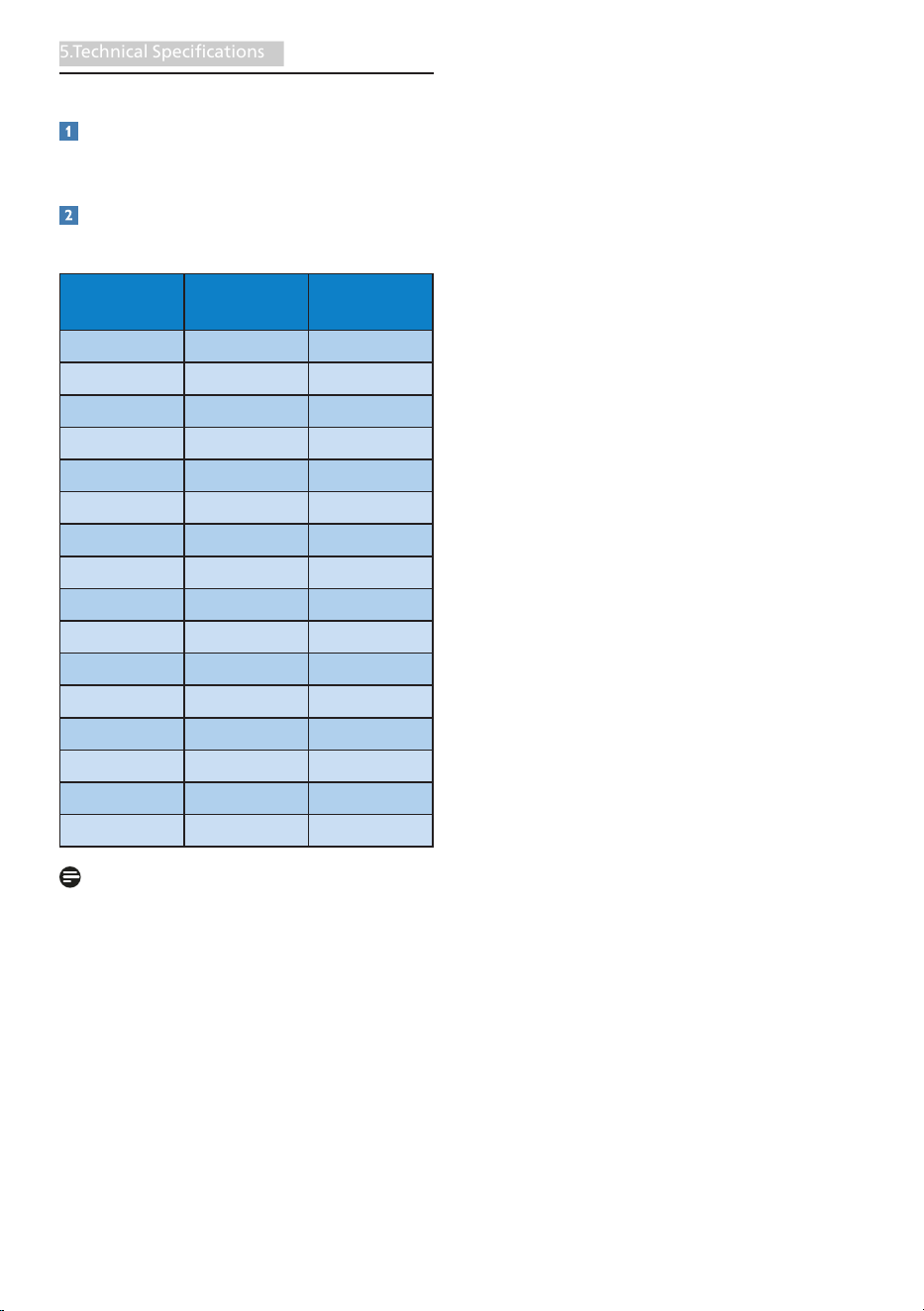
Temperature range
(Non-operation)
-20°C to 60°C
Relative humidity
(Non-operation)
10% to 90%
Atmospheric pressure
(Non-operation)
500 to 1060hPa
Environmentalandenergy
ROHS YES
Packaging 100% recyclable
Specic Substances 100% PVC BFR free housing
Cabinet
Color Black
Finish Texture
Note
1. Thisdataissubjecttochangewithoutnotice.Gotowww.philips.com/support to
downloadthelatestversionofleaet.
2� *Someoperatingsystemsrequiredriverforthetouchfunction.Youcanaccessthem
fromthePhilipswebsitesupportingpages.
3� Inordertocomplywithinternationalenergystandards,powerconsumptionsare
underthePC/DisplaytestmodeandthemonitorneedstoconnectwithUSBup-
streamcable.
16
5.Technical Specications
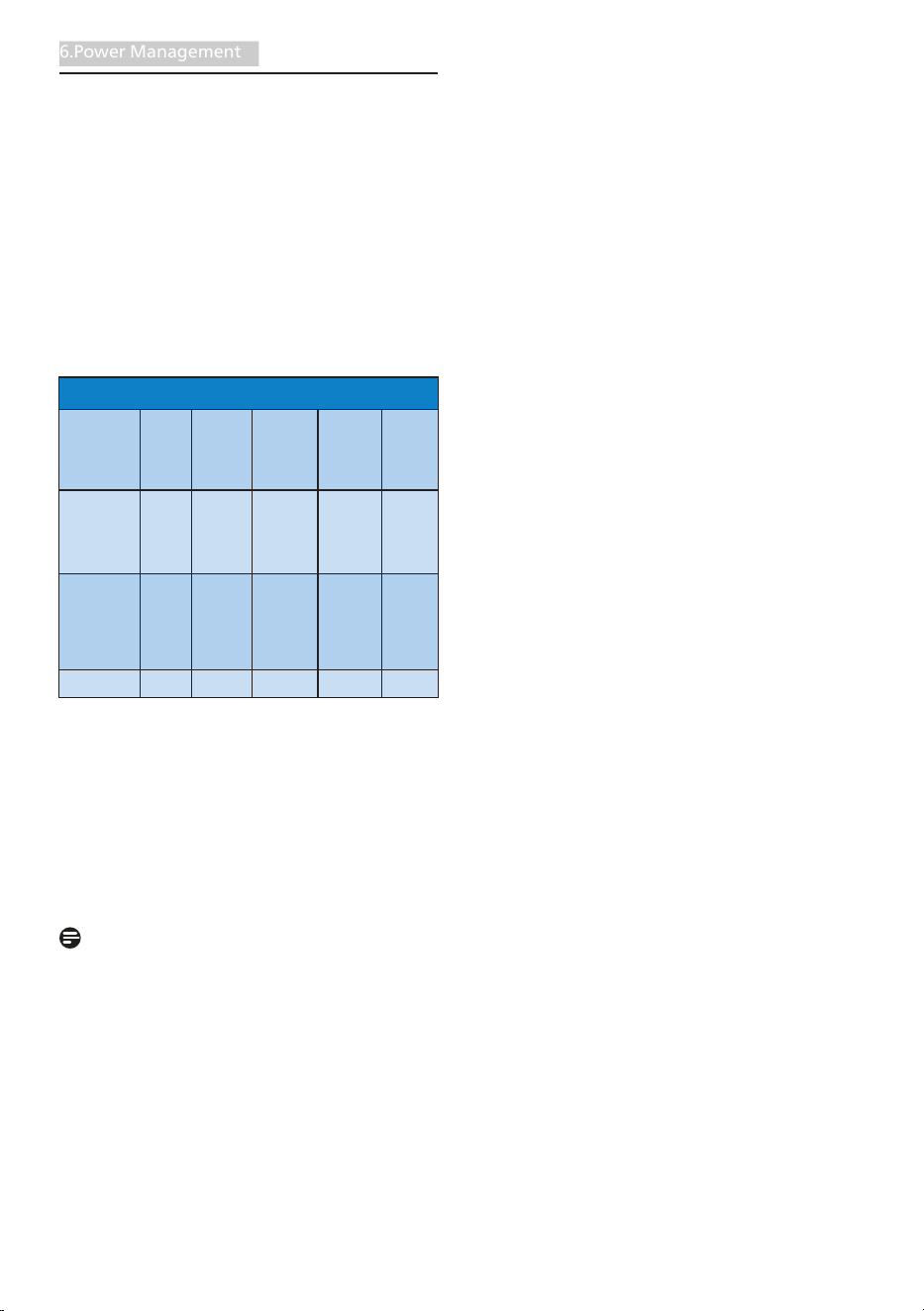
5�1 Resolution&PresetModes
MaximumResolution
1920 x 1080 @ 60 Hz (VGA/DVI)
1920 x 1080 @ 75 Hz (HDMI/DP)
RecommendedResolution
1920 x 1080 @ 60 Hz
H.freq
(kHz)
Resolution V.freq(Hz)
31.47 720 x 400 70.09
31.47 640 x 480 59.94
35.00 640 x 480 66.67
37.86 640 x 480 72.81
37.50 640 x 480 75.00
37.88 800 x 600 60.32
46.88 800 x 600 75.00
48.36 1024 x 768 60.00
60.02 1024 x 768 75.03
44.77 1280 x 720 59.86
63.89 1280 x 1024 60.02
79.98 1280 x 1024 75.03
55.94 1440 x 900 59.89
70.64 1440 x 900 74.98
65.29 1680 x 1050 59.95
67.50 1920 x 1080 60.00
Note
Please notice that your display works
best at native resolution of 1920 x 1080
@ 60Hz. For best display quality,please
follow this resolution recommendation.
17
6.Power Management
6� Power Management
If you have VESA DPM compliance display
card or software installed in your PC, the
monitor can automatically reduce its
power consumption when not in use. If
an input from a keyboard, mouse or other
input device is detected, the monitor will
'wake up' automatically. The following
table shows the power consumption and
signaling of this automatic power saving
feature:
PowerManagementDenition
VESA
Mode
Video H-sync V-sync
Power
Used
LED
Color
Active ON Yes Ye s
19.8 W
(typ.)
48.5 W
(max.)
White
Sleep
(Standby
mode)
OFF No No 0.3 W
White
(blink)
O mode OFF - - 0.3 W OFF
Thefollowingsetupisusedtomeasure
powerconsumptiononthismonitor.
• Native resolution: 1920 x 1080
• Contrast: 50%
• Brightness: 90%
• Color temperature: 6500k with full
white pattern
Note
This data is subject to change without
notice.
18
7.Customer care and warranty
7� Customercareand
warranty
7�1 Philips’FlatPanelMonitors
PixelDefectPolicy
Philips strives to deliver the highest quality
products. We use some of the industry's
most advanced manufacturing processes
and practice stringent quality control.
However, pixel or sub pixel defects on
the TFT Monitor panels used in at panel
monitors are sometimes unavoidable.
No manufacturer can guarantee that all
panels will be free from pixel defects, but
Philips guarantees that any monitor with
an unacceptable number of defects will be
repaired or replaced under warranty. This
notice explains the dierent types of pixel
defects and denes acceptable defect
levels for each type. In order to qualify for
repair or replacement under warranty, the
number of pixel defects on a TFT Monitor
panel must exceed these acceptable levels.
For example, no more than 0.0004%
of the sub pixels on a monitor may be
defective. Furthermore, Philips sets even
higher quality standards for certain types
or combinations of pixel defects that are
more noticeable than others. This policy is
valid worldwide.
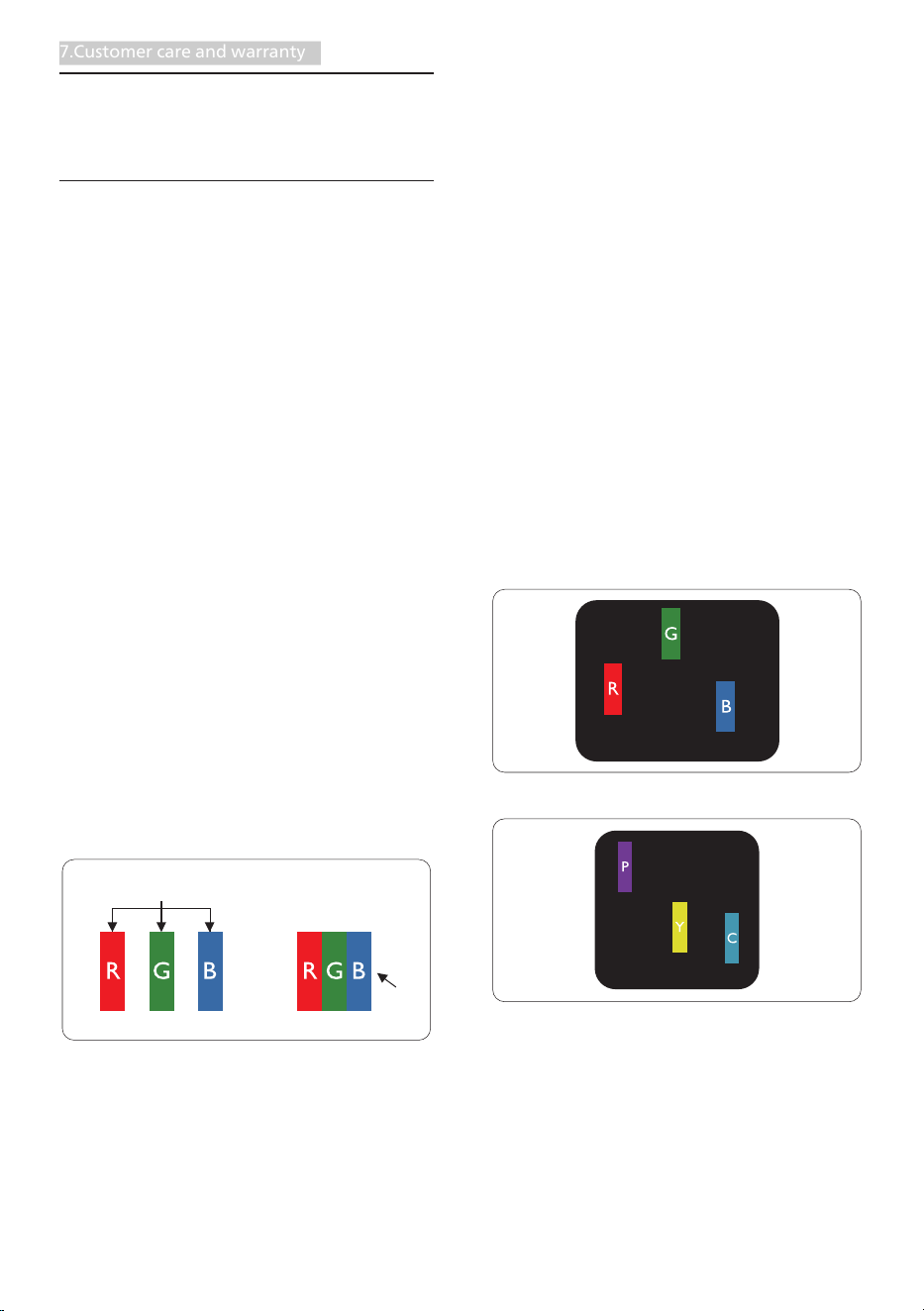
subpixel
pixel
Pixels and Sub pixels
A pixel, or picture element, is composed
of three sub pixels in the primary colors of
red, green and blue. Many pixels together
form an image. When all sub pixels of a
pixel are lit, the three colored sub pixels
together appear as a single white pixel.
When all are dark, the three colored sub
pixels together appear as a single black
pixel. Other combinations of lit and dark
sub pixels appear as single pixels of other
colors.
Types of Pixel Defects
Pixel and sub pixel defects appear on the
screen in dierent ways. There are two
categories of pixel defects and several
types of sub pixel defects within each
category.
Bright Dot Defects
Bright dot defects appear as pixels or sub
pixels that are always lit or 'on'. That is, a
bright dot is a sub-pixel that stands out on
the screen when the monitor displays a
dark pattern. There are the types of bright
dot defects.
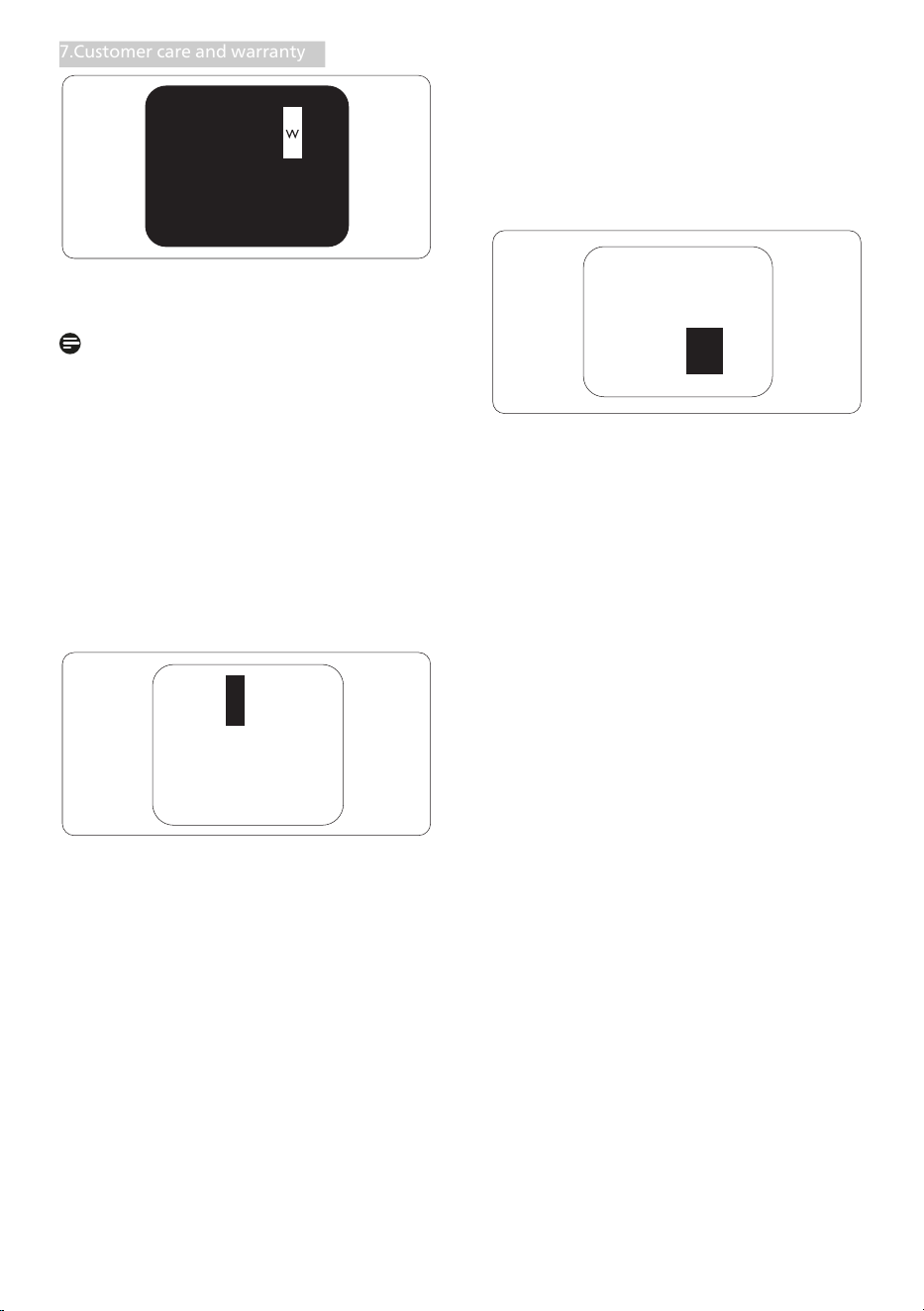
One lit red, green or blue sub pixel.
Two adjacent lit sub pixels:
- Red + Blue = Purple
- Red + Green = Yellow
- Green + Blue = Cyan (Light Blue)
19
7.Customer care and warranty
Proximity of Pixel Defects
Because pixel and sub pixels defects of the
same type that are near to one another
may be more noticeable, Philips also
species tolerances for the proximity of
pixel defects.
Pixel Defect Tolerances
In order to qualify for repair or
replacement due to pixel defects during
the warranty period, a TFT Monitor panel
in a Philips at panel monitor must have
pixel or sub pixel defects exceeding the
tolerances listed in the following tables.
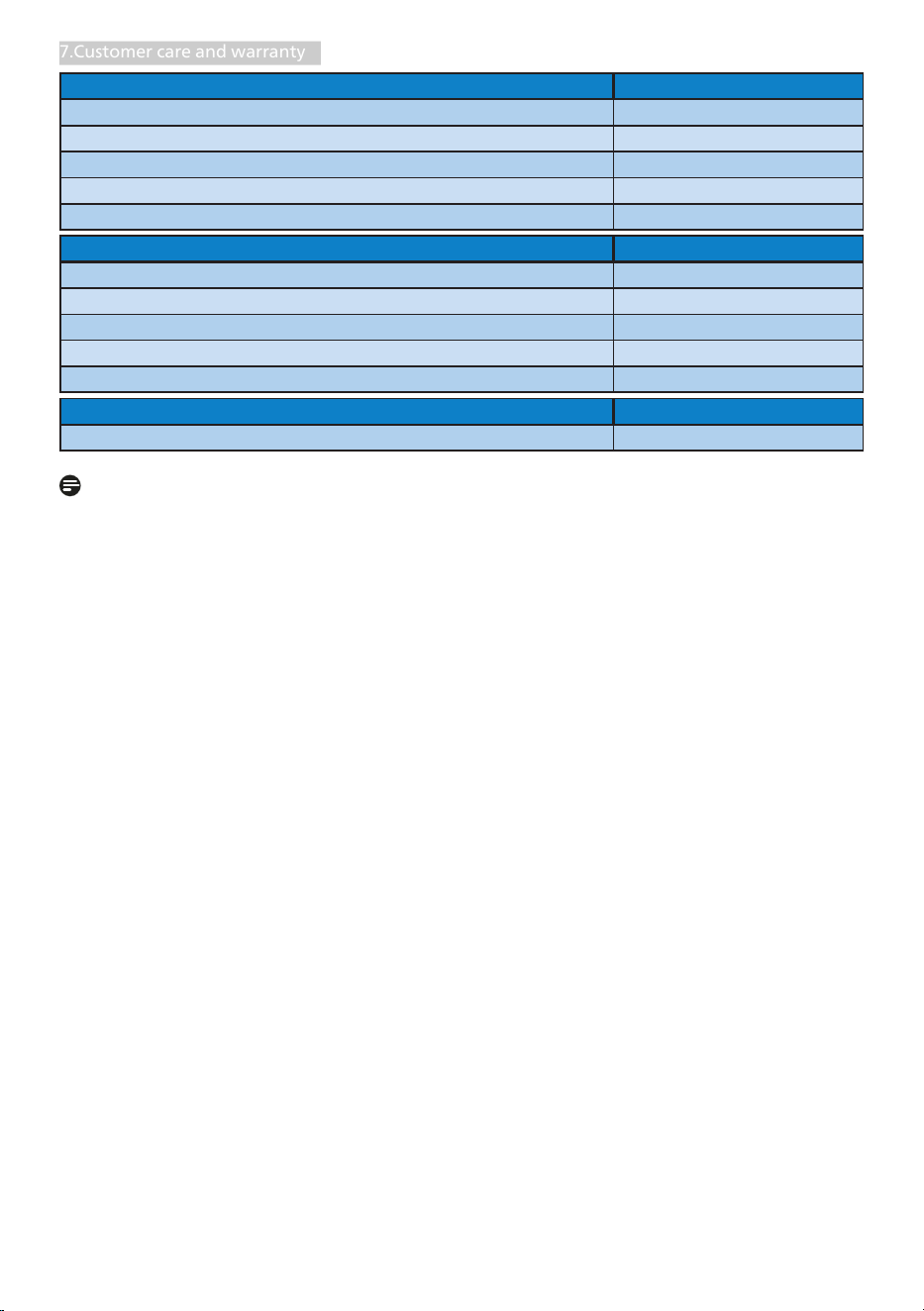
Three adjacent lit sub pixels (one white
pixel).
Note
A red or blue bright dot must be more
than 50 percent brighter than neighboring
dots while a green bright dot is 30 percent
brighter than neighboring dots.
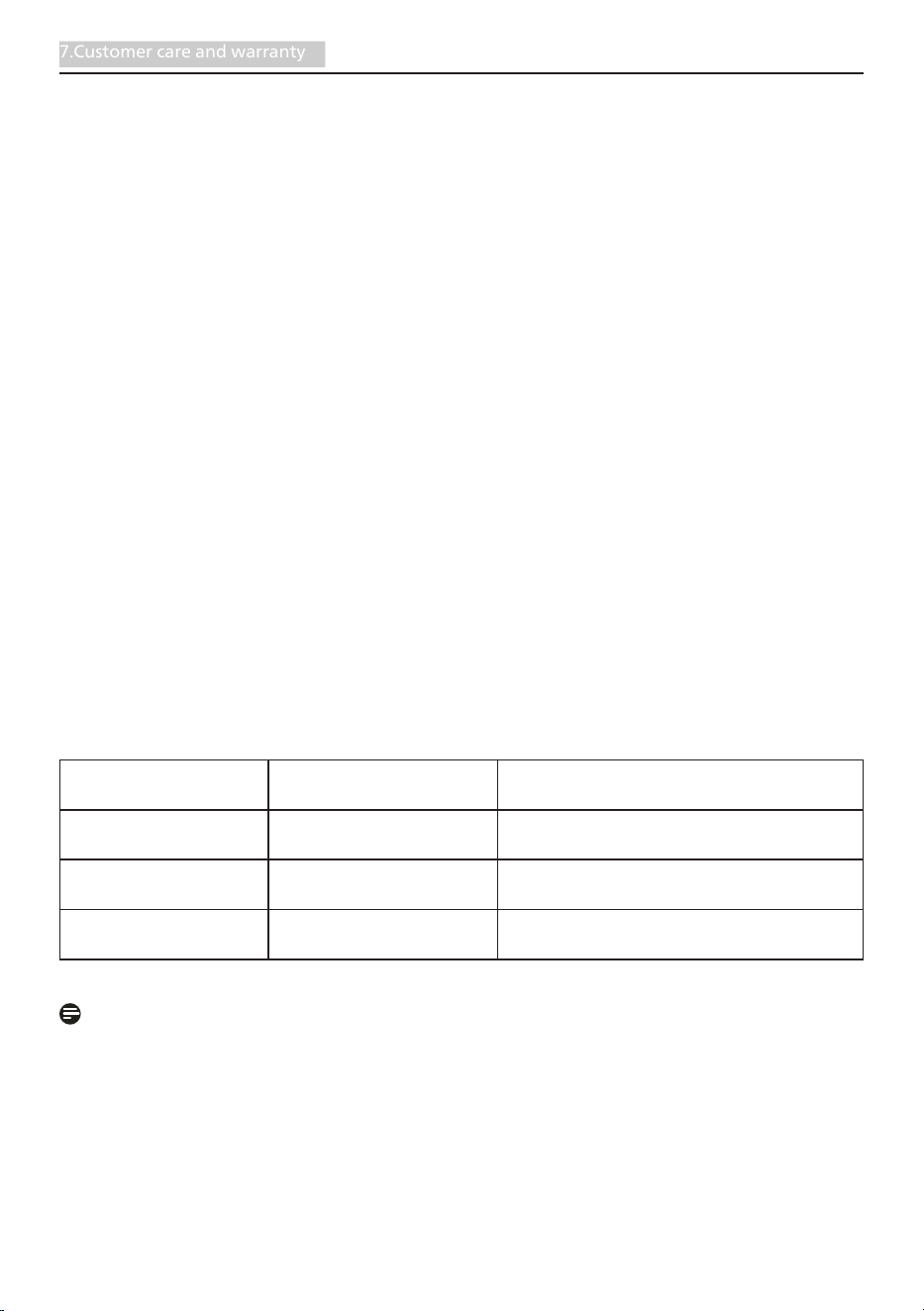
Black Dot Defects
Black dot defects appear as pixels or sub
pixels that are always dark or 'o'. That is,
a dark dot is a sub-pixel that stands out on
the screen when the monitor displays a
light pattern. These are the types of black
dot defects.
20
7.Customer care and warranty
BRIGHTDOTDEFECTS ACCEPTABLELEVEL
1 lit subpixel 2
2 adjacent lit subpixels 1
3 adjacent lit subpixels (one white pixel) 0
Distance between two bright dot defects* >15mm
Total bright dot defects of all types 3
BLACKDOTDEFECTS ACCEPTABLELEVEL
1 dark subpixel 5 or fewer
2 adjacent dark subpixels 2 or fewer
3 adjacent dark subpixels 0
Distance between two black dot defects* >5mm
Total black dot defects of all types 5 or fewer
TOTALDOTDEFECTS ACCEPTABLELEVEL
Total bright or black dot defects of all types 5 or fewer
Note
1. 1 or 2 adjacent sub pixel defects = 1 dot defect
21
7.Customer care and warranty
7�2 CustomerCare&Warranty
For warranty coverage information and additional support requirements valid for your
region, please visit www.philips.com/support website for details or contact your local
Philips Customer Care Center.
For Warranty Period please refer to Warranty Statement in Important Information Manual.
For extended warranty, if you would like to extend your general warranty period, an Out of
Warranty service package is oered via our Certied Service Center.
If you wish to make use of this service, please be sure to purchase the service within 30
calendar days of your original purchase date. During the extended warranty period, the
service includes pickup, repair and return service, however the user will be responsible for
all costs accrued.
If the Certied Service Partner cannot perform the required repairs under the oered
extended warranty package, we will nd alternative solutions for you, if possible, up to the
extended warranty period you have purchased.
Please contact our Philips Customer Service Representative or local contact center (by
Consumer care number) for more details.
Philips Customer Care Center number listed below.
• LocalStandard
WarrantyPeriod
• ExtendedWarranty
Period
• TotalWarrantyPeriod
• Dependon
dierentRegions
• +1Year • LocalStandardwarrantyperiod
+1
• +2Years • LocalStandardwarrantyperiod
+2
• +3Years • LocalStandardwarrantyperiod
+3
**
Proof of original purchase and extended warranty purchase required.
Note
1. Please refer to important information manual for regional service hotline, which is
available on the Philips website support page.
22
8.Troubleshooting & FAQs
8� Troubleshooting&
FAQs
8�1 Troubleshooting
This page deals with problems that can
be corrected by a user. If the problem
still persists after you have tried these
solutions, contact Philips customer service
representative.
CommonProblems
NoPicture(PowerLEDnotlit)
• Make sure the power cord is plugged
into the power outlet and into the
back of the monitor.
• First, ensure that the power button
on the front of the monitor is in the
OFF position, then press it to the ON
position.
NoPicture(PowerLEDisWhite)
• Make sure the computer is turned on.
• Make sure the signal cable is properly
connected to your computer.
• Make sure the monitor cable has no
bent pins on the connect side. If yes,
repair or replace the cable.
• The Energy Saving feature may be
activated
Screensays
• Make sure the monitor cable is
properly connected to your computer.
(Also refer to the Quick Start Guide).
• Check to see if the monitor cable has
bent pins.
• Make sure the computer is turned on.
AUTObuttondoesn'tfunction
• The auto function is applicable only
in VGA-Analog mode. If the result is
not satisfactory, you can do manual
adjustments via the OSD menu.
Note
The Auto Function is not applicable in DVI-
Digital mode as it is not necessary.
Visiblesignsofsmokeorsparks
• Do not perform any troubleshooting
steps
• Disconnect the monitor from mains
power source immediately for safety
• Contact with Philips customer service
representative immediately.
ImagingProblems
Imageisnotcentered
• Adjust the image position using the
“Auto” function in OSD Main Controls.
• Adjust the image position using the
Phase/Clock of Setup in OSD Main
Controls. It is valid only in VGA mode.
Imagevibratesonthescreen
• Check that the signal cable is properly
securely connected to the graphics
board or PC.
Verticalickerappears
• Adjust the image using the “Auto”
function in OSD Main Controls.
• Eliminate the vertical bars using the
Phase/Clock of Setup in OSD Main
Controls. It is valid only in VGA mode.
Horizontalickerappears

23
8.Troubleshooting & FAQs
• Adjust the image using the “Auto”
function in OSD Main Controls.
• Eliminate the vertical bars using the
Phase/Clock of Setup in OSD Main
Controls. It is valid only in VGA mode.
Imageappearsblurred,indistinctortoo
dark
• Adjust the contrast and brightness on
On-Screen Display.
An"after-image","burn-in"or"ghost
image"remainsafterthepowerhas
beenturnedo.
• Uninterrupted display of still or static
images over an extended period
may cause "burn-in", also known as
"after-imaging" or "ghost imaging",
on your screen. "Burn-in", "after-
imaging", or "ghost imaging" is a
well-known phenomenon in LCD
panel technology. In most cases, the
"burn-in" or "after-imaging" or "ghost
imaging" will disappear gradually over
a period of time after the power has
been switched off.
• Always activate a moving screen saver
program when you leave your monitor
unattended.
• Always activate a periodic screen
refresh application if your LCD
monitor will display unchanging static
content.
• Failure to activate a screen saver, or
a periodic screen refresh application
may result in severe “burn-in” or
“after-imaging” or “ghost imaging”
symptoms that will not disappear
and cannot be repaired. The damage
mentioned above is not covered
under your warranty.
Imageappearsdistorted.Textisfuzzyor
blurred.
• Set the PC’s display resolution to the
same mode as monitor’s recommended
screen native resolution.
Green,red,blue,dark,andwhitedots
appearsonthescreen
• The remaining dots are normal
characteristic of the liquid crystal used
in today’s technology, Please refer the
pixel policy for more detail.
* The"poweron"lightistoostrongandis
disturbing
• You can adjust “power on” light using
the power LED Setup in OSD main
Controls.
For further assistance, refer to the Service
contact information listed in Important
information manual and contact Philips
customer service representative.
* Functionality dierent according to
display.
8�2 GeneralFAQs
Q1: WhenIinstallmymonitorwhat
shouldIdoifthescreenshows
'Cannotdisplaythisvideomode'?
Ans.: Recommendedresolutionforthis
monitor:1920x1080@60Hz.
• Unplug all cables, then connect your
PC to the monitor that you used
previously.
• In the Windows Start Menu, select
Settings/Control Panel. In the Control
Panel Window, select the Display icon.
Inside the Display Control Panel, select
the 'Settings' tab. Under the setting
tab, in box labelled 'desktop area',
move the sidebar to 1920 x 1080 pixels.
• Open 'Advanced Properties' and set the
Refresh Rate to 60 Hz, then click OK.

24
8.Troubleshooting & FAQs
• Restart your computer and repeat step
2 and 3 to verify that your PC is set at
1920 x 1080 @ 60 Hz.
• Shut down your computer, disconnect
your old monitor and reconnect your
Philips LCD monitor.
• Turn on your monitor and then turn
on your PC.
Q2: Whatistherecommendedrefresh
rateforLCDmonitor?
Ans.: Recommendedrefreshratein
LCDmonitorsis60Hz,Incaseof
anydisturbanceonscreen,you
cansetitupto75Hztoseeifthat
removesthedisturbance.
Q3: Whatarethe.infand.icmles?
HowdoIinstallthedrivers(.inf
and.icm)?
Ans.: These are the driver files for your
monitor. Your computer may
ask you for monitor drivers (.inf
and .icm files) when you first
install your monitor. Follow the
instructions in your user manual,
monitor drivers (.inf and .icm files)
will be installed automatically.
Q4: HowdoIadjusttheresolution?
Ans.: Yourvideocard/graphicdriver
andmonitortogetherdetermine
theavailableresolutions.You
canselectthedesiredresolution
underWindows
®
Control Panel
withthe"Displayproperties".
Q5: WhatifIgetlostwhenIam
makingmonitoradjustmentsvia
OSD?
Ans.: SimplypresstheOKbutton,then
select'Reset'torecallallofthe
originalfactorysettings.
Q6: IstheLCDscreenresistantto
scratches?
Ans.: Ingeneralitisrecommended
thatthepanelsurfaceisnot
subjectedtoexcessiveshocks
andisprotectedfromsharpor
bluntobjects.Whenhandlingthe
monitor,makesurethatthereis
nopressureorforceappliedto
thepanelsurfaceside.Thismay
aectyourwarrantyconditions.
Q7: HowshouldIcleantheLCD
surface?
Ans.: Fornormalcleaning,useaclean,
softcloth.Forextensivecleaning,
pleaseuseisopropylalcohol.Do
notuseothersolventssuchas
ethylalcohol,ethanol,acetone,
hexane,etc.
Q8: CanIchangethecolorsettingof
mymonitor?
Ans.: Yes,youcanchangeyourcolor
settingthroughOSDcontrolas
thefollowingprocedures.
• Press "OK" to show the OSD (On
Screen Display) menu
• Press "Down Arrow" to select the
option "Color" then press "OK" to
enter color setting, there are three
settings as below.
1. ColorTemperature:Thesettings
areNative,5000K,6500K,7500K,
8200K,9300Kand11500K.With
settingsinthe5000Krangethe
panelappears"warm,witha
red-whitecolortone",whilea
11500Ktemperatureyields"cool,
bluewhitetoning".
2. sRGB:Thisisastandardsetting
forensuringcorrectexchangeof
colorsbetweendierentdevice
(e.g.digitalcameras,monitors,
printers,scanners,etc).
3. UserDene:Theusercanchoose
his/herpreferencecolorsetting
byadjustingred,greenbluecolor.
25
8.Troubleshooting & FAQs
Note
A measurement of the color of light
radiated by an object while it is being
heated. This measurement is expressed in
terms of absolute scale, (degrees Kelvin).
Lower Kevin temperatures such as 2004K
are red; higher temperatures such as
9300K are blue. Neutral temperature is
white, at 6504K.
Q9: CanIconnectmyLCDmonitorto
anyPC,workstationorMac?
Ans.: Yes.AllPhilipsLCDmonitorsare
fullycompatiblewithstandard
PCs,Macsandworkstations.
Youmayneedacableadapter
toconnectthemonitortoyour
Macsystem.Pleasecontactyour
Philipssalesrepresentativefor
more information�
Q10: ArePhilipsLCDmonitorsPlug-
and-Play?
Ans.: Yes,themonitorsarePlug-and-
PlaycompatiblewithWindows
11/10/8�1/8�
Q11: WhatisImageSticking,or
ImageBurn-in,orAfterImage,
orGhostImageinLCDpanels?
Ans.: Uninterrupteddisplayofstillor
staticimagesoveranextended
periodmaycause"burn-in",also
knownas"after-imaging"or
"ghostimaging",onyourscreen.
"Burn-in","after-imaging",or
"ghostimaging"isawell-known
phenomenon in LCD panel
technology.Inmostcases,the
"burn-in"or"after-imaging"or
"ghostimaging"willdisappear
graduallyoveraperiodof
timeafterthepowerhasbeen
switchedo.
Alwaysactivateamovingscreen
saverprogramwhenyouleave
yourmonitorunattended.
Alwaysactivateaperiodicscreen
refreshapplicationifyourLCD
monitorwilldisplayunchanging
staticcontent.
Warning
Failure to activate a screen saver, or a
periodic screen refresh application may
result in severe “burn-in” or “after-image”
or “ghost image” symptoms that will not
disappear and cannot be repaired. The
damage mentioned above is not covered
under your warranty.
Q12: WhyismyDisplaynotshowing
sharptext,andisdisplaying
jaggedcharacters?
Ans.: YourLCDmonitorworksbestat
itsnativeresolutionof1920x
1080@60Hz.Forbestdisplay,
pleaseusethisresolution.
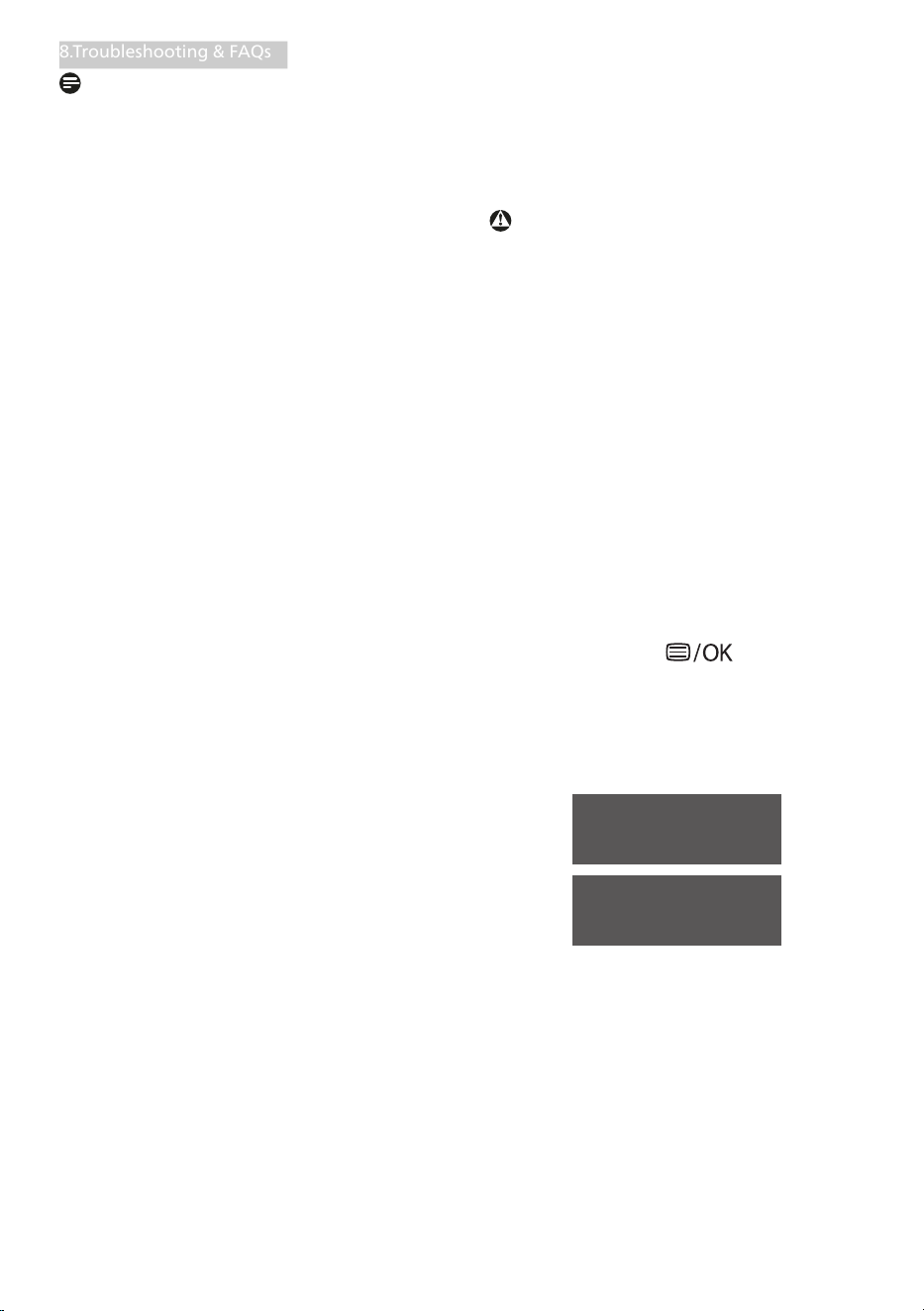
Q13: Howtounlock/lockmyhotkey?
Ans.: Pleasepress for 10
secondstounlock/lockthehot
key,bydoingso,yourmonitor
popsout“Attention”toshow
theunlock/lockstatusasshown
belowillustrators.
Q14: WherecanIndImportant
Informationmanualmentioned
inEDFU?
Ans.: ImportantInformationmanual
canbedownloadonthePhilips
websitesupportpage.

26
8.Troubleshooting & FAQs
8�3 SmoothTouch
Q1: Whyisthetouchfunctionnot
availablewhenItouchthe
display?
Ans.: Please ensure the supplied USB
cable is connected between your
computer and the display properly.
Q2: Doesthetouchfunctiononly
existontheWindows10OS?
Ans.: The touch function works only on
OS and applications which support
touch functions.
Q3: Whymytouchfunctionisvery
slow?
Ans.: The touch function response
is dependent on the speed of
your computer conguration.
For example, your devise must
be either Windows or Android
certied listed on the specication
page to ensure minimum
requirement for touch function in
order to maximize Touch utility.
Q4: Whymytouchresponseisnot
smoothenough?
Ans.: You may need to clean the glass
surface of the display with proper
screen cleaning material from
time to time, as the glass tends
to pick up dirt from your ngers.
Please keep your hands clean and
dry before touching the screen to
ensure uid touch operation.

2024 © TOP Victory Investments Ltd. All rights reserved.
This product has been manufactured by and is sold under the
responsibility of Top Victory Investments Ltd., and Top Victory
Investments Ltd. is the warrantor in relation to this product.
Philips and the Philips Shield Emblem are registered trade-
marks of Koninklijke Philips N.V. and are used under license.
Specications are subject to change without notice.
Version: M92224ABE2WWT