
2
IMPORTANT SAFEGUARDS.....................................................................................................................................
PRODUCT INSTRUCTIONS
......................................................................................................................................
CHARGING AND BATTERY .....................................................................................................................................
Contents
2-6
7-11
12-14

IMPORTANT SAFEGUARDS
3
Save all warnings and instructions for future reference.
The term "power tool" in the warnings refers to your mains-operated (corded) power tool or battery.
operated (cordless) power tool.
1) Work area safety
a) keep work area clean and well lit. Cluttered or dark areas invite accidents.
b) Do not operate power tools in explosive atmospheres, such as in the presence of flammable
liquids, gases or dust. power tools create sparks which may ignite the dust or fumes.
c) keep children and bystanders away while operating a power tool. Distractions can cause
you to lose control.
2) Electrical safety
a) power tool plugs must match the outlet. Never modify the plug in any way. Do not use any
adapter plugs with earthed (grounded) power tools. unmodified plugs and matching outlets
will reduce risk of electric shock.
b) Avoid body contact with earthed or grounded surfaces, such as pipes,radiators, ranges
and refrigerators. There is an increased risk of electric shock if your body is earthed or
grounded electric shock.
WARNING
Read all safety warnings and all instructions. Failure to follow the warnings and
all instructions may result in electric shock, fire and /or serious injury.

4
IMPORTANT SAFEGUARDS
c) Do not expose power tools to rain or wet conditions. water entering a power tool will
increase the risk of
d) Do not abuse the cord. Never use the cord for carrying pulling or unplugging the power
tool keep cord away from heat,oil ,sharp edges or moving parts. Damaged or entangled cords
increase the risk of electric shock.
e) When operating a power too outdoors, use an extension cord suitable for outdoor use. Use
of a cord suitable for outdoor use reduces the risk of electric shock
f) If operating a power too in a damp location is unavoidable, use a residual current
device (RCD) protected supply. Use of an RCD reduces the risk of electric shock
3) Personal safety
a) Stay alert, watch what yu are doing and use common sense when operating a power tool
Do not use a power tool while yu are tired or under the influence of drugs, alcohol or
medication. A moment of inattention while operating power tools may result in serious
personal injury.
b) Use personal protective equipment. Always wear eye protection. Protective equipment such
as dust mask, non-skid safety shoes , hard hat, or hearing protection used for appropriate
conditions will reduce personal injuries.
c) Prevent unintentional starting. Ensure the switch is in the off-position before connecting to
power source and/or battery pack, picking up or carrying the tool.Carrying power tools with
your finger on the switch or energizing power tools that have the switch on invites accidents.

IMPORTANT SAFEGUARDS
5
d) Remove any adjusting key or wrench before turning the power tool on. A Wrench or a key
left attached to a rotating part of the power tool may result in personal injury.
e) Do not overreach. keep proper footing and baIance at all times. This enables better control
of the power tool in unexpected situation.
f) Dress properly. Do not wear loose clothing or jewellery. keep your hair, clothing and
gloves awayfrom moving parts. Loose clothes , jewellery or long hair can be caught in moving parts.
g) If devices are provided for the connection of dust extraction and collection facilities, ensure
these are connected and properly used. Use of dust collection can reduce dust-related hazards.
4) Power tool use and care
a) Do not force the power tool. use the correct power tool for your application. The correct
power tool will do the job better and safer at the rate for which it was designed.
b) Do not use the power tool if the switch does not turn it on and off. Any power tool that
cannot be controlled with the switch is dangerous and must be repaired.
c) Disconnect the Plug from the power source and/or the battery pack from the power tool
before making any adjustments, changing accessories, or storing power tools. Such
preventive safety measures reduce the risk of starting the power tool accidentally.
d) Store idle power tools out of the reach of children and do not allow persons unfamiliar with
the power tool or these instructions to operate the power tool.Power tools are dangerous in
the hands of untrained users.

6
IMPORTANT SAFEGUARDS
e) Maintain power tools. Check for misalignment or binding of moving parts,breakage of parts
and any other condition that may affect the power tool's operation. If damaged, have the
power tool repaired before use. Many accidents are caused by poorly maintained power tools
f) Keep cutting tools sharp and clean.Properly maintained cutting tools with sharp cutting
edges are less likely to bind and are easier to control.
g)Use the power tool , accessories and tool bits etc. in accordance with these instructions,
taking into account the working conditions and the work to be performed.Use of the power tool
for operations different from those intended could result in a hazardous situation
5) Battery tool use and care
a) Recharge only with the charger specified by the manufacturer. A Charger that is suitable for
one type of battery pack may create a risk of fire when used with another battery pack.
b) Use power tools only with specifically designated battery packs. use of any other battery
packs may create a risk of injury and fire.
c) When battery pack is not in use, keep it away from other metal objects, like paper clips,
coins, keys, nails, screws or other small metal objects, that can make a connection from one
terminal to another. shorting the battery terminals together may cause burns or a fire.
d)Under abusive conditions, liquid may be ejected from the battery;avoid contact .If contact
accidentally occurs, flush with water. If liquid contacts eyes, additionally seek medical help.
Liquid ejected from the battery may cause irritation or burns.

7
IMPORTANT SAFEGUARDS
Residual risks
Even when the tool is used as prescribed it is not possible to eliminate all residual risk
factors. The following hazards may arise in connection with the tool's construction and
design:
1.Damage to lungs if an effective dust mask is not worn .
2 .Damage to hearing if effective hearing protection is not worn .
3 .Health defects resulting from vibration emission if the power tool is being used over longer period
of time or not adequately managed and properly maintained
WARNING! This machine produces an electromagnetic field during operation. This field may under
some circumstances interfere with active or passive medical implants.To reduce the risk of serious or
fatal injury, we recommend persons with medical implants to consult their physician and the medical
implant manufacturer before operating this machine.
8
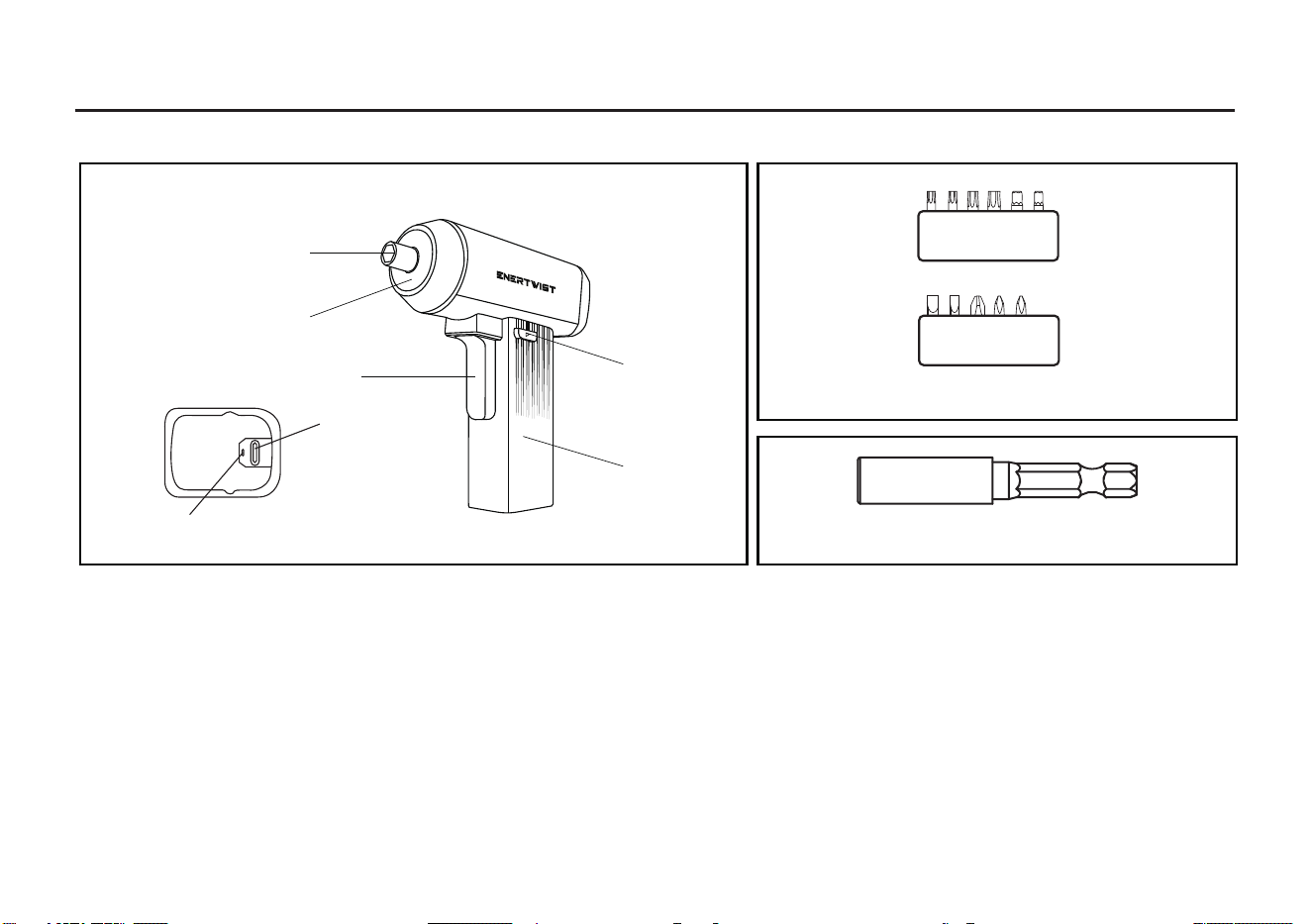
PRODUCT INSTRUCTIONS
1. Bit Holder
2. LED Working Spot Light
3. On/Off Switch Trigger
4. Reversing Block
5. Housing
6. Charging port
7. Battery indicator
8. 11 PCS 1” Bits
9. Magnetic Connector
9
8
1
2
3
6
7
4
5
9
PRODUCT INSTRUCTIONS
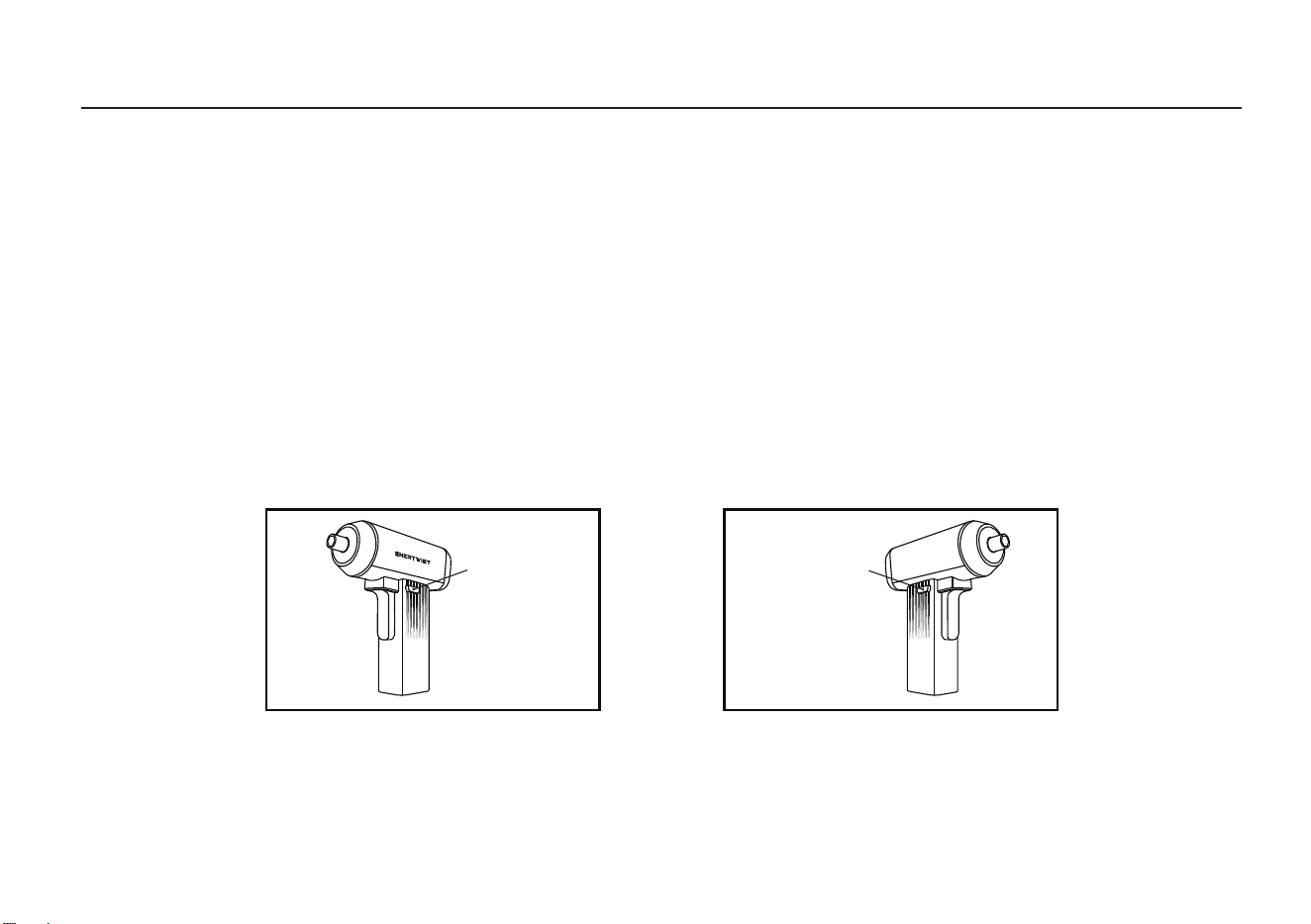
Forward Reverse
WARNING! Switch off before adjusting or cleaning. The bit holder continues to move for a few
seconds after the machine is switched off. Caution! Do not touch the moving bit holder.
Inserting and Extracting Tool Bits
Reversing Block
Important!Always turn off the switch before you change the screw bit to avoid unintentional starting
of the machine. When the machine is completely stopped , insert or extract the screw bit.
Press the reversing block(④) on the front side (for right-handed operation), the machine will rotate
forward. Press the reversing block(④) on the back side, the machine will rotate in reverse.
For your safety

10
PRODUCT INSTUCTIONS
On/off Trigger
When the axis of the reversing block(④) is in the middle position,the machine is in a locked state
(however, this does not mean it's turned off; to turn off, release the On/off Trigger(③) .
Before turning on, you need to press the reversing block first, and then press the On/off Trigger
to start the tool. If the axis of the reversing block is in the middle position, even if the On/off Trigger is
pressed, the tool will only activate the work light(②) and the motor will not run.
Use the on/off trigger to start the machine and keep holding it for continuous operation.
-To switch the machine off , release the On/off trigger and gently press the reversing block to position
the axis of the reversing block in the middle position.
-Operation for working. Only use tool bits which can be securely fastened in the chuck and for which
the bits has been designed
-Before using the machine check whether the screw-bit is inserted correctly. Avoid over-tightening
screws , otherwise the screw head may be damaged or stripping of the threads may occur.
LED Working Spot Light
Press the On/off Trigger, and the work spot light will illuminate. Release the On/off Trigger, and the
work spot light will turn off

11
PRODUCT INSTUCTIONS
Screw Insertion
The machine's bit holder(①) is magnetically attached, simply insert the bit horizontally into the holder.
Important! Before inserting the bit, ensure that the reversing block is in the middle position
(meaning the machine is in a locked state) and release On/off trigger.
Screw Removal
The machine's bit holder(①) is magnetically attached, simply remove the bit horizontally from the holder.
Important! Before removing the bit, ensure that the reversing block is in the middle position
(meaning the machine is in a locked state) and release On/off trigger.
Maintenance and Cleaning
Attention! Always switch off the screwdriver and lock the switch in the OFF Position before
carrying out any work on the machine.
-To clean , always use a dry or moist, but not wet, towel . Many cleaning agents contain chemical
substances which may cause damage to the plastic parts of the machine.
-Therefore do not use any strong or inflammable cleaners such as petrol , paint thinner,turpentine
or similar cleaning agents. Always keep air ventilation holes free of dust deposits to prevent
overheating .

12
CHARGING AND BATTERY
Charging Procedure
The battery charger supplied matches to the battery installed in the machine. Do not use other battery
chargers.
The Li-ion battery is protected against deep discharging. When the battery is empty, the machine is
switched off by means of a protective circuit: The bit holder no longer moves.
Note!
-During the charging procedure , the handle of the machine warms up. This is normal .
-when the charging is finished , disconnect the battery charger from the socket.
-Do not use the machine during the charging procedure.
The charging process starts as soon as the mains plug of the battery charger(⑥) is inserted in the
socket and the machine is then connected to the battery charger.
The battery charge indicator (⑦) lights up red to indicate the charging procedure.
When the battery charging indicator (⑦) lights up green, the battery is fully charged.
If the on/off switch is subject to continued use, the battery can be damaged.

13
CHARGING AND BATTERY
Battery/Battery charger safety warnings
-This appliance can be used by children aged from 13 years and above and persons with reduced
physical , sensory or mental capabilities or lack of experience and knowledge if they have been given
supervision or instruction concerning use of the appliance in a safe way and understand the hazards
involved
-Children shall not play with the appliance. cleaning and user maintenance shall not be made by
children without supervision.
-Do not recharge non-rechargeable batteries , as they can overheat and break.
-During charging , batteries must be placed in the well-ventilated area.
Protect the battery charger from rain and moisture.The penetration of water in a battery charger
increases the risk of electric shock.
Recharge only with the charger specified by the manufacturer. A Charger that is suitable for
one type of battery, it may create a risk of fire when used with another battery.
Do not charge other batteries. The charger is suitable only for charging our lithium-ion batteries
within the listed voltage range. otherwise there is danger, fire and explosion.
Keep the battery charger clean. contamination may cause the danger of electric shock.
Check the battery charger, cable and plug each time before using.
Do not use the battery charger when defects are detected.
Do not open the battery charger yourself and have it repaired only by qualified personnel
using original spare parts.

14
Do not operate the battery charger on easily inflammable surfaces (e. g. paper,textiles, etc )
or in combustible environments. There is danger of fire due to the heating of the battery
charger during charging.
Under abusive conditions, liquid may be ejected from the battery; avoid contact.
If contact accidentally occurs,flush with water. If liquid contacts eyes, additionally seek
medical help. Liquid ejected from the battery may cause irritation or burns.
Do not open the battery yourself. There is danger of a short circuit.Protect the battery against
heat,e.g., including against continuous sun irradiation and fire. There is a danger of explosion.
Do not short-circuit the battery. There is a danger of explosion.
In case of damage and improper use of the battery vapours may be emitted. In case of
complaints , provide for fresh air and consult a physician. The vapours can irritate the
respiratory system.
CHARGING AND BATTERY