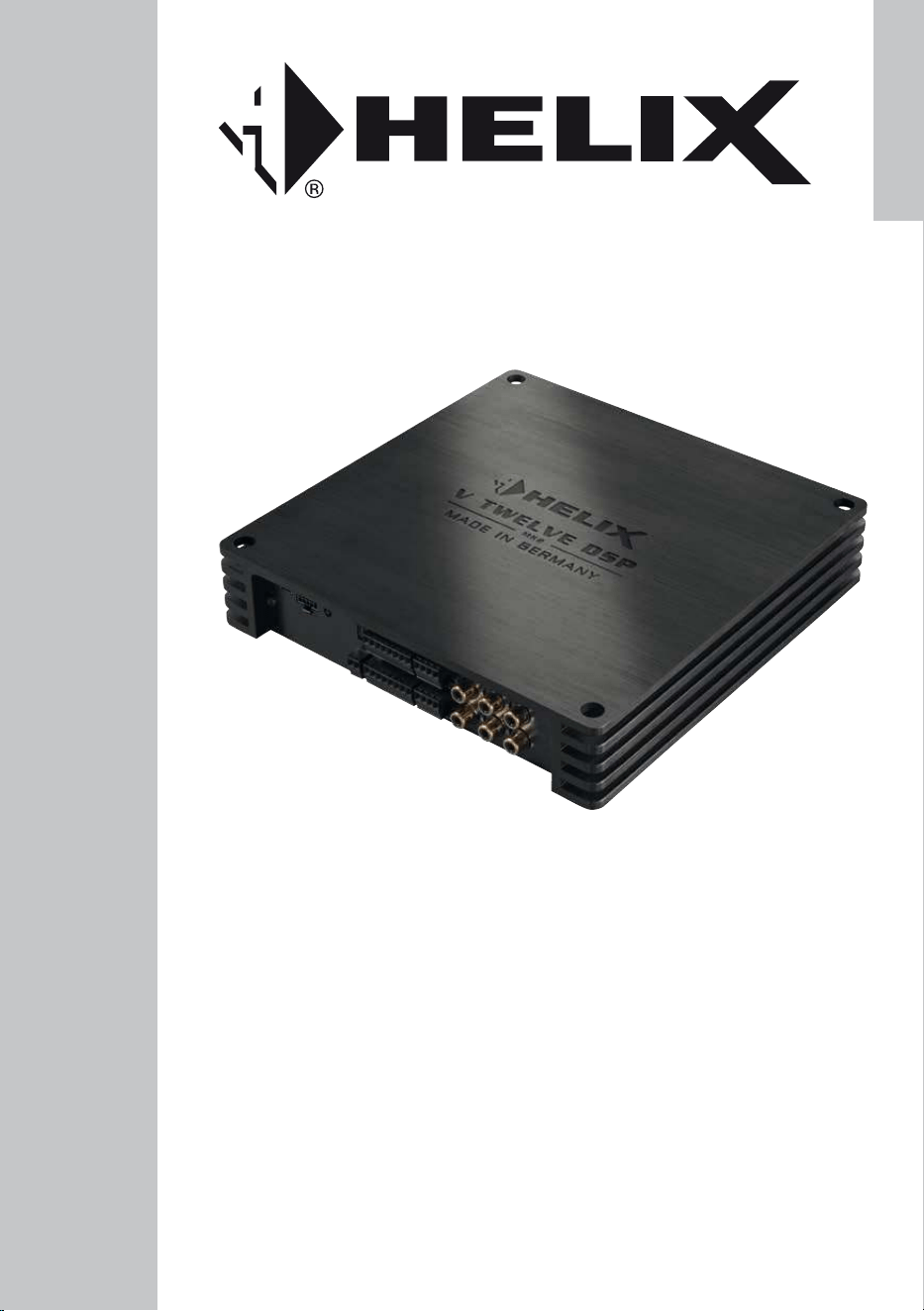
V TWELVE DSP
MK2
12-Kanal Verstärker mit integriertem DSP
12-channel amplier with integrated DSP
deutsch / english

2
Sehr geehrter Kunde,
Wir gratulieren Ihnen zum Kauf dieses hochwer-
tigen HELIX Digitalverstärkers.
Audiotec Fischer setzt mit der
HELIX V TWELVE DSP MK2 neue Maßstäbe im
Bereich der Verstärkertechnik. Dabei protieren
Sie als Kunde direkt von unserer mehr als 30-jäh-
rigen Erfahrung in der Forschung und Entwicklung
von Audiokomponenten.
Dieser Verstärker wurde von uns nach neuesten
technischen Erkenntnissen entwickelt und zeichnet
sich durch hervorragende Verarbeitung und eine
überzeugende Anwendung ausgereifter Technolo-
gien aus.
Viel Freude an diesem Produkt wünscht Ihnen das
Team von
AUDIOTEC FISCHER
Allgemeines zum Einbau von HELIX-Kompo-
nenten
Um alle Möglichkeiten des Produktes optimal aus-
schöpfen zu können, lesen Sie bitte sorgfältig die
nachfolgenden Installationshinweise. Wir garantie-
ren, dass jedes Gerät vor Versand auf seinen ein-
wandfreien Zustand überprüft wurde.
Vor Beginn der Installation unterbrechen Sie
den Minusanschluss der Autobatterie.
Wir empfehlen Ihnen, die Installation von einem
Einbauspezialisten vornehmen zu lassen, da der
Nachweis eines fachgerechten Einbaus und An-
schlusses des Gerätes Voraussetzung für die
Garantieleistungen sind.
Installieren Sie Ihren Verstärker an einer trocke-
nen Stelle im Auto und vergewissern Sie sich, dass
der Verstärker am Montageort genügend Kühlung
erhält. Montieren Sie das Gerät nicht in zu kleine,
abgeschlossene Gehäuse ohne Luftzirkulation
oder in der Nähe von wärmeabstrahlenden Teilen
oder elektronischen Steuerungen des Fahrzeuges.
Im Sinne der Unfallsicherheit muss der Verstärker
professionell befestigt werden. Dieses geschieht
über Schrauben, die in eine Montageäche ein-
geschraubt werden, die wiederum genügend Halt
bieten muss.
Bevor Sie die Schrauben im Montagefeld befesti-
gen, vergewissern Sie sich, dass keine elektrischen
Kabel und Komponenten, hydraulische Bremslei-
tungen, der Benzintank etc. dahinter verborgen
sind. Diese könnten sonst beschädigt werden. Ach-
ten Sie bitte darauf, dass sich solche Teile auch in
der doppelten Wandverkleidung verbergen können.
Allgemeines zum Anschluss des
V TWELVE DSP MK2 Verstärkers
Der Verstärker darf nur in Kraftfahrzeuge eingebaut
werden, die den 12 V-Minuspol an Masse haben.
Bei anderen Systemen können der HELIX Verstär-
ker und die elektrische Anlage des Kfz beschädigt
werden. Die Plusleitung für die gesamte Anlage
sollte in einem Abstand von max. 30 cm von der
Batterie mit einer Hauptsicherung abgesichert wer-
den. Der Wert der Sicherung errechnet sich aus der
maximalen Stromaufnahme der Car-Hi Anlage.
Verwenden Sie zum Anschluss des Verstärkers
an die Stromversorgung des Fahrzeugs aus-
schließlich geeignete Kabel mit ausreichen-
dem Kabelquerschnitt. Die Sicherungen im
Verstärker dürfen nur mit den gleichen Werten
(2 x 30 A) ersetzt werden, um eine Beschädi-
gung des Gerätes zu verhindern. Höhere Werte
können zu gefährlichen Folgeschäden führen!
Die Kabelverbindungen müssen so verlegt sein,
dass keine Klemm-, Quetsch- oder Bruchgefahr be-
steht. Bei scharfen Kanten (Blechdurchführungen)
müssen alle Kabel gegen Durchscheuern gepols-
tert sein. Ferner darf das Versorgungskabel niemals
mit Zuleitungen zu Vorrichtungen des Kfz (Lüfter-
motoren, Brandkontrollmodulen, Benzinleitungen
etc.) verlegt werden.
Herzlichen Glückwunsch!
Allgemeine Hinweise
3
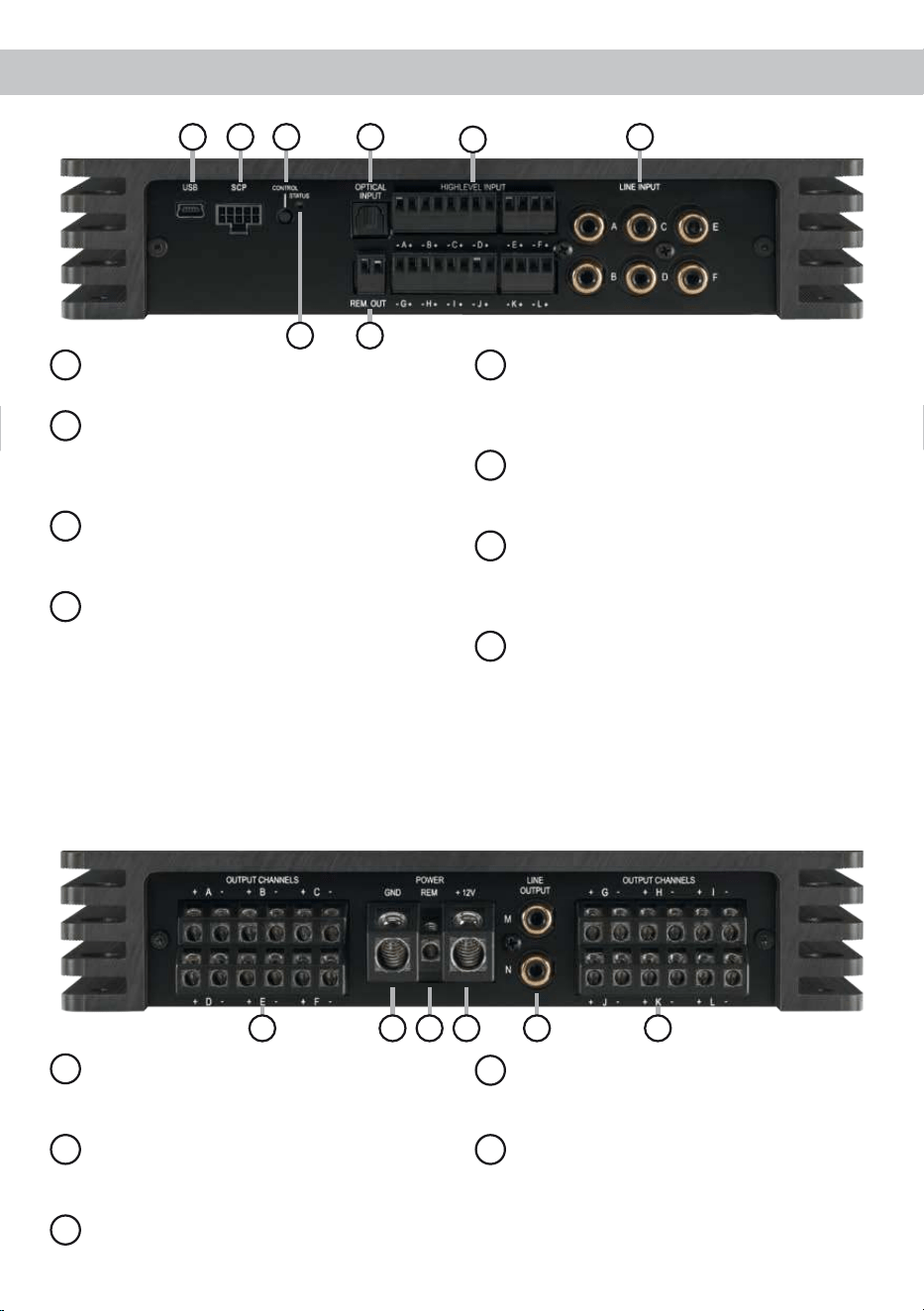
Anschluss- und Bedienelemente
9
Output Channels
Lautsprecherausgänge für den Anschluss
von Lautsprechersystemen.
10
GND
Anschluss des Massekabels (Minuspol der
Batterie oder Fahrzeugchassis).
11
REM
Anschluss für die Remoteleitung des Radios.
12
+12 V
Anschluss für das Versorgungsspannungs-
kabel +12 V der Batterie.
13
Line Output
Vorverstärkerausgänge zum Anschluss
weiterer Verstärker. Zur Einschaltung wei-
terer Verstärker muss der Remote-Ausgang
(Rem. Out) verwendet werden.
9 10 11 12 13 9
1
7
32 4 6
1
USB Eingang
Dient zum Anschluss an den Computer.
2
SCP (Smart Control Port)
Multifunktionsanschluss – dient zum An-
schluss einer Fernbedienung und weiterem
HELIX Zubehör.
.
3
Control Taster
Dient zum Umschalten der Sound Setups
oder zum Resetten des Gerätes.
4
Optical Input
Optischer Eingang im SPDIF-Format für
digitale Stereosignale.
5
Highlevel Input
Hochpegel-Lautsprechereingang zum An-
schluss von Werksradios oder Radios ohne
Vorverstärkerausgänge.
6
Line Input
Cinch-Eingänge zum Anschluss eines
Vorverstärkersignals.
7
Status LED
Die Status LED zeigt den Betriebszustand
des Verstärkers und dessen DSP-Speichers
an.
8
Rem. Out
Der Remote-Ausgang dient zum Einschalten
weiterer Verstärker. Beide Anschlüsse sind
intern parallel geschaltet.
5
8
4
1
USB Eingang
Mit Hilfe dieses Eingangs wird die HELIX
V TWELVE DSP MK2 über das beiliegende Ka-
bel mit dem Computer verbunden und kann an-
schließend über das DSP PC-Tool konguriert
werden. Die aktuellste Software nden Sie auf
www.audiotec-scher.com.
Hinweis: Es können keine USB Speichermedien
an den Verstärker angeschlossen werden.
2
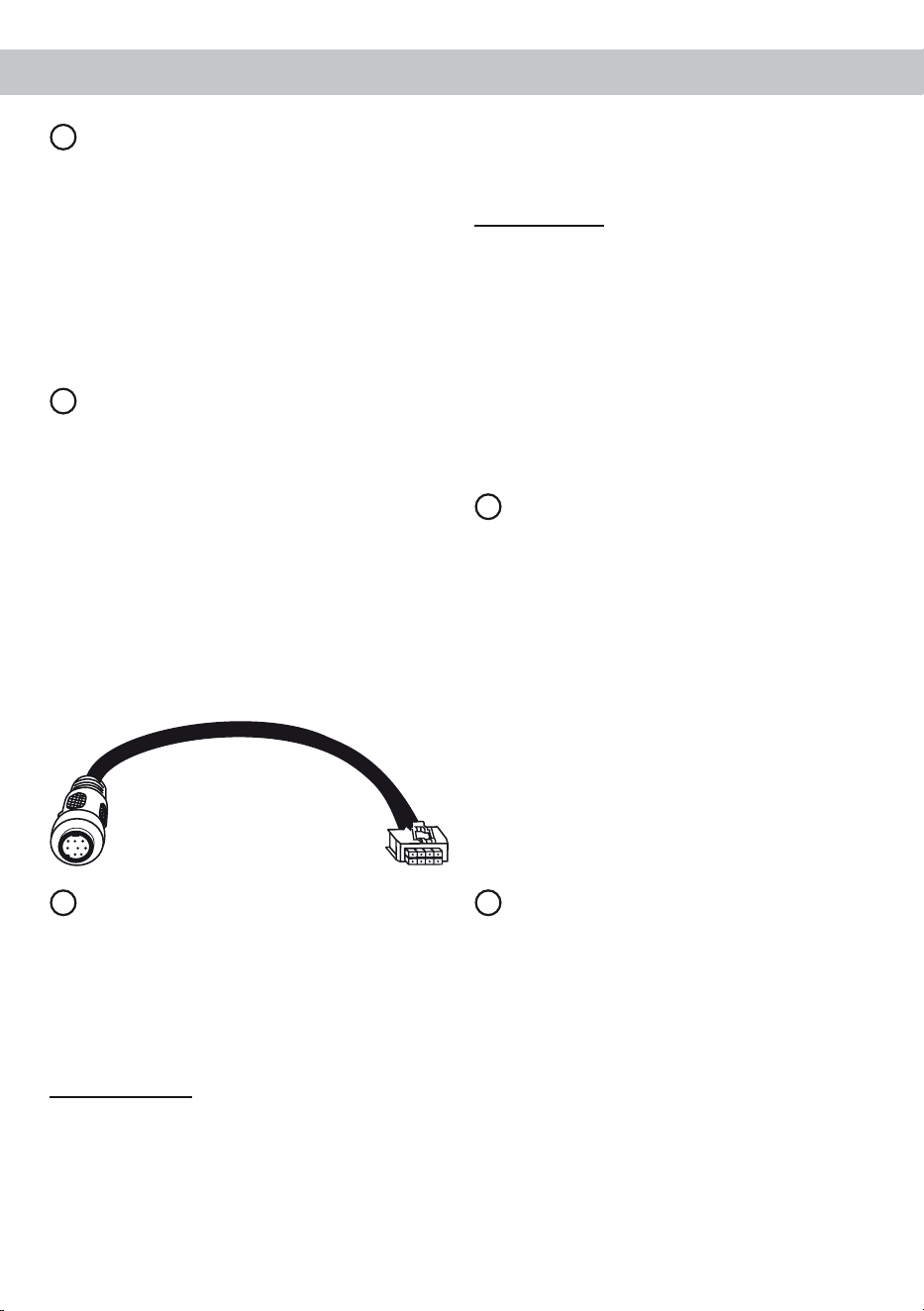
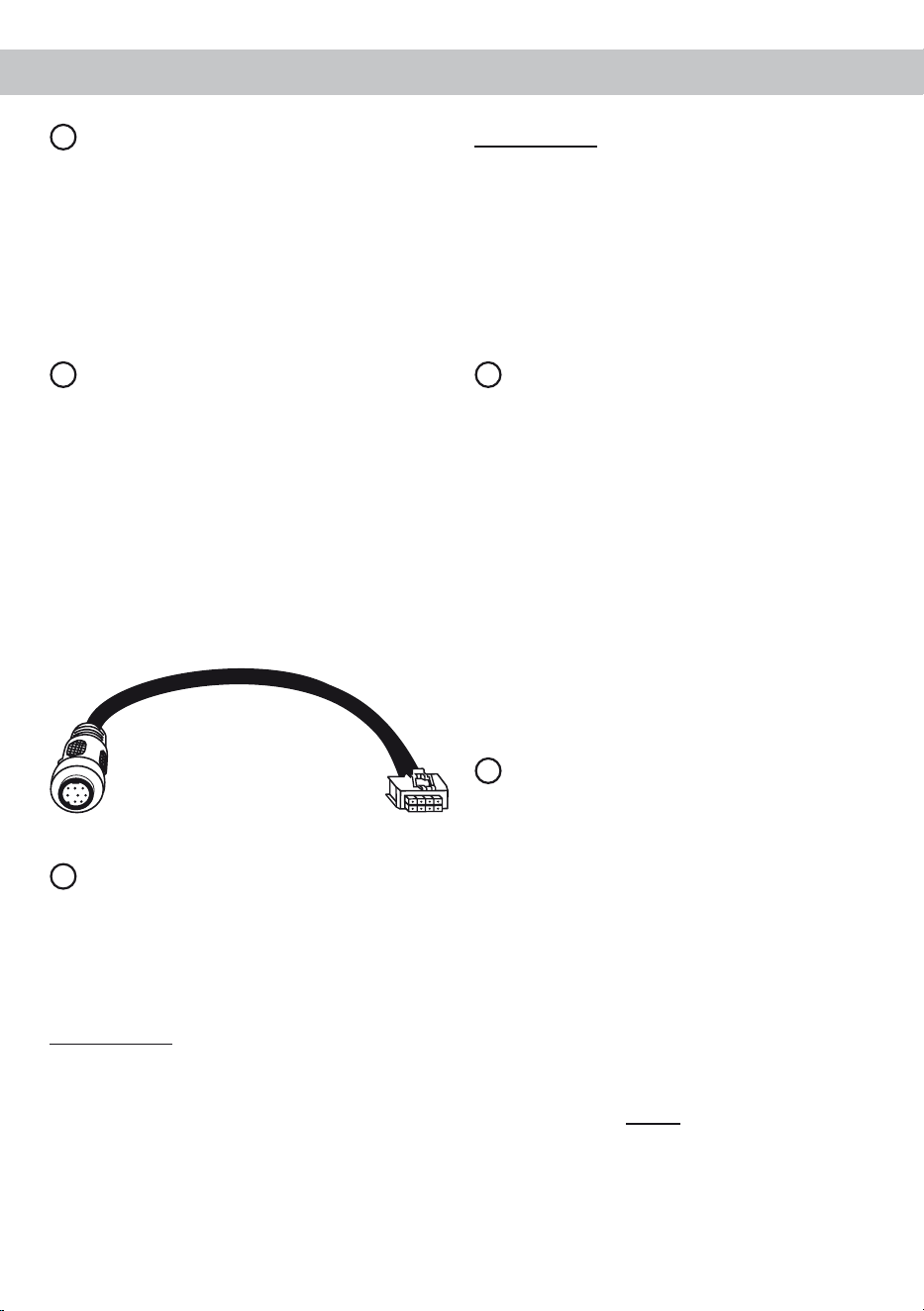
SCP (Smart Control Port)
Dieser Multifunktionseingang dient zum Anschluss
von HELIX Zubehörprodukten, wie beispielsweise
einer Fernbedienung, mit deren Hilfe diverse Funk-
tionen des Verstärkers gesteuert werden können.
Die Funktionalität muss je nach Typ der Fernbe-
dienung zuerst im „Device Conguration Menu“ der
DSP PC-Tool Software oder an der Fernbedienung
selbst konguriert werden.
Achtung:
Sofern das Zubehörprodukt keinen Nano-
Fit Stecker besitzt, verwenden Sie zum Anschluss
ausschließlich den mitgelieferten NanoFit Adapter.
NanoFit Adapter
3
Control Taster
Die V TWELVE DSP MK2 bietet 10 interne Speicher-
plätze für Sound Setups. Mit Hilfe des Control
Tasters lässt sich zwischen zwei Speicherplätzen
umschalten oder ein Geräte-Reset durchführen.
Die Speicherplätze können im DSP PC-Tool festge-
legt werden.
1. Setup-Wechsel: Taster 1 Sek. drücken. Werksei-
tig sind die Speicherbereiche eins und zwei einge-
stellt. Der Umschaltvorgang wird durch einmaliges
rotes Blinken der Status LED angezeigt. Alternativ
kann zur Umschaltung die optionale Fernbedienung
URC.3 verwendet werden. Um zwischen allen in-
ternen Speicherplätzen umschalten zu können, ist
optionales Zubehör, wie z.B. die Fernbedienungen
DIRECTOR und CONDUCTOR oder die WIFI
CONTROL notwendig.
2. Geräte-Reset: Taster länger als 5 Sek. gedrückt
halten. Durch ein Geräte-Reset wird der interne
Speicher auf die Werkseinstellung zurückge-
setzt! Dies wird durch ein durchgehendes rotes
Leuchten und grünes schnelles Dauerblinken der
Status LED angezeigt.
Achtung: Nach dem Resetten des Gerätes kann die
V TWELVE DSP MK2 keine Audiosignale mehr wie-
dergeben, bis das Gerät mit Hilfe des DSP PC-Tools
geupdated wurde.
4
Optical Input
Optischer Eingang im SPDIF-Format für den An-
schluss an Signalquellen mit digitalem Ausgang.
Die „Sampling Rate“ dieses Eingangs muss zwi-
schen 12 - 96 kHz liegen. Das Eingangssignal wird
automatisch an die interne Abtastrate angepasst.
Um diesen Eingang zu aktivieren und in der Lautstär-
ke regeln zu können, wird eine optional erhältliche
Fernbedienung oder die WIFI CONTROL empfohlen.
Hinweis: Es können ausschließlich Stereosignale
und keine Dolby-codierten Daten verarbeitet werden!
Hinweis:
Werkseitig ist die manuelle Einschaltung
des Eingangs über eine optionale Fernbedienung
konguriert.
5
Highlevel Input
12-Kanal Hochpegel-Lautsprechereingang. Mit Hil-
fe dieses Eingangs kann der Verstärker direkt an die
Lautsprecherausgänge eines Werks- / Nachrüstra-
dios oder eines Werksverstärkers angeschlossen
werden, sofern dieses / dieser nicht über Vorverstär-
kerausgänge verfügt. Die Eingangsempndlichkeit
ist für alle Kanäle ab Werk auf 11,3 Volt eingestellt.
Es ist jedoch möglich, die Eingangsempndlichkeit
mit Hilfe der DSP PC-Tool Software (DCM-Menü →
Signalverwaltung) und durch das Umstecken von
Steckbrücken im Geräteinneren optimal an die Si-
gnalquelle anzupassen (siehe Seite 7, Punkt 4; Ein-
stellung der Eingangsempndlichkeit).
Inbetriebnahme und Funktionen

5
Wichtig:
Es ist zwingend notwendig, die Ein-
gangsempndlichkeit
des Geräts vor der ersten
Inbetriebnahme
an die Signalquelle anzupas-
sen.
Eine Missachtung kann zu Schäden am Ver-
stärker führen.
Achtung: Verwenden Sie zum Anschluss aus-
schließlich die mitgelieferten Stecker mit integrier-
ten Schraubklemmen oder einen passenden Kabel-
baum aus dem HELIX Zubehörprogramm.
Achtung: Der Highlevel- und der Vorverstärker-
signaleingang eines einzelnen Kanals darf nicht
gleichzeitig genutzt werden, da dies zu Schäden
an ihrem Autoradio führen kann. Es ist aber zuläs-
sig, an einem Kanal den Highlevel- und an einem
anderen Kanal den Vorverstärkersignaleingang zu
verwenden.
6
Line Input
6-Kanal Vorverstärkereingang zum Anschluss von
Signalquellen, z.B. Radios. Die Eingangsempnd-
lichkeit ist für alle Kanäle ab Werk auf 2,8V Volt
eingestellt. Es ist jedoch möglich, die Eingangs-
empndlichkeit mit Hilfe der DSP PC-Tool Software
(DCM-Menü → Signalverwaltung) und durch das
Umstecken von Steckbrücken im Geräteinneren
optimal an die Signalquelle anzupassen (siehe Sei-
te 7, Punkt 4; Einstellung der Eingangsempndlich-
keit).
7
Status LED
Die Status LED zeigt den Betriebszustand des
Verstärkers und dessen DSP-Speichers an.
Grün: Verstärker eingeschaltet und betriebsbereit.
Orange: Power Save Modus aktiv.
Rot: Protection Mode aktiv. Dieser kann unter-
schiedliche Ursachen haben. Der Verstärker ist mit
Schutzschaltungen gegen Über- und Unterspan-
nung sowie Überhitzung ausgestattet. Prüfen Sie
in diesem Fall alle Anschlüsse auf Fehler, wie z.B.
Kurzschlüsse oder fehlerhafte Verbindungen. Ist die
Sicherheitsschaltung der Temperaturüberwachung
aktiv, wird der Remote-Ausgang sowie die Signal-
ausgabe abgeschaltet, bis ein sicherer Betrieb wie-
der gewährleistet werden kann.
Rot / grün langsam blinkend: Keine Betriebssoft-
ware auf dem DSP installiert. Verbinden Sie den
Verstärker mit der DSP PC-Tool Software und be-
stätigen das automatische Update der Betriebs-
software. Die aktuellste Version des DSP PC-Tools
nden Sie auf www.audiotec-scher.com.
Rot / grün schnell blinkend: Aktuell ausgewählter
Sound Setup-Speicherplatz ist leer. Ein neues DSP
Setup muss über die DSP PC-Tool Software einge-
spielt werden oder schalten Sie auf einen Speicher-
platz mit vorhandenem Sound Setup um.
8
Rem. Out
Der Remote-Ausgang dient dazu, weitere Verstär-
ker einzuschalten. Verwenden Sie in jedem Fall die-
sen Ausgang, wenn Sie weitere Verstärker an den
Line Output der V TWELVE DSP MK2 anschließen,
da es ansonsten zu Störgeräuschen kommen kann.
Dieser Ausgang aktiviert sich automatisch, sobald
der Bootvorgang des DSP abgeschlossen ist. Zu-
dem wird dieser Ausgang bei aktiviertem „Power
Save Mode“ und bei Betriebssoftware-Updates
abgeschaltet.
9
Output Channels
Diese Anschlüsse dienen als Lautsprecherausgän-
ge. Die Impedanz der Lautsprecher darf 2 Ohm
nicht unterschreiten.
Achtung: Es wird dringend empfohlen, vor der er-
sten Inbetriebnahme mit der DSP PC-Tool Software
die grundlegenden Einstellungen im Verstärker vor-
zunehmen.
Eine Missachtung kann zur Zerstörung der ange-
schlossenen Lautsprecher führen. Dies gilt ins-
besondere für die Inbetriebnahme von vollaktiven
Lautsprechersystemen.

6
10
GND
Das Massekabel sollte am zentralen Massepunkt
(dieser bendet sich dort wo der Minuspol der Bat-
terie zum Metallchassis des Kfz geerdet ist) oder an
einer blanken, von Lackresten befreiten Stelle des
Kfz-Chassis angeschlossen werden. Der empfohle-
ne Querschnitt beträgt mindestens 16 mm².
11
REM
Der Remote-Eingang dient zum Einschalten der
V TWELVE DSP MK2, sofern die am Highlevel-
Eingang angeschlossene Signalquelle die automa-
tische Einschaltung nicht aktiviert oder der Verstär-
ker bewusst nur über ein Remote-Signal ein- und
ausgeschaltet werden soll. Die Remoteleitung wird
mit dem Remote-Ausgang / Antennenanschluss
des Steuergerätes (Radio) verbunden. Dieser ist
nur aktiviert, wenn das Steuergerät eingeschaltet
ist. Somit wird der Verstärker mit dem Steuergerät
ein- und ausgeschaltet.
Hinweis: Dieser Eingang muss nicht belegt wer-
den, wenn der Hochpegel-Lautsprecher eingang
(Highlevel Input) benutzt wird. Wie Sie die automa-
tische Einschaltung über den Hochpegel-Lautspre-
chereingang der V TWELVE DSP MK2 deaktivieren
können, ist auf Seite 10 unter Punkt 7 „Kongurati-
on des Remote-Eingangs“ nachzulesen.
12
+12 V
Das +12 V Versorgungskabel ist am Pluspol der
Batterie anzuschließen. Der empfohlene Quer-
schnitt beträgt mindestens 16 mm².
13
Line Output
Prozessierter 2-Kanal Vorverstärkerausgang zum
Anschluss von zusätzlichen Verstärkern. Die
maximale Ausgangsspannung beträgt 3 Volt. Wenn
Sie diesen Ausgang verwenden, ist es zwingend
erforderlich, den Remote-Ausgang (Rem. Out) zum
Einschalten des / der an den Line Output ange-
schlossenen Verstärker zu verwenden, da anson-
sten Störsignale auftreten können. Der Remote-
Ausgang schaltet sich automatisch während des
„Power Save Modus“ sowie bei einem Software-
Update ab. Die Ausgänge können in der DSP PC-
Tool Software den Eingängen beliebig zugeordnet
werden.
Inbetriebnahme und Funktionen

7
Die HELIX V TWELVE DSP MK2 wird wie nach-
folgend beschrieben angeschlossen.
Achtung: Für die Durchführung der nachfolgenden
Schritte werden Spezialwerkzeuge und Fachwissen
benötigt. Um Anschlussfehler und Beschädigungen
zu vermeiden, fragen Sie im Zweifelsfall Ihren Ein-
bauspezialisten und beachten Sie zwingend die
allgemeinen Anschluss- und Einbauhinweise (siehe
Seite 2).
1. Anschluss der Vorverstärkereingänge
Diese Eingänge (Line Input) können mit ent-
sprechenden Kabeln (RCA / Cinch-Kabel) an
die Vorverstärker- / Lowlevel- / Cinch-Aus-
gänge des Werks- bzw. Nachrüstradios oder
Werksverstärkers angeschlossen werden. Im
Verstärker lassen sich die Signaleingänge über
die DSP PC-Tool Software frei den Lautspre-
cherausgängen bzw. dem Line Output zuwei-
sen. Die Einschaltautomatik des Verstärkers
funktioniert bei den Vorverstärkereingängen
nicht, so dass der Remote-Eingang (REM)
zwingend belegt werden muss.
Achtung: Der Highlevel- und der Vorverstär-
kersignaleingang eines einzelnen Kanals darf
nicht gleichzeitig genutzt werden, da dies zu
Schäden an ihrem Autoradio / Werksverstärker
führen kann. Es ist aber zulässig, an einem Ka-
nal den Highlevel- und an einem anderen Kanal
den Vorverstärker signaleingang zu verwenden.
2. Anschluss der Highlevel-Lautsprecherein-
gänge
Die Hochpegel-Lautsprechereingänge können
direkt mit den Lautsprecherausgängen des
Werks- bzw. Nachrüstradios oder Werksver-
stärkers mit Hilfe entsprechender Kabel (Laut-
sprecherkabel mit max. 1 mm² Querschnitt)
verbunden werden.
Sollten Sie ein normales Werksradio anschlie-
ßen, empfehlen wir folgende Kanalbelegung:
Kanal A = Vorne links
Kanal B = Vorne rechts
Kanal C = Hinten links
Kanal D = Hinten rechts
Dabei müssen nicht zwingend alle Eingänge
belegt werden. Werden nur zwei Kanäle belegt,
empfehlen wir die Kanäle A und B zu verwen-
den. Achten Sie bitte auf eine korrekte Polung!
Wenn Sie einen oder mehrere Anschlüsse ver-
polen, kann dadurch die Funktion des Verstär-
kers beeinträchtigt werden. Bei Verwendung
dieses Eingangs muss der Remote-Eingang
(REM) nicht belegt werden, da sich der Verstär-
ker automatisch einschaltet, sobald ein Laut-
sprechersignal anliegt.
3. Anschluss einer digitalen Signalquelle
Sofern Sie über eine Signalquelle mit optischem
Digitalausgang verfügen, kann diese an den
Verstärker angeschlossen werden. Werkseitig
ist die manuelle Einschaltung des Eingangs
über eine optionale Fernbedienung konguriert.
Möchten Sie den Eingang automatisch bei An-
liegen eines Audiosignals aktivieren, können
Sie dies in der DSP PC-Tool Software unter
dem Menüpunkt Signalmanagement im DCM
kongurieren. Die Einschaltautomatik des Ver-
stärkers funktioniert bei Verwendung des Digi-
taleingangs nicht, so dass der Remote-Eingang
(REM) zwingend belegt werden muss.
Wichtig: Das digitale Audiosignal einer Quelle
ist üblicherweise nicht lautstärkegeregelt. Das
bedeutet, dass in diesem Fall an sämtlichen Aus-
gängen der HELIX V TWELVE DSP MK2 der
volle Pegel anliegen wird. Dies kann im Ex-
tremfall die angeschlossenen Lautsprecher
zerstören. Wir raten deshalb dringend dazu,
eine optionale Fernbedienung zur Einstellung
der Lautstärke des digitalen Sig naleingangs zu
verwenden!
Hinweis: Die HELIX V TWELVE DSP MK2
kann nur unkomprimierte, digitale Stereo PCM-
Signale mit einer Abtastrate zwischen 12 kHz
und 96 kHz verarbeiten. Es können keine MP3-
oder Dolby-codierten Daten verarbeitet werden,
sondern ausschließlich Stereosignale.
4. Einstellung der Eingangsempndlichkeit
Achtung: Es ist zwingend notwen-
dig, die Eingangsempndlichkeit der
V TWELVE DSP MK2 an die Signalquelle
anzupassen, um Schäden am Verstärker zu
vermeiden.
Die Einstellung der Eingangsempndlichkeit
kann mit Hilfe der DSP PC-Tool Software und
durch das Umstecken von Steckbrücken im Ge-
Einbau und Installation
8
räteinneren vorgenommen werden. Die Einstel-
lung erfolgt dabei in zwei Schritten.
1. Voreinstellung der Eingangsempndlichkeit
mit Hilfe der Jumper im Inneren des Geräts.
2. Feineinstellung mit Hilfe der DSP PC-Tool
Software.
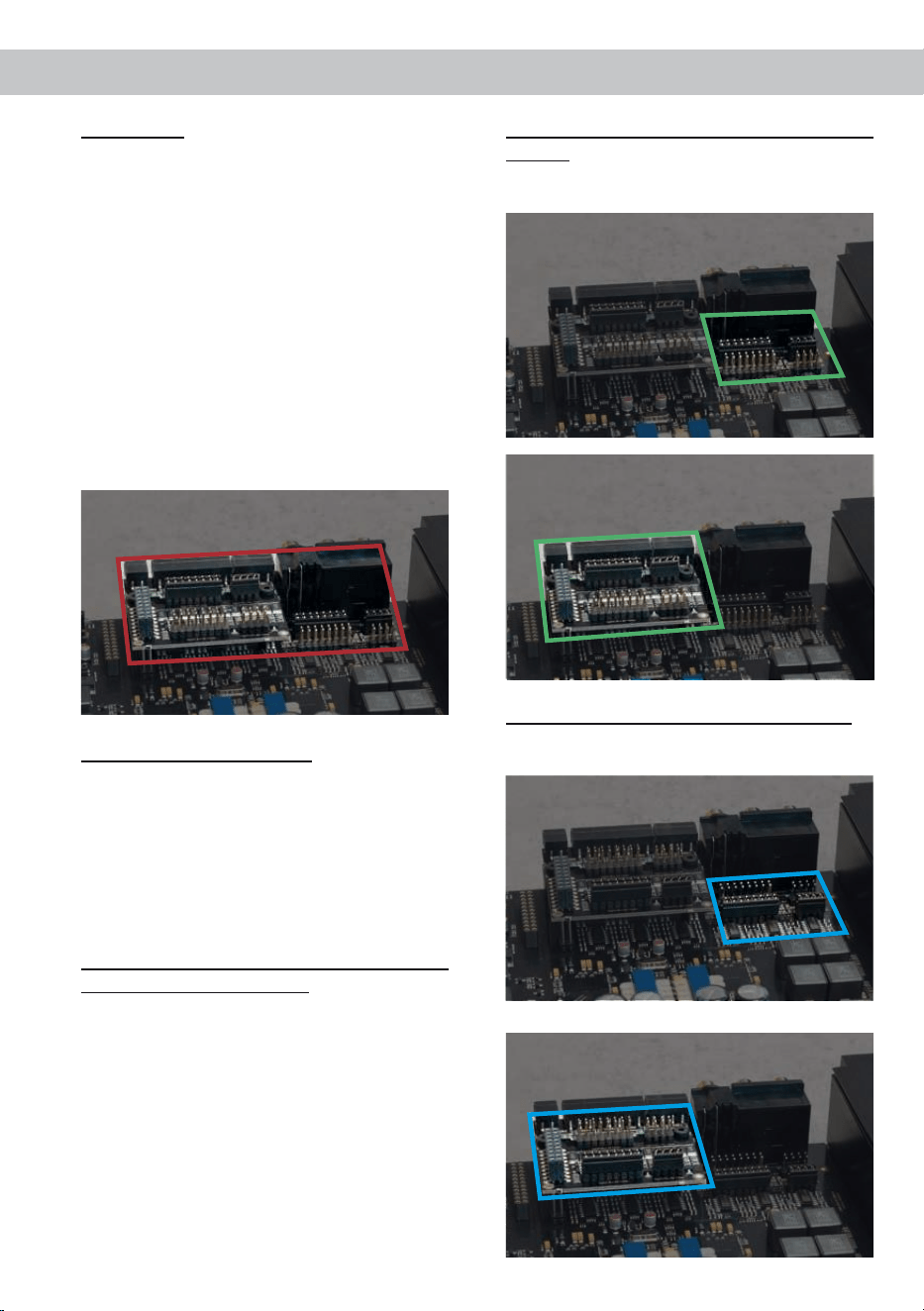
Zu 1: Der werkseitig für alle Kanäle voreinge-
stellte Wertebereich der Eingangsempndlich-
keit ist optimal für viele handelsübliche Radios
(Hochpegel 11,3 Volt; Cinch 2,8 Volt).
Sofern Ihre Signalquelle eine maximale Aus-
gangsspannung über 14 Volt liefert - beispiels-
weise wenn ein werkseitig verbauter Verstärker
als Signalquelle dient – müssen alle vier Jum-
per im Inneren des Geräts umgehend auf den
„High Voltage Range“ Bereich (Hochpegel 8 -
32 Volt; Cinch 2 - 8 Volt) gesteckt werden.
Um die Jumperposition zu ändern, muss das
Gerät geönet werden. Dazu entfernen Sie
zunächst die vier Schrauben (zwei Inbus- und
zwei Kreuzschlitzschrauben) des Seitenblechs
mit dem USB-Eingang und nehmen dieses ab.
Ziehen Sie nun das Bodenblech zur Seite he-
raus. Anschließend haben Sie Zugri auf die
Jumper.
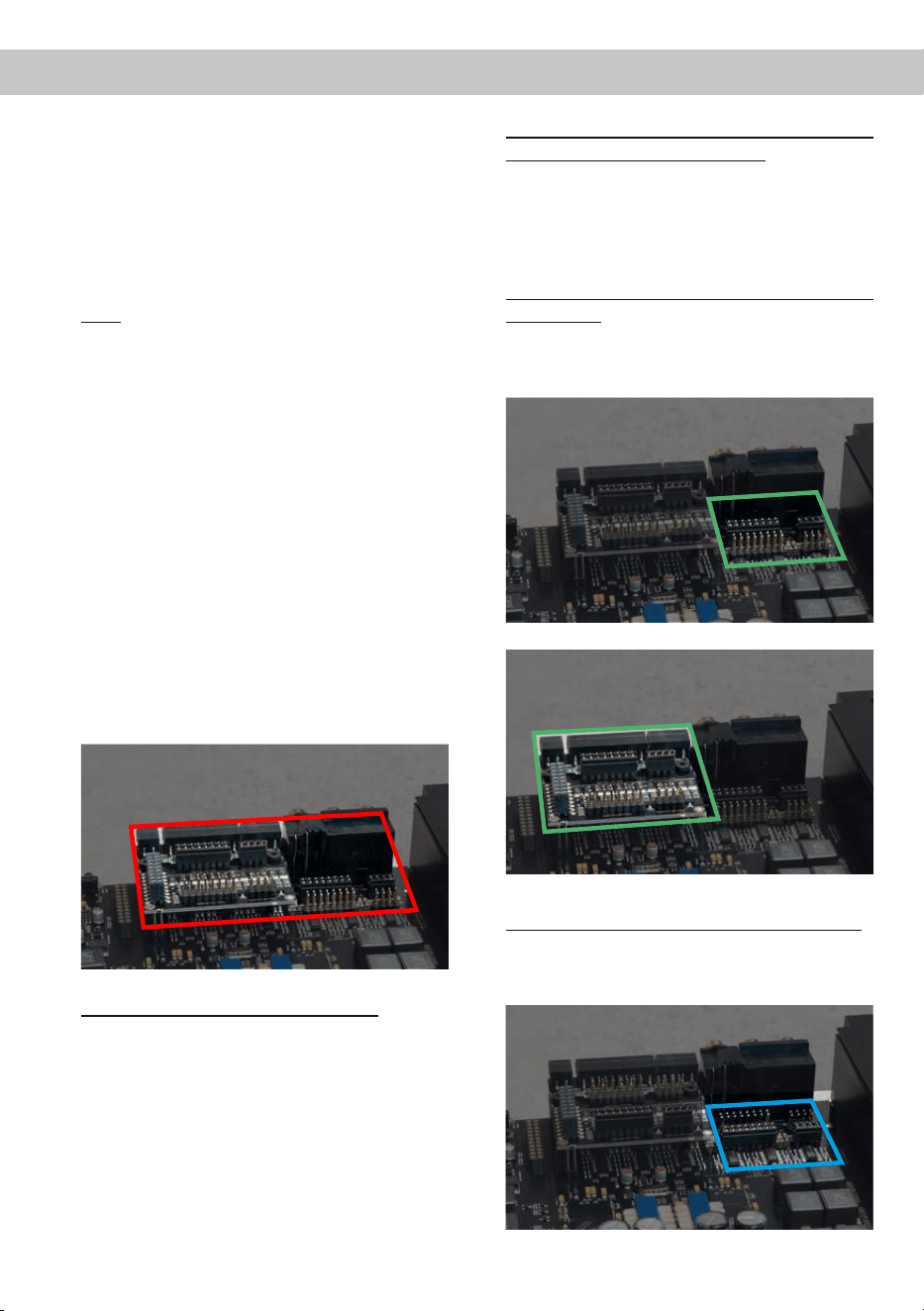
J 3
J 4
J 1
J 2
Übersicht Jumper-Steckpositionen:
Jumper 1 (J 1): Kanal A - D
Jumper 2 (J 2): Kanal E - F
Jumper 3 (J 3): Kanal G - J
Jumper 4 (J 4): Kanal K - L
Um die Position eines Jumpers zu ändern, zie-
hen Sie diesen einfach nach oben hin ab und
stecken ihn auf die gewünschte Position.
Achten Sie darauf, dass der Jumper vollständig
und nicht versetzt eingesteckt ist.
Sollten Sie sich bzgl. der Ausgangsspannung
Ihrer Signalquelle nicht sicher sein, kontaktie-
ren Sie Ihren HELIX Fachhändler.
Jumper-Steckpositionen Low Voltage Range
(werkseitig):
Wertebereich:
Highlevel 4 - 16 Volt
Cinch 1 - 4 Volt
J 1
J 2
J 3
J 4
Jumper-Steckpositionen High Voltage Range:
Wertebereich: Highlevel 8 - 32 Volt
Cinch 2 - 8 Volt
J 1
J 2
Einbau und Installation
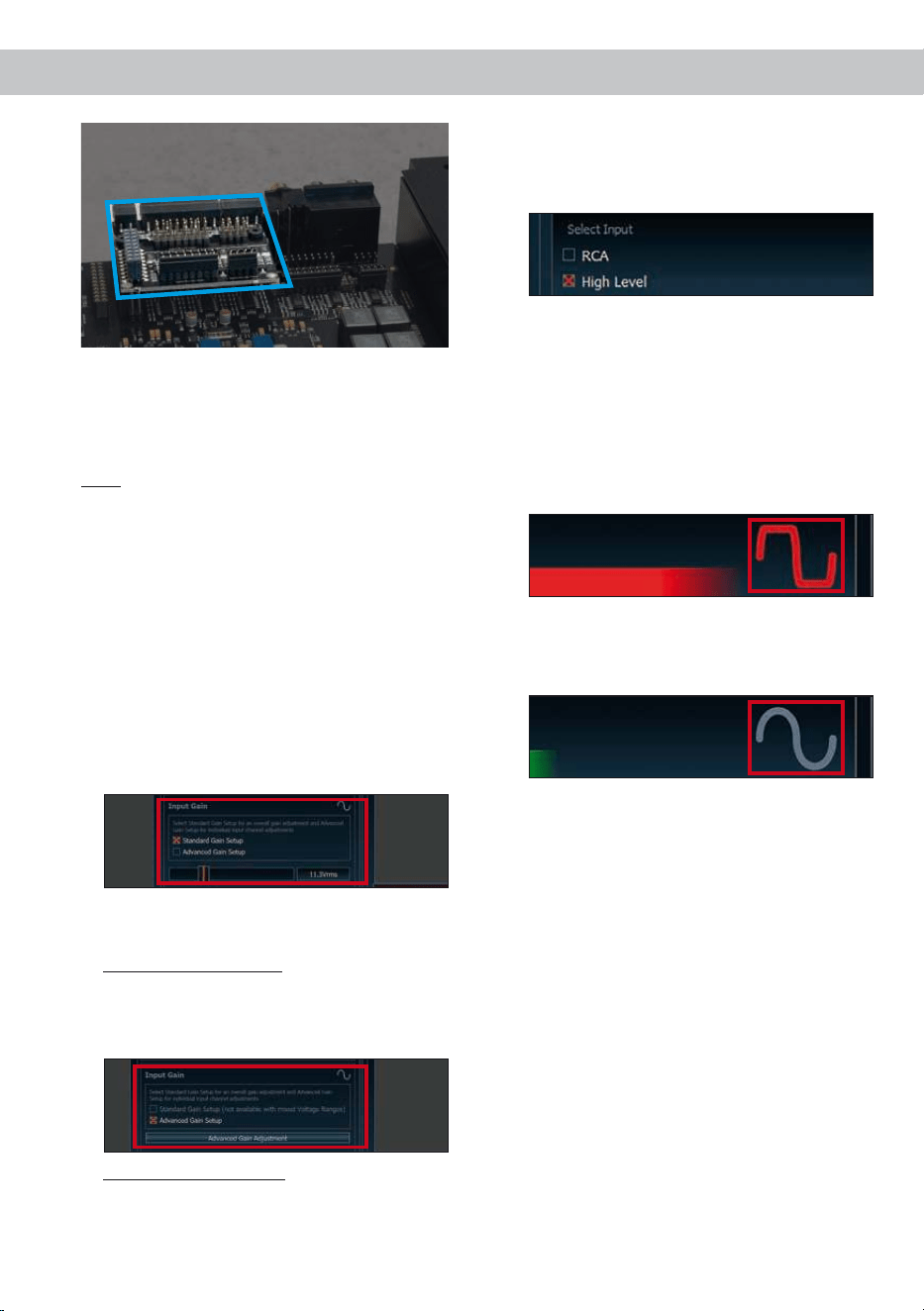
9
J 3
J 4
Nachdem die Jumper auf den gewünschten
Steckpositionen platziert sind, können Sie den
Verstärker wieder zusammenbauen.
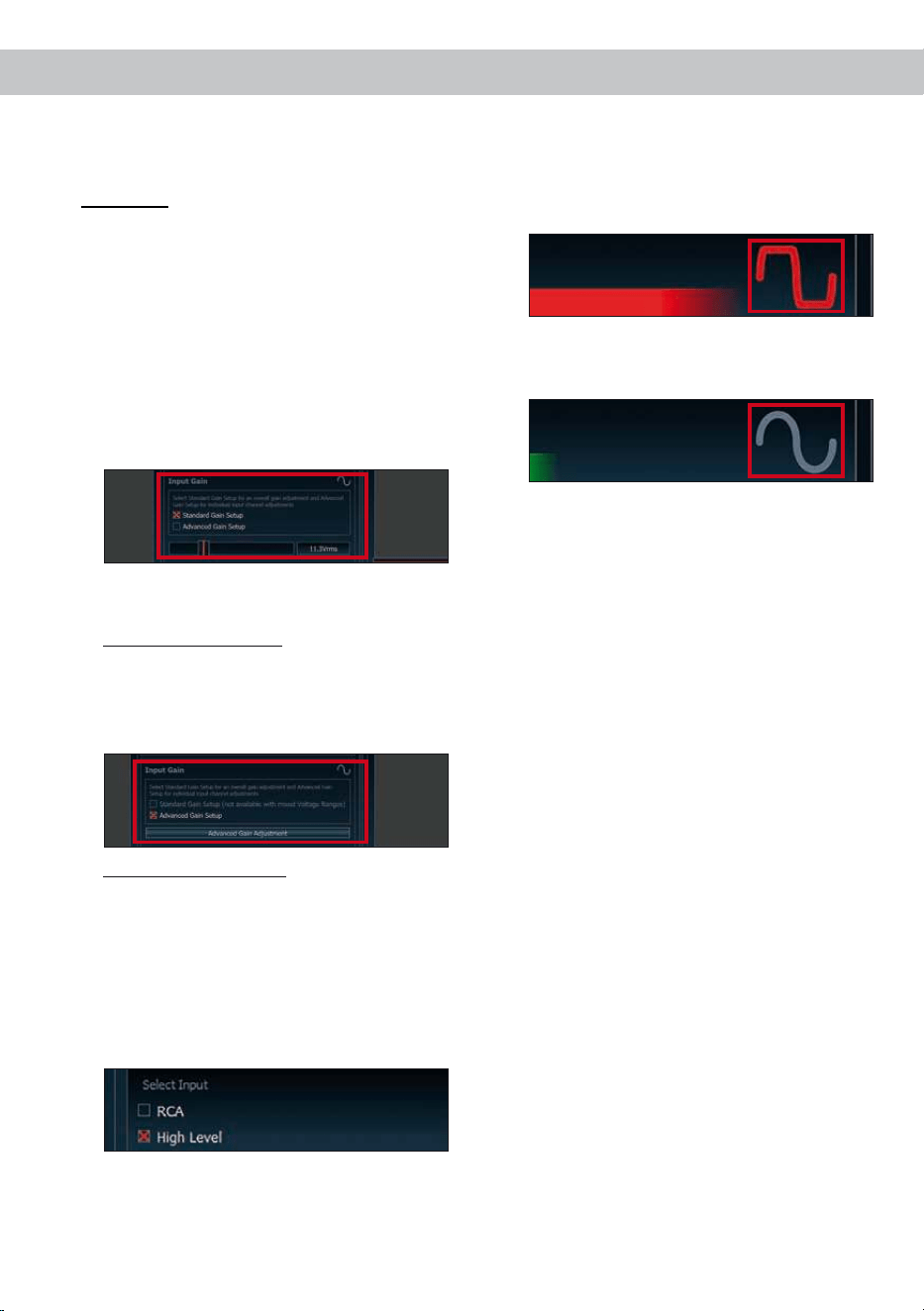
Zu 2: Nun kann mit Hilfe der DSP PC-Tool Soft-
ware die Eingangsempndlichkeit optimal an
die Signalquelle angepasst werden.
Hinweis: Muten Sie während dieser Prozedur
die Signalausgänge des DSPs.
Zur Anpassung der Eingangsempndlichkeit
führen Sie bitte die folgenden Schritte durch:
1. Schalten Sie den Verstärker ein und starten
anschließend die Software. Die Einstellung
zur Anpassung der Eingangsempndlichkeit
nden Sie im Tab „ Signalverwaltung“ des
DCM-Menüs unter dem Punkt „Main Input →
Input Gain“.
2. Wählen Sie das Setupverfahren zur Einstel-
lung der Eingangsempndlichkeit aus.
Standard Gain Setup: Hier kann die Ein-
gangsempndlichkeit global für alle Kanäle
eingestellt werden (nur bei „Low Voltage
Range“ Jumper-Steckposition – siehe links).
Advanced Gain Setup: Bei diesem Verfah-
ren ist sowohl eine globale Einstellung aller
Kanäle als auch eine individuelle Einstellung
für die einzelnen Kanalpaare möglich. (Wird
bei „High Voltage Range“ Jumper-Steckposi-
tionautomatisch aktiviert)
3. Wählen Sie verwendeten Eingang (Cinch
oder Hochpegel) aus.
4. Drehen Sie die Lautstärke Ihres Radios auf
90 % der Gesamtlautstärke und spielen Sie
ein geeignetes Testsignal, z.B. Rosa Rau-
schen, (Vollaussteuerung 0 dB) ab.
5. Sollte die Clipping Anzeige im DSP PC-Tool
bereits leuchten (siehe Markierung im fol-
genden Bild), verringern Sie mit Hilfe des
Schiebereglers die Eingangsempndlichkeit,
bis die Clipping Anzeige erlischt.
6. Erhöhen Sie die Eingangsempndlichkeit bis
die Clipping Anzeige aueuchtet. Schieben
Sie nun den Regler einen Schritt zurück bis
die Clipping Anzeige wieder erlischt.
Verschiedene Einstellungsbeispiele für die Ein-
gangsempndlichkeit sind in der Tabelle auf
Seite 11 aufgeführt. Für weitere Anwendungs-
fälle kontaktieren Sie bitte Ihren HELIX Fach-
händler.
5. Anschluss der Stromversorgung
Vor dem Anschluss des +12 V Versorgungs-
kabels an das Bordnetz muss die Autobatte-
rie abgeklemmt werden.
Das +12 V Stromkabel ist am Pluspol der Bat-
terie anzuschließen. Die Plusleitung sollte in
einem Abstand von max. 30 cm von der Batterie
mit einer Hauptsicherung abgesichert werden.
Der Wert der Sicherung errechnet sich aus der
maximalen Stromaufnahme der gesamten Car-
Hi Anlage (V TWELVE DSP MK2 = max. 80 A
RMS bei 12 V Bordnetz). Verwenden Sie bei
kurzen Leitungen (< 1 m) einen Querschnitt von
mindestens 16 mm². Bei längeren Leitungen
10
Einbau und Installation
empfehlen wir einen Querschnitt von 25 mm²
bis 35 mm². Das Massekabel (gleicher Quer-
schnitt wie das +12 V Kabel) muss an einem
blanken, von Lackresten befreiten Massepunkt
des Kfz-Chassis oder direkt an dem Minuspol
der Autobatterie angeschlossen werden.
6. Anschluss des Remote-Eingangs
Der Remote-Eingang (REM) muss mit dem
Remote-Ausgang des Radios verbunden sein,
sofern die Vorverstärkereingänge (Line Input)
oder ausschließlich der Digitaleingang des Ver-
stärkers als Signaleingänge / Signaleingang
genutzt werden / wird. Es wird dringend davon
abgeraten, den Remote-Eingang des Verstär-
kers über das Zündungsplus des Fahrzeugs zu
steuern, um Störgeräusche beim Ein- und Aus-
schalten zu vermeiden. Bei Verwendung des
Hochpegel-Lautsprechereingangs ( Highlevel
Input) muss der Remote-Eingang nicht belegt
werden, sofern das angeschlossene Radio
über BTL-Ausgangsstufen verfügt.
7. Konguration des Remote-Eingangs
Die Einschaltung der HELIX
V TWELVE DSP MK2 erfolgt automatisch bei
Ansteuerung über die Hochpegel-Lautspre-
chereingänge (High level Input) oder sobald ein
Remote-Signal am Remote-Eingang (REM)
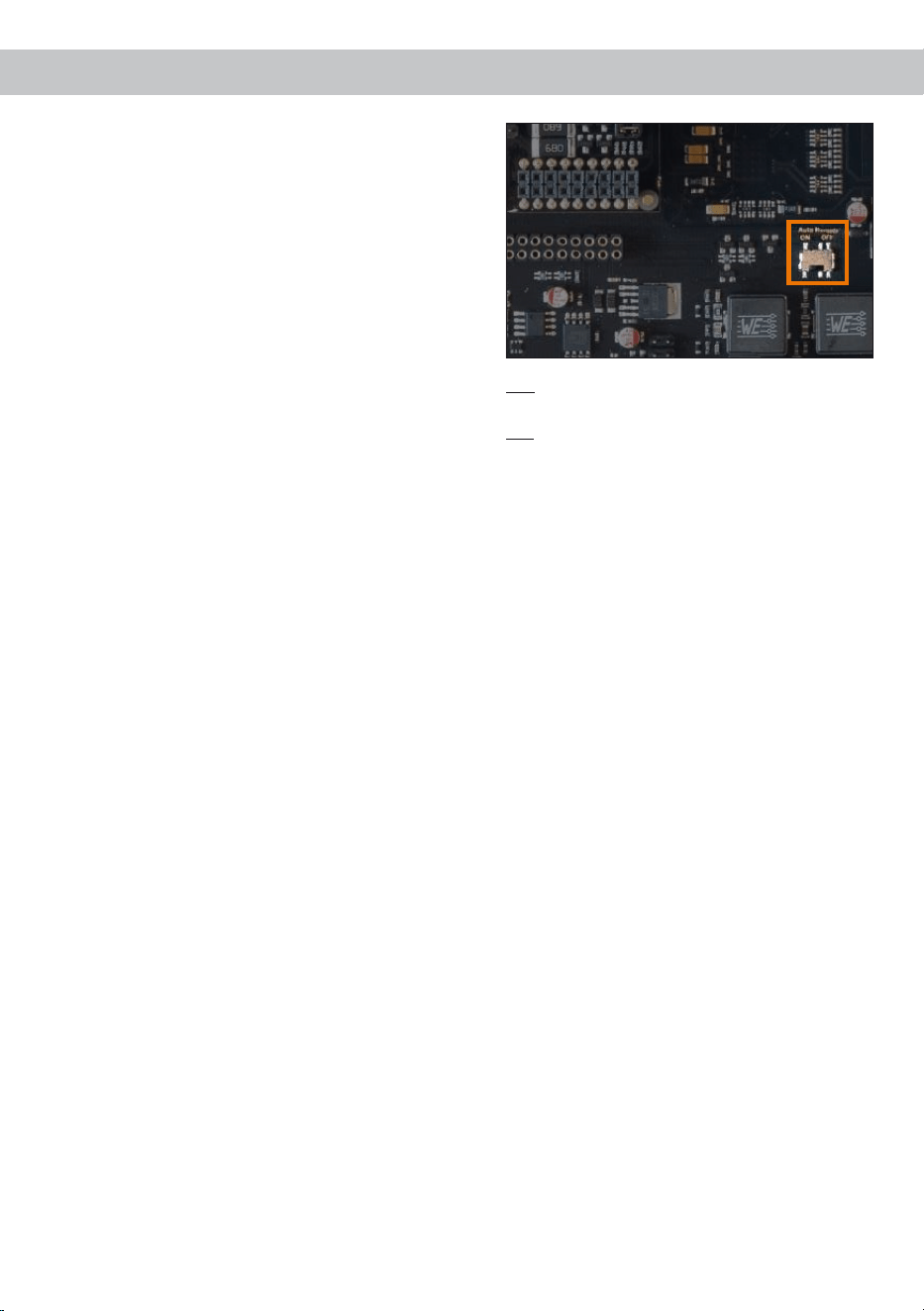
anliegt. Mit Hilfe des „Auto Remote“-Schalters
kann die automatische Einschaltung deaktiviert
werden (Auto Remote = O). Dies sollte vorge-
nommen werden, wenn es beispielsweise zu
Störgeräuschen beim Ein- und Ausschalten des
Verstärkers kommt.
Hinweis: Wird die automatische Einschaltung
des Verstärkers deaktiviert, muss der Remote-
Eingang belegt werden. Eine automatische Ein-
schaltung über den Hochpegel-Lautsprecher-
eingang ist dann nicht mehr möglich.
Hinweis: Werkseitig ist die automatische Ein-
schaltung über den Hochpegel-Lautsprecher-
eingang der HELIX V TWELVE DSP MK2 akti-
viert. Um die automatische Einschaltung zu
deaktivieren, muss das Gerät, wie unter Punkt 4
beschrieben, geönet und die Schalterposition
des „Auto Remote“ Schalters geändert werden
(siehe Markierung im nachfolgenden Bild).
On: Einschaltung über Hochpegel-Lautspre-
chereingang aktiviert (Werkseinstellung).
O: Einschaltung über Hochpegel-Lautspre-
chereingang deaktiviert.
8. Konguration des internen DSPs
Es wird dringend empfohlen, vor der er-
sten Inbetriebnahme die grundlegenden
Einstellungen im Verstärker mit Hilfe der
DSP PC-Tool Software vorzunehmen.
Eine Missachtung kann zur Zerstörung der
angeschlossenen Lautsprecher / Verstär-
ker führen. Speziell bei Verwendung der
V TWELVE DSP MK2 in vollaktiven Systemen
besteht sonst Zerstörungsgefahr für die Hoch-
töner. Informationen zum Anschluss des Ver-
stärkers an einen PC nden Sie auf Seite 13.
9. Anschluss der Lautsprecherausgänge
Die Lautsprecherausgänge können direkt mit
den Lautsprecherleitungen verbunden wer-
den. Verbinden Sie niemals die Lautsprecher-
leitungen mit der Kfz-Masse (Fahrzeugkaros-
serie). Dieses kann Ihren Verstärker und Ihre
Lautsprecher zerstören. Achten Sie darauf,
dass alle Lautsprechersys teme phasenrichtig
angeschlossen sind, d.h. Plus zu Plus und Mi-
nus zu Minus. Vertauschen von Plus und Minus
hat einen Totalverlust der Basswiedergabe zur
Folge. Der Pluspol ist bei den meisten Lautspre-
chern gekennzeichnet. Die Impedanz pro Kanal
darf 2 Ohm nicht unterschreiten, da sonst die
Schutzschaltung des Verstärkers aktiviert wird.
11
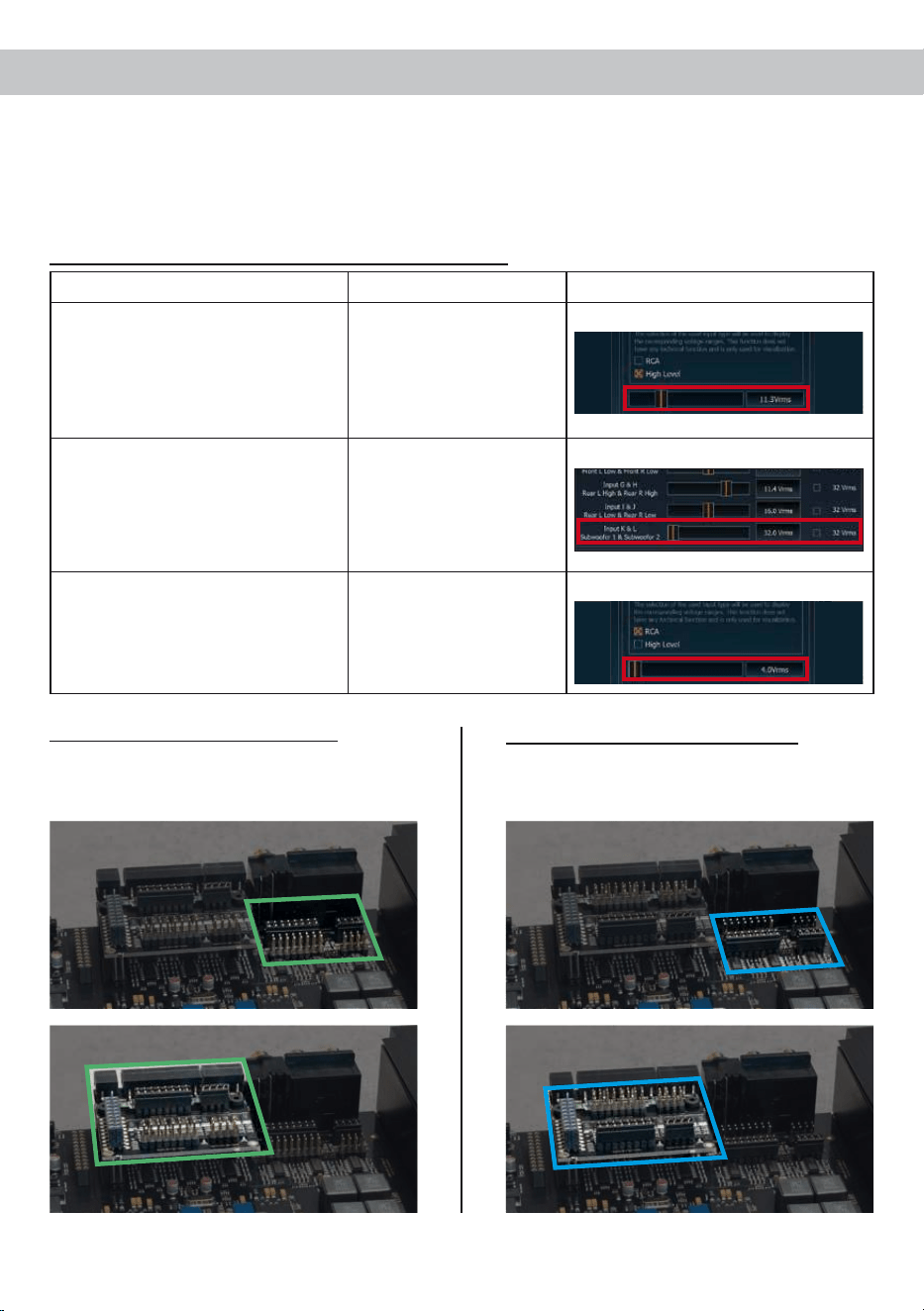
Einstellungsbeispiele für die Eingangsempndlichkeit:
Quelle Jumper positionen
Input Gain im DSP PC-Tool
OEM-Radio 4- bis 6-kanalig
Bis 25 Watt Sinusleistung pro Kanal an
4 Ohm bzw. bis 50 Watt Sinusleistung
pro Kanal an 2 Ohm
Low Voltage Range –
Werkseitige Jumperpo-
sitionen
(siehe Abb. 1)
Standard Gain Setup
OEM-Radio mit Zusatzverstärker
4- bis 12-kanalig
Größer 25 Watt bis 200 Watt
Sinusleistung pro Kanal an 4 Ohm bzw,
bis zu 400 Watt an 2 Ohm oder 100 Watt
an 8 Ohm
High Voltage Range
(siehe Abb. 2)
Advanced Gain Setup
Nachrüstradio 4- bis 6-kanalig mit
Vorverstärkerausgang.
Bis zu einer maximalen RCA / Cinch
Ausgangsspannung von 4 Volt RMS
Low Voltage Range –
Werkseitige Jumperpo-
sitionen
(siehe Abb. 1)
Standard Gain Setup
Abbildung 1 – Low Voltage Range:
Abbildung 2 – High Voltage Range:
Für weitere Anwendungsfälle kontaktieren Sie bitte Ihren HELIX-Fachhändler.
Wertebereich: Highlevel 4 - 16 Volt
Cinch 1 - 4 Volt
J 1
J 2
J 3
J 4
J 1
J 2
J 3
J 4
10. Anschluss des Remote-Ausgangs
Dieser Ausgang (Rem. Out) dient dazu, einen
am Line Output angeschlossenen Zusatzver-
stärker mit einem Remote-Signal zu versorgen.
Wertebereich: Highlevel 8 - 32 Volt
Cinch 2 - 8 Volt
Bitte verwenden Sie ausschließlich dieses
Signal zur Einschaltung externer Verstärker, um
Ein- und Ausschaltgeräusche zu vermeiden.
12
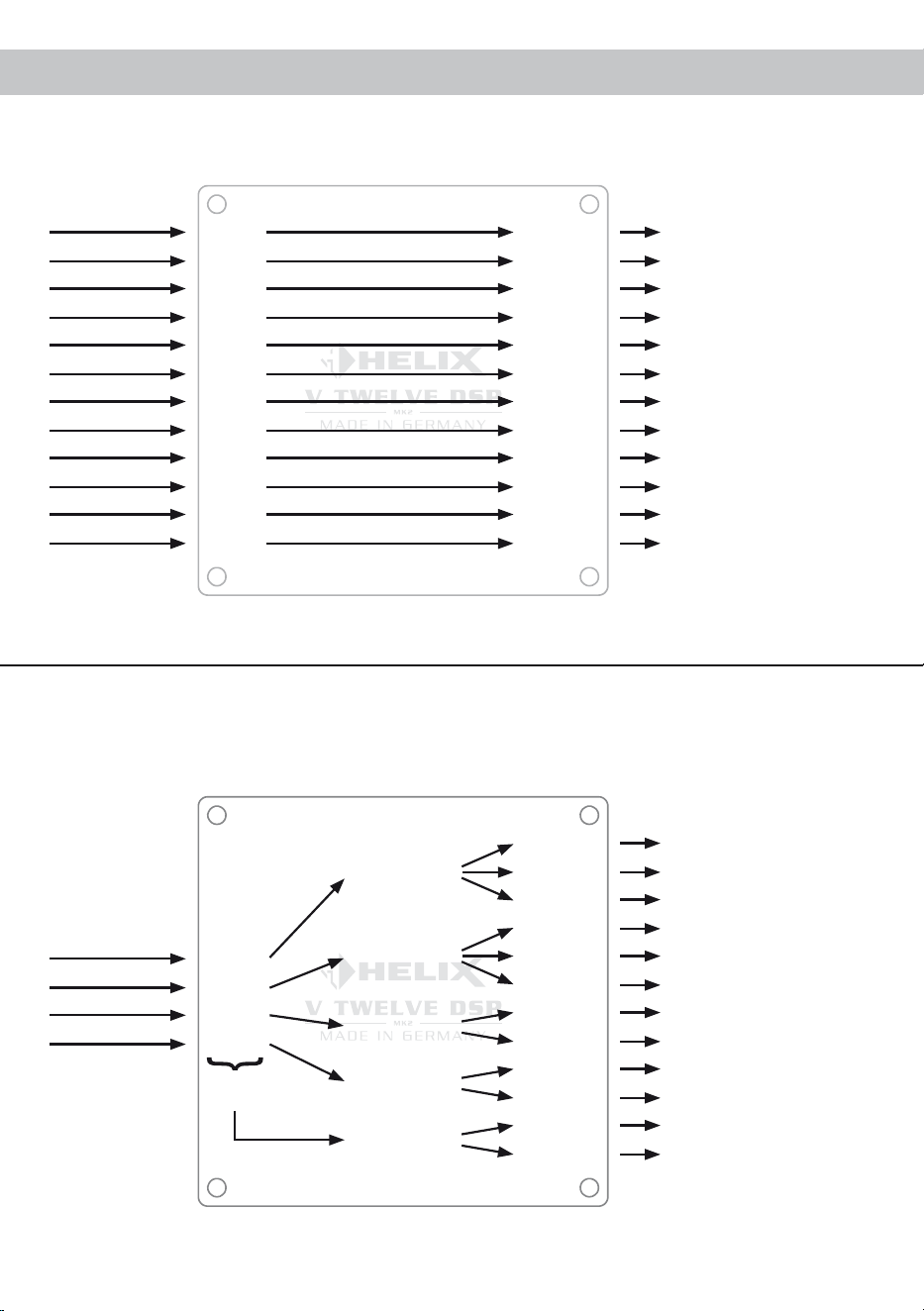
Kongurationsbeispiele
1 zu 1 Kanalrouting (IOR)
Front L High
Front R High
Front L Mid
Front R Mid
Front L Low
Front R Low
Rear L High
Rear R High
Rear L Low
Rear R Low
Subwoofer 1
Subwoofer 2
Front L High – Hochtöner VL
Front R High – Hochtöner VR
Front L Mid – Mitteltöner VL
Front R Mid – Mitteltöner VR
Front L Low – Tieftöner VL
Front R Low – Tieftöner VR
Rear L High – Hochtöner HL
Rear R High – Hochtöner HR
Rear L Low – Tieftöner HL
Rear R Low – Tieftöner HR
Subwoofer 1 – Subwoofer
Subwoofer 2 – Subwoofer
Vom OE-System
Input A
Input B
Input C
Input D
Input E
Input F
Input G
Input H
Input I
Input J
Input K
Input L
Eingänge Ausgänge
Zu den Lautsprechern
Amp Out A
Amp Out B
Amp Out C
Amp Out D
Amp Out E
Amp Out F
Amp Out G
Amp Out H
Amp Out I
Amp Out J
Amp Out K
Amp Out L
Front L Full
Front R Full
Rear L Full
Rear R Full
Vom OE-System
Amp Out A
Amp Out C
Amp Out E
Amp Out B
Amp Out D
Amp Out F
Amp Out G
Amp Out I
Amp Out H
Amp Out J
Amp Out K
Amp Out L
Eingänge Ausgänge
Input A
Input B
Input C
Input D
Zu den Lautsprechern
Kanalrouting mit Virtual Channel Processing
Front L Full (A)
Front R Full (B)
Rear L Full (C)
Rear R Full (D)
Subwoofer 1 (K)
Virtuelle Kanäle
Front L High – Hochtöner VL
Front R High – Hochtöner VR
Front L Mid – Mitteltöner VL
Front R Mid – Mitteltöner VR
Front L Low – Tieftöner VL
Front R Low – Tieftöner VR
Rear L High – Hochtöner HL
Rear R High – Hochtöner HR
Rear L Low – Tieftöner HL
Rear R Low – Tieftöner HR
Subwoofer 1 – Subwoofer
Subwoofer 2 – Subwoofer
Summen-
signal A bis D
SFX -
Front Processing
SFX -
Front Processing
SFX -
Augmented Bass
Processing
Für weitere Anwendungsfälle kontaktieren Sie bitte Ihren HELIX-Fachhändler.

13
Die HELIX V TWELVE DSP MK2 kann mit Hilfe der
DSP PC-Tool Software frei konguriert werden. Die
Software stellt alle Funktionen übersichtlich und
bedienerfreundlich zur Verfügung, so dass Sie die-
se individuell einstellen können. Dabei können alle
vierzehn DSP-Kanäle separat eingestellt werden.
Bevor Sie den Verstärker das erste Mal an einen
Computer anschließen, gehen Sie auf unsere
Homepage und laden die aktuellste Software Ver-
sion des DSP PC-Tools herunter. Es ist ratsam, re-
gelmäßig nach Updates der Software zu schauen,
damit das Gerät immer auf dem aktuellsten Stand
ist.
Die Software sowie eine umfangreiche Knowledge
Base nden Sie auf www.audiotec-scher.com.
Es wird dringend empfohlen, die DSP PC-Tool
Knowledge Base vor der ersten Benutzung durch-
zulesen, um Komplikationen und Fehler zu vermei-
den.
Wichtig: Stellen Sie sicher, dass die
V TWELVE DSP MK2 bei der ersten Installation der
Software noch nicht am PC angeschlossen ist. Ver-
binden Sie diesen erst, wenn die Software samt der
USB-Treiber vollständig installiert ist.
Im folgenden Abschnitt lesen Sie die wichtigsten
Schritte zum Anschluss und der ersten Inbetrieb-
nahme:
1. Laden Sie die DSP PC-Tool Software unter
www.audiotec-scher.com herunter und in-
stallieren diese auf ihrem Computer.
2. Schließen Sie danach die V TWELVE DSP MK2
mit dem beiliegenden USB-Kabel an den Com-
puter an. Wenn Sie längere Distanzen zu über-
brücken haben, verwenden Sie bitte eine aktive
USB-Verlängerung mit integriertem Repeater
oder das optional erhältliche WIFI CONTROL
Interface.
3. Schalten Sie erst den Verstärker ein und star-
ten Sie anschließend die Software. Sofern die
Betriebssoftware des Verstärkers nicht mehr
aktuell ist, wird diese automatisch aktualisiert.
4. Nun können Sie die V TWELVE DSP MK2 mit-
hilfe der DSP PC-Tool Software frei kongurie-
ren. Nützliche Hinweise zur korrekten Einstel-
lung entnehmen Sie unserer Knowledge Base,
welche auf unserer Webseite bereit steht.
Achtung: Es wird dringend empfohlen, vor der
ersten Inbetriebnahme die Lautstärke am Radio
auf Minimum zu drehen und an die Vorverstärker-
ausgänge der V TWELVE DSP MK2 noch nichts
anzuschließen, bis die grundlegenden Einstel-
lungen im Verstärker vorgenommen wurden. Spezi-
ell bei Verwendung in vollaktiven Systemen besteht
sonst Zerstörungsgefahr für die Lautsprecher.
Anschluss an den Computer
14
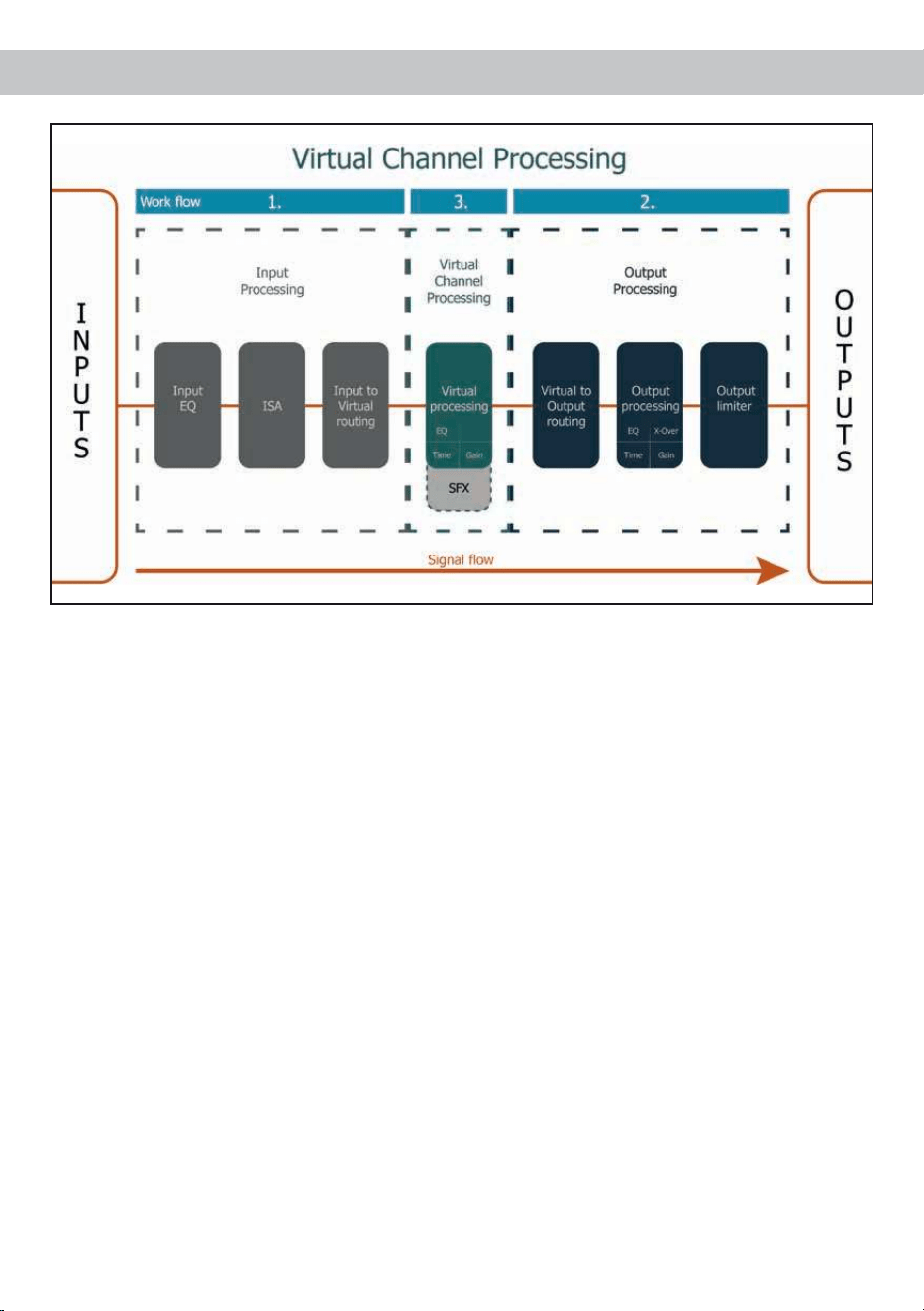
Virtual Channel Processing (VCP)
Das Bedienkonzept des VCP
Im Gegensatz zu bisherigen Methoden ist das Virtual Channel Processing (VCP) ein mehrstuges
Signalverarbeitungs-Konzept, welches die perfekte Konguration komplexer Soundsysteme ermöglicht
und somit ganz neue Möglichkeiten des Klangtunings erönet.
Die Funktion erweitert den bisherigen Umfang des Gerätes um eine neue Ebene an prozessierten Kanälen,
welche sich zwischen den Ein- und Ausgängen bendet.
Insgesamt stehen zwölf zusätzliche prozessierte virtuelle Kanäle und vierzehn prozessierte Ausgangskanäle
zur Verfügung.
Diese virtuelle Kanalebene bietet diverse Vorteile, gerade in komplexen Systemkongurationen.
Die Hauptvorteile dieses Konzeptes sind folgende:
- Ausgangskanalübergreifender Gruppen-Equalizer
- Mehrwege-Konguration der DSP-Soundeekte (SFX)
- Zusätzliche Funktionen wie Rear Attenuation
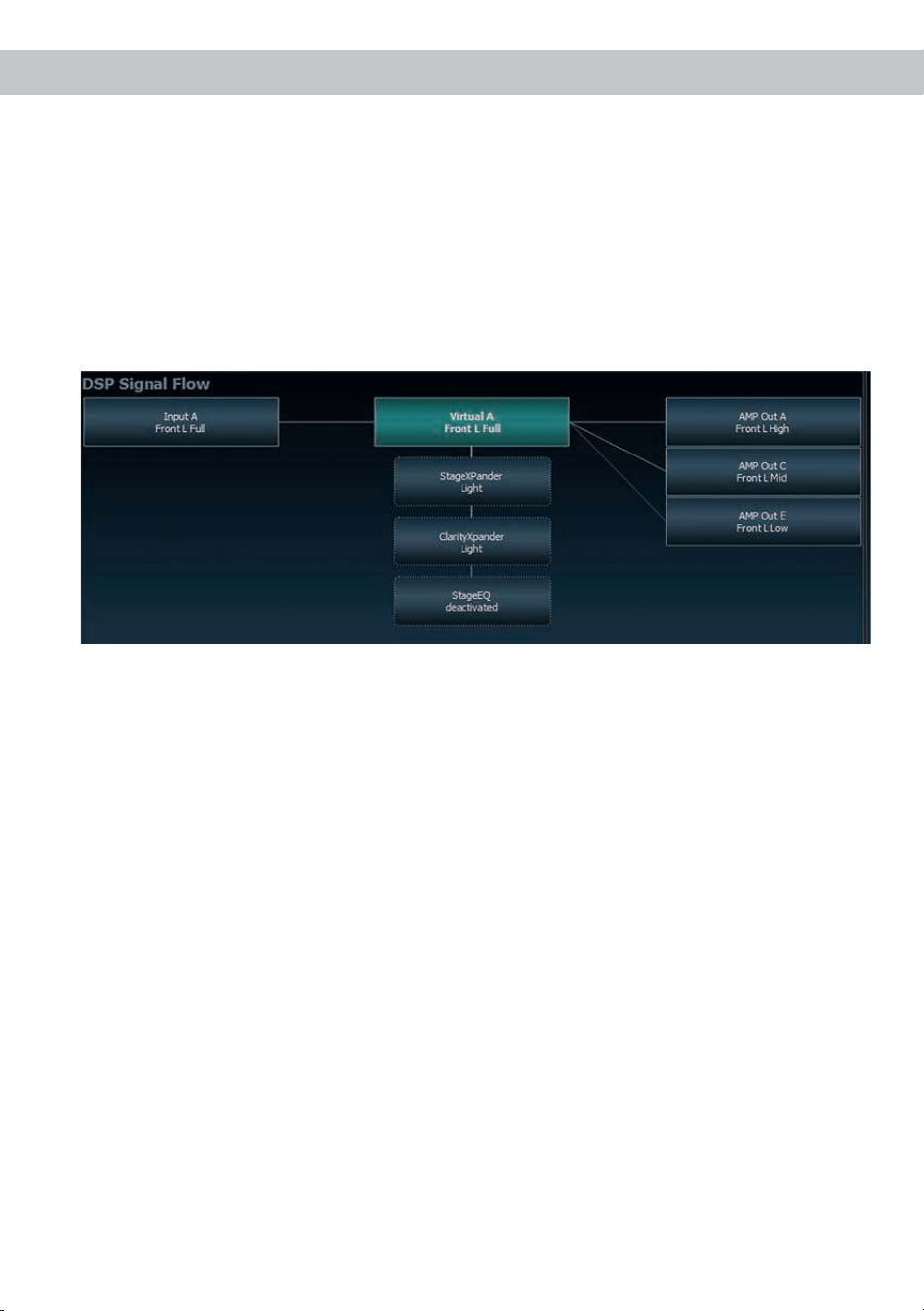
15
– Kanalübergreifender Gruppen-Equalizer
Beispielanwendung: Aktives Mehrwege- System
Wird ein Eingangssignal (bspw. Vorne links) erst auf einen virtuellen Kanal geroutet (Front L Full)
und dieses Signal anschließend auf ein aktives Mehrwege-System geroutet (bspw. Vorne links –
Hochtöner, Mitteltöner und Tieftöner), so ist es möglich, mit Hilfe des Equalizers des virtuellen Kanals
alle nachgeschalteten einzelnen Kanäle gleichzeitig in ihrer Tonalität zu beeinussen. Der Vorteil dieses
Konzeptes ist, dass sich vor allem die Frequenz- und Phaseneinüsse auf alle nachgeschalteten
Kanäle gleich auswirken, so dass gerade in aktiven Mehrwege-Kongurationen die Abstimmung der
Lautsprecher untereinander nicht negativ beeinusst wird.
– Mehrwege-Konguration der DSP-Soundeekte (SFX)
Beispielanwendung: 2- oder gar 3-Wege Centerlautsprecher
Nach Aktivierung des „Virtual Channel Processing“ sind auch die DSP-Soundeekte wie das
RealCenter-Management oder das Augmented Bass Processing aktiviert. Diese sind nicht mehr fest
mit den Ausgängen verknüpft, sondern an bestimmte „virtuelle Kanäle“ gebunden:
Front Processing: virtuelle Kanäle Front L Full (A) und Front R Full (B)
Center Processing: virtueller Kanal Center Full (E)
Augmented Bass Processing: virtuelle Kanäle Subwoofer 1 (K) und Subwoofer 2 (L). An diese ist auch
die Subwoofer-Lautstärkeregelung gebunden.
Dadurch ist es möglich, die DSP-Soundeekte auf beliebig viele Ausgänge zu routen, um beispiels-
weise 2- oder gar 3-Wege Centerlautsprecher-Kongurationen zu realisieren. Der Flexibilität sind hier
somit kaum noch Grenzen gesetzt.
– Zusätzliche Funktionen
Darüber hinaus ermöglicht das VCP die Realisierung weiterer neuer Funktionen. Eine dieser Funk-
tionen ist beispielsweise die „Rear Attenuation“. Bei dieser kann mit Hilfe einer Fernbedienung die
Lautstärke der virtuellen Kanäle „Rear L Full“ und „Rear R Full“ separat geregelt werden. So ist es auch
ohne Umschalten des Sound Setups möglich, die hinteren Lautsprecher (oder auch jeden anderen
Kanal, welcher durch diese Kanäle geroutet wird) in ihrer Lautstärke zu regeln.
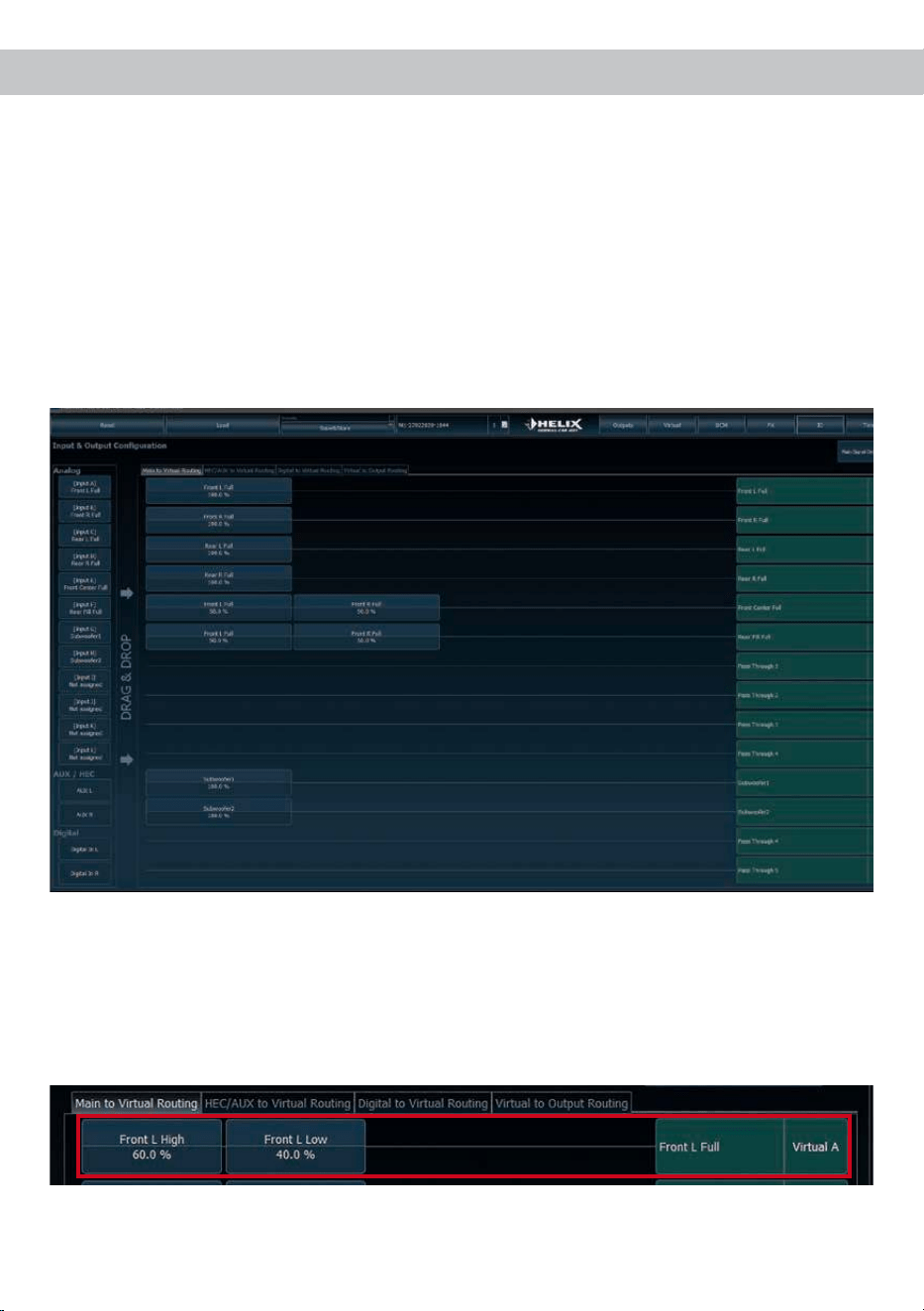
16
Um das VCP zu kongurieren, muss zuerst das „Virtual Channel Processing“ im DCM-Menü der DSP PC-
Tool Software eingeschaltet werden. Gehen Sie dazu in den „Virtual Channel Processing“-Tab und klicken
auf die rechte Box mit der VCP-Grak. Anschließend erfolgt die Konguration in drei Schritten – hier am
Beispiel einer 3-Wege Konguration mit einem 2-Wege Eingangssignal erläutert.
Workow-Schritt 1 – Eingangsrouting
Zuerst müssen die Eingangssignale in den verschiedenen Eingangs-Signalmatrizen („Main to Virtual Rou-
ting“, „HEC/AUX to Virtual Routing“, „Digital to Virtual Routing“) auf die jeweiligen virtuellen Kanäle geroutet
werden. Dies verhält sich genauso wie im normalen Modus, d.h. die Eingangssignale auf der linken Sei-
te werden per Drag & Drop auf die jeweilige Summierungsmatrix gelegt. Der Unterschied zum normalen
Modus ist, dass die Namen und Signaleigenschaften der virtuellen Kanäle an dieser Stelle festgelegt sind
(Front L Full, Front R Full, Rear L Full, Rear R Full, Front Center Full etc.).
a. Zunächst müssen alle Eingangssignale auf die entsprechenden festgelegten Signaltypen der virtu-
ellen Kanäle gelegt werden, d.h. der Eingang, an welchen das Signal vorne links anliegt, muss auf den
virtuellen Kanal „Front L Full“ geroutet werden.
b. Bei OEM-Adaptionen von aktiven Mehrwege-Systemen müssen die Signale an dieser Stelle auf den
virtuellen Kanal „Front L Full“ summiert werden, d.h. mehrere Eingangssignale werden auf einen vir-
tuellen Kanal summiert (der Input–EQ bleibt wie gewohnt in den Eingängen wirksam).
Konguration des Virtual Channel Processing (VCP)
17
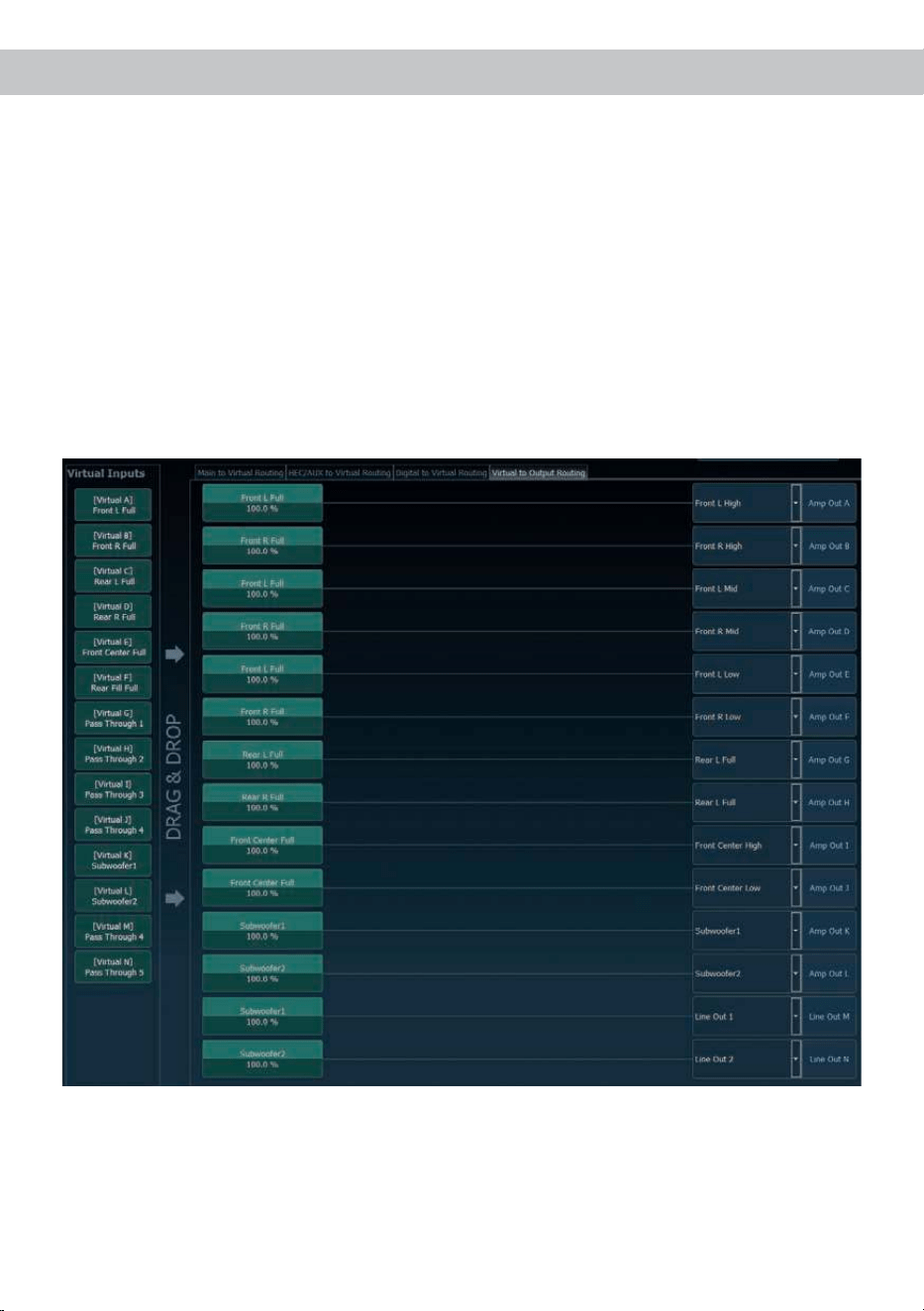
Workow-Schritt 2 – Ausgangsrouting
Nachdem alle genutzten Eingangssignale in den jeweiligen Signal-Routing-Matrizen konguriert wurden,
müssen die virtuellen Kanäle nun den physischen Ausgangskanälen zugeordnet werden. Hierbei kann ein
virtuelles Signal (bspw. Front L Full) mehreren Ausgängen zugewiesen werden, wie beispielsweise dem
vorderen linken Hochtöner, Mitteltöner und Tieftöner. Die Konguration dieser lautsprecherspezischen
Ausgangskanäle erfolgt nach wie vor im „Outputs“-Menü (im normalen Modus „Main“ genannt) des DSP
PC-Tools. Hier können weiterhin die kanalspezischen Equalizer, Hoch- und Tiefpasslter, Laufzeitkorrek-
tur, Ausgangspegel und Phaseneinstellungen konguriert werden.
a. Um die virtuellen Kanäle den jeweiligen Ausgangskanälen zuzuweisen, werden im Ausgangsrouting
(Virtual to Output Routing) die jeweiligen virtuellen Signale per Drag & Drop auf die Ausgangskanäle
gezogen. An dieser Stelle müssen die Signale in der Regel nicht mehr summiert werden, so dass je-
dem Ausgangs signal nur ein virtuelles Signal zugeordnet wird; beispielsweise wird dem vorderen linken
Hochtöner das Signal „Front L Full“ zugeordnet, genauso wie dem vorderen linken Tieftöner.
b. An dieser Stelle kann auch ein virtueller Kanal, in welchem ein DSP-Soundeekt aktiviert wurde, auf
mehrere Ausgangskanäle geroutet werden. So kann beispielsweise das Signal „Front Center Full“ meh-
reren Ausgangskanälen zugewiesen werden, um einen aktiven Mehrwege-Center zu realisieren. Die
entsprechenden Hoch- und Tiefpasslter werden anschließend in den Ausgangskanälen konguriert.
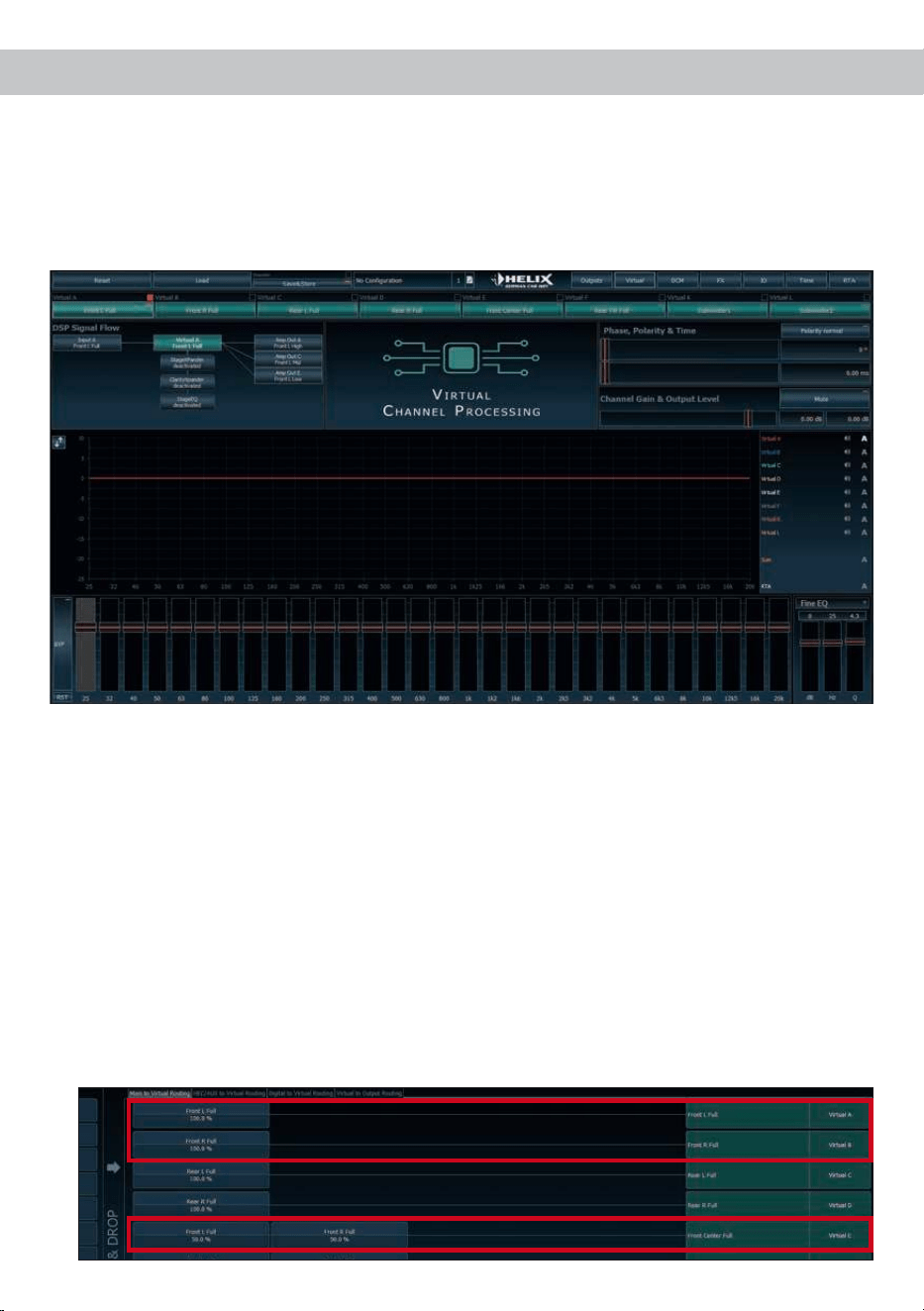
18
Workow-Schritt 3 – Konguration der virtuellen Kanäle und Hinweise zur Anwendung der
DSP-Soundeekte (SFX)
Wechseln Sie nun in das „Virtual“-Menü des DSP PC-Tools. Hier bekommen Sie eine Übersicht über den
Signaluss der einzelenen Kanäle sowie der aktivierten Soundeekte. Zusätzlich ist es möglich beispiels-
weise mit Hilfe des Equalizers, Polarität und weiteren Funktionen alle nachgeschalteten Ausgangskanäle
eines virtuellen Kanals gleichzeitig in ihrer Tonalität zu beeinussen.
Kongurationshinweise für die DSP-Soundeekte (SFX)
Die HELIX V TWELVE DSP MK2 bietet bei aktiviertem Virtual Channel Processing einzigartige DSP-
Sound eekte wie das „Augmented Bass Processing“, den „RealCenter“ und mehr.
Um in den Genuss der DSP-Soundeekte zu kommen, müssen bei der Hard- und Softwarekonguration
bestimmte Einstellungen vorgenommen werden.
Hinweis: Die DSP-Soundeekte stehen bei der V TWELVE DSP MK2 nur im Virtual Channel Processing
zur Verfügung. Dieses kann im DCM-Menü der DSP PC-Tool Software aktiviert werden.
Hinweise für das Center Processing mit seiner RealCenter- und ClarityXpander-Funktion
Um die RealCenter- und ClarityXpander-Funktion für einen Center-Lautsprecher nutzen zu können, müs-
sen folgende Schritte durchgeführt werden:
1a. Die virtuellen Kanäle „Front L Full“ und „Front R Full“ müssen mit einem Eingangssignal belegt sein
(siehe Workow-Schritt 1).
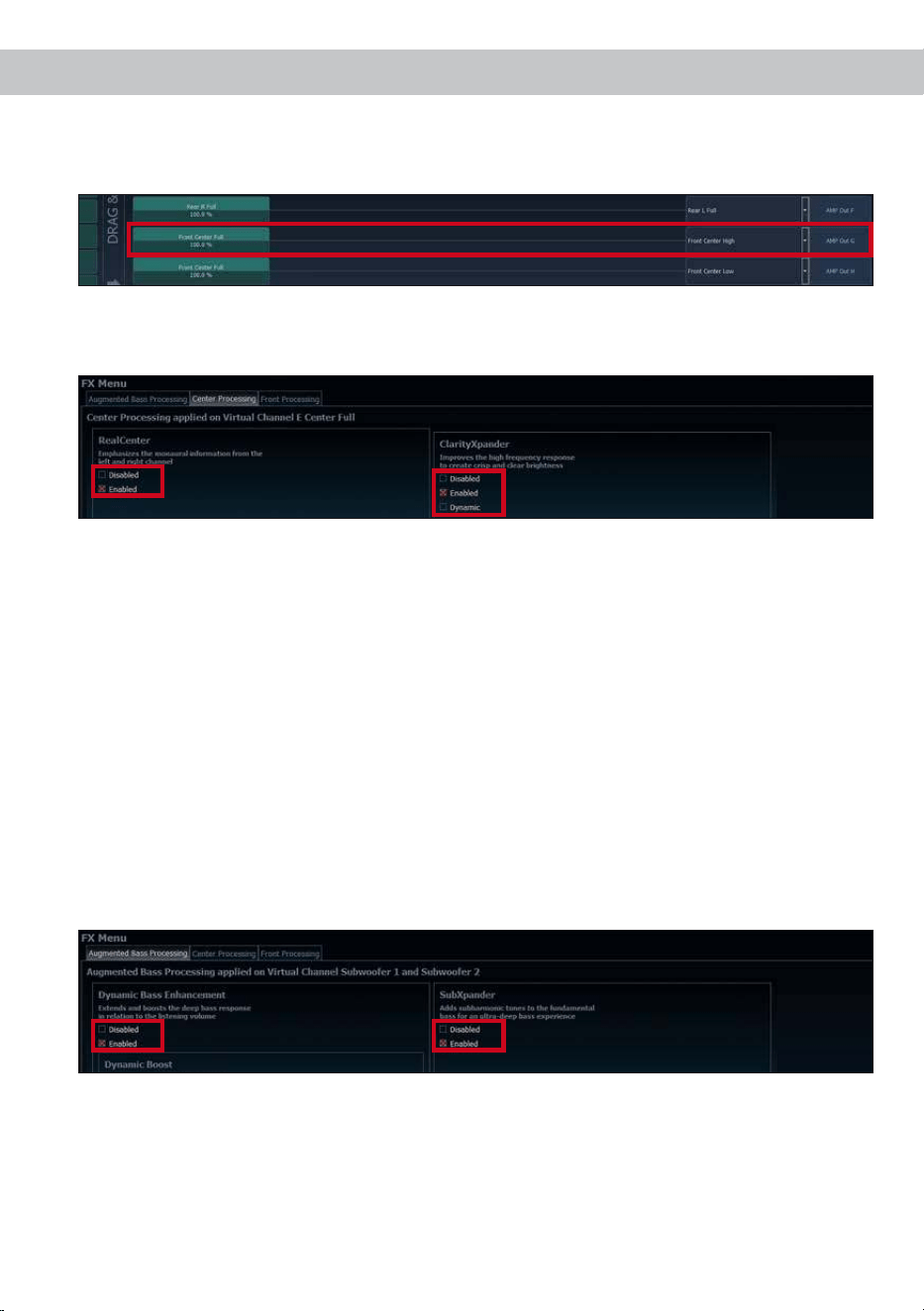
1b. Der virtuelle Kanal „Front Center Full“ muss im Eingangsrouting entweder mit einem Summensignal
(Front Links + Front Rechts) oder einem vorhandenen Center-Signal belegt sein.
Konguration des Virtual Channel Processing (VCP)
19
2. Wechseln Sie in die „Virtual to Output Routing“ Matrix und routen den Kanal „Virtual E – Front Center
Full“ auf den oder die gewünschten Ausgangskanäle (wie im Workow-Schritt 2 beschrieben), auf wel-
che das Center Processing angewendet werden soll.
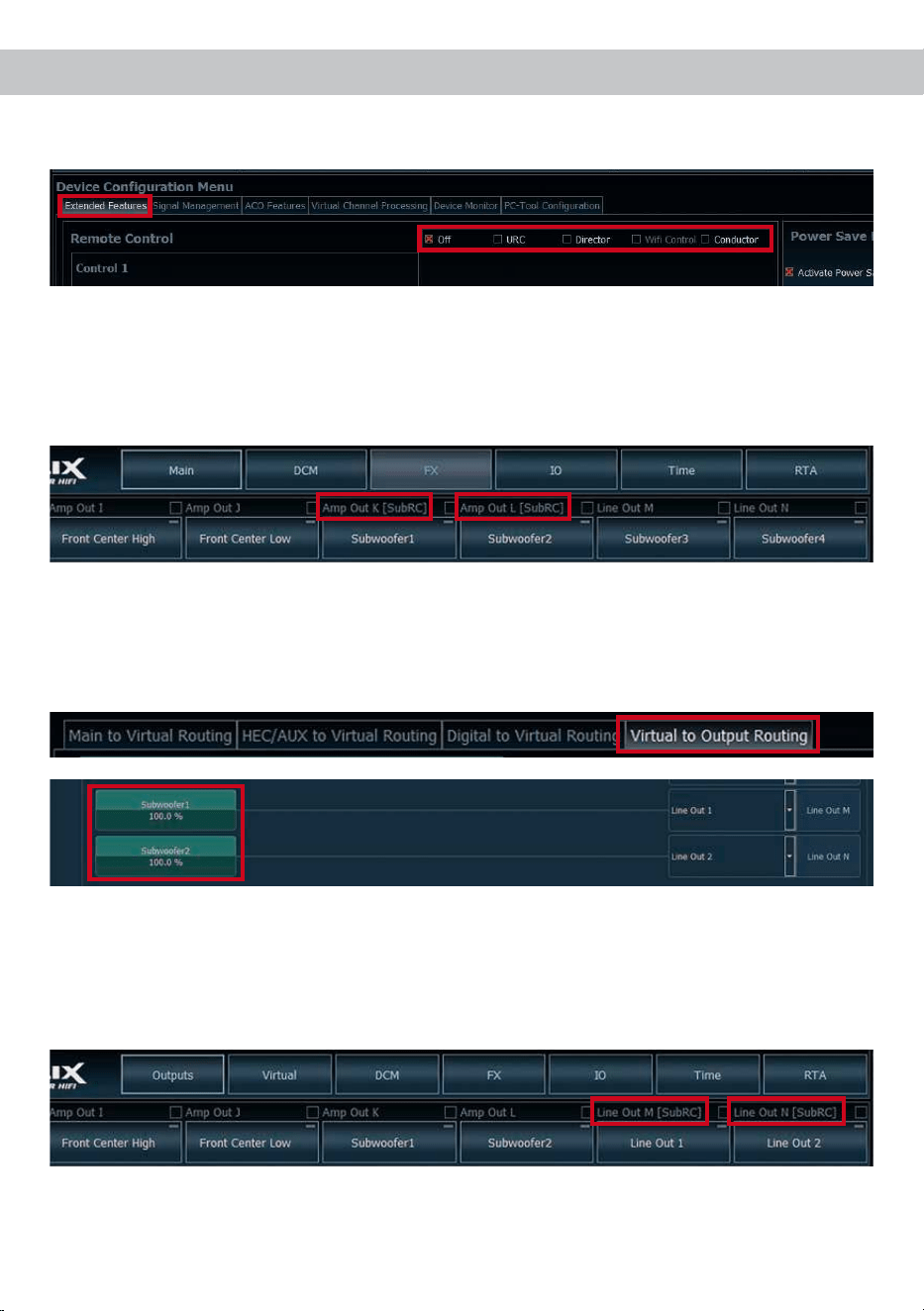
3. Wechseln Sie nun in das FX-Menü und aktivieren im Reiter „Center Processing“ den gewünschten
Soundeekt durch Setzen eines Hakens.
Hinweise für das Front Processing mit seiner StageXpander- und ClarityXpander-Funktion
Die Einstellungen des StageXpanders und Front ClarityXpanders wirken immer auf die virtuellen Kanäle
„Front L Full“ und „Front R Full“.
Hinweise für das Augmented Bass Processing mit seiner Dynamic Bass Enhancement- und
SubXpander-Funktion
Für das Augmented Bass Processing müssen bestimmte Einstellungen vorgenommen werden, um dessen
Soundeekte anwenden zu können.
1. Mindestens einer der virtuellen Subwoofer Kanäle („Subwoofer 1“ oder „Subwoofer 2“) muss mit einem
Eingangssignal belegt sein (siehe Workow-Schritt 1).
2. Wechseln Sie in die „Virtual to Output Routing“ Matrix und routen den Kanal / die Kanäle „Virtual K –
Subwoofer 1“ und / oder „Virtual L – Subwoofer 2“ auf den oder die gewünschten Ausgangskanäle (wie
im Workow-Schritt 2 beschrieben), auf welche das Subwoofersignal geleitet und das Augmented Bass
Processing angewendet werden soll.
3. Wechseln Sie nun in das FX-Menü und aktivieren den gewünschten Soundeekt.
Hinweise zum Eingangsrouting siehe Workow-Schritt 1
Hinweise zum Ausgangsrouting siehe Workow-Schritt 2
Hinweis: Das Bass Processing wird für die Kanäle Subwoofer 1 und Subwoofer 2 gemeinsam ein- und ausgeschaltet,
die beiden Kanäle bleiben dabei für Stereoanwendungen voneinander getrennt.
20
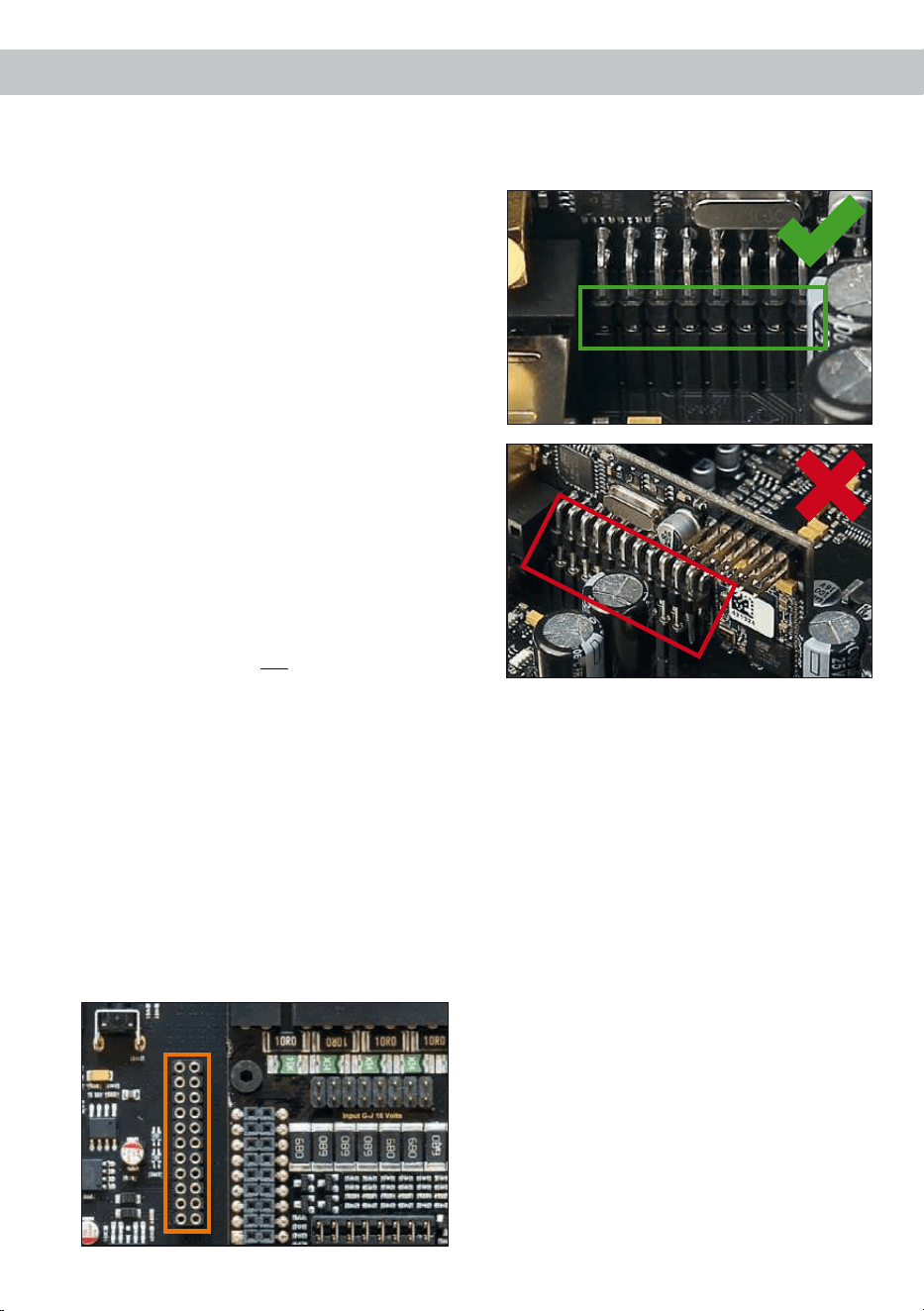
Zunächst muss die entsprechende Fernbedienung im Tab „Erweiterte Einstellungen“ im DCM Menü der
DSP PC-Tool Software aktiviert und je nach Modell konguriert werden.
Konguration einer Subwoofer-Fernbedienung
Bei aktiviertem VCP hingegen wird die Subwoofer-Fernbedienung den Ausgangskanälen zugeordnet,
welche im „Virtual to Output Routing“ mit einem der beiden virtuellen Subwoofer-Signalen versorgt werden
(„Subwoofer 1“ oder „Subwoofer 2“). Dies kann jede beliebige Kombination an Ausgangskanälen sein.
Im nachfolgenden Beispiel sind es die Vorverstärker-Ausgänge / Line Outputs M und N:
Anschließend wird die Subwoofer-Regelung auch im Main Menü hinter der Kanalbezeichnung als [SubRC]
angezeigt:
Hinweis: Bitte beachten Sie, dass den beiden virtuellen Subwoofer-Signalen „Subwoofer 1“ und / oder
„Subwoofer 2“ zuvor in den anderen Routing-Matrizen ein Eingangssignal zugewiesen werden muss.
Bei nicht aktiviertem VCP ist die Subwoofer-Fernbedienung bei der V TWELVE DSP MK2 fest den
Ausgangs kanälen K und L (Output Channels) zugeordnet. In diesem Fall ist es nicht entscheidend, welcher
Ausgang in der IO-Routingmatrix mit „Subwoofer“ benannt wurde.
Im Main Menü wird angezeigt, auf welche Ausgänge die SubRC (Subwoofer-Fernbedienung) wirkt:

21
ACO Plattform-Features
Neben den einzigartigen DSP-Sound eekten bietet
die ACO-Plattform des V TWELVE DSP MK2 zu-
sätzlich eine Vielzahl an System-Features.
Im DCM Menü der DSP PC-Tool Software können
für einige dieser System-Features individuelle Ein-
stellungen vorgenommen werden.
Turn On & O Delay
Hier kann die Verzögerungzeit, mit welcher der in-
tegrierte DSP ein- und ausgeschaltet werden soll,
festgelegt werden. Werkseitig sind 0,2 Sekunden
eingestellt. Eine Änderung der Verzögerungszeit
sollte nur vorgenommen werden, wenn es bei-
spielsweise zu Störgeräuschen beim Ein- und Aus-
schalten des Verstärkers kommt.
URC Setup Switch Conguration
Der ACO bietet Speicherplatz für zehn anstelle der
üblichen zwei Sound Setups.
Mit Hilfe einer optional erhältlichen URC Fernbe
-
dienung, oder des Control Tasters lässt sich zwi-
schen zwei der zehn Sound-Setup Speicherplätze
umschalten. Diese zwei Speicherplätze können in
der „URC Setup Switch Conguration“ festgelegt
werden. Werkseitig sind die Speicherbereiche eins
und zwei ausgewählt.
Um zwischen allen internen
Speicherplätzen umschalten zu können, werden die
optional erhältlichen Fernbedienungen DIRECTOR
und CONDUCTOR oder die HELIX WIFI CONTROL
empfohlen.
Remote Output Conguration
An dieser Stelle kann festgelegt werden, ob der
Remote-Ausgang, der die angeschlossenen End-
stufen ein- bzw. ausschaltet, während eines Sound-
Setup-Wechselvorgangs kurzzeitig deaktiviert
werden soll. Standardmäßig ist dieses Feature de-
aktiviert (OFF).
ADEP.3 Conguration
Bei Ansteuerung des Verstärkers über die High-
level-Eingänge kann es in Verbindung mit manchen
Werksradios, die über eine sogenannte „Class
SB“-Ausgangsstufe verfügen, notwendig sein, den
ADEP.3-Schaltkreis an den Diagnosemodus des
Steuergeräts anzupassen. Eine Anpassung sollte
vorgenommen werden, wenn es bspw. zu Verzer-
rungen im oberen Lautstärkebereich kommt. Stan-
dardmäßig ist der Kompatibilitätsmodus ausge-
schaltet (Disabled).
22
Einbau einer HELIX Extension Card
Der HELIX V TWELVE DSP MK2 Verstärker kann
durch die Montage einer HELIX Extension Card
(HEC) um weitere Funktionen erweitert werden –
beispielsweise um eine Bluetooth
®
Audio Streaming
Funktion, einem weiteren optischen Digitaleingang
oder einen USB Audio-Eingang.
Zur Montage einer HEC muss das Seitenblech der
V TWELVE DSP MK2 demontiert und gegen das
der HEC beiliegende Seitenblech ausgetauscht
werden.
Achtung: Installieren Sie ausschließlich für die
V TWELVE DSP MK2 vorgesehene HEC Module
an der dafür vorgesehenen Position. Die Be-
nutzung eines nicht für das Gerät spezizierten
HEC Moduls oder eine Installation an einer nicht
dafür vorgesehenen Position im Gerät kann zu
Schäden am HEC Modul, dem Verstärker, des
Radios oder anderen angeschlossenen Geräten
führen.
Im folgenden Abschnitt nun die wichtigsten Schritte
zum Einbau und der ersten Inbetriebnahme eines
HEC Moduls:
1. Ziehen Sie zunächst alle Steckverbindungen
vom Gerät ab.
2. Lösen Sie die vier Schrauben (zwei Inbus- und
zwei Kreuzschlitzschrauben) des Seitenblechs
der Geräteseite mit dem USB Eingang und ent-
fernen dieses.
3. Ziehen Sie nun das Bodenblech zur Seite he-
raus.
4. Bereiten Sie das Modul für den Einbau in das
Gerät vor. Informationen dazu entnehmen Sie
bitte der Bedienungsanleitung des jeweiligen
HEC Moduls.
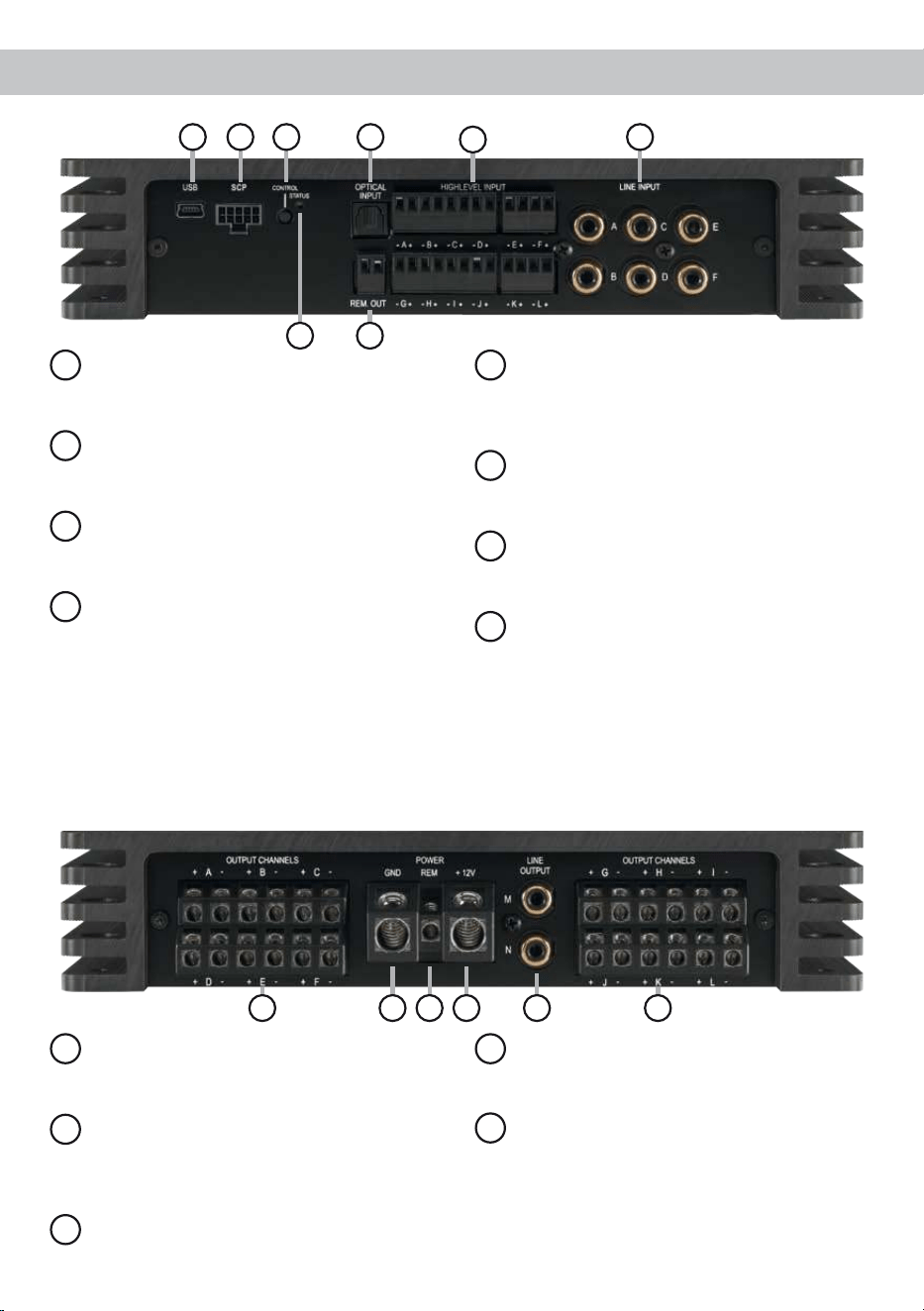
5. Stecken Sie das HEC Modul in den im Gerät
vorgesehenen Sockel (siehe Markierung im
nachfolgenden Bild).
6. Achten Sie auf den richtigen Sitz des HEC Mo-
duls und darauf, dass alle Kontaktstifte vollstän-
dig im Sockel stecken.
7. Schieben Sie das Bodenblech wieder seitlich
in das Gehäuse des Verstärkers. Anschließend
befestigen Sie das neue, dem HEC Modul bei-
liegende Seitenblech mit den Inbus- und Kreuz-
schlitzschrauben.
8. Verschrauben Sie das HEC Modul mit dem
Seitenblech. Genaue Informationen zur Befes-
tigung entnehmen Sie bitte der Bedienungsan-
leitung des jeweiligen Moduls.
9. Schließen Sie alle Steckverbindungen wieder
an das Gerät an.
10. Schalten Sie den Verstärker ein. Das installierte
HEC Modul wird nun automatisch vom Gerät
erkannt und die Status LED des HEC Moduls
leuchtet grün.
11. Das Modul kann nun in der DSP PC-Tool Soft-
ware konguriert werden.

23
Pure Class GD Verstärker-Technologie
Das Pure Class GD Konzept vereint die Vorteile der
Class G-Technologie mit dem Prinzip eines Class D
Verstärkers.
Daraus resultiert ein ungewöhnlich hoher Wir-
kungsgrad, der herkömmliche Class D Verstär-
ker nochmals übertrit. Die Vorteile spielt das
Pure Class GD-Konzept bei kleiner und mittlerer
Aussteuerung aus, indem die interne Versorgungs-
spannung der Leistungsstufen in Abhängigkeit von
der Amplitude des Eingangssignals variiert. Zudem
ist bei diesem Verstärker der gesamte analoge
Signalpfad völlig symmetrisch aufgebaut, wovon
sowohl Klirrfaktor als auch Signal-Rauschabstand
protieren.
ACO – Advanced 32 Bit CoProcessor
Der HELIX V TWELVE DSP MK2 Verstärker ver-
wendet für alle internen wie auch externen Steu-
erungsund Kommunikationsaufgaben einen be-
sonders leistungsstarken 32 Bit CoProcessor der
neuesten Generation. Im Gegensatz zum bisher
verwendeten 8 Bit Prozessor ergeben sich daraus
deutliche Geschwindigkeitsvorteile nicht nur bei der
Umschaltung zwischen verschiedenen Sound Se-
tups sondern vor allem auch in der Datenkommuni-
kation mit unserer DSP PC-Tool Software. Ein wei-
terer wesentlicher Vorteil ist der integrierte, native
Bootloader des CoProcessors.
Dieser ermöglicht Software-Upgrades aller Kompo-
nenten des integrierten DSPs, um beispielsweise
den Mikrocontroller-gesteuerten ADEP.3-Schalt-
kreis auch zukünftig auf Änderungen bei Diagno-
sesystemen von Werksradios anpassen zu können
oder das Gerät um weitere Schnittstellen zu er-
weitern. Darüber hinaus bietet der ACO dank des
neuen Flashspeichers Platz für 10 Sound Setups
anstelle der üblichen zwei.
Intelligenter Highlevel-Eingang ADEP.3
Moderne, ab Werk verbaute Autoradios werden
bezüglich der Diagnose der angeschlossenen Laut-
sprecher immer intelligenter. Speziell die neueste
Generation ist mit zusätzlichen Überwachungsfunk-
tionen ausgestattet, sodass bei Anschluss eines
zusätzlichen Verstärkers Fehlermeldungen oder
gar Fehlfunktionen auftreten können. Der neue, an
den Diagnosemodus des Steuergeräts anpassbare
ADEP.3-Schaltkreis (Advanced Diagnostics Error
Protection Generation 3) verhindert diese Probleme
ohne die Lautsprecherausgänge des Radios bei
hohen Pegeln unnötig zu belasten (siehe Seite 21,
ADEP.3 Conguration).
Power Save Modus
Der Power Save Modus ist in den Grundeinstellungen
der DSP PC-Tool Software aktiviert. Er erlaubt es,
die Leistungsaufnahme der V TWELVE DSP MK2
(und ggf. zusätzlich angeschlossener Verstärker)
drastisch zu reduzieren, wenn für länger als 60
Sek. kein Eingangssignal anliegt. Sobald der „Po-
wer Save Mode“ aktiv ist, werden die internen Ver-
stärkerstufen der V TWELVE DSP MK2 sowie der
Rem. Out abgeschaltet und damit die Stromaufnah-
me deutlich reduziert. Der Verstärker geht innerhalb
von 2 Sek. wieder in den normalen Betriebszustand
über, sobald ein Musiksignal an seinem Eingang
anliegt. Über die DSP PC-Tool Software kann die
Abschaltverzögerung variiert bzw. komplett deakti-
viert werden.
Start-Stopfähigkeit
Das Netzteil im HELIX V TWELVE DSP MK2 Ver-
stärker stellt die interne Spannungsversorgung
auch bei kurzfristigen Einbrüchen bis hinab zu
6 Volt sicher. Damit ist gewährleistet, dass die
HELIX V TWELVE DSP MK2 auch beim Motorstart
voll funktionsfähig bleibt.
Spezielle Features der HELIX V TWELVE DSP MK2

24
Leistung RMS ≤ 1% THD+N
- @ 4 Ohm ........................................................................ 12 x 75 Watt
- @ 2 Ohm ........................................................................ 12 x 120 Watt
Max. Leistung pro Kanal* ................................................. Bis zu 160 Watt RMS @ 2 Ohm
Verstärkertechnologie ....................................................... Pure Class GD
Eingänge .......................................................................... 6 x Cinch
12 x Hochpegel-Lautsprechereingang
1 x Optisch SPDIF (12 - 96 kHz)
1 x Remote In
Eingangsempndlichkeit ................................................... Cinch: max. 4 V oder max. 8 V
Hochpegel: max. 16 V oder max. 32 V
Eingangsimpedanz ........................................................... Cinch: 12 kOhm
Hochpegel: 9 - 33 Ohm oder 20 kOhm
Ausgänge ......................................................................... 12 x Lautsprecherausgang
2 x Cinch
2 x Remote Out
Ausgangsspannung Cinch................................................ 3 Volt
Frequenzbereich............................................................... 20 Hz - 22.000 Hz
DSP Auösung ................................................................. 64 Bit
DSP Rechenleistung ........................................................ 295 MHz (1,2 Mrd. MAC Operationen/Sekunde)
Abtastrate ......................................................................... 48 kHz
DSP Typ ........................................................................... Audio Signalprozessor
Signalwandler ................................................................... A/D: BurrBrown
D/A: BurrBrown
Signal- / Rauschabstand (A-bewertet).............................. Digitaleingang: 107 dB
Analogeingang: 102 dB
Klirrfaktor (THD) ............................................................... < 0,015 %
Dämpfungsfaktor .............................................................. > 70
Betriebsspannung............................................................. 10,5 - 16 Volt (max. 5 Sek. bis hinab zu 6 Volt)
Leistungsaufnahme .......................................................... DC 12 V
80 A max.
Leerlaufstromaufnahme.................................................... 700 mA
Max. Remote-Ausgangsstrom .......................................... 500 mA
Sicherung ......................................................................... 2 x 30 A LP-Mini-Stecksicherung
Zusätzliche Features ........................................................ HEC Slot, ADEP.3-Schaltkreis, Smart Control
Port, 32 Bit CoProcessor, Auto Remote-Schalter
Abmessungen (H x B x T) ................................................ 44 x 220 x 220 mm
* In typischen Mehrkanal-Anwendungen (2- / 3-Wege System + Rear + Subwoofer)
Technische Daten
Die Garantieleistung entspricht der gesetzlichen
Regelung. Von der Garantieleistung ausgeschlos-
sen sind Defekte und Schäden, die durch Überla-
stung oder unsachgemäße Behandlung entstanden
sind. Eine Rücksendung kann nur nach vorheriger
Absprache in der Originalverpackung, einer de-
taillierten Fehlerbeschreibung und einem gültigen
Kaufbeleg erfolgen.
Technische Änderungen und Irrtümer vorbehalten!
Für Schäden am Fahrzeug oder Gerätedefekte, her-
vorgerufen durch Bedienungsfehler des Gerätes,
können wir keine Haftung übernehmen. Dieses
Produkt ist mit einer CE-Kennzeichnung versehen.
Damit ist das Gerät für den Betrieb in Fahrzeugen
innerhalb der Europäischen Union (EU) zertiziert.
Garantiehinweis
Hinweis:
„Die Bluetooth
®
Wortmarke und die Logos sind eingetragene Warenzeichen der Bluetooth SIG, Inc. und jegliche Nutzung dieser Marken
durch die Audiotec Fischer GmbH geschieht unter Lizenz. Andere Handelsmarken und Handelsnamen gehören den jeweiligen Inhabern.“

25
Dear Customer,
Congratulations on your purchase of this innovative
and high-qual ity HELIX product.
Thanks to more than 30 years of experience in
research and development of audio products the
HELIX V TWELVE DSP MK2 sets new standards in
the range of digital ampliers.
We wish you many hours of enjoyment with your
new HELIX V TWELVE DSP MK2.
Yours,
AUDIOTEC FISCHER
General installation instructions for HELIX
components
To prevent damage to the unit and possible injury,
read this manual carefully and follow all installation
instructions. This product has been checked for
proper function prior to shipping and is guaranteed
against manufacturing defects.
Before starting your installation, disconnect
the battery’s negative terminal to prevent
damage to the unit, re and / or risk of injury. For
a proper performance and to ensure full warranty
coverage, we strongly recommend to get this prod-
uct installed by an authorized HELIX dealer.
Install your HELIX V TWELVE DSP MK2 in a dry lo-
cation with sucient air circulation for proper cooling
of the equipment. The amplier should be secured
to a solid mounting surface using proper mount-
ing hardware. Before mounting, carefully examine
the area around and behind the proposed instal-
lation location to insure that there are no electrical
cables or components, hydraulic brake lines or any
part of the fuel tank located behind the mounting
surface. Failure to do so may result in unpredictable
damage to these components and possible costly
repairs to the vehicle.
General instruction for connecting the HELIX
V TWELVE DSP MK2 amplier
The HELIX V TWELVE DSP MK2 amplier may
only be installed in vehicles which have a 12 Volts
negative terminal connected to the chassis ground.
Any other system could cause damage to the ampli-
er and the electrical system of the vehicle.
The positive cable from the battery for the complete
system should be provided with a main fuse at a
distance of max. 30 cm from the battery. The val-
ue of the fuse is calculated from the maximum total
current input of the car audio system.
Use only suitable cables with sucient ca-
ble cross-section for the connection of HELIX
V TWELVE DSP MK2. The fuses may only be re-
placed by identically rated fuses (2 x 30 A) to
avoid damage of the amplier.
Prior to installation, plan the wire routing to avoid
any possible damage to the wire harness. All
cabling should be protected against possible
crushing or pinching hazards. Also avoid routing
cables close to potential noise sources such as
electric motors, high power accessories and other
vehicle harnesses.
Congratulations!
General instructions
26
Connectors and control units
9 10 11 12 13 9
1
7
32 4 6
1
USB Input
Connects the HELIX V TWELVE DSP MK2
to your PC.
2
SCP (Smart Control Port)
Multifunction interface for e.g. an optional
remote control or other HELIX accessory.
.
3
Control pushbutton
Use this button to either switch between the
setups or initiate a reset of the device.
4
Optical Input
Optical input for digital stereo signals (SPDIF
format).
5
Highlevel Input
Highlevel speaker inputs for connecting a
factory radio or an aftermarket radio without
lowlevel line outputs.
6
Line Input
RCA / Cinch inputs for connecting
pre-amplier signals.
7
Status LED
The Status LED indicates the operating
mode of the amplier and its DSP memory.
8
Rem. Out
The remote output has to be used to turn on /
o external ampliers. Both connections are
internally wired parallel.
5
8
9
Output Channels
Speaker outputs for connecting speaker
systems.
10
GND
Connector for the ground cable (negative
terminal of the battery or metal body of the
vehicle).
11
REM
Connector for the remote cable of the radio.
12
+12 V
Connector for the +12 V power cable to the
positive terminal of the battery.
13
Line Output
Line outputs for connecting external
ampliers. Make sure that the remote output
(Rem. Out) is used to turn on these devices.
27
1
USB Input
Connect your personal computer to the
V TWELVE DSP MK2 using the provided USB ca-
ble. The required PC software to congure this am-
plier can be downloaded from the Audiotec Fischer
website www.audiotec-scher.com.
Please note: It is not possible to connect any USB
storage devices.
2
SCP (Smart Control Port)
This multi-functional input is designed for HELIX
V TWELVE DSP MK2 accessory products like a re-
mote control which allows to adjust several features
of the signal processor. Depending on the type of
remote control, at rst its functionality has to be
dened in the “ Device Conguration Menu” of the
DSP PC-Tool software.
Attention: If the accessory product does not have
a NanoFit connector solely use the NanoFit adaptor
which is included in delivery for connection.
NanoFit adaptor
3
Control pushbutton
The V TWELVE DSP MK2 provides 10 internal
memory locations for sound setups. The Control
pushbutton allows the user to switch between two
memory locations or to perform a device reset. The
setups can be dened in the DSP PC-Tool.
1. Setup switch: Press Control pushbutton for 1 sec-
ond. The memory locations one and two are dened
by default. Switching is indicated by a single red
ash of the Status LED. Alternatively, the optional
URC.3 remote control can be used for switching.
To switch between all internal memory locations,
optional accessories like the DIRECTOR display
remote control, CONDUCTOR or WIFI CONTROL
are required.
2. Device reset: Press pushbutton for ve seconds.
This completely erases the internal memory and is
indicated by a continuous red glowing and constant
green ashing of the Status LED.
Attention: After erasing the setups from memory
the V TWELVE DSP MK2 will not reproduce any
audio output until the device is updated via the DSP
PC-Tool software.
4
Optical Input
Optical input in SPDIF format for connecting signal
sources with a digital audio output. The sampling
rate of this input must be between 12 and 96 kHz.
The input signal is automatically adapted to the in-
ternal sample rate.
In order to control the volume of this input, we rec-
ommend to use an optional remote control or the
WIFI CONTROL.
Note: This amplier can only handle stereo input
signals and no MP3- or Dolby-coded digital audio
stream!
Note: In standard conguration the manual activa-
tion via an optional remote control is congured.
5
Highlevel Input
12-channel highlevel loudspeaker input to connect
the amplier directly to loudspeaker outputs of
OEM / aftermarket radios or OEM ampliers that do
not have any pre-amplier outputs. Input sensitivity
is factory-set to 11,3 Volts. However, it is possible
to optimally adapt the input sensitivity to the sig-
nal source using the DSP PC-Tool software (DCM
menu → Signal Management) and by repositioning
jumpers inside the device (see page 30, point 4; Ad-
justment of the input sensitivity).
Important: It is mandatory to properly adapt the
input sensitivity of the V TWELVE DSP MK2 to
the signal source before rst use. Disregarding
this may cause severe damage to the amplier.
Attention: Solely use the pluggable screw-termi-
nals for the highlevel connectors which are included
in delivery or an optional available cable harness
from the HELIX accessory assortment!
Initial start-up and functions

28
Important: It is strictly forbidden to use the High-
level Input and lowlevel Line Input of an individual
channel at the same time as this may cause severe
damage to the lowlevel line outputs of your car ra-
dio. Nevertheless it is possible to use the Highlevel
Input of one channel and the lowlevel Line Input of
another channel simultaneously.
6
Line Input
6-channel pre-amplier input to connect signal
sourc es such as radios. Input sensitivity is
factory-set to 2.8 Volts.
It is possible to optimally adapt the input sensitivity
to the signal source using the DSP PC-Tool software
(DCM menu → Signal management) and by repo-
sitioning jumpers inside the device (see page 30,
point 4; Adjustment of the input sensitivity).
7
Status LED
The Status LED indicates the operating mode of the
amplier and of its memory.
Green: Amplier is ready for operation.
Orange: Power Save Mode is active.
Red: Protection Mode is active. This may have dier-
ent root causes. The HELIX V TWELVE DSP MK2
is equipped with protection circuits against over-
and undervoltage as well as overheating. Please
check for connecting failures such as short-circuits
or other wrong connections.
If the amplier is overheated the internal tempera-
ture protection switches o the remote and signal
output until it reaches a safe temperature level
again.
Red / green slow ashing: No operating soft-
ware installed. Connect the amplier to the DSP
PC-Tool software and conrm the automatic up-
date of the operating system. You will nd the
latest version of the DSP PC-Tool software at
www.audiotec-scher.com.
Red / green fast ashing: The currently selected
sound setup memory is empty. A new setup has to
be loaded via the DSP PC-Tool software or switch
to a memory position with existing sound setup.
8
Rem. Out
We strongly recommend to use this output for turning
on / o additional ampliers that are connected to
the Line Output of the HELIX V TWELVE DSP MK2.
This is essential to avoid any interfering signals.
This output is activated automatically as soon as
the booting process of the DSP is completed. Ad-
ditionally this output will be turned o during the
“Power Save Mode” or a software update process.
9
Output Channels
Speaker outputs to connect speaker systems. The
impedance per channel must not be lower than
2 Ohms.
Important: We highly recommend to make the gen-
eral settings in the DSP PC-Tool software before the
rst start-up. Especially if the V TWELVE DSP MK2
will be used to drive fully active speaker systems, a
wrong setup can destroy your tweeters right away.
10
GND
The ground cable should be connected to a common
ground reference point (this is located where the
negative terminal of the battery is grounded to the
metal body of the vehicle) or to a prepared metal lo-
cation on the vehicle chassis i.e. an area which has
been cleaned of all paint residues. Recommended
cross section: min. 16 mm² / AWG 6.
11
REM
The remote input has to be used to turn on / o the
V TWELVE DSP MK2 if the signal source which is
connected to the Highlevel Input is not activating
the “automatic turn-on” function or if the amplier
shall only be activated / deactivated by a remote
signal applied to the remote input. The remote lead
should be connected to the remote output / auto-
matic antenna (aerial positive) output of the head
unit / car radio. This is only activated if the head
unit is switched on. Thus the amplier is switched
on and o together with the head unit. This input
needn´t to be assigned if the Highlevel Input is
used. To deactivate the “automatic turn-on” function
Initial start-up and functions

29
read the description on page 33, point 7; Congura-
tion of the remote input.
12
+12 V
Connect the +12 V power cable to the positive ter-
minal of the battery. Recommended cross section:
min. 16 mm² / AWG 6.
13
Line Output
Processed 2-channel pre-amplier output with a
maximum output voltage of 3 Volts for connect-
ing additional power ampliers. Please make
sure that you always turn on / o external ampli-
ers using the remote output (Rem. Out) of the
V TWELVE DSP MK2. Never directly control the
external amps by a signal from the ignition switch
of your car! Additionally this output will be turned
o when the “Power Save Mode” of the amplier is
active. The outputs can be assigned to any of the
inputs as desired using the DSP PC-Tool software.

30
Installation
The HELIX V TWELVE DSP MK2 must be con-
nected as follows:
Caution: Carrying out the following steps will
require special tools and technical knowledge. In
order to avoid connection mistakes and / or dam-
age, ask your dealer for assistance if you have any
ques tions and follow all instructions in this manual
(see page 25). It is recommended that this unit will
be installed by an authorized HELIX dealer.
1. Connecting the pre-amplier inputs
Use the correct cable (RCA / cinch cable) to con-
nect these inputs to the pre-amplier / lowlev-
el / cinch outputs of your head unit / car radio
or factory installed amplier. Each input can be
assigned to any output using the DSP PC-Tool
software. The automatic turn-on circuit does not
work when using the pre-amplier inputs. In this
case the remote input has to be connected to
activate the HELIX V TWELVE DSP MK2.
Important: It is strictly forbidden to use the
Highlevel and lowlevel Line Input of an individ-
ual channel at the same time as this may cause
severe damage to the lowlevel line outputs of
your head unit / car radio / factory installed
amplier. Nevertheless it is possible to use the
Highlevel Input of one channel and the lowlevel
Line Input of another channel simultaneously.
2. Connecting the highlevel speaker inputs
The highlevel loudspeaker inputs can be con-
nected directly to the loudspeaker outputs of
an OEM radio, aftermarket radio or factory in-
stalled amplier using appropriate cables (loud-
speaker cables with 1 mm² / AWG 18 max.).
We recommend the following channel assign-
ment if a common car radio will be connected to
the signal processor:
Channel A = Front left
Channel B = Front right
Channel C = Rear left
Channel D = Rear right
Actually it is not mandatory to use all high level
speaker inputs. If only two channels will be con-
nected we recommend to use the channels A
and B. Make sure that the polarity is correct. If
one or more connections have reversed polarity
it may aect the performance of the amplier.
If this input is used the remote input does not
need to be connected as the amplier will au-
tomatically turn on once a loudspeaker signal
is received.
3. Connecting a digital signal source
If you have a signal source with an optical digi-
tal output you can connect it to the amplier
using the appropriate input. In standard con-
guration the manual activation via an optional
remote control is congured.
Alternatively you can activate the automatic
turn-on feature in the DCM menu of the DSP
PC-Tool software. The feature activates the
digital input as soon as a digital audio signal is
detected.
The automatic turn-on circuit does not work
when a digital input is used. Therefore it is man-
datory to connect the remote input (REM).
Important: The signal of a digital audio source
normally does not contain any information
about the volume level. Keep in mind that this
will lead to full level on the outputs of the HELIX
V TWELVE DSP MK2 and your connected
ampliers. This may cause severe damage to
your speakers. We strongly recommend to use
an optional remote control for adjusting the vol-
ume level of the digital signal input!
Information: The HELIX V TWELVE DSP MK2
can only handle uncompressed digital stereo
signals in PCM format with a sample rate be-
tween 12 kHz and 96 kHz and no MP3- or Dol-
by-coded digital audio stream!
4. Adjustment of the input sensitivity
Attention: It is mandatory to proper-
ly adapt the input sensitivity of the
V TWELVE DSP MK2 to the signal source in
order to avoid damage to the amplier.
The input sensitivity can be adjusted via the
DSP PC-Tool software and by repositioning
jumpers inside the device. The setting will be
undertaken in two steps:
1. Pre-adjustment of the value range using the
jumpers inside the device.
2. Exact adjustment of the input sensitivity by
using the DSP PC-Tool software.
31
Reg. step 1: The factory setting of the input
sensitivity (Highlevel 11.3 Volts; RCA / Cinch
2.8 Volts) of the V TWELVE DSP MK2 are ap-
propriate for the most common radios. As soon
as the connected signal source provides an
maximum input voltage of 14 Volts – for ex-
ample, if a factory installed amplier is used
as signal source – all four internal jumpers has
to be repositioned to the “High Voltage Range”
(Highlevel 8 - 32 Volts; RCA / Cinch 2 - 8 Volts).
To get access to the jumpers the device has to
be opened. Therefore dismantle the side panel
where the USB input is located by removing the
two Phillips and two Allen screws and pull out
the bottom plate sideways.
Now you have access to the jumpers.
J 3
J 4
J 1
J 2
Overview plug-in positions:
Jumper 1 (J 1): Channel A - D
Jumper 2 (J 2): Channel E - F
Jumper 3 (J 3): Channel G - J
Jumper 4 (J 4): Channel K - L
For repositioning a jumper simply pull it up-
wards and plug it into the desired plug position.
Make sure that the jumper is reinserted properly
and all pins are fully inserted.
If you are not sure regarding the signal sources
output voltage, please contact your HELIX spe-
cialist dealer.
Low Voltage Range jumper plug-in positions (by
default):
Value range:
Highlevel 4 - 16 Volts
RCA / Cinch 1 - 4 Volts
J 1
J 2
J 3
J 4
High Voltage Range jumper plug-in positions
:
Value range:
Highlevel 8 - 32 Volts
RCA / Cinch 2 - 8 Volts
J 1
J 2
J 3
J 4
32
After setting the jumpers to the desired plug-in
positions, you can reassemble the amplier.
Reg. step 2: Now you can optimally adapt the input
sensitivity to the connected signal source by using
the DSP PC-Tool softw
are.
Note: Mute all signal outputs of the
V TWELVE DSP MK2 during this setup.
Therefore follow the subsequent steps:
1. Turn on the amplier and then start the
software. TFind the setting for adjusting
the input sensitivity in the “Signal Manage-
ment” tab of the DCM menu under the item
“Main Input → Input Gain”.
2. Select the setup method to adjust the input
sensitivity.
Standard Gain Setup: This method allows
go globally set the input sensitivity for all
input channels (only with “Low Voltage
Range” jumper plug-in position – see page
31).
Advanced Gain Setup: With this method,
both a global setting of all channels and
an individual setting for the individual
channel pairs is possible.(Automatically
activated at High Voltage Range jumper
positions)
3. Select the used input (RCA / Cinch or high-
level.
4. Adjust the volume of your radio to approx.
90 % of the max. volume and playback
an appropriate test tone, e.g. pink noise
(0 dB).
5. If the clipping indicator in the DSP PC-Tool
already lights up (see following picture),
you have to reduce the input sensitivity us-
ing the scroll bar until the indicator turns
o.
6. Increase the input sensitivity until the clipping
indicator lights up. Now turn the control one
step back so the indicator turns o again.
Various adjustment examples of the input sen-
sitivity can be found on page 34. For further ap-
plications please contact your HELIX specialist
dealer.
5. Connection to power supply
Make sure to disconnect the battery before
installing the HELIX V TWELVE DSP MK2!
Connect the +12 V power cable to the positive
terminal of the battery. The positive wire from
the battery to the amplier power terminals
needs to have an inline fuse at a distance of
less than 12 inches (30 cm) from the battery.
The value of the fuse is calculated from the
maximum total current draw of the whole car
audio system (V TWELVE DSP MK2 = max.
80 A RMS at 12 V power supply). If your power
wires are short (less than 1 m / 40”) then a wire
gauge of 16 mm² / AWG 6 will be sucient. In
all other cases we strongly recommend gauges
of 25 - 35 mm² / AWG 4 – 2!
The ground cable (same gauge as the +12 V
wire) should be connected to a common ground
reference point (this is located where the neg-
ative terminal of the battery is grounded to the
metal body of the vehicle), or to a prepared
metal location on the vehicle chassis, i.e. an
area which has been cleaned of all paint res-
idues.
Installation
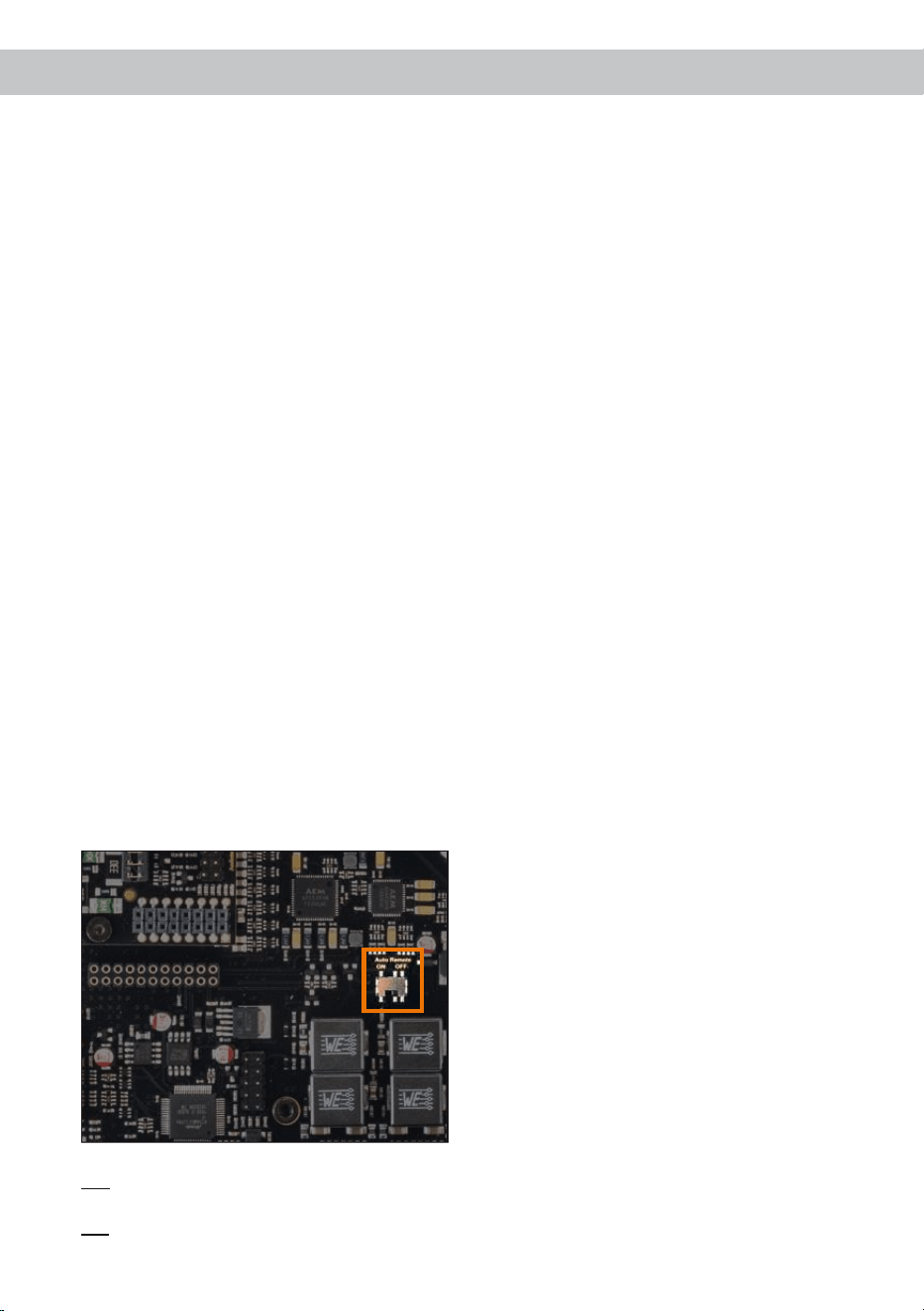
33
6. Connecting the remote input
The remote input (REM) has to be connected to
the radio remote output if the ampliers lowlevel
Line Inputs or the Optical Input is solely / are
used as signal input/s. We do not recommend
controlling the remote input via the ignition
switch to avoid pop noise during turn on / o.
If the Highlevel Input is used this input does not
need to be connected as long as the car radio
has BTL output stages.
7. Conguration of the remote input
The V TWELVE DSP MK2 will be turned on au-
tomatically if the Highlevel Input is used or if a
signal is applied to the remote input terminal.
The “Auto Remote” switch allows to deactivate
the automatic turn-on feature of the highlevel
inputs. The feature should be deactivated (Auto
Remote = O) if there are e.g. noises while
switching on / o the amplier.
Note: If the automatic turn-on function is deac-
tivated it is mandatory to use the remote input
terminal to power up the amplier! The high-
level signal will be ignored in this case.
Note: The automatic turn-on feature of the
highlevel inputs is activated ex works.
To deactivate the automatic turn-on feature you
have to open the device and change the posi-
tion of the “Auto Remote” switch. Therefore the
device has to be opened as described in point 4
(see marking in the following picture).
On: Activation via highlevel speaker input is
enabled (by default).
O: Activation via highlevel speaker input is
disabled.
8. Conguration of the internal DSP
The general DSP settings should be con-
ducted with the DSP PC-Tool software be-
fore using the amplier for the rst time.
Ignoring this advice may result in damaging the
connected ampliers / loudspeakers. Informa-
tion about connecting the V TWELVE DSP MK2
to a computer can be found on page 36.
9. Connecting the loudspeaker outputs
The loudspeaker outputs can be connected
directly to the wires of the loudspeakers. Never
connect any of the loudspeaker cables with the
chassis ground as this will damage your ampli-
er and your speakers.
Ensure that the loudspeakers are correctly con-
nected (in phase), i.e. plus to plus and minus
to minus. Exchanging plus and minus causes a
total loss of bass reproduction. The plus pole is
indicated on most speakers. The impedance of
the speakers must not be lower than 2 Ohms.
10. Connecting the remote output
This output (Rem. Out) is used to supply remote
signals to the external amplier/s. Always use
this remote output signal to turn on the ampli-
ers in order to avoid on / o switching noises.
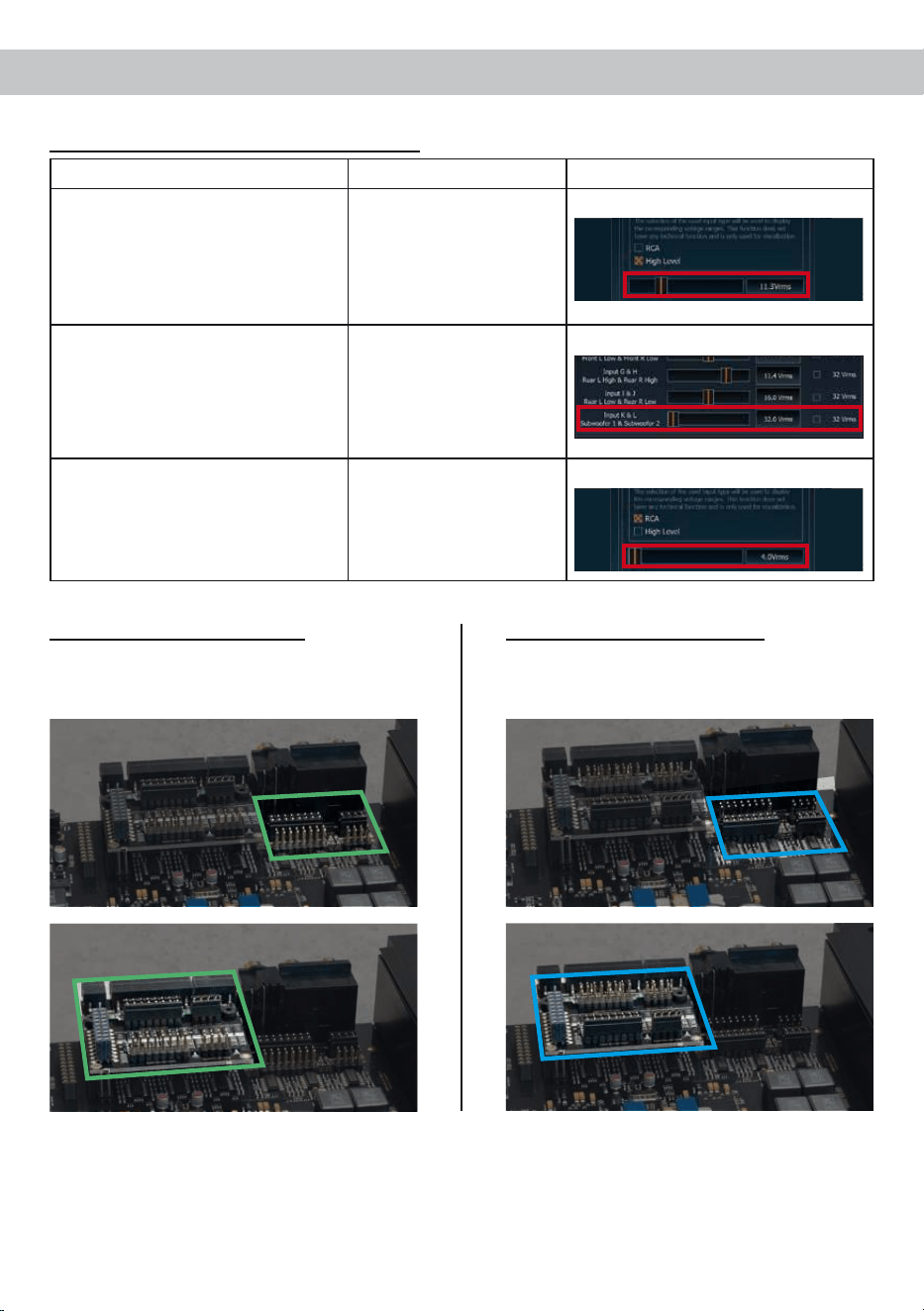
34
Installation
Figure 1 – Low Voltage Range:
Figure 2 – High Voltage Range:
For further applications please contact your HELIX specialist dealer.
Value range: Highlevel 4 - 16 Volts
RCA / Cinch 1 - 4 Volts
J 1
J 2
J 3
J 4
J 1
J 2
J 3
J 4
Value range: Highlevel 8 - 32 Volts
RCA / Cinch 2 - 8 Volts
Examples for adjusting the input sensitivity:
Source Jumper positions
Input Gain in DSP PC-Tool
4- to 6-channel OEM-Radio
Up to 25 Watts RMS power per channel
at 4 Ohms or up to 50 Watts RMS power
at 2 Ohms
Low Voltage Range –
default jumper positions
(see g. 1)
Standard Gain Setup
OEM-Radio with additional 4- to
12-channel amplier
>25 Watts and up to 200 Watts RMS
power at 4 Ohms or up to 100 Watts
RMS power per channel at 8 Ohms
High Voltage Range
(see g. 2)
Advanced Gain Setup
4- to 6-channel aftermarket radio
with pre-amplier outputs
Up to a maximum RCA / Cinch output
voltage of 4 Volts RMS
Low Voltage Range –
default jumper positions
(see g. 1)
Standard Gain Setup
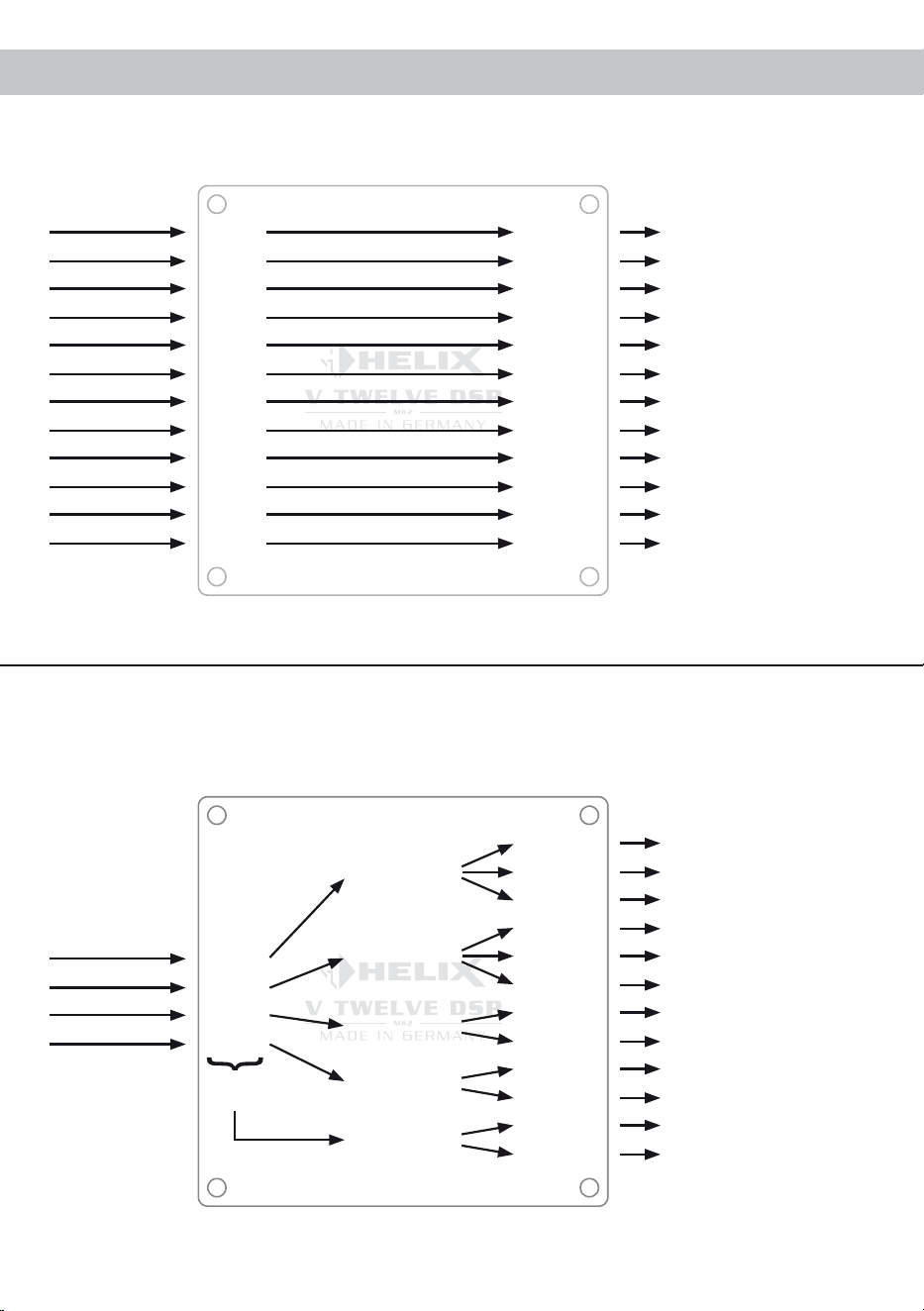
35
Conguration examples
1 to 1 channel routing (IOR)
Front L High
Front R High
Front L Mid
Front R Mid
Front L Low
Front R Low
Rear L High
Rear R High
Rear L Low
Rear R Low
Subwoofer 1
Subwoofer 2
Front L High – tweeter FL
Front R High – tweeter FR
Front L Mid – midrange FL
Front R Mid – midrange FR
Front L Low – mid-woofer FL
Front R Low –
mid-woofer FR
Rear L High – tweeter RL
Rear R High – tweeter RR
Rear L Low – mid-woofer RL
Rear R Low – mid-woofer RR
Subwoofer 1 – subwoofer
Subwoofer 2 – subwoofer
From OE system Inputs Outputs To speakers
Input A
Input B
Input C
Input D
Input E
Input F
Input G
Input H
Input I
Input J
Input K
Input L
Amp Out A
Amp Out B
Amp Out C
Amp Out D
Amp Out E
Amp Out F
Amp Out G
Amp Out H
Amp Out I
Amp Out J
Amp Out K
Amp Out L
Front L Full
Front R Full
Rear L Full
Rear R Full
From OE system
Amp Out A
Amp Out C
Amp Out E
Amp Out B
Amp Out D
Amp Out F
Amp Out G
Amp Out I
Amp Out H
Amp Out J
Amp Out K
Amp Out L
Inputs Outputs
Input A
Input B
Input C
Input D
To speakers
Channel routing with Virtual Channel Processing
Front L Full (A)
Front R Full (B)
Rear L Full (C)
Rear R Full (D)
Subwoofer 1 (K)
Virtual channels
Front L High – tweeter FL
Front R High – tweeter FR
Front L Mid – midrange FL
Front R Mid – midrange FR
Front L Low – mid-woofer FL
Front R Low – mid-woofer FR
Rear L High – tweeter RL
Rear R High – tweeter RR
Rear L Low – mid-woofer RL
Rear R Low – mid-woofer RR
Subwoofer 1 – subwoofer
Subwoofer 2 – subwoofer
Sum signal
A to D
SFX -
Front Processing
SFX -
Front Processing
SFX -
Augmented Bass
Processing
For further applications please contact your HELIX specialist dealer.

36
It is possible to freely congure the HELIX
V TWELVE DSP MK2 with our DSP PC-Tool soft-
ware. The user interface is designed for easy han-
dling of all functions and allows an individual adjust-
ment of each of the fourteen DSP channels.
Prior to connecting the amplier to your PC visit our
website and download the latest version of the
DSP PC-Tool software.
Check from time to time for software updates. You
will nd the software and the respective user manu-
al on www.audiotec-scher.com.
We strongly recommend to carefully read the DSP
PC-Tool knowledge base before using the software
for the rst time in order to avoid any complications
and failures.
Important: Make sure that the amplier is not con-
nected to your computer before the software and
USB driver are installed!
In the following the most important steps how to
connect and the rst start-up are described:
1. Download the latest version of the DSP
PC-Tool software (available on our website
www.audiotec-scher.com) and install it on
your computer.
2. Connect the amplier to your computer us-
ing the USB cable that is included in delivery.
If you have to bridge longer distances please
use an active USB extension cable with in-
tegrated repeater or the optionally available
WIFI CONTROL interface.
3. First turn on the amplier and then start the
software. The operating software will be updat-
ed automatically to the latest version if it is not
up-to-date.
4. Now you are able to congure your
V TWELVE DSP MK2 with our intuitive DSP
PC-Tool software. Nevertheless, interesting
and useful hints can be found in our knowledge
base on www.audiotec-scher.com.
Caution: We highly recommend to set the vol-
ume of your car radio to minimum position during
rst start-up. Additionally no devices should be
connected to the amplier until general settings in
the DSP PC-Tool software have been made. Es-
pecially if the V TWELVE DSP MK2 will be used in
fully active applications, a wrong setup can destroy
your speakers right away.
Connection to a PC
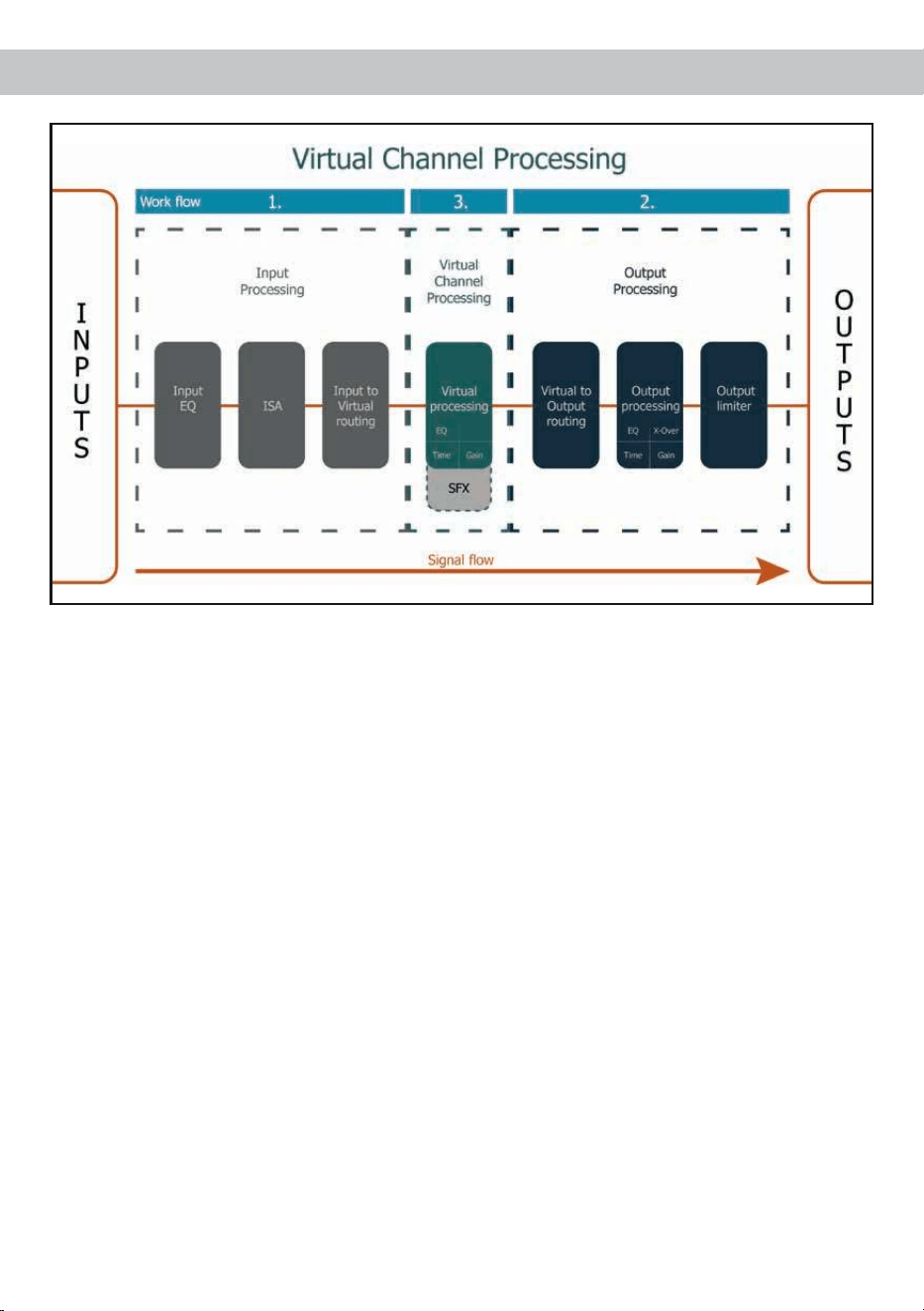
37
Virtual Channel Processing (VCP)
Operating concept of the VCP
In opposite to previous methods the Virtual Channel Processing (VCP) is a multi-stage signal processing
concept that enables the perfect conguration of complex sound systems, opening up completely new
possibilities for sound tuning.
The function extends the previous scope of the device by an additional layer of processed channels, which
is located between the inputs and outputs. A total of twelve additional processed virtual channels and
fourteen processed output channels are available.
This virtual channel layer oers several advantages, especially in complex system congurations.
The main advantages of this concept are:
- Cross-channel group equalizers that aect several output channels simultaneously
- Multi-way speaker conguration of DSP sound eects (SFX)
- Additional features such as Rear Attenuation
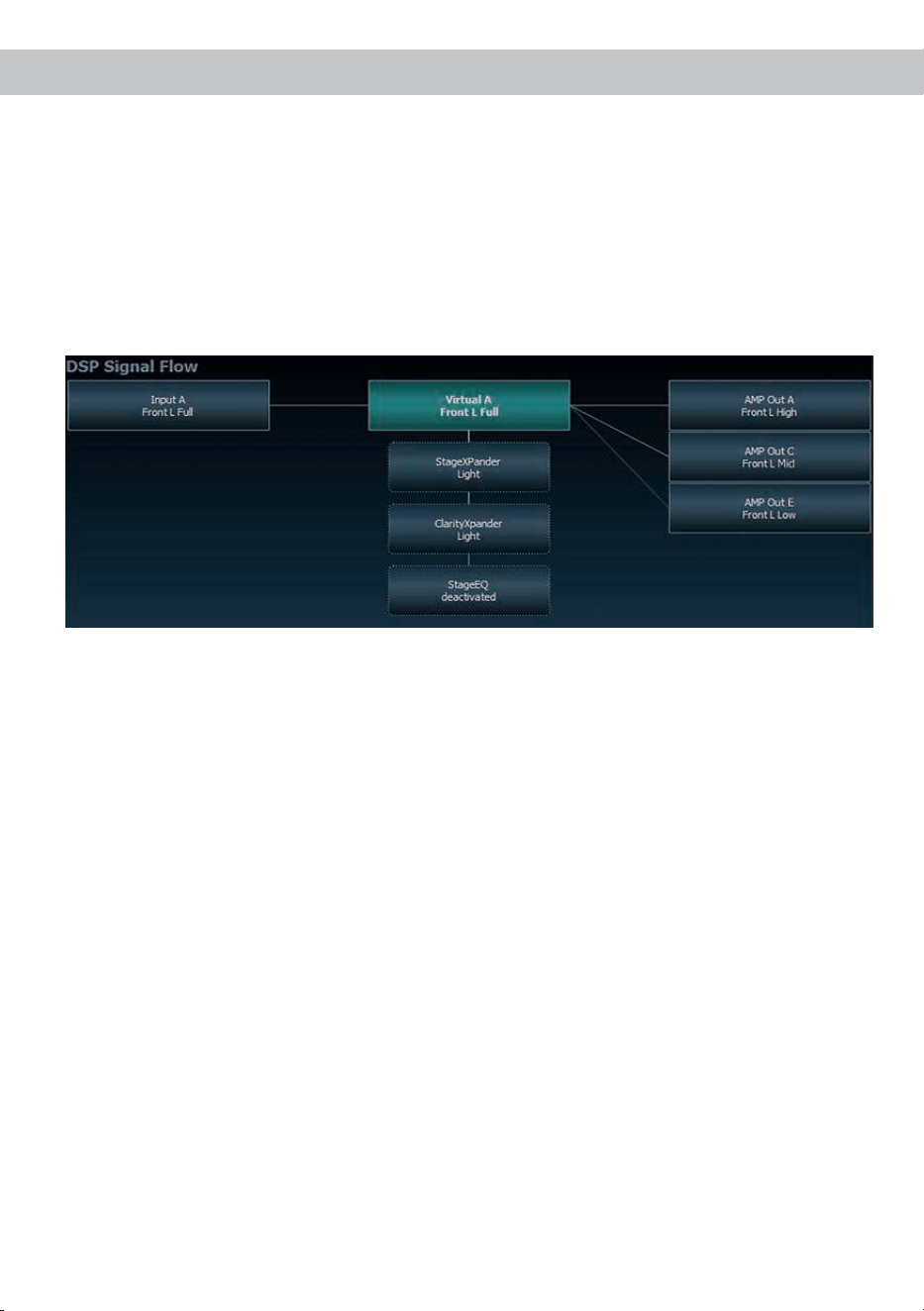
38
– Cross-channel group equalizer
Example application: Active multi-way speaker conguration
If an input signal (e.g. front left) is rst routed to a virtual channel (Front L Full) and this signal is then
routed to an active multi-way system (e.g. front left – tweeter, midrange and woofer), the group equalizer
of the virtual channel will inuence all assigned output channels in their tonality. The advantage of this
concept is that any amplitude and phase shift of the group equalizer is applied to all channels of the
multi-way conguration simultaneously, thus avoiding any negative impact on the interaction of the
individual speaker channels.
– Multi-way conguration of the DSP sound eects (SFX)
Example application: 2- or even 3-way center speaker
After activating “Virtual Channel Processing”, the DSP sound eects, such as RealCenter management
or Augmented Bass Processing, are also available. These are no longer linked to the outputs but tied
to specic “virtual channels”.
Front Processing: virtual channels Front L Full (A) and Front R Full (B)
Center Processing: virtual channel Center Full (E)
Augmented Bass Processing: virtual channels Subwoofer 1 (K) and Subwoofer 2 (L). The subwoofer
volume is also tied to these channels.
This makes it possible to route the DSP sound eects to any number of outputs, for example to realize
2- or even 3-way center speaker congurations. There are hardly any limits to exibility here.
– Additional features
In addition, the VCP enables the implementation of further new functions. One of these is, for example,
the “Rear Attenuation”. With the help of a remote control, the volume of the virtual channels “Rear L
Full” and “Rear R Full” can be controlled separately. So it is possible even without switching the sound
setup, to adjust the volume of the rear speakers (or any other channel, which is routed through these
channels).
Virtual Channel Processing (VCP)
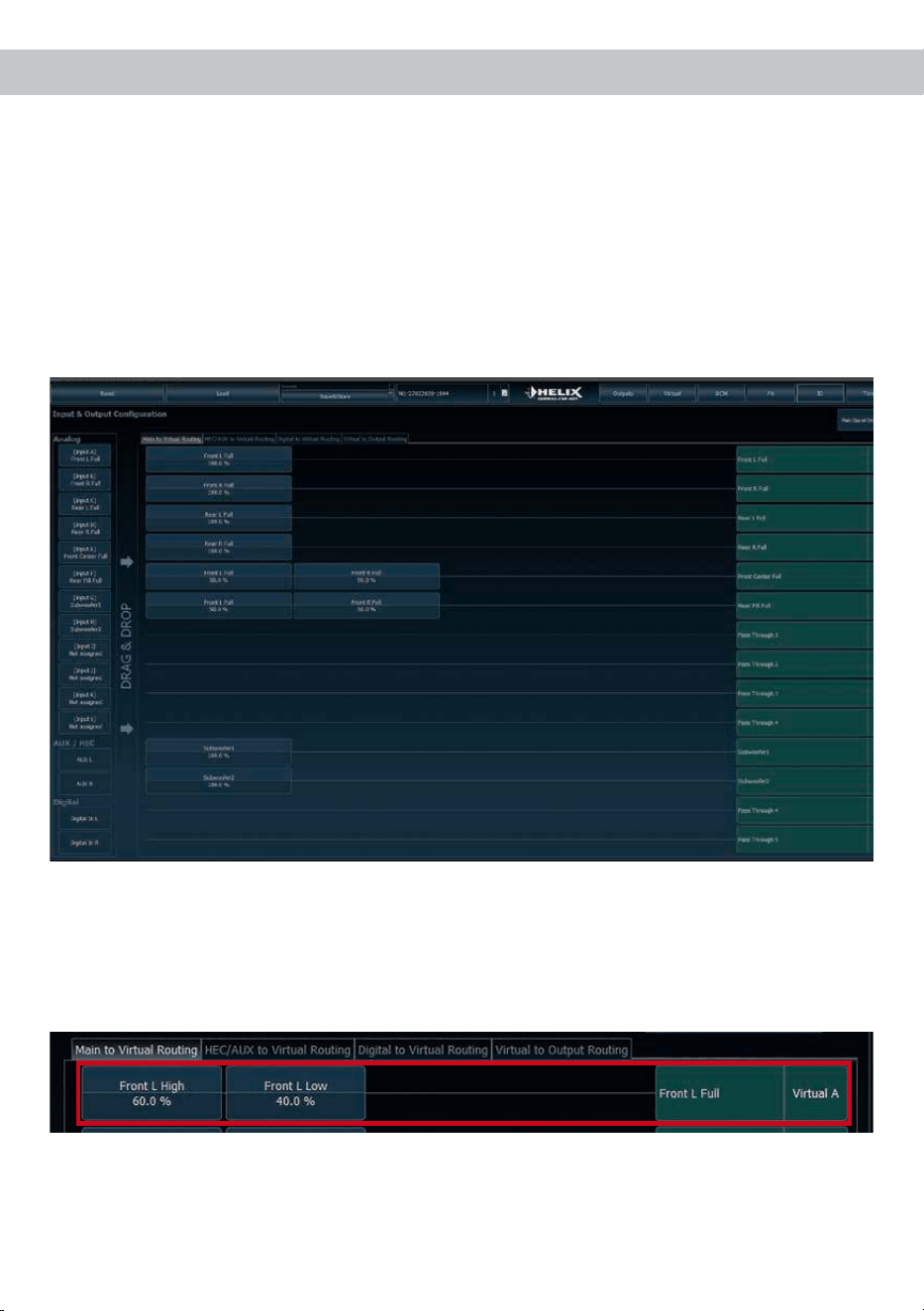
39
To congure the VCP, you rst have to enable “Virtual Channel Processing” in the DCM menu of the DSP
PC-Tool software. Therefore, go to the “Virtual Channel Processing” tab in the DCM menu and click on the
right box with the VCP graphic. Then the conguration will be carried out in two steps. Here’s an example
of a 3-way conguration with a 2-way input signal.
Workow step 1 – Input routing
First, the input signals in the various input matrices (“Main to Virtual Routing”, “HEC / AUX to Virtual Rout-
ing”, “Digital to Virtual Routing”) need to be routed to the respective virtual channels. This is the same as
in normal mode, means that the input signals on the left side are dragged and dropped onto the respective
summation matrix. The dierence to normal mode is that the names and signal properties of the virtual
channels are dened here (Front L Full, Front R Full, Rear L Full, Rear R Full, Front Center Full etc.).
a. First, all input signals must be applied to the respective designated signal types of the virtual channels,
means the input with the signal “front left” must be routed to the virtual channel “Front L Full” and so
forth.
b. In the case of an adaptation of an OEM active multi-way system, all “front left” signals in this example
have to be summed up on the virtual channel “Front L Full” (the input EQ remains eective in the
inputs as usual).
Conguration of the Virtual Channel Processing (VCP)
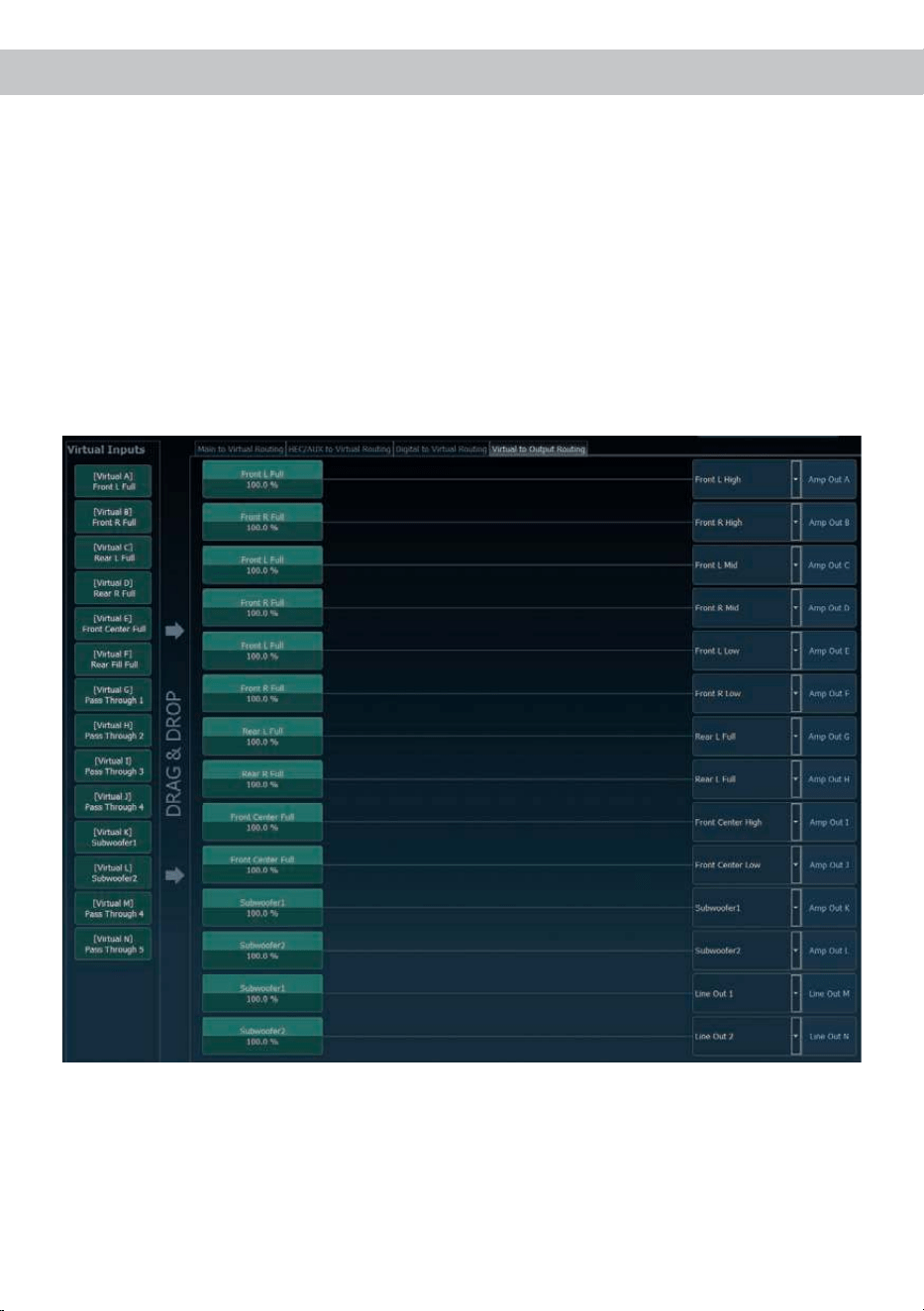
40
Workow step 2 – Output routing
After all the input signals used in the respective signal routing matrix have been congured, the virtual
channels must now be assigned to the physical output channels. Here, a virtual signal (e.g. Front L Full)
can be assigned to multiple outputs, such as “front left” tweeter, midrange and woofer. The conguration of
these speaker-specic output channels is done in the “Outputs” menu (called “Main” in normal mode) of the
DSP PC-Tool. Here you can also congure the channel-specic equalizers, high- and lowpass lters, time
alignment, output level and phase settings.
a. In order to assign the virtual channels to the respective output channels the individual virtual signals in
the output routing matrix (“Virtual to Output Routing”) are dragged and dropped onto the output chan-
nels. At this point, the signals typically needn’t to be summed, means that each output of this matrix only
receives one virtual signal. For example, the output “Front L High” is linked to the virtual signal “Front L
Full”; the same is done for the Front L Low”.
b. At this point, even a virtual channel in which a DSP sound eect has been activated can be routed to
multiple output channels. For example, the “Front Center Full” signal can be assigned to multiple output
channels to create an active multi-way center speaker. The corresponding high- and lowpass lters are
then congured in the output channels of the “Main” menu.
Conguration of the Virtual Channel Processing (VCP)
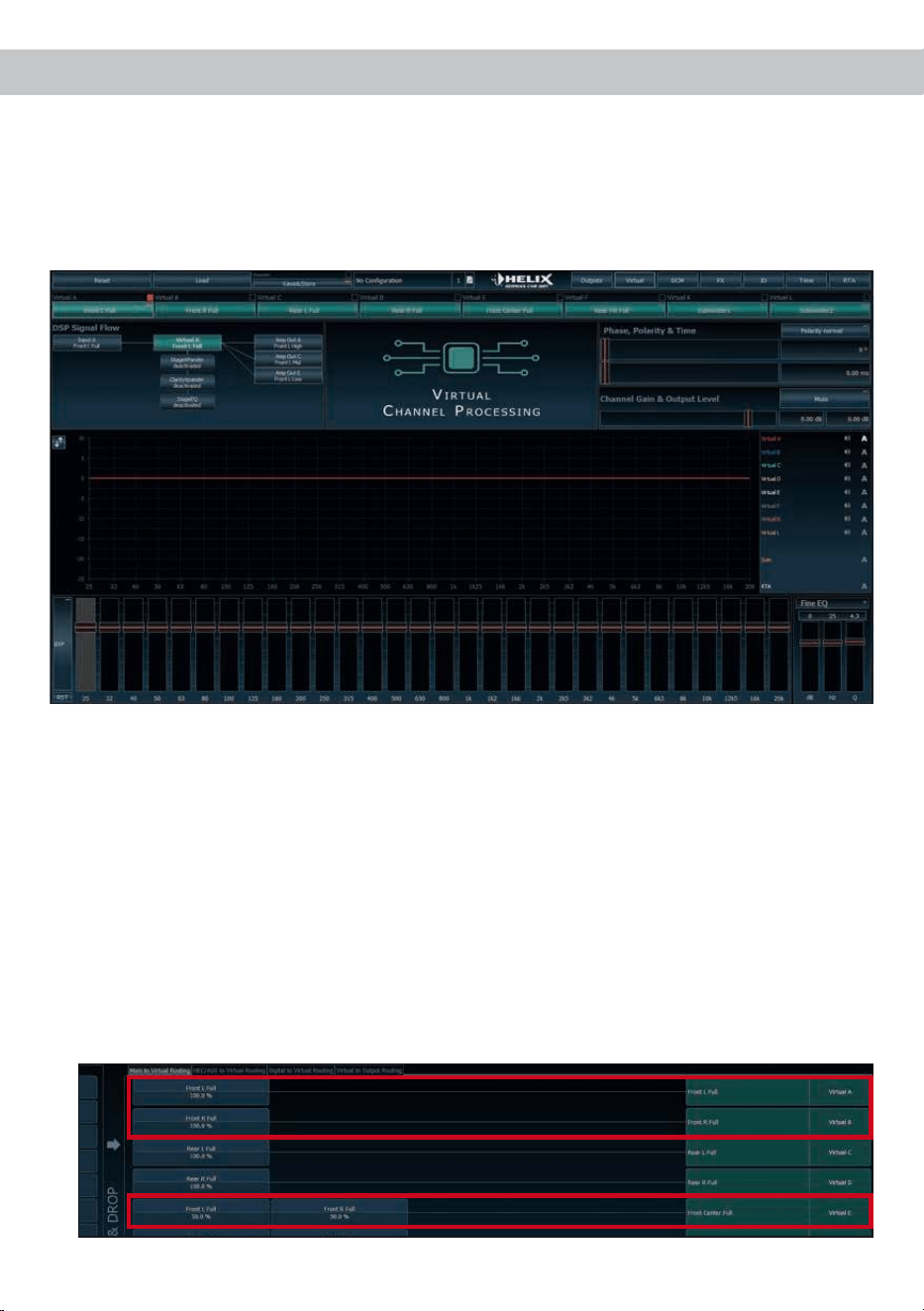
41
Workow step 3 – Conguration of the virtual channels and notes on the application of the DSP
sound eects (SFX)
Now switch to the “Virtual” menu of the DSP PC-Tool. Here you get an overview of the signal ow of the
individual channels and the activated sound eects. In addition, it is possible to inuence the tonality of all
subsequent output channels of a virtual channel at the same time, for example with the help of the equal-
izer, polarity and other functions.
Notes on the conguration of the DSP sound eects (SFX)
The HELIX V TWELVE DSP MK2 provides unique DSP sound eects such as Augmented Bass Process-
ing, RealCenter, and more when “Virtual Channel Processing” is enabled. In order to enjoy the DSP sound
eects, certain settings must be made in the hardware and software conguration.
Note: The DSP sound eects are only available in the V TWELVE DSP MK2 when “Virtual Channel Pro-
cessing” is enabled. “VCP” can be activated in the DCM menu of the DSP PC-Tool software.
Notes for center processing with its features “RealCenter” and “ClarityXpander”
To be able to use the RealCenter and ClarityXpander function for a center speaker, the following steps must
be carried out:
1a. It is necessary to assign an input signal to the virtual channels “Front L Full” and “Front R Full” (see
workow step 1).
1b. In the input routing you have to assign either a sum signal (front left + front right) or an existing center
signal to the virtual channel “Front Center Full”.
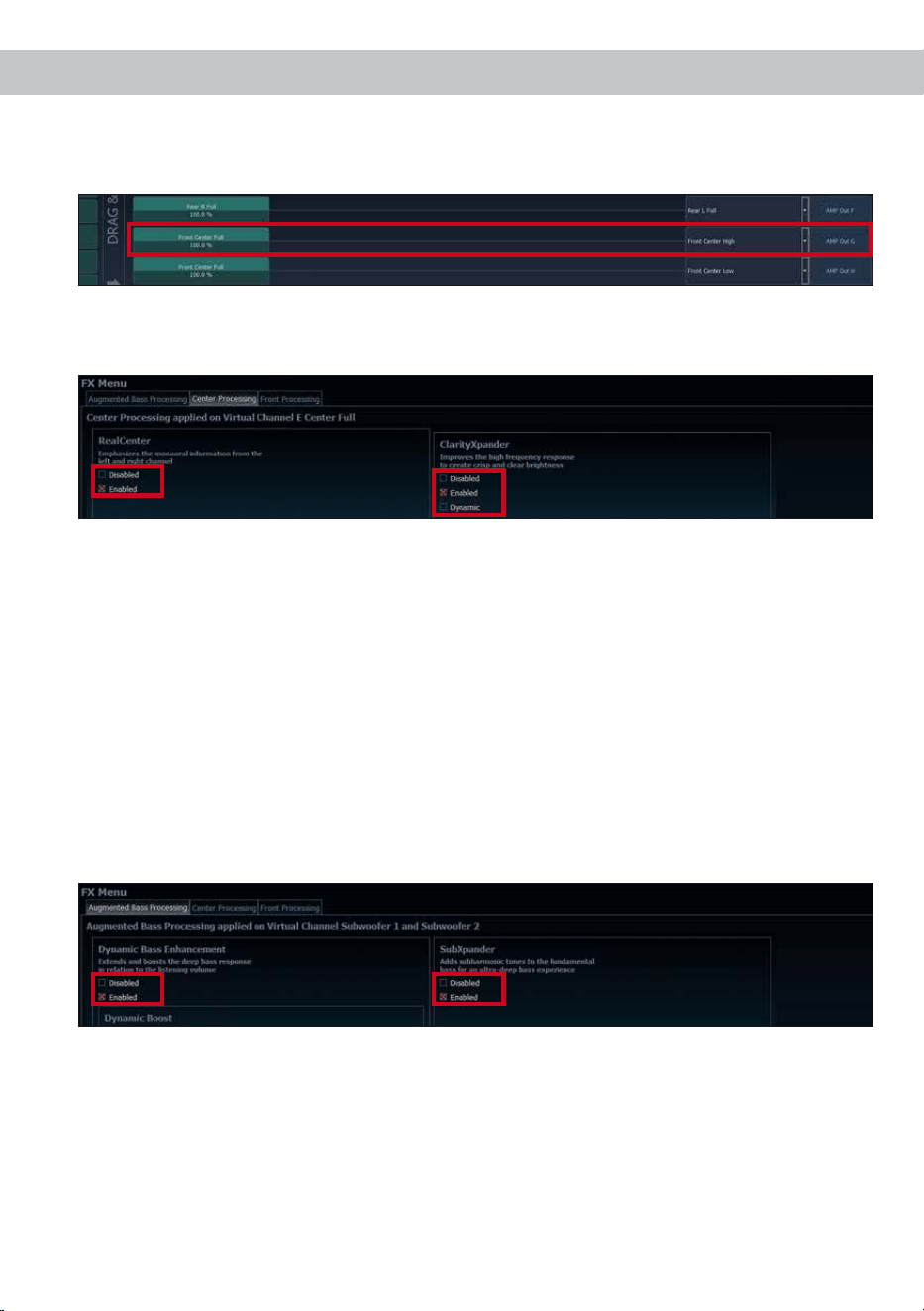
42
2. Change to the “Virtual to Output Routing” matrix and route the “Virtual E – Front Center Full” channel to
the desired output channels (as described in workow step 2) to which the center processing shall be
applied.
3. Now switch to the FX menu and activate the desired sound eect in the “Center Processing” tab by
setting the appropriate check mark.
Notes for front processing with its StageXpander and ClarityXpander features
The StageXpander and Front ClarityXpander settings always aect the virtual channels “Front L Full” and
“Front R Full”.
Hints for “Augmented Bass Processing” with its “Dynamic Bass Enhancement” and “SubXpander”
function
For Augmented Bass Processing certain settings have to be made in order to use it.
1. An input signal has to be assigned to at least one of the virtual subwoofer channels (“Subwoofer 1” or
“Subwoofer 2”) (see workow step 1).
2. Change to the “Virtual to Output Routing” matrix and route the channel (s) “Virtual K – Subwoofer 1”
and / or “Virtual L – Subwoofer 2” to the desired output channel or channels (as described in workow
step 2) to which the subwoofer signal and its Augmented Bass Processing shall be applied to.
3. Now switch to the FX menu and activate the desired sound eect.
For information about input routing see workow step 1
For information about output routing see workow step 2
Note: the bass processing is switched on and o together for both “Subwoofer 1” and “Subwoofer 2” channels,
nevertheless the two channels still remain separately processed for stereo applications.
Conguration of the Virtual Channel Processing (VCP)
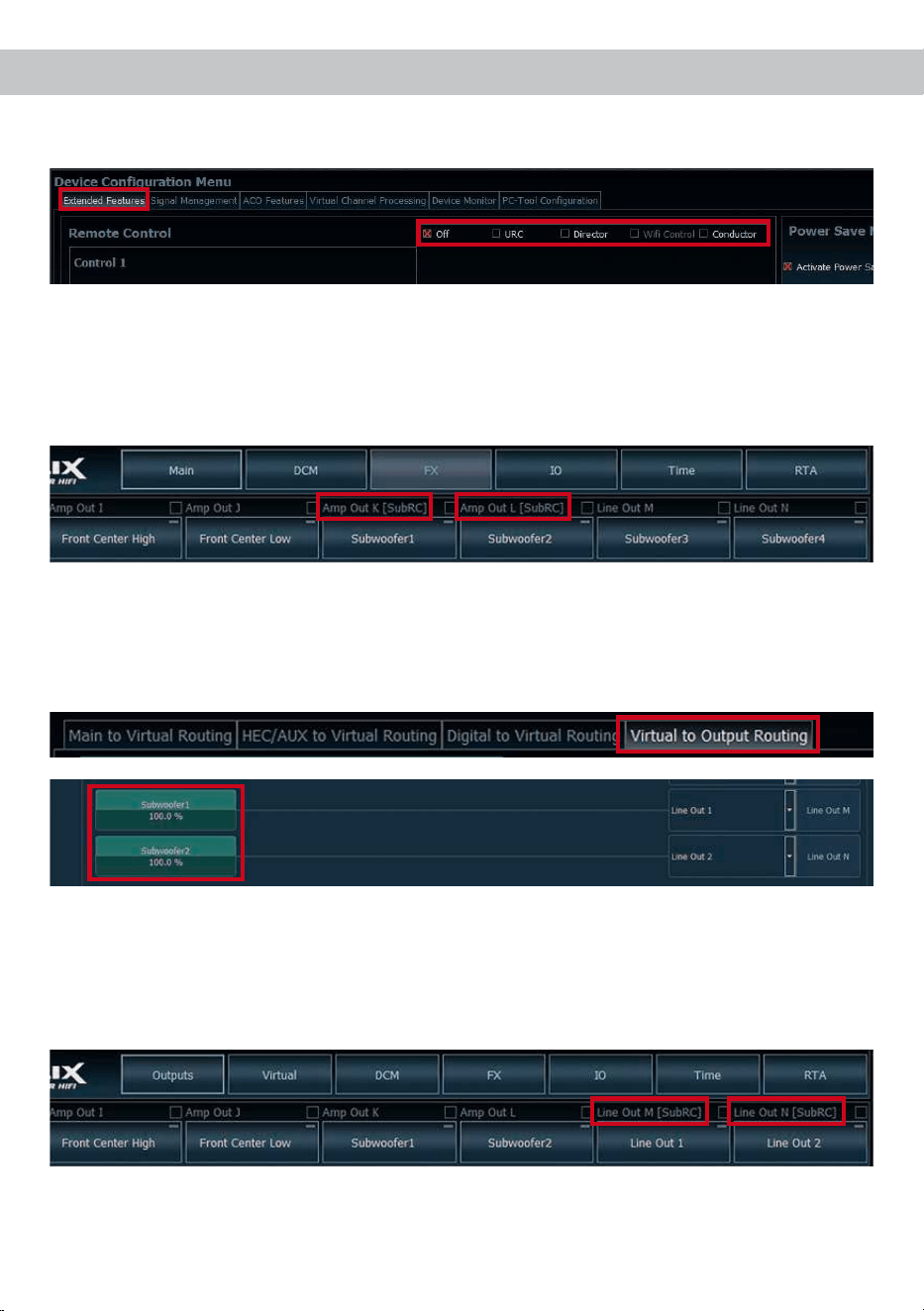
43
First, the appropriate remote control must be activated in the “Extended Features” tab in the DCM menu of
the DSP PC-Tool software and congured, depending on the model.
Conguration of a subwoofer remote control
When VCP is activated, the subwoofer remote control is tied to the output channels that are supplied with
one of the two virtual subwoofer signals (“Subwoofer 1” or “Subwoofer 2”) in the “Virtual to Output Routing”
matrix. This can be any combination of output channels.
In the following example these are the pre-amplier outputs / Line Outputs M and N:
If the VCP is not activated, the subwoofer remote control of the V TWELVE DSP MK2 is permanently
assigned to the output channels K and L (Output Channels). In this case it does not matter which output is
named “Subwoofer” in the IO routing matrix.
In the main menu you can also see to which outputs the SubRC (subwoofer remote control) is tied:
Afterwards, the subwoofer control is also displayed in the Main menu next to the name of the channel
[SubRC]:
Note: Please note that an input signal must be assigned to the two virtual subwoofer signals “Subwoofer 1”
and / or “Subwoofer 2” in the other routing matrices.

44
ACO platform features
Beside the unique DSP sound eects the
V TWELVE DSP MK2 provides a bunch of new sys-
tem features.
In the DCM menu of the DSP PC-Tool software in-
dividual settings can be made for several of these
system features.
Turn On & O Delay
This function allows to determine the delay time
with which the integrated DSP is switched on and
o. The factory setting is 0.2 seconds. The delay
time should only be modied if there are e.g. noises
while switching on / o the amplier.
URC Setup Switch Conguration
The ACO provides ten internal memory locations for
sound setups instead of the common two.
By using an optional URC remote control or the Con
-
trol pushbutton it is possible to toggle between two
of the ten memory locations. These two memory lo
-
cations can be determined in the “URC Setup Switch
Conguration”. The memory locations one and two
are preassigned by default. To switch between all
internal memory locations, the optionally available
remote controls DIRECTOR and CONDUCTOR or
the HELIX WIFI CONTROL are / is recommended.
Remote Output Conguration
This function controls if the remote output (which
switches on and o the connected ampliers) will
be temporarily deactivated during a sound setup
switch. This function is activated (ON) by default.
ADEP.3 Conguration
If the V TWELVE DSP MK2 is connected to an
OEM radio via the highlevel inputs it may happen
that the ADEP.3 circuit has to be adapted to the di-
agnostic mode of the radio if the latter is equipped
with a so-called “class SB” output stage”.
The ADEP.3 circuit should be adjusted if there are
e.g. distortions in the upper volume range.
The compatibility mode is disabled by default.
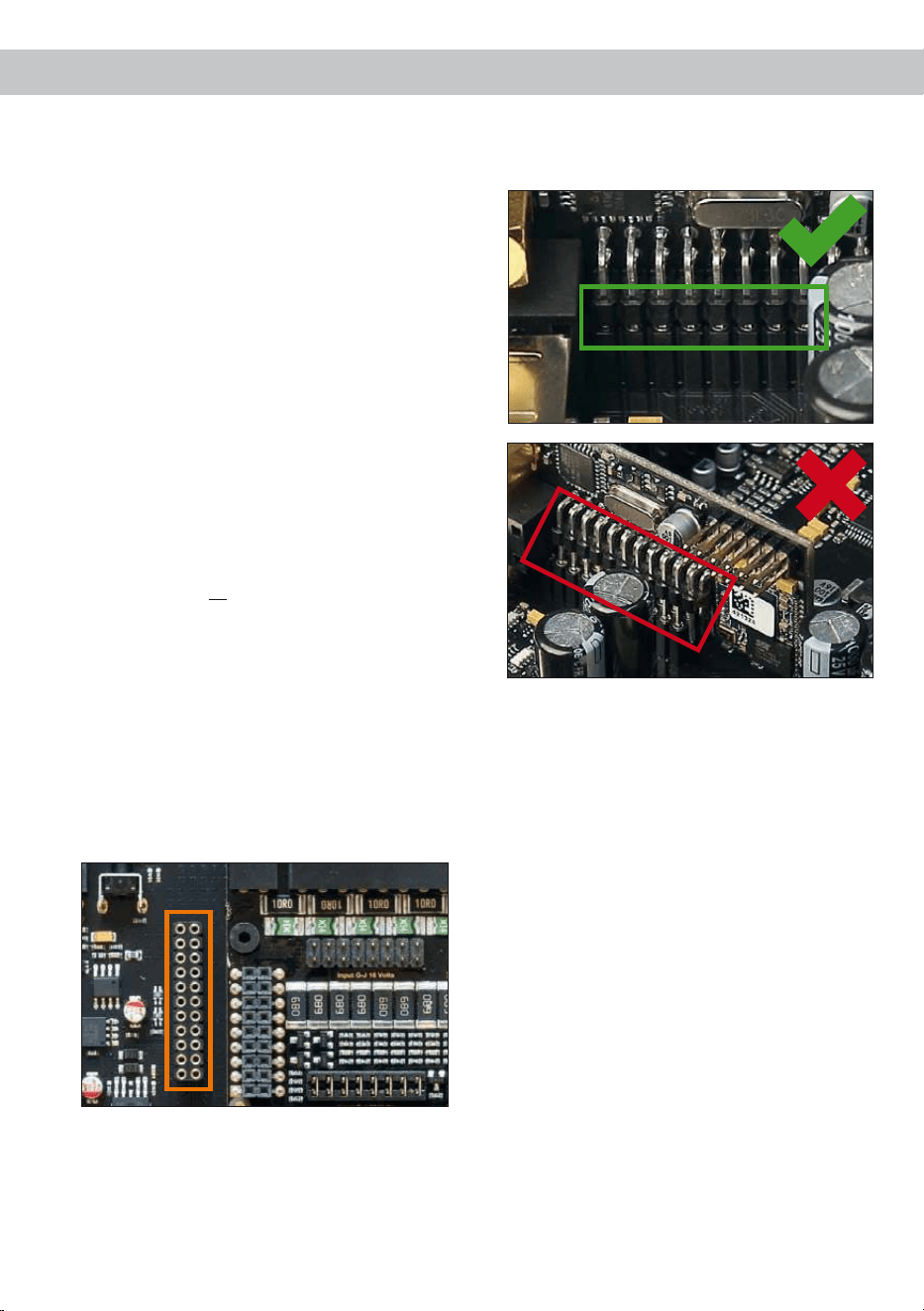
45
HELIX Extension Card slot (HEC slot)
It is possible to extend the functionality of the HELIX
V TWELVE DSP MK2 amplier by inserting an op-
tional HELIX Extension Card (HEC) – for example
a Bluetooth
®
Audio Streaming module, an additional
optical digital input or an USB audio input.
To install a HELIX Extension Card it is necessary to
remove the side panel of the V TWELVE DSP MK2
and replace it by the new side panel that comes with
the HEC module.
Attention: Install the HEC module only in the
designated device and its specic slot. Using
the HEC module in other devices or slots can
result in damage of the HEC module, the ampli-
er, the head unit / car radio or other connected
devices!
Read in the following the steps how to install a HEC
module:
1. First disconnect all cables from the device.
2. Dismantle the side panel where the USB input
is located by removing the two Phillips and two
Allen screws.
3. Pull out the bottom plate sideways.
4. Prepare the module for installing it into the de-
vice. Any further mounting information will be
found in the instruction manual of the respective
HEC module.
5. Insert the HEC module into the specic slot
of the device which is marked in the following
picture.
6. Make sure that the HEC module is installed
roperly and all pins are fully inserted into the
socket.
7. Reinsert the bottom plate and x the new side
panel which is delivered with the HEC module
with the two Phillips and two Allen screws.
8. Bolt the HEC module to the side panel. Precise
mounting information will be found in the in-
struction manual of the respective HEC module.
9. Reconnect all cables to the device.
10. Turn on the amplier. The HEC module is auto-
matically detected by the device and the Status
LED of the HEC module lights up green.
11. Now you are able to congure the HEC module
in the DSP PC-Tool software.

46
Pure Class GD amplier technology
Audiotec Fischers proprietary Pure Class GD con-
cept takes the eciency of conventional Class D
amps to the next level. By varying the internal
supply voltage depending on the amplier’s input
signals, idle losses are signicantly reduced and
overall eciency is close to maximum at any time.
So heat dissipation is almost negligible thus allow-
ing smallest heat sinks and most compact form fac-
tors. Besides that Pure Class GD amp outperforms
conventional Class D designs in terms of sound
quality by implementing a fully dierential signal
path and improved output lter design.
ACO – Advanced 32 Bit CoProcessor
The HELIX V TWELVE DSP MK2 incorporates an
extraordinary powerful 32 Bit CoProcessor of the
latest generation for all monitoring and communi-
cation tasks, both internally and externally. In oppo-
site to the 8 Bit predecessor generation this MCU
achieves way higher speeds with respect to setup
switching and data communication with our DSP
PC-Tool software. A further signicant advantage is
the integrated, native boot loader of the CoProces-
sor. It allows software upgrades of all components
of the integrated DSP in order to adjust the micro-
controller-controlled ADEP.3 circuit for example to
future requirements of the diagnostic system of
factory radios or if the device will be extended with
additional interfaces. In addition, thanks to the new
ash memory, the ACO oers 10 memory locations
for sound setups instead of the common two.
Smart highlevel input ADEP.3
Modern, factory-installed car radios incorporate so-
phisticated possibilities of diagnosing the connect-
ed speakers. In particular the latest generation of
car radios are equipped with additional monitoring
functions so that failure messages and loss of spe-
cic features (e.g. fader function) quite often appear
if an amplier will be hooked up – but not with the
V TWELVE DSP MK2.
The new ADEP.3 circuit (Advanced Diagnostics
Error Protection, 3rd Generation), which can be
adapted to the diagnostic mode of the radio, avoids
all these problems without loading the speaker out-
puts of the OE radio during high volumes unneces-
sarily (see page 44, item “ADEP.3 Conguration”).
Power Save Mode
The Power Save Mode is incorporated in the ba-
sic setup. It allows to signicantly reduce the power
consumption of the ampliers that are connected
to the HELIX V TWELVE DSP MK2 once there’s
no input signal present for more than 60 seconds.
Please note that in many up-to-date cars with “CAN”
or any other internal bus structures it may happen
that the radio remains “invisibly” turned on for up to
45 min. even after locking and leaving the car! Once
the “Power Save Mode“ is active the remote out-
put and therefore the connected ampliers will be
turned o. The V TWELVE DSP MK2 will reactivate
the remote output within a second if a music signal
is applied. It is possible to either modify the turn-o
time of 60 sec. or completely deactivate the “Power
Save Mode” via the DSP PC-Tool software.
Start-Stop capability
The switched power supply of the HELIX
V TWELVE DSP MK2 assures a constant internal
supply voltage even if the battery’s voltage drops to
6 Volts during engine crank.
Unique Features of the HELIX V TWELVE DSP MK2

47
The limited warranty comply with legal regulations.
Failures or damages caused by overload or im-
proper use are not covered by the warranty. Please
return the defective product only with a valid proof
of purchase and a detailed malfunction description.
Technical specications are subject to change!
Errors are reserved! For damages on the vehicle
and the device, caused by handling errors of the
device, we can’t assume liability. This product is
tagged with a CE-Certikation mark. Thereby these
devices are certied for the use in vehicles within
the European Community (EC).
Technical Data
Note:
“The Bluetooth
®
word mark and logos are registered trademarks owned by Bluetooth SIG, Inc. and any use of such marks by
Audiotec Fischer GmbH is under license. Other trademarks and trade names are those of their respective owners.”
Power RMS ≤ 1% THD+N
- @ 4 Ohms ........................................................................12 x 75 Watts
- @ 2 Ohms ........................................................................12 x 120 Watts
Max. output power per channel* ......................................... Up to 160 Watts RMS @ 2 Ohms
Amplier technology ...........................................................Pure Class GD
Inputs .................................................................................. 6 x RCA / Cinch
12 x Highlevel speaker input
1 x Optical SPDIF (12 - 96 kHz)
1 x Remote In
Input sensitivity ................................................................... RCA / Cinch: max. 4 V or max. 8 V
Highlevel: max. 16 V or max. 32 V
Input impedance ................................................................. RCA / Cinch: 12 kOhms
Highlevel: 9 - 33 Ohms or 20 kOhms
Outputs ............................................................................... 12 x Speaker output
2 x RCA / Cinch
2 x Remote Out
Output voltage RCA / Cinch................................................3 Volts
Frequency response ........................................................... 20 Hz - 22,000 Hz
DSP resolution .................................................................... 64 Bit
DSP power .........................................................................295 MHz (1.2 billion MAC operations/second)
Sampling rate .....................................................................48 kHz
DSP type ............................................................................Audio signal processor
Signal converters ................................................................ A/D: BurrBrown
D/A: BurrBrown
Signal-to-noise ratio (A-weighted) ...................................... Digital input: 107 dB
Analog input: 102 dB
Distortion (THD) ..................................................................< 0.015 %
Damping factor ...................................................................> 70
Operating voltage ...............................................................10.5 - 16 Volt (max. 5 sec. down to 6 Volts)
Power rating .......................................................................DC 12 V 80 A max.
Idle current..........................................................................700 mA
Max. remote output current ................................................500 mA
Fuse....................................................................................2 x 30 A LP-Mini-Fuse (APS)
Additional features .............................................................. HEC slot, ADEP.3 circuit, Smart Control Port,
32 Bit CoProcessor, Auto Remote switch
Dimensions (H x W x D) .....................................................44 x 220 x 220 mm / 1.73 x 8.66 x 8.66”
* In typical multi-channel applications (2- / 3-way system + rear + subwoofer)
Warranty Disclaimer

Audiotec Fischer GmbH
Hünegräben 26 · 57392 Schmallenberg · Germany
Tel.: +49 2972 9788 0 · Fax: +49 2972 9788 88
E-mail: helix@audiotec-scher.com · Internet: www.audiotec-scher.com