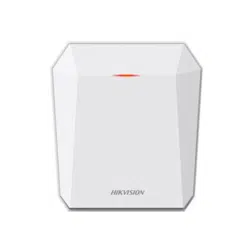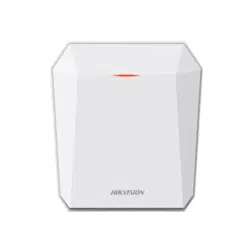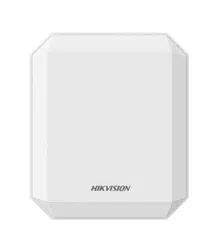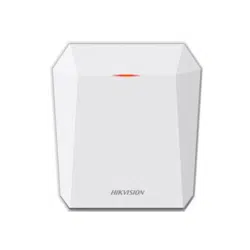
Security Radar
User Manual

Legal Informaon
About this Manual
This Manual is subject to domesc and internaonal copyright protecon.
Hangzhou Hikvision Digital Technology Co., Ltd. ("Hikvision") reserves all
rights to this manual. This manual cannot be reproduced, changed,
translated, or distributed, parally or wholly, by any means, without the
prior wrien permission of Hikvision.
Please use this user manual under the guidance of professionals.
Trademarks
and other Hikvision marks are the property of
Hikvision and are registered trademarks or the subject of applicaons for
the same by Hikvision and/or its aliates. Other trademarks menoned in
this manual are the properes of their respecve owners. No right of license
is given to use such trademarks without express permission.
Disclaimer
TO THE MAXIMUM EXTENT PERMITTED BY APPLICABLE LAW, HIKVISION
MAKES NO WARRANTIES, EXPRESS OR IMPLIED, INCLUDING WITHOUT
LIMITATION THE IMPLIED WARRANTIES OF MERCHANTABILITY AND FITNESS
FOR A PARTICULAR PURPOSE, REGARDING THIS MANUAL. HIKVISION DOES
NOT WARRANT, GUARANTEE, OR MAKE ANY REPRESENTATIONS REGARDING
THE USE OF THE MANUAL, OR THE CORRECTNESS, ACCURACY, OR
RELIABILITY OF INFORMATION CONTAINED HEREIN. YOUR USE OF THIS
MANUAL AND ANY RELIANCE ON THIS MANUAL SHALL BE WHOLLY AT YOUR
OWN RISK AND RESPONSIBILITY.
REGARDING TO THE PRODUCT WITH INTERNET ACCESS, THE USE OF
PRODUCT SHALL BE WHOLLY AT YOUR OWN RISKS. HIKVISION SHALL NOT
TAKE ANY RESPONSIBILITIES FOR ABNORMAL OPERATION, PRIVACY
LEAKAGE OR OTHER DAMAGES RESULTING FROM CYBER ATTACK, HACKER
ATTACK, VIRUS INSPECTION, OR OTHER INTERNET SECURITY RISKS;
Security Radar User Manual
i

HOWEVER, HIKVISION WILL PROVIDE TIMELY TECHNICAL SUPPORT IF
REQUIRED.
SURVEILLANCE LAWS VARY BY JURISDICTION. PLEASE CHECK ALL RELEVANT
LAWS IN YOUR JURISDICTION BEFORE USING THIS PRODUCT IN ORDER TO
ENSURE THAT YOUR USE CONFORMS THE APPLICABLE LAW. HIKVISION
SHALL NOT BE LIABLE IN THE EVENT THAT THIS PRODUCT IS USED WITH
ILLEGITIMATE PURPOSES.
IN THE EVENT OF ANY CONFLICTS BETWEEN THIS MANUAL AND THE
APPLICABLE LAW, THE LATER PREVAILS.
Security Radar User Manual
ii
Symbol Convenons
The symbols that may be found in this document are dened as follows.
Symbol Descripon
Danger
Indicates a hazardous situaon which, if not avoided, will or
could result in death or serious injury.
Cauon
Indicates a potenally hazardous situaon which, if not
avoided, could result in equipment damage, data loss,
performance degradaon, or unexpected results.
Note
Provides addional informaon to emphasize or
supplement important points of the main text.
Security Radar User Manual
iii

Contents
1 Access to iVMS-4200 Client Soware/Web Client ...................................... 1
2 Acvaon ................................................................................................... 2
2.1 Acvate Device via iVMS-4200 .......................................................................... 2
2.2 Acvate via SADP .............................................................................................. 3
2.3 Acvate Device via Web Browser ...................................................................... 4
3 Wired Network ........................................................................................... 6
4 Radar Sengs ............................................................................................. 7
4.1 Add Map and Radar .......................................................................................... 7
4.2 Add Radar Zone ................................................................................................. 8
4.2.1 Add Radar Zone(Manually) ....................................................................... 8
4.2.2 Add Radar Zone (Automacally) ............................................................... 9
5 Camera Linkage Sengs ........................................................................... 11
5.1 Link the Camera to the zone ........................................................................... 11
5.2 Set Speed Dome Inial Posion ...................................................................... 12
5.3 Calibrate Camera ............................................................................................. 13
5.3.1 One Point Calibraon ............................................................................. 16
5.3.2 Mul-Point Calibraon ........................................................................... 19
5.4 Enable Camera Tracking .................................................................................. 20
5.5 Set Tracking Strategy ....................................................................................... 21
5.6 Set Storage Schedule ....................................................................................... 22
6 Alarm Sengs .......................................................................................... 23
6.1 Alarm Center ................................................................................................... 23
Security Radar User Manual
iv

6.2 Nocaon Push ............................................................................................. 23
6.3 Set Zone .......................................................................................................... 24
6.4 Set Alarm Output ............................................................................................ 25
6.5 Set Arming/Disarming Schedule ..................................................................... 25
7 Set Radar Advanced Funcon ................................................................... 27
7.1 Set Detecon Angle and Range ....................................................................... 27
7.2 Set Scene Mode and Sensivity ...................................................................... 27
7.3 Set Environment Learning ............................................................................... 28
8 System Management ................................................................................ 29
8.1 Set Time .......................................................................................................... 29
8.2 Manage User ................................................................................................... 29
8.3 System Maintenance ....................................................................................... 30
8.4 View Device Informaon ................................................................................. 32
8.5 Search Log ....................................................................................................... 32
A. Radar Mounng Height Recommendaon ............................................. 33
B. Formang Descripon ........................................................................... 35
C. Indicator Descripon ............................................................................... 36
D. FAQ .......................................................................................................... 37
D.1 How to Achieve an Opmum Detecon Range? ............................................ 37
D.2 How to Adjust the Sensivity to Avoid False Alarm? ...................................... 37
D.3 How to Raise the Precision of Camera Tracking? ............................................ 38
D.4 How to Solve the Problem that No Reference Point is on the Frame While
Seng the Speed Dome Inial Posion? .............................................................. 38
D.5 What is the Reason that Failed to Draw a Zone Automacally? ..................... 40
Security Radar User Manual
v

1 Access to iVMS-4200 Client
Soware/Web Client
You can login the iVMS-4200 Client Soware or the web client to congure the
device's parameters. You can also congure the radar's network parameters, alarm,
permission, system, log search via the web client.
Note
You should acvate the device the rst me you access it to the network for safety
reasons. For details, see Device Acvaon.
Access to iVMS-4200 Client Soware
Download and install the soware. Register to the soware and add device
in Control Panel → Device Management → Device for Management
Note
•
You should set the device port No. as 80.
•
The user name and password when adding device are the acvaon user
name and password.
Aer the device is completely added, click Remote Conguraon to enter
the device conguraon page. You can congure the device parameters in
this page.
Access to Web Client
Aer the device is connected to the network, you can search the device IP
address via the iVMS-4200 client soware and the SADP soware. Input the
searched IP address in the address bar in the web page and press Enter. Use
the acvaon user name and password to login. You can congure the
device parameters in the web page.
Security Radar User Manual
1
2 Acvaon
In order to protect personal security and privacy and improve the network security
level, you should acvate the device the rst me you connect the device to a
network.
You can create an acvaon password to protect your device from logging in by
other persons.
2.1 Acvate Device via iVMS-4200
iVMS-4200 is a PC client to manage and operate your devices. Security control panel
acvaon is supported by the soware.
Before You Start
•
Get the client soware from the supplied disk or the ocial website
hp://
www.hikvision.com/en/ . Install the soware by following the prompts.
•
The device and the PC that runs the soware should be in the same subnet.
Steps
1.
Run the client soware.
2.
Enter Device Management or Online Device.
3.
Check the device status from the device list, and select an inacve device.
4.
Click Acvate.
5.
Create and conrm the admin password of the device.
Cauon
STRONG PASSWORD RECOMMENDED-We highly recommend you create a strong
password of your own choosing (using a minimum of 8 characters, including
upper case leers, lower case leers, numbers, and special characters) in order
to increase the security of your product. And we recommend you reset your
password regularly, especially in the high security system, reseng the password
monthly or weekly can beer protect your product.
6.
Click OK to start acvaon.
Device status will change to Acve aer successful acvaon.
7.
Edit IP address of the device.
Security Radar User Manual
2

1) Select a device and click Modify Nenfo at Online Device.
2) Change the device IP address to the same subnet with your computer by
either modifying the IP address manually or checking DHCP.
3) Input the admin password of the device and click OK to complete
modicaon.
2.2 Acvate via SADP
SADP is a tool to detect, acvate and modify the IP address of the device over the
LAN.
Before You Start
•
Get the SADP soware from the supplied disk or the ocial website
hp://
www.hikvision.com/en/ , and install the SADP according to the prompts.
•
The device and the PC that runs the SADP tool should be within the same
subnet.
The following steps show how to acvate a device and modify its IP address. For
batch acvaon and IP addresses modicaon, refer to User Manual of SADP for
details.
Steps
1.
Run the SADP soware and search the online devices.
2.
Find and select your device in online device list.
3.
Input new password (admin password) and conrm the password.
Cauon
STRONG PASSWORD RECOMMENDED-We highly recommend you create a strong
password of your own choosing (using a minimum of 8 characters, including
upper case leers, lower case leers, numbers, and special characters) in order
to increase the security of your product. And we recommend you reset your
password regularly, especially in the high security system, reseng the password
monthly or weekly can beer protect your product.
4.
Click Acvate to start acvaon.
Security Radar User Manual
3
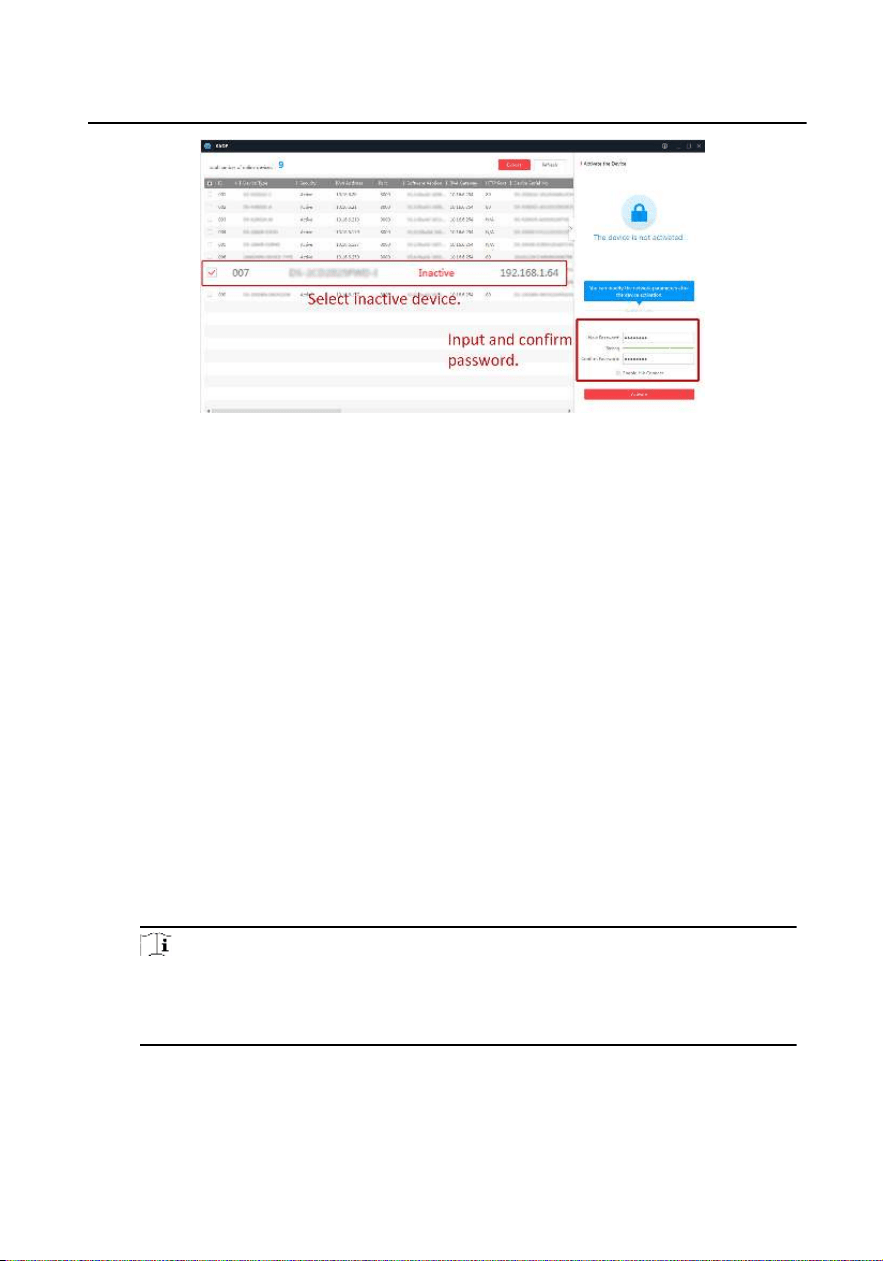
Status of the device becomes Acve aer successful acvaon.
5. Modify IP address of the device.
1) Select the device.
2) Change the device IP address to the same subnet as your computer by either
modifying the IP address manually or checking Enable DHCP.
3) Input the admin password and click Modify to acvate your IP address
modicaon.
2.3 Acvate Device via Web Browser
Use web browser to acvate the device. Use SADP soware or PC client to search
the online device to get the IP address of the device, and acvate the device on the
web page.
Before You Start
Make sure your device and your PC connect to the same LAN.
Steps
1.
Open a web browser and input the IP address of the device.
Note
If you connect the device with the PC directly, you need to change the IP address
of your PC to the same subnet as the device. The default IP address of the device
is 192.0.0.64.
2.
Create and conrm the admin password.
Security Radar User Manual
4
Cauon
STRONG PASSWORD RECOMMENDED-We highly recommend you create a strong
password of your own choosing (using a minimum of 8 characters, including
upper case leers, lower case leers, numbers, and special characters) in order
to increase the security of your product. And we recommend you reset your
password regularly, especially in the high security system, reseng the password
monthly or weekly can beer protect your product.
3. Click OK to complete acvaon and enter Live View page.
4.
Edit IP address of the device.
1) Enter IP address modicaon page. Conguraon → Network → TCP/IP
2) Change IP address.
3) Save the sengs.
Security Radar User Manual
5
3 Wired Network
If the device is linked to the wired network, you can set the wired network
parameters when you want to change the device IP address and other network
parameters.
Steps
Note
The funcon is not supported by some device models.
1.
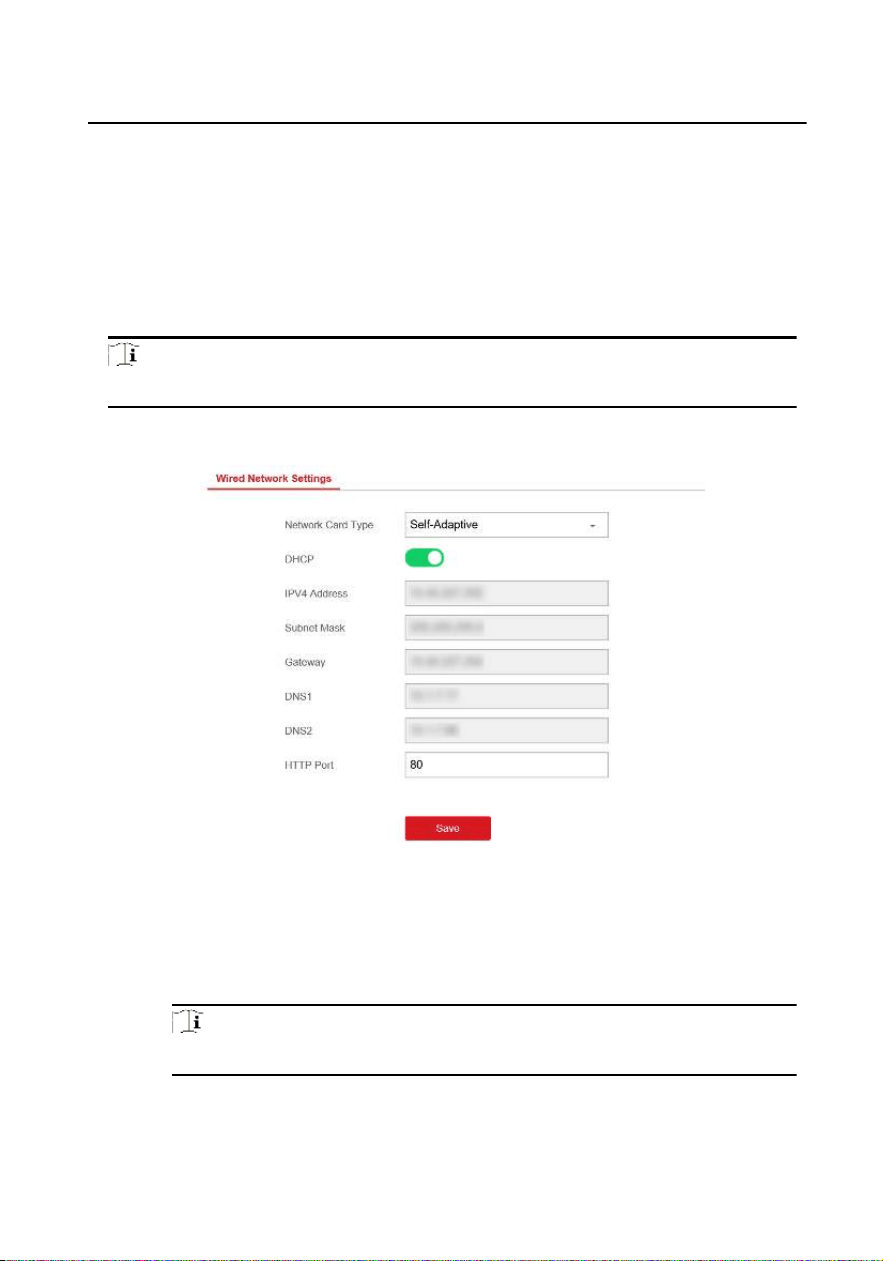
Click Communicaon Parameters → Wired Network Parameters to enter the
Wired Network Parameters page.
Figure 3-1 Wired Network Sengs Page
2.
Set the parameters.
-
Automac Sengs: Enable DHCP and set the HTTP port.
-
Manual Sengs: Disabled DHCP and set IP Address, Subnet Mask, Gateway
Address, DNS Server Address.
Note
By default, the HTTP port is 80, which is not editable.
3.
Oponal: Set correct DNS server address if the device needs to visit Hik-Connect
server via a domain name.
4. Click Save.
Security Radar User Manual
6
4 Radar Sengs
You can add zones, and set camera tracking parameters for the radar in the Radar
Module of the iVMS-4200.
Click Control Panel → Custom funcon , check Radar, and click OK.
4.1 Add Map and Radar
Steps
1.
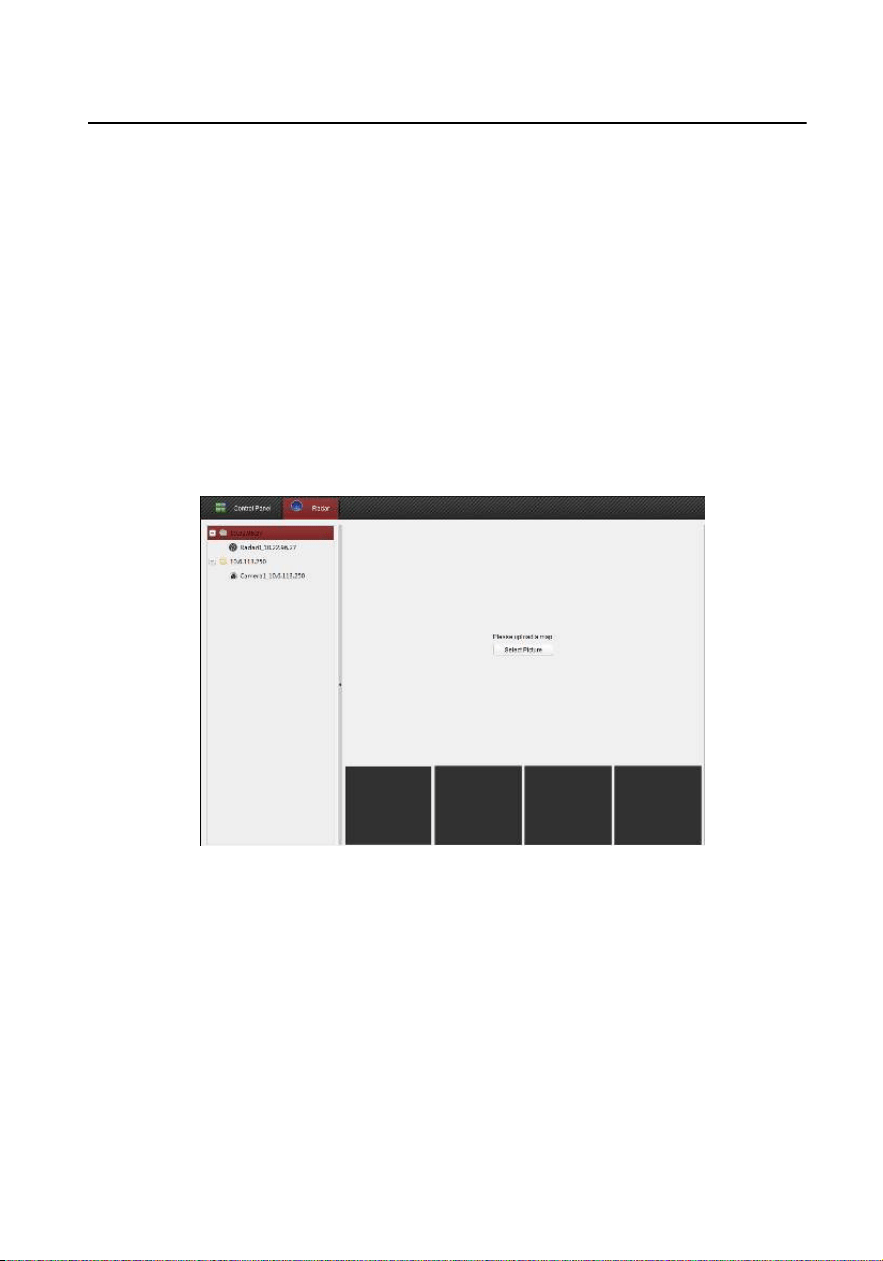
Click Control Panel → Radar to enter the page.
2.
Click Select a Picture to load a map.
Figure 4-1 Add a Map
3.
Enter the actual width and the length of the area showed in the map.
4. Click and drag the radar onto the map.
Security Radar User Manual
7
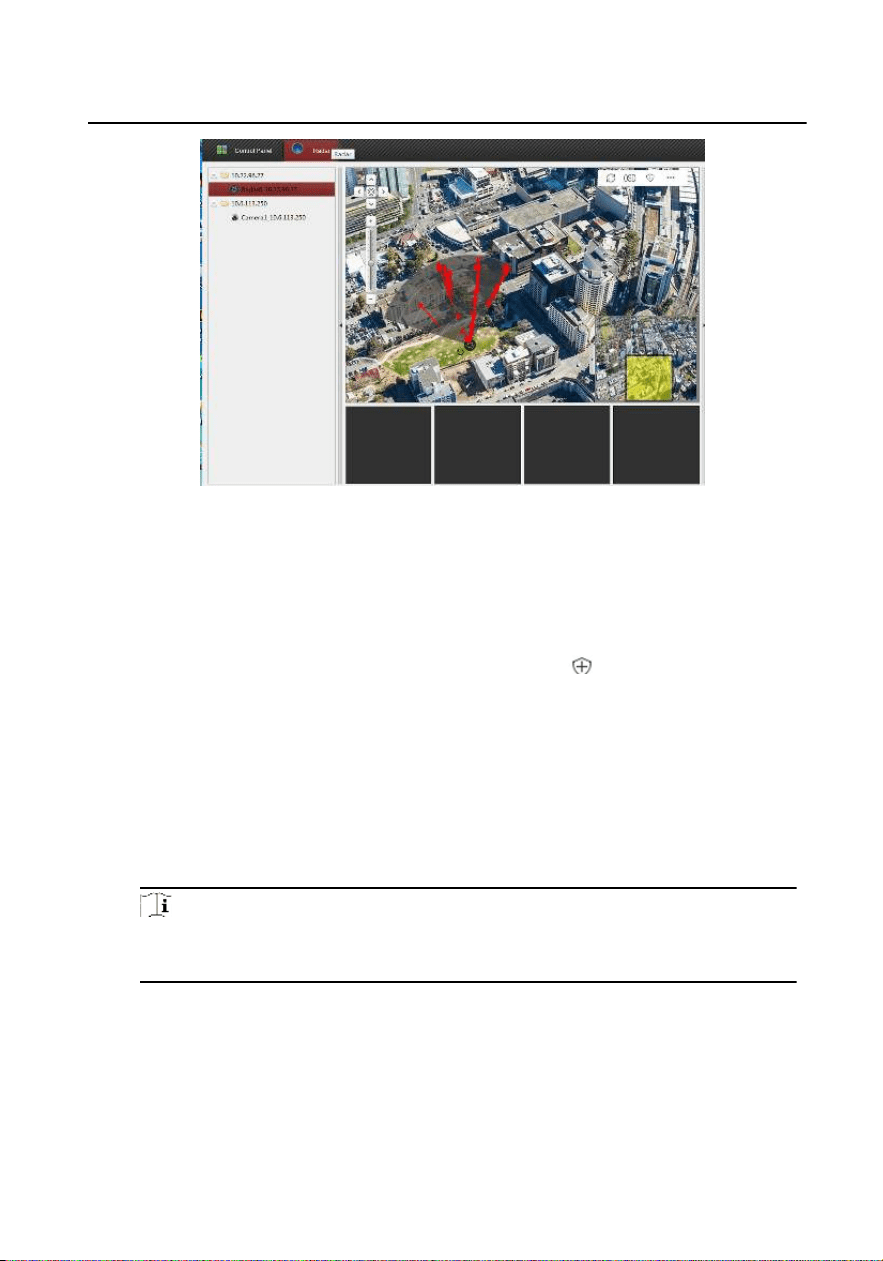
Figure 4-2 Add Radar on the Map
4.2 Add Radar Zone
Before You Start
You need to disarm the radar before the operaon. Click
to disarm the radar.
4.2.1 Add Radar Zone(Manually)
Steps
1.
Click Control Panel → Radar to enter the page.
2.
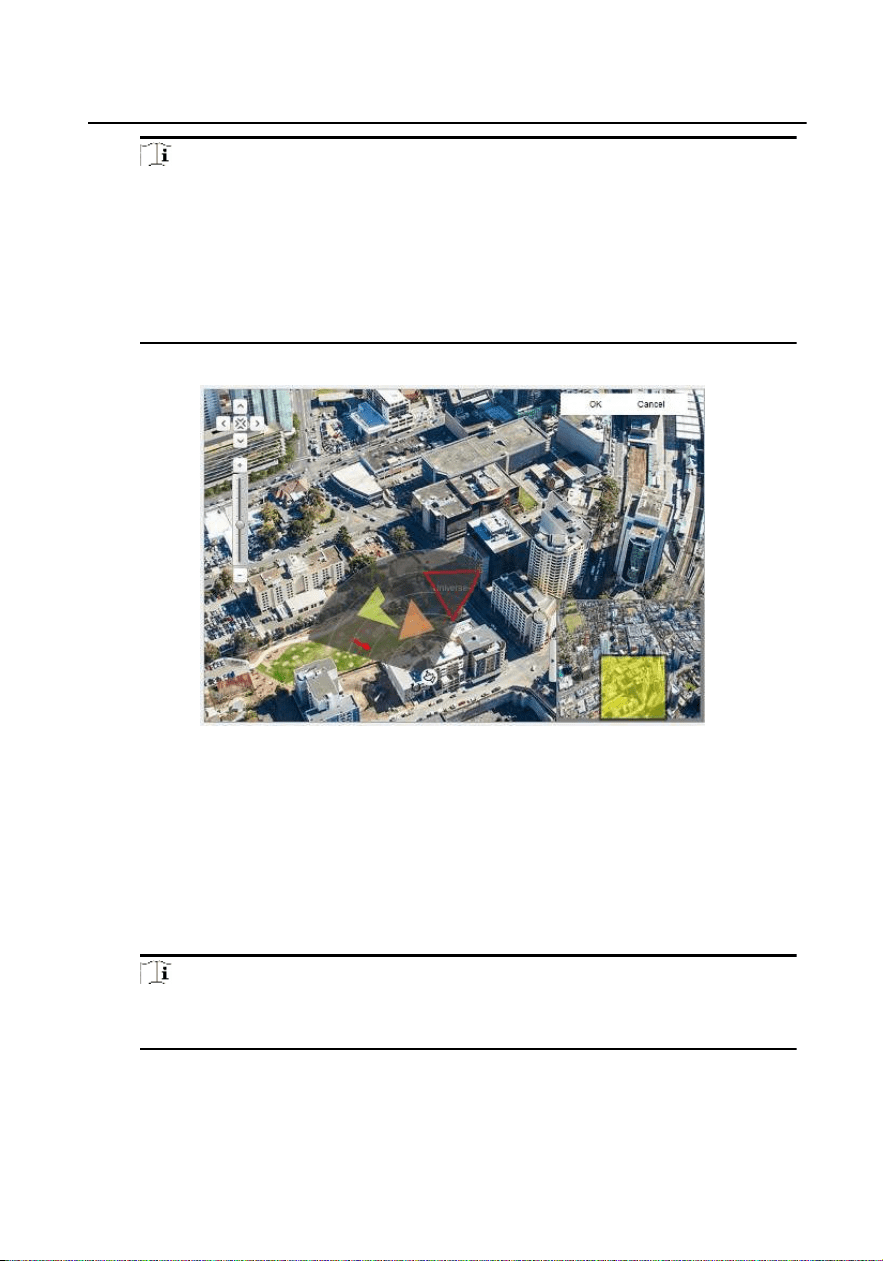
Click … → Draw Zone Manually , and click the mouse to draw a zone on the
radar eld.
Note
Slide the block on the Zoom in/out bar on the le to adjust the size of the
displayed radar area.
3.
Enter the zone name, and select Early Warning Zone, Warning Zone, or Disabled
Zone as the zone type.
Security Radar User Manual
8
Note
•
Early Warning Zone: When the zone is an early zone, target entering the
zone will be idened in advance.
•
Warning Zone: When the zone is an warning zone, the target entering the
zone will be idened and alarm occurred.
•
Disabled Zone: When the zone is an disabled zone, the track of the target
entering the zone will be disabled.
4.
Click OK.
Figure 4-3 Add Radar Zone(Manually)
4.2.2 Add Radar Zone (Automacally)
Steps
1.
Click Control Panel → Radar to enter the radar sengs page.
2.
Click … → Draw Zone Automacally .
Note
Slide the block on the Zoom in/out bar on the le to adjust the size of the
displayed radar area.
3.
Move in the radar led by a closed-loop path to draw a zone.
Security Radar User Manual
9
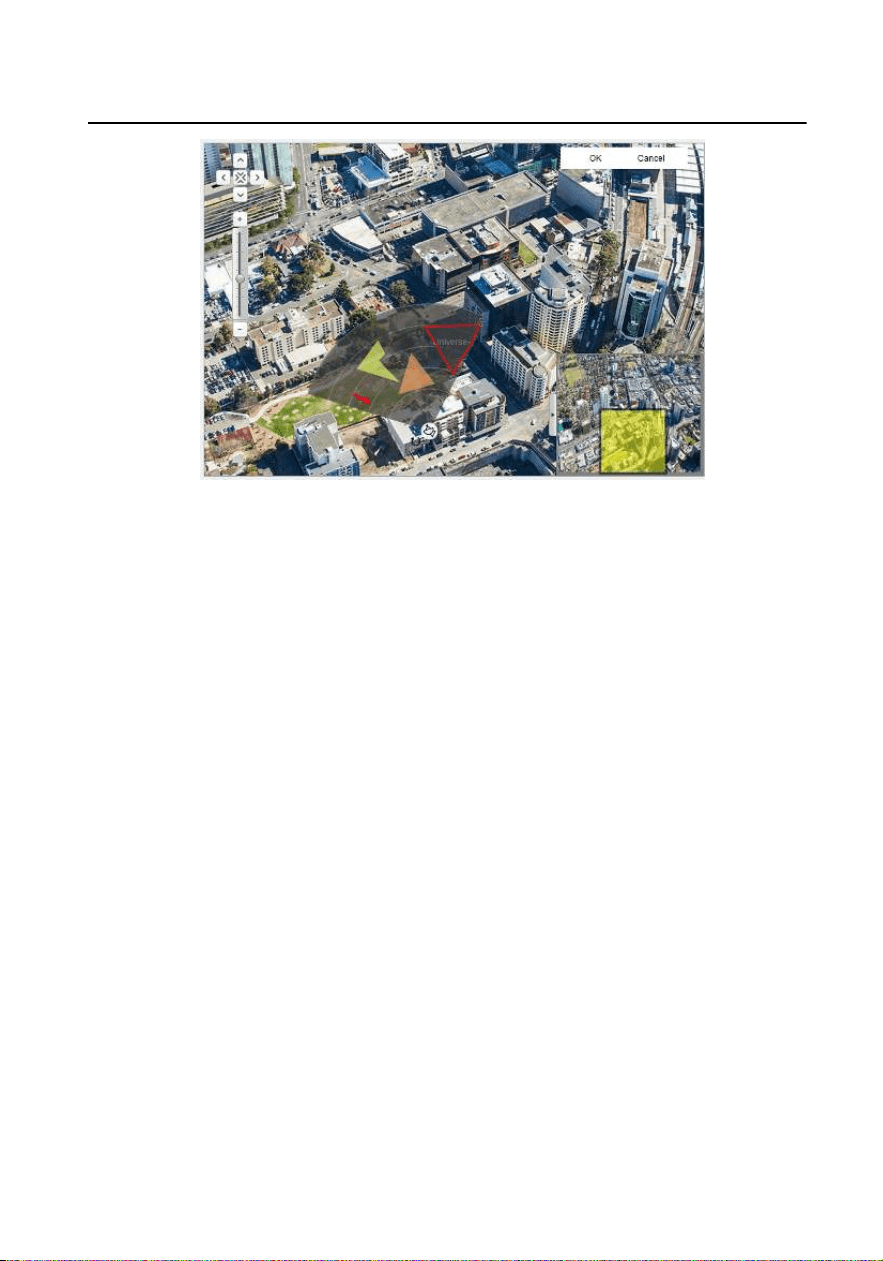
Figure 4-4 Add Radar Zone (Automacally)
4.
Enter the zone name, and select Early Warning Zone, Warning Zone, and
Disabled Zone as the zone type.
5.
Click OK.
Security Radar User Manual
10
5 Camera Linkage Sengs
The radar can work with cameras such as speed dome and box camera for target
tracking and video recording.
5.1 Link the Camera to the zone
Before You Start
You need to disarm the radar before the operaon. Click
to disarm the radar.
Steps
1.
Click Control Panel → Device Management , click Add Device, enter the device
IP address and port NO., enter the username and password, click OK to add the
camera.
2.
Select a radar added before in the device list, click Remote conguraon
Camera Linkage Sengs → Smart Rule Conguraon → Linkage Sengs .
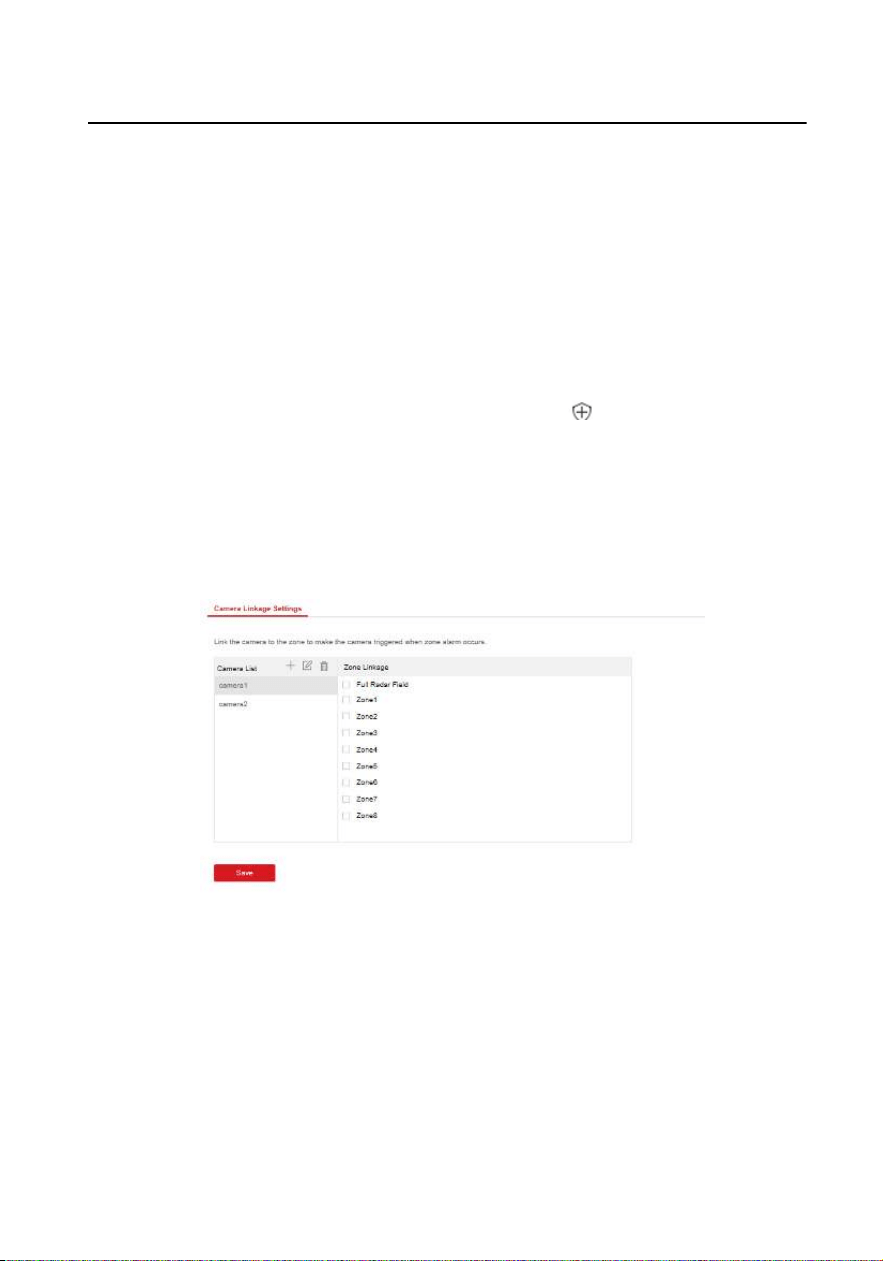
Figure 5-1 Link the Camera to the zone
3.
Click + in the camera list, enter the username and password, click OK to add the
camera to the radar.
Security Radar User Manual
11
Note
•
At least four cameras can be added to the radar.
•
Enter the radar IP address in the web browser, and you can also manage the
camera linkage by entering Smart Rule Conguraon → Camera Linkage
Sengs
4.
Select a camera in the camera list, select one zone, mulple zones, or full radar
eld, and click Save to link the camera with the selected zone.
5.2 Set Speed Dome Inial Posion
Set the inial posion of the speed dome to ensure the tracking accuracy.
Steps
1.
Select a reference object about 50 m away from the speed dome, and select a
point (on the reference object) whose altude is the same as the speed dome’s.
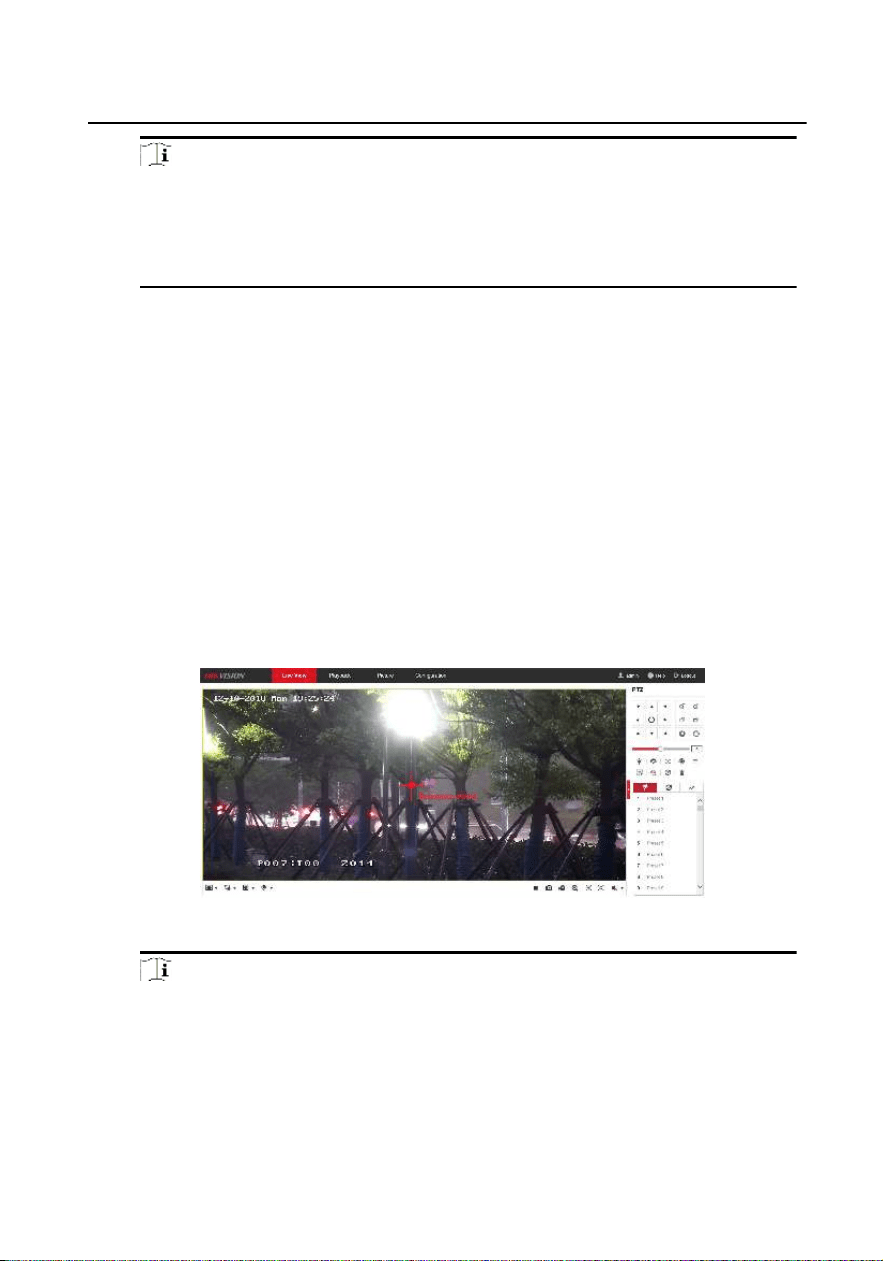
2.
Enter the IP address of the speed dome in the web browser to enter the web
client. Adjust the PTZ and make sure the reference point is displayed in the
frame. Click 3D Zoom and then click the reference point and the point will be in
the middle of the frame.
Figure 5-2 Reference Point Posion
Note
•
If the speed dome is installed lted, aer you click the 3D zoom buon, you
may nd the reference point is above the center of the frame or it is outside
the frame. In this case, you should adjust the maximum elevaon angle of
the speed dome. For detail adjustment method, please refer to How to Solve
Security Radar User Manual
12
the Problem that No Reference Point on the Frame While Seng the Speed
Dome Inial Posion?
•
if the maximun elevaon angle of the speed dome is adjusted, the reference
point needs to be adjusted to the center of the frame again.
•
PTZ: Pan /lt /zoom.
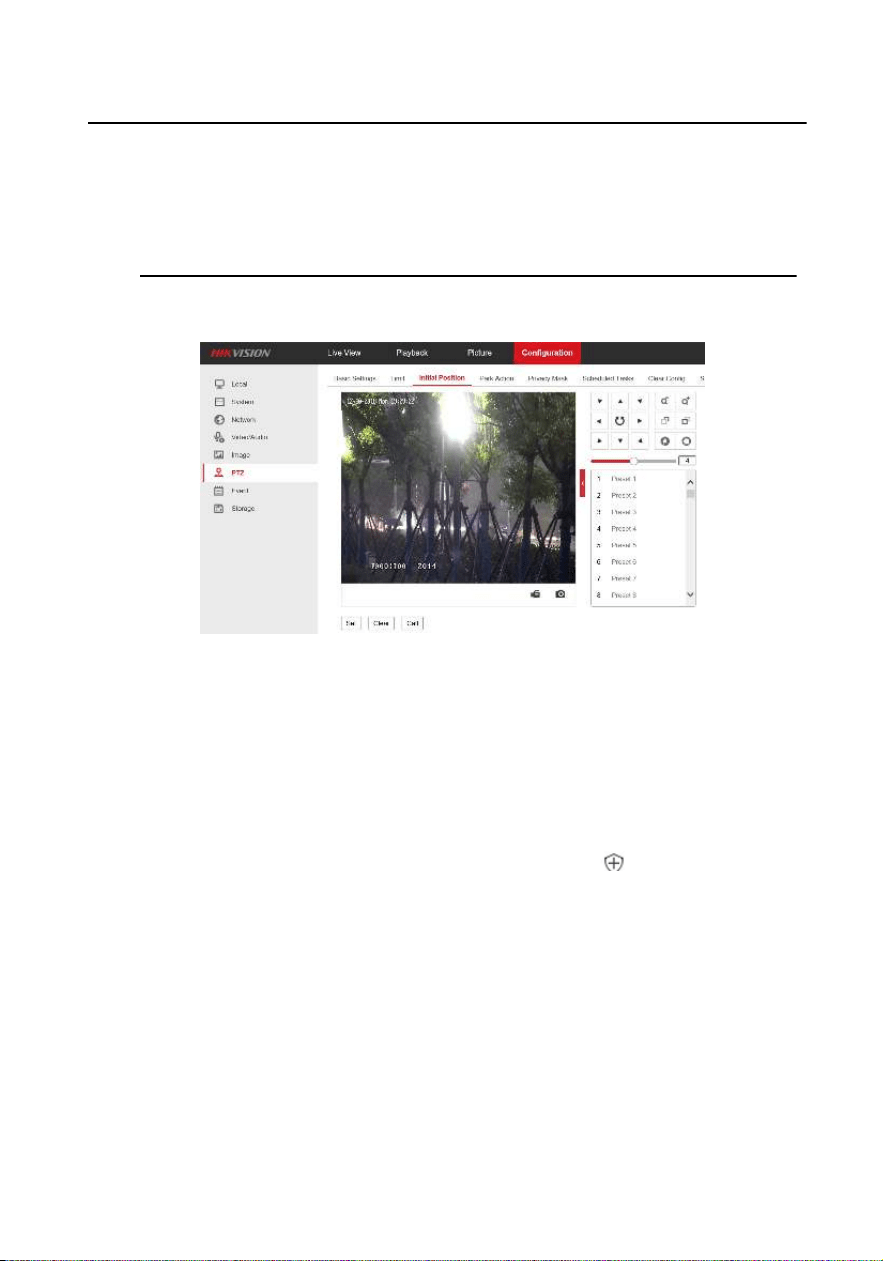
3.
Enter the Conguraon → PTZ → Inial Posion page, and click Set to set the
inial posion.
Figure 5-3 Set Inial Posion
5.3 Calibrate Camera
Calibrate the linked camera to ensure the accuracy of camera tracking.
Before You Start
•
You need to disarm the radar before the operaon. Click
to disarm the radar.
•
You need to link the speed dome to the zone before calibraon, and set the
speed dome inial posion.
•
The installaon height of the linked speed dome should to be more than 3 m.
•
Set the scene mode as Open Mode (refer to Set Scene Mode and Sensivity for
details) and make sure that there is only one target (sta for calibraon) in the
detecon area.
Steps
1.
In iVMS-4200, click Control Panel → Radar .
2.
Click … → Master-Slave Tracking Sengs on the upper-right corner of the page.
Security Radar User Manual
13
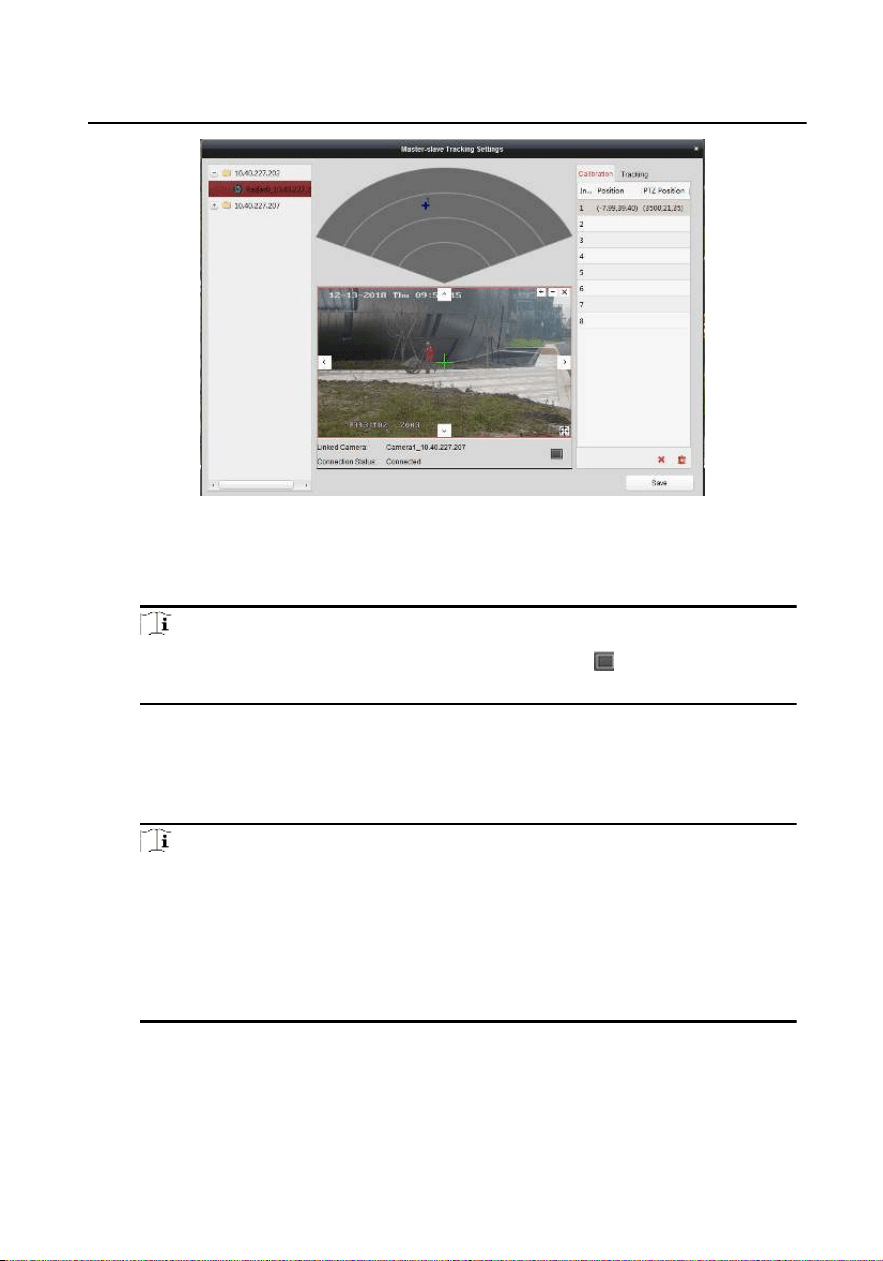
Figure 5-4 Calibrate Camera
3.
Double click the radar and the linked camera in the device list on the le. The
real-me scene of the camera will be displayed under the radar eld diagram.
Note
You can select a real-me scene of the camera and click to zoom in the real-
me scene.
4.
Select a schedule for calibraon point selecon. According to the relave
installaon posion of the radar and the speed dome, it is necessary to select a
schedule for the calibraon point selecon (One point calibraon or mul-point
calibraon).
Note
•
One point calibraon: Applicable to the scene where the radar and the
speed dome are installed on the same pole or the speed dome is installed
within a radar-centered range of 2 m (regardless of the height dierence
between the speed dome and the radar).
•
Mul-point calibraon: The scene where is not applicable to the one point
calibraon need to adopt the mul-point calibraon method.
Security Radar User Manual
14
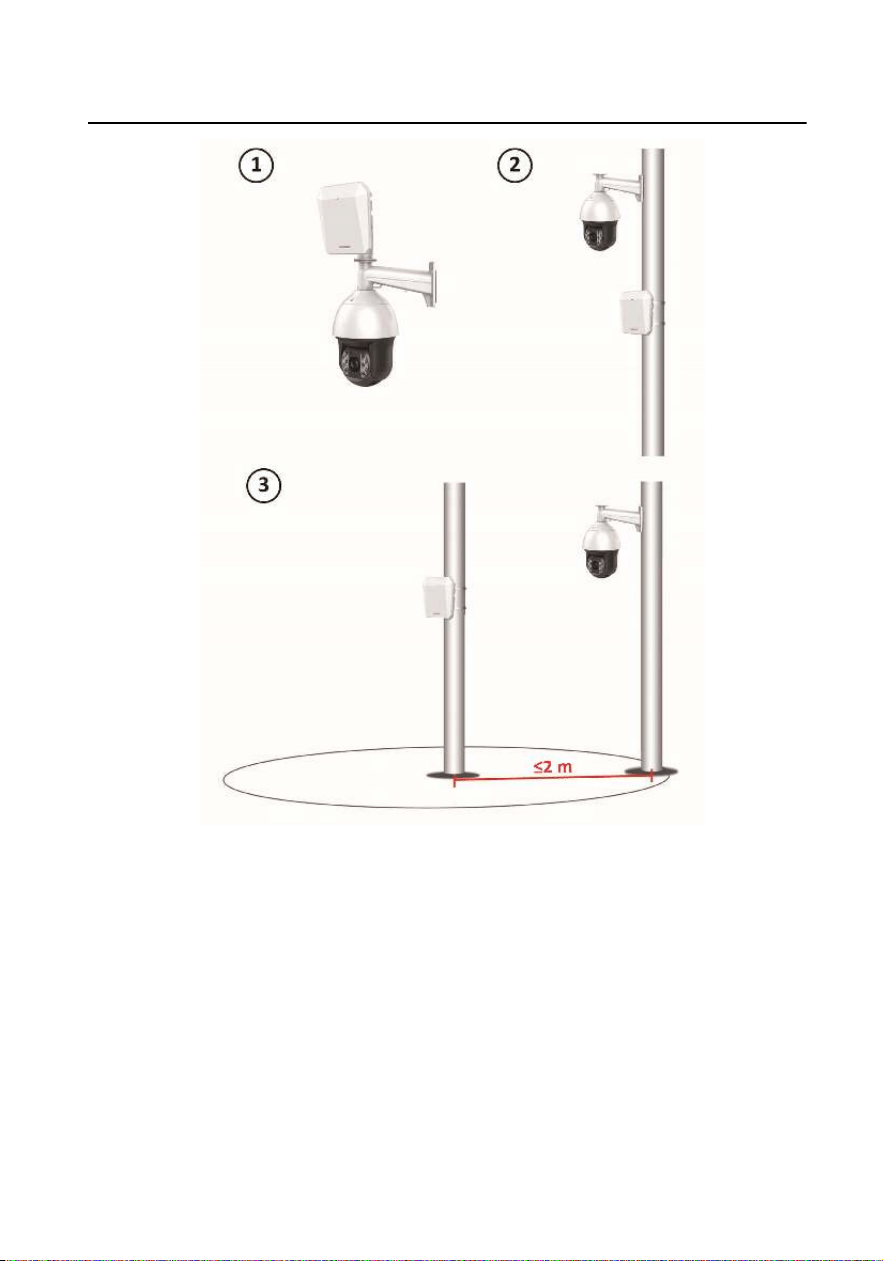
Figure 5-5 Installaon Scene for One Point Calibraon
Security Radar User Manual
15
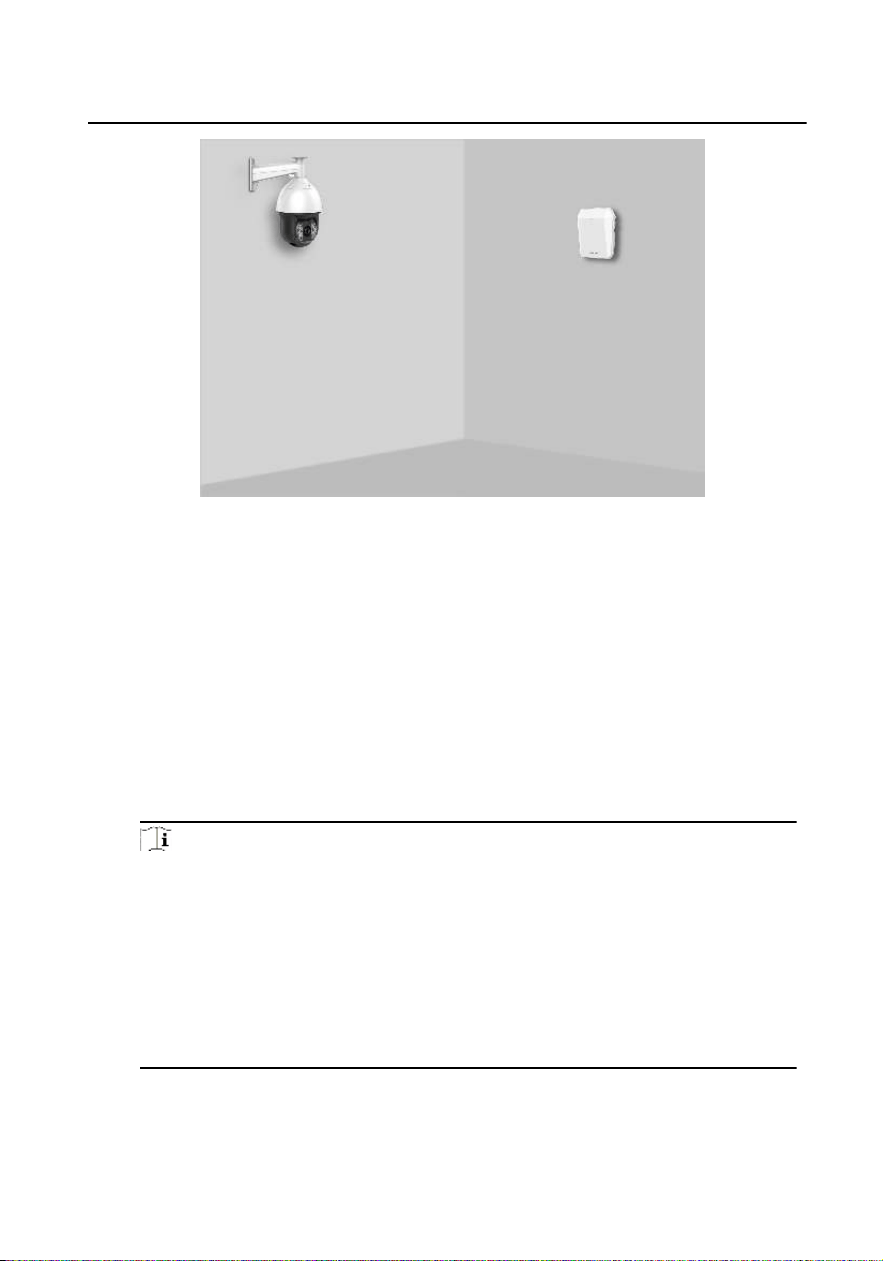
Figure 5-6 Installaon Scene for Mul-Point Calibraon
5.
Calibrate the selected calibraon coordinate point. According to the selected
schedule, you can calibrate the calibraon coordinate point by one point
calibraon or mul-point calibraon method.
5.3.1 One Point Calibraon
Steps
1.
Ask the calibraon sta to move in the radar detecon area to produce a valid
track, and then to stand at the calibraon posion within 20 to 40 m directly in
front of the radar.
Note
•
Radar can only detect one target when calibrang. If there are mulple
targets within the radar detecon area, there is no guarantee that the
detected target track is a valid track produced by the calibraon sta.
Therefore, the moving track on the map and the moving target in the camera
live view page of the calibraon page need to be matched at the same me
to ensure the track is valid.
•
Under calibraon mode, it takes 10 s to upload a new track aer the moving
track disappears on the map page.
Security Radar User Manual
16
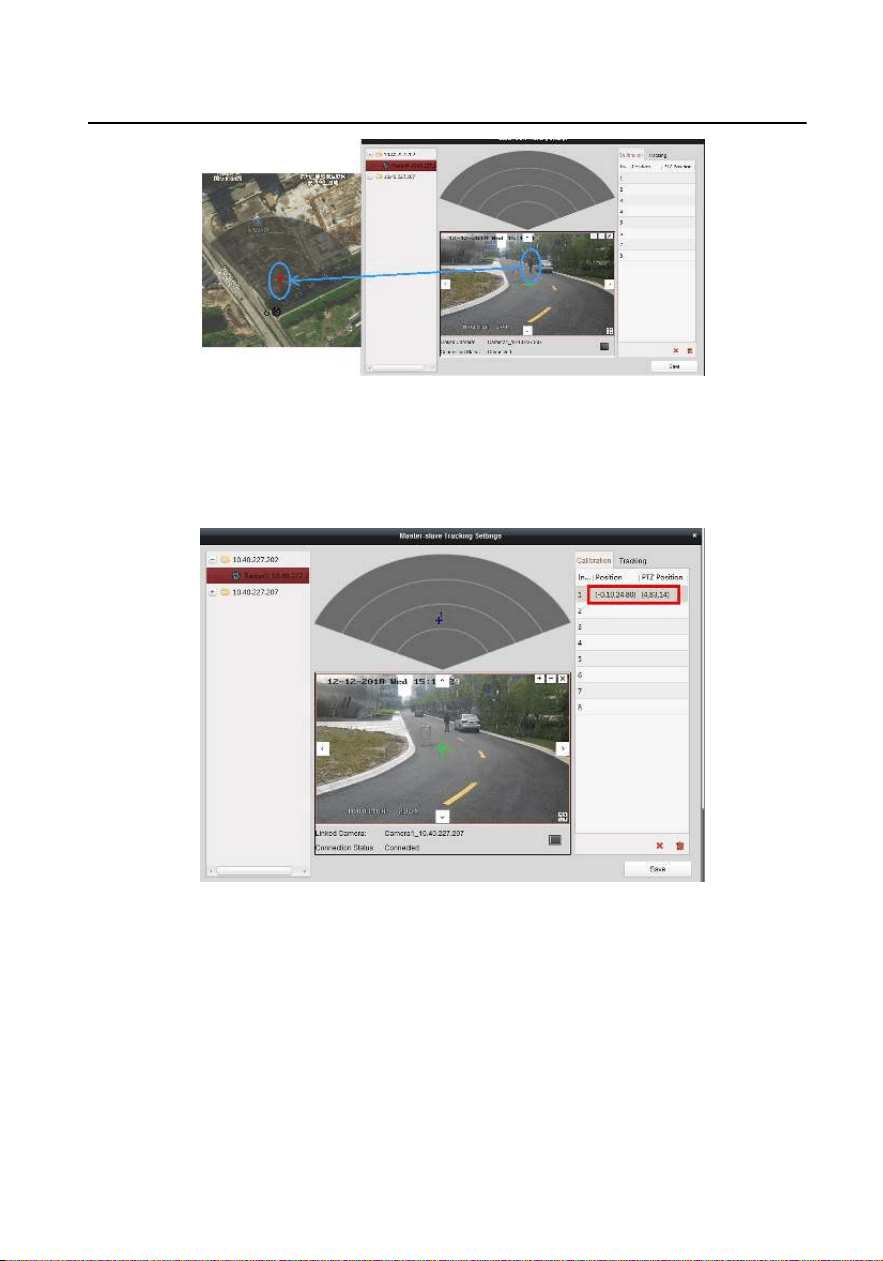
Figure 5-7 Valid Track
2.
When the calibraon sta keeps standing at the calibraon point, click and
select a coordinate in the Calibraon Posion list on the right. The radar
coordinate of the target and the current PTZ posion of the speed dome show in
the list , and a target sign + shows on the radar eld diagram.
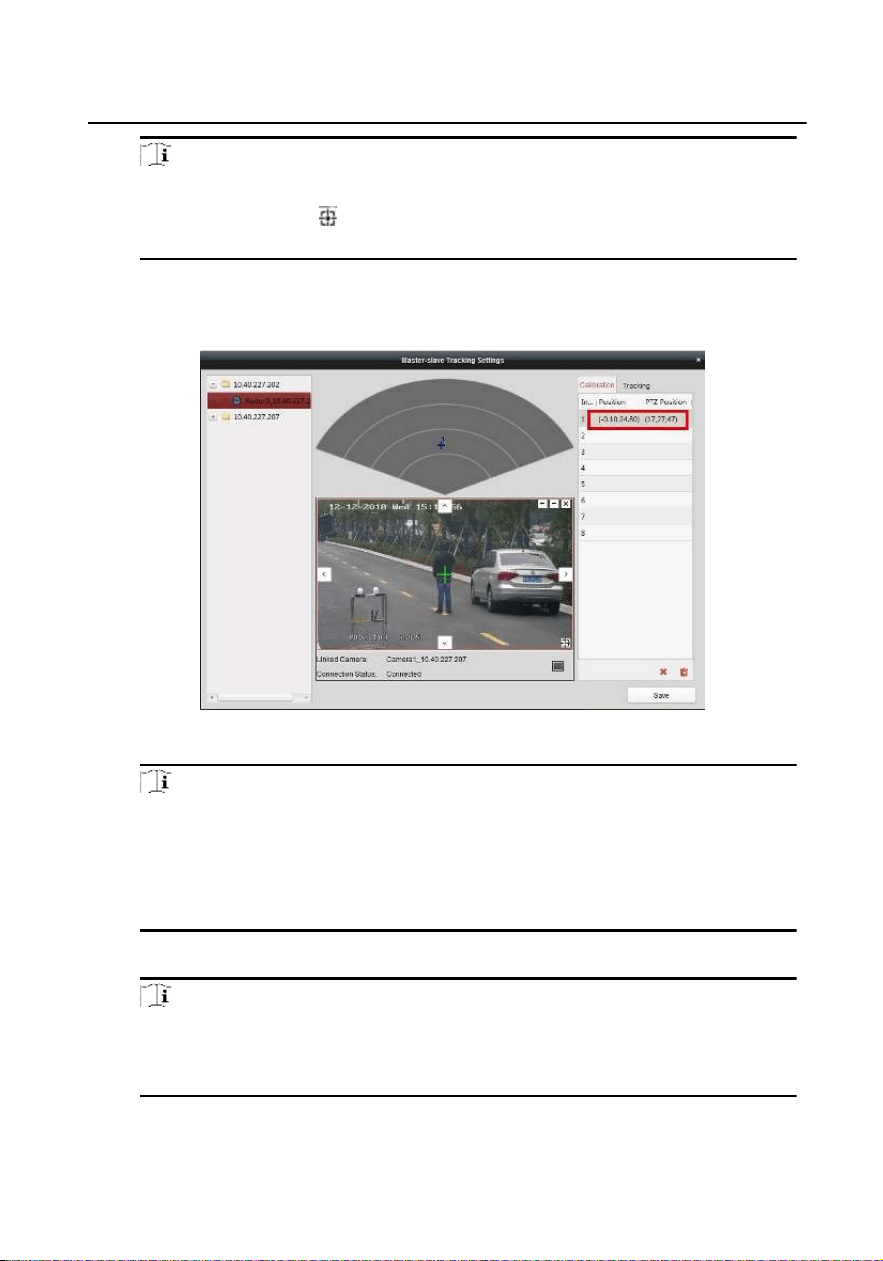
Figure 5-8 Acquire the Current Coordinate Posion
3.
In the real-me scene of the speed dome, adjust the altude of the target to
two-thirds of the height of real-me scene by clicking + and - on the upper right
corner, and then click the direcon buons to align the central sign + with the
calibraon sta in the scene.
Security Radar User Manual
17
Note
If the central sign + cannot be aligned with the calibraon target by the direcon
buons, you can click
to enable 3D locaon, and then click the center of the
target to automacally align the central sign with the target.
4.
Aer adjusng the target locaon in the real-me scene of the speed dome, you
need to click the coordinate again in the Calibraon Posion list on the right,
and then the PTZ posion of the speed dome will update.
Figure 5-9 One Point Calibraon
Note
Please check if the radar coordinate is changed when locang the coordinate,
the radar coordinate of target should not be changed if the target does not
move. If the radar coordinate updates, check if there are more targets in the
real-me scene of the speed dome and the track is produced by the calibraon
sta, and then re-calibrate the calibraon point from step 1.
5.
Click Save to save the calibraon point.
Note
Before the calibraon point is saved, the calibraon sta needs to stand sll and
does not move (moving will change the radar coordinate, and results in
calibraon error).
Security Radar User Manual
18
5.3.2 Mul-Point Calibraon
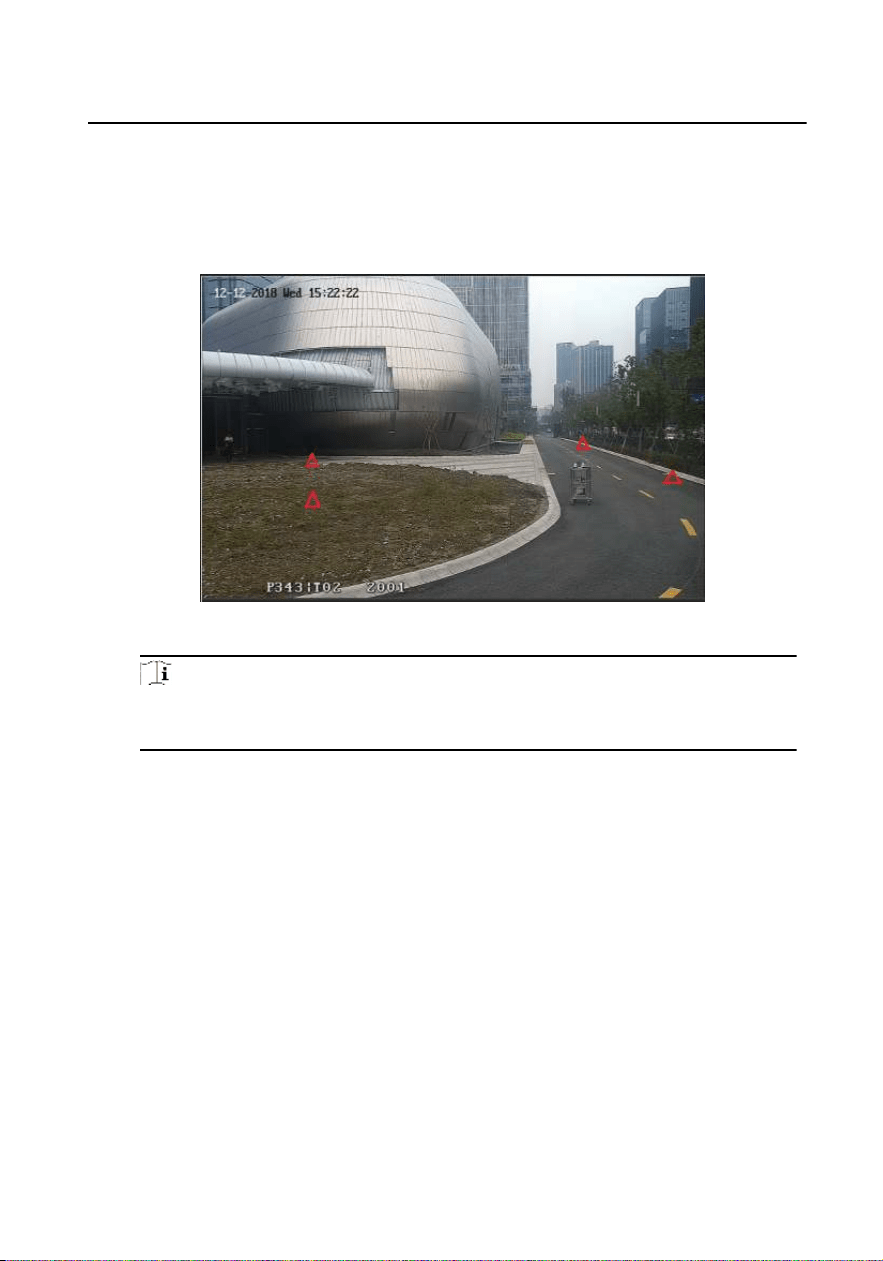
Steps
1.
Select calibraon posions (equally distributed) in the radar detecon area, you
can refer to the following gure to select posions.
Figure 5-10 Mul-Point Distribuon Instance
Note
It is required to set at least four calibraon posions (equally distributed) when
you are seng mul-point calibraon.
2.
According to the calibraon posions, ask the calibraon sta to move to the
rst calibraon posion to produce a valid track. Standing at the rst calibraon
posion, refer to step 2 ~ step 4 in One Point Calibraon to calibrate the rst
calibraon point.
3.
Aer calibrang the rst calibraon point, you need to click the next coordinate
in the Calibraon Posion list on the right, and then the calibraon sta moves
to the second calibraon posion to produce a valid track. Standing at the
second calibraon posion, you can calibrate the second calibraon point.
Follow this process to complete all calibraon point posioning in turn.
Security Radar User Manual
19
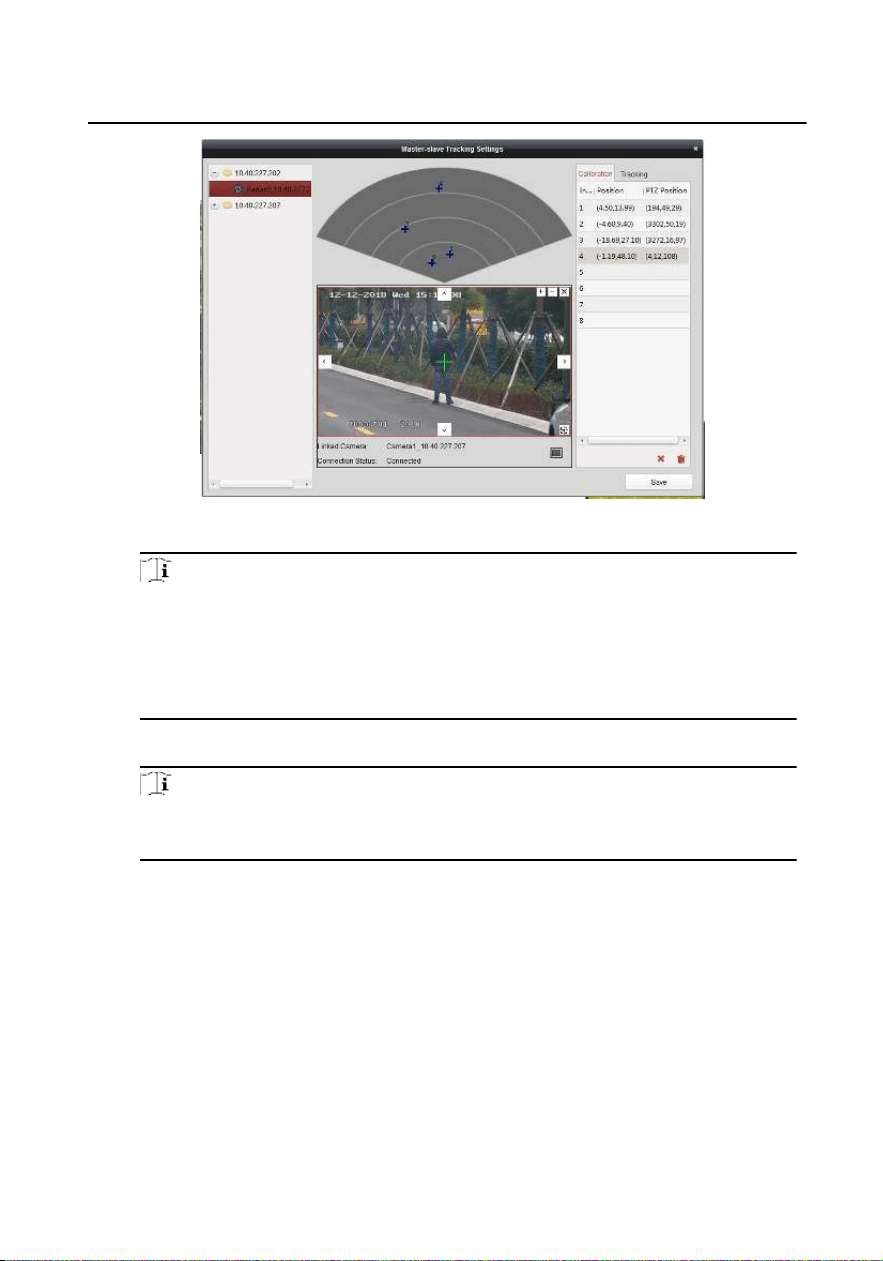
Figure 5-11 Mul-Point Calibraon
Note
The radar coordinate of the current coordinate point in Calibraon Posion list
changes as the calibraon sta moves and produces a valid track. Therefore,
every me a calibraon point is calibrated completely, the calibraon sta must
stand in place. When the next coordinate point is selected in Calibraon
Posion list, the calibraon sta can move again.
4.
Aer all calibraon points is calibrated completely, click Save.
Note
If click Save when only 2 or 3 calibraon points is completed, there will be a pop-
up box indicang that the calibraon points are illegal.
5.4 Enable Camera Tracking
Enable the tracking funcon aer calibraon to make the linked camera be able to
track with the detected target.
Steps
1.
In iVMS-4200, click Control Panel → Radar → … → Master-Slave Tracking
Sengs → Tracking to enter the page.
Security Radar User Manual
20
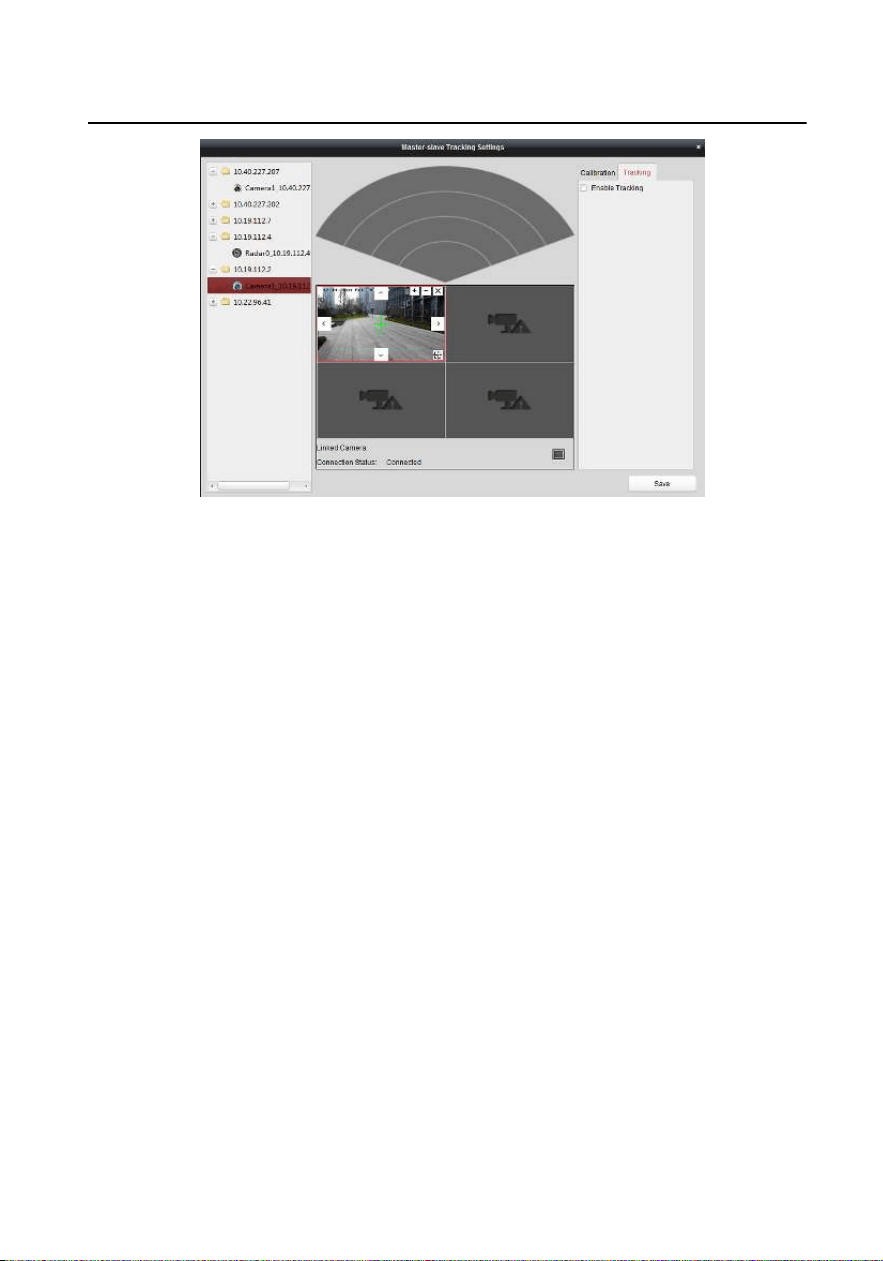
Figure 5-12 Enable Camera Tracking
2.
Check Enable Tracking.
3.
Click Save.
5.5 Set Tracking Strategy
Steps
1.
Select the radar and click Remote Conguraon in iVMS-4200, or enter the
radar IP address in the address bar of the web broswer. Click Smart Rule Sengs
→ Tracking Strategy to enter the page.
2.
Select Time Priority, Range Priority, or Mul-Target Auto Switch as the strategy.
The camera will record the intrusion ll the target leave warning zone.
Time Priority
Record the rst target that intrude the zone.
Range Priority
Record the target that has the shortest distance away from the radar.
Mul-Target Auto Switch
Switch the target automacally when there are mulple targets in the zone.
3.
Click Save to complete.
Security Radar User Manual
21
5.6 Set Storage Schedule
Before You Start
•
Make sure your computer has already installed the Storage Server that should
be selected as the component when installing client.
•
Acvate and add the storage server to the client before seng storage schedule,
you can refer to User Manual of iVMS-4200 Client Soware.
Steps
1.
In iVMS-4200, click Tool → Storage to enter the page.
2.
Select the camera in the Camera Group list.
3.
Select a storage server from the Storage Server drop-down list.
4. Set Recording Schedule switch to ON to enable storing the vedio les.
5.
Select the schedule template for recording from the drop-down list.
6.
Click Save.
Note
For detailed sengs, please refer to User Manual of iVMS-4200 Client Soware.
Security Radar User Manual
22
6 Alarm Sengs
6.1 Alarm Center
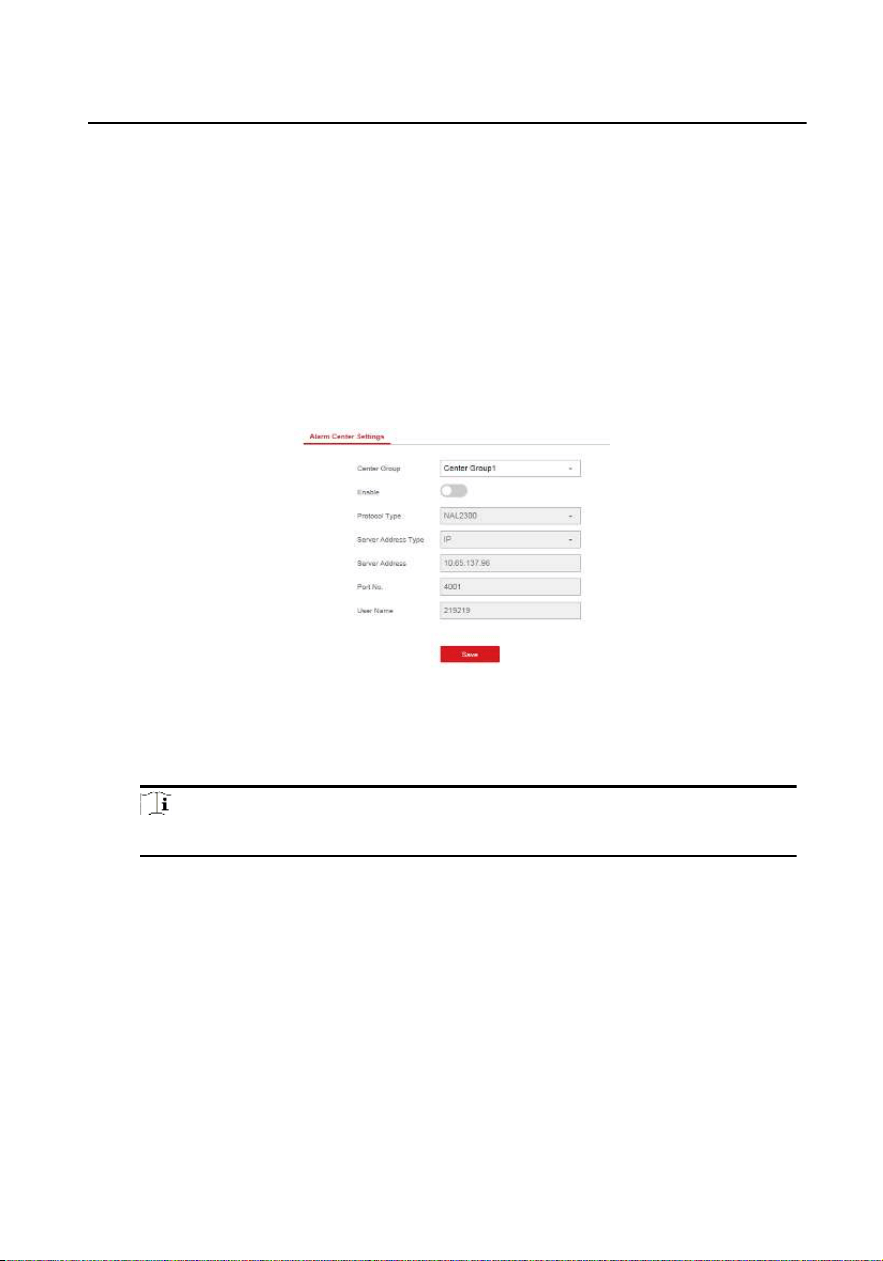
You can set the alarm center's parameters and all alarms will be sent to the
congured alarm center.
Steps
1.
Click Communicaon Parameters → Alarm Center Parameters to enter the
Alarm Center Sengs page.
Figure 6-1 Alarm Center Parameters
2.
Select a protocol type from the drop-down list, select a server address type from
the drop-down list, set the server address, port No., and the user name.
Note
The protocol type HTTP is the Hikvision private protocol.
3.
Click Save.
6.2 Nocaon Push
When an alarm is triggered, if you want the send the alarm nocaon to the client,
alarm center, cloud or mobile client, you can set the nocaon push parameters.
Steps
1.
Click Communicaon Parameters → Message Nocaon .
Security Radar User Manual
23
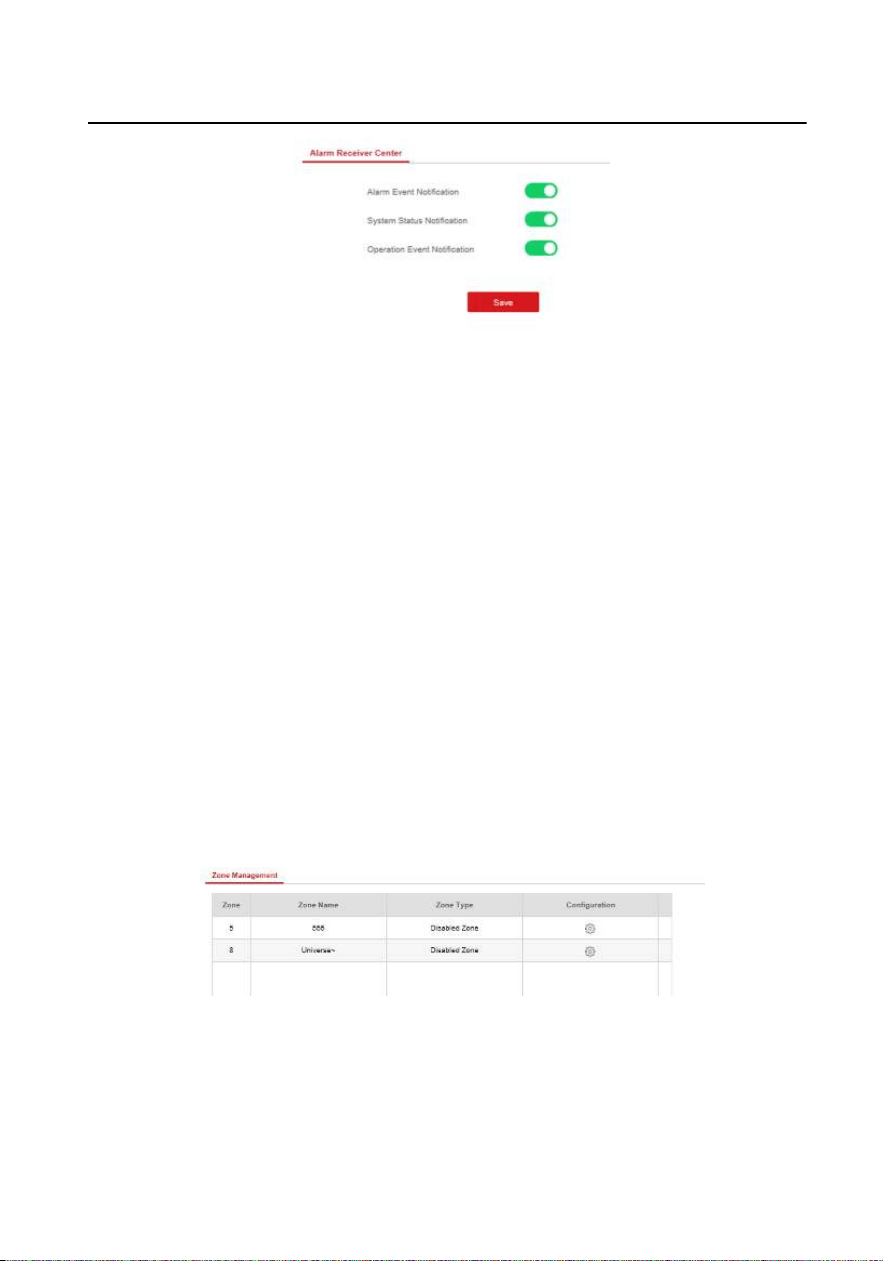
Figure 6-2 Nocaon Push
2.
Enable the target nocaon.
Alarm Event Nocaon
The device will push nocaons when the zone alarm is triggered or
restored.
System Status Nocaon
The device will push nocaons when any status in the system is changed.
Operaon Event Nocaon
The device will push nocaons when the user operate the device.
3.
Click Save.
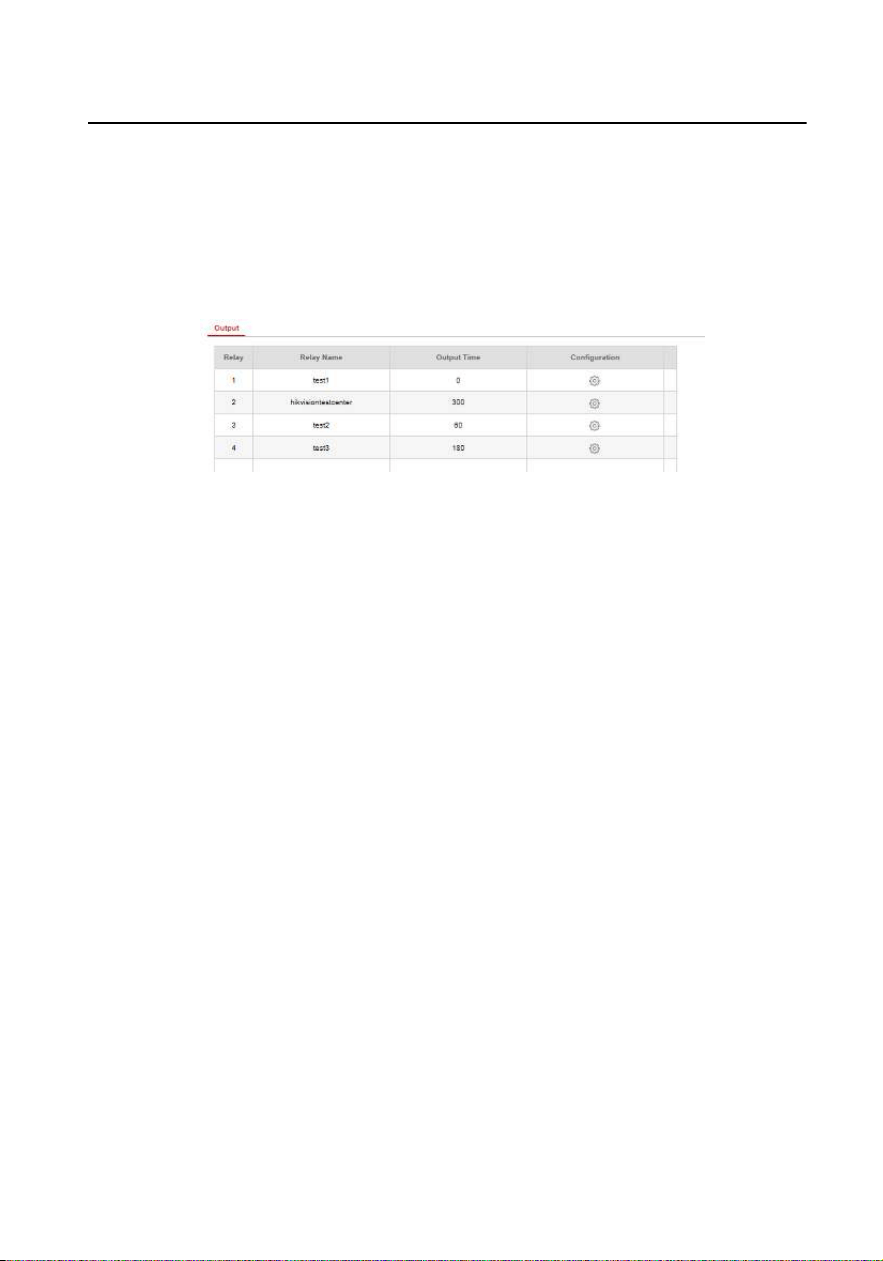
6.3 Set Zone
Steps
1.
Select the radar and click Remote Conguraon in iVMS-4200, or enter the
radar IP address in the address bar of the web browser. Click Alarm Module
Parameters → Zone to enter the page.
Figure 6-3 Set Zone
2.
Select a zone, and click the conguraon icon to edit the zone name and zone
type.
3.
Click OK to complete.
Security Radar User Manual
24
6.4 Set Alarm Output
Steps
1.
Select the radar and click Remote Conguraon in iVMS-4200, or enter the
radar IP address in the address bar of the web browser. Click Alarm Module
Parameters → Alarm Output to enter the page.
Figure 6-4 Alarm Output
2.
Select an alarm output, and click the conguraon icon to enter the page.
3.
Edit the alarm output name, and output me.
4.
Set alarm output linkage. Link the alarm output with zone event, system event,
and arming/disarming operaon.
5.
Click OK to save.
6.
Click Delete to delete a selected period. Click Delete All to delete all periods in
the me table.
6.5 Set Arming/Disarming Schedule
Steps
1.
Select the radar and click Remote Conguraon in iVMS-4200, or enter the
radar IP address in the address bar of the web browser. Click Smart Rule Sengs
→ Arming/ Disarming Schedule to enter the page.
Security Radar User Manual
25
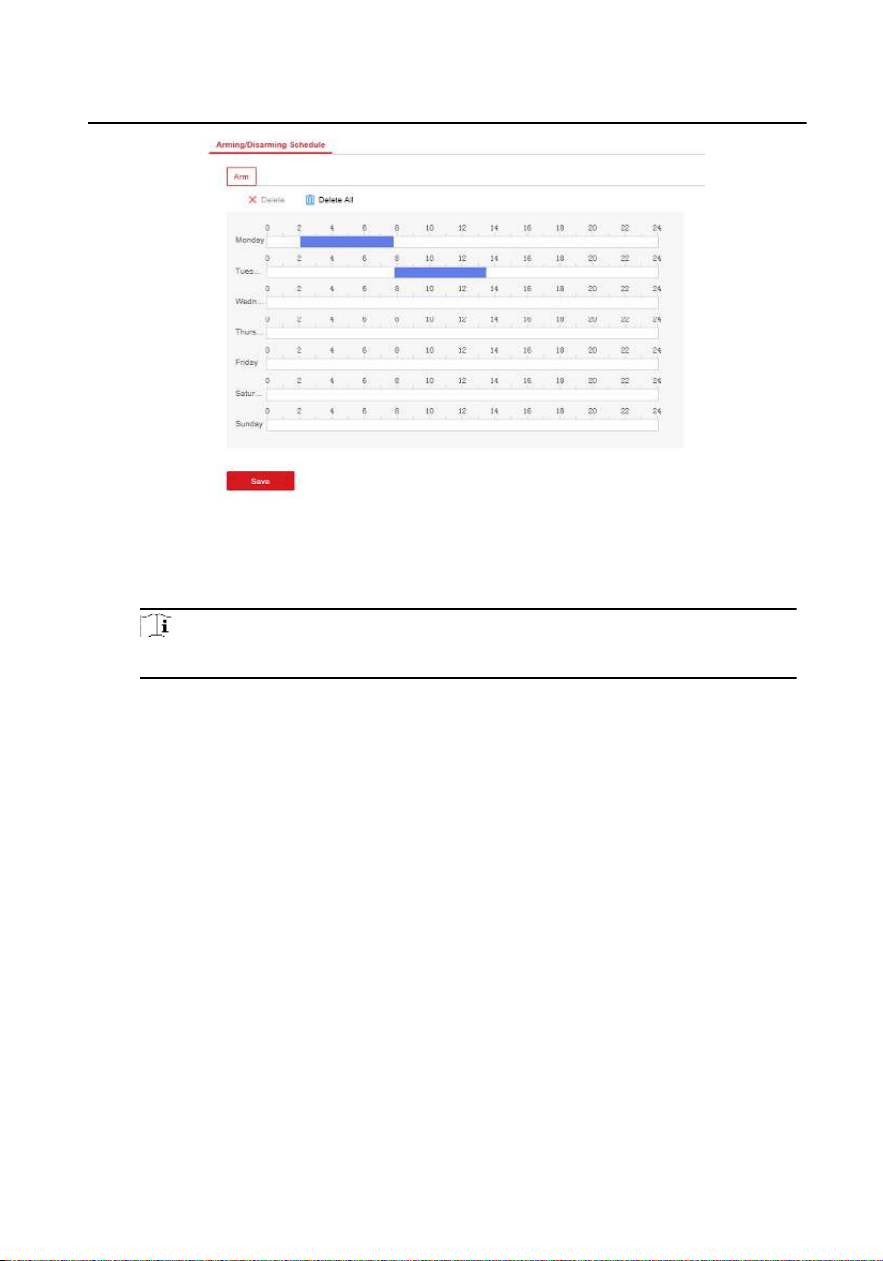
Figure 6-5 Arming/Disarming Schedule
2.
Drag the mouse to draw the period bar on the me table, or click the period bar
and enter the start and end me.
Note
You can set two arming/disarming periods each day.
3.
Click OK to save.
4.
Click Delete to delete a selected period. Click Delete All to delete all periods in
the me table.
Security Radar User Manual
26
7 Set Radar Advanced Funcon
7.1 Set Detecon Angle and Range
Steps
1. Select the radar and click Remote Conguraon in iVMS-4200, or Enter the
radar IP address in the address bar of the web browser. Click Radar Sengs →
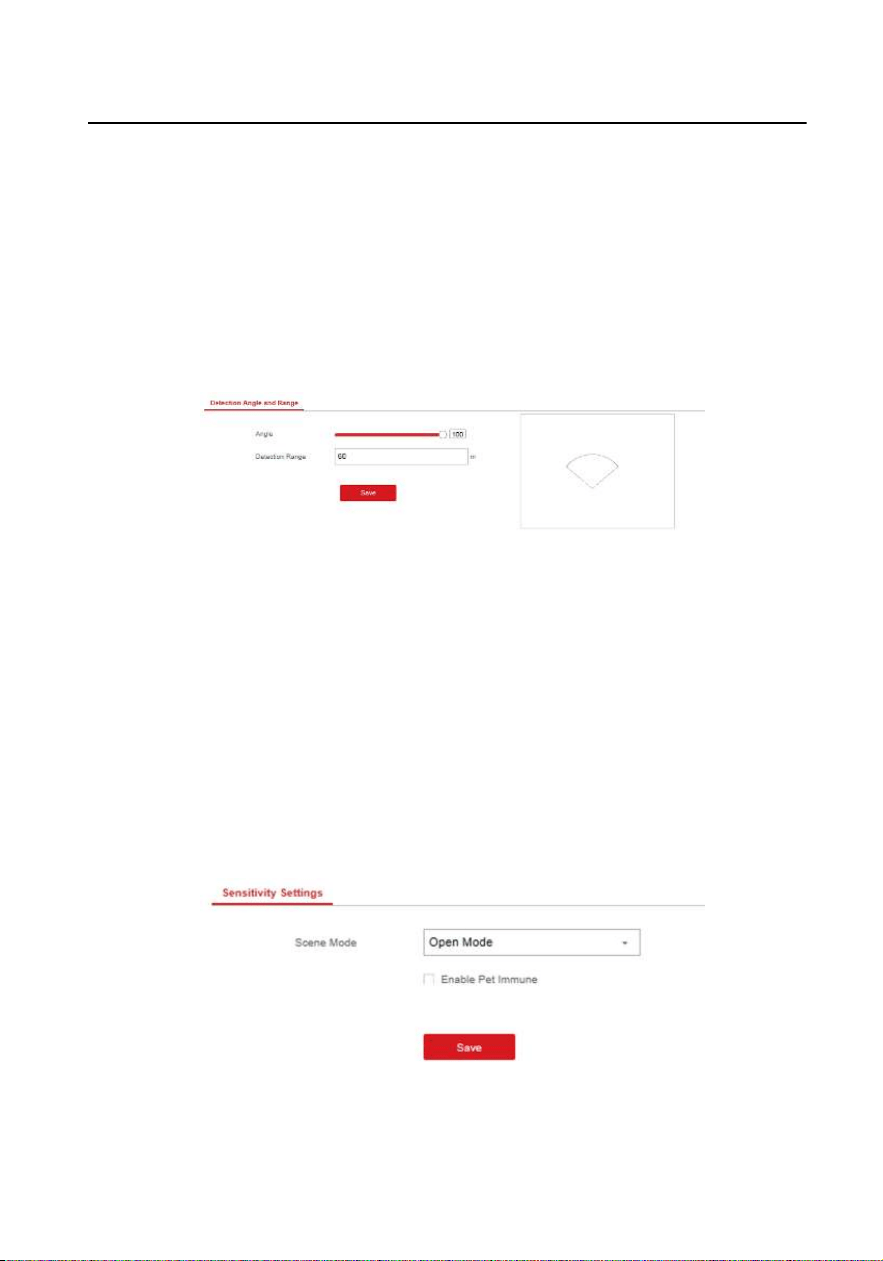
Detecon Angle and Range to enter the page.
Figure 7-1 Set Detecon Angle and Range
2.
Slide the block to set the radar angle, and enter the detecon range.
3.
Click Save to complete.
7.2 Set Scene Mode and Sensivity
Steps
1.
Select the radar and click Remote Conguraon in iVMS-4200, or Enter the
radar IP address in the address bar of the web browser. Click Radar Sengs →
Sensivity Sengs to enter the page.
Figure 7-2 Sensivity
Security Radar User Manual
27
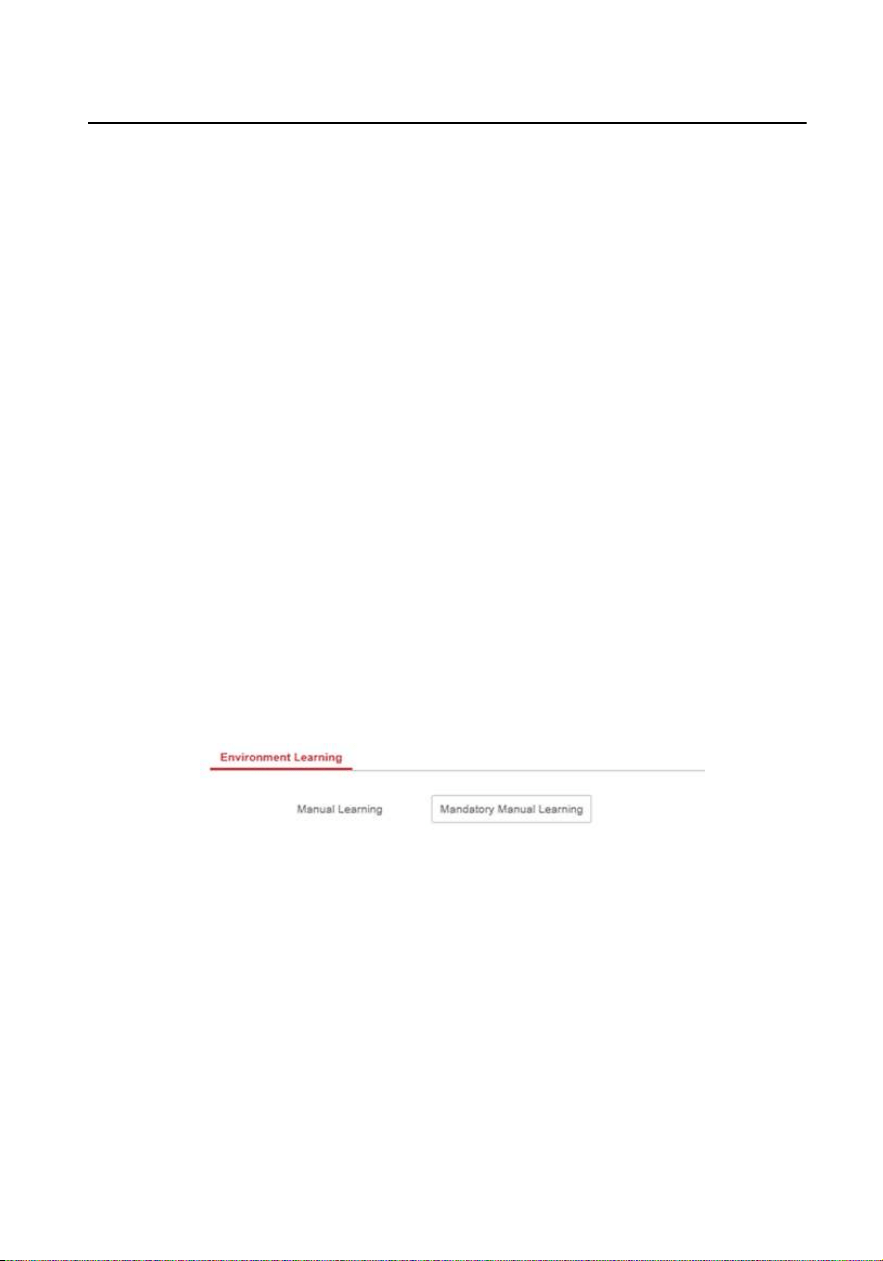
2. Select Open Mode, Shrub Mode, or Expert Mode as the radar sensivity mode.
Open Mode
There are no large objects in the radar detecon area.
Shrub Mode
There are shrubs and other objects that are likely to swing in the radar
detecon area. The shrub mode can also used to decrease the interference
of rainstorm.
Expert Mode (Custom Mode)
You can set tracking sensivity, swing sensivity, and signal sensivity
according to actual scenario requirements.
3.
Click Save to complete.
7.3 Set Environment Learning
To ensure the accuracy of radar detecon, if there are large objects in the detecon
area, you need to remove the objects and make the radar complete the environment
learning.
Steps
1. Select the radar and click Remote Conguraon in iVMS-4200, or enter the
radar IP address in the address bar of the web browser. Click Radar Sengs →
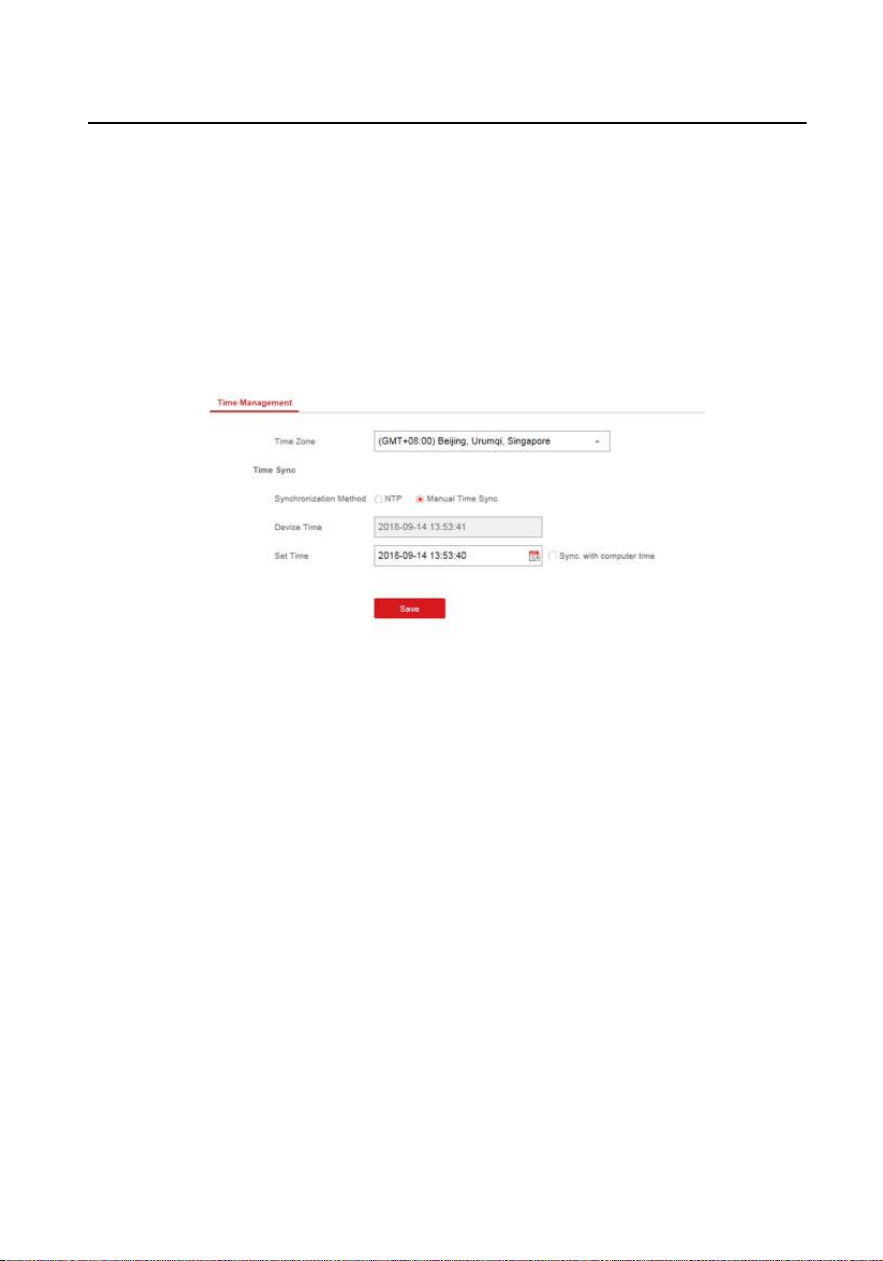
Environment Learning to enter the page.
Figure 7-3 Environment Learning
2.
Click Mandatory Manual Learning to complete.
Security Radar User Manual
28
8 System Management
8.1 Set Time
Steps
1. Select the radar and click Remote Conguraon in iVMS-4200, or enter the
radar IP address in the address bar of the web browser. Click System → Time
Management to enter the page.
Figure 8-1 Time
2.
Set the me zone and synchronizaon method.
3.
Click Save.
8.2 Manage User
Steps
1.
Select the radar and click Remote Conguraon in iVMS-4200, or enter the
radar IP address in the address bar of the web browser. Click System → User to
enter the page.
Security Radar User Manual
29
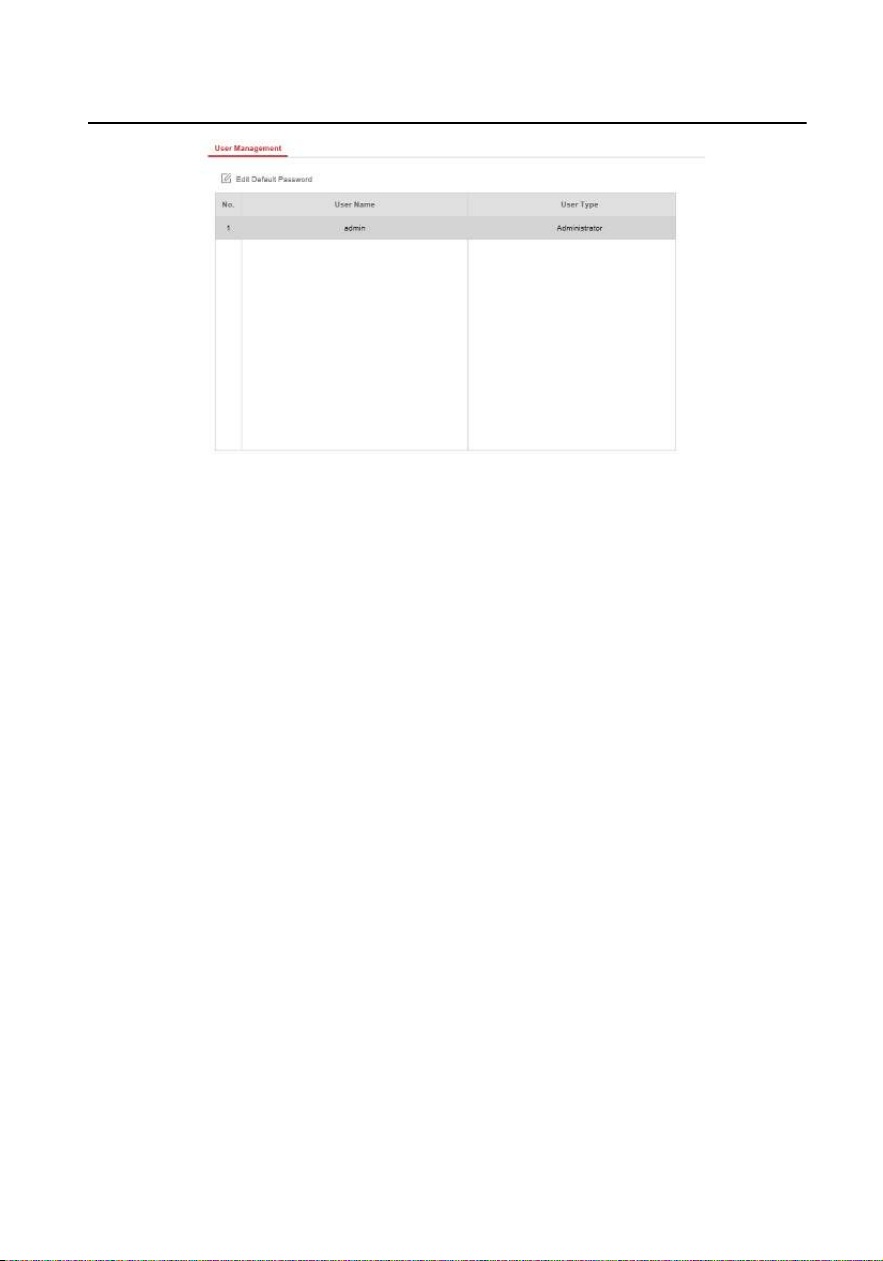
Figure 8-2 User
2.
Select the admin account, and click Edit to edit the admin informaon.
8.3 System Maintenance
You can reboot the device, restore default sengs, import/export conguraon le,
or upgrade the device remotely.
Select the device and click Remote Conguraon in iVMS-4200, or enter the device
IP address in the address bar of the web browser. Click System → Maintenance to
enter the Upgrade and Maintenance page.
Security Radar User Manual
30
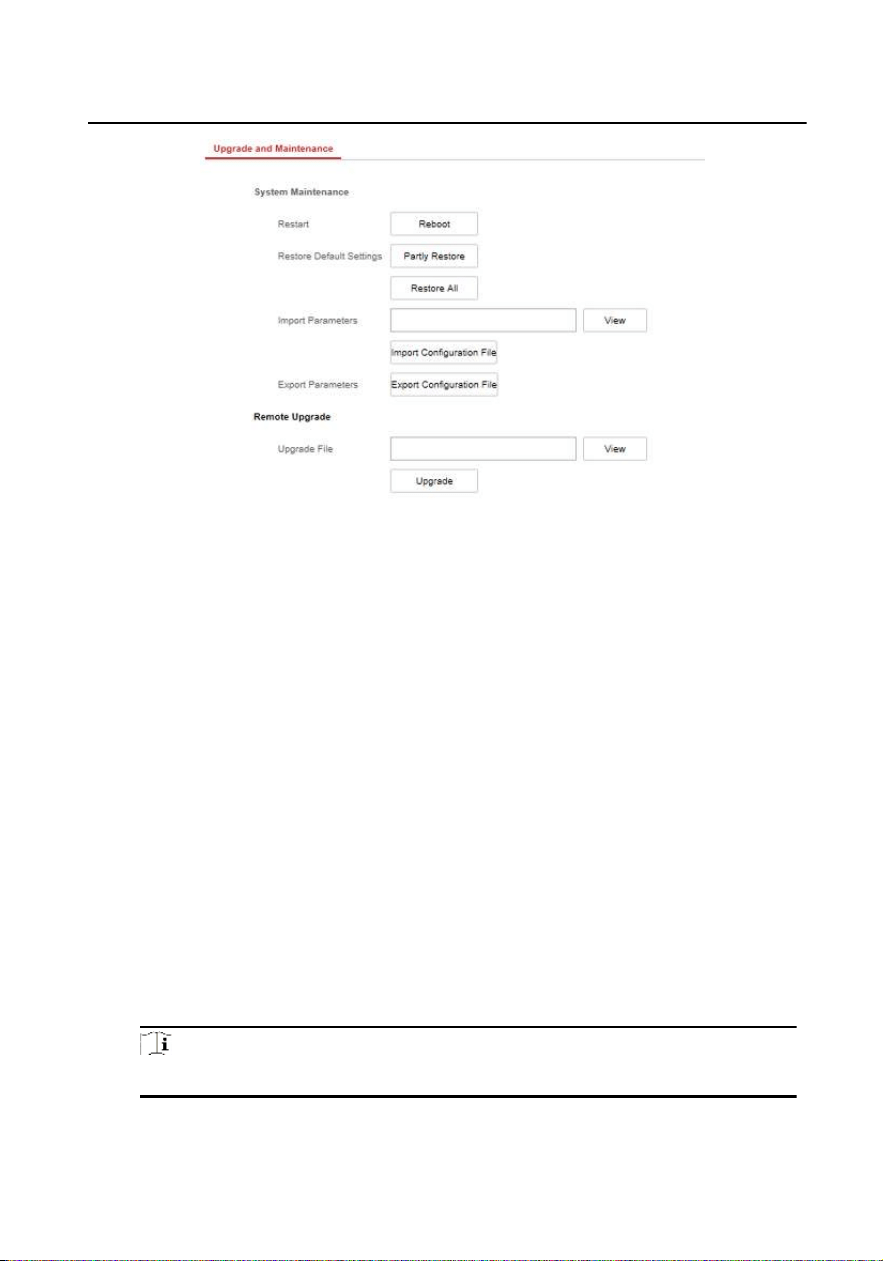
Figure 8-3 System Maintenance
Restart
Click Reboot to reboot the device.
Restore Default Sengs
Click Partly Restore to restore all parameters except for admin user informaon,
wired network, Wi-Fi network, detector informaon, and peripheral informaon
to default ones.
Click Restore All to restore all parameters to the factory sengs.
Import Parameters
Click View to select conguraon le from the PC and click Import Conguraon
File to import conguraon parameters to the device.
Export Parameters
Click Export Conguraon File to export the device conguraon parameters to
the PC.
Upgrade File
Click View to select an upgrade le from the PC and click Upgrade to upgrade
the device remotely.
Note
Do not power o when the device is upgrading.
Security Radar User Manual
31
8.4 View Device Informaon
Select the device and click Remote Conguraon in iVMS-4200, or Enter the device
IP address in the address bar of the web broswer. Click System Device →
Informaon to enter the page.
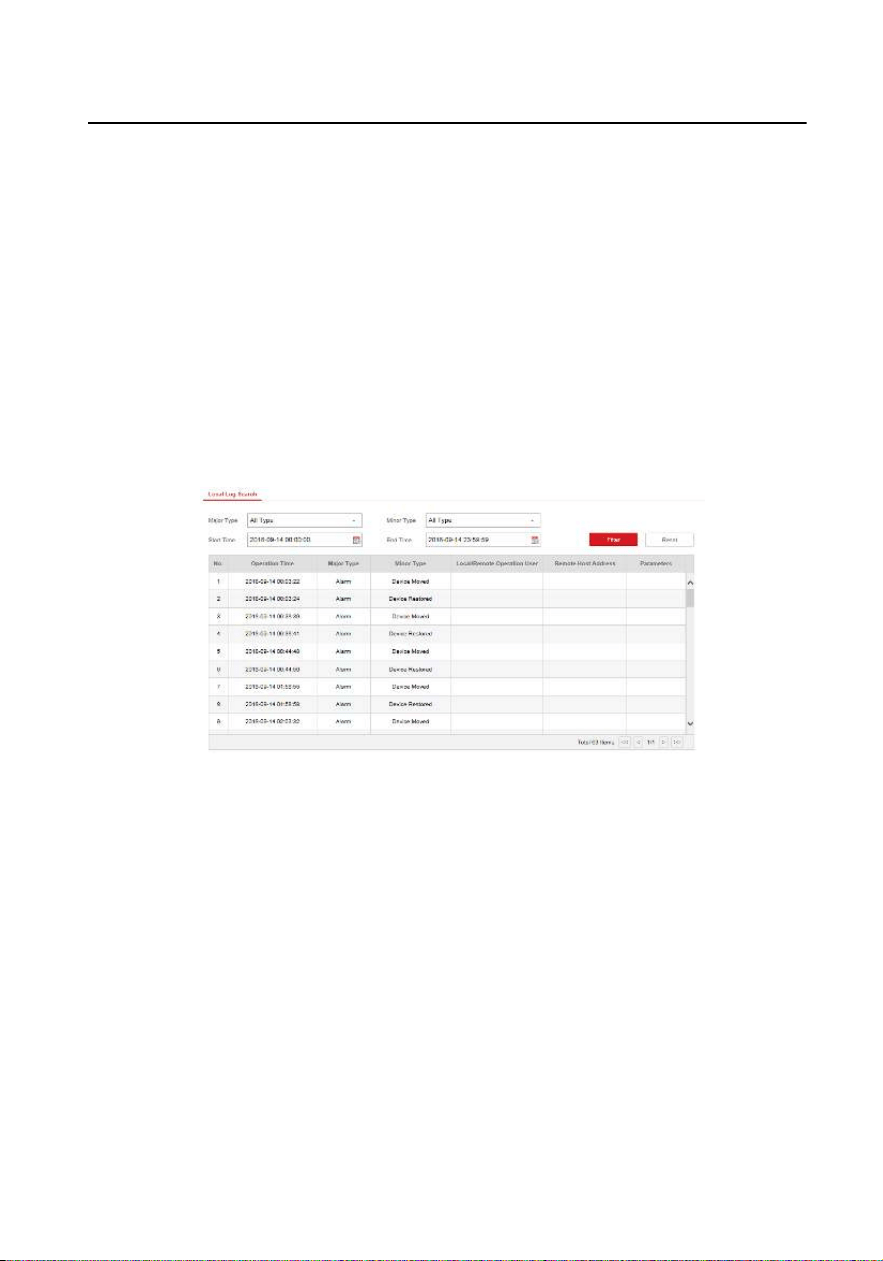
8.5 Search Log
Steps
1.
Select the device and click Remote Conguraon in iVMS-4200, or enter the
device IP address in the address bar of the web browser. Click System → Local
Log Search to enter the page.
Figure 8-4 Log
2.
Select Log Type and Time, and click Search to get the log list.
Security Radar User Manual
32
A. Radar Mounng Height
Recommendaon
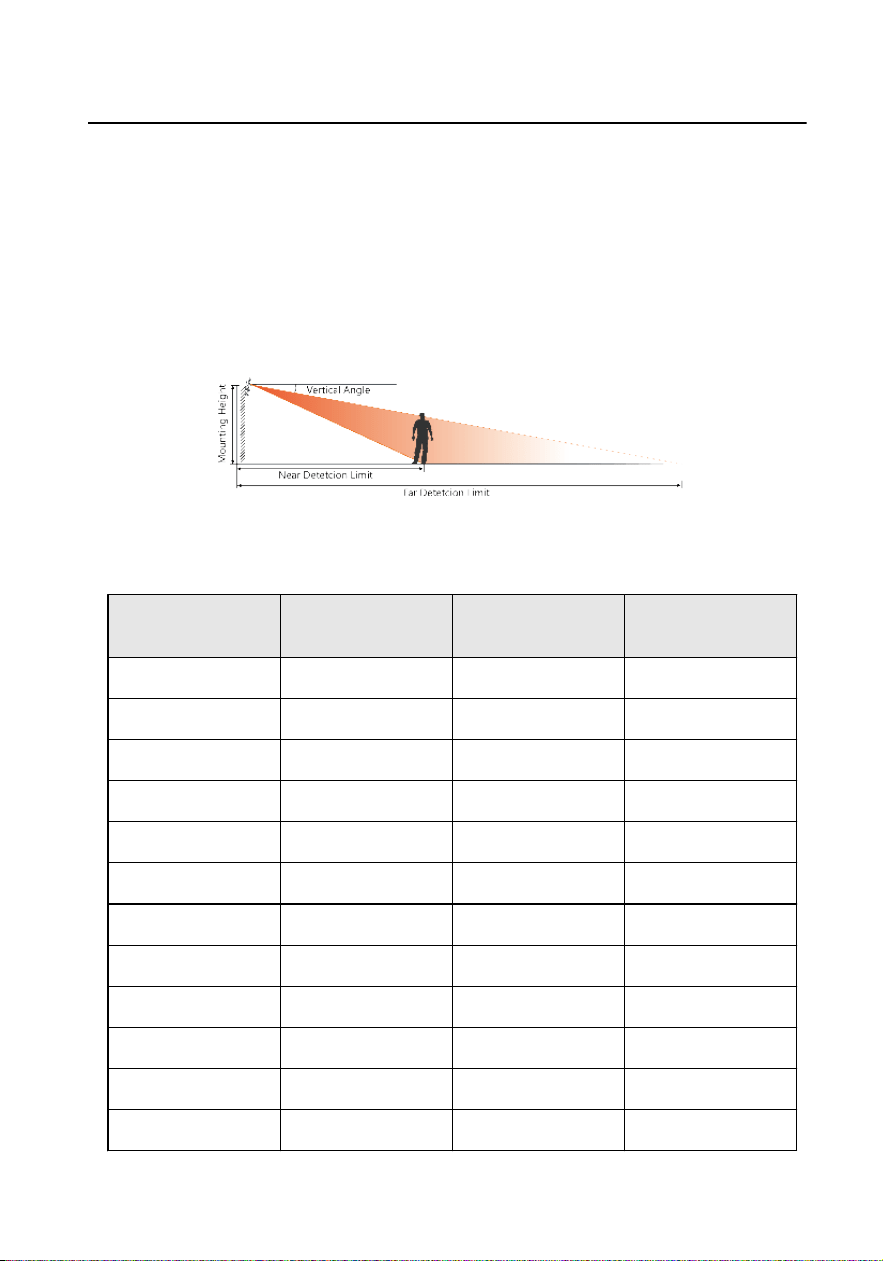
The recommended installaon height is 2 to 3 m.
The following table shows the detecon range at dierent mounng heights.
Figure A-1 Radar Mounng Height and Detecon Range
Table A-1 Radar Mounng Height and Detecon Range
Mounng Height Vercal Angle Far Detcon Limit Near Detecon
Limit
1.5 m 0° 59 m 1.91 m
1.5 m 3° 59.2 m 1.98 m
1.5 m 6° 59.4 m 1.87 m
1.5 m 9° 52 m 2.3 m
2.0 m 0° 59.4 m 1.8 m
2.0 m 3° 59.4 m 2.19 m
2.0 m 6° 59 m 1.72 m
2.0 m 9° 59.62 m 2.2 m
3.0 m 0° 58.4 m 4.62 m
3.0 m 3° 59.6 m 4.21 m
3.0 m 6° 59.51 m 3.42 m
3.0 m 9° 58 m 2.9 m
Security Radar User Manual
33
Mounng Height Vercal Angle Far Detcon Limit Near Detecon
Limit
3.5 m 0° 57.17 m 5.5 m
3.5 m 3° 59.5 m 3.9 m
3.5 m 6° 58.51 m 3.86 m
3.5 m 9° 56.25 m 3.8 m
4.0 m 0° 58 m 7.36 m
4.0 m 3° 59.4 m 5.7 m
4.0 m 6° 58.5 m 5.6 m
4.0 m 9° 59.79 m 4.4 m
Security Radar User Manual
34

B. Formang Descripon
You can restore all parameters to default sengs for formang the security radar by
the reset buon.
You can format the device as follows.
Steps
1.
Power o the radar, and then hold the reset buon while powering the radar on.
2.
Keep holding unl the red and green LED ashes for six mes, then release the
reset buon and the radar will restart again.
3.
All parameters will be restored to default values aer the radar restarts, and you
need to reacvate the radar.
Security Radar User Manual
35
C. Indicator Descripon
The indicator status descripon of the radar:
Table C-1 Indicator Descripon
Indicator Status
Solid Green Radar Powered on
Solid Red Zone Alarm Occurred
Flashing Red and Green Radar Network Disconnecon/Radar Excepon
Security Radar User Manual
36

D. FAQ
D.1 How to Achieve an Opmum Detecon Range?
Answer:
You can refer to Radar Mounng Height Recommendaon for installaon of radar,
and you should test the radar aer installaon to make sure it is properly mounted.
The far detecon limit of the radar should be more than 58 m, and the near
detecon limit should be no more than 8 m. The test method is as follows:
The near detecon distance: Arrange a tester to move directly below the radar
installaon posion towards the radar detecon area. When the target track rst
appears in the detecon area, the tester stops moving. The radial distance between
the current tester and the radar installaon posion is measured and recorded,
which is the near detecon distance.
The far detecon distance: Arrange a tester to move from the directly ahead of the
radar and far away from the radar installaon posion (outside the radar detecon
area) to the radar detecon area. When the target track rst appears in the
detecon area, the tester stops moving. The radial distance between the current
tester and the radar installaon posion is measured and recorded, which is the far
detecon limit.
Note
•
Make sure that there is only one target (tester) in the detecon area.
•
When tesng the far detecon distance, the tester is required to move along the
center normal of the detecon area, to ensure opmum far detecon distance.
According to the tested near detecon distance and far detecon distance, and refer
to Table A-1 Radar Mounng Height and Detecon Range to adjust the radar
mounng angle. The radar mounng angle can be adjusted in the following ways:
•
If the radial distance between the radar and the target (track) is more than 8 m,
you should adjust the radar downward for about 3°.
•
If the farthest radial distance of the radar is less than 58 m, you should adjust
the radar upward for about 3°.
D.2 How to Adjust the Sensivity to Avoid False
Alarm?
Security Radar User Manual
37

Answer:
•
If there are shrubs in the radar led, set the radar sensivity mode as Shrub
Mode, which helps avoid the false alarm caused by gale, storm, or shrub swing.
•
If Shrub Mode is not saed, set the sensivity mode as Expert Mode (Custom
Mode). Set the Signal Sensivity less than or equal to two, the Swing Sensivity
less than ve, and the Tracking Sensivity less than or equal to ve.
D.3 How to Raise the Precision of Camera Tracking?
Answer:
•
Check if the speed dome inial posion is set, if not, please set the speed dome
inial posion.
•
Check if the calibraon points are correct. Pay aenon to the situaon that the
target is intercepted when calibrang. If the calibraon points are error, please
calibrate again.
•
Check if the calibraon posions is equally distributed when you set the mul-
point calibraon.
•
Do not move the speed dome manually aer the calibraon. If the speed dome
is manually moved, please reset the inial posion of the speed dome and then
calibrate again.
D.4 How to Solve the Problem that No Reference
Point is on the Frame While Seng the Speed Dome
Inial Posion?
Answer:
If the speed dome is lted, it may cause that the reference point is above the center
of the frame or outside the frame while seng the speed dome inial posion. In
this case, you should adjust the maximum elevaon angle of the speed dome as
follows.
Steps
1.
Enter the IP address of the speed dome in the web browser to enter the web
client.
2.
Click
to expand the PTZ list on the Live View page, and then click to enter
the main menu of the speed dome.
Security Radar User Manual
38
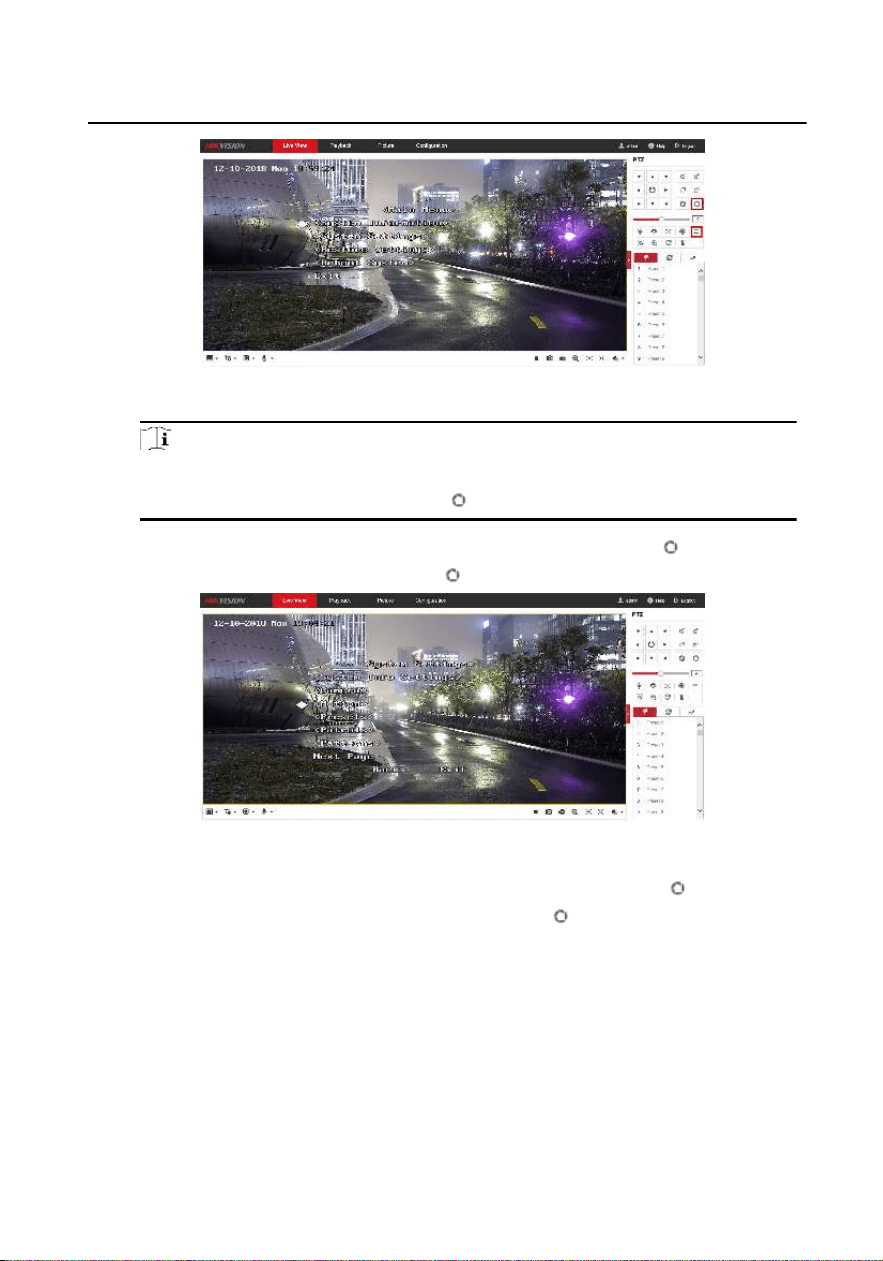
Figure D-1 The Main Menu of Speed Dome
Note
You can adjust the cursor for menu selecon by clicking the up and down
direcon keys in the PTZ list, and click
to enter the selected item.
3.
Adjust the cursor to System Sengs in the main menu and click
. And then
adjust the cursor to Moon and click
to enter the page.
Figure D-2 Moon
4.
Adjust the cursor to Next Page in the sport mode menu and click
. And then
adjust the cursor to Max Ele Angle (DEG) and click
to enter the page.
Security Radar User Manual
39
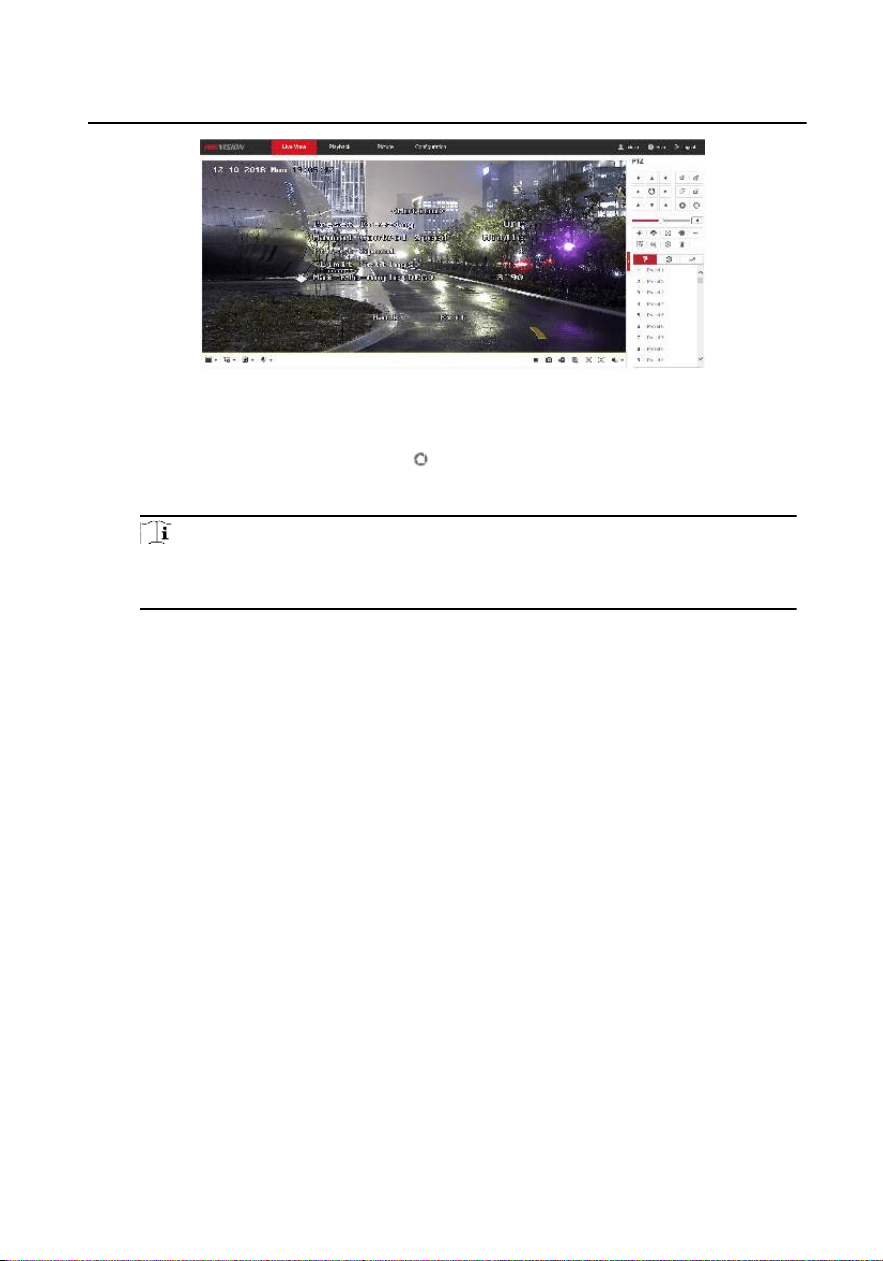
Figure D-3 Maximum Elevaon Angle Adjustment
5.
Click up and down direcon keys in the PTZ list to adjust the maximum elevaon
angle, and then you need to click
to save the sengs.
6.
Adjust the cursor to Exit to exit the menu.
Note
You need to reset the speed dome inial posion aer the maximum elevaon
angle adjustment.
D.5 What is the Reason that Failed to Draw a Zone
Automacally?
Answer:
•
The main reason is that the moving target (with track) does not form a closed-
loop. You can check if there is a clear intersecon of the track in the zone
drawing page. If the track does not closed, the drawn zone will be recognized as
an invalid zone.
•
When the object is moving for drawing a zone, if the track of the target is lost
and then appear again on the zone drawing page, and the distance between lost
posion and the posion the target appeared again is too far, the sengs will be
failed.
D.6 What Makes a Failed Arming?
Answer:
The following two condions will make a failed arming:
Security Radar User Manual
40

•
There are moving objects in the warning zone of radar.
•
The current status of radar is oine.
D.7 Why Is It Required to Remove Reecve Objects
from the Radar Area?
Answer:
•
When there are reecve objects in the radar applicaon scene, such as at
glass or large-area metal objects, the radar will produce mulpath eects, that
is, the people reect the signal from the radar to the large-area metal objects or
at glasses, and the large-area metal objects or at glasses reect the signal
again to the receiving end of the radar, thus there will be a false alarm. Since the
glasses are at and the reecon is concentrated, there may be a false alarm
when there are glasses in the radar scene.
•
The higher the sensivity, the more probability to trigger a false alarm.
Security Radar User Manual
41
UD12272B