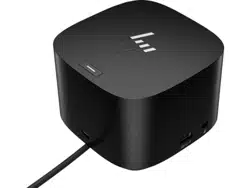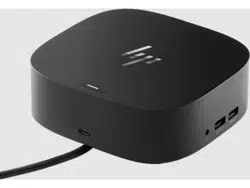
User Guide
SUMMARY
Learn how to install, configure, and use your device.

Legal information
© Copyright 2025 HP Development
Company, L.P.
AMD is a trademark of Advanced Micro
Devices, Inc. macOS is a trademark of
Apple Inc., registered in the U.S. and
other countries and regions. Bluetooth is a
trademark owned by its proprietor and used
by HP Inc. under license. ChromeOS is a
trademark of Google LLC. Intel, Thunderbolt,
and vPro are trademarks of Intel Corporation
or its subsidiaries in the U.S. and/or other
countries. Linux is a registered trademark
of Linus Torvalds in the U.S. and other
countries. NVIDIA and the NVIDIA logo are
trademarks and/or registered trademarks of
NVIDIA Corporation in the U.S. and other
countries. Windows is either a registered
trademark or trademark of Microsoft
Corporation in the United States and/or
other countries. USB Type-C and USB-C
are trademarks or registered trademarks of
USB Implementers Forum, Inc. DisplayPort
and the DisplayPort logo are trademarks or
registered trademarks owned by the Video
Electronics Standards Association (VESA) in
the United States and other countries. Wi-Fi
is a registered trademark of Wi-Fi Alliance.
The information contained herein is subject
to change without notice. The only
warranties for HP products and services are
set forth in the express warranty statements
accompanying such products and services.
Nothing herein should be construed as
constituting an additional warranty. HP shall
not be liable for technical or editorial errors
or omissions contained herein.
Second Edition: March 2025
First Edition: February 2025
Document part number: P04603-002
Product notice
This guide describes features that are
common to most products. Some features
might not be available on your computer.
Not all features are available in all editions or
versions of Windows. Systems might require
upgraded and/or separately purchased
hardware, drivers, software, or BIOS
update to take full advantage of Windows
functionality. Windows is automatically
updated, which is always enabled. High-
speed internet and Microsoft account
required. ISP fees might apply and additional
requirements might apply over time for
updates. See
http://www.windows.com. If
your product ships with Windows in S
Mode: Windows in S Mode works exclusively
with apps from the Microsoft Store within
Windows. Certain default settings, features,
and apps cannot be changed. Some
accessories and apps that are compatible
with Windows might not work (including
some antivirus, PDF writers, driver utilities,
and accessibility apps), and performance
might vary, even if you switch out of S
Mode. If you switch to Windows, you cannot
switch back to S Mode. Learn more at
Windows.com/SmodeFAQ.
To access the latest user guides, go to
http://www.hp.com/support, and follow the
instructions to find your product. Then select
Setup & User Guides.
To help us improve this document, please
send any suggestions, comments, or errors
to
mailto:hp.doc.feedback@hp.com. Include
the document part number when submitting
your feedback.
Software Terms
By installing, copying, downloading, or
otherwise using any software product
preinstalled on this computer, you agree
to be bound by the terms of the HP End
User License Agreement (EULA). If you
do not accept these license terms, your
sole remedy is to return the entire unused
product (hardware and software) within 14
days for a full refund subject to the refund
policy of your seller.
For any further information or to request
a full refund of the price of the computer,
please contact your seller.

Table of contents
1 About this guide..................................................................................................................................................................................................................................... 1
2 Getting started...................................................................................................................................................................................................................................... 2
Identifying components........................................................................................................................................................................................................... 2
Top................................................................................................................................................................................................................................................. 2
Front ............................................................................................................................................................................................................................................ 3
Right ............................................................................................................................................................................................................................................5
Left................................................................................................................................................................................................................................................6
Rear...............................................................................................................................................................................................................................................7
Setting up the docking station............................................................................................................................................................................................8
Connecting to AC power..............................................................................................................................................................................................8
Connecting to a computer........................................................................................................................................................................................ 12
Using an external monitor .........................................................................................................................................................................................14
Configuring the monitor ............................................................................................................................................................................................. 14
Setting up the software.......................................................................................................................................................................................................... 14
Poly Lens ................................................................................................................................................................................................................................ 15
Quick Connect................................................................................................................................................................................................................... 16
myHP..........................................................................................................................................................................................................................................17
Updating docking station firmware.................................................................................................................................................................... 18
Sleep, Hibernation, shutdown, and restart....................................................................................................................................................19
3 Using the docking station ........................................................................................................................................................................................................... 21
Docking station guidelines................................................................................................................................................................................................... 21
Setting the security level....................................................................................................................................................................................................... 21
Connecting to a network...................................................................................................................................................................................................... 22
HP Sure Start for Docks........................................................................................................................................................................................................ 22
Connecting USB devices ..................................................................................................................................................................................................... 23
Connecting a DisplayPort device .................................................................................................................................................................................. 23
Connecting an HDMI device...............................................................................................................................................................................................24
Connecting a Thunderbolt device using a USB Type-C Thunderbolt cable.................................................................................... 25
Connecting an optional security cable...................................................................................................................................................................... 25
4 Manageability Features...............................................................................................................................................................................................................27
Network manageability ..........................................................................................................................................................................................................27
Cloud manageability with Poly Lens............................................................................................................................................................................. 28
Dock configuration page...................................................................................................................................................................................................... 29
5 Disconnecting the docking station.....................................................................................................................................................................................30
6 Troubleshooting ................................................................................................................................................................................................................................. 31
Solving common problems..................................................................................................................................................................................................31
iii

General use and connection problems........................................................................................................................................................... 31
Video problems................................................................................................................................................................................................................ 33
Poly Lens problems .......................................................................................................................................................................................................35
Dock configuration page problems ..................................................................................................................................................................35
Getting more information ....................................................................................................................................................................................................36
Contacting support..................................................................................................................................................................................................................36
7 Specifications......................................................................................................................................................................................................................................37
Input power......................................................................................................................................................................................................................................37
Operating environment..........................................................................................................................................................................................................37
8 Accessibility ........................................................................................................................................................................................................................................39
HP and accessibility.................................................................................................................................................................................................................39
Finding the technology tools you need...........................................................................................................................................................39
The HP commitment.....................................................................................................................................................................................................39
International Association of Accessibility Professionals (IAAP)..................................................................................................40
Finding the best assistive technology.............................................................................................................................................................40
Assessing your needs .....................................................................................................................................................................................40
Accessibility for HP products.....................................................................................................................................................................40
Standards and legislation .................................................................................................................................................................................................... 41
Standards.............................................................................................................................................................................................................................. 41
Mandate 376 – EN 301 549 ............................................................................................................................................................................. 41
Web Content Accessibility Guidelines (WCAG).............................................................................................................................. 41
Legislation and regulations..................................................................................................................................................................................... 42
Useful accessibility resources and links .................................................................................................................................................................. 42
Organizations.................................................................................................................................................................................................................... 42
Educational institutions ............................................................................................................................................................................................. 42
Other disability resources .......................................................................................................................................................................................43
HP links................................................................................................................................................................................................................................... 43
Contacting support.................................................................................................................................................................................................................. 43
Index................................................................................................................................................................................................................................................................44
iv
About this guide1
This guide provides basic information for using and upgrading this product.
WARNING! Indicates a hazardous situation that, if not avoided, could result in serious injury or death.
CAUTION: Indicates a hazardous situation that, if not avoided, could result in minor or moderate
injury.
IMPORTANT: Indicates information considered important but not hazard-related (for example,
messages related to property damage). Warns the user that failure to follow a procedure exactly as
described could result in loss of data or in damage to hardware or software. Also contains essential
information to explain a concept or to complete a task.
NOTE: Contains additional information to emphasize or supplement important points of the main text.
TIP: Provides helpful hints for completing a task.
This product incorporates HDMI® technology.
About this guide
1
Getting started2
After identifying the components of the docking station, you can connect a computer, monitor, and other
devices.
Identifying components
This section identifies the visible hardware features of the docking station and provides setup
instructions.
NOTE: Your computer might not be equipped to take advantage of all the features available on the
docking station.
Top
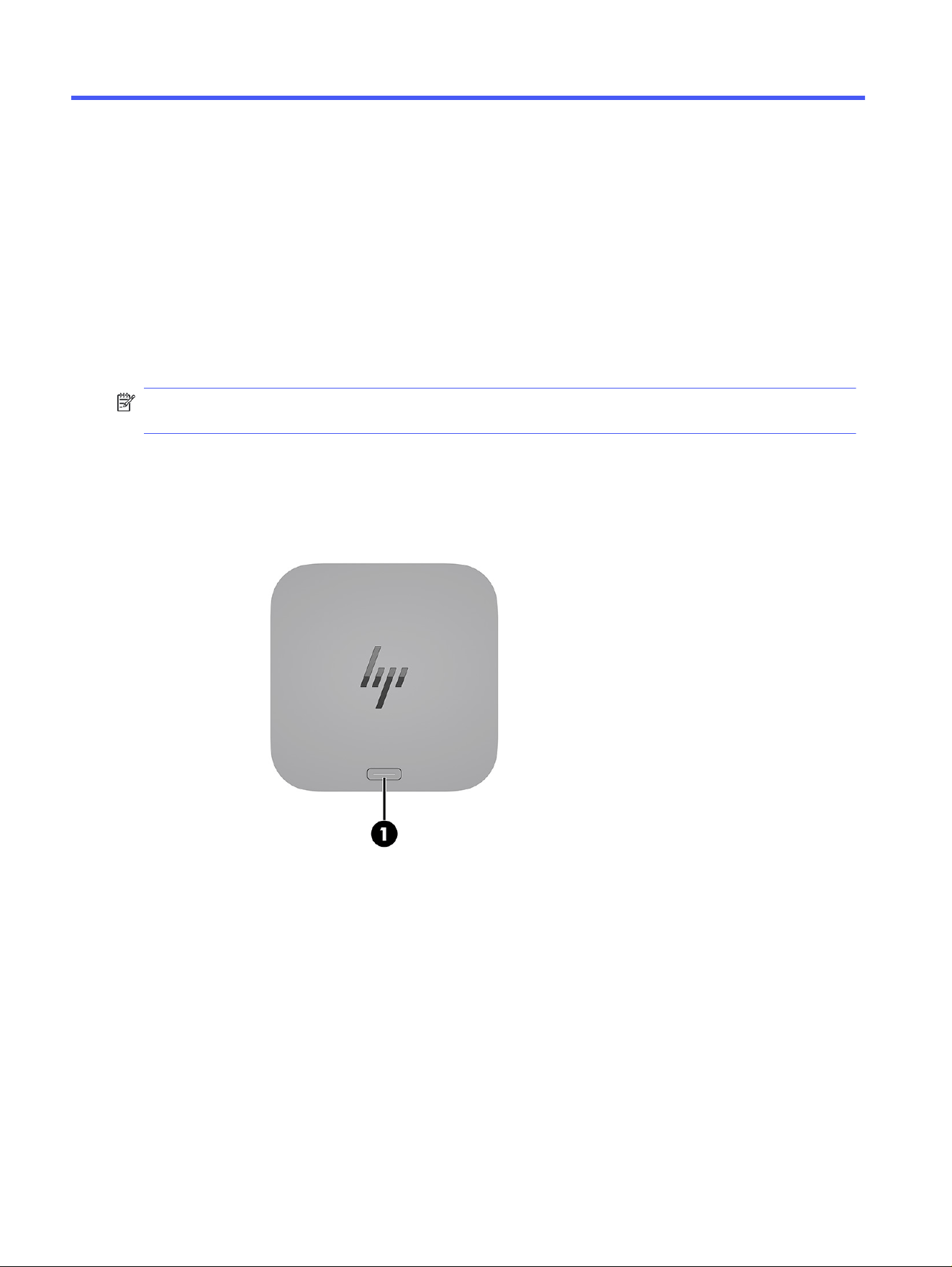
This illustration and table describe the component on the top of the docking station.
2
Chapter 2 Getting started

Table 2-1 Top component and its description
Component Description
(1) Power button and light When a computer is connected to the dock, press to turn on
the computer.
NOTE: This button is functional only when the docking
station is connected to supported HP computers or
computers that follow the USB PD specification to
implement Extended Alert Events.
● Solid white: The computer connected to the docking
station is on.
Quick Connect is ready.
● Blinking white: The computer connected to the docking
station is on, off, or in hibernation.
Blinking white: Quick Connect is warming up.
Factory reset in progress.
● Off: The computer connected to the docking station
is off or in Hibernation. Hibernation is a power-saving
state that uses the least amount of power.
● Solid blue for 3 s: The computer is connected to docking
station Wi-Fi® or router Wi-Fi.
Onboarding/provisioning was successful.
● Blinking blue (fast): The computer is attempting to
connect to docking station Wi-Fi.
● Blinking blue (slow): Wi-Fi AP mode active.
Bulk or single onboarding in progress.
● Blinking amber (slow): Firmware download or update in
progress.
● Solid green for 3 s: Firmware update was successful.
● Solid red for 3 s: Firmware update failed.
● Blinking red: Docking station failure.
Front
This illustration and table describe the components on the front of the docking station.
Front
3
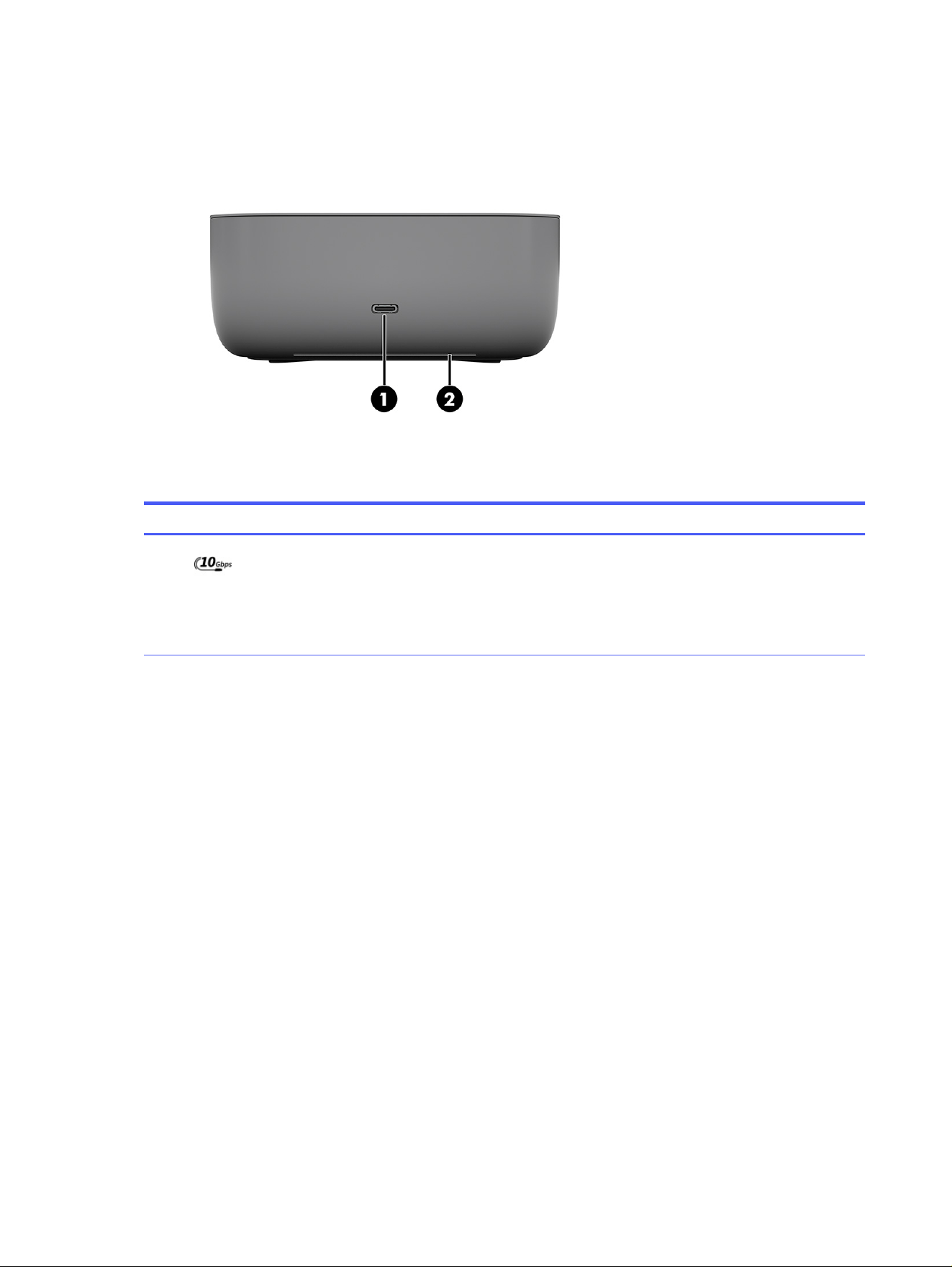
Table 2-2 Front components and their descriptions
Component Description
(1) USB Type-C® port with data and power out Connects a USB device, provides high-speed data transfer,
and (for select products) charges small devices (such as a
smartphone) when the computer is on or in sleep mode.
NOTE: Use a standard USB Type-C charging cable or cable
adapter (purchased separately) when charging a small
external device.
4 Chapter 2 Getting started

Table 2-2 Front components and their descriptions (continued)
Component Description
(2) Light bar ● Solid white: The computer connected to the docking
station is on.
Quick Connect is ready.
● Blinking white: The computer connected to the docking
station is on, off, or in hibernation.
Blinking white: Quick Connect is warming up.
Factory reset in progress.
● Off: The computer connected to the docking station
is off or in Hibernation. Hibernation is a power-saving
state that uses the least amount of power.
● Solid blue for 3 s: The computer is connected to docking
station Wi-Fi or router Wi-Fi connected.
Onboarding/provisioning was successful.
● Blinking blue (fast): The computer is attempting to
connect to docking station Wi-Fi.
● Blinking blue (slow): Wi-Fi AP mode active.
Bulk or single onboarding in progress.
● Blinking amber (slow): Firmware download or update in
progress.
● Solid green for 3 s: Firmware update was successful.
● Solid red for 3 s: Firmware update failed.
● Blinking red: Docking station failure.
Right
This illustration and table describe the components on the right side of the docking station.
Right
5
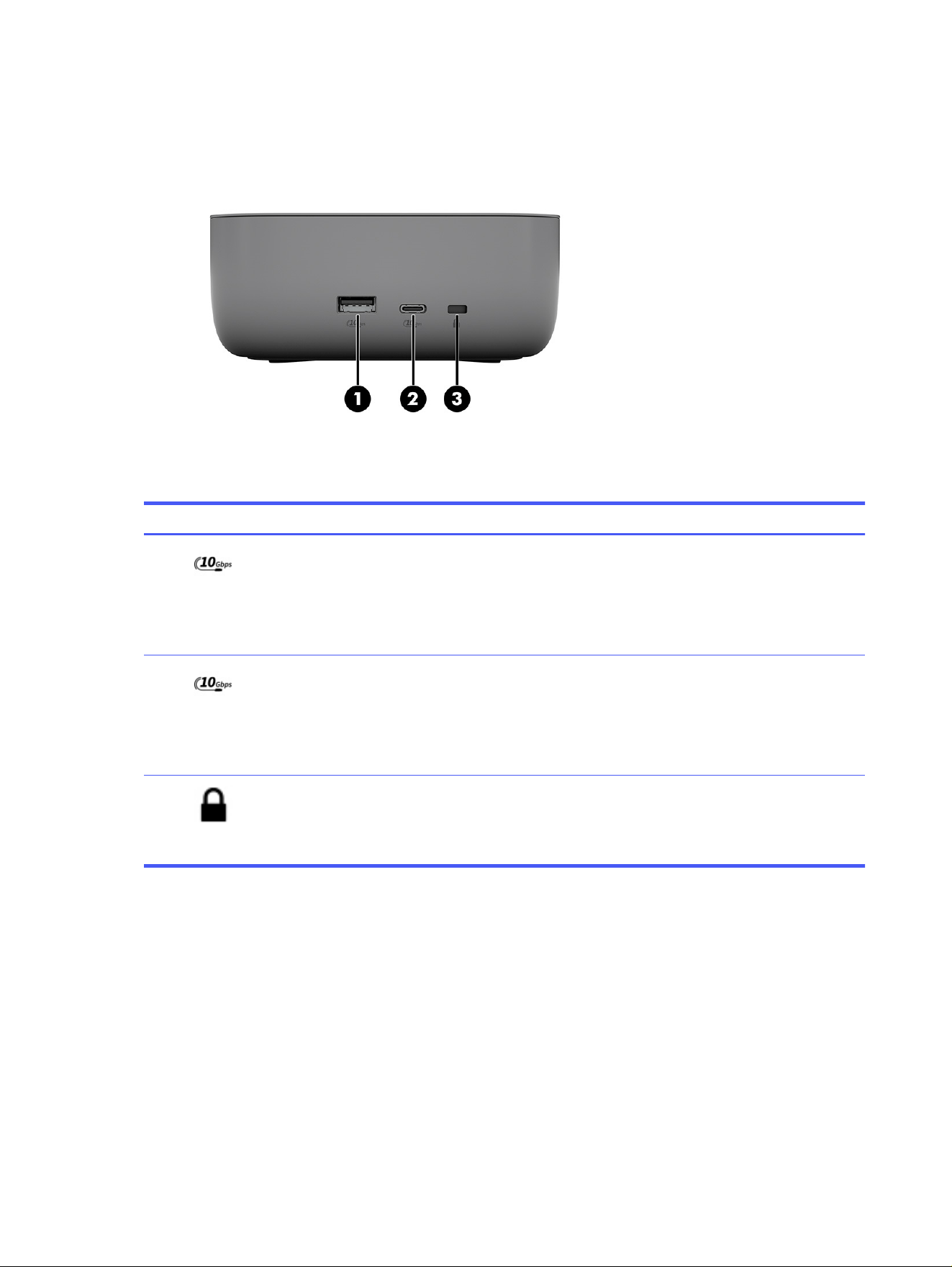
Table 2-3 Right components and their descriptions
Component Description
(1) USB 10 Gbps port with HP Sleep and Charge Connects a USB device, provides high-speed data transfer,
and charges small devices (such as a smartphone), even
when the computer is off.
NOTE: Use a standard USB Type-A charging cable or cable
adapter (purchased separately) when charging a small
external device.
(2) USB Type-C 10 Gbps port Connects a USB device, provides data transfer, and
(for select products) charges small devices (such as a
smartphone) when the computer is on or in sleep mode.
NOTE: Use a standard USB Type-C charging cable or cable
adapter (purchased separately) when charging a small
external device.
(3) Security cable slot Attaches an optional security cable to the docking station.
NOTE: The security cable is designed to act as a deterrent,
but it might not prevent the docking station from being
mishandled or stolen.
Left
This illustration and table describe the components on the left side of the docking station.
6
Chapter 2 Getting started
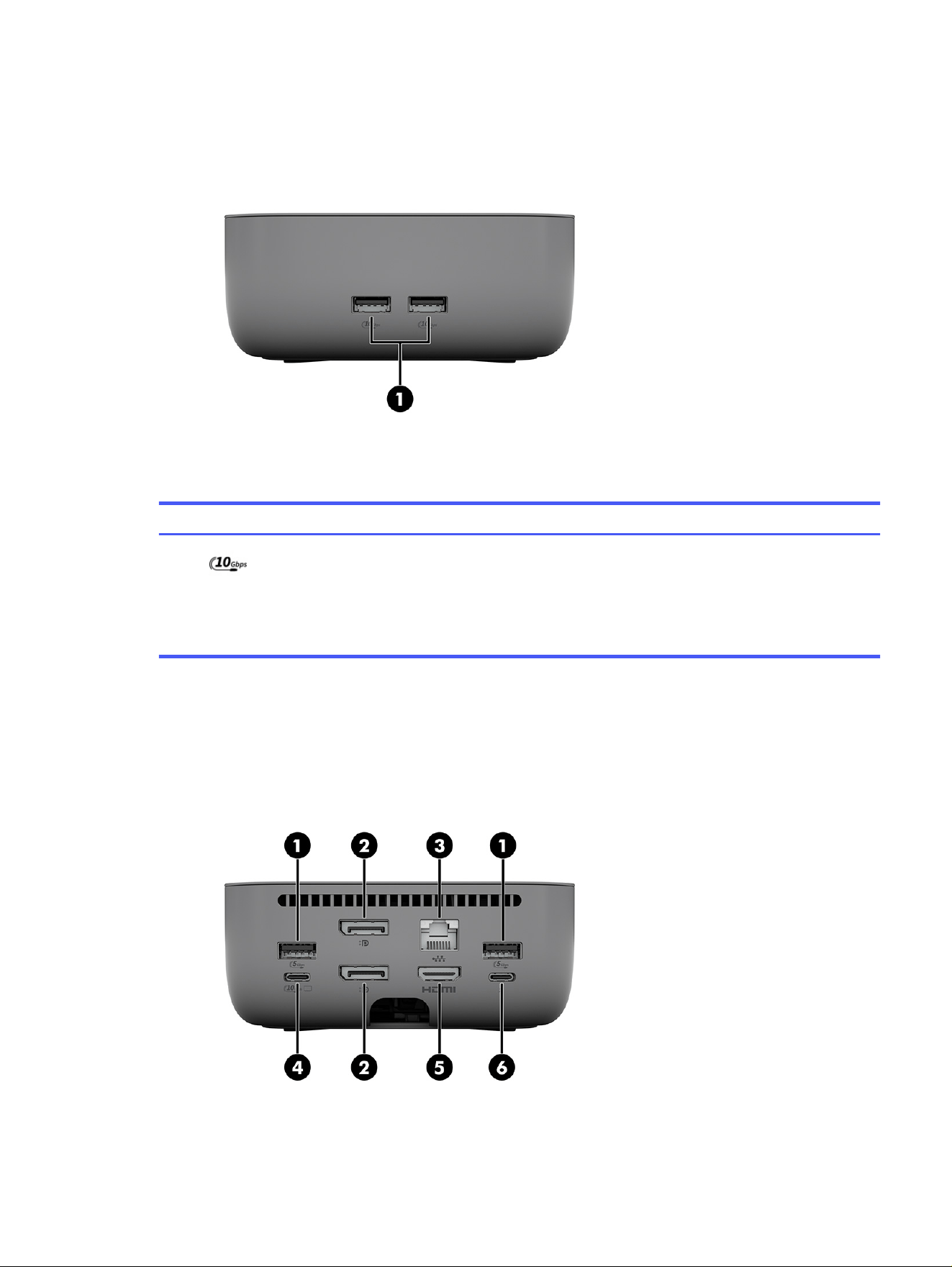
Table 2-4 Left-side components and their descriptions
Component Description
(1) USB 10 Gbps ports with HP Sleep and Charge
(2)
Connect a USB device, provides high-speed data transfer,
and charge small devices (such as a smartphone), even
when the computer is off.
NOTE: Use a standard USB Type-A charging cable or cable
adapter (purchased separately) when charging a small
external device.
Rear
This illustration and table describe the components on the rear of the docking station.
Rear
7
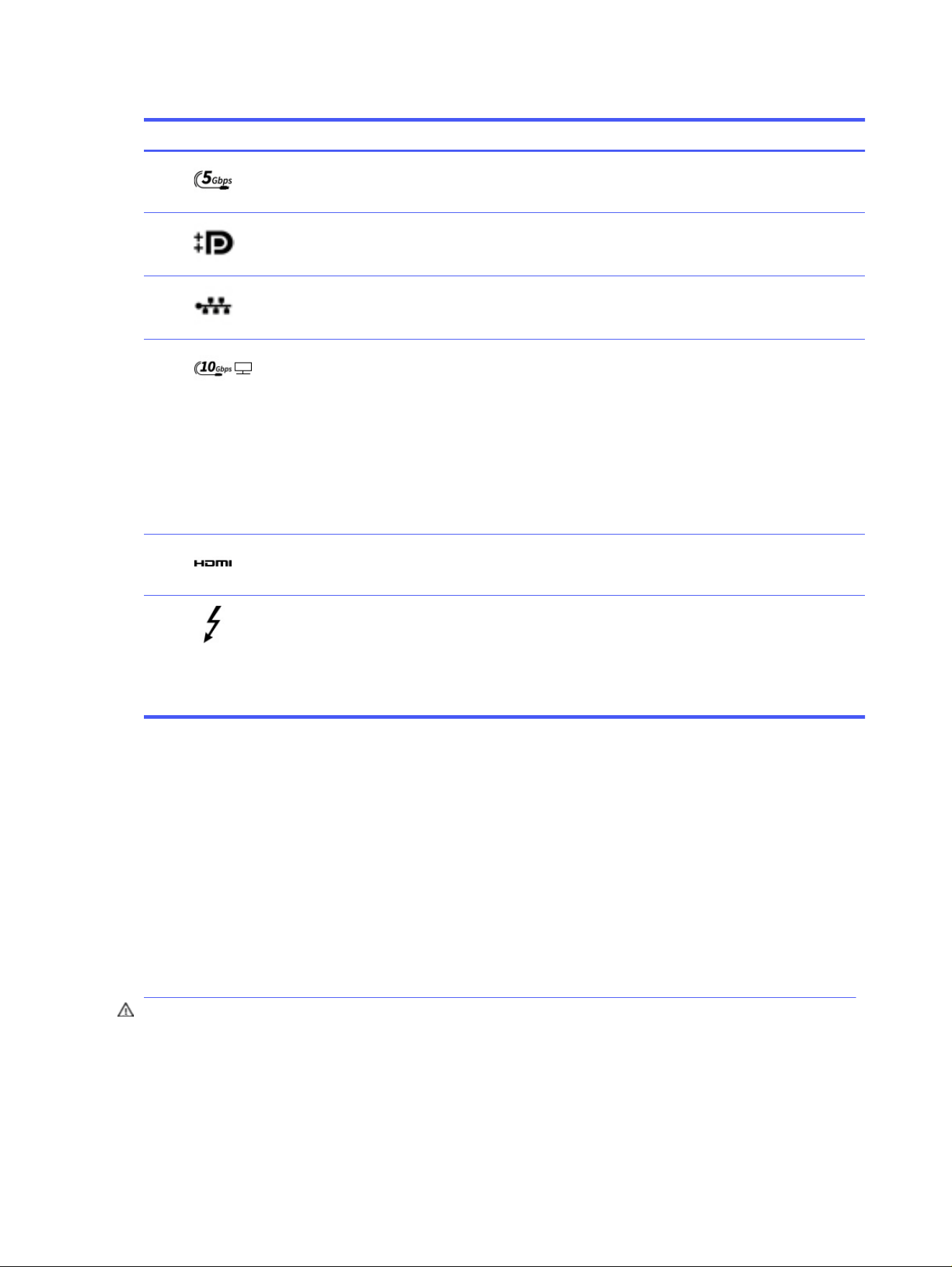
Table 2-5 Rear components and their descriptions
Component Description
(1) USB 5 Gbps ports (2) Connect a USB device, such as a cell phone, camera, activity
tracker, or smartwatch, and provide high-speed data transfer.
(2) Dual-mode DisplayPort™ connectors v1.4 (2) Connect an optional digital display device, such as a high-
performance monitor or projector.
(3) RJ-45 (network) jack Connects a network cable for up to 2.5 GB, with Intel® vPro®
enabled.
(4) USB Type-C 10 Gbps port with DisplayPort
output
Connects a USB device, provides high-speed data transfer,
and charges small devices (such as a smartphone), even
when the computer is off.
NOTE: Use a standard USB Type-C charging cable or cable
adapter (purchased separately) when charging a small
external device.
– and –
Connects a display device that has a USB Type-C connector,
providing DisplayPort output.
(5) HDMI port v2.1 Connects an external HDMI monitor.
(6) USB Type-C Thunderbolt 4 port Connects a USB device, provides high-speed data transfer,
and charges small devices (such as a smartphone), even
when the computer is off.
NOTE: Use a standard USB Type-C charging cable or cable
adapter (purchased separately) when charging a small
external device.
Setting up the docking station
To gain complete functionality, be sure that your dock is fully set up.
Connecting to AC power
Connect the docking station to an AC power source. When connected to power, the 180 W docking
station provides up to 180 W of power through the USB Type-C or Thunderbolt connector to a computer
that supports PD 3.1. The 280 W docking station provides up to 180 W of power through the USB Type-C
or Thunderbolt connector to a computer that supports PD 3.1 or up to 280 W to the computer with the
combination cable.
WARNING! To reduce the risk of electric shock or damage to the equipment:
● Plug the power cord into an AC outlet that is easily accessible at all times.
● Disconnect power from the equipment by unplugging the power cord from the AC outlet.
8
Chapter 2 Getting started
If provided with a 3-pin attachment plug on the power cord, plug the cord into a grounded (earthed)
3-pin outlet. Do not disable the power cord grounding pin, for example, by attaching a 2-pin adapter. The
grounding pin is an important safety feature.
To ensure the correct performance of all docking station features, connect the docking station to an AC
power source using the docking station power cord.
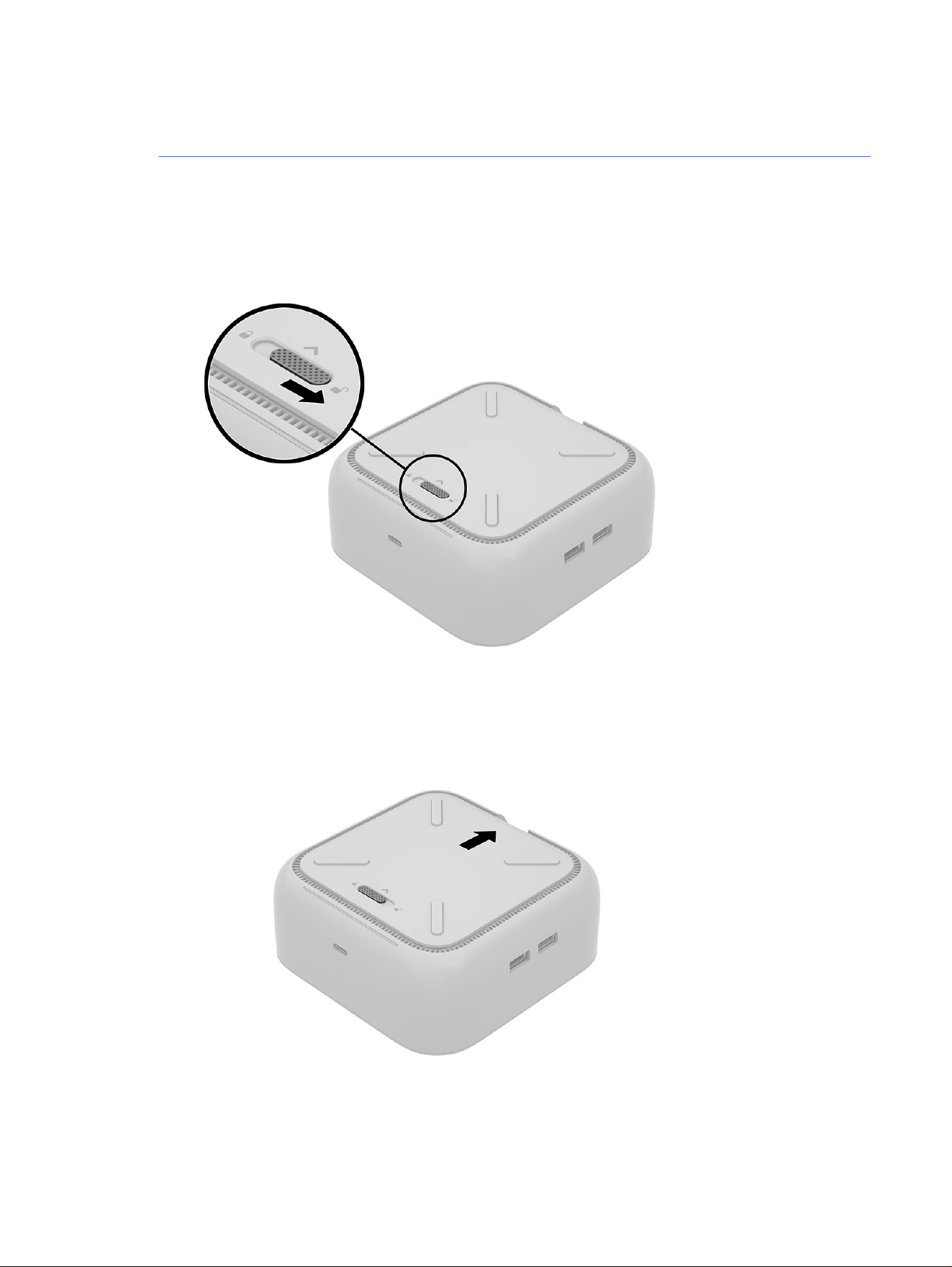
1. Position the docking station upside down.
2. Slide the locking switch to the unlock position.
3. Slide the cover back.
Connecting to AC power
9
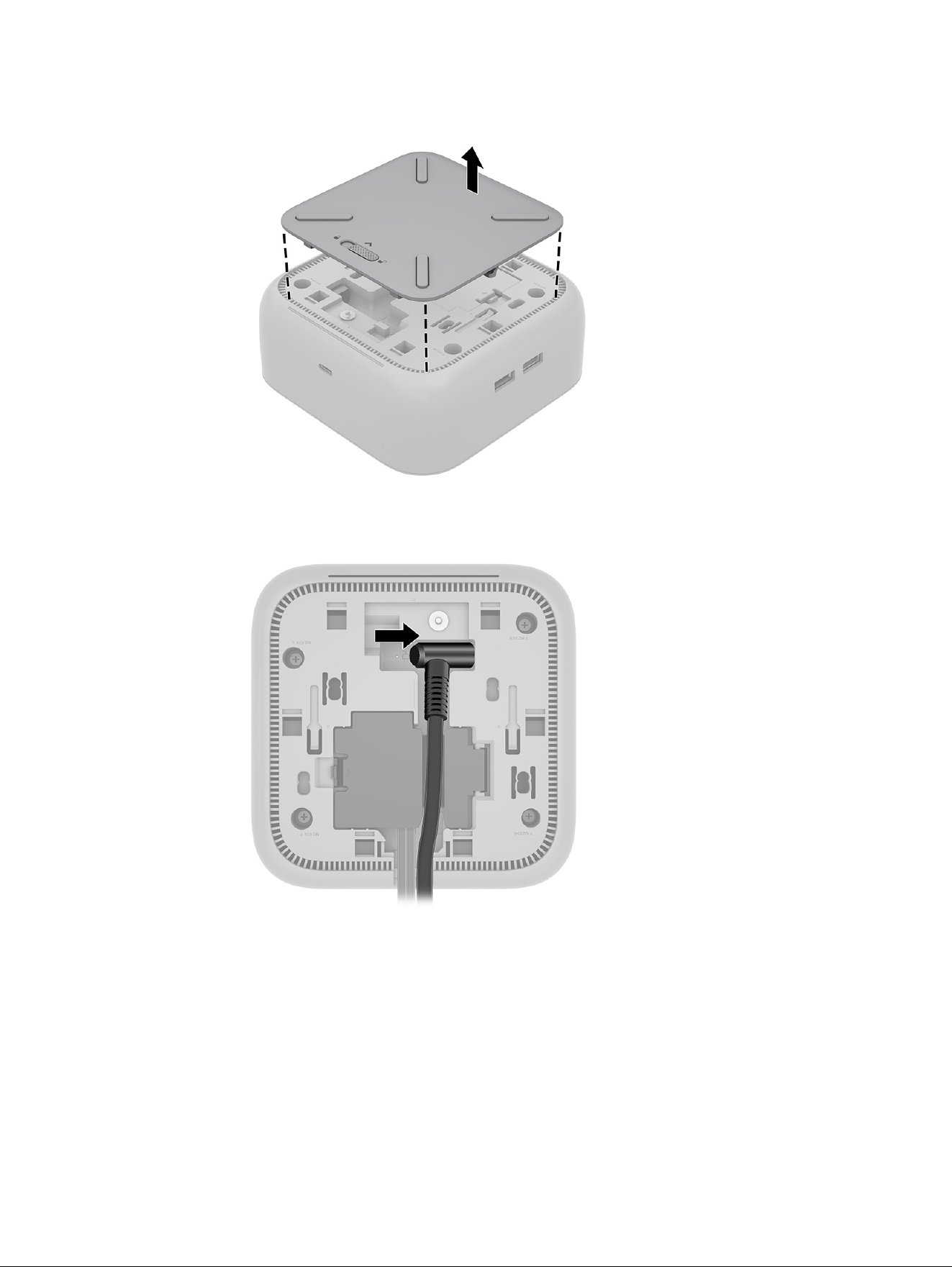
4. Lift the cover off the docking station.
5. Connect the AC adapter to the power connector inside the bottom of the docking station.
10
Chapter 2 Getting started
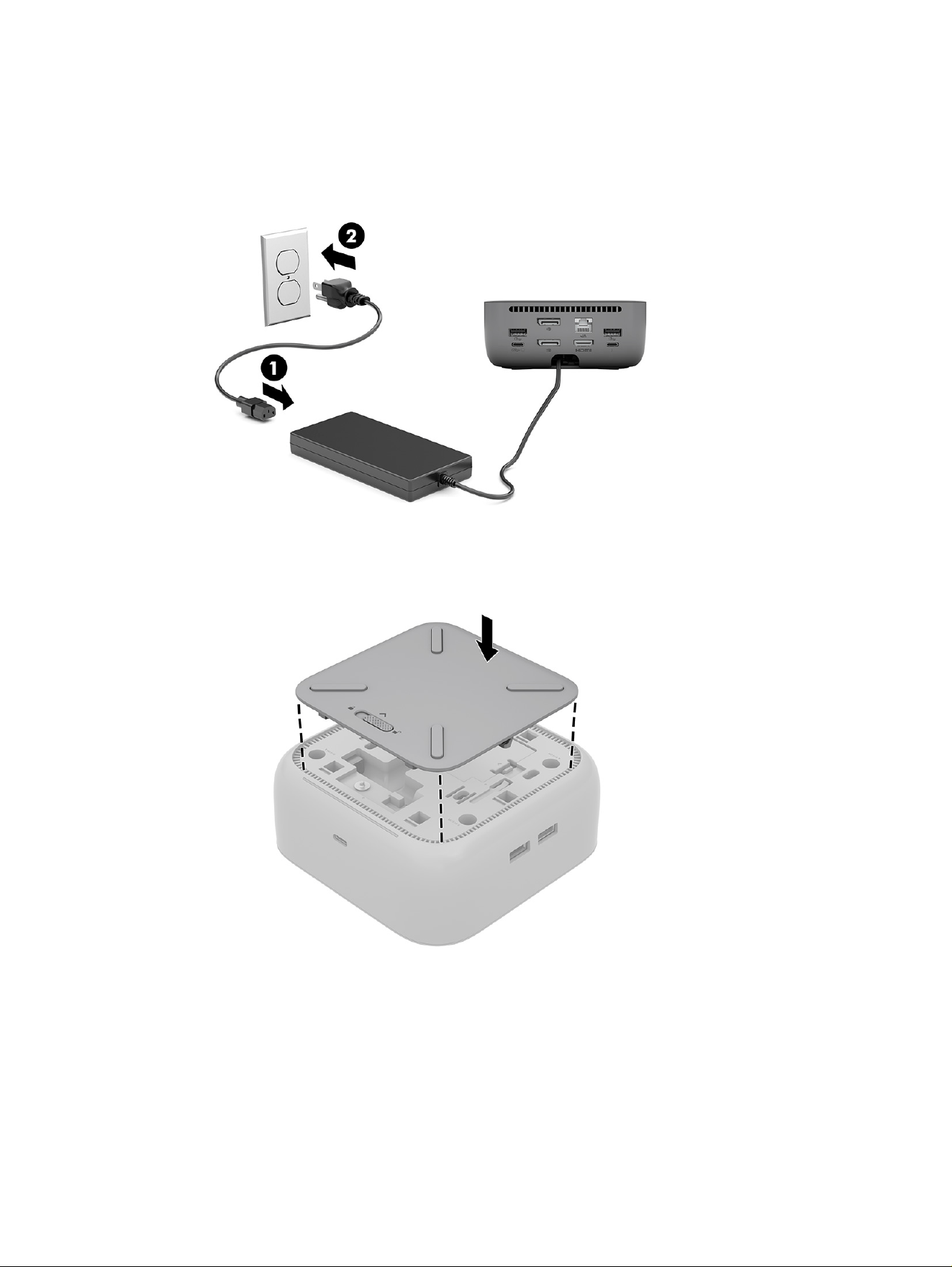
6. Connect one end of the power cord to the AC adapter (1), and connect the other end of the power
cord to an AC outlet (2).
7. Tuck the power cord into the bottom of the docking station.
8. Place the cover on the bottom of the docking station.
Connecting to AC power
11
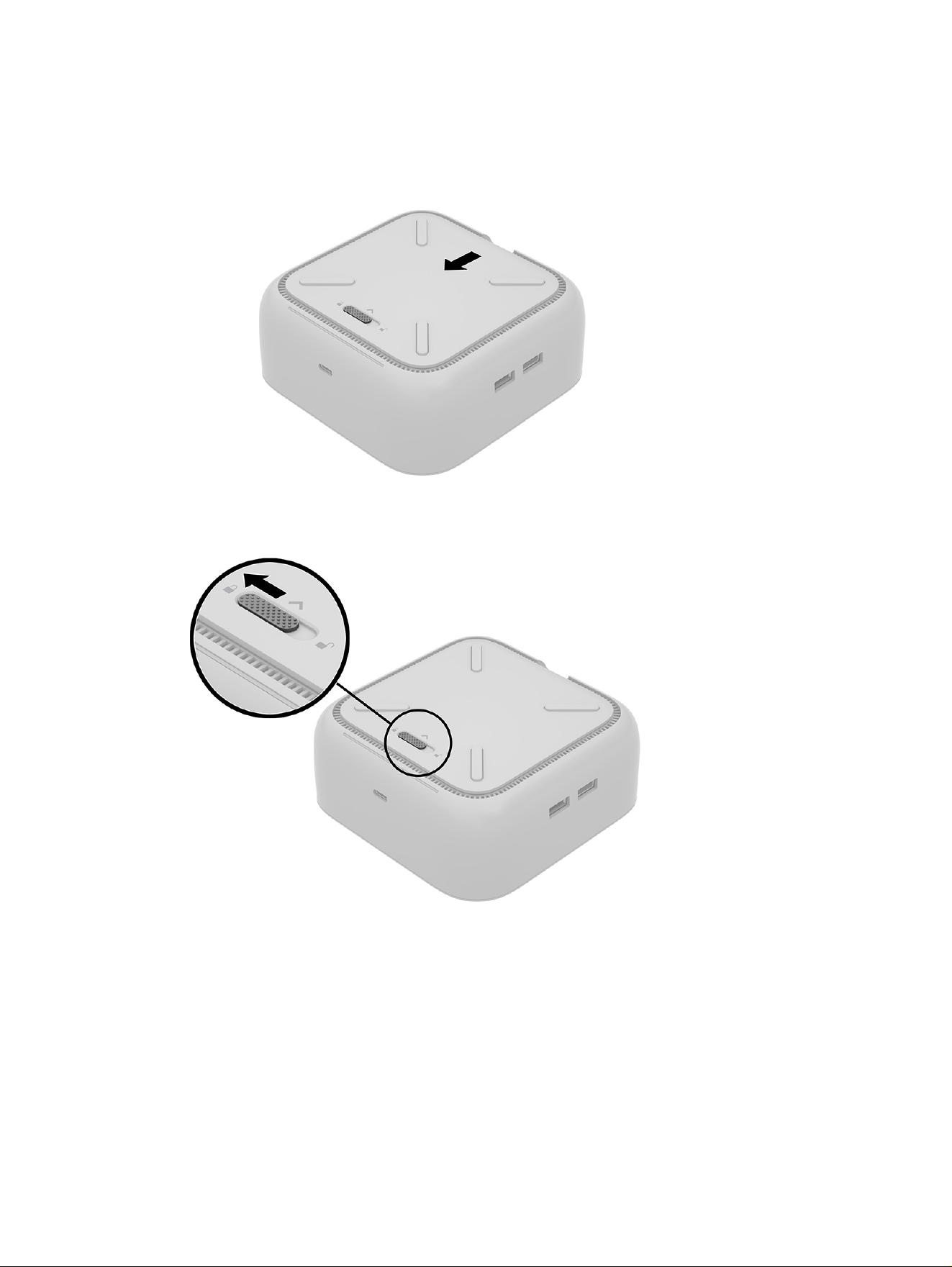
9. Slide the bottom cover forward until it clicks into place.
10. Slide the locking switch to the locked position.
Connecting to a computer
Connect a computer to the docking station using the USB Type-C cable or Thunderbolt 4 cable included
with the docking station.
12
Chapter 2 Getting started
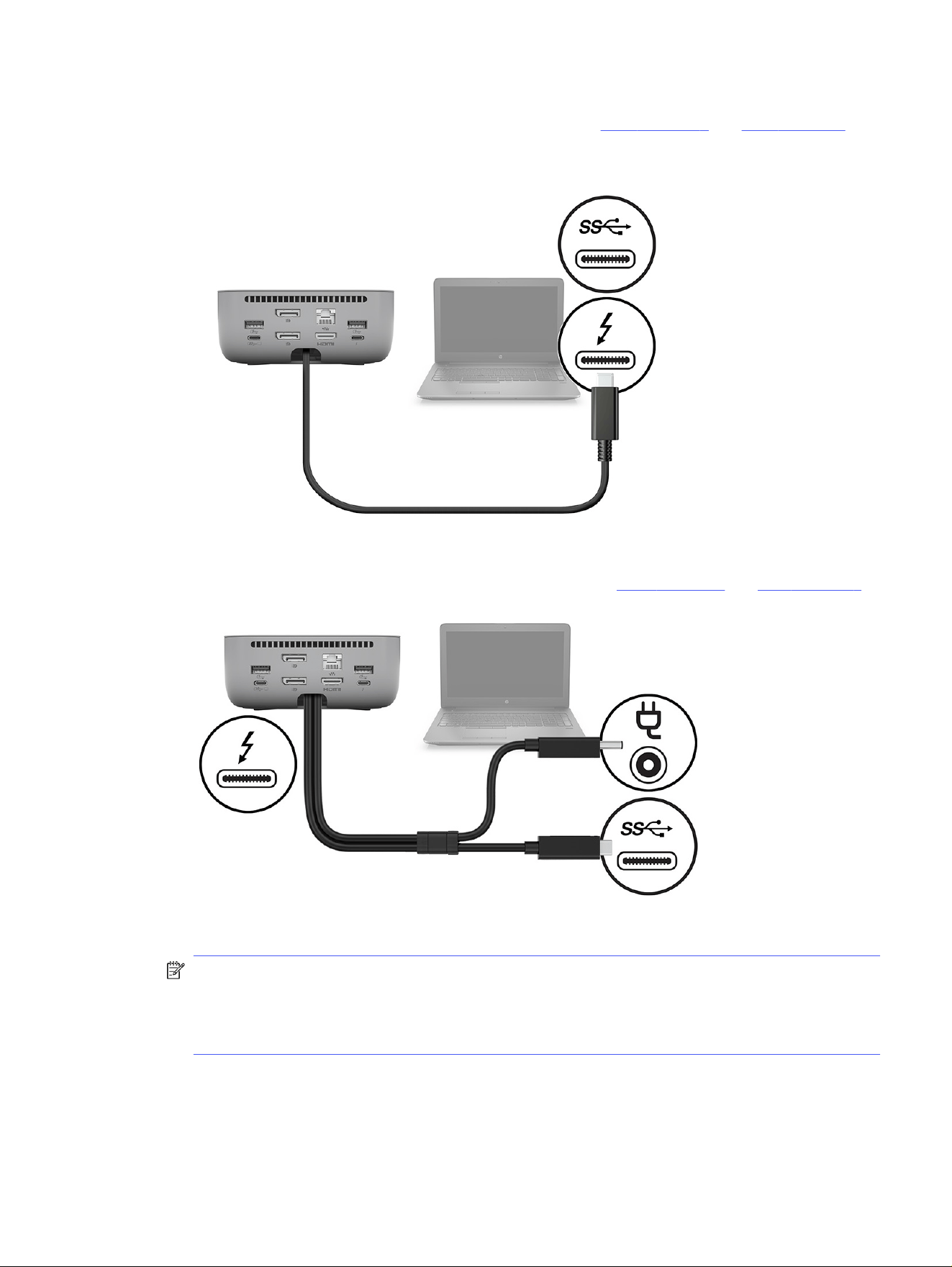
1. On 180 W models, connect the end of the Thunderbolt cable attached to the docking station to the
USB Type-C port or Thunderbolt port on the computer. See Front on page 3 and Rear on page 7 for
connector locations.
On 280 W models, connect the end of the combination cable to the docking station and to the
Thunderbolt port and power connector on the computer. See Front on page 3 and Rear on page 7
for connector locations.
2. In the dialog box that appears, select OK.
NOTE: You must be logged on as an administrator on the computer connected to the docking
station.
To enable a non-administrator user to select OK, enter the non-administrator registry key. Contact
your HP Technical Consultant for this key.
3. When a second dialog box opens, select one of the following options:
● Do Not Connect: Prevents the docking station from connecting to the computer.
Connecting to a computer
13

● Connect Only Once: Allows the docking station to connect to the computer. Each time the
docking station is connected and disconnected, you must log on as an administrator to allow
access to the docking station.
● Always Connect: Allows the docking station to connect to the computer. The docking station
can connect to the computer automatically after it is disconnected and reconnected, even if
you are not logged on as an administrator.
4. Select OK.
While the docking station is connected to the computer, a Thunderbolt icon is displayed in the
notification area, at the far right of the taskbar.
TIP: There might be a slight delay before devices connected to the docking station are ready to use.
Using an external monitor
You can connect up to five external monitors to the docking station if supported by your notebook.
Available ports include one HDMI, one USB-C, one Thunderbolt, and two DisplayPorts.
Configuring the monitor
After connecting a monitor to the docking station, configure the monitor settings to customize the
screen image.
Use Windows® to configure the display of a monitor attached to the docking station:
1. Select Start, select Settings, and then select System.
2. Choose how to view the screen image on the monitor only, select Show desktop only on 2.
● To view the screen image extended across both the computer and the monitor, select Extend
these displays.
● To view the screen image simultaneously on both the computer and the monitor, select
Duplicate these displays.
You can also access the following display settings by pressing the Windows key + p:
● To view the screen image on the monitor only, select Second screen only.
● To view the screen image extended across both the computer and the monitor, select Extend.
● To view the screen image simultaneously on both the computer and the monitor, select Duplicate.
For more information about using multiple monitors, see the “Display Capabilities” section of the "HP
Thunderbolt 4 Ultra 180W/280W Dock Features and Troubleshooting" white paper.
If a monitor is connected to your computer HDMI or USB Type-C port, the number of monitors you can
connect to the docking station might be fewer than four.
Depending on your screen resolution, the number of monitors you can connect to the docking station
might be fewer than four.
Setting up the software
To set up the software on the docking station, following the instructions in this section.
14
Chapter 2 Getting started

Poly Lens
The dock supports functions over a wireless connection using Poly Lens, which provides better visibility
into Poly devices and HP docking stations across the entire organization. IT professionals can remotely
inventory, monitor, and troubleshoot Poly and HP docking devices from a single location.
To use Poly Lens, you must set up an account and set up your network environment accordingly.
To create a Poly Lens account:
1. On the Poly Lens log in page, select Log In, and then select Sign Up.
2. Use one of the following options to set up an account:
● SSO: Use your existing Microsoft, Google, or Apple account or create a new one. See
Permissions for more information.
● Email and password: Create a local account using your email address, password, and first and
last name.
3. Select Sign Up at the bottom of the window.
4. From the welcome email that Poly Lens sends you, select Get Started.
5. On the Poly Lens Profile page, enter an account name.
6. Select Continue. Poly Lens creates your account.
NOTE: When you add a device, Poly Lens associates the device to this account by default.
For more information about adding docking stations into the Poly Lens cloud environment using
the bulk provisioning method, see https://info.lens.poly.com/docs/onboard/provisioning-docking.
For more information about adding a single docking station into the Poly Lens cloud environment
using PIN code authorization, see https://info.lens.poly.com/docs/onboard/pin-docking.
You need to set your network environment up and use either bulk or single unit provisioning methods to
add your devices in to the Poly Lens cloud. Bulk provisioning lets you add all of your units at once. Single
unit provisioning lets you add one dock at a time.
To set up your network environment:
1. Get your firewall ready for required Poly Lens Ports and Protocols by visiting:
https://info.lens.poly.com/docs/begin/ports-and-protocols. HP docking stations use port 8883.
2. To add your devices into Poly Lens cloud environment using the bulk provisioning method, see
https://info.lens.poly.com/docs/onboard/pin-docking.
3. To add a single docking station into the Poly Lens cloud environment using PIN code authorization,
see https://info.lens.poly.com/docs/onboard/pin-docking.
For general Poly Lens documentation, see https://info.lens.poly.com/.
For a list of supported docking stations, see https://info.lens.poly.com/docs/begin/supported-devices.
Poly Lens
15

Quick Connect
Reduce latency time when connecting to your notebook with Quick Connect. When enabled, Quick
Connect on the docking station pre-emptively wakes your notebook, connected accessories, and
displays so that your entire workspace is ready before you sit down. All you need to do is plug in and
resume your workflow.
NOTE: Quick Connect is only available on tested and supported HP G11 Intel® and HP G12 Intel and
AMD® platforms.
To enable Quick Connect, you need to enable both the host and the dock so you can perform the Quick
Connect registration, which occurs when a host connects to a dock using a USB Type-C cable. Up to two
Quick Connect registrations are allowed per laptop. Up to two computer registrations are allowed on a
docking station. If more than two notebooks are registered, the oldest registration is removed.
On a docking station, you can enable Quick Connect using these methods:
● Dock configuration page
● Poly Lens
● myHP app
A setting on the main docking page lets you toggle Quick Connect.
On a host computer, you can enable Quick Connect using these methods:
● Setup Utility (BIOS)
● myHP app
● HP BIOS Configuration Utility
● Dock configuration page
To enable Quick Connect from the Setup Utility (BIOS):
NOTE: By default the Quick Connect feature is disabled in the Setup Utility.
1. Start the Setup Utility by turning on or restarting the computer and quickly pressing f10.
2. Select the Built In Device menu.
3. Select Quick Connect.
4. Be sure Notebook Wake is enabled.
To enable Quick Connect on a single device:
1. Sign in to Poly Lens.
2. Select Inventory.
3. Select the docking station to enable.
4. Select Settings, select General Settings, and then select Bluetooth.
5. Be sure that Bluetooth is enabled.
6. Toggle Quick Connect to enable.
16
Chapter 2 Getting started

You can perform mass configurations using Poly Lens by creating policies on the account, site, and
device group levels to enable Quick Connect across multiple devices. For more information, see
https://info.lens.poly.com/docs/category/policies.
To enable Quick Connect on the dock configuration page:
1. Open the dock configuration page.
2. Select General Settings, and the select Quick Connect.
3. Select the docking station to enable.
4. Configure Quick Connect settings by setting Trigger Distance and configuring each notebook
setting.
myHP
Use myHP to get the docking station serial number and product ID, and access a support page where
you can chat with an agent.
To download myHP from the Microsoft website:
1. Go to myHP (in English).
2. Select Install.
3. Select Get.
4. Select Open to open the installed app.
If your computer is connected to the internet, you are prompted to sign in to myHP when you start the
app.
1. In Windows, search for and open myHP.
2. Enter your user name, and then select Next.
NOTE: To sign in with a verification number sent to your mobile phone, select Use mobile number
instead.
To register with myHP:
1. In Windows, search for and open myHP.
2. Sign in, select Next, and then select your privacy settings (if necessary).
3. Enter the following information on the Registration screen.
● First name
● Last name
● Email address
● Country/region
4. Select Register.
You can connect these third-party products when you launch the online version. If you do not want to
connect a third-party product, select Skip this step.
myHP
17

● Dropbox (consumer PCs only): Enter your email address and password, and then select Sign-in with
email.
● ExpressVPN (consumer PCs only): Enter your email address, and then select Submit.
● McAfee: Enter your email address, and then select Next.
Updating docking station firmware
You can manually update the firmware, or you can schedule firmware updates using Poly Lens, using the
dock configuration page, or while connected to your computer. For better performance, schedule the
docking station to update when you disconnect your computer.
Updating firmware from Poly Lens
Use this procedure to update a docking station using cloud management.
Manual firmware update:
1. Select Manage, and then select Software versions.
2. Select Search Device Model/Lens App, and then type the dock name.
3. Select Version.
4. Select Firmware Softpaq to start the download. Once the download is complete, open the file and
follow the instructions.
Automatic firmware updates:
1. Select Inventory, and then select your device.
2. Select Settings, select Servers, and then select Provisioning.
3. Ensure Enable Provisioning Scheduler is toggled on. To have firmware updates occur after a
computer is removed from the docking station, be sure to disable Force Software Update. Default is
disabled.
4. Select your provisioning schedule.
5. Apply settings.
6. Select Software Update, and then select Use Latest Available Version.
7. Apply settings.
A connected external monitor using HDMI/DisplayPort/USB-C DP Alt Mode displays a progress bar
during the firmware update. The docking station lights slowly blink amber during the update. Once
completed, the lights turn green.
Updating firmware from the dock configuration page
This update method uses a local wireless connection to the docking station through a web browser on
either Windows®, Linux®, macOS®, or a mobile phone.
Manual firmware update:
1. Open the dock configuration page (see Dock configuration page on page 29).
2. Be sure a Wi-Fi connection is established.
18
Chapter 2 Getting started

3. Select Firmware Update from General Settings.
4. Select Check for update.
5. Run the update.
Automatic firmware updates:
1. Open the dock configuration page (see Dock configuration page on page 29).
2. Be sure a Wi-Fi connection is established.
3. Select Firmware Update Schedule from General Settings.
4. Select Enable firmware update.
5. Configure the schedule.
6. Select Save.
HDMI/DisplayPort/USB-C DP Alt Mode displays a progress bar during the firmware update. The docking
station lights slowly blink amber during the update. Once completed, the lights turn green.
Updating firmware from a One Click Installer
Use this procedure to update a docking station from a connected notebook.
1. Download HP Firmware Installer from http://www.hp.com/support.
2. Open Windows Explorer and navigate to where you saved HP Firmware Installer.
3. Double-click HPFirmwareInstaller.exe.
4. Verify that updates are available, and then select which updates to install.
NOTE: You must be connected to the internet for new updates to download to HP Firmware
Installer.
5. Select one of the following options.
● Update now: Installs the update immediately.
NOTE: You cannot disconnect your computer from the docking station during an update. You
might see your monitor flicker and hear some audio clicks. Your Internet connection might be
intermittent, and your mouse and keyboard could become unresponsive until installation is
complete.
● Update on dock disconnect: Installs the update after you disconnect your computer from the
docking station.
NOTE: You cannot connect your computer to the docking station during an update. The dock
power light might blink while the update is being installed.
6. Select Install.
Sleep, Hibernation, shutdown, and restart
If the computer initiates Sleep or Hibernation, the monitor turns off. When the computer exits Sleep or
Hibernation, the connected monitor returns to the previous monitor settings.
Sleep, Hibernation, shutdown, and restart
19

If you restart or shut down the computer and then turn it back on, the connected monitor returns to the
previous monitor settings.
20 Chapter 2 Getting started

Using the docking station3
You can use the docking station to connect external devices to your system.
Docking station guidelines
Follow the guidelines in this section when using the docking station.
● Operating systems: For optimal performance, use the docking station with a computer running the
Windows 11, Linux, macOS, ChromeOS, or ThinPro operating system.
● Power: To use docking station features, AC power must be connected to the docking station.
● Connecting and disconnecting: The docking station can be connected to or disconnected from
the computer whether the computer is on or off (see Connecting to a computer on page 12 and
Disconnecting the docking station on page 30).
NOTE: HP does not recommend connecting or disconnecting from a computer that is in either
Sleep or Hibernation.
● External devices: When the docking station is connected to the computer, external devices can be
connected to the ports on the docking station or to the ports on the computer.
● Advanced speed and features: To use all docking station features, your computer and monitor
must support Thunderbolt, USB, HDMI 2.1/2.0, and DisplayPort 1.4. But even if your devices do not
support these technologies, you can still use the nine USB ports with USB 2.0 devices and the four
DisplayPort-compatible ports with DisplayPort 1.2 devices.
Setting the security level
You can choose from several preset security levels when using the docking station.
The docking station supports Direct Memory Access (DMA), a feature that requires a specific
Thunderbolt Security Level.
NOTE: Check with your IT administrator before you attempt the following procedure.
To configure this setting:
1. Perform one of these tasks:
● On computers or tablets with keyboards, turn on or restart the computer, and when the HP logo
appears, press f10 to enter Computer Setup.
● On tablets without keyboards, turn off the tablet. Press the power button in combination
with the volume down button until the Startup menu is displayed, and then tap F10 to enter
Computer Setup.
2. Select Advanced, select Port Options, and then select Thunderbolt Security Level.
Using the docking station
21

3. Select a security level.
The following security levels are available:
● Security level 0: PCIe and DisplayPort - No Security: Any devices can be connected to the
computer or docking station without user permission.
● Security level 1: PCIe and DisplayPort - User Authorization: Any devices can be connected to
the computer or docking station with user permission.
● Security level 2: PCIe and DisplayPort - Secure Connect: Any devices can be connected to
the computer or docking station with user permission, if the device contains either a security
certificate or chip.
● Security level 3: DisplayPort and USB: Devices cannot be connected to the docking station.
Only the USB ports and DisplayPorts on the computer work.
● Security level 4: Thunderbolt alt mode: Devices cannot be connected to the docking station.
NOTE: Security level 4 is supported only on select fifth-generation HP mobile workstations. If
you set a computer that does not support Security level 4 to this level, the computer uses
Security level 3 by default.
Connecting to a network
You can connect the computer to a network through the docking station. This action requires a network
cable (purchased separately).
WARNING! To reduce the risk of electric shock, fire, or damage to the equipment, do not plug a
modem cable or telephone cable into an RJ-45 (network) jack.
HP Sure Start for Docks
HP Sure Start for Dock docks meets NIST 800-193 requirements.
HP Sure Start for Docks is a firmware security and advanced firmware resilience solution to protect
against firmware attacks and/or accidental corruption for the all critical docking station firmware.
HP Sure Start for Docks can automatically detect and recover from attacks or corruption without IT
intervention and with little or no interruption to user productivity. Every time the dock powers on and
every time the dock is disconnected from the host, HP Sure Start for docks automatically validates the
integrity of the firmware to help ensure that the dock is safeguarded from malicious attacks. In the case
of an attack, the dock can self-heal using an isolated copy of the firmware.
22
Chapter 3 Using the docking station
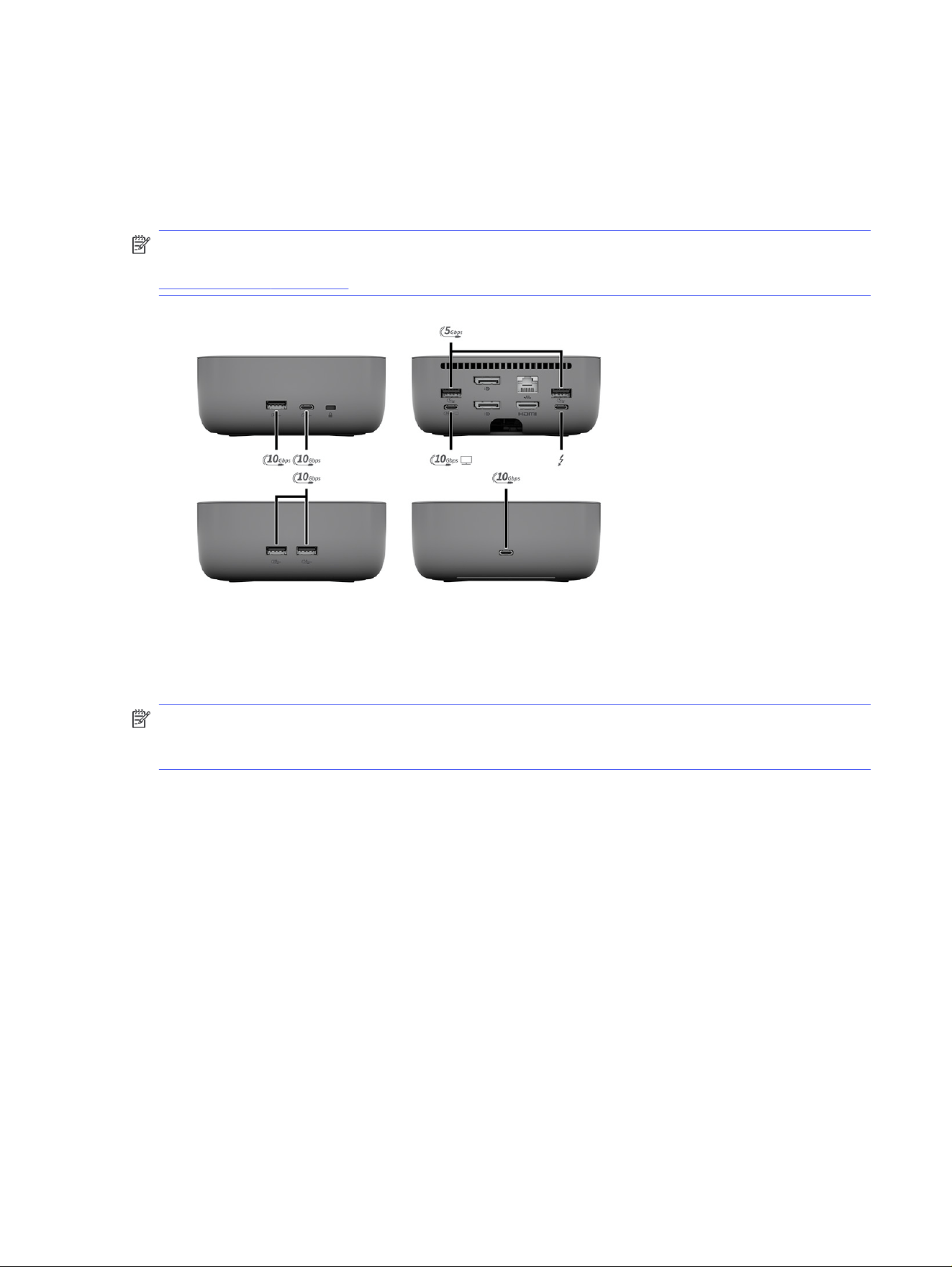
Connecting USB devices
The docking station has nine USB ports: one USB Type-C port on the front panel, one USB port and one
USB Type-C port on the right panel, two USB ports on the left panel, two USB ports on the rear panel, and
two USB Type-C ports on the rear panel. Use the USB ports to connect optional external USB devices,
such as a keyboard and mouse.
NOTE: Be sure that the external device is compliant with the docking station power specifications.
Using a noncompliant device might disable the port the device is attached to. To reset the port, see
Troubleshooting on page 31.
Connecting a DisplayPort device
You can connect a DisplayPort device to your docking station.
NOTE: To connect a DisplayPort video device to your docking station, you need a DisplayPort cable or
USB Type-C cable, purchased separately. For DisplayPort 1.4 support, use a DisplayPort cable that
supports DisplayPort 1.4. DisplayPort 1.4 cables are compatible with previous versions of DisplayPort.
You can connect the docking station to an external device also, such as a monitor or a projector, through
the DisplayPort.
Connecting USB devices
23
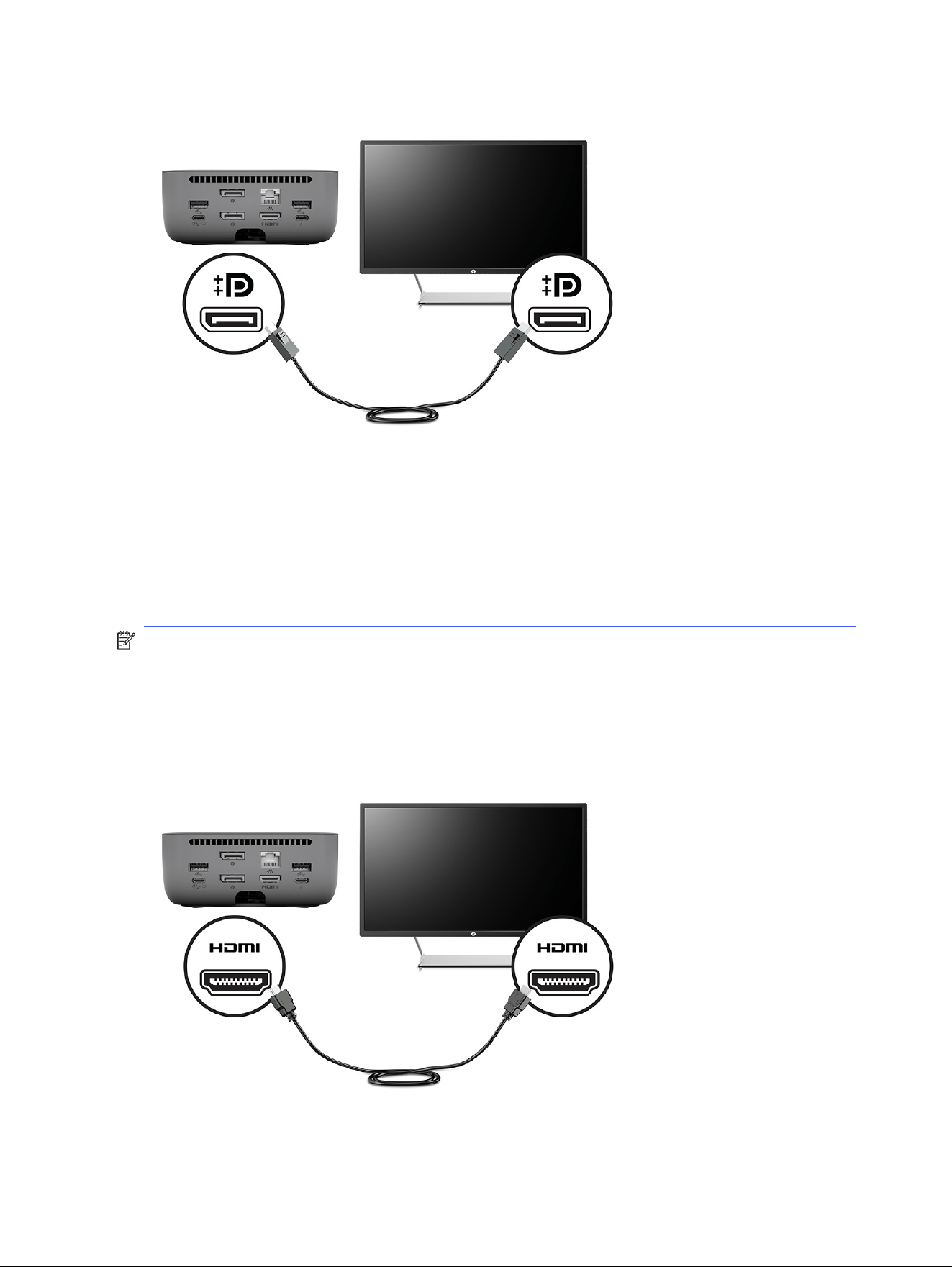
The docking station supports simultaneous video connections to USB Type-C ports that support both
video and DisplayPort.
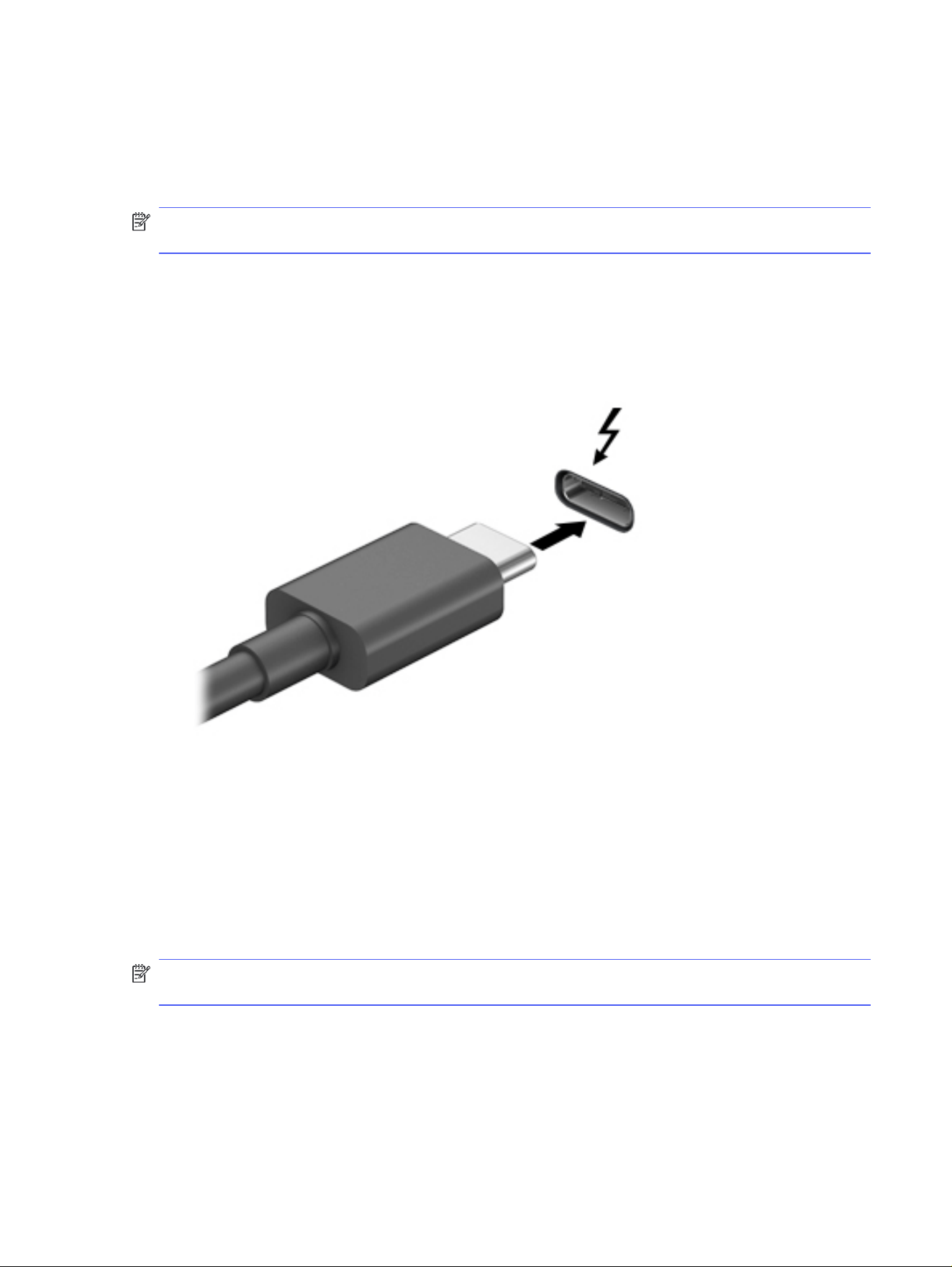
Connecting an HDMI device
You can connect an HDMI device to your docking station.
NOTE: To connect an HDMI video device to your docking station, you need an HDMI cable, purchased
separately. For HDMI 2.1 support, use an HDMI cable that supports HDMI 2.1. HDMI 2.1 cables are
compatible with previous versions of HDMI.
You can connect the docking station to an external device also, such as a monitor or a projector, through
the HDMI connector.
24
Chapter 3 Using the docking station
Connecting a Thunderbolt device using a USB Type-C
Thunderbolt cable
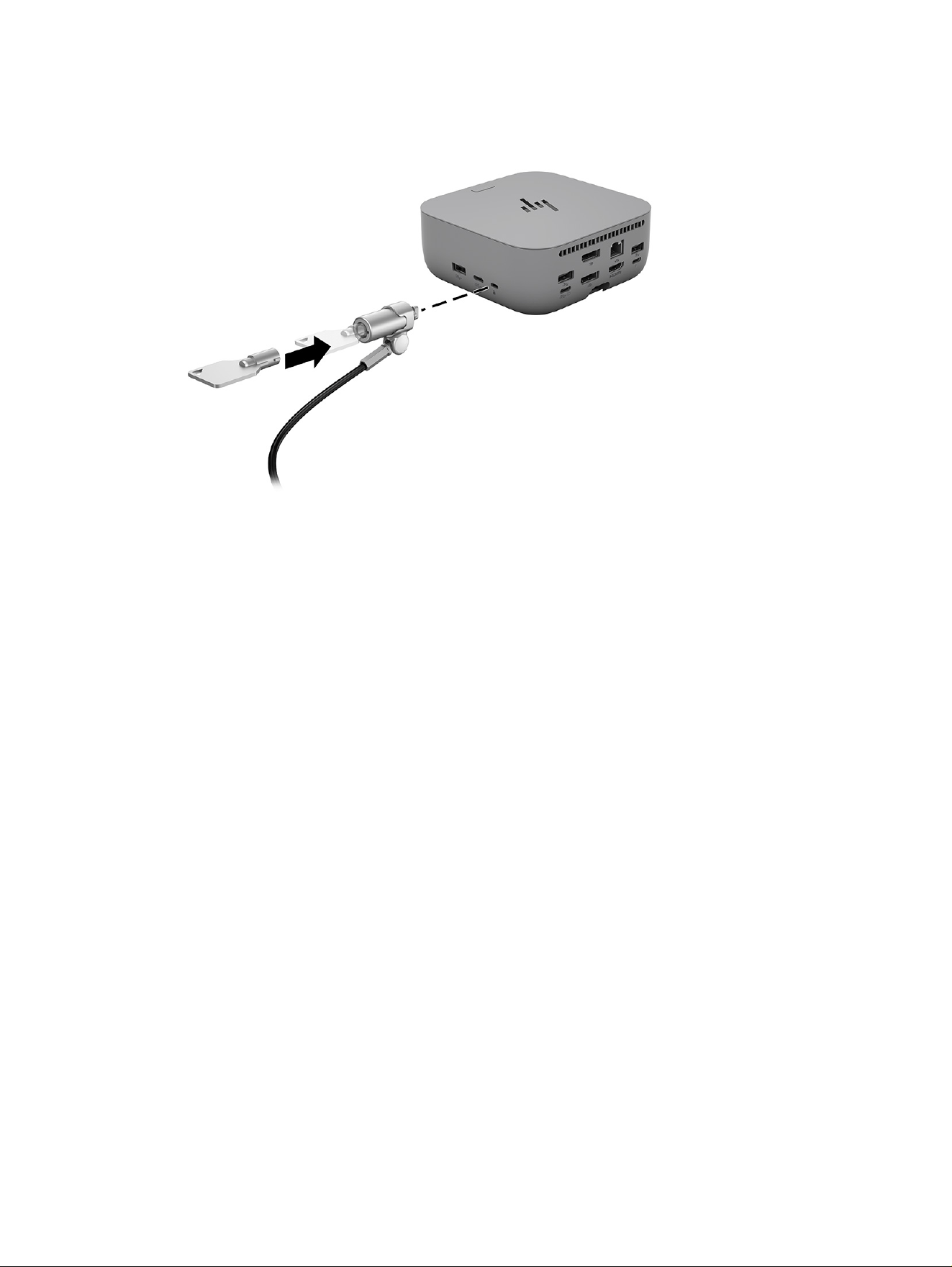
To connect a Thunderbolt device to your docking station, follow these steps.
NOTE: To connect a USB Type-C Thunderbolt device to your docking station, you need a USB Type-C
Thunderbolt cable, purchased separately.
To see video or high-resolution display output on an external Thunderbolt device or use a high-
performance data device, connect the Thunderbolt device according to the following instructions:
1. Connect one end of the USB Type-C Thunderbolt cable to the USB Type-C Thunderbolt port on the
docking station.
2. Connect the other end of the cable to the external Thunderbolt device.
The docking station supports simultaneous video connections to USB Type-C ports that support both
video and DisplayPort.
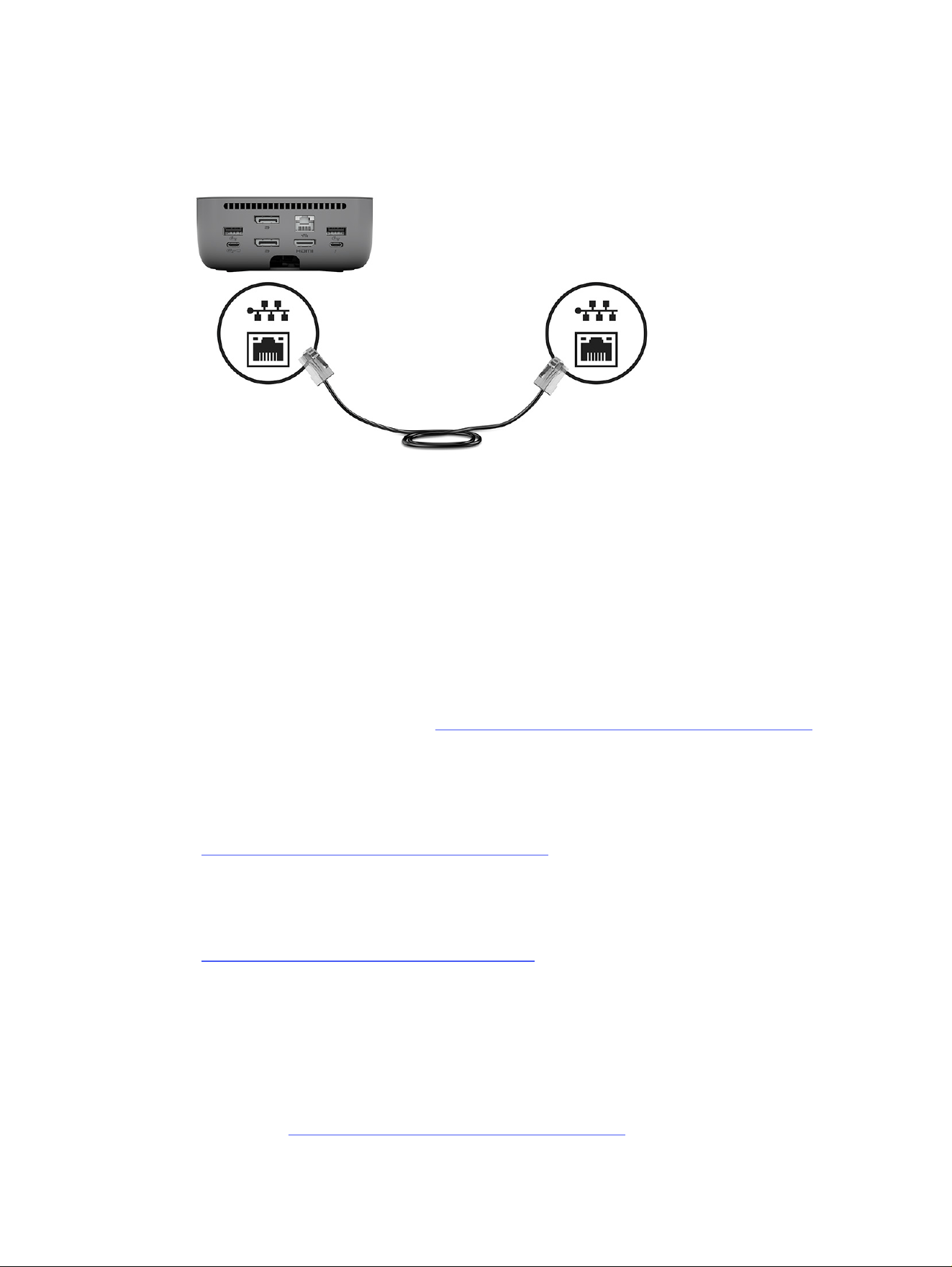
Connecting an optional security cable
To install a security cable, follow these steps.
NOTE: The security cable is designed to act as a deterrent, but it might not prevent the docking
station from being mishandled or stolen.
1. Loop the security cable around a secured object.
2. Insert the key into the cable lock.
Connecting a Thunderbolt device using a USB Type-C Thunderbolt cable
25
3. Insert the cable lock into the security cable slot on the docking station, and then turn the key.
4. Remove the key.
26
Chapter 3 Using the docking station

Manageability Features4
You can manage the dock with network manageability features or using Cloud manageability.
Network manageability
The dock supports the following computer functions over the network connection.
Before using these functions, verify that your computer has the latest BIOS and network controller
driver installed. For instructions on updating these drivers, see your computer documentation.
● PXE Boot
● MAC Address Pass Through
TIP: Your computer might support MAC Address Pass Through from the On, Off, Sleep, or
Hibernation states, or only when the computer is on or in the Sleep state.
MAC Address Pass Through supports either UEFI PXE boot and Legacy PXE boot or only UEFI PXE
boot
● Wake on LAN (WOL)
TIP: Your computer might support WOL from the Off, Sleep, or Hibernation states, or only when
the computer is on or in Sleep.
WLAN/LAN switching is supported only on select computers.
1. Connect the docking station to the computer.
2. Connect one end of the network cable to the network jack on the docking station and connect the
other end to an RJ-45 wall jack or router.
NOTE: If the network cable contains noise suppression circuitry, which prevents interference from
TV and radio reception, orient the circuitry end of the cable toward the computer.
Manageability Features
27
Cloud manageability with Poly Lens
Poly Lens cloud access allows you to make the most of your workspace. Poly Lens allows you to use the
basic service for free. You can self-enroll and begin using the service immediately.
Before using these functions, verify that your computer has the latest BIOS and network controller
driver installed. For instructions on updating these drivers, see your computer documentation.
● Automatic Software Updates
Allow IT managers to schedule times when the dock checks to see if it is on the latest firmware
version. If it is not, the dock pulls the latest update and updates itself without needing a PC
connected. For more information, see https://info.lens.poly.com/docs/begin/before-you-begin, select
Inventory, and then select Settings - HP Docking Stations.
– Inventory
The Device Inventory page provides the initial access to the registered devices in your
account. You can view this page in a list view or a map view. For more information, see
https://info.lens.poly.com/docs/category/inventory.
– Actions
The Actions page lets you locate devices or sites that might require attention. An event it
triggered, when a device is offline and a software update is available. For more information, see
https://info.lens.poly.com/docs/category/actions.
– Insights
The page provides analytics that allow IT managers to understand how docks are used over
periods of time.
● Telemetry
Allows IT managers to track, select, and manage their fleets of docks with a few clicks. For more
information, see https://info.lens.poly.com/docs/category/insights.
28
Chapter 4 Manageability Features

For more information about Poly Lens, see https://info.lens.poly.com/.
Dock configuration page
Access additional information about your dock through the dock configuration page. If your dock is not
being managed on Poly Lens, you can view dock details, configure dock settings, update the firmware,
set Quick Connect settings, and factory reset the dock.
NOTE: Connecting the dock to Wi-Fi interrupts its internet connection.
NOTE: Do not connect the docking station to the computer during this procedure.
■
Establish a wireless connection to the docking station:
a. Connect power to the docking station,
b. Press the docking station power button for five seconds to enter dock Wi-Fi AP mode. The dock
enters Wi-Fi AP mode when the blue light on the power button blinks slowly.
c. From a laptop, attempt to connect to the docking station using Wi-Fi.
● The docking station name is HP Thunderbolt 4 Ultra G6_(the last six digits of the serial
number).
● There is a password located underneath the bottom cover of the dock.
NOTE: You can change the password. Password criteria is based on strong, mid, and weak.
Strong passwords must meet all of the following requirements. Mid passwords must meet
three requirements. Weak passwords must meet two requirements:
● At least one uppercase and one lowercase letter
● At least one number
● At least one special character
● At least 12 characters
● Be sure that the Connect automatically is selected.
d. After the dock is successfully connected, if the user interface does not automatically launch, go
to http://hpdock/local/.
Dock configuration page
29

Disconnecting the docking station5
To disconnect the docking station from the computer, disconnect the cable from the computer.
When the docking station has successfully disconnected from the computer, the Thunderbolt icon no
longer appears in the notification area.
NOTE: Do not disconnect the dock while updating software. Doing so might cause the dock to
become unusable.
NOTE: Do not restart or shut down your computer, or initiate Sleep or Hibernation, until the
Thunderbolt icon disappears from the notification area.
30
Chapter 5 Disconnecting the docking station

Troubleshooting6
If you are experiencing issues with your docking station, you can attempt to resolve them using the
provided solutions before contacting HP Support.
For Poly Lens troubleshooting information, see https://info.lens.poly.com/docs/category/troubleshooting.
Solving common problems
The troubleshooting tables list possible problems and the recommended solutions.
General use and connection problems
Use the table to search for possible causes and solutions for general use and connection problems.
Table 6-1
General use and connection problems, causes, and solutions
Problem Possible cause Solution
The power light is off. The docking station is not connected to
AC power.
Connect the power cord to the docking
station and to an AC outlet.
NOTE: Be sure that you are using the
power cord that was included with the
docking station.
No devices connected to the docking
station are working.
The docking station is not connected to
AC power.
Connect the power cord to the docking
station and to an AC outlet.
The docking station is not connected to
the computer correctly.
Disconnect the docking station cable
from the computer, and then reconnect
it.
When a device is connected to a USB
port on the docking station, the device
does not work.
The USB device might not be
compliant with the docking station
power specifications and is using too
much power.
Reset the port:
1. Disconnect the device.
2. Disconnect the power cord from
the docking station, and then
reconnect it.
3. Disconnect the docking station
from the computer, and then
reconnect it.
4. Reconnect the device. If the device
still does not work, it cannot be
used with the port.
Troubleshooting 31

Table 6-1 General use and connection problems, causes, and solutions (continued)
Problem Possible cause Solution
A device connected to a USB port on the
docking station stops working.
The port might need to be reset. Reset the port:
1. Disconnect the device that
disabled the port.
2. Disconnect the power cord from
the power adapter, and then
reconnect it.
3. Disconnect the docking station
from the computer, and then
reconnect it.
If this procedure does not resolve the
problem, restart your computer.
If restarting the computer does not
resolve the problem, you might need to
reset your computer. See your computer
documentation for instructions on
creating recovery media and performing
a factory reset.
When the docking station is connected
to the computer, both the WLAN and the
LAN for the computer are connected.
Switching from the WLAN connection
to the LAN connection might not be
supported on your computer.
NOTE: WLAN-LAN switching is
supported only on select computers
running the Windows operating system.
NOTE: The WLAN connection on the
docking station is only used for
manageability.
Disable the WLAN connection:
1. Right-click Start, and then select
Network Connections.
2. Right-click Wi-Fi, and then select
Disable.
A device that is connected to the
docking station is not working on the
computer.
The device is not ready to use. There might be a slight delay before
devices connected to the docking
station are ready to use.
The port might need to be reset. Reset the port:
1. Disconnect the device that
disabled the port.
2. Disconnect the power cord from
the docking station, and then
reconnect it.
3. Disconnect the docking station
from the computer, and then
reconnect it.
If this procedure does not resolve the
problem, restart your computer.
If restarting the computer does not
resolve the problem, you might need to
reset your computer. See your computer
documentation for instructions on
creating recovery media and performing
a factory reset.
32
Chapter 6 Troubleshooting

Video problems
Use the table to search for possible causes and solutions for video problems.
Table 6-2 Video problem causes and solutions
Problem Possible cause Solution
A video does not play. The drivers are not installed. Download the latest Intel drivers from
http://www.hp.com/support.
Fonts and other characters on the
external monitor appear large.
The screen resolution is configured
higher than the maximum limit of the
external monitor.
Set the screen resolution equal to or
lower than the maximum limits of the
external monitor.
The graphics application does not detect
the external monitor.
Some graphics applications do not
detect external monitors that are
connected to the docking station.
Configure the external monitor. See
Using an external monitor on page 14.
The external monitor cannot be set as
the primary monitor when using some
Intel graphics applications.
Older Intel graphics applications do not
support setting the external monitor as
the primary monitor.
Download the latest Intel drivers from
http://www.hp.com/support.
The computer monitor does not work. An external monitor was disconnected
from the docking station before the
docking station was disconnected from
the computer.
Disconnect the docking station from
the computer, and then disconnect
the external monitor from the docking
station.
An external monitor does not work. There is a problem with the connection.
1. Disconnect the docking station
from the computer, and then
disconnect the external monitor
from the docking station.
2. Reconnect the docking station to
the computer, and then reconnect
the external monitor to the docking
station.
If this procedure does not resolve the
problem, restart your computer.
If restarting the computer does not
resolve the problem and your computer
has NVIDIA® graphics, see the following
item and try the solution. If the
external monitor still does not work,
you might need to reset your computer.
See your computer documentation for
instructions on creating recovery media
and performing a factory reset.
Video problems
33

Table 6-2 Video problem causes and solutions (continued)
Problem Possible cause Solution
If your computer has NVIDIA graphics,
you might need to configure the external
monitors in NVIDIA Control Panel.
Configure your displays in NVIDIA
Control Panel:
1. Select Start, select Control
Panel, select Appearance and
Personalization, and then select
NVIDIA Control Panel.
2. If either Digital Display is listed
or an external monitor is listed
twice, disconnect the docking
station from the computer, and
then disconnect the external
monitor from the docking station.
Reconnect the external monitor,
and then reconnect the computer.
3. If the external monitor is listed but
not selected, select it, and then
select
Apply.
A video is distorted. The display settings might be incorrect. Change the display settings:
1. Select Start, select Settings, and
then select System.
2. Under Scale and layout, select a
value of 225% or lower from the
Change the size of text, apps, and
other items drop-down list.
A video device connected to the external
monitor port displays a black screen
when playing Blu-ray or other protected
content.
The docking station does not support
viewing Blu-ray or other protected
content on an external monitor
connected to the external monitor port
on the docking station.
Use the computer’s display or connect
the external monitor to the computer.
34 Chapter 6 Troubleshooting

Table 6-2 Video problem causes and solutions (continued)
Problem Possible cause Solution
The display state changed after
restarting the computer or deactivating
Sleep or Hibernation.
The display state needs to be
configured.
Press fn + f4 to alternate the screen
image between four display states:
● PC screen only: View the screen
image on the computer only.
● Duplicate: View the screen image
simultaneously on both the
computer and the external monitor.
● Extend: View the screen image
extended across both the
computer and the external monitor.
● Second screen only: View the
screen image on the external
monitor only.
Each time you press fn + f4, the display
state changes.
NOTE: For best results, especially if you
choose the Extend option, increase the
screen resolution of the external device
as follows. Select the
Start button, select
Settings, and then select System. Under
Display, select the appropriate
resolution, and then select Keep
changes.
The external monitor connected to the
dock exhibited reduced resolution.
The current BIOS default settings do not
support the maximum USB Type-C video
throughput.
Enable high resolution mode.
1. While the computer is restarting,
press f10.
2. Select Advanced, and then select
System Options.
3. On the System Options screen,
select Enable high resolution mode
when connected to a USB Type-C
DisplayPort mode dock.
NOTE: Selecting this option will
reduce the USB 3.0 speed to USB
2.0 speed. This solution applies to
Windows OS only.
Poly Lens problems
The Poly Lens website provides extensive troubleshooting information.
For Poly Lens troubleshooting information, see
(https://info.lens.poly.com/docs/category/troubleshooting).
Dock configuration page problems
For dock configuration page troubleshooting information, see the HP Thunderbolt 4 Ultra 180W/280W
G6 Dock white paper.
Poly Lens problems
35

Getting more information
For comprehensive information about the docking station, as well as governmental agency and safety
information about the use of the docking station, access HP Help and Support.
● Select Start, and then select HP Help and Support.
● The HP website (http://www.hp.com) provides product news and software updates.
Contacting support
If you cannot solve a problem using the troubleshooting tips in this chapter, you might need to contact
support.
For the fastest possible resolution of your problem, have the following information available when you
contact support:
NOTE: The serial number and other information for the docking station is on the bottom of the
docking station.
● Model name and number for the computer and for the docking station
● Serial numbers for the computer and docking station
● Dates the computer and docking station were purchased
● Conditions under which the problem occurred
● Error messages that have been displayed
● Hardware and software you are using
● The manufacturer and model of components connected to the computer and docking station
To contact support using your HP computer, select Start and then select HP Help and Support. Select
Contact support to start a chat session with a support specialist.
For U.S. support, go to http://www.hp.com/go/contactHP. For worldwide support, go to
http://welcome.hp.com/country/us/en/wwcontact_us.html.
Choose from the following types of support:
● Chat online with an HP technician.
NOTE: When chat is not available in a particular language, it is available in English.
● Find HP support worldwide telephone numbers.
● Locate an HP service center.
36
Chapter 6 Troubleshooting

Specifications7
This section contains technical specifications for the physical aspects of your product, such as the
weight and dimensions, as well as required environmental operating conditions and power source
ranges.
Input power
The power information in this section can be helpful if you plan to travel internationally with the docking
station.
The docking station operates on DC power, which can be supplied by an AC or a DC power source. The
AC power source must be rated at 100 V to 240 V, 50 Hz to 60 Hz. Although the docking station can be
powered from a standalone DC power source, it should be powered only with an AC adapter or a DC
power source supplied and approved by HP for use with this docking station.
The docking station can operate on DC power within the following specifications.
Table 7-1
Input power ratings
Input Power Rating
Operating voltage and current 230 W: Input 100 V to 240 V, 3.5 A, 50 Hz to 60 Hz. Output is 19.5
V at 11.8 A.
330 W: Input 100 V to 240 V, 4.2 A, 50 Hz to 60 Hz. Output is 19.5
V at 16.92 A.
NOTE: This product is designed for IT power systems in Norway with phase-to-phase voltage not
exceeding 240 V rms.
NOTE: The docking station operating voltage and current are on the system regulatory label.
Operating environment
This section provides information about the recommended operating environment for your docking
station.
Table 7-2
Operating environment specifications
Factor Metric U.S.
Temperature
Operating 0°C to 35°C 32°F to 95°F
Nonoperating –20°C to 60°C –4°F to 140°F
Relative humidity (noncondensing)
Operating 10% to 90% 10% to 90%
Nonoperating 5% to 95% 5% to 95%
Specifications 37

Table 7-2 Operating environment specifications (continued)
Factor Metric U.S.
Maximum altitude (unpressurized)
Operating –15 m to 3,048 m –50 ft to 10,000 ft
Nonoperating –15 m to 12,192 m –50 ft to 40,000 ft
38 Chapter 7 Specifications

Accessibility8
HP's goal is to design, produce, and market products, services, and information that everyone
everywhere can use, either on a standalone basis or with appropriate third-party assistive technology
(AT) devices or applications.
HP and accessibility
Because HP works to weave diversity, inclusion, and work/life into the fabric of the company, it is
reflected in everything HP does. HP strives to create an inclusive environment focused on connecting
people to the power of technology throughout the world.
Finding the technology tools you need
Technology can unleash your human potential. Assistive technology removes barriers and helps you
create independence at home, at work, and in the community. Assistive technology helps increase,
maintain, and improve the functional capabilities of electronic and information technology.
For more information, see Finding the best assistive technology on page 40.
The HP commitment
HP is committed to providing products and services that are accessible for people with disabilities.
This commitment supports the company's diversity objectives and helps ensure that the benefits of
technology are available to all.
The HP accessibility goal is to design, produce, and market products and services that can be effectively
used by everyone, including people with disabilities, either on a standalone basis or with appropriate
assistive devices.
To achieve that goal, this Accessibility Policy establishes seven key objectives to guide HP actions. All
HP managers and employees are expected to support these objectives and their implementation in
accordance with their roles and responsibilities:
● Raise the level of awareness of accessibility issues within HP, and provide employees with the
training they need to design, produce, market, and deliver accessible products and services.
● Develop accessibility guidelines for products and services, and hold product development groups
accountable for implementing these guidelines where competitively, technically, and economically
feasible.
● Involve people with disabilities in the development of accessibility guidelines and in the design and
testing of products and services.
● Document accessibility features, and make information about HP products and services publicly
available in an accessible form.
● Establish relationships with leading assistive technology and solution providers.
● Support internal and external research and development that improves assistive technology
relevant to HP products and services.
Accessibility
39

● Support and contribute to industry standards and guidelines for accessibility.
International Association of Accessibility Professionals (IAAP)
IAAP is a not-for-profit association focused on advancing the accessibility profession through
networking, education, and certification. The objective is to help accessibility professionals develop and
advance their careers and to better enable organizations to integrate accessibility into their products
and infrastructure.
As a founding member, HP joined to participate with other organizations to advance the field of
accessibility. This commitment supports HP’s accessibility goal of designing, producing, and marketing
products and services that people with disabilities can effectively use.
IAAP will make the profession strong by globally connecting individuals, students, and
organizations to learn from one another. If you are interested in learning more, go to
http://www.accessibilityassociation.org to join the online community, sign up for newsletters, and learn
about membership options.
Finding the best assistive technology
Everyone, including people with disabilities or age-related limitations, should be able to communicate,
express themselves, and connect with the world using technology. HP is committed to increasing
accessibility awareness within HP and with our customers and partners.
Whether it’s large fonts that are easy on the eyes, voice recognition that lets you give your hands a rest,
or any other assistive technology to help with your specific situation—a variety of assistive technologies
make HP products easier to use. How do you choose?
Assessing your needs
Technology can unleash your potential. Assistive technology removes barriers and helps you create
independence at home, at work, and in the community. Assistive technology (AT) helps increase,
maintain, and improve the functional capabilities of electronic and information technology.
You can choose from many AT products. Your AT assessment should allow you to evaluate several
products, answer your questions, and facilitate your selection of the best solution for your situation.
You will find that professionals qualified to do AT assessments come from many fields, including those
licensed or certified in physical therapy, occupational therapy, speech/language pathology, and other
areas of expertise. Others, while not certified or licensed, can also provide evaluation information.
You will want to ask about the individual's experience, expertise, and fees to determine if they are
appropriate for your needs.
Accessibility for HP products
These links provide information about accessibility features and assistive technology, if applicable and
available in your country or region, that are included in various HP products. These resources will help
you select the specific assistive technology features and products most appropriate for your situation.
● HP Aging & Accessibility: Go to http://www.hp.com, type Accessibility in the search box. Select
Office of Aging and Accessibility.
● HP computers: For Windows products, go to http://www.hp.com/support, type Windows
Accessibility Options in the Search our knowledge library search box. Select the appropriate
operating system in the results.
● HP Shopping, peripherals for HP products: Go to http://store.hp.com, select Shop, and then select
Monitors or Accessories.
40
Chapter 8 Accessibility

If you need additional support with the accessibility features on your HP product, see Contacting
support on page 43.
Additional links to external partners and suppliers that may provide additional assistance:
● Microsoft Accessibility information (Windows and Microsoft Office)
● Google Products accessibility information (Android, Chrome, Google Apps)
Standards and legislation
Countries worldwide are enacting regulations to improve access to products and services for persons
with disabilities. These regulations are historically applicable to telecommunications products and
services, PCs and printers with certain communications and video playback features, their associated
user documentation, and their customer support.
Standards
The US Access Board created Section 508 of the Federal Acquisition Regulation (FAR) standards to
address access to information and communication technology (ICT) for people with physical, sensory, or
cognitive disabilities.
The standards contain technical criteria specific to various types of technologies, as well as
performance-based requirements which focus on functional capabilities of covered products. Specific
criteria cover software applications and operating systems, web-based information and applications,
computers, telecommunications products, video and multimedia, and self-contained closed products.
Mandate 376 – EN 301 549
The European Union created the EN 301 549 standard within Mandate 376 as an online toolkit for public
procurement of ICT products. The standard specifies the accessibility requirements applicable to ICT
products and services, with a description of the test procedures and evaluation methodology for each
requirement.
Web Content Accessibility Guidelines (WCAG)
Web Content Accessibility Guidelines (WCAG) from the W3C's Web Accessibility Initiative (WAI) helps
web designers and developers create sites that better meet the needs of people with disabilities or
age-related limitations.
WCAG advances accessibility across the full range of web content (text, images, audio, and video)
and web applications. WCAG can be precisely tested, is easy to understand and use, and allows web
developers flexibility for innovation. WCAG 2.0 has also been approved as ISO/IEC 40500:2012.
WCAG specifically addresses barriers to accessing the web experienced by people with visual, auditory,
physical, cognitive, and neurological disabilities, and by older web users with accessibility needs. WCAG
2.0 provides characteristics of accessible content:
● Perceivable (for instance, by addressing text alternatives for images, captions for audio, adaptability
of presentation, and color contrast)
● Operable (by addressing keyboard access, color contrast, timing of input, seizure avoidance, and
navigability)
● Understandable (by addressing readability, predictability, and input assistance)
● Robust (for instance, by addressing compatibility with assistive technologies)
Standards and legislation
41

Legislation and regulations
Accessibility of IT and information has become an area of increasing legislative importance.
The HP policy landscape website provides information about key legislation, regulations, and standards
in the following locations:
● United States
● Canada
● Europe
● Australia
Useful accessibility resources and links
These organizations, institutions, and resources might be good sources of information about disabilities
and age-related limitations.
NOTE: This is not an exhaustive list. These organizations are provided for informational purposes
only. HP assumes no responsibility for information or contacts you encounter on the internet. Listing on
this page does not imply endorsement by HP.
Organizations
These organizations are a few of the many that provide information about disabilities and age-related
limitations.
● American Association of People with Disabilities (AAPD)
● The Association of Assistive Technology Act Programs (ATAP)
● Hearing Loss Association of America (HLAA)
● Information Technology Technical Assistance and Training Center (ITTATC)
● Lighthouse International
● National Association of the Deaf
● National Federation of the Blind
● Rehabilitation Engineering & Assistive Technology Society of North America (RESNA)
● Telecommunications for the Deaf and Hard of Hearing, Inc. (TDI)
● W3C Web Accessibility Initiative (WAI)
Educational institutions
Many educational institutions, including these examples, provide information about disabilities and
age-related limitations.
● California State University, Northridge, Center on Disabilities (CSUN)
● University of Wisconsin - Madison, Trace Center
42
Chapter 8 Accessibility

● University of Minnesota computer accommodations program
Other disability resources
Many resources, including these examples, provide information about disabilities and age-related
limitations.
● ADA (Americans with Disabilities Act) Technical Assistance Program
● ILO Global Business and Disability network
● EnableMart
● European Disability Forum
● Job Accommodation Network
● Microsoft Enable
HP links
These HP-specific links provide information that relates to disabilities and age-related limitations.
HP comfort and safety guide
HP public sector sales
Contacting support
HP offers technical support and assistance with accessibility options for customers with disabilities.
NOTE: Support is in English only.
● Customers who are deaf or hard of hearing who have questions about technical support or
accessibility of HP products:
– Use TRS/VRS/WebCapTel to call (877) 656-7058 Monday through Friday, 6 a.m. to 9 p.m. Mountain
Time.
● Customers with other disabilities or age-related limitations who have questions about technical
support or accessibility of HP products:
– Call (888) 259-5707 Monday through Friday, 6 a.m. to 9 p.m. Mountain Time.
Other disability resources
43

Index
A
accessibility 39, 40, 42, 43
accessibility needs
assessment 40
assistive technology (AT)
finding 40
purpose 39
AT (assistive technology)
finding 40
purpose 39
C
components
front 3
left side 6
rear 7
right side 5
top 2, 28
computer, connecting 12
connector, power 7, 8
customer support,
accessibility 43
D
DisplayPort
connecting 23
identifying 7
dock configuration page
troubleshooting 35
E
external devices 21
H
HDMI
connecting 24
HDMI port 7
HP Assistive Policy 39
HP Help and Support 36
HP Sure Start for Docks 22
I
input power 37
International Association of
Accessibility Professionals 40
J
jacks
RJ-45 (network) 7, 22
L
light, power 2, 7, 28
lock, security cable 25
N
network (RJ-45) jack
connecting 22
network jack, identifying 7
O
operating environment 37
operating systems supported 21
P
Poly Lens troubleshooting 35
ports
DisplayPort 7
external monitor 7
HDMI 7
USB 6, 7, 23
USB charging (powered) 5, 6
USB Type-C 3
USB Type-C port and
DisplayPort 7
USB Type-C Thunderbolt 25
power
docking station, connecting 8
guidelines 21
power button, identifying 3
power connector
connecting 8
identifying 7
power light 2, 7, 28
R
resources, accessibility 42
RJ-45 (network) jack
connecting 22
identifying 7
S
Section 508 accessibility
standards 41
security cable slot
identifying 5
using 25
security cable, connecting 25
security level 21
slot, security cable 5, 25
standards and legislation,
accessibility 41
support, contacting 36
T
Thunderbolt port
connecting 25
identifying 7
troubleshooting
connection problems 31
general use problems 31
video problems 33
troubleshooting, dock
configuration page 35
troubleshooting, Poly Lens 35
U
USB charging (powered) port,
identifying 5, 6
USB devices, connecting 23
USB port, identifying 6, 7
USB Type-C port and DisplayPort
identifying 7
USB Type-C port, connecting 25
USB Type-C port, identifying 3
USB Type-C Thunderbolt port
identifying 7
44
Index