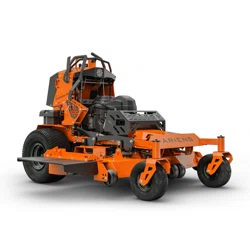
RIDGELINE
OPERATOR’S MANUAL
MANUEL DU UTILISATEUR
09741500 • 12/24
PRINTED IN USA
ENGLISH
FRANÇAIS
E10
MODELS
994166 – RIDGELINE 32
(SN 000101 +)
994167 – RIDGELINE 48
(SN 000101 +)
994168 – RIDGELINE 52
(SN 000101 +)

WELCOME . . . . . . . . . . . . . . . . . . . . . . 1
Register Your Product!. . . . . . . . . . . . . . 1
SAFETY. . . . . . . . . . . . . . . . . . . . . . . . . 2
Practices & Laws . . . . . . . . . . . . . . . . . . 2
Emission Control System. . . . . . . . . . . . 2
Required Operator Training . . . . . . . . . . 2
Safety Alert Symbol . . . . . . . . . . . . . . . . 2
Signal Words . . . . . . . . . . . . . . . . . . . . . 2
Safety Decals. . . . . . . . . . . . . . . . . . . . . 3
Safety instructions . . . . . . . . . . . . . . . . . 6
CONTROLS AND FEATURES . . . . . . . 9
Ignition Key . . . . . . . . . . . . . . . . . . . . . . 11
Choke Control Knob. . . . . . . . . . . . . . . . 11
Throttle Control Lever . . . . . . . . . . . . . . 11
Power Take-Off (PTO) Switch . . . . . . . . 11
Speed Limiting Bar. . . . . . . . . . . . . . . . . 11
Deck Lift Lever . . . . . . . . . . . . . . . . . . . . 11
Transaxle Bypass Levers. . . . . . . . . . . . 11
Anti-Scalp Wheels . . . . . . . . . . . . . . . . . 12
Hour Meter . . . . . . . . . . . . . . . . . . . . . . . 12
Parking Brake Lever . . . . . . . . . . . . . . . 12
Steering Levers . . . . . . . . . . . . . . . . . . . 12
Safety Interlock System . . . . . . . . . . . . . 12
BEFORE OPERATION . . . . . . . . . . . . . 12
Set Cutting Height . . . . . . . . . . . . . . . . . 13
Transport Unit . . . . . . . . . . . . . . . . . . . . 13
Release Transport Lock. . . . . . . . . . . . . 13
Set Operator Platform . . . . . . . . . . . . . . 14
Adjust Speed Limiting Bar . . . . . . . . . . . 14
OPERATION . . . . . . . . . . . . . . . . . . . . . 14
Emergency Stopping . . . . . . . . . . . . . . . 14
Start The Engine . . . . . . . . . . . . . . . . . . 15
Operate Unit. . . . . . . . . . . . . . . . . . . . . . 15
Stop The Engine . . . . . . . . . . . . . . . . . . 16
Move Unit Manually . . . . . . . . . . . . . . . . 16
MAINTENANCE . . . . . . . . . . . . . . . . . . 17
Service Position. . . . . . . . . . . . . . . . . . . 17
Maintenance Schedule . . . . . . . . . . . . . 17
Service Parts . . . . . . . . . . . . . . . . . . . . . 18
Check Safety Interlock System . . . . . . . 18
Check Hydraulic System . . . . . . . . . . . . 18
Check Tire Pressure . . . . . . . . . . . . . . . 19
Check Mower Blades. . . . . . . . . . . . . . . 19
Check Parking Brake. . . . . . . . . . . . . . . 21
Clean Battery . . . . . . . . . . . . . . . . . . . . . 21
Charge Battery. . . . . . . . . . . . . . . . . . . . 21
Check Fasteners . . . . . . . . . . . . . . . . . . 22
Lubricate Unit. . . . . . . . . . . . . . . . . . . . . 22
SERVICE AND ADJUSTMENTS . . . . . 22
Adjust Transaxles . . . . . . . . . . . . . . . . . 22
Adjust Steering Levers. . . . . . . . . . . . . . 23
Adjust Unit To Drive Straight . . . . . . . . . 24
Replace Mower Belts. . . . . . . . . . . . . . . 24
Adjust Anti-Scalp Wheels . . . . . . . . . . . 26
Adjust Deck Lift . . . . . . . . . . . . . . . . . . . 26
Remove / Install Mower Deck . . . . . . . . 27
Level and Pitch Mower Deck . . . . . . . . . 28
ELECTRICAL SERVICE . . . . . . . . . . . . 29
TROUBLESHOOTING . . . . . . . . . . . . . 30
Slope Indicator. . . . . . . . . . . . . . . . . . . . 31
STORAGE . . . . . . . . . . . . . . . . . . . . . . . 32
Short-Term Storage . . . . . . . . . . . . . . . . 32
Long-Term Storage . . . . . . . . . . . . . . . . 32
Start-Of-Season Preparation . . . . . . . . . 32
ACCESSORIES. . . . . . . . . . . . . . . . . . . 32
SPECIFICATIONS. . . . . . . . . . . . . . . . . 33
WARRANTY . . . . . . . . . . . . . . . . . . . . . 34
TABLE OF CONTENTS
EN - 1
© 2024 • AriensCo • Brillion, WI 54110
WELCOME
Congratulations on your purchase and welcome to the Ariens family! Every machine in the
Ariens lineup is designed for long-lasting and unsurpassed performance. We are confident your
machine will be part of your family for many years to come.
Have Questions or Need Assistance?
www.ariens.com
A parts manual for your unit is available for free download
or purchase at www.ariens.com.
REGISTER YOUR PRODUCT!
It is extremely important to register your
product at time of purchase. Product
registration activates the warranty and
establishes a communication link from
AriensCo.
Locate the model and serial number decal on
your unit and register those numbers online at
www.ariens.com. See Figure 1 for decal
location. Be aware that the original selling
dealer may have already completed product
registration on behalf of the original
purchaser.
Record model number here.
Record serial number here.
Figure 1
Model & Serial Number Label
MANUALS
Before operating or servicing the unit, carefully
and completely read the manuals provided with
the unit. They contain safety instructions and
important information about unit controls.
The engine on this unit is covered by a
separate manual. Refer to the engine manual
for engine service recommendations. Contact
the engine manufacturer for a replacement
manual if necessary.
Your dealer must review important information
in this manual with you before or upon delivery
of the unit. It is your responsibility to read and
understand all safety precautions and
instructions in the manuals. If you do not
understand or have difficulty following the
instructions, contact your Ariens dealer for
assistance. To locate your nearest Ariens
dealer, go to www.ariens.com.
DISCLAIMER
Ariens reserves the right to discontinue, make
changes to, and add improvements upon its
products at any time without public notice or
obligation. The descriptions and specifications
contained in this manual were in effect at
printing. Equipment described in this manual
may be optional. Some illustrations may not be
applicable to your unit.
EN - 2
Read these safety rules and follow them
closely. Failure to follow these rules could
lead to loss of control of unit, severe personal
injury or death to you or bystanders, or result
in damage to property or the machine.
PRACTICES & LAWS
Practice usual and customary safe working
precautions. Learn applicable rules and laws
in your area. Always follow the practices set
forth in this manual.
EMISSION CONTROL SYSTEM
This equipment and/or its engine may include
exhaust and evaporative emissions control
system components required to meet U.S.
Environmental Protection Agency (EPA)
and/or California Air Resources Board
(CARB) regulations. Tampering with emission
controls and components by unauthorized
personnel may result in severe fines or
penalties. Emission controls and components
can only be adjusted by an Ariens dealer or
an authorized engine manufacturer's service
center. Contact your Ariens Equipment
Retailer concerning emission controls and
components.
REQUIRED OPERATOR
TRAINING
Read and understand the
Operator's Manual and decals
on the unit. This information is
for your safety and the proper
use of your equipment.
Failure to follow these
instructions and warnings may cause death
or serious injury. If you have purchased this
product from an Ariens dealer, the dealer can
provide you with training.
Familiarize yourself and any other operators
with all controls and the safe use of the
features of this unit. If you loan, rent or sell
this product to others, provide them with all
manuals.
If you have any questions, please call our
customer support line at 920-756-4688 or
contact us at www.ariens.com. Do not use
this equipment if, after reading the Operator's
Manual and the on-board decals, you have
any questions about the safe use of this
product.
SAFETY ALERT SYMBOL
SIGNAL WORDS
The safety alert symbols above and signal
words below are used on decals and in this
manual.
Read and understand all safety messages.
1. Danger
2. Warning
3. Caution
SAFETY
WARNING: AVOID INJURY.
This cutting machine is
capable of amputating hands
and feet and throwing objects.
Failure to observe the safety
instructions in the manuals and
on decals could result in
serious injury or death.
This is the safety alert symbol.
It means:
• ATTENTION!
• YOUR SAFETY IS
INVOLVED!
When you see this symbol:
• BECOME ALERT!
• OBEY THE MESSAGE!
DANGER: Indicates an
IMMINENTLY HAZARDOUS
SITUATION! If not avoided,
WILL RESULT in death or
serious injury.
WARNING: Indicates a
POTENTIALLY HAZARDOUS
SITUATION! If not avoided,
COULD RESULT in death or
serious injury.
CAUTION: Indicates a
POTENTIALLY HAZARDOUS
SITUATION! If not avoided,
MAY RESULT in minor or
moderate injury. It may also be
used to alert against unsafe
practices.
EN - 3
4. Notice
NOTICE: Indicates information or procedures
that are considered important but not hazard
related. If not avoided property damage could
result.
5. Important
IMPORTANT: Indicates general reference
information worthy of special attention.
SAFETY DECALS
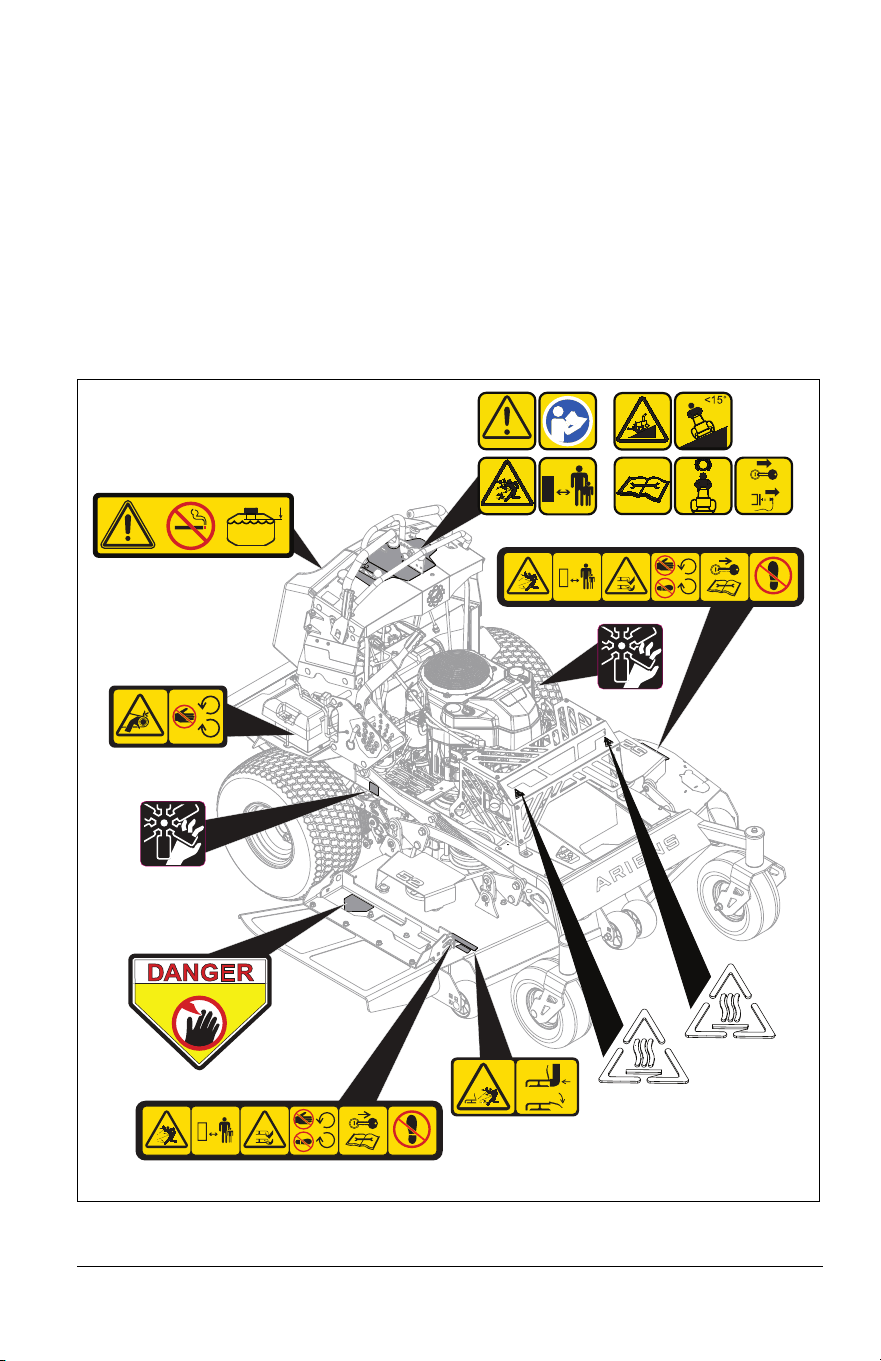
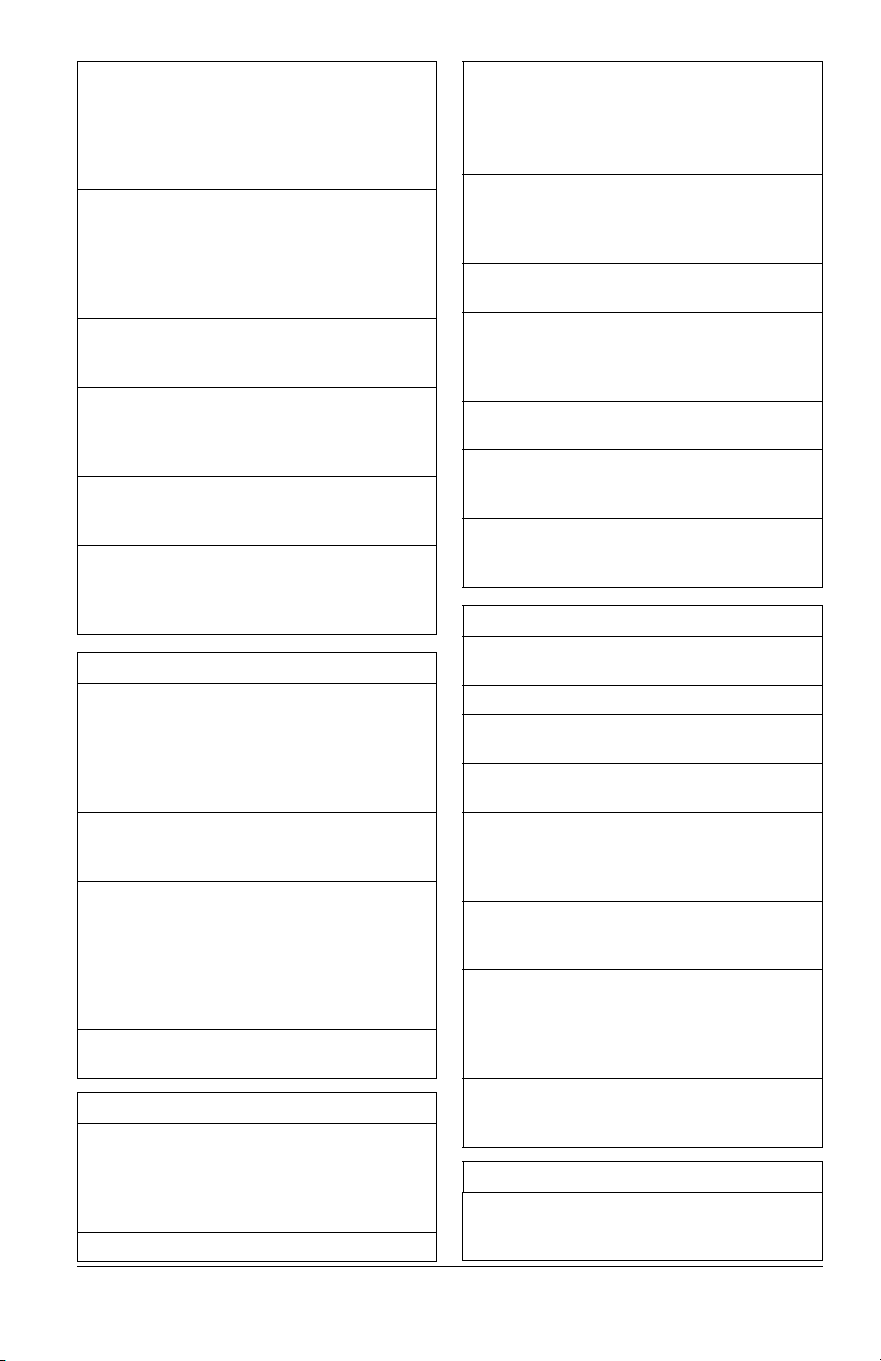
The safety decals on your machine are visual
reminders of the important safety information
in this manual. All messages on your unit
must be fully understood and carefully
followed. Safety decals on the machine are
explained below.
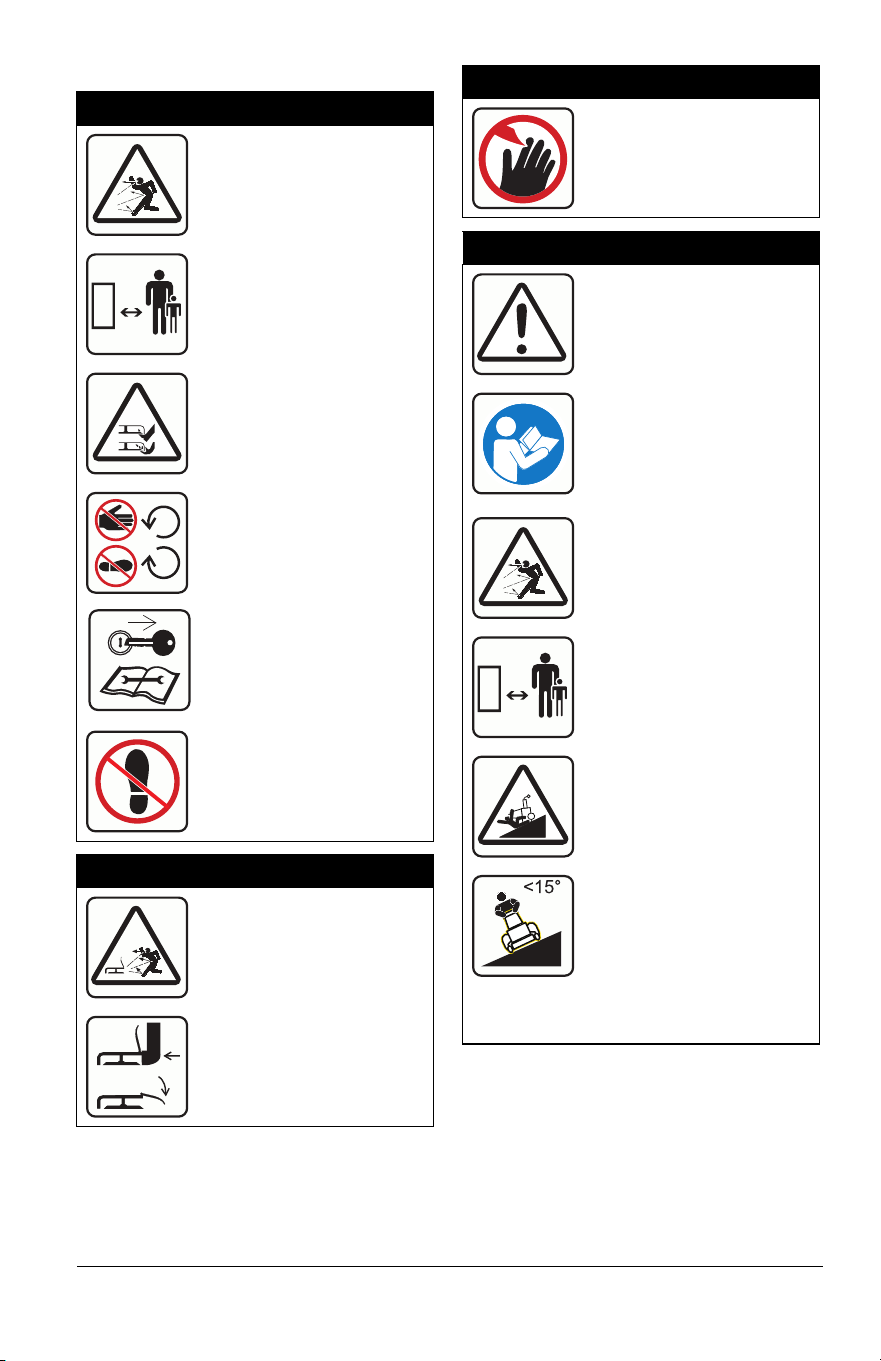
ALWAYS replace missing or damaged safety
decals. Replacement decal information is in
the parts manual for your unit. Decals can be
ordered from your dealer. See Figure 2 for
safety decal locations.
Safety Decal Locations
07800410
07800401
KEEP HANDS and FEET AWAY
0
2
9
8
8
1
0
0
07800402
07800410
07801737
07801737
MAX. FILL
P
Figure 2
3
7
2
5
5
4
8
6
1
1
7
EN - 4
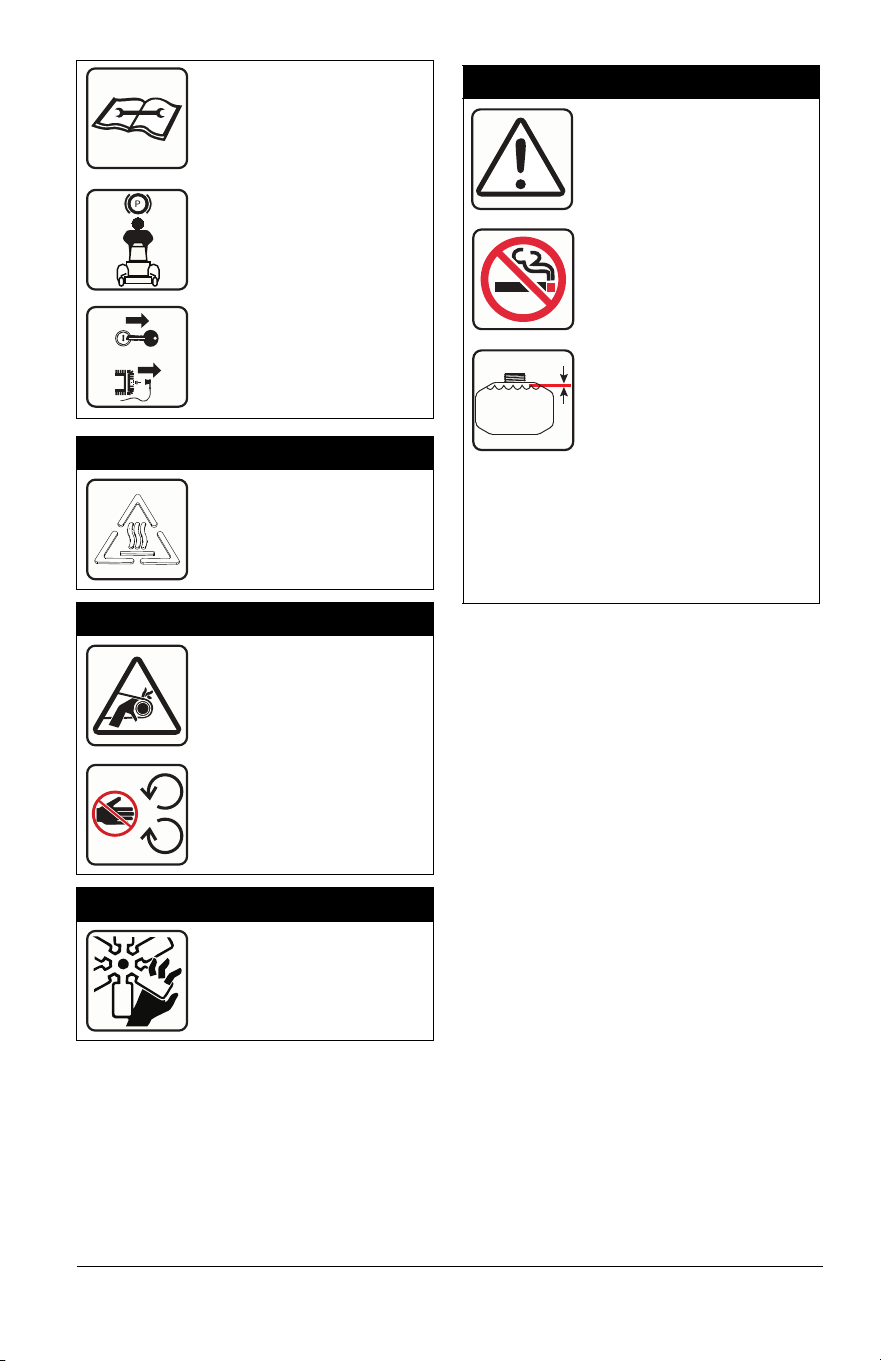
Safety Decal Descriptions
1. DANGER!
Discharge Hazard – NEVER
direct discharge toward peo-
ple, pets or property.
Thrown objects can cause
injury or damage.
Keep children and others
away from unit while unit is
in operation.
Dismemberment Hazard –
NEVER stick hands or feet
under deck or shielded
areas.
Keep feet and hands away
from all rotating or moving
parts.
Shut off engine, remove key,
and read manual before ser-
vicing or making adjust-
ments to unit.
DO NOT step or stand in
this area.
2. DANGER!
Discharge Hazard –
NEVER operate unit
without discharge chute in
operating position. Thrown
objects can cause injury or
damage.
Do not operate mower
unless all guards are in
operating position or
bagger is attached.
3. DANGER!
ALWAYS keep hands and
feet away from discharge
chute.
4. CAUTION!
DO NOT touch parts which
are hot from operation.
ALWAYS allow parts to cool.
Read Owner/Operator
Manual. Allow operation
only by properly trained
adult, never children.
Discharge Hazard – NEVER
direct discharge toward peo-
ple, pets or property.
Thrown objects can cause
injury or damage.
Keep children and others
away from unit while unit is
in operation.
Operating on slopes may
cause the unit to tip
unexpectedly. Do not tip
mower while operating the
unit. Mow across slopes, not
up and down.
Look down and behind
before and while backing.
DO NOT operate on slopes
over 15°. This maximum
degree of operation is
without attachments.
DO NOT operate on slopes
over 10° when operating
with attachments.
EN - 5
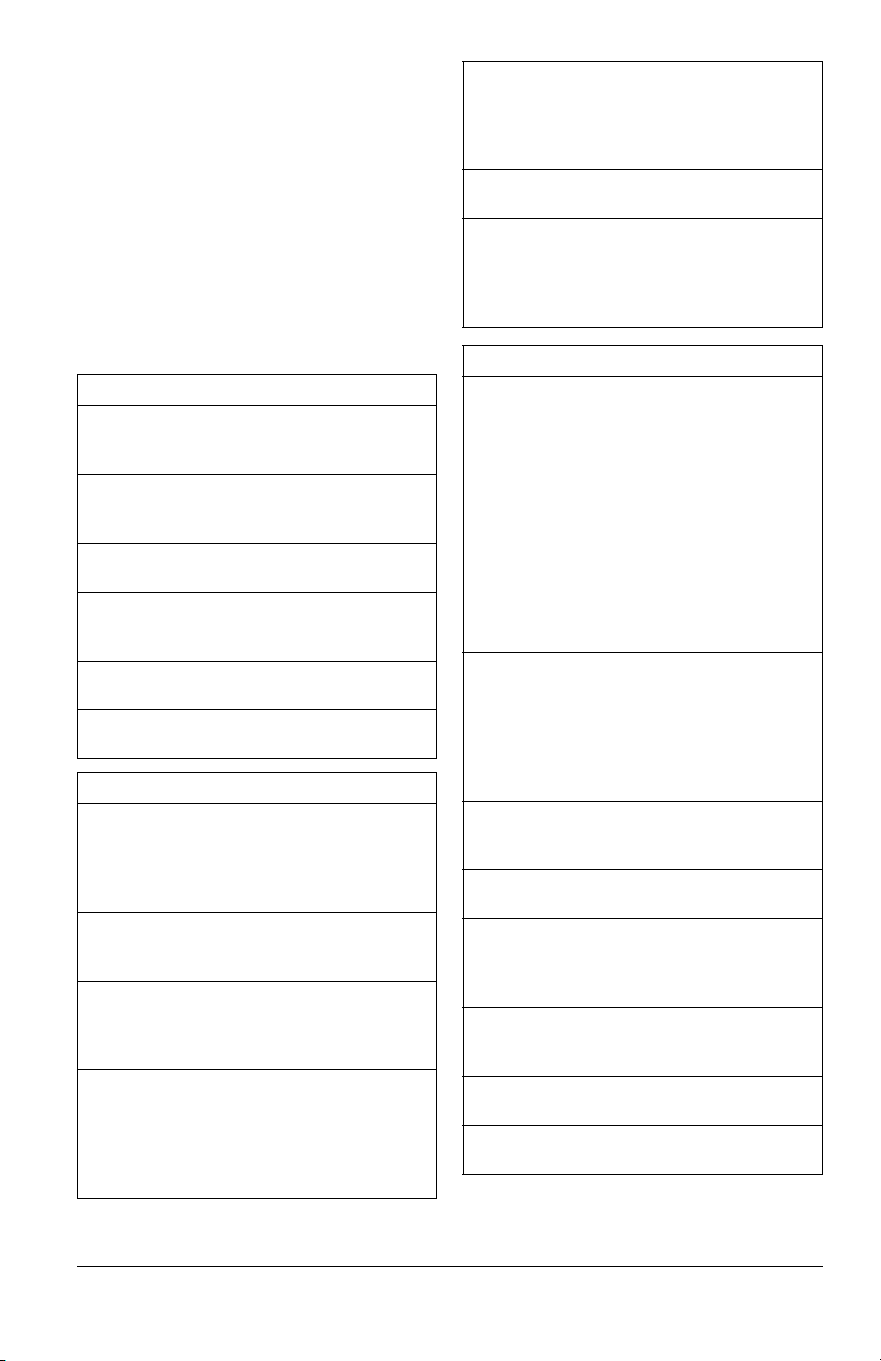
Read manual, set parking
brake, remove key and
remove spark plug before
you adjust or repair unit.
5. HOT PARTS!
DO NOT touch parts which
are hot from operation.
ALWAYS allow parts to cool.
6. DANGER!
To avoid amputation hazard
DO NOT put hands near
moving belts.
Keep hands away from all
rotating or moving parts.
7. ROTATING PARTS!
AVOID INJURY. Stay clear
of rotating parts.
P
8. DANGER!
DANGER!
No smoking.
IMPORTANT: DO NOT
overfill. Fill fuel tank to
below bottom of filler neck.
WARNING: Overfilling may cause severe
damage to evaporative system!
• Never fill fuel tank when engine is running,
hot or unit is indoors. Never overfill fuel
tank.
• Replace fuel cap securely and clean up
spilled fuel.
EN - 6
SAFETY INSTRUCTIONS
The following safety instructions are based
on B71.1, B71.4 specifications of the
American National Standards Institute and
ISO 5395 in effect at the time of production.
Safe Practices for Ride-On Mowers
If used improperly, this machine is capable of
amputating hands and feet and throwing
objects. Failure to observe the following
safety instructions could result in serious
injury or death. Use only for purposes
intended as set forth in the Operator's
Manual. Other use is improper and may
cause serious injury or death.
General Information
Read, understand, and follow instructions
and warnings in this manual and on the
machine, engine and attachments.
Only allow operators, who are responsible,
trained, familiar with the instructions, and
physically capable to operate the machine.
DO NOT carry passengers and keep people
or pets away from the mowing area.
DO NOT operate the machine while
physically or mentally impaired, feeling tired,
ill or under the influence of alcohol or drugs.
Follow the manufacturer’s recommendation
for wheel weights or counterweights.
DO NOT touch parts which are hot. Allow
parts to cool.
Preparation Before Operating
Inspect unit before each use for missing or
damaged decals and shields, correctly
operating safety interlock system, ROPS
and deterioration of grass catchers. Replace
or repair as needed.
Clear the operating area of all objects which
could be thrown by or interfere with
operation of the machine.
Keep the area of operation clear of all
bystanders, particularly small children. Stop
the machine and attachment(s) if anyone
enters the area
DO NOT operate the machine without the
entire grass catcher, discharge chute, or
other safety devices in place and functioning
properly. Check frequently for signs of
damage, wear or deterioration and replace
as needed.
NEVER tamper with safety devices. Check
their proper operation regularly. NEVER do
anything to interfere with the intended
function of a safety device or to reduce the
protection provided by the safety device.
Check parking brake operation frequently.
Adjust and service as required.
Wear appropriate personal protective
equipment such as safety glasses, hearing
protection, and substantial footwear. DO
NOT mow barefoot or while wearing
sandals.
Operating
Improper use of power equipment can cause
serious permanent injury or death to the
operator or a bystander. Understand:
• How to operate all controls
• The functions of all controls
• How to STOP in an emergency
• Braking and steering characteristics
• Turning radius and clearances
If the operator or the mechanic cannot read
the manual, it is the owner’s responsibility to
explain it to them. Manuals are available in
other languages at www.ariens.com.
Releasing the operator presence control
(OPC) handle stops engine and blade within
3 seconds. Check this feature frequently. If
feature fails to operate, disconnect spark
plug wire and have the unit inspected and
repaired by an authorized dealer before
using.
Only run the engine in well ventilated areas.
Exhaust gases contain carbon monoxide, an
odorless deadly poison.
Only operate the machine in daylight or
good artificial light.
Avoid holes, ruts, bumps, rocks and other
hazards. Uneven terrain could overturn the
machine, or cause operator to lose their
balance, footing and/or control of the mower.
DO NOT put hands or feet near rotating
parts or under the machine. Keep clear of
the discharge opening at all times.
Avoid slippery surfaces. ALWAYS be sure of
your footing.
Stop engine before removing grass catcher
or unclogging chute.
EN - 7
DO NOT direct discharge material toward
anyone. Avoid discharging material against
a wall or obstruction. Material may ricochet
back toward the operator. Stop the blade(s)
when crossing gravel surfaces. DO NOT
mow into roads or across sidewalks.
DO NOT leave a running machine
unattended. ALWAYS park on level ground,
disengage the attachment, set parking
brake, stop engine and remove key (if
applicable) before leaving the operator's
position.
DO NOT mow in reverse unless absolutely
necessary. ALWAYS look down and behind
before and while backing.
Lightning can cause severe injury or death.
If lightning is seen or thunder is heard in the
area, DO NOT operate the machine; seek
shelter.
If you strike a foreign object, stop and
inspect the machine. Repair, if necessary,
before restarting.
ALWAYS check overhead and side
clearances carefully before operation. Keep
in mind that your mower deck may be wider
than your track width.
Children Specific
Tragic accidents can occur if the operator is
not alert to the presence of children.
Children are often attracted to the machine
and the mowing activity. NEVER assume
that children will remain where you last saw
them.
Keep children out of the operating area and
under the watchful care of a responsible
adult other than the operator.
Do not carry children, even with the blade(s)
shut off. Children could fall off and be
seriously injured or interfere with safe
machine operation. Children who have been
given rides in the past could suddenly
appear in the mowing area for another ride
and be run over or backed over.
DO NOT allow children under the age of 18
to operate any outdoor power equipment.
Slope Specific
Slopes are a major factor related to
accidents. Operation on slopes requires
extra caution. If you feel uneasy on a slope
DO NOT mow it. Use the parking brake for
emergency stops.
DO Not operate on slopes of more than 15°.
Do not mow within 1.2 M (4 feet) of a drop
off. Do not mow within 1.2 M (4 feet) of a
pond or other waterway.
The primary hazard of slope operation is
loss of control and/or roll over.
Mow up and down slopes, NEVER across.
Exercise caution when changing direction
on slopes. Use caution while operating near
dropoffs.
Avoid mowing wet grass. Wet surfaces can
cause a loss of traction and control.
DO NOT operate machine under any
condition where traction, steering, or stability
is in question. Tires could slide even if the
wheels are stopped.
Always keep the machine in gear when
going down slopes. Do not coast downhill.
Avoid starting and stopping on slopes. Avoid
making sudden changes in speed or
direction. Make turns slowly and gradually.
Use extra care while operating machine with
a grass catcher or other attachment(s). They
can affect the stability of the machine.
Fire and Fuel Specific
Extinguish all cigarettes, cigars, pipes and
other sources of ignition.
Use only an approved fuel container.
DO NOT remove fuel cap or add fuel with
the engine running or while hot.
DO NOT refuel indoors or in enclosed
spaces.
DO NOT store the machine or fuel container,
or refuel, where there is an open flame,
spark, or pilot light such as on a water
heater or other appliance.
If fuel is spilled, DO NOT attempt to start the
engine and avoid creating any source of
ignition until fuel vapors have dissipated.
To help prevent fires: keep machine free of
grass, leaves, or other debris build up; clean
up oil or fuel spillage and remove any fuel
soaked debris; allow engine to cool before
storing.
Use extra care in handling gasoline and
other fuels. They are flammable and vapors
are explosive.
Hauling
Use a single full-width ramp for loading and
unloading a machine for transport. Secure
with appropriate straps.

EN - 8
Towing
Follow the manufacturer’s recommendation
for weight limits for towed equipment and
towing on slopes.
Rollover Protection Structure
(ROPS)
The ROPS is an integral safety device. Do
not remove or alter the ROPS
Keep a folding ROPS in the raised and
locked position and use the seat belt when
operating the machine.
Lower a folding ROPS temporarily only
when absolutely necessary. Do not wear the
seat belt when folded down. There is no
rollover protection when a folding ROPS is
in the down position.
Frequently inspect the ROPS and the
seatbelt for damage. Replace a damaged
ROPS. Do not repair or alter
Service
Keep machine in good working order.
Replace worn or damaged parts.
Use caution when servicing blades. Wrap
the blade(s) or wear gloves. Replace
damaged blades. DO NOT repair or alter
blade(s).
Disconnect spark plug wire(s) and the
negative battery cable before making any
repairs.
Use only attachments recommended by
AriensCo that are appropriate to your use
and can be used safely in your application.
The use of non-genuine replacement parts
or accessories could adversely affect
machine operation and safety.
DO NOT change engine governor setting or
overspeed the engine.

EN - 10
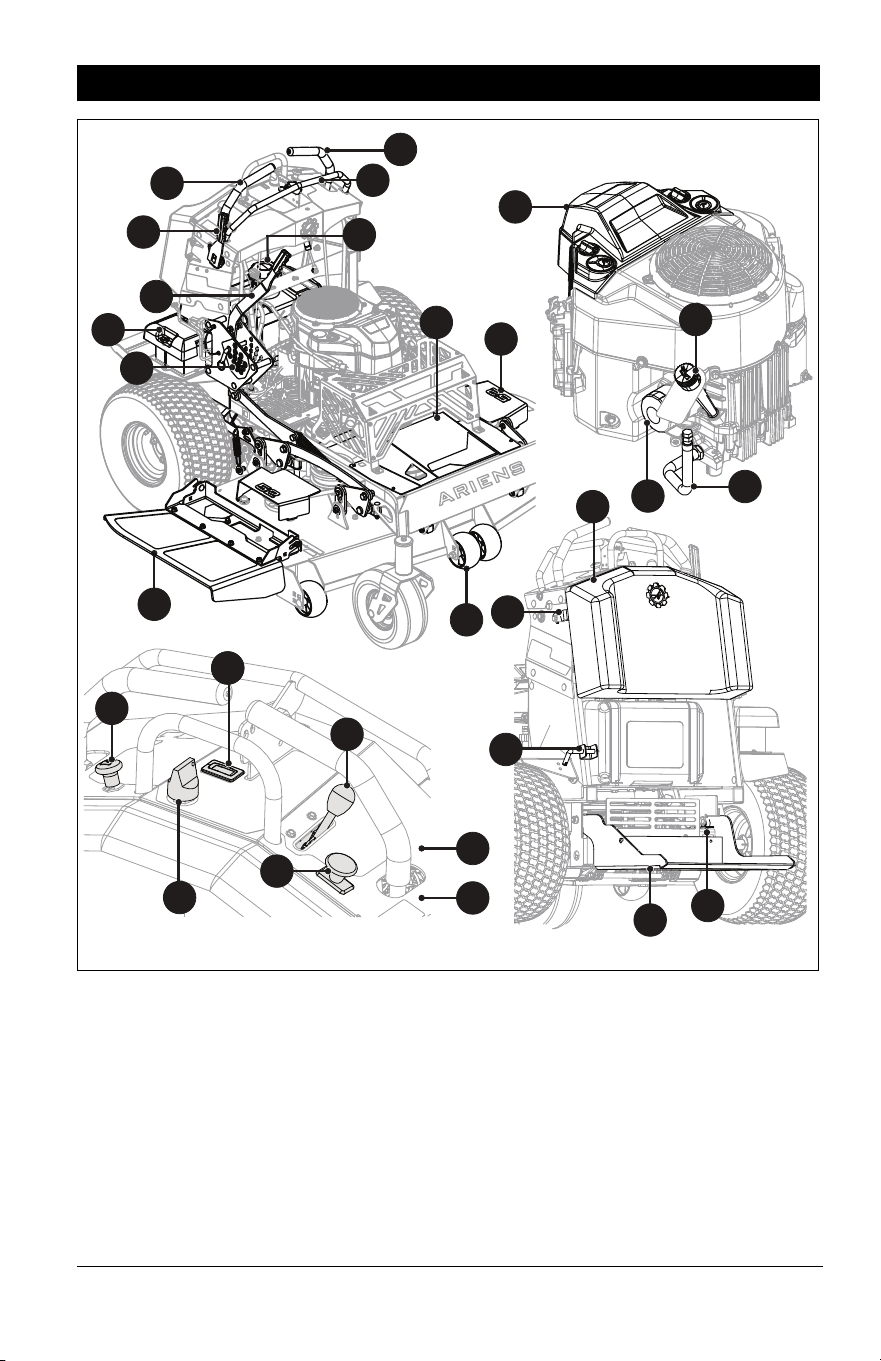
1. Ignition Key
2. Choke Control Knob
3. Throttle Control Lever
4. Power Take Off (PTO) Switch
5. Hour Meter
6. Fuel Tank and Cap
7. Oil Fill / Dipstick
8. Oil Drain
9. Engine Oil Filter
10. Air Filter
11. Speed Limiting Bar
12. Height-of-Cut (HOC) System
13. Deck Lift Lever
14. Discharge Chute
15. Battery
16. Parking Brake Lever
17. Steering Lever (2)
18. Operator Presence Control (OPC) Lever
19. Transaxle Bypass Lever (2) (Behind
Operator Platform)
20. Anti-Scalp Wheels
21. Pad/Rear Access Panel
22. Belt Access Panel
23. Operator Platform
24. Platform Lock Pin
25. Belt Cover (2)
26. Fuse Box (Below Control Panel)
27. Relay (Below Control Panel)
28. Hinged Pad Latch
EN - 11
See Figure 3 for Controls and Features
locations.
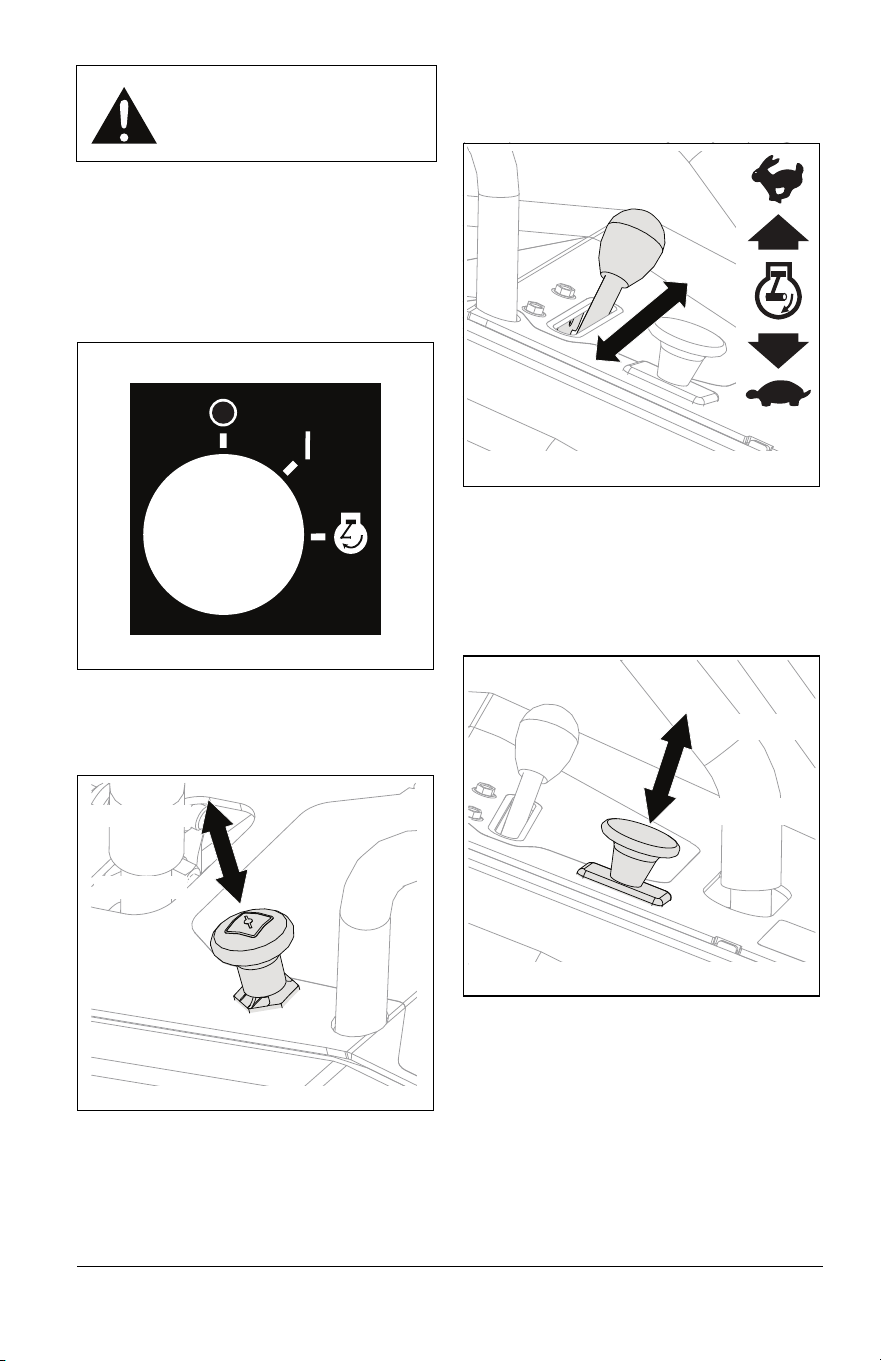
IGNITION KEY
See Figure 4.
Controls power to the engine. The key cannot
be removed when in the on position.
CHOKE CONTROL KNOB
See Figure 5.
Controls air intake to the engine.
THROTTLE CONTROL LEVER
See Figure 6.
Controls engine speed.
POWER TAKE-OFF (PTO)
SWITCH
See Figure 7.
Controls power to the mower blades. The
engine will not start with the PTO switch in
the on position.
SPEED LIMITING BAR
Controls the speed of forward travel.
DECK LIFT LEVER
Deck lift lever or pedal raises and lowers
mower deck for mowing or transport.
TRANSAXLE BYPASS LEVERS
Engage and disengage transaxles so unit can
be moved with the engine off.
WARNING: AVOID INJURY.
Read and understand entire
Safety section before
proceeding.
Figure 4
On
Off
Start
Figure 5
Choke On
Choke Off
Figure 6
Figure 7
Blades Off
Blades On
EN - 12
ANTI-SCALP WHEELS
Help prevent the deck from contacting the
ground and scalping the lawn when mowing
over high spots.
HOUR METER
Measures and displays engine runtime.
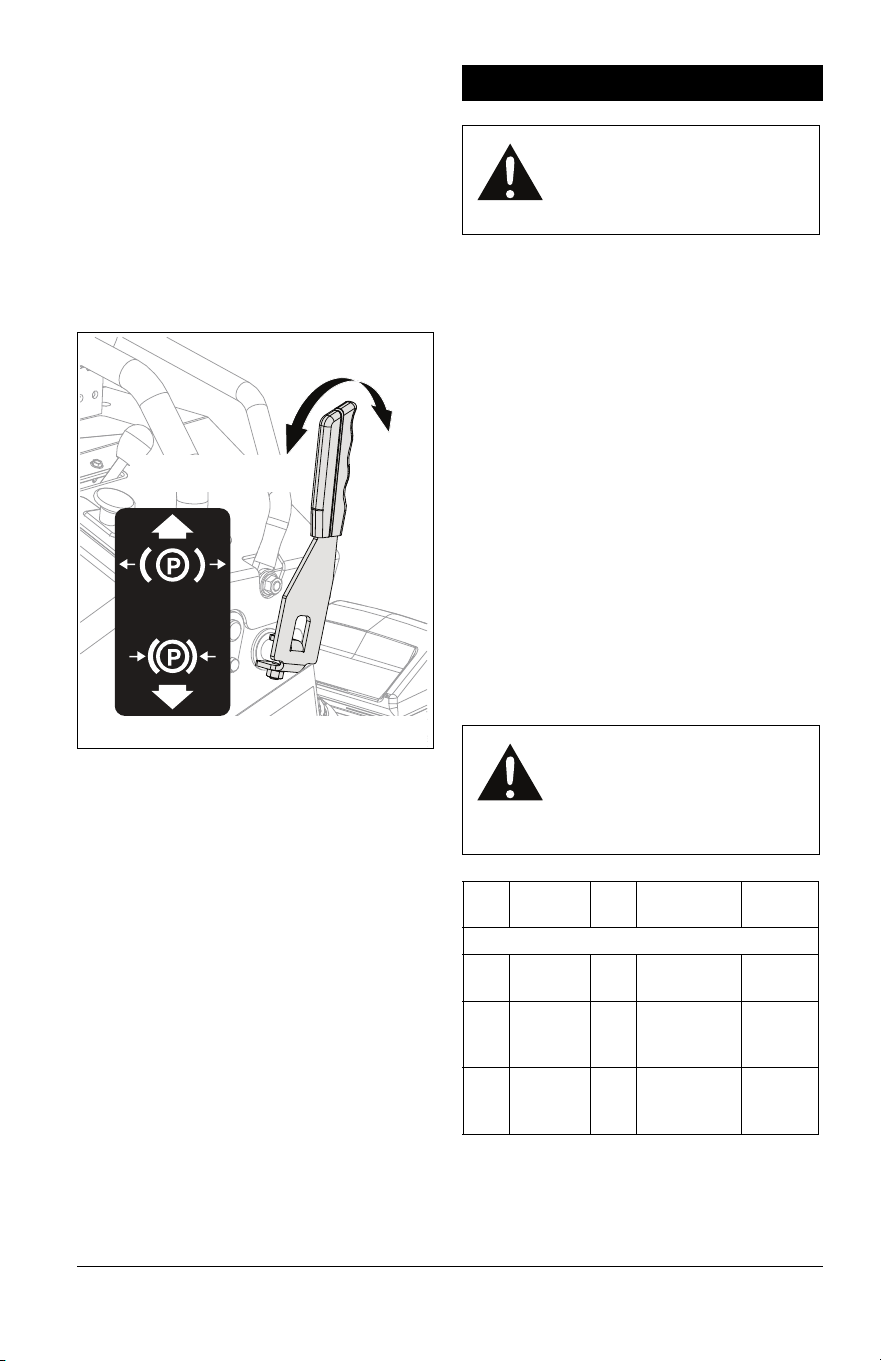
PARKING BRAKE LEVER
See Figure 8.
Engages the parking brake. The engine will
not start when brake is released.
STEERING LEVERS
Control the direction and speed of unit. The
levers gradually return to neutral when
released and are locked in neutral when
parking brake is engaged.
SAFETY INTERLOCK SYSTEM
Monitors the interaction of various unit
features for operator safety.
1. Know how to stop in an emergency. See
Emergency Stopping on page 14.
2. Check fuel level and add fuel if needed.
IMPORTANT: Use fresh unleaded fuel with
an octane rating of at least 87. DO NOT use
E85 blended fuels; the engine is not E20 /
E30 / E85 compatible. The maximum
recommended ethanol content is 10%. Ariens
recommends using a quality fuel stabilizer in
all fuel. See Short-Term Storage on page 32.
3. Check engine oil level and add oil if
needed. Refer to engine manual.
4. Check hydraulic oil level. See Check
Hydraulic Oil Level on page 18.
5. Check condition of air cleaner. Refer to
engine manual.
6. Check function of all controls.
7. Check function of the Safety Interlock
System by performing the tests below.
Contact your Ariens dealer for repair if
any of the tests fail.
07757500
Figure 8
Brake Disengaged (Off)
Brake Engaged (On)
BEFORE OPERATION
WARNING: AVOID INJURY.
Read and understand the
Safety section before
proceeding.
WARNING: AVOID INJURY.
Failure of Safety Interlock
System together with improper
operation can result in severe
personal injury.
Test Steering
Levers
PTO Parking
Brake
Result
Starting Interlock
1 Neutral Off Engaged Engine
starts.
2Forward,
Neutral,
Reverse
On Engaged or
Disengaged
Engine
does not
start.
3Forward,
Neutral,
Reverse
On
or
Off
Disengaged Engine
does not
start.
EN - 13
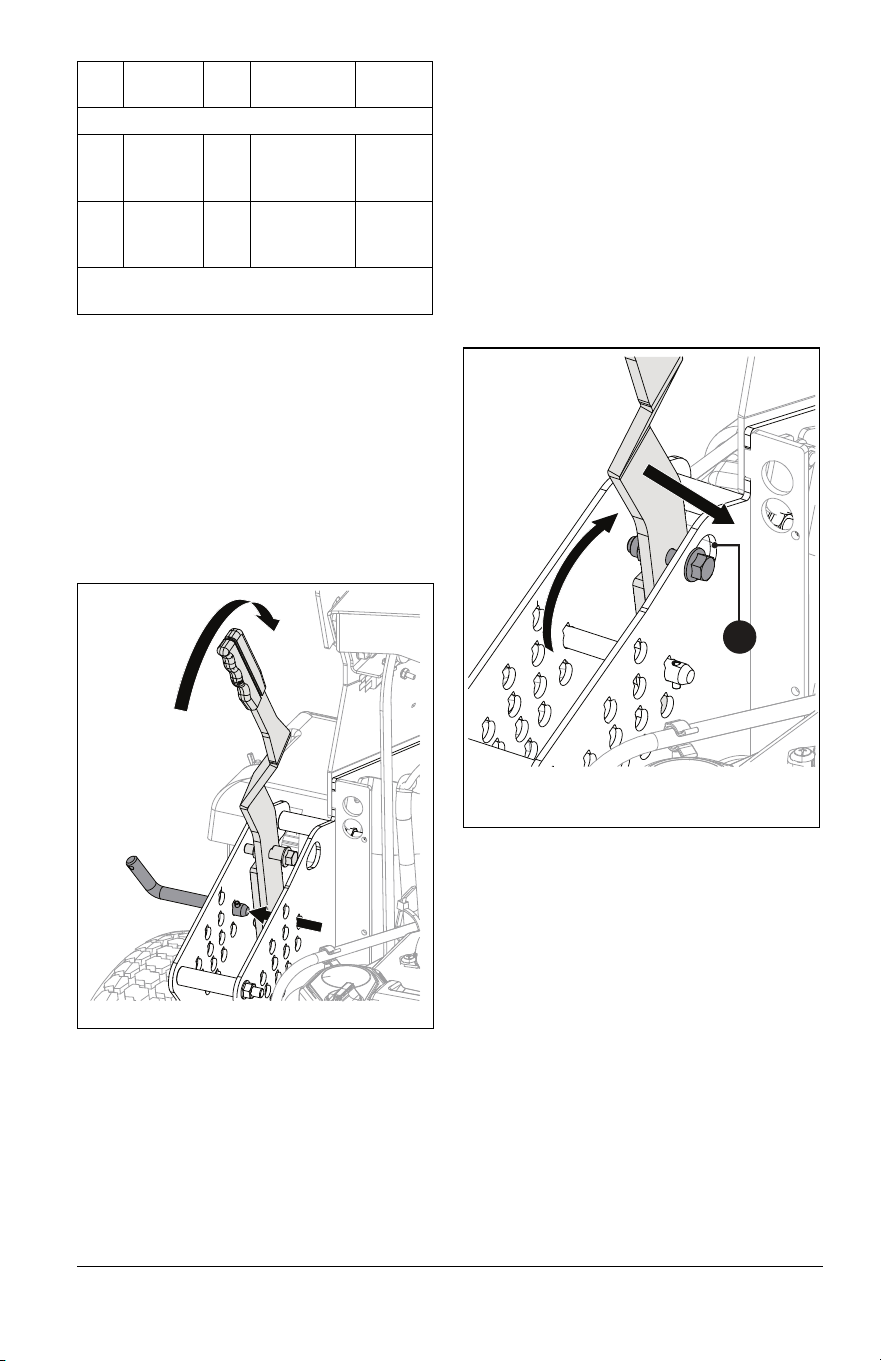
SET CUTTING HEIGHT
See Figure 9.
IMPORTANT: Model 994166: Minimum
cutting height is 5.1 cm (2"). See
Specifications on page 33.
1. Pull lift lever rearward to release deck
pressure from HOC pin.
2. Move lever to the left to insert bolt
through transport lock hole.
3. Rotate HOC pin and remove pin.
4. Align pin with desired HOC setting and
insert pin.
5. Disengage lever from transport lock
position and slowly release lever to
resting position.
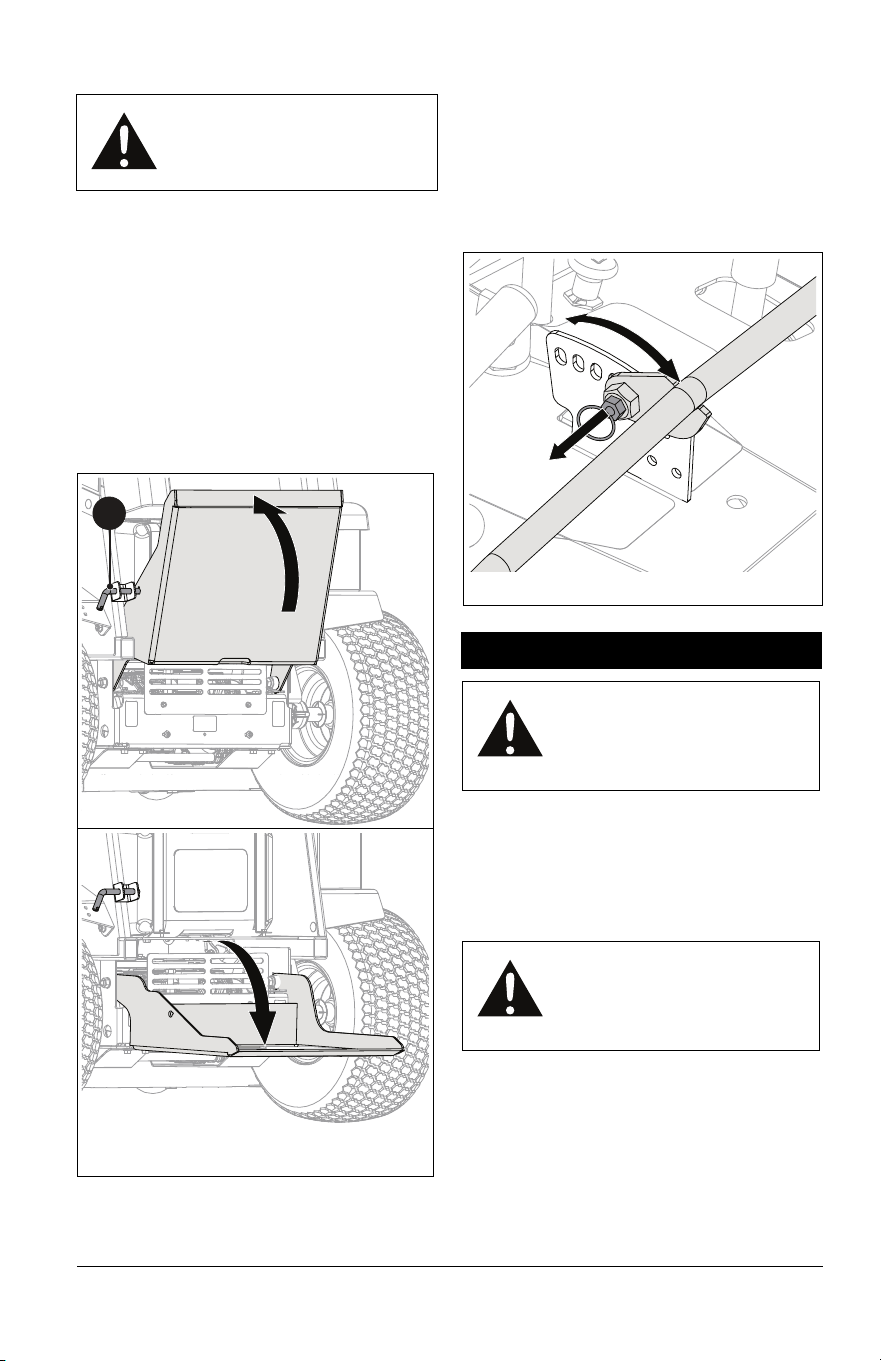
TRANSPORT UNIT
See Figure 10.
1. Pull lift lever rearward and move lever to
the left to insert bolt through transport
lock hole. Ensure washer is positioned
against HOC plate.
2. Move unit to transport vehicle.
3. Stop engine, engage parking brake and
remove key.
4. Secure mower frame to transport vehicle.
NOTICE: NEVER secure unit to vehicle from
rods or linkages that could be damaged.
RELEASE TRANSPORT LOCK
1. Pull lift lever rearward and move lever to
the right to release transport lock.
2. Slowly return lift lever to resting position.
Operating Interlock (Engine On)
4 * Forward,
Neutral,
Reverse
On Engaged or
Disengaged
Engine
shuts
off.
5 * Forward,
Neutral,
Reverse
On
or
Off
Disengaged Engine
shuts
off.
* When operator lifts off operator presence
control arm
Test Steering
Levers
PTO Parking
Brake
Result
Figure 9
1
1. Transport Lock Hole
Figure 10
EN - 14
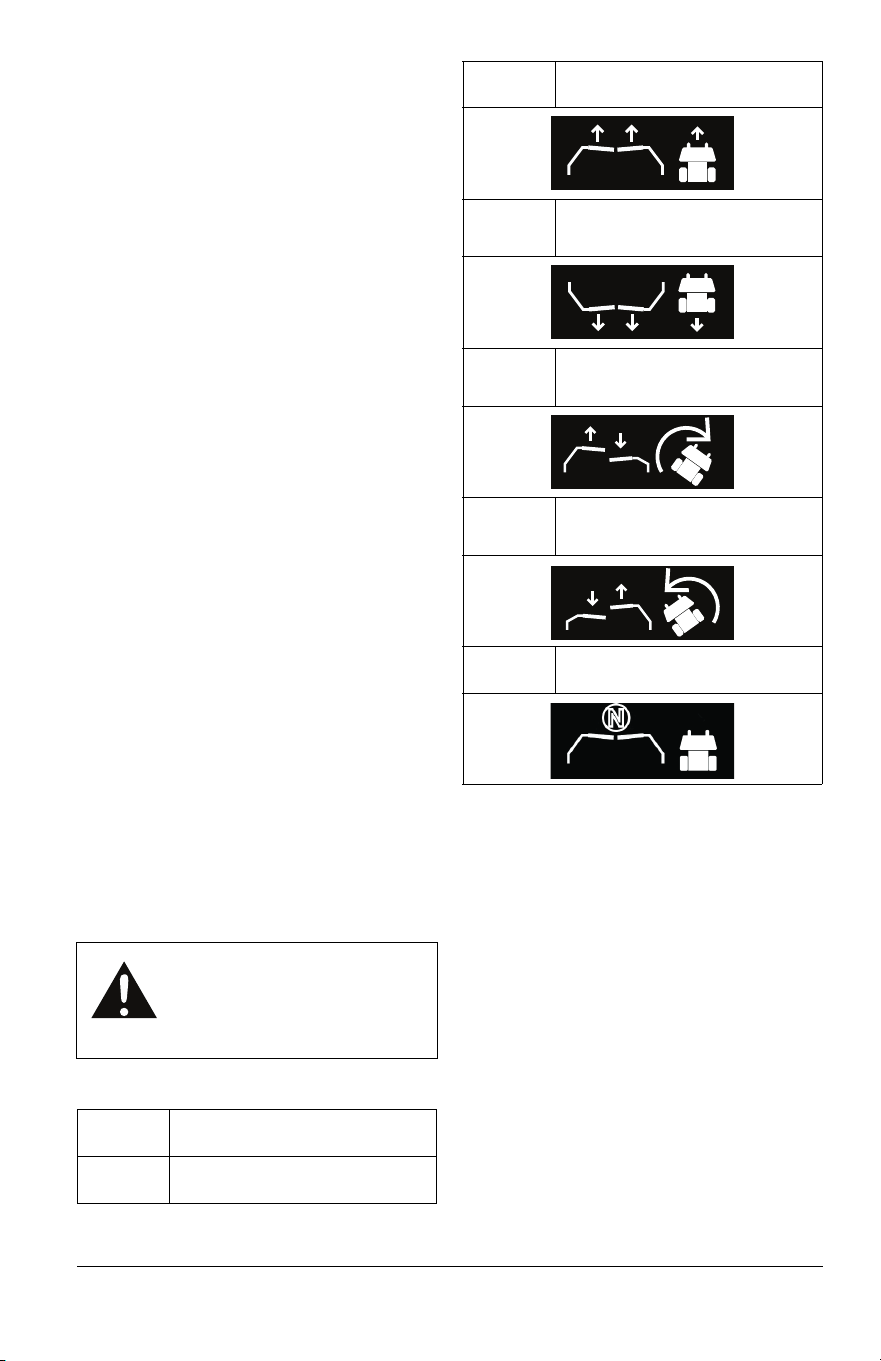
SET OPERATOR PLATFORM
See Figure 11.
To rotate platform up (walk-behind mode):
1. Rotate platform up to the storage
position.
2. Align pin with notch in platform and insert
pin.
3. Rotate pin to lock platform in place.
To rotate platform up (walk-behind mode):
4. Rotate platform lock pin and release pin.
5. Rotate platform down to the standing
position.
ADJUST SPEED LIMITING BAR
See Figure 12.
1. Pull the spring pin.
2. Move speed limiting bar rearward to
decrease maximum speed or forward to
increase maximum speed.
3. Reinstall spring pin into the desired speed
setting.
IMPORTANT: All references to left, right, front
or rear are given from the perspective of
operator in operator’s position, facing the
direction of forward travel.
EMERGENCY STOPPING
1. Return steering levers to neutral position.
2. Engage parking brake.
3. Push PTO switch down to off position.
4. Turn key to off position and remove from
ignition.
CAUTION: Platform will drop
when lock pin is released.
Stand clear when releasing
platform.
1. Platform Lock Pin
Figure 11
1
OPERATION
WARNING: AVOID INJURY.
Read and understand the
Safety section before
proceeding.
WARNING: AVOID INJURY.
Operating on slopes may lead
to loss of steering control. Be
prepared to react.
Figure 12
EN - 15
START THE ENGINE
1. Move steering levers to neutral position.
2. Engage parking brake.
3. Push PTO switch down to off position.
4. If engine is cold, move choke control
lever to the on position. DO NOT use
choke on a warm engine.
5. Move throttle control lever to 3/4 fast
position.
6. Insert ignition key and turn to the start
position. Release key when engine starts.
NOTICE: Do not operate the starter for more
than 10 seconds per starting attempt. If the
engine does not start, allow a 60-second cool
down period between starting attempts.
7. Gradually move choke control lever to the
off position after engine starts.
NOTICE: Do not operate the starter for more
than 10 seconds per starting attempt. If the
engine does not start, allow a 60-second cool
down period between starting attempts.
OPERATE UNIT
1. Start the engine. See Start The Engine on
page 15.
2. With left steering control (OPC)
depressed, release parking brake.
3. Move steering levers to neutral and set
throttle control lever to fast position.
IMPORTANT: Engaging the PTO knob with
the throttle lever set lower than fast position
can cause excessive belt wear. ALWAYS use
fast position when engaging the PTO.
4. With left steering control (OPC)
depressed, pull PTO switch up to the on
position.
IMPORTANT: Never engage the PTO if the
mower is plugged with grass or debris. This
may cause damage to the electric clutch.
5. Move steering levers to begin mowing.
IMPORTANT: Aggressive turning can scuff or
damage lawns. Always keep both wheels
rotating when making sharp turns. DO NOT
make turns with inside wheel completely
stopped. For minimum turning radius, slowly
reverse inside wheel while moving outside
wheel slowly forward.
Slope Operation
DO NOT operate on slopes over 15°.
Smartphone apps are available to assist in
measuring the angle of a slope before use.
Alternatively, refer to the chart on page 31 to
determine the degree of the slope.
WARNING: AVOID INJURY.
Move the steering levers
slowly and keep the throttle at
slow speed until you learn how
to operate the unit.
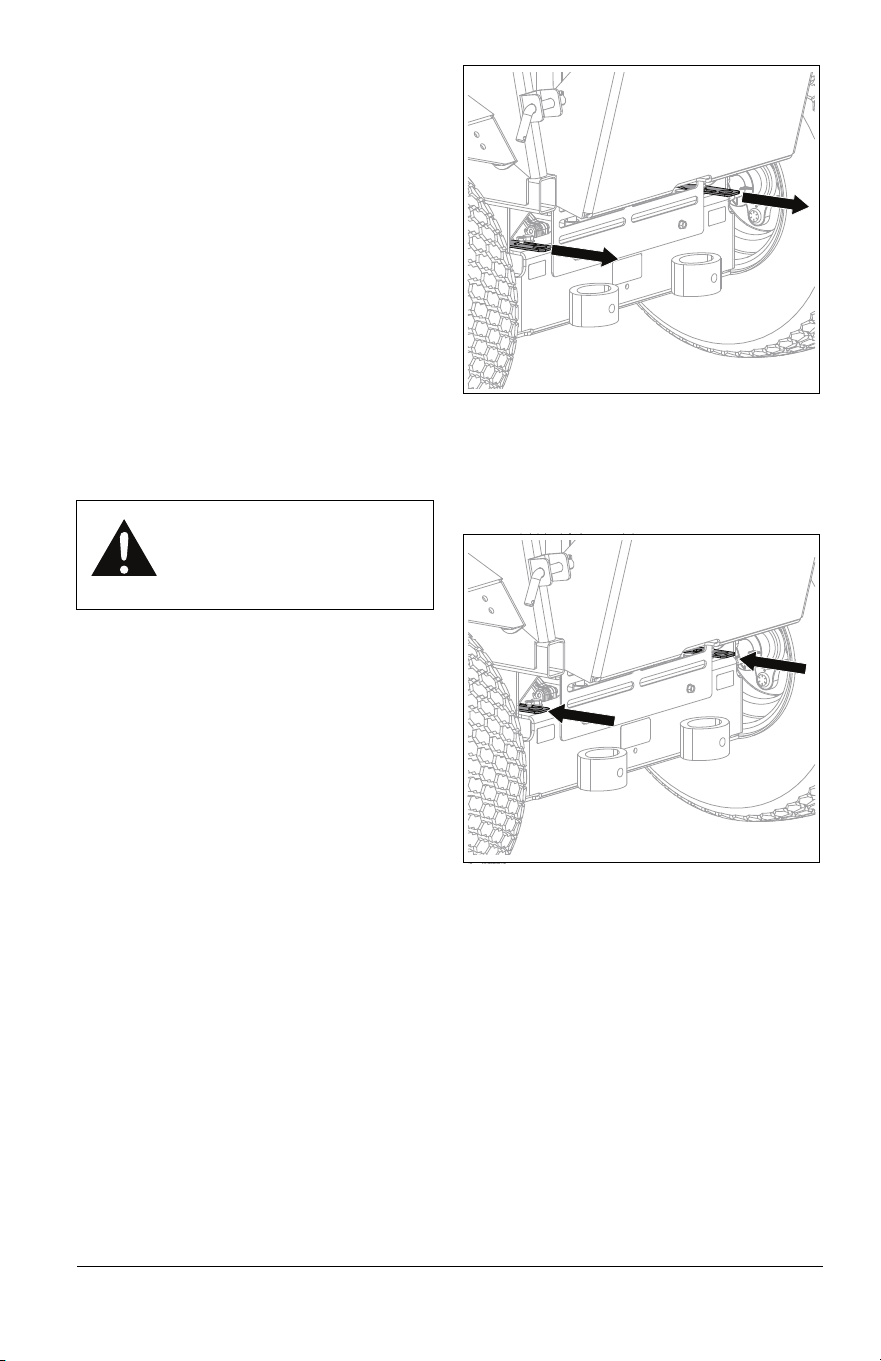
Direction
of Travel
Lever Position
Forward Push both levers forward from
neutral position.
Reverse Pull both levers backward from
neutral position.
Right Turn Push left lever farther forward
than the right lever.
Left Turn Push right lever farther forward
than the left lever.
Stop Return both levers to neutral
position.
Direction
of Travel
Lever Position
EN - 16
For Best Mowing Results
• Cut grass when it is dry.
• Keep mower blades sharp.
• Keep mower deck properly leveled.
• Adjust anti-scalp wheels to prevent
scalping.
• Do not set height of cut too low. For very
tall grass, mow twice.
• Do not travel too fast.
• Mow with engine at full throttle.
• When mulching, only remove 1/3 of grass
length per cutting. Do not cut more than 2.5
cm (1") at a time.
• Discharge clippings into areas already cut.
• Change cutting pattern with each mowing.
• Do not allow grass or debris to collect
inside mower deck. Clean after each use.
STOP THE ENGINE
1. Move steering levers to the neutral
position.
2. Engage parking brake.
3. Reduce throttle to 3/4 fast position.
4. Push PTO switch down to the off position.
5. Move throttle control lever to slow
position.
6. Turn key to off position and remove from
ignition.
MOVE UNIT MANUALLY
Bypass the transaxles to move the unit with
the engine off.
1. Place steering levers in neutral position
and engage parking brake.
2. Stop engine, remove key and wait for
moving parts to stop and for hot parts to
cool.
3. Rotate platform up and engage platform
lock.
4. Pull both transaxle bypass levers out into
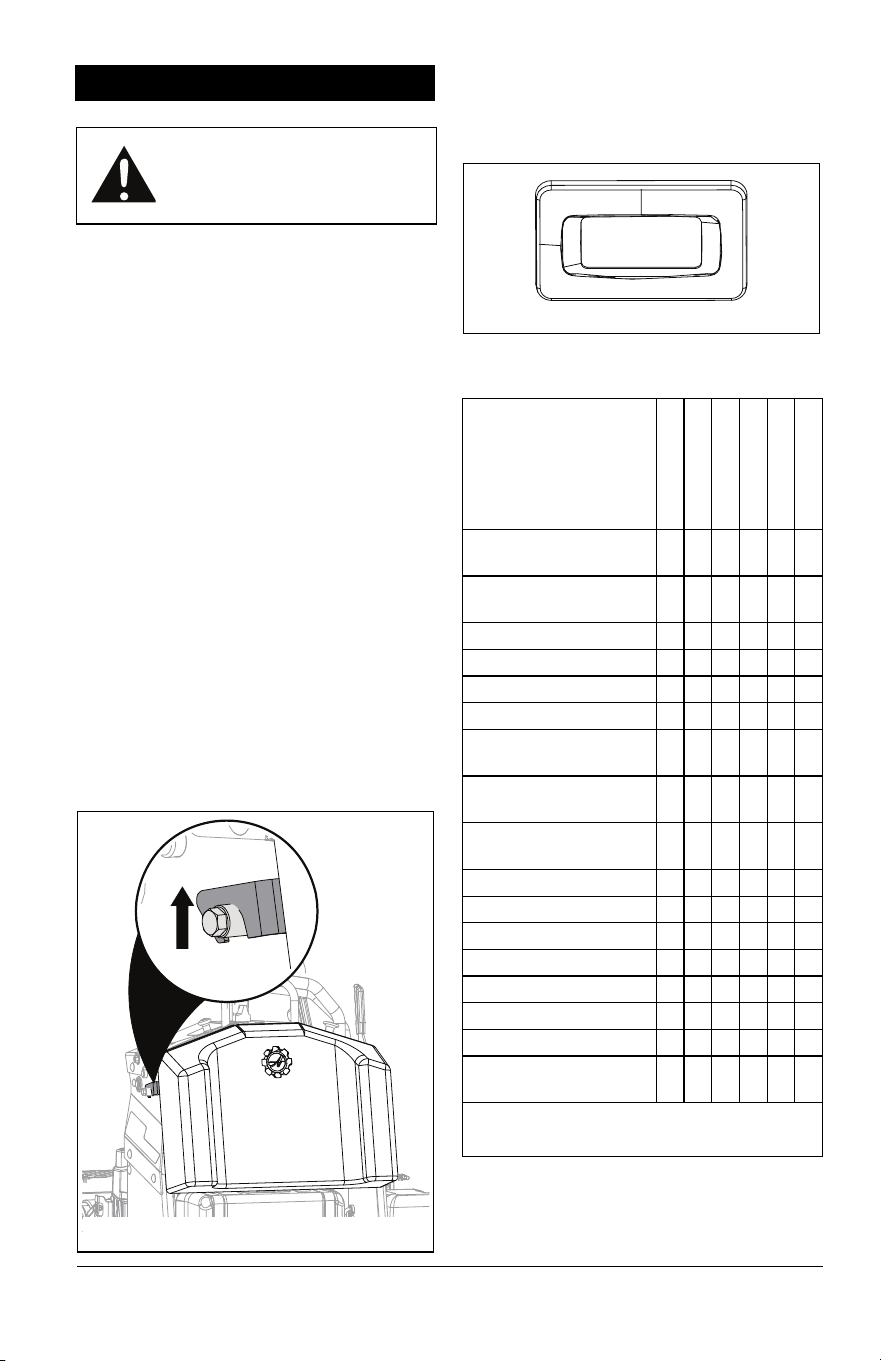
bypass position. See Figure 13.
5. Release parking brake and push unit to
desired location.
6. Engage parking brake.
7. Push bypass levers into operating
position. See Figure 14.
8. To return platform to standing position,
release platform lock pin and lower
platform.
WARNING: AVOID INJURY.
Wait for all moving parts to
stop before leaving operator’s
position.
Figure 13
Figure 14
EN - 17
Proper maintenance can prolong the life of
unit. The Maintenance Schedule on page 17
shows the recommended service schedule.
Your Ariens dealer can provide service and
adjustments to keep your unit operating at
peak efficiency. Contact an authorized engine
manufacturer’s service center for engine
service.
More frequent service may be required due to
working conditions (heavy loads, high
ambient temperatures, dusty conditions, or
airborne debris).
See the maintenance instructions in the
Engine Manual for additional information.
SERVICE POSITION
1. Park unit on a flat, level surface.
2. Place steering levers in neutral position
and engage parking brake.
3. Stop engine, remove key and wait for
moving parts to stop and for hot parts to
cool.
4. Chock wheels. Strap and clamp unit onto
lift, if used.
5. Disengage pad latch and rotate swing
operator pad outward. See Figure 15.
HOUR METER
See Figure 16.
Timer measures engine runtime and cannot
be reset.
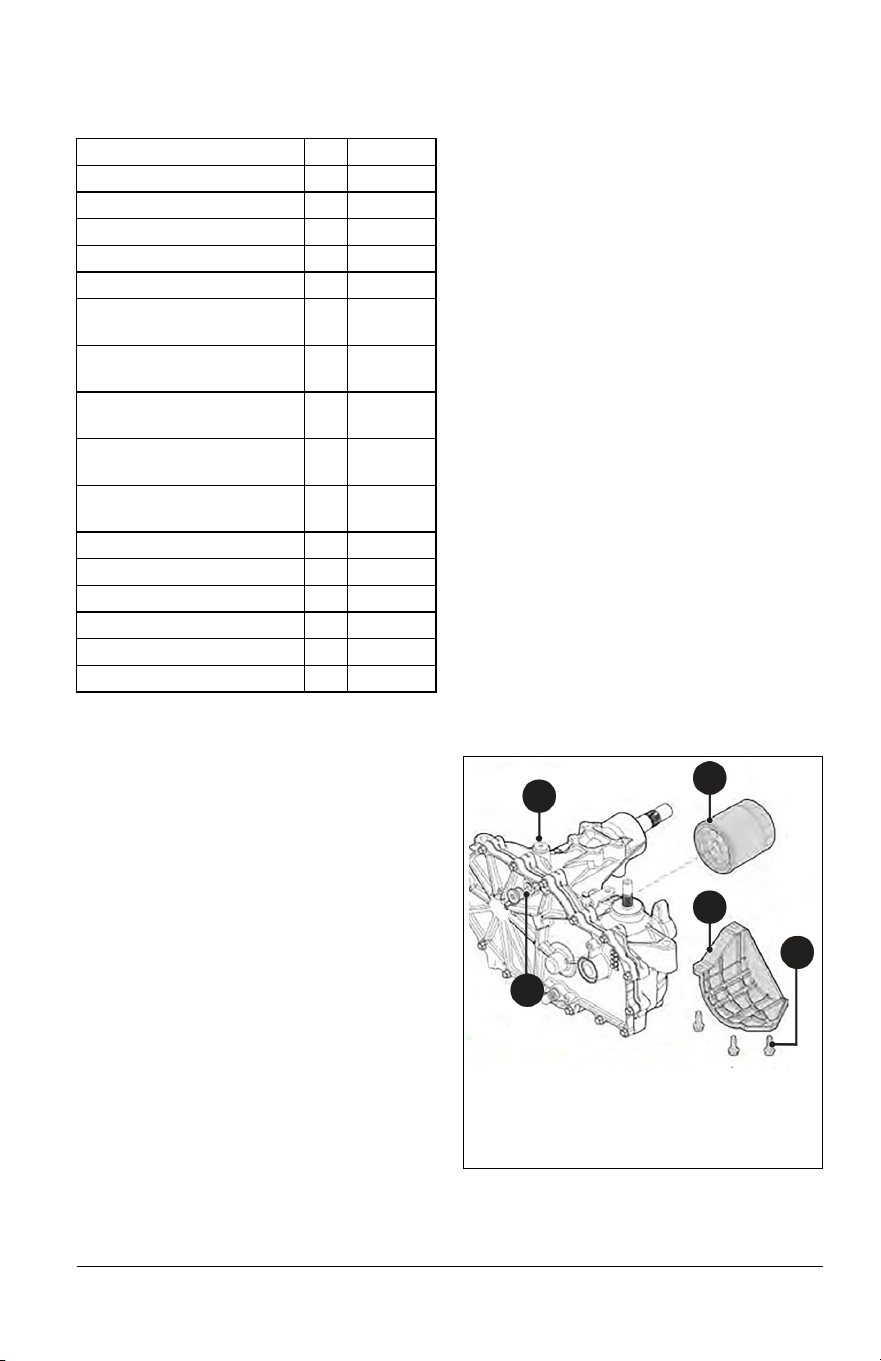
MAINTENANCE SCHEDULE
MAINTENANCE
WARNING: AVOID INJURY.
Read and understand entire
Safety section before
proceeding.
Figure 15
Service Performed
Each Use
Every 25 hrs.
Every 50 hrs.
Every 100 hrs.
Every 400 hrs.
Every 500 hrs.
Clean Debris from
Engine
•
Inspect Belt Cover
Grommets for Damage
•
Check Engine Oil * •
Change Engine Oil *
Check Air Filter * •
Change Air Filter *
Clean Engine * Cooling
System
•
Check Safety Interlock
System
•
Check Hydraulic
System
•
Check Tire Pressure •
Check Mower Blades •
Lubricate Unit •
Check Parking Brake •
Clean Battery •
Check Fasteners •
Check Belts •
Change Hydraulic Oil
and Filter **
•
* Refer to engine manual for instructions.
** Change after first 75 hours of operation.
Figure 16
EN - 18
SERVICE PARTS
See your Ariens dealer to purchase service
parts for your unit.
CHECK SAFETY INTERLOCK
SYSTEM
Parking Brake Interlock System
With the parking brake engaged, the steering
levers must be locked in neutral.
With the parking brake disengaged, the
engine must not start and the engine must
shut off if the operator releases the operator
presence control (OPC) lever. See Before
Operation on page 12. If system does not
operate correctly, see your dealer for repair.
DO NOT operate until repairs are made.
CHECK HYDRAULIC SYSTEM
Check Hydraulic Oil Level
1. Place unit in service position. See
Service Position on page 17.
2. Remove side port plug and check oil level
in transaxle. Oil level MUST reach the
bottom edge of the side fill port. See
Figure 17.
IMPORTANT: Engine should be cold when
checking initial oil level.
3. Operate engine for one minute and
recheck oil levels.
4. Add hydraulic oil, if needed. See Add
Hydraulic Oil on page 18.
Add Hydraulic Oil
1. Place unit in service position. See
Service Position on page 17.
2. Lift and properly support rear of unit and
remove wheel.
See Figure 17.
3. Remove fill port plugs from transaxle.
4. Add 15W-50 Full-Synthetic Hydraulic
Fluid (Ariens p/n 00057100) or equivalent
until oil reaches the bottom edge of the
side fill port. (approximately 1.9 L (2 qt)
per transaxle).
5. Reinstall fill port plugs. Torque to 20.3
N•m (120 in-lbs)
6. Repeat steps 4 – 12 for the other
transaxle.
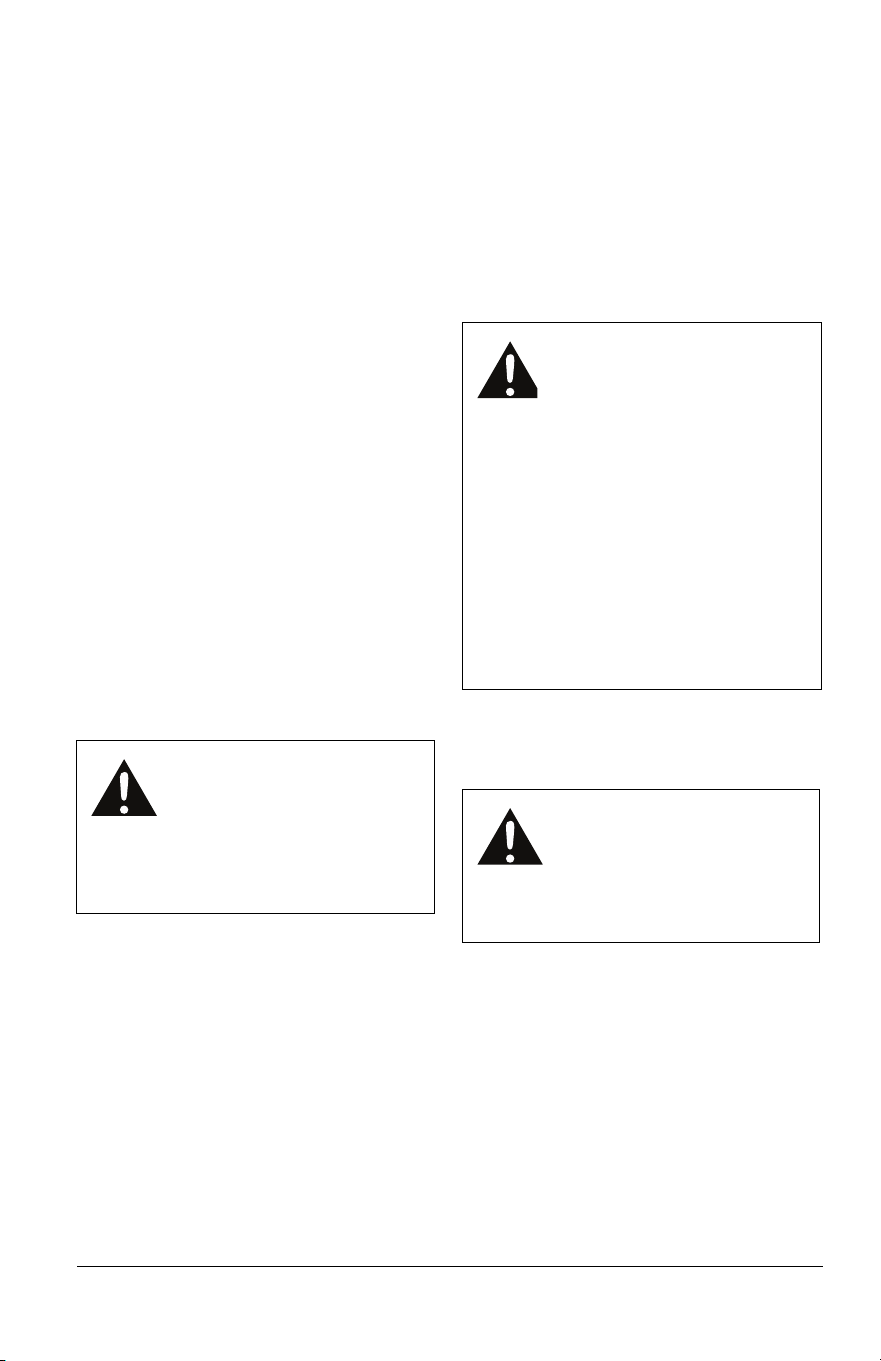
Description Qty Part No.
Air Filter Outer Element 1 21537000
Air Filter Inner Element 1 21536900
Engine Oil Filter 1 21535800
Fuel Filter 1 21538400
Hydraulic Oil Filter 2 21545100
PTO Belt (Engine to Deck)
– 48"
1 07200729
PTO Belt (Engine to Deck)
– 52"
1 07200819
PTO Belt (Engine to Deck)
– 32"
1 07200917
Traction Belt (Hydro Pump)
– 48" & 52"
1 07200919
Traction Belt (Hydro Pump)
– 32"
1 07200918
Mower Blade – 48" 3 00450200
Mower Blade – 52" 3 03253800
Mower Blade – 32" 2 00450200
48" Blade Kit 1 70763500
52" Blade Kit 1 70763600
Maintenance Kit 1 70734800
2
5
3
4
1. Top Fill Port
2. Side Fill Port
3. Oil Filter
4. Filter Guard
5. Mounting Hardware
Figure 17
1
EN - 19
Change Hydraulic Oil and Filter
1. Operate unit for a few minutes to warm
hydraulic oil.
2. Stop engine, remove key and wait for all
moving parts to stop and for hot parts to
cool.
3. Lift and properly support rear of unit and
remove wheel.
4. Position container under oil filter to catch
used oil.
See Figure 17.
5. Remove filter guard and oil filter from
transaxle. Allow the transaxle to drain
completely.
6. Wipe filter-mounting surface clean.
7. Lubricate rubber gasket on new oil filter
with clean hydraulic oil.
8. Spin filter onto filter housing until it makes
contact, and then turn filter 3/4 turn to
tighten.
9. Reinstall filter guard. Torque hardware to
13.0 N•m (115 in-lbs). DO NOT
overtighten.
10. Add hydraulic oil. See Add Hydraulic Oil
on page 18.
11. Purge hydraulic system. See Purge
Hydraulic System on page 19.
Purge Hydraulic System
Purge air from hydraulic system after draining
oil or changing the filter.
1. Park unit facing a wall or chock wheels.
2. Release parking brake.
3. Support unit so drive wheels are off the
ground.
4. Bypass transaxles. See Move Unit
Manually on page 16.
5. Start the engine and slowly move steering
levers forward and backward five or six
times.
6. Stop engine.
7. Return transaxle bypass levers to
operating position. See Move Unit
Manually on page 16.
8. Start engine.
9. Slowly move steering levers forward and
backward five or six times.
10. Stop engine, lower unit to ground and
check oil level. Add oil if needed.
11. Repeat steps 1 – 10 until transaxles
operate smoothly in forward and reverse
at normal speeds without excessive
noise.
CHECK TIRE PRESSURE
See Specifications on page 33 for
recommended tire pressure.
CHECK MOWER BLADES
Check blades for wear. Replace or sharpen
as needed.
Remove Blades
1. Place unit in service position. See
Service Position on page 17.
2. Disconnect spark plug wires.
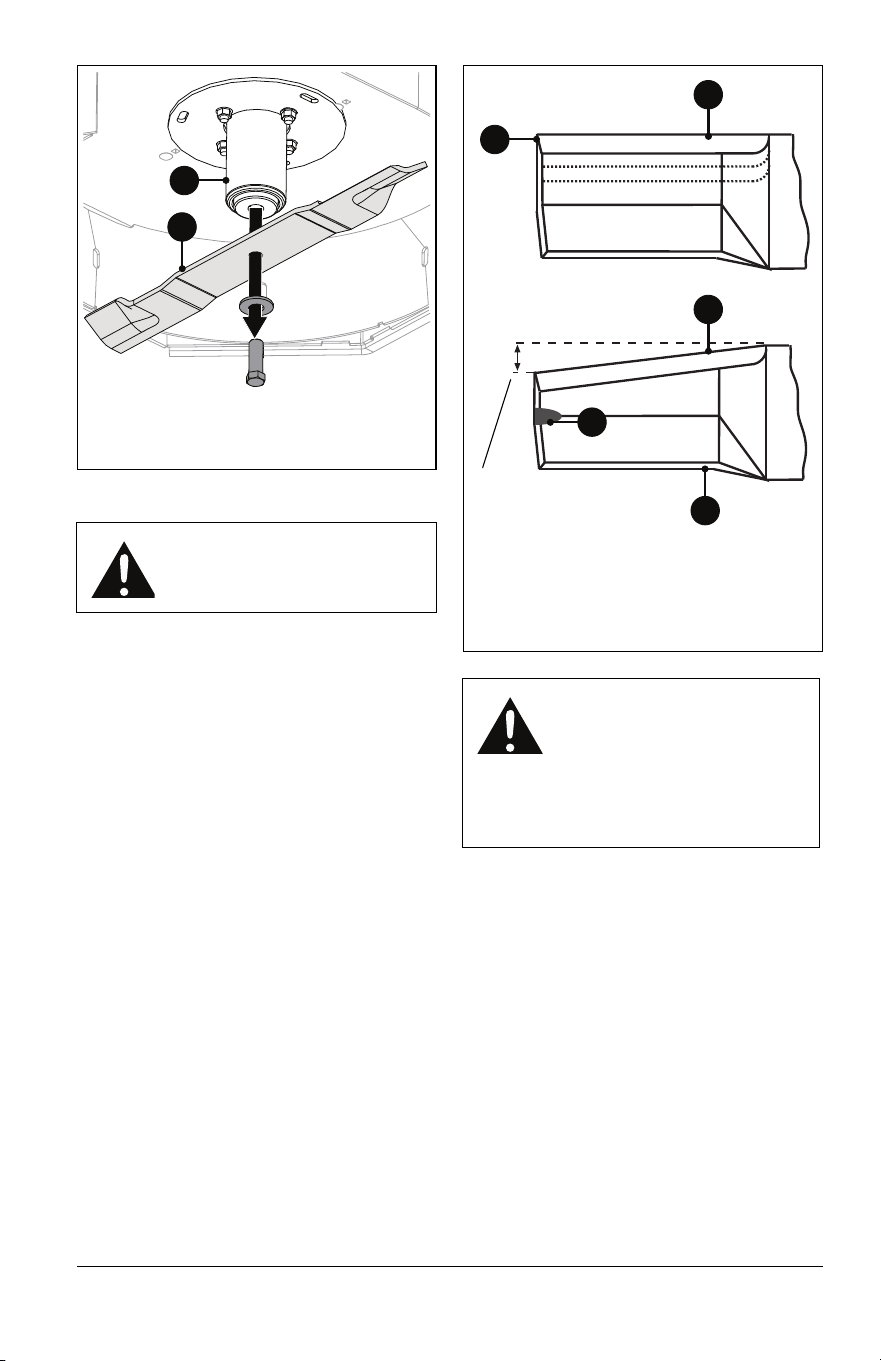
See Figure 18.
3. Remove and retain hardware securing
mower blades and remove blades.
WARNING: AVOID INJURY.
This adjustment requires
operating the engine. Use
extreme care to avoid contact
with moving parts and hot
surfaces. Be sure rear of unit
is well supported and secure
before starting engine.
WARNING: AVOID INJURY.
Explosive separation of tire and
rim parts is possible.
• DO NOT inflate tires above
the recommended pressure.
• DO NOT inflate tires with a
compressor; use a hand
pump.
• DO NOT stand in front of tire
assembly when inflating. Use
a clip-on chuck and extension
hose long enough to allow
you to stand to one side.
• DO NOT mount a tire without
proper equipment and
experience.
CAUTION: AVOID INJURY.
Use sturdy gloves or padding
to protect hands when working
with mower blades.
Rotation of one blade rotates
the other blades.
EN - 20
Sharpen Blades
1. Remove blades. Discard blades if:
• More than 1.3 cm (1/2") of metal is
removed.
• Air lifts are eroded.
• Blades are bent or broken.
2. File or grind an equal amount of metal
from each cutting edge of the blade until
sharp. DO NOT change angle of cutting
edge or round the corner of the blade.
See Figure 19.
3. Check blade balance by sliding an
unthreaded bolt through center hole. Hold
the bolt level. If blade does not remain
horizontal, sharpen the heavy end until
blade is balanced.
Install Blades
See Figure 18.
1. Secure blades to spindles with washers
and hex bolts removed earlier. Torque to
156 – 217 N•m (115 – 160 lb-ft).
2. Reconnect spark plug wires.
CAUTION: DO NOT sharpen
blades while attached to unit.
2
1
1. Mower Blade
2. Spindle
Figure 18
CAUTION: Unbalanced blades
cause excessive vibration and
eventual damage to unit.
Balance blades before
reinstalling on unit.
NEVER weld or straighten
blades.
Figure 19
1. Cutting Edge
2. Square Corner
3. Air Lift Erosion
4. Air Lift
DO NOT sharpen
to this pattern.
Sharpen to this pattern.
DISCARD if more than
1.3 cm (1/2").
1
1
2
4
3
EN - 21
CHECK PARKING BRAKE
IMPORTANT: Parking brake lever engages
drive wheels with two independent cables. It
is possible for parking brake to engage one
drive wheel only.
1. Place unit in service position. See
Service Position on page 17.
2. Bypass transaxles. See Move Unit
Manually on page 16.
3. Push unit forward.
• If unit does not move forward, parking
brake is functioning correctly.
• If unit easily moves forward, repair is
required. Contact your Ariens dealer.
4. Return transaxle bypass levers to
operating position. See Move Unit
Manually on page 16.
CLEAN BATTERY
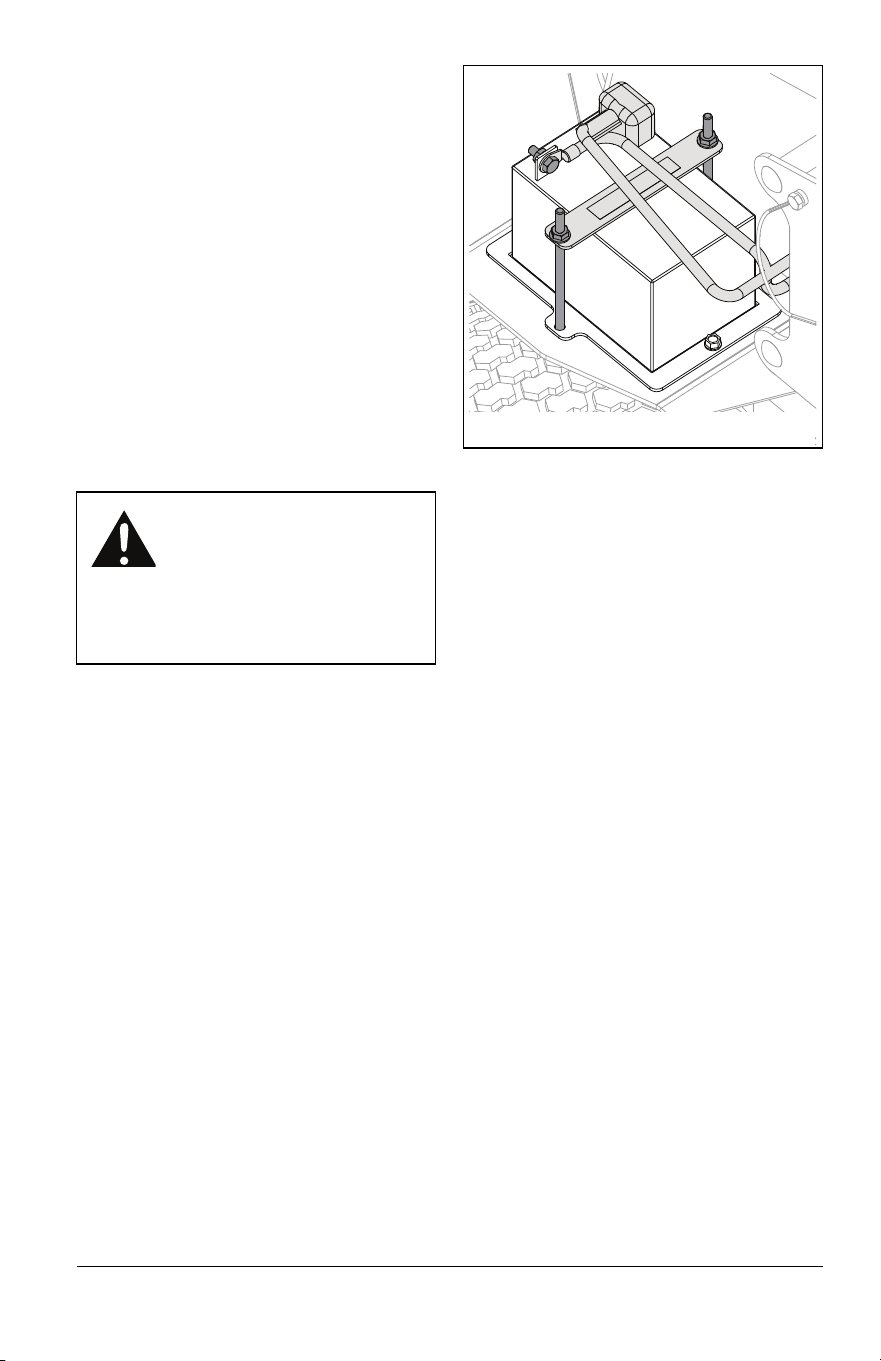
Remove Battery
See Figure 20.
1. Place unit in service position. See
Service Position on page 17.
2. Remove wing nuts retaining battery cover
and remove cover.
3. Remove hardware retaining battery hold-
down bracket and remove bracket.
4. Disconnect the negative cable and then
the positive cable from battery.
5. Remove battery.
Clean Battery
1. Clean terminals and battery cable ends
with wire brush.
2. Coat terminals with dielectric grease or
petroleum jelly.
Install Battery
1. Install battery.
2. Reconnect positive cable and then the
negative cable.
3. Reposition boot over positive terminal.
4. Secure hold-down bracket to battery
using original hardware.
5. Reinstall battery cover and secure with
wing nuts.
CHARGE BATTERY
NOTICE: DO NOT fast charge. Charging at a
higher rate damages or destroys battery.
ONLY use an automatic charger designed for
use with your battery.
NOTICE: ALWAYS follow information
provided on battery by battery manufacturer.
Contact battery manufacturer for details
regarding charging.
1. Remove battery from unit. See Remove
Battery on page 21.
2. Place battery on bench or other well-
ventilated place.
3. Connect positive lead of charger to
positive terminal.
4. Connect negative lead of charger to
negative terminal.
5. Charge battery according to charger and
battery manufacturers’ instructions.
WARNING: AVOID INJURY.
Battery posts, terminals and
related accessories contain
lead and lead compounds,
chemicals known to the State
of California to cause cancer
and reproductive harm. Wash
hands after handling.
Figure 20
EN - 22
6. Reinstall battery. See Install Battery on
page 21.
Jump-Starting
Ariens does not recommend jump-starting
your unit. Jump-starting can damage engine
and electrical system components. See your
engine manual for more detailed information.
CHECK FASTENERS
Check for loose hardware and tighten if
necessary.
LUBRICATE UNIT
1. Apply oil to all pivot points and pin
connections.
ADJUST TRANSAXLES
Check for Excessive Creep
1. Operate unit for a minimum of five
minutes to warm hydraulic system.
2. Stop engine and engage parking brake.
3. Chock front wheels and support unit so
both drive wheels are off the ground.
4. Remove drive wheels.
5. Start engine, move throttle lever to fast
position and release parking brake.
6. Move steering levers forward and
backward five or six times and then return
levers to neutral position.
7. Check wheel hubs for rotation.
• If there is only slight rotation, stop
engine, reinstall wheels and lower unit
to ground.
• If there is excessive rotation, adjust
neutral position. See Adjust Neutral
Position on page 22.
Adjust Neutral Position
If wheel hub has excessive rotation after
checking for excessive creep, adjust neutral
position.
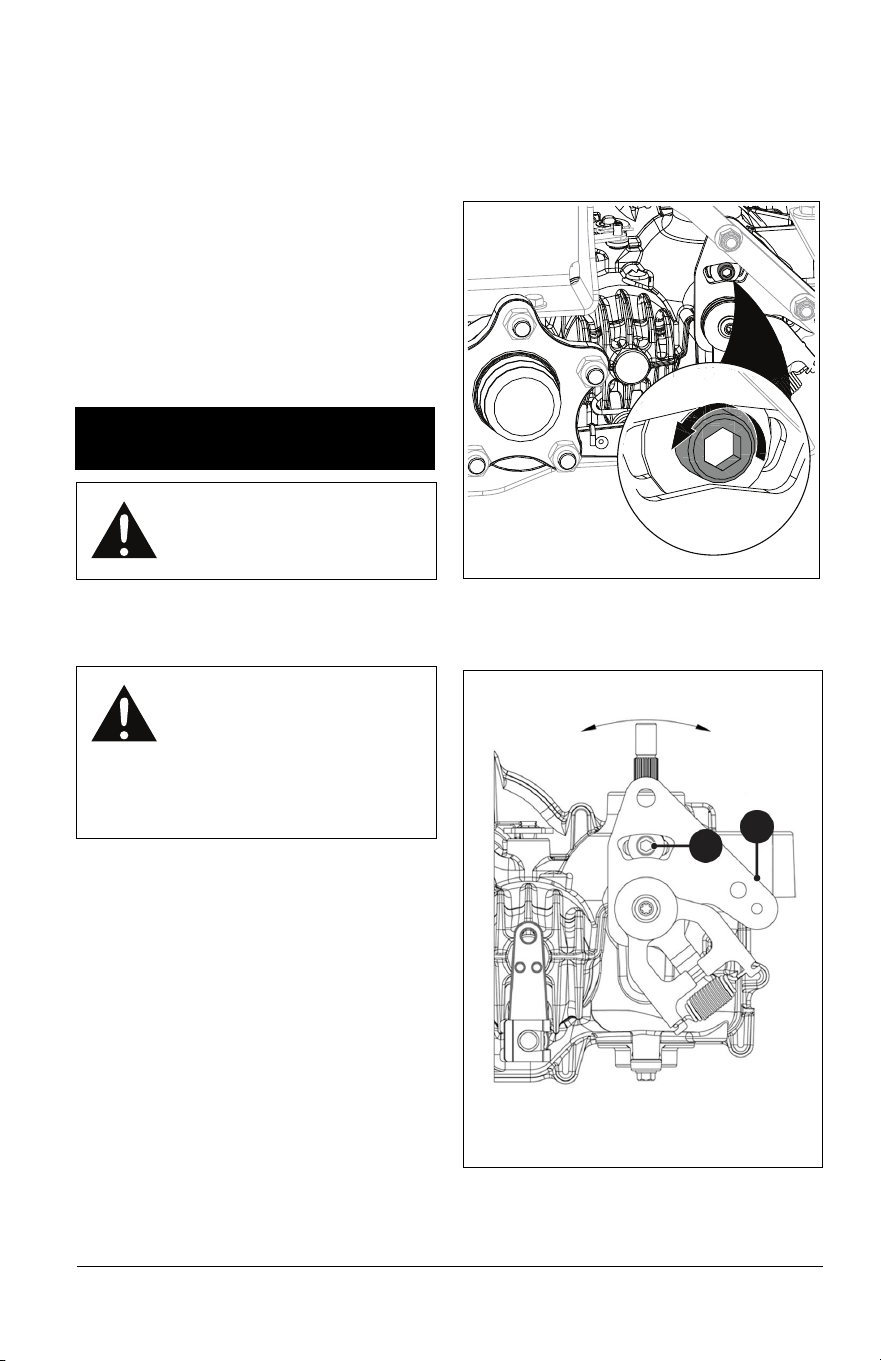
1. Loosen the return-to-neutral screw on the
transaxle. See Figure 21.
2. Slowly turn transaxle control arm in the
opposite direction of hub rotation until hub
stops. See Figure 22.
3. Hold the transaxle control arm in position
and tighten the return-to-neutral screw.
SERVICE AND
ADJUSTMENTS
WARNING: AVOID INJURY.
Read and understand entire
Safety section before
proceeding.
WARNING: AVOID INJURY.
This adjustment requires
operating the engine. Use
extreme care to avoid contact
with moving parts and hot
surfaces. Be sure rear of unit
is well supported and secure
before starting engine.
Figure 21
Figure 22
1. Return To Neutral Screw
2. Transaxle Control Arm
2
1
Axle Direction
EN - 23
4. Start engine, move throttle lever to fast
position and release parking brake.
5. Move steering levers forward and
backward five or six times and then return
levers to neutral position.
6. Check wheel hubs for rotation:
• If there is only slight rotation, stop
engine, reinstall wheels and return unit
to operating position.
• If there is excessive rotation, repeat
steps 1 – 5.
ADJUST STEERING LEVERS
1. Stop engine, remove key and wait for all
moving parts to stop and for hot parts to
cool.
2. Engage parking brake.
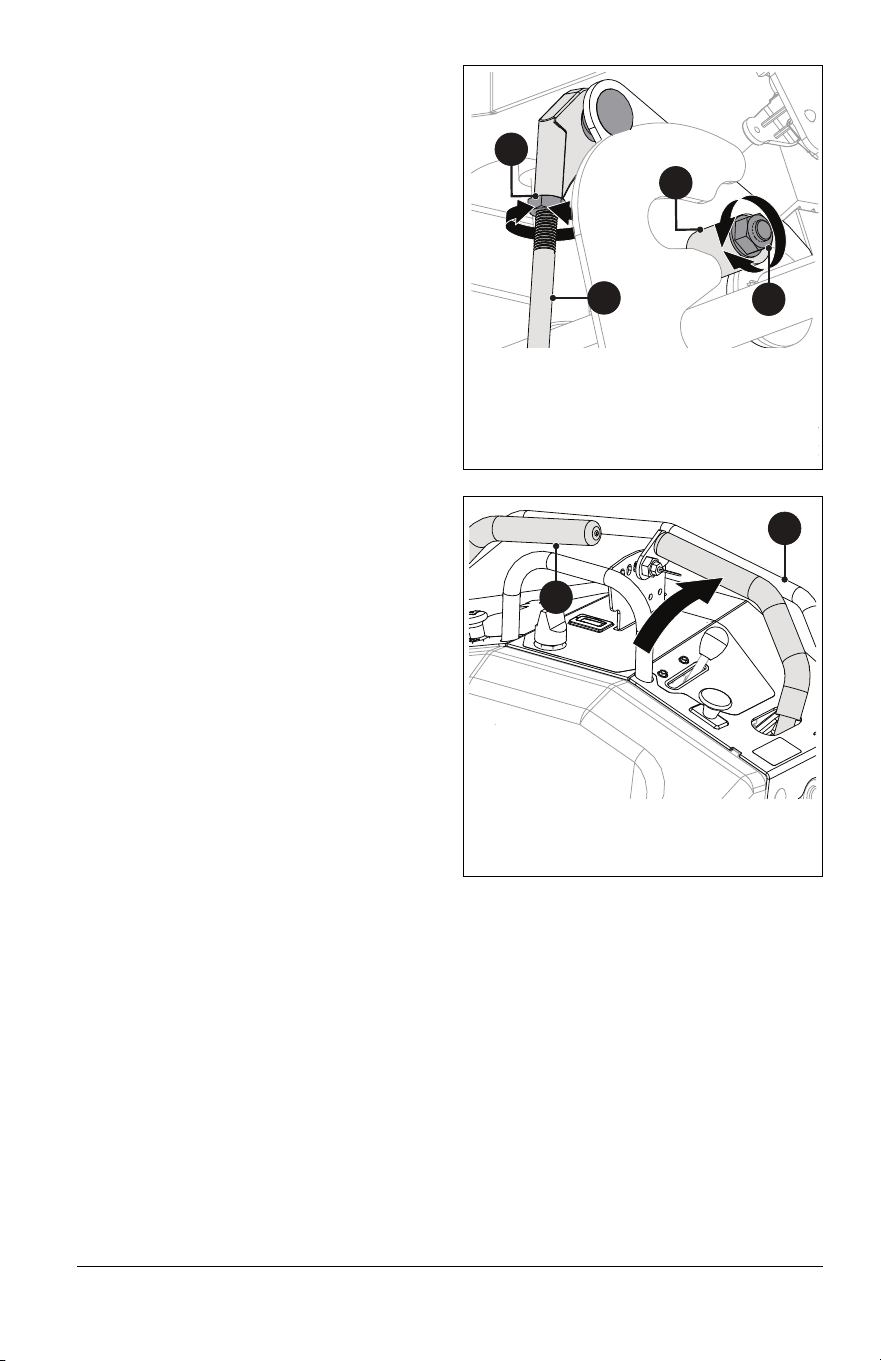
See Figure 23 and 24.
4. Loosen the eccentric spacer nut.
5. Loosen the jam nuts located on the tie
rod.
6. Push and hold a steering control lever
forward and turn the control rod until the
steering lever makes contact with the
speed limiting bar.
7. Repeat step 6 on other side.
8. Return the steering levers to the neutral
position.
9. If necessary, slightly adjust the control
rods so the steering levers are aligned
with each other.
10. Turn tie rod until steering levers align.
Adjust both left and right sides as needed.
11. Tighten jam nuts and eccentric spacer
nut.
NOTICE: Adjust steering lever interlock if the
steering levers are shifted during application
of the brake. See Steering Lever Interlock
Adjustment on page 23.
Steering Lever Interlock Adjustment
See Figure 25.
1. Stop engine, remove key and wait for all
moving parts to stop and for hot parts to
cool.
2. Chock wheels to prevent unit from rolling.
3. Release parking brake.
4. Loosen but do not remove the outer lock
nut on the eccentric brake bushing.
5. Engage the parking brake. Bushing will
seat in notch in brake lever bracket.
6. Tighten lock nut.
7. If necessary, adjust steering levers to
ensure full alignment with each other.
Figure 23
1
2
1. Tie Rod
2. Eccentric Spacer
3. Eccentric Spacer Nut
4. Jam Nut
3
4
Figure 24
1. Steering Lever
2. Speed Limiting Bar
1
2
EN - 24
ADJUST UNIT TO DRIVE
STRAIGHT
1. Park unit on a flat, level surface.
2. Check tire pressures. If needed, adjust to
recommended pressures. See
Specifications on page 33.
IMPORTANT: DO NOT inflate tires outside
recommended range.
3. Drive machine forward, pushing both
control levers all the way to speed limiting
bar.
4. Check tracking. If unit does not drive in a
straight line, adjust steering levers. See
Adjust Steering Levers on page 23.
REPLACE MOWER BELTS
Belt Access
1. Place steering levers in neutral position
and engage parking brake.
2. Stop engine, remove key and wait for
moving parts to stop and for hot parts to
cool.
3. Position mower deck at lowest cutting
height.
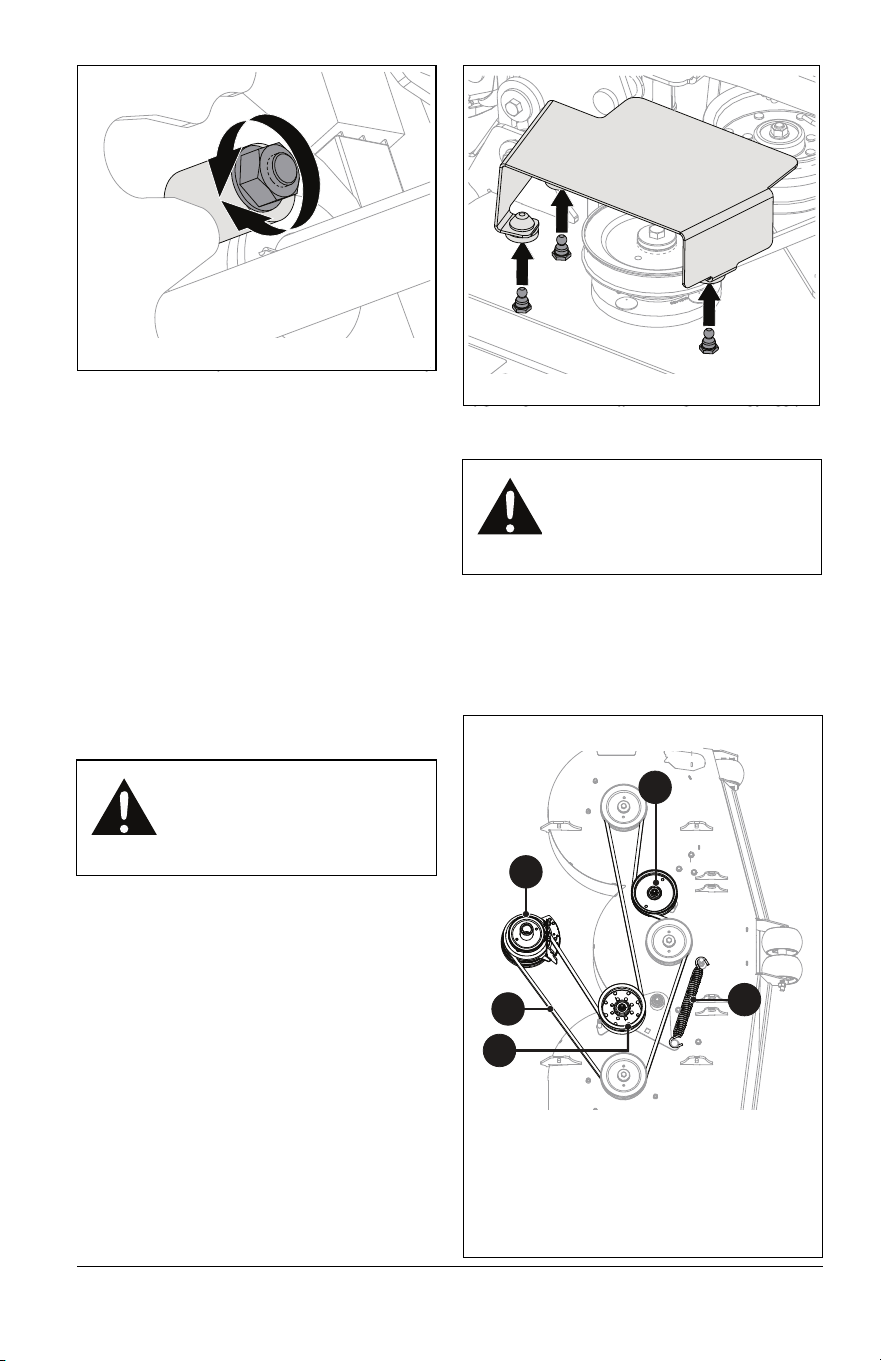
4. Lift belt covers to remove from mower
deck. See Figure 26.
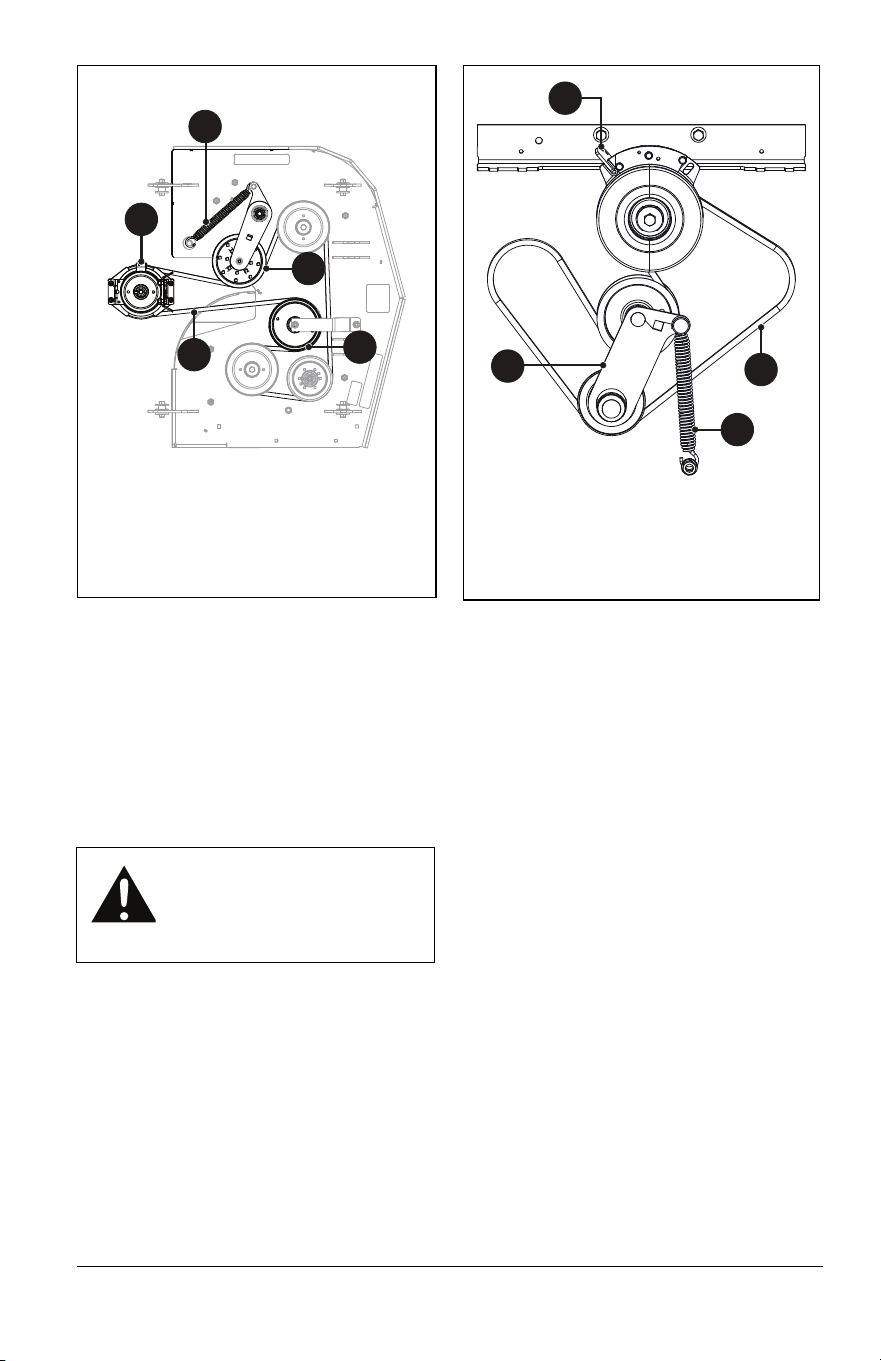
Remove PTO Belt
See Figure 27 and 28.
1. Using a spring puller, slowly remove
spring from anchor bolt until all tension is
removed.
2. Remove PTO belt from deck sheaves.
CAUTION: Damaged or worn
belts may result in injury and /
or damage to the unit. Check
belts for excessive wear or
cracks often.
Figure 25
CAUTION: Use care when
releasing idler spring tension.
Keep body parts well away
from idlers when performing
this operation.
Figure 26
1. PTO Belt
2. Spring
3. PTO Belt Idler
4. Mower Clutch Sheave
5. Center Sheave
Figure 27
3
1
4
2
5
Models 994167, 994168
EN - 25
Install PTO Belt
1. Install PTO belt around deck sheaves.
See Figure 27 and 28.
IMPORTANT: Verify that there are no twists
in belts and that they are routed correctly.
2. Close belt access panel and reinstall belt
covers.
Remove Hydro Pump Belt
See Figure 29.
1. Remove PTO belt. See Remove PTO
Belt on page 24.
2. Using a spring puller, slowly remove
spring from anchor bolt until all tension is
removed.
3. Remove hardware securing clutch stop
bracket to frame and remove bracket.
4. Remove hydro pump belt.
Install Hydro Pump Belt
See Figure 29.
IMPORTANT: Hydro pump belt MUST be
installed before PTO belt.
1. Install hydro pump belt around sheaves.
Route belt as shown in Figure 29.
2. Reinstall clutch stop bracket and secure
with original hardware.
3. Reinstall PTO Belt. See Adjust Anti-Scalp
Wheels on page 26.
IMPORTANT: Verify that there are no twists
in belts and that they are routed correctly.
4. Close belt access panel and reinstall belt
covers.
CAUTION: Use care when
releasing idler spring tension.
Keep body parts well away
from idlers when performing
this operation.
1. PTO Belt
2. Spring
3. PTO Belt Idler
4. Mower Clutch Sheave
5. Center Sheave
Figure 28
Model 994166
3
1
4
2
5
1. Hydro Pump Belt
2. Spring
3. Idler Arm
4. Clutch Stop
Figure 29
1
3
4
2
EN - 26
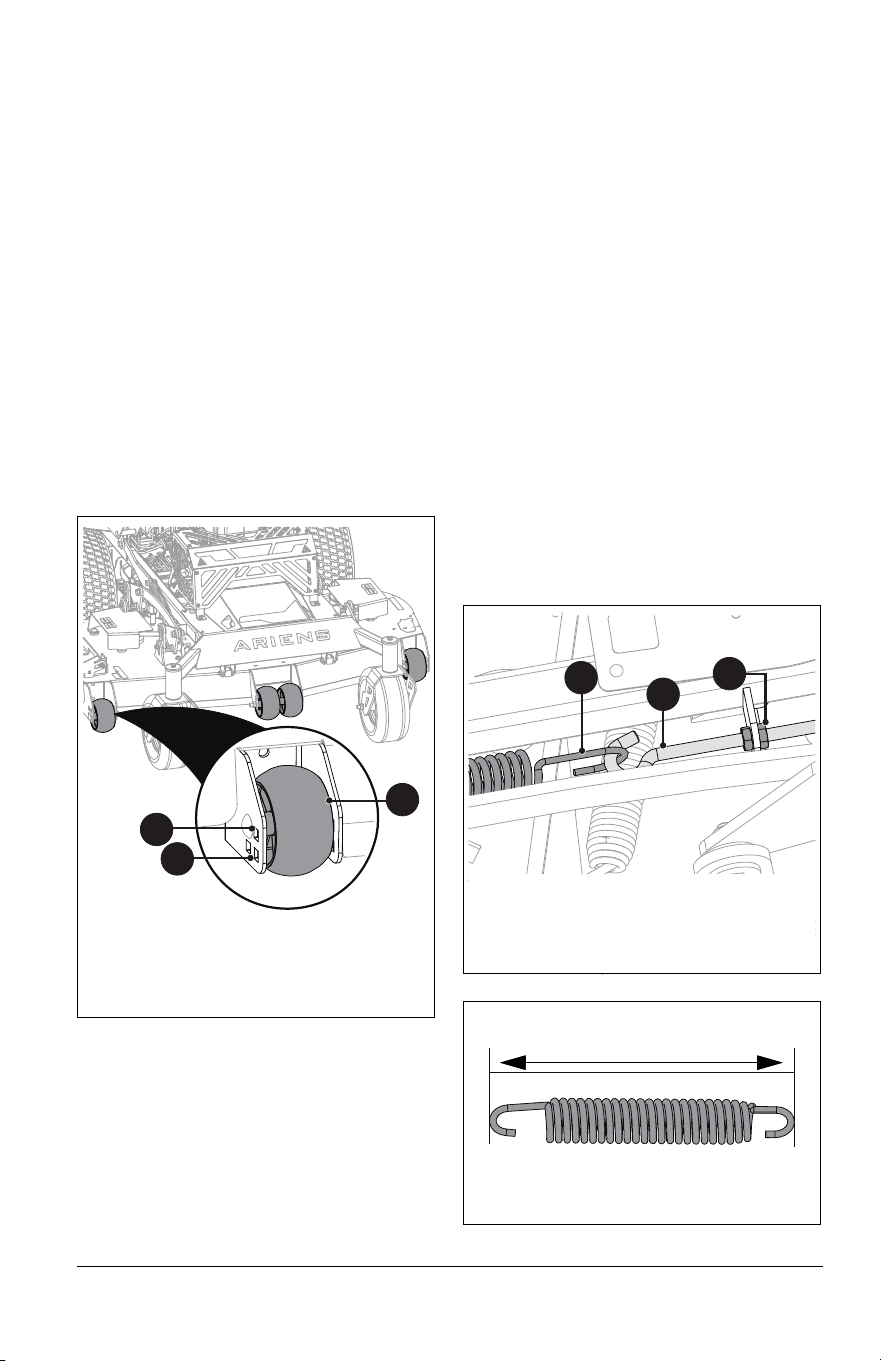
ADJUST ANTI-SCALP WHEELS
See Figure 30.
The anti-scalp wheels are set at the factory
for typical mowing height, but can be adjusted
for high or low cutting conditions.
1. Place steering levers in neutral position
and engage parking brake.
2. Stop engine, remove key and wait for
moving parts to stop and for hot parts to
cool.
3. Remove hardware securing anti-scalp
wheels to deck and remove wheels.
• For a very high cutting height, set the
anti-scalp wheels in the lowest position
on the bracket.
• For a very low cutting height, set the
anti-scalp wheels in the highest position
on the bracket.
NOTICE: All anti-scalp wheels MUST be set
to the same height.
ADJUST DECK LIFT
Models 994167, 994168
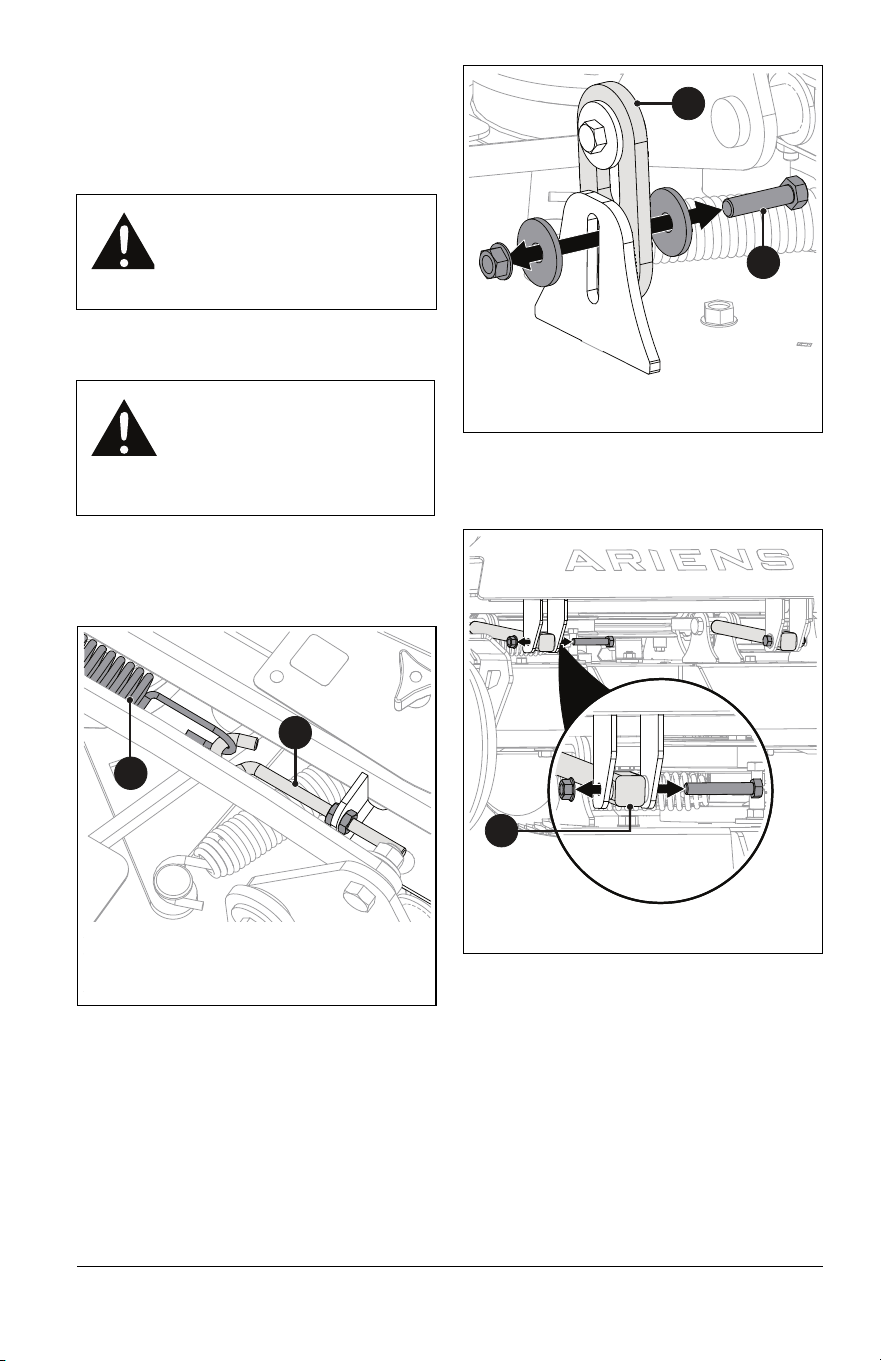
See Figure 31.
The deck-lift assist tension may be adjusted
to modify deck lift assist and deck stability.
Increased spring tension leads to easier deck
lifting, but also decreases deck stability.
1. Loosen jam nuts on anchor bolt.
2. Adjust the anchor bolt to the desired
setting:
• Turn anchor bolt counterclockwise to
decrease lift assist and increase deck
stability.
• Turn anchor bolt clockwise to increase
lift assist and decrease deck stability.
NOTICE: Excessive spring tension increases
the potential for deck to lift and bounce over
rough terrain and affect cut quality.
3. Measure the spring length between the
outside edges of spring hooks at 3.25"
HOC position. Readjust spring tension if
necessary. See Figure 32 for spring
length range for each deck size.
4. Tighten jam nuts against anchor bolt.
Figure 30
2
3
1. Anti-Scalp Wheels
2. Lowest Cutting Height
3. Highest Cutting Height
1
2
3
1
1. Jam Nut
2. Anchor Bolt
3. Deck Lift-Assist Spring
Figure 31
HOC Position: 3.25"
48" / 52" Decks: 25.7 cm ± 0.32 cm (10.12"
± 0.125")
Figure 32
EN - 27
REMOVE / INSTALL MOWER
DECK
Remove Deck
1. Place unit in service position. See
Service Position on page 17.
2. Remove PTO belt from clutch. See
Remove PTO Belt on page 24.
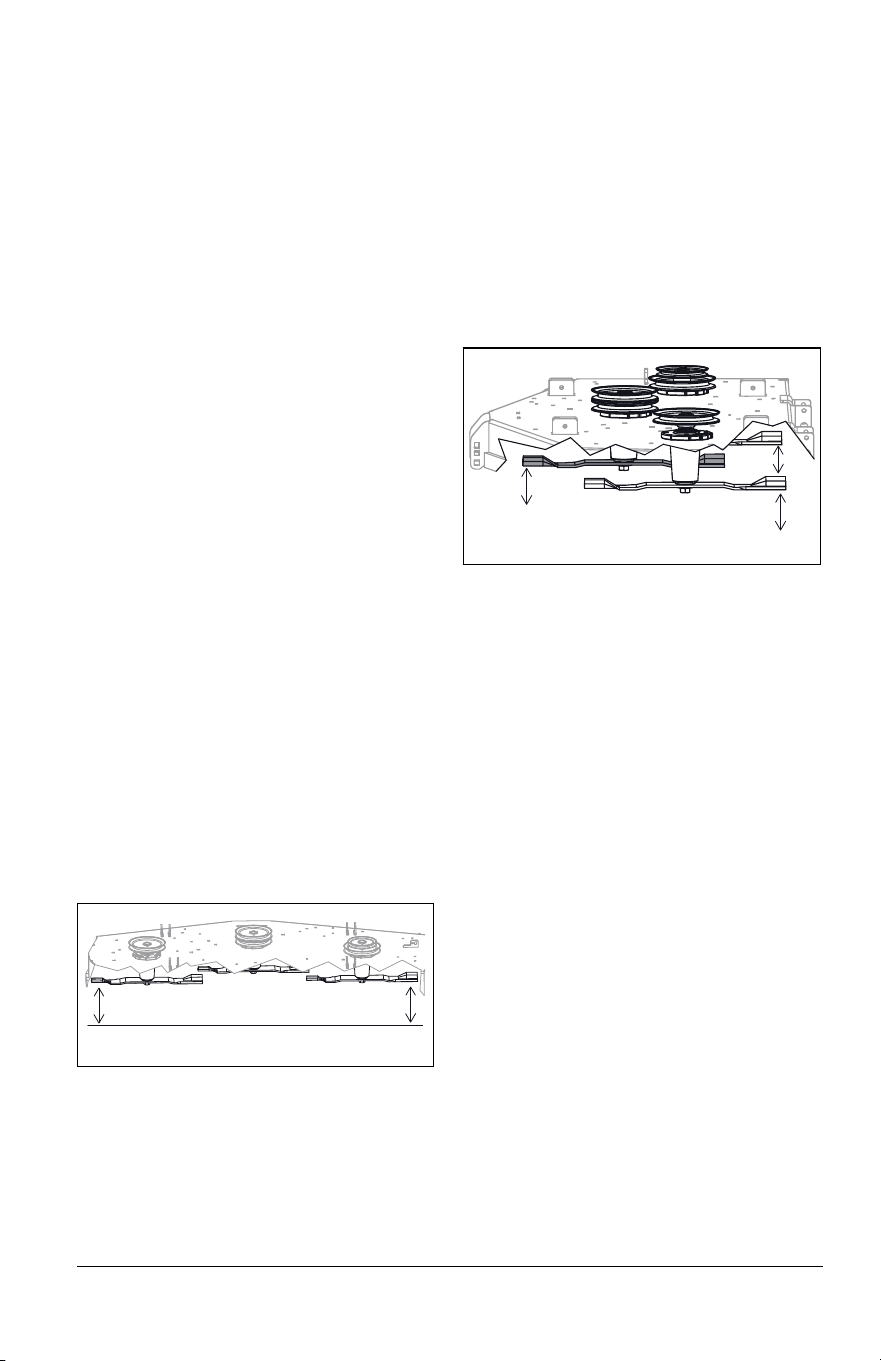
3. Engage transport lock and slowly
disconnect lift-assist spring from mower
lift arm by unthreading the anchor bolt.
See Figure 33.
NOTICE: Position supports such as blocks or
jack stands under each side of the deck.
4. Release transport lock and slowly lower
deck until it rests on supports.
5. Remove hardware securing mower lift
links to the deck. See Figure 34.
7. Remove and retain the drag link
hardware. See Figure 35.
8. Slide deck out from under unit.
WARNING: AVOID INJURY!
Springs store energy. Keep
body parts well away from
pinch points when removing the
deck.
WARNING: AVOID INJURY.
Mower lift arms and lift pedal
could cause severe injury if the
lift-assist springs are not
disconnected before the lift
links.
Figure 33
1. Anchor Bolt
2. Deck Lift-Assist Spring
1
2
Figure 34
1
2
1. Mower Lift Link
2. Mounting Hardware
1
1. Drag Link
Figure 35
EN - 28
Install Deck
1. Position deck under unit.
2. Reinstall drag links to deck with original
mounting pins and hardware.
3. Reinstall lift links using original hardware.
Torque to 31.2 N•m (23 lb-ft).
4. Install PTO belt. See Adjust Anti-Scalp
Wheels on page 26.
5. Raise deck to transport (fully raised)
position and reconnect lift assist springs.
6. Adjust spring length to specifications. See
Adjust Deck Lift on page 26.
LEVEL AND PITCH MOWER
DECK
IMPORTANT: Make sure unit is on a flat,
level surface and that tires are inflated to the
recommended pressures.
Check Blade Level and Pitch
1. Place steering levers in neutral position
and engage parking brake.
2. Stop engine, remove key and wait for
moving parts to stop and for hot parts to
cool.
3. Raise mower deck to 3.25" cutting height.
4. Place blocks at each corner of the deck to
support the weight of the deck.
NOTICE: Place blocks under the bottom
edge of the deck, not under the reinforcement
bar welded along deck face.
See Figure 36.
5. Position mower blades so ends point left
to right across the width of the deck.
6. Measure the distance between the
ground and cutting edge of the left blade
and right blades. Distances should be
within 4.7 mm (3/16”).
See Figure 37.
7. Position mower blades so ends point
front to back and measure the following:
• At the front of the deck, measure the
distance between the ground and the
cutting edge of the middle blade.
• At the rear of the deck, measure the
distance between the ground and the
cutting edge of the left and the right
blades.
8. The cutting edge at the front of the deck
should be 3.2 mm (1/8") lower than the
cutting edges at the rear of the deck.
If measurements are out of range, raise the
low side of the deck using the height
adjusters on the deck lift brackets. See Adjust
Blade Height on page 28.
Adjust Blade Height
See Figure 38.
1. Park unit on a flat, level surface.
2. Stop engine, remove key and wait for
moving parts to stop and for hot parts to
cool.
3. Set mower deck to transport (fully raised)
position.
4. Position mower blades so ends point
front to back.
5. Place spacers under mower blade tips.
IMPORTANT: Place taller spacers in rear
blade position to set deck pitch. For example,
7.6 cm (3”) front spacers and 7.9 cm (3 1/8”)
rear spacers will set deck to 0.3 cm (1/8”)
front pitch.
6. Set deck to 7.6 cm (3") HOC position and
lower deck onto spacers.
7. Loosen deck adjustment hardware on the
four deck hangers. If not adjusted
properly, bolt location should move up or
down in the adjustment slots.
8. Tighten deck adjustment hardware.
9. Set mower deck to transport (fully raised)
position and remove spacers.
Figure 36
Figure 37
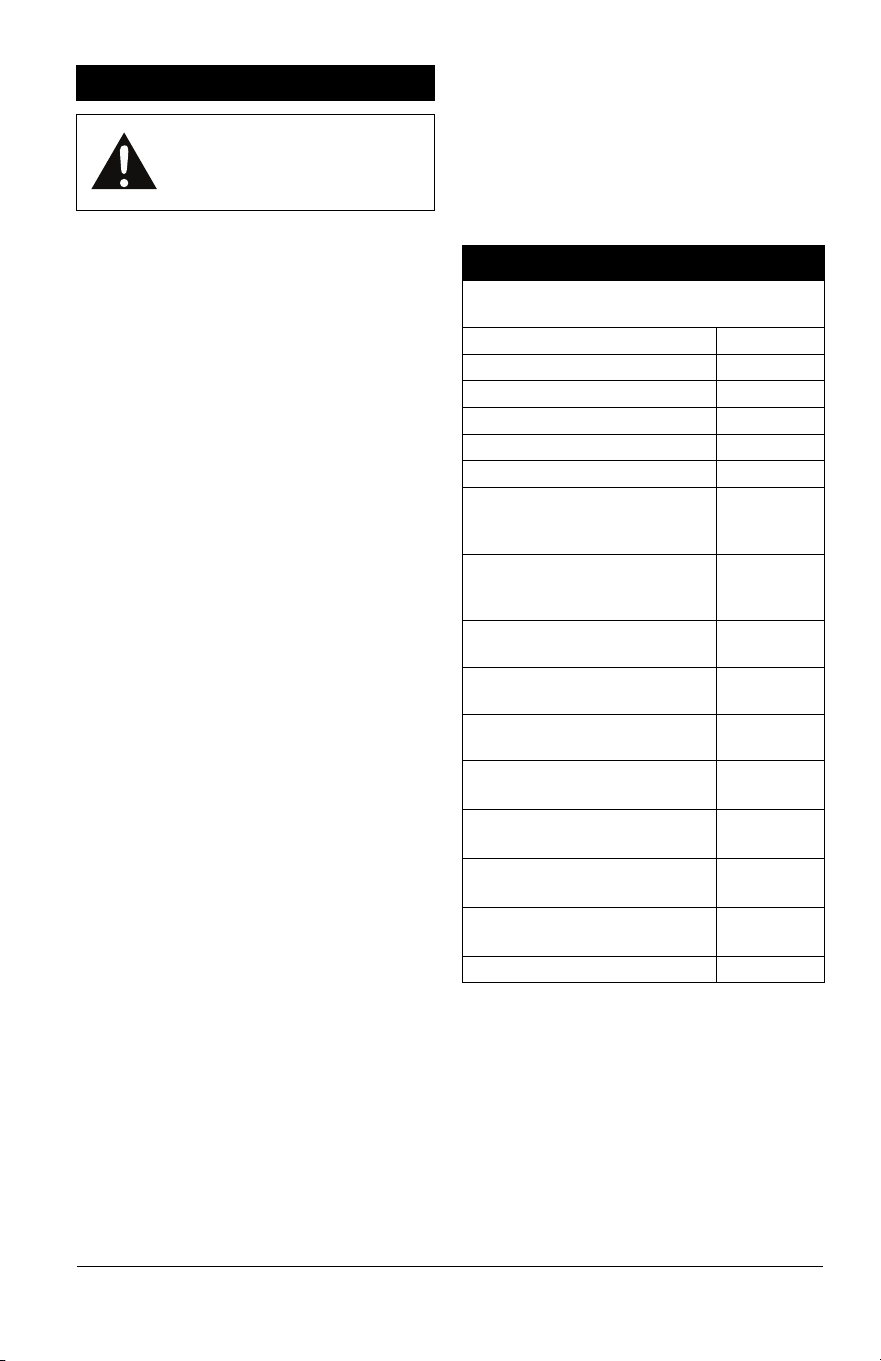
EN - 29
See Controls and Features on page 9 for fuse
box location.
See Figure 39.
Replace Fuse
IMPORTANT: To avoid damaging the circuit,
replace fuses with fuses of the same
amperage (A) rating. Determine the cause of
electrical failure and repair before replacing
failed electrical components.
1. Press locking clip and pull fuse box down
from cover.
2. Remove defective fuse.
3. Determine cause of fuse failure and
repair condition.
4. Install new fuse.
5. Insert fuse box into cover and push up
until locking clip snaps into place.
Replace Relay
NOTICE: Relays are interchangeable. Use
only quality replacement parts.
1. Press locking clip and pull fuse box down
from cover.
2. Remove defective relay.
3. Determine cause of relay failure and
repair condition.
4. Install new relay.
5. Insert fuse box into cover and push up
until locking clip snaps into place.
ELECTRICAL SERVICE
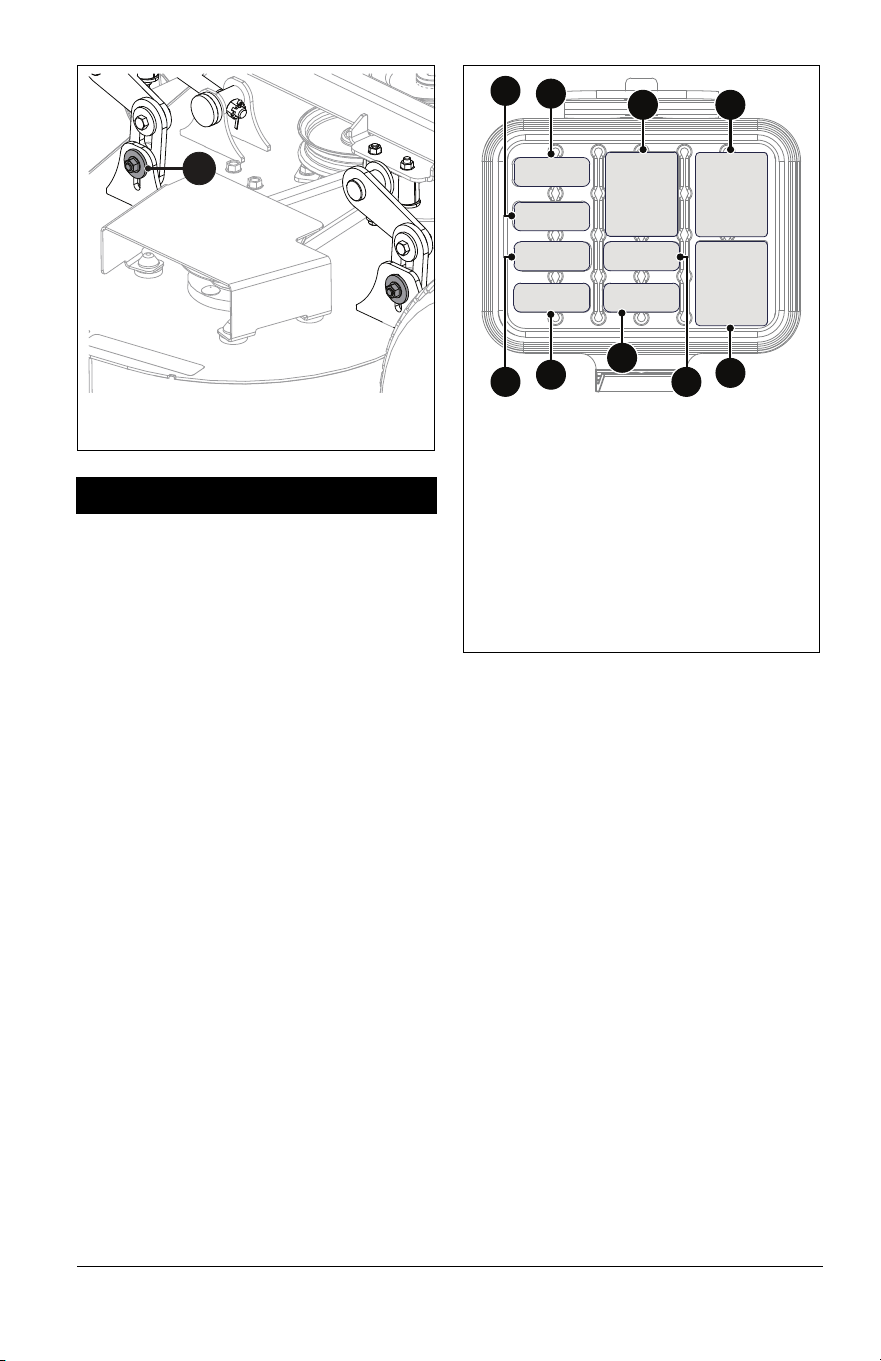
1. Deck Adjustment Hardware
Figure 38
1
10 A
10 A
F1
F1
10 A
10 A
F2
F2
10 A
10 A
F4
F4
5 A
5 A
F5
F5
20 A
20 A
F6
F6
30
30
86
86
87
87
85
85
K3
K3
30
30
86
86
87
87
85
85
K2
K2
30
30
86
86
87
87
85
85
K4
K4
20 A
20 A
F3
F3
10
2020
10
5
10
Figure 39
1. PTO Relay
2. Run Relay
3. Time Delay Fuse 10A
4. Main Fuse 20A
5. Charge Fuse 20A
6. Control Fuse 10A
7. Auxillary Fuse 5A
8. PTO Fuse 10A
9. Time Delay Relay
6
5
7
8
9
1
2
3
4

EN - 30
TROUBLESHOOTING
Problem Probable Cause Correction
Engine does not
crank.
PTO engaged. Disengage PTO.
Parking brake disengaged. Engage parking brake.
Loose or corroded battery cables. Clean and tighten battery cables.
See Clean Battery on page 21.
Discharged battery. Charge battery. See Charge
Battery on page 21.
Faulty starter. See your Ariens dealer.
Blown fuse. Check main fuse and replace if
necessary.
Failed relay. Check relays in fuse block and
replace if necessary
Loose or broken wires. Check wire harness and
connections.
Weak battery. Check voltage and charge if
required. See Charge Battery on
page 21.
Engine cranks but
does not start.
Fuel tank empty. Fill fuel tank. See Before Operation
on page 12.
Faulty spark plug. Replace spark plug. Refer to
Engine Manual.
Air cleaner is plugged or dirty. Clean or replace air cleaner. Refer
to Engine Manual.
Fuel filter is dirty. Clean or replace fuel filter. Refer to
Engine Manual.
Faulty engine. Refer to Engine Manual or see
your Ariens dealer.
Weak battery. Check voltage and charge if
required. See Charge Battery on
page 21.
Engine continues
to run when
ignition key is in
the off position.
Ignition ground wire disconnected. Connect ground wire to clean metal
surface.
Ignition switch failure. Replace ignition switch. See your
Ariens dealer.
PTO or mower
blades do not
engage or shut off.
Operator presence switch not
depressed.
Depress operator presence switch
by holding down left steering
control handle.
Faulty PTO switch. Check the electrical system to the
clutch for damage or wear. See
your Ariens dealer.
Unit does not
drive.
Parking brake engaged. Disengage parking brake.
Transmission bypass levers open. Close transmission bypass levers.
See Move Unit Manually on
page 16.
Hydraulic oil level low. Add hydraulic oil. See Check
Hydraulic Oil Level on page 18.
Faulty hydraulic drive system. See your Ariens dealer.
Blades do not stop
within 7 seconds.
Clutch brake plates worn. See your Ariens dealer.
EN - 31
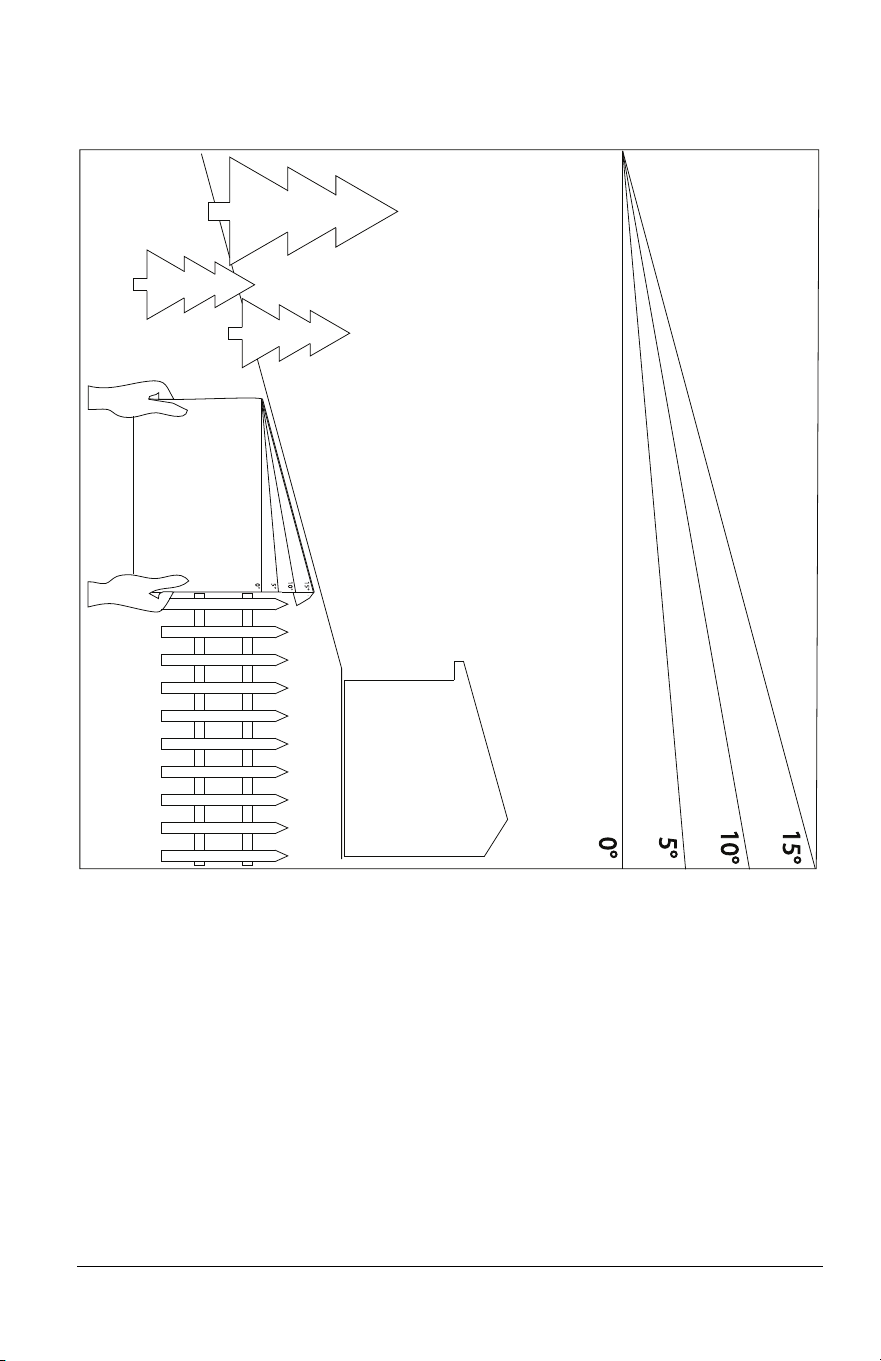
SLOPE INDICATOR
1. Align the edge of this sheet with a vertical surface.
2. Fold the appropriate line to match the required slope.
EN - 32
SHORT-TERM STORAGE
IMPORTANT: NEVER wash unit with high
pressure water or store outdoors.
1. Allow unit to cool and clean with mild
soap and water.
2. Tighten all hardware to correct
specifications.
3. Inspect unit for visible signs of wear or
damage. Repair as needed.
4. Prepare fuel system for storage.
NOTICE: Ariens recommends using a quality
fuel stabilizer in all fuel. Gasoline left in the
fuel system without a stabilizer, even for short
periods of time, deteriorates and leaves
gummy deposits in the system that may
damage the carburetor and fuel hoses, filter
and tank. For the best effectiveness, add
stabilizer to all fuel containers whenever
purchasing fuel. Add the stabilizer to the
container before adding fuel.
a. Add Ariens fuel stabilizer (see Service
Parts on page 18) or equivalent
according to manufacturer's
instructions to the fuel tank and any
fuel containers with remaining fuel.
b. Operate engine outdoors for at least
five minutes to allow stabilizer to
reach the carburetor.
5. Turn key to off position and remove from
ignition.
6. Store unit in a cool, dry, protected area.
DO NOT store unit outdoors.
LONG-TERM STORAGE
1. Perform short-term storage procedures.
2. Lubricate as directed in Maintenance
Schedule on page 17.
3. Touch-up all scratched painted surfaces.
4. Remove and charge battery as directed
in Charge Battery on page 21. Store
battery in a cool, dry, protected area.
5. Store unit in a cool, dry, protected area.
Do not store unit outdoors.
START-OF-SEASON
PREPARATION
1. Before adding fuel for the first time after
long-term storage, add fresh, stabilizer-
treated fuel to fuel tank and any fuel
containers with remaining fuel.
2. Charge and install the battery.
STORAGE
WARNING: AVOID INJURY.
Read and understand entire
Safety section before
proceeding.
ACCESSORIES
See your authorized Ariens dealer to add
these optional accessories to your unit.
Description Part No.
Mulch Kit (Model 994166) 79403200
Mulch Kit (Model 994167) 79404600
Mulch Kit (Model 994168) 79220200
Composite Grass Catcher 79404800
Light Kit 79402800
Operator Controlled Discharge
Baffle (OCDB) Kit (Models
994167, 994168)
79406300
Operator Controlled Discharge
Baffle (OCDB) Kit (Model
994166)
79406400
LaserEdge Mower Blade Kit
(Models 994166, 994167)
79406500
LaserEdge Mulch Blade Kit
(Models 994166, 994167)
79406600
LaserEdge Mower Blade Kit
(Model 994168)
79406700
LaserEdge Mulch Blade Kit
(Model 994168)
79406800
LaserEdge Blade Kit (Set of 2)
(Models 994166, 994167)
79406900
Front Weight Kit (Models
994167, 994168)
79407000
Front Weight Kit (Model
994166)
79407100
Tweel Tire Kit 79404100

EN - 33
SPECIFICATIONS
Model Number 994166 994167 994168
Description RIDGELINE 32 RIDGELINE 48 RIDGELINE 52
Engine Kawasaki FS600 Kawasaki FS651
Displacement – cm
3
(in
3
)
603 (36.8) 726 (
44.3)
High Idle – RPM (min.) 3600 ± 100
Liquid or Air Cooled Air
Speed
Forward Maximum – km/h (mph) 11.3 (7)
Reverse Maximum – km/h (mph) 4.8 (3)
Turning Radius Zero
Electrical
Starter Electric
Battery 12 Volt 12A-190 CCA (U1 Replaceable)
Power Take-Off Electric PTO Clutch/Brake
Fuel
Fuel Type Refer to engine manual
Tank Capacity – L (Gal) 17.0 (4.5)
Transmission
Type Hydrostatic Drive
Transmission Oil Use 15W-50 Full-Synthetic Hydraulic Fluid (Ariens
p/n 00057100) or equivalent
Hydraulic Oil Filter Yes
Size and Weight
Length – cm (in.) 166.3 (65.5)
Width – cm (in.)
Discharge Chute: Down
Discharge Chute: Up
113.8 (44.8)
83.3 (32.8)
154.9 (61.0)
125.7 (49.5)
169.7 (66.8)
139.7 (55.0)
Weight – kg (lbs) 318.4 (702) 326.1 (719) 331.6 (731)
Tires
Front Tire Size – in. 11 x 6-5
Rear Tire Size – in. 20 x 6.5-8 20 x 10-8
Front Tire Pressure – kPa (psi) 186 – 228 (27 – 33)
Rear Tire Pressure – kPa (psi) 83 – 103 (12 – 15)
Mower Deck
Cutting Width – cm (in.) 81.3 (32) 121.9 (48) 132.1 (52)
Cutting Height – cm (in.) 5.1 – 12.7 (2 – 5) 3.8 – 12.7 (1.5 – 5)
Cutting Height Increments
– cm (in.)
.635 (.25)
12/24 • 05299800M
EN - 34
AriensCo warrants to the original purchaser that Ariens
®
brand products purchased on or after 09/01/2022
will be free from defects in material and workmanship for the time period noted in the chart below. Equipment
put to personal use around a single household or residence is considered “Residential Use.” Equipment put
to any business use (agricultural, commercial, or industrial) or used at multiple locations is considered
“Commercial Use.” If any product is rented or leased, then the duration of these warranties shall be 90 days
after the date of purchase.
An authorized Ariens dealer will repair any defect in material or workmanship, and repair or replace any
defective part, subject to the conditions, limitations and exclusions set forth herein. Such repair or
replacement will be free of charge (labor and parts) to the original purchaser; except as noted below. Pick-up
and delivery are at the owner’s expense.
The warranty code is found on the model and serial number identification label on the unit.
* Whichever comes first.
Special Extensions
The chart below details special extensions to warranty terms. Warranty terms are total time periods
covered. If any product is rented or leased, there are no extensions to the 90-day warranty.
Outdoor Power
Equipment
Limited Warranty
Warranty
Code
Product Group Warranty Period
AA Serialized Attachments 1 Year.
CH, CQ ZENITH Mowers 4 Years or 750 Hours.*
CL ARROW Mowers
5 Years or 1000 Hours.* No Hour Limit for First 2
Years.
HD RAZOR Walk-Behind Mowers 3 Years Residential Use. 90 Days Commercial Use.
HE EDGE Mowers 2 Years or 150 Hours.*
HF IKON Mowers 3 Years or 300 Hours.*
HG
RIDGELINE
®
Mowers
4 Years or 400 Hours.*
HH
APEX
®
Mowers
4 Years or 500 Hours.*
HI RAZOR Walk-Behind Mowers 4 Years Residential Use. 90 Days Commercial Use.
PA 921-Series Brushes 3 Years Residential Use. 90 Days Commercial Use.
PB 926-Series Brushes 3 Years Residential Use. 1 Year Commercial Use.
SA
Professional Sno-Thro
®
3 Years Residential Use. 1 Year Commercial Use.
SB
Compact, Deluxe and Platinum Sno-Thro
and Path-Pro
3 Years Residential Use. 90 Days Commercial Use.
SC S18 2 Years Residential Use. 90 Days Commercial Use.
SD Deluxe and Platinum EFI Sno-Thro 3 Years Residential Use. 90 Days Commercial Use.
SE 920-Series Classic Sno-Thro 3 Years Residential Use. 90 Days Commercial Use.
SF
MAMMOTH
®
Tractor
2 Years or 500 Hours.*
Warranty
Code
Warranty Term Extension Warranty Period Detail
SA Cast Iron Auger Gear Case 5 Years.
Warranty is for parts only after
the initial warranty period.
Components are covered for
manufacturer’s defect only, not
wear.
SB, SD Cast Iron Auger Gear Case
5 Years Residential Use.
1 Year Commercial Use.
CL
Mower Deck Shell and
Main Frame
Lifetime Limited.
Warran
ty

12/24 • 05299800M
EN - 35
Exclusions and Limitations
The charts below detail special exclusions and limitations to this warranty.
Exclusions – Items Not Covered by This Warranty
• Parts that are not genuine Ariens service parts are not covered by this warranty and may void the war-
ranty if the parts result in premature wear or damage to the product.
• Damages resulting from the installation or use of any part, accessory, or attachment which is not approved
by AriensCo for use with product(s) identified herein are not covered by this warranty.
• Any misuse, alteration, improper assembly, improper adjustment, neglect, or accident which requires
repair is not covered by this warranty.
• Repairs or adjustments required due to failure to use fresh fuel or failure to properly prepare the unit for
periods of non-use.
• Use of gasoline blends exceeding 10% ethanol voids any and all warranties.
• Any tampering with the hour meter voids any and all warranties.
• Products are designed to the specifications in the area that the product was originally distributed. Differ-
ent areas may have significantly different legal and design requirements. This warranty is limited to the
requirements in the area in which the unit was originally distributed. AriensCo does not warrant this prod-
uct to the requirements of any other area. Warranty service is limited to service within the area originally
distributed.
• In countries other than the United States and Canada, contact the AriensCo dealer for
warranty policies that govern within your country. Rights may vary from country to country and within any
one country.
Evaporative Emissions Control Warranty Exception
As required by the California Air Resources Board (CARB) and the US Environmental Protection Agency
(EPA) the evaporative emissions control system is warranted to the ultimate purchaser, and any subsequent
owner, for two years.
The CARB and EPA evaporative emissions control system warranty is described in a separate evaporative
emission control warranty statement.
Battery Warranty
Battery warranty is one year. Units used for rental or lease have no exceptions to the 90-day warranty. Total
battery claim reimbursement will not exceed 65.00 USD.
Warranty Term Exclusions Warranty Period
Air filters, auger paddles, brake arms, brake linings, brake shoes,
brushes, cutters, fuel filters, halogen headlights, knives, halogen light
bulbs, lubricants, mower blades, oil, oil filters, spark plugs, scraper
blades, shear bolts and skid shoes.
Components are not covered
under warranty.
Hydro-Gear Transaxle Limitation
See Hydro-Gear warranty. The warranty is administrated by AriensCo. Refer to www.ariens.com for
warranty statement.
Warranty Term Limitations Warranty Period
Cloth, Plastic and Rubber Components.
Mufflers, Tires and Belts.
Components are covered for manufacturer’s defect only, not
wear.
Parker Actuators 1 Year.

12/24 • 05299800M
EN - 36
Transmissions
The chart below details transmission warranty information. Transmission warranty terms may vary from the
specific terms of this warranty. If inconsistent, the terms of the transmission warranty shall apply to the
transmission and its component parts.
* Parker Actuators see Limitations chart above.
Engines
The chart below details engine warranty information. Engine warranty terms may vary from the specific terms
of this warranty. If inconsistent, the terms of the engine warranty shall apply to the engine and its component
parts.
Parts and Accessories
Service replacement parts and non-serialized accessories are warranted for 90 days from date of purchase.
Labor is not included.
Customer Responsibilities
Register the product immediately at the time of sale. If the dealer does not register the product, the
customer must register the unit on-line at www.ariens.com.
To obtain warranty service, the original purchaser must:
• Ensure that the maintenance and adjustments explained in the Operator’s Manual are routinely
completed.
• Promptly notify AriensCo or an authorized Ariens service representative of the need for warranty service.
• Transport the product to and from the place of warranty service at owner’s expense.
• Have the warranty service performed by an authorized Ariens service representative.
To find an authorized dealer use the dealer locator on our websites, or contact us by mail or phone.
Transmission
Manufacturer
Detail
Hydro-Gear
Transaxle
See Hydro-Gear warranty. The warranty is administrated by AriensCo. Refer to
www.ariens.com for warranty statement.
Parker Hannifin
Drive & Valve
Systems
Parker Transaxles, Pumps, Wheel Motors and Valves* are warranted for the length of
equipment warranty period. Refer to Warranty Code chart above.
Warranty is administered by AriensCo.
Engine Manufacturer Detail
Ariens AX
Ariens-branded engines are warranted by the manufacturer
and the warranty is administrated by AriensCo. Refer to the
engine manual or www.ariens.com for warranty statements.
Briggs & Stratton, Kawasaki, Kohler
Covered by the engine manufacturer’s warranty.
Refer to the engine manufacturer’s warranty statements.
Globally (Except Australia or
New Zealand):
Australia: New Zealand:
AriensCo
655 W. Ryan Street
Brillion, WI 54110
Phone: (920) 756 - 4688
www.ariens.com
Roy Gripske & Sons Pty Ltd
11 Sodium Street
Narangba
Queensland 4504
Australia
Phone: (61130) 036 3004
www.rgs.com.au
Masport Ltd
320 Ti Rakau Drive
East Tamaki
Auckland 2013
New Zealand
Phone: 0800 627 7678
www.masport.co.nz

12/24 • 05299800M
EN - 37
Disclaimer
AriensCo may from time to time change the design of its products. Nothing contained in this warranty shall be
construed as obligating the AriensCo to incorporate such design changes into previously manufactured
products, nor shall such changes be construed as an admission that previous designs were defective.
Limitation of Remedy and Damages
AriensCo liability under this warranty, and under any implied warranty that may exist, is limited to repair of
any defect in workmanship, and repair or replacement of any defective part. AriensCo shall not be liable for
incidental, special, or consequential damages (including lost profits). Some states do not allow the exclusion
of incidental or consequential damages, so the above limitation or exclusion may not apply to you.
AriensCo shall not be held liable for damages, including premature wear and tear, or injuries caused by
installation of unauthorized parts and accessories or for parts and accessories not installed by an authorized
Ariens dealer.
Australian Consumer Law
The following applies solely to warranties subject to Subsection 102(1) of the Australian Consumer Law: Our
goods come with guarantees that cannot be excluded by the Australian Consumer Law. You are entitled to a
replacement or refund for a major failure and for compensation for any other reasonably foreseeable loss or
damage. You are also entitled to have the goods repaired or replaced if the goods fail to be of acceptable
quality and failure does not amount to a major failure.
Disclaimer of Further Warranty
AriensCo makes no warranty, express or implied, other than what is expressly made in this warranty. If the
law of your state provides that an implied warranty of merchantability, or an implied warranty of fitness for
particular purpose, or any other implied warranty, applies to AriensCo, then any such implied warranty is
limited to the duration of this warranty. Some states do not allow limitations on how long an implied warranty
lasts, so the above limitation may not apply to you.
This warranty gives you specific legal rights, and you may also have other rights which vary from region to
region.

P
R
I
N
T
E
D
655 WEST RYAN ST.
BRILLION, WI 54110
WWW.ARIENS.COM
PARTS.ARIENS.COM
