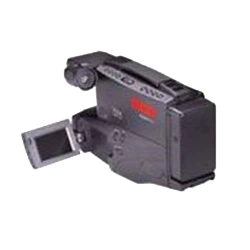

IMPORTANT NOTICEIMPORTANT NOTICE
IMPORTANT NOTICEIMPORTANT NOTICE
IMPORTANT NOTICE
Please make a note of the corrections to this manual’s Assistance
section listed above the Table of Contents on page 1.
For Camcorder Exchange Warranty information, see pages 66-67.
For Camcorder Customer Service information, see page 65.
For Camcorder Accessories information, see pages 51-57.
We want to make sure you enjoy your new camcorder. We regret any
inconvenience this may cause.

camcordercamcordercamcor
dercamcordercamcordercam
cordercamcordercamcorder
camcordercamcordercamcor
dercamcordercamcordercam
cordercamcordercamcorder
camcordercamcordercamcor
dercamcordercamcordercam
cordercamcordercamcorder
camcordercamcordercamcor
dercamcordercamcordercam
cordercamcordercamcorder
camcordercamcordercamcor
dercamcordercamcordercam
cordercamcordercamcorder
camcordercamcordercamcor
dercamcordercamcordercam
cordercamcordercamcorder
camcordercamcordercamcor
dercamcordercamcordercam
cordercamcordercamcorder
camcordercamcordercamcor
dercamcordercamcordercam
corderca mcorder
camcor derca
mcord erc
am cor
de rca
m cord
er cam
co rd
e r
USER’S
GUIDE
CC4352
Cautions
CAUTION: To prevent electric shock, match wide blade of plug to
wide slot, fully insert.
ATTENTION: Pour éviter les chocs électriques, introduire la lame
la plus large de la fiche dans la borne correspondante de la prise et
pousser jusqu au fond.
To reduce risk of injury, charge only rechargeable batteries recom-
mended by the manufacturer for this camcorder. Other types of
batteries may burst causing damage and personal injury.
FCC Regulations state that unauthorized changes or modifications to
this equipment may void the user’s authority to operate it.
Product Registration
Please fill out the product registration card and return it immediately.
Returning this card allows us to contact you if needed.
Keep your sales receipt for proof of purchase to obtain warranty parts
and service and attach it here. Record the serial number and model
numbers located on the bottom of the camcorder.
WARNING: To reduce the risk of fire or shock hazard, do not expose
camcorder or AC adapter/charger to rain or moisture.
Important Safety Information
Be sure to read all the safety information before you begin to use this product.
RISK OF ELECTRIC SHOCK
DO NOT OPEN
CAU-
TION
RISQUE DE CHOC ELECTRIQUE
NE PAS OUVRIR
This symbol indicates “dangerous voltage”
inside the product that presents a risk of electric
shock or personal injury.
This symbol indicates important instructions
accompanying the product.
TO REDUCE THE RISK OF ELECTRIC SHOCK, DO NOT REMOVE THE COVER
(OR BACK). NO USER-SERVICEABLE PARTS ARE INSIDE. REFER SERVICING
TO QUALIFIED SERVICE PERSONNEL.
Model No: _______________________________
Serial No: _______________________________
Purchase Date: _______________________________
Purchased From: _______________________________
CAUTION
CAUTION
ATTENTION
i
CC4352
Safety Information

1
Safety Information.............................ii
First Time Operation......................... 3
Assistance ....................................... 3
Unpacking the Camcorder and
Accessories .................................. 3
Adapter/Charger ...................... 12
Attaching ............................. 12
Removing............................. 12
Powering Your Camcorder .. 12
Using the Battery..................... 13
Charging .............................. 13
Attaching ............................. 14
Removing............................. 14
Battery Level Indicator ........ 15
Battery Care ......................... 16
Battery Storage .................... 16
Battery Safety Precautions... 16
Care and Storage.................. 16
Safety Precautions ............... 16
Car Cord Adapter .................... 17
Using Videocassettes ........................ 18
Erase Protection – Safety Tab ....... 18
Recording and Playback Speed
and Times .................................. 18
Insert and Remove Cassettes ........ 19
Cassette Care and Storage............. 19
Setting the Time and Date ............. 20
To Correct the Date or Time.... 20
Charging the Built-in
Clock Battery ....................... 21
LCD Monitor or Viewfinder
Displays ..................................... 21
Recording Time and Date ............. 21
AUTO Date ............................. 21
Auto TITLE ............................. 21
Date ......................................... 21
Selecting Display .......................... 21
Recording ......................................... 22
Using the LCD Monitor ................ 22
Using the Viewfinder .................... 23
Eyepiece Focus Control .......... 23
Adjusting the Viewfinder ........ 23
LCD Monitor or Viewfinder
Displays ..................................... 24
AE:60 (Auto Exposure)
Shutter Speed ....................... 24
Battery Level Indicator............ 24
Digital Effects (ZM:2)............. 24
Fade Indicator.......................... 24
INDEX Indicator ..................... 25
Status Displays ........................ 25
We want to make sure you enjoy your new camcorder. If you have any
questions, call:
Camcorder Exchange Warranty...........800-283-6503 (pages 74-75)
Customer Service...................................800-336-1900 (page 73)
Accessories............................................. 800-338-0376 (pages 59-62)
Assistance
Table of Contents

2
Tape Counter with
Memory Stop ....................... 25
Tape Warnings (TAPE,
NO TAPE, and TAPE END) 25
Time and Date Display ............ 25
Tape-Remaining Indicator ....... 25
Zoom Indicators ...................... 25
DISPLAY Button .......................... 26
Microphone ................................... 26
Quick Review Feature................... 26
Auto Shot Feature ......................... 27
Auto Focus .................................... 27
Macro Focus.................................. 27
Tape-Remaining Display............... 27
Electronic Indexing ....................... 28
Zooming ........................................ 29
Using the Zoom Buttons ......... 29
Zoom Level Indicator in
LCD Monitor or Viewfinder 29
Using the Instant Zoom Button
(INST. ZOOM)..................... 29
Instant Zoom Display in
LCD Monitor or Viewfinder 29
I. ZOOM .................................. 29
Digital Effects ............................... 30
Selecting a Digital Effect ........ 30
LCD Monitor or Viewfinder
Displays................................ 30
16X9 Mode.............................. 31
16X9 Display in
LCD Monitor or Viewfinder 31
Negative Mode ........................ 32
Digital Zooming ...................... 32
Mosaic Mode ........................... 33
Mirror Mode ............................ 33
Fading In and Out of Scenes ......... 34
Selecting a Type of Fade ......... 34
Fade In..................................... 35
Fade Out .................................. 35
Tape Counter ................................. 36
Using the Memory-Stop Feature... 36
Camera Edit Feature ..................... 37
Creating a Title.............................. 39
Correcting an Error.................. 39
Chart of Characters.................. 39
Recording a Title ..................... 40
Recording Tips .............................. 41
Travel Tips .................................... 41
To Play Back a Tape ........................ 43
Playback Features ........................ 44
Tape Positioning ...................... 44
Visual Searching...................... 44
Stop-Action Pause ................... 44
Playback on a TV/VCR with
A/V jacks.............................. 46
Playback Operation ....................... 47
Copying Tapes on Your VCR ........ 47
Viewing What the Camcrder
is Seeing .................................... 47
Playback Operation ....................... 49
Normal TV Viewing ...................... 49
Troubleshooting ............................... 58
Cleaning the Camcorder ............... 62
Cleaning the Lens .................... 62
Clean the LCD Monitor........... 62
Cleaning the Viewfinder.......... 62
Proper Care and Storage.......... 63
Things to Avoid ............................. 63
Specifications ................................ 64
Customer Assistance and Service ... 65
Warranty Information .................... 66
Product Registration ....................... 67
Index ................................................. 68
Table of Contents
First-Time Operation
3
First Time Operation
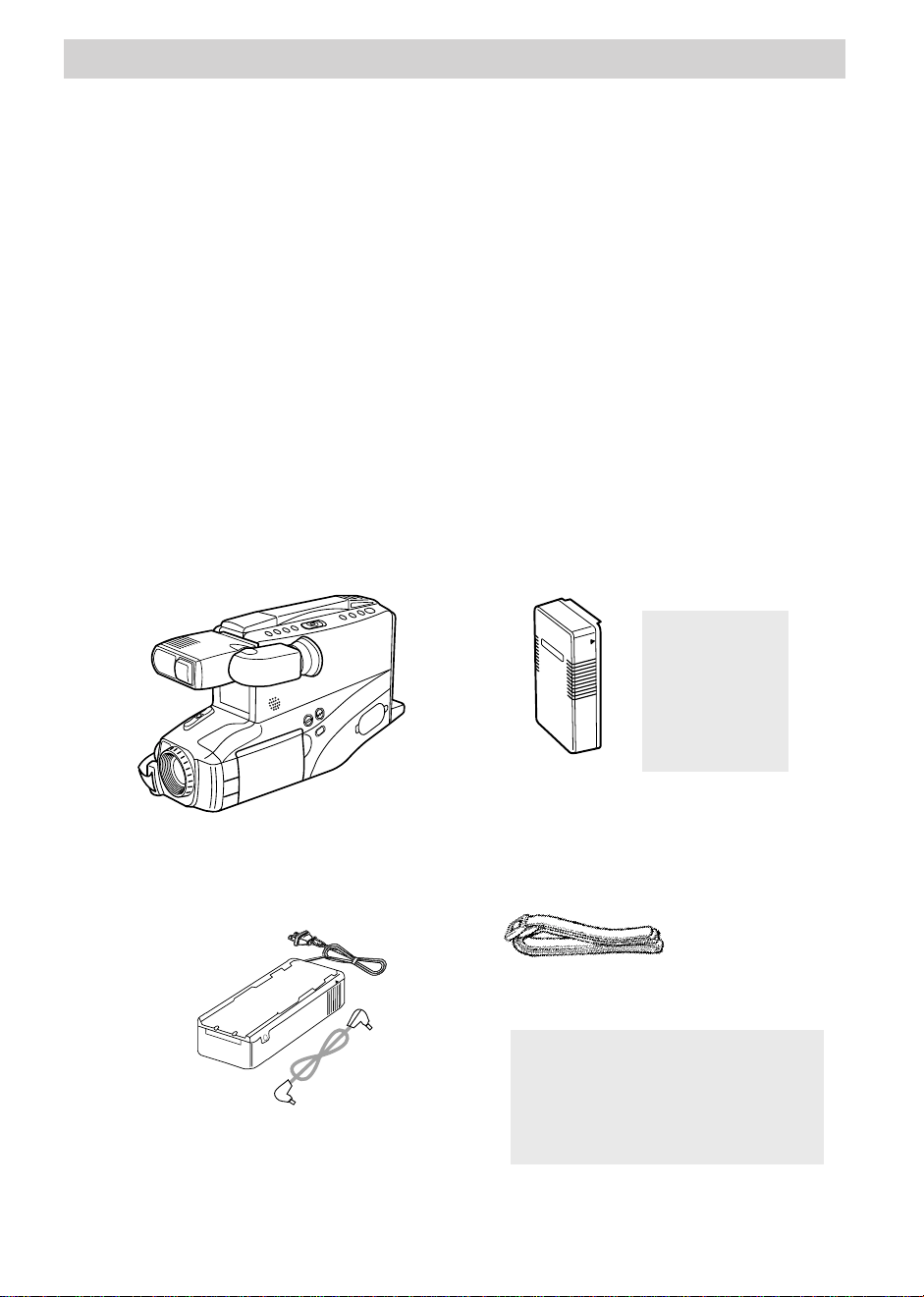
1. Unpacking the Camcorder and Accessories.
• Save the packing materials and box in case you ever need to ship or
store your camcorder.
• The items shown below are packed with your camcorder. If any are
missing or appear damaged, contact your dealer immediately.
This section describes the basic steps necessary to set up your camcorder to record.
Refer to the other sections for detailed operation and feature options.
Assistance
The toll-free numbers are available to help you with any problem you may encounter.
Camcorder Exchange Warranty...............800-283-6503
Customer Service................................... 800-336-1900
Accessories............................................. 800-338-0376
(continued on next page)
Shoulder Strap
Stock No. 227327 or
Stock No. 241305
Model CC4352
AC Adapter/Charger: Stock No. 241044
DC Cable: Stock No. 233328
P
O
W
E
R
C
H
A
R
G
E
Rechargeable 10-Volt Battery
Stock No. EP096FS
WARNING:
LEAD-ACID
BATTERY.
MUST BE
DISPOSED OF
PROPERLY.
Caution: Do not use this adapter/
charger for any purpose other than
charging the EP096FS or EP096FL
battery pack or supplying power to
the camcorder.
First Time Operation
Assistance
Unpacking the Camcorder and
Accessories
4
First-Time Operation
POWER
CHARGE
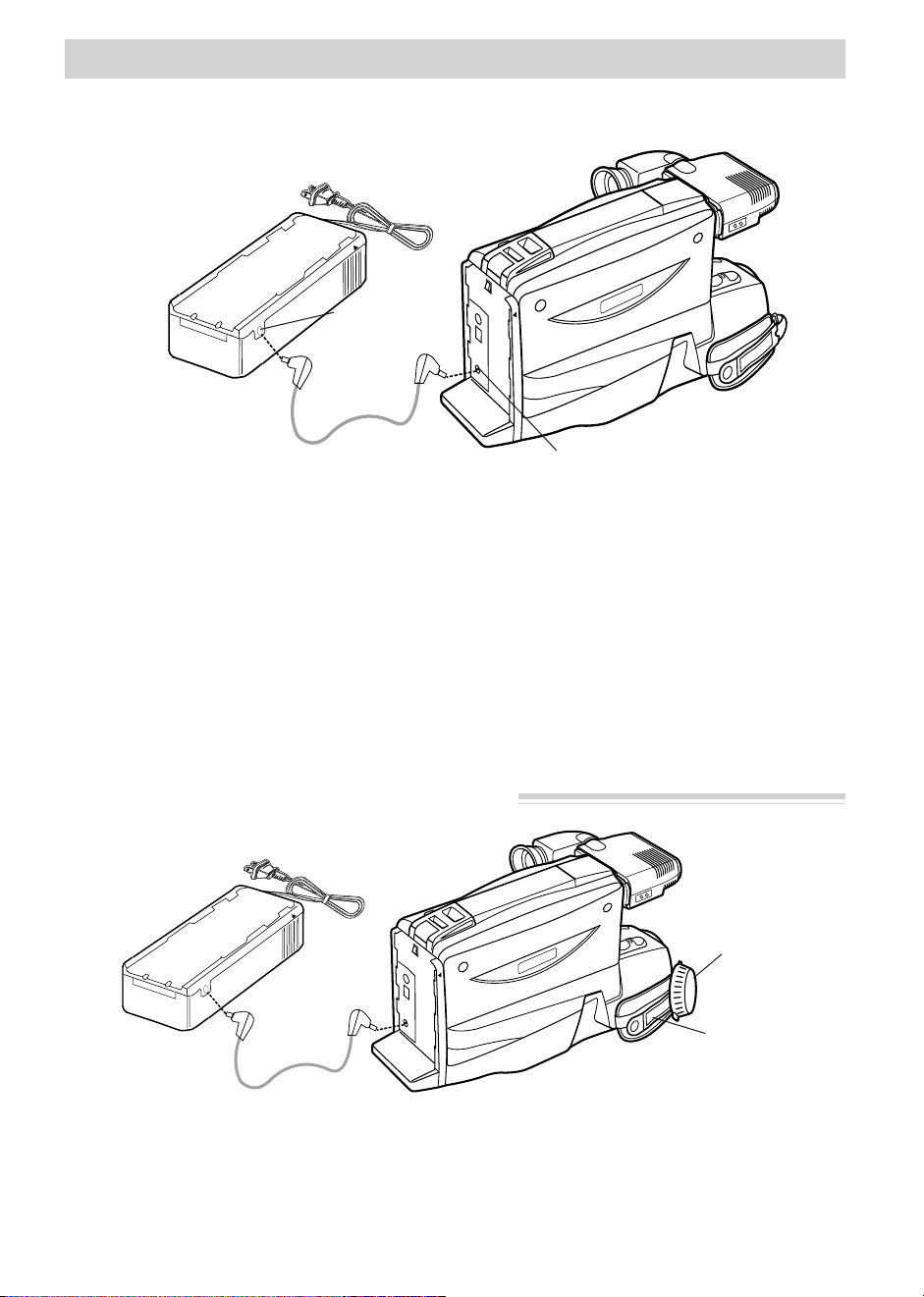
2. Attaching the Adapter and Charger.
DC
OUTPUT
Jack
DC Cable
Adapter/
Charger
To AC 120V,
50/60 Hz
DC IN 9.6V
Jack
1. Open the handstrap, insert your
hand, and adjust the handstrap
to fit your hand.
Lens Cap on
Handstrap
P
O
W
E
R
C
H
A
R
G
E
Since the battery must be charged before
it can be used the first time, attach the
adapter/charger to the camcorder.
1. Attach one end of the adapter/
charger’s DC cable to the DC
OUTPUT jack on the side of the
adapter/charger.
2. Attach the other end of the cable
to the DC IN 9.6V jack on the
camcorder.
3. Plug the adapter/charger’s plug
into an operating outlet.
4. Details are on page 12.
2. Remove the lens cap and attach
it to the handstrap as shown.
Handstrap
3. Adjusting the Handstrap, Removing the Lens Cap,
and Attaching it to the Camcorder.
First-Time Operation
5
5. Turning on the Camcorder.
CAMERA/OFF/VCR Switch
(continued on next page)
• Press and hold the small button on
the CAMERA/OFF/VCR switch
while you slide it to CAMERA.
The camcorder enters record-
pause.
• The position of this switch tells
the camcorder whether you want
to record (CAMERA), turn the
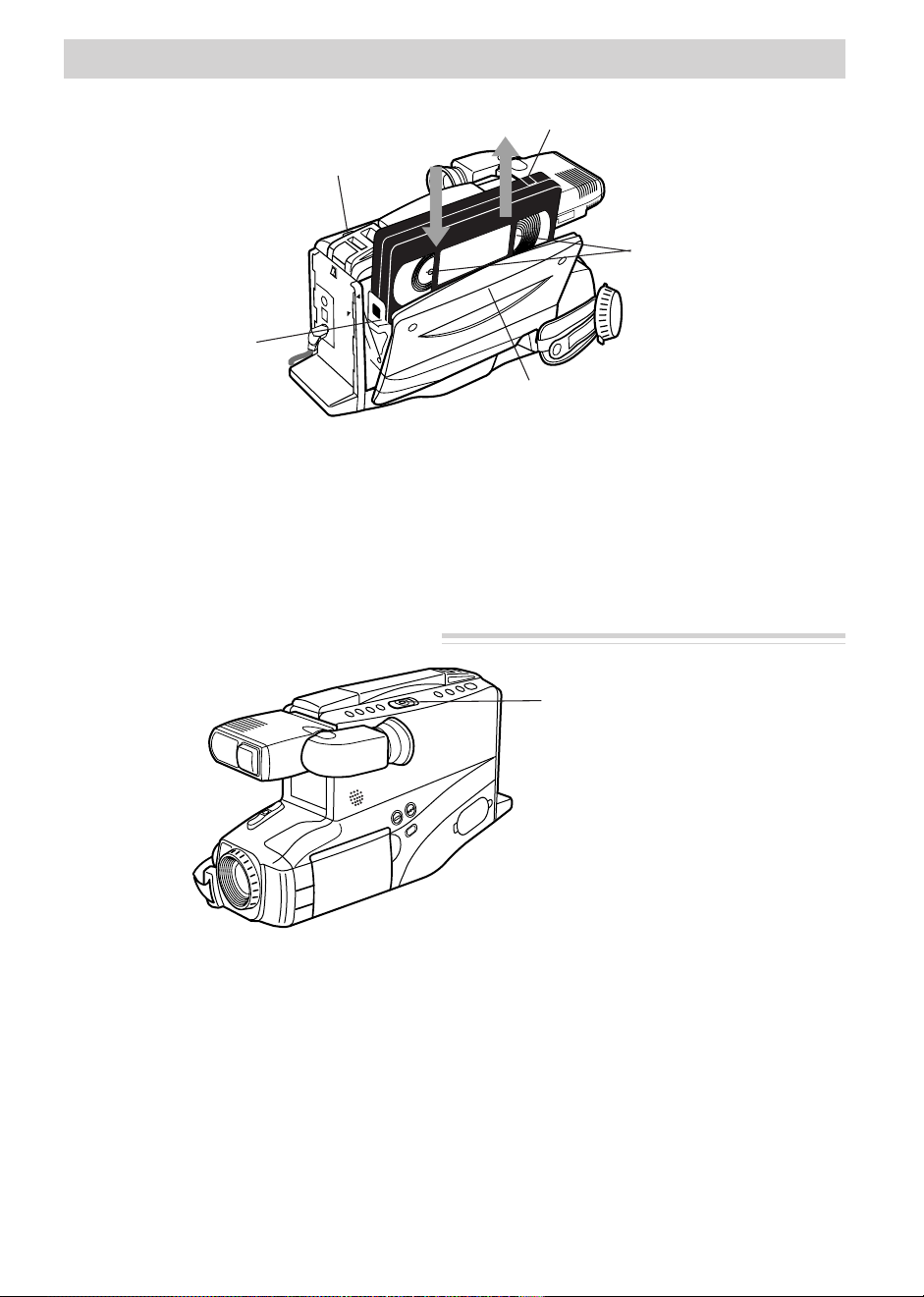
4. Inserting a Tape.
power off (OFF), or play back
tapes (VCR).
• The camcorder automatically
turns off if it remains in record-
pause for five minutes. Place
the switch to OFF and then back
to CAMERA.
1.Press STOP/EJECT to open the
cassette compartment.
2.Insert the cassette with the safety
tab facing up and the tape windows
facing out.
3.Press the cassette down gently
until it locks into place, and close
the cassette compartment door.
4.Details are on page 19.
Cassette Door
Press Here to Close
Tape Windows
Safety Tab
STOP/EJECT
Button
Cassette Holder
Note: If you want the date and
time displayed on your
recordings, you must set it.
See Date and Time Display on
pages 20-21.
6
First-Time Operation
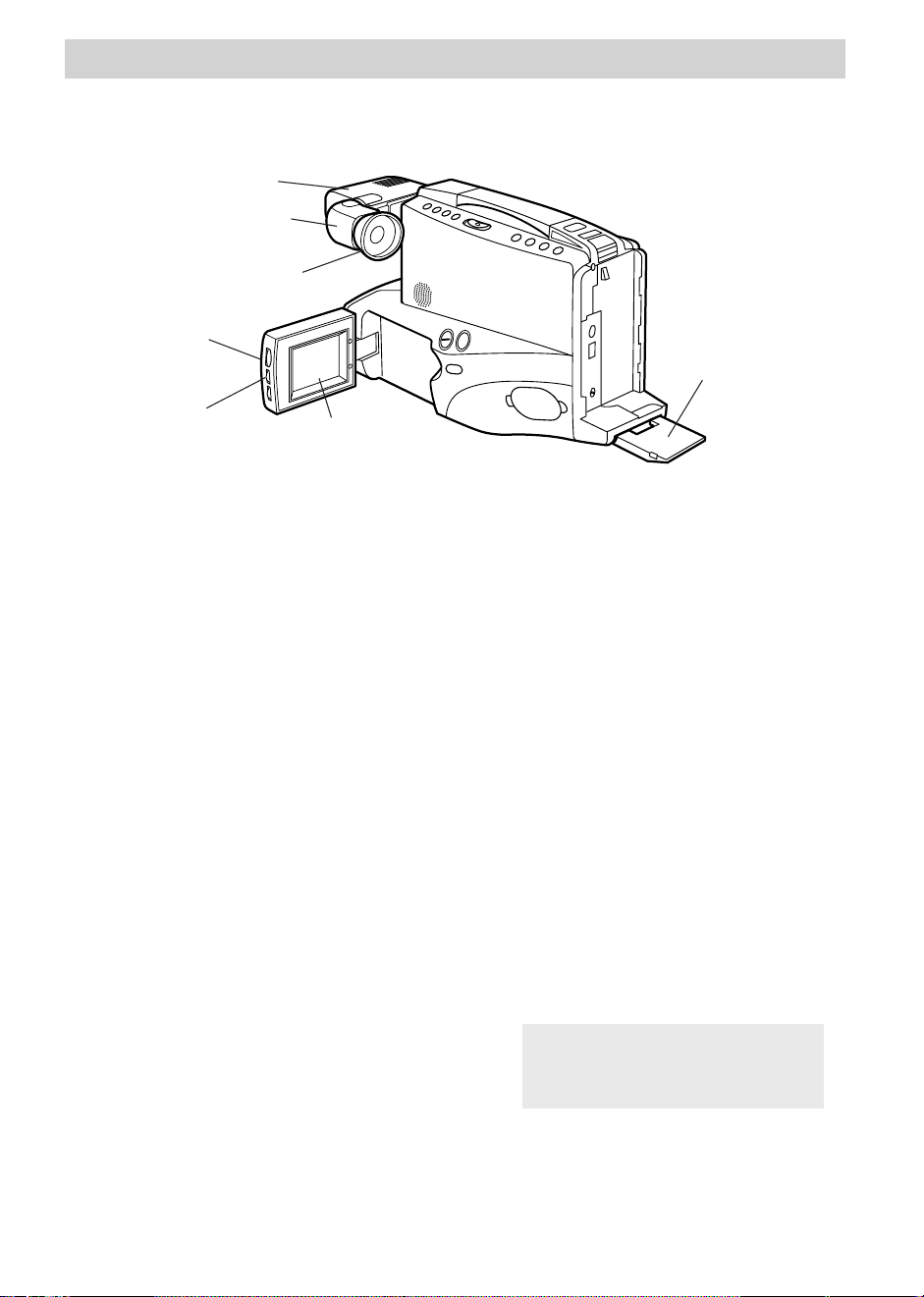
Use the Viewfinder
1.Make sure the monitor is closed
and locked. If the monitor is open
more than 45º, the viewfinder
automatically turns off.
2.Grasp the viewfinder and rotate it
horizontally.
3.Pull the viewfinder out from the
camcorder and rotate the eyepiece
into a comfortable viewing
position.
Caution: Pulling on the eye-
piece might cause damage to
the eyepiece or camcorder.
4.Turn the eyepiece focus control to
adjust the focus of the viewfinder
for your vision.
6.
Use the LCD Monitor or Viewfinder to See What’s Recording.
You can watch what you’re recording on the LCD monitor or in the black-and-
white viewfinder. When you open the LCD monitor more than 45º, the viewfinder
automatically turns off. When you close the LCD monitor, the viewfinder
automatically turns on. When you extend the LCD monitor 90º and rotate it all the
way around (screen side facing toward the person you’re recording), both the
viewfinder and the LCD monitor show what’s being recorded.
Use the LCD Monitor
1.Unfold the shoulder extension pad.
2.Press the OPEN button to open the
LCD monitor. Make sure the
monitor is open at least 45º. The
viewfinder automatically turns off.
3.Rotate the monitor around only
when it is open 90º. When you
rotate the monitor 90º or more, the
image becomes a mirror image
and the viewfinder turns on.
4.To adjust the brightness of the
image in the monitor, turn the
bright control.
5.Fit the shoulder extension pad to
your shoulder for convenient
viewing using the LCD monitor.
Electronic
Viewfinder (Grasp
here to move.)
Eyepiece Focus
Control
OPEN
Button
Bright
Control
Shoulder
Extension
Pad
Eyepiece
LCD
Monitor
First-Time Operation
7
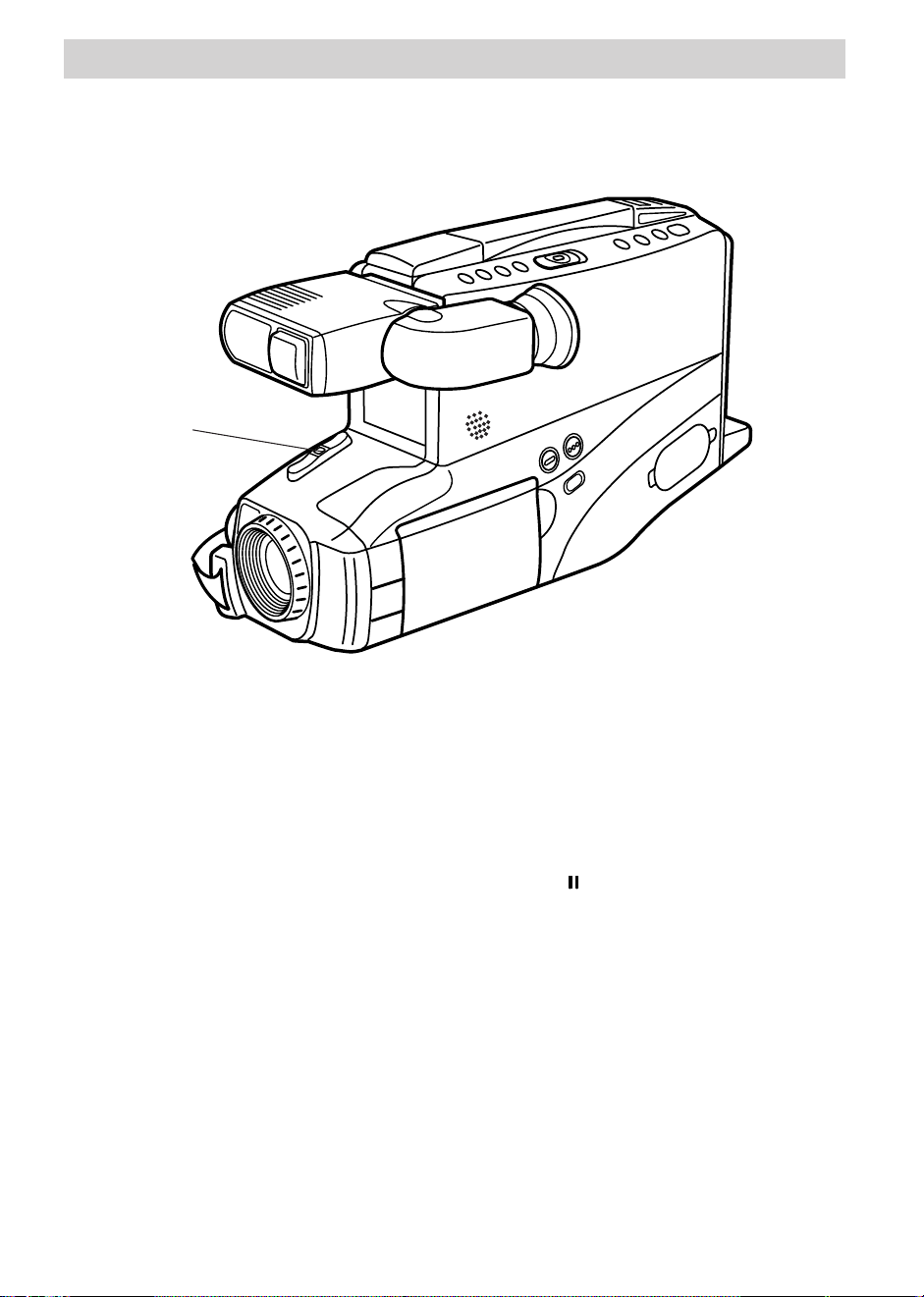
7. Start and stop recording.
• Press and release the REC/PAUSE button to start recording. REC appears
in the viewfinder or on the LCD monitor, when the camcorder is recording.
• Press and release the REC/PAUSE button again to stop recording. The
camcorder is now in the record-pause mode ( appears in the viewfinder
or on the LCD monitor when the camcorder is in record-pause).
REC/PAUSE
Button
(continued on next page)
8
First-Time Operation
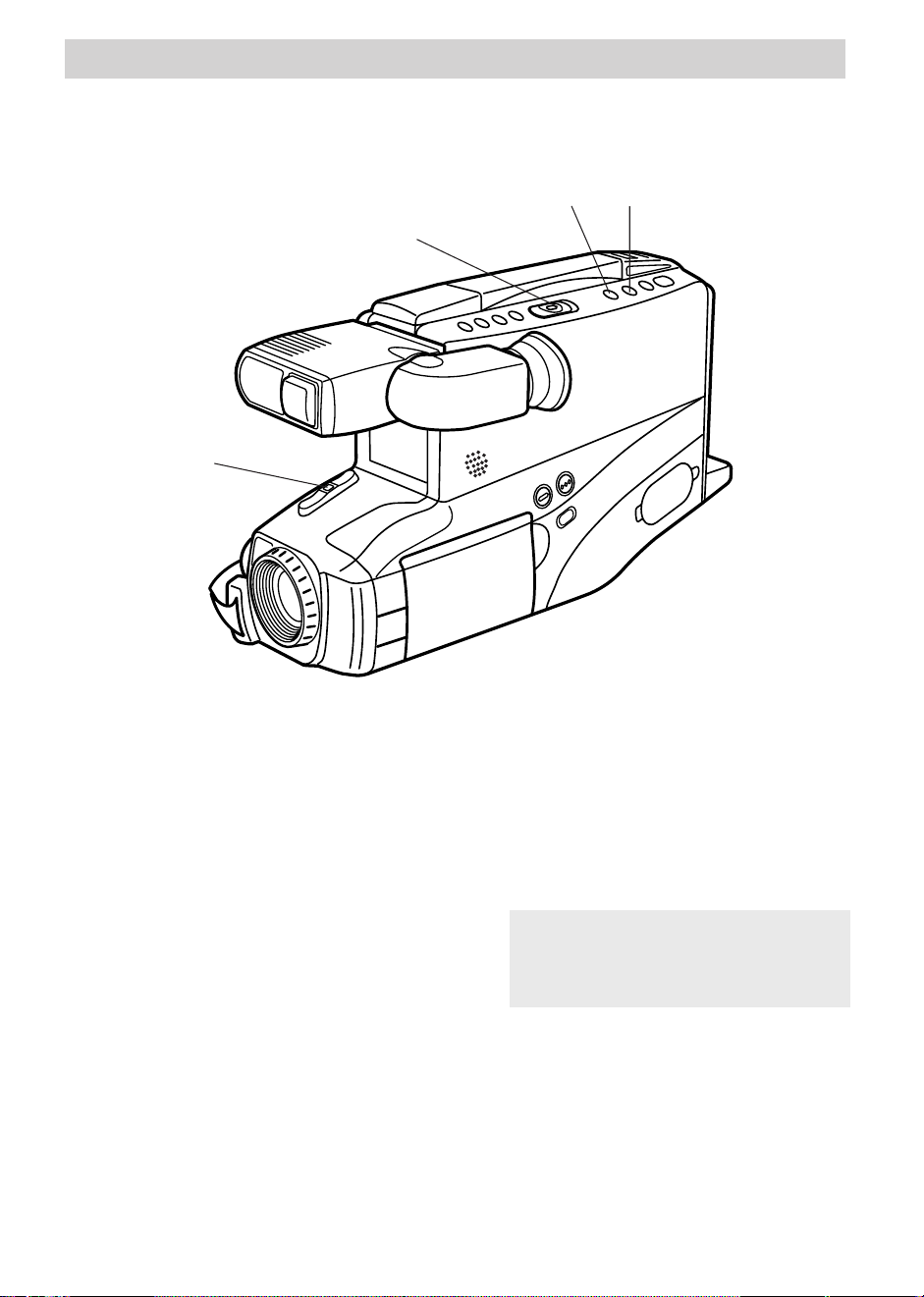
8. Play back what you have
recorded.
1.Press the REC/PAUSE button to
pause recording.
2.Press and hold the small button
on the CAMERA/OFF/VCR
switch while you slide it to VCR.
3.Press REW/REVIEW to rewind
the tape.
4.Press PLAY to play back the tape.
5.Press STOP/EJECT when you are
finished playing back the tape.
Details on LCD monitor and
viewfinder playback are on
pages 42-43.
PLAY
Button
CAMERA/
OFF/VCR
Switch
REC/PAUSE
Button
9. Set the CAMERA/OFF/VCR
switch to OFF to turn off the
camcorder.
10. Close the LCD monitor and
replace the lens cap.
Caution: Make sure the LCD
monitor is open 90º before rotating
it back into position for closing.
REW/
REVIEW
Button
First-Time Operation
9
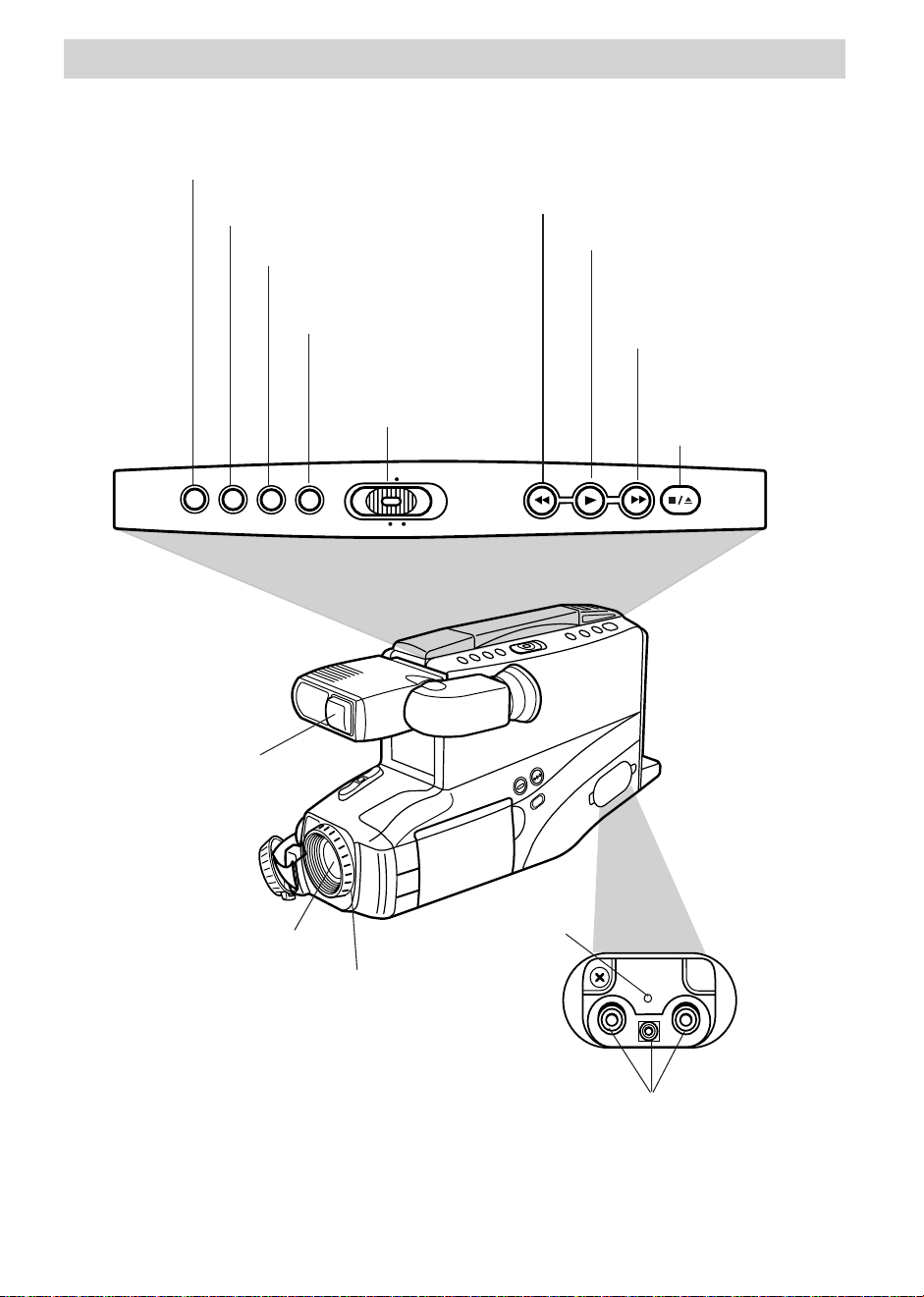
11. Review camcorder’s operating controls.
PLAY Button
REW (Rewind)/REVIEW Button
(Also – Button)
F.FWD (Fast Forward)
Button
(Also + Button)
CAMERA/
OFF/VCR
Switch
DISPLAY Button
DATE/TIME Button
TITLER Button
RESET Button
STOP/EJECT
Button
VIDEO, AUDIO OUT,
and RF DC OUT Jacks
(Located Behind Small Cover)
Microphone
Lens
Lens Hood
Reset Switch
(See Trouble
Checks for
details.)
(continued on next page)
(Also EDIT-ADV
Button)
10
First-Time Operation
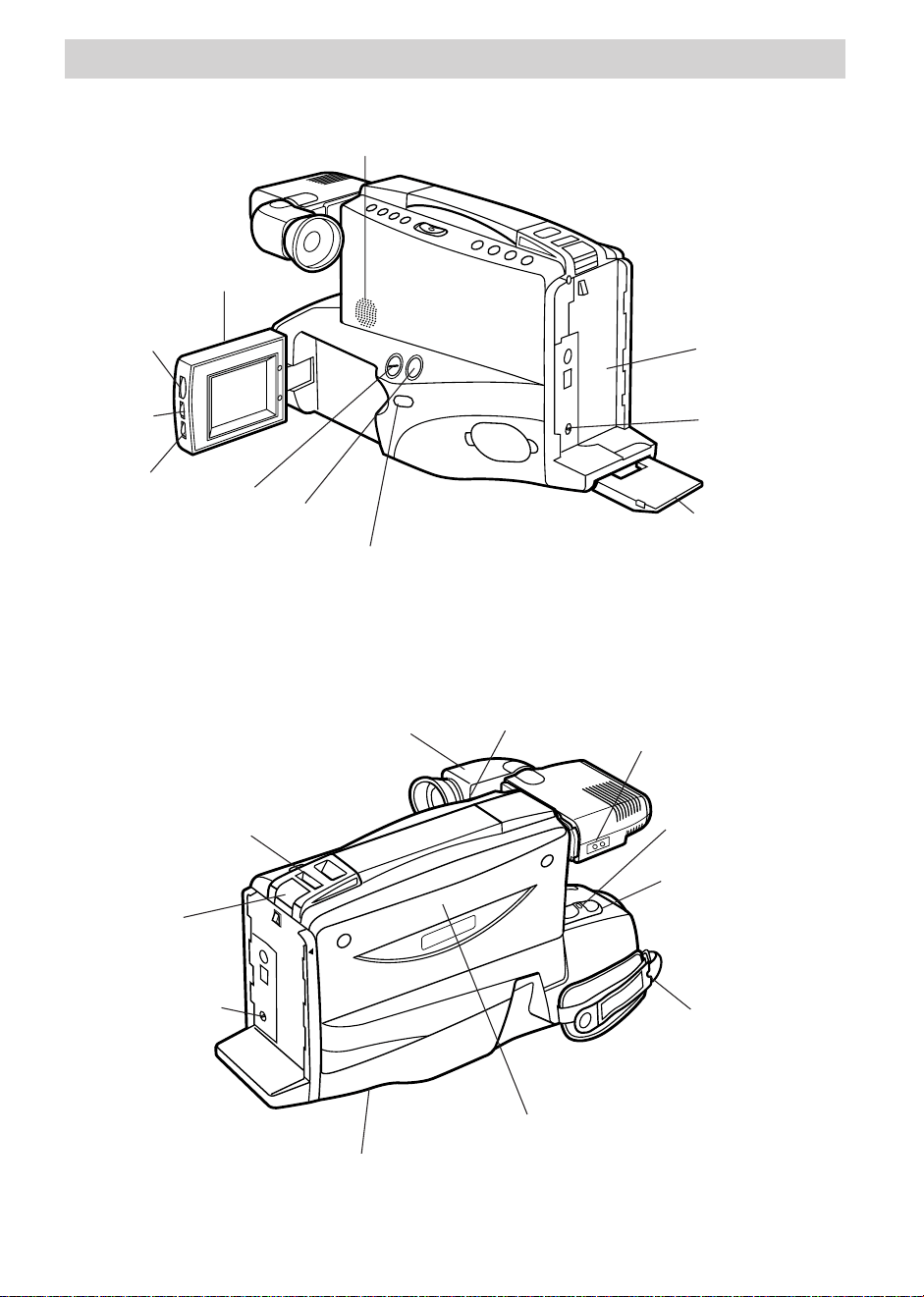
11. Review camcorder’s operating controls. (continued)
Eyepiece Focus
Control
Attach Adapter/
Charger’s DC
Cord Here
Shoulder Strap
Attachment Ring
Shoulder
Extension
Pad
INST.
(Instant)
ZOOM
Button
Shoulder Strap
Attachment Ring
Attach
Rechargeable
Battery Here
REC/PAUSE Button
Handstrap
with Lens Cap
Holder
Viewfinder
OPEN
Button
Cassette Door
(Press here to
close.)
LCD Monitor
Power Zoom Buttons
(W and T)
Also TRACKING
Buttons
FADE
Button
DIGITAL
EFFECTS
Button
BATTERY
EJECT
Button
Volume
Control
Bright
Control
Built-In Speaker
DC IN 9.6V Jack
BRIGHT and FOCUS
Controls
(See Trouble Checks
for details.)
Included Accessories
11
Attaching the Shoulder Strap
The camcorder’s shoulder strap is designed to let you carry the camcorder from your
shoulder and – when you are ready to shoot – bring the camcorder to shooting position
in one quick movement.
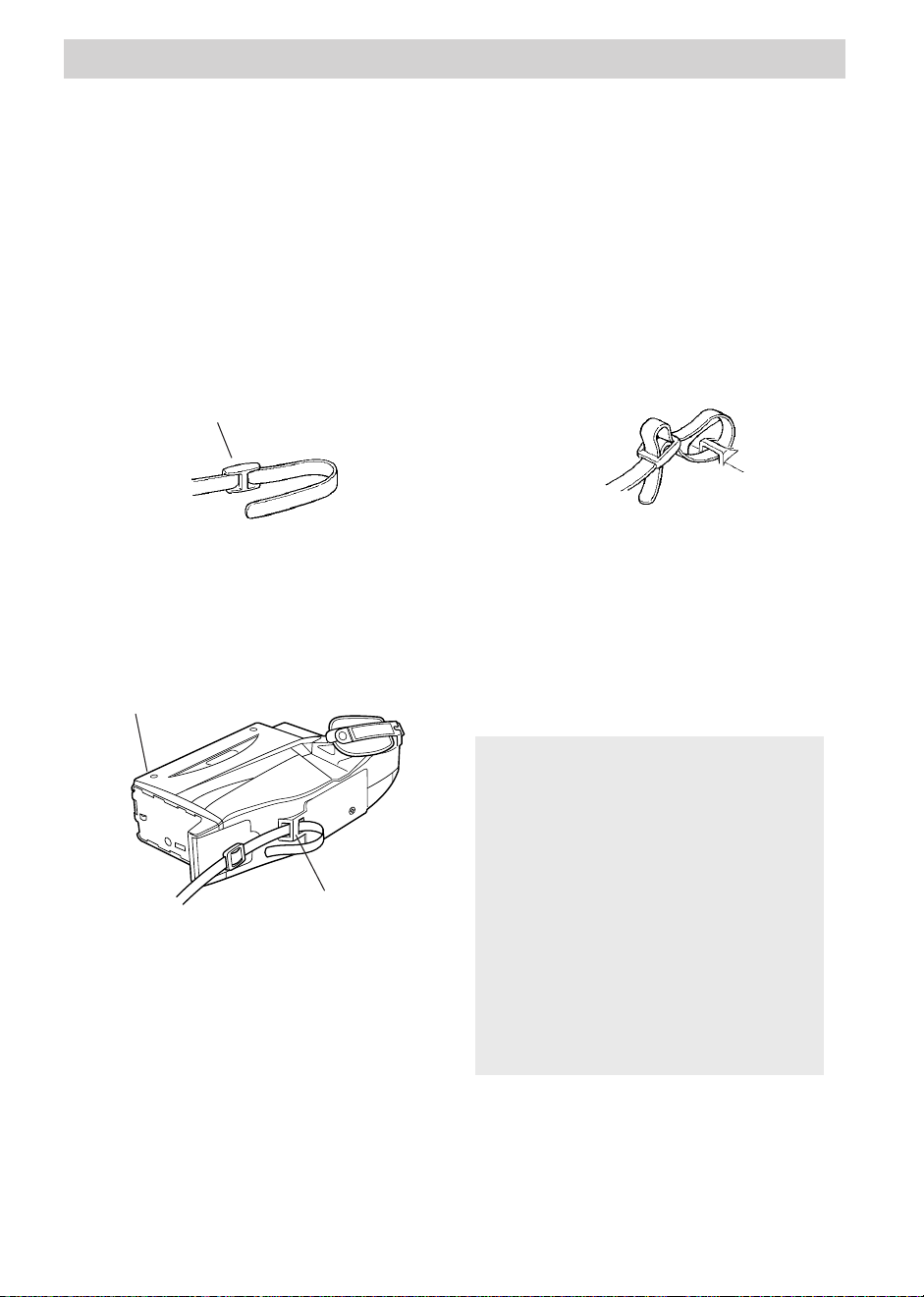
To Attach the Shoulder Strap
1. Unfasten one end of the shoulder
strap from the buckle. Make sure you
leave the buckle on the strap.
2. Thread one end of the shoulder strap
through one of the shoulder strap rings
as shown below.
3. Thread the end of the strap back
through the buckle making sure it is
threaded over the outer strap. Make
sure the strap is not twisted.
4. Repeat steps 1-3 to attach the other
end of the strap.
5. Pull on the straps and make sure they
are securely fastened before using the
shoulder strap to support your
camcorder.
Cautions: When carrying the
camcorder with the shoulder strap,
rotate the viewfinder up to its
original position. If the monitor is
open, close and lock it. This helps
prevent possible damage to the
viewfinder or monitor from
bumping against your body as you
move.
Make sure the shoulder strap is
firmly attached before using it
to carry the camcorder.
Shoulder Strap
Attachment Ring
Shoulder Strap
Attachment Ring
Buckle
12
Power Your Camcorder
Adapter/Charger
Attaching
Removing
Powering Your Camcorder
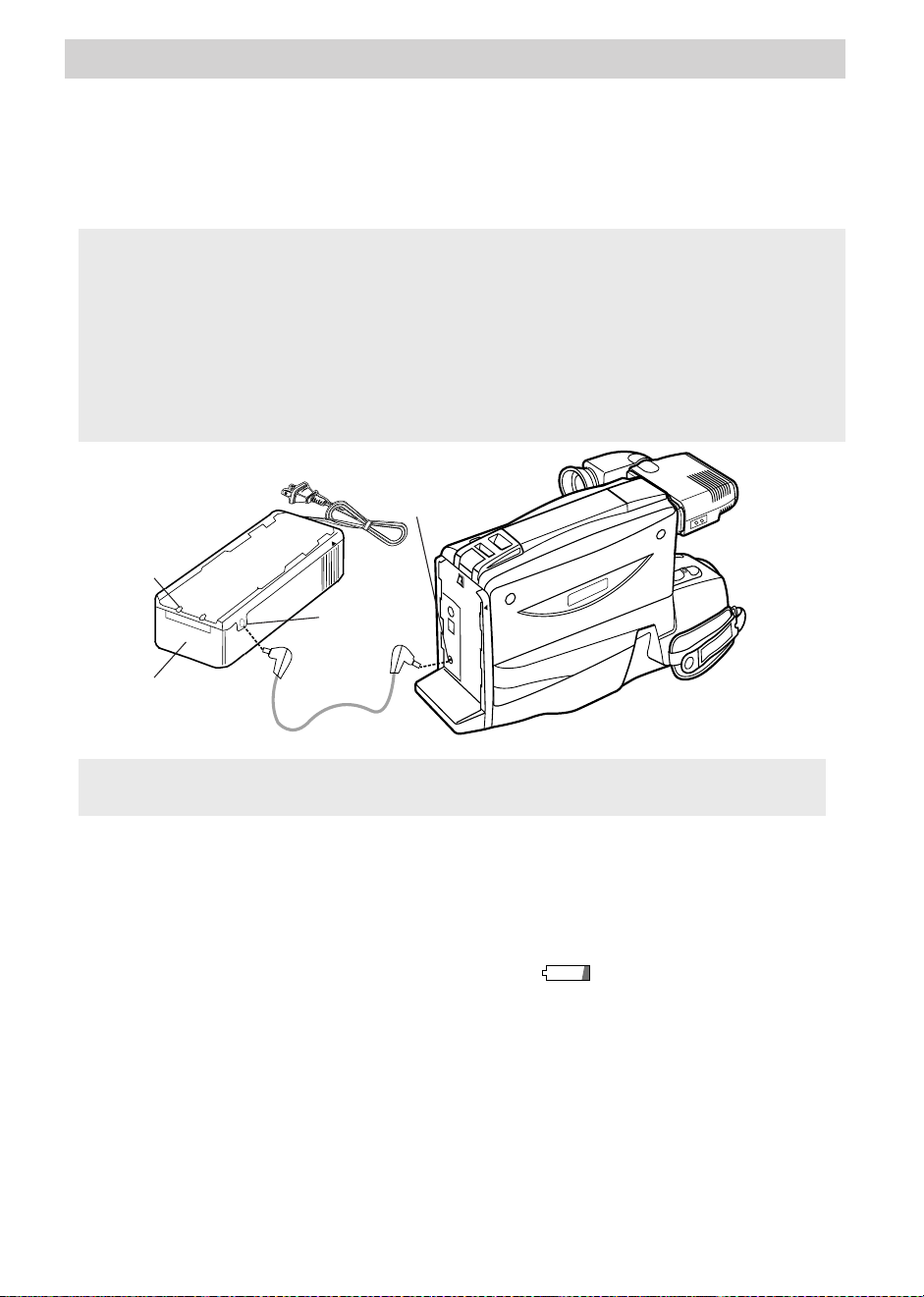
Use the Adapter/Charger to Power Your Camcorder
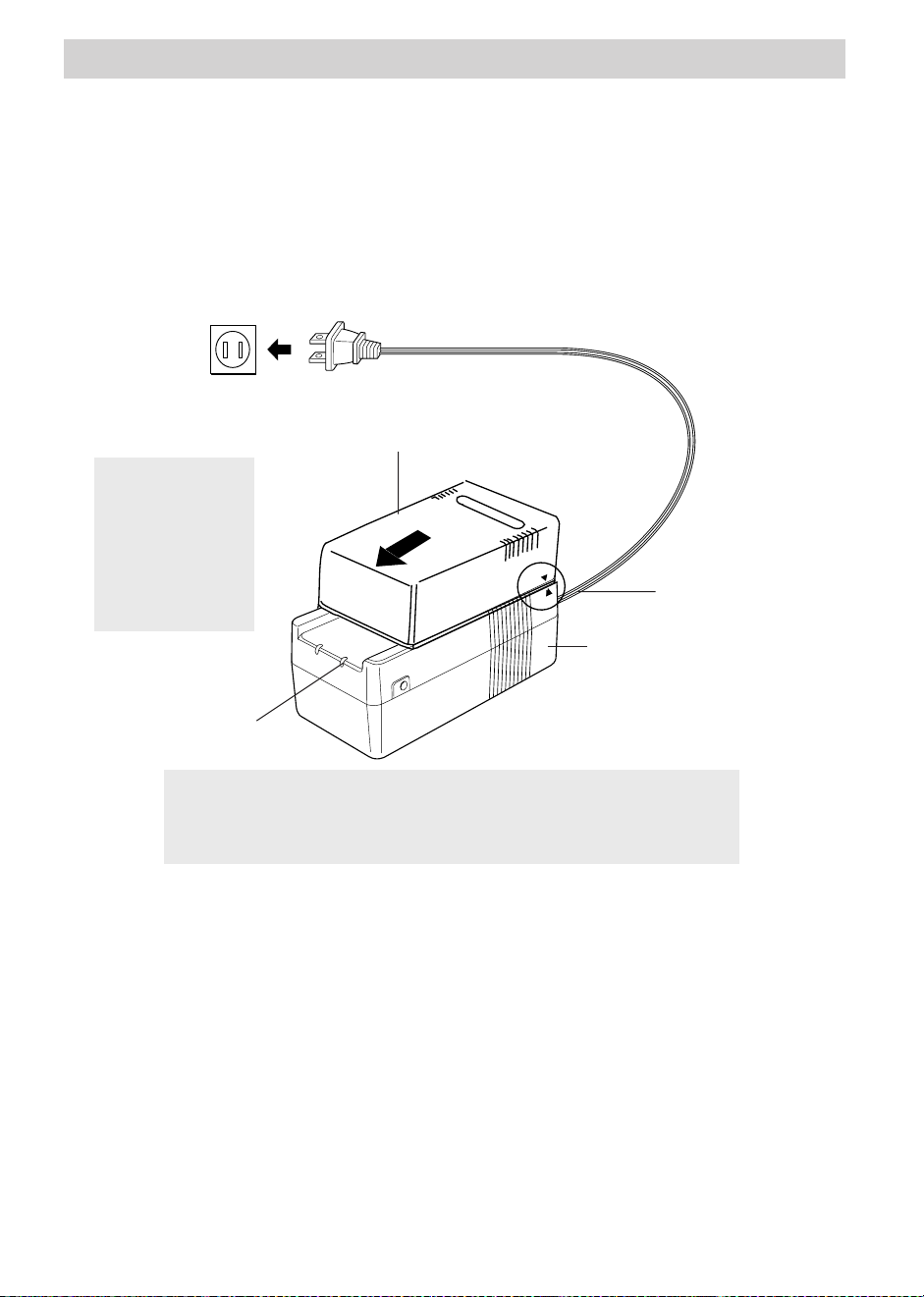
The adapter/charger attaches to the camcorder and lets you power your camcorder
directly from standard household power. The adapter/charger operates on 120 volts,
50/60 Hz, and can be used to power the camcorder or recharge the battery.
Attach Adapter/Charger
1. Attach one end of the adapter/
charger’s DC cable to the DC
OUTPUT jack on the adapter/charger.
2. Attach the other end of the cable to
the DC IN 9.6V jack on the camcorder.
3. Plug the adapter/charger’s plug into an
operating outlet. The POWER
indicator on the adapter/charger lights
when it is properly connected.
Notes: The adapter/charger cannot charge the
battery and operate the camcorder at the same
time. If you connect both, the adapter/charger
powers the camcorder. Remove the adapter/
charger’s cable from the DC OUTPUT jack to
charge the battery.
When using the adapter/charger to power the
camcorder, the battery level indicator might
display
. This indicator is used for
battery operation and has no meaning when
using the adapter/charger to power the
camcorder.
Remove Adapter/Charger
1. Unplug the adapter/charger from the
wall outlet.
2. Remove the DC cable from the
adapter/charger and camcorder.
P
O
W
E
R
C
H
A
R
G
E
DC
OUTPUT
Jack
DC Cable
Adapter/
Charger
To AC 120V,
50/60 Hz
DC IN 9.6V
Jack
Caution: Do not use this adapter/charger for any other purpose other than charging the
EP096FS or EP096FL battery pack or supplying power to the camcorder.
Caution: Do not attempt to use a “power converter” to use your AC adapter/
charger on a power source other than 120 volts, 50/60 Hz, or the adapter/charger
and camcorder may be damaged. If you wish to operate the AC adapter/charger
on a power source other than 120 volts, 50/60 Hz, use only a transformer-type
power converter. Do not use “solid-state” or “switching-type” power
converters. They will damage your AC adapter/charger. An optional
CPS014, shown on page 51, is designed for use on 100-240 volts, 50/60 Hz.
POWER
Indicator
Power Your Camcorder
13
Using the Battery
Charging
Use the Battery to Power Your Camcorder
Charge the Battery
The battery must be charged before it can be used the first time. Initial charging takes
approximately two hours. The camcorder’s operating time depends on how often you
turn the power on and off and how much you use the monitor, zoom, and pause. To
conserve battery power, turn the camcorder off during recording breaks.
Charge the Battery
If the DC cable is attached to the
DC OUTPUT jack on the adapter/charger,
remove it.
1. Align reference mark on battery with
mark on adapter/charger.
2. Hold the battery flush against the
adapter/charger and slide it in the
direction of the arrow.
3. Plug adapter/charger into nearest AC
outlet (120V, 50/60Hz).
4. If the battery is properly connected,
the adapter/charger’s CHARGE
indicator lights.
Note: Your battery will provide better
service if you charge it before and after use
and store it at room temperature.
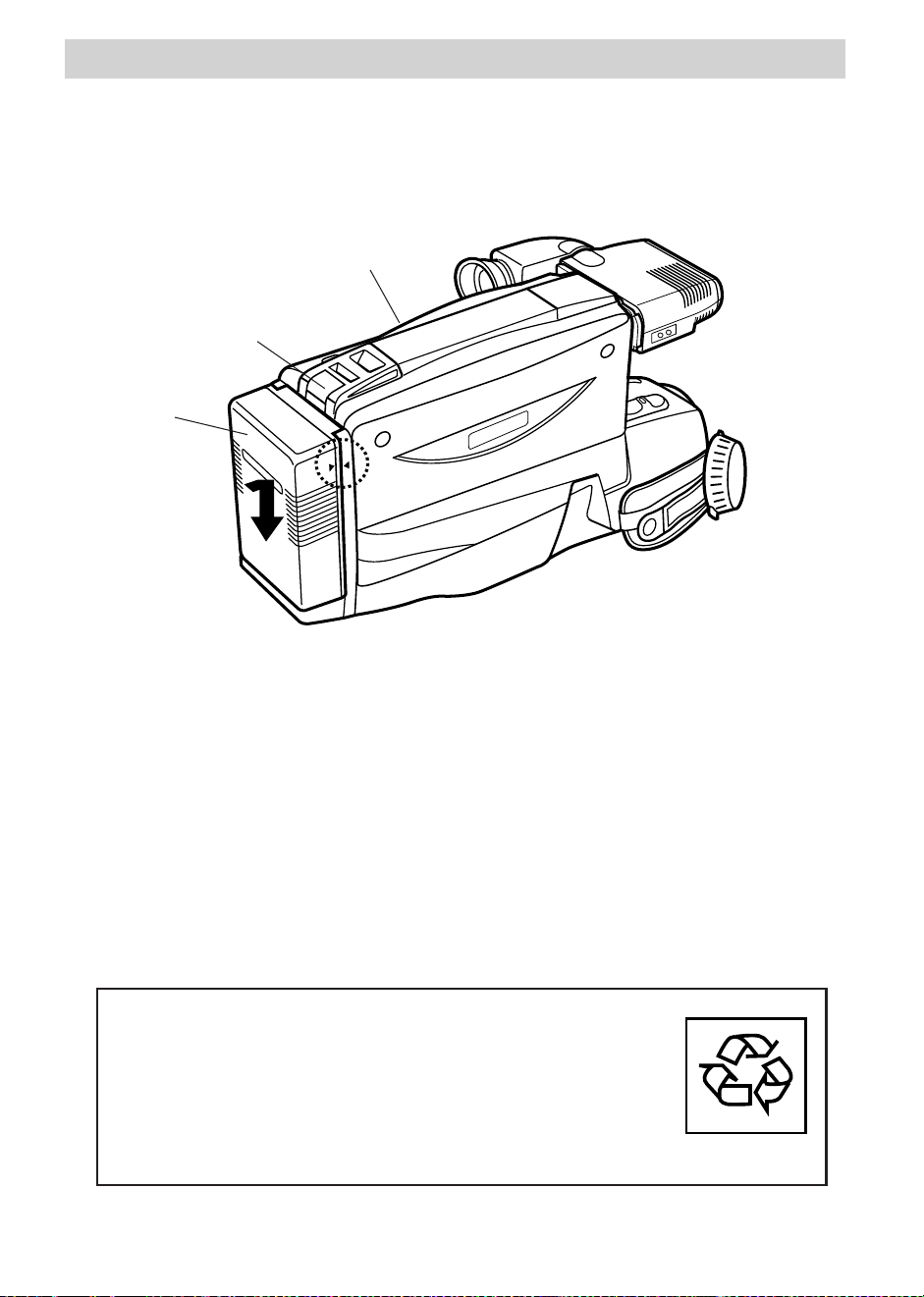
5. Remove the charged battery by sliding
it up and off the adapter/charger.
6. Attach the charged battery to the
camcorder as shown on the next page.
Caution: When a battery is attached to the adapter/charger, do
not turn them upside down. The battery might fall off and be
damaged or cause injury.
WARNING;
LEAD ACID
BATTERY.
MUST BE
DISPOSED OF
PROPERLY.
To AC 120V,
50/60 Hz
Align
Arrows
Adapter/
Charger
Rechargeable Battery
(Hold battery flush and
slide down.)
CHARGE
Indicator
14
Power Your Camcorder
Attaching
Removing
Rechargeable
Battery
Hold Battery
Flush and
Slide Down
BATTERY
EJECT
Button
CAMERA/
OFF/VCR
Switch
Attaching the Charged Battery
If the DC cable is attached to the
camcorder, remove it before attaching
the battery.
1. Align the reference arrow on the
battery to the arrow on the back of
the camcorder.
2. Hold the battery flush against the
camcorder while you slide it down in
the direction of the arrow.
3. Press and hold the small button on the
CAMERA/OFF/VCR switch while you
set it to CAMERA.
Removing the Battery
1. Set the CAMERA/OFF/VCR switch to
OFF.
2. Press and hold the BATTERY EJECT
button while removing the battery.
Use the Battery to Power Your Camcorder (continued)
ATTENTION: THE RECHARGABLE BATTERY
CONTAINED IN THIS PRODUCT IS RECYCLABLE. AT THE
END OF ITS USEFUL LIFE, UNDER VARIOUS STATE LAWS,
IT MAY BE ILLEGAL TO DISPOSE OF THIS BATTERY IN
THE MUNICIPAL WASTE STREAM. CHECK WITH YOUR
LOCAL SOLID WASTE OFFICIALS FOR DETAILS IN YOUR
AREA FOR RECYCLING OPTIONS OR PROPER DISPOSAL.
Pb
L
E
A
D
RETURN
R
E
C
Y
C
L
E

Power Your Camcorder
15
Battery Level Indicator
The battery level indicator appears in the viewfinder or on the LCD monitor and
shows you the amount of power in the rechargeable battery.
Notes: When you record using the recharge-
able battery, the battery level indicator still
flashes to warn you of low battery power
even if you do not have the battery level
indicator displayed.
The battery level indicator isn’t recorded on
the tape.
The battery level indicator has no meaning
when you use the adapter/charger or optional
car cord to power the camcorder.
Note: If you can’t see the battery level
display, press DISPLAY.
• When appears, the battery is
fully charged.
• As the power is used and
appear.
• When the battery power is almost
gone, flashes in the viewfinder
or on the LCD monitor. Recharge the
battery or use the adapter/charger
before continuing to use the camcorder.
Set the CAMERA/OFF/VCR switch to
OFF to turn off the camcorder before
replacing the battery.
Use the Battery to Power Your Camcorder (continued)
Cautions: When a battery reaches empty during use, the camcorder turns off.
The battery should still have enough reserve power to eject the cassette when
you press STOP/EJECT.
If the camcorder does not eject the cassette when you press STOP/EJECT, do
not force the cassette door open. This will damage your camcorder.
Before attempting to eject the cassette, power the camcorder with the adapter/
charger or recharge the battery.
Battery Level Indicator Display in
Viewfinder or on the LCD Monitor

16
Power Your Camcorder
Care and Storage
Safety Precautions
Use the Battery to Power Your Camcorder (continued)
Battery Care
• Your battery will provide better service
and longer performance if you charge
if before and after use, and store it at
normal room temperature.
• The battery should be charged at a
temperature of 32ºF-95ºF (0ºC-35ºC)
to prevent damage.
• Do not operate the battery at tempera-
tures below 14ºF (-10ºC) or above 95ºF
(35ºC). You might damage the
battery if you use it at temperatures
above 122ºF (50ºC). Operation
time decreases at extremely low
temperatures.
• After repeated chargings and use
the operation time decreases. When
the operation time becomes too
short to be useful, it is time to
replace the battery.
Battery Storage
• Store the battery at normal room
temperature.
• Lead acid batteries discharge if not
used. Recharge the battery at least
once ever six months or you may not
be able to recharge it.
Battery Safety Precautions
• Batteries being recharged that have not
been used for an extended period may
continue to charge after the normal
time. Do not charge a battery for more
than 24 hours.
• If the CHARGE indicator on the
adapter/charger starts flashing, remove
the battery, and reattach it. If after
several attempts, the indicator contin-
ues to flash, your battery cannot take a
charge and must be replaced.
• Throwing the battery into a fire or
exposing the battery to excessive heat –
over 149ºF (65ºC) could be hazardous.
• A battery stored for long periods
might not supply power for the
specified time. Additional
rechargings might help restore
the battery’s operation time.
• Do not short the battery’s terminals.
• Allow the battery to cool down before
attaching it to the adapter/charger. The
CHARGE indicator will not light and
the battery will not charge if you attach
a hot battery.
• Do not attempt to disassemble or
modify the battery. There are no user-
serviceable parts inside.
• Use the battery only with specified AC
adapter/chargers and camcorders.
• If leakage from a damaged battery
contacts your skin or clothing, wash it
off immediately with running water.
Power Your Camcorder
17
Car Cord Adapter
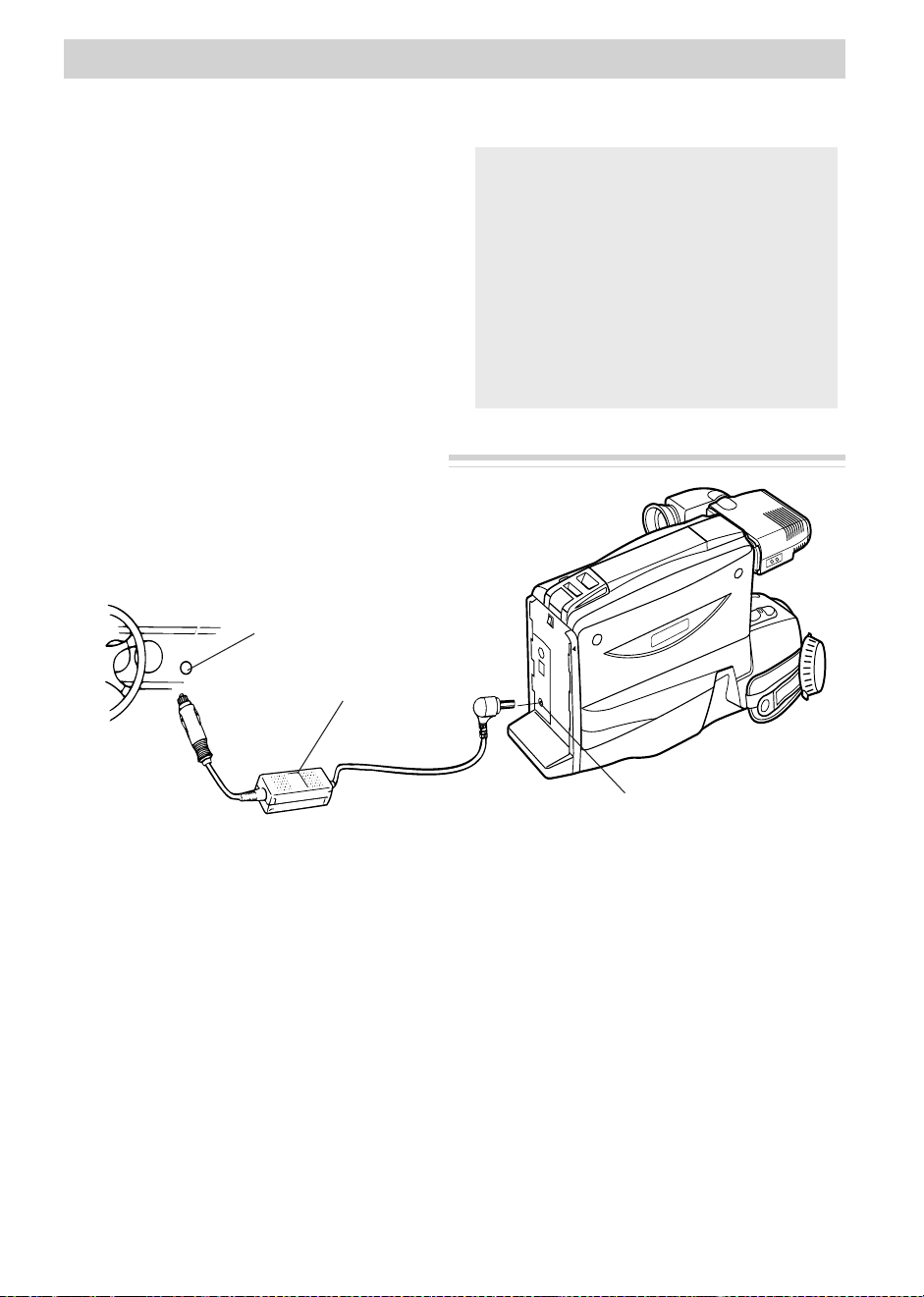
Use the RCA Optional Car Cord Adapter
The optional DCC096 car cord shown on
page 50 allows you to power your
camcorder from the cigarette lighter
socket of a car, truck, or RV. It converts
12-volts to a 9.6-volt output.
Note: Consult the installation and operating
instructions enclosed with the DCC096 for
complete operating instructions.
Use the DCC096 Car Cord Adapter
1. Set the CAMERA/OFF/VCR switch to
OFF to turn off the camcorder.
2. If the battery or DC cable is attached
to the camcorder, remove it.
3. Insert the small plug on the car cord to
the DC IN 9.6V jack located on the
back of the camcorder.
4. Take the vehicle’s cigarette lighter out
of the socket.
5. Insert the car cord’s cigarette lighter
plug into the vehicle’s cigarette lighter
socket.
6. To turn on the camcorder, press and
hold the small button on the
CAMERA/OFF/VCR switch while you
set it to CAMERA.
Notes: The vehicle does not have to be
running for the camcorder to operate from
the DC car cord.
The battery level indicator has no meaning
when you use the car cord to power the
camcorder.
Cigarette
Lighter
Socket
Optional
Car Cord
(DCC096)
DC IN 9.6V
Jack
Caution: The DCC096 car cord is
designed to be used only with
vehicles having 12-volt negative
ground electrical systems.
Warning: To avoid possible damage
to the camcorder, use only the
DCC096 car cord. It has positive tip
polarity and is capable of converting
12 volts to 9.6 volts.
18
Videocassettes
Using Videocassettes
Make sure you select good quality tapes for your camcorder. Use of poor quality tapes
or tapes that have been damaged or mishandled can contaminate the video heads,
resulting in a snowy picture or no picture at all during playback. Because there is no
control over the type of tape purchased or rented by consumers, head cleaning is not
covered under warranty. It is considered normal maintenance.
If a snowy picture or no-picture condition persists, consider the use of a dry chemical
nonabrasive head-cleaning tape. Be sure to follow the directions with the head-
cleaning kit carefully. Improper use of a head cleaner might damage your camcorder.
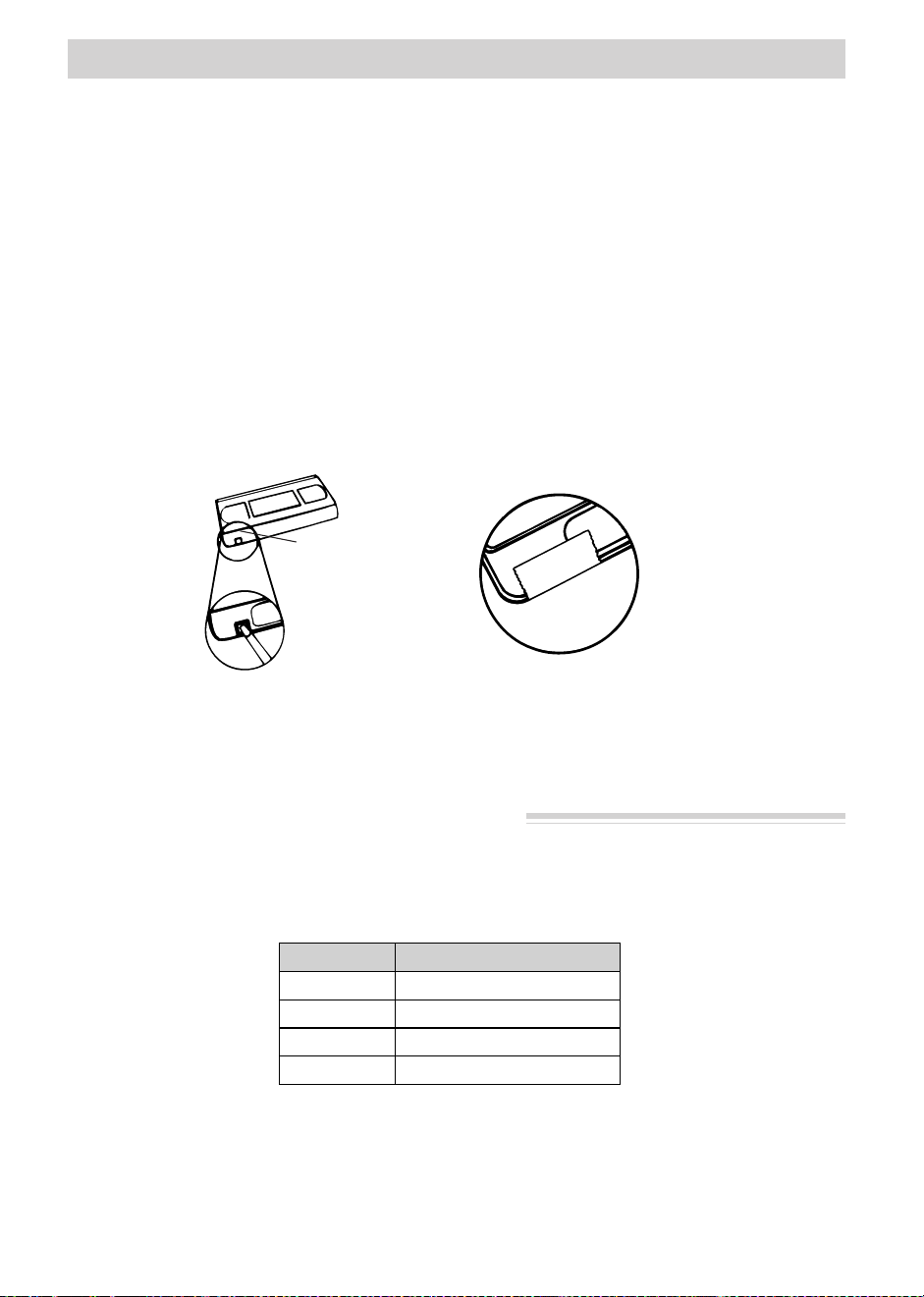
Erase Protection – Safety Tab
You can use your videocassettes over and over again. To erase a previous recording,
just record over it.
Recording and Playback Speed and Times
The camcorder records and plays back in VHS standard speed (SP). Listed below are
the maximum recording times for popular VHS cassettes.
Safety Tab
To prevent accidental
erasure, break off the tab.
To record on the tape again, cover
the hole with vinyl tape.
CASSETTE RECORDING TIME
T-60 60 Min.
T-120 2 Hrs.
T-160 2 Hrs., 40 Min.
T-180
3 Hrs.
19
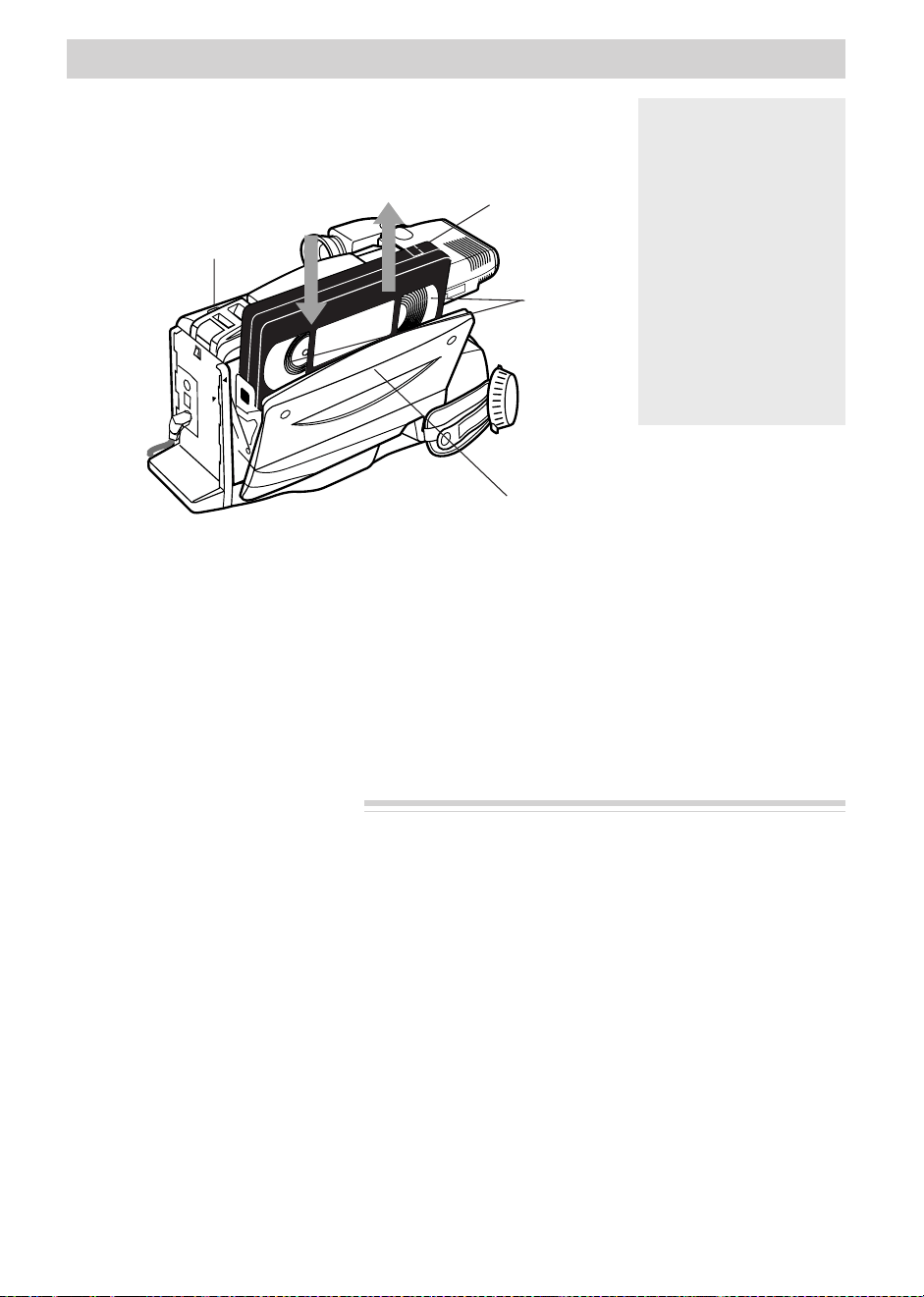
Videocassettes
Caution: Insert
the cassette only
one way with the
tape wheel facing
up and the tape
windows facing
out. The cassette
should slide easily
into the holder.
Gently push the
cassette down until
it locks into place.
Cassette Care and Storage
• When you are finished with a cassette,
rewind it, remove it from the
camcorder, and label it.
• Store cassettes vertically in their
protective cases at normal room
temperatures. Do not leave your
camcorder or cassettes in a car or
outdoors for an extended period.
Excessive heat or cold might damage
your cassettes.
• Keep the cassette away from strong
magnetic fields such as electric motors
and other devices.
Insert and Remove Cassettes
• Keep dust from entering the cassette
compartment. All dust is abrasive and
will cause excessive wear on the tape
and the camcorder’s recording or
playback heads.
• Do not use cassettes with damaged or
spliced tape.
• Do not use a cassette if it has been
damaged or exposed to moisture. The
tape might jam and/or damage your
camcorder.
• Break off the safety tab to prevent
accidental erasure of your recording.
1. Attach a power source to the
camcorder.
2. Press the STOP/EJECT button.
The cassette holder opens
automatically.
3. Insert the cassette with the tape wheel
Safety Tab
Ta pe
Windows
STOP/
EJECT
Button
facing up and tape windows facing
out. Gently push the cassette down
until it locks into place.
4. Gently close the cassette holder with
your hand.
Press here
to close.
Date and Time Display
20
Setting the Time and Date
You must set the correct date and time before it can be displayed and recorded on your
tapes. The built-in clock cell must be charged as described on the next page.
NOTE: If you leave the camcorder on for 10 minutes without a cassette inserted when the date has not been set or the built-
in clock battery is dead, the camcorder demonstration mode will start. To cancel the demonstration mode, disconnect power
from the camcorder and reconnect it, or insert a cassette.
1. Attach a power supply to the
camcorder.
2. Press and hold the small button on the
CAMERA/OFF/VCR switch while you
set it to CAMERA.
3. Press the DATE/TIME button to
display the date and time on the LCD
monitor or in the viewfinder.
A flashing cursor lets you know which
part of the display you are setting.
If the flashing cursor does not appear,
press and hold DATE/TIME and then
press STOP/EJECT.
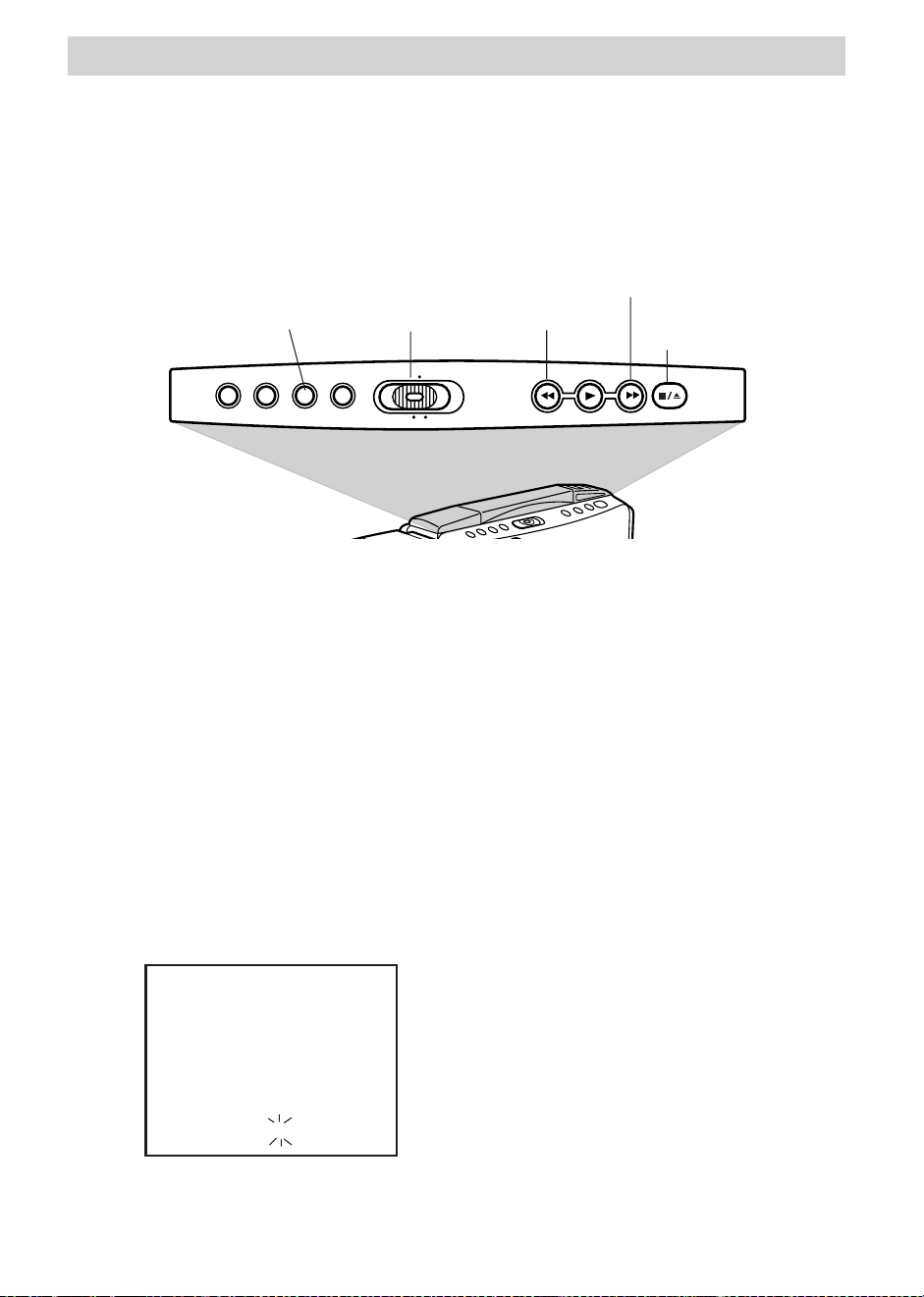
4. Repeatedly press the F.FWD or REW/
REVIEW until the correct month
appears. Press and hold the button to
advance the digits faster.
5. When the correct month is displayed,
press STOP/EJECT. The cursor
moves to the next part of the display.
6. Repeat steps 4 and 5 to set the correct
month, day, year, hour, minute(s), and
AM/PM.
7. After setting AM or PM, press the
DATE/TIME button to remove the
flashing cursor and start the internal
clock.
To Correct the Date or Time
To correct the date or time, press and hold
the DATE/TIME button and then press
STOP/EJECT. The display and the
flashing cursor appear. Use STOP/
EJECT, F.FWD, and REW/REVIEW to
correct the time or date. Press DATE/
TIME to remove the flashing cursor and
start the clock.
12:00AM
1/1999
REW/
REVIEW
Button
F.FWD Button
CAMERA/
OFF/VCR
Switch
DATE/TIME
Button
STOP/EJECT
Button
1
Date and Time Display
21
Recording Time and Date
AUTO Date
Auto TITLE
Date
Selecting Display
LCD Monitor or Viewfinder Displays
AUTO Date Display
AUTO Title Display
Date and Time Display
11/18/1999
11/18/1999
No Display
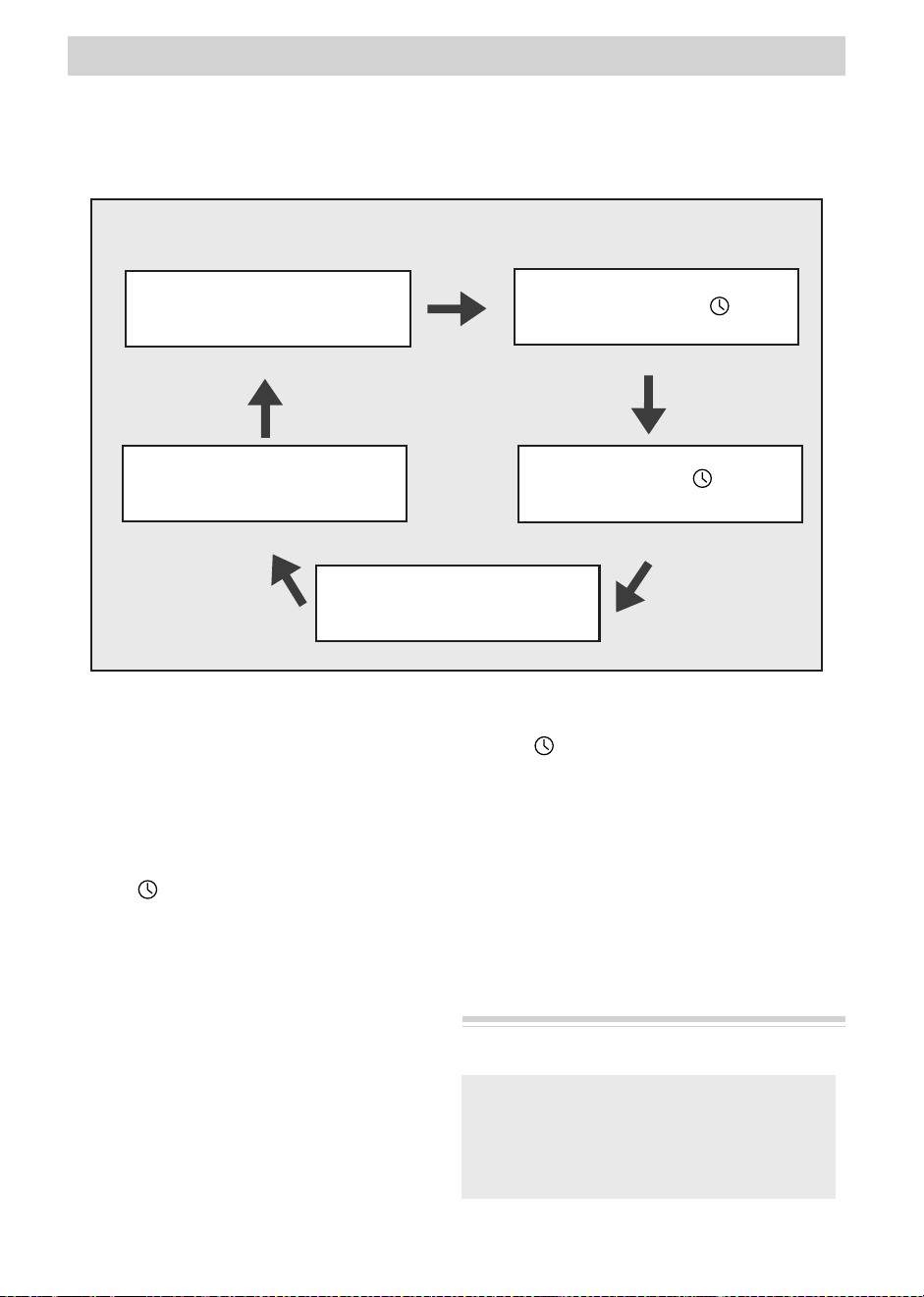
Selecting the Display to Record
1. Repeatedly press DATE/TIME to
select the display you want to record.
• Date and Time Display: The date
and time will be displayed and
recorded.
• AUTO Date: The date is
automatically recorded for approxi-
mately 10 seconds at the beginning
of the recording.
Record the Time and Date, AUTO Date, Auto TITLE, or Date
The time and date, AUTO date, auto TITLE, date only, or no date can be recorded on
your tape. Whenever one of these displays appear, it will be recorded.
10:25AM
11/18/1999
AUTO
11/18/1999
TITLE
Date Display
• TITLE: The date and title you
have created are displayed and
recorded for approximately 10
seconds at the beginning of the
recording.
• Date Display: The date is dis-
played and recorded.
• No Display: No display is dis-
played or recorded.
Charging the Built-in Clock Battery
The camcorder has a built-in rechargeable battery that must be charged
approximately every two months.
1. Attach a power supply and set the
CAMERA/OFF/VCR switch to OFF.
2. Leave the power supply attached at
least 24 hours.
Cautions: If this battery is not charged every two
months, it will over-discharge and shorten its
useful life.
Do not attempt to replace this battery. Take the
camcorder to an authorized RCA Service Center.
Repeatedly Press DATE/TIME
22
Recording
Recording
Using the LCD Monitor
Use the LCD Monitor or Viewfinder to See What You Record
Use the LCD Monitor
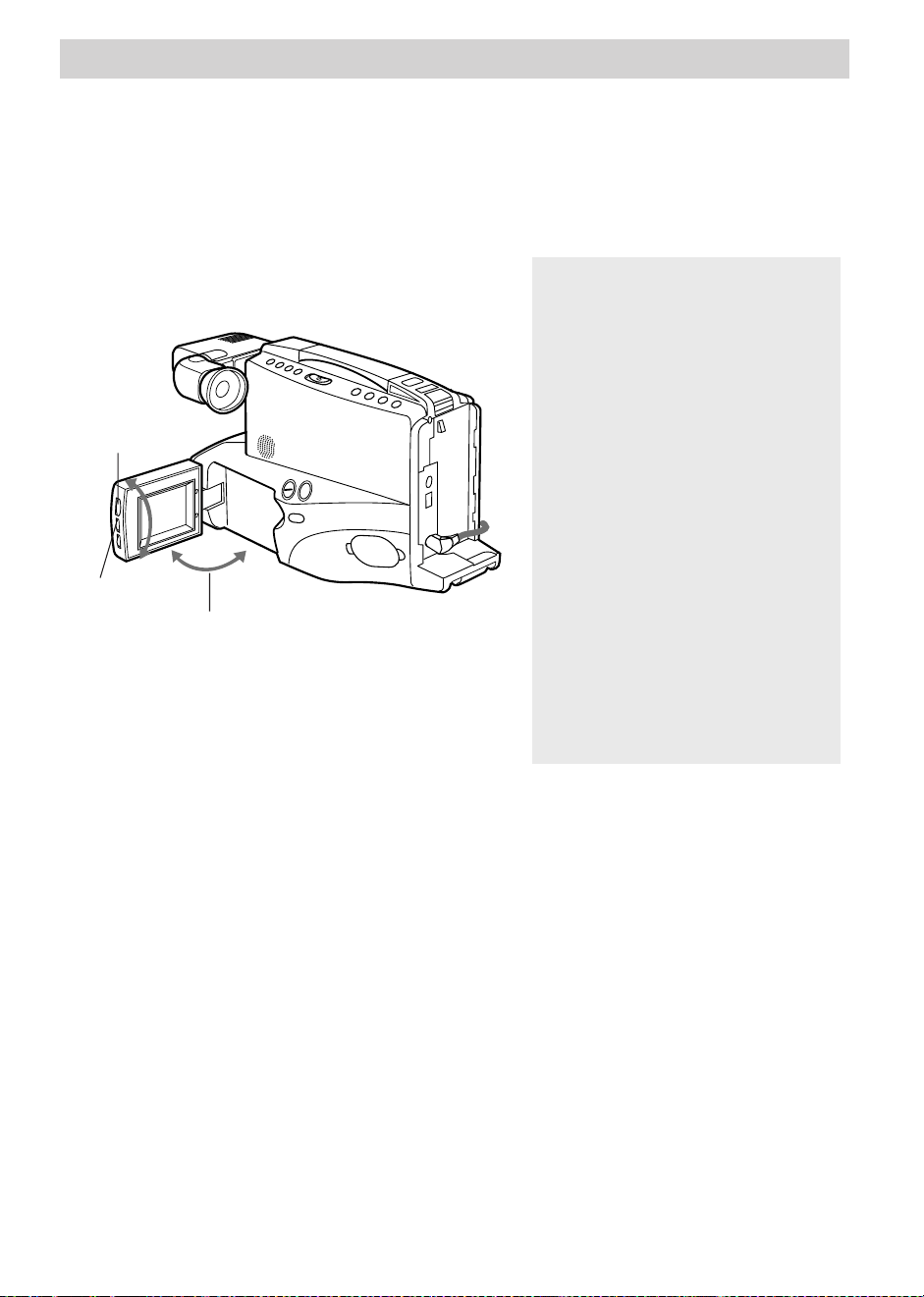
1. Press the OPEN button and open the
LCD monitor. Make sure the monitor
is open 90º. The viewfinder
automatically turns off.
2 Rotate the monitor.
• Tilt the monitor down to record
from a high angle, such as over a
crowd.
• Tilt the monitor up to record from a
low angle, such as when you are
kneeling.
• To enable both you and the person
you’re recording to see what’s
being recorded, rotate the LCD
monitor completely around so the
front of the monitor faces the
person you’re recording.The
viewfinder turns on automatically
when you turn the monitor all the
way around.
3. To adjust the brightness of the image
on the monitor, turn the bright control.
This does not affect the brightness of
the recording you are making.
4. When you are finished, carefully
rotate the monitor back into position
and close and lock it into place.
Note: When recording on a bright sunny day,
the LCD monitor might be hard to see. Use
the viewfinder.
Monitor can open up to
90º. Open monitor 90º
before rotating it.
Bright
Control
OPEN
Button
You can watch what you are recording on the LCD monitor or in the viewfinder.
When the LCD monitor is open more than approximately 45º, the viewfinder automati-
cally turns off. Close the LCD monitor and the viewfinder automatically turns on.
Cautions: Do not force the
monitor to open farther than 90º.
This will damage the monitor
and/or the camcorder.
Open the monitor 90º before
rotating it up or down or revers-
ing its direction. Make sure the
monitor is not rotated or tilted
before closing it.
Do not touch the LCD monitor
with your fingers. Use a soft
cloth to clean the monitor.
When carrying the camcorder
with the shoulder strap, close and
lock the monitor. This helps
prevent possible damage to the
monitor from bumping against
your body as you move.
23
Recording
Adjusting the Viewfinder
Adjusting the Viewfinder for Convenient Viewing
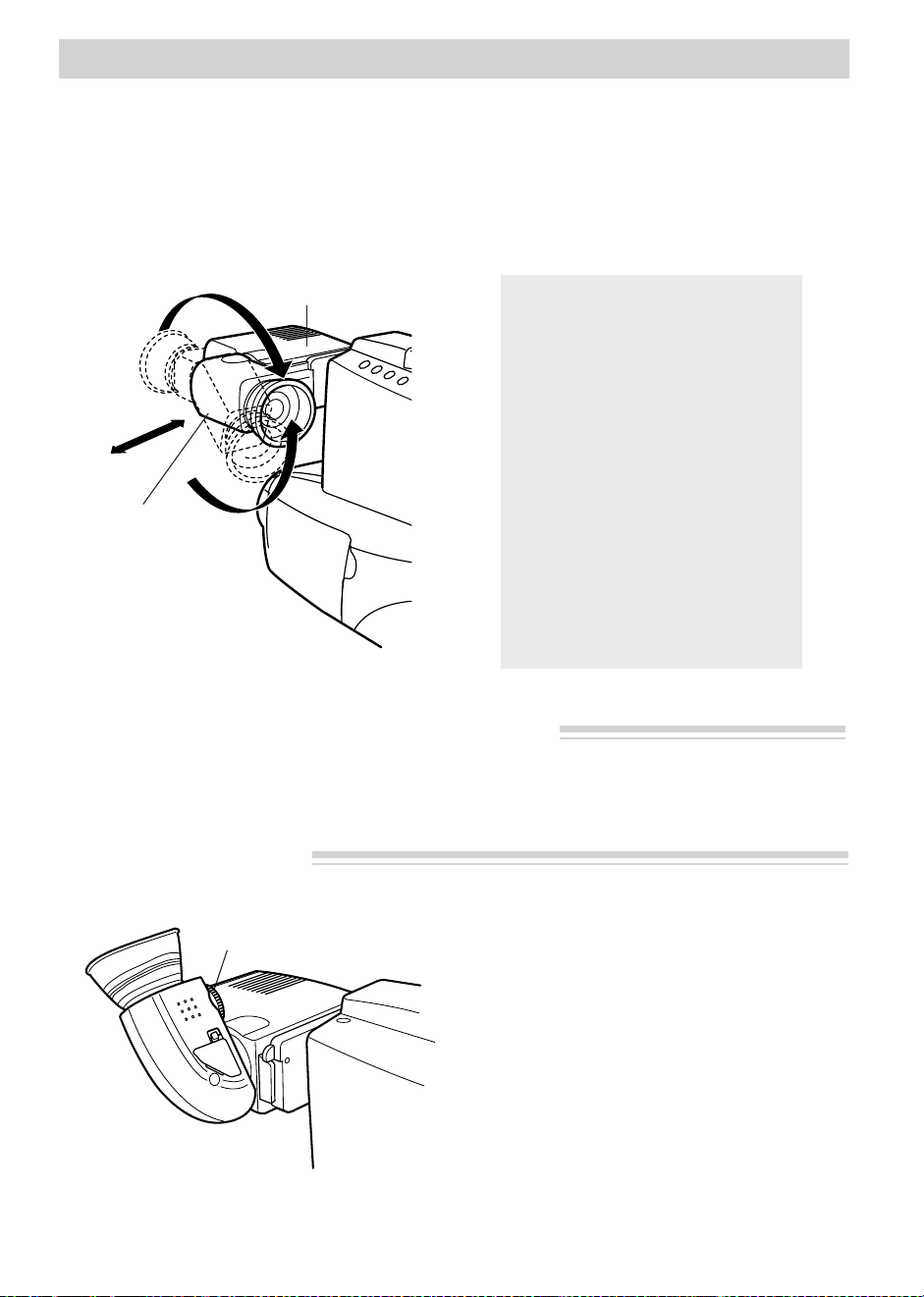
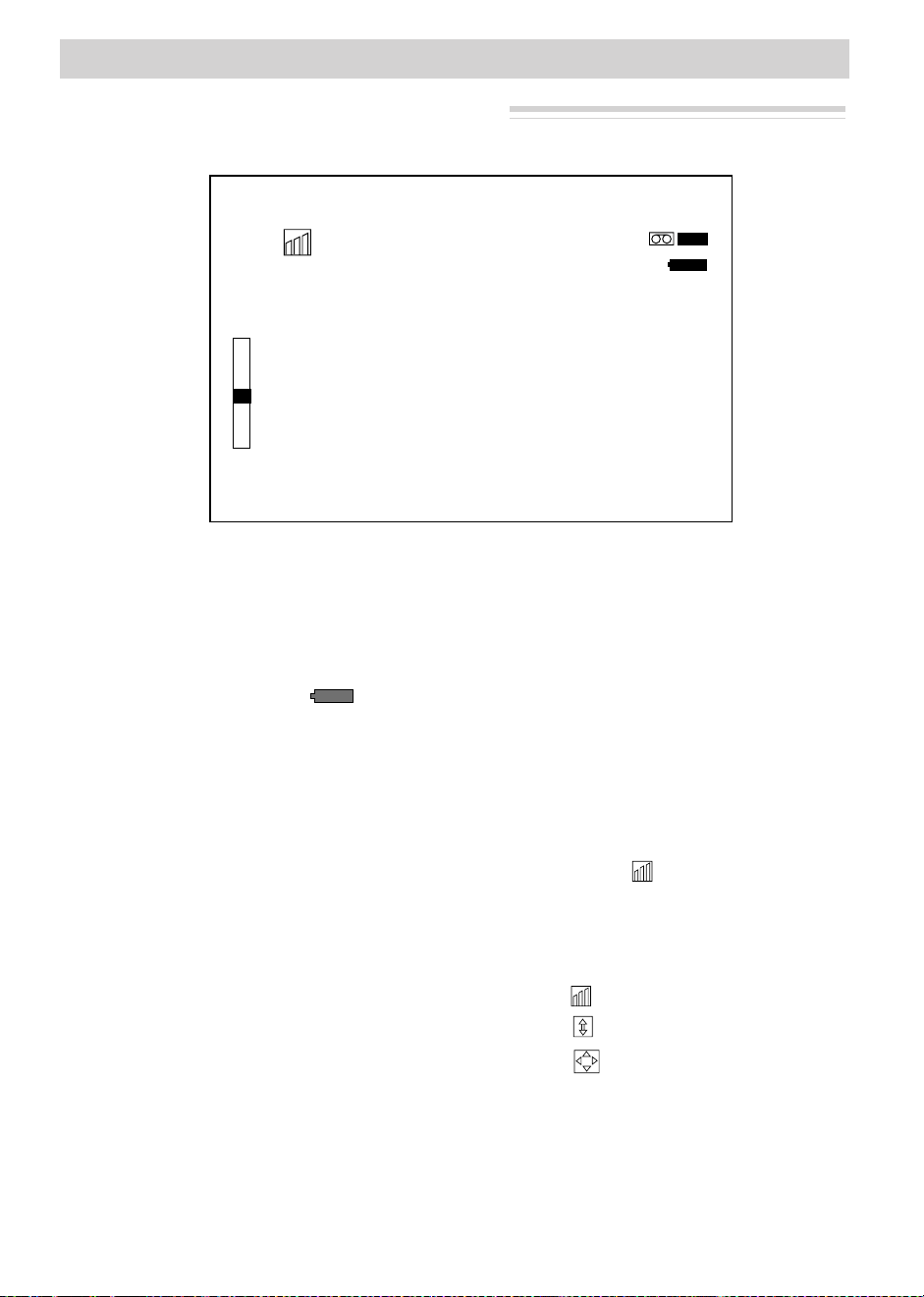
For convenient viewing, rotate the viewfinder horizontally, pull it out from the cam-
corder, and adjust the eyepiece.
Eyepiece Focus
Control
The eyepiece focus control lets you set the
focus of the viewfinder for your vision.
If you wear eyeglasses, you probably can
operate the camcorder without them.
It is easiest to set the correct focus by
focusing on one of the viewfinder’s on-
screen displays. Look through the
viewfinder and adjust the eyepiece focus
control for your vision.
The eyepiece focus control does not affect
the focus of the picture actually recorded
by the camcorder.
Using the Viewfinder
The camcorder’s viewfinder is a miniature monitor that displays the picture seen by the
camcorder when recording. When the LCD monitor is open more than 45º, the
viewfinder automatically turns off.
Cautions: Do not pull on the
eyepiece. Do not force the
eyepiece to rotate completely
around. This might damage the
viewfinder and/or the cam-
corder.
When carrying the camcorder
with the shoulder strap, put the
viewfinder back in its original
position. This helps prevent
possible damage to the
viewfinder from bumping
against your body as you
move.
Viewfinder
Eyepiece
Eyepiece Focus Control
24
Recording
LCD Monitor or Viewfinder Displays
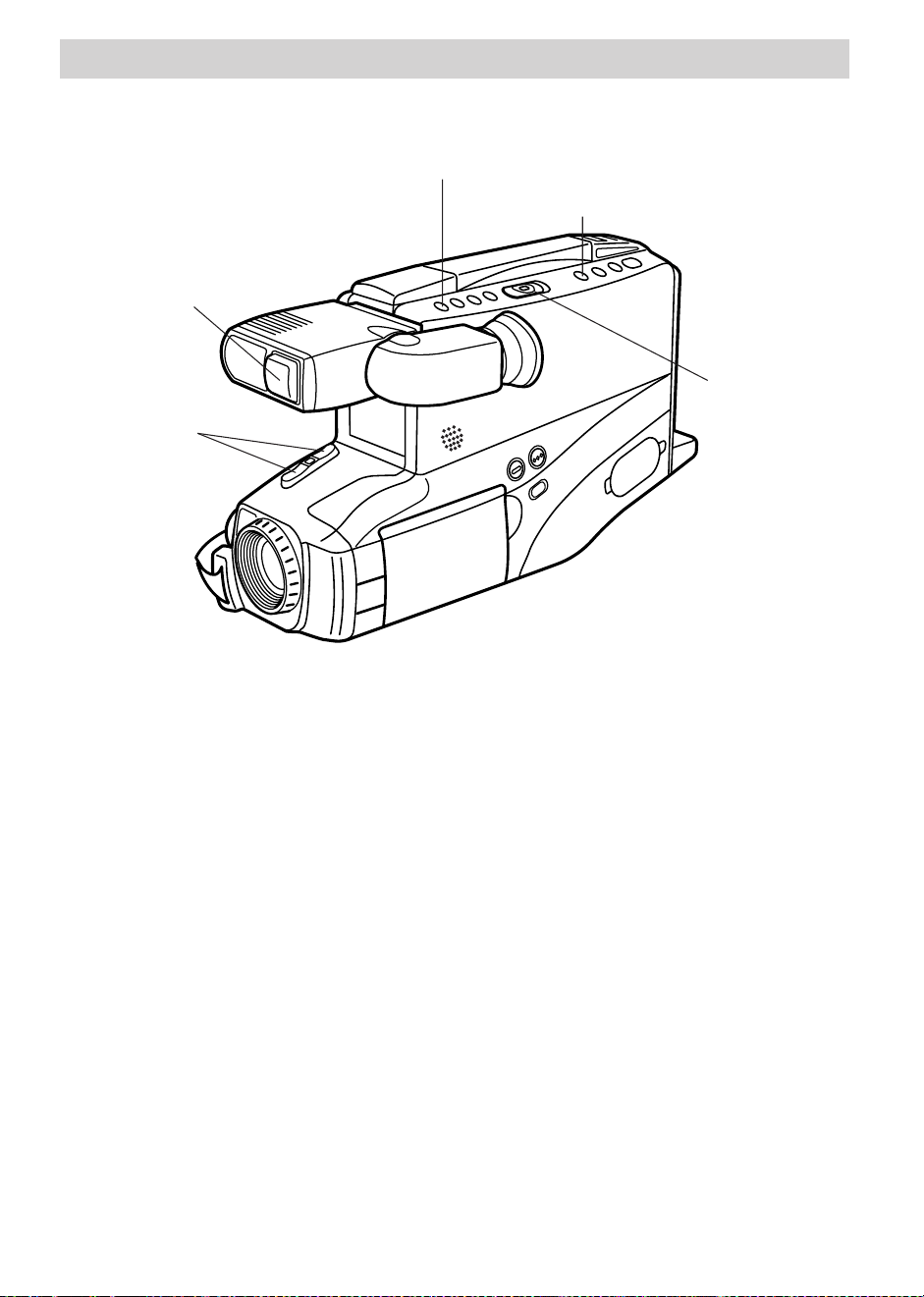
AE:60 (Auto Exposure) Shutter Speed
Press the DISPLAY button to display the
shutter speed selected by the camcorder.
Battery Level Indicator ( )
Press the DISPLAY button to display the
amount of time left on the rechargeable
battery. Details are on page 15.
Digital Effects (ZM:2)
Press the DISPLAY button to display the
indicator for the digital effect mode
selected. Press the DIGITAL EFFECTS
button to select a digital effect mode.
• Select 16X9 to make a recording
that you’re going to play back on a
16X9 TV.
• Select NEGPOS to reverse the image
from positive to negative.
• Select ZM:2 to activate the extended
zoom mode – wide angle to 240 times
with instant zoom. ZOOM appears
when you zoom over 16 times.
• Select MIRROR to record a symmetric
image on the left and right.
• Select MOSAIC to record a mosaic
image.
• Details are on pages 30-33.
Fade Indicator ( )
Press the DISPLAY button to display the
indicator for the fade mode selected. Press
the FADE button to select a fade.
• Select to white fade.
• Select to wipe fade.
• Select to zoom fade.
• Select B/W to black-and-white fade.
• Details are on pages 34-35.
AE
:60
ZM
:2
I.ZOOM
T
W
0000
M
INDEX
NO TAPE
10:30AM
11/18/1999REC

25
Recording
Zoom Indicators
INDEX Indicator
Press the DISPLAY button to display this
indicator when the camcorder is placing
an index mark on the tape. Details are on
page 28.
Status Displays
The following displays appear to tell you
the status of the camcorder.
• The REC indicator appears during
recording.
•The indicator appears when the
camcorder is fast-forwarding.
• The indicator appears when the
camcorder is rewinding.
• The indicator appears during
record-pause.
Tape Counter with Memory Stop
(0000M)
Press the DISPLAY button to display the
tape counter. The tape counter helps
locate segments of tape.
• Memory stop is turned on whenever
the tape counter appears.
• Details are on page 36.
Tape Warnings (TAPE, NO TAPE, and
TAPE END)
• TAPE flashes when you try to record
with the safety tab removed.
• TAPE flashes when a damaged tape is
inserted. Remove the tape and replace
it with a new one.
• NO TAPE flashes when you try to
record with no cassette inserted.
• TAPE END flashes when there is
approximately five minutes of
recording time left on the tape.
• TAPE END briefly appears when you
reach the end of the cassette when
you’re recording.
Time and Date Display
Press the DATE/TIME button to display
the time and date, AUTO date, auto
TITLE, date only, or no date when the
camcorder is in record-pause.
• These displays are recorded on the
tape when they appear in the
viewfinder or on the LCD monitor.
• Details are on pages 20-21.
Tape-Remaining Indicator ( )
Press the DISPLAY button to display the
tape-remaining indicator. This display
shows the approximate amount of tape
left for recording or playback. Details are
on page 27.
Zoom ( ), ZOOM, and I.ZOOM
Indicators
• The zoom indicator ( ) appears
when you use the power zoom
buttons (T and W).
• ZOOM appears when you zoom with
the T button more than 16 times.
• I.ZOOM appears when you press the
INST. ZOOM button to immediately
enlarge the picture 1.5 times.
• Details are on page 29.
26
Recording
DISPLAY Button
The DISPLAY button lets you remove the
battery level, steady pix, tape speed, tape
counter with memory stop, remaining
tape display, index, fade, zoom and digital
effects indicators from the viewfinder or
LCD monitor.
• Press DISPLAY to remove the
indicators.
• Press DISPLAY again to display the
indicators.
Microphone
The microphone picks up the sound
during a recording. It is more sensitive to
sounds coming from the direction the lens
is pointed.
Quick Review Feature
Press and release REW/REVIEW when the
camcorder is in record-pause to review
the last few seconds of a recording. The
CAMERA/OFF/VCR switch must be set
to CAMERA.
The camcorder will play back the last few
seconds of the recording, return the tape
to its previous position, and return to
record-pause.
REW/REVIEW Button
Zoom Buttons
(T and W)
DISPLAY Button
Microphone
CAMERA/OFF/
VCR Switch

27
Recording
Auto Shot™ Feature
The camcorder automatically adjusts
focus, white balance, iris, shutter speed,
and light according to the recording
conditions.
Auto Focus
The camcorder focuses on the subject in
the center of the LCD monitor or
viewfinder. Auto focus operates on the
telephoto (T) side from approximately
2-1/2 feet to infinity. It operates on the
wide-angle (W) side from 3/8 inch from
the lens surface (macro-focus) to infinity.
Note: When the displays appear, the AE
indicator for the shutter speed selected by the
camcorder (1/60, 1/100, 1/120, 1/180, 1/250,
1/350, 1/500, 1/750, 1/1000, 1/1500, 1/2000,
or 1/4000) appears in the viewfinder or on the
LCD monitor.
The following conditions may prevent
auto focus from operating properly.
• Recording a subject through a window.
• Recording a subject that has a close
foreground and a far background.
• Recording two subjects at different
distances that overlap.
• Subject that isn’t in center of scene.
• Recording in low-light situations.
• Recording a scene with fast motions,
like a tennis swing.
Macro Focus
The macro-focus feature lets you focus on
objects as close as 3/8 inch from the
camcorder lens.
1. Press and hold zoom button W until
the lens is completely zoomed out.
(Continued on next page)
2. Position the subject in the center of
the scene.
Notes: Zooming is not possible when using
macro-focus. To change the size of the
subject, move the camcorder lens closer or
farther away from it.
For best results increase illumination when
recording with macro-focus.
Tape-Remaining Display
The tape-remaining display shows the
approximate amount of tape remaining for
recording or playback.
• Press DISPLAY to display the tape-
remaining indicator in the viewfinder
or on the LCD monitor.
• The camcorder takes approximately
ten seconds to calculate the tape
remaining when you first start playing
or recording a tape.
“_ _ _ _ _ _” appears while the
camcorder calculates the amount of
tape-remaining.
Once tape-remaining has been
calculated, it automatically updates
and is readily available as long as the
same tape remains in the camcorder.
Tape-Remaining Display in
LCD Monitor or Viewfinder

28
Recording
• When appears, all or most of
the tape remains.
• and appear as the tape is
being used.
• When the tape is almost at its end,
TAPE END flashes in the viewfinder
or on the LCD monitor.
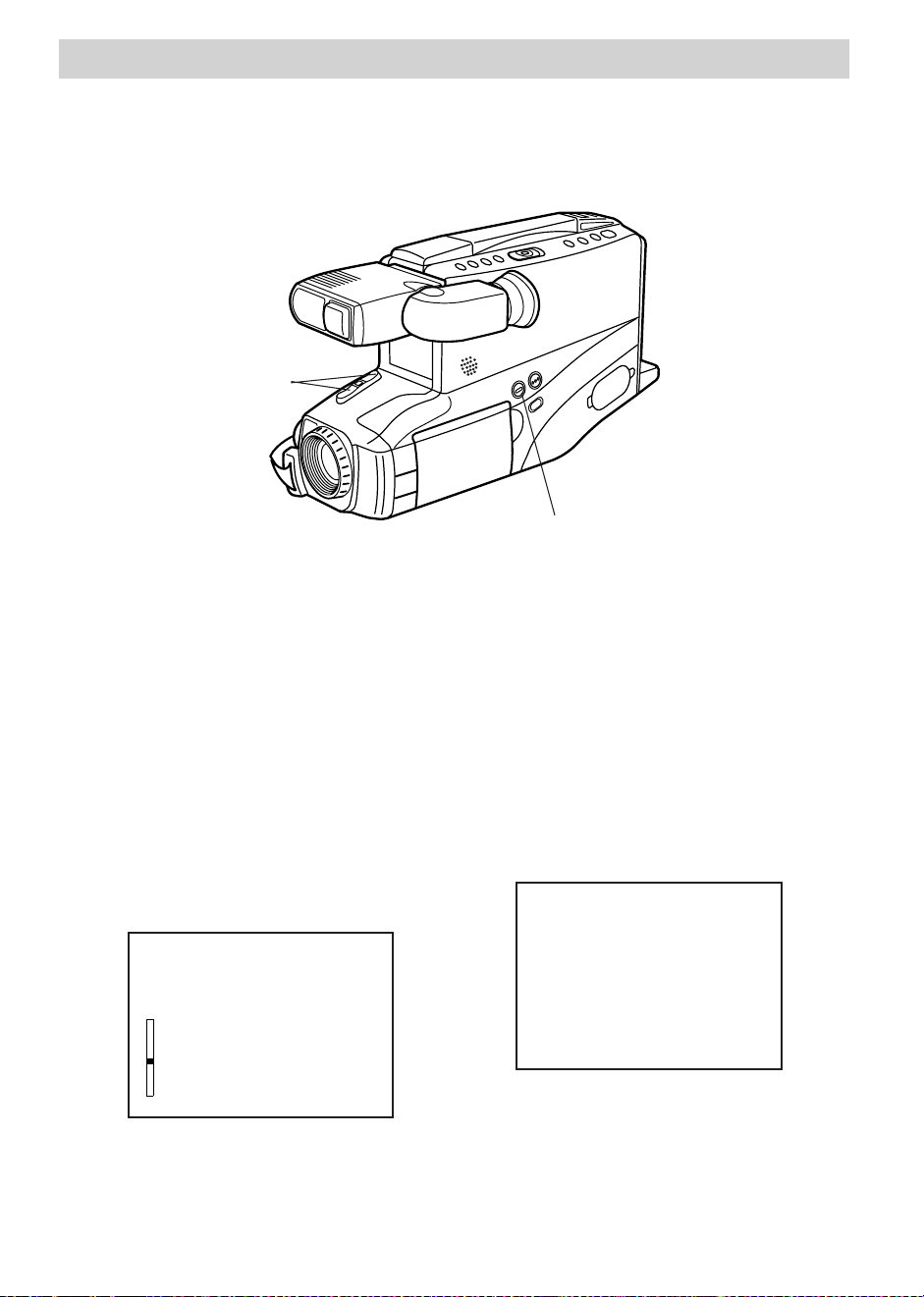
Electronic Indexing
Each time you begin recording (after the
camcorder has been turned off for at least
four hours), the camcorder automatically
records an index mark at the beginning of
the new recording.
When you play back the indexed tape in a
VCR that has a compatible indexing
feature called “VHS Index Search
System” the invisible marks can be
located automatically. See your VCR
Owner’s Manual for index playback
instructions.
When the DISPLAY button is pressed so
the displays appear, INDEX appears
briefly to let you know the camcorder is
recording an index mark.
Note: The camcorder does not record index
marks every time you stop and start recording.
An index mark is recorded only once – at the
start of each day’s recording session
(or whenever the camcorder has been turned
off for four hours).
INDEX
INDEX Display in
LCD Monitor or Viewfinder
29
Recording
Zooming
Press one of the zoom buttons to zoom in and out for close ups or wide-angle shots.
Instant zooming immediately magnifies the picture 1.5 times.
Using the Zoom Buttons (T and W)
1. To zoom in or out from wide angle to
72 times, press zoom button T or W.
• To move the lens in the telephoto
(close-up) direction, press T.
• To move the lens in the wide angle
direction, press W.
When DISPLAY is pressed so the displays
appear, the zoom level indicator appears
in the viewfinder or on the LCD monitor
during normal zooming. ZOOM appears
when you zoom more than 16 times.
Using the Instant Zoom Button
(INST. ZOOM)
1. To magnify the subject 1.5 times,
from any normal zoom position, press
the INST. ZOOM button.
When DISPLAY is pressed so the displays
appear, I. ZOOM appears in the
viewfinder or on the LCD monitor during
instant zooming.
INST. ZOOM
Button
Zoom Buttons
(T and W)
T
W
Zoom Level Indicator in
LCD Monitor or Viewfinder
ZOOM
I. ZOOM
Instant Zoom Display in
LCD Monitor or Viewfinder
30
Recording
Digital Effects
The camcorder has a digital processor that allows you to record using five special
digital effects: 16X9, a negative image, 240 times digital zoom (with instant zoom),
a symmetric mirror image, or a mosaic image. Each effect is described in detail on
the next pages.
LCD Monitor or Viewfinder Displays
Negative Mode
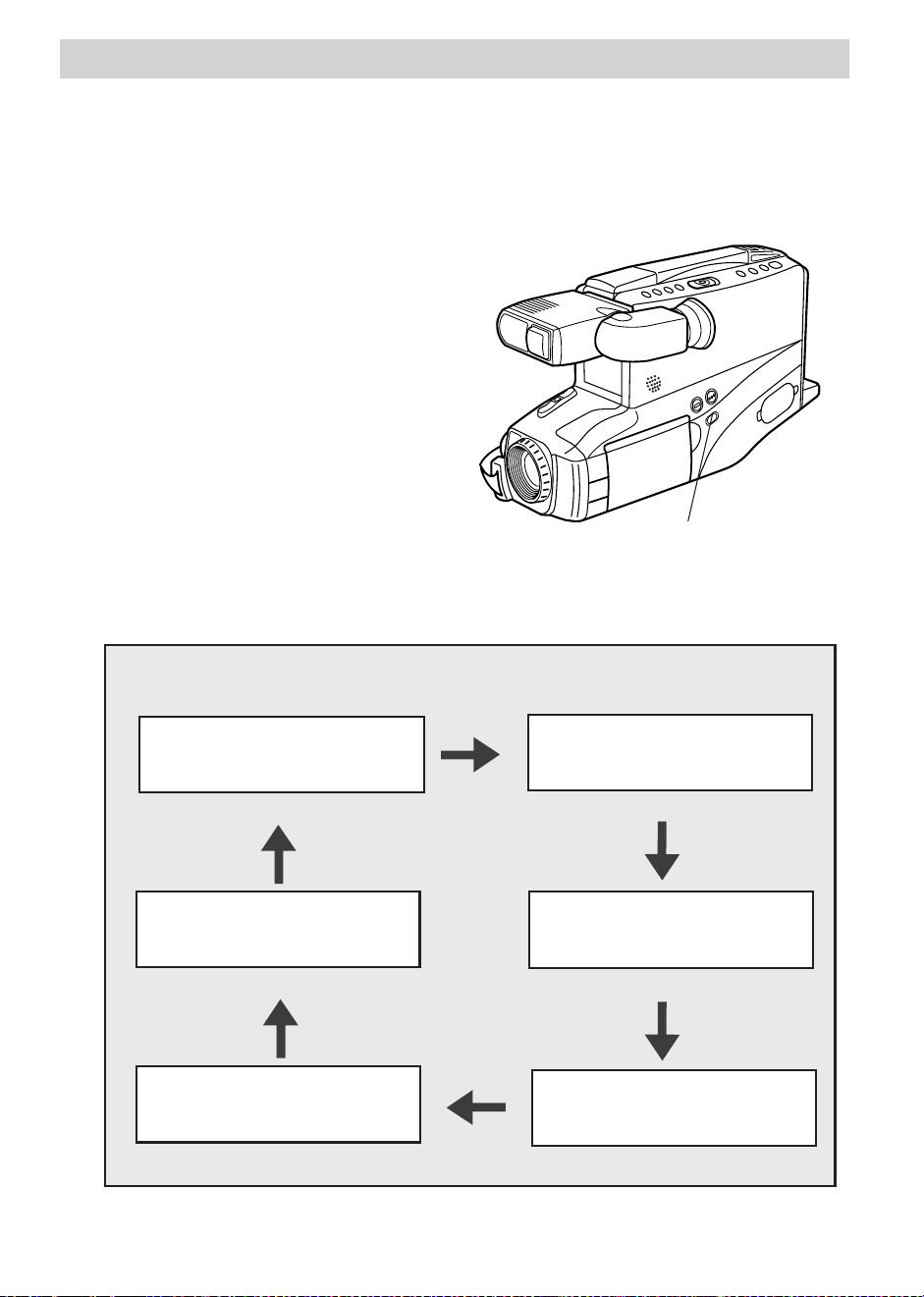
Digital Zoom Mode
16 X 9 Mode
ZM:2
Normal Picture (No Display)
16X9
NEGPOS
MIRROR
Mirror Mode
Repeatedly Press DIGITAL EFFECTS
Mosaic Mode
MOSAIC
Selecting a Digital Effect
1. Make sure the displays appear in the
viewfinder or on the LCD monitor. If
they do not, press the DISPLAY
button.
2. Repeatedly press the DIGITAL
EFFECTS button. The indicator for
the digital effect you select appears in
the viewfinder or on the LCD monitor.
DIGITAL
EFFECTS
Button
31
Recording
Digital Effects (continued)
16X9 Mode
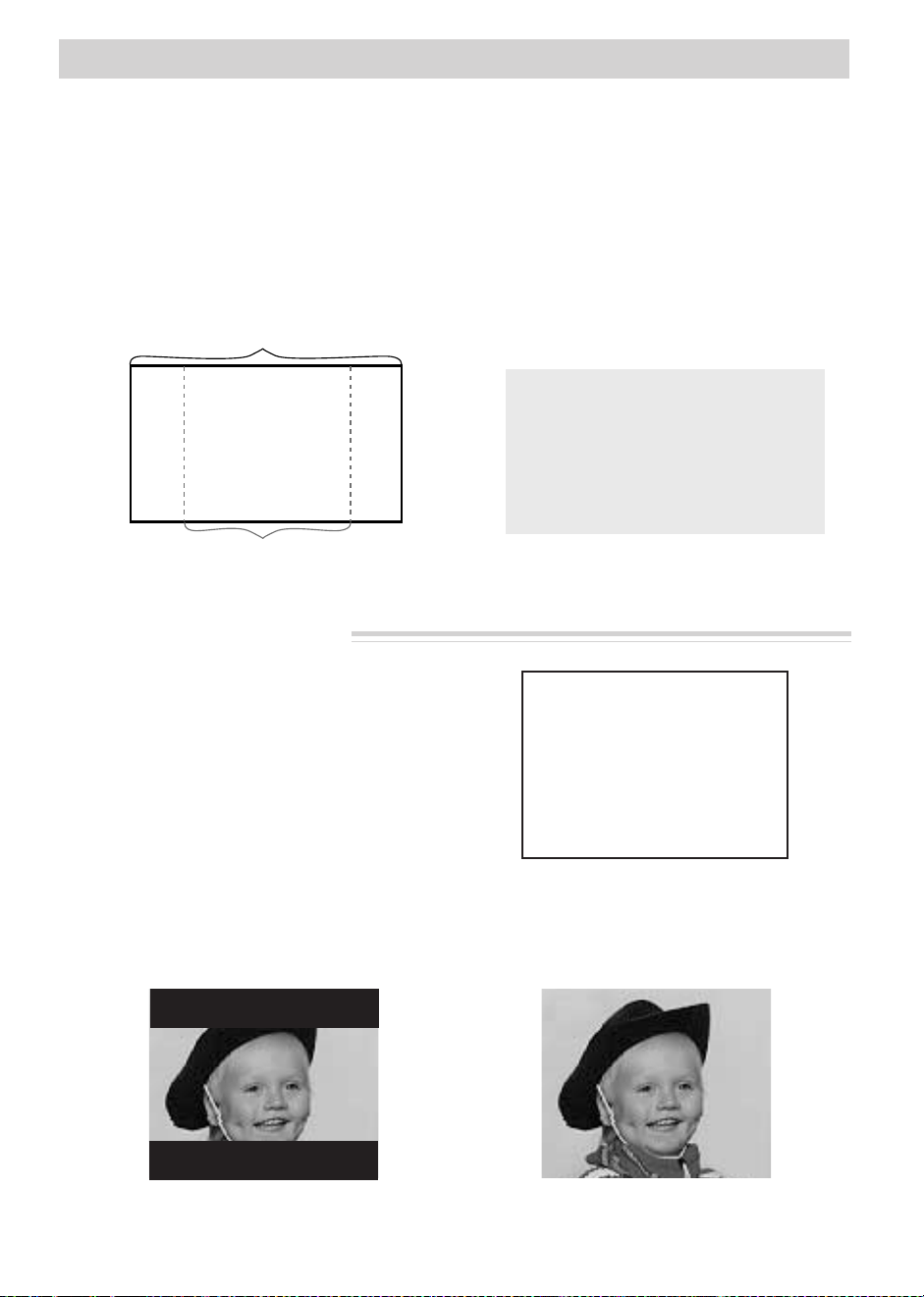
The camcorder has a wide recording mode that lets you make recordings compatible
with the 16X9 format. When 16X9 is activated, the camcorder records black bars at
the top and bottom of the picture to produce the wide-screen effect. This is also known
as “letterbox” recording.
New 16x9 TV Screen
Standard Shape TV Screen
16X9 Mode Normal Mode
Recording in 16X9 Mode
1. Place the camcorder in record pause.
Make sure the displays appear in the
viewfinder or on the LCD monitor.
If they do not, press DISPLAY.
2. Repeatedly press the DIGITAL
EFFECTS button until 16X9 appears.
3. Press REC/PAUSE to start recording.
4. To turn off 16X9 recording, press
REC/PAUSE to pause recording, and
repeatedly press DIGITAL EFFECTS
until no digital effects display appears.
16X9
16X9 Display in
LCD Monitor or Viewfinder
Caution: Do not use this mode
unless you have a compatible
16 X 9 TV. When played on a
regular TV, black bars appear in
the picture.
32
Recording
Digital Effects (continued)
Negative Mode
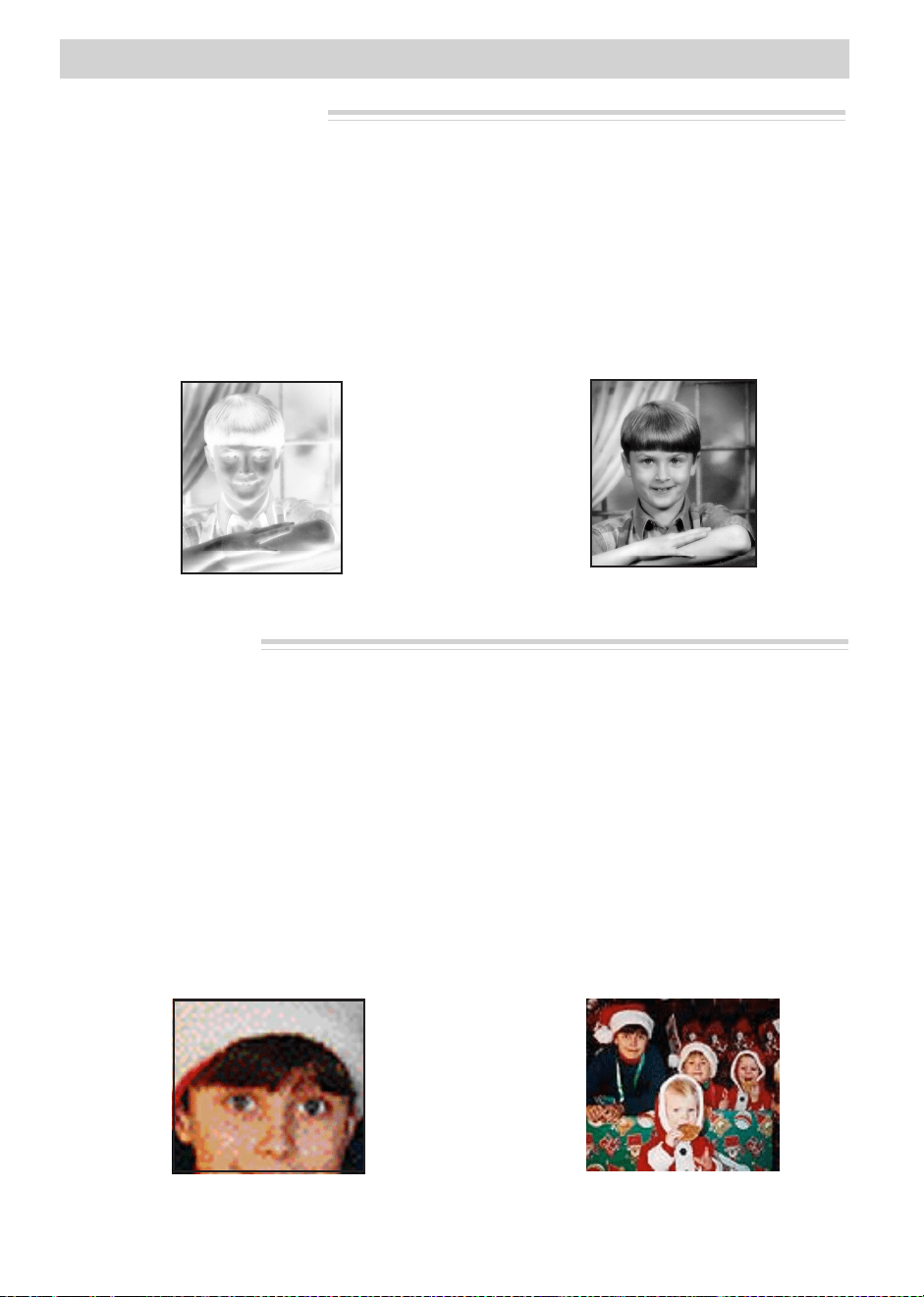
The camcorder has a negative mode that lets you turn the image negative.
Normal Mode
1. Place the camcorder in record-pause.
Make sure the displays appears in the
viewfinder or on the LCD monitor. If
they do not, press DISPLAY.
2. Repeatedly press DIGITAL EFFECTS
until NEGPOS appears.
Negative Mode
Digital Zooming
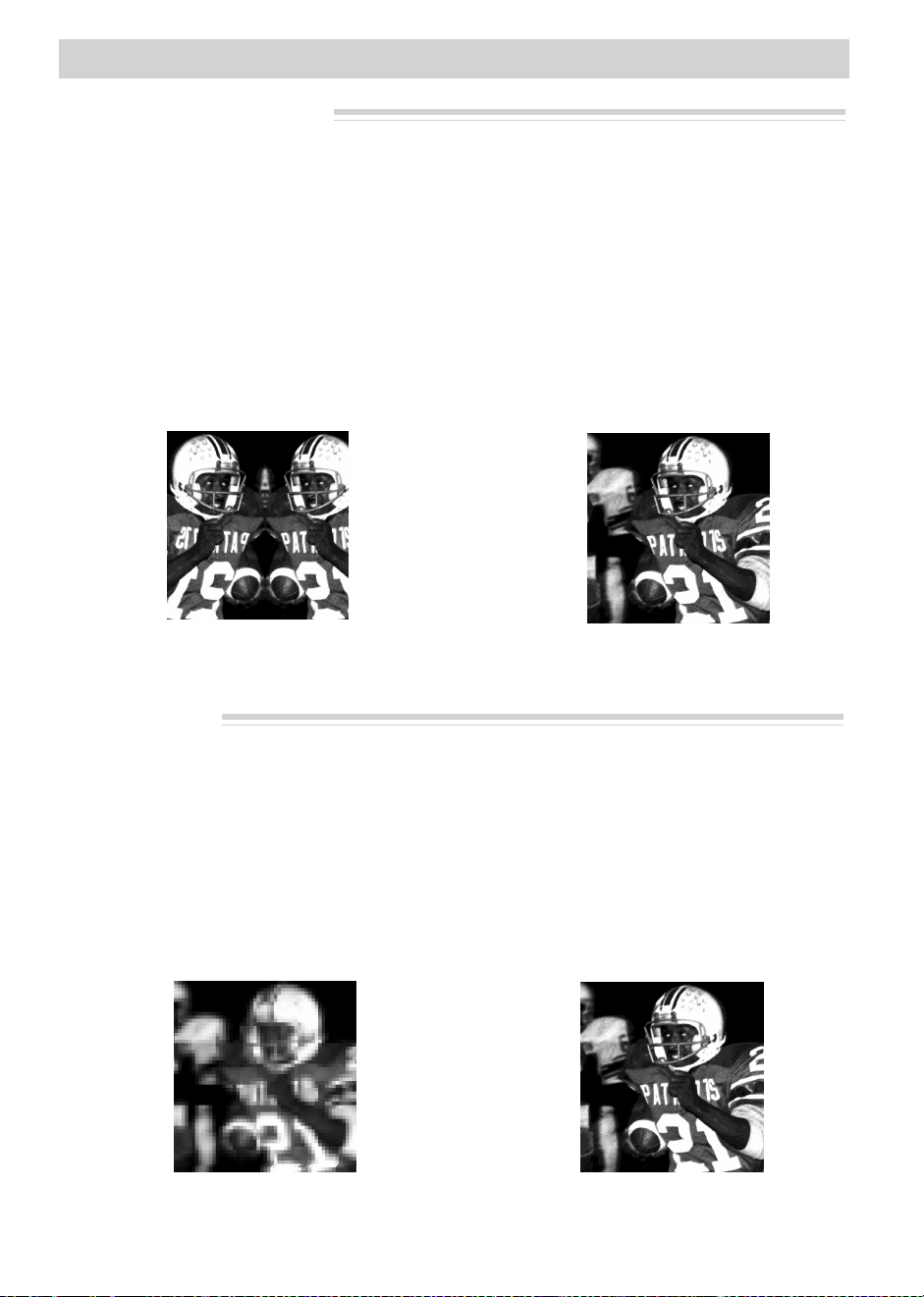
The camcorder has digital zooming that allows you to zoom in on a subject with
magnification up to 160 times. Normal zooming is up to 72 times.
NOTE: This function can magnify an image up to 240 times when instant zoom is used at the same time
1. Place the camcorder in record-pause.
Make sure the displays appear in the
viewfinder or on the LCD monitor. If
they do not, press DISPLAY.
2. Repeatedly press DIGITAL EFFECTS
until ZM:2 appears. Use the zoom
buttons to zoom in and out. ZOOM
appears when you zoom above 16X.
3. Press REC/PAUSE to start recording.
4. To turn off negative recording, press
REC/PAUSE to pause recording, and
repeatedly press DIGITAL EFFECTS
until no digital effects display appears.
3. Press REC/PAUSE to start recording.
4. To turn off digital zooming, press
REC/PAUSE to pause recording, and
repeatedly press DIGITAL EFFECTS
until no digital effects display appears.
NOTE: As the zoom level increases during digital
zooming, the picture will gradually become less sharp.
Use the high zoom levels mainly for special effects.
Digital Zooming Mode
Normal Mode
33
Recording
Digital Effects (continued)
Mirror Mode
The camcorder has a mirror mode that lets you display a symmetric image on
the left and right, obtained by placing a mirror at the center of the screen.
Normal Mode
1. Place the camcorder in record-pause.
Make sure the displays appear in the
viewfinder or on the LCD monitor.
If they do not, press DISPLAY.
2. Repeatedly press DIGITAL EFFECTS
until MIRROR appears.
Mirror Mode
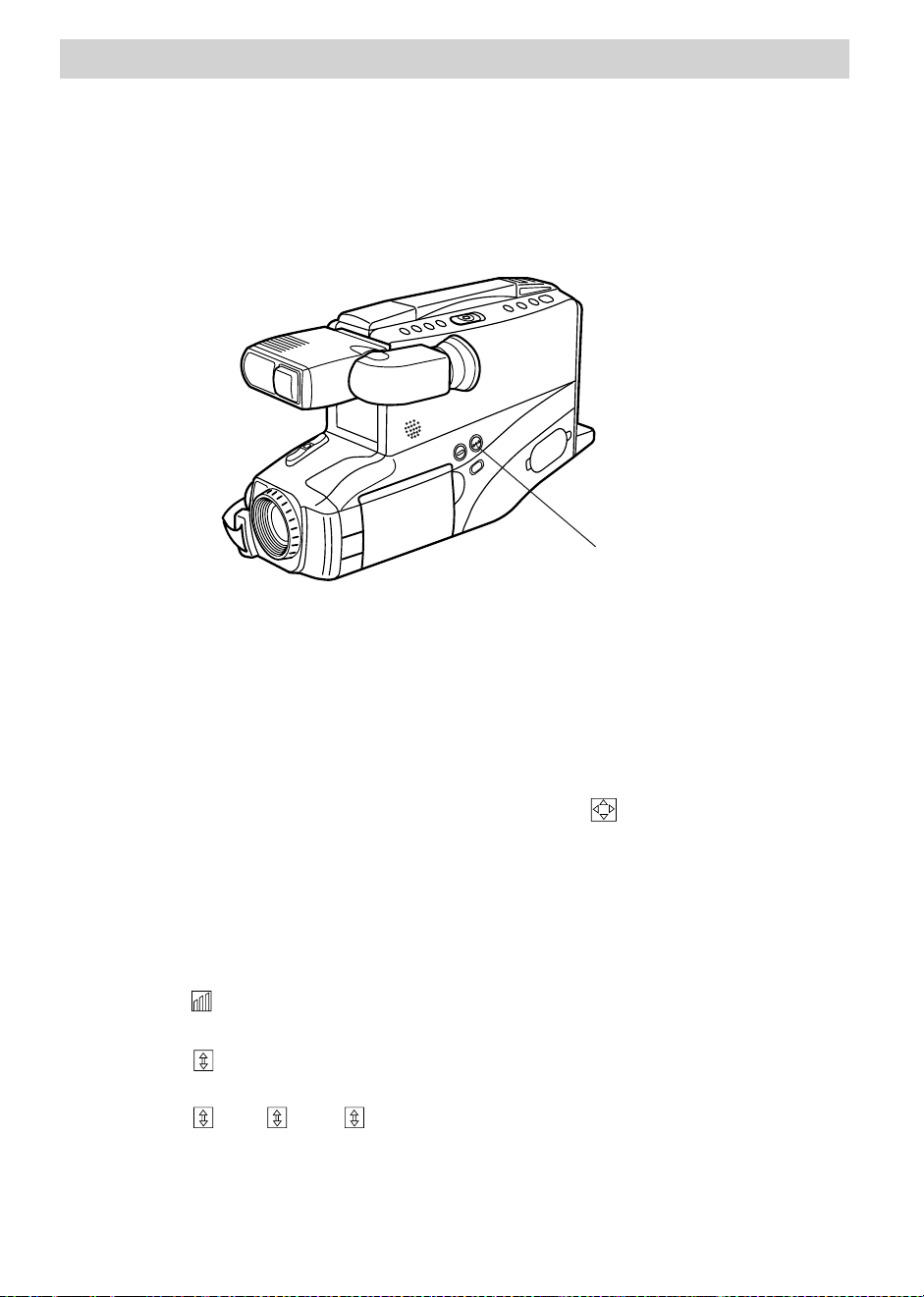
Mosaic Mode
The mosaic feature lets you add a mosaic effect to your recording.
1. Make sure the displays appear in the
viewfinder or on the LCD monitor. If
they do not, press DISPLAY.
2. Repeatedly press DIGITAL EFFECTS
until MOSAIC appears.
3. Press REC/PAUSE to start recording.
3. Press REC/PAUSE to start recording.
4. To turn off mirror recording, press
REC/PAUSE to pause recording, and
repeatedly press DIGITAL EFFECTS
until no digital effects display appears.
4. To turn off mosaic recording, press
REC/PAUSE to pause recording, and
repeatedly press DIGITAL EFFECTS
until no digital effects display appears.
Note: Mosaic recording cannot be used with
digital zooming, instant zooming, or the zoom
fade features.
Mosaic Mode Normal Mode
34
Recording
Fading In and Out of Scenes
You can add a professional touch to your recordings when you fade in and out of
scenes. Both the picture and sound gradually appear or disappear. The speed of the
fade is controlled by the camcorder.
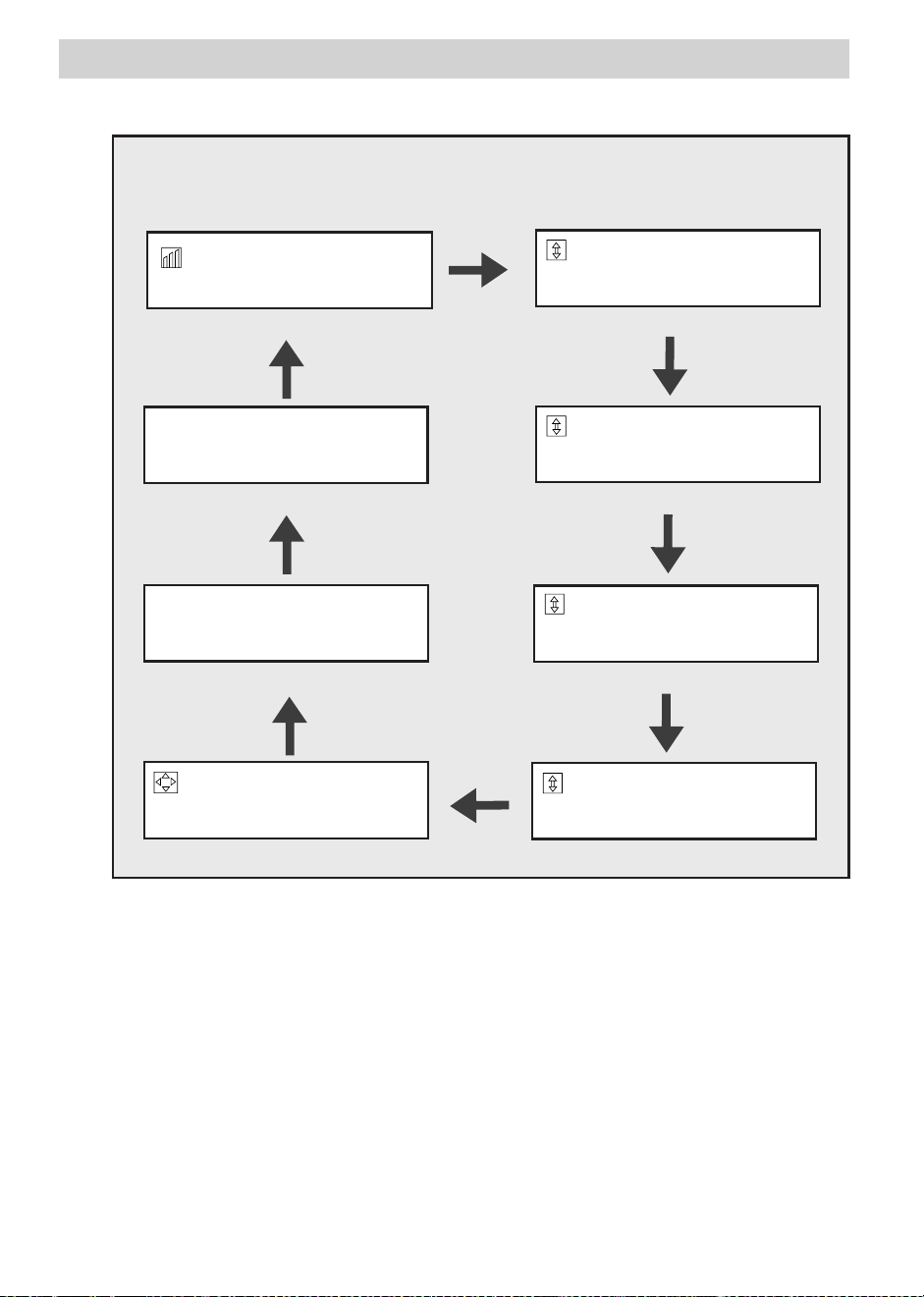
Selecting a Type of Fade
You can select white fade, black, yellow,
blue, and green wipe fade, zoom fade, or
black-and-white fade.
1. Press REC/PAUSE to pause recording.
Make sure the displays appear in the
viewfinder or on the LCD monitor. If
they do not, press DISPLAY.
2. Repeatedly press the FADE button.
The indicator for the fade you select
will appear.
• Select (white) to fade in and out
to/from a white screen.
• Select (black wipe) to fade in
and out to/from a black screen.
• Select YEL, BLU, GRN
FADE Button
(yellow, blue, or green wipe) to
fade in and out to/from a yellow,
blue, or green screen.
• Select (zoom) to fade in and out
while zooming.
• Select B/W (black-and-white) to
fade in and out to/from a black-and-
white picture.
• Select no fade indicator if you do
not want to fade in or out.
Notes: Zoom fade does not operate with
MIRROR and MOSAIC special effects modes.
Pressing the DIGITAL EFFECTS button turns
off the fade mode. Set the digital effect you
want, and then set the fade.
35
Recording
Fade In and Out of Scenes (continued)
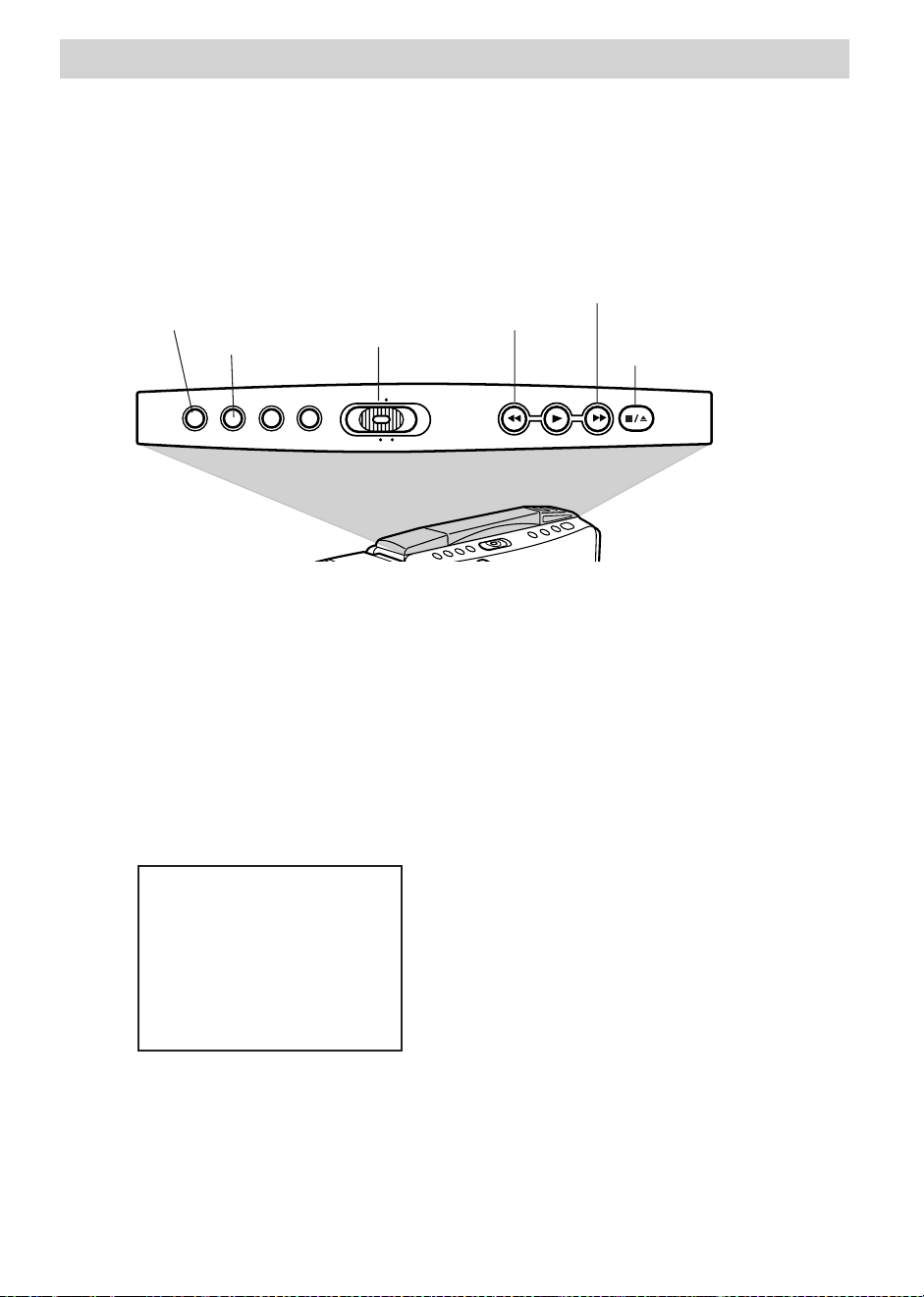
LCD Monitor or Viewfinder Displays
Black Wipe Fade
White Fade
Normal Picture (No Fade)
Repeatedly Press FADE Button
Black-and-White Fade
B/W
Zoom Fade
Fade In
1. Press REC/PAUSE to pause
recording.
2. Repeatedly press FADE to select
the fade you want to use.
Note: The last fade used appears the
first time you press FADE.
3. Press REC/PAUSE to start
recording. The picture and sound
gradually appears in place of the
blank screen.
Fade Out
1. During recording, repeatedly press
FADE to select a fade.
Note: The last fade used appears the
first time you press FADE.
2. Press REC/PAUSE to stop
recording. The picture and sound
gradually disappears.
Yellow Wipe Fade
YEL
Blue Wipe Fade
BLU
Green Wipe Fade
GRN
36
Recording
Tape Counter
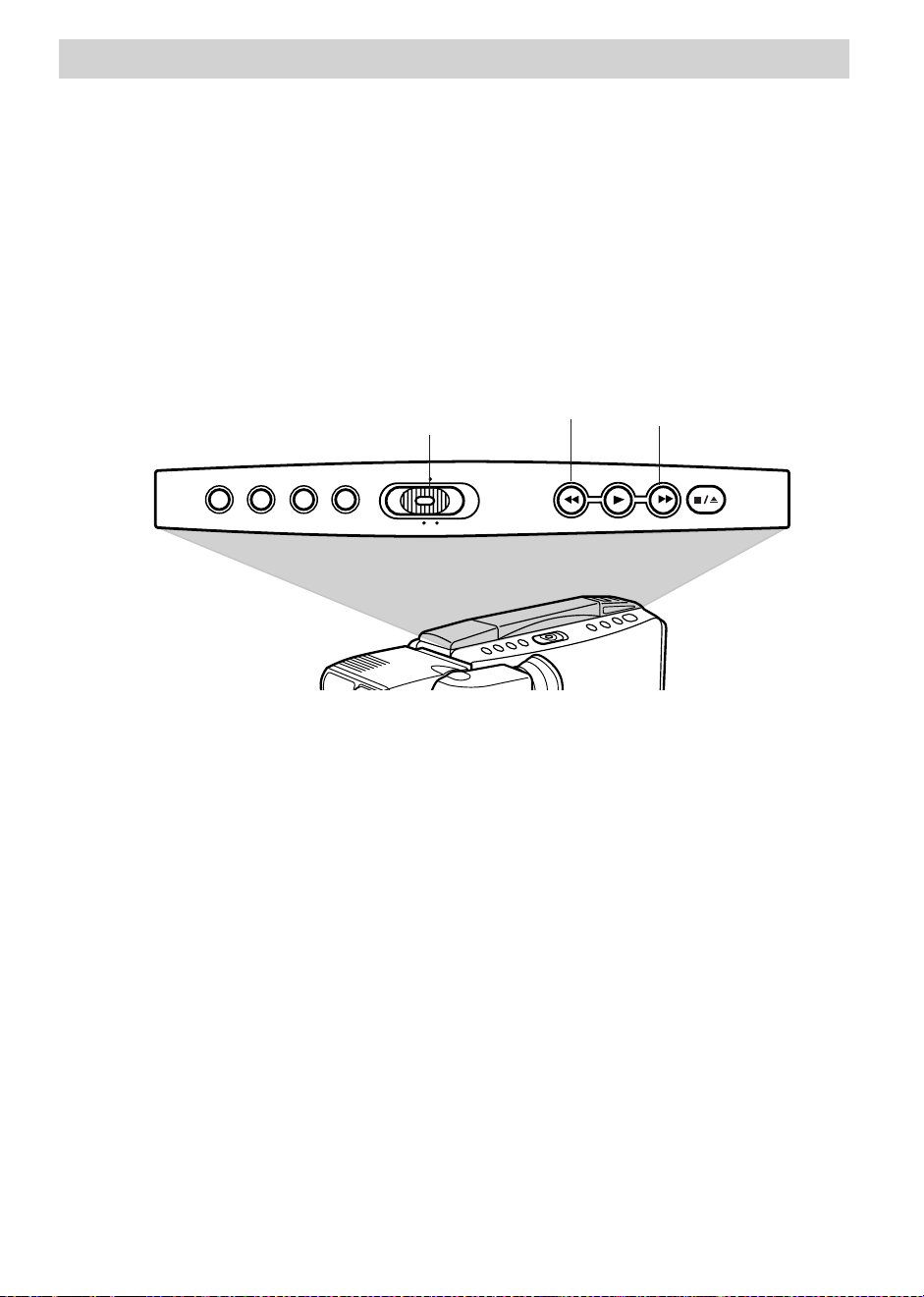
The tape counter acts as a handy reference to help you locate tape segments.
The memory-stop feature helps locate a certain point on the tape. When the
tape counter appears, the tape stops automatically during rewind or fast
forward when the tape counter reaches 0000M.
Using the Memory-Stop Feature
1. Press REC/PAUSE to pause recording.
Make sure the displays appear in the
viewfinder or on the LCD monitor.
If they do not, press DISPLAY.
2. Locate the place on the tape you want
to return to, and press RESET to reset
the counter to 0000M.
Tape Counter
With Memory Stop
3. Continue to record or play the tape.
When you want to return to the place
you marked, press the REC/PAUSE
button to stop recording or the STOP/
EJECT button to stop playback.
4. Press and hold the small red button
while you set the CAMERA/OFF/VCR
switch to VCR.
5. Press the REW/REVIEW button.
The tape rewinds to the counter
reading of 0000M.
Notes: Press DISPLAY to display or remove
the tape counter. Memory stop is turned on
whenever the tape counter appears.
The camcorder stops rewinding or fast
forwarding when the counter reaches 0000M.
To continue rewinding or fast forwarding,
press the button again.
The tape counter automatically resets to
0000M whenever a cassette is inserted.
RESET
Button
REW/
REVIEW
Button
F.FWD Button
CAMERA/
OFF/VCR
Switch
DISPLAY
Button
STOP/EJECT
Button
0000M
37
Recording
Editing Features
The camcorder incorporates a complete package of advanced editing features to make
it easy and fun to edit your home videos like a professional. The major features are
described on the following pages.
• Camera Edit
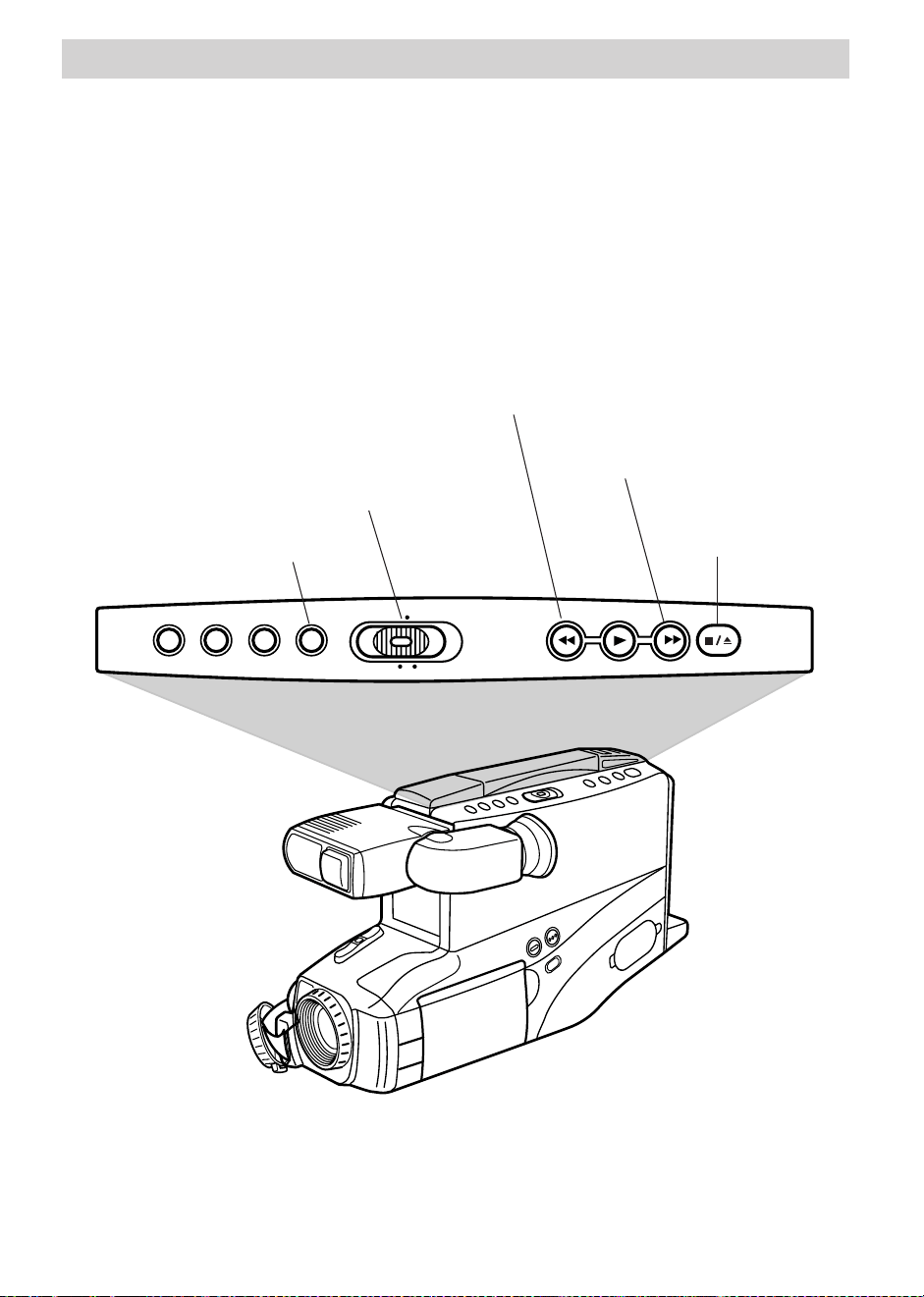
Camera Edit Feature
The camera edit feature allows you to position the tape when the camcorder is in
record-pause. Press and hold the small red button on the CAMERA/OFF/VCR switch
while you slide it to CAMERA.
• Press and hold REW/REVIEW to visually search the recorded tape in reverse.
• Press and hold F.FWD to visually search forward on the recorded tape.
• Press and hold PLAY to view the recorded tape at normal speed.
When you release the button, the camcorder returns to record-pause at that point on the tape.
CAMERA/OFF/
VCR Switch
REW/REVIEW
Button
F.FWD Button
• Titler
38
Recording
Editing Features (continued)
Titler
The camcorder’s built-in titler can store a title in memory. The created title can
be displayed and recorded at any time.
The built-in character register contains more than 45 different characters. Your
title can contain up to 32 characters on two lines.
CAMERA/OFF/
VCR Switch
TITLER
Button
– Button
(Also REW/REVIEW Button)
+ Button
(Also F.FWD Button)
EDIT-ADV Button
(Also STOP/
EJECT Button)

39
Recording
Editing Features (continued)
Titler (continued)
Creating a Title
1. Attach a power source to the
camcorder. Press and hold the small
red button on the CAMERA/OFF/VCR
switch while you slide it to CAMERA.
2. Press TITLER to display the titler
graphics in the viewfinder or on the
LCD monitor. A flashing cursor
appears.
3. Press EDIT-ADV to move the flashing
cursor to the place where you want to
begin your title.
4. Select the first character for your title
by pressing the + or – button until the
character you want appears in the
viewfinder or on the LCD monitor.
See the chart below for the characters
available.
5. After you have selected the first
character, press EDIT-ADV to move
the flashing cursor to the place where
you want the next character to appear.
6. Repeat steps 4 and 5 until you have
completed the title.
7. When you are finished, press TITLER
to store the title and remove the title
graphics from the viewfinder or LCD
monitor.
Remember: Be sure to remove the titler
graphics from the viewfinder or LCD
monitor for normal recording.
Correcting an Error
1. Press TITLER to display the titler
graphics in the viewfinder or on the
LCD monitor.
2. Press EDIT-ADV to move the flashing
cursor over the character you want to
correct.
A B C D E F G H I J K L M
N O P Q R S T U V W X Y Z
0 1 2 3 4 5 6 7 8 9 ? ‘ . / ,
– ; : < > ! (BLANK)
Chart of Characters in Titler’s Register
3. Press the + or – button until the
correct character appears.
Note: If you want to delete a character,
press + or – until the blank space appears.
Chart of Characters

40
Recording
Recording a Title
While Copying a Tape to Another VCR
Editing Features (continued)
Titler (continued)
Recording a Title on a Tape in the Camcorder
1. Attach a power source to the
camcorder. Press and hold the small
red button on the CAMERA/OFF/
VCR switch while you slide it to
CAMERA.
2. Locate the place on the tape where
you want to record the title.
Note: If you record a title on a
prerecorded tape, the audio and video is
erased where the title is inserted. A three-
to-four second pause of blank tape
appears before the existing audio and
video return.
3. Press TITLER to display the titler
graphics in the viewfinder or on the
LCD monitor.
4. Press REC/PAUSE to start recording
the title.
5. After you have recorded the title for
the desired length of time, press
TITLER to remove the titler graphics.
The camcorder will now record
normally. If you do not want to
continue recording, press REC/
PAUSE.
Remember: Remove the titler
graphics for normal recording.
Note: You can also use the automatic title
recording feature to automatically record
the title and date for 10 seconds when you
begin recording. Press the DATE/TIME
button to display
TITLE before starting
to record.
1. Attach a power source to the
camcorder.
2. Place the tape you want to copy in the
camcorder and press and hold the
small red button on the CAMERA/
OFF/VCR switch while you slide it to
VCR.
3. Place a blank tape in the VCR, and
place the VCR in record-pause.
4. Start copying the tape from the
camcorder to the VCR. Details are on
pages 46-47.
Record a Title While Copying a Tape from the Camcorder to Another VCR
5. When you see the place on the tape
you want to insert the title, press
TITLER.
6. After you have recorded the title for
the desired time, press TITLER to stop
recording the title.
7. Stop the camcorder and VCR when
you are finished copying the tape.
Important Note: Remove the titler graphics
for normal recording.

41
Recording
Recording Tips
• Try to make sure indoor scenes are
well-lit. This improves picture quality
and color reproduction.
• Do not move the camcorder rapidly
from side-to-side while recording.
A steady, gradual “pan” avoids
blurring and “jitter.”
• Use the viewfinder or LCD monitor
to make sure the camcorder is level
while recording so that your scenes
won’t appear “tilted.”
• Do not bump or tap the camcorder’s
microphone while recording so that
your scenes won’t appear tilted.
• Include close-ups of individuals when
taping family outings or group func-
tions.
• Fading in and out of scenes makes
your videos appear more professional.
• Learn to use the special digital effects
available with your camcorder to add
variety to your recordings.
• Be aware of video and audio back-
grounds. Background details barely
noticed while you are taping may show
up as visual “clutter” on your record-
ing. Background noises (especially
TV sets, radios, household appliances,
traffic sounds, etc.) can detract from
the sound you want to record.
• Avoid long “still” shots of landmarks
and scenic attractions. Recordings are
more interesting if they include people
and details. “Local color” will give
travel videos lasting appeal. Consider
recording a familiar or landmark scene
from an unfamiliar vantage point.
Travel Tips
• Write down your camcorder’s serial
number and keep it separate from the
camcorder when traveling. If your
camcorder is lost or stolen, you will be
able to identify it.
• Use extra care when you use your
camcorder or accessories at a beach or
pool. Spray, sand, and dust should be
avoided. If your lens has been exposed
to the elements, clean it only with
proper lens cleaning supplies.
• Make sure you have any adapters that
you might need before taking your
camcorder to other countries. Consult
your dealer for advice.
• Carry your camcorder in a carrying
case when traveling. See page 50 for a
case designed especially for this
camcorder. An ordinary suitcase or
carry bag does not offer the protection
your camcorder needs. Treat your
camcorder as carry-on luggage to
protect it from rough handling.
42
Playback
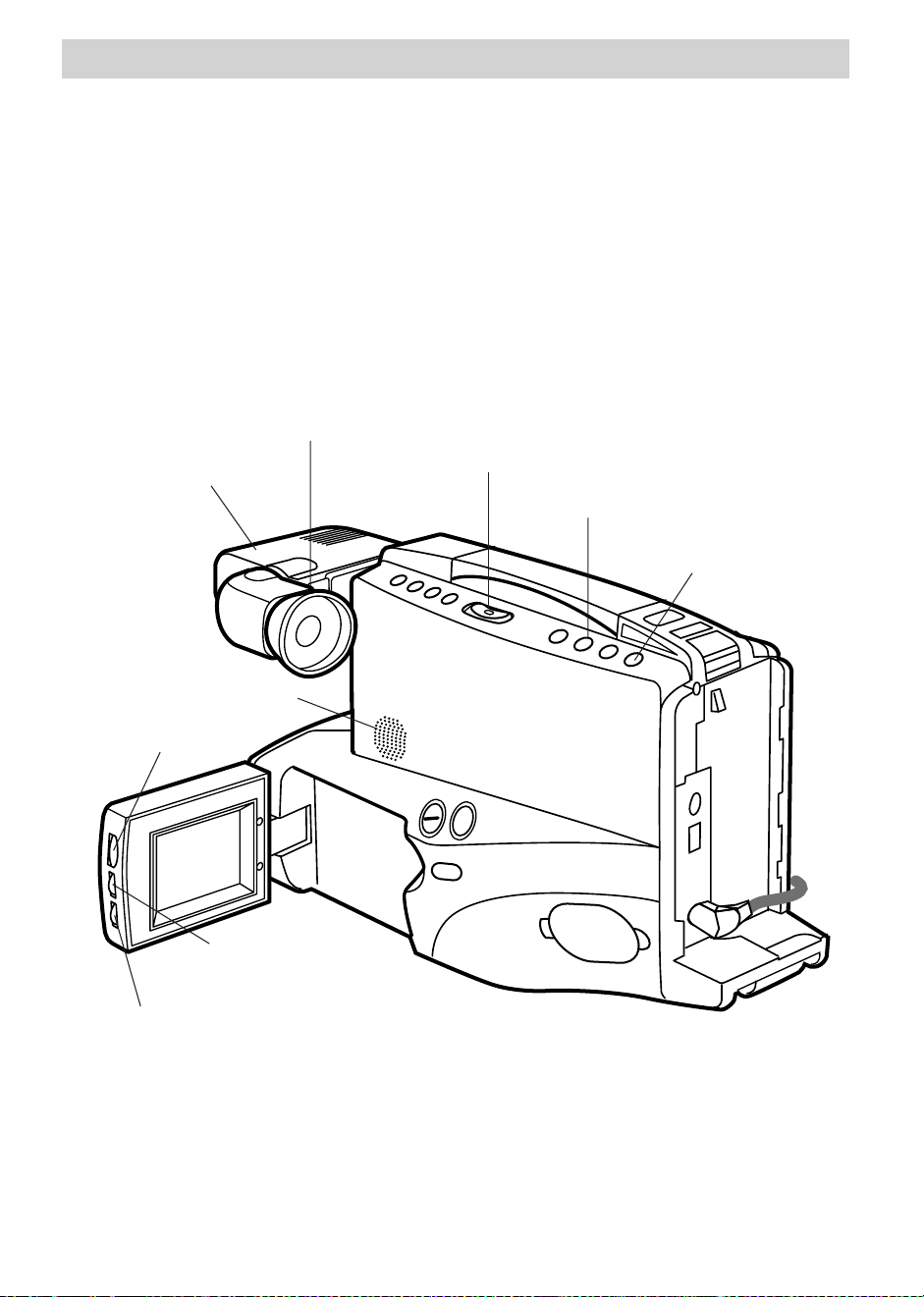
STOP/EJECT
Button
Volume
Control
OPEN
Button
Viewfinder
Eyepiece Focus
Control
PLAY
Button
Use the LCD Monitor or Viewfinder for Playback
You can watch tapes in color using the LCD monitor or black-and-white using the
viewfinder. When the LCD monitor is open more than 45º, the viewfinder
automatically turns off. Close the LCD monitor, the viewfinder automatically turns
on. Rotate the monitor completely around and place it against the camcorder for
convenient playback. During playback, you can hear the sound from the tapes on
the built-in speaker when you use the LCD monitor.
Bright
Control
Speaker
CAMERA/
OFF/VCR
Switch

43
Playback
• To adjust the speaker volume, turn
the volume control.
Note: The monitor may become warm
when left open for an extended period
of time. This is normal.
Use the Viewfinder
• Make sure the monitor is closed
and locked. If the monitor is open
more than 45º, the viewfinder
automatically turns off.
• Grasp the viewfinder and rotate it
horizontally.
• Pull the viewfinder out from the
camcorder and rotate the eyepiece
to a comfortable viewing position.
To Play Back a Tape
1. Attach a power supply.
Attach the adapter/charger, charged
battery, or optional car cord.
2. Insert a tape.
• Press STOP/EJECT to open the
cassette compartment.
• Insert the cassette with the safety
tab facing up and the tape windows
facing out.
• The camcorder can only play back
tapes recorded in the SP speed.
• Press the cassette down gently until
it locks into place, and close the
cassette compartment door.
3. Press and hold the small red button
on the CAMERA/OFF/VCR switch
while you set it to VCR.
4. Use the LCD monitor or viewfinder
to view what you are playing back.
Use the LCD Monitor
• Press the OPEN button to open the
LCD monitor. Make sure the
monitor is open at least 45º. The
viewfinder automatically turns off.
• You can rotate the monitor around
when it is open 90º and place it
back against the camcorder.
• Fit the shoulder extension pad to
your shoulder for convenient
viewing using the LCD monitor.
• To adjust the brightness of the
image in the monitor, turn the
bright control.
Use the LCD Monitor or Viewfinder for Playback (continued)
Caution: Pulling on the eyepiece
might cause damage to the
eyepiece or camcorder.
• Turn the eyepiece focus control to
adjust the focus of the viewfinder
for your vision.
Note: You cannot hear the sound from
the internal speaker when using the
viewfinder for playback.
5. Press PLAY to begin playback.
• If necessary, adjust tracking.
• During playback, use the playback
features on the following pages.
6. Press STOP/EJECT when you are
finished.
44
Playback
REC/
PAUSE
Button
Caution: Pause is designed for momentary
interruptions and should not be used for an
extended period of time. If the camcorder
remains in pause for more than five minutes,
it automatically enters the stop mode and
turns off to prevent excessive tape wear.
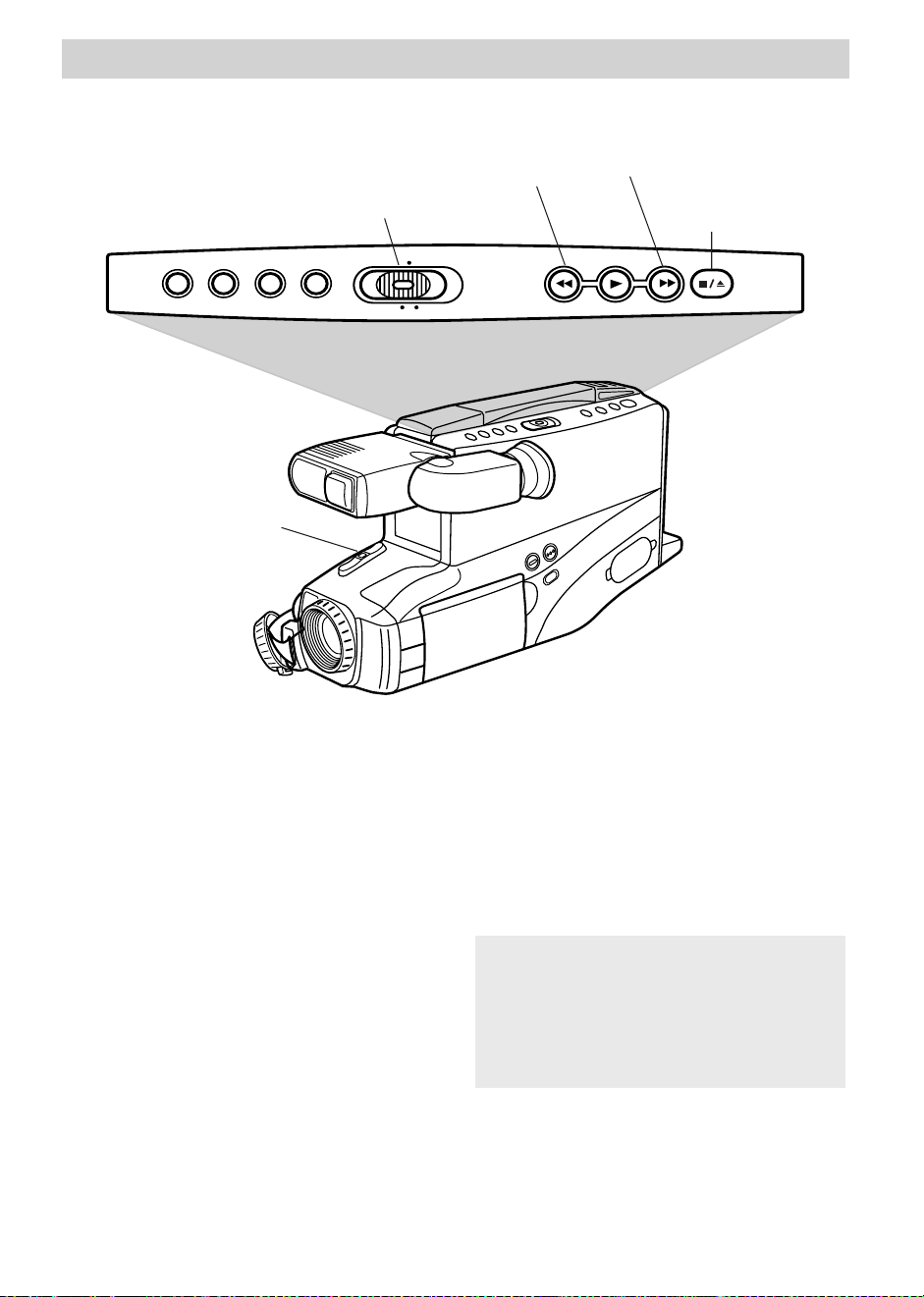
Playback Features
STOP/
EJECT
Button
REW /
REVIEW
Button
CAMERA/
OFF/VCR
Switch
Tape Positioning
Press the small red button on the
CAMERA/OFF/VCR switch while you
set it to VCR.
• Press and quickly release REW/
REVIEW or F.FWD to rewind or fast-
forward the tape.
• Press STOP/EJECT to stop
the tape.
Visual Searching
• During playback, press and hold
F.FWD or REW/REVIEW if you want
to search the tape visually in forward
or reverse.
• Release the button to return to normal
playback.
Stop-Action Pause
• During playback, press REC/PAUSE to
“stop the action” and view one frame of
the tape.
• Press REC/PAUSE again to return to
normal playback.
F.FWD
Button
45
Playback
Playback Features (continued)
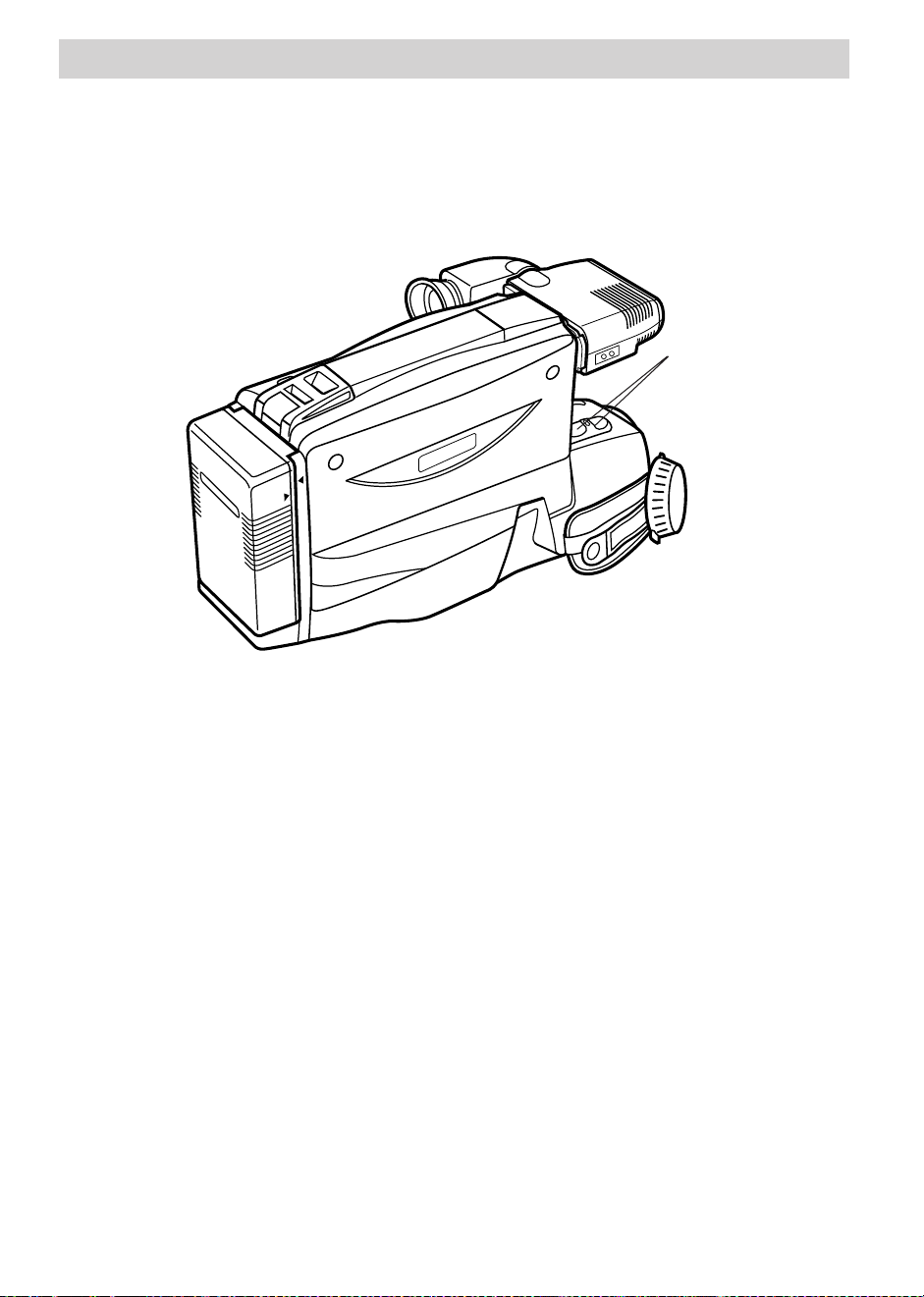
During playback, streaks might appear in the playback picture. Press either
TRACKING button (W or T) to move the streaks up or down and out of the picture.
TRACKING
Buttons
(Also W and T)
Tracking
Remove the tape to reset the tracking to
its preset center.
Note: The tracking buttons only affect tape
playback. They have no effect during
recording.
• During stop-action playback, pressing
one tracking button might reduce picture
“jitter” (picture bouncing up and down).
Some “jitter” is normal.
46
Playback
Playback on a TV/VCR with A/V
jacks
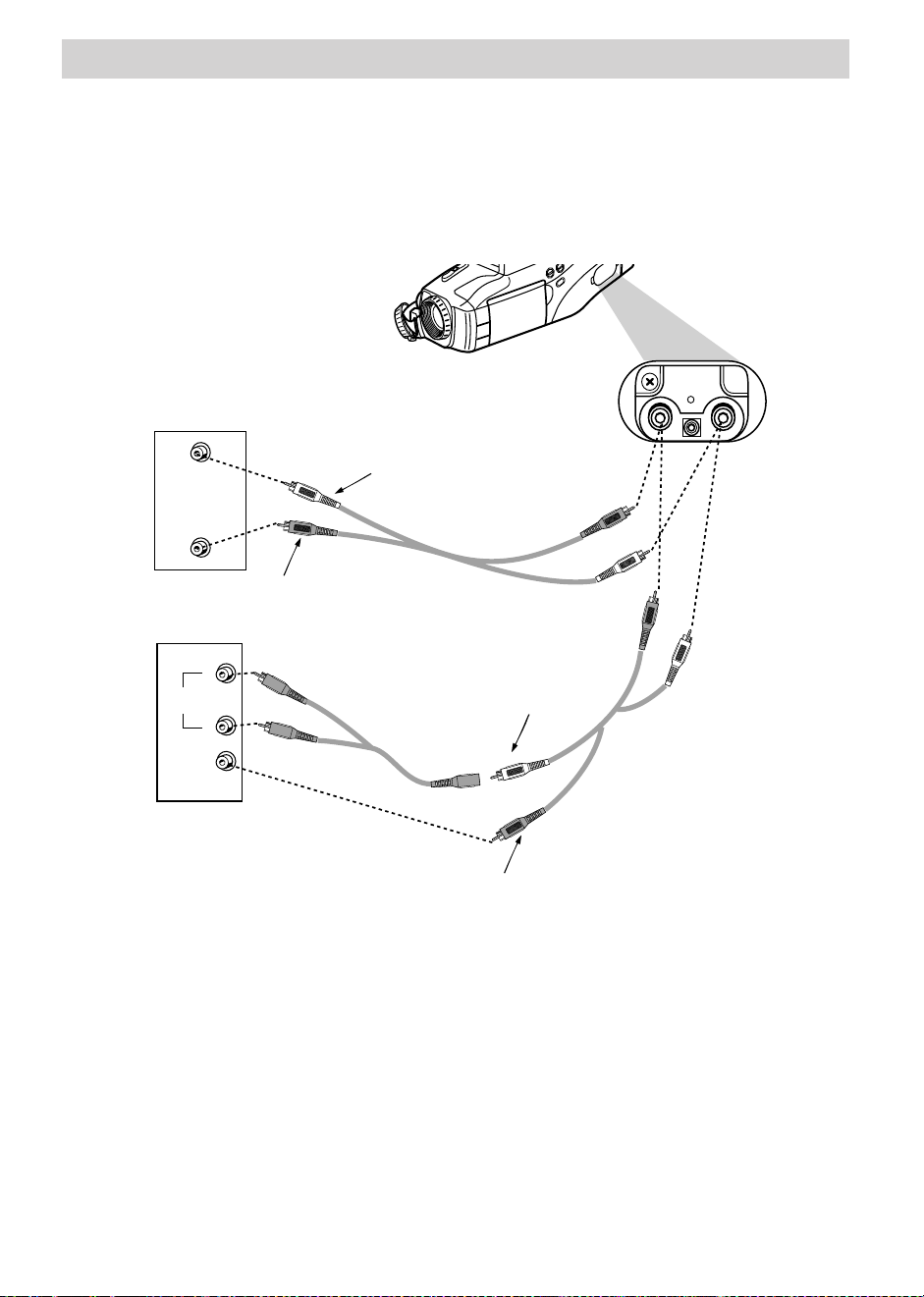
Playback on TV (or VCR) with Audio/Video Input Jacks
To connect your camcorder to a TV monitor (or VCR) with audio/video in jacks, you
need an optional audio/video cable such as VH83 shown on page 53. If your TV is
already connected to a VCR, attach the camcorder to the VCR and watch what the
camcorder is recording or playing on the TV.
Installation
1. Attach the white plug on one end of
the audio/video cable to the AUDIO
IN jack on the TV (or VCR).
Notes: If your cable does not have white
and yellow plugs, be sure to attach the
same color to the audio jacks.
If your TV (or VCR) has stereo AUDIO IN
jacks, attach the plug to the one labeled
MONO. If one is not labeled MONO, you
might need a Y-adapter, such as AH25,
shown on page 53 to hear both channels.
2. Attach the yellow plug to the VIDEO
IN jack on the TV (or VCR).
3. Attach the white plug on the other
end of the audio/video cable to the
AUDIO jack (located under the small
cover) on the side of the camcorder.
4. Attach the yellow plug to the yellow
VIDEO jack on the camcorder.
Back of
VCR or
TV Monitor
AUDIO
IN
VIDEO
IN
L
R
Back of
Stereo
VCR or
TV Monitor
Yellow Video Plug
White Audio Plug
Audio/Video Cable
(such as VH83)
Audio/Video Cable
(such as VH83)
Y-Adapter
(such as AH25)
White Audio Plug
—OR—
White
Audio Plug
Yellow
Video Plug
Yellow
Video Plug
White
Audio Plug
AUDIO
IN
VIDEO
IN
Yellow Video Plug
White
AUDIO
Jack
Yellow
VIDEO
Jack

47
Playback
Playback Operation
Copying Tapes on Your VCR
Viewing What the Camcrder is Seeing
Playback Operation and How to Copy Tapes on the VCR
1. A. Camcorder connected directly to
TV: Turn on the TV and tune it to
the video input channel.
B. Camcorder connected to VCR that
is already connected to TV: Turn
on VCR and place it in the “line”
or “camera mode”. (If your VCR
does not have a “line” or “camera
mode”, consult the VCR owner’s
manual.) Operate the TV as you
normally do to see the signal
coming from the VCR.
2. Press and hold the small red button on
the CAMERA/OFF/VCR switch while
you set it to VCR.
Note: The camcorder can only play back
tapes recorded in the SP speed.
Caution: The unauthorized recording of copyrighted
material may infringe the rights of others.
3. Press PLAY.
• During playback, use the playback
features on pages 44-45.
• Turn the volume control on the
monitor down all the way to
prevent picture distortion.
4. To copy what the camcorder is
playing, place a blank cassette in
the VCR, and press the VCR’s
RECORD button.
Note: Make sure the memory-stop feature
is turned off (press DISPLAY) or the
camcorder will enter play-pause when the
counter reaches 0000M.
5. Press STOP/EJECT when you are
finished.
Viewing What the Camcorder is Seeing (or Recording)
1. A. Camcorder connected directly to
TV: Turn on the TV, and tune it to
the video input channel.
B. Camcorder connected to VCR that
is already connected to TV: Turn
on VCR and place it in the “line”
or “camera mode”. (If your VCR
does not have a “line” or “camera
mode”, consult the VCR owner’s
manual.) Operate the TV as you
normally do to see the signal
coming from the VCR.
2. Press and hold the small button on the
CAMERA/OFF/VCR switch while
you set it to CAMERA.
Note: Turn the TV’s volume down to
prevent a high-pitched squeal caused by
feedback.
3. Press the REC/PAUSE button to begin
recording. You can watch what the
camcorder is seeing (or recording) on
the TV screen.
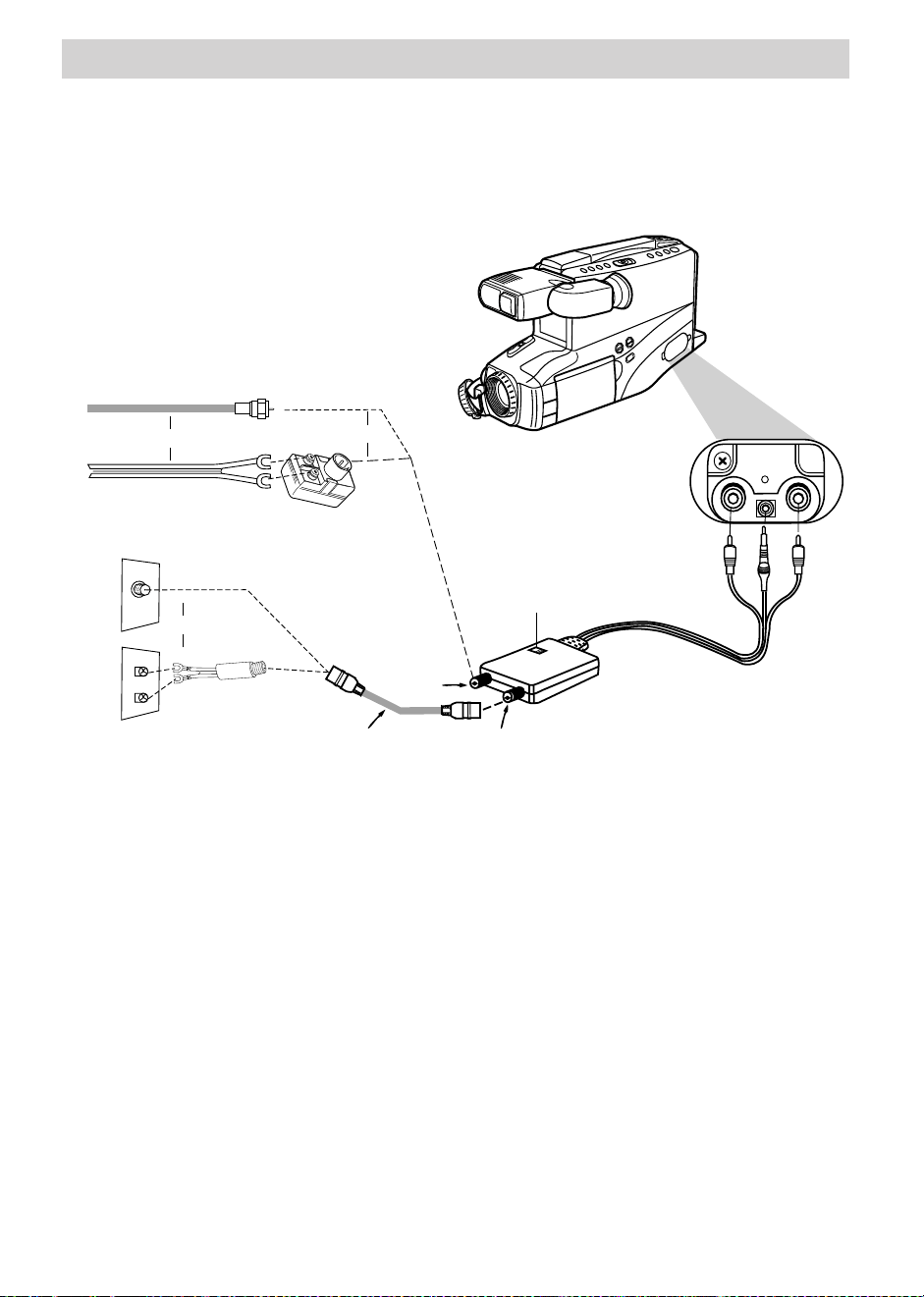
48
Playback
Playback on a TV/VCR Without A/V
Jacks
Playback on TV Without Audio/Video Inputs
To connect your camcorder to a TV without audio/video inputs, you need an optional
CRF95 RF output adapter and an optional coaxial RF cable, such as VH82 or VH90
shown on page 52. If your TV has AUDIO and VIDEO IN jacks (or is connected to a
VCR), refer to pages 46-47.
Installation
1. Disconnect the VHF antenna from
your TV. Connect the antenna to the
IN FROM ANT connector on the RF
output adapter if you are going to
leave the adapter connected to the TV.
Note: If your VHF antenna is the flat
twin-lead type attached by two screws,
you need an optional 300/75 ohm
transformer.
2. Attach one end of the optional coaxial
RF cable to the OUT TO TV
connector on the adapter, and attach
the other end to the VHF input on
your TV as shown.
Note: If your TV has 300 ohm screw
terminals, you need a 75/300 ohm
transformer, such as VH54, shown on
page 53.
3. Attach the RF output adapter’s yellow
plug to the VIDEO jack, the small
plug to the RF DC OUT jack, and the
white plug to the AUDIO jack located
under the small cover on the side of
the camcorder.
Optional Coaxial RF Cable
(such as VH82 or VH90)
Channel Selector
Optional RF Output Adapter
(such as CRF95)
Optional 300/75 ohm
Transformer
IN
FROM
ANT
OUT
TO TV
OR
OR
OR
VH
F
V
H
F
Back of TV
Antenna
Antenna
Optional 75-300 Ohm
Transformer
(such as VH54

49
Playback
Playback Operation
1. Set the CH3/CH4 switch on the
RF output adapter to channel CH3
or CH4.
2. Turn on the TV, and tune it to the same
channel you selected with the RF
output adapter’s CH3/CH4 switch.
3. Press and hold the small red button on
the CAMERA/OFF/VCR switch while
you set it to VCR.
4. Press PLAY on the camcorder.
• Turn the volume control on the
monitor down all the way to
prevent picture distortion.
• During playback, use the playback
features described on pages 44-45.
5. Press STOP/EJECT on the camcorder
when you are finished.
Viewing What the Camcorder Is Recording
1. Turn on the TV and tune it to channel
3 or 4. Turn the TV’s volume down
to prevent a high-pitched squeal
caused by feedback.
2. Set the CH3/CH4 switch on the RF
output adapter to the same channel
you selected on the TV.
3. Press and hold the small red button on
the CAMERA/OFF/VCR switch while
you set it to CAMERA.
4. Press the REC/PAUSE button to begin
recording. You can watch what the
camcorder is seeing (or recording)
on the TV screen.
Normal TV Viewing
For normal TV viewing, leave the RF
output adapter hooked up to the TV.
Disconnect the adapter’s plug from
the camcorder or turn the camcorder’s
power off.
Note to Cable TV Installer
This reminder is provided to call your attention to Article 820-40 of the
National Electrical Code (Section 54 of Canadian Electrical Code, Part I), that
provides guidelines for proper grounding and, in particular, specifies that the
cable ground shall be connected to the grounding system of the building as
close to the point of cable entry as practical.
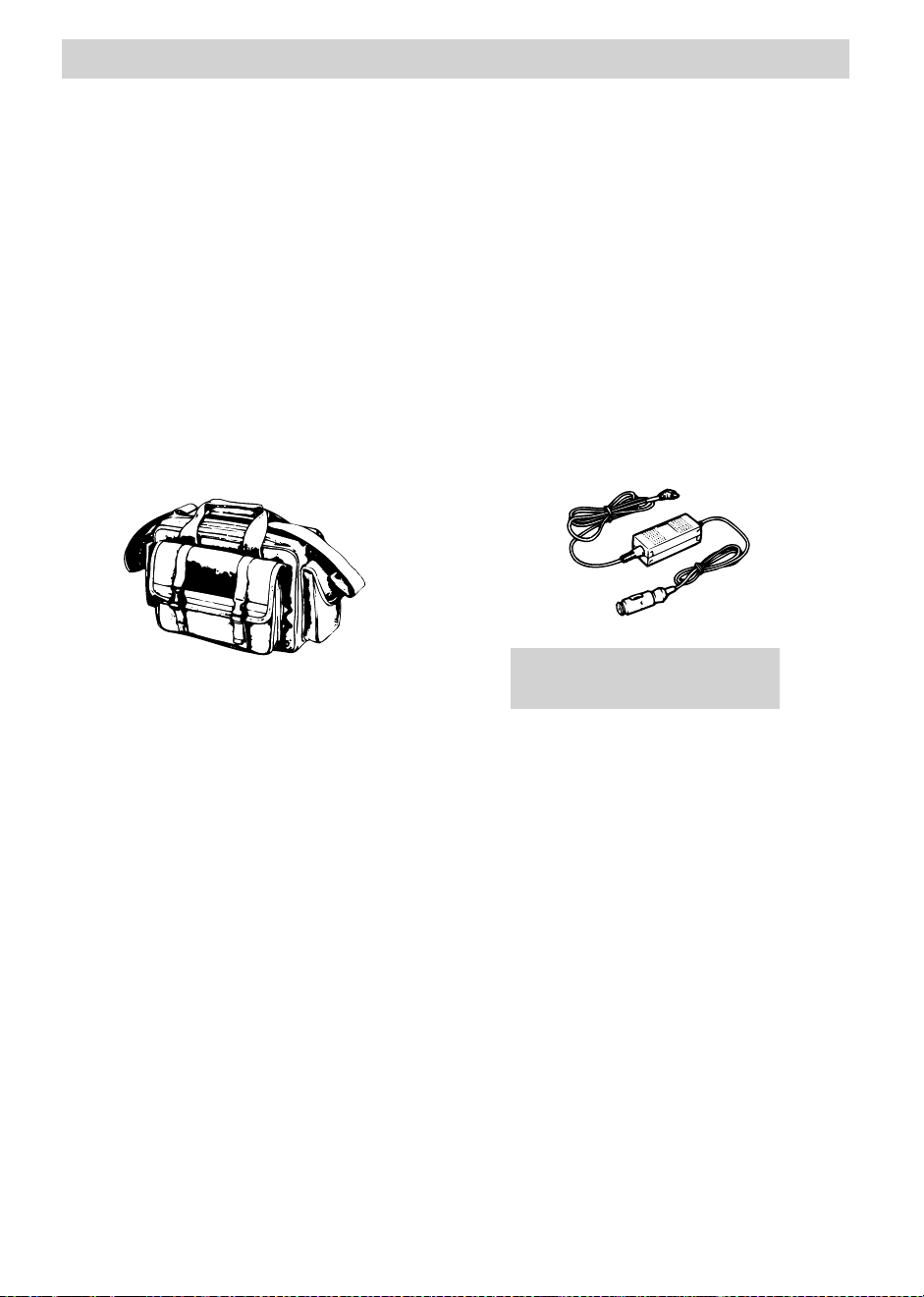
50
Optional Accessories
Optional Accessories
Soft Carrying Case
Car Cord Adapter
We invite you to take a look at some great ideas for sparking creativity and adding to
the fun of using your VHS camcorder. The following pages have a selection of
accessories to help make your memorable moments look and sound even better.
These accessories are designed to make the process of recording and watching your
videos more enjoyable.
To order accessories, contact your local Dealer.
If a dealer is not nearby, all accessories are available through toll-free ordering or by
using the order form on page 55.
Do not use any other car cord
with this camcorder.
AC202 Soft Carrying Case
This case provides protection and utility
for full size camcorders and most
accessories. It is constructed of rugged
nylon fabric for years of reliable service.
Three outside pockets provide ample
accessory storage with mesh-covered lens
filter compartment and built-in holders for
memo pads, pens, and other accessories.
The hand grip and adjustable shoulder
strap allow for convenient, comfortable
transportation of the camcorder.
DCC096 DC Car Cord Adapter
This car cord adapter enables you to
operate your camcorder from your car,
truck, or RV by plugging the car cord
directly into the vehicle’s cigarette lighter
socket. The DCC096 is designed
specifically to convert power from a
12-volt battery to a 9.6-volt output.
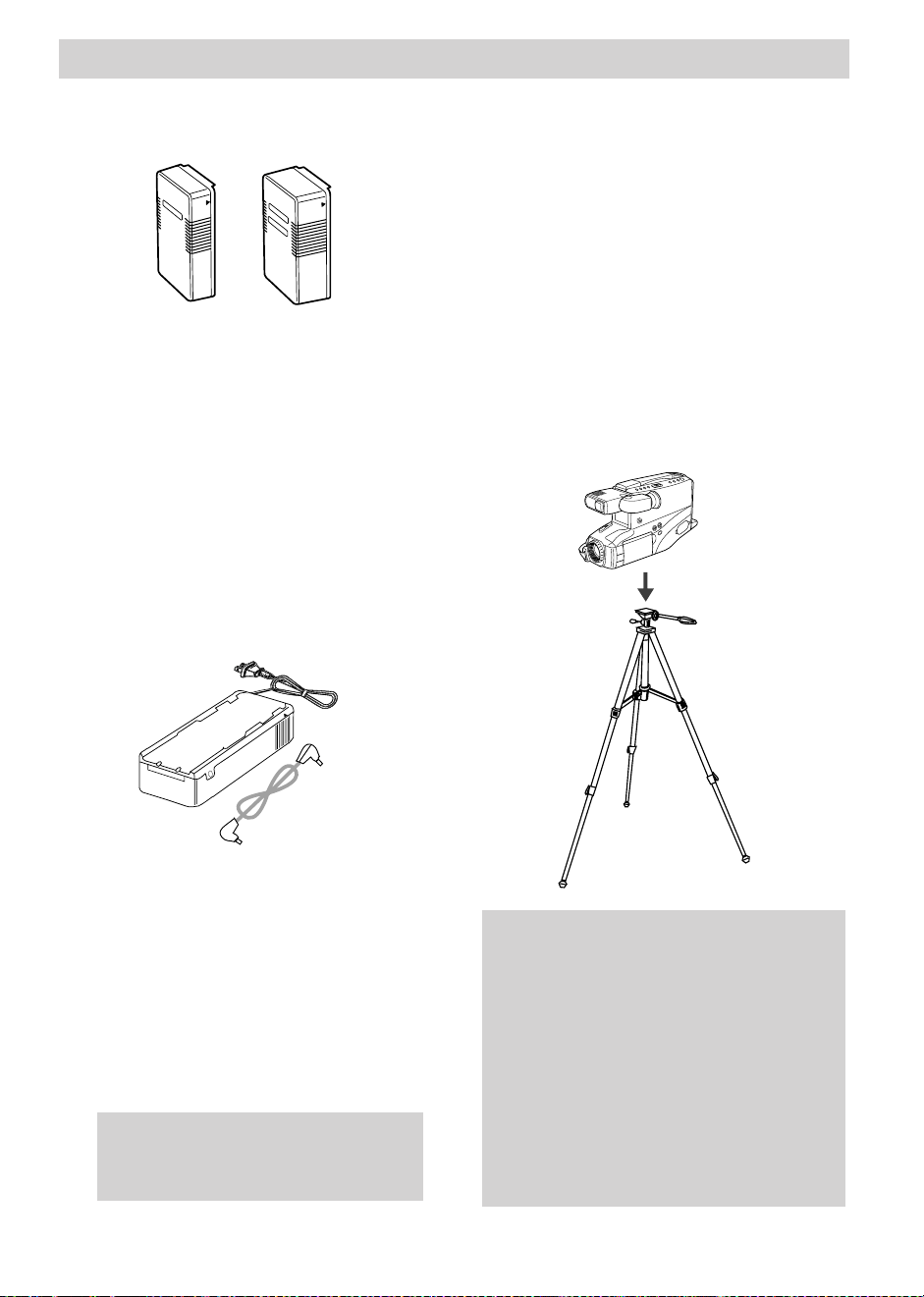
51
Optional Accessories
Rechargable Batteries
Battery Charger
Tripod
Cautions: Before using a tripod, make sure
it is stable enough to hold the camcorder
without falling over. Do not transport the
camcorder attached to the tripod.
When attaching your camcorder to a tripod,
be careful not to force the tripod screw into
the camcorder’s tripod mounting hole.
The tripod screw should not protrude into the
camcorder more than approximately three-
eighth (3/8) inch. Forcing the screw could
damage the mounting hole on the bottom of
the camcorder.
All specifications and descriptions
of accessories are subject to change
without notice.
EP096FS and EP096FL Rechargeable
Batteries
These rechargeable lead-acid batteries
are designed specifically for long life.
The EP096FS is a 1-hour battery. The
EP096FL powers your camcorder twice
as long as the EP096FS (depending on
how much you turn the camcorder on
and off and use zoom and pause). Both
can be recharged with the AC adapter/
charger that came with your camcorder.
CPS014 AC Battery Charger
The CPS014 battery charger plugs
directly into an AC outlet and charges the
EP096FS and EP096FL camcorder
batteries. Because the CPS014 operates
on 100-240 Volts, 50/60 Hz, it can be
used virtually anywhere in the world. A
plug adapter might be required in some
countries.
Mounting the camcorder on a tripod, such
as AC093, keeps the camcorder steady
and produce excellent video results.
This tripod’s fluid-effect head provides
smooth camera pan and tilt. The quick-
release mount makes it easy to attach or
remove the camcorder. The grooved,
tubular 3-section leg design folds down to
24" when not in use. Rubber feet allow
for sure footing and built-in retractable
leg spikes eliminate the need for
removing the feet.
Using the Optional AC093 Tripod
P
O
W
E
R
C
H
A
R
G
E
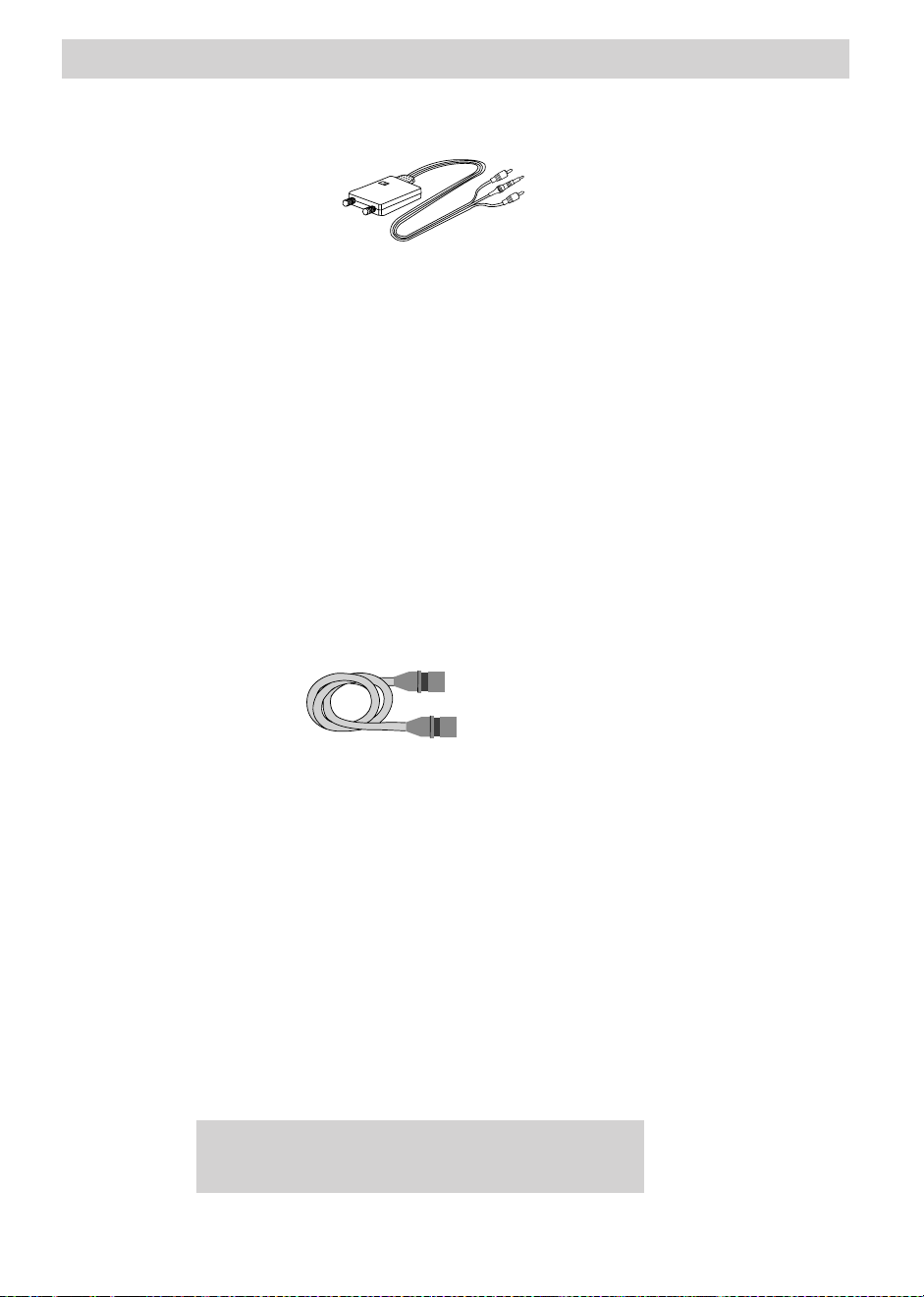
52
Optional Accessories
Output Adapter
Coaxial Cables
All specifications and descriptions of accessories
are subject to change without notice.
This RF output adapter is used with a
coaxial RF cable, such as VH82 or VH90,
to connect your camcorder to a standard
TV (one without audio/video inputs) for
playback. If your antenna cable is the flat
twin-lead type attached by two screws,
you need a 300-to-75 ohm transformer. If
your TV has 300 ohm antenna screw
terminals, you need an optional 75-to-300
ohm transformer such as VH54.
CRF95 RF Output Adapter
Coaxial RF Cables
These RF cables are used with the RF
output adapter to connect your camcorder
to a standard TV (one without audio/video
input jacks) for playback. If your TV has
300 ohm antenna screw terminals, you
need an optional 75-to-300 ohm
transformer such as VH54. If your
antenna cable is the flat twin-lead type
attached by two screws, you need an
optional 300-to-75 ohm transformer.
VH82 (6-ft)
VH90 (12-ft)
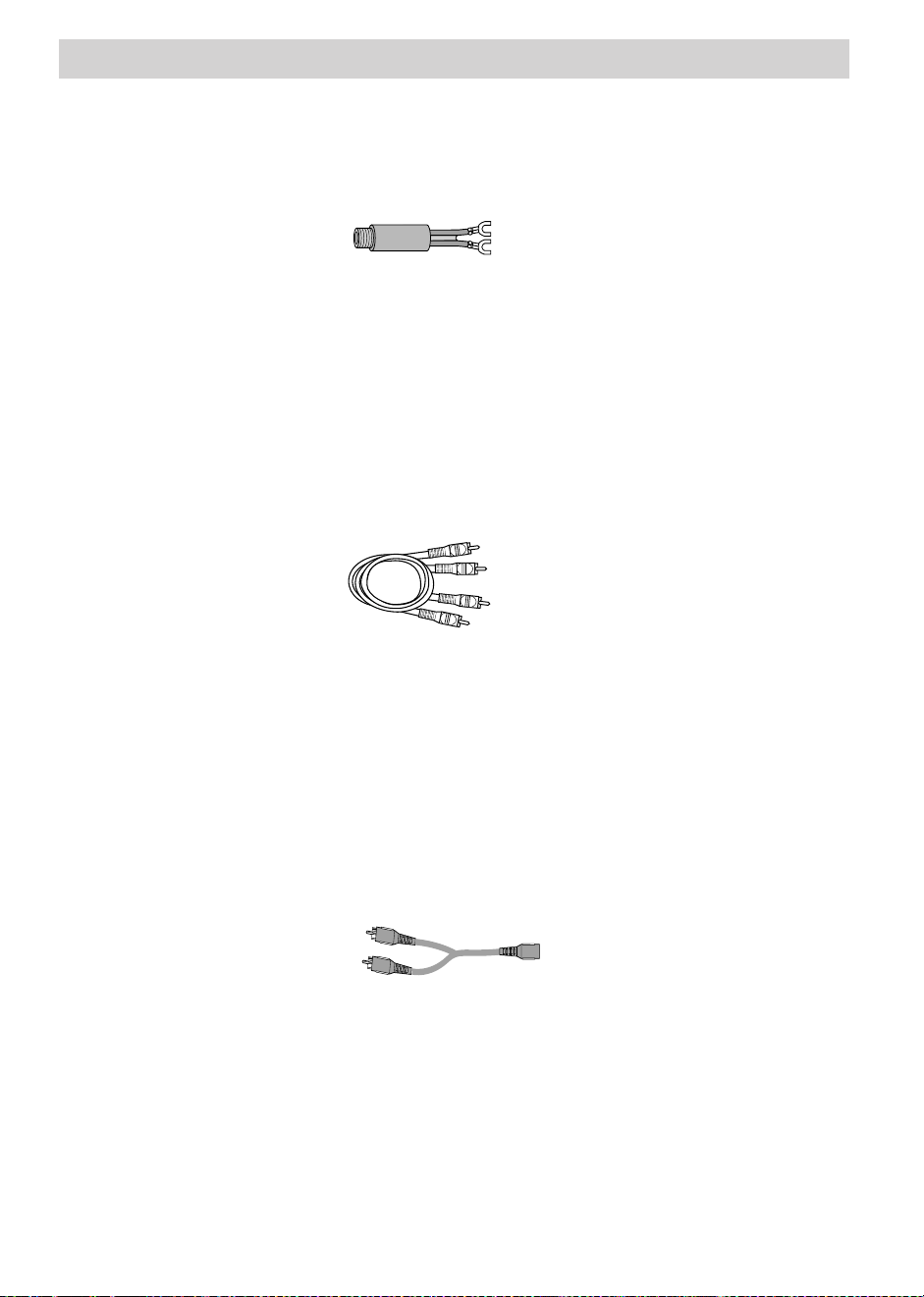
53
Optional Accessories
Cable Transformer
Audio/Video Cables
Y-Adapter
VH54 Cable Transformer
This 75-to-300 ohm transformer is used to
connect a standard 75-ohm antenna cable
(such as VH82 or VH90) to the 300 ohm
screw terminals on a TV.
VH83 Audio/Video Cable
This six foot audio/video cable can be
used to connect the camcorder to a TV
monitor or VCR for tape playback or
copying tapes.
AH25 Y-Adapter
This Y-adapter allows you to connect your
camcorder’s mono audio cable to a stereo
TV or VCR.
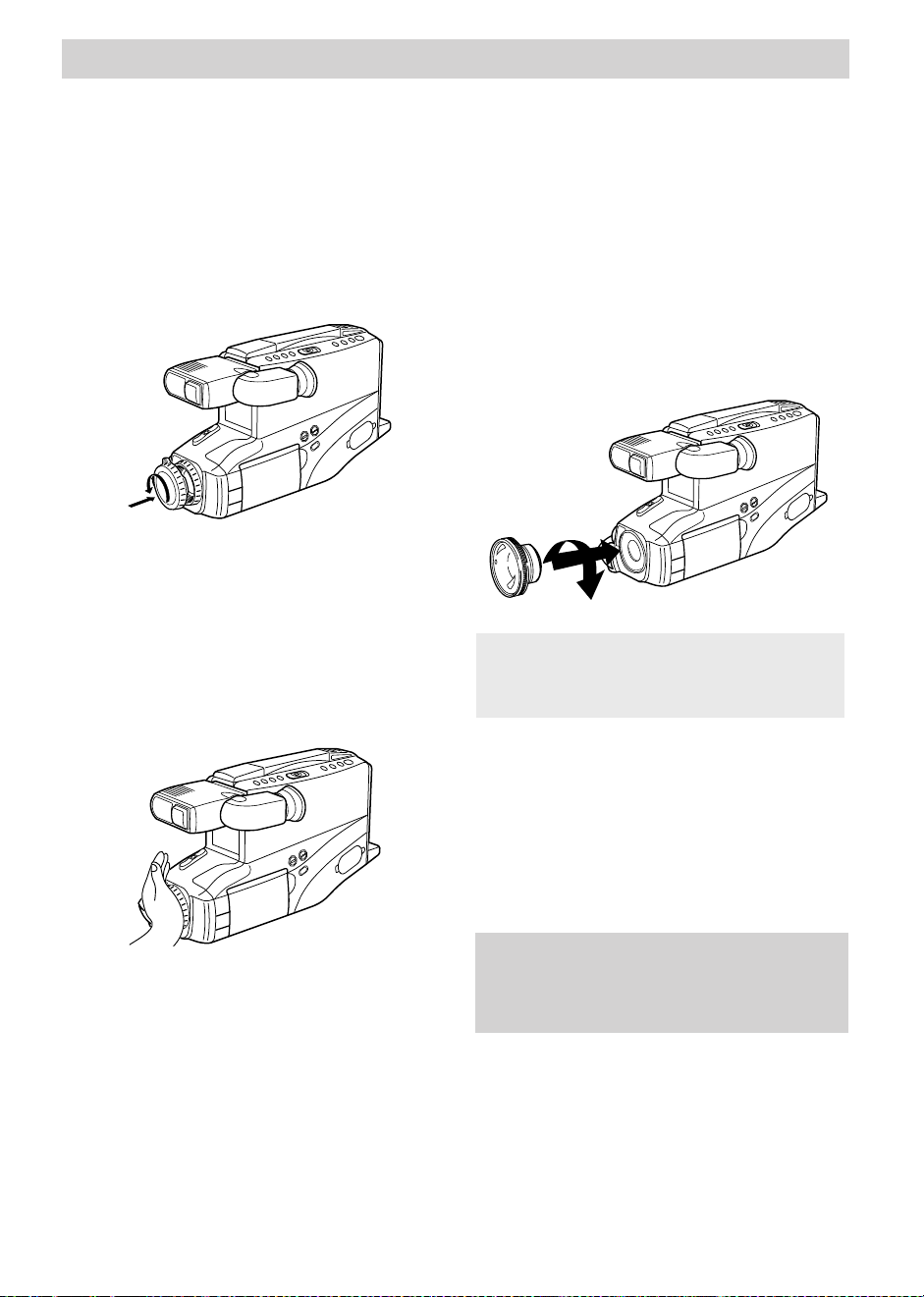
54
Optional Accessories
Removing the Lens Hood
Remove the lens hood so you can attach optional accessories, such as wide-angle lens,
lens extenders, or lens filter kits.
Attaching an Accessory Lens
2. To remove the lens cap and hood, turn
them counterclockwise with the palm
of your hand.
3. Turn the accessory lens clockwise
into the camcorder’s lens. Make sure
the lens is tightened firmly, but do not
over tighten.
1. Attach the lens cap over the lens hood.
All specifications and descriptions of
accessories are subject to change
without notice.
Caution: Do not grasp the end of the
lens hood.
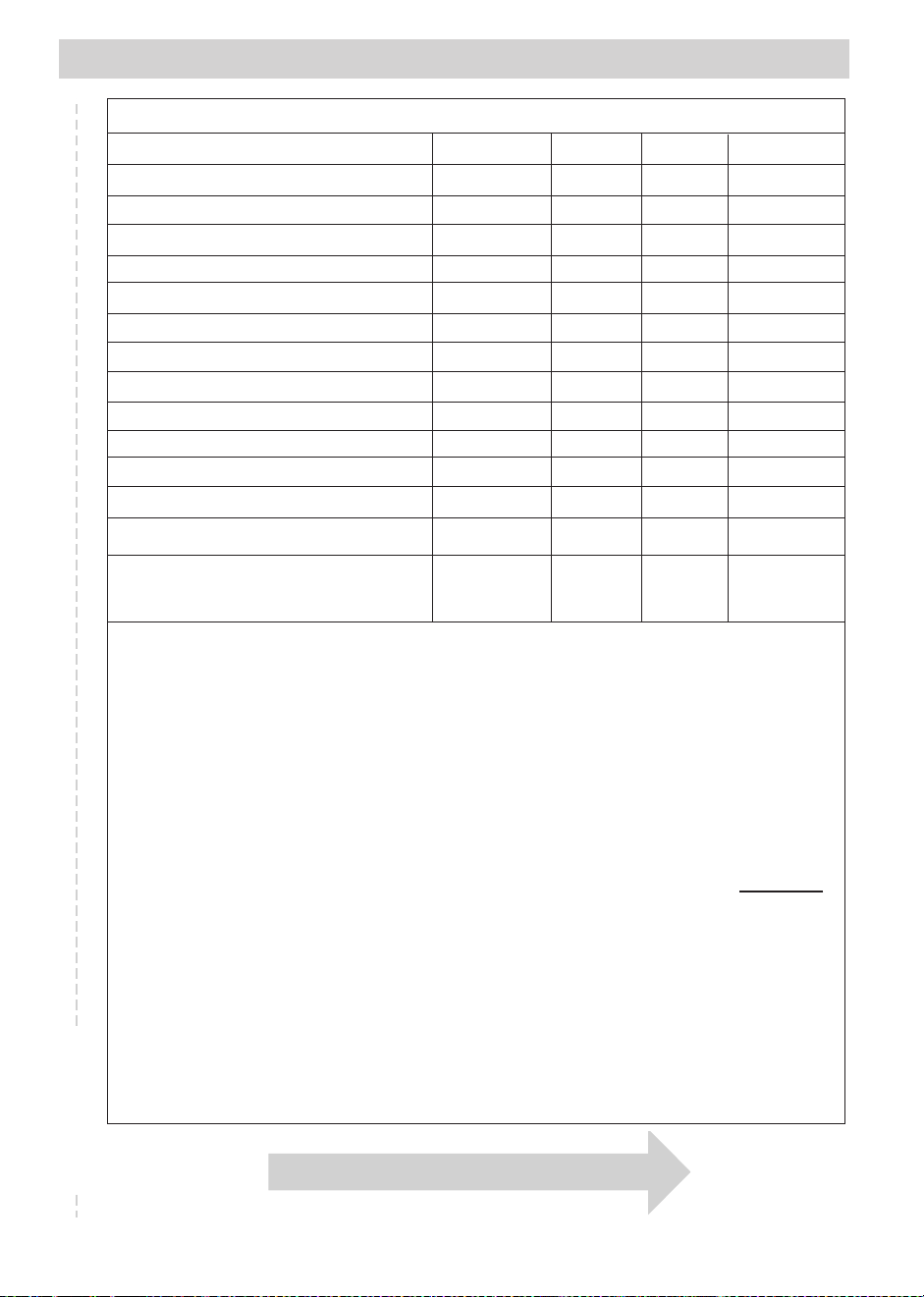
55
Accessory Order Form
Accessory Order Form
Order Form for Camcorder Model CC4352
Description Part No. Price Qty. Total
Deluxe Tripod AC093 $ 59.95
Soft Camcorder Case AC202 $ 49.95
Y-Adapter AH25 $ 2.95
AC Adapter/Charger (100-240V) CPS014 $219.95
RF Output Adapter CRF95 $ 69.95
Car Cord Adapter DCC096 $ 49.95
Rechargeable Battery (Extended) EP096FL $ 79.95
Rechargeable Battery (Standard) EP096FS $ 69.95
75-300 Cable Transformer VH54 $ 2.95
Coaxial RF-Cable VH82 $ 6.95
Audio/Video Cable VH83 $ 5.95
Coaxial RF-Cable VH90 $ 7.95
Shoulder Strap
241305 $ 12.95
AC Adapter/Charger (Supplied) and 241044 $169.95
DC Cable 233328 $ 13.65
Total Merchandise ........................................................................................... $_________
Sales Tax .......................................................................................................... $_________
We are required by law to collect the appropriate
sales tax for each individual state, county, and
locality to which the merchandise is being sent.
Shipping and Handling .................................................................................... $
5.00
Total Amount Enclosed ................................................................................. $_________
Use VISA, MasterCard, or Discover.
Money order or check must be in U.S.
currency only. No COD or cash.
Prices are subject to change without notice.
Detach Here
✂
Please complete other side also
56
Accessory Order Form
®
rr
s
TM
Charge your order on your VISA,MasterCard,
or Discover Card by filling in below
USE YOUR CREDIT CARD
IMPORTANT: Copy complete account number from your VISA card
IMPORTANT: Copy complete account number from your MasterCard
Expiration date:
Expiration date:
Copy Number above your name on MasterCard
AUTHORIZED SIGNATURE
Prices are subject to change without notice.
Please make sure that both sides of this form have been filled out completely.
• Allow 4 weeks for delivery.
• All accessories are subject to availability.
IMPORTANT:
Copy complete account number from your Discover Card
Expiration date:
Print or type your name and
address clearly.
A complete and correct order will
save you days of waiting.
Name:
Street:
Apt:
City:
State:
Zip:
Detach Here
✂

57
Accessory Order Form
To order accessories, contact your local Dealer.
If a dealer is not nearby, you can also follow the directions below to order by
telephone or direct-by-mail.
United States and Canada Orders
To place your order by phone, have your Visa, MasterCard, or Discover card ready
and call the toll-free number listed below between 8 AM and 10 PM (EST)
Monday through Friday or between 9AM and 5PM (EST) Saturday.
Use this number only to place an order for accessory items listed on
this order form.
1-800-338-0376
To place your order by mail, detach and mail the completed order form with credit
card information, money order, or check in U.S. currency (made payable to
Thomson Consumer Electronics, Inc.) to the following address:
Video Accessories
PO Box 8419
Ronks, PA 17573

58
Trouble Checks
Troubleshooting
If you’re having trouble with your camcorder, you probably can correct the problem
yourself. Before you take your camcorder to an Authorized RCA Camcorder Service
Center or call a service person, use the chart below. Find the problem and try the
adjustment(s) that is listed to the right.
If service should be necessary, read your warranty to find out what is covered and how
to get service.
No power
Won’t record or
play back
Won’t play back
Won’t record
No picture
Camcorder turns
off
Trouble Checks and Adjustments
• Set the CAMERA/OFF/VCR switch to CAMERA or
VCR to turn on the camcorder.
• If using battery, it may need to be recharged.
• If using AC adapter/charger, make sure it is plugged
into a working outlet.
• If using AC adapter/charger, make sure it is plugged
into a working outlet.
• Make sure CAMERA/OFF/VCR switch is set to correct
position for desired operation.
• There might not be a cassette in the camcorder.
• Try ejecting and reinserting the cassette.
• The cassette tape might be broken, try another cassette.
• You might have reached the end of the cassette, try
rewinding it.
• Moisture condensation might cause the tape to stick to
the headwheel and damage the headwheel or tape. Give
the camcorder 2 or 3 hours to reach a stable temperature
before reinserting a cassette.
• CAMERA/OFF/VCR switch must be set to VCR.
• Safety tab removed. See page 18.
• CAMERA/OFF/VCR switch must be set to CAMERA.
• Remove lens cap.
• Set the CAMERA/OFF/VCR switch to OFF and then to
CAMERA or VCR to turn back on. If camcorder is left
in record-pause or play-pause for several minutes, it
turns off to prevent tape wear.

59
Trouble Checks
• Subject was too far from camcorder.
• Whenever the tape counter appears, the camcorder will
stop rewinding (or fast forwarding) when counter reads
0000M. Press REW/REVIEW or F.FWD again to
continue rewinding or fast forwarding, or press
DISPLAY to remove the tape counter.
• Make sure titler graphics do not appear in viewfinder
or on LCD monitor. Press TITLER button to remove.
• Press REC/PAUSE to return to normal playback.
• Lens is smudged and image appears unfocused.
• Eyepiece focus control is misadjusted.
• Eyepiece focus control is misadjusted. See page 23.
• The small BRIGHT and FOCUS controls on the side of
the viewfinder control the brightness and focus of the
viewfinder. These controls have been set at the factory
and should require no adjustment. If the controls ever
require adjustment, carefully use a plastic screwdriver.
Make the adjustments with caution to prevent
damaging the miniature controls.
• Tape was recorded on a different camcorder or VCR.
If the picture contains black-and-white streaks, press
one of the tracking buttons to correct it. See page 45.
• Camcorder only has one speed (SP). If the tape was
recorded at a different speed, it cannot be played back
on this camcorder.
• A fade or fade wipe mode has been selected. Turn off
the fade effect by pressing FADE. See pages 34-35.
• A digital recording effect has been selected. Turn off
the digital effects by pressing DIGITAL EFFECTS.
See pages 30-33.
Trouble Checks and Adjustments
Sound is too low or
distorted
Tape stops during
rewind or fast forward
or will not operate
during rewind or fast
forward
Camcorder remains in
play-pause mode
Poor auto-focus
operation
Viewfinder displays
are out of focus
Picture quality is poor
during playback
Picture recorded with
a special fade or
digital effect (such as
negative, 16X9,
mosaic, or mirror)
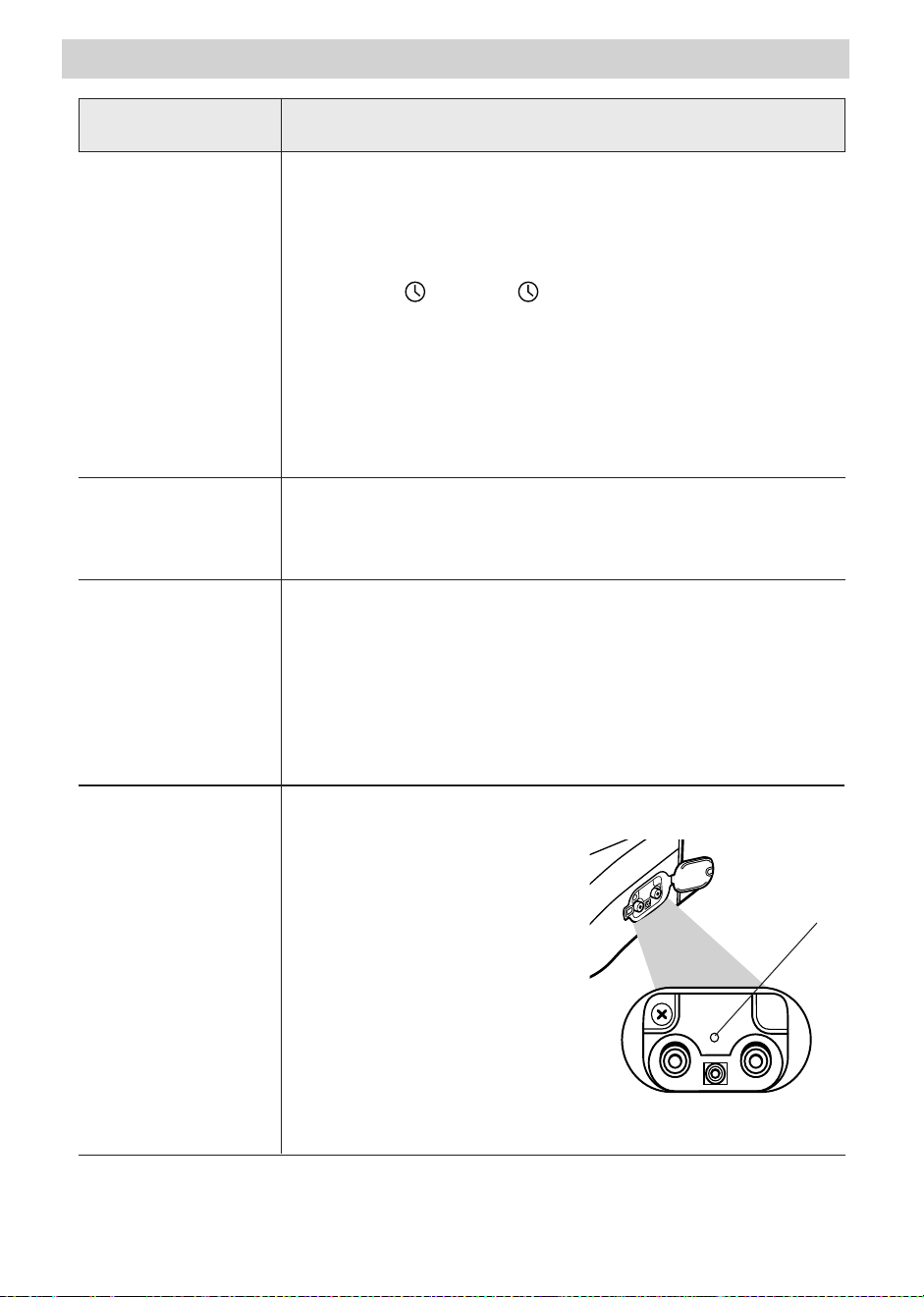
60
Trouble Checks
Date and/or time or
title were recorded
on tape
Date and/or time are
incorrect
Viewfinder turns off
and on
Camcorder does not
turn on and/or
function buttons will
not operate
• Displays are recorded on tape whenever they appear
in the viewfinder or on the LCD monitor. Remove
them from the viewfinder or LCD monitor when
recording. See pages 20-21.
• When DATE or TITLE is selected, the display
is automatically recorded when you begin recording
or change the cassette. See pages 20-21.
• Title is recorded whenever it appears in the viewfinder
or on the LCD Monitor. Press the TITLER button to
remove the title from the viewfinder or LCD monitor.
See pages 38-40.
• Date or time may need to be set. See page 20.
• Clock lithium cell battery may need recharging.
See page 21.
• LCD monitor is open at least 45º. Viewfinder
automatically turns off. Monitor closed, viewfinder
turns on.
• During recording, viewfinder turns on when monitor
rotated around to face the subject.
• During playback, viewfinder turns off when monitor
rotated around and placed against camcorder.
Trouble Checks and Adjustments
• Remove the power source.
After one minute press the
reset switch gently using a
nonmetallic pointed item,
such as a toothpick, until
you feel a click. This
resets the camcorder to the
factory settings and erases
the date, time, and custom
settings. Wait for at least
one minute after resetting
the camcorder to attach a
power supply.
Reset Switch

61
Trouble Checks
Trouble Checks and Adjustments
No or low sound
during monitor
playback
Black bars on top
and bottom of
picture.
Bright, crystal-
shaped spots
appear in
viewfinder or on
LCD monitor
Colored bright
spots appear on
LCD monitor
Back of LCD
monitor is hot
Rechargeable
battery runs down
sooner than
expected
• Adjust the volume control on the side of the monitor.
• To hear sound during camcorder playback, use the monitor.
There is no sound during viewfinder playback.
• 16X9 feature selected. See page 31.
• Sunlight is directly entering the lens.
• Black spots or bright spots of light (red, green, or blue) may
appear on the LCD monitor. These spots are not recorded
on the tape and are not due to a defect in the unit.
• The light that illuminates the LCD monitor gets hot. To
cool it down, close the LCD monitor and turn off the
camcorder.
• Lead-acid batteries must be kept charged. Charge your
battery before and after every use and at least every
six months.
• Battery run times are measured when the camcorder is
recording continuously. To check your battery; charge it
completely, aim the camcorder at a clock, and record the
clock. When the camcorder stops recording, play the last
part of the tape and check the time on the clock. A one-
hour battery should give you about 60 minutes of recording
time. In practical use, a fully charged battery might not
record for 60 minutes because the battery uses power when
you pause the recording and uses extra power when you
zoom.
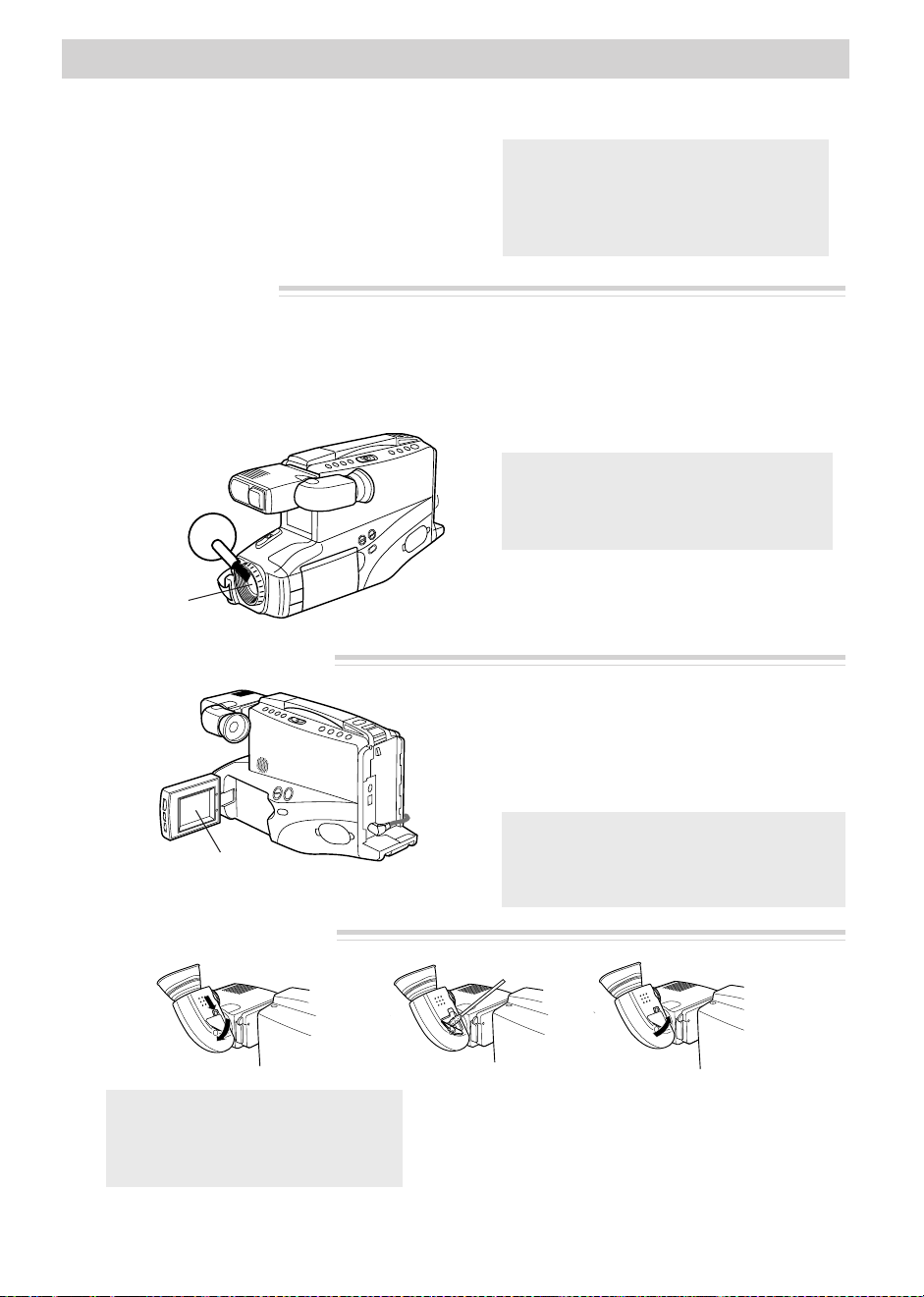
62
Care and Maintenance
Cleaning the Camcorder
To clean the camcorder’s exterior, remove
any power source connected to the
camcorder and gently wipe it with a clean
soft cloth.
Caution: Use of strong cleaning
products, such as those containing
alcohol or benzine, might damage
the camcorder.
Caution: Do not touch the lens
with your fingers. The oil from
your skin can damage the lens.
Cleaning the Lens
To clean the camcorder’s lens, blow it with a blower brush, and then gently wipe the
lens with cleaning tissue and commercially prepared cleaning solution designed for
use on camera lens. Improper cleaning might scratch the lens.
Cleaning the Viewfinder
1. Depress tab to open small cover.
2. Gently use a cotton swab and clean the
mirror inside the viewfinder.
3. Gently close cover until tab snaps in
place.
Lens
Clean the LCD Monitor
To clean the camcorder’s LCD
monitor, use a clean, soft cloth to
carefully wipe the monitor. Improper
cleaning may scratch the monitor.
LCD
Monitor
Caution: Do not force the
cover to open completely. This
might damage the cover.
Caution: Do not touch the monitor
with your fingers. The oil from your
skin might damage the monitor.

63
Care and Maintenance
Proper Care and Storage
• Keep dust and grit from entering the
camcorder’s cassette door. Dust and
grit are abrasive and cause excessive
wear to both the camcorder’s
recording/playback heads and
cassettes.
• Always place the lens cap back on the
camcorder when it is not in use.
• Before handling your camcorder, make
sure your hands and face are free from
any chemical products such as suntan
lotion, as it might damage the finish.
• The camcorder might be damaged by
improper storage or handling. Do not
subject the camcorder to swinging,
shaking, or dropping.
• Do not store the camcorder in
temperatures below -22°F (-30ºC) or
above 149°F (65ºC).
• When the camcorder is not in use,
always remove the cassette and AC
adapter/charger or battery.
• Retain the original carton for future
storage or shipping purposes.
Things to Avoid
• Do not attempt to disassemble your
camcorder. There are no user-
serviceable parts inside.
• Avoid operating your camcorder
immediately after moving it from a
cold location to a warm location. Give
the camcorder 2 to 3 hours to reach a
stable temperature before inserting a
cassette. When the camcorder is
moved from cold to warm,
condensation might cause the tape to
stick to the headwheel and damage the
headwheel or tape.
• Do not aim your camcorder at the sun
or other bright objects.
• Do not leave your camcorder in direct
sunlight for extended periods of time.
The resulting heat buildup might
permanently damage the camcorder’s
internal parts.
• Do not operate the camcorder in
extremely humid environments.
• Do not operate the camcorder near the
ocean as salt water or salt water spray
might damage the internal parts of the
camcorder.
• Do not operate the camcorder for
extended periods in temperatures
below 40°F (4ºC) or above 95°F
(35ºC).
• Do not expose the camcorder or
adapter/charger to rain or moisture.
If any component becomes wet, turn
off the power and take the unit to an
Authorized RCA Camcorder
Service Center.
• Do not use an adapter/charger or
batteries other than the ones specified
for the camcorder. Use of the wrong
accessories might cause damage to the
camcorder.
• Do not hold the camcorder by the
viewfinder or LCD extension as this
could damage them.

Specifications
64
Information to User
Specifications
This equipment has been tested and found to
comply with the limits for a Class B digital
device pursuant to Part 15 of the FCC Rules.
These limits are designed to provide
reasonable protection against harmful
interference in a residential installation. This
equipment generates, uses, and can radiate
radio frequency energy and, if not installed
and used in accordance with the instructions,
may cause harmful interference to radio
communications. However, there is no
guarantee that interference will not occur in a
particular installation. If this equipment does
cause harmful interference to radio or
television reception, which can be determined
by turning the equipment off and on, the user
is encouraged to try to correct the interference
by one or more of the following measures:
• Reorient or relocate the receiving antenna.
This Class B digital apparatus meets all
requirements of the Canadian Interference —
Causing Equipment Regulations.
Cet appareil numérique de la classe B respecte
toutes les exigences du Réglement sur le
matériel brouilleur du Canada.
• Increase the separation between the
equipment and receiver.
• Connect the equipment into an outlet on a
circuit different from that to which the
receiver is connected.
• Consult the dealer or an experienced radio/
TV technician for help.
Alterations or modifications carried out
without appropriate authorization may
invalidate the user’s FCC right to operate the
equipment.
General
Power requirement: 9.6VDC
Power consumption:
LCD monitor on: 9 watts
Viewfinder on: 7.5 watts
Weight: 4.7 lbs. (2.15kg)
Dimensions – Including Viewfinder:
4
3
/4" (W) x 8
3
/8" (H) x 13
1
/8" (D)
121 (W) x 213 (H) x 334 (D) mm
Video Recorder Section
Format: VHS
Record/playback system:
Two video record/playback heads
Video signal: EIA standard
NTSC color
Viewfinder
0.5" black-and-white electronic viewfinder
Tripod Mount
One 1/4" x 10 threaded hole
LCD Monitor
3" diagonally measured
LCD/TFT active matrix system
Camera Section
Scanning: 525 lines/60 fields/30 frames
Image Sensor: 1/4" CCD Imager
Lens: F1.4
16:1 (4-64 mm) power zoom lens
Diameter: 46 mm
AC Adapter/Charger
Power requirement: 120 V,
50/60 Hz.
Power consumption: 24 watts
Weight: .85 lbs. (390g)
Dimensions:
6"(W) x 1.7"(H) x 2.7"(D)
152 (W) x 43 (H) x 69 (D) mm

65
Customer Assistance and Service
Customer Assistance and Service
You can reach Thomson at the
following number:
800-283-6503
(Toll free inside U.S.A.)
Our toll-free Camcorder number
operates from 8 a.m. to 5 p.m., CST
Monday – Friday
for U.S. customers only
Thomson provides a toll-free telephone
number to help you with any problems you
may encounter with your camcorder. Many
can be diagnosed over the phone, and if
necessary, repair or replacement will be
arranged. Please have your camcorder model/
serial number and date of purchase ready
when you call. If your unit is out of warranty,
we will quote the cost of a repair or
replacement unit to you.
Returning equipment to Thomson for repair or exchange
If we are unable to resolve your problem over
the phone, we will gladly service your unit or
exchange it for a new or, at our option,
refurbished camcorder. Refer to the limited
warranty on the next page to learn about your
specific rights and responsibilities.
Always consult Thomson and get a Return
Authorization number before returning
anything! Obtain a Return Authorization
(RA) number from the telephone
representative before returning your
equipment to avoid delays, accounting errors,
or even loss of your unit.
The Thomson representative who authorized
the return of your equipment will give you an
RA number over the phone. They will also
provide you with instructions on where and
how to return your Camcorder. Write the
number in large, clear characters on the
outside of the box. To avoid confusion and
misunderstandings, shipments without an RA
number clearly visible on the outside of the
box will be returned to you at your expense.
Include a brief note describing the problem
and any conversations about the problem you
have had with Thomson personnel.
Include your name, address and model/serial
number of your Camcorder. These numbers
are located on the bottom of your unit.
If your Camcorder is within the warranty
period, please provide a copy of the bill of sale
to verify purchase date. Use the original box
and packing material to protect the equipment
from damage in shipment.
For your protection, insure all shipments for
full replacement value and use a reliable
shipper. Thomson assumes no responsibility
for warranty shipments from the customer to
the factory if not shipped in the manner
prescribed by Thomson.
Important information to customers who ship defective equipment to
Thomson Consumer Electronics

66
Limited Warranty
Warranty Information
What your warranty covers:
• Any defect in materials or workmanship.
For how long after your purchase:
• 90 days for labor charges.
• One year for parts.
The warranty period for rental units begins
with the first rental or 45 days from date of
shipment to the rental firm, whichever
comes first.
What we will do:
During the initial 90 days
• Exchange your camcorder with a new or
refurbished unit, or repair your camcorder.
The option will be ours. There will be no
cost to you.
After the 90 days and within one year
• Exchange your camcorder with a new or
refurbished unit, or repair your camcorder.
The option will be ours. Parts will be
provided at no charge, but you will be
responsible for the cost of labor required
for the repair.
How you get service:
• Call 1-800-283-6503 and have your unit’s
date of purchase and model/serial number
ready. The model/serial number
information is on the bottom of your
camcorder.
• A representative will troubleshoot your
problem over the phone. If the
representative determines that you should
receive a replacement unit, you will be
provided with a Return Authorization (RA)
number and the location of a nearby
exchange point if one exists. No returns
will be accepted without the RA number.
To receive a replacement Camcorder
before you return yours:
Option 1
1. Provide your Discover, MasterCard, or
Visa account number and expiration date to
our phone representative. This is for
security purposes. If we receive your unit,
excluding all accessories, within 14 days
from the date you were provided the RA
number, only items not covered by
warranty will be charged to your account.
IF YOUR UNIT IS NOT RECEIVED
WITHIN 14 DAYS, THE SUGGESTED
RETAIL VALUE OF THE CAMCOR-
DER WILL BE CHARGED TO YOUR
CREDIT CARD. This amount will be
credited if the unit is subsequently received.
2. We will send you a replacement unit.
3. Ship the unit back to us, excluding all
accessories, using the replacement unit’s
carton. Shipping instructions will be
included in the carton along with your RA
number which will allow you to easily ship
the unit back to us. Make sure you insure
your shipment in case of damage or loss.
Include with the shipment:
• Evidence of purchase date, such as a bill
of sale, to verify your unit’s warranty
eligibility.
• A brief note describing your camcorder’s
problem.
• Your name, address and phone number.
Return transportation, storage, handling, and
insurance costs are your sole responsibility. We
accept no liability in case of damage or loss.
Option 2
1. We will send a replacement unit to the
exchange point.
2. The exchange location will notify you of its
arrival.
3. Take your unit, excluding all accessories,
and your evidence of purchase date (such as
a bill of sale) to the exchange location and
you will be provided the new or refurbished
unit.
4. If the repairs were covered by your
warranty, you will not be billed.

67
Limited Warranty
To receive a replacement unit after we have
received your unit:
1.
Write the RA number on the outside of
the carton used to return the unit. Make
sure you insure your shipment in case of
damage or loss.
2. Carefully pack the unit, excluding all
accessories, using the original box and
packing material if possible.
3. Include with the shipment:
• Evidence of purchase date, such as a
bill of sale, to verify your unit’s
warranty eligibility.
• A brief note describing your camcorder
problem.
• Your name, address and phone number.
Return transportation, storage, handling, and
insurance costs are your responsibility. We
accept no liability in case of damage or loss.
4. The representative will advise the address
to mail a cashier’s check or money order
for payment if there are any out of
warranty labor or parts charges and you
elect not to use your credit card.
5. Upon receipt of your product, a new or
refurbished unit will be shipped to you
next business day delivery in the
continental U.S.A.
To have your Camcorder repaired by an
Authorized RCA Camcorder Service
Center:
• Check with your dealer or call 1-800-336-
1900 for the Authorized RCA Camcorder
Service Center nearest you.
• Take your unit to the Authorized RCA
Camcorder Service Center of your choice.
• Show the Authorized RCA Camcorder
Service Center representative evidence of
purchase date, such as a bill of sale.
• Pick up your camcorder when repairs are
complete.
What your warranty
does not cover:
• Adjustment of customer controls.
• Damage from misuse or neglect.
• A unit that has been modified or
incorporated into other products or is used
for institutional or other commercial
purposes.
• Batteries for remote control and clock.
• Cleaning of video/audio heads.
• Camcorders purchased or serviced outside
the U.S.A.
• Return transportation, storage and handling
costs of your unit, including insurance for
loss or damage.
• Acts of God, such as but not limited to
lightning damage.
Product Registration:
• Please complete and mail the Product
Registration Card packed with your
camcorder. It will make it easier to contact
you should it ever be necessary. The return
of the card is not required for warranty
coverage.
How State Law relates to warranty:
• This warranty gives you specific legal
rights and you also may have other rights
that vary from state to state.
If you purchased your camcorder outside
the United States:
• This warranty does not apply. Contact your
dealer for warranty information.

68
Index
Index
A
Accessories
included 3
optional 50
order form 55
Adapter/charger
accessory 3
charging battery 13
using 4, 12
AE focus indicators 24, 27
Assistance 1, 3
Audio/Video (A/V) jacks 9, 46, 48
B
Battery 3
attaching and removing 14
care 16
charging 13
safety precautions 16
storage 16
using 13
BATTERY EJECT button 10, 14
Battery level indicator 15, 24
Bright control 10, 22, 42, 43
Built-in speaker 10
C
Cable TV installer note 49
Camcorder
cleaning 62
turn on 5
Camera edit feature 37
CAMERA/OFF/VCR switch
5, 9, 14, 15, 17, 20, 21, 26, 36,
37, 38, 39, 40, 42, 43, 44, 47, 49
Car cord adapter 17
Care and maintenance
cleaning the camcorder viewfinder
62
proper care and storage 63
things to avoid 63
Care and storage
camcorder 63
cassette 19
Cassette door 10
Cassette holder 19
Cassettes
inserting/removing 19
video 18
Charging clock battery 21
Cleaning the camcorder’s lens 62
Cleaning the LCD monitor 62
Cleaning the viewfinder 62
Clock battery
charging 21
Copy tapes 47
Customer Assistance 65
D
Date and time
display 20, 25
recording 21
setting 20
DATE/TIME button
9, 20, 21, 25, 40
DC cable 3, 12, 13, 14, 17

69
Index
DC IN 9.6V jack 10, 12, 17
Digital Effects
16X9 feature 31
Digital effects 30
DIGITAL EFFECTS button
10, 24, 30, 31, 32, 33, 34
Digital effects indicators 24, 30
Digital zooming 32
DISPLAY button
9, 15, 24, 25, 26, 27, 28,
29, 30, 31, 32, 33, 36, 47
Displays in LCD monitor 24
Displays in viewfinder 24
E
EDIT-ADV button 9, 38, 39
Editing features
camera edit 37
flying erase head 37
title recording 40
Titler 38
Electronic indexing 28
Erase protection 18
Eyepiece focus control
10, 23, 42, 43
F
F FWD (fast forward) button
9, 20, 36, 37, 38, 44
FADE button 10, 34, 35
Fade indicators 24, 34
Fast-forwarding indicator 25
FOCUS control 10
H
Handstrap 4, 10
Head cleaning 18
I
Important safety information 2
INDEX indicator 25, 28
Indicators
16X9 24, 31
AE focus 24, 27
battery level 15, 24
digital effects 24, 30
fade 24, 34
fast-forwarding 25
I.ZOOM 29
INDEX 25, 28
MIRROR 24, 33
MOSAIC 24, 33
NEGPOS 24, 32
NO TAPE 25
pause 25
REC 7, 25
record-pause 7
rewind 25
status 25
TAPE 25
tape counter 25, 36
TAPE END 25
tape remaining 25, 27
ZM:2 24, 32
ZOOM 24, 25, 29
zoom level 25, 29

70
Index
Information to user 64
Insert and remove cassettes 19
INST ZOOM button 10, 29
Instant zooming 29
L
LCD monitor 6, 10
displays 24
using to record 22
Lens 9
Lens cap 4
Lens cover 8
Lens hood 9
removing 54
Letterbox recording 31
M
Macro focus 27
Memory-stop feature 36
MENU button 35
Microphone 9, 26
MIRROR indicator 24, 33
Mirror mode 33
MOSAIC indicator 24, 33
Mosaic mode 33
N
NEG POS indicator 24, 32
Negative mode 32
NO TAPE indicator 25
O
OPEN button 6, 10, 22, 42, 43
Operating Controls
Plus (+) and Minus (-) buttons
9, 38
Operating controls 9
Optional accessories 50
P
PLAY button
8, 9, 37, 42, 43, 47, 49
Playback
First 8
Playback features
stop-action pause 44
tape counter 36
tape positioning 44
tracking 45
visual searching 44
Playback on a TV without A/V inputs
48
Playback on TV/VCR with A/V
inputs 46
Playback speed 18
Playback using LCD monitor 42
Playback using viewfinder 42
Power your camcorder
adapter/charger 12
battery 13
car cord adapter 17
Problem solving 58

71
Index
Q
Quick review feature 26
R
REC indicator 7, 25
REC/PAUSE button
7, 10, 31, 32, 33, 35, 40, 44, 47, 49
Record-pause indicator 7
Recording
16X9 31
16X9 indicator 31
letterbox 31
Recording speed 18
Recording tips 41
Registration 2
RESET button 9, 36
Reset switch 9
REW (rewind) button 8, 9
REW (rewind)/REVIEW button 44
REW(rewind)/REVIEW button
20, 26, 36, 37
REW(rewind)/REVIEW) button 38
Rewind indicator 25
RF DC OUT jack 9, 48
RF output adapter, optional 48
S
Safety precautions
battery 16
Safety tab 18
Searching during playback 44
Shoulder extension pad 6, 10
Shoulder strap 3
attaching 11
attachment rings 10
SP speed 18, 43
Speaker 42
speaker, built-in 10
Specifications 64
Speed
recording and playback 18
Status indicators 25
STOP button 8, 36
Stop-action pause 44
STOP/EJECT button
5, 9, 15, 19, 20, 36, 38, 42,
43, 44, 47, 49
T
Tape
copying 47
inserting 5
Tape counter 25, 36
TAPE END indicator 25
TAPE indicator 25
Tape positioning 44
Tape remaining display 27
Tape warnings 25
Things to avoid 63
Time and date
setting 20
Time and date display 20, 25
recording 21

72
Index
Tips
recording 41
Titler 38, 39, 40
chart of characters 38
correcting errors 39
creating a title 39
record while copying a tape 40
recording 21
recording on a tape 40
TITLER button 9, 38, 39, 40
Titler character chart 38
Tracking 45
TRACKING buttons 10
Tracking buttons 45
Tripod
using 51
Trouble checks 58
V
VIDEO and AUDIO jacks 9, 46, 48
Videocassettes 18
Viewfinder 6, 10, 22, 23
16X9 indicator 24
adjust for viewing 23
displays 24
eyepiece focus control 23
playback 42, 43
using to record 22
Visual searching 44
Volume control 10, 42
W
Warnings 2, 25
Z
ZM:2 indicator 24, 32
ZOOM indicator 29
Zoom buttons 10, 29
ZOOM indicator 24, 25, 29
Zoom level indicator 25, 29
Zoom lever 34
Zooming 29
digital 32

Note: This equipment has been type tested and found to comply with the
limits for a Class B Digital Device in accordance with the specifications in
Part 15 of FCC Rules. These rules are designed to provide reasonable
protection against radio and television interference in a residential installa-
tion. This equipment generates, uses and can radiate radio frequency
energy and, if not installed and used in accordance with the instructions,
may cause harmful interference to radio communications. However, there
is no guarantee that interference will not occur in a particular installation.
If this equipment does cause interference to radio or television reception
(which you can determine by turning the
equipment off and on), try to correct the interference by one or more of the
following measures.
– Reorient or relocate the receiving antenna (that is, the antenna for
radio or television that is “receiving” the interference).
– Change the position of the camcorder with respect to the radio or
television equipment that is receiving interference.
– Move the camcorder away from equipment receiving interference.
– Plug the adapter/charger into a different wall outlet so the receiver and
equipment receiving interference are on different branch circuits.
If these measures do not eliminate interference, please consult your dealer
or an experienced radio/television technician for additional suggestions.
Also, the Federal Communications Commission has prepared a helpful
booklet, “How To Identify and Resolve Radio/TV Interference Problems”.
This booklet is available from the U.S. Government Printing Office, Wash-
ington, D.C., 20402. Please specify stock number 004-000-00345-4 when
ordering copies.

10330 N Meridian Street
Indianapolis, IN 46290
©
1999 Thomson Consumer Electronics, Inc.
Trademark(s)
®
Registered
Marca(s) Registrada(s)
Printed in Japan
TOCOM 15407950
QR31043