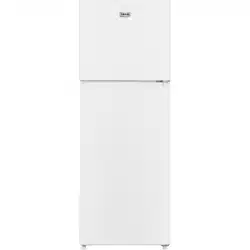
TECO
Engineered To Perm
IMPORNT NOTE:
RE
FRIGER
A
T
O
R
/
FREEZER
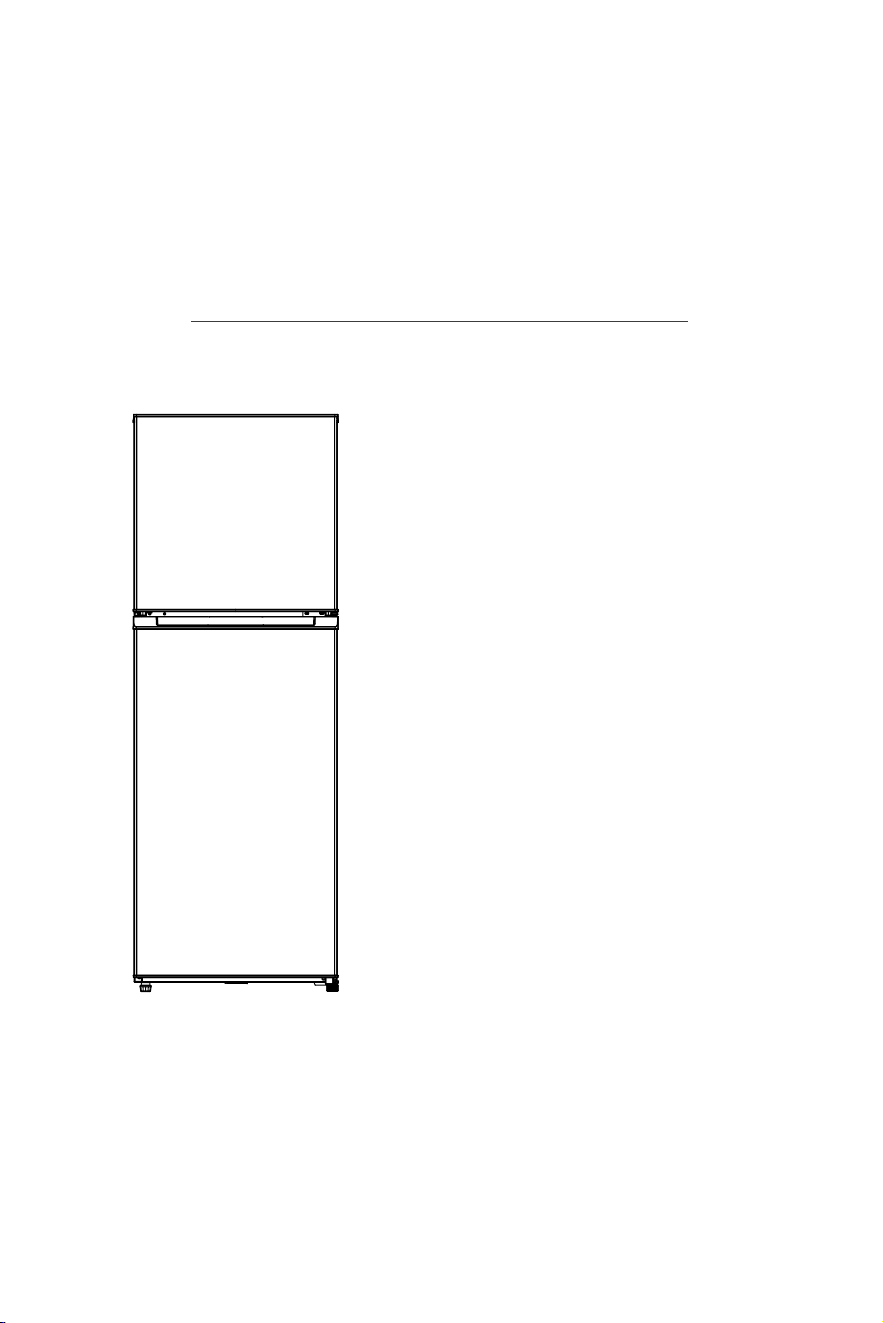
User Manual
Model:
TFF
334
W
N
TAH
TFF
334
S
N
TAH
Thank you for selecting a TECO quality appliance. Read this manual
carefully before installing or operating your new appliance. Make sure to
save this manual for future reference.
The design and speci ications are subject to change without prior
notice for product improvement. Consult with the place of purchase, sales
representative or check the TECO website for details.
w
CONTENTS
5
6
9
10
11
12
14
Important Safety Instructions
Overview
Reversing the Door
Installation Instructions
Control
P
anel
Operating Instructions
Maintenance and Care of the Appliance
Troubleshooting
Repairs, Service & Warranty
Specifications
15
16
IMPORTANT SAFETY INSTRUCTIONS
• Thank you r purchasing our product and thank you for placing your
confidence in us.
• Read this manual carefully before use. Follow instructions and keep the
manual for future reference.
• Follow the operating instructions and safety notices in this manual.
• If any trouble arise, do not attempt to fix it yourself. Please contact TECO
service on 1300 660 037 (8:30am - 4pm Mon-Fri AEST).
• This freezer is designed and approved for use with flammable R600a
refrigerant.
• The appliance is specifically constructed for domestic use only. The appliance
has not been designed or manufactured for professional use. TECO declines
all responsibility for damage deriving from improper use of the appliance. The
freezer has undergone the necessary tests on the tightness of the refrigeration
circuit and complies with the safety regulations for electrical appliances.
• All images, illustrations and photos contained in this manual are for illustration
purposes only and may differ from your appliance.
Prohibition symbol
A
Warning symbol
0
Note symbol
This is a prohibition symbol.
Any incompliance with instructions marked with this
symbol may result in damage to the product or endanger
the personal safety of the user.
This is a warning symbol.
It is required to operate in strict observance of
instructions marked with this symbol; or otherwise
damage to the product or personal injury may be caused.
This is a cautioning symbol.
Instructions marked with this symbol require special
caution. Insufficient caution may result in slight or
moderate injury, or damage to the product.
• This appliance contains a small quantity of flammable, non-synthetic
R600a refrigerant.
• The room r installing the appliance must be at least
1 m3 per 8g of refrigerant. The amount of refrigerant in
the appliance can be found on the rating plate attached
to the appliance.
�
• If the refrigerant circuit should become damaged. Avoid
open flames and sources of ignition. Disconnect
the appliance from the mains power. Thoroughly
ventilate the room in which the appliance is situated
for several minutes.
Wa r n i n g : risk of fire / flammable materials.
1
IMPORTANT SAFETY INSTRUCTIONS
• The Class I refrigerator/freezer is designed to operate on a single phase
power supply within a voltage range of 220-240V/50Hz.
• The refrigeration system contains refrigerant. Do not allow any sharp
objects to come in contact with the refrigerant system to avoid damage the
refrigerant circuit.
• This product is r indoor use only.
• Do not place electrical items or cooking equipment nearby. Keep away from
substances which could cause ignition and good ventilation shall be
always maintained.
• Do not place objects on top of the appliance which are magnetic, heavy or
filled with water.
• Power cord must not be lengthened.
• Make sure that the power plug is not squashed or damaged by the back of the
appliance. A squashed or damaged power plug may overheat and cause a fire.
• Make sure that you can come to the mains plug of the appliance.
• Do not pull the mains cable.
• If the power plug socket is loose, do not insert the power plug. There is a risk of
electric shock or fire.
• If the supply cord is damaged, it must be replaced by authorised TECO service
personal, service agent or similarly qualified persons in order to avoid a hazard.
• Do not store flammable, explosive, volatile and highly corrosive materials in
the refrigerator. Containers with flammable gases or liquids can leak at low
temperature. There is a risk of explosion or fire.
• Do not splash water on the appliance. It may cause malfunction or electric shock.
• Always switch off and unplug appliance before cleaning.
• Keep ventilation openings, in the appliance enclosure or in the built-in structure,
clear of obstruction.
• Do not use mechanical devices or other means to accelerate the defrosting
process, other than those recommended by the manufacturer.
• Do not use electrical appliances inside the storage compartments of the
appliance.
• For appliances which use flammable insulation blowing gases, Please keep the
products away from the fire or similar glowing substance.
• This appliance is intended to be used in household and similar applications such
as:
o staff kitchen areas in shops, oices and other working environments;
o farm houses and by clients in hotels, motels and other residential type
environments;
o bed and breakfast type environments;
o catering and similar non-retail applications.
2
IMPORTANT SAFETY INSTRUCTIONS
• This appliance is heavy. Care should be taken when moving it.
• Do not remove nor touch items from the freezer compartment if you hands are
damp/wet, as this could cause skin abrasions or
frost/freezer burns.
• Avoid prolonged exposure of the appliance to direct sunlight.
This appliance is not intended r use by persons (including children) with
reduced physical, sensory or mental capabilities, or lack of experience and
knowledge, unless they have been given supervision or instruction
concerning use of the appliance by a person responsible for their safety.
• Young children should be supervised to ensure that they do not play with
the appliance.
• Packing (e.g. wraps, polystyrene etc.) can be dangerous for children. There
is a risk of suocation. Keep packaging materials away from children.
• Contact your local authorities r correct method of disposal. Dispose of all
packaging in a responsible manner in accordance with local regulations.
Installation
Important! For electrical connection carefully follow the instructions given in
specific paragraphs.
• Unpack the appliance and check if there are damages on it. Do not connect the
appliance if it is damaged. Report possible damages immediately to the place
you bought it. In that case retain packing.
• It is advisable to wait at least four hours before connecting the appliance to allow
the oil to flow back in the compressor.
• Adequate air circulation should be around the appliance, lacking this leads to
overheating. To achieve suicient ventilation follow the instructions relevant to
installation.
• Wherever possible the spacers of the product should be against a wall to avoid
touching or catching warm parts (compressor, con-denser) to prevent possible
burn.
• The appliance must not be located close to radiators or cookers.
• Make sure that the mains plug is accessible aer the installation of the appliance.
Daily Use
• Do not put hot on the plastic parts in the appliance.
• Do not place food products directly against the rear wall.
• Frozen food must not be re-frozen once it has been thawed out.
• Store pre-packed frozen food in accordance with the frozen food manufacture's
instructions.
• Appliance's manufactures storage recommendations should be strictly adhered
to. Refer to relevant instructions.
• Do not place carbonated of fizzy drinks in the freezer compartment as it creates
pressure on the container, which may cause it to explode, resulting in damage to
the appliance.
3
IMPORTANT SAFETY INSTRUCTIONS
Energy Saving
• Don't put hot food in the appliance;
• Don't pack food close together as this prevents air circulating;
• Make sure food don't touch the back of the compartment(s);
• If electricity goes off, don't open the door(s);
• Don't open the door(s) frequently;
• Don't keep the door(s) open for too long time;
• Don't set the thermostat on exceeding cold temperatures;
• Some accessaries, such as drawers, can be removed to get larger
storage volume and lower energy consumption.
Care and Cleaning
• Before maintenance, switch o the appliance and disconnect the mains plug
from the mains socket.
• Do not clean the appliance with metal objects.
• Do not use sharp objects to remove frost from the appliance. Use a plastic
scraper.
Service
• Any electrical work required to do the servicing of the appliance shall be
carried out by a qualified electrician or competent person.
• This product must be serviced by an authorized Service Center, and only
genuine spare parts must be used.
Disposal
A
-
Refrigerant and Cyclopentane foaming material used for the freezer
are flammable. Therefore, when the freezer is scrapped, it shall be
kept away from any fire source and be recovered by a special
recovering company with corresponding qualification other than be
disposed by combustion, so as to prevent damage to the
environment or any other harm.
When the refrigerator
/f
reezer is scrapped, disassemble the doors,
and remove gasket of door and shelves; put the doors and shelves in
a proper place, so as to prevent trapping of any child.
Correct Disposal of this product
This marking indicates that this product should not be disposed
with other household waste. To prevent possible harm to the
environment or human health from uncontrolled waste disposal,
recycle it responsibly in accordance with local regulations.
4
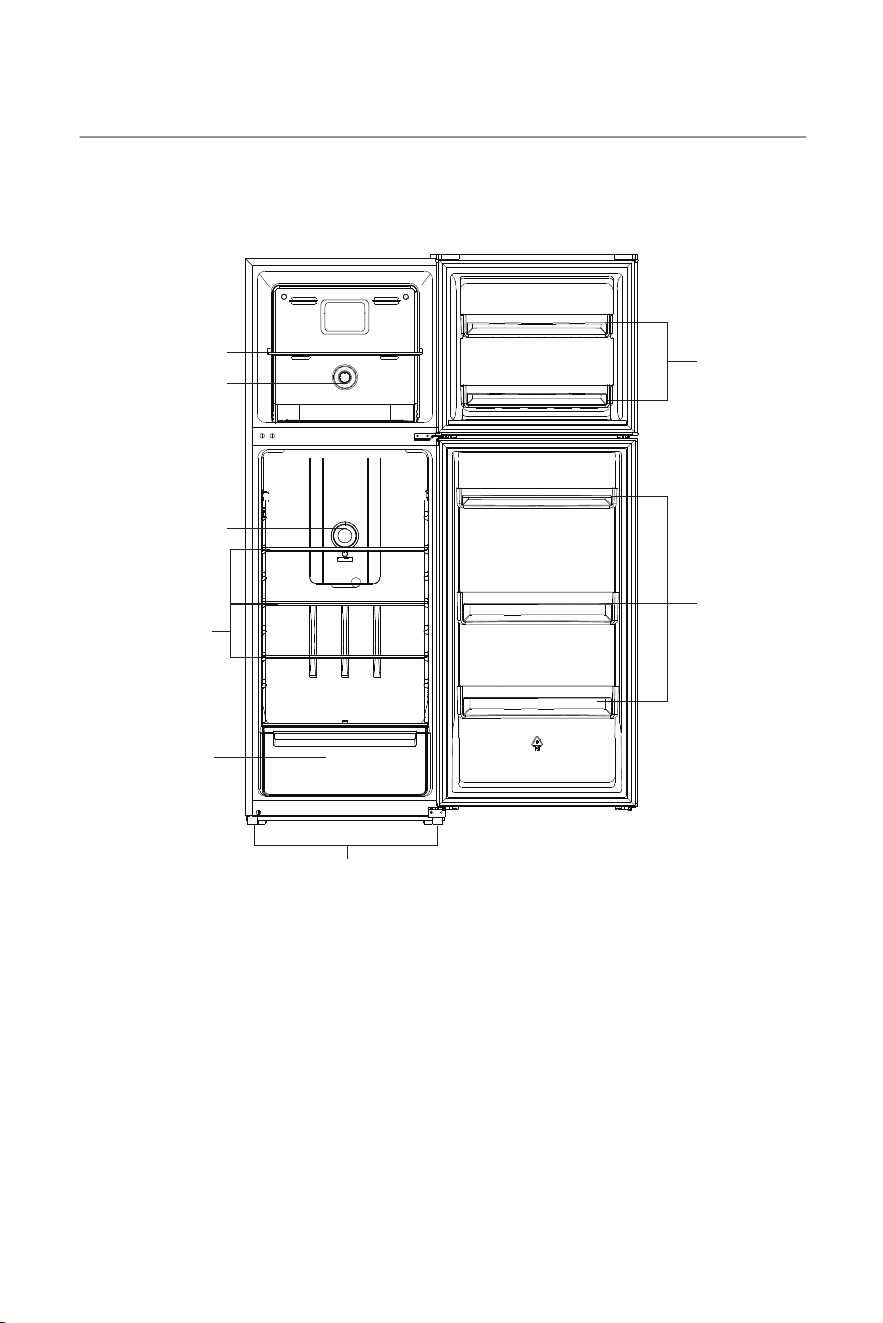
OVERVIEW
NOTE: The illustration in this manual are for reference only. Actual configuration will
depend on the physical product.
Shelves
Shelf
Crisper
Door Rack
Door Rack
Feet
Freezer
Temperature
Control Knob
Refrigerator
Temperature
Control Knob
5
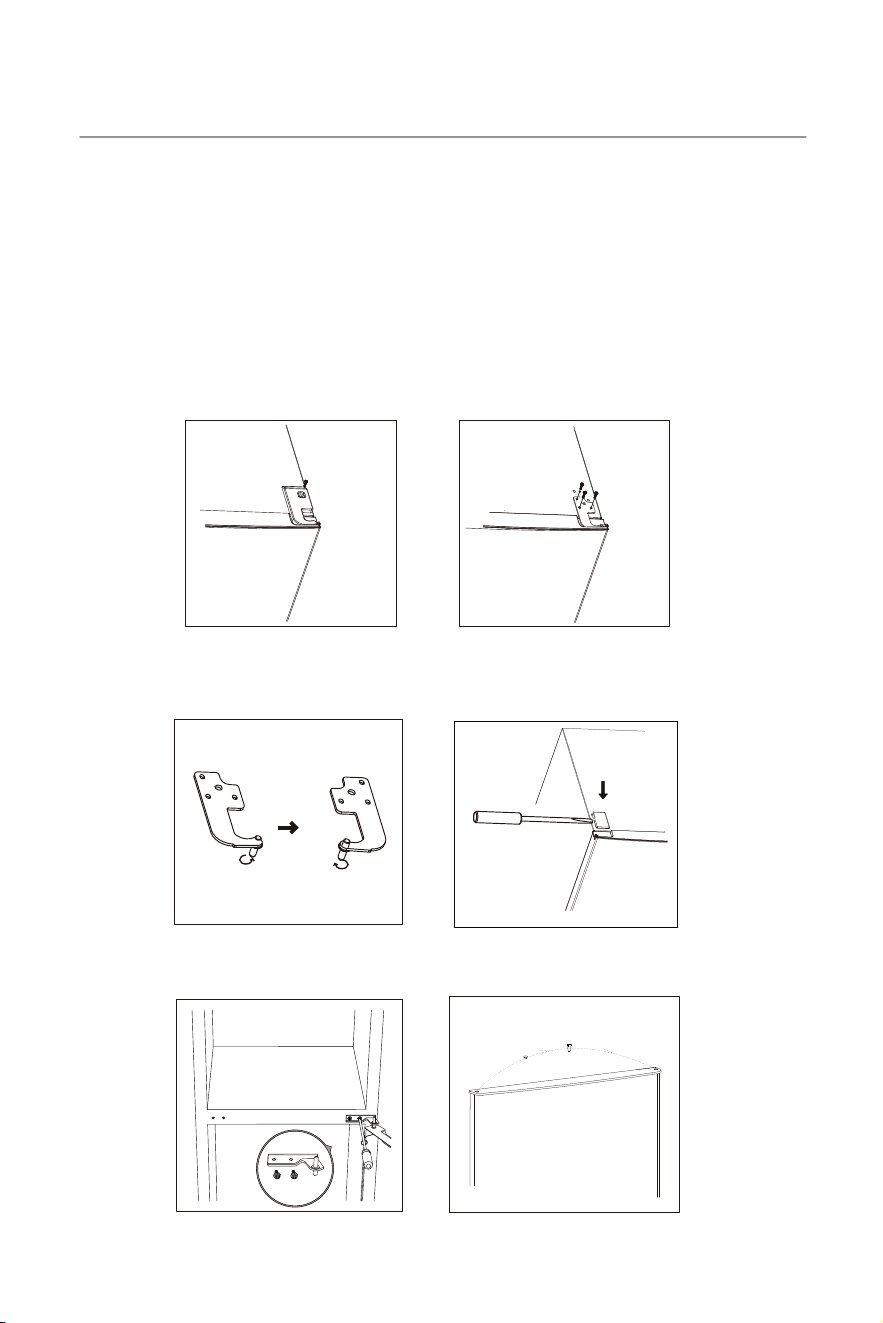
REVERSING THE DOOR
Tool required: Philips screwdriver, Flat bladed screw dirver, Hexagonal spanner.
• Ensure the unit is unplugged and empty.
• To take the door o, it is necessary tilt the unit backwards. You should rest the
unit on something solid so that it will not slip during the door reversing process.
• All parts removed must be saved to do the re-installation of the door.
• Do not lay the unit flat as this may damage the coolant system.
• It is better that 2 people handle the unit during assembly.
1. Unscrew top hinge cover and then unscrew the top hinge.
Then lift upper door and place it on a soft pad to avoid scratch and damange.
3. Unscrew and remove the top left
screw cover.
2. Remove the pin with a screw
driver and flip the hinge bracket.
Then refit the pin to hinge bracker.
4. Unscrew middle hinge.
5
.
M
ove shaft sleeve and pin hole plug
from left side to right side.
6
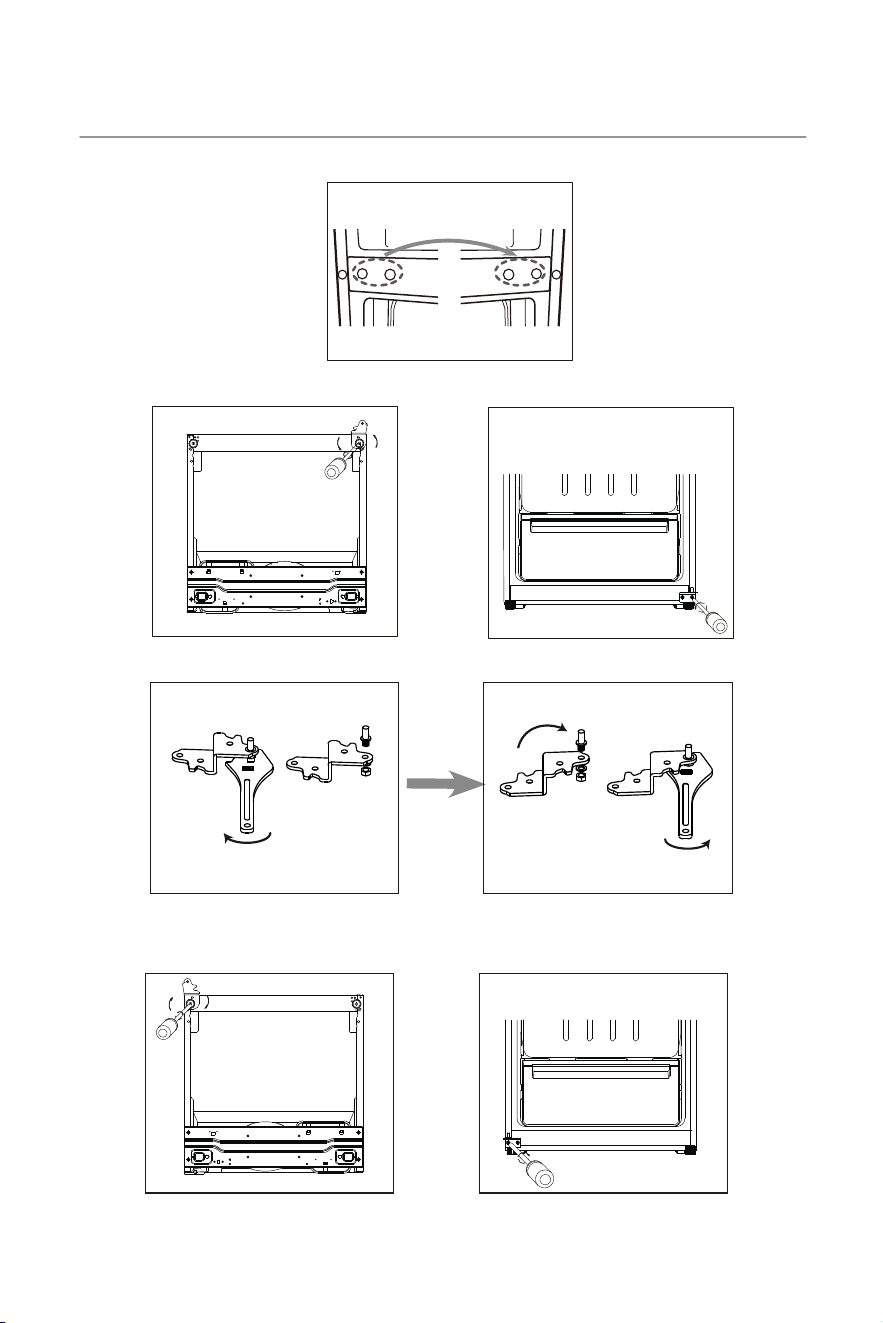
REVERSING THE DOOR
6.
M
ove the hinge hole covers from left side to right side.
7. Unscrew bottom hinge.
T
hen remove the adjustable feet from both side.
8. Unscrew and remove bottom hinge pin, turn bracket over, and replace it.
turn over
screw
unscrew
9. Refit the bracket fitting the bottom hinge pin. Replace both adjustable feet.
T
ransfer
the lower door to the proper position.
7
REVERSING THE DOOR
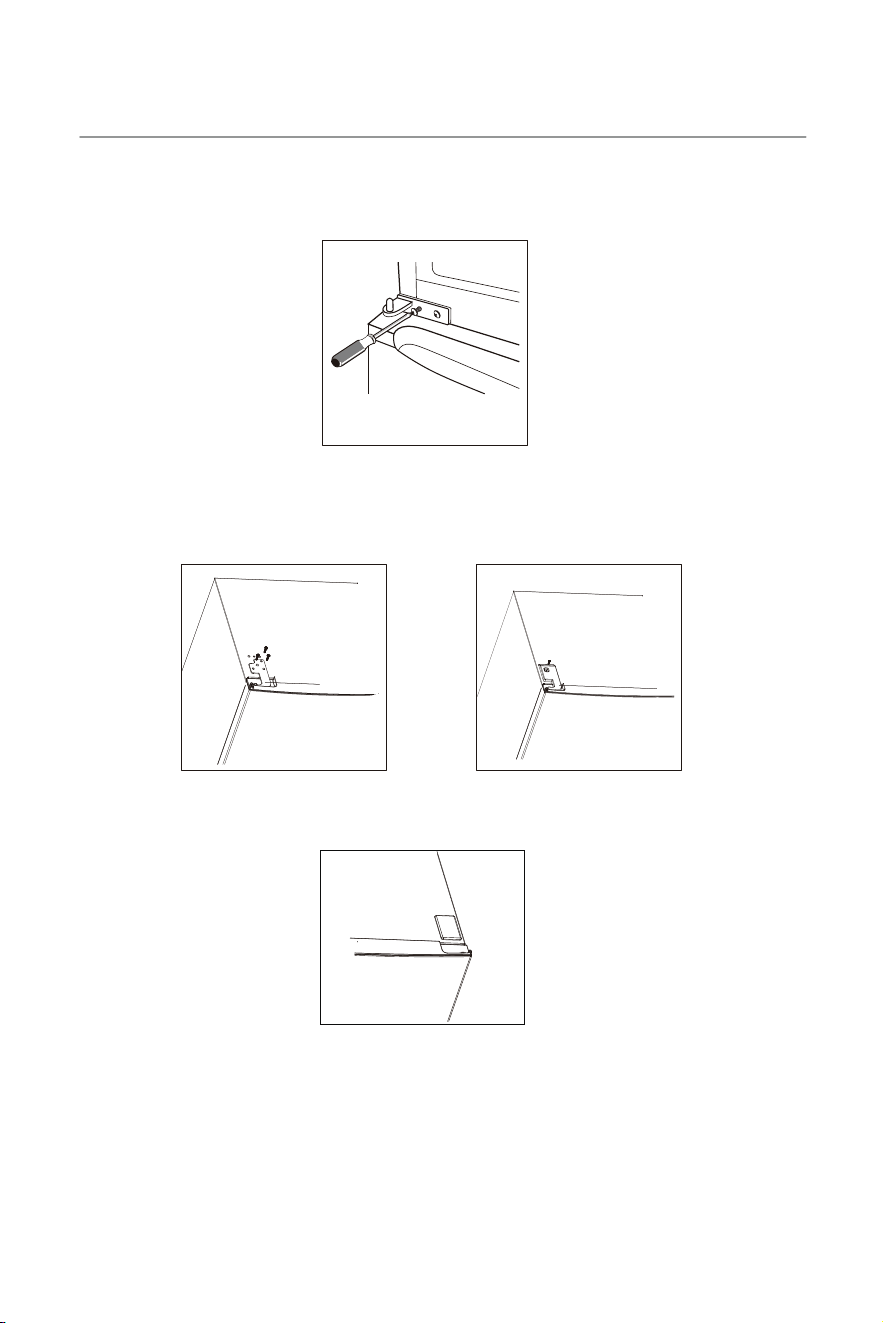
10
.
M
ake the middle hinge reverse the direction
1
8
0°
, then transfer it to the left
proper position.
M
ake the middle hinge pin in the upper hole of the lower door, then
tight the bolts.
11
. Place the upper door back on. Ensure the door is aligned horizontally vertically so
that the seal are closed on all sides before finally tightening the top hinge.
T
hen insert
the top hinge and screw it to the top of the unit and then fix hinge cover
by screw.
1
2. Fix the screw cover.
NOTE: The illustration in this manual are for reference only. Actual configuration will
depend on the physical product.
8
INSTALLATION INSTRUCTIONS
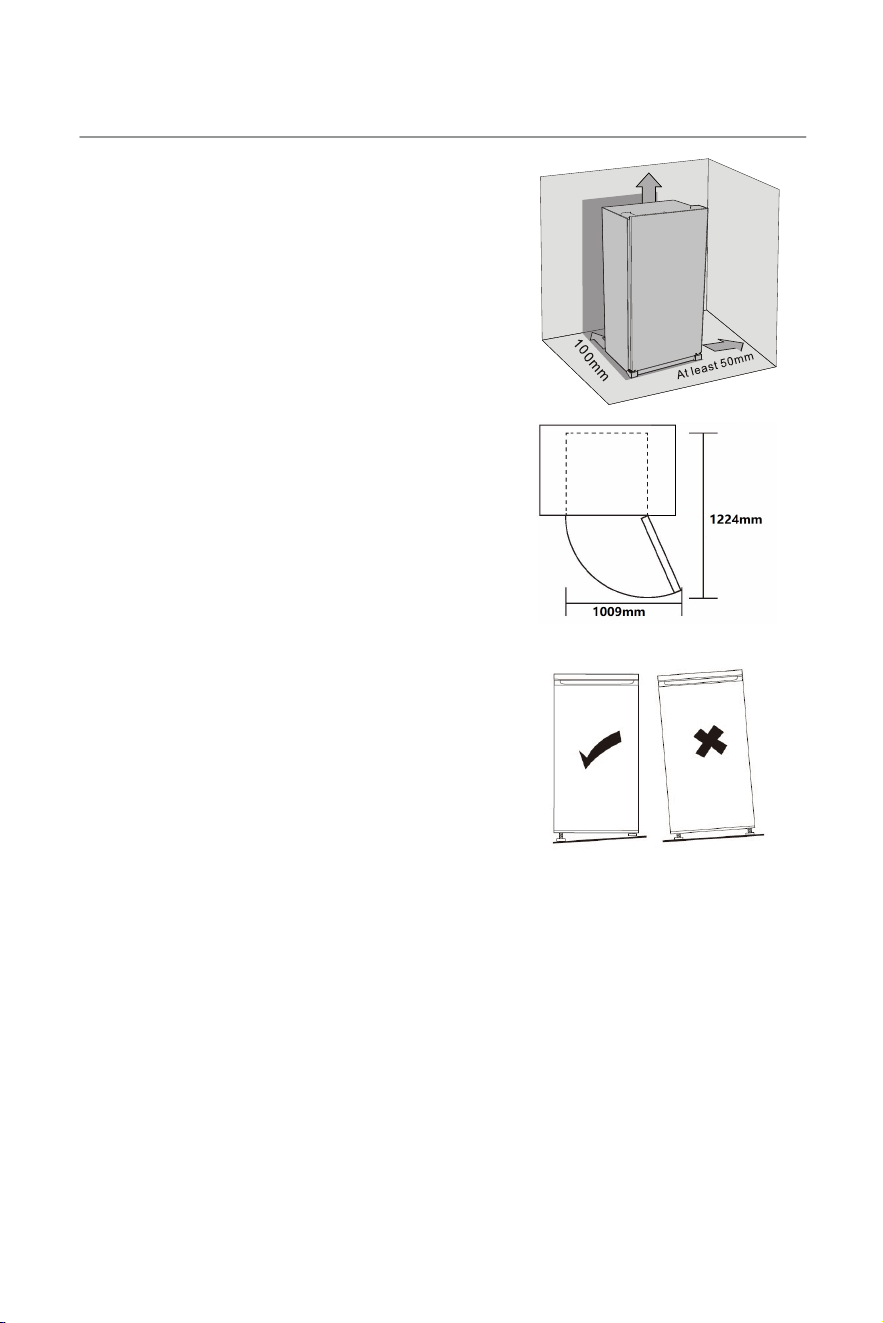
1. Before using the refrigerator r the first
time, remove all of the packing materials,
including the foam base and adhesive tape
holding accessories in place.
2. The refrigerator should be located on a firm,
flat suace that is strong enough to suppo
the refrigerator when it is fully loaded.
3. Choose a location that is not exposed to
direct sunlight, high temperatures, heat
sources such as a stove or radiator, or in a
moist area. Do not choose a location where
the temperature will change dramatically as
this could cause the refrigerator to not
function properly.
4. Leave a minimum of 50mm between each
side of the appliance and the wall. The top
of the appliance should have a minimum of
100mm clearance. This allows for proper air
circulation. This appliance is intended to be
free-standing and should not be built-in or
placed in a recessed area.
5. The refrigerator legs must be adjusted
during installation in order to function
properly. The leveling legs on the front
corners can be adjusted by turning clockwise
to raise the appliance, and counter-clockwise
to lower it. Be sure to have the appliance
slope slightly backward to ensure that the
door closes tightly.
0 It must be possible to disconnect the appliance from the power supply;
the plug must therefore be easily accessible aer installation.
Electrical Connection
Before plugging in, ensure that the voltage and frequency shown on the rating plate
correspond to your domestic power supply. The appliance must be earthed. The power
supply cable plug is provided with a contact for this purpose. If the domestic power
supply socket is not earthed, connect the appliance to a separate earth in compliance
with current regulations, consulting a qualified electrician. The manufacturer declines
all responsibility if the above safety precautions are not observed.
9
CONTRO
L
PANE
L
Free
z
er
C
ompartment Temperature Setting
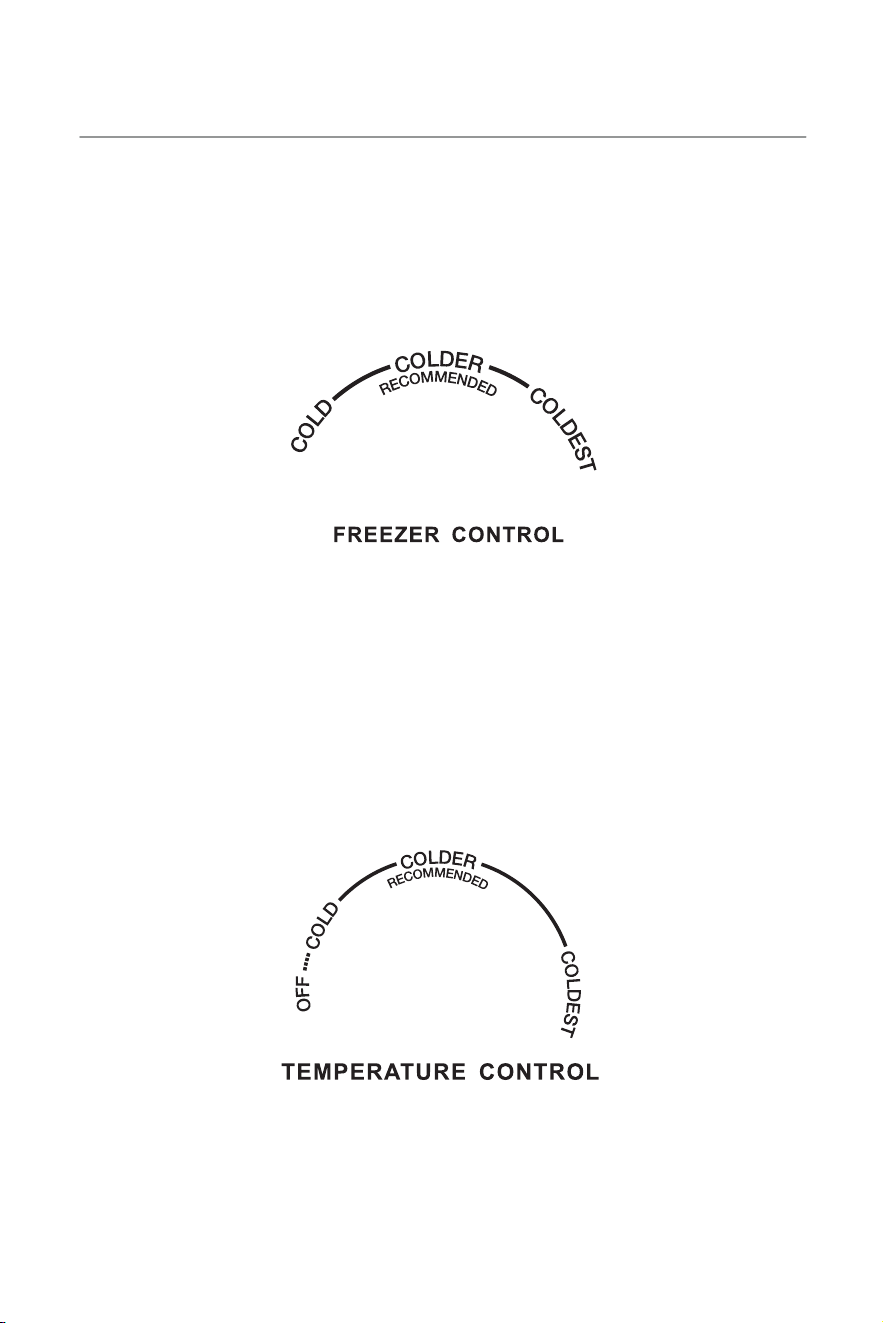
• The internal temperature is con
trolled by a sensor.
There are 3 settings MIN, NORMAL and MAX.
• MIN is warmest setting and MAX is coldest setting.
• The appliance may not operate at the correct
temperature if it is in a particularly hot area or if you
open the door frequently.
• The int
er
nal temperature is c
o
n
trolled by a se
nsor. There are 3 settings
C
OL
D
,
C
OL
D
ER
(
RE
C
OMMEN
D
E
D)
and
C
OL
D
EST.
•
C
OL
D
is warmest setting and
C
OL
D
EST is coldest setting.
• The appliance may not operate at the correct temperature if it is in a particularly hot
area or if you open the door frequently.
Refrigerator
C
ompartment Temperature Setting
• The internal temperature is c
ontrolled by a sensor. There are 4 settings
OFF,
C
OL
D
,
C
OL
D
ER
(
RE
C
OMMEN
D
E
D)
and
C
OL
D
EST.
•
C
OL
D
is warmest setting and
C
OL
D
EST is coldest setting and OFF turn the unit off.
N
either refrigerator or freezer compartment works when the setting is OFF.
• The appliance may not operate at the correct temperature if it is in a particularly hot
area or if you open the door frequently.
10
OPERATING INSTRUCTIONS
First Use
•
Before using the appliance for the first time, wash the interior and all internal
accessories with lukewarm water and some neutral soap so as to remove the typical
smell of a brand new product, then dry thoroughly.
Important!
Do not use detergents or abrasive powders, as these will damage the
finish.
•
When first starting up or after a period out of use, before putting the product in the
compartment let the appliance run for 2-3 hours, or for above 4 hours in summer
when the ambient temperature is high to make sure it is working properly and to allow
it time to fall to the correct temperature.
Freezer Compartment
•
The low temperature freezing compartment may keep food fresh for a longer period
and it is mainly used to store frozen foods and making ice.
•
Chunks of meat are preferably to be divided into small pieces for quick freezing and
easy access.
Refrigerating Compartment
• The refrigerating compartment is suitable for storage of a variety of fruits,
vegetables, beverages and other food consumed in the short term.
• Cooked foods shall not be put in the refrigerating compartment until cooled to room
temperature.
0 o
Do not overfilled the refrigerator or freezer.
o Do not use any electronic equipment inside the appliance.
o Do not store objects which are costly or subject to temperature variations.
e.g. medication or chemicals.
o Food should be kept in sealed packaging to avoid becoming dry or spoil.
o There should always be some space between items inside for air
circulation.
o
P
lease be noted food shall be consumed within the shelve time.
• The refrigerating compartment is suitable for
storage of a variety of fruits, vegetables, beverages
and other food consumed in the short term.
• Cooked foods shall not be put in the refrigerating
compartment until cooled to room temperature.
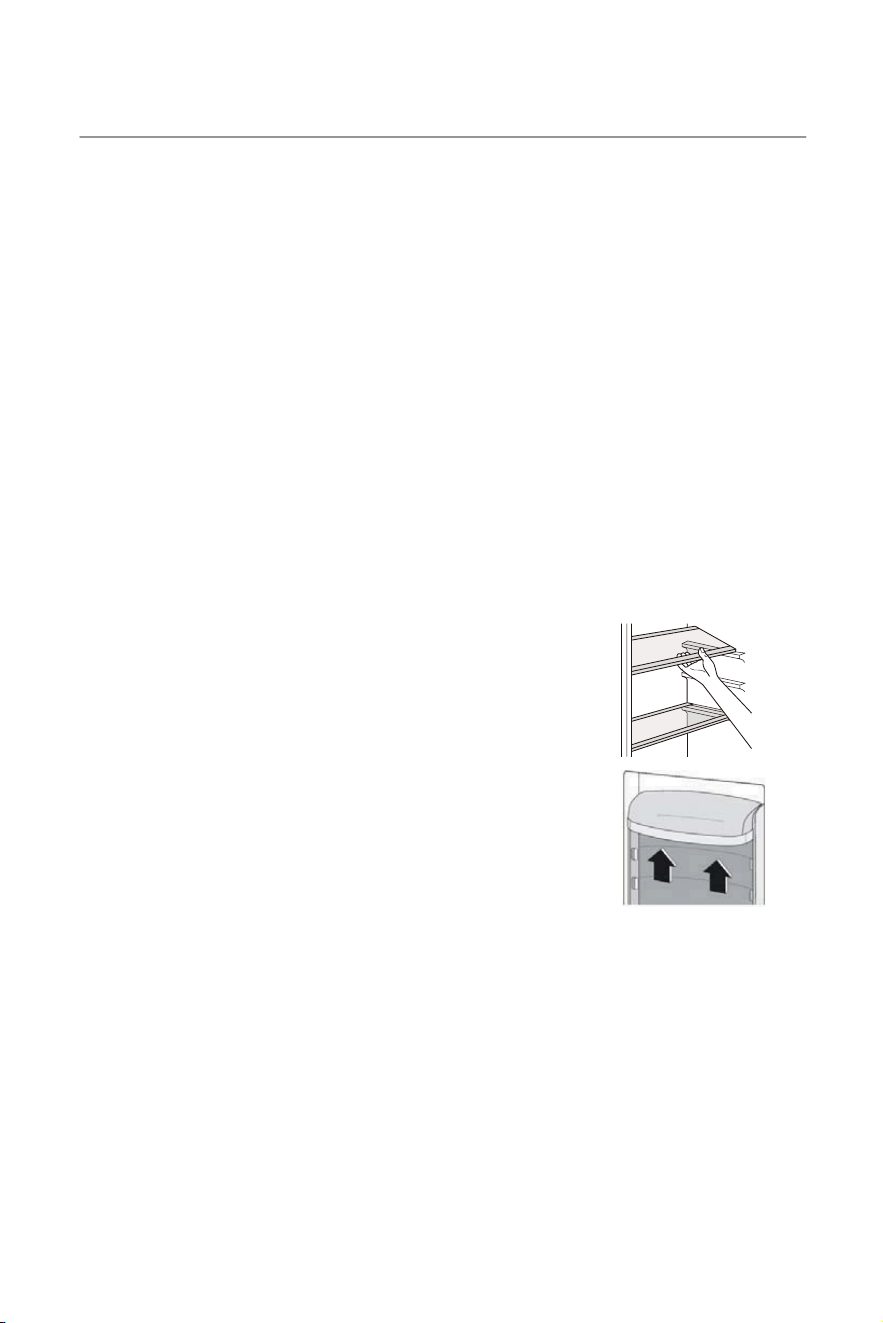
• The walls of the refrigerator are equipped with a
series of runners so that the glass shelves can be
positioned as desired.
• The door balconies can be placed at different
heights. To make these adjustments, gradually pull
the balcony upward until it comes free, then
reposition as desired.
11
MAINTENANCE AND CARE OF THE APPLIANCE
Defrosting
Cleaning
The refrigerator
/
freezer is made based on the air-cooling principle and thus has an
automatic defrosting function. Frost formed due to man-made or temperature
ch
anges can also be manually removed by disconnection of the appliance from the
power supply or by wiping with a dry towel.
• Dusts behind the refrigerator
/
freezer and on the ground shall be timely cleaned to
improve the cooling effect and energy saving.
• Check the door gasket regularly to make sure there are no debris. Clean the door
gasket with a so cloth dampened with soapy water or diluted detergent.
• The interior of the freezer should be cleaned regularly to avoid odor.
Please turn off the power before cleaning interior, remove all ods, shelves,
drawers, etc.
• Use a so cloth or sponge to clean the inside of the freezer, with two tablespoons of
baking soda and a quart of warm water. Then rinse with water and wipe clean. Aer
cleaning, open the door and let ii dry naturally bere turning on the power.
• For areas that are difficult to clean in the refrigerator
/
freezer (such as narrow gaps
or corners), ii is recommended to wipe them regularly with a so rag, so brush, etc.
and when necessary, combined with some auxiliary tools (such as thin sticks) to
ensure no contaminants or bacterial accumulation in these areas.
• Do not use soap, detergent, scrub powder, spray cleaner, etc., as these may cause
odors in the interior of the refrigerator or contaminated food.
• Clean the shelves and drawers with a so cloth dampened with soapy water or
diluted detergent. Dry with a so cloth or dry naturally.
• Wipe the outer suace of the refrigerator
/
freezer with a so cloth dampened with
soapy water, detergent, etc., and then wipe dry.
• Do not use hard brushes, clean steel balls, wire brushes, abrasives (such as
toothpastes), organic solvents (such as alcohol, acetone, banana oil, etc.), boiling
water, acid or alkaline items, which may damage the fridge suace and interior.
Boiling water and organic solvents such as benzene may deform or damage plastic
parts.
• Do not rinse directly with water or other liquids during cleaning to avoid short circuits
or aect electrical insulation aer immersion.
Energy Saving Tips
• The appliance should be located in the coolest area of the room, away from
heat producing appliances or heating ducts, and out of the direct sunlight.
• Let hot foods cool to room temperature before placing in the appliance. Overloading
the appliance forces the compressor to run longer. Foods that freeze too slowly
may lose quality, or spoil.
• Be sure to wrap foods properly, and wipe containers dry before placing them in the
appliance.
• Appliance storage bin should not be lined with aluminum foil, wax paper, or paper
toweling. Liners interfere with cold air circulation, making the appliance less efficient.
• Organize and label food to reduce door openings and extended searches. Remove
as many items as needed at one time, and close the door as soon as possible.
12
MAINTENANCE AND CARE OF THE APPLIANCE
Power Failure
When a power failure occurs, the refrigerator
/
freezer can normally store food for
several hours. Do not put additional food into the appliance during a power failure,
and do not operate door. Disconnect the plug from the outlet, and reconnect when the
power has been restored. Always inspect for, and discard, any spoiled or thawed food
in the refrigerator before resuming use of the appliance.
Vacation
Before leaving on any vacation, remove food that could spoil while you are gone. If
you plan to be gone for an extended period of time, we recommend that all of the food
should be removed from the appliance and it should be turned o and unplugged from
the outlet. Clean the interior according to the directions provided in the CLEANING
section of this manual, and leave the door open.
Moving the re
f
rigerator
/f
reezer
• Turn o the refrigerator
/
freezer and unplug from the outlet.
• Remove all food; securely tape down all loose items inside.
• Tape the door shut.
• When moving, the appliance cannot be tilted over 45 degrees as
possible damage to the sealed system could occur.
• Take care to avoid strong vibration or impact to the appliance.
13
TROUBLESHOOTING
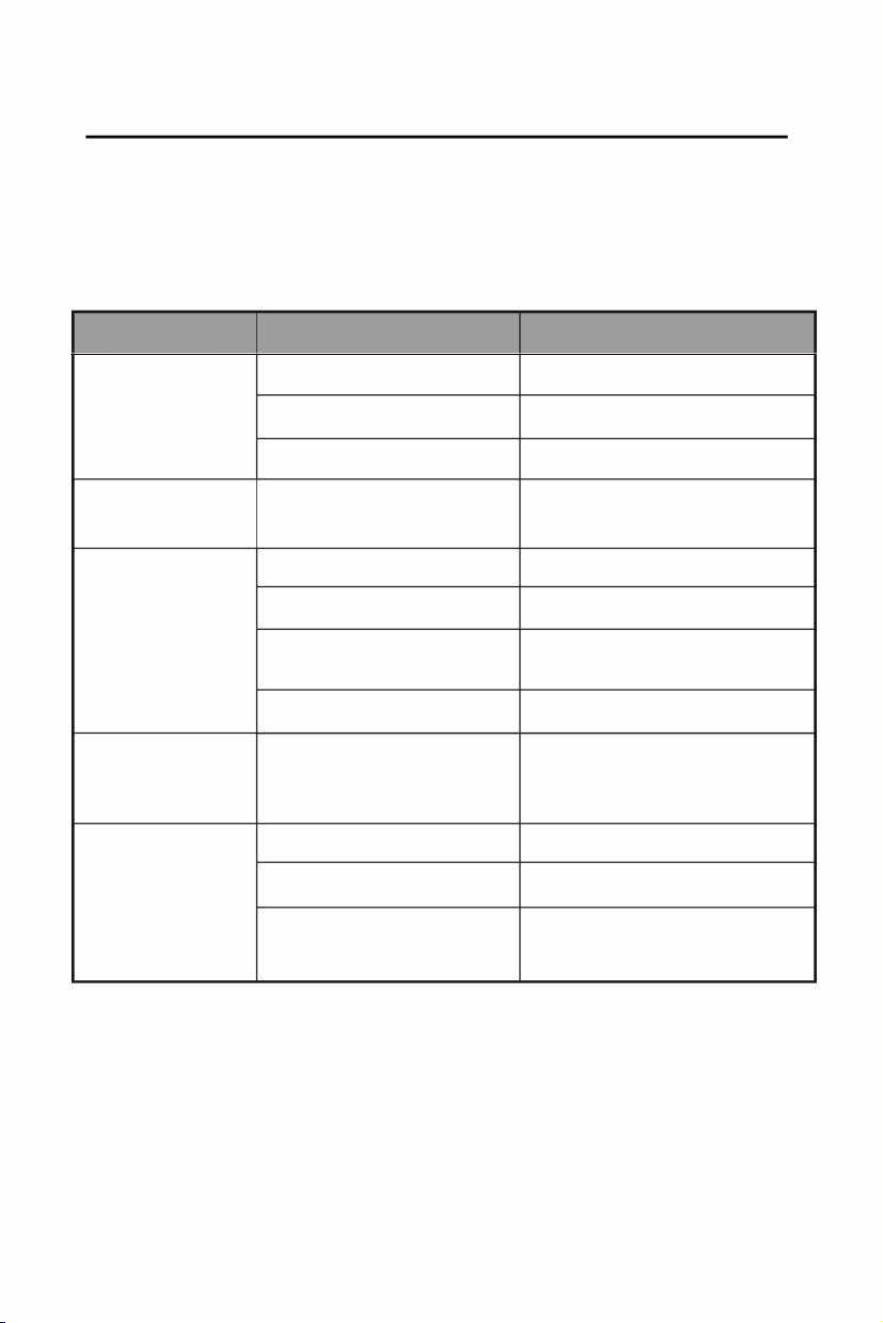
warning!
Appliance does not
work
Appliance
freezes or cools
too much
The food is not frozen
enough.
Heavy build-up of
frost on the door
seal.
Unusual noises
For your safety, unplug the appliance from the mains power source
Only an Authorised Seice Person can car out seicing or
repairs to this appliance. If you have a problem, and the problem
persists aer you have made the checks mentioned in this manual,
contact: TECO Australia's Seice on 1300 660 037 (8:30am - 4pm
Mon-Fri AEST
1
,
_-
-
.
. .
Mains plug is not plugged in
or is loose
Fuse has blown or is defective
Socket is defective
Temperature is set too cold
or the appliance runs at COLDEST
setting.
Temperature is not properly
adjusted.
Door was open for an extended
period.
A large quantity of warm food
was placed in the appliance
within the last 24 hours.
The appliance is near a
heat source.
Door seal is not air-tight.
Appliance is not level.
The appliance is touching the
wall or other objects.
A component, e.g. a pipe, on
the rear of the appliance is
touching another part of the
appliance or the wall.
t I 1 � t 1
Insert mains plug.
Check fuse, replace if necessary.
Mains malfunctions are to be
corrected by an electrician.
Turn the temperature regulator to a
warmer setting temporarily.
Please look in the initial Temperature
Setting section.
Open the door only as long as
necessary.
Turn the temperature regulation to
a colder setting temporarily.
Please look in the installation
location section.
Carefully warm the leaking sections of
the door seal with a hair dryer (on a cool
setting). At the same time shape the
warmed door seal by hand such that it
sits correctly.
Re-adjust the feet.
Move the appliance slightly.
If necessary, carefully bend the
component out of the way.
The following are normal conditions that can be encountered during the operation of
this appliance:
• The flow of refrigerant through the coils can cause a noise.
• The sides of the appliance may become warm as a result of the cooling function.
Problem Possible Cause Solution
14
REPAIRS, SERVICE & WARRANTY
It is hazardous r anyone installing, removing, altering, repairing, servicing,
testing or certifying the gas system of a gas device (i.e. charging, discharging or
breaking into the refrigeration system that uses hydrocarbon refrigerants).
Only an Authorised Service Person can carry out servicing or repairs to this
appliance. In Queensland the authorised person must hold a Gas Work
Authorisation r hydrocarbon refrigerants, bere carrying out servicing or
repairs which involve the removal of covers.
IF SERVICE IS REQUIRED
If you have a problem, and the problem persists aer you have made the
checks mentioned in this manual, contact:
TECO Australia's Service on 1300 660 037 (8:30am - 4pm Mon-Fri AEST).
For warranty details please visit
www.teco.com.au
Service Email : [email protected]
Spare Parts : [email protected]
15
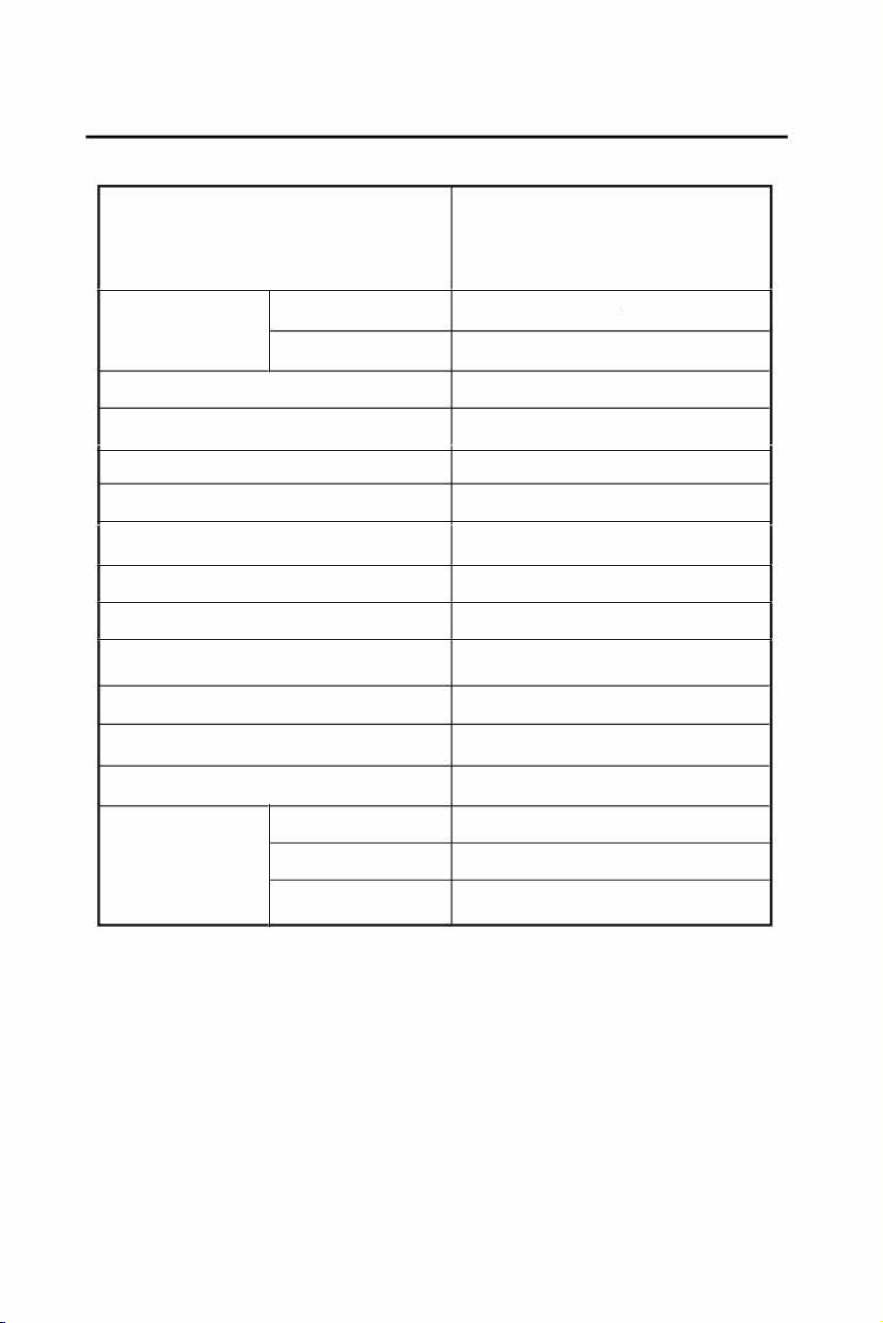
SPECIFICATIONS
TFF334WNTAH
TFF334SNTAH
Model Number
Refrigerator
Storage
Volume (L)
77
220 -
240
Total Storage Volume (L)
Voltage (V)
50
150W
Frequency (Hz)
Rated Defrost Power (W)
Rated Current (A)
1.3
Refrigerant
R600a
Climate class
T
5T
I
IPX0
Group
Electric Shock Protection Type
Ingress Protection Rating
Net Weight (kg)
57
Width
600
Dimension
Depth
665
(mm)
Height
1700
E&OE
NOTE: This product is subject to continuous improvement,
specifications are subject to change without prior notice.
This product was tested in accordance with Electrical safety
of electrical appliances AS/NZS 60335, Energy consumption
and performance AS/NZS 4474.1 and Energy labeling and
minimum energy performance AS/NZS 4474.2.
257
Freezer
334
16

Did you know?
TECO Australia's product range also includes:
♦ Top Load Clothes Washers
♦ Front Load Clothes Washers
♦ Auto Sensing Vented Clothes Dryers
♦ Heat Pump Clothes Dryer
♦ Refrigerators
♦ Chest and Vertical Freezers
♦ Bar Fridges
♦ Televisions
♦ Air Curtains
♦ Air Conditioners
Visit www.teco.com.au for our full range.
TECO
WARRANTY INFORMATION
Teco's warranty inrmation r the product purchased is available at w.teco.com.au.
A copy of the warrantymay also be obtainedbycontacting Teco's Warrantyand Service
Department on 1300 660 037 during business hours (Mon- Fri 8.30am - 4pm AEST).
To arrange r servicing of a Teco product, please contact ourWarrantyand Service
Departmenton 1300 660 037 during business hours (Mon- Fri 8.30am - 4pmAEST).
To assist in processing any warranty claim that you may have Teco recommends thatyou:
1.
Complete the llowing inrmationin relation to your purchase:
Name of retailer:
Name of owner:
Date of purchase:
Model No. :
Serial No. :
MFG code:
2.
Retain proof of your purchase r any warranty claim. Ideally this proof of
purchase will be the tax invoice issued r your purchase.
3.
Complete the llong inrmationin relation to the person that installed your Teco
appliance (ifapplicable):
Installer's name:
Telephone No.:
Licence No.:
TECO
.teco.com.au
L
CD-V
1
E&OE
CK TEU-D01