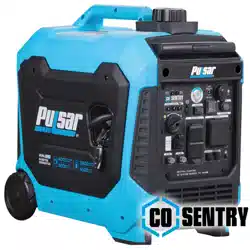
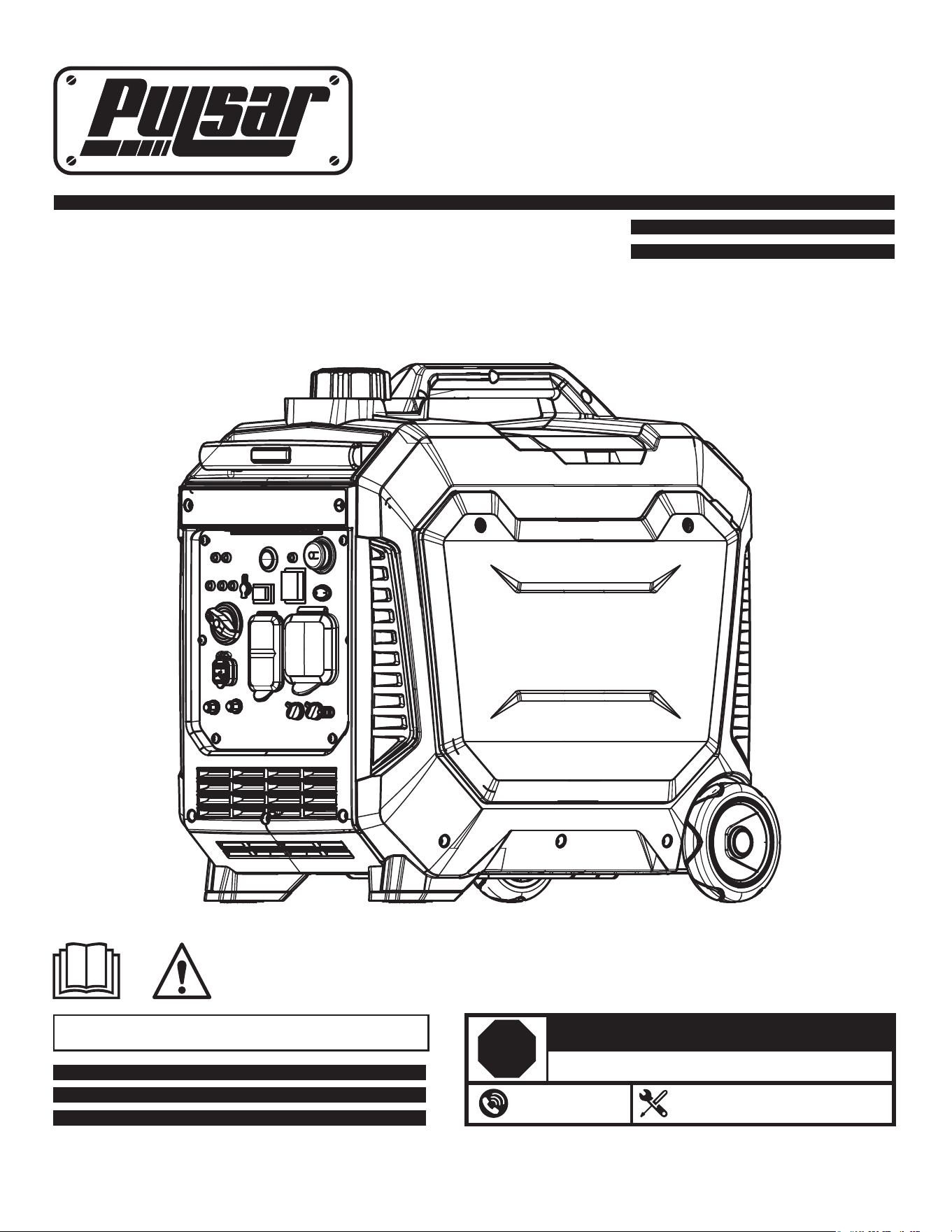
Model: PG5000BiSRCO
5000 Watt Dual Fuel Inverter Generator
OPERATOR’S MANUAL
Warning: The Engine Exhaust from this product contains chemicals known to
the State of California to cause cancer, birth defects or other reproductive harm.
support@pulsar-products.com
866-591-8921
STOP
DO NOT RETURN TO STORE!
HAVE QUESTIONS OR NEED SERVICE?
R
1
Table of Contents
Introduction
Safety Warnings and Notices
Thank you for choosing Pulsar Products!
This manual provides instruction on how to operate and use your
generator safely and correctly; be sure to read and understand
this manual before using your generator. If you have ANY questions,
please phone 866.591.8921 M-F or [email protected]
BEFORE using your generator.
All details and images in this Manual are believed to be
accurate at the time of publication.
Pulsar Products reserves the right to make updates to this manual
at any time.
Please contact Pulsar Support at 866.591.8921 or
[email protected] for the latest updates.
This manual is a permanent part of the generator set. If the
generator is resold, kindly include this manual with the generator.
WARNING: Save This Manual For Future
Reference
This manual contains important information regarding the safety,
operation, maintenance, and storage of this product. Before use,
read carefully and understand all cautions, warnings, instructions,
and product labels. Failure to do so could result in serious personal
injury and/or property damage.
The words DANGER, WARNING, CAUTION, and NOTICE are used
throughout this manual to highlight important information. Make
sure that the meaning of this safety information is known to all
who operate, perform maintenance on, or are near the generator.
This safety alert symbol appears with most safety
statements. It means to pay attention and be alert, your safety is
involved! Please read and abide by the message that follows the
safety alerts symbol.
Safety Symbols
Follow all safety information contained in this manual and on the
generator.
DANGER indicates an imminently hazardous situation which,
if not avoided, will result in death or serious injury.
WARNING indicates a potentially hazardous situation which,
if not avoided, could result in death or serious injury.
CAUTION indicates a potentially hazardous situation which,
if not avoided, may result in minor or moderate injury. It
may also be used to alert against unsafe practices.
Failure to follow the instruction may result in the damage
to your generator and other property.
Safety Warnings........................1
Safety Instructions ......................2
CO Sentry.............................4
Names of Components...................5
Control Panel ..........................6
Specifications . . .......................7
Preparation............................8
Adding Engine Oil.......................8
Connecting LPG Tank....... ............9
Battery..............................10
Operation............................12
Maintenance ........................ 16
Troubleshooting.......................20
DANGER
WARNING
CAUTION
NOTICE
Safety Definitions
2
Safety Instructions
Before operating your generator, you must read and
understand the manual and familiarize yourself with the safe
operation practices.
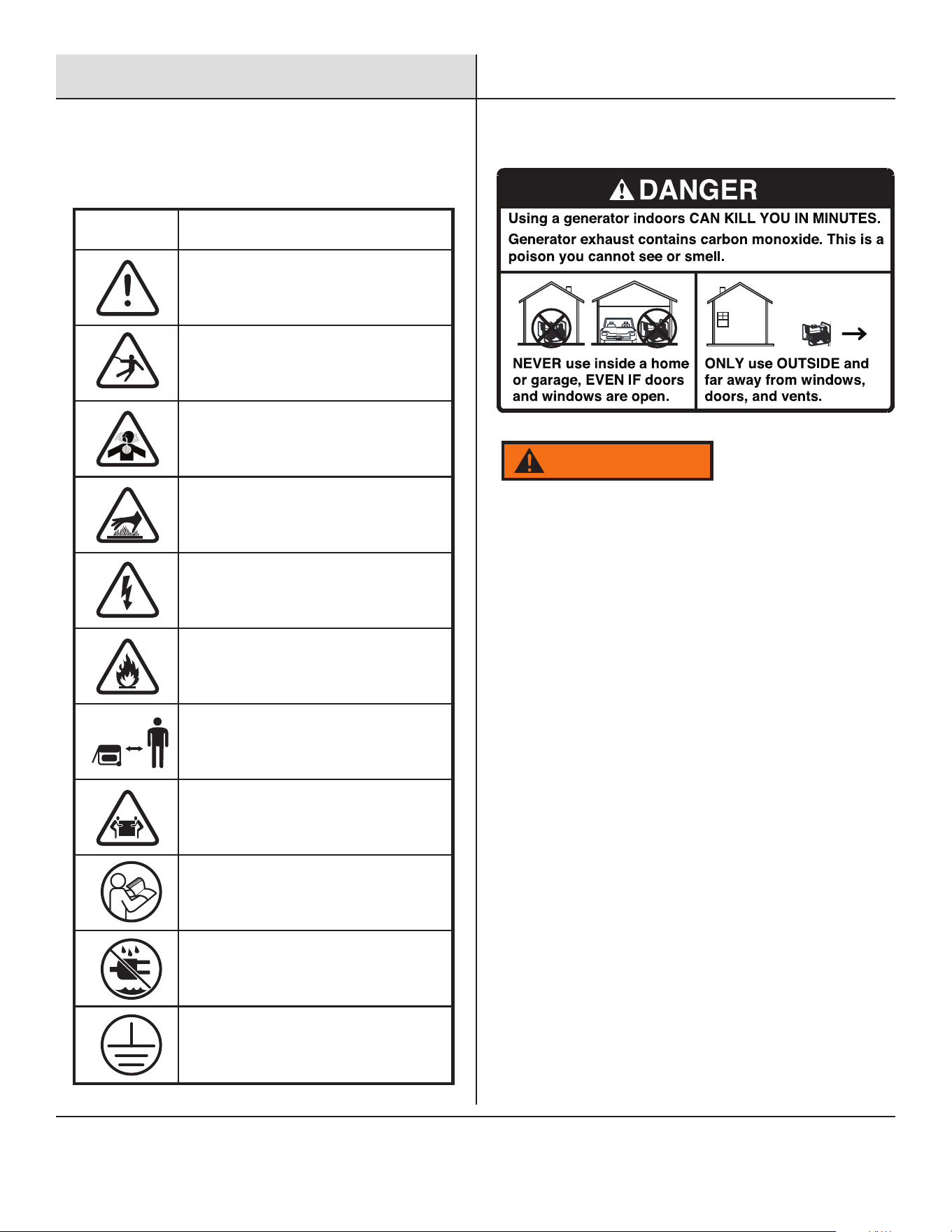
Operate this product ONLY outside far away from windows, doors,
and vents to reduce the risk of carbon monoxide gas from
accumulating and potentially being drawn towards occupied spaces.
Install battery-operated carbon monoxide alarms or plug-in carbon
monoxide alarms with battery backup according to the
manufacturer's instructions. Most smoke alarms cannot detect
carbon monoxide gas.
DO NOT run this product inside homes, garages, basements,
crawlspaces, sheds, or other partially enclosed spaces even if using
fans or opening doors and windows for ventilation. Carbon monoxide
can quickly build up in these spaces and can linger for hours, even
after this product has shut off.
ALWAYS place this product downwind and point the engine exhaust
away from occupied spaces. If you start to feel sick, dizzy, or weak
while using this product, shut it off and get to fresh air
IMMEDIATELY - then see a doctor; you may have carbon monoxide
poisoning.
Safety Alert Symbol
4 FEET
SYMBOL DESCRIPTION
Ground. Consult with electrician to
determine grounding requirements before
Electrocution Hazard
Asphyxiation Hazard
Burn Hazard. DO NOT touch hot surfaces.
Electrical Shock Hazard
Fire Hazard
Maintain Safe Distance
Lifting Hazard
Read Manufacturer’s Instructions
DO NOT Operate in Wet Conditions
Safety Precautions
POISONOUS GAS HAZARD: Engine exhaust contains carbon
monoxide, a poisonous gas that could kill you in minutes. You
CAN NOT smell it, see it, or taste it. Even if you do not smell
exhaust fumes, you could still be exposed to carbon monoxide
gas.
WARNING
3
Safety Instructions
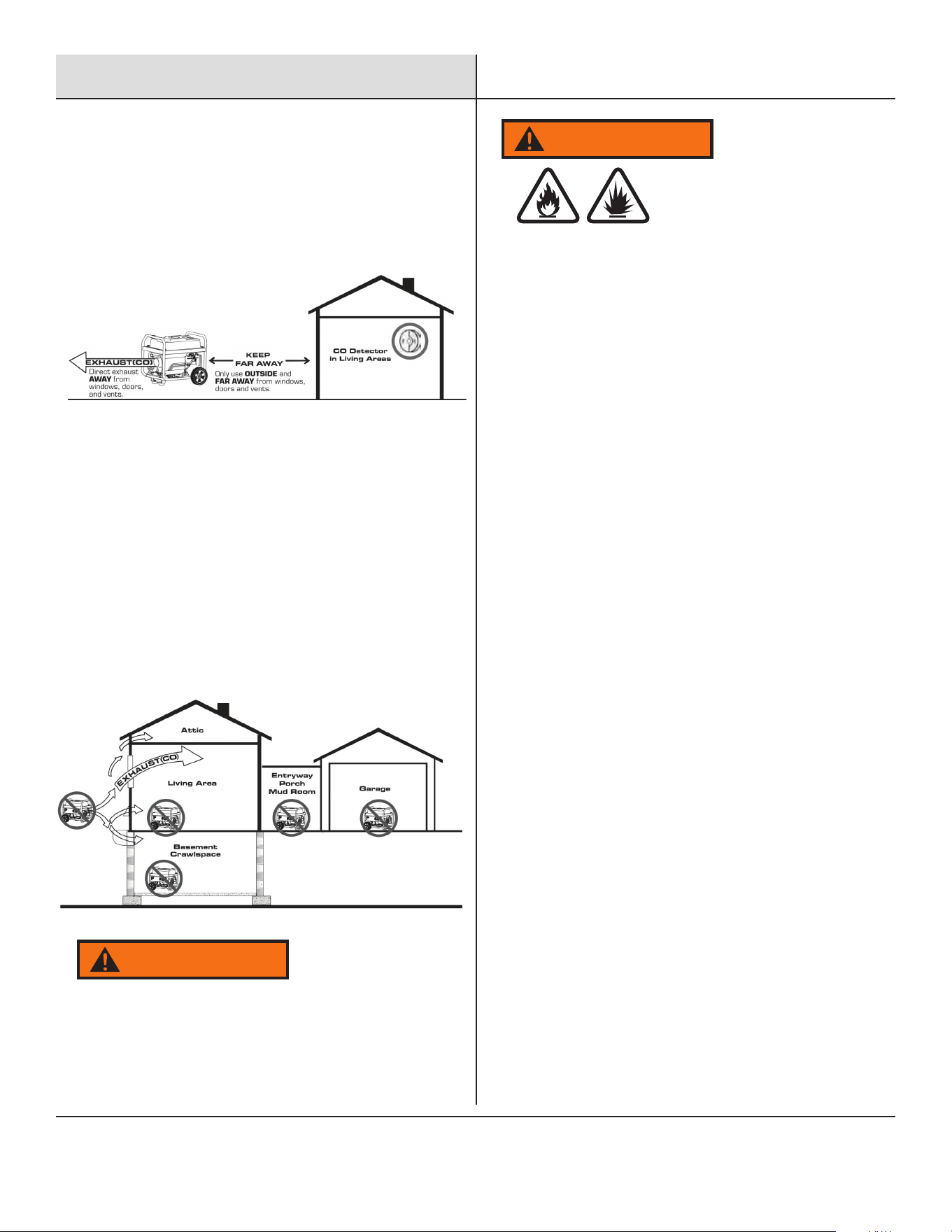
Correct Usage
Example location to reduce risk of carbon monoxide poisoning
• ONLY use outside and downwind, far away from windows,
doors, and vents.
• Direct exhaust away from occupied spaces.
Incorrect Usage
Do not operate in any of the following locations:
• Near any door, window, or vent
• Garage
• Basement
• Crawl Space
• Living Area
• Attic
• Entry Way
• Porch
• Mud Room
When Adding Or Draining Gasoline
Turn the generator engine OFF and let it cool for at least 2 minutes
before removing the fuel cap. Loosen the cap slowly to relieve
pressure in the tank.
• Fill or drain fuel tank outdoors.
• DO NOT overfill the tank. Allow space for fuel expansion.
• If fuel spills, wipe it up and let the area dry before starting the
engine.
• Keep fuel away from sparks, open flames, heat, and other ignition
sources.
• Check fuel lines, tank, cap, and fittings frequently for cracks or
leaks; replace if necessary.
• DO NOT light a cigarette or smoke anything.
When Starting Equipment
• Ensure spark plug, muffler, fuel cap, and air cleaner are in place.
• DO NOT crank engine with spark plug removed.
When Operating Equipment
• DO NOT operate this product inside any building, carport, porch,
mobile enclosure, marine applications, or shed.
• DO NOT tip engine or equipment at an angle that causes fuel
to spill.
• DO NOT stop the engine by moving the choke control the to
“Start" position.
• DO NOT exceed the generator's wattage capacity.
• Start the generator and the let engine stabilize before connecting
electrical loads.
• Connect electrical loads in the OFF position, then turn ON for
operation.
• Turn electrical loads OFF and disconnect from the generator before
stopping the generator.
Fuel and its vapors are extremely flammable and explosive which
could cause burns, fire, or explosion resulting in death or serious
injury and/or property damage.
WARNING
Starter cord kickback (rapid retraction) could pull hand and
arm toward the engine faster than you can let go which
could cause broken bones, fractures, bruises, sprains, or
other serious injuries.
WARNING
4
Safety Instructions
Improper treatment of the generator could damage it and
shorten its life.
• Use generator only for intended applications.
• If you have questions about intended use, ask a dealer or
contact your local Pulsar service center.
• Operate generator only on solid, level surfaces.
• DO NOT expose the generator to excessive moisture, dust,
dirt, or corrosive vapors.
• DO NOT insert any objects through cooling slots.
• If connected devices overheat, turn them off and disconnect
them from the generator.
Shut off the generator if:
• Electrical output is lost.
• Equipment sparks, smokes, or emits flames.
• Unit vibrates excessively.
Parallel Kit Precautions
Carbon Monoxide Safety
Carbon Monoxide
Generators are very convenient, but they can also be very
dangerous. All fuel-burning appliances and equipment release
a poisonous gas called carbon monoxide. Carbon monoxide
(also known as CO) can be dangerous for humans and pets,
even in small amounts, because it blocks oxygen from getting
into your body. Carbon monoxide poisoning can lead to death in
a very short time. It is odorless, tasteless and invisible, so you
may be exposed without knowing it. That is why carbon
monoxide is sometimes called “the silent killer.”
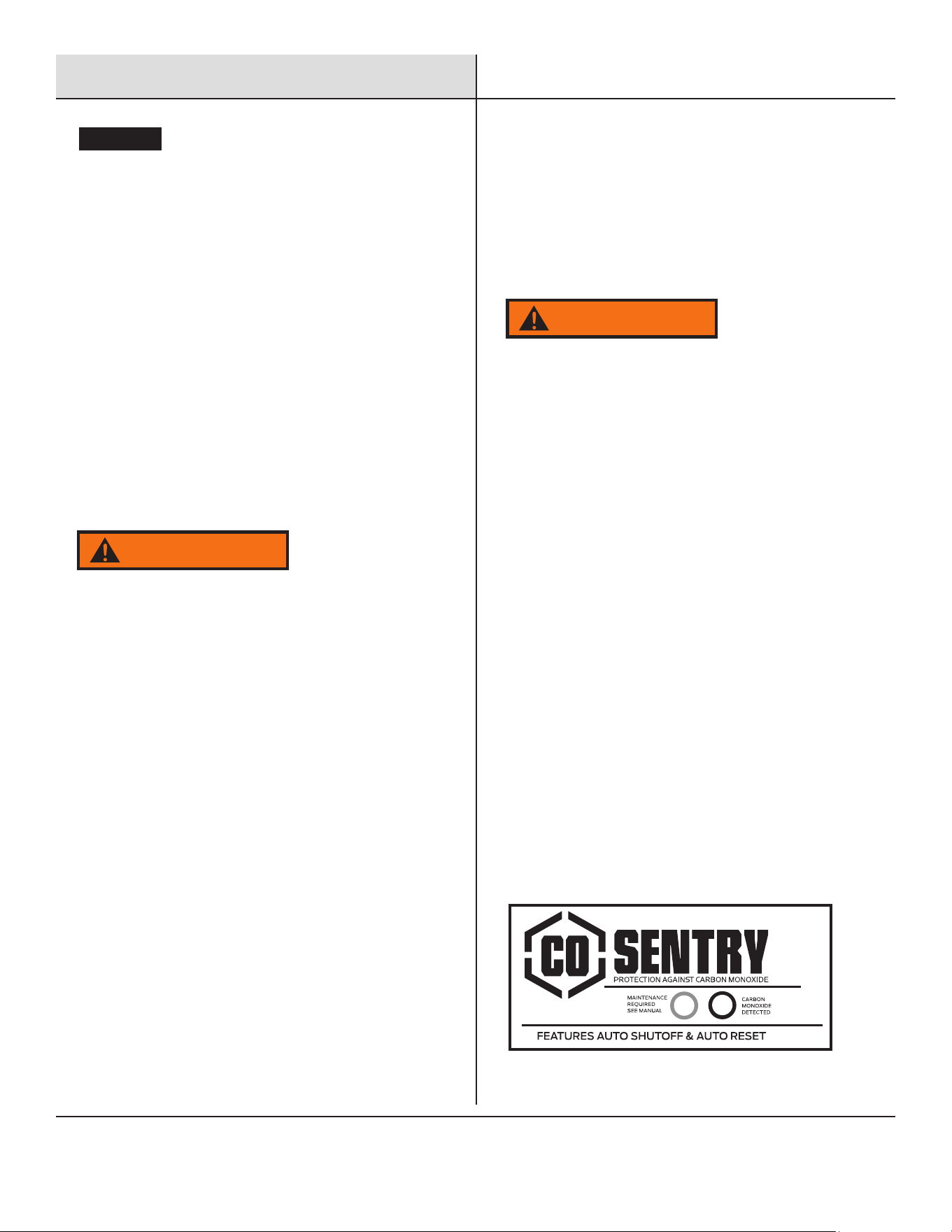
CO Sentry
The CO Sentry system was created to protect from dangerous
carbon monoxide. Just like the detector for your home the CO Sentry
tests the air for dangerous levels of carbon monoxide. If dangerous
levels of carbon monoxide are detected this generator will
automatically shut off.
CO Sentry Indicator Lights
RED
Carbon monoxide has accumulated around the generator. After
shut off, the RED indicator light in the CO Sentry area of the control
panel will flash to provide notification that the generator was shut off
due to an accumulating CO hazard. The RED light will flash for at least
five minutes after a CO shut off. Move the generator to an open,
outdoor area far away from occupied spaces with exhaust pointed
away. Once relocated to a safe area, the generator can be restarted.
Introduce fresh air and ventilate the area where the generator had
shut down.
YELLOW
A CO Sentry system fault occurred. When a system fault occurs, the
generator is automatically shut down and the YELLOW indicator light
in the CO auto shut off area of the control panel will flash to provide
notification that a fault has occurred. The YELLOW light will flash for
at least five minutes after a fault. The generator can be re-started,
but may continue to shut off.
To prevent serious injury, death, and generator and/or
equipment damage from electric shock and fire:
1. Follow Parallel Kit instructions provided with it for
connection and use of a Parallel Kit.
2. Only connect two identical Inverter Generators together
using a Parallel Kit.
3. Connect Parallel Kit only to terminals marked “Parallel”
on the front of the Generator.
4. Do not remove or connect a Parallel Kit while the
Generator is running.
5. Do not use a Parallel Kit that is attached to only one
Generator.
WARNING
WARNING
NOTE
Automatic shut off accompanied with a flashing RED light in the
CO Sentry portion of the control panel is an indication that the
generator was improperly located. If you start to feel sick, dizzy,
weak, or carbon monoxide detectors in your home indicate
an alarm, get to fresh air immediately. Call emergency services.
You may have carbon monoxide poisoning.
5
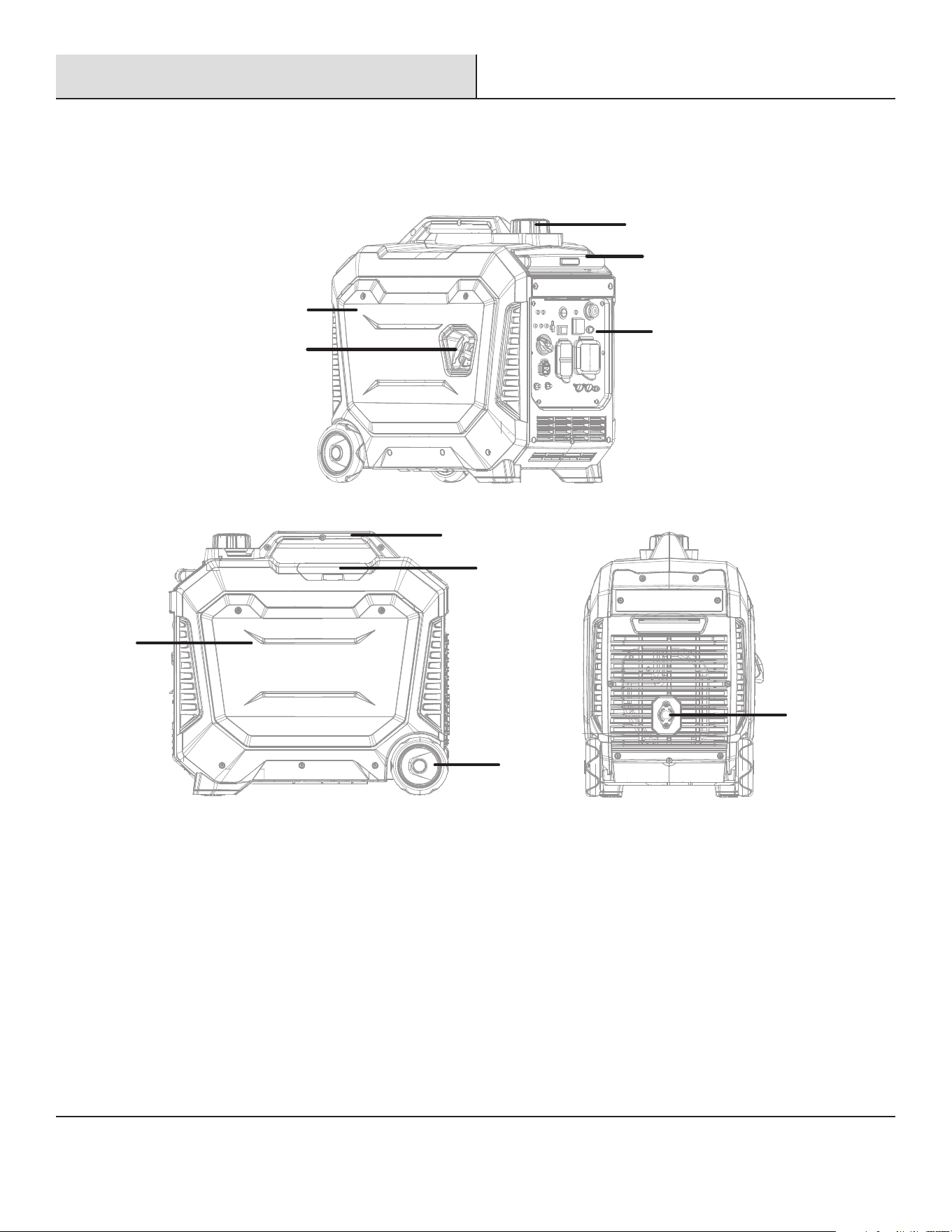
Components
Before operating your generator, you must read and
understand the manual and familiarize yourself with the safe
operation practices.
1
4
9
7
6
5
8
2
10
3
1. Fuel Cap: Add unleaded fuel here.
2. Right Side Panel: Engine, air filter, carburetor, oil stick, and
drain plug, can be found after removing the right side panel.
3. Transport Wheels: Wheels allow one-handed maneuverability
when used with the extendable handle.
4. Extendable Handle: Extend and retract the handle by
pushing the locking button.
5. Carry Handles: Helps transport the generator.
6. Recoil Handle: Pull the recoil handle to manually start the
engine.
7. Control Panel: The control panel contains the outlets and
operational controls.
8. Spark Plug Cover: Spark plug can be maintained after removing
this cover.
9. Left Side Panel: Battery and quick connection plug can be
accessed by removing this panel.
10. Muffler and Spark Arrestor: The spark arrestor prevents sparks
from exiting the muffler.
6
Control Panel
5
1
2
3
6
7
11
8
9
10
13
14
15
1617
18
19
4
12
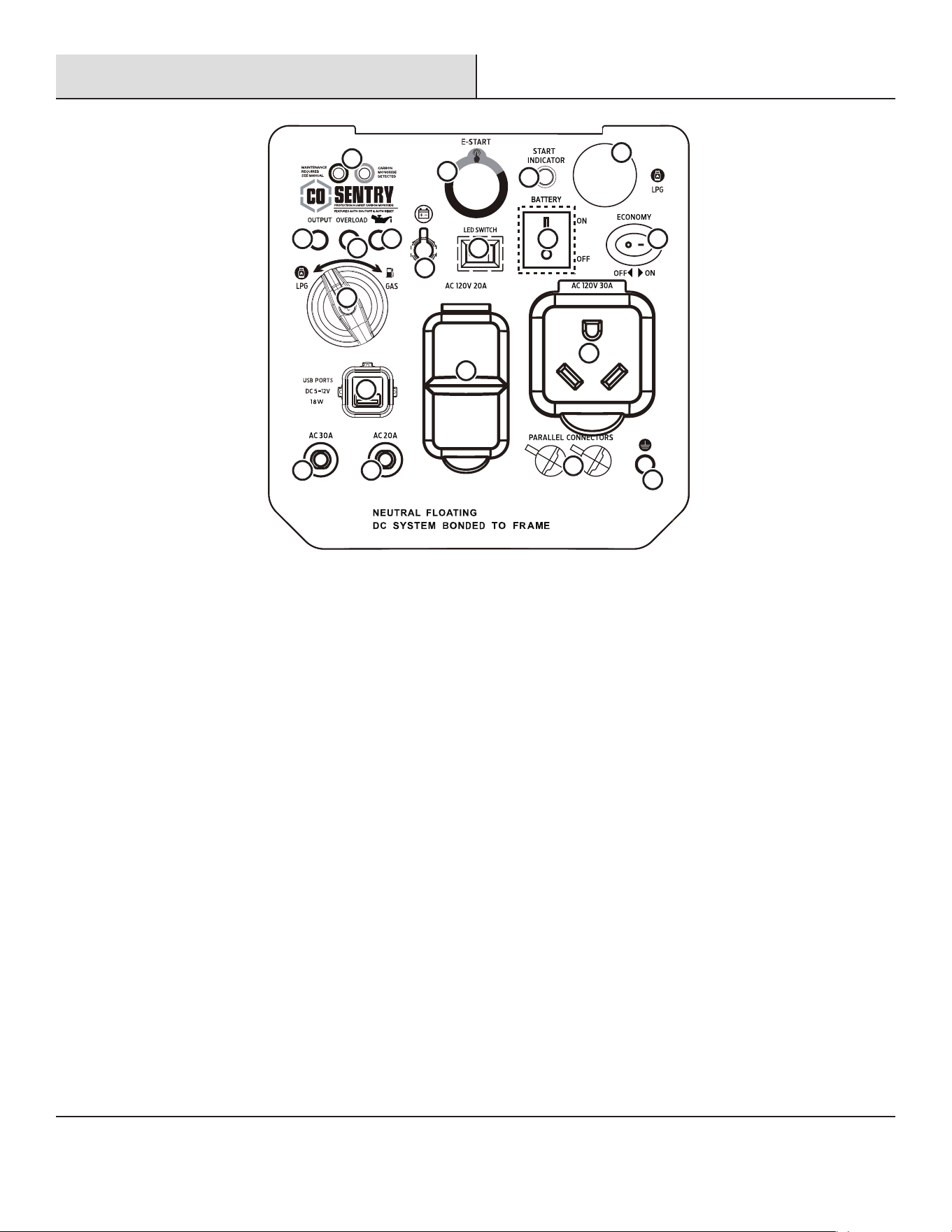
1. 120 Volt AC, 20 Amp Duplex NEMA 5-20R Receptacle: The
receptacle can supply a maximum of 20 Amps.
2. Ground Terminal: The ground terminal is used to externally
ground the generator.
3. Parallel Connectors: A compatible Pulsar Inverter Generator
can be connected for additional power output.
4. LED Switch: Light the panel up when the LED Switch is turned
on.
5. USB Ports: USB Type A 5V/3.6A, 9V/2.5A,12V/2A and USB
Type C.
6. Low Oil LED: Indicates low oil level. When the oil level in the
crankcase falls below the safe operating limit, the low oil level
indicator will illuminate and the generator will automatically shut
off the engine.
7. Overload LED: Indicates that the generator is overloaded.
8. Output Ready LED: Illuminates when the generator
is operating normally. Indicates the generator is producing power.
9. Fuel Selector Switch: Used to select gas or propane
10. LPG/Propane Inlet: Connect the LPG/propane hose (included)
to this inlet.
11. Battery Charging Port: Used to charge the battery with the
included battery charger.
12. Start Indicator:Indicates the generator is running.
13. Eco Mode: Eco mode minimizes fuel consumption and noise
by adjusting the engine RPM to the minimum required for the
current load.
14. Push Button Start/Stop: Push once to automatically start the
engine. Push again to stop the engine.
15. Battery Switch: Turns battery ON and OFF. Must be ON before
electric start or remote start.
16. 20 Amp AC Circuit Breaker: Circuit breaker limits the current
that can be delivered through the NEMA 5-20R receptacle
to 20 Amps.
17. 30 Amp AC Circuit Breaker: This circuit breaker limits
the current that can be delivered through the NEMA TT-30
receptacle to 30 Amps.
18. 120 Volt AC, 30 Amp NEMA TT-30R Receptacle: This
receptacle can supply a maximum of 30 Amps.
19. CO Sentry Indicator Lights: The CO Sentry monitors the
accumulation of poisonous carbon monoxide gas. If increasing
levels of CO gas are detected, the CO Sentry automatically shuts
down the engine.
7
Specifications
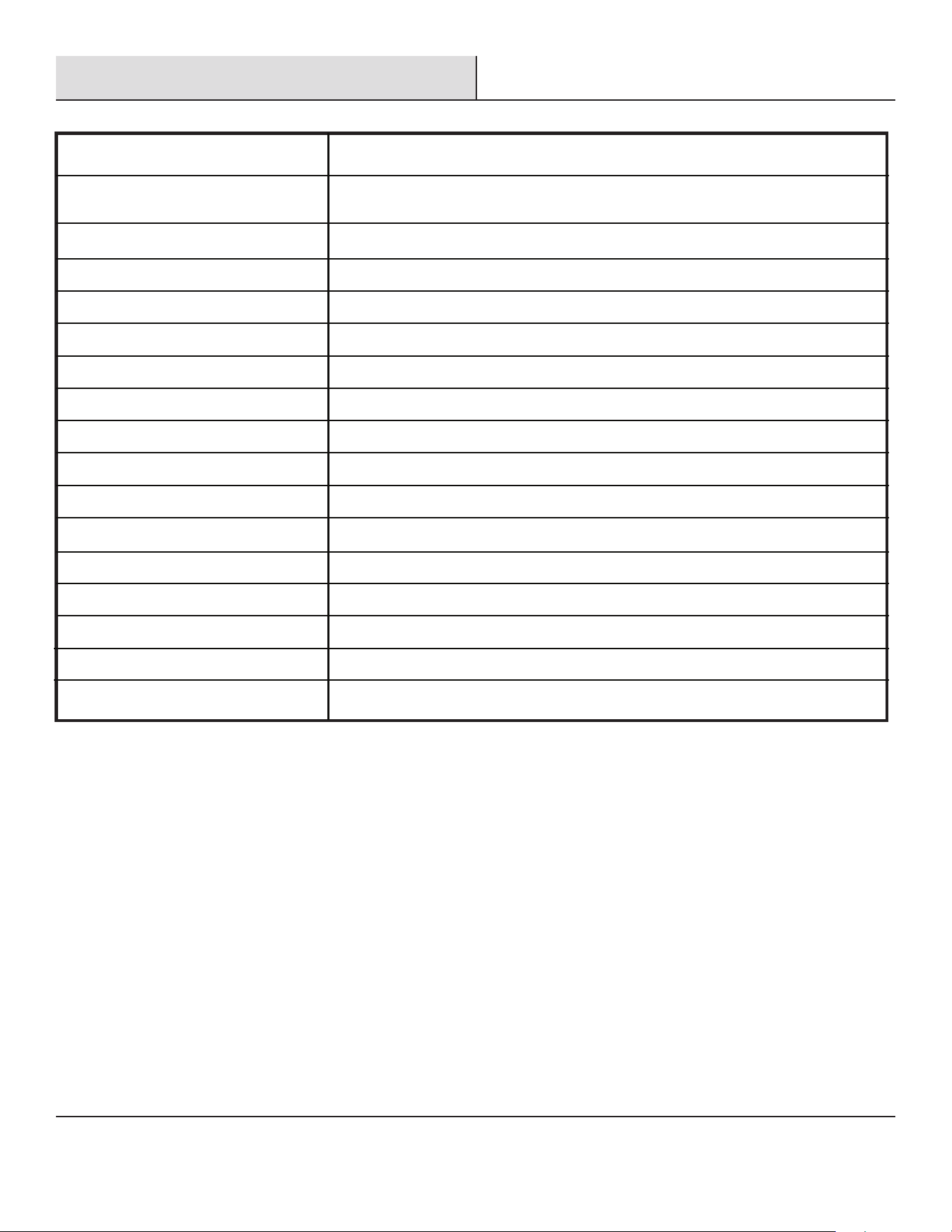
Model
Engine Type
Displacement
Rated Power (kW) Gasoline
Peak Power (kW) Gasoline
Rated Power (kW) LPG/Propane
Peak Power (kW) LPG/Propane
Rated Voltage
Rated Frequency
Phase
Starting Type
Fuel Type:
Fuel Capacity:
Total Harmonic Distortion:
Oil Type:
Oil Capacity
Maximum Ambient Temperature
PG5000BiSRCO
Single Cylinder, Four Stroke, Air Cooled
Gasoline Engine
192cc
4
5.0
3.6
4.5
120V
60Hz
Single Phase
Recoil, Electric Start, and Remote
87–93 Octane (Regular Unleaded)
3 Gallons
≤ 3%
10W 30
0.6L (20.2oz)
104°F (40° C)
8
Preparation
Preperation
Your generator requires some assembly. This unit ships from our
factory without oil; it must be properly filled with oil before
operation.
Unpacking
1. Set the shipping carton on a solid, flat surface.
2. Remove everything from the carton except the generator.
3. Using the carrying handles of the unit, carefully remove the
generator from the box (two people lifting is recommended).
Add Engine Oil
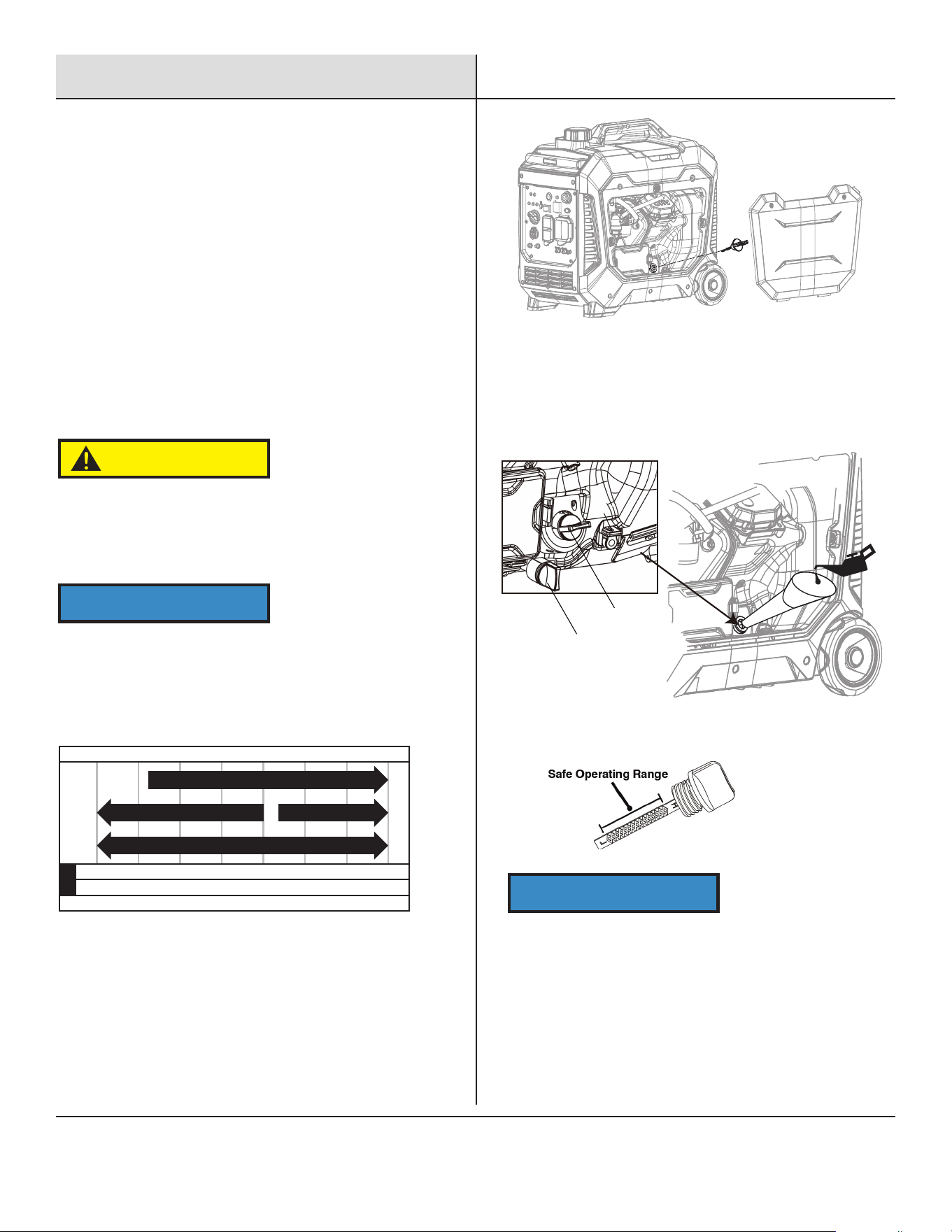
If running the generator in extreme temperatures, refer to the
following chart for recommended oil type.
1. Place the generator on a solid, flat, level surface.
2. On the Right side of the generator, loosen the screws and
remove the maintenance cover.
3. Remove oil fill cap/dipstick to add oil.
4. Using a funnel, as needed, add the appropriate type of oil until
the oil level is at the proper level. SAE 10W-30 oil is
recommended for general use. DO NOT OVERFILL. Replace oil
fill cap/dipstick and secure maintenance cover.
5. Check engine oil level daily and add as needed.
DO NOT attempt to crank or start the engine before it has
been properly filled with the recommended type and amount
of oil. Damage to the generator because of failing to follow
these instructions will void your warranty.
CAUTION
Failure to follow the instruction may result in the damage
to your generator and other property.
NOTICE
Once the oil has been added, a visual check should show oil
about 1-2 threads from running out of the fill hole. When
using the dipstick to check the oil level, DO NOT screw in
the dipstick while checking.
NOTICE
-20 0 20 40 60 80 100 120
-28.9
°F
°C -17.8 -6.7 4.4 15.6 26.7 37.8 48.9
10W-30
5W-30 Full Synthetic
10W-405W-30
Recommended Engine Oil Type
Ambient temperature
Note: As residual oil from the factory may remain in the engine,
add the oil incrementally near the end of the bottle to prevent
overfilling the engine.
Oil Fill & Dipstick
Oil drainage plug
9
Preparation
1. Make sure the generator is on a solid, flat, level surface.
2. Unscrew the fuel cap and set it aside.
3. Slowly add gasoline to the fuel tank. Be careful not to overfill.
The fuel gauge on the top of the fuel tank indicates how much
gasoline is in the generator fuel tank.
• To ensure that the generator runs smoothly use only FRESH,
UNLEADED GASOLINE WITH AN OCTANE RATING OF 87 OR HIGHER.
• Never use an oil/gasoline mixture. Never use old gasoline.
• Avoid getting dirt or water in the gasoline tank.
• Gasoline can age in the tank and make it hard to start the generator
in the future.
• Never store generator for extended periods of time with gasoline in
the tank.
4. Replace the fuel cap and wipe up any spilled gasoline with a
dry cloth then remove the cloth from the area.
This engine is equipped with a low oil shut-off and will stop
when the oil level in the crankcase falls below a critical level.
CAUTION
Check oil level often during the break-in period. Refer to the
Maintenance section for recommended service intervals.
NOTICE
The first 5 hours of run time are the break-in period for the
generator . During the break-in period stay at or below 50% of
the running watt rating and vary the load occasionally to allow
stator windings to heat and cool. Adjusting the load will also
cause the engine speed to vary slightly and help seat the piston
rings. After the 5-hour break-in period, change the oil.
NOTICE
Synthetic oil may be used after the 5-hour initial break-in
period. Using synthetic oil does not increase the
recommended oil change interval. Full synthetic 5W-30 oil
will aid in starting in cold ambient < 41° F (5° C)
temperatures.
NOTICE
TO PREVENT SERIOUS INJURY FROM FIRE:
Fill the gasoline tank in a well-ventilated area away from ignition
sources. If the engine is hot from use, shut the engine off and wait
for it to cool before adding gasoline. Do not smoke.
WARNING
Add Gasoline
Do not overfill the gasoline the tank. Overfilling can result in a fire,
explosion,or death.
Gasoline can expand. Do not fill the gasoline tank to the top. Leave a
minimum of 1.5 inches open space. Gasoline fumes are highly
flammable. Do not fill the tank near an open flame. Always
check for gasoline spills.
DANGER
WARNING
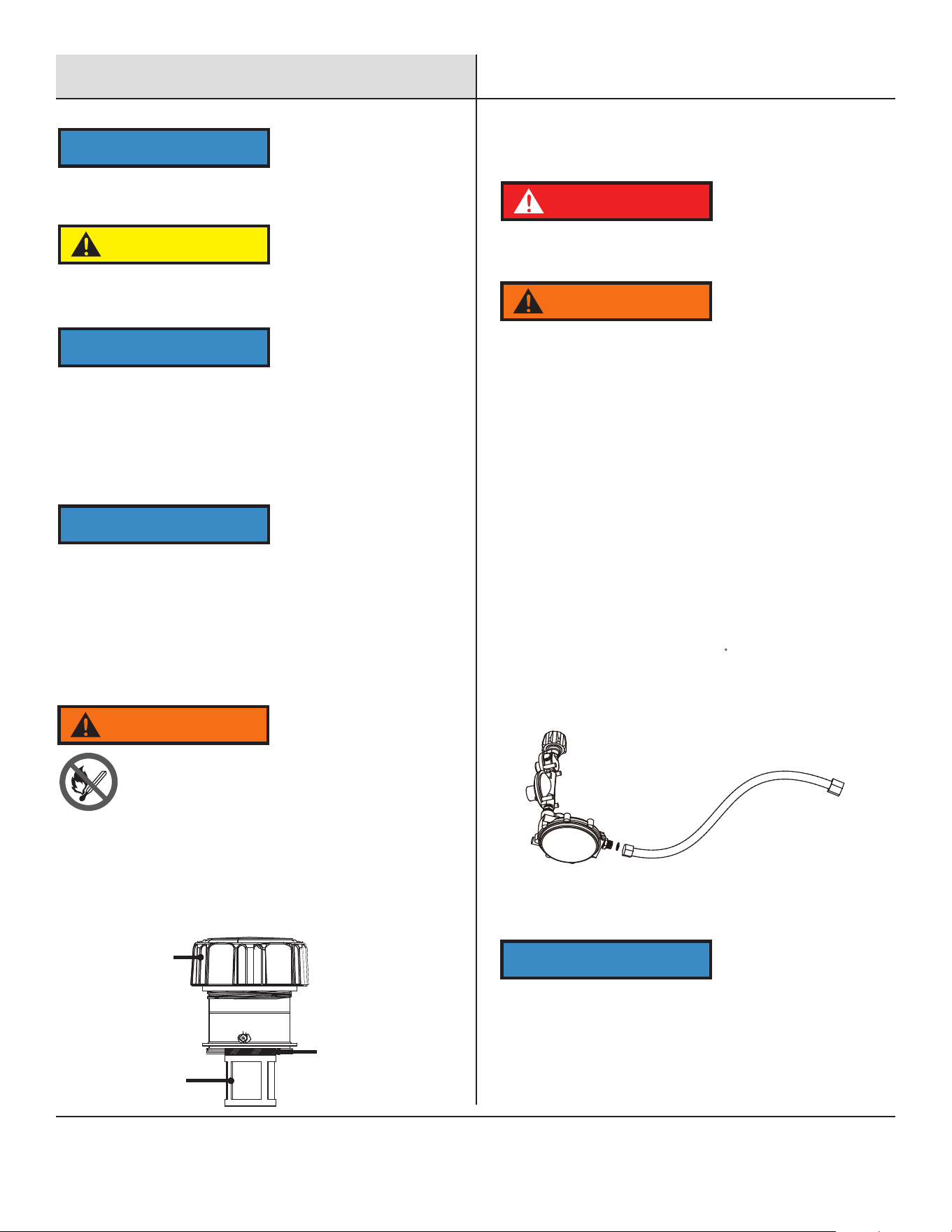
Fuel Cap
Maximum
Screen
Fuel Level
Filter
• Propane tanks that use liquid withdrawal system can not be
used on these models.
• Confirm that the re-qualification date on the tank has not
expired.
• DO NOT use included LPG hose for any other appliances.
NOTICE
Connecting an LPG Tank
Connecting the LPG hose to decompression valve
1. Place the red sealing gasket into the LPG pipe fitting.
2. Connect the LPG hose to the decompression valve.
3. Tighten the fitting snugly with an adjustable wrench; DO NOT
overtighten.
.
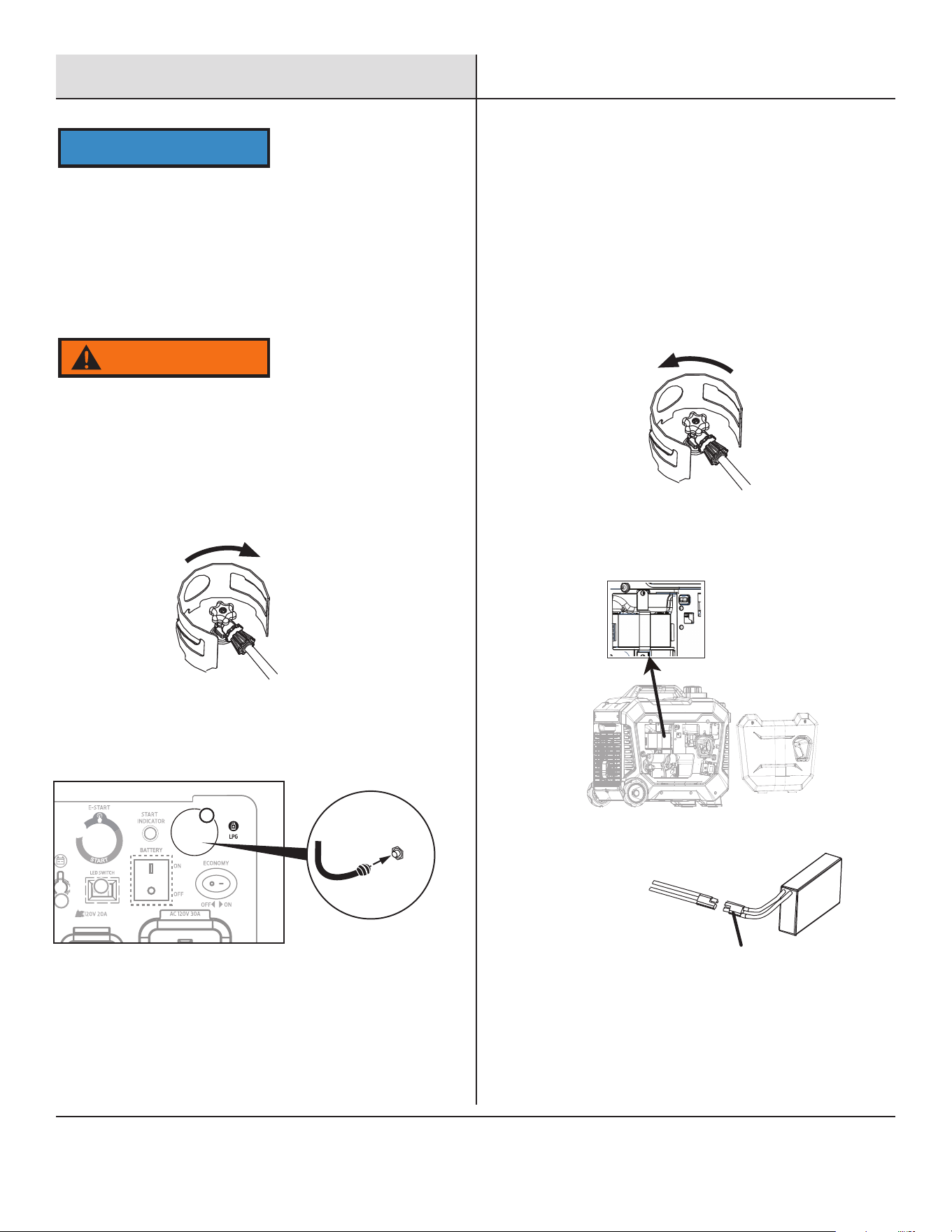
1
2
3
11
10
4
10
Preparation
6. Remove the safety plug or cap from the propane tank valve and
attach the other end of the hose to the LPG connector on the
tank. Hand-tighten.
7. Turn the propane tank valve to the fully open position. Check all
connections for leaks by wetting the fittings with a solution of
soap and water. Bubbles which appear or bubbles which grow
indicate that a leak exists. If a leak exists at a fitting, turn the
propane tank valve to the fully closed position and tighten the
fitting. Open the propane tank valve and recheck the fitting
with the soap and water solution. If the leak continues or if the
leak is not at a fitting then DO NOT use the generator and contact
an authorized Pulsar service center.
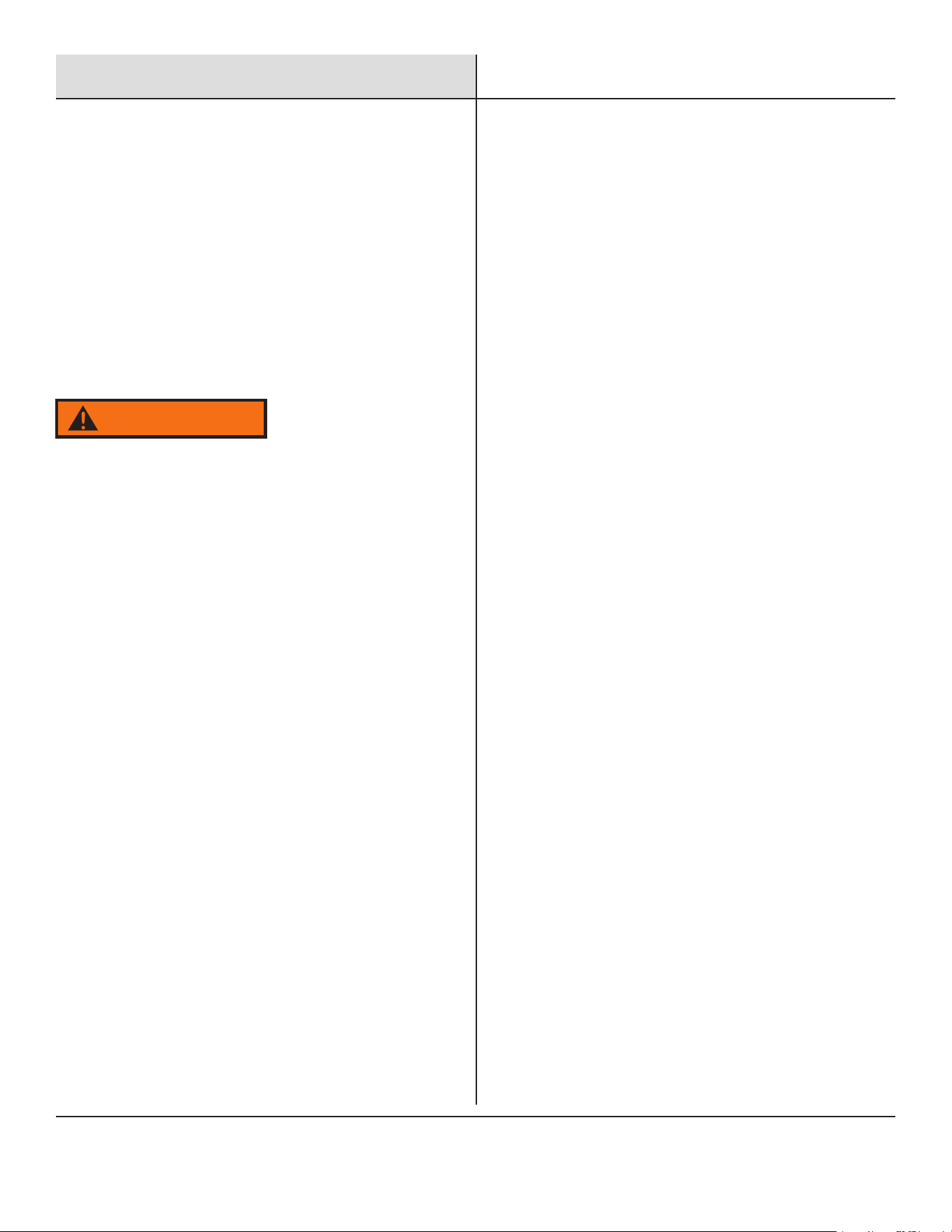
Connecting The Battery
1. On the left side of the generator, loosen the screws and remove
the cover.
2. A quick connect battery plug is pre-installed on the batter and the
generator, connect both together as shown.
Note: It may be necessary to charge the starting battery before
normal operation. Therefore, it is recommended to use the manual
recoil starter, when starting the generator for the first time and allow
the battery to recharge. The generator is equipped with a battery
charging feature. Once the engine is running, a small charge will
slowly recharge the battery.
• All new propane tanks must be purged of air and moisture
prior to filling. Used propane tanks that have not been plugged
or kept closed must also be purged. The purging process should
be done by a propane tank supplier (propane tanks from an
exchange supplier should have been purged and filled properly).
• ALWAYS position the propane tank so the connection between
the valve and the gas inlet will not cause sharp bends or kinks in
the hose.
NOTICE
Explosion hazard. DO NOT start generator if you smell propane.
ALWAYS fully close the propane tank valve and disconnect the
LPG hose from the generator when not in use.
WARNING
1. Turn the generator OFF and place on a flat surface in a well
ventilated area.
2. Verify that the propane tank valve is in the fully closed position.
3. Remove the cover on the generator propane inlet.
4. Use your fingers to hand thread the LPG hose (included) to the
propane inlet on the generator.
IMPORTANT: DO NOT use thread seal tape or any other type of
sealant to seal the LPG hose connection.
5. Tighten the LPG hose connector with an adjustable wrench
until it is snug. DO NOT overtighten.
LPG INLET
CLOSE
OPEN
Quick-Connect Plug
11
Preparation
Failure to properly ground the generator can result in
electrocution.
WARNING
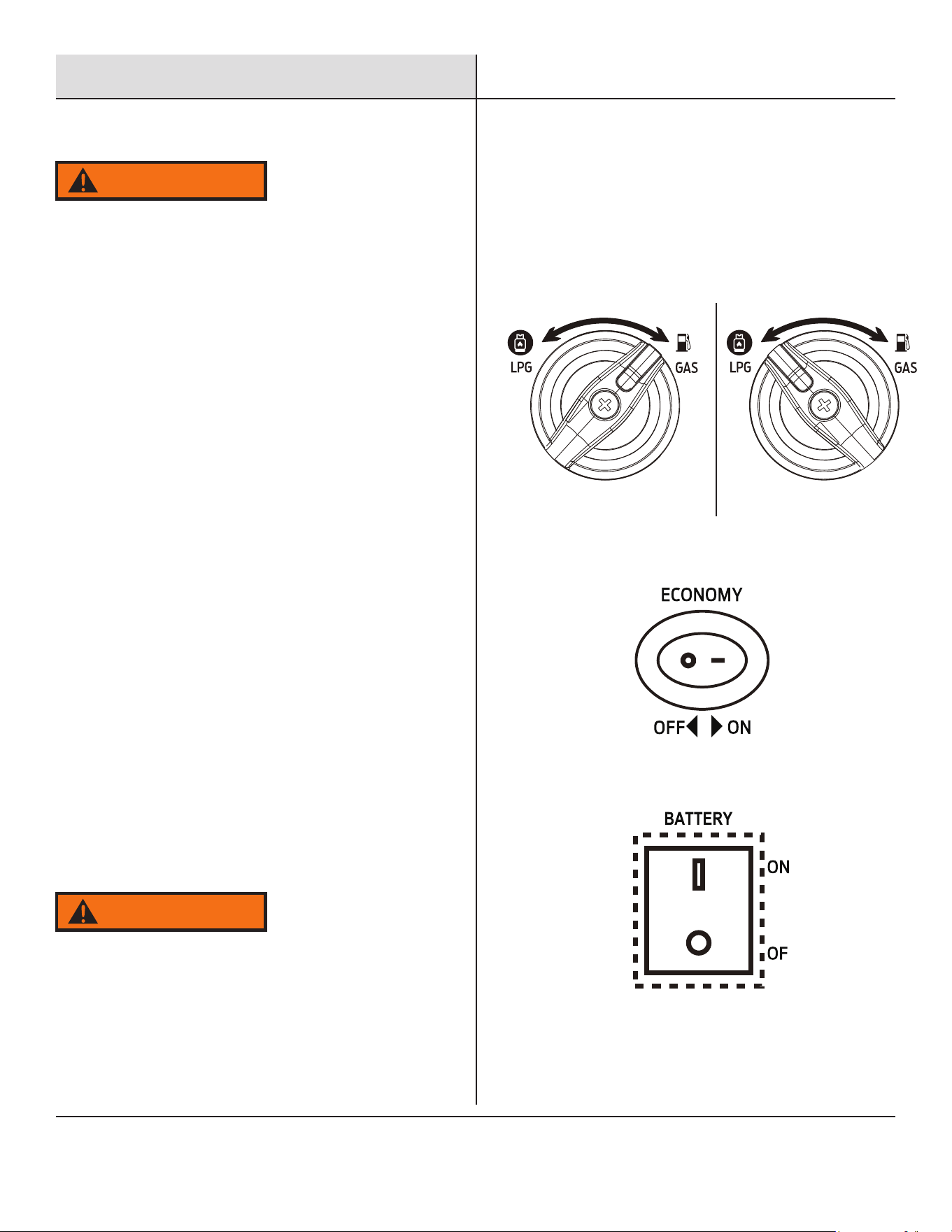
Grounding The Generator
Attach grounding wire (if required by code)
• Ground the generator by tightening the grounding nut against a
grounding wire.
• Connect the other end to a copper or brass grounding rod that’s
driven into the earth.
A generally acceptable grounding wire is a No. 12 AWG (American
Wire Gauge) stranded copper wire.
Grounding codes can vary by location. Please contact a local
electrician to check the grounding regulations for your area.
12
Operation
NEVER operate the generator inside any building, garage,
basement, crawlspace, shed, or enclosure, including the
generator compartment of a recreational vehicle.
NEVER operate or start the generator in the back of an SUV,
camper, trailer, truck bed (regular sides, flat or other
configuration), under staircases, stairwells, next to walls or
buildings, or in any other location that will not allow for
adequate cooling of the generator or for the proper exit of the
exhaust flow.
DO NOT operate or store the generator in wet weather
conditions such as rain or snow. Using a generator in wet
conditions could result in serious injury or death due to
electrocution.
Generators must have a minimum of 5 feet (1.5 m) of clearance
from all combustible material.
Generators must also have a minimum of 5 feet (1.5 m) of
airflow clearance on all sides to allow for adequate cooling,
maintenance, and service.
Always place the generator in a well-ventilated area. NEVER
place the generator near air intake vents or where exhaust
fumes could be drawn into occupied or confined spaces.
Always carefully consider wind and air currents when
positioning the generator.
Always allow generators to properly cool before transport or
for storage purposes.
Failure to follow proper safety precautions may result in
personal injury, damage to the generator, and void the
manufacturer's warranty.
WARNING
WARNING
Generator Location
During operation, the muffler and exhaust fumes will become
hot. If there is inadequate cooling space or if the generator is
blocked or enclosed, temperatures can rise quickly and may
lead to a fire.
Starting The Generator
1. Make sure the generator is on a solid, flat, level surface.
2. Disconnect all electrical loads from the generator. Never start or
stop the generator with electrical devices plugged in or turned on.
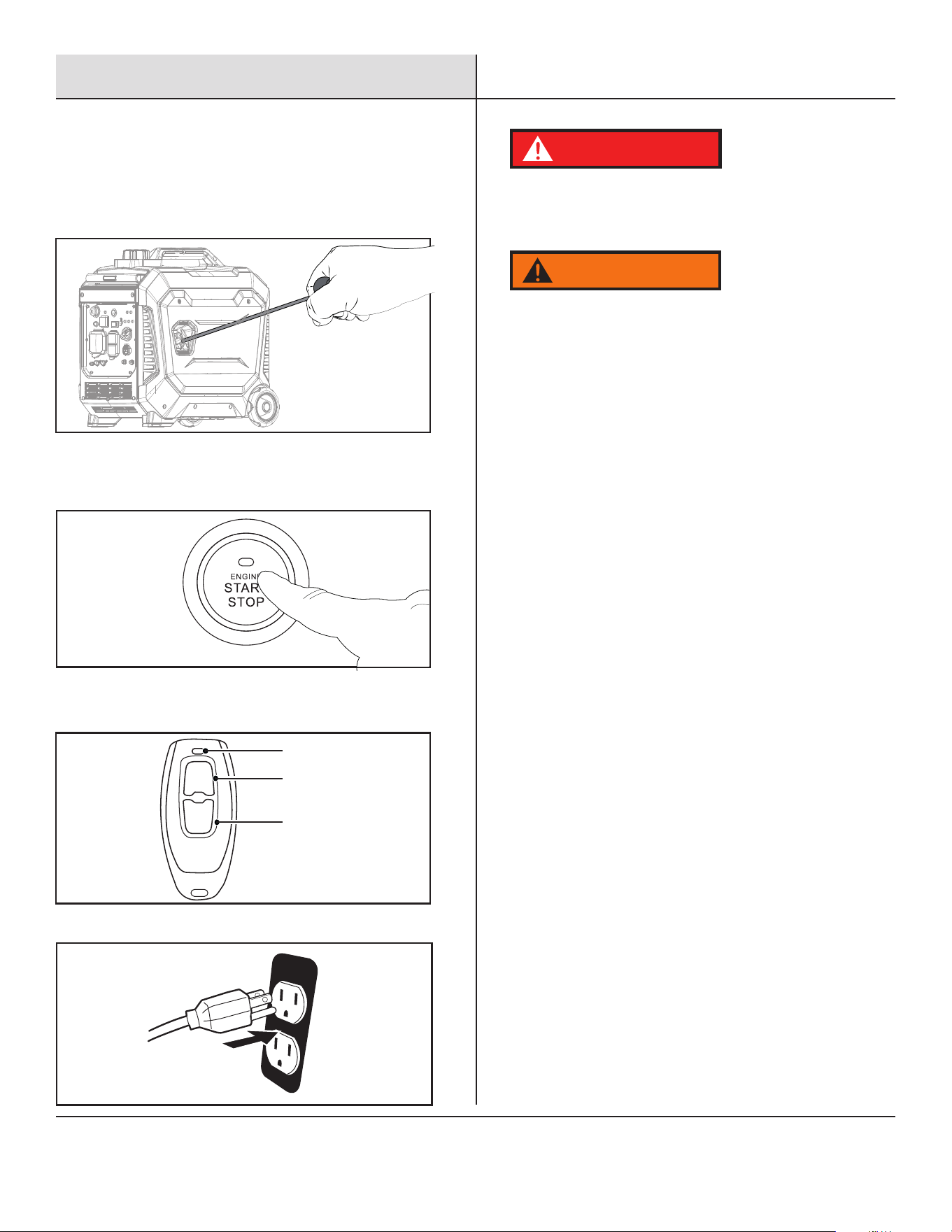
3. Turn the fuel switch to desired fuel source. When the switch is
in the gas position, the generator is ready to start with gasoline.
When the switch is in the LPG position, the generator is ready to
start with propane.
4. Switch OFF the Low Idle
The low idle switch is located at the upper right side of the
panel
5. Turn the battery switch ON for electric or remote start.
STARTING ON GASOLINE STARTING ON LPG
13
Operation
WARNING
6. For Recoil Start
Recoil Start: Firmly grasp and pull the recoil handle slowly until
you feel resistance, let it retract then pull swiftly. If it fails to
start successfully, wait for 3 seconds then repeat this step.
Engine Start/Stop: Press the start button once, the engine will
attempt to start twice automatically. If it fails to start
successfully, press the botton again.
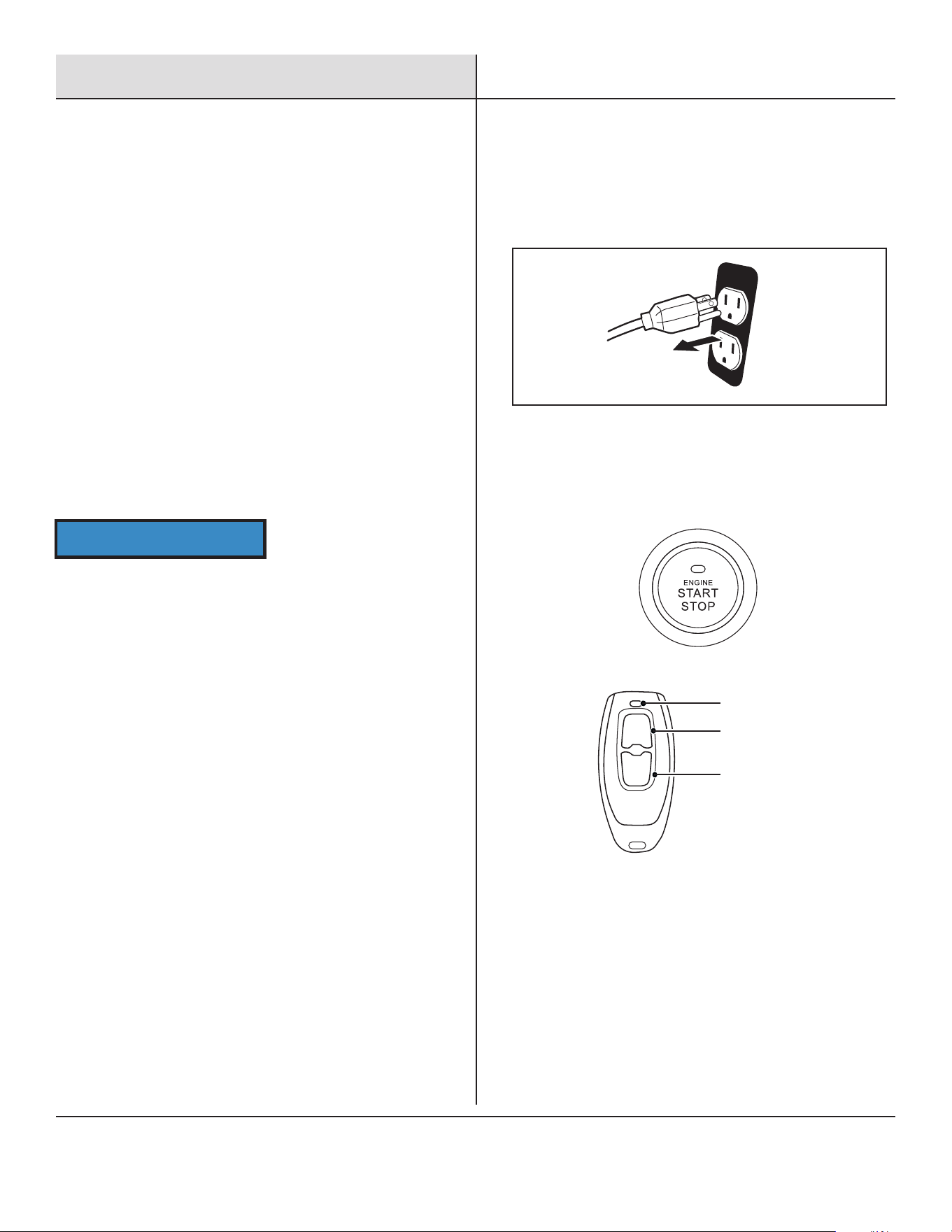
Remote Start: Push and hold the ON button on the remote
start key fob for 0.5 second.
7. Plug in devices
Gasoline To LPG
IIMPORTANT: Load capacity is reduced when running on LPG.
Make sure the generator can supply enough (running) and surge
(starting) watts for the items you are powering before switching
to LPG.
1.Turn the generator OFF.
2.Turn the LPG tank valve to the fully open position.
3.Turn the fuel selector switch to LPG operation.
LPG To Gasoline
1.Turn the generator OFF.
2.Turn the fuel selector switch to gasoline operation.
3.Turn the LPG tank valve to the fully closed position.
NOTE: When switching to LPG operation the engine may run rough
for a few seconds while it purges gasoline from the carburetor.
If the engine stops when switching fuel sources, disconnect all loads
then restart the unit on the fuel source of choice.
Parallel Operation
The parallel connection ports allow you to connect two generators
to increase the total available electrical power. Follow the
instructions included with your parallel connection kit for proper
installation and operation.
Overload Indicator
Note: The OVERLOAD light may turn on for a few seconds as a
large device starts. This is normal for loads approaching the
capacity of this generator.
1.The total combined load through the outlets on the generator
must not exceed the running power of the generator.
When using the generator with propane, make sure there is no
possible ignition source close to the generator.
Fire and explosion hazard. Always turn the propane tank valve
to the fully closed position if not running the generator on
propane.
DANGER
ON
OFF
Key Fob
Activation Light
OFF Button
ON Button
14
Operation
2. If the OVERLOAD light turns on and the generator stops
producing power, it has been overloaded.
3. Turn off and disconnect all electrical devices and stop the
engine. Compare device requirements to generator rating and
reduce the total wattage of connected devices if necessary.
Move anything that may be limiting generator ventilation away.
4. Check if any circuit breakers have tripped and make sure that
ALL circuit breakers are reset before starting the generator again.
5. Restart the engine and reconnect devices while being careful
to not overload the generator.
Low Oil Indicator
1. If the engine oil level is too low, the LOW OIL light turns on
≤270ml and the engine will automatically shut off.
2. The engine cannot be restarted until the proper amount of oil
has been added. Add the appropriate type of oil until the oil level
is at the proper level. SAE 10w-30 oil is recommended for
general use.
Low Idle Switch
1. Turn the low idle switch ON to limit noise and fuel consumption
for lighter generator loads.
2. Switch low idle OFF to operate engine at full speed when:
• Starting the generator
• A heavy load is applied
Stop The Engine
1. Turn off and unplug all connected electrical loads. Never start
or stop the generator with electrical devices plugged in or
turned on.
2. Push-Button Stop: Press the push-button once to stop the
engine.
Remote Key Stop: Press STOP on the remote start key fob for
0.5 second to stop the engine.
Do not run the engine with too little oil. Engine will shut off if
engine oil level is too low.
NOTICE
ON
OFF
Key Fob
Activation Light
OFF Button
ON Button

15
Operation
Generator Capacity
Make sure the generator can supply enough continuous (running)
and surge (starting) watts for the items you will power at the
same time.
The total power requirements (Volts x Amps=Watts) of all
appliances connected must be considered. Appliance and power
tool manufacturers usually list rating information near the model
or serial number. To determine power requirements:
1. Select the items you will power at the same time.
2. Total the continuous (running) watts of these items. This is
the amount of power the generator must produce to keep the
items running. See the wattage reference chart on the next page.
3. Estimate how many surge (starting) watts you will need.
Surge wattage is the short burst of power needed to start electric
motor-driven tools or appliances such as a circular saw or
refrigerator. Not all motors start at the same time, total surge
watts can be estimated by adding only the item(s) with the
highest additional surge watts to the total rated watts from step 2.
Do not overload the generator's capacity. Exceeding your
generator's wattage capacity can damage the generator
and/or electrical devices connected to it.
NOTICE
Example:
Tool or Appliance
Running
Watts*
Starting
Watts*
RV Air Conditioner (13,000 BTU) 1100 1800
TV (Flat Screen) 150 150
RV Refrigerator 180 600
Radio 50 50
Light (75 Watts) 75 75
Coffee Maker 600 600
2155 Total
Running
Watts*
3275
Highest
Starting
Watts*
*Wattages listed are approximate. Verify actual wattage.
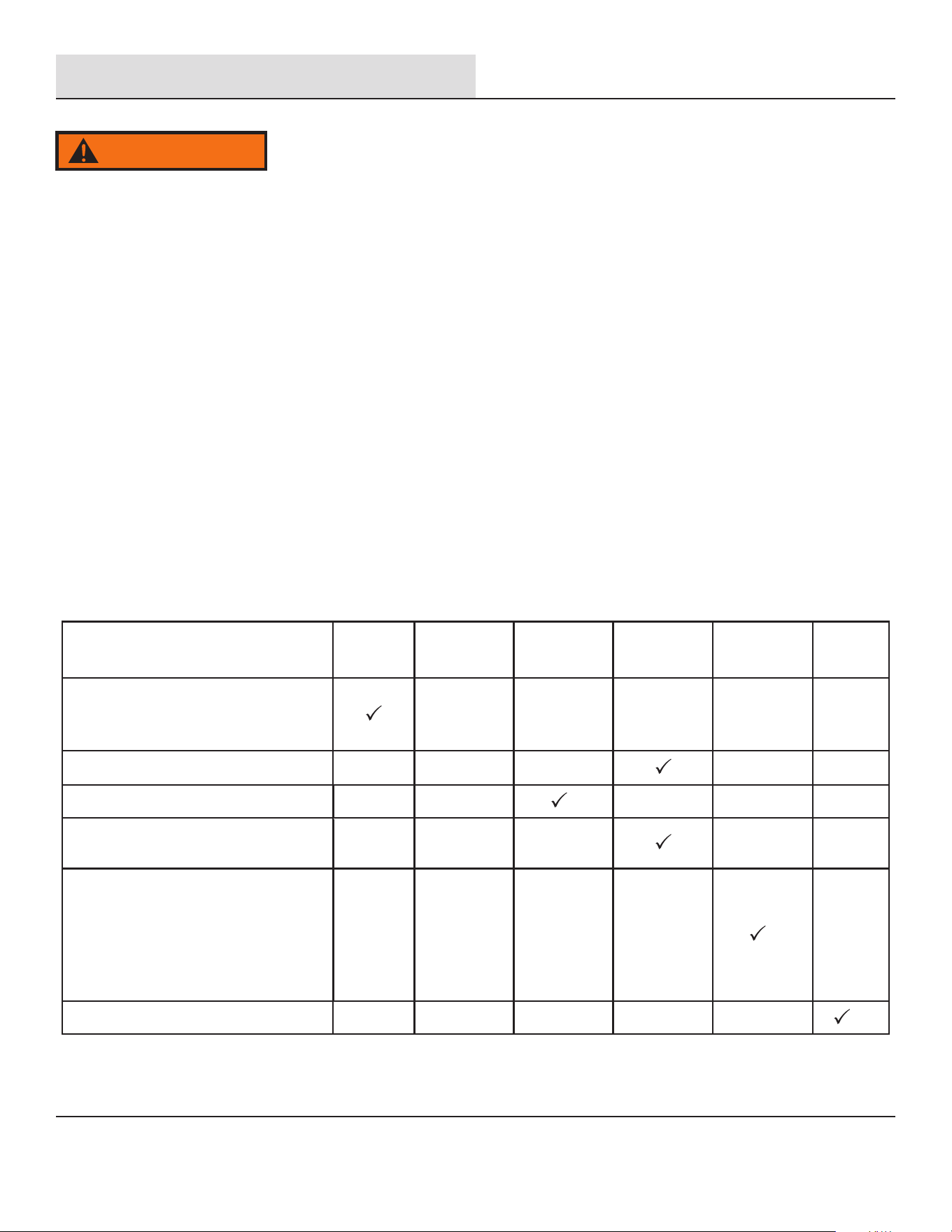
High Altitude Operation
At high altitude, the standard carburetor air/fuel
mixture will be too rich. Performance will
decrease, and fuel consumption will increase. A
very rich mixture will also foul the spark plug and
cause hard starting. Operation at an altitude that
differs from that at which this engine was
certified, for extended periods of time, may
increase emissions. High altitude performance
can be improved by specific modifications to the
carburetor. If you always operate your generator
at altitudes above 5,000 feet (1,500 meters),
have your dealer perform this carburetor
modification. This engine, when operated at high
altitude with the carburetor modifications for high
altitude use, will meet each emission standard
throughout its useful life. Even with carburetor
modification, engine horsepower will decrease
about 3.5% for each 1,000-foot (300-meter)
increase in altitude. The effect of altitude on
engine power will be greater than this if no
carburetor modification is made.
16
Maintenance
Many maintenance procedures, including any not detailed in this manual, will need to be performed by a qualified technician for safety. If you
have any doubts about your ability to safely service the equipment or engine, have a qualified technician service the equipment instead.
Power
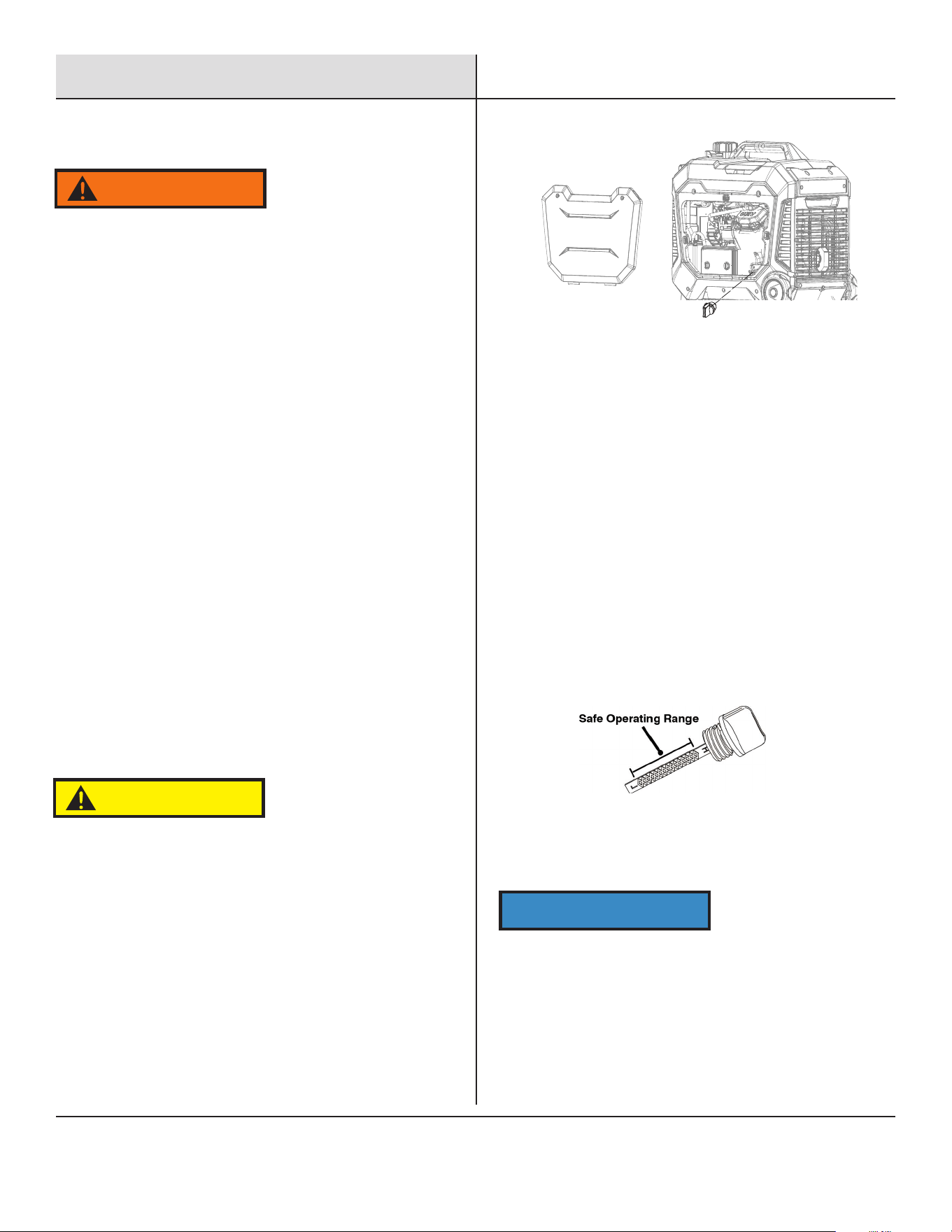
Cleaning, Maintenance, and Lubrication Schedule
Note: This maintenance schedule is intended solely as a general guide. If performance decreases or if equipment operates unusually, check
systems immediately. The maintenance needs of each piece of equipment will differ depending on factors such as duty cycle, temperature,
air quality, fuel quality, and other factors.
Note: The following procedures are in addition to the regular checks and maintenance explained as part of the regular operation of the engine
and equipment.
Turn the generator “OFF”, wait for the engine to cool, and disconnect the spark plug cable before performing any inspection,
maintenance, or cleaning procedures.
EQUIPMENT FAILURE: Do not use damaged equipment. If abnormal noise, vibration, or excess smoking occurs, have the problem
corrected before further use.
WARNING
Procedure
Monthly or
every 8 hr.
of use
Replace fuel line if necessary
Before
Each Use
Every 3 mo.
or 50 hr.
of use
Every 6 mo.
or 100 hr.
of use
Every
2 Years
Yearly or
every 300 hr.
of use
1. Brush off outside of engine
2. Check engine oil level
3. Check air filter
Change engine oil
Clean/replace air cleaner
1. Check and clean spark plug
2. Check and clean spark arrestor
1. Check/adjust idle speed
2. Check/adjust valve clearance
3. Clean fuel tank, strainer
and carburetor
4. Clean carbon build-up from
combustion chamber
17
Maintenance
Checking and Filling Fuel
1. Clean the Fuel Cap and the area around it.
2. Unscrew and remove the Fuel Cap.
3. Remove the strainer and remove any dirt and debris. Then
replace the strainer.
Note: Do not use gasoline containing more than 10% ethanol
(E10). Do not use E85 ethanol. Add a fuel stabilizer to the gasoline
or the Warranty is VOID.
Note: Do not use gasoline that has been stored in a metal fuel
container or a dirty fuel container. It can cause particles to enter
the carburetor, affecting engine performance and/or causing
damage.
4. If needed, fill the Fuel Tank to about 1 inch under the fill neck
with 87 octane unleaded gasoline that has been treated with a
fuel stabilizer additive. Follow fuel stabilizer manufacturer's
recommendations for use.
5. Replace the Fuel Cap.
6. Wipe up any spilled fuel and allow excess to evaporate before
starting the engine. To prevent FIRE, do not start the engine
while the smell of fuel hangs in the air.
Engine Oil Change
1. Make sure the engine is stopped and is level.
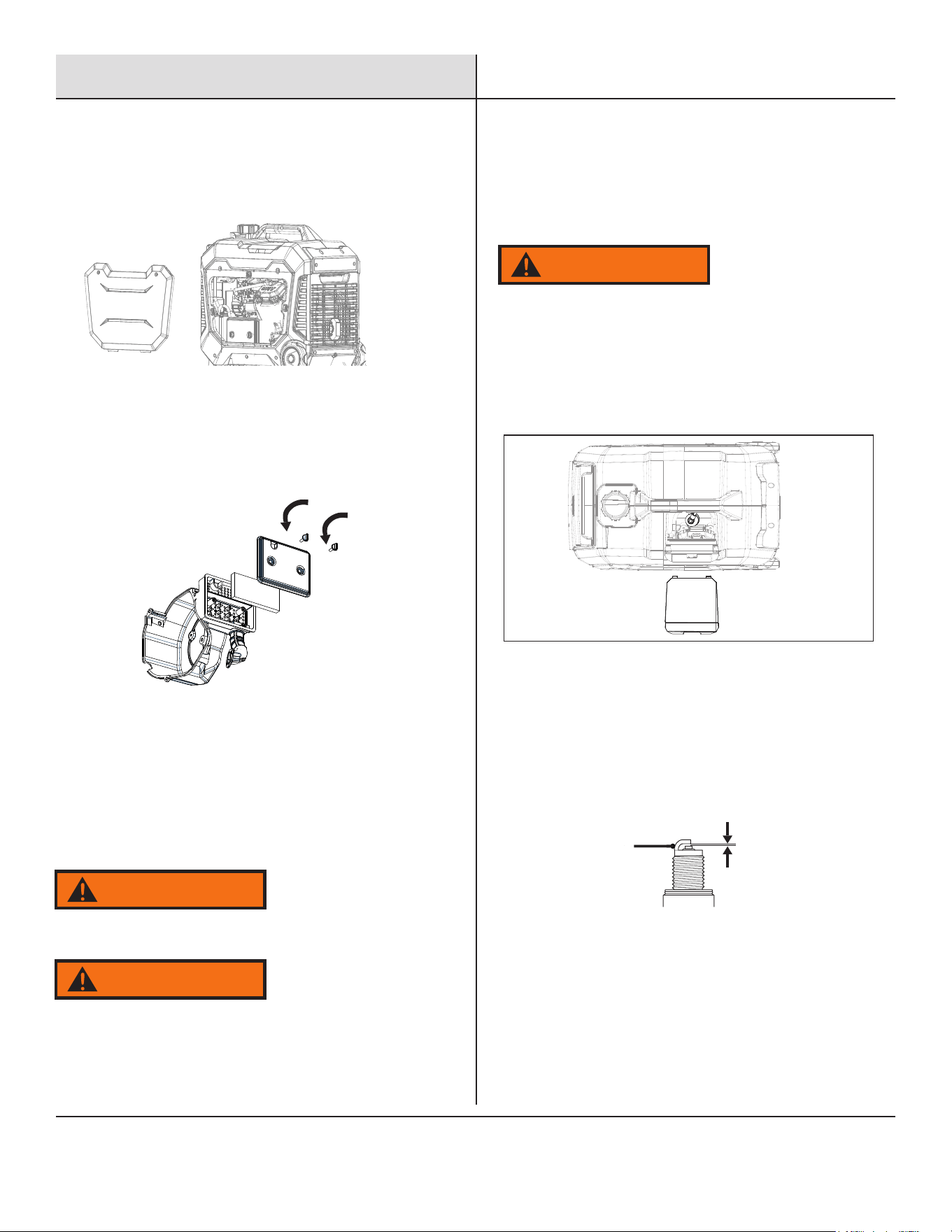
2. On the right side of the generator, loosen the screws and
remove the Oil Fill Access Door.
3. Place an oil drain pan under the generator and center under the
Oil Drain opening.
4. Remove the oil drain plug from the generator, tilt the generator
slightly to facilitate drainage, and wait for the oil to drain
completely. Recycle used oil.
5. Clean the top of the Oil Fill and the area around it.
6. Add the appropriate type of oil until the oil level is at the proper
level. SAE 10W-30 oil is recommended for general use.
Note: Make sure the generator is level when adding oil to prevent
overfilling which could cause engine damage.
7. Check engine oil level daily and add as needed.
Screw the dipstick fully into the filler neck. Remove the dipstick and
verify that the oil level is within safe operating range.
8. Once you have filled your oil in the generator re-install the side
panel.
TO PREVENT SERIOUS INJURY FROM FIRE:
Fill the fuel tank in a well-ventilated area away from ignition
sources. If the engine is hot from use, shut the engine off
and wait for it to cool before adding fuel. Do not smoke.
WARNING
Oil is very hot during operation and can cause burns. Wait for
the engine to cool before changing the oil.
CAUTION
Do not attempt to run the engine with too little oil. The engine
will not start with low or no engine oil.
NOTICE
18
Maintenance
Air Filter Element Maintenance
1. Loosen screws and remove the Air Filter Access Panel on
the right side of the generator.
2. Remove Air Filter Cover,see the figure below.
3. Remove Air Filter.
4. Remove the foam air filter and wash it with soap and warm
water. Slowly squeeze the foam to thoroughly clean.
5. Rinse the air filter with fresh water and allow it to dry
completely.
NOTE:
Avoid skin contact with engine oil. Wear protective clothing
and equipment. Wash all exposed skin with soap and water.
Spark Arrestor Maintenance
1. Allow the generator to cool completely.
2. Remove the Screws from the back of the generator.
3. Remove the Tail Pipe and Spark Arrestor.
4. Clean the Spark Arrestor using a wire brush (sold separately).
Replace the arrestor if damaged.
Spark Plug Maintenance
1.Remove the spark plug cover
2. Disconnect spark plug boot from the end of plug. Clean out debris
from around spark plug.
3. Using the Spark Plug Wrench, remove the Spark Plug.
4. Inspect the Spark Plug: If the electrode is oily, clean it using a
clean, dry rag. If the electrode has deposits on it, clean it with a
brass wire brush. If the white insulator is cracked or chipped,
replace the spark plug.
TO PREVENT SERIOUS INJURY AND FIRE:
Operate only with proper spark arrestor installed
WARNING
The operation of this equipment may create sparks that can
start fires around dry vegetation. A spark arrestor may be
required. The operator should contact local fire agencies
for laws or regulations relating to fire prevention requirements.
WARNING
TO PREVENT SERIOUS INJURY FROM ACCIDENTAL BRUSH FIRE,
secure Spark Arrestor back in place immediately after
cleaning and before further operation.
WARNING
Spark plug gap: 0.024 – 0.032 in. (0.60 – 0.80 mm)
0.024 - 0.032 in.
(0.60 - 0.80 mm)
Side
Electrode
Maintenance
5. When installing a new spark plug, adjust the plug's gap to the
specification on the Specifications Chart. Do not pry against the
center electrode, the spark plug can be damaged.
6. Apply anti-seize material to Spark Plug threads. Install the
new spark plug or the cleaned spark plug into the engine.
• Hand-tighten until the gasket contacts the cylinder head, then
tighten about 3/4 turn more.
7. Re-install the Spark Plug Access Cover.
Storage
When the equipment is to remain idle for longer than 20 days,
prepare the engine for storage as follows:
1. CLEANING:
Wait for the engine to cool, then clean the engine with a dry cloth.
2.FUEL:
Gasoline Treatment/Draining the Fuel Tank
To protect the fuel tank during storage, fill the tank with fresh
gasoline that has been treated with a fuel stabilizer additive.
Follow fuel stabilizer manufacturer's recommendations for
use.
Draining the Carburetor
Shut off gasoline flow by moving the fuel selector to LPG, place an
appropriate container under the carburetor and carefully remove
the drain bolt from the bottom of the carburetor bowl, allowing the
fuel to drain completely. Replace the drain bolt after draining.
Aged gasoline that has not been treated with stabilizer ahead of time
must be safely drained and disposed of, never run old gasoline
through the engine.
3. LUBRICATION:
a. Change engine oil.
b. Clean out the area around the spark plug. Remove
the spark plug and pour one tablespoon of engine oil into
the cylinder through the spark plug hole.
c. Replace spark plug, but leave spark plug cap
disconnected.
d. Pull Starter Handle to distribute oil in the cylinder. Stop
after one or two revolutions when you feel the piston start
the compression stroke (when you start to feel resistance).
4. STORAGE AREA:
Cover and store in a dry, level, well-ventilated area out of reach of
children. The storage area should also be away from ignition
sources, such as water heaters, clothes dryers, and furnaces.
5. AFTER STORAGE:
Untreated gasoline will deteriorate quickly. Drain the fuel tank and
change to fresh fuel if untreated gasoline has been sitting for a
month, if treated gasoline has been stored beyond the fuel
stabilizer's recommended time, or if the engine does not start.
To prevent serious injury and fire, move the fuel selector to LPG
to shut off gasoline supply before draining the carburetor.
WARNING
Fill tank in a well-ventilated area away from ignition sources. If
the engine is hot from use, shut the engine off and wait for it to
cool before adding fuel. Do not smoke.
WARNING
Use only BPR6ES (NGK) type spark plug or equivalent. Using
an incorrect spark plug may damage the engine.
NOTICE
Tighten the Spark Plug properly. If loose, the Spark Plug will
cause the engine to overheat. If overtightened, the threads in
the engine block will get damaged.
NOTICE
During extended storage periods the engine must be started every
3 months and allowed to run for 15-20 minutes.
NOTICE
Do not clean using water. The water will gradually enter the
engine and cause damage.
NOTICE
19

Troubleshooting
21
Problem Cause Solution
Engine is running, but AC output is
not available
1. Open circuit breaker
2. Poor connection
3. Defective cord set
4. Connected device is faulty
5. Fault in generator
1. Reset circuit breaker
2. Check and repair
3. Check and repair
4. Connect a device that is working
properly
5. Contact service department
Engine runs well without load but bogs
down when loads are connected
1. Short circuit in connected device
2. Generator is overloaded LED light
3. Clogged fuel filter
4. Engine speed is too slow
5. Short circuit in generator
1. Disconnect device
2. See pg 17 “Don’t overload
generator”
3. Contact service to replace fuel filter
4. Contact service department
5. Contact service department
Engine will not start, shuts down
during operation, or starts and runs
rough.
1.
ON/OFF switch set to “OFF”
2.
Dirty Air filter
3.
Clogged fuel filter
4.
Stale fuel
5.
Spark plug wire disconnected from
spark plug
6.
Bad spark plug
7.
Water in fuel
8.
Low oil level (Low oil LED light)
9.
Intake valve stuck open or close
10.
Loss of engine compression
11.
Engine has flooded
12.
CO Sensor indicator light turn red
13.
CO Sensor indicator light turns
yellow
1.
Turn switch to “ON”
2.
Replace Air filter
3.
Clean or replace fuel filter
4.
Replace fuel
5.
Reconnect spark plug wire
6.
Replace spark plug
7.
Drain fuel tank and replace fuel
8.
Add oil
9.
Contact service department
10.
Contact service department
11.
Contact service department
12.
Move the generator to an open
outdoor area
13.
Contact service department
Engine lacks power 1. Generator is overloaded
2. Clogged in-line filter
3. Dirty air filter
4. Engine needs servicing
1.
See pg. 17 “Don’t overload generator”
2.
Contact service to replace in-line filter
3.
Replace Air filter
4.
Contact service department
Engine “hunts” or falters
1.
Clogged in-line filter
2.
Carburetor is running too rich or too
lean
1.
Contact service to replace in-line filter
2.
Contact service department