WARNING
• Improper installation, adjustment,
alteration, service or maintenance can
cause injury or property damage.
• Read the installation, operation, and
maintenance instructions thoroughly
before installing or servicing this
equipment.
• Failure to follow these instructions
could result in fire, explosion or burn
hazard which could cause property
damage, personal injury, or death.
• This instruction manual contains
important information necessary for
the proper assembly and safe use of
the appliance.
• Read and follow all warnings and
instructions before assembling and
using the appliance.
• Follow all warnings and instructions
when using the appliance.
• Keep this manual for future reference.
DANGER
• Never operate this appliance unattended.
• If a fire should occur, keep away from the
appliance and immediately call your fire
department. Do not attempt to extinguish
an oil or a grease fire with water.
DANGER
• Burning wood chips gives off carbon
monoxide, which has no odor and can
cause death.
• DO NOT burn wood chips inside
homes, vehicles, tents, garages or any
enclosed areas. Use only outdoors
where it is well ventilated.
WARNING
OUTDOOR USE ONLY.
WARNING:
This product can expose you to
chemicals including carbon monoxide
and soot, which are known to the State of
California to cause cancer and birth defects
or other reproductive harm. For more
information go to www.P65Warnings.ca.gov.
MASTER FORGE and logo design are trademarks or
registered trademarks of LF, LLC. All rights reserved.
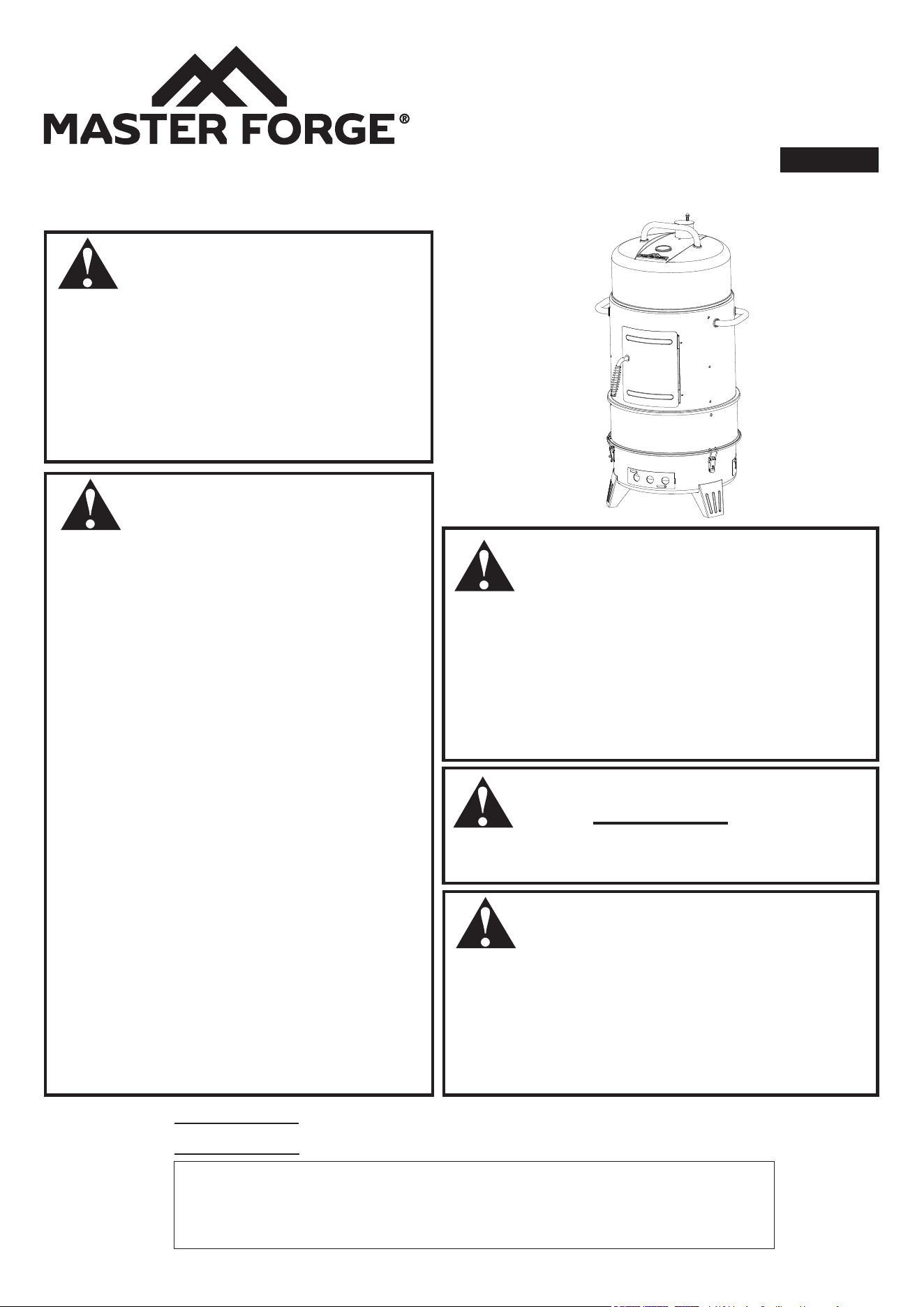
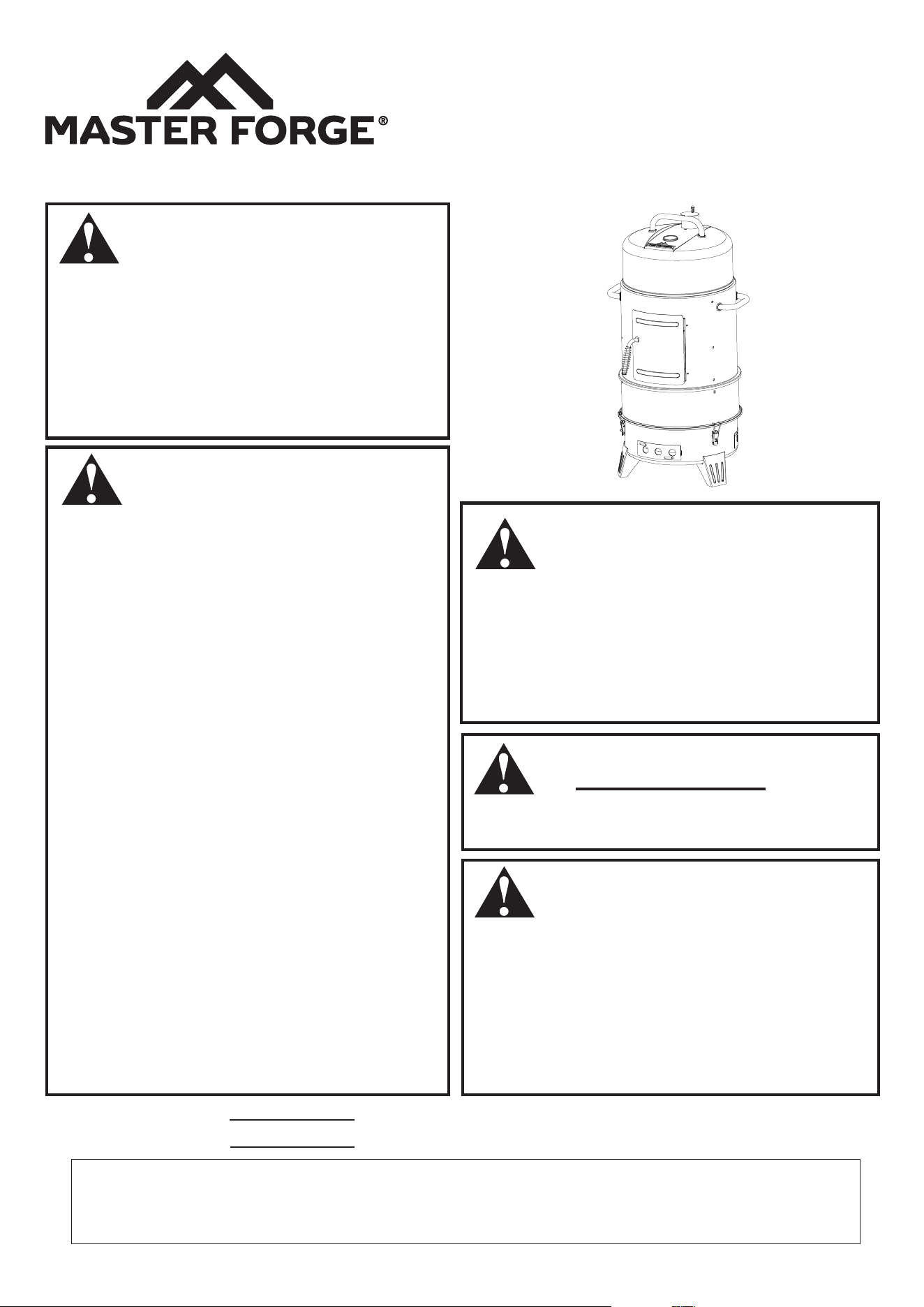
ITEM #5506289
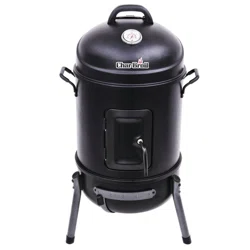
CHARCOAL VERTICAL SMOKER
MODEL #CBS24032L
ATTACH YOUR RECEIPT HERE
Español p.26
Thank you for purchasing this MASTER FORGE product.
Questions, problems or missing parts?
Before returning, contact us on:
800-963-0211, 8 a.m. - 8 p.m., EST, Monday - Sunday or [email protected].
VR23003
CBS24032L-RA-ES-OM-F101
1
Serial Number
Purchase Date

W This smoker is for outdoor use only, and shall
not be used in a building, garage or any other
enclosed area.
W For residential use only. This smoker is NOT for
commercial use.
W Never use charcoal that has been pre-treated with
lighter fluid. Use only a high grade plain charcoal,
charcoal/wood mixture, lump charcoal or cooking
wood. The conversion to or attempted use of any
other fuel source in this smoker is dangerous and
will void your warranty.
W This smoker is not intended for and should
never be used as a heater. TOXIC fumes can
accumulate and cause asphyxiation.
W Do not use smoker for indoor cooking. Toxic
carbon monoxide fumes can accumulate and
cause asphyxiation.
W This smoker is safety certified for use in the
United States and Canada only. Do not modify for
use in any other location. Modification will result in
a safety hazard and will void the warranty.
W Do NOT operate, light or use this appliance
within ten (10) feet (3.05 m) of walls, structures
or buildings. Do not use this appliance under any
type of overhang or roof.
W Apartment Dwellers: Check with management to
learn the requirements and fire codes for using
a smoker in your apartment complex. If allowed,
use outside on the ground floor with a ten (10)
foot (3.05 m) clearance from any structure. Do not
use on or under balconies.
W Do not use gasoline, kerosene or alcohol for
lighting.
W Do not use in an explosive atmosphere. Keep
smoker area free and clear from combustible
materials, gasoline and other flammable vapors
and liquids.
W Do not store or use gasoline or other flammable
liquids or vapors within 25 feet (7.62 m) of this
appliance.
W Do not alter smoker in any manner. Any altering
will void your warranty.
W Do not use the smoker unless it is COMPLETELY
assembled and all parts are securely fastened
and tightened.
W This smoker should be thoroughly cleaned and
inspected on a regular basis.
W Use only manufacturer’s factory authorized parts.
The use of any part that is not factory authorized
can be dangerous and will void your warranty.
W Do not use this appliance without reading
“Operating Instructions” in this manual.
W Do not touch metal parts of smoker until it has
completely cooled (about 45 min.) to avoid burns,
unless you are wearing protective gear (pot
holders, gloves, BBQ mittens, etc.).
W Never touch grates (charcoal or cooking), ashes
or coals to see if they are hot.
W Do not use on wooden decks, wooden furniture or
other combustible surfaces.
W Always place your smoker on a hard, non-
combustible level surface. An asphalt or blacktop
surface may not be acceptable for this purpose.
W Do not use in or on boats or recreational
vehicles.
W Position smoker so wind cannot carry ashes to
combustible surfaces.
W Do not use in high winds.
W Never lean over the smoker when lighting.
W Do not leave a lit smoker unattended. Keep
children and pets away from smoker at all
times.
Safety Information .............................................................................. 2
Package Contents .............................................................................. 4
Hardware Contents ............................................................................. 5
Preparation.....................................................................................5
Assembly Instructions ........................................................................... 6
Operating Instructions ...........................................................................13
Care and maintenance.......................................................................... 23
Limited Warranty .............................................................................. 24
Replacement Parts List ..........................................................................25
SAFETY INFORMATION
TABLE OF CONTENTS
W DANGER: Failure to follow the dangers, warnings and cautions in this manual may result in serious bodily
injury or death, or in a fire or an explosion causing damage to property.
W WARNINGS:
2

SAFETY INFORMATION
W Do not attempt to move smoker when in use.
Allow the smoker to cool (about 45 min.) before
moving or storing.
W When cooking, fire extinguishing materials shall
be readily accessible. In the event of an oil/
grease fire, do not attempt to extinguish with
water. Use type BC dry chemical fire extinguisher
or smother with dirt, sand or baking soda.
W Always open smoker lid carefully and slowly
as heat and steam trapped within smoker can
severely burn you.
W Do not leave smoker unattended while preheating
or burning off food residue on high. If smoker has
not been cleaned, a grease fire can occur that
may damage the product.
W Do not place empty cooking vessels on the
appliance while in operation.
W Use caution when placing anything under or in
the smoker while the appliance is in operation.
Use oven mitts or gloves to protect your hands,
and avoid touching hot surfaces.
W Never add lighting fluid to hot or even warm coals
as flashback may occur causing serious injury or
damage to property.
W Always wear protective gloves when adding fuel
(charcoal briquettes, wood or lump charcoal) to
retain desired heat level.
W Do not remove the ashes until they are
completely and fully extinguished.
W Live hot briquettes and coals can create a fire
hazard.
W Always empty the charcoal pan and smoker after
each use.
W Do not place fuel (charcoal briquettes, wood or
lump charcoal) directly into bottom of smoker.
Place fuel only on the charcoal grid.
W Do not allow charcoal to rest on the walls of
smoker. Doing so will greatly reduce the life of the
metal and finish of your smoker.
W Check to make sure the air vents are free of
debris and ash before using the smoker.
W Make sure charcoal pan is securely and
completely in place before using the smoker.
W Do not move smoker while water pan contains
liquid.
W Always use the water pan designed for this
smoker when using smoker.
W Always use a drip pan/ash guard designed for
use with a smoker.
W Use only authorized replacement parts supplied
by manufacturer.
W Always keep a thin layer of water in drip pan/
ash guard to extinguish any falling ashes and
embers.
W Do not allow water in water pan to completely
evaporate while smoker is in use. Check water
pan at least every 2 hours and add water if level
is low. Add water per “Adding Additional Water”
section in this manual.
W Do not remove water from water pan once food
is removed. Allow smoker to cool and water to
evaporate.
W Before smoker can be left unattended.
W Smoker must be cool.
W Remaining coals and ashes must be carefully
removed and placed in a noncombustible metal
container and saturated with water.
W Allow saturated coals and ashes to remain in a
noncombustible container and saturated with
water for 24 hours prior to properly disposing.
W With a garden hose, completely wet the surface
beneath and around smoker to extinguish any
ashes, coals or embers that may have fallen
during the cooking or cleaning process.
W Extinguished coals and ashes should be placed a
safe distance from all structures and combustible
materials.
W Keep all electrical cords away from a hot
smoker.
W Always use a meat thermometer to ensure food is
cooked to a safe temperature.
W Never cover entire cooking area with aluminum
foil.
W Use protective gloves when assembling this
product.
W Do not force parts together as this can result in
personal injury or damage to the product.
W Use caution when lifting or moving cooled smoker
to prevent strains and back injuries.
W Death, serious injury or damage to property may
occur if the above is not followed exactly.
W Never cover entire cooking area with aluminum
foil. Laying the foil on the grates can restrict the
intended air flow inside the grill, create barriers to
the proper flow of grease to the catch pan,which
sets the stage for lots of it to build up on the
bottom tray, which in turn, builds the potential for
grease fires and flare ups. Use protective gloves
when assembling this product.
W Do NOT force parts together as this can result in
personal injury or damage to the product.
W Do NOT touch air vent or air vent handle until grill
has completely cooled, unless you are wearing
protective gear.
3
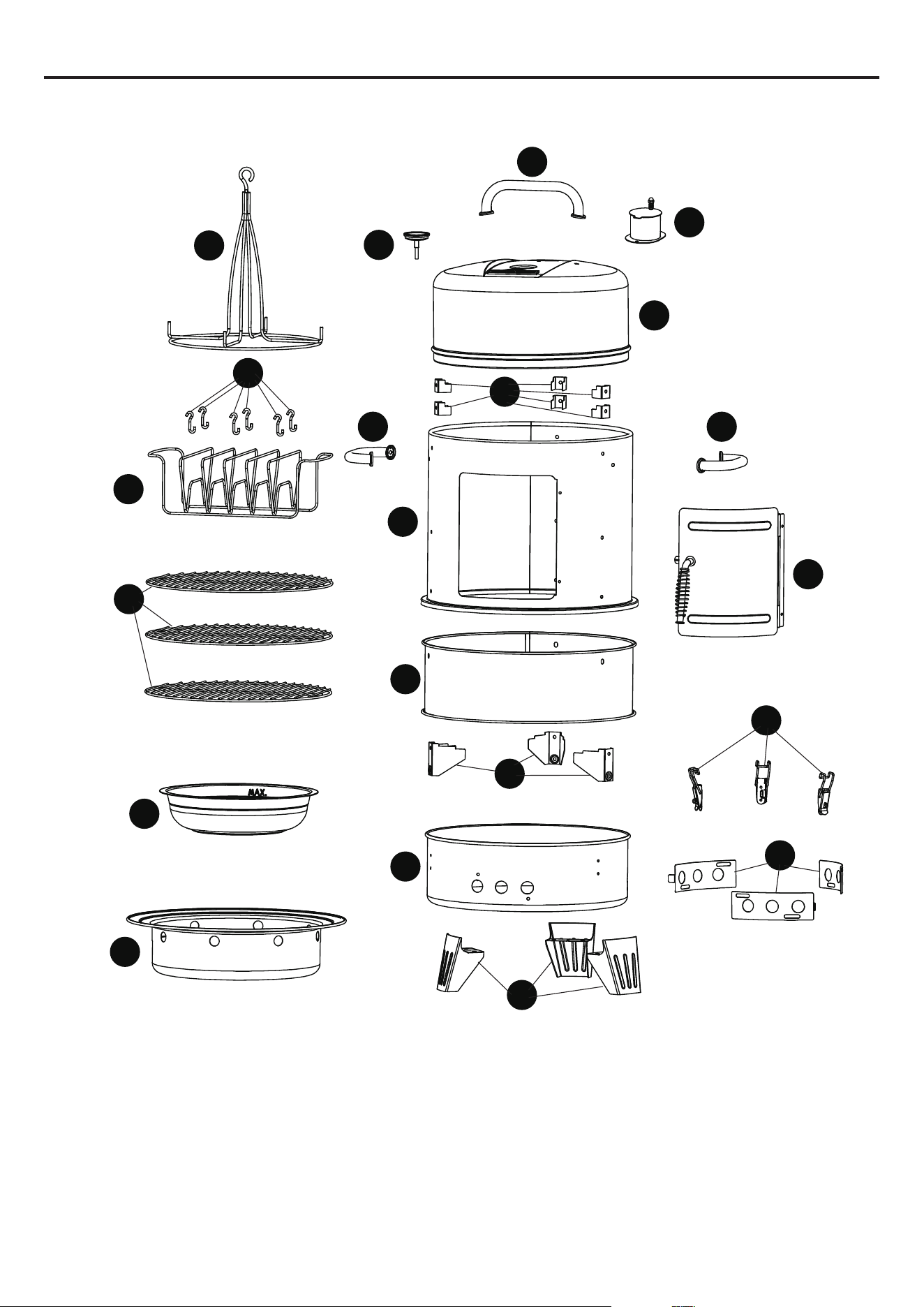
PACKAGE CONTENTS
A
B
C
D
H
J
I
K
L
P
G
M
R
N
Q
T
S
O
E
F
J
4
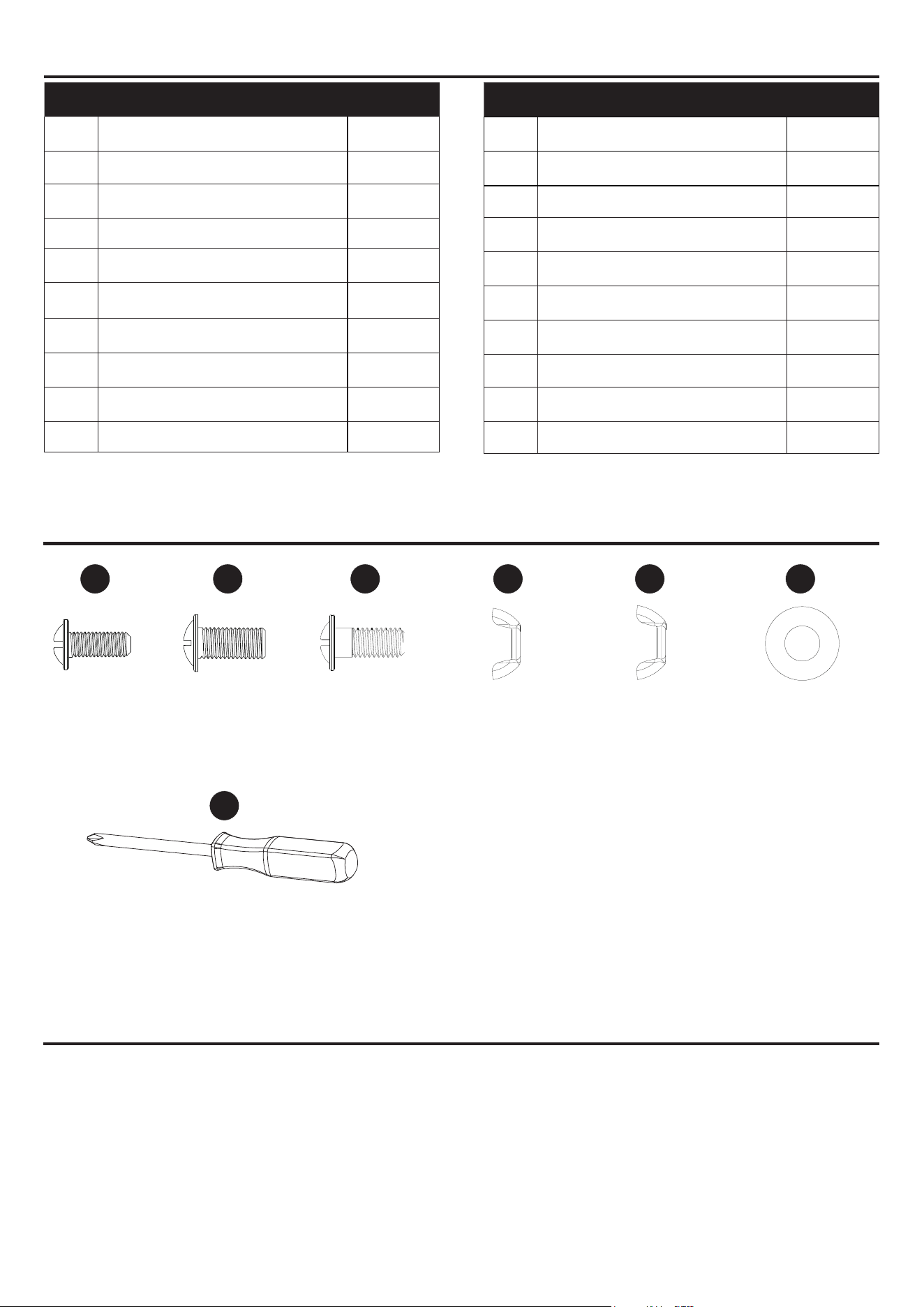
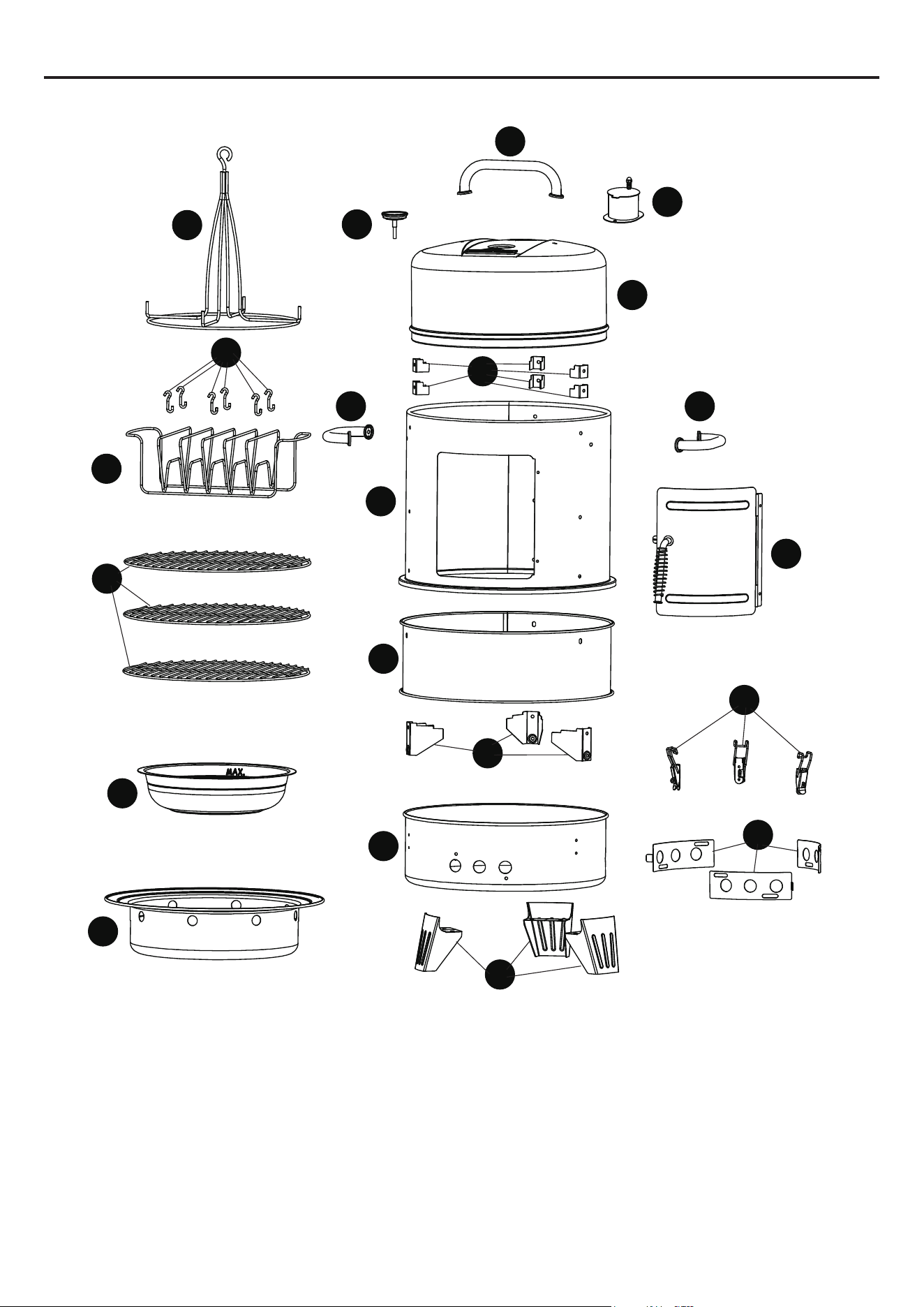
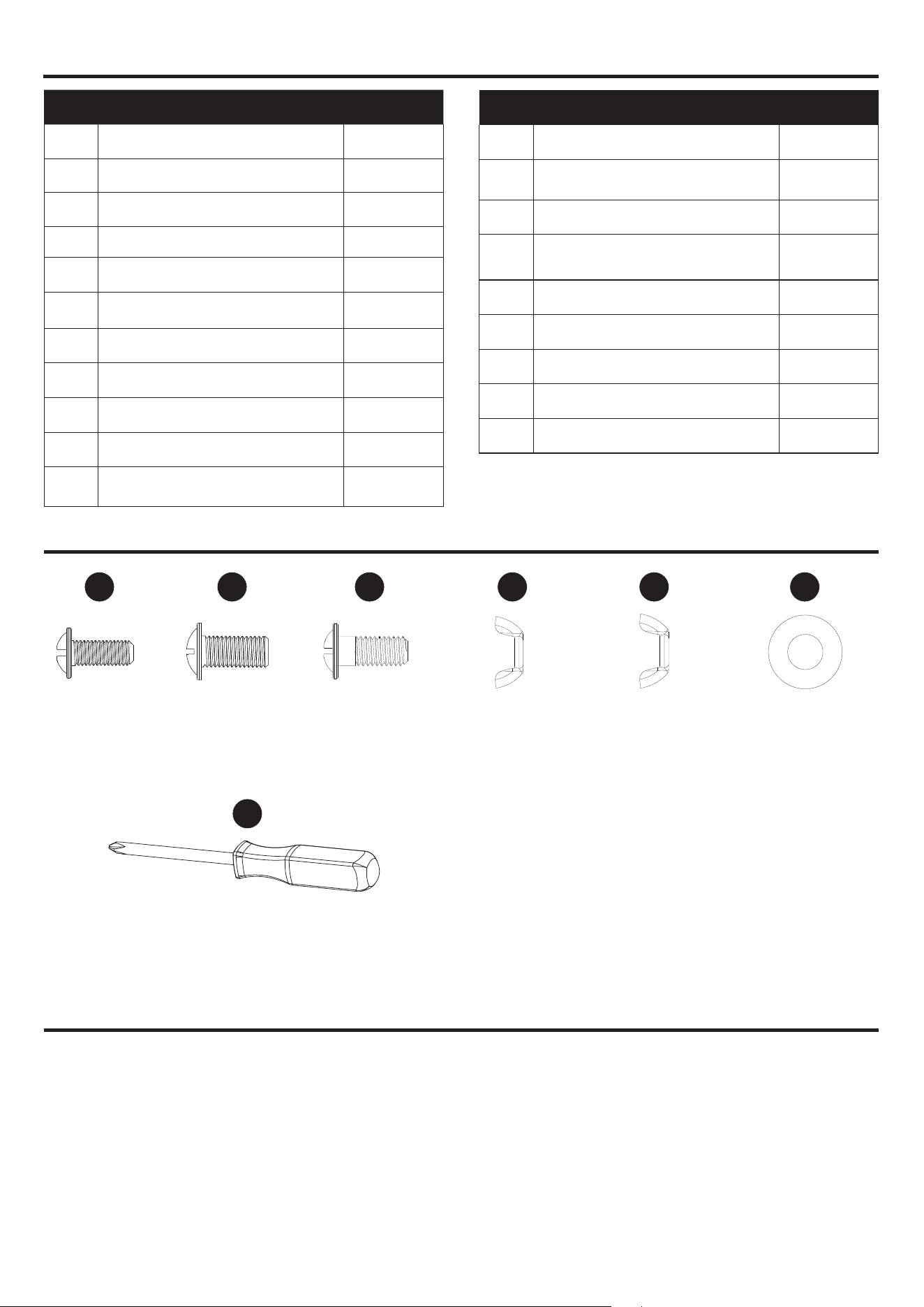
PART DESCRIPTION QUANTITY
A Lid Handle 1
B Temperature Gauge 1
C Smoke Stack 1
D Lid 1
E Meat Hook 6
F Rib Rack 1
G Cooking Grid 3
H Chicken Rack 1
I Cooking Grid Support 6
J Side Handle 2
PART DESCRIPTION QUANTITY
K Upper Smoker Body 1
L Door 1
M Middle Smoker Body 1
N Water Pan 1
O Water Pan Support 3
P Lock 3
Q Charcoal Pan 1
R Bottom Bowl 1
S Air Damper 3
T Leg 3
M4 x 10
Screw
Qty. 8
ø6.5 x ø18
Washer
Qty. 12
M5 x 12
Screw
Qty. 26
M5 x 12
Step Screw
Qty. 6
#2 Philips Head
Screwdriver (included)
Qty. 1
Before beginning assembly of product, make sure all parts are present. Compare parts with package
contents list and hardware contents list. If any part is missing or damaged, do not attempt to
assemble the product.
Estimated assembly time: 25 minutes by one people.
Tools required for assembly: Philips screwdriver (included).
PACKAGE CONTENTS
HARDWARE CONTENTS
Preparation
M4
Wing Nut
Qty. 8
M5
Wing Nut
Qty. 20
AA BB
GG
CC DD EE FF
5
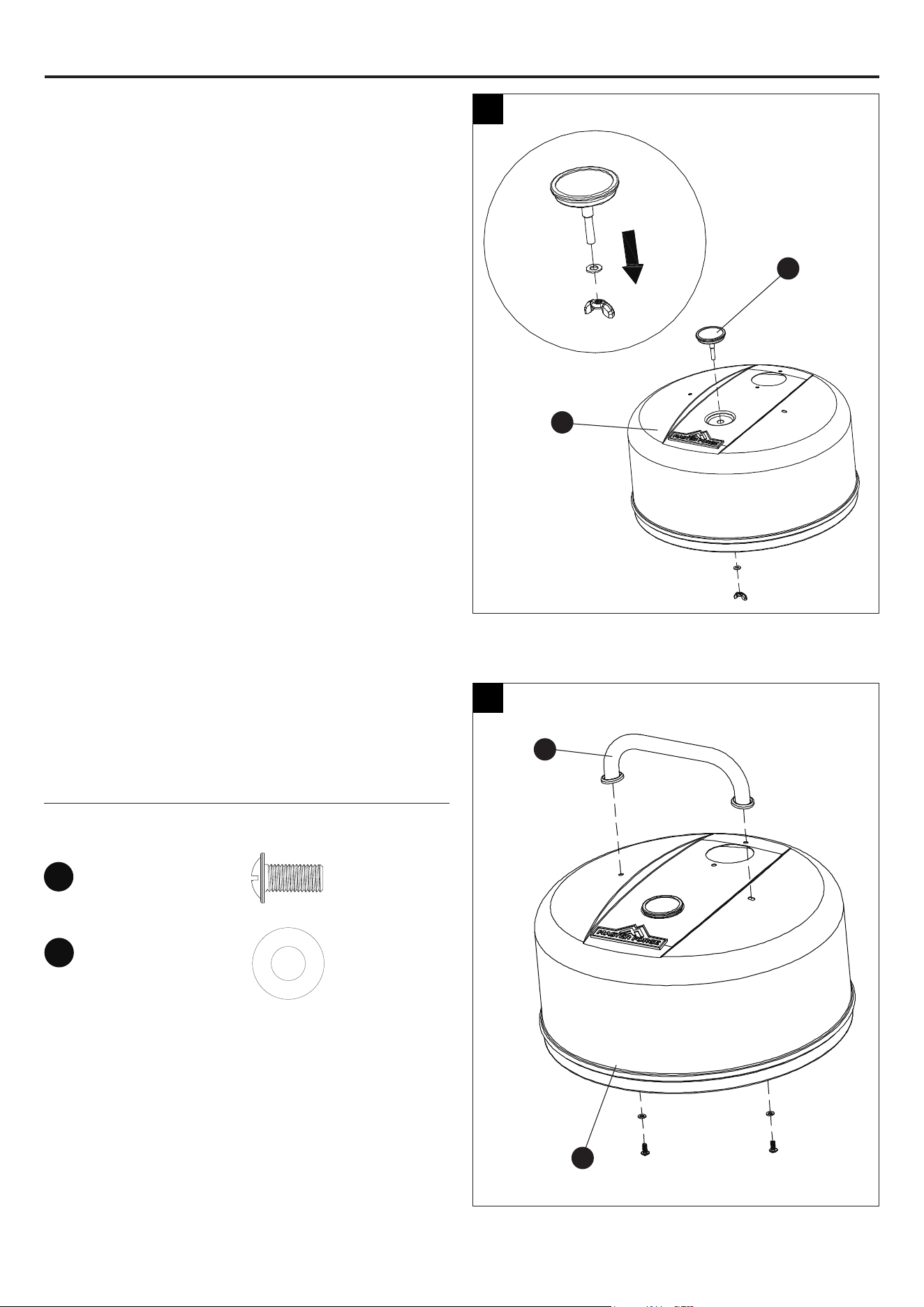
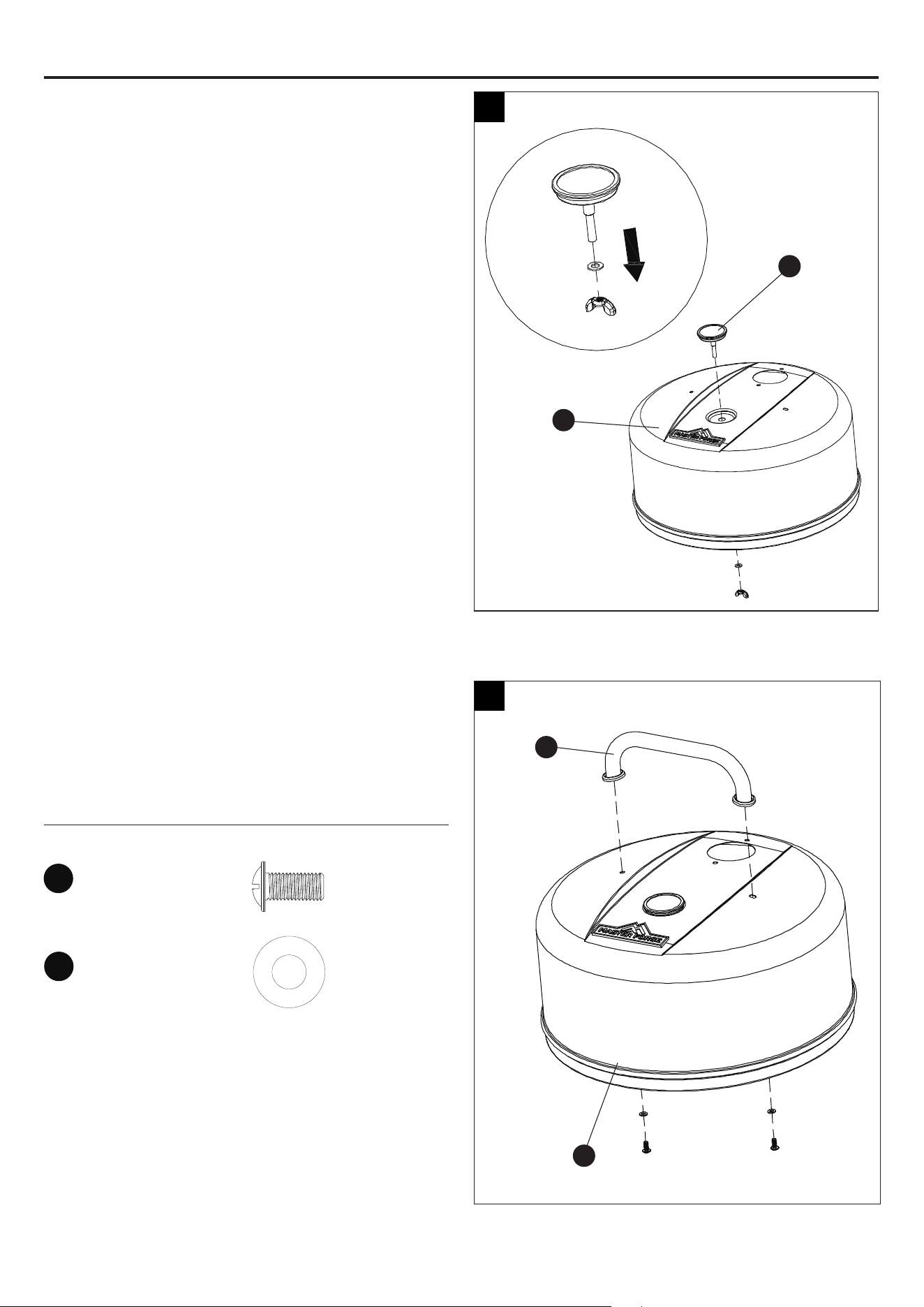
Step 1: Attach Temperature Gauge
Remove pre-assembled wing nut and washer
from temperature gauge (B). Attach temperature
gauge (B) to lid (D) using the pre-assembled
washer and wing nut.
Step 2: Attach Lid Handle
Attach lid handle (A) to lid (D) using two M5 x 12
screws (BB) and two Ø6.5 x Ø18 washers (FF).
Hardware Used
1
2
ASSEMBLY INSTRUCTIONS
Ø6.5 x Ø18
Washer
x 2
M5 x 12
Screw
x 2
First
Second
B
D
D
A
BB
FF
6
4
3
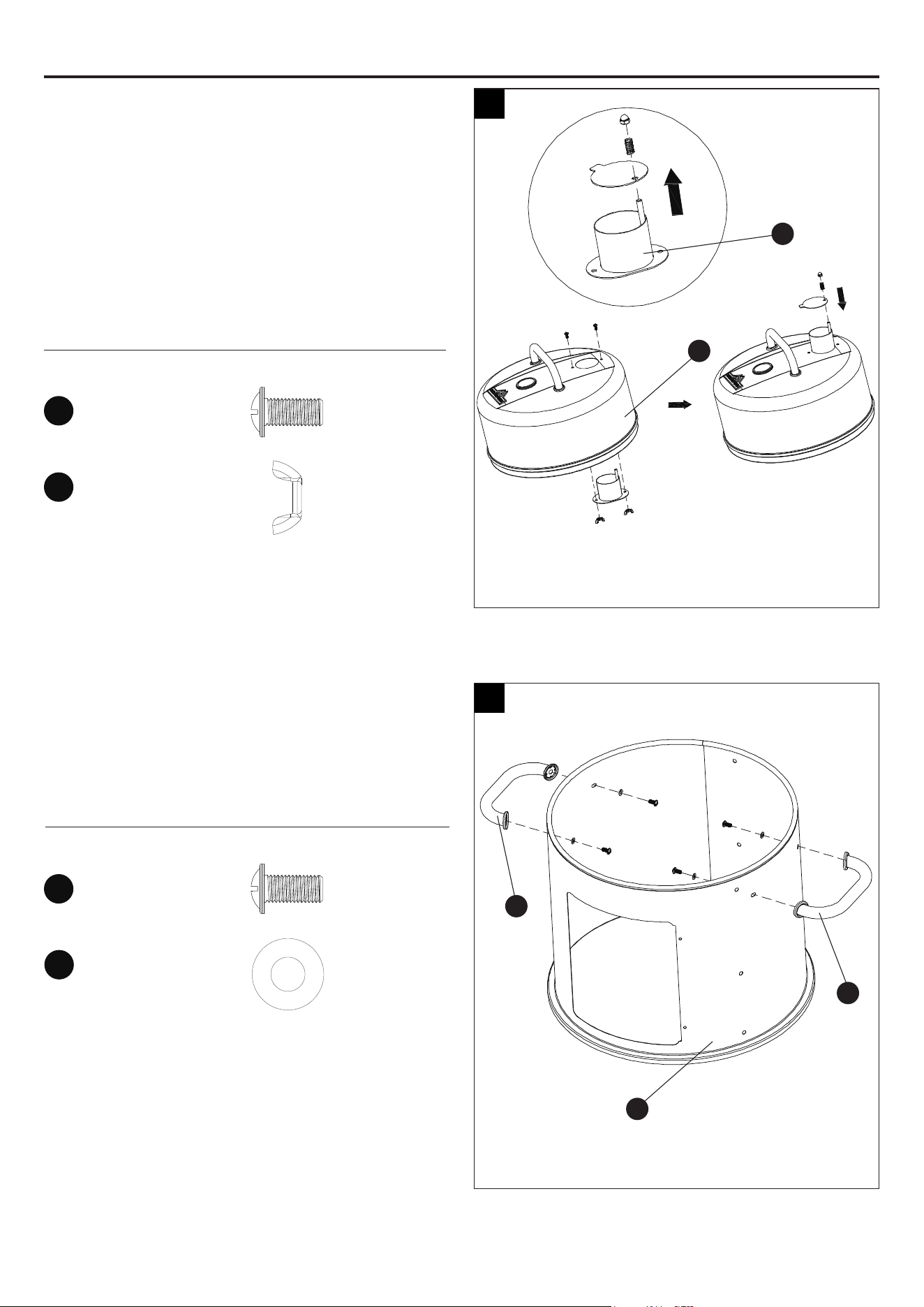
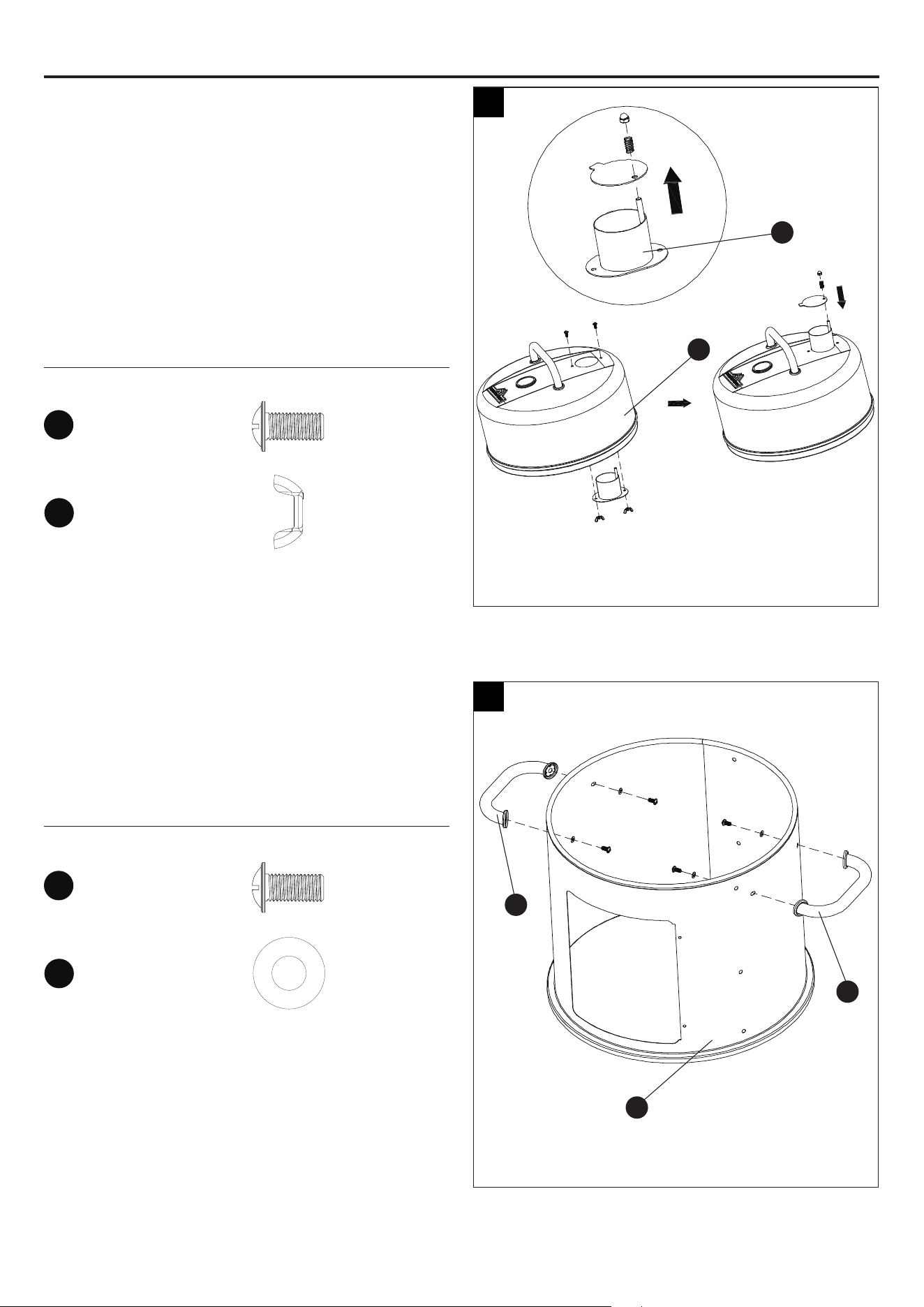
Step 3: Attach Smoker Stack
Firstly, remove smoker stack top, pre-assembled
nut and spring from smoker stack.
Secondly, attach smoker stack (C) onto the lid (D)
using two M5 x 12 screws (BB) and two M5 wing
nuts (EE).
Finally, attach smoker stack top onto smoker
stack (C) using the pre-assembled nut and
spring.
Hardware Used
Step 4: Attach Side Handles
Attach side handles (J) to upper smoker body
(K) using four M5 x 12 screws (BB) and four
Ø6.5 x Ø18 washers (FF).
Hardware Used
ASSEMBLY INSTRUCTIONS
First
Second
Third
M5
Wing Nut
x 2
M5 x 12
Screw
x 2
Ø6.5 x Ø18
Washer
x 4
M5 x 12
Screw
x 4
C
J
J
K
D
BB
BB
EE
FF
7
ASSEMBLY INSTRUCTIONS
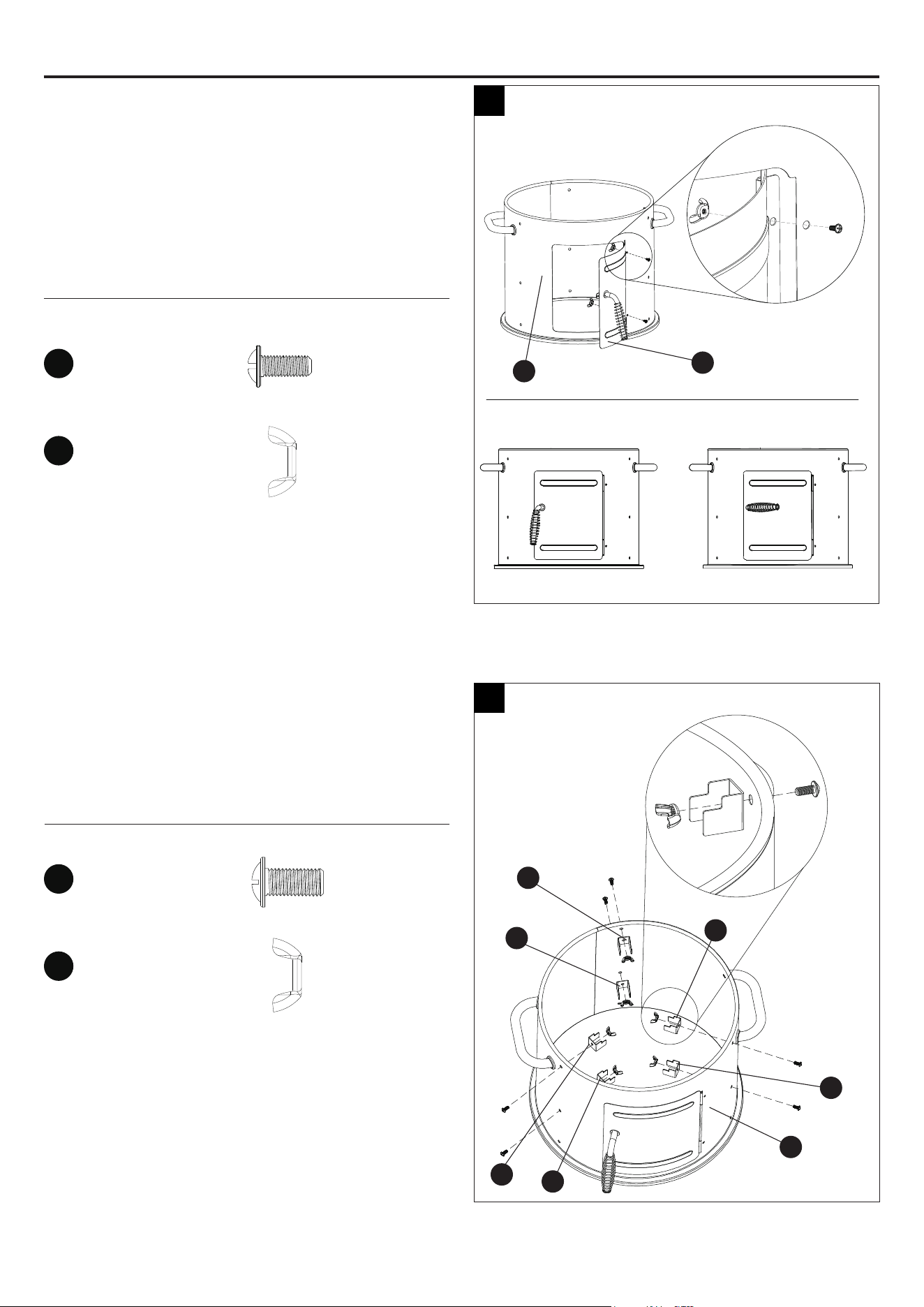
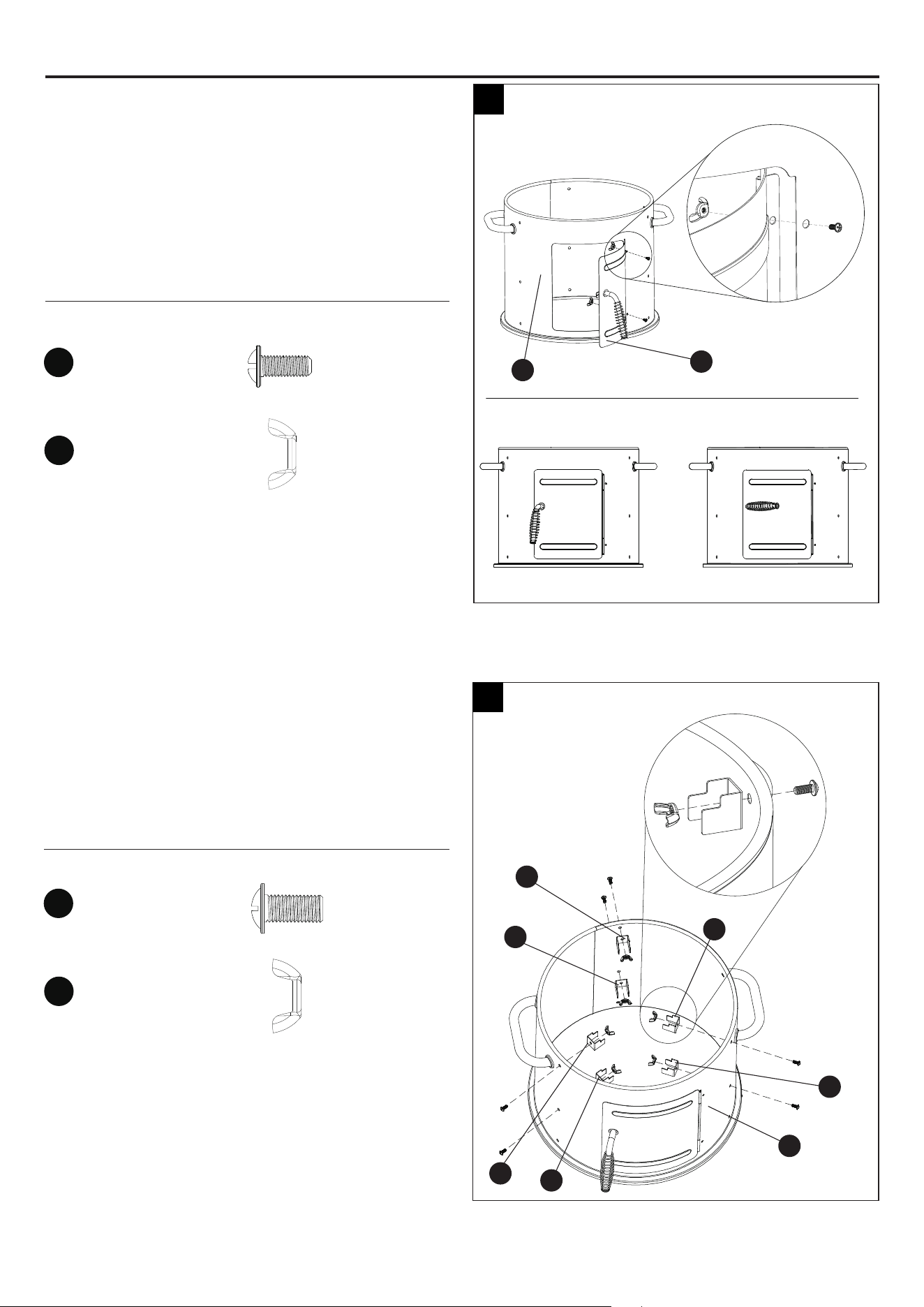
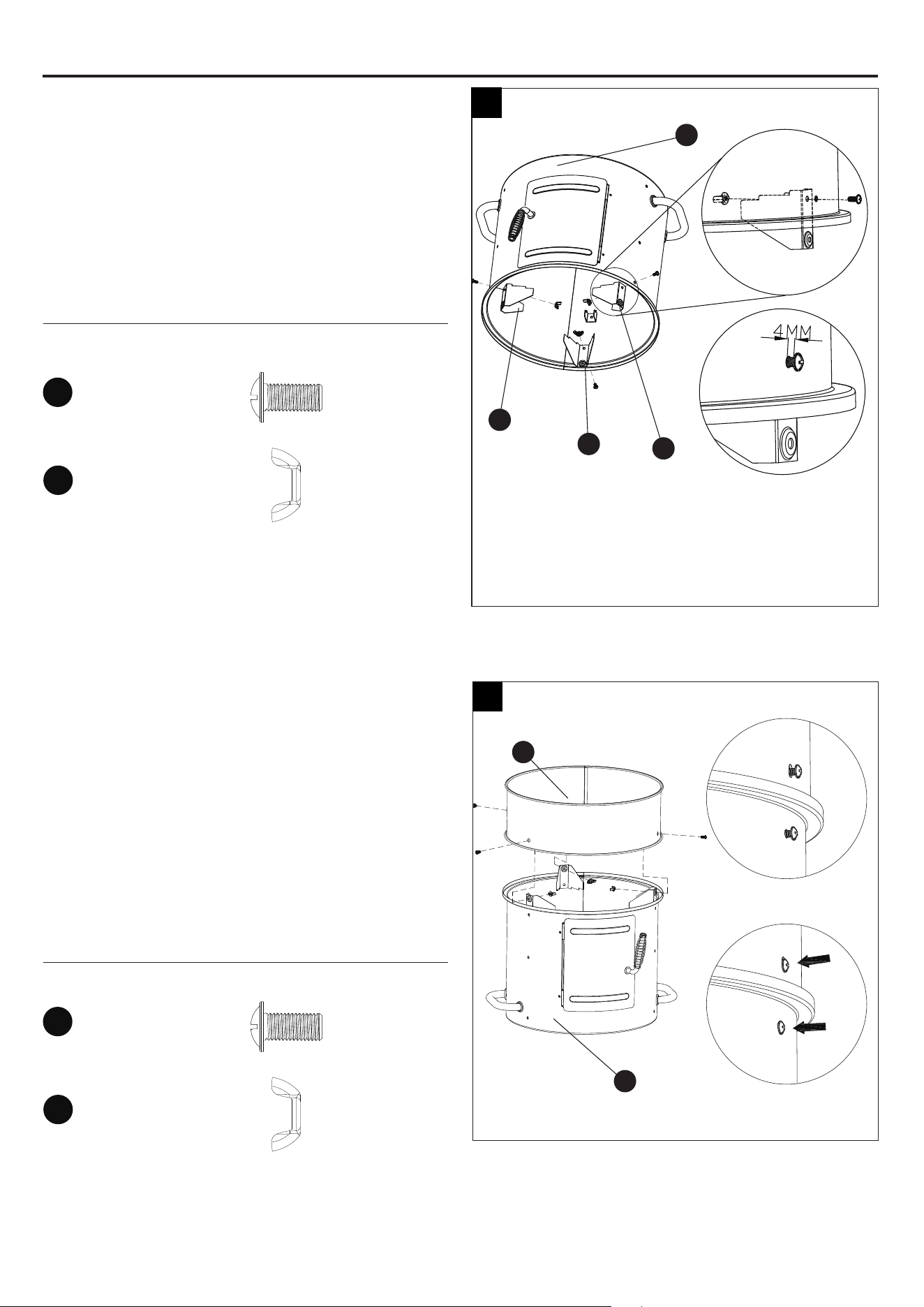
Step 5: Attach Door
Attach the door (L) to the upper smoker body (K)
using two M4 x 10 screws (AA) and two M4 wing
nuts (DD).
NOTE: Please ensure the door hinge is attached
to the inside of the smoker body.
Hardware Used
Step 6: Attach Cooking Grid Supports
Attach the cooking grid supports (I) to upper
smoker body (K) using six M5 x 12 screws (BB)
and six M5 wing nuts (EE).
Hardware Used
M4 x 10
Screw
x 2
M4
Wing Nut
x 2
Lock
Open
M5
Wing Nut
x 6
M5 x 12
Screw
x 6
5
6
AA
BB
DD
EE
L
I
I
I
I
K
I
I
K
8
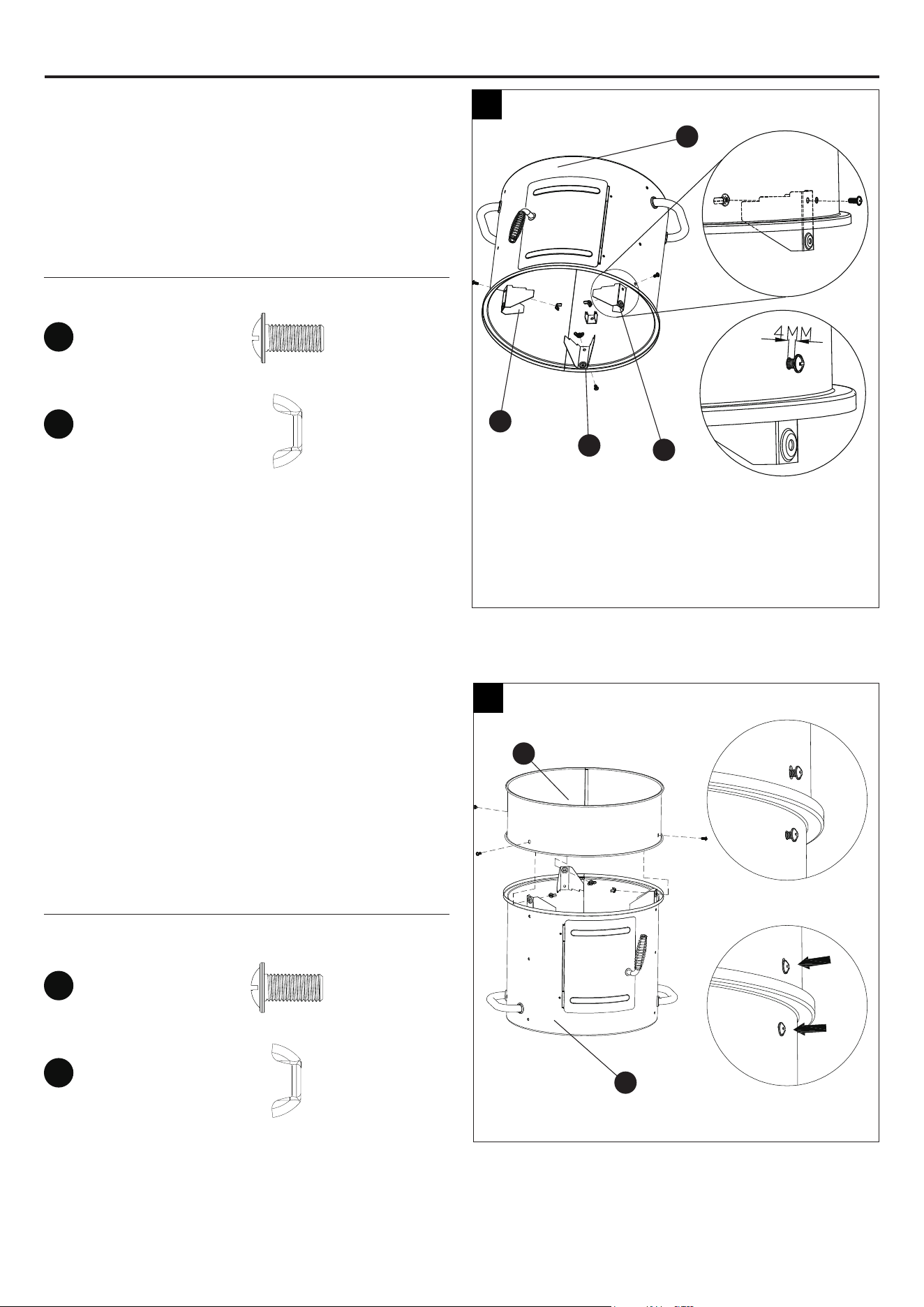
ASSEMBLY INSTRUCTIONS
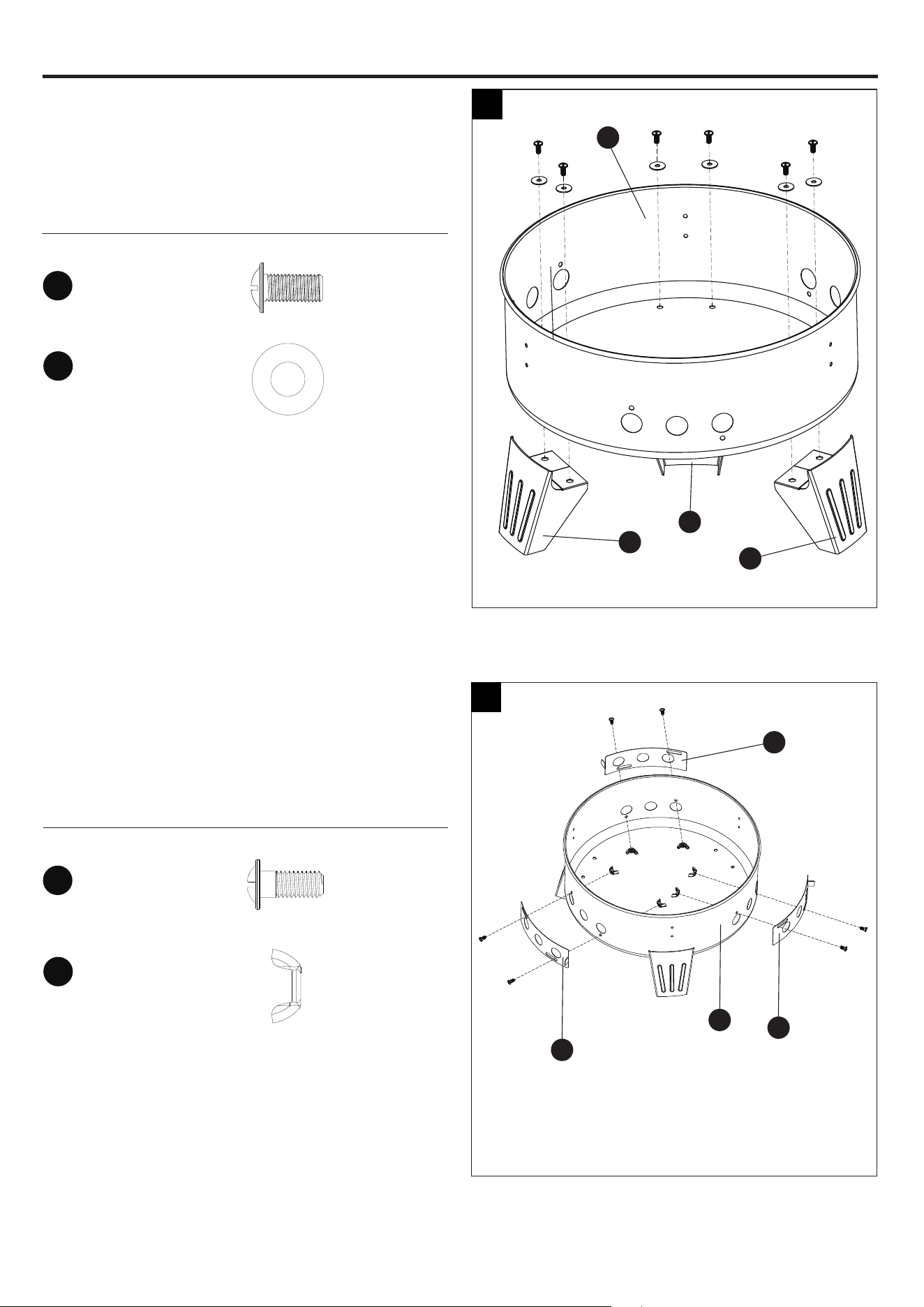
Step 7: Attach Water Pan Support
Attach water pan supports (O) to upper smoker
body (K) using three M5 x 12 screws (BB) and
three M5 wing nuts (EE).
NOTE: Don't fasten the screws too tightly.
Hardware Used
Step 8: Attach Middle Smoker Body
Align the middle smoker body (M) and upper
smoker body (K), then attach the middle
smoker body (M) to upper smoker body (K)
using three M5 x 12 screws (BB) and three
M5 wing nuts (EE).
NOTE: Tighten all screws in this step.
Hardware Used
M5
Wing Nut
x 3
M5
Wing Nut
x 3
M5 x 12
Screw
x 3
M5 x 12
Screw
x 3
First
Second
7
8
BB
BB
EE
EE
O
M
K
O
O
K
9
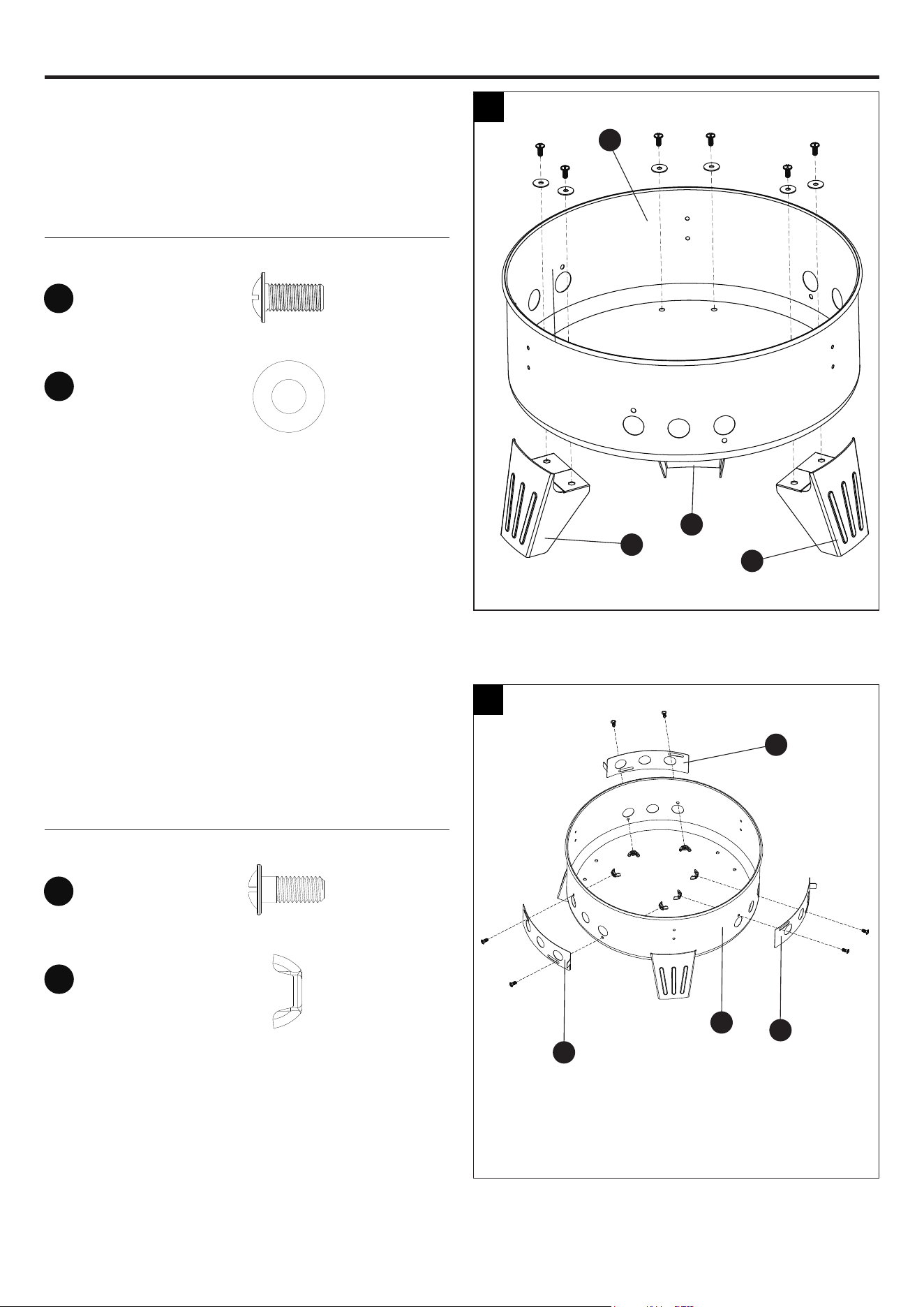
ASSEMBLY INSTRUCTIONS
M5 x 12
Screw
x 6
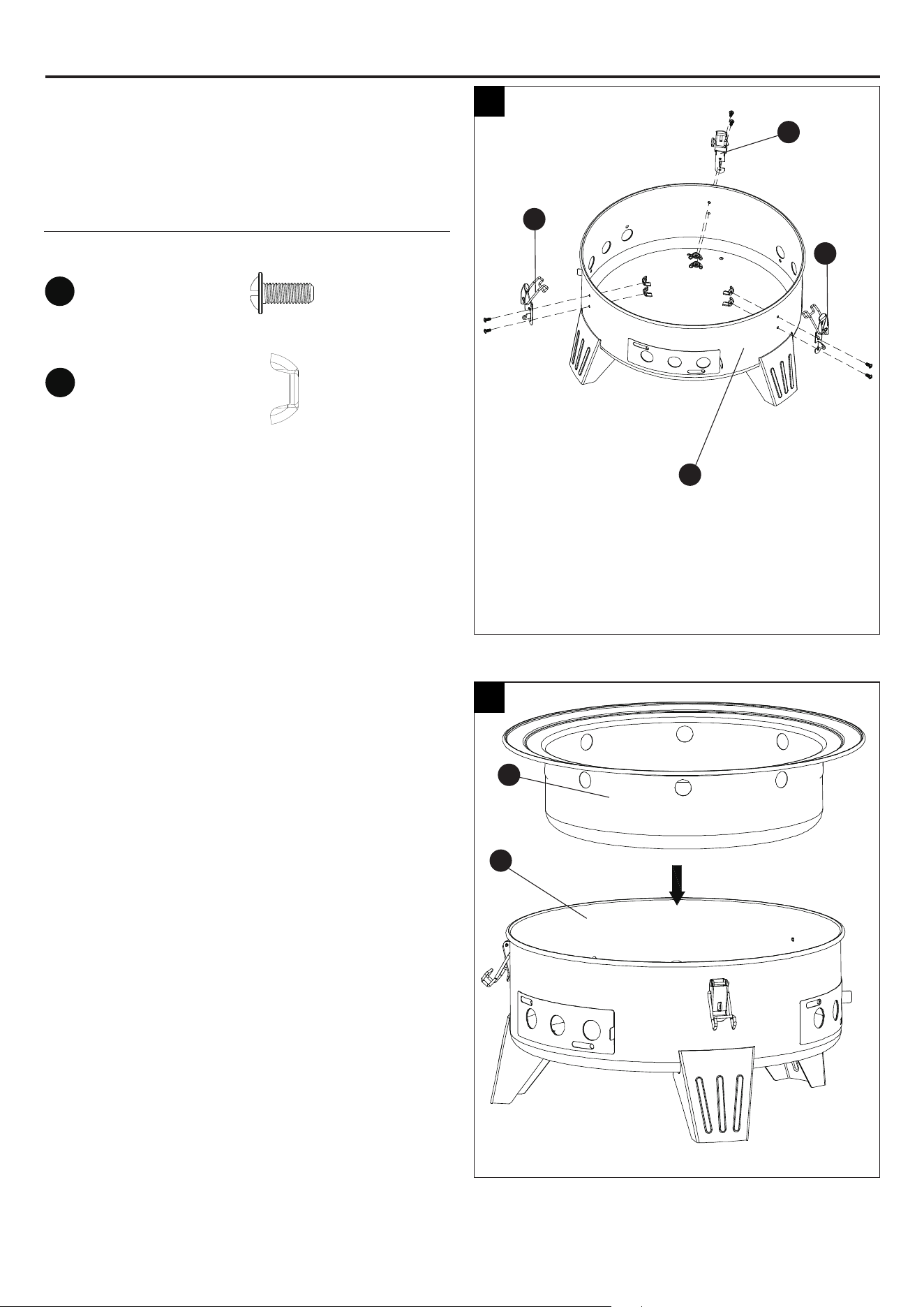
Step 9: Attach Legs
Attach legs (T) onto the bottom bowl (R) using
six M5 x 12 screws (BB) and six Ø6.5 x Ø18
washers (FF).
Hardware Used
Step 10: Attach Air Dampers
Attach air dampers (S) onto the bottom bowl (R)
using six M5 x 12 step screws (CC) and six M5
wing nuts (EE).
Hardware Used
M5
Wing Nut
x 6
M5 x 12
Step Screw
x 6
Ø6.5 x Ø18
Washer
x 6
9
10
BB
CC
FF
EE
R
T
T
T
S
S
S
R
10
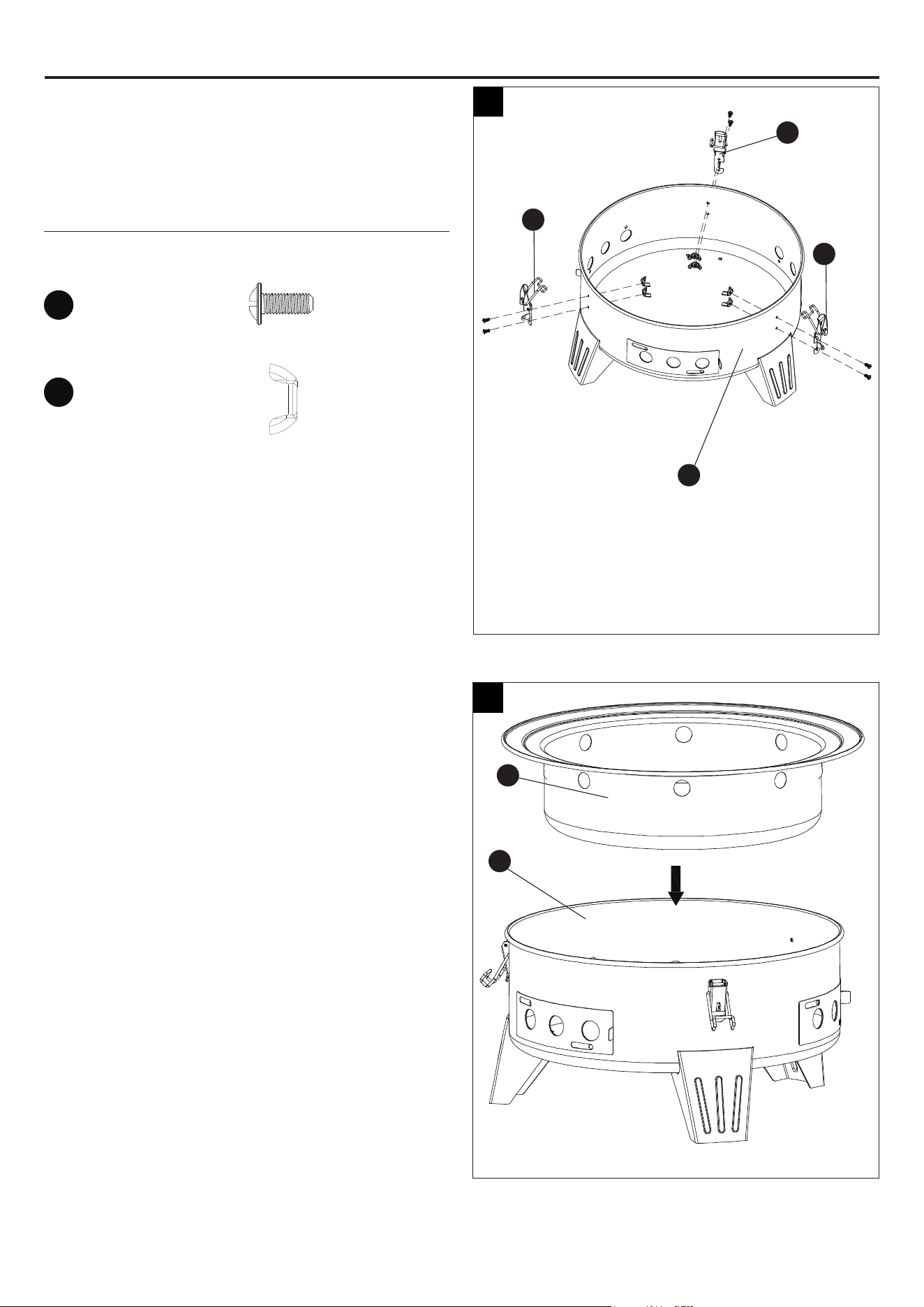
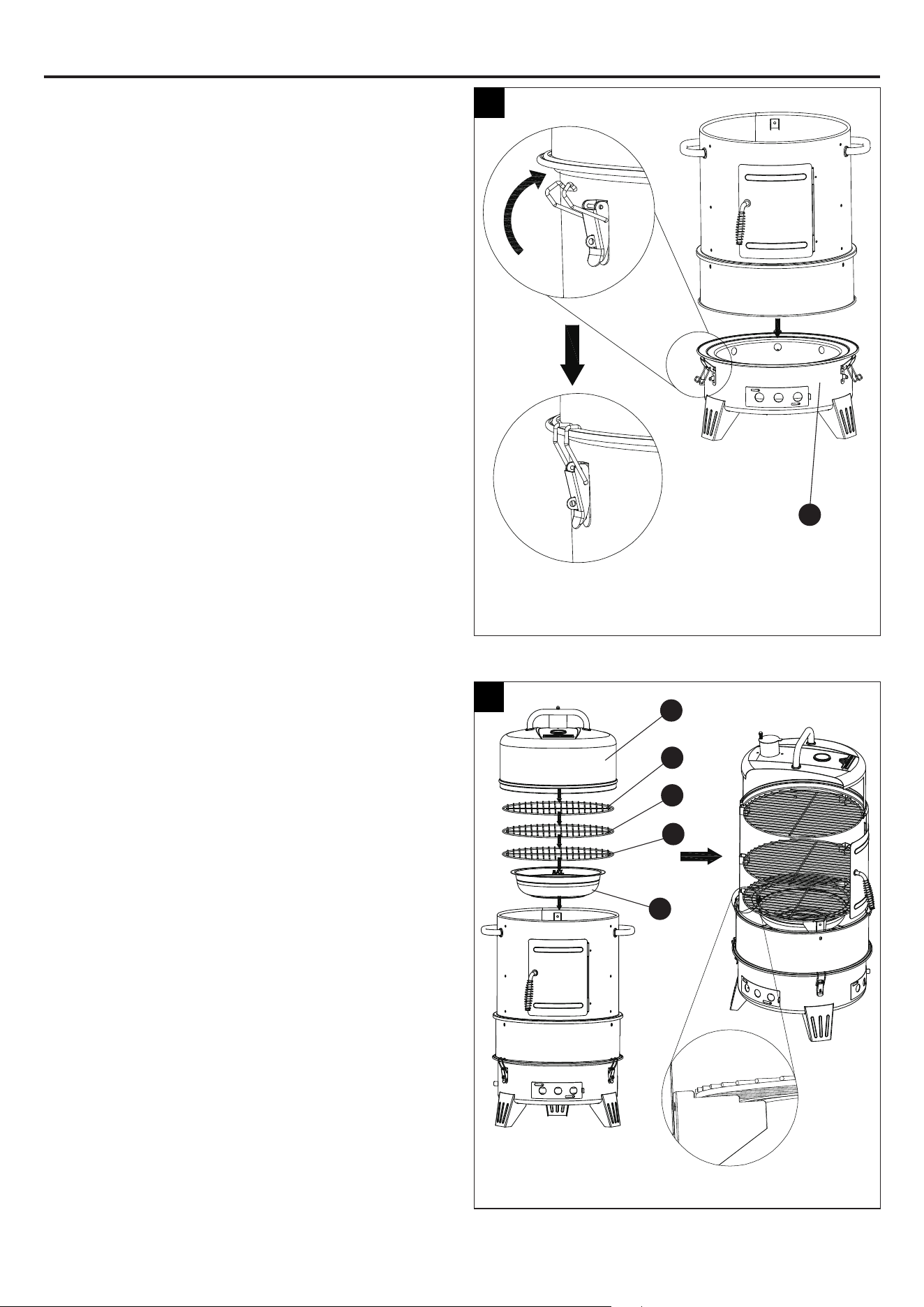
Step 11: Attach Lock
Attach locks (P) onto the bottom bowl (R) using
six M4 x 10 screws (AA) and six M4 wing
nuts
(DD).
Hardware Used
Step 12: Insert Charcoal Pan
Insert the charcoal pan (Q) into the bottom
bowl (R).
ASSEMBLY INSTRUCTIONS
M4 x 10
Screw
x 6
M4
Wing Nut
x 6
12
11
P
P
P
R
Q
R
AA
DD
11
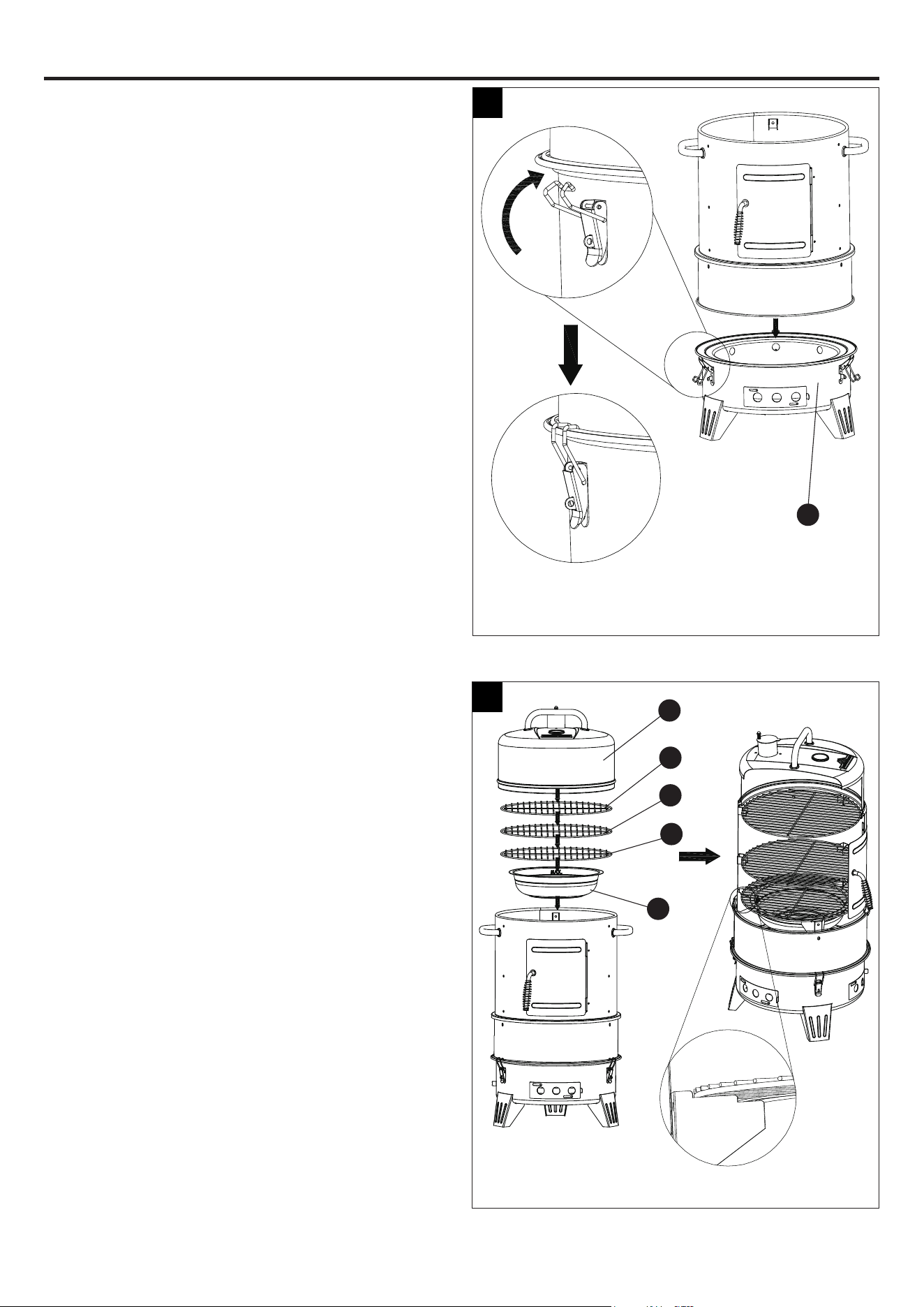
Step 13: Place Smoker Body Assembly
Place smoker body assembly onto the bottom
bowl (R).
ASSEMBLY INSTRUCTIONS
Step 14: Insert Water Pan, Cooking Grids and
Place Lid
Insert the water pan (N) and cooking grids (G)
into smoker body assembly.
Place the lid (D) onto smoker body assembly.
13
14
R
D
G
G
G
N
12
This appliance is designed for use only with quality
charcoal briquettes, lump charcoal and cooking wood.
W CAUTION: Never use charcoal that
has been pre-treated with lighter uid.
Use only a high grade plain charcoal,
charcoal/wood mixture, lump charcoal
or cooking wood.
W CAUTION:Always place your smoker on
a hard, non-combustible, level surface.
An asphalt or blacktop surface may not
be acceptable for this purpose.
W CAUTION:Do not use on wooden decks,
wooden furniture or other combustible surfaces.
W CAUTION:Position smoker so wind can not carry ashes to combustible surfaces.
W CAUTION:Position smoker to prevent smoke from entering house through open doors or
windows.
W CAUTION:Do not use in high winds.
First Use
1. Make sure all labels, packaging and protective lms have been removed from the smoker.
2. Remove manufacturing oils before cooking on this smoker for the rst time:
a. Light smoker per “Lighting Instructions” section in this manual.
b. Operate smoker for at least 2 hours with the lid closed. This will “heat clean” the internal parts and dissipate odors.
c. Do not touch the exterior of the smoker or open the lid during this process.
d. After the 2 hours, follow “Smoking Instructions” section in this manual.
3. Apply a protective coat:
a. Remove water pan and charcoal pan from smoker.
b. Apply a light coat of vegetable oil or vegetable oil spray to all interior surfaces of smoker.
W CAUTION:Do not apply vegetable oil to charcoal grid or charcoal pan.
Lighting Instructions
CAUTION:Do not apply vegetable oil to charcoal grid or charcoal pan.
W CAUTION:Check to make sure the air vents are free of debris and ash before using the
smoker.Before each use check smoker for any damaged or loose parts. Tighten any loose
parts and replace any damaged parts before using smoker.
W CAUTION:Make sure charcoal pan is empty and securely and completely in place before
using the smoker.
OPERATING INSTRUCTIONS
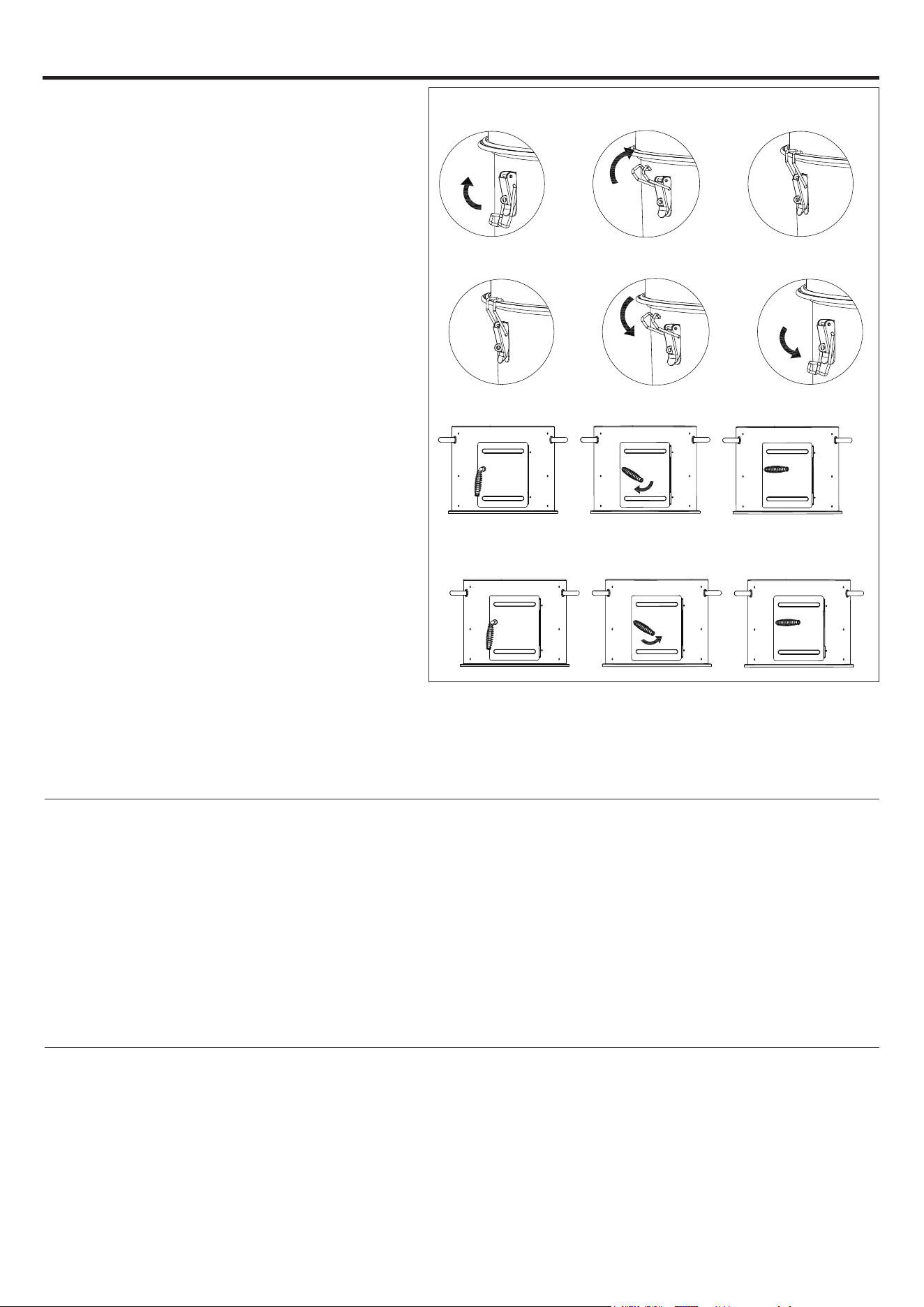
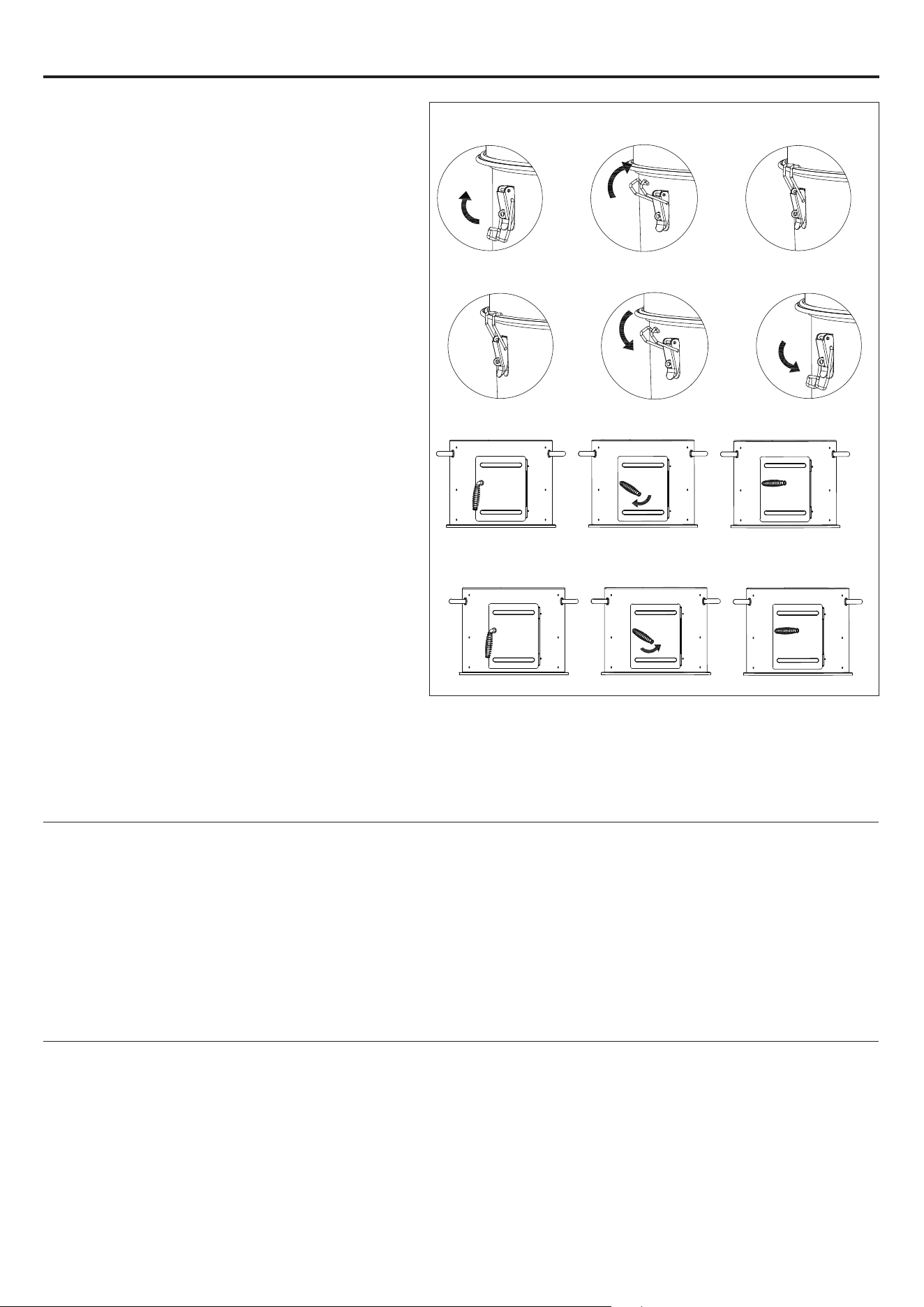
To lock the smoker:
Close the lid. Slide the lock forward till the sides of the
lock cover the lid and bottom bowl. See Figure.1a.
To unlock the smoker:
Slide the lock backwards till the lock stops or both sides
of the lock are free from the lid and bottom bowl. See
Figure.1b.
W CAUTION: All transporting and storage
should be done when smoker is cool
and with the fuel supply removed.
W CAUTION: Always lock smoker before
transporting.
To unlock the door:
Rotate handle counterclockwise. See Figure.2a.
To lock the door:
Rotate handle clockwise. See Figure.2b.
Figure.1a
Figure.1b
Figure.2a
Figure.2b
13
OPERATING INSTRUCTIONS (CONTINUED)
1. Remove lid, cooking grids, and water pan. Set aside.
2. Make sure charcoal pan is empty and secure.
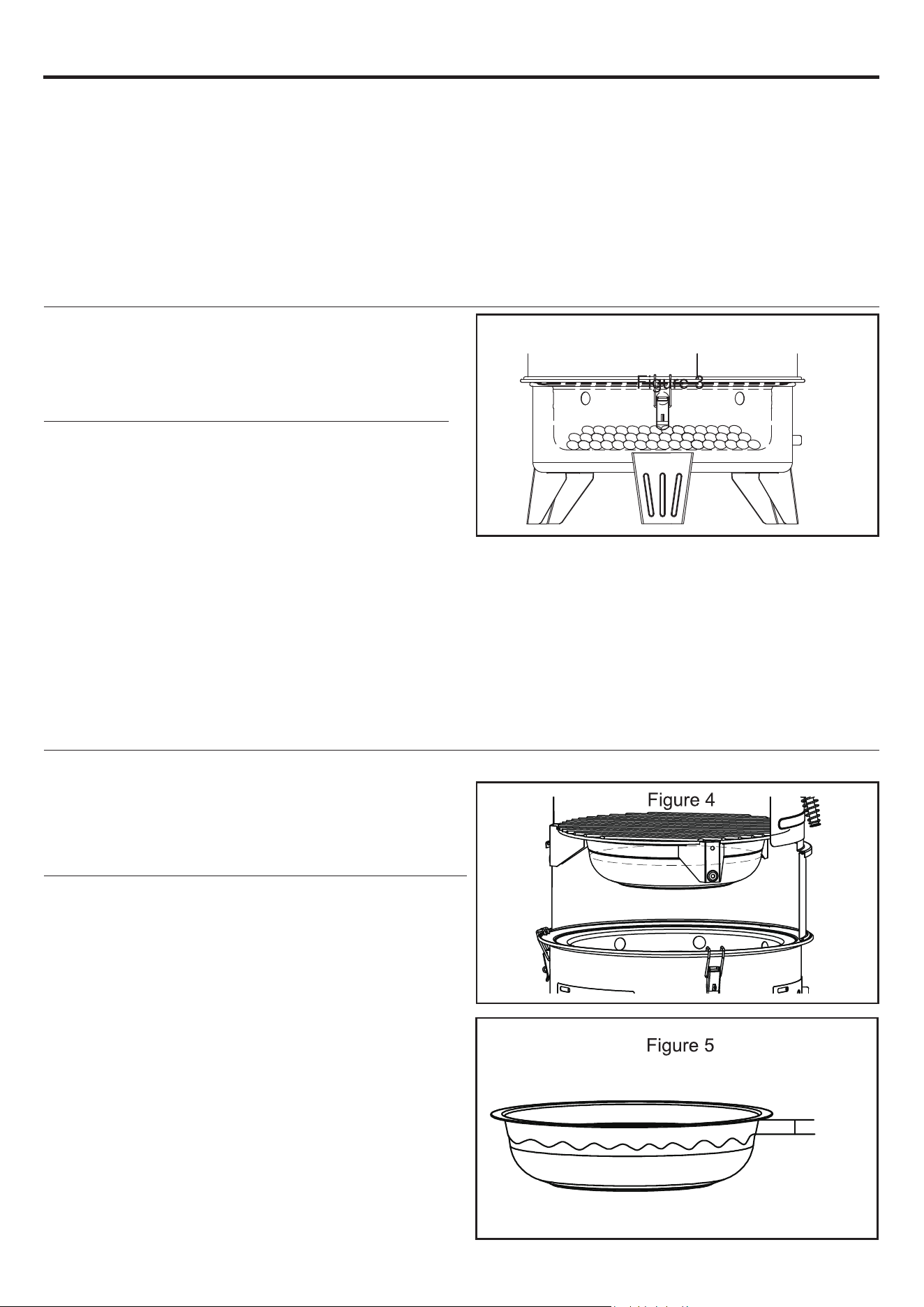
3. Arrange charcoal briquettes or other fuel on the charcoal pan (Figure 3).
WARNING: The maximum charcoal weight of rebody to be used at once is 2.2 lbs. / 1 kg.
4. Light per instructions on fuel package.
5. Allow charcoal to burn until covered with a lite ash prior to closing door and placing lid on smoker.
NOTE: If using avored wood, follow instructions on avored wood packaging.
W CAUTION:When using a liquid starter, always check charcoal pan before lighting. Fluid can
collect in the charcoal pan and could ignite, resulting in a re.
W CAUTION:Never add lighting uid to hot or even warm coals as ashback may occur
causing serious injury or damage to property.
Turning Off
1. Allow charcoal to completely extinguish itself.
W WARNING: Do NOT use water to extinguish. This
can be dangerous and cause damage.
2. Dispose of the ashes in a proper location.
Controlling Flare-ups:
W CAUTION: Do NOT use water on a grease fire. This
can cause the grease to splatter and could result
in serious burns, bodily harm or other damage.
W CAUTION: Do NOT leave grill unattended while
preheating or burning off food residue. If grill has
not been cleaned, a grease fire can occur that may damage the product.
W WARNING: When cooking, fire extinguishing materials should be readily accessible. In the event of an oil/
grease fire, use a type BC dry chemical fire extinguisher or smother with dirt, sand or baking soda. Do NOT
attempt to extinguish with water.
Flare-ups are a part of cooking meats on a grill and add to the unique flavor of grilling.
Excessive flare-ups can over-cook your food and be dangerous.
Important: Excessive flare-ups result from the build-up of grease in the bottom of your grill.
If a grease fire occurs, close the lid until the grease burns out. Use caution when opening the lid as sudden flare-ups may
occur.
If excessive flare-ups occur, do NOT pour water onto the flames.
Minimize Flare-ups:
1. Trim excess fat from meats prior to cooking.
2. Cook high fat content meats indirectly.
3. Ensure that your grill is on a hard, level, non-combustible
surface.
Smoking Instructions
1. Light smoker per “Lighting Instructions” in this manual.
2. While wearing protective gloves, carefully place water
pan on water pan brackets. (Figure 4)
3. While wearing protective gloves, carefully fill water pan
with water or marinade to 1 in. (2.54 cm) below the water
pan rim. (Figure 5).
Do not ll past “Max Fill Line”.
NOTE: Water pan holds 2 quarts of liquid and will last
about 2 – 3 hours when smoker is in use.
4. While wearing protective gloves, carefully remove the
smoker lid. Make sure to open the lid away from you. This
will allow the steam to escape away from you.
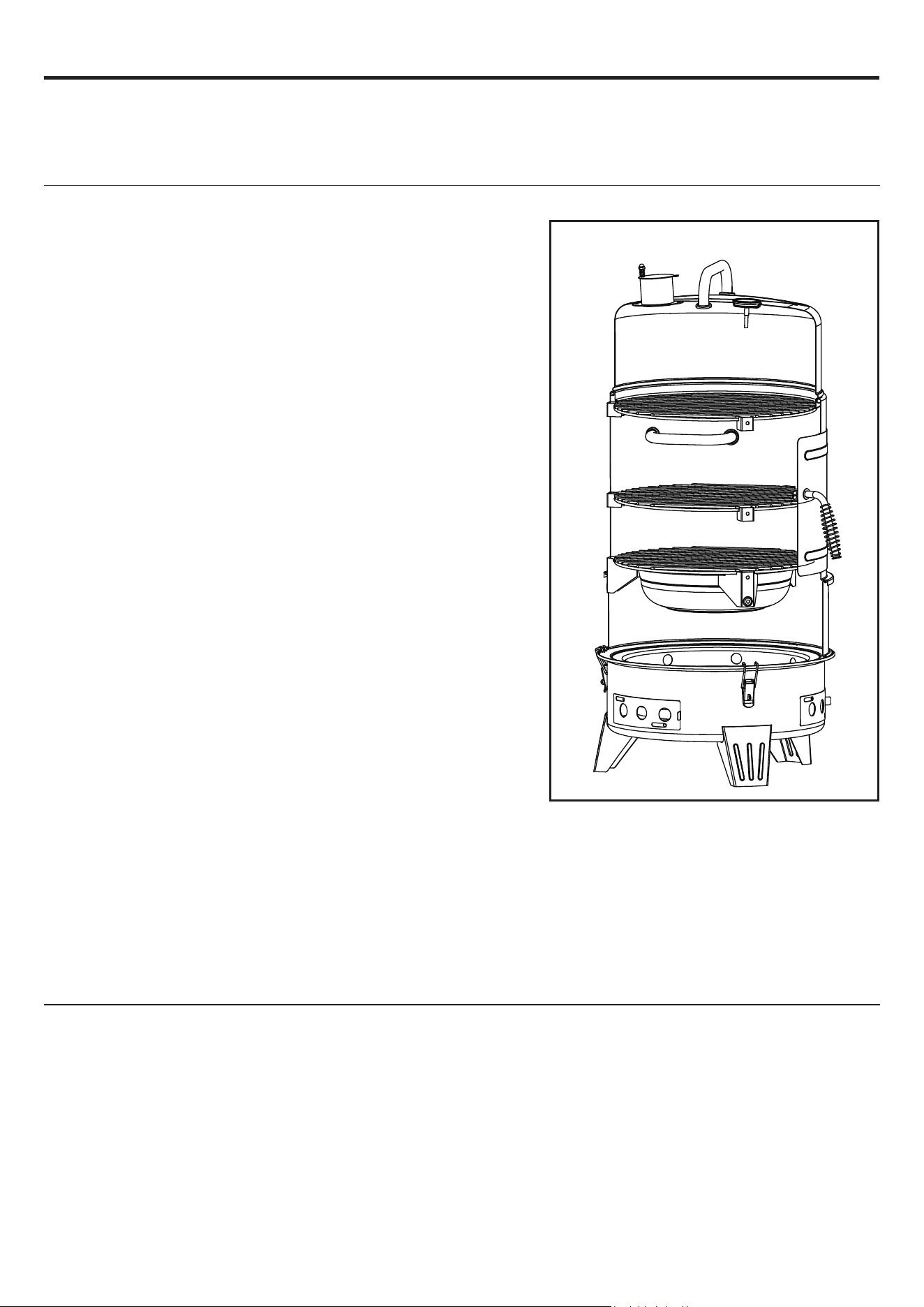
5. While wearing protective gloves, carefully place cooking
grid on the lower cooking grid supports. (Figure 6).
6. While wearing protective gloves, carefully place food in a
single layer and evenly spaced on the lower cooking grid.
7. While wearing protective gloves, carefully place other
cooking grids on upper cooking grid supports. (Figure 6).
8. While wearing protective gloves, carefully place the food
in a single layer and evenly spaced on the upper cooking
grids.
14
MAX:
1 in
9. While wearing protective gloves, carefully place lid on smoker.
10. Check water level per “Adding Additional Water” and charcoal per “Adding Additional Charcoal/Flavored Wood”
section in this page.
W CAUTION:Always use a meat thermometer to ensure food is cooked to a safe temperature.
Adding Additional Water
While using the smoker, check water level at least every 2 hours. If
water is needed it can be added through top of the smoker or through
the smoker side door. See instructions below.
NOTE: Low water level can be detected by listening for the sound of
water sizzling.
Adding Water Option 1 - Through Top of Smoker:
Leave the upper rack in place, and use the 6 hooks provided to hang
sausage, chicken pieces, whole fish, and other items.
W Open lid slowly as flare-up can occur when fresh air suddenly
comes in contact with the fire.
1. While wearing protective gloves, carefully remove the smoker lid.
Make sure to open the lid awayfrom you. This will allow the steam to
escape away from you.
2. Determine water level in water pan:
a. If water is needed continue to step 3.
b. If water is not needed, replace lid on smoker.
3. While wearing protective gloves and using long cooking tongs, re-
move food and upper and middle cooking grid.
4. While wearing protective gloves and using long cooking tongs, slide
food over to one side of lower cooking grid.
5. Carefully pour water into water pan to 1 inch (2.54 cm) below the
water pan rim. (Figure 5). Do not overfill water pan.
W Stand to side of smoker and use extreme caution while pouring
water as it may turn directly to steam.
6. Move food back to the proper location on lower cooking grid.
7. Replace upper cooking grid and food.
8. Replace lid on smoker.
Adding Water Option 2 - Through Side of Smoker:
W Open lid slowly as flare-up can occur when fresh air suddenly
comes in contact with the fire.
1. While wearing protective gloves, carefully open the smoker side door. Make sure to stand on the opposite side of door
opening. This will allow the steam to escape away from you.
2. Determine water level in water pan:
a. If water is needed continue to step 3.
b. If water is not needed, replace lid on smoker.
3. Using a funnel or a container with a spout, carefully pour water into water pan to 1 inch (2.54 cm) below the water pan
rim. (Figure 5). Do not overfill water pan.
W Stand to side of smoker and use extreme caution while pouring water as it may turn directly to steam.
4. Close side door on smoker.
Adding Additional Charcoal/Flavored Wood
W CAUTION: Open lid slowly as flare-up can occur when fresh air suddenly comes in contact with the fire.
W CAUTION: Never use charcoal that has been pre-treated with lighter fluid. Use only a high grade plain
charcoal, charcoal/wood mixture, lump charcoal or cooking wood.
W WARNING: Never add lighting fluid to hot or even warm coals as flashback may occur causing serious injury
or damage to property.
1. While wearing protective gloves, carefully remove the smoker lid. Make sure to open the lid away from you. This will
allow the steam to escape away from you.
2. While wearing protective gloves, carefully open smoker door. Make sure to open the door away from you. This will al-
low the steam to escape away from you.
3. While wearing protective gloves and using long cooking tongs, lightly brush off ashes from hot coals.
4. While wearing protective gloves and using long cooking tongs, carefully add more charcoal onto charcoal grid,
through the door. Once the new charcoal is burning strong, close the door and replace the lid on smoker.
OPERATING INSTRUCTIONS (CONTINUED)
15
Figure 6
OPERATING INSTRUCTIONS (CONTINUED)
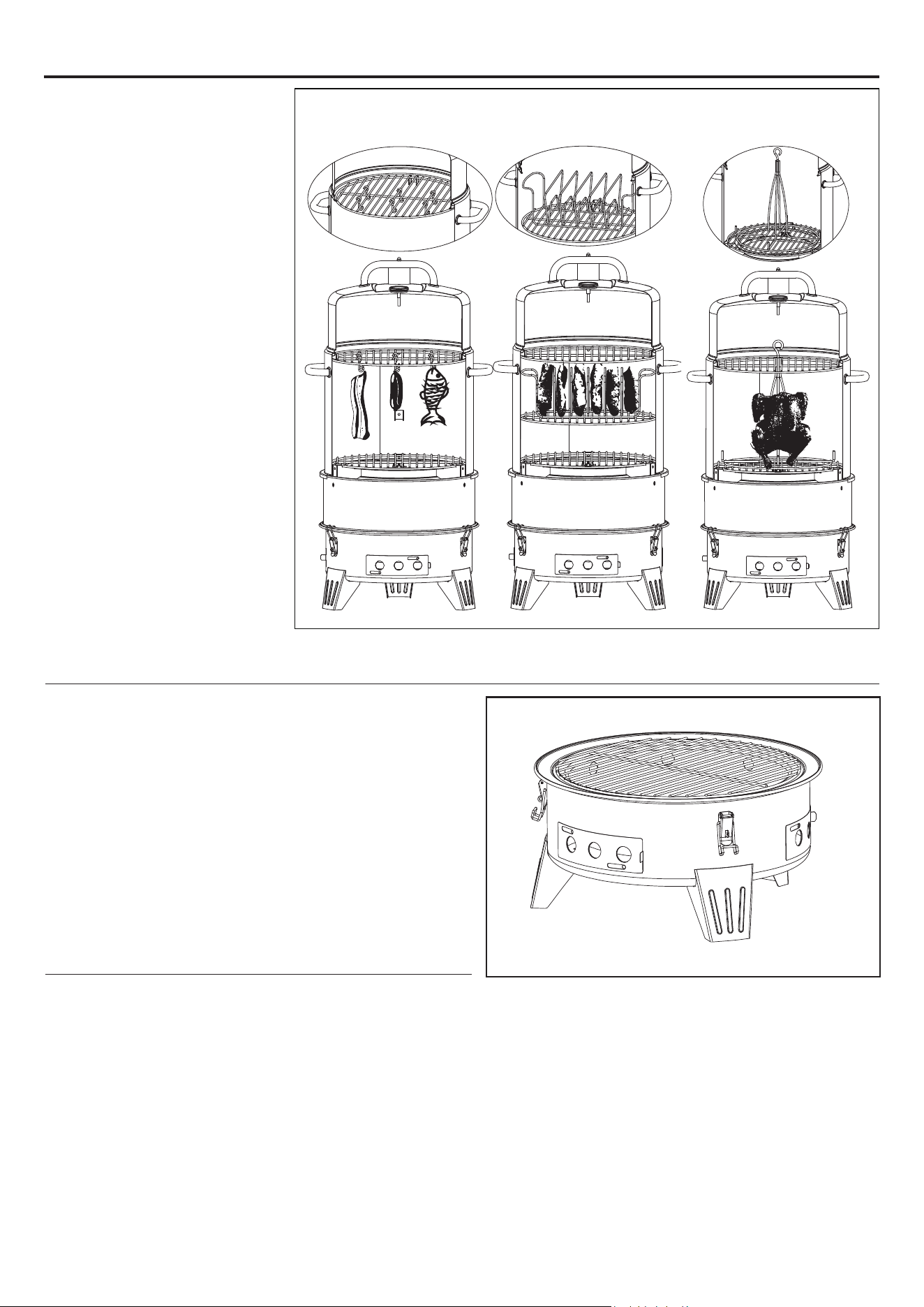
Cooking Accessories
Meat Hooks:
Leave the upper rack in place,
and use the 6 hooks provided to
hang sausage, chicken pieces,
whole fish, and other items.
Rib Rack:
Your smoker includes a rib
rack that can be used in place
of the cooking grids. Maximize
the space in your smoker by
keeping ribs upright. Holds ribs,
chicken halves, potatoes and
corn vertically to triple cooking
capacity. Allows smoke, steam
and heat to penetrate food evenly.
Chicken Rack
Remove the middle cooking
grid and use the chicken rack
provided. This rack holds chicken,
corninsh hen, duck or turkey
upright and are ideal for smoking
poultry. The rack allows the
meat to cook from the inside as
well as from the outside. This
speeds up cooking time, seals in
flavorful juices and promotes even
browning of skin. It’s a lower fat way to cook poultry because excess fat drips off the meat.
Used as Portable Charcoal Grill
Your smoker can also function as a portable grill when you
remove the middle grill body and grates, etc..Simply keep the
bottom bowl/ charcoal pan and one cooking grid for a versatile
grilling experience as Firgure 8.
1. Remove lid and upper cooking grid.
2. Unlock the middle grill body assembly. Set aside.
3. Remove the water pan. Set aside.
NOTE: All steps should be done when smoker is cool and with
the fuel supply removed.
WARNING: The maximum charcoal weight of rebody to
be used at once is 2.2 lbs. / 1 kg.
Smoking Recipes
Cooking with a MEAT THERMOMETER ensures food is fully cooked. Insert thermometer into the thickest part of the
meat, not touching bone, and allow 1 to 1 1/2 minutes to register temperature.
USDA Safe Minimal Temperature is 165F for chicken / poultry.
USDA Safe Minimal Temperature is 145°F for Beef, Pork, Veal & Lamb (Steaks, chops, roasts).
Figure 7
Meat Hooks Rib Rack Chicken Rack
Figure 8
16

OPERATING INSTRUCTIONS(CONTINUED)
“CERTIFIED” PORK BUTT
A great pork butt recipe perfect for beginners and pitmasters alike. This slow smoked pork butt recipe is great shredded
and piled high with coleslaw for a sandwich or eaten on it’s own straight out of the pan!
Ingredients: Preparing the Meat: Cooking Directions:
2 Pork Butts
(6-10 lbs.
each)
Apple juice
Your
favorite rub/
seasoning
Mustard
1. Remove the pork butt from the
plastic wrap & pat dry using a
paper towel.
Tip: Choose a pork butt with a full fat
cap. This helps the meat while it’s
smoking for a long period of time.
2. Trim the excess fat that is loose
and pulls up easily. Score the
fat cap 1/8 to 1/4-inch-deep
diagonally, spaced out 1/2 to 1
inch apart.
Tip: Scoring the meat allows the
seasoning and smoke to penetrate
into the pork butt.
3. Fill the marinade injector with
apple juice and inject into the
top and sides of the meat.
4. Spread a coating of mustard
using a basting brush all over
the pork butt.
Tip: This allows the rub to stick to
the pork butt.
5. Generously season the pork butt
on all sides with your favorite
rub.
6. Tip: After seasoning, wrap in
Saran Wrap and store in the
refrigerator overnight or 8-10
hours. This allows the rubs to
penetrate and apple juice to
tenderize the pork butt.
1. Ignite charcoal and preheat the smoker to 225°F.
2. Add boiling water to the drip pan and place under the grill
grate.
Tip: This will add moisture for the cook and collect the drippings
.
3. Smoke the pork butts for 2 hours per pound at 225°F, until
the meat reaches an internal temperature of 160°F.
Tip: Maintain a 225°F temperature, check fire hourly or when
needed. Also spritz with apple juice every time you add fuel
to your fire. Spritzing adds moisture and flavor. It prevents the
pork butt from drying out and helps to create the bark. Monitor
the temperature using a folding probe thermometer and/ or
remote thermometer.
4. Remove the pork butts from the smoker and double wrap in
foil. Before closing the wrap, add 1 Cup of apple juice and
1 stick of butter for each pork butt, more seasoning and
BBQ sauce, to taste.
5. Place back in the smoker and cook until the pork butt
reaches an internal temperature of 199°F, then remove
from the smoker.
Tip: Wrap pork butt in a large towel and place in a cooler or
just set to the side for a minimum of 1-2 hours for resting. This
allows the meat to cook down and stop cooking and is a major
key in the process.
6. After resting, remove the towel and foil. Pull apart the pork
using two forks or meat claws.
7. Make pulled pork sandwiches and endless pulled pork
dishes. Enjoy!
BRISKET
The brisket recipe is a traditional take on the smoked classic, promising tender, smoky results.
Ingredients: Instructions:
10 ½ lbs. beef brisket
½ Cup paprika
¼ Cup packed light brown sugar
3 Tbsp. salt
3 Tbsp. coarse black pepper
3 Tbsp. Chili powder
Apple juice
Water
1. Using a sharp knife, trim the fat from the brisket leaving an even,
thin layer on the top.
2. In a medium bowl, combine paprika, light brown sugar, Chili
powder, salt and pepper and mix well to make rub seasoning.
Using your hands, or a shaker, generously apply rub all over.
3. Wrap the brisket in plastic wrap and refrigerate for at least 12
hours.
4. When setting up the grill, add wood chips/chunks to charcoal
and add Smokin’ Stone with an aluminum pan on top. Pour
apple juice and water into the pan, about halfway full. Place a
temperature probe at grate level and heat grill to 220°F.
5. Place brisket on grates, fat side up, and allow to smoke for 5
hours. After 5 hours, wrap the brisket in butcher paper and return
to grill at 220°F. Brisket is done when the internal temperature
reaches 195°F. Allow the brisket to rest for 1 hour.
6. Slice, serve and enjoy!
17

OPERATING INSTRUCTIONS(CONTINUED)
SMOKED MAC AND CHEESE
An all-time family favorite, this Smoked Mac & Cheese recipe elevates stovetop or oven baked mac & cheese with flavors
sure to keep your smoker fired up.
Ingredients: Instructions:
1 Package of Elbow Macaroni
½ Stick of Butter
¼ Cup of All Purpose Flour
1 Cup of Heavy Cream
1 Cup of Milk
2 Cups of Cheddar Cheese
(Shredded)
1 Cup of Gouda Cheese
(Shredded)
1 Cup of Colby Jack Cheese
(Shredded)
½ Cup of Cream Cheese
2 Tbsp of Black Pepper
1 Tsp of Cayenne Pepper
1 Large Cast Iron Skillet
1. Boil elbow macaroni according to package instructions for al dente.
2. Preheat the smoker to 225°F using a fruity hardwood like apple or cherry in the
Side Fire Box.
Tip: If your grill does not have the Side Fire Box attachment, easily turn it into a
smoker by arranging coals / wood opposite of where you place the mac and cheese
pan. If you place the pan on the right side of the grates, simply place wood on the
right side for an indirect cooking experience.
3. Heat the cast iron skillet over medium heat, then melt butter and whisk in flour.
4. While continuing to whisk, add milk and heavy cream bringing to a boil.
5. Reduce to low-medium heat and whisk in cream cheese until smooth.
6. Whisk in the rest of the cheeses continuing to stir until melted and smooth
7. Turn off the heat then stir in macaroni noodles until thoroughly mixed with cheese
sauce
8. Place the entire skillet in the smoker and cook for 1-2 hours until desired
doneness. Keep in longer for more smoky flavor.
9. Serve hot.
SMOKED CHICKEN PARTS AND HALVES
Instructions:
1. Rinse pieces in cold water and pat dry with paper towels.
2. Brush each piece with Olive Oil and season to taste with salt and pepper.
3. Brown pieces directly above coals with lid open and grill on high or medium heat for several minutes.
4. Then place pieces on cooking grate in indirect cooking area.
5. With the grill on low heat, cook with lid down for 55 to 60 minutes or until done. Do not use Olive Oil or salt and
pepper if using marinade.
SMOKED TURKEY
Instructions:
1. Empty cavity rinse and pat dry with paper towel.
2. Tuck wing tips under the back and tie legs together.
3. Place in center of cooking grate directly above foil drip pan of water.
4. Smoke for 12 minutes per pound. Allow several extra minutes per pound if stuffed to allow for expansion.
5. Use a meat thermometer for best results (190°F internal).
SMOKED BAKED HAM
You can smoke fully cooked canned ham or smoked and cured whole ham or shank or butt portion.
Ingredients: Instructions:
1 cup of Light Brown Sugar,
firmly packed
1/2 cup Orange Juice
1/2 cup Honey
1. Combine sugar, juice and honey. Let glaze sit for at least 4 hours.
2. Remove rind and score fat diagonally to give a diamond effect.
3. Insert a whole clove into the center of every diamond.
4. Place ham with fat side up in center of cooking grate. Close lid.
5. About 9 minutes per pound is suggested for fully cooked hams. Smoked or cured
ham, which is not fully cooked, should be cooked to an internal temperature of
160°F.
6. Baste with ham glaze 3 or 4 times during last 30 minutes of cooking time.
7. Garnish with pineapple rings about 15 minutes before end of cooking time.
18

OPERATING INSTRUCTIONS(CONTINUED)
3-2-1 RIBS
The 3-2-1 rib method might be something you have seen thrown around on social media. It’s a popular technique for
smoking ribs that are tender, juicy, and come clean off the bone. Simple and easy to follow, this is a surefire way to
guarantee your ribs are finger lickin’ good. The 3-2-1 Method is a process that involves smoking the ribs for three hours,
wrapping them in foil and braising for two hours, and the smoking unwrapped for one hour. This not only helps the ribs
cook faster, it ensures an even smoke ring, and more tender meat.
Ingredients: Instructions:
4 Racks of Ribs
2 Cups of Apple Cider,
2 Additional Cups
in Spray Bottle
8 Tbsp of Salted Butter
1 Cup of Favorite BBQ
Sauce
1 Cup Dark Brown
Sugar
Char-Griller Rib Rub
4 Tbsp Honey
1. Prepare your Offset Smoker for smoking by starting half a chimney starter of charcoal
and adding it to the Side Fire Box. Alternatively, prepare your grill for the indirect method
with coals arranged opposite where you plan to place the ribs.
Tip: Add about half a chimney of unlit charcoal to the Side Fire Box close to the barrel before
adding the lit charcoal next to it. The lit charcoal will gradually light the unlit charcoal to help
maintain temperature for longer.
2. Add three to four chunks of Apple Wood and close the lid.
3. Allow the grill to heat up to about 200°F.
4. Remove the membrane from the ribs.
Tip: Start at the narrower end of the rack, carefully work a paring knife under the membrane
to get it started, and remove the membrane using a paper towel.
5. Liberally season both sides of the ribs with Rib Rub.
6. Open the grill and raise the adjustable fire grate to the top level. This ensures even
smoke distribution.
7. Place a drip pan(s) full of water under the grates and on top of the fire grate in the main
barrel.
8. Place ribs bone side down on the grates, close the lid and allow to smoke for three
hours.
Tip: Place the exposed bone side of the rib rack towards the Side Fire Box to get the meat
to pull away from the bone better. If using the indirect method, place ribs opposite the coals.
9. Periodically check the temperature to ensure it is holding steady at 200°F. If you have to
add charcoal, only add lit charcoal.
10. Every 30 minutes, spray the ribs with Apple Cider and move the rib rack that is closest
to the Side Fire Box to the side of the grill that is furthest from the Side Fire Box and
move the other rib racks closer to the Side Fire Box to accommodate. Repeat the spray
and rotate method every 30 minutes.
11. Remove ribs from the grill after three hours.
12. Tear off a large sheet of heavy-duty aluminum foil. (One for each rack of ribs.)
13. Place one rack of ribs bone side up on each piece of aluminum foil.
14. Coat the bone side of ribs with brown sugar, honey, and four pats of butter.
15. Pour over ½ cup of apple cider.
16. Fully crimp the edges of the foil together to cover the ribs.
17. Repeat with the other three racks of ribs.
18. Transfer ribs back to the smoker and increase the temperature to 225°F.
19. Do this by opening the dampers a little more and adding another half a chimney of lit
charcoal if needed.
20. Allow ribs to braise for two hours.
21. Continue to rotate the ribs as outlined in step 8b to ensure that all of the racks get time
close and far away from the fire.
22. Remove the ribs from the grill and foil. Place back on the grill bone side down.
23. Brush ribs with your favorite BBQ sauce and cook for one hour at 225°F.
24. Remove and enjoy!
19

OPERATING INSTRUCTIONS(CONTINUED)
SMOKED VENISON WITH BACON
You can smoke fully cooked canned ham or smoked and cured whole ham or shank or butt portion.
Ingredients: Instructions:
Venison Marinade
1 cup Balsamic or Red Wine Vinegar
1 cup Olive Oil
2 oz. Worcestershire
½ oz. Tabasco
2 Tbsp. Seasoning Salt
1-2 Chopped Jalapeños
3 oz. Soy Sauce
Bacon Marinade
2 oz. Red Wine Vinegar
2 oz. Worcestershire 4 dashes Tabasco
1. Place leg of venison in a container and marinate for 2-4 days, turning
daily.
2. Leave bacon to marinate overnight.
3. Remove leg from refrigerator at least an hour before cooking.
4. Season generously with seasoned salt and coarse ground black pepper.
5. Wrap 1 lbs. bacon over the top of the leg, and smoke 20-25 minutes per
pound, or until tender.
6. Do not overcook.
Marinades
CHICKEN MARINADE
Ingredients: Instructions:
½ Cup Soy Sauce
¼ Cup Olive Oil
¼ Cup Red Wine Vinegar
1 Tsp Oregano
½ Tsp Sweet Basil
½ Tsp Garlic Powder with
Parsley
¼ Tsp Pepper
1. Pour over chicken pieces in non-metal dish.
2. Cover and refrigerate overnight, turning occasionally. Use marinade to baste
chicken while cooking.
MEAT MARINADE:(FOR STEAKS, CHOPS, AND BURGERS)
Ingredients: Instructions:
¼ Cup Soy Sauce
2 Large Onions
2 Garlic Cloves, crushed
2 Tsp Salt
2 Tsp Paprika
1 Tsp Fresh Ground Pepper
1. Combine ingredients in an electric blender, cover, and process at high speed 1
minute or until mixture is very smooth.
2. Allow meat to stand in marinade at room temperature for 2 hours or refrigerate
up to 24 hours in a covered dish.
3. Bring meat to room temperature before cooking.
SHISH KABOB MARINADE
Ingredients: Instructions:
1 Cup Soy Sauce
½ Cup Brown Sugar
½ Cup White Vinegar
½ Cup Pineapple Juice
2 Tsp Salt
½ Tsp Garlic Powder
1. Mix all ingredients together.
2. Marinate beef in mixture a minimum of 4 hours.
20
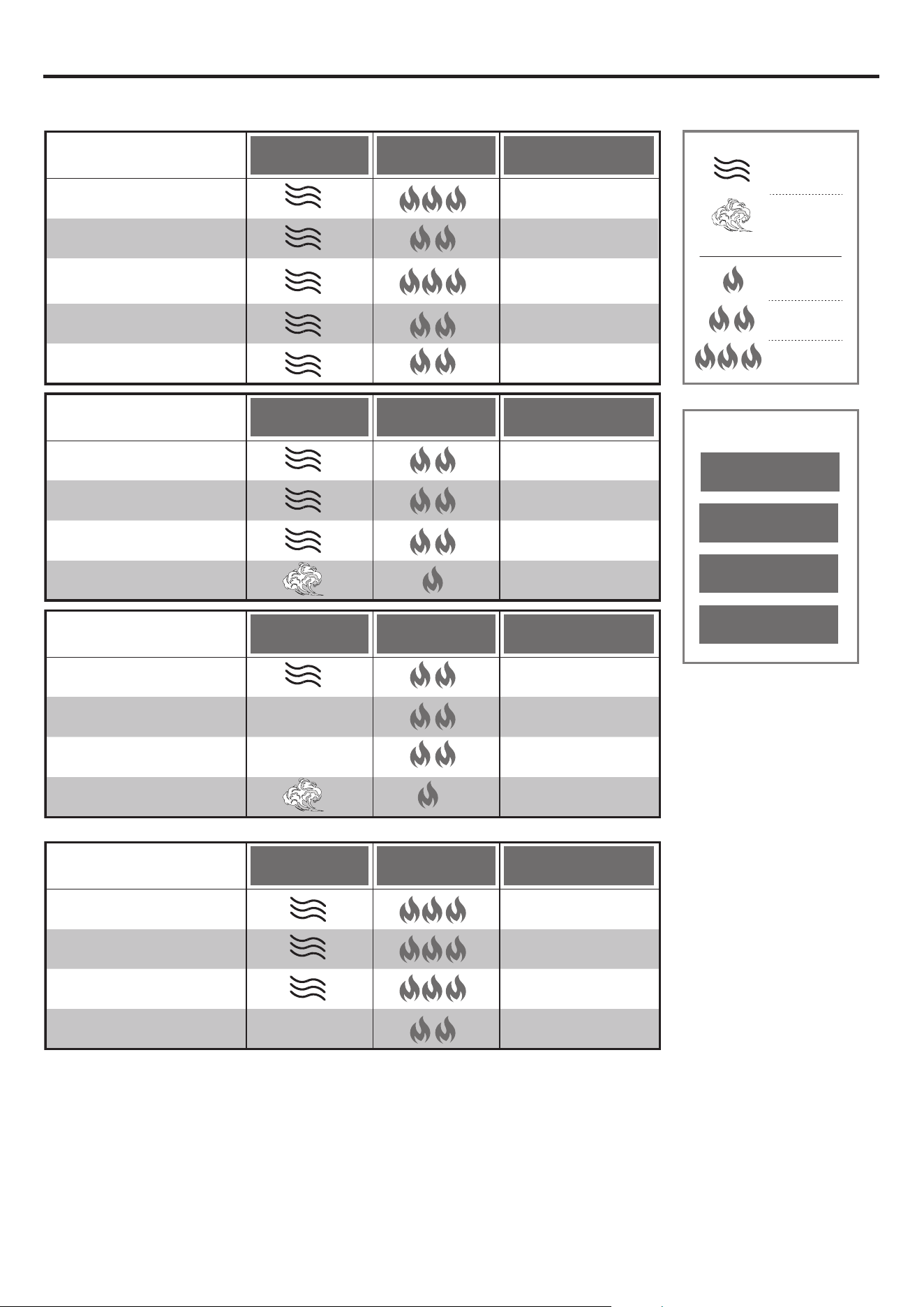
OPERATING INSTRUCTIONS(CONTINUED)
Cooking Guidelines
AVG. COOKING TIMEHEAT LEVELHEAT TYPE
SEAFOOD
LARGE
SHRIMP
4-6 MIN.
1 1/2 OUNCES
SCALLOP
4-6 MIN.
1-INCH THICK
FISH, FILET
5-10 MIN.
1 POUND
FISH, WHOLE
15-20 MIN.
AVG. COOKING TIMEHEAT LEVELHEAT TYPE
CHICKEN
4 OUNCES - BONELESS, SKINLESS
CHICKEN BREAST OR THIGH
8-12 MIN.
3-6 OUNCES - BONE-IN*
CHICKEN THIGH OR LEG
35-45 MIN.
10-12 OUNCES - BONE-IN*
CHICKEN BREAST
35-45 MIN.
8 POUNDS
WHOLE CHICKEN*
3-5 HOURS
AVG. COOKING TIMEHEAT LEVELHEAT TYPE
PORK
1-INCH THICK
PORK CHOP, MEDIUM
8-10 MIN.
8 POUNDS
PORK SHOULDER/BUTT
12 HOURS
3-OUNCE LINK
SAUSAGE
10-13 MIN.
1 POUND
PORK TENDERLOIN
15-20 MIN.
AVG. COOKING TIMEHEAT LEVELHEAT TYPE
BEEF
1-INCH THICK - FILET MIGNON, RIBEYE,
NEW YORK STRIP & PORTERHOUSE
STEAK, MEDIUM
6-8 MIN.
1-INCH THICK
SKIRT STEAK, MEDIUM
4-6 MIN.
3/4 - INCH THICK
BURGER
8-10 MIN.
4 OUNCES
HOT DOG
5-7 MIN.
1-INCH THICK
HANGER STEAK, MEDIUM
8-10 MIN.
USDA SAFE MINIMAL
INTERNAL TEMPS
145°F
FISH & SHELLFISH:
160°F
GROUND BEEF OR PORK:
165°F
CHICKEN:
BEEF OR PORK STEAKS
OR CHOPS:
145°F
Cook times outlined in this chart
are general guidelines that may
vary depending or desired
doneness, thickness, amount of
each item being cooked, grill or
grilling style, ambient temperature
and/or weather. We recommends
always using a cooking thermome-
ter to gauge the internal
temperature of all meat products.
DIRECT
HEAT
LOW HEAT
150°-250°F
MEDIUM HEAT
300°-450°F
HIGH HEAT
450°-550°F+
SMOKE
HEAT KEY
APPROX. 90 MIN / LBS.
21

22
OPERATING INSTRUCTIONS(CONTINUED)
General Grilling Tips & Warnings
Control heat with amount and type of fuel, dual dampers, and adjustable fire grate. Adjust fire grate one end at a time.
Wood burns hotter than charcoal. More airflow helps generate more heat.
Additional charcoal and/or smoking woods may be added while cook is in progress. Wear gloves and apron when
operating your grill.
Only use natural hardwoods intend for cooking. Appropriate selections can typically be found in grocery stores and
outdoor grilling retailers.
When utilizing a water pan, check the water level when cooking more than 4 hours or when you can’t hear the water
simmering.
To reduce flare-ups, cook with hood in the down position.
When cooking with charcoal, leave the grill hood open during the initial start up and until coals ash over.
The grill hood must remain open anytime the temperature gauge is greater than 500°F.
Always put charcoal on top of the charcoal pan and not directly into the bottom of the grill.
Do not use self-starting charcoal as it will give food an unnatural flavor.
Ashes left in grill too long between uses will absorb moisture and will cause rust. Be sure to empty ash after grill has
cooled. Uncoated steel and cast-iron will rust when not properly cared for.
On the EXTERIOR PAINT, remove rust with wire brush and touch up with a high heat paint, available at
most hardware/auto stores.
Heat gauge may retain moisture, which will steam out during cooking. Gauge can be removed and calibrated in oven.
For a more tightly sealed grill, fill unwanted holes with nuts and bolts (not included).
Attach a metal can to the grease cup holder or on bottom shelf under the hole in the grill to catch drippings.
Smokestack and bottom dampers will be hot. Only touch using gloves or mitts.
Before you use your grill for the first time you must season the cast iron cooking grates.
After each use, coat the interior grates and bare metal with vegetable oil while warm to reduce the chance of rust. Proper
and regular seasoning will protect against rust and extend the life of your grill and cooking grates.
Grill will drip oil during the seasoning process and for several uses afterwards, this is normal.
Never exceed 500°F because this will damage the finish and contribute to rust.
Paint is not warranted and will require touch up.
This grill is not warranted against rust.
DO NOT use lighter fluid, gasoline, kerosene, alcohol or other accelerant for lighting charcoal. Use of
any of these or similar products could cause an explosion possibly leading to severe bodily injury.
NOTE: Smoke may escape from areas other than the smoke stack. This will not affect cooking.
NOTE: Many variables (outside cooking temperature, amount of charcoal, the number of times the dome lid is
removed, proximity of food to heat source, etc.) will affect actual cooking times. Meat thermometer should be
used as a guide and will vary based on type of cooking (Smoking vs. grilling) and where the charcoal is placed.
When using a meat thermometer, place probe midway into the thickest part of the meat, making sure that it does
not touch any fat or bone. Allow five minutes for the thermometer to properly register temperature.
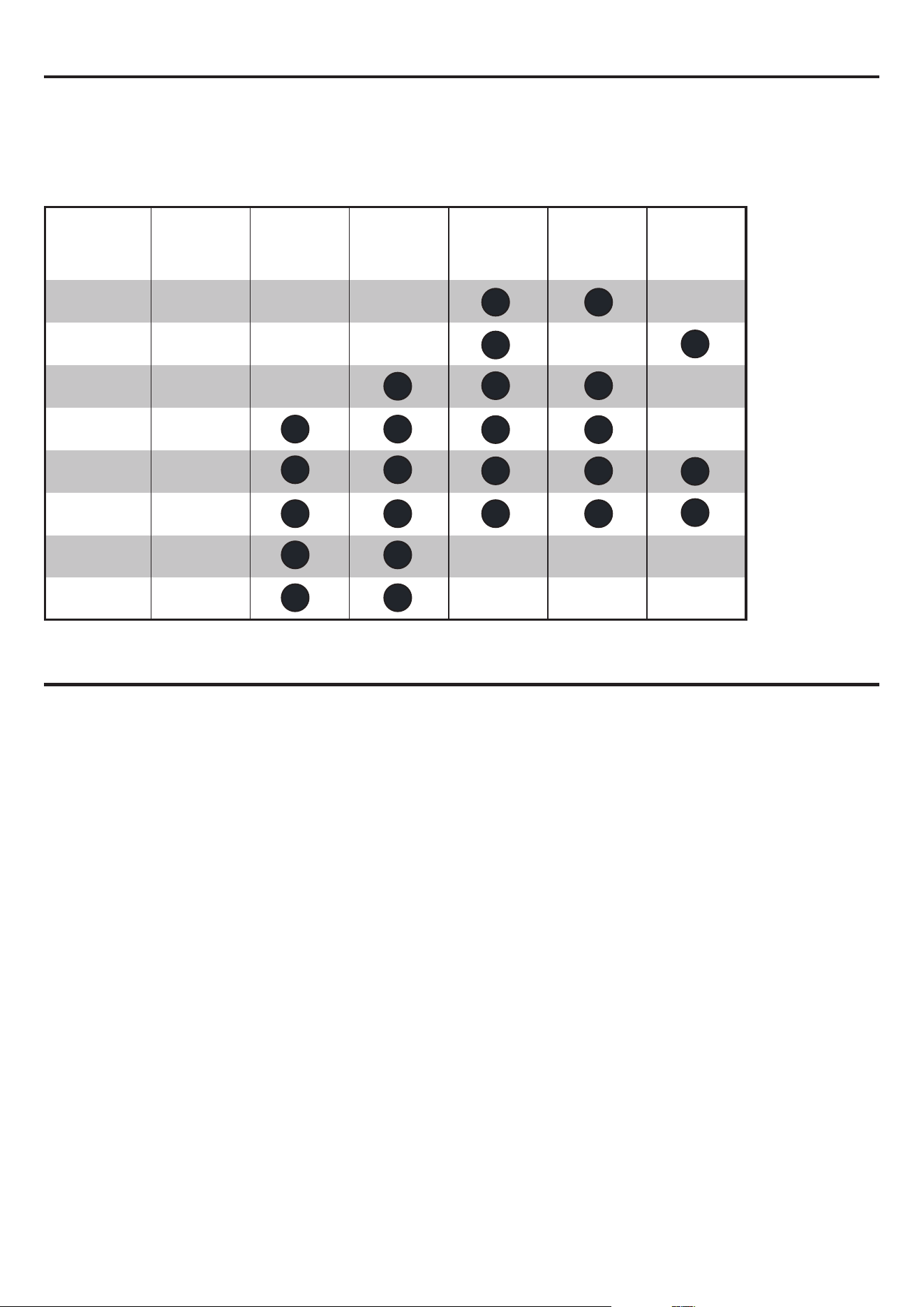
OPERATING INSTRUCTIONS(CONTINUED)
Enhance Flavor
WOOD PAIRING GUIDE
NOTE: Different wood varieties possess different flavors and we recommend pairing your woods with the meats you
intend to cook.
WOOD FLAVOR
ALDER MILD
PECAN MEDIUM
STRONGMESQUITE
MILDMAPLE
MEDIUMOAK
STRONGHICKORY
MEDIUMAPPLE
MILDCHERRY
VEGGIESSEAFOODPOULTRYPORKBEEF
W CAUTION: Do not apply vegetable oil to charcoal grid or charcoal pan.
W CAUTION: All cleaning and maintenance should be done when smoker is cool (about 45
minutes) and with the fuel supply removed.
W CAUTION: DO NOT clean any smoker part in a self cleaning oven. The extreme heat will
damage the finish.
W CAUTION: Do not leave smoker unattended while preheating, cooking or burning off food
residue on high. If smoker has not been cleaned, a grease re can occur that may damage
the product.
W CAUTION: Do not remove the ashes until they are completely and fully extinguished.
W Always empty the charcoal pan and smoker after each use.
W CAUTION: Do not allow water in water pan to completely evaporate. Check water pan at
least every 2 hours and add water if level is low. Add water per “Adding Additional Water”
section in this manual.
W CAUTION: Do not remove water from water pan once food is removed. Allow smoker to
cool and water to evaporate.
W Before smoker can be left unattended:
1. Smoker must be cool.
2. Remaining coals and ashes must be carefully removed and placed in a non-combustible
metal container and saturated with water.
3. Allow saturated coals and ashes to remain in non-combustible container for 24 hours prior
to properly disposing.
W CAUTION: With a garden hose, completely wet the surface beneath and around smoker
to extinguish any ashes, coals or embers which may have fallen during the cooking or
cleaning process.
W CAUTION: Extinguished coals and ashes should be placed a safe distance from all
structures and combustible materials.
CARE AND MAINTENANCE
23

CARE AND MAINTENANCE(CONTINUED)
LIMITED WARRANTY
Proof of purchase is required to access this warranty program, which is in effect from the date of purchase.
Customers will be subject to parts, shipping, and handling fees if unable to provide proof of the purchase or
after the warranty has expired.
If you have any questions or problems, you can call our customer service department at 800-963-0211,
8 a.m. - 8 p.m., EST, Monday - Sunday. You could also contact us at [email protected].
Limited Warranty
1-Year Warranty on all parts affecting the operation of the grill due to damage.
Warranty Provisions:
This warranty is non-transferable and does not cover failures due to misuse or improper installation or
maintenance.
This Warranty is for replacement of defective parts only. We are not responsible for incidental or
consequential damages or labor costs.
This warranty does not cover corrosion or discoloration after the grill is used, or due to lack of maintenance,
hostile environment, accidents, alterations, abuse or neglect.
This warranty does not cover damage caused by heat, abrasive and chemical cleaners, or any damage to
other components used in the installation or operation of the grill.
Some states do not allow the limitation or exclusion of incidental or consequential damages, so the above
limitations or exclusions may not apply to you. This warranty gives you specific legal rights, and you may also
have other rights that vary from state to state.
Notices
1. This grill should be thoroughly cleaned and inspected on a regular basis.
2. Abrasive cleaners will damage this product.
3. Never use oven cleaner to clean any part of grill.
Finishing Up
When your are finished grilling you can shut down your grill by closing both dampers and allowing the fire to suffocate. Be
patient. This may take an hour or more.
Before Each Use
1. Keep the grill area free and clear from any combustible materials, gasoline, and other flammable vapors and liquids.
2. See below for proper cleaning instructions.
Cleaning Surfaces
1. Wait for grill to fully cool.
2. Wipe surfaces clean with a mild dishwashing detergent or baking soda mixed with water.
3. For stubborn stains, use a citrus-based degreaser and a nylon scrubbing brush.
4. Rinse clean with water.
5. Allow to air dry.
24

REPLACEMENT PARTS LIST
PART DESCRIPTION PART#
COVERED UNDER
WARRANTY
1 Lid Handle C24032-010 YES
2 Temperature Gauge B0104-B02 YES
3 Smoke stack C24032-020 YES
4 Lid C24032-030 YES
5 Meat Hook C24032-040 YES
6 Rib Rack C24032-050 YES
7 Cooking Grid C1301-030 YES
8 Chicken Rack C24032-060 YES
9
Cooking Grid
Support
C1101-050 YES
10 Side Handle C24032-070 YES
PART DESCRIPTION PART#
COVERED UNDER
WARRANTY
11 Upper Smoker Body C24032-080 YES
12 Door C24032-090 YES
13 Middle Smoker Body C1101-090 YES
14 Water Pan C1101-040 YES
15 Water Pan Support C1101-080 YES
16 Lock B0108-C03 YES
17 Charcoal Pan C1101-100 YES
18 Bottom Bowl C24032-100 YES
19 Air Damper C24032-110 YES
20 Leg C24032-120 YES
For replacement parts, call the customer service department at 800-963-0211, 8 a.m. - 8 p.m., EST, Monday - Sunday.
You could also contact us at [email protected].
Printed in China
25
26
ADVERTENCIA
• La instalación, ajuste, alteración,
reparación o mantenimiento inadecuados
pueden producir lesiones o daños
materiales.
• Lea con detenimiento las instrucciones de
instalación, operación y mantenimiento
antes de instalar o reparar este equipo.
• Si no sigue estas instrucciones, podría
provocar un incendio, una explosión
o peligro de quemaduras que ocasione
daños materiales, lesiones personales o la
muerte.
• Este manual de instrucciones contiene
información importante necesaria para el
ensamblaje correcto y el uso seguro del
artefacto.
• Lea y siga todas las advertencias y las
instrucciones antes de ensamblar y usar el
electrodoméstico.
• Siga todas las advertencias y las
instrucciones cuando use este
electrodoméstico.
• Guarde este manual para referencia futura.
PELIGRO
• Nunca deje este electrodoméstico sin
supervisión.
• Si se produce un incendio, manténgase
alejado del electrodoméstico y llame de
inmediato al Departamento de Bomberos. No
utilice agua para intentar extinguir un fuego
provocado por aceite o grasa.
PELIGRO
• La quema de astillas de madera produce
monóxido de carbono, que es inodoro
y puede causar la muerte.
• NO queme astillas de madera en el interior
de casas, vehículos, carpas, garajes u otras
áreas cerradas. Úselo solo en exteriores, en
espacios bien ventilados.
ADVERTENCIA
SOLO PARA USO EN EXTERIORES.
MASTER FORGE y el diseño del logotipo son marcas comerciales
o marcas registradas de LF, LLC. Todos los derechos reservados.
ADVERTENCIA:
Este producto puede exponerlo a
productos químicos, incluidos el monóxido de
carbono y el hollín, reconocidos por el estado
de California como causantes de cáncer y
defectos congénitos u otros daños en el aparato
reproductivo. Para obtener más información,
visite www.P65Warnings.ca.gov.
VR23003
ARTÍCULO #5506289
AHUMADOR VERTICAL A CARBÓN
MODELO #CBS24032L
ADJUNTE SU RECIBO AQUÍ
Gracias por comprar este producto Master Forge.
¿Preguntas, problemas o piezas faltantes?
Antes de devolver, contáctenos en:
800-963-0211, de lunes a domingo de 8 a.m. a 8 p.m., hora estándar del Este, o en [email protected]
.
CBS24032L-RA-ES-OM-F101
Número de serie
Fecha de la compra

27
W Este ahumador es solo para uso en exteriores y
no se debe usar en edificios, garajes u otras áreas
cerradas.
W Solo para uso residencial. Este ahumador NO es
para el uso comercial.
W No utilice carbón que se haya pretratado con líquido
encendedor. Use solo carbón puro, mezcla de
carbón y madera, carbón de leña o madera para
leña de alta calidad. La conversión o el uso de
otra fuente de combustible en este ahumador es
peligroso y anulará la garantía.
W Este ahumador no está diseñado para usarse
como calentador y nunca debe utilizarse como tal.
Los gases TÓXICOS pueden acumularse y causar
asfixia.
W No utilice el ahumador para la cocción en interiores.
Las emanaciones tóxicas de monóxido de carbono
pueden acumularse y causar asfixia.
W Este ahumador está certificado para utilizarse con
seguridad en los EE.UU. y Canadá solamente. No
lo modifique para usarlo en otra ubicación. Una
modificación tendrá como resultado un riesgo para
la seguridad y anulará la garantía.
W NO opere, encienda ni use este artefacto a menos
de 3.04 m de distancia de paredes, estructuras o
edificios. No utilice este artefacto debajo de ningún
tipo de alero o techo.
W Para quienes viven en departamentos: consulte
con el administrador los requisitos y códigos de
incendio para usar un ahumador en su complejo
de departamentos. Utilícelo en el exterior, en la
planta baja, a una distancia de 3.04 m (10 pies) de
cualquier estructura, en caso de estar permitido. No
lo utilice sobre o bajo balcones.
W No use gasolina, queroseno o alcohol para
encender la parrilla.
W No utilice la unidad en un entorno explosivo. No
debe haber materiales combustibles, gasolina
ni otros vapores o líquidos inflamables cerca del
ahumador.
W NO almacene ni utilice gasolina ni otros vapores
o líquidos inflamables a menos de 7.62 metros de
distancia de este electrodoméstico.
W No modifique el ahumador de ninguna manera.
Cualquier alteración anulará la garantía.
W No use el ahumador a menos que esté
COMPLETAMENTE ensamblado y todas las piezas
estén ajustadas y apretadas con firmeza.
W Este ahumador se debe limpiar e inspeccionar
minuciosamente en forma periódica.
W Use solo piezas autorizadas por la fábrica. El uso
de piezas que no estén autorizadas por la fábrica
puede ser peligroso y anulará la garantía.
W No use este electrodoméstico sin antes leer las
“Instrucciones de funcionamiento” en este manual.
W Para evitar quemaduras, no toque las piezas
metálicas del ahumador hasta que se hayan
enfriado completamente (espere unos 45 minutos),
a menos que utilice elementos de protección
(almohadillas, guantes, manoplas para horno, etc.).
W Nunca toque las rejillas (de cocción o para el
carbón), las cenizas ni el carbón para comprobar si
están calientes.
W No use la parrilla sobre plataformas o muebles de
madera u otra superficie combustible.
W Siempre coloque el ahumador sobre una superficie
sólida, nivelada y no combustible. Una superficie de
asfalto podría no ser apta para este objetivo.
W No la utilice en botes ni en vehículos recreativos.
W Coloque el ahumador de manera tal que el viento
no pueda soplar las cenizas hacia superficies
combustibles.
W No use el artículo si hay viento fuerte.
W Nunca se incline sobre el ahumador al encenderlo.
W No deje un ahumador encendido sin supervisión.
Mantenga a los niños y las mascotas alejados del
ahumador en todo momento.
W No intente mover el ahumador mientras lo está
Información de seguridad............................................................. 27
Contenido del paquete .............................................................. 29
Aditamentos . . . . . . . . . . . . . . . . . . . . . . . . . . . . . . . . . . . . . . . . . . . . . . . . . . . . . . . . . . . . . . . . . . . . . . . 30
Preparación ........................................................................30
Instrucciones de ensamblaje .......................................................... 31
Instrucciones de funcionamiento ........................................................38
Cuidado y mantenimiento............................................................. 48
Garantía limitada ................................................................... 49
Lista de piezas de repuesto ............................................................50
INFORMACIÓN DE SEGURIDAD
W PELIGRO: no seguir los avisos de peligro, las advertencias y las precauciones de este manual podría
causar lesiones personales graves o la muerte, o incendios o explosiones que causen daños
materiales.
W ADVERTENCIAS:
ÍNDICE

28
INFORMACIÓN DE SEGURIDAD
W usando. Deje que el ahumador se enfríe (espere unos
45 minutos) antes de moverlo o almacenarlo.
W Cuando cocine, tenga a la mano materiales para la
extinción del fuego. En caso de que se produzca un
incendio por el aceite o la grasa, no intente apagarlo
con agua. Use un extintor de incendios a base de polvo
químico seco tipo BC o apáguelo con tierra, arena o
bicarbonato.
W Siempre abra la tapa del ahumador lentamente y con
cuidado, ya que el calor y el vapor atrapados dentro de
él pueden causarle quemaduras graves.
W No deje el ahumador sin supervisión mientras lo
precalienta o quema residuos de alimentos a fuego
alto. Si el ahumador no se ha limpiado, podría ocurrir
un incendio provocado por la grasa que puede dañar el
producto.
W No coloque recipientes de cocción vacíos sobre el
artefacto mientras está en funcionamiento.
W Tenga cuidado al colocar objetos debajo del ahumador
o sobre él mientras está en funcionamiento. Utilice
guantes o guantes para horno para proteger sus manos
y evite tocar las superficies calientes.
W Nunca agregue líquido para encendedor a las cenizas
calientes o incluso tibias, puesto que se pueden producir
retrocesos de la llama y ocasionar lesiones graves o
daños a la propiedad.
W Siempre use guantes de protección cuando agregue
combustible (briquetas de carbón, madera o carbón de
leña) para mantener el nivel de calor deseado.
W No retire las cenizas hasta que se hayan apagado total y
completamente.
W Las briquetas y las cenizas encendidas y calientes
pueden crear un riesgo de incendio.
W Siempre vacíe la bandeja para carbón y el ahumador
después de cada uso.
W No coloque combustibles (briquetas de carbón, madera
o carbón en trozos) directamente en el fondo del
ahumador. Coloque combustible solo en la rejilla para
carbón.
W No permita que el carbón esté en contacto con las
paredes del ahumador. Esto reducirá considerablemente
la vida útil del metal y del acabado del ahumador.
W Asegúrese de que no haya desechos ni cenizas en el
orificio de ventilación antes de usar el ahumador.
W Asegúrese de que la bandeja para carbón esté segura y
completamente en su lugar antes de usar la parrilla.
W No mueva el ahumador mientras la bandeja para agua
contenga líquidos.
W Al utilizar este ahumador, siempre use la bandeja para
agua diseñada para él.
W Siempre use una bandeja de goteo/protector contra
cenizas diseñado para usarse con un ahumador.
W Use solo piezas de repuesto autorizadas proporcionadas
por el fabricante.
W Siempre mantenga una capa delgada de agua en la
bandeja de goteo/protector contra cenizas para extinguir
cualquier ceniza o brasa que pudiera caer.
W No permita que el agua de la bandeja para agua se
evapore por completo mientras usa el ahumador. Revise
la bandeja para agua cada 2 horas, como
mínimo, y agréguele agua si el nivel está bajo.
Agregue agua según las instrucciones de la
sección “Agregar más agua” de este manual.
W No elimine el agua de la bandeja para agua una
vez que haya retirado la comida. Deje que el
ahumador se enfríe y que el agua se evapore.
W Antes de dejar el ahumador sin supervisión.
W El ahumador debe estar frío.
W El carbón y las cenizas restantes se deben
retirar con cuidado, colocar en un recipiente de
metal no combustible y saturar con agua.
W Deje el carbón y las cenizas mojados en un
recipiente no combustible y saturados con agua
por 24 horas antes de desecharlos de manera
adecuada.
W Con una manguera para jardín, moje
completamente la superficie debajo y alrededor
del ahumador para extinguir cualquier ceniza,
carbón o brasa que pueda haber caído durante
el proceso de cocción o de limpieza.
W Los carbones y cenizas apagados deben
colocarse a una distancia segura de todas las
estructuras y materiales combustibles.
W Mantenga todos los cables eléctricos lejos de
un ahumador caliente.
W Siempre use un termómetro para carne para
asegurarse de que los alimentos se estén
cocinando a una temperatura segura.
W Nunca cubra completamente el área de cocción
con papel de aluminio.
W Use guantes de protección cuando ensamble
este producto.
W No una las piezas a la fuerza ya que podría
provocar heridas personales o daños al
producto.
W Tenga cuidado al levantar o mover el ahumador
frío para evitar torceduras y lesiones de la
espalda.
W Si no sigue la instrucción anterior al pie de la
letra, podría ocasionar lesiones graves, muerte
o daños a la propiedad.
W Nunca cubra completamente el área de cocción
con papel de aluminio. Colocar el papel de
aluminio sobre las rejillas puede restringir el
flujo de aire previsto dentro de la parrilla y crear
barreras para el flujo adecuado de grasa a la
bandeja colectora. Esto permite la acumulación
de mucha grasa en la bandeja inferior, lo que,
a su vez, aumenta la posibilidad de que se
produzcan llamaradas o llamas producidas
por grasa. Use guantes de protección cuando
ensamble este producto.
W NO una las piezas a la fuerza, ya que podría
provocar heridas personales o daños al
producto.
W NO toque el respiradero ni el mango del
respiradero hasta que la parrilla se haya
enfriado por completo, a menos que esté
usando un equipo de protección.
29
CONTENIDO DEL PAQUETE
A
B
C
D
H
J
I
K
L
P
G
M
R
N
Q
T
S
O
E
F
J
30
PIEZA DESCRIPCIÓN CANTIDAD
A Manija de la tapa 1
B Medidor de temperatura 1
C Acumulador de humo 1
D Tapa 1
E Gancho para carne 6
F Rejilla para costillas 1
G Rejilla de cocción 3
H Rejilla para pollo 1
I Soporte de la rejilla de cocción 6
J Manija lateral 2
K
Parte superior del cuerpo
del ahumador
1
PIEZA DESCRIPCIÓN CANTIDAD
L Puerta 1
M
Parte central del cuerpo
del ahumador
1
N Bandeja para agua 1
O
Soporte de la bandeja
para agua
3
P Seguro 3
Q Bandeja para carbón 1
R Fuente inferior 1
S Regulador de aire 3
T Pata 3
Tornillo
M4 x 10
Cant. 8
Arandela
ø6.5 x ø18
Cant. 12
Tornillo
M5 x 12
Cant. 26
Tornillo de grada
M5 x 12
Cant. 6
Destornillador Philips #2
(se incluye)
Cant. 1
Antes de comenzar a ensamblar el producto, asegúrese de tener todas las piezas. Compare las piezas con la
lista del contenido del paquete y la lista de aditamentos. No intente ensamblar el producto si falta alguna pieza
o si estas están dañadas.
Tiempo estimado de ensamblaje: 25 minutos por una persona.
Herramientas necesarias para el ensamblaje: destornillador Phillips (se incluye).
CONTENIDO DEL PAQUETE
ADITAMENTOS
Preparación
Tuerca mariposa
M4
Cant. 8
Tuerca mariposa
M5
Cant. 20
* Preensamblada
AA BB
GG
CC DD EE FF
31
Paso 1: je el medidor de temperatura
Retire la tuerca mariposa y la arandela
preensambladas del medidor de temperatura
(B). Fije el medidor de temperatura (B) a la tapa
(D) usando la arandela y la tuerca mariposa
preensambladas.
Paso 2: je la manija de la tapa
Fije la manija de la tapa (A) a la tapa (D) con dos
tornillos M5 x 12 (BB) y dos arandelas Ø6.5 x Ø18
(FF).
Aditamentos utilizados
INSTRUCCIONES DE ENSAMBLAJE
Arandela
Ø6.5 x Ø18
x 2
Tornillo
M5 x 12
x 2
Primero
Segundo
1
2
B
D
D
A
BB
FF
32
Paso 3: je el acumulador de humo
Primero, retire la parte superior del acumulador
de humo, la tuerca preensamblada y el resorte
del acumulador de humo.
En segundo lugar, je el acumulador de humo (C)
a la tapa (D) con dos tornillos M5 x 12 (BB) y dos
tuercas mariposa M5 (EE).
Finalmente, je la parte superior del acumulador
de humo al acumulador de humo (C) con la
tuerca y el resorte preensamblados.
Aditamentos utilizados
Paso 4: instale las manijas laterales
Fije las manijas laterales (J) a la parte superior
del cuerpo del ahumador (K) con cuatro tornillos
M5 x 12 (BB) y cuatro arandelas Ø6.5 x Ø18 (FF).
Aditamentos utilizados
INSTRUCCIONES DE ENSAMBLAJE
Tuerca mariposa
M5
x 2
Tornillo
M5 x 12
x 2
Arandela
Ø6.5 x Ø18
x 4
Tornillo
M5 x 12
x 4
Primero
4
3
Segundo
Tercero
C
J
J
K
D
BB
BB
FF
EE
33
INSTRUCCIONES DE ENSAMBLAJE
Paso 5: je la puerta
Fije la puerta (L) a la parte superior del cuerpo
del ahumador (K) con dos tornillos M4 x 10 (AA)
y dos tuercas mariposa M4 (DD).
NOTA: asegúrese de que la bisagra de la puerta
esté jada al interior del cuerpo del ahumador.
Aditamentos utilizados
Paso 6: je los soportes de la rejilla de cocción
Coloque los soportes de la parrilla de cocción (I)
en la parte superior del cuerpo
del ahumador (K) con seis tornillos M5 x 12 (BB)
y seis tuercas mariposa M5 (EE).
Aditamentos utilizados
Tornillo
M4 x 10
x 2
Tuerca mariposa
M4
x 2
Bloquear Desbloquear
Tuerca mariposa
M5
x 6
Tornillo
M5 x 12
x 6
AA
BB
DD
EE
5
6
L
I
I
I
I
K
I
I
K
34
INSTRUCCIONES DE ENSAMBLAJE
Paso 7: coloque el soporte de la bandeja para
agua
Fije los soportes de la bandeja para agua (O) a
la parte superior del cuerpo del ahumador (K)
con tres tornillos M5 x 12 (BB) y tres tuercas
mariposa M5 (EE).
NOTA: no apriete demasiado los tornillos.
Aditamentos utilizados
Paso 8: coloque la parte central del cuerpo del
ahumador
Alinee la parte central del cuerpo del ahumador
(M) y la parte superior del cuerpo del ahumador
(K), luego je la parte central del cuerpo del
ahumador (M) a la parte superior del cuerpo del
ahumador (K) con tres tornillos M5 x 12 (BB) y
tres tuercas mariposa M5 (EE).
NOTA: apriete todos los tornillos en este paso.
Aditamentos utilizados
Primero
Segundo
Tuerca mariposa
M5
x 3
Tornillo
M5 x 12
x 3
BB
EE
Tuerca mariposa
M5
x 3
Tornillo
M5 x 12
x 3
BB
EE
7
8
O
M
K
O
O
K
35
INSTRUCCIONES DE ENSAMBLAJE
Tornillo
M5 x 12
x 6
Paso 9: je las patas
Fije las patas (T) al recipiente inferior (R) con seis
tornillos M5 x 12 (BB) y seis arandelas Ø6.5 x Ø18
(FF).
Aditamentos utilizados
Paso 10: je los reguladores de aire
Coloque los reguladores de aire (S) en el
recipiente inferior (R) con seis tornillos de grada
M5 x 12 (CC) y seis tuercas mariposa M5 (EE).
Aditamentos utilizados
Tuerca mariposa
M5
x 6
Tornillo de grada
M5 x 12
x 6
Arandela
Ø6.5 x Ø18
x 6
BB
CC
FF
EE
9
10
R
T
T
T
S
S
S
R
36
Paso 11: je el seguro
Coloque los seguros (P) en el recipiente inferior
(R) con seis tornillos M4 x 10 (AA) y seis tuercas
mariposa M4 (DD).
Aditamentos utilizados
Paso 12: inserte la bandeja para carbón
Inserte la bandeja para carbón (Q) en la fuente
inferior (R).
INSTRUCCIONES DE ENSAMBLAJE
Tornillo
M4 x 10
x 6
Tuerca mariposa
M4
x 6
AA
DD
12
11
P
P
P
R
Q
R
37
Paso 13: posicione el ensamble del cuerpo del
ahumador
Coloque el ensamble del cuerpo del ahumador
en la fuente inferior (R).
INSTRUCCIONES DE ENSAMBLAJE
Paso 14: inserte la bandeja para agua, las rejillas
de cocción y coloque la tapa
Inserte la bandeja para agua (N) y las rejillas
de cocción (G) en el ensamble del cuerpo del
ahumador.
Coloque la tapa (D) en el ensamble del cuerpo
del ahumador.
13
14
R
D
G
G
G
N
Este artefacto está diseñado solo para usarse con briquetas
de carbón, carbón de leña y madera para leña de calidad.
W PRECAUCIÓN: no utilice carbón que se haya
pretratado con líquido encendedor. Use solo
carbón puro, mezcla de carbón y madera,
carbón de leña o madera para leña de alta
calidad.
W PRECAUCIÓN: siempre coloque el ahumador
sobre una superficie sólida, nivelada y no
combustible. Una superficie de asfalto podría
no ser apta para este objetivo.
W PRECAUCIÓN: no use la parrilla sobre
plataformas o muebles de madera u otra
superficie combustible.
W PRECAUCIÓN: coloque el ahumador de manera tal que el viento no pueda soplar las cenizas hacia superficies
combustibles.
W PRECAUCIÓN: coloque el ahumador de manera tal que el humo no ingrese a su casa a través de puertas o
ventanas abiertas.
W PRECAUCIÓN: no use el ahumador si hay viento fuerte.
Primer uso
1. Asegúrese de que se hayan retirado todas las etiquetas, láminas protectoras y de embalaje del ahumador.
2. Elimine los aceites de fabricación antes de cocinar en el ahumador por primera vez:
a. Encienda el ahumador según la sección “Instrucciones de encendido” de este manual.
b. Use el ahumador con la tapa cerrada por un mínimo de 2 horas. El calor generado limpiará las piezas internas y disipará los olores.
c. No toque la parte exterior del ahumador ni abra la tapa durante este proceso.
d. Después de las 2 horas, siga la sección "Instrucciones para ahumado" de este manual.
3. Aplique una capa protectora:
a. Retire la bandeja para agua y la bandeja para carbón del ahumador.
b. Aplique una capa delgada de aceite vegetal o de aceite vegetal en aerosol a todas las supercies interiores del ahumador.
W PRECAUCIÓN: no aplique aceite vegetal a la rejilla para carbón ni a la bandeja para carbón.
Instrucciones de encendido
PRECAUCIÓN: no aplique aceite vegetal a la rejilla para carbón ni a la bandeja para carbón.
W PRECAUCIÓN: asegúrese de que no haya desechos ni cenizas en el orificio de ventilación antes de usar el
ahumador. Antes de cada uso, inspeccione si el ahumador tiene alguna pieza dañada o suelta. Antes de usar el
ahumador, ajuste las piezas sueltas y reemplace las piezas dañadas.
W PRECAUCIÓN: asegúrese de que la bandeja para carbón esté vacía, segura y completamente en su lugar antes
de usar el ahumador.
INSTRUCCIONES DE FUNCIONAMIENTO
Para bloquear el ahumador:
Cierre la tapa. Deslice el seguro hacia delante hasta que
los lados del seguro cubran la tapa y el recipiente inferior.
Consulte la Figura 1a.
Para desbloquear el ahumador:
Deslice el seguro hacia atrás hasta que se detenga
o ambos lados del mismo estén separados de la tapa
y del cuenco inferior. Consulte la Figura 1b.
W PRECAUCIÓN: el transporte y almacenaje
deben realizarse cuando el ahumador esté frío
y sin combustible.
W PRECAUCIÓN: siempre cierre el ahumador con
seguro antes de transportarlo.
Para desbloquear la puerta:
Gire la manija en dirección contraria a las manecillas del
reloj. Consulte la Figura 2a.
Para bloquear la puerta:
Gire la manija en dirección de las manecillas del reloj.
Consulte la Figura 2b.
Figura 1a
Figura 1b
Figura 2a
Figura 2b
38
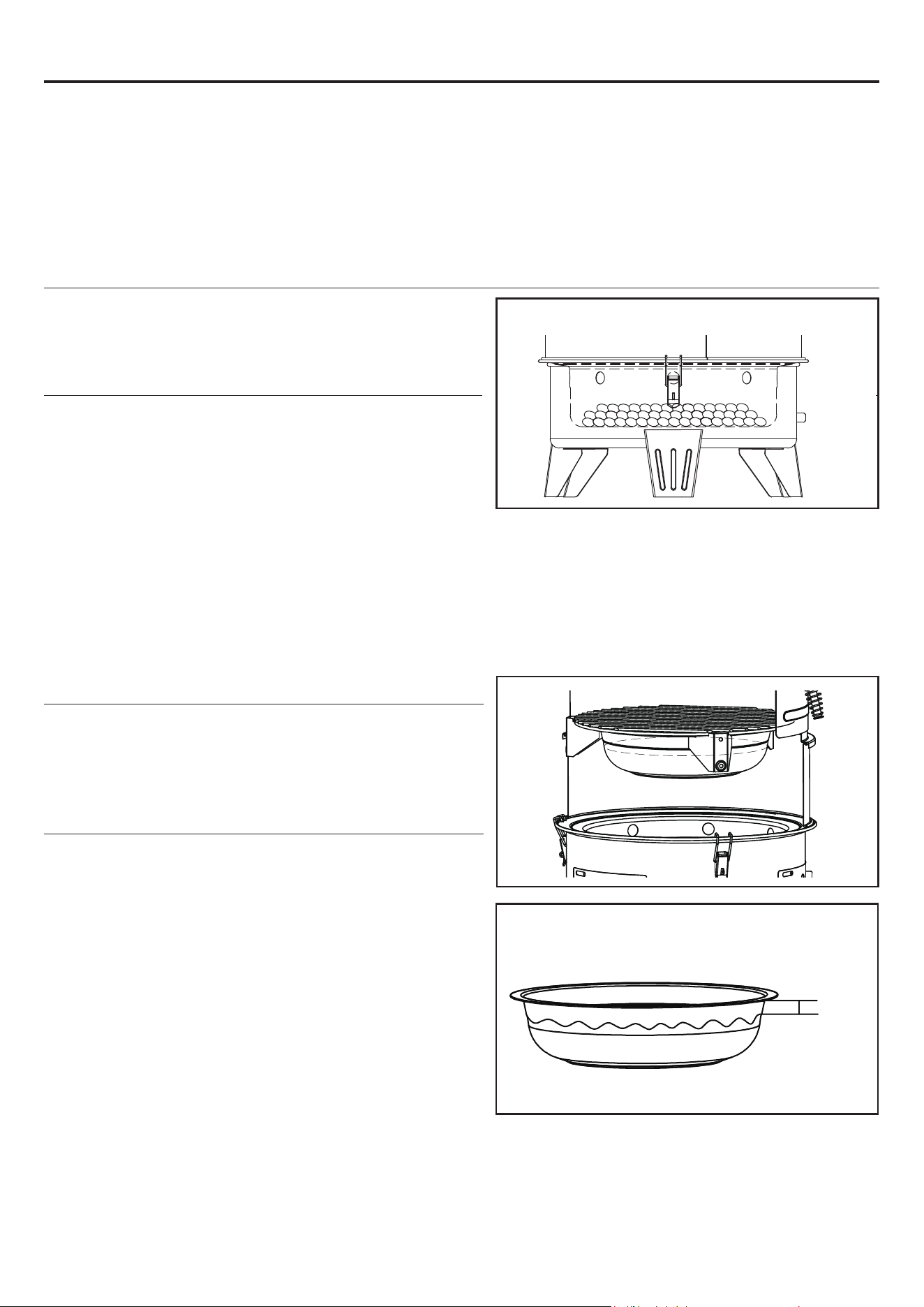
INSTRUCCIONES DE FUNCIONAMIENTO (CONTINUACIÓN)
1. Retire la tapa, las rejillas de cocción y la bandeja para agua. Colóquelos a un lado.
2. Asegúrese de que la bandeja para carbón esté vacía y rme.
3. Coloque las briquetas de carbón u otro combustible sobre la bandeja para carbón (Imagen 3).
ADVERTENCIA: El peso máximo de carbón para el fuego que puede utilizarse por vez es de 2.2 lb o 1 kg.
4. Encienda siguiendo las instrucciones en el empaque del combustible.
5. Deje que el carbón se queme hasta que quede cubierto con una ceniza clara antes de cerrar la puerta y colocar la tapa sobre el ahumador.
Nota: si usa madera aromatizada siga las instrucciones sobre el empaque de madera aromatizada.
W PRECAUCIÓN: siempre revise la bandeja para carbón cuando use un cebador líquido antes del encendido. El uido
se puede acumular en la bandeja para carbón y se puede encender y provocar un incendio.
W PRECAUCIÓN: nunca agregue líquido para encendedor a carbones calientes o incluso tibios, ya que se pueden
producir retrocesos de la llama y ocasionar lesiones graves o daños a la propiedad.
Apagado
1. Deje que el carbón se extinga solo.
W ADVERTENCIA: NO use agua para extinguirlo. Esto puede ser
peligroso y causar daños.
2. Deseche las cenizas en un lugar adecuado.
Control de las llamaradas:
W PRECAUCIÓN: NO use agua sobre un incendio provocado
por grasa. Esto puede hacer que la grasa salpique pudiendo
ocasionar quemaduras, lesiones corporales
u otros daños graves.
W PRECAUCIÓN: NO deje la parrilla sin supervisión mientras la
precalienta o quema residuos de alimentos. Si la parrilla no se
ha limpiado, podría ocurrir un incendio provocado por la grasa que puede dañar el producto.
W ADVERTENCIA: cuando cocine, tenga a su alcance materiales para la extinción del fuego. En caso de incendio provocado
por aceite o grasa, use un extintor de incendios a base de polvo químico seco tipo BC o apague el fuego con tierra, arena o
bicarbonato. NO intente extinguirlo con agua.
Las llamaradas son parte de la cocción de carnes en una parrilla y aderezos del sabor único que da asar un alimento.
Las llamaradas en exceso pueden cocinar demasiado la comida y ser peligrosas.
Importante: el exceso de llamaradas es el resultado de la acumulación de grasa en la parte inferior de la parrilla.
Si se produce un incendio por grasa, cierre la tapa hasta que esta se queme completamente. Tenga cuidado al abrir la tapa, puesto que
puede haber llamaradas repentinas.
Si se producen llamaradas en exceso, NO vierta agua a las llamas.
Minimice las llamaradas:
1. Corte el exceso de grasa de las carnes antes de la cocción.
2. Cocine las carnes con un alto contenido de grasa de manera
indirecta.
3. Asegúrese de que la parrilla esté sobre una superficie sólida,
nivelada y no combustible.
Instrucciones para ahumado
1. Encienda el ahumador según las “Instrucciones de encendido” de
este manual.
2. Con guantes de protección, coloque cuidadosamente la bandeja
para agua en sus soportes. (Figura 4)
3. Con guantes de protección, llene cuidadosamente la bandeja para
agua con agua o mezcla para marinar hasta llegar a 2.54 cm (1”)
del borde de la bandeja para agua. (Figura 5). No exceda la línea
de llenado máximo.
Nota: la bandeja para agua contiene 2 cuartos de líquido y durará
entre 2 y 3 horas cuando el ahumador esté en uso.
4. Con guantes de protección, retire cuidadosamente la tapa del
ahumador. Asegúrese de abrir la tapa alejándola de usted. Esto
permitirá que el vapor se libere lejos de usted.
5. Con guantes de protección, coloque cuidadosamente la rejilla de
cocción en los soportes de la rejilla de cocción inferior. (Figura 6).
6. Con guantes de protección, coloque cuidadosamente la comida en la rejilla de cocción inferior en una sola capa y distribuida de manera
uniforme.
7. Con guantes de protección, coloque cuidadosamente las otras rejillas de cocción en los soportes de la rejilla de cocción superior. (Figura 6).
8. Con guantes de protección, coloque cuidadosamente la comida en las rejillas de cocción superiores en una sola capa y distribuida de
manera uniforme.
39
MÁX:
2.54 cm
Figura 3
Figura 4
Figura 5
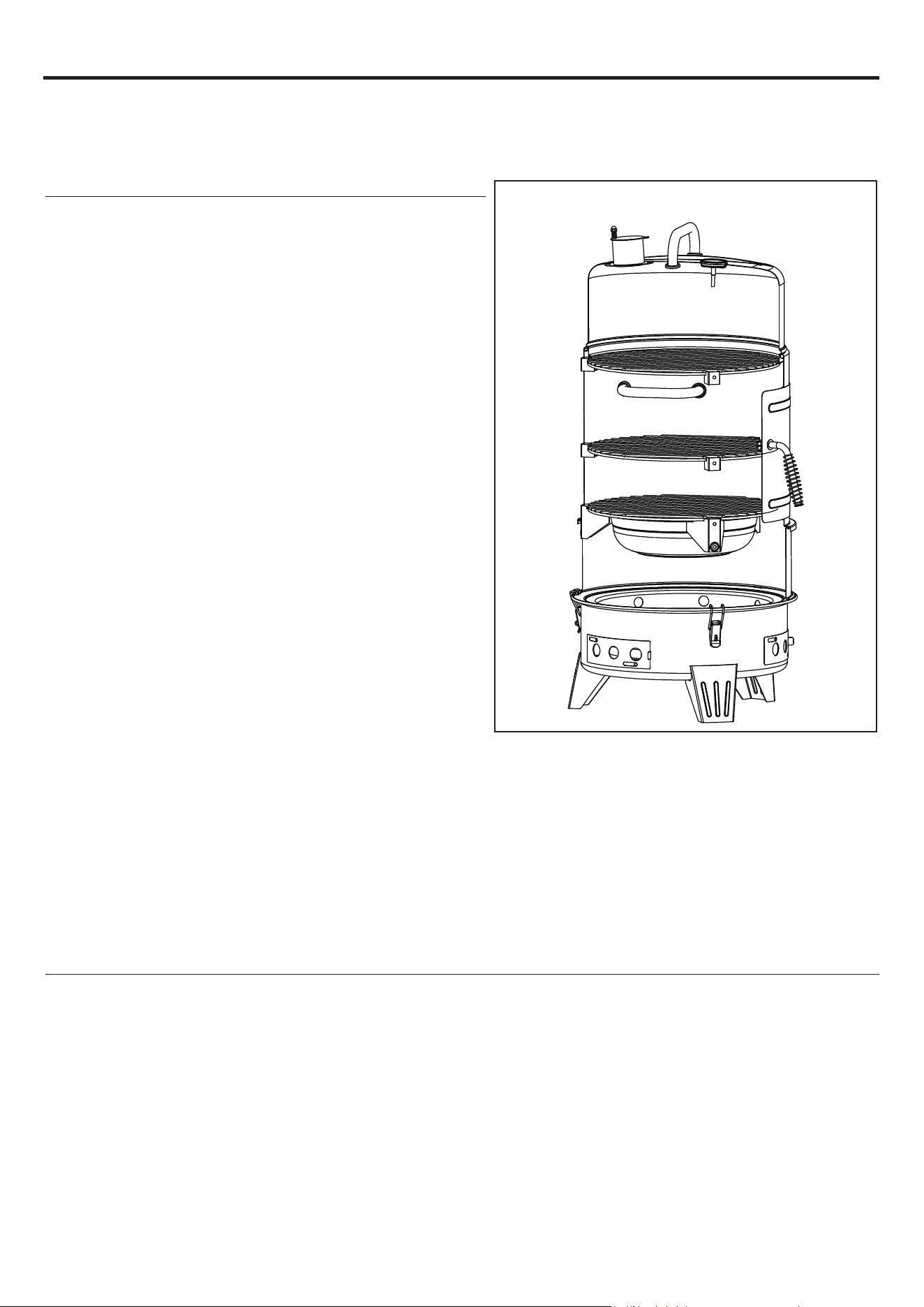
9. Con guantes de protección, coloque cuidadosamente la tapa sobre el ahumador.
10. Revise el nivel del agua según las instrucciones de la sección “Agregar más agua” y el carbón según las instrucciones de la sección
“Agregar más carbón/madera aromatizada” de esta página.
W PRECAUCIÓN: siempre use un termómetro para carne para asegurarse de que los alimentos se estén cocinando
a una temperatura segura.
Agregar más agua
Mientras usa el ahumador, revise el nivel de agua como mínimo cada
2 horas. Si se necesita agua, se puede agregar a través de la parte
superior o de la puerta lateral del ahumador. Consulte las siguientes
instrucciones.
Nota: se puede detectar un nivel bajo de agua al oír el chisporroteo del
agua.
Opción 1 para agregar agua - A través de la parte
superior del ahumador:
Deje la rejilla superior en su lugar y use los 6 ganchos provistos para
colgar salchichas, trozos de pollo, pescados enteros y otros artículos.
W Abra la tapa lentamente ya que se pueden producir llamaradas
cuando el aire fresco entra en contacto repentino con el fuego.
1. Con guantes de protección, retire cuidadosamente la tapa del
ahumador. Asegúrese de abrir la tapa alejándola de usted. Esto
permitirá que el vapor se libere lejos de usted.
2. Determine el nivel del agua en la bandeja para agua:
a. Si se necesita agua, continúe con el paso 3.
b. Si no se necesita agua, vuelva a colocar la tapa en el ahumador.
3. Con guantes de protección y unas tenazas de cocina largas, retire la
comida y las rejillas de cocción superior y central.
4. Con guantes de protección y unas tenazas de cocina largas, deslice
la comida hacia un lado de la rejilla de cocción inferior.
5. Con cuidado, vierta agua en la bandeja para agua hasta llegar a 2.54
cm (1”) del borde de la bandeja para agua. (Figura 5). No llene la
bandeja para agua en exceso.
W Párese al lado del ahumador y tenga mucho cuidado al
verter el agua ya que se puede convertir directamente en vapor.
6. Coloque la comida nuevamente en la ubicación adecuada en la rejilla
de cocción inferior.
7. Vuelva a colocar la rejilla de cocción superior y la comida.
8. Vuelva a colocar la tapa en el ahumador.
Opción 2 para agregar agua - A través de la parte lateral del ahumador:
W Abra la tapa lentamente ya que se pueden producir llamaradas cuando el aire fresco entra en contacto repentino con el fuego.
1. Con guantes de protección, abra cuidadosamente la puerta lateral del ahumador. Asegúrese de pararse en el lado opuesto de la puerta
del ahumador. Esto permitirá que el vapor se libere lejos de usted.
2. Determine el nivel del agua en la bandeja para agua:
a. Si se necesita agua, continúe con el paso 3.
b. Si no se necesita agua, vuelva a colocar la tapa en el ahumador.
3. Con un embudo o un recipiente con boquilla, vierta cuidadosamente el agua en la bandeja para agua hasta llegar a 2.54 cm (1”) del
borde de la bandeja para agua. (Figura 5). No llene la bandeja para agua en exceso.
W Párese al lado del ahumador y tenga mucho cuidado al verter el agua ya que se puede convertir directamente en vapor.
4. Cierre la puerta lateral del ahumador.
Agregar más carbón/madera aromatizada
W PRECAUCIÓN: abra la tapa lentamente ya que se pueden producir llamaradas cuando el aire fresco entra en contacto
repentino con el fuego.
W PRECAUCIÓN: nunca utilice carbón que se haya pretratado con líquido encendedor. Use solo carbón puro, mezcla de
carbón y madera, carbón de leña o madera para leña de alta calidad.
W ADVERTENCIA: nunca agregue líquido para encendedor a las cenizas calientes o incluso tibias, puesto que se pueden
producir retrocesos de la llama y ocasionar lesiones graves o daños a la propiedad.
1. Con guantes de protección, retire cuidadosamente la tapa del ahumador. Asegúrese de abrir la tapa alejándola de usted. Esto permitirá
que el vapor se libere lejos de usted.
2. Con guantes de protección, abra cuidadosamente la puerta del ahumador. Asegúrese de abrir la puerta alejándose de ella. Esto permitirá
que el vapor se libere lejos de usted.
3. Con guantes de protección y unas tenazas de cocina largas, retire ligeramente las cenizas del carbón caliente.
4. Con guantes de protección y unas tenazas de cocina largas, abra la puerta y agregue cuidadosamente más carbón en la rejilla para carbón.
Una vez que el carbón nuevo esté ardiendo con fuerza, cierre la puerta y vuelva a colocar la tapa en el ahumador.
INSTRUCCIONES DE FUNCIONAMIENTO (CONTINUACIÓN)
40
Figura 6
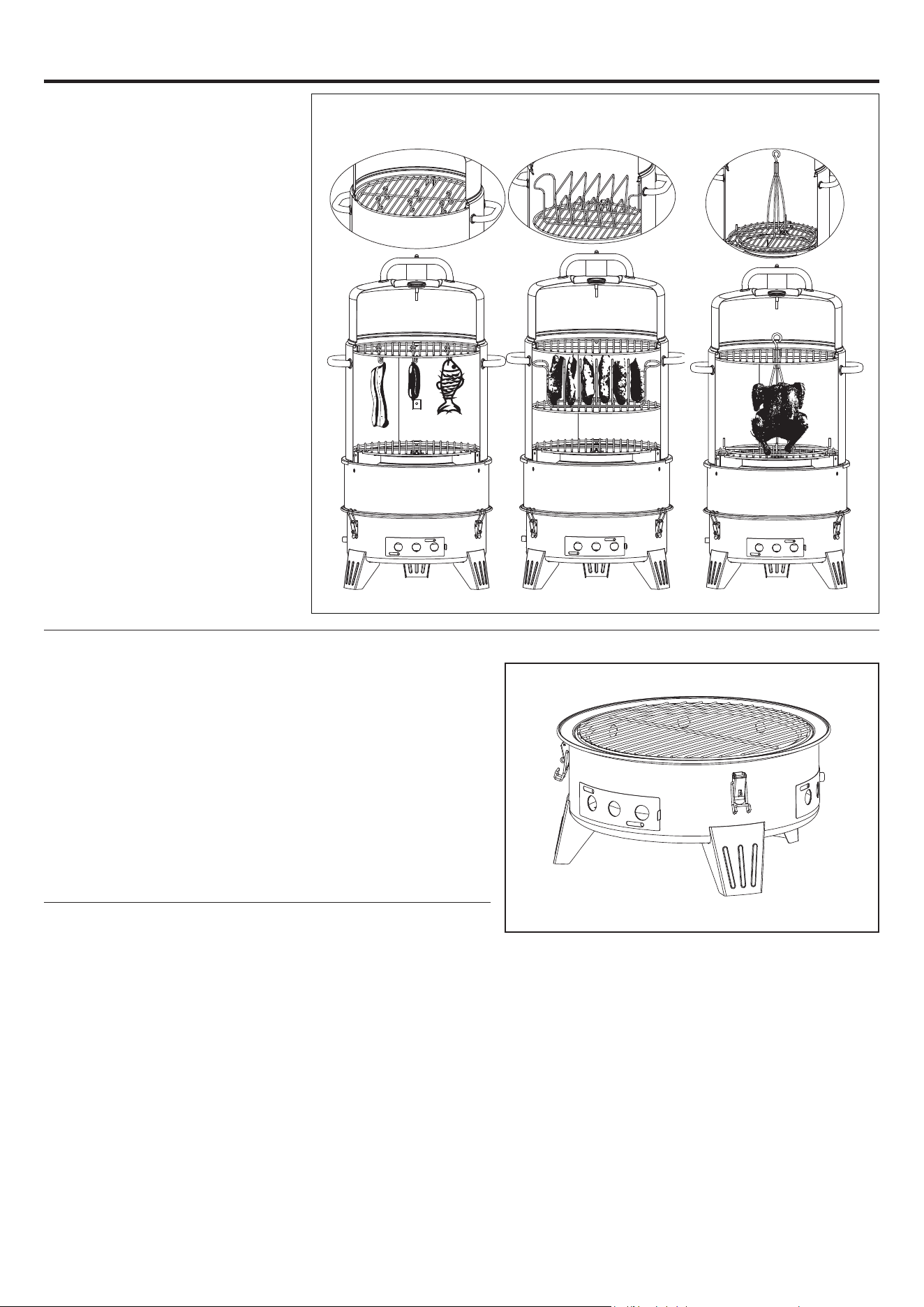
INSTRUCCIONES DE FUNCIONAMIENTO (CONTINUACIÓN)
Accesorios de cocina
Ganchos para carne:
Deje la rejilla superior en su lugar y use
los 6 ganchos provistos para colgar
salchichas, trozos de pollo, pescados
enteros y otros artículos.
Rejilla para costillas:
Su ahumador incluye una rejilla para
costillas que se puede utilizar en lugar
de las rejillas de cocción. Maximice el
espacio en su ahumador al mantener las
costillas en posición vertical. Sostenga
costillas, mitades de pollo, papas y maíz
verticalmente para triplicar su capacidad
de cocción. Permite que el humo, el
vapor y el calor penetren uniformemente
en los alimentos.
Rejilla para pollo
Retire la rejilla de cocción central y use
la rejilla para pollo provista. Esta rejilla
sostiene pollos, gallinas, patos o pavos
en posición vertical y es ideal para
ahumar aves. La rejilla permite cocinar
la carne tanto por dentro como por
fuera. Esto acelera el tiempo de cocción,
sella los jugos sabrosos y promueve un
dorado uniforme de la piel. Es una forma
baja en grasa de cocinar aves porque el
exceso de grasa gotea de la carne.
Se utiliza como parrilla a carbón portátil
Su ahumador también puede funcionar como parrilla portátil cuando retira
el cuerpo de la parrilla central y las rejillas, etc. Simplemente conserve
la bandeja inferior o la bandeja para carbón y una rejilla de cocción para
disfrutar de una experiencia de parrilla versátil como la Firgure 8.
1. Retire la tapa y la parrilla para cocinar superior
2. Desbloquee el ensamble de la parte central del cuerpo de la parrilla.
Colóquelos a un lado.
3. Retire la bandeja para agua. Colóquelos a un lado.
NOTA: todos los pasos se deben realizar cuando el ahumador esté frío
y sin combustible.
ADVERTENCIA: El peso máximo de carbón para el fuego que puede
utilizarse por vez es de 2.2 lb o 1 kg.
Recetas de ahumado
Cocinar con un TERMÓMETRO PARA CARNES garantiza que los
alimentos estén completamente cocinados. Inserte el termómetro en la parte más gruesa de la carne, sin tocar el hueso, y deje que registre
la temperatura durante 1 a 1 1/2 minutos.
La temperatura mínima segura aprobada por el USDA es 74 °C para pollo/aves.
La temperatura mínima segura aprobada por el USDA es 63 °C para carne de res, cerdo, ternera y cordero (filetes, chuletas, asados).
Figura 7
Ganchos para carne Rejilla para costillas Rejilla para pollo
Figura 8
41

INSTRUCCIONES DE FUNCIONAMIENTO (CONTINUACIÓN)
ESPALDA DE CERDO "CERTIFICADA"
Una excelente receta de espalda de cerdo perfecta tanto para principiantes como para expertos. ¡Esta receta de espalda de cerdo
ahumado a fuego lento está deliciosa desmenuzada y apilada con ensalada de col para un sándwich, ¡o se puede comer sola directamente
de la bandeja!
Ingredientes: Preparación de la carne: Instrucciones de cocción:
2 espaldas de
cerdo (de 2.72
kg a 4.53 kg
cada una)
Jugo de
manzana
Su aliño o
condimento
favorito
Mostaza
1. Retire la espalda de cerdo del
envoltorio plástico y séquela con
una toalla de papel.
Consejo: elija una espalda de cerdo con
toda la grasa. Esto ayuda a la carne
mientras se ahúma durante un largo
período.
2. Elimine el exceso de grasa que esté
suelto y se levante con facilidad.
Marque la capa de grasa de 3.17
mm a 6.35 mm de profundidad en
diagonal, con una separación de
1.27 cm a 2.54 cm.
Consejo: marcar la carne permite que
el condimento y el humo penetren en la
espalda de cerdo.
3. Llene el inyector de marinado con
jugo de manzana e inyecte en la
parte superior y los lados de la
carne.
4. Extienda una capa de mostaza con
una brocha para adobar por toda la
espalda de cerdo.
Consejo: esto permite que el aderezo se
adhiera a la espalda de cerdo.
5. Sazone generosamente la espalda
de cerdo por todos lados con su
aderezo favorito.
6. Consejo: después de sazonar,
envuélvalo en Saran Wrap y
guárdelo en el refrigerador durante
la noche o de 8 a 10 horas. Esto
permite que los aliños penetren y
que el jugo de manzana ablande la
espalda de cerdo.
1. Encienda el carbón y precaliente el ahumador a 107 °C.
2. Agregue agua hirviendo a la bandeja de goteo y colóquela debajo de
la parrilla.
Consejo: esto agregará humedad para la cocción y recogerá los jugos que
gotean.
3. Ahúme las espaldas de cerdo durante 2 horas por cada 0.45 kg a
107 °C, hasta que la carne alcance una temperatura interna de 71 °C.
Consejo: mantenga una temperatura de 107 °C, verifique el fuego cada
hora o cuando sea necesario. También rocíe con jugo de manzana cada
vez que agregue leña al fuego. Rociar agrega humedad y sabor. Evita
que la espalda de cerdo se seque y ayuda a crear la corteza. Controle
la temperatura con un termómetro de sonda plegable o un termómetro
remoto.
4. Retire la espalda de cerdo del ahumador y envuélvala dos veces en
papel de aluminio. Antes de cerrar la envoltura, agregue 1 taza de
jugo de manzana y 1 barra de mantequilla por cada espalda, más
condimento y salsa BBQ al gusto.
5. Vuelva a colocarla en el ahumador y cocine hasta que la espalda de
cerdo alcance una temperatura interna de 93 °C, luego retírela del
ahumador.
Consejo: envuelva la espalda de cerdo en una toalla grande y colóquela
en una hielera o simplemente déjela a un lado durante un mínimo de 1 a
2 horas para que repose. Esto permite que la carne se cocine y deje de
cocinarse, y es una clave importante en el proceso.
6. Después de reposar, retira la toalla y el papel de aluminio. Separe la
carne de cerdo con dos tenedores o pinzas para carne.
7. Prepare sándwiches de cerdo desmenuzado y un sinfín de platos de
cerdo desmenuzado. ¡Disfrute!
PECHO
La receta de pecho es una versión tradicional del clásico ahumado y promete resultados tiernos y ahumados.
Ingredientes: Instrucciones:
4.76 kg de pecho de res
½ taza de paprika
¼ de taza de azúcar morena clara envasada
3 cucharadas de sal
3 cucharadas de pimienta negra gruesa
3 cucharadas de chile en polvo
Jugo de manzana
Agua
1. Con un cuchillo afilado, retire la grasa del pecho dejando una capa fina y
uniforme en la parte superior.
2. En un tazón mediano, combine la paprika, la azúcar morena clara, el chile en
polvo, la sal y la pimienta, y mezcle bien para condimentar. Con las manos o
con un agitador, aplique generosamente el producto por todas partes.
3. Envuelva el pecho en una película de plástico transparente y refrigere
durante al menos 12 horas.
4. Al preparar la parrilla, agregue astillas de madera o trozos de carbón y
agregue Smokin' Stone con una bandeja de aluminio encima. Vierta el
jugo de manzana y el agua en la cacerola, hasta la mitad de su capacidad.
Coloque una sonda de temperatura al nivel de la parrilla y caliente la parrilla
a 104 °C.
5. Coloque el pecho sobre las rejillas, con la grasa hacia arriba y déjela ahumar
durante 5 horas. Después de 5 horas, envuelva el pecho en papel de estraza
y vuelva a asar a 104 °C. El pecho estará listo cuando la temperatura interna
alcance los 91 °C. Deje reposar el pecho durante 1 hora.
6. ¡Corte, sirva y disfrute!
42

INSTRUCCIONES DE FUNCIONAMIENTO (CONTINUACIÓN)
MACARRONES CON QUESO AHUMADOS
Un favorito familiar de todos los tiempos, esta receta de macarrones con queso ahumados eleva los macarrones con queso horneados en
la estufa o en el horno con sabores que seguramente mantendrán su ahumador funcionando.
Ingredientes: Instrucciones:
1 paquete de macarrones de codo
½ barra de mantequilla
¼ taza de harina común
1 taza de crema espesa
1 taza de leche
2 tazas de queso cheddar
(rallado)
1 taza de queso gouda (rallado)
1 taza de queso Colby Jack
(rallado)
½ taza de queso crema
2 cucharadas de pimienta negra
1 cucharadita de pimienta cayena
1 sartén grande de hierro fundido
1. Hierva los macarrones con codo según las instrucciones del paquete para que queden al
dente.
2. Precaliente el ahumador a 107 °C con una madera dura frutal como manzano o cerezo en la
cámara de combustión lateral.
Consejo: si su parrilla no tiene el accesorio de la cámara de combustión lateral, conviértala
fácilmente en un ahumador al colocar las brasas o la leña frente a donde coloca la bandeja para
macarrones con queso. Si coloca la bandeja en el lado derecho de las rejillas, simplemente
coloque la leña en el lado derecho para una experiencia de cocción indirecta.
3. Caliente la sartén de hierro fundido a fuego medio; luego, derrita la mantequilla y agregue la
harina.
4. Mientras continúa batiendo, agregue la leche y la crema espesa hasta que hierva.
5. Reduzca a fuego medio-bajo y agregue el queso crema hasta que quede suave.
6. Agregue el resto de los quesos y continúe revolviendo hasta que se derrita y quede suave.
7. Apague el fuego y luego agregue los macarrones hasta que estén bien mezclados con la
salsa de queso
8. Coloque toda la sartén en el ahumador y cocine durante 1 a 2 horas hasta el punto deseado.
Manténgalo por más tiempo para obtener un sabor más ahumado.
9. Sirva caliente.
TROZOS Y MITADES DE POLLO AHUMADO
Instrucciones:
1. Enjuague los trozos en agua fría y séquelos con toallas de papel.
2. Unte cada trozo con aceite de oliva y sazone al gusto con sal y pimienta.
3. Dore los trozos directamente sobre las brasas con la tapa abierta y cocine a la parrilla a fuego
alto o medio durante varios minutos.
4. Luego, coloque los trozos sobre la rejilla de cocción en el área de cocción indirecta.
5. Con la parrilla a fuego lento, cocina con la tapa cerrada durante 55 a 60 minutos o hasta que
esté cocido. No use aceite de oliva ni sal y pimienta si usa marinado.
PAVO AHUMADO
Instrucciones:
1. Enjuague la cavidad vacía y seque con una toalla de papel.
2. Meta las puntas de las alas debajo de la espalda y ate las patas.
3. Colóquelo en el centro de la rejilla de cocción directamente encima de la bandeja de goteo de aluminio con agua.
4. Ahúme durante 12 minutos por cada 0.45 kg. Espere varios minutos adicionales por cada 0.45 kg si está relleno para
permitir la expansión.
5. Utilice un termómetro para carne para obtener los mejores resultados (86 °C internos).
JAMÓN AL HORNO AHUMADO
Puede ahumar jamón enlatado completamente cocido o jamón entero ahumado y curado, pierna o parte de la espalda.
Ingredientes: Instrucciones:
1 taza de azúcar morena clara,
bien compactada
1/2 taza de jugo de naranja
1/2 taza de miel
1. Combine el azúcar, el jugo y la miel. Deje reposar el glaseado durante al menos 4 horas.
2. Retire la corteza y corte la grasa en diagonal para darle un efecto de diamante.
3. Inserte un diente entero en el centro de cada diamante.
4. Coloque el jamón con la grasa hacia arriba en el centro de la rejilla de cocción. Cierre la tapa.
5. Se sugieren aproximadamente 9 minutos por cada 0.45 kg para jamones completamente
cocidos. El jamón ahumado o curado, que no esté completamente cocido, debe cocinarse
a una temperatura interna de 71 °C.
6. Rocíe con glaseado para jamón 3 o 4 veces durante los últimos 30 minutos de cocción.
7. Adorne con aros de piña unos 15 minutos antes de que finalice el tiempo de cocción.
43

INSTRUCCIONES DE FUNCIONAMIENTO (CONTINUACIÓN)
3-2-1 COSTILLAS
El método de costillas 3-2-1 podría ser algo que haya visto en las redes sociales. Es una técnica popular para ahumar costillas tiernas,
jugosas y que se despegan del hueso. Sencilla y fácil de seguir, esta es una manera segura de garantizar que sus costillas estén para
chuparse los dedos. El método 3-2-1 es un proceso que consiste en ahumar las costillas durante tres horas, envolverlas en papel de
aluminio y cocerlas durante dos horas, y ahumarlas sin envolver durante una hora. Esto no solo ayuda a que las costillas se cocinen más
rápido, sino que también garantiza un anillo de humo uniforme y una carne más tierna.
Ingredientes: Instrucciones:
4 costillas
2 tazas de sidra de
manzana, 2 tazas
adicionales
en botella de rociado
8 cucharadas de
mantequilla salada
1 taza de su salsa BBQ
favorita
1 taza de azúcar morena
oscura
Adobo para costillas a la
parrilla
4 cucharadas de miel
1. Prepare su ahumador de compensación para ahumar al encender medio encendedor para chimeneas
a carbón y agregarlo a la cámara de combustión lateral. Alternativamente, prepare su parrilla para el
método indirecto con brasas dispuestas frente a donde planea colocar las costillas.
Consejo: agregue aproximadamente media chimenea de carbón apagado a la cámara de combustión
lateral cerca del barril antes de agregar el carbón encendido al lado. El carbón encendido encenderá
gradualmente el carbón apagado para ayudar a mantener la temperatura por más tiempo.
2. Agregue de tres a cuatro trozos de madera de manzano y cierre la tapa.
3. Deje que la parrilla se caliente hasta aproximadamente 93 °C.
4. Retire la membrana de las costillas.
Consejo: comience en el extremo más estrecho de la rejilla, pase con cuidado un cuchillo de pelar debajo
de la membrana para comenzar y retire la membrana con una toalla de papel.
5. Sazone abundantemente ambos lados de las costillas con Rib Rub.
6. Abra la parrilla y levante la rejilla ajustable hasta el nivel superior. Esto asegura una distribución
uniforme del humo.
7. Coloque bandejas de goteo llenas de agua debajo de las rejillas y encima de la rejilla en el barril
principal.
8. Coloque las costillas con el hueso hacia abajo sobre las rejillas, cierre la tapa y déjelas ahumar
durante tres horas.
Consejo: coloque el lado expuesto del hueso del costillar hacia la cámara de combustión lateral para que
la carne se separe mejor del hueso. Si utiliza el método indirecto, coloque las costillas en el lado opuesto al
de las brasas.
9. Verifique periódicamente la temperatura para asegurarse de que se mantenga estable a 93 °C. Si
tiene que agregar carbón, agregue solo carbón encendido.
10. Cada 30 minutos, rocíe las costillas con sidra de manzana y mueva el costillar más cercano a la
cámara de combustión lateral hacia el lado de la parrilla más alejado de la cámara de combustión
lateral y acerque los otros costillares a la cámara de combustión lateral para acomodarlos. Repita el
método de rociado y rotación cada 30 minutos.
11. Retire las costillas de la parrilla después de tres horas.
12. Prepare una hoja grande de papel de aluminio para trabajo pesado (una para cada costillar).
13. Coloque un costillar con el hueso hacia arriba sobre cada trozo de papel de aluminio.
14. Cubra el lado del hueso de las costillas con azúcar morena, miel y cuatro porciones de mantequilla.
15. Vierta ½ taza de sidra de manzana.
16. Engarce completamente los bordes del papel de aluminio para cubrir las costillas.
17. Repita con los otros tres costillares.
18. Transfiera las costillas nuevamente al ahumador y aumente la temperatura a 107 °C.
19. Haga esto al abrir un poco más las compuertas y agregar otra media chimenea de carbón encendido
si es necesario.
20. Deje que las costillas se cocinen durante dos horas.
21. Continúe girando las costillas como se describe en el paso 8b para asegurarse de que todos los
costillares se acerquen y se alejen del fuego.
22. Retire las costillas de la parrilla y del papel de aluminio. Vuelva a colocarlas en la parrilla con el hueso
hacia abajo.
23. Unte las costillas con su salsa BBQ favorita y cocínelas durante una hora a 107 °C.
24. ¡Retire y disfrute!
44

INSTRUCCIONES DE FUNCIONAMIENTO (CONTINUACIÓN)
VENADO AHUMADO CON TOCINO
Puede ahumar jamón enlatado completamente cocido o jamón entero ahumado y curado, pierna o parte de la espalda.
Ingredientes: Instrucciones:
Marinado para venado
1 taza de vinagre balsámico o vinagre de
vino tinto
1 taza de aceite de oliva
59.14 ml de salsa worcestershire
14.78 ml de salsa tabasco
2 cucharadas de sal para condimentar
1 a 2 jalapeños picados
88.72 ml de salsa de soja
Marinado de tocino
59.14 ml de vinagre de vino tinto
59.14 ml de salsa worcestershire, 4
chorritos de salsa tabasco
1. Coloque la pierna de venado en un recipiente y déjela marinar durante 2 a 4 días,
volteándola diariamente.
2. Deje marinar el tocino durante la noche.
3. Retire la pierna del refrigerador al menos una hora antes de cocinarla.
4. Sazone generosamente con sal sazonada y pimienta negra molida gruesa.
5. Envuelva 0.45 kg de tocino sobre la parte superior de la pierna y ahúme de 20 a 25
minutos por cada 0.45 kg o hasta que esté tierna.
6. No cocine demasiado.
Marinados
MARINADO DE POLLO
Ingredientes: Instrucciones:
½ taza de salsa de soja
¼ taza de aceite de oliva
¼ de taza de vinagre de vino tinto
1 cucharadita de orégano
½ de albahaca dulce
½ cucharadita de ajo en polvo
con perejil
¼ cucharadita de pimienta
1. Vierta sobre los trozos de pollo en un plato que no sea de metal.
2. Cubra y refrigere durante la noche, volteando ocasionalmente. Utilice el marinado para rociar
el pollo mientras lo cocina.
MARINADO DE CARNE: (PARA FILETES, CHULETAS Y HAMBURGUESAS)
Ingredientes: Instrucciones:
¼ taza de salsa de soja
2 cebollas grandes
2 dientes de ajo, machacados
2 cucharaditas de sal
2 cucharaditas de paprika
1 cucharadita de pimienta molida
1. Combine los ingredientes en una licuadora eléctrica, cubra y procese a alta velocidad durante
1 minuto o hasta que la mezcla esté muy suave.
2. Deje reposar la carne en el marinado a temperatura ambiente durante 2 horas o refrigere
hasta 24 horas en un plato tapado.
3. Deje que la carne alcance la temperatura ambiente antes de cocinarla.
MARINADO DE SHISH KABOB
Ingredientes: Instrucciones:
1 taza de salsa de soja
½ de taza de azúcar morena
½ taza de vinagre blanco
½ taza de jugo de piña
2 cucharaditas de sal
½ cucharadita de ajo en polvo
1. Mezcle todos los ingredientes.
2. Marine la carne en la mezcla durante un mínimo de 4 horas.
45
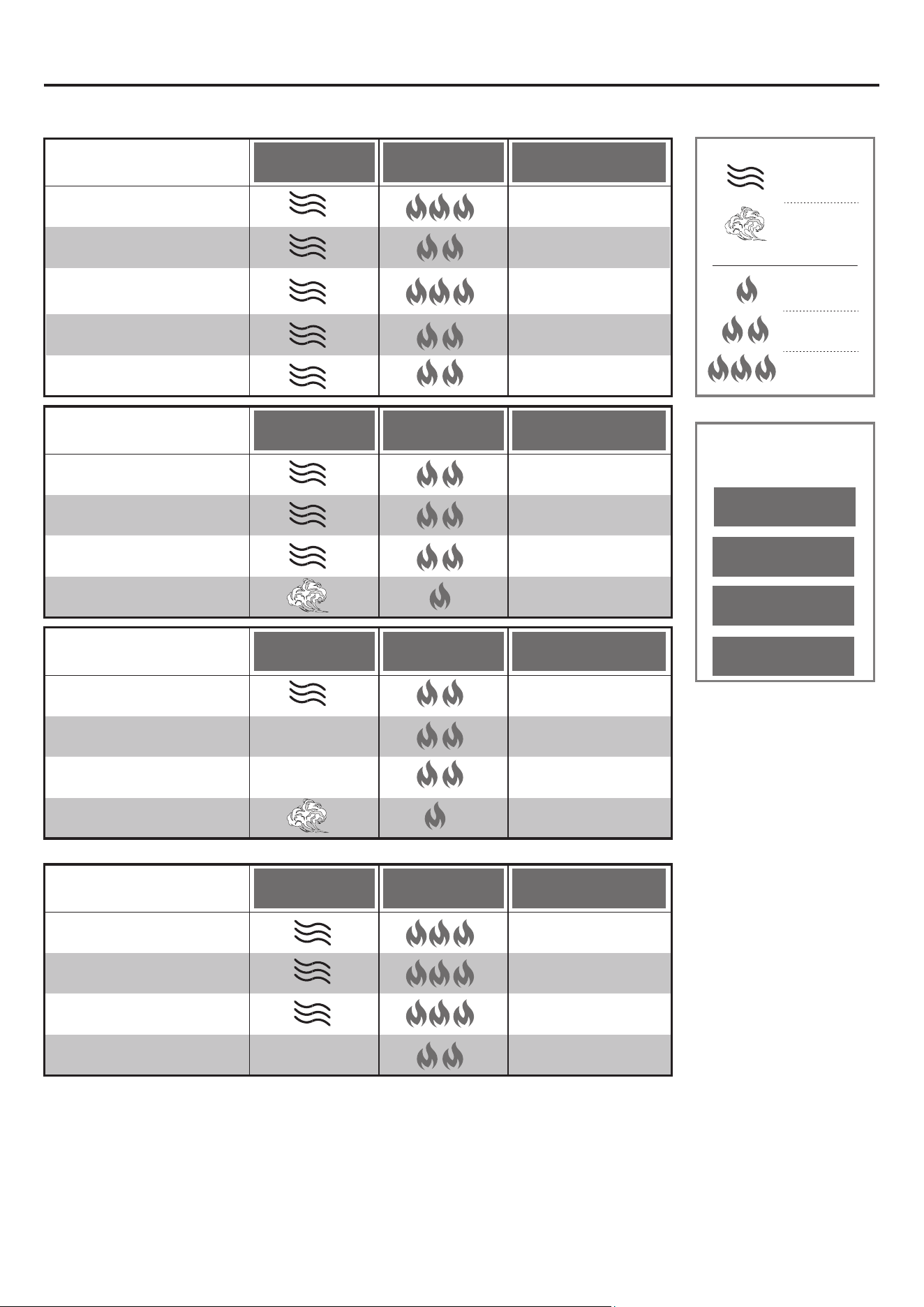
INSTRUCCIONES DE FUNCIONAMIENTO (CONTINUACIÓN)
Pautas de cocción
TIEMPO DE COCCIÓN
PROMEDIO
NIVEL DE CALORTIPO DE CALOR
MARISCOS
GRANDE
CAMARONES
4 A 6 MIN.
42.52 G
VIEIRA
4 A 6 MIN.
2.54 CM DE GROSOR
PESCADO, FILETE
5 A 10 MIN.
0.45 KG
PESCADO, ENTERO
15 A 20 MIN.
TIEMPO DE COCCIÓN
PROMEDIO
NIVEL DE CALORTIPO DE CALOR
POLLO
113.39 G - SIN HUESOS, SIN PIEL
PECHUGA O MUSLO DE POLLO
8 A 12 MIN.
85.04 G A 170.09 G - CON HUESO*
MUSLO O PATA DE POLLO
35 A 45 MIN.
283.49 G A 340.19 G - CON HUESO*
PECHUGA DE POLLO
35 A 45 MIN.
3.62 KG
POLLO ENTERO*
3 A 5 HORAS
TIEMPO DE COCCIÓN
PROMEDIO
NIVEL DE CALORTIPO DE CALOR
CERDO
2.54 CM 288 °C DE GROSOR
CHULETA DE CERDO, MEDIO
8 A 10 MIN.
3.62 KG
LOMO/PALETA DE CERDO
12 HORAS
ENLACE DE 85.04 G
SALCHICHA
10 A 13 MIN.
0.45 KG
SOLOMILLO DE CERDO
15 A 20 MIN.
TIEMPO DE COCCIÓN
PROMEDIO
NIVEL DE CALORTIPO DE CALOR
RES
2.54 CM DE GROSOR - FILET MIGNON, RIBEYE,
NEW YORK STRIP Y PORTERHOUSE
BISTEC, MEDIANO
6 A 8 MIN.
2.54 CM DE GROSOR
FILETE DE PECHO, MEDIANO
4 A 6 MIN.
19.05 MM DE GROSOR
HAMBURGUESA
8 A 10 MIN.
113.39 G
PERRO CALIENTE
5 A 7 MIN.
2.54 CM DE GROSOR
BISTEC COLGADOR, MEDIANO
8 A 10 MIN.
TEMPERATURAS
INTERNAS MÍNIMAS
SEGURAS DEL USDA
63°C
PESCADOS Y MARISCOS:
71°C
CARNE MOLIDA DE
RES O CERDO:
74°C
POLLO:
FILETES DE CARNE DE
RES O CERDO
O CHULETAS:
63°C
Los tiempos de cocción descritos
en esta tabla son pautas
generales que pueden variar
según el grado de cocción
deseado, el grosor, la cantidad de
cada elemento que se cocina, la
parrilla o el estilo de asado, la
temperatura ambiente o el clima.
Recomendamos utilizar siempre
un termómetro de cocina para
medir la temperatura interna de
todos los productos cárnicos.
CALOR
DIRECTO
CALOR BAJO
66 °C A 121 °C
CALOR
MODERADO
149 °C A 232 °C
CALOR ALTO
232 °C A MÁS
DE 288 °C
HUMO
TECLA DE CALOR
APROX. 90 MIN/0.45 KG
46

47
INSTRUCCIONES DE FUNCIONAMIENTO (CONTINUACIÓN)
Consejos y advertencias generales para asar a la parrilla
Controle el calor con cantidad y tipo de combustible, compuertas dobles y rejilla de fuego ajustable. Ajuste la rejilla un extremo a la
vez. La madera arde más que el carbón. Un mayor flujo de aire ayuda a generar más calor.
Se puede agregar carbón adicional o leña para fumar mientras se cocina. Use guantes y delantal cuando opere la parrilla.
Utilice únicamente maderas duras naturales diseñadas para cocinar. Por lo general, se pueden encontrar selecciones adecuadas en
las tiendas de comestibles y en las tiendas de parrilladas al aire libre.
Al utilizar una bandeja para agua, compruebe el nivel de agua cuando cocine más de 4 horas o cuando no oiga que el agua hierve a
fuego lento.
Para reducir las llamaradas, cocine con la campana hacia abajo.
Cuando cocine con carbón, deje la cubierta de la parrilla abierta durante el encendido inicial y hasta que el carbón se convierta en
cenizas.
La cubierta de la parrilla debe permanecer abierta siempre que el medidor de temperatura supere los 260 °C.
Coloque siempre el carbón encima de la bandeja para carbón y no directamente en el fondo de la parrilla.
No utilice carbón de autoencendido, ya que le dará a los alimentos un sabor poco natural.
Las cenizas que se dejan en la parrilla durante demasiado tiempo entre usos absorberán la humedad y provocarán oxidación.
Asegúrese de vaciar las cenizas después de que la parrilla se haya enfriado. El acero y el hierro fundido sin recubrimiento se
oxidarán si no se cuidan adecuadamente.
En la PINTURA PARA EXTERIORES, quite el óxido con un cepillo de alambre y retoque con pintura para altas temperaturas,
disponible en la mayoría de las ferreterías/tiendas de automóviles.
El medidor de calor puede retener humedad, que se vaporizará durante la cocción. El medidor se puede retirar y calibrar en un
horno.
Para lograr una parrilla más hermética, rellene los orificios no deseados con tuercas y pernos (no incluidos).
Coloque una lata de metal en el colector de goteo de grasa o en el estante inferior debajo del orificio de la parrilla para recolectar los
jugos que gotean.
El acumulador de humo y los reguladores inferiores estarán calientes. Toque únicamente con guantes protectores.
Antes de usar su parrilla por primera vez, debe precurar las rejillas de hierro fundido.
Después de cada uso, cubra las rejillas interiores y el metal desnudo con aceite vegetal mientras esté caliente para reducir la
posibilidad de oxidación. El precurado adecuado y regular protegerá contra la oxidación y prolongará la vida útil de su parrilla y las
rejillas de cocción.
La parrilla goteará aceite durante el proceso de precurado y durante varios usos posteriores. Esto es normal.
Nunca exceda los 260 °C porque esto dañará el acabado y contribuirá a la oxidación.
La pintura no está garantizada y requerirá retoques.
Esta parrilla no tiene garantía contra la oxidación.
NO utilice líquido encendedor, gasolina, queroseno, alcohol u otro acelerante para encender el carbón. El uso de de cualquiera de
estos productos o similares puede causar una explosión y ocasionar lesiones personales graves.
NOTA: el humo puede salir de otras zonas que no sean el acumulador de humo. Esto no afectará a la cocción.
NOTA: muchas variables (temperatura exterior de cocción, cantidad de carbón, cantidad de veces que se retira la tapa de
domo, la proximidad de los alimentos a la fuente de calor, etc.) afectarán los tiempos de cocción reales. El termómetro para
carne debe usarse como guía y variará según el tipo de cocción (ahumar o asar a la parrilla) y dónde se coloca el carbón.
Cuando use un termómetro para carnes, coloque la sonda hasta el medio de la parte más gruesa de la carne, asegurándose
de que no toque grasa ni hueso. Espere cinco minutos para que el termómetro registre correctamente la temperatura.
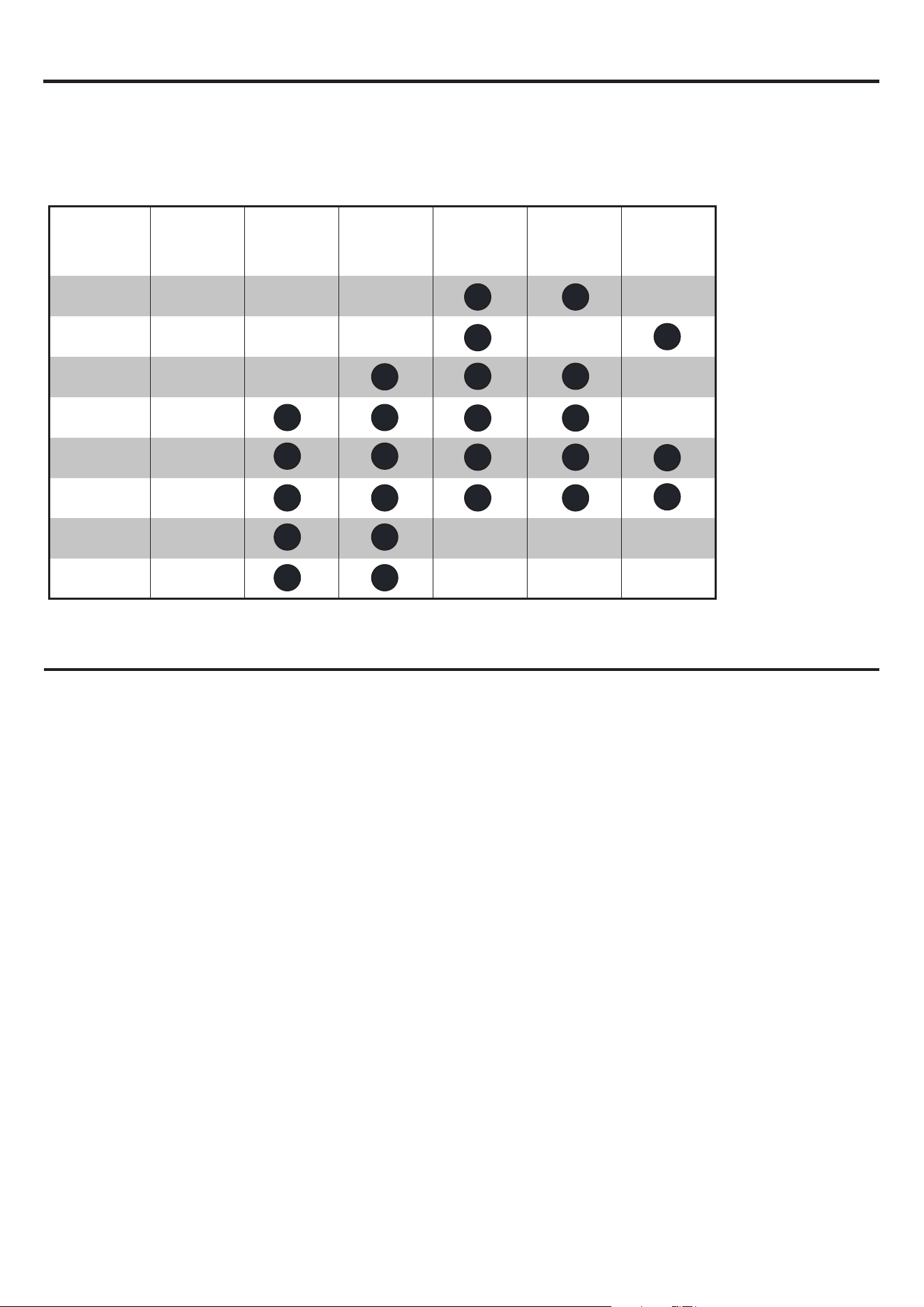
INSTRUCCIONES DE FUNCIONAMIENTO (CONTINUACIÓN)
Mejore el sabor
GUÍA DE COMBINACIÓN DE MADERA
NOTA: las diferentes variedades de madera poseen diferentes sabores y recomendamos combinar las maderas con las carnes que desea
cocinar.
MADERA SABOR
ALISO SUAVE
PECANA MEDIO
FUERTEMEZQUITE
SUAVEARCE
MEDIOROBLE
FUERTE
NOGAL
AMERICANO
MEDIOMANZANO
SUAVECEREZO
VEGETALESMARISCOSAVECERDORES
W PRECAUCIÓN: no aplique aceite vegetal a la rejilla para carbón ni a la bandeja para carbón.
W PRECAUCIÓN: la limpieza y el mantenimiento se deben realizar cuando el ahumador está frío (espere
unos 45 minutos) y con el suministro de combustible desconectado.
W PRECAUCIÓN: NO limpie ninguna pieza del ahumador en un horno con autolimpieza. El calor extremo
daña el acabado.
W PRECAUCIÓN: no deje el ahumador sin supervisión mientras lo precalienta, cocina o quema residuos
de alimentos en el ajuste alto. Si el ahumador no se ha limpiado, podría ocurrir un incendio provocado
por la grasa que puede dañar el producto.
W PRECAUCIÓN: no retire las cenizas hasta que se hayan apagado total y completamente.
W Siempre vacíe la bandeja para carbón y el ahumador después de cada uso.
W PRECAUCIÓN: no permita que el agua de la bandeja para agua se evapore completamente. Revise la
bandeja para agua cada 2 horas como mínimo y agréguele agua si el nivel está bajo. Agregue agua
según las instrucciones de la sección “Agregar más agua” de este manual.
W PRECAUCIÓN: no elimine el agua de la bandeja para agua una vez que haya retirado la comida. Deje
que el ahumador se enfríe y que el agua se evapore.
W Antes de dejar el ahumador sin supervisión:
1. El ahumador debe estar frío.
2. El carbón y las cenizas restantes se deben retirar con cuidado, colocar en un recipiente de metal no
combustible y saturar con agua.
3. Deje el carbón y las cenizas mojados en un recipiente no combustible por 24 horas antes de
desecharlos de manera adecuada.
W PRECAUCIÓN: con una manguera para jardín, moje completamente la superficie debajo y alrededor
del ahumador para extinguir cualquier ceniza, carbón o brasa que pueda haber caído durante el
proceso de cocción o de limpieza.
W PRECAUCIÓN: los carbones y cenizas apagados deben colocarse a una distancia segura de todas las
estructuras y materiales combustibles.
CUIDADO Y MANTENIMIENTO
48

CUIDADO Y MANTENIMIENTO (CONTINUACIÓN)
GARANTÍA LIMITADA
Se requiere un comprobante de compra para acceder a este programa de garantía, que entra en vigencia a
partir de la fecha de compra. Los clientes deberán abonar costos de piezas, envío y manipulación si no pueden
proporcionar el comprobante de compra o una vez vencida la garantía.
Si tiene preguntas o problemas, puede llamar al Departamento de Servicio al Cliente al 800-963-0211, de lunes a
domingo de 8 a.m. a 8 p.m., hora estándar del Este. También puede ponerse en contacto con nosotros a través
Garantía limitada
1 año de garantía para todas las piezas que afectan el funcionamiento de la parrilla a gas debido a daños.
Provisiones de la garantía:
Esta garantía no es transferible y no cubre fallas causadas por mal uso, o instalación y mantenimiento
inadecuados.
Esta garantía se limita al reemplazo de piezas defectuosas. No nos hacemos responsables de daños
accidentales o resultantes ni de costos de mano de obra.
Esta garantía no cubre la corrosión ni la decoloración una vez utilizada la parrilla, o debido a la falta de
mantenimiento, los entornos adversos, los accidentes, las alteraciones, el abuso ni la negligencia.
Esta garantía no cubre ningún daño causado por el calor, los limpiadores abrasivos y químicos ni ningún daño en
otros componentes utilizados en la instalación u operación de la parrilla.
Algunos estados no permiten la exclusión o limitación de los daños accidentales o resultantes, de modo que las
exclusiones o limitaciones de estos daños pueden no aplicarse en su caso. Esta garantía le otorga derechos
legales específicos, pero podría tener también otros derechos que varían según el estado.
Avisos
1. Esta parrilla se debe limpiar e inspeccionar minuciosamente en forma periódica.
2. Los limpiadores abrasivos dañarán este producto.
3. Nunca use limpiador de hornos para limpiar ninguna pieza de esta parrilla.
Cómo terminar
Cuando haya terminado de asar, puede apagar su parrilla cerrando ambos reguladores de tiro y dejando que el fuego se extinga. Sea
paciente. Esto puede tardar una hora o más.
Antes de cada uso
1. Mantenga el área de la parrilla limpia y libre de materiales combustibles, gasolina y otros vapores o líquidos inflamables.
2. Consulte las instrucciones de limpieza adecuadas a continuación.
Limpieza de superficies
1. Espere a que la parrilla se enfríe por completo.
2. Limpie las superficies con un detergente para vajilla suave o bicarbonato de sodio mezclado con agua.
3. Para las manchas difíciles, use un desengrasante cítrico y una escobilla de nailon.
4. Limpie y enjuague con agua.
5. Deje secar al aire.
49

Impreso en China
LISTA DE PIEZAS DE REPUESTO
Para piezas de repuesto, llame al Departamento de Servicio al Cliente al 800-963-0211, de 8 a.m. a 8 p.m. de lunes a
domingo, hora estándar del Este. También puede ponerse en contacto con nosotros a través de [email protected].
PIEZA DESCRIPCIÓN PIEZA #
CUBIERTA POR LA
GARANTÍA
1 Manija de la tapa C24032-010 Sí
2
Medidor de
temperatura
B0104-B02 Sí
3
Acumulador de
humo
C24032-020 Sí
4 Tapa C24032-030 Sí
5 Gancho para carne C24032-040 Sí
6 Rejilla para costillas C24032-050 Sí
7 Rejilla de cocción C1301-030 Sí
8 Rejilla para pollo C24032-060 Sí
9
Soporte de la rejilla
de cocción
C1101-050 Sí
10 Manija lateral C24032-070 Sí
PIEZA DESCRIPCIÓN PIEZA #
CUBIERTA POR LA
GARANTÍA
11
Parte superior
del cuerpo del
ahumador
C24032-080 Sí
12 Puerta C24032-090 Sí
13
Parte central
del cuerpo del
ahumador
C1101-090 Sí
14 Bandeja para agua C1101-040 Sí
15
Soporte de la
bandeja
para agua
C1101-080 Sí
16 Seguro B0108-C03 Sí
17 Bandeja para carbón C1101-100 Sí
18 Fuente inferior C24032-100 Sí
19 Regulador de aire C24032-110 Sí
20 Pata C24032-120 Sí
50