USE
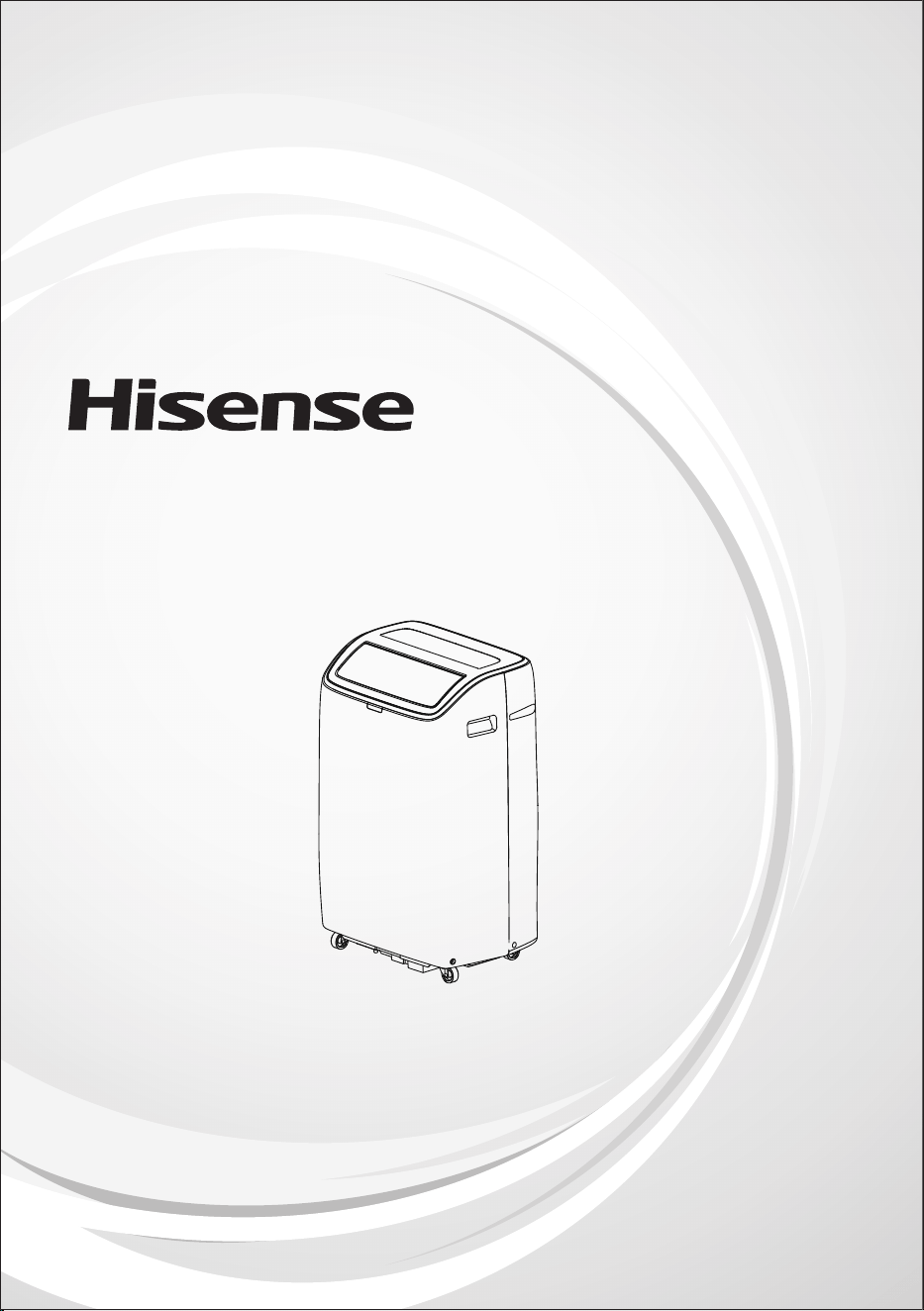
AND INSTALLATION MANUAL
Model:
HAP0824TWD
ITM. / ART. 2691084
For questions about features, operation/ performance, parts or service,
call: 1-877-465-3566
Operating hours (EST): Monday-Friday from 9 a.m. to 9 p.m.
Saturday-Sunday from 9 a.m. to 6 p.m.
Language: English and Spanish
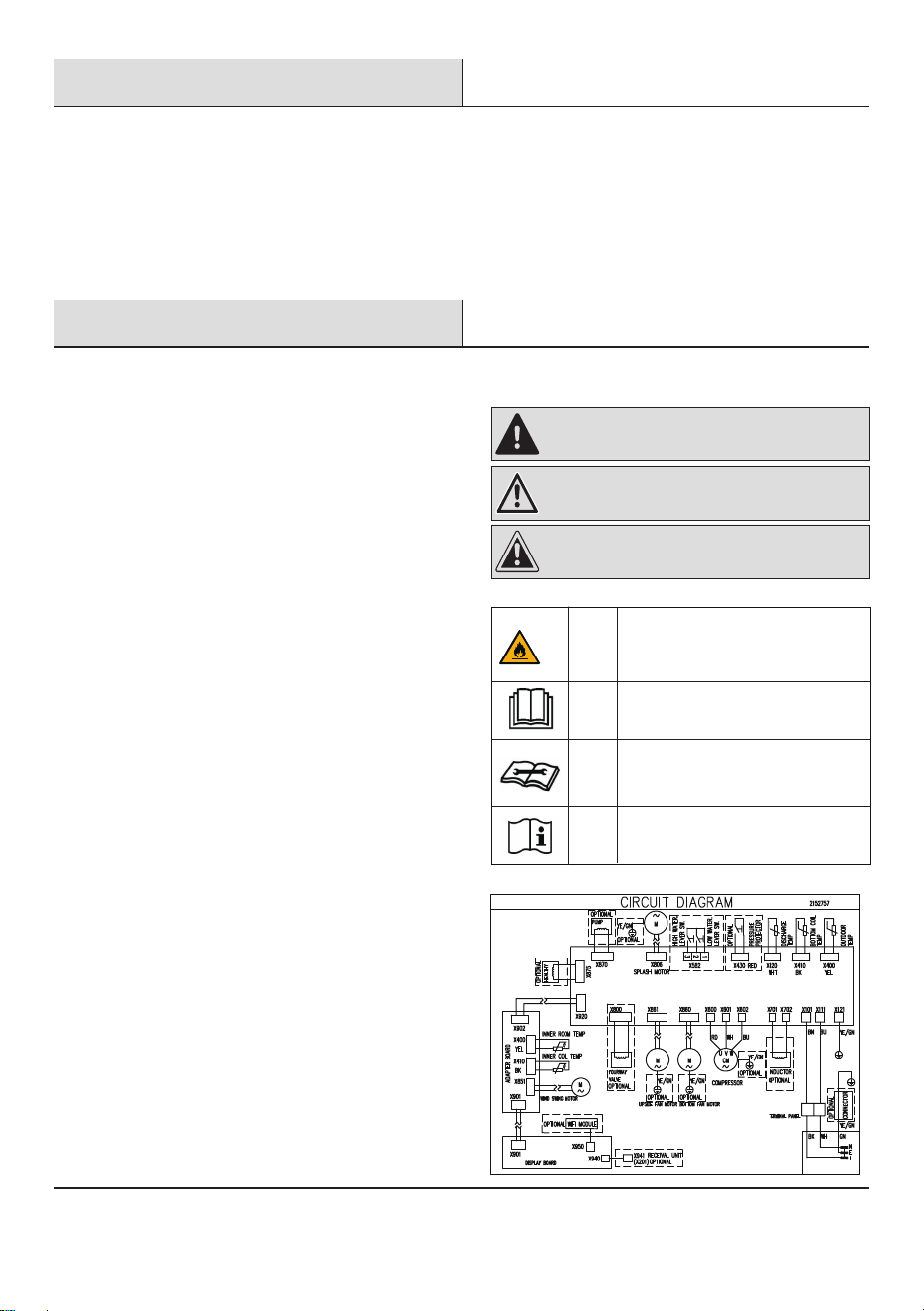
Table of Contents
Safety Information
.
.
.
.
.
.
.
.
.
.
.
.
.
.
.
.
.
.
.
.
.
.
.
.
.
.
.
.
.
.
.
.
.
.
2
Pre-Installation.
.
.
.
.
.
.
.
.
.
.
.
.
.
.
.
.
.
.
.
.
.
.
.
.
.
.
.
.
.
.
.
.
.
.
.
.
6
Planning Installation
.
.
.
.
.
.
.
.
.
.
.
.
.
.
.
.
.
.
.
.
.
.
.
.
.
.
.
.
.
.
.
6
Tools Required
.
.
.
.
.
.
.
.
.
.
.
.
.
.
.
.
.
.
.
.
.
.
.
.
.
.
.
.
.
.
.
.
.
.
.
.
6
Hardware Included.
.
.
.
.
.
.
.
.
.
.
.
.
.
.
.
.
.
.
.
.
.
.
.
.
.
.
.
.
.
.
.
.
6
Package Contents
.
.
.
.
.
.
.
.
.
.
.
.
.
.
.
.
.
.
.
.
.
.
.
.
.
.
.
.
.
.
.
.
.
7
Electrical Requirements.
.
.
.
.
.
.
.
.
.
.
.
.
.
.
.
.
.
.
.
.
.
.
.
.
.
.
.
.
8
2
Safety Information
All safety messages will tell you what the potential hazard is
and tell you how to reduce the chance of injury.
CAUTION: A hazard that if not avoided may result in
minor or moderate injury.
A2L
This symbol shows that the operation manual should be
read carefully.
This symbol shows that a service personnel should be
handling this equipment with reference to the installation
manual.
This symbol shows that information is available such as
the operating manual or installation manual.
CAUTION
CAUTION
CAUTION
WARNING
Explanation of symbols displayed on the unit.
Circuit diagram
This symbol shows that this appliance uses a flammable
refrigerant. If the refrigerant is leaked and exposed to
an external ignition source, there
is a risk of fire.
Location Requirements
.
.
.
.
.
.
.
.
.
.
.
.
.
.
.
.
.
.
.
.
.
.
.
.
.
.
.
.
.9
Unpack The Air Conditioner
.
.
.
.
.
.
.
.
.
.
.
.
.
.
.
.
.
.
.
.
.
.
.
.
.
10
Window Vent Panel and Extensions .
.
.
.
.
.
.
.
.
.
.
.
.
.
.
.
.
.
.
10
Installation
.
.
.
.
.
.
.
.
.
.
.
.
.
.
.
.
.
.
.
.
.
.
.
.
.
.
.
.
.
.
.
.
.
.
.
.
.
.
.
11
Operation. . . . . . . . . . . . . . . . . . . . . . . . . . . . . . . . . . . . . . . . .
14
Care and Cleaning
.
.
.
.
.
.
.
.
.
.
.
.
.
.
.
.
.
.
.
.
.
.
.
.
.
.
.
.
.
.
.
.
.
20
Troubleshooting
.
.
.
.
.
.
.
.
.
.
.
.
.
.
.
.
.
.
.
.
.
.
.
.
.
.
.
.
.
.
.
.
.
.
.
22
WARNING:
A hazard that if not avoided could result in
serious Injury or death.
DANGER:
A hazard that if not avoided will result in
serious injury or death.
Your safety and the safety of others are very important. We have
provided
many important safety messages in this manual and on
your
appliance. Please always read and obey all safety messages. To
reduce
the risk of re, electrical shock or injury when using your air
conditioner, please follow these basic precautions:
IMPORTANT SAFETY INSTRUCTIONS
□ Plug into a grounded 3-prong outlet.
□ Do not remove ground prong.
□ Do not use an electrical adapter.
□ Do not use an extension cord.
□ Unplug air conditioner before servicing.
□ Use two or more people to move and install air conditioner.
□ If the SUPPLY CORD is damaged, it must be replaced by the
manufacturer, its service agent or similarly qualified persons in
order to avoid a hazard.
DISPOSING OF THE UNIT
□ Before throwing out the device, it is necessary to remove the
battery
cells and dispose or recycle them properly.
□ When you need disposal of the unit consult our dealer. If pipes are
removed incorrectly, refrigerant may blow out and come into
contact with your skin, causing injury. Releasing refrigerant into
the atmosphere also damages the environment.
□ Please recycle or dispose of the product packaging material in
an environmentally responsible manner.
□ Do not store or ship the air conditioner upside down or sideways to
avoid damage to the compressor. If the air conditioner was upside
down or sideways, please keep upright at least 2 hours before use
to prevent damaging the compressor.
□ This appliance is not intended for use by persons (including
children) with reduced physical, sensory or mental capabilities,
or lack of experience and knowledge, unless they have been given
supervision or instruction concerning use of the appliance by a
person responsible for their safety. Children should be supervised
to ensure that they do not play with the appliance.
□ The wiring diagram is shown on nameplate on the air conditioner.
Safety Information (continued)
1. Transport of equipment containing flammable refrigerants
Compliance with the transport regulations.
2. Marking of equipment using signs
Compliance with local regulations.
3. Disposal of equipment using flammable refrigerants
Compliance with national regulations.
4. Storage of equipment/appliances
The storage of equipment should be in accordance with the
manufacturer
5. Storage of packed (unsold) equipment
Storage package protection should be constructed such that
mechanical damage to the equipment inside the package will
not cause a leak of the refrigerant charge.
The maximum number of pieces of equipment permitted to be
stored together will be determined by local regulations.
6. Information on servicing
Checks to the area: Prior to beginning work on systems
containing flammable refrigerants, safety checks are necessary
to ensure that the risk of ignition is minimised. For repair to the
refrigerating system, the following precautions shall be
complied with prior to conducting work on the system.
Work procedure: Work shall be undertaken under a controlled
procedure so as to minimise the risk of flammable gas or
vapour being present while the work is being performed.
General work area: All maintenance staff and others working in
the local area shall be instructed on the nature of work being
carried out. Work in confined spaces shall be avoided. The area
around the workspace shall be sectioned off. Ensure that the
conditions within the area have been made safe by control of
flammable material.
Checking for presence of refrigerant: The area shall be checked
with an appropriate refrigerant detector prior to and during
work, to ensure the technician is aware of potentially flammable
atmospheres. Ensure that the leak detection equipment being
used is suitable for use with flammable refrigerants, i.e. non-
sparking, adequately sealed or intrinsically safe.
Presence of fire extinguisher: If any hot work is to be conducted
on the refrigeration equipment or any associated parts,
appropriate fire extinguishing equipment shall be available to
hand. Have a dry powder or CO2 fire extinguisher adjacent to
the charging area.
's instructions.
□
□
□
□
□
□
□
□
□
□
□
□
7. Repairs to sealed components
If it is absolutely necessary to have an electrical supply to
equipment during servicing, then a permanently operating form
of leak detection shall be located at the most critical point to
warn of a potentially hazardous situation.
Particular attention shall be paid to the following to ensure that
by working on electrical components, the casing is not altered
in such a way that the level of protection is affected.
□
□
□
Ensure that apparatus is mounted securely.
Ensure that seals or sealing materials have not degraded such
that they no longer serve the purpose of preventing the ingress
of flammable atmospheres.
□
□
□
Precautions for using R32 refrigerant
3
□
□
This shall include damage to cables, excessive number of
connections, terminals not made to original specification,
damage to seals, incorrect fitting of glands, etc.
During repairs to sealed components, all electrical supplies shall
be disconnected from the equipment being worked upon prior to
any removal of sealed covers, etc.
Ventilated area: Ensure that the area is in the open or that it is
adequately ventilated before breaking into the system or
conducting any hot work. A degree of ventilation shall continue
during the period that the work is carried out. The ventilation
should safely disperse any released refrigerant and preferably
expel it externally into the atmosphere.
Checks to the refrigeration equipment: Where electrical
components are being changed, they shall be fit for the purpose
and to the correct specification. At all times the manufacturer's
maintenance and service guidelines shall be followed. If in doubt
consult the manufacturer's technical department for
assistance.
The following checks shall be applied to
installations using
flammable refrigerants: The charge size is in accordance with the
room size within which the refrigerant containing parts are
installed; The ventilation machinery and outlets are operating
adequately and are not obstructed; If an indirect refrigerating
circuit is being used, the secondary circuit shall be checked for
the presence of refrigerant; Marking to the equipment continues
to be visible and legible. Markings and signs that are illegible
shall be corrected; Refrigeration pipe or components are installed
in a position where they are unlikely to be exposed to any
substance which may corrode refrigerant containing components,
unless the components are constructed of materials which are
inherently resistant to being corroded or are suitably protected
against being so corroded.
Checks to electrical devices:
Repair and maintenance to electrical
components shall include initial safety checks and component
inspection procedures. If a fault exists that could compromise
safety, then no electrical supply shall be connected to the circuit
until it is satisfactorily dealt with. If the fault can not be corrected
immediately but it is necessary to
continue operation, an
adequate temporary solution shall be used.
This shall be reported to the owner of the equipment so all parties
are advised. Initial safety checks shall include: That capacitors
are discharged: this shall be done in a safe manner to avoid
possibility of sparking; That there no live electrical components
and wiring are exposed while charging, recovering or purging the
system; That there is continuity of earth bonding.
No ignition sources: No person carrying out work in relation to
a refrigeration system which involves exposing any pipe work
that contains or has contained flammable refrigerant shall use
any sources of ignition in such a manner that it may lead to the
risk of fire or explosion. All possible ignition sources, including
cigarette smoking, should be kept sufficiently far away from the
site of installation, repairing, removing and disposal, during
which flammable refrigerant can possibly be released to the
surrounding space. Prior to work taking place, the area around
the equipment is to be surveyed to make sure that there are no
flammable hazards or ignition risks.“No Smoking”signs shall be
displayed.
The basic installation work procedures are the same as the
conventional refrigerant (R22 or R410A). However, pay attention
to
the following:
4
Safety Information (continued)
Replacement parts shall be in accordance with the manufacturer's
specifications.
□
8. Repairs to intrinsically safe components
9. Cabling
Check that cabling will not be subject to wear, corrosion,
excessive pressure,vibration, sharp edges or any other adverse
environmental effects.
The check shall also take into account the effects of aging or
continual vibration from sources such as compressors or fans.
□
□
□
□
□
□
□
□
□
□
□
□
□
□
□
NOTE: The use of silicon sealant may inhibit the effectiveness
of some types of leak detection equipment. Intrinsically safe
components do not have to be isolated prior to working on them.
Do not apply any permanent inductive or capacitance loads to the
circuit without ensuring that this will not exceed the permissible
voltage and current permitted for the equipment in use.
Intrinsically safe components are the only types that can be worked
on while live in the presence of a flammable atmosphere. The test
apparatus shall be at the correct rating.
Replace components only with parts specified by the manufacturer.
Other parts may result in the ignition of refrigerant in the
atmosphere from a leak.
□
□
□
□
14. Decommissioning
13. Charging procedures
a) Become familiar with the equipment and its operation.
b) Isolate system electrically.
c) Before attempting the procedure ensure that:
–Mechanical handling equipment is available, if required,
10. Detection of flammable refrigerants
Under no circumstances shall potential sources of ignition be used
in these arching for or detection of refrigerant leaks.
A halide torch (or any other detector using a naked flame) shall
not be used.
11. Leak detection methods
The following leak detection methods are deemed acceptable for
systems containing flammable refrigerants:
–Electronic leak detectors shall be used to detect flammable
refrigerants, but the sensitivity may not be adequate, or may need
re-calibration. (Detection equipment shall be calibrated in a
refrigerant-free area.)
–Ensure that the detector is not a potential source of ignition and
is suitable for the refrigerant used.
–Leak detection equipment shall be set at a percentage of the
LFL of the refrigerant and shall be calibrated to the refrigerant
employed and the appropriate percentage of gas (25 % maximum)
is confirmed.
–Leak detection fluids are suitable for use with most refrigerants
but the use of detergents containing chlorine shall be avoided as
the chlorine may react with the refrigerant and corrode the copper
pipe-work.
–If a leak is suspected, all naked flames shall be removed/
extinguished.
–If a leakage of refrigerant is found which requires brazing, all
of the refrigerant shall be recovered from the system, or isolated
(by means of shutoff valves) in a part of the system remote from
the leak.
–Oxygen free nitrogen (OFN) shall then be purged through the
system both before and during the brazing process.
12. Removal and evacuation
When breaking into the refrigerant circuit to make repairs - or for
any other purpose - conventional procedures shall be used.
However, for flammable refrigerants it is important that best
practice be followed, since flammability is a consideration.
The following procedure shall be adhered to:
a) safely remove refrigerant following local and national
regulations;
b) purge the circuit with inert gas;
c) evacuate (optional for A2L);
d) purge with inert gas (optional for A2L);
e) open the circuit by cutting or brazing;
The refrigerant charge shall be recovered into the correct recovery
cylinders if venting is not allowed by local and national codes.
For appliances containing flammable refrigerants, the system
shall be purged with oxygen - free nitrogen to render the
appliance safe for flammable refrigerants. This process might
need to be repeated several times. Compressed air or oxygen
shall not be used for purging refrigerant systems.
For appliances containing flammable refrigerants, refrigerants
purging shall be achieved by breaking the vacuum in the system
with oxygen - free nitrogen and continuing to fill until the working
pressure is achieved, then venting to atmosphere, and finally
pulling down to a vacuum (optional for A2L). This process shall
be repeated until no refrigerant is within the system (optional
for A2L). When the final oxygen - free nitrogen charge is used,
the system shall be vented down to atmospheric pressure to
enable work to take place.
Ensure that the outlet for the vacuum pump is not close to any
potential ignition sources and that ventilation is available.
In addition to conventional charging procedures, the following
requirements shall be followed:
- Ensure that contamination of different refrigerants does not
occur
when using charging equipment.
- Hoses or lines shall be as short as possible to minimise the
amount of refrigerant contained in them.
- Cylinders shall be kept upright.
- Ensure that the refrigeration system is earthed prior to
charging the system with refrigerant.
- Label the system when charging is complete (if not already).
- Extreme care shall be taken not to overfill the refrigeration
system.
Prior to recharging the system it shall be pressure tested with OFN.
The system shall be leak tested on completion of charging but
prior to commissioning.
A follow up leak test shall be carried out prior to leaving the site.
For professional technicians only.
Before carrying out this procedure, it is essential that the technician
is
completely familiar with the equipment and all its detail.
It is recommended good practice that all refrigerants are recovered
safely.
Prior to the task being carried out, an oil and refrigerant sample
shall
be taken in
case analysis is
required prior to re-use of
reclaimed refrigerant. It is essential that electrical power is
available
before the task is commenced.
□
Safety Information (continued)
15. Labelling
□
□
The label shall be dated and signed.
Ensure that there are labels on the equipment stating the
equipment
16.Recovery
When transferring refrigerant into cylinders, ensure that only
appropriate refrigerant recovery cylinders are employed.
Ensure that the correct number of cylinders for holding the total
system charge is available.
All cylinders to be used are designated for the recovered
refrigerant and labelled for that refrigerant (i.e. special cylinders
for the recovery of refrigerant).
Cylinders shall be complete with pressure relief valve and
associated shut-off valves in good working order.
Empty recovery cylinders are evacuated and, if possible, cooled
before recovery occurs.
The recovery equipment shall be in good working order with a
set of instructions concerning the equipment that is at hand and
shall be suitable for the recovery of flammable refrigerants.
In addition, a set of calibrated weighing scales shall be available
and in good working order.
Hoses shall be complete with leak-free disconnect couplings and
in good condition.
contains flammable refrigerant.
□
□
□
□
□
□
□
□
□
□
□
□
□
□
□
□
□
WARNING: Risk of Fire or Explosion. This unit contains
ammable refrigerant.
Additional safety precautions must be followed.
□ Do not use means to accelerate the defrosting process
or to clean, other than those recommended by the
manufacturer.
□ The appliance shall be stored in a room without
continuously operating ignition sources (for example:
open ames, an operating gas appliance or an operating
electric heater).
□ Do not pierce or burn refrigerant tubing. Be aware that
refrigerants may not contain an odor.
□ Keep ventilation openings clear of obstruction.
□ The maximum refrigerant charge amount is shown on
nameplate on the air conditioner.
□ When handling, installing, and operating the appliance,
care should be taken to avoid damage to the refrigerant
tubing.
□ Do not drill holes in the unit.
□ Maintenance, cleaning, and service should only be
performed by technicians properly trained and qualied
in the use of ammable refrigerants.
□ Dispose of air conditioner in accordance with Federal
and Local Regulations. Flammable refrigerants require
special disposal procedures. Contact your local
authorities for the environmentally safe disposal of your
air conditioner.
□ The appliance shall be stored so as to prevent
mechanical damage from occurring.
□
This product contains small parts such as (batteries,
battery cover and screws) that may cause suffocation
if swallowed by children.
□ The appliance shall be stored in a well-ventilated area
where the room size corresponds to the room area as
specified for operation.
□
Compliance with national gas regulations shall be
observed.
5
□
Consult manufacturer if in doubt.
Opening of the refrigeration systems shall not be done by
brazing.
The recovered refrigerant shall be returned to the refrigerant
supplier in the correct recovery cylinder, and the relevant Waste
Transfer Note arranged.
Do not mix refrigerants in recovery units and especially not in
cylinders.
If compressors or compressor oils are to be removed, ensure
that they have been evacuated to an acceptable level to
make
certain that flammable
refrigerant does not remain within
the
lubricant.
The evacuation process shall be carried out prior to returning
the compressor to the suppliers.
Only electric heating to the compressor body shall be employed
to accelerate this process.
When oil is drained from a system, it shall be carried out safely.
Before using the recovery machine, check that it is in satisfactory
working order, has been properly maintained and that any
associated electrical components are sealed to prevent ignition
in the event of a refrigerant release.
for handling refrigerant cylinders;
–All personal protective equipment is available and being used
correctly;
–The recovery process is supervised at all times by a competent
person;
–Recovery equipment and cylinders conform to the appropriate
standards.
d) Pump down refrigerant system, if possible.
e)
If a vacuum is not possible, make a manifold so that refrigerant
can be removed from various parts of the system.
f)
Make sure that cylinder is situated on the scales before recovery
takes place.
g)
Start the recovery machine and operate in accordance with
manufacturer's instructions.
h)
Do not overfill cylinders. (No more than 80 % volume liquid
charge).
i)
Do not exceed the maximum working pressure of the cylinder,
even temporarily.
j)
When the cylinders have been filled correctly and the process
completed, make sure that the cylinders and the equipment are
removed from site promptly and all isolation valves on the
equipment are closed off.
k)
Recovered refrigerant shall not be charged into another
refrigeration system unless it has been cleaned and checked.
Equipment shall be labelled stating that it has been de-
commissioned and emptied of refrigerant (for technicians only).
When removing refrigerant from a system, either for servicing
or decommissioning, it is recommended good practice that all
refrigerants are removed safely (for technicians only).
Pre-Installation
PLANNING INSTALLATION
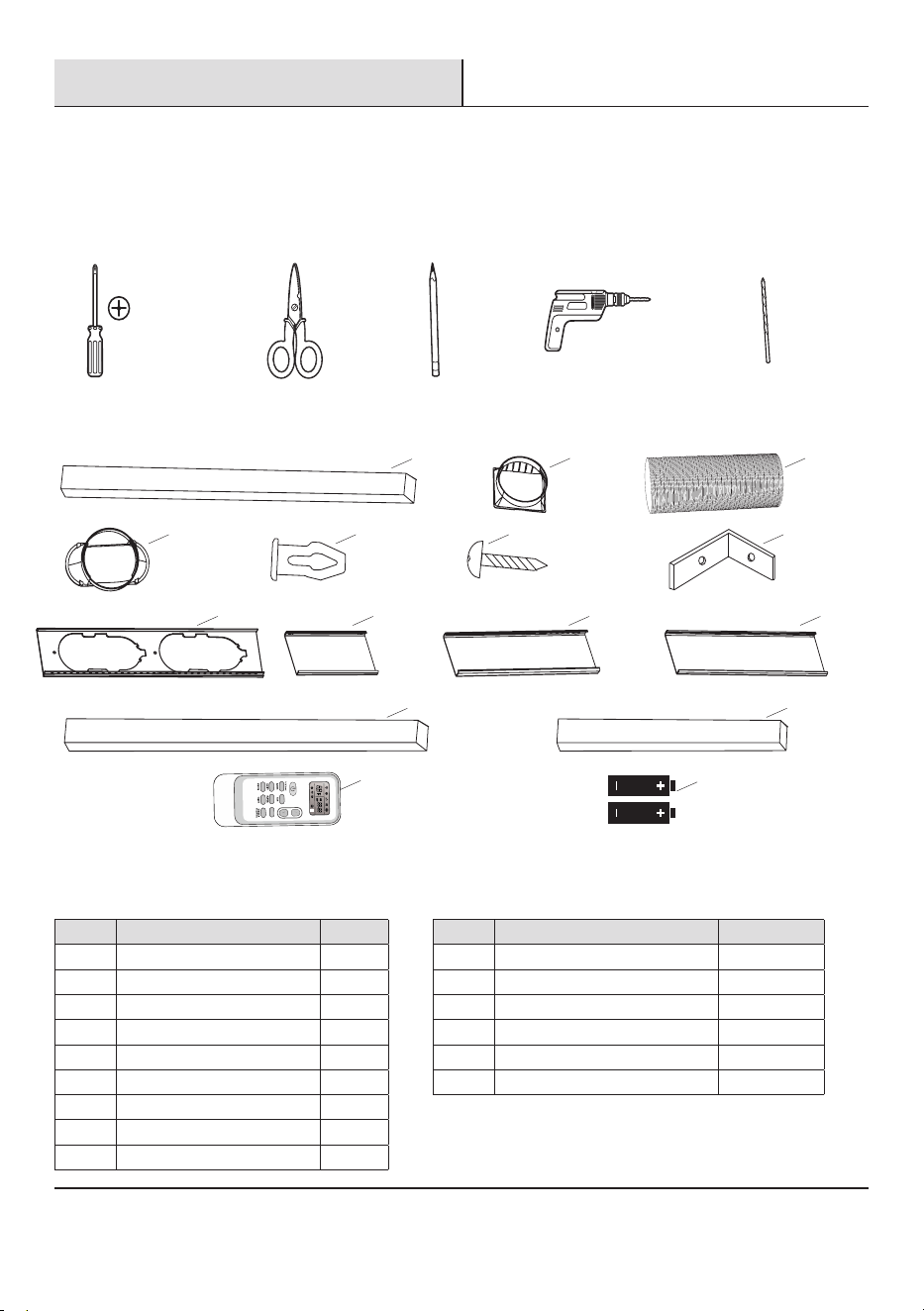
Gather the required tools and parts before starting installation. Check that all parts are included in parts package. Read and follow the
instructions provided with any tools listed here.
TOOLS REQUIRED
Phillips
screwdriver
Scissors Pencil
Cordless
drill
HARDWARE INCLUDED
AA
BB CC
DD EE FF GG
HH II JJ KK
LL
NN
OO
MM
Part Description Quantity Part Description Quantity
AA Foam seal (non-adhesive) 1 JJ Inner slider section 1
BB Coupling KK Outer slider section 1
CC Flexible exhaust hose LL Foam seal-long (adhesive) 3
DD Window exhaust adapter MM Foam seal-short (adhesive) 2
EE Rivets 4 NN 1
FF Screws 4 OO
GG Window lock bracket 2
HH Outer slider section with vent 1
II Inner slider section-short 1
6
2
2
2
FILTER
Remote Control
Standard AAA (1.5 volt) batteries 2
1/8 in. Drill bit
Pre-Installation (continued)
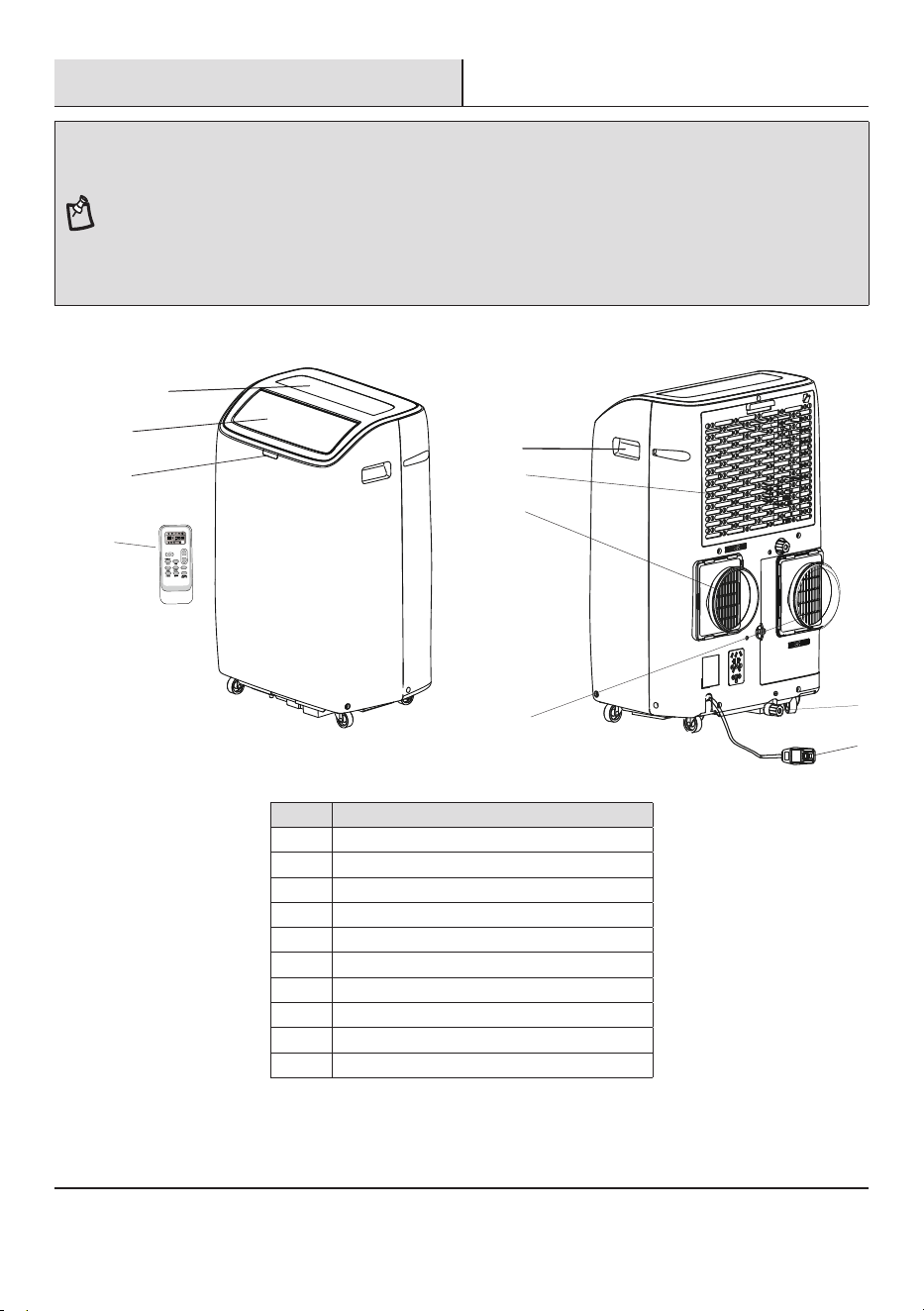
PACKAGE CONTENTS
A
B
C
D
E
F
I
H
G
J
Part Description
A Control panel
B
C
D Remote control
E Transport handle
F Evaporator air intake
G Air outlet hose coupling
H Condenser air intake
I Primary drain port
J Power cord (may differ from the one shown)
Signal receptor
Cool air outlet
7
FILTER
BATTERY NOTES:
□ Battery type: mercury free super heavy duty R03 UM-4 size AAA 1.5V.
□ Best used before date code (month-year) on the battery.
□ Caution for ingestion: the battery may cause suffocation if swallowed by children.
□ Do not mix old and new batteries. Do not mix alkaline, standard (carbon - zinc), or rechargeable (nickel - cadmium) batteries.
□ Non-rechargeable batteries are not to be recharged.
□ Exhausted batteries are to be removed from the product.
□ DO NOT DISPOSE OF BATTERIES IN FIRE. BATTERIES MAY EXPLODE OR LEAK.
Pre-Installation (continued)
8
ELECTRICAL REQUIREMENTS
Recommended Grounding Method
This portable air conditioner must be grounded. This portable air conditioner is equipped with a power supply cord with a three-prong
grounding plug. The cord must be plugged into a properly grounded three-prong outlet, grounded in accordance with all local codes and
ordinances. If a properly grounded outlet is not available, it is the customer’s responsibility to have a properly grounded three-prong outlet
installed by a qualied electrician.
Customer’s Responsibility
□ To contact a qualied electrician.
□ To assure that the electrical installation is adequate and conforms to the national electrical code, ANSI/NFPA 70-last edition, and all
local codes and ordinances.
Copies of the standards listed may be obtained from:
National Fire Protection Association
1 Batterymarch Park
Quincy, MA 02169-7471
www.nfpa.org
Wiring Requirement
Power Supply Cord
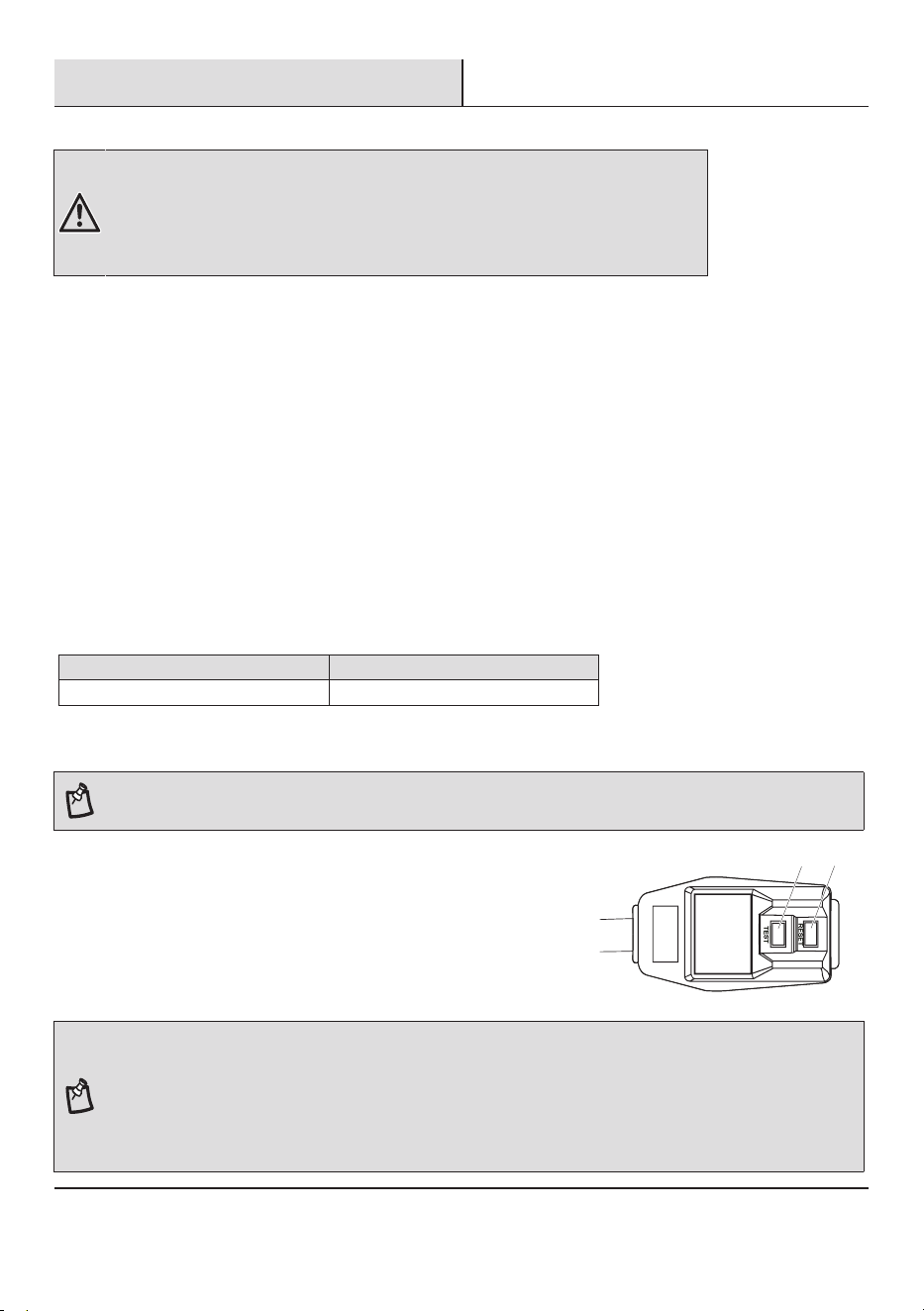
NOTE: Your air conditioner’s device may differ from the one shown. This room air conditioner is equipped with a power supply cord required
by UL. This power supply cord contains state-of-the-art electronics that sense leakage current. If the cord is crushed, the electronics detect
leakage current and power will be disconnected in a fraction of a second.
To test your power supply cord:
1. Plug power supply cord into a grounded 3-prong outlet.
2. Press RESET (2) (on some devices, a green light will turn on).
3. Press TEST (1) and listen for click. The RESET button will trip, and on some devices, a
green light will turn off.
4. Press and release RESET (2) and listen for click. The RESET button will latch, and on
some devices, a green light will turn on. The power supply cord is ready for operation.
1
2
Time-delay fuse (or circuit breaker)Power supply
15A115V 103.5V min. 126.5V max.
NOTE:
□ The RESET button must be pushed in for proper operation.
□ The power supply cord must be replaced if it fails to trip when the test button is pressed or fails to reset.
□ Do not use the power supply cord as an off/on switch. The power supply cord is designed as a protective device.
□ If the SUPPLY CORD is damaged, it must be replaced by the manufacturer, its service agent or similarly qualified persons in order to
avoid a hazard.
□ The power supply cord contains no user serviceable parts. Opening the tamper-resistant case voids all warranty and performance claims.
WARNING:
□ Plug into a grounded 3-prong outlet.
□ Do not remove ground prong.
□ Do not use an adapter.
□ Do not use an extension cord. The appliance shall be installed in accordance with national wiring regulations.
□ Failure to follow these instructions can result in electrical shock, re, or death.
Pre-Installation (continued)
LOCATION REQUIREMENTS
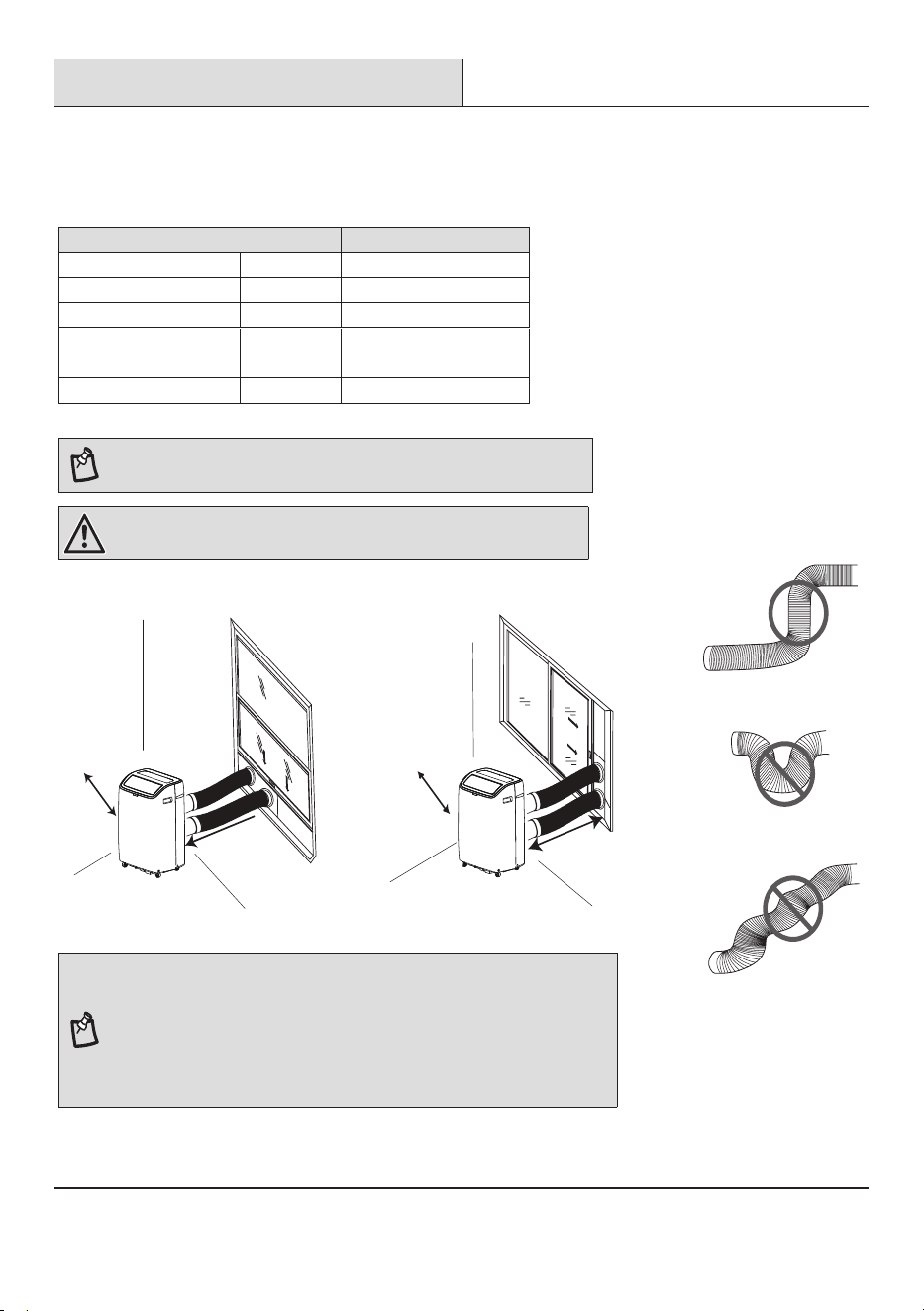
The exible exhaust hose allows placement of the air conditioner at least 20 in. from window or door.
Conrm you are using the correct size air conditioner for the space to be cooled, per sizing recommendations, below:
Area to be cooled DOE Capacity needed (BTUs)
Up to 10 ft x 15 ft room 150 sq. ft
Up to 10 ft x 25 ft room 250 sq.ft
Up to 15 ft x 20 ft room 300 sq. ft
Up to 10 ft x 35 ft room 350 sq. ft
NOTE: Match BTUs to room use and location: Shaded room, reduce to next smaller size;
sunny room, increase to next larger size; for kitchens, increase to next larger size.
WARNING: The length of the exhaust hose is specially designed according to the
specication of the product. Do not replace, extend, or otherwise modify the hose.
Vertical Sliding Window Horizontal Sliding Window
20 in.
(50 cm)
20 in.
(50 cm)
20 in.
(50 cm)
20 in.
(50 cm
)
9
NOTE: For best performance, allow at least 20 in. of air space on all sides of the unit for good
air circulation.
□ Do not block the air outlet.
□ Provide easy access to the grounded 3-prong outlet.
□ To ensure proper function, DO NOT overextend or bend the hose. Make sure that there is
no obstacle around the air outlet of the exhaust hose in order for the exhaust system to
work properly. All the illustrations in this manual are for explanation purposes only. Your air
conditioner may be slightly different. The actual shape shall prevail.
450 sq. ft.Up to 15 ft x 30 ft room
5,000
6,000
7,000
8,000
10,000
550 sq. ft.Up to 10 ft x 55 ft room 12,000
Pre-Installation (continued)
10
UNPACK THE AIR CONDITIONER
WARNING: Use two or more people to move and install air conditioner. Failure to do so can result in
back or other injury.
Remove Packaging Materials
□ Remove and recycle packaging materials.
□ Remove tape and glue residue from surfaces before turning on the air conditioner. Rub a small amount of liquid dish soap over the
adhesive with your ngers. Wipe with warm water and dry.
□ Do not use sharp instruments, rubbing alcohol, ammable uids, or abrasive cleaners to remove tape or glue. These products can
damage the surface of your air conditioner.
□ Handle the air conditioner gently.
IMPORTANT: Keep unit upright at least 2 hours prior to use.
CAUTION: Installation accessories are stored in the top of the carton and are required for proper
cooling performance. Please remove all accessories from packing materials before use.
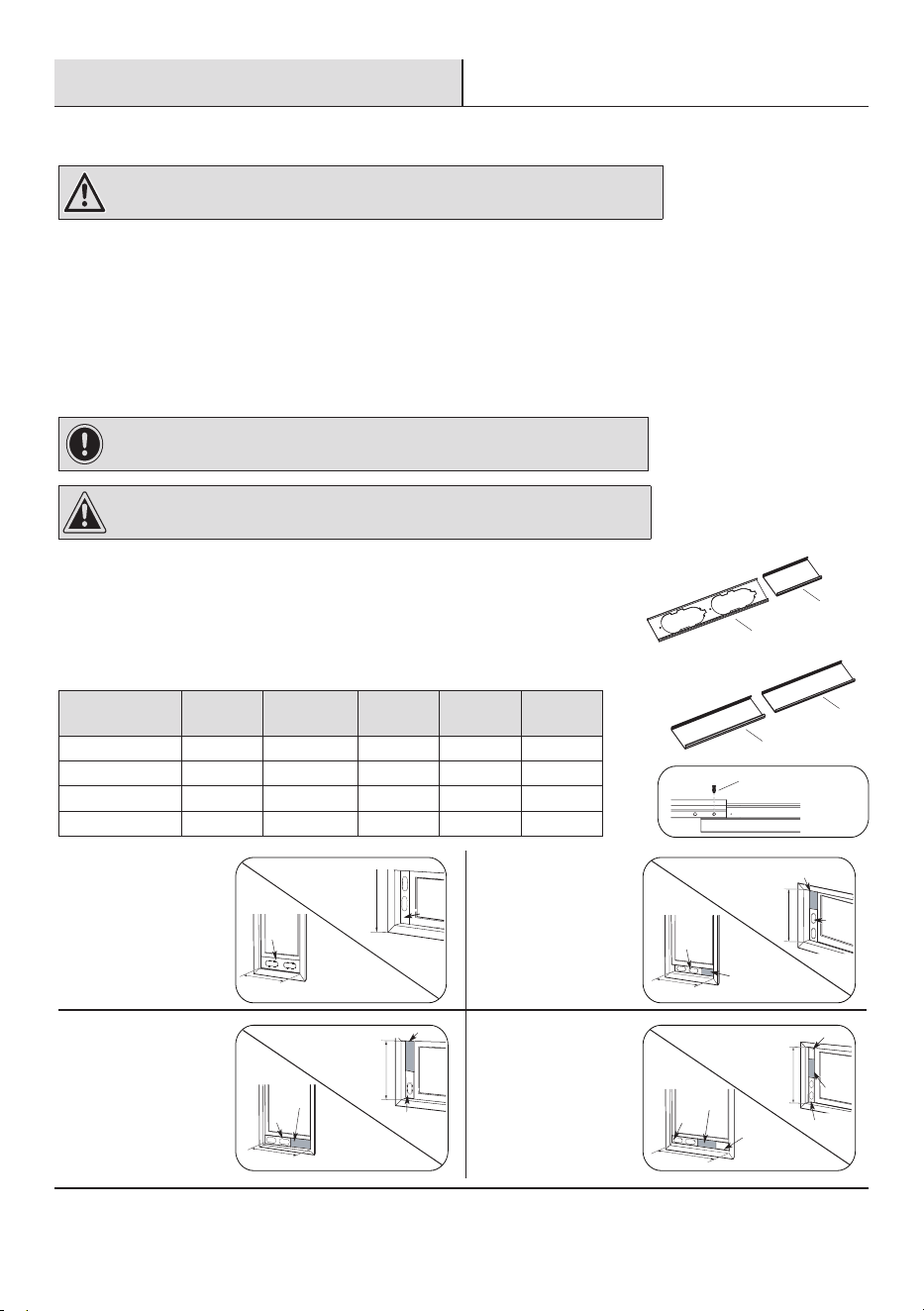
WINDOW VENT PANEL AND EXTENSIONS
The window installation kit allows you to install the air conditioner in most vertical-sliding windows
18 in. to 50 in. wide, or horizontal sliding windows from 18 in. to 50 in. tall. Check your window size
and choose the t from the table. lf your window size requires more than twopanels, after adjusting
the length, please secure the panels with rivets (EE).
Panel Length /
Window Length
Panel HH
(18 in.)
Panel II
(19-11/16 in.)
Panel JJ
(18 in.)
Panel KK
(18 in.)
See
Figure...
18 in. X A
19 in. – 26 in. X X B
27 in. – 34 in. X X C
35 in. – 50 in. X X X D
Figure A
For an 18 in. window
opening, use the window
vent panel (HH) by itself.
HH
HH
Figure B
For window openings from
19 in. to 26 in., use the
window vent panel (HH)
and a extension panel (II).
II
II
HH
HH
Figure C
For window openings from
27 in. to 34 in., use the
window vent panel (HH)
and a extension panel (JJ).
HH
JJ
HH
JJ
Figure D
For window openings from
35 in. to 50 in., use the
window vent panel (HH)
and two extension panels
(KK and JJ).
HH
KK
JJ
HH
JJ
KK
HH
II
KK
JJ
EE
25
in.
25
in.
25
in.
- 42 in.
25
in.
- 42 in.
43
in.
- 50 in.
43
in.
- 50 in.
25
in.
- 33 in.
25
in.
- 33 in.
Installation
NOTE: Product must be used with included Duct Window Installation kit for effective cooling.
11
BB
CC
Insert
Slide
Snap in place
1
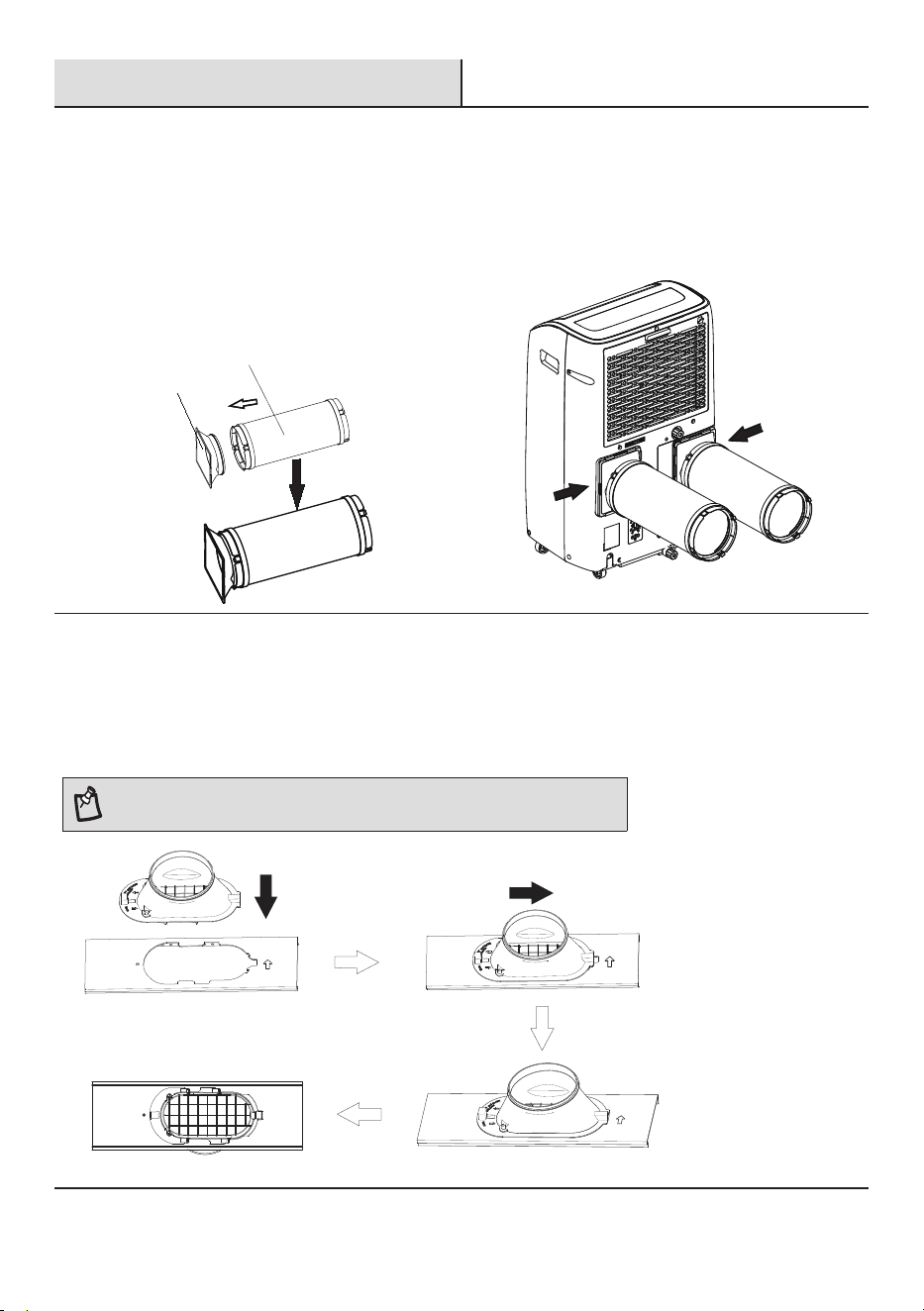
Attaching Exhaust Hose and Adapter to Air Conditioner
□ Roll the air conditioner to selected location. See
“Location Requirements” on page 9.
□ Press the coupling (BB) into the flexible exhaust hose (CC). The hose
has
integral clips that snap onto the
coupling.
□ Insert the coupling (BB) into the slot on the back of the air conditioner.
□ Slide down to lock the hose into place.
□ Conrm the hose is locked in place before operating.
2
Attaching Exhaust Hose to Window Vent
□ Your window installation kit has been designed to t most standard vertical and horizontal window applications. Roll the air
conditioner to selected location. See
“Location Requirements” on page 9.
□ Place the window exhaust adapter (DD) on the outer slider section (HH) (the piece with the large exhaust hole).
□ Slide the window exhaust adapter (DD) to lock in place (please follow direction on the adapter).
Installation (continued)
2a
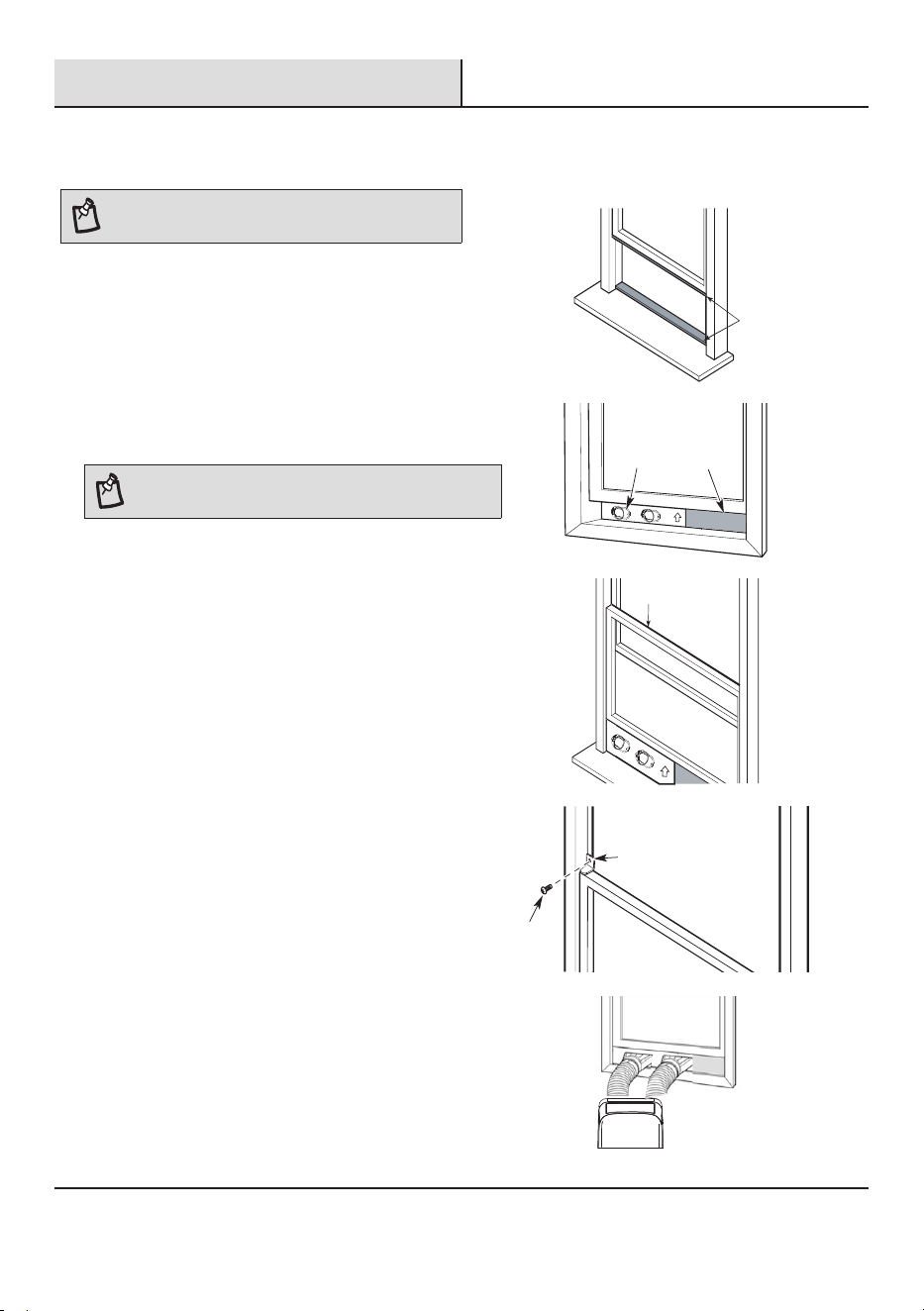
Installing in Vertical Sliding Window
NOTE: The window installation kit can be used with vertical
sliding windows between 18 in. and 50 in. wide.
LL
HH
II, JJ or KK
□ Cut the foam seal (AA) (non-adhesive type) to the window
width. Stuff the foam seal (AA) between the glass and the
window to prevent air and foreign objects from getting into
the room.
AA
□ Install the window lock bracket (GG) with screw (FF)
asshown, if needed.
GG
□ Insert the vent panel assembly (HH), including extension
panels, if needed, into the window opening. Extend the
extension panels to the window width.
12
FF
□ Attach the exhaust hose to snap onto the window
exhaust adaptor.
□ Cut the foam seal (LL) (adhesive type-long) to the proper
length, and
attach it to the window sash and frame.
NOTE: The arrow on the slider section points towards the window.
Installation (continued)
LL
HH
II, JJ or KK
13
AA
FF
GG
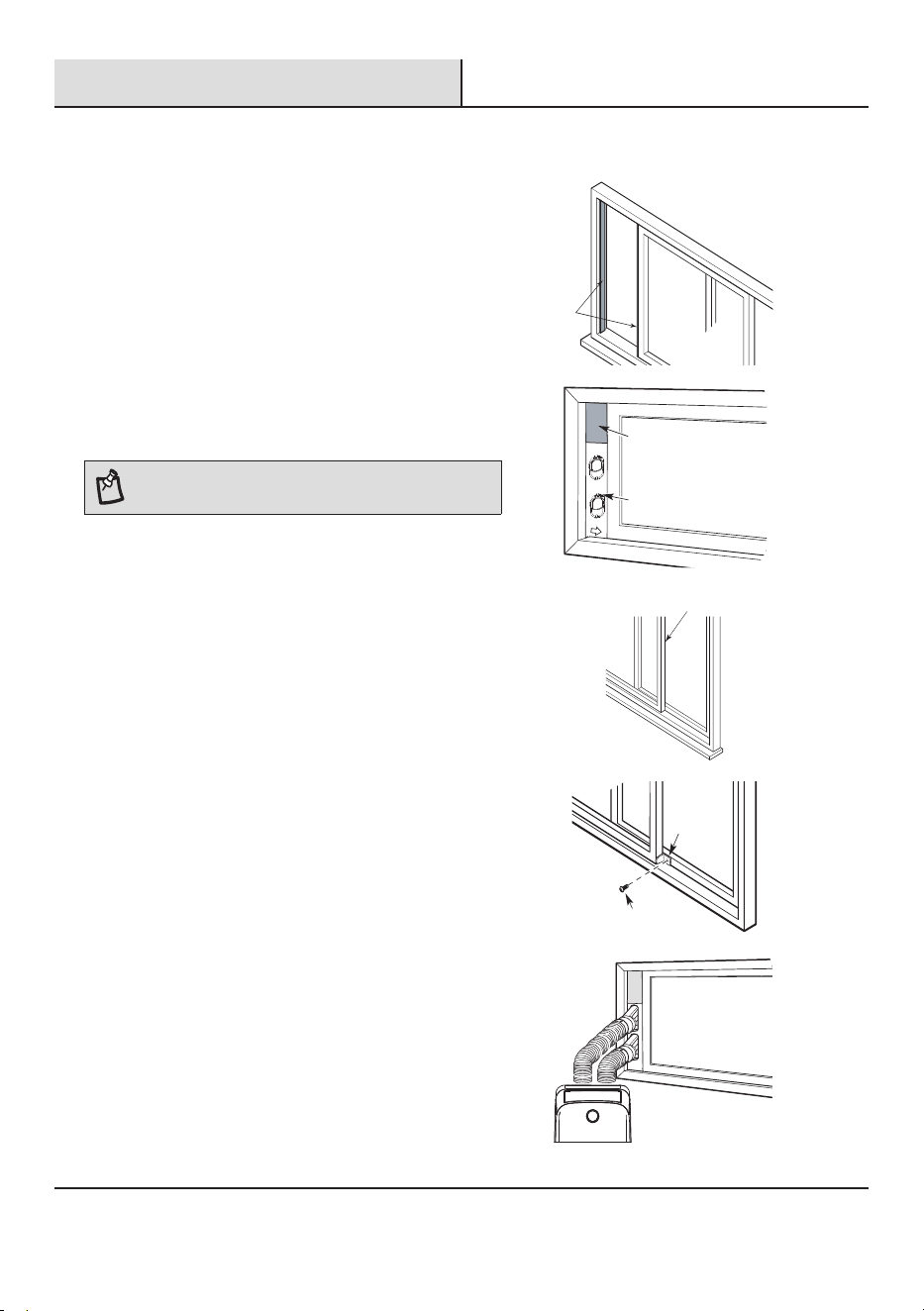
□ Insert the vent panel assembly, including extension panels,
if needed, into the window opening. Extend the extension
panels, if used.
□ Install the window-lock bracket (GG) with screw (FF) as
shown.
□ Attach the exhaust hose to snap onto the window
exhaust adaptor.
□ Cut the foam seal (AA) (non-adhesive type) to the window
width. Stuff the foam seal (AA) between the glass and the
window
to prevent air and foreign objects from getting into
the room.
2b
Installing in Horizontal Sliding Window
□ Cut the foam seal (LL) (adhesive type-long) to the proper length,
and
attach it to the window sash and frame.
NOTE:
The arrow on the slider section points towards the window.
Operation
1
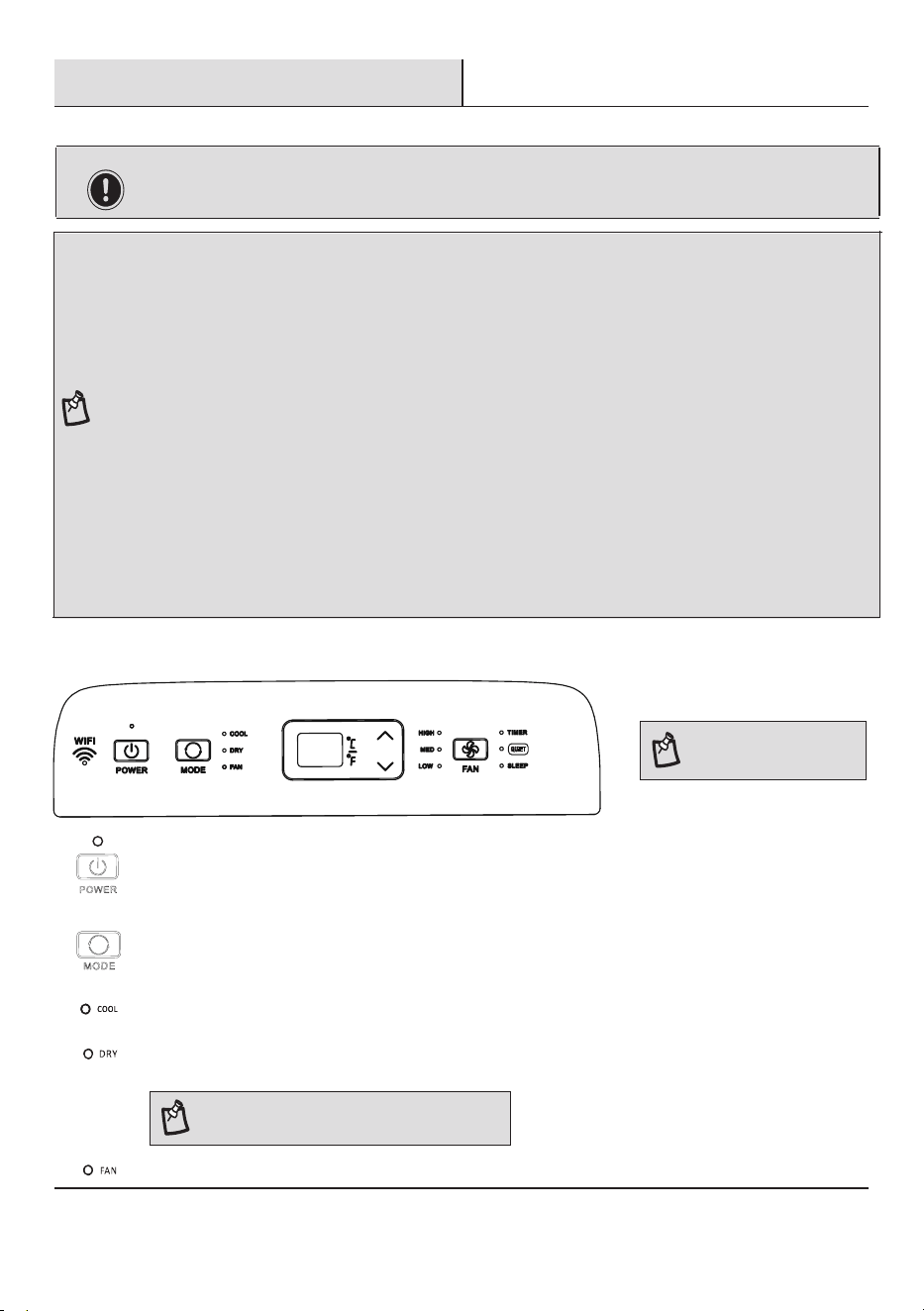
Using the Control Panel
COOL/FRAIS
DRY/SEC
FAN/VENT.
HIGH
/ÉLEVÉ
MODE
POWER ON OR OFF
□ The rst time the air conditioner is plugged in and turned on after your purchase, it will be set in Cool Mode.
□ When the air conditioner is turned on at all other times, it will run according to the previous setting.
TIMER
/MINUT.
SLEEP
/VEILLE
FAN
/VENT.
/FAIBLE
MODE
□ Press and release MODE until you see the symbol for the desired setting. Operating modes are Cool, Dry, Fan, or Heat.
□ Dry - Dries the room. The air conditioner automatically selects the temperature. The fan runs on Low speed only.
Dehumidication ranges between 2 to 3 pints per hour by model.
NOTE: Dry mode should not be used to cool the room.
NOTE:
NOTE: The symbols may be
different from these models,
but the functions are similar.
14
Operating your portable air conditioner properly helps you to obtain the best possible results. This section explains air conditioner operation.
□ In the event of a power failure, your air conditioner will operate at the previous settings when the power is restored.
□ Do not stay in direct airow from the air conditioner for extended periods of time.
□ Never use in tightly enclosed spaces. Always ensure there is sufcient airow of outside air entering the household
especially when used in conjunction with combustible devices such as gas stoves,
fireplaces, furnaces, hot water
heaters etc. Do not place the power cord or air conditioner near a heater, radiator, stoves or other apparatus (including
amplifiers) that produce heat.
□ This air conditioner is designed for residential household use only. Avoid using it for commercial precision climate
control
or with precision equipment, for preserving food, for pets, plants, artwork, and similar purposes.
□ Do not block or obstruct the exhaust vent hose as it may severely affect performance, or cause failure of the air
conditioner.
□ The air conditioner display shows the current room temperature.
□ When changing modes while the air conditioner is in operation, the compressor will stop for 3 to 5 minutes before
restarting. If a
button is pressed during this time, the compressor will not restart for another 3 to 5 minutes.
□ In Cooling or Dry mode, the compressor and condenser fan will stop when the room temperature reaches the set
temperature.
□ In Dry mode, the humidity level is automatically set, but is not able to be displayed.
IMPORTANT:
□
Keep upright at least 2 hours before use to prevent damaging the compressor.
□
For better performance, operate COOL or DRY mode within the following recommended range: Outdoor temperature 62.6-
109.9°F (17-43.3°C) with relative humidity
≤90%; indoor temperature 62.6-89.6°F (17-32°C) with relative humidity
≤80%.
□
Cool
- Cools the room. Press FAN to select High, Medium or Low speeds. Press the Plus or Minus button to adjust the
temperature.
□ Fan Only -
Press FAN to select High, Medium or Low fan speed.
Operation (continued)
COOL/FRAIS
DRY/SEC
FAN/VENT.
TIMER
/MINUT.
SLEEP
/VEILLE
/VENT.
POWER
/MARCHE
MODE
COOL/FRAIS
DRY/SEC
FAN/VENT.
TIMER
/MINUT.
SLEEP
/VEILLE
HIGH
/ÉLEVÉ
/FAIBLE
POWER
/MARCHE
MODE
NOTE: In Cooling mode, the temperature can be set between 61 °F and 86 °F (16 °C and 30 °C).
In Fan Only mode, the temperature cannot be set.
The unit’s LED shows the target temperature for 5 seconds and then displays the room temperature.
COOL/FRAIS
DRY/SEC
FAN/VENT.
TIMER
/MINUT.
SLEEP
/VEILLE
FAN
/VENT.
LOW
/FAIBLE
POWER
/MARCHE
MODE
2
Using the Remote Control
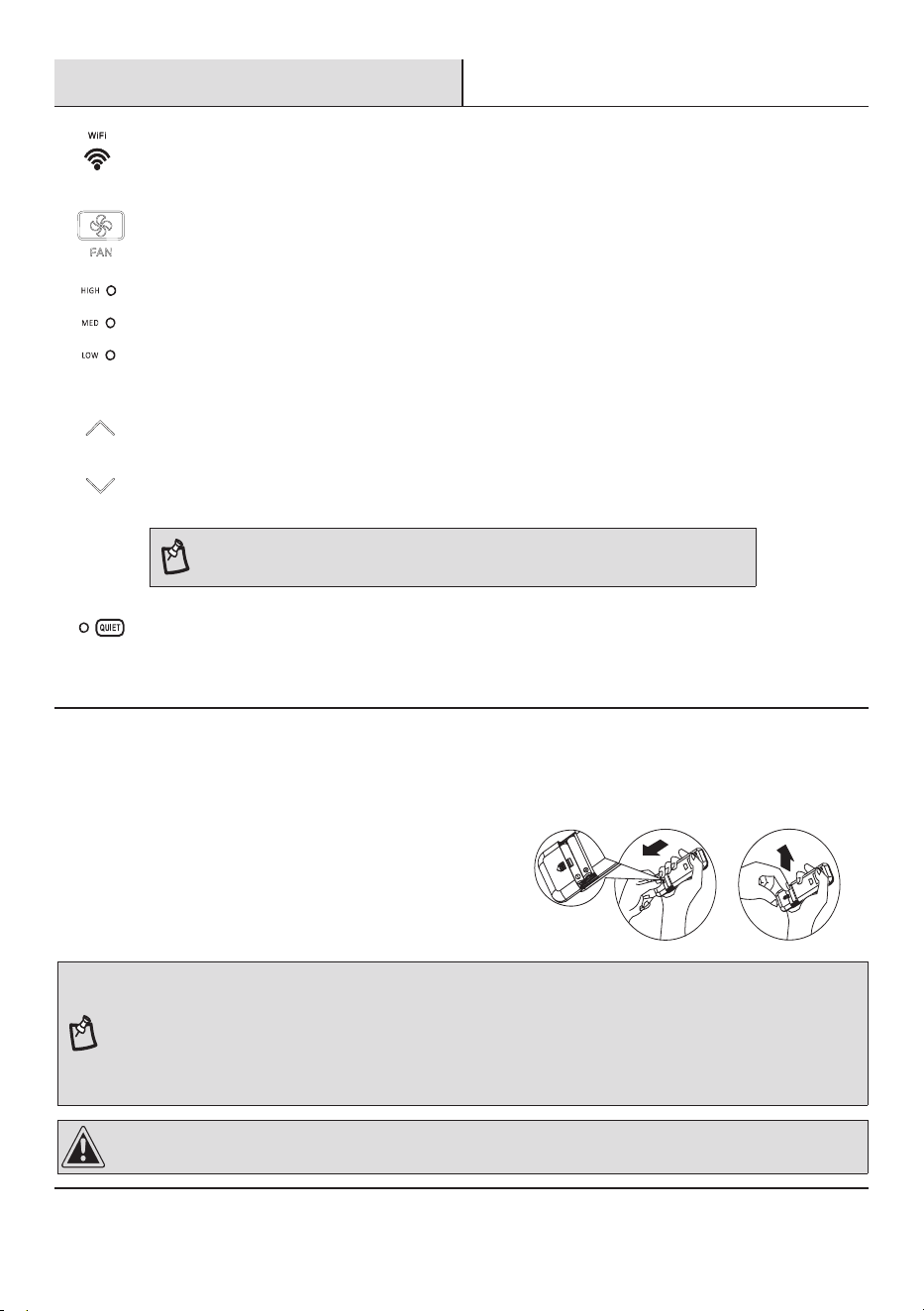
INSERT THE BATTERIES
□ Remove the battery cover along the arrowed direction.
□ Insert new batteries making sure that the (+) and (-) of battery are
matched correctly.
□ Reattach the cover by sliding it back into position.
NOTE:
□ Use 2 standard AAA (1.5 volt) batteries. Do not use rechargeable batteries.
□ Replace batteries with new ones of the same type when the display becomes dim, or after 6 months.
□ When replacing batteries, always replace both batteries with new batteries. Do not mix old and new batteries. Do not mix alkaline,
standard(carbon-zinc), or rechargeable (NI-Cd, NI-MH, etc.) batteries.
□ If the air conditioner will not be used for an extended period of time, remove the batteries from the remote.
□ DO NOT DISPOSE OF BATTERIES IN FIRE. BATTERIES MAY EXPLODE OR LEAK.
QUIET
□ Press the QUIET button to enter the quiet mode.
□ Quiet mode is available for inverter model with this logo on the control panel.
FAN SPEED
□ Press and release FAN to choose the desired fan speed.
□ High
- for maximum fan speed
□ Med-for normal fan speed
□ Low
- for minimum fan speed
TEMPERATURE
□
Press the
UP
button to raise the temperature. Press the
UP
button once to increase the set temperature by 1 °F (1 °C).
15
□ Press the
DOWN
button to lower the temperature. Press the
DOWN
button once to decrease
the
set temperature by
1 °F (1 °C).
□ To change the temperature display between °F and °C. Press both the UP and DOWN buttons at the same time.
□
Wi-Fi control is available for connected models with this logo on the control panel. Please see "Using the ConnectLife
APP" for Wi-Fi connection introduce on page 19.
CAUTION:
Do not use the remote before cleaning if the batteries have leaked. The chemicals in batteries could cause burns or other health
hazards. Please contact customer service if there is any question.
FILTER
Operation (continued)
1
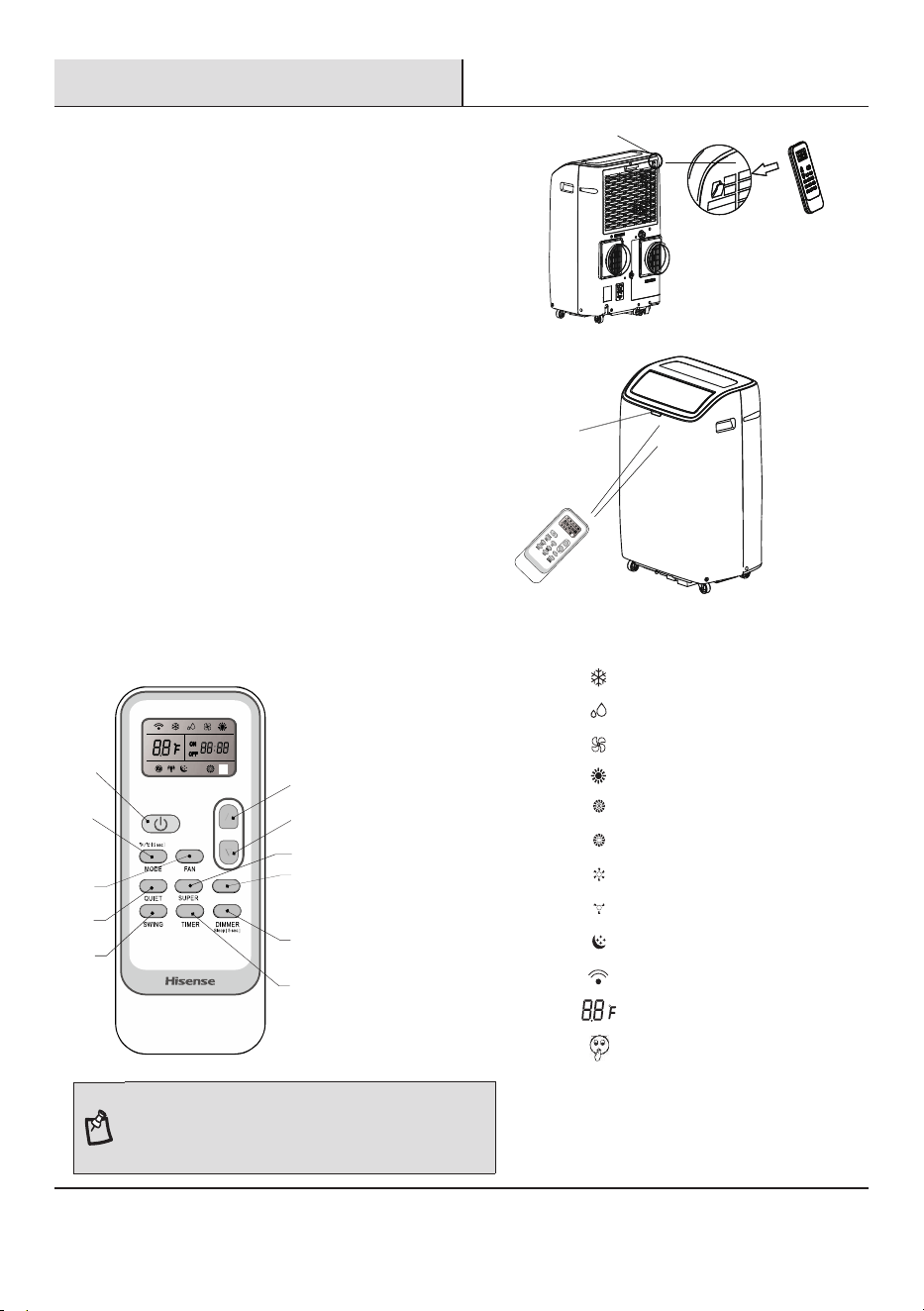
INDICATION SYMBOLSBUTTON FUNCTIONS
1
6
7
10
11
2
3
5
1 On/Off Cool indicator
2 Mode
Dry indicator
3 Fan
Fan only indicator
4 Quiet Heating indicator
5 Swing Auto fan speed
6 Up High fan speed
7 Down Medium fan speed
8 Super Low fan speed
Display set temperature
HOW TO USE
□ To operate the room air conditioner, aim the remote control at the
signal receptor (1).
□ The remote control will operate the air conditioner at a distance of up
to 23 ft. (7 m) when pointing at signal receptor of the air conditioner.
2
Using the Remote Control (continued)
STORAGE TIP
□ The holder on the back of the unit can be used to store the remote control.
Holder
4
8
9
Quiet indicator
FILTER
16
9 Filter
10 Dimmer/ Sleep
11 Timer
Sleep indicator
Signal transmission
NOTE:
Remote control may differ in appearance.
FILTER function is not available on this model.
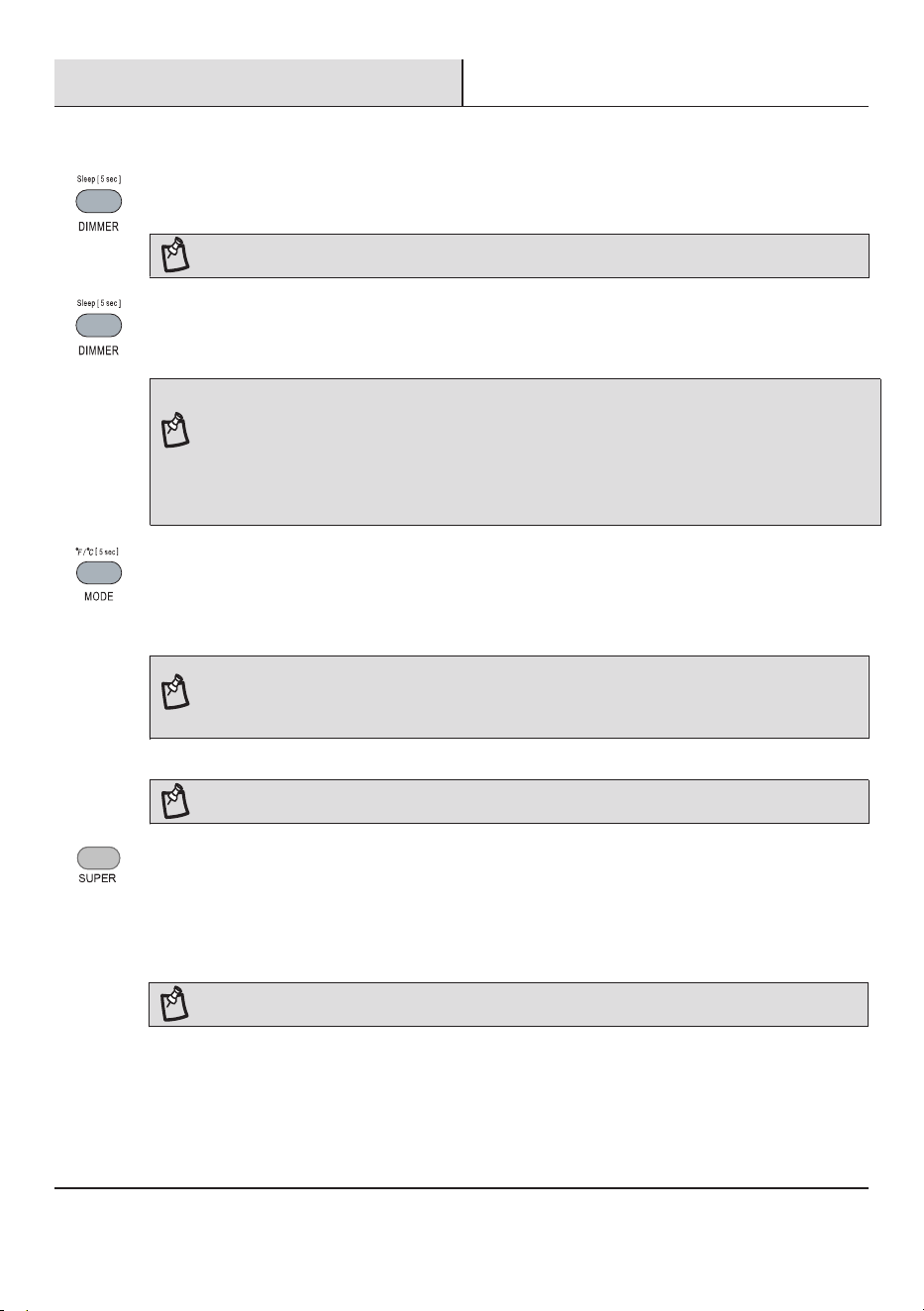
Press and hold the MODE button on the remote for 5 seconds to
swift
temperature display from Fahrenheit (°F) to Celsius (°C).
Operation (continued)
2
Using the Remote Control (continued)
DIMMER
□ Press the DIMMER button to turn off the control panel display.
NOTE: The air conditioner will return to previous settings after Sleep mode is turned off.
17
SLEEP
□ Sleep mode can only be set in Cooling, Heating or Drying modes. When in Sleep mode the unit will utilize lower,
quieter
fan
speeds and automatic temperature adjustments offering 8 hours of optimal sleeping conditions before shutting off.
NOTE:
When in Dimmer mode, new control inputs will return display to normal.
NOTE:
The appliance will stop operation automatically after operating for 8 hours. Fan speed is automatically set at low speed.
In the Cooling mode, if the current room temperature is below 79 °F (26 °C), the temperature will automatically increase 1°F
(1 °C) during the rst hour after Sleep mode is activated, and continue running at that temperature. If the room temperature
is 79 °F (26 °C) or above, set temperature will not change.
In Heating mode, the set temperature will decrease by 6 °F (3 °C) at most, during 3 hours, and continues running at that
temperature until auto shut off.
Sleep mode cannot be selected in Fan mode.
NOTE:
The temperature and airow direction may be adjusted during Sleep mode. The fan speed is automatically set to
Low speed. After 5 seconds, the lights on the control panel display will dim again.
Press and hold the MODE button on the remote for 5 seconds to switch the temperature display from Fahrenheit (°F) to
Celsius
(°C).
SUPER
The SUPER button is used to start or stop fast cooling.
□
After pressing the Super button, the air conditioner will automatically set the fan speed to High and the temperature to
61°F (16°C).
□ To exit Super mode, press either MODE, FAN, QUIET, SLEEP or SUPER on the remote control.
NOTE:
In the Super mode, you can set the timer.
□ Press MODE to select COOL, DRY, or FAN.
□ Press the UP or DOWN button to set the temperature.
□ Press and hold the DIMMER button on the remote for 5 seconds to switch the Dimmer mode to the Sleep mode.
□ After 5 seconds, the lights on the control panel display will dim.
□ To turn off Sleep mode, press MODE, FAN, SLEEP, SUPER or wait 8 hours for Sleep mode to turn off automatically.
Operation (continued)
2
Using the Remote Control (continued)
TIMER
SWING
□ Press SWING once to change the vertical airow direction.
□ Press again to hold the louver in a desired position.
3
Normal Sounds
When your air conditioner is operating normally, you may hear sounds such as:
1. Air movement from the fan.
2. Clicks from the thermostat cycling.
3. Vibration or noise due to poor wall or window construction.
4. A high-pitched hum or pulsating noise caused by the high-efciency compressor cycling on and off.
18
NOTE:
□ Airow is automatically adjusted to a preset direction after turning on the unit.
□ The direction of airow can be adjusted by pressing the SWING button.
□ To prevent damage, do not turn the airow louvers manually.
□ Turning the louver manually will disrupt normal operation. To recover, simply restart the air conditioner.
□
Use the TIMER function to turn the air conditioner ON/OFF automatically.
Setting the Air Conditioner to Turn On:
□ Plug in the air conditioner and use the remote to power it ON.
□ Use the remote to set the desired mode, temperature, fan speed, etc.
□ Use the remote to power OFF the air conditioner.
□ Press TIMER on the remote and use the UP/ DOWN buttons to set the desired delay time until the air conditioner
turnsON. The delay time can be set from O to 24 hours in one-hour increments.
□
Press TIMER again to conrm the delay time. The Timer light on the unit will be on.
Setting the Air Conditioner to Turn Off:
□ Plug in the air conditioner and use the remote to power it ON.
□ Use the remote to set the desired mode, temperature, fan speed, etc.
□ Press TIMER on the remote and use the UP/ DOWN buttons to set the desired delay time until the air conditioner
turnsOFF. The delay time can be set from O to 24 hours in one-hour increments.
□
Press TIMER again to conrm the delay time. The Timer light on the unit will be on.
To Cancel Timer:
Press the TIMER button again. Once a “beep” is heard and the indicator disappears, the Timer mode has been canceled.
NOTE:
The Timer mode can only be set by the remote control.
Operation (continued)
□ Scan to download the ConnectLife APP.
□ You can also go to Google Play or App Store and search for the ConncetLife APP.
□ Follow the in-APP instructions to pair your appliance.
19
4
Using the ConnectLife APP
The ConnectLife APP by Hisense provides the below features for your convenience:
□ Remote control
&
status: Turn ON/OFF, change the mode, set
&
monitor the temperature, and quick action buttons.
□ Scheduler: define when your AC can automatically turn ON/OFF to defined temperatures and modes.
□ Remote diagnostics: easily check the health of your device.
□ Linkage with Amazon Alexa and Google Home: to easily control your AC with voice command.
DEVICES REQUIRED TO USE THE SMART AC:
□ Smart air conditioner.
□ Wireless Router (a 2.4 GHz network is required to connect).
□ Smart Phone with compatible iOS or Android system.
DOWNLOAD AND INSTALL THE CONNECTLIFE APP
Care and Cleaning
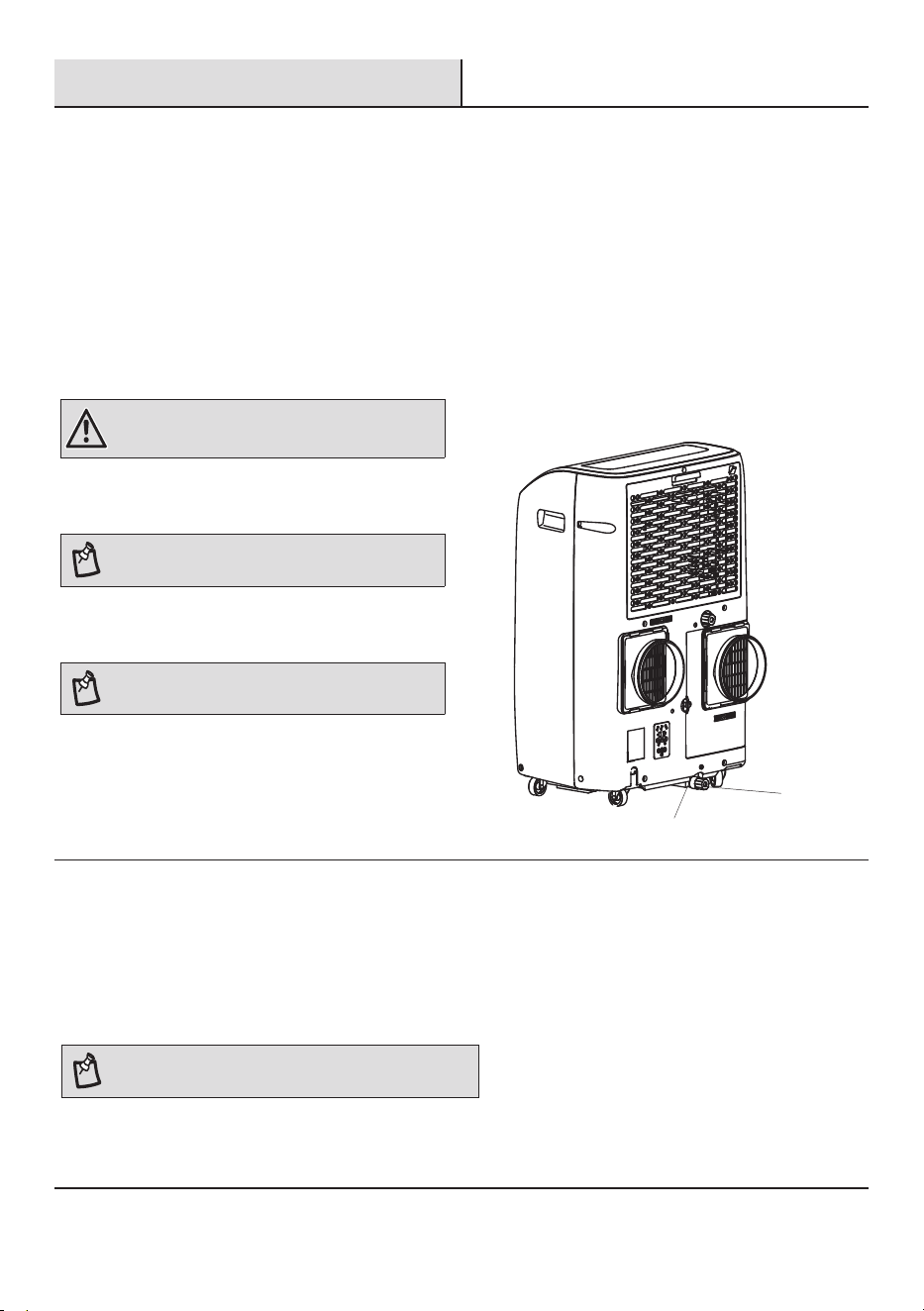
WARNING: Excessive Weight Hazard
Use two or more people to move and install the air
conditioner. Failure to do so can result in back or other injury.
□ Unplug the air conditioner or disconnect power.
□ Move the air conditioner to a drain location or outside.
NOTE: To avoid leaking water from the unit, move the air
conditioner slowly and keep it level.
□ Remove the primary drain cover (1) and plug (2).
□ Drain water completely through the drain hole.
NOTE: If the air conditioner will be stored after use, see
“Storing After Use”.
□ Reinstall the drain plug to the primary drain hole.
□ Reinstall the primary drain cover to the drain hole.
□ Reposition the air conditioner.
□ Plug in the air conditioner or reconnect power.
2
1
1
Draining the Air Conditioner
20
2
Cleaning the Outside
□ Turn off the air conditioner.
□ Unplug air conditioner or disconnect power.
□
Remove the air lter and clean separately. See “Cleaning Air Filter”.
□
Wipe the outside of the air conditioner with a soft, damp cloth.
□ Plug in the air conditioner or reconnect power.
□
Start the air conditioner.
Below are situations in which you should drain the air conditioner:
□ When Relocating: When you need to move the air conditioner, it's important to drain it to prevent water from overflowing onto
the floor or carpet due to tilting during transportation..
□ Before Storage: It is advisable to empty the water from the air conditioner before storing it to prevent the development of odors,
mold, and bacteria..
□ In High Humidity Conditions: In extremely humid conditions, the air conditioner is more likely to accumulate excess
condensation water. It will automatically shut down and display an E5 error code once the water pan is full. It's necessary to
unplug the air conditioner and drain it before resuming normal operation.
NOTE:
Please do not use strong detergents that contain wax or
thinners, as
it will cause discoloration or even damage to the panel.
Care and Cleaning (continued)
1
4
Storing After Use
CAUTION: Please recycle or dispose of the packaging material for product in an environmentally responsible manner. Never store or ship the
air conditioner upside down or sideways to avoid damage to the compressor. Dispose of this appliance in accordance with Federal and Local
regulations. Refrigerants must be evacuated before disposal.
Before using the air conditioner again:
□
Make sure the lter and drain cap are in place.
□ Check the power cord to make sure it is in good condition, with no cracks or damage.
□ Place new batteries in the remote.
□ Install the air conditioner. See “Installation Instruction”.
21
□ Air dry the lter completely before replacing to ensure
maximum efciency.
□ Reinstall the lter panel door.
□ Start the air conditioner.
3
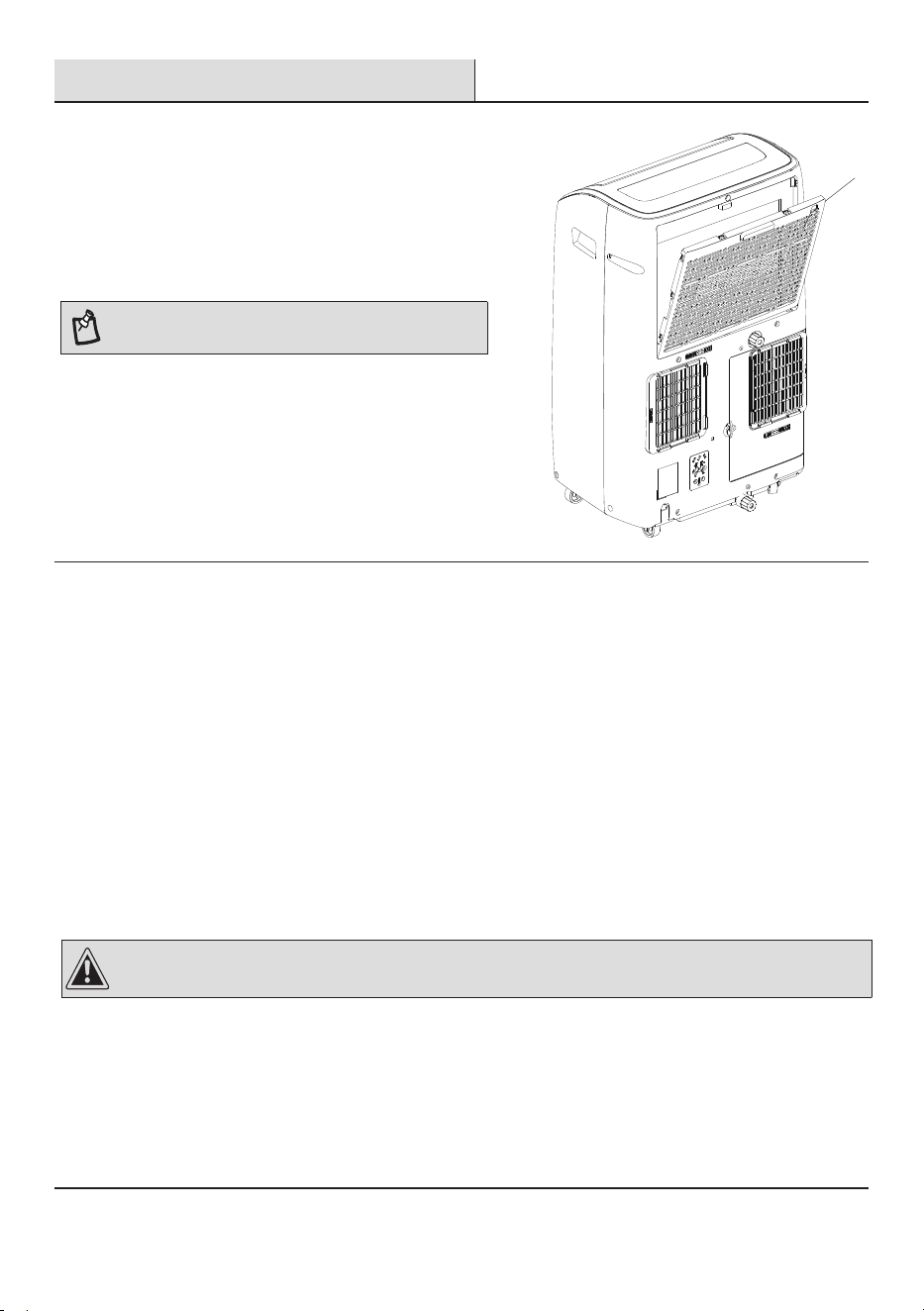
Cleaning the Air Filter
□ Unplug the air conditioner or disconnect power.
□ Open the lter panel door (1) on the back of the air
conditioner and remove.
□ Use a vacuum cleaner to clean the lter. If the lter is very
dirty, wash the lter in warm water with a mild detergent.
If the air conditioner will not be used for an extended period of time:
□ Unplug the air conditioner or disconnect power.
□ Drain the water completely. See “Draining the Air Conditioner”.
□ Run the air conditioner set to Fan Only for approximately 12 hours to dry the air conditioner.
□ Unplug the air conditioner.
□ Remove the exible exhaust hose and store with the air conditioner in a clean, dry area. See “Installation Instructions”.
□ Remove the window kit and store with the air conditioner in a clean, dry area. See “Installation Instructions”.
□ Remove the lter and clean. See “Cleaning the Air Filter”.
□ Clean the outside of the air conditioner. See “Cleaning the Outside”.
□ Reinstall the lter.
□ Remove the batteries and store the remote control with the air conditioner in a clean, dry area.
NOTE:
Do not wash the lter in the dishwasher or use any
chemical
cleaner.
Please call customer service for new filter purchase.
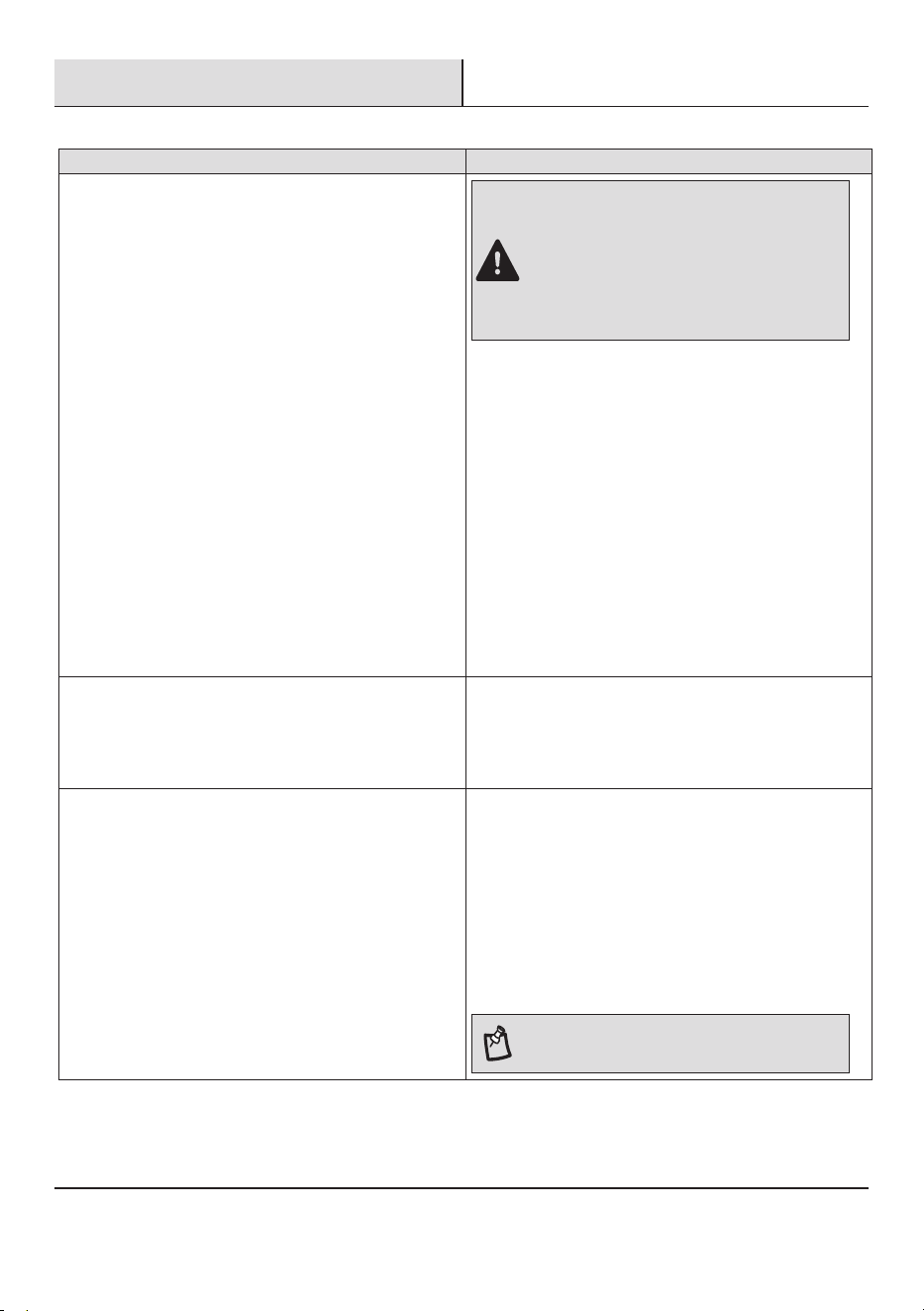
Troubleshooting
Before calling for service, please try the suggestion below.
Problem Solution
Air conditioner will not operate
e
Air conditioner blows fuses or trips circuit breakers
Air conditioner power supply cord trips (Reset button pops out) □ Disturbances in your electrical current can trip (RESET button
towill pop out) the power supply cord. Press and release RESET
dresume operation. (Listen for click; RESET button will latch an
remain in.)
□ Electrical overloading, overheating, cord pinching or aging can
trip (RESET button will pop out) the power supply cord.
□ After correcting the problem, press and release RESET to
resume operation. (Listen for click; RESET button will latch
eand remain in.) If the power cord fails to rest, contact a servic
technician.
NOTE: A damaged power supply cord must be replaced
with a new power supply cord obtained from the product
manufacturer and must not be repaired.
22
DANGER: ELECTRICAL SHOCK HAZARD
□ Plug into a grounded 3-prong outlet.
□ Do not remove ground prong.
□ Do not use an adapter.
□ Do not use an extension cord.
□ Failure to follow these instructions can result in
electrical shock, re, or death.
□ You are trying to restart the air conditioner too soon after turn-
ing off air conditioner. Wait at least 3 minutes after turning off
air conditioner before trying to restart the air conditioner.
□ Too many appliances are being used on the same circuit. Unplug
or relocate appliances that share the same circuit.
□ The power supply cord is unplugged. Plug into a grounded
3-prong outlet. See
“Electrical Requirements” on page 8.
□ Time-delay fuse or circuit breaker of the wrong capacity is
being used. Replace with a time-delay fuse or circuit breaker
of the correct capacity. See
“Electrical Requirements” on pag
8.
□ The power supply cord has tripped (Reset button has popped
out). Press and release RESET to resume operation. (Listen for
click; RESET button will latch and remain in.)
□ A household fuse has blown, or a circuit breaker has tripped.
Replace the fuse, or rest the circuit breaker. See
“Electrical
Requirements” on page 8.
□ The ON/OFF button has not been pressed. Press ON/OFF.
□ The local power has failed. Wait for power to be restored.
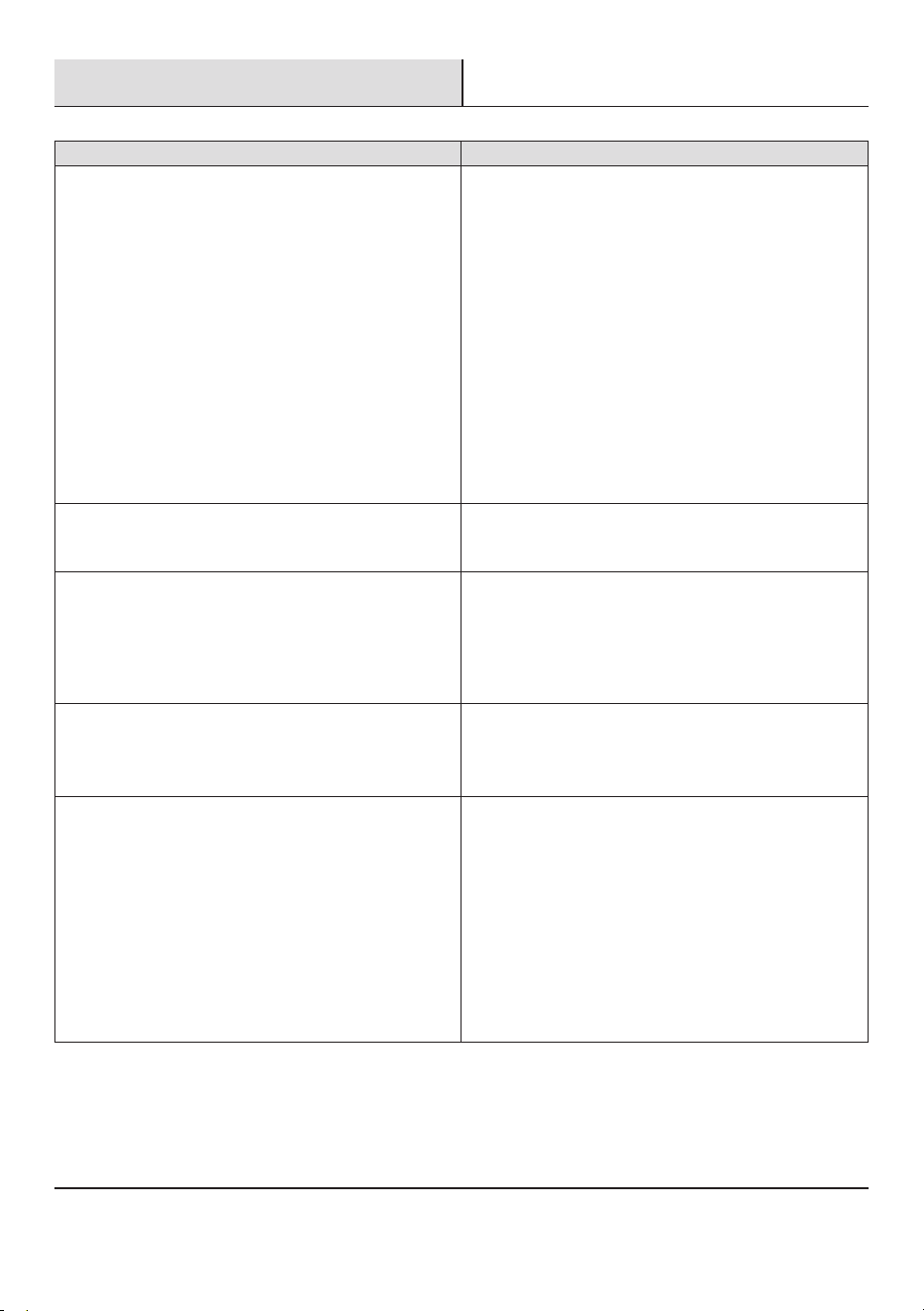
Troubleshooting (continued)
Problem Solution
Air Conditioner seems to run too much □ A door or window is open. Keep doors and windows closed.
□ The current air conditioner replaced an older model. The use of
more efcient components may cause the air conditioner to run
longer than an older model, but the total energy consumption
will be less. Newer air conditioners do not emit the “blast” of
cold air you may be accustomed to from older units, but this is
not an indication of lesser cooling capacity or efciency. Refer to
the efciency rating (EER) and capacity rating (in Btu/h) marked
on the air conditioner.
□ The air conditioner is in a heavily occupied room, or heat
producing appliances are in use in the room. Use exhaust vent
fans while cooking or bathing and try not to use heat-producing
appliances during the hottest part of the day. Portable air
conditioners are designed as supplemental cooling to local
areas within a room. A higher capacity air conditioner may be
required, depending on the size of the room being cooled.
Air conditioner runs for a short time only, but room is not cool
Display error code
Air conditioner runs, but does not cool
Air conditioner cycles on and off too much □ The air conditioner is not properly sized for your room. Check
the cooling capabilities of your portable air conditioner. Portable
air conditioners are designed as supplemental cooling to local
areas within a room.
□ The lter is dirty or obstructed by debris. Clean the lter.
□ There is excessive heat or moisture, open container cooking,
showers, etc. in the room. Use a fan to exhaust heat or moisture
from the room. Try not to use heat-producing appliances during
the hottest part of the day.
□ The louvers are blocked. Install the air conditioner in a location
where the louvers are free from curtains, blinds, furniture, etc.
23
□ The setting temperature on the unit is too close to the room's
actual temperature. Lower the setting temperature on the unit.
See "Operation" on page 14.
□ The lter is dirty or obstructed by debris. Clean the lter.
□ Air outlet is blocked. Clear air outlet.
□ The setting temperature is too high. Lower setting temperature.
□ If the unit displays error code E5, the water container is full.
Please d
rain the water, see
“Draining the Air Conditioner” on
page
20.
The unit can be operated again
after draining.
□ If the unit displays error code E1/E2/E3/E6/E7/EA, please
contact customer service.