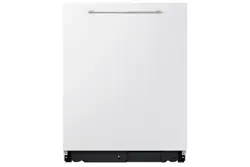
Dishwasher
User manual
DW60DG79**** / DW60DG77**** / DW60DG76**** / DW60DG75****
Untitled-1 1Untitled-1 1 2024-07-08 10:40:062024-07-08 10:40:06
English2
Contents
Safety information
4
What you need to know about safety instructions 4
Important safety symbols 4
Important safety precautions 5
Instructions when using your dishwasher 6
Instructions for protecting your children 7
Instructions for installing your dishwasher 8
Instructions about the WEEE 10
Product overview
11
Dishwasher at a glance 11
Preparing the installation
12
Installation kit (provided) 12
Required tools and parts (not provided) 14
Installation requirements 15
Installation
17
Step-by-step installation 17
Installing the free standing model under the sink 27
Finalizing the installation 28
Before you start
46
Unsuitable items for the dishwasher 46
Basic use of racks 47
Detergent compartment 52
Rinse aid compartment 54
Salt storage 55
SmartThings 56
Open Source Announcement 59
Operations
60
Control panel 60
Icon descriptions 61
Cycle overview 62
Operating a cycle 64
Settings 65
Untitled-1 2Untitled-1 2 2024-07-08 10:40:062024-07-08 10:40:06
English 3
Maintenance 67
Cleaning 67
Long-term care 73
Troubleshooting
74
Checkpoints 74
Information codes 77
Appendix
78
Cycle chart 78
Transportation/relocation 81
Protection against frost 81
Disposing the dishwasher and helping the environment 81
Energy, water saving tip 82
EPREL information 82
Specifications 83
For standard test
84
DW60DG79*/77*/75* Series 84
DW60DG76* Series 86
Contact information
88
QUESTIONS OR COMMENTS? 88
Untitled-1 3Untitled-1 3 2024-07-08 10:40:062024-07-08 10:40:06
English4
Safety information
Congratulations on your new Samsung dishwasher. This manual contains important information on the
installation, use, and care of your appliance. Please take time to read this manual to take full advantage of
your dishwasher’s many benefits and features.
What you need to know about safety instructions
Please read this manual thoroughly to ensure that you know how to safely and efficiently operate the
extensive features and functions of your new appliance and retain it at a safe place near the appliance for
your future reference. Use this appliance only for its intended purpose as described in this user manual.
Warning and important safety instructions in this manual do not cover all possible conditions and
situations that may occur. It is your responsibility to use common sense, caution, and care when installing,
maintaining, and operating your dishwasher.
Because the following operating instructions cover various models, the characteristics of your dishwasher
may differ slightly from those described in this manual and not all warning signs may be applicable. If you
have any questions or concerns, contact your nearest service centre or find help and information online at
www.samsung.com.
Important safety symbols
What the icons and signs in this user manual mean:
WARNING
Hazards or unsafe practices that may result in severe personal injury, death, or property damage.
CAUTION
Hazards or unsafe practices that may result in personal injury or property damage.
NOTE
Indicates that a risk of personal injury or material damage exists.
These warning symbols are here to prevent injury to you and others. Please follow them explicitly.
Keep these instructions in a safe place and ensure that new users are familiar with the content. Pass them
on to any future owner.
Untitled-1 4Untitled-1 4 2024-07-08 10:40:072024-07-08 10:40:07
English 5
Important safety precautions
To reduce the risk of fire, electric shock, or injury to persons when using
your appliance, follow basic precautions, including the following:
1. This appliance is not intended for use by persons (including children)
with reduced physical, sensory or mental capabilities, or lack of
experience and knowledge, unless they have been given supervision
or instruction concerning use of the appliance by a person
responsible for their safety.
2. For use in Europe: This appliance can be used by children aged from
8 years and above and persons with reduced physical, sensory or
mental capabilities or lack of experience and knowledge if they have
been given supervision or instruction concerning use of the appliance
in a safe way and understand the hazards involved. Children shall not
play with the appliance. Cleaning and user maintenance shall not be
made by children without supervision.
3. Children should be supervised to ensure that they do not play with
the appliance.
4. If the supply cord is damaged, it must be replaced by the
manufacturer, its service agent or similarly qualified persons in order
to avoid a hazard.
5. The new hose-sets supplied with the appliance are to be used and
that old hose-sets should not be reused.
6. For appliances with ventilation openings in the base, a carpet must
not obstruct the openings.
Untitled-1 5Untitled-1 5 2024-07-08 10:40:072024-07-08 10:40:07
Safety information
English6
7. Children of less than 3 years should be kept away from the appliance
unless continuously supervised.
8. CAUTION: In order to avoid a hazard caused by inadvertent resetting
of the thermal cut-out, this appliance must not be supplied through
an external switching device, such as a timer, or connected to a circuit
that is regularly switched on and off by the utility.
9. WARNING: Knives and other utensils with sharp points must be
loaded in the basket with their points down or placed in a horizontal
position.
This appliance is solely intended to be used in household and similar
applications such as:
• Staff kitchen areas in shops, offices, and other working environments;
• Farm houses;
• Clients in hotels, motels, and other residential type environments;
• Bed and breakfast type environments.
Instructions when using your dishwasher
This dishwasher is not designed for commercial use. It is intended for use in domestic households and in
similar working and residential environments such as:
• Shops
• Offices and showrooms
and by residents in establishments such as:
• Hostels and guest houses.
It must only be used as an appliance as specified in this user manual, for cleaning domestic crockery and
cutlery. Any other usage is not supported by the manufacturer and could be dangerous.
The manufacturer cannot be held liable for damage resulting from incorrect use, operation, and
installation.
Do not use solvents in the dishwasher. Danger of explosion.
Untitled-1 6Untitled-1 6 2024-07-08 10:40:072024-07-08 10:40:07
English 7
Do not inhale or ingest dishwasher detergent. Dishwasher detergents contain irritant or corrosive
ingredients which can cause burning in the nose, mouth and throat if swallowed, or inhibit breathing.
Consult a doctor immediately if detergent has been swallowed or inhaled.
Avoid leaving the door open unnecessarily, as you could trip over it.
Do not sit or lean on the opened door. This could cause the dishwasher to tip and get damaged, and you
could get injured.
Only use detergent and rinse aid formulated for domestic dishwashers. Do not use washing-up liquid.
Do not use any strong acid cleaning agent.
Do not fill the rinse aid compartment with powder or liquid detergent. This will cause serious damage to
the compartment.
Inadvertently filling the salt storage with powder or liquid dishwasher detergent will damage the water
softener. Make sure to use the correct packet of dishwasher salt when filling the salt storage.
Please only use special coarse grained dishwasher salt for reactivation, as other salts may contain insoluble
additives which can impair the functioning of the softener.
In an appliance with a cutlery basket (depending on the model), cutlery is cleaned and dried better if placed
efficiently in the basket with the handles downwards. However, to avoid the risk of injury, place knives and
forks etc. with the handles upwards.
Plastic items which cannot withstand being washed in hot water, such as disposable plastic containers,
or plastic cutlery and crockery should not be cleaned in the dishwasher. The high temperatures in the
dishwasher may cause them to melt or lose shape.
On models with the
Delay Start function, make sure that the detergent compartment is dry before
adding detergent. Wipe dry if necessary. The detergent will clog if poured into a damp detergent
compartment and may not be thoroughly dispersed.
Always be caution when using remote control. You may be exposed to security risks during use, and usage-
related problems may also arise because of Internet connectivity issues or incorrect settings.
Please do not operate the product with living beings (such as a person or an animal) or items that may
cause water leakage or explosion.
Instructions for protecting your children
This appliance is not a toy! To avoid the risk of injury, keep children well away and do not allow them to play
in or around the dishwasher or to use the controls. They will not understand the potential dangers posed by
it. They should be supervised whenever you are working in the kitchen. There is also a danger that children
playing might shut themselves in the dishwasher.
Cleaning and user maintenance shall not be made by children without supervision.
Older children may only use the dishwasher when its operation has been clearly explained to them and
they are able to use it safely, recognising the dangers of misuse.
KEEP CHILDREN AWAY FROM DETERGENTS!
Untitled-1 7Untitled-1 7 2024-07-08 10:40:072024-07-08 10:40:07
Safety information
English8
Dishwasher detergents contain irritant and corrosive ingredients which can cause burning in the mouth,
nose and throat if swallowed, or inhibit breathing.
Keep children away from the dishwasher when the door is open. There could still be detergent residues in
the cabinet.
Consult a doctor immediately if your child has swallowed or inhaled detergent.
Instructions for installing your dishwasher
Before setting up the appliance, check it for any externally visible damage. Under no circumstances should
you use a damaged appliance. A damaged appliance can be dangerous.
The dishwasher must only be plugged into the electricity supply through a suitable switched socket. The
electrical socket must be easily accessible after the dishwasher is installed so that it can be disconnected
from the electricity supply at any time. (Refer to the “Dishwasher at a glance” section on page 11.)
There must be no electrical sockets behind the dishwasher. The Danger of overheating and fire risk if the
dishwasher were to be pushed up against a plug. After the installation is complete, make sure the power
plug is not bent or damaged.
The dishwasher must not be installed under a hob. The high radiant temperatures which are sometimes
generated by a hob could damage the dishwasher. For the same reason, it should not be installed next to
open fires or other appliances which give off heat, such as heaters etc.
Do not connect the dishwasher to the mains supply until it has been fully installed and any adjustment has
been made to the door springs.
Before connecting the appliance, check that the connection data on the data plate (voltage and connected
load) match the mains electricity supply. If in any doubt, consult a qualified electrician.
The electrical safety of this appliance can only be guaranteed when continuity is complete between it
and an effective grounding system. It is most important that this basic safety requirement is present and
regularly tested and where there is any doubt the electrical system in the house should be checked by a
qualified electrician.
The manufacturer cannot be held liable for the consequences of an inadequate grounding system (for
example electric shock). Do not connect the ground wire to plastic plumbing, gas lines, or hot water pipes.
Improperly connected grounding conductors may cause electric shock.
Do not connect the appliance to the mains electricity supply by a multi-socket unit or an extension lead.
These do not guarantee the required safety of the appliance (for example danger of overheating).
This appliance may only be installed in mobile installations such as ships if a risk assessment of the
installation has been carried out by a suitably qualified engineer.
The plastic housing of the water connection contains an electrical component. The housing must not be
submerged in water.
There are electrical wires in the hose of Aqua-Stop. Never cut the water inlet hose, even if it is too long.
Untitled-1 8Untitled-1 8 2024-07-08 10:40:072024-07-08 10:40:07
English 9
Installation, maintenance and repairs may only be carried out by a suitably qualified and competent
person in strict accordance with current national and local safety regulations. Repairs and other work by
unqualified persons can be dangerous. The manufacturer cannot be held liable for unauthorised work.
The integrated waterproof system offers protection from water damage, provided the following conditions
are met:
• The dishwasher is correctly installed and plumbed in.
• The dishwasher is properly maintained and parts are replaced where it can be seen that this is
necessary.
• The stopcock/supply valve has been turned off when the appliance is not used for a longer period of
time (for example during holidays).
• The waterproof system will work even if the appliance is switched off. However, the appliance must
remain connected to the electricity supply.
A damaged appliance can be dangerous. If the dishwasher gets damaged, switch it off at the mains and call
your dealer or the service department.
Unauthorised repairs could result in unforeseen dangers for the user, for which the manufacturer cannot
accept liability. Repairs should only be undertaken by an approved service technician.
Faulty components must only be replaced by original spare parts. Only when these parts are fitted can the
safety of the appliance can be guaranteed.
Always disconnect the dishwasher from the electrical supply for maintenance work (Power off the wall
socket and remove the plug).
If the connection cable is damaged, it must be replaced with a special cable available from the
manufacturer. For safety reasons, this must only be fitted by the service department or an authorised
service technician.
In countries where there are areas which may be subject to infestation by cockroaches or other vermin, pay
particular attention to keeping the appliance and its surroundings in a clean condition at all times. Any
damage which may be caused by cockroaches or other vermin will not be covered by the guarantee.
In the event of a fault or for cleaning purposes, the appliance is only completely isolated from the
electricity supply when:
• it is switched off at the wall socket and the plug is withdrawn, or
• it is switched off at the mains, or
• the mains fuse is disconnected, or
• the screw-out fuse is removed (in countries where this is applicable).
Do not make any alterations to the appliance, unless authorised to do so by the manufacturer.
Never open the casing/housing of the appliance. Tempering with electrical connections or components and
mechanical parts is highly dangerous and can cause operational faults or electric shock.
While the appliance is under guarantee, repairs should only be undertaken by a service technician
authorised by the manufacturer. Otherwise, the guarantee will be invalidated.
Untitled-1 9Untitled-1 9 2024-07-08 10:40:072024-07-08 10:40:07
Safety information
English10
When installing the product, make sure there is space at the top, left, right and back of the product to
ensure proper ventilation. If there is insufficient space between the product and the sink, it may damage
the sink or allow mould to grow.
Make sure that your dishwasher’s hardness level setting is correct as your area. (Refer to the “Salt storage”
section on page 55.)
Please consult www.samsung.com/support for more information about materials and repairs.
Instructions about the WEEE
Correct Disposal of This Product (Waste Electrical & Electronic Equipment)
(Applicable in countries with separate collection systems)
This marking on the product, accessories or literature indicates that the product and
its electronic accessories (e.g. charger, headset, USB cable) should not be disposed
of with other household waste at the end of their working life. To prevent possible
harm to the environment or human health from uncontrolled waste disposal, please
separate these items from other types of waste and recycle them responsibly to
promote the sustainable reuse of material resources.
Household users should contact either the retailer where they purchased this product,
or their local government office, for details of where and how they can take these
items for environmentally safe recycling.
Business users should contact their supplier and check the terms and conditions of
the purchase contract. This product and its electronic accessories should not be mixed
with other commercial wastes for disposal.
For information on Samsung’s environmental commitments and product regulatory obligations, e.g.
REACH, visit our sustainability page available via www.samsung.com
Untitled-1 10Untitled-1 10 2024-07-08 10:40:072024-07-08 10:40:07
English 11
Product overview
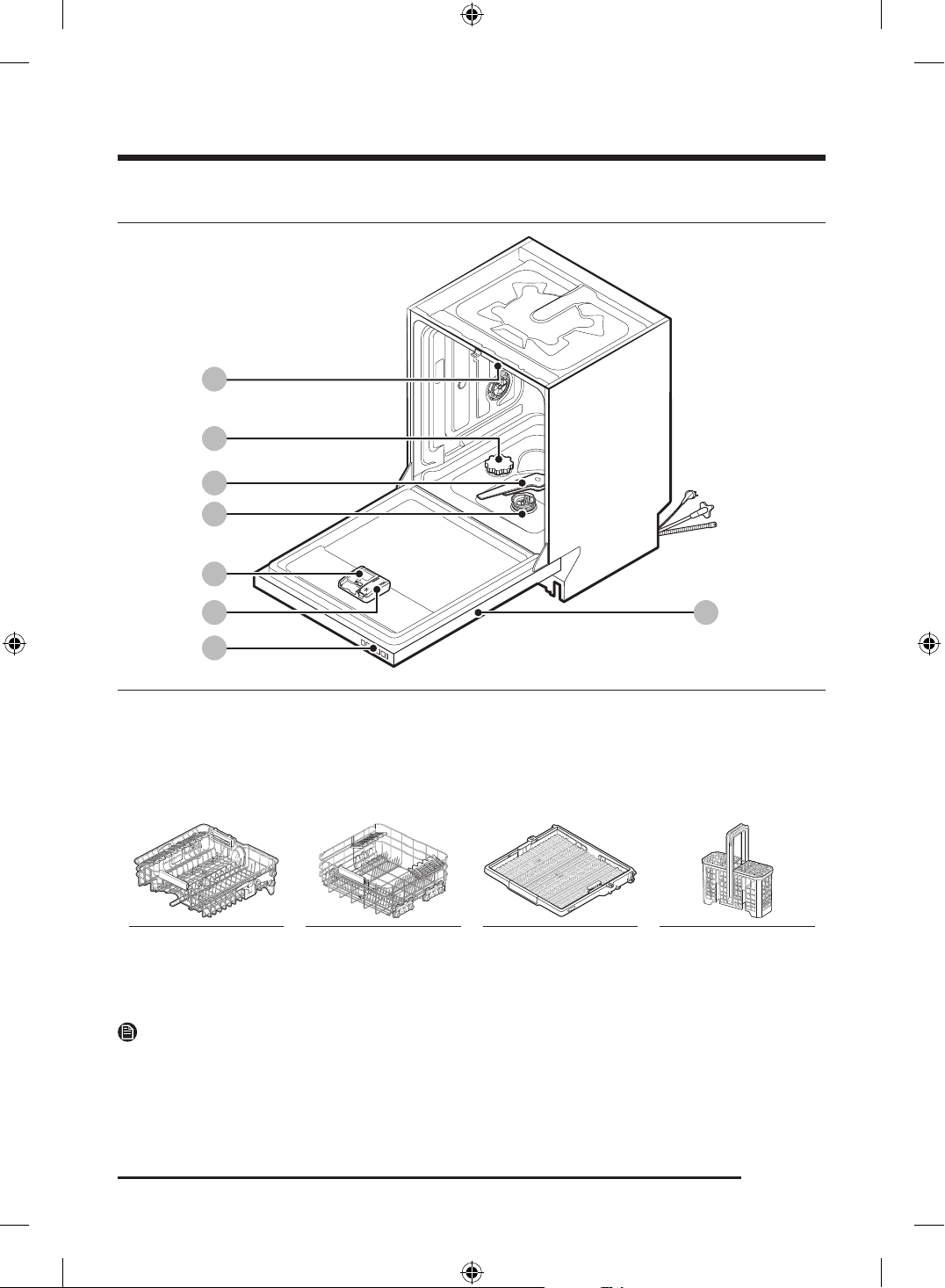
Dishwasher at a glance
01
02
03
04
05
06
07
08
01 Top spray arm 02 Salt storage 03 Bottom spray arm
04 Filters 05 Detergent compartment 06 Rinse aid compartment
07 Control panel 08 Door
Upper rack Lower rack Cutlery rack
(Applicable models
only)
Cutlery basket
(Applicable models
only)
NOTE
Depending on the models, the actual appearance of the product and its parts may differ from the figures.
Untitled-1 11Untitled-1 11 2024-07-08 10:40:082024-07-08 10:40:08
English12
Preparing the installation
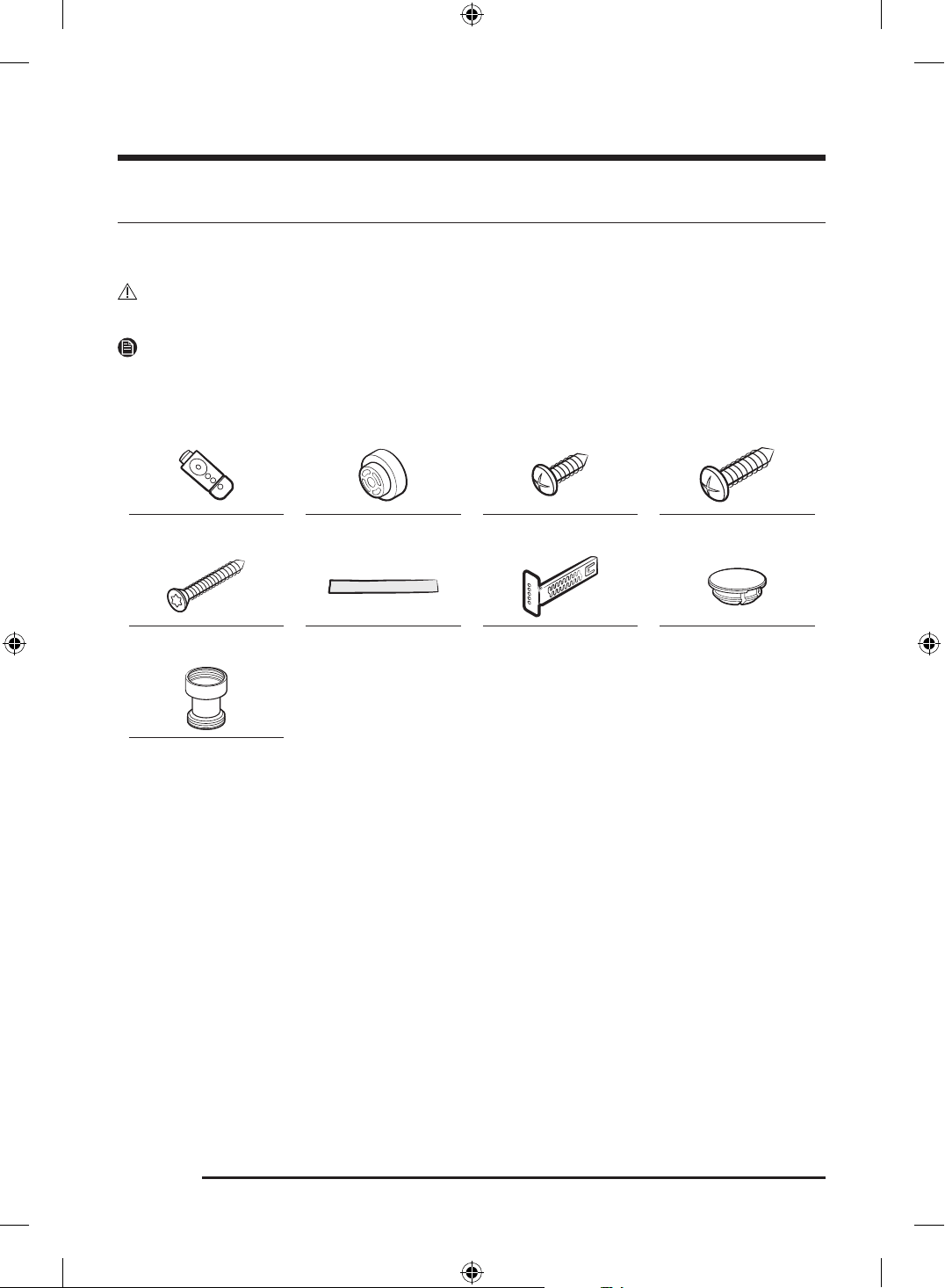
Installation kit (provided)
Make sure all the parts listed in this section are enclosed with the product. The actual appearance of the
parts may differ from the figures.
CAUTION
After unpacking the dishwasher, keep packaging materials out of children’s reach to ensure their safety.
NOTE
The number inside the parenthesis is the provided quantity of the item.
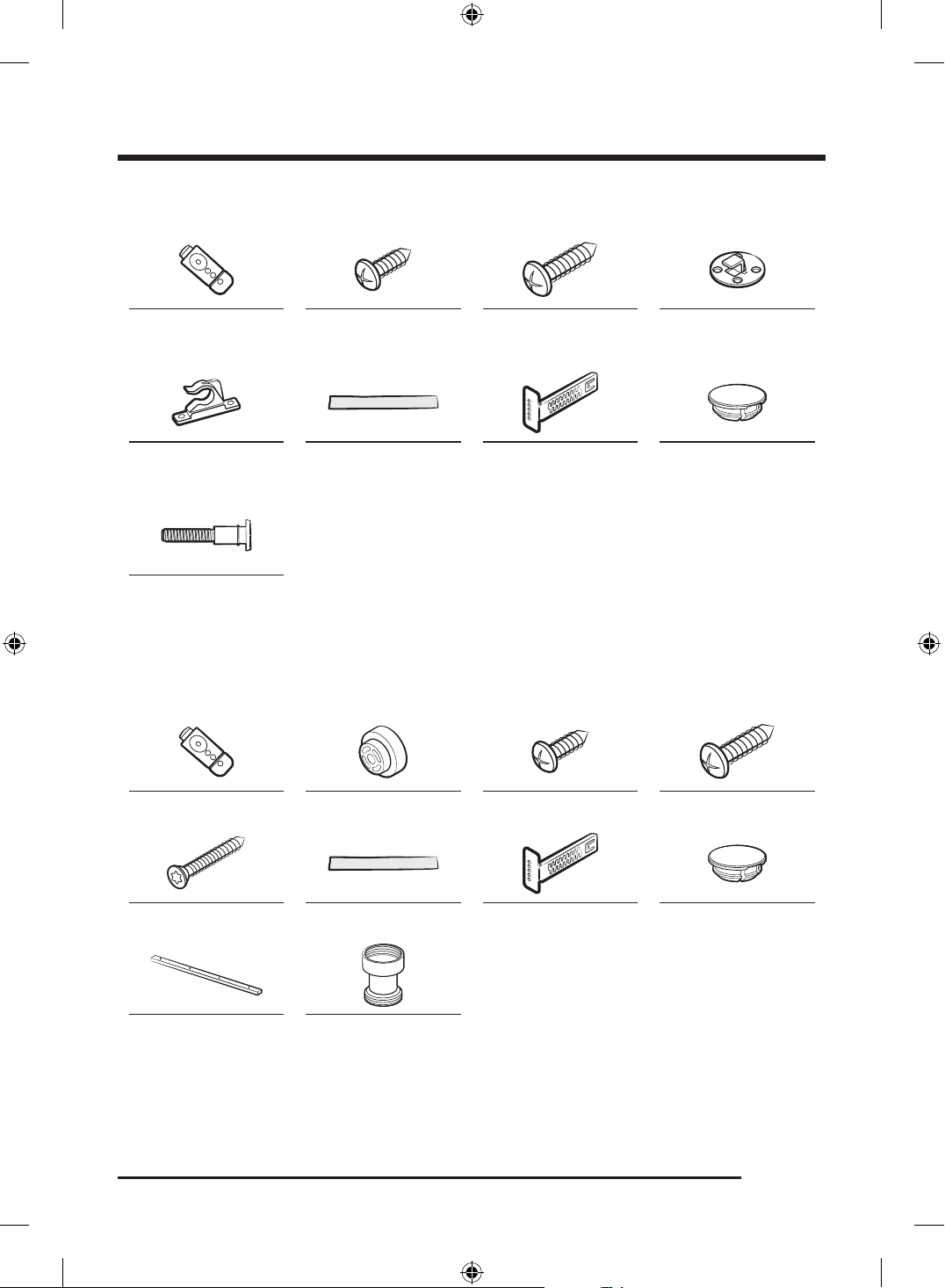
Fully built-in models
Top bracket (2) Custom panel fixer (2) Ø4 X 12 screw (8) Ø4 X 16 screw (2)
Ø4 X 43 screw (6) Protective sticker Kickplate bracket (2) Plastic cap (4)
Check valve
(Applicable models
only)
Untitled-1 12Untitled-1 12 2024-07-08 10:40:092024-07-08 10:40:09
English 13
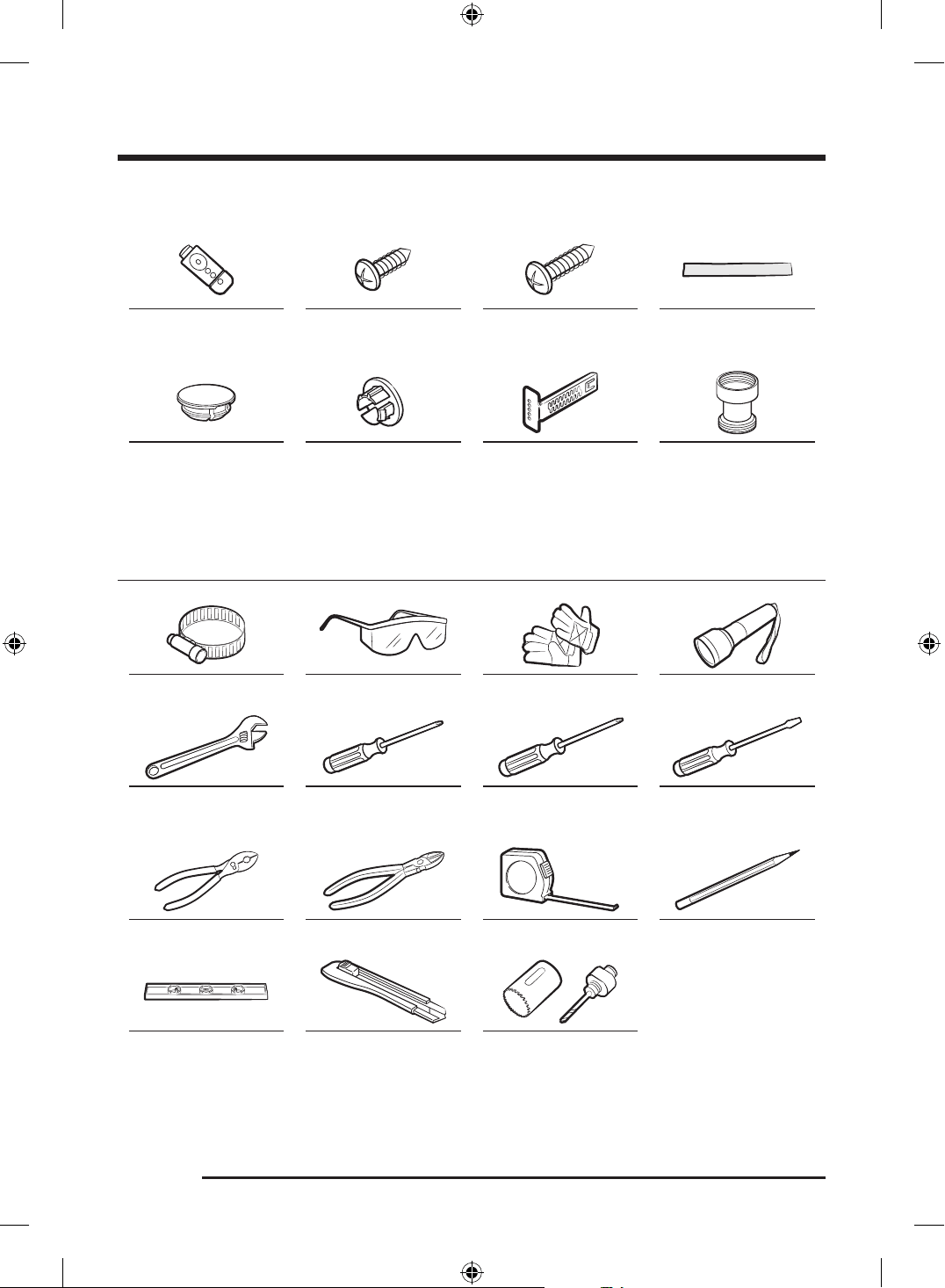
Fully built-in models with sliding panel
Top bracket (2) Ø4 X 12 screw (8) Ø4 X 16 screw (12) Custom panel fixer -
top (2)
Custom panel fixer -
bottom (2)
Protective sticker Kickplate bracket (2) Plastic cap (4)
Sub-foot Check valve
(Applicable models
only)
Semi built-in models
Top bracket (2) Custom panel fixer (2) Ø4 X 12 screw (8) Ø4 X 16 screw (2)
Ø4 X 43 screw (4) Protective sticker Kickplate bracket (2) Plastic cap (4)
Wood spacer (4) Check valve
(Applicable models
only)
Untitled-1 13Untitled-1 13 2024-07-08 10:40:102024-07-08 10:40:10
Preparing the installation
English14
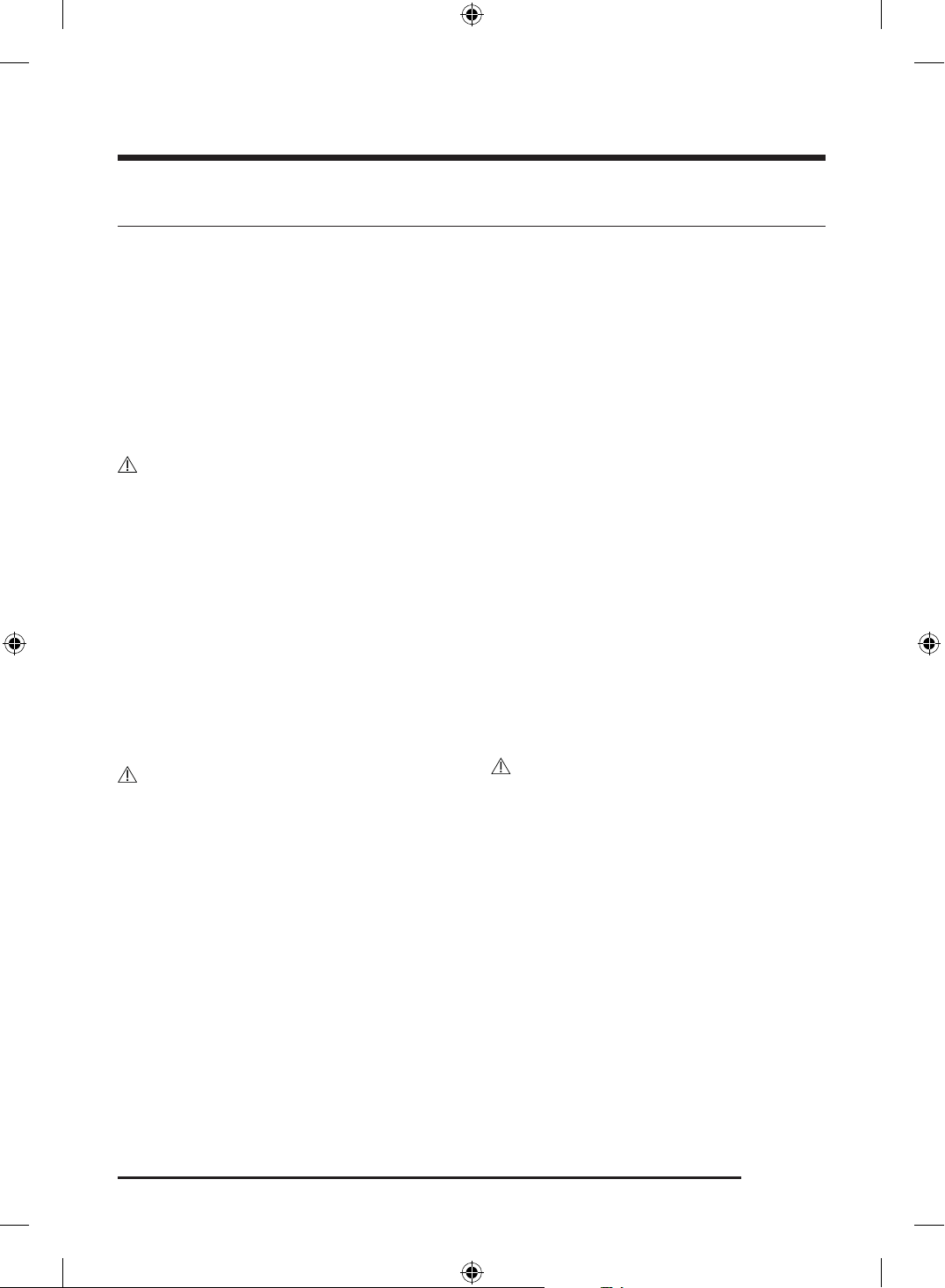
Built under sink models
Top bracket (2) Ø4 X 12 screw (8) Screw – bespoke door
(2)
Protective sticker
Plastic cap (4) Plastic cap – bespoke
door (4)
Kickplate bracket (2) Check valve
(Applicable models
only)
Required tools and parts (not provided)
Hose clamp Safety glasses Gloves Flashlight
Wrench (22 mm) for
the front foot
Torx T20 screwdriver Phillips screwdriver Flat-head screwdriver
Pliers Nipper Tape measure Pencil
Level Cutting knife Hole saw (80 ~
100 mm)
Untitled-1 14Untitled-1 14 2024-07-08 10:40:112024-07-08 10:40:11
English 15
Installation requirements
To prevent a risk of fire, electric shock, or personal
injury, all wiring and grounding must be done by a
qualified technician.
Power supply
• An individual 220-240 V~, 50 Hz branch circuit
that is dedicated to the dishwasher.
• Power outlet with a maximum allowable
current of 16 A (maximum 11 A for the
dishwasher).
WARNING
• Do not use an extension cord.
• You must only use the power plug that comes
with the dishwasher.
• After the installation is complete, make sure
the power plug is not bent or damaged.
Grounding
For permanent grounding, the dishwasher must
be properly grounded to a grounded metal
or permanent wiring system. The grounding
conductor must be run with the circuit conductors
and then connected to the grounding terminal or
lead on the dishwasher.
WARNING
• Do not connect the ground wire to plastic
plumbing, gas lines, or hot water pipes.
Improperly connected grounding conductors
may cause electric shock.
• Do not modify the power plug of the
dishwasher. If the power plug does not fit
the outlet, have a proper outlet installed by a
qualified electrician.
Water supply
• The water supply line must support water
pressures between 50 and 800 kPa.
• Water temperatures must be lower than 60 °C.
• The stopcock / supply valve with a 3/4” male
thread must be installed for the water supply
connection.
To reduce the risk of leaks:
• Make sure water taps are easily accessible.
• Turn the water supply valve off when the
dishwasher is not in use.
• Check for any leaks at the water hose fittings
on a regular basis.
• To stop any leak, seal the water line
connections and joints using Teflon tape or a
sealing compound.
Aqua Stop
The Aqua Stop is an electrical component that is
designed to prevent water leaks. The Aqua Stop
is attached to the water hose and automatically
cuts off the water flow in the event of damage to
the hose.
CAUTION
• Handle the Aqua Stop with care.
• Do not kink or twist the water hose connected
to the Aqua Stop. If the Aqua Stop is damaged,
shut off the water taps and unplug the power
plug immediately. Then, contact a local
Samsung customer centre or a qualified
technician.
Untitled-1 15Untitled-1 15 2024-07-08 10:40:122024-07-08 10:40:12
Preparing the installation
English16
Drain
If you are using a drain system dedicated to the
dishwasher, connect the drain hose to a drain
system that is between 30 cm and 70 cm off the
ground. Connecting the drain hose to a drain
system more than 80 cm off the ground can cause
the drained water to flow backward.
Flooring
For safety, install the dishwasher on a solidly
constructed floor. Wooden floors may need to be
reinforced to minimise vibrations. Avoid installing
on carpet or soft tiles. Carpeting and soft tile may
cause vibrations and may cause your dishwasher
to move slightly while operating.
WARNING
Do not install the dishwasher on a poorly
supported structure.
• Make sure the dishwasher is level using the
height-adjustable feet.
• When levelling is complete, check if the door
opens and closes properly.
Ambient temperature
Do not install the dishwasher in an area exposed
to freezing temperatures. The dishwasher always
retains some water in the water valve, pump,
and hose. If the water freezes in the dishwasher
or hoses, it may damage the dishwasher and its
components.
Untitled-1 16Untitled-1 16 2024-07-08 10:40:122024-07-08 10:40:12
English 17
Installation
Step-by-step installation
The installation procedure may differ depending on the model.
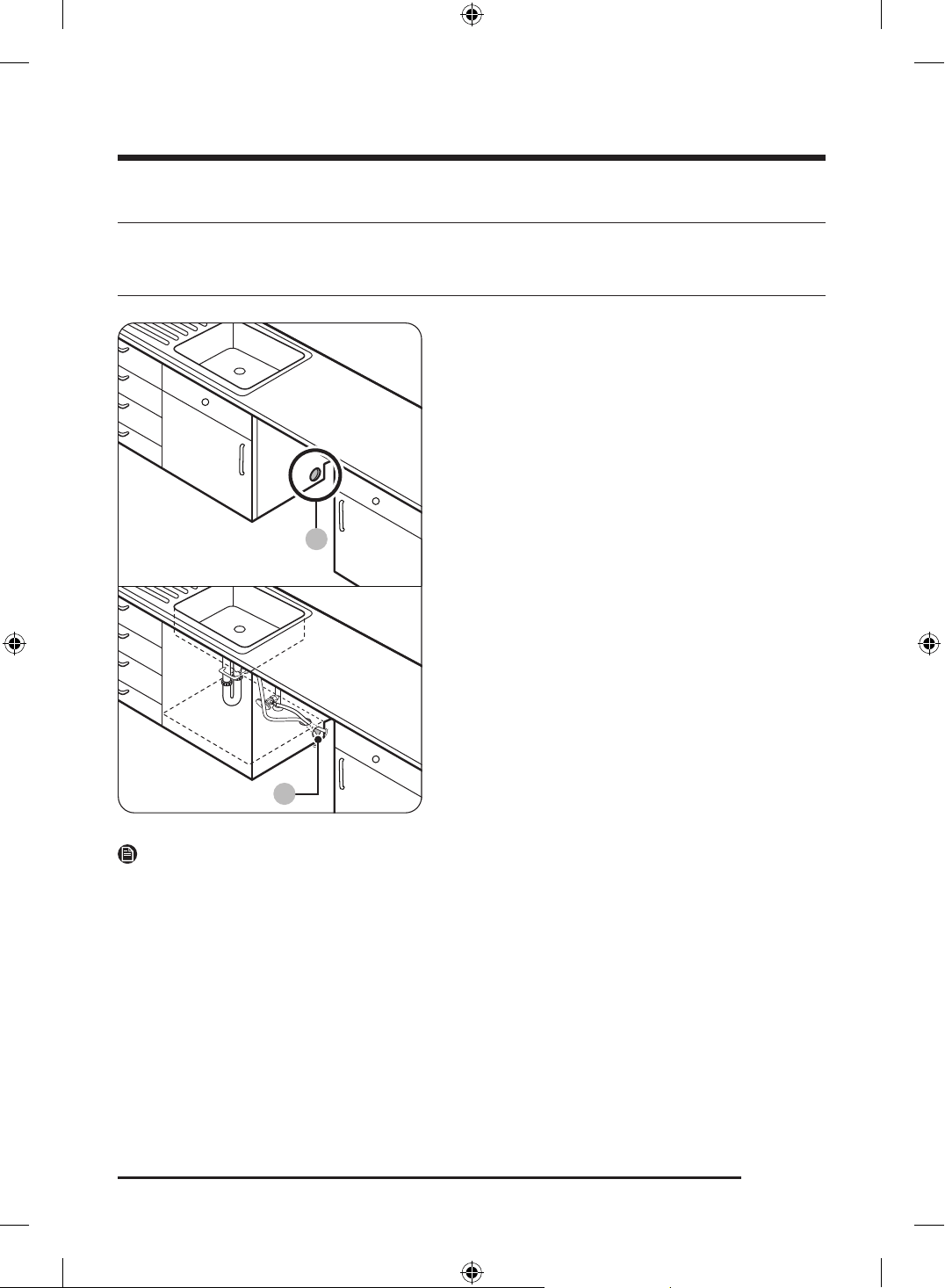
STEP 1 Select a location
A
B
Select a location that meets the following conditions.
• The location must have a solid floor that can support
the weight of the dishwasher.
• The location must be near a sink with easy access to
the water supply, drain system, and electrical outlet.
• The location must let you load dishes into the
dishwasher easily.
• The location must have sufficient space for the
dishwasher door to open easily and provide enough
space between the dishwasher and the cabinet sides.
• The rear wall must be free of obstructions.
Installation in a new location
If you install the dishwasher in a new location, follow
these instructions before installing the dishwasher.
1. Using a hole saw, cut a hole into the side of the
cabinet that holds the sink (A).
2. If the base inside the sink cabinet is raised above the
kitchen floor and is higher than the connections on
the dishwasher, make a hole in the base inside the
cabinet and in the cabinet side (B).
NOTE
• If you are replacing an old dishwasher, check the existing connections for compatibility with the new
dishwasher and replace the connections as needed.
• You may need to cut a hole in the opposite side of the cabinet according to the location of the electrical
outlet.
Untitled-1 17Untitled-1 17 2024-07-08 10:40:122024-07-08 10:40:12
Installation
English18
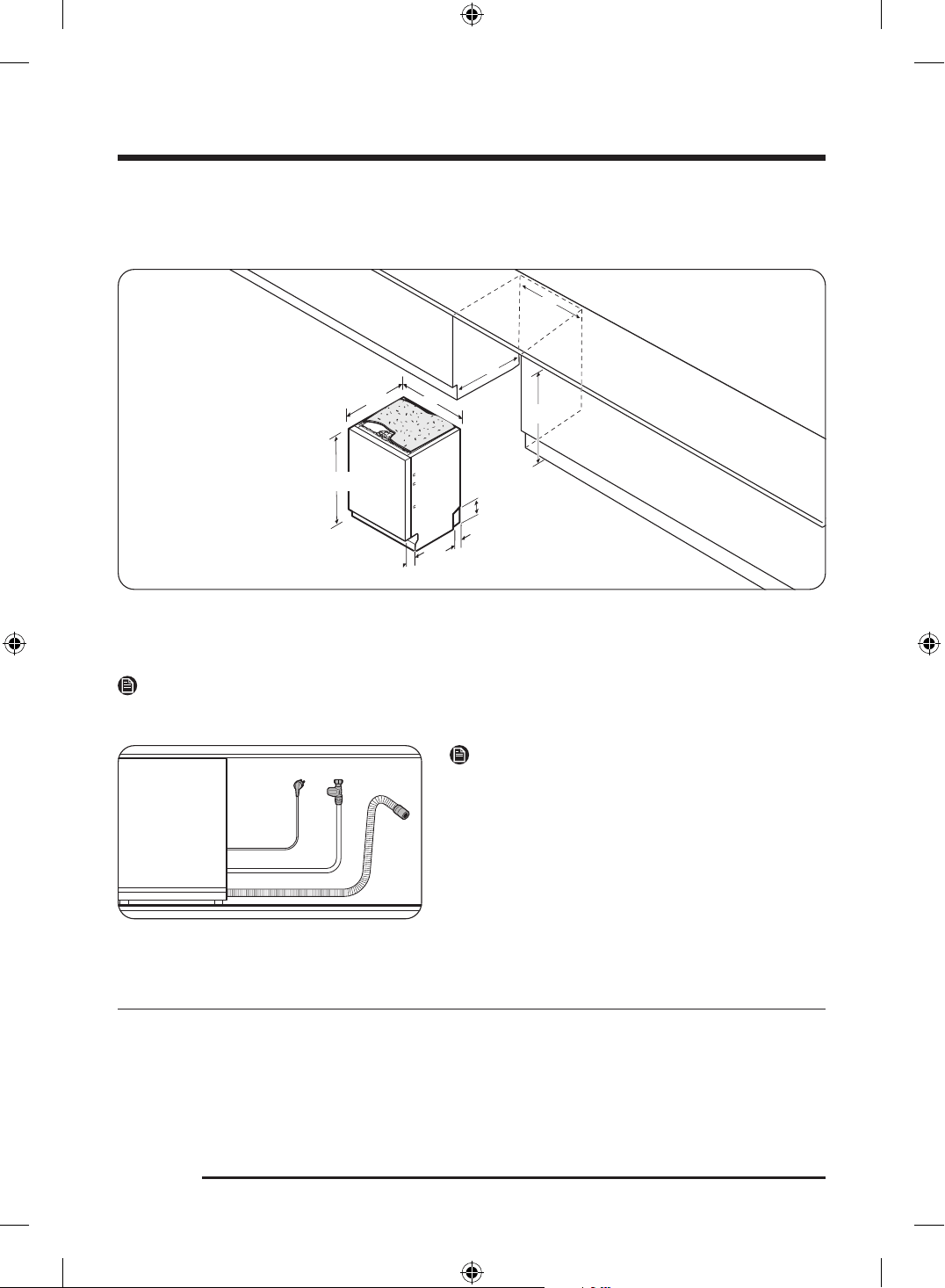
Cut-out dimension
Minimum clearance for stable operation:
• Sides: 1.5 mm
552*
572
595
600
≥ 555
125
91
55
815-860
815-890**
820-865
820-900**
(unit: mm)
* Fully built-in models without custom panel
** Fully built-in models with sliding door panel
NOTE
The dimension may differ depending on the model.
1400
1600
(3700)* 1700
(*) values with extension kit
NOTE
The dimensions indicated in the figure represent the
actual lengths of the power cord, water hose, and drain
hose. When installing the product, consider each length
and choose the installation location accordingly.
STEP 2 Check the water line
• The water line pressure must be between 50 and 800 kPa.
• Make sure that the water temperature does not exceed 60 °C. Hot water over 60 °C may cause the
dishwasher to malfunction.
• Make sure that the water supply valve is turned off before connecting the water supply line to the
dishwasher.
Untitled-1 18Untitled-1 18 2024-07-08 10:40:122024-07-08 10:40:12
English 19
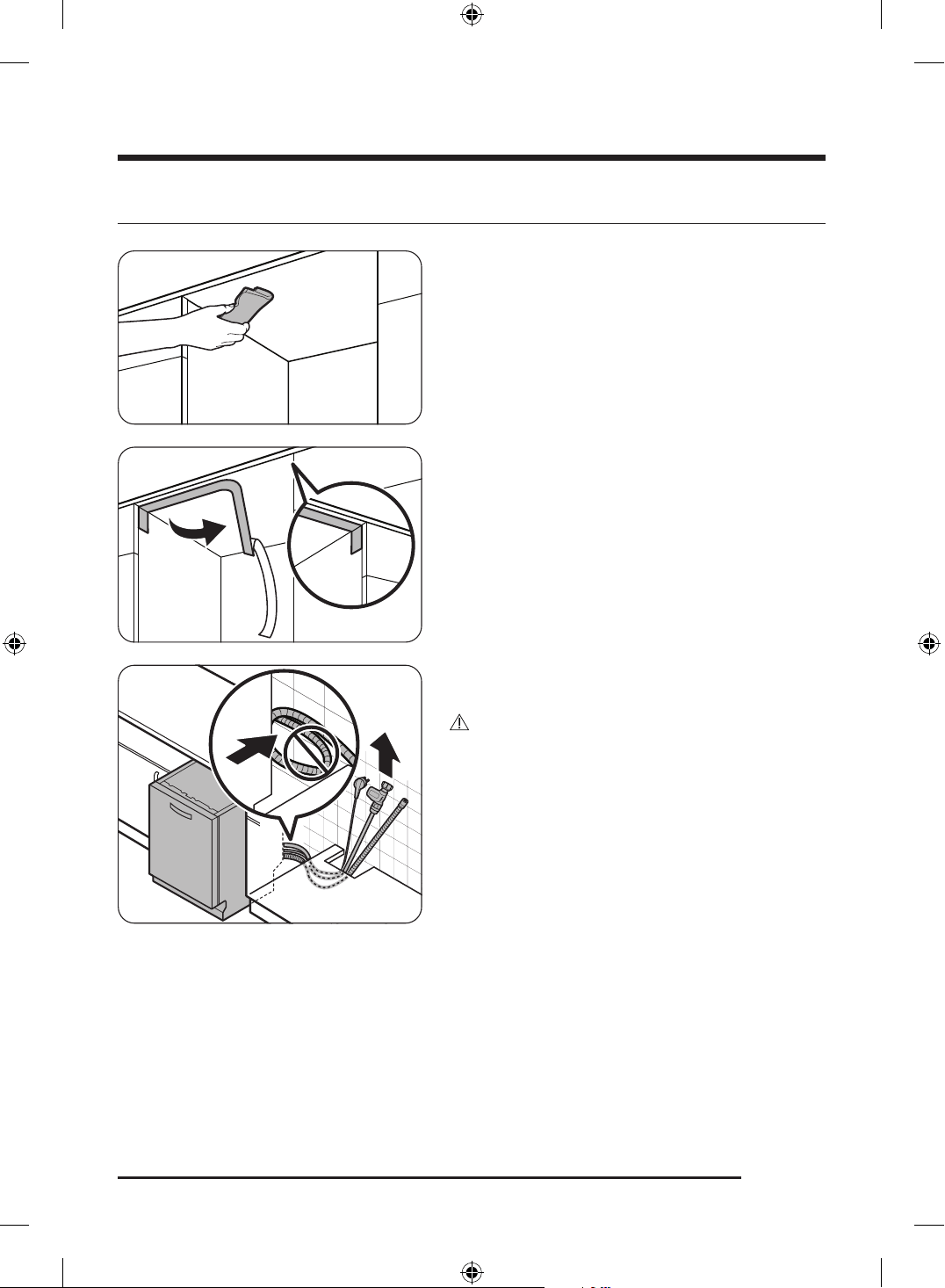
STEP 3 Arrange the hoses
1. Clean the bottom of the countertop.
2. Attach the protective sticker as shown.
3. Pull the power plug, the water hose, and the drain
hose through the sink hole.
CAUTION
• Use caution not to kink or step on the power plug or
the hoses.
• Do not remove the brown paper on the back of the
dishwasher. The paper is used to keep the rear side
clean against the wall.
Untitled-1 19Untitled-1 19 2024-07-08 10:40:122024-07-08 10:40:12
Installation
English20
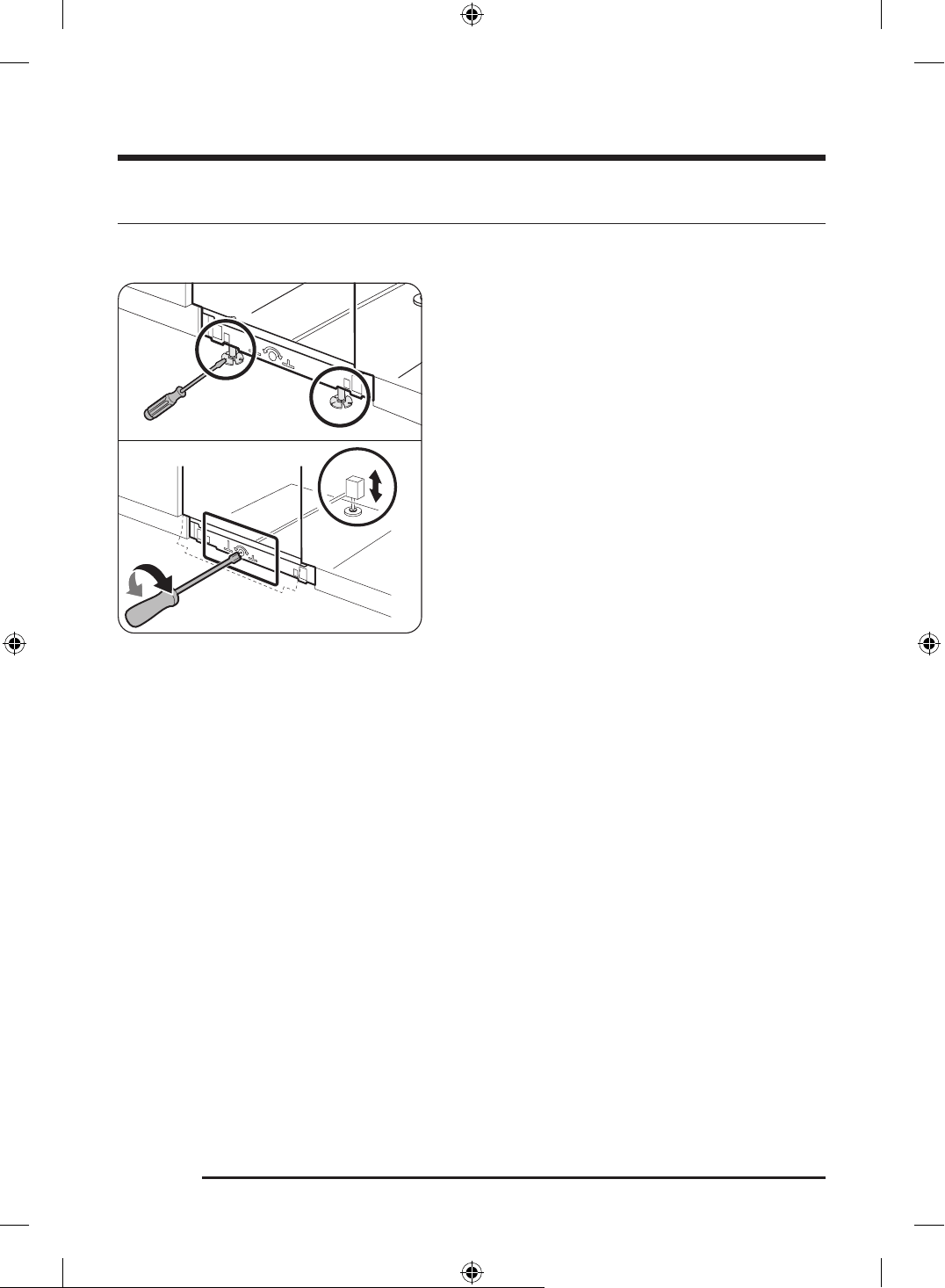
STEP 4 Level the dishwasher
For Built-In models
You can adjust the height of the dishwasher to level it.
Note that in these steps, the dishwasher is currently
inserted halfway.
1. Use the level to check if the dishwasher is level.
2. Use a flat-head screwdriver to adjust the front
height.
- To lower the height, turn the levelling foot
clockwise.
- To raise the height, turn the levelling foot
anticlockwise.
3. To adjust the rear height, insert the Torx T20
screwdriver in the bottom centre of the dishwasher.
- To lower the height, turn the screwdriver
clockwise.
- To raise the height, turn the screwdriver
anticlockwise.
4. When levelling is complete, check if the door opens
and closes properly.
Untitled-1 20Untitled-1 20 2024-07-08 10:40:132024-07-08 10:40:13
English 21
For free standing models
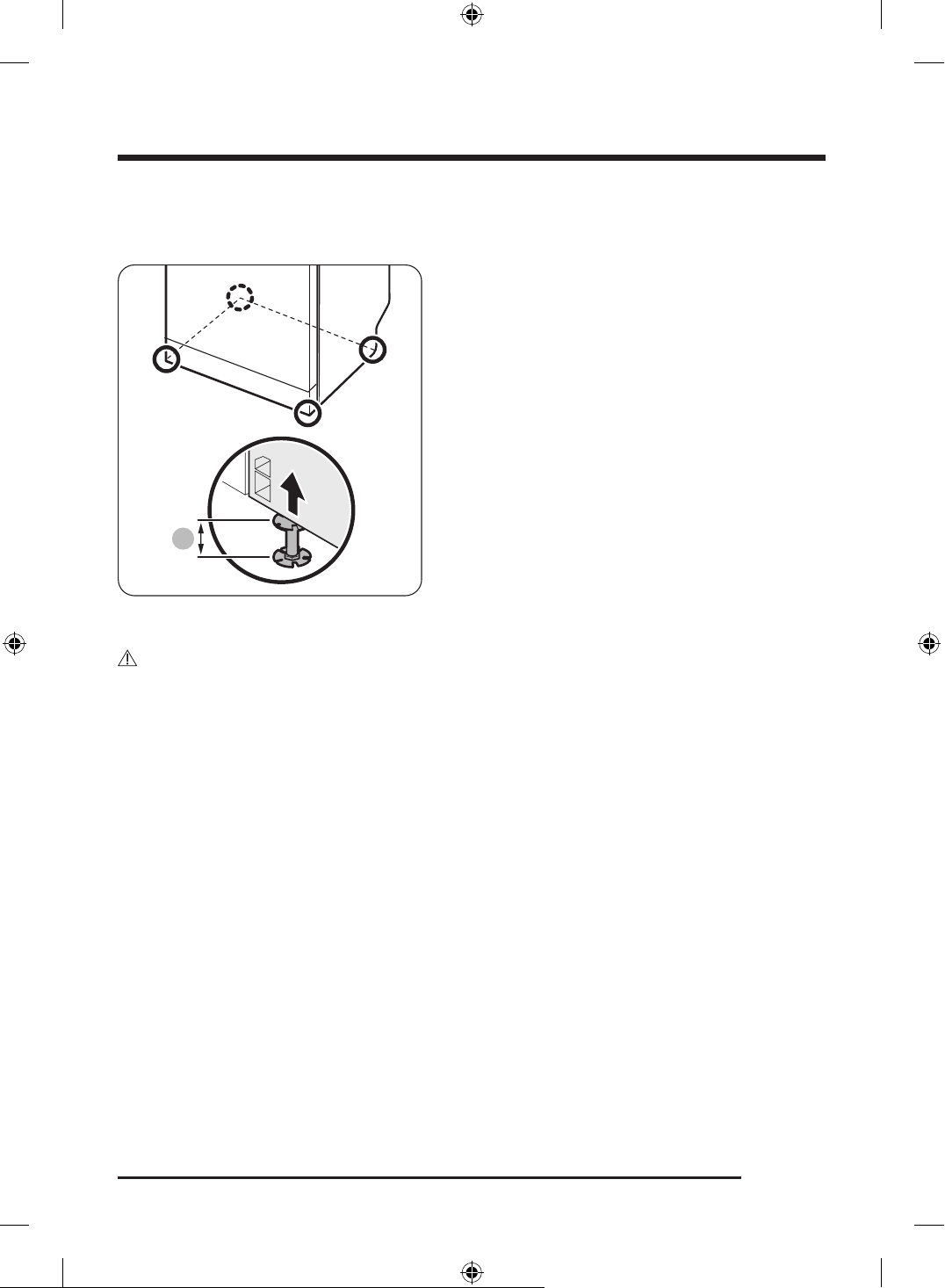
You can adjust the height of the dishwasher up to 45 mm using the levelling feet.
01
01 0-45 mm
1. While slightly lifting the front or rear (or both in
turns) of the dishwasher, turn the levelling foot using
a flat-head screwdriver to adjust the height.
2. When complete, use the leveller to make sure the
dishwasher is level.
3. Insert the dishwasher under the sink and make sure
to secure at least 4 mm space between the top of the
dishwasher and the bottom of the sink plate.
CAUTION
Do not arrange the power cord of the dishwasher using a metallic cable tie.
Untitled-1 21Untitled-1 21 2024-07-08 10:40:132024-07-08 10:40:13
Installation
English22
STEP 5 Secure the dishwasher (for built-in models only)
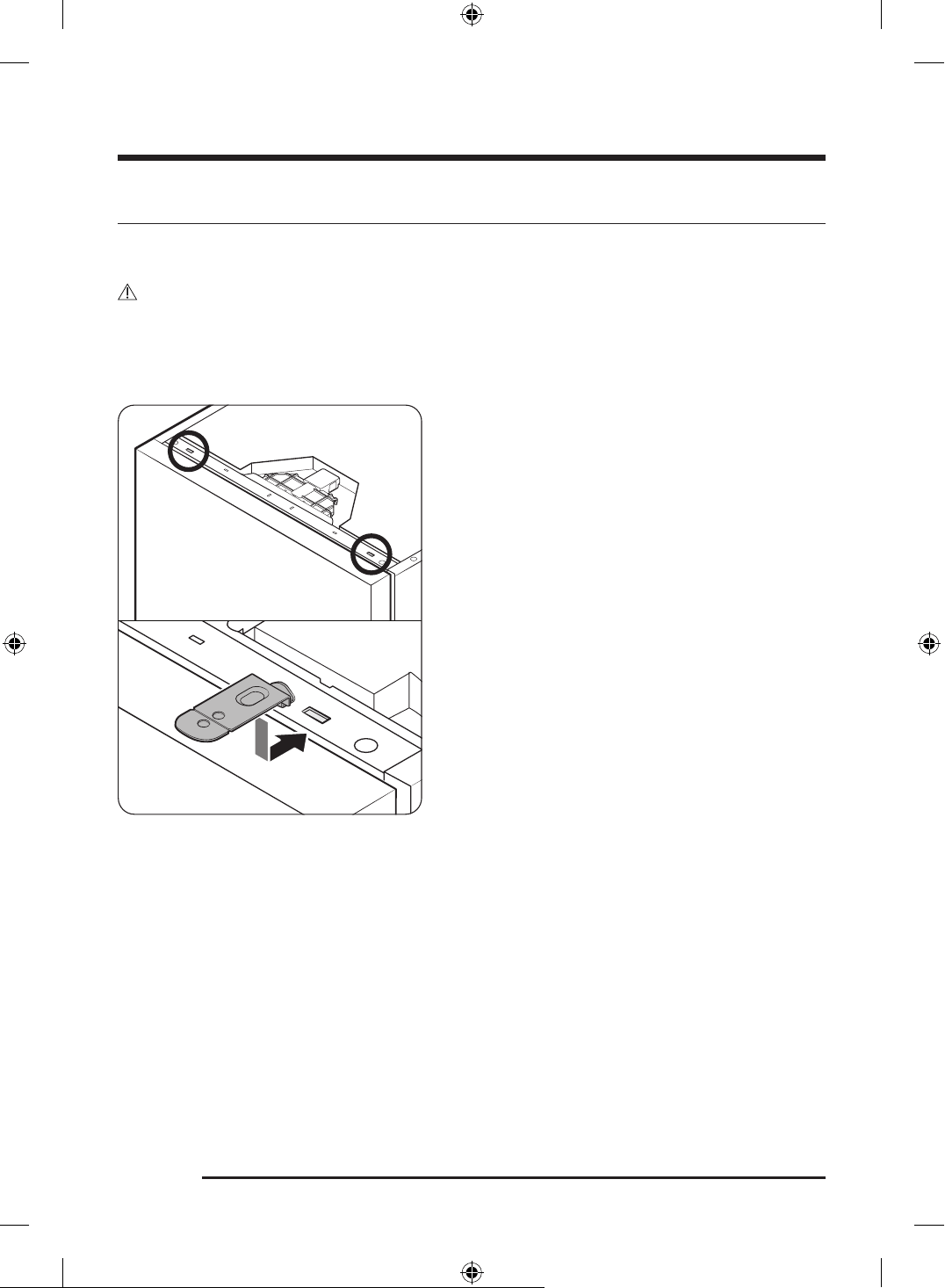
You can use the brackets to secure the dishwasher to the countertop. Alternatively, you can drill the side
holes to secure the dishwasher to the cabinet sides.
CAUTION
Before securing the dishwasher, put a large towel on the bottom of the dishwasher (covering the sump) to
prevent wood shavings or screws from falling into the dishwasher sump.
To the countertop
1. Insert the provided brackets into the top front holes
of the dishwasher as shown.
2. Fully insert the dishwasher under the countertop.
Untitled-1 22Untitled-1 22 2024-07-08 10:40:132024-07-08 10:40:13
English 23
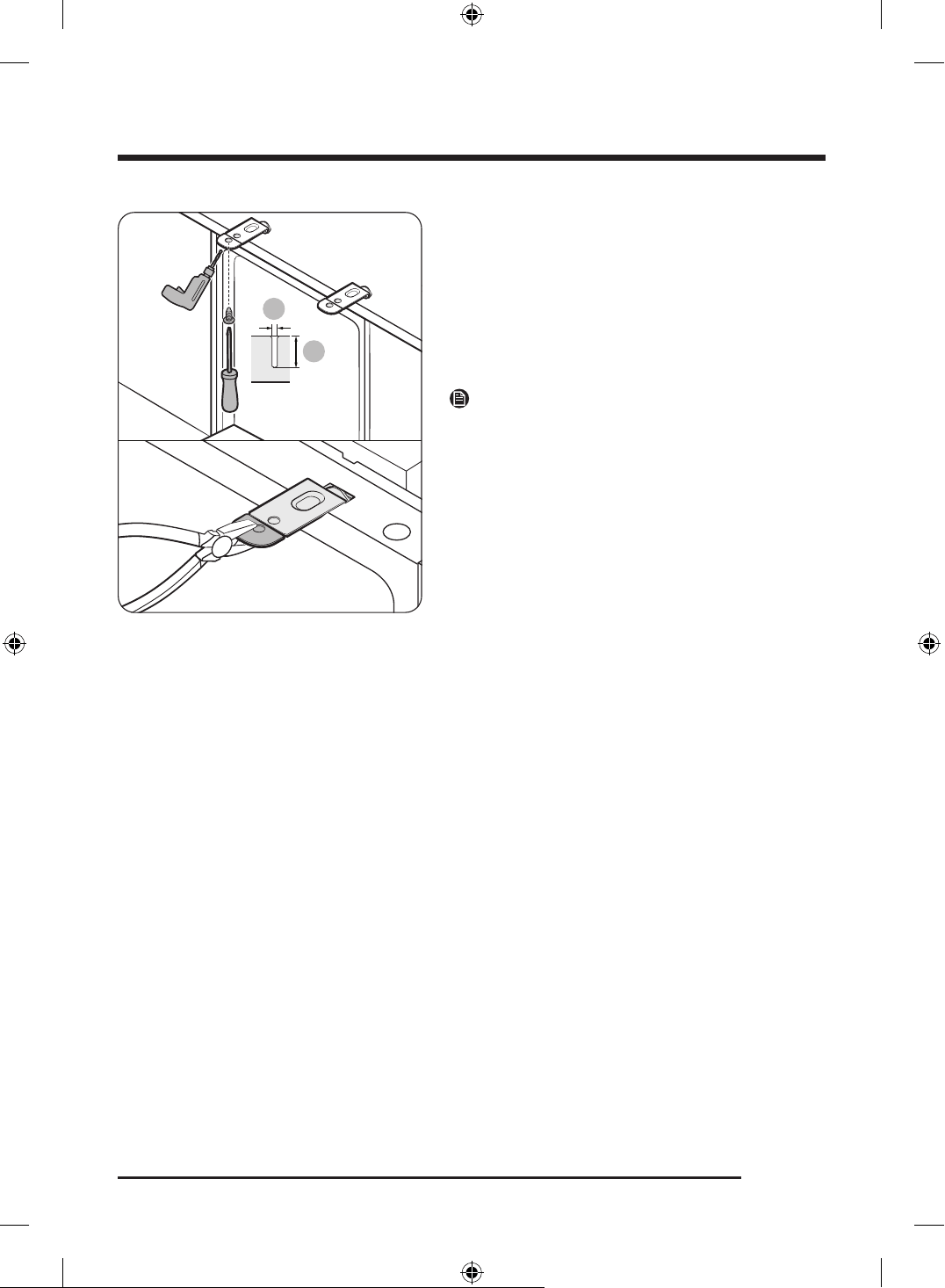
01
02
01 2 mm
02 12 mm
3. Carefully drill 2 screw holes into the bottom of the
countertop from beneath, one for each countertop
bracket.
- Make sure the hole you drill is smaller than the
diameter of the screw.
4. Insert the provided screws into the hole of the
brackets, and then tighten them to secure the
dishwasher to the countertop.
NOTE
• If the provided brackets are too long, cut them down
using pliers.
• Use a magnetic screwdriver to help prevent screws
from falling into the dishwasher.
Untitled-1 23Untitled-1 23 2024-07-08 10:40:132024-07-08 10:40:13
Installation
English24
To the side walls
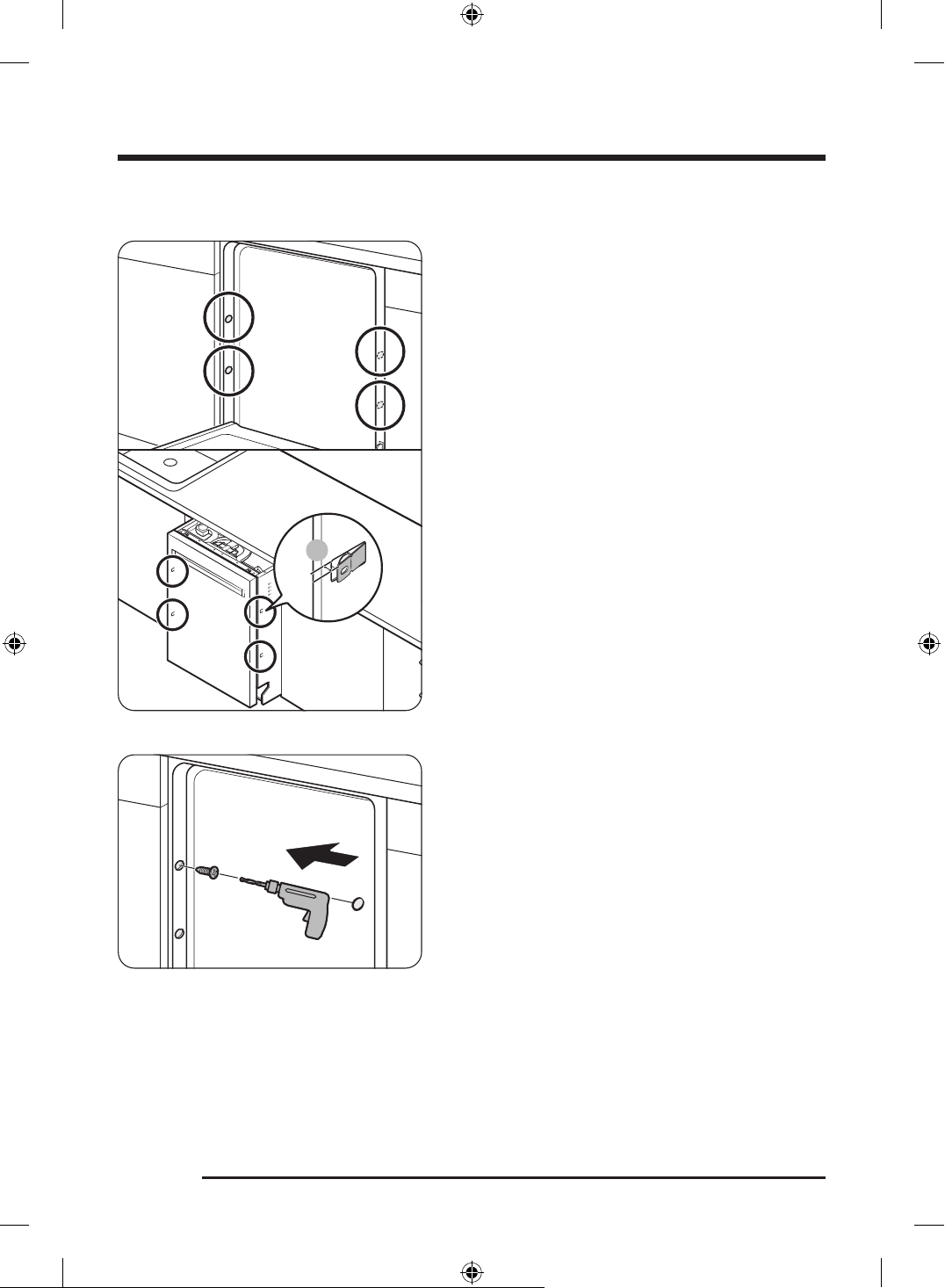
01
01 5 mm
1. To prevent damage to the drain hose through the
water supply line, slightly pull out the dishwasher
and pull out the side brackets on the left and right
side of the dishwasher by 5 mm. When done, reinsert
the dishwasher with its centre aligned.
2. Drill a hole into both sides of the kitchen cabinet,
totaling 2 screw holes.
- Make sure the hole you drill is smaller than the
diameter of the screw.
- Make sure the drill bit does not strike the sides of
the spacer cap holes.
3. Tighten the provided screws into the holes to secure
the dishwasher to the cabinet.
4. Insert the provided plastic caps to the places where
screws are fastened.
Untitled-1 24Untitled-1 24 2024-07-08 10:40:132024-07-08 10:40:13
English 25
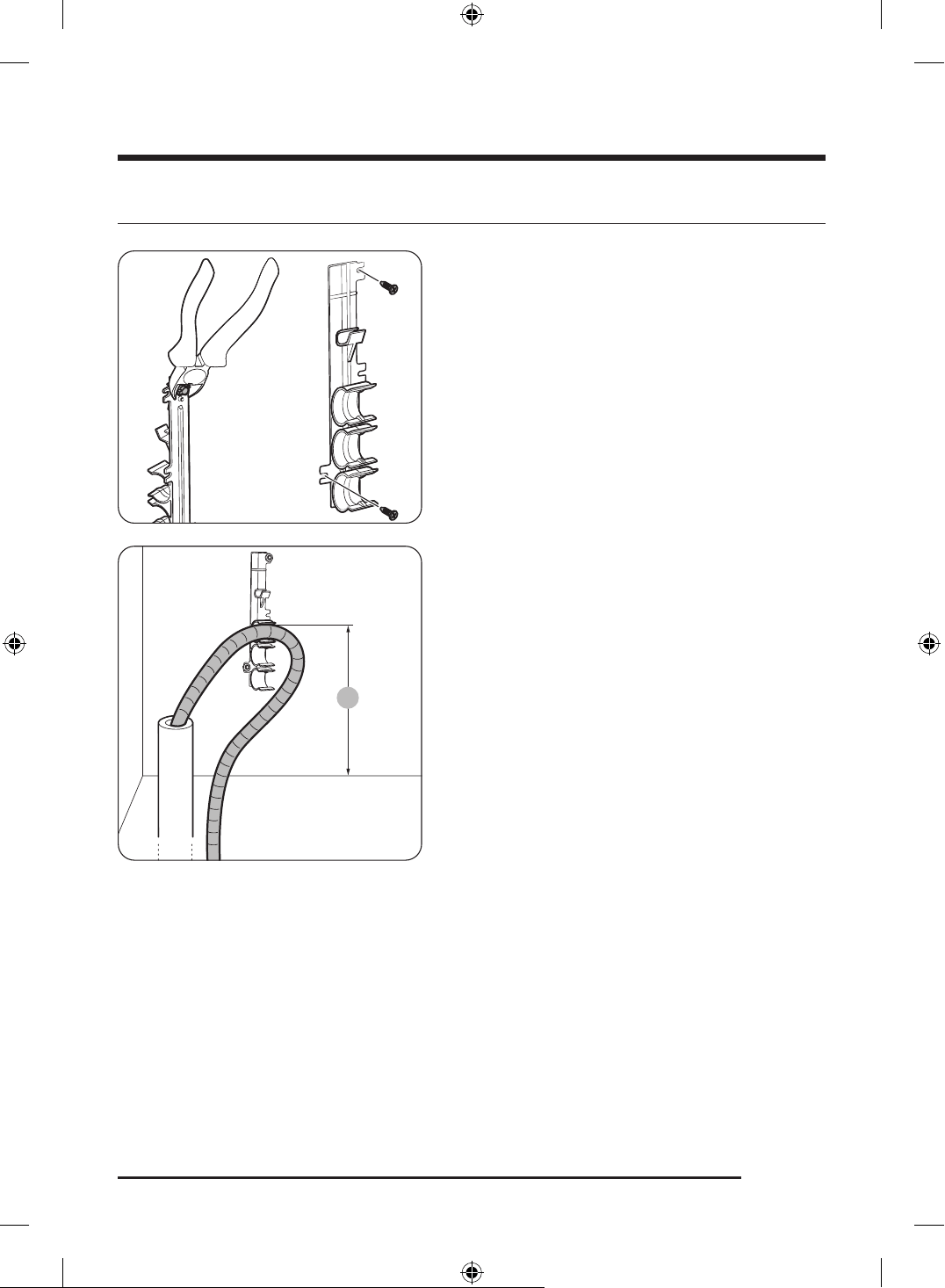
STEP 6 Connect the drain hose
1. Detach the hose holder from the dishwasher, and
then cut off the protruding part from the holder as
shown.
2. Fix the holder to a wall by tightening the 2 screws
(Ø4 X 12).
01
01 Max. 800 mm
3. Insert the drain hose into the holder so that the drain
hose is positioned 300 mm to 800 mm from the
bottom.
Untitled-1 25Untitled-1 25 2024-07-08 10:40:142024-07-08 10:40:14
Installation
English26
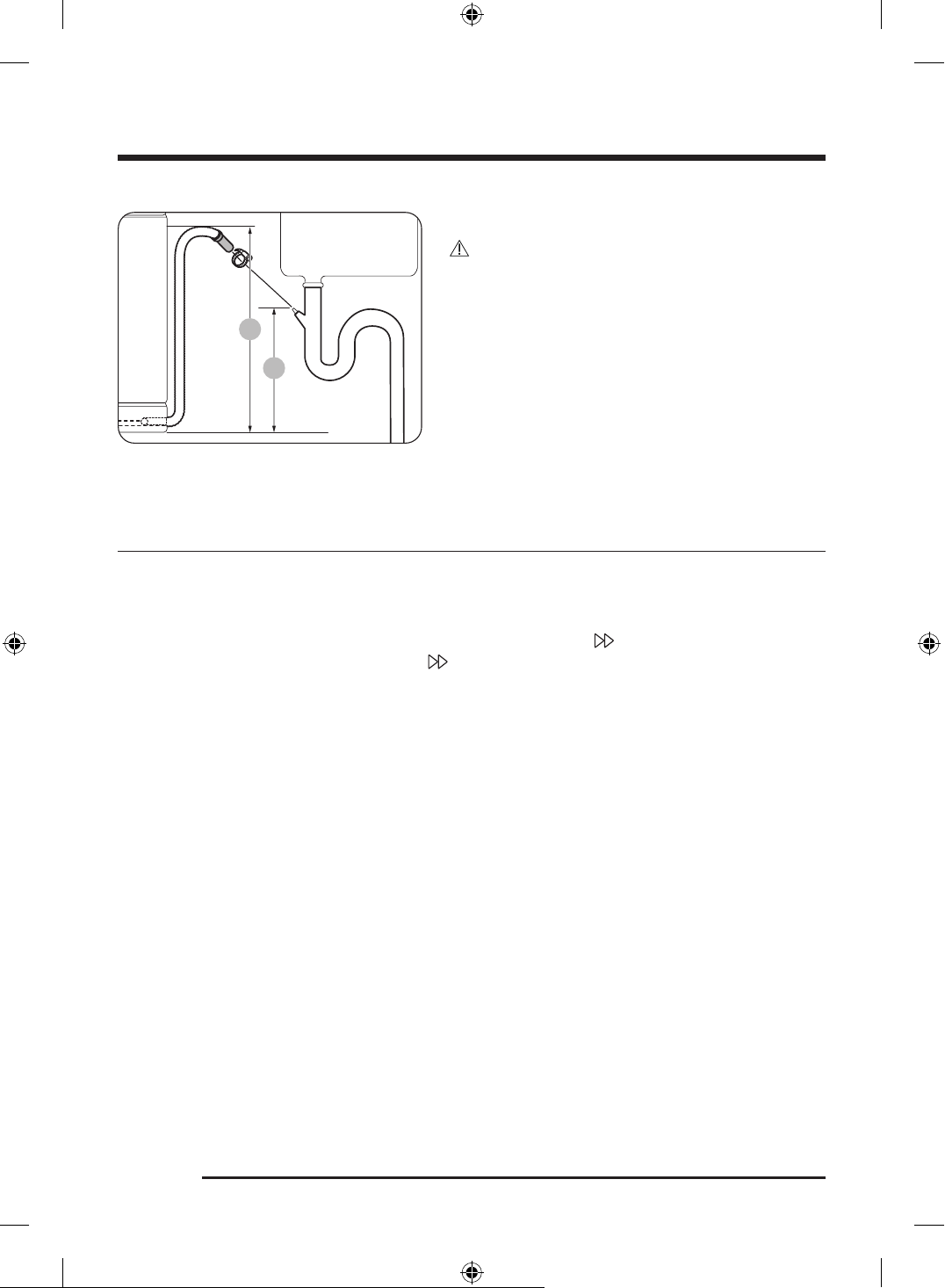
01
02
01 Max. 800 mm
02 Min. 300 mm
4. Connect the drain hose to the drain outlet.
CAUTION
• Install the drain system properly so that the drain
hose does not come out of the drain outlet in the
draining process.
• Make sure that the drain hose, supply hose, and
power cord are not kinked or folded.
STEP 7 Final check
1. Remove all foam, paper packaging, and unnecessary parts from inside the dishwasher.
2. Turn the power circuit breaker on.
3. Open the water supply valve to supply water to the dishwasher.
4. Plug in and turn the dishwasher on. Then, select and run the Express cycle.
- If your model does not have the Express cycle, select and run the cycle that takes the shortest
operation time to check if the dishwasher operates properly.
5. Check if the dishwasher turns on normally and if there are any water leaks while the dishwasher
is operating. Make sure to check for water leaks on both ends of the water line and the drain hose
connector.
Untitled-1 26Untitled-1 26 2024-07-08 10:40:152024-07-08 10:40:15
English 27
Installing the free standing model under the sink
You can install the dishwasher under the sink. To do this, follow the instructions below.
WARNING
Samsung Electronics is not responsible for any product failure or damage that may arise from your
installation of the free standing model under the sink.
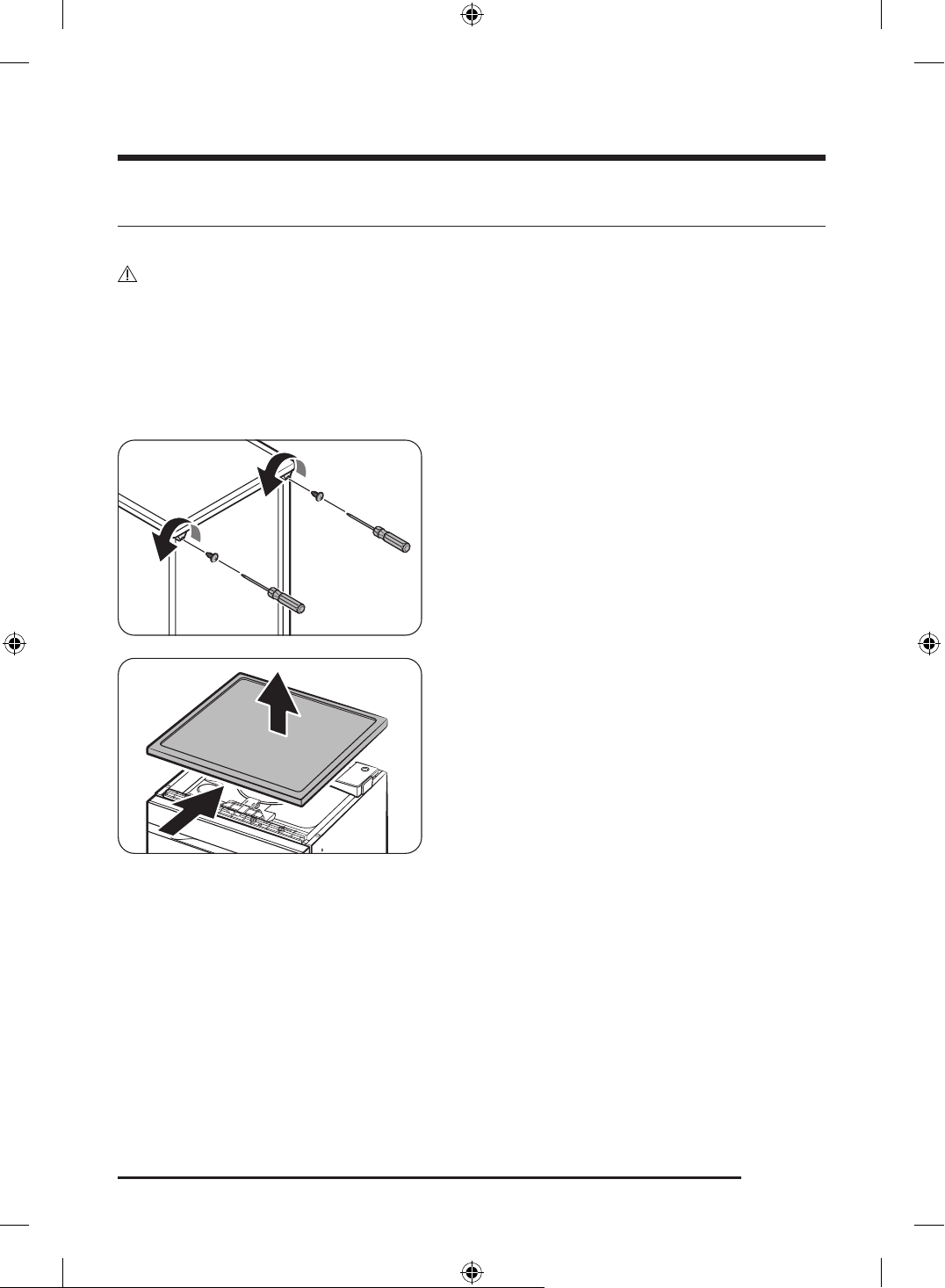
Removing the top cover
If you want to install your free standing model under the cabinet but if it does not fit into the cabinet
because of the height, you can remove the top cover.
1. Remove the 2 screws from the top corners on the
rear side of the dishwasher.
2. Slide the worktop of the dishwasher to the rear and
lift up to remove it.
3. Refer to the “Step-by-step installation” section to
proceed with the rest of the installation.
Untitled-1 27Untitled-1 27 2024-07-08 10:40:152024-07-08 10:40:15
Installation
English28
Finalizing the installation
Installing the custom panel
Fully built-in models
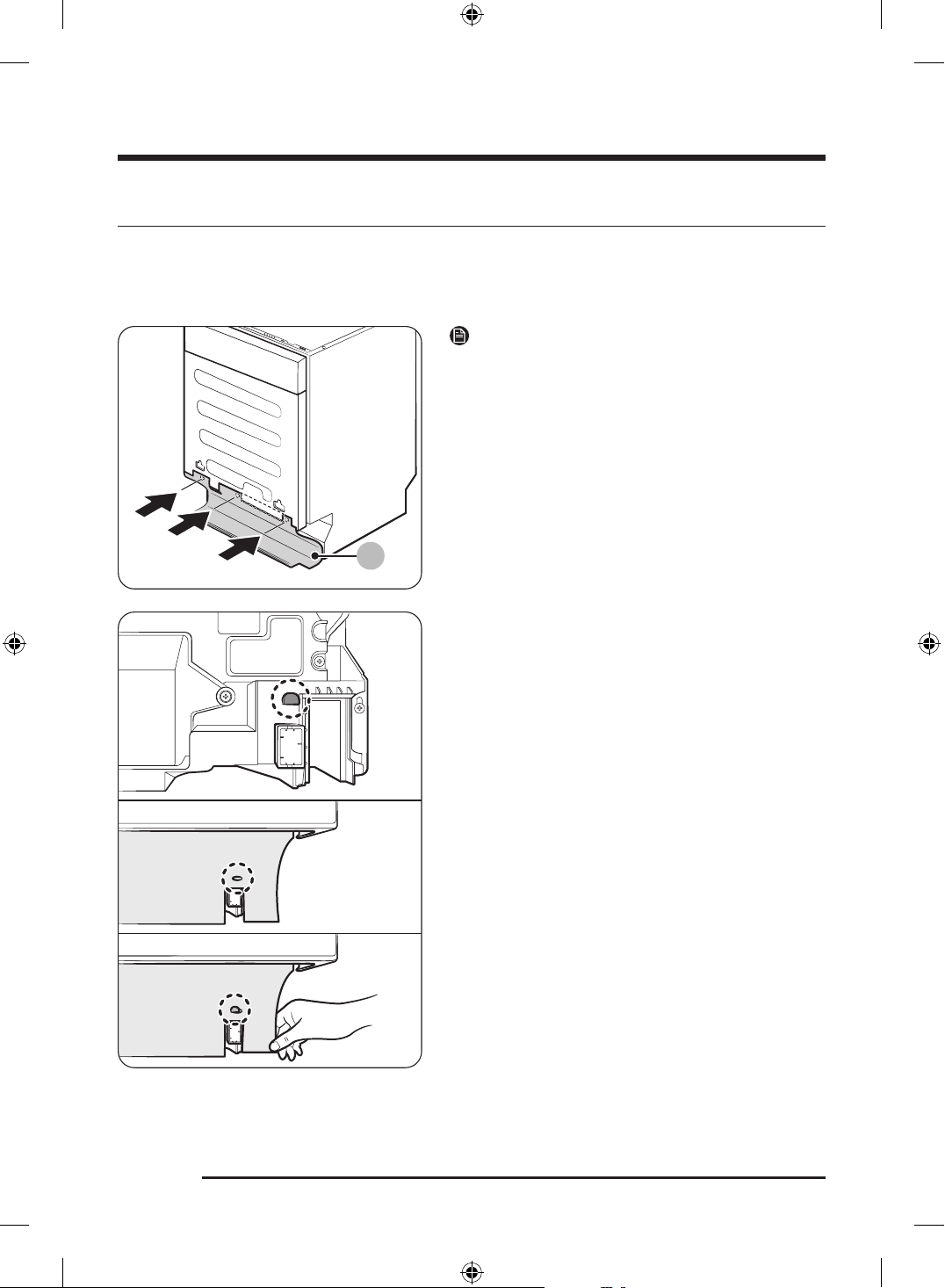
A
NOTE
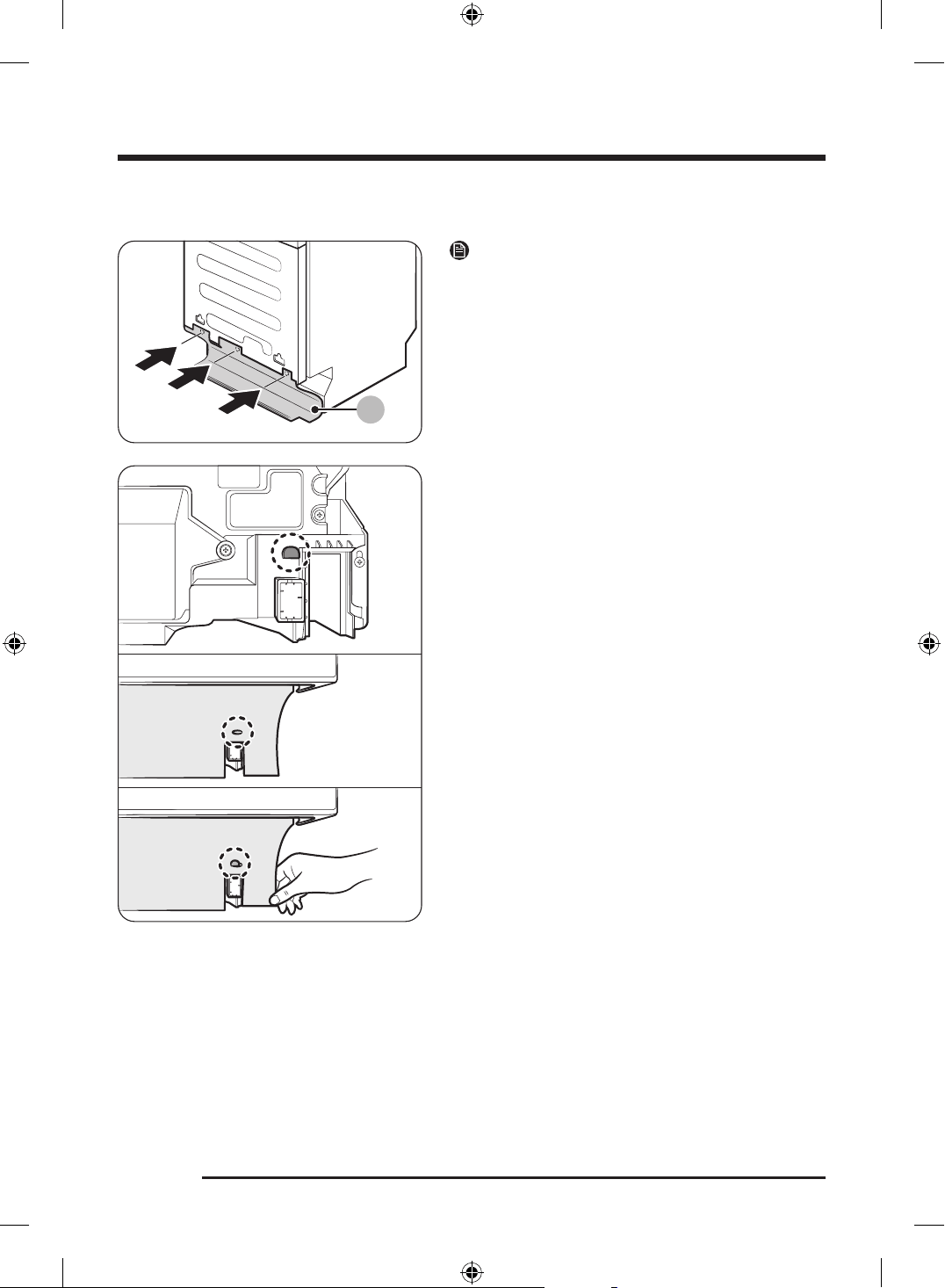
For the models with the rubber skirt (A), push it under
the dishwasher before installing the panel.
Insert the hook through the hole on the rubber skirt and
pull the sides to ensure it is secured to the hook.
Untitled-1 28Untitled-1 28 2024-07-08 10:40:172024-07-08 10:40:17
English 29
01
02
01 Ø2 mm
02 10~12 mm
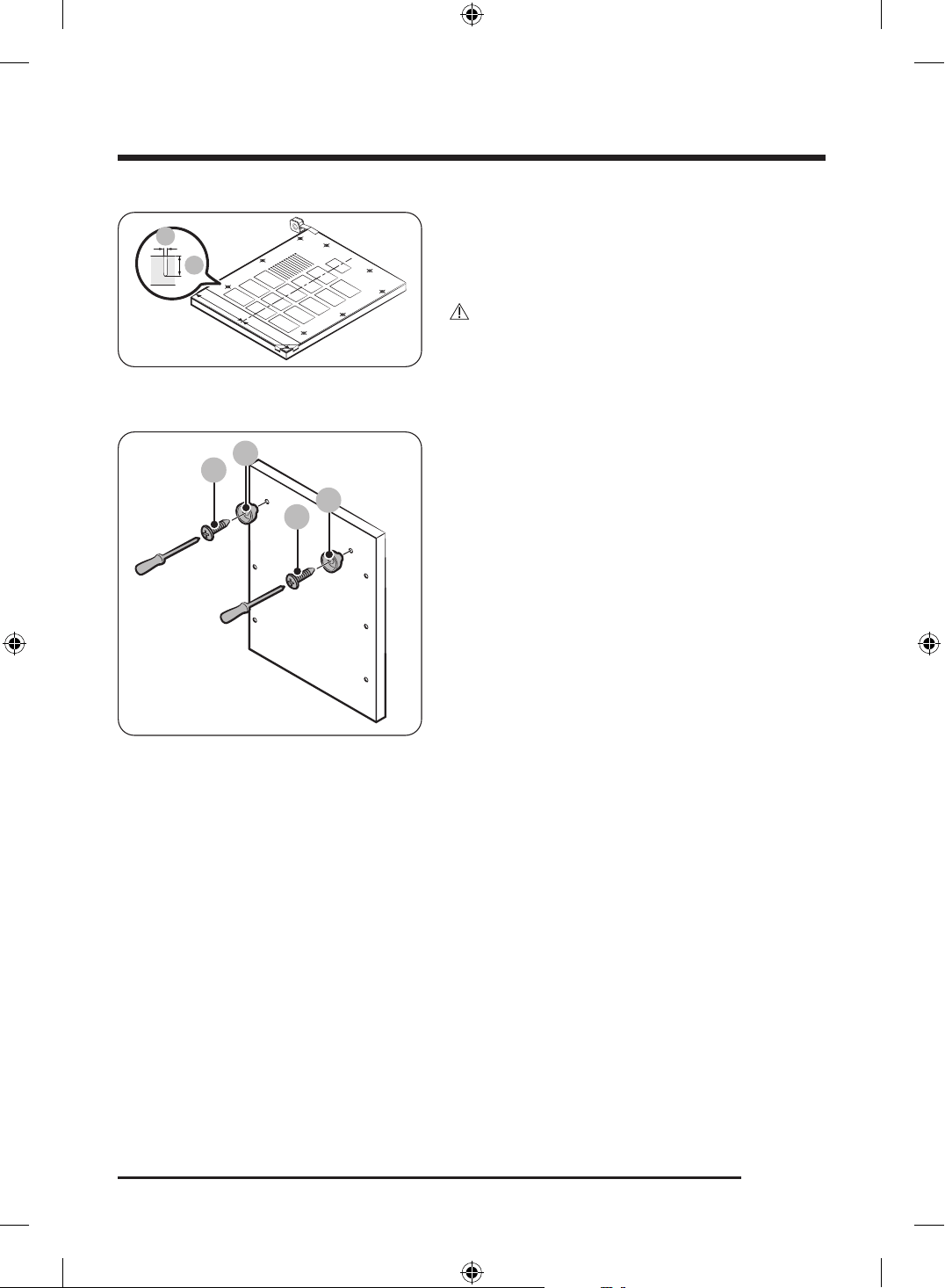
1. Put the installation template on the back of the
custom panel and fix it temporarily using transparent
tape. Note that the rear of the custom panel will be
attached to the dishwasher door.
CAUTION
• The top end of the custom panel must be aligned
with the top end of the installation template.
• Use a custom panel between 4 kg and 9 kg.
2. Mark 8 points guided on the installation template.
B
C
B
C
3. Remove the installation template and tighten the
custom panel fixers (B) at the top with 2 screws (C,
Ø4 X 16) as shown.
Untitled-1 29Untitled-1 29 2024-07-08 10:40:182024-07-08 10:40:18
Installation
English30
B
A
01
01 Max. 30 mm
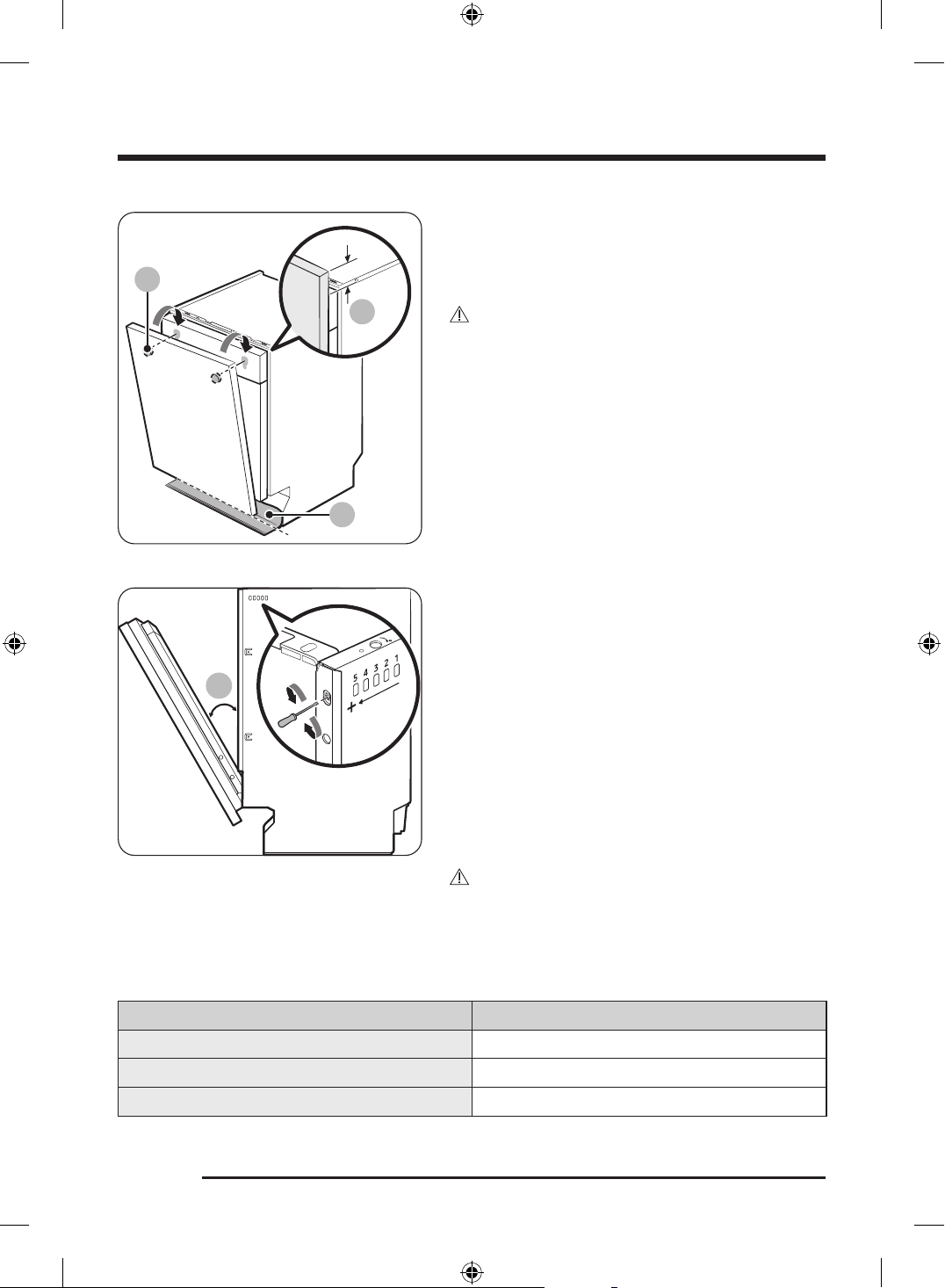
4. While holding the custom panel, attach it to the
door and insert the custom panel fixers (B) into the
corresponding holes at the top of the door as shown.
5. Push the custom panel downward to fix.
CAUTION
Do not let the custom panel extend more than 30 mm
from the top of the dishwasher.
6. Cut the rubber skirt (A) using a cutting knife so that it
is aligned with the front line of the dishwasher, which
is represented as a dashed line.
9:;<=
01
01 30°
7. Refer to the “Recommended spring levels” table
and adjust the spring level by turning the spring
screw with Torx T20 screwdriver on the front of the
dishwasher.
- Adjust the spring level while the door is
approximately opened at 30 degrees.
- The door should hold its position. It should not
fall open.
- If the door opens wider than 30 degrees, turn
the spring screw clockwise to tighten the spring
level. If the door opens narrower than 30 degrees,
turn the spring screw anticlockwise to loosen the
spring level.
CAUTION
Do not adjust the spring level while the door is
completely opened.
Recommended spring levels
Level Weight of the custom panel (kg)
Level 1-2 4-5
Level 2-3 5-6
Level 3-4 6-7
Untitled-1 30Untitled-1 30 2024-07-08 10:40:192024-07-08 10:40:19
English 31
Level Weight of the custom panel (kg)
Level 4-5 7-9
CAUTION
If the custom panel weighs more than 9 kg, the door may fall open. Custom panels weighing more than
9 kg are not recommended.
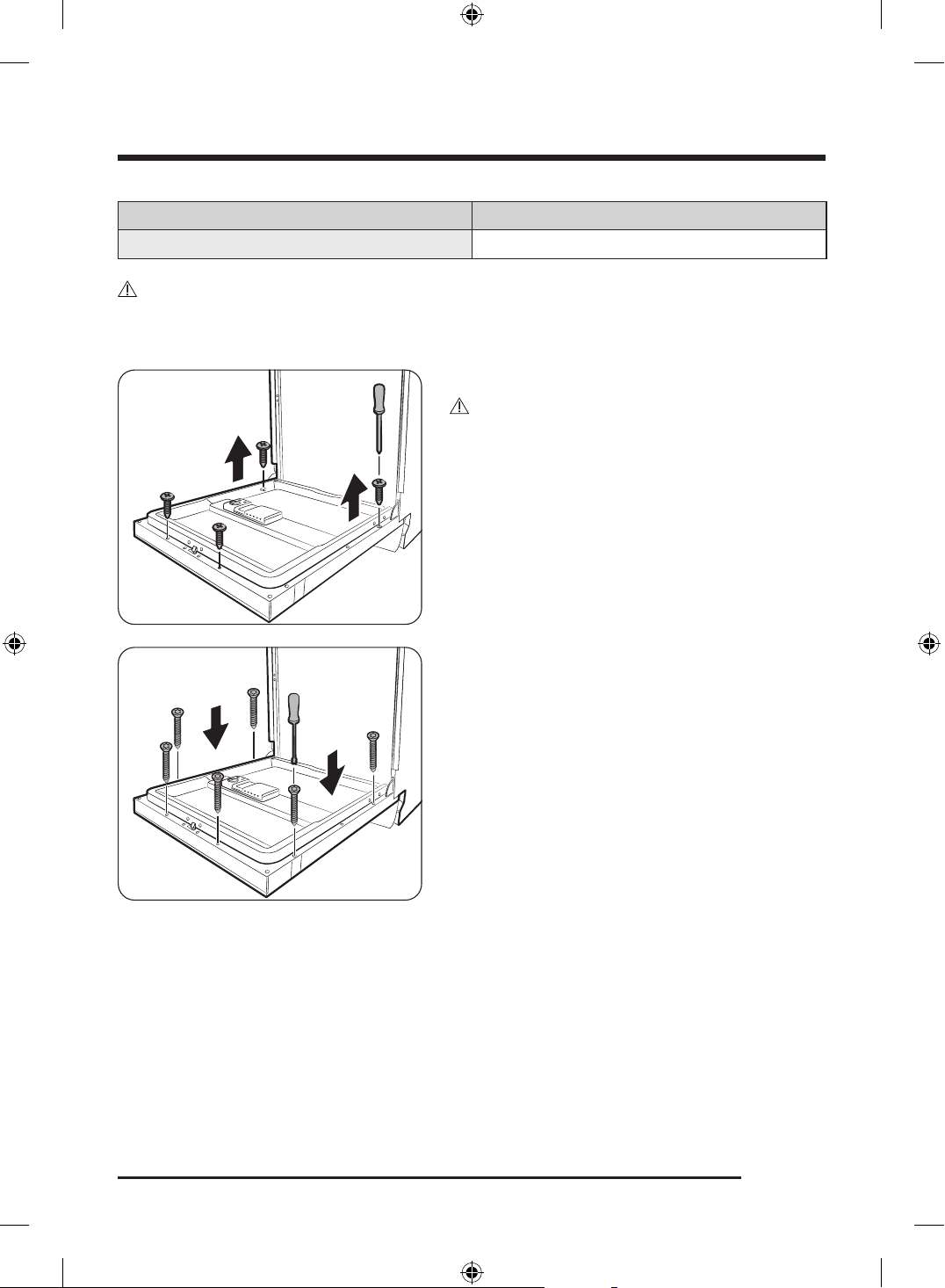
8. Open the dishwasher door and remove the 4 screws.
CAUTION
Use caution when opening the door. The door might
open or close unexpectedly if the spring level is not
adjusted appropriately, resulting in physical injury.
9. Secure the custom panel to the door by fastening the
6 screws (Ø4 X 43).
Untitled-1 31Untitled-1 31 2024-07-08 10:40:202024-07-08 10:40:20
Installation
English32
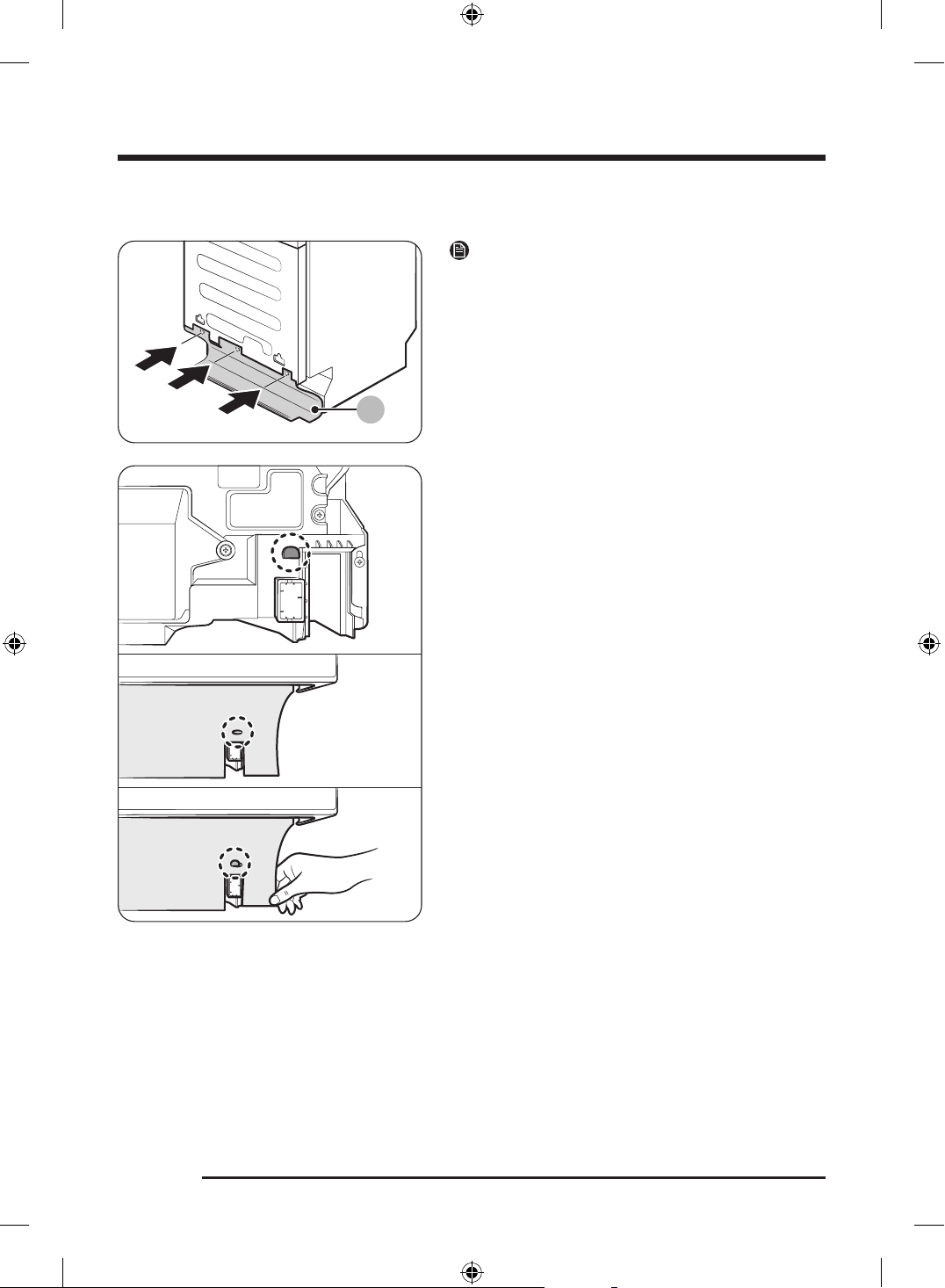
Fully built-in models with sliding panel
A
NOTE
For the models with the rubber skirt (A), push it under
the dishwasher before installing the panel.
Insert the hook through the hole on the rubber skirt and
pull the sides to ensure it is secured to the hook.
Untitled-1 32Untitled-1 32 2024-07-08 10:40:212024-07-08 10:40:21
English 33
01
02
01 Ø2 mm
02 ~12 mm
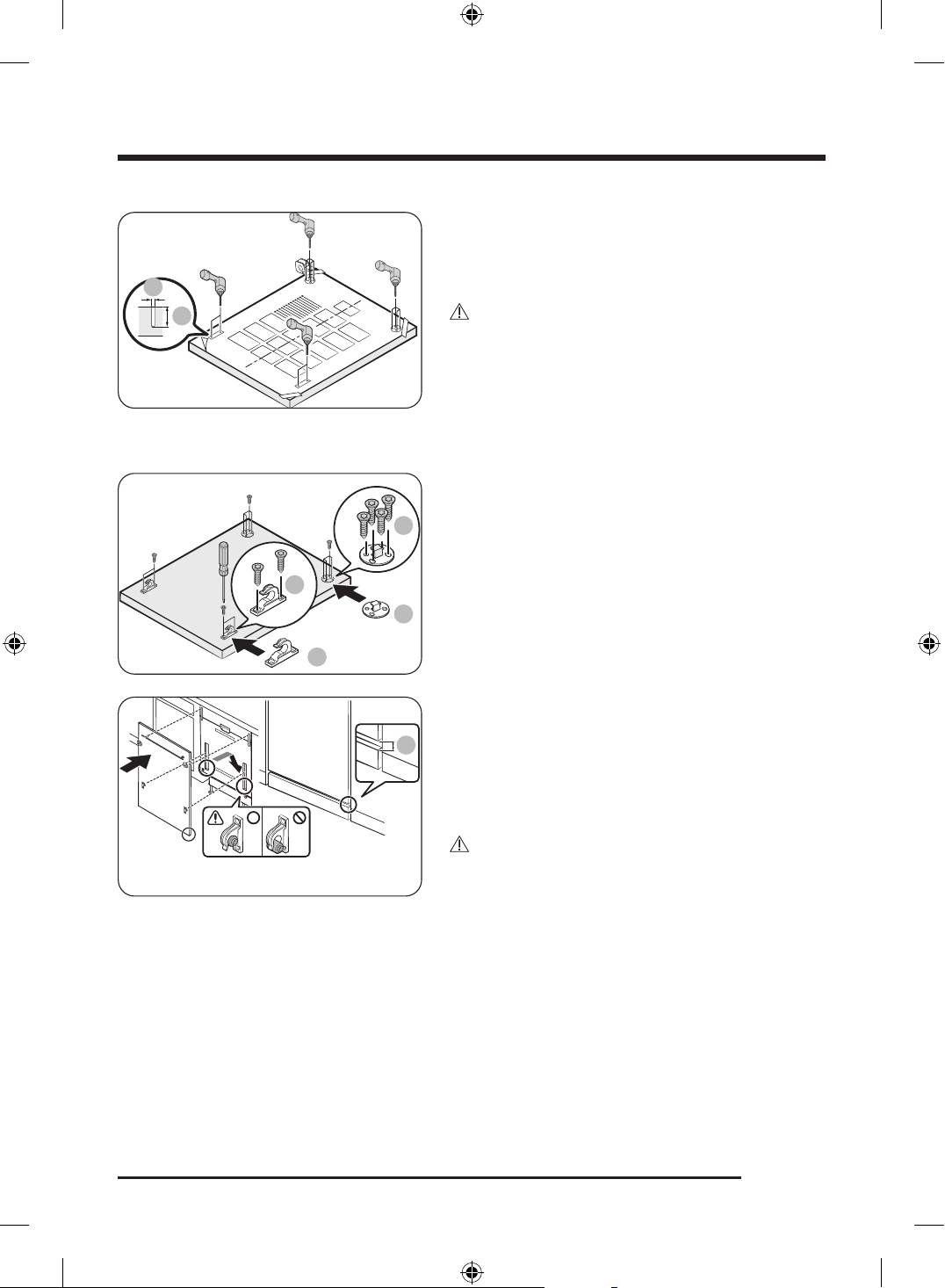
1. Put the installation template on the back of the
custom panel and fix it temporarily using transparent
tape. Note that the rear of the custom panel will be
attached to the dishwasher door.
CAUTION
• The top end of the custom panel must be aligned
with the top end of the installation template.
• Use a custom panel between 4.5 kg and 12 kg.
2. Make 12 points guided on the installation template.
C
B
D
D
3. Remove the installation template.
4. Tighten the two top custom panel fixers (B) at the
top with 4 screws (D) on each fixer.
5. Tighten the two bottom custom panel fixers (C) at
the bottom with 2 screws (D) on each fixer.
A
A. Min. 3 mm
6. Hold the custom panel and insert the top custom
panel fixers into the grooves.
7. While gently sliding down the custom panel, insert
the bottom custom fixers into the grooves.
8. Slide down the custom panel until the bottom
custom panel fixers snap onto the holder.
CAUTION
• Make sure the bottom custom fixers snap onto the
holder as shown in the figure.
• You must leave at least 3 mm of gap between the
custom panel and the plinth.
Untitled-1 33Untitled-1 33 2024-07-08 10:40:222024-07-08 10:40:22
Installation
English34
Semi built-in models
A
NOTE
For the models with the rubber skirt (A), push it under
the dishwasher before installing the panel.
Insert the hook through the hole on the rubber skirt and
pull the sides to ensure it is secured to the hook.
Untitled-1 34Untitled-1 34 2024-07-08 10:40:222024-07-08 10:40:22
English 35
A
B
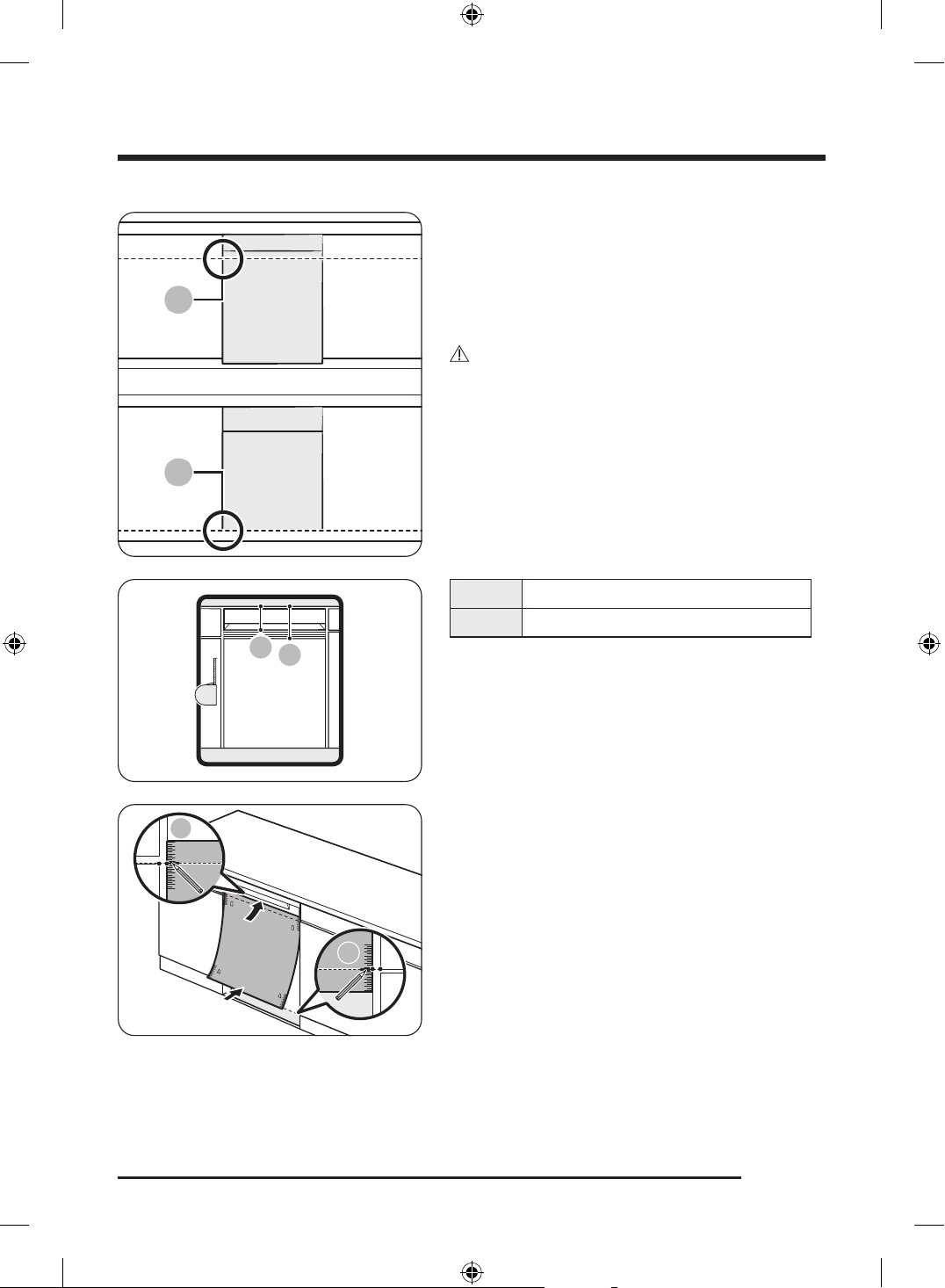
1. Select to align the custom panel to either the top or
bottom edge of the cabinets.
- A: To align the custom panel to the top edge of a
cabinet.
- B: To align the custom panel to the bottom edge
of a cabinet.
CAUTION
Note that installation method differs for A and B.
02
01
01 Min. 116 mm
02 Max. 150 mm
A
B
2. Fully insert the dishwasher under the countertop.
3. Align the top of the installation template to the
bottom of the dishwasher’s door handle.
4. On both sides of the installation template, mark the
spot according to your alignment.
- For A: At the top edge of a cabinet.
- For B: At the bottom edge of a cabinet.
Untitled-1 35Untitled-1 35 2024-07-08 10:40:232024-07-08 10:40:23
Installation
English36
B
A
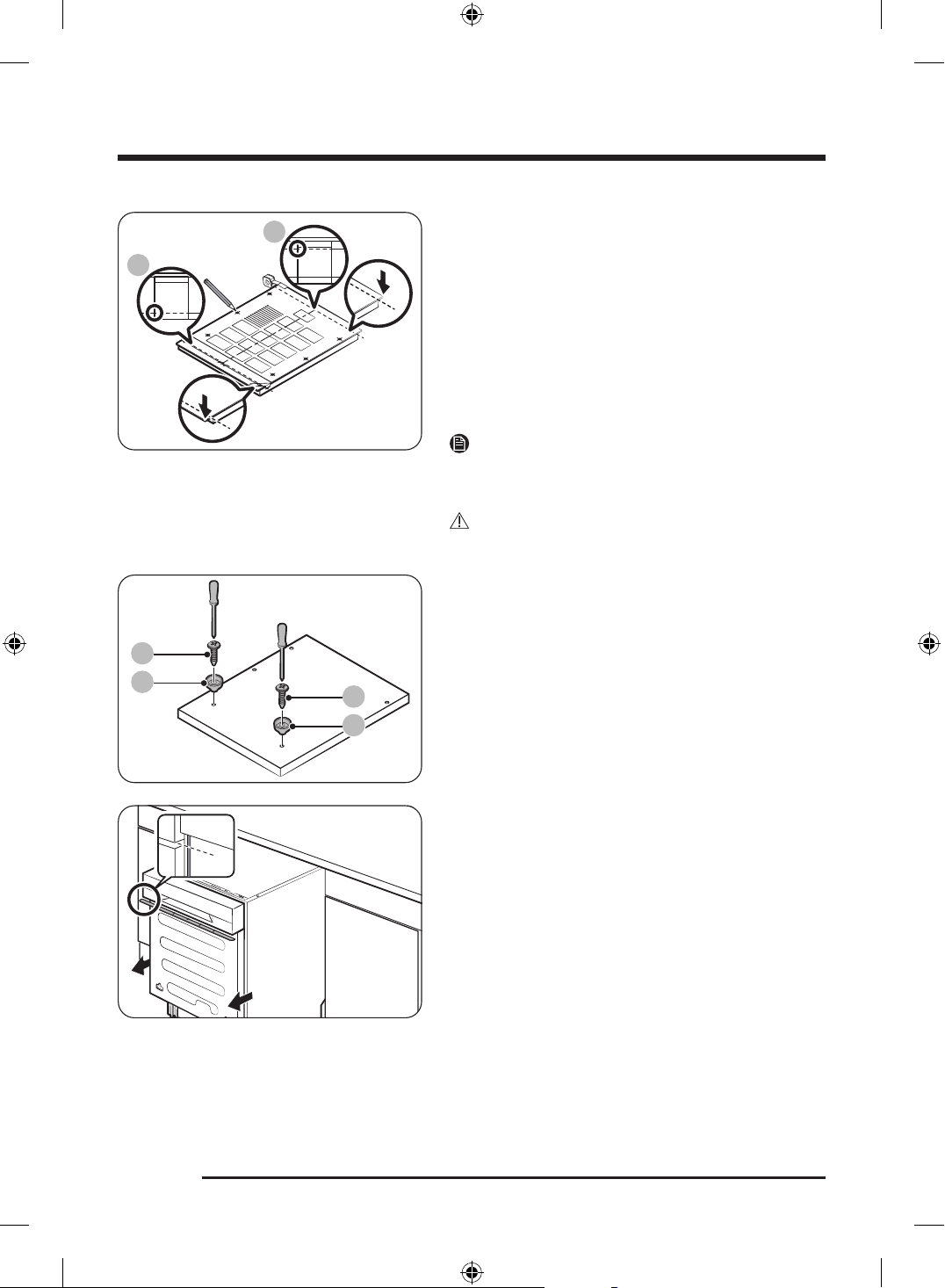
5. Put the installation template on the back of the
custom panel.
- For A: Align the marks on the installation
template to the top edge of the custom panel.
- For B: Align the marks on the installation
template to the bottom edge of the custom panel.
6. Use transparent tape to temporarily fix the
installation template to the custom panel.
7. On the custom panel, mark the location of the
6 screw holes according to the installation template.
NOTE
The rear of the custom panel will be attached to the
dishwasher door.
CAUTION
Use a custom panel between 2.5 kg and 8 kg.
B
C
B
C
8. Remove the installation template and tighten
the custom panel fixers (B) near the bottom with
2 screws (C, Ø4 X 16) as shown.
9. Pull out the dishwasher halfway from under the
countertop.
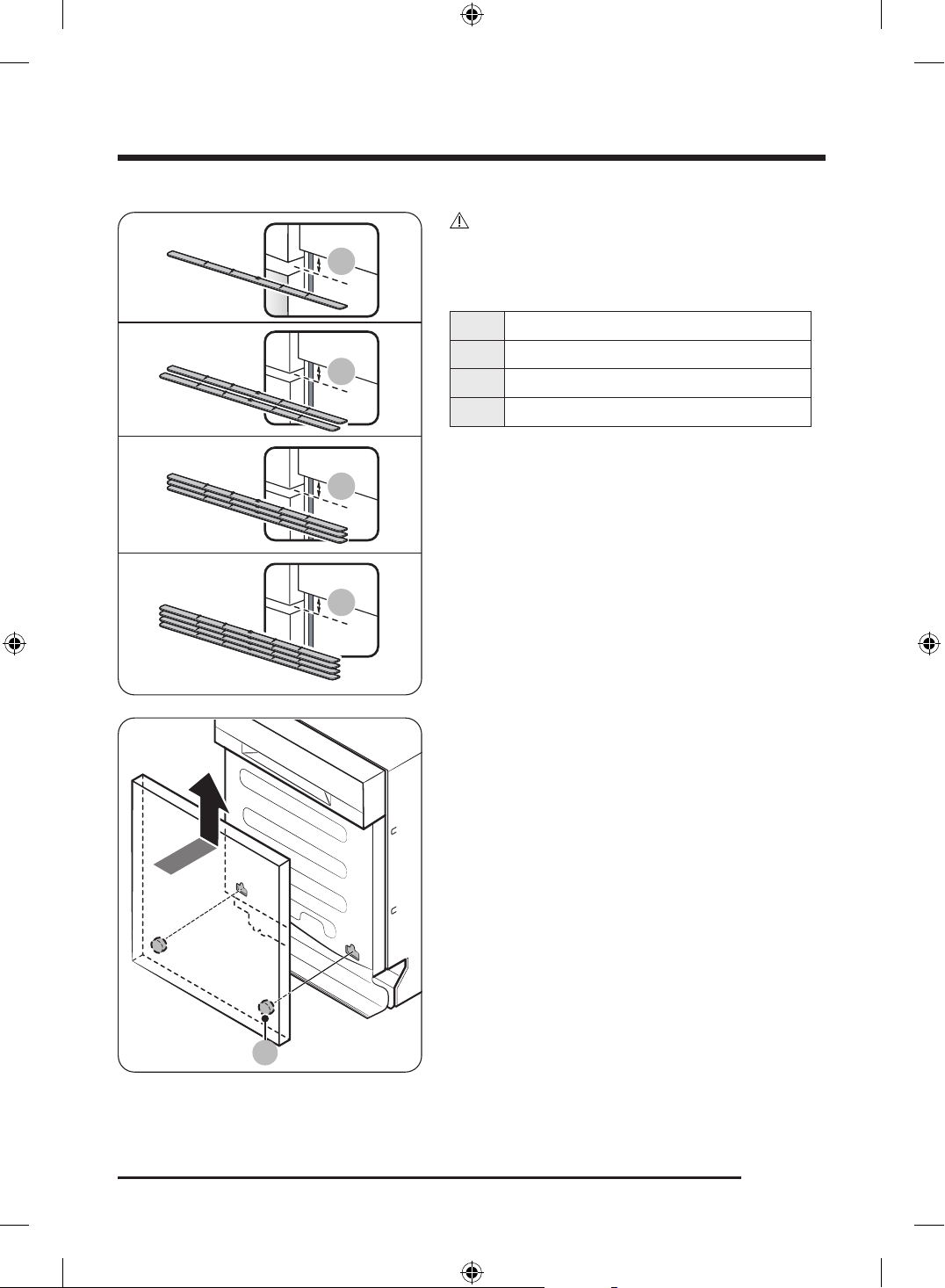
10. Attach single or multiple wood spacers whose overall
height fills the gap between the sink cabinet and the
control panel.
- The gap here is the same as the measurement in
step 5.
- For positioning and the number of spacers, see
the figures on the left.
Untitled-1 36Untitled-1 36 2024-07-08 10:40:242024-07-08 10:40:24
English 37
A
B
C
D
CAUTION
Do not let the overall height of the wood spacers exceed
the measured height difference. Otherwise, the custom
panel may not fit.
A 1 spacer (8.5 mm)
B 2 spacers (17 mm)
C 3 spacers (25.5 mm)
D 4 spacers (34 mm)
B
11. While holding the custom panel, attach it to the
door and insert the custom panel fixers (B) into the
corresponding holes near the bottom of the door as
shown.
12. Push the custom panel upward to fix.
Untitled-1 37Untitled-1 37 2024-07-08 10:40:242024-07-08 10:40:24
Installation
English38
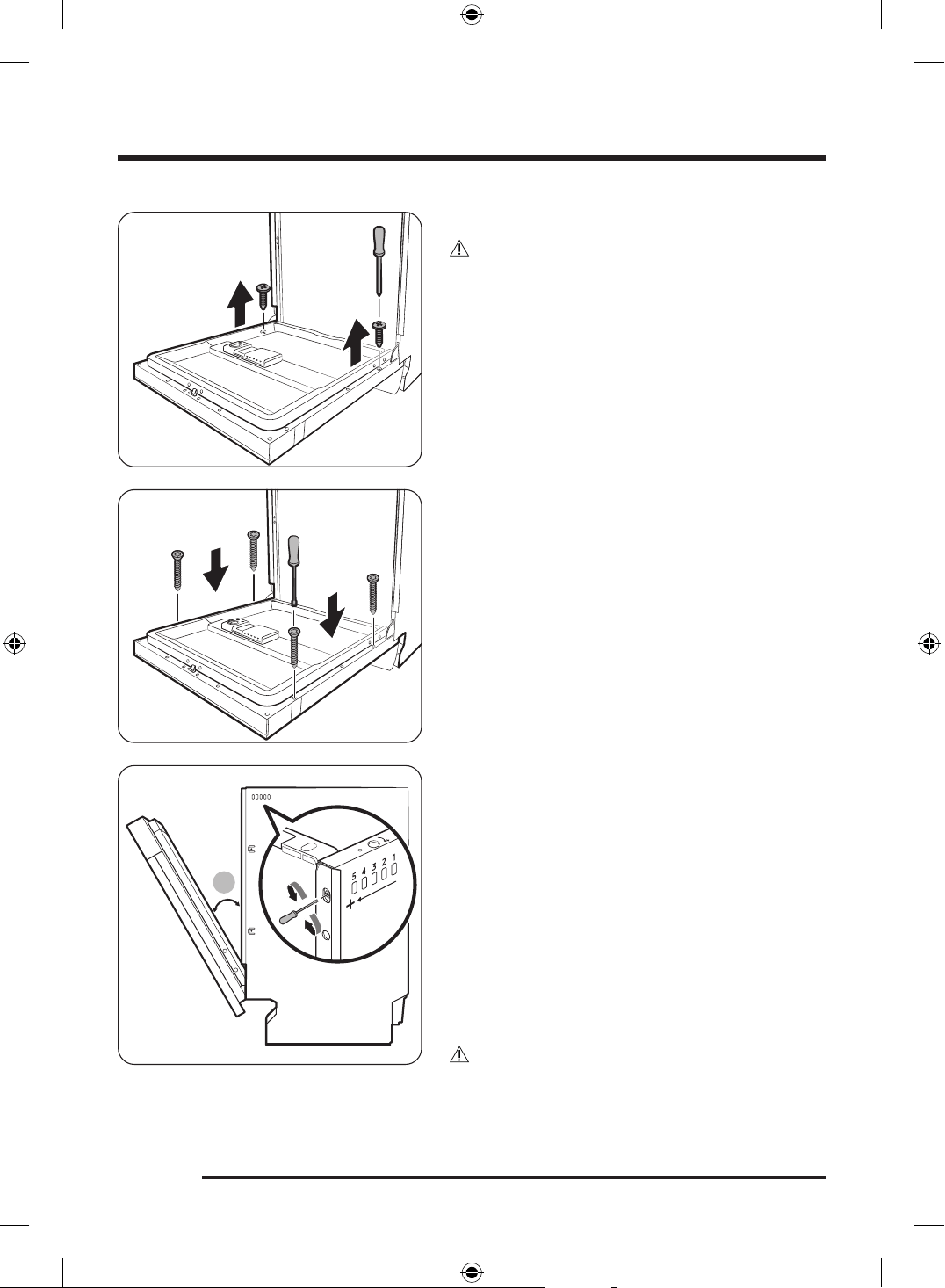
13. Open the dishwasher door and remove the 2 screws.
CAUTION
Use caution when opening the door. The door might
open or close unexpectedly if the spring level is not
adjusted appropriately, resulting in physical injury.
14. Secure the custom panel to the door by fastening the
4 screws (Ø4 X 43).
9:;<=
01
01 30°
15. Refer to the “Recommended spring levels” table
and adjust the spring level by turning the spring
screw with Torx T20 screwdriver on the front of the
dishwasher.
- Adjust the spring level while the door is
approximately opened at 30 degrees.
- The door should hold its position. It should not
fall open.
- If the door opens wider than 30 degrees, turn
the spring screw clockwise to tighten the spring
level. If the door opens narrower than 30 degrees,
turn the spring screw anticlockwise to loosen the
spring level.
CAUTION
Do not adjust the spring level while the door is
completely opened.
Untitled-1 38Untitled-1 38 2024-07-08 10:40:252024-07-08 10:40:25
English 39
Recommended spring levels
Level Weight of the custom panel (kg)
Level 1-2 2.5-4
Level 2-3 4-5
Level 3-4 5-6
Level 4-5 6-8
CAUTION
If the custom panel weighs more than 8 kg, the door may fall open. Custom panels weighing more than
8 kg are not recommended.
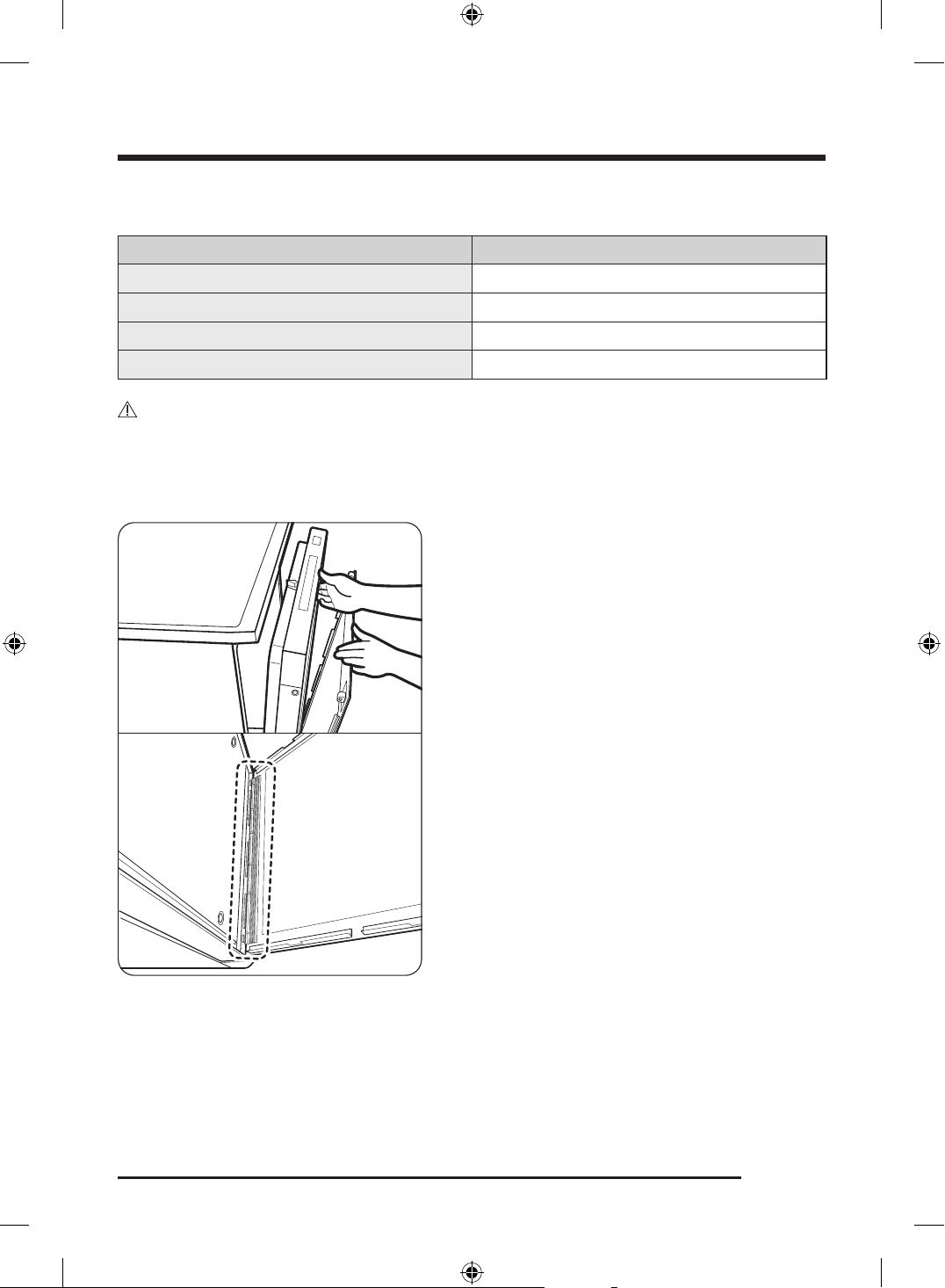
Bespoke models
1. Open the door and fit the custom panel in the front
bottom of the door.
Untitled-1 39Untitled-1 39 2024-07-08 10:40:252024-07-08 10:40:25
Installation
English40
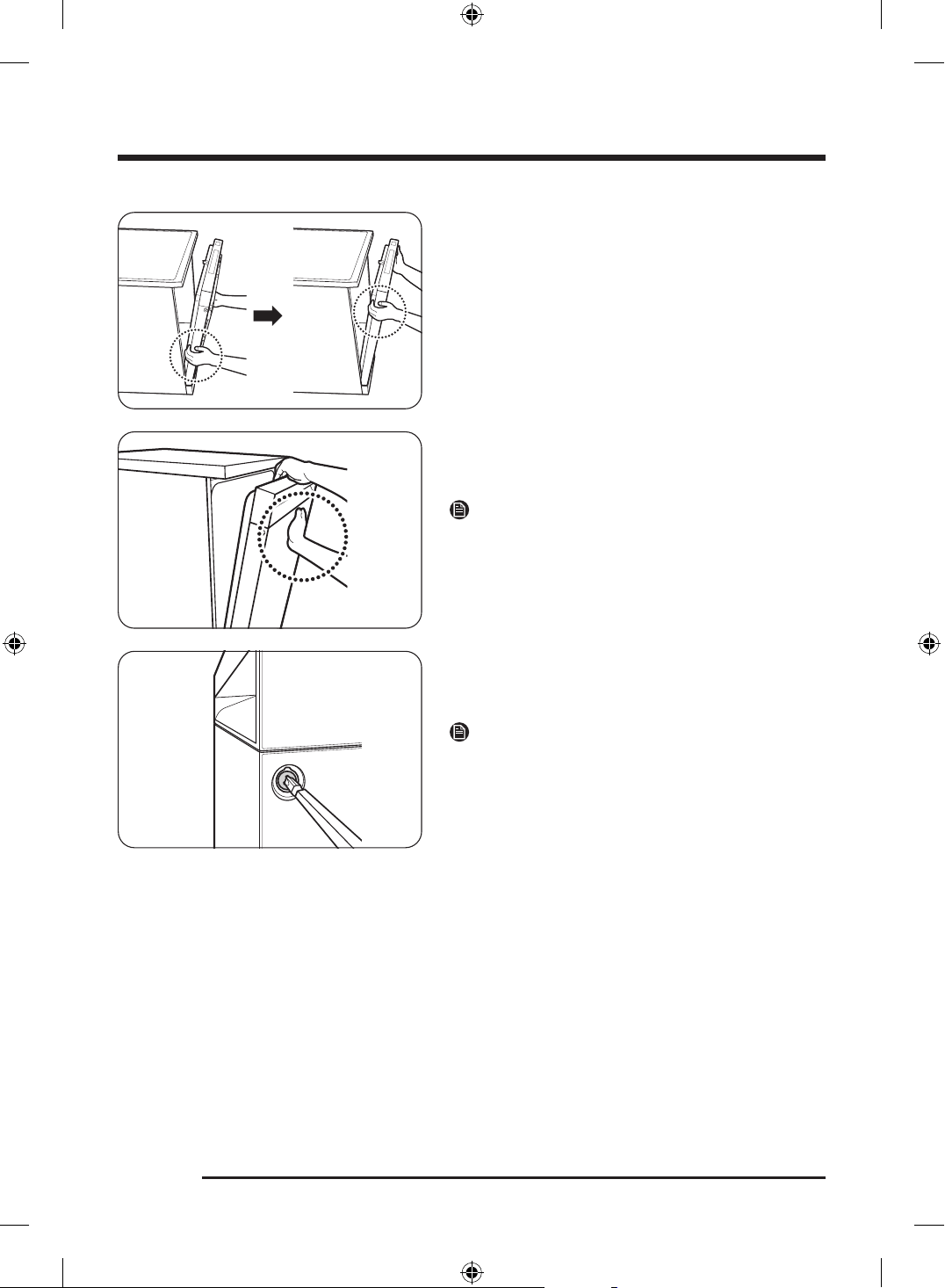
2. While holding the door and the custom panel with
both hands, press the panel evenly from bottom to
top to lock into the dishwasher.
3. When both sides of the panel lock into place, press
the top centre of the custom panel to secure it to the
top of the door.
NOTE
• Make sure that the custom panel fits in the
dishwasher properly.
• If the gap between the dishwasher and the custom
panel is below 2 mm, proper installation is done. For 2
mm or more, remove the custom panel and try again.
4. Unpack the caps and screws (two for each) included
in the product package.
5. Tighten the screws on either side of the dishwasher.
NOTE
When tightening the screw on either side, make sure to
check the gap between either side as the custom door
may lean in either side.
Untitled-1 40Untitled-1 40 2024-07-08 10:40:252024-07-08 10:40:25
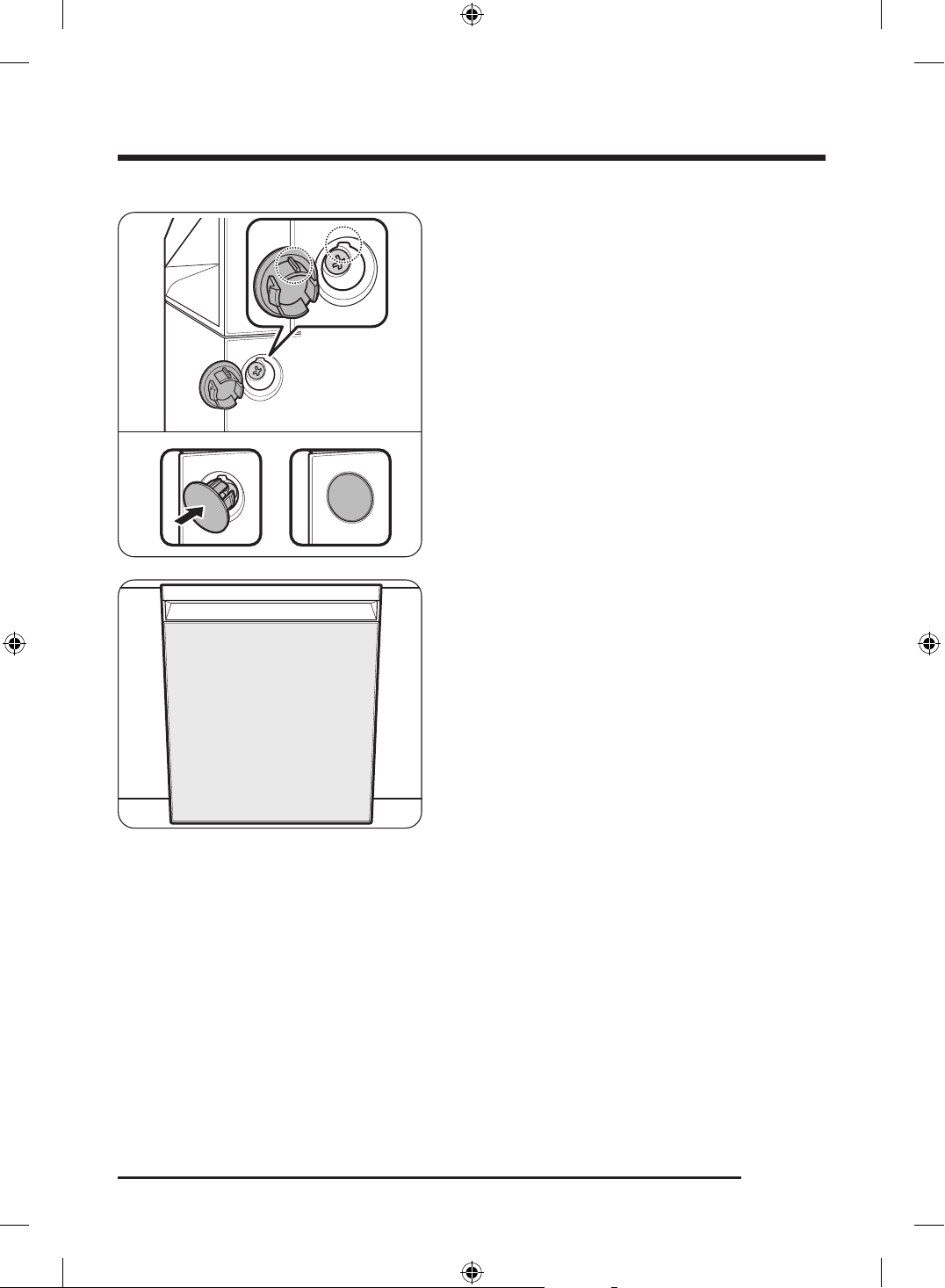
English 41
6. Insert the caps on either side. Make sure the rib of
the cap fits in the hole of the dishwasher in the right
direction.
7. This is the completion of mounting the custom panel.
Untitled-1 41Untitled-1 41 2024-07-08 10:40:252024-07-08 10:40:25
Installation
English42
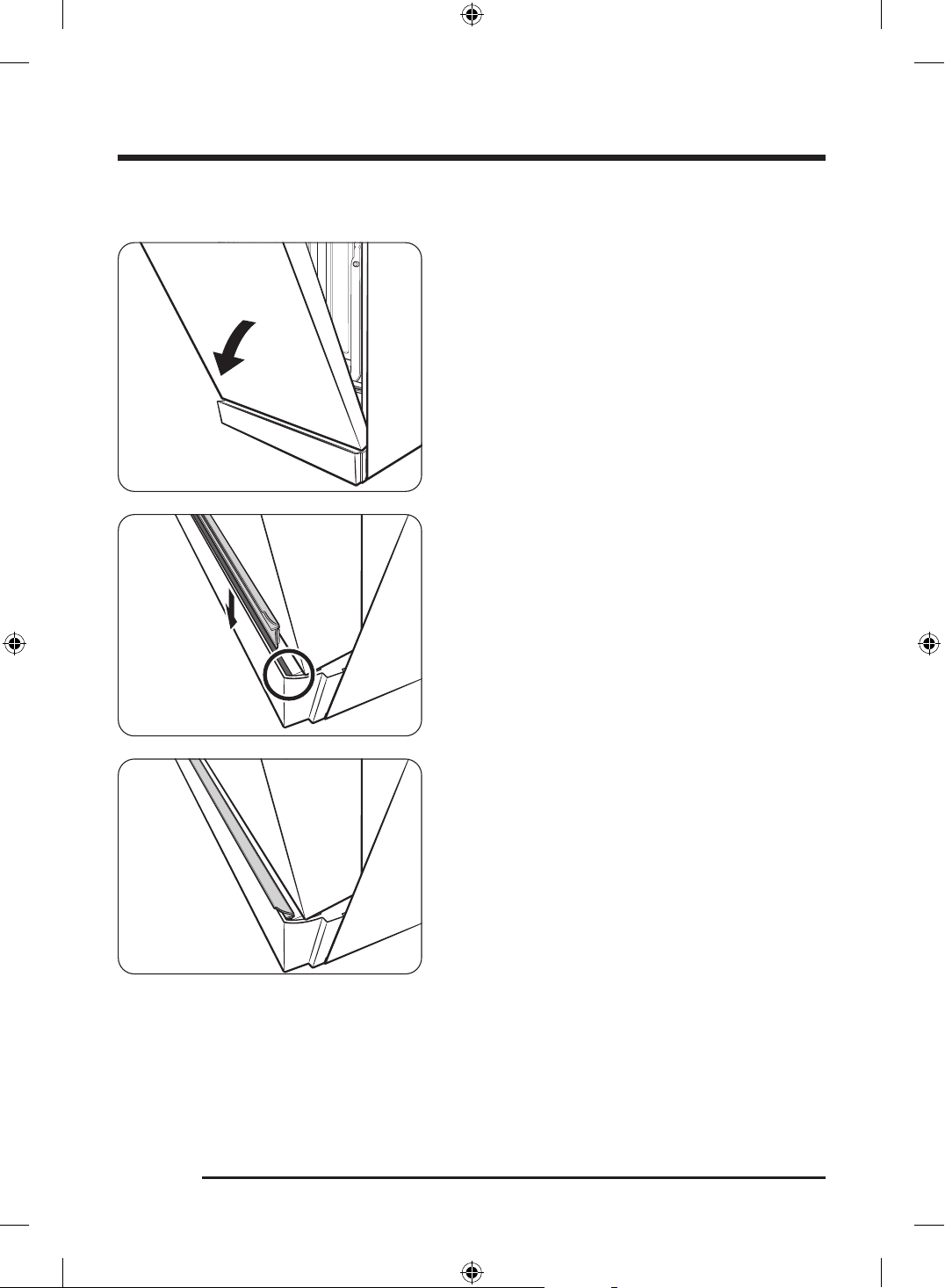
Attaching the trim (Applicable to some freestanding models only)
1. Open the door halfway down.
2. Insert the trim in the lower groove of the dishwasher.
3. This is how the trim looks after attachment.
Untitled-1 42Untitled-1 42 2024-07-08 10:40:262024-07-08 10:40:26
English 43
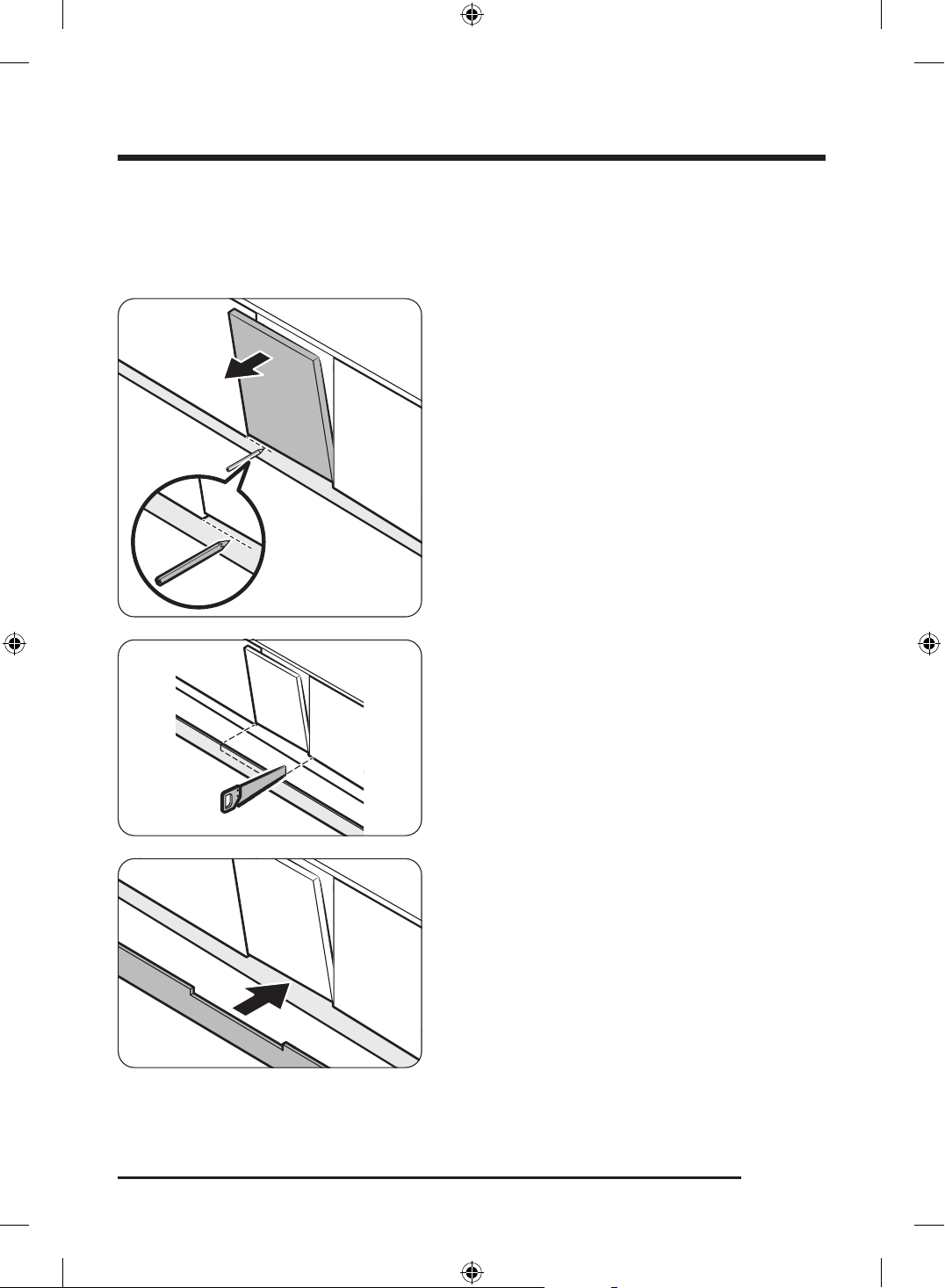
Attaching the skirting board
You can attach the skirting board according to the model or installation conditions.
Custom skirting board (Not applicable for free standing model)
1. Put the skirting board on the bottom of the
dishwasher.
2. Open the door of the dishwasher, and draw a baseline
on the skirting board where it interferes with the
door.
3. Follow the baseline and cut the skirting board using
a saw.
4. Attach the cut skirting board to the bottom of the
dishwasher. Make sure the board does not interfere
with the door of the dishwasher.
Untitled-1 43Untitled-1 43 2024-07-08 10:40:262024-07-08 10:40:26
Installation
English44
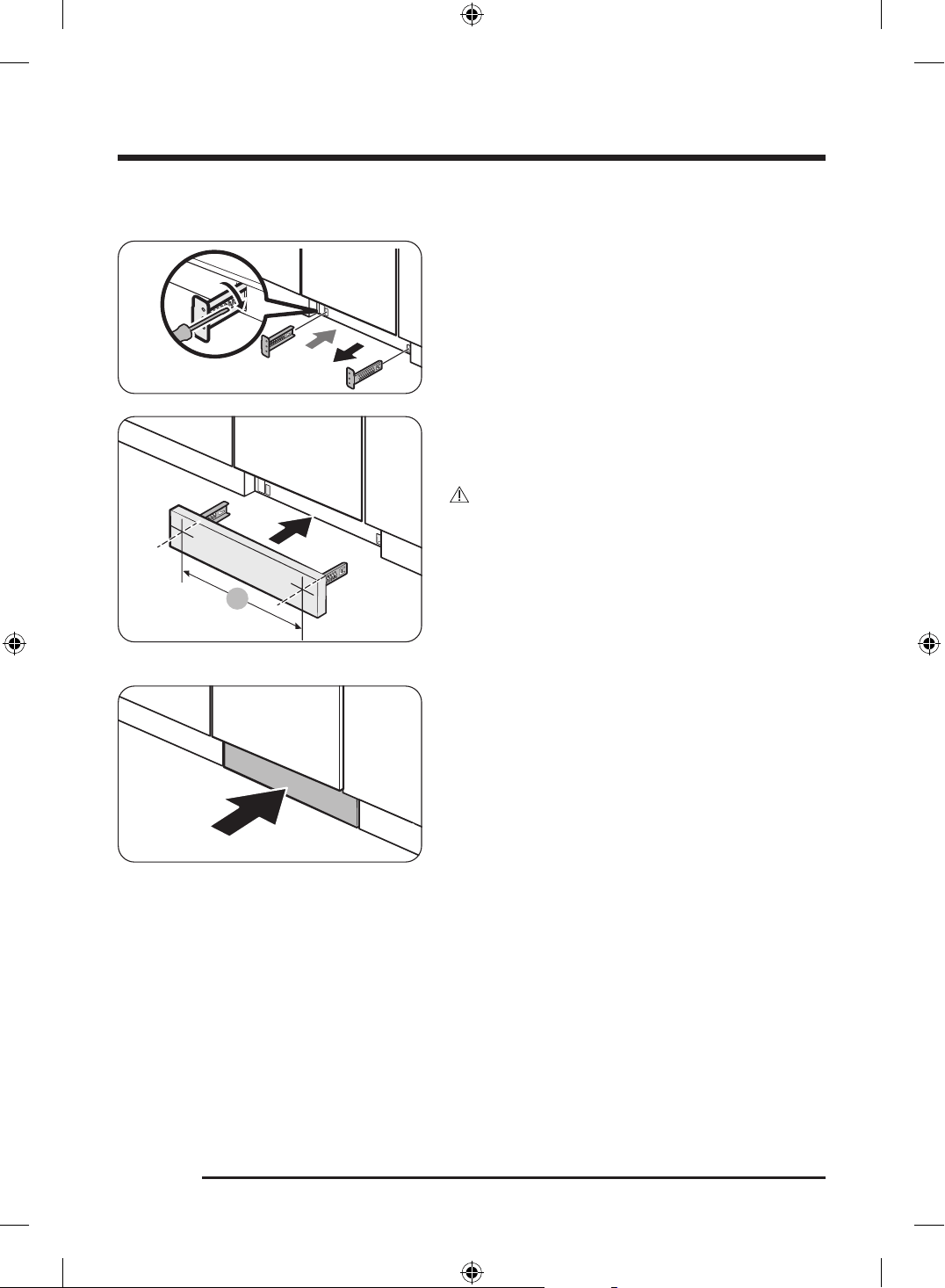
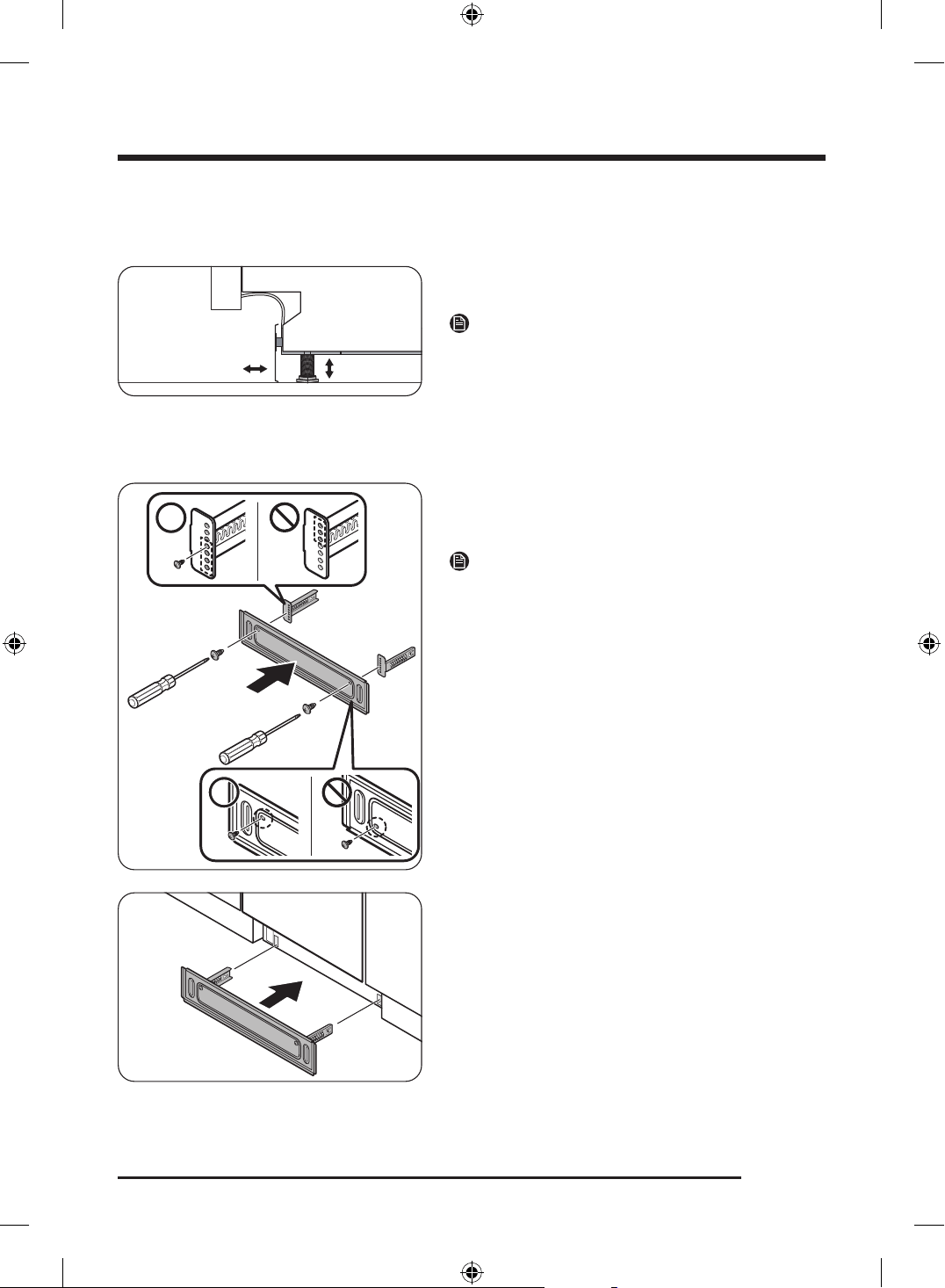
Pre-cut skirting board (Not applicable for free standing model)
1. Insert the kickplate brackets into the slots at the
bottom of the dishwasher and determine the
position. Then, bend the metal tab on each bracket
so that the kickplate does not slide in further than it
needs.
01
01 450 mm
2. Attach the pre-cut skirting board onto the kickplate
brackets using the screws. See the figure on the left
and make sure the brackets are positioned correctly.
CAUTION
Make sure the skirting board does not interfere when
the dishwasher’s door opens and closes.
3. Push the skirting board with the brackets into the
bottom of the dishwasher as shown.
Untitled-1 44Untitled-1 44 2024-07-08 10:40:272024-07-08 10:40:27
English 45
Attaching the kickplate (Built under sink models only)
If you want to install the kickplate, follow these instructions.
1. Turn the levelling feet of the dishwasher to adjust the
height so that the kickplate fits in.
NOTE
• For dishwasher models without the levelling feet,
turn the kickplate upside down so that the kickplate
fits in.
• Dishwashers with a height under 864 mm do not
support the installation of the kickplate. Attach the
skirting board instead.
2. Attach the kickplate to the dishwasher using the
kickplate brackets. Make sure the kickplate brackets
are in the correct direction. See the figure for details.
NOTE
Make sure the kickplate is in the right direction.
3. Push the kickplate attached to the brackets into the
bottom of the dishwasher as shown.
Untitled-1 45Untitled-1 45 2024-07-08 10:40:272024-07-08 10:40:27
English46
Before you start
Unsuitable items for the dishwasher
WARNING
Only wash items such as glass, porcelain, and cutlery which the manufacturer declares as dishwasher safe.
Do not wash aluminium (for example grease filters). The dishwasher may damage aluminium, or in extreme
cases, cause a severe chemical reaction.
Do not wash the following items in the dishwasher.
• Copper, brass, tin, ivory, and aluminium items or items with adhesive
• Non-heat resistant plastics
• Craft items, antiques, valuable vases, and decorative glassware
• Pottery or glazed-ceramic items
• Wooden or silver tableware or items that includes wooden or silver parts
• Delicate glassware or glassware containing the lead crystal. Clouding may occur on the glassware after
frequent washing.
CAUTION
• Do not wash items that are covered with ash, sand, wax, lubricating grease, or paint. These materials
will damage the dishwasher. Ash does not dissolve and will spread inside the dishwasher.
• Remove food remains such as bones, fruit seeds, etc. and waste such as toothpicks, paper napkins, etc.
from your dishes. Food remains and waste can make noise, cause the dishwasher to malfunction, and
damage your dishes and dishwasher.
NOTE
Silverware that has contacted foods containing sulphur may become discoloured. Food with sulphuric
content include egg yolks, onions, mayonnaise, mustard, fish, fish brine, and marinades.
Untitled-1 46Untitled-1 46 2024-07-08 10:40:272024-07-08 10:40:27
English 47
Basic use of racks
NOTE
Depending on the models, the actual appearance of the racks and the loading method may differ from the
figures.
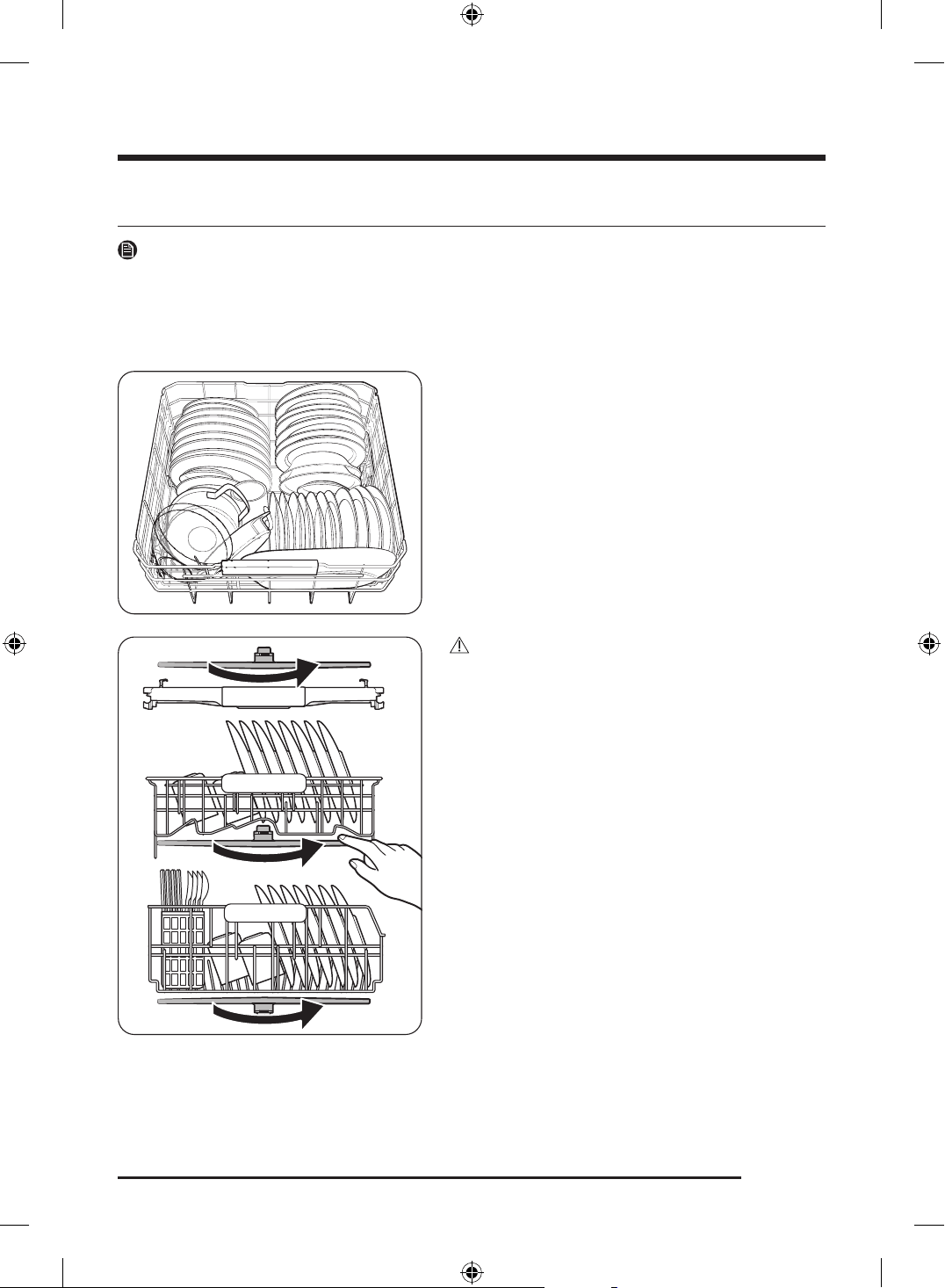
Loading the lower rack
• Lower rack is for loading large items such as pots,
pans, lids, serving dishes and bowls.
- Place the items in a way that water could easily
flow out.
- You can also use the lower rack to load smaller
items using the folding tines and glass supports.
- You can lift the upper rack to gain more space to
load larger items.
CAUTION
• Make sure the loaded items do not interfere with the
rotation of the middle and bottom spray arms.
- Check the rotation of the spray arms with your
hand before starting the dishwasher.
Untitled-1 47Untitled-1 47 2024-07-08 10:40:272024-07-08 10:40:27
Before you start
English48
Loading the upper rack
• The upper rack is for small plates, mugs, glasses, and
plastic items.
- You can adjust the position of the upper rack to
use the internal space flexibly.
CAUTION
• Make sure the loaded items do not interfere with the
rotation of the middle spray arm.
- Check the rotation of the spray arm with your
hand before starting the dishwasher.
• When loading items, completely pull out the upper
rack to prevent bumping the items to the counter
while loading.
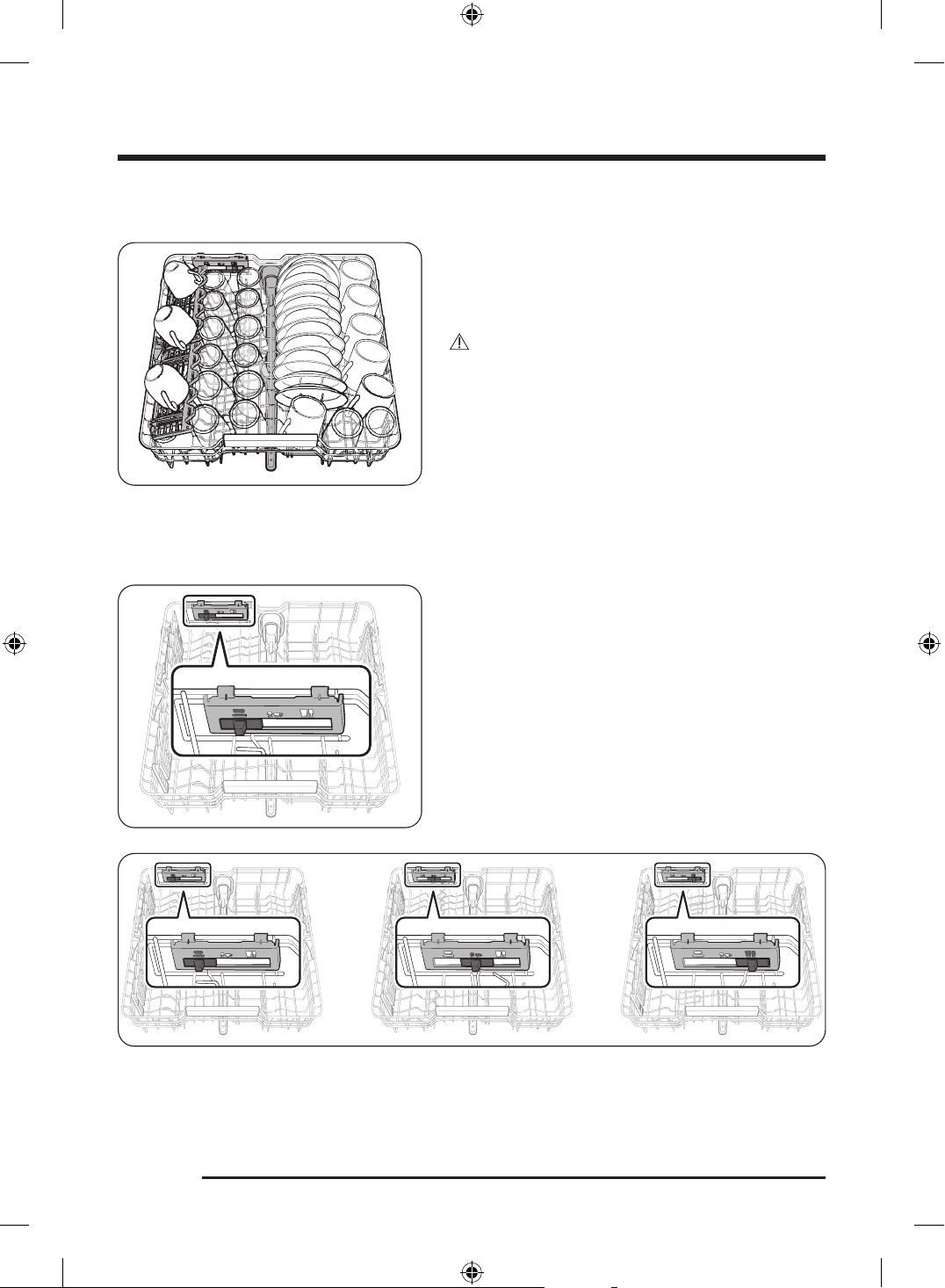
Using the guide tines
You can use the upper rack’s guide tines to load items
onto the upper rack in various ways. Move the slider
to the right, middle, or left to adjust the guide tines
suitable for loading the following items.
• Right: Standard wine glasses
• Middle: Shorter wine glasses or brandy glasses
• Left: Bowls and plates
Untitled-1 48Untitled-1 48 2024-07-08 10:40:282024-07-08 10:40:28
English 49
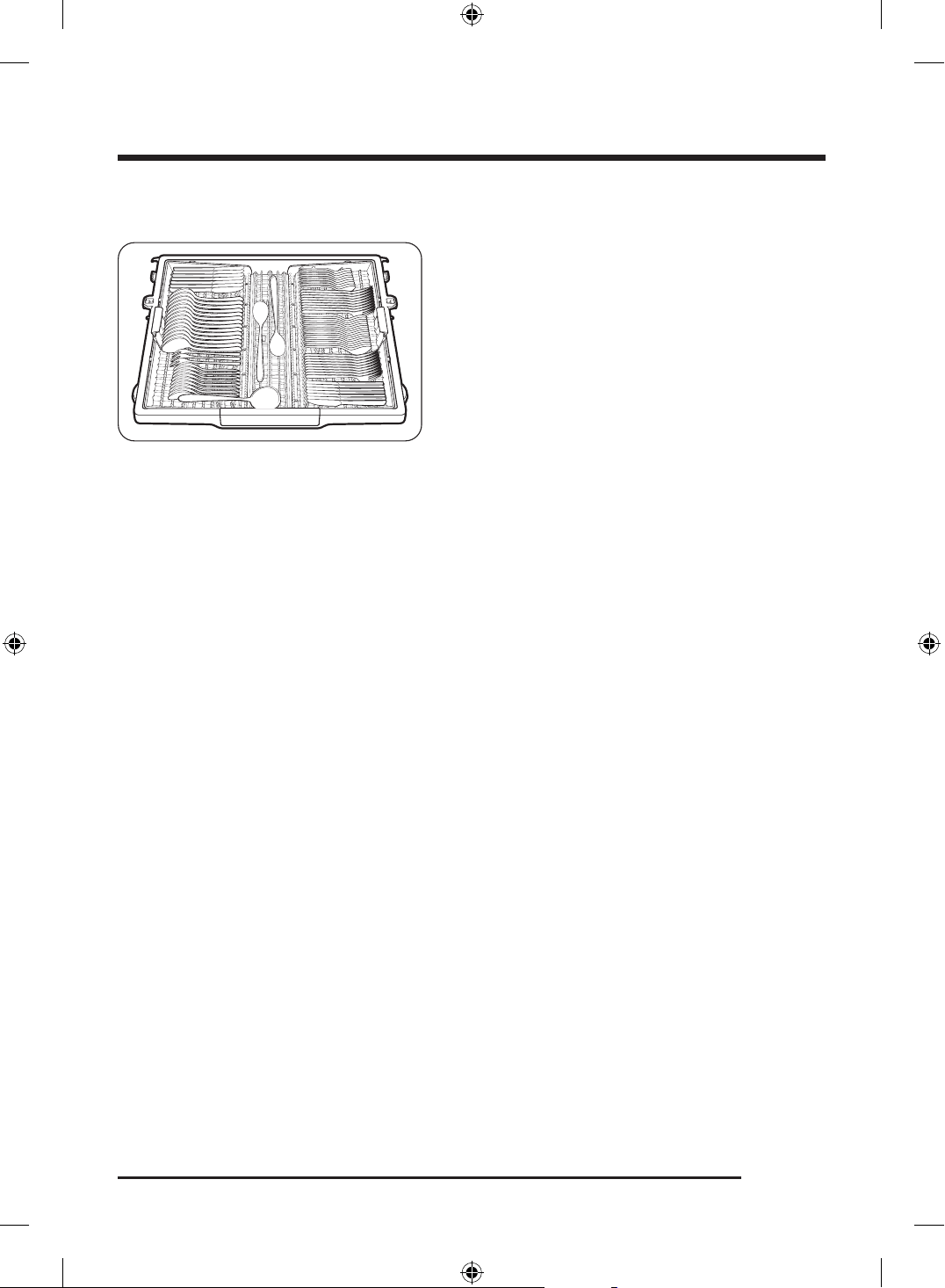
Loading the cutlery rack (Applicable models only)
The cutlery rack is best for flatware and cooking or
serving utensils.
Untitled-1 49Untitled-1 49 2024-07-08 10:40:282024-07-08 10:40:28
Before you start
English50
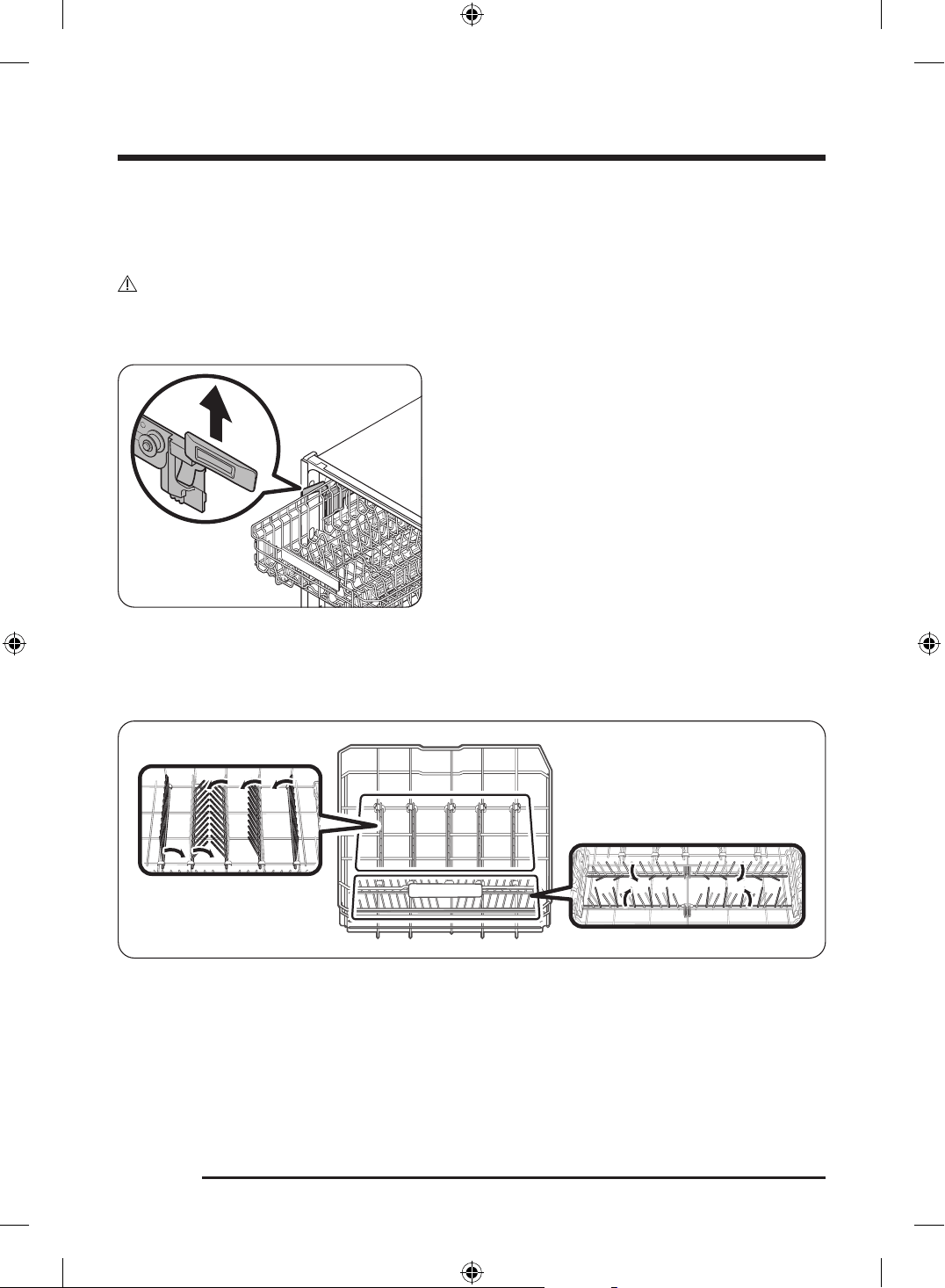
Adjusting the position of the upper rack
You can adjust the position of the upper rack to adjust the loading space according to the items you load to
the upper and lower racks.
CAUTION
• Adjust the upper rack position before loading items into the rack to prevent damaging the items.
• Make sure to hold both handles when adjusting, or the dishwasher door may not close properly.
• To raise the upper rack, lift the upper rack. The
adjustable handle will latch, and the upper rack will
raise.
- You will have more loading space in the lower
rack.
• To lower the upper rack, hold both the adjustable
handles located at the left and right sides of the
upper rack and then evenly press down.
- You will have more loading space in the upper
rack.
Using the tines
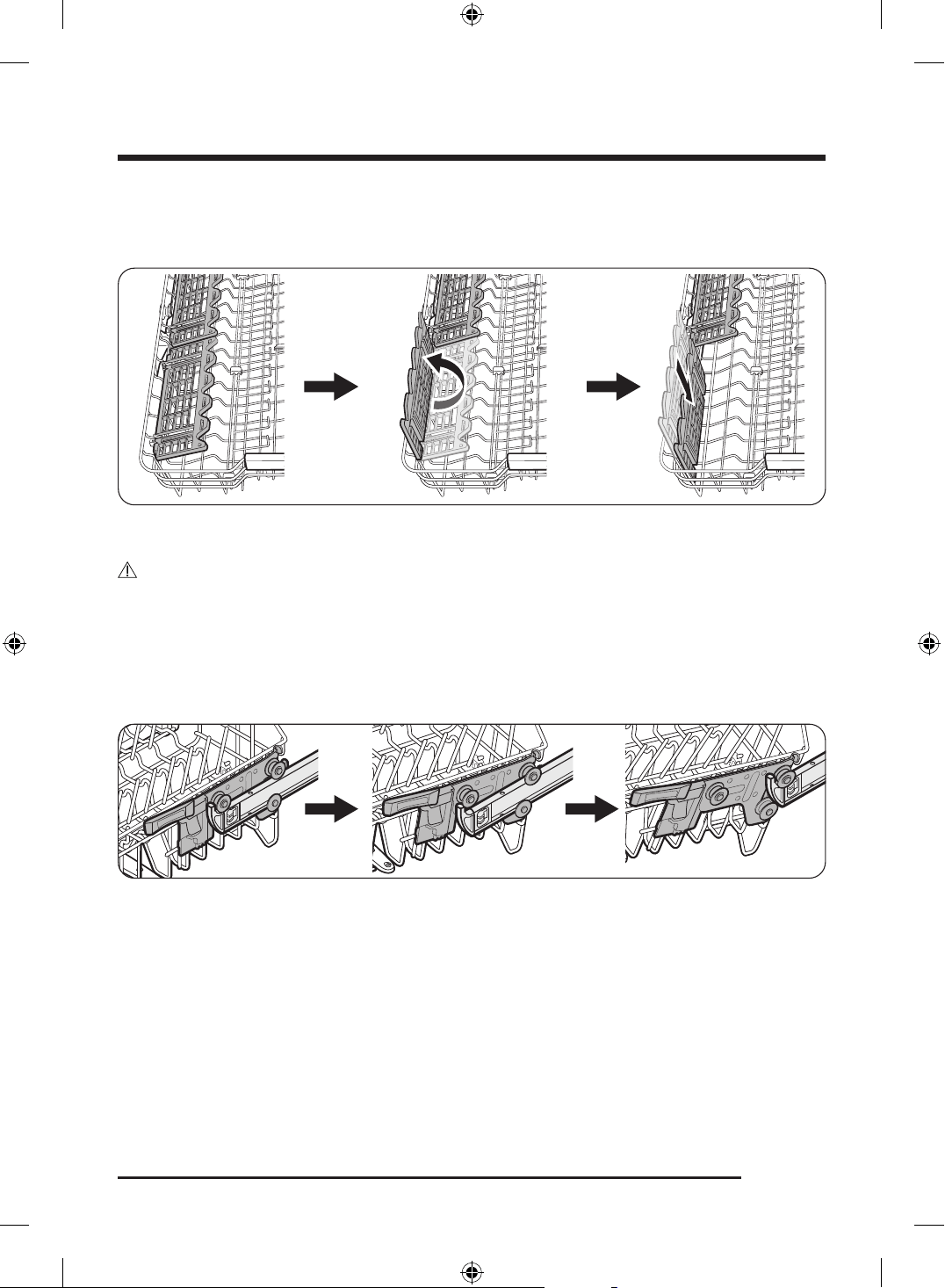
Fold or unfold the tines depending on the items you load.
Fold them for better stacking of pots and pans and unfold them to load items such as dishes.
Untitled-1 50Untitled-1 50 2024-07-08 10:40:292024-07-08 10:40:29
English 51
Using the glass support
The glass support is especially suited for wine glasses. Hang wine glasses onto the pegs of the glass
support. Fold the glass support back when it is not being used.
Removing the upper rack
CAUTION
• Do not operate the dishwasher without the upper rack. Otherwise, noises occur and the dishwasher
does not operate properly.
• Because the upper rack is removable, insert the upper rack properly to ensure the dishwasher operates
normally.
Pull the upper rack to the front until it is fully extended, and then lift it slightly to remove it. See the
following figures.
Untitled-1 51Untitled-1 51 2024-07-08 10:40:292024-07-08 10:40:29
Before you start
English52
Detergent compartment
You must put detergent into the detergent compartment before every cycle. Put a recommended amount
of detergent for the selected cycle for the best performance.
WARNING
• Do not place dishwasher detergent in your mouth. Avoid breathing in detergent fumes.
- Dishwasher detergent contains irritants and caustic chemicals that can induce respiratory
conditions.
- If you have consumed dishwasher detergent or inhaled detergent fumes, seek medical attention
immediately.
• Keep dishwasher detergent out of children’s reach.
CAUTION
Use dishwasher detergent only. Other types of detergent produce excessive foam, which may decrease the
dishwasher’s performance or cause it to malfunction
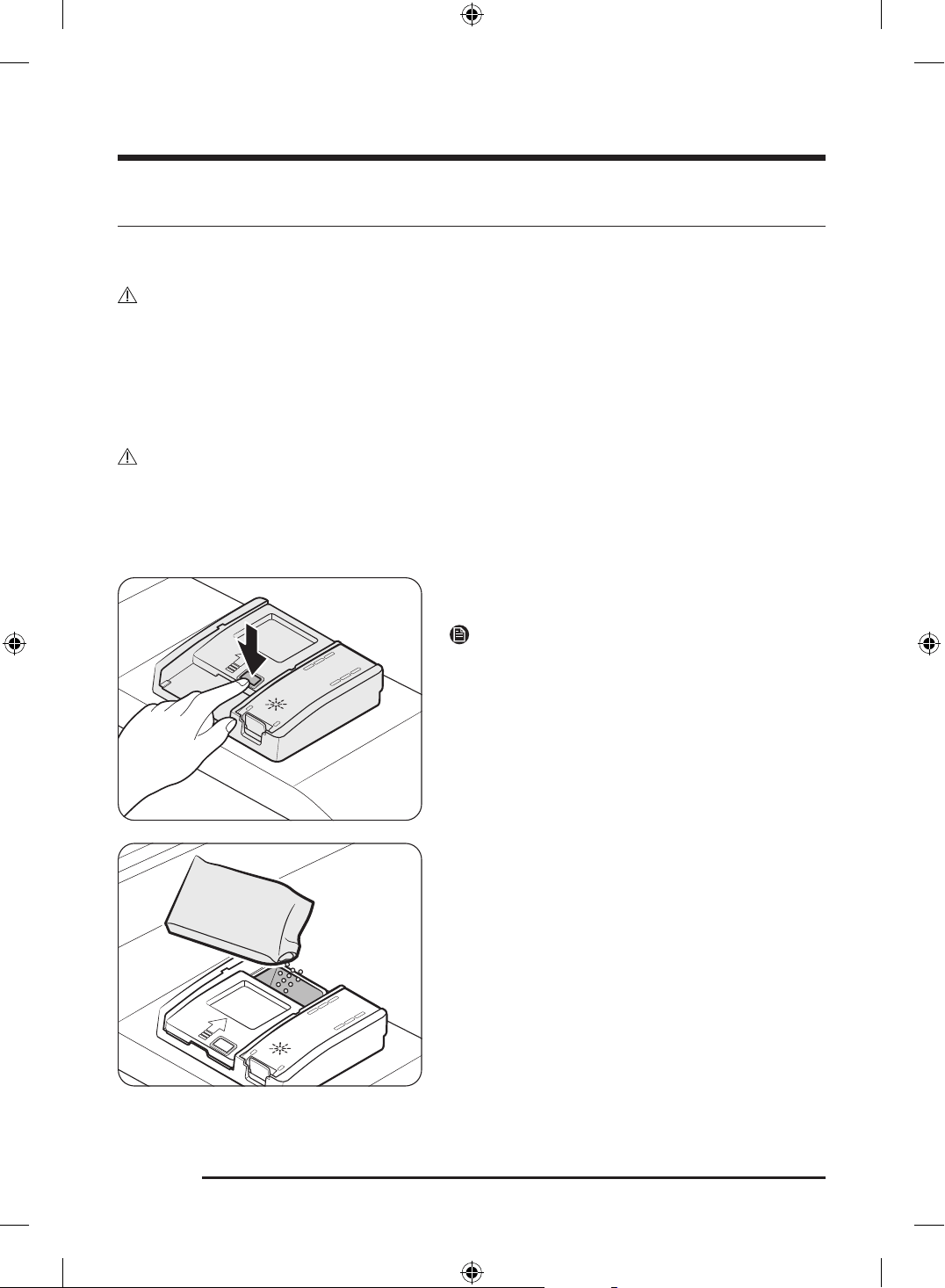
Filling the detergent
1. Press the button on the detergent compartment
cover to open the detergent compartment cover.
NOTE
The cover remains open at the end of a cycle.
2. Add the recommended amount of detergent into the
detergent compartment.
Untitled-1 52Untitled-1 52 2024-07-08 10:40:292024-07-08 10:40:29
English 53
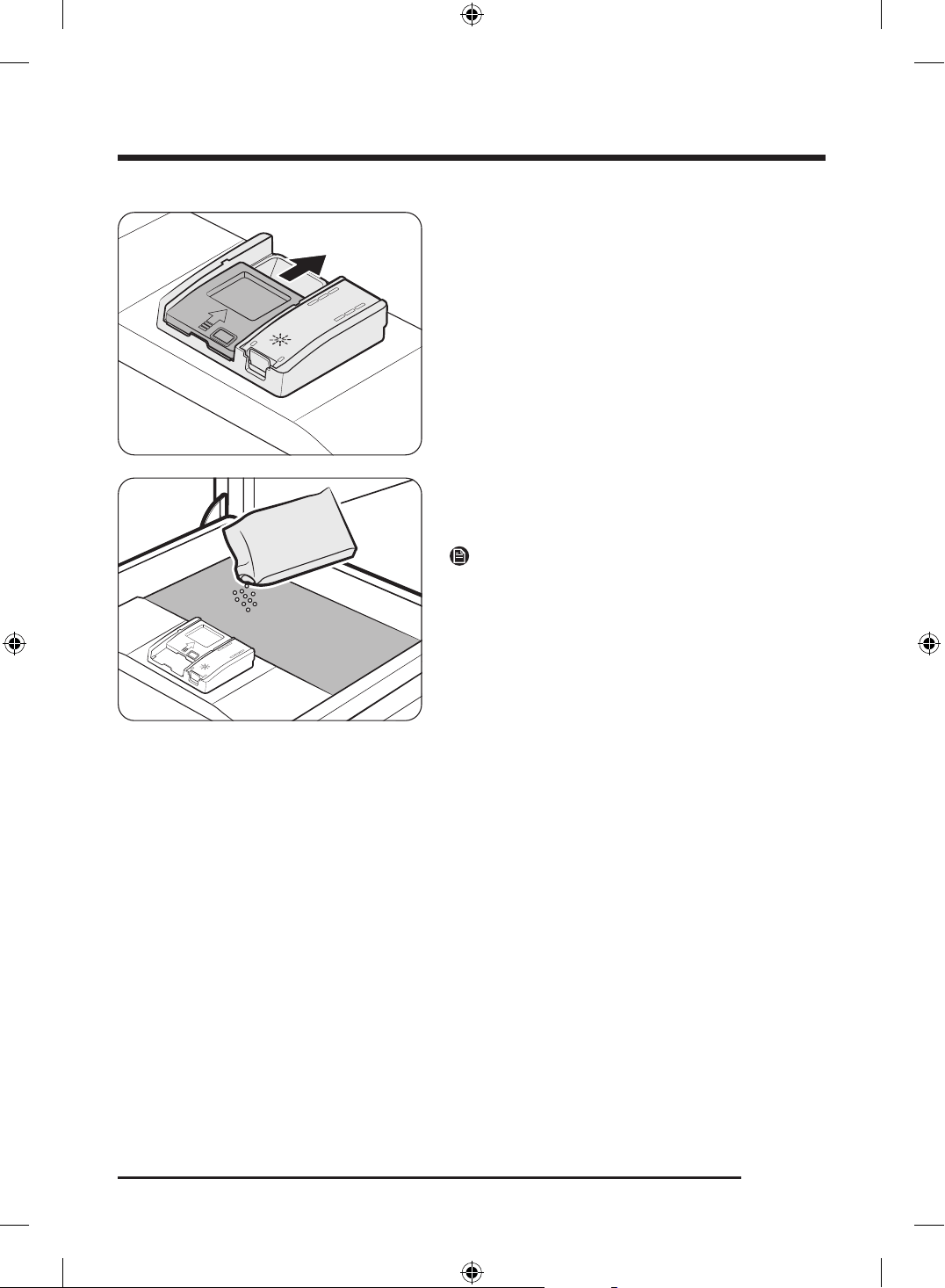
3. Slide the cover in the direction of the arrow to close
it.
4. If the items are heavily soiled, pour a small amount of
detergent onto the door for the pre-wash process to
get better cleaning results.
NOTE
The cover opens automatically to dispense the detergent
during the wash.
Untitled-1 53Untitled-1 53 2024-07-08 10:40:302024-07-08 10:40:30
Before you start
English54
Rinse aid compartment
• Rinse aid improves the drying performance of the dishwasher.
• Refill the rinse aid compartment when you get a rinse refill alert message on the control panel.
• Only use a liquid rinse aid. A Powdered rinse aid will clog the opening of the compartment causing the
dishwasher to malfunction.
• You can set the desired amount of rinse aid to dispense during each cycle. (Refer to the “Settings”
section for more information.)
CAUTION
• Do not apply any type of detergent to the rinse aid compartment.
• Do not excessively fill the rinse aid compartment as it may overflow during a cycle.
Filling the rinse aid
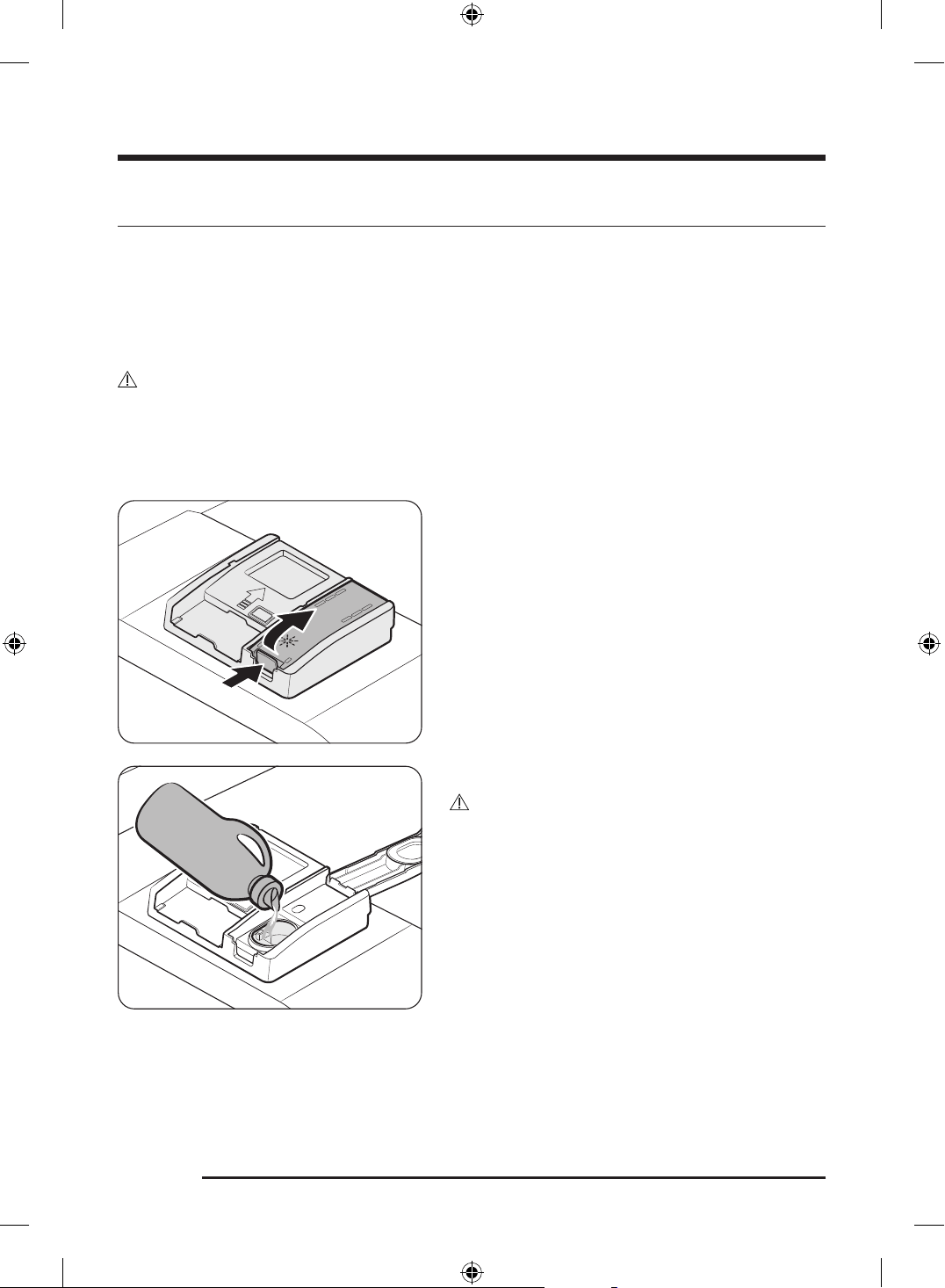
1. Open the rinse aid compartment cover
2. Fill the rinse aid compartment with the rinse aid.
CAUTION
Do not fill the rinse aid over the max line in the
compartment. Excess rinse aid can overflow during the
wash cycle.
Untitled-1 54Untitled-1 54 2024-07-08 10:40:302024-07-08 10:40:30
English 55
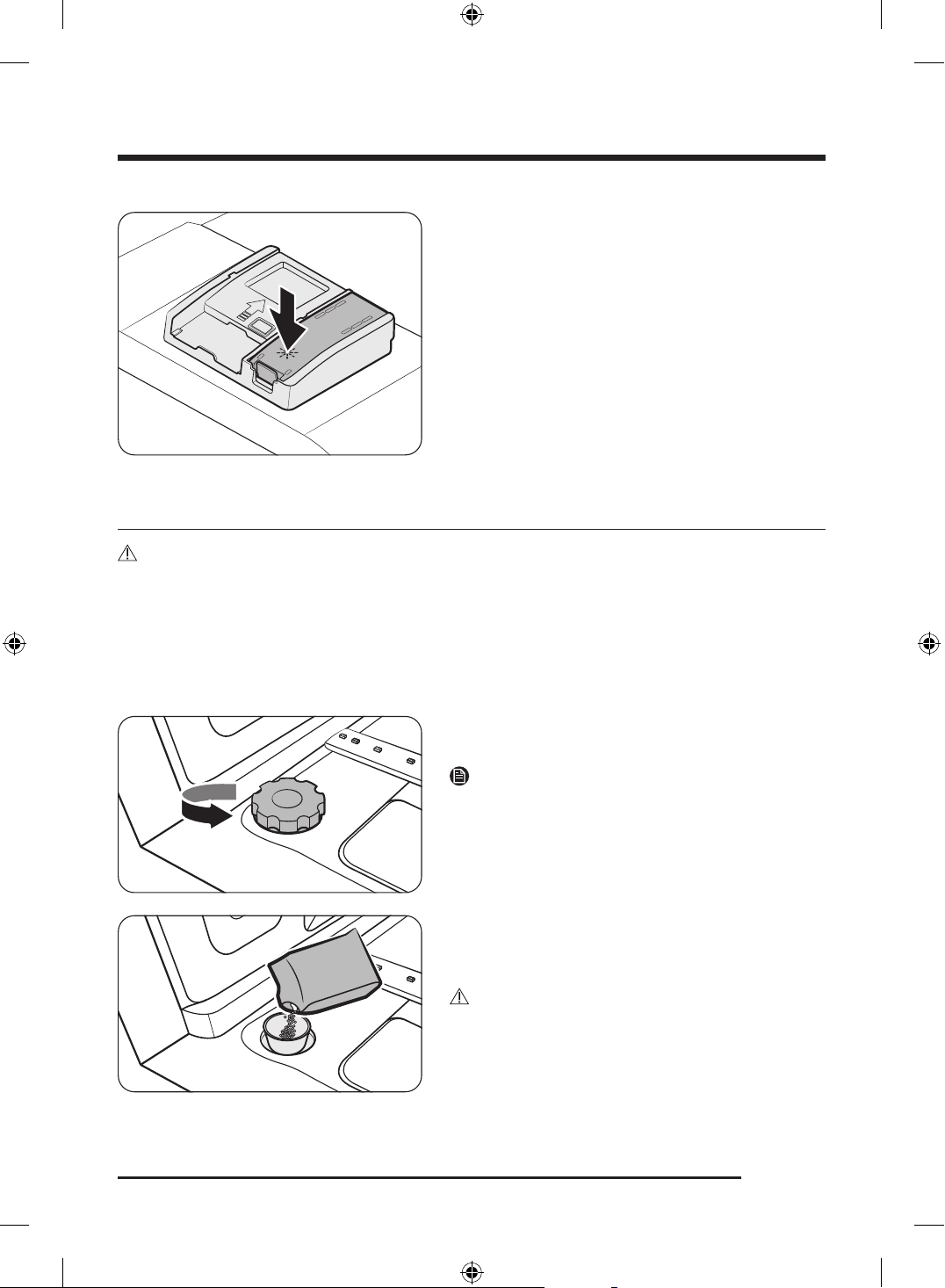
3. Close the rinse aid compartment cover.
Salt storage
CAUTION
• Use dishwasher-specific salt only. Do not use any other type of salt or solvent as it may damage the salt
storage and the water softening system.
• To prevent corrosion caused by an excessive amount of salt or salty water, always fill the salt storage
before a washing cycle gets started.
Filling the salt storage
1. Open the door.
2. Turn the cap counterclockwise to open.
NOTE
When you open the salt storage lid, water inside the
storage may flow out.
3. Fill the salt storage with water (only required when
using the dishwasher for the first time).
4. Fill the dishwasher salt into the salt storage.
CAUTION
• The maximum capacity is about 1 kg. Do not exceed
the capacity.
• Exceeding the capacity may affect the dishwasher's
performance.
Untitled-1 55Untitled-1 55 2024-07-08 10:40:302024-07-08 10:40:30
Before you start
English56
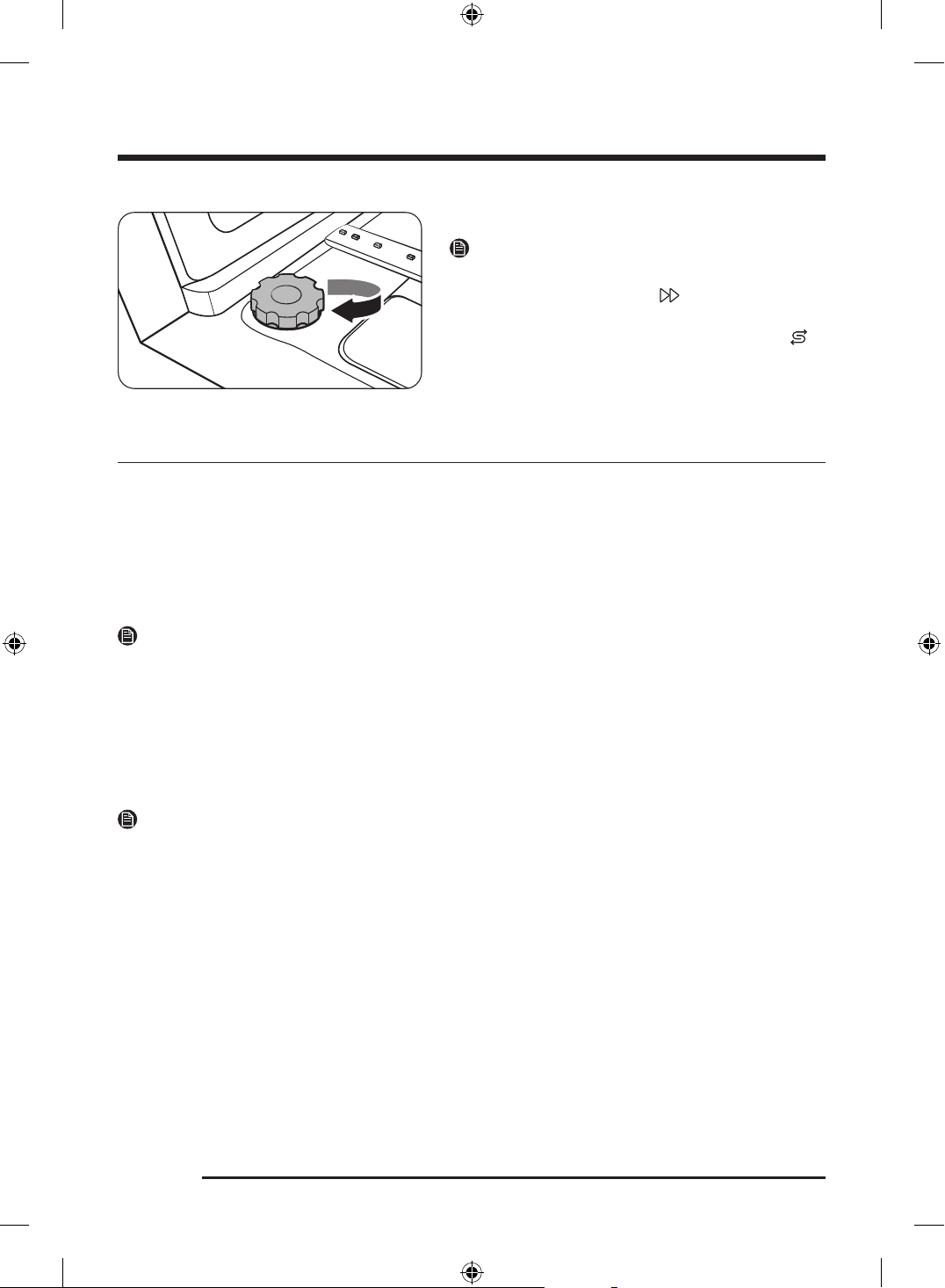
5. Turn the cap clockwise to close.
NOTE
• To clean excess salt or salt water from the
dishwasher, run the Express cycle.
• Depending on the size of the salt grains, it may take
a while for the salt to dissolve and the indicator (
) to turn off.
SmartThings
Wi-Fi connection
On your phone, go to Settings and connect to your home Wi-Fi network.
Download
On an app market (Google Play Store, Apple App Store, Samsung Galaxy Apps), find the SmartThings app
with a search term of “SmartThings”. Download and install the app on your device.
NOTE
• The SmartThings app is designed for Android 8.0 or later, IOS 13.0 or later.
• For improved performance, the SmartThings app is subject to change without notice, or discontinued
support according to the manufacturer’s policy.
Log in
You must first log into SmartThings with your Samsung account. To create a new Samsung account, follow
the instructions on the app. You don’t need a separate app to create your account.
NOTE
If you have a Samsung account, use the account to log in. A registered Samsung phone user automatically
logs in.
To register your device to SmartThings
1. Make sure your phone is connected to a wireless network.
2. Run SmartThings on your phone. iPhone users are required to provide the login information each time
they access the app.
3. When a message of “A new device is found.”, select Add.
4. If no message appears, select + and select your dishwasher in a list of devices available. If your
dishwasher is not listed, select Device Type > Specific Device Model, and then add your dishwasher
manually.
Untitled-1 56Untitled-1 56 2024-07-08 10:40:302024-07-08 10:40:30
English 57
5. Follow the on-screen instructions to complete the connection process for your dishwasher. Press and
hold Smart Control for more than 5 seconds until the “AP” message appears on the display. Your
dishwasher will be registered with the app.
6. When the process is complete, your dishwasher will appear in the list of devices on your SmartThings
App.
7. Tap the dishwasher icon to open the dishwasher page.
8. When a network connection is established, the Wi-Fi icon lights up on your dishwasher.
Dishwasher app
Integrated control: You can monitor and control your dishwasher both at home and on the go.
• Select the dishwasher icon on SmartThings. The dishwasher page appears.
• Check the operation status or notifications related to your dishwasher, and change options or settings if
necessary.
NOTE
• This device is designed for household use only (Class B), and can be used in all residential areas.
• This device may cause wireless interference, and neither the manufacturer nor the installer of this
device can provide a safety measure of any kind.
• Recommended encryption methods are WPA/TKIP and WPA2/AES. Newly developed Wi-Fi protocols or
unapproved Wi-Fi protocols are not supported.
• The reception sensitivity of a wireless network may be affected by surrounding wireless environments.
• If your Internet provider has registered the MAC address of your PC or the modem module for
permanent use, your Samsung dishwasher fails to connect to the Internet. If this happens, contact your
Internet provider.
• The Internet firewall may interrupt your Internet connection. If this happens, contact your Internet
provider.
• If Internet failure continues after following the measurement of your Internet provider, contact a local
Samsung retailer or service centre.
• For installing wired and wireless routers, refer to the user manual of the router you use.
• Samsung dishwasher supports the Wi-Fi 2.4 GHz protocols.
• Samsung dishwasher supports the IEEE802.11 b/g/n (2.4 GHz), Soft-AP protocols. (IEEE802.11n is
recommended)
• An unapproved wired/wireless router may fail to connect to Samsung dishwasher.
• The SmartThings app is available on Android devices with OS 8.0 or higher and iOS devices with iOS 13
or higher. The app is optimised for Samsung phones (Galaxy S and Note series).
• Some functions of the app may operate differently on third-party devices.
• The app is subject to change without notice for improved performance.
• In addition, further updates on the app or the function in the app may stop caused by usability and
security reasons, even if updates are currently supported on your OS.
• Your device uses non-harmonised frequency and is intended for use in all European countries. The
WLAN can be operated in the EU without restriction indoors, but cannot be operated outdoors in France.
• You can easily install the SmartThings app or use the product with your phone by scanning the QR code
on the attached label.
Untitled-1 57Untitled-1 57 2024-07-08 10:40:312024-07-08 10:40:31
Before you start
English58
• Hereby, Samsung Electronics, declares that the radio equipment type appliance is in compliance with
Directive 2014/53/EU. The full text of the EU declaration of conformity is available at the following
internet address: The official Declaration of conformity may be found at http://www.samsung.com, go
to Support > Search Product Support and enter the model name.
• The overall standby power consumption is 2.0 W in which all network ports stay in “on” condition.
- Data determined according to standard EN 50564 and Regulation (EC) No 1275/2008
Wi-Fi
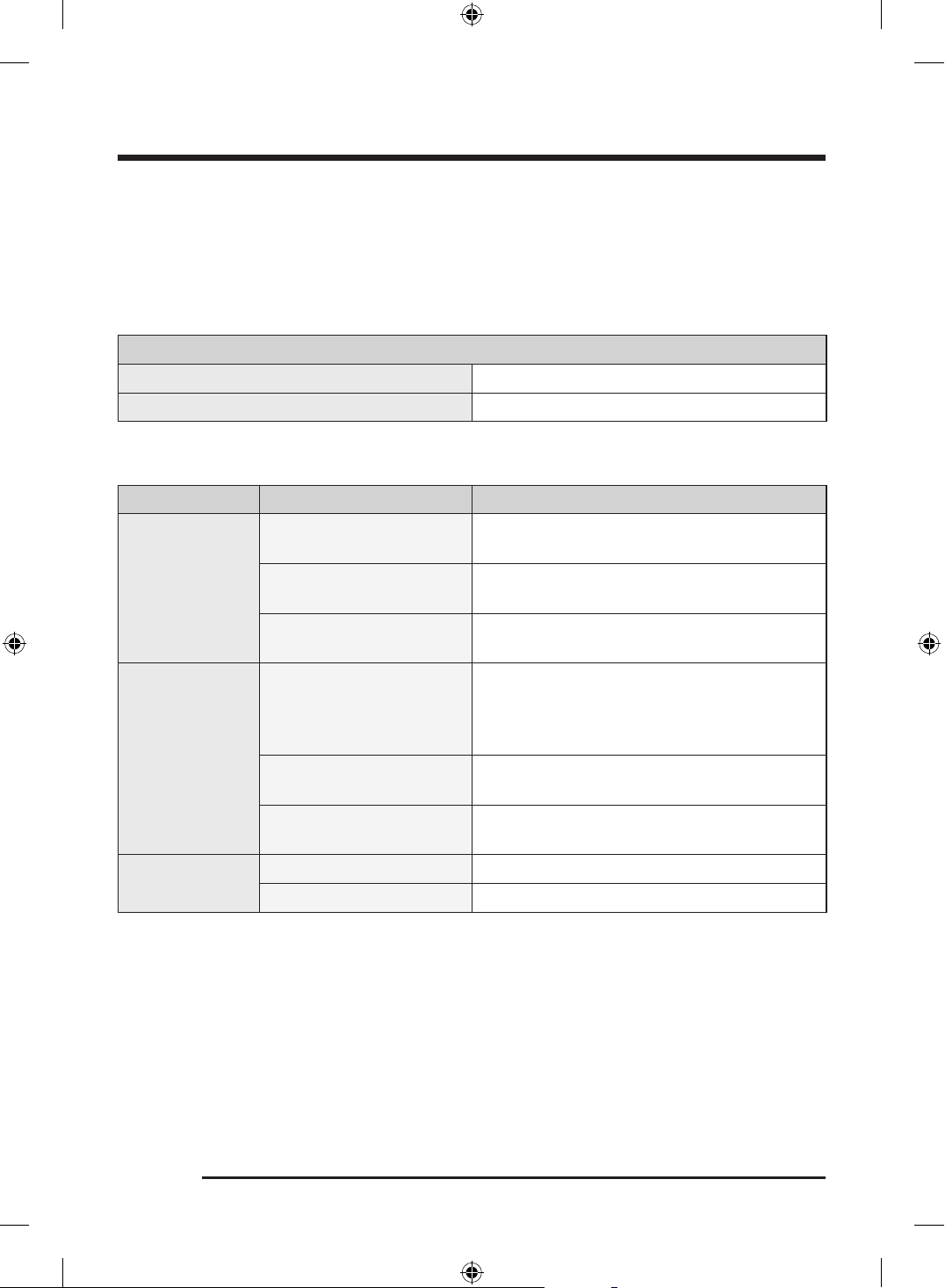
Frequency range Transmitter power (Max)
2412 MHz - 2472 MHz 20 dBm
SmartThings functions
Category Function Description
Monitoring
Washing status
You can check the current cycle and its options,
and the remaining cycle time.
Smart Control
The Smart Control status is shown for the
dishwasher.
Energy monitoring
Use this to monitor the energy consumption
status.
Control
Start/Pause/Cancel
Select a cycle and necessary options, and then
select Start/Pause/Cancel to start an operation,
to stop temporarily, or to cancel the current
operation.
My Favorite
Add frequently used cycles and options to My
Favorite for later use.
Delay Start
Set Delay Start to start the cycle at a scheduled
time (up to 24 hours).
Notification
Cycle completed Notifies you when the current cycle is complete.
Detergent Notifies you if the dishwasher is out of rinse aid.
Untitled-1 58Untitled-1 58 2024-07-08 10:40:312024-07-08 10:40:31
English 59
Open Source Announcement
The software included in this product contains open source software.
The following URL http://opensource.samsung.com/opensource/SMART_TP1_0/seq/0 leads to open source
license information as related to this product.
Untitled-1 59Untitled-1 59 2024-07-08 10:40:312024-07-08 10:40:31
English60
Operations
Control panel
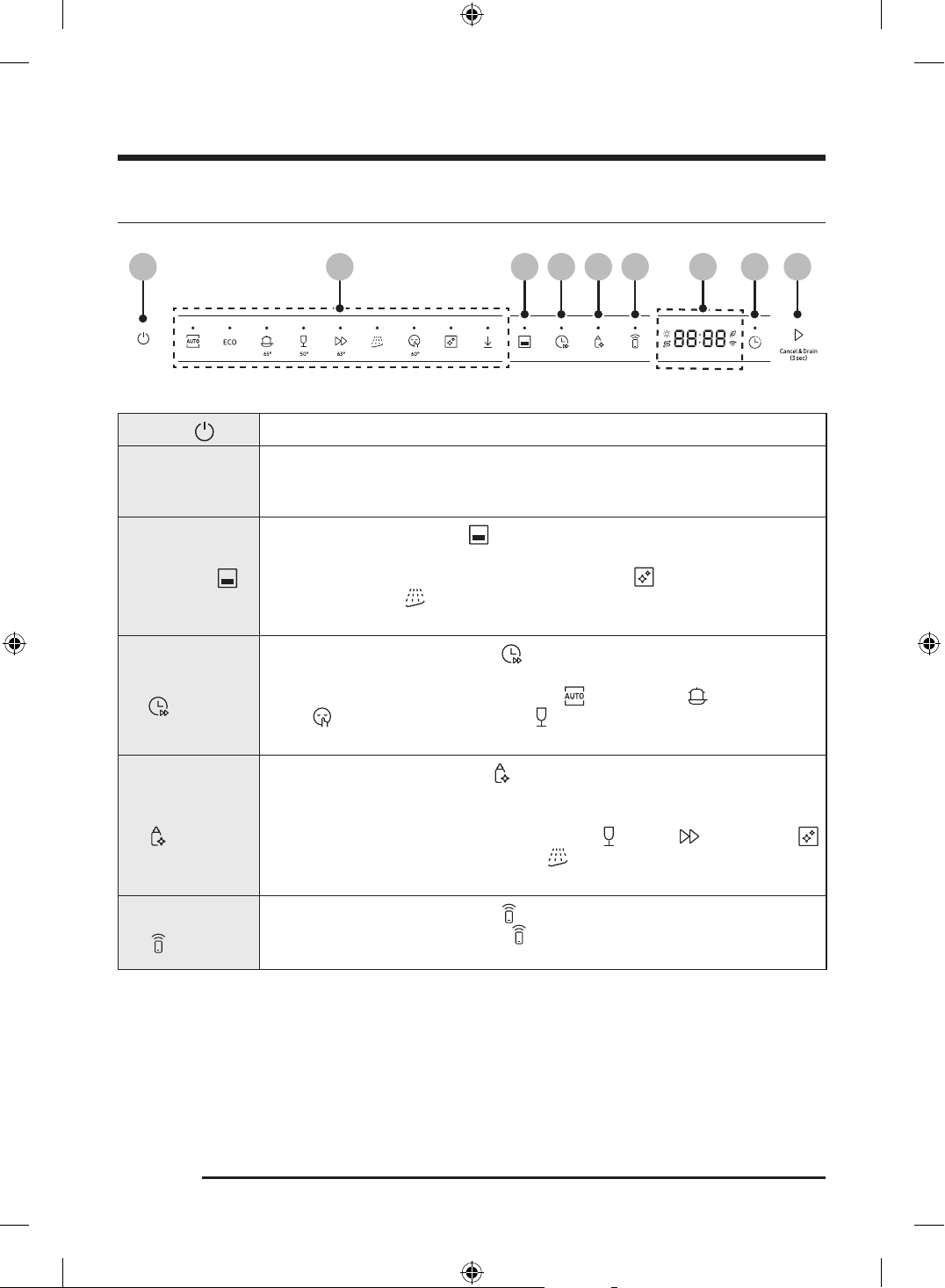
01
02 0703 04 05 06 08 09
01 Power
• Tap this button to turn the dishwasher on or off.
02 Cycles
• You can select the desired wash cycle.
- For more information on the wash cycles, see the “Cycle overview” section
on page 62.
03 Half Load
• You can turn the Half Load option on or off.
- Use this option to run a wash cycle with fewer items, using the lower rack.
- This option is unavailable with the Machine Care , Baby Care*, Drinkware*
and Pre Wash cycles.
*: Downloaded cycle
04 Speed Booster
• You can turn the Speed Booster option on or off.
- Use this option to reduce the cycle time.
- This option is available with the AUTO , ECO, Intensive , Extra Silence
, Pots and Pans*, and Delicate cycles.
*: Downloaded cycle
05 Hygiene Plus
• You can turn the Hygiene Plus option on or off.
- Use this option to increase the water temperature up to 75 °C in the final
rinse process for high-temperature sanitization.
- This option is unavailable with the Delicate , Express , Machine Care
, Plastic*, Baby Care* and Pre Wash cycles.
*: Downloaded cycle
06 Smart Control
• You can turn the Smart Control option on or off
- Turning on the Smart Control option allows remote access to the
dishwasher.
Untitled-1 60Untitled-1 60 2024-07-08 10:40:322024-07-08 10:40:32
English 61
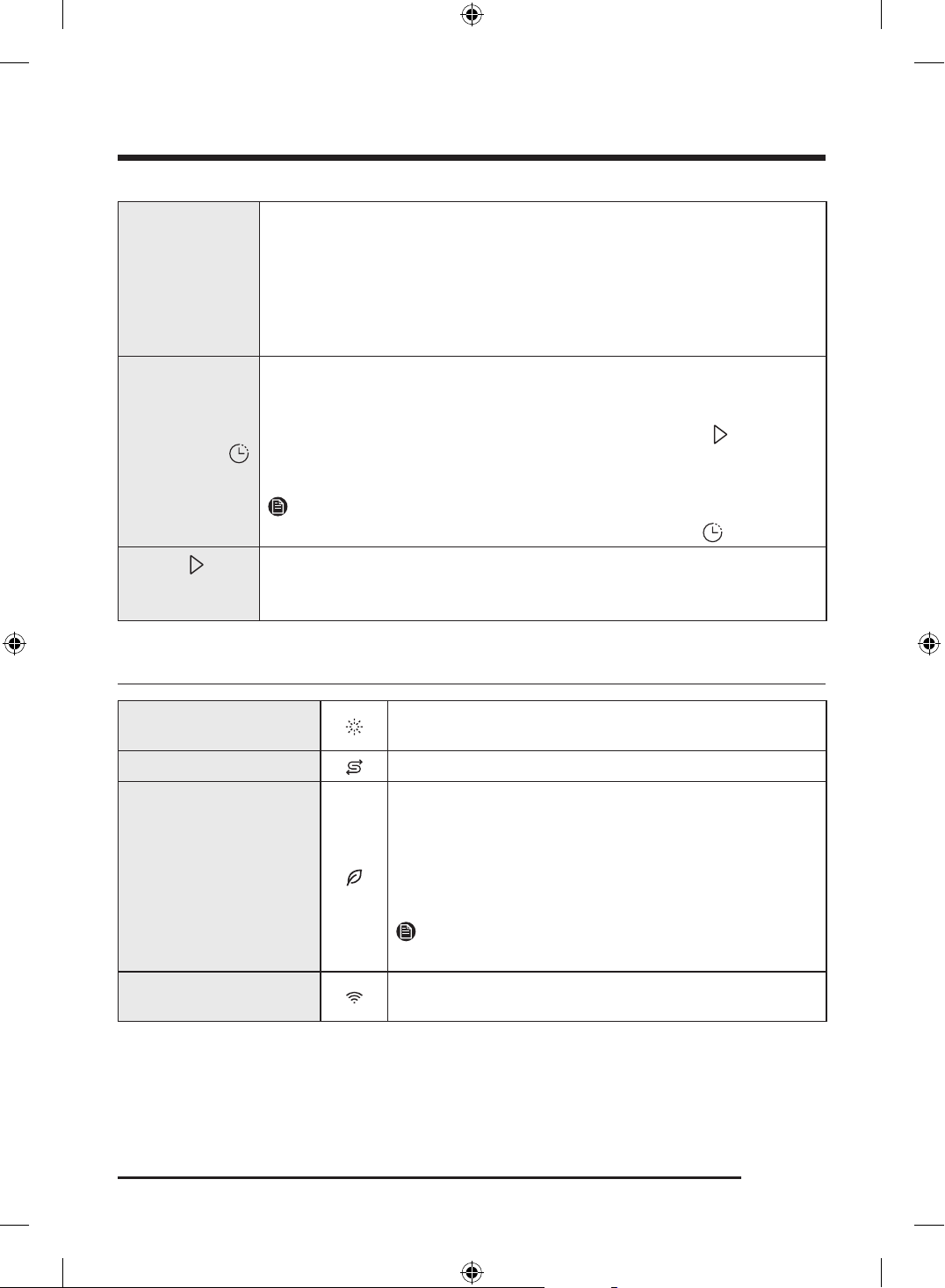
07 Display
• You can check various information on the display.
- You can check the operation time of each cycle, remaining operation time,
alert icons, information codes, etc.
- For more information on the icons, see the “Icon descriptions” section on
page 61.
- For more information on the information codes, see the “Information codes”
section on page 77.
08 Delay Start
• You can start the dishwasher operation at a desired time.
- Tap this button to select from 1 to 24 hours to delay the start of the
dishwasher.
- After selecting the desired starting time, you must tap Start and close
the door.
- To change the delay start setting, you must restart the dishwasher.
NOTE
You must select the desired wash cycle before setting Delay Start .
09 Start
(Cancel &
Drain)
• Tap this button, and then close the door to start the operation.
- Cancel & Drain: Touch and hold this button for 3 seconds to cancel the
current cycle and drain the dishwasher.
Icon descriptions
Rinse Refill
• This icon turns on to alert you to refill the rinse aid
compartment.
Salt refill • This icon turns on to alert you to refill the salt storage.
AI Energy mode
• This icon turns on when the AI Energy mode is activated.
• You can enable or disable the AI Energy mode on the
SmartThings app. Once this mode is enabled, it will be
activated when you select the cycle supporting this mode.
• AI Energy mode helps reduce power consumption but takes
a longer cycle time.
NOTE
The AI Energy mode may be unavailable in some countries.
Wi-Fi
• This icon turns on when the dishwasher is connected to the
Wi-Fi.
Untitled-1 61Untitled-1 61 2024-07-08 10:40:322024-07-08 10:40:32
Operations
English62
Cycle overview
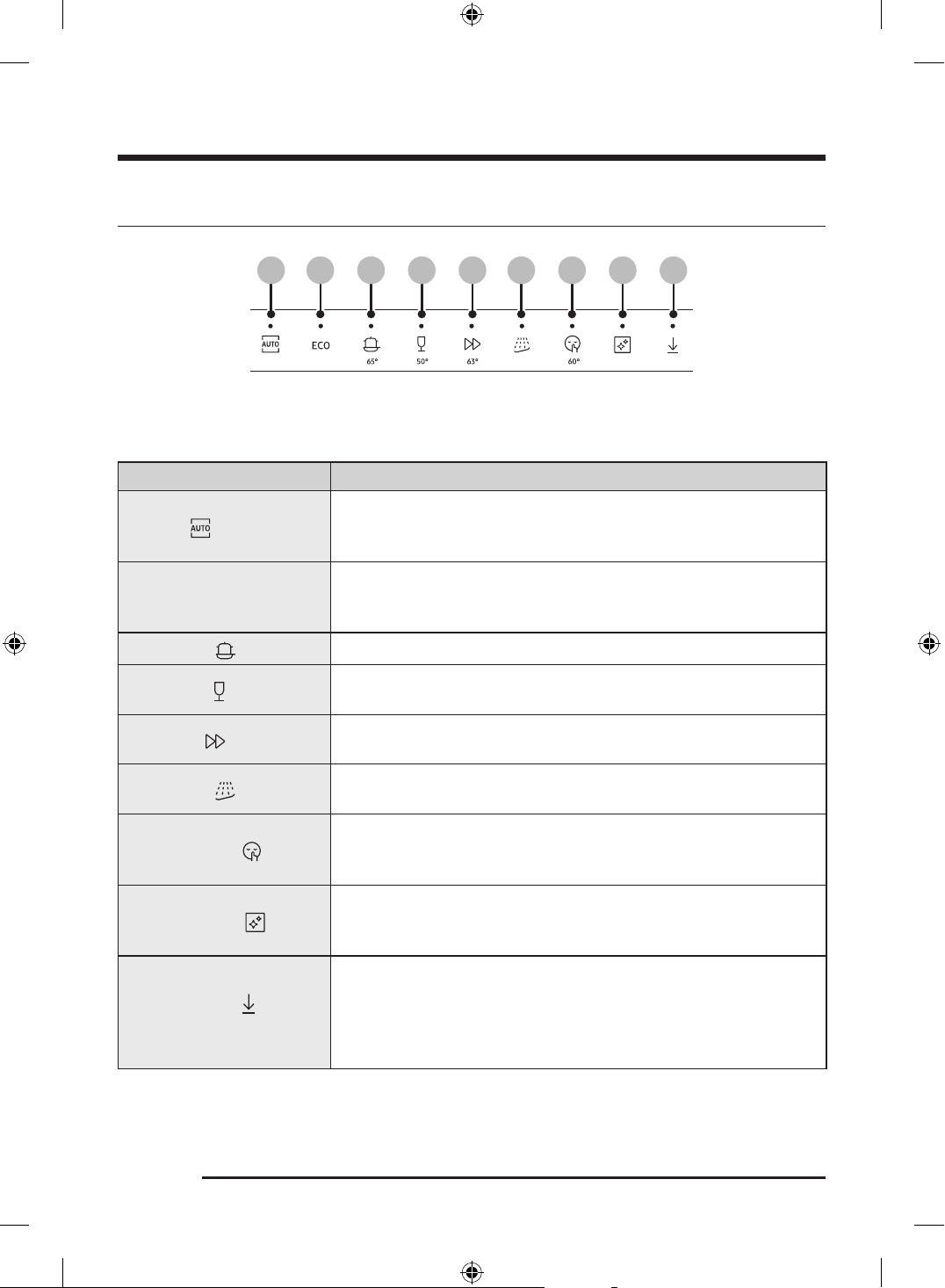
01 02 03 04 05 06 07 08 09
* The temperature under the buttons indicates the highest water temperature during the cycle and may
differ depending on the model.
Cycle Description
01 AUTO
• The dishwasher sets the appropriate wash time and water
temperature according to the detected soil level for effective
washing.
02 ECO*
• This cycle is for washing normally soiled dishes with less energy use.
- This cycle takes a longer time to complete for less energy
consumption.
03 Intensive
• This cycle is for washing heavily soiled items.
04 Delicate
• This cycle is for lightly soiled, fragile items such as glasses.
- The items must be dishwasher-safe.
05 Express
• This cycle is best for quickly washing normally soiled, daily-using
items.
06 Pre Wash
• This cycle is for pre-washing the items with cold water to remove dirt
before running another wash cycle.
07 Extra Silence
• This cycle washes the items more quietly than standard wash cycles.
The operation time takes a bit longer to minimise the operation
noise.
08 Machine Care
• This cycle is for cleaning the inside of the dishwasher.
• Do not operate this cycle with the racks loaded with any items.
Empty the dishwasher before running this cycle.
09 Downloaded
(Applicable models only)
• You can download a cycle from the SmartThings app and use this
button to select the downloaded cycle.
- For more information on downloading the cycle, see the
“Downloading a cycle from the SmartThings app” section on page
63.
Untitled-1 62Untitled-1 62 2024-07-08 10:40:332024-07-08 10:40:33

English 63
* The values for the ECO program have been obtained following the test standard EN 60436:2020. The
values given for the other programs are indicative only.
Downloading a cycle from the SmartThings app
You can download and use the cycles available from the SmartThings app.
NOTE
Some models may have applied one of the available cycles as a default and may not need to download a
cycle.
1. Turn on the dishwasher and make sure it is connected to a Wi-Fi.
2. Turn on the SmartThings app on your mobile device and select the dishwasher.
3. Tap Downloaded cycle.
4. Select the cycle you want to download to the dishwasher.
5. Tap Apply.
NOTE
You can check the descriptions of the each cycle on the SmartThings app.
Untitled-1 63Untitled-1 63 2024-07-08 10:40:332024-07-08 10:40:33
Operations
English64
Operating a cycle
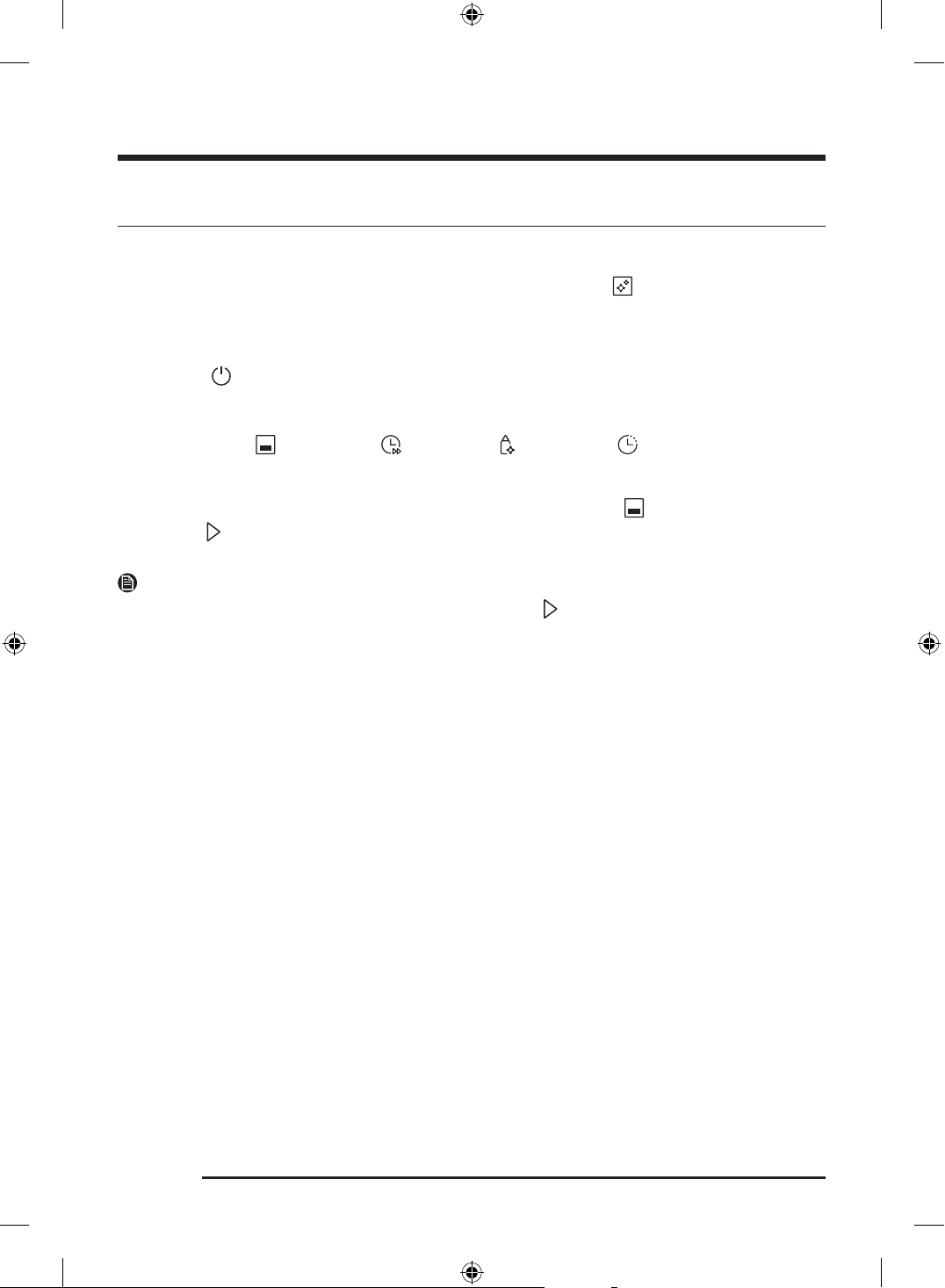
1. Open the door, and then load the dishwasher. Make sure to remove food remains and waste on the
dishes.
- Do not load the dishwasher if you are going to use the Machine Care cycle.
2. Apply detergent to the detergent dispenser. For better results, add rinse aids.
- Skip this step if you are going to use the Baby Care* cycle.
- *: Downloaded cycle
3. Tap Power to turn on the dishwasher.
4. Tap the desired cycle button.
5. Select the desired options.
- Tap Half Load , Speed Booster , Hygiene Plus , or Delay Start to enable or disable each
option.
- Some options may be unavailable depending on the cycle.
- Make sure you have loaded only the lower basket to use the Half Load option.
6. Tap Start , and then close the door.
- The dishwasher starts the cycle after draining for a few seconds.
NOTE
• To change the cycle after it has started, touch and hold Start for 3 seconds to cancel the cycle. Then,
select a new cycle.
• The default cycle is ECO.
• To resume after you have opened the door to stop the dishwasher while operating, simply close the
door.
Untitled-1 64Untitled-1 64 2024-07-08 10:40:332024-07-08 10:40:33
English 65
Settings
You can change your settings to your preference according to the following instructions.
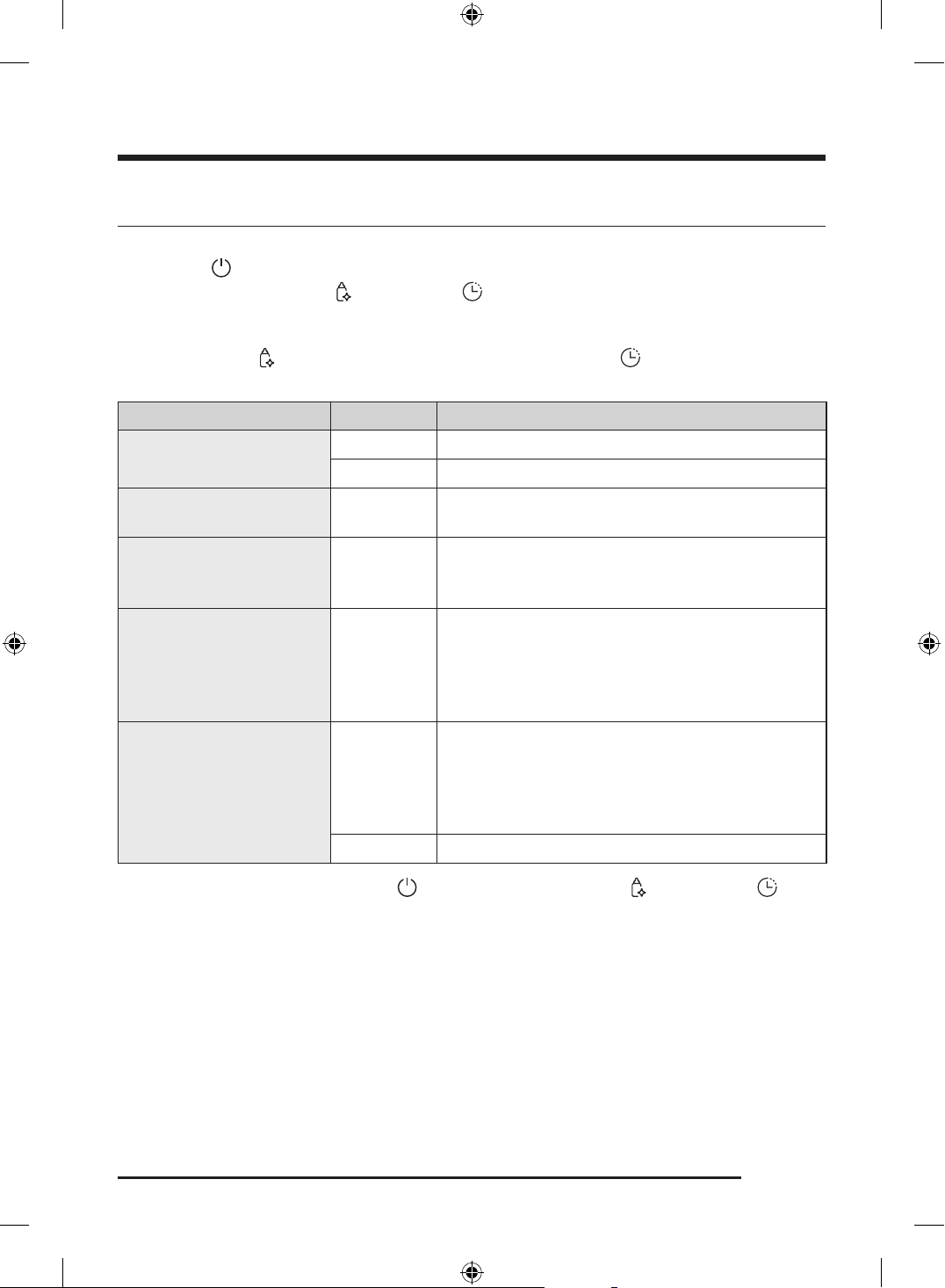
1. Tap Power to turn on the dishwasher.
2. Touch and hold Hygiene Plus and Delay Start simultaneously for 3 seconds to enter the settings
menu.
- ‘U1 or U0’ appears on the display.
3. Tap Hygiene Plus to select the desired settings. Then, tap Delay Start to change the options.
- Refer to the following table for available settings and their options.
Settings Options Description
Sound
U1 • The sound is on.
U0 • The sound is off.
Brightness (Applicable
models only)
b5 - b0
• The brightness increases as the number increases.
• The default setting is ‘b5’.
Dose per Rinse F6 - F0
• The amount of the rinse aid increases as the number
increases.
• The default setting is ‘F4’.
Water hardness (Applicable
models only)
L0 - L5
• Select the water hardness level according to the
water hardness in your area.
• Refer to the “Determining the water hardness level
(Applicable models only)” section to determine the
water hardness setting.
Auto Release Dry
A1
• Auto Release Dry mode is on.
• To improve drying results, the door opens
automatically in the drying process.
• Once the door is opened by Auto Release Dry mode,
it cannot be closed manually for 2 minutes.
A0 • Auto Release Dry mode is off.
4. After changing the settings, tap Power or touch and hold Hygiene Plus and Delay Start
simultaneously for 3 seconds to apply the changes and exit the settings menu.
Untitled-1 65Untitled-1 65 2024-07-08 10:40:332024-07-08 10:40:33
Operations
English66
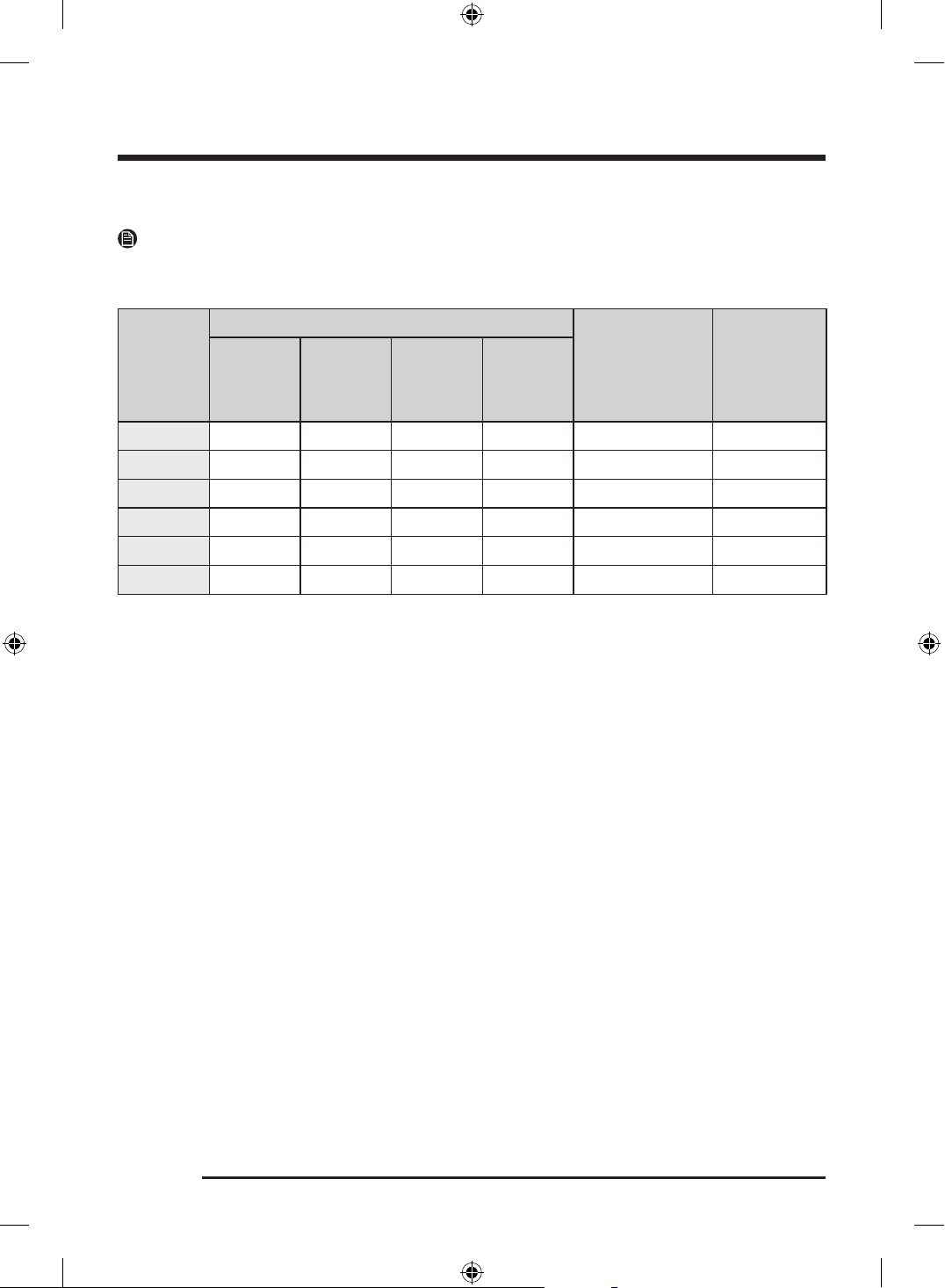
Determining the water hardness level (Applicable models only)
NOTE
If the water hardness level in your area is 0, you do not need to use dishwasher-specific salt. However, you
must set the water hardness setting for the dishwasher to 0.
Level
Water hardness level Water hardness
Regeneration
softening/
washing cycle
(ECO cycle)
Salt injection
°dH °TH mmol/L Range
0 <6 <10 <1.0 No recycle No No
1 6-14 10-25 1-2.5 1/8 Yes Yes
2 14-23 25-40 2.5-4.0 1/5 Yes Yes
3 23-31 40-55 4.0-5.5 1/3 Yes Yes
4 31-40 55-70 5 . 5 - 7. 0 1/2 Yes Yes
5 >40 >70 > 7. 0 1/1 Yes Yes
For better washing results, we recommend softening the water. Hard water contains impurities that
can reduce the washing performance. You should soften the water if the supplied water is harder than
1.0 mmol/L (6 °d – German scale ).
• To soften the water, you need dishwasher-specific salt and adjust the water hardness level according
to your area. For more information about the water hardness level in your area, contact your local water
department.
• If the hardness level of the supplied water supply is unsteady, set the water hardness level to its
highest. For example, if the water hardness reading ranges from 6.7 mmol/L to 9.0 mmol/L, set the
water hardness level for the highest value, which is 9.0 mmol/L.
• The dishwasher’s default water hardness level is 4 (5.5-7.0 mmol/L). If this setting matches the water
hardness level in your area, you do not need to change it.
• Regeneration occurs during the drying process with an additional 2.3-2.7 L of water use and an extra 22-
27 minutes of operation time. The energy used may be increased but this should be by an insignificant
amount.
Untitled-1 66Untitled-1 66 2024-07-08 10:40:332024-07-08 10:40:33
English 67
Maintenance
Cleaning
Keep the dishwasher clean to improve performance, reduce unnecessary repairs, and lengthen its lifecycle.
Exterior
Clean spills on the surface of the dishwasher immediately. Use a soft, damp cloth on the control panel to
gently wipe away spills and dust.
CAUTION
• Do not use benzene, wax, thinner, chlorine bleach, alcohol, or other chemical substances. These
materials may discolour the surface of the dishwasher and cause stains.
• The dishwasher has electric parts inside. Do not spray water directly onto the dishwasher. Protect
electrical components from water.
• For a stainless-steel door panel, use a stainless-steel cleaner for home appliances and a clean, soft
cloth.
Interior
• Clean the interior of the dishwasher on a regular basis to remove any dirt or food particles. Wipe inside
the dishwasher and inside the door with a wet dishcloth.
• Use the
Machine Care cycle every month to keep the interior clean and prevent bad odours.
• If your tap water is hard, you can prevent limescale inside the dishwasher by adding citric acid to the
detergent when operating the dishwasher.
CAUTION
• Do not remove the front seal (the long rubber seal enclosing the opening of the dishwasher). The seal
keeps the inner side of the dishwasher sealed.
• Use a damp cloth to remove the lime scale or grease deposits inside the dishwasher. Alternatively,
apply some detergent, and then run an empty cycle using the highest rinse temperature.
Untitled-1 67Untitled-1 67 2024-07-08 10:40:332024-07-08 10:40:33
Maintenance
English68
Spray arms
To prevent the spray arms from being clogged or if the spray arms are clogged, remove and clean each
spray arm. Use caution when removing the spray arms as they may break.
NOTE
If the water holes on the spray arms are clogged, use a
thin pointed tool to unclog the holes.
Top spray arm
A
1. Open the door.
2. Remove the upper rack.
- Refer to the “Removing the upper rack” section for
detailed instructions.
- The top spraying arm is attached on the top
interior wall
- If your model has a cutlery rack, pull it out to
access the top spraying arm.
3. Hold the handle (A), and then push it to the right to
release the top spray arm.
4. Unclog and clean the spray arm.
5. Reinsert the spray arm, and then push the handle (A)
to the left to tighten it.
6. Rotate the spray arm to make sure it is correctly
assembled.
Untitled-1 68Untitled-1 68 2024-07-08 10:40:332024-07-08 10:40:33
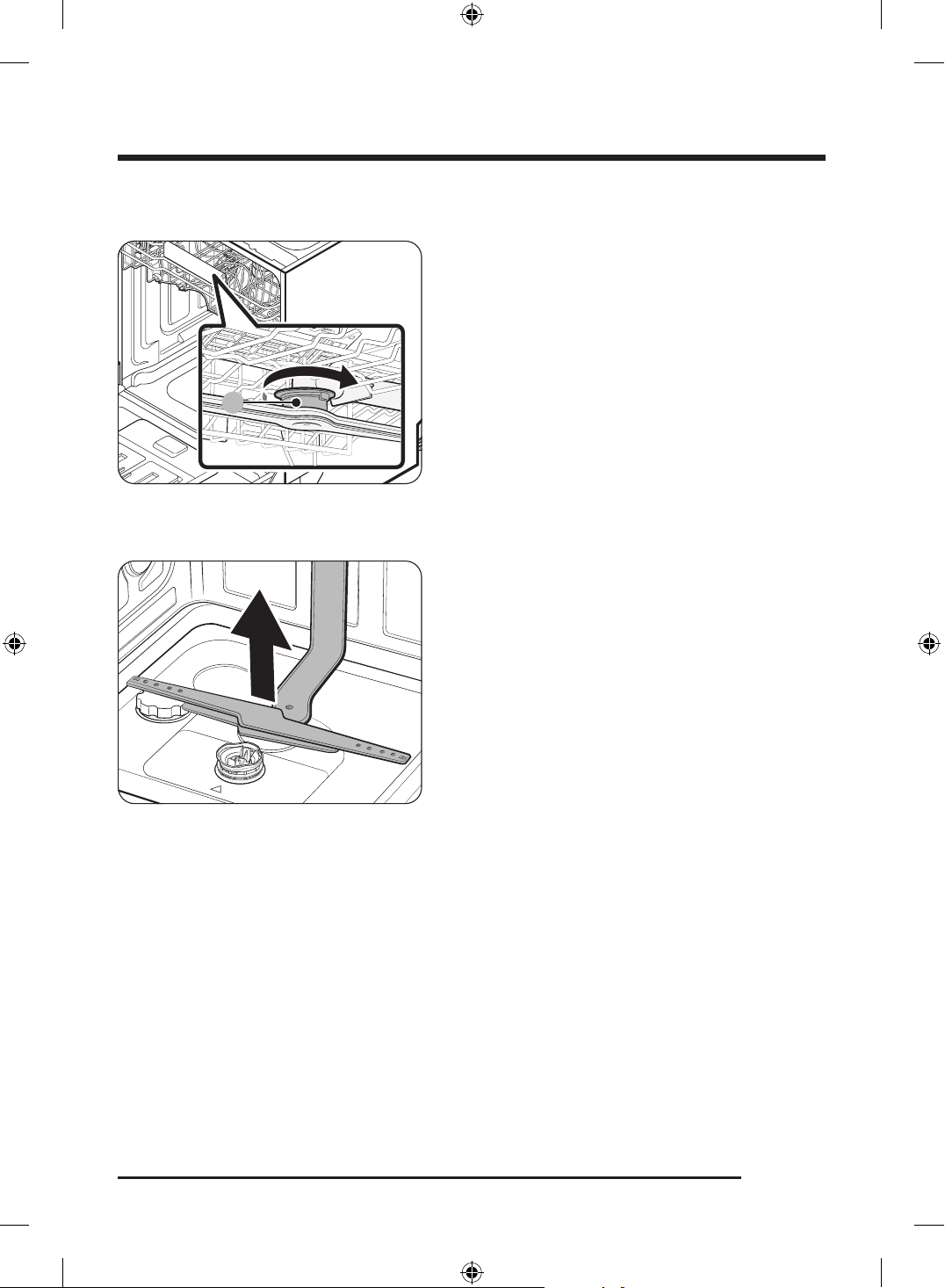
English 69
Middle spray arm
A
1. Open the door, and then pull out the upper rack.
- The middle spray arm is attached underneath the
upper rack.
2. Hold the handle (A), and then push it to the right to
release the top spray arm.
3. Unclog and clean the spray arm.
4. Reinsert the spray arm, and then push the handle (A)
to the left to tighten it.
5. Rotate the spray arm to make sure it is correctly
assembled.
Bottom spray arm
1. Open the door.
2. Remove the lower rack.
- The bottom spray arm is attached on the bottom
interior wall.
3. Pull the bottom spray arm to remove it.
4. Unclog and clean the spray arm.
5. Reinsert the spray arm.
6. Rotate the spray arm to make sure it is correctly
assembled.
Untitled-1 69Untitled-1 69 2024-07-08 10:40:342024-07-08 10:40:34
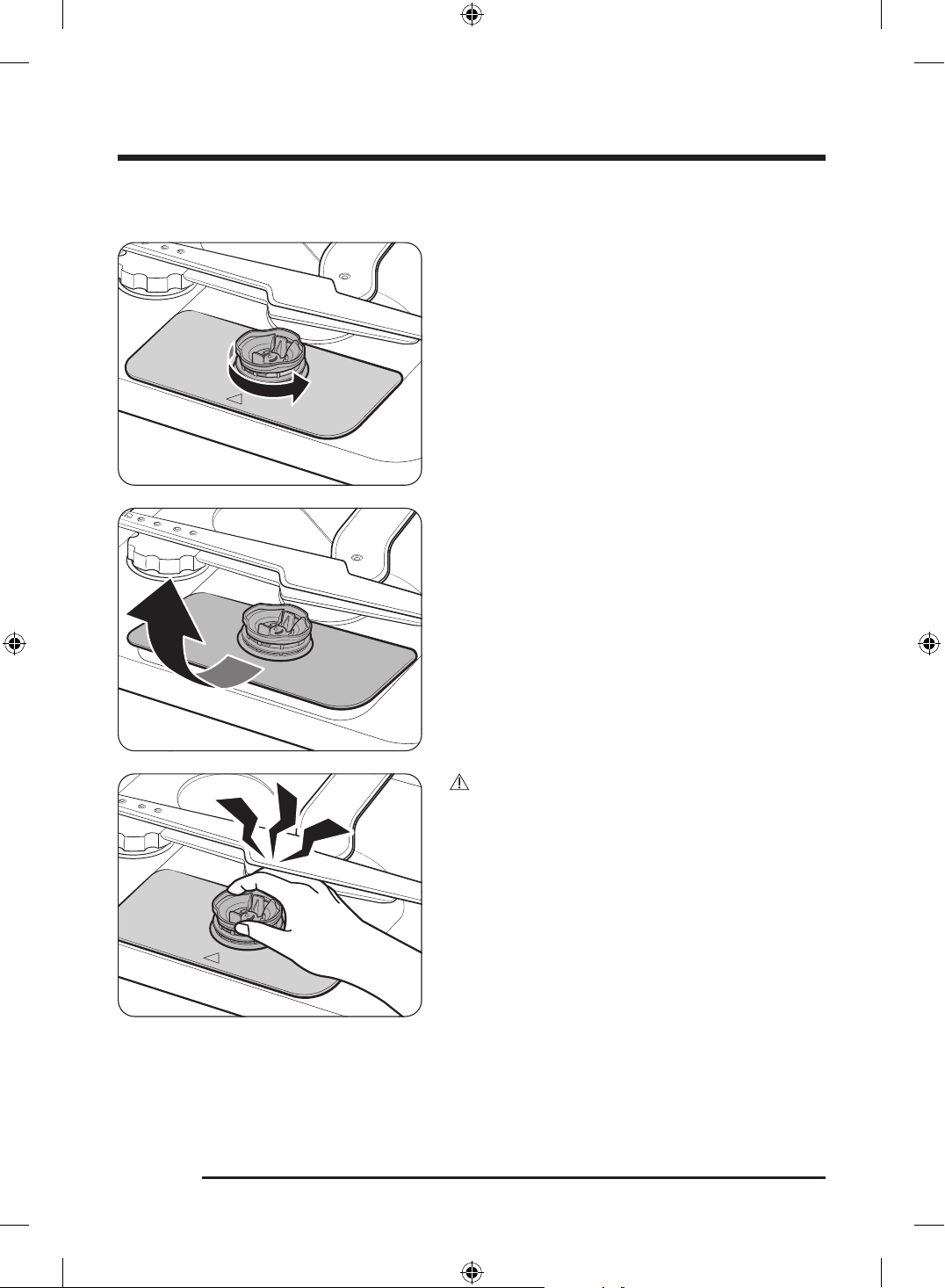
Maintenance
English70
Filters
1. Open the door, and then remove the lower rack.
2. Turn the coarse filter anticlockwise to unlock the
assembled filters.
3. Lift the assembled filters and remove them from the
bottom of the dishwasher.
CAUTION
Watch your hand when removing the filters. Your hand
could get caught between the bottom spraying arm and
the filters.
Untitled-1 70Untitled-1 70 2024-07-08 10:40:342024-07-08 10:40:34
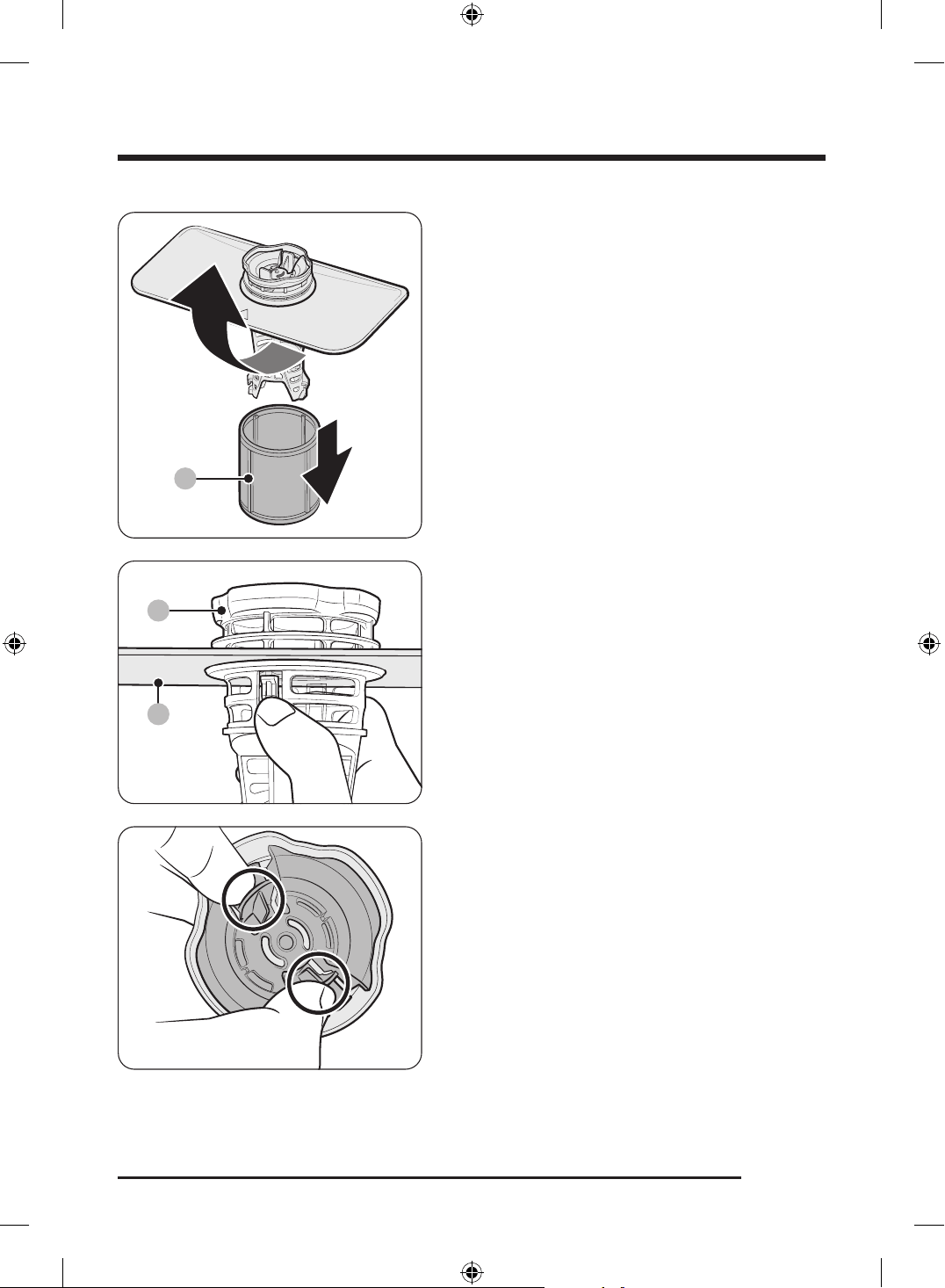
English 71
A
4. Disassemble the micro filter (A).
B
C
5. Disassemble the coarse filter (B) and the fine filter
(C).
- While pressing the two release tabs on the coarse
filter (B), lift it to remove.
6. Remove the coarse filter cap.
- While pressing the two release tabs on the cap,
lift to remove it.
Untitled-1 71Untitled-1 71 2024-07-08 10:40:342024-07-08 10:40:34
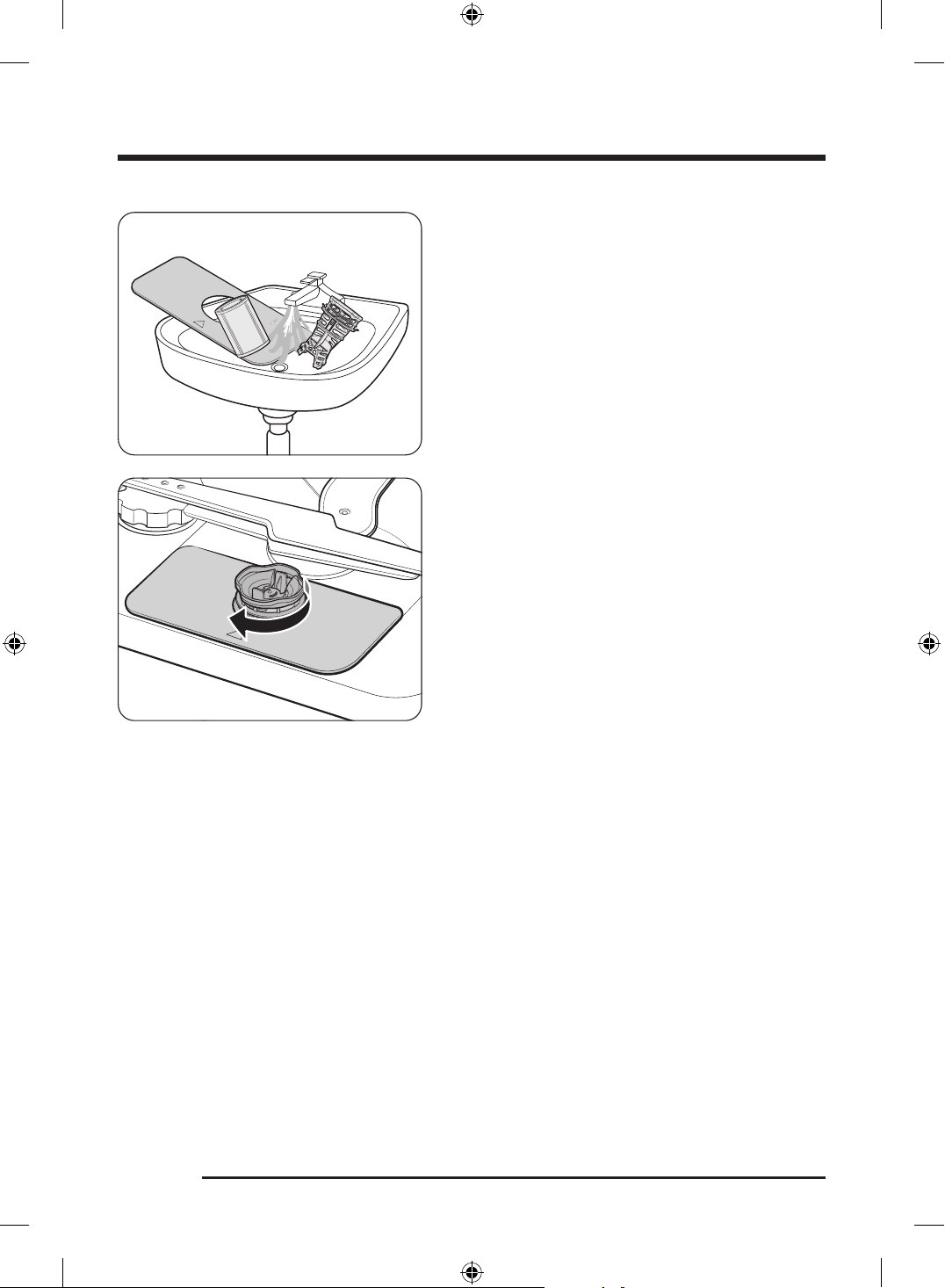
Maintenance
English72
7. Thoroughly clean all the disassembled filters in
running water.
8. Dry the filters before putting them back into the
dishwasher.
9. Assemble all the filters and put them back into the
dishwasher.
10. Turn the filter handle clockwise to lock the filters.
Untitled-1 72Untitled-1 72 2024-07-08 10:40:342024-07-08 10:40:34
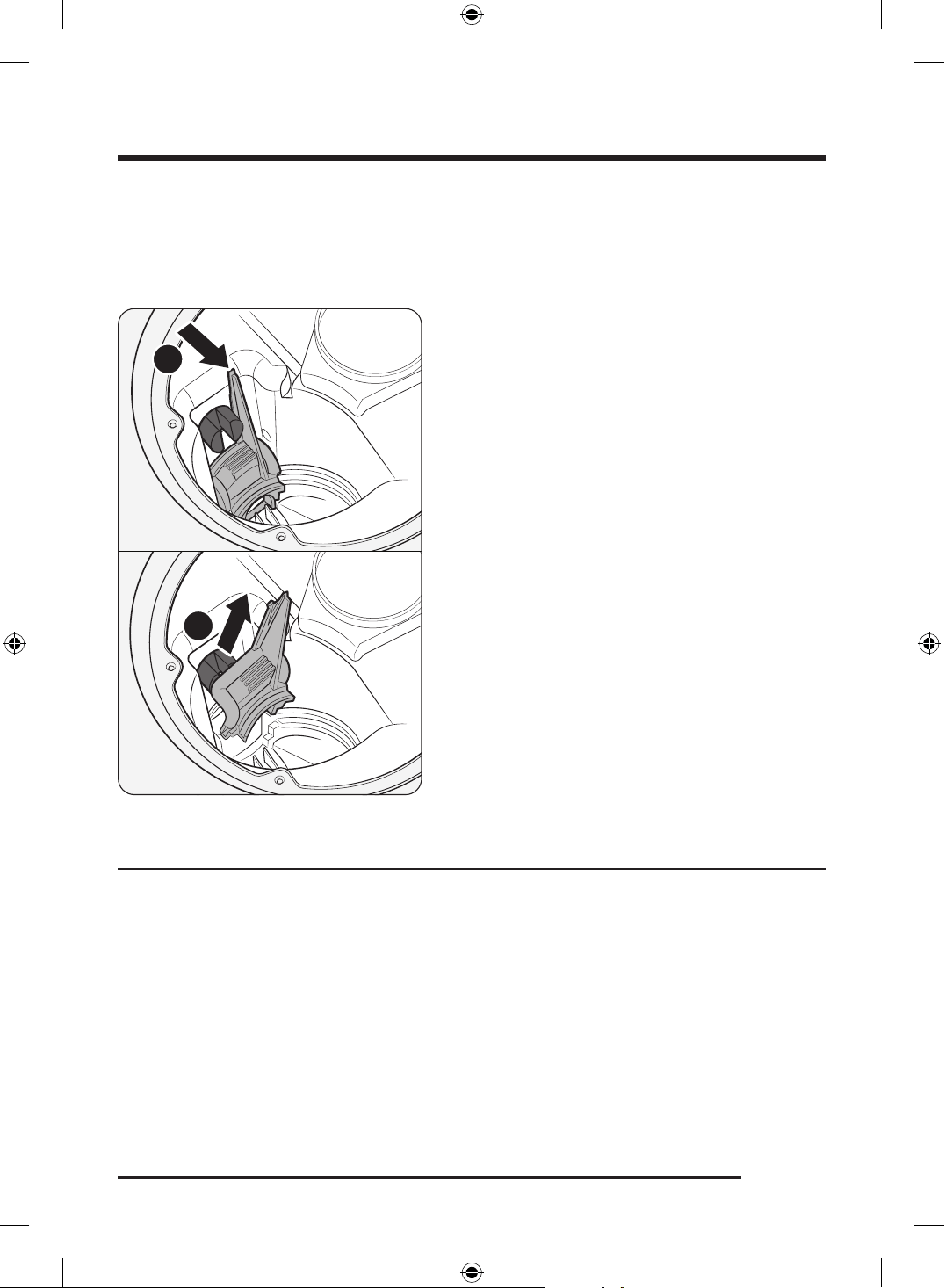
English 73
Drain pump
If the dishwasher fails to drain (5C is displayed) because the drain pump is clogged with foreign matter
or there is an abnormal noise coming from the drain pump, you must unclog and clean the drain pump
according to the following instruction.
1
2
1. Remove the lower rack.
2. Refer to the “Filters” section to remove the filters.
3. Remove the drain-pump cover.
- Push the handle in the direction of the arrow (1),
and then pull it up (2).
4. Check the pump’s impeller, and then clean it
thoroughly.
5. Put the drain-pump cover in the reversed order or
removal.
- Make sure you hear a clicking sound.
Long-term care
If you will not use the dishwasher for an extended period of time, first drain the unit completely, and then
disconnect the water hose. Shut off the water supply valve and the circuit breaker. Water remaining in the
hoses or the internal components can damage the dishwasher.
Untitled-1 73Untitled-1 73 2024-07-08 10:40:352024-07-08 10:40:35
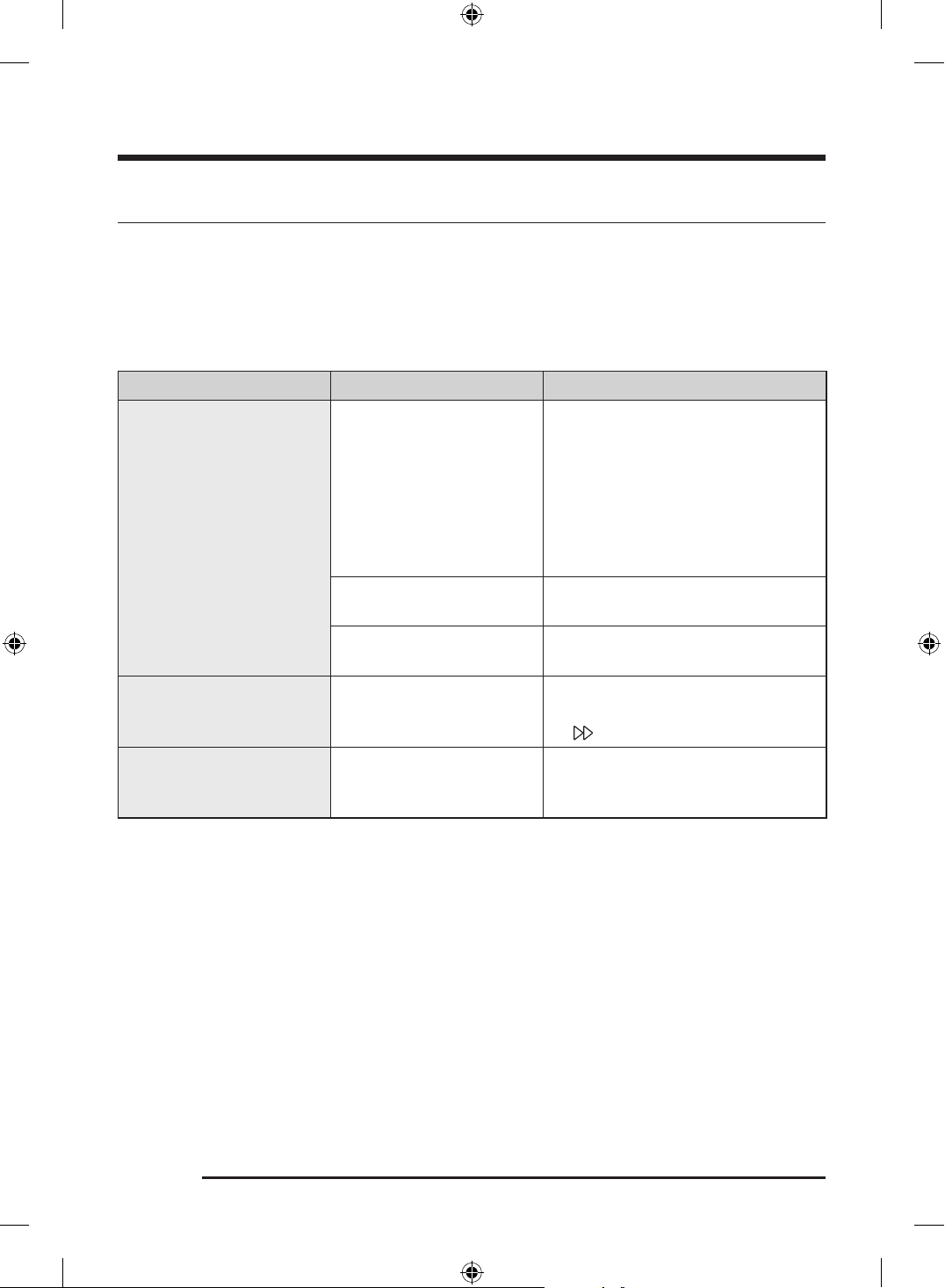
English74
Troubleshooting
Checkpoints
If you encounter an issue with the dishwasher, first check the table below and try the suggestions.
Following the repair by a non-authorised service provider, self-repair or non-professional repair of the
product, Samsung is not liable for any damage to the product, any injury or any other product safety issue
caused by any attempt to repair the product which does not carefully follow these repair and maintenance
instructions. Any damage to the product caused by an attempt to repair the product by any person other
than a Samsung certified service provider will not be covered by the warranty
Symptom Possible cause Action
The dishwasher does not
start.
The door is not completely
closed.
• Make sure the door is latched and
completely closed.
• Make sure the middle spray arm
water supply tube is properly
connecting to the water outlet at the
rear interior wall.
• Make sure the upper rack is properly
inserted.
The power cord is not
connected.
• Connect the power cord.
Water is not being supplied.
• Make sure the water supply valve is
open.
The dishwasher has bad
odours.
Water remains from the
previous cycle.
• With the dishwasher empty, add
detergent, and then run the Express
cycle.
Water remains in the
dishwasher after a cycle has
finished.
The drain hose is kinked or
clogged
• Straighten and unclog the drain
hose.
Untitled-1 74Untitled-1 74 2024-07-08 10:40:352024-07-08 10:40:35
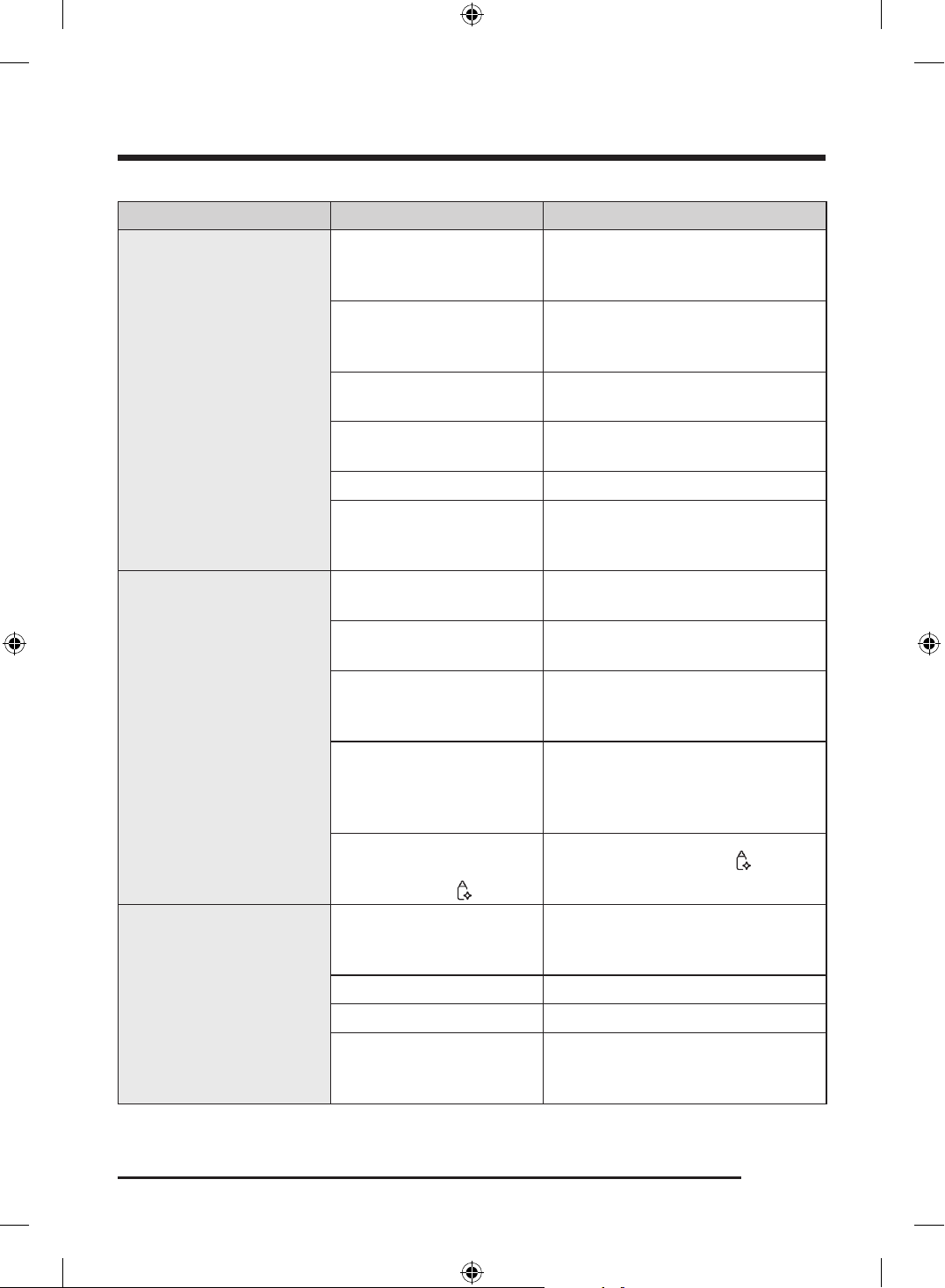
English 75
Symptom Possible cause Action
Food remains on dishes.
An incorrect cycle was
selected.
• Select a cycle according to the soil
level of the dishes as instructed in
this manual.
The filters are clogged or not
correctly fastened.
• Clean the filters.
• Make sure the filters are correctly
fastened.
An insufficient amount of
detergent was used.
• Use the correct amount of detergent
for each load.
The water pressure is low.
• Make sure the pressure is between
0.05-0.8 Mpa.
The spray arms are clogged. • Clean and unclog the spray arms.
Dishes are improperly loaded
or overloaded.
• Arrange the dishes so they do not
interfere with the spray arms or the
detergent dispenser.
Dishes are not dried well
enough
The rinse aid compartment
is empty.
• Fill the rinse aid compartment with
the rinse aid.
Not enough rinse aid was
used.
• Change the Dose per Rinse setting.
Too many dishes were
loaded.
• Overloading may reduce the drying
performance. Load your dishes as
recommended.
Glasses and cups spilled
water onto other dishes while
being unloaded.
• Empty the lower rack first, and then
the upper rack. This will avoid water
dripping from the upper rack onto
the dishes in the lower rack.
Multiple detergent tablets
were used without selecting
the Hygiene Plus option.
• Select the
Hygiene Plus option or
use a rinse aid.
The dishwasher is too noisy.
The detergent compartment
is opened to dispense the
detergent.
• This is normal.
The drain pump is operating. • This is normal.
The dishwasher is not level. • Make sure the dishwasher is level.
The spray arm bumps
against the dishes, creating a
chopping sound.
• Rearrange the dishes.
Untitled-1 75Untitled-1 75 2024-07-08 10:40:352024-07-08 10:40:35
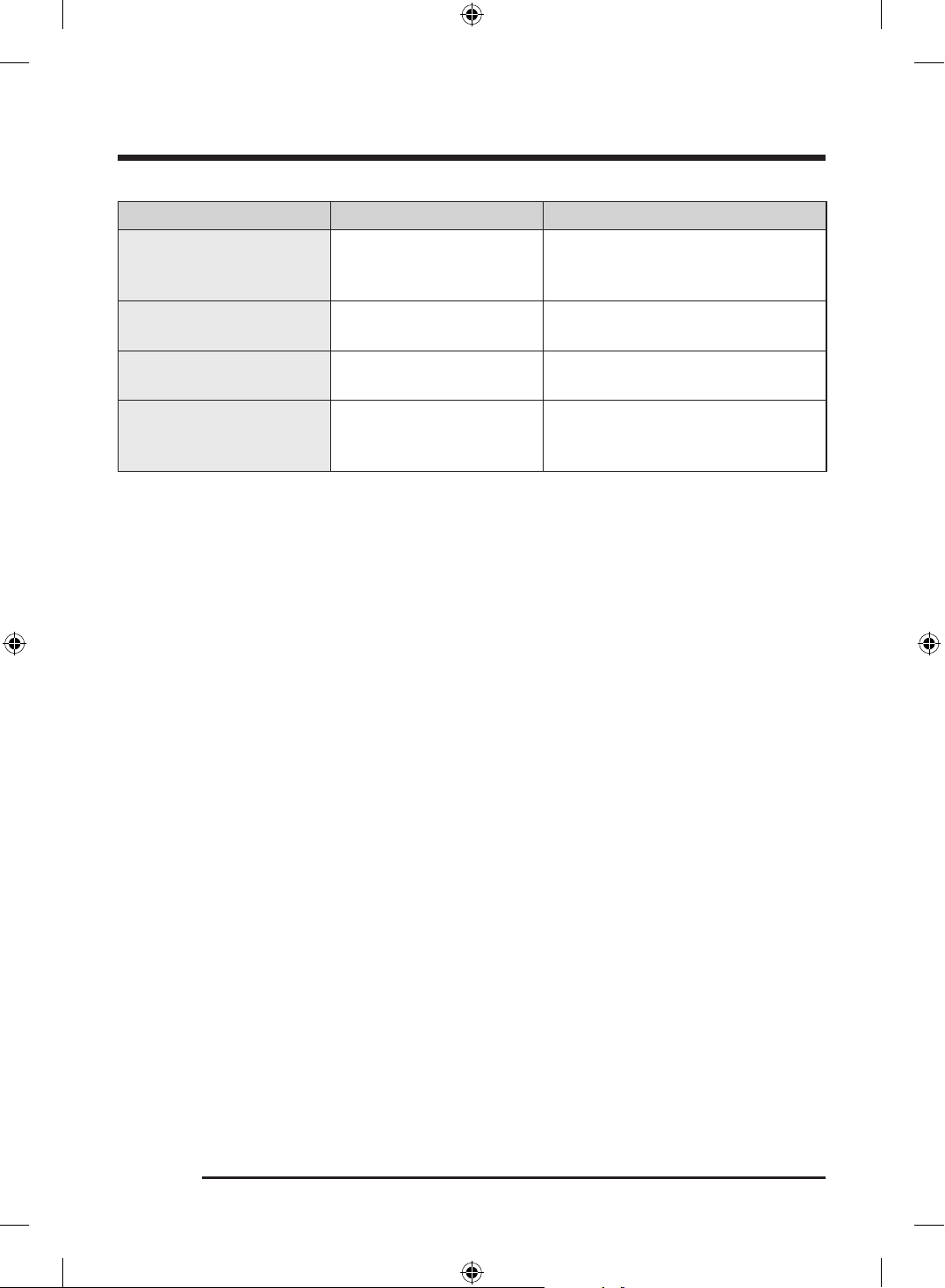
Troubleshooting
English76
Symptom Possible cause Action
A layer of the yellow or
brown stain remains on
dishes.
Coffee and tea soils.
• Use a cycle with a higher
temperature water.
The display is not turning on.
The power cord is not
connected.
• Check power supply is present.
The spray arms do not rotate
smoothly.
The spray arms are clogged
with food particles.
• Clean the spray arms.
The dishwasher bubbles up
and the foam remains too
much on the front.
Regular detergent was
used instead of dishwasher
detergent.
• Always use dishwasher detergent.
• Turn the dishwasher off and remove
the bubbles.
Untitled-1 76Untitled-1 76 2024-07-08 10:40:352024-07-08 10:40:35
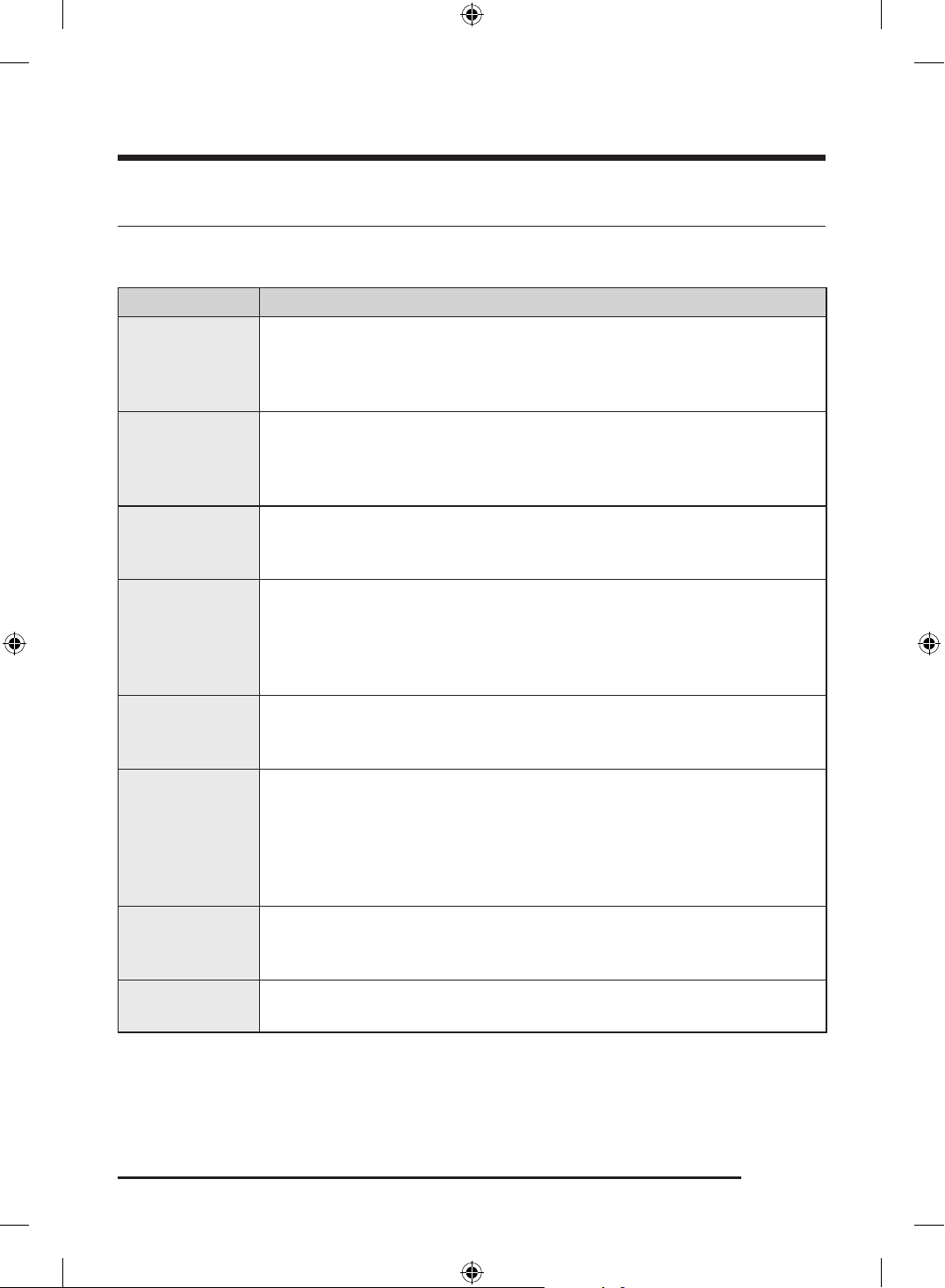
English 77
Information codes
If the dishwasher fails to operate, you may see an information code on the display. Check the table below
and try the suggestions.
Code Action
LC
Leakage check
• Close the water supply valve. Go to your home’s circuit breaker panel, and set
the dishwasher’s circuit breaker switch to off. Contact the installer to repair. If
the issue continues, contact a local Samsung service centre.
4C
Water supply check
• Check if the water supply valve is closed, if the water supply is suspended, or if
the water inlet valve or line is frozen or clogged by foreign particles. If the issue
continues, contact a local Samsung service centre.
AC
PCB communication check
• Abnormal communication between the main PCB and the sub PCB. If the issue
continues, contact a local Samsung service centre.
HC
High temperature heating check
• Functional check. With the dishwasher empty, add detergent, and then run a
cycle. If the issue continues, go to your home’s circuit breaker panel, and set
the dishwasher’s circuit breaker switch to off. Contact a local Samsung service
centre.
3C
Washing pump check
• Abnormal working with washing pump. If the issue continues, contact a local
Samsung service centre.
1C
Low-water level check
• Check if the filter is clogged.
• Make sure to use dishwasher detergent.
• Make sure that the dishes are loaded evenly.
• Turn the dishwasher off and turn it on again. Then, try again.
• If the issue continues, contact a local Samsung service centre.
5C
Drain pump check
• Check drain pump and drain pipe. If it is jammed, clean it. If the issue continues,
contact a local Samsung service centre.
9C9
The IPM is overheating
• Unplug the appliance and contact a Customer Service centre.
Untitled-1 77Untitled-1 77 2024-07-08 10:40:352024-07-08 10:40:35
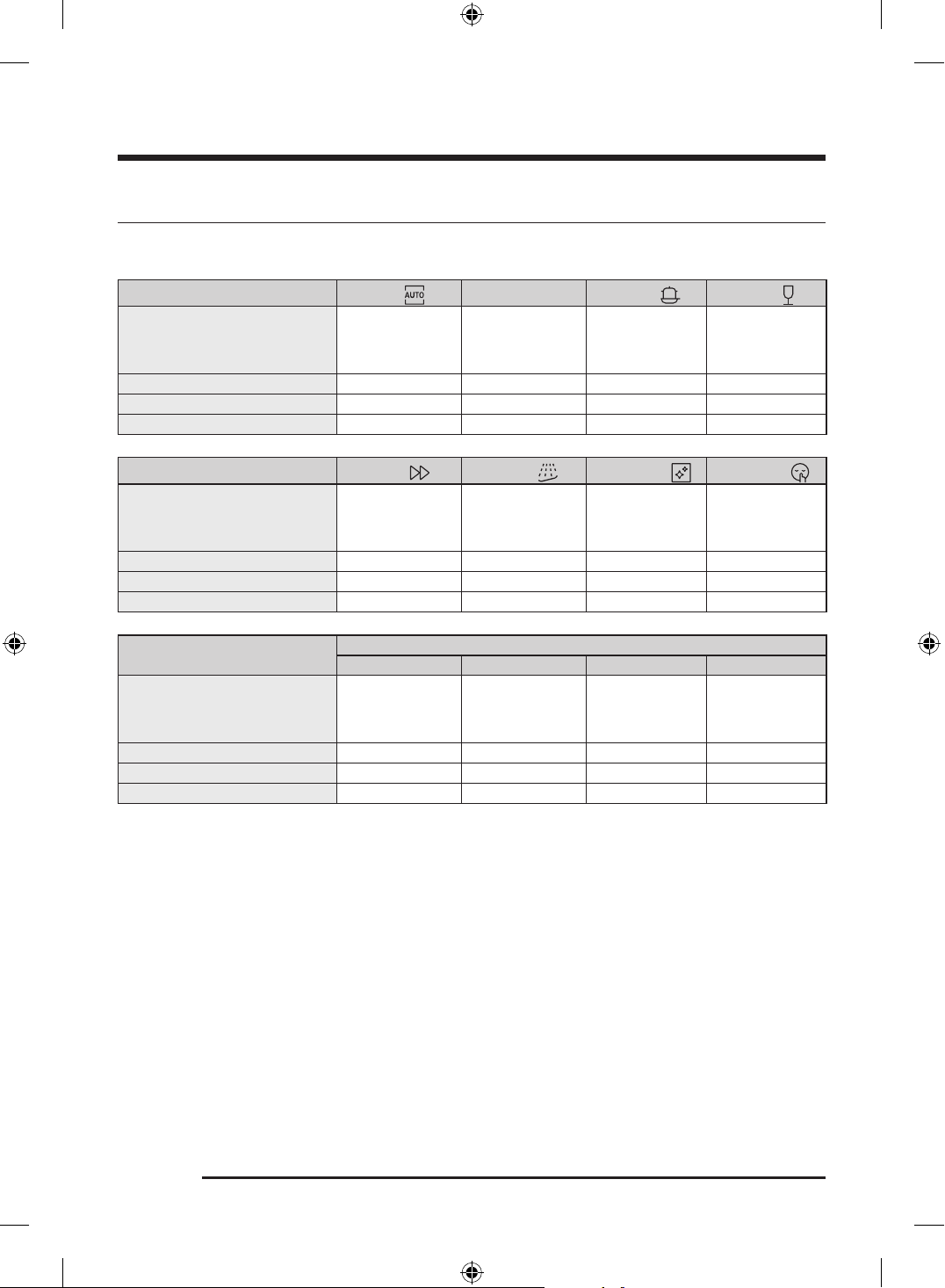
English78
Appendix
Cycle chart
DW60**790*** models
Cycle
AUTO
ECO
Intensive
Delicate
Cycle sequence
Pre wash (40 °C) >
Main wash (55-60 °C)
> Rinse > Hot Rinse
(53-58 °C) > Dry > End
Pre wash > Main wash
(43 °C) > Rinse > Hot
Rinse (38 °C) > Dry
> End
Pre wash (45 °C) >
Main wash (65 °C)
> Rinse > Hot Rinse
(63 °C) > Dry > End
Pre wash (40 °C) >
Main wash (50 °C)
> Rinse > Hot Rinse
(50 °C) > Dry > End
Water consumption (L) 12.5-15.2 9.4 15.75 11.95
Energy consumption (kWh) 0.85-1.25 0.54 1.45 0.8
Cycle time (min.) 102-149 290 174 111
Cycle
Express Pre Wash Machine Care Extra Silence
Cycle sequence
Main wash (63 °C)
> Rinse > Hot Rinse
(57 °C) > Dry > End
Pre wash > End
Pre wash > Main wash
(70 °C) > Rinse > Hot
Rinse (70 °C) > Dry
> End
Pre wash > Main wash
(60 °C) > Rinse > Hot
Rinse (55 °C) > Dry
> End
Water consumption (L) 9.8 4 12.9 13.6
Energy consumption (kWh) 1.05 0.05 1.4 1.1
Cycle time (min.) 78 24 136 257
Cycle
Downloaded cycle
Plastic Baby Care Pots and Pans Drinkware
Cycle sequence
Main wash (60 °C)
> Rinse > Hot Rinse
(60 °C) > Dry > End
Hot Rinse (75 °C) >
Dry > End
Pre wash > Main wash
(68 °C) > Rinse > Hot
Rinse (68 °C) > Dry
> End
Main wash (60 °C)
> Rinse > Hot Rinse
(53 °C) > Dry > End
Water consumption (L) 12.9 4.5 15.5 9.4
Energy consumption (kWh) 1.1 1 1.5 0.71
Cycle time (min.) 91 68 145 37
Untitled-1 78Untitled-1 78 2024-07-08 10:40:352024-07-08 10:40:35
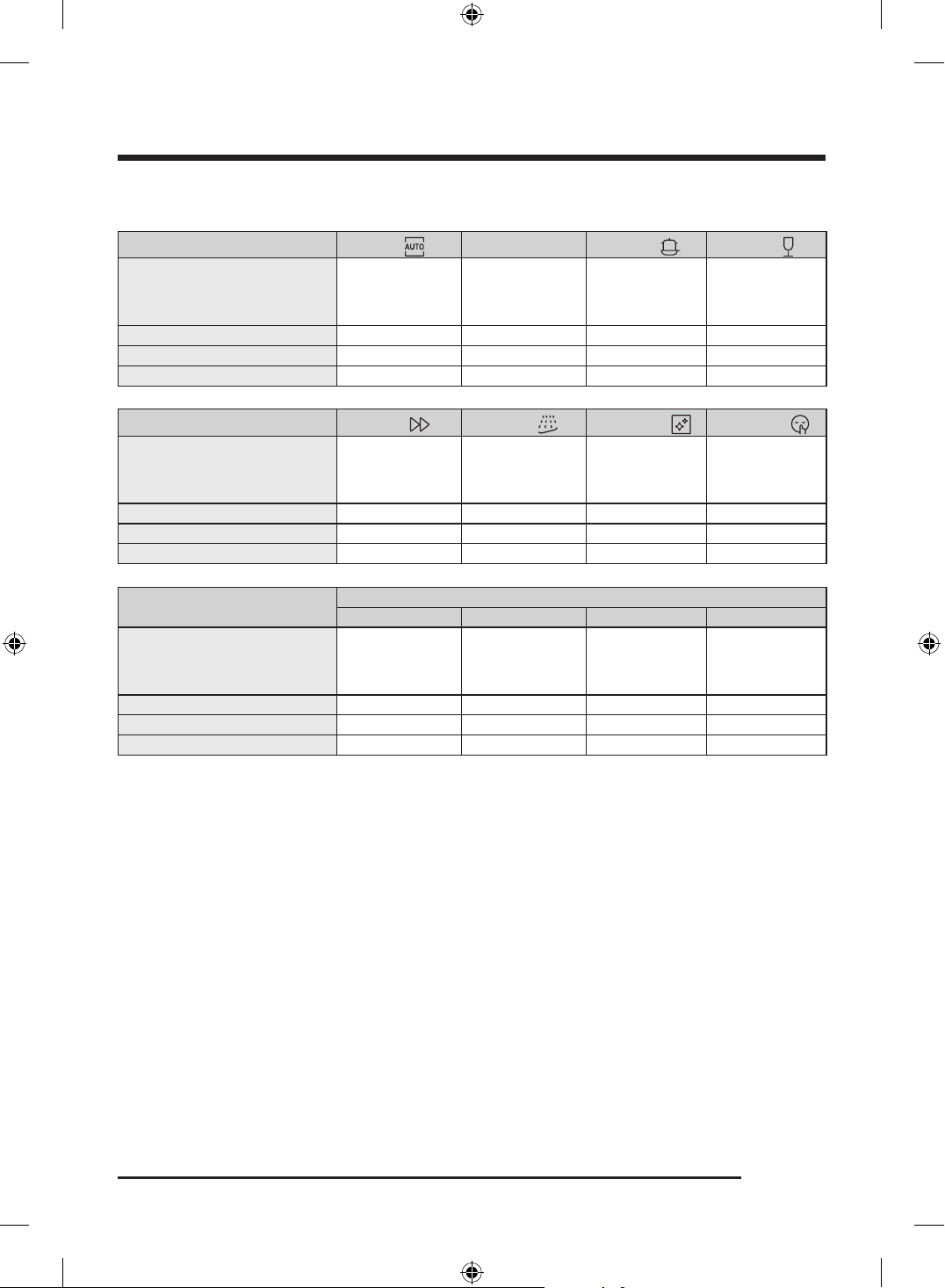
English 79
DW60**77****/DW60**76**** models
Cycle
AUTO
ECO
Intensive
Delicate
Cycle sequence
Pre wash (40 °C) >
Main wash (55-60 °C)
> Rinse > Hot Rinse
(53-58 °C) > Dry > End
Pre wash > Main wash
(43 °C) > Rinse > Hot
Rinse (44 °C) > Dry
> End
Pre wash (45 °C) >
Main wash (65 °C)
> Rinse > Hot Rinse
(63 °C) > Dry > End
Pre wash (40 °C) >
Main wash (50 °C)
> Rinse > Hot Rinse
(50 °C) > Dry > End
Water consumption (L) 12.5-15.2 9.4 15.75 11.95
Energy consumption (kWh) 0.85-1.25 0.64 1.45 0.8
Cycle time (min.) 102-149 249 174 111
Cycle
Express Pre Wash Machine Care Extra Silence
Cycle sequence
Main wash (63 °C)
> Rinse > Hot Rinse
(57 °C) > Dry > End
Pre wash > End
Pre wash > Main wash
(70 °C) > Rinse > Hot
Rinse (70 °C) > Dry
> End
Pre wash > Main wash
(60 °C) > Rinse > Hot
Rinse (55 °C) > Dry
> End
Water consumption (L) 9.8 4 12.9 13.6
Energy consumption (kWh) 1.05 0.05 1.4 1.1
Cycle time (min.) 78 24 136 257
Cycle
Downloaded cycle
Plastic Baby Care Pots and Pans Drinkware
Cycle sequence
Main wash (60 °C)
> Rinse > Hot Rinse
(60 °C) > Dry > End
Hot Rinse (75 °C) >
Dry > End
Pre wash > Main wash
(68 °C) > Rinse > Hot
Rinse (68 °C) > Dry
> End
Main wash (60 °C)
> Rinse > Hot Rinse
(53 °C) > Dry > End
Water consumption (L) 12.9 4.5 15.5 9.4
Energy consumption (kWh) 1.1 1 1.5 0.71
Cycle time (min.) 91 68 145 37
Untitled-1 79Untitled-1 79 2024-07-08 10:40:352024-07-08 10:40:35
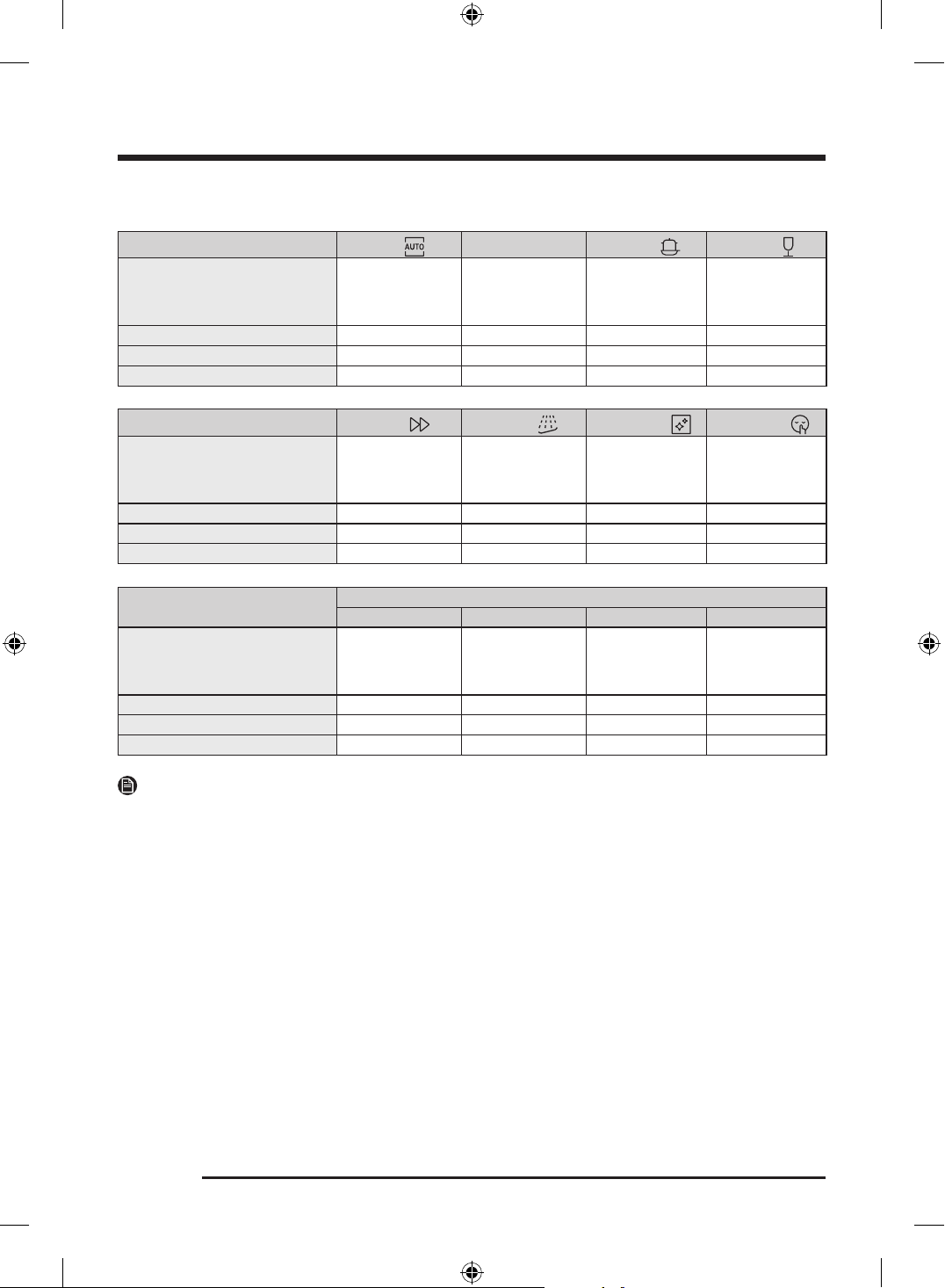
Appendix
English80
DW60**750*** models
Cycle
AUTO
ECO
Intensive
Delicate
Cycle sequence
Pre wash (40 °C) >
Main wash (55-60 °C)
> Rinse > Hot Rinse
(53-58 °C) > Dry > End
Pre wash > Main wash
(49 °C) > Rinse > Hot
Rinse (47 °C) > Dry
> End
Pre wash (45 °C) >
Main wash (65 °C)
> Rinse > Hot Rinse
(63 °C) > Dry > End
Pre wash (40 °C) >
Main wash (50 °C)
> Rinse > Hot Rinse
(50 °C) > Dry > End
Water consumption (L) 12.5-15.2 9.2 15.75 11.95
Energy consumption (kWh) 0.85-1.25 0.75 1.45 0.8
Cycle time (min.) 102-149 255 174 111
Cycle
Express Pre Wash Machine Care Extra Silence
Cycle sequence
Main wash (63 °C)
> Rinse > Hot Rinse
(57 °C) > Dry > End
Pre wash > End
Pre wash > Main wash
(70 °C) > Rinse > Hot
Rinse (70 °C) > Dry
> End
Pre wash > Main wash
(60 °C) > Rinse > Hot
Rinse (55 °C) > Dry
> End
Water consumption (L) 9.8 4 12.9 13.6
Energy consumption (kWh) 1.05 0.05 1.4 1.1
Cycle time (min.) 78 24 136 257
Cycle
Downloaded cycle
Plastic Baby Care Pots and Pans Drinkware
Cycle sequence
Main wash (60 °C)
> Rinse > Hot Rinse
(60 °C) > Dry > End
Hot Rinse (75 °C) >
Dry > End
Pre wash > Main wash
(68 °C) > Rinse > Hot
Rinse (68 °C) > Dry
> End
Main wash (60 °C)
> Rinse > Hot Rinse
(53 °C) > Dry > End
Water consumption (L) 12.9 4.5 15.5 9.4
Energy consumption (kWh) 1.1 1 1.5 0.71
Cycle time (min.) 91 68 145 37
NOTE
• The cycle time depends on the options you have added, and the pressure and temperature of the
supplied water.
• The dishwasher drains the remaining water inside automatically if it has not been used for the last 5
days.
• The power consumption depends on the water temperature or load.
• Energy values for cycles were calculated under standardised testing conditions.
Untitled-1 80Untitled-1 80 2024-07-08 10:40:352024-07-08 10:40:35
English 81
Transportation/relocation
Make sure the dishwasher is empty with no loose parts. First, drain the dishwasher as follows.
1. Open the door, and then turn the dishwasher on.
2. Select the ECO cycle.
3. Tap Start , and then close the door.
4. When the cycle is finished, open the door after 5 seconds.
5. Touch and hold Start for 3 seconds to drain water.
6. Close the door.
7. When the draining process is complete, open the door.
8. Turn the dishwasher off, and then shut the water valve off.
9. Disconnect both the water hose and the drain hose.
CAUTION
Do not shake or sway the dishwasher while moving it. Residual water may drip from the dishwasher.
Protection against frost
If you leave the dishwasher in a place with a risk of frost for an extended time, make sure to empty the
dishwasher. For details, see the “Transportation/relocation” section.
Disposing the dishwasher and helping the environment
Your dishwasher is manufactured from recyclable materials. If you decide to dispose of it, please observe
your local waste disposal regulations. Cut off the power cord so that the appliance cannot be connected to
a power source.
Remove the door so that animals and children cannot get trapped inside the appliance.
Untitled-1 81Untitled-1 81 2024-07-08 10:40:352024-07-08 10:40:35
Appendix
English82
Energy, water saving tip
• The ECO cycle is suitable to clean normally soiled tableware, that for this use, it is the most efficient
cycle in terms of its combined energy and water consumption, and that it is used to assess compliance
with the EU ecodesign legislation (COMMISSION REGULATION (EU) 2019/2022).
• Manual pre-rinsing of tableware items leads to increased water and energy consumption and is not
recommended. Use a knife, etc. to remove only large bits of food before loading.
• Water supplied can be up to 60 °C, and less power is consumed when hot water is connected.
• It’s better to fill the racks if possible but without overloading.
• Load the tableware to the racks properly to prevent damage and poor performance.
- Overloading and overlapping tableware may reduce the cleaning and drying performance.
• Load your tableware as recommended.
- Load the tableware with the concave bottom at an angle so that water can run off.
- Arrange the tableware so they do not interfere with the spray arms and the detergent dispenser.
• It can make the cleaning and drying performance better, and prevent the noise of spray arms bumping
the tableware.
- To prevent injury from the knives and other utensils with sharp points, it must be loaded in the
basket with their points down or placed in a horizontal position.
• To save water and energy, use the ECO cycle. it is the most efficient program when washing normally
soiled items.
• Use an appropriate amount of detergent and rinse according to the manufacturer’s guidelines.
• Dishwasher use saves water compared to ordinary washing by hand.
• Ecodesign information can be found by going to www.samsung.com/support.
EPREL information
To access energy labelling information about this product on the European Product Registry for Energy
Labelling (EPREL), go to https://eprel.ec.europa.eu/qr/****** where ****** is the product’s EPREL
registration number. You can find the registration number on the rating label of your product.
Untitled-1 82Untitled-1 82 2024-07-08 10:40:362024-07-08 10:40:36
English 83
Specifications
Model
DW60DG790B**
DW60DG77*B**
DW60DG760B**
DW60DG750B**
DW60DG790I**
DW60DG77*I**
DW60DG760I**
DW60DG750I**
DW60DG790F**
DW60DG77*F**
DW60DG760F**
DW60DG750F**
Type Fully Built-in
Fully Built-in
(Sliding)
Free Standing
Power 220-240 V~, 50Hz
Water pressure 0.05-0.8 MPa
Wash capacity
DW60DG790***
DW60DG77****
DW60DG750***
14 place settings
DW60DG760*** 13 place settings
Rated power 2000-2300 W
Dimension 595x552x815 mm 598x600x845 mm
Weight (Unpacked) 40.5 kg 42.5 kg 54.5 kg
Weight (Packed) 44.0 kg 46.0 kg 58.5 kg
Untitled-1 83Untitled-1 83 2024-07-08 10:40:362024-07-08 10:40:36
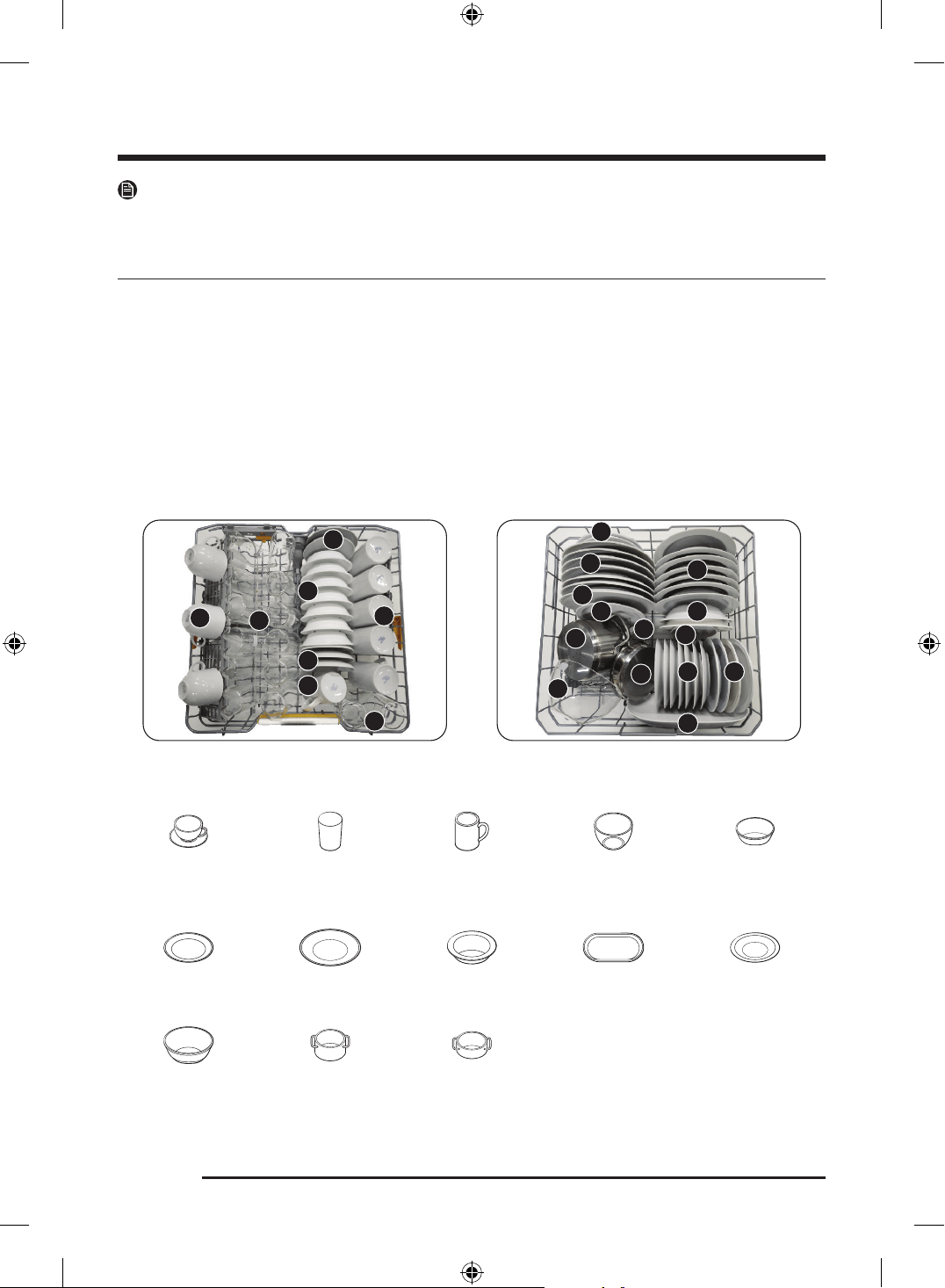
English84
For standard test
NOTE
The information for comparability test as follows.
DW60DG79*/77*/75* Series
• Washing capacity: 14 place settings
• Test standard: EN 60436
• Position of upper rack: lower position
• Position of cutlery rack : lower position (Applicable models only)
• Wash cycle: ECO
• Additional options: None
• Dose per wash setting: F6
• Water hardness level setting: L2
• Dosage of the standard detergent: main-wash 22 g
• For the arrangement of the items, refer to the below figures
1
2
6
3
4
3
4
2
Upper rack
11
8
13
5
14
4
2
7 11
10
11
2
12
9
Lower rack
1. Cups
2. Saucers
3. Glasses 4. Mug cups 5. Glass bowls 6. Dessert bowls
7. Dessert plates 8. Dinner plates 9. Soup plates 10. Oval platter 11. Melamine dessert
12. Melamine bowl 13. Small pot 14. Oven pot
Untitled-1 84Untitled-1 84 2024-07-08 10:40:372024-07-08 10:40:37
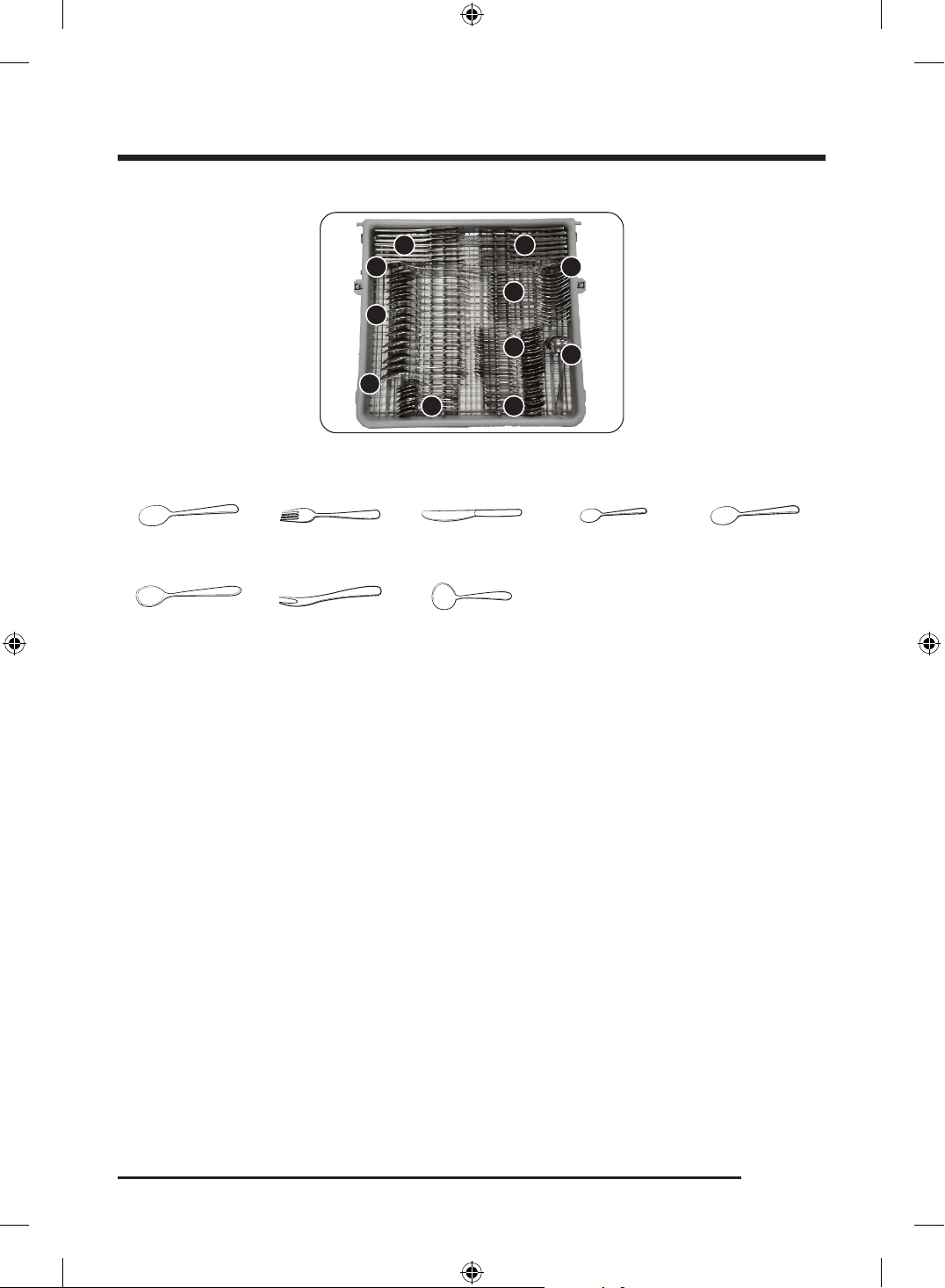
English 85
3 3
1
7
4 4
8
6
6
5
2
Cutlery rack
1. Soup spoons 2. Forks 3. Knives 4. Tea spoons 5. Dessert spoons
6. Serving spoons 7. Serving forks 8. Gravy ladles
Untitled-1 85Untitled-1 85 2024-07-08 10:40:382024-07-08 10:40:38
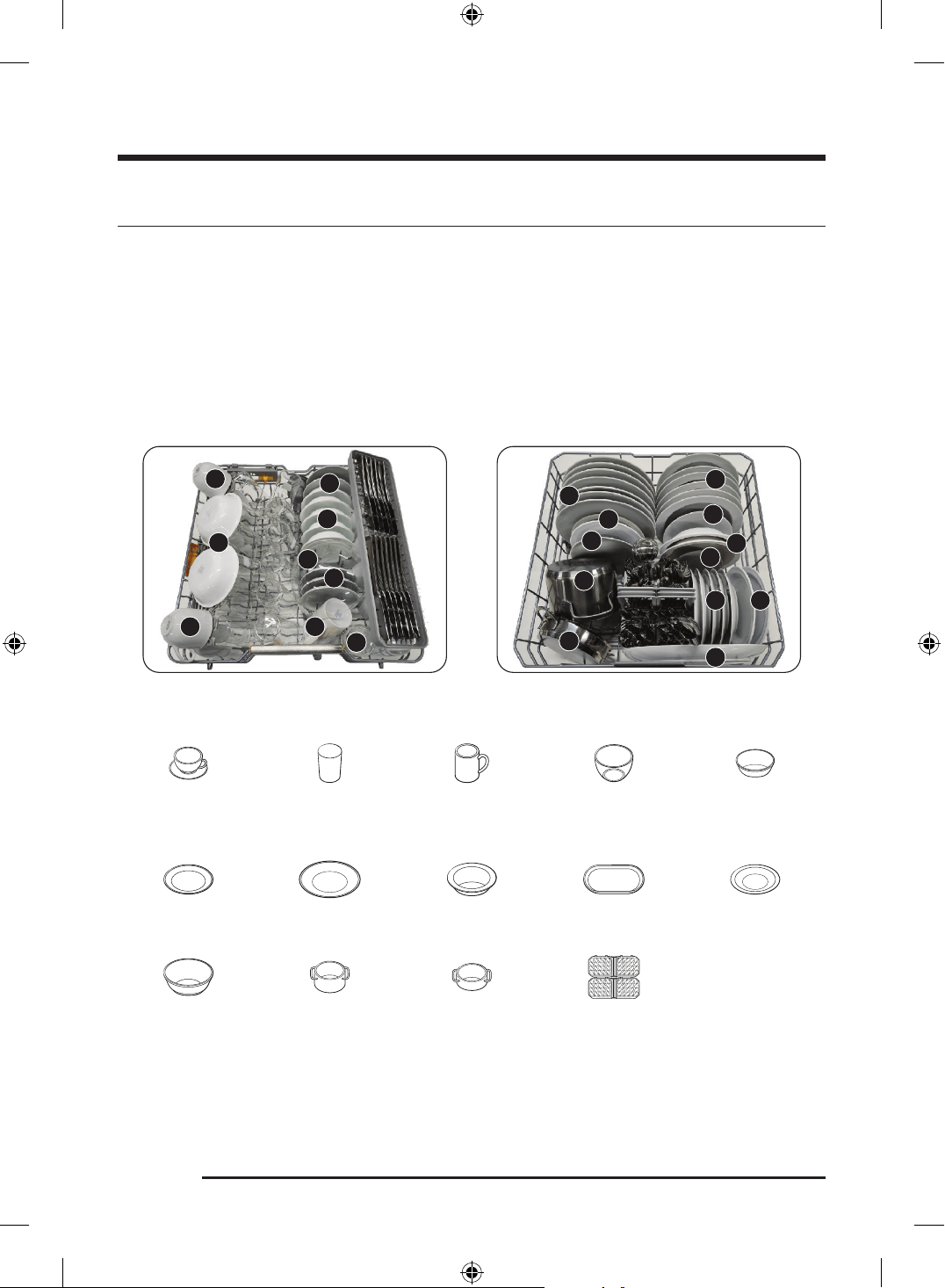
For standard test
English86
DW60DG76* Series
• Washing capacity: 13 place settings
• Test standard: EN 60436
• Position of upper rack: upper position
• Wash cycle: ECO
• Additional options: None
• Dose per wash setting: F6
• Water hardness level setting: L2
• Dosage of the standard detergent: main-wash 21 g
• For the arrangement of the items, refer to the below figures
1
1
6
5
2
2
6
4
3
Upper rack
11
11
8
7
7
14
13
10
7
12
2
9
Lower rack
1. Cups
2. Saucers
3. Glasses 4. Mug cups 5. Glass bowls 6. Dessert bowls
7. Dessert plates 8. Dinner plates 9. Soup plates 10. Oval platter 11. Melamine dessert
12. Melamine bowl 13. Small pot 14. Oven pot 15. Cutlery basket
Untitled-1 86Untitled-1 86 2024-07-08 10:40:382024-07-08 10:40:38
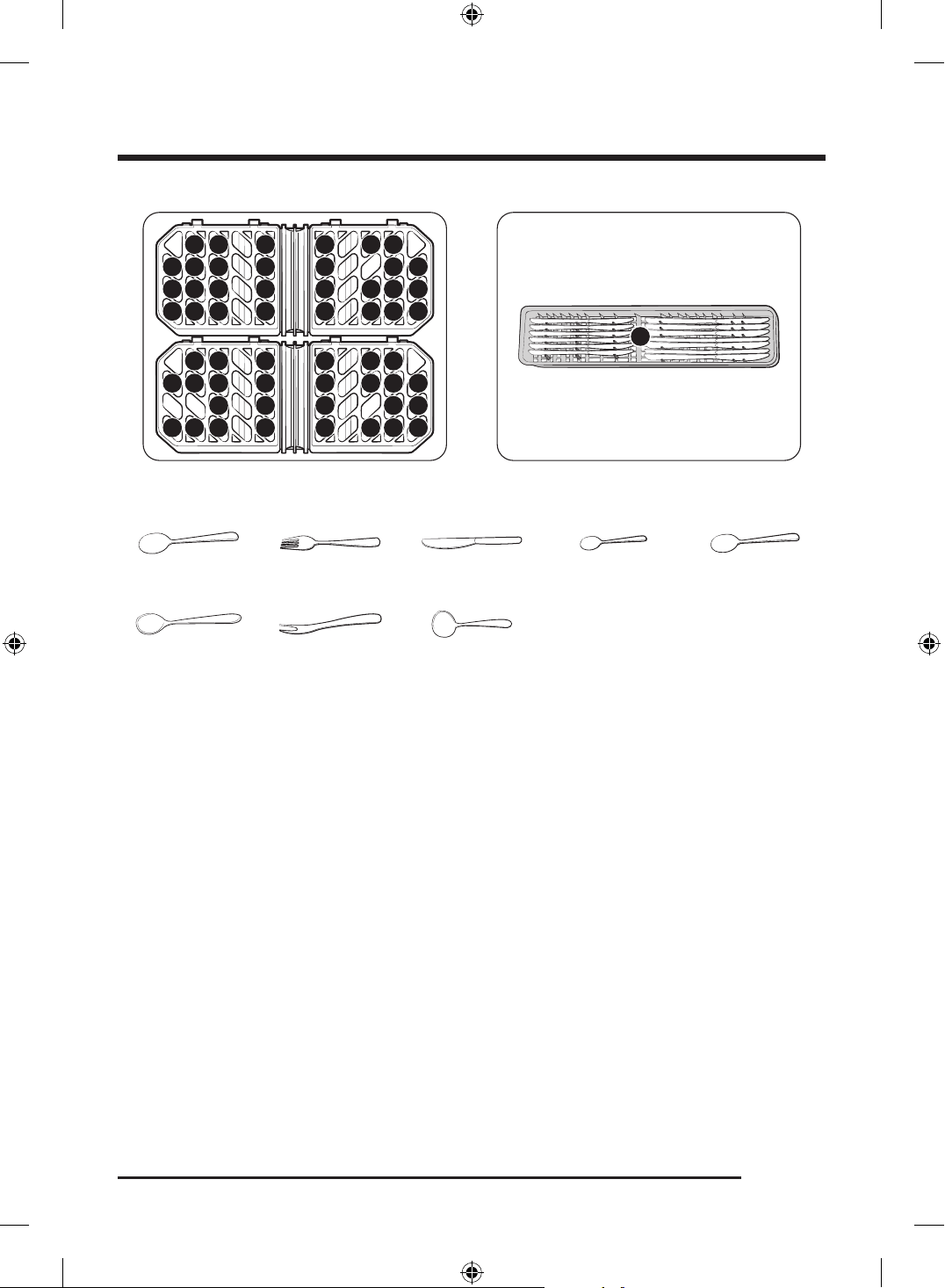
English 87
2
1
2
1
4
4
4
4
6
2
1
6
7
1
2
5
5
5
1
2
1
2
5
5
5
5
4
4
4
2
1
2
1
4
4
4
4
1
2
1
5
2
1
2
5
5
4
1
2
1
2
5
5
5
8
4
Cutlery basket
3
Cutlery rack
1. Soup spoons 2. Forks 3. Knives 4. Tea spoons 5. Dessert spoons
6. Serving spoons 7. Serving forks 8. Gravy ladles
Untitled-1 87Untitled-1 87 2024-07-08 10:40:392024-07-08 10:40:39
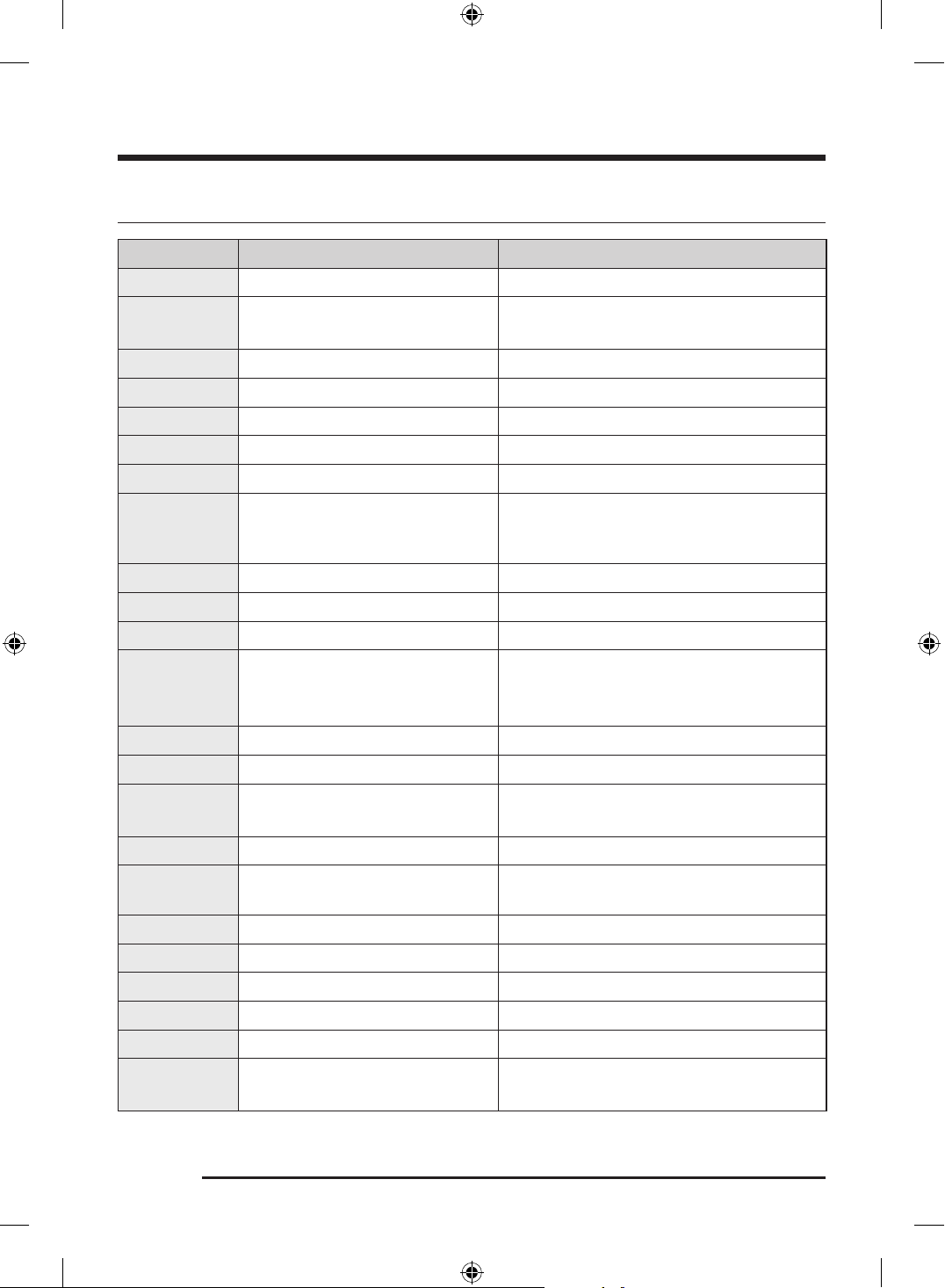
English88
Contact information
QUESTIONS OR COMMENTS?
COUNTRY CALL OR VISIT US ONLINE AT
AUSTRIA 0800 72 67 864 (0800-SAMSUNG) www.samsung.com/at/support
BELGIUM 02-201-24-18
www.samsung.com/be/support (Dutch)
www.samsung.com/be_fr/support (French)
DENMARK 70 70 19 70 www.samsung.com/dk/support
FINLAND 030-622 75 15 www.samsung.com/fi/support
FRANCE 01 48 63 00 00 www.samsung.com/fr/support
GERMANY 06196 77 555 77 www.samsung.com/de/support
ITALIA 800-SAMSUNG (800.7267864) www.samsung.com/it/support
GREECE
80111-SAMSUNG (80111 726 7864)
only from land line (+30) 210
6897691 from mobile and land line
www.samsung.com/gr/support
LUXEMBURG 261 03 710 www.samsung.com/be_fr/support
NETHERLANDS 088 90 90 100 www.samsung.com/nl/support
NORWAY 21 62 90 99 www.samsung.com/no/support
PORTUGAL
210 608 098
Chamada para a rede fixa nacional
Dias úteis das 9h às 20h
www.samsung.com/pt/support
SPAIN 91 175 00 15 www.samsung.com/es/support
SWEDEN 0771-400 300 www.samsung.com/se/support
SWITZERLAND 0800 726 786
www.samsung.com/ch/support (German)
www.samsung.com/ch_fr/support (French)
UK 0333 000 0333 www.samsung.com/uk/support
IRELAND
(EIRE)
0818 717100 www.samsung.com/ie/support
LITHUANIA 8-800-77777 www.samsung.com/lt/support
LATVIA 8000-7267 www.samsung.com/lv/support
ESTONIA 800-7267 www.samsung.com/ee/support
CZECH 800 - SAMSUNG (800-726786) www.samsung.com/cz/support
SLOVAKIA 0800 - SAMSUNG (0800-726 786) www.samsung.com/sk/support
POLAND
801-172-678*
* (opłata według taryfy operatora)
http://www.samsung.com/pl/support/
Untitled-1 88Untitled-1 88 2024-07-08 10:40:392024-07-08 10:40:39
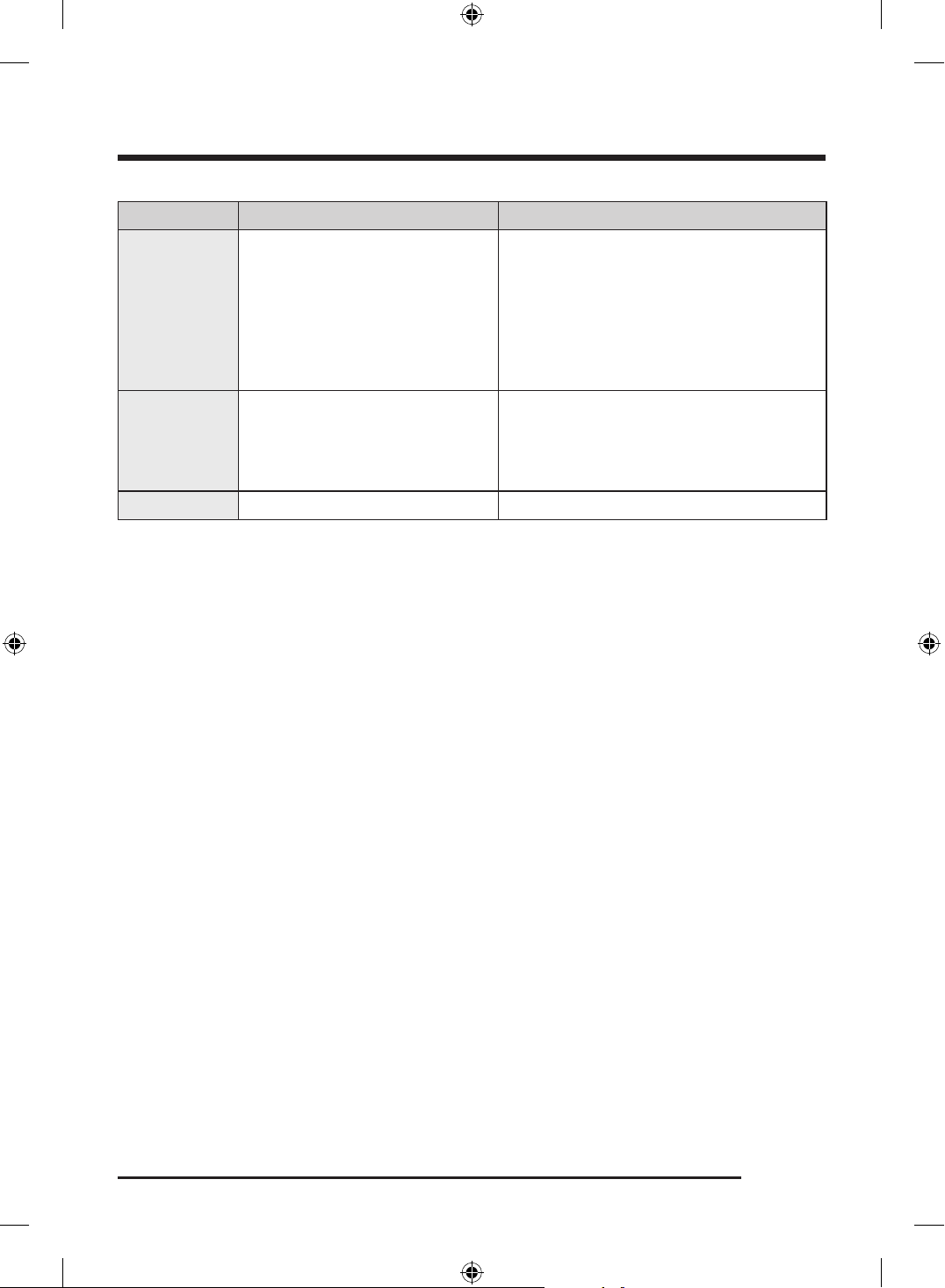
English 89
COUNTRY CALL OR VISIT US ONLINE AT
BULGARIA
0800 111 31 - Безплатен за всички
оператори
*3000 - Цена на един градски
разговор или според тарифата на
мобилният оператор
09:00 до 18:00 - Понеделник до
Петък
www.samsung.com/ro/support
ROMANIA
0800872678 - Apel gratuit
*8000 - Apel tarifat în reţea
Program Call Center
Luni - Vineri: 9 AM - 6 PM
www.samsung.com/ro/support
HUNGARY 0680SAMSUNG (0680-726-7864) www.samsung.com/hu/support
Untitled-1 89Untitled-1 89 2024-07-08 10:40:392024-07-08 10:40:39

Memo
Untitled-1 90Untitled-1 90 2024-07-08 10:40:392024-07-08 10:40:39

Memo
Untitled-1 91Untitled-1 91 2024-07-08 10:40:392024-07-08 10:40:39
Untitled-1 92Untitled-1 92 2024-07-08 10:40:392024-07-08 10:40:39