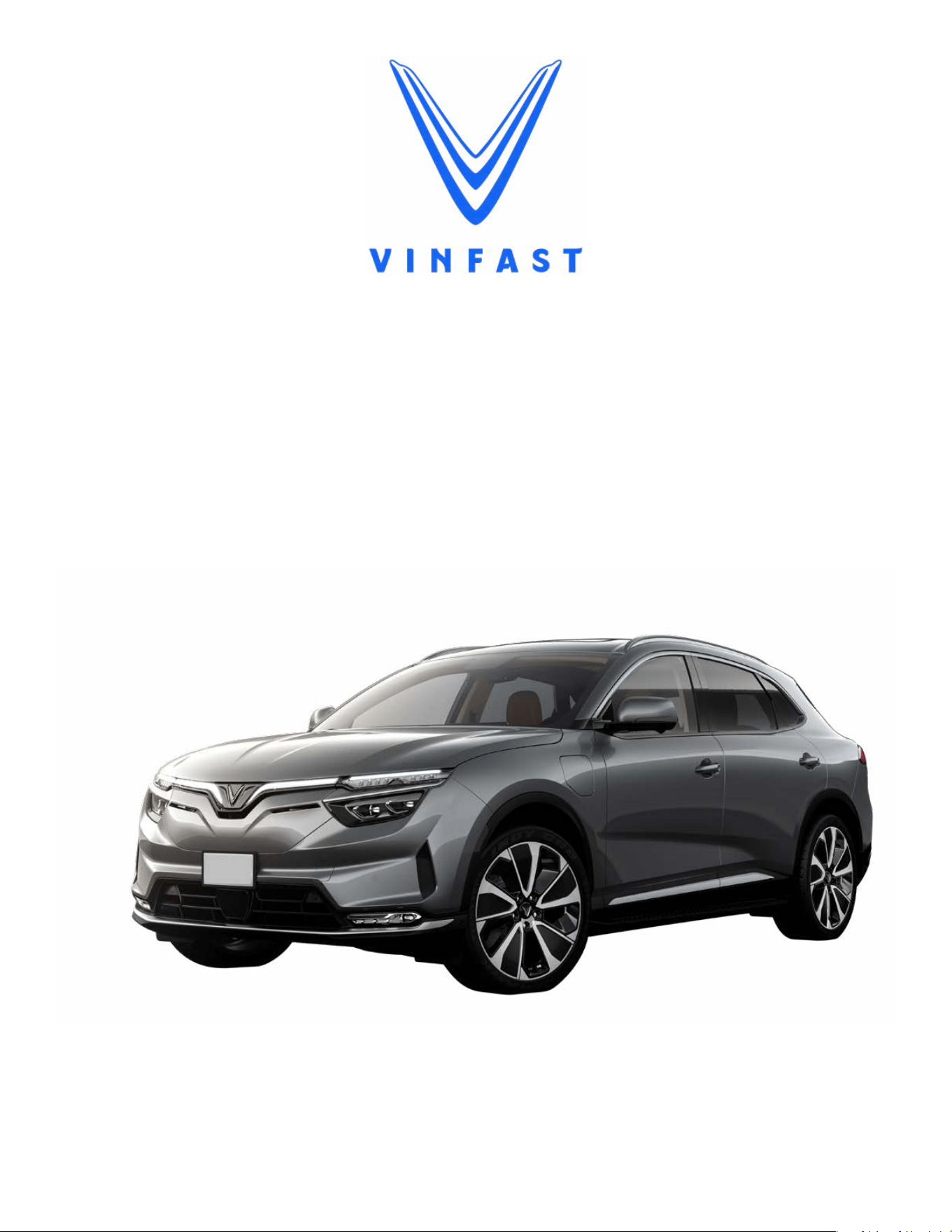
VinFast VF8 EV SUV
First Responder Guide

Legal notice:
This guide was created only for rst and second responders who have specic training in the area of
technical assistance following road accidents, and are therefore able to carry out the activities described
in this guide. Specications and optional equipment for VinFast vehicles and the range of vehicles made
by VinFast are subject to ongoing changes. VinFast therefore explicitly reserves the right to make changes
or modications to this guide at any time. The information factors in the state of knowledge at the date of
creation.
Please note:
The information in this guide is not intended for end customers, nor is it intended for workshops and
dealerships. End customers can nd information about the functions of their vehicles and important safety
information on vehicle and occupant safety in the owner’s manual of the respective VinFast vehicle.
Workshops and authorized dealers can obtain repair information from the usual sources known to them.
Legal
2

Contents
This First Responder Guide covers emergency vehicle shutdown information for the VinFast VF8 EV SUV.
The VF8 is an all-electric vehicle and contains High Voltage (HV) components. The HV battery is the main
energy source. High voltage refers to systems with DC voltage above 60 V or AC voltage above 30 V.
The information in this guide is intended for use only by qualied and trained rst responders. This guide
describes how to identify HV components and safely handle them during an emergency. It also explains
how to disable the HV system and provides safety information specic to the VF8, including high-strength
materials used in the vehicle structure. Failure to follow the practices recommended in this guide can result in
serious injury or death.
Revision: January 9, 2023
Warnings 4
0. Rescue Sheet 5
1. Vehicle Identication 6
2. Stabilizing & Lifting 8
3. Disable Direct Hazards 10
4. Access to the Occupants 13
5. Stored Energy 17
6. In Case of Fire 20
7. In Case of Submersion 21
8. Towing, Transportation, Storage 22
9. Important Additional Information 24
3

Warnings
DANGER
Always assume that HV parts are energized. Always wear the appropriate Personal
Protective Equipment (PPE). Contact with HV current can cause serious injury or death.
Recovery of a submerged vehicle without appropriate PPE can result in serious injury or
death.
Batteries can release ammable or toxic gases if they are damaged. Gases can be ignited
by a spark or heat source. Pressure from expanding gases can build up in battery packs and
cause an explosion. These situations can lead to serious injury or death.
WARNING
Do not use the HV battery to lift the vehicle. The HV battery could become damaged. This
increases the risk of injury.
If the electric vehicle is on re, it can be extinguished with large quantities of water. Use
water from a hydrant or other nearby water sources whenever possible.
Lithium-ion batteries can spontaneously self-ignite. Batteries can reignite after a re has
been suppressed. This can occur several hours after an event that causes damage or as the
result of incorrect use. Always wear the appropriate PPE.
NOTE
PPE must be worn for all practices discussed in this guide. Appropriate PPE is required for
the procedure to disable the HV system. PPE may include rubber gloves, safety glasses,
electrical hazard footwear, earplugs, hardhats and face shields, respirators, or arc-rated
clothing and undergarments.
DANGER WARNING CAUTION
Will result in serious
personal injury or death.
May cause serious
injury or death.
May cause personal injury
or component damage.
4

0. Rescue Sheet
Airbag Airbag inflator/
stored gas inflator
Seat belt
pretensioner
SRS
control unit
Gas strut/
preloaded spring
High strength
zone
Battery,
low voltage
High voltage
power cable
Disconnect
high voltage
device
Fuse box
disabling
high voltage
Low voltage
device that
disconnects
high voltage
High voltage
component
Note: The illustration shows the maximum possible range of equipment.
EV SUV
VF 8
400 V
lithium-ion
battery
5

1. Vehicle Identication
Exterior badges identify the VinFast VF8 EV SUV. Each model has distinguishing features.
Individual models can be identied by body shape, size, and vehicle design.
6

1. Vehicle Identication
The VIN is located in three places on the vehicle.
1.Look through the windshield on the driver’s side. A stamped plate on the dashboard provides
the VIN.
2.Lift the carpet ap to reveal a stamped plate that provides the VIN.
3.On the main display unit, navigate to Settings > About > Vehicle.
1 2 3
7

2. Stabilizing & Lifting
Wheel rotation generates high voltage and must be prevented while stabilizing the vehicle.
Stabilizing
The VF8 can be pushed short distances to clear
the roadway when safety allows. Press the
brake pedal and the “N” button on the driver
console to put the vehicle in neutral.
Step2:
Chock the wheels to prevent movement in case
the parking brake fails.
Step1:
Press the Park (P) button on the driver console to
engage the parking brake.
Pushing
8

2. Stabilizing & Lifting
Lifting
Extreme caution is required when lifting the vehicle. The VF8 has a 400-volt lithium-ion HV
battery mounted underneath the oor pan. When lifting or jacking the vehicle, only use the
designated lifting points marked in red.
WARNING
Do not use the HV battery to lift the vehicle. The HV battery could become damaged.
This increases the risk of injury.
NOTE
This guidance applies only to non-deformed vehicles. If the VF8 involved in a crash is
deformed, rst responders must decide how to safely lift the vehicle.
9

3. Disable Direct Hazards
There are two methods to disable the High Voltage system:
Method 1
Step1:
On the touchscreen, press the Unlock Charge Door button. Then, push the charge port ap once
to open it.
To open it manually, pull a Bowden cable within the trunk and next to the hood hinge to release
the ap. Then, push the charge port ap once to open it. For details on opening the hood, see
page14.
A Mechanical Service Disconnect (MSD) is located within the charge port. The MSD is low voltage
and interrupts the 12V power supply to the HV battery. Disconnecting the MSD initiates an HV
system shutdown.
1 2 3
Step2:
Remove the MSD as follows:
1. Remove the security ap.
2. Pull the red safety cap.
3. Pull the MSD tab.
10

3. Disable Direct Hazards
1.Open the hood. There are two rst responder cut loops in the engine compartment. One is
located behind the coolant tank, and one is located behind the front trunk emergency release.
The right-hand cut loop requires the removal of the entire front trunk (frunk) assembly and its
attaching parts.
2.Lift the plastic ap to access the left-hand rst responder cut loop.
3.Cut the negative cable of the 12V battery. Look for the cut loop label and cut the cable twice.
Cutting any one loop will interrupt the 12V power to the HV battery, which opens the contactors
in the HV battery. Cut loops need to be cut at two places to prevent the wires from accidentally
contacting each other.
Method 2
NOTE
It takes about 5 minutes for the high voltage to dissipate.
If the key is outside the vehicle, the VF8 will shutdown automatically. Keeping the key at least
19 feet away from the vehicle will prevent accidental operation of electrical systems.
If a normal shutdown process is not possible:
NOTE: This cut loop
is only accessible
when the front trunk
(frunk) assembly is
removed.
11

3. Disable Direct Hazards
Disable HV System While Charging
The charging plug must be removed to disable the HV system during charging. The charging plug
can only be removed when the vehicle’s doors are unlocked. If the charging plug is not removed
from the charging port within 60 seconds, charging will resume.
Mechanical emergency release cables are located on the left side within the trunk compartment
and next to the hood hinge. The charging handle emergency release cable is near the wiper motor.
To stop the charging process and release the charging handle locking pin, press “Stop Charging” on
the main display unit.
To release the charging plug manually:
1.Press the Stop Charging button on the main display unit inside the vehicle.
2.Pull the mechanical release cable (1) to disconnect the charging plug.
NOTE
There is a second emergency release cable (2) that opens the charging port ap manually if it
is not electrically released.
WARNING
Make sure the vehicle is powered off. Contact with moving wiper motor mechanism
may cause serious injury.
1
2
12

4. Access to the Occupants
Opening doors from the outside
Pull the door handle to open the door.
Opening doors from the inside
Pull the door handle to open the door from the
inside.
NOTE
If the exterior door handles do not work, reach into the window and pull the interior door
handle.
Accessing the Vehicle
13

4. Access to the Occupants
Pull the lever below the steering wheel twice to open the hood.
Opening the Hood
14

4. Access to the Occupants
1.To open the tailgate, press the button at the base of the tailgate.
2.If no 12V power is available, the tailgate can be operated manually from inside the vehicle.
To access the emergency safety release, open the inside cover on the lower side of the
tailgate. Press the white tab to open the tailgate.
Opening the Tailgate
15

4. Access to the Occupants
The VF8 has areas that contain HV components and other hazards that could be dangerous if a
cut is made. The tailgate contains two gas struts that are pressurized. Dangerous cutting areas
are shown in orange.
There is a risk of serious injury or death if a cut is made in these areas.
Cutting the Vehicle
DANGER
Always assume that HV parts are energized. Always wear the appropriate PPE. Contact
with HV current can cause serious injury or death.
Reinforcement locations
To protect vehicle occupants, extra-high-strength steel is used. Reinforcements are shown in teal
Powerful cutting equipment must be used to cut or crush these areas.
16

5. Stored Energy
The VF8 contains High Voltage components. All HV components are marked with warning labels,
except for HV cables. The HV cables are easily recognized by their orange warning color.
Examples of warning labels on HV components and batteries:
High Voltage Components
WARNING
Always assume that parts are energized. Always wear the appropriate PPE. Contact with
HV current can cause serious injury or death.
1. HV Compressor
2. HV Heater
3. Front Drive Unit
4. Power Distribution Unit
5. Control Unit
6. EMI Filter
7. High Voltage Battery
8. Charge Port
9. High Voltage Cabling
10. Rear Drive Unit
17

5. Stored Energy
High voltage cables are displayed in orange.
The VF8 has a rst responder cut loop in the front trunk that can be cut twice to disable 12V
power supply to the HV system. See page11 for details.
High Voltage Cables
DANGER
The HV system must be disabled before disconnecting any components. Never touch, cut, or
disconnect the following items until the HV system is disabled:
• any orange HV cables
• any HV connectors
• any HV components
Failure to do so can result in injury or death due to electric shock.
18

5. Stored Energy
High Voltage Battery
The VF8 has a 400-volt lithium-ion HV battery mounted underneath the oor pan. When using
rescue equipment, make sure the oor pan is not breached.
Batteries
WARNING
Do not use the HV battery to lift the vehicle. The battery could become damaged. This
increases the risk of injury.
LowVoltage(12V)Battery
The VF8 also has a low-voltage 12V battery located under the hood.
The 12V battery supplies power to the high-voltage contactors. This allows HV current to ow in
and out of the HV battery. When the 12V battery is disconnected, HV current cannot ow.
19

6. In Case of Fire
First responder:
• Provide large quantities of water to extinguish the re
• Monitor the temperature of the battery after extinguishing
• Arrange for evacuation. Remember that the battery might reignite
• Quarantine the vehicle in case of reignition
HVbatteryres:
• Flooding a battery with water can extinguish it
• If no water is available, use a dry chemical or other typical re-extinguising agent until
water is available
• The battery can create dangerous gases when it ignites
Gaining access to battery:
• If it’s determined safe to do so, raise or tilt the vehicle to gain direct access to the battery
• Do not open the battery
• Only apply water inside the battery if a natural opening exists
Reignition:
• The battery could reignite if it is placed near re
• Check for remaining heat sources with a thermal imaging camera
• Make sure the battery is fully cooled before moving the vehicle
WARNING
If the electric vehicle is on re, it can be extinguished with large quantities of water. Use
water from a hydrant or other nearby water sources whenever possible.
Lithium-ion batteries can spontaneously self-ignite. Batteries can reignite after a re has
been suppressed. This can occur several hours after an event that causes damage. Always
wear the appropriate PPE and self-contained breathing apparatus during reghting
activities.
Extinguishing a Fire
NOTE
The HV battery system has lithium-ion cells. If this type of battery catches re, it has a low
risk of explosion because it contains an oxidizer. This type of battery will continue to burn
until it is completely burned out.
20

7. In Case of Submersion
Whether the VF8 is fully or partially submerged, the HV system does not pose an increased risk of
electric shock. If the vehicle has suffered serious damage in an accident before being submerged,
there could be an increased risk of electric shock during recovery. Fireghters should follow
established guidelines per National Fire Protection Association (NFPA) to recover a damaged
electric vehicle in a submerged state.
Remove the vehicle from the water and disable the HV system as described on page10
(Method 1). Make sure to wear the appropriate PPE.
DANGER
Recovery of a submerged vehicle without appropriate PPE can result in serious injury or
death.
Submersion
21

DANGER
Monitor the battery temperature with a thermal camera (if available) after a crash to
prevent thermal runaway. Thermal runaway can result in a re or explosion as the
batteries release stored energy. Battery cells can release gases in response to chemical
reactions occurring inside the batteries.
8. Towing, Transportation, Storage
If the VF8 is damaged in a crash, it should be transported to a safe storage location.
Isolate the vehicle as follows:
• Do not park the damaged vehicle in an enclosed building
• The damaged vehicle should be parked outdoors at a safe distance from other vehicles,
buildings, and ammable objects
• Quarantine areas should be established and used whenever possible
Emergency responders must be notied of a thermal runaway. The battery pack must be cooled
to stop the chemical reaction.
Handling Damaged Vehicle
Do not push on the oor pan inside the VF8. When using rescue equipment, make sure the oor
pan is not breached. The HV battery or the HV cables may be damaged. Both can result in serious
injury or death. Wait until trained personnel arrive if oor pan is breached.
Vehicle damage
A damaged electric vehicle must not be touched without the proper PPE.
DANGER
Always assume that HV parts are energized. Always wear the appropriate PPE. Contact
with HV current can cause serious injury or death.
22

8. Towing, Transportation, Storage
The HV system must be switched off before transporting the vehicle.
The VF8 must be fully placed on a tow truck bed for transporting. Set the gear to Neutral (N),
disengage the parking brake, and turn off the vehicle.
When towed, the vehicle must not have any wheels in contact with the road surface. The wheels
must be secured properly using an eight-point tie-down method.
Drive units
The VF8 has two electric drive units: front and rear. The HV battery sends direct current (DC)
energy to the Electric Drive System (EDS) to rotate the wheels.
Wheel rotation can generate electricity in the EDS. This could result in overheating of HV
components or cause further damage. The wheels should be chocked to prevent movement.
Towing
WARNING
Lithium-ion batteries can spontaneously self-ignite. Batteries can reignite after a re has
been suppressed. This can occur several hours after an event that causes damage. Always
wear the appropriate PPE.
23

9. Important Additional Information
Airbags are installed throughout the VF8, including seat-mounted airbags in the front and rear
seats.
When an airbag is deployed, the vehicle will deactivate high voltage in all components and cables
except the HV battery.
Air bag locations are identied below.
Airbags
1. Knee airbags
2. Central airbags
3. Seat-mounted side airbags
4. Curtain-airbags
5. Rear side airbags
24

9. Important Additional Information
Airbag ination cylinders are located above the rear windows. They are outlined in red.
Pyrotechnic seat belt pre-tensioners are located at the bottom of the B-pillars and behind the rear
seats. The seat belt pre-tensioners are outlined in red.
Inators
Seat Belt Pre-Tensioners
WARNING
There are safety risks present when cutting the vehicle. Follow all safety precautions when
working on pyrotechnic devices. Failure to comply could result in serious injury or death.
25