Operating and Installation
Instructions
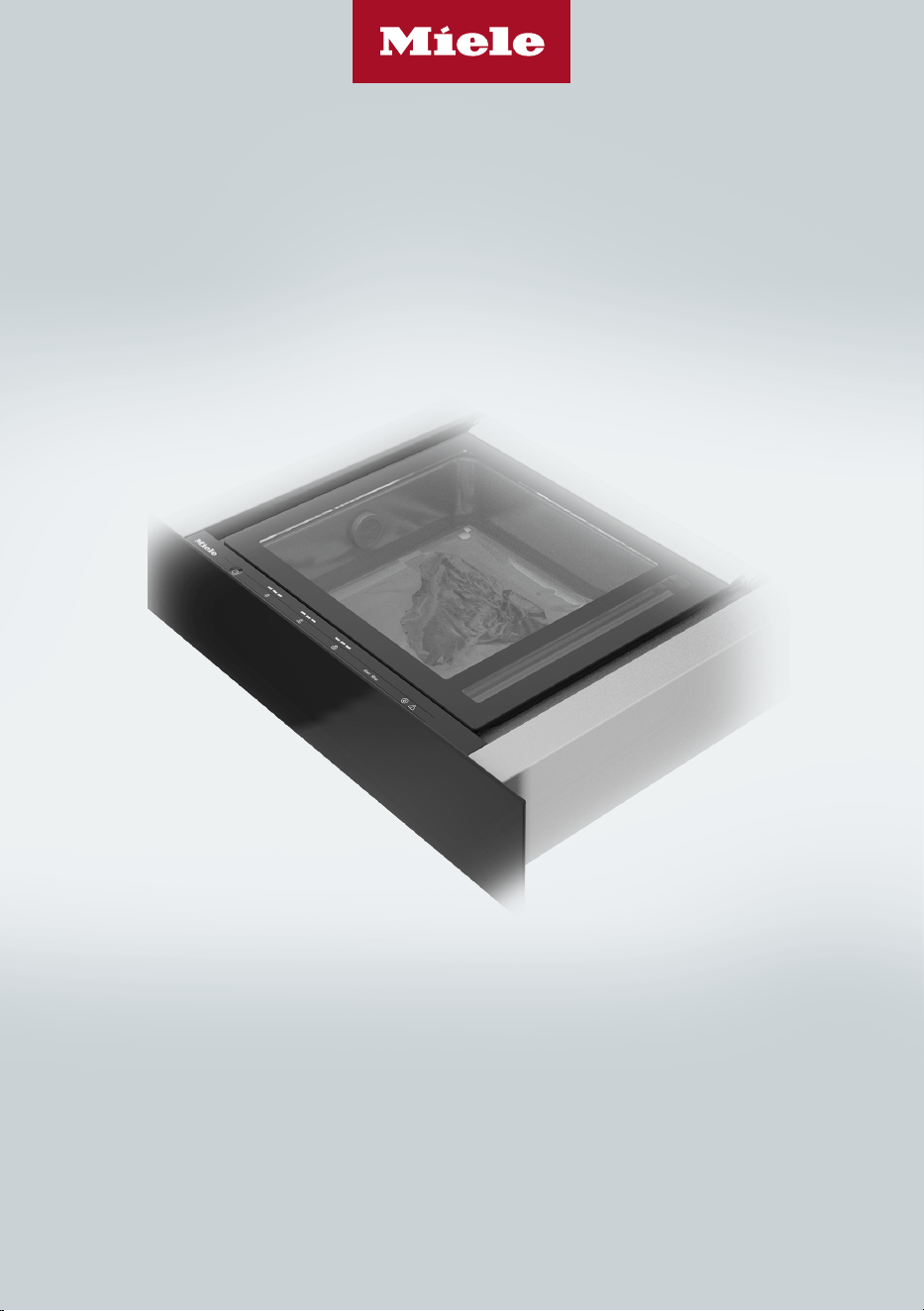
Built-in Vacuum Drawer
To prevent accidents and machine damage, read these instructions
before installation or use.
en-US M.-Nr. 11 924 080

Contents
2
IMPORTANT SAFETY INSTRUCTIONS ............................................................ 4
Caring for the environment .............................................................................. 14
Overview............................................................................................................. 15
EVS 7010............................................................................................................. 15
EVS 7670............................................................................................................. 16
Controls and indicators ....................................................................................... 17
Included accessories........................................................................................... 18
Cleaning for the first time................................................................................. 19
Operation............................................................................................................ 20
Storage compartment (EVS 7670 only) ............................................................... 20
Suitable vacuum-sealing bags ............................................................................ 21
Important usage information ............................................................................... 21
Tips...................................................................................................................... 23
Using the vacuum settings.................................................................................. 24
Using the sealing levels....................................................................................... 25
Vacuuming and sealing bags .............................................................................. 27
Sealing the bag early...................................................................................... 28
Vacuuming sealing external containers............................................................... 29
After use .............................................................................................................. 32
Canceling a vacuum-sealing process ................................................................. 32
Cleaning and care ............................................................................................. 33
Cleaning the drawer front and glass lid............................................................... 34
Cleaning the vacuum chamber and sealing bar.................................................. 34
Cleaning the vacuum adapter ............................................................................. 34
Cleaning the vacuum-sealing bag support ......................................................... 34
Carrying out a drying cycle ................................................................................. 35
Frequently Asked Questions ............................................................................ 36
Customer Service.............................................................................................. 42
Contact in the event of a fault ............................................................................. 42
Data plate ............................................................................................................ 42
Appliance warranty and product registration ...................................................... 42
Installation.......................................................................................................... 43
IMPORTANT SAFETY INSTRUCTIONS - INSTALLATION ................................... 43
Installation notes ................................................................................................. 44

Contents
3
Installation dimensions EVS 7010 ....................................................................... 45
Installation in a tall or base unit...................................................................... 45
Combination with an H2840 or CVA/DGC/H7x4x........................................ 46
Combination with a DGC/H7x6x................................................................... 47
Side view ........................................................................................................ 48
Connections and ventilation........................................................................... 49
Installation dimensions EVS 7670 ....................................................................... 50
Combination with a CVA/DGC/H7x7x........................................................... 50
Combination with a DGC7x8x....................................................................... 51
Side view ........................................................................................................ 52
Connections and ventilation........................................................................... 53
Installation ........................................................................................................... 54
Electrical connection ........................................................................................... 59
IMPORTANT SAFETY INSTRUCTIONS
4
Please note that the vacuum-sealing drawer is referred to as the drawer in these
operating instructions.
This drawer complies with all current local and national safety re-
quirements. Inappropriate use can, however, lead to personal in-
jury and material damage.
Read the operating and installation instructions carefully before
using the drawer. They contain important information on safety, in-
stallation, use, and maintenance. This prevents both personal in-
jury and damage to the drawer.
In accordance with standard IEC60335-1, Miele expressly and
strongly advises that you read and follow the instructions in the
chapter on installing the drawer as well as in the “IMPORTANT
SAFETY INSTRUCTIONS”.
Miele cannot be held liable for injury or damage caused by non-
compliance with these instructions.
Keep these operating and installation instructions in a safe place
and pass them on to any future owner.
SAVE THESE INSTRUCTIONS AND REVIEW THEM PERIODICALLY

IMPORTANT SAFETY INSTRUCTIONS
5
Appropriate use
This drawer is intended for domestic use and use in other similar
environments.
The drawer is not intended for outdoor use.
The drawer is only for domestic use to vacuum and seal food in
vacuum bags intended for this purpose and to vacuum-seal food in
vacuum-proof containers made of plastic or stainless steel.
All other types of use are not permitted.
Never vacuum-seal live food (e.g., mussels, seafood).
Persons who lack physical, sensory or mental abilities, or experi-
ence with the appliance should not use it without supervision or in-
struction by a responsible person.

IMPORTANT SAFETY INSTRUCTIONS
6
Safety with children
Do not leave children unattended: Children should not be alone or
unsupervised in the area where the appliance is installed. Do not al-
low them to sit or stand on the appliance.
Be sure to supervise any children in the vicinity of the drawer, and
do not let them play with it.
The sealing bar becomes hot during operation. The weld seam of
the vacuum bag is also heated to a very high temperature during the
sealing process. Keep children away from the drawer until the seal-
ing bar and the seam have cooled sufficiently that there is no longer
any danger of burning.
Danger of suffocation. While playing, children may become entan-
gled in packaging material (such as plastic wrapping) or pull it over
their head, presenting the risk of suffocation. Keep packaging mate-
rial away from children.

IMPORTANT SAFETY INSTRUCTIONS
7
Technical safety
Proper installation: Make sure that your appliance has been in-
stalled correctly and that it has been grounded by a qualified techni-
cian.
Maintenance by the user: Never repair or replace any part of the
appliance unless the instructions specifically recommend doing so.
Service work should only be performed by a qualified technician.
Unauthorized installation, maintenance, and repairs can cause
considerable danger for the user. Installation, maintenance, and re-
pairs must only be carried out by a Miele authorized technician.
A damaged drawer can be dangerous. Always check for visible
signs of damage. Never use a damaged appliance.
Pay attention to any damage or cracks to the glass lid or chamber
seal. Damage to the glass lid can cause implosion. Never operate
the drawer if the glass lid and/or the chamber seal is damaged.
The drawer has an integrated vacuum pump, which contains oil.
To prevent oil from leaking out, the drawer must be transported and
stored in a horizontal position only. Do not tilt the drawer and do not
stand it up on its side.
The manufacturer's warranty will be invalidated if oil has leaked out
of the appliance because it has not been transported or stored cor-
rectly.

IMPORTANT SAFETY INSTRUCTIONS
8
Temporary or permanent operation on an autonomous power sup-
ply system or a power supply system that is not synchronized with
the grid power supply (e.g., island networks, back-up systems) is
possible. A prerequisite for operation is that the power supply sys-
tem complies with the specifications of EN50160 or an equivalent
standard.
The function and operation of the protective measures provided in
the domestic electrical installation and in this Miele product must
also be maintained in isolated operation or in operation that is not
synchronized with the grid power supply, or these measures must be
replaced by equivalent measures in the installation. As described, for
example, in the current version of VDE-AR-E 2510-2.
Be certain the drawer is properly installed and grounded by a
qualified technician. To guarantee the electrical safety of this appli-
ance, continuity must exist between the appliance and an effective
grounding system. It is imperative that this basic safety requirement
be met. If there is any doubt, have the electrical system of the house
checked by a qualified electrician.
The connection data (voltage and frequency) on the data plate of
the drawer must match the domestic electrical supply in order to
avoid the risk of damage to the drawer.
Compare this data before connecting the appliance. If in any doubt,
consult a qualified electrician.
Do not connect the drawer to the electrical supply with a power
bar or extension cord. These are a fire hazard and do not guarantee
the required safety of the appliance.
For safety reasons, the drawer may only be used when it has been
fully installed.
This drawer may not be used in non-stationary locations (e.g. on a
ship).

IMPORTANT SAFETY INSTRUCTIONS
9
Any contact with live connections or tampering with the electrical
or mechanical components of the drawer will endanger your safety
and may lead to appliance malfunctions.
Do not open the casing of the drawer under any circumstances.
Do not operate the drawer with wet hands or if you are in contact
with water.
Any repairs not performed by a Miele authorized service techni-
cian will void the warranty.
Defective components should be replaced by Miele original parts
only. Only with these parts can safety of the appliance be assured as
intended by the manufacturer.
If the plug has been removed or the power cord is not supplied
with a plug, the drawer must be connected to the power supply by a
suitably qualified electrician.
If the power cord is damaged, it must be replaced with a special
power cord (see “Electrical connection” under “Installation”).
If power is interrupted during vacuum-sealing, the vacuum in the
chamber is retained and the glass lid cannot be opened. Do not un-
der any circumstances try to force the glass lid open or use tools to
open it. You will be able to open the lid when power has been re-
stored.
The drawer must be completely disconnected from the power
supply during installation, maintenance and repair work. This can be
ensured as follows:
- The circuit breaker has tripped, or
- The fuse of the electrical installation is completely removed, or
- The plug (if present) is removed from the outlet. In the process,
pull the plug not the cord.

IMPORTANT SAFETY INSTRUCTIONS
10
If the drawer is installed behind a cabinet panel (e.g., a door), en-
sure that the door is never closed while the drawer is in use. Heat
and moisture can build up behind a closed cabinet panel and cause
subsequent damage to the drawer, the housing unit, and the floor.
Do not close the door until the sealing bar and the drawer have
cooled down completely.

IMPORTANT SAFETY INSTRUCTIONS
11
Correct use
Storage in the appliance: Flammable materials should not be
stored in the drawer.
Danger of burning. The sealing bar gets hot during operation. The
weld seam of the vacuum-sealing bag is also heated to a very high
temperature during the sealing process. Do not touch the sealing bar
or the weld seam immediately after the vacuum-sealing process.
Risk of fire. Do not store any easily flammable substances and
materials in the vicinity of the drawer.
The maximum load capacity of the telescopic drawer rails is
55lbs (15kg). If you overload the drawer or lean/stand on it when it
is open, you will damage the rails.
Damage to the glass lid can cause implosion. Do not place any
objects on the glass lid. Ensure that the glass lid cannot sustain
damage from falling objects.
Do not use the drawer or the glass lid as a work surface, a chop-
ping surface, or a shelf.
The drawer must be installed so that it can be pulled out com-
pletely and there is sufficient room to open the glass lid. This en-
sures that you can see into the vacuum chamber and avoid touching
the sealing bar and weld seam and burning yourself.
When vacuuming liquids, bubbles can form at lower temperatures
which will cause an impression of boiling. Steam can escape, which
can cause the drawer to malfunction.
For this reason, only vacuum-seal food (liquid or solid) when it has
cooled. Follow the vacuuming process carefully and seal the bag
early if necessary.
If liquid gets into the drawer and the vacuum pump air intake
valve, this can result in damage to the vacuum pump.

IMPORTANT SAFETY INSTRUCTIONS
12
Moisture in food or drinks can cause corrosion damage in the
drawer. Do not use the drawer to store food or drinks.
Miele does not permit vacuum-sealing of glass containers.
Never insert the tubes attached to the drawer into any body ori-
fices.
Vacuum sealing single-use jars and jars with twist-off lids in the closed vac-
uum chamber:
Risk of injury. Damage and cracks in jars or glass/twist-off lids can
cause implosion.
Only vacuum seal jars and lids which are in perfect condition.
Risk of injury. The high pressure during the vacuum-sealing
process causes the vacuum chamber and the glass lid on the drawer
to distort slightly. Do not let single-use jars or jars with twist-off lids
touch the drawer’s glass lid during the vacuum-sealing process as
this can cause damage to the protective coating on the glass lid and
cause it to implode.
Only vacuum seal single-use jars and jars with twist-off lids up to a
maximum height of 3" (8cm) in order to maintain a safety gap of at
least 1cm between the lid of the jar and the glass lid of the drawer.

IMPORTANT SAFETY INSTRUCTIONS
13
Cleaning and maintenance
Danger of electric shock. The steam from a steam cleaner could
reach live electrical components and cause a short circuit. Never use
a steam cleaner for cleaning.
Caring for the environment
14
Disposal of the packing mate-
rial
The cardboard box and packing materi-
als protect the appliance during ship-
ping. They have been designed to be
biodegradable and recyclable.
Ensure that any plastic wrappings,
bags, etc. are disposed of safely and
kept out of the reach of children. Dan-
ger of suffocation!
Disposal of your old appliance
Electrical and electronic appliances
contain valuable materials. They also
contain certain substances, compounds
and components which were essential
for the proper functioning and safe use
of the equipment. Handling these mate-
rials improperly by disposing of them in
your household waste can be harmful to
your health and the environment. There-
fore, please do not dispose of your old
appliance with regular household waste
and follow local regulations on proper
disposal.
Consult with local authorities, dealers or
Miele in order to dispose of and recycle
electrical and electronic appliances.
Miele assumes no responsibility for
deleting any personal data left on the
appliance being disposed. Please en-
sure that your old appliance is kept
away from children until removal. Ob-
serve safety requirements for appli-
ances that may tip over or pose an en-
trapment hazard.
Overview
15
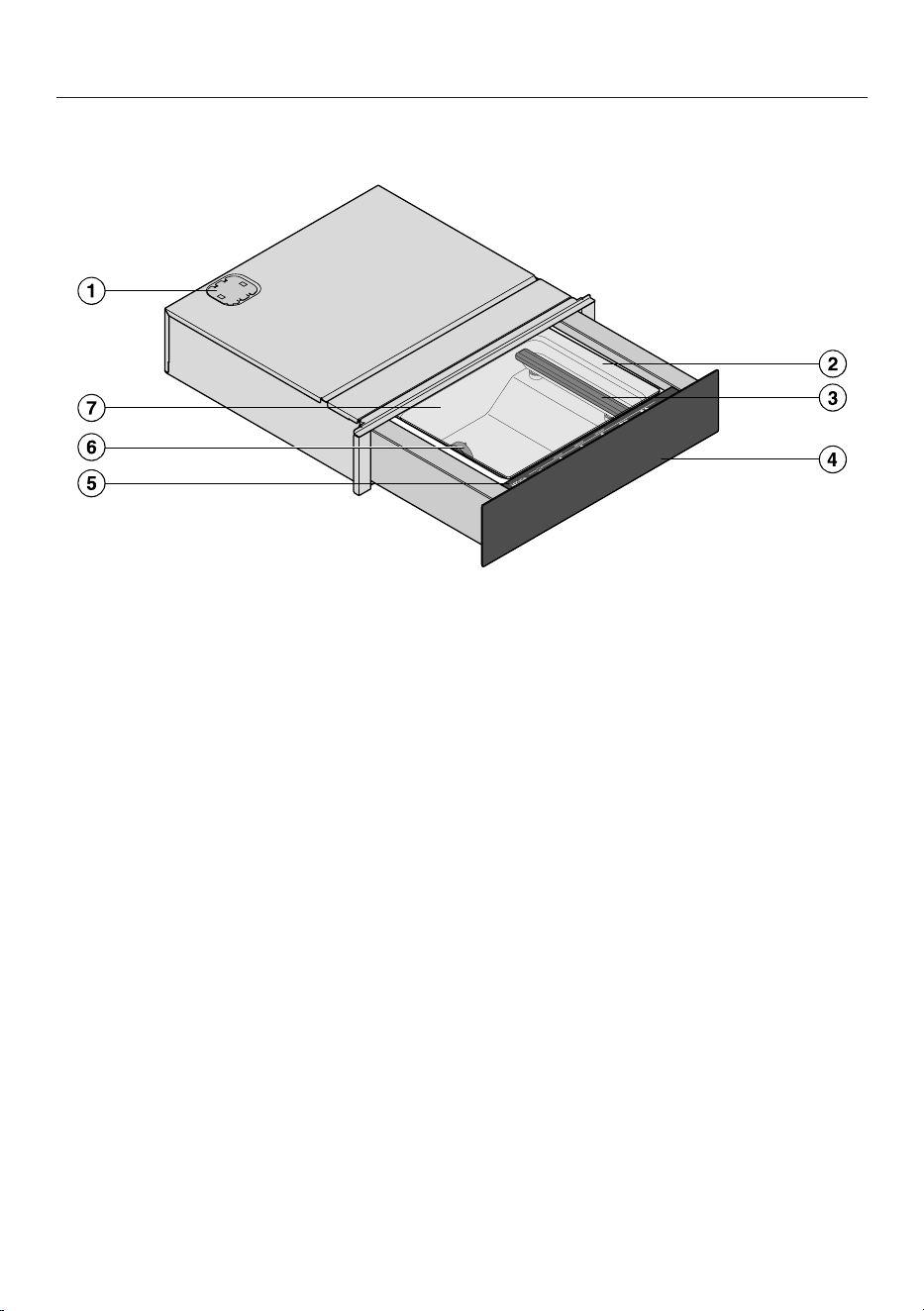
EVS 7010
a
Air filter cover (see “Installation”)
b
Glass lid with chamber seal
Push down on the little black triangle to close the glass lid.
c
Sealing bar in the vacuum chamber and counterpressure bar on the inside of
the glass lid
d
Drawer front with Push2open mechanism
The drawer can be opened and closed by lightly pressing the drawer front.
e
Controls and indicators
f
Vacuum pump air-intake valve/vacuum-adapter connection
g
Vacuum chamber
Overview
16
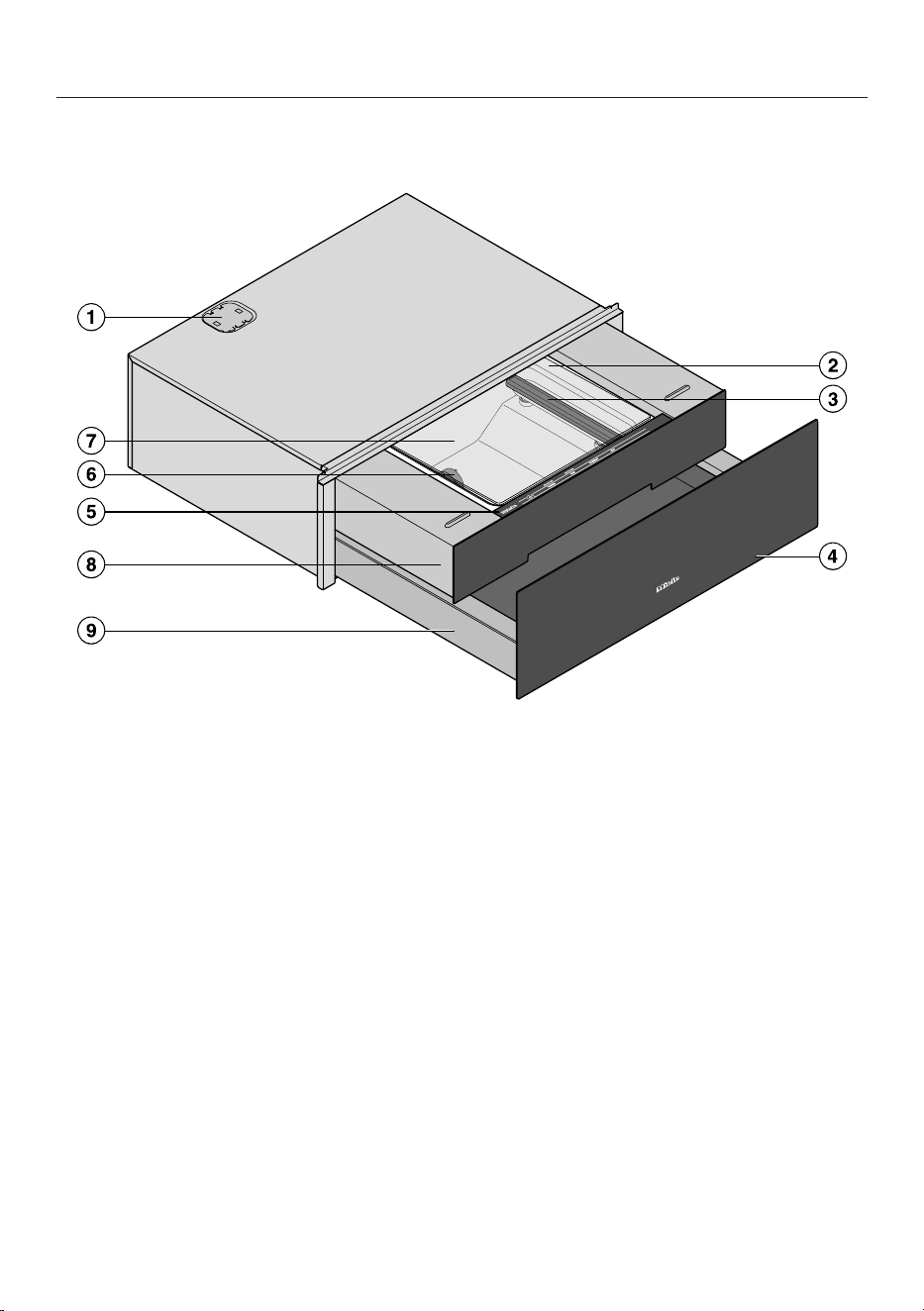
EVS 7670
a
Air filter cover (see “Installation”)
b
Glass lid with chamber seal
Push down on the little black triangle to close the glass lid.
c
Sealing bar in the vacuum chamber and counterpressure bar on the inside of
the glass lid
d
Drawer front with Push2open mechanism
The drawer can be opened and closed by lightly pressing the drawer front.
e
Controls and indicators
f
Vacuum pump air-intake valve/vacuum-adapter connection
g
Vacuum chamber
h
Vacuum-sealing compartment
i
Storage compartment

Overview
17
Controls and indicators
Sensor buttons
a
On/Offsensor control
For switching the drawer on and off
b
Vaccumsensor control
For setting the vacuum setting
c
Sealsensor control
For setting the sealing level/sealing
the bag early
d
Containersensor control
For setting the vacuum setting for
external containers
e
Startsensor control
For starting the vacuum-sealing
process for external containers
f
Stopsensor control
For canceling the:
–vacuum-sealing process
–vacuum-sealing process
for external containers
–sealing process
–drying cycle
g
sensor control
For displaying/for starting a
drying cycle
(see “Cleaning and care – Carrying
out a drying cycle”).
Displays/Indicator lights
h
indicator light
Indicates a warning
(see “Problem solving guide”)
i
Segment bar indicator lights
For displaying the:
–vacuum setting
–sealing level
–vacuum setting
for external containers

Overview
18
Included accessories
The accessories supplied with your ap-
pliance, as well as a range of optional
ones, are available to order from Miele
(see “Optional accessories”).
Vacuum adapter
1adapter for vacuum-sealing third-
party containers
Vacuum-sealing bag support
1 surface for small bags

Cleaning for the first time
19
Remove any protective foil and stick-
ers.
Do not remove stickers carrying
safety or installation information or
the data plate.
This makes it easier to perform servic-
ing and repair work.
Cleaning the drawer for the
first time
Take all accessories out of the
drawer.
Damage due to unsuitable clean-
ing agents.
The glass lid and the chamber seal
become damaged or scratched.
Do not clean with any abrasive or
acidic cleaning agents or sharp
pointed objects.
Clean the drawer inside and out with
a clean sponge and a mild solution of
warm water and liquid dish soap or a
clean, damp microfiber cloth.
After cleaning, wipe the surfaces dry
using a soft cloth.
Operation
20
Storage compartment
(EVS 7670 only)
Risk of damage due to overload-
ing.
Overloading the storage compart-
ment will damage the telescopic run-
ners.
Only load the storage compartment
with maximum 33 lb (15kg).
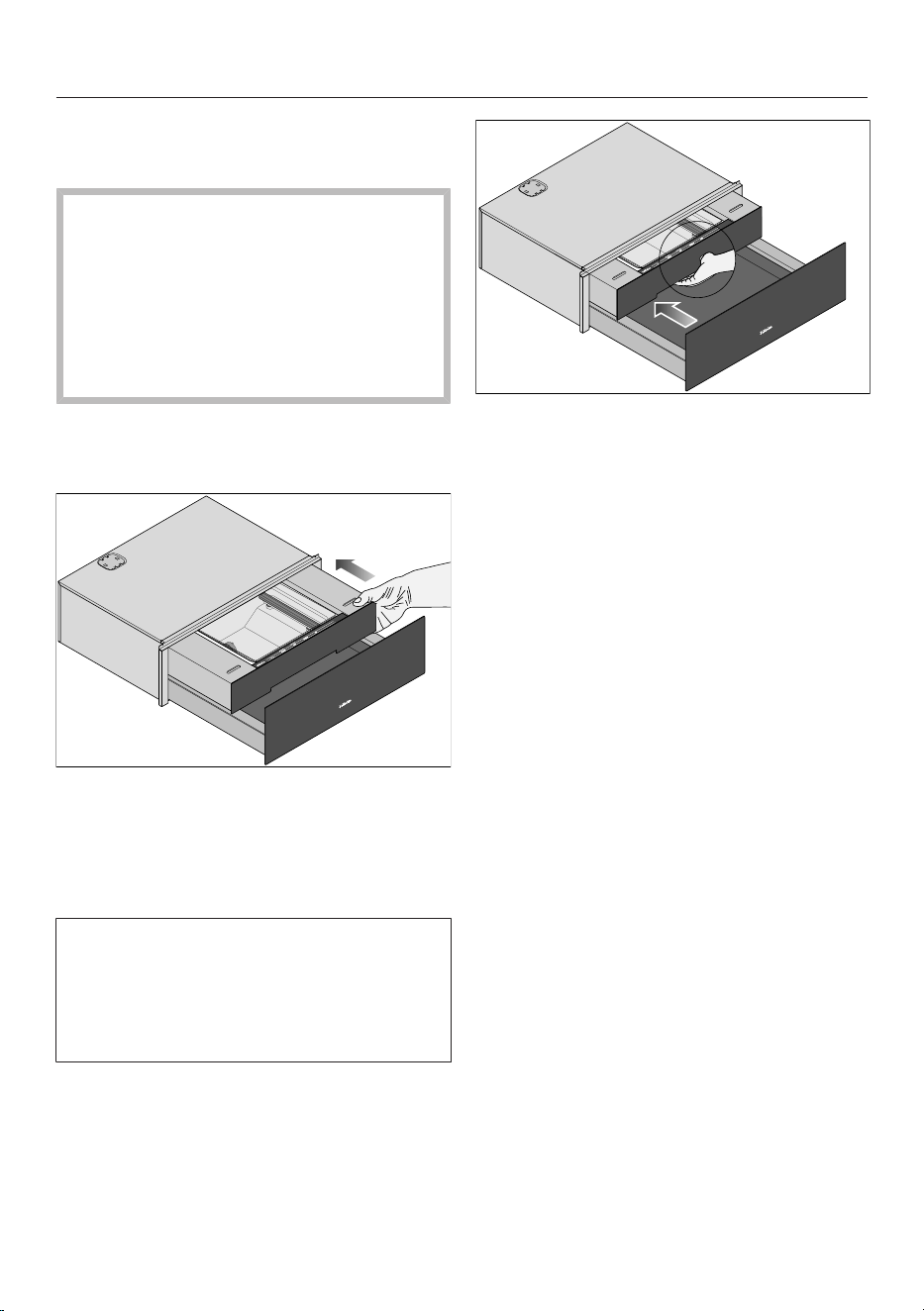
Opening the storage compartment
Open the drawer.
Place a thumb in front of one of the
protrusions on the side of the vac-
uum-sealing compartment. Place
your remaining fingers on the side of
the vacuum-sealing compartment.
If the surface of the vacuum-sealing
compartment is hard to grip (e.g., due
to cooking fumes), use both hands to
open the vacuum-sealing compart-
ment.
Slide the vacuum-sealing compart-
ment back until approximately half of
the storage compartment is visible.
Reach behind the recess in the front
of the vacuum-sealing compartment
from below and push the vacuum-
sealing compartment back com-
pletely.
Closing the storage compartment
Close the drawer.
Reopening the vacuum-sealing com-
partment
Follow the instructions for opening
the storage compartment in reverse
order.

Operation
21
Suitable vacuum-sealing bags
Only vacuum-sealing bags meeting the
following material requirements are per-
mitted for use:
- suitable for use with food
- suitable for freezing and cooking
- suitable for storing and sous-vide
cooking of liquid and solid food
- maximum size:
97/16"x133/4" (240x350mm)
(tubular bags)/
133/4" (350mm) (sealed edge bags)
- properties: preferably smooth
- made from PA/PE, not printed on the
inside
- thickness: 0.003" (90µm), typical
- suitable for vacuum sealing
<10mBar
- suitable for hot-foil sealing
- no migration of hazardous materials
or chemicals, e.g.,plasticizers, into
the food being vacuum sealed
Important usage information
Miele does not permit vacuum seal-
ing of glass containers.
- Only vacuum seal food.
- Only use food that is fresh and in
good condition.
- Ensure hygienic conditions and that
food has not been out of the refriger-
ator too long.
- Only vacuum seal food in suitable
vacuum bags or in vacuum-proof ex-
ternal containers.
- Only vacuum seal food that has
cooled.
- Allow pre-cooked and broiled food to
cool down at least to room tempera-
ture (approx. 68°F (20°C)) before vac-
uum sealing it.
Food that is not normally stored in
the refrigerator, such as dried pasta
or oatmeal, can also be vacuum
sealed at room temperature.
- If rinsing food with cold water, dry it
before vacuum sealing to prevent wa-
ter from collecting in the vacuum-
sealing bag or container.
- Only vacuum seal food in bags of a
maximum size of 8 3/4" x 13
3/4" (250x350mm (sealed edge
bags)) or 9 1/2" x 13
3/4" (240x350mm (tubular bags)).
- Select a suitable bag size for the size
of the food. If the vacuum-sealing
bag is too big, too much air can re-
main inside. The bag can be cut to fit
the size of the food.

Operation
22
- If you want to vacuum seal several
types of food in one bag, place the
food evenly side-by-side in the bag.
- Fill the vacuum-sealing bag to a max-
imum of ²/₃ with solid food or ¹/₃ with
liquid.
- For a perfect weld seam, make sure
that the edge of the bag is dry and
grease-free in the area of the seam.
- Position the open edge of the bag
parallel to the sealing bar so that the
edge protrudes over the sealing bar
by approx. 3/4" (2cm).
- Take care not to cover the vacuum
pump air-intake valve with the bag.
- Vacuum-sealing bags are for single
use only.
- Place food that is suitable for cooling
in the refrigerator or freezer after vac-
uum sealing it.

Operation
23
Tips
- Freeze liquids before vacuum sealing
them. You can then fill the vacuum-
sealing bags ²/₃ full.
- Fold the edges of the vacuum-sealing
bag outward for filling. This will give
you clean, perfect seams.
- If you are unsure whether food such
as berries or chips will lose its shape
during vacuum sealing, start with the
lowest vacuum setting.

Operation
24
Using the vacuum settings
There are 3settings for vacuum sealing.
The higher the vacuum setting selected, the greater the vacuum.
Vacuum
setting
Intended use
Packaging, portioning, and storing
Suitable for
- food that is prone to squashing, e.g., lettuce, berries, or chips
- single-use jars and jars with twist-off lids (screw-cap lids) with
liquid contents, e.g., stock or pickled vegetables
Marinating, tenderizing, sous-vide cooking, and freezing
Suitable for
- food that is prone to squashing, e.g.,tender fish fillets
- sauces and food with a high liquid content(>50g), e.g.,ragout,
curry
- single-use jars and jars with twist-off lids (screw-cap lids) with
more solid or dry contents, e.g.,jam, pesto, or cake
Sous-vide cooking, freezing, and storage
Suitable for
- meat and more solid food, e.g.,potatoes, carrots
- hard cheese (storage)
- food with a low liquid content (≤50g), such as meat seasoned
with a herb oil

Operation
25
Using the sealing levels
There are 3levels for sealing vacuum-
sealing bags.
The choice of sealing level depends on
the material thickness of the bag: the
thicker the bag, the higher the sealing
level.
Level3 is recommended for bags with a
thickness of 0.003" (90µm).
Tip: The sealing bar will get progres-
sively hotter when carrying out a num-
ber of consecutive vacuuming pro-
cesses. You can use a lower sealing
level after sealing a few bags.

Operation
26
Danger of injury caused by im-
plosion.
Damage to the glass lid can cause
implosion.
Do not under any circumstances use
the drawer if the glass lid is dam-
aged.
Malfunction can occur due to
dirty and/or covered sensor buttons.
The sensor buttons do not react or
unintentional switching procedures
result, perhaps even the automatic
deactivation of the drawer.
Keep the sensor buttons and indica-
tors clean.
Do not place anything over the sen-
sor buttons or indicators.
Damage caused by liquids.
Liquid getting into the vacuum pump
air-intake valve during a vacuum-
sealing process can result in damage
to the vacuum pump.
Fill the vacuum-sealing bag with liq-
uid to a maximum of ¹/₃.

Operation
27
Vacuuming and sealing bags
Fill the vacuum-sealing bag.
Open the drawer and the glass lid.
Place the vacuum-sealing bag in the
vacuum chamber so that the open
end of the bag lies across the sealing
bar. Ensure that the edge of the bag
is positioned centrally and crease-
free on the sealing bar.
If a bag is too small and slips into the
vacuum chamber, place the vacuum-
sealing bag support underneath.
Switch the drawer on with the On/
Off sensor control.
The segment bar indicator lights above
theVaccum and Sealsensor controls
light up.
Touch the Vaccumsensor control re-
peatedly until the segment bar indica-
tor light for the required vacuum set-
ting lights up.
Touch the Sealsensor control repeat-
edly until the segment bar indicator
light for the required sealing level
lights up.
Close the glass lid and press it down
lightly.
Tip: Press the small black triangle to
close the glass lid.
The vacuum-sealing process will start.
The Startsensor control goes out and
the Stopsensor control lights up.
The following occurrences during the
vacuum-sealing process are normal
and do not indicate a functional or ap-
pliance fault:
- The bag inflates, before enveloping
the food being vacuum sealed.
- Bubbles form in the liquid, creating
the impression that it is boiling.
If you notice during the vacuum-seal-
ing process that liquids are threaten-
ing to boil over, you can end the
process and seal the bag early (see
“Operation – Sealing the bag early”).

Operation
28
After the vacuum-sealing process
A signal sounds.
Open the glass lid.
Danger of burning due to hot
surfaces.
The sealing bar and weld seam are
hot.
Do not touch the sealing bar or the
weld seam immediately after the vac-
uum-sealing process.
Remove the vacuum-sealing bag
from the vacuum chamber.
Before starting a new vacuum-seal-
ing process, check that the vacuum
chamber and the sealing bar are
clean and dry.
Remove any soiling or liquid residues
if necessary.
Sealing the bag early
You can end the vacuum-sealing
process before reaching the selected
vacuum setting and seal the bag early.
Touch the Sealsensor control.
The vacuum-sealing process stops. Af-
ter a few seconds the bag will be
sealed.
Successful sealing of the bag is only
possible when there is a minimum
vacuum (vacuum setting1) in the
chamber.
Touch the Sealsensor control again if
the required vacuum setting has not
yet been reached. For technical rea-
sons, a few seconds will elapse before
the bag is sealed.
Operation
29
Danger of injury caused by im-
plosion.
External glass containers can im-
plode during vacuum sealing.
Only vacuum seal vacuum-proof
containers made of plastic or stain-
less steel.
We recommend caso
®
vacuum-seal-
ing container sets if you wish to use
external containers. These containers
can be connected to the drawer us-
ing the vacuum adapter supplied.
Vacuum-sealing containers with a
capacity of 24 oz (700ml) can be
damaged during the vacuum-sealing
process.
Use only vacuum settings1 and 2
when vacuum sealing these contain-
ers.
Vacuuming sealing external
containers
The process for vacuum sealing a con-
tainer from the caso
®
vacuum-sealing
container set is described below.
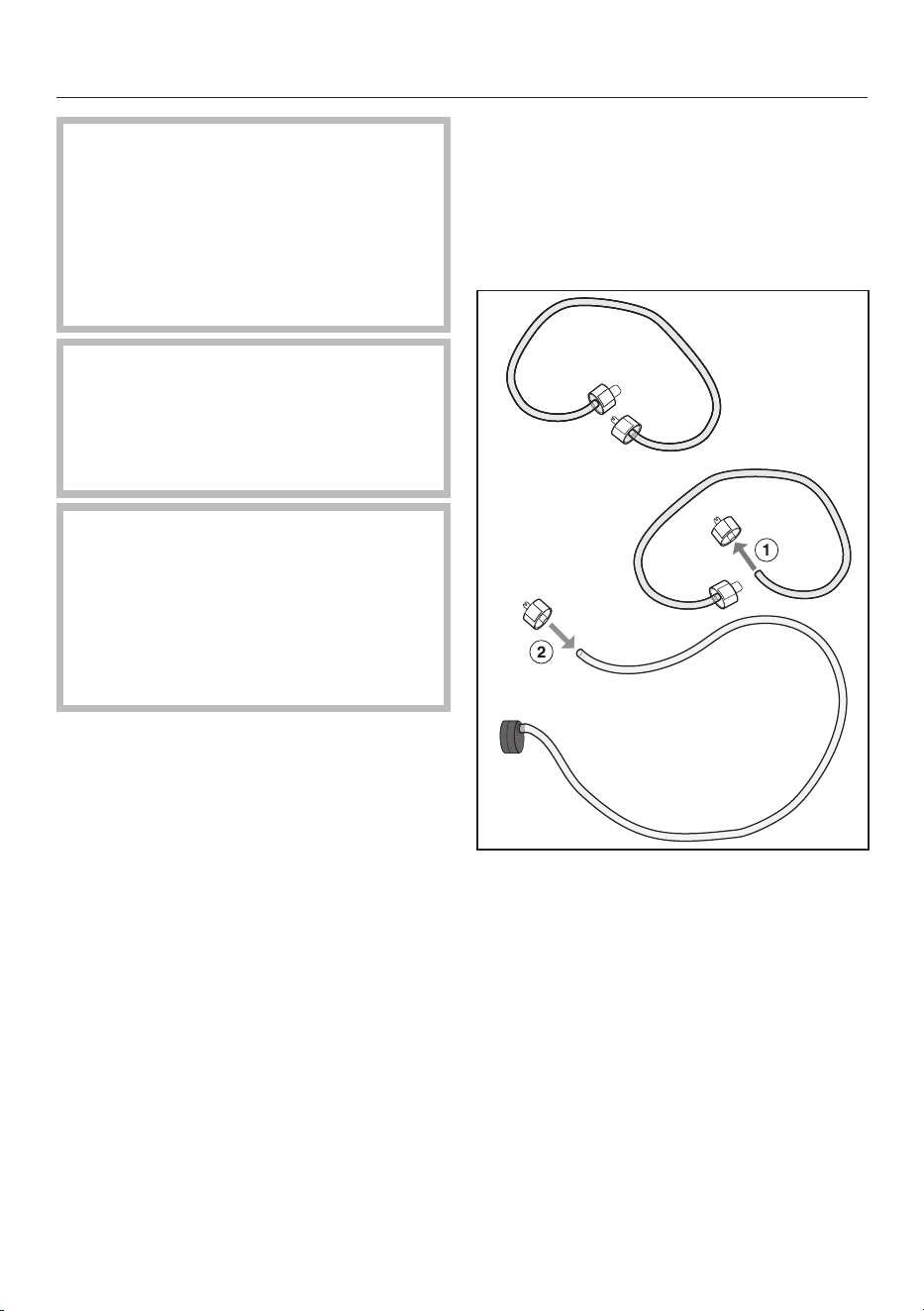
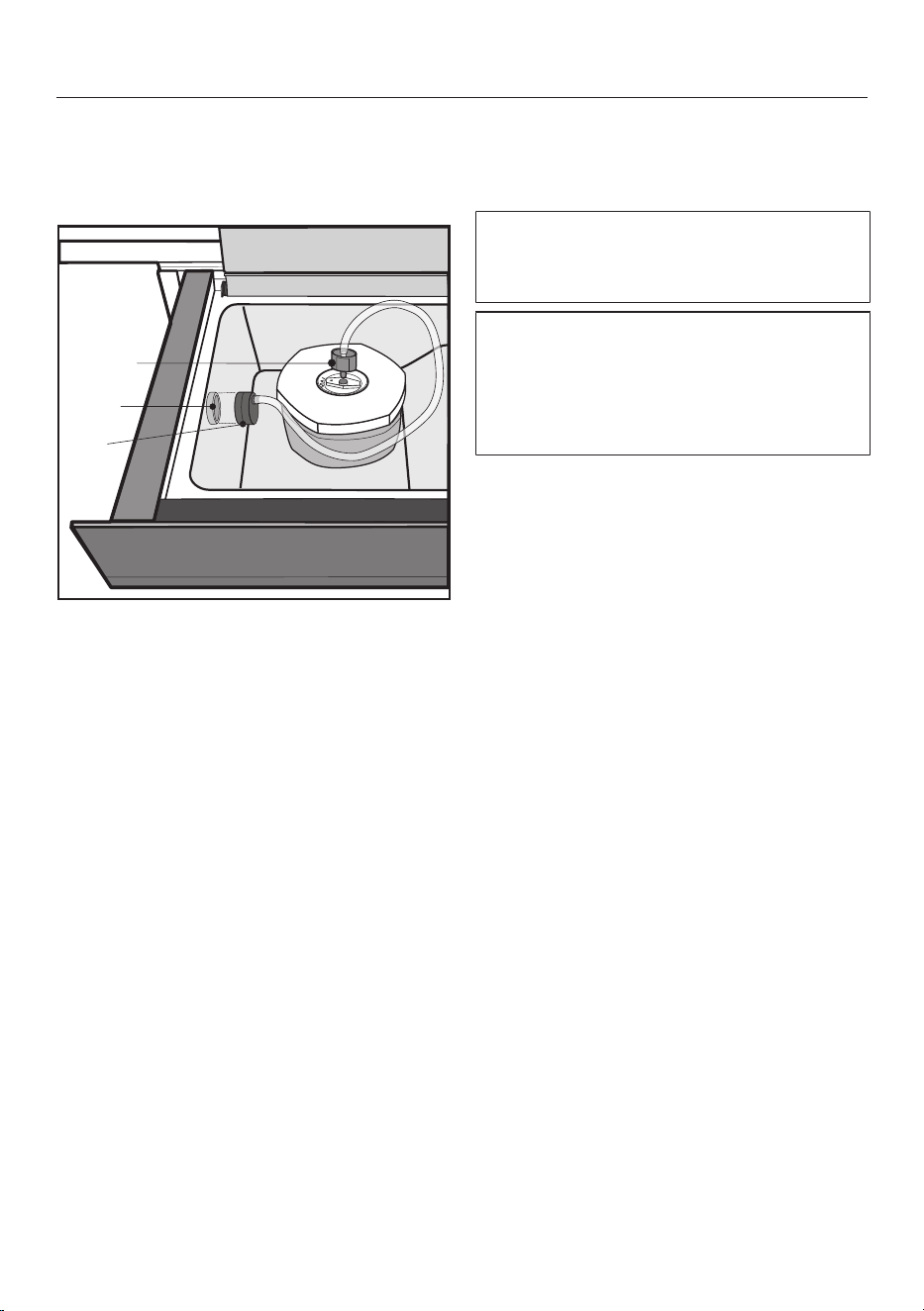
Prepare the vacuum adapter:
Detach the container-lid connector
(smaller diameter) from the con-
tainer-set connecting tube.
Attach the connector to the end of
the vacuum-adapter tube. For a
secure grip, make sure that the end
of the tube is pushed at least
1/4" (0.5cm) over the opening on the
connector.
Fill the container to a maximum of 1
1/4" (3cm) below the rim.
Operation
30
Place the lid on the container and
press it down.
Open the drawer and the glass lid.
a
b
c
O
P
E
N
Place the vacuum adapter over the
vacuum pump air-intake valve.
Attach the connector to the con-
tainer lid. Make sure that the closure
of the lid is turned to “SEAL” (closed).
Switch the drawer on with the On/
Off sensor control.
The segment bar indicator lights above
theVaccum and Sealsensor controls
light up.
Touch the Containersensor control.
The segment bar indicator lights above
theVaccum and Sealsensor controls
go out. The segment bar indicator lights
above theContainer and sensor
controls light up.
Touch the Containersensor control
repeatedly until the segment bar indi-
cator light for the required vacuum
setting lights up.
Touch the Startsensor control.
The vacuum-sealing process will start.
The Startsensor control goes out and
the Stopsensor control lights up.
Leave the glass lid open for the entire
duration of the vacuum-sealing
process.
If an excessive amount of bubbles
form you can cancel the vacuum-seal-
ing process by pressing theStopsen-
sor control (see “Operation – Cancel-
ing a vacuum-sealing process”).

Operation
31
After the vacuum-sealing process
A signal sounds.
Detach the connector from the con-
tainer lid. Make sure that the closure
of the lid is still turned to
“SEAL” (closed).
Remove the vacuum adapter from the
vacuum pump air-intake valve.
Before starting a new vacuum-seal-
ing process, check that the vacuum
adapter, the tube, and the vacuum
chamber are clean and dry.
Remove any soiling or liquid residues
if necessary.

Operation
32
After use
Switch off the drawer with the On/
Off sensor control.
Clean and dry the drawer and any ac-
cessories as described in “Cleaning
and care”.
Do not close the glass lid until the
vacuum chamber is completely dry.
Close the drawer.
The last vacuum-sealing setting se-
lected is automatically activated the
next time the drawer is switched on,
and this is shown in the control field.
Canceling a vacuum-sealing
process
You can cancel a vacuum-sealing
process at any time, e.g., if you notice
during the process that the edge of the
bag is not positioned correctly or that
the closure on the container lid is not
pointing to “SEAL” (closed).
Please note that if the vacuum-seal-
ing process is canceled while vac-
uum sealing bags, the bag will not be
sealed.
Touch the Stopsensor control.
The vacuum-sealing process stops.
Cleaning and care
33
Risk of injury due to electric
shock.
The steam from a steam cleaner
could reach live electrical compo-
nents and cause a short circuit.
Do not use a steam cleaner to clean
the drawer.
Danger of burning due to hot
surfaces.
The sealing bar is hot straight after a
vacuum-sealing process.
Allow the sealing bar to cool down
before cleaning it.
All surfaces could become discol-
ored or damaged if unsuitable clean-
ing agents are used. Only use com-
mon household liquid dish soap to
clean the appliance.
All surfaces are susceptible to
scratching. Scratches on glass can
lead to breakage in some circum-
stances.
Remove any residual cleaning agent
immediately.
If soiling is allowed to sit for any
length of time, it may become im-
possible to remove.
Surfaces may become discolored or
damaged.
It is therefore best to remove any
soiling immediately.
Switch the drawer off to clean it.
The drawer and accessories should
be cleaned and dried thoroughly after
each use.
Do not close the glass lid until the
vacuum chamber is completely dry.
Unsuitable cleaning agents
To avoid damaging the surfaces of the
appliance, do not use:
- cleaning agents containing soda, am-
monia, acids, or chloride
- cleaning agents containing limescale
remover
- abrasive cleaning agents, such as
scouring powder, scouring liquid, or
pumice stones
- cleaning agents containing solvents
- stainless-steel cleaners
- cleaning agents for ceramic-glass
cooktops
- dishwasher cleaning agents
- oven cleaners or sprays
- hard, abrasive sponges and brushes,
such as pot scrubbers
- sharp metal scrapers

Cleaning and care
34
Cleaning the drawer front and
glass lid
Remove soiling and fingerprints with
a standard domestic glass cleaner or
with a clean, damp microfiber cloth.
After cleaning, wipe the surfaces dry
using a soft cloth.
Cleaning the vacuum chamber
and sealing bar
Damage caused by liquids.
Liquid getting into the vacuum pump
air-intake valve can result in damage
to the vacuum pump.
Take care that liquids do not get into
the air-intake valve.
Tip: To make cleaning easier, the seal-
ing bar can be lifted out.
Remove soiling immediately using a
solution of hot water and liquid dish
soap applied with a clean sponge or
use a clean, damp microfiber cloth.
Remove any residual cleaning agent
with some clean water.
After cleaning, wipe the surfaces dry
using a soft cloth.
Cleaning the vacuum adapter
Clean the vacuum adapter with a
clean sponge and a solution of hot
water and liquid dish soap or a clean,
damp microfiber cloth.
Then dry the vacuum adapter with a
cloth.
Do not use the vacuum adapter again
until it is completely dry.
Cleaning the vacuum-sealing
bag support
Clean the vacuum-sealing bag sup-
port with a clean sponge cloth, liquid
dish soap, and warm water or with a
clean, damp microfiber cloth.
Then dry the vacuum-sealing bag
support using a cloth.
Do not use the vacuum-sealing bag
support again until it is completely
dry.
Cleaning and care
35
Carrying out a drying cycle
When food is vacuum sealed, moisture
gets into the oil-circulation system in
the vacuum pump. To remove the mois-
ture, it is necessary to run a drying cy-
cle after a particular operating time.
The sensor control on the control
field of the drawer lights up yellow when
a drying cycle needs to be carried out.
The sensor control lights up yellow and
you can still run another 10vacuum-
sealing processes. When the sensor
control lights up red, the drying cycle
must be carried out. The drawer will
lock after this point and cannot be used
again.
We recommend carrying out a drying
cycle before the drawer locks out.
The whole drying cycle lasts for a maxi-
mum of 20minutes.
The vacuum chamber must be free
from objects and liquid residues
when carrying out the drying cycle.
Clean and dry the vacuum chamber
as necessary.
Touch the sensor control.
Close the glass lid.
The drying cycle starts. The sensor
control will flash yellow throughout the
entire process.
You can cancel the drying cycle with
the sensor control. If a drying cy-
cle is canceled, it must be repeated
after the remaining vacuum-sealing
processes have elapsed or when the
drawer is switched on again.
When the drying cycle has finished, a
signal sounds and the sensor control
goes out. You can now use the drawer
again as usual.
The last selected vacuum setting and
sealing level are displayed on the con-
trol field.
Frequently Asked Questions
36
With the help of the following guide minor faults in the performance of the ma-
chine, some of which may result from incorrect operation, can be remedied with-
out contacting the Service Department.
This guide may help you to find the reason for the fault, and how to correct it.
Problem Possible cause and solution
The drawer will not
open.
The safety screws on the back of the drawer have
not been removed.
Contact Miele Technical Service.
The drawer cannot be
switched on.
The electrical plug is not properly inserted.
Insert the electrical plug.
The breaker has tripped.
Reset the breaker (see data plate for the correct
fuse rating). If, after turning the breaker or GFCI
back on, the drawer will still not turn on, contact a
qualified electrician or Miele Customer Service.
There was a loud bang
during operation.
The transit device has not been not removed and the
air filter has not been fitted.
Contact Miele Technical Service.
The drawer has
switched itself off.
The drawer will switch itself off automatically to save
energy if no other action is taken within a certain time
frame after switching it on or after the end of a vacu-
uming process.
Switch the drawer back on.
The sensor controls are
not reacting to touch.
Foreign objects, soiling, or liquid residues have got
onto the control field.
Remove the objects and/or clean and dry the con-
trol field.
The vacuuming process
takes longer than ex-
pected.
The oil in the vacuum pump has become extremely
hot.
Leave the drawer to cool for an hour before start-
ing another vacuuming process.
When carrying out a number of consecutive vacu-
uming processes, wait a minimum of 2minutes
between each process to prevent the oil from
overheating again.
Frequently Asked Questions
37
Problem Possible cause and solution
The vacuum-sealing
bag was not sealed in
time.
The required vacuum (vacuum setting1) for sealing a
bag was not achieved.
Touch the Sealsensor control again or repeatedly
until the vacuum-sealing process ends and the
bag is sealed.
All the sensor controls
have gone out. The
glass lid will not open.
There was a power failure during the vacuum-sealing
process. The vacuum chamber is still under pressure
so the glass lid cannot be opened.
Damage to the drawer.
Do not in any circumstances try to force the glass
lid open or use tools to open it.
When the power supply is restored, the glass lid
can be opened again after initialization (all sensor
controls and indicators light up).
Start the vacuum-sealing process again if neces-
sary.
There is still too much
air in the bag at the end
of the vacuuming
process.
The vacuum level was too low.
Start the vacuuming process again with a new bag
and a higher vacuum level.
The vacuum-sealing bag is too big for the food to be
vacuumed.
Use a new smaller bag or cut a larger bag to fit the
size of the food.
Start the vacuuming process again, with a higher
vacuum level if necessary.
After several consecu-
tive vacuuming pro-
cesses the weld seam
is faulty/not properly
sealed.
The sealing bar has overheated.
Wait a minimum of 2minutes between individual
vacuuming processes to prevent the sealing bar
from overheating again.
Frequently Asked Questions
38
Problem Possible cause and solution
The edge of the bag is
not completely sealed.
The edge of the bag was not positioned centrally
along the sealing bar or has slipped.
Place the edge of the bag centrally along the seal-
ing bar. Make sure that the edge of the bag is par-
allel to the sealing bar and protrudes over it by ap-
prox. 3/4" (2cm).
If the vacuum-sealing bag is too small, place it on
the vacuum-sealing bag support.
The vacuum-sealing bag is wider than 93/4" (25cm).
Use vacuum-sealing bags with a maximum width
of 93/4" (25cm).
The seal was not strong
enough and has
opened.
The edge of the bag is dirty (inside and out). For a
perfect weld seam, the edge of the bag must be dry
and grease-free in the area of the seam.
Fold the edges of the vacuum-sealing bag outward
for filling. This will give you a clean, perfect weld
seam.
The edge of the bag was not positioned smoothly
and without creases on the sealing bar.
Position the bag smoothly and without creases
along the sealing bar.
The sealing level was too low.
Start the vacuuming process again with a new
vacuum-sealing bag and select a higher sealing
level.
The rubber on the counterpressure bar is not evenly
fitted.
Flatten the rubber.
The sealing bar and/or the counterpressure bar is
damaged.
Contact Miele to have it replaced.
Frequently Asked Questions
39
Problem Possible cause and solution
The bag is not maintain-
ing the vacuum even
though the weld seam
is intact.
The vacuum-sealing bag has been damaged by
sharp pointed objects, e.g., pointed pasta shapes or
a bone.
Start the vacuuming process again with a new
vacuum-sealing bag, on a lower vacuum level if
necessary.
Use a third-party container if possible.
The weld seam is de-
fective or not properly
sealed in one or more
places.
The sealing bar and/or counterpressure bar are dirty
or there are liquid residues on the sealing bar.
Clean and dry the sealing bar and/or counterpres-
sure bar.
The rubber on the counterpressure bar is not evenly
fitted.
Flatten the rubber.
The edge of the bag is dirty (inside and out). For a
perfect weld seam, the edge of the bag must be dry
and grease-free in the area of the seam.
Fold the edges of the vacuum-sealing bag outward
for filling. This will give you a clean, perfect weld
seam.
The edge of the bag was not positioned smoothly
and without creases on the sealing bar.
Position the bag smoothly and without creases
along the sealing bar.
The sensor control is
lit up even though a
drying cycle has been
carried out. The drawer
cannot be used.
The drying cycle failed to remove all of the moisture
from the oil-circulation system in the vacuum pump.
The drawer is locked and cannot be used for 1hour.
Wait for 1hour and then carry out another drying
cycle (see “Cleaning and care – Carrying out a dry-
ing cycle”). Ensure that the vacuum chamber is
free from liquid residues.
The sensor control
lights up yellow. The
vacuum is lower than
usual.
When vacuum-sealing food, moisture got into the oil-
circulation system in the vacuum pump. This can im-
pair the performance of the vacuum settings.
Carry out a drying cycle (see “Cleaning and care –
Carrying out a drying cycle”).
Frequently Asked Questions
40
Problem Possible cause and solution
The sensor control
lights up red. A vacu-
uming process cannot
be started.
When vacuum-sealing food, moisture got into the oil-
circulation system in the vacuum pump. When the
sensor control lights up red, the drawer is locked
and cannot be used again.
Carry out a drying cycle (see “Cleaning and care –
Carrying out a drying cycle”).
There is a film of oil on
the glass lid and in the
drawer.
The oil in the vacuum pump has become extremely
hot.
Clean the drawer and leave it to cool down for
1hour before starting another vacuuming process.
When carrying out a number of consecutive vacu-
uming processes, wait a minimum of 2minutes
between each process to prevent the oil from
overheating again.
If the fault occurs again, contact Miele Technical
Service.
The vacuum-sealing
process is canceled af-
ter 2minutes. A signal
sounds and the sym-
bol lights up red.
The required final vacuum could not be achieved.
Switch the drawer off and back on again.
Start the vacuum-sealing process again with a
lower vacuum setting if necessary.
After intensive use of the drawer, the oil in the vac-
uum pump has become extremely hot.
Allow the drawer to cool for 1h before starting an-
other vacuum-sealing process.
When carrying out a number of consecutive vac-
uum-sealing processes, wait for a minimum of
2minutes between each process. This prevents
the oil from overheating again.
Frequently Asked Questions
41
Problem Possible cause and solution
The vacuum-sealing
process is canceled af-
ter 5seconds. A signal
sounds and the indi-
cator light lights up red.
The glass lid is not sitting evenly. There is an object,
such as the edge of a bag or some soiling, on the
surface of the chamber seal.
Remove the obstruction and/or the soiling.
Close the glass lid.
Press lightly on the black triangle on the glass lid
for approx. 5seconds.
The chamber seal is not installed correctly.
Press the chamber seal in all the way round to
make sure it is installed evenly.
The chamber seal is damaged, e.g., cracks can be
seen.
Contact Customer Service to have it replaced.
Abrasion marks on the
top edge of the front
panel.
Installing or removing an appliance above the drawer
has caused abrasion marks.
Carefully remove the abrasion marks by rubbing
the top edge with the abrasive side of a standard
scouring pad.
Customer Service
42
Contact in the event of a fault
In the event of a fault which you cannot remedy yourself, please contact your
Miele dealer or Miele Customer Service.
You can book a Miele Service Call online at www.miele.com/service.
Contact information for Miele Customer Service can be found at the end of this
document.
Please quote the model identifier and serial number of your appliance (SN) when
contacting Miele Customer Service. Both pieces of information can be found on
the data plate.
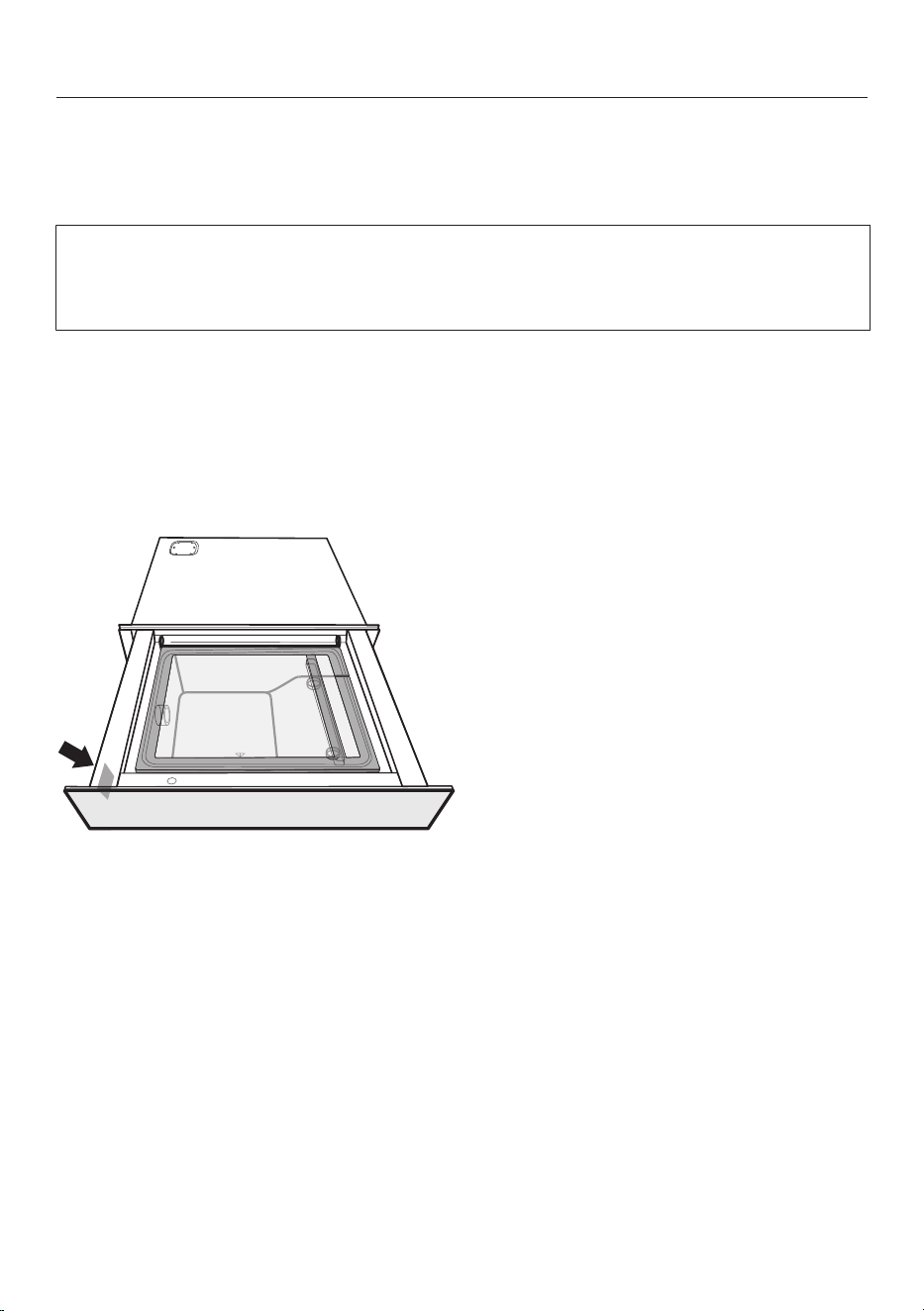
Data plate
The data plate is located here:
Appliance warranty and product registration
You can register your product and/or view the manufacturer´s warranty terms and
conditions for Miele appliances and vacuum cleaners at www.mieleusa.com.
Installation
*INSTALLATION*
43
IMPORTANT SAFETY INSTRUCTIONS - INSTALLATION
Risk of damage caused by incorrect installation.
Incorrect installation can cause damage to the drawer and/or the combination
appliance.
The appliance must only be installed by a qualified person.
Before connecting the drawer to the line power supply, ensure
that the connection data on the data plate (voltage and frequency)
match the line power.
This data must correspond in order to avoid the risk of damage to
the drawer. Consult a qualified electrician if in any doubt.
The electrical outlet must be easily accessible after the installation
of the drawer.
The drawer may only be built in combination with those appli-
ances specified by Miele as being suitable. Miele cannot guarantee
trouble-free operation if the appliance is operated in combination
with appliances other than those quoted by Miele as being suitable.
The base on which the drawer and the combination appliance are
fitted must be fixed in place and must support the weight of both ap-
pliances.
When installing the combination appliance, it is essential to follow
the instructions given in the operating and installation instructions
supplied with it.
The drawer must be installed in such a way that
- you can see into the vacuum chamber. This helps to avoid scald-
ing and burns from touching the hot sealing bar or weld seam.
- there is enough space for the drawer to be pulled out fully and for
opening the glass lid.
Installation
*INSTALLATION*
44
Installation notes
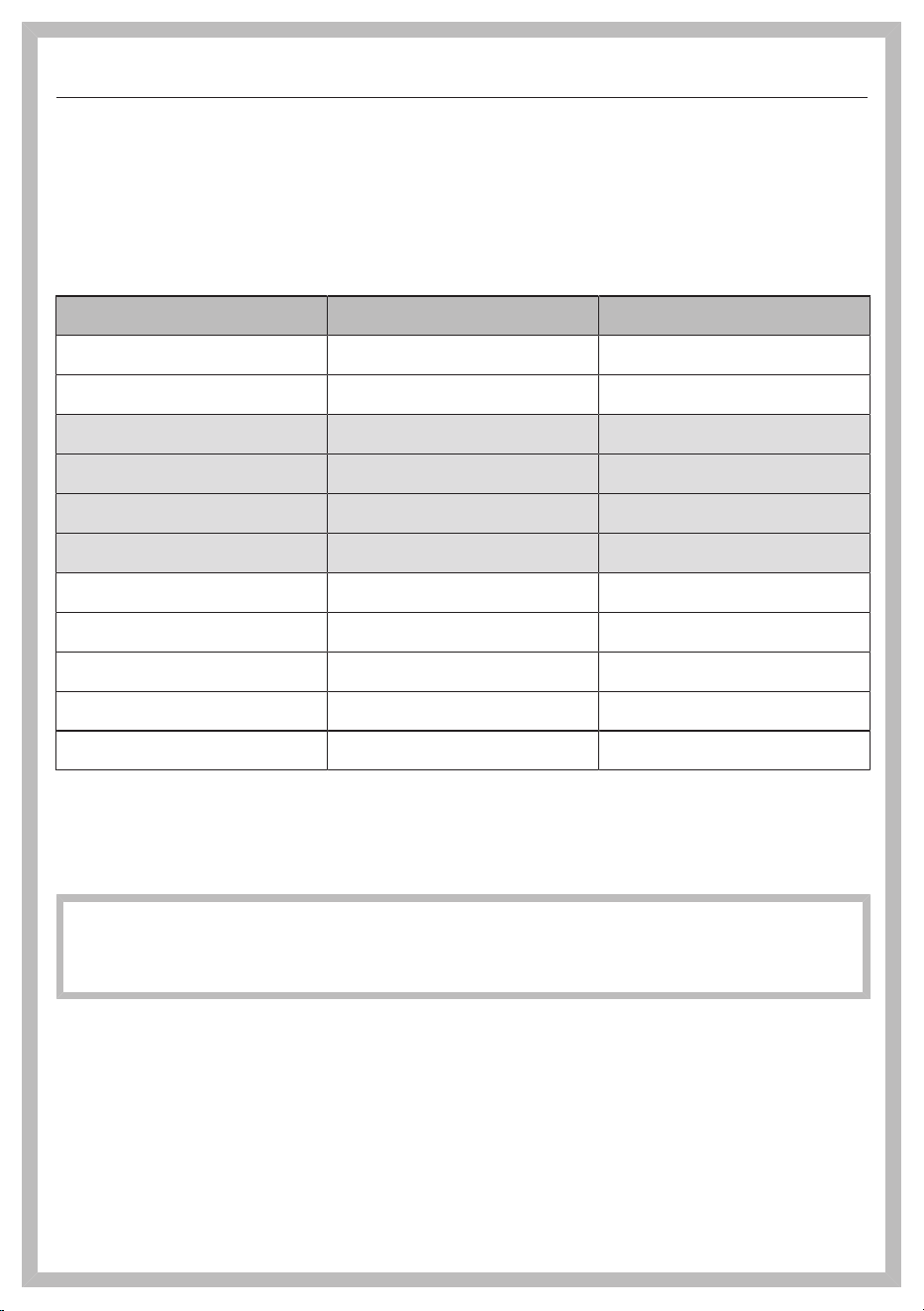
The drawer is available in 2models, which differ in height. The building-in dimen-
sions for the drawer must be added to the building-in dimensions for the combina-
tion appliance to establish the niche size required.
Combination options
EVS7010 EVS7670
CVA7x4x –
CVA7x7x –
DGC7x4x –
DGC7x6x –
DGC7x7x –
DGC7x8x –
H2840 –
H7x4x –
H7x6x –
H7x7x –
H7x8x – –
Can be combined
– Cannot be combined
The combination appliance is placed on top of the drawer without the need for an
interim shelf.
EVS 7670: The drawer can only be installed with a combination appliance.
Install the drawer together with another appliance listed in the table of possible
combinations in a niche.
Installation
*INSTALLATION*
45
Installation dimensions EVS 7010
Installation in a tall or base unit
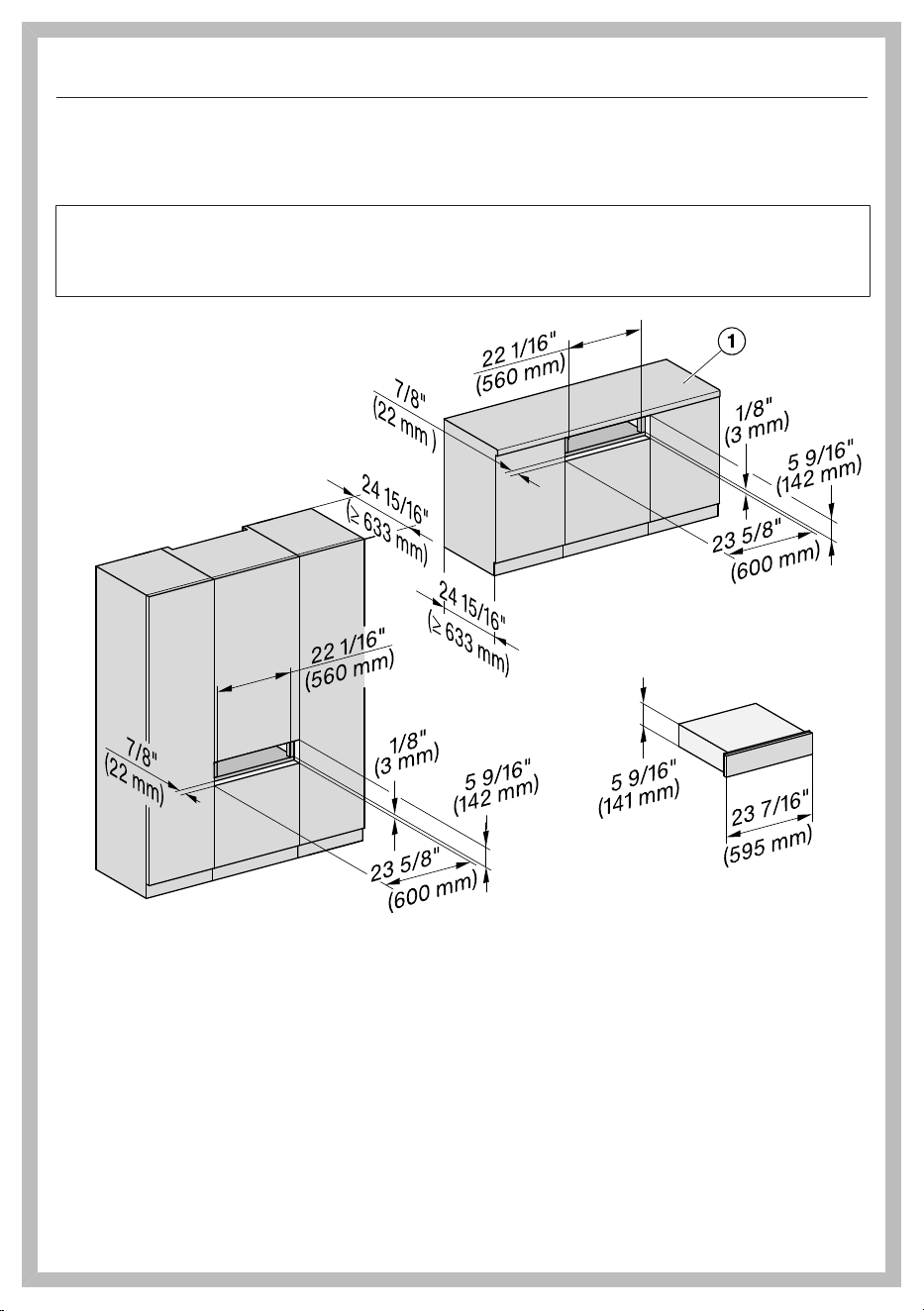
If the drawer is to be installed in a housing unit underneath a cooktop, please
also observe the installation instructions for the cooktop as well as the casing
depth required for the cooktop.
a
Countertop protrusion ≤ 11 7/16" (29mm)
Installation
*INSTALLATION*
46
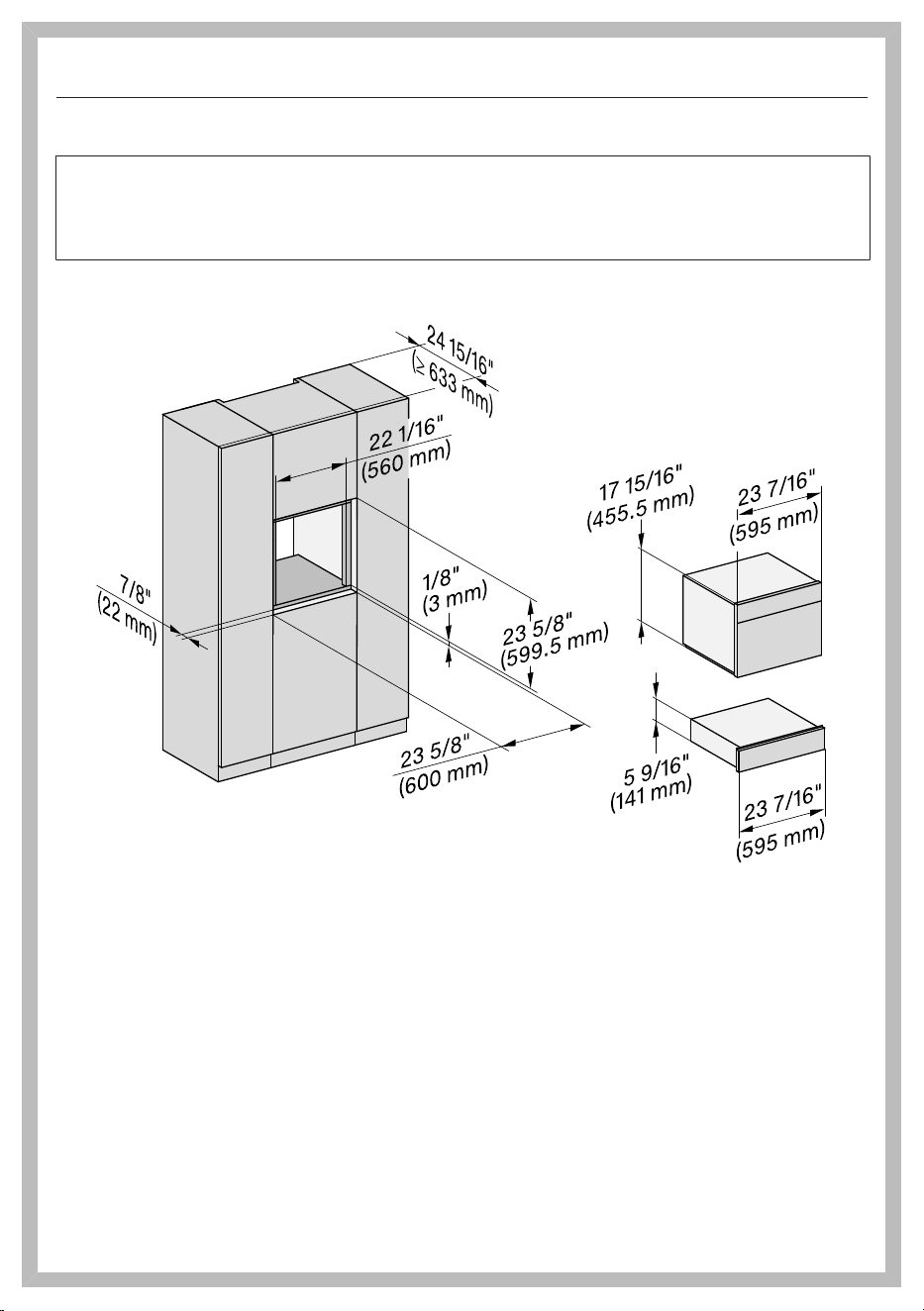
Combination with an H2840 or CVA/DGC/H7x4x
Miele Drawers can be installed flush or proud. Discuss your requirements with
your architect, kitchen designer, and installer.
More installation drawings are available on the Miele website.
Installation
*INSTALLATION*
47
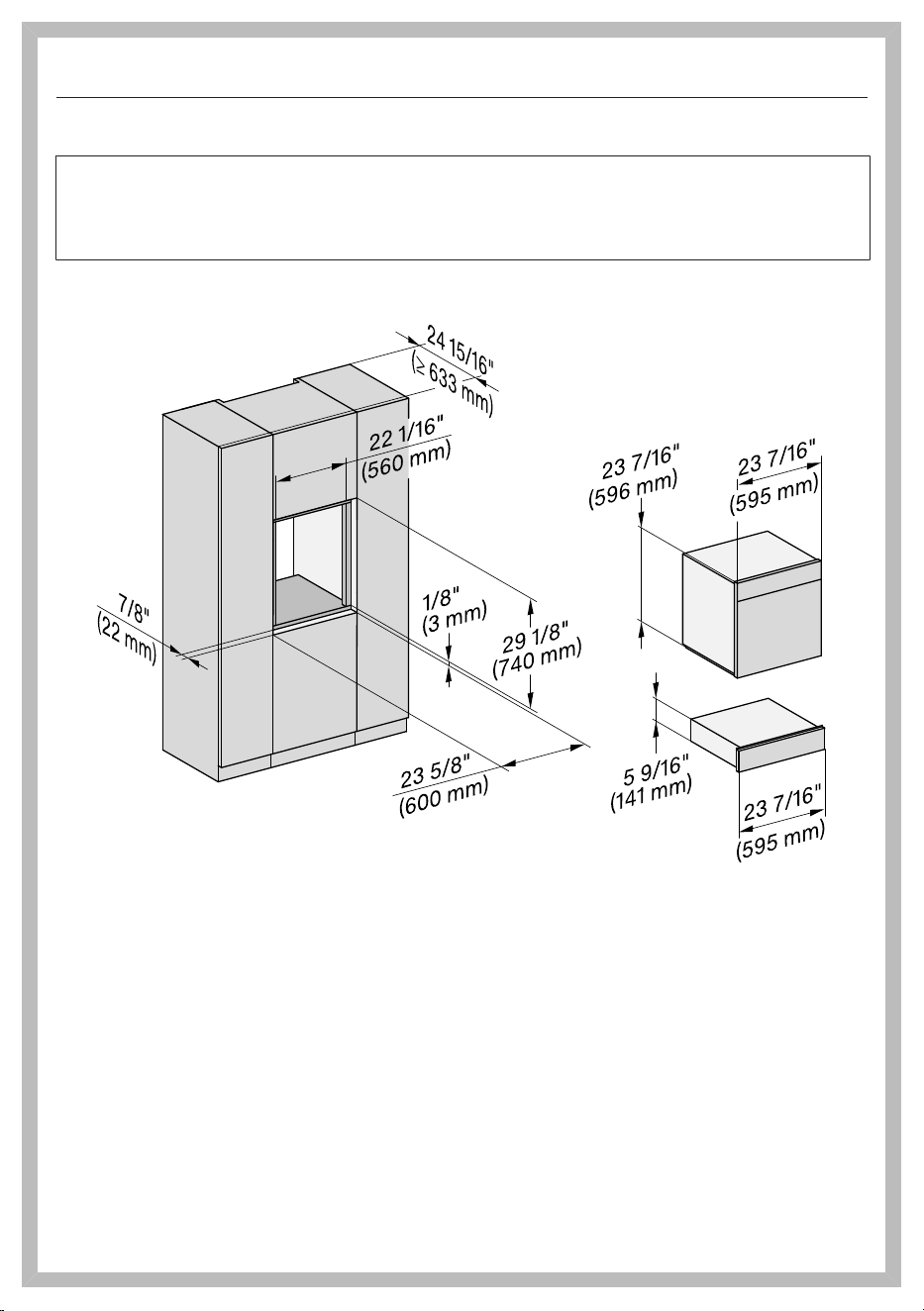
Combination with a DGC/H7x6x
Miele Drawers can be installed flush or proud. Discuss your requirements with
your architect, kitchen designer, and installer.
More installation drawings are available on the Miele website.
Installation
*INSTALLATION*
48
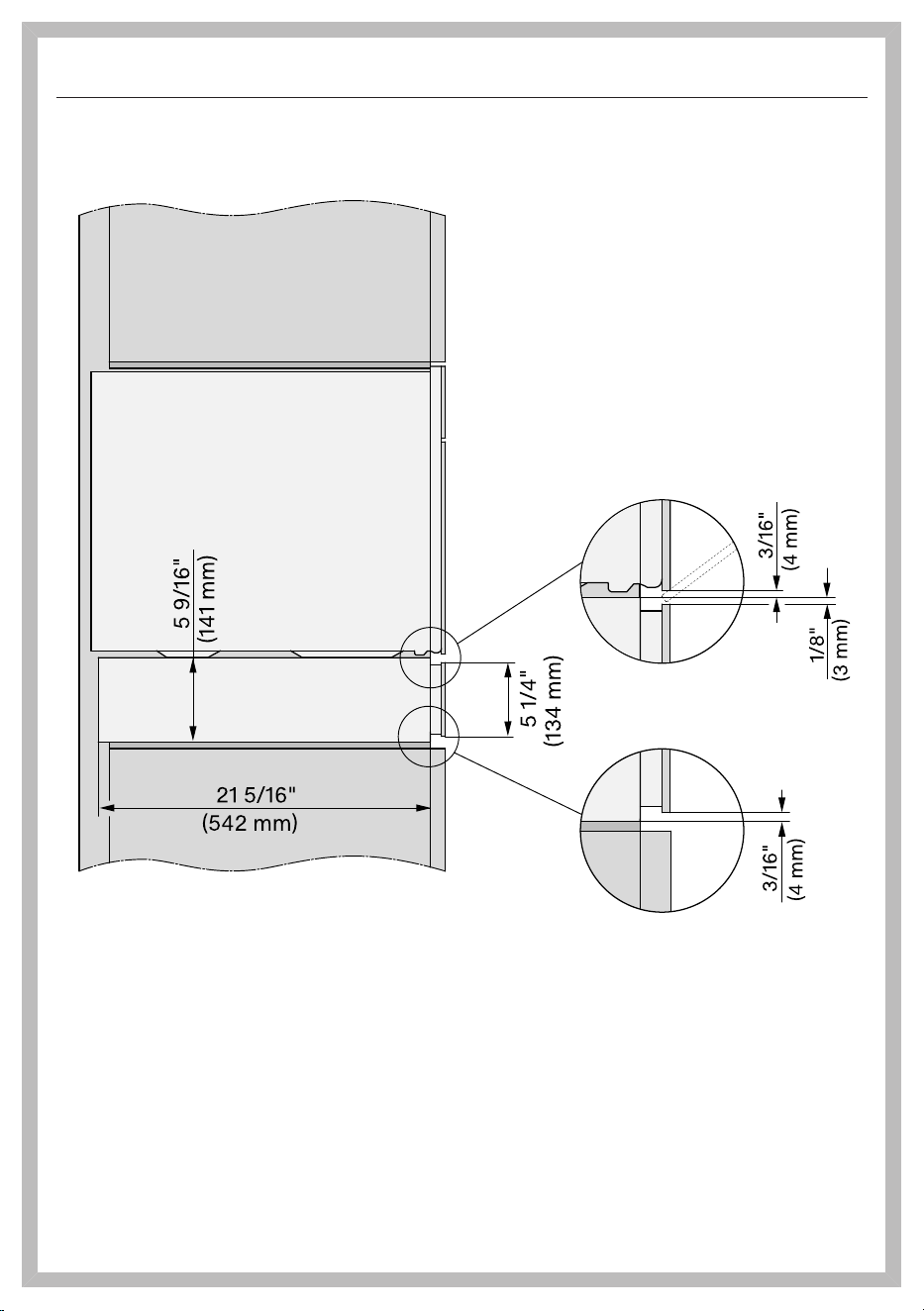
Side view
Installation
*INSTALLATION*
49
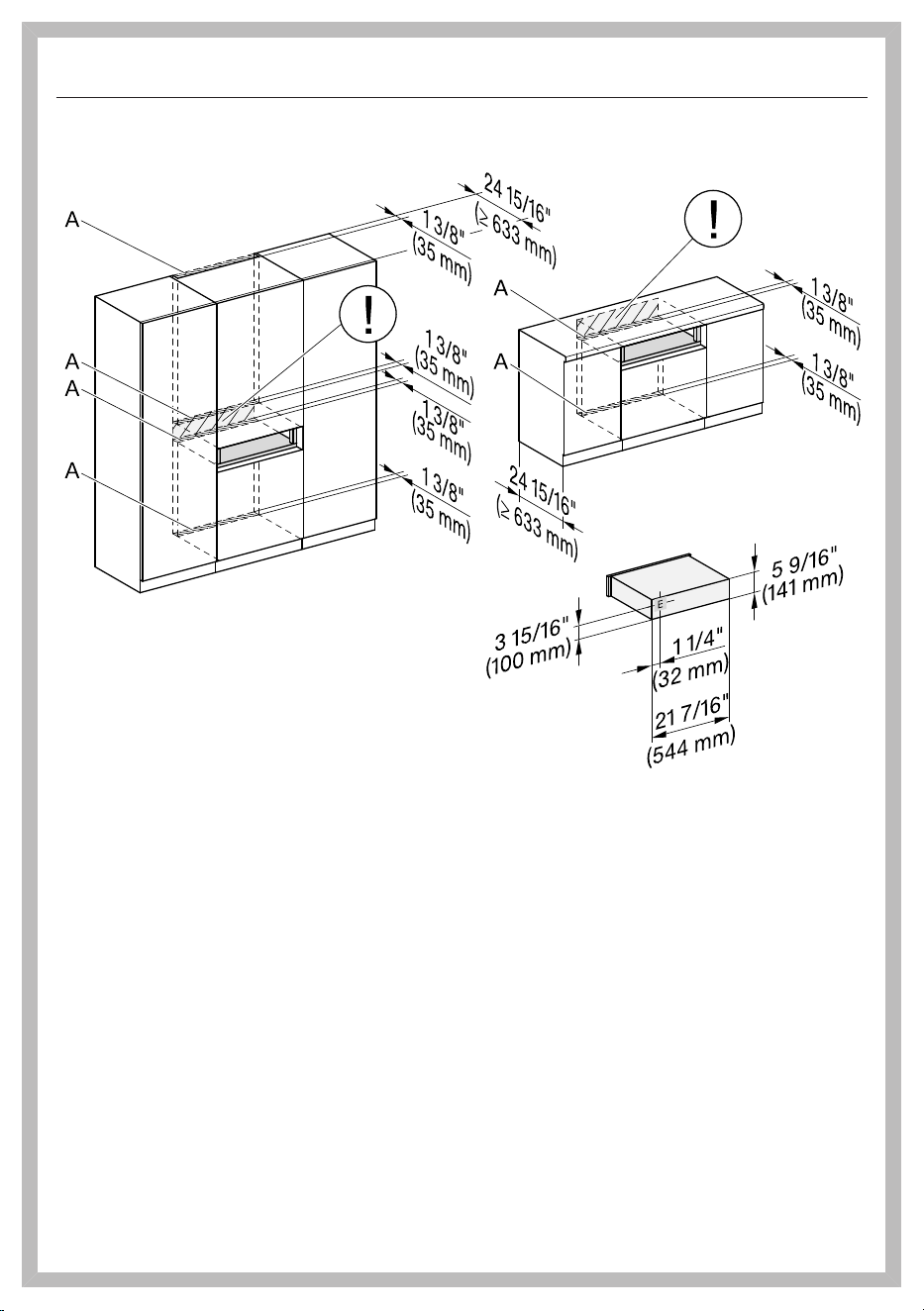
Connections and ventilation
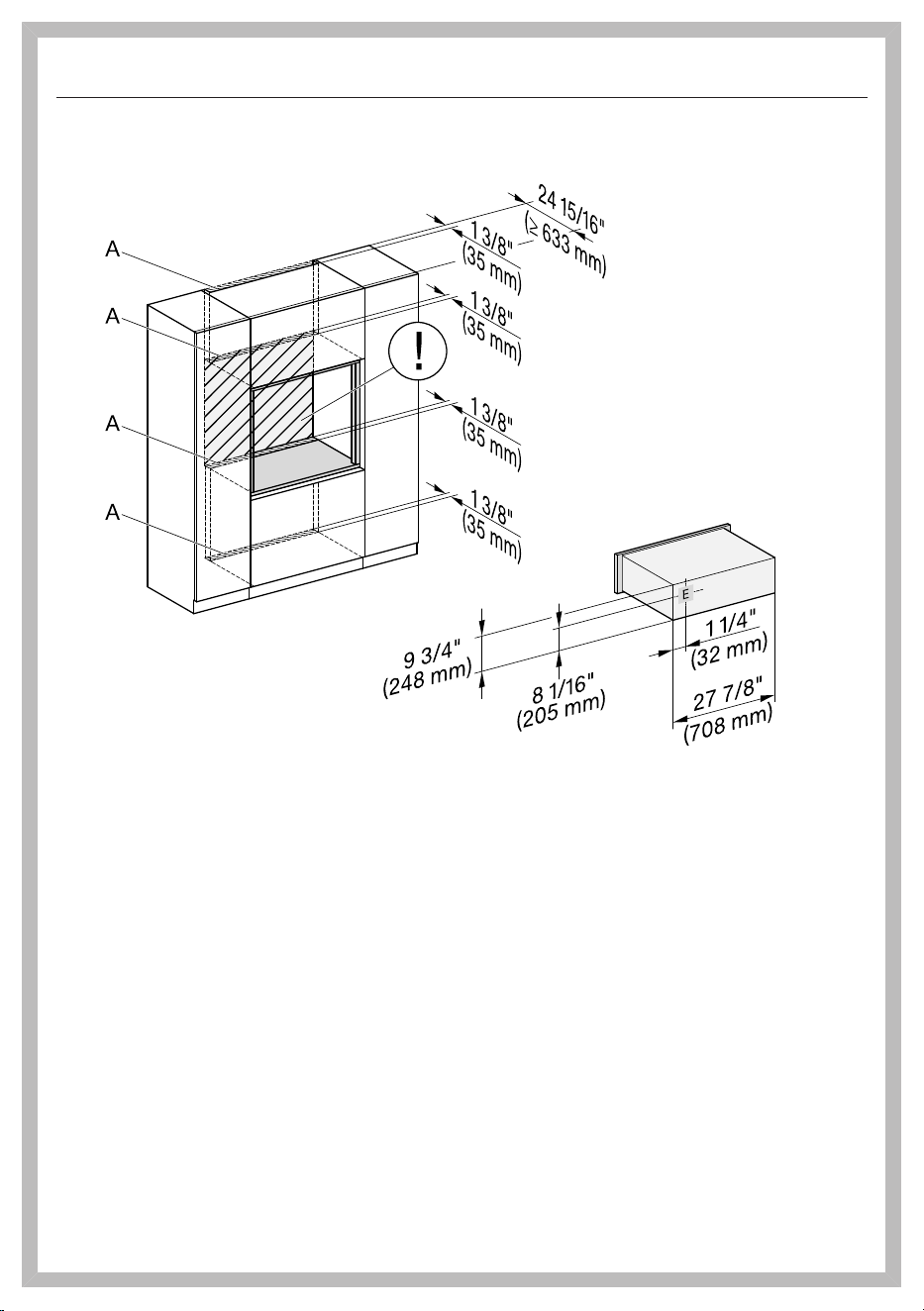
A Cutout (min. 28sqin/ 18,000mm²) for power cord, water hoses, and ventilation
! No electrical connection in this area. The socket for the electrical connection
must be accessible, e.g., in an adjacent kitchen cabinet.
E Electrical connection
Installation
*INSTALLATION*
50
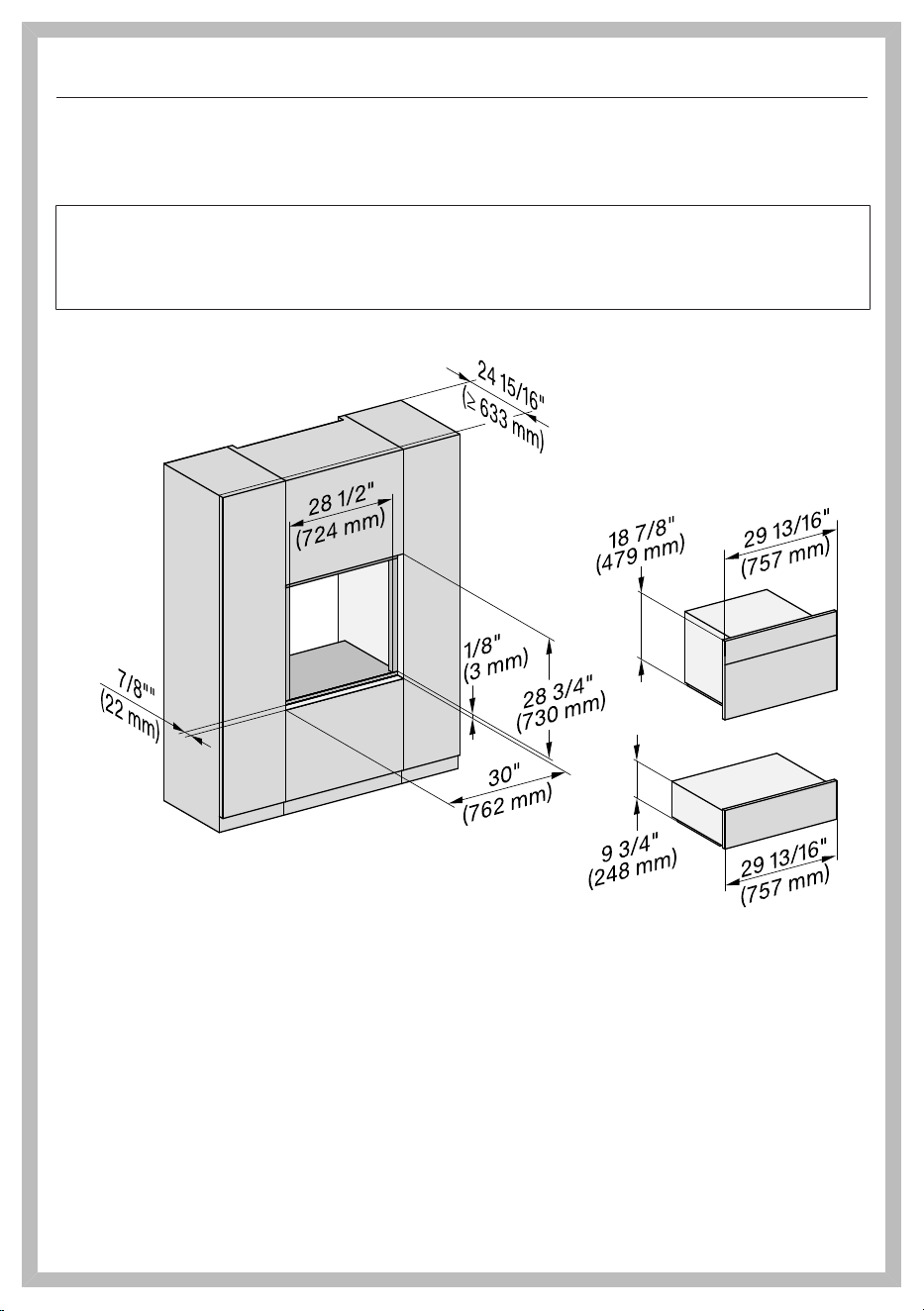
Installation dimensions EVS 7670
Combination with a CVA/DGC/H7x7x
Miele Drawers can be installed flush or proud. Discuss your requirements with
your architect, kitchen designer, and installer.
More installation drawings are available on the Miele website.
Installation
*INSTALLATION*
51
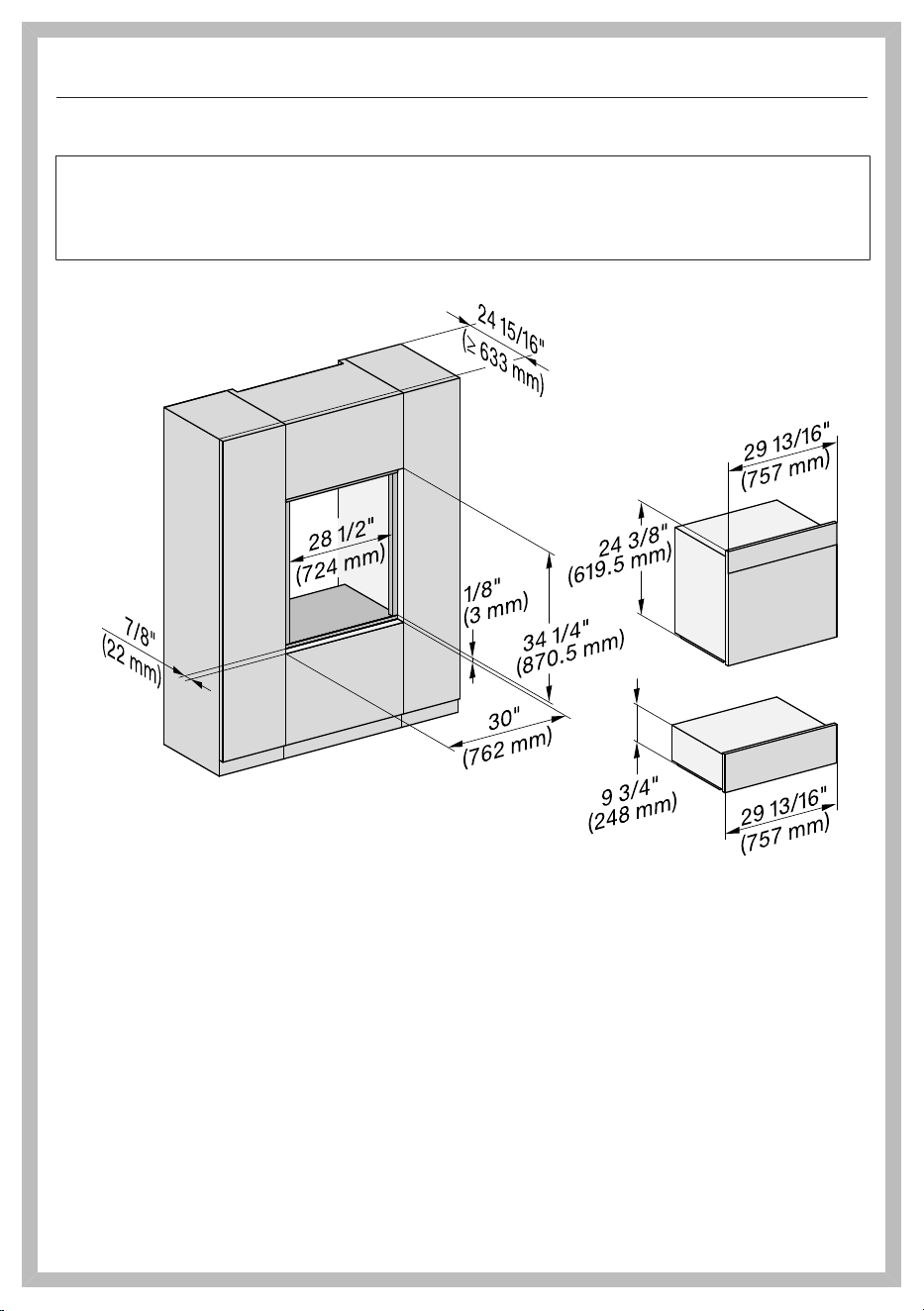
Combination with a DGC7x8x
Miele Drawers can be installed flush or proud. Discuss your requirements with
your architect, kitchen designer, and installer.
More installation drawings are available on the Miele website.
Installation
*INSTALLATION*
52
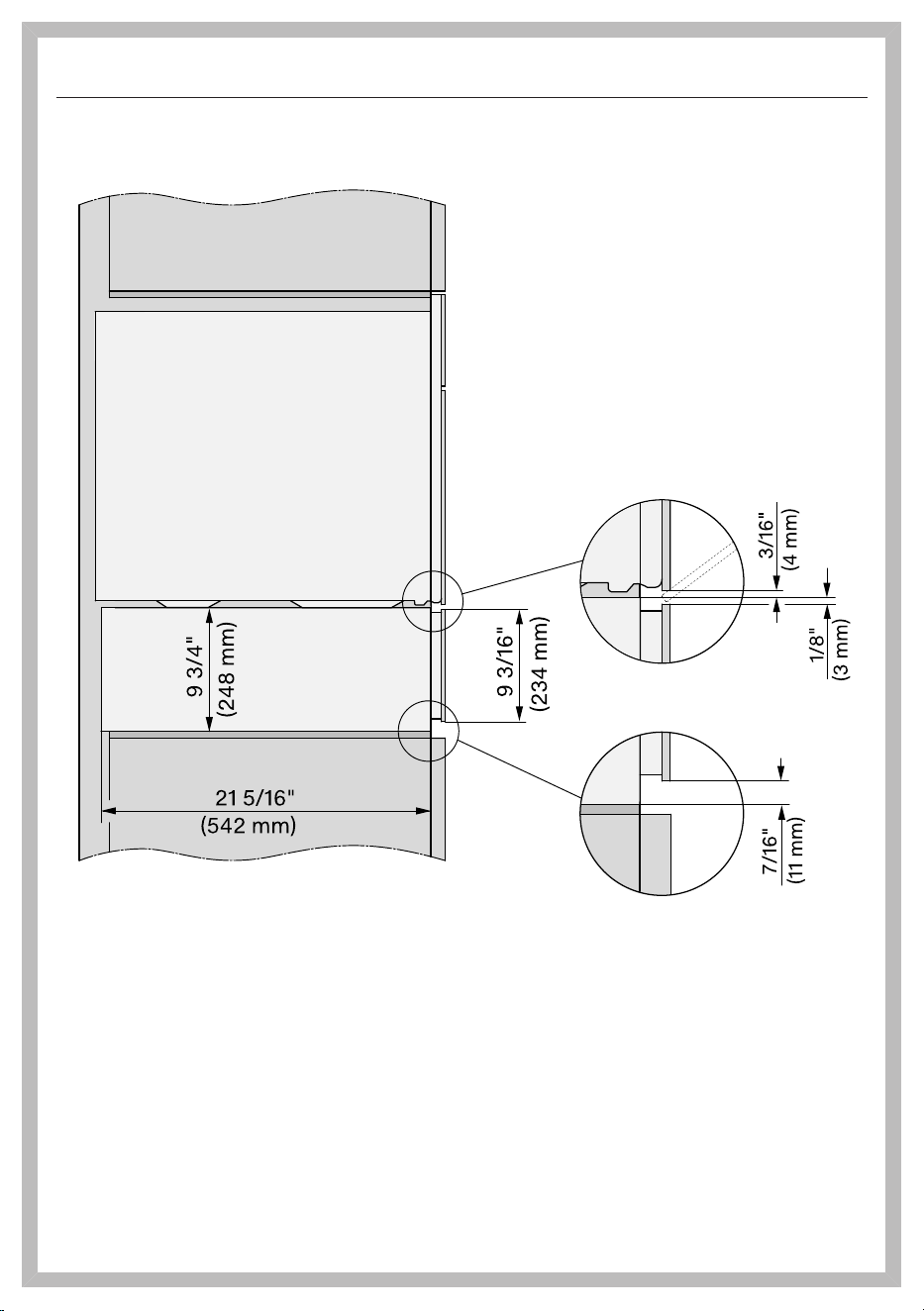
Side view
Installation
*INSTALLATION*
53
Connections and ventilation
A Cutout (min. 28sqin/ 18,000mm²) for power cord, water hoses, and ventilation
! No electrical connection in this area. The socket for the electrical connection
must be accessible, e.g., in an adjacent kitchen cabinet.
E Electrical connection
Installation
*INSTALLATION*
54
Installation
The drawer has an integrated vac-
uum pump which contains oil.
To prevent oil from leaking out, the
drawer must be transported and
stored in a horizontal position only.
Do not tilt the drawer and do not
stand it up on its edge.
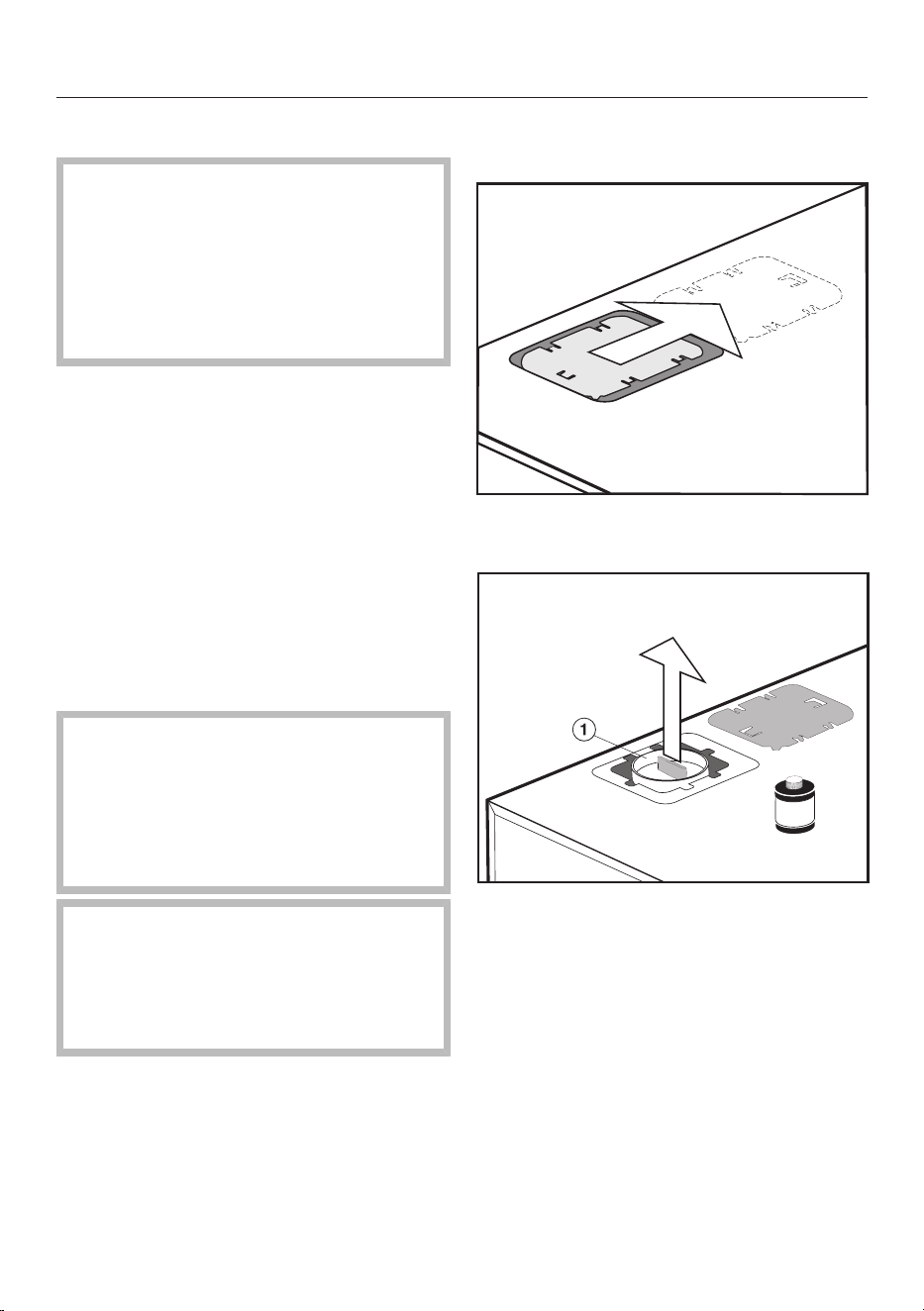
Preparing the drawer
For safe transportation, the vacuum
pump is provided with a transit restraint
which must be removed before the
drawer is installed. The air filter supplied
must be installed in place of the transit
restraint.
There are also 2safety screws on the
back of the drawer to prevent the
drawer from being opened unintention-
ally during transportation and when it is
being removed from the packaging.
Install the air filter before installing
the drawer and remove the safety
screws at the back.
Otherwise the drawer cannot be op-
erated and has to be taken out of the
housing unit.
Keep the transit restraint and safety
screws in case the drawer is trans-
ported again.
The transit restraint can be secured
to the back of the drawer.
Installing the air filter and removing
the safety screws
Slide the cover to the right and re-
move it.
Pull the red transit restraint up and
out using, e.g., universal pliers.
Installation
*INSTALLATION*
55
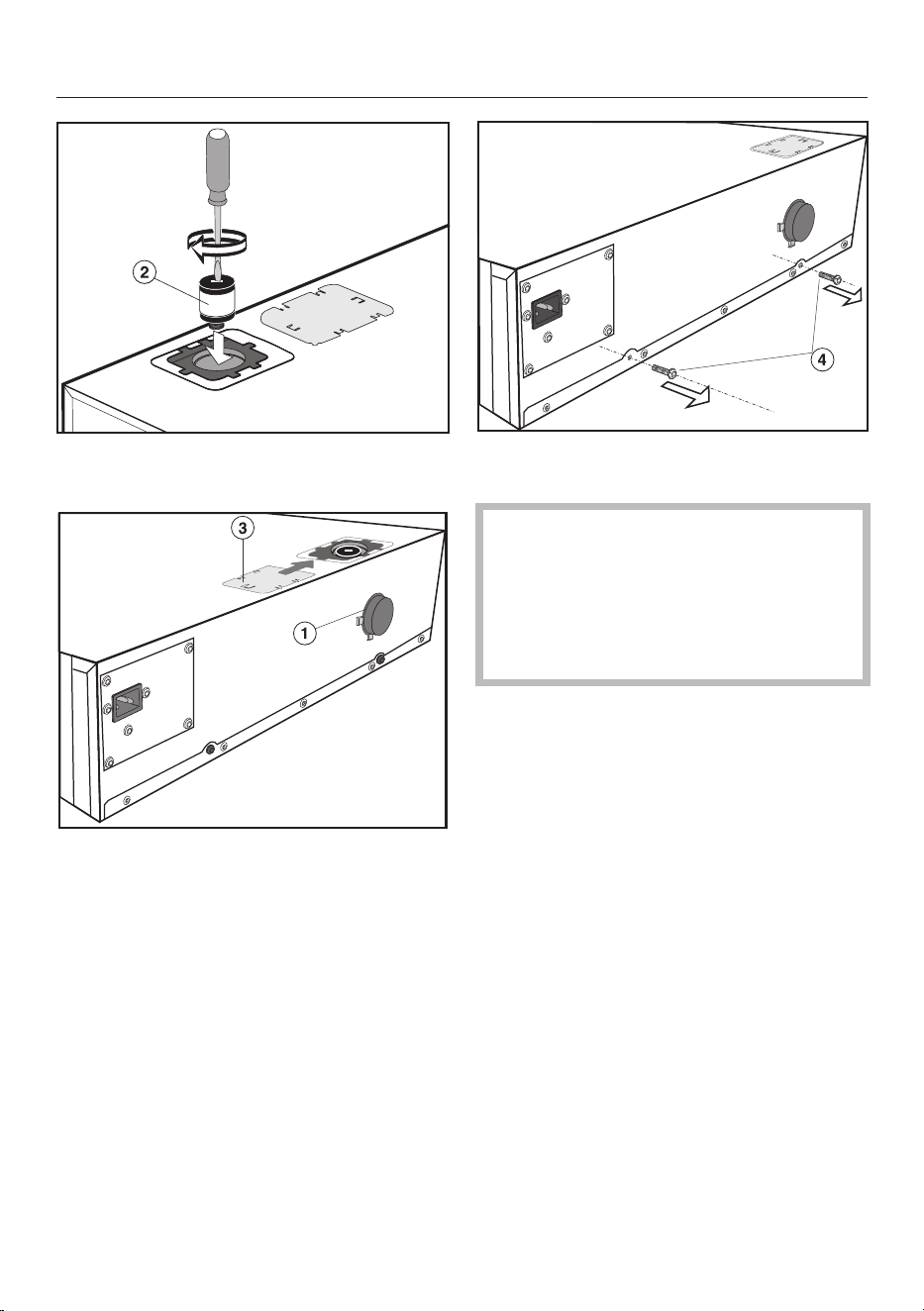
Screw the air filter onto the vac-
uum pump using a screwdriver.
Secure the transit restraint to the
back of the drawer.
Slide the cover back over the
opening to close it.
Remove the safety screws from
the back of the drawer.
Oil may leak while transporting the
drawer.
Remove the air filter before trans-
porting the drawer and plug the vac-
uum pump with the transit re-
straint again.
To remove the air filter and install the
transit restraint, carry out these steps in
reverse order.
Installation
*INSTALLATION*
56
Installing the drawer
Danger of injury due to incorrect
installation.
The drawer is heavy and will tip for-
ward when open.
Installation must be carried out by
two people.
Keep the drawer closed until it has
been installed to the side walls of the
housing unit using the supplied anti-
tipping mechanism.
Check that the base on which the
drawer will sit is clean and level (use
a level). This is important for the ap-
pliance to function correctly.
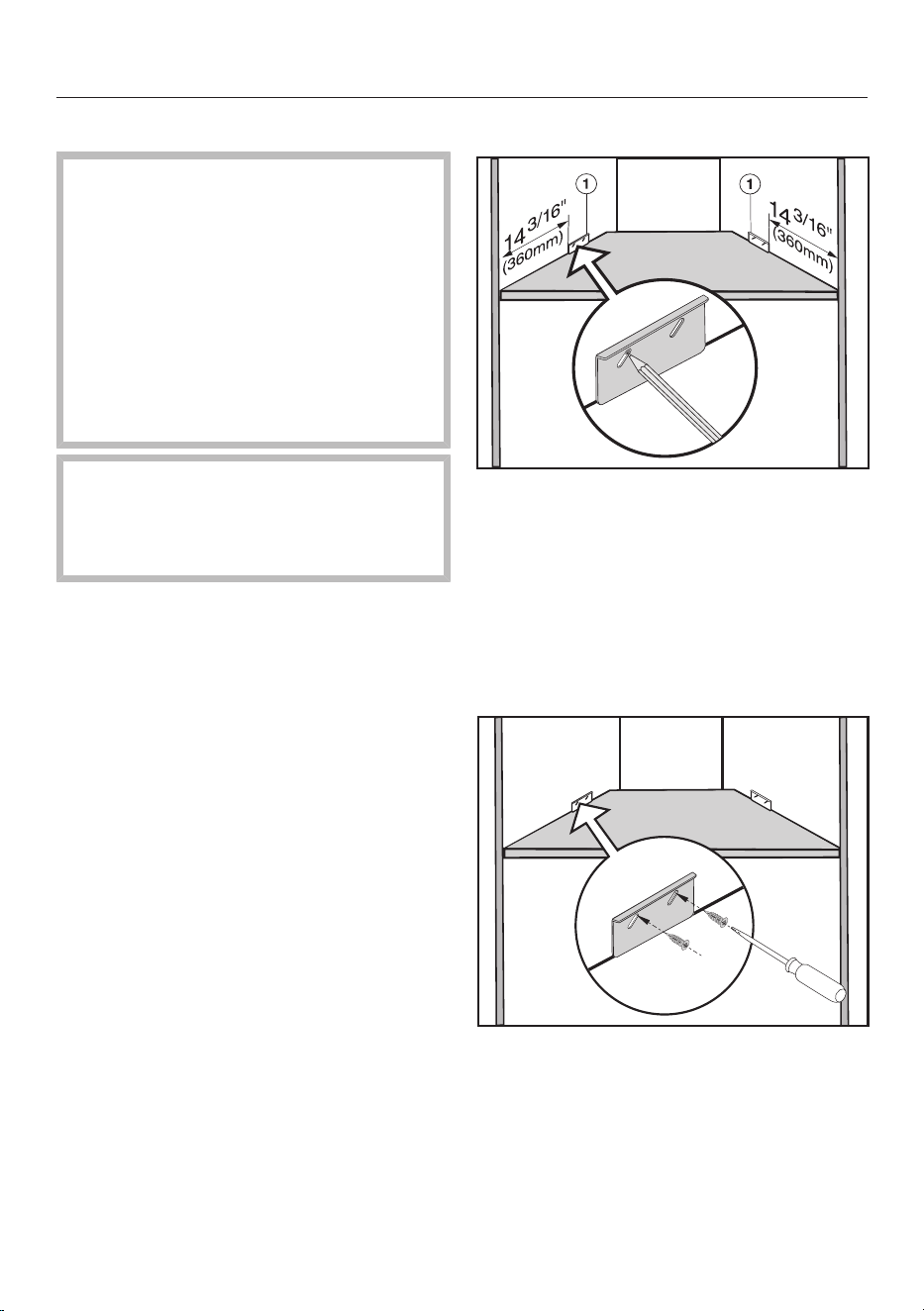
Installing the anti-tipping mechanism
Measure the distance to the right and
left-hand side walls of the housing
unit (see illustration).
Mark the uppermost position in the
long slot of the anti-tipping mecha-
nism. Make sure that the anti-tip-
ping mechanism is flush with the
base of the housing unit.
Secure the anti-tipping mechanism to
the right and left-hand side walls of
the housing unit with the 4screws
supplied 3/16" x 5/8" (4x16mm).
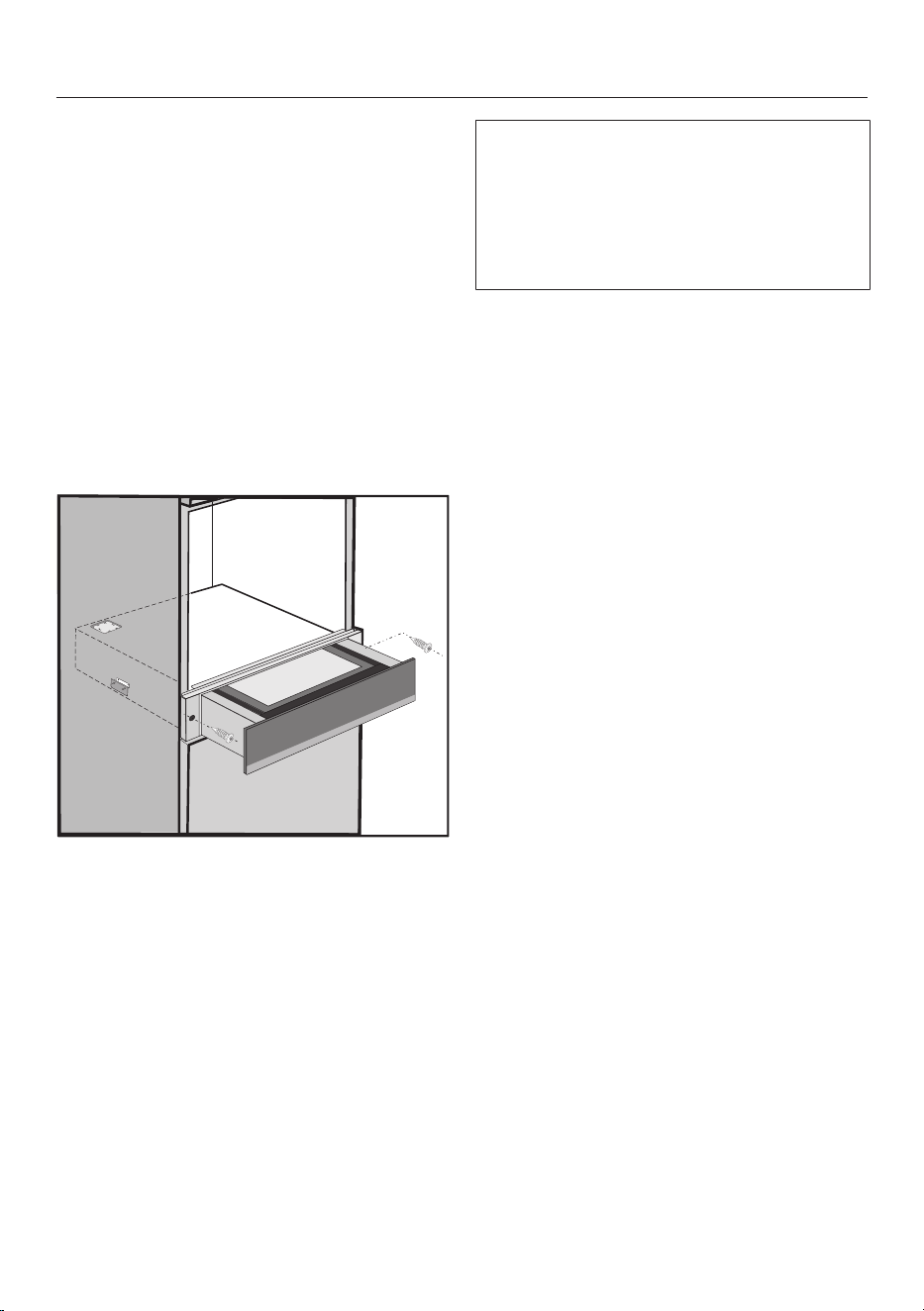
Installation
*INSTALLATION*
57
Installing and connecting the drawer
Check that the air filter is installed
and the safety screws have been re-
moved from the back of the drawer
(see “Installation – Building in”).
Connect the power cord to the
drawer.
Slide the closed drawer into the
housing unit. When doing so, make
sure that the power cord does not get
trapped or damaged.
Align the drawer at right angles.
Open the drawer and secure it to the
right and left-hand side walls of the
housing unit with the 2wood screws
supplied 1/8" x 1" (3.5x25mm).
Remove the foam adhesive label from
the glass lid.
Remove the 4foam adhesive labels
from the back of the front panel on
the right and left-hand sides.
Connect the drawer to the power
supply.
When the drawer is first connected, or
after a power failure, all of the sensor
controls and indicators will light up for
approx. 10seconds for testing (initial-
ization). As soon as they go out, the
drawer is ready for use.
When installing the combination ap-
pliance, protect the top edge of the
front panel from abrasive marks.
Install the combination appliance in
accordance with the operating and
installation instructions supplied with
it.
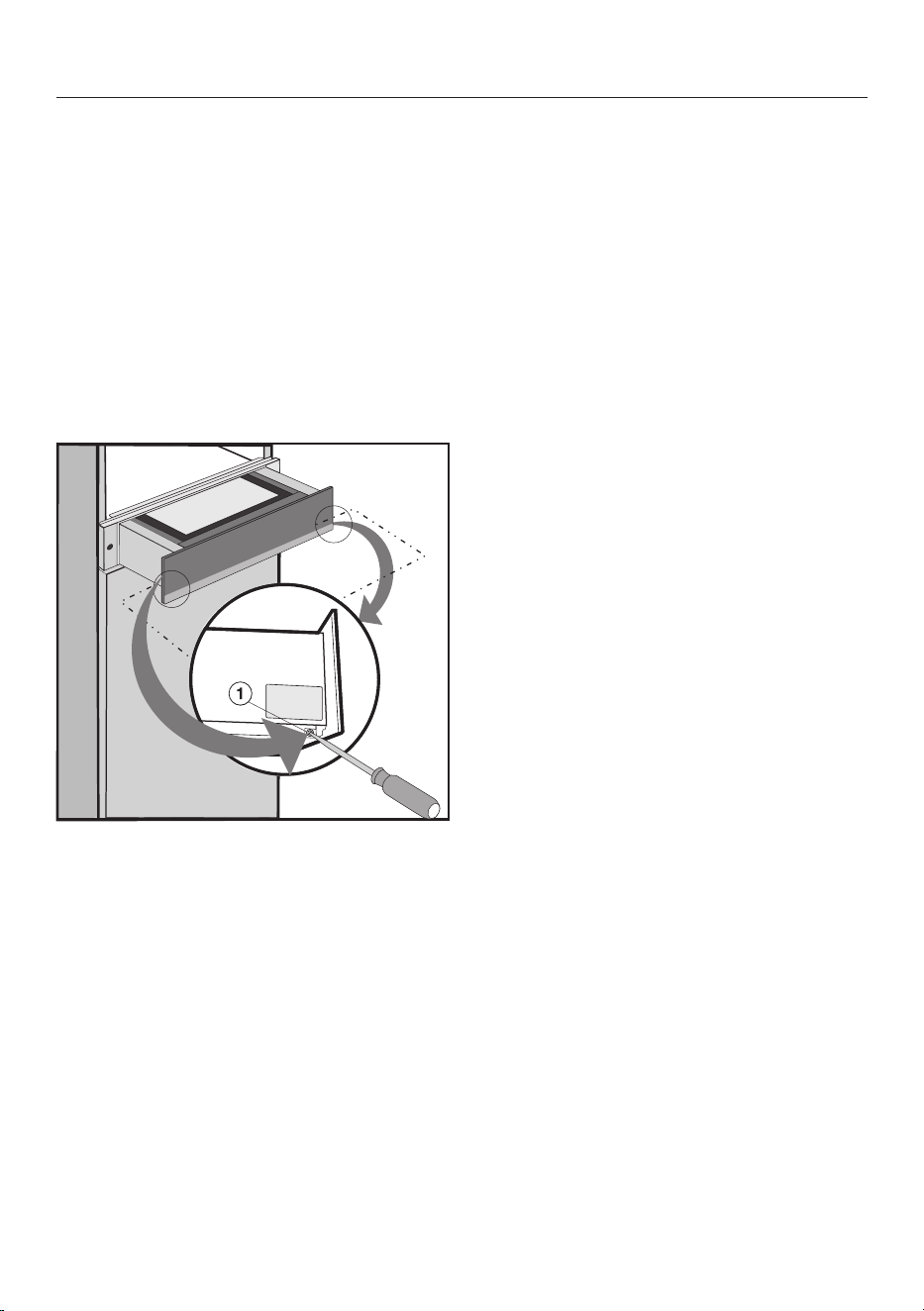
Installation
*INSTALLATION*
58
Aligning the front of the drawer
After installing the combination appli-
ance, it may be necessary under certain
circumstances to align the front of the
drawer and adjust the gap between the
drawer and the combination appliance.
For this purpose, 2screws can be
found behind the front of the drawer
which are used to fasten the front to the
housing of the drawer.
Open the drawer.
Loosen the retaining screws on the
right and left of the drawer housing.
Do not remove the screws com-
pletely, as the front may fall off.
Push the front of the drawer up or
down a little to correct the alignment
and the gap.
Tighten up the retaining screws.

Installation
*INSTALLATION*
59
Electrical connection
ATTENTION:
Before installation or servicing, dis-
connect the power supply by either
removing the fuse, manually “trip-
ping” the circuit breaker or unplug-
ging the appliance. Pull the plug not
the cord.
Repairs and service by unqualified
persons could be dangerous and the
manufacturer will not be held re-
sponsible.
Installation work and repairs should
only be performed by a qualified
technician in accordance with all ap-
plicable codes and standards. Instal-
lation, repair, and maintenance work
should only be performed by a
Miele-authorized service technician.
The voltage and frequency listed on
the rating label must correspond with
the household electrical supply to
prevent appliance damage.
Check these data before connection.
Consult an electrician if in doubt.
When another appliance is installed
in combination with the drawer to the
same circuit, operating both appli-
ances at the same time may cause
an overload.
If in doubt consult a qualified electri-
cian.
To guarantee the electrical safety of
this appliance, continuity must exist
between the appliance and an effec-
tive grounding system. It is impera-
tive that this basic safety require-
ment be met. If there is any doubt,
have the electrical system of the
house checked by a qualified electri-
cian.
Installation, repair and maintenance
work should only be performed by a
Miele-authorized qualified electrician
in compliance with local regulations
and the ANSI National Electrical
Code / NFPA 70 in the United States
or the Canadian Electric Code, CSA
C22.1-02. in Canada.

Installation
*INSTALLATION*
60
Connection
Make sure that the connection data
on the data plate matches that of
your electricity supply.
Connection data
The drawer is ready for connection and
equipped with a 6' 6'' (2,000 mm)
power cord with an electrical plug.
120V/15A/60Hz
Make sure that the connecting socket is
accessible after the installation of the
drawer.
Important –Save these instructions
for the local electrical inspector’s use.



9 Independence Way
Princeton, NJ 08540
www.mieleusa.com
U.S.A.
Miele, Inc.
National Headquarters
Please have the model and serial number
of your appliance available when
contacting Customer Service.
Canada
Importer
Miele Limited
Headquarters and Miele Centre
Customer Support
Phone: 888-99-MIELE (64353)
161 Four Valley Drive
Vaughan, ON L4K 4V8
www.miele.ca
Customer Care Centre
Phone:
800-565-6435
905-532-2272
International Headquarters
Miele & Cie. KG
Carl-Miele-Straße 29
33332 Gütersloh
Germany

M.-Nr. 11 924 080 / 00en-US
EVS 7010, EVS 7670