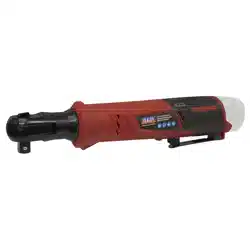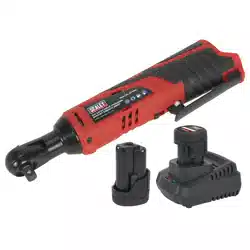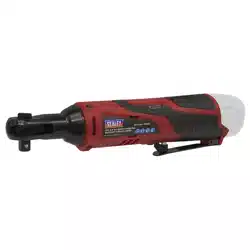

12V SV12 SERIES 3/8”SQ DRIVE CORDLESS
RATCHET WRENCH - BODY ONLY
MODEL NO: CP1202
Thank you for purchasing a Sealey product. Manufactured to a high standard, this product will, if used according to these instructions,
and properly maintained, give you years of trouble free performance.
IMPORTANT: PLEASE READ THESE INSTRUCTIONS CAREFULLY. NOTE THE SAFE OPERATIONAL REQUIREMENTS, WARNINGS & CAUTIONS. USE
THE PRODUCT CORRECTLY AND WITH CARE FOR THE PURPOSE FOR WHICH IT IS INTENDED. FAILURE TO DO SO MAY CAUSE DAMAGE AND/OR
PERSONAL INJURY AND WILL INVALIDATE THE WARRANTY. KEEP THESE INSTRUCTIONS SAFE FOR FUTURE USE.
1. SAFETY
1.1. GENERAL POWER TOOL SAFETY WARNINGS
WARNING! Read all safety warnings and all instructions. Failure to follow the warnings and instructions may result in electric shock,
re and/or serious injury.
9 Save all warnings and instructions for future reference.
1.2. WORK AREA SAFETY
9 Keep work area clean and well lit. Cluttered or dark areas invite accidents.
9 Evaluate your working area before using the tool.
8 DO NOT operate power tools in explosive atmospheres, such as in the presence of ammable liquids, gases or dust. Power tools
create sparks which may ignite the dust or fumes.
9 Keep children and bystanders away while operating a power tool. Distractions can cause you to lose control.
1.3. PERSONAL SAFETY
9 Stay alert, watch what you are doing and use common sense when operating a power tool. DO NOT use a power tool while you are
tired or under the inuence of drugs, alcohol or medication. A moment of inattention while operating power tools may result in serious
personal injury.
9 Use personal protective equipment. Always wear eye protection. Protective equipment such as dust mask, non-skid safety shoes, hard
hat, or hearing protection used for appropriate conditions will reduce personal injuries.
9 Prevent unintentional starting. Ensure the switch is in the off-position before connecting to power source and/or battery pack, picking up
or carrying the tool.
9 Carrying power tools with your nger on the switch or energising power tools that have the switch on invites accidents.
9 Remove any adjusting key or wrench before turning the power tool on.
8 DO NOT overreach. Keep proper footing and balance at all times. This enables better control of the power tool in unexpected
situations.
9 Dress properly. DO NOT wear loose clothing or jewellery. Keep your hair, clothing and gloves away from moving parts. Loose clothes,
jewellery or long hair can be caught in moving parts.
1.4. POWER TOOL USE AND CARE
8 DO NOT force the power tool. Use the correct power tool for your application. The correct power tool will do the job better and safer at
the rate for which it was designed.
8 DO NOT use the power tool if the switch does not turn it on and off. Any power tool that cannot be controlled with the switch is
dangerous and must be repaired.
WARNING! the battery pack from the power tool before making any adjustments, changing accessories, or storing power tools.
9 Store idle power tools out of the reach of children and do not allow persons unfamiliar with the power tool or these instructions to
operate the power tool. Power tools are dangerous in the hands of untrained users.
9 Maintain power tools. Check for misalignment or binding of moving parts, breakage of parts and any other condition that may affect the
power tool’s operation. If damaged, have the power tool repaired before use. Many accidents are caused by poorly maintained power
tools.
9 Use the power tool, accessories and tool bits etc. in accordance with these instructions, taking into account the working conditions and
the work to be performed. Use of the power tool for operations different from those intended could result in a hazardous situation.
1.5. SERVICE
9 Have your power tool serviced by a qualied repair person using only identical replacement parts. This will ensure that the safety of the
power tool is maintained.
1.6. SPECIFIC RATCHET WRENCH SAFETY INSTRUCTIONS
8 DO NOT hold unsecured work piece in your hand. Secure loose work pieces with a clamp, vice or other adequate holding device.
9 Hold the power tool by insulated gripping surfaces, when performing an operation where the fastener may contact hidden wiring or its
own cord. Fasteners contacting an orange” live” wire may make exposed parts of the power tool “live” and could give the operator an
electric shock.
9 Follow all workshop safety rules, regulations and conditions when using the wrench. I
8 DO NOT cover vents. This may cause overheating and damage the tool.
1.7. HAND ARM VIBRATION
WARNING! – Risk of Hand Arm Vibration Injury.
This tool may cause Hand Arm Vibration Syndrome if its use is not managed adequately.
This tool is subject to the vibration testing section of the Machinery Directive 2006/42/EC.
Refer to
instructions
Wear eye
protection
Wear protective
gloves
Wear ear
protection
Charger: Indoor
Use Only
Original Language Version
© Jack Sealey Limited
CP1202 Issue 3 (ALL) 12/06/23

This tool is to be operated in accordance with these instructions.
Measured vibration emission value (a):
2.9 m/s²
Uncertainty value (k):
1.5 m/s²
Please note that the application of the tool to a sole specialist task may produce a different average vibration emission. We recommend
that a specific evaluation of the vibration emission is conducted prior to commencing with a specialist task.
A health and safety assessment by the user (or employer) will need to be carried out to determine the suitable duration of use for each
tool.
NB: Stated Vibration Emission values are type-test values and are intended to be typical.
Whilst in use, the actual value will vary considerably from and depend on many factors, such as the operator, the task and the inserted
tool or consumable.
NB: ensure that the length of leader hoses is sufficient to allow unrestricted use, as this also helps to reduce vibration.
The state of maintenance of the tool itself is also an important factor, a poorly maintained tool will also increase the risk of Hand Arm
Vibration Syndrome.
1.8. HEALTH SURVEILLANCE
We recommend a programme of health surveillance to detect early symptoms of vibration injury so that management procedures can
be modified accordingly.
1.9. PERSONAL PROTECTIVE EQUIPMENT
We are not aware of any personal protective equipment (PPE) that provides protection against vibration injury that may result from the
uncontrolled use of this tool. We recommend a sufficient supply of clothing (including gloves) to enable the operator to remain warm
and dry and maintain good blood circulation in fingers etc. Please note that the most effective protection is prevention, please refer
to the Correct Use and Maintenance section in these instructions. Guidance relating to the management of hand arm vibration can be
found on the HSC website www.hse.gov.uk - Hand-Arm Vibration at Work.
2. INTRODUCTION
Compact, lightweight cordless ratchet wrench, allows access to tight spaces. Variable speed control trigger with lock function gives
more control during application. Heavy-duty mechanical steel ratchet head with forward and reverse control. Robust composite housing
with soft, comfortable grip. Integrated LED battery level indicator and LED worklight. Requires Model No. CP1200BP 12V 1.5Ah
Lithium-ion Battery and Model No. CP1200MC Battery Charger.
3. SPECIFICATION
Model No.. .........................................................CP1202
Battery Options (not included): .....12V 1.5Ah Lithium-ion
.......................................................12V 3Ah Lithium-ion,
........................................................12V 4Ah Lithium-ion
Drive: ................................................................... 3/8”Sq
Maximum Torque: ...................................... 45Nm(33lb.ft)
Noise Power/Pressure:................................100/88dB(A)
No-Load Speed: ...............................................0-250rpm
Replacement Parts: ............ CP1200MC - Mains Charger
Vibration/Uncertainty: ................................2.898/1.5m/s²
4. OPERATION
4.1. BATTERY PACK REMOVAL AND REPLACEMENT
4.1.1. Switch the machine off before removing the battery pack.
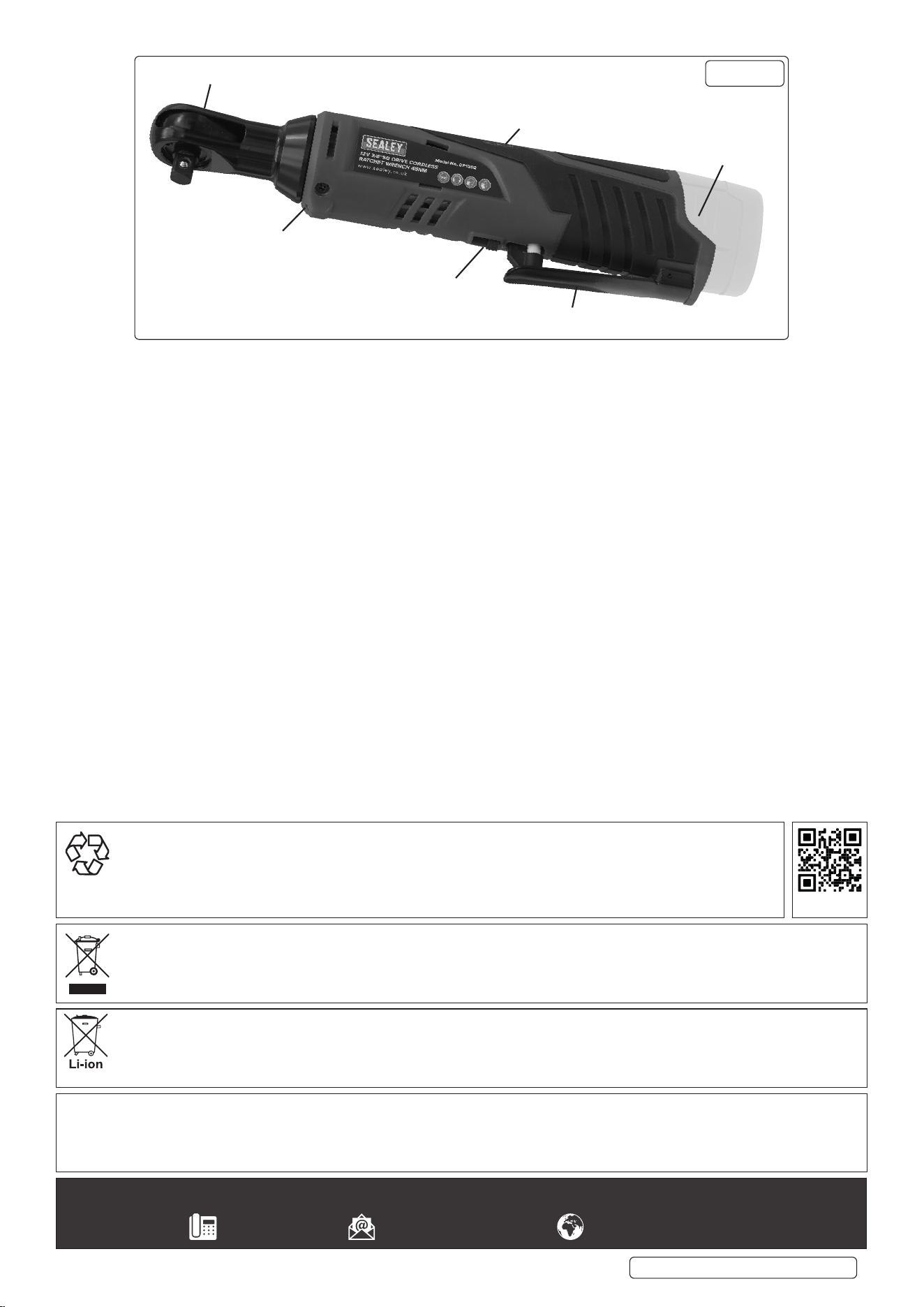
4.1.2. Press the battery latches in (located either side of grip and withdraw the battery pack (g.1).
4.1.3. To replace the battery pack, push the stem into the drill until the latches engage.
NOTE: The battery pack can only be inserted in the correct orientation.
4.2. BATTERY CHARGING
NOTE: Batteries that have been out of use for some time or are new may not accept a full charge. This is not a battery fault; the battery
may need to be discharged and charged a couple of times to restore full capacity.
4.2.1. Connect the charger to the electric power supply. A ashing green LED will show.
4.2.2. Insert the battery into the charger. A steady red light will show.
4.2.3. When fully charged, a steady green LED will show. The battery is ready for use.
4.3. USING THE WRENCH
4.3.1. Fit the socket to the wrench by snapping it onto the square drive.
4.3.2. Select the required direction of rotation. To change direction, turn the direction selector (g.1) to the left or right. change direction, turn the direction selector (g.1) to the left or right.
8 DO NOT attempt to change the direction of rotation whilst trigger is depressed.
4.3.3. Speed can be controlled by varying the nger pressure on the trigger. Initial pressure will switch on the worklight.
4.3.4. The trigger can be locked in the off position when required to prevent accidental use.
4.3.5. 4.3.5. WWhen tightening, take care not to over-torque small xihen tightening, take care not to over-torque small xings.
NOTE: On critical xings always check the torque with a torque wrench according to the product or vehicle manufacturer’s guidelines.
Original Language Version
© Jack Sealey Limited
CP1202 Issue 3 (ALL) 12/06/23
Original Language Version
© Jack Sealey Limited
CP1202 Issue 3 (ALL) 12/06/23
Sealey Group, Kempson Way, Suffolk Business Park, Bury St Edmunds, Suffolk. IP32 7AR
01284 757500 sales@sealey.co.uk www.sealey.co.uk
Note: It is our policy to continually improve products and as such we reserve the right to alter data, specifications and component parts without prior
notice.
Important: No Liability is accepted for incorrect use of this product.
Warranty: Guarantee is 12 months from purchase date, proof of which is required for any claim.
BATTERY REMOVAL
Under the Waste Batteries and Accumulators Regulations 2009, Jack Sealey Ltd are required to inform potential purchasers of products
containing batteries (as defined within these regulations), that they are registered with Valpak’s registered compliance scheme. Jack
Sealey Ltd’s Batteries Producer Registration Number (BPRN) is BPRN00705.
ENVIRONMENT PROTECTION
Recycle unwanted materials instead of disposing of them as waste. All tools, accessories and packaging should be sorted,
taken to a recycling centre and disposed of in a manner which is compatible with the environment. When the product
becomes completely unserviceable and requires disposal, drain any fluids (if applicable) into approved containers and
dispose of the product and fluids according to local regulations.
WEEE REGULATIONS
Dispose of this product at the end of its working life in compliance with the EU Directive on Waste Electrical and Electronic Equipment
(WEEE). When the product is no longer required, it must be disposed of in an environmentally protective way. Contact your local solid
waste authority for recycling information.
Battery Latch
Trigger Lock
Trigger
Work Light
Directional Control
Battery Level Indicator
Fig.1
REGISTER YOUR
PURCHASE HERE