Models
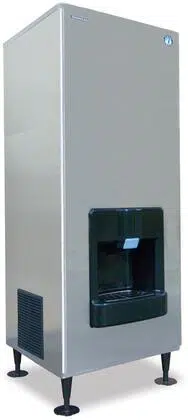
DKM-500BAJ, BWJ
Crescent Cube Icemaker / Dispenser
Instruction Manual
Issued: 12-12-2016
hoshizakiamerica.com

2
WARNING
Only qualied service technicians should install and service the appliance. To
obtain the name and phone number of your local Hoshizaki Certied Service
Representative, visit www.hoshizaki.com. No installation or service should be
undertaken until the technician has thoroughly read this Instruction Manual.
Likewise, the owner/manager should not proceed to operate the appliance until the
installer has instructed them on its proper operation. Failure to install, operate, and
maintain the appliance in accordance with this manual will adversely affect safety,
performance, component life, and warranty coverage and may result in costly water
damage. Proper installation is the responsibility of the installer. Product failure or
property damage due to improper installation is not covered under warranty.
Hoshizaki provides this manual primarily to assist qualied service technicians in the
installation, maintenance, and service of the appliance.
Should the reader have any questions or concerns which have not been satisfactorily
addressed, please call, send an e-mail message, or write to the Hoshizaki Technical
Support Department for assistance.
Phone: 1-800-233-1940; (770) 487-2331
Fax: 1-800-843-1056; (770) 487-3360
E-mail: techsuppor[email protected]
618 Highway 74 South
Peachtree City, GA 30269
Attn: Hoshizaki Technical Support Department
NOTE: To expedite assistance, all correspondence/communication MUST include the
following information:
• Model Number
• Serial Number
• Complete and detailed explanation of the problem.

3
CONTENTS
Important Safety Information ................................................................................................. 4
I. Specications ...................................................................................................................... 6
A. Electrical and Refrigerant Data ..................................................................................... 6
B. Dimensions/Connections .............................................................................................. 7
1. DKM-500BAJ ........................................................................................................... 7
2. DKM-500BWJ .......................................................................................................... 8
II. Installation and Operating Instructions .............................................................................. 9
A. Location ........................................................................................................................ 9
B. Checks Before Installation ........................................................................................... 10
C. How to Remove Panels ................................................................................................11
D. Setup ........................................................................................................................... 12
E. Electrical Connection .................................................................................................. 13
F. Water Supply and Drain Connections .......................................................................... 14
1. Icemaker ................................................................................................................ 15
2. Water-Cooled Condenser....................................................................................... 16
G. Final Checklist ............................................................................................................ 18
H. Startup ........................................................................................................................ 19
III. Maintenance ................................................................................................................... 21
A. Maintenance Schedule ................................................................................................ 21
B. Cleaning and Sanitizing Instructions ........................................................................... 22
1. Cleaning Procedure – Icemaker ............................................................................. 22
2. Sanitizing Procedure – Icemaker ........................................................................... 24
3. Cleaning Procedure – Storage Bin ........................................................................ 24
4. Sanitizing Procedure – Storage Bin ....................................................................... 24
IV. Preparing the Appliance for Periods of Non-Use ............................................................ 26
V. Disposal ........................................................................................................................... 28
IMPORTANT
This manual should be read carefully before the appliance is installed and operated.
Read the warnings and guidelines contained in this manual carefully as they
provide essential information for the continued safe use and maintenance of the
appliance. Retain this manual for any further reference that may be necessary.

4
Important Safety Information
Throughout this manual, notices appear to bring your attention to situations which could
result in death, serious injury, damage to the appliance, or damage to property.
WARNING Indicates a hazardous situation which could result in death or
serious injury.
NOTICE Indicates a situation which could result in damage to the
appliance or property.
IMPORTANT Indicates important information about the installation, use, and
care of the appliance.
WARNING
The appliance should be destined only to the use for which it has been expressly
conceived. Any other use should be considered improper and therefore dangerous.
The manufacturer cannot be held responsible for injury or damage resulting
from improper, incorrect, and unreasonable use. Failure to install, operate, and
maintain the appliance in accordance with this manual will adversely affect safety,
performance, component life, and warranty coverage and may result in costly water
damage.
To reduce the risk of death, electric shock, serious injury, or re, follow basic
precautions including the following:
• Only qualied service technicians should install and service the appliance.
• The appliance must be installed in accordance with applicable national, state, and
local codes and regulations.
• The appliance requires an independent power supply of proper capacity. See
the nameplate for electrical specications. Failure to use an independent power
supply of proper capacity can result in a tripped breaker, blown fuse, damage to
existing wiring, or component failure. This could lead to heat generation or re.
• THE APPLIANCE MUST BE GROUNDED: The appliance is equipped with a
NEMA5-20 three-prong grounding plug to reduce the risk of potential shock
hazards. It must be plugged into a properly grounded, independent 3-prong wall
outlet. If the outlet is a 2-prong outlet, it is your personal responsibility to have
a qualied electrician replace it with a properly grounded, independent 3-prong
wall outlet. Do not remove the ground prong from the power cord and do not use
an adapter plug. Failure to properly ground the appliance could result in death or
serious injury.
• Do not use an extension cord.
• To reduce the risk of electric shock, do not touch the control switch, service switch,
or plug with damp hands. Make sure the control switch is in the "OFF" position
before plugging in or unplugging the appliance.
• Do not use an appliance with a damaged power cord. The power cord should not
be altered, jerked, bundled, weighed down, pinched, or tangled. Such actions could
result in electric shock or re. To unplug the appliance, be sure to pull the plug, not
the cord, and do not jerk the cord.

5
WARNING, continued
• Do not make any alterations to the appliance. Alterations could result in electric
shock, injury, re, or damage to the appliance.
• The appliance is not intended for use by persons (including children) with reduced
physical, sensory, or mental capabilities, or lack of experience and knowledge,
unless they have been given supervision or instruction concerning use of the
appliance by a person responsible for their safety.
• Children should be properly supervised around the appliance.
• Do not climb, stand, or hang on the appliance or allow children or animals to do so.
Serious injury could occur or the appliance could be damaged.
• Do not use combustible spray or place volatile or ammable substances near the
appliance. They might catch re.
• Keep the area around the appliance clean. Dirt, dust, or insects in the appliance
could cause harm to individuals or damage to the appliance.
NOTICE
• Follow the water supply, drain connection, and maintenance instructions carefully to
reduce the risk of costly water damage.
• In areas where water damage is a concern, install in a contained area with a oor
drain.
• Install the appliance in a location that stays above freezing. Normal operating
ambient temperature must be within 45°F to 100°F (7°C to 38°C). If the normal
operating ambient temperature is above 90°F (32°C), the compressor insulation
cover must be removed.
• Do not leave the appliance on during extended periods of non-use, extended
absences, or in sub-freezing temperatures. To properly prepare the appliance for
these occasions, follow the instructions in "IV. Preparing the Appliance for Periods
of Non-Use."
• Do not place objects on top of the appliance.
• The storage bin is for ice use only. Do not store anything else in the storage bin.

6
I. Specications
A. Electrical and Refrigerant Data
The rating label and nameplate provide electrical and refrigerant data. The rating label
can be seen by removing the front panel. The nameplate is located on the rear panel. For
certication marks, see the nameplate.
We reserve the right to make changes in specications and design without prior notice.
Model Number DKM-500BAJ DKM-500BWJ
AC Supply Voltage 115/60/1 115/60/1
Amperes 13.5 AMPS 12 AMPS
Design Pressure HI-467PSI LO-170PSI HI-427PSI LO-230PSI
Refrigerant 404A 1 LB. 12.2 OZ. 404A 1 LB. 2 OZ.

7
B. Dimensions/Connections
1. DKM-500BAJ
Unit: mm [in.]

8
2. DKM-500BWJ
Unit: mm [in.]

9
II. Installation and Operating Instructions
WARNING
• The appliance must be installed in accordance with applicable national, state, and
local codes and regulations.
• Failure to install, operate, and maintain the appliance in accordance with this
manual will adversely affect safety, performance, component life, and warranty
coverage and may result in costly water damage.
• CHOKING HAZARD: Ensure all components, fasteners, and thumbscrews
are securely in place after installation. Make sure that none have fallen into the
storage bin.
A. Location
NOTICE
• The appliance is not intended for outdoor use. Normal operating ambient
temperature must be within 45°F to 100°F (7°C to 38°C). If the normal operating
ambient temperature is above 90°F (32°C), the compressor insulation cover
must be removed. Normal operating water temperature must be within 45°F to
90°F (7°C to 32°C). Operation of the appliance, for extended periods, outside of
these normal temperature ranges may affect appliance performance.
• The appliance will not work at sub-freezing temperatures. To prevent damage
to the water supply line, drain the appliance if the air temperature is going to go
below 32°F (0°C). See "IV. Preparing the Appliance for Periods of Non-Use."
• The appliance should not be located next to ovens, grills, or other high heat producing
equipment.
• On air-cooled model, allow at least 12" (30 cm) clearance on the left side and 6" (15 cm)
clearance at rear, right side, and top for proper air circulation and ease of maintenance
and/or service should they be required. On water-cooled model, allow 6"(15 cm)
clearance at rear, sides, and top.
• The location should provide a rm and level foundation for the appliance.

10
B. Checks Before Installation
• Visually inspect the exterior of the shipping container and immediately report any
damage to the carrier. Upon opening the container, any concealed damage should also
be immediately reported to the carrier.
• Remove the shipping carton, tape, and packing material. If any are left in the appliance,
it will not work properly.
• See the nameplate on the rear panel, and check that your voltage supplied corresponds
with the voltage specied on the nameplate.
• Remove the panels to prevent damage when installing the appliance. See "II.C. How to
Remove Panels."
• Remove the package containing the accessories.
• Remove the protective plastic lm from the panels. If the appliance is exposed to the
sun or to heat, remove the lm after the appliance cools.
• Check that the refrigerant lines do not rub or touch lines or other surfaces, and that the
fan blade (if applicable) turns freely.
• Check that the compressor is snug on all mounting pads.

11
Fig. 1
Top Panel
Side Panel
(R1)
Side Panel
(Lower)
Side Panel
(Lower)
Side Panel
(L1)
Front Insulation
Panel
Front Panel
Connector
C. How to Remove Panels
See Fig. 1
• Front Panel: Remove the screw, lift up and slightly towards you. Disconnect the
connector from the control box.
• Top Panel: Lift up at front slightly, push rearward, and lift off.
• Side Panels (R1 and L1): Remove the top panel. Remove the screw. Slide forward
slightly, and lift off.
• Side Panels (lower): Remove the top panel. Remove the screws and lift off.
• Top and Front Instulation Panels: Remove the top panel. Remove side panel (L1), then
lift up and out.
Top Insulation
Panel

12
D. Setup
1) Install the leg protectors to the 4 adjustable legs, then attach the legs to the bottom of
the icemaker. See Fig. 2.
2) Position the icemaker in the selected permanent location.
3) Level the icemaker in both the left-to-right and front-to-rear directions. Adjust the legs to
make the icemaker level.
4) NOTICE! If the normal operating ambient temperature is above 90°F (32°C),
remove the compressor insulation cover.
Fig. 2
Adjustable Leg
Control Box
Connector
Screw
Front Panel
Side Panel (Lower)
(removed in illustration
for clarity)
Leg Protector
Compressor Insulation Cover
13
E. Electrical Connection
WARNING
• Electrical connection must meet national, state, and local electrical code
requirements. Failure to meet these code requirements could result in death,
electric shock, serious injury, re, or damage.
• The appliance requires an independent power supply of proper capacity. See
the nameplate for electrical specications. Failure to use an independent power
supply of proper capacity can result in a tripped breaker, blown fuse, damage to
existing wiring, or component failure. This could lead to heat generation or re.
• THE APPLIANCE MUST BE GROUNDED:
The appliance is equipped with a
NEMA5-20 three-prong grounding plug
to reduce the risk of potential shock
hazards. It must be plugged into a properly grounded, independent 3-prong wall
outlet. If the outlet is a 2-prong outlet, it is your personal responsibility to have
a qualied electrician replace it with a properly grounded, independent 3-prong
wall outlet. Do not remove the ground prong from the power cord and do not use
an adapter plug. Failure to properly ground the appliance could result in death or
serious injury.
• Do not use an extension cord.
• To reduce the risk of electric shock, do not touch the control switch, service
switch, or plug with damp hands. Make sure the control switch is in the "OFF"
position before plugging in or unplugging the appliance.
• Do not use an appliance with a damaged power cord. The power cord should not
be altered, jerked, bundled, weighed down, pinched, or tangled. Such actions
could result in electric shock or re. To unplug the appliance, be sure to pull the
plug, not the cord, and do not jerk the cord.
• The GREEN ground wire in the factory-installed power cord is connected to the
appliance. If it becomes necessary to remove or replace the power cord, be sure
to connect the power cord's ground wire to this screw upon reattachment.
• Usually an electrical permit and services of a licensed electrician are required.
• The maximum allowable voltage variation is ±10 percent of the nameplate rating.
• For optional water dispenser kit installation, refer to the instruction manual included with
the kit.

14
F. Water Supply and Drain Connections
See Figs. 3 through 5
WARNING
Water supply and drain connections must be installed in accordance with applicable
national, state, and local regulations.
NOTICE
• Normal operating water temperature must be within 45°F to 90°F (7°C to
32°C). Operation of the appliance, for extended periods, outside of this normal
temperature range may affect appliance performance.
• Water supply pressure must be a minimum of 10 PSIG and a maximum of
113PSIG. If the pressure exceeds 113 PSIG, the use of a pressure reducing valve
is required.
• External lters, strainers, or softeners may be required depending on water quality.
Contact your local Hoshizaki Certied Service Representative or local Hoshizaki
distributor for recommendations.
• In areas where water damage is a concern, install in a contained area with a oor
drain.
• A plumbing permit and services of a licensed plumber may be required in some areas.
• The icemaker drain line, storage bin drain line, and water-cooled condenser drain line (if
applicable) must be run separately.
• Drain lines must have 1/4" fall per foot (2 cm per 1 m) on horizontal runs to get a good
ow. A vented tee connection is also required for proper ow.
• Drain lines should not be piped directly to the sewer system. An air gap of a minimum of
2vertical inches (5 cm) should be between the end of the drain pipes from the icemaker,
storage bin, and water-cooled condenser (if applicable) and the oor drain.

15
Shut-Off Valve
Drain Valve
Icemaker
Water Supply
Inlet
1/2" FPT
Storage Bin
Drain Outlet
3/4" FPT
Icemaker
Drain Outlet
3/4" FPT
1. Icemaker
Icemaker Water
Supply Inlet
Minimum Icemaker
Water Supply Line Size
Icemaker Drain
Outlet
Minimum Icemaker
Drain Line Size
1/2" Female Pipe
Thread (FPT)
1/4" Nominal ID
Copper Water Tubing or
Equivalent
3/4" Female Pipe
Thread (FPT)
3/4" Nominal
ID Hard Pipe or
Equivalent
• An icemaker water supply line shut-off valve and drain valve must be installed.
• Be sure there is sufficient extra water supply line and drain line for the appliance to be
pulled out for service.
Icemaker
Minimum 1/4" Nominal ID Copper Water
Tubing or Equivalent
Minimum 3/4" Nominal ID Hard Pipe or Equivalent
Vent Tube
Minimum 3/4" Nominal ID Hard Pipe or Equivalent
Vent Tube
2-inch (5-cm) air gap
Floor
Drain
Separate piping to
approved drain. Leave a
two-inch (5 cm) vertical air
gap between the end of
each pipe and the drain.
Be sure there is sufficient
extra water supply line and
drain line for the appliance
to be pulled out for service.
Fig. 3
Model Shown:
DKM-500BAJ
Air-Cooled Model

16
2. Water-Cooled Condenser
a) Connection to an Open Drain System
Condenser Water
Supply Inlet
Minimum Condenser
Water Supply Line Size
Condenser Drain
Outlet
Minimum Condenser
Drain Line Size
1/2" Female Pipe
Thread (FPT)
1/4" Nominal ID Copper
Water Tubing or Equivalent
3/8" Female Pipe
Thread (FPT)
1/4" Nominal ID Hard Pipe
or Equivalent
• A condenser water supply line shut-off valve and drain valve must be installed.
• In some areas, a back ow preventer may be required in the cooling water circuit.
• In order to maintain the proper high side pressure, the condenser water supply inlet
temperature should not drop below 45°F (7°C) and the condenser drain outlet temperature
must be in the 104°F to 115°F (40°C to 46°C) range. Once the icemaker installation
is complete, conrm the condenser drain outlet temperature 5 minutes after a freeze
cycle starts. If the condenser drain outlet temperature is not in the proper range, use a
at blade screwdriver to rotate the adjustment screw on the water-regulating valve until
the temperature is in the proper range (rotate counterclockwise to raise temperature or
clockwise to lower temperature).
Icemaker
Drain Outlet
3/4" FPT
Icemaker Water
Supply Inlet
1/2" FPT
Condenser Water
Supply Inlet
1/2" FPT
Condenser Drain
Outlet 3/8" FPT
Storage Bin Drain
Outlet 3/4" FPT
Shut-Off Valve
Drain Valve
Shut-Off Valve
Drain Valve
Vent Tube
Vent Tube
Vent Tube
Icemaker
Minimum 1/4"
Nominal ID Copper
Water Tubing or
Equivalent
Minimum 3/4" Nominal ID
Hard Pipe or Equivalent
Minimum 1/4"
Nominal ID Hard
Pipe or Equivalent
Floor
Drain
Separate piping to approved
drain. Leave a 2-inch (5-cm)
vertical air gap between the
end of each pipe and the
drain.
Be sure there is sufficient
extra water supply line and
drain line for the appliance
to be pulled out for service.
2-inch (5-cm) air gap
Minimum 1/4" Nominal ID Copper
Water Tubing or Equivalent
Minimum 3/4" Nominal ID
Hard Pipe or Equivalent
Fig. 4
Water-Cooled Model
Connection to an Open Drain System
Model Shown:
DKM-500BWJ

17
Icemaker Drain
Outlet 3/4" FPT
Icemaker Water
Supply Inlet 1/2" FPT
Condenser Water
Supply Inlet 1/2" FPT
Condenser Return
Outlet 3/8" FPT
Storage Bin Drain
Outlet 3/4" FPT
Shut-Off Valve
Drain Valve
Drain Valve
Shut-Off Valve
Vent Tube
Vent Tube
b) Connection to a Closed Loop System
Condenser Water
Supply Inlet
Minimum Condenser
Water Supply Line Size
Condenser
Return Outlet
Minimum Condenser
Return Line Size
1/2" Female Pipe
Thread (FPT)
1/4" Nominal ID Copper
Water Tubing or Equivalent
3/8" Female Pipe
Thread (FPT)
1/4" Nominal ID Copper
Water Tubing or Equivalent
• Shut-off valves and drain valves must be installed at both the condenser water supply inlet
and condenser return outlet.
• Minimum water ow to the condenser is 4 GPM.
• The pressure differential between the condenser water supply inlet and condenser return
outlet must be no less than 10 PSIG.
• When using a glycol blend, the solution mixture should be less than 30% glycol.
• In order to maintain the proper high side pressure, the condenser water supply inlet
temperature should not drop below 45°F (7°C) and the condenser return outlet
temperature must be in the 104°F to 115°F (40°C to 46°C) range. Once the icemaker
installation is complete, conrm the condenser return outlet temperature 5 minutes after a
freeze cycle starts. If the condenser return outlet temperature is not in the proper range,
use a at blade screwdriver to rotate the adjustment screw on the water-regulating valve
until the temperature is in the proper range (rotate counterclockwise to raise temperature
or clockwise to lower temperature).
Icemaker
Minimum 1/4" Nominal
ID Copper Water
Tubing or Equivalent
Minimum 1/4" Nominal
ID Copper Water Tubing
or Equivalent
Minimum 3/4"
Nominal ID Hard
Pipe or Equivalent
Minimum 3/4" Nominal ID
Hard Pipe or Equivalent
Floor
Drain
Separate piping to approved
drain. Leave a 2-inch (5-cm)
vertical air gap between the
end of each pipe and the
drain.
Be sure there is sufficient
extra water supply line and
drain line for the appliance
to be pulled out for service.
2-inch (5-cm) air gap
Fig. 5
Water-Cooled Model
Connection to a Closed-Loop System
Model Shown:
DKM-500BWJ

18
G. Final Checklist
WARNING
CHOKING HAZARD: Ensure all components, fasteners, and thumbscrews are
securely in place after installation. Make sure that none have fallen into the storage
bin.
1) Is the icemaker level?
2) Is the icemaker in a site where the ambient temperature is within 45°F to 100°F (7°C to
38°C) and the water temperature within 45°F to 90°F (7°C to 32°C) all year around? If
the normal operating ambient temperature is above 90°F (32°C), has the compressor
insulation cover been removed?
3) Air-Cooled Model: Is there at least 12" (30 cm) clearance on the left side and 6" (15 cm)
clearance at rear, right side, and top?
Water-Cooled Model: Is there at least 6" (15 cm) clearance at rear, sides, and top?
4) Have the shipping carton, tape, and packing material been removed from the icemaker?
Is the cube guide in the correct position?
5) Have all electrical and water connections been made? Do electrical and water
connections meet applicable national, state, and local code and regulation
requirements?
6) Has the power supply voltage been checked or tested against the nameplate rating? Is
the power supply a properly grounded, independent 3-prong wall outlet?
7) Are the water supply and drain lines sized as specied? Are the water supply line
shut-off valve(s) and drain valve(s) installed? Has the water supply pressure been
checked to ensure a minimum of 10 PSIG and a maximum of 113 PSIG?
8) Is the compressor snug on all mounting pads? Have the refrigerant lines been checked
to make sure they do not rub or touch other lines or surfaces? Has the fan blade (if
applicable) been checked to make sure it turns freely?
9) Are all components, fasteners, and thumbscrews securely in place?
11) Has the end user been given the instruction manual, and instructed on how to operate
the icemaker and the importance of the recommended periodic maintenance?
12) Has the end user been given the name and telephone number of an authorized service
agent?
13) Has the warranty card been lled out and forwarded to the factory for warranty
registration?

19
H. Startup
WARNING
All parts are factory-adjusted. Improper adjustments may adversely affect safety,
performance, component life, and warranty coverage.
NOTICE
• If the icemaker is turned off, wait for at least 3 minutes before restarting the
icemaker to prevent damage to the compressor.
• The pump motor is energized continuously when the control switch is in the
"SERVICE" position.
• At startup, conrm that all internal and external connections are free of leaks.
1) Open the water supply line shut-off valve(s).
2) Remove the front panel and disconnect the connector from the control box (if the front
panel is not already removed).
3) Make sure the control switch on the control box is in the "OFF" position, then plug the
icemaker into the electrical outlet.
4) Move the control switch to the "ICE" position.
5) Replace the front panel in its correct position.
6) Allow the icemaker to operate for 5 minutes to ll the water tank.
7) Remove the front panel, then move the service switch to the "WASH" position. Move the
control switch to the "SERVICE" position.
8) Replace the front panel in its correct position and allow the icemaker to run for
5 minutes.
9) Remove the front panel, then move the service switch to the "DRAIN" position.
10) Replace the front panel in its correct position and allow the icemaker to drain for
2 minutes.
11) Remove the front panel, then move the control switch to the "OFF" position. Unplug the
icemaker from the electrical outlet.
12) Disconnect the bin control connector. See Fig. 6. Remove the 3 thumbscrews securing
the bin cover, then remove the bin cover with the bin control attached.
Thumbscrew
Bin Cover
Bin
Control
Connector
Storage Bin
Fig. 6
Bin Control
Actuator Paddle

20
13) Clean the storage bin liner using a neutral cleaner. Rinse thoroughly after cleaning.
14) Reconnect the bin control connector.
15) Plug the icemaker back in. Move the control switch to the "ICE" position to start the
automatic icemaking process.
16) To conrm bin control operation, press and hold the bin control's actuator paddle during
the rst 5 minutes of the freeze cycle. The icemaker should shut down in approximately
5 seconds.
17) Replace the bin cover in its correct position.
18) Reconnect the connector from the front panel to the control box and replace the front
panel in its correct position.
19) On water-cooled model, conrm proper condenser drain outlet/return outlet
temperature as outlined in "II.F.2. Water-Cooled Condenser."
21
III. Maintenance
The appliance must be maintained in accordance with the instruction manual and labels
provided. Consult with your local Hoshizaki Certied Service Representative about
maintenance service.
WARNING
• Only qualied service technicians should service the appliance.
• To reduce the risk of electric shock, do not touch the control switch or service switch
with damp hands.
• Move the control switch to the "OFF" position and unplug the unit from the electrical
outlet before servicing.
• CHOKING HAZARD: Ensure all components, fasteners, and thumbscrews are
securely in place after any maintenance is done to the appliance. Make sure that
none have fallen into the storage bin.
A. Maintenance Schedule
The maintenance schedule below is a guideline. More frequent maintenance may be
required depending on water quality, the appliance's environment, and local sanitation
regulations.
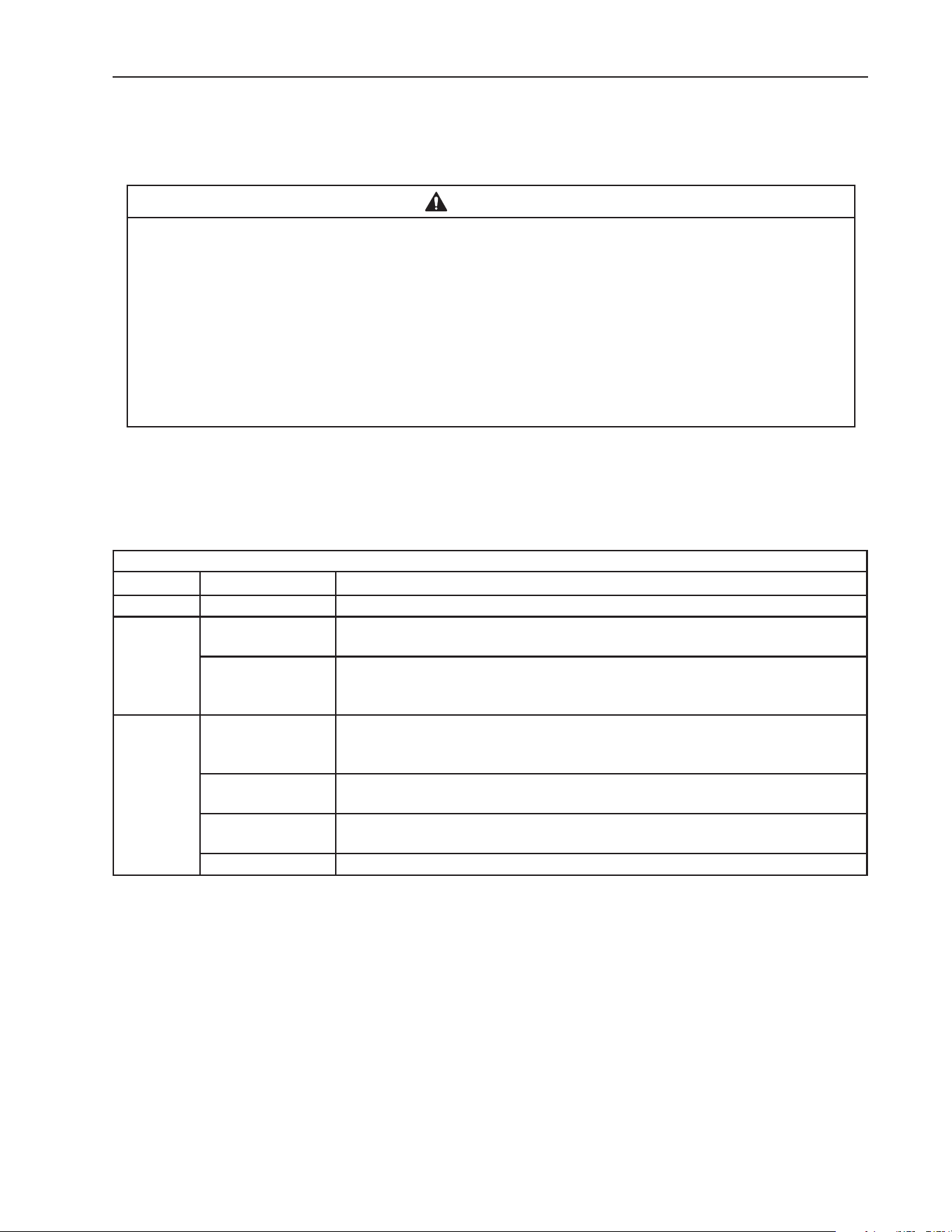
Maintenance Schedule
Frequency Area Task
Bi-Weekly Air Filters Inspect. Wash with warm water and neutral cleaner if dirty.
Monthly External Water
Filters
Check for proper pressure and change if necessary.
Appliance Exterior Wipe down with a clean, soft cloth. Use a damp cloth containing a neutral
cleaner to wipe off oil or dirt build up. Clean any chlorine staining (rust
colored spots) using a non-abrasive cleanser.
Yearly Icemaker and
Dispenser Unit/
Storage Bin
Clean and sanitize per the cleaning and sanitizing instructions provided in
this manual. See "III.B. Cleaning and Sanitizing Instructions."
Water Supply Inlet Close the icemaker water supply line shut-off valve and drain the water
system. Clean the water supply inlet screen.
Condenser Inspect. Clean if necessary by using a brush or vacuum cleaner. More
frequent cleaning may be required depending on location.
Water Hoses Inspect the water hoses and clean/replace if necessary.

22
B. Cleaning and Sanitizing Instructions
The appliance must be cleaned and sanitized at least once a year. More frequent
cleaning and sanitizing may be required in some water conditions.
WARNING
• To prevent injury to individuals and damage to the icemaker, do not use ammonia
type cleaners.
• Carefully follow any instructions provided with the bottles of cleaning and
sanitizing solution.
• Always wear liquid-proof gloves and goggles to prevent the cleaning and sanitizing
solutions from coming into contact with skin or eyes.
NOTICE
The pump motor is energized continuously when the control switch is in the
"SERVICE" position.
1. Cleaning Procedure – Icemaker
1) Dilute 10.5 . oz. (311 ml) of Hoshizaki "Scale Away" with 2 gal. (7.6 l) of warm water.
2) Remove all ice from the evaporator.
Note: To remove cubes on the evaporator, remove the front panel and disconnect the
connector from the control box. See Fig. 7. Move the control switch on the control box to
the "OFF" position and move it back to the "ICE" position after 3 minutes. The harvest
cycle starts and the cubes will be removed from the evaporator.
3) Reconnect the connector from the front panel to the control box and replace the front
panel in its correct position. Dispense all of the ice from the storage bin.
Snap Pin
Shutter
Spout
Extension
Thumbscrew
Thumbscrew
Bin Cover
Grill
Chute
Agitator
Bin
Control
Connector
Front
Panel
Spout
Bin Spout
Connector
Control
Box
Storage Bin
Fig. 7

23
4) Remove the front panel and disconnect the connector from the control box.
5) Move the service switch on the control box to the "DRAIN" position, then move the
control switch to the "SERVICE" position.
6) Replace the front panel in its correct position and allow the icemaker to drain for
2 minutes.
7) Remove the front panel and move the control switch to the "OFF" position. Unplug the
icemaker from the electrical outlet.
8) Disconnect the bin control connector. Remove the 3 thumbscrews securing the bin
cover, and remove the bin cover with the bin control attached.
9) In bad or severe water conditions, clean the oat switch assembly as described below.
Otherwise, continue to step 10.
a. Remove the 3 screws securing the oat switch assembly, then remove the
assembly.
b. Remove the retainer rod from the bottom of the oat switch housing, then remove
the oat. Be careful not to bend the retainer rod excessively when removing it.
c. Wipe down the oat switch housing, shaft, oat, and retainer rod with cleaning
solution. Clean the inside of the rubber boot and hose with cleaning solution. Rinse
the parts thoroughly with clean water.
d. Reassemble the oat switch assembly and replace it in its correct position. Secure
the oat switch assembly with the screws.
10) Pour the cleaning solution into the water tank.
11) Plug the icemaker back in. Move the service switch to the "WASH" position, then move
the control switch to the "SERVICE" position to start the cleaning process. Replace the
front panel in its correct position.
12) After 30 minutes, remove the front panel and move the service switch to the "DRAIN"
position.
13) Replace the front panel in its correct position and allow the icemaker to drain for
2 minutes.
14) Remove the front panel and move the control switch to the "ICE" position.
15) Replace the front panel in its correct position and allow the water tank to ll with water
for 3 minutes.
16) Remove the front panel and move the service switch to the "WASH" position, then move
the control switch to the "SERVICE" position. Replace the front panel in its correct
position.
17) After 5 minutes, remove the front panel and move the service switch to the "DRAIN"
position.
18) Replace the front panel in its correct position and allow the icemaker to drain for
2 minutes.
19) Repeat steps 14 through 18 three more times to rinse thoroughly
20) Remove the front panel and move the control switch to the "OFF" position. Proceed to
"2. Sanitizing Procedure – Icemaker".

24
2. Sanitizing Procedure – Icemaker
1) Dilute 1.0 . oz. (30 ml or 2 tbs) of a 5.25% sodium hypochlorite solution (chlorine
bleach) with 2 gal. (7.6 l) of warm water.
2) Pour the sanitizing solution into the water tank.
3) Move the service switch to the "WASH" position, then move the control switch to the
"SERVICE" position to start the sanitizing process. Replace the front panel in its correct
position.
4) After 15 minutes, remove the front panel and move the service switch to the "DRAIN"
position.
5) Replace the front panel in its correct position and allow the icemaker to drain for
2 minutes.
6) Repeat steps 14 through 18 in "1. Cleaning Procedure – Icemaker" two times to rinse
thoroughly.
7) Remove the front panel and move the control switch to the "OFF" position. Unplug the
icemaker from the electrical outlet. Proceed to "3. Cleaning Procedure – Storage Bin".
3. Cleaning Procedure – Storage Bin
1) Dilute 5 . oz. (148 ml) of Hoshizaki "Scale Away" with 1 gal. (3.8l) of warm water.
2) Make sure the control switch is in the "OFF" position and the icemaker is unplugged.
3) Remove the grill and chute from the front panel.
4) Remove the shutter and spout extension as follows:
a. Remove the snap pin tted to the shutter shaft. Shift the shaft to the left, pull out the
right side and slide out.
b. Remove the 4 thumbscrews securing the spout extension and remove the spout
extension.
5) Remove the 2 thumbscrews securing the bin control assembly to the bin cover. Note the
orientation of the stainless steel bracket, then remove the bin control and bracket from
the bin cover.
6) Scrub the inside of the storage bin, the agitator, the bin spout, the spout extension,
the shutter, the front panel spout, the grill, the chute, the bin cover, and the bin control
assembly using a nylon scouring pad, brushes, and cleaning solution.
7) Rinse all parts thoroughly with clean water, then proceed to "4. Sanitizing Procedure –
Storage Bin".
4. Sanitizing Procedure – Storage Bin
1) Dilute .5 . oz. (15 ml or 1 tbs) of a 5.25% sodium hypochlorite solution (chlorine bleach)
with 1 gal. (3.8 l) of warm water.
2) Wash all parts from step 6 of "3. Cleaning Procedure – Storage Bin" with the sanitizing
solution.
3) Rinse all parts thoroughly with clean water.
4) Reassemble all parts in the reverse order of the removal procedure.

25
5) Plug the icemaker back in. Move the control switch to the "ICE" position to start the
automatic icemaking process.
6) Reconnect the connector from the front panel to the control box and replace the front
panel in its correct position.

26
IV. Preparing the Appliance for Periods of Non-Use
NOTICE
• When storing the appliance for an extended time or in sub-freezing temperatures,
follow the instructions below to prevent damage.
• The pump motor is energized continuously when the control switch is in the
"SERVICE" position.
When the icemaker is not used for two or three days under normal conditions, it is
sufficient to move the control switch to the "OFF" position. When storing the icemaker for
an extended time or in sub-freezing temperatures, follow the instructions below.
1. Remove the ice from the storage bin, drain the water system, and remove the water
from the icemaker water supply line:
1) Close the icemaker water supply line shut-off valve, then open the icemaker water
supply line drain valve.
2) Remove the front panel and disconnect the connector from the control box.
3) Move the service switch on the control box to the "DRAIN" position, then move the
control switch to the "SERVICE" position.
4) Reconnect the connector from the front panel to the control box and replace the front
panel in its correct position.
5) Dispense all of the ice from the storage bin.
6) Attach a compressed air or carbon dioxide supply to the icemaker water supply line
drain valve.
7) Make sure at least 3 minutes have elapsed since you moved the control switch to the
"SERVICE" position. Remove the front panel, then move the control switch to the "ICE"
position.
8) Blow the icemaker water supply line out using the compressed air or carbon dioxide
supply.
9) Move the control switch to the "OFF" position, then unplug the icemaker from the
electrical outlet.
10) Disconnect the bin control connector. Remove the 3 thumbscrews securing the bin
cover, and remove the bin cover with the bin control attached.
11) Clean the storage bin using a neutral cleaner. Rinse thoroughly after cleaning.
12) Replace the bin cover in its correct position and reconnect the bin control connector.
13) For water-cooled model, proceed to the next section. For air-cooled model, the
procedure is complete. Reconnect the connector from the front panel to the control box
and replace the front panel in its correct position.

27
2. On water-cooled model, remove the water from the water-cooled condenser:
1) Make sure the control switch is in the "OFF" position and the icemaker is unplugged.
2) Remove the left side panel.
3) Close the condenser water supply line shut-off valve. If connected to a closed loop
system, also close the condenser return line shut-off valve.
4) Open the condenser water supply line drain valve. If connected to a closed loop system,
also open the condenser return line drain valve.
5) Attach a compressed air or carbon dioxide supply to the condenser water supply line
drain valve.
6) Open the water regulating valve by using a screwdriver to pry up on the spring retainer
underneath the spring. While holding the valve open, blow out the condenser using the
compressed air or carbon dioxide supply until water stops coming out.
7) Close the drain valve(s) and replace the left side panel in its correct position.
8) Reconnect the connector from the front panel to the control box and replace the front
panel in its correct position.

28
V. Disposal
The appliance contains refrigerant and must be disposed of in accordance with
applicable national, state, and local codes and regulations. Refrigerant must be
recovered by properly certied service personnel.
29
618 Hwy. 74 South, Peachtree City, GA 30269 USA (P) 770.487.2331 (F) 770.487.3360 hoshizakiamerica.com 1A4402-010
