Operation Manual
Product Code: 888-N00/N02/N20/N22/N40/N42/N60
Sewing Machine
Be sure to read this document before using the machine.
We recommend that you keep this document nearby for future reference.
The latest manuals are available at Brother support website ( https://s.brother/cpkag/ ).
CONTENTS
IMPORTANT SAFETY INSTRUCTIONS ......................2
Names of Machine Parts ............................................4
Main parts ....................................................................... 4
Needle and presser foot section ...................................... 4
Operation buttons ........................................................... 4
Flat bed attachment ......................................................... 4
Accessories ................................................................5
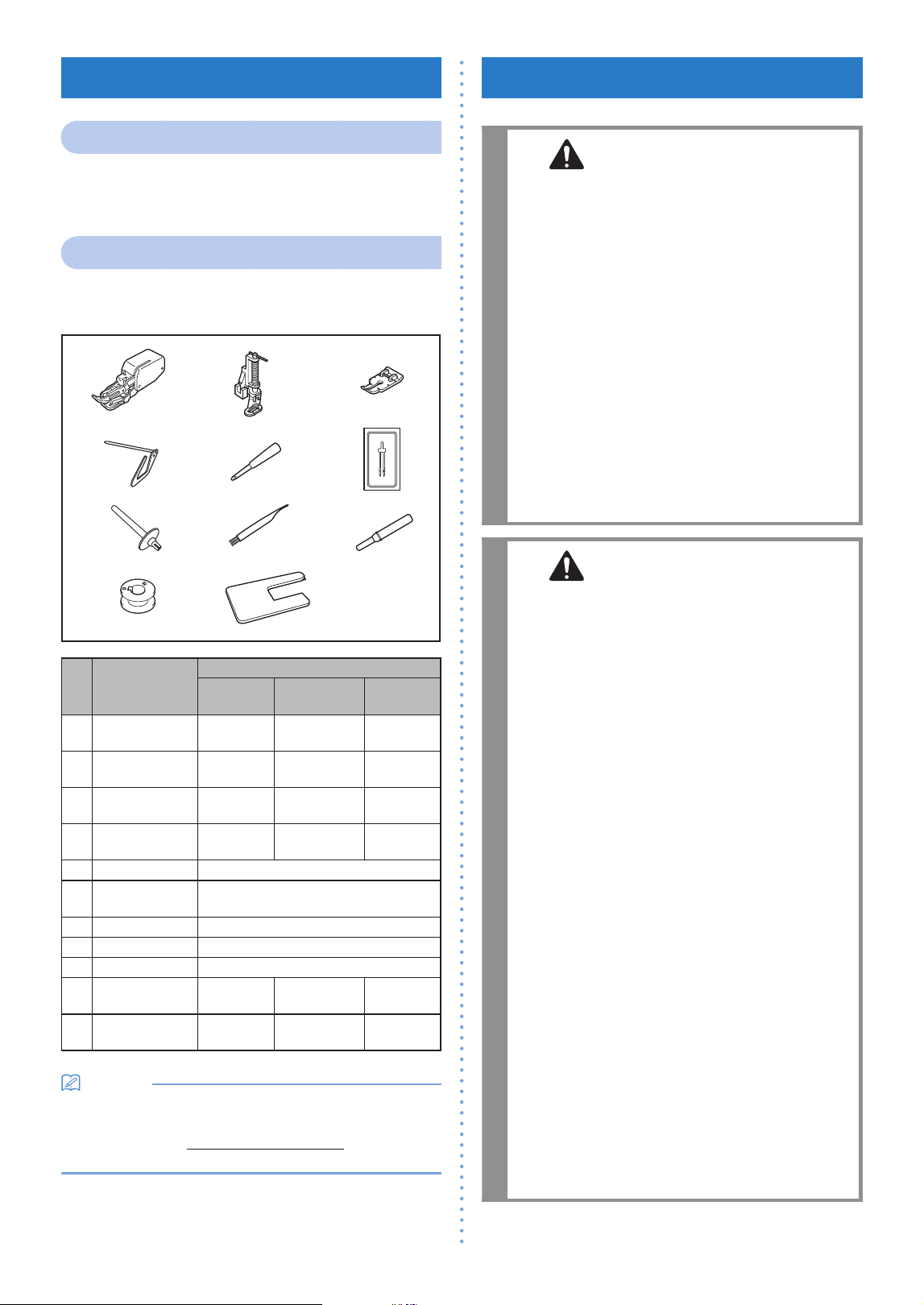
Included accessories ....................................................... 5
Optional accessories ...................................................... 5
Using Your Machine ..................................................5
Power supply .................................................................. 6
Foot controller ................................................................. 6
Operation panel .............................................................. 6
Settings/Functions ........................................................... 6
Threading the Machine ..............................................7
Winding/Installing the bobbin ......................................... 7
Upper threading .............................................................. 9
Drawing up the bobbin thread ...................................... 11
Fabric/Thread/Needle Combination ........................12
Needle .....................................................................13
Checking the needle ..................................................... 13
Replacing the needle ..................................................... 13
Sewing with the twin needle ......................................... 13
Replacing the Presser Foot .......................................14
Replacing the presser foot ............................................. 14
Removing the presser foot holder .................................. 15
Sewing Basics...........................................................15
Selecting the stitch ........................................................ 15
Setting the stitch length and stitch width ....................... 15
Starting to sew ............................................................... 16
Sewing reverse/reinforcement stitches ........................... 16
Automatic reverse/reinforcement stitching ..................... 17
Thread tension .............................................................. 17
Utility Stitches .........................................................17
Overcasting stitches ...................................................... 17
Blind hem stitching ........................................................ 18
Buttonhole sewing ........................................................ 19
Button sewing (for models equipped with
the button fitting foot “M”) ............................................ 21
Zipper insertion............................................................. 22
Bar tack stitching ........................................................... 23
Making Adjustment..................................................23
Brother Support Website Information
(Downloading Manuals) ..........................................24
Care and Maintenance .............................................24
Restrictions on oiling ..................................................... 24
Precautions on storing the machine ............................... 24
Cleaning the machine surface ....................................... 24
Cleaning the race .......................................................... 24
Tro ubles hooting .......................................................25
Frequent troubleshooting topics .................................... 25
Upper thread tightened up ............................................ 25
Tangled thread on wrong side of fabric ......................... 25
Incorrect thread tension ................................................ 26
Fabric is caught in the machine and cannot be
removed ........................................................................ 26
If the thread becomes tangled under the bobbin
winder seat.................................................................... 28
List of symptoms............................................................ 28
Error Messages .........................................................30
Operation beep ............................................................. 30
Index ........................................................................ 31
The List of the Instruction Manuals .........................31

2
IMPORTANT SAFETY
INSTRUCTIONS
Please read these safety instructions before
attempting to use the machine.
DANGER
- To reduce the risk of electrical shock
1
Always unplug the machine from the
electrical outlet immediately after
using, when cleaning, making any user
servicing adjustments mentioned in
this manual, or if you are leaving the
machine unattended.
WARNING
- To reduce the risk of burns, fi re, electrical shock, or
injury to persons.
2
Always unplug the machine from the electrical
outlet when making any adjustments mentioned
in the instruction manual.
• To unplug the machine, switch the machine to the
symbol “O” position to turn it off, then grasp the
plug and pull it out of the electrical outlet. Do not
pull on the cord.
• Plug the machine directly into the electrical outlet.
Do not use an extension cord.
•
Always unplug your machine if there is a power failure.
3
Electrical Hazards:
• This machine should be connected to an AC power
source within the range indicated on the rating label.
Do not connect it to a DC power source or inverter.
If you are not sure what kind of power source you
have, contact a qualifi ed electrician.
• This machine is approved for use in the country of
purchase only.
4
Fire Hazards:
• Do not use fl ammable substances, any type of spray,
or an organic solvent/liquid containing alcohol
or ammonia to clean the inside or outside of the
product. Doing so could cause a fi re.
5
Never operate this machine if it has a damaged
cord or plug, if it is not working properly, has been
dropped or damaged, or water is spilled on the
unit. Return the machine to the nearest authorized
Brother dealer for examination, repair, electrical or
mechanical adjustment.
• While the machine is stored or in use if you
notice anything unusual, such as an odor, heat,
discoloration or deformation, stop using the machine
immediately and unplug the power cord.
• When transporting the machine, be sure to carry it
by its handle. Lifting the machine by any other part
may damage the machine or result in the machine
falling, which could cause injuries.
• When lifting the machine, be careful not to make
any sudden or careless movements, which may
cause a personal injury.
6
Always keep your work area clear:
• Do not install or use in areas where explosive or
electrically conductive dusts are generated.
• Never operate the machine with any air openings
blocked. Keep ventilation openings of the machine
and foot controller free from the build up of lint,
dust, and loose cloth.
• Do not store objects on the foot controller.
• Never drop or insert foreign objects in any opening.
• Do not operate where aerosol (spray) products are
being used or where oxygen is being administered.
• Do not use the machine near a heat source, such as
a stove or iron; otherwise, the machine, power cord
or garment being sewn may ignite, resulting in fi re or
an electric shock.
• Do not place this machine on an unstable surface,
such as an unsteady or slanted table, otherwise the
machine may fall, resulting in injuries.
7
Special care is required when sewing:
• Always pay close attention to the needle. Do not use
bent or damaged needles.
• Keep fi ngers away from all moving parts. Special
care is required around the machine needle.
• Switch the machine to the symbol “O” position
to turn it off when making any adjustments in the
needle area.
• Do not use a damaged or incorrect needle plate, as
it could cause the needle to break.
• Do not push or pull the fabric when sewing, and
follow careful instruction when free motion stitching
so that you do not defl ect the needle and cause it to
break.

3
8
This machine is not a toy:
• Your close attention is necessary when the machine
is used by or near children.
• This product contains small parts. Keep the product
out of the reach of children to prevent accidental
ingestion of small parts.
• The plastic bag that this machine was supplied
in should be kept out of the reach of children or
disposed of. Never allow children to play with the
bag due to the danger of suffocation.
• Do not use outdoors.
9
For a longer service life:
• When using and storing this machine, avoid direct
sunlight and high humidity locations. Do not use or
store the machine near a space heater, iron, halogen
lamp, or other hot objects.
• Do not use cleansers or organic solvents, such as
thinner, petroleum ether or alcohol, to clean the
machine. Otherwise, the finish may peel off or
become scratched.
• Always consult the Operation Manual when
replacing or installing any assemblies, the presser
feet, needle or other parts to assure correct
installation.
10
For repair or adjustment:
• If the light unit is damaged, it must be replaced by
an authorized Brother dealer.
• In the event a malfunction occurs or adjustment is
required, first follow the troubleshooting table in the
back of the Operation Manual to inspect and adjust
the machine yourself. If the problem persists, please
consult your local authorized Brother dealer.
Use this machine only for its intended use as
described in the manual.
Use accessories recommended by the manufacturer
as contained in this manual.
The contents of this manual and specifications of
this product are subject to change without notice.
SAVE THESE
INSTRUCTIONS
This machine is intended for household use.
FOR USERS IN COUNTRIES EXCEPT
EUROPEAN COUNTRIES
This appliance is not intended for use by persons
(including children) with reduced physical, sensory
or mental capabilities, or lack of experience and
knowledge, unless they have been given supervision
or instruction concerning use of the appliance by a
person responsible for their safety. Children should
be supervised to ensure that they do not play with
the appliance.
FOR USERS IN EUROPEAN
COUNTRIES
This appliance can be used by
children aged from 8 years and above
and persons with reduced physical,
sensory or mental capabilities or
lack of experience and knowledge
if they have been given supervision
or instruction concerning use of
the appliance in a safe way and
understand the hazards involved.
Children shall not play with the
appliance. Cleaning and user
maintenance shall not be made by
children without supervision.
FOR USERS IN THE
UK, EIRE, MALTA AND
CYPRUS ONLY
IMPORTANT
• In the event of replacing the plug fuse, use a fuse
approved by ASTA to BS 1362, i.e. carrying the
mark, rating as marked on plug.
• Always replace the fuse cover. Never use plugs with
the fuse cover omitted.
• If the available electrical outlet is not suitable for
the plug supplied with this equipment, you should
contact your authorized Brother dealer to obtain the
correct lead.
4
Names of Machine Parts
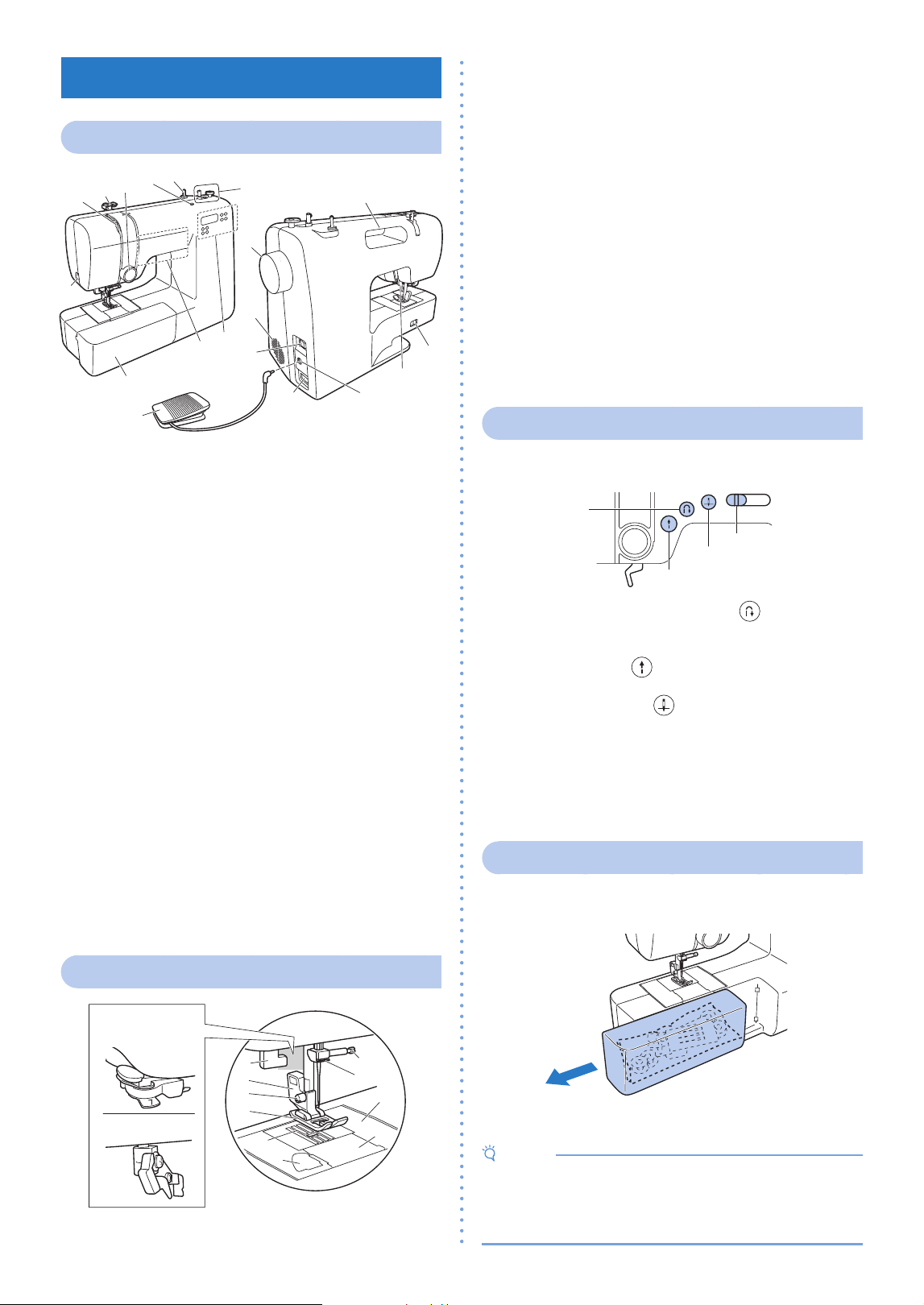
Main parts
A
I
G
H
B
C
D
E
F
1
3
2
5
6
7
8
9
0
4
1 Bobbin winder (page 8)
2 Spool pin (page 7)
3 Hole for extra spool pin (page 14)
4 Thread tension dial (page 17)
5 Thread guide (pages 8, 10)
6 Thread take-up lever (page 10)
7 Thread cutter (page 16)
8 Flat bed attachment with accessory compartment
(page 4)
9 Operation buttons (page 4)
0 Operation panel (page 6)
A Handwheel
This is used to manually raise and lower the needle.
B Air vent
This vent allows the air surrounding the motor to circulate.
Do not cover the air vent while the machine is being
used.
C Main power switch (page 6)
D Power supply jack (page 6)
E Foot controller (page 6)
F Foot controller jack (page 6)
G Presser foot lever (pages 8, 9, 16)
H Feed dog position switch (page 21)
I Handle
Carry the machine by its handle.
Needle and presser foot section
2
1
3
4
5
6
7
0
9
8
A
<Type A>
<Type B>
1 Needle threader (page 10) ★
2 Buttonhole lever (page 20) ★
3 Presser foot holder (page 15)
4 Presser foot holder screw (page 15)
5 Presser foot
The presser foot applies pressure consistently on the fabric
as the sewing takes place. Attach the appropriate presser
foot for the selected stitching.
6 Feed dogs
The feed dogs feed the fabric in the sewing direction.
7 Quick-set bobbin (page 11)
★
8 Bobbin cover (page 8)
9 Needle plate
The needle plate is marked with guides for sewing straight
seams.
0 Needle bar thread guide (page 10)
A Needle clamp screw
Operation buttons
The operation buttons differ depending on the
machine model.
1
2
3
4
1 Reverse/Reinforcement stitch button (page 16)
Reverse stitches are sewn by keeping this button pressed
down to sew in the opposite direction.
2 “Start/Stop” button
★
Press this button to start or stop sewing.
3 Needle position button
★
Press this button to raise or lower the needle. Pressing the
button twice sews one stitch.
4 Sewing speed controller
★
Slide this controller to adjust the sewing speed. The
controller also sets the maximum sewing speed of the foot
controller.
Flat bed attachment
Accessories such as presser foot, bobbins, and needles
can be stored inside the fl at bed attachment.
Slide the attachment to the left to open it.
Note
• Before storing accessories inside the flat bed
attachment, put accessories in a kind of zipper
plastic bags. If accessories are not in a bag, they
may fall out, and be lost or damaged.
★
: Only for some models.
5
Accessories
Included accessories
For the included accessories and their part codes for
your machine, refer to the additional sheet “Included
Accessories”.
Optional accessories
The following are available as optional accessories to
be purchased separately.
1. 2. 3.
4. 5. 6.
7. 8. 9.
10. 11.
No. Part Name
Part Code
Americas Europe
China
Others
1 Walking foot SA140 F033N:
XG6623-001
F033CN
F033N
2 Quilting foot SA129 F005N:
XC1948-052
-
F005N
3 1/4” piecing
foot
SA125 F001N:
XC1944-052
F001CN
F001N
4Quilting guideSA132 F016N:
XC2215-052
F016CN
F016N
5 Eyelet punch XG7791-001
6 Twin needle
(2/11 needle)
X59296-121
7 Extra spool pin XG3488-001
8 Cleaning brush X59476-051
9 Seam ripper XZ5082-101
10 Bobbin SA156 SFB:
XA5539-151
-
SFB
11 Wid e table SAW T7 W T17:
D01LFJ-001
WT17CN
WT17AP
Memo
• To obtain optional accessories or other accessories
available, contact your authorized Brother dealer
or visit our site https://s.brother/cpkag/ . Always use
accessories recommended for this machine.
Using Your Machine
WARNING
• Use only regular household electricity for
the power source. Using other power sources
may result in fi re, electric shock, or damage
to the machine.
• Make sure that the power plugs are fi rmly
inserted into the electrical outlet and
the power supply jack on the machine.
Otherwise, a fi re or electric shock may
result.
• Do not insert the power plug into an
electrical outlet that is in poor condition.
• Turn off the main power and remove the plug
in the following circumstances:
· When you are away from the machine
· After using the machine
· When the power fails during use
· When the machine does not operate correctly
due to a bad connection or a disconnection
· During electrical storms
CAUTION
• Use the power cord included with this
machine.
• Do not use extension cords or multi-plug
adapters with many other appliances plugged
in to them. Fire or electric shock may result.
• Do not touch the plug with wet hands.
Electric shock may result.
• When unplugging the machine, always turn
off the main power fi rst. Always grasp the
plug to remove it from the outlet. Pulling on
the cord may damage the cord, or lead to fi re
or electric shock.
• Do not allow the power cord to be cut,
damaged, modifi ed, forcefully bent, pulled,
twisted, or bundled. Do not place heavy
objects on the cord. Do not subject the cord
to heat. These may damage the cord and cause
fi re or electric shock. If the cord or plug is
damaged, take the machine to your authorized
dealer for repairs before continuing use.
• Unplug the power cord if the machine is
not to be used for a long period of time.
Otherwise a fi re may result.
• (For U.S.A. only)
This appliance has a polarized plug (one
blade wider than the other). To reduce the
risk of electrical shock, this plug is intended
to fi t in a polarized electrical outlet only one
way.
If the plug does not fi t fully in the electrical
outlet, reverse the plug. If it still does not fi t,
contact a qualifi ed electrician to install the
proper electrical outlet. Do not modify the
plug in any way.
6
Power supply
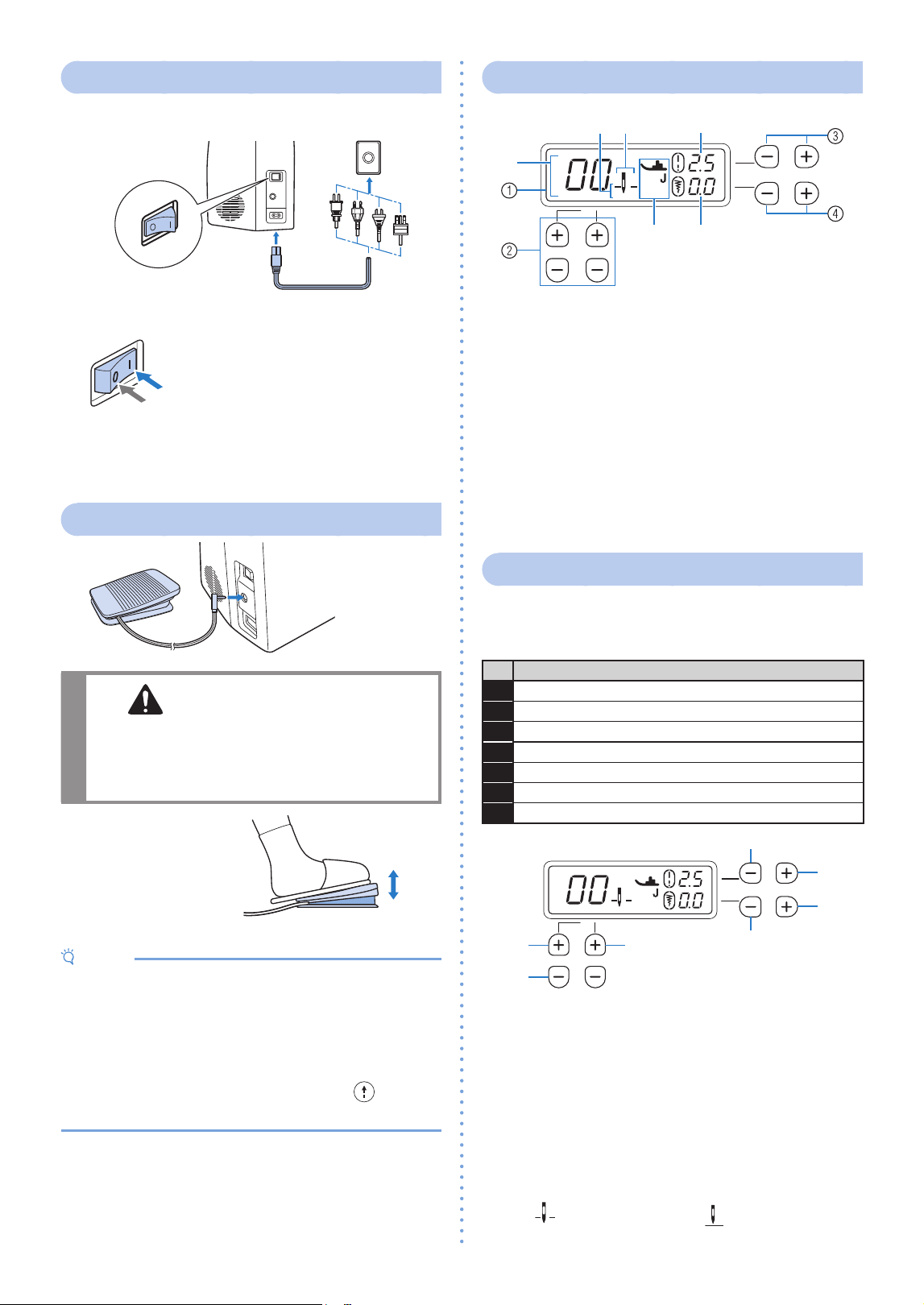
1
Insert the plug into a household electrical outlet.
1
2
2
Turn on the machine.
Press the “I” mark on the main
power switch to turn on the main
power, sewing light, and LCD.
To turn off the machine, press
the “O” mark on the main power
switch.
ON
OFF
The machine will make a sound. This is not a
malfunction.
Foot controller
Insert.
CAUTION
• When inserting the foot controller plug,
be sure to turn off the machine in order to
prevent the machine from accidentally being
started.
Slowly depress the foot
controller to start sewing,
and adjust the sewing
speed by changing the
pressing force.
Slower
Faster
Note
• (For U.S.A. only)
Foot controller: Model T
This foot controller can be used on the machine
with product code 888-N00/N02/N20/N22/N40/
N42/N60. The product code is mentioned on the
machine rating plate.
• When the foot controller is connected,
(“Start/
Stop” button) is disabled.
★
Operation panel
53
42
1
6
1 LCD (Liquid crystal display)
The selected stitch (1), presser foot that should be used
(2), stitch length in millimeters (3), stitch width in
millimeters (4), needle stop position (5), and single/twin
needle mode (6) are displayed.
2 Stitch selection keys (page 15)
Press keys to change the stitch pattern.
3 Stitch length keys (page 15)
Press keys to change the stitch length of the selected stitch
pattern.
4 Stitch width keys (page 15)
Press keys to change the stitch width of the selected stitch
pattern.
Settings/Functions
You can change settings of the following functions.
The settings are stored even when the power switch is
turned off.
No. Function
1 Needle stop position
2 Initial needle position (left / middle (center))
3 Operation beep ★
4 Maximum sewing speed
5 Automatic reverse / reinforcement stitching
6 Needle mode (single needle / twin needle)
7 Stitch adjustment ★
1
26
3
4
5
7
1 Changing the needle stop position
You can change the needle stop position to either
the lowered (in the fabric) or raised position.
(Default: Lowered position)
1
Turn off the machine.
2
Holding down 1, turn on the machine.
3
After the machine has turned on, release 1.
The needle stop position is changed.
: Lowered position
: Raised position
★
: Only for some models.
7
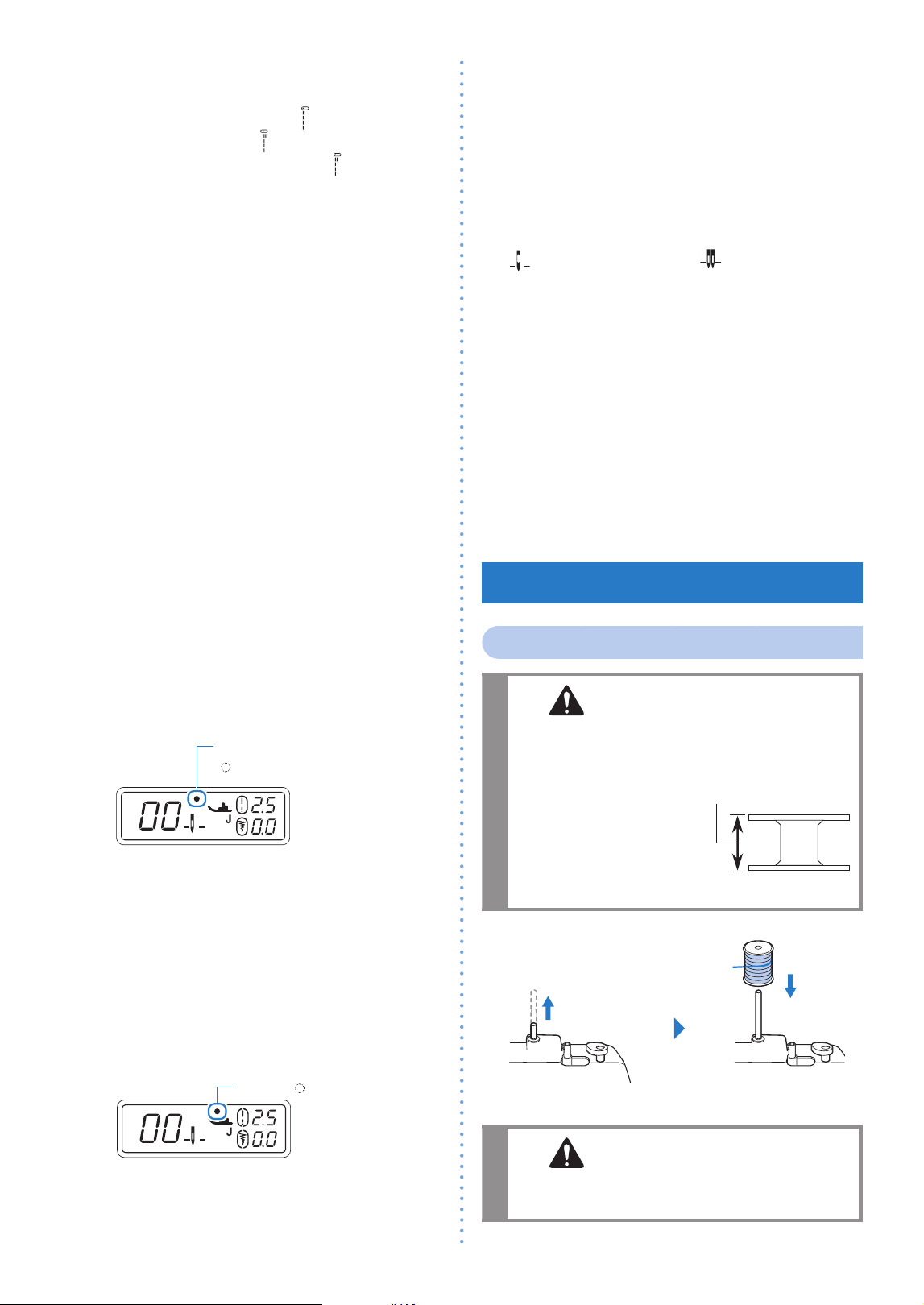
2 Changing the initial needle position
You can change the stitch selected when the
machine is turned on to either
“ straight stitch
(left needle position)” or
“straight stitch (middle
(center) needle position)”. (Default:
)
1
Turn off the machine.
2
Holding down 2, turn on the machine.
3
After the machine has turned on, release 2.
The initial needle position is changed.
The currently selected stitch can be confi rmed
by the stitch number in the LCD.
3 Turning on/off the operation beep ★
You can turn on/off the operation beep.
(Default: On)
1
Turn off the machine.
2
Holding down 3, turn on the machine.
3
After the machine has turned on, release 3.
The operation beep setting is changed.
4 Changing the maximum sewing speed
You can change the maximum sewing speed to
either the standard or slower speed.
(Default: Standard speed mode)
When the slower speed mode is selected, the
maximum speed adjusted with the sewing speed
controller becomes slower. ★
1
Turn off the machine.
2
Holding down 4, turn on the machine.
3
After the machine has turned on, release 4.
The maximum sewing speed is changed.
● : Slower speed mode
: Standard speed mode
5 Turning on/off the automatic reverse/
reinforcement stitching
You can set the machine to automatically sew
reverse or reinforcement stitches at the beginning
and end of stitching. (Default: Off)
1
Turn off the machine.
2
Holding down 5, turn on the machine.
3
After the machine has turned on, release 5.
The automatic reverse/reinforcement stitching is
turned on or off.
● : On
: Off
*
For details, refer to "Automatic reverse/reinforcement
stitching" (page 17).
6 Changing the needle mode
You can change the needle mode to either the
single or twin needle mode.
(Default: Single needle mode)
1
Turn off the machine.
2
Holding down 6, turn on the machine.
3
After the machine has turned on, release 6.
The needle mode is changed.
: Single needle mode
: Twin needle mode
*
For details, refer to "Sewing with the twin needle" (page
13).
7 Stitch adjustment ★
With some stitches, a stitch pattern may turn out
poorly depending on the type of fabric. In such a
case, you can make adjustments. (Default: 0)
1
Turn off the machine.
2
Holding down 7, turn on the machine.
3
After the machine has turned on, release 7.
The machine turns into the stitch pattern
adjustment mode.
*
For details, refer to "Making Adjustment" (page 23).
Threading the Machine
Winding/ Installing the bobbin
CAUTION
• Make sure the power is off while threading
the machine. If you accidentally step on the
foot controller and the machine starts to sew,
you could be injured.
• Be sure to use the
included bobbins
(part code: SA156,
SFB: XA5539-151) or
the same type.
SA156 is Class 15 type bobbin.
11.5 mm (7/16 inch)
1
Pull up the spool pin as far as
possible, and put a spool of
thread on this pin.
Make sure that the thread
unwinds as shown.
CAUTION
• If the spool of thread is not in the right place,
the thread may tangle on the spool pin.
★
: Only for some models.
8
2
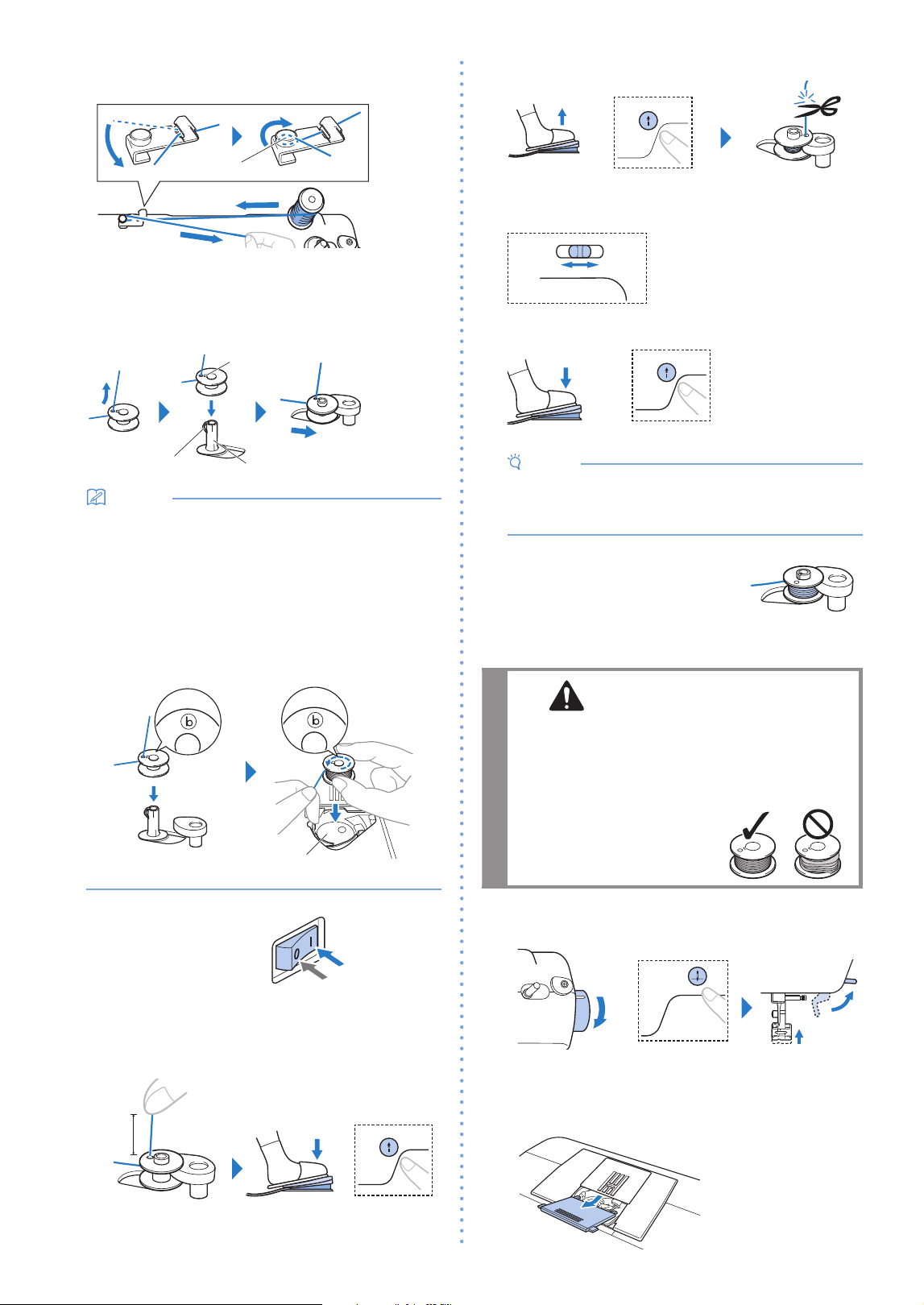
Pass the thread under the thread guide and
around the pretension disk, front to back.
Pretension disk
3
Passing the thread through a hole on the bobbin,
set the bobbin on the bobbin winder shaft, and
then slide the shaft to the right.
Make sure the notch fi ts the projection.
Bobbin winder shaft
Projection
Notch
Memo
• Checking the orientation of the bobbin will
be helpful in later procedures. By placing
the bobbin into the bobbin case in the same
orientation that it was on the bobbin winder
shaft, the bobbin can be installed with the
correct winding direction of the bobbin thread.
The “b” mark on one side of the bobbin
included with this machine can be used as a
reference.
Bobbin case
4
Turn on the machine.
5
While holding the end of the thread, start the
machine to wind the thread around the bobbin a
few times.
or
Depress
gently.
7-8 cm
★
6
Stop the machine and trim the excess thread.
Release.
or
★
7
Slide the sewing speed controller to adjust the
bobbin winding speed. ★
Slower
★
Faster
8
Start the machine.
Depress.
or
★
Note
• We recommend winding stretch thread, such as
transparent nylon thread, at a low speed since
the thread may stretch.
9
When the bobbin seems full and
begins spinning slowly, stop the
machine.
10
Cut the thread, slide the bobbin winder shaft to
the left and remove the bobbin.
CAUTION
• Make sure you follow the instructions
carefully. If you do not cut the thread
completely and the bobbin is wound, when
the thread runs low, it may tangle around the
bobbin and cause the needle to break.
• Not winding the bobbin
properly may cause the
thread tension to loosen,
and may break the needle.
11
Raise the needle to its highest position, and then
raise the presser foot lever.
Turn toward you.
★
or
12
Turn off the machine.
13
Open the bobbin cover.
ON
OFF
★: Only for some models.
9
14
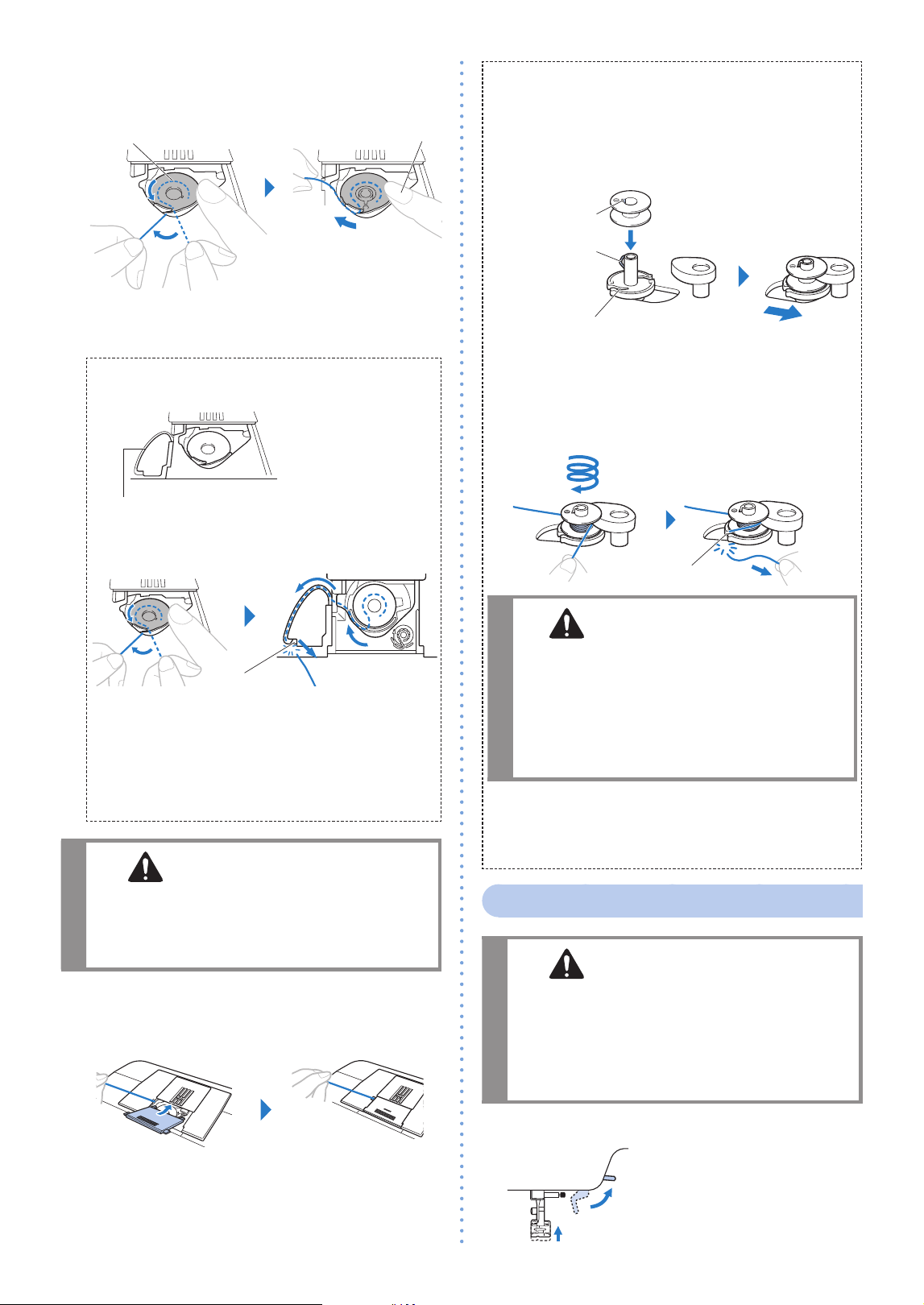
Put the bobbin in, hold the end of the thread,
push the bobbin down with your fi nger, and
then pass the thread though the slit as shown.
Hold the bobbin.
Counterclockwise
*
Follow this instruction so that the thread is correctly
inserted through the tension spring of the bobbin
case.
For models equipped with the quick-set
bobbin ★
Feed the end of the thread through the slit,
and then pull the thread to cut it.
Cutter
Slit for the quick set bobbin
*
The thread feeding direction is indicated by
arrows on the needle plate.
You can begin sewing without drawing up the
bobbin thread. When pulling up the bobbin
thread before sewing, refer to “Drawing up the
bobbin thread” (page 11).
CAUTION
• Be sure to hold down the bobbin with
your fi nger and unwind the bobbin thread
correctly, otherwise the thread may break or
the thread tension will be incorrect.
15
Reattach the bobbin cover.
*
Make the end of the thread come out from the left
side of the cover.
For models equipped with the cutter ★
1
Follow steps 1 to 2 of “Winding/Installing the
bobbin”.
2
Set the bobbin on the bobbin winder shaft,
and then slide the shaft to the right.
Make sure the notch fi ts
the projection.
Notch
Projection
Slit (cutter)
*
Check the installation orientation of the bobbin by
using the "b" mark on one side of the bobbin as a
reference. When placing the bobbin in the bobbin
case, be sure to place it in the same orientation.
3
Slit
Wind fi ve or six
times.
Pull the thread.
The thread is cut at the
slit.
CAUTION
• Be sure to cut the thread as described. If
the bobbin is wound without cutting the
thread using the cutter built into the slit
in the bobbin winder seat, the thread may
become tangled in the bobbin or the needle
may bend or break when the bobbin thread
starts to run out.
4
Turn on the machine.
5
Follow steps 7 to 15 of “Winding/Installing
the bobbin”.
Upper threading
CAUTION
• Make sure you thread the machine properly.
Otherwise, the thread could tangle and break
the needle.
• Never use a thread weight of 20 or lower.
• Use the needle and the thread in the correct
combination. (page 12)
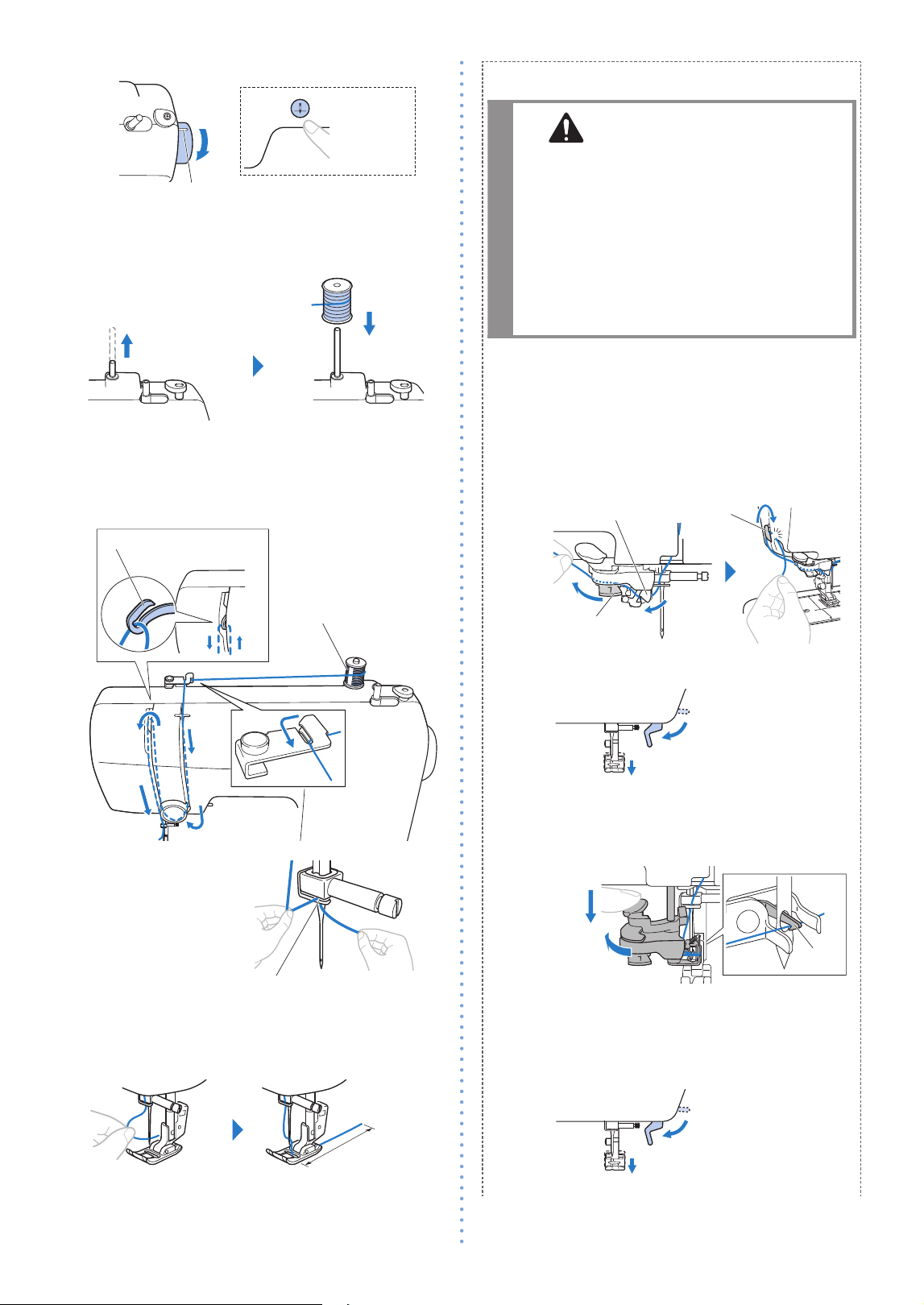
1
Raise the presser foot lever.
★: Only for some models.
10
2
Raise the needle to its highest position.
Turn toward you so that this mark
points up to the highest position.
Press once or twice.
or
★
3
If the power of the machine is on, turn it off.
4
Pull up the spool pin as far as
possible, and put a spool of
thread on this pin.
Make sure that the thread
unwinds as shown.
5
Pass the thread through the thread channel in the
order shown below.
*
Follow the numbered path printed on the machine.
Thread take-up lever
Make sure that the thread
unwinds as shown.
6
Slide the thread behind
the needle bar thread
guide.
7
Insert the thread through the eye of the needle
from front to back, and then pass the thread
under the presser foot.
10 cm (4 inches)
Using the needle threader ★
CAUTION
• The needle threader can only be used with
home sewing machine needles size 75/11-
100/16.
• You cannot use the needle threader if you
are using decorative threads or special
needles, such as the twin needle and wing
needle. If you are using those types of
threads or needles, thread the eye of the
needle by hand. Make sure the main power
switch is off when threading the needle.
1
Follow steps 1 to 6 of “Upper threading”.
2
<Type A>
a) Pass the thread behind the guide (1), and
insert the thread into the slit of the thread
guide disk (2) fi rmly. Next, cut the thread
with the thread cutter (3).
2
1
3
Thread cutter
Guide
Thread guide
disk
b) Lower the presser foot lever.
c) Lower the needle threader lever fully until
it stops (4), and push it back slowly until it
stops (5).
5
4
Hook
*
Make sure that the hook passes through the
eye of the needle, and catch the thread.
<Type B>
a) Lower the presser foot lever.
Needle bar thread guide
★: Only for some models.
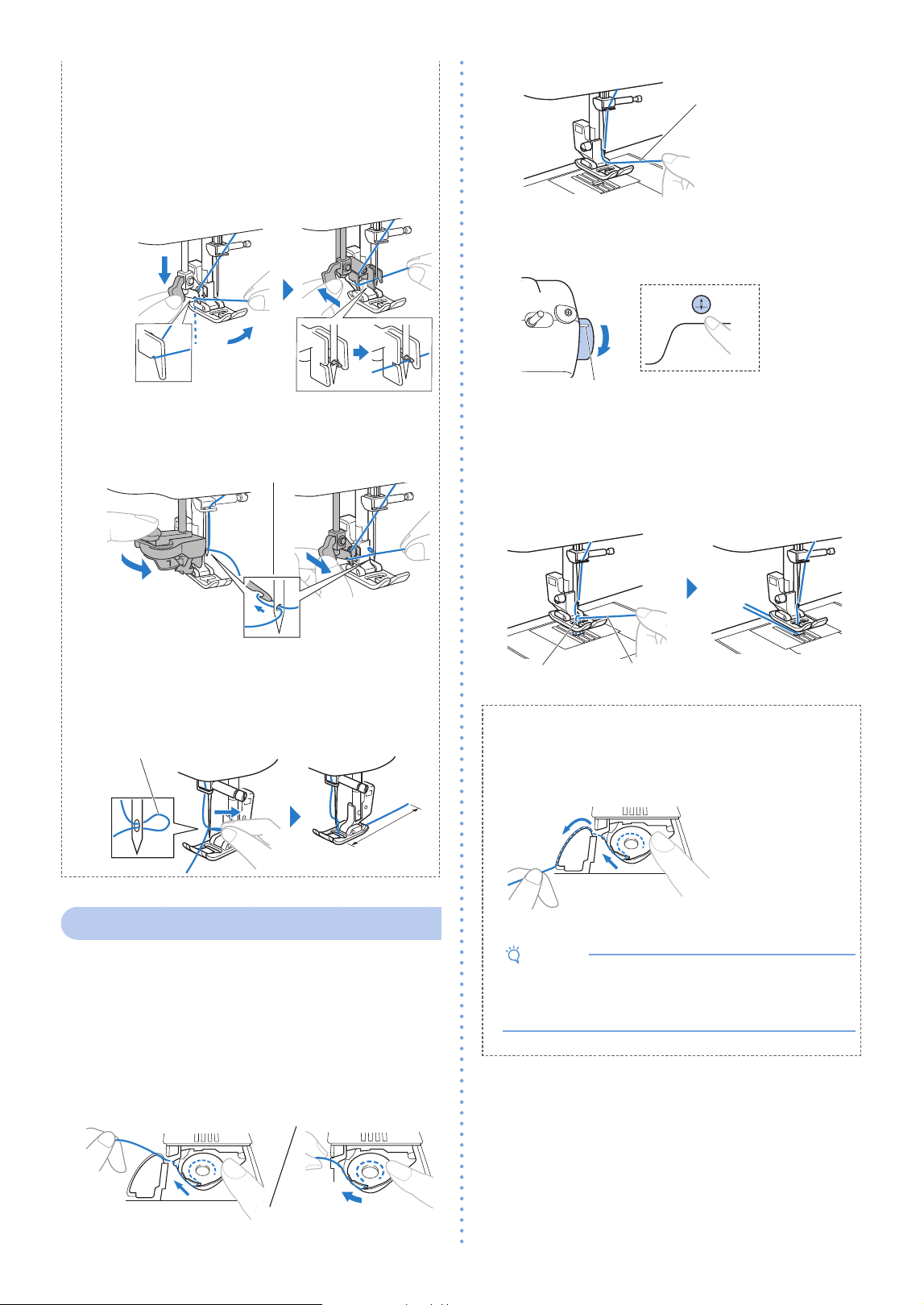
11
b) While lowering the needle threader lever
fully (1), hook the thread onto the guide
(2). Next, push back the needle threader
lever until it stops (3), and pass the thread
in front of the needle. Make sure that the
thread is under the hook that has come
through the eye of the needle and the hook
catches the thread. (4).
1
2
3
4
3
Return the needle threader lever to the front
slowly, and then release the lever slowly.
<Type B>
<Type A>
4
Raise the presser foot lever.
5
Pull the loop of the thread, and pass the end
of the thread as illustrated below.
10 cm
(4 inches)
Loop of the thread
Drawing up the bobbin thread
1
Refer to “Upper threading” (page 9) to thread
the machine with the upper thread and thread
the needle.
2
Follow steps 11 to 13 of “Winding/Installing the
bobbin” (page 7) for installing the bobbin and
to insert the bobbin into the bobbin case.
3
Pass the thread along the slit in the direction of
the arrow, and leave it there without cutting it.
4
Lightly hold the end of the upper thread.
Upper thread
5
While holding the end of the upper thread, lower
and raise the needle to draw up the bobbin
thread.
Turn towards you one full turn until
this mark points up to the highest
position.
Press twice.
or
★
6
Pull on the upper thread to draw up the bobbin
thread.
Next, pull out about 10 cm (4 inches) of both
threads toward the back under the presser foot.
Upper thread
Bobbin thread
For models equipped with the quick-set
bobbin ★
You can begin sewing without drawing up the
bobbin thread. (page 9)
Note
•
When you sew gathers or fi nish up the threads
at the beginning of sewing, draw up the bobbin
thread.
★
: Only for some models.
12
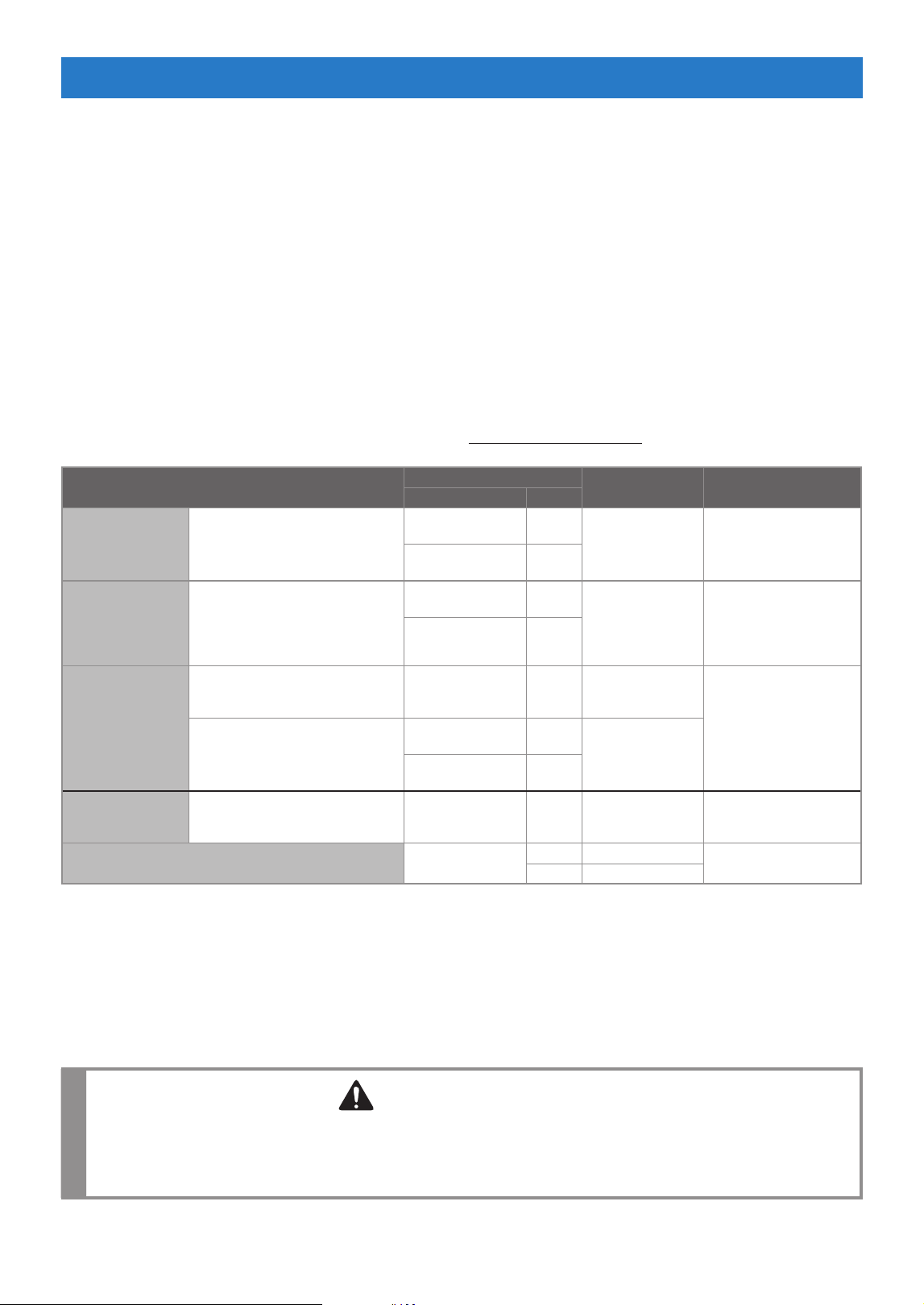
Fabric/Thread/Needle Combination
• Needles that can be used with this machine: Home sewing machine needles (size 65/9 - 100/16)
* The larger the number, the larger the needle. As the numbers decrease, the needles get fi ner.
• Thread that can be used with this machine: 30 - 90 weight
* Never use thread of 20 weight or lower. It may cause machine to malfunction.
* The smaller the number, the heavier the thread. As the numbers increase, the thread gets fi ner.
• The machine needle and thread that should be used depends on the type and thickness of the fabric. Refer to
the following table when choosing the thread and needle appropriate for the fabric that you wish to sew.
- The combinations shown in the table provide a general guideline. Be sure to sew trial stitches on the actual
number of layers and type of fabric to be used in your project.
- The machine needles are consumables. For safety and best results, we recommend replacing the needle
regularly. For details on when to replace the needle, refer to “Checking the needle” (page 13).
• In principle, use a fi ne needle and thread with lightweight fabrics, and a larger needle and heavier thread with
heavyweight fabrics.
• Select a stitch appropriate for the fabric, and then adjust the stitch length. When sewing lightweight fabrics,
make the stitch length fi ner (shorter). When sewing heavyweight fabrics, make the stitch length coarser (longer).
(page 15)
When sewing stretch fabrics, refer to “Sewing guide” ( https://s.brother/cmkag/ ).
Fabric Type/Application
Thread
Size of needle
Stitch length
mm (inch)
Type Weight
Lightweight
fabrics
Lawn, georgette, challis,
organdy, crepe, chiffon, voile,
gauze, tulle, lining, etc.
Polyester
thread
60 - 90
65/9 - 75/11
Fine stitches
1.8 - 2.5
(1/16 - 3/32)
Cotton thread,
Silk thread
50 - 80
Medium weight
fabrics
Broadcloth, taffeta, gabardine,
fl annel, seersucker, double
gauze, linen, terry cloth, waffl e
weave, sheeting, poplin, cotton
twill, satin, quilting cotton, etc.
Polyester
thread
60 - 90
75/11 - 90/14
Regular stitches
2.0 - 3.0
(1/16 - 1/8)
Cotton thread,
Silk thread
50 - 60
Heavyweight
fabrics
Denim (12 ounces or more),
canvas, etc.
Polyester
thread,
Cotton thread
30 100/16
Coarse stitches
2.5 - 4.0
(3/32 - 3/16)
Denim (12 ounces or more),
canvas, tweed, corduroy, velour,
melton wool, vinyl-coated
fabric, etc.
Polyester
thread
60
90/14 - 100/16
Cotton thread,
Silk thread
30 - 50
Stretch fabrics
(knit fabrics, etc.)
Jersey, tricot, T-shirt fabric,
fl eece, interlock, etc.
Polyester thread,
Cotton thread,
Silk thread
50
Ball point needle
75/11 - 90/14
Setting appropriate for
the fabric thickness
For top-stitching
Polyester thread,
Cotton thread
30 90/14 - 100/16
Setting appropriate for
the fabric thickness
50 - 60 75/11 - 90/14
Transparent nylon thread
Use a home sewing machine topstitching needle, regardless of the fabric or thread.
Sewing decorative stitch patterns (needles and threads) ★
When sewing lightweight, medium weight or stretch fabrics, use a ball point needle (gold colored) 90/14. When
sewing heavyweight fabrics, use a home sewing machine needle 90/14.
In addition, #50 to #60 thread should be used.
CAUTION
• The appropriate fabric, thread and needle combinations are shown in the preceding table. If the
combination of the fabric, thread and needle is not correct, particularly when sewing heavy fabrics
(such as denim) with thin needles (such as 65/9 to 75/11), the needle may bend or break. In addition, the
stitching may be uneven or puckered or there may be skipped stitches.
★
: Only for some models.
13
Needle
CAUTION
• Use recommended home sewing machine
needles.
• Never use bent needles. Bent needles can
easily break, possibly resulting in injuries.
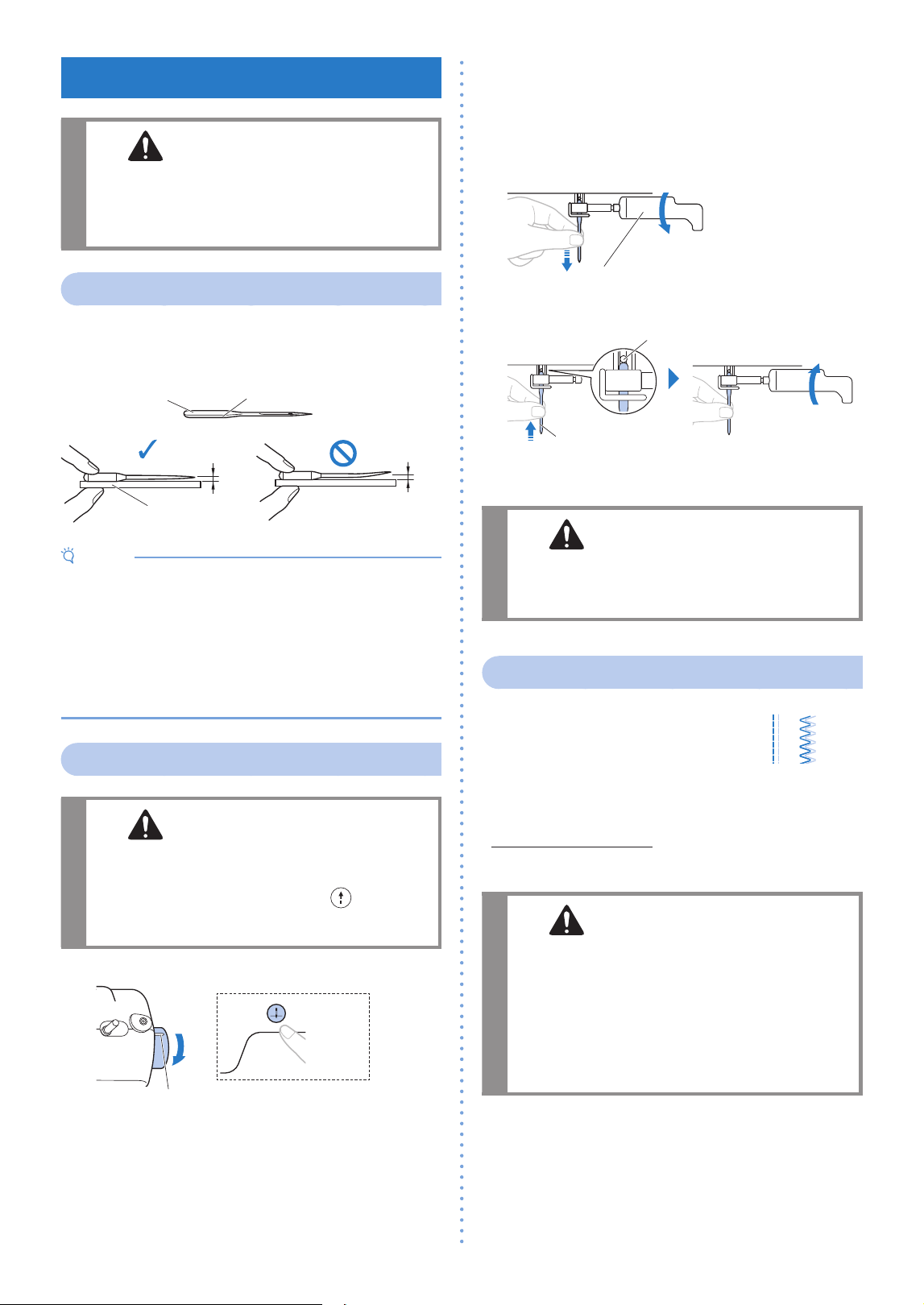
Checking the needle
Before using the needle, place the fl at side of the
needle on a fl at surface and check that the distance
between the needle and the fl at surface is even.
Flat side Needle type marking
Flat surface
Even
Not even
Note
• The machine needles are consumables. Replace the
needle in cases such as those described below.
- If an unusual sound is produced when the needle
enters the fabric. (The tip of the needle may be
broken or dull.)
- If stitches are skipped. (The needle may be bent.)
- Generally, after completing one project, such as a
piece of clothing.
Replacing the needle
CAUTION
• Before replacing the needle, be sure to turn
off the machine, otherwise injuries may
occur if the foot controller (or
(“Start/
Stop” button) ★) is accidentally pressed and
the machine starts sewing.
1
Raise the needle to its highest position.
Turn toward you so that this mark
points up to the highest position.
Press once or twice.
or
★
2
Remove the presser foot. (page 14)
3
Turn off the machine.
4
Before replacing the needle, cover the hole in the
needle plate with fabric or paper to prevent the
needle from falling into the machine.
5
Remove the needle.
1
2
*
Do not apply strong
force.
Loosen.
Screwdriver
6
Install another needle.
Make the fl at side
face back.
Tighten.
Insert until the needle touches this part.
7
Attach the presser foot. (page 15)
CAUTION
• Be sure to install the needle as described
above, otherwise the needle may break or
damage may result.
Sewing with the twin needle
You can sew with the twin needle and
two upper threads. You can use the
same color or two different colors of
thread for making decorative stitches.
For details on the stitches that can be sewn with the
twin needle, refer to “Stitch chart”
( https://s.brother/cmkag/ ).
*
The twin needle and the extra spool pin are sold separately
with some models.
CAUTION
• Use the twin needle that has been made for
this machine (part code: X59296-121).
• Do not sew with bent needles. The needle
could break and injure you.
• You cannot use the needle threader to thread
the twin needle. Instead, thread the twin
needle by hand, from front to back. Using the
needle threader may damage the machine.
★: Only for some models.
14
CAUTION
• When using the twin needle, be sure to select
an appropriate stitch, otherwise the needle
may break or the machine may be damaged.
• Select a stitch width of 5.0 mm (3/16 inch) or
less, otherwise the needle may break or the
machine may be damaged.
• After adjusting the stitch width,
slowly turn the handwheel toward you
(counterclockwise) and check that the needle
does not touch the presser foot. If the needle
hits the presser foot, the needle may bend or
break.
• When using the twin needle, be sure to
attach zigzag foot “J”, otherwise the needle
may break or the machine may be damaged.
• When changing the sewing direction, be sure
to raise the needle before turning the fabric.
If the fabric is turned while the needle is
lowered, the needle may bend or break.
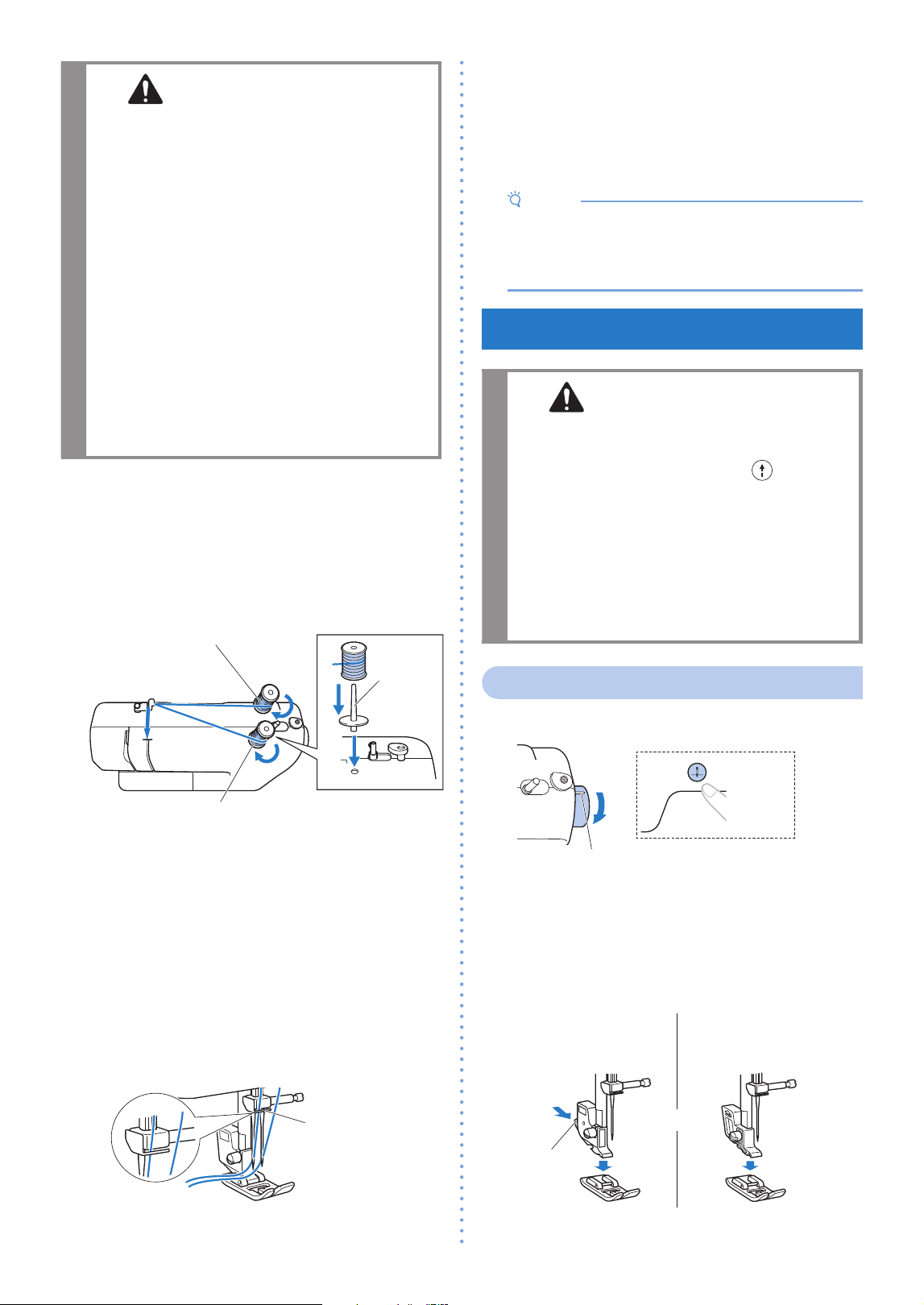
1
Attach zigzag foot “J”.
2
Attach the twin needle in the same way as a
single needle. (page 13)
3
Put the extra spool pin in the hole on the top of
the machine, and then put the second spool of
thread onto the extra spool pin.
Second spool
First spool
Extra
spool pin
4
Thread the left needle by using the thread from
the fi rst spool in the same way as for normally
threading the machine (for a single needle).
(page 9)
*
Be sure to pass the thread behind the needle
bar thread guide.
5
Thread the right needle by using the thread from
the second spool in the same way as for normally
threading the machine (for a single needle).
(page 9)
*
Be sure to thread the right needle from front to
back.
Needle bar
thread guide
6
Turn the machine into the twin needle mode.
(page 7)
7
Select a stitch and start sewing.
*
If you select an inappropriate stitch with the
twin needle, an error message appears. Select an
appropriate stitch.
Note
• You cannot use the needle threader to thread
the twin needle. Instead, thread the twin needle
by hand, from front to back. Using the needle
threader may damage the machine.
★
Replacing the Presser Foot
CAUTION
• Before replacing the presser foot, be sure to
turn off the machine, otherwise injuries may
occur if the foot controller (or
(“Start/
Stop” button)
★
) is accidentally pressed and
the machine starts sewing.
• Always use the correct presser foot for the
stitch pattern you have chosen. If you use
the wrong presser foot, the needle may strike
the presser foot and bend or break, and may
cause injury.
• Use the presser feet that have been designed
to be used with this machine.
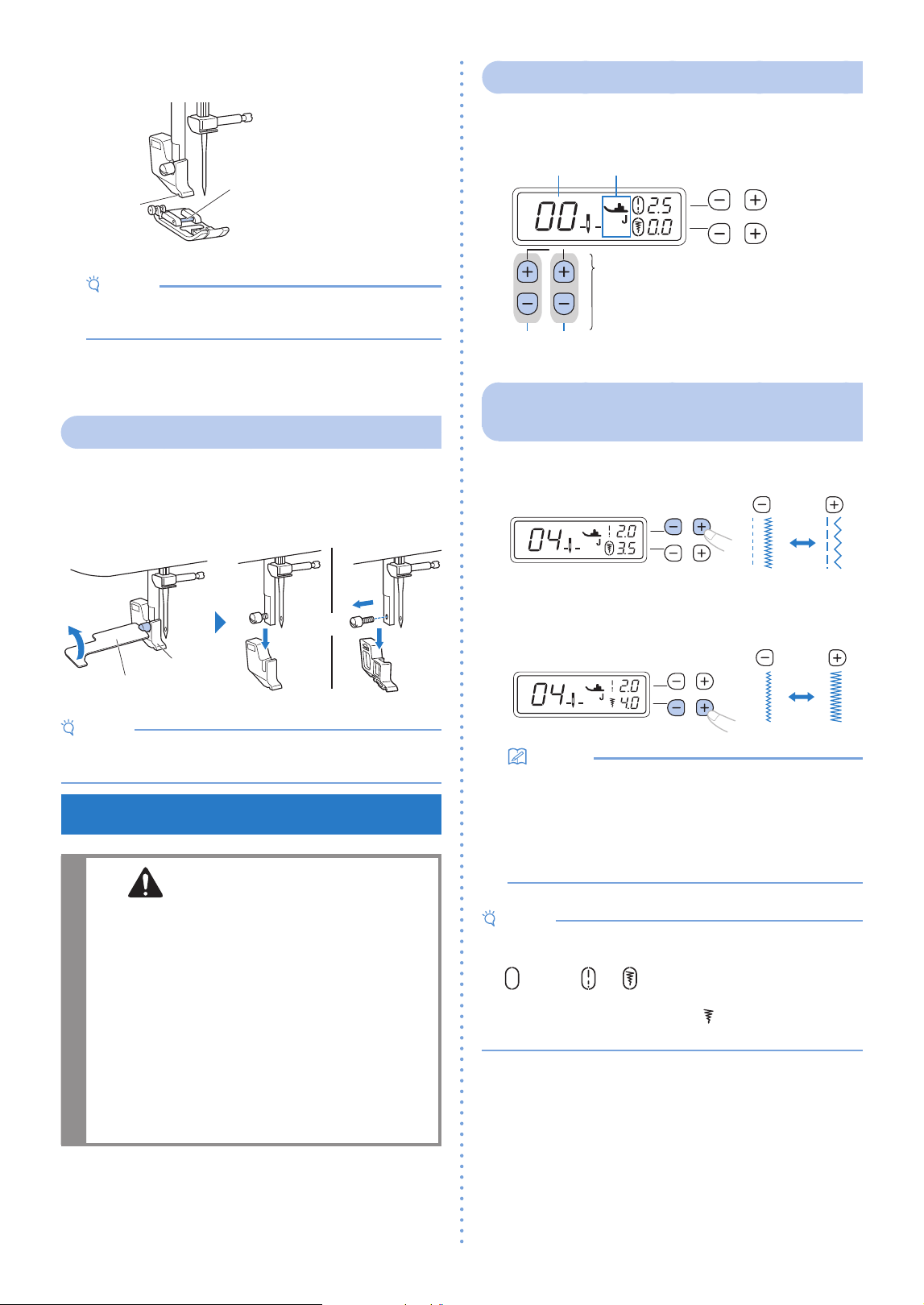
Replacing the presser foot
1
Raise the needle to its highest position.
Turn toward you so that this mark
points up to the highest position.
Press once or twice.
or
★
2
Turn off the machine, then raise the presser foot
lever.
3
Remove the presser foot.
*
Refer to one of the procedure depending on the type of
your machine.
Press the black button
to release the presser
foot.
Pull the presser foot
vertically downward.
Black button
or
★: Only for some models.
15
4
Place another foot so that the groove and pin
align.
Groove
Pin
Note
• The presser foot to be used with each stitch
appears in the LCD.
5
Slowly lower the presser foot lever so that the
presser foot pin snaps into the groove.
Removing the presser foot holder
Remove the presser foot holder when installing a
presser foot that does not use the presser foot holder,
such as the walking foot * and quilting foot *.
*
: Sold separately with some models.
Screwdriver
Presser foot
holder
Loosen.
or
Note
• When attaching the presser foot holder, hold the
presser foot holder in place and tighten the screw.
Sewing Basics
CAUTION
• While the machine is in operation, pay
special attention to the needle location.
In addition, keep your hands away from
all moving parts such as the needle and
handwheel, otherwise injuries may occur.
• Do not pull or push the fabric too hard while
sewing, otherwise injuries may occur or the
needle may break.
• Never use bent needles. Bent needles can
easily break, possibly resulting in injuries.
• Make sure that the needle does not strike
basting pins, otherwise the needle may break
or bend.
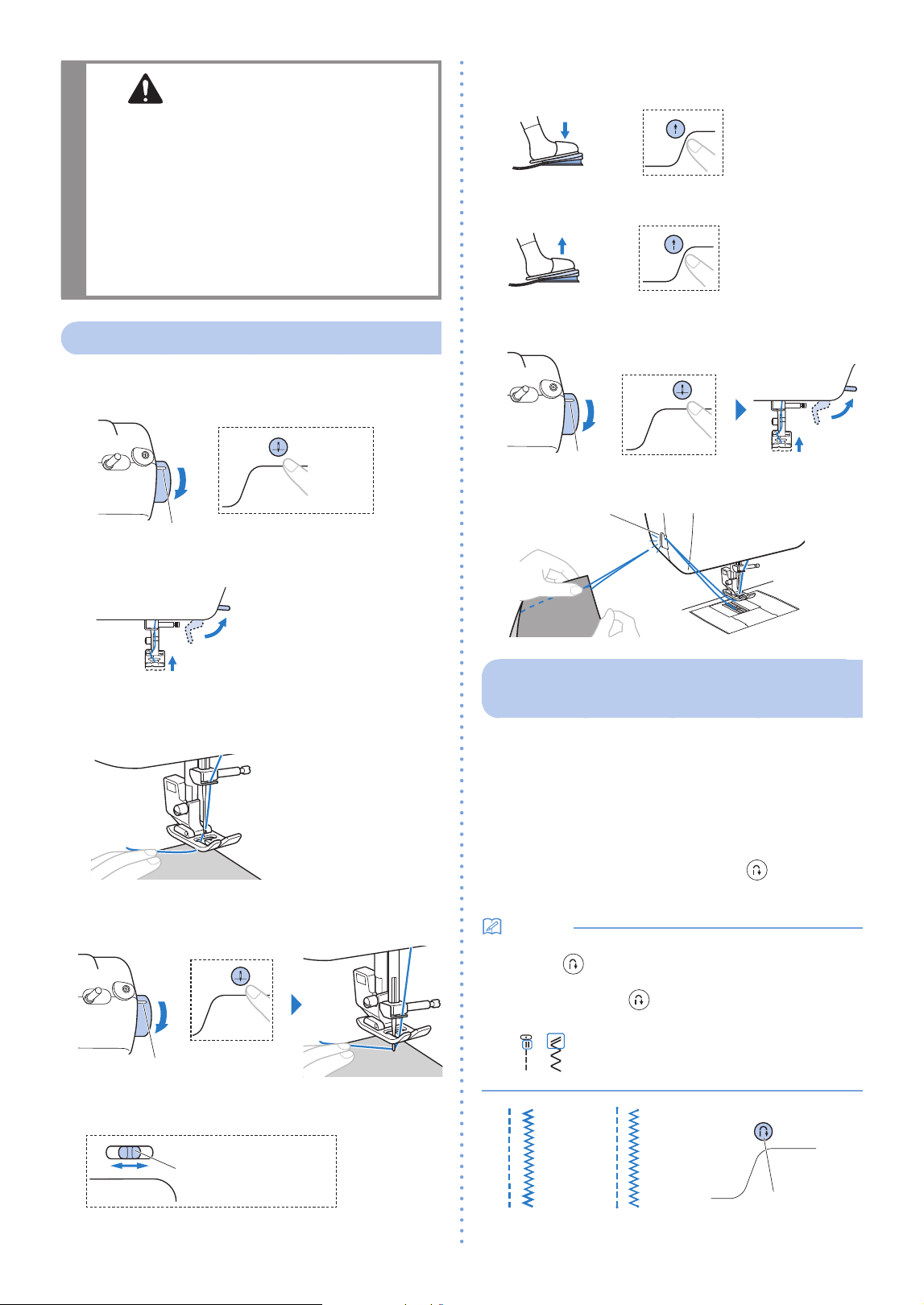
Selecting the stitch
Press the stitch selection keys to change the stitch
number.
ab
Selected stitch Presser foot that should be used
Stitch selection keys
1 Changes the tens digit of the
stitch number.
2 Changes the ones digit of the
stitch number.
Setting the stitch length and stitch
width
• Press + or - of the stitch length keys to increase or
reduce the stitch length.
• Press + or - of the stitch width keys to increase or
reduce the stitch width.
Memo
• If a straight stitch or triple stretch stitch is
selected, changing the stitch width changes the
needle position.
Increasing the width moves the needle to the
right; reducing the width moves the needle to
the left.
Note
• The setting value changes until it reaches the
maximum or minimum value.
•
around or disappears when changed from
the standard setting.
• If “--” appears to the right of
, the stitch width
cannot be adjusted.
16
CAUTION
• After adjusting the stitch width,
slowly turn the handwheel toward you
(counterclockwise) and check that the needle
does not touch the presser foot. If the needle
hits the presser foot, the needle may bend or
break.
• If the stitches are bunched together, increase
the stitch length. Continuing to sew with the
stitches bunched together may result in the
needle bending or breaking.
Starting to sew
Baste the fabric before starting to sew.
1
Raise the needle to its highest position.
Turn toward you so that this mark
points up to the highest position.
Press once or twice.
or
★
2
Raise the presser foot lever.
3
Set the fabric under the presser foot, and then
hold the fabric and the end of the thread with
your left hand.
4
Lower the needle to the starting point of the
stitching.
Turn toward you.
or
★
5
Lower the presser foot lever.
6
Adjust the sewing speed.
★
7
Start sewing.
*
Guide the fabric lightly by hand.
Depress.
or
★
8
Stop sewing.
Release.
or
★
9
Raise the needle, and then raise the presser foot
lever.
Turn toward you.
or
★
10
Pull the fabric and cut the threads.
Thread cutter
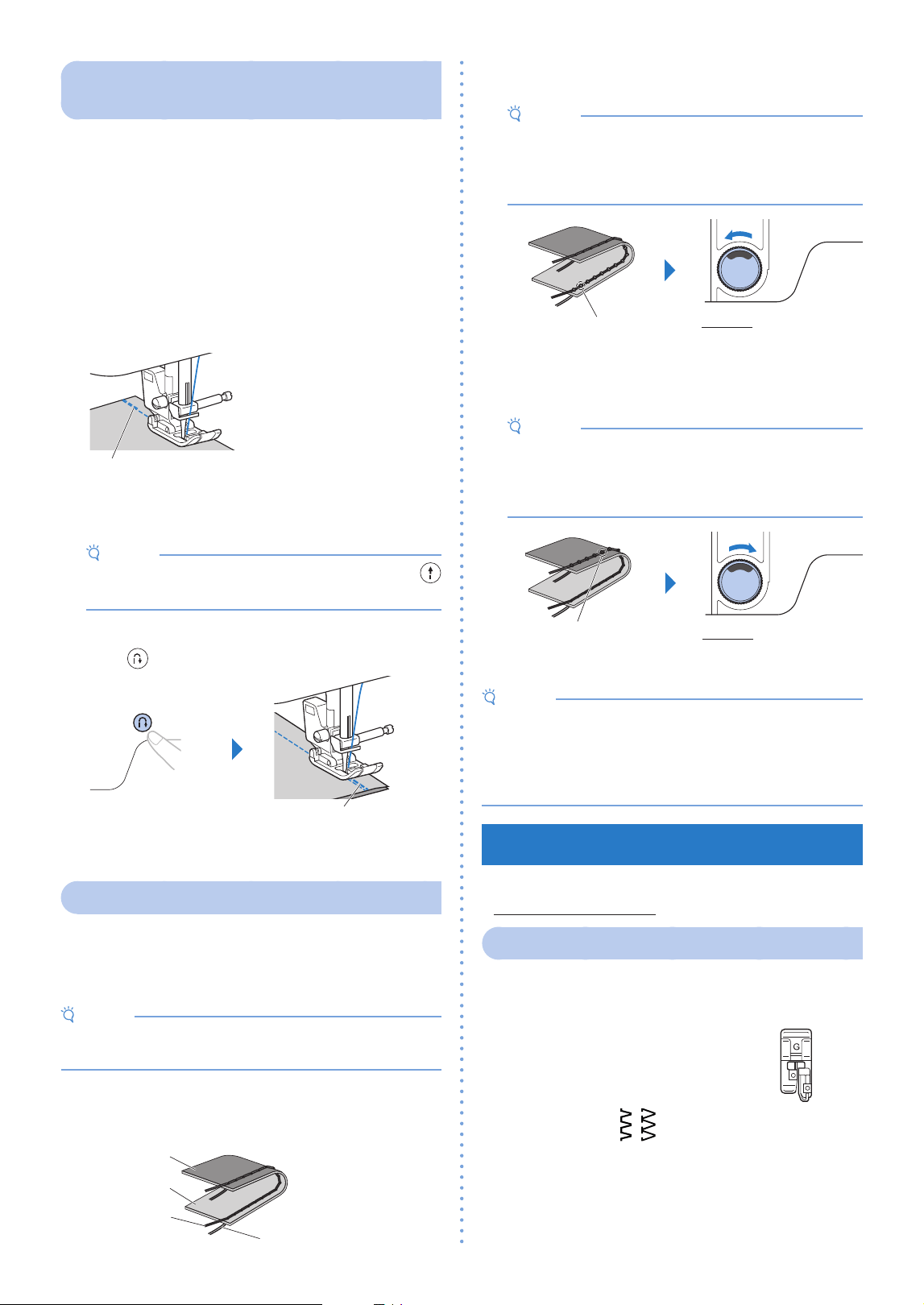
Sewing reverse/reinforcement
stitches
Reverse/reinforcement stitches are generally necessary
at the beginning and end of sewing.
With reinforcement stitches, 3 to 5 stitches are sewn at
the same place. With reverse stitches, the stitching is
sewn in the opposite direction.
Depending on the selected stitch, reverse or
reinforcement stitches are sewn while
(Reverse/
Reinforcement stitch button) is pressed continuously.
Memo
• When any of the reverse stitch patterns is selected,
pressing
(Reverse/Reinforcement stitch button)
will sew reverse stitches. When any other stitch is
selected, pressing
(Reverse/Reinforcement stitch
button) will sew reinforcement stitches.
Reverse stitch pattern
Reinforcement stitch
Reverse/
Reinforcement
stitch button
Reverse stitch
★: Only for some models.
17
Automatic reverse/reinforcement
stitching
Turn on the automatic reverse/reinforcement stitching
function before sewing, and the machine will
automatically sew reinforcement stitches (or reverse
stitches, depending on the stitch pattern) at the
beginning and end of sewing.
1
Turn on the automatic reverse/reinforcement
stitching. (page 7)
2
Select a stitch.
3
Set the fabric in the start position and start
sewing.
Reverse stitches (or reinforcement stitches)
The machine will automatically sew reverse stitches (or
reinforcement stitches) and then continue sewing.
Note
• You can pause or resume sewing by pressing
(“Start/Stop” button) while sewing. ★
4
Once you have reached the end of the stitching,
press
(Reverse/Reinforcement stitch button).
Reverse stitches (or reinforcement stitches)
The machine will sew reverse stitches (or
reinforcement stitches) and stop.
Thread tension
The thread tension will affect the quality of your
stitches. You may need to adjust it when you change
fabric or thread.
Note
• We recommend that you do a test sample on scrap
of a fabric before you start to sew.
Correct tension
*
Too much or too little tension will weaken your seams
or cause puckers on your fabric.
Wrong side
Right side
Upper thread
Bobbin thread
Upper tension is too tight
Note
• If the bobbin thread was incorrectly threaded,
the upper thread may be too tight. In this case,
refer to “Winding/Installing the bobbin” (page
7) and rethread the bobbin thread.
0
1
2
3
4
5
6
7
8
9
Loops will appear on the
right side of the fabric.
Solution
Reduce the upper thread
tension.
Upper tension is too loose
Note
• If the upper thread was incorrectly threaded,
the upper thread may be too loose. In this case,
refer to “Upper threading” (page 9) and
rethread the upper thread.
0
1
2
3
4
5
6
7
8
9
Loops appear on the
wrong side of the fabric.
Solution
Increase the upper thread
tension.
Note
• If the upper thread is not threaded correctly or
the bobbin is not installed correctly, it may not be
possible to set the correct thread tension. If the
correct thread tension cannot be achieved, rethread
the upper thread and insert the bobbin correctly.
Utility Stitches
You can see the “Stitch chart” from
“ https://s.brother/cmkag/ ”.
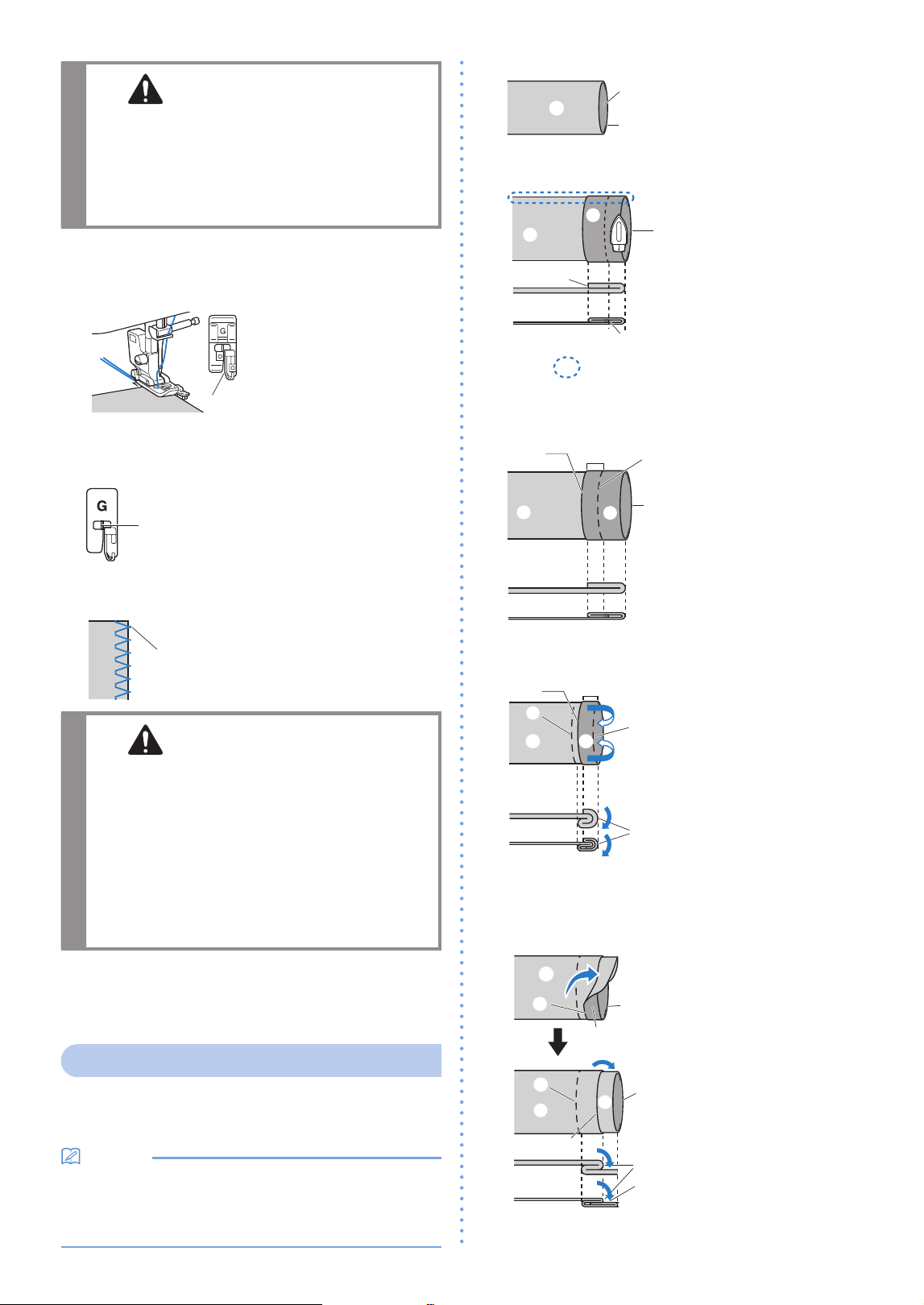
Overcasting stitches
Sew overcasting stitches along the edges of cut fabric
to prevent them from fraying.
1
Attach overcasting foot “G”.
2
Select a stitch.
*
Stitches may differ depending on the model. Check
stitch selections on the machine's body, and then
select the stitch number.
★: Only for some models.
18
CAUTION
• When using overcasting foot “G”, be sure
to select a stitch that can be used with
overcasting foot “G”. If you sew with the
incorrect stitch, the needle may hit the
presser foot, bending the needle or damaging
the presser foot.
3
Position the fabric with the edge of the fabric
against the presser foot guide, and then lower the
presser foot lever.
Presser foot guide
4
Rotate the handwheel toward you
(counterclockwise). Check that the needle does
not touch the presser foot.
The needle should not touch
the presser foot center bar.
5
Sew with the edge of the fabric against the
presser foot guide.
Needle drop point
CAUTION
• Be sure to pull the fabric backward after
fi nished sewing. If you pull the fabric toward
side or forward, the presser foot pin may be
damaged.
• If thread is tangled on the presser foot,
remove the entangled thread, and then raise
the presser foot lever to remove the presser
foot. If the presser foot is raised while
entangled with thread, the presser foot may
be damaged.
6
Stop sewing when you are fi nished, and raise the
presser foot and needle to pull the fabric under
the presser foot towards the back of the machine.
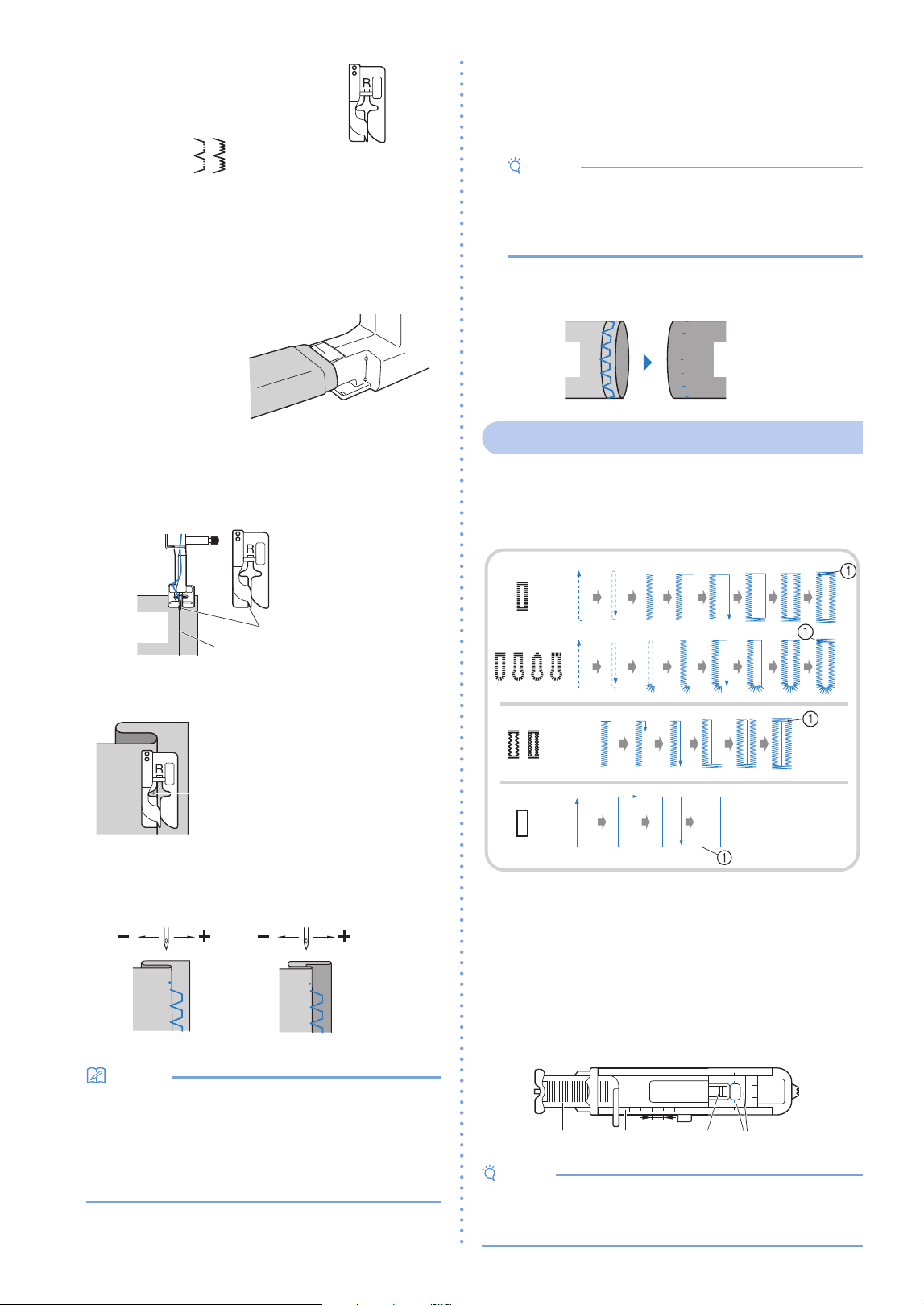
Blind hem stitching
Secure the lower edge of skirts and pants with a blind
hem.
Memo
• When the size of cylindrical pieces is too small to
slide onto the arm or the length is too short, the
fabric will not feed and desired results may not be
achieved.
1
Turn the skirt or pants inside out.
a
b
c
1 Wrong side of fabric
2 Right side of fabric
3 Lower edge of fabric
2
Fold the lower edge of fabric to the desired length
to be hemmed and then press.
d
b
b
b
a
a
a
c
c
1 Wrong side of fabric
2 Right side of fabric
3 Lower edge of fabric
4 Desired length for hem
<Thick fabric>
<Normal fabric>
<Seen
from the side>
3
Using tailor’s chalk, mark the fabric about 5 mm
(3/16 inch) from the edge of the fabric, and then
baste it.
b
b
b
a
a
a
cef
d
1 Wrong side of fabric
2 Right side of fabric
3 Lower edge of fabric
4 Desired length for hem
5 5 mm (3/16 inch)
6 Basting
<Thick fabric>
<Normal fabric>
<Seen from the side>
4
Fold back the fabric inside along the basting.
a
c
f
e
a
a
b
g
d
1 Wrong side of fabric
2 Right side of fabric
3 Lower edge of fabric
4 Desired length for hem
5 5 mm (3/16 inch)
6 Basting
7 Basting point
<Thick fabric>
<Normal fabric>
<Seen from the side>
5
Unfold the edge of fabric, and position the fabric
with the wrong side facing up.
a
b
f
c
a
a
c
d
a
f
a
a
b
e
1 Wrong side of fabric
2 Right side of fabric
3 Edge of fabric
4 Desired edge of hem
5 Basting point
6 Basting
<Thick fabric>
<Normal fabric>
<Seen from the side>
19
6
Attach blind stitch foot “R”.
7
Select a stitch.
*
Stitches may differ depending on the model. Check
stitch selections on the machine's body, and then
select the stitch number.
8
Remove the fl at bed attachment to use the free
arm.
9
Slide the item that
you wish to sew
onto the free arm,
make sure that
the fabric feeds
correctly, and then
start sewing.
10
Position the fabric with the edge of the folded
hem against the presser foot guide, and then
lower the presser foot lever.
Fold of hem
Presser foot guide
Wrong side
of fabric
11
Adjust the stitch width until the needle slightly
catches the fold of the hem. (page 15)
Needle drop point
When you change the needle drop point, raise
the needle, and then change the stitch width.
*
To make fi ne adjustments to the needle drop point,
adjust the stitch width setting.
<Thick fabric> <Normal fabric>
Memo
• Blind hem stitches cannot be sewn if the left
needle drop point does not catch the fold. If the
needle catches too much of the fold, the fabric
cannot be unfolded and the seam appearing
on the right side of the fabric will be very large,
leaving an unattractive finish.
12
Sew with the fold of the hem against the presser
foot guide.
13
Stop sewing when you are fi nished, and raise
the presser foot and needle to pull the fabric
under the presser foot towards the back of the
machine.
Note
• Be sure to pull the fabric towards the back of
the machine after sewing. If you pull the fabric
toward side or forward, the presser foot may be
damaged.
14
Remove the basting stitching and turn the fabric
with the right side facing out.
Wrong side
of fabric
Right side
of fabric
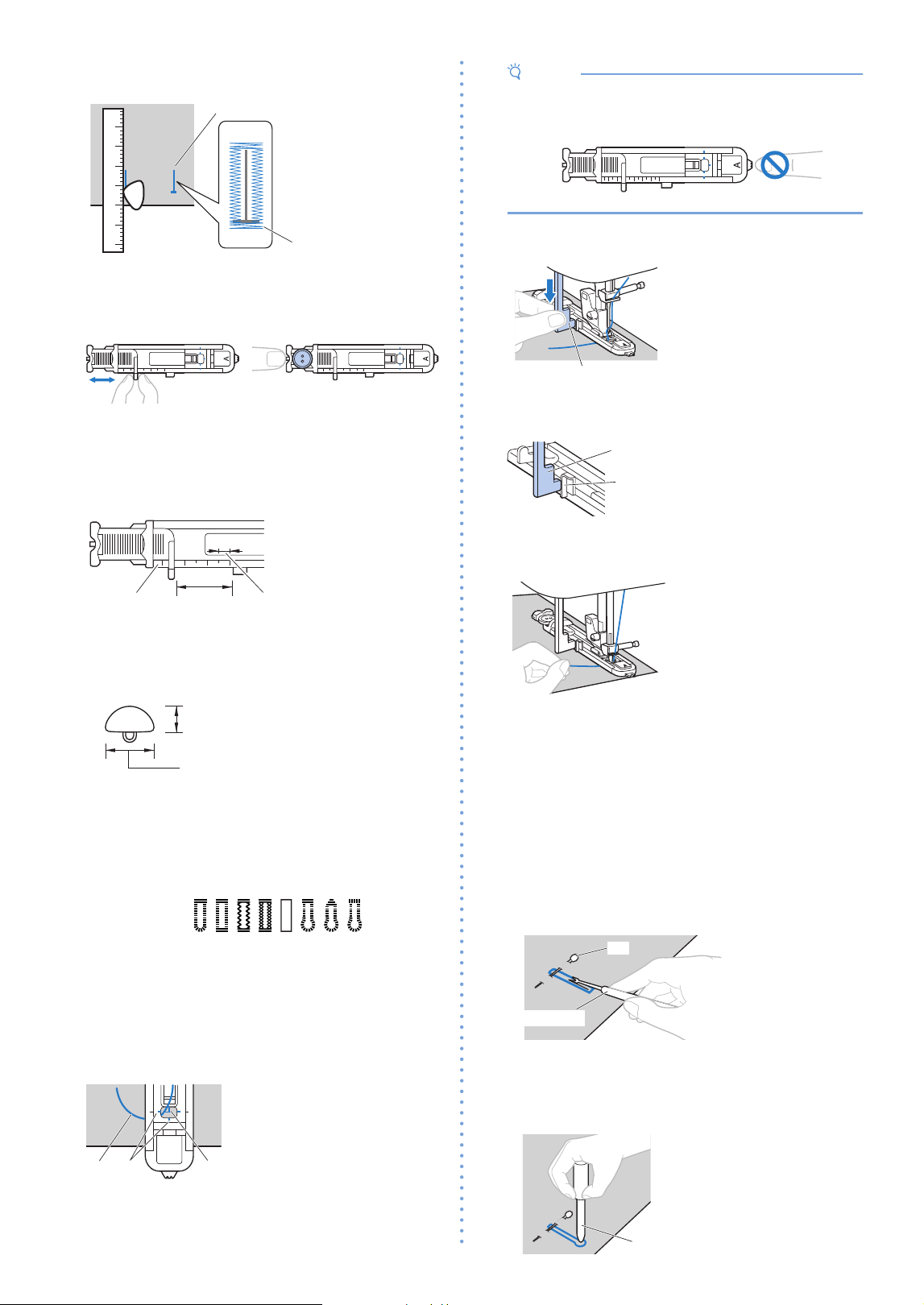
Buttonhole sewing
The maximum buttonhole length is about 28 mm
(1-1/8 inches) (diameter + thickness of the button).
Buttonholes are sewn from the front of the presser foot
to the back, as shown below.
1 Reinforcement stitching
*
Stitches may differ depending on the model. Check
the stitches lineup on your machine’s body, and then
select the stitch number.
The part names of buttonhole foot “A”, which is used
to create buttonholes, are indicated below.
e
bacd
A
1 Button guide plate
2 Presser foot scale
3 Presser foot pin
4 Marks on buttonhole foot
5 5 mm (3/16 inch)
Note
• Before sewing buttonholes, check the stitch length
and width by sewing a trial buttonhole on a scrap
piece of fabric used for your project.
20
1
Use chalk to mark on the fabric the position and
length of the buttonhole.
Marks on fabric
Buttonhole sewing
2
Pull out the button guide plate of buttonhole foot
“A”, and then insert the button that will be put
through the buttonhole.
*
If the button does not fi t in the button
guide plate
Add together the diameter and thickness of the
button, and then set the button guide plate to the
calculated length.
a
b
c
1 Presser foot scale
2 Length of buttonhole
(diameter + thickness
of button)
3 5 mm (3/16 inch)
Example: For a button with a diameter of 15 mm
(9/16 inch) and a thickness of 10 mm (3/8 inch),
the button guide plate should be set to 25 mm (1
inch) on the scale.
10 mm (3/8 inch)
15 mm (9/16 inch)
The size of the buttonhole is set.
3
Attach buttonhole foot “A”.
Before attaching the buttonhole foot “A”, pass the
upper thread underneath the presser foot through
the hole.
4
Select a stitch.
*
Stitches may differ depending on the model. Check
stitch selections on the machine's body, and then
select the stitch number.
5
Position the fabric with the front end of the
buttonhole mark aligned with the red marks on
the buttonhole foot, and then lower the presser
foot lever.
A
a
b
c
1 Mark on fabric (front)
2 Red marks on buttonhole
foot
3 Upper thread
Note
• When lowering the presser foot, do not push in
the front of the presser foot, otherwise the bar
tack will not be sewn with the correct size.
6
Pull down the buttonhole lever as far as possible.
Buttonhole lever
The buttonhole lever is positioned behind the
bracket on the buttonhole foot.
Buttonhole lever
Bracket
7
Gently hold the end of the upper thread in your
left hand, and then start sewing.
Once sewing is completed, the machine automatically
sews reinforcement stitches, then stops.
8
Raise the needle and presser foot, then remove
the fabric, and then cut the threads.
9
Raise the buttonhole lever to its original position.
10
Insert a pin along the inside of one bar tack at
the end of the buttonhole stitching to prevent
the stitching from being cut.
11
Use the seam ripper to cut towards the pin and
open the buttonhole.
Pin
Seam ripper
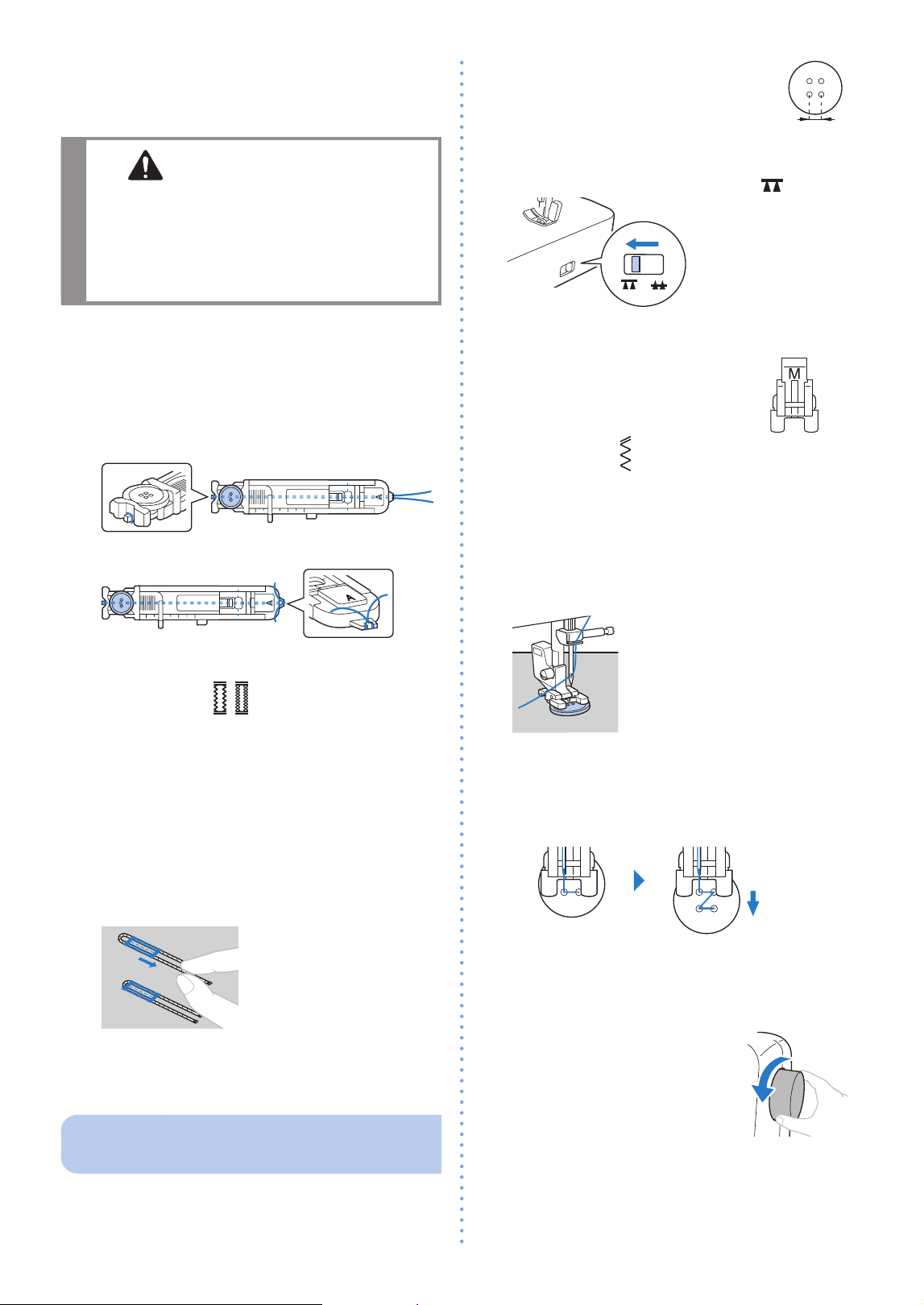
For keyhole buttonholes, use the eyelet punch
to make a hole in the rounded end of the
buttonhole, and then use the seam ripper to cut
open the buttonhole.
Eyelet punch
21
*
When using the eyelet punch, place thick
paper or some other protective sheet under the
fabric before punching the hole in the fabric.
CAUTION
• When opening the buttonhole with the seam
ripper, do not place your hands in the cutting
direction, otherwise injuries may result if the
seam ripper slips.
• Do not use the seam ripper in any other way
than how it is intended.
n Sewing buttonholes on stretch fabrics ★
(Available on models with 35 or more stitches.)
When sewing buttonholes on stretch fabrics, use a
gimp thread.
1
Hook the gimp thread onto the part of
buttonhole foot “A” shown in the illustration.
2
It fits into the grooves, and then loosely tie it.
3
Attach buttonhole foot “A”.
4
Select a stitch.
*
Stitches may differ depending on the model. Check
stitch selections on the machine's body, and then
select the stitch number.
5
Adjust the stitch width to the thickness of the
gimp thread.
6
Lower the presser foot lever and the buttonhole
lever, and then start sewing.
7
When sewing is finished, gently pull the gimp
thread to remove any slack.
8
Use a handsewing needle to pull the gimp
thread to the wrong side of the fabric, and then
tie it.
Button sewing (
for models equipped
with the button fitting foot “M”)
Buttons can be sewn on with the machine. Buttons
with two or with four holes can be attached.
1
Measure the distance between the
holes in the button to be attached.
2
Raise the presser foot lever.
3
Slide the feed dog position switch, located at the
rear of the machine on the base, to
.
X
The feed dogs are lowered.
4
Attach button fitting foot “M”.
5
Select a stitch.
*
Check the stitch number on the machine’s body, and
set the machine for that stitch.
6
Adjust the stitch width so that it is the same as
the distance between the holes in the button.
7
Place the button in the position where it will be
sewn, and lower the presser foot lever.
• When attaching four-hole buttons, first sew the
two holes closest to you. Then, slide the button
so that the needle goes into the two holes
toward the rear of the machine, and then sew
them in the same way.
8
Turn the handwheel toward you
(counterclockwise) to check that the needle
correctly goes into the two holes of the button.
If it seems as if the needle
will hit the button, remeasure
the distance between the
holes in the button. Adjust
the stitch width to the
distance between the button
holes.
★: Only for some models.
22
CAUTION
• When sewing, be sure that the needle does
not touch the button, otherwise the needle
may bend or break.
9
Sew about 10 stitches at a slow speed.
Set the sewing speed controller to the left (so that
the speed will be slow).
10
Use scissors to cut the upper thread and the
bobbin thread at the beginning of the stitching.
Pull the upper thread at the end of the stitching to
the wrong side of the fabric, and then tie it with
the bobbin thread.
11
When you are fi nished attaching the button,
slide the feed dog position switch, to
and
turn the handwheel to raise the feed dogs.
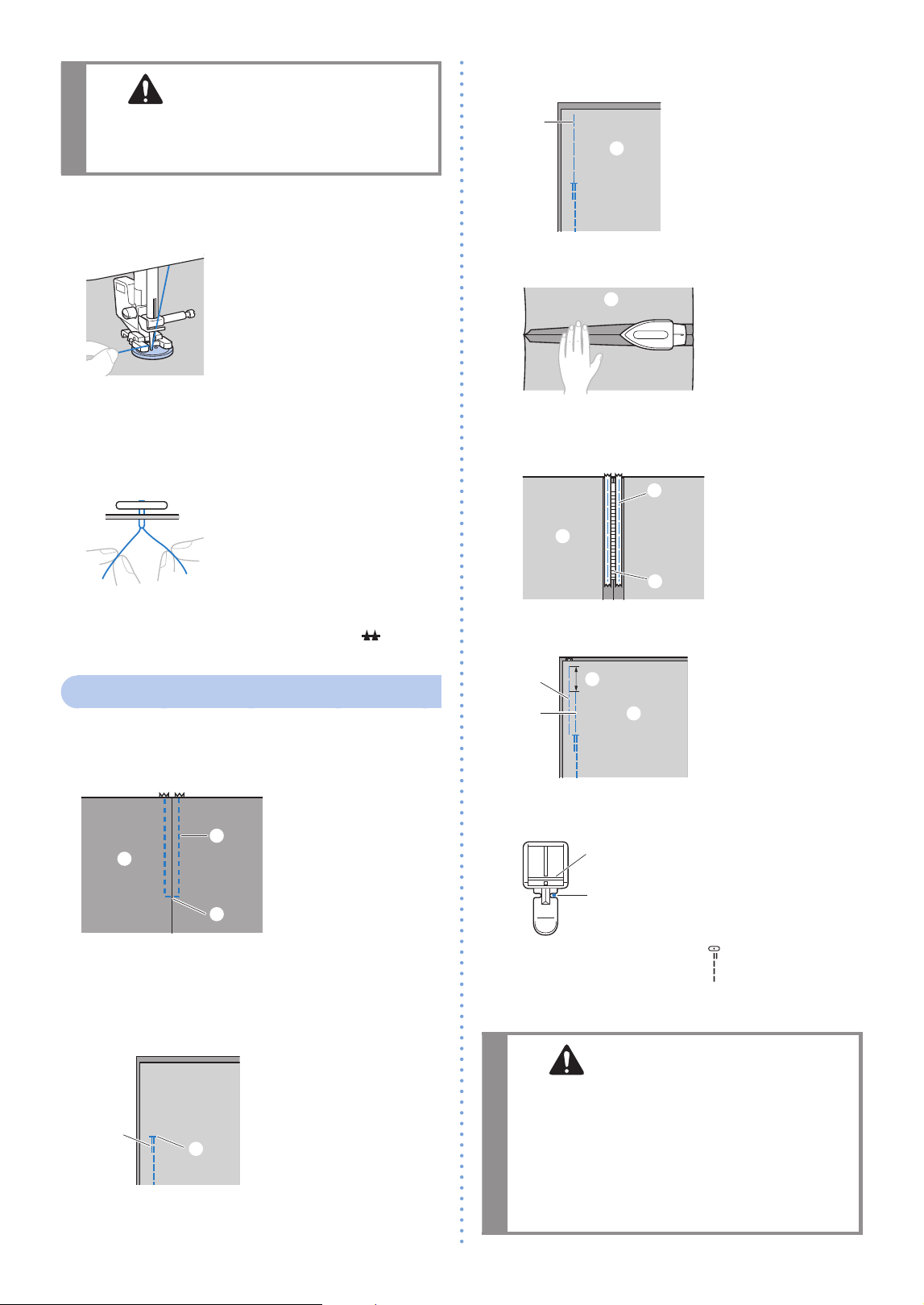
Zipper insertion
Inserting a centered zipper
Stitching is sewn on both pieces of fabric butted
against each other.
a
b
c
1 Right side of fabric
2 Stitching
3 End of zipper opening
1
Attach zigzag foot “J”.
2
Sew straight stitches up to the zipper opening.
With the right sides of the fabric facing each
other, sew reverse stitches after reaching the
zipper opening.
a
b
1 Reverse stitches
2 End of zipper opening
3
Baste the fabric from the zipper opening to the
edge of the fabric.
a
b
1 Basting stitching
2 Wrong side of fabric
4
Press open the seam allowance from the wrong
side of the fabric.
1 Wrong side of fabric
1
5
Align the seam with the center of the zipper,
and then baste the zipper in place to the seam
allowance.
1 Wrong side of fabric
2 Basting stitching
3 Zipper
a
b
c
6
Remove about 5 cm (2 inches) from the end of
the basting on the outside.
1 Wrong side of fabric
2 Zipper basting
3 Outside basting
4 5 cm (2 inches)
d
a
b
c
7
Attach the presser foot holder to the right pin
of zipper foot “I”.
I
Pin on the right side
Needle drop point
8
Select the straight stitch ( middle (center)
needle position).
*
Check the stitch number on the machine’s body,
and set the machine for that stitch.
CAUTION
• When using zipper foot “I”, be sure to select
the straight stitch (middle (center) needle
position), and slowly turn the handwheel
toward you (counterclockwise) to check that
the needle does not touch the presser foot.
If a different stitch is selected or the needle
hits the presser foot, the needle may bend or
break.
23
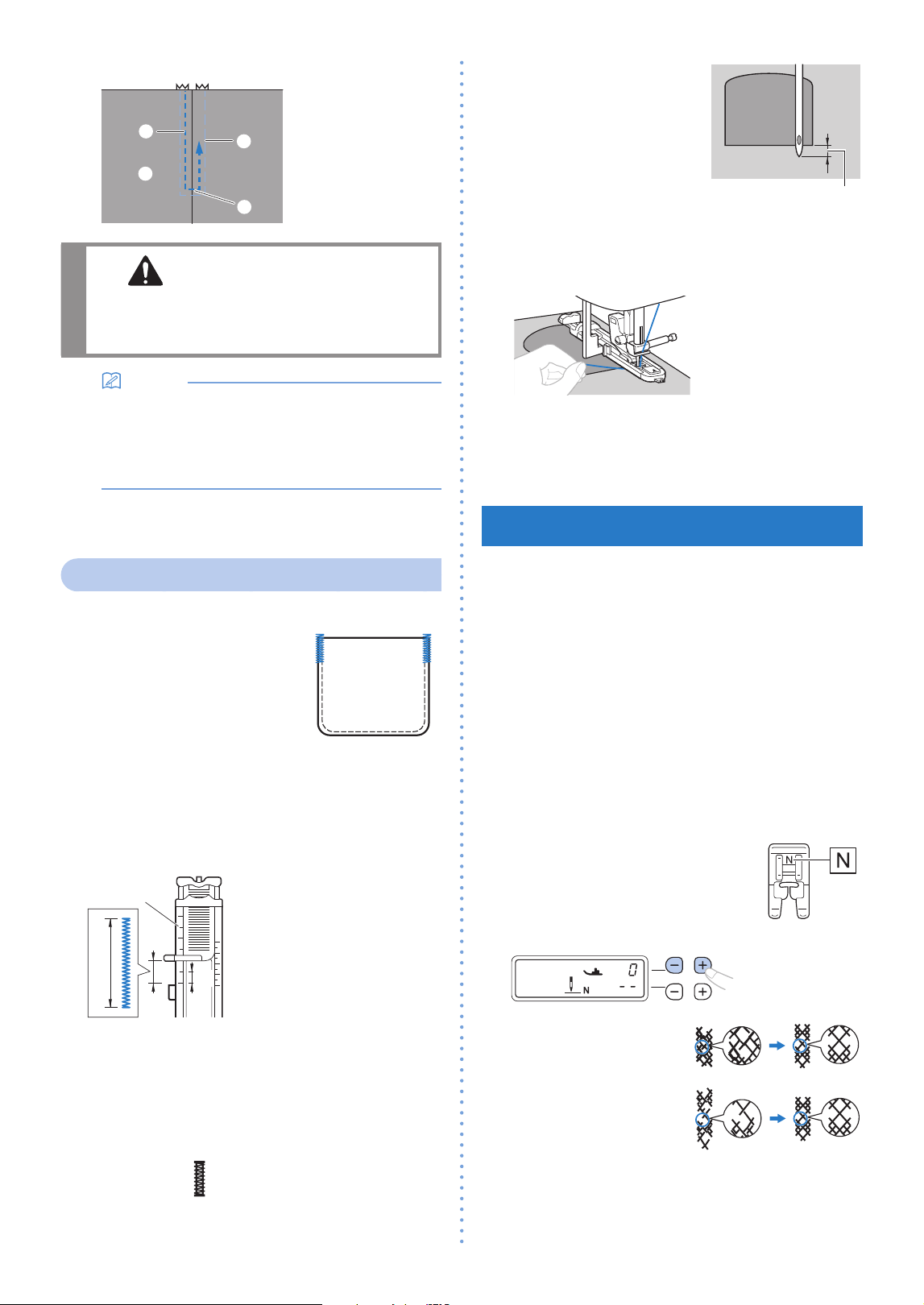
9
Topstitch around the zipper.
a
b
c
d
1 Stitching
2 Right side of fabric
3 Basting stitching
4 End of zipper
opening
CAUTION
• When sewing, be sure that the needle does
not touch the zipper, otherwise the needle
may bend or break.
Memo
• If the presser foot contacts the zipper slider,
leave the needle lowered (in the fabric) and
raise the presser foot. After moving the slider
so it will not contact the presser foot, lower
the presser foot and continue sewing.
10
Remove the basting stitching.
Bar tack stitching
(Available on models with 20 or more stitches.)
Bar tacks are used to reinforce
points subject to strain, such as
pocket corners and openings.
As an example, the procedure for
sewing bar tacks at pocket corners
is described below.
1
Determine the length of the bar tack.
Set the button guide plate on buttonhole foot “A”
to the length of the bar tack. (The distance between
the markings on the presser foot scale is 5 mm (3/16
inch).)
1 Presser foot scale
2 Length of bar tack
3 5 mm (3/16 inch)
c
a
b
• A bar tack with a maximum length of about 28
mm (1-1/8 inches) can be sewn.
2
Attach buttonhole foot “A”.
Before attaching the buttonhole foot “A”, pass the
upper thread underneath the presser foot through
the hole.
3
Select a stitch.
*
Check the stitch number on the machine’s body, and
set the machine for that stitch.
4
Position the fabric so that
the opening of the pocket
faces toward you, and then
lower the presser foot lever
so that the needle drops 2
mm (1/16 inch) in front of
the pocket opening.
5
Pull down the buttonhole lever as far as possible.
6
Gently hold the end of the upper thread in your
left hand, and then start sewing.
7
After sewing is fi nished, raise the presser foot
lever, remove the fabric, and then cut the threads.
8
Raise the buttonhole lever to its original position.
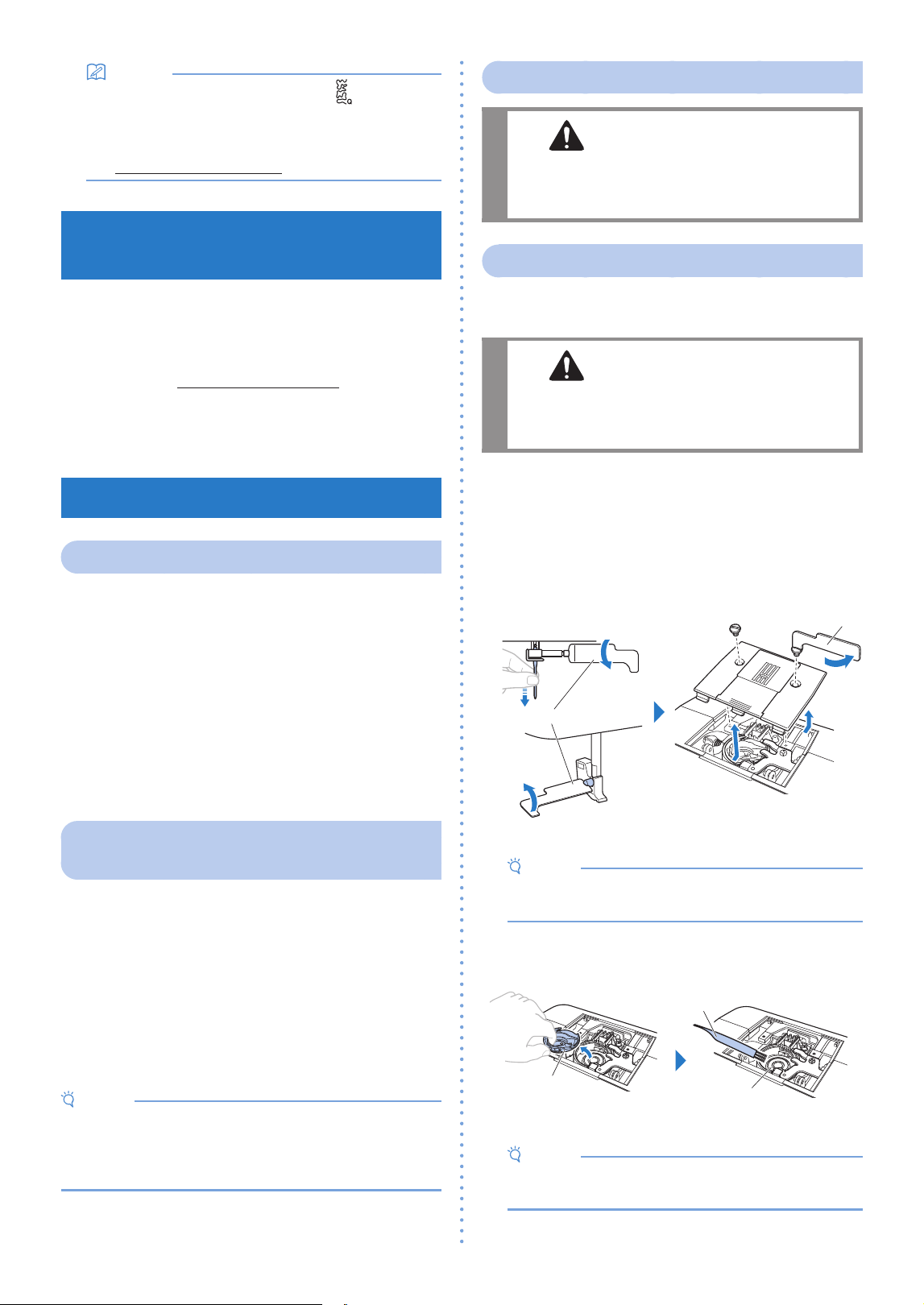
Making Adjustment
(Available on models with 25 or more stitches.)
Your stitch pattern may sometimes turn out poorly,
depending on the type or thickness of fabric, the
stabilizer material used, sewing speed, etc. If your
sewing does not turn out well, sew trial stitches using
the same conditions as the real sewing, and adjust the
stitch pattern as explained below.
If the stitch pattern does not turn out well even after
making adjustments based on the stitch pattern
described below, make adjustments for each stitch
pattern individually.
1
Change the display to the stitch adjustment
display. (page 7)
2
Attach monogramming foot “N”.
3
Adjust stitches with the stitch length keys.
• If the stitch pattern is
bunched:
Press “+” several times.
• If the stitch pattern has
gaps:
Press “–” several times.
4
Sew the stitch pattern again.
*
If the stitch pattern still comes out poorly, make
adjustments again until the stitch pattern comes out
correctly.
2 mm (1/16 inch)
★: Only for some models.
24
Memo
• This adjustment can be made to (Quilting
stippling stitch), decorative stitches, satin
stitches, and cross stitches. For details on the
built-in stitch patterns, refer to “Stitch Chart”
( https://s.brother/cmkag/ ).
Brother Support Website
Information (Downloading Manuals)
Brother support website introduces a variety of
information about the product, such as sewing tips,
how to use optional accessories, and details on stitch
patterns.
Please visit us at https://s.brother/cmkag/ .
You can download “Sewing Guide” and “Stitch Chart”.
You can also download this Operation Manual from
the site.
Care and Maintenance
Restrictions on oiling
In order to prevent damaging this machine, it must not
be oiled by the user.
This machine was manufactured with the necessary
amount of oil applied to ensure correct operation,
making periodic oiling unnecessary.
If problems occur, such as diffi culty turning the
handwheel or an unusual noise, immediately stop
using the machine, and contact your authorized
Brother dealer or the nearest Brother authorized
service center.
Precautions on storing the
machine
Do not store the machine in any of the locations
described below, otherwise damage to the machine
may result, for example, rust caused by condensation.
• Exposed to extremely high or low temperatures
• Exposed to extreme temperature changes
• Exposed to high humidity or steam
• Near a fl ame, heater or air conditioner
• Outdoors or exposed to direct sunlight
• Exposed to extremely dusty or oily environments
Note
• In order to extend the life of this machine,
periodically turn it on and use it.
Storing this machine for an extended period of time
without using it may reduce its efficiency.
Cleaning the machine surface
CAUTION
• Unplug the power supply cord before
cleaning the machine, otherwise injuries or
an electric shock may occur.
Cleaning the race
Sewing performance will suffer if dust collects in the
bobbin case.
CAUTION
• Make sure you unplug the machine before
you clean it. Otherwise, you may get an
electric shock or be injured.
1
Turn off the machine and unplug the power cord.
2
Raise the needle and remove the presser foot.
3
Remove the needle
(1)
and the presser foot
holder
(2)
.
Next, loosen the two screws (
3
) and remove the
needle plate.
1
2
3
Screwdriver
Screwdriver
Note
• Be careful not to drop the removed screws in
the machine.
4
Remove the bobbin case, and remove any dust
from the race and its surrounding area.
Bobbin case
Race
Cleaning brush
*
Do not put oil on the bobbin case.
Note
• Compressed can air is not recommended to be
used.
25
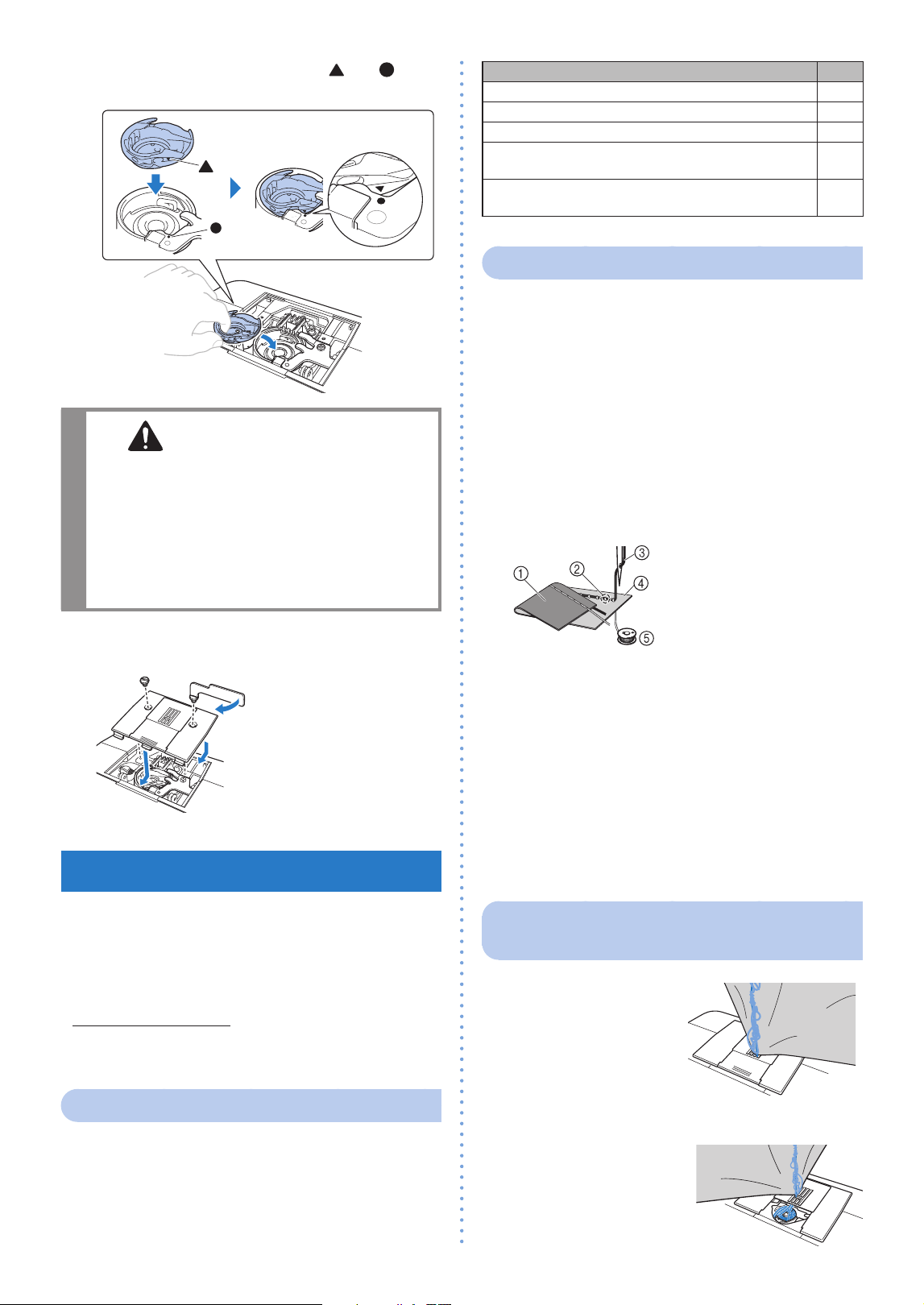
5
Insert the bobbin case so that the and marks
align.
CAUTION
• Never use a bobbin case that is scratched,
otherwise the upper thread may become
tangled, the needle may break or sewing
performance may suffer. For a new
bobbin case, contact your nearest Brother
authorized service center.
• Make sure that you fi t the bobbin case
properly, otherwise the needle may break.
6
Attach the needle plate, and then tighten the
screws.
Troubleshooting
If the machine stops operating correctly, check the
following possible problems before requesting service.
You can solve most problems by yourself. If you need
additional help, the Brother support website offers the
latest FAQs and troubleshooting tips. Visit us at
“ https://s.brother/cpkag/ ” .
If the problem persists, contact your Brother dealer or
the nearest Brother authorized service center.
Frequent troubleshooting topics
Detailed causes and remedies for common
troubleshooting topics are as follows. Be sure to refer
to this before contacting us.
Topic Page
Upper thread tightened up 25
Tangled thread on wrong side of fabric 25
Incorrect thread tension 26
Fabric is caught in the machine and cannot be
removed
26
If the thread becomes tangled under the bobbin
winder seat
★
28
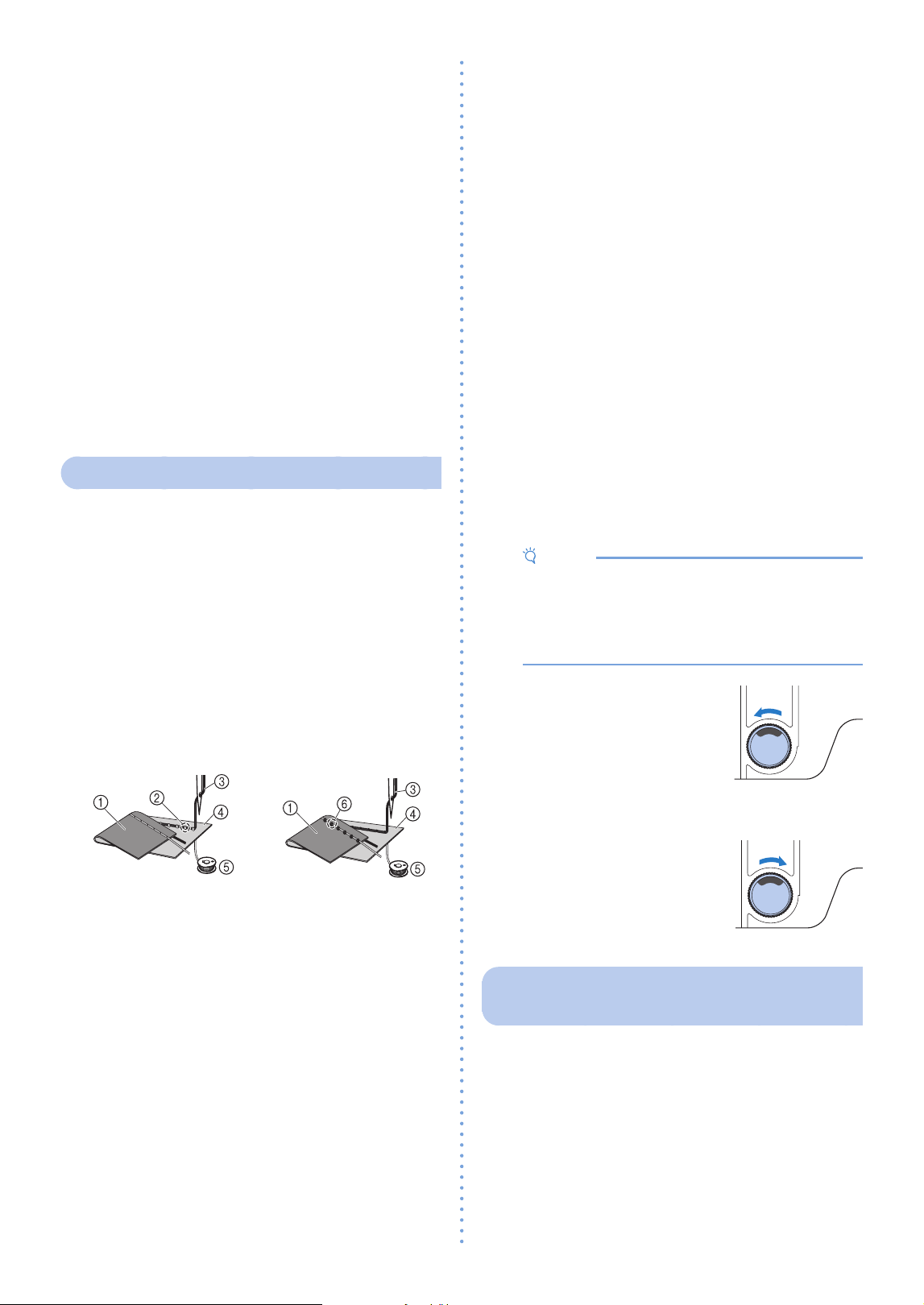
Upper thread tightened up
Symptom
• The upper thread appears as a single continuous
line.
• The bobbin thread is visible from the upper side
of the fabric. (Refer to the illustration below.)
• The upper thread has tightened up, and comes
out when pulled.
• The upper thread has tightened up, and wrinkles
appear in the fabric.
• The upper thread tension is tight, and the results
do not change even after the thread tension is
adjusted.
1 Wrong side of fabric
2 Bobbin thread visible
from right side of
fabric
3 Upper thread
4 Right side of fabric
5 Bobbin thread
Cause
Incorrect bobbin threading
If the bobbin thread is incorrectly threaded, instead
of the appropriate tension being applied to the
bobbin thread, it is pulled through the fabric when
the upper thread is pulled up. For this reason, the
thread is visible from the right side of the fabric.
Remedy/check details
Correctly install the bobbin thread. (page 9)
Tangled thread on wrong side of
fabric
Symptom
• The thread becomes
tangled on the wrong
side of the fabric.
• After starting sewing, a rattling noise is made and
sewing cannot continue.
• Looking under the fabric,
there is tangled thread in
the bobbin case.
★: Only for some models.
26
Cause
Incorrect upper threading
If the upper thread is incorrectly threaded, the
upper thread passed through the fabric cannot be
fi rmly pulled up and the upper thread becomes
tangled in the bobbin case, causing a rattling noise.
Remedy/check details
Remove the tangled thread, and then correct the
upper threading.
1
Remove the tangled thread. If it cannot be
removed, cut the thread with scissors.
*
For details, refer to "Cleaning the race" (page 24).
2
Remove the upper thread from the machine.
3
Correct the upper threading by following the
instructions in “Upper threading” (page 9).
*
If the bobbin was removed from the bobbin case,
refer to "Winding/Installing the bobbin" (page 7)
to correctly install the bobbin.
Incorrect thread tension
Symptoms
1. The bobbin thread is visible from the right side of
the fabric. (Refer to the illustration below.)
2. The upper thread appears as a straight line on the
right side of the fabric.
3. The upper thread is visible from the wrong side
of the fabric. (Refer to the illustration below.)
4. The bobbin thread appears as a straight line on
the wrong side of the fabric.
5. The stitching on the wrong side of the fabric is
loose or has slack.
Symptom 1 Symptom 3
1 Wrong side of fabric
2 Bobbin thread visible from right side of fabric
3 Upper thread
4 Right side of fabric
5 Bobbin thread
6 Upper thread visible from wrong side of fabric
Cause/remedy/check details
Cause 1
The machine is not correctly threaded.
<With symptoms 1 and 2 described above>
The bobbin threading is incorrect.
Return the thread tension dial to “4”, and then
refer to “Winding/Installing the bobbin” (page
7) to correct the threading.
<With symptoms 3 through 5 described above>
The upper threading is incorrect.
Return the thread tension dial to “4”, and then
refer to “Upper threading” (page 9) to correct
the upper threading.
Cause 2
A needle and thread appropriate for the fabric
are not being used.
The machine needle that should be used
depends on the type of fabric sewn and the
thread thickness.
If a needle and thread appropriate for the fabric
are not being used, the thread tension will not be
adjusted correctly, causing wrinkles in the fabric
or skipped stitches.
*
Refer to "Fabric/Thread/Needle Combination" (page
12) to check that a needle and thread appropriate
for the fabric are being used.
Cause 3
An appropriate upper tension is not selected.
Select an appropriate thread tension.
Refer to “Thread tension” (page 17).
The appropriate thread tension differs depending
on the type of fabric and thread being used.
*
Adjust the thread tension while test sewing on a
piece of scrap fabric that is the same as that used in
your project.
Note
• If the upper threading and bobbin threading
are incorrect, the thread tension cannot be
adjusted correctly. Check the upper threading
and bobbin threading first, and then adjust the
thread tension.
• If the bobbin thread is
visible from the right
side of the fabric
Turn the thread tension
dial counterclockwise to
loosen the upper thread
tension.
• If the upper thread is
visible from the wrong
side of the fabric
Turn the thread tension
dial clockwise to tighten
the upper thread tension.
Fabric is caught in the machine
and cannot be removed
If the fabric is caught in the machine and cannot be
removed, the thread may have become tangled under
the needle plate. Follow the procedure described
below to remove the fabric from the machine. If
the operation cannot be completed according to
the procedure, instead of attempting to remove it
forcefully, contact your nearest Brother authorized
service center.
0
1
2
3
4
5
6
7
8
9
0
1
2
3
4
5
6
7
8
9
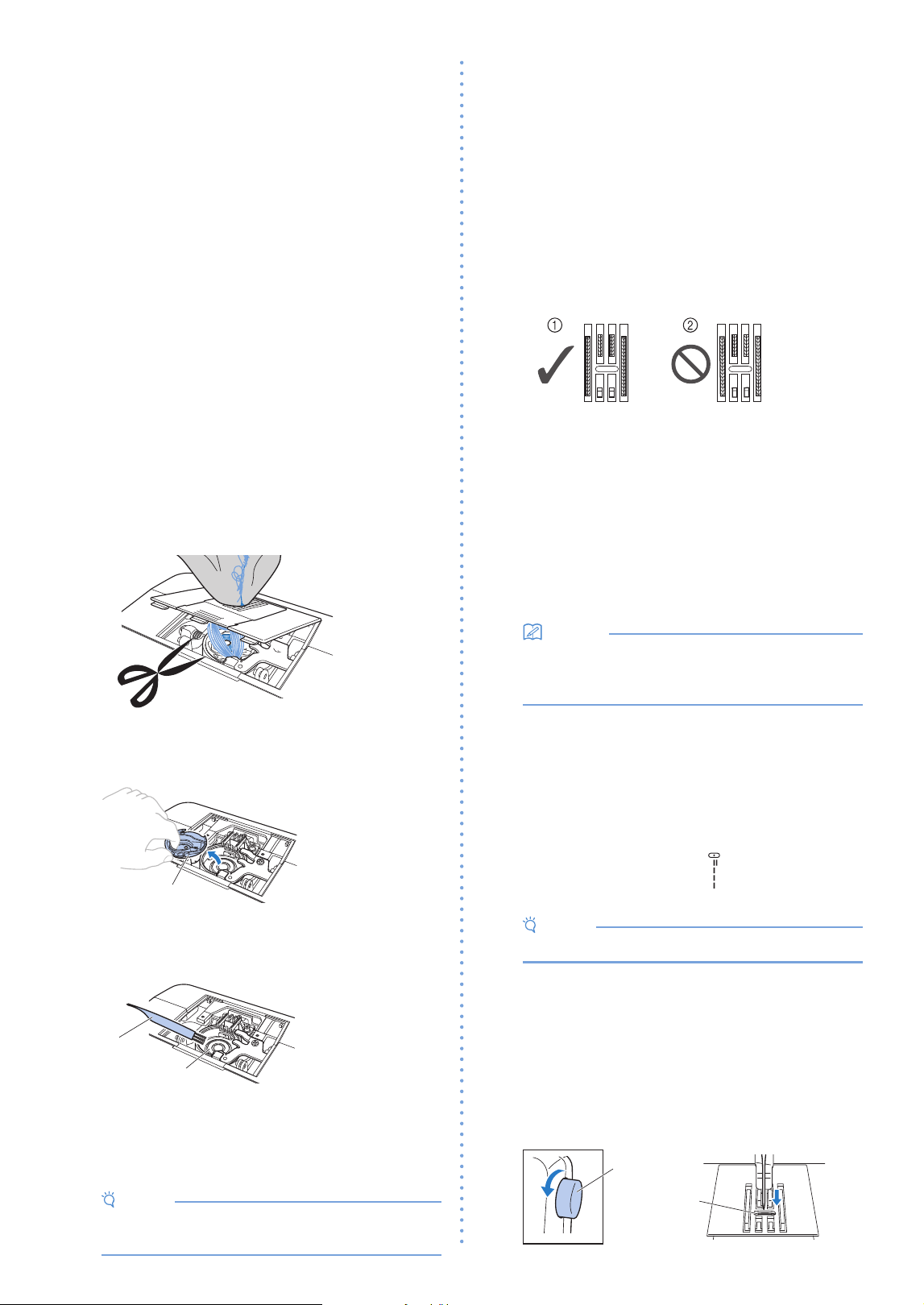
27
Removing the fabric from the machine
1
Immediately stop the machine.
2
Turn off the machine.
3
Remove the needle.
If the needle is lowered into the fabric, turn the
handwheel away from you (clockwise) to raise
the needle out of the fabric, and then remove the
needle.
*
Refer to "Replacing the needle" (page 13).
4
Remove the presser foot and presser foot
holder.
If the thread is entangled on the presser foot,
remove the entangled thread, and then raise the
presser foot lever to remove the presser foot.
Otherwise, the presser foot may be damaged.
*
Refer to "Replacing the presser foot" (page 14).
5
Lift up the fabric and cut the threads below it.
If the fabric can be removed, remove it. Continue
with the following steps to clean the race.
6
Remove the needle plate cover.
*
Refer to "Cleaning the race" (page 24).
7
Cut out the tangled threads, and then remove
the bobbin.
8
Remove the bobbin case.
If threads remain in the bobbin case, remove
them.
Bobbin case
9
Use the cleaning brush or a vacuum cleaner
mini attachment to remove any lint or dust
from the race and its surrounding area.
Cleaning
brush
Race
• If the fabric could be removed
Continue to step
11.
• If the fabric could not be removed
Continue to step
10.
Note
• Compressed can air is not recommended to
be used.
10
Remove the fabric and threads from the
needle plate.
If the fabric cannot be removed, even after
completing these steps, contact your nearest
Brother authorized service center.
11
Insert the bobbin case by following step 5 in
“Cleaning the race” (page 24).
12
Attach the needle plate cover by following
step
6 in “Cleaning the race” (page 24).
13
Turn the handwheel to check that the feed
dogs move smoothly and do not contact the
edges of the slots in the needle plate.
1 Correct position of feed dogs
2 Incorrect position of feed dogs
14
Check the condition of the needle, and then
install it.
If the needle is in a poor condition, for
example, if it is bent, be sure to install a new
needle.
*
Refer to "Checking the needle" (page 13) and
"Replacing the needle" (page 13).
Memo
• Since the needle may have been damaged
when the fabric was caught in the machine,
we recommend replacing it with a new one.
Checking machine operations
If the needle plate has been removed, check
machine operations to confi rm that installation has
been completed correctly.
1
Turn on the machine.
2
Select the straight stitch ( middle (center)
needle position).
Note
• Do not yet install the presser foot and thread.
3
Slowly turn the handwheel toward you
(counterclockwise), and look from all sides to
check that the needle falls at the center of the
opening in the needle plate.
If the needle contacts the needle plate, remove
the needle plate, and then install it again, starting
with step
13 in “Fabric is caught in the machine
and cannot be removed” (page 27).
Handwheel
Opening
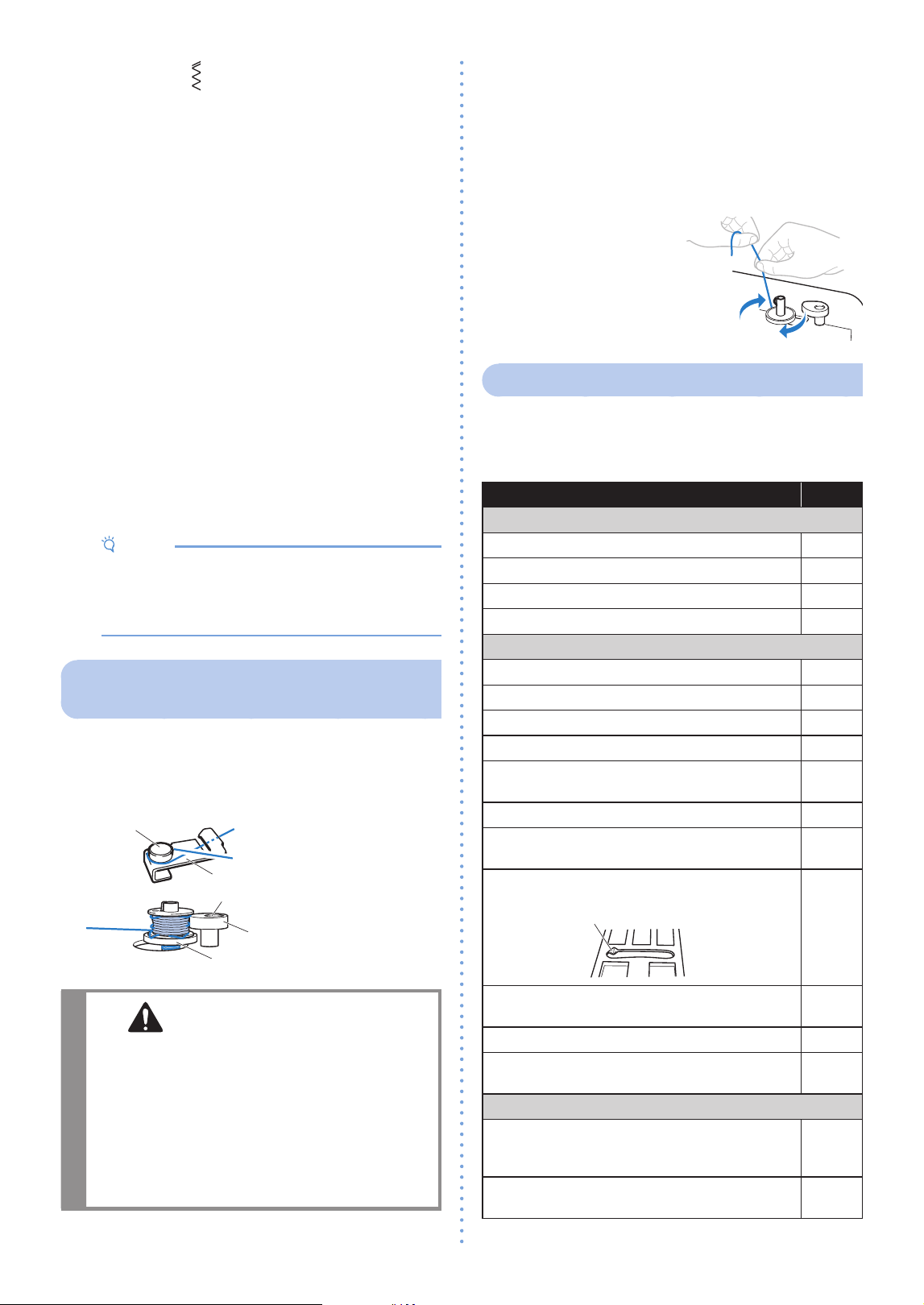
28
4
Select stitch . At this time, increase the stitch
length and width to their maximum settings.
*
For details on changing the settings, refer to "Setting
the stitch length and stitch width" (page 15).
5
Slowly turn the handwheel toward you
(counterclockwise) and check that the needle
bar and feed dogs operate correctly.
If the needle or feed dogs contact the needle
plate, the machine may be malfunctioning;
therefore, contact your nearest Brother
authorized service center.
6
Turn off the machine, and then install the
bobbin and presser foot.
Never use a scratched or damaged presser foot.
Otherwise, the needle may break, or sewing
performance may suffer.
*
Refer to "Winding/Installing the bobbin" (page 7)
and "Replacing the presser foot" (page 14).
7
Correctly thread the machine.
*
For details on threading the machine, refer to "Upper
threading" (page 9).
8
Perform trial sewing with cotton fabric.
Note
• Incorrect sewing may be the result of incorrect
upper threading or sewing thin fabrics. If there
are poor results from the trial sewing, check the
upper threading or the type of fabric being used.
If the thread becomes tangled
under the bobbin winder seat
★
If the bobbin winding starts when the thread is not
passed under the pretension disk of the thread guide
correctly, the thread may become tangled under the
bobbin winder seat.
Bobbin winder guide post
Screw
Bobbin winder seat
Thread guide
Pretension disk
CAUTION
• Do not remove the bobbin winder seat even
if the thread become tangled under the
bobbin winder seat. Otherwise, the cutter in
the bobbin winder seat may be damaged. (for
models equipped with the cutter).
• Do not remove the screw on the bobbin
winder guide post, otherwise the machine
may be damaged; you cannot wind off the
thread by removing the screw.
1
Stop the bobbin winding.
2
Cut the thread with scissors beside the thread
guide.
3
Slide the bobbin winder shaft to the left, and then
remove the bobbin from the shaft and cut the
thread leading to the bobbin in order to be able
to completely remove the bobbin from the shaft.
4
Hold the thread end
with your left hand,
and wind off the thread
clockwise from under
the bobbin winder seat
with your right hand.
List of symptoms
If the reference page is “
*
”, contact your authorized
Brother dealer or the nearest Brother authorized
service center.
Symptom, Cause/solution
Reference
The machine does not work.
The machine is not plugged in. 6
The main power switch is turned off. 6
The bobbin winder shaft is pushed to the right. 8
The foot controller is not used properly. 6
The needle breaks.
The needle is not fi tted properly. 13
The needle clamp screw is loose. 13
The needle is turned, bent or the point is dull. 13
The needle or thread is improper for the fabric. 12
The presser foot is not appropriate for the
selected stitch.
14
The upper thread tension is too tight. 17
The fabric is pulled, pushed, or fed at an angle.
Lightly guide the fabric.
16
The area around the opening in the needle
plate is scratched.
This is not a scratch.
*
The area around the opening in the presser
foot is scratched.
*
The bobbin case is scratched. *
A bobbin designed for this machine is not
used.
7
The upper thread breaks.
Upper threading is incorrect. (For example,
the spool is not fi tted properly, or the thread
comes out of the thread channel.)
9
There are knots or tangles in the thread.
Remove any knots or tangles.
-
★: Only for some models.
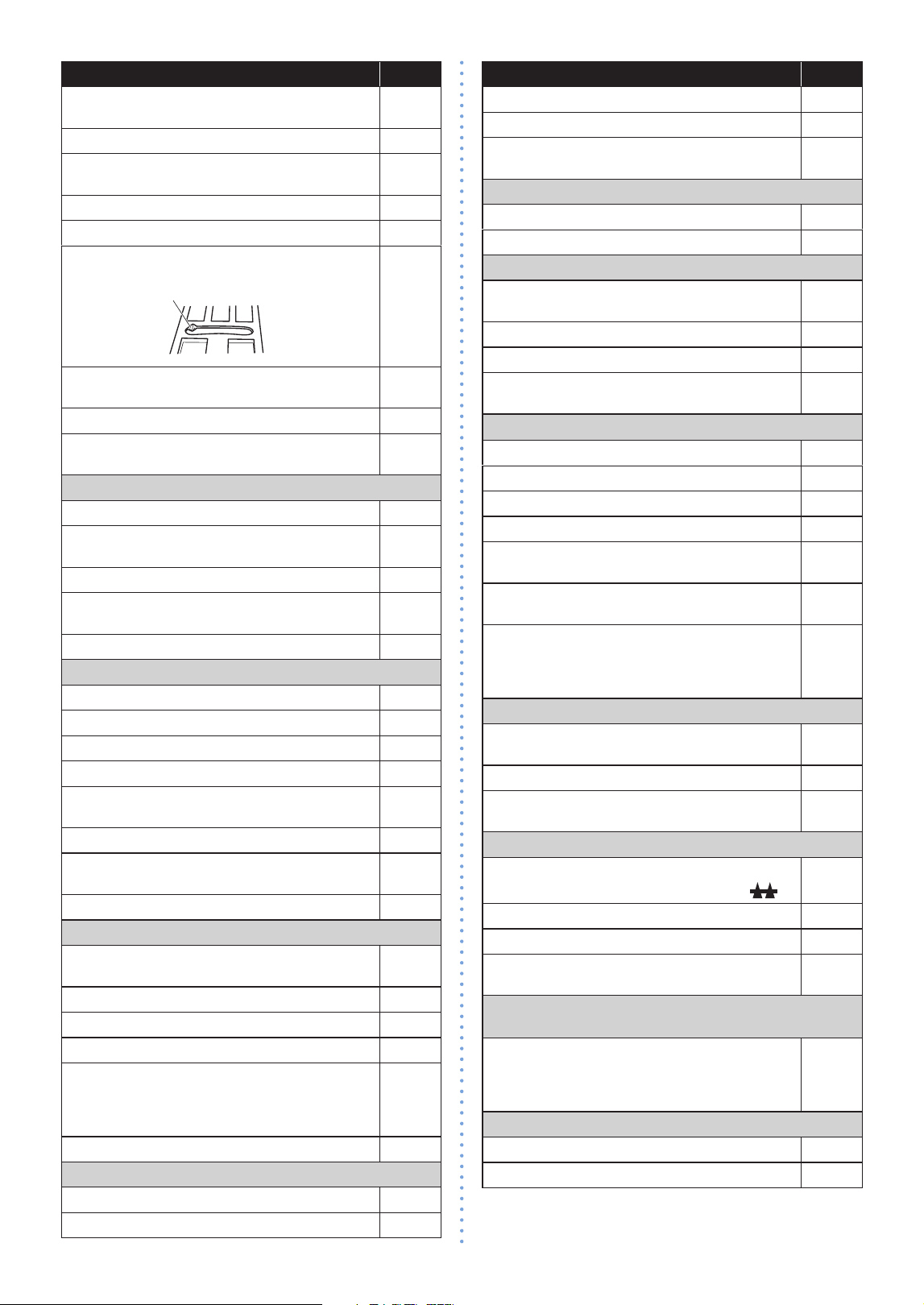
29
Symptom, Cause/solution
Reference
The needle is not appropriate for the thread
you are using.
12
The upper thread tension is too tight. 17
The thread is tangled, for example, in the
bobbin case.
27
The needle is turned, bent or the point is dull. 13
The needle is not installed properly. 13
The area around the opening in the needle
plate is scratched.
This is not a scratch.
*
The area around the opening in the presser
foot is scratched.
*
The bobbin case is scratched, or has a burr on it.
*
A bobbin designed for this machine is not
used.
7
The bobbin thread is tangled or breaks.
The bobbin thread is wound improperly. 7
The bobbin is scratched or does not turn
smoothly.
7
The thread is tangled. 25
A bobbin designed for this machine is not
used.
7
The bobbin is installed incorrectly. 9
The thread tension is incorrect.
Upper threading is incorrect. 9
The bobbin thread is wound improperly. 7
The needle or thread is improper for the fabric. 12
The presser foot is not attached properly. 15
The presser foot holder is not attached
properly.
15
The thread tension is incorrect. 17
A bobbin designed for this machine is not
used.
7
The bobbin is installed incorrectly. 9
The fabric is wrinkled.
Upper threading or the bobbin installation is
incorrect.
7, 9
The spool is not fi tted properly. 7
The needle or thread is improper for the fabric. 12
The needle is turned, bent or the point is dull. 13
If you are sewing thin fabric, the stitch is too
thick.
Sew with stabilizer material under the
fabric.
-
The thread tension is incorrect. 17
Stitches are skipped.
Upper threading is incorrect. 9
The needle or thread is improper for the fabric. 12
Symptom, Cause/solution
Reference
The needle is turned, bent or the point is dull. 13
The needle is not installed properly. 13
Dust has accumulated under the needle plate
or in the bobbin case.
24
The thread is tangled on the wrong side of the fabric.
Upper threading is incorrect. 9
The needle or thread is improper for the fabric. 12
There is a high-pitched noise while sewing.
Dust has built up in the feed dogs or in the
bobbin case.
24
Upper threading is incorrect. 9
The bobbin case is scratched. *
A bobbin designed for this machine is not
used.
7
The needle threader cannot be used.
★
The needle is not in the highest position. 10
The needle is installed incorrectly. 13
The needle is turned, bent or the point is dull. 13
Upper threading is incorrect. 9
The needle threader hook is bent and does not
pass through the eye of the needle.
*
The needle threader lever cannot be moved or
returned to its original position.
*
A size 65/9 needle is being used.
The needle is incompatible with the needle
threader. Manually pass the thread through
the eye of the needle.
10
The stitch is not sewn correctly.
The presser foot is not appropriate for the
selected stitch.
14
The thread tension is incorrect. 17
The thread is tangled, for example, in the
bobbin case.
27
The fabric does not feed.
The feed dogs are lowered.
★
Slide the feed dog position switch to .
21
The stitch is too fi ne. 15
The needle or thread is improper for the fabric. 12
The thread is tangled, for example, in the
bobbin case.
27
While winding the bobbin, the bobbin thread was
wound below the bobbin winder seat.
★
The thread was incorrectly passed under the
pretension disk on the thread guide.
Remove any entangled thread, and then
wind the bobbin.
8, 28
The bobbin thread cannot be pulled up.
The needle is turned, bent or the point is dull. 13
The bobbin is installed incorrectly. 9
★: Only for some models.
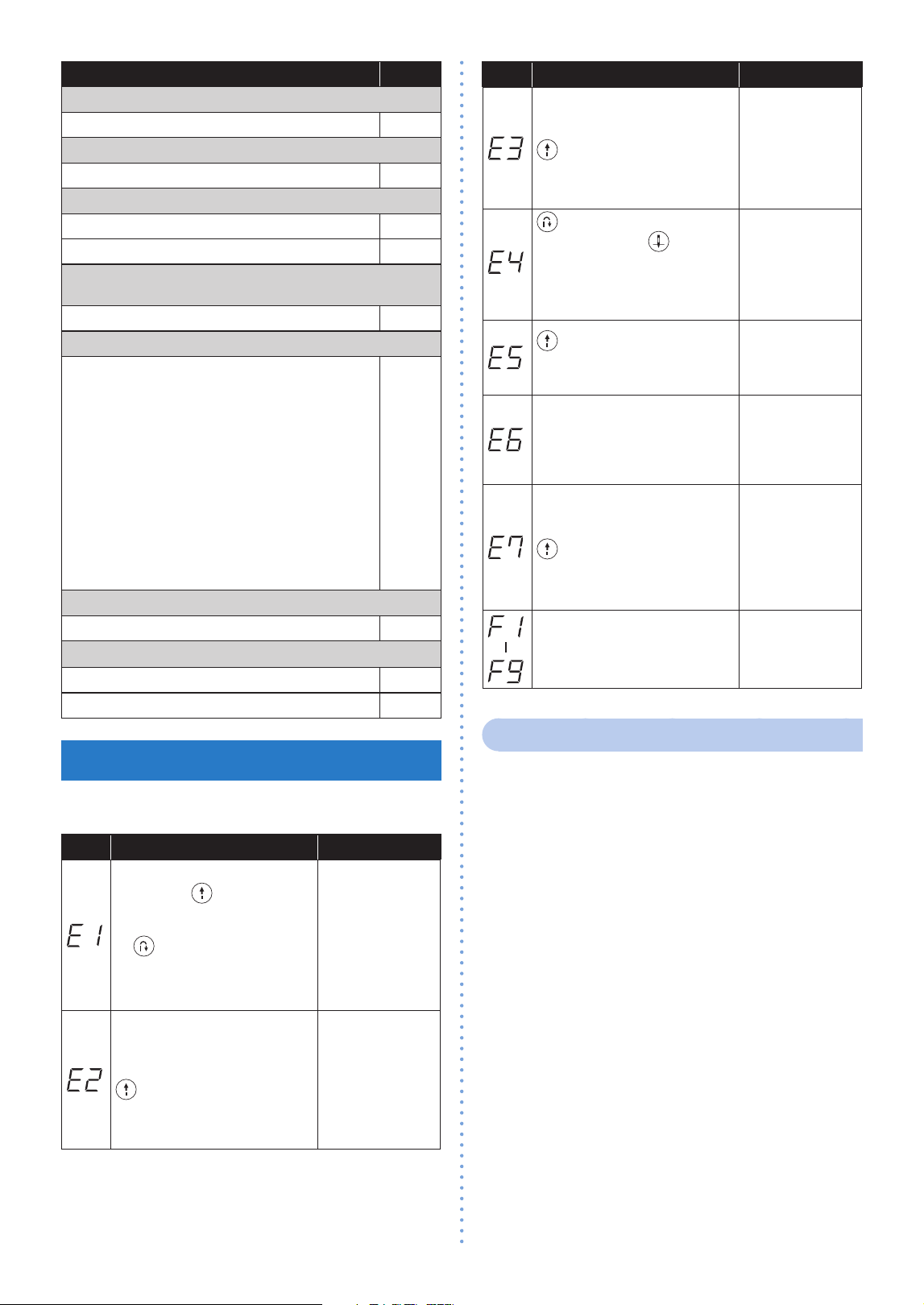
30
Symptom, Cause/solution
Reference
The sewing light bulb does not come on.
The sewing light is damaged. *
The fabric feeds in the opposite direction.
The feed mechanism is damaged. *
The needle contacts the needle plate.
The needle clamp screw is loose. 13
The needle is turned, bent or the point is dull. 13
Fabric being sewn with the machine cannot be
removed.
Thread is tangled below the needle plate. 27
A broken needle has fallen into the machine.
Turn off the machine, and remove the needle
plate. If the needle that fell into the machine
can be seen, use tweezers to remove it.
After removing the needle, return the needle
plate to its original position and insert a
new needle. Before turning on the machine,
slowly turn the handwheel toward you to
check that it turns smoothly and that the
new needle enters through the center of the
needle plate opening. If the handwheel does
not turn smoothly or the needle that fell into
the machine cannot be removed, consult
your authorized Brother dealer or the nearest
Brother authorized service center.
24
The handwheel does not turn smoothly.
Thread is tangled in the bobbin case. 27
Decorative stitch patterns are misaligned.
★
A wrong presser foot is used. 14
Stitch adjustment is set incorrectly. 23
Error Messages
If the problem persists, contact your authorized Brother
dealer or the nearest Brother authorized service center.
No. Cause Solution
The foot controller was
pressed (or
(“Start/Stop”
button) was pressed if the foot
controller is not connected ★)
or
(Reverse/Reinforcement
stitch button) was pressed
while the presser foot is
raised.
Lower the presser
foot lever before
continuing the
operation.
A stitch other than the
buttonhole or bar tack stitch
was selected and the foot
controller was pressed (or
(“Start/Stop” button) was
pressed if the foot controller
is not connected ★) while the
buttonhole lever is lowered.
Raise the
buttonhole
lever before
continuing the
operation.
No. Cause Solution
The buttonhole or bar tack
stitch was selected and the
foot controller was pressed (or
(“Start/Stop” button) was
pressed if the foot controller
is not connected ★) while the
buttonhole lever is raised.
Lower the
buttonhole
lever before
continuing the
operation.
(Reverse/Reinforcement
stitch button) (or
(Needle
position button) ★) was
pressed while the bobbin
winder shaft is moved to the
right.
Move the bobbin
winder shaft to
the left before
continuing the
operation.
(“Start/Stop” button)
was pressed while the foot
controller is connected.
★
Disconnect the
foot controller
or use the foot
controller.
★
The motor locked up because
the thread is tangled.
Remove
the tangled
thread before
continuing the
operation.
The stitch only for the single
needle was selected and the
foot controller was pressed (or
(“Start/Stop” button) was
pressed if the foot controller
is not connected
★) while the
twin needle mode is active.
Select a stitch for
the twin needle.
The machine may be
malfunctioning.
Contact your
nearest Brother
authorized
service center.
Operation beep ★
• When the machine is turned on or a key is pressed
(correct operation)
One beep
• When the machine is turned on while a setting is
changed (page 6)
Two beeps
• If an incorrect operation is performed or a non-
functioning key is pressed
Two or four beeps
• If the machine locks up, for example, because the
thread is tangled
Beeps for four seconds and the machine
automatically stops.
Be sure to check for the cause of the error, and
correct it before continuing to sew.
★: Only for some models.

31
Index
A
accessories ..................................................................................5
automatic reverse/reinforcement stitching ............................. 7, 17
B
bobbin ........................................................................................7
bobbin case ..............................................................................24
bobbin cover ...........................................................................4, 8
bobbin installation ......................................................................7
bobbin winder ......................................................................4, 28
bobbin winding ...........................................................................7
buttonhole lever ..........................................................................4
E
error messages ..........................................................................30
extra spool pin ......................................................................5, 14
eyelet punch .........................................................................5, 20
F
fabric/thread/needle combination .............................................12
feed dog position switch .......................................................4, 21
feed dogs ........................................................................ 4, 27, 29
flat bed attachment .....................................................................4
foot controller .............................................................................6
free arm .....................................................................................19
H
handwheel ..................................................................................4
L
LCD .............................................................................................6
M
main parts ...................................................................................4
main power .............................................................................4, 6
N
needle ....................................................................................... 13
needle bar thread guide ........................................................4, 14
needle clamp screw ....................................................................4
needle plate ................................................................................4
needle plate cover .....................................................................27
needle position button ................................................................4
needle stop position ....................................................................6
needle threader .....................................................................4, 10
O
operation beep ......................................................................7, 30
operation buttons ........................................................................4
operation panel ...........................................................................6
P
presser foot ...........................................................................4, 14
presser foot holder ................................................................4, 15
presser foot lever ......................................................... 4, 8, 14, 16
pretension disk ......................................................................8, 28
Q
quick-set bobbin .....................................................................4, 9
quilting foot ...........................................................................5, 15
R
race ...........................................................................................24
reinforcement stitch ...................................................................16
reverse/reinforcement stitch button .............................................4
reverse stitch .............................................................................16
S
seam ripper ...........................................................................5, 20
settings ........................................................................................6
sewing speed controller ..............................................................4
spool pin ........................................................................... 4, 7, 10
“Start/Stop” button ......................................................................4
stitch adjustment ...................................................................7, 23
stitch length keys ...................................................................6, 15
stitch selection keys ...............................................................6, 15
stitch width ...............................................................................15
stitch width keys ....................................................................6, 15
straight stitch ...............................................................................7
T
thread cutter ....................................................................4, 10, 16
thread take-up lever ..............................................................4, 10
thread tension ..................................................................... 17, 26
thread tension dial .................................................................4, 26
troubleshooting .........................................................................25
twin needle ........................................................................... 5, 13
U
upper threading ...........................................................................9
W
walking foot ..........................................................................5, 15
The List of the Instruction Manuals
Name Content Reference
Operation Manual
(this manual)
Instructions for usage of this product, as well as the maintenance and
troubleshooting.
Printed/Included
with the machine
Sewing Guide Useful sewing tips and procedures for using the various utility stitches are
introduced.
Brother support
website *
Quick Reference
Guide
Simple instructions for winding/installing the bobbin and the upper
threading.
Printed/Included
with the machine
Stitch Chart A list of stitch patterns for this machine.
The application, the presser foot to be used, the stitch width and stitch
length are also introduced.
Brother support
website *
*: Visit https://s.brother/cmkag/ .
English
888-N00/N02/N20/N22/N40/N42/N60
D01F5E-201②
To get information about Videos, please go to https://s.brother/cvkag/.
Please visit us at https://s.brother/cpkag/ where you can get the support
information (Sewing Guide, Stitch Chart, Instruction Videos, FAQs, etc.)
for your Brother product.