Accessories
4
Inserting the batteries
5
Operating range of the remote control unit
5
Part names and functions
6
Front panel
6
Rear panel
9
Remote control unit
11
Connections
Connecting speakers
16
Speaker connection
18
Bi-wiring connection
19
Connecting a playback device
20
Connecting a recording device
21
Connecting to a device with digital audio output connectors
22
Connecting a PC or Mac
23
Connecting a pre-amplifier
24
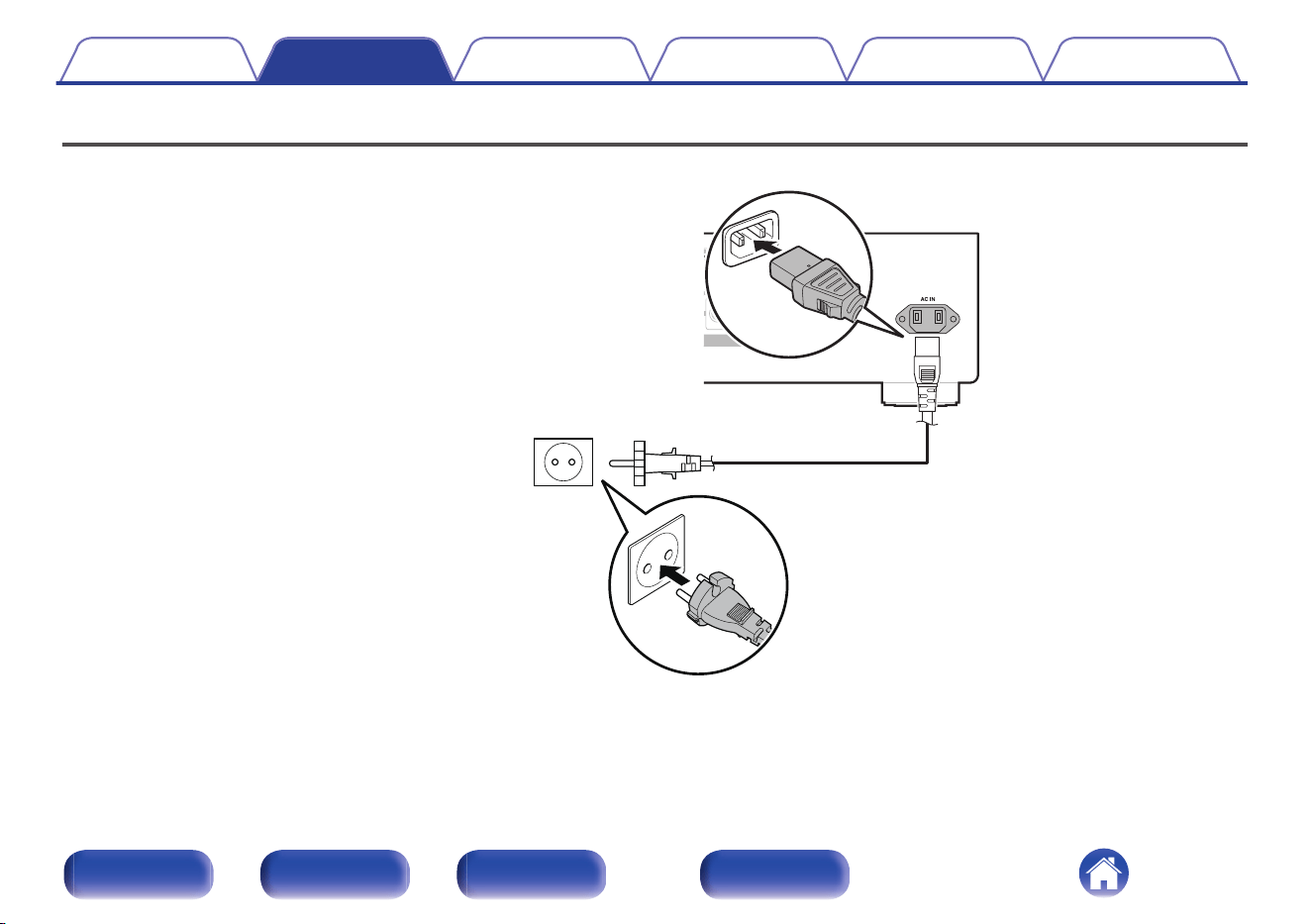
Connecting the power cord
25
Playback
Turning the power on
27
Switching the power to standby
27
Selecting the input source
28
Adjusting the volume
28
Turning off the sound temporarily (Muting)
28
Adjusting the tone and balance
28
Switching the display’s brightness
29
Playing CDs
30
Connecting and playing back from a computer (USB-DAC)
31
Connecting and playing back from a digital device (Coaxial/
Optical 1/Optical 2)
40
Recording
41
Settings
Setting the TV auto play function
42
Setting the auto standby mode
43
Contents Connections Playback Settings Tips Appendix
2
Front panel Rear panel
Remote control
unit
Index
Tips
Tips
45
Troubleshooting
46
Power does not turn on / Power is turned off
47
Operations cannot be performed through the remote control unit
48
Display on this unit shows nothing
48
No sound comes out
49
Desired sound does not come out
49
Sound is interrupted or noise occurs
50
Music files on PC or Mac cannot be played back
51
Audio from digital devices cannot be played back (Coaxial/
Optical)
52
The input source switches to “Optical 1”, “Optical 2” or “Coaxial”
52
Appendix
D/A converter
53
Explanation of terms
53
Specifications
55
Index
58
Contents Connections Playback Settings Tips Appendix
3
Front panel Rear panel
Remote control
unit
Index
Thank you for purchasing this Denon product. To ensure proper operation, please read this owner’s manual carefully before using the product.
After reading this manual, be sure to keep it for future reference.
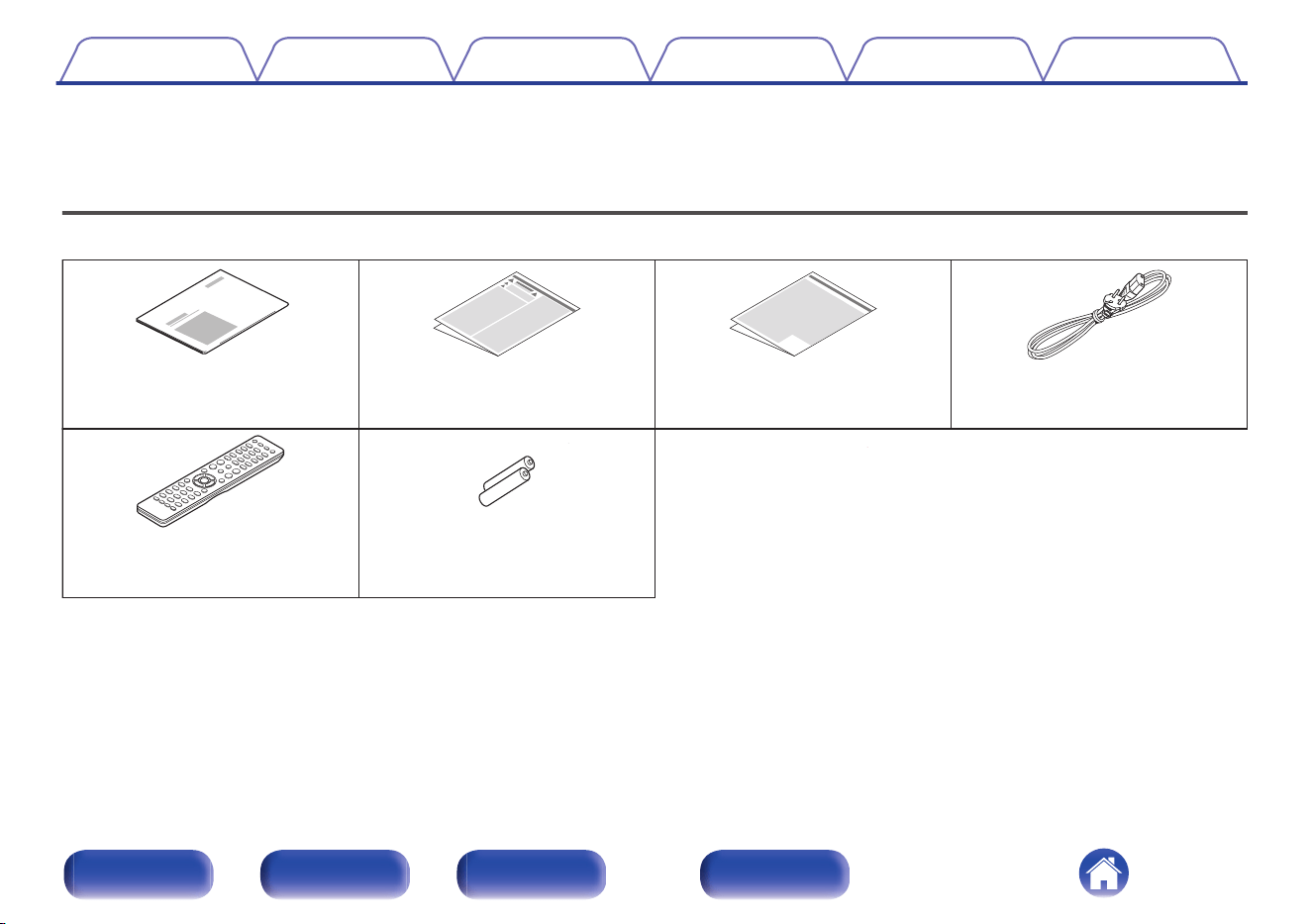
Accessories
Check that the following parts are supplied with the product.
2× R03/AAA batteries
Remote control unit
(RC-1249)
Cautions on Using Batteries
Safety Instructions
Quick Start Guide
Power cord
Contents Connections Playback Settings Tips Appendix
4
Front panel Rear panel
Remote control
unit
Index
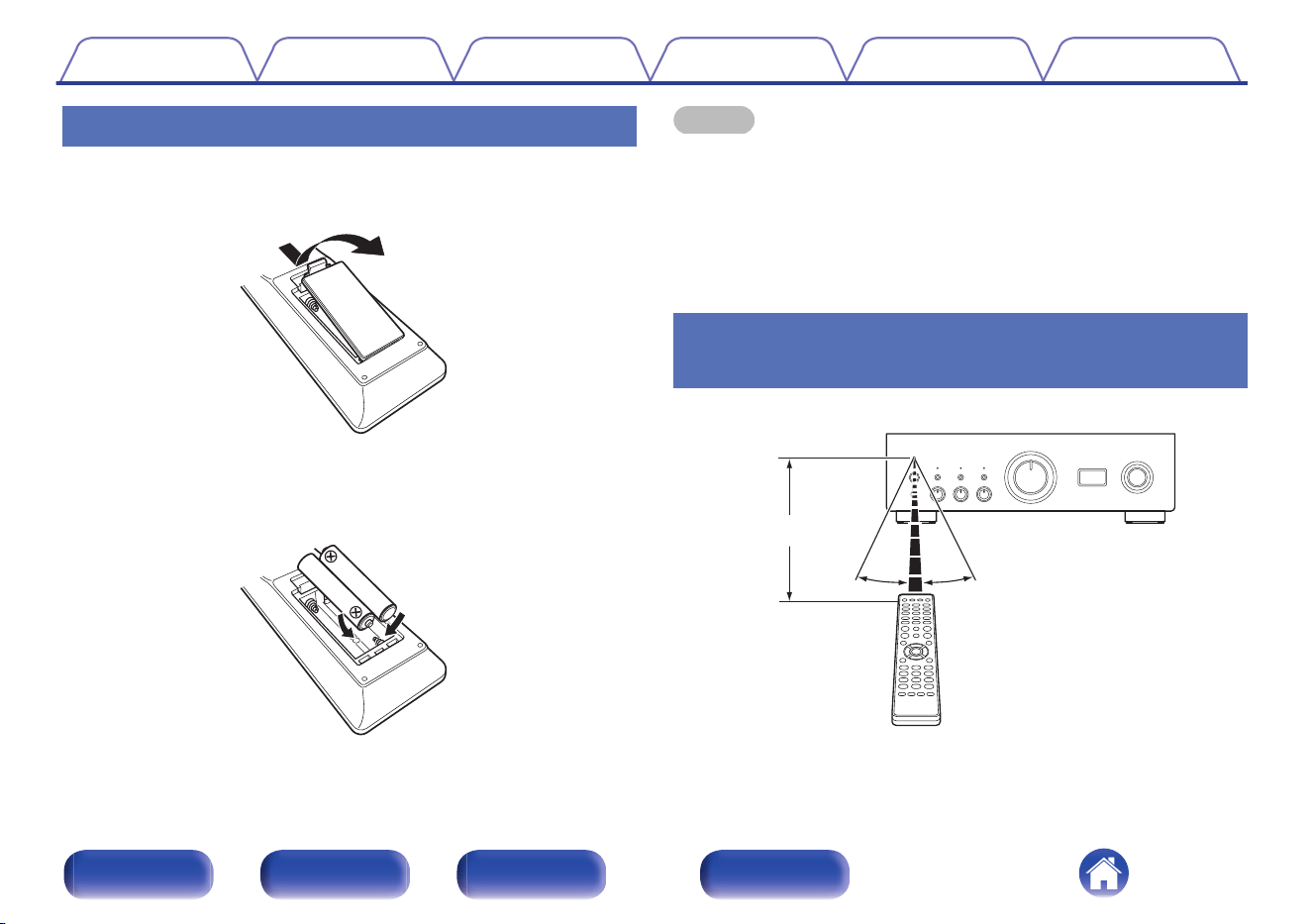
Inserting the batteries
1
Remove the rear lid in the direction of the arrow and
remove it.
2
Insert two batteries correctly into the battery
compartment as indicated.
3
Put the rear lid back on.
NOTE
0
To prevent damage or leakage of battery fluid:
0
Do not use a new battery together with an old one.
0
Do not use two different types of batteries.
0
Remove the batteries from the remote control unit if it will not be in use for long
periods.
0
If the battery fluid should leak, carefully wipe the fluid off the inside of the battery
compartment and insert new batteries.
Operating range of the remote control
unit
Point the remote control unit at the remote sensor when operating it.
30°
Approx. 7 m
30°
Contents
Connections Playback Settings Tips Appendix
5
Front panel Rear panel
Remote control
unit
Index
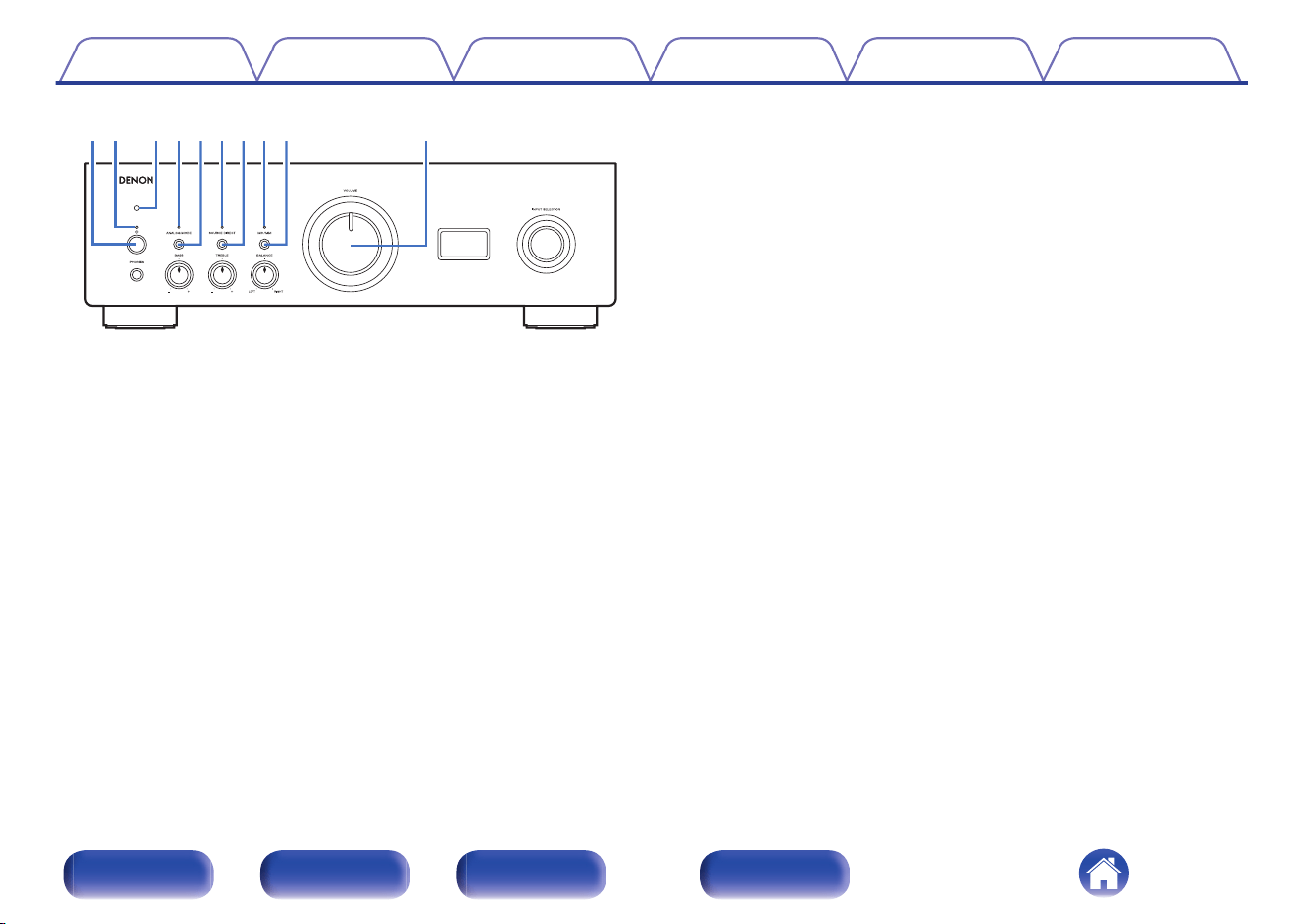
rewqtyuio
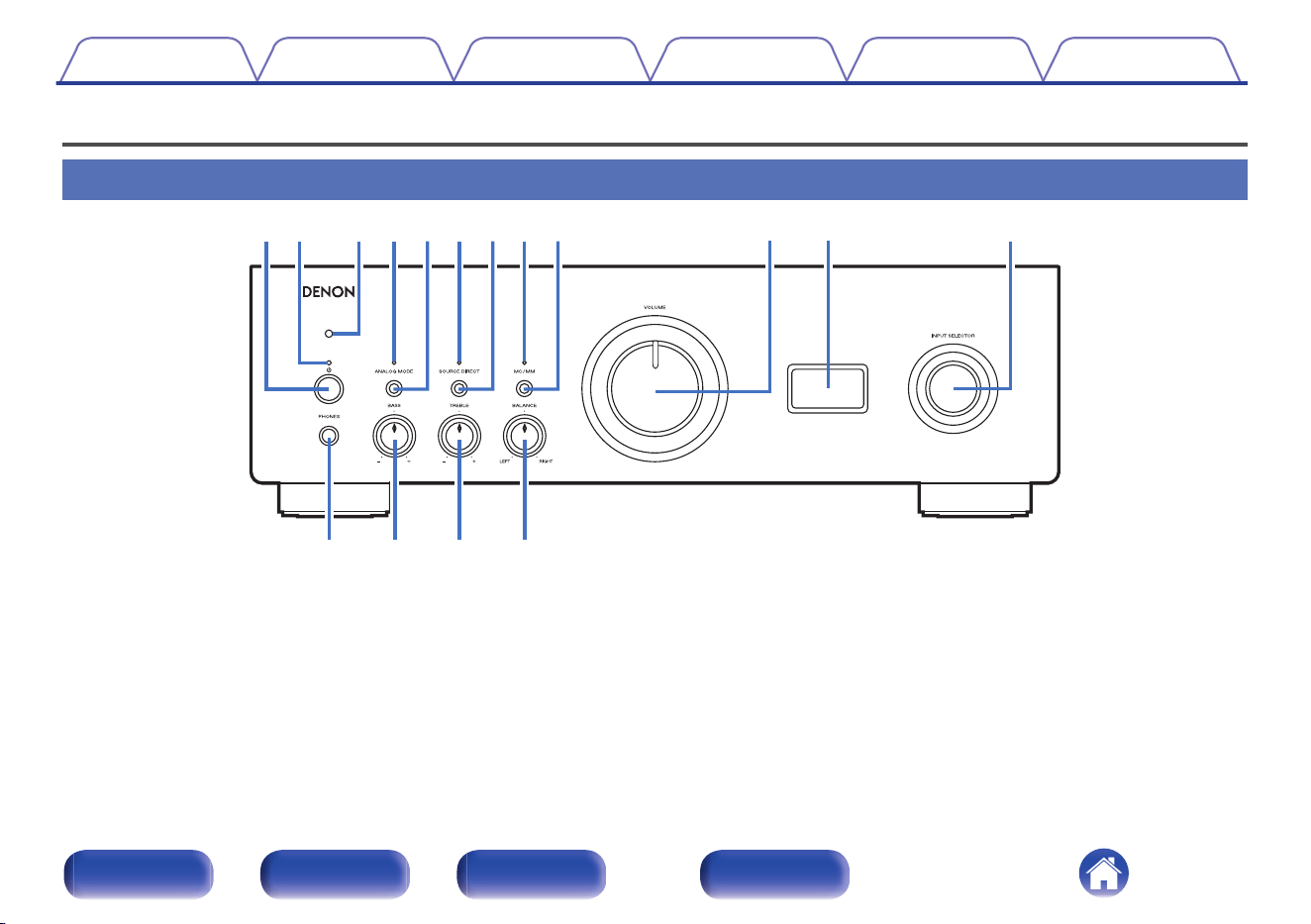
Q0
A
Power X button
This turns the power on/off. (v p. 27)
B
Power indicator
This is lit as follows according to the power status:
0
Power on : Green
0
Standby : Off
0
Power off : Off
0
When the protection circuit is activated : Red (blinking) (v p. 47)
C
Remote control sensor
This receives signals from the remote control unit. (v p. 5)
D
ANALOG MODE indicator
This is lit as follows, according to the analog mode status:
0
Analog mode on (ANALOG MODE 1 or 2): Green
0
Analog mode off: Off
E
ANALOG MODE button
This switchs the ANALOG MODE 1/2/off. (v p. 30)
F
SOURCE DIRECT indicator
This is lit as follows according to the source direct status:
0
Source direct mode on: Green
0
Source direct mode off: Off
G
SOURCE DIRECT button
This turns source direct mode on/off. (v p. 30)
H
MC/MM indicator
This is lit as follows according to the setting of the phono equalizer of
this unit:
0
MC: Green
0
MM: Off
I
MC/MM button
This switchs to MC or MM according to the type of cartridge used on
your turntable.
J
VOLUME knob
This adjusts the volume level. (v p. 28)
Contents
Connections Playback Settings Tips Appendix
7
Front panel Rear panel
Remote control
unit
Index
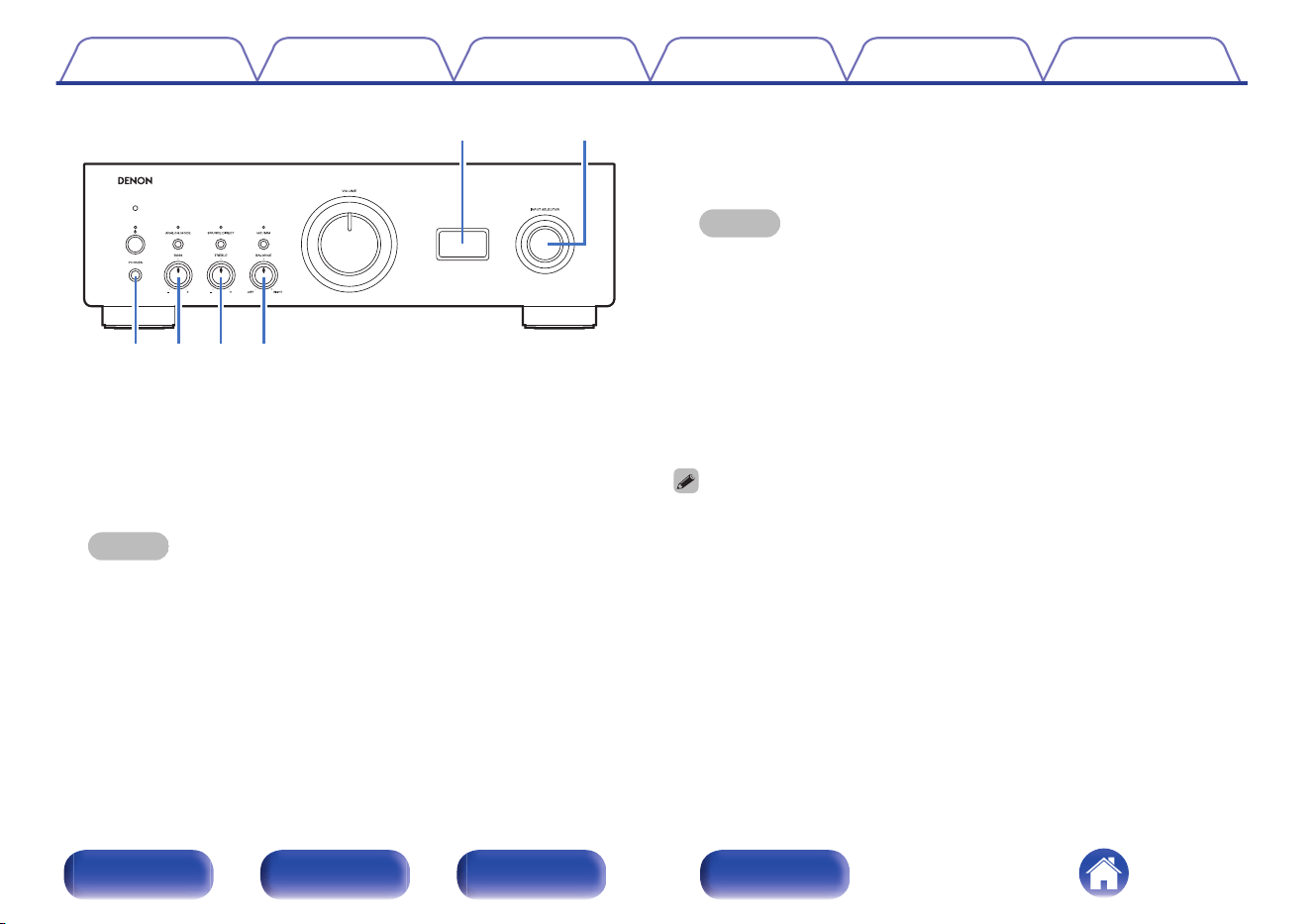
Q
5
Q
6
Q
4
Q
3
Q2
Q1
K
Display
This displays information such as the input source name, type of digital
audio signal and sampling frequency.
L
INPUT SELECTOR knob
This selects the input source. (v p. 28)
NOTE
0
When you set this unit’s input source to “EXT.PRE”, the main unit outputs at
maximum volume. Also adjustment of the volume balance and tone on the
main unit has no effect. Adjust the volume on the inputting devices before
playback.
M
Headphones jack (PHONES)
Used to connect headphones.
When the headphones are plugged into this jack, audio will no longer
be output from the speaker terminals.
NOTE
0
To prevent hearing loss, do not raise the volume level excessively when using
headphones.
N
BASS control knob
This setting adjusts the volume level for the bass. (v p. 28)
O
TREBLE control knob
This setting adjusts the volume level for the treble. (v p. 28)
P
BALANCE control knob
This adjusts the balance of the volume output from the left and right
speakers. (v p. 28)
0
d, e and f can be adjusted when 6 is off (Source direct mode is off).
Contents Connections Playback Settings Tips Appendix
8
Front panel Rear panel
Remote control
unit
Index
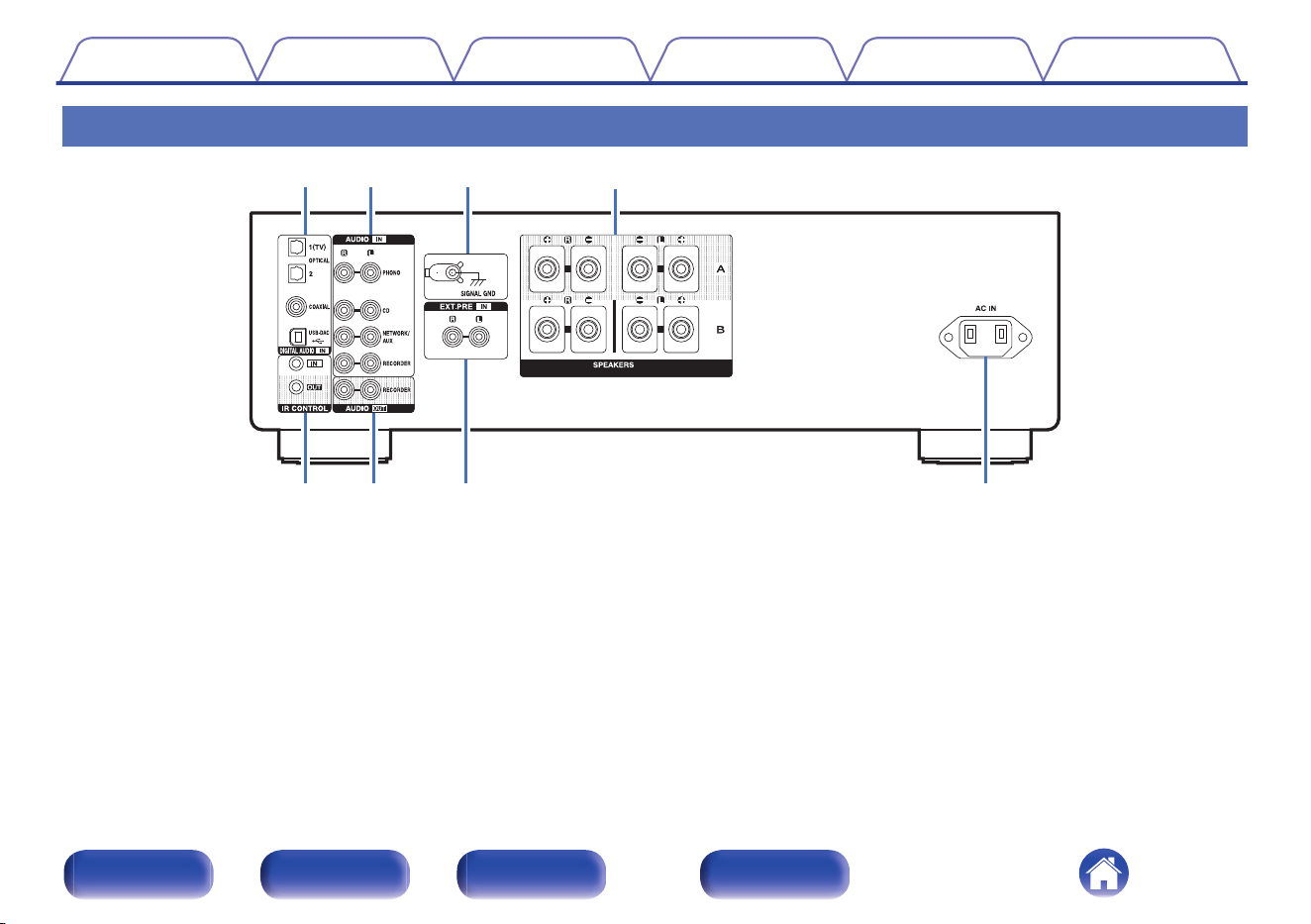
re
w
q
ty u i
A
DIGITAL AUDIO IN connectors
Used to connect devices equipped with digital audio output connectors
and computer.
0
“Connecting to a device with digital audio output
connectors” (v p. 22)
0
“Connecting a PC or Mac” (v p. 23)
B
Analog audio connectors (AUDIO IN)
Used to connect devices equipped with analog audio connectors.
0
“Connecting a playback device” (v p. 20)
0
“Connecting a recording device” (v p. 21)
C
SIGNAL GND terminal
Used to connect the ground wire of a turntable. (v p. 20)
D
Speaker terminals (SPEAKERS)
Used to connect speakers. (v p. 16)
E
IR CONTROL connectors
Used to connect Denon network audio players with an IR controller.
F
AUDIO OUT connectors
Used to connect the input connector of a recorder. (v p. 21)
G
EXT.PRE IN connectors
Used to connect a pre-amplifier when this unit is used as a power
amplifier. (v p. 24)
The volume should be adjusted on the connected device.
H
AC inlet (AC IN)
Used to connect the power cord. (v p. 25)
Contents
Connections Playback Settings Tips Appendix
10
Front panel Rear panel
Remote control
unit
Index
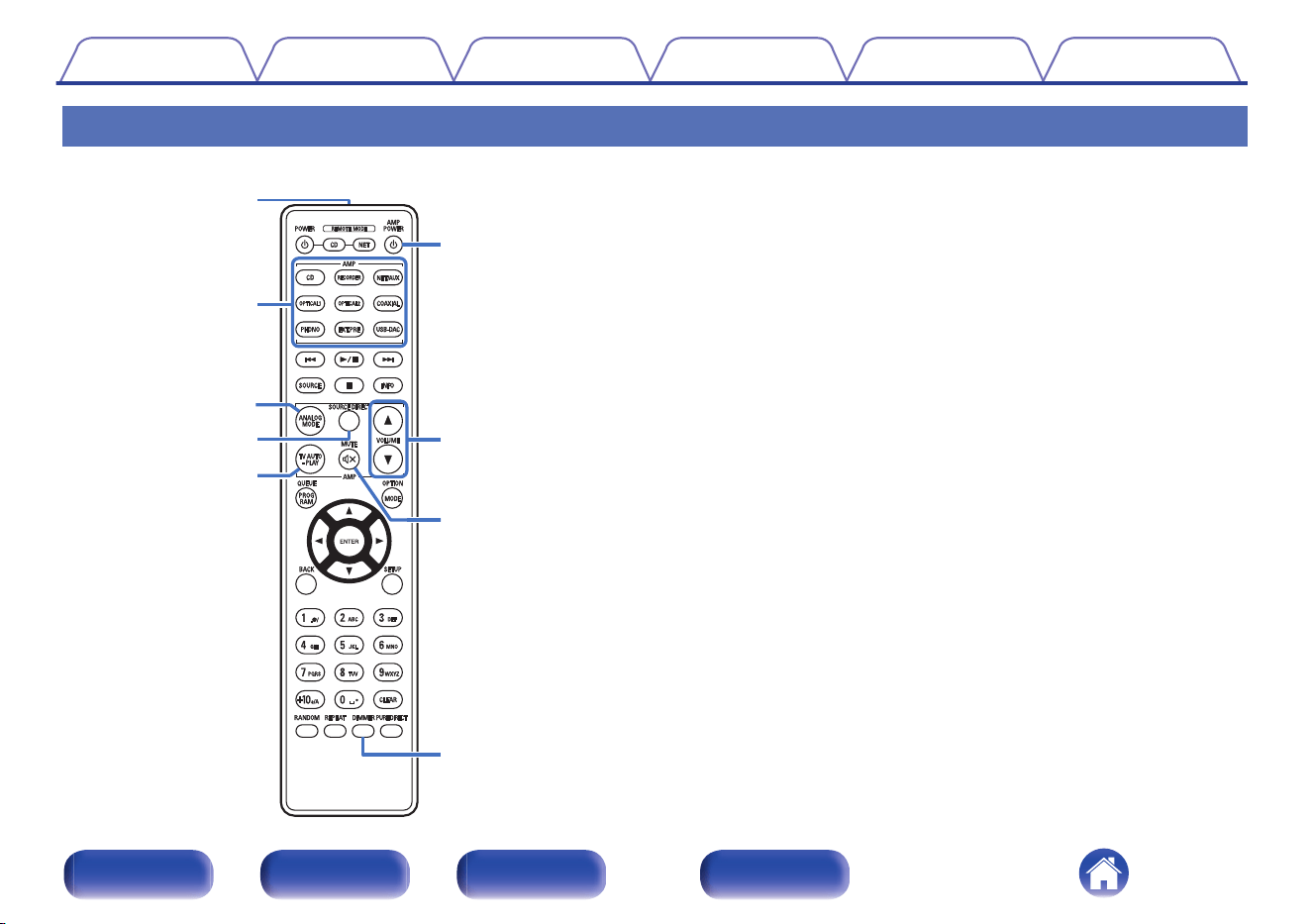
Remote control unit
w
r
y
u
t
i
o
q
e
The remote control provided with this unit can control a Denon CD player
and network audio player.
0
“CD player operations” (v p. 12)
0
“Network audio player operations” (v p. 13)
o
Operating this unit
A
Remote control signal transmitter
This transmits signals from the remote control unit. (v p. 5)
B
Input source select buttons
This selects the input source. (v p. 28)
C
ANALOG MODE button
This switches the analog mode 1/2/off. (v p. 30)
D
SOURCE DIRECT button
Switches the source direct mode. (v p. 30)
E
TV AUTO-PLAY button
This switches the digital input for the TV auto play. (v p. 42)
F
AMP POWER X button
This turns the power on/off (standby). (v p. 27)
G
VOLUME buttons (df)
These adjust the volume level. (v p. 28)
H
MUTE button (:)
This mutes the output audio. (v p. 28)
I
DIMMER button
This switches the brightness of the display. (v p. 29)
Contents
Connections Playback Settings Tips Appendix
11
Front panel Rear panel
Remote control
unit
Index
w
e
q
t
r
i
o
Q0
y
u
Q4
Q1
Q2
Q5
Q6
Q3
o
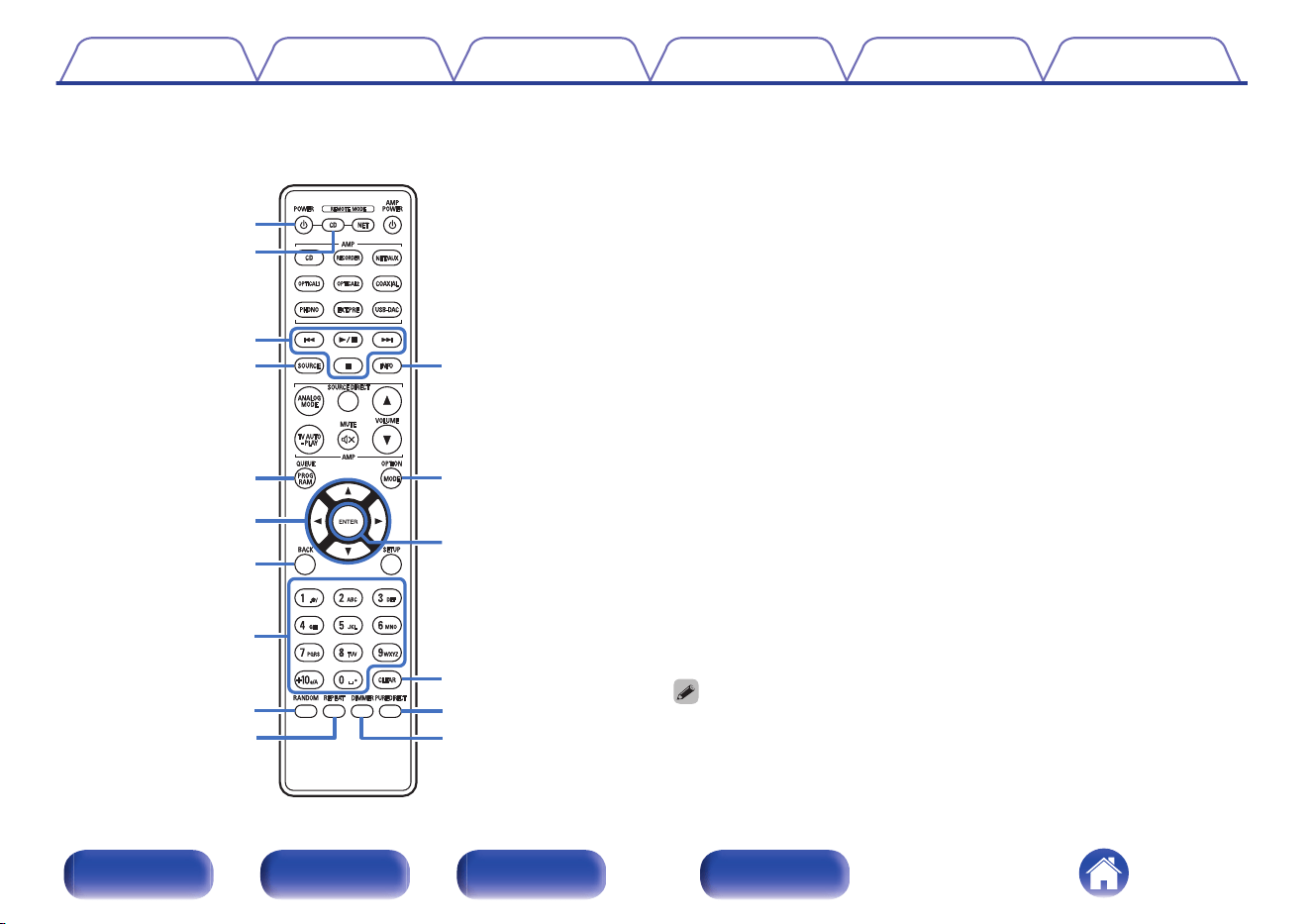
CD player operations
You can operate a Denon CD player.
To operate a CD player, press the REMOTE MODE CD button to
switch the remote control to the CD player operation mode.
A
POWER X button
B
Remote mode select button
(REMOTE MODE CD)
C
System buttons
D
SOURCE button
E
PROGRAM button
F
Cursor buttons (uio p)
G
BACK button
H
Number buttons (0 – 9, +10)
I
RANDOM button
J
REPEAT button
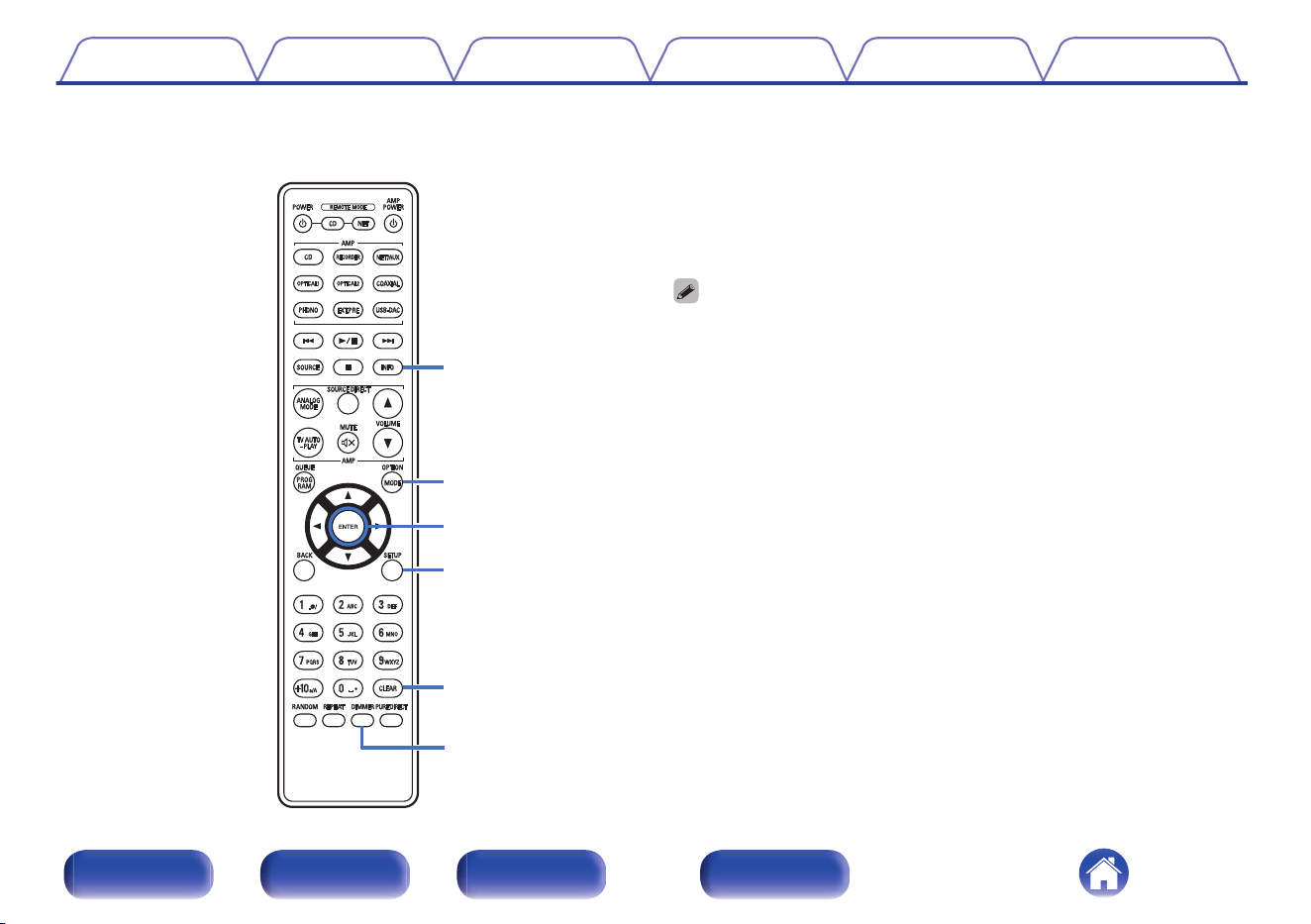
K
Information button (INFO)
L
MODE button
M
ENTER button
N
CLEAR button
O
PURE DIRECT button
P
DIMMER button
0
The remote control may not operate some products.
Contents Connections Playback Settings Tips Appendix
12
Front panel Rear panel
Remote control
unit
Index
w
e
q
t
r
i
o
Q0
y
u
o
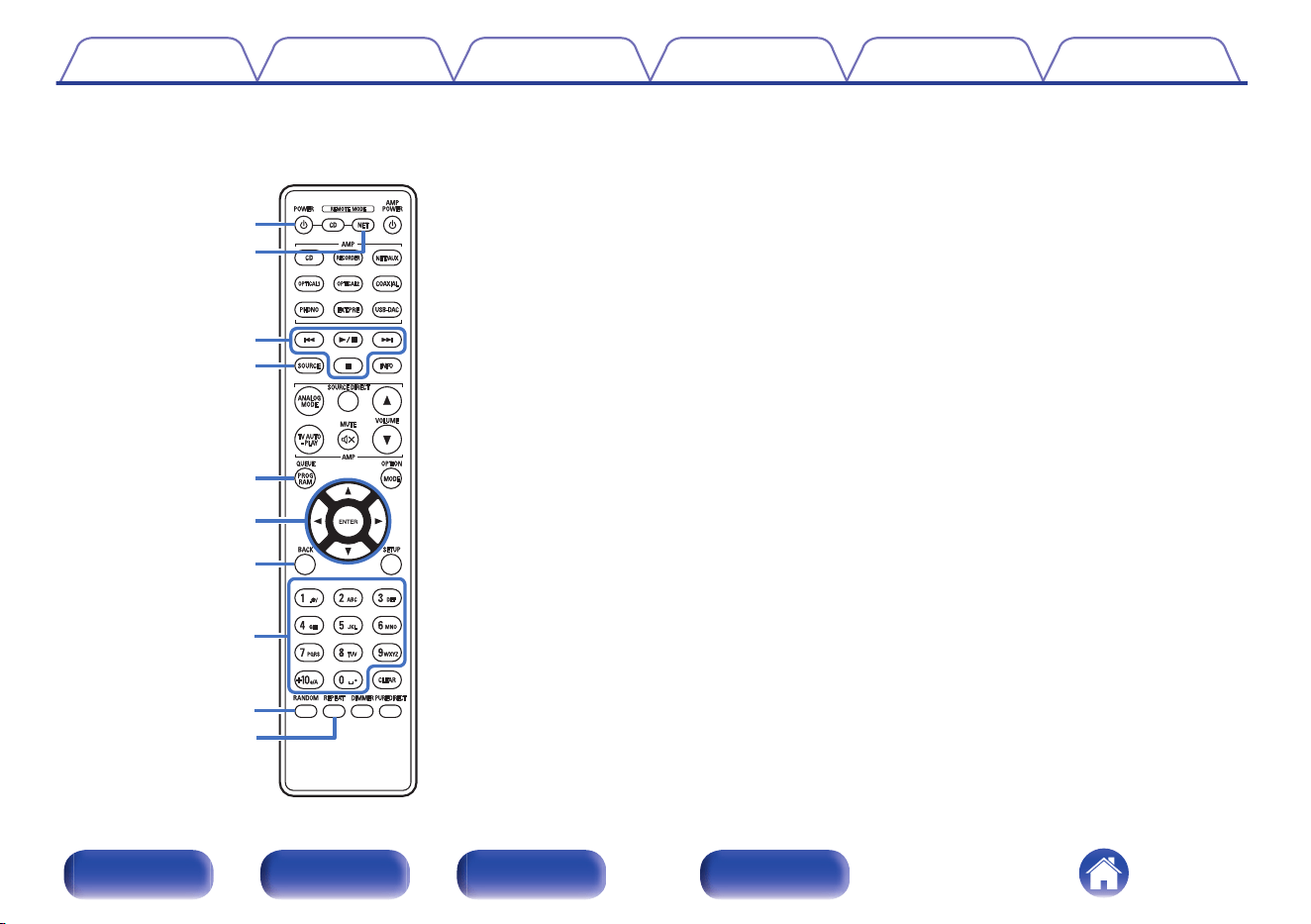
Network audio player operations
You can operate a Denon network audio player.
To operate a network audio player, press the REMOTE MODE NET
button to switch the remote control to the network audio player
operation mode.
A
POWER X button
B
Remote mode select button
(REMOTE MODE NET)
C
System buttons
D
SOURCE button
E
QUEUE button
F
Cursor buttons (uio p)
G
BACK button
H
Number/letter buttons (0 – 9, +10)
I
RANDOM button
J
REPEAT button
Contents Connections Playback Settings Tips Appendix
13
Front panel Rear panel
Remote control
unit
Index
o
Contents
Connecting speakers 16
Connecting a playback device 20
Connecting a recording device 21
Connecting to a device with digital audio output connectors 22
Connecting a PC or Mac 23
Connecting a pre-amplifier 24
Connecting the power cord 25
NOTE
0
Do not plug in the power cord until all connections have been completed.
0
Do not bundle power cords together with connection cables. Doing so can result in
humming or noise.
o
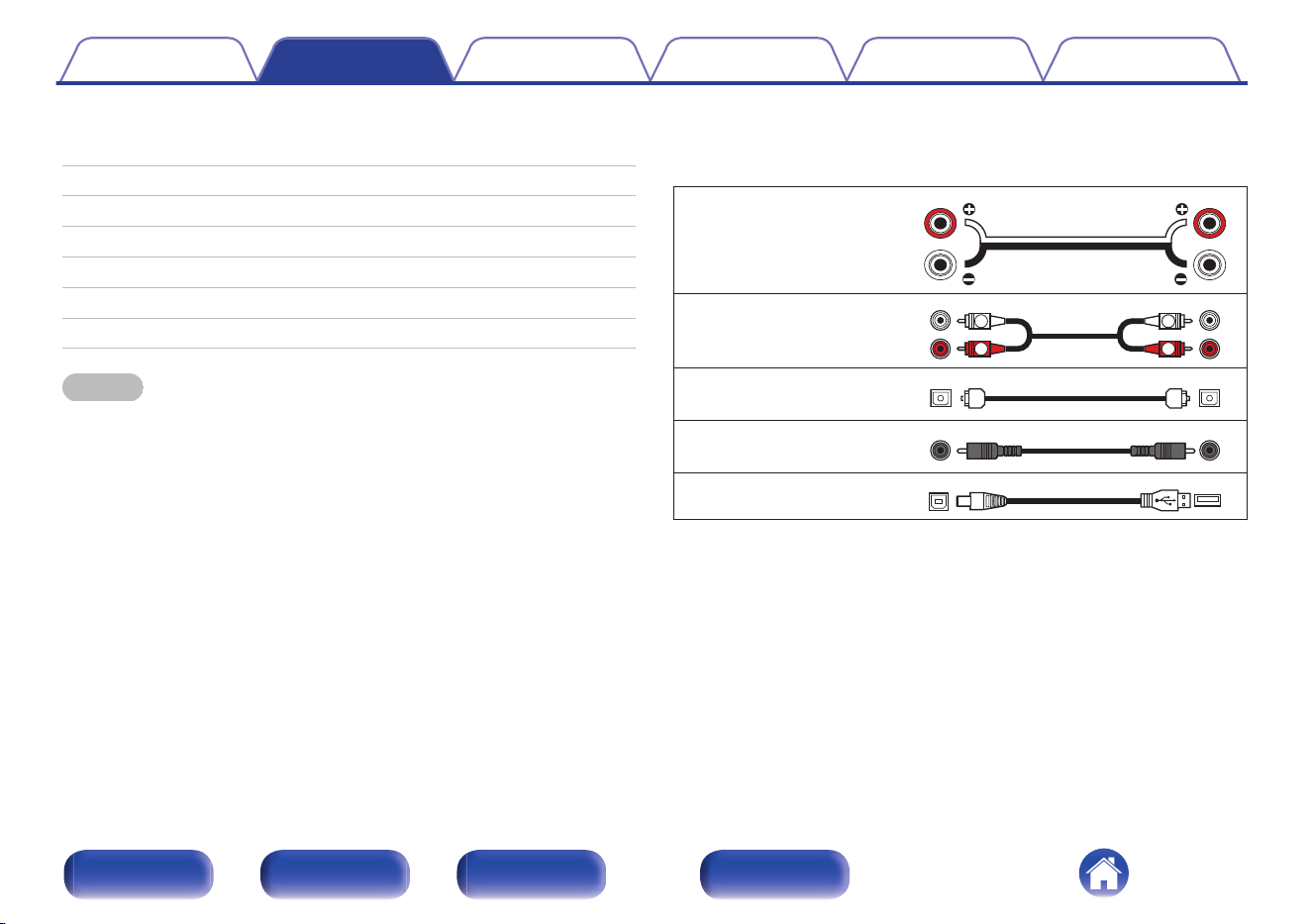
Cables used for connections
Provide necessary cables according to the devices you want to
connect.
Speaker cable
Audio cable
R
L
R
L
Optical cable
Coaxial digital cable
USB cable
Contents Connections Playback Settings Tips Appendix
15
Front panel Rear panel
Remote control
unit
Index
Connecting speakers
NOTE
0
Disconnect this unit’s power plug from the power outlet before connecting the
speakers.
0
Connect so that the speaker cable core wires do not protrude from the speaker
terminal. The protection circuit may be activated if the core wires touch the rear
panel or if the + and - sides touch each other. (“Protection circuit” (v p. 54))
0
Never touch the speaker terminals while the power cord is connected. Doing so
could result in electric shock.
0
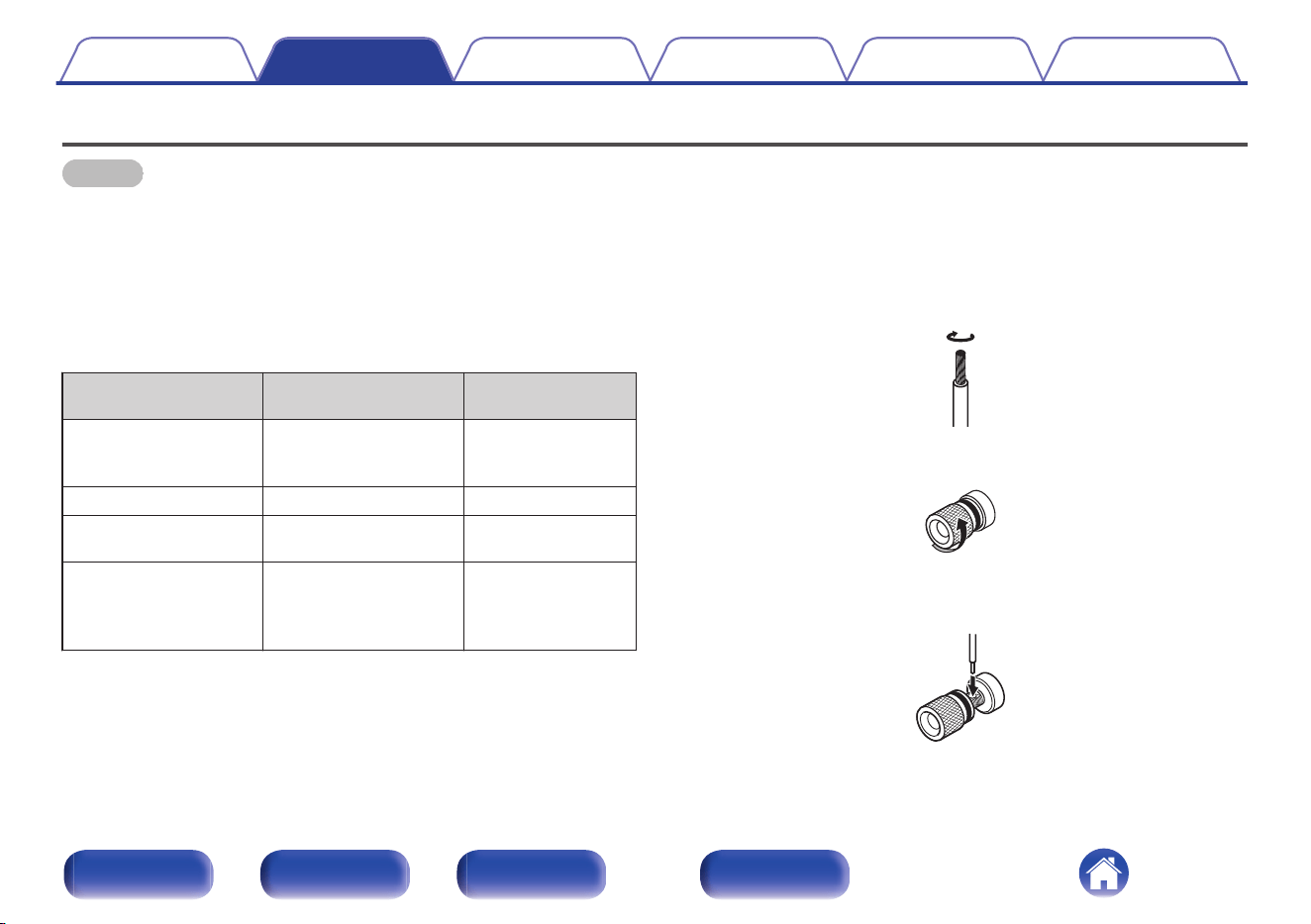
Use speakers with impedances within the ranges shown below to suit how they
are used.
Speaker terminals
used on this unit
No. of connected
speakers
Speaker
Impedance
SPEAKERS A
(Standard
connection)
2 (one set) 4 – 16 Ω/ohms
SPEAKERS B
2 (one set) 4 – 16 Ω/ohms
SPEAKERS A and
SPEAKERS B
4 (two sets) 8 – 16 Ω/ohms
SPEAKERS A and
SPEAKERS B
(Bi-wiring
connection)
2 (one set) 4 – 16 Ω/ohms
o
Connecting the speaker cables
Carefully check the left (L) and right (R) channels and + (red) and –
(black) polarities on the speakers being connected to this unit, and be
sure to connect the channels and polarities correctly.
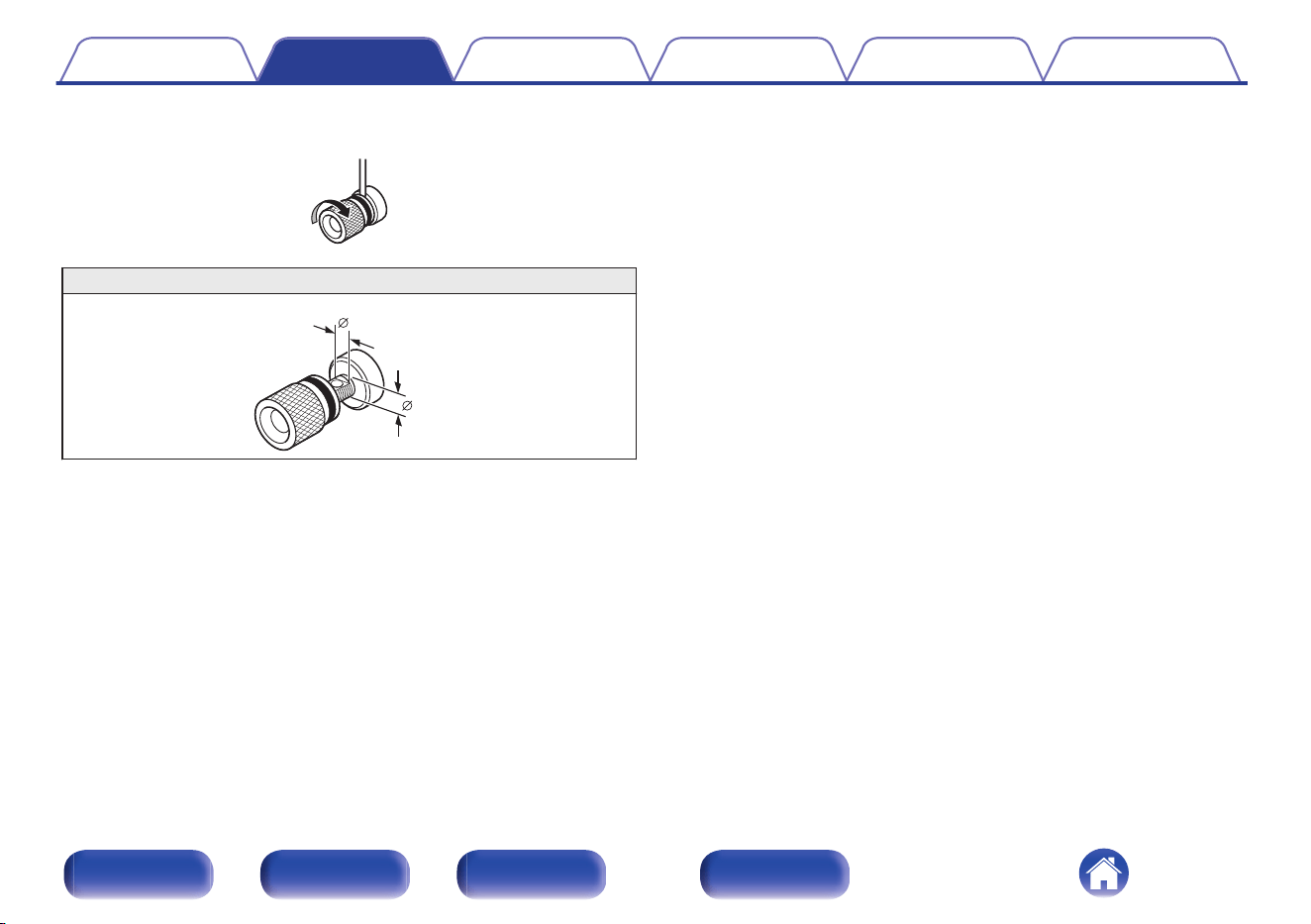
1
Peel off about 10 mm of sheathing from the tip of the speaker
cable, then either twist the core wire tightly or terminate it.
2
Turn the speaker terminal counterclockwise to loosen it.
3
Insert the speaker cable’s core wire to all the way into
the speaker terminal.
Contents Connections Playback Settings Tips Appendix
16
Front panel Rear panel
Remote control
unit
Index
Speaker connection
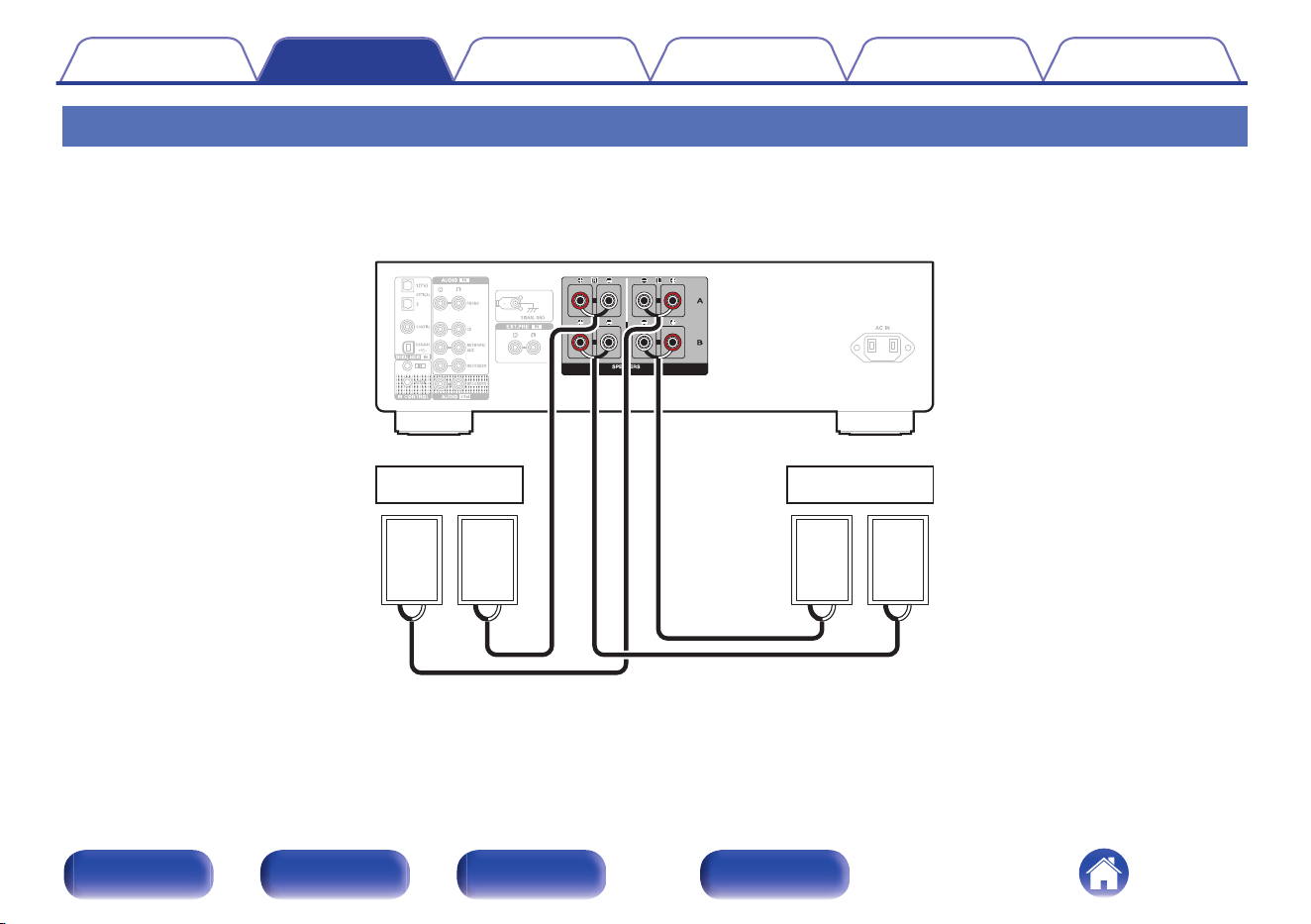
This unit is equipped with two sets of speaker terminals (SPEAKER A and SPEAKER B). One set of speakers can be connected to each set of terminals,
and a total of two sets of speakers can be connected.
The same signal is output from the SPEAKERS A and SPEAKERS B terminals.
When only one set of speakers is to be connected, use either the SPEAKERS A or SPEAKERS B terminals.
wqwq
(R) (L)
wqwq
(R) (L)
SPEAKERS A
SPEAKERS B
Contents
Connections Playback Settings Tips Appendix
18
Front panel Rear panel
Remote control
unit
Index
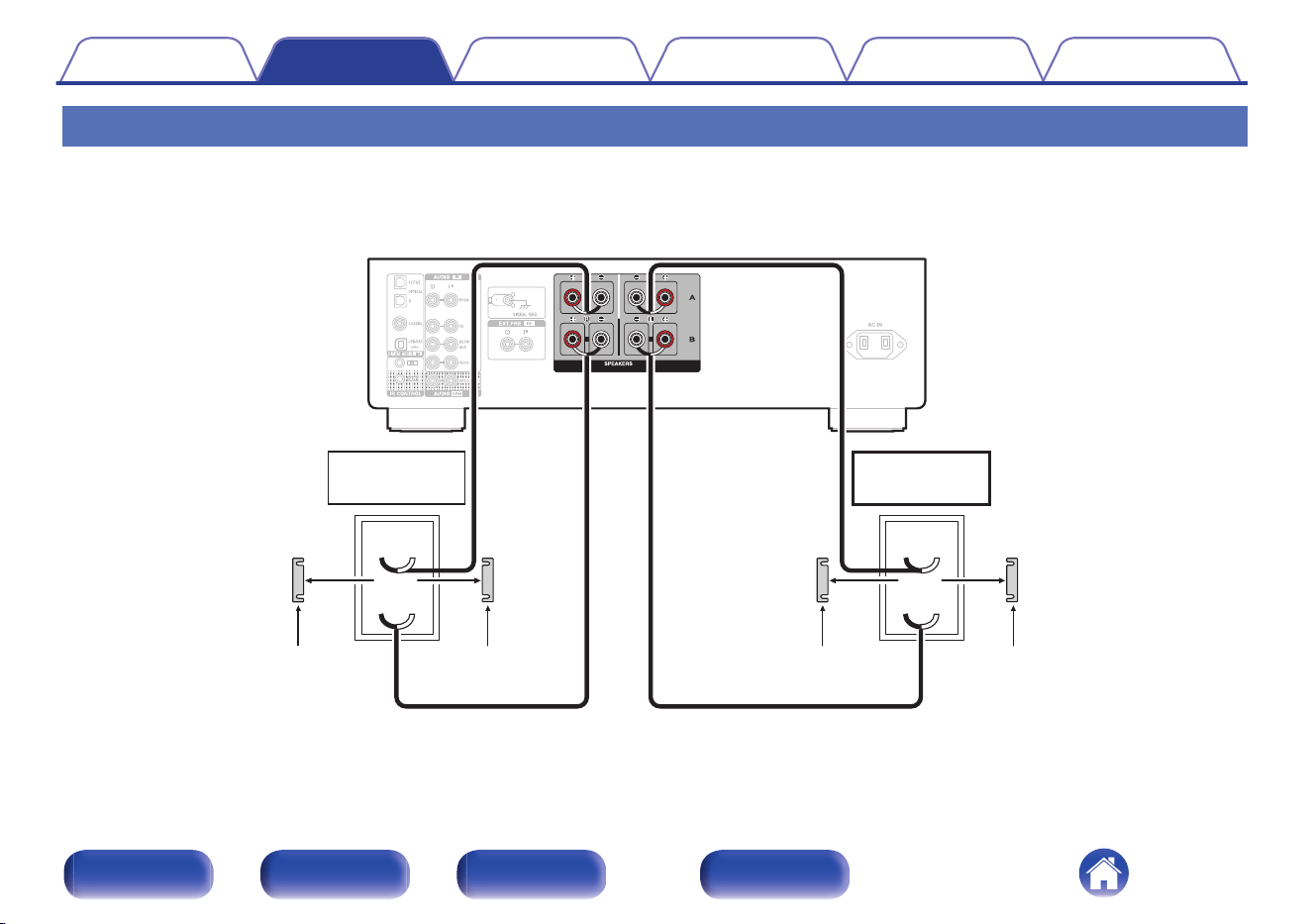
Bi-wiring connection
This connection limits the effects of signal interference between the high range speakers (tweeters) and low range speakers (woofers), allowing you to
enjoy high quality playback.
When bi-wiring with bi-wireable speakers, connect the mid and high range terminals to SPEAKERS A (or SPEAKERS B), the low range terminals to
SPEAKERS B (or SPEAKERS A).
wq
wq
HIGH
LOW
wq
wq
HIGH
LOW
Speaker
(R)
Speaker
(L)
Remove shorting bar
Remove shorting bar
Remove shorting barRemove shorting bar
Contents Connections Playback Settings Tips Appendix
19
Front panel Rear panel
Remote control
unit
Index
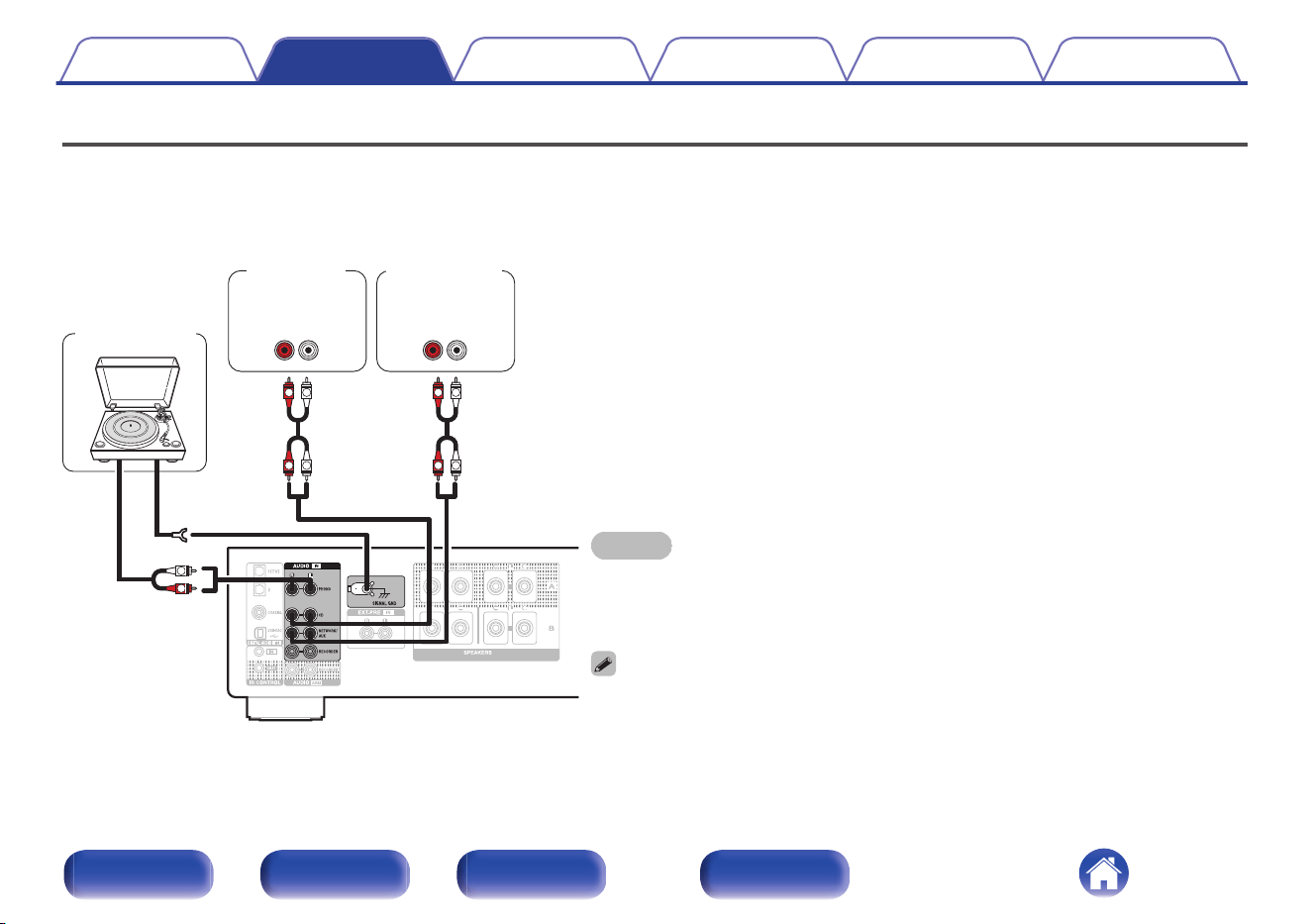
Connecting a playback device
You can connect turntables, CD players and network audio players to this unit.
If you set this unit’s input source to “PHONO” and you accidentally increase the volume without having a turntable connected, you may hear a hum noise
from the speakers.
NOTE
0
The earth terminal (SIGNAL GND) of this unit is not for safety grounding purposes. If this
terminal is connected when there is a lot of noise, the noise can be reduced. Note that
depending on the turntable, connecting the ground line may have the reverse effect of
increasing noise. In this case, it is not necessary to connect the ground line.
0
The PHONO input terminals are equipped with a short pin-plug. Remove this plug to connect a
record player. Store the removed short pin-plug in a safe place so as not to lose it.
GND
AUDIO
OUT
L
R
AUDIO
OUT
LR
AUDIO
OUT
LR
L
L
R
R
L
L
R
R
Network audio
player
CD player
Turntable
Contents Connections Playback Settings Tips Appendix
20
Front panel Rear panel
Remote control
unit
Index
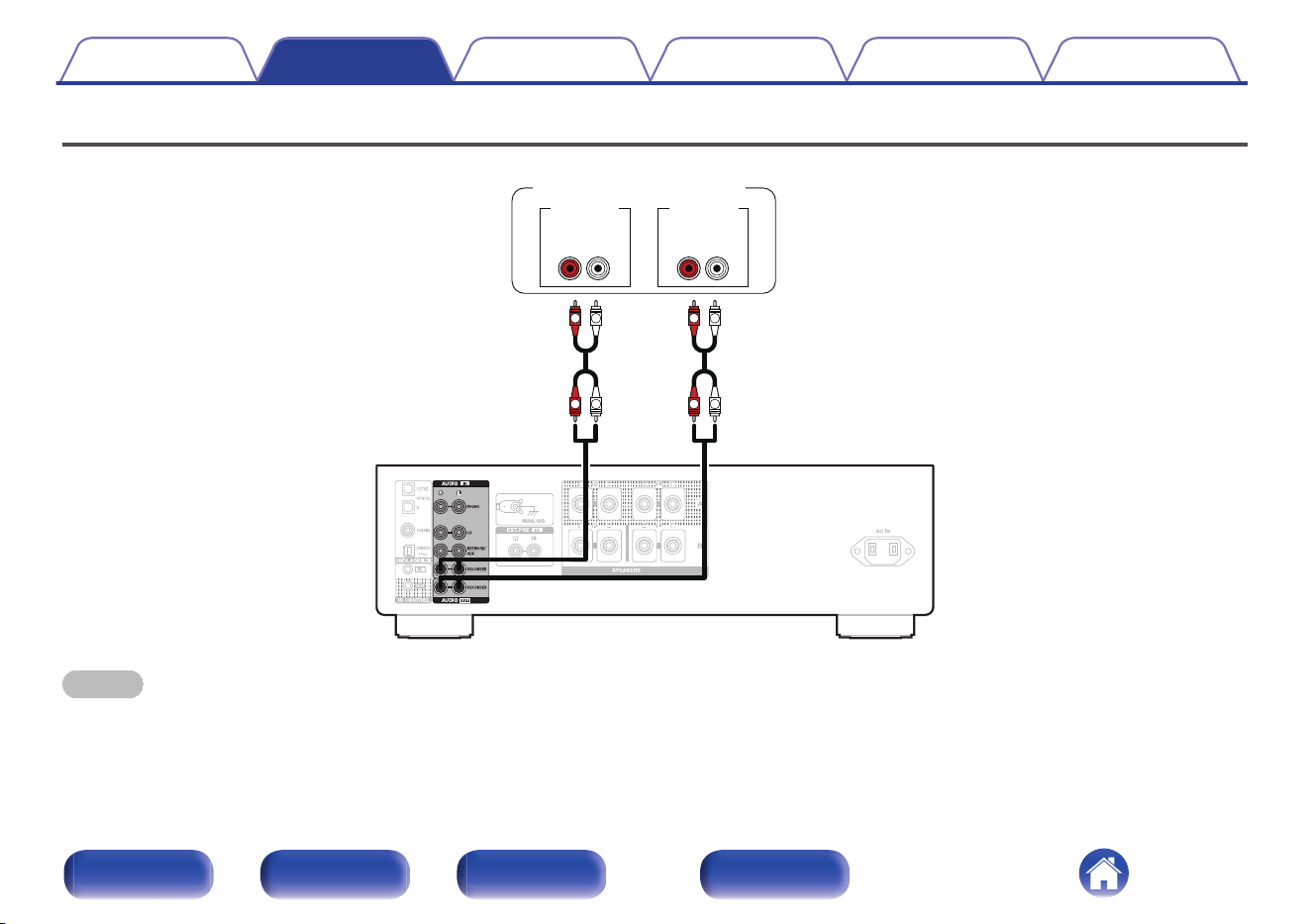
Connecting a recording device
LR LR
AUDIO OUT
L
L
R
R
L
L
R
R
AUDIO IN
Recording device
NOTE
0
Never insert the short-circuiting pin plug into the recording output connectors (AUDIO OUT RECORDER). Doing so could result in damage.
Contents Connections Playback Settings Tips Appendix
21
Front panel Rear panel
Remote control
unit
Index
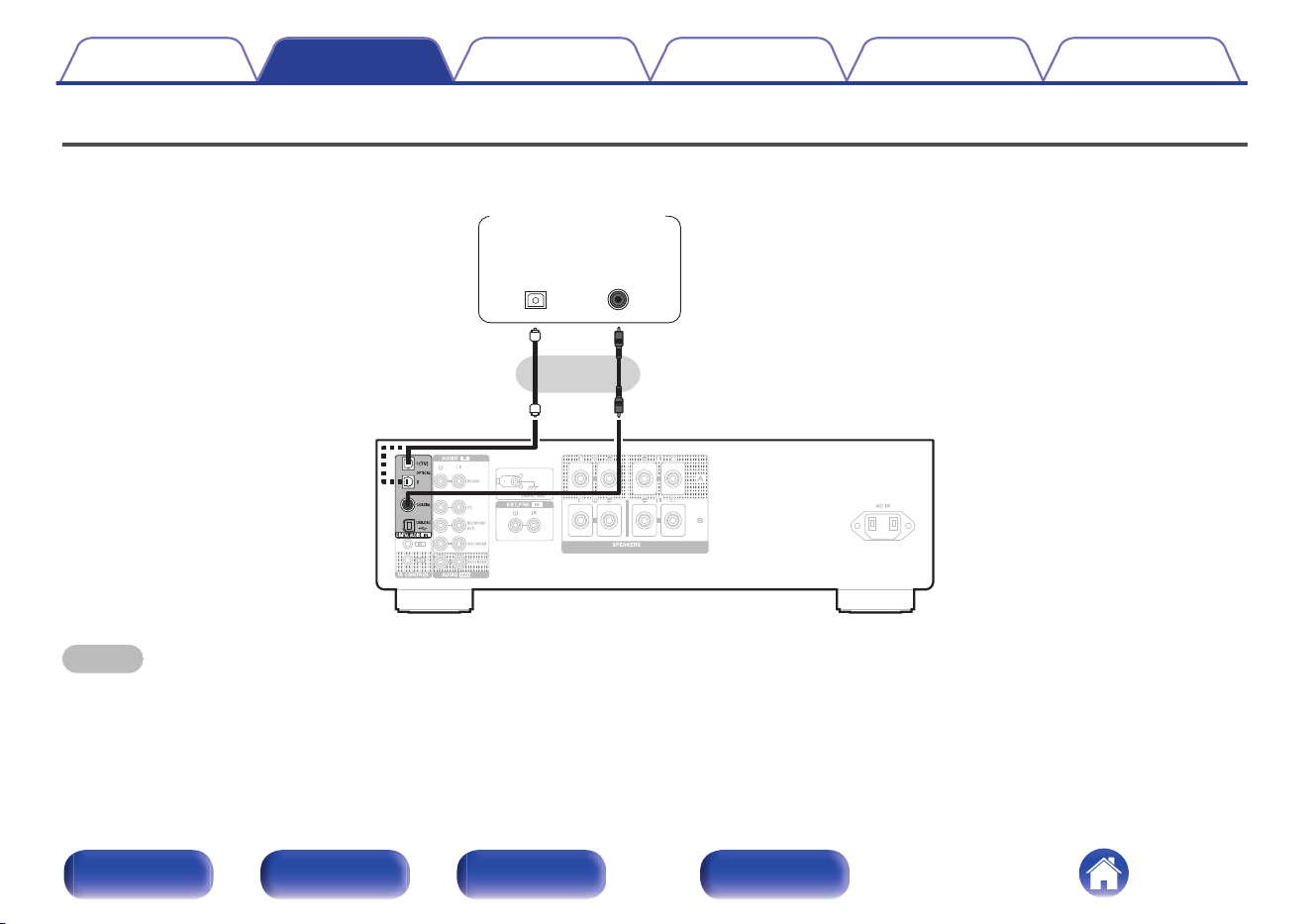
Connecting to a device with digital audio output connectors
Use this connection to input digital audio signals to this unit, and convert the signals for playback using the D/A converter of this unit. (v p. 31)
OPTICAL
OUT
COAXIAL
OUT
CD player /
Satellite receiver etc.
or
NOTE
0
Linear PCM signals with a sampling frequency of 32 kHz, 44.1 kHz, 48 kHz, 88.2 kHz, 96 kHz, 176.4 kHz, or 192 kHz can be input into this unit.
0
Do not input non-PCM signals, such as Dolby Digital, DTS and AAC. This causes noise and could damage the speakers.
0
Line up the optical cable with the shape of the terminal to insert.
Contents Connections Playback Settings Tips Appendix
22
Front panel Rear panel
Remote control
unit
Index
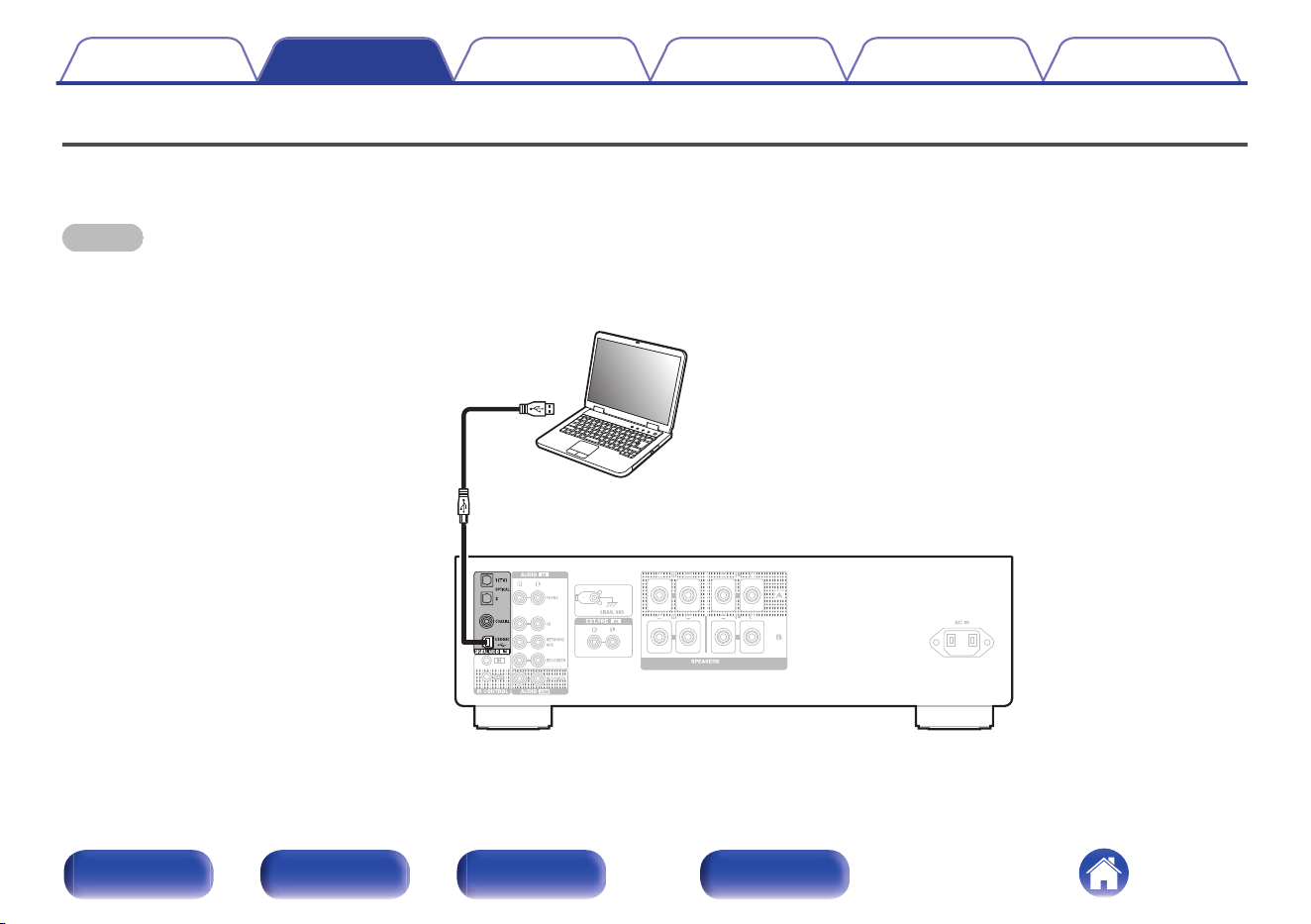
Connecting a PC or Mac
By connecting a computer to the USB-DAC port on the rear panel of this unit using a commercially available USB connecting cable, this unit can be used
as a D/A converter. (v p. 31)
NOTE
0
Before USB connecting this unit to your computer, install the driver software in your computer. (v p. 32)
0
Download the driver software from the PMA-1700NE page of the Denon website.
0
Use a cable that is 3 m or less to connect to the computer.
USB 2.0 cable
(Sold separately)
Ty p e B
Computer on which the driver software and audio
player software are installed
Contents Connections Playback Settings Tips Appendix
23
Front panel Rear panel
Remote control
unit
Index
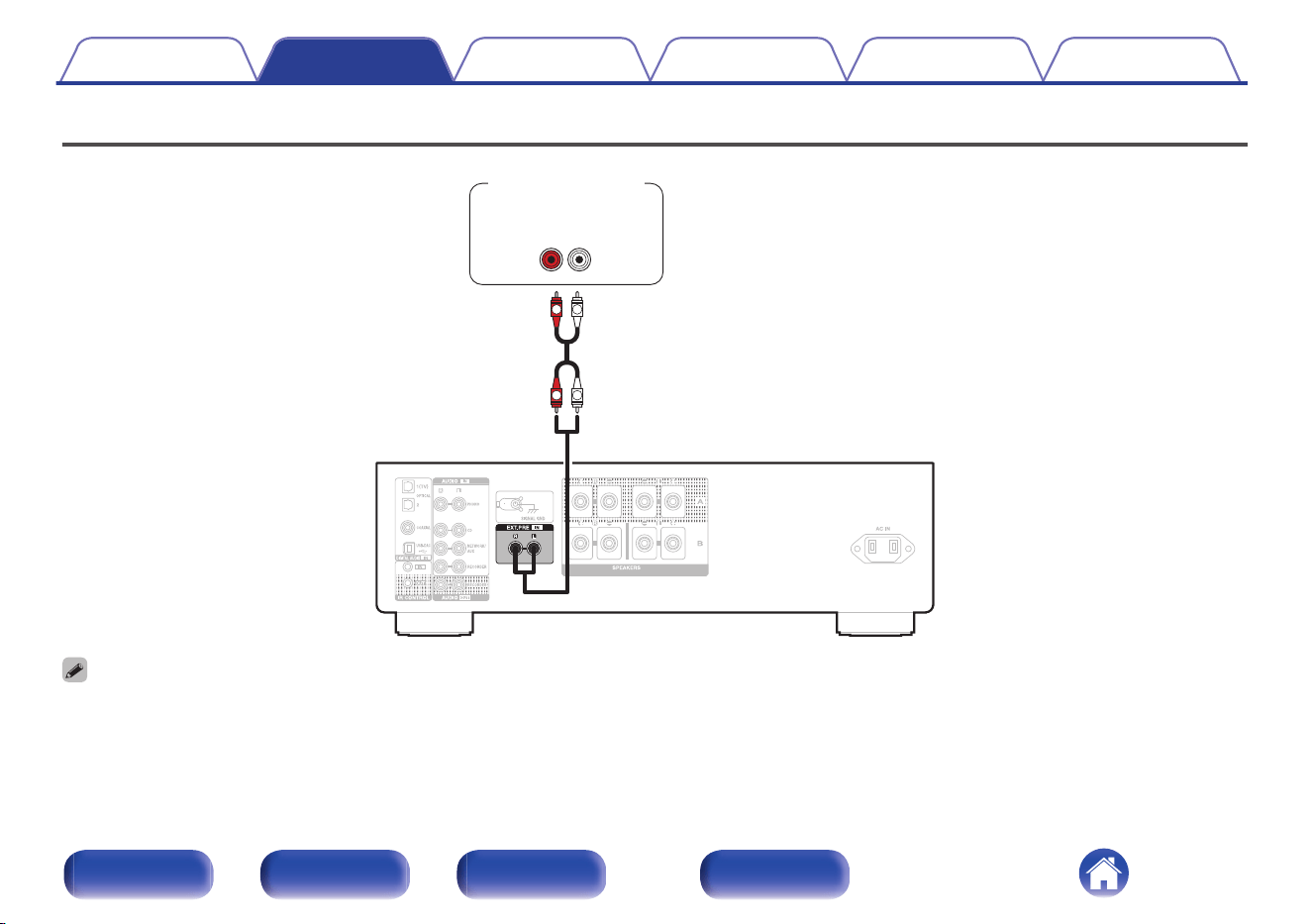
Connecting a pre-amplifier
AUDIO
OUT
LR
R
R
L
L
Pre-amplifier
0
The EXT.PRE input terminals are equipped with a short pin-plug. Remove this plug to connect a pre-amplifier. Store the removed short pin-plug in a safe place so as not to
lose it.
Contents Connections Playback Settings Tips Appendix
24
Front panel Rear panel
Remote control
unit
Index
o
Contents
Turning the power on 27
Switching the power to standby 27
Selecting the input source 28
Adjusting the volume 28
Turning off the sound temporarily (Muting) 28
Adjusting the tone and balance 28
Switching the display’s brightness 29
Playing CDs 30
Connecting and playing back from a computer (USB-DAC) 31
Connecting and playing back from a digital device (Coaxial/Optical
1/Optical 2) 40
Recording 41
Contents Connections Playback Settings Tips Appendix
26
Front panel Rear panel
Remote control
unit
Index
ANALOG
MODE
BALANCETREBLE
INPUT SELECTOR
VOLUMEBASS
X
SOURCE
DIRECT
Power indicator
AMP POWER
X
USB-DAC
OPTICAL2
OPTICAL1
MUTE
DIMMER
VOLUME
df
CD
ANALOG MODE
SOURCE DIRECT
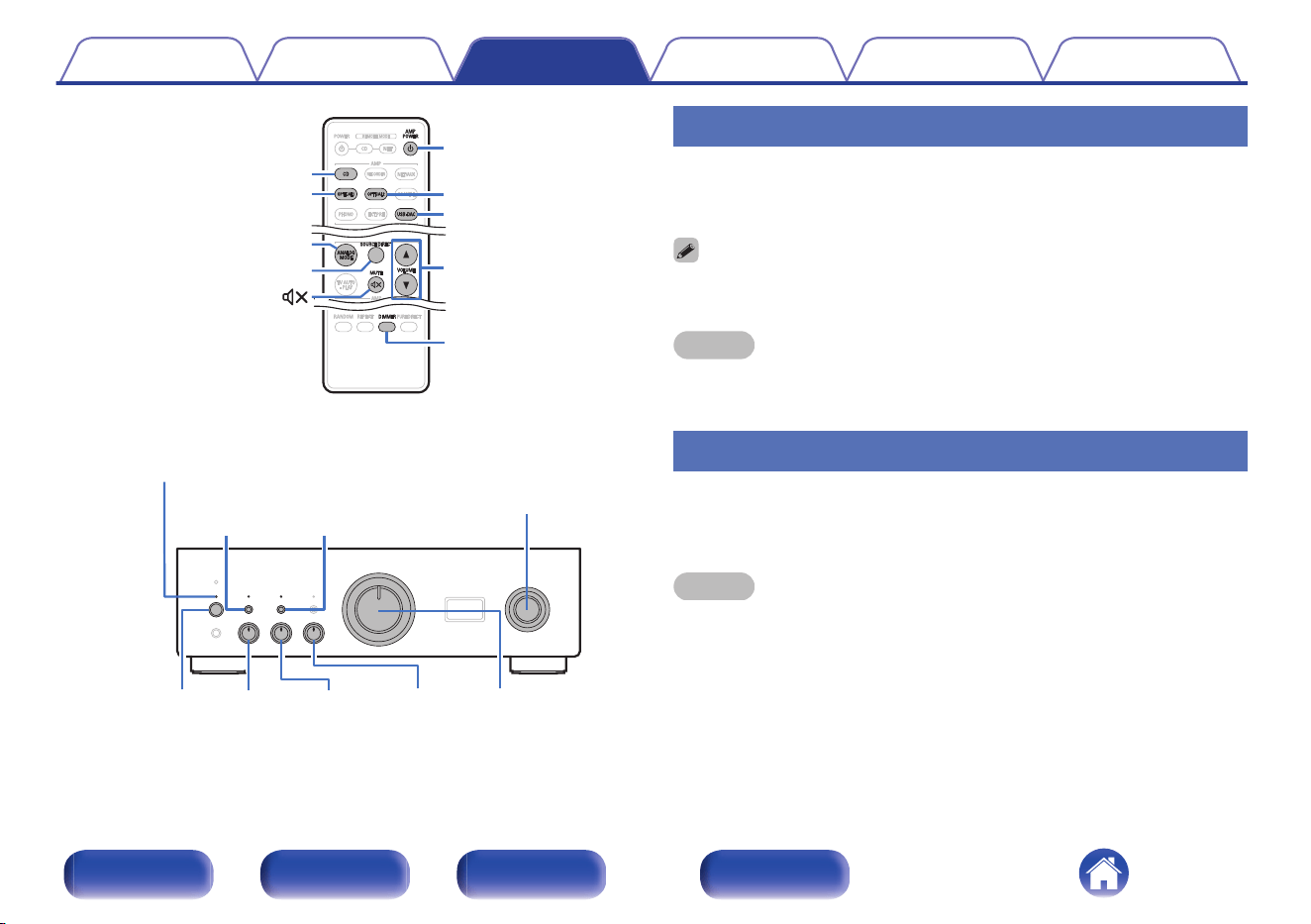
Turning the power on
1
Press X on the main unit to turn the power on.
The power indicator lights green.
0
Press AMP POWER X on the remote control unit to turn on power from standby
mode.
NOTE
0
Turn volume knob on the main unit to adjust the volume to the lowest level before
turning on the power.
Switching the power to standby
1
Press AMP POWER X.
The unit switches to standby mode.
NOTE
0
Power continues to be supplied to some of the circuitry even when the power is in
the standby mode. When leaving home for long periods of time or when going on
vacation, either press X on the main unit to turn off the power, or unplug the power
cord from the power outlet.
Contents Connections Playback Settings Tips Appendix
27
Front panel Rear panel
Remote control
unit
Index
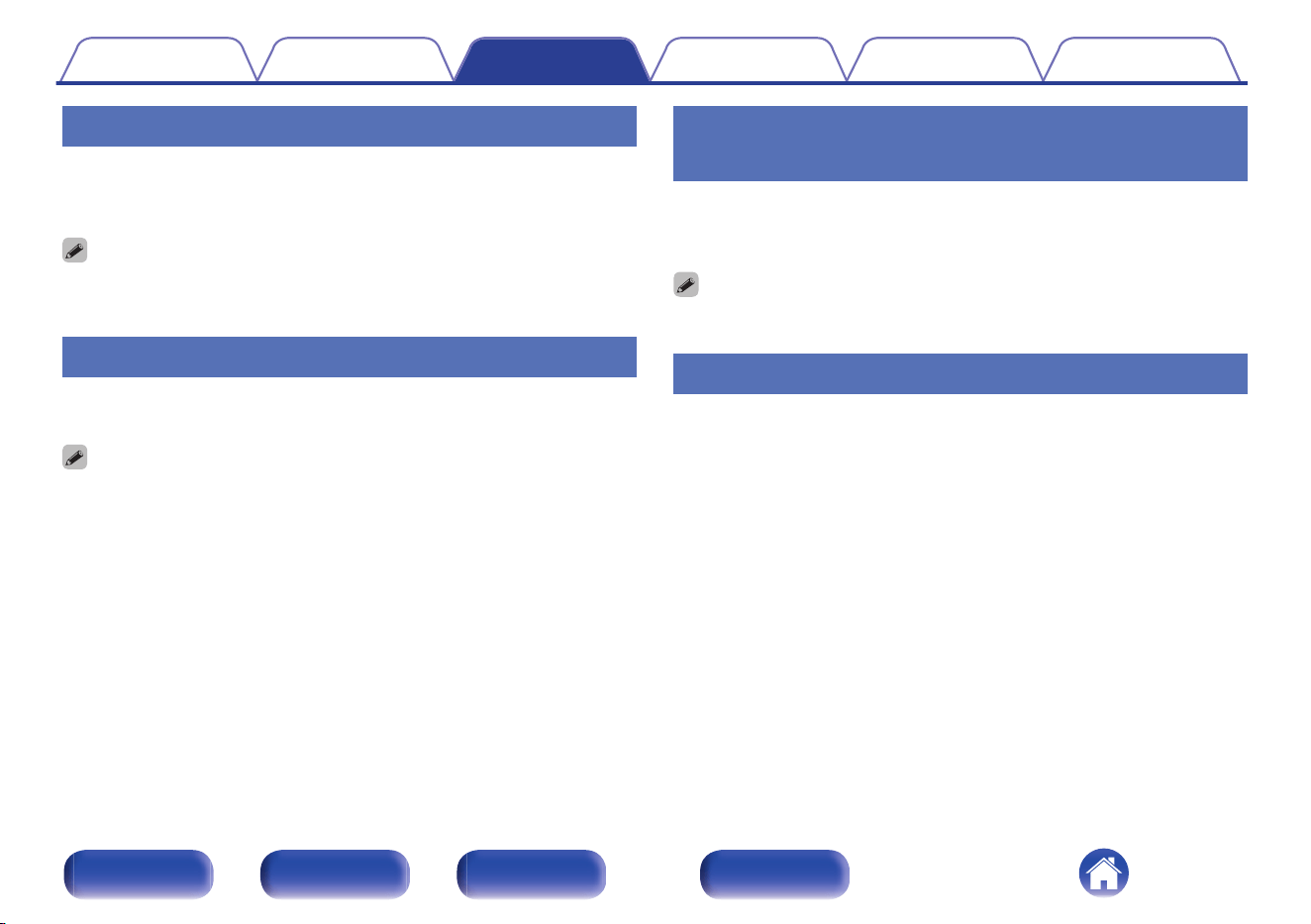
Selecting the input source
1
Press the input source select button to be played back.
The selected input source is displayed on the display of this unit.
0
You can also select the input source by turning INPUT SELECTOR on the main
unit.
Adjusting the volume
1
Press VOLUME df to adjust the volume.
0
You can also adjust the volume by turning VOLUME on the main unit.
Turning off the sound temporarily
(Muting)
1
Press MUTE :.
“MUTE” is displayed on the display of this unit.
0
To cancel mute, either adjust the sound volume or press MUTE : again.
Adjusting the tone and balance
1
Press SOURCE DIRECT to turn off source direct mode.
The SOURCE DIRECT indicator turns off.
2
Turn the BASS, TREBLE and BALANCE on the main
unit to adjust the tone and balance.
Contents Connections Playback Settings Tips Appendix
28
Front panel Rear panel
Remote control
unit
Index
Switching the display’s brightness
The display brightness can be adjusted between four levels. Switching the
display off reduces a source of noise that affects sound quality, enabling
higher sound quality playback.
1
Press DIMMER.
0
The brightness of the display switches each time the button is
pressed.
0
The display brightness is set to most brightly by default.
0
The DIMMER button also controls the Denon's CD player, so the CD player can be
operated simultaneously with this unit. When the two units have different settings,
press and hold in the button for lease 2 seconds to reset them both to the default
setting, then make the desired setting.
Contents Connections Playback Settings Tips Appendix
29
Front panel Rear panel
Remote control
unit
Index
Playing CDs
This section uses playback from a CD as an example.
1
Press the input source select button (CD) to switch the
input source to “CD”.
“CD” is displayed on the display of this unit.
2
Playback the CD.
3
Press VOLUME df to adjust the volume.
o
Playback in source direct mode
The signal does not pass through the tone adjustment circuitry (BASS,
TREBLE and BALANCE), resulting in playback of a higher sound
quality.
1
Press SOURCE DIRECT to turn on source direct mode.
The SOURCE DIRECT indicator lights.
o
Playback in analog mode
When the analog mode is turned on to playback an analog source
(PHONO, CD, NET/AUX, RECORDER, EXT.PRE), power to the digital
input circuit and the display turn off. This enables you to enjoy high
sound quality audio playback without sound quality being affected by
noise that occurs from the digital control circuit.
1
Press ANALOG MODE to turn analog mode on.
The ANALOG MODE indicator lights.
0
Press ANALOG MODE to toggle between “ANALOG MODE Off”,
“ANALOG MODE 1” and “ANALOG MODE 2”.
ANALOG MODE Off: Analog mode is not used.
ANALOG MODE 1: Turns the digital input circuit power off.
ANALOG MODE 2:
Turns the digital input circuit power and
display off.
0
A digital input source (COAXIAL, OPTICAL 1/2, USB-DAC) cannot be selected
when analog mode is on.
0
The input source automatically switches to CD if analog mode is turned on during
playback of a digital input source (COAXIAL, OPTICAL 1/2, USB-DAC).
0
Communication between this unit and the computer is disconnected if analog
mode is turned on when a computer is connected to the USB-DAC input connector
of this unit. If the unit cannot communicate with the computer after turning analog
mode off again, disconnect and reconnect the USB cable or restart the audio
player on the computer.
0
When the analog mode is switched, the mute circuit is activated for about 5
seconds.
Contents Connections Playback Settings Tips Appendix
30
Front panel Rear panel
Remote control
unit
Index
Connecting and playing back from a
computer (USB-DAC)
You can enjoy high-quality audio playback from the D/A converter built in
to this unit by inputting music files into this unit from a computer via USB
connection.
0
Before USB connecting this unit to your computer, install the driver
software in your computer.
0
Drivers do not need to be installed for macOS.
0
Also, you can use whichever commercially available or downloadable
player software you like to playback files on your computer.
o
Computer (system requirements)
OS
0
Windows 10 or Windows 11
0
macOS 11 or 12
USB
0
USB 2.0: USB High speed/USB Audio Class Ver. 2.0
NOTE
0
This unit was checked the operation using the system requirements by us, but
it does not guarantee the operation of all systems.
0
DSD is a registered trademark.
0
Microsoft, Windows 10 and Windows 11 are either registered
trademarks or trademarks of Microsoft Corporation in the United
States and/or other countries.
0
ASIO is a trademark of Steinberg Media Technologies GmbH.
0
Apple, Macintosh and macOS are trademarks of Apple Inc.,
registered in the U.S. and other countries.
Windows
OS
Installing the dedicated driver (v p. 32)
macOS
Audio Device Settings (v p. 38)
Contents Connections Playback Settings Tips Appendix
31
Front panel Rear panel
Remote control
unit
Index
o
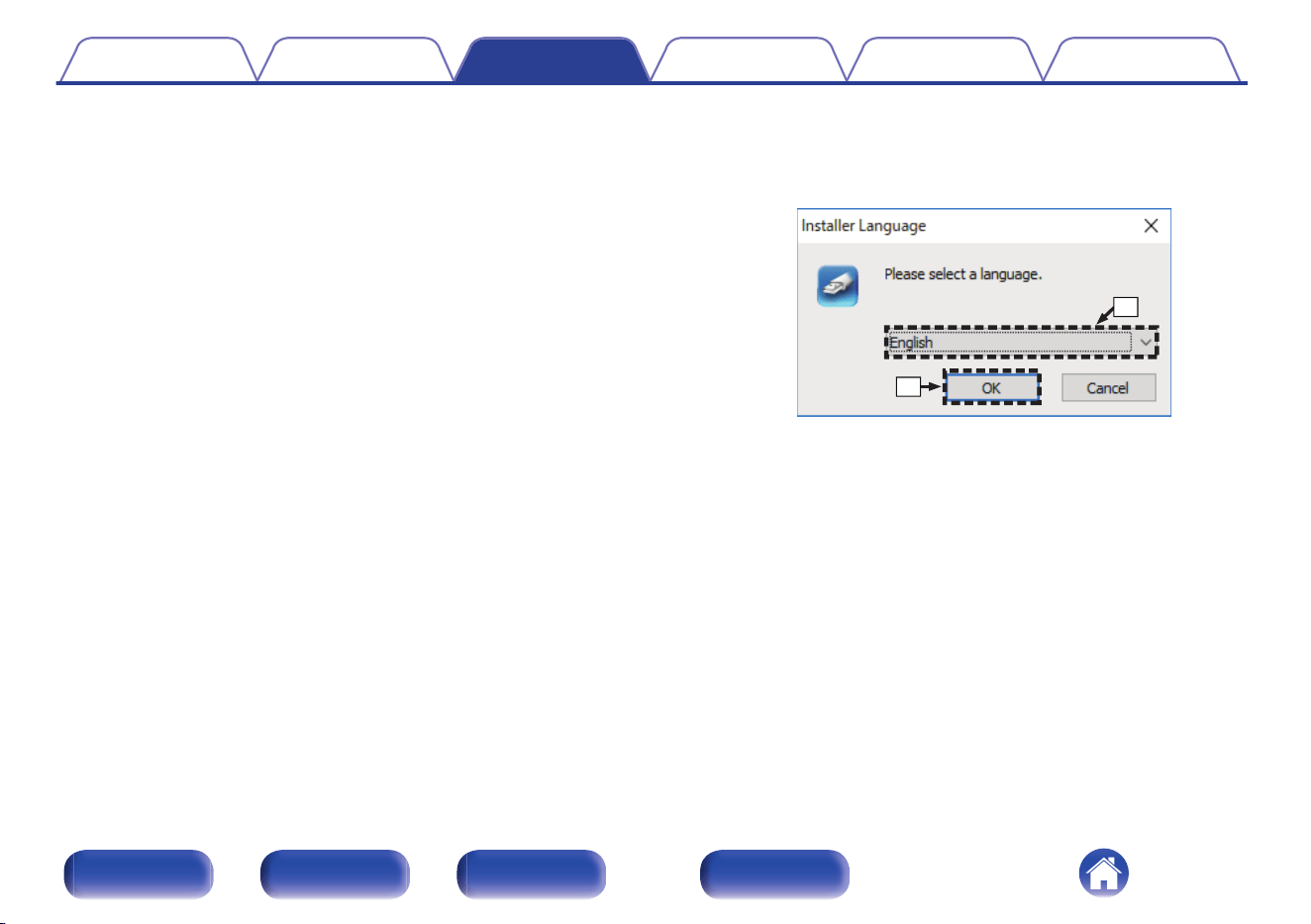
Installing the dedicated driver
(Windows OS only)
n
Installing the driver software
1
Disconnect the USB cable between your PC and the
unit.
0
The driver software cannot be installed correctly if your PC is
connected to the unit by a USB cable.
0
If the unit and your computer are connected by a USB cable and
the computer is switched on before installation, disconnect the
USB and restart the computer.
2
Download the dedicated driver from the “Download”
section of the PMA-1700NE page of the Denon website
onto your PC.
3
Unzip the downloaded file, and double-click the exe
file.
4
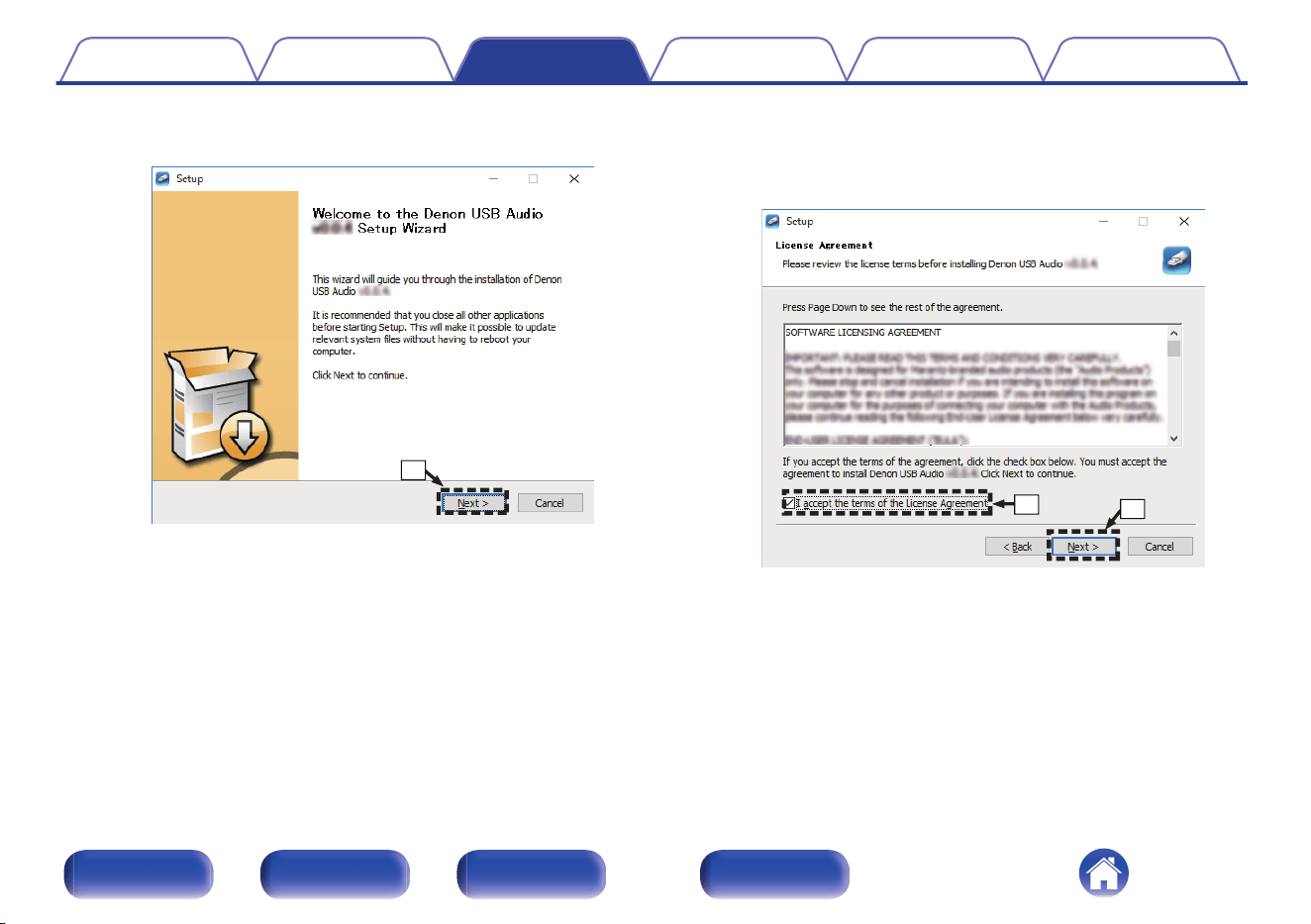
Install the driver.
A
Select the language to use for the installation.
B
Click “OK”.
q
w
Contents Connections Playback Settings Tips Appendix
32
Front panel Rear panel
Remote control
unit
Index
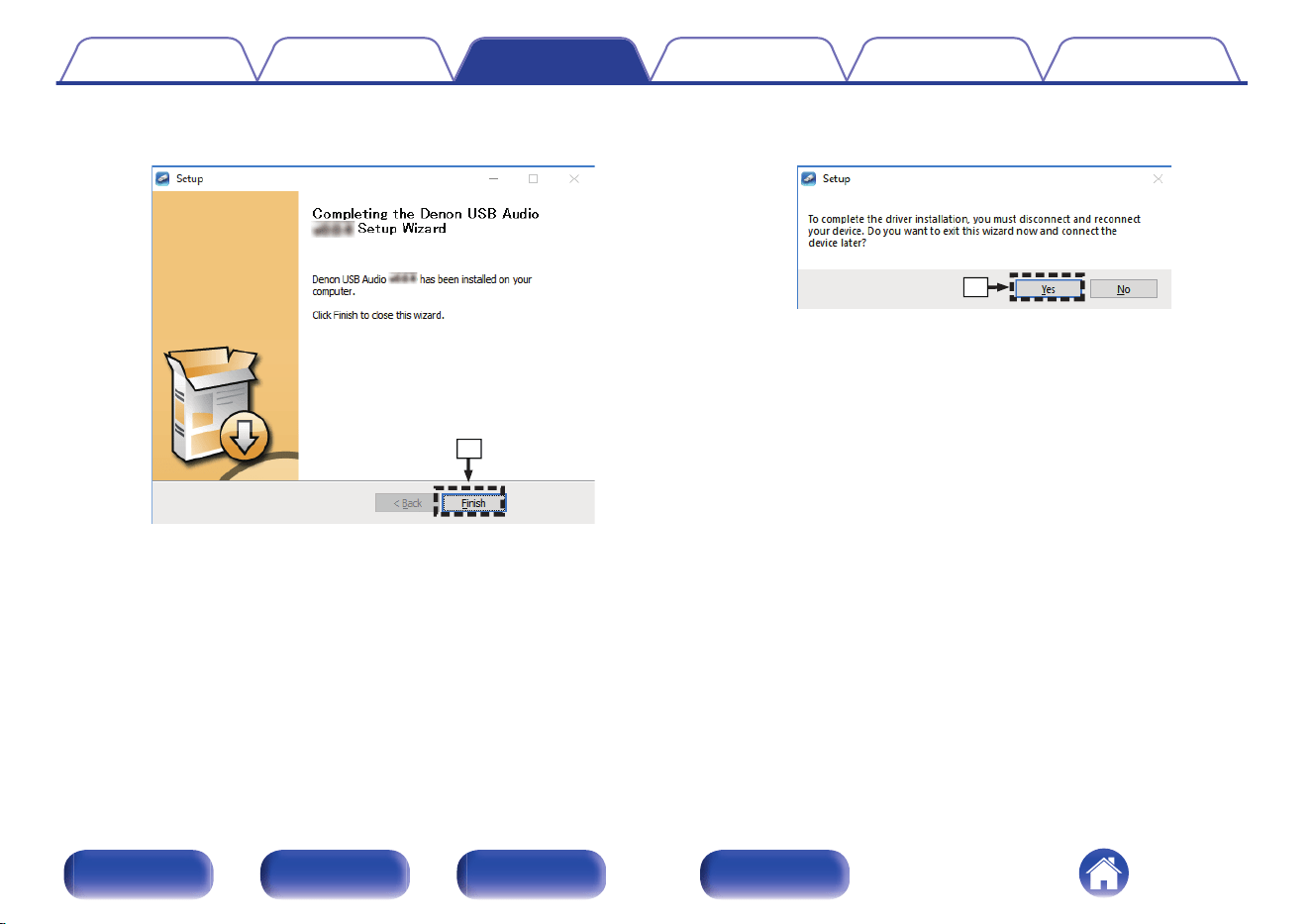
H
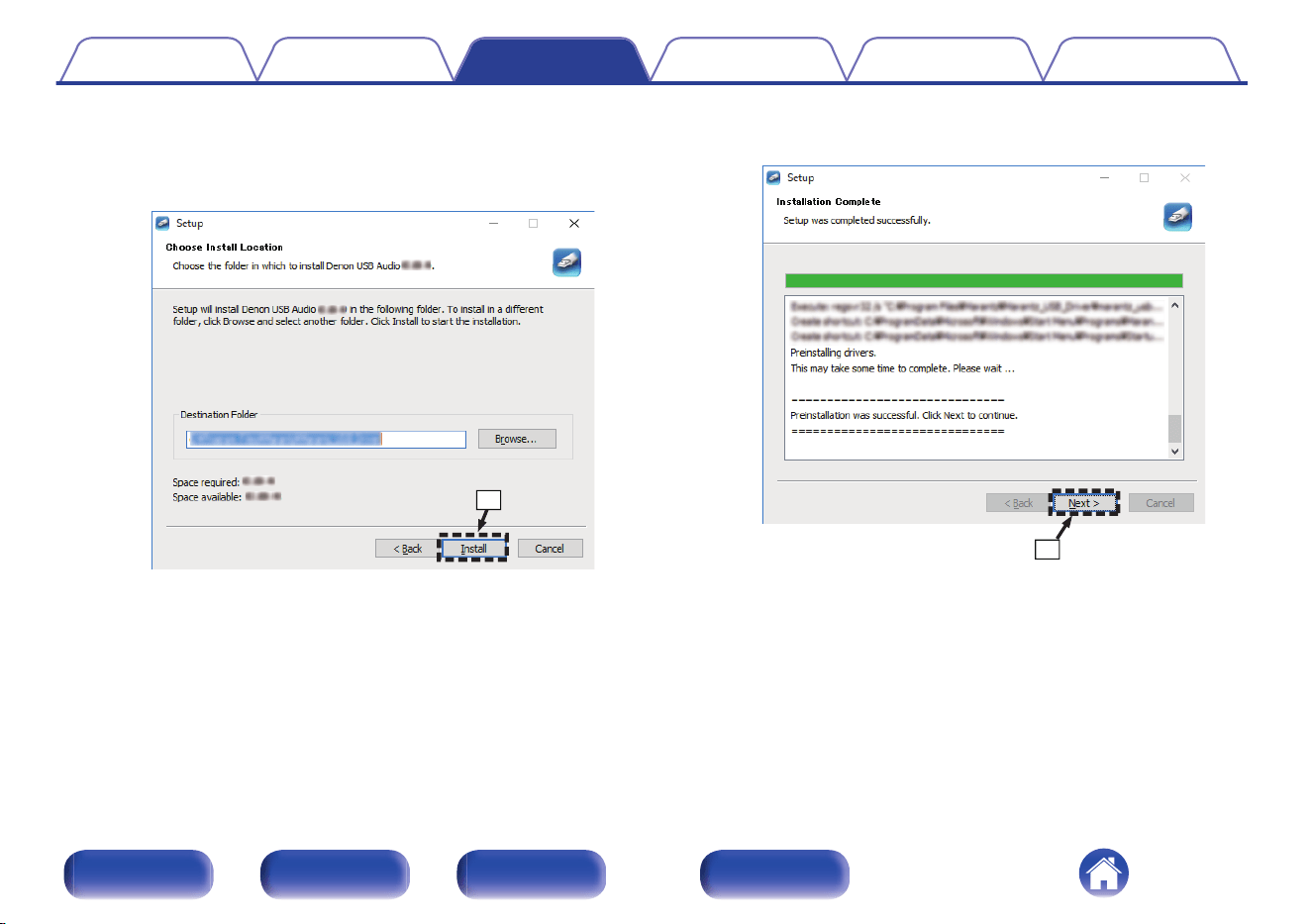
When the installation is completed, click “Finish”.
i
I
Click “Yes”.
o
5
With the unit power off, connect the unit and PC using
a USB cable (sold separately).
0
For details on connections, see “Connecting a PC or
Mac” (v p. 23).
Contents Connections Playback Settings Tips Appendix
35
Front panel Rear panel
Remote control
unit
Index
6
Press X on this unit.
0
When the unit power is turned on, the PC automatically finds and
connects to the unit.
7
Press the input source select button (USB-DAC) to
switch the input source to “USB-DAC”.
8
Checking the installed driver.
A
Click the “Start” button and click “Control Panel” on the PC.
0
The control panel setting list is displayed.
B
Click “Sound”.
0
The sound menu window is displayed.
C
Check that there is a checkmark next to “Default Device” under in
“PMA-1700NE” of the “Playback” tab.
0
When there is a checkmark for a different device, click
“PMA-1700NE” and “Set Default”.
9
Checking audio output.
Outputs a TEST signal from the PC and checks the audio output
from the USB-DAC function.
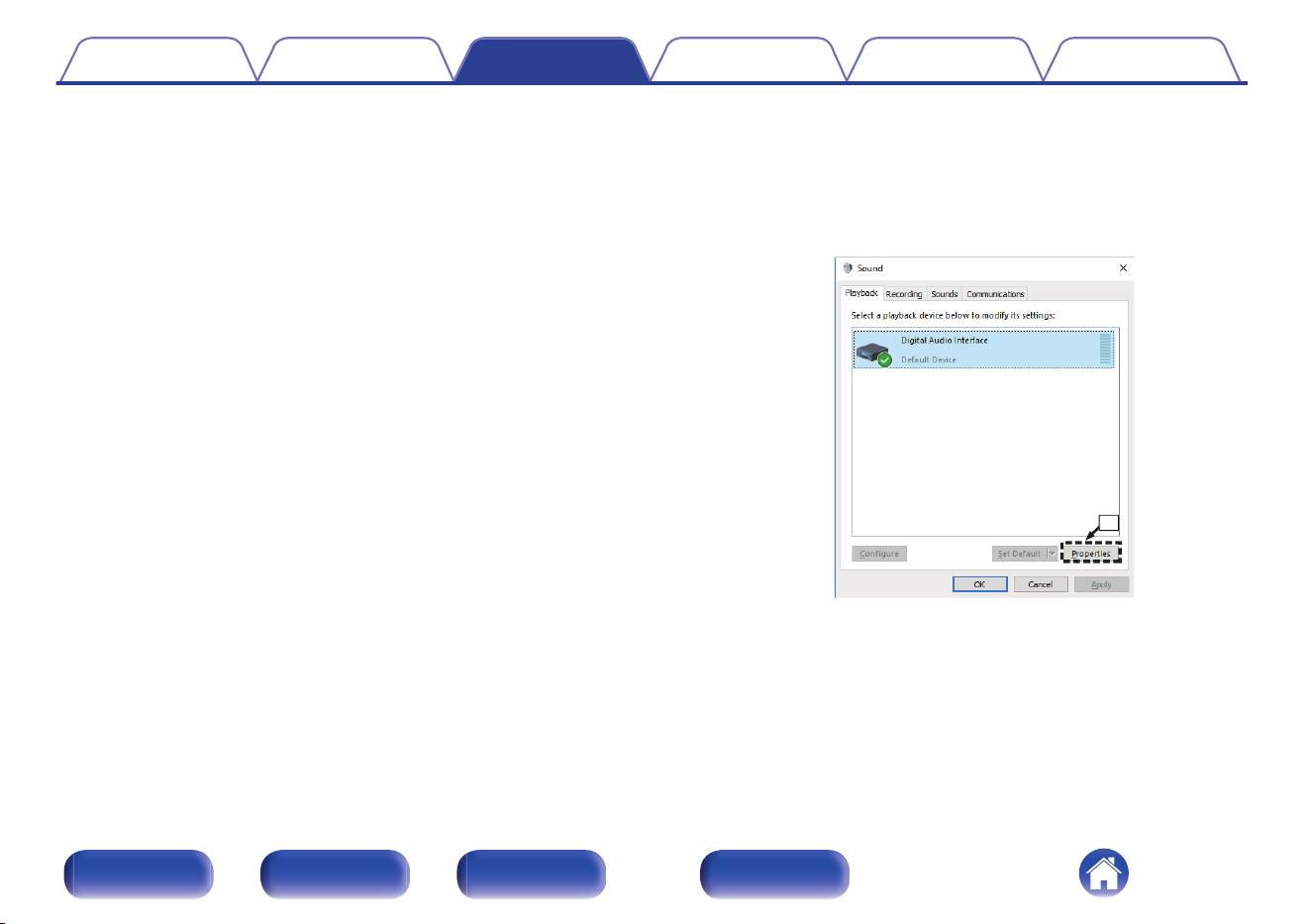
A
Select “PMA-1700NE” and click “Properties”.
0
The Properties window is displayed.
q
PMA-1700NE
Contents Connections Playback Settings Tips Appendix
36
Front panel Rear panel
Remote control
unit
Index
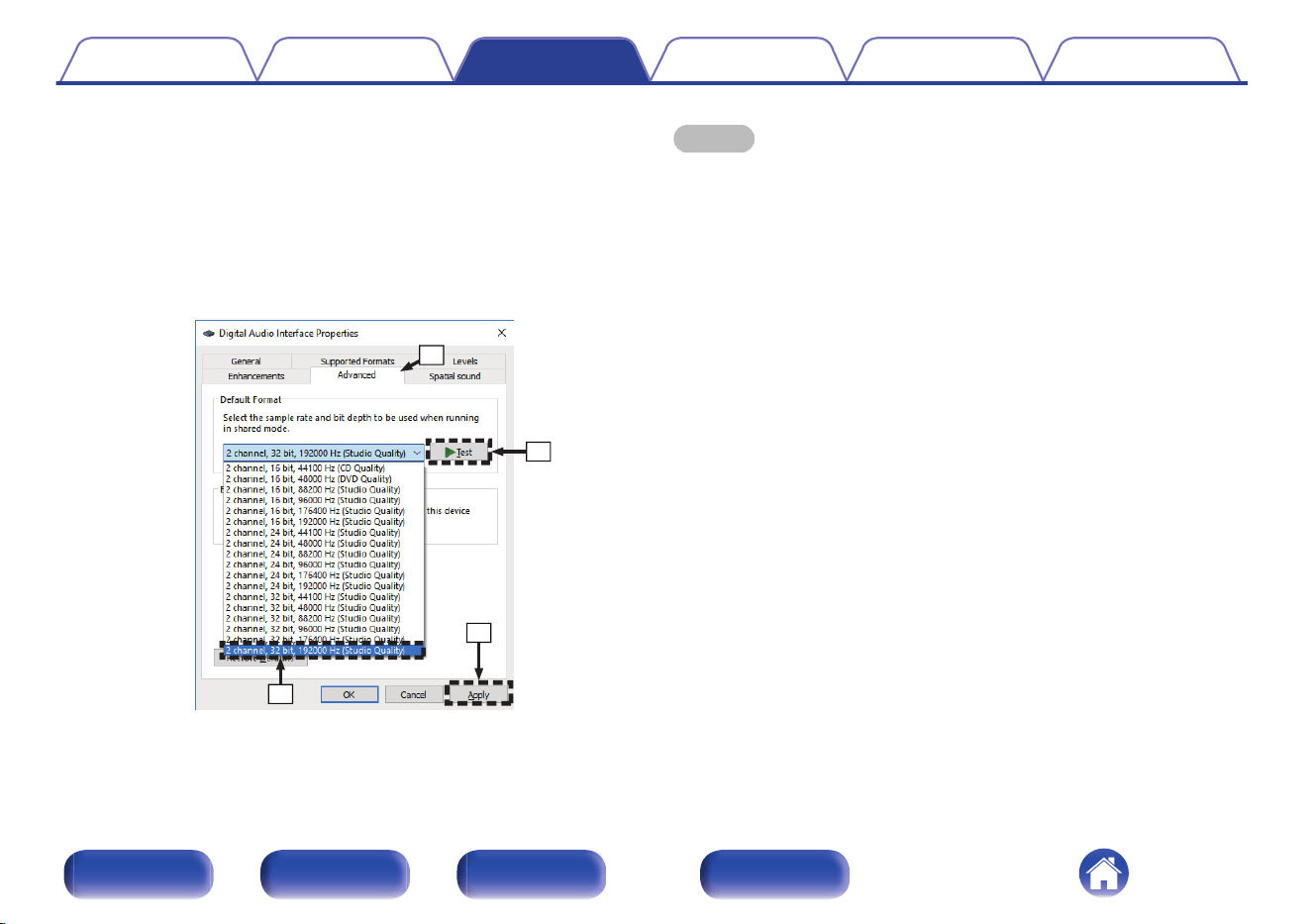
B
Click the “Advanced” tab.
C
Select the sampling rate and bit rate to be applied to the D/A
converter.
0
It is recommended that “2 channel, 32 bit, 192000 Hz (Studio
Quality)” is selected.
D
Click “Apply”.
E
Click “Test”.
0
Check that audio from this unit is output from the PC.
w
e
r
t
NOTE
0
The dedicated driver must be installed in the PC before this unit is connected to a
PC. Operation will not occur correctly if connected to the PC before the dedicated
driver has been installed.
0
Operation may fail in some PC hardware and software configurations.
0
Player software supporting the Audio Stream Input Output (ASIO) driver is
required to play files with a sampling frequency of 352.8 kHz/384 kHz without
downsampling. Check your player software before playing files with the ASIO
driver.
0
Please see the FAQ at www.denon.com if you experience any issues getting
audio to play from your computer through this unit. You may also want to check the
support pages for your audio player application.
Contents Connections Playback Settings Tips Appendix
37
Front panel Rear panel
Remote control
unit
Index
o
Audio Device Settings (macOS only)
A
With the unit power off, connect the unit and Mac using a USB cable
(sold separately).
0
For the connection procedure, refer to the “Connecting a PC or Mac”
section. (v p. 23)
B
Press X.
C
Press the input source select button (USB-DAC) to switch the input
source to “USB-DAC”.
D
Move the cursor to “Go” on the computer screen, and then click
“Utilities”.
0
The utility list is displayed.
E
Double-click “Audio MIDI Setup”.
0
The “Audio Devices” window is displayed.
F
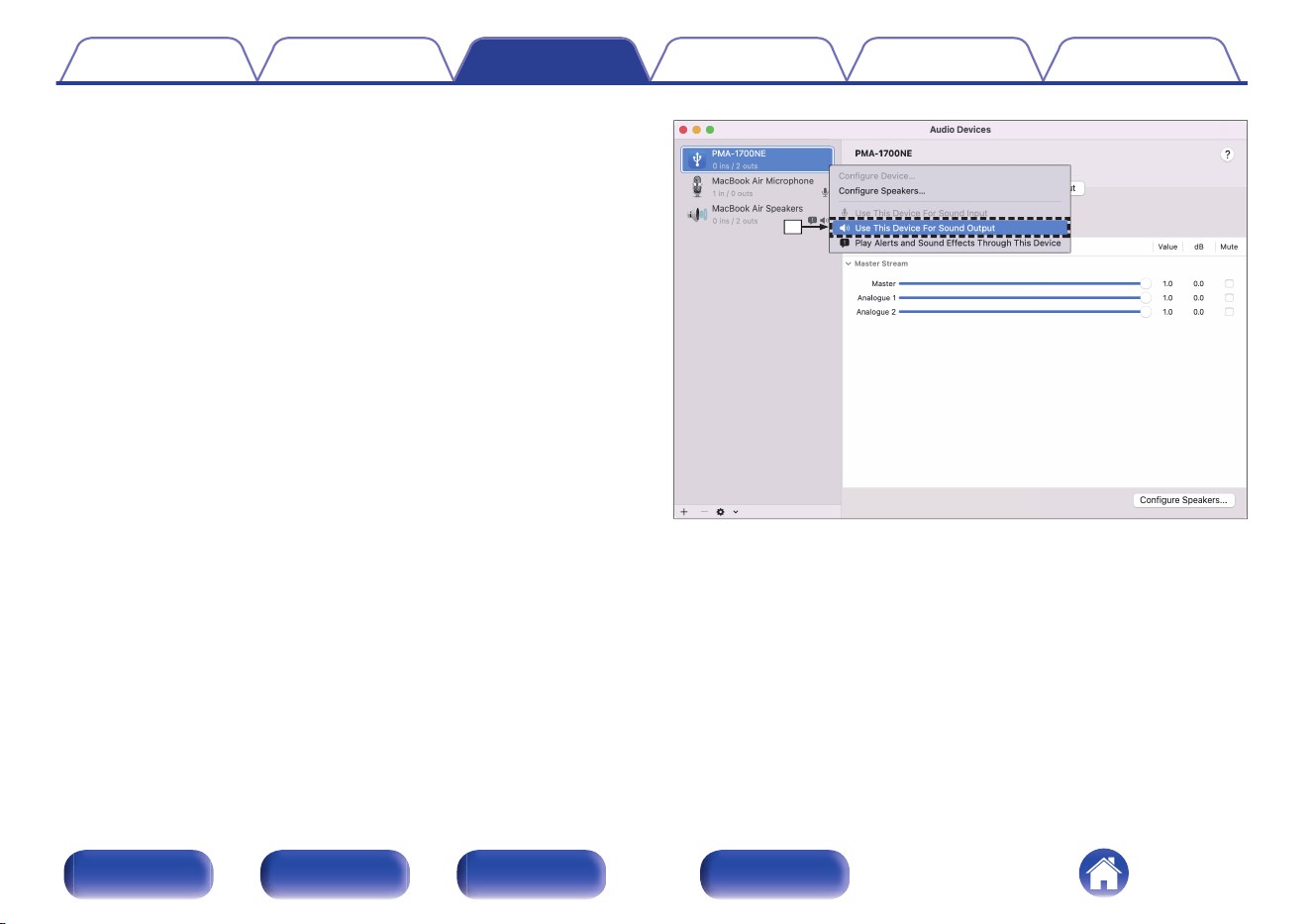
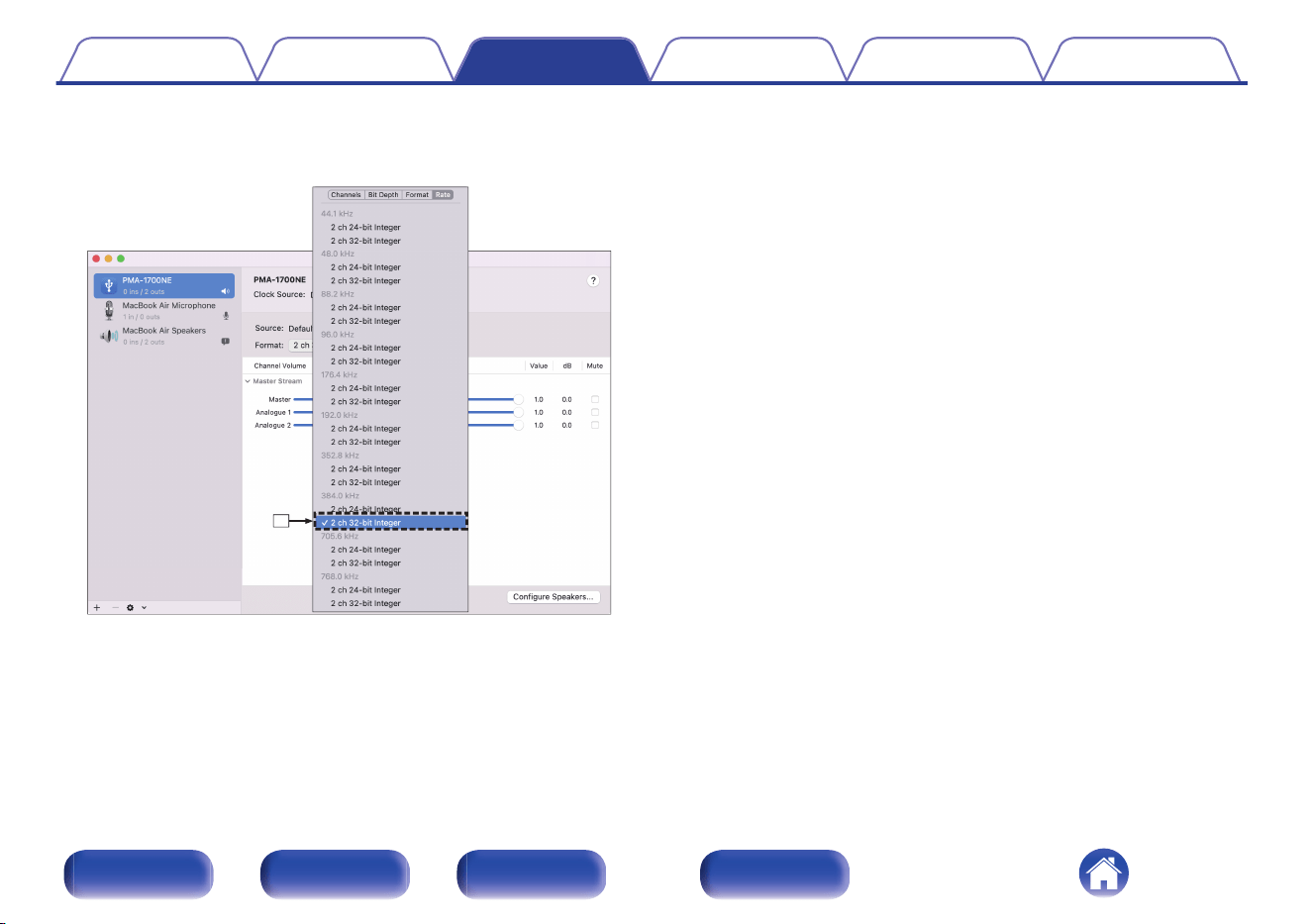
Check that “Use This Device For Sound Output” is checked in
“PMA-1700NE”.
0
If a different device is checked, select and “Secondary click” on
“PMA-1700NE”, and then select “Use This Device For Sound
Output”.
⑥
Contents
Connections Playback Settings Tips Appendix
38
Front panel Rear panel
Remote control
unit
Index
G
Select the “PMA-1700NE” format.
0
It is normally recommended to set the format to “2 ch 32-bit Integer
384.0 kHz”.
⑦
H
Quit Audio MIDI Setup.
o
Playback
Install the desired player software on your computer beforehand.
Use the rear panel USB-DAC port to connect this unit to a computer.
(v p. 23)
1
Press the input source select button (USB-DAC) to
switch the input source to “USB-DAC”.
Start playback on the computer’s player software.
0
If the sampling frequency cannot be detected, “Unlocked” will be
displayed.
0
“Unsupported” is displayed when audio signals that are not
supported by this unit are input.
Contents Connections Playback Settings Tips Appendix
39
Front panel Rear panel
Remote control
unit
Index
o
Specifications of supported audio formats
See “D/A converter” (v p. 53).
NOTE
0
Perform operations such as playback and pause on the computer. At this time, you
cannot perform operations with buttons on this unit or the remote control.
0
When this unit is functioning as a D/A converter, sound is not output from the
computer’s speakers.
0
If the computer is disconnected from this unit while the computer music playback
software is running, the playback software may freeze. Always exit the playback
software before disconnecting the computer.
0
When an error occurs on the computer, disconnect the USB cable and restart the
computer.
0
The sampling frequency of the music playback software and sampling frequency
displayed on this unit may differ.
0
Use a cable that is 3 m or less to connect to the computer.
Connecting and playing back from a
digital device (Coaxial/Optical 1/Optical
2)
1
Connect digital device to this unit. (v p. 22)
2
Press the input source select button (COAXIAL or
OPTICAL 1/2) to switch the input source to “COAXIAL”
or “OPTICAL 1/2”.
0
If the sampling frequency cannot be detected, “Unlocked” will be
displayed.
0
“Unsupported” is displayed when audio signals that are not
supported by this unit are input.
o
Specifications of supported audio formats
See “D/A converter” (v p. 53).
NOTE
0
Do not input non-PCM signals, such as Dolby Digital, DTS and AAC. This causes
noise and could damage the speakers.
Contents Connections Playback Settings Tips Appendix
40
Front panel Rear panel
Remote control
unit
Index
Recording
Audio signals input into this unit can be output to an external recording
device. When recording audio from a playback device connected to this
unit, audio can be recorded with the playback device still connected to this
unit.
1
Press X on the main unit to turn the power on.
2
Press the input source select button to switch to the
input source from which you want to record.
The selected input source is displayed on the display of this unit.
3
Recording starts.
0
For information on operations, see the owner’s manual of the
recording device.
Contents Connections Playback Settings Tips Appendix
41
Front panel Rear panel
Remote control
unit
Index
Setting the TV auto play function
Set this when playing audio from a TV on this unit. When the TV is turned
on, this unit turns on and the input source is automatically switched to
“OPTICAL 1”, “OPTICAL 2” or “COAXIAL” so that the audio from the TV
can be played through this unit. Set this according to the connector on this
unit where the TV is connected.
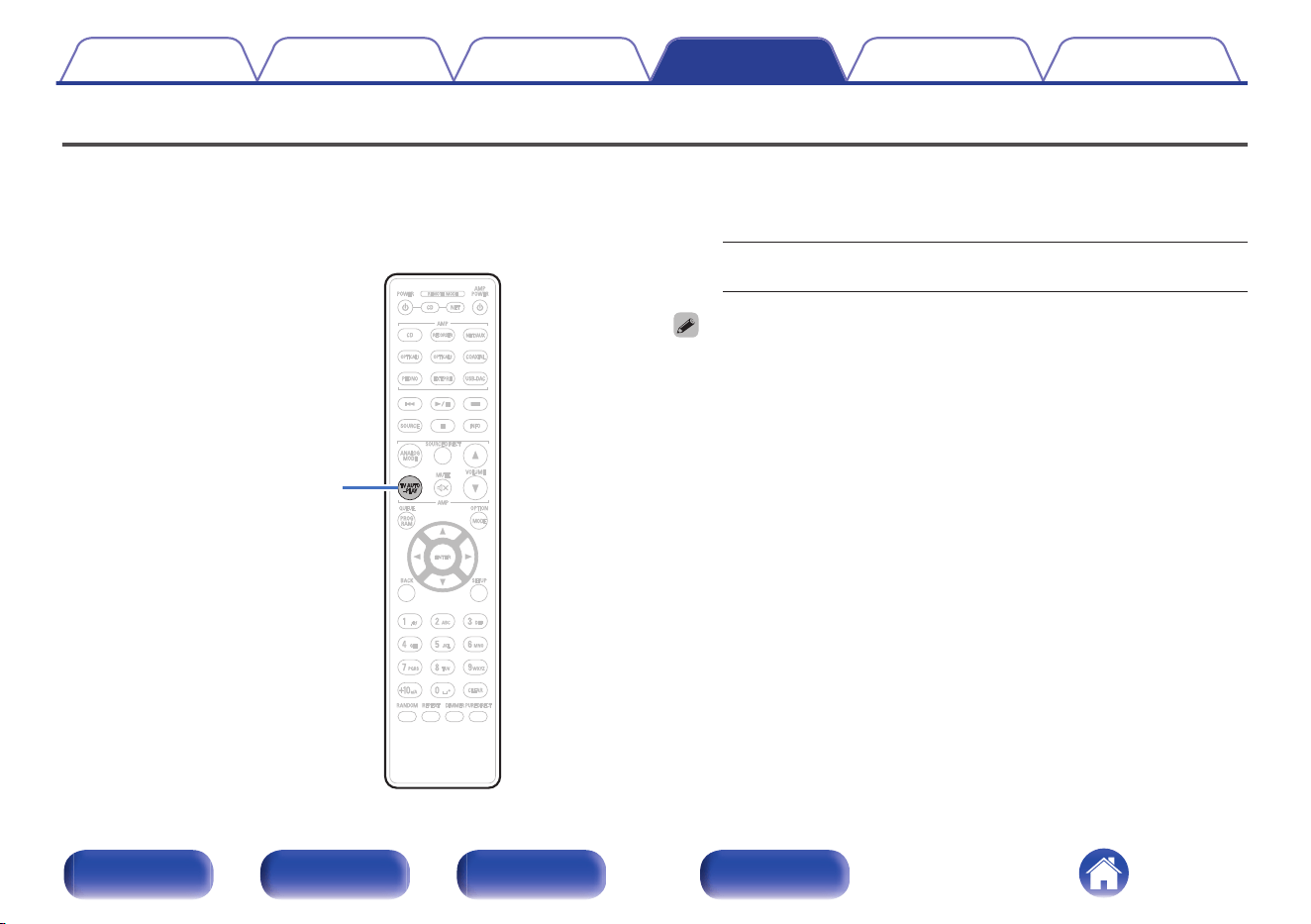
TV AUTO-PLAY
1
Press TV AUTO-PLAY to select the setting.
0
The setting changes each time TV AUTO-PLAY is pressed.
OPTICAL 1 / OPTICAL 2 / COAXIAL / Off
(Default: OPTICAL 1)
0
When the analog mode is set to “ANALOG MODE 1” or “ANALOG MODE 2”, the
TV auto play function does not work. (v p. 30)
0
Depending on your TV, the TV auto play function may not work.
0
This unit will not automatically turn off when the TV is turned off.
0
The TV auto play function works when an audio signal is input to this unit, but if the
sampling frequency of the input audio signal is 88.2 kHz or more, the TV auto play
function does not work. TVs normally output 48 kHz audio signals and the TV auto
play function will work, but if you connect a device that outputs an audio signal of
88.2 kHz or more and try to use it, the TV auto play function may not work.
Contents Connections Playback Settings Tips Appendix
42
Front panel Rear panel
Remote control
unit
Index
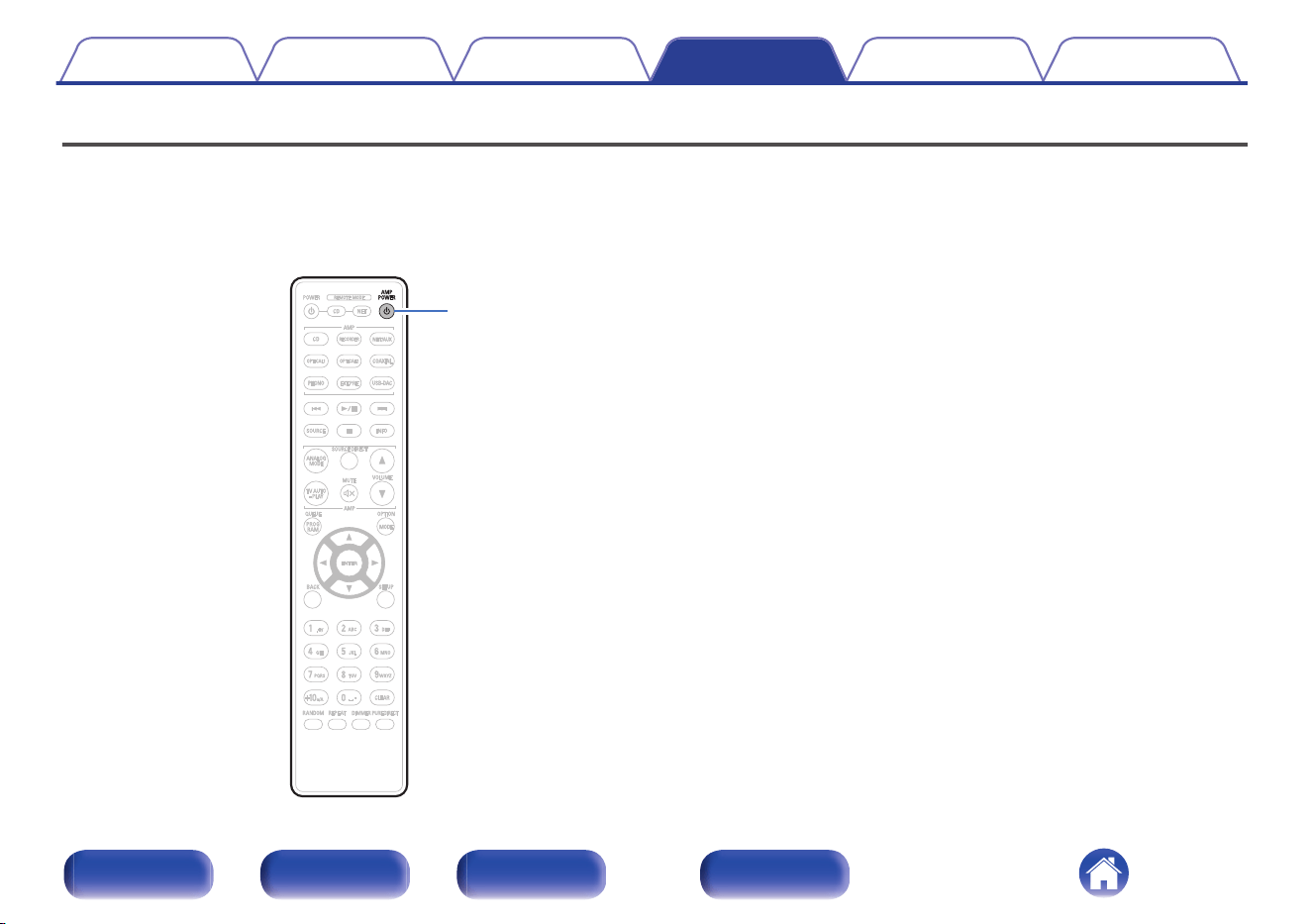
Setting the auto standby mode
You can set the unit to automatically switch to standby mode if the unit is
not operated for 15 minutes when there is no audio input (Auto standby
mode).
Auto standby mode is set to on by default.
AMP POWER
X
1
Press and hold AMP POWER X for 5 seconds or more
to switch it on and off.
The display changes as follows each time it is switched on and off.
0
When auto standby mode is on: “AutoStby On” is displayed.
0
When auto standby mode is off: “AutoStby Off” is displayed.
Contents
Connections Playback Settings Tips Appendix
43
Front panel Rear panel
Remote control
unit
Index
o
Contents
Tips
I want to adjust the tone myself 45
I want sound playback that is faithful to the original sound 45
I want to enjoy higher sound quality from the analog input source 45
I want to use bi-wiring compatible speakers 45
I want to use this unit as a power amplifier 45
Troubleshooting
Power does not turn on / Power is turned off 47
Operations cannot be performed through the remote control unit 48
Display on this unit shows nothing 48
No sound comes out 49
Desired sound does not come out 49
Sound is interrupted or noise occurs 50
Music files on PC or Mac cannot be played back 51
Audio from digital devices cannot be played back (Coaxial/Optical) 52
The input source switches to “Optical 1”, “Optical 2” or “Coaxial” 52
Contents Connections Playback Settings Tips Appendix
44
Front panel Rear panel
Remote control
unit
Index
Tips
I want to adjust the tone myself
0
Use the BASS, TREBLE and BALANCE knobs to adjust the sound as desired. (v p. 28)
I want sound playback that is faithful to the original sound
0
Set the source direct mode on. (v p. 30)
I want to enjoy higher sound quality from the analog input source
0
Set the analog mode on. (v p. 30)
I want to use bi-wiring compatible speakers
0
This unit is compatible with bi-wiring connections. Enjoy high quality playback by using bi-wiring connections. (v p. 19)
I want to use this unit as a power amplifier
0
Connect the pre amplifier to the EXT.PRE IN connectors of this unit. (v p. 24)
Contents
Connections Playback Settings Tips Appendix
45
Front panel Rear panel
Remote control
unit
Index
Troubleshooting
If a problem should arise, first check the following:
1. Are the connections correct?
2. Is the set being operated as described in the owner’s manual?
3. Are the other devices operating properly?
If this unit does not operate properly, check the corresponding symptoms in this section.
If the symptoms do not match any of those described here, consult your dealer as it could be due to a fault in this unit. In this case, disconnect the power
immediately and contact the store where you purchased this unit.
Contents Connections Playback Settings Tips Appendix
46
Front panel Rear panel
Remote control
unit
Index
Power does not turn on / Power is turned off
Power is not turned on.
0
Check whether the power plug is correctly inserted into the power outlet. (v p. 25)
Power automatically turns off.
0
The auto standby mode is on. When approx. 15 minutes pass with no audio input and no operations on the unit, this unit automatically enters the
standby mode. To turn off the auto standby mode, press the AMP POWER X button for 5 seconds or longer. (v p. 43)
The power turns off and the power indicator shows one long blink and two short blinks in red.
0
Stop playback on the playback device, and then turn the power off and on again.
0
If the problem is not solved by turning the power off and on again, this unit’s amplifier circuit has failed. Unplug the power cord and contact our customer
service center.
The power turns off and the power indicator shows one long blink and three short blinks in red.
0
This unit’s power circuit has failed. Unplug the power cord and contact our customer service center.
The power turns off and the power indicator shows one long blink and four short blinks in red.
0
The protection circuit has been activated due to a rise in temperature within this unit. Turn the power off, wait about an hour until this unit cools down
sufficiently, and then turn the power on again.
0
Please re-install this unit in a place having good ventilation.
0
Check the speaker connections. The protection circuit may have been activated because speaker cable core wires came in contact with each other or a
core wire was disconnected from the connector and came in contact with the rear panel of this unit. After unplugging the power cord, take corrective
action such as firmly re-twisting the core wire or taking care of the connector, and then reconnect the wire. (v p. 16)
0
Stop playback on the playback device, and then turn the power off and on again.
The power turns off and the power indicator shows one long blink and five short blinks in red.
0
Stop playback on the playback device, and then turn the power off and on again.
0
If the problem is not solved by turning the power off and on again, this unit’s amplifier circuit or power circuit has failed. Unplug the power cord and
contact our customer service center.
Contents
Connections Playback Settings Tips Appendix
47
Front panel Rear panel
Remote control
unit
Index
Operations cannot be performed through the remote control unit
Operations cannot be performed through the remote control unit.
0
Batteries are worn out. Replace with new batteries. (v p. 5)
0
Operate the remote control unit within a distance of about 7 m from this unit and at an angle of within 30°. (v p. 5)
0
Remove any obstacle between this unit and the remote control unit.
0
Insert the batteries in the proper direction, checking the q and w marks. (v p. 5)
0
The set’s remote control sensor is exposed to strong light (direct sunlight, inverter type fluorescent bulb light, etc.). Move the set to a place in which the
remote control sensor will not be exposed to strong light.
0
When using a 3D video device, the remote control unit of this unit may not function due to effects of infrared communications between units (such as TV
and glasses for 3D viewing). In this case, adjust the direction of units with the 3D communications function and their distance to ensure they do not
affect operations from the remote control unit of this unit.
Display on this unit shows nothing
Display is off.
0
Press the DIMMER button, and change the setting to anything other than off. (v p. 29)
0
The analog mode is set to “ANALOG MODE 2”. Press the ANALOG MODE button to set the analog mode to “ANALOG MODE 1” or “ANALOG MODE
Off”. (v p. 30)
Contents
Connections Playback Settings Tips Appendix
48
Front panel Rear panel
Remote control
unit
Index
No sound comes out
No sound comes out of speakers.
0
Check the connections for all devices. (v p. 15)
0
Insert connection cables all the way in.
0
Check that input connectors and output connectors are not reversely connected.
0
Check cables for damage.
0
Check that speaker cables are properly connected. Check that cable core wires come in contact with the metal part on speaker terminals. (v p. 16)
0
Securely tighten the speaker terminals. Check speaker terminals for looseness. (v p. 16)
0
Check that the proper input source is selected. (v p. 28)
0
The volume is set to the minimum level. Adjust the volume to a suitable level. (v p. 28)
0
Cancel the muting mode. (v p. 28)
0
No sound is output from the speakers when headphones are connected. (v p. 8)
Desired sound does not come out
No sound comes out of a specific speaker.
0
Check that speaker cables are properly connected. (v p. 16)
0
Adjust the BALANCE control knob. (v p. 28)
The left and right of stereo sound is reversed.
0
Check whether the left and right speakers are connected to the correct speaker terminals. (v p. 18)
Contents
Connections Playback Settings Tips Appendix
49
Front panel Rear panel
Remote control
unit
Index
Sound is interrupted or noise occurs
When playing a record, the sound is distorted.
0
Adjust to a proper needle pressure.
0
Check the tip of the needle.
0
Replace the cartridge.
When playing a record, a humming noise comes out of the speakers.
0
Check that the turntable is connected correctly. (v p. 20)
0
If there is a TV or AV device near the turntable, such devices may affect the playback sound. Install the turntable in a location as far away as possible
from the TV or other AV devices.
When playing a record, a humming noise comes out of the speakers when the volume is high. (Howling phenomenon)
0
Install the turntable and speakers as far from each other as possible. (v p. 20)
0
The vibrations from the speakers are being transmitted to the player through the floor. Use cushions, etc., to absorb the speakers’ vibrations.
Sound is interrupted during playback of tracks saved on a computer.
0
Do not start applications other than the player software while playing music on your computer.
Contents
Connections Playback Settings Tips Appendix
50
Front panel Rear panel
Remote control
unit
Index
Music files on PC or Mac cannot be played back
This unit is not recognized on the computer.
0
Reconnect the USB cable to the USB port on your computer. When this unit is still not recognized after reconnection, connect to a different USB port.
(v p. 23)
0
Restart your computer.
0
Check the OS of your computer. (v p. 31)
0
When your computer is running on Windows, a dedicated driver software should be installed. (v p. 32)
This unit is not selected as the playback device.
0
Select this unit as the playback device in the sound settings on the computer. (v p. 31)
“Unlocked” is displayed.
0
When digital audio signals cannot be detected properly, “Unlocked” is displayed. (v p. 39)
“Unsupported” is displayed.
0
“Unsupported” is displayed when audio signals that are not supported by this unit are input. Check the settings on your computer or player software.
(v p. 39)
0
If the computer you use is macOS, please check if the PMA-1700NE format is set below 384.0 kHz using the Audio MIDI Setup. (v p. 38)
Contents
Connections Playback Settings Tips Appendix
51
Front panel Rear panel
Remote control
unit
Index
Audio from digital devices cannot be played back (Coaxial/Optical)
“Unlocked” is displayed.
0
When digital audio signals cannot be detected properly, “Unlocked” is displayed. (v p. 40)
“Unsupported” is displayed.
0
“Unsupported” is displayed when audio signals that are not supported by this unit are input. Check the audio output signal format from your digital
device. (v p. 40)
The input source switches to “Optical 1”, “Optical 2” or “Coaxial”
The input source automatically switches to “Optical 1”, “Optical 2” or “Coaxial” when the TV connected to this unit is turned on.
0
Press the TV AUTO-PLAY button on the remote control unit to set the TV auto play function to “Off”. (v p. 42)
Contents
Connections Playback Settings Tips Appendix
52
Front panel Rear panel
Remote control
unit
Index
D/A converter
o
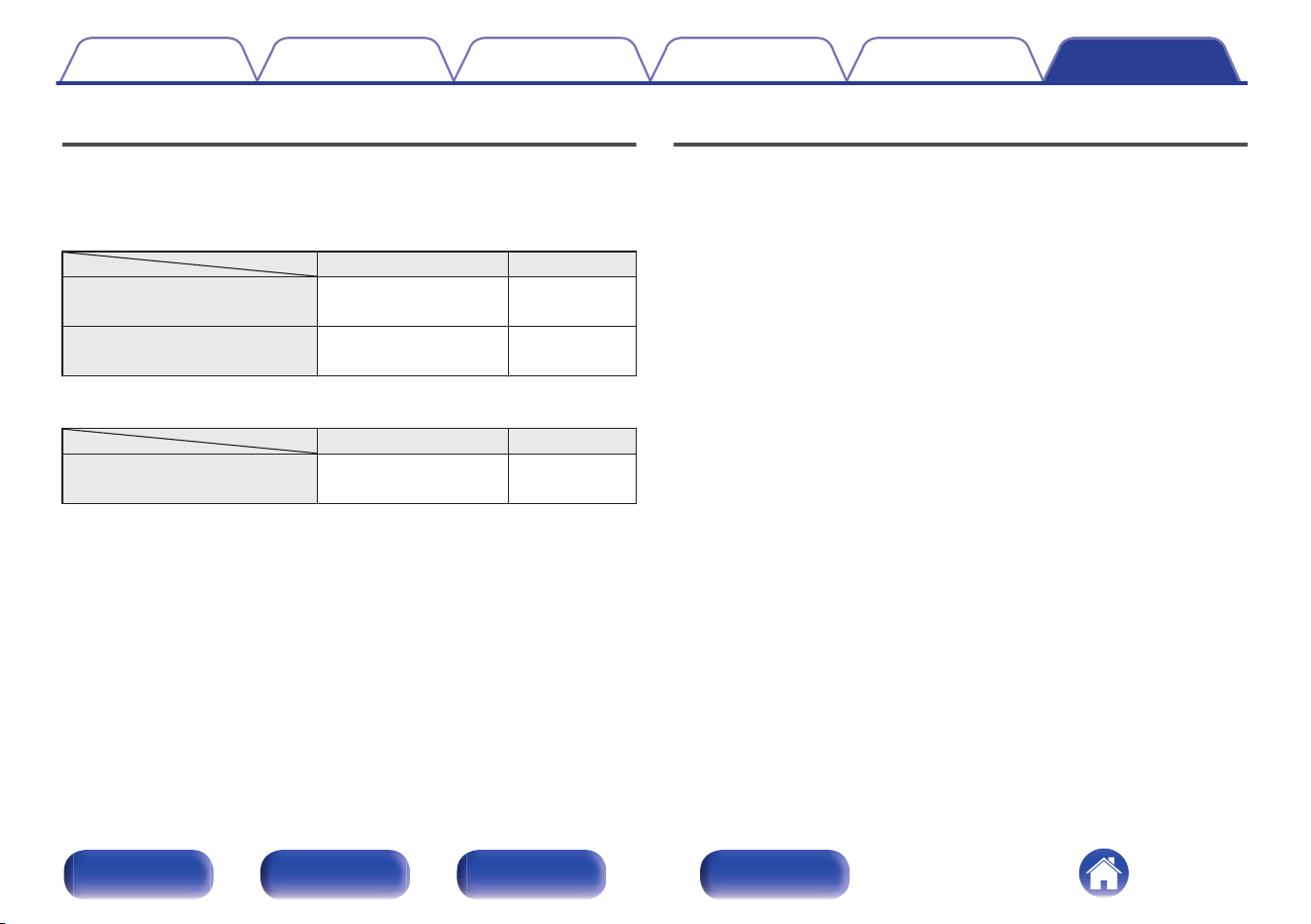
Specifications of supported audio formats
n
USB-DAC
Sampling frequency Bit length
DSD
(2-channel)
2.8/5.6/11.2 MHz 1 bit
Linear PCM
(2-channel)
44.1/48/88.2/96/176.4/
192/352.8/384 kHz
16/24/32 bits
n
Coaxial/Optical
Sampling frequency Bit length
Linear PCM
(2-channel)
32/44.1/48/88.2/96/
176.4/192 kHz
16/24 bits
Explanation of terms
DSD (Direct-Stream Digital)
One of the audio data recording methods, it is the signal aspect used to
store audio signals on a super audio CD, and is Δ-Σ modulated digital
audio. It is configured of an array of single bit values at a 2.8 MHz
sampling rate.
Sampling frequency
Sampling involves taking a reading of a sound wave (analog signal) at
regular intervals and expressing the height of the wave at each reading in
digitized format (producing a digital signal).
The number of readings taken in one second is called the “sampling
frequency”. The larger the value, the closer the reproduced sound is to the
original.
Linear PCM
This is an uncompressed PCM (Pulse Code Modulation) signal. This is the
same system used for CD audio but uses 192 kHz, 96 kHz, and 48 kHz
sampling frequencies on Blu-ray Disc or DVD and provides higher
resolution than CD.
Contents
Connections Playback Settings Tips Appendix
53
Front panel Rear panel
Remote control
unit
Index
Speaker impedance
This is an AC resistance value, indicated in Ω (ohms).
Greater power can be obtained when this value is smaller.
Source direct
Playback with higher fidelity to the source becomes possible, as input
audio signals are output by bypassing the audio quality-control circuits
(BASS/TREBLE/BALANCE).
Protection circuit
This is a function to prevent damage to devices within the power supply
when an abnormality such as an overload, excess voltage occurs or over
temperature for any reason.
Contents Connections Playback Settings Tips Appendix
54
Front panel Rear panel
Remote control
unit
Index
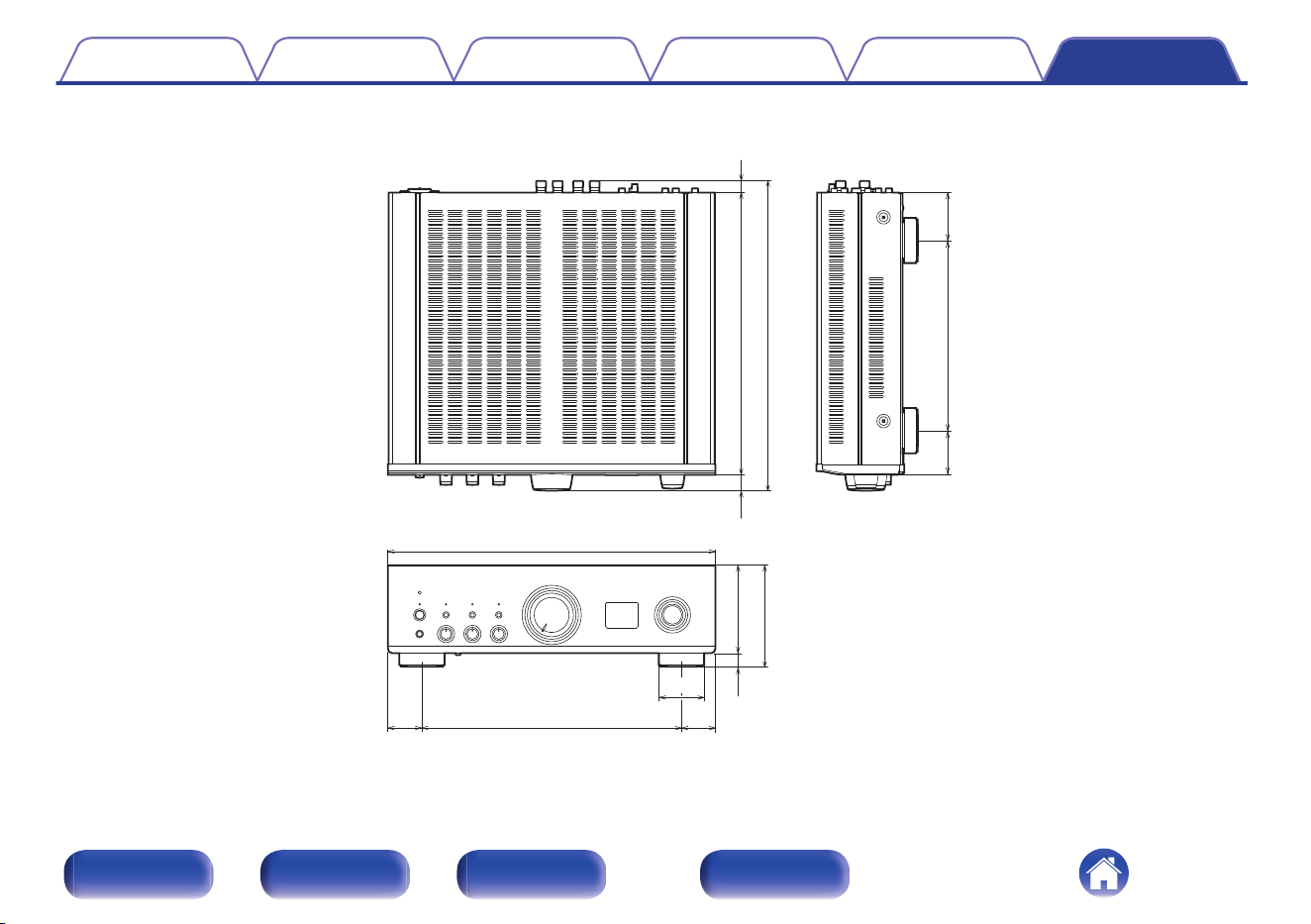
Specifications
o
Power amplifier section
Rated Output Power: 2-channel driving (CD → SP OUT)
70 W + 70 W (8 Ω/ohms, 20 Hz - 20 kHz, T.H.D. 0.07 %)
140 W + 140 W (4 Ω/ohms, 1 kHz, T.H.D. 0.7 %)
Total harmonic distortion: 0.01 % (Rated output: –3 dB), 8 Ω/ohms, 1 kHz
Output terminals: Speaker A or B: 4 – 16 Ω/ohms
Speaker A + B: 8 – 16 Ω/ohms
Suited for headphones/stereo headphones
Input Sensitivity/Input Impedance: EXT.PRE: 0.84 V / 47 kΩ/kohms
Amplification factor: 29 dB
o
Pre amplifier section
Input Sensitivity/Input Impedance: PHONO (MM): 2.5 mV / 47 kΩ/kohms
PHONO (MC): 200 μV / 100 Ω/ohms
CD, NETWORK/AUX, RECORDER: 125 mV / 19 kΩ/kohms
RIAA Deviation: PHONO: 20 Hz – 20 kHz ±0.5 dB
Maximum Input: PHONO (MM): 130 mV / 1 kHz
PHONO (MC): 10 mV / 1 kHz
Contents Connections Playback Settings Tips Appendix
55
Front panel Rear panel
Remote control
unit
Index
o
Overall performance
SN Ratio (A network): PHONO (MM): 89 dB
(With input terminals short-circuited, 5 mV input signal)
PHONO (MC): 74 dB
(With input terminals short-circuited, 0.5 mV input signal)
CD, NETWORK/AUX, RECORDER: 106 dB (input terminals short-circuited)
Frequency response: 5 Hz – 100 kHz (0 – -3 dB)
Tone control: BASS: 100 Hz ±8 dB
TREBLE: 10 kHz ±8 dB
Digital input signal formats
0
Format:
Digital audio interface (Linear PCM)
0
Coaxial input: 0.5 Vp-p / 75 Ω/ohms
0
Optical input: More than -27 dBm
0
Optical wavelength: 660 nm
o
General
Operating temperature: +5 ℃ - +35 ℃
Power supply: AC 230 V, 50/60 Hz
Power consumption: 295 W
Power consumption in standby modes
0
TV Auto Play setting - Enabled: 0.4 W
0
TV Auto Play setting - Disabled: 0.2 W
For the purpose of improvement, the specifications and design are subject to change without notice.
Contents
Connections Playback Settings Tips Appendix
56
Front panel Rear panel
Remote control
unit
Index
Index
v A
Auto Standby mode ........................................ 43
v B
BALANCE ...................................................... 28
BASS ............................................................. 28
BD player ....................................................... 20
v C
CD player ................................................. 20, 22
v D
D/A Converter ................................................ 31
v I
Input source ................................................... 28
Install the driver .............................................. 32
v M
Muting ............................................................ 28
v N
Network audio player ..................................... 20
v P
PC .................................................................. 23
Pre-amplifier ................................................... 24
Protection circuit ............................................ 54
v R
Recording device ........................................... 21
Remote control unit ........................................ 11
v S
Satellite receiver ............................................. 22
Source direct ............................................ 30, 54
Speaker impedance ....................................... 54
Speakers ........................................................ 16
v T
Tips ................................................................ 45
Tone ............................................................... 28
TREBLE ......................................................... 28
Troubleshooting ............................................. 46
Turntable ........................................................ 20
v U
USB-DAC ....................................................... 31
v V
Volume ........................................................... 28
Contents
Connections Playback Settings Tips Appendix
58
Front panel Rear panel
Remote control
unit
Index

www.denon.com
3520 10860 00ADA
© 2022 Sound United. All Rights Reserved.
59